INTRODUCTION
xi
It is stated on good authority, that soon after the
first appearance of Schiller’s drama of “The Robbers”
a number of young men, charmed with the character
of Charles De Moor, formed a band and went to
the forests of Bohemia to engage in brigand life. I have
no fear that such will be the influence of this volume.
It deals in facts. Robber life as delineated by the vivid
fancy of Schiller, and robber life as it existed in our
mining regions, were as widely separated as fiction and
truth. No one can read this record of events, and escape
the conviction that an honest, laborious, and well-meaning
life, whether successful or not, is preferable
to all the temporary enjoyments of a life of recklessness
and crime. The truth of the adage that “Crime carries
with it its own punishment” has never received a more
powerful vindication than at the tribunals erected by the
people of the northwest mines for their protection.
No sadder commentary could have stained our civilization
than to permit the numerous and bloody crimes committed
in the early history of this portion of our country
to go unwhipped of justice. And the fact that they
were promptly and thoroughly dealt with stands among
the earliest and noblest characteristics of a people which
derived their ideas of right and of self-protection from
that spirit of the law that flows spontaneously from our
free institutions. The people bore with crime until punishment
became a duty and neglect a crime. Then, at
infinite hazard of failure, they entered upon the work of
xiipurgation with a strong hand—and in the briefest possible
time established the supremacy of law. The robbers
and murderers of the mining regions, so long defiant of
the claims of peace and safety, were made to hold the
gibbet in greater terror there than in any other portion
of our country.
Up to this time, fear of punishment had exercised no
restraining influence on the conduct of men who had
organized murder and robbery into a steady pursuit.
They hesitated at no atrocity necessary to accomplish
their guilty designs. Murder with them was resorted to
as the most available means of concealing robbery, and
the two crimes were generally coincident. The country,
filled with cañons, gulches, and mountain passes, was
especially adapted to their purposes, and the unpeopled
distances between mining camps afforded ample opportunity
for carrying them into execution. Pack trains
and companies, stage coaches and express messengers,
were as much exposed as the solitary traveller, and often
selected as objects of attack. Miners, who had spent
months of hard labor in the placers in the accumulation
of a few hundreds of dollars, were never heard of after
they left the mines to return to their distant homes.
Men were daily and nightly robbed and murdered in the
camps. There was no limit to this system of organized
brigandage.
When not engaged in robbery, this criminal population
followed other disreputable pursuits. Gambling and licentiousness
were the most conspicuous features of every
mining camp, and both were but other species of robbery.
Worthless women taken from the stews of cities plied their
vocation in open day, and their bagnios were the lures
where many men were entrapped for robbery and slaughter.
Dance-houses sprung up as if by enchantment, and
every one who sought an evening’s recreation in them
xiiiwas in some way relieved of the money he took there.
Many good men who dared to give expression to the
feelings of horror and disgust which these exhibitions inspired,
were shot down by some member of the gang on
the first opportunity. For a long time these acts were
unnoticed, for the reason that the friends of law and
order supposed the power of evil to be in the ascendant.
Encouraged by this impunity the ruffian power increased
in audacity, and gave utterance to threats against all
that portion of the community which did not belong to
its organization. An issue involving the destruction of
the good or bad element actually existed at the time that
the people entered upon the work of punishment.
I offer these remarks, not in vindication of all the acts
of the Vigilantes, but of so many of them as were necessary
to establish the safety and protection of the people.
The reader will find among the later acts of some of the
individuals claiming to have exercised the authority of
the Vigilantes, some executions of which he cannot approve.
For these persons I can offer no apology. Many
of these were worse men than those they executed. Some
were hasty and inconsiderate, and while firm in the belief
they were doing right, actually committed grievous offences.
Unhappily for the Vigilantes, the acts of these
men have been recalled to justify an opinion abroad, prejudicial
to the Vigilante organization. Nothing could be
more unjust. The early Vigilantes were the best and
most intelligent men in the mining regions. They saw
and felt that, in the absence of all law, they must become
a “law unto themselves,” or submit to the bloody code
of the banditti by which they were surrounded, and which
were increasing in numbers more rapidly than themselves.
Each man among them realized from the first the great
delicacy and care necessary in the management of a society
which assumed the right to condemn to death a
xivfellow-man, and they now refer to the history of all
those men who suffered death by their decree as affording
ample justification for the severity of their acts. What
else could they do? How else were their own lives and
property, and the lives and property of the great body
of peaceable miners in the placers to be preserved? What
other protection was there for a country entirely destitute
of law?
Let those who would condemn these men try to realize
how they would act under similar circumstances, and they
will soon find everything to approve and nothing to condemn
in the transactions of the early Vigilantes. I have
endeavored to narrate nothing but facts, and these will
enable every reader to judge correctly of the merits of
each case.
I would fain believe that this history, bloody as it is,
will prove both interesting and instructive. In all that
concerns crime of the blackest dye on the one hand, and
love for law and order on the other, it stands without a
parallel in the annals of any people. Nowhere else, nor
at any former period since men became civilized, have
murder and robbery and social vice presented an organized
front, and offered an open contest for supremacy to
a large civilized community. Their works for centuries
have been done by stealth, in darkness, and as far away
from society as possible. I cannot now remember the
instance, within the past three hundred years, when
the history of any country records the fact that the criminal
element of an entire community, numbering thousands,
was believed to be greater than the peaceful element.
Yet it was so here. And when the Vigilantes of Montana
entered upon their work, they did not know how soon
they might have to encounter a force numerically greater
than their own.
In my view the moral of this history is a good one.
xvThe brave and faithful conduct of the Vigilantes furnishes
an example of American character, from a point of view
entirely new. We know what our countrymen were capable
of doing when exposed to Indian massacre. We have
read history after history recording the sufferings of early
pioneers in the East, South, and West, but what they
would do when surrounded by robbers and assassins, who
were in all civil aspects like themselves, it has remained
for the first settlers of the northwestern mines to tell.
And that they did their work well, and showed in every act
a love for law, order, and for the moral and social virtues
in which they had been educated, and a regard for
our free institutions, no one can doubt who rightly appreciates
the motives which actuated them.
A people who had not been reared to respect law and
order, and to regard the privileges which flow from a free
government as greater than all others, in the regulation
of society, would have been restrained by fear from any
such united and thorough effort as that which in Montana
actually scourged crime out of existence, and
secured to an unorganized community all the immunities
and blessings of good government. The terror which
popular justice inspired in the criminal population has
never been forgotten. To this day crime has been less
frequent in occurrence in Montana than in any other of
the new Territories, and no banded criminals have made
that Territory an abiding place.
Although not the first exhibition of Vigilante justice,
the one I here record was the most thorough and severe,
and stands as an example for all new settlements that in
the future may be similarly afflicted, for it was not until
driven to it both by the frequent and unremitting villainies
of the ruffians, and by the necessities of a condition for
which there was no law in existence, that the people resorted
to measures of their own, and made and enforced
xvilaws suited to the exigency. But enough! If the history
fails to remove the prejudices of my readers, nothing
I can say will do so. It speaks for itself, and though
there are a few of its later occurrences I would gladly
blot, there is nothing in its early transactions, nothing in
the design it unfolds, nothing in the results which have
followed, that on a similar occasion I would not wish to
see reproduced.
CHAPTER I HENRY PLUMMER
19
The Snake River or Lewis fork of the Columbia takes
its rise in a small lake which is separated by the
main range of the Rocky Mountains from the large lakes
of the Yellowstone, that being less than twenty miles distant
from it. The Yellowstone, the Madison, Jefferson
and Gallatin, forming the head waters of the Missouri,
and the Snake, the largest tributary fork of the Columbia,
all rise within or near the limits of the territory recently
dedicated by the Government to the purpose of a
National Park.
As contrasted with the large rivers of regions other
than the one it traverses, the Snake River would be a very
remarkable stream, but there, where everything in nature
is wonderful, it is simply one of the marked features in its
physical geography. From its source to its junction with
the Clarke fork of the Columbia, a distance of nine hundred
miles, it flows through a region which, at some remote
period, has been the scene of greater volcanic action
than any other portion of North America. Unlike other
streams, which are formed by rivulets and springs, this
river is scarcely less formidable in its appearance at its
commencement than at its termination. It leaps into
rapids from the moment of its exit, and its waters, blackened
20by the basaltic bed through which it flows, roar and
fret, and lash the sides of the gloomy cañon which it enters,
presenting a scene of tumult and fury, that extends
far beyond the limits of vision. This initiatory character
it maintains, alternated with occasional reaches of
quiet large expansions, and narrow contractions, fearful
and tremendous cataracts, to its debouchure into the Columbia.
Its channel and its course, alike sinuous, have
obtained for it its name. Navigation is impeded by reason
of fearful rapids, every few miles of the first five hundred
after leaving the lake. The shores for most of the
distance are barren rock, always precipitous, often inaccessible
from the river, and frequently engorged by lofty
mountains and rocky cañons which shut its inky surface
from the light of day. The scenery, though on the most
tremendous scale, is savage, unattractive, and frightful.
Its waters lash the base of the three Tetons, so celebrated
as the great landmarks of this portion of the continent.
As they approach the Columbia they break into frequent
cataracts, the largest of which, the great Shoshone Fall,
with a perpendicular descent of two hundred and fifty feet,
presents many points of singular interest.
On the river, twelve miles above its mouth, at a point
accessible from the Columbia by small steamboats, stands
the little village of Lewiston, which, at the time of which
I write, was the capital of all the vast Territory that had
been just organized under the euphonic name of Idaho.
This Territory then included Montana and Wyoming,
which had not been organized. Lewiston, being the nearest
accessible point by water to the recently discovered gold
placers of Elk City, Oro Fino, Florence, and Warner
Creek, grew with the rapidity known only to mining towns
into an emporium. In less than three months from the
time the first immigrants commenced to establish a settlement
there, several streets of more than a mile in length
21were laid out, thickly covered on either side with dwellings,
stores, hotels, and saloons, chiefly constructed of
common factory cotton. A tenement of this kind could
be extemporized in a few hours. The frame was of light
scantling or poles, and the cloth in most cases fastened
to it with tacks. Seen from a distance, the town had the
appearance of being built of white marble, but truly
“’T is distance lends enchantment to the view,”
for upon entering it the fragility of the material soon disabused
the vision and the admiration of the beholder. At
night, when lights were burning in these frail tenements,
a stranger would think the town illuminated. The number
of drinking and gambling saloons was greatly in excess of
stores and private dwellings, and to nearly all of these
was attached that most important attraction of a mining
town, the hurdy-gurdy. The sound of the violin which
struck the ear on entering the street, was never lost while
passing through it, and at many of the saloons the evidence
of the bacchanal orgies which were in progress inside
was often apparent in the eagerness exhibited by the
crowd which surrounded the building without. The voices
of auctioneers on the street corners, the shouts of frequent
horsemen as they rode up and down the streets, the rattle
of vehicles arriving and departing for the miners’
camps, troops of miners, Indians, gamblers, the unmeaning
babble of numerous drunken men, the tawdrily apparelled
dancing women of the hurdy-gurdys, altogether
presented a scene of life in an entirely new aspect to the
person who for the first time entered a mining town. It is
a feature of modern civilization which cannot elsewhere be
found, search the whole world over. The thirst for gold
is shared by all classes. Those who are unwilling to labor,
in their efforts to obtain it by less honorable means, flock
to the mines to ply their guilty vocations. Hence there is
22no vice unrepresented in a mining camp, and no type or
shade of character in civilized society that is not there publicly
developed. The misfortune is, as a general thing,
that the worst elements, being most popular, generally
preponderate.
Our Civil War was raging at the time that Lewiston became
a mining emporium. Sympathizers with each party
fled to the mines, to escape the possible responsibilities they
might incur by remaining in the States. They carried
their political views with them, and identified themselves
with those portions of society which reflected their respective
attachments. Loyalty and Secession each flourished
by turn, and were the prolific causes of frequent
bloody dissensions. There was no law to restrain human
passion, so that each man was a law unto himself, according
as he was swayed by the evil or good of his own nature.
The temptations to evil, not so numerous, were much
more powerful than were ever before presented to a great
majority of the immigrants. Gambling and drinking were
made attractive by the presence of debased women, who
lured to their ruin all who, fortunate in the possession of
gold, could not withstand their varied devices.
In the Spring of 1861, among the daily arrivals at Lewiston,
was a man of gentlemanly bearing and dignified deportment,
accompanied by a woman, to all appearance his
wife. He took quarters at the best hotel in town. Before
the close of the second day after his arrival his character
as a gambler was fully understood, and in less than
a fortnight his abandonment of his female companion betrayed
the illicit connection which had existed between them.
Alone, among strangers, destitute, the poor woman told
how she had been beguiled, by the promises of this man,
from home and family, and induced to link herself with
his fortunes. A fond husband and three helpless children
mourned her loss by a visitation worse than death.
23Lacking moral courage to return to her heart-broken husband
and ask forgiveness, she sought to drown her sorrow
by plunging still deeper into the abyss of shame and ruin.
Soon, alas! she became one of the lowest inmates of a frontier
brothel. This latest crime of Henry Plummer was
soon forgotten, or remembered only as one of many similar
events which occur in mining camps.
He, meanwhile, in the pursuit of his profession as a
gambler, formed the acquaintance of many congenial
spirits. From their subsequent operations it was also apparent
that at his instigation an alliance was formed with
them which had for its object the attainment of fortune by
the most desperate means. Every fortunate man in any
of the mining camps was marked as the prey, sooner or
later, of this abandoned combination. Every gambler or
rough infesting the camp, either voluntarily or by threats
was induced to unite in the enterprise; and thus originated
the band of desperadoes which, for the succeeding two
years, by their fearful atrocities, spread such terror
through the northern mines. Plummer was their acknowledged
leader.
Professional gamblers everywhere, in a new country,
form a community by themselves. They have few intimates
outside of their own number. A sort of tacit understanding
among them links them together by certain
implied rules and regulations, which they readily obey. Of
the same nature, we may suppose, was the bond which
united Plummer and his associates in their infernal designs
of plunder and butchery. The honor which thieves
accord each other, the prospect of unlimited reward for
their vicious deeds, and the certainty of condign punishment
for any act of treachery, secured the band and its
purposes against any betrayal by its members.
Nowhere are the conventionalities of social life sooner
abandoned than in a mining camp. To call a man by his
24proper name there generally implies that he is either a
stranger or one with whom you do not care to make
acquaintance. The gamblers were generally known by
diminutive surnames or appellations significant of their
characters. I shall so designate those of them who were
thus known, in this narrative.
Prominent among the associates of Plummer at Lewiston
were Jack Cleveland, Cherokee Bob, and Bill Bunton.
Cleveland was an old California acquaintance, familiar
with Plummer’s early history. He used this fatal knowledge,
as it afterwards proved, in a dictatorial and offensive
manner, often presuming upon it to arrogate a position
in the band which by common consent was assigned to
Plummer.
Cherokee Bob was a native Georgian, and received his
name from the fact that he was a quarter-blood Indian.
He was bitter in his hatred of the loyal cause and all engaged
in it. Before he came to Lewiston he had, in an
affray of his own plotting, killed two or three soldiers in
the Walla Walla theatre. He fled to Lewiston to escape
the vengeance of their comrades.
Bill Bunton was a double-dyed murderer and notorious
horse and cattle thief. He had killed a man at a ball near
Walla Walla, was tried for murder, and acquitted on insufficient
evidence. He afterwards killed his brother-in-law,
and in cold blood soon after shot down an Indian,
and escaped the clutches of the law by flight. Possessing
himself of a ranche on Pataha Creek, he lived there with
his Indian wife, under the pretext of farming. It was soon
ascertained, however, that his business was secreting and
selling stolen stock. The officers made a dash upon his
ranche, but the bird had again flown. Soon afterward, disguised
in the blanket and paint of an Indian, he entered
Lewiston, and lounged about the streets for several days
25without exciting suspicion. During this time he became
a member of Plummer’s murderous band.
There were several others whose names are unknown,
that entered into the combination formed for systematized
robbery and murder at this time. Around this nucleus a
large number of desperate men afterwards gathered. They
became so formidable in numbers, and their deeds of blood
were so frequent and daring, that the mining camps were
awed by them into tacit submission, and witnessed without
even remonstrance the perpetration of murders and
robberies in their very midst, of the most revolting character.
CHAPTER II SOCIETY IN LEWISTON
26
Towards the close of the Summer of 1862, the band
organized by Plummer having increased in numbers,
he selected two points of rendezvous, as bases for their
operations. These were called “shebangs.” They were
enclosed by mountains, whose rugged fastnesses were available
for refuge in case of attack.
One was located between Alpwai and Pataha creeks,
on the road from Lewiston to Walla Walla, about
twenty-five miles from the former, and the other at the
foot of Craig’s Mountain, between Lewiston and Oro
Fino, at a point where the main road was intersected by
a trail for pack animals. The location of the latter was
upon ground reserved by treaty to the Nez Percés Indians,
and near a military post established for its protection.
The chief of the tribe complained to the resident
agent of the Indians, of the aggression. He laid the complaint
before the commandant of the post, who treated it
with neglect. The robbers occupied the spot without molestation,
and when they abandoned it, it was of their own
accord.
There were several smaller stations nearer to Walla
Walla and Lewiston, which were occupied only as occasion
might require. A close communication was established
between these localities, by which the operations of each
were speedily known to all. Plummer, meantime, while
secretly directing the affairs of the shebangs and issuing
orders continually to the men, contrived to ward off
27suspicion from himself, and preserve the appearance of a
harmless and inoffensive citizen of Lewiston. His notoriety
as a gambler was shared by so many better men, and by a
great majority of the miners themselves, that it really protected
him in his character as a robber. While, therefore,
he was prying into the financial condition of those with
whom his profession brought him in daily contact in town,
he was at the same time informing his confederates at the
shebangs of every departure which boded success to their
enterprise.
Such of the population as were not, to a greater or less
degree, involved in the gambling operations of the community,
although perfectly cognizant of the designs of the
robbers, were too insignificant in numbers to offer any active
opposition. Being without organization, they hardly
knew each other. Such was the state of feeling that, if
a gambler or rough desired to possess any of the articles
on sale by merchants or grocers, he entered a store, selected
for himself the best the assortment afforded, and
took it away with a request that it should be charged, or
stated that some day when he was in luck he would pay for
it. Rather than risk an affray, the dealer submitted to
the imposition. Payment was generally made, the gamblers
entertaining, among themselves, a standard of honor
in such matters which it was considered disgraceful to
violate.
The two roads upon which the shebangs were located
were the only thoroughfares in the country, and not a day
passed that they were not traversed by people in going to
and returning from the interior mining camps, and in coming
into and departing from the country. The number of
robberies and murders committed by the banditti will never
be known. Mysterious disappearances soon became of almost
weekly occurrence. The danger which every man
incurred of being robbed or killed was demonstrated by
28numerous escapes made by horsemen who had been assaulted
and fired upon, and escaped by the fleetness of their
horses. It was fully understood that whoever passed over
either of these roads would have to run the gantlet in
the neighborhood of the shebangs, and people generally
went prepared. Crime was fearfully on the increase all
through the secluded districts which separated the river
from the distant mining camps. The country itself, about
equally made up of mountains, foothills, cañons, dense pine
forests, lava beds, and deep river-channels, was as favorable
for the commission of crime as for the concealment of
its perpetrators.
The two shebangs swarmed with ruffians. On one occasion
a party of half a dozen, while riding in the vicinity
of Craig’s Mountain, were stopped by a volley from the
shebang, which, being harmless, was returned. A number
of well-mounted robbers started in pursuit. The party
escaped by hard spurring, one of the number, to lighten
his burden, throwing several large bags of gold dust into
the grass. They were afterwards recovered. A butcher
by the name of Harkness, of Oro Fino, was also assaulted,
and fired upon, who owed his deliverance to the fleetness of
his horse. Owners of pack trains never attempted to pass
without force sufficient to intimidate the robbers.
The other shebang was used as a receptacle for stolen
horses. It was under the superintendence of a noted horse-thief
by the name of Turner, who had been a partner in
the business with Bill Bunton. Any member of the band,
whose claim to recognition was founded upon success in
any thieving or bloody enterprise, could leave his jaded
steed here in exchange for a fresh one. A single incident
will illustrate the manner in which many of the horses were
obtained. A gentleman riding a beautiful young mare, on
his way from Oregon to Oro Fino, while she was drinking
from the stream near by, was suddenly confronted by a
29man, who claimed her as his property. Several persons
were witnesses to the meeting. Drawing a bill of sale of
the mare, from his pocket, which he had obtained five hundred
miles away, he dismounted, and was about to prove
his ownership, when the ruffian jumped into the saddle,
and, seizing the bridle, rode rapidly away. The wayfarer
called upon the by-standers to assist in the recapture of
the animal, instead of which they knocked him down,
stripped him of everything in his pockets, and told him
to leave. He entered Lewiston utterly destitute.
No occupation in the northern mines tested the courage
and honesty of men more severely than that of the Express
riders. Their duties, in riding from camp to camp, frequently
for hundreds of miles, where there was not a dwelling,
carrying large amounts of treasure, made them
objects of frequent attack. Tried men were selected for this
business—men as well known for personal bravery as for
their adroitness in the use of weapons in personal encounter.
The notoriety of this class was sufficient as a
general thing to protect them from attack, unless it could
be made under every possible advantage. It is a remarkable
fact, and speaks as little in favor of the courage of
the desperadoes as in praise of the daring nobility of these
early Express riders, that few of the latter were interrupted
in the discharge of their dangerous duties. They
were ever upon the alert. It was the work of an instant
only, when attacked, for them to draw and discharge their
revolvers, with deadly effect, and follow up the smallest
advantage with the no less fatal bowie-knife. One man
has been known in an encounter of this kind to kill four
assailants and escape unharmed.
Tracy & Co., of Lewiston, had a pony express route
from that town to Salmon River, a distance of seventy-five
miles. Their messenger, whom we only know by the name
of Mose, was a man of great intrepidity, and perfectly
30familiar with all the risks of his business. In single encounter
he was understood to be more than a match for
any man in the mountains. Some time in the early Fall
of 1862 a plan was laid by Plummer and his associates to
capture Mose. The place selected for the purpose was
the trail crossing of White Bird Creek, at a distance of
sixty miles from Lewiston and eighteen from Salmon
River. At this point the creek runs between very abrupt
banks densely covered with cottonwoods, rendering both
descent and ascent tedious and difficult. The robbers, in
anticipation of the arrival of Mose, as usual on a keen
lope, after darkness had set in had felled a tree across the
trail at a sufficient height to admit the passage of the
horse, and at the same time strike the rider in the chest,
and throw him suddenly from the saddle. They then intended
to kill him and rob his cantinas, which it was supposed
would contain several thousand dollars in gold dust.
At Chapman’s ranche, near the crossing, Mose was told
that several suspicious characters had been prowling in
the neighborhood during the afternoon, and with that keen
sense which had been educated to scent danger from afar,
he at once comprehended the whole plot. Carefully descending
the bank, he discovered the snare, and turning
to the left avoided it, hurried through the creek, and ascending
the opposite bank cast a look of derision back upon
the foiled highwaymen. This fearless messenger continued
in service long after this event, but his future trips
were made under the escort of well-armed assistants.
Winters are nowhere more dreary than among the
miners. Frost and snow bring their labors to an end, and
for three or four months they either remain in their camps
in a state of listless inactivity, or seek for occupation and
enjoyment in the excesses of the nearest populous settlement.
Hundreds of them actually squander during the
season of winter all that they have obtained by the most
31severe toil during the rest of the year. With the terrible
example before him, he must be a man of resolute will who
can long refrain from embracing vice in all its forms.
Gambling becomes a favorite occupation, and whiskey
a common beverage. The society of abandoned women
lures him on, until every moral, social, and virtuous resolution
is broken down, and the experience of a few months
of such a life wholly unfits him for a return to his earlier
pursuits. This is the experience of three-fourths of the
young men who seek for fortune among the gold mines.
Most of this class who had been occupied in placer digging
during the summer and fall, at the first approach of cold
forsook their mines, and crowded into Lewiston to spend
the winter, bringing with them the hard earnings of their
toil. Following in their wake came the professional gamblers
and sports, and, mingling with the common mass,
were the wretches who had reached the lowest depths of
human depravity. A letter from one of the early settlers
of Lewiston, written at the time, says: “Late in 1862 a
large number congregated here to pass the winter. About
seventy-five per cent of these were cut-throats, robbers,
gamblers, and escaped convicts. Honest men were in a
fearful minority, and dared not lisp of the arrest and punishment
of criminals; the villains had their own way in
everything.”
I record the following as an incident which will better
illustrate the condition of society than anything I can
write. A gambler named Kirby borrowed of another a
revolver. Secretly withdrawing the charges from it, an
hour later he returned it, and requested the owner to lend
him a few ounces of gold dust, which request was declined.
Knowing that he had the money, Kirby, enraged at the refusal,
put the muzzle of a loaded revolver to the temple
of the other, and blew out his brains. No arrest was attempted.
The cold-blooded, mid-day murderer walked the
32streets of the town during the entire winter, mingled in
the sports, and escaped unwhipped of justice. Three years
afterward he was arrested in Oregon, and turned over to
the Idaho authorities, upon the requisition of Governor
Lyon, but no witnesses appearing against him he was suffered
to go at large.
In a state of society where the majority of the people
depend upon vicious pursuits for a livelihood, want and
destitution are the natural elements. Increase of crime in
all its forms follows. All through the Winter of 1861–62,
and until returns began to come in from the mines the
following Spring, Lewiston was daily and nightly a theatre
where the entire calendar of crime was exhibited in epitome.
Murders were frequent; robberies and thefts constant;
gambling, debauchery, drunkenness, and all their
attendant evils, openly flaunted in the face of day in
defiance of law. Money and food were so scarce that robbery
with the sporting community became an actual necessity.
How to protect themselves against it sorely taxed
the wit and tried the courage of the unfortunate property
holders. Canvas walls offered slight resistance to determined
thieves, and life was not protected by them from
murderous bullets. An exemplification is furnished in the
following incident:
A German named Hiltebrant kept a saloon in a large
canvas building in the centre of the town. It was the principal
rendezvous for the Germans, and a popular retail
establishment. Hiltebrant was known to possess a considerable
amount of coin and gold dust, which the roughs resolved
to appropriate. The barriers in the way involved
only the possible murder of the owner and two friends who
occupied a large bed in the front of the saloon. Between
twelve and one o’clock in one of the coldest nights of the
first week of January, the door was suddenly broken from
its hinges, and a volley of balls fired in the direction of
the bed. Hiltebrant was instantly killed. His two companions,
33after returning the fire of the ruffians, seized the
treasure and escaped. One of the villains was wounded in
the finger. When the firing ceased, the robbers coolly entered
the building, lighted a candle, and proceeded to
search for the money. Finding none they departed, uttering
curses upon their ill-fortune, not, however, until several
citizens appeared upon the scene, and witnessed the
enormity of their crime. The murderers passed fearlessly
and unconcernedly through the crowd, no effort being made
to arrest them, lest a rescue might be attempted, which
would prove fatal to all concerned, and possibly result in
the burning of the town. The next day, however, a meeting
of the citizens was held, for the avowed purpose of
punishing the murderers, and devising measures to arrest
the further progress of crime.
This was the first effort at self-protection made by the
people. The moment was a trying one. All knew that the
roughs were in the majority, and no one was bold enough
to recommend open resistance to their encroachments, for
fear of consequences. Henry Plummer took an active part
in the proceedings, depicting with fervid eloquence “the
horrors of anarchy” and solemnly warning the people to
“take no steps that might bring disgrace and obloquy upon
their rising young city.” Known as a gambler only, and
suspected by few of any darker associations, his winning
manner had the effect to squelch in its inception the initiatory
movement, which at no distant period was to burst
forth and whelm him, with hundreds of his bloody associates,
in its avenging vortex.
The brother of the murdered Hiltebrant was in business
at this time at the Oro Fino mines. Hearing of the
murder, he openly avowed the intention of going immediately
to Lewiston to bring the authors to justice. The
banditti sent him a message that he would not live to get
there, which had the effect to daunt him from his purpose,
and the assassins, for the time, escaped punishment.
CHAPTER III NORTHERN MINES
34
Prospecting, as it is called, for gold placers and
quartz veins has grown into a profession. No man
can engage in it successfully unless he understands it.
There are certain indications in the face of the country,
the character of the rocks, the presentation of the
strata, the form of the gulch, the gravel in streams or on
the bars, the cement formation below it, or the shape of the
mountains, which are generally known only to experienced
prospectors, that determine generally the presence of the
precious metals. Guided by these unmistakable signs, the
veteran gold searcher is sustained in his solitary explorations
by the consciousness of possessing knowledge which
must sooner or later lead to success. Impressed with the
idea that as many rich gulches and productive veins have
been found, so others remain to be discovered,—and that
as those already developed have made their owners rich, so
some fortunate discovery may do the same for him,—he
mounts his pony, and with pick, shovel, and pan, a magnifying
glass, a few pounds of bacon, flour, and coffee, his
trusty rifle and revolver at hand, and his roll of blankets
and not infrequently a quart flask of whiskey, he plunges
into the unexplored recesses of the mountains, and for
weeks and months is lost to all the world of humanity beside
himself. Alone, but encouraged by that hope which
outlives every disappointment, he wanders hundreds of
miles into the unvisited wilderness, the hero of countless
adventures and the explorer of the world’s great solitudes.
35Men of this class are numerous in all gold-mining regions.
Their very occupation makes them maniacs. They
lose all relish for society, and think of nothing but the
success they are one day to meet with in the pursuit of
gold. Frequent as their discoveries often are, and promising
as many of them proved to be, the one they are in
search of lies still farther onward. Abandoning to those
who follow them discoveries which would assure them all
the wealth they need, they lead on and on into the mountain
labyrinth, pioneering the path of empire, to die at
last alone, unfriended, and destitute, beyond its utmost
boundaries. It is to such men that we owe the discovery
of all the gold regions which have contributed to our wealth
since the days of Marshall, the discoverer of gold in California
in 1848.
Gold had been discovered west of the mountains in several
portions of Washington Territory previous to this
time. As early as the year 1852, H. M. Chase found it
on a creek which flowed into the Grand Ronde River. He
exhibited it at Portland, and such was the excitement it
occasioned that several parties of discovery were organized,
and plunged into the mountain recesses of that portion of
Washington which afterwards became Idaho. Among
others was one Pierce, who became infatuated with the
idea that the river sands of this unexplored region were
filled with diamonds. He searched for them very thoroughly,
but the traditions of the time fail to inform me
that he found anything more valuable than gold. An unimportant
camp of the early miners, which received his
name, has served to transmit his memory and mania to the
present period. These early explorations, leading deeper
and deeper into the mountain wilderness, finally resulted
in the discovery of the Florence and Oro Fino mines.
Thousands of people, lured by their discoveries, had
nearly worked out the placers of Oro Fino during the
36Summer of 1861. The Pacific world, alive to the importance
of a region which promised such great additions to
its wealth, kept up a stream of emigration to the placers,
which exhausted all the sources of supply more rapidly
than they could be filled. The world was there in miniature.
Meantime the indomitable prospector kept in the
van. Crossing the Salmon River range, he soon unveiled
the riches of those placers which afterwards became known
as Florence and Elk City. They were immediately occupied
by thousands,—and other thousands of the far
East, thrilled with the story of their richness, were on
their way to the new El Dorado. An hegira similar to
that of 1849 again took place across the plains. Lewiston
was no longer the base of operations. Among the
earliest of those to abandon it for a point more favorable
to the prosecution of their enterprise, were the banditti
which had so long held its inhabitants in fear. Supplied
with horses from the shebang on the Walla Walla road,
they departed from Lewiston in small parties, intending
to recommence operations at a place afterwards to be
selected, in the mountains of the interior.
The daring, adventurous, and courageous elements of
character are necessarily developed and brought into frequent
action in a mining country; and whenever these are
found in combination with high moral principle, they are
held in continual fear by men of criminal life. One bold,
honest man will demoralize the guilty designs of a host of
rascals. Nothing was so much dreaded by Plummer’s murderous
gang as the possible organization of a Vigilance
Committee; and any man who favored it was marked for
early destruction. Such a man was Patrick Ford, the
keeper of a saloon in Lewiston. Ford was an active man
in his own business,—eager in the pursuit of gain, but
entirely upright in his dealings, and the open and avowed
enemy of the roughs. He, more than any other member
37of the community, had urged the people of Lewiston to
unite for their protection, and hang every suspected individual
in the place; and he taunted them with cowardice
when they disbanded without punishing the known murderers
of Hiltebrant. As fearless as he was uncompromising,
he denounced the ruffians in person, and warned
them that a time would come ere long when they would
meet their deserts at the hands of an outraged people. He
did not conceal from them his intention of following in the
track of the prosperous miner, lead where it might,—which
purpose they resolved to prevent. His death they
regarded as necessary to their future prosperity. Having
ascertained that he intended to leave Lewiston with a half-dozen
dancing girls for the saloon he had established at
Oro Fino, they laid a plan to insult him and involve him
in a quarrel on his arrival at their shebang, and kill him.
Ford was admonished of the design, which he foiled by
avoiding the shebang. Being assured of his safe passage
to Oro Fino, the robbers, led by Plummer, Ridgely, and
Reeves, mounted their horses and started for the interior.
Of the particular events of the early part of the trip, further
than that it was marked by the frequent robbery of
travellers, I am unable to speak. When within seven or
eight miles of Oro Fino, the robbers observed two Frenchmen,
some distance apart, approaching them on foot. The
one in advance was ordered to stop and throw up his hands,
as in that position he was powerless and could not offer
any resistance. After a careful search of his person they
found nothing of value, and bade him move on as rapidly
as possible, telling him that it was “a rough country to
be in without money” and that he “had better get out
of it as soon as possible.” With the other, whom they
subjected to a like process, they were more fortunate,
and, despite his solemn denial, found in his pocket a purse
containing a thousand dollars in dust, which they appropriated,
38dismissing him with the remark that if he had
done the square thing and not lied they would have given
him enough to take him to the Columbia,—but as it was,
he might be thankful to get off with a whole carcass.
Some idea may be formed of the daring and recklessness
of this robbery when it is understood to have occurred
at mid-day, near a town containing a population of
several thousands, and on a thoroughfare thronged with
travellers.
Uttering a shout of exultation, the robbers dashed into
the town of Oro Fino with the impetuosity of a cavalry
charge. Reining up in front of Ford’s saloon, which they
entered, they called loudly upon the bar-keeper for liquor.
Ford was absent. When they had drunk, they commenced
demolishing the contents of the saloon. Decanters, tumblers,
chairs, and tables were broken and scattered over
the apartment. One of their number, more fiendish than
the others, seized a lap-dog from one of the females and
cut off his tail. At this juncture Ford himself came upon
the scene. Boldly confronting the rioters, pistol in hand,
he ordered them instantly to leave his premises. He
charged them with the robbery of the Frenchmen, and
denounced them as thieves, robbers, and murderers. They
saw and feared his determination, and obeyed his commands
with alacrity. He followed them into the street,
and threatened them with punishment if they remained in
town. They were about to act upon this hint, when Ford,
fully armed, came to them a second time, and demanded
the cause of their delay. He was answered with a bullet,
inflicting a dangerous wound. The fire was returned, and
the fight became general,—three against one. The robbers
were protected by their horses, while their antagonist
was openly exposed to their fire. Ford emptied the charges
from one six-shooter, made five shots with the other, and
was in the act of aiming for the last, when he fell dead,
39riddled with the balls of his adversaries. Ridgely was shot
through the leg twice, and Plummer’s horse disabled.
Such was the melancholy fate of Patrick Ford,—a man
long to be remembered as the friend of law and order,—the
first, indeed, in the northern mines who dared to urge
the extermination of the robbers, as the only remedy for
their depredations. He literally sealed his principles with
his life’s blood.
Ridgely’s wounds disabled him for service. He was
taken by his companions to a ranche near the town, and
as well cared for as circumstances would admit. Leaving
him there, the other members of the band, fearful of the
friends of Ford, seldom ventured beyond the limits of their
camp.
CHAPTER IV CHARLEY HARPER
40
A new candidate for bloody laurels now appears in
the person of Charley Harper. He arrived in Walla
Walla in the Fall of 1861. A young man of twenty-five,
of medium size, of erect carriage, clear, florid complexion,
and profuse auburn hair, he could, but for the leer in his
small inexpressive gray eye, have passed in any society for
a gentleman. His previous life is a sealed book;—but
the readiness with which he engaged in crime showed that
he was not without experience. He told his landlord that
he had no money, but that partners were coming who
would relieve his necessities. The second night after his
arrival, several hundred dollars in gold coin was stolen
from a lodger who occupied the room adjoining his. While
intoxicated the next day, he exhibited by the handful
eagles which he said were borrowed from an acquaintance.
No one doubted that he had stolen them; but where
officers were believed to wink at crime, prosecution was
useless. Charley was not even arrested upon suspicion.
The money he had obtained introduced him to the society
of the roughs, with whom he became so popular that he
aspired to be their leader. This honor was disputed by
Ridgely, whom we left wounded in the last chapter, and
by Cherokee Bob, both of whom claimed precedence
from longer residence and greater familiarity with the opportunities
for distinction.
Circumstances soon occurred which enabled Charley,
without disputation, to assume the role of chief of the
41Walla Walla desperadoes. Cherokee Bob, heretofore mentioned
as an associate of Plummer at Lewiston, was an
uneducated Southerner. His mother was a half-blood
Cherokee,—hence his name. With a hatred of the North
and the Northern soldiery born of prejudice and ignorance,
and a constitutional faith in the superior prowess of the
Southern people, and with mercurial passions inflamed by
the contest that was still raging, this ruffian was nearly
a maniac in his adherence to the cause of Secession. He
could talk or think of little else than the great inferiority
of the Northern to the Southern soldiers, and was continually
boasting of his own superior physical power. He
would often taunt the soldiers of the garrison near Walla
Walla. In ingenuity of vaunting expression, he far excelled
Captain Bobadil himself;—but like that hero of
dramatic fiction he was destined to experience a reverse
more humiliating, if possible, than that of his great prototype.
With shotgun in hand and revolver in his belt, it
was his frequent boast that he could take a negro along
with him, carrying two baskets loaded with pistols, and
put to flight the bravest regiment of the Federal army.
No person who has witnessed a theatrical performance
in a mining camp can forget the general din and noise with
which the audience fill up the intervals between the acts.
Whistling, singing, hooting, yelling, and a general shuffling
of feet and moving about are so invariable as to form, in
fact, a feature of the performance. So long as they are
unaccompanied by quarrelsome demonstrations, and do not
become too boisterous, efforts are seldom made to suppress
them. The boys are permitted to have a good time in
their own way, and the lookers-on, accustomed to the scene,
are often compensated for any annoyance that may be occasioned,
by strokes of border humor more enjoyable than
the play itself.
Cherokee Bob, eager for an opportunity when he could
42wreak his demoniac wrath upon some of the Federal soldiers,
with the aid and complicity of Deputy Sheriff Porter,
who like himself was a Secessionist, contrived the following
plan as favorable to his purpose; it was agreed
between them, that on a certain evening Bob and his friends
should attend the theatre, fully armed. Porter, under pretext
of quelling disturbances between the acts, should by
his insulting language and manner provoke an affray with
the soldiers present, in the progress of which he would
command Bob and those with him to assist, and thus
under the seeming protection of law, save them from the
consequences of any acts of vengeance they desired to commit.
On the evening appointed, six or seven soldiers were
seated side by side in the pit, a single one occupying a
seat in the gallery behind them. Porter was near them,
and Bob and his associates in a position convenient to
him. When the curtain fell upon the first act, the usual
noises commenced, the soldiers joining in making them.
Porter sprang from his seat, and striding in front of them,
vociferated,
“Dry up there, you brass-mounted hirelings, or I’ll
snatch you bald-headed.”
This insulting language produced the desired effect.
Smarting under the implied reproach it conveyed, one of
the soldiers sharply inquired,
“Why do you single us out, when there are others more
boisterous?”
Porter waited for no further provocation, but drawing
and cocking his revolver with one hand, and seizing the soldier
nearest to him with the other, he dragged him ignominiously
into the circle where he was standing, ordering the
deputy city marshal and Bob and his friends to assist in arresting
him. The soldiers offered resistance. An immediate
mêlée was the consequence. The women and children
in the audience screamed in affright. The other soldiers
43present rushed with drawn pistols to the rescue of their
comrade. The one in the gallery sprang upon one of the
officers with the ferocity of a wild beast. Cherokee Bob
with a pistol in one hand and a bowie-knife in the other,
his voice wildly ringing above all other sounds, was in his
true element. More than a dozen pistol shots followed in
quick succession. Two of the soldiers were killed, and
others fearfully mangled. Porter and his deputy assistant
were each shot through a leg, the latter crippled
for life. The work of blood was progressing, and but for
the interference of an officer of the garrison, would have
ended only with the death of the assassins.
The next day the soldiers appealed to their commanding
officer for redress. He ordered those of them engaged in
the affray to be placed under arrest, and dismissed the subject
from his thoughts. Indignant at this unexpected
treatment, about fifty of the soldiers armed themselves,
and marched into town, with the determination to capture
and hang Cherokee Bob, whom they knew to be the chief
mover of the murderous assault. Disavowing all riotous
intentions they informed the citizens of their design and
commenced a thorough search for the murderer. He,
meanwhile, fearful of their revenge, eluded them by leaving
the town before the dawn of morning on a stolen horse,
for Lewiston.
The year before his appearance in Walla Walla, Ridgely
was living in Sacramento. During his sojourn there he
acquired notoriety for his thievish and villainous propensities.
One of the police corps, detecting him in the commission
of a larceny, arrested him. He was convicted, and
sentenced to imprisonment in the county jail. He vowed
revenge against Gilchrist the policeman, but on his release
fled to the gold mines. Soon after his arrival at
Walla Walla he fell in with his old enemy, and secretly renewed
the determination to take his life. Calling upon a
44friend to accompany him, he boldly entered a saloon where
he knew Gilchrist to be and fired several shots at him. Gilchrist
fell at the first fire. Ridgely, believing he had killed
him, left the saloon, saying as he went, “I have thrown a
load off my mind, and now feel easy.” Gilchrist was badly
wounded, but recovered. Ridgely, escaping arrest on the
night of the assault, crossed the river into Oregon the next
day, beyond the jurisdiction of the authorities of Walla
Walla, which was in Washington Territory. Thence he
went to Lewiston and joined Plummer.
Cherokee Bob and Ridgely being out of the way, Charley
Harper, as next in rank on the scale of villainous preferment,
became the Walla Walla chief.
CHAPTER V CHEROKEE BOB
45
Intelligence of the discovery in 1861 of extensive
placers on the head waters of Salmon River, excelling
in richness any former locations, had been circulated
through all the border towns during the following Winter.
The excitement consequent thereon was intense. Such was
the impatience of the people to effect an early arrival there
that many left Walla Walla and Lewiston in mid-winter,
and on their way thither perished in the snows which engorged
the mountain passes. Others, more cautious,
awaited the coming of warm weather, and made the journey,—tedious,
difficult, and dangerous at best,—with
comparative safety. Among the latter number were Charley
Harper and his band of brigands. Mounted on strong,
fleet horses which they had acquired during the winter, the
criminal cavalcade with its chief at the head dashed up the
river valley, insulting, threatening, or robbing every one
so unfortunate as to fall in their way. Of the number
prominent in the riotous column were Peoples, English,
Scott, and Brockie—men whose deeds of villainy have
blackened the criminal records of nearly all the larger
cities of the Pacific slope. With none of the magnanimity
which characterized Joaquin Murieta and the earlier brigands
of California, and with all their recklessness of crime
and murder, a meaner, baser, more contemptible band of
ruffians perhaps never before disgraced the annals of the
race. No crime was too atrocious for them to commit, no
act of shame or wantonness was uncongenial to their grovelling
natures. They were as totally depraved as a long
46and unchecked career of every variety of criminal indulgence
could make them. Afraid of nothing but the law,
and not afraid of that in these new and unorganized communities,
they were little else than devils incarnate. Insensible
to all appeals for mercy, and ever acting upon the
cautious maxim that “dead men tell no tales,” the only
chance for escape from death for those whom they assaulted
was in their utter inability to do them injury.
Human life regarded as an obstacle to their designs, was
of no more importance than the blowing up of a safe, or
any other act which stood between them and their prey.
Of course it was impossible that such a band of desperadoes
should pass over the long and desolate route from
Walla Walla to Florence without adventure.
On the second or third day after leaving Walla Walla,
when nearing Florence, they met a company consisting of
five men and a boy of sixteen, who were on their way to a
neighboring camp. The brigands surrounded them, and
with cocked pistols well aimed, gave the usual order,
“Throw up your hands.” This order being obeyed, two
of them dismounted to search the persons of their victims
for treasure, the others meanwhile covering them with their
revolvers. Five purses, containing amounts varying from
fifty to five hundred dollars, were taken from them. The
boy was overlooked, and had seated himself on a granite
bowlder by the roadside.
Scott, as he tells the story himself, approached him more
from curiosity than expectation, when the following conversation
ensued:
“Come,” said Scott, addressing him, “draw your weasel
now.”
“How do you know I’ve got any, stranger?” queried
the youth.
“No fooling, I say. Hand out your buckskin.”
“You wouldn’t rob a poor little devil like me, would
you?”
47“Don’t keep me waiting longer, or I’ll cut your ears
off,”—and Scott drew his bowie as if to carry the threat
into execution.
“Well, I only get half-wages, you know. Is your heart
all gizzard?”
“Get off from that stone and shell out, or I’ll blow
your brains out in a minute,” said Scott.
The boy sprung up hurriedly, and with affected reluctance
thrust his hand into his pocket.
“Well, stra-an-nger,” he inquired with a peculiar drawl
and quizzical expression of the eyes, “what do you take
Salmon River dust at, anyhow?”
With this he drew forth an empty purse, and handing
it to Scott, said,
“If you think I’ve got any more, search me.”
Pleased with the pluck and humor of the lad, one of the
band threw him a five-dollar piece, and they galloped furiously
on towards Florence.
Thundering into the town, they drew up before the first
saloon, fired their pistols, and urged their horses into the
establishment. Without dismounting they ordered liquor
for the crowd. All the by-standers partook with them.
Harper ostentatiously threw one of the purses he had just
seized upon the counter, telling the bar-keeper to weigh
out the amount of the bill, and after a few moments they
left the saloon, “to see,” as one of them expressed himself,
“whether the town was big enough to hold them.”
This irruption into Florence occurred while that city
was comparatively in embryo. The great floods of immigration
from the East and West had not arrived. Some
months must elapse before the expectations of the robbers
could be realized. Meantime they distributed themselves
among the saloons and bagnios, and by means of gambling
and frequent robberies, contrived to hold the community in
fear and pick up a subsistence until the great crowd came.
Leaving them for a season, we will return to Cherokee
48Bob, whom we left in his ignominious flight from Walla
Walla to Lewiston, on a stolen horse. That worthy had
established himself in a saloon at Lewiston, and while there,
renewed an acquaintance with an old pal known as Bill
Mayfield.
Mayfield was a fugitive from justice from Carson City,
Nevada, where in the Winter of 1861–62 he renewed an
acquaintance with Henry Plummer, whom he had known
before that time in California. The Governor of California
had issued a requisition for the surrender of Plummer,
and a warrant for his arrest was in the hands of John
Blackburn, the sheriff at Carson City. Though efficient
as an officer, Blackburn, while in liquor, was overbearing
and boastful of his prowess. His reputation was bad
among the leading citizens of the town. Foiled in his search
for Plummer, who, he believed, was in the Territory, and
knowing of Mayfield’s intimacy with him, he accused the
latter with concealing him. Mayfield denied the charge,
and to avoid a quarrel with Blackburn, who was intoxicated,
immediately left the saloon where the interview occurred,
but as a measure of precaution armed himself with
a bowie-knife. Blackburn, rendered desperate by liquor,
soon followed in pursuit of him, and at a later hour of the
same day found him in another saloon. As he entered the
front, Mayfield tried to leave by the rear door. Failing
in this, he drew his knife, and concealed it in his sleeve.
Approaching Mayfield in a bullying manner Blackburn said
to him,
“I will arrest Plummer, and no one can prevent it. I
can arrest anybody. I can arrest you if I wish to.”
“You can arrest me,” replied Mayfield, “if you have
a warrant for my arrest, but you can’t without.”
“I tell you,” rejoined Blackburn tauntingly, “that I
can arrest you, or any one else,” and added with an oath,
“I will arrest you anyhow,” accompanying this threat with
a grasp for his pistol. Mayfield, with flash-like quickness,
49slipped his knife from its place of concealment, and gave
him an anticipatory stab in the breast. Blackburn then
tried to close with him, and being much the stronger
man would have killed him had not Mayfield jumped aside
and plied his knife vigorously until Blackburn fell. He
died almost instantly. Mayfield surrendered himself for
trial, was convicted of murder, and sentenced to be
hanged.
While awaiting execution in the penitentiary, two miles
distant from Carson, a plan for undermining the prison
was successful, and he escaped. The friends who effected
this were among the best citizens of Carson. They deemed
the sentence unjust, and as soon as he was out of confinement,
mounted him on a good horse, provided him with
arms, and bade him leave the State as rapidly as possible.
When his escape was discovered the next morning the jailer
started in pursuit. He struck the track of the fugitive,
and by means of relays, gained rapidly upon him. Mayfield’s
friends meantime were not idle. They managed to
be apprised of his progress, followed close upon his pursuers,
and by a short cut at a favorable point, overtook
him, and, doubling back, concealed him at a ranche in Pea
Vine Valley, only forty miles from Carson City. There he
remained six weeks,—many of the leading citizens of Carson
meantime watching for an opportunity to aid his escape
from the State. A careless exposure of his person
led to his recognition and the discovery of his retreat. His
friends were the first to learn of it, and before the officers
could arrive at the ranche, Mayfield was on his way to
Huffaker’s ranche on the Truckee River, which was nearer
Carson by half the distance than the ranche he had left.
While the officers were scouring the country in pursuit of
him, he remained there until Spring, sharing a box stall
with a favorite race-horse. When Spring was far enough
advanced to afford pasturage and comfortable travel, he
was furnished by his friends with a good “outfit,” and
50made the journey unmolested to Lewiston, where he joined
his old friends Plummer and Cherokee Bob.
Here he trumped up an intimacy with a woman calling
herself Cynthia, at that time stewardess of a hotel in
Lewiston, and the fallen wife of a very worthy man.
In June, Cherokee Bob, accompanied by Mayfield and
Cynthia, left Lewiston for Florence. Soon after their arrival
the jealousy of Mayfield was aroused by the particular
attentions of Bob to his mistress. On his part Bob
made no concealment of his attachment for the woman, and
when charged with harboring an intention of appropriating
her affections, boldly acknowledged the soft impeachment.
Cynthia possessed many charms of person, and considerable
intelligence. She had, moreover, an eye to the main
chance, and was ready to bestow her favors where they
would command the most money. Bob was richer than
Mayfield, and this fact won for him many encouraging
smiles from the fair object of his pursuit. Mayfield’s jealousy
flamed into anger, and he resolved to bring matters
to a crisis, which should either secure his undisturbed possession
of the woman, or transfer her to the sole care of
his rival. He had confidence enough in Cynthia to believe
that when required to choose between him and Cherokee
Bob, her good taste, if nothing else, would give him the
preference. He had not calculated on the strength of her
cupidity. Confronting Bob in her presence, he said, as
he laid his hand on the butt of his revolver,
“Bob, you know me.”
“Yes,” replied Bob with a similar gesture, “and Bill,
you know me.”
“Well, now, Bob, the question is whether we shall make
fools of ourselves or not.”
“Just as you say, Bill. I’m al’ys ready for anything
that turns up.”
“Bob, if that woman loves you more than me,” said
Mayfield, “take her. I don’t want her. But if she thinks
51the most of me, no person ought to come between us. I call
that on the square.”
“Well, I do think considerable of Cynthia, and you are
not married to her, you know,” replied Bob.
“That makes no difference. If she loves me, and wishes
to live with me, no one shall interfere to prevent it.”
“Well, what do you propose to do about it?” asked
Bob, after a brief pause.
“Let the woman decide for herself,” replied Mayfield.
“What say you, Cynthia? Is it Bob or me?”
Thus appealed to, greatly to the surprise of Mayfield,
Cynthia replied,
“Well, William, Robert is settled in business now, and
don’t you think he is better able to take care of me than
you are?”
This reply convinced Mayfield that his influence over
the woman was lost. The quarrel terminated in a graceful
surrender to Bob of all his claim upon her.
“You fall heir,” said he to his successor, “to all the
traps and things there are around here.”
Cherokee Bob insisted upon paying for them; and
Cynthia, true to the course of life she was pursuing, tried
to soften the pangs of separation from her old lover by
reiterating the question if he did not “think it the best
thing that could be done under the circumstances.”
Cherokee Bob forced a generous purse upon Mayfield,
who left him with the parting injunction to take good care
of the girl.
The woman shed some tears and, as we shall see at a later
stage of this history, showed by her return to Mayfield that
she entertained a real affection; and when, a year later,
she heard of his violent death, was heard to say that she
would kill his murderer whenever opportunity afforded.
An explanation of the circumstances under which Bob
became “settled in business” is not the least interesting
part of this narrative. The senior proprietor of the leading
52saloon in Oro Fino died a few days before Bob’s
arrival. He was indebted to Bob for borrowed money,
calling upon the surviving partner soon after his arrival,
Bob informed him of the indebtedness, and declared his
intention of appropriating the saloon and its contents in
payment.
“How much,” inquired the man, “did you lend my partner?
I’ll settle with you, and pay liberal interest.”
“That’s not the idee,” rejoined Bob. “Do you think me
fool enough to lend a fellow five hundred dollars, and then
after it increases to five thousand, square the account with a
return of what I lent and a little more? That’s not my
way of doing biz. How much stock have you got here on
hand?”
Bob carefully committed to writing the invoice verbally
furnished.
“Now,” said he, putting the memorandum in his pocket,
“I’ll hold you responsible for all these traps—the whole
outfit. You’ve got to close up and get out of this without
any delay. I’ll give you twenty-four hours to do it in.
You must then deliver everything safe into my hands.”
The unfortunate saloon-keeper knew that the law as administered
in that mountain town would afford him no redress.
He also knew that to refuse compliance with the
demand of Cherokee Bob, however unjust, would precipitate
a quarrel which would probably cost him his life.
So when Bob, accompanied by two or three confederates,
came the next morning to the saloon to take possession,
he was prepared to submit to the imposition without resistance.
Walking within the bar, Cherokee Bob emptied
the money drawer and gave the contents to his victim. He
then invited his friends to drink to the success of the new
“outfit,” and finding himself in undisturbed occupancy, increased
the amount of his gift to the man he had expelled
to several hundred dollars. This was the manner in which
he became, as Cynthia said, “settled in business.”
CHAPTER VI FLORENCE
53
Florence was now the established headquarters of
the robbers. Its isolated location, its distance from
the seat of government, its mountain surroundings, and,
more than all, its utter destitution of power to enforce law
and order, gave it peculiar fitness as a base for the criminal
and bloody operations of the desperate gang which infested
it. At all hours of the day and night some of them
were to be seen at the two saloons kept by Cherokee Bob
and Cyrus Skinner. When one company disappeared
another took its place, and at no time were there less than
twenty or thirty of these desperadoes at one or both of
their haunts, plotting and contriving deeds of plunder and
robbery which involved the hard earnings, possibly the
lives, of many of the fortunate miners of the vicinity. The
crowd from both East and West had arrived. The town
was full of gold hunters. Expectation lighted up the countenance
of every newcomer. Few had yet realized the
utter despair of failure in a mining camp. In the presence
of vice in all its forms, men who were staid and exemplary
at home laid aside their morality like a useless garment
and yielded to the seductive influences spread for
their ruin. The gambling shops and hurdy-gurdy saloons—beheld
for the first time by many of these fortune-seekers—lured
them on step by step, until many of them
abandoned all thought of the object they had in pursuit,
for lives of shameful and criminal indulgence.
The condition of society thus produced was fatal to all
54attempts at organization, either for protection or good
order. Wholly unrestrained by fear or conscience, the robbers
carried on their operations in the full blaze of mid-day.
Affrays were of daily occurrence, and robberies took
place in the public streets. Charley Harper, the acknowledged
chief, stained with the darkest crimes, walked the
streets with the boldness and confidence of one who glories
in his iniquity. Peaceable, honest, well-meaning citizens,
completely overawed, were fortunate to escape insult or
abuse, as they passed to and fro in pursuit of their occupations.
Woe to the unfortunate miner who entered the
town if it were known or believed that there was any
treasure on his person! If not robbed on the spot, or
lured into a hurdy-gurdy saloon, or cheated at a gambling
table, he was waylaid by disguised ruffians on his return
to his camp, and by threats and violence, or when these
failed, by death itself, relieved of his hard-bought earnings.
For one of these sufferers to recognize and expose
any of his assailants was simply to insure death at his
hands the first convenient opportunity.
One of these side exploits was marked by features of peculiar
atrocity. An aged, eccentric German miner, who lived
alone in a little cabin three miles from town, was supposed
to have a considerable amount of gold dust concealed in
his dwelling. One morning, early in August, a neighbor
discovered that the house had been violently entered. The
door was broken and scattered in pieces. Entering, he
beheld the mangled corpse of the old man lying amid a
general wreck of bedding, boxes, and trunks. The remains
of a recent fire in a corner bore evidence of the failure
of the design of the robbers to conceal their crime by a
general conflagration. The miners were exasperated at
an act of such wanton and unprovoked barbarity. A
coroner’s jury was summoned and such an inquest held as
men in fear of their lives dared to venture. The verdict,
55as might have been anticipated, was “murdered by some
person or persons unknown.” Here the affair has rested
ever since.
Acts of violence and bloodshed were not infrequent
among the robbers themselves. Soon after the murder of
the German, a company of them, who had been gambling
all night at one of the saloons, broke up in a quarrel at
sunrise. Before they reached the street, a revolver in the
hands of Brockie was discharged, killing instantly one of
the departing brawlers. The murderer surrendered himself
to a justice of the peace, and escaped upon the singular
plea that the shot was accidental and did not hit the
person he intended to kill. One of the jury, in a letter to
a friend wrote: “The verdict gave universal satisfaction,
the feeling over the homicide among good citizens being
that Brockie had done a good thing. If he had killed
two of the ruffians instead of one, and then hung himself,
good men would have been better pleased.”
Hickey, the intended victim, was one of the worst men in
the band. The year following this occurrence, in a fit of
anger induced by intoxication, at a store in Placerville, he
made a desperate assault upon a peaceable, inoffensive individual
who was known by the name of “Snapping Andy.”
Hurriedly snatching a pickhandle from a barrel, Andy,
by two or three well-directed blows, brought his career
of crime and infamy to a bloody close.
For some reason, probably to place him beyond the
reach of the friends of the murdered robber, Brockie was
assigned to a new position. Ostensibly to establish a
ferry at the mouth of White Bird Creek, a few miles from
town, but really for the purpose of furnishing a convenient
rendezvous for his companions, he took up his abode
there. It was on the line of travel between Florence and
a gold discovery reputed to have been made on a tributary
of the Boise River.
56About the middle of September, Arthur Chapman, son
of the surveyor-general of Oregon, while waiting for ferriage,
was brutally assaulted by Brockie, who rushed
towards him with pistol and knife, swearing that he would
“shoot him as full of holes as a sieve, and then cut him
into sausage meat.” With an axe which he seized upon
the instant, Chapman clove his skull to the chin. Brockie
fell dead in his tracks, another witness to the fulfilment of
that terrible denunciation, “Whoso sheddeth man’s blood,
by man shall his blood be shed.” Chapman was acquitted.
It will not be deemed out of place to record here the desperate
fortune of one Matt Bledsoe, who became notorious
as an independent freebooter, and killed several persons in
the valley of the Upper Sacramento and Upper Willamette.
His bloody character preceded his arrival at
Florence in the Fall of 1861. He acknowledged no allegiance
to any band, and avowed as a ruling principle that
he would “as soon kill a man as eat his breakfast.” While
engaged in a game of cards with a miner at a ranche on
White Bird Creek in October, 1861, he provoked an altercation,
but the miner being armed, he did not, as was usual
with him, follow it up by an attack. The next morning,
while the miner was going to the creek, Bledsoe shot and
killed him. Mounting his horse he rode rapidly to Walla
Walla, surrendered to the authorities, asked for a trial,
and on his own statement that he “had killed a man in
self-defence,” was acquitted.
A leap forward in his history to twelve o’clock of a
cold winter night of 1865 finds this same villain in company
with another, each with a courtesan beside him, seated
at a table in an oyster saloon in Portland. Some angry
words between the women soon involved the men in a
quarrel, which Bledsoe brought to a speedy termination
by a fatal blow upon the head of his antagonist. He was
immediately arrested, tried, convicted of manslaughter,
57and sentenced to the penitentiary for a long term of years.
During the following Fall he escaped, was rearrested, and
after trial, returned to prison to serve out a prolonged
sentence.
Perhaps in the early history of no part of our country
were greater difficulties overcome in moving from one place
to another than in the mining districts of Oregon and
Idaho. Essentially a mountain region, and in all portions
of it away from the narrow valleys formed by the streams
filled with the remains of extensive volcanic action, its surface,
besides being broken into deep cañons, lofty ridges,
inaccessible precipices, impassable streams, and impenetrable
lava beds, was also covered everywhere with the
sharp points and fissured hummocks which were cast out
during a long and active period of primeval eruption.
There were no natural roads in any direction. The trail
of the Indian was full of obstacles, often indirect and generally
impracticable. To travel with vehicles of any sort
was absolutely impossible. The pack-animal was the only
available resource for transportation. The miner would
bind all his earthly gear on the back of a mule or a burro
and grapple with obstructions as they appeared, cutting
his way through forests almost interminable, and exposing
himself to dangers as trying to his fortitude as to his ingenuity.
The merchant who wished to transport goods,
the saloon-keeper who had liquors and billiard tables, the
hotel-keeper whose furniture was necessary, all had to employ
pack-animals as the only means of transportation
from the towns on the Columbia to the mining camps of
the interior. The owner of a train of pack-animals was
always certain of profitable employment. His life was precarious,
his subsistence poor, his responsibilities enormous.
He threaded the most dangerous passes, and
incurred the most fearful risks,—for all of which he
received adequate compensation.
58The pack train was always a lively feature in the gigantic
mountain scenery of Oregon and Idaho. A train
of fifty or one hundred animals, composed about equally
of mules and burros, each heavily laden, the experienced
animal in the lead picking the way for those in the rear
amid the rocks, escarpments, and precipices of a lofty
mountain side, was a spectacle of thrilling interest. At
times, the least mis-step would have precipitated some unfortunate
animal hundreds of feet down the steep declivity,
dashing him to pieces on the rocks below. Fortunately
the cautious and sure tread of these faithful creatures rendered
such an accident of very rare occurrence, though to
the person who for the first time beheld them in motion the
feeling was ever present that they could not escape it. The
arrival of one of these large trains in a mining camp produced
greater excitement among the inhabitants than any
other event, and the calculations upon their departure from
the Columbia River and their appearance in the interior
towns were made and anticipated with nearly as much certainty
as if they were governed by a published time-table.
The confidence of the owner of a train of pack-animals
in their sagacity and sure-footedness relieved him of all
fear of accident by travel, but he could never feel as well
assured against the attacks of robbers. All the men in
charge of a train were well armed and in momentary expectation
of a surprise. Frequently on the return trips they
were entrusted by merchants with large amounts of gold
dust. Opportunities of this character seldom escaped the
vigilance of the robbers,—and any defect in the police of
the departing train insured an attack upon it in some of
the difficult passes on its route to the river.
The packer of a train belonging to Neil McClinchey, a
well-known mercantile operator of the Upper Columbia,
in October, 1862, when four days out from Florence, on
his return to Walla Walla, was stopped by a masked party
59of which Harper was supposed to be the leader, and for
want of sufficient force robbed of fourteen pounds of gold.
As he gave the treasure into the hands of the assailants,
the villain who took it said in a consoling tone, “That’s
sensible. If every man was as reasonable as you things
would go along smoother.”
Shortly after this robbery, Joseph and John Berry
were returning to the river with their train. They had
gone but forty miles from Florence, when they were confronted
by three men in masks, who, with levelled pistols,
commanded them to throw up their hands. Seeing that
resistance was useless they obeyed, and were relieved of
eleven hundred dollars. The packers recognized the voices
of David English and William Peoples,—and the third
one was afterwards ascertained to be Nelson Scott. The
victims returned with all possible expedition to Lewiston,
where the report of their loss excited the most intense
indignation.
CHAPTER VII FIRST VIGILANCE COMMITTEE
60
As soon as the Berrys were assured of the identity of
the villains who had robbed them they appealed to the
people to assist in their capture. The robbers had
stripped them of all their hard earnings, and they had the
sympathy of every honest man in the community. Nothing
more was needed to kindle into a flame of popular
excitement the long-pent-up fires of smothered indignation.
Public sentiment was clamorous for the capture and
punishment of the robbers. It gathered strength day by
day, until it became the all-absorbing topic everywhere.
Men assembled on the street corners, in the stores, in the
saloons, and at the outside mining camps to compare
views and consult upon measures of relief. Meantime, several
parties whose faith in immediate action was stronger
than in consultation, set out in pursuit of the robbers.
From the fact that they had passed south of Lewiston
it was believed they had gone down the Columbia. Distributing
themselves along the different roads and trails
in that direction, the pursuers made diligent search for
them in every nook and corner which could afford them
a hiding-place. Their diligence was successful. The robbers
had separated, but were arrested in detail,—Peoples
at Walla Walla, Scott on Dry Creek, near there, and English
at Wallula, forty miles distant on the Columbia.
The only surprise they manifested upon being arrested
was at the temerity of their captors. In a community
which had so long held them in fear, any legal interference
61with their business was deemed by them an outrage. They
did not pause to inquire whether their reign was near its
termination, nor think that perhaps the people had decided
as between longer submission to their villainies and
condign punishment for their actual crimes. If they had,
their efforts to escape would have been immediate. As it
was, they rested easy, and reflected savagely upon the revenge
in store for their captors after their friends had
effected their rescue.
They were taken in irons to Walla Walla. Judge Smith
ordered their removal to Florence for trial. Such was the
indignation of the citizens of Lewiston that on their arrival
there it was determined they should be tried by the
people. All confidence in the law and the courts was lost.
Accordingly a committee was appointed to investigate the
circumstances of the robbery and declare the punishment.
The prisoners were taken in charge by the committee,
and confined in an unfinished building on the bank of the
Clearwater, which was strongly guarded. To make their
work thorough and terrify others of the band who were
known to be prowling about the saloons of Lewiston, a
number of persons were appointed, with instructions to
effect their immediate arrest. In anticipation of this
course all suspected persons except one escaped by flight.
This one, known by the name of “Happy Harry,” was
a simple fellow, who denied all association with the band,
confessed to a few petty offences, and was discharged on
condition that he would instantly leave and never return
to the country. He has never been heard of since.
One of the shrewdest of the gang, George Lane, who
from a personal deformity was called “Club Foot George,”
well known as a robber and horse-thief, escaped arrest by
surrendering himself to the commandant of Fort Lapwai
(a United States post twelve miles distant), who confined
him in the guard-house.
62The final disposition of the three villains in custody was
delayed until the next day. A strong guard of well-armed
men surrounded their prison. Just after midnight the
sleeping inhabitants of the town were roused by several
shots fired in the direction of the place of confinement. In
a few minutes the streets were filled with citizens. A
former friend of Peoples, one Marshall, who kept a hotel
in town, had, in attempting his rescue, fired upon the
guard. In return he received a shot in his arm, and was
prostrated by a blow from a clubbed musket. The cause
of the mêlée being explained, the people withdrew, leaving
the sentinels at their posts.
The next morning at an early hour the people gathered
around the prison. The guards were gone and the door
ajar. Unable to restrain their curiosity, and fearful that
the robbers had been rescued, they pushed the door wide
open. There, hanging by the neck, stark and cold, they
beheld the bodies of the three desperadoes. Justice had
been anticipated, and the first Vigilance Committee of the
northern mines had commenced its work. No one knew
or cared who had done it, but all felt that it was right,
and the community breathed freer than at any former
period of its history.
Intelligence of the execution, with the usual exaggeration,
spread far and wide through the mining camps. It
was received with approval by the sober citizens, but filled
the robber horde with consternation. Charley Harper,
while on his way from Florence to Lewiston to gather
full particulars, met a mountaineer.
“Stranger,” he inquired, “what’s the news?”
“I s’pose you’ve heard about the hanging of them fellers?”
“Heard something. What’s the particulars?”
“Well, Bill Peoples, Dave English, and Nels Scott have
gone in. They strung ’em up like dried salmon. Happy
63Harry got out of the way in time; but if they get Club
Foot George, his life won’t be worth a cent. They’re after
a lot more of ’em up in Florence.”
“Do you know who all they’re after?” asked Harper.
“Yes. Charley Harper’s the big chief they’re achin’
for the most, but the story now is that he’s already
hanged. A feller went into town day before yesterday,
and said he saw him strung up out here on Camas Prairie.
Did you hear anything of it back on the road?”
Harper needed no further information. He felt that
the country was too hot to hold him, and that the bloodhounds
were on his track. As soon as the miner was out
of sight, he turned to the right, crossed the Clearwater
some miles above Lewiston, and pursued a trail to Colville
on the Upper Columbia, where we will take leave of him
for the present.
CHAPTER VIII NEW GOLD DISCOVERIES
64
When the rumored discovery in the Summer of
1861 of extensive gold placers on Salmon River was
confirmed, the intelligence spread through the Territories
and Mississippi States like wildfire. Thousands of young
men, thrown out of employment by the war, and other thousands
who dreaded the evils which that great conflict
would bring upon the nation, and still others actuated
by a thirst for gain, utilized their available resources in
providing means for an immediate migration to the land
of promise. Before midsummer they had started on the
long and perilous journey. How little did they know of
its exposures! The deserts, destitute of water and grass,
the alkaline plains where food and drink were alike affected
by the poisonous dust, the roving bands of hostile Indians,
the treacherous quicksands of river fords, the danger and
difficulty of the mountain passes, the death of their companions,
their cattle, and their horses, breakage of their
vehicles, angry and often violent personal altercations,—all
these fled in the light of the summer sun, the vernal
beauty of the plains, the delightfully pure atmosphere
which wooed them day by day farther away from the
abode of civilization and the protection of law. The most
fortunate of this army of adventurers suffered from some
of these fruitful causes of disaster. So certain were they
in some form to occur, that a successful completion of the
journey was simply an escape from death. The story
of the Indian murders and cruelties alone, which befell
65hundreds of these hapless emigrants, would fill volumes.
Every mile of the several routes across the continent was
marked by the decaying carcasses of oxen and horses,
which had perished during the period of this hegira to
the gold mines. Three months with mules and four with
oxen were necessary to make the journey,—a journey
now completed in five days from ocean to ocean by the
railroad.
Some of the earliest of these expeditions, after entering
the unexplored region which afterwards became Idaho
and Montana, were arrested by information that it would
be impossible to cross, with teams, the several mountain
ranges between them and the mines. This discouragement
was followed up by intelligence that the placers were
overrun by a crowd of gold hunters from California and
Oregon, and that large bands of prospectors were spreading
over the adjacent territory. Swift on the heels of this
came the rumor that new placers had been found at Deer
Lodge, on the east side of the mountains.
The idea was readily adopted that the country was
filled with gold placers,—that it was not necessary to pursue
the track of actual discovery, but that each man could
discover his own mine. Thus believing, the stream of emigration
diverged,—some crossing the range to Fort
Lemhi on the Lower Salmon, and others pursuing a more
southerly course, with the hope of striking an old trail
leading from Salt Lake to Bitter Root and Deer Lodge
valleys. Some of this latter party remained on Grasshopper
Creek near the large cañon, where they made promising
discoveries. The others went on to Deer Lodge,
but being disappointed in the placers there, rejoined their
companions and gave to their placer the name of Beaver
Head Diggings,—that being the name given by Lewis
and Clark to the river into which the creek empties.
While these discoveries were in progress on the east
66side of the mountains, a prospecting party which had been
organized at Florence under the leadership of a Californian
by the name of Grimes, discovered the mines on
the Boise River. They were one hundred and fifty miles
south of Florence. Grimes and his party sunk their first
shaft fifteen miles northwest of the site of Idaho City.
While preparing to extend their explorations, they unfortunately
fell into an Indian ambuscade and their leader
was slain.
Intelligence of the Beaver Head and Boise discoveries
unsettled all local projects for building up the towns of
Florence, Elk City, and Oro Fino. They were immediately
deserted by all who could leave without sacrifice.
West Bannack, at Boise, and East Bannack, at Beaver
Head, sprung into existence as if by enchantment.
Ridgely had now so far recovered from his wound as to
be able to travel. Accompanied by him and Charley
Reeves, Henry Plummer left the vicinity of Florence and
went to Elk City. There he met with several of his
old California acquaintances who were familiar with his
early history. Fearful of remaining lest they should deliver
him up to the authorities and cause him to be returned
to California, or that a Vigilance Committee would
visit him with heavier punishment, he suddenly departed,
and ten days later made his appearance at Deer Lodge.
He found the camp full of needy adventurers, the mines
unpromising, and the chances few for replenishing his
fortune by either gambling or robbery. After spending
a few days of constantly increasing discouragement he
started in company with Jack Cleveland for Fort Benton,
intending to go down the Missouri by the first boat.
Fortunate would it have been had he carried this design
into execution. If it would not have saved him from a
felon’s death, it would have preserved the lives of those
who afterwards became his victims.
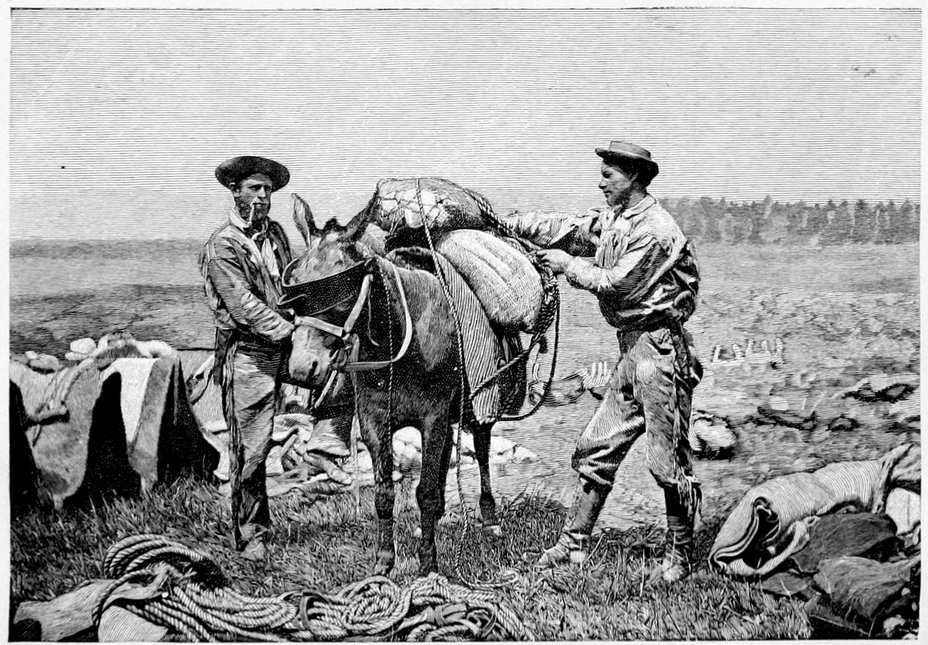
67Sixty miles from Benton, their horses jaded with travel,
the two men stopped at the Government farm on Sun
River for a few days’ rest. In this secluded valley they
were out of the way of pursuers. Carpeted with bunch
grass, it afforded grazing for their half-starved horses,
and in Mr. Vail, the man in charge of the farm, they found
a very hospitable host. Divided centrally by the large
and peaceful river, the valley stretched away on either
side to numberless plateaus, remarkable for the uniform
height and tabular recession with which they rose to the
summits of the lofty foothills, which in their turn swelled
gradually into a circumference of heaven-kissing mountains.
Nothing but a few forests were wanting to make
the scene one of unparalleled grandeur. These were measurably
supplied by the parks of cottonwood which
stretched along either bank of the river, affording shelter
for the herds of elk, antelope, and deer that roamed unharmed
over the boundless solitude.
Here, sheltered by the arms of kind relatives, Henry
Plummer first saw the only being which inspired his bosom
with virtuous love. A young, innocent, and beautiful girl,
artless and loving as a child, won by his attention and
gentlemanly deportment, and the tale, seductive as that
poured by the serpent into the ear of Eve, which he told
of his love, against the advice of her sister and friends,
crowned his happiness with her heart and hand. No stories
of his past career, no terrible picture of the future,
no tears and petitions, could stay the sacrifice. She felt
the sentiment so beautifully expressed by Moore,
“I know not, I ask not, if guilt’s in that heart,
I but know that I love thee, whatever thou art,”—
and under its influence she linked her fortunes with those
of the robber, murderer, and outlaw, in the holiest of
human ties.
68A quarrel, of which this young lady was the innocent
cause, took place between Plummer and Cleveland before
the marriage of the former. Their old friendship was
never reëstablished. Often during their residence at Sun
River an exchange of bitter epithets only relieved their
pent-up wrath. Afraid of each other, neither would leave
the farm alone. Accordingly they went to Bannack in
company, early in the Winter of 1862–63. There we will
leave them while we return to Florence to inquire after
the fortunes of Cherokee Bob, whom we left a few chapters
ago “settled in business.”
CHAPTER IX DESERTION OF MINING CAMPS
69
The decay of a mining town is as sudden and rapid
as its growth, and the causes which occasion it as
problematical. Few, comparatively, of the great number
of placer camps in the Rocky Mountains, once peopled
with thousands, survive beyond the third year of
their existence. As soon as the placers fail to remunerate
the miners, they are abandoned. The crowd departs,
and if any remain, it is that sober, substantial class
which is satisfied with small gain as the reward of unceasing
toil. Intelligence of new discoveries brought to a failing
placer will cause the immediate departure of great
numbers engaged in working it. These stampedes are
among the most notable features of mountain life. Sometimes
when the discovery of a new placer is announced,
the entire population of a mining town is on the alert,
each man striving with the next to be the first to reach it.
Horses are saddled, mules packed, sluices abandoned, and
the long and unmarked route is filled with gold hunters.
Away they go, over mountains, across streams, through
cañons and pine forests, with the single object of making
the first selection of a claim in the new location. Not
infrequently it is the case that a single company is the
first to learn of the discovery of a new rich placer. If
the claim it has worked is abandoned the succeeding
morning, it is received by the camp as incontestable evidence
that a mine of superior richness has been found,—and
hundreds start in pursuit of the missing company.
70Rumor is a fruitful cause of stampedes. Disappointments
are more frequently the consequences than rewards.
Instances are common where whole camps have been
deserted to follow up a rumor, been disappointed, and
glad to return at last. There is nothing permanent in
the life of a gold miner,—and beyond the moment,
nothing strong or abiding in his associations.
“Whither he goes or how he fares,
Nobody knows and nobody cares.”
Florence had suffered from these causes. The roving
portion of the population had gone, some to Boise, some
to Bannack, and some to Deer Lodge. Cherokee Bob and
Cynthia still remained, but Harper had fled, and Peoples,
English, and Scott slept the “sleep that knows no waking.”
Bill Willoughby, a suspected member of Harper’s
gang, was Bob’s only companion.
The New Year was approaching. The good wives and
daughters, in accordance with usual custom, proposed that
it should be celebrated by a ball,—a proposition to which
the other sex joyfully acceded. Extensive preparations
were made for the supper, and the ball-room was attractively
decorated. Cynthia made known to Bob her
desire to go. He said in reply, “You shall go, and be
respected as a decent woman ought to be.” So he asked
Willoughby to “take his woman to the ball, and,” said he,
“if things don’t go right, just report to me.” Cynthia
assented to the arrangement, and Willoughby promised
compliance. The guests had arrived when Cynthia, hanging
on the arm of Willoughby, made her appearance.
Scowls and sneers met them on every hand. A general
commotion took place among the ladies. In little groups
of five or six, scattered throughout the room, they
whispered to each other their determination to leave if
Cynthia were permitted to remain. The managers held a
71consultation, and Willoughby was told that he must take
Cynthia home. No alternative presenting, he obeyed.
The gentlemen present were prepared to meet any further
disturbance, but none occurred, and the ball passed
off pleasantly. The next day Cherokee Bob marshalled
his forces to avenge the insult, but was restrained by the
evident preparation with which the citizens anticipated his
design. He and his companions swaggered around town
flourishing their pistols and bowie-knives, boasting of their
prowess, but careful of giving personal offence. It would
have been well for them had their resentment cooled here,
but Bob’s malice was not to be satisfied so easily. Two
days had passed, and Cynthia’s humiliation was unavenged.
Before the close of another it must be propitiated
with blood. Accordingly, the next morning it was
agreed between Bob and Willoughby that they would precipitate
the battle.
The most efficient leader of the citizens was a saloon-keeper
by the name of Williams, familiarly called
“Jakey.” He was an athletic man, and a determined
enemy of the robbers, by whom he was held in great fear.
He had been the hero of more than one desperate affray,
and was regarded by Bob and Willoughby as the only
obstacle in the way of their bloody project to kill the
managers of the ball. The first act, therefore, in their
contemplated tragedy was to dispose of him. Jakey
at first sought to avoid them. They pursued him from
house to house, till, tired of fleeing, he finally declared he
would go no farther. Returning by a circuitous path, he
was overtaken and fired upon by his pursuers while entering
his saloon. He fired in return, and springing back,
seized a loaded shotgun, and rushed into the street. Meantime,
several citizens joined in the fight, which soon became
general. The ruffians found themselves contending
against fearful odds. Willoughby was slowly retreating
72with his face to his assailants, and firing as rapidly as
possible. Cherokee Bob was pursuing the same strategy
in an opposite direction. The twelfth fire exhausted Willoughby’s
pistols. He turned to run, with Jakey in
full pursuit. Exhausted from loss of blood, which was
pouring from sixteen wounds, he soon fell, and, throwing
up his hands, exclaimed to one of his pursuers who was
in the act of firing,
“For God’s sake, don’t shoot any more. I’m dying
now,” and surrendered himself to death.
Bob beat a retreat at the first fire. Dodging behind a
corner, where his head only was exposed, he fired upon his
pursuers until his pistols were nearly empty. While aiming
for another shot, a ball fired from an opposite window
brought him to the earth, mortally wounded. He was
taken to his saloon, and died the third day after the
affray, in the full, and to him, consolatory belief that he
had killed Jakey Williams at the first fire of his revolver.
He had a brother living at Lewiston. His last
words were, “Tell my brother I have killed my man and
gone on a long hunt.” His real name was Henry Talbert.
Cynthia was now without a protector. At Bob’s request
she soon joined her old lover, Bill Mayfield, at Boise.
This reunion was destined to be of short duration. The
following Spring Mayfield went to Placerville, Idaho, for
a brief sojourn. A quarrel over a game of cards sprung
up between him and one Evans. Mayfield drew his revolver,
intending to settle it by a fatal shot, but Evans
interposed,
“I’m not heeled”—the mountain phrase for “I am
not armed.”
“Then go and heel yourself,” said Mayfield, sheathing
his revolver, “and look out the next time you meet me,
for I’m bound to kill you at sight. One of us must die.”
73The next day, while Mayfield and two friends were
walking in the suburbs, they came upon a muddy spot,
across which a narrow plank had been laid. This necessitated
crossing it in single file. Mayfield was in the centre.
Evans was in a cabin beside the crossing, but a few feet
distant. Seizing a double-barrelled shotgun, he fired upon
Mayfield from his place of concealment, through an open
window. Mayfield grasped for his revolver, but fell without
power to draw it, exclaiming “I’m shot.” He died in
two hours, illustrating in his demise the Scriptural axiom,
“With what measure ye mete, it shall be measured to you
again.” Evans was immediately arrested, but escaped
from jail that night, and being furnished with a horse
by a friend, fled the country, and was never apprehended.
After Mayfield’s death Cynthia entered upon that career
of promiscuous infamy which is the certain destiny
of all women of her class. It is written of her that “she
has been the cause of more personal collisions and estrangements
than any other woman in the Rocky Mountains.”
CHAPTER X BOONE HELM
74
Some men are villains by nature, others become so
by circumstances. Hogarth’s series of pictures
representing in contrast the career of two apprentices
illustrates this truth better than words. Both commenced
life under the same influences. The predominance of good
and evil is exhibited by the natural tendency of one to
overcome all unfavorable circumstances by close application
to business and by virtuous associations, and of the
other to idleness, vicious indulgences, and corrupt companionship.
The one becomes Lord Mayor of London,
and in the discharge of official duty passes sentence of
death upon the other.
The wretch I am now about to introduce to the reader
was one of those hideous monsters of depravity whom
neither precept nor example could have saved from a life
of crime. Boone Helm was a native of Kentucky. His
parents emigrated to one of the newest settlements in Missouri
while he was a boy. The rough pursuits of border-life
were congenial to his tastes. He excelled in feats of
physical strength, and delighted in nothing more than a
quarrel which brought his prowess into full display. He
was an inordinate drinker, and when excited by liquor
gave way to all the evil passions of his nature. One of
the exploits recorded of him was that of hurling his bowie-knife
into the ground and regaining it with his horse at
full speed. On one occasion, while the circuit court was
in session, the sheriff attempted to arrest him. Helm
75resisted the officer, but urging his horse up the stairs into
the court-room, astonished the judge by demanding with
profane emphasis what he wanted of him.
In the year 1848 he married a respectable girl, but
neither her affection nor the infant daughter born to him
a year later could prevail with him to abandon his vicious
and profligate habits. His wife sought security from his
ill-treatment in divorce, which was readily granted. This
freed him from family responsibilities, and he at once determined
to emigrate either to Texas or California. Littlebury
Shoot, a neighbor, while Helm was intoxicated,
had, for pacific purposes, promised to accompany him,—intending
when he was sober to avoid the fulfilment of the
promise by explanation. Helm was told of his intention.
He called upon Shoot, who had retired, and meeting him
at the door of his house, with his left hand on his shoulder,
in a friendly tone thus addressed him:
“So, Littlebury, you’ve backed down on the Texas
question, have you?”
Shoot attempted an explanation, but was stopped by the
peremptory demand:
“Well, are you going or not? Say yes or no.”
“No!”
At the utterance of this reply, Helm buried his bowie-knife
in the breast of the unfortunate man, who, without
a struggle, fell dead at his feet. Mounting his horse immediately,
Helm rode away. The brother of the victim
and a few resolute friends followed in pursuit. They
tracked him through several neighborhoods and captured
him by surprise at an Indian reservation, and returned him
to Monroe County for trial. He was convicted of murder;
but his conduct was such while in confinement as to raise
serious doubts of his sanity. After his conviction, under
the advice of physicians he was consigned to the lunatic
asylum, his conduct meantime being that of a quiet, inoffensive
76lunatic. His keeper, finding him harmless, indulged
him so far as to accompany him on daily walks
into the country surrounding the institution. On one occasion,
on some urgent pretence, Helm asked permission
to enter a willow copse, which was readily granted. Afterwards
the desire to enter this copse whenever he approached
it seemed to take the form of mania. Suspecting
no ulterior design, his keeper indulged him. One day,
meeting a friend near the spot, the keeper, during Helm’s
absence, engaged in conversation. Time passed unnoticed
at first, but as the stay of Helm was prolonged, the
keeper, fearing some accident had befallen him, made a
rapid search through the thicket. But the bird had
flown. His stratagem was successful. He was never afterward
seen in Missouri, but upon his escape he fled immediately
to California. Several persons were killed by him
while there, in personal rencontre. At length he committed
actual premeditated murder, but escaped arrest by flight.
In the Spring of 1858 he arrived at Dalles, Oregon. Fearful
of a requisition for his return to California, Helm, in
company with Dr. Wm. H. Groves, Elijah Burton, Wm.
Fletcher, John Martin, —— Field, and —— McGranigan,
attempted a journey on horseback to Camp Floyd,
Utah, sixty miles southwest of Salt Lake City, by way of
Fort Hall. A ride of several days brought them to the
Grand Ronde River. During that time they had become
sufficiently acquainted with each other to banish all those
feelings of distrust natural among strangers in a new
country. Helm, who to his criminal qualities added
the usual concomitant of being a loud-mouthed braggart,
while narrating his exploits said in a boastful tone to
McGranigan:
“Many’s the poor devil I’ve killed, at one time or another,—and
the time has been that I’ve been obliged to
feed on some of ’em.”
77“Yes,” replied McGranigan, casting a sinister glance
at Groves, “and we’ll have more of that feasting yet.”
The cold sincerity with which these words were uttered
struck a chill to the heart of Groves, which experienced
no relief when a few moments afterwards Helm proposed
a plan for organizing a band of Snake Indians, and returning
with them on a predatory excursion against the
Walla Wallas.
“The Walla Wallas,” said he, “own about four thousand
horses. With such a band of Snakes as we can easily
organize for the enterprise, we can run off two thousand
of the best of those animals, and after dividing with the
Indians, take ours to Salt Lake and dispose of them to
advantage.”
Groves, who had heard enough to satisfy him that a
longer stay with this company would be accompanied by
risks for which he had neither inclination nor fitness,
mounted his horse at a late hour that night, and spurred
back to the Dalles as rapidly as possible. On his arrival
he sent intelligence to the chief of the Walla Wallas of
Helm’s contemplated foray, warning them to keep a careful
watch upon their horses. His plans being frustrated,
Helm remained in the vicinity till Autumn, when, in company
with his five companions, he continued his journey
to Camp Floyd. Five hundred miles of this route lay
through a wilderness of mountains, unmarked by a trail
and filled with hostile Indians. It was late in October
when the party left Grand Ronde River. The mountains
were covered with snow. Cold weather had set in for a
season whose only changes for the next six months would
be a steady increase of severities. The thermometer, seldom
above, often marked a temperature thirty or forty
degrees below zero in the mountains. The passes were
snowed up to the depths of twenty and thirty feet. Wild
game, however abundant in Summer, had retreated to the
78forests and fastnesses for food and shelter. Snow-storms
and sharp winds were blinding and incessant. Deep ravines,
lofty mountains, beetling crags, and dismal cañons,
alternated with impenetrable pine forests, inaccessible lava
beds, and impassable torrents, encumbered every inch of
the way. Death on the scaffold or escape through this
terrible labyrinth gave the alternative small advantage of
the penalty. Small as it was, Helm and his companions
took the risk and plunged into the mountain wilderness.
He alone escaped.
In the absence of other narratives of this remarkable
adventure, I record his own, as detailed to John W. Powell
in April of the following year. Mr. Powell says:
“Dear Sir: On the tenth of April, 1859, I was on my
way from Fort Owen, Bitter Root Valley, to Salt Lake City.
My party consisted of one American named James Misinger,
a Frenchman called ‘Grand Maison,’ a French half-breed
named Antoine, and three Indians.
“I had crossed the Snake River just above Fort Hall,
pitched my lodge, and was entering to indulge in a brief
sleep, when I heard some one outside ask in a loud tone of
voice, ‘Who owns this shebang?’ Stepping to the door and
looking out, I saw a tall, cadaverous, sunken-eyed man
standing over me, dressed in a dirty, dilapidated coat and
shirt and drawers, and moccasins so worn that they could
scarcely be tied to his feet. Having invited him in and
inquired his business, he told me substantially the following:
“His name was Boone Helm. In company with five
others he had left Dalles City, Oregon, in October, 1858,
intending to go to Camp Floyd, Utah Territory. Having
reached the Raft River, they were attacked by a party of
Digger Indians, with whom they maintained a running fight
for several miles, but none of the party was killed or severely
wounded. Late in the evening they reached the Bannack
River, where they camped, picketed their horses near by,
and stationed two sentinels. During the night one of the
79sentinels was killed, the savage who committed the deed
escaping on a horse belonging to the party.
“Upon consultation, it was decided that they had better
leave that place as soon as possible. The sky at the time
was overcast with storm-clouds, and soon after they got into
their saddles the weather culminated in a snowstorm, which
increased in violence until it became terrific. Finally, being
unable to see anything but sheets of snow, they became
bewildered, and knew not in what direction they were proceeding.
Morning brought no relief. In the midst of an
ocean of snow, they were as oblivious of locality in daylight
as if total darkness had encompassed them. They knew they
were somewhere between Ross’s Fork and the Bear River,
and this was their most definite knowledge.
“At last they reached Soda Springs on Bear River, where
familiar landmarks came in view. They then travelled up
that river until they reached Thomas’s Fork, where they
were forced to stop, from the lean and exhausted condition
of their horses and the depth of the snow. Here they found
a very comfortable cabin, and perforce went into winter
quarters.
“Their provisions soon being all gone they commenced
subsisting on their horses, killing one after another, until
they had eaten them all but a celebrated race-horse which
had been valued on the Upper Columbia at over a thousand
dollars. Seeing now that they must all perish unless they
soon reached a point where supplies could be obtained, the
race-horse had to share the fate of the others. His meat
was ‘jerked’ or hastily dried, that they might the more
conveniently carry it on their backs. They then made snowshoes
of the hides of the horses, and started back towards,
and aimed to reach, Fort Hall, where they supposed they
would meet with human beings of some kind, white men,
half-breeds, or Indians.
“The party kept together until they had got beyond
Soda Springs, where some had become so exhausted they
could scarcely travel,—and their meat getting frightfully
small in amount, Helm and a man named Burton concluded
80not to endanger their own lives by waiting for the wearied
ones, so they left them behind.
“The two finally reached the Snake River, and moved
down it in search of Fort Hall, having nothing to eat but the
prickly-pear plant. When they had reached the site of Cantonment
Loring, Burton, starving, weary, and snow-blind, was
unable to proceed; and a good vacant house being there,
Helm left him, and continued on for Fort Hall.
“Reaching the fort, he found it without an occupant. He
then returned and reached Burton about dark. When out
in the willows hard by, procuring firewood, he heard the
report of a pistol. Running back into the house, he found
Burton had committed suicide by shooting himself. He then
concluded to try and find his way into Salt Lake Valley.
Cutting off, well up in the thigh, Burton’s remaining leg (he
had eaten the other), he rolled the limb up in an old red
flannel shirt, tied it across his shoulder, and started.
“About eight miles out he met an Indian going in his
lodge. He entreated the savage to take him along; but the
Indian said he had nothing himself to eat, and that his family
were starving. Helm exhibited handfuls of gold coin, when
the Indian consented to his accompanying him.
“He remained at this lodge about two weeks, paying the
Indian ten dollars a meal. His food consisted of ants and
an unpalatable herb, called in the mountains the ‘tobacco
plant.’
“The above facts Helm gave me with tears in his eyes,
and said, ‘I will give you all I have in the world,—which
is only nine dollars,—to take me to the settlements.’ I told
him I did not desire money for helping a man in his condition.
“That same evening the Indian with whom Helm had
been stopping, visited me. His name was Mo-quip. I had
known him for several years. He fully corroborated Helm’s
story, in regard to the carrying and eating the body of his
companion. ‘When I first tasted of the flesh,’ said Mo-quip
in his own tongue, ‘I knew not what it was, but told
the stranger it was bueno[1] game,—better than I had myself.
81The stranger then took hold of one of the corners of a red
shirt that was around his pack, and jerked it up, when
a white man’s leg, the lower end ragged from gnawing,
rolled out on the ground.’ Altogether Helm had paid Mo-quip
two hundred and eighty dollars.
“Having given him a new suit of buckskin, and furnished
him with a horse, he set out with my party for Salt
Lake City. Just after pitching my lodge the first evening
after starting with him, ‘Grand Maison,’ very much frightened,
came to me with a sack of gold coin which he said
Helm had asked him to conceal until they reached Salt
Lake City. I took the money and counted it—it amounted
to fourteen hundred dollars.
“Though satisfied there was something wrong, I said
nothing, and took Helm on to the settlements. Having ascertained
in the meantime that he was the worst kind of a
desperado, I called him to me as soon as we had reached
the end of the journey, and handed him his money, saying,
‘You can now take care of yourself.’ He coolly put the coin
in his pocket, without expressing a syllable of thankfulness
for the assistance I had rendered him.
“It was not long until he had squandered all he had in
gambling and drinking, and was finally expelled from Salt
Lake Valley for his atrocities.
“Hoping these facts may be of service to you, allow me
to subscribe myself,
Your obt. servant,
“John W. Powell.”
We have good reason for believing that before Helm
fled from Salt Lake City he murdered, in cold blood, two
citizens, at the instigation of some of the leading Mormons,
who, after the deed was done, concealed him, and
finally aided in his escape from arrest. Certain it is that
after leaving there he travelled through southern Utah,
and by a long circuit reached San Francisco, whence he
returned by water to the Dalles in Oregon.
Here he engaged in fresh villainies. Several murders
which were committed along the route leading from the
82Columbia River to the gold mines were laid to his charge.
At one time, in Washington Territory, he stole a herd of
horses which he sold at Vancouver’s Island. In this course
of varied and hardened crime he passed his time till the
Spring of 1862,—with his usual good fortune escaping
detection or arrest. In June of that year he made his
appearance in Florence, where he soon found, among the
roughs, congenial associates.
A man of that mixed character which united the qualities
of a gambler, a skilful pugilist, and an honest,
straightforward miner in his single person, known only as
“Dutch Fred,” at this time enjoyed a local notoriety in
Florence which had won for him among his comrades the
appellation of “Chief.” He was neither a rowdy nor
desperado, and in ordinary deal, honest and generous;
but he gambled, drank, and when roused, was a perfect
Hercules in a fight. Helm, having been plied with liquor,
at the request of an enemy of Fred’s sought him out for
the purpose of provoking a fight. Entering the saloon
where Fred was seated at a faro table, Helm, with many
oaths and epithets and flourishes of his revolver, challenged
Fred to an immediate deadly combat. Fred sprung
up, drew his knife, and was advancing to close with the
drunken braggart, when the by-standers interfered, and
deprived both of their weapons, which they entrusted to
the keeping of the saloon-keeper, and Fred returned quietly
to his game.
Helm apologized, and expressed regret for his conduct,
and left the saloon. A few hours afterwards he returned.
Fred was still there. Stepping up to the saloon-keeper,
Helm asked for his revolver, promising that he would immediately
depart and make no disturbance. No sooner
was it returned to him than he turned towards Fred, and
uttering a diabolical oath, fired at him while seated at the
table. The ball missed, and before the second fire, Fred,
83unarmed, with his arms folded across his breast, stood
before his antagonist, who, with deadlier aim, pierced his
heart. He fell dead upon the spot. Helm cocked his
pistol, and looking towards the stupefied crowd, exclaimed,
“Maybe some more of you want some of this!”
As no one deigned a reply, he walked coolly away.
If Helm was arrested for this murder, he escaped; for
the next we hear of him, he was captured on Frazer River
in the Fall of 1862, as will appear from the following extract
from a British Columbia paper:
“The man, Boone Helm, to whom we referred some weeks
since, has at last been taken. He was brought into this city
last night strongly ironed. The first clue of the detectives
was the report that two men had been seen trudging up the
Frazer River on foot, with their blankets and a scanty
supply of provisions on their backs. The description of one
corresponded with the description given by the American
officers of Boone Helm. Helm’s conduct on the road is conclusive
evidence that he was aware he was being pursued.
He passed around the more populous settlements, or through
them in the night time. When overtaken, he was so exhausted
by fatigue and hunger that it would have been impossible
for him to continue many hours longer. He made no resistance
to the arrest,—in fact, he was too weak to do so,—and
acknowledged without equivocation or attempt at evasion
that he was Boone Helm. Upon being asked what had become
of his companion, he replied with the utmost sang
froid:
“‘Why, do you suppose that I’m a —— fool enough to
starve to death when I can help it? I ate him up, of
course.’
“The man who accompanied him has not been seen or
heard of since, and from what we have been told of this
case-hardened villain’s antecedents, we are inclined to believe
he told the truth. It is said this is not the first time he has
been guilty of cannibalism.”
84While on his return for trial in the Spring of 1863,
leave was obtained from the proper authorities at Portland,
Oregon, to confine him in the penitentiary there until
provision could be made to secure him safely at Florence.
There I will leave him for the present, as, after accompanying
me thus far through the horrible narrative of his
adventures, my readers doubtless, now that he is fairly
within the sharp fangs of the law, hope soon to learn that
justice has finally overtaken him, and that the world is
freed from his further depredations.
Three brothers of Boone Helm came to the Pacific coast
between 1848 and 1850. They all died violent deaths. At
the time of the return of Boone Helm to Florence for trial
for the murder of Dutch Fred, one of these brothers,
familiarly called “Old Tex,” was engaged in mining in
the Boise diggings, two hundred miles south of Florence.
He had a good reputation for honesty, liberality, and
courage. He was, moreover, a man of eccentric character.
It is told of him that in one of the mining towns he
threatened to shoot on sight a person with whom he had
a personal difficulty. His enemy hearing of this, swore
to reciprocate the intention upon the first opportunity.
A chance soon after offering to carry his threat into execution,
he said to Old Tex, as he presented his pistol to
fire,
“Tex, I heard that you said that you’d shoot me on
sight.”
Looking around, Tex replied, “Well, didn’t you say
you would shoot me, too?”
“Yes, I did.”
“Well, why don’t you do it then? All you’ve got to
do is to pull that trigger, and that’s the last of Old Tex.”
This stoical bravery won the admiration of the man and
defeated his bloody purpose.
“Tex,” said he, “I don’t want to kill you.”
85“Do you mean that?” asked Tex.
“I do.”
“That suits me,” replied Tex, “let’s go and take a
drink.” And thus their enmity ended in making them fast
friends. Tex was killed by being thrown from a wild horse,
in Walla Walla, in the year 1865.
It was to this brother that Boone Helm, when he found
all hope of escape at an end, applied for assistance. True
to the fraternal instinct, Tex promptly responded, and
soon made his appearance in Florence, with a heavy purse.
He soon satisfied himself that unless the testimony could
be suppressed, the trial must result in conviction; and to
this object he immediately addressed himself. Some of
the witnesses had left the country. Tex succeeded in buying
up all that remained, except one. He wanted an extravagant
sum. Tex finally agreed to pay it, if he would
at once leave the country and never return. The extortionist
accepted the conditions. Fixing his cold, gray eye
on him, Tex, as he handed him the money, said: “Now,
remember, if you do not fulfil the last condition of the bargain,
you will have me to meet.”
Shylock knew the character of the man too well to trifle
with him.
The day of trial came, no witnesses appeared, the case
was dismissed, and the red-handed murderer and cannibal
was again at liberty to prowl for fresh victims. The truehearted
brother who had purchased his life, as soon as he
was free, took him kindly by the hand, and in a voice
choked with emotion, said to him,
“Now, Boone, if you want to work and make an honest
living, go down to Boise with me. I have plenty of mining
ground, and you can do well for yourself:—but if you
must fight, and nothing else will do you, I will give you an
outfit to go to Texas, where you can join the Confederate
armies, and do something for your country.”
86Boone accompanied his brother to Boise, and for a while
engaged in mining, but it was not a congenial occupation.
He soon signified his desire to go to Texas, and Old Tex,
true to his promise, furnished him clothing, a horse, and
a well-filled purse. He set out in quest of new adventures,
but, as we shall see hereafter, did not go to Texas.
CHAPTER XI DEATH OF CHARLEY HARPER
87
We return now to Charley Harper, whom we left at
Colville on the Upper Columbia, a fugitive from the
Vigilantes of Florence. Fear had exercised a healthful
restraint upon his conduct, and during the brief period
that had elapsed since his flight, though by no means a
model citizen, he had been guilty of no offences of an aggravated
character. He was, however, known to be a favorite
with the roughs, a gambler, a drunkard, and a man
of desperate resources. Good men shunned and watched
him. Had there been a Vigilante organization in existence
then, he would have received its closest observation. But
in a condition of society where all classes intermingled, he
contrived to slip along without molestation.
New Year’s Day brought with it the customary ball, to
which all were invited. The preparations were on a scale
commensurate with the wishes and means of the miners,
who generally, upon such occasions, spare no expense while
their money holds out. Everybody in the town was in attendance,
Charley Harper among the number. Attracted
at an early hour of the evening by the sparkling eyes and
voluptuous person of a half-breed woman, he devoted to
her his entire attention, dancing with her often, and bestowing
upon her many unmistakable civilities. As the evening
wore on, Charley became boisterous, swaggering, and
noisy. His inamorata declined his further attentions, and
refused his hand for a dance. Incensed to madness by this
act, crazy with liquor, he knocked her down, and beat and
88kicked her in a most inhuman manner after she had been
prostrated. This roused the indignation of the by-standers,
and Charley, seeing vengeance in their demonstrations,
fled in terror before them. They pursued him through the
streets, he retreating and firing upon them until he had
emptied his revolver. The pursuit ended in his capture,
a rope was procured, and a few moments afterwards
the lifeless form of the wretched desperado was swinging
in the cold night wind from a limb of the tree nearest
the place of his arrest. Thus ended the life of one who,
among his own associates, bore the name of being the meanest
scoundrel of their gang.
After the affray which terminated in the death of Cherokee
Bob and Willoughby, the Vigilantes of Florence
met, passed congratulatory resolutions, and renewed their
measures for the effective suppression of crime in their
midst. Their Executive Committee was instructed to warn
all suspicious characters to leave the place immediately,—and
they determined to visit with condign punishment
those who disobeyed. The leading men among the offenders
had fled in anticipation of some public demonstration, so
that those who remained were few and powerless. Among
these was a tall, lean, cadaverous individual, derisively
called “Fat Jack,” who, like Happy Harry, belonged
to that class of negative scoundrels, whose love for crime
is confined by fear to petty thefts. Fat Jack obeyed the
order to leave, and went to Walla Walla. Brooding over
his expulsion with increasing indignation, and encouraged
in the belief that he could return without molestation,
after a short period he went back to Florence, muttering
by the way violent threats against those who had banished
him. Two months had elapsed since his hegira. It was
late in the afternoon of a cold, stormy, March day when
he entered the town. At his first appearance he was
promptly waited upon by the members of the Executive
89Committee, who ordered him to retrace his steps at once,
or he would be hanged. Hard as this order may seem to
the casual reader, to have neglected it would have endangered
the efficiency of the committee and opened a way
for a return of the roughs to their old haunts.
The poor wretch turned his face to the storm, and wandered
through the darkness, sleet, and wind, despairingly,
from cabin to cabin, in search of food and lodging. Every
door was closed against him, and he was rudely and unpityingly
told to “Be gone,” by all from whom he sought
relief. At a distance of four miles from Florence he
stopped at a late hour of the night at the door of a worthy
man by the name of Neselrode. Jack answered frankly
the old man’s questions. Neselrode admitted him, gave him
supper, and a bed by his cabin fireside. A hired man was
the only other occupant of the house.
At a later hour of the night, two men roused Mr. Neselrode,
and demanded the person of Fat Jack. Neselrode,
on being told that they had no authority, refused to
surrender him to an irresponsible party, as to do so would
be on his part a violation of the laws of hospitality. His
refusal was followed by the instant discharge of two double-barrelled
shotguns which riddled the door with buckshot,
and stretched in death-throes both the kind-hearted
host and his criminal guest. The one surviving man
threw open the door, and bade the dastardly ruffians to
enter, telling them the murderous effects of their shots.
They availed themselves of the darkness to flee without
recognition. None of the citizens of Florence were more
indignant when told of this cruel assassination than the
Vigilantes themselves. A meeting was held denouncing the
perpetrators, and pledging the citizens to the adoption of
every possible means for their early detection and punishment.
Alas! the criminals remain to this day undiscovered.
They belonged, doubtless, to that class of officious
90individuals, of whom there are many in the mining camps,
who in point of moral character and actual integrity are
but a single remove from the criminals themselves,—men
who live a cheating, gambling, dissipated life, and seek a
cover for their own iniquities by the energy and vindictiveness
with which they pursue others accused of actual guilt.
If the various protective societies which at one time and
another have sprung up in the mining regions to preserve
peace and good order are liable to any charge of wrong,
it was their neglect to punish those men who used the organization
to promote their own selfish purposes, and in
the name of Vigilante justice committed crimes which on
any principle of ethics were wholly indefensible. The fact
that in some instances wrongs of this kind have occurred,
only adds to the proof, that in all forms of society, whether
governed by permanent or temporary laws, there are always
a few who are adroit and cunning enough to escape
merited punishment.
CHAPTER XII PINKHAM AND PATTERSON
91
No two men filled a broader space in the early history of
the Florence mines than Pinkham and Patterson.
Their personal characteristics gave them a widespread notoriety,
and a sort of local popularity, which each enjoyed
in his separate sphere. They were both leaders, after
their own fashion, in the heterogeneous society in which
they moved, and he was deemed a bold man who would
gainsay their opinions, or resist their enterprises.
They were both gamblers, and lived the free and easy
life of that pursuit; a pursuit which, in a new mining
camp, next to that of absolute ruffianism, enabled its votaries
to exercise a power as unlimited as it is generally
lawless and insurrectionary. Indeed, there it is the master
vice, which gives life and support to all the other vices,
and that surrounds and hedges them in.
The order of influences which govern and direct the
social element of a mining camp in its infancy is exactly
the reverse of those which govern and direct the social
element of an Eastern village. The clergyman, the church,
and the various little associations growing out of it, which
make the society of our New England villages so delightful,
and, at the same time, so disciplinary and instructive,
are superseded in a new mining community by the gambling
saloon, cheap whiskey, frail women, and all the evils necessarily
flowing from such polluted combinations. In the
one case, religion and morality stand in the foreground,
protected by the spirit of wise and inflexible laws; in the
92other, the rifle, the pistol, and the bowie-knife are flourished
by reckless men, whose noblest inspirations are excited by
liquor and debauchery. While all that is good and true
and pure in society is brought into unceasing action in
the one case, all that is vile and false and polluted reigns
supreme in the other. We look to the one condition of
society for all great and good examples of humanity, and
to the other for such as are of an opposite character.
If we are to credit the early history of New England,
Miles Standish was a central character of Puritanic chivalry
and fidelity. The people had faith in his Christian
character, and entire confidence in his strong arm and fertility
of expedients in the hour of danger. Some such
sentiment, qualified by the wide difference in the moral
character of the two men, attached the mining community
of Florence to Pinkham. He was a bold, outspoken, truthful,
self-reliant man, without a particle of braggadocio or
bluster, careful always to say what he meant, and to do
what he said. Fear was a stranger to him, and desperate
chances never found him without desperate means.
Pinkham was a native of Maine, and physically a fine
type of the stalwart New Englander. In stature he was
more than six feet, and in weight upwards of two hundred
pounds. To the agility of a mountain cat he added the
quick, sharp eye of an Indian and the strength of a giant.
Trained by years of frontier exposure, he was skilled in the
ready use of all defensive weapons. When aroused, the
habitual frown upon his brow gathered into a fierce scowl,
and the steely gray eyes fairly blazed in their sockets.
At such times he was dangerous, because it was his custom
to settle all disputes with a word and a blow, and the
blow always came first. The intensity of his nature could
not brook altercation.
Pinkham had been an adventurer ever since the discovery
of gold in California. He was among the first of that
93great army of fortune-seekers which braved the perils of
an overland trip to that distant El Dorado in 1849. If,
before he left his New England home, no blight had fallen
upon his moral nature, it is certain that soon after his
arrival in the land of gold his character took the form
which it ever afterwards wore, of a gambler and desperado.
In this there was nothing strange, as he was but one victim
in a catastrophe that wrecked the characters of thousands.
The estimate is small, which places at one-half the
number of the early Pacific gold-seekers, those who fell
victims to the moral ruin of life in the mining camp. It
was the fruitful nursery of all those desperate men, who,
after years of bloody experience, expiated their crimes
upon the impromptu scaffolds of the Vigilantes, or in some
of the violent brawls which their own recklessness had excited.
Pinkham’s pursuits in California were those of the
professional gambler. At one time he kept a common
dance-house in Marysville. It is fair, in the absence of
facts, to presume that his life in the Golden State was a
preparatory foreground for the one which followed in the
mountains of Washington Territory. He was among
the first, in 1862, who were lured to that Territory by the
reports of extensive gold discoveries. Among the desperate,
reckless, and motley crowd that assembled at Florence
immediately after the discovery of the mines, was
Pinkham, with his faro boards and monte cards, “giving
the boys a chance for a tussle with the tiger and the leopard.”
It was not long until he became a central figure in
the camp. The wild, undisciplined, pleasure-seeking population,
attracted by the outspoken boldness and self-assertion
of the man, quietly submitted to the influence
which such characteristics always command. And no man
better understood his power over his followers, or exercised
it more warily, than Pinkham. The reputation which he
enjoyed, of being a bold, chivalric, fearless man, ready for
94any emergency, however desperate, gained for him the
favor of every reckless adventurer who shared in his general
views of the race.
Unlike most of the gamblers and roughs, who for the
most part sympathized with the Confederates, Pinkham
was an intense Union man. He never lost an opportunity
to proclaim his attachment for the Union cause, and
denounced as traitors all who opposed it. No fear of personal
injury restrained him in the utterance of his patriotic
sentiments, and as he always avowed a readiness to
fight for them, his opponents were careful to afford him
no opportunity. At every election in Idaho City after
the organization of the Territory, he was found at the
polls surrounded by a set of plucky fellows armed to the
teeth, ready at his command for any violent collisions with
secessionists that the occasion might arouse. His tall
form, rendered more conspicuous by the loud and inspiring
voice with which, to the cries of “negro worshippers,”
“abolitionists,” and “Lincoln hirelings,” he shouted back
“secessionists,” “copperheads,” “rebels,” and “traitors,”
was always the centre of a circle of men who would oppose
force to force and return shot for shot.
On his return to Idaho City from a business visit to
the States, a few days before the anniversary of our national
independence of the year in which he was killed, he
was so indignant that no preparations had been made for
a celebration, that when the day arrived he procured a
National flag, hired a drummer and fifer, and followed
them, waving the banner, through the streets of the town,
greatly to the disgust of the secessionists. The South had
just been conquered, and the demonstration wore the appearance
of exultation, but no one aggrieved by it had the
hardihood to interrupt its progress. “Old Pink,” as he
was familiarly called, was much too dangerous a character
to meddle with.
95With all his rough and desperate characteristics, Pinkham
had no sympathy for the robbers and murderers and
thieves that swarmed around him; and when Idaho was
organized the governor of the Territory appointed him
sheriff of Boise County. Soon afterwards he received the
appointment of United States marshal, an office which
made him and his friends in some measure the representatives
of law and order. By promptly discharging the
duties of these offices, he was held in great fear by the
criminal population of the Territory, and won the respect
of the best citizens for his efficiency and fidelity.
Patterson was a native of Tennessee, whence, in boyhood,
he had gone with his parents to Texas and grown to
manhood among the desperate and bloody men of that
border State. His character, tastes, and pursuits were
formed by early association with them. He was a gambler
by profession, but of a nature too impulsive to depend
upon it as a means of livelihood. When he came to California,
he turned his attention to mining, alternating that
pursuit with gambling, as the inclination seized him. Like
Pinkham, he was a man of striking presence,—in stature
six feet, and of weight to correspond, with a fair complexion,
light hair streaked with gray, sandy whiskers,
and, when unaffected by liquor or passion, a sad, reflective
countenance lit up by calm but expressive blue eyes. His
habitual manner was that of quiet, gentlemanly repose;—and
to one unacquainted with his characteristics, he
would never have been suspected of a fondness for any kind
of excitement. In conversation he was uniformly affable
when sober, and bore the reputation of being a very genial
and mirth-loving companion when engaged with others in
any exploring or dangerous enterprise. He was brave to
a fault, and perfectly familiar with all the exposures and
extremes of border life,—as ready to repair the lock of a
gun or pistol as to use those weapons in attack or defence.
96His kindness and thoughtfulness for the comfort of any
of his party in the event of sickness, and the resources
with which he overcame obstacles in the numerous expeditions
of one kind and another in which he participated,
made him a great favorite with all who knew him, and gave
him a commanding power over the society in which he
moved. He was naturally a leader of those with whom he
associated. Had these been his only characteristics, Patterson
would have been one of the most useful men in the
mining regions,—but whiskey always transformed him into
a demon. Patterson was not a steady drinker, but gave
himself up to occasional seasons of indulgence. He was
one of that large class of drinkers who cannot indulge their
appetites at all without going through all the stages of
excitement, to complete exhaustion. From the moment he
entered upon one of these excesses to its close, he was dangerous.
The whole man was changed. His calm, blue eye
looked like a heated furnace and was suggestive of a thirst
for blood. His quiet and gentlemanly manner disappeared.
His breath was labored, and his nostrils dilated like those
of an enraged buffalo. He remembered, on these occasions,
every person who had ever offended him, and sought
the one nearest to him to engage him in quarrel. His
whole bearing was aggressive and belligerent, and his best
friends always avoided him until he became sober.
His unfortunate propensity for liquor had involved him
in several serious affrays before he came to the Idaho mines.
On one occasion, in Southern Oregon, a man who had suffered
injury at his hands, while on a drunken spree shot
him in the side by stealth. Patterson with the quickness
of lightning drew his revolver, and fired upon and wounded
his assailant. Both fell, and Patterson, believing the
wound he had received would prove fatal, fired all the remaining
charges in his pistol at his antagonist, and then
called for his friends to take off his boots.
97The original expression, “he will die with his boots on
some day,” uttered many years ago as the prediction of
some comical miner that a murderer would be hanged or
come to his death by violence, has grown into a fantastic
belief among the reckless and bloodthirsty ruffians of the
Pacific coast. Patterson, who shared in this faith, intended,
by having his boots taken off, to signify to those
around him that he had never been guilty of murder.
When we consider that of the great number of those who
in the early history of the mining regions were guilty of
murder, nineteen at least of every twenty have expiated
their crimes upon the scaffold or in bloody affrays, the
faith in this frontier axiom seems not to be greatly misplaced:
but why it should be any more potent as a human
prediction than as the stern edict of the Almighty denounced
against the murderer four thousand years ago, I
leave for the solution of those modern thinkers who build
their belief outside the lids of the Bible.
Another bloody rencontre in which Patterson was engaged
was with one Captain Staples in Portland, Oregon.
Staples, an ardent Unionist, boisterously patriotic from
liquor, insisted that all around him should join in a toast
to Lincoln and the Union arms. Patterson refused, and
an unpleasant altercation followed, but the parties separated
without collision. Later in the evening they met,
and the difficulty was renewed, and in the fight Staples was
killed. Patterson was tried and acquitted; and became, in
consequence of the quarrel and trial, a great favorite and
champion among the secessionists of Portland.
Some time after this, in a drunken frenzy he scalped a
disreputable female acquaintance. His own version of this
affair was as follows: “I was trying,” said he, “to cut off
a lock of her hair with my bowie-knife, but she wouldn’t
keep her head still, and I made a mistake, and got part
of her scalp with the hair.” For this act he was arrested
98and recognized to await the action of the grand jury; but
before the term of court he left the State, and his bondsmen
were compelled to pay the forfeiture.
Patterson came to Idaho with the first discovery of gold
in that section. His fellow-gamblers, who never failed,
with one hand, to take advantage of his unskilful playing,
were always ready to contribute to his necessities with
the other. If he wanted money to stock a faro bank they
furnished it. If a saloon-keeper needed a man who united
popularity and strength to arrest the encroachments of
the roughs, he was ever ready to share a liberal portion
of his profits with Patterson for such services. The difference
between Pinkham and Patterson was that, while
the friends of the former looked to him for aid in their
embarrassments, those of the latter afforded him the means
of existence.
About a year before the occurrence of the bloody affray
between these men, Patterson and some of his friends, during
a period of drunken excitement, took unlawful possession
of a brewery in Idaho City, and engaged in the
manufacture of beer. Pinkham was the only person in
the city brave enough to undertake their arrest. When he
entered the building for the purpose, he informed Patterson
of his object and was met with violent resistance. In
the struggle Pinkham was successful, and Patterson was
arrested and taken away. The citizens, knowing the character
of Patterson, and expecting nothing less than a
shooting affray as the consequence of the arrest, were surprised
at his submission. It was soon understood, however,
that the bad blood provoked by the incident had severed
all friendly relations between the champions, and that
Patterson would avail himself of the first opportunity to
avenge himself. Months passed away without any collision.
The subject, if not forgotten, was lost sight of as
other occurrences more or less exciting transpired.
99On the day he was killed, Pinkham, with an acquaintance,
rode out to the Warm Springs, a favorite bathing
resort two miles distant from Idaho City. Meeting there
with several friends, he drank more freely than usual and
became quite hilarious.
Patterson returned early the same day from Rocky
Bar, fifty miles distant. Half-crazed from the effects of
protracted indulgence in drinking and a severe personal
encounter, his friends, to aid his return to sobriety, took
him to the springs for a bath. Among others who accompanied
him was one Terry, a vicious, unprincipled fellow,
who, in a conflict with Patterson a year before, had
begged abjectly for his life when he found himself slightly
wounded, and ever after, spaniel-like, had licked the hand
that smote him. When they arrived, Pinkham and his
friends were singing the popular refrain of “John Brown,”
and had just completed the line—
“We’ll hang Jeff Davis on a sour apple tree,”
as Patterson and his party stepped upon the porch. Jefferson
Davis was at that time in custody. With the curiosity
which exercised the Unionists, a singer said,
“Pink, do you think they will hang Jeff Davis?”
“Yes,” replied Pinkham, “in less than six weeks.”
Hearing a step on the threshold, he turned, and his gaze
met the heated eyes of Patterson. Neither spoke, nor, except
by vengeful looks, gave any token of recognition.
Patterson advanced to the bar. Terry crowded behind
him, and slipped a derringer into his pocket. With an
oath and opprobrious epithet, Patterson said,
“Don’t mind him. He is not worth the notice of a
gentleman.”
Pinkham, looking steadily at Patterson, with his habitual
frown deepened, passed out upon the porch. Patterson
went through the opposite door to the swimming pond,
100followed by Terry. After they were out, he handed the
derringer back to Terry, and proceeded with his bath.
Terry returned to the bar, and going around to the desk,
while unobserved by Turner, the landlord, thrust a revolver
under his coat, and went back to Patterson. Doubtless
he told Patterson that Pinkham and his friends intended
to attack him, for Patterson was observed on the
moment to be greatly excited. Pinkham’s friend, who knew
both Patterson and Terry, told Pinkham that mischief
was brewing, and suggested their immediate return to
town.
“No,” replied Pinkham, “when he insulted me in the
bar-room I was unarmed, but now I am ready for him.”
“But it is better,” suggested his friend, “to avoid a
collision. No one doubts your courage.”
“I will not be run off by the rebel hound,” said Pinkham.
“If I were to leave it would be reported that I
had ‘weakened’ and fled from Patterson;—and you know
that I would prefer death in its worst form to that.”
Patterson hurried out of the bath, dressed himself as
quickly as possible, and with the revolver strapped to
his side, came into the bar-room. Calling for a drink,
in a loud tone and with much expletive and appellative
emphasis, his blood-drinking eyes glaring in all directions,
he demanded to know where Pinkham had gone. Turner,
thinking to pacify him, replied in a mild tone,
“Away, I believe.”
Pinkham at this moment was standing by a banister
on the porch, engaged in conversation with a friend
by the name of Dunn. He was unapprised of Patterson’s
return to the saloon, and, from the tenor of his conversation,
believed he would be warned of his approach. For
the impression that each entertained of the other’s intention
to fire upon him, and that both were awaiting the
opportunity to do so, these men were indebted to the mischievous
101interference of those friends whose wishes were
parent to the thought.
“I will not be run off by Patterson,” said Pinkham,
“nor do I wish that through any undue advantage he
should assassinate me. All I ask is fair play. My pistol
has only five loads in it.”
“Stand your ground, Pink,” replied Dunn. “I have
a loaded five-shooter, and will stand by you while there
is a button on my coat.”
These words were scarcely uttered, when Patterson
stepped from the saloon upon the porch. Turning to
the right, he stood face to face with Pinkham. The fearful
glare of his bloody eyes was met by the deepening
scowl of his antagonist. Hurling at Pinkham a degrading
epithet, he exclaimed,
“Draw, will you?”
“Yes,” replied Pinkham with an oath, “I will,” and
drawing his revolver, poised it in his left hand to facilitate
the speed of cocking it.
Patterson, with the rapidity of lightning, drew his,
cocking it in the act, and firing as he raised it. The
bullet lodged under Pinkham’s shoulder blade. Pinkham
received a severe nervous shock from the wound, and
delivered his shot too soon, the bullet passing over the head
of Patterson, into the roof. At Patterson’s second fire
the cap failed to explode, but before Pinkham, who was
disabled by his wound, could cock his pistol for another
shot, Patterson fired a third time, striking Pinkham near
the heart. He reeled down the steps of the porch, and
fell forward upon his face, trying with his expiring
strength to cock his revolver. At the first fire of Patterson,
Dunn forgot his promise to stand by Pinkham. Jumping
over the banister, he sought refuge beneath the porch.
Stealing thence when the firing ceased, he ran across the
street, where, protected by the ample trunk of a large
102pine, he took furtive observation of the catastrophe. Pinkham’s
other friend came from the rear of the house in time
to assist Turner in removing his body.
Patterson’s friends, some seven or eight in number, well
pleased with the result, but fearing for his personal safety,
mounted him on a good horse, armed him with revolvers,
and started him for a hurried ride to Boise City. Half
an hour served to carry intelligence of the encounter to
Idaho City. The excitement was intense. Pinkham’s
friends were clamorous for the arrest and speedy execution
of Patterson; those of the latter avoided a collision
by keeping their own counsel, and expressing no public
opinion in justification of the conduct of their champion.
Terry and James, the instigators of the contest, secreted
themselves, and left town by stealth at the first opportunity.
Indeed, many of Patterson’s friends believed that
Terry intended that the affray should terminate differently.
The pistol which he furnished Patterson had been
lost, and buried in the snow the entire winter before the
encounter, and it was supposed by the owner, who was
afraid to fire it lest it should explode, that the loads were
rusted. Terry knew of this. He stood in personal fear
of Patterson, and bore an old grudge against him. Here
was his opportunity. At the second attempt of Patterson
to fire, the pistol failed, and the wonder is that it went
off at all.
In less than an hour after the tragedy, Robbins, an old
friend and former deputy of Pinkham, armed with a
double-barrelled shotgun and revolvers, mounted his horse,
and left town alone, in swift pursuit of Patterson. He
was noted for bravery, and had been the hero of several
bloody encounters. At a little wayside inn, seventeen
miles from the city, he overtook the fugitive, who had
stopped for supper. Patterson came to the door as he
rode up.
103“I have come to arrest you, Ferd,” said he, at the same
time raising his gun so that it covered Patterson.
“All right, Robbins, if that’s your object,” replied
Patterson, as he handed Robbins his revolver. In a few
moments they started on their return. Before they arrived
at town, several of the sheriff’s deputies met them,
and claimed the custody of Patterson. Robbins surrendered
him, and he was taken to the county jail.
After Patterson’s account of the fight had been circulated,
the community became divided in sentiment,
the Democrats generally espousing the cause of the
prisoner, the Republicans declaring him to be a murderer.
There were some exceptions. Judge R——, a life-long
Democrat, and a Tennesseean by birth, was very severe
in his denunciation of Patterson. He distinguished him
as the most marked example of total depravity he had
ever known, and related the following incident in confirmation
of this opinion:
Several years before this time, Patterson joined in an
expedition in Northern California, to pursue a band of Indians
who had been stealing horses and committing other
depredations upon the property of the settlers. The pursuers
captured a bright Indian lad of sixteen. After tying
him to a tree, they consulted as to what disposition
should be made of him. They were unanimous in the
opinion that he should not be freed, but were concerned
to know how to take care of him. Some time having
elapsed without arriving at any conclusion, Patterson suddenly
sprung to his feet, and seizing his rifle, said with
an oath that he would take care of him, and shot the poor
boy through the heart. “That incident,” said the judge,
“determined for me the brutal character of the wretch.
His whole life since has been of a piece with it. For years
he has been a ‘bummer’ among men of his class. He has
lived off his friends. He has had no higher aims than
104those of an abandoned, dissolute gambler. Pinkham,
though a gambler, had other and better tendencies. His
schemes for the future looked to an abandonment of his
past career, and he was in no sense a ‘bummer.’”
The justice of this criticism was unappreciated by Patterson’s
friends. He was provided with comfortable quarters
in the jailer’s room, and accorded the freedom of the
prison yard. His friends supplied him with whiskey and
visited him daily to aid in drinking it. No prisoner of
state could have been treated with greater consideration.
The gamblers and soiled doves gave him constant assurance
of sympathy. Even the poor wretch he had scalped at
Portland wrote to ascertain if she could do anything for
“poor Ferd.”
Pinkham’s friends, enraged at the course pursued by
the officers of justice, began to talk of taking Patterson’s
case into their own hands. The example of the Montana
Vigilantes excited their emulation. When they finally effected
an organization, several of Patterson’s friends
gained admission to it by professing friendship for its
object. They imparted its designs and progress to others.
Patterson was informed of every movement, and counselled
his adherents what measures to oppose to the conspiracy
against his life. Meantime the Vigilantes appointed a
meeting for the purpose of maturing their plans, to be
held at a late hour of the evening, in a ravine across
Moore’s Creek, a short distance from the city. Patterson
having been apprised of it, was anxious to obtain personal
knowledge of its designs. So when the hour arrived,
representing in his own person one of the deputy sheriffs
with the consent of the sheriff, he placed himself at the
head of an armed band of six men as desperate as himself,
and stole unperceived from the jail-yard to a point within
three hundred yards of the rendezvous. Here they separated.
Each with a cocked revolver approached at different
105points, as near the assemblage as safety would permit.
Three hundred or more were already on the ground,
and others constantly arriving. It was a large gathering
for the occasion,—and the occasion was not one to
inspire with pleasurable emotions the mind or heart of
the wretch who was risking his life to gratify his curiosity.
Nevertheless, he crept forward till within seventy
yards of the chairman’s stand.
The place of meeting was partially obscured by several
clumps of mountain pines, which grew along the sides
of the ravine, and enclosed it in their sombre shade. It
was bright starlight. When the gathering was complete
and had settled into that grim composure which seemed
to await an opportunity for a hundred voices to be raised,
the chairman called upon a Methodist clergyman present
to open their proceedings with prayer. This request, at
such a time, must appear strange to the minds of many
of my readers. And yet, why should it? It bore testimony
to some sincerity and some solemnity in the hearts
of the people, even though they had assembled for an unlawful,
perhaps some of them for a revengeful, purpose.
They felt, doubtless, that the law did not and would not
protect them, and if they had known that the person
whose doom they were there to decide, at that very moment
stood near, armed, a secret observer of their proceedings,
with friends within the call of his voice to aid
him or obey his orders, they might very properly have
concluded that the law exposed them to outrage and murder.
Prayer had no mockery in it in such an exigency.
Patterson afterwards jocosely remarked that it was the
first prayer he had listened to for twenty years. Its various
petitions, certainly, could not have fallen pleasantly
upon his ears.
Patterson returned unobserved to the jail at a late hour,
fully possessed of the designs of the committee. A system
106of espial was kept up by his friends, by means of
which the sheriff and his deputies were enabled to devise
a successful counter-plot. At eleven o’clock in the morning
of a bright Sabbath, a few men were seen congregating
upon the eastern side of Moore’s Creek, below the
town, for the supposed purpose of carrying out the decision
of the previous evening, which was the execution of
Patterson. Patterson and thirty of his friends, armed
to the teeth, were in the jail-yard looking through loopholes
and knot-holes, anxiously watching them.
When their numbers had reached a hundred, a signal
was given to the sheriff. He quickly summoned a posse
of one hundred and fifty men, who had received intimation
that their services would be needed. Fully armed, they
marched slowly to a point on the west side of Moore’s
Creek, where they confronted the Vigilantes. Nothing
daunted at this unexpected demonstration, the latter
quietly awaited the arrival of several hundred more, who
had promised to join them. Hours passed, but they came
not. Not another man was bold enough to join them.
Robbins, who, after much persuasion, had consented to
act as their leader, was greatly disgusted, and for three
hours declined all propositions to disband. Every hill
and housetop was crowded with spectators, citizens of
Idaho and Buena Vista Bar, anticipating a collision. The
newly elected delegate to Congress was on the ground,
making eager exertions to precipitate a contest.
“Why don’t you fire upon them?” said he, with a vulgar
oath to the sheriff. “You have ordered them to disperse,
and still permit them to defy you.”
The sheriff, though a determined, was a kind-hearted
man, and wished to avoid bloodshed. He knew if his men
fired, the fire would be returned, and a bloody battle would
follow. He was also aware that seven hundred or more
had enrolled their names in the ranks of the Vigilantes,
107courageous men and good citizens, who would probably
rally to the assistance of their comrades in case of an
attack. The day wore on with nothing more serious to
interrupt its harmony than the noisy exchange of profane
epithets and vulgar threats between the two bands,
until it was finally agreed that persons should be selected
from both factions to work up the terms of a peace. The
result was that the Vigilantes disbanded, upon the sheriff’s
pledge that none of them should be arrested, and Patterson
was conveyed to prison to await the decision of a trial
at law. After an unsuccessful effort of his attorney to
have him admitted to bail, the sheriff remanded him to
custody.
The counsel on both sides prepared for trial with considerable
energy. The evidence was all reduced to writing.
The character of each juryman, the place of his nativity,
and his political predilections were ascertained and reported
to the defendant’s counsel. The judge and sheriff
were required, by the Idaho law, to prepare the list of
talesmen when the regular panel of jurors was exhausted.
In the performance of this duty in Patterson’s case, the
judge selected Republicans, and the sheriff Democrats.
When the list was completed, and the venire issued, a copy
of it was furnished to Patterson’s friends, who caused to
be summoned as talesmen such persons named in it as
were suspected of enmity to the accused, in order that
they might be rejected as jurors. The preliminary challenges
allowed by law to the defendant were double those
allowed to the prosecution. With all these advantages,
the defendant’s counsel could hardly fail in selecting a
jury favorable to their client; and after the jury was
sworn, such was its general composition, that both the
friends and enemies of the prisoner predicted an acquittal.
Nor were they disappointed. When his freedom was
announced from the bench, his friends flocked around him
108to tender their congratulations. But Patterson was not
deceived. He felt that he was surrounded by enemies.
Sullen eyes were fixed upon him as he walked the streets.
Little gatherings of the friends of Pinkham stood on
every corner in anxious consultation. He very soon concluded
that his only safety was in departure. At first he
thought of returning to Texas, but the allurements around
him were too strong: besides, he owed considerable sums
of money to the friends who had aided him in making his
defence. He had, moreover, many attached friends, who,
by promises of assistance, sought to dissuade him from
leaving the country. Finally, two weeks after his trial,
he left Idaho City for Walla Walla.
One day the following Spring, Patterson entered a
barber’s shop for the purpose of getting shaved. Removing
his coat, he seated himself in the barber’s chair.
A man by the name of Donahue arose from a chair opposite,
and, advancing towards him, said:
“Ferd, you and I can’t both live in this community.
You have threatened me.” As Patterson sprung to his
feet, Donahue shot him. Staggering to the street, he
started towards the saloon where he had left his pistol,
and was followed by Donahue, who continued to fire at
him, and he fell dead across the threshold of the saloon,
thus verifying in his own case the fatalistic belief of his
class, “He died with his boots on.”
The only incident of Patterson’s trial worthy of note
was the following: One of the attorneys who had been
employed for a purpose disconnected with the management
of the trial, insisted upon making an argument to
the jury. This annoyed his colleagues, and disgusted
Patterson’s friends, but professional etiquette upon the
part of the lawyers, and a certain indefinable delicacy from
which even the worst of men are not wholly estranged,
109prevented all interference, and the advocate launched out
into a speech of great length, filled with indiscreet assertions,
slipshod arguments, and ridiculous appeals, at each
of which, as they came up, one of the shrewder counsel
for the defendant, seated beside his client, filled almost to
bursting with indignation, would whisper in his ear the
ominous words,
“There goes another nail into your coffin, Ferd.”
Wincing under these repeated admonitions, Patterson’s
eyes assumed their blood-drinking expression, and at last
the mental strain becoming too great for longer composure,
he exclaimed with a profane curse,
“I wish it had been he, in the place of Old Pinkham.”
Upon the trial of Donahue the jury failed to agree.
He was remanded to prison, from which he afterwards
escaped, fled to California, where he was rearrested, and
released upon a writ of habeas corpus, by the strange decision
that the provision of the Constitution of the United
States requiring one State to deliver up a fugitive from
justice to another claiming him, did not apply to Territories.
To certain of my readers, some explanation for detailing
at such length the life of a ruffian and murderer may
be necessary. Not so, however, to those familiar with
mountain history. They will understand that both Patterson
and Pinkham were noted and important members
of frontier society, representative men, so to speak, of
the classes to which they belonged. Their followers regarded
them with a hero-worship which magnified their
faults into virtues, and their acts into deeds of more than
chivalric daring. Their pursuits, low, criminal, and degrading
as they are esteemed in old settled communities,
were among the leading occupations of life among the
miners. Said one who had been for many years a resident
110of the Pacific slope, after spending a few weeks in
the Atlantic States: “I can’t stand this society. It is
too strict. I must return to the land where every gambler
is called a gentleman, and where every woman, no
matter what her character, is called a lady.”
CHAPTER XIII EARLY DISCOVERIES OF GOLD
111
Gold was first discovered in what is now known as
Montana by Francois Findlay, better known as
Be-net-see, a French half-breed, in 1852. He had been
one of the early miners in California, having gone there
from his home in the Red River country soon after Marshall’s
discovery. At this time, however, he was engaged
in trapping for furs and trading with the Indians. While
travelling along the border of Gold Creek he was induced
by certain indications to search for gold, which he found
in the gravelly bed of the stream.
Intelligence of this discovery was given to a party of
miners who were on their return from California to the
States in 1857, and they immediately resolved to visit the
creek and spend a winter there in prospecting. James
and Granville Stuart and Resin Anderson, since known
as prominent citizens of Montana, were of this party, and
I insert here as an interesting bit of early history the
narrative which Granville Stuart has since furnished of
the discovery then made by them:
“We accordingly wintered on the Big Hole River just
above what is known as the Backbone, in company with
Robert Dempsey, Jake Meeks, Robert Hereford, Thomas
Adams, John W. Powell, John M. Jacobs, and a few others.
In the Spring of 1858 we went over into the Hell Gate
valley, and prospected a little on Benetsee’s or Gold Creek.
We got gold everywhere, in some instances as high as ten
cents to the pan, but, having nothing to eat save what our
112rifles furnished us, and no tools to work with (Salt Lake City,
nearly six hundred miles distant, being the nearest point at
which they could be obtained), and as the accursed Blackfeet
Indians were continually stealing our horses, we soon
quit prospecting in disgust without having found anything
very rich, or done anything to enable us to form a reliable
estimate of the richness of the mines.
“We then went out on the road near Fort Bridger, Utah
Territory, where we remained until the Fall of 1860. In the
Summer of that year a solitary individual named Henry
Thomas, better known to the pioneers of Montana, however,
as ‘Gold Tom’ or ‘Tom Gold Digger,’ who had been sluicing
on the Pend d’Oreille River, came up to Gold Creek and
commenced prospecting. He finally hewed out two or three
small sluice boxes and commenced work on the creek up
near the mountains. He made from one to two dollars a day
in rather rough, coarse gold, some of the pieces weighing
as high as two dollars.
“After spending a few weeks there, he concluded that he
could find better diggings, and about the time that we returned
to Deer Lodge (in 1860), he quit sluicing and went
to prospecting all over the country. His favorite camping
ground was about the Hot Springs, near where Helena now
stands. He always maintained that that was a good mining
region, saying that he had got better prospects there than on
Gold Creek. He told me after ‘Last Chance,’ ‘Grizzly,’
‘Oro Fino,’ and the other rich gulches of that vicinity had
been struck, that he had prospected all about there, but it
was not his luck to strike any of those big things.
“About the twenty-ninth of April, 1862, P. W. McAdow,
who, in company with A. S. Blake and Dr. Atkinson (both
citizens of Montana), had been prospecting with but limited
success in a small ravine which empties into Pioneer Creek,
moved up to Gold Creek and commenced prospecting about
there. About the tenth of May they found diggings in what
we afterwards called Pioneer Creek. They got as high as
twenty cents to the pan, and immediately began to prepare
for extensive operations. At this time ‘Tom Gold Digger’
was prospecting on Cottonwood Creek, a short distance above
where the flourishing burgh of Deer Lodge City now stands,
but finding nothing satisfactory, he soon moved down and
opened a claim above those of McAdow & Co. In the meantime
we had set twelve joints of 12 × 14 sluices, this being
the first string of regular sluices ever set in the Rocky
Mountains north of Colorado.
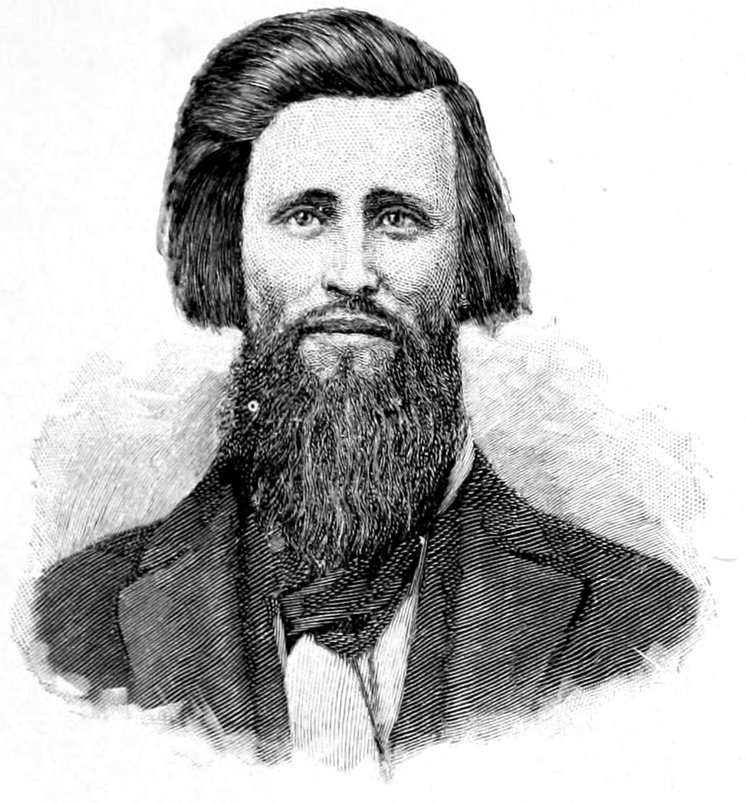
JAMES STUART
Who set the first sluices in Montana
113“On the twenty-fifth of June, 1862, news reached us that
four steamboats had arrived at Fort Benton loaded with
emigrants, provisions, and mining tools, and on the twenty-ninth
Samuel T. Hauser, Frank Louthen, Jake Monthe, and
a man named Ault, who were the advance guard of the pilgrims
to report upon the country from personal observation,
came into our camp. After prospecting on Gold Creek for
a few days, Hauser, Louthen, and Ault started for the
Salmon River mines by way of the Bitter Root Valley. Jake
Monthe, that harum-scarum Dutchman who wore the hat
that General Lyon had on when he was killed in the battle
of Wilson’s Creek, continued prospecting along Gold Creek.
“Walter B. Dance and Colonel Hunkins arrived on the
tenth of July, and on the fourteenth we had the first election
ever held in the country. It was marked by great excitement,
but nobody was hurt—except by whiskey.
“On the fifteenth, Jack Mendenhall, with several companions,
arrived at Gold Creek from Salt Lake City. They
set out for the Salmon River mines, but having reached
Lemhi, the site of a Mormon fort and the most northern settlement
of the ‘Saints,’ they could proceed no farther in the
direction of Florence owing to the impassable condition of
the roads, so they cached their wagons, packed their goods
on the best conditioned of their oxen, and turned off for
Gold Creek. They lost their way and wandered about until
nearly starved, when they fortunately found an Indian guide,
who piloted them through to the diggings. On the twenty-fifth
Hauser and his party, having failed to reach Florence,
also returned nearly starved to death.”
The leading men among this little band of pioneers
were admirably qualified to grapple with the varied difficulties
114and dangers incident to their exposed situation.
The brothers Stuart, Samuel T. Hauser, and Walter B.
Dance were among the most enterprising and intelligent
citizens of Montana, and to the direction which they, by
their prudence and counsel, gave to public sentiment, when
with twenty or thirty others, they organized the first
mining camp in what is now Montana, was the Territory
afterwards indebted for the predominance of those principles
which saved the people from the bloody rule of assassins,
robbers, and wholesale murderers. They were men
bred in the hard school of labor. They brought their
business habits and maxims with them, and put them
rigidly into practice. Having heard of the lawlessness
which characterized the Salmon River camps, and of the
expulsions which had taken place there, they were on the
alert for every suspicious arrival from that direction.
On the twenty-fifth of August, William Arnett, C. W.
Spillman, and B. F. Jernigan arrived at Gold Creek from
Elk City. They opened the first gambling establishment
in Montana and satisfied the good people of Gold Creek
before the close of their first day’s residence that they were
the advance guard of the outcasts of Salmon River. Victims
flocked around them in encouraging numbers. The
highway of villainy seemed to stretch out before them
with flattering promise. Four days had elapsed since
their arrival. The little society was fearfully demoralized,
and whiskey and dice ruled the hour, when the Nemesis
appeared. Two men, Fox and Bull, came in pursuit
of the gamblers for horse-stealing. Creeping upon them
while busy at play, the first notice the poor wretches had
of their approach was to find themselves covered with
double-barrelled guns which were instantly discharged.
Arnett fell, riddled with bullets. Fox’s gun missed fire.
Jernigan threw up his hands, and he and Spillman were
arrested without resistance. Arnett died with a death
115clutch of his cards in one hand and revolver in the other,
and was so buried.
The next day Jernigan and Spillman were fairly tried
by a jury of twenty-four miners. The former was acquitted,
the latter sentenced to be hung, which sentence
was executed in the afternoon of the following day. This
was the first expression of Vigilante justice in that portion
of the Northwest which afterwards became Montana.
Mr. Stuart says, “Spillman was either a man of a lion
heart or a hardened villain, for he died absolutely fearless.
After receiving his sentence, he wrote a letter to his father
with a firm, bold hand that never trembled, and walked
to his death as unto a bridal.”
The news of the discovery of the Oro Fino and Florence
mines was received at Denver in the Winter of 1861–62,
and caused a perfect fever of excitement. Colonel
McLean, Washington Stapleton, Dr. Glick, Dr. Leavitt,
Major Brookie, H. P. A. Smith, Judge Clancy, Edward
Bissell, Columbus Post, Mark Post, and others, all left
early in the Spring, taking the route by the overland road,
from which they intended to diverge into the northern
wilderness at some point near Fort Bridger. Another
party under the leadership of Captain Jack Russell left
soon after, going by the way of the Sweetwater trail,
South Pass, and the Bridger cut-off.
My readers who have never seen the plains, rivers,
cañons, rocks, and mountains of the portion of our country
travelled by these companies, can form but a faint
idea from any description given by them of the innumerable
and formidable difficulties with which every mile of
this weary march was encumbered. History has assigned
a foremost place among its glorified deeds to the passage
of the Alps by Napoleon, and to the long and discouraging
march of the French army under the same great conqueror
to Russia. If it be not invidious to compare small
116things with great, we may assuredly claim for these early
pioneers greater conquests over nature on their journey
through the northwestern wilderness than were made by
either of the great military expeditions of Napoleon. In
addition to natural obstacles equally formidable and of
continual occurrence for more than a thousand miles, their
route lay through an unexplored region, beset by hostile
Indians, bristling with mountain peaks, pierced with large
streams, and unmarked with a single line of civilization.
Their cattle and horses were obliged to subsist upon the
scanty herbage which put forth in early spring. Swollen
by the melting snows of the mountains, the streams, fordable
in midsummer, could now be crossed only by boats,
and frequently the passage of a single creek consumed a
week of time. Seeking for passes around and through the
ranges, ascending them when no such conveniences could
be found, passing through cañons, and clambering rocks,
filled the path of empire through western America with
discouragement and disaster.
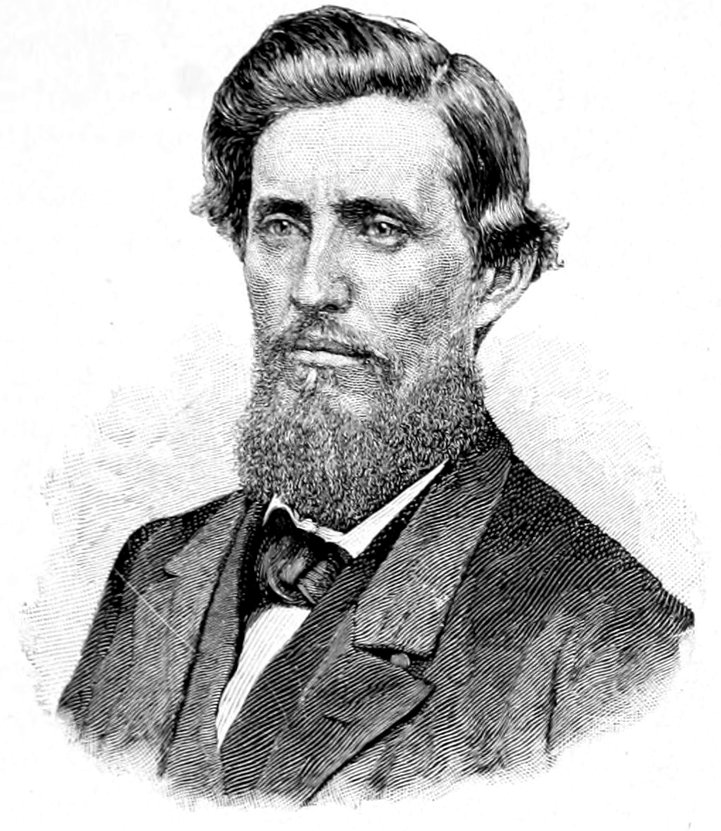
GRANVILLE STUART
Who set the first sluices in Montana
117Several of these companies were obliged to wait the subsidence
of the waters at the crossing of Smith’s fork of
Bear River. While thus delayed, more than a hundred
teams, comprising three or four trains, all bound for the
new gold regions, arrived. Some of the companies were
composed entirely of “pilgrims,” a designation given by
mountain people to newcomers from the States. Michaud
Le Clair, a French fur-trader and mountaineer of forty
years’ experience, had, in company with two others, built
a toll bridge across the fork in anticipation of a large
spring emigration; but a party arriving in advance of this
present crowd, exasperated at the depth of the mud at
the end of the bridge, burned it. Russell proposed to
build another, but the pilgrims, having no faith in his skill,
refused to assist. Russell completed the job on his own
account, and charged the pilgrims one dollar each for
crossing, and then offered to release his interest in the
bridge for twenty-five dollars. Le Clair, thinking that
Russell would go on with his company, refused the offer.
Russell, Brown, and Warner sent their train ahead, remaining
at the bridge to receive tolls. Several trains
passed during the two succeeding days, greatly to the
annoyance of Le Clair and his comrades. They attempted
to retaliate by cutting the lariats of the horses while
tethered for the night; and when they found that the animals
did not stray far from camp, they sent the savages
down to frighten Russell and his men. But they were old
mountaineers, and felt no alarm. On the third day a
much larger number of wagons crossed than on both the
preceding days. The Frenchman, tired of expedients and
satisfied that money could be made by paying Russell the
price he demanded for the bridge, sent for him, and, after
considerable negotiation, gave him the twenty-five dollars
and a silver watch. The bridge temporarily erected by
Russell was used as a toll bridge the following year, but
it required very careful usage to prevent it from falling
to pieces. The proprietors, fearful of accident, finally
posted up the following placard, as a warning to travellers
that heavily laden wagons would not be permitted to
meet upon the bridge:
No Vehacle draWn by moaR than
one anamile is alloud to croS this
BRidg in oPposit direxions at the
sam Time
Le Clair also advised Russell against a prosecution of
his journey to the Salmon River region, assuring him that
from long familiarity with the country, he knew he could
118not complete it in safety. The season was too far advanced
and the streams were higher than usual. He then
told him as a secret that there was gold at Deer Lodge
and on the Beaverhead. The Indians had often found it
there, and if gold was his object, he could find no better
country than either of these localities for prospecting.
“I have been,” said he, “boy and man, forty years in
this region, and there is no part of it that I have not often
visited. You will find my advice correct.”
Russell placed great confidence in what Le Clair said.
Hastening on, he overtook his companions, and they proceeded
to Snake River near Fort Hall, an old post of the
Northwestern Fur Company. Here they fell in with McLean’s
train, which, as we have seen, left Denver a few
days before they did, and travelled by another route. One
of this latter company, Columbus Post, was drowned
while attempting to cross the river in a poorly constructed
boat, made out of a wagon-box. Russell found an old
ferry-boat near the fort, which the men repaired to answer
the purpose of crossing their trains, and they proceeded
on through the dreary desert of mountains and rock in
the direction of the Salmon River. Superadded to the
difficulties of travelling over a rough volcanic region, they
were now, for successive days, until they left the valley of
the Snake, attacked by the Bannack Indians, and their
horses were nightly exposed to capture by them. After
many days of adventurous travel, the whole party, with a
great number of pilgrims, arrived in safety at Fort Lemhi.
Here they found themselves hemmed in by the Salmon
River range, a lofty escarpment of ridges and rocks presenting
an insurmountable barrier to further progress
with wagons. They had yet to go several hundred miles
before reaching the gold regions. A large number, more
than a thousand in all, were now congregated in this desolate
basin. They at once set to work to manufacture
119pack-saddles and other gear necessary to the completion
of their journey. As time wore on, the prospect of being
able to do so before cold weather set in became daily more
discouraging. At length a meeting was called to consider
the situation of affairs, and if possible, to devise and adopt
measures of relief.
Russell repeated to the assemblage the information he
had received from Le Clair, expressing his belief that it
was true, and recommended as a choice of evils that they
should turn aside, and go to Deer Lodge and Beaverhead,
rather than attempt a journey down the Salmon to the
Florence mines, through a country of which their best
information was disheartening in the extreme. Several
members of the Colorado companies spoke of having seen
letters from James and Granville Stuart in which the
discovery of promising gold placers in Deer Lodge was
mentioned; but the pilgrims thought the information too
indefinite, and concluded to risk the journey down the
river. The Colorado men, most of whom were experienced
miners, determined at once to retrace their way to
Deer Lodge and Beaverhead, and risk the chance of making
new discoveries, if the information given by the
Stuarts and Le Clair should not prove true. At the crossing
of the Beaverhead, Russell found five cents in gold to
the pan, and picked up pieces of quartz containing free
gold.
In the meantime, John White and a small party of prospectors
had discovered the gold placer in the cañon of
Grasshopper Creek which afterwards became Bannack.
When the companies of McLean and Russell arrived
there, their stock of provisions was nearly exhausted.
They went to Deer Lodge, hoping to find a more promising
field, and some of them visited the placers on Gold
Creek, Pioneer, and at Pike’s Peak Gulch, none of which
were equal in richness and extent to the one they had left
120behind them. They returned to Grasshopper. No provisions
having arrived in the country, most of them decided
to attempt a return to Salt Lake City. The chance
of making a journey of four hundred miles to the nearest
Mormon settlements was preferable to starvation in this
desolate region. They could but die in the effort, and
might succeed. After they had started on this Utopian
journey, Russell mounted his horse, followed them, and
persuaded them to return. They then set to work in good
earnest and found gold in abundance; but, with the fortune
of Midas, as their scanty supply of food lessened
daily, they feared soon to share his fate also, and have
nothing but gold to eat. Just at this crisis, however,
their Pactolus appeared in the shape of a large train of
provisions belonging to Mr. Woodmansee, and all fear
of starvation vanished. The step between the extremes
of misery and happiness was, in this case, very short.
The camp was hilarious with joy and mirth.
Upon the opening of Spring, Russell left Grasshopper
on his return to Colorado, where he arrived in safety after
encountering dangers enough to fill a moderate volume.
For two days, while passing through Marsh Valley, he
was pursued by Indians, barely escaping being shot and
scalped. His courage was often put to the strongest
tests. At Wood River, twenty miles from Fort Lemhi,
the Bannack Indians offered him money in large amounts
for fire-arms and ammunition. They stole a pistol from
him. Accompanied by one Gibson, he went to their camp
and recovered it. Some of them were dressed in the apparel
of women whom they had murdered, and whose
bodies they had concealed in the fissures of the lava beds
on Snake River. More than two hundred emigrants had
been killed by these wretches the preceding Summer.
Russell exhibited specimens of the gold taken from the
“Grasshopper diggings,” to his friends in Colorado. The
121excitement it occasioned was intense, and when the Spring
of 1863 opened, large numbers left for the new and promising
El Dorado.
In the Fall of 1862 there stood, on the bank at the confluence
of Rattlesnake Creek and the Beaverhead River, a
sign-post with a rough-hewn board nailed across the top,
with the following intelligence daubed with wagon-tar
thereon:
Tu grass Hop Per digins
30 myle
☞ kepe the Trale nex the bluffe
On the other side of the board was the following:
Tu jonni grants
one Hunred & twenti myle
The “grass Hop Per digins” are at the town of Bannack;
and the city of Deer Lodge is built on “jonni
grants” ranche.
CHAPTER XIV CAPTAIN FISK’S EXPEDITION
122
While the little community at Bannack were snugly
housed for the winter, anxiously awaiting the return
of warm weather to favor a resumption of labor in
the gulch, numerous companies were in progress of organization
in the States, intending to avail themselves of
the same seasonable change to start upon the long and
adventurous journey to Salmon River. The fame of Bannack
and Deer Lodge had not yet reached them. In the
Summer of 1862 an expedition under the direction of the
Government was planned in Minnesota for the ostensible
purpose of opening a wagon road between St. Paul and
Fort Benton, to connect at the latter point with the military
road opened a few years before by Captain John
Mullen from Fort Benton to Walla Walla. This route
of nearly two thousand miles lay for most of the distance
through a partially explored region, filled with numerous
bands of the hostile Sioux and Blackfeet. The Government
had grudgingly appropriated the meagre sum of five
thousand dollars in aid of the enterprise, which was not
sufficient to pay a competent guard for the protection of
the company. The quasi-governmental character of the
expedition, however, with the inducement superadded that
it would visit the Salmon River mines, soon caused a large
number of emigrants to join it.
The Northern Overland Expedition, as it was called,
left St. Paul on the sixteenth of June, 1862. It was confided
to the leadership of Captain James L. Fisk, whose
123previous frontier experience and unquestioned personal
courage admirably fitted him for the command of an expedition
which owed so much of its final success, as well as its
safety during a hazardous journey through a region occupied
by hostile Indians, to the vigilance and discipline of its
commanding officer. His first assistant was E. H. Burritt,
and second assistant, N. P. Langford (the writer); Samuel
R. Bond, secretary, David Charlton, engineer, Dr. W.
D. Dibb, surgeon, and Robert C. Knox, wagon master.
About forty men were selected from the company, who
agreed, for their subsistence, to serve as guards during
the journey. One hundred and twenty-five emigrants accompanied
the expedition to Prickly Pear Valley. This
company was thoroughly organized, and ready at all times
for instant service while passing through Indian country.
Fort Abercrombie, Devil’s Lake, Fort Union, Fort Benton,[2]
and Milk River were designated points of the route,
and it was generally understood that the company should
pursue as nearly as possible the trail of the exploring
expedition under command of Governor Isaac I. Stevens
in 1853.
All the streams not fordable on the entire route were
bridged by the company and many formidable obstacles
removed. The company arrived without accident, after a
tedious but not uninteresting trip, in Prickly Pear Valley
on the twenty-first day of September. It was the largest
single party that went to the northern mines in 1862.
About one-half of the number remained in the Prickly Pear
Valley, locating upon the creek where Montana City now
stands. The remainder accompanied Captain Fisk to
Walla Walla. All who were officially connected with the
expedition, except Mr. Knox and the writer, returned by
way of the Pacific Ocean and the Isthmus to Washington.
124Gold had been found on Prickly Pear Creek a short
time before the arrival of our company. “Tom Gold
Digger,” or “Gold Tom,” had pitched his lodge at the
mouth of the cañon above our location and was “panning
out” small quantities of gold. The placer was very difficult
of development and the yield small. Winter was near
at hand. Many of the party who had left home for Salmon
River, where they had been assured profitable employment
could be readily obtained, now found themselves
five hundred miles from their destination with cattle too
much exhausted to attempt the journey, in the midst of
a wilderness, nearly destitute of provisions, and with no
chance of obtaining any nearer than Salt Lake City, four
hundred miles away, from which they were separated by
a region of mountainous country, rendered impassable by
deep snows and beset for the entire distance by hostile Indians.
Starvation seemingly stared them in the face. Disheartening
as the prospect was, all felt that it would not
do to give way to discouragement. A few traders had
followed the tide of emigration from Colorado with a
limited supply of the bare necessaries of life, risking the
dangers of Indian attack by the way, to obtain large
profits and prompt pay as a rightful reward for their
temerity. Regarding their little stock as their only resource,
the company set to work at once, each man for
himself, to obtain means to buy with. Prices were enormous.
The placer was still unpromising. Frost and snow
had actually come. With a small pack supplied from the
remains of their almost exhausted larders, the men started
out, some on foot, and some bestride their worn-out animals,
into the bleak mountain wilderness in pursuit of
gold. With the certainty of death in its most horrid form
if they fell into the clutches of a band of prowling Blackfeet,
and the thought uppermost in their minds that they
could scarcely escape freezing, surely the hope which sustained this little band of wanderers lacked none of those
grand elements which sustained the early settlers of our
country in their days of disaster and suffering. Men
who cavil with Providence, and attribute the escape of a
company of half-starved, destitute men from massacre,
starvation, and freezing, under circumstances like these,
to luck or chance or accident, are either destitute of
gratitude or have never been overtaken by calamity. Yet
these men all survived to tell the tale of their bitter experience.
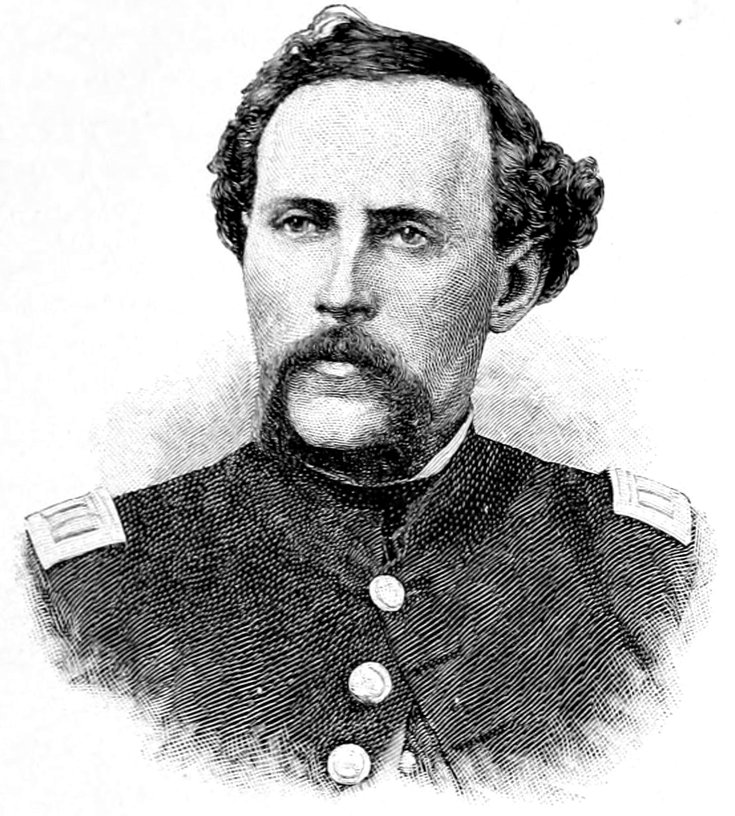
CAPTAIN JAMES L. FISK
Commander of Northern Overland Expedition
125My recollection of those gloomy days, all the more
vivid, perhaps, because I was among the indigent ones,
was emphasized by a little incident I can never recall
without a devout feeling of thankfulness. Intelligence was
brought us that a company of miners was working the bottom
of a creek in Pike’s Peak Gulch, a distance of sixty
miles from the Prickly Pear camp over the Rocky Mountain
range. Cornelius Bray, Patrick Dougherty, and I
started immediately on a horseback trip to the new camp
in search of employment for the winter. One pack-horse
served to transport our blankets and provisions. Our intention
was to cross the main range on the first day and
camp at the head of Summit Creek, where there was good
grass and water. In following the Mullen road through
the cañon, when about two miles from the ridge, Bray’s
horse gave out and resisted all our efforts to urge him
farther. There was no alternative but to camp. The spot
was unpromising enough. There was no feed for our
horses, and our camp by the roadside could not escape the
notice of any band of Indians that might chance to be
crossing the range. It was the custom in this Indian
country for packers and others to seek some secluded
spot half a mile or more from the trail for camping purposes;
but here we were cooped up in a cañon not ten
rods wide, and the only practicable pass over the range
126running directly through it. Of course we all mentally
hoped that no Indians would appear.
I had, while at Fort Benton, held frequent conversations
with Mr. Dawson, the factor at that post, who had
spent many years in the country, and was perfectly familiar
with the manners and tactics of the Indians. He
had warned me against just such an exposure as that to
which we were now liable, and when night came, knowing
that the country was full of roving bands of Bloods and
Piegans, I felt no little solicitude for a happy issue out of
danger. Evening was just setting in, when snow began to
fall in damp, heavy flakes, giving promise of a most uncomfortable
night. Our only shelter was a clump of
bushes on the summit of a knoll, where we spread our
blankets, first carefully picketing the four horses with
long lariats to a single pin, so that in case of difficulty
they could all be controlled by one person. Dougherty
proposed to stand guard until midnight, when I was to
relieve him and remain until we resumed our trip at early
dawn. Bray and I crept into our blankets, they and the
bushes being our only protection against a very heavy
mountain snowstorm. Strange as it may seem to those
unfamiliar with border life, we soon fell asleep and slept
soundly until I was aroused by Dougherty to take my turn
at the watch. I crawled from under the blankets, which
were covered to the depth of five inches with “the beautiful
snow,” and Dougherty fairly burrowed into the warm
place I had left.
About three o’clock in the morning the horses became
uneasy for want of food. Preparatory to an early departure
I gathered in a large heap a number of small,
fallen pines and soon had an immense fire. It lighted up
the cañon with a lurid gloom and mantled the snow-covered
trees with a ghastly radiance. The black smoke
of the burning pitch rolled in clouds through the atmosphere,
127which seemed to be choked with the myriad snowflakes.
So dense was the storm I could scarcely discern
the horses, which stood but a few rods distant. Wading
through the snow to the spot where my companions slept,
I roused them from their slumbers. I could liken them
to nothing but spectres as they burst through their snowy
covering and stood half-revealed in the bushes by the
light of the blazing pines. It was a scene for an artist.
Despite the gloomy forebodings which had filled my mind,
at this scene I burst into a fit of loud and irrepressible
laughter.
It was but for a moment, for, as if in answer to it, the
counterfeited neigh of a horse a few rods below and of
another just above me, warned me that the danger I had
feared was already upon us. It was the signal and reply
of the Indians. Bray and Dougherty grasped their guns,
while I rushed to the picket pin, and, seizing the four
lariats, pulled in the horses. A moment afterwards, and
from behind a thicket of willows just above our camp,
there dashed down the cañon in full gallop forty or more
of the dreaded Blackfeet. In the light of that dismal fire
their appearance was horribly picturesque. Their faces
hideous with war paint, their long ebon hair floating to
the wind, their heads adorned with bald-eagle feathers,
and their knees and elbows daintily tricked out with strips
of antelope skin and white feathery skunks’ tails, they
seemed like a troop of demons which had just sprung out
of the earth, rather than beings of flesh and blood. Each
man held a gun in his right hand, guiding his horse with
the left. Well-filled quivers and bows were fastened to
their shoulders, and close behind the main troop, driven
by five or six outriders, followed a herd of fifty or more
horses they had just stolen from a company of miners on
their way to the Bannack mines, who had encamped
for the night at Deer Lodge. These animals were driven
128hurriedly by our camp, down the cañon, the main troop,
meantime, forming into line on the other side of them so
as to present an unbroken front of horsemen after they
had passed, drawn up for attack. This critical moment
we improved by rapidly looping the lariats into the mouths
of our horses and bringing our guns to an aim from behind
them over their fore-shoulders. As we stood thus,
not twenty yards asunder, confronting each other, the
chief, evidently surprised that the onslaught lingered, rode
hurriedly along the front of his men and with violent gesticulations
and much vehement jargon urged them to an
instant assault. They strongly expostulated, and by numerous
antics and utterances, which I afterwards ascertained
meant that their guns were wet and their caps
useless, finally persuaded him to resort to the bows and
arrows. The chief was very angry, and from the violence
of his gestures and threatening manner I expected to see
several of the Indians knocked off their horses. When
the Indians, in obedience to his command, hung their guns
on the pommels of their saddles, and drew their bows, the
attack seemed inevitable. Our guns were dry, and we
knew that they were good for twenty-four shots and the
revolvers in our belts for as many more.
Satisfied that an open attack would eventuate in death
to some of their number, nearly one-half of the Indians
left the ranks and passed from our sight down the cañon,
but soon reappeared, emerging from the thicket on the
opposite side of our camp. We wheeled our four horses
into a hollow square, and, standing in the centre, presented
our guns at each assaulting party. As our horses
were the booty they most wished to obtain, they were now
restrained lest they should kill them instead of us. A few
moments of painful suspense—moments into which days
of anxiety were crowded—supervened. A brief consultation
followed, and the chief gave orders for them to withdraw.
129They all wheeled into rapid line, and with the
military precision of a troop of cavalry dashed down the
cañon and we saw them no more.
Thankful for an escape attributable to the snow which
had unfitted their guns for use, and to the successful raid
they had made upon our neighbors, we saddled our horses
and hurried over the mountain range with all possible
speed. While crossing, we found two horses which, jaded
with travel, had been abandoned by the Indians. We
took them with us, and on our arrival at Grasshopper
some days after, restored one to Dr. Glick, its rightful
owner.
“I have had seven horses stolen from me by these
prowlers,” said he, “but this is the first one that was ever
returned.”
The little gulch at Pike’s Peak was fully occupied when
we arrived, and after remaining a few days, we mounted
our horses and made a tedious but unadventurous journey
to Bannack, then, and for nearly a year afterwards, the
most important gold placer east of the Rocky Mountains.
The fame of this locality had reached Salmon River late
in the Fall of 1862, and many of the people left the Florence
mines for the east side. Among them came the first
irruption of robbers, gamblers, and horse-thieves, and the
settlement was filled with gambling houses and saloons,
where bad men and worse women held constant vigil, and
initiated that reign of infamy which nothing but the
strong hand could extirpate.
CHAPTER XV BANNACK IN 1862
130
It is charitable to believe that Henry Plummer came
to Bannack intending to reform, and live an honest
and useful life. His deportment justified that opinion.
His criminal career was known only to two or three
persons as criminal as himself. If he could have been
relieved of the fear of exposure and of the necessity of associating
with his old comrades in crime, it is not improbable
that his better nature would have triumphed. He possessed
great executive ability, a power over men that
was remarkable, a fine person, polished address, and prescient
knowledge of his fellows—all of which were mellowed
by the advantages of a good early education. With
all the concerns of a mining camp experience had made
him familiar, and for some weeks after his arrival in Bannack
he was oftener applied to for counsel and advice than
any other resident. Cool and dispassionate, he evinced
on these occasions a power of analysis that seldom failed
of conviction. He speedily became a general favorite.
We can better imagine than describe the mixed nature of
those feelings, which, fired with ambitious designs and
virtuous purposes, beheld the way to their fulfilment darkened
by a retrospect of unparalleled atrocity. So true it
is that the worst men are the last to admit to themselves
the magnitude of their offences, that even Plummer, stained
with the guilt of repeated murders and seductions, a very
monster of iniquity, believed that his restoration to the
pursuits and honors of virtuous association could be established
131but for a possible exposure by some of his guilty
partners. He knew their watchful eyes were upon him;
that they were ready to follow him as leader or crush him
as a traitor.
Of no one was he in greater dread than his sworn enemy,
Cleveland. This man, who made no secret of his own
guilty purposes, had frequently uttered threats against
the life of Plummer, and never lost an opportunity publicly
to denounce him. Their feud was irreconcilable.
Cleveland had incurred suspicion as the murderer of a
young man by the name of George Evans, and was regarded
generally as a desperado of the vilest character.
It was no credit to Plummer that he came in his company
to Bannack. But their previous criminal connection was
as yet unrevealed.
A few days after the disappearance of Evans, a number
of citizens were seated in general conversation
around the fire in a saloon kept by Mr. Goodrich. Among
the number were Plummer, Jeff Perkins, and Augustus
Moore. Suddenly the door was violently opened and
Cleveland entered. With an air of assumed authority he
proclaimed himself “chief,” adding with an oath that he
knew all the scoundrels from the “other side” and intended
to get even with some of them. The covert threat
which these words revealed did not escape the notice of
Plummer, but Cleveland upon the instant charged Perkins
with having violated a promise to pay some money
which the latter owed him in the lower country. Perkins
assured him it had been paid. “If it has,” said Cleveland,
“it is all right,” but as if to signify his distrust of Perkins’s
statement, he commenced handling his pistol and
reiterating the charges. To prevent Cleveland from carrying
into execution his apparent design of shooting Perkins,
Plummer fixed his eyes sternly upon him and in a calm
tone told him to behave himself, that Perkins had paid the
debt and he ought to be satisfied.
132Quiet was restored for the moment and Perkins slipped
off, intending to return with his pistols and shoot Cleveland
on sight. Here the difficulty would have ended had
not Cleveland, in an evil moment, in a defiant and threatening
manner, with mingled profanity and epithet, declared
that he did not fear any of them. Filled with rage,
Plummer sprang to his feet, drew his pistol, and exclaiming,
“I am tired of this,” followed up the expression with
a couple of rapid shots, the last of which struck Cleveland
below the belt. He fell on his knees. Grasping wildly for
his pistol, he appealed to Plummer not to shoot him while
he was down. “No,” said Plummer, whose blood was now
up; “get up.” Cleveland staggered to his feet, only to
receive two more shots, the second of which entered below
the eye. He fell to the floor, and Plummer, sheathing his
pistol, turned to leave the saloon. At the door he was met
by George Ives and Charley Reeves, each of whom, pistol
in hand, was coming to take part in the affray. Each
seizing an arm, they escorted Plummer down the street,
meanwhile suggesting with great expletive emphasis a variety
of surmises as to the possible effect of the quarrel
upon the public.
Hank Crawford and Harry Phleger, two respectable
citizens, hastened to the aid of the dying desperado, whom
they conveyed to Crawford’s lodgings. His bed being
poorly furnished Cleveland sent him to Plummer’s cabin
to get a pair of blankets belonging to him. The interview,
between Crawford and Plummer on this occasion showed
that the mind of the latter was ill at ease. Like Macbeth’s
dread of Banquo, so he felt that, while Cleveland lived,—
“There is none but he
Whose being I do fear; and under him
My genius is rebuk’d.”
In the brief colloquy which took place between them,
Plummer asked Crawford no less than three times what
133Jack had said about him. His past career of crime was
all before him. Crawford as often replied, “Nothing.”
“’Tis well he did not,” at length responded Plummer,
“for if he had I would kill him in his bed.”
Crawford then told him that, in reply to several questions
asked him, Cleveland had said,
“Poor Jack has got no friends. He has got it [meaning
his death-wound] and I guess he can stand it.”
Crawford left with the impression that Plummer still
thought Cleveland had exposed him, and was careful afterwards
to go armed, as he felt that his own life was in danger.
Cleveland lingered in great agony for three hours,
and was decently buried by Crawford. Soon after he had
been removed to Crawford’s cabin, Plummer sent a man
known as “Dock,” a cook, into the cabin as a spy, where
he remained until Cleveland died. He said that the only
reply Phleger received to repeated questions concerning
the difficulty between him and Plummer was, “It makes no
difference to you.” The secret, if secret there was, died
with him.
No immediate investigation was made of the circumstances
of this affray. It was thought by many that Plummer
merely anticipated Cleveland’s intention by firing
first. Shooting of pistols and duelling were so common
as of themselves to excite no attention. Many bloody encounters
took place of which no record has been preserved,
and which at the time were regarded as very proper settlements
of difficulties between the parties.
A few incidents as illustrative of the customs of a mining
camp will not be out of place in this immediate connection.
On one occasion during the winter a quarrel
sprung up between George Ives and George Carrhart in
the main street. After a long wordy war interlarded with
much profanity and various opprobrious epithets, Ives ran
into a near saloon for his pistol, exclaiming, “I will shoot
134you.” Carrhart followed him and both reappeared at the
door of the saloon a moment thereafter, each armed with
a revolver. Facing each other upon the instant, both parties
raised their pistols and fired without effect. After a
second fire with no better effect, both parties walked
rapidly backwards till they were widely separated, at the
same time firing upon each other. Ives having emptied
his revolver, stood perfectly still while Carrhart took deliberate
aim and shot him in the groin, the ball passing
through his body, inflicting a severe wound. Soon afterwards
they reconciled their difficulties, and Ives lived with
Carrhart on his ranche the remainder of the winter.
Many of the early emigrants arrived at Bannack so late
in the fall that they could provide themselves with no better
shelter from the weather during the winter than was
afforded by their wagons. Of this number were Dr. Biddle
and his wife, Mr. and Mrs. Short, and their hired man
from Minnesota. While seated around their camp-fire
one dismal afternoon, engaged in conversation with Mr.
J. M. Castner, a bullet whizzed so near the ear of Castner
that he felt its sting for several days. Castner ascertained
that it was fired by one Cy. Skinner, a rough, who excused
himself with the plea that he thought they were Indians,
and by way of amends invited Dr. Biddle and Castner to
drink with him. Castner had the good taste to decline.
The very composition of the society of Bannack at the
time was such as to excite suspicion in all minds. Outside
of their immediate acquaintances, men knew not whom to
trust. They were in the midst of a people which had come
from all parts of this country and from many of the nations
of the Old World. Laws which could not be
executed were no better than none. A people, however disposed
to the preservation of order and punishment of
crimes, was powerless for either so long as every man distrusted
his neighbor. The robbers, united by a bond of
135sympathetic atrocity, assumed the right to control the affairs
of the camp by the bloody code. No one was safe.
The miner fortunate enough to accumulate a few thousands,
the merchant whose business gave evidence of success,
the saloon-keeper whose patronage was supposed to
be productive, were all marked as victims by these lawless
adventurers. If one of them needed clothing, ammunition,
or food, he obtained it on a credit which no one dared refuse,
and settled it by threatening to shoot the person bold
enough to ask for payment. Such a condition of society,
as all foresaw, must sooner or later terminate in disaster
to the lovers of law and order or to the villains who depredated
upon them. Which were the stronger? The roughs
knew their power, but their antagonists, separately hedged
about by suspicion as indiscriminate as it was inflexible,
knew not how to establish confidence in each other upon
which to base an effective opposition. Meantime the carnival
of crime was progressing. Scarcely a day passed
unsignalled by outrage or murder. The numerous tenants
of the little graveyard had all died by violence. People
walked the streets in fear.
This suspense was at last broken by a murder of unprovoked,
heartless atrocity, which the people felt it would
be more criminal in them to overlook than it was in the
perpetrators to commit. In January, 1863, that notorious
scoundrel, Charley Reeves, bought a squaw from the
Sheep Eater tribe of Bannack. She soon fled from him
to her friends to escape his abuse. The tepee was located
on an elevation south of that portion of the town known
as “Yankee Flat,” a few rods in rear of the street.
Reeves went after her. Finding her deaf to persuasion,
he employed violence to force her return to his camp. An
old chief interfered and thrust Reeves unceremoniously
from the tepee. Burning with resentment, Reeves and
Moore fired into the tepee the next evening, wounding one
136of the Indians. They then returned to town, where they
were joined by William Mitchell, with whom they counter-marched,
each firing into the tepee, and this time killing the
old chief, a lame Indian, a papoose, and a Frenchman by
the name of Cazette, who had come to the tepee to learn
the cause of the first shot. Two other persons who had
been influenced by similar curiosity were badly wounded.
When the murderers were afterwards told that they had
killed white men, Moore with a profusion of profane appellations
said “they had no business there.”
CHAPTER XVI MOORE AND REEVES
137
Alarmed at the indignation which this brutal deed
had enkindled in the community, Moore and Reeves,
at a late hour the same night, fled on foot in the direction
of Rattlesnake. They were preceded by Plummer, who it
was supposed had gone to provide means for their protection.
He, however, afterwards asserted that he left
through fear that in the momentary excitement the people
would hang him for shooting Cleveland.
A mass meeting of the citizens was held the next morning,
and a cordon of guards appointed to prevent the escape
of the ruffians. When it was discovered that they had
gone, on a call for volunteers to pursue them, Messrs.
Lear, Higgins, Rockwell, and Davenport immediately followed
on their track. The weather was intensely cold.
The route of the pursuers lay over a lofty mountain range
covered with snow to a great depth. After riding as
rapidly as possible, they came up with the fugitives at a
distance of twelve miles from town. They had taken refuge
in a dense thicket of willows on the bank of the Rattlesnake.
Being challenged to surrender, they peremptorily
refused. Pointing their pistols with well-directed aim at
the approaching party, and interlarding their discourse
with a flood of oaths, they ordered them to advance no
farther on peril of their lives. The advantage was on the
side of the robbers, and they could easily have shot down
every one of their pursuers. A parley ensued. The position
of both parties was fully discussed. The conviction
138that it was equally impossible for the pursuers to effect a
capture, and for the ruffians to escape such a pursuit as
would be made if they did not return, induced the latter
to agree to a surrender, upon the express condition that
they should be tried by a jury. The pursuing party gave
a ready assent to this arrangement, and the fugitives returned
in their custody to town.
Plummer was put upon his trial immediately. While
that was progressing a messenger was sent to Godfrey’s
Cañon, ten miles distant, to summon Mr. Godfrey and the
writer, who, with others, were erecting a saw-mill there.
Before our arrival at midnight, Plummer was acquitted, no
doubt being entertained, on presentation of the evidence,
that he had killed Cleveland in self-defence. Several witnesses
testified that they had on various occasions heard
Cleveland threaten to shoot Plummer on sight.
At a late hour the people separated with the purpose of
assembling for the trial of Moore, Reeves, and Mitchell
early the next morning. Day broke clear and cold. All
work was suspended in the gulch, stores and hotels were
abandoned, and the entire population, numbering at least
four hundred persons, assembled in and about the large
log building which had been designated as the place of
trial. Every man was armed, some with rifles and shotguns,
others with pistols and knives. The friends of the
prisoners gave free utterance to threats, which they accompanied
with much profane assumption of superior
power and many defiant demonstrations. Pistols were
flourished and discharged, oaths and epithets freely bestowed
upon the citizens, and whatever vehemence of gesture
and expression could do to intimidate the people, was
adopted. Amid all this bluster it was apparent from the
first that the current of popular opinion set strongly
against the prisoners. There was an air of quiet determination
manifested in every movement preparatory for
139the trial. The citizens were ready for an outbreak, and
the least indication in that direction would have been the
signal for a bloody and decisive battle. It is not improbable
that an attempt at rescue was prevented by the presence
of the overpowering force of armed and indignant
citizens.
The efforts of the roughs to suppress the trial only increased
the indignation of the people, and after electing a
temporary chairman, a motion was made that the accused
be tried by a miners’ court. This form of tribunal grew
out of the necessities of mining life in the mountains. It
originated in the early days of California, when the country
was destitute of courts and law, and still exists in inchoate
mining communities as a witness to the fairness and
honesty of American character. It is now the general custom
among the property holders of a mining camp, as the
first step towards organization, to elect a president or
judge, who is to act as the judicial officer of the district.
He has both civil and criminal jurisdiction. All questions
affecting the rights of property, and all infractions of the
peace, are tried before him. When complaint is made to
him, it is his duty to appoint the time and place of trial
in written notices which contain a brief statement of the
matter in controversy, and are posted in conspicuous
places throughout the camp. The miners assemble in force
to attend the trial. The witnesses are examined, either by
attorneys or by the parties interested, and when the evidence
is closed the judge states the question at issue, desiring
all in favor of the plaintiff to separate from the
crowd in attendance until they can be counted, or to signify
by a vote of “aye” their approval of his claim. The
same forms are observed in the decision of a criminal case.
The decision is announced by the judge and entered upon
his record. Where the punishment is death, the criminal
is generally allowed one hour to arrange his business and
140prepare for death; when it is banishment, a few hours are
given him to leave the camp. If he neglects to comply with
the sentence he is in danger of being summarily executed.
Where the rights of parties are settled by the court, and
the defeated party shows any resistance to the decision,
it is the duty of the court, if necessary, with the strong
hand to enforce it. The court is composed of the entire
population. To guard against mistakes, the party in defeat,
in all cases, has the right to demand a second vote.
The progress of a trial in one of these courts is entirely
practical. Often the miners announce at the commencement
that the court must close at a certain hour.
Cross-examinations are generally prohibited, and if lawyers
are employed, it is with the understanding that they shall
make no long arguments. Each party and their respective
witnesses give their evidence in a plain, straightforward
manner, and if any of the listeners desire information
on a given point in the testimony they request the
person acting as attorney to ask such questions as are
necessary to obtain it. The decisions of these tribunals are
seldom wrong, and are always enforced in good faith.
They have many advantages in mining regions over courts
at law. None of the tedious incidents of pleading, adjournment,
amendment, demurrer, etc., which at law so often
consume the time of litigants and put them to unnecessary
expense, belong to a miners’ court.
The miners themselves have little time to spare, and
hence these courts are held on Sunday in all cases where
the exigency is not immediate. They are held in the open
air. Whenever, from any seemingly unnecessary cause,
their investigations are prolonged, as by argumentative
display, there are always those present who, by the command
“Dry up,” “No spread-eagle talk,” force them to
a close.
On one occasion at Blackfoot, in Montana, a rough was
141on trial for crimes which endangered his life. A motion
had been made by his counsel that his life be spared on
condition that he would leave the gulch in fifteen minutes,—which
motion was carried by a small majority. In anticipation
of this favorable result his friends had provided
a mule to expedite his departure. The presiding miners’
judge announced to him the condition of his freedom from
death. Fearful that a reconsideration might be demanded,
the moment he was released he vaulted into the saddle,
and looking around upon the crowd exclaimed, “Fifteen
minutes! Gentlemen, if this mule doesn’t buck, five will
do!” and lashing the sides of the animal he disappeared
at double-quick amid the shouts and laughter of the crowd.
It was a trial by this court that the murderers dreaded,
and to escape which they made a trial by jury the condition
of their surrender. When the motion was made to
substitute the miners’ court it fell into their midst like a
thunderbolt. They regarded a trial by the mass as certain
of conviction as a trial by jury would be of acquittal,
not because the latter would be any less likely than the former
to perceive their guilt, but because fear of personal
consequences would prevent them from declaring it. Men
whose identity was lost in a crowd would do that which, if
they were known, would mark them as victims for future
assassination. The friends of the prisoners showed the
estimation in which they regarded this consideration when
they openly threatened with death every individual who
participated in the trial. They anticipated that, as none
would dare in defiance of this threat to act upon a jury, all
proceedings would be suppressed, thus renewing the license
for their continued depredations.
The statement of the motion by the chairman was the
signal for a violent commotion among the roughs. One
long howl of profanity, mingled with the most diabolical
threats and repeated discharge of pistols, filled the room.
142Many shots were turned from their deadly aim by timely
hands and discharged into the ceiling. Knives were drawn
and flourished in the faces of prominent citizens, accompanied
with threats of death in case the motion prevailed.
The scene was fearful in the extreme. The miners in different
parts of the crowd could be seen getting their guns
and pistols ready for the collision which at one stage of the
tumult it seemed impossible to avoid. At length the repeated
cries of the chairman for order, and the earnest
voices of several persons who were desirous of discussing
the proposition, allayed the noise and confusion, so that
they could be heard. The guilt of the prisoners was so
palpable that the people deemed any sort of a trial which
would not speedily terminate in their condemnation a farce.
A very large majority were in favor of a miners’ court,
because they foresaw that any other form of trial afforded
opportunity for escape. Three hours were spent in determining
the question. Many short, emphatic arguments
were made. In the meantime the disturbance made by the
roughs waxed and waned to suit the different stages of the
discussion. Shots at one moment and shouts at another
betrayed their approval or disapproval of the sentiments
of the speaker. I had from the first made myself offensive
to my own immediate friends and intimates by pertinaciously
claiming for the prisoners a trial by jury, and
mounting a bench I embraced an early opportunity to give,
in a few pointed words addressed to the assembled miners,
my views. I reminded them of the constitutional provision
which secured to every one accused of crime a trial
by jury. It was a law of the land, as applicable on this
as on any other occasion. The men were probably guilty;
if so, the fact should be proved; if not, they had the right
by law, on proving it, to an acquittal. Moreover, they
had surrendered at a time when they could not have been
captured, upon the express condition that they should be
143tried by jury. I asked, “Shall we ignore the agreement
made with them by our officers?” I concluded by offering
a motion that they be tried by a jury. It was negatived
by three to one. Immediately a cry rose in the crowd,
“Hang them at once”; this was followed by other cries
of “String ’em up,” “To the scaffold with ’em.” Pistols
were drawn and flourished more freely than before, and
many personal collisions, resulting in bloody noses, black
eyes, and raw heads, took place in all parts of the room.
Another hour was spent in discussion, and finally by a bare
majority it was agreed to give the prisoners the benefit of a
trial by jury.
It is impossible to portray with accuracy of detail the
fearful effects of passion which were exhibited by the assembly
while this question was being determined. On a
limited scale it could not have been unlike some of the
riotous gatherings in Paris in the days of the first revolution.
It wanted numbers, it wanted the magnificent
surroundings of those scenes, but as an exhibition of the
passions of depraved men, when inflamed with anger, drink,
and vengeance, it could not have been greatly surpassed
by them.
Order at length being restored, a portion of the room
was enclosed with scantling, for the accommodation of the
Court and jury. J. F. Hoyt was elected Judge, Hank
Crawford, sheriff, and George Copley, prosecutor. The
jury was next chosen by a vote of the people. My own
appointment on the jury was urged by the roughs, as a
compliment for my efforts to obtain for them a jury trial.
I was regarded by them as a friend, and they hoped confidently
for acquittal through my influence.
At first it was determined that the examination of the
witnesses for both prosecution and defence should be conducted
by George Copley, the prosecutor, but upon an appeal
for justice in behalf of the prisoners it was at length
144decided by a small majority that the accused should be allowed
the assistance of counsel, with the understanding
that all the questions of their counsel were first to be submitted
to the prosecutor. Hon. Wm. C. Rheem was chosen
to defend the prisoners, and there were many threats of
violence toward him for consenting to conduct the defence.
It was agreed that the arguments to be made on either
side should be brief, and that the trials should be urged
to their conclusion with all possible expedition. Mr.
Rheem’s ability as a lawyer was unquestioned,—which
fact furnished to those who objected to a jury trial their
principal reason for opposing his employment as counsel
for the prisoners. As the extent of Mitchell’s criminality
was uncertain, he was allowed a separate trial. His case
was first brought under examination. It appeared in evidence
that he had accompanied Moore and Reeves on their
second murderous visit to the tepee, but he was able to
show that he had not once fired his gun, and consequently
could not be guilty of murder. His trial was soon terminated.
The jury recommended that he should be immediately
banished from the gulch.
The guilt of Moore and Reeves was fully established.
This result was foreseen by their friends; and while the
trial was in progress they sought by threats and ferocious
gesticulations to intimidate the jury. Gathering around
the side of the enclosure occupied by the jury, they kept
up a continued conversation, the purport of which was
that no member of that court or jury would live a month
if they dared to find the prisoners guilty. Occasionally,
their anger waxing hot, they would draw their pistols and
knives, and brandishing them in the faces of the jurymen,
utter filthy epithets, and bid them beware of their verdict.
Crawford was the object of their especial hate. Their
abusive assaults upon him and threats were so frequent
and violent that at one time he tendered his resignation
and refused to serve, but upon the promise of his friends
to stand by and protect him he retained his position.
The case was given to the jury at about seven o’clock in
the evening. A friend of the prisoners in the court-room
nominated me as foreman, but upon my refusal to serve
under that nomination I afterwards received the appointment
by a vote of my fellow-jurymen.
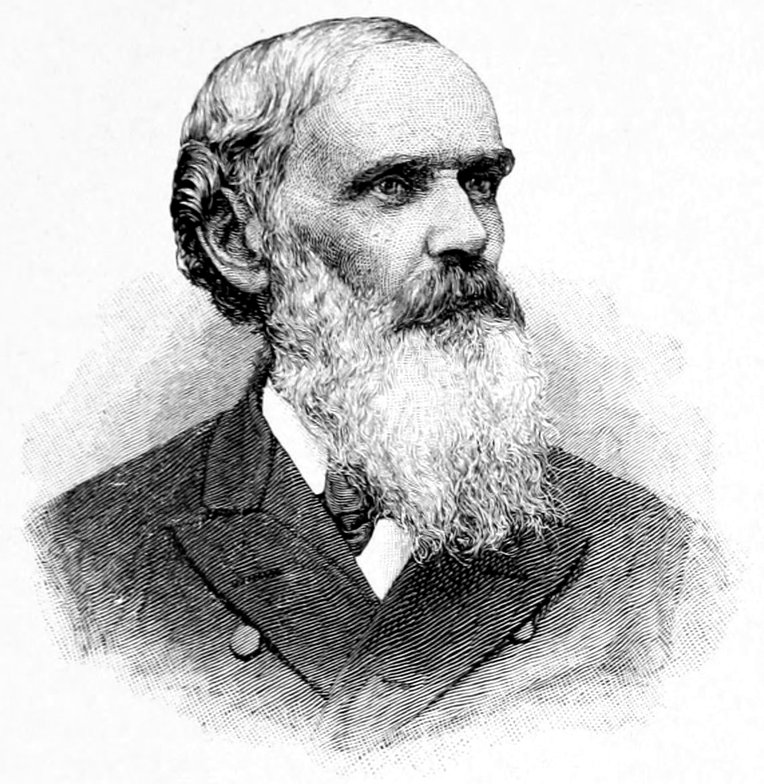
JUDGE J. F. HOYT
Miners’ Judge at trial of Moore and Reeves
145The jury were occupied in their deliberations until after
midnight. No doubt was entertained, from the first, of the
guilt of the prisoners, but the exciting question was
whether they could afford to declare it. They all felt that
to do so would be to announce their own death sentence.
They knew that the friends of the prisoners fully intended
to have life for life. They had sworn it. One of the jurymen
said that the prisoners ought never to have been tried
by a jury, but in a miners’ court, that he should not be
governed in his decision by the merits of the case, but
that, as he had a family in the States to whom his obligations
were greater than to that community, he should have
to vote for acquittal. After much conversation of this
sort, which only served to intensify the fears of the jurymen,
a vote was taken which resulted as follows: not guilty,
11; guilty, 1; myself, the supposed friend of the roughs,
being the only one in favor of the death penalty. It was
apparent that further deliberation would not change this
decision, and the jury compromised by agreeing to a sentence
of banishment, and a confiscation of the property of
the prisoners for the benefit of those they had wounded.
The court met the ensuing morning, when the verdict,
under seal, was handed to the judge. He opened and returned
it to the foreman, with a request that he read it
aloud. An expression of blank astonishment sat upon the
face of every person in the room, which was followed by
open demonstrations of general dissatisfaction, by all but
the roughs, who, accustomed to outrages and long
146immunity, hailed it as a fresh concession to their bloody
and lawless authority.
Mitchell returned to Bannack after a few days’ absence,
which was seemingly regarded as a full expiation of his
sentence. A miners’ court met soon after his return, and
in view of the fact that his sentence was not enforced, revoked
the sentence of Moore and Reeves, who again rejoined
their fellow-miscreants. Thus the first scene in the
drama, which had been ushered in by such a bloody prologue,
terminated in the broadest farce.
The trial of Moore and Reeves was one of the earliest
instances in the Territory where the lovers of law and order
on one side, and the criminal element on the other, were
brought into open, public antagonism. No one knew at
that time which of the two was the stronger. The roughs
had full confidence in their power to run the affairs of the
Territory in their own way, and while the trial was progressing
sought, by brandishing their revolvers in the
court-room, by much loud-mouthed profanity, and by frequent
interruptions and threats of vengeance directed
against the judge and jury, to intimidate and terrify all
who were concerned in conducting the proceedings, and arrest
them in their purpose. The life of Judge Hoyt, the
acting magistrate of the occasion, was often threatened;
but he not only manifested no fear, but was all the more
active and efficient in the discharge of the duties of his
difficult position. Being the central figure in the court,
his calmness and firmness inspired all the other persons
engaged in the prosecution with courage equal to the occasion,
while it daunted the roughs and probably prevented
bloodshed.
Professor Thomas J. Dimsdale, in his account of this
trial, says: “To the delivery of this unfortunate verdict
may be attributed the ascendency of the roughs. They
thought the people were afraid of them. The pretext of
147the prisoners that the Indians had killed some whites,
friends of theirs, in 1849, while going to California, was
accepted by the majority of the jurors as some sort of
justification:—but the truth is, they were afraid of their
lives, and, it must be confessed, not without apparent
reason.”
Mr. Rheem, who defended the prisoners, says: “My
conscience has more than once pricked me for interposing
between the rogues and the halter, but I never believed
till the last hour of their trial that they would escape
hanging.”
CHAPTER XVII CRAWFORD AND PHLEGER
148
The banishment of Moore and Reeves was regarded by
the roughs as an encroachment upon the system they
had adopted for the government of the country. Long
impunity had fostered in them the belief that the citizens
would not dare to question their power to do as they
pleased. They held a meeting, and it was quietly agreed
among them that every active participant in the late trial
should be slain. The victims were selected, the work deliberately
planned, and each man allotted his part in its
performance. This wholesale scheme of vengeance was to
be effected secretly, or by provoking those at whom it was
aimed into sudden quarrel, and shooting them in assumed
self-defence. Any course more culpable would afford the
assassin small chance of escaping the vengeance of the
law-abiding citizens.
Plummer was the recognized chief of the murderous
band. To him was assigned the task of killing Crawford,
who, as sheriff, had acted a prominent part in the trial of
the exiles. This task was rendered doubly acceptable to
Plummer, because he believed it would silence the tongue
of the only man in the country who had any knowledge of
his guilty career in California. One such person, in Cleveland,
had already been slain; but Plummer suspected that
on his deathbed, Cleveland had told Crawford everything.
Crawford knew intuitively of Plummer’s suspicions, and
felt that his life was in danger. He was careful never to
be unarmed. His business, as the proprietor of a meat
149market, was one of constant exposure. It rendered occasional
journeys to Deer Lodge, where he purchased cattle,
necessary, and his trips to his ranche, several miles
from town, were also frequent. Outwardly, Plummer was
friendly. One of Crawford’s friends, Harry Phleger, confirmed
his worst suspicions, by telling him that he had seen
Plummer near the market one night, apparently on the
watch for him. He had also noticed some suspicious movements
of Plummer and a rough, familiarly called “Old
Tex,”[3] which seemed to be directed against Crawford.
Plummer soon saw that Crawford understood him, and
that the only safe method of executing his design was to
provoke him into a quarrel. Plummer was reputed to excel
any man in the mountains in the use of a pistol,—an
accomplishment in which Crawford had no skill. Several
little incidents growing out of Crawford’s efforts to reimburse
himself for the expenses he had incurred in the care
and burial of Cleveland, and in the trial of Moore and
Reeves, in which Plummer voluntarily intermingled, discovered
the deadly purpose of the latter. On one of these
occasions, believing that a quarrel could not be avoided,
he was unexpectedly confronted by five or six of Crawford’s
friends with their hands on their revolvers. His
temper and courage cooled at once, and he sent Crawford
an apology, desiring to meet him as a friend. They shook
hands a few days after, and parted, seemingly on the best
of terms.
Anxious as Crawford was to be at peace, he was not deceived
by this offer of friendship. It was but a new move
in the deadly game which Plummer was playing for his
150life, and he knew it. A few days afterwards, while conversing
in a saloon, a rough-looking individual asked him,
in an impudent manner, what he was talking about.
“None of your business,” replied Crawford.
“I dare you,” replied the man, with an insulting epithet,
“to fight me with pistols.”
Looking around, Crawford discovered Plummer among
the listeners standing near, and comprehended the situation
in an instant.
“You have the odds of me with a pistol,” said he.
“Why should I fight you?”
“Well, then,” said the man, in a furious passion, “try
it with your fists. That will tell which is the best
man.”
Discovering that the man had no belt, Crawford unbuckled
his own, and laid his pistol on the bar. Following
his challenger into a dark corner of the room, he slapped
him in the face. The man instantly drew from his coat a
revolver, but before he could aim it, Crawford seized him
by the throat and disarmed him. At this moment, Plummer
joined the man in the attack on Crawford, and the
two wrested the pistol from him, and, but for the timely
interference of Harry Phleger, who came to Crawford’s
assistance and recovered possession of the pistol, Crawford
would probably have been shot. Crawford and Phleger
then left the saloon. It did not surprise Crawford, when
told afterwards by the saloon-keeper, that the design was
to entrap him into an outdoor fight with pistols, when
Plummer was ready, with his friends, to shoot him as soon
as the battle commenced.
This assault did not disturb Plummer’s affected friendship
for Crawford. Learning a few days afterwards that
the latter was going to Deer Lodge for cattle, Plummer
on the first opportunity told him that he should start for
Fort Benton the next morning. Crawford knew that this
was offered as an explanation in advance for his absence,
151and to throw him off his guard in the trip he contemplated
making after cattle. He replied at once,
“Wait a day or two and I’ll accompany you part
way.”
“No,” said Plummer, “my business is urgent.” Plummer
left the next morning, accompanied by George Carrhart.
Crawford found it convenient to be detained by
private business, and sent his butcher in his stead, who met
Plummer at the crossing of Big Hole River, and that
worthy, upon being informed that Crawford was not going
to Deer Lodge, returned to Bannack. Crawford was
afterwards told that Plummer had made three efforts at
different times to waylay and murder him on the road to
Deer Lodge.
Among other devices employed, Plummer sought through
his associates to accomplish the death of Crawford. He
sent a notorious rough known as Bill Hunter, to engage
him in a quarrel and shoot him. Hunter, meeting Crawford,
told him he had something against him.
“If you want anything of me,” said Crawford, with
the emphasis of his hand upon his pistol, “you can get it
right straight along.”
Seeing that he would probably be killed before he could
draw his pistol, or, in the sententious phrase of the country,
that he could not “get the drop on him,” Hunter left,
discomfited by Crawford’s bravery.
The next Sunday while Crawford and George Perkins
were in conversation, in one of the saloons, Plummer came
in, seemingly in great anger.
“George,” said he, addressing Perkins, “there’s a little
matter between you and Crawford in which I am concerned,
that’s got to be settled.”
“Well, I can’t imagine what it can be,” Crawford
laughingly replied. “I’m not aware of having said or
done anything concerning you, that should excite your
anger or call for a settlement.”
152“Oh, you needn’t laugh,” responded Plummer with an
oath. “It’s got to be settled.” Turning to Perkins
he continued, “You and Crawford have been telling
around through the camp, that I was trying to court the
squaw Catherine.” Then applying to Perkins a disgraceful
epithet, he said, “You are a coward. I can whip you
and Hank Crawford both, and if you are anything of a
man, you will just step out of doors and fight me.”
“I am, as you say,” said Perkins, “a coward, and no
fighting man when I’ve got nothing to fight for. I would
not go out of doors to fight with anybody.”
“Crawford won’t admit that,” said Plummer, “and if
you refuse the challenge, I ask the same satisfaction of
him. Let him go out with me if he dares.”
“Plummer,” replied Crawford, “I neither know what
cause there is for fighting you, nor why I should fear to
go out of doors on your challenge. I do not believe that
one man was made to scare another.”
“Come on, then,” said Plummer, passing into the street,
closely followed by Crawford. When they had walked a
few steps,
“Now pull your pistol,” said Plummer.
Crawford was standing close beside Plummer.
“I’ll pull no pistol,” he replied. “I never pulled a pistol
on a man yet, and you’ll not be the first.”
“Pull your pistol,” persisted Plummer. “You may
draw it and cock it, and I’ll not go for mine until you have
done so, and uttered the word to fire.”
“I’m no pistol shot,” said Crawford, “and you know
it,—and you wouldn’t make me a proposition of this kind
if you hadn’t the advantage.”
“Pull your pistol,” retorted Plummer, with an oath,
“and fight me like a man, or I’ll give you but two hours to
live, and then I’ll shoot you down like a dog.”
“If that’s your game, Plummer,” said Crawford laying
153his hand on his shoulder, and looking him steadily in
the eye, “the quicker you do it, the worse for you. I’ll
present you a fair target.”
Turning upon his heel Crawford walked deliberately
away, well knowing that fear of consequences would prevent
Plummer from firing at him, without some plausible
excuse. This conversation occurred at a late hour in the
afternoon. Harry Phleger came into town early in the
evening. Crawford sent a message to him, requesting him
to come at once to Peabody’s saloon. As he entered,
Crawford told him that Plummer had given him two hours
to live, and the time had nearly expired.
“I expect,” said Crawford, “he will keep his word.”
“If he attempts it,” replied Phleger, “we will try and
give him as good as he sends. It’s clever at any rate to
inform one of his intentions. He will expect you to be
prepared.”
In a few minutes five or six men, armed with revolvers,
entered the saloon, followed by Plummer. He had remained
long enough outside to deposit a double-barrelled
gun over the door. “Deaf Dick,” who accompanied the
crowd, was unarmed.
“Come on, boys,” said Phleger, “let’s take a drink.”
All stepped back in refusal of the invitation.
“Well, Dick,” said Crawford, addressing him in a key
that he could hear, “you’ll drink anyhow.”
“Not I,” said Dick with an oath. “I drink with no
coward such as you have proved yourself to be by refusing
to fight Plummer.”
“You’re the wrong man to brand me as a coward, at
any rate,” said Crawford, advancing toward him as if with
the intention of striking.
Plummer at once stepped up and handed Dick his revolver,
and the crowd gathered around him and Crawford.
Phleger drew his pistol, and Crawford said to him,
154“Harry, I suppose these men have come to kill me.
You are my only friend, and I’ll make you a present of
my six-shooter. I suppose I’ve got to die.”
“Who will kill you?” asked Phleger.
“Plummer, I suppose. He threatened it,” was the reply.
“Not a man here dare shoot you,” said Phleger, at the
same time looking around upon the crowd, and characterizing
it by a degrading epithet.
Plummer at this jumped forward, and seizing Phleger’s
revolver, tried to wrest it from him. In the grapple Plummer
was thrown, when Phleger drawing another pistol
from his belt, presented both ready cocked to the crowd,
which was now pressing threateningly towards him, and
calling to Crawford, said,
“Come on, Hank, let’s get out of this,” and both
backed out into the street facing their assailants, who did
not follow them.
Phleger and Crawford started for the lodgings of the
latter, passing on the way the meat market, where they
were joined by Johnny Shepard and another man, who,
taking all the arms they could find, went with them. As
soon as they arrived at the room, Crawford, completely unnerved,
lay down and cried himself to sleep. Phleger was
made of sterner stuff, and watched all night. Some one
rapped at the door at midnight, but was told by Phleger
that if he attempted to enter, he would shoot him “on
sight.”
On the morning of the second day after this occurrence,
Plummer came up the street, gun in hand, peeping by the
way into the saloons and market for Crawford. Not finding
him, he assumed a watchful attitude, and stood leaning
on his gun, twenty steps distant from the door of the
market. Crawford not appearing, after half an hour he
walked on with “Deaf Dick” to Phleger’s room. Phleger
met him at the door, and invited him in.
155“No,” said Plummer, “you’ve set yourself up for a
game-cock, and to let you know that I hold you in no
fear, I’ve come up to give you a chance to display your
skill. Get your gun and we’ll try an exchange of shots
at ten paces.” This invitation was interlarded with the
usual complement of oaths and epithets. Harry felt the
abuse of Plummer keenly, but knew too well his skill with
fire-arms to consent to the murderous proposition.
“No, thank you, Plummer,” he replied, laughing, “I’m
not looking around for any one to shoot this morning, and
have no special regard for any one who is. If you are,
and you really want to shoot, you’d better turn loose.”
It so happened that at the time of this conversation,
Crawford, armed for the purpose, was searching for Plummer,
with the intention of shooting him. As is usual on all
such occasions, friends interfered to prevent a collision,
but Crawford, believing that either he or Plummer must
die on their next meeting, gave no heed to their advice.
When this was understood by Plummer’s friends, they resorted
to various devices to throw Crawford off his guard.
At one time they told him that Plummer was about to leave
town. This only made him the more watchful. Plummer,
meantime, was careful to have one or more friends constantly
in his company, so that Crawford could not fire at
him without endangering the lives of others. This situation
of affairs between the two men continued for several
days. The entire community was prepared to hear of the
death of one or both at any moment, and each was now encouraged
in his purpose by his friends. Plummer was
frequently seen near the butcher shop, but never alone.
He finally disappeared, and sent a friend to Crawford with
the proposition that they should drop all hostile intentions
and meet as strangers.
“Tell Plummer,” said Crawford, “that the trick is
too shallow. I know him. His word of honor, so repeatedly
156broken, I regard no more than the wind. He or
I must die or leave the camp.”
Soon after this, one of Crawford’s friends discovered
that Plummer and his friends had laid a plan to shoot
him in his own doorway, under cover of a house directly
opposite, and told Crawford of it. While Crawford was
on the lookout, a woman living in a cabin in the rear of
the Bannack Restaurant called to him to come and get a
cup of coffee. While he was drinking it, Frank Ray approached
him, and telling him that Plummer was searching
for him, placed in his hands Buz Cavan’s double-barrelled
rifle. At this moment, Plummer, armed with a similar
weapon, came up on the opposite side of the street, and
stopping in front of the door, with one foot elevated and
resting upon a spoke of a wagon-wheel, placed his rifle
across his knee, his right fore-arm lying horizontally along
the stock, which he grasped as if prepared to fire at a moment’s
notice. Crawford’s friends urged him to improve
that opportunity to shoot him. He went out quickly, and
resting the rifle across a log projecting from the corner
of the cabin, shot Plummer in the right arm, the ball entering
at the elbow, and lodging in the wrist.
“Fire away, you cowardly ruffian,” shouted Plummer,
straightening himself and facing Crawford.
Crawford fired a second time, but the ball missed; and
Plummer walked down to his cabin, carrying his gun, and
followed by several of his friends.
Crawford knew that Plummer’s friends would kill him,
unless he outwitted them on his escape from the country.
He left for Fort Benton immediately, travelling the entire
distance of two hundred and eighty miles by a trail that
only those who had passed over it could trace. He was
followed by three roughs, but arrived at the Fort in advance
of them, where he was protected by Mr. Dawson, the
factor at the post. He remained there until spring, and
then took passage on a Mackinaw boat to the States.
157Crawford’s friends, and the miners generally, who had
regarded this quarrel as a personal difficulty between him
and Plummer, rejoiced at his escape. It had terminated
injuriously, as they felt, to the party who was most in
fault, and they were glad the result was no worse. Few
knew or ever suspected that it had any deeper origin than
the frequent collisions incident to Crawford’s attendance
upon Cleveland, after he was shot, and his action as sheriff
at the trial of Moore and Reeves. Had it been understood
at this time that the roughs had not only decreed the death
of Crawford, but of every other man who participated in
that trial, the people would have placed themselves on a
war footing, and organized themselves to resist the encroachments
of the ruffians, which finally left them no other
alternative. So fully did they carry out their avowed purposes,
that, within five months after the trial, not more
than seven of the twenty-seven men who participated in it
as judge, prosecutor, sheriff, witnesses, and jurors, were
left alive in the Territory. Eight or nine are known to
have been killed by some of the band, and others fled to
avoid a like fate.
Plummer’s wound was very severe. The ball entered at
the elbow. Passing down the arm, it broke each bone in
two places. Dr. Glick, the surgeon in attendance upon
him, after a careful examination of the wound, was
of the opinion that amputation of the member alone could
save his life. The ball could not be found, and the arm
swelled to thrice its natural size, and the passage made
by the ball was filled for its entire length with bony
spiculæ.
Plummer had in a previous affray lost the ready use of
his other hand, and knowing that the loss of this arm would
necessarily deprive him of his position of chief among the
roughs, and that his life depended upon his skill in drawing
his revolver,—as he had numerous enemies, who would
endeavor to kill him but for the advantage which this skill
158gave him,—declared that he might as well die as lose his
arm. He peremptorily refused to consent to the operation,
but insisted that the ball must be found and removed.
Dr. Glick, who was highly accomplished in surgery, explained
to him the danger of such an operation, but Plummer
said he would rather die in the effort to cure the arm
than live without it. With great reluctance, and little
faith in his ability to save the arm, the doctor undertook
the thankless task, and made preparations to operate accordingly.
When the arm was bared, and the doctor was
about to commence, Old Tex and Bill Hunter entered the
room, the latter armed with a double-barrelled shotgun.
“I just thought,” said he to the doctor, “that I’d tell
you that if you cut an artery, or Plummer dies from the
operation you are going to perform, I’m going to shoot
the top of your head off.”
The operation was successfully performed, and a large
amount of spiculæ and disorganized tissue removed,—but
the bullet could not be found. For several days the result
was uncertain. Dr. Glick gave to the wound, which was
terribly inflamed, his unremitting attention. He had incurred
the hatred of Plummer’s friends because of his
active support of law and order. They pretended to believe
that he did not wish for Plummer’s recovery, and told
him that they would hold him responsible with his life, for
the safety of his patient. What was to be done? Escape
from the country in the midst of an inclement season
seemed impossible. In order to effect it, he must follow
Crawford over an unknown trail to Fort Benton or go to
Bitter Root Valley, or run the gantlet of the hostile Indians
at Bear River over a route of four hundred
miles to Salt Lake. Plummer’s wound was daily getting
worse. The doctor, well knowing that the ruffians would
put their threat into execution, prepared for his escape.
Suspecting his intention, the friends of Plummer kept a
159close watch upon him. Despite their vigilance, however,
a trusty friend secured his horse, saddled and bridled, in
the bushes behind his cabin on the night that the crisis in
the inflammation arrived. The doctor instructed Plummer’s
attendants to awaken him, in order that he might
make his escape, if the swelling did not begin to abate by
midnight, and lay down, booted and spurred, to get a little
rest. But the favorable change which took place, while it
saved to Montana one of her best citizens in Dr. Glick,
lengthened out for a darker fate than that which had
threatened it, the guilty life of Henry Plummer.
Dr. Glick came to Bannack with a party of emigrants,
of which he was captain, in 1862. The company were
bound for Salmon River, but were arrested in their progress
by the reputed richness of the Grasshopper mines.
Glick had lost a handsome property in the early part of
the war, and came to the gold mines to replenish his broken
fortunes. He was accomplished in his profession, especially
in surgery, and was the only physician in practice
who had the confidence of the people,—Dr. Leavitt, also
an able practitioner, being, at the time, engaged in
mining.
His services were in almost daily demand by the road
agents, to dress wounds received in broils among themselves,
or while engaged in the commission of robbery. It was impossible,
from his frequent contact with them, and the circumstances
with which ofttimes he found them surrounded,
for him to avoid a knowledge of their guilty enterprises.
But he neither dared to decline to serve them, nor to divulge
their villainy, well knowing that in either case, he
would fall a victim to that summary vengeance, so
promptly and fearlessly exercised in the case of Dillingham.
He foresaw also, that a time must come when all
the guilty misdeeds which he had been obliged to conceal,
would be revealed, and that then the lovers of law and order
160would suspect the integrity of his motives, and possibly
class him among the men of whom he justly stood so
much in fear. But there was no remedy. He knew that
his actions were narrowly watched, and that a word or
glance indicating his suspicions would cost him his life.
It was a happy day for him when, by the death of Plummer,
his lips were unsealed.
The robbers, in other instances than the one recorded
of his attendance upon Plummer, were in the habit of using
threats to control the doctor’s conduct. On one occasion
in July, 1863, Plummer invited him to accompany him on
a horseback excursion to his ranche on the Rattlesnake.
Finding no one at the cabin on their arrival, Plummer
asked the doctor to go with him down the creek and pick
some berries. They soon came upon a large clump of birch
bushes. Pulling them aside, Plummer disclosed an open
space cut within the clump, in which were seated several
men, seeing whom Glick drew back, but was told by Plummer
to come in. He entered, and found himself amid five
or six men with masked or blackened faces, of whom he
recognized Moore and Billy Terwiliger. The latter was
lying on a blanket, wounded in the leg by a bullet received
in some affray.
After dressing the wound, the doctor started with Plummer
on the return to Bannack. While crossing the plateau
between Rattlesnake and Bannack, Plummer suddenly
wheeled in front of the doctor, and, cocking his pistol,
thrust it into his face, saying,
“Now you know all. These are my men. I’m their
chief. If you ever breathe a word of what you’ve seen,
I’ll murder you.”
Under this kind of surveillance, the doctor lived until
the robber band was destroyed. His discretion, only
equalled by his kindness of heart, saved both his life from
destruction by the robbers, and his good name from the
161public odium of the people. Montana has had no worthier
or more useful citizen.
Henry Plummer was a man of wonderful executive ability.
He was well educated. In stature he was about five
feet ten inches, and in weight, one hundred and sixty
pounds. His forehead was partially concealed by the rim
of the hat which he rarely removed from his head, and his
eyes were mild and expressive. In demeanor he was quiet
and modest, free from swagger and bluster, dignified and
graceful. He was intelligent and brilliant in conversation,
a good judge of men, and his manners were those of a polished
gentleman. To his enemies his magnanimity was
more seeming than real. He always proffered them the advantage
in drawing the pistol, but he knew that the instance
would be very rare, where, even thus favored, his
antagonist could anticipate him in its deadly use.
Hon. Wm. C. Rheem, in a letter to the Helena (Montana)
Herald, writes of Henry Plummer as follows:
“I remember Plummer very well. He was frequently in
my cabin, and I often came in contact with him while he
was exercising the office of sheriff. His form and face were
familiar to the first settlers in Bannack. He was about five
feet eleven inches in height, and weighed a hundred and fifty
pounds. He was straight, slender, spare, agile, and what
Western men call withy. He was a quiet man and talked
but little; when he did speak, it was always in a low tone
and with a good choice of language. He never grew boisterous,
even in his cups, and no impulse of anger or surprise
ever raised his voice above that of wary monotone. His
countenance was in perfect keeping with his utterance. Both
were under the same vigilant command. If one was like
the low, continuous purr of the crouching tiger, the muscles
of the other were as rigid as those of the beast before he
springs. Affection, fear, hate, grief, remorse, or any passion
or emotion, found no expression in his immovable face. No
color ever flushed his cheeks. With mobile and expressive
162features, he would have been handsome—all except the forehead;
this, with the conformation of the skull, betrayed the
murderer, and Plummer knew it. The observer beheld a
well-cut mouth, indicating decision, firmness, and intelligence;
but not a line expressive of sensuality; a straight nose and
well-shaped chin, and cheeks rather narrow and fleshless,
still, in their outlines, not unhandsome. But one might as
well have looked into the eyes of the dead for some token
of a human soul as to have sought it in the light gray orbs
of Plummer. Their cold, glassy stare defied inquisition. They
seemed to be gazing through you at some object beyond, as
though you were transparent. While other men laughed or
pitied or threatened with their eyes, his had the same half-vacant
stare, no matter how moving the story or tragic the
spectacle.
“I have said that Plummer knew he had a bad front: he
therefore kept it jealously covered with the turn-down rim of
his slouch hat. When not in the mood or act of slaughter
or rapine, his politeness was notable and well timed in demonstration.
He understood the formulas of courtesy, but the
one of uncovering his head he failed to observe.”
An examination of Plummer’s arm after his death, disclosed
the fact that the lower fracture of the radius never
united, but formed a false joint. The bullet passed into
the marrow of the lower end of the bone, and was stopped
in its progress by the bones of the hand. From subsequent
use of the hand, while Plummer was sheriff, the bullet
became worn as smooth as polished silver.
CHAPTER XVIII BROADWATER’S STRATAGEM
163
After sentence of banishment was pronounced
upon them, Moore and Reeves went to the mining
camp in Deer Lodge Valley, located near the present site
of Deer Lodge City. Messrs. Broadwater and Pemberton,
two young men who had come into the Territory a few
weeks before, had selected this spot as an eligible location
for a town, and were engaged in laying it out at the
time the guilty exiles arrived. They had already
erected two cabins, one of which they occupied, the
other being vacant. It was the middle of February,
and the weather was intensely cold. Moore and Reeves
made their camp in a clump of willows upon the bank
of the Deer Lodge River. With no better protection
than their blankets against the wintry blasts which
swept down the valley and the frequent storms that gathered
in the lofty ranges overhanging it, and with no food
except beef and coffee, these men suffered severely. Moore
soon fell sick of mountain fever, and would probably have
died had not Broadwater caused his removal to the vacant
cabin, and supplied him with food and medicines necessary
to his recovery. Soon after he had sufficiently recovered
to leave his bed, a messenger from Bannack
brought the intelligence that the miners, at a recent meeting,
had revoked the sentence of banishment against him
and Reeves, and that they were at liberty to return. During
his illness the Indians had stolen Moore’s horse.
Broadwater placed one at his disposal and Moore rejoined
his comrades at Bannack.
164In the following spring, Broadwater engaged in the cattle
business,—buying in Deer Lodge and selling his herds
at Bannack. The proceeds of these sales often amounted
to thousands of dollars in gold dust. On one of these occasions
he was preparing to return to Deer Lodge with
six thousand dollars in gold. Moore called upon him, with
a request for a few moments’ confidential conversation.
“Make a free breast of anything you have to communicate,”
said Broadwater. “I will listen and be silent.”
“It’s for your own safety, Broad,” replied Moore,
“and there is not another man in the country for whom
I’d take the risk; but you were my friend when I needed
friendship: you saved my life, gave me food and shelter
and care; and I can never forget to be grateful—but you
must pledge your honor not to betray me.”
“Freely, freely, Moore; I would lose my life first.”
“Then,” said Moore, “I give you friendly warning
that there is a band of road agents here, that know of your
having received a large quantity of gold dust during the
past three days. They are informed of the time of your
intended departure for Deer Lodge, and intend to waylay
and murder you on the way, and corral your gold. You
are ‘spotted’ for slaughter. My advice to you is to leave
town secretly, and to be constantly on your guard, and
under no circumstances let any one, not even your most
intimate friend, know when you will leave.”
“I intended going to-morrow morning,” replied Broadwater,
“but if matters are as you tell me, I think I’ll
start to-night.”
At this Moore exclaimed, “Why, you fool! there you
go, shooting off your mouth to me the first thing. Didn’t
I caution you not to tell any one? And in less than a minute
you tell me just what you’re going to do.”
It would be curious to know by what system of ethics
Moore was governed in this strange admonition; whether
165it was to impress upon Broadwater the necessity of a
caution which should withhold confidence even from the
person who warned him of a danger, or whether there was
a conflict between gratitude to Broadwater and fidelity to
his confederates. It is not improbable that he was bound
by strong obligations to communicate to his associates the
very information which Broadwater had given him.
Satisfied that Moore belonged to the gang, yet confiding
in the truthfulness of his disclosure, Broadwater
mounted his horse early in the evening, and at two o’clock
the next morning was at the crossing of the Big Hole
River. There he intended to rest, but fearful that his
horse might be stolen by some Pend d’Oreille Indians
camped near, he rode on, six miles, to Willow Creek. Fastening
the lariat firmly to his wrist, and relying upon the
sagacity of his horse to warn him of the approach of any
of his red neighbors, he lay down upon the grass, and fell
asleep. An hour before daylight he was aroused by a
sudden plunge and snort of his horse, which, with braced
feet, was gazing intently at a patch of wild rye growing
near. He retained his prostrate position, and, with his
eyes riveted in the same direction, and his faithful revolver
grasped ready for use, quietly awaited further developments.
At length a slowly creeping object became dimly
visible in the morning twilight. He delayed no longer, but
taking deliberate aim, fired. Instantly an Indian rose
above the rye stalks, and with a fearful yell, sped away
into darkness. More frightened than the redskin, whom
he afterwards learned he had severely wounded, he mounted
his horse with the least possible delay, and hurried away
from the dangerous neighborhood.
His route now lay directly over the main range of the
Rocky Mountains, by a pass whose ascent and descent
are so imperceptible, that persons unacquainted with its
peculiarities can never determine where the one ends, or
166the other begins. It is covered with bunch-grass for its
entire distance, and its very summit is crowned with one
of the finest cattle ranges in the mountains. The waters
of the creek, flowing naturally along its summit down its
eastern slope to the Big Hole River, are carried by ditches
and races over its western slope, for mining purposes, into
the beautiful valley of the Deer Lodge, thus contributing
to swell on the one side the volume of the Missouri, and
on the other, that of the Columbia. The broad savannas
which spread away on either side of this remarkable passage
lend enchantment to a shifting and ever-varying scene
of mountain beauties not excelled upon the continent.
Just before daylight, Broadwater began to descend the
declivity at whose foot flowed one of the forming streams
of the Deer Lodge River. Glimpses of the valley could be
obtained at every bend in the tortuous road. Day was just
breaking, and the perpetual snow on the distant peak of
Mount Powell shone dimly through the haze. He was congratulating
himself that the dangers of his trip were over,
and he could complete it by a leisurely ride through one
of the most delightful valleys in the world. These thoughts
received a sudden check when, turning an abrupt angle in
the road, he saw, seated by a camp-fire, the very persons,
as he then felt, against whom Moore had warned. One of
them, George Ives, was regarded as the most daring ruffian
in the mountains; the other, Johnny Cooper, was
known to be one of his chosen associates. They manifested
great surprise at his approach. The quick eye of Broadwater
took in all the advantages of the situation. He saw
their horses feeding upon the foothills, two or three miles
away, and knew if he had been expected so soon, they would
have been saddled and ready for pursuit. They hailed him
as he passed, urged him to wait until they could get their
horses, and they would accompany him, telling him that
as the road agents were abroad, it would be safer for him
167to do so. He replied that he was in a hurry, and as his
horse was jaded with travel, they would soon overtake him,—and
rode slowly on. To allay suspicion, he alighted
from his horse and led him slowly up a steep hill, looking
back when under way to the top, and calling to them,
“Get up your horses: you can overtake me over the
hill.”
The horse, which was greatly fatigued, was favored by
this device. Broadwater felt all the peril of his situation,
and knew that nothing but coolness and decision could save
him. He was twenty miles from the second crossing of the
Deer Lodge, where a Frenchman by the name of David
Contway was living with his Indian wife, preparing to
take up a ranche. This was the nearest place of safety.
Casting another glance at the freebooters, he saw, as he
passed over the summit of the hill, that they were making
active preparations to pursue him. There was no time
to be lost. It was to be a race for life, and his chances
for escape depended upon the advantage he could win
during the brief period his pursuers would require in getting
ready to start. As soon as he was lost to their sight
he remounted his horse, and, spurring him to his utmost
speed, descended into the broad open valley. His course
now lay over a level plain denuded of trees, and rank with
prairie vegetation. Every movement he made within any
attainable distance, he knew would be seen by the men who
were on his track. The clumps of willow which defined
the course of the river were too small to afford even temporary
shelter. His horse, liable at any moment to give
out, obeyed the urgency of the occasion, under whip and
spur, with great reluctance. But his rider kept him up
to his speed, more than once inclined to diverge from the
trail toward the pine forest, which covered the foothills,
four or five miles distant, on either side of the valley, and
seek a covert there. When half the distance had been
168travelled, he looked back, and amid a cloud of dust, less
than three miles away, he saw the robbers in pursuit, seemingly
gaining rapidly upon him. His poor, panting steed,
whose sides were bleeding from the frequent lacerations
of the spur, seemed on the point of exhaustion, and the
thirty pounds of gold dust strapped to his person bore
with terrible weight upon him. But there was no time to
calculate any other chance for escape, than that of reaching
the goal. On and on he spurred the jaded animal,
often casting furtive glances back at the approaching
death, and expecting at every turn in the trail to feel the
fatal bullet. At length the little lodge of Contway peered
above the willows. The horse renewed his vigor at the
sight. The hurrying tramp of the pursuers was heard in
the rear. A last and desperate effort was made to urge
the horse to greater speed, and he dashed up to the door,
falling, on his arrival, with complete exhaustion. He was
ruined,—but he had saved the life of his master. Ives and
Cooper, less than fifty rods behind, reined their horses to
a walk, and rode slowly up, while Broadwater was removing
the saddle from his broken-down animal. Their horses
were foaming with perspiration.
“Well, you beat us on the ride,” said Ives, addressing
Broadwater.
“Yes,” replied Broadwater, “you must have had trouble
in catching your horses. I travelled slowly at first,
but as you didn’t come up, and I was anxious to get
through, I afterwards hurried.”
The coolness of this colloquy betrayed to neither party
what was passing in the mind of the other.
The horses were all turned out upon the adjacent hills,
and the three men shared alike the hospitality of Contway.
But the race was only half finished. Twenty miles of distance
intervened between Contway’s and Deer Lodge, and
how to pass over it, and escape with life, was the momentous
169question for Broadwater to solve. As a measurement
of wit between himself and the ruffians, it involved consequences
too important for any pride in the strife. It was
simply a matter of life or death with him, with the added
certainty that the smallest mistake in his calculations would
end in the latter. He knew that in Contway’s herd was
one of the fleetest horses in the Territory. Unobserved by
his pursuers, he contrived to inform Contway of his situation,
and found him ready to assist in his escape by all
means in his power.
“Go and saddle Charley,” said Broadwater, “and
bring him up, on the pretence that you are going after
your cows. Do it immediately; and after he is hitched,
I will ask you, in the presence of these men, for permission
to ride him to Deer Lodge. With your assent, reluctantly
given, I will mount and ride away, while their
horses are grazing on the foothills.”
“Zat is all ver’ goot,” replied Contway. “By Gar,
you have got him fixed all right”—and away he went,
returning in a quarter of an hour, mounted on a horse of
great strength and beauty. Hitching him in front of his
lodge, he made the remark that his cows had been missing
for a day or two, and he must go in pursuit of them.
“Ho! Contway,” said Broadwater, “that is the very
horse I want to complete my trip. My own is broken
down, and I will leave him in your care, and return this
one to you by the first opportunity.”
“By Gar, I don’t know,” replied Contway: “zat horse
is great favorite. I would not have him hurt for anything.”
“But I’ll pay you well,” said Broadwater. “I’m in
a great hurry to get home. Let me take him,—that’s a
good fellow. If I hurt him, I’ll pay you your own price.”
“You say zat here, before zese men. Zey will remember,
and on zose conditions you may take ze horse.”
170It was but the work of a moment for Broadwater to
change saddles and mount.
“Hold on, Broad,” said Ives. “This is no way to
leave a fellow. Wait till we get up our horses, and we’ll
all ride on together. It’ll be more sociable.”
“Should be glad to do so, George, but it is of the utmost
importance that I reach Deer Lodge as soon as possible.
I cannot wait; but if you will get up your horses,
and ride fast enough, you’ll overtake me.”
So saying, Broadwater put spurs to his horse, and rode
the twenty miles at a double-quick pace, arriving at Deer
Lodge a little after two o’clock, completing the entire trip
of one hundred and seven miles from Bannack to Deer
Lodge, including stoppages, in eighteen hours. Ives and
Cooper, finding themselves outwitted, followed leisurely,
arriving early in the evening.
CHAPTER XIX ORGANIZATION OF THE ROUGHS
171
While recovering from his wound, Plummer, by
constant practice, had acquired an expertness in
the use of the pistol with his left hand, nearly equal to
that of which Crawford’s shot had deprived him. Crawford
being out of his way, he was not satisfied that the
quarrel which had terminated so injuriously to him should
be propitiated without redress. He accordingly selected
Phleger for a victim. With every outward demonstration
of friendship, he would, whenever they met, press him to
drink, or to an interchange of such other civilities as would
bring them together, and afford opportunity or pretence
for sudden quarrel. Phleger never accepted any of these
invitations, without his hand upon his pistol. Plummer,
often, when in company with Phleger, would make an ostentatious
display of his regard for him. “Once,” said he,
“Harry, I would have killed you; but I could not now,
when I think matters all over, find it in my nature to injure
any true man, who would stand by another as you
did by Crawford.” Phleger could not be flattered by these
honeyed words, even into momentary forgetfulness of the
diabolical motives which prompted them. He maintained
a quiet but unmistakable attitude of defence. He was
freighting at this time, and had several teamsters in his
employ.
“If,” said he to them, “Plummer or any of his associates
come for me, and I make the first shot and you fail
to make the second, I’ll shoot you. Just remember that.”
172On one occasion, Plummer, as if for an excuse to draw
his pistol, commenced talking of its merits to Phleger, who
also drew his upon the instant. In the course of the conversation,
Plummer, while illustrating some quality of the
weapon, pointed it directly at Phleger; but when he saw
the muzzle of Phleger’s at the same moment directed at
his heart, he took the hint, sheathed his pistol, and departed.
Phleger was not afterwards troubled with his
attentions.
A miner by the name of Ellis, who had given important
testimony against Moore and Reeves, by whom he was
wounded in the mêlée which resulted in the death of Cazette,
was next singled out for slaughter. He owned a
mining claim in the gulch, which he was working with
the hope of speedily acquiring means to take him from
the country. Cyrus Skinner, a noted ruffian, assaulted
him while on his way to the claim, and beat him unmercifully.
He left him with the assurance that if he ever saw
him in the town he would kill him. Through fear that
he or some of his associates would execute this threat, he
used to steal out of his cabin and go to his work by an
old game trail over the spur of the mountain, to escape
observation. But his steps were dogged. He could not
move in any direction without a rough upon his track,
watching for an opportunity to shoot him. His life was
rendered miserable by the conviction that he was liable
at any moment to secret assassination. Resolved to
escape if possible, he left for Fort Benton. The roughs
soon discovered his absence, and sent three or four of
their number in pursuit of him. He foiled them by turning
from the main trail into an unexplored region. After
several days he reached the Missouri River below Benton,
where he constructed a wigwam in which he dwelt, subsisting
upon roots, berries, and the remnants of his provisions,
until the Mackinaw boats descended the river from
173Fort Benton in the spring. Hailing one of them he was
taken on board, and returned in safety to the States.
The writer of this history was early marked for summary
retaliation. I had disappointed the expectations
of the roughs at the trial of Moore and Reeves, by voting
for the death penalty, after having supported their demand
for a jury. They made no secret of their threats
against my life, and that of my friend, Judge Walter B.
Dance. We never went to our claims without a loaded
gun and a revolver. Dance, being a man of great physical
strength, and courage to match, was not one to be
easily frightened. In personal contest he would have
proved more than a match for the strongest of his enemies.
On one occasion, when Judge Dance and I were
quietly walking down the street, we saw Plummer approaching.
Dance drew a small bowie-knife, and picking
up a stick, commenced whittling. Plummer came up, and
casting a suspicious glance at the knife, asked,
“Judge, why do you always begin to whittle when you
meet me?”
The answer, accompanied by a look of blended sternness
and indignation, came promptly,
“Because, sir, I never intend that you shall get the
advantage of me. You know my opinion of you and your
friends. I will not be shot down like a dog by any of you,
if I can help it.”
The roughs held Dance in great fear. To those qualities
I have mentioned, he added remarkable force of
character. He was bold and fearless in his expression of
opinion, and they well understood that no man in the settlement
could wield a stronger influence over the minds of
the community, in support of law and order, and the
prompt punishment of crime.
Moore and Reeves had now returned. The storm of
indignation, which had driven them out, was succeeded by
174a calm of sluggish incertitude. The prominent actors in
that event, abandoned by those upon whose support they
had depended, were obliged to protect themselves as best
they could against the persecutions and bloody designs of
their vindictive enemies. No true spirit of reform had
yet animated the people. When appealed to for combination
and resistance to the fearful power now growing
into an absolute and bloody dictatorship, they based their
refusal upon selfish and personal considerations. They
could not act without endangering their lives. They intended
to leave the country as soon as their claims were
worked out. They would be driven from their claims,
and robbed of all they had taken from them, if they engaged
in any active opposition to the roughs; whereas,
if they remained passive, and attended to their own business,
there was a chance for them to take their money
back to their families. It was impossible to assemble a
meeting for the purpose of considering and discussing,
with safety, the condition and exposure of the people.
Meantime the roughs were thoroughly organized, and
were carrying out their plans for wholesale plunder in
every direction. Every day added to the number and
magnitude of their depredations. The Walla Walla express
had been robbed, as it afterwards appeared, by
Plummer’s direction. An attempt to rob the store of
Higgins and Worden at Missoula would have succeeded,
had not the merchants been apprised of it, in time to conceal
their gold.
A man by the name of Davenport, who, it was known
to the roughs, had a little money in Bannack, left with his
wife, intending to go to Benton, and thence by steamboat
to the States. They stopped to lunch at the springs between
Bannack and Rattlesnake. A man whose face was
concealed, came from behind a pile of rocks standing near,
drew a revolver, and presenting it, demanded their money.
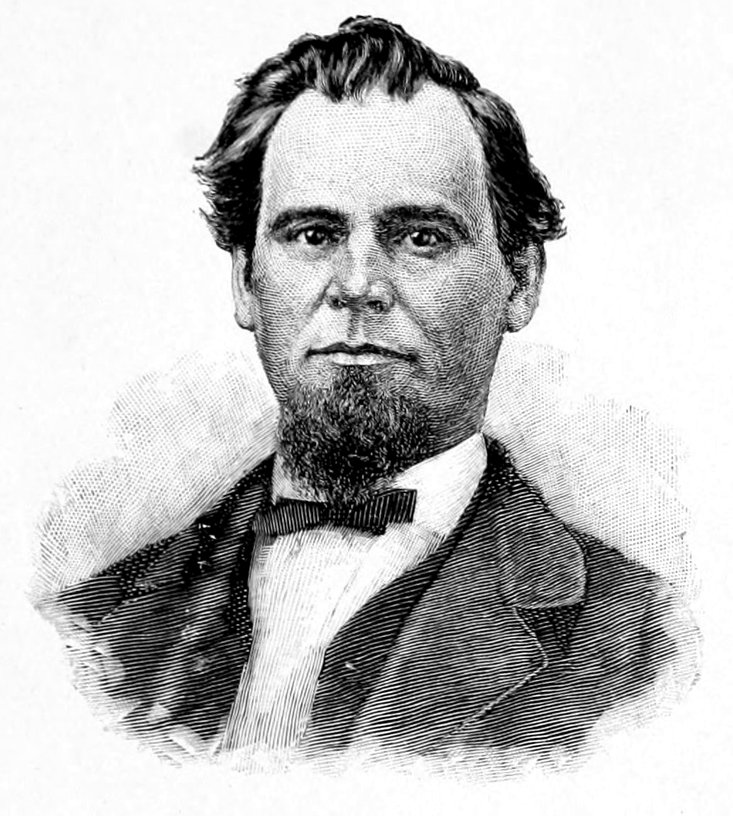
JUDGE WALTER B. DANCE
Miners’ Judge at Bannack
175Mrs. Davenport asked,
“Who are you?”
He replied, “The Robber of the Glen.”
“Oh!” she said inquiringly, “are you Johnny Glenn?”
“No,” he answered, “I’m the Robber of the Glen,
and want your money.”
Mrs. Davenport surrendered the three purses containing
the money, together with her gold watch, remarking
as she did so, that two of the purses and the watch belonged
to her. With much gallantry of manner the robber
restored them to her immediately, retaining only the single
purse belonging to her husband. The plundered couple
then proceeded to Benton, and Mrs. Davenport secured an
early passage to the States. They never knew who the
robber was.
While confined with his wound, Plummer repeatedly
asked permission of Doctor Glick to take a ride on horseback.
The necessity for quiet while the wound was healing
obliged the doctor invariably to refuse him. One
morning he called as usual to see how the cure was progressing,
and Plummer was not at home. The doctor
supposed he had gone out into the town, and at a later
hour called, and, on examination of the wound, was satisfied
that he had been taking violent exercise. On questioning
him, Plummer, who knew that the doctor dared
not betray him, told him of the robbery of Davenport,
which he had that day committed.
The robbers next broke into and rifled a bakery belonging
to one Le Grau, a Frenchman, who lived on a back
street in Bannack. Preparations were made for burning
the house, but the design was not carried out.
While atrocities like these were daily increasing, a
reign of terror more fearful in character and results pervaded
the settlement. Every man’s life was endangered by
the free and reckless use of fire-arms. The crack of
176pistols and guns, which weapons were always the first resort
of the roughs in settling disputes, was heard at all
hours of the day and night, in the saloon and restaurant.
Frequent and bloody affrays among themselves, often
terminated in the death of one or both of the parties engaged,
and sometimes of one or more of those who happened
to be within range of the reckless firing while the
quarrel was in progress. It was dangerous to pass along
the streets, where stray bullets were not an exception,
more dangerous still to attempt to allay a broil among
desperadoes, who settled all difficulties with bowie-knives
and revolvers.
On one of the days of this dismal period, two young
men, named Banfield and Sapp, the first a gambler, the
latter a miner, engaged in a game of poker in Cyrus Skinner’s
saloon. During the game, Sapp saw Banfield abstract
a card from the deck, by the aid of which he was
enabled to declare a “flush” hand. He charged him
with the theft. Jumping to his feet, Banfield drew his
revolver, which he levelled at the head of his antagonist,
who was unarmed. Jack Russell, who was watching the
game, now interfered, and quiet being restored, the men
resumed play. In a few moments Sapp again charged
Banfield with cheating. Banfield fired at him without
effect. Sapp being unarmed, Dr. Bissell thrust a revolver
into his hand, and the two men at once engaged
in a pistol fight, dodging around the posts which supported
the roof, and firing at random until their revolvers
were emptied. They then clinched, and Russell tried
to separate them. Moore and Reeves were in one of the
bunks fastened to the wall of the saloon, asleep. Roused
by the firing both got up, and Moore, pistol in hand, at
once joined in the fight. Placing the muzzle of his revolver
in Russell’s ear, he pulled the trigger, and the cap
failing to explode, he pulled a second time, with a like
177result. So rapid had been the movements of Moore, that
it was not until after the second failure that Russell could
turn his face toward him and exclaim,
“What do you mean?”
Moore, who had not recognized him until that moment
dropped his arm, replying,
“Oh, is that you, Jack?”
Russell said in explanation,
“These are friends of mine, and I want them to stop
quarrelling.”
Moore now assisted Russell, and they succeeded in a
few minutes in separating the combatants.
“Let’s all take a drink,” said Moore, “and be friends.”
To this Sapp and Banfield, as neither had injured the
other, assented. As they stood with their glasses raised,
Moore heard a groan, and going towards the table, saw
Buz Cavan’s dog just expiring.
“Boys,” said he, turning towards the two reconciled
men who were waiting for him to rejoin them at the bar,
“you’ve killed a dog.”
Banfield called immediately for more drinks, when another
groan was heard. On going to the bunk from
whence it came, they found George Carrhart writhing in
extreme agony. Dr. Bissell lifted him from the bunk to
the table, and after a brief examination of his body and
pulse, made the announcement,
“He is dying.”
Moore who stood by, on hearing this, called to Reeves
and Forbes who were standing in another part of the
room,
“Boys, they have shot Carrhart,” and with an emphatic
stroke of his fist upon the counter, he added with
an oath, “Let’s kill ’em,” simultaneously raising his
pistol and firing at both Sapp and Banfield. Russell
at the same moment seized his arm, with a view to
178prevent his shooting, and in the struggle misdirected his
aim. Meanwhile, Reeves fired at Banfield, who dodged
under a table and crept out of the back door with a shot
in his knee. Sapp, wounded in the little finger, also
retreated under the fire of the road agents,—a friend,
Goliah Reilly, rushing to his assistance, who also, upon
turning to escape, received a bullet in his heel.
George Carrhart was a fine-looking, intelligent, gentlemanly
man. He had been a member of the legislature of
one of the Western States. Whiskey transformed him
into a rowdy, made the company of ruffians congenial,
and led him on to his unfortunate fate.
Dick Sapp was a brave, generous young man, very
popular with the people. The next morning, accompanied
by several Colorado friends, he returned to Skinner’s
saloon. Skinner, who had seconded without participating
in the attempt of Moore and Reeves to kill him the evening
before, when he saw him enter, was alarmed for his
own safety, and sought to propitiate him by inviting him
and his friends to drink with him.
“No,” said Sapp, “I want none of your whiskey. Last
night I came here unarmed to indulge in a little game of
poker, and you all tried to kill me. Now I’m here to fight
you all, singly, and I’ve brought some friends, to see that
I have fair play.”
Moore and Skinner apologized, and begged him to overlook
it; but Sapp refused to accept their apologies, and
left. Afterwards some friends of Moore and Skinner, at
their request, went to Sapp, and with no little difficulty
effected a reconciliation.
Poor Banfield entrusted the care of his wound to an
unskilful physician, and died soon after, for the want of
proper treatment.
Early in the Spring of 1863, Winnemuck, a warrior
chief of the Bannacks, and his band of braves, camped
179in the sage brush above the town. One of the citizens of
Bannack made known the fact that he had been informed
by a white lad, whom he had met at the time of his escape
from these Indians several years before, that they had
slain his parents, and captured two sisters and himself.
The elder of the sisters died of harsh treatment. A white
girl who had been seen in Winnemuck’s band, was supposed
to be the other. A few citizens met at my cabin to devise
means for her ransom, as any attempt at forcible rescue
would provoke the Indians to violence. Skinner called
the roughs together at his saloon. They decided that the
circumstances were sufficiently aggravating to justify the
slaughter of the band, and made preparations for that
object. Meantime a half-breed apprised Winnemuck of
his danger. Nowise alarmed, the old chief ranged his
three hundred warriors along the valley, where they could
command the approach of an enemy, however formidable.
So confident was he of victory in the threatened encounter,
that he promised to follow it up by a general massacre
of every white person in the gulch. Fortunately at
this time, whiskey came to the rescue. The leaders got
drunk, the allied citizens were disgusted, and a murderous
enterprise that would probably have cost many lives
was abandoned. In pursuance of the arrangements first
made at the meeting in my cabin, Mr. Carroll, for a very
small consideration, effected the ransom of the little girl,
and took her to his cabin.
The inadequacy of the price roused in all a suspicion
that the Indians intended to recapture the child. Carroll
was enjoined to secrete her against such a possibility.
The Indians loitered around his cabin, and finally made
an attempt to carry her off. An alarm was given, the
citizens and roughs rallied, the Indians released the child,
and ran to escape the attack of the citizens. In the
mêlée, Hayes Lyons, one of the roughs, fired at and
180wounded an Indian who was on the retreat, and who at
the time was shouting “good Indian,” to intimate his
friendly disposition. “Old Snag,” a Bannack chief, who
had come with his band into town a few days before, and
who when the alarm was given was in Carroll’s cabin, now
came out, and was talking with his daughter, when Buck
Stinson, another of the ruffian gang, without the least
intimation of his design, walked close beside him, and
shot him in the side and head. The old man, who had
always been friendly to the people, fell dead in his tracks;
and Skinner, with savage brutality, came up and scalped
him.
CHAPTER XX A MASONIC FUNERAL
181
Had it been possible at any time during the period I
have passed under review, for the peaceable citizens
of Bannack to return to their old homes in safety,
such was the terror that environed them, I doubt not that
nearly all would joyfully have gone. The opportunity for
speedy accumulation of fortune from a prolific gold
placer, offered small compensation for the daily risk
of life in obtaining it, and the possibility of ultimate destruction
to the entire settlement. The people were spellbound,
and knew not what to do. They assented almost
passively to the belief that the ruffian population, when
disposed, was strong enough to crush them; and when a
murder was committed, or a robbery made, expressed no
stronger feeling than that of thankfulness for their own
escape.
While public sentiment was gradually settling down into
a state of helpless submission to the ruffian element, William
H. Bell, a respected citizen, died of mountain fever.
This was the first natural death that had occurred in
the settlement. After his illness had assumed a dangerous
form, he made known to myself and others that he
was a Mason, and expressed a desire to be buried with
Masonic ceremonies. At first we deemed it impossible,
but after his death, concluded to comply with his request,
if a sufficient number of Masons could be assembled to
conduct the exercises. A request for all the Masons in
the gulch to meet on Yankee Flat at the cabin of Brother
182C. J. Miller, on the evening of the day of Mr. Bell’s death,
greatly to our surprise, was so numerously responded to
that we found it necessary to adjourn to more commodious
quarters. It was past midnight before the forms
of recognition were fully administered, and preparations
completed for the funeral. So delighted were all to meet
so many of the order, that before we separated it was
virtually understood that early application should be made
for authority to open a lodge. In the meantime, we
agreed to hold frequent meetings.
The funeral ceremonies, the next day, were conducted
by myself. The strange peculiarities of the occasion
added a mournful interest to the impressive truths of the
ritual. A large congregation had assembled. Near by,
and surrounding the grave, stood the little band of brethren,
linked by an indissoluble bond to him for whom they
were now performing the last sad office. With clasped
hands and uncovered heads they reverently listened to the
solemn language which in that far-off land committed
one of their number to his mother earth; while farther
away, and encircling them, stood a curious multitude,
whose eager gaze betrayed that they there for the first
time beheld a Masonic burial ceremony. Among this
latter number might be seen many whose daily lives were
filled with deeds of violence and crime,—who mayhap at
the moment might be meditating murder and robbery,—who,
for the first time in many years, were listening to
language which recalled the innocence of boyhood, the
early teachings of parents, and hopefully pointed the
way to an eternity of unmixed enjoyment. How strange
it seemed to see this large assemblage, all armed with
revolvers and bowie-knives, standing silently, respectfully,
around the grave of a stranger, their very features,—distorted
by the lines which their hardened lives had
planted,—now saddened by a momentary fleeting thought
of the grave and immortality.
183Nor was this all. They learned from what they saw
that here was an association, bound together by bonds of
brotherly love, that would stand by and protect all its
members in the hour of danger. They saw the scroll deposited
which signified so plainly that death alone could
break a link in the mystic chain which bound them together.
They saw each brother drop the evergreen as
a symbol of the surrender of him they mourned to the
eternal care of a higher power. And while the brethren,
as they regarded each other in the light of their strong
obligations, felt that in themselves there was a power equal
to the necessities of their exposed condition, we may reasonably
suppose that the ruffians who had marked them
for ultimate destruction felt that a new and formidable
adversary had thrown itself across their bloody pathway.
The ceremonies were conducted to a peaceful conclusion,
and the assembly quietly dispersed. But from this
time onward, the Masons met often for counsel. Among
them there was no lack of confidence, and very soon they
began to consider measures necessary for their protection.
These meetings were carefully watched by the
roughs, but they were quietly told that the Masons met
to prepare for organizing a lodge. This threw them off
their guard, and they continued in their lawless course.
As a part of the burial service, I read the first ten
verses of the thirty-seventh chapter of the Book of the
Prophet Ezekiel, in these words:
“1. The hand of the Lord was upon me, and carried me
out in the Spirit of the Lord, and set me down in the midst
of the valley which was full of bones.
“2. And caused me to pass by them round about; and,
behold, there were very many in the open valley; and, lo,
they were very dry.
“3. And he said unto me, Son of man, can these bones
live? And I answered, O Lord God, thou knowest.
“4. Again he said unto me, Prophesy upon these bones,
184and say unto them, O ye dry bones, hear the word of the
Lord.
“5. Thus said the Lord God unto these bones: Behold,
I will cause breath to enter into you, and ye shall live.
“6. And I will lay sinews upon you, and will bring up
flesh upon you, and cover you with skin, and put breath in
you, and ye shall live; and ye shall know that I am the Lord.
“7. So I prophesied as I was commanded: and as I
prophesied, there was a noise, and, behold a shaking, and the
bones came together, bone to his bone.
“8. And when I beheld, lo, the sinews and the flesh came
upon them, and the skin covered them above: but there was
no breath in them.
“9. Then said he unto me, Prophesy unto the wind,
prophesy, son of man, and say to the wind, Thus saith the
Lord God: Come from the four winds, O breath, and breathe
upon these slain, that they may live.
“10. So I prophesied as he commanded me, and the breath
came into them, and they lived, and stood upon their feet, an
exceeding great army.”
Who can fittingly describe that solemn scene, wherein
was the beginning of the redemption of Montana from
ruffian rule? In a vast sense the death of Brother Bell
was a vicarious sacrifice. A new power arose in that beleaguered
land from that very hour, to which all honest
men instinctively turned for inspiration and for strength.
Verily, the vision of the Prophet Ezekiel of old, became
that day a new prophecy in a new land; for from the
dark cañons of those mountains, where the dry bones of
scores of murdered victims were lying, and symbolically
from the new-made grave of our Brother Bell, there arose,
“and stood up upon their feet, an exceeding great army,”
the avengers of outraged justice, even the Vigilantes of
Montana.
After the Masonic fraternity at Bannack had decided
to organize a regular lodge, and a dispensation for that
purpose had been applied for, Plummer expressed publicly
185a strong desire to become a Mason. Such were his
persuasive powers that he succeeded in convincing some
members of the order that, in all his affrays, he had
been actuated solely by the principle of self-defence, and
that there was nothing inherently criminal in his nature.
There were not wanting several good men among our
brotherhood, who would have recommended him for initiation.
It is a remarkable fact that the roughs were restrained
by their fear of the Masonic fraternity, from attacking its
individual members. Of the one hundred and two persons
murdered by Henry Plummer’s gang, not one was known
to be a Mason.
It is worthy of comment that every Mason in these trying
hours adhered steadfastly to his principles. Neither
poverty, persuasion, temptation, nor opportunity had the
effect to shake a single faith founded on Masonic principle:
and it is the crowning glory of our order that not
one of all that band of desperadoes who expiated a life
of crime upon the scaffold, had ever crossed the threshold
of a lodge-room. The irregularities of their lives, their
love of crime, and their recklessness of law, originated in
the evil associations and corrupt influences of a society
over which neither Masonry nor religion has ever exercised
the least control. The retribution which finally
overtook them had its origin in principles traceable to
that stalwart morality which is ever the offspring of
Masonic and religious institutions. All true men then
lived upon the square, and in a condition of mutual dependence.
Many persons who had been cooped up in Bannack,
with nothing to do during the winter, sallied forth in
quest of new discoveries as soon as the snow disappeared,
in the Spring of 1863. A number of new gulches were
found, and the population of Bannack thinned out considerably
under the inducements they offered for the
186improvement of fortunes. All these newly discovered placers
were, however, known by the general name of East
Bannack, the prefix being used to distinguish the locality
from West Bannack, a mining camp in that portion of
Idaho lying west of the main range of the Rocky Mountains.
As rapidly as any of these new camps were settled,
the miners adopted laws for their government, and
elected judges to enforce them. No sheriff had, however,
been elected to fill the place of Crawford. The miners
held a meeting at which they concluded to elect one sheriff
who should reside at Bannack, and appoint his deputies
for the new locations. A day for the election was accordingly
designated.
Plummer busied himself among the miners to obtain
the nomination, and as an evidence not less of the unsteady
purpose of this population than of the personal magnetism
of this remarkable man, he succeeded. Men, who a
few weeks before were clamorous for his execution as a
murderer, deceived by the plausibility of his professions,
and the smoothness of his eloquence, were now equally
urgent for his election to the most important office in the
settlement. Such of the number as were unwilling to support
him, nominated a good man by the name of Jefferson
Durley, but the majority for Plummer decided the election
largely in his favor. A marked change immediately
took place in his conduct. Soon after he was married to
Miss Eliza Bryan, the young lady with whom, as I have
related in a former chapter, he contracted an engagement
while spending the winter with her brother-in-law, Mr.
Vail, at the government farm on Sun River. Whether
he honestly intended to reform at this time, or “assumed
the thing he was not” for the better concealment of his
criminal designs, can never be certainly known. There
was much apparent sincerity in his conduct and professions.
He forsook the saloons, and was seldom seen in the
187society of his old associates. His duties were promptly
attended to. On one occasion in a conversation with me,
of his own seeking, he spoke regretfully of his early life.
“I confess,” said he, “that the bad associations which
I formed in California and Nevada have adhered to me
ever since. I was forced in sheer self-defence, on different
occasions, to kill five men there—and of course was undeservedly
denounced as a desperado and murderer. This
is not true,—and now that I am married and have something
to live for, and hold an official position, I will show
you that I can be a good man among good men. There
is a new life before me, and I want you to believe that I
am not unfitted to fill it with credit to myself, and benefit
to the community.”
As he stood thus, in a beseeching voice pleading for
some abatement of the harsh judgment which he knew his
conduct merited, it was not without an effort that I mentally
denied to him that confidence so truly characterized
by Pitt in his memorable reply to Walpole, as “a plant
of slow growth.” Very soon after, the justice of this
opinion was confirmed by an undercurrent of circumstances,
which plainly showed that he was either drifting
back into the whirlpool of crime, or had assumed the
guise of virtue that he might better serve the devil. His
face, usually clear and white, betrayed in its weather-beaten
appearance, that several times when there was no
occasion for it, he had been exposed to the inclemencies
of a fearful night storm. Where had he been? What
was the character of that business which could woo him
from his home, to face the angry elements, and require
his return and appearance on the street by daylight? At
one time, having occasion to go to the ranche where my
horse was kept, I saw there a very superior saddle horse.
Having never seen it before, on inquiry, I was informed
that it belonged to Plummer, who often visited the ranche
188to exercise it; but never rode it into town, or used it for
any long journey. It was represented to possess greater
qualities of speed and endurance than any horse in the
country. Why was he keeping this horse, unused, and
away from the public view, if not for the purpose of
escaping from the country in case of failure in his criminal
enterprise? Many other circumstances, equally demonstrative
as to the designs which Plummer was secretly
carrying on, satisfied me that I had not misjudged his
true character.
Life in Bannack at this time was perfect isolation from
the rest of the world. Napoleon was not more of an exile
on St. Helena than the newly arrived immigrant from the
States, in this recess of rocks and mountains. All the
stirring battles of the season of 1862,—Antietam, Fredericksburg,
and Second Bull Run,—all the exciting debates
of Congress, and the more exciting combats at sea,
first became known to us on the arrival of the first newspapers
and letters, in the Spring of 1863. Old newspapers
went the rounds of the camps until they literally
dropped to pieces. Pamphlets, cheap publications, and
yellow-covered literature, which had found their way by
chance into the camp, were in constant and unceasing demand.
Bibles, of which there were a few copies, were
read by men who probably never read them before, to
while away the tedium of the dreary days of winter. Of
other books there were none then, nor for a year or more
afterwards. Euchre, old sledge, poker, and cribbage were
resorted to until they became stale, flat, and disgusting.
When, afterwards, the first small library was brought into
the Territory, the owner was at once overwhelmed with
borrowers, who, after reading, loaned his books without
leave, until the loss or destruction of many of them drove
him to the adoption of means for the preservation of the
remainder. He placarded over his library, where all could
189read it, the following passage from Matthew xxv. 9: “Not
so; lest there be not enough for us and you; but go ye
rather to them that sell, and buy for yourselves.” This
gentle hint served better as a joke than an admonition.
As a counterpoise to this condition of affairs, the newcomer
found much in the rough, wild scenery, the habits,
customs, and dress of the miners, and in the pursuits of
the camp, to interest his attention. There was a freedom
in mountain life entirely new to him. The common forms
of expression, rough, unique, and full of significance, were
such as he had never been accustomed to hear. The spirit
of a humor full of fun, displaying itself practically on all
occasions, often at his own expense, presented so many
new phases of character, that he was seldom at a loss
for agreeable pastime, or, indeed, profitable occupation.
The wit of a mining camp is sui generis. It partakes
of the occupation, and grows out of it as naturally as the
necessities. Indeed, it is of itself a necessity,—for the
instance of a miner without humor or a relish for it, if it
be of the appreciable kind, is very rare. One must be
versed in the idiom of the camp to always understand it.
As for example, if, in speaking of another, a miner says,
“I have panned that fellow out and couldn’t get a color,”
it means the same as if he had said, “He’s a man of no
principle, dishonest, or a scamp.” So if, of another, he
says, “He’s all right, clear down to bed-rock,” it means,
“He is honest and reliable.” A hundred expressions of
this kind are in common use in a mining camp. Common
parlance has long ago wrung the humor from all these
oddities of expression; but every now and then something
new springs up which has its run through mining communities
as a bit of fun, before its final incorporation into
the epidemic vernacular.
It occasionally happens that a genuine loafer turns up.
This is not common; for a man without money or employment,
190among miners, especially if he evinces an indisposition
for work, is a pitiable object. Nobody cares for him.
His very necessities are subjects for ribaldry, and his
laziness affords ample excuse for a neglect which may end
in absolute starvation. There is no lack of kindness
among miners,—their generosity is only bounded by their
means in meritorious cases, but it is cruelly discriminative
against bummers and loafers. They must live by
their wits,—and sometimes this resource is available.
A singular genius known as “Slippery Joe,” whose
character reflected the twofold qualities of bummer and
loafer, hung around the saloons and restaurants in the
early days of Bannack. He worked when compelled by
necessity, and was never known to buy “a square meal.”
One evening he was an on-looker at a party of miners who
were playing euchre in Kustar’s bakery. Their frequent
potations, as was often the case, developing first noise,
then dispute, then quarrel, finally culminated in a fight
and general row. Pistols and knives were drawn, one
man was badly stabbed, and several shots fired. The by-standers
stampeded through the door and into the street,
to avoid injury. One man was prostrate, and another
bent over him, with an upraised knife. Kustar and his
bartender were engaged in quelling the mêlée. Seizing
this opportunity, Slippery Joe stole behind the counter,
and taking a couple of pies from the shelf, mashed them
out of shape with his knuckles, and laid them, still in the
tin plates, on the floor near the combatants. He did not
dare to steal the pies, knowing that detection would result
in his banishment from the gulch. Kustar, discovering
them after the fight was over, supposed from the appearance
they presented, that they had been jarred from
the shelf and trodden upon. He was about casting them
into the street, when Joe stepped forward, and offered
twenty-five cents for them, pies at the time being sold at
191a dollar apiece. Glad to sell them at any price, Kustar
regarded the quarter of a dollar as clear gain, and the
sneak owed his supper to his criminal ingenuity.
This same slippery individual was the hero of another
foraging exploit, which, however we may regard it in a
moral aspect, was not discreditable to his strategic perspicacity.
Two partners in a mining claim had quarrelled,
fought, and so far reconciled differences as to
agree to live together. One day a load of potatoes, the
first that we had had for eight months, and a great luxury
at sixty cents per pound, arrived from the Bitter Root
Valley. The two miners bought several pounds, and agreed
upon having a holiday, with an old-fashioned stew for
dinner at three o’clock P.M. Joe had epicurean tastes,
and longed for a dish of the stew. He stationed himself
near the door of the cabin. Just after it was taken from
the pan, and placed, steaming hot, between the partners,
and one was in the act of slicing the loaf, Joe entered,
and with much adroitness introduced the subject of former
difference. This brought on a dispute, and the two men
rose from the table and rushed into the street to engage
in a fist fight. While thus employed, Joe made a single
meal of the entire stew.
In the early days of gold hunting in California, many
young men of religious proclivities, who had been reared
by Christian parents, went there to make speedy fortunes
and return home. Failing to do so, unwilling to work, and
still intent upon suddenly acquiring wealth, they have
wandered from camp to camp among the mountains ever
since. These mining vagabonds are often met with. Their
lives have been full of vicissitude and disappointment, and
nature has covered them with signs and labels, which render
their character unmistakable. Lost to all self-respect,
ragged, uncombed, often covered with vermin, they seem
to have no definite object in life, and are content to earn
192enough to eke out a meagre subsistence. Sometimes we
meet with one, who betrays in the glow of conversation
the remains of a cultivated foreground; but generally the
slang of the camp and the rough manners of the miner
have wrought a radical transformation in both mind and
body.
Such an one was Bill—with whom I first became acquainted
in 1863. Passing Mather’s saloon, one day in
the Fall of 1872, I caught a glimpse of him, and stepped
in to renew my acquaintance. He stood by the bar talking
with a friend whom he had known at Boise City, Idaho,
in 1862. The conversation had reference to those early
days.
“Jim,” he inquired, “when did you hear of Yeast Powder
Dave last?” A little farther on in the conversation,
after taking a drink, Jim inquired in return, “Whatever
became of Tin Cup Joe?” Then the conversation flagging,
another drink was indulged, and the inquiry followed,
“How late have you heard where Six Toed Pete
hangs out?” At last Bill, fully warmed up to the subject,
remarked,
“Jim, you haven’t forgot the parson, have you?”
“Parson who?” inquired Jim dubiously.
“Parson Crib—you know.”
At the mention of the name, tears came into the eyes
of both. It was evident the memory of the man was very
pleasant. Bill continued,
“Jim, they don’t have no such preachers nowadays as
the parson was. These newcomers, most of ’em feel above
us ’cause we wear ragged clothes, and then they are so
slow and lamb-like, that their talks have little effect on
such fellows as you and me; but the old parson used to
rattle up the boys every clatter, and when he’d got
through they’d think their chances of salvation were
mighty slim. And he was such a good man, so charitable
193and so kind—and how beautifully and eloquently he
would explain the Christian religion as he talked to us of
our duties to the Master. He was a real good man. There
ain’t many like him.” Brushing a tear from his cheek,
he added sorrowfully, “Jim, do you know I never did
quite forgive Sam Jones for shooting the parson, for
stealing that sorrel mare.”
It must have been a warm affection which would fail
to approve of an act regarded so just as shooting or
hanging for “cribbing” a horse in a mining camp. The
parson is supposed to have held forth near Boise City.
Those of my readers who resided in Bannack at the
time doubtless remember the “Miners’ Ten Commandments,”
written copies of which were circulated freely
throughout the camp. I recall two of them. If the first
one here given serves to illustrate the prevailing customs
of a mining camp, the other contains a warning which
the dishonest and covetous did not fail to heed.
“Fourth Commandment. Thou shalt not remember what
thy friends do at home on the Sabbath day, lest the remembrance
may not compare favorably with what thou doest. Six
days thou mayst dig or pick all that thy body can stand
under; but the other day is Sunday, when thou shalt wash all
thy soiled shirts, darn all thy stockings, tap all thy boots,
mend all thy clothing, chop all thy whole week’s firewood,
make up and bake thy bread, and boil thy pork and thy
beans, that thou wait not when thou returnest from thy long
tour, weary. For in six days’ labor only, thou canst not
wear out thy body in two whole years; but if thou workest
hard on Sunday also, thou canst do it in six months, and
thou, and thy son, and thy daughter, thy male friend, and
thy female friend, thy morals, and thy conscience, be none
the better for it, but reproach thee shouldst thou ever return
with thy worn-out body to thy mother’s fireside, and thou
strive to justify thyself, because the trader and the merchant,
the carpenter and the blacksmith, the tailors and the Jews,
194defy God and civilization, by keeping not the Sabbath day,
and wish not for a day of rest such as memory and home and
youth made hallowed.
“Ninth Commandment. Thou shalt not tell any false
tales about ‘good diggings in the mountains’ to thy neighbor,
that thou mayst benefit thy friend who hath mules and provisions
and blankets and mining tools he cannot sell; lest in
deceiving thy neighbor, when he returneth through the snow
with naught save his rifle, he presenteth thee with the contents
thereof, and like a dog thou shalt fall down and die.”
CHAPTER XXI BATTLE OF BEAR RIVER
195
During the year preceding the period whereof I
write, and in fact from the time of the discovery
of the Salmon River mines, nearly every train or single
company of immigrants going in that direction was attacked,
robbed, the animals belonging to it stolen, and
frequently many of the persons composing it slain, by
predatory bands of Bannack Indians, which tribe possessed
the entire country for a distance of five hundred
miles north of Salt Lake City. Their rapacity and cruelty
had become the great terror of a journey otherwise full of
difficulty and discouragement. So frequent and terrible
had been this warfare, that nearly all communication between
the distant mines and Salt Lake City was suspended;
yet the wretches who conducted it, conscious of their superior
power, hesitated not, meantime, to visit the settlements,
and maintain an apparent friendliness towards the people.
Several attacks had been made upon them by detachments
of troops from Camp Douglas, attended with
more or less success, but none of them had the effect to
allay their murderous depredations. Success had made
them defiant as well as bloodthirsty, and long impunity
begot in them the belief that they were invincible.
When the winter began to close in, rich in the spoils
of their bloody forays, a large band of nearly three hundred
Bannacks, under their chiefs Sand Pitch, Sag Witch,
and Bear Hunter, established quarters for the cold months
in a ravine on the west bank of Bear River, about four
196days’ march distant from the Federal camp. Gen. P. Edward
Connor, the officer in command at Camp Douglas,
had carefully watched their movements with the intention
of inflicting the severest punishment upon them for the
enormities they had committed. The example to be salutary,
must be terrible, and Connor contemplated nothing
less than the destruction of the entire band. It was a
measure of safety. Many thousand people in the States
and Territories were engaged in active preparation to
make the journey to the northern mines, on the return of
warm weather, and the lives and property of many of
them depended, as General Connor knew, upon the success
of his contemplated expedition.
The Indians selected their camp because of the protection
it afforded from the inclemencies of the weather. The
general southwest course of the river was, by a bend,
changed so as to be nearly due west where it passed their
encampment. The nook or ravine, open on the bank,
stretched tortuously between high precipitous banks, north
from the river several hundred yards, until lost in the
abrupt ascent of a lofty overhanging mountain. Clumps
of willows grew irregularly over the surface of the little
dell, amid which the Indians pitched their buffalo tents,
and fastened their ponies for better protection against
wind and snow. Their women and children were with
them, and all the conveniences and comforts known to
savage life were clustered around them.
Perceiving soon after they took possession of the spot,
that it united with its other advantages admirable means
of defence against an approaching enemy, they went to
work, and improved, by excavation and otherwise, every
assailable point, until satisfied that it was perfectly impregnable.
During the occasional visits of their chiefs
and head men to the settlements, they learned and
came to believe that an attack of some kind would be
197made upon them before spring. They relished the idea
as a good joke, and with more than customary bravado
declared their readiness to meet it, boldly challenging the
whites to come on.
The winter sped on. Colder than usual even in these
high latitudes, both Indians and whites felt that if nothing
else would prevent an attack, the cold weather was
sufficient. General Connor kept his own counsel, but matured
his plans with consummate skill. The citizens of
Salt Lake City, seeing no military preparations in progress,
grew restive under the delay, charged the garrison
with neglect of duty, and finally appealed to the civil
authorities. In the latter days of January, when General
Connor’s plans were approaching maturity, Chief Justice
Kinney issued warrants for the arrest of Sand Pitch, Sag
Witch, and Bear Hunter, for murders committed by them
on emigrants passing through the Territory. The officer
directed to serve these writs, on one of the coldest days of
the middle of January, applied to General Connor, at
Camp Douglas, for an escort.
“I have an expedition against the Indians in contemplation,”
said the general, “which will march soon. You
can go under its escort; but as I do not intend to take
any prisoners, I cannot tell you whether you will be able
to serve your writ or not. My opinion is you will find
it difficult.”
Whether the intimation conveyed in this closing remark
touched the official pride of the marshal, or not, I
cannot say. Certain it is that he concluded at once to
accompany the expedition, and arrest the accused chiefs.
The Indians were on the watch for an attack, and had
their runners out with instructions to bring them the earliest
information of an approaching foe. On the morning
of the twenty-second, Captain Samuel N. Hoyt, with
forty men of Company K of infantry, two howitzers, and
198a train of fifteen baggage wagons, left Camp Douglas
with secret orders to march leisurely in the direction of
the Indian encampment. The Indian spies, under promise
of secrecy, were told by some who assumed to know,
that this was the army sent to exterminate the Indians.
They carried the intelligence to the Indians, where it excited
great derision. The little company marched very
slowly, making their roads through the snows of the divides,
and were careful to afford the Indian scouts full
opportunity to learn their strength and armament. The
chiefs unconcernedly gave orders to their warriors to
prepare for a warm reception of the foe, while they visited
the settlements. On the morning of the sixth day’s
march, Captain Hoyt and his men reached the vicinity of
the present town of Franklin, within a few hours’ march
of the Indian stronghold. Bear Hunter, who was there
at the time, seeing how few the men were in number, left
immediately in high glee, at the prospect of cutting them
off the next day.
At midnight that night, after a ride of four nights,
one of sixty miles, the others of easier marches, through
deep snows and a piercing, bitter wind that nearly disabled
a third of the command, Major McGarry, at the
head of two hundred cavalry, accompanied by General
Connor and his aids, rode into the little camp, and
bivouacked with the infantry. The Indians knew nothing
of this arrival. So far the plan for their destruction
was successful. The troops slept on their arms. Orders
were given to the infantry to march an hour after midnight.
They were obliged to break their road through
the snow, which completely covered the entire region to
the depth of one or two feet. The heavy howitzers were
dragged through it, over the unequal surface, with great
difficulty, and for the purpose of concealment, kept in the
rear. Several hours after the infantry started, the cavalry dashed by them and drew up on the south bank of
Bear River before the dawn broke over the Indian camp.
The savages were prepared for the attack. The ravine
rang with their fearful and defiant howling.
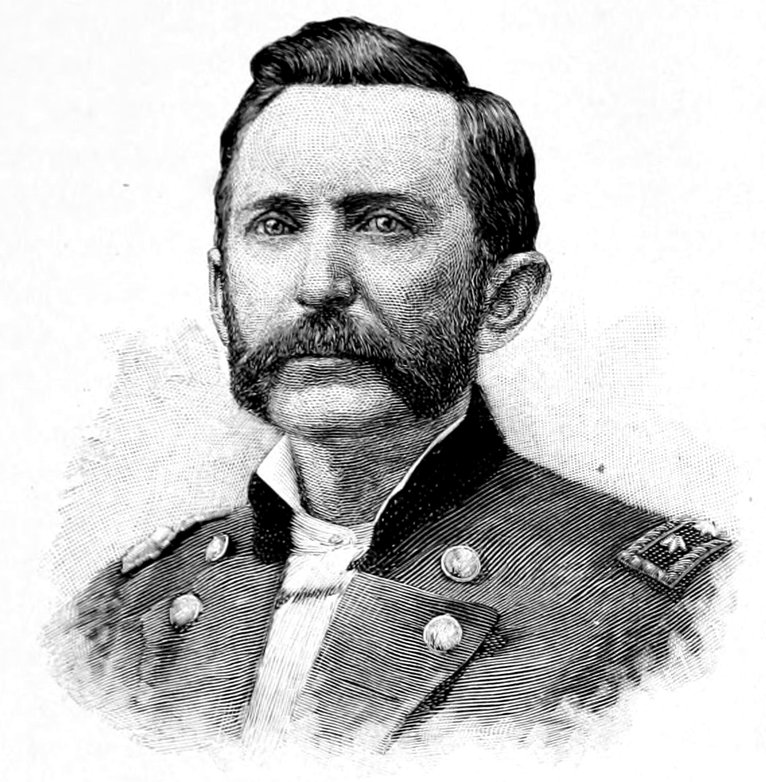
GENERAL P. E. CONNOR
Commander at Battle of Bear River
199The passage of the river was very difficult. Covered
at the bottom to the depth of a foot or more with anchor-ice,
its rapid current, too strong for congealment at its
surface, was filled with floating masses of ice, whose sharp
edges and great weight threatened disaster to every horse
which ventured the treacherous passage. But there was
no alternative. The troops who had dismounted to load
their pistols, now remounted their horses, and led by Majors
McGarry and Gallagher, by slow, tedious, and careful
effort, succeeded in reaching the northern bank in
safety. Before the passage was completed, however, the
companies of Captain Price and Lieutenant Chase, which
were the first to land, had drawn up in line of battle.
Captain McLean and Lieutenant Quinn, with their commands,
had barely joined them, when the Indians opened
the fight with a shower of balls, wounding one of the men.
General Connor had instructed McGarry to surround
the ravine, and was himself at this moment awaiting the
arrival of the infantry on the south side of the river.
He had not anticipated so early a commencement of the
fight, but leaving his orders to be given by his aid, he
hastily crossed the river and joined McGarry. That
officer finding it impossible with the two companies at his
disposal to outflank the Indians, ordered them to advance
as skirmishers. Up to this time the Indians had been
tantalizing our troops by their appearance upon the
benches, over which it was necessary to pass before an attack
could be made from the east on their stronghold. At
the approach of the skirmishing party they retreated under
cover of the precipitous bank, where, entirely protected
from our guns, they opened a galling and deadly
200fire, killing and wounding several of Connor’s men. The
General ordered his men to protect themselves as much as
possible, and sent McGarry forward with a detachment to
scale the mountain which enclosed the ravine on the north,
and outflank the Indians on the left, while the companies
on the benches attacked them in front.
At this stage of the fight, the most disastrous to our
troops, Captain Hoyt arrived with the infantry on the
south bank of the river. He had heard the firing at a
distance, and hurried forward his men, who in their eagerness
for the fray, attempted to ford the river, but found
it impossible. Wet and chilled they crossed the river on
cavalry horses sent from the north side, and galloped up
to the battle, just in time to enable McGarry, with their
assistance, to complete his flanking movement. Captain
Hoyt now came up with a portion of his men on the west
side of the ravine, extending the cordon so as to form
about three-fourths of a circle, embracing three sides of
the Indian camp. The fight now became very brisk. By
the enfilading fire from the east, west, and north sides of the
ravine, the Indians were gradually driven to the centre
and south. Their stronghold proved a complete cul
de sac, and they were entirely at the mercy of the
troops. Taken at this great disadvantage, and seeing
their chiefs and head men falling around them, they fought
with desperate bravery, moving slowly toward the mouth
of the ravine on the west side of which General Connor
had stationed a detachment of cavalry to cut off their retreat.
The great slaughter occasioned by the incessant
fire of the troops, at length broke the Indians’ line. Each
man sought how best to save himself. Many of them ran
in the most disorderly manner to the mouth of the ravine,
where they fell in heaps before the deadly fire of the rifles.
Some attempted to cross the river, but did not live to
effect it. Others crawled into the willow clumps with the
201hope of escaping notice, but the troops were ordered to
scour the bushes, and dislodge them. Many of these latter
disclosed their places of concealment by firing from
them upon the troops, as if resolved to sell their lives as
dearly as possible. The last Indian foe waited his opportunity.
While Major Gallagher was leading a detachment
into a thicket, the savage fired upon him. The ball
passed through his left arm into his side. Again the Indian
fired, and a cavalryman fell from his horse beside
General Connor. The flash of his rifle revealed his hiding-place,
and a volley from the detachment ended the bloody
contest.
The details I have here given of this battle, while they
sufficiently demonstrate the skill and bravery of the officers
and men by whom it was fought, would be wanting in
justice to them did I fail to mention other incidental facts
connected with it, which entitle them to additional claims
upon our gratitude and admiration. Few people who
have never experienced a winter in the Rocky Mountains
know how to appreciate the elemental difficulties attending
the march of such an expedition as this one of General
Connor’s. The sudden storms, the deep snows, the
trackless wastes, the rapid, half-frozen mountain torrents,
the lofty divides, the keen blasts, and the pinching nights,
coupled with all the unavoidable demands which must encumber
the movements of troops and artillery through a
country that for most of the distance is entirely desolate,
should give this expedition a conspicuous place among
the remarkable events of our country’s history. Seventy-four
of the number engaged in it had their feet frozen by
exposure. The night rides of the cavalry to overtake the
infantry would furnish as thrilling a theme for song as
any of the rides during our National struggle, which have
been thus immortalized. The transportation of munitions,
camp equipage, and heavy artillery through eighty
202miles of snow, which for most of the distance was unmarked
by a road, over mountains, through cañons, and
across unbridged streams, furnishes a chapter that can
find no parallel in our former military experience. I mention
them, that my readers may form some idea of the
amount of labor and care necessary to carry such an enterprise
through with success, and give the proper credit
to those who accomplished it.
Through the kindness of General Connor I am enabled
to give the names and rank of those who were killed and
wounded. All the officers and men fought with great
bravery. General Connor himself, during the entire four
hours the battle was in progress, was always in the thickest
of it, and seldom out of range of the deadly rifles of
the Indians. The historian of the battle says:
“General Connor exhibited high qualities of command,
and his perfect coolness and bravery are the universal
theme of praise. Possibly some might have been better
pleased with less exposure of their commander, but I have
the best authority for saying it was the call of duty, and
not indifference.”
The object of the fight was fully accomplished. Two
hundred and sixty-seven Indians were killed, several of
their leading chiefs among the number. Not fifteen escaped
to tell the story of the battle.
This victory removed at once and forever the greatest
impediment in the way of emigration to the new Territory
and a safe exit from it for those who wished to return
to their homes in the States. Previous to it people could
not, with safety, pass in either direction except in large
and strongly armed companies; and with certain exposure
to the Indians on the one hand, and the robbers and brigands
on the other, with no other possible outlet for
escape except by crossing the Territory to Fort Benton
or over the Cœur D’Alene Mountains to Walla Walla,
203both very uncertain and dangerous routes, the inhabitants
of the Territory were completely at the mercy of their
assailants. No more fortunate event could have occurred
at the time, than this successful extermination of a dangerous
foe.
The lesson this battle taught the Bannacks has never
been forgotten. The instance of an attack by other bands
upon the emigrants has never been known since that day.
It so reduced their tribe in number that they have ever
since been a broken and dispirited people. They are the
vagrants of the mountains, as remarkable for their pusillanimity,
as, in the days of Bonneville, they were for their
bravery, and the commanding position they held among
the mountain tribes.
The following is a list of the killed and wounded in the
fight:
Second Cavalry, Company A
Killed.—Privates, James W. Baldwin, George German.
Wounded.—Lieut. D. J. Berry; Privates, John W. Wall,
James S. Montgomery, John Welsh, William H. Lake, William
Jay.
Frozen.—Corporal Adolph Spraggle; Privates, John D.
Marker, J. Kearney, Samuel L’Hommidieu, R. McNulty,
G. Swan.
Company H
Killed.—Privates, John K. Briggs, Charles L. Hallowell.
Wounded.—Capt. Daniel McLean, Sergeant James Cantillon;[4]
Corporals, Philip Schaub and Patrick Frauley; Privates,
Michael O’Brien,[4] H. L. Fisher, John Franklin, Hugh
Connor, Joseph Clows, Thomson Ridge, James Logan, Bartele
C. Hutchinson, Frank Farley.[4]
Frozen.—Sixteen names not obtained.
Company K
Killed.—Privates, Lewis Anderson, Christian Smith, Shelbourne
C. Reed, Adolphus Rowe, Henry W. Trempf.
204Wounded.—Lieut. Darwin Chase,[4] Sergeant Sylvanus S.
Longley, Corporal Benjamin Landis; Privates, William Slocum,[4]
Albert N. Parker, John S. Lee, Walter B. Welton,
Nath’l Kinsley, Patrick H. Kelly, Eugene J. Brady, Silas
C. Bush, John Daly, Robert Hargrave, Morris Illig, Alonzo
A. P. V. McCoy.
Frozen.—Sergeant Wm. L. Beach; Corporals, Wm. L.
White and James R. Hunt; Privates, Stragder Ausby, Matthew
Almone, David Bristow, Fred W. Becker, Nath’l Chapman,
Sam’l Caldwell, Joseph Chapman, John G. Hertle,
Chas. B. Howe, Joseph Hill, George Johnston, Jefferson Lincoln,
Arthur Mitchell, James McKown, Alonzo R. Palmer,
Charles Wilson.
Company M
Killed.—Wagoner, Asa F. Howard; Privates, Geo. C. Cox,
Geo. W. Hoton, Wm. Davis.
Wounded.—Sergeants, Anthony Stevens[4] and Lorin Robbins,
Corporal L. W. Hughes; Privates, W. H. Wood, L. D.
Hughes, J. Legget, E. C. Chase, F. Barcafer, R. Miller,
M. Forbes, John Stevens, P. Humbert; Bugler, A. Hoffner.
Frozen.—Sergeant John Cullen; Corporals, A. P. Hewitt
and Wm. Steel; Privates, W. W. Collins, James Dyer, John
McGonagle, A. G. Case.
Third Infantry, Company K
Killed.—Privates, John E. Baker, Samuel W. Thomas.
Wounded.—Major P. A. Gallagher; Sergeants, A. J. Austin
and E. C. Hoyt; Privates, John Hensley, Thomas
Walker.
Frozen.—Sergeants, C. J. Herron and C. F. Williams;
Corporals, Wm. Bennett, John Lattman, and John Wingate;
Privates, Joseph German, James Urquhart, Wm. St. John,
Algeray Ramsdell, James Epperson, A. J. T. Randall, Wm.
Farnham, John Baurland, Giles Ticknor, Alfred Pensho, B.
B. Bigelow, J. Anderson, F. Bacralso, F. Branch, A. L. Bailey,
Wm. Carlton, D. Donahue, C. H. Godbold, J. Haywood,
C. Heath, J. Manning, Wm. Way.
| 205 |
| Recapitulation |
|---|
| |
| REGIMENT |
KILLED |
WOUNDED |
FROZEN |
TOTAL |
| 2nd Cavalry, Co. A |
2 |
6 |
6 |
14 |
| 2nd Cavalry, Co. H |
2 |
14 |
16 |
32 |
| 2nd Cavalry, Co. K |
5 |
15 |
19 |
39 |
| 2nd Cavalry, Co. M |
4 |
13 |
7 |
24 |
| 3rd Infantry, Co. K |
2 |
5 |
27 |
34 |
| |
|
|
|
|
| Total |
15 |
53 |
75 |
143 |
CHAPTER XXII ALDER GULCH
206
In May, 1863, a company of miners, while returning
from an unsuccessful exploring expedition, discovered
the remarkable placer afterwards known as Alder
Gulch. They gave the name of one of their number,
Fairweather, to the district. Several of the company
went immediately to Bannack, communicated the intelligence,
and returned with supplies to their friends. The
effect of the news was electrical. Hundreds started at
once to the new placer, each striving to outstrip the other,
in order to secure a claim. In the hurry of departure,
among many minor accidents, a man whose body, partially
concealed by the willows, was mistaken for a beaver, was
shot by a Mr. Arnold. Discovering the fatal mistake,
Arnold gave up the chase and bestowed his entire attention
upon the unfortunate victim until his death, a few
days afterwards. The great stampede with its numerous
pack-animals, penetrated the dense alder thicket which
filled the gulch, a distance of eight miles, to the site selected
for building a town. An accidental fire occurring,
swept away the alders for the entire distance in a single
night. In less than a week from the date of the first arrival,
hundreds of tents, brush wakiups, and rude log
cabins, extemporized for immediate occupancy, were scattered
at random over the spot, now for the first time trodden
by white men. For a distance of twelve miles from
the mouth of the gulch to its source in Bald Mountain,
claims were staked and occupied by the men fortunate
207enough first to assert an ownership. Laws were adopted,
judges selected, and the new community was busy in upheaving,
sluicing, drifting, and cradling the inexhaustible
bed of auriferous gravel, which has yielded under these
various manipulations a greater amount of gold than any
other placer on the continent.
The Southern sympathizers of the Territory gave the
name of Varina to the new town which had sprung up in
Alder Gulch, in honor of the wife of President Jefferson
Davis. Dr. Bissell, one of the miners’ judges of the gulch,
was an ardent Unionist. Being called upon to draw up
some papers before the new name had been generally
adopted, and requested to date them at “Varina City,”
he declared, with a very emphatic expletive, he would not
do it, and wrote the name “Virginia City,”—by which
name the place has ever since been known.
The road agents were among the first to follow in the
track of the miners. Prominent among them were Cyrus
Skinner, Jack Gallagher, Buck Stinson, and Ned Ray,—the
last three as deputies of Plummer in the sheriffalty.
Ripe for the commission of any deed, however atrocious,
which gave the promise of plunder, jackal-like they
watched the gathering crowd and its various industries,
marking each and all for early and unceasing depredation.
The Hon. Washington Stapleton who had been at work
in the Bannack mines from the time of their discovery, a
miner named Dodge, and another man, each supposed
to possess a considerable amount of gold, having determined
to go to Virginia City, Dodge was privately informed
by Dillingham, one of Plummer’s deputies, on the
eve of their intended departure, that Buck Stinson, Hayes
Lyons, and Charley Forbes had laid plans for robbing
them on the way, and had requested him (Dillingham) to
join them in the robbery. When the time for their going
208came, Dodge expressed his fear of an attack, and announced
his determination to remain. His friends rallied
him, until, smarting under their taunts, he revealed the information
given by Dillingham. Stinson, Lyons, and
Forbes heard of it, and determined to kill the informer.
Stapleton left his companions, and started for Virginia
City alone. At Rattlesnake he encountered Hayes Lyons,
who rode up and asked him if he had heard of the robbery
which Dillingham alleged had been planned against him.
Stapleton replied in the negative; but when telling the
story since, says that he has felt more comfortable even
when sleeping in church, than when he saw that scoundrel
approaching him. He told him, he says, that this was the
first he had heard of it, adding, “If you want my money,
I have only one hundred dollars in greenbacks. You had
better take that, and let me go.”
Lyons replied with an oath that the story was a lie,
and that he was then on his way to kill Dillingham for
putting such a story in circulation, but he feared Dillingham
had heard of his intention and left the country.
Stapleton accomplished his trip without molestation.
Lyons and Forbes rode on to Virginia City, also, and finding
Dillingham there, they, in company with Stinson, met
the next day and arranged for his assassination.
A miners’ court for the trial of a civil case was in session
the following morning near the bank of the creek
fronting the town. To the observation of a person unaccustomed
to the makeshifts and customs of a mining
community, the picture presented by this court of justice
would have exhibited many amusing features—not the
least of which was the place wherein it was held. The
Temple of Justice was a wakiup of brush and twigs, gathered
from the different coppices of willow and alder growing
upon the banks of the creek, thrown together in conical
form, and of barely sufficient capacity to accommodate
209the judge, clerk, parties, and jurors. Spectators were
indebted to the interstices in this primitive structure for
a view of the proceedings; and as no part of the person
except the eyes was visible to those within, the appearance
of those visual orbs bore no inapt comparison to a
constellation in a brush heap.
Dr. Steele, president of the gulch, acted as judge. He
united with much native good sense, great modesty of demeanor.
He was not a lawyer. On his trip from the
States, while crossing the plains, an unfriendly gust had
swept his only hat beyond recovery, and he came into
Montana with his brows bound in a parti-colored cotton
handkerchief, which, for want of something more appropriate,
not obtainable at the stores, he had worn until
some friendly miner possessing an extra hat presented him
with it. Proving too small to incase his intellectual organs,
the doctor had, by a series of indented slits encircling
the rim, increased its elasticity, so that, saving
a succession of gaps, through which his hair bristled “like
quills upon the fretful porcupine,” it answered the purpose
of its creation. With this upon his head he sat upon
the bench, an embodiment of the dignity, law, and learning
of this little mountain judiciary.
In the progress of the trial, the defendant’s counsel
asked for a nonsuit, on account of some informality of
service.
“A what?” inquired the judge with a puzzled expression,
as if he had not rightly understood the word.
“A nonsuit,” was the rejoinder.
“What’s a—” The question partly asked, was left
incomplete. The judge blushed, but reflecting that he
would probably learn the office of a nonsuit in the course
of the argument, he broke through the dilemma by asking,
“Upon what ground?”
210The argument followed, and the judge, soon comprehending
the meaning of a nonsuit, decided that unless
the defendant could show that he had suffered by reason
of the informal service, the case must proceed. Some of
the friends of the magistrate, seated near the door, understanding
the cause of his embarrassment, enjoyed the
scene hugely, and as it presented an opportunity for returning
in kind some of the numerous jokes which he had
played at their expense, one of them, thinking it too good
to be lost, with much mock sobriety of manner and tone,
arose and said,
“Most righteous decision!”
All eyes were turned upon the speaker, but before they
could comprehend the joke at the bottom, another arose,
and with equal solemnity, exclaimed,
“Most just judge!”
Dr. Steele, though embarrassed by this ill-timed jocularity,
was so well satisfied with his sagacity in finding out
what a nonsuit meant, without betraying his legal unlearnedness,
that the joke was taken in good part, and
formed a subject of frequent merriment in after times.
Charley Forbes was the clerk of the court, and sat beside
the judge taking notes of the trial. After the decision
denying the motion, the plaintiff passed around a
bottle of liquor, of which the court and jury partook.
Not to be outdone, the defendant circulated a box of
cigars. And it was while the spectators were giving expression
in various forms to their approval of the decision,
that Stinson and Lyons came into the court, and,
proceeding to the seat occupied by Forbes, engaged with
him in a whispered conversation inaudible to the by-standers.
After a few moments, Forbes suddenly rose in his
place, and, with an oath, exclaimed,
“Well, we’ll kill the scoundrel then, at once,” and accompanied
Stinson and Lyons out of the wakiup. The
211audience, startled by the announcement, hurriedly followed.
Dillingham had come over from Bannack in his
capacity as deputy sheriff, to look for some stolen horses.
He had come on the ground a moment before, in search
of Mr. Todd, the deputy at Virginia City, for assistance.
An assemblage of a hundred or more miners and others
was congregated in and about the place where the court
was in progress,—some intent upon the trial, others sauntering
through the crowd and along the bank of Alder
Creek. The three ruffians, after a moment’s conversation,
approached in company the spot where Dillingham stood.
“We want to see you,” said Lyons, addressing him.
“Step this way a moment.”
Stinson advanced a few paces, and looking over his
shoulder said to his companions,
“Bring him along. Make him come.”
Dillingham waited for no second invitation. Evidently
supposing that they had some matter of business to communicate,
he accompanied them to an open spot not more
than ten paces distant. There they all stopped, and facing
Dillingham, with a muttered curse Lyons said to
him,
“Take back those lies,” when with the quickness of
thought, they drew their revolvers,—Charley Forbes at
the same time exclaiming, “Don’t shoot, don’t shoot,”—and
fired upon him simultaneously. The groan which
Lyons’ ball drew from the poor victim as it entered his
thigh, was hushed by the bullet of Forbes, as it passed
through his breast, inflicting a mortal wound. He fell,
and died in a few moments. Jack Gallagher, who was in the
plot, rushed up, and in his capacity as a deputy sheriff,
seized the pistols of the three ruffians, one of which, while
unobserved, he reloaded, intending thereby to prevent the
identification of the villain who fired the fatal shot.
The deed was committed so quickly that the by-standers
212hardly knew what had happened till they saw Dillingham
stretched upon the ground in the death agony. The
court broke up instantly, and the jury dispersed. Aghast
at the bloody spectacle, for some moments the people surveyed
it in speechless amazement. The ruffians meanwhile
sauntered quietly away, chuckling at their own adroitness.
They had not gone far, until several of the miners,
by direction of Dr. Steele, arrested them. The reaction
from terror to reason was marked by the adoption of
vigorous measures for the punishment of the crime, and
but for the calm self-possession of a few individuals, the
murderers would have been summarily dealt with. An
officer elected by the people, with a detail of miners, took
them into custody, and having confined them in a log building,
preparations were made for their immediate trial.
Here again, as at the trial of Moore and Reeves, the
difficulty of a choice between a trial by the people, and
by a jury of twelve, occasioned an obstinate and violent
discussion. The reasons for the latter, though strongly
urged, were finally overcome by the paramount consideration
that the selection of a jury would devolve upon a
deputy sheriff who was in league with the prisoners, and,
as it was afterwards ascertained, an accomplice in the
crime for which they were arrested.
The people assembled en masse upon the very spot where
the murder had been committed. Dr. Steele, by virtue of
his office as president of the gulch, was appointed judge,
and at his request Dr. Bissell, the district judge, and Dr.
Rutar, associates, to aid with their counsel in the decisions
of such questions as should arise in the progress of the
trial. E. R. Cutler, a blacksmith, and James Brown
acted as public prosecutors, and H. P. A. Smith, a lawyer
of ability, appeared on behalf of the prisoners.
A separate trial was assigned to Forbes, because the
pistol which Gallagher had privately reloaded, was
213claimed by him, a fact of which he wished to avail himself.
In fact, however, the pistol belonged to Stinson. It
was mid-day when the trial of Lyons and Stinson commenced.
At dark it was not concluded, and the prisoners
were put under a strong guard for the night. They were
confined in a small, half-roofed, unchinked cabin, overlooking
Daylight Creek, which ran through a hollow filled
with willows. Dr. Six and Major Brookie had charge
of the prisoners. Soon after dark their attention was
attracted by the repeated shrill note of a night-hawk, apparently
proceeding from the willows. After each note,
Forbes commenced singing. This being noticed by the
guard, on closer investigation they discovered that the note
was simulated by some person as a signal for the prisoners.
They immediately ordered Forbes to stop singing.
He refused. They then proposed to chain the prisoners,
they objecting, and Forbes remarking,
“I will suffer death before you shall do it.”
He receded, however, under the persuasion of six shotguns
drawn upon a line with his head, and in a subdued
tone, said,
“Chain me.”
During the night Lyons sent for one of the citizens,
who, under cover of the guns of the guard, approached
and asked him what he wanted.
“I want you,” said he, “to release Stinson and Forbes.
I killed Dillingham. I came here for that express purpose.
They are innocent. I was sent here by the best
men in Bannack to kill him.”
“Who sent you?” inquired the citizen.
After naming several of the best citizens of Bannack,
who knew nothing of the murder until several days after
it was committed, he added,
“Henry Plummer told me to shoot him.” It was afterwards
proven that this was true.
214Hayes Lyons was greatly unnerved, and cried a great
part of the night; but Buck Stinson was wholly unconcerned,
and slept soundly.
The trial was resumed the next morning. At noon, the
arguments being concluded, the question of “guilty or not
guilty,” was submitted to the people, and decided almost
unanimously in the affirmative.
“What shall be their punishment?” asked the president
of the now eager crowd.
“Hang them,” was the united response.
Men were immediately appointed to erect a scaffold,
and dig the graves of the doomed criminals, who were taken
into custody to await the result of the trial of Forbes.
This followed immediately; and the loaded pistol, and the
fact that when the onslaught was made upon Dillingham,
he called out, “Don’t shoot, don’t shoot,” were used in
evidence with good effect. When the question was finally
put, Forbes, who was a young man of fine personal appearance,
and possessed of good powers as a speaker, made
a personal appeal to the crowd, which so wrought upon
their sympathies, and was so eloquent withal, that they
acquitted him by a large majority. In marked contrast
with the spirit which they had exhibited a few hours before
while condemning Stinson and Lyons to a violent death,
the people, upon the acquittal of Forbes, crowded around
him with shouts and laughter, eager to shake hands with
and congratulate him upon his escape. Months afterwards,
when the excitement of the occasion, with the memory
of it, has passed from men’s minds, Charley Forbes
was heard vauntingly to say that he was the slayer of
Dillingham. He was known to deride the tender susceptibilities
of the people, who gave him liberty to renew his
desperate career, and chuckle over the exercise of powers
of person and mind that could make so many believe even
Truth herself to be a liar. Among the villains belonging
215to Plummer’s band, not one, not even Plummer himself,
possessed a more depraved nature than Forbes; and
with it, few, if any, were gifted with as many shining accomplishments.
He was a prince of cut-throats, uniting
with the coolness of Augustus Tomlinson all the adaptability
of Paul Clifford. On one occasion he said to a
gentleman about to leave the Territory,
“You will be attacked on your way to Salt Lake City.”
“You can’t do it, Charley,” was the reply. “Your
boys are scattered, we are together, and will prove too
many for you.” Nevertheless, the party drove sixty miles
the first day out, and thus escaped molestation.
His early life was passed in Grass Valley, California.
While comparatively a youth, he was convicted of robbery.
On the expiration of his sentence, he visited his
old friends, and on his promise of reformation, they obtained
employment for him in McLaughlin’s gas works.
For a while his conduct was unexceptionable, and he was
rapidly regaining the esteem of all; but in an evil hour
he indulged in a game of poker for money. From that
moment he yielded to this temptation, until it became a
besetting vice. Not long after he entered upon this career,
he provoked a quarrel with one “Dutch John,” who threatened
to kill him.
Forbes told McLaughlin, saying in conclusion, “When
Dutch John says so, he means it.”
“Take my revolver out of the case,” said McLaughlin,
“put it in your breast-pocket, and defend yourself as occasion
may require.”
Forbes obeyed. Soon after, as he was passing along
with a ladder on his shoulder, an acquaintance said to
him,
“Dutch John is looking for you to kill you.”
“So I hear,” replied Forbes. “He’ll find me sooner
than he wants to.”
216A few rods farther on he saw John coming from the
Magnolia saloon, where he had been looking for Forbes.
Forbes sprang towards him, exclaiming with an oath,
“Here I am,” and immediately fired four shots at him.
John fired once in return, and throwing up his hands in
affright at the rapid firing of Forbes, ejaculated,
“O mein Gott!. Will I be murdered?”
A bystander who had witnessed the meeting, and saw that
John, who had expected an easy victory, was paralyzed
with fear, called to him,
“Turn your artillery loose!”
Forbes was tried for this crime, and acquitted. He was
afterwards convicted of crime of some kind in Carson City,
and imprisoned. On New Year’s day he succeeded in removing
his handcuffs, broke jail, and went to the sheriff’s
house, as he said upon entering, “to make a New Year’s
call.” The officer returned him to prison. From this
time, his career of crime knew no impediment.
On his first arrival in the mountains he corresponded for
some of the California and Nevada papers. His letters
were highly interesting. His true name was Edward
Richardson.
To return to Stinson and Lyons. After the demonstrations
of joy at Forbes’s escape had subsided, the people
remembered that there was an execution on the tapis.
Drawing up a wagon in front of the building where the
criminals were confined, they ordered them to get in. They
obeyed, followed by several of their friends, who took seats
beside them. Lyons became almost uproarious in his appeals
for mercy. The women, of whom there were many,
began to cry, begging earnestly for the lives of the criminals.
Smith, their lawyer, joined his petitions to those of
the women, and the entire crowd began to give way under
this pressure of sympathy. Meantime the wagon was
drawn slowly towards the place of execution. When the
217excitement was at its highest pitch, a man demanded in a
loud tone that the people should listen to a letter which
Lyons had written to his mother. This document, which
had been prepared by some person for the occasion, was
now read. It was filled with expressions of love for the
aged mother, regret for the crime, repentance, acknowledgments
of misspent life, and strong promises of amendment,
if only life could be spared a little longer. Every
sentence elicited fresh grief from the women, who now became
perfectly clamorous in their calls for mercy to the
prisoners. After the letter was read, some one cried out,
in derision,
“Give him a horse, and let him go to his mother.”
Another immediately moved that they take a vote upon
that proposition. Sheriff Todd, whose duty it was only
to carry out the sentence of the court, consented to this,
and the question was submitted to ayes and noes. Both
parties claimed the victory. It was then agreed that those
in favor of hanging should go up, and those opposed, down
the side of a neighboring hill. Neither party being satisfied,
as a final test, four men were selected, and those
who wished the sentence enforced were to pass between two
of them, and those who opposed, between the other two.
The votes for liberty were increased to meet the occasion,
by a second passage of as many as were necessary to carry
the question. An Irish miner, while the voting was in
progress, exclaimed in a loud voice, as a negro passed
through the acquittal bureau,
“Bedad, there’s a bloody nagur that’s voted three
times.”
But this vote, dishonest as it was, settled the question;
for Jack Gallagher, pistol in hand, shouted,
“Let them go. They’re cleared.”
This was a signal for a general uproar, and amid shouts
from both parties, expressive of the opinions which each
218entertained, some one mounted the assassins upon a horse
standing near, which belonged to a Blackfoot squaw, and
cutting the lariat, started them off at a gallop down the
gulch. At this moment one of the guard pointed to the
gallows, and said to another,
“There stands a monument of disappointed justice.”
Immediately after sentence of death had been passed
upon Stinson and Lyons, Dr. Steele returned to his cabin,
two miles down the gulch. The result of the trial had furnished
him with food for sad reflection,—especially as the
duty of passing the death sentence had devolved upon him.
Other considerations followed in quick succession. He has
since, when speaking of it, said that he never indulged in
a more melancholy reverie, than while returning home from
this trial. The youth of the convicts; their evident fitness,
both by culture and manners, for any sphere of active
business; the effect that their execution must have
upon distant parents and friends,—all these thoughts presented
themselves in sad array before his mental vision;
when, as he was about entering his cabin, a quick clatter
of hoofs roused him, and turning to see the cause, he beheld
the subjects of his gloomy reflections both mounted
upon the Indian pony, approaching at the animal’s swiftest
pace. He had hardly time to recover from his surprise,
and realize that the object was not a vision, until
the animal with its double rider passed him,—and Lyons,
nodding familiarly, waved his hand, accompanying the
gesture with the parting words,
“Good-bye, Doc.”
The body of the unfortunate Dillingham lay neglected
upon a gambling table in a tent near by, until this wretched
travesty was completed. Then a wagon was obtained, and,
followed by a small procession, it was hurriedly buried.
The tears had all been shed for the murderers.
“I cried for Dillingham,” said one, on being told that
219his wife and daughters had expended their grief upon the
wrong persons.
“Oh, you did,” was the reply. “Well thought of.
Who will pray for him? Will you do it, judge?”
Judge Bissell responded by kneeling upon the spot and
offering up an appropriate prayer, as the body of the unfortunate
young man was consigned to its mother earth.
Soon after the murder of Dillingham, Charley Forbes
suddenly disappeared. No one knew what became of him,
but it was supposed that he had fallen a victim to the vengeance
of his comrades for the course he had taken in securing
for himself a separate trial. This supposition was
afterwards confirmed by some of the robbers themselves,
who stated that in a quarrel with Moore at the Big Hole
River, Forbes was killed. Fearing that the friends of the
murdered ruffian would retaliate, Moore killed Forbes’s
horse at the same time, and burned to ashes the bodies of
horse and rider. This fact was known to Plummer only,
at the time of its occurrence.
Dillingham was a straightforward, honest young man,
and his office as deputy sheriff was given him under the
supposition that he would readily affiliate with the roughs.
Lyons, Stinson, and Forbes, who were also deputies, supposed
him to be as bad as they were.
On my trip east in 1863, the Overland coach in which
I had taken passage was detained a night by snow at
Hook’s Station in Nebraska. Ascertaining that I was
from Bannack, a young man at the station asked me many
questions about Hayes Lyons, telling me that he had
heard that he narrowly escaped hanging the previous
summer. I narrated to him the circumstances attending
the murder of Dillingham and the trial.
“He is my brother,” said the young man, and invited
me to go with him and see his mother and sister. I learned
that Hayes had been well brought up, but was the victim
220of evil associations. His mother wept while deploring his
criminal career, which she ascribed to bad company.
Later in the winter I received a letter from the father
of Dillingham, who resided at North Orange, New Jersey,
inquiring after his son. I replied, giving the particulars
of his son’s death, and the trial and escape of his murderers,
and of my subsequent meeting with the mother of Lyons.
In the meantime, Lyons had been hanged.
The father was almost heart-broken at the intelligence
of his son’s death, but in his letter, written in a kindly and
Christian spirit, he says:
“While the shocking details of the sad narrative are inexpressibly
distressing to us, it is a great alleviation to our
grief to know that an act of manly virtue and honor was the
superinducing cause that excited our son’s murderers in their
bloody purpose. Death under such circumstances, so far as
it relates to the poor sufferer himself, is praiseworthy in the
highest degree, and inspires us with thankfulness to God for
our son’s integrity, and with humble trust that it may be
overruled in infinite wisdom for our good; and is certainly a
thousand times to be preferred by the afflicted survivors, to a
knowledge of, compliance with, and successful prosecution of,
the infamous scheme proposed. Our hearts truly and deeply
sympathize with the sorrowing mother and family of the
criminal young Lyons. Truly, indeed, may it be said that
only God can assuage the poignancy of such sorrow as must
fill their bosoms. May He sustain and comfort them.
“It is satisfactory to know that summary measures were
finally, and in a good measure effectually, adopted by your
citizens, for ridding their interesting region of country of these
worse than savages. Retributive justice is almost invariably
sure, sooner or later, to overtake all such heaven-daring outlaws....
“Very sincerely yours,
“W. S. Dillingham.”
CHAPTER XXIII VIRGINIA CITY
221
No longer in fear of attack by the Indians, immigrants
had been steadily pouring into the Territory over
the Salt Lake route during the month of June. Many
came also over the mountains from Salmon River. The
opportune discovery of Alder Gulch relieved Bannack of a
large and increasing population of unemployed gold hunters,
who, lured by the overdrawn reports of local richness,
had exhausted all their means in a long and perilous
journey, to meet only disappointment and disaster at its
close. Almost simultaneously with the settlement at Virginia
City, other settlements lower down and farther up
the gulch were commenced. Those below were known by
the respective names of Junction, Nevada, and Central;
those above, Pine Grove, Highland, and Summit. As the
entire gulch for a distance of twelve miles was appropriated,
the intervals of two or three miles between the
several nuclei were occupied by the cabins of miners, who
owned and were developing the claims opposite to them, so
that in less than three months after the discovery, the gulch
was really one entire settlement. One long stream of active
life filled the little creek, on its auriferous course from Bald
Mountain, through a cañon of wild and picturesque character,
until it emerged into the large and fertile valley
of the Pas-sam-a-ri. Pas-sam-a-ri is the Shoshone word
for “Stinking Water,” and the latter is the name commonly
given in Montana to the beautiful mountain stream
which was called by Lewis and Clark, in their journal,
222“Philanthropy River.” Lateral streams of great beauty
pour down the sides of the mountain chain bounding the
valley, across which they run to their union with the Pas-sam-a-ri,
which, twenty miles beyond, unites with the
Beaverhead, one of the forming streams of the Jefferson.
Gold placers were found upon these streams, and occupied
soon after the settlement at Virginia City was commenced.
One of these, at Bivin’s Gulch, in the mountains twelve
miles from Virginia City, though limited in extent, was sufficiently
productive to afford profitable employment to a
little community of twenty or more miners. Twenty miles
below Virginia City on the route to Bannack, a man by
the name of Dempsey located a ranche, and built a large
cabin for the accommodation of travellers. Seven miles
above, and between that and Virginia City, another similar
building for like purposes was owned by Peter Daly, and
three miles above Daly’s was another owned by Mr. Lorrain.
These establishments are only important as they
serve to locate occurrences connected with this history.
Of the settlements in Alder Gulch, Virginia City was the
principal, though Nevada, two miles below, at one time
was of nearly equal size and population. A stranger from
the Eastern States entering the gulch for the first time, two
or three months after its discovery, would be inspired by
the scene and its associations with reflections of the most
strange and novel character. This human hive, numbering
at least ten thousand people, was the product of ninety
days. Into it were crowded all the elements of a rough
and active civilization. Thousands of cabins and tents
and brush wakiups, thrown together in the roughest form,
and scattered at random along the banks, and in the nooks
of the hills, were seen on every hand. Every foot of the
gulch, under the active manipulations of the miners, was
undergoing displacement, and it was already disfigured
by huge heaps of gravel, which had been passed through
223the sluices, and rifled of their glittering contents. In the
gulch itself all was activity. Some were removing the
superincumbent earth to reach the pay-dirt, others who
had accomplished that were gathering up the clay and
gravel upon the surface of the bed-rock, while by others
still it was thrown into the sluice boxes. This exhibition
of mining industry was twelve miles long. Gold was abundant,
and every possible device was employed by the gamblers,
the traders, the vile men and women that had come
with the miners to the locality, to obtain it. Nearly every
third cabin in the towns was a saloon where vile whiskey
was peddled out for fifty cents a drink in gold dust. Many
of these places were filled with gambling tables and
gamblers, and the miner who was bold enough to enter one
of them with his day’s earnings in his pocket, seldom left
until thoroughly fleeced. Hurdy-gurdy dance-houses were
numerous, and there were plenty of camp beauties to
patronize them. There too, the successful miner, lured by
siren smiles, after an evening spent in dancing and carousing
at his expense, steeped with liquor, would empty his
purse into the lap of his charmer for an hour of license
in her arms. Not a day or night passed which did not
yield its full fruition of fights, quarrels, wounds, or murders.
The crack of the revolver was often heard above the
merry notes of the violin. Street fights were frequent, and
as no one knew when or where they would occur, every one
was on his guard against a random shot.
Sunday was always a gala day. The miners then left
their work and gathered about the public places in the
towns. The stores were all open, the auctioneers specially
eloquent on every corner in praise of their wares. Thousands
of people crowded the thoroughfares, ready to rush
in any direction of promised excitement. Horse-racing
was among the most favored amusements. Prize rings were
formed, and brawny men engaged at fisticuffs until their
224sight was lost and their bodies pommelled to a jelly, while
hundreds of on-lookers cheered the victor. Hacks rattled
to and fro between the several towns, freighted with
drunken and rowdy humanity of both sexes. Citizens of
acknowledged respectability often walked, more often perhaps
rode side by side on horseback, with noted courtesans
in open day through the crowded streets, and seemingly
suffered no harm in reputation. Pistols flashed, bowie-knives
flourished, and braggart oaths filled the air, as
often as men’s passions triumphed over their reason. This
was indeed the reign of unbridled license, and men who at
first regarded it with disgust and terror, by constant exposure
soon learned to become part of it, and forget that
they had ever been aught else. All classes of society were
represented at this general exhibition. Judges, lawyers,
doctors, even clergymen, could not claim exemption. Culture
and religion afforded feeble protection, where allurement
and indulgence ruled the hour.
Underneath this exterior of recklessness, there was in
the minds and hearts of the miners and business men of this
society, a strong and abiding sense of justice,—and that
saved the Territory. While they could enjoy what they
called sport even to the very borders of crime, and indulge
in many practices which in themselves were criminal, yet
when any one was murdered, robbed, abused, or hurt, a
feeling of resentment, a desire for retaliation, animated
all. With the ingathering of new men, fear of the roughs
gradually wore away,—but the desire to escape responsibility,
to acquire something and leave in peace, prevented
any active measures for protection; and so far as organization
was concerned, the law and order citizens, though
in the majority, were as much at sea as ever.
Previous to the organization of the Territory of Idaho
on the third of March, 1863, all of that which is now
Montana west of the Rocky Mountains, was part of
225Washington Territory, with Olympia on Puget Sound as
capital. All east thereof belonged to Dakota, the capital
of which was Yankton on the Missouri, which by the nearest
available route of travel, was two thousand two hundred
miles distant. The existence of Bannack was not
known there at that time, to say nothing of the impossibility
of executing any Territorial laws, at such arm’s-length,
even if it had been. Our legal condition was not
greatly improved by the organization of the new Territory
of Idaho. Lewiston, the capital, was seven hundred miles
away, on the western side of the mountains. Eighteen
months had passed since we became part of that Territory,
before we received an authentic copy of the Territorial
Statutes, and when they came we had been half a year in
Montana.
In August, 1863, D. S. Payne, the United States Marshal
of Idaho, came over from Lewiston to Bannack to district
the eastern portion of the Territory and effect a
party organization of the Republicans. Our people felt
little interest in the measure. Some of the leading citizens
had requested, some time before, that I should make application
in person for them, at the next session of Congress,
for a new Territorial organization, east of the Cœur
D’Alene Mountains. Payne was urgent for a representation
of this part of the Territory in the Legislative Council,
and as an inducement for me to consent to the use of
my name as a candidate, offered to appoint any person
whom I might name to the office of Deputy United States
Marshal in the east side district.
A Union League had been for some time in existence in
Bannack, of which I was President. I asked the advice
of the members in making the appointment, first cautioning
them to ballot secretly, as by that means those who
otherwise would not support Plummer, who was known to
be a candidate, would escape detection by him. Neither
226Mr. Rheem, the Vice-President of the League, nor myself
voted. The votes cast, about thirty in number, were unanimous
for Plummer. Some one informed him of it. He expressed
his gratification at the result, and told me that
the confidence of the League in him should never be betrayed.
I immediately informed him that he must not
expect the appointment. He gave this reply a favorable interpretation,
and even after it was repeated, turned upon
his heel, laughing, and saying as he went,
“It’s all right, Langford. That’s the way to talk it
to outsiders.”
Soon after this, in a conversation with Mr. Samuel T.
Hauser, I informed him of the recommendation of the
League. Hauser replied,
“Whoever lives to see the gang of highwaymen now infesting
the country broken up, will find that Henry Plummer
is at the head of it.”
Amazed at the expression of an opinion so much stronger
than my own, I at once decided to reject the advice of the
League, rather than incur the responsibility of recommending
so dangerous a person for the office. Plummer heard
of it, and lost no time in asking an explanation, affecting
to believe that I had promised to recommend him. We
sat down upon an ox-shoeing frame, and talked over the
whole matter. He had his pistol in his belt. I was unarmed.
He said many provoking things, and used many
oaths and epithets, in his attempt to provoke a quarrel,
but all to no purpose. Finding that no excuse would be
given him for a resort to violence, he arose, and as we
parted, said,
“Langford, you’ll be sorry for this before the matter
ends. I’ve always been your friend, but from this time
on, I’m your enemy; and when I say this, I mean it in
more ways than one.”
These were the closing words of our last conversation.
We met afterwards, but never spoke.
227During that fall I was engaged in purchasing lumber
at Bannack to sell at Virginia City, where no sawmills had
yet been put in operation. The business required frequent
trips between the two places; and the ride of seventy miles
through a lonely country, whose surface alternated with
cañons, ravines, foothills, and mountains, afforded such
ample opportunity for secret robbery and murder, that it
required considerable ingenuity to throw the villains off
the track. With the threat of Plummer hanging over me
to be executed upon the first favorable opportunity, my
position was by no means an enviable one. I would send
forward the loaded teams, which were four days on the trip,
and on the morning of the fourth would follow, mounted on
a good horse, and arrive in Virginia City the same evening.
On my arrival my horse was immediately put in
charge of a rancher, or person who made the care of horses
a specialty. He would send it with a herd to a convenient
grass range, where it would feed in the care of herders
night and day until wanted. Then it was brought into
town and delivered at the office of the rancher. The order
for a horse was given the night before it was wanted, in
order to have the animal ready the following morning.
George Ives, who turned out to be one of the most desperate
of the gang of robbers, was the rancher’s clerk at
Virginia City. Whenever application was made for a
horse, unless the applicant was on his guard, Ives could,
by a careless inquiry, learn his destination. By communicating
this to his confederates, they could pursue and
rob, or kill the rider without delay or suspicion. To escape
this system of espionage it was my custom, when
ready to leave for Bannack or elsewhere, to send an order
by a friend to the rancher or Ives, requesting him to let the
bearer have the horse to go to some point which I designated,
in an opposite direction from my actual destination.
The friend would receive and mount the horse, and
228ride out of town, beyond observation, where I would meet
him and go on my way. Thirty journeys of this kind were
safely made between Virginia City and Bannack during
the fall, none, however, without the precaution of carrying
a pair of revolvers in my cantinas, and a double-barrelled
gun across my saddle.
During a brief stay in Omaha several years ago, I met
with Dr. Leavitt, who was a resident of Bannack while
Plummer dwelt there. He related the following incident,
which is repeated here, for the insight it affords of Plummer’s
malignancy.
“One night in October, 1863,” said the doctor, “I was
walking along the roadway of Main Street in Bannack.
The moon, obscured by clouds, shed a dim light, by which
I could see for a few yards quite distinctly. As I passed
your boarding-house, my attention was attracted by a
noise at my left. I stopped, and on close observation saw
a dark object under the window. My curiosity was excited
to know what it could be. Judge of my surprise on
approaching it to behold a man with a revolver in his hand,
on his knees at the window, peering into the room through
a space of less than an inch between the curtain and the
window casing. I watched him unobserved for some seconds.
Disturbed by my approach, he sprang to his feet
and darted around the corner of the building—but not
so rapidly as to escape recognition.
“‘Why, Plummer,’ I exclaimed, ‘what in the world are
you doing there?’
“Seeing that he was known, he came forward, laughing,
and replied,
“‘I was trying to play a joke on my friend Langford.
He and Gillette board here, and I heard their voices.’
“I was puzzled to conceive what sort of a joke he was
playing with a loaded revolver, but thought I had better
not be too curious to ascertain. Plummer accompanied me
229home. He said that you and he were great friends; that
you had done him many favors, and there was no person
in the world he esteemed more highly. I thought nothing
more of the matter, until I heard that Plummer had threatened
your life for refusing to recommend his appointment
as Deputy United States Marshal. I had no doubt then,
and have none now, that he was trying to get a sight
through the window for the purpose of shooting you.
Your departure for Salt Lake City a day or two after I
heard of your difficulty with him prevented me from informing
you of it at the time.”
Miners and others who had worked out or sold their
claims, were almost daily leaving the country. Often it
was known that they took with them large amounts of gold
dust. Various were the devices for its concealment. On
one occasion a small company contrived to escape plunder
by packing their long, slim buckskin purses into an auger
hole, bored in the end of their wagon tongue, and closing
it so as to escape observation. Others, less fortunate,
lost, not their money only, but their lives, in some of the
desolate cañons on the long route to Salt Lake. Many
left who were never afterwards heard of, and whose friends
in the States wrote letters of inquiry to the Territory
concerning them, years after they had gone. Whenever
a robbery was contemplated which the freebooters supposed
would be attended with unusual risk to themselves, Plummer’s
presence was required to conduct it. Knowing that
his absence would excite suspicion, he arranged that for
such occasions, he should be sent for, as an expert, to examine
a silver lode. But few discoveries had at this time
been made of this mineral, and Plummer’s Nevada experience
was thought to qualify him for determining its value
with considerable accuracy. A rough-looking prospector,
dressed for the purpose, would ride into town, exhibit his
specimens, and urge Plummer, who feigned reluctance, to
230go with him and examine his discovery, promising him a
claim as an inducement. Often would unsuspecting citizens
offer to aid Plummer in any work he might then have on
hand to enable him to go out, and, under pretence of examining
a silver lode, superintend the commission of a
daring robbery. Sometimes this same object was accomplished
by trumping up a charge against some imaginary
delinquent, and obtaining a warrant for his arrest from
the miners’ judge, which Plummer, as sheriff, rode away
to execute.
The following is one instance of Plummer’s method of
obtaining recruits. He called upon Neil Howie in the
Fall of 1863, whom he found hard at work mining, but
barely earning a subsistence.
“Neil,” said he, “this is a hard way to get a living.”
“I know it,” replied Howie.
“I can tell you of an easier way.”
“I’d like to know it.”
“There are plenty of men making money in this country,”
said Plummer, “and we are entitled to a share of it.”
Doubtful as to his meaning, or whether he understood;
him aright, Howie regarded Plummer with a puzzled expression,
making no reply.
“Come with me,” said Plummer, “and you’ll have all
you want.”
“You’ve picked up the wrong man,” replied Howie.
“All right,” said Plummer coolly. “I suppose you know
enough to keep your mouth shut.”
Howie remembered the fate of Dillingham, and heeded
the admonition.
The placer at Alder Gulch was immensely prolific. Probably
its yield in gold dust was not less than ten millions
of dollars before the close of the first year’s work upon
it. Money was abundant. Merchants and bankers were
obliged to exercise great ingenuity and caution in keeping
231it, as there were no regular means for sending it out of
the country. The only stage route was between Bannack
and Virginia City,—and a stretch of unsettled country,
four hundred and seventy-five miles in width, lay between
the latter place and Salt Lake City. There was no post-office
in the Territory. Letters were brought from Salt
Lake City to Virginia City, first at a cost of two dollars
and a half each, and later in the season at one dollar each.
All money, at infinite risk, was sent to the nearest express-office at Salt Lake City by private hands. In order to
gain intelligence of these occasional consignments, Plummer
induced some of the leading merchants to employ
members of his gang. When this could not be effected,
they were occupied so near and on such familiar terms, that
they could observe without suspicion all business operations,
and give him early notice of the transmission of
treasure.
Dance and Stuart commenced business in Virginia City
in the Fall of 1863, with a large stock of goods. George
Lane, better known as “Clubfoot George,” whose history
in the Salmon River mines I have already given, came to
them with a pitiful story of his misfortunes, and asked
for a place in their store for his shoemaker’s bench.
Though cramped for their own accommodation, they made
room for him. He commenced work, meantime watching
all their business operations, for the purpose of reporting
when and by whom they sent money to their Eastern
creditors.
CHAPTER XXIV COACH ROBBERIES
232
The placer at Alder Gulch was so extensive, so easy
of development, and so prolific, that many of the
miners who commenced work upon it in the early days of
its discovery, fortunate in their acquisitions, and disgusted
with their associations, were ready to return to the States
in the fall. Failing in this, they knew that they would be
doomed to a long winter of idleness, exposed to the privations
incident to a new and isolated region, and to the
depredations of a large and increasing criminal population.
The hegira, at first small, increased in numbers, so that,
by the first of November it could be numbered by hundreds,
who were on their return to their old homes. Many—perhaps
the greater portion—of those wayfarers travelled
in the conveyances which brought them to the country;
others on horseback; and a large number leaving Virginia
City on one of the two lines of coaches for Bannack,
trusted to chance for an opportunity to continue the journey
beyond that place. How many of these persons fell
victims to the road agents, on their long and perilous
journey, it is impossible to tell; but the inquiries of relatives
and friends for hundreds of them for months and
even years after their departure, leave no chance for doubt
that the villains drove a bloody and prosperous business.
Several of their most daring exploits occurred on the
route between Virginia City and Bannack, a region admirably
adapted to their purposes. Its frequent streams,
cañons, mountain passes, rocky ledges, willow thickets,
233and deep embosomed valleys, afforded ample means of concealment,
and advantages for attack upon passing trains,
with very few chances for defence or escape. The robbers
had their established points of rendezvous on the road, and
worked in concert by a system of horseback telegraphy, as
unfailing as electricity. Whenever it was known that a
person with money was about to leave by coach, a private
mark was made upon the vehicle, which would be recognized
wherever seen, at Daly’s, Baker’s, Dempsey’s, or
Bunton’s, the several ranches where the coach horses were
changed. Bunton, who kept the Rattlesnake ranche, was
the same villain who was associated with Plummer in the
shebangs near Walla Walla, of which an account has already
been given.
When the approach of the coach was perceived at either
of these changing stations, the herder in charge mounted
his horse, and rode hurriedly off to drive up the horses
for the next route, which were generally feeding in sight
of the station. Sometimes they strayed off, and the coach
would be delayed until they were found, but this was of
infrequent occurrence. Precisely the same system was followed
here as upon the plains in the days of the overland
mail stages.
The horses in use when not of the cayuse breed, were
bronchos, or wild horses from California, neither in quality
nor breed suited for the service, unreliable, and easily
broken down. They were driven very rapidly, and when
their speed gave out were turned loose as no longer fit for
use. As a consequence it was one of the chief difficulties
of a stage proprietor to secure horses which would insure
the punctuality of his trips. The trip between Virginia
City and Bannack was ordinarily completed between the
rising and setting of the sun.
Among the miners earliest to arrive and stake a claim
in Alder Gulch, was an Irishman by the name of Daniel
234McFadden, who soon became familiarized to the sobriquet
of “Bummer Dan.” Why he was thus designated was
never known, but it may be presumed that he early developed
some peculiarities, which, in the opinion of the
people, justified it. He was fortunate in securing one of
the richest claims in the gulch, and, making good use of
his time, had saved two thousand dollars or more in dust
by the middle of October. Having sold his claim, with
this gold in his possession, he made preparations for a
journey to Bannack. Securing it in buckskin purses, he
put them in a larger bag, and by means of a strap across
the shoulder, and a belt, contrived to conceal the treasure
under his clothing, and carry it very conveniently. One
raw, gusty day, toward the close of the month, he left Virginia
City on foot, and walked down the valley to Dempsey’s
ranche, on the Stinking Water, where he waited the
arrival of Peabody & Caldwell’s coach on its way to
Bannack.
Owing to the sickness of the driver, William Rumsey
was pressed into service for the trip, and the coach left
Virginia City at the usual hour in the morning, with
Messrs. Madison, Percy, and Wilkinson, as passengers.
One of the heavy snowstorms peculiar to this season and
latitude set in soon after the coach was under way, and
continued during the drive of the first ten miles, rendering
their progress slow and cumbersome. At Baker’s ranche
the passengers were obliged to wait until the herder, who
had been housed during the storm, could drive up the
horses. He returned after an hour’s search with an indifferent
team, which was driven on a run to Dempsey’s
ranche, to recover the time lost by the delay. Here “Bummer
Dan” took passage, and the same speed was maintained
to “Point of Rocks,” the locality known in Lewis
and Clark’s travels as Beaver Head Rock. The wearied
horses gave place here to a fresher team, which continued
235on a keen run to Bunton’s ranche on the Rattlesnake. It
was now sunset, and yet twelve miles to Bannack. The
herder who had brought up the horses for the change at
the usual hour, finding that the coach did not arrive on
time, had, under Bunton’s orders, turned them out again,
an hour before. Bunton pretended that he did not expect
the coach. The herder was sent out immediately after
the horses, and returned at dark with the report that he
could not find them. Rumsey then requested “Little
Frank,” a Mexican boy in whom he had confidence, to go
in search of the horses. He, too, soon returned with the
report that they could not be found. This “Little Frank,”
a few weeks afterwards, told Rumsey that the horses were
near at the time, but that before he started to look for
them, Bunton told him that if he did not report them to
be missing he would kill him.
A night with Bill Bunton was unavoidable, and the passengers
at once determined to “make a night of it.” Bunton
entered into the spirit of the occasion with them.
Whiskey was provided. They drank themselves hilarious,
sang, related adventures, and caroused until daylight;
but, to Bunton’s disappointment, without becoming intoxicated,
and never forgetting, meantime, their exposure to
robbery, or the convenience of a revolver in the belt.
At daylight two herders were sent for the horses. One
returned at eight o’clock, with the report that they could
not be found. An hour afterwards the other brought in
the same horses that came with the coach the previous evening.
“Necessity knows no law,” and so with a pair of
these for leaders, and two worn-out wheelers, the coach
was soon declared ready for a start. Just at this time,
Oliver’s coach from Bannack drove up, en route for Virginia
City, and fresh drinks were called for. In the meantime
a rough by the name of Bob Zachary, who was going
to Bannack with a couple of horses, insisted that Wilkinson
236should bear him company and ride one of them. They
departed on a canter in advance of the coach, and were
soon out of sight. Bunton, who had been distributing liquor
among the passengers of the coaches, and trying to
make himself generally agreeable, came out with the bottle
and a tumbler to give Rumsey a drink.
“Wait a few minutes, Billy,” said he, “and I will ride
to Bannack with you. These passengers will be gone in
a moment.”
“Get up on the box with me,” replied Rumsey. “These
old ‘plugs’ at the wheel will need pretty constant whipping,
and my exercise in that line yesterday has lamed my
arm.”
“I’m a good whipper,” Bunton responded, laughing,
“and if there’s any ‘go’ in them, I can bring it out.
They’re a pair of ‘played out’ wheelers that had been
turned out to rest, and I think we’ll fail to get them beyond
a walk,—but we’ll give them a try.”
The weather was cold and blustering. The curtains of,
the coach were fastened down. Percy, Madison, and
“Bummer Dan” got in, and Bunton mounted the box beside
Rumsey. The horses began to weaken before they
reached the crossing of the creek, less than a mile away.
There the road entered the gulch. Bunton, who had succeeded,
as he intended, in tiring the horses, surrendered
the whip to Rumsey and got inside the coach. He knew
what was coming. Rumsey whipped up the wheelers, but
could not urge them into any faster gait. Cursing his
“slow poke of a team,” his eye caught the figures of two
horsemen entering the gulch from a dry ravine a few rods
in front of the coach. They were wrapped in blankets,
with hoods over their heads, and armed with shotguns. It
flashed upon him that they were robbers.
“Look! boys, look!” he shouted. “See what’s coming.
Get out your arms. The road agents are upon us.”
237The eyes of every man in the coach were peering through
the loopholes at the approaching bandits. Madison, the
first to discover them, was searching for his pistol, when
the robbers rode up, and in broken Irish, and assumed
tones, with their guns aimed at the coach, yelled,
“Up with your hands, every one of you.”
This formula, always used, was generally concluded
with an abusive epithet. Bill Bunton, who had a part to
enact, threw up his hands and in an imploring voice, exclaimed,
“For God’s sake, don’t kill me. You are welcome to all
my money,—only spare my life.”
The other inmates raised their arms as commanded.
“Get out,” shouted the robbers, “and hold up your
hands. We’ll shoot every man who puts his down.”
The passengers descended hurriedly to the ground and
stood with their arms upraised, awaiting further orders.
Turning to Rumsey, who remained on the box holding the
reins, the robbers ordered him to get down, and remove
the arms from the passengers.
Not easily frightened, and anxious to escape a service
so distasteful, Rumsey replied,
“You must be fools to think I’m going to get down and
let this team run away. You don’t want the team. It can
do you no good.”
“Get down,” said the robber spokesman with an oath as
he levelled his gun at Rumsey, “or I’ll shoot the top of
your head off.”
“There’s a man,” said Rumsey, pointing to Bunton,
“who is unarmed. Let him disarm the others.”
“Oh!” replied Bunton in a lachrymose tone, “I’ll
hold the horses—I’ll hold the horses, while you take
off the pistols. Anything—anything, only don’t shoot
me.”
“Go then, and hold the horses, you long-legged coward,”
238said the robber; “and now,” he continued, levelling his
gun at and addressing Rumsey, “get down at once, and do
as you’ve been ordered, or you’ll be a dead man in half
a minute.”
The order was too peremptory to be disobeyed. Rumsey
tied the reins to the brake-handle, and jumped to the
ground.
“Now take them arms off,” said the robber, “and be
quick about it too.”
Removing the two navy revolvers from “Bummer Dan,”
Rumsey sidled off slowly, with the hope of getting a shot
at the ruffians; but they, comprehending his design, ordered
him to throw them on the ground. As the choice
lay between obedience or death, he laid them down, and
was proceeding very slowly to remove the pistols from the
other passengers, with the hope that by some fortunate
chance a company of horsemen or some friendly train
would come to the rescue before the villains could complete
their work.
“Hurry up there,” shouted the robber. “Don’t keep
us waiting all day.”
After the passengers were freed of their arms, and the
arms piled up near the road agents, the speaker of the
two ordered Rumsey to relieve them of their purses. Bunton,
who had all the time been petitioning for his life, took
out his purse, and throwing it towards Rumsey, exclaimed,
“There’s a hundred and twenty dollars,—all I have in
the world. You’re welcome to it, only don’t kill me.”
All this while, the men, not daring to drop their hands,
directed Rumsey in his search for their purses. He had
taken a sack of gold dust from Percy, one from Madison,
and two from “Bummer Dan,” and supposed his work to
be completed.
“Have you got all?” inquired the robber.
239“All I could find,” replied Rumsey.
Turning to Madison, the robber asked, pointing to the
sacks,
“Is that all you’ve got?”
“No,” said Madison, nudging his pocket with his elbow,
“there’s another in this pocket.”
The road agent, in an angry manner, cursing Rumsey
for trying to deceive him, ordered him to take it out.
“Don’t you leave nothing,” was the stern, ungrammatical
command.
Rumsey took the purse, and having added it to the pile,
was about to resume his seat on the box.
“Where are you going?” shouted both the robbers.
“To get on the coach, you fools,” retorted Rumsey.
“You’ve got all there is, and we want to go on now.”
“Go back there, and get the big sack from that Irish
bummer,” said one of the robbers; and pointing his pistol
at Dan, he added, “You’re the man we’re after. Get
that strap off your shoulder.”
Poor Dan! His money was very dear to him, but his
life was dearer. As he could not save both, he commenced
at once to remove the strap. Rumsey came up, and tried
to pull it out, but finding it would not come, stepped back,
while Dan was engaged in unbuckling the belt.
“Jerk it off,” shouted the robber; “or I’ll shoot you in
a minute.”
“Give him time,” interposed Rumsey; “you’ll not kill
a man when he’s doing all he can for you?”
“Well, hurry up, then, you awkward blackguard. We
have no time to lose.”
As soon as the belt was loosed, Dan drew forth a large,
fringed, buckskin bag containing two sacks, which he
handed to Rumsey, who tossed it on the heap.
“That’s what we wanted,” said the robber. “Now get
aboard, all of you, and get out of this as fast as you can;
240and if we ever hear a word from one of you, we’ll shoot
you on sight.”
They obeyed with alacrity. Bunton resumed his seat
beside the driver, and commenced whipping the horses, observing,
as they rode off, that it was the hottest place he
was ever in. At a turn in the road, Bunton looked back.
The bandits had dismounted. One held the horses; the
other was picking up the plunder, which, in all, amounted
to twenty-eight hundred dollars. After gathering up their
booty, the robbers galloped rapidly over the Indian trail
leading to Bannack, arriving there in advance of the coach.
When intelligence of the robbery reached Bannack, public
indignation was aroused, but the time had not yet arrived
for action. Had the robbers been recognized, they
would have fared hard on their return to Bannack, but
the people felt that it was better not to strike, than strike
at random.
George Hilderman, one of the robber gang, was present
at the express-office on the arrival of the coach, seemingly
as much surprised as any one at the intelligence of the
robbery. His real object, however, was to observe whether
the passengers had recognized the ruffians. If so, he was
to report it to them, that they might keep out of the way.
“Bummer Dan,” doubtless, had in his employ some person
in the confidence of the robbers; otherwise, his efforts
to avoid them might have been successful.
It was afterwards ascertained that Frank Parish and
Bob Zachary were the men who committed the robbery.
Bill Bunton, being in the secret, aided as much as possible
in delaying the coach over-night at Rattlesnake, and supplying
it with worn-out horses for the trip from his ranche
to Bannack. “Bummer Dan” and Percy recognized the
robbers, but were restrained by personal fear from exposing
them.
No man in this company was more feared by the ruffians
241than Rumsey. They could not frighten him, and no
warning of his friends prevented him from fully expressing
and ventilating his opinions concerning them. Nothing
would silence his denunciations, but his death; and
this being resolved upon by the robbers, they prepared to
improve the opportunity afforded by his return to Virginia
City, to accomplish it. It was so late in the day
when he arrived at Dempsey’s that he concluded to pass
the night there. Boone Helm, who had been awaiting his
appearance, met him in the bar-room soon after his arrival,
and invited him and other persons present to drink
with him. Rumsey drank with the company two or three
times. Helm called for more drinks.
“I’ve had enough,” said Rumsey, declining to drink
more.
“Take another, take another,” said Helm. “It’s good
to keep the cold out.”
“Not another drop,” replied Rumsey. “I know my
gauge on the liquor question, and never go beyond it.”
“You shall drink again,” said Helm, with an oath, casting
a malicious glance at Rumsey.
“I won’t drink again,” was the immediate reply, “and
no man can make me.”
“No man can refuse to drink with me and live,” replied
Helm, seizing his revolver as if to draw it.
Rumsey was too quick for him. Before the desperado
could draw his pistol, Rumsey had his levelled at his head.
Addressing him in a calm, steady tone, he said,
“Don’t draw your pistol, or I’ll shoot you, sure.”
The men gazed sternly upon each other for a minute
or more, Helm finally loosing his grasp of his pistol, and
saying,
“Well, you’re the first man that ever looked me down.
Let’s be friends.”
The courage of Rumsey inspired the robber with a respect
242for him which probably saved his life, as no further
molestation was offered him on his way to Virginia City.
Percy was the proprietor of a bowling alley in Bannack.
The roughs, in frequenting his saloon, would leave
their horses standing outside the door; and he had so often
seen the animals and accoutrements of each, that he easily
recognized the robbers by their horses and saddles. When
the coach arrived, Percy saw Frank Parish take Henry
Plummer to one side, and engage in conversation with him.
In a few minutes, Plummer came to Percy, and asked him;
if he knew the robbers. Percy replied,
“No; and if I did, I’d not be such a fool as to tell who
they were.”
Plummer tapped him on the shoulder, and replied,
“You stick to that, Percy, and you’ll be all right.
There are about seventy-five of the worst desperadoes ever
known on the west side of the mountains, in the country,
in a band, and I know who they are.”
Bunton, after this robbery, used occasionally to accost
Percy in a playful manner, with such language as, “Throw
up your hands”; or, “We were fools to be robbed, weren’t
we?” Percy, knowing that Bunton was one of the gang,
soon tired of this; and one day at a race-course, when thus
saluted, remarked, with unmistakable displeasure,
“That’s played out.”
The words were scarcely uttered, when Bunton raised
his pistol and fired at him. The ball grazed Percy’s ear.
Jason Luce, a driver of Mr. Oliver’s express, stepped up
and said to Bunton,
“If you want to fight, why don’t you take a man of
your own size, instead of a smaller one?”
Later in the day, while intoxicated, Luce called Bunton
a coward, in the presence of his brother, Sam Bunton.
The latter whipped him severely on the spot. Three days
later, Luce carried the express to Salt Lake City, Sam
243Bunton following four or five days thereafter. Luce met
him at the Salt Lake House.
“We had,” said he, addressing him, “a little difficulty
in Bannack, and now we’ll settle it.”
“It’s already settled,” said Bunton.
“You’re a liar,” replied Luce, and drawing his knife
cut Bunton’s throat, killing him on the spot. Luce was
arrested, tried, and found guilty of murder. By the Territorial
statute of Utah, he was authorized to choose the
mode of his execution, from the three forms of hanging,
shooting, or beheading. His choice was to be shot, and he
was executed in that manner.
Bill Bunton and Sam Bunton were natives of Ohio.
Their parents moved to Andrew County, Missouri, in
1839, and thence to Oregon in 1842, when they were respectively
sixteen and fourteen years old. The father was
a rough, drinking, quarrelsome man, clever, but uneducated.
CHAPTER XXV LEROY SOUTHMAYD
244
Early in the afternoon of a cold day late in November,
1863, Leroy Southmayd, Captain Moore, and a
discharged driver known as “Billy,” took passage in
Oliver’s coach at Virginia City, for Bannack. A ruffian
equally well known by the cognomens of “Old Tex” and
“Jim Crow” stood near, watching the departing vehicle.
As Moore’s eyes alighted upon him, he said to Southmayd,
“I am sorry to see that rascal watching us; he belongs
to the gang. It bodes us no good.”
“Oh,” replied Southmayd, laughing, “I think there’s
no danger. Robbery has ‘played out.’ These fellows are
beginning to understand that the people will hold them
accountable for their villainies.”
Little more was said about it, the conversation turning
to more congenial topics. About three o’clock, the coach,
which had made slow progress, drove up in front of Lorrain’s,
eleven miles from town. While Tom Caldwell, the
driver, was changing horses, George Ives and Steve Marshland
rode up, dismounted, and asked if they could procure
a change of horses. Having ascertained that they
could not do so, they ordered feed for those they had been
riding, Ives in the meantime carefully avoiding Southmayd.
The company fell into a desultory conversation,
which Ives abruptly terminated by remarking that he had
heard from Old Tex.
“He is,” said he, “at Cold Spring ranch. I must hasten
on and overtake him.”
245The coach soon departed, and Ives and Marshland immediately
ordered their horses, and riding rapidly, passed
it a short distance below Lorrain’s.
Cold Spring ranch was eight miles farther on the stage
route. That Old Tex, who was watching the coach when
it left Virginia City, should be there, awaiting the arrival
of these two ruffians, occasioned our passengers great uneasiness.
They knew almost intuitively that a robbery
was in contemplation. When the coach arrived at Cold
Spring, the first objects which met their gaze on alighting
from it, were the three ruffians Ives, Marshland, and Old
Tex in close conversation.
After a few moments’ detention, Caldwell drove on to
Point of Rocks, where the passengers remained until morning.
Leaving at an early hour, they proceeded to Stone’s
ranche, and during their brief stay there, Ives, who had
been joined by Bob Zachary and William Graves, known
as “Whiskey Bill,” made a detour, and passed the coach
unperceived. The three gentlemanly solicitors of the road
trotted slowly on towards Bannack. They were in complete
disguise, each one incased in a blanket of green and
blue. “Whiskey Bill” wore a silk hat, at that time, perhaps,
the only one in the Territory. His sleeves were
rolled above the elbows, and his face concealed behind a
black silk handkerchief, through the eyelets in which his
ferret eyes shone like a couple of stars, in partial eclipse.
The gray horse he bestrode was enveloped in a blanket so
completely that only his head, legs, and tail were visible.
The horses of his associates were similarly overspread.
Ives was masked in a piece of gray blanket, and Zachary
with a remnant of hickory shirting. No one, unsuspicious
of their presence, however familiar with their persons,
would have recognized them.
The coach horses moved forward at their usual rapid
rate, bringing the passengers in sight of the horsemen a
246little before eleven o’clock. Their attention was first attracted
by the peculiar costume, and the gun which each
man held firmly across his saddle-bow. As they approached
them more nearly, Southmayd observed to Caldwell, the
driver,—
“They’re queer-looking beings, Tom, anyhow.”
“They’re road agents, Leroy, you may depend upon
it,” replied Caldwell.
“Well,” said Southmayd, “I believe they are, but we
can’t help ourselves now.”
As he said this, the leaders were nearly up with the horsemen.
They rapidly wheeled their horses, and presented
their guns,—Graves taking in range the head of Caldwell;
Ives, that of Southmayd; and Zachary alternately
aiming at Moore and Billy.
“Halt!” commanded Ives; “throw up your hands,”
and on the instant the arms of every man in the coach were
raised.
“Get down, all of you,” he added.
All but Southmayd jumped to the ground. He lingered,
with the hope that an opportunity might offer to fire upon
them.
“Get down,” repeated Ives, adding a sententious epithet
to the command.
Still hesitating to comply, Ives glanced his eye along
his gun-barrel as if to shoot, and in that subdued tone always
expressive of desperation, once more issued the command.
Southmayd withstood it no longer, but while making a
deliberate descent threw open his coat, thinking that an
opportunity might offer for him to use his revolver. Ives,
perceiving his object, levelled his gun, and hissed out, in
words terribly distinct,
“If you do that again, I’ll kill you!”
The passengers stood with upraised hands by the
247roadside, under cover of the guns of the robbers. Addressing
Zachary, Ives said,
“Get down and look after those fellows.”
This was an unwelcome task for Zachary. Villain as
he was, Southmayd says that while he was engaged in
searching his person, he quivered like an aspen. Throwing
Southmayd’s pistol and money on the ground, he was
about to renew the search, when Billy, tired of the position,
dropped his hands.
“Up with your hands again,” roared Ives with an oath,
at the same time bringing the terrible muzzles to bear upon
the person of the frightened driver. Billy, who felt that
it was no time to bandy proprieties, threw them up with
more speed than pleasure, realizing that the buckshot were
safer in the barrels than in his luckless carcass.
Zachary now commenced searching Moore, and, taking
from his pocket a sack, inquired,
“Is this all you have?”
“All I have in the world,” replied Moore.
Zachary threw it on the heap and came to Billy.
“Give me your pistol,” said he. Billy placed the weapon
in his hands.
“Is it loaded?” inquired Ives.
“No,” replied Billy.
“Give it to him again,” said Ives to Zachary. “We
don’t want any empty weapons.”
“My God!” exclaimed Caldwell, as Zachary next approached
him. “What do you want of me? I have nothing.”
“Let him alone,” said Ives; and addressing Caldwell, he
inquired, “Is there anything in the mail we want?”
“I don’t think there is,” answered Tom.
Zachary mounted the box, and commenced an examination,
but found nothing. Caldwell scanned the villain narrowly,
for the purpose, if possible, of recognizing him.
248“Don’t you do that, if you want to live,” said Ives, rattling
his gun into dangerous range.
“Well then,” said Tom impudently, “may I look at
you?”
The robber nodded a ready assent, as much as to say,
“Find me out, if you can.”
The search over, Zachary picked up his gun, and stepped
back.
“Get up and skedaddle,” said Ives to the plundered
group. The horses had grown restive while the robbery
was progressing, but Tom had restrained them.
“Drive slowly, Tom,” said Southmayd to Caldwell in an
undertone, as he ascended the box. “I want to reconnoitre
a little,” and turned his face to the robbers.
“Drive on,” shouted Ives.
Southmayd still continued looking at the robbers as the
coach departed, which Ives observing, the villain raised his
gun, and yelled,
“If you don’t turn around and mind your business, I’ll
shoot the top of your head off.”
The three robbers then stood together, watching the
coach until it was lost to their view.
“By George!” said Leroy, laughing, “I looked down
into those gun-barrels so long that I thought I fairly saw
the buckshot leap from their imprisonment. It would have
afforded me pleasure to squander the bullets in my pistol
on the scoundrel.”
Southmayd lost four hundred dollars in gold, and Captain
Moore one hundred dollars in treasury notes. As was
usual, quite a large number of people were awaiting the
arrival of the coach, when it drove up to the express-office
at Bannack. Inquiries were immediately made as to the
cause of its detention so much later than common.
“Was the coach robbed to-day?” inquired Plummer of
Southmayd, as he jumped from the box.
249“It was,” replied Leroy, taking him by the arm, and by
his confidential manner signifying that he was about to
impart to him, as sheriff, all he knew about it. Just at
this moment, Dr. Bissell, the miners’ judge at Virginia
City, gave Southmayd a slight nudge, and catching his
eye, winked significantly for him to step aside.
“Be careful, Leroy,—very careful what you say to that
man.”
Leroy gave an appreciative nod, and rejoined Plummer.
“So you have been robbed,” said the latter. “I’m not
surprised,—and I think I can tell you who were the
robbers.”
“Who were they?” eagerly asked Southmayd.
“George Ives was one of them,” said Plummer.
“Yes,” responded Southmayd, “and the others were
‘Whiskey Bill’ and Bob Zachary; and I’ll live to see them
hanged before three weeks.”
Southmayd did not know that Plummer’s accusation was
made for the purpose of detecting his knowledge of the
robbers. Bissell, who had overheard Southmayd’s revelation
to Plummer, said to him soon after,
“Leroy, your life isn’t worth a cent.”
George Crisman, who was standing by, added,
“They’ll kill you sure.”
Business detained Southmayd in Bannack the succeeding
three days. During that time he never met Plummer,
who left him immediately after they held the conversation
above narrated.
Two days afterwards, while on his way to Virginia City,
Caldwell, the driver, met with “Whiskey Bill” at the Cold
Spring ranche.
“Did you hear of the robbery, Bill, on my trip out?”
he inquired.
“Sure, I did, Tom,” replied Bill. “Do you know any
of the fellows who committed it?”
250“Not I,” replied Caldwell, “and I wouldn’t for the
world. If I did, and told of them, I shouldn’t live long.”
“That’s so, Tom,” rejoined Graves. “You wouldn’t
live twenty-four hours. It’s always best to be ignorant in
matters of that kind. I’ve had experience, and I know.
I’ll just tell you, by way of illustration, about my being
robbed in California. One night as my partner and I were
riding along, two fellows rode up and told us to throw
up our hands. We did so, and they took from us two
thousand dollars in coin. I said to ’em, ‘Boys, it’s pretty
rough to take all we’ve got.’ They said so it was, and
gave us back forty dollars. A week afterwards I saw ’em
dealing faro. One of ’em saw me looking at him, and arose
and came up to me, and said in a whisper, ‘Ain’t you one
of the men that was robbed the other night?’ ‘Not at
all,’ says I, for I thought if I said ‘yes’ he would find a
way to put me out of the way. ‘Oh, well,’ says he, ‘honor
bright! I want you to own up. I know you’re the man.
Now, I’m going to give you four thousand dollars, just for
keeping your mouth shut.’ And he kept his promise. So
you see, Tom, that I saved my life, and got four thousand
dollars for keeping still.”
Tom wished somebody would treat him so, but when telling
the story, said that he “lacked confidence in human
nature, especially where the road agents were concerned.”
He even ventured the assertion that he “did not believe
Graves’ story, anyway.”
Ives went to Virginia City the day following the robbery.
While intoxicated at one of the fancy establishments,
he boasted openly of having made Tom Caldwell
throw up his hands, and that he intended to do it again.
Talking of the robbery with one of the drivers, he said,
“I am the Bamboo chief that committed that robbery.”
“Don’t you believe Caldwell knows it?” inquired the
driver.
251“Certainly he knows it,” replied Ives. “He recognized
me at once.”
As Ives and the driver were riding side by side into Virginia
City, on their return from Nevada, the driver saw
Caldwell approaching. He motioned him to keep away.
Caldwell turned and went away, and was afterwards told
that Ives knew he had recognized him in the robbery, and
would probably kill him on sight. The driver, who expected
that Ives would shoot at Caldwell, had his revolver
in readiness to shoot him at the time alluded to, in case
Ives manifested such a design.
Meantime, Southmayd, having finished his business at
Bannack, was ready to return to Virginia City by the next
coach. His friends were importunate for him to remain.
On the day he was to leave, Buck Stinson and Ned Ray,
on being told of it at the express-office, avowed their intention
of accompanying him. The agent then searched
for Southmayd, and said to him,
“For God’s sake, Leroy, don’t go. These fellows mean
to kill you.”
“I’ve got to go,” replied Southmayd; “and if you’ll
get me a double-barrelled shotgun, I’ll take my chances.”
The agent complied with this request, and the coach left
Bannack with Southmayd, Stinson, Ray, and a lad of sixteen
years for passengers, and Tom Caldwell the driver.
The coach was an open hack. Southmayd sat on the
driver’s seat with Caldwell, and the boy took the back
seat, and facing him were Stinson and Ray on the
middle seat. Southmayd said to the boy on starting,
“If we have any trouble, do you shoot, or I’ll shoot
you.”
“You may be sure I’ll do it, too, Southmayd,” said
the boy. “I’m not afraid of them.”
Southmayd kept watch of the two robbers. The drive
through the day was undisturbed, until the coach reached
252the crossing of the Stinking Water. In the three persons
standing in front of the station, Southmayd recognized
Bob Zachary, Bill Graves, and another noted rough known
as Alex Carter. Stinson shouted, addressing them as road
agents. Each was fully armed with gun, pistol, and knife.
Southmayd whispered to Caldwell,
“Tom, I guess they’ve got us.”
“That’s so,” replied Caldwell.
Caldwell drove on to Cold Spring station followed by the
three roughs on horseback, who soon came up. This was
the supper station. Two of the robbers left their guns at
the door. Carter’s was strung upon his back. They entered
the house in a boisterous manner, with Zachary,
feigning drunkenness, in their lead.
“I’d like,” said that ruffian with brutal emphasis and
gesture, “to see the man who don’t like Stone.” The banter
was made for the purpose of exciting a quarrel. “Just
show me the man that don’t like him, or let any man here
just say he don’t like him, if he wants a healthy fight on
his hands,” blustered the villain.
No one replied. Seemingly every one present entertained
a high opinion of Mr. Stone. Failing to rouse a quarrel,
he ordered “drinks all round,” bought a bottle of whiskey,
and preserved the swagger and braggadocio of a drunken
ruffian through supper time.
After supper, and while preparing to leave, Southmayd
said privately to Caldwell,
“Tom, I see through it all. You must take Stinson on
the seat with you. I’ll sit behind and watch him, and the
boy can watch Ray.”
When ready to start, and this arrangement was made
known to Buck Stinson, he did not relish it, and said,
“I don’t want to ride up there.”
“Well, you will,” replied Southmayd sternly, pointing
to the seat.
253“This is pretty rough, isn’t it?” said Stinson with an
oath, as he mounted to the seat.
The three mounted ruffians, Zachary, Graves, and Carter,
started on in advance of the coach. Southmayd and
the boy sat with their guns across their knees, watching the
motions of their suspected companions. It was near nightfall.
Less than half a mile distant from the station, the
robbers, who had been riding at an even pace, suddenly
wheeled, and gave the command to halt, simultaneously
with which, Southmayd levelled his gun upon Carter, and
Caldwell and the boy theirs on the other two.
Carter, stammering with alarm, made out to say, “We
only want you to take a drink.”
The bottle was passed around, Southmayd and Caldwell
barely touching it to their lips. Handing it to the boy,
Southmayd gave him an admonitory touch with his foot,—comprehending
which, he did not drink. As Carter had
not drunk from the bottle, Southmayd feared that the liquor
had been poisoned. Returning the bottle, the roughs
who received it inquired politely if they did not want any
more. The three then wheeled their horses, exclaiming,
“We’re off to Pete Daly’s,” and, clapping spurs to
their horses, they were soon out of sight.
The coach went on six miles, passed Daly’s ranche, and
drew up at Lorrain’s. From this ranche to Virginia City,
the road for most of the distance is rough, narrow, and lies
through the cañon of Alder Gulch. Nature never formed
a fitter stretch of country for successful robbery. Of this
our passengers were fully aware, and, anticipating that the
designs of the robbers must culminate on this part of
the route, Southmayd took Caldwell aside to consult as to
the proper course to pursue.
“It’s a rough night’s work, Tom,” said Southmayd,
“but the worst is to come. If they attack us in the cañon,
there is no possible chance for escape.”
254“They’ll do it, sure,” replied Caldwell. “It’s only
driving into their hands to attempt to go on to-night.
Let’s leave the coach here and take to the brush. We may
then avoid them; or if we meet, it will be where the chances
are equal.”
Buck Stinson, who had been on the watch for some new
arrangement, overheard this conversation. Anxious as
he was that the robbery and murder should take place, he
knew that if the men escaped, as they assuredly would by
the means contemplated, they would bring the whole community
of Virginia City on the track of himself and his
fellow ruffians. This must be avoided, even though they
were frustrated in their design. So he stepped forward,
and said to Southmayd and Caldwell in his blandest
manner,
“Gentlemen, I pledge you my word, my honor, and my
life, that you will not be attacked between this place and
Virginia City.”
“If you mean that,” replied Southmayd, “we will go
on; but if we are attacked, we will certainly make it hot
for some of you.”
Soon after the horses started, Stinson commenced singing
in a very loud voice, and continued to do so without
intermission until nearly exhausted. Then, at his request,
Ray took up the chorus and kept it up until their arrival
in Virginia City. This was a signal to the robbers to keep
away. Had the singing ceased, the attack would have been
made. Ray called on Southmayd the next day, and warned
him, as he valued his life, to mention the names of none of
those among the ruffians whom he had recognized, as the
ones who robbed him while on his way to Bannack.
CHAPTER XXVI JOURNEY TO SALT LAKE CITY
255
Dr. A. J. Oliver had been running a letter express
between Bannack and Salt Lake City during the
year, and early in the autumn had substituted for a single
saddle horse and pack-animal, a small lumber wagon, with
conveniences for the transportation of a few passengers.
It was at best, a very precarious mode of conveyance; but
as it was the only public one, it was always full. Mr. Samuel
T. Hauser (afterwards appointed Governor of Montana
by President Cleveland) and I had been for some
time contemplating a trip to the States, and being now
ready, I left Virginia City for Bannack, expecting to find
the express on my arrival, and make arrangements for
our passage to Salt Lake City on its return trip. The day
before I left, one Ed French had shot at me. The bullet
slightly grazed an eyeball, doing no further damage than
that of shaking the eye in its socket, and inflicting considerable
pain. I contracted a severe cold on the ride to
Bannack, which settled in the eye, producing inflammation
and temporary blindness. For two weeks I shut myself in
a dark room, ulceration in the meantime bringing relief
and restoring sight.
While thus confined, friends occasionally called upon me,
and one day I was informed that Ned Ray was in town,
and had been making particular inquiries after me. The
next day I was told that Buck Stinson was there on the
same errand. When I left Virginia City, both of these
ruffians were at that place. I was convinced that they had
256left there to pursue me on the road to Salt Lake City. Ray
was observed to watch my boarding-house, on repeated occasions,
very closely.
Upon applying to Mr. Oliver for transportation, that
gentleman informed me that snow was falling on the
Pleasant Valley divide, and that he should abandon the
wagon and return to Salt Lake City with a pack-mule.
Disappointed in my expectation of finding a conveyance,
I wrote to Mr. Hauser, who came over immediately.
Messrs. Dance and Stuart, wholesale merchants of Virginia
City, had arranged to send by us to their creditors
at St. Louis, fourteen thousand dollars in gold dust. It
was contained in a buckskin sack, and sealed. Clubfoot
George, whose honesty none of us suspected, had heard us
hold frequent discussions in the store of Dance and Stuart,
as to the chances of safely getting through with it to the
States.
Hauser was somewhat surprised on entering the coach
at Virginia City, to find that he had Plummer for a fellow
passenger. Believing, upon reflection, that Plummer
was going to Bannack to plan means for robbing him, he
resolved to act as if he had the most implicit confidence in
his integrity. He accordingly made no effort to hide the
sack from view, or conceal the fact that he was going to
the States; talked freely and confidentially, and seemed
entirely at ease in Plummer’s society. The trip was made
in safety, though Hauser confessed that while passing
through Rattlesnake Cañon, he did not forget the unenviable
notoriety which frequent robberies had gained for it.
When the coach drove up to Goodrich’s hotel in Bannack,
he felt greatly relieved, and with the sack of gold
enveloped in the several folds of his blankets, entered the
sitting-room, where he was met by some old friends, and,
as was customary in those days, congratulated on his safe
arrival. In a few moments he drew forth the sack, and
in the presence of Judge Edgerton and several other leading
citizens, turned to Plummer who was standing near,
and thus carelessly addressed him:
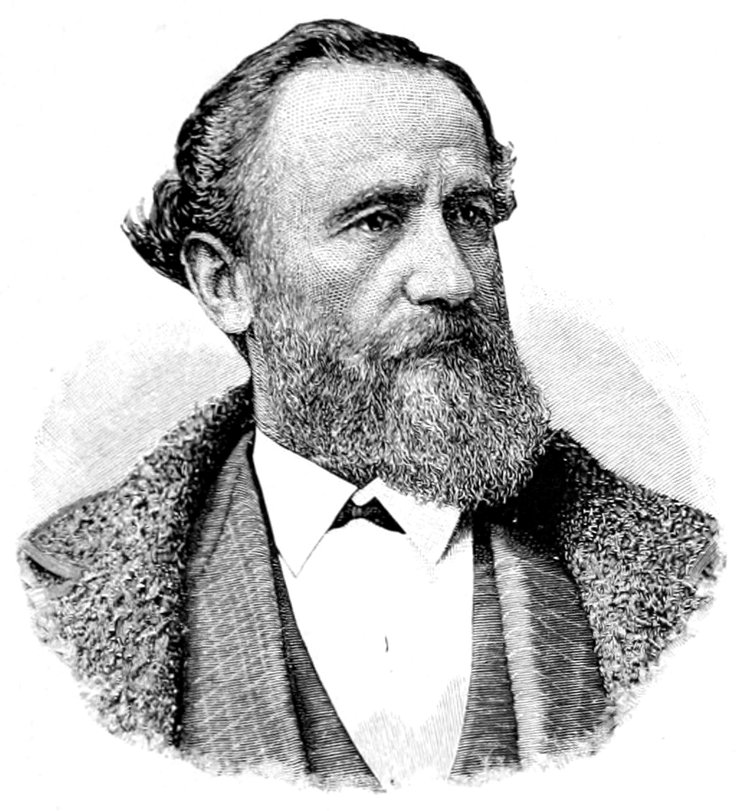
SAMUEL T. HAUSER
Ex-Governor of Montana
257“Plummer, I hear that any man who has money isn’t
safe in this town over-night. I’ve got fourteen thousand
dollars in this bag, which I’m going to take to the States
with me when I go, and I want you, as sheriff, to keep it
for me till I start.”
Plummer took the gold, with a promise for its safe return,
which he fulfilled; depositing it for safekeeping in
George Crisman’s store.
Hauser’s friends expressed to him privately their surprise
that he should intrust so large an amount to a man
of such doubtful reputation.
“Why?” replied he, laughing: “do you think he’ll
keep it?”
“I should be afraid of it,” said one, “especially if he’s
the man many represent him to be.”
“Suppose he should,” said Hauser. “You and half
a dozen other good citizens saw him take it, and heard
him promise that it should be safely returned. He knows,
as well as I do, that if he fails to keep this promise, or
through any pretence attempts to appropriate the gold,
it will go hard with him; whereas, if I should attempt to
keep it, he, with others of the roughs knowing that I had
it, would kill me if necessary to obtain it. The gold is
safer where it is; and while there, is a security for my
life.”
This was a bold piece of strategy on the part of Hauser,
evincing an intuitive insight into the character of
Plummer; but not one man in a hundred similarly situated
would have thought of adopting it. If Plummer had entertained
an idea that Hauser suspected his motives in
accompanying him to Bannack, this act of gratuitous confidence
must have allayed it at once.
258Hauser and I engaged a passage to Salt Lake City of
one of a company of eight Mormon freighters, who were
to leave Bannack at noon on the fourteenth of November.
We did not wish to leave until seven o’clock in the evening;
and the man, impatient of any delay beyond the departure
of his companions, finally agreed, for an extra
ten dollars paid in advance, to wait for us until five o’clock
P.M. If we were not ready then, he would retain the ten
dollars, and leave town without us, so as to overtake the
other teams, which were to camp that night at Horse
Prairie, twelve miles distant. These arrangements were
made in George Crisman’s store where Plummer had an
office, and in the hearing of one of his deputies, who immediately
communicated the information to his chief.
Early in the forenoon Plummer called upon Hauser
and presented him with a woollen scarf of a bright scarlet
color, saying, “You will find it useful these cold nights.”
A few hours afterwards, a report was circulated of the discovery
of a silver lode in the vicinity of Rattlesnake. The
person bringing in this intelligence, requested Plummer,
who from his experience in Nevada was supposed to be a
good judge of the quality of silver ore, to go immediately
and examine it. He left early in the afternoon on the Rattlesnake
road, but as soon as he was beyond observation,
turned southward toward Horse Prairie. Col. Wilbur F.
Sanders, who soon followed in the direction of Rattlesnake,
returned the next day with the intelligence that
he had been unable to trace him. The circumstance of
Plummer’s departure, and the presence in town of Stinson
and Ray, so wrought upon the fears of our friends for
our safety, that it was not without much persuasion that
they would permit us to undertake the journey. We were
satisfied, however, that, go when we might, we should
have to incur the same risk. As a precautionary measure,
I carefully cleaned my gun, and loaded each barrel with
259twelve revolver balls. George Dart, a friend, observing
this, asked why I was filling my gun so full of lead. I replied
that we were fearful of an attack, and that the indications
were that it would be made that night, if at all.
Some of our friends endeavored to persuade us to defer
our journey till a more favorable time. This we would
have done had we not believed that the risk would have
to be incurred whenever we took our departure. At the
hour of five we were not ready, but the Mormon teamster
was prevailed upon to wait for us two hours longer.
Just after seven o’clock, and as we were putting the
provisions which we had prepared for our journey into
the wagon, Henry Tilden, a member of the household of
Sidney Edgerton, then Chief Justice of Idaho, came in
with the report that he had been robbed about midway on
his ride from Horse Prairie, by three men, one of whom he
thought was Plummer. This created much excitement;
and if our friends had not supposed that we had already
left town, we would probably have been forcibly detained.
Either our failure to appear at the time at which our
appointment to leave at five o’clock justified him in expecting
us, or the belief that Tilden had circulated the
news of his robbery, and thereby delayed our departure,
caused Plummer to return by a circuitous route to town.
He inquired for me at my boarding-house, and being told
that both Hauser and I had gone, left town immediately
in hot pursuit.
In the wagon with us was one Charles Whitehead, a
gambler, who had made arrangements with another of the
Mormon teamsters for conveyance to Salt Lake City; but
having some business to detain him in town, he availed
himself of the circumstance of our late departure, to give
it attention. I had frequently seen him in town, but knew
nothing about him, save that he was a professional gambler.
He might, I thought, belong to the gang and be in
260some way connected with their present enterprise, and we
kept a close watch upon his movements. We rode with
our guns double-charged and cocked, lying upon our laps.
It was after eleven o’clock when we reached the camp of
the advance party. The night was clear and cold; the atmosphere
crisp with frost. Whitehead, who had sent his
blankets forward by the other teams, found that they had
been appropriated by one of the teamsters, who had concluded
that we had delayed our departure from town till
the following morning. As he was in delicate health, I
give him my place with Hauser in the wagon, and taking
a buffalo robe, stretched myself upon the ground beside
the wagon.
I could not sleep for the cold, and about three o’clock
in the morning, thoroughly chilled, I arose, took my gun
in my hand, and walked briskly back and forth before the
camp. Finding that this exercise did not greatly increase
my comfort, I went down to the bank of the creek thirty
yards distant and commenced gathering dry willows to
make a fire. While thus employed I strayed down the
stream about twenty rods from the camp. Suddenly I
heard a confused murmur of voices, which at first I thought
came from the camp, but, while walking towards it, found
that it was from a different direction. Curiosity now
overcame all thought of cold. I dropped the armful of
sticks I had gathered, and carefully disentangling the little
copse of willows which sheltered me from view, peered
through, and saw in the dim moonlight three footmen approaching
on the other side of the stream. The thought
struck me that they might be campers in search of horses
or mules that had strayed. I walked noiselessly down the
stream, to a point where I could obtain through a vista
an unobstructed view, my trusty gun held firmly in the
hollow of my hand. The three men approached the opening
through which I was gazing, and I now discovered that
261their features were concealed by loosely flowing masks. I
no longer doubted their identity or purpose. Some little
noise that I made attracted their attention to the spot
where I was standing. They saw me, and, perceiving that
I had recognized them, changed their course, and disappeared
beyond a clump of willows.
My first impulse was now to return to camp, and arouse
the men, but I concluded not to do so unless it became
necessary. One of the Mormons, as I passed by him,
roused himself sufficiently to ask me why I was up so early.
I replied that I was watching for prowlers. In a few moments
I returned to the bank of the creek, and followed it
down thirty or forty rods, till I came to a ripple where
the water was not more than six inches deep. Stepping
into the stream, I waded noiselessly across. The opposite
bank was about two feet high, and covered with a willow
thicket thirty feet in width. Through this I crawled to
the opening beyond, where was the moist bed of a former
stream, its banks lined with willows; and in this half-enclosed
semicircle, not fifty feet distant from where I
was lying, stood four masked men. One of them had been
holding the horses—four in number—while the others
were taking observations of our camp. After a brief consultation,
they hurriedly mounted their horses, and rode
rapidly off towards Bannack. These men we afterwards
ascertained were Plummer, Stinson, Ray, and Ives. The
fortunate change in my lodgings, and the coldness of the
weather, and consequent sleeplessness, saved us from an
attack whose consequences may be better imagined than
described. We made the journey to Salt Lake City in
safety; but from the frequent inquiries made of us while
there, concerning others who had attempted it before us,
we concluded that many had fallen victims who left the
mines with better prospects of escape than those which
encouraged us. It was the common custom of Mormon
262freighters to extend their day’s journeying far into the
evening. Plummer was cognizant of this fact, and there
can be no doubt that his purpose in presenting Hauser
with the scarf was, that he might single him out from the
rest of the party after nightfall. It is a coincidence that
Plummer was hanged on the succeeding anniversary of
Hauser’s birthday, January 10, 1864.
Our trip of fifteen days, with the thermometer ranging
from zero to twenty degrees below, was not unrelieved by
occasional incidents which we recall with pleasure. Among
these, of course, we cannot include the cold nights we were
obliged to pass upon the frozen earth. But we found an
inexhaustible store of amusement, not unmingled with admiration,
in the character of our Mormon conductors.
Simple-hearted, affable, and unsophisticated, with bigot
faith in their creed, studious observance of its requirements,
and constant reliance upon it both for assistance
in difficulty and pastime, they afforded in all their actions
a singular contrast as well to the unregenerate Gentiles,
as to the believers among older sects. They were not
only sincere in their belief, they were enthusiastic. It
was the single element which governed their lives: they
idolized it, and neither reason, which they at once rejected,
nor ridicule, which they silently abhorred, could shake
their religious credulity. We engaged in frequent discussions
with them, prolonging the evening camp-fire sittings
with arguments which broke like the waves of a summer
sea upon the rock of simple faith. Theology with them
was restricted to the revelations of Joseph Smith, and the
counsels of Brigham Young. These contained the precious
elements of their belief.
While passing over one of the divides, I recited to Hauser
with such marked emphasis as I could command, Milton’s
description of “the meeting of Satan and Death at
the gates of Hell.” The stirring passage immediately absorbed
263the attention of our Mormon driver. The serious
cast of his features during the recitation attracted our attention;
and soon after we had camped for the night,
while supper was in the course of preparation, he was
heard to remark to a brother teamster,
“I tell you, the youngest of those men in my wagon,
the one that always carries that double-barrelled shotgun,
is a powerful talker. I heard him harangue t’other
one to-day for half an hour, and he talked mighty fine.
He can overlay Orson Hyde and Parley Pratt, both, and I
rather think it would trouble Brigham Young to say nicer
things. And after all, he had pretty much the same ideas
that we have.” Evidently, the man had regarded the recitation
and its delivery as an impromptu exercise.
When the labor of the day was over, and they were
seated around the evening camp-fire, their thoughts were
engrossed with matters appertaining to their religion.
Temporal cares were seemingly forgotten. Fully instructed
in the doctrinal points of their faith, they readily
met and disposed of our arguments upon principles familiar
to all Christian denominations. The golden plates
of the book of Mormon, the inspirational powers of Joseph
Smith, the transforming virtues of the Urim and Thummim,
were as sacred in their creed as the miracles of the
Saviour. No argument could shake their confidence in
Brigham Young, whom they regarded as the vicegerent of
the Almighty himself. This belief was sanctified by an
immutable promise, that the time would come when the
Mormon religion would embrace the whole family of man.
When we spoke lightly of these things, or expressed doubt
concerning them, they reproved us kindly, and expressed
their regret at our stubbornness and impiety. These discussions,
which were frequent, and indulged in more for
pastime than instruction, convinced us of the sincerity of
the Mormons as a people. They believe with enthusiasm
264too, and among them may doubtless be found many who
would suffer martyrdom as readily as did Ridley and Latimer,
for the precious promises of their faith. Often when
not occupied in discussion, they would all join in singing
a religious hymn. A verse from the one which most frequently
taxed their vocal powers, I well remember:
“Brigham Young is the Lion of the Lord.
He’s the Prophet and revealer of his word.
He’s the mouth-piece of God unto all mankind,
And he rules by the power of the Word.”
Sometimes they would unite in a household song—the
leader, representing the head of the family, commencing,
“The Mormon man delights to see
His Mormon family all agree;
His prattling infant on his knee,
Crying, ‘Daddy, I’m a Mormon.’”
Then all would join in the chorus, as the representatives
of the female part of the household,
“Hey, the happy! Ho, the happy!
Hi, the happy Mormon!
I’ve never known what sorrow is,
Since I became a Mormon,”
occasionally varying it thus,
“Hey, the happy! Ho, the happy!
Hi, the happy Mormon!
I never knew what joy was,
Till I became a Mormon”
—the word “joy” being divided in the singing to
“jaw-wy,” to accommodate the metre.
On the evening of the day before we entered the Mormon
settlements, the leading man of the company beckoned
me aside, and referred to our trip down, which he
said had been a pleasant one.
265“We have had,” said he, “some warm discussions about
our religion, and you gentlemen, as our boys think, have
been rather hard on us. But the journey is now about
over, and we’ll not mind it. I sought this opportunity,
however, to give you a word of caution, for I feel friendly
to you. While you are at Salt Lake City you mustn’t
talk as you have to us.”
“Why?” I inquired.
“Because they don’t allow it. Were you ever at Salt
Lake City?”
“No.”
“Well, you’ll find out when you get there how it is.
They are very severe upon people who talk as you have
talked to us. Should you do it, you may be assured you’ll
never leave the city alive. I thought I’d put you on your
guard.” As he left me, he added,
“Don’t say a word to the boys about what I’ve told
you, but keep an eye to your conduct. If the bishop knew
I had told you this, it would go hard with me.”
Thanking him for the advice, we soon after separated;
and on our arrival at Salt Lake City, a day or two afterwards,
in conversation with a leading Mormon with whom
we had business, we told him of the advice we had received,
without committing our friend by name.
“That was good advice,” he replied, with a significant
nod, “and if adhered to will keep you out of trouble.”
CHAPTER XXVII COLONEL SANDERS AND GALLAGHER
266
On the day of the departure of Hauser and myself for
Salt Lake City, as described in the preceding chapter,
an episode occurred affecting Colonel Sanders, which
illustrates in some degree the condition of society at that
time.
During the day a number of young men of Bannack
City, all known in the town, and some living there, saddled
their horses and rode from saloon to saloon, indulging in
drink, and otherwise busying themselves until about three
o’clock P.M. Among these was Plummer.
Vague rumors had been extant for some time, that there
were in this portion of Idaho (now Montana), quartz lodes
of silver; but none up to this time had been discovered, or,
if discovered, the fact had not been made known publicly.
A number of quartz lodes of gold of very considerable
value had been recorded, but they were considered in the
popular mind as of secondary value. The “Comstock
Lode” was at this time pouring forth its treasures; silver
had not fallen under the ban which subsequently environed
it, and there was a great eagerness on the part of miners
and other citizens to acquire interests in silver mines.
It was apparent that the horsemen on the streets were
making ready for some journey into the country, and it
took but a moment to arouse suspicion that they knew
where these reported silver mines were, and were going
out to organize a mining district, and record the claims.
Col. Samuel McLean, the first delegate in Congress from
267Montana, who had an eager eye for mines, and an equally
eager desire to obtain them, told Colonel Sanders that unquestionably
the hope of these men was to record the silver
mines already discovered, and was quite anxious that he
should accompany the party.
In response to this request, Colonel Sanders volunteered
to ascertain whether this was the errand of this party or
not, and at once proceeded to find Plummer, and interrogate
him as to his destination.
Plummer professed to be on some errand for the public
good—rescuing a herd of horses belonging to citizens,
from Indian thieves, who, he said, would certainly make
way with them, unless they were at once taken charge of
by himself.
Colonel Sanders was incredulous as to this story, and
so expressed himself to Mr. Plummer, saying that he was
satisfied that the party were going to the new silver mines,
with the purpose of staking them off and recording them.
Plummer denied any such destination, or, at least, said
if that was the intention of his colleagues, he had no knowledge
of it, and that if such should turn out to be the case,
contrary to his expectations, he would cheerfully secure
for Colonel Sanders a claim. To this it was replied that
his party might object to his securing a claim for an
absentee, and the colonel expressed a purpose to accompany
the party. Plummer cordially invited him to do so,
probably knowing that there was not a horse in any of the
stables in town that was obtainable for such a journey;
but suddenly reflecting upon the matter, he replied that
there was no such errand in view, and if his comrades objected
to his obtaining a claim for Colonel Sanders because
he was an absentee, he would very cheerfully convey
his own to him, saying that he could obtain quartz lode
claims whenever he so desired.
With this understanding, which Colonel Sanders sought
268to impress upon his mind so that he would not forget it,
the party, in knots of two and four, left the town in an
easterly direction towards the point where Plummer had
stated they were going that evening, which was about fifteen
miles distant, and where he said they would remain
over-night at the ranche of Parish, Bunton and Co., on
Rattlesnake Creek, and the next morning would proceed to
obtain the horses that were in such danger of being stolen.
This ranche was perhaps the best known of any in the
Beaverhead country at this time. Plummer himself had
denounced its proprietors as cattle thieves, and had threatened
to have them arrested for that high crime, but had
never done so. At this particular time the senior member
of the firm was sick with fever, and it was thought that
he could not long survive.
The morning coach which had brought Plummer and the
other passengers from Virginia City, had also brought
one Dr. Palmer, a medical practitioner at Virginia City,
who had been sent for to attend Mr. Parish.
The wife of Parish was a Bannack squaw; and Plummer
had stated that he had examined Parish when at his
ranche in the morning, and had concluded that he could
not survive more than a day or two, and that, the instant
he died, his wife would take all the horses belonging to parties
for whom Parish, Bunton and Co. were keeping them,
and would join her tribe on the west of the mountains
near Fort Lemhi; and in order to save these horses for the
owners, it was necessary that the sheriff should proceed
to take them on general principles, and without any writ
for that purpose.
Never doubting but that Plummer was relating the
truth, the people of Bannack saw his party quietly climb
the eastern hill, and disappear over one of its declivities.
A single member, delayed from some cause or other,
lingered behind in the town.
269After the party had left town, several gentlemen suggested
to Colonel Sanders that he should endeavor to overtake
them, and volunteered to furnish a horse and saddle
if he would do so, with a view to obtaining for himself
and themselves, if possible, some interest in the silver
quartz mines which they believed would the next morning
be staked off and recorded.
Colonel Sanders proceeded to his house, took the inevitable
accompaniments of a traveller, his blankets, robes,
revolvers, etc., and returned to the town, where a somewhat
diminutive mule, saddled and bridled and ready for
the fray, was presented to him for his journey. Mounting
the animal, he started on the trail of the party, who had
one hour or more the start of him, on his way to Rattlesnake
ranche, the property of Parish, Bunton and Co.
The mule at times was recalcitrant in the early part of
the journey, but finally settled down and jogged along at
a mild speed towards his destination.
Tracks of the horsemen were plainly discernible in the
road until he reached a point near the summit of the range
of mountains between the Grasshopper and Rattlesnake,
when they disappeared.
Upon arriving at the top of the hill, as is not unusual
on the top of these mountain ranges, a snow storm burst
upon the lone traveller, accompanied by a high wind, and
in half an hour the disintegrated granite in the road, which
was dry, mixed with the snow so as to cause the mule to
accumulate on his hoofs large quantities of the dust and
snow, to such an extent as to make speed impossible, and
travelling very difficult.
The colonel dismounted and drove his mule in front of
him, eight miles, to the ranche, where he confidently expected
to find a good-natured, hilarious crowd spending
the evening. Judge of his surprise, when he entered the
room, to find the only person in it was Erastus Yager,
270whose actual name not one in a thousand knew, but who
was universally known as “Red.” He was the Boniface
and major-domo of the place.
To the inquiry, “Where is Plummer?” he replied that
he was not there, and had not been there; and so, after
reflecting a moment, the colonel had his mule put in the
corral. He then sat down by the side of a very cheerful
fire, made of the dry cottonwood obtainable not far distant,
which blazed in a very ample fireplace such as in
modern times is practically unknown, beguiling his disappointment
as best he could.
Dr. Palmer was already asleep in the room, so the colonel
unrolled his blankets, preparatory to making his bed
on the floor, whereupon Yager invited him to sleep on the
bed, a straw tick filled with swale grass, quite ample in
its size, lying upon the floor in front of the fire; and,
accepting this hospitable offer, he spread his blankets on
the tick, and in a few moments had retired.
William Bunton, one of the proprietors of the establishment,
appeared from the back room where his partner
lay ill, and retired also upon the straw tick, and shortly
after Yager followed suit, when the three, in one bed,
were all soon in a sound sleep.
About two hours after they had retired, a boisterous
noise was made upon the door by some individual who
was outside, who also hallooed as loud as he could for admittance.
Yager got out of bed and proceeded around to the back
of the bar where the liquid refreshments, so called, were
dispensed, and lighted a candle, and taking in his hands
a large shotgun which stood in the corner, started to the
door and demanded to know who was there. After some
hesitancy, he was told it was “Jack,” whereupon he proceeded
to take down the bar that was across the door and
so fastened at each end as to effectually serve the purpose
271of a lock. He then opened the door, and in stalked a
member of Plummer’s party, the one who had remained in
town behind the rest, and known all over that mining country
as “Jack” Gallagher.
He was in very ill-humor. He had been looking for his
party, and had been disappointed in not finding them,
finally seeking shelter from the storm at the Rattlesnake
ranche.
He said the snow had so covered the road that it could
not be distinguished. He had been lost on the prairie and
finally found the Rattlesnake. He had ridden up and
down the valley a number of miles and failed to find the
ranche. He complained that they had no light burning.
He said he was very hungry and that he wanted a drink.
A bottle was set out for him, and he imbibed pretty freely
once or twice. He then wanted something to eat without
delay. He was informed that there was nothing to eat in
the house, that the lady of the house had all she could
do to take care of her husband, who was very ill and who
would not probably recover, and that they were not prepared
to entertain guests.
He expressed an entire indifference to the misfortunes of
the household, and said he must have something to eat if
it was no more than some bread, and became so importunate
that Yager went to the back part of the house, and
soon returned with a large tin pan partially filled with
boiled beef. The pan was placed upon the bar, and Gallagher
did ample justice to its contents, refreshing himself
from time to time by frequent libations from the bottle
of whiskey.
He told Yager that he could not stop all night, but
must find his party. He thought it would be necessary
for him to have a fresh horse, and he wanted to trade a
very excellent animal which he had ridden to the ranche
for a fresh one.
272Yager thereupon told him that he had no horse to trade,
but Jack affirmed that he had, and furthermore insisted
that he should accommodate him by trading.
Their wrangling had awakened Colonel Sanders, and
also Mr. Bunton, who finally called Yager to the bedside
and told him to trade off that horse of Oliver’s that was in
the corral, if Jack would have a horse trade.
The importunities of Gallagher for a fresh horse were
continuous; and finally Yager coyly confessed that they
did have a horse in the corral, which was not such a horse
as Gallagher wanted, and one that they did not desire to
get rid of, being a favorite animal for riding,—not specially
desirable for its speed, but for wonderful bottom,
able to travel a hundred miles in a day, and after being
turned out at night, it would be ready for a like journey
the next day. In fact, it was so good a horse that Yager
wanted it for his own use, and it was not for sale,—much
less did he desire to trade it for as poor a horse as the one
Gallagher had ridden there (which in truth was a very
noble animal).
After a great deal of negotiating and a good many
drinks, Gallagher agreed to pay sixty dollars to boot, and
they consummated the trade.
Colonel Sanders had been very much disappointed at
not finding the party he was in search of, and having an
opportunity at the close of the horse trade, he inquired
of Gallagher if he knew where Plummer was. It seemed
to him a harmless question, and he did not expect any one
would become excited by so simple an inquiry, as he lay on
his back on the straw tick.
The instant the question was asked, Gallagher jumped
from the bar where he was standing to the side of the bed,
and placed his cocked revolver at the colonel’s head, all
the while hurling imprecations upon him, and threatening
to “shoot the whole top of his head off.”
273The result, for the instant, upon the colonel is described
by himself as being very peculiar. He said he
could count each particular hair in his head, and that it
felt like the quill of a porcupine. Not enjoying the situation,
he made a quick movement, getting his head out of
range of Gallagher’s revolver, and springing to his feet,
in an instant was behind the bar, where “Red” was standing.
Sanders seized the shotgun which was used by Yager
in admitting his guests in the night, and levelled it across
the bar directly at Gallagher. The opportunity which had
been afforded Gallagher to shoot Sanders had not been
improved by him till it was too late; and as soon as the
gun was aimed at him, with an air of bravado he placed
his revolver on a pine table that stood near him, the normal
use of which was card-playing, and pulling aside his
blue soldier’s overcoat which he wore, he said, “Shoot.”
Colonel Sanders replied that he had no desire to shoot,
but if there were any shooting to be done, he did desire to
have the first shot.
At this somewhat exciting stage of the game, Bunton,
who had hitherto kept silence, reprimanded the actors
in this little drama somewhat severely, saying that his
partner was at the point of death in the back room, and
he would not have any noise in the house.
Yager also joined in the conversation, and deprecated
any such difficulty, saying to Gallagher that he was blamable
for having been the cause of the disturbance, Gallagher
meanwhile standing with his coat open, as if waiting
to be shot down.
Yager continued his suave and conciliatory remarks to
Gallagher, and said finally that he thought Jack owed
Sanders an apology, and that all had better take a drink.
A double-barrelled shotgun is a powerful factor in an
argument; its logic is irresistible and convincing; and
under its influence Jack finally relented, and said that he
274guessed he had made a fool of himself, and invited the
colonel, who up to this time had maintained a position of
hostility, to have a drink; but, becoming satisfied of the
sincerity of Gallagher’s assurances, he placed the shotgun
behind the bar, and the entire party joined in a pledge of
amity over a bottle of “Valley Tan,” a liquor well known
throughout the mountains, and a production of the Mormons
of Salt Lake Valley.
Some controversy then arose as to who should pay for
the liquor. Yager claimed the privilege, but Gallagher
said it was his row, and it should be his treat, and that
the man who wouldn’t drink with him was no friend of
his. The affair was finally compromised by allowing Gallagher
to order another bottle of “Valley Tan,” and the
actors in this scene dared fate by taking another drink.
This was, doubtless, the easiest method of settling the
difficulty and appeasing the wrath of Gallagher; and my
readers will doubtless agree with me in thinking that the
circumstances of duress which surrounded Sanders ought
not to impair his standing as a Son of Temperance.
After this renewed pledge of friendship between all the
parties, Yager and Gallagher withdrew to exchange
horses, and in a few moments the latter was on the road in
pursuit of his comrades. Yager returned to bed, and all
at the ranche were soon sound asleep. About two hours
thereafter, there was heard another tumultuous rapping
at the door, and the voice of somebody, seemingly very angry,
demanding admittance. Yager exercised the same
precaution as before, with his light and gun, and finally
opened the door, when in came Jack Gallagher, with his
saddle, bridle, blankets, and shotgun, and threw them all
down upon the floor, saying that he had been lost since
he left the ranche, that his horse was not good for anything,
and he wanted the fire built up.
He was accommodated; and as there was not room for
275more than three on the bed, he spread his blankets on the
floor at its foot, in front of the fire, and soon all were
asleep once more. However, they were not destined to
enjoy this peace very long, for shortly after they had all
dropped asleep, there came still another commotion at
the door. Yager arose, armed himself once more, and going
to the door demanded to know what was wanted. It
proved to be Leonard A. Gridley and George M. Brown,
from Bannack. They inquired for Colonel Sanders, and
being informed that he was there, and invited in, they
declined, and asked that he come out.
The colonel went out and joined the two men, when he
was told that they had been sent by his wife to ascertain
his whereabouts and bring him home; and they related to
him the events now to follow.
On the morning of the preceding day, a young man
named Henry Tilden, who had accompanied Chief Justice
Edgerton and Colonel Sanders from their homes in Ohio
to Bannack City, had been sent to Horse Prairie, ten miles
south of Bannack, to gather together a herd of cattle
owned by them and to drive the same into town.
It was rather late when he left Bannack, and as the
cattle were somewhat scattered, night came upon him
before he had got them all together. He therefore put
those he had found in a corral, and having decided to go
to the town and spend the night, and return the next day
to find the rest, he started in the darkness for Bannack.
He was a young man used to quiet and peace, and
wholly untrained in the experiences he was about to undergo.
Midway between Horse Prairie Creek and Bannack,
as he was riding along at a gallop, he saw in front
of him several horsemen. He was somewhat startled, as
he was not prepared to meet men under such conditions
and in such a country. He gathered courage as he rode,
and proceeded along the highway until he came up with
276the horsemen, who produced their revolvers and told him
to throw up his hands and dismount, a request with which
he quickly complied, notwithstanding the impolite manner
in which it was conveyed. They “went through” his
pockets, he meanwhile maintaining a very awkward position
with his hands in the air above his head. Finding
nothing, they told him to mount his horse and proceed on
his way, telling him further that if he ever dared to open
his mouth about the circumstance, he would be murdered,
or, in their expressive language, they would “blow the top
of his head off.”
The young man started towards Bannack, and as soon
as he was out of sight of the robbers, rode his horse at
its utmost speed.
He finally reached Colonel Sanders’s house on what
was known as “Yankee Flat,” not, however, until he had
been thrown from his horse, while crossing a mining ditch,
and had lain on the ground for a period of time which he
could not himself determine, being unconscious.
He told his story of having met the robbers, and further
stated that he knew the parties who had “held him
up,” particularly one of them, who had held a revolver
at his head and who seemed to be a leader among them,
and this man was Henry Plummer.
Mrs. Sanders then went with him to the house of Chief
Justice Edgerton, where he related again the story of his
meeting the highwaymen, and was cautioned to say nothing
about it.
As the party whom Colonel Sanders had started to find
and travel with had been found going in an opposite direction,
and engaged as highway robbers, it naturally excited
and alarmed his family, and the result was that they, finding
a team which had come into town late that night, procured
the horses, and mounted Gridley and Brown and
sent them to the Rattlesnake ranche to find the colonel.
277The next morning Plummer and all the men who had gone
with him were in town, appearing as unconcerned as if
nothing unusual had occurred.
Colonel Sanders did not at first share Tilden’s belief
concerning the personnel of the troop of robbers and his
identification of Plummer, but nevertheless, as a precautionary
measure, he admonished Tilden not to communicate
his beliefs to any one, assuring him that if his conjectures
were correct, and an expression of them should
ever reach Plummer’s ears, it would go hard with him.
Two or three days thereafter, Plummer approached Tilden,
and gazing fixedly upon him, abruptly asked if he
had any clew by which the robbers could be identified.
Tilden, though greatly frightened by this inquiry, gave
him an answer which allayed whatever suspicion the wary
robber might have entertained. But Tilden himself, in
relating the incident to his friends, never wavered in his
convictions. There were many among the better class of
citizens of Bannack who had for a long time suspected
Plummer, and believed him to have been engaged in numerous
murders and highway robberies, which were of
such frequent occurrence as to scarcely cause comment;
and when it was determined on the afternoon of January
10, 1864, that Plummer should be hanged, Tilden was
sent for and related his story in detail, which convinced
all who heard it of Plummer’s guilt.
Within sixty days after Colonel Sanders’s adventure
at the Rattlesnake ranche, he was the sole survivor of
the party there assembled, the others having been executed
by the Vigilance Committee, and Plummer and his associates
in the attempted robbery of Hauser and myself had
met the same fate.
But little is known of Gallagher’s early history. He
was born near Ogdensburg, New York. He was at Iowa
Point, Doniphan County, Kansas, in October, 1859, and
278in Denver from 1862 till early in 1863. At this latter
place he killed a man in an affray, and fled, next making
his appearance in the Beaverhead mines. During the
Summer of 1863, he shot at and badly wounded a blacksmith
by the name of Temple, for interfering to prevent
a dog-fight. After this he became uneasy, and finally determined
upon leaving the country, and started for Utah.
On the Dry Creek divide he met George Ives, who persuaded
him to return to Virginia City, and join Plummer’s
band.
CHAPTER XXVIII ROBBERY OF MOODY’S TRAIN
279
One cold morning, a few days after the attempted
robbery of Mr. Hauser and the writer, a train of
three wagons, with a pack train in company, left Virginia
City for Salt Lake City. Milton S. Moody, the owner of
the wagons, had been engaged in freighting between the
latter place and the mines ever since their first discovery.
His route on the present trip lay through Black Tail Deer,
Beaverhead, and Dry Creek cañons, so named after the
several streams by which they are traversed. Bannack
was left twenty miles to the right of the southern angle
in the road at Beaverhead Cañon, and except three or
four ranches, there were no settlers on the route.
Among the packers were Messrs. John McCormick, M.
T. Jones, William Sloan, John S. Rockfellow, J. M. Bozeman,
Melanchthon Forbes, and Henry Branson,—energetic
business men, who had accumulated a considerable
amount in gold dust, which they took with them to make
payments to Eastern creditors. Buckskin sacks, containing
about eighty thousand dollars, were distributed in
cantinas through the entire pack train, no one pair of
cantinas containing a very large sum. Besides this
amount, there was in a carpet-sack in one of the wagons,
fifteen hundred dollars in treasury notes, enclosed in letters
to various persons in the States, and sent by their
friends and relatives in the mines.
The men in the train were well armed, and anticipated
attack by the robbers at some point on the route, but
280they determined upon fighting their way through. Plummer
had been on the watch for their departure a week or
more before they left, and through his spies was fully
informed of the amount they took with them. He made
preparations for surprising them in camp after nightfall,
on their second day out, well knowing that some would
then be seated, others lying around their camp-fires, and
still others spreading their blankets for the night. Two
of the boldest men in the band, John Wagner, known as
“Dutch John,” and Steve Marshland, were selected for
the service. They followed slowly in track of the train.
Coming in sight of the camp-fire in Black Tail Deer
Cañon after dark on the evening appointed, they hitched
their horses in a thicket at a convenient distance, and,
with their double-barrelled guns loaded with buckshot,
crawled up, Indian fashion, within fifteen feet of the camp.
By the light of the fire, they were enabled to take a survey
of the party and its surroundings. The campers were
dispersed in little groups engaged in conversation, ignorant
of the approach of the robbers, but fully prepared to
meet them. Mr. McCormick, who had done some friendly
services for Ives, was warned by him, when on the eve of
departure, not to sleep at all, never to be off his guard,
nor separate from his comrades, but to keep close in camp
until after they had crossed the range. As soon as the
robbers comprehended the situation, they withdrew to the
thicket and held a consultation. Wagner, the bolder of
the two, proposed that they should steal again upon the
campers, select their men, and kill four with their shotguns,
it being quite dark; that they should then, by rapid
firing, quick movements, and loud shouting, impress the
survivors with the belief that they were attacked by a
numerous force in ambush.
“They will then,” said Wagner, “run away, and leave
their traps, and we can go in and get them.”
281This scheme, none too bold or hazardous for Wagner
to undertake, presented a good many embarrassments to
the more timid nature of his companion. Bold as a lion
at the outset, he now found his courage, like that of Bob
Acres, “oozing out of his fingers’ ends.” The more
Wagner urged the attack, the stronger grew his objections,
until at length he flatly refused, and the experiment
was abandoned until the next morning.
The campers knew nothing of this. One by one they
sank to rest, and arose early the next morning to pursue
their journey. While seated around the camp-fire at
breakfast, near a sharp turn in the road, their attention
was suddenly arrested by a voice issuing from the thicket,
uttering the following ominous words:
“You take my revolver and I’ll take yours, and you
come right after me.”
In a twinkling every man sprang for his gun and cocked
his revolver. The sharp click, that “strange quick jar
upon the ear,” probably satisfied the robbers that they
had been overheard, for in a few moments after up rode
Wagner and Marshland, with their shotguns thrown
across their saddles, ready for use. The confused expression
of the robbers when they saw that every man was
prepared for their approach, betrayed their criminal designs.
Recovering themselves in a moment, Marshland,
who recognized Sloan, in a friendly tone called out,
“How do you do, Mr. Sloan?”
“Very well, thank you,” replied Billy, laying particular
stress upon the complimentary words, the significance
of which would have been more apparent, had he known
that Marshland’s cowardice the night before had probably
saved his life.
The road agents inquired if the party had seen any
horses running at large, or whether they had any loose
stock in their train.
282“We have not,” was the prompt reply.
“We were told by some half-breeds we met,” said
Marshland, “that our animals were running with your
train, and we rode on, hoping to find them.”
“It’s a mistake,” was the answer, “we have no horses
but our own.”
With this assurance the robbers professed to be satisfied,
and galloped on.
These successive failures only strengthened the villains
in their determination to rob the train. They awaited
its arrival in Red Rock Valley two days after leaving
it, with the intention of attacking it there, at
the hour of going into camp. When near the summit
of the ridge which divides the waters of the Red
Rock from those of Junction Creek, the packers, according
to custom, rode on ahead of the wagons to select a
suitable stopping-place for the night. Three or four men
only were left in charge of the teams. The robbers supposed
that the treasure was hidden away in some of the
carpet-sacks in the wagons, now near the top of the divide.
The brisk pace of the pack-horses soon took them
out of sight and hearing of their companions in the rear.
Assured of this, the robbers, disguised in hoods and blankets,
dashed out of a ravine in front of the wagons, and
in a peremptory tone, covering the drivers with their shotguns,
commanded them to halt. Gathering the drivers
together, they ordered them not to move, at their peril;
and while Dutch John sat upon his horse, with his gun
aimed at them, Marshland dismounted, and engaged in a
speedy search of both drivers and vehicles. Unperceived
by the robbers, Moody had slipped a revolver into the leg
of his boot. He also had a hundred dollars concealed in
a pocket of his shirt, which escaped notice. The other
drivers had no money on their persons. After disposing
of the men, Marshland went to the wagons, where he was
283fortunate enough to find the carpet-sack containing the
letters in which were enclosed the fifteen hundred dollars
in greenbacks. Pocketing this, and still intent upon finding
the gold, he proceeded to the rear wagon, which fortunately
was occupied by Forbes and a sick comrade. As
soon as Marshland climbed to the single-tree, Forbes, who
had been in wait for him, fired his revolver through a hole
in the curtain, wounding him in the breast. With an oath
and yell, the robber fell to his knees, but recovering himself,
jumped from the wagon, fell a second time, regained
his feet, and ran with the agility of a deer to the pine forest.
Dutch John’s horse, frightened at the shot, reared
just as its rider discharged both barrels of his shotgun
at the teamsters. The shot whizzed just above their heads.
Moody now drew his revolver from his boot, and opened
fire upon the retreating figure of Dutch John, the ball
taking effect in his shoulder. Urging his horse to its utmost
speed, John was soon beyond reach of pursuit; but
had Moody followed him on the instant, he might have
brought him down. The packers who had gone into camp,
were no less gratified to hear of the successful repulse,
than astonished at the bold attack of the freebooters.
Marshland’s horse, arms, equipage, and twenty pounds of
tea, of which he had rifled a Mormon train a few days
before, were confiscated upon the spot.
Rockfellow and two other packers rode back to the
scene of the robbery, where, striking Marshland’s trail,
they followed it, searching for him till eleven o’clock. He
admitted afterwards, when captured, that they were at
one time within fifteen feet of him. They found, scattered
along the route, all the packages of greenbacks he had
taken. He gained nothing by his attack, was badly
wounded, froze both his feet on his retreat to Deer Lodge,
and lost his horse, arms, and provisions. Both of Dutch
John’s hands were frozen, but he was fortunate in meeting
284J. X. Beidler, who bound them up for him, not knowing
at the time the villain’s occupation. “X,” as he is
called by all the mountaineers, always accounted this
kindly act to the retreating ruffian as a stroke of bad
fortune. “Had I only known,” says he when telling the
story, “I would have bandaged his hands with something
stronger than a handkerchief.”
The serious part of the transaction being over, our
wayfarers had abundant sport for the remainder of their
long journey, in determining the rights of the respective
claimants to the booty. Forbes claimed Marshland’s
horse and accoutrements, because it was his shot that
caused the robber to take flight. Moody insisted upon his
right to an equal share, in compensation for the wounds
he gave Dutch John. The two teamsters set up a claim,
upon the principle that all ships in sight are entitled to
a share in the prize. If steersmen represented schooners
at sea, teamsters were the proper representatives of
“prairie schooners.” The subject was debated at every
camp made on the journey, and finally determined by
electing a judge from their number, impanelling a jury,
and going through all the forms of a regular trial. The
verdict gave Forbes the possession of the property on payment
of thirty dollars to Moody, and twenty dollars to
each of the teamsters. The party arrived at Salt Lake
City without further molestation.
CHAPTER XXIX GEORGE IVES
285
George Ives, whose name is already familiarized
to the readers of this history, by the prominent
part he acted in the robberies of the coach, and the contemplated
attack upon Hauser and the writer, was at the
time regarded as the most formidable robber of the band
with which he was connected. The boldness of his acts,
and his bolder enunciation of them, left no doubt in the
public mind as to his guilt. But the people were not yet
ripe for action; and, while Ives and his comrades in crime
were yet free to prosecute their plans for murder and
robbery, the miners and traders were content, if let alone,
to pursue their several occupations. The condition of society
was terrible. Not a day passed unmarked by crimes
of greater or lesser enormity. The crisis was seemingly
as distant as ever. Men hesitated to pass between the
towns on the gulch after nightfall, nor even in mid-day
did they dare to carry upon their persons any larger
amounts in gold dust than were necessary for current purposes.
If a miner happened to leave the town to visit a
neighboring claim, he was fortunate to escape robbery on
the way. And if the amount he had was small, he was
told that he would be killed unless he brought more the
next time. Often wayfarers were shot at, sometimes killed,
and sometimes wounded.
During this period, it was a custom with George Ives,
when in need of money, to mount his horse, and, pistol in
hand, ride into a store or saloon, toss his buckskin purse
286upon the counter, and request the proprietor or clerk to
put one or more ounces of gold dust in it “as a loan.”
The man thus addressed dare not refuse. Often, while
the person was weighing the levy, the daring shoplifter
would amuse himself by firing his revolver at the lamps
and such other articles of furniture as would make a crash.
This was frequently done for amusement. It became so
common that it attracted little or no attention, and people
submitted to it, under the conviction that there was
no remedy.
Anton M. Holter, owner of a train of wagons, while
on the route from Salt Lake City to Virginia City with a
large party of emigrants, was overtaken by a fierce mountain
snowstorm, during the last days of November, on
Black Tail Deer Creek. Fearing that the road would be
blocked, he and a Mr. Evanson pushed on as rapidly as
possible to the Pas-sam-a-ri, crossing the stream with
their teams with great difficulty, the water reaching midway
up the sides of the wagon-boxes. Once over, they
made a camp near by, to await the abatement of the storm.
A Mr. Hughes who had been travelling in company with
them, came up with his wagon at a late hour in the evening
to the cabin at the crossing, at the door of which he
was met by “Dutch John,” its only occupant. John, at
his request, went in search of Evanson, who came and assisted
in getting the horses and wagons across the river.
The night was half spent before the object was accomplished.
During all this time, John, in pursuance of
Plummer’s general instructions for obtaining information,
plied Evanson with questions about Holter’s property and
ready means in gold,—possessing himself of all the information
that an unsuspicious man would be likely to
communicate.
A few days later, Holter moved on with his train to
Ramshorn Creek, and after making camp, went to
287Virginia City with two yokes of oxen for sale. On his way
he passed Ives and Carter, who, he observed, eyed him
suspiciously. Failing to sell his cattle, he left on his return
to camp the next day, intending to spend the night
at Mr. Norris’s ranche. He had gone well down into the
valley, and it was nearly sundown, when he saw Ives, accompanied
by one Irving, approaching on horseback.
Holter did not know Ives, and had no real fear of an attack;
but with that instinctive feeling which regards every
stranger with suspicion in a country infested with robbers,
he immediately drew and examined his pistol. It
was so badly rusted that he could not make it revolve.
He replaced it, and, remembering that he had no money,
felt equally satisfied to escape or to hazard an adventure.
Ives and Irving rode up in front of him, and Ives, impudently,
as Holter thought, inquired,
“Where are you going?”
“Down to Norris’s place,” replied Holter. “Do you
know where he lives?”
“Yes, I know well enough,” answered the highwayman,
and drawing closer to him he asked, “Have you got
any money?”
Holter drew back in surprise, but answered immediately,
“No, I’m dead broke.”
“Well, we’ll see about that,” said Ives, drawing and
cocking his revolver.
“You can see for yourself,” said Holter, drawing forth
a memorandum book.
“Hand it over here,” said Ives, reaching and taking it.
He then proceeded to examine it with some care, but finding
nothing in it, with an expression of disgust he threw
it away. Turning to Holter, and levelling his pistol full
upon him, he continued,
“You’ve got money, and I know it. Hand it over, or
I’ll shoot you.”
288“You’re surely mistaken,” replied Holter. “I left
what I had at the camp, and had to borrow ten dollars in
town.”
“I tell you, you have got money,” was the savage rejoinder.
“Turn your pockets inside out—and be quick
about it, too.”
Holter complied, and found a few greenbacks, which,
as they were not in use, he had forgotten.
“Hand ’em over here,” said Ives, and cramming them
hurriedly into his pocket, he said,
“Now, turn your cattle out of the road, and don’t
follow our tracks; and when you come this way again,
bring more money with you.”
As Holter turned his cattle to obey, he glanced furtively
over his shoulder, and saw Ives in the very act of
firing at him. Dodging instinctively, the ball passed
through his hat, ploughing a furrow down to the scalp,
which it grazed, through his heavy hair. Stunned by the
shot, Holter staggered and almost fell, just as Ives aimed
and pulled the trigger again. Fortunately, the cap
snapped; and Holter, now sufficiently recovered, started
on a run, and took refuge in an old beaver-dam. Ives
followed him closely for another shot, but a teamster with
a load of poles at this moment appeared upon the road,
which circumstance deterred Ives from firing, and probably
saved Holter’s life.
During this same season, a man who had been whipped
for larceny at Nevada, under some modification of his punishment,
agreed to disclose certain transactions of the robbers.
Ives heard of it, and watching his opportunity, met
the poor fellow on the road between Virginia City and
Dempsey’s. Riding up to him, he deliberately fired at him
with his gun charged with buckshot. From some cause
the shot failed of effect. Ives immediately drew his revolver,
and while loading him with oaths and execrations,
289shot him through the head. The man fell dead from his
horse, which Ives took by the bridle and led off to the
hills. This cold-blooded murder was committed in open
day on the most populous thoroughfare in the country,
in plain view of two ranches, and while several teams were
in sight. Travellers who arrived at the spot half an hour
after its occurrence, aided by the neighboring ranchemen,
paid the last sad offices to the still warm but lifeless body.
Ives sought concealment in the wakiup of George Hilderman,
where he remained until satisfied that no public action
would be taken to avenge the crime.
He then again sallied forth to watch for fresh opportunities
for plunder and bloodshed. His name had become
the terror of the country. No man felt safe with such a
monster at large, and yet no one was ready to initiate a
plan for his destruction. His malevolence was only
equalled by his audacity,—and this was, if possible, surpassed
by his gasconade. The dark features of his
character were unrelieved by a single generous or manly
quality. Avarice, and a natural thirst for bloody adventures,
controlled his life.
About this time, a young German, by the name of Nicholas
Tiebalt, who was in the employ of Messrs. Burtchy
and Clark, sold to them a fine span of mules which were
in charge of the herders at Dempsey’s ranche. They had
advanced the money for the purchase, and sent Tiebalt
after the mules. As several days elapsed without his return,
they concluded that he had swindled them out of the
money, and left the country with the mules; a conclusion
all the more regretted by them, from the fact that he had
won their confidence by his fidelity and sobriety.
Nine days after Tiebalt had left Nevada, Mr. William
Palmer, while hunting in the Pas-sam-a-ri Valley, shot a
grouse, and on going to the place where it fell, found it,
dead, upon the frozen corpse of Tiebalt. He immediately
290went to the wakiup occupied by John Franck—better
known as “Long John”—and George Hilderman, a
quarter of a mile below, to obtain their assistance in lifting
the body into the wagon.
“I will take the body to town,” said he, “and see if it
cannot be identified.”
“We’ll have nothing to do with it,” said Long John.
“Dead bodies are common enough in this country. They,
kill people every day in Virginia City, and nobody speaks
of it, nobody cares. Why should we trouble ourselves who
this man is, after he’s dead?”
Shocked at this brutality, Palmer returned to the corpse,
which he contrived to place in his wagon, and drove on to
Nevada. The body was exposed for half a day in the
wagon, and was visited by hundreds of people from Nevada,
Virginia City, and the other towns in the gulch.
In reply to the question, “How did you find it?” Palmer
answered,
“It was providential. The Almighty pointed the way,
or it would never have been found. I had my gun in my
hand, and was looking carefully about for game, when a
grouse rose suddenly at my approach. I had little thought
of killing it when I fired, as the shot was a chance one.
The bird flew some distance before it fell, but seeing that
I had wounded it, I ran as rapidly as I could, and went
directly to it, and found it on the breast of the murdered
man. The body was lying in a clump of heavy sage brush,
completely concealed,—away from the road, where no one
would ever have gone except by chance,—and but for the
fact that it was frozen hard, would long before this time
have been devoured by the coyotes.”
The body of Tiebalt bore the marks of a small lariat
about the throat, which had been used to drag him, while
still living, to the place of concealment. The hands were
filled with fragments of sage brush, torn off in the agony
291of that terrible process; and the bullet wound over the
left eye showed how the murder had been accomplished.
These appalling witnesses to the cruelty and fiendishness
of the perpetrator of this bloody deed roused the indignation
of the people to a fearful pitch. They went
to work to avenge the crime with an alacrity sharpened
by the consciousness of that long and criminal neglect
on their part, but for which it might have been averted.
They felt themselves to be, in some degree, participants
in the diabolical tragedy. In the presence of that dead
body the reaction commenced, which knew no abatement
until the country was entirely freed of its bloodthirsty
persecutors. That same evening, twenty-five citizens of
Nevada subscribed an obligation of mutual support and
protection, mounted their horses, and, under the leadership
of a competent man, at ten o’clock started in pursuit
of the murderer. Obtaining an accession of one good man
on their route, and avoiding Dempsey’s by a hill trail,
they rode six miles beyond it to a cabin, and with the aid
of its proprietor found their way to the point of destination.
At an early hour in the morning, they crossed Wisconsin
Creek, breaking through the frozen surface, and
emerging from it with clothing perfectly rigid from frost
and wet. A mile beyond this they were ordered to alight
and stand by their horses until daybreak. An hour or
more passed, when they remounted and rode quietly on,
until in sight of Long John’s wakiup. A dog was heard
to bark; and in anticipation of the alarm it might occasion,
they dashed forward at full speed, surrounding the
wakiup, each man halting with his gun bearing upon it.
Jumping from his horse, the leader discovered eight or
ten men wrapped in their blankets, sleeping in front of the
entrance. Raising his voice, he exclaimed,
“The first man that rises will get a quart of buckshot
in him before he can say ‘Jack Robinson.’”
292It was too dark to distinguish the sleepers. With half
of his company at his back, the leader strode on to the
entrance. Peering into the darkness, he asked,
“Is Long John here?”
“I’m here,” responded a voice, instantly recognized to
be that of the person addressed. “What do you want?”
“I want you,” was the rejoinder. “Come out here.”
“Well,” said John, “I guess I know what you want
me for.”
“Probably,” replied the leader. “But hurry up.
We’ve no time to lose.”
“One moment. I’ll be with you as soon as I can get
on my moccasins,” said John.
“Be quick about it,” shouted the leader.
Long John was taken in charge by the company, and
as soon as it was light enough to enable them to see
distinctly, the leader, with four men, escorted him to
the spot where Tiebalt was found. The remainder of the
company kept guard over the men found sleeping near the
wakiup. When they arrived upon the ground, the leader
said to him,
“Long John, we have arrested you for the murder of
Nicholas Tiebalt. We believe you to be guilty, and have
brought you up here to the spot where his body was found
to hear what you have to say.”
Palmer, who was one of the company, then proceeded to
explain all the circumstances connected with the discovery,
the position of the body, and the conversation he held with
Long John when he applied to him for assistance.
“Boys,” said John, in a serious tone, “I did not do it.
As God shall judge me, I did not.”
One man, more excited than the rest, now began handling
his pistol, saying to John, meanwhile,
“Long John, you had better prepare for another
world.” What more he might have said, or what done,
293it is easy to conceive, had he not been interrupted by the
leader, who, stepping forward, remarked,
“This won’t do. If there is anything to be done, let
us all be together.”
Long John was then taken aside by three of the company,
who sat down in the faint morning light to examine
him. Just as they were seated, they saw through
the haze at no great distance, “Black Bess,” the mule
which Tiebalt rode from Nevada when he started for
Dempsey’s. She seemed to be there at this opportune moment
as a dumb witness to the assassination of her master.
Pointing to the animal, one of the men inquired,
“John, whose mule is that?”
“That’s the mule that Tiebalt rode down here,” he
answered.
“John,” was the reply, “you know whose mule that is.
Things look dark for you. You had better be thinking
of your condition now.”
“I am innocent,” murmured John.
The mule was caught and led up to him. “Where are
the other two mules?” was the next inquiry.
“I do not know,” he replied.
“John,” said his interrogator, “you had better be looking
forward to another world. You are ‘played out’
in this one, sure.”
“I did not commit that crime,” was his reply, “and if
you’ll give me a chance, I’ll clear myself.”
The leader now said to him, “John, you can never do
it, for you knew of a man lying dead here, close to your
home, for nine days, and never reported his murder. You
deserve hanging for that alone. Why didn’t you come
and tell the people of Virginia City?”
“I was afraid,” said John. “It would have been as
much as my life was worth to have done it. I dared not.”
“Afraid? Of whom?” inquired the leader.
294“I was afraid of the men around here,” he answered.
“What men? Who are they?” persisted the leader.
“I dare not tell who they are,” said John, in a frightened
tone: “there’s one of them around here.”
“But you must tell, if you would save yourself. Where
is the one you speak of?”
“There’s one at the wakiup,—the one that killed Nick
Tiebalt.”
“Who is he? What’s his name?”
“George Ives,” said John, after a moment’s hesitation.
“Is he down at the wakiup?”
“Yes. I left him there when I came out.”
“Men,” said the leader, addressing them, “stay here
and keep watch over John, while I go down and arrest
Ives.”
Selecting from the number at the wakiup a person answering
the description of Ives, he asked his name, which
was very promptly given.
“I want you,” said the leader.
“What do you want me for?” inquired Ives.
“To go to Virginia City,” rejoined the leader.
“All right,” said Ives: “I expect I’ll have to go.”
He was immediately taken in charge by the guard.
“Old Tex” was standing near by at the time, and the
leader turning to him, said,
“I believe we shall want you, too.” The ruffian made
an impudent reply, to which the leader simply rejoined,
“You must consider yourself under arrest,”—words
whose fearful import he understood too well to disobey.
The other men now emerged from their blankets. They
were Alex Carter, Bob Zachary, Whiskey Bill, and Johnny
Cooper, and two inoffensive persons who had fallen in with
them the evening before, and craved permission to pass
the night under their protection. Fortunately, these confiding
persons had no money, and escaped assassination;
295but when told of the character of their entertainers, one
of them, pointing to Carter, remarked,
“There’s one good man, anyhow. I knew him on the
other side of the mountains, where he was a packer, and
there was no better man on the Pacific slope.”
Just at this moment, the leader saw some movement
which indicated to him that a rescue of the three prisoners
would be attempted by their comrades, and in a loud
tone of command, said,
“Every man take his gun and keep it.”
Five men were ordered to search the wakiup, and the
others, meanwhile, to keep off intruders. The searchers
soon came out with seven dragoon and navy revolvers, nine
shotguns, and thirteen rifles, as the fruit of their spoil.
Among other weapons was the pistol taken from Leroy
Southmayd at the time of the coach robbery described in
a previous chapter. Having completed the search and
broken up the nest of the marauders, the scouting party
started with their prisoners on the return to Nevada. At
Dempsey’s they found George Hilderman, who, after offering
various excuses, consented, under the mild persuasion
of a revolver, to accompany them. The prisoners were
disarmed but not bound, nor prevented from riding at
pleasure among their captors. A stranger, on seeing or
joining with the cavalcade while in motion, would never
have supposed that it was an escort with four murderers
in charge; nor, from the merry, jovial conversation and
song singing of the company, as it rode gayly and rapidly
onward, have distinguished the accusers from the accused.
Whenever the subject of his offence was mentioned, Ives
asserted his innocence, and declared that he would be only
too happy to have an opportunity to prove it. With a
fair trial by civil authority in Virginia City, he had no
fear of the result; but as he once had the misfortune to kill
a favorite dog in Nevada, he felt that he would have the
296prejudices of the people against him if put upon trial
there. This idea was elaborated, because if adopted,
Plummer, being sheriff, would have the selection of the
men from whom the jury would be impanelled. Ives affected
great amiability and a ready compliance with every
order and request made by his captors. One subject suggested
another, and many of the rough and pleasant phases
of mountain life passed in review, until that of racing, and
the comparative speed of their horses, was introduced.
On this theme Ives was specially eloquent, and being
mounted on his own pony, which had some local popularity
as a racer, he ventured finally to propose a trial of speed
with several of the guard, and even challenged them to race
with him. After one or two short scrub races, in which he
suffered himself to be beaten, the spirit of the race-course
seemed suddenly to animate the company, and, one after
another, all were soon engaged in the exciting sport. It
increased in interest and excitement for several miles, and
until within a short distance of Daly’s ranche. At this
point, Ives’s horse, which had been kept under before,
was now pressed to his utmost speed; and when the party
were least prepared for it, they saw him not only as the
winner in the race, but leading the cavalcade, and bearing
his master away at a fearfully rapid rate over the level
stretch towards Daly’s. Instantly, every horse was urged
into the pursuit. On rode the desperado, and on followed
the now broken column of scouts, two of whom pressed him
so closely that he could not stop long enough at the ranche
to exchange his pony for his favorite horse, which, by order
of some of his friends who had pushed on from the
wakiup in advance of the scouts, had been saddled and
was standing ready for his use. His pursuers, more fortunate,
found a fresh horse and mule standing there, which
had come down from Virginia City. These they mounted,
and resuming the pursuit, when three miles away from the
297main road near the Bivans Gulch mountains, they saw the
hotly pressed fugitive jump from his exhausted pony, and
take refuge among the rocks of an adjacent ravine.
Quicker than it can be told, they alighted, and, fresher on
foot than the jaded steeds, they were soon standing on the
edge of the sheltering hollow. Ives was nowhere visible.
Certain that he was near, Burtchy and Jack Wilson
plunged into the ravine, and commenced a separate search
among the rocks. It was of brief duration, for Burtchy
soon discovered him, crouching behind a large bowlder, and
directed him to come out and surrender himself.
Ives laughingly obeyed, and in a wheedling manner was
approaching Burtchy, who was separated from his comrade,
evidently with the purpose of wresting his gun from
him. Burtchy understood the movement, and with his eye
still coursing the barrel, now but a few feet from the heart
it would have been emptied into in a moment more, he
said,
“That is far enough, Mr. Ives. Now stand fast, or I
shall spill your precious life-blood very quick.”
Wilson, who had been searching in a different direction,
now came up and aided in securing the prisoner, with whom
they soon rejoined the rest of the company. The two
hours which had elapsed between the escape and recapture,
were pregnant with wisdom for the almost disheartened
scouts.
“Let us raise a pole and hang him at once,” said one
of them, as the captors rode up with their prisoner.
Several voices raised in approval of this recommendation,
were at once silenced by a very decided negative from
the remainder of the company. Ives, meantime, commenced
chatting gayly with the crowd, and treated them to a
“drink all round.” The cavalcade, formed in a hollow
square, with their prisoner in the centre, then rode quietly
on to Nevada, arriving soon after sunset.
CHAPTER XXX TRIAL OF GEORGE IVES
298
Intelligence of the capture of Ives preceded the
arrival of the scouts at Nevada. That town was full
of people when they entered with their prisoners. A discussion
between the citizens of Virginia City and Nevada,
growing out of the claims asserted by each to the custody
and trial of the prisoners, after much protesting by the
friends of Ives, resulted in their detention at Nevada.
They were separated and chained, and a strong inside and
outside guard placed over them. The excitement was intense;
and the roughs, alarmed for the fate of their comrades,
despatched Clubfoot George to Bannack with a
message to Plummer, requesting him to come at once to
Nevada, and demand the prisoners for trial by the civil
authorities. By means of frequent relays provided at the
several places of rendezvous of the robbers on the route,
he performed the journey before morning. Johnny Gibbons,
a rancher, in sympathy with Ives, proceeded immediately
to Virginia City, and secured the legal assistance
of Ritchie and Smith, the latter being the same individual
who had figured in the defence of the Dillingham murderers.
But the time for strategy was over,—the people
were determined there should be no delay.
Early the next morning, the road leading through the
gulch was filled with people hastening from all the towns
and mining settlements to Nevada. Before ten o’clock,
fifteen hundred or two thousand had assembled and were
standing in the partially congealed mud of the only public
299thoroughfare of the town. The weather was pleasant for
the season, with no snow, but a little frostwork of ice bordered
the streams, and the sun shone with an October
warmth and serenity. The urchins of the neighborhood
were dodging in and out among the crowd, in merry pastime;
and the great gathering, with all its appointments,
wore more of a commemorative than retributory aspect.
And as this was the day preceding “Forefathers’ Day,”
one unacquainted with the sterner matters in hand, might
readily have mistaken it for an old-time New England festival.
The illusion, however, would have been instantly dispelled
on listening to the various opinions advanced by the
miners, while arranging the mode of trial. It was finally
determined that the investigation should be made in the
presence of the entire assemblage,—the miners reserving
the final decision of all questions. To avoid all injustice
to people or prisoners, an advisory commission of twelve
men from each of the districts was appointed; and W. H.
Patton of Nevada, and W. Y. Pemberton of Virginia City,
were selected to take notes of the testimony.
Col. Wilbur F. Sanders and Hon. Charles S. Bagg, attorneys,
appeared on behalf of the prosecution, and Messrs.
Alexander Davis and J. M. Thurmond for the prisoners.
Ives was the first prisoner put upon trial. It was late in
the afternoon of the nineteenth before the examination of
witnesses commenced. The prisoner, secured by chains,
was seated beside his counsel. The remainder of that day,
and all the day following, had been spent; and when the
crowd assembled on the morning of the twenty-first, the
prospect for another day of unprofitable wrangling, long
speeches, captious objections, and personal altercations,
was promising; but the patience of the miners being exhausted,
they informed the court and people that the trial
must close at three o’clock that afternoon. This announcement
was received with great satisfaction.
300I am unable from any facts in my possession to recapitulate
the testimony. Long John was admitted to testify
under the rule of law regulating the reception of State’s
evidence. Among other things it was established that Ives
had said in a boastful manner to his associates in crime,
“When I told the Dutchman I was going to kill him, he
asked me for time to pray. I told him to kneel down then.
He did so, and I shot him through the head just as he
commenced his prayer.”
Two alibis set up in defence failed of proof, because of
the infamous character of the witnesses. Many developments
of crimes committed jointly by the prisoner and some
of his sympathizing friends, were made, which had the effect
to drive the latter from the Territory before the close
of the trial, but for which his conviction might possibly
have been avoided.
The prisoner was unmoved throughout the trial. Not a
shade of fear disturbed the immobility of his features.
Calm and self-possessed, he saw the threads of evidence
woven into strands, and those strands twisted into coils as
inextricable as they were condemnatory, and he looked out
upon the stern and frigid faces of the men who were to
determine his fate with a gaze more defiant than any he
encountered. There were those near him who were melted to
tears at the revelation of his cruelty and bloodthirstiness;
there were even those among his friends who betrayed in
their blanched lineaments their own horror at his crimes;
but he, the central figure, equally indifferent to both, sat
in their midst, as inflexible as an image of stone.
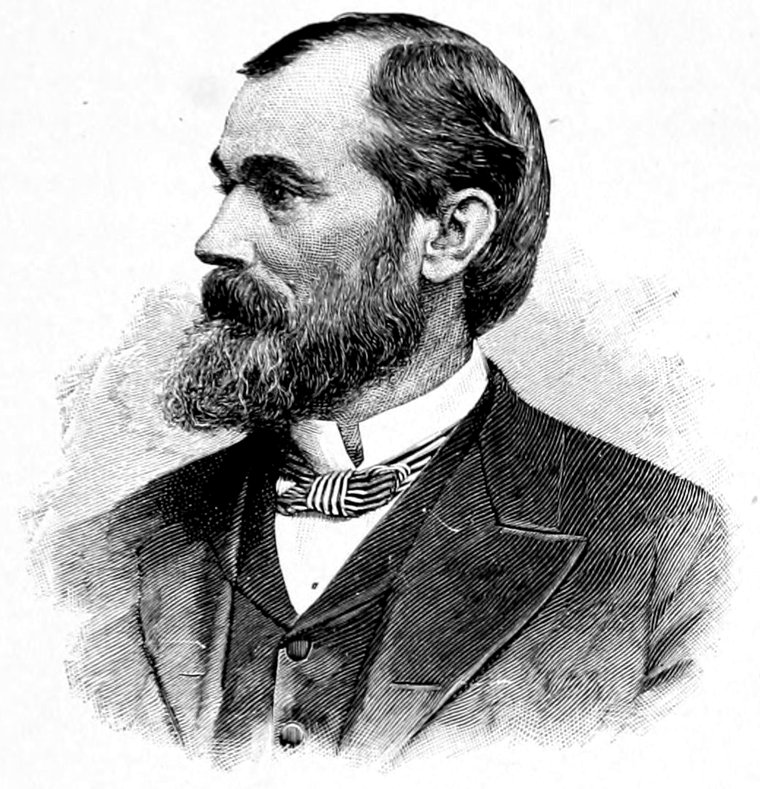
COLONEL WILBUR F. SANDERS
Principal prosecutor of George Ives
301The scene, by its associations and objects, could not be
otherwise than terribly impressive to all who were actors
in it; it wanted none of the elements, either of epic force
or tragic fury, which form the basis of our noblest poems.
A whole community, burning under repeated outrages, sitting
in trial on one of an unknown number of desperate
men, whose strength, purposes, even whose persons, were
wrapped in mystery! How many of that surging crowd
now gathered around the crime-covered miscreant, might
rush to his rescue the moment his doom should be pronounced,
no one could even conjecture. No man felt certain
that he knew the sentiments of his neighbor. None
certainly knew that the adherents of the criminal were
weaker, either in numbers or power, than the men of law
and order. It was night, too, before the testimony closed;
and in the pale moonlight, and glare of the trial fire, suspicion
transformed honest men into ruffians, and filled the
ranks of the guilty with hundreds of recruits.
The jury retired to deliberate upon their verdict. An
oppressive feeling, almost amounting to dread, fell upon
the now silent and anxious assemblage. Every eye was
turned upon the prisoner, seemingly the only person unaffected
by surrounding circumstances. Moments grew into
hours. “What detains the jury? Why do they not return?
Is not the case clear enough?” These questions fell
upon the ear in subdued tones, as if their very utterance
breathed of fear. In less than half an hour they came in
with solemn faces, with their verdict,—Guilty!—but one
juror dissenting.
“Thank God for that!” “A righteous verdict!” and
other like expressions broke from the crowd, while on the
outer edge of it, amidst mingled curses, execrations, and
howls of indignation, and the quick click of guns and revolvers,
one of the ruffians exclaimed,
“The murderous, strangling villains dare not hang him,
at any rate.”
Just at this moment a motion was made to the miner
“that the report be received, and the jury discharged,”
which, with some little opposition from the prisoner’s
lawyers, was carried.
Some of the crowd now became clamorous for an adjournment;
302but failing in this, the motion was then made
“that the assembly adopt as their verdict the report of
the committee.”
The prisoner’s counsel sprung to their feet to oppose
the motion, but it was carried by such a large majority,
that the assemblage seemed at once to gather fresh life and
encouragement for the discharge of the solemn duty which
it imposed. There was a momentary lull in the proceedings,
when the people found that they had reached the
point when the execution of the criminal was all that remained
to be done. They realized that the crisis of the
trial had arrived. On the faces of all could be read their
unexpressed anxiety concerning the result. What man
among them possessed the courage and commanding power
equal to the exigencies of the occasion!
At this critical moment, the necessity for prompt action,
which had so disarranged and defeated the consummation
of the trial of Stinson and Lyons, was met by Colonel
Sanders, one of the counsel for the prosecution, who now
moved, “that George Ives be forthwith hanged by the
neck, until he be dead.”
This motion so paralyzed the ruffians, that, before they
could recover from their astonishment at its being offered,
it was carried with even greater unanimity than either of
the previous motions, the people having increased in courage
as the work progressed. Some of the friends of Ives
now came up, with tears in their eyes, to bid him farewell.
One or two of them gave way to immoderate grief. Meantime,
Ives himself, beginning to realize the near approach
of death, begged piteously for a delay until morning, making
all those pathetic appeals which on such occasions are
hard to resist. “I want to write to my mother and sister,”
said he; but when it was remembered that he had
written, and caused to be sent to his mother soon after he
came to the country, an account of his own murder by Indians,
303in order to deceive her, no one thought the reason for
delay a good one.
“Ask him,” said one of the crowd, as he held the hand
of Colonel Sanders, and was in the midst of a most touching
appeal for delay, “ask him how long a time he gave
the Dutchman.”
He, however, made a will, giving everything to his counsel
and companions in iniquity, to the entire exclusion of
his mother and sisters. Several letters were written under
his dictation by one of his counsel.
In the meantime, A. B. Davis and Robert Hereford prepared
a scaffold. The butt of a small pine, forty feet
in length, was placed on the inside of a half-enclosed building
standing near, under its rear wall, the top projecting
over a cross-beam in front. Near the upper end was fastened
the fatal cord, and a large dry-goods box, about five
feet high, was placed beneath for the trap.
Every preparation being completed, Ives was informed
that the time for his execution had come. He submitted to
be led quietly to the drop, but hundreds of voices were
raised in opposition. The roofs of all the adjacent buildings
were crowded with spectators. While some cried,
“Hang the ruffian,” others said, “Let’s banish him,” and
others shouted, “Don’t hang him.” Some said, “Hang
Long John. He’s the real murderer,” and occasionally
was heard a threat, “I’ll shoot the murdering souls,” accompanied
by curses and epithets. The flash of revolvers
was everywhere seen in the moonlight. The guards stood
grim and firm. The miners cocked their guns, muttered
threats against all who interfered, and formed a solid
phalanx which it would have been madness to assault.
When the culprit appeared upon the platform, instant
stillness pervaded the assembly. The rope was adjusted.
The usual question, “Have you anything to say?” was addressed
to the prisoner, who replied in a distinct voice,
304“I am innocent of this crime. Alex Carter killed the
Dutchman.”
This was the only time he accused any one except Long
John.
He then expressed a wish to see Long John, and his sympathizers
yelled in approbation; but as an attempted rescue
was anticipated, the request was denied.
When all the formalities and last requests were over,
the order was given to the guard,
“Men, do your duty.”
The click of a hundred gun-locks was heard, as the guard
levelled their weapons upon the crowd, and the box flew
from under the murderer’s feet, as he swung “in the night
breeze, facing the pale moon, that lighted up the scene of
retributive justice.” The crowd of rescuers fled in terror
at the click of the guns.
“He is dead,” said the judge, who was standing near
him. “His neck is broken.”
Henry Spivey, the juror who voted against the conviction
of Ives, was a thoroughly honest and conscientious
man. He was not satisfied that the evidence showed Ives
to be guilty of the murder of Tiebalt, and as this was the
specific charge against him, he could not vote against his
conscience. He said that if Ives had been tried as a road
agent, he would have voted for his conviction.
The highest praise is due to Colonel Sanders for the
fearlessness and energy he displayed in the conduct of this
trial; for it furnished an example which was not lost upon
the law and order men in all their subsequent efforts to rid
the Territory of the ruffians.
CHAPTER XXXI RESULT OF IVES’S EXECUTION
305
The confederates of Ives spared no efforts, while his
trial was in progress, to save him. When intimidation
failed, they appealed to sympathy; and when that
proved unavailing, it was their intention, by a desperate
onslaught at the last moment, to attempt a forcible rescue.
They were deterred from this by the rapid clicking of the
gun-locks at the moment of the execution. All through the
weary hours of the trial, their hopes were encouraged with
the belief that Plummer, their chief, would come, and demand
the custody of Ives; and if refused, obtain it by a
writ of habeas corpus, in the name of the civil authorities
of the Territory. But if he obeyed the summons of Clubfoot
George, which is at best problematical, he acted no
conspicuous part. A saloon-keeper by the name of Clinton
was very positive that he saw him drink at his bar a
few moments before the execution, and that he immediately
went out to lead the “forlorn hope” of the roughs. Some
other person was probably mistaken for the robber chief,
as he was not recognized by any others of the crowd present
at the time. In fact he had enough to do to make provision
for his own safety; for Rumor, with her thousand
tongues, had carried the intelligence of the arrest of Ives
to Bannack, before the arrival there of Clubfoot George.
He found the people wild with excitement over a version
of the arrest, which Plummer himself had already circulated,
coupled with a statement that a Vigilance Committee
had been formed at Virginia City, a number of the best
306citizens hanged, and that from three hundred to five hundred
armed men were on the march to Bannack, with the
intention of hanging him, Ned Ray, Buck Stinson, George
Crisman, A. J. McDonald, Thomas Pitt, and others. This
anticipatory announcement was made with the hope that
by mingling the respectable names of Crisman, McDonald,
and Pitt, with those of Stinson, Ray, and his own, he might
divert, or at least divide, the attention which would otherwise
inculpate only the real villains. It produced a momentary
sensation, but failed of effect.
George Ives was no common desperado. Born of respectable
parents, he was reared at Ives’s Grove, Racine
County, Wisconsin. The foreground of his life was blameless;
and it was not until he came to the West that he developed
into the moral monster we have seen. His career
as a miner in California, in 1857–58, though wild and reckless,
was unstained by crime. No accusation of dishonesty
was made against him, until after his employment as a
herder of government mules belonging to the military post
at Walla Walla, in Washington Territory. The heavy
storms of that latitude, often destructive to herds in the
mountains, afforded him opportunity from time to time, by
reporting the fatality to the herd in his charge greater
than it was, to obtain for himself quite a large number of
animals. The deception was not discovered until after his
departure. He was by turns a gambler and a rowdy
in all the mining settlements on Salmon River. His
downward course, once commenced, was very rapid. On
one occasion he surprised the man who had employed him
as a herder, by riding into a saloon kept by him at Elk
City. After the man had seized the horse by the bridle,
Ives drew and cocked his pistol to shoot him, but was prevented
by a fortunate recognition of his old employer. He
apologized, and withdrew; and on several occasions afterwards,
proffered him the gray horse he rode as a present,
307which the gentleman, convinced that Ives had stolen the
animal, as often declined to accept. He was only twenty-seven
years of age at the close of his bloody career in Montana.
His appearance was prepossessing. In stature
nearly six feet, with light complexion, neatly shaven face,
and lively blue eyes, no one would ever have suspected
him of dishonesty, much less of murder, and cold-blooded
heartlessness. And yet, probably, few men of his age had
ever been guilty of so many fiendish crimes.
George Hilderman was fortunate in being put upon trial
immediately after the execution of Ives. Ten days later
he would have been hanged upon the same evidence. It
was proved that he knew of the murder of Tiebalt, and of
the murder of the unknown man near Cold Spring ranche,
neither of which he had divulged. He had even concealed
the stolen mules, and knew the persons engaged in the stage
robberies, and was found guilty upon general principles,
but recommended to mercy. Upon being informed of the
verdict, he dropped upon his knees, and exclaimed,
“My God! is it so!”
He then made a statement confirming all that Long John
had testified to concerning Ives.
The people commiserated his hapless condition. He was
an old man, weak, somewhat imbecile. They concluded
that his silence had been enforced by the threats of Ives
and his associates, and that, as there was no proof implicating
him directly with robbery or murder, they would
sentence him to banishment from the Territory. Ten days
were given him in which to leave. Glad to escape with his
life, he applied to Plummer for assistance. Plummer advised
him to remain; but the old man took wiser counsel
from his fears. He decided to go. Plummer gave him a
pony and provisions, and he left Montana forever.
Hilderman was possessed of a coarse humor, which he
had lost no opportunity to demonstrate, while a sojourner
308at Bannack. It made him quite a favorite with the miners,
until they became suspicious of his villainous propensities.
He was also a notorious “bummer,” and was oftener indebted
to his humor, which was always at command, than
his pocket, which was generally empty, for something to
eat. In width, his mouth was a deformity, and the double
row of huge teeth firmly set in his strong jaws gave to his
countenance an animal expression truly repulsive. He was
the original of the story of “The Great American Pie-biter.”
This feat of spreading his jaws so as to bite
through seven of Kustar’s dried-apple pies, had been frequently
performed by him, in satisfaction of the wager he
was ever on hand to make of his ability to do it. On one
occasion, however, he was destined to be defeated. A miner,
who had been victimized by him, arranged with Kustar,
the proprietor of the Bannack Bakery, to have two of the
pies inserted in the pile without removing the tin plates in
which they had been baked, the edges of which were concealed
by the overlapping crusts. Hilderman approached
the pile, and spreading his enormous mouth, soon spanned
it with his teeth. The crunch which followed, arrested
by the metal, was unsuccessful. He could not understand
it, but, despite the vice-like pressure, the jaws would not
close. The trick not being discovered, he paid the wager,
declaring that Kustar made the toughest pie-crust he had
ever met with.
Long John purchased his freedom by his testimony, and
nothing appearing against “Tex” at the time, he also was
released.
The execution of Ives had a terrifying effect upon the
ruffian horde, though a few of them put a bold face upon
the matter and were as loud in their threats as ever. The
prominent actors in that drama were singled out for
slaughter, but no serious instance of personal assault occurred.
The ruffians felt secure, as long as they were unknown,
309and the only revelation yet made was insufficient
to implicate any of them with the numerous murders and
robberies that had been committed. Facts had appeared
upon the trial, making it probable that Carter was accessory
to the murder of Tiebalt. The assassination of
Dillingham was unavenged. Either of these causes, in the
excited state of the public mind, was sufficient to remind
the people that the work they had to perform was but just
begun. If what they had done was right, it would be wrong
to permit others equally guilty to escape. Carter, Stinson,
and Lyons must be punished.
This spontaneity of thought brought a few of the citizens
of Virginia and Nevada into consultation the day
following the execution; and before the close of the succeeding
day, a league was entered into, in which all classes
of the community united, for the punishment of crime and
the protection of the people. Before the organization of
this committee was completed, a fresh impulse was given
to the public indignation on receipt of intelligence that
Lloyd Magruder, a merchant of Elk City, and the independent
Democratic candidate for Congress, who had been
trading in Virginia City during the fall, had, while on his
return to his home, with four others, been cruelly murdered
and robbed by a number of the gang, in the Bitter
Root Mountains. Full particulars of this terrible tragedy
will be given in the two following chapters.
Magruder was very popular with the people of Virginia
City. The committee went to work immediately. Twenty-four
of them, well mounted, and provisioned for a long
ride, started in pursuit of Carter. That villain, accompanied
by William Bunton, Graves, and several others, in
anticipation of arrest, left as soon as the trial of Ives
was over, for the west side of the range. The pursuers
followed on his trail as rapidly as possible, into the Deer
Lodge Valley. While riding down the valley, the vanguard
310of the scouts met Erastus Yager, who from the redness of
his hair and whiskers was familiarly called “Red.” He
informed them that Carter and his companions were lying
drunk at Cottonwood (since Deer Lodge City), and that
they avowed themselves good for at least thirty of any
men that might be sent to arrest them.
The party had suffered severely from the wintry blasts
and storms, especially while crossing the divide; and they
were glad that both strategy and comfort favored their
detention for the next twenty hours at the ranche of John
Smith, seventeen miles above Cottonwood. At three o’clock
in the afternoon of the next day, they left for Cottonwood,
expecting to surprise and capture the fugitive without difficulty.
How great was their disappointment, to find that
both he and his companions had fled. A distant camp-fire
in the mountains at a later hour convinced them that further
pursuit at that time would end in failure. They
learned upon inquiry that the ruffians had received a message
from Virginia City, warning them of the approach of
the Vigilantes. And this intelligence was afterwards confirmed
by a letter which was found at their camping ground,
the writing of which was recognized as that of
one George Brown, who was supposed to belong to the
gang. It afterwards transpired that “Red,” or Yager,
was the messenger who brought this letter, and that he had
killed two horses on the expedition. Disappointed in the
object of their search, the scouts now determined to return
by way of Beaverhead Rock, and, if possible, arrest both
Brown and “Red” for their criminal interference.
Their sufferings from exposure to the keen December
storms were intense. Arriving at Beaverhead, they camped
in the willows, without shelter or fire, except such as could
be enkindled with green willows. Some of their animals
strayed to a cañon to escape the severity of the storm.
After remaining in camp at this place for two days, they
311ascertained that “Red” was at Rattlesnake, twenty miles
distant. A small party of volunteers started immediately
to arrest him, while the others, en route to Virginia
City, stopped at Dempsey’s to await their return.
At Stone’s ranche the pursuers obtained fresh horses
from the stage stock of Oliver & Co., and resumed their
dismal journey to Rattlesnake. The weather was intensely
cold, but this offered no impediment to the pursuit of their
journey. Arriving at Rattlesnake, they surrounded the
ranche, while one of their number entered. Stinson and
Ray, both present, had in their capacity as deputies of
Plummer arrested a man, whom they held in custody. Stinson,
who disliked his visitor, confronted him with his revolver;
but seeing a like implement already in the hands
of the scout, who “had the drop” on him, he returned
his weapon to its sheath.
“I have come to arrest ‘Red’ for horse-stealing,” said
the scout.
On hearing this, Stinson and Ray released their prisoner,
on his promise to go immediately to Bannack and
surrender himself. The man started forthwith to comply
with his promise.
Meantime the scout joined his party outside, and they
all rode hurriedly to a wakiup a few hundred yards up the
creek, which they surrounded while the leader entered, observing
as he did so,
“It’s a mighty cold night. Won’t you let a fellow warm
himself?” Advancing towards the fire, his eyes fell upon
“Red.” Raising his revolver, he said, “You’re the man
I’m looking for. Come with me.”
“Red” asked no questions, and exhibited no terror.
Putting on his hat, and gathering his blankets under his
arm, he did as he was ordered, with as much apparent
nonchalance as if he were going on a holiday excursion.
When told that he would be taken to Virginia City, he
312simply manifested by a glance that he fully comprehended
the situation, and acted in all respects, while a prisoner,
as one who knew his doom was irrevocable. The scouts
took him to the ranche, where they passed the night.
They left early the next morning; “Red” unarmed, on
his own horse, and riding beside one of the scouts. The
dreary ride through snow and wind was enlivened by the
stumbling mule of the leader, which on one occasion rolled
over, and after safely depositing its rider, made two or
three somersaults down a steep bank, plunging headlong
into a snowdrift at the bottom, which completely enveloped
him.
At Dempsey’s the captors joined the main party. Fatigued
with the journey through the drifts, they took supper,
provided for the security of their prisoner, and
enjoyed a night’s repose. Brown, the man who had written
the warning missive to Carter, was the bar-keeper, and
a sort of general factotum of the ranche. He had been
for some time suspected as a petty thief and robber, without
the courage needful to engage in graver offences. The
Vigilantes saw that he was terrified, as soon as they arrived,
though unconscious of the evidence they had
obtained against him.
In the morning the captain of the Vigilantes, in a private
interview with “Red,” charged him with being connected
with the robber horde. “Red” denied all knowledge of
its existence.
“Why, then,” inquired the captain, “should you have
been at such pains to apprise the rascals that the Vigilantes
were on their track?”
“It was the most natural thing in the world,” “Red”
replied. “I stopped here on my way to Deer Lodge, and
Brown, on being told of my destination, asked me to take
a letter to Alex Carter and some friends. I knew no reason
why I should refuse, and did so.”
313Brown was then called in, and “Red” repeated the statement
in his presence. Brown did not deny it, but betrayed
by his blanched cheeks and trembling limbs that it was
true. The captain, laying his hand upon his shoulder, and
looking him steadily in the eye, said,
“Brown, you must consider yourself under arrest; we
will at once proceed to a full investigation of this matter.
It looks very dark for you.”
He was put under guard, to await the termination of
the trial of “Red,” which was at once commenced. When
this was over, Brown was subjected to a second examination
before the entire company.
“Did you write this letter of warning?” inquired the
captain.
“I did,” replied Brown.
“Why?”
“‘Red’ came to Dempsey’s and said he was going to
see the boys, and asked me if I had any word to send them,
offering to carry it for me. I wrote them that the Vigilantes
were after them, and advised them to leave.”
No other explanation was given; and on their own confessions,
and some additional proof showing that “Red”
had made inconsistent statements to different persons belonging
to the Vigilantes, while passing them on his return
from Cottonwood, with a view to deceive them as to
the whereabouts of Carter,—the company withdrew to
the Stinking Water bridge, to decide upon the guilt or
innocence of the prisoners.
“Boys,” said the captain, addressing the assemblage,
“you have heard what these men have had to say for themselves.
I want you to vote according to your consciences.
If you think they ought to suffer punishment, say so; if
you think they ought to go free, vote for it. Be very
careful to do the right thing for yourselves, as well as for
the prisoners. All those in favor of hanging them, step
314to the right side of the bridge; and those who are for letting
them go, to the left side.”
So thoroughly convinced were the men of the guilt and
complicity of the prisoners with the road-agent gang, that
every man passed immediately to the right.
The culprits started immediately, under the escort of
seven men and a leader, in the direction of Virginia City.
Two hours afterwards they arrived at Lorrain’s ranche,
where they were joined at sundown by the other members
of the company, who, after a brief consultation, rode on to
Virginia City. After they had gone, the leader lay down
in his blanket on the parlor floor, to snatch a few hours of
repose. Precisely at ten o’clock, he was awakened by a
slight shake, and the words,
“The hour has arrived. We mean business, and are
waiting for you.”
He arose and went to the bar-room, where Brown and
“Red” lay in the corner asleep. “Red” was the first to
awaken. Rising to his feet, he addressed the leader in a
sad and despondent tone.
“You have treated me like a gentleman,” said he. “I
know that my time has come. I am going to be hanged.”
“That’s pretty rough, ‘Red’” interjected the leader.
“Yes. It’s pretty rough, but I merited it years ago.
What I want to say is, that I know all about this gang.
There are men in it who deserve death more than I do; but
I should die happy, if I could see them hanged, or know
it would be done. I don’t say this to get off. I don’t want
to get off.”
“It will be better for you, ‘Red,’” said the Vigilantes,
“at this time to give us all the information in your possession,
if only for the sake of your kind. Times have been
very hard. Men have been shot down in broad daylight, not
alone for money, or even hatred, but for mere luck and
sport, and this must have a stop put to it.”
315“I agree to it all,” replied “Red.” “No poor country
was ever cursed with a more bloodthirsty or meaner pack
of villains than this,—and I know them all.”
On being urged by the leader to furnish their names,
which he said should be taken down, “Red” told him
that Henry Plummer was chief of the band; Bill Bunton,
stool pigeon and second in command; George Brown, secretary;
Sam Bunton, roadster; Cyrus Skinner, fence, spy,
and roadster; George Shears, horse-thief and roadster;
Frank Parish, horse-thief and roadster; Hayes Lyons,
telegraph man and roadster; Bill Hunter, telegraph man
and roadster; Ned Ray, council-room keeper at Bannack
City; George Ives, Stephen Marshland, Dutch John (Wagner),
Alex Carter, Whiskey Bill (Graves), Johnny Cooper,
Buck Stinson, Mexican Frank, Bob Zachary, Boone Helm,
Clubfoot George (Lane), Billy Terwiliger, Gad Moore,
roadsters.
These men were bound by an oath to be true to each
other, and were required to perform such services as came
within the defined meaning of their separate positions in
the band. The penalty of disobedience was death. If any
of them, under any circumstances, divulged any of the
secrets or guilty purposes of the band, he was to be followed
and shot down at sight. The same doom was prescribed
for any outsiders who attempted an exposure of
their criminal designs, or arrested any of them for the commission
of crime. Their great object was declared to be
plunder, in all cases, without taking life if possible; but
if murder was necessary, it was to be committed. Their
password was “Innocent.” Their neckties were fastened
with a sailor’s knot, and they wore mustaches and chin
whiskers. He was himself a member of the band, but not
a murderer.
Among other disclosures, “Red” attributed his hapless
condition to Bill Hunter, at whose instigation, years before,
316he had entered upon a career of infamy. He hoped
the committee would not spare him. He gave the particulars
of the robberies of the coaches, and the names of
all engaged in this as well as many other crimes.
After listening to this frightful narrative, and making
such memoranda as they might need for future operations,
the little party of Vigilantes carefully reconsidered the
vote they had taken, and decided that the two culprits
should be executed immediately. In the course of the narrative,
“Red” had fully implicated Brown. In the Indian
campaign in Minnesota in 1862, Brown was a scout for
Gen. William R. Marshall (brother-in-law of the writer),
who regarded him as not a notoriously bad man, but as one
who had little moral principle or force of character,
and who was easily influenced by his associates.
Less than a quarter of a mile distant, in rear of Lorrain’s,
on a beautiful curve of the Pas-sam-a-ri, stood several
majestic cottonwoods, by far the finest trees in all
that region. Two, which stood side by side, were selected
as the scaffolds. It was a dim starlit night, and a lantern
was necessary to complete the preparations for the execution.
The cold blast from the immediate mountains
howled fearfully as the little procession tramped through
the snow, with their prisoners in charge, to the fatal spot.
The night was not darker than the gloom which had settled
upon the minds and hearts of these condemned
wretches. “Red,” however, was perfectly collected. Not
a sigh escaped him, nor a tear dimmed his eyes. Brown
was all excitement. He begged piteously for mercy, and
prayed for his Indian wife and family. They were in
Minnesota. “Red,” more affected by the terror and moans
of his comrade than his own hapless condition, said to him
in a sad but firm tone,
“Brown, if you had thought of this three years ago,
you wouldn’t be here now, or give the boys this trouble.”
317A few branches were clipped from a lower limb of each
of the trees, and the ropes suspended. Two stools brought
from the ranche, by being placed one upon the other, served
the purpose of a drop. A Vigilante, while adjusting the
noose to the neck of Brown, stumbled, and both he and
Brown fell together into the snow. Recovering himself,
he said, by way of apology,
“We must do better than that, Brown.”
It was a chance remark, proceeding from a motive which
it failed to express; better interpreted by those who heard
it, than I fear it will be by my readers.
When all was ready, Brown, with the petition upon his
lips, “God Almighty save my soul,” was launched from
the platform, and died without a struggle.
“Red” witnessed the scene unmoved. When his turn
came, and he stood upon the frail trestle, he looked calmly
around upon his executioners.
“I knew,” said he, “that I should be followed and
hanged, when I met the party in Deer Lodge Valley; but I
wish you would chain me, and not hang me until after I
have seen those punished who are guiltier than I.”
Just before he fell, he shook hands with all, and then
turning to the Vigilante who had escorted him to Lorrain’s,
he said,
“Let me beg of you to follow and punish the rest of
this infernal gang.”
“‘Red,’” replied the man, “we will do it, if there’s
any such thing in the book.”
“Good-bye, boys,” said “Red,” “you’re on a good undertaking.
God bless you.”
The stools fell, and the body of the intrepid freebooter
swung lifeless in the midnight blast.
CHAPTER XXXII LLOYD MAGRUDER
318
“In the name of all that is wonderful, Hill, what has kept
you up till this late hour?” was the eager inquiry of
Mrs. Maggie Beachy of her husband, when that gentleman
entered his house at two o’clock in the morning.
“Well, Maggie,” replied her husband, “you remember
my dream about Lloyd Magruder? I fear it has all come
true. Indeed, I am perfectly certain poor Lloyd has been
murdered.”
“Nonsense, Hill,” rejoined the wife. “Will you never
have done with your unfounded suspicions? You will make
yourself the laughing-stock of the whole country, and
bring all the roughs in it about your ears, if you don’t
cease talking about Magruder.”
“I can’t help it, wife,” persisted Beachy. “Those three
rascals, Doc. Howard, Chris Lowry, and Jim Romaine,
with another hangdog-looking fellow, came into town to-night
in disguise, and, under assumed names, took passage
in the coach to Walla Walla. They followed Magruder
to the Bannack mines, and have doubtless killed him while
on his way home. Their cantinas are filled with his gold
dust.”
“How improbable, Hill,” said Mrs. Beachy, smiling.
“Why, only yesterday Lloyd’s wife received a letter from
him, saying that he would not start for twelve days, and
that he would have a strong company with him.”
“Well, well, Maggie, let’s drop the subject. Time will
tell whether my suspicions are correct.”
319Let us inquire into the cause of Hill Beachy’s terrible
suspicion.
Three months before this conversation occurred, Lloyd
Magruder, a wealthy merchant of Elk City, loaded a pack
train with merchandise, and made the long and dangerous
journey of five hundred miles, by an Indian trail
over the mountains, to the Bannack mines, in that part of
Idaho afterwards embraced in the boundaries of Montana.
The night preceding his departure, Hill Beachy, the landlord
of the Luna House in Lewiston, a warm personal
friend of Magruder, dreamed that he saw Chris Lowry
dash Magruder’s brains out with an axe. He related the
dream to his wife the next morning, and expressed great
fears for the safety of his friend. She was desirous of
telling Magruder; but as his investment was large, and he
was ready to start upon his journey, Beachy thought it
would only introduce a disturbing element into the enterprise,
without effecting its abandonment, and expose him
to the laughter and sneers of the public. But he did not
conceal the anxiety which the dream had occasioned in his
own mind, and was greatly relieved when news came, six
weeks afterwards, of the safe arrival of Magruder at
Bannack.
On the morning of the day after Magruder left Lewiston,
Howard, Lowry, and Romaine, in company with Bob
Zachary and three other roughs, departed with the avowed
intention of going to Oregon. As soon, however, as they
had proceeded a sufficient distance in that direction to
escape observation, they turned towards Bannack, and
after a few days’ journey were joined by William Page,
an old mountain teamster. The party followed on in the
track of Magruder’s train, which they overtook when
within three days’ journey of Bannack, and accompanied
it to its place of destination.
Magruder was disappointed, on his arrival at Bannack,
320to learn that the camp had been deserted by most of the
miners, who had gone to the extensive placer mines in
Alder Gulch at Virginia City, seventy-five miles distant,
where the writer was then residing. Three days afterwards,
however, he was well satisfied, on his arrival there,
to find an active mining camp of six thousand inhabitants,
all eager to purchase his wares as rapidly as they could
be displayed. Howard, Lowry, Romaine, and Page found
comfortable quarters in the building occupied by Magruder,
and were provided by him with employment during his
six weeks’ stay in Virginia City. No one, except himself,
knew better than they the amount of his accumulations.
His confidence in them was unbounded. On his offer to
pay them two hundred dollars each, they had agreed to
accompany him as assistants and guards on his return
to Lewiston. The negotiations with Magruder for their
employment were conducted by Howard, who was a physician
of marked ability, and whose pleasing address was well
calculated to allay all suspicion concerning their real motives
in joining the party. Howard, Lowry, and Romaine,
while at Lewiston, were classed among the vilest roughs
of the town. The former two were understood to be escaped
convicts from the California penitentiary. They
had been concerned in numerous robberies, and were suspected
of connection with Plummer’s infamous gang.
Magruder, whose residence was at Elk City, was entirely
unacquainted with their history, and, from the simulated
fidelity of their conduct while in his employ, had no reason
to suspect them of criminal designs. He was very fortunate
in the disposition of his merchandise, realizing
therefor twenty-four thousand dollars in gold dust, and
a drove of seventy fine mules.
A few days before his departure from Virginia City,
Charley Allen, a successful miner, and two young men,
brothers, by the name of Horace and Robert Chalmers,
321who had just arrived in the mountains from Booneville,
Missouri, and William Phillips, an old pioneer in the country,
arranged to unite their trains with his, and all make
the trip together as one company. Romaine tried to dissuade
Phillips from going with the others, but gave no
reason for what seemed to the latter a strange request.
It was a bright October morning when the train left
Virginia City, and moved slowly down Alder Creek, into
the picturesque valley of the Pas-sam-a-ri. The sun shone;
the mountain atmosphere was crisp and exhilarating.
The long plain stretching away to the base of the Ruby
range reflected upon its mirror-like surface that magnificent
group of pine-covered mountains, along whose sides
glinted in the sunbeams the bewitching hues that give them
their name. Towering on the right, rose the twin pinnacles
of Ramshorn and Mill Creek; and, afar in the distance,
painted upon the horizon, was the superb outline of the
main range of the old Rockies, and Table Mountain lifting
its glittering plateau of snow far above the surrounding
peaks. Filled with the inspiration naturally enkindled
by these majestic views, the men, with all the animation and
abandon of uncaged schoolboys, shouted and sung as they
galloped along and hurried the train across the widespread
valley. Into the hills, over the mountains, across the
streams, through the cañons they scampered, entering
Bannack the third day, just as the sun was setting.
Business detained them at Bannack the three following
days. With the design of misleading the villains at Lewiston
who might be on the watch for his return, Magruder
sent by a company which left the morning after his arrival,
a letter to his wife, telling her of his success, and
that he would leave for home with a train strongly guarded,
in twelve days. While he was thus planning the way for
a safe return, Howard was equally busy in maturing a
scheme to rob him on the route. This infernal project,
322the fruit of long contemplation, he now for the first time
unfolded to Lowry and Romaine, who gave it their eager
compliance. Meeting with Bob Zachary, he confided it to
him; but, on learning that it could not be effected without
the possible murder of Magruder, and the four persons accompanying
him, Zachary, villain as he was, declined all
participation in it. It was understood by the three that
on the eighth day of the journey, when the train would
make camp in the Bitter Root Mountains, at a distance of
one hundred miles or more from any white settlers, they
would carry their diabolical design into execution. Howard
declared that it could not be done without killing the five
owners of the trains. Page was to be kept in ignorance
of the plot until the eve of its performance.
Animated with the hope of an early reunion with his
family, Magruder, with his companions, left Bannack one
bright autumnal morning, and dashed with his train into
the manifold intricacies of the mountain labyrinth. The
burden of care with which one is oppressed, while travelling
through an uninhabited region, exposed continually
to the attacks of Indians and robbers, is always relieved
by a sort of wild exhilaration inseparable from the shifting
of scenery, and the varied occupations and incidents
of the journey. And when day after day passes, without
any change in the same monotonous round of employment,
men sometimes desire the variety of a brush with the Indians,
or a deer chase, or an antelope hunt, to ward off
their mental depression. But save an occasional foray
upon a herd of antelopes, the train moved safely onward,
without impediment. The three ruffians were particularly
attentive to the duties required of them, winning golden
opinions from those they intended to destroy.
On the evening of the sixth day, the train descended into
the valley of the Bitter Root. The lofty range of mountains
which now forms the boundary between Montana and
323Idaho stretched along the horizon displaying alternate
reaches illumined by the departing rays of the sun, and
darkened by the shadows of overhanging clouds.
“In three days more,” said Magruder, “we shall descend
the range into Idaho, and all danger will be over.”
Near the close of the second day thereafter, as the mules
were slowly creeping up the trail, when near the summit,
Howard rode alongside of Page, and in a tone of fearful
earnestness said to him,
“Page, when we go into camp, to-night, drive the mules
half a mile away, and remain with them till supper time.
We are going to kill Magruder and his four friends. You
can help dispose of the bodies when the work is done, and
share in the plunder. As you value your own life, you will
not breathe a word of this to any one.”
Had a thunderbolt fallen at the feet of Page, he could
not have been more terrified. Reckless as his life had been,
no stain of blood was on his soul. Gladly would he have
warned Magruder, but the fearful threat of Howard was in
his way. Besides, as Howard had grown into great favor,
he felt that he would not be believed. He decided the conflict
with conscience by resolving to follow the directions of
the conspirators.
The spot was not unfamiliar. It had been often occupied
for camping purposes, and was specially favored
with water and pasturage. It was also sheltered by the
impenetrable foliage of a clump of dwarf pines and redwoods.
Five minutes’ clamber of the vertebrated peak
which rose abruptly above the camp-fire, would enable one
to survey for many miles the vast volcanic region of mountains,
hills, and cañons over which the trail of the traveller,
like a dusky thread, stretched on towards Lewiston.
The train drew up on the camping ground a little before
dark. The sky was overcast with snow clouds, and
the wind blew chill and bleak. Every sign indicated the
324approach of one of those fearful snowstorms common at
all seasons in these high altitudes. All the men except
Page, who was with the herd, were gathered around the
camp-fire, awaiting supper. As Page, staggering under
the burden of his guilty secret, came to the camp in answer
to a call to supper, Howard met him, and in an ominous
whisper, warned him to retire as soon as his meal was finished,
and not to be seen about the camp until he was
wanted.
Magruder and Lowry were assigned to stand guard and
watch the herd until ten o’clock,—the hour agreed upon
for the commission of the crime. Page had built a fire for
their accommodation. As they rose to leave the camp,
Lowry, picking up an axe, remarked,
“We shall probably need some wood, and I’ll take the
axe along.”
Their departure was regarded as a signal for all to retire.
Page had spread his blankets and lain down some
time before, “not,” as he afterwards said, “to sleep, but
to await the course of events.” Allen crept in by his side.
The Chalmers brothers had made their bed twenty yards
distant from the camp-fire; and Romaine, armed to perform
the part assigned to him, stretched himself beside
Phillips, his unsuspecting victim. Howard, the arch and
bloody instigator of the brutal tragedy, demon-like, roamed
at large, ready for any service, when the hour came, necessary
to finish the deed.
The evening wore on. The sleep of toil-worn men comes
when it is sought; and soon the only wakeful eyes in the
camp were those of the watchers at the herd, Howard, Romaine,
and the wretched Page.
The friendly conversation between Magruder and
Lowry, as they sat side by side at the fire, was not interrupted,
until the former looked at his watch.
325“It is nearly ten,” said he, filling his meerschaum, while
unconsciously announcing the hour of his doom.
“I will put some wood on the fire,” said Lowry, picking
up the axe, and rising.
Magruder bent forward towards the fire to light his
meerschaum, when the axe wielded by Lowry descended with
a fearful crash into his brain. Howard, who had been concealed
near, sprung forward, and snatching the axe from
Lowry, who seemed for the moment paralyzed at the deed
he had committed, struck several additional blows upon
the already lifeless body of the unfortunate man. The
villains then hurried to the spot where the Chalmers
brothers were lying, and while they were despatching them
with the axe, Romaine plunged a bowie-knife into the abdomen
of Phillips, exclaiming at the moment, with an oath,
“You old fool, I have to kill you. I told you at Virginia
City not to come.”
Allen, wakened by the death groan of young Chalmers,
had risen to a sitting posture, and was rubbing his eyes,
when Howard stole behind him, and blew out his brains,
by a simultaneous discharge of buckshot from both barrels
of his gun into the back part of Allen’s head.
The work of assassination was complete. The murderers,
unharmed, were in possession of the gold which had
caused the dreadful deed.
Page, who had not left his bed, was now summoned by
Howard to assist in the concealment of the bodies. Knowing
that his life would pay the forfeit of disobedience, he
hurried to the camp-fire, where Lowry greeted him with
the soul-sickening words,
“It’s a grand success, Bill. We never made a false
stroke.”
A heavy snowstorm now set in. The assassins occupied
the remainder of the night in destroying and removing the
evidences of their guilt. The bodies of their victims were
326wrapped in blankets, conveyed to the summit of an adjacent
ridge, and cast over a precipice into a cañon eight
hundred feet deep, where it was supposed they would be
speedily devoured by wolves. The camp equipage, saddles,
straps, blankets, guns, pistols, everything not retained
for immediate convenience, were burned, and all the
iron scraps carefully collected, put into a sack, and cast
over the precipice. All the while these guilty deeds were
in progress, the storm was increasing. When the morning
dawned, not a vestige of the ghastly tragedy was visible.
The camp was carpeted to the depth of two feet with
snow, and the tempest still raged. The murderers congratulated
each other upon their success. No remorseful
sensations disturbed their relish for a hearty breakfast.
No contrite emotions affected the greedy delight with which
each miscreant received his share of the blood-bought
treasure. No dread lest the eye of the All-seeing, who
alone had witnessed their dark and damning atrocity,
should betray them, mingled with the promises they made
to themselves of pleasures and pursuits that this ill-gotten
gain would buy in the world where they were going. One
solitary fear haunted them,—that concerning their escape
from the country.
When this all-absorbing subject was mentioned, they saw
and felt the necessity of avoiding Lewiston; their presence
there would excite suspicion. Howard advised that they
should go to a ford of the Clearwater, fifty miles above
Lewiston, and cross over and make a hurried journey to
Puget Sound. There they could take passage on a steamer
to San Francisco or to British Columbia, as after events
might dictate. This counsel was adopted. Mounting their
horses, they made a last scrutinizing survey of the scene
of their hellish tragedy, now covered with snow, and
plunged down the western slope of the mountains, amid
the rocks and cañons of Northern Idaho. The expression
327of Howard, as he reined his horse away from the bloody
theatre, may be received as an indication of the sentiments
by which all were animated.
“No one,” said he, “will ever discover from anything
here the performance in which we have been engaged. If
we are only true to each other, boys, all is safe.”
The animals, with the exception of one horse and seven
mules, were abandoned, but accustomed to follow the tinkle
of the bell still suspended to the neck of the horse, the herd
soon appeared straggling along the trail behind the company.
The heartless wretches, thinking to frighten the
animals away, at first shot them one by one as they came
within rifle distance. Finding that the others continued
to follow, they finally drove the entire herd, seventy or
more in number, into a cañon near the trail, and mercilessly
slaughtered all the animals composing it.
Avoiding Elk City by a circuitous route, the party,
after several days’ travel, arrived at the ford of the Clearwater.
Two broad channels of the river at this crossing
encircled a large island. A mountain torrent at its best,
the river was swollen by recent rains, and its current running
with frightful velocity. Page, who was perfectly
familiar with the ford, dashed in, and was followed by
Lowry. They were obliged to swim their mules before
reaching the island, and had still a deeper channel to cross
beyond. Romaine and Howard, who had witnessed the
passage from the bank, were afraid to risk it. A long parley
ensued, which finally terminated in the return of Page
and Lowry, and an abandonment of the ford. A single
day’s rations was all the food the company now possessed.
None could be obtained for several days, except at Lewiston,
the mention whereof brought their crime before the
ruffians with terrible distinctness. But there was no alternative.
Risk of detection, while a chance presented for
escape, was preferable to physical suffering, from which
328there was none. They encountered the risk. Near Lewiston
they fell in with a rancheman, to whom they committed
their animals, with instructions to keep them until their
return, and, concealing their faces with mufflers, entered
the town at a late hour of the evening.
With the design of stealing a boat, and making a night
trip down Snake River, to some point accessible to the
Portland steamboats, they proceeded at once to the river
bank fronting the town. Piling their baggage into the
first boat they came to, they pushed out into the stream.
The wind was blowing fearfully, and the maddened river
rolled a miniature sea. They had proceeded but a few
rods when a sudden lurch of the boat satisfied them that the
voyage was impracticable, and they returned to shore.
Their only alternative now was to secure a passage that
night in the coach for Walla Walla, or remain in Lewiston
at the risk of being recognized the next day. It was a
dark, blustering night. Hill Beachy, whose invariable custom
it was to retire from the office at nine o’clock, from
some inexplicable cause became oblivious of the hour, and
was seated by the stove, glancing over the columns of a
much-worn paper. His clerk stood at the desk, preparing
the way-bill for the coach, which left an hour later for
Walla Walla. The street door was locked. Suddenly the
silence without was broken by the heavy tramp of approaching
footsteps. A muffled face peered through the window.
Beachy’s attention was arrested by a hesitating triple
knock upon the door, which seemed to him at the time
ominous of wrong. Catching up the lamp, he hurried to
the door, on opening which a tall, well-proportioned man,
in closely buttoned overcoat, with only his eyes and the
upper portion of his nose visible, entered, and with a
nervous, agitated step, by a strangely indirect, circular
movement, advanced to the desk where the clerk was
standing.
329Addressing the clerk in a subdued tone, he said, “I
want four tickets for Walla Walla.”
“We issue no tickets,” replied the clerk, “but will enter
your names on the way-bill. What names?” he
inquired.
For a moment the stranger was nonplussed. Recovering
himself instantly, with seeming nonchalance, he gave
the names of John Smith and his brother Joseph, Thomas
Jones and his brother Jim; and, throwing three double
eagles upon the desk, he hastily departed.
As he closed the door, Beachy said to the clerk, “I’m
afraid there will be a stage robbery to-night. Go to the
express-office and tell the agent not to send the treasure
chest by this coach. Don’t wake the passenger in the next
room. I will see the citizens who have secured passage,
and request them to wait until to-morrow.”
Still reflecting upon the suspicious conduct of the visitor,
Beachy determined to get a sight of his companions.
“There are too many Smiths and Joneses to be all right,”
he said to himself, as he slipped the hood over his dark
lantern and took his way to the hotel where they lodged.
Ascertaining that their apartment fronted the street, he
stole quietly up to the window, which was protected by
shutters with adjustable lattice. This, by a cautious
process, he opened, and, peering through, beheld the four
inmates, three of whom he recognized as the ruffians who
had left Lewiston and gone to Bannack three months before.
More deeply confirmed than at the first in the belief
that a robbery was intended, he awaited the approach of
the coach, designing to make a careful survey of the group
after they were seated preparatory to departure. Fifteen
or twenty persons, who had heard of Beachy’s suspicions,
several of whom were old associates of Howard and his
companions, followed the coach from the barn to the hotel.
Enveloped in overcoats and blankets, their faces
330concealed by mufflers, and their hats drawn down to hide
their eyes, the four men climbed into the coach. Just as
the driver gathered up his lines Beachy opened his lantern,
and before the men could wrap their blankets around them,
his quick eye detected that two of the number had each a
pair of well-filled cantinas on his lap. After the coach had
driven off, he turned to Judge Berry, who was standing
near, and, in a low but meaning tone, said,
“Lloyd Magruder has been murdered.”
“What makes you think so?” inquired the judge. “Do
you recognize these fellows?”
“Yes, three of them: Howard, Lowry, and Romaine.
Their cantinas are filled with Magruder’s money. I’ll
furnish horses and pay all expenses if you and the sheriff
will join me, and we’ll arrest them to-night.”
“Arrest them for what?” asked the judge.
“On suspicion of having murdered Magruder.”
“Why, Hill, the whole town would laugh at us. We
certainly could not detain them without evidence. Besides,
your suspicions are groundless. Mrs. Magruder
told me last evening that she did not expect her husband
for ten or twelve days. Let matters rest for the present.”
“I know that Magruder is dead, and that these villains
killed him, as well as if I had seen it done,” rejoined Beachy.
“From this time forth, I am on their track.”
Bidding the judge good-night, he wended his way home,
and, on entering his house, held the conversation with his
wife with which this chapter opens.
CHAPTER XXXIII HILL BEACHY
331
Mr. Beachy’s convictions gave him no rest. Without
a shadow of evidence to sustain him, or a clew
to guide him, he went to work to ferret out the crime. His
friends laughed at and discouraged him. The roughs of
Lewiston threatened him. A few charitably attributed his
conduct to mental derangement. The face of every person
he met wore a quizzical expression, which seemed to
imply both pity and ridicule. Often, when thwarted, he
half resolved to abandon the pursuit, but a voice within
whispered him on with assurance of success, and he could
not, if he would, recede. Three days were spent in a fruitless
search for the animals which he knew must have borne
the men to town. At the close of the third day a party arrived
from Bannack. The first inquiry he addressed to
them after the usual salutation was,
“Where is Magruder?”
“Hasn’t he arrived?” was the surprised rejoinder.
“He left four days before us, intending to come through
as quickly as possible.”
Beachy heard no more.
“He is dead,” said he, “and I know the murderers.”
“Tut, tut, Hill, you’re too fast. He has probably gone
around by Salt Lake. He’ll be in all safe in a few days.”
Beachy resumed his search for the animals. In a few
days a man came in from some point above Lewiston, and
reported having seen, on his ride down the river, a party of
four men encamped in a solitary nook on the opposite
332bank. The thought flashed through Beachy’s brain that
they were the murderers, who, thwarted in their effort to
leave the country at Walla Walla, had returned by a circuitous
route, in search of a point more favorable.
In Tom Farrell, a harum-scarum dare-devil of the town,
Beachy found one man who shared his suspicions. He consented
to go with him and aid him in arresting these men.
It was freezing weather, and the trail was rough and mountainous.
Both men were well armed and of undoubted
courage. Urging their horses to their utmost speed, they
rode on till past the hour of noon, when Tom descried a
thin column of smoke ascending from the camp of the supposed
freebooters. Securing their horses in a thicket, they
crept to a point where, concealed by the willows, they could
observe all parts of the camp. Alas for their hopes! The
suspected robbers developed into a hunting party of honest
miners, who were enjoying a little holiday sport in the
mountains. Worn down with fatigue and anxiety, they
returned to Lewiston, to encounter afresh the gibes and
sneers of the people at the failure of this sorry expedition.
Another day of patient search was rewarded with the
discovery of the rancheman who had possession of the
animals. Beachy returned from a visit to his ranche, bringing
with him one horse and seven mules, and the saddles,
bridles, and other accoutrements, which he submitted to
the inspection of the citizens. Not an article was identified
as the property of Magruder. One man thought an
old saddle resembled one that he had seen in Magruder’s
possession, but, as old saddles were plenty, this one, without
any distinctive marks, was valueless as evidence.
Thus far Beachy’s investigations had only involved the
subject in deeper mystery; but as day after day passed,
bringing no tidings of his friend, he felt an increasing conviction
of the great evil that had befallen him. Reflecting
upon the partial identification of the saddle, “Perhaps,”
thought he, “this may furnish a clew. If the saddle ever
belonged to Magruder, some of his family will identify it.
I have it. Jack will certainly know it. I can but try him.”
He suspended the saddle on a small peg attached to the
stall occupied by his pacing-horse.
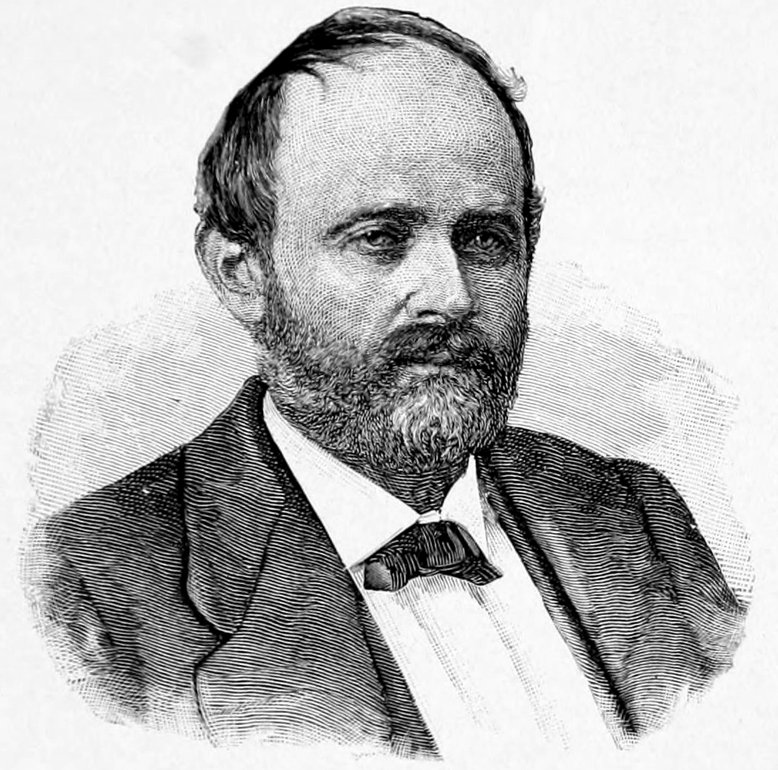
HILL BEACHY
Lloyd Magruder’s avenger
333Jack was an Indian boy who had been Magruder’s
hostler for several years. Late in the afternoon Beachy
met him.
“Jack,” said he, accosting him, “don’t you want to
take a ride?”
“I am always ready for that, Mr. Beachy.”
“Well, our cows haven’t come home to-night. I’ll have
my pony in the stable in ten minutes, and you can saddle
him, and have a good time hunting them. Will you go?”
“All right,” replied Jack, “I’ll be there.”
Beachy immediately went to the stable, and, ascending
to the haymow, placed himself in a position where he could
observe the actions of Jack when he saddled the pony.
The boy was punctual. Leading the pony from the stall,
he took down the saddle and placed it on him.
“It’s a failure,” reflected Beachy, as the boy fastened
the girth, and seized the pommel preparatory to mounting.
Just at this moment Jack’s eye caught sight of the stirrup.
He paused, and, taking it in his hand, surveyed it
narrowly. An expression of surprise stole over his face.
Dropping the stirrup, he caught the crupper and examined
it more carefully. He then looked at other parts of the
saddle in detail. At length he mounted, and, while leaving
the stable, looked back with astonished interest upon the
crupper. The cows at this time were discovered on their
way home. Jack rode around and drove them up, and,
dismounting, said to Beachy, who met him at the stable
door,
“This is Massa Magruder’s saddle. He took it with
him when he went to Bannack. How came it here?”
334“How do you know it is his, Jack?”
“By that crupper. There’s where I mended it myself
with a piece of buckskin. I know it’s the same old saddle.
I’ve ridden on it a hundred times.”
“A clew at last!” said Beachy. “I’ll follow it up.
Jack cannot be mistaken.”
Calling to some friends who were passing, he told them
the result of his experiment. The old saddle was produced,
and Jack was examined. Alarmed at the scepticism of his
interrogators, Jack wavered in faith, and his testimony
only confirmed the belief that Beachy was crazy.
The following day a train was seen descending the
mountain by the Nez Percé trail. A tall man, seemingly
the leader, who wore a peculiar hat, like Magruder’s, was
pointed out as the missing man. Hundreds of eyes
watched the slow descent of the mules into the valley. The
wife of Magruder, whose thoughts and feelings had been
alternating between hope and fear for a week or more,
awaited with delighted surprise the certain approach of
her husband. Hill Beachy looked on with doubtful interest,
hoping, but faithless. Alas! it was not Magruder.
“For him no more the blazing hearth shall burn,
Or busy housewife ply her evening care.”
When the train master, in reply to their eager inquiries,
expressed his own surprise, and told them that Magruder
should have reached home ten days before, the people for
the first time felt that he might have fallen a victim to
robbers. Still they doubted. The crime was too great,
involved too many lives, and the probability that he had
changed routes and was returning by the way of Salt Lake
was greater than that he and his large train had been
destroyed.
Firm in his belief, Beachy, like a sleuth-hound, continued
to follow the track leading to discovery. “They do
not know the desperate character of those villains,” he said,
335as he turned from the crowd to pursue the clew furnished
by Jack. His wife, who until this time had feared for his
safety at the hands of the town ruffians, now for the first
time gave him encouragement.
Falling in company with the men who had just arrived
from Bannack, he plied them with inquiries concerning
Magruder’s operations there.
“Why,” observed one, “he told me on the morning he
left that he should surprise his wife, for he had written her
the day before that he would not leave for ten days. ‘She
will tell this to all inquirers,’ said he, ‘and the roughs
of Lewiston will be thrown off their guard. I shall reach
home about the time they think I will leave here.’”
“Would you know any of the stock?” inquired Beachy.
“Yes; there was one large, white-faced sorrel horse belonging
to some of the party, that was a very good race-horse.
I saw him run one night, when some of the boys were
at our camp. I think I should know him. They intended
to bring him here, and make a race-horse of him.”
The only horse which Beachy had found in possession
of the rancheman corresponded with this description. He
placed him in one of a long range of stalls in his stable,
in each of which was a horse, and requested his informant
to select him, if possible, from the number. When the man
came to the sorrel, he said,
“If this horse were two or three sizes larger, I should
think he might be the one I saw; but he is too small, and
I know nothing of the others.”
Knowing how much the size of a horse is seemingly increased
when in motion, Beachy saddled the sorrel, and
told his hostler to lead him to the end of the street, mount,
and run him at his best speed back to the stable. As he
dashed down to the spot where Beachy and the man were
standing, the latter involuntarily raised his hands and
exclaimed,
336“My God! that is the identical animal.”
“You are sure?” said Beachy.
“I would swear to it,” was the instant reply.
“And now,” thought Beachy, “I have a white man on
my side. The evidence is sufficient for me. To-morrow I
start for the murderers.”
Armed with requisitions upon the governors of all the
Pacific States and Territories, the next morning Beachy,
accompanied by the indomitable Tom Farrell, made preparations
for his departure. When all was ready, his wife,
who had felt more keenly than he had the ridicule, sneers,
indifference, and malignity with which his efforts had been
regarded, with tearful eyes approached him, and, taking
him by the hand, in a tone softened by the grief of parting,
said to him,
“Hill, you must either return with those villains, or
look up a new wife.”
“The look which emphasized these words,” says Beachy,
“the expression, the calm, sweet face which said stronger
than words that failure would kill her, filled me with new
life. They were worth more than all the taunts I had received,
and I bade her adieu with the determination to
succeed.”
While Mr. Beachy was speaking thus fondly of his
wife, whose death had occurred but a few months before
he narrated to me these incidents, the tears rolled down
his cheeks,—and he added in a voice broken with emotion,
“I then felt that the time had come when I needed
something more than human help, and I went out to the
barn and got down upon my knees and prayed to the Old
Father,—and that’s something I haven’t been much in
the habit of doing in this hard country,—and I prayed
for half an hour; and I prayed hard; and I promised that
if He’d only help me this time in catching these villains,
I’d never ask another favor of Him as long as I lived,
and I never have.”
337Three changes were made in the transmission of the
mail over the route between Lewiston and Walla Walla.
The log dwellings and stables at the several stations were
the only evidences of settlement for the entire distance.
Beachy was the proprietor of the stage line. His station-keepers
had been in the habit of transporting way
travellers over parts of the road, for pay, at times when
the horses were unemployed. This practice had been
strictly forbidden by Beachy. But when he and Tom
Farrell drove up to the first station, such was his anxiety
to overtake the fugitives, that he did not stop to reprimand
the unfaithful employee who had just harnessed
the stage horses to a light wagon, with the intention
of turning a dishonest penny. He took the wagon himself,
and without delay drove to the next station, arriving
there in time to hitch a pair of horses just harnessed by
the hostler for his own use, to his wagon, and hurry on to
another station. Here, as he and Tom alighted, a light
buggy with a powerful horse came alongside. The driver
was an old acquaintance. He was going to Walla Walla
in haste for a physician. Beachy offered to do his errand
if he would allow him to proceed in his buggy. The gentleman
assented. The horse’s flanks were white with foam
when, at dark, Beachy and Tom Farrell rode into Walla
Walla.
Before entering the town, Beachy concealed his face in
a muffler to avoid recognition. Half-way up the street he
observed a man, of whom he expected to obtain information,
engaged with another in conversation. Jumping
from the wagon he approached him cautiously, and, by a
significant grip, drew him aside and made known his business.
“They left four days ago for Portland,” said the man,
“with the avowed intention of taking the first boat to
San Francisco. They were here two days, lost considerable
at faro, but took plenty of gold dust with them.”
338“Did they explain how they obtained their money?”
“Yes. Howard said that they, in company with five
others, had purchased a water ditch in Boise Basin, and
had been renting the water to the miners at large rates.
The miners became dissatisfied with their prices, and a
fight ensued. Men were killed on both sides, and they
were the only members of the ditch company that escaped.
They were now on their way out of the country, to escape
arrest. They feared the authorities were pursuing them.”
While engaged in this conversation, Captain Ruckles,
the agent of the Columbia River Steamboat Company,
happened to pass. Beachy hailed him, and told his story.
Ruckles gave him authority to use a Whitehall boat in
descending the river from Wallula, and an order upon the
captain of the downward bound steamer from Umatilla,
to consult his convenience on the trip to Portland.
The evening was far advanced when Beachy and Farrell
started on a midnight drive of thirty miles to Wallula.
Day was breaking when they drove up to the landing.
The river, at all times boisterous, had been swollen by the
flood into a torrent. Rousing a wharfinger, they were informed
that all navigation was suspended until the waters
should abate, that no steamboats had been there for several
days, and to attempt the passage of Umatilla Rapids
in a Whitehall boat would be madness.
Fortunately, the next man Beachy met was Captain
Ankeny, an old river pilot, who knew every crook and
rock in the channel.
“It’s a dangerous business,” said the captain, after
listening to his story, “but I think we can make it in a
Whitehall boat. At all events, if it’s murderers you’re
after, it’s worth the risk. I’ll take you down if anybody
can.”
At daylight the three men, with the pilot at the helm,
pushed out into the stream, every spectator on shore predicting
339disaster. It was, indeed, a lively passage, and not
a few hairbreadth escapes were attributable to the skill of
the man who knew the channel. The boat dashed through
the rapids, and rounded to at Umatilla, twenty-two miles
below, two hours after it left Wallula.
Beachy found a willing coadjutor in the captain of the
steamboat at Umatilla, and, to expedite the departure of
the boat, employed eighteen men to assist in discharging
the cargo. When the boat had blown her last whistle and
rung her last bell, two large wagons laden with emigrants,
who had just arrived after a tedious journey across the
plains, thundered down to the wharf to be taken aboard.
“Too late,” shouted the captain. “The boat cannot be
delayed. Cast off.”
The spokesman for the emigrants pleaded hard for a
passage. Beachy relented.
“Take them on board for luck,” said he to the captain.
No other cause for detention occurring, the boat swung
off, and proceeded down the river, arriving at Celilo,
eighty-five miles below, late in the evening. From that
point navigation is impeded by rapids for sixteen miles,
which distance is travelled by railroad. The cars would
not leave until the next morning,—a delay which might
afford the fugitives time for escape. In this exigency
Beachy applied to the emigrants, and by pledging the
boat as security for the return of their horses, and paying
a round sum, hired three of them to convey Captain Ankeny,
Farrell, and himself to the Dalles. It was after one
o’clock in the morning when they entered Dalles City.
Ankeny and Farrell rode down to the hotel to reconnoitre,
and report to Beachy, who awaited their return in the outskirts.
It was a bright, starlight night. A man, whose
form Beachy recognized, passed hurriedly by the spot
where he stood. Hailing him, he unfolded the object of his
mission, and learned that three of the party he was
340pursuing had left the Dalles on a steamboat for Portland
two days before. The other, he was afterwards informed,
had gone since.
In company with Tom Farrell, he took passage on the
next steamer for Portland, arriving there twenty-four
hours after the fugitives had left for San Francisco. Farrell
hurried on to Astoria, the only port where the steamer
stopped on its passage to the ocean, to ascertain if they
had landed there, while Beachy put in execution a little
scheme by which he hoped to obtain full information concerning
their future movements.
A year before this time, Beachy had concealed from the
pursuit of the Vigilantes at Lewiston a young man accused
of stealing, whom he had known in boyhood. During his
concealment, with much other information, he told Beachy
of the robbery of a jewelry establishment at Victoria, in
British Columbia, in which he was concerned with Howard,
Lowry, and Romaine. They deposited their plunder with
an accomplice at Portland. This man still resided at Portland,
and had probably met with Howard and his companions
during their stay. If so, he was doubtless possessed
of information which would aid in their detection.
At every place where they had stopped on the trip to
Portland, the guilty men had told the same story about
their collision at, and flight from, Boise Basin. Acting
upon the belief that they had repeated it to their old confederate
at Portland, Beachy, on the same evening of his
arrival, wrapped in blanket and muffler, sallied forth to a
remote quarter of the town, where he resided. No one
responded to his rap upon the door. He crossed the street
to a clump of bushes to watch. A half-hour passed, and a
woman entered the dwelling. Recrossing, he repeated the
alarm. The woman met him at the door. With much
simulated nervousness, and mystery of manner and tone,
he inquired for the man.
341“He is very busy, and will not be home until late, if
at all,” replied the woman.
“I must see him immediately,” urged Beachy, with increasing
earnestness. “My life depends upon it. Here,
madam,” he continued, thrusting a hundred dollars into
her hands, “secure me an interview as soon as possible.
He is the only person here who can aid my escape. I dare
not be seen, but will conceal myself in the clump until
he comes.”
Beachy says he never was satisfied whether it was gold
or pure womanly sympathy for his apparent distress
which obtained for him a speedy meeting. By assuming
the character of a partner in the Boise enterprise who had
miraculously escaped arrest, and was then in pursuit of his
companions, he learned that the men he was pursuing intended
to remain in San Francisco until they could have
their dust, amounting to seventeen thousand dollars,
coined, when they would go to New York by way of the
Isthmus, and return to Virginia City in the spring. To
make the delusion perfect, Beachy, at the close of the interview,
gave his informant one hundred and fifty dollars,
with which the latter purchased for him a horse, which he
delivered to Beachy at a late hour of the evening, at East
Portland, on the opposite bank of the Willamette River.
Bidding him good-bye, Beachy mounted the horse, and
was soon lost to view in the pine forest, his dupe believing
that he had enabled him to escape the authorities of
Boise. Two hours afterwards the horse was returned to
its owner, and the purchase money restored.
How to reach San Francisco in time to arrest the fugitives
before their departure for New York, was not easy
of solution. No steamer would leave Portland for ten
days, and an overland journey of seven hundred miles,
over the muddiest roads in the world, was the only alternative.
The nearest telegraph station was at Yreka, four
342hundred miles distant. Wearied with the unremitting
travel and excitement of the previous week, Beachy hired
a buggy and left Portland at midnight, intending to overtake
the coach which had left the morning before his
arrival. This he accomplished at Salem, late in the afternoon
of the next day. When the coach reached the mountains,
its progress was too slow for his impatience, and he
forsook it, and, mounting a horse placed at his disposal
by an old friend, rode on, hoping to come up with the advance
coach. He fell asleep while riding, and, on awakening,
found himself seated upon the horse in front of its
owner’s stable, at a village twenty miles distant from the
one he had left. Here he hired a buggy and overtook the
coach the next morning.
Two days afterwards he arrived at Yreka. He immediately
sent a telegram to the chief of the San Francisco
police, and was overjoyed upon his arrival at Shasta,
twenty-four hours afterwards, to receive a reply that the
men he was pursuing were in prison, awaiting his arrival.
At midnight of the second day following, he was admitted
to the cell where the prisoners were confined.
They had been arrested by stratagem two days before.
As Howard and Lowry were escaped convicts from the
California penitentiary, they naturally supposed that they
had been arrested upon recognition, to be returned for
their unexpired terms. This they were planning to escape
by bribing the officers, whom they had told of their deposit
in the mint, denying at the same time that Page had any
interest in it.
When, therefore, the chief of police entered the cell, and
turned on the gas, disclosing the presence of Hill Beachy,
had Magruder himself appeared, they would not have
been more astonished. With dismay pictured upon his
countenance, Howard was the first to break that ominous
silence by a question intended either to confirm their worst
fears, or re-animate their hopes of escape.
343“Well, old man,” said he, gazing fixedly upon Beachy,
“what brought you down here?”
“You did,” was the instant reply.
“What for, pray?” persisted Howard, assuming an indifferent
air.
“The murder of Lloyd Magruder and Charley Allen.”
The eyes of the questioner dropped. He drew a long
breath. A deadly pallor stole over his face.
“That’s a rich note,” said Lowry, affecting to laugh.
“We left Magruder at Bannack, well and hearty.”
“We shall see. Good-night, boys,” said Beachy, and
he offered each his hand.
Page clasped his hand heartily, and, by several scratches
upon the palm, signified that he had something which he
wished to communicate.
Four weeks were spent in San Francisco, in the effort to
obtain the custody of the prisoners. As fast as one court
would decide to surrender them, another would grant a
writ of habeas corpus for a new examination. At length
the Supreme Court of the State decided in favor of their
surrender to the authorities of Idaho for trial. In anticipation
of a series of similar legal delays in Oregon,
Beachy, before leaving, obtained from General Wright, the
commander of the Department of the Pacific, an order
upon the military post of the Columbia, directing an escort
to meet the prisoners at the mouth of the river, and deliver
them with all possible despatch to the civil authorities
at Lewiston.
On the voyage from San Francisco to the mouth of the
Columbia, the prisoners occupied the state-room adjoining
Beachy’s. An orifice was made in the base of the partition
between the apartments, under the berth occupied by
Howard and Lowry. After they had retired, Beachy
would apply his ear to it, to glean, if possible, from their
conversation, any circumstances confirming their guilt.
On one occasion he heard Lowry observe that “Magruder
344had a good many friends,” and Howard reply that “all
five of them had friends enough.” This satisfied him that
others beside Magruder had been killed, and that he was
on the right track. At the mouth of the Columbia, a small
steamer with a military escort received the prisoners.
They were conveyed immediately to Lewiston. A large
assemblage had gathered upon the wharf, intending to conduct
the prisoners from the boat to the scaffold. Protected
by the military, Beachy succeeded in removing them
to his hotel, amid loud cries of “Hang ’em,” “String ’em
up,” by the pursuing crowd. He then appeared in front
of the building, and in a brief address informed the infuriated
people that one of the conditions on which he
obtained the surrender of the men was that they should
have a fair trial at law. He had pledged his honor, not
only to the prisoners, but to the authorities, that they
should only be hanged after conviction by a jury. This
pledge he would redeem with his life if necessary. He
made it, believing that his fellow-citizens of Lewiston
would stand by him. “And now,” said he, “as many of
you as will do so, will please cross to the opposite side of
the street.” The movement was unanimous.
“Be gorra! Mr. Beachy,” exclaimed an Irishman,
after he had passed over, “you’re the only man in the
whole congregation that votes against yourself.”
The prisoners were heavily ironed and strongly guarded
in an upper room of the hotel. No legal evidence of their
guilt, no evidence that a murder had been committed, had
yet been obtained. Page was reticent, though believed by
all to have been the victim of circumstances. A week
elapsed, and no disclosures were made upon which to base
a hope of conviction. Tired of waiting, it was at length
arranged with the district attorney that Page should be
permitted to testify as State’s evidence.
Beachy now concerted, with several others, a plan for
getting at the truth. In a vacant room, accessible from
345the main passage of the building, he suspended from the
ceiling four ropes with nooses, and under each placed an
empty dry-goods box. Every preparation was seemingly
made for a secret and summary execution.
In a room on the opposite side of the hall he spread a
large table, with paper, pens, and ink, and obtained from
the county clerk three plethoric legal documents, which
were put in the hands of persons seated at the table. A
clerk was also there, who had seemingly been engaged in
writing out the confessions of Howard, Lowry, and Romaine,
which were represented by the documents already
referred to.
When these preparations were completed, two guards
entered the room occupied by the four prisoners, and conducted
Howard downstairs to a room in the basement. An
hour or more elapsed, and the same ceremony was observed
with Lowry, and after another hour with Romaine.
The solemnity of this proceeding was intended to impress
Page with the belief that his comrades had been severally
executed by the Vigilantes. When, an hour later, the
guards returned, they found him in a cold perspiration,
and scarcely able to stand.
He was met by Beachy at the door.
“Page,” said he, “I have done all in my power to save
you, because I believed you less guilty than the others, but
I find I can do more. Whether you live or die now remains
with yourself. Your old friend, Captain Ankeny,
has worked hard for you.”
As he said this, the party came to the door of the room
where the ropes were suspended, which had been purposely
opened. The hideous preparations glanced upon the terror-stricken
vision of the trembling prisoner. Beachy
slammed the door with a crash, exclaiming, with well-simulated
anger, as he turned to the attendants,
“I told you to keep that door closed,” and resumed
his conversation with Page.
346“There is,” said he, “a bare chance remaining for you.
Your comrades are still living. They have each made a
confession, and now the opportunity is afforded you. If
you make a clean breast of it, and tell the truth, it is possible
you may escape by turning State’s evidence; but if
not, there is no alternative but to hang you all. One thing
let me say: if you conclude to accept this possible chance
for life, tell the truth.”
“I certainly will do so, Mr. Beachy,” said the terrified
man.
He was then seated in front of the clerk at the table.
Beachy sat on one side, holding one of the documents, as
if to compare his testimony with it, and Captain Ankeny
and another person, each with a similar document, sat
opposite. The building was of logs. A gathering outside
could be heard through the chinks, discussing the propriety
of admitting Page to testify.
“He is as guilty as the others, and should suffer the
same fate,” said one.
“It’s nonsense to try them,” said another. “The
Vigilantes should hang them all immediately.”
“It’ll do no harm to hear what he has to say,” said a
third, “but he’ll probably lie.”
“Not if he regards his life. He’ll be easily detected
in that, and then he’ll be hung without mercy,” remarked
another.
These surroundings, terrible to a guilty conscience, were
not alleviated by the frequent interruptions of Beachy
and Ankeny, who, to all outward seeming, were closely
comparing the statements of Page with those of his companions.
The confession thus obtained bore internal evidence
of truthfulness; and, when it was finished, Page
entreated Beachy not to return him to the room with
the other prisoners.
“They will kill me if they suspect me of betraying
347them,” said he, “and the fact that we have all been requested
to confess will make them suspicious.”
Page was heavily ironed, and confined in a separate room
on the side of the hall opposite the room occupied by the
other prisoners, who, in the seeming severity with which
he was treated, received the impression that he was singled
out as the real criminal. Acting under Beachy’s instructions,
Page occasionally stood in the doorway of his apartment,
so that the other prisoners could see him, and they
improved these opportunities by making significant signs
to him to be silent. Howard would break out into a song,
into which he would improvise words of caution for Page
to observe. At length, at their own request, the prisoners
were occasionally permitted to perambulate the hall, and
at those times opportunity was given to converse with
Page. They finally would enter his room, and in a conversation
with him, while, as he supposed, he was enjoying
one of these stolen interviews, Beachy heard Lowry tell
Page that the body of Brother Jonathan—meaning Magruder—could
never be found, whether the others were
or not. It was a great satisfaction to Beachy to learn,
from this and several other little incidents that occurred
while the murderers were in custody, that he had made no
mistake in arresting them.
Twenty-four hours before the trial, the prisoners, as
required by the laws of Idaho, were served with a copy of
the indictment found against them, with a list of witnesses,
in which it appeared that the charge was substantiated by
the testimony of Page. This was the first intimation they
had that he was to be received as State’s evidence. Lowry
read enough of the indictment to learn this fact. Handing
it to Beachy, he exclaimed with an oath,
“I have read far enough. If old Page is to testify, the
jig is up. I don’t wish to know any more.”
More than a hundred persons summoned as jurors were
348rejected in selecting an impartial jury. Good counsel
was provided for the prisoners; and after a careful and
protracted trial, in which no legal effort was spared both
to convict and to defend, the prisoners were found guilty,
and sentenced to be hanged on the fourth day of March,
1864, six weeks after the trial.
During this interval, they were confined in their old
quarters, where they received every attention from Mr.
Beachy and his wife. As the day of expiation drew nigh,
both Lowry and Romaine confessed to their participation
in the murder, and the truth of Page’s testimony; but
Howard denied it to the last.
The scaffold was erected in a basin encircled by abrupt
hillsides, from which ten thousand people, including almost
the entire Nez Percé tribe of Indians, witnessed the
execution.
A few weeks afterwards, Beachy and a few friends, under
the guidance of Page, visited the scene of the murder,
and returned with the remains of the unfortunate victims,
which were decently buried in the cemetery at Lewiston.
Page remained in the employ of Beachy several months—an
object of general reproach and execration. A year
had little more than elapsed when he became involved in a
drunken brawl, and was killed by his adversary.
Mr. Beachy, after repeated rebuffs, succeeded in getting
the seventeen thousand dollars, which the murderers had
deposited in the mint at San Francisco. This was given
to the widow and heirs of Magruder. After a delay of
some years, the Legislature of Idaho appropriated an
amount sufficient to defray the expense he had incurred
in the capture and prosecution of the murderers; and he
subsequently removed to San Francisco, where he died in
the year 1875, esteemed by all who knew him, not less for
his generosity of heart, than the other manly and noble
qualities of his character.
CHAPTER XXXIV HOWIE AND FETHERSTUN
349
Several days after the execution of “Red” and
Brown, when their bodies were taken down for burial,
there was found, fastened to each, a monograph which has
few parallels for brevity in the annals of necrology. “Red!
Road Agent and Messenger!” “Brown! Corresponding
Secretary!” Laconic, but explicit, they fitly epitomized
the history, both in life and death, of these ill-fated men.
The little company of Vigilantes arrived in Nevada
early the morning after the execution. The Committee
assembled immediately to consider what action should be
pursued with reference to the disclosures made by “Red,”
but, as the results of their recommendations will hereafter
appear, no further allusion to the subject is necessary at
this time.
The fluttering among the robbers, when it became known
that two men of their number had fallen, was very perceptible
both at Bannack and Virginia City. Many of
them fled at once; others, who would have accompanied
them, had they heard of the disclosures made by “Red,”
believed themselves secure, until some testimony should
appear against them. Not anticipating treachery from
any of their comrades, they regarded such treachery as
wholly unattainable.
Dutch John was not of this number. Alarm grew upon
him day by day, after the execution of Ives. He knew
that, with the unhealed bullet wound in his shoulder, his
identity with the robbers who attacked Moody’s train
350would be clearly established. He went to Plummer with
his fears. Plummer advised him to leave the Territory.
In pursuance of this advice, he shouldered his saddle and
left Bannack in the direction of Horse Prairie. A person
who saw him leave, suspecting that he had designs upon a
fine gray horse, wrote to the owners of the animal, warning
them of his approach. They lay in watch for the
thief, and discovered him sitting in the underbrush. They
immediately hedged him in, and captured him. After a
severe lecture and taking his saddle, they gave him an old
mule and blanket, and bade him depart. Accompanied by
a Bannack Indian, he rode slowly down the road leading
to Salt Lake City.
A few days after the execution of Ives, John X. Beidler,
who had officiated on that occasion, went down the
Salt Lake road to meet a train which was expected from
Denver. Meeting it at Snake River, he returned with it
to Beaverhead valley, where he was told of the attack, by
Dutch John and Marshland, on Moody’s train, and furnished
with a description of the robbers. His informant,
believing that Moody’s shot would prove fatal, told him
that he would know the body of the robber by his leggings.
“I need a pair of leggings,” replied X., “and, if I find
the man dead, will confiscate them.” Beidler turned back,
and met Dutch John and the Indian in Beaver Cañon, at
the toll-gate. Failing to recognize him as the robber, he
offered him a drink from a bottle of schnapps. John’s
hands were so severely frozen that he could not grasp the
bottle. Beidler soaked them in water, to take the frost
out. While thus employed, John asked,
“Is it true that George Ives has been hanged?”
“Yes,” replied Beidler; “he’s dead and buried.”
“Who did it?” inquired John.
“Oh, the Virginia and Nevada people.”
351“Did they find out anything?”
“They found out some things,” said Beidler, “and are
now after the robbers of Moody’s train. One of them,
Dutch John, was shot, and I expect to find him dead upon
the trail. If I do, I shall confiscate his leggings, for I need
a pair very much.”
“Would you take his leggings if you found him?” inquired
Dutch John.
“Of course I would, if he was dead,” said Beidler.
They continued to chat till late in the evening, passing
the night together, Beidler never suspecting him to be the
robber he was in pursuit of. The next morning Beidler
dressed John’s frozen hands, and they separated.
The next day, while making his way through Beaver
Cañon, John was seen and recognized by Captain Wall and
Ben Peabody, who were encamped there by stress of
weather, with a pack train, en route to Salt Lake. They
saw him and the Indian take shelter in a vacant cabin at
no great distance beyond their camp, and went immediately
with the information to John Fetherstun, who was
also near at hand with eight teams and drivers, awaiting
an abatement of the temperature. Fetherstun recommended
that John should be hanged to one of the logs
projecting from the end of the cabin. Wall and Peabody
wanted him to be returned to Bannack. Being unable to
agree, Wall and Peabody proceeded down the road to the
camp of Neil Howie, who was on his return from Salt
Lake City, in charge of three wagons laden with groceries
and flour. If they had searched the world over, they could
have found no fitter man for their purpose. Brave as a
lion, and as efficient as brave, Neil Howie inherited from
nature a royal hatred of crime and criminals in every form.
He laid his plans at once for the capture and return of
John to Bannack. The men belonging to his train promised
him ready assistance. In a short time John and the
352Indian appeared in the distance, and the courage of Neil’s
friends, which began at that moment to weaken, “grew
small by degrees, and beautifully less,” as the stalwart
desperado approached, until, to use an expression much in
vogue in those days, they concluded that as they “had
lost no murderers,” the reason given for the arrest of this
one were not sufficiently urgent to command their assistance
in such a formidable undertaking. In plain words, they
backed out of their promise. Neil, whose contempt for a
coward was only equalled by his abhorrence of a murderer,
still determined upon the capture. It would be a libel upon
the honest Scotch inflexibility which had come down to him
through his Covenanting progenitors to recede from a
resolution which his conscience so fully approved. Dutch
John rode up and asked for some tobacco.
“We have none to spare,” said the train master. “Go
to the big train below. They will supply you.”
He cast a suspicious, uneasy glance at the men, and,
with the Indian by his side, rode on. Neil looked after
him until nearly lost to sight, then mounted his pony and
rode rapidly in pursuit, with the hope of obtaining aid
from the big train, which belonged to James Vivion. He
soon overtook the fugitive, whom he found with rifle in
hand, ready to defend his liberty. The Indian, too, apprised
of Neil’s approach, passed his hands over his quiver,
seemingly to select an arrow for instant use. Carelessly
remarking, as he passed, that he had to borrow a shoeing
hammer to prepare the stock for crossing the divide, Neil
rode on under the muzzle of John’s rifle, without drawing
his reins until he arrived at the train. The remark disarmed
John’s suspicions, or he would doubtless have fired
upon him.
Neil related the particulars of John’s career. “It is a
burning shame—a reproach to the Territory, and will
be an eternal reproach to us if we permit so great a villain to escape. Just reflect,—he is a horse-thief and a
murderer, stained with blood, and covered with crimes.
Let us arrest him at once.”
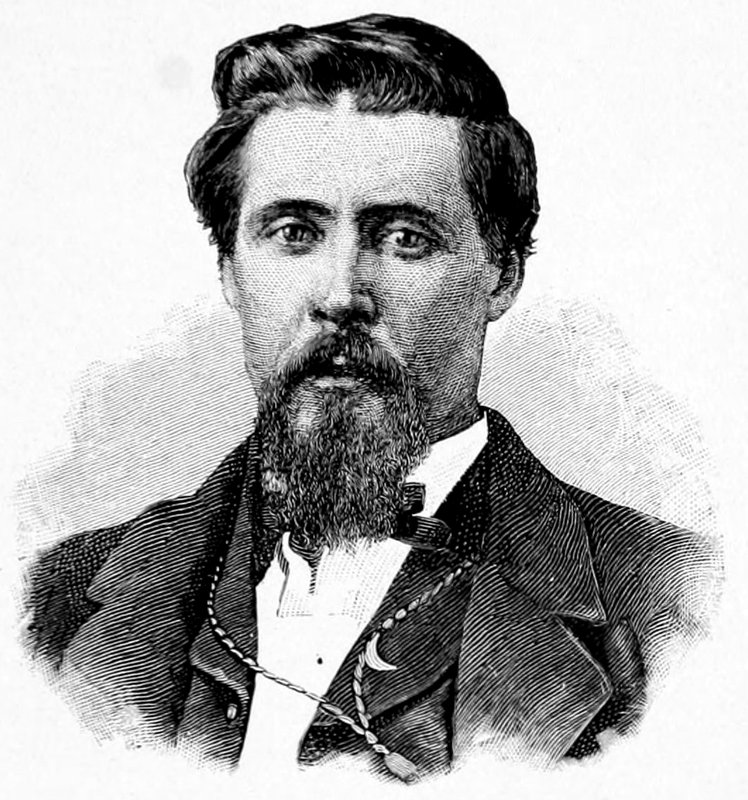
NEIL HOWIE
Captor of “Dutch John”
353All to no purpose. The men, one and all, declined having
anything to do with it. Meantime John came up and
asked for some tobacco.
“Have you any money?” inquired one of the men.
“Not a cent,” was the reply.
“Then,” said his interrogator, “we have no tobacco for
you.”
“Oh! let him have what he wants,” interposed Neil. “I
will pay for it.”
John’s face wore a grateful expression. He thanked
Neil, and with the Indian took his departure. Neil made
another hurried appeal, not to let the murderer and road
agent escape, but the men refused to help.
“Then,” said he, “I will arrest him alone,” and he
strode rapidly after John, shouting,
“Hallo, captain! hold on a minute.”
John wheeled his mule half round, and sat awaiting the
approach of Neil. To the stature and strength of a
giant, John added a nature hardened by crime, and the
ferocious courage of a tiger. His face, browned by exposure,
reflected the dark passions of his heart, and was
lighted up by a pair of eyes full of malignity. Nature
had covered him with signs and marks indicative of his
character. Neil, on the other hand, was rather under the
medium size, with nothing in his general make-up that denoted
uncommon strength or activity, though, when
aroused, no mountain cat was more active in his movements,
and strength seemed always to come to him equal
to any emergency. His clear gray eye, calm and gentle
in repose, became very powerful and commanding under
excitement.
With his gaze fixed steadily upon the ruffian, he marched
354rapidly towards him. John slewed his rifle around, grasping
the barrel with his left, and the small of the stock with
his right hand, as if preparing for a deadly aim. Neil’s
hand fell with an admonitory ring upon the trusty revolver
in his belt, which had never failed him. For an
instant only, it seemed that either the rifle or pistol would
decide the adventure; but the ruffian quailed before the
determined gaze of Howie, who passed unharmed beyond
the muzzle of his rifle, and stood with his hand upon the
flank of the mule. Looking John steadily in the eye, in
a quiet but authoritative tone, Neil said to him,
“Give me your gun and get off your mule.”
With blanched face and trembling hands, John complied,
at the same time expressing his willingness to submit
to the capture.
“You have nothing to fear from me,” said he as he
alighted, and handed the reins to Howie. It is said that
occasions will always find men suited to meet them. This
occasion found, among a crowd of twenty or more experienced
mountaineers, only Neil Howie as the man endowed
with moral and physical courage to grapple with it.
The prisoner accompanied his captor to the camp-fire.
The weather was intensely cold. Many of the oxen belonging
to the trains had died from exposure, and others
were so severely frozen that they lost their hoofs and tails
the succeeding spring. As soon as Howie and his prisoner
were thoroughly warmed, Neil said to him,
“John, I have arrested you for the part you took in
the robbery of Moody’s train last month. Every man in
that company charges you with it.”
“It’s a lie,” said John. “I had no hand in it at all.”
“That question can be easily decided,” replied Neil,
“for the man they supposed to be you was wounded by a
shot in the shoulder. If you are not the person, there
will be no bullet mark there. I don’t wish to make a
355mistake, and your denial of the charge makes it necessary
that I should examine. Just remove your shirt.”
John reluctantly complied, all the while protesting his
innocence. When, however, the shoulder was bared, the
scarcely healed perforation settled all doubts in Howie’s
mind concerning the personal identity of his prisoner.
“How is it,” said he, “if you are not the man, that
you have this scar?”
“I got it accidentally while asleep by my camp-fire. It
was cold, and I lay near the fire. My clothes caught fire,
and the cap ignited, discharging my pistol, which was
strapped to my side.”
“Let me prove to you that this story cannot be true,”
said Neil.
Placing a cap upon a stick, he held it in the hottest blaze
of the camp-fire. Minutes elapsed before it exploded.
“Do you not see,” he continued, “that long before the
cap on your pistol would have exploded, you would have
been burned to death? But there is still another reason.
If it had exploded, as you say, the ball could never have
wounded your shoulder. You must go with me to Bannack.
If you can prove your innocence there, as I hope
you may, it will all be well with you.”
Leaving his prisoner in charge of the train company,
Neil started in pursuit of a person to aid in conveying him
to Bannack. Unsuccessful in this, he left with John in
company, and proceeded to Dry Creek, where was a camp
of fifty or sixty teamsters. Such was their fear of the
roughs that they one and all refused to assist him. While
deliberating what next to do, a man by the name of Irvine
suggested to him that if Fetherstun could be induced to
aid, he would be a suitable man for the purpose. Neil went
immediately to Fetherstun’s camp, fully determined, if
again rebuffed, to attempt the journey with his prisoner
alone. Fetherstun volunteered without hesitation, and for
356the two following days while awaiting an abatement in the
weather, took the prisoner in charge and confined him, under
guard, in the cabin he had left but the day before.
On the third day Howie and Fetherstun started with
John for Bannack, the weather still so severe that they
were obliged every few miles to stop and build fires to
escape freezing. On one of these occasions, while Fetherstun
was holding the horses and Howie building a fire,
their guns having been deposited some forty feet away, the
prisoner, under pretence of gathering some dry wood which
was in a direct line beyond the guns, walked rapidly
towards them, intending evidently to possess himself of
the weapons, and fight his way to an escape. His design,
however, was frustrated by his captors, who fortunately
secured the guns before he could reach them.
During the night when they were encamped at Red
Rock, misled by the apparent slumber of his captors, John
rose up, but, upon gazing around, met the fixed eye of
Howie, and immediately resumed his recumbency. As the
night wore on, the two men, worn with fatigue, again sunk
into repose. Assured by their heavy breathing, John
again rose up, but scarcely had he done so when Neil, rising
too, said quietly,
“John, if you do that again, I’ll kill you.”
The ruffian sunk upon his blankets in despair. He felt
that he was in the keeping of one who never slept on duty.
Still the hope of escape was uppermost. Seeing a camp
by the roadside, he naturally concluded that it belonged
to a company of his comrades, and commenced shouting
and singing to attract their attention. As no response
followed and no rescuers appeared, he soon became silent
and despondent.
This trip of three days’ duration, with the thermometer
thirty-five degrees below zero, and no other food than
the shank of a small ham, uniting with it the risk of
357assassination and personal contest with robbers, exposure
to an arctic atmosphere, and starvation, while it bore
ample testimony to the moral intrepidity and physical endurance
of Howie and Fetherstun, and marked them for a
pursuit which they ever after followed, was also rife with
associations which bound these brave spirits in a friendship
that only death could sever. It is no injustice to any
of the early citizens of Montana to say that, not less for
its present exemption from crime and misrule than for the
active and vigilant measures which, in its early history,
visited the ruffians with punishment, and frightened villainy
from its boundaries, is the Territory indebted to the
efficient coöperative labors of these self-sacrificing, heroic
men. They were pioneers who deserve to rank in future
history with such men as Boone and Kenton; and long
after the names of many now oftener mentioned in connection
with circumstances of trifling import are forgotten,
theirs will be remembered and honored. Noble
Howie! how short a time it seems since he was cut down in
the very prime of his manhood, upon the distant shores of
Guiana. Many, many years must pass before the memory
of his heroic actions, his genial nature, his warm, impulsive
friendship, will be forgotten by those who knew and
loved him in his mountain home.
To return to the narrative. When the captors had arrived
at Horse Prairie, twelve miles from Bannack, Fetherstun
encamped with the prisoner, while Howie rode on to
the town to reconnoitre. Fears were entertained that the
roughs would attempt a rescue. It was understood that
if Howie did not return in three hours, Fetherstun should
take the prisoner into town. Accordingly, he proceeded
with him without molestation to Sears’s Hotel. Soon afterwards
Howie, meeting Plummer, said to him,
“I have captured Dutch John, and he is now in my
custody at Sears’s Hotel.”
358“You have?” replied Plummer with a leer. “What
is the charge against him?”
“Attacking Moody’s train.”
“Well, I suppose you are willing he should be tried by
the civil authorities. This new way our people have of
hanging men without law or evidence isn’t exactly the
thing. It’s time a stop was put to it. I’ll take John
into my custody as sheriff, and relieve you from all further
responsibility.”
“Not exactly, Plummer,” replied Howie. “I shall keep
John until the people’s tribunal decides whether they want
him or not. I’ve had a good deal of trouble in bringing
him here, and don’t intend he shall escape, if I can help it.”
After a few more words they separated. Meantime
Fetherstun had left Sears’s Hotel with his prisoner, and
gone down the street to Durand’s saloon. Fetherstun, being
an entire stranger, kept close watch of his prisoner.
They sat down at a table and engaged in a game at cards.
Howie came in, and warned Fetherstun to be on the alert
for a rescue, promising to return in a few minutes. Buck
Stinson and Ned Ray soon after made their appearance,
and shook hands with John. They were followed by four
or five others, and the number finally increased to fifteen.
Fetherstun’s suspicions, excited from the first, were confirmed
on seeing one of the men step up to John, and say
in an authoritative voice,
“You are my prisoner”; which remark was followed
by a glance and a smile by the ruffian, as much as to say,
“I’m safe now, and your time has come.”
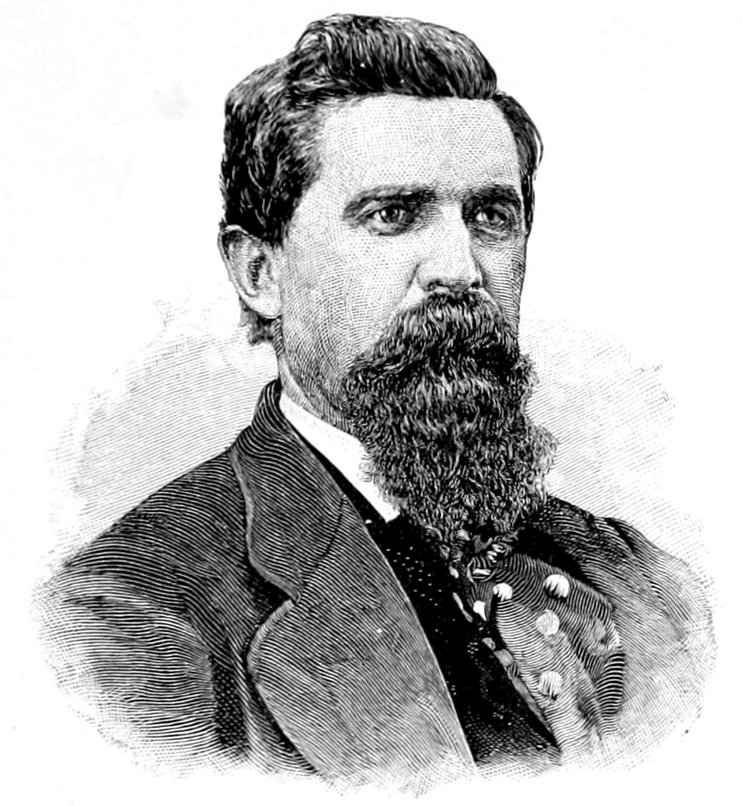
JOHN FETHERSTUN
Overland express messenger
359Fetherstun, anticipating an attack by the crew, stepped
into a corner, and drew his revolver. Those of my readers
who have since had frequent opportunity to estimate
the cool, determined courage of the man, will know that
this preliminary movement was only preparatory to the
desperate heroism and energy with which, had occasion
required it, he would then have sold his life to a crowd
of supposed desperadoes. They took the prisoner away
without resistance, and Fetherstun returned to his hotel.
Four or five men were there, of whom, on inquiry, he
learned that Howie had not been there. As soon as he
heard this, he said to them,
“Gentlemen, I don’t know whom I am addressing, but
if you’re the right kind of men, I want you to follow me.
I am afraid the road agents have killed Neil Howie. He
left me half an hour ago, to be back in five minutes.”
He seized his gun, and was about to leave when a man
opened the door, and told him not to be uneasy. This
seemed to satisfy all the company except Fetherstun. He
left the hotel, gun in hand, and at no great distance came
to a cabin filled with men, with Dutch John as the central
figure. Being denied admission, he demanded his prisoner.
He was told that they were examining him. The
men whom Fetherstun had mistaken as road agents had
mistaken him for the same. Explanations soon set both
right, and John was restored to the custody of Howie and
Fethertsun, who marched him back to the hotel, where
he was again examined.
After many denials and prevarications, he finally made
a full confession of guilt, and corroborated the statements
which “Red” had made, implicating the persons whose
names are contained in the list he had furnished. This
concluded the labors of that day, and at a late hour Howie
and Fetherstun, unable to obtain lodgings for their prisoner
in any of the inhabited dwellings of Bannack, took
him to an empty cabin on Yankee Flat.
CHAPTER XXXV EXECUTION OF PLUMMER
360
Retribution followed rapidly upon the heels of
disclosure. The organization of the Vigilantes of
Nevada and Virginia City was effected as quietly as possible,
but it embraced nearly every good citizen in Alder
Gulch. Men who before the execution of Ives were seemingly
indifferent to the bloody acts of the desperadoes, and
even questioned the expediency of that procedure, were
now eager for the speedy destruction of the entire band.
Every man whose name appeared on the list furnished by
Yager (“Red”) was marked for early examination, and, if
found guilty, for condign punishment. The miners forsook
their work in the gulch to engage in the pursuit and capture
of the ruffians, regardless alike of their personal interests,
the freezing weather of a severe winter, and the
utter desolation of a country but partially explored, immense
in extent, destitute of roads, and unfurnished even
by nature with any protection against exposure.
The crisis demanded speedy action. The delay of a
day or even an hour might enable the leading ruffians to
escape, and thus defeat the force of a great and efficient
example. The ruffians themselves had taken the alarm.
Many of them were on their return to Walla Walla, and
others were making preparations for leaving. It was of
special importance to the object in hand, that Plummer,
the chief of the robber band, should be the first to suffer.
That individual, ignorant of the disclosures that had been
made by Yager, was at Bannack, quietly preparing for
361an early departure from the Territory. Calm and placid
in outward seeming, his conduct bore evidence that he was
all terror within. He was too familiar with the extreme
phases of character not to suspect that he had possibly
been betrayed by some of the number that had been captured,
though much too polite and sagacious to manifest
by his deportment the presence of any such suspicion.
But he was constantly on the alert. Not a beat in the pulse
of the community escaped his notice. Not a strange face
that he did not closely scan, nor a gathering occur whose
details escaped him. The language of looks and signs and
movements was as familiar to him as that of words, and
in it he read plainly and unmistakably that his reign of
deception was at an end. The people had found him out,
and he knew it. His only mistake was that he delayed
action until it was too late.
At a late hour of the same night that Dutch John was
examined, four Vigilantes arrived at Bannack from Virginia
City, with intelligence of the organization at that
place, asking the coöperation of the citizens of Bannack,
and ordering the immediate execution of Plummer, Stinson,
and Ray. A hurried meeting was held, and the
Sabbath daylight dawned upon a branch organization at
Bannack. The day wore on unmarked by any noticeable
event until late in the afternoon. Three horses were then
brought into town, which were recognized as belonging to
the three murderers.
“Aha!” said one citizen to another, “those rascals
scent the game and are preparing to leave. If they do,
that will be the last of them.”
“We can block that game,” was the rejoinder.
Several members of the Vigilance Committee met on the
spur of the moment and adopted measures for the immediate
arrest and execution of the three robbers. Stinson
and Ray were arrested without opposition,—one at
362Mr. Toland’s cabin, and the other, stretched at the time
upon a gaming table, in a saloon. The party detailed to
arrest Plummer found him at his cabin, in the act of
washing his face. When informed that he was wanted he
manifested great unconcern, and proceeded quietly to wipe
his face and hands.
“I’ll be with you in a moment, ready to go wherever
you wish,” he said to the leader of the Vigilantes. Tossing
down the towel and smoothing his shirt-sleeves, he
advanced towards a chair on which his coat was lying,
carelessly remarking: “I’ll be ready as soon as I can put
on my coat.”
One of the party, discovering the muzzle of his pistol
protruding beneath the coat, stepped quickly forward,
saying as he did so, “I’ll hand your coat to you.”
At the same moment he secured the pistol, which being
observed by Plummer, he turned deathly pale, but still
maintained sufficient composure to converse in his usual
calm, measured tone. The fortunate discovery of the
pistol defeated the desperate measures which a desperate
man would have employed to save his life. With his expertness
in the use of that weapon, he would doubtless
have slain some or all of his captors. He was marched
to a point where, as designated before the capture, he
joined Stinson and Ray, and thence the three were
conducted under a formidable escort to the gallows.
This structure, roughly framed of the trunks of
three small pines, stood in a dismal spot three hundred
yards from the centre of the town. It had been erected the
previous season by Plummer, who, as sheriff, had hanged
thereon one John Horan, who had been convicted of the
murder of Keeley. Terrible must have been its appearance
as it loomed up in the bright starlight, the only object
visible to the gaze of the guilty men, on that long
waste of ghastly snow. A negro boy came up to the
363gallows with ropes before the arrival of the cavalcade. All
the way, Ray and Stinson filled the air with curses. Plummer,
on the contrary, first begged for his life, and, finding
that unavailing, resorted to argument, and sought to persuade
his captors of his innocence.
“It is useless,” said one of the Vigilantes, “for you to
beg for your life; that affair is settled, and cannot be altered.
You are to be hanged. You cannot feel harder
about it than I do; but I cannot help it if I would.”
“Do not answer me so,” persisted the now humbled
and abject suppliant, “but do with me anything else you
please. Cut off my ears, and cut out my tongue, and strip
me naked this freezing night, and let me go. I beg you to
spare my life. I want to live for my wife,—my poor absent
wife. I wish to see my sister-in-law. I want time to
settle my business affairs. Oh, God!” Falling upon his
knees, the tears streaming from his eyes, and with his
utterance choked with sobs, he continued,
“I am too wicked to die. I cannot go blood-stained and
unforgiven into the presence of the Eternal. Only spare
me, and I will leave the country forever.”
To all these, and many more petitions in the same vein,
the only answer was an assurance that his pleadings were
all in vain, and that he must die. Meantime, Stinson and
Ray discharged volley after volley of oaths and epithets at
the Vigilantes, employing all the offensive language of
their copious vocabulary. At length the ropes were declared
to be in readiness, and the stern command was
given, “Bring up Ned Ray.”
Struggling wildly in the hands of his executioners, the
wretched man was strung up, the rope itself arresting his
curse before it was half uttered. Being loosely pinioned,
he thrust his fingers under the noose, and, by a sudden
twist of his head, the knot slipped under his chin.
“There goes poor Ned Ray,” whined Stinson, who a
364moment later was dangling in the death-agony by his side.
As Stinson was being hoisted, he exclaimed, “I’ll confess.”
Plummer immediately remarked, “We’ve done enough
already, twice over, to send us to hell.”
Plummer’s time had come. “Bring him up,” was the
stern order. No one stirred. Stinson and Ray were common
villains; but Plummer, steeped as he was in infamy,
was a man of intellect, polished, genial, affable. There
was something terrible in the idea of hanging such a man.
Plummer himself had ceased all importunity. The crisis
of self-abasement had passed, hope fled with it, and he
was now composedly awaiting his fate. As one of the
Vigilantes approached him, he met with the request,
“Give a man time to pray.”
“Certainly,” replied the Vigilante, “but say your
prayers up there,” at the same time pointing to the cross-beam
of the gallows-frame.
The guilty man uttered no more prayers. Standing,
erect under the gallows, he took off his necktie, and, throwing
it over his shoulder to a young man who had boarded
with him, he said,
“Keep that to remember me by,” and, turning to the
Vigilantes, he said, “Now, men, as a last favor, let me
beg that you will give me a good drop.”
The fatal noose being adjusted, several of the strongest
of the Vigilantes lifted the frame of the unhappy criminal
as high as they could reach, when, letting it suddenly
fall, he died quickly, without a struggle.
The weather was intensely cold. A large number of
persons had followed the cavalcade, but were stopped by
a guard some distance from the gallows. The Vigilantes
surrounded the bodies until satisfied that the hangman’s
noose had completed their work, when they formed and
marched back to the town. The bodies were afterwards
buried by the friends of the criminals.
365Buck Stinson was born near Greencastle, Indiana. His
parents removed to Andrew County, Missouri, when he
was about fourteen years of age. He was a bright and
very studious boy, was devoted to his books, which he read
almost constantly, and gave promise of genius; and many
who knew him predicted for him a brilliant and honorable
future. His family was highly respectable.
Henry Plummer was born in the State of Connecticut,
and was in the twenty-seventh year of his age at the time of
his death. His wife, who had gone to her former home
in the States three months previous to his execution, was
entirely ignorant of the guilty life he was leading, and for
some time after his death believed that he had fallen a victim
to a conspiracy. She was, however, fully undeceived,
and the little retrospect which her married life with him
afforded, convinced her of his infamy.
Many of the citizens of Montana doubted whether the
name by which he was known was his true one; but its
genuineness has been established in many ways, and, among
others, by the following incident, which I here relate as well
to illustrate the subtlety of Plummer, as to show the standing
and character of his family relations.
In the Summer of 1869, soon after the completion of
the first transcontinental railway, being in New York City,
I was requested by Edwin R. Purple, who resided in Bannack
in 1862, to call with him upon a sister and brother of
Plummer. He learned from them that they had been misled
concerning the cause of their brother’s execution by
letters which he wrote to them in 1863, in which he told
them that he was in constant danger of being hanged because
of his attachment to the Union. They honestly believed
that his loyalty and patriotism had cost him his
life, and they mourned his loss not only as a brother, but
as a martyr in the cause of his country. From the moment
that they heard of his death, they had determined, if
366ever opportunity offered, to pursue and punish his murderers,
and, with that purpose in view, were about to leave
by railroad for Ogden, Utah, and complete the remaining
five hundred miles of the trip to Montana by stage coach.
The next day, accompanied by Mr. Purple, I had an interview
with them, and found them to be well-educated,
cultivated people. They were very eager in their desire to
find and punish the murderers of their brother, and repeatedly
avowed their intention to leave, almost immediately,
in pursuit of them. Both Mr. Purple and I used
all the plausible arguments we could summon to dissuade
them from the undertaking, without revealing any of the
causes which led to Plummer’s death. All to no purpose.
Finding them resolved, we concluded that, rather than
allow them to suffer from the deception they labored under,
we would put in their hands Dimsdale’s “Vigilantes,”
with the assurance that all it contained relative to their
brother was true. We urged them to satisfy themselves,
from a perusal of it, of the utter fruitlessness of their contemplated
journey. The following day we called upon
the brother, who, with a voice broken by sobs and sighs,
informed us that his sister was so prostrated with grief at
the revelation of her brother’s career that she could not
see us. He thanked us for making known to them the terrible
history, which otherwise they would have learned under
circumstances doubly afflicting, after a long and tedious
journey.
CHAPTER XXXVI DEATH OF PIZANTHIA
367
The next movements of the Vigilantes were followed
up with remarkable expedition. The work they
had laid out contemplated the execution of every member
of Plummer’s band who, upon fair trial, should be
proved guilty of robbery or murder. They intended also
to punish such incidental rascals as were known to be
guilty of crime, and to act as a protective police, until
such time as a competent judiciary should be established
in the Territory. There were many suspicious characters
prowling around the gulches, who, though unaffiliated with
the robber gang, were engaged in the constant commission
of crimes. Flumes were robbed, burglaries committed, and
broils were of frequent occurrence. The country was full
of horse and cattle thieves. By prompt and severe punishment
in all cases of detection, and by the speedy arrest
and examination of all suspected persons, the Committee
intended to strike with terror the entire lawless population,
which had so long and unceasingly violated the laws and
privileges of civilized life with impunity.
The execution of Plummer, Stinson, and Ray met with
general approbation. Every good man in the community
was anxious to become enrolled on the list of the Vigilantes.
The dark shadow of crime, which had hung like an angry
cloud over the Territory, had faded before the omnipresence
of Vigilante justice. The very feeling of safety inspired
by the change was the strongest security for the
growth and efficiency of the organization.
368The morning succeeding the execution, the Committee
met to devise further measures for the arrest of the criminals
still at large. None of the reputed members of Plummer’s
band were then in Bannack. There was, however,
a Mexican known by the name of Jo Pizanthia, living in
a little cabin built against the side of one of the hills overlooking
the town. Being the only Mexican in the place, he
went by the designation of “The Greaser.” He brought
with him to the Territory the reputation of a desperado,
robber, and murderer. With a view to investigating his
career in the Territory, the Committee ordered his immediate
arrest, and sent a party to the cabin to effect it.
The little building was closed, and there was nothing in the
appearance of the newly fallen snow to indicate that it had
been occupied since the previous day. George Copley and
Smith Ball, two esteemed citizens, led the public force,
and, advancing in front of it to the door of the cabin,
called upon the Mexican by name to come forth. No answer
being made, they concluded, against the advice of their
comrades, to enter the cabin. Cautiously lifting the latch,
the two men stepped over the threshold, each receiving, as
he did so, the fire of the desperate inmate. Copley was
shot in the breast, and Ball in the hip. Both staggered
out, exclaiming in the same breath, “I’m shot.” Two of
the company supported Copley to the hotel, but the poor
fellow died of the wound in a few moments. Ball recovered
sufficiently to remain upon the ground.
When it was known that Copley was killed, the exasperation
of the party at the dastardly deed knew no bounds.
They instantly decided to inflict summary vengeance upon
the murderer. Protected by the logs of the cabin, of
which the door was the only entrance, the crowd appreciated
the Mexican’s facilities for making an obstinate and
bloody defence. How to secure him without injury to
themselves, called for the exercise of strategy rather than
369courage. Fortunately, a dismounted mountain howitzer
which had been left by a wagon train lay near by; and
bringing this to a point within a few rods of the side of
the cabin, they placed it upon a box, and loaded it with
shell. At the first discharge, the fuse being uncut, the
missile tore through the logs without explosion. The second
was equally unsuccessful, on account of the shortness
of range. Aim was now directed at the chimney, upon
the supposition that the man might have sought refuge
within it, and a solid shot sent through it—the men
meantime firing into the hole made by the shell in the side
of the cabin. No shot was fired in return.
A storming party was now formed, the men of Nevada
being the first to join it. Half a dozen in number, the men
moved steadily onward under cover of neighboring cabins,
until they reached the space between them and the beleaguered
citadel. Rushing impetuously across, they stood
in front of the entrance, the door having fallen inwards from
the fusillade. Looking cautiously into the cabin, they discovered
the boots of the Mexican, protruding beneath the
door, which had fallen upon him. Lifting the door, they
dragged him forth. He was badly injured, but, on the
moment of his appearance, Smith Ball emptied his revolver
into his body. A clothes-line near was taken down,
and fastened round his neck, and an ambitious citizen
climbed a pole, and, while those below held up the body of
the expiring Mexican, he fastened the rope to the top of
the pole. Into the body thus suspended, the crowd discharged
more than a hundred shots,—satiating their thirst
for revenge upon a ghastly corpse.
While this scene was progressing, several other persons
were engaged in tearing down the cabin. Throwing it into
a pile, it was set on fire, and, when fairly in a blaze, the
riddled body of Pizanthia was taken down, and placed
upon the pyre. Its destruction by the devouring element
370was complete; not a vestige of the poor wretch remained;
though the next morning a number of notorious women
were early at the spot, engaged in panning out the ashes
of the ill-fated desperado, in search of gold.
This entire transaction was an act of popular vengeance.
The people were infuriated at the murder of Copley,
who, besides being one of their best citizens, was a
general favorite. There seemed to be no occasion or excuse
for it, as the Vigilantes contemplated nothing more by the
arrest of Pizanthia than an examination of his territorial
record. With the crimes he had committed before he came
to the Territory, they had nothing to do; and if he had
been guilty of none after he came there, the heaviest possible
punishment they would have inflicted was banishment.
He brought his fate upon himself. It was a brief interlude
in Vigilante history, the terrible features of which,
though they may be deemed without apology or excuse,
need not seek for multiplied precedents outside of the most
enlightened nations or most refined societies in all Christendom.
CHAPTER XXXVII EXECUTION OF DUTCH JOHN
371
Dutch John was still a prisoner in charge of Fetherstun,
in the gloomy cabin on Yankee Flat, a
euphonious title given to a little suburb of a dozen cabins
of the town of Bannack. He had behaved with great propriety,
and by his amiability of deportment won the sympathy
and respect of his captors. The revelations which
he made in his confession, implicating others, made him
fearful of his former companions in crime, who, he knew,
would kill him on the first opportunity. One night during
his imprisonment both he and Fetherstun were alarmed
by the sound of approaching footsteps and suppressed
voices in earnest conversation. Fetherstun prepared his
arms for a defence. Casting a glance at his prisoner,
what was his astonishment to see him standing near the
door, with a loaded double-barrelled gun, awaiting the approach
of the outsiders.
“That’s right, John,” said Fetherstun approvingly;
“fire upon them if they come. Don’t spare a man.”
John smiled and nodded, levelling the muzzle of the gun
towards the sound, but the ruffians heard the click of the
locks, and departed. John could have shot his keeper and
escaped, but he feared the vengeance of his comrades more
than the stern justice of the Vigilantes.
The fate of this desperado was yet undecided by the
Committee. He was not without strong hope of escape,
and his good conduct was doubtless attributable to the belief
that both Howie and Fetherstun would interpose to
save him. The evening of the day after the death of Pizanthia,
372the Committee met. The case of Dutch John came up
for discussion. If it had been consistent with the laws prescribed
for the government of the Committee, John would
have been banished; but his guilty, blood-stained record
demanded that he should die. He had been a murderer
and highwayman for years, and the vote for his immediate
execution was unanimous. The decision was reduced to
writing, and a member of the Committee deputed to read
it to the prisoner, and inform him that he would be executed
in one hour. The wretched man was overcome. He
rose from his blankets, and paced several times excitedly
across the floor. Like Plummer, he then resorted to supplication.
“Do with me as you please. Disable me in any way, cut
off my hands and feet, but let me live. You can certainly
destroy my power for harm without taking my life.”
“Your request cannot be complied with,” said the messenger.
“You must prepare to die.”
“So be it, then,” he replied, and immediately all signs
of weakness disappeared. “I wish,” he continued, “to
write to my mother. Is there a German here who can
write my native language?”
Such a person was sent for. Under John’s dictation,
he wrote a letter to his mother. It was read to him, and
he was so dissatisfied with it that he removed the rags from
his frozen hands and fingers, and wrote himself.
He told his mother that he had been condemned to death,
and would be executed in a few minutes. In explanation
of his offence, he wrote that while coming from the Pacific
side, to deal in horses, he had fallen into the company of
bad men. They had beguiled him into the adoption of a
career of infamy. He was to die for aiding in the robbery
of a wagon, while engaged in which he had been
wounded, and his companion was slain. His sentence,
though severe, he acknowledged to be just.
373Handing the letter to the Vigilantes, he quietly replaced
the bandages upon his unhealed fingers. His manner,
though grave and solemn, was composed and dignified.
Something in his conduct showed that he truly loved his
mother. Much sympathy for him was evinced in the manner
and attention of those who conducted him to the place
of execution, in an unfinished building at no great distance
from his place of confinement. The first objects
which met his gaze, as he stood beneath the fatal beam,
were the bodies of Plummer and Stinson, the one laid out
upon the floor for burial, the other upon a work-bench.
He gazed upon their ghastly features unshrinkingly, and
in clear tones asked leave to pray, which was readily
granted. Kneeling down, amid the profound silence of a
crowd of spectators, his lips moved rapidly, and his face
wore a pleading expression, but his utterance was inaudible.
Rising to his feet, while seemingly still engaged in
prayer, he cast an expressive glance at the audience, and
then surveyed the provisions made for his execution. A
rope with the fatal noose dangled from the cross-beam,
and beneath it stood a barrel, around which was a cord,
whose ends, stretching across the floor, left no doubt as to
the office it was extemporized to perform.
“How long,” he inquired, “will it take me to die? I
have never seen a man hanged.”
“It will be very short, John,—very short. You will
not suffer much pain,” was the reply of a Vigilante.
The poor wretch mounted the barrel, and stood perfectly
unmoved while the rope was adjusted to his neck.
The men laid hold of the rope which encircled the barrel.
Everything being prepared, at the words, “All ready,”
the barrel was jerked from beneath him, and the stalwart
form of the robber, after several powerful struggles, hung
calm and still. Dutch John had followed his leader to the
other shore.
CHAPTER XXXVIII VIRGINIA CITY EXECUTIONS
374
While the events I have just recorded were in progress
at Bannack, the Vigilantes of Virginia City
were not inactive. Alder Gulch had been the stronghold
of the roughs ever since its discovery. Nearly all their
predatory expeditions had been fitted out there. Being
much the largest, richest, and most populous mining camp
in the Territory, the opportunities it afforded for robbery
were more frequent and promising, and less liable to
discovery, than either Bannack or Deer Lodge. It was
also filled with saloons, hurdy-gurdies, bagnios, and gambling-rooms,
all of which were necessities in the lives of
these free rangers of the mountains. At the time of which
I write there was a population of at least twelve thousand,
scattered through the various settlements from Junction to
Summit, a distance of twelve miles. It was essentially a
cosmopolitan community,—American in preponderance,
but liberally sprinkled with people from all the nations of
Europe. Some were going, and others coming, every day.
Gold dust was abundant, and freedom from social and
moral restraint characterized all classes, to an extent
bordering upon criminal license.
The Vigilantes, more than ever, after it was decided to
execute Plummer, comprehended the necessity for prompt
and vigorous measures, as that event of itself would be
the signal for all the guilty followers of that chief to fly
the Territory. Accordingly, having ascertained that six
of the robber band were still remaining in Virginia City,
the Executive Committee decided upon effectual means for
375their immediate arrest. On the thirteenth day of January,
three days after Plummer was executed, an order was
quietly made for the Vigilantes to assemble at night in
sufficient force to surround the city. Not a man was to
be permitted to leave the city after the line of guards was
established. Bill Hunter, one of the six marked for capture,
suspecting the plot, effected his escape by crawling
beyond the pickets in a drain ditch. The city was encircled,
after nightfall, by more than five hundred armed men,
so quietly that none within, except the Vigilantes, knew
of it until the next morning. All that long winter night,
while that cordon of iron men was quietly stretching along
the heights overlooking the city, the Executive Committee
sat in council, deliberating upon the evidences of guilt
against the men enmeshed in their toils.
At the same time another small band was assembled
around a faro table in the chamber of a gambling saloon.
Jack Gallagher suddenly broke the silence of the game with
the remark,
“While we are here betting, those Vigilantes are passing
sentence of death upon us.”
Wonderful prescience! He little knew or realized the
truth which this observation had for him and his comrades
in iniquity.
Morning broke, cold and cloudy, discovering to the
eyes of the citizens the pickets of the Vigilantes. The city
was like an intrenched camp. Hundreds of men, with guns
at the shoulder, were marching through the snow on all
the surrounding hillsides, with military regularity and
precision. The preparation could not have been more perfect
if made to oppose an invading army. There was no
misunderstanding this array. People talked with bated
breath to each other of the certain doom which awaited the
villains who had so long preyed upon their substance, and
spread terror through the country.
376Messengers were sent to the different towns in the gulch
to summon the Vigilantes to appear forthwith, and take
part in the trial of the ruffians. At the same time parties
were detailed to arrest and bring the criminals before the
Committee. Boone Helm, Jack Gallagher, Frank Parish,
Hayes Lyons, George Lane, and Bill Hunter were known
to be in the city at the time the picket guard was stationed.
Of these, Hunter had escaped. The Vigilantes from Nevada,
Junction, Summit, Pine Grove, and Highland
marched into town in detachments, and formed in a body on
Main Street. The town was full of people.
Frank Parish, the first prisoner brought in, was quietly
arrested in a store. He exhibited little fear. Taking
an executive officer aside,
“What,” he inquired, “am I arrested for?”
“For being a road agent, thief, and an accessory to
numerous robberies and murders on the highway.”
“I am innocent of all,—as innocent as you are.”
When, however, he was put upon his examination
before the Committee, and facts were brought home to him,
he receded from his position of innocence, and confessed
to more and greater offences than were charged against
him.
“I was,” said he, “one of the party that robbed the
coach between Virginia City and Bannack.”
This confession took the Committee by surprise. He
then admitted that he had been guilty of horse-stealing
for the robbers, and had butchered stolen cattle to supply
them with food. He was fully cognizant of all their
criminal enterprises, and shared with them as a member
of the band. Upon this confession he was condemned to
suffer death. He gave directions concerning his clothing
and the settlement of his debts. His case being disposed
of, he was committed to the custody of a strong guard.
George Lane (Clubfoot George), who has figured
377conspicuously in this history, was next introduced into
the presence of the Committee. He was arrested without
trouble, at Dance and Stuart’s store. Perfectly calm
and collected, he inquired,
“Why am I arrested?”
On receiving the same answer that had been given to
Parish, he replied,
“If you hang me, you will hang an innocent man.”
“We have positive proof of your guilt,” was the response
of the examining officer. “There is no possibility
of a mistake.”
“What will you do with me?”
“Your sentence is death,” was the answer.
His eyes dropped, and his countenance wore an expression
of deep contrition. For some moments he covered his
face with his hands, seemingly overcome by the dreadful
announcement. At length, dropping his hands, and looking
into the face of the officer, he inquired,
“Can I have a minister, to pray for and talk with me?”
“One shall be immediately sent for.”
And when the clergyman appeared, Lane, in care of the
guard, spent his remaining hours of life in attending to
the affairs of his soul.
While his examination was progressing, parties came in
with Boone Helm and Jack Gallagher. The former had
been arrested by strategy, while standing in front of the
Virginia Hotel. With an armed man on either side, and
one behind with a pistol presented to his head, this veteran
scoundrel, bloodier far than any of his comrades, was
marched into the presence of his judges.
“Ah!” he exclaimed, “if I’d only had a show, if I’d
known what you were after, you would have had a gay old
time in taking me.”
His right hand was wounded, and supported by a sling.
With much apparent serenity, he sat down on a bench, and
378looked defiantly into the faces of the members of the
Committee.
“What do you want of me here?” he inquired, affecting
entire ignorance of the cause of his arrest.
“We have proof that you belong to Plummer’s band of
robbers, that you have been guilty of highway robbery and
murder, and wish to hear what you have to say to these
charges.”
“I am as innocent,” replied the miscreant, in a deliberate
tone, “as the babe unborn. I never killed any one, nor
robbed or defrauded any man. I am willing to swear it on
the Bible.”
Less for any more important purpose than that of testing
the utter depravity of the wretch, the interrogator
handed him a Bible. With the utmost solemnity of manner
and expression, he repeated the denial, invoking the
most terrible penalties upon his soul, in attestation of its
truthfulness, and kissed the volume impressively at its
close.
The Committee regarded this sacrilegious act of the
crime-hardened reprobate with mingled feelings of horror
and disgust.
“This denial,” said the president, “can avail you nothing.
Your life for many years has been a continuous
career of crime. It is necessary that you should die. You
had better improve the little time left you in preparation.”
Helm looked hopelessly around, but saw no glance of
sympathy in the stern features of his judges. Beckoning
to a person standing near, he whispered,
“Can I see you alone for a few minutes?”
The man, supposing that he was desirous of obtaining
spiritual counsel, replied,
“I will send for a clergyman.”
“No,” was the instant rejoinder. “I want no clergyman.
You’ll do as well.”
379Stepping into the inner room, Helm closed the door,
and, turning to the man, in an anxious tone asked,
“Is there no way of getting out of this scrape?”
“None. No power here is available to save you. You
must die.”
“Well, then,” said he, “I’ll admit to you that I did kill
a man by the name of Shoot, in Missouri. When I left there
I went to California, and killed another chap there. I was
confined in jail in Oregon, and dug my way out with tools
given me by my squaw.”
“Now,” said his confessor, “having told me thus much,
will you not give me what information you can concerning
the band to which you belong, their names, crimes, and
purposes?”
“Ask Jack Gallagher. He knows more than I do.”
Gallagher, who had been brought into an adjoining
apartment, separated from the one in which this conversation
occurred by a thin board partition, on hearing this
reference to himself, poured forth a torrent of profane
abuse upon the head of his guilty confederate.
“It is just such cowardly rascals and traitors as you,”
said he, “that have brought us into this difficulty. You
ought to die for your treachery.”
“I have dared death in all its forms,” said Helm, “and
I do not fear to die. Give me some whiskey.”
The guilty wretch, having been consigned to the custody
of keepers, steeped what little sensibility he possessed in
whiskey, and passed the time until the execution in ribald
jesting and profanity.
Jack Gallagher bounded into the committee-room, swearing
and laughing, as if the whole affair was intended as a
good joke.
“What,” said he, with an oath and epithet appended to
every word, “is it all about? This is a pretty break,
isn’t it?”
380On being informed of the charges against him, and the
sentence of the Committee, he dropped into a seat and began
to cry. In a few moments he jumped up, and with much
expletive emphasis demanded the names of the persons who
had informed against him.
“It was ‘Red,’ who was hanged a few weeks ago on the
Stinking Water.”
Gallagher cursed the dead ruffian for a traitor, liar, and
coward, in the same breath.
“My God!” said he, “must I die in this way?” He
was taken out of the committee-room while uttering the
most terrible oaths and blasphemies.
Hayes Lyons, the only remaining ruffian, had not yet
been arrested. The party detailed for that object, while
searching for him at the Arbor Restaurant, had found and
captured Gallagher, on learning which the Gallagher pursuers
immediately took up the hunt for Lyons. Foiled at
several points, they accidentally learned that he had crossed
the crags overhanging the gulch, and, after wandering in
a circuit of several miles through the mountains, had come
back to a miner’s cabin but half a mile distant from his
point of departure. Proceeding with all possible speed
to the cabin, the leader threw open the door, and, bringing
his pistol to a deadly aim, exclaimed,
“Throw up your hands.”
Lyons, who was in the act of raising a piece of a griddlecake
to his mouth, dropped the fork instantly, and obeyed
the order.
“Come out here, and surrender at once,” was the next
command.
He was in his shirt-sleeves, and, as he stepped out into
the biting atmosphere, he asked in an undertone,
“Will some one get my coat?”
A member of the party brought it to him, and assisted
him in putting it on. He trembled so much with fear that
381it was with difficulty he could get his arms into the sleeves.
While the party was searching him to ascertain if he was
armed, he said,
“You disturbed me in the first meal I have sat down to
with any appetite in six weeks.”
“Finish your dinner,” said the leader. “We will wait
for you.”
“Thank you; you are very kind, but I can eat no more.
What do you intend doing with me? Will I be hung?”
“We are not here to promise you anything. You had
better prepare for the worst.”
“My friends advised me to leave two or three days ago.”
“You would probably have done well had you followed
their advice. Why didn’t you go?”
“Because I had done nothing wrong, and did not wish
to leave.”
It is probable that but for the blandishments of a fascinating
mistress, the memory of Dillingham’s murder
would have dictated to this ruffian an earlier and more successful
effort at escape.
“Have you heard of the execution of Plummer, Stinson,
and Ray?” asked the leader.
“Yes; but I don’t believe the report is true.”
“You may bet your sweet life on’t.”
“Did they make any resistance?”
“No; they had no opportunity.”
Arriving at the committee-room, the prisoner was immediately
confronted with the officers.
“We have condemned you to death for the murder of
Dillingham, and being associated in membership with Plummer’s
band of road agents. Have you anything to say in
extenuation?”
“That I am not guilty. I have committed no crimes,
and formed no associations that call for such severity. I
am as innocent as you are.”
382And yet, but a short time before, the wretched man had
confessed to a leader of one of the police committees, in
presence of several witnesses, that he was the murderer of
Dillingham. His complicity with Plummer’s band was
known to all.
Scarcely was Lyons’s examination concluded, when word
was brought to the Committee that two suspicious persons,
who had gone hurriedly to Highland district, three
miles above Virginia City, the evening before, were concealed
in one of the unoccupied cabins there. An officer
with fifteen men was sent to arrest them. They were disarmed,
and brought before the Committee, but, no evidence
appearing against them, they were discharged.
The examination being over, preparations were made for
the execution of the convicts. These were very simple.
The central cross-beam of an unfinished log store, cornering
upon two of the principal streets, was selected for
a scaffold. The building was roofless, and its spacious
open front exposed the interior to the full view of the crowd.
The ropes, five in number, were drawn across the beam to
a proper length, and fastened firmly to the logs in the rear
basement. Under each noose was placed a large, empty
dry-goods box, with cord attached, for the drops.
Beside the large body of armed Vigilantes, a great number
of eager spectators had assembled from all parts of
the gulch to witness the execution. Six or eight thousand
persons, comprehending the larger portion of the population
of the Territory, gathered into a compact mass,
when the prisoners, with their armed escort, marched from
the committee-rooms into the street, and were ranged in
front of the guard.
“You are now,” said the president, addressing them, “to
be conducted to the scaffold. An opportunity is given you
to make your last requests and communications. You will
do well to improve it by making a confession of your own
383crimes, and putting the Committee in possession of information
as to the crimes of others.”
The prisoners separately declined to make any communication.
When the guard were about to fasten their arms,
Jack Gallagher, with an oath, exclaimed,
“I will not be hung in public,” and, drawing his pocket-knife,
he applied the blade to his throat, saying, “I will
cut my throat first.”
The executive officer instantly cocked and presented his
pistol.
“If you make another move of your arm,” said he, “I
will shoot you like a dog. Take the knife from him, and
pinion him at once,” he continued, addressing the guard.
The ruffian cursed horribly, all the while his arms were
being tied.
Boone Helm, with customary adjective profanity, said
to Gallagher in a consolatory tone,
“Don’t make a fool of yourself, Jack. There’s no use
or sense in being afraid to die.”
After the process of binding was completed, each prisoner
was seized by the arm on either side, by a Vigilante
who held in the hand not thus employed a navy revolver,
ready for instant use. The large body of armed Vigilantes
were then formed around the prisoners, into a hollow
square, four abreast on each side, and a column in front
and rear. A few men with pistols were dispersed among the
crowd of spectators, to guard against any possible attempt
at rescue. Thus formed, the procession marched in
the direction of the scaffold with slow and solemn pace. The
silence of the great throng was unbroken by a whisper, and,
more eloquently than language could have done, declared
the feelings of anxiety and suspense by which all were animated.
Some little delay being necessary to complete the
preparations at the scaffold, the procession halted in front
of the Virginia Hotel, on the corner diagonally from it
384across Main Street. While waiting there, Clubfoot
George called to his side Judge Dance, and said to him,
“You have known me ever since I came to Virginia City,
more intimately than any other man. We have had dealings
together. Can you not in this hour of extremity say
a good word for my character?”
“It would be of no use, George. Your dealings with me
have always been fair and honorable; but what you have
done outside, I only know from the evidence, and that is
very strong against you. I can do you no good.”
“Well, then,” said the penitent ruffian, “will you pray
with me?”
“Willingly, George; most willingly,” and, suiting the
action to the word, the judge dropped upon his knees, and,
with George and Gallagher kneeling beside him, offered
up a fervent petition in behalf of the doomed men. Boone
Helm was irritated at this request, and, raising his sore
finger, exclaimed,
“For God’s sake, if you’re going to hang me, I want
you to do it, and get through with it; if not, I want you to
tie a bandage on my finger.”
While the prayer was in progress, Hayes Lyons requested
that his hat should be removed. Frank Parish
gave abundant evidence of deep contrition, but Boone Helm
continued, as from the first, to treat all the proceedings
with profane and reckless levity.
Gallagher, at one moment cursing, and at the next crying,
seemed the least composed of any of the prisoners. He
wore a handsome cavalry overcoat, trimmed with beaver.
“Give me that coat, Jack,” said Helm, as Gallagher rose
from his knees. “You never yet gave me anything.”
“It’s little use you’ll make of it now,” responded Gallagher
with an oath, and, catching at the moment the eye
of an acquaintance, who was regarding him from a window
of the hotel, he called to him in a loud tone,
385“Say, old fellow, I’m going to heaven. I’ll be there in
time to open the gate for you.”
“Halloo, Bill!” said Boone Helm to one in the crowd,
“they’ve got me this time; got me, sure, and no mistake.”
Hayes Lyons begged of his captors the privilege of seeing
his mistress. “Let me bid her good-bye and restore
this watch to her, which is her property.” The request was
refused, only to be repeated, and on being made a third
time he received for answer,
“Hayes! bringing women to the place of execution
‘played out’ in ’63, when they interfered with your trial
for killing Dillingham.”
The unhappy wretch ceased further importunity.
When the arrangements at the scaffold were completed,
the guard crossed the street, opened ranks, and the prisoners
were conducted through into the building, each as
he entered stepping upon one of the dry-goods boxes.
Ranged side by side, Clubfoot George was first on the
east side of the room; next to him was Hayes Lyons, then
Jack Gallagher, then Boone Helm, and near the west wall
Frank Parish. The area in front of them was occupied by
the guard and the members of the Executive Committee.
The two streets in front and at the side of the building
were crowded with armed Vigilantes and spectators. The
order being given to remove the hats of the prisoners,
Clubfoot George, whose hands were loosely fastened, contrived
to reach his hat, which he threw spitefully on the
floor, the hats of the others being at the same time removed
by the guard.
After the nooses were adjusted, the chief of the Committee
said to the prisoners,
“You are now about to be executed. If you have any
dying requests to make, this is your last opportunity. You
may be assured they shall be carefully heeded.”
Jack Gallagher broke in upon this address with a leer,
386“How do I look, boys,” he asked, “with a halter around
my neck?” The grim effort failed to elicit a smile.
“Your time is very short,” said the chief, again reminding
them that their requests would be listened to.
“Well, then,” said Gallagher, “I want one more drink
of whiskey before I die.”
The loathing which this request excited was apparent in
the expression of the countenances of all who heard it.
Some men exchanged meaning glances, revealing thereby
the shock their sensibilities had received by this exhibition
of depravity. Others craned their necks over the crowd,
as if they had not heard aright. For a few minutes no
one seemed to know what answer to make to a man whose
last moments were given to the gratification of his evil
appetites. This silence was soon broken, however, by an
old miner.
“We told ’em,” said he, “that we’d do whatever they
asked. Give him the liquor.”
A man appeared in a moment with a tumbler nearly full.
Raising it as high as he could, the prisoner bent his head,
but was restrained by the rope from touching the glass
with his lips. Throwing his head back, he turned on the
box, and, looking back upon the fastenings of the rope to
the basement log at the rear of the building, in a loud and
imperious tone he launched a profane and vulgar epithet
at the guard, saying,
“Slacken that rope, quick, and let a man take a parting
drink, won’t you?”
The rope was loosed, while the depraved wretch drained
the tumbler at a draught. While the guard was refastening
it, he exclaimed,
“I hope Almighty God will strike every one of you with
forked lightning and that I shall meet you all in the lowest
pit of hell.”
The Committee decided that the executions should be
387single, commencing with Clubfoot George, and concluding
with Hayes Lyons, who stood next to him in order.
At the words “Men, do your duty,” the men holding the
cords attached to the box on which the prisoner in turn
stood, were, by a sudden jerk, to pull the footing from
under him. A fall of three feet was deemed sufficient to
dislocate the neck, and avoid the torture of protracted
strangulation.
No more requests being made, the men laid hold of the
cords attached to the box occupied by George Lane. Just
at that moment the unhappy wretch descried an old friend
clinging to the building, to obtain sight of the execution.
“Good-bye, old fellow,” said he. “I’m gone,” and, without
waiting for the box to be removed, he leaped from it,
and died with hardly a struggle.
“There goes one to hell,” muttered Boone Helm.
Hayes Lyons, who stood next, was talking all the while,
telling of his kind mother; that he had been well brought
up, but evil associations had brought him to the scaffold.
Gallagher cried and swore by turns.
“I hope,” said he, “that forked lightning will strike
every strangling villain of you.” The box, flying from
under his feet, stopped an oath in its utterance, and the
quivering of his muscles showed that his guilty career was
terminated.
“Kick away, old fellow,” said Boone Helm, calmly surveying
the struggles of the dying wretch. “My turn comes
next. I’ll be in hell with you in a minute.” Shouting in
a loud voice, “Every man for his principles! Hurrah for
Jeff Davis! Let her rip,” his body fell with a twang that
killed him almost instantly.
Frank Parish maintained a serious deportment from the
moment of his arrest until his execution. At his request
his black necktie was dropped like a veil over his face. He
“died and made no sign.”
388Hayes Lyons was the only one remaining. Looking right
and left at the swaying bodies of his companions, his anxious
face indicated a hope of pardon. His entreaties were
incessant, but when he found them unavailing, he requested
that his mistress might have the disposition of his body;
that the watch of hers which he wore might be restored to
her, and that he might not be left hanging for an unseemly
time. He died without a struggle.
Two hours after the execution the bodies were cut down,
and taken by friends to Cemetery Hill for burial.
X. Beidler officiated as adjuster of the ropes at this execution.
Jack Gallagher had killed a friend of his. Some
time afterwards, when he was relating the circumstances
attending the execution, in a mixed crowd, a gentleman
present, who was greatly interested in the narrative, and
whose sympathy for the ruffians was very apparent, asked,
at the close of the narrative, in a lachrymose tone,
“Well, now, when you came to hang that poor fellow,
didn’t you sympathize with him, didn’t you feel for him?”
Beidler regarded the man for a moment with great disgust,
and, imitating his tone, replied slowly,
“Yes, I did. I felt for him a little, I felt for his left
ear.”
CHAPTER XXXIX PURSUIT OF ROAD AGENTS
389
The work so well begun was prosecuted with great
energy. The ruffians had fled from Virginia City
and Bannack, over the range to Deer Lodge and Bitter
Root, intending gradually to return to their old haunts in
Idaho. The Vigilantes, resolved that they should not escape,
took up the pursuit. A company of twenty-one, under
the command of a competent leader, left Nevada on the
fifteenth of January. Arriving at Big Hole in the evening,
they sent a detachment to Clark’s ranche to arrest the
bandit Steve Marshland, who was laid up with frozen feet,
and the wound which he had received in the breast while attacking
Moody’s train. Receiving no response to their
repeated raps at the door of the cabin, one of the party
entered, and, lighting a wisp of straw, found Marshland
in bed.
“Hands up, if you please,” said he, pointing his revolver
at the head of the prostrate robber, who obeyed the
command as well as circumstances would admit.
“Are you sick, Steve?” queried the Vigilante.
“Yes—very,” faintly responded Marshland.
“No one with you?”
“No one,—no living thing but the dog.”
“What is the matter?”
“I’ve got the chills.”
“Strange! New kind of sickness for winter! Nothing
else the matter?”
“Yes. I froze my feet while prospecting at the head
of Rattlesnake Creek.”
390“Did you raise the color?”
“No. The water prevented me from going to bed-rock.”
While this conversation was in progress, the party had
built a fire and commenced cooking supper. Removing
from beside the bed two double-barrelled shotguns, a yager,
and another rifle, they invited Marshland to get up and take
supper with them. During the meal all engaged in merry
conversation. After it was over, the leader informed
Marshland that he was arrested for the robbery of Moody’s
train.
“You received,” said he, “while engaged in that robbery,
a bullet wound in the breast, by which we shall be
able to identify you.”
“I received no such wound,” said he; and, striking his
breast several times, he continued, “My breast is as sound
as a dollar.”
“You can have no objection, then, to submitting to our
examination.”
“None in the least, gentlemen. Look for yourselves.”
The leader threw open Marshland’s shirt. The mark
of the recent wound confirmed the guilt of the robber. He
could give no explanation of the manner in which he
received it.
“The evidence is satisfactory to us,” said the leader.
“We have made no mistake in arresting you. You must
die.”
“For God’s sake, do not hang me. Let me go, and I
will trouble you no more.”
“It cannot be. We shall certainly execute every one
of Plummer’s infamous band that falls into our hands,
and we hope to catch them all.”
Finding importunity of no avail, he made a full and
frank confession of all his crimes. A scaffold was improvised
by sticking into the ground a pole, the end of which
projected over the corral fence, upon which the pole rested.
391A box taken from the cabin was placed under it, for the
prisoner to stand upon. When all was ready, and the
fatal noose was adjusted, the prisoner once more appealed
to his captors.
“Have mercy on me for my youth!” he exclaimed.
“You should have thought of it before,” replied the
leader, as he gave the fatal order, and the poor wretch was
launched into eternity.
The scent of his frozen feet attracted the wolves, and the
party were obliged to watch both him and the horses, to
prevent an attack by these animals. He was buried near
the place of execution. The detachment found the main
party the next morning, having been absent only one night.
The Vigilantes resumed their march, beginning at this
point the ascent of the Deer Lodge divide. Not knowing
how soon or where they might overtake others of the gang,
they rode forward in double file at the rate of sixty miles
a day. They divided their company into four messes, each
of which being supplied plentifully with food already
cooked, they lighted no large camp-fires, lest the smoke
therefrom should betray them. A double watch was kept
over the horses while in camp. Each man was armed with
at least one, some with two, revolvers, and a shotgun or
rifle. While on the march, the captain was in the van.
After they descended into the valley of Deer Lodge, a spy
was sent forward to reconnoitre the town of Cottonwood,
with instructions to meet the party at Cottonwood Creek.
At four o’clock P.M. they halted at Smith’s ranche, seventeen
miles from Cottonwood, until after dark, when they
rode cautiously forward until within a short distance of
the town. Learning from their spy that all the robbers except
Bunton and “Tex” had gone, they rode hastily into
the town and surrounded the saloon of the former. Bunton
refused to open the door. Three men detailed to arrest
him called to him and expressed a wish to see him.
392He persisted in denying them admittance, until convinced
that they would effect an entrance by force; and he then
told a man and boy in his employ to let them in. The door
was opened, but, as the lights within had been extinguished,
the men declined to enter until a candle was lighted. As
soon as light was furnished, they rushed in, and the leader
exclaimed,
“Bill, you are my prisoner!”
“For what?” inquired Bunton.
“Come with us at once, and you’ll find out.”
Observing that he made signs of resistance, a Vigilante,
whose courage exceeded his strength, seized the ruffian and
attempted to drag him out. Finding himself overmatched,
he called to his assistance a comrade, who soon succeeded
in binding the hands of the desperado behind him. In this
condition he was conducted by a guard to the cabin of
Peter Martin.
“Tex,” who was in the saloon, was conquered in much
the same manner, and forced to follow his companion.
Martin, who knew nothing of the arrest, was seated at
a table playing a game at cards with some friends. Hearing
that the Vigilantes were surrounding his house, he
dropped his cards, and started with great affright for the
door. For a long time he refused to obey their summons
to come out, but, on being assured that he “wasn’t charged
with nothin’,” he opened the door and returned to his game.
After breakfast the next morning a person who had been
conversing with Bunton informed the Vigilantes that he
had said to him that he would “get one of them yet,” on
learning whereof they searched him a second time. They
found a derringer in his vest-pocket, which had evidently
been placed there by some sympathizer during the night.
Bunton refused to make any answer to the charges made
against him. No doubt was entertained of his guilt. The
vote on his case, taken by the uplifted hand, was unanimous
for his execution. The captain informed him of it.
393“If you have any business to attend to, you had better
intrust it to some one, as we cannot be delayed here.”
Bunton immediately gave his gold watch to his partner
Cooke, and appropriated his other property to the payment
of his debts. He had gambled for and won the
interest in the saloon from its former owner a fortnight
before this time. Having thus disposed of his affairs, he
was conducted to the gate of a corral near, surmounted by
a gallows-frame, beneath which a board laid upon two boxes
served the purpose of a drop. While the hangman was
adjusting the rope, he gave him particular instructions
about the exact situation of the knot. This being fixed to
suit him, he said to the captain,
“May I jump off myself?”
“You can if you wish,” was the reply.
“I care no more for hanging,” said Bunton, “than I
do for taking a drink of water; but I should like to have
my neck broken.”
On being asked if he had anything further to say, he
replied,
“Nothing, except that I have done nothing to deserve
death. I am innocent. All I want is a mountain three hundred
feet high to jump from. And now I will give you the
time; one—two—three.” The men were prepared to pull
the plank from under him should he fail to jump, but he
anticipated them, and, adding the words, “Here goes,”
he leaped and fell with a loud thud, dying without a
struggle.
“Tex” was separately tried. The evidence being insufficient
to convict him, he was liberated, and left immediately
for the Kootenai mines.
Mrs. Demorest, the wife of the owner of the corral, was
so greatly outraged by the use made of the gate frame
that she gave her husband no peace until the poles were
cut down, and the frame entirely unfitted for further use
as a gallows.
394After the execution of Bunton, the Vigilantes, in company
with Jemmy Allen, a rancheman, left Cottonwood for
Hell Gate, a little settlement ninety miles down the river,
in the vicinity of Bitter Root Valley. Snow covered the
ground to the depth of two feet, and the weather was intensely
cold. It was after dark when the company arrived
at one of the crossings of the Deer Lodge. The
river, being a rapid mountain stream, seldom freezes sufficiently
solid to bear a horseman; but, no other mode of
transit presenting itself, the Vigilantes drove hurriedly
upon the frozen surface, and, before they were half-way
across, the ice gave way, precipitating their horses into
the water. Had the stream been wide, all must have perished.
As it was, after must floundering and considerable
exertion, all were landed safely on the opposite bank. One
of the party barely escaped drowning, and his horse was
dragged from the stream by a lariat around his neck. At
eleven o’clock the company arrived at Allen’s ranche, where
they passed the remainder of the night in blankets.
The next day, accompanied by Charles Eaton, who was
familiar with the country, they rode on in the direction of
Hell Gate, but, owing to the great depth of the snow, progressed
only fifteen miles. They made a camp in the snow.
Their horses, being accustomed to the mountains, pawed,
in the snow to find the bunch-grass. The ride of the following
day terminated at the workmen’s quarters on the
Mullen wagon-road. One of the ponies broke his leg by
stepping into a badger hole while they were going into
camp, and another, by a similar accident, stripped the
skin from his hindlegs. They were obliged to shoot the
former, and turn the latter loose to await their return.
The troop were in their saddles at daylight, on the route
to the settlement, which they approached to within six miles,
and went into camp until after nightfall. Then they resumed
their ride, stopping a short distance outside of the
395town. The scout they had sent to reconnoitre brought
them all needful information, and, mounting their horses,
they entered the town on a keen run. Skinner was standing
in the doorway of his saloon, when they rode up, surrounded
the building, and ordered him to “throw up his
hands.”
“You must have learned that from the Bannack stage
folks,” said his chere amie, Nelly, who was an observer of
the scene.
Two men dismounted, and, seizing Skinner, bound him
immediately. Meantime two or three Vigilantes threw open
the door of Miller’s cabin, which was next to Skinner’s,
and Dan Harding, the foremost among them, levelling his
gun, shouted to some person lying upon a lounge,
“Alex, is that you?”
“Yes,” replied the man, “what do you want?”
“We want you,” was the reply, as the men rushed in,
took his pistol, and bound the robber before he was thoroughly
aroused from sleep.
“These are rather tight papers—ain’t they, boys?”
said Carter. “Give me something to smoke and tell me
the news.” On being told the names of those who had been
executed, he quietly remarked,
“That’s all right; not an innocent man hung yet.”
He and Skinner were conducted down to Higgins’s store,
and their examination immediately commenced. Three
hours were occupied in the investigation, during which Nelly
came down, with the intention of interfering in Skinner’s
behalf. She was sent home under guard; and her escort,
on searching her premises, found Johnny Cooper prostrated
by three pistol shots, received in a quarrel with
Carter the previous day, but for which it had been the intention
of Carter and Cooper to leave for Kootenai. The
baggage and provisions they had procured for the journey,
worth a hundred and thirty dollars, together with the pack-animal,
396were taken for the use of the expedition, and were
paid for by M. W. Tipton, whom Carter and Cooper had
persuaded to become their surety for the amount.
During the trial of Carter, he confessed his complicity
as accessory, both before and after the fact, to the murder
of Tiebalt. It was proven also that he was concerned
in the coach robbery. Skinner made no confession, nor
was it necessary, as his criminal character and acts were
susceptible of abundant proof.
Cooper was tried separately. He was one of the lieutenants
of the band. A Vigilante by the name of President
testified to Cooper’s having murdered a man in
Idaho, for which he was arrested by the people. While
being conducted to the place of trial, he broke from his
captors, leaped with a bound upon a horse standing near,
and, amid a hundred shots, escaped uninjured, and came
to Montana.
On the evening of the day these trials were in progress,
a detachment of eight men left Hell Gate in pursuit of
Bob Zachary, whom they found seated in bed, in the cabin
of Hon. Barney O’Keefe, known throughout Bitter Root
Valley as “the Baron.” One of the party, on entering,
pushed him over, upon his back, taking from him, at the
same time, his pistol and knife. While on their return with
him to Hell Gate, O’Keefe unintentionally mentioned that
a stranger was stopping at Van Dorn’s cabin, in the Bitter
Root Valley. A company of three Vigilantes, suspecting
by the description given that he was none other
than George Shears, another of the band, started at once
in pursuit.
Riding up in front of the cabin, Thomas Pitt, their
leader, inquired of the man who met them at the door, if
George Shears was in.
“Yes,” said Van Dorn. “He is in the inner room.”
“Any objection to our entering?” inquired Pitt.
397Van Dorn replied by opening the door of the room, where
George was discovered, knife in hand. He surrendered
without resistance, astonishing his captors by the utter indifference
he manifested to the near approach of death.
Walking with Pitt to the corral, he designated the horses
he had stolen, and confessed his guilt.
“I knew,” said he, “I should have to come to this sometime,
but I thought I could run another season.”
“There is no help for you, George,” said Pitt. “You
must suffer the same fate as your companions in crime.”
“I suppose I should be satisfied,” replied the ruffian,
“that it is no worse.”
He was conducted to the barn, where, a rope being cast
over a beam, he was requested, in order to save the trouble
of procuring a drop, to ascend the ladder. He complied
without the least reluctance. After the preparations
were completed, he said to his captors,
“Gentlemen, I am not used to this business, never having
been hung before. Shall I jump off, or slide off?”
“Jump off, of course,” was the reply.
“All right,” he exclaimed, “good-bye!” and leaped
from the ladder, with the utmost sang froid. The drop was
long, and the rope tender. As the strands untwisted,
they parted, until finally one alone remained.
Soon after the party which captured Zachary and Shears
had left Hell Gate, intelligence was received there that
William Graves (Whiskey Bill) was at Fort Owen in the
Bitter Root Valley. Three men were sent immediately to
arrest and execute him. He was armed and on the lookout,
and had repeatedly sworn that he would shoot any
Vigilante that came in his way. The party was too wary
for him. He was first made aware of their presence, by a
stern command to surrender, and a pistol at his heart. He
made no resistance, and refused all confession. A rope was
tied to the convenient limb of a tree, and the drop extemporized
398by placing the culprit astride of a strong horse,
behind a Vigilante. When all was ready, the rider, exclaiming
“Good-bye, Bill,” plunged the rowels into the
sides of the horse, which leaped madly forward; the fatal
noose swept the robber from his seat, breaking his neck
by the shock, and killing him instantly.
In the meantime, the trials of Carter, Skinner, and
Cooper had resulted in the conviction of those ruffians, and
they were severally condemned to die. Scaffolds were
hastily prepared by placing poles over the fence of Higgins’s
corral. Carter and Skinner were conducted to
execution by torchlight, a little after the midnight succeeding
their trial. Dry-goods boxes were used for drops. On
their march to the place of execution, Skinner suddenly
broke from his guard, and ran off, shouting, “Shoot!
Shoot!” Not a gun was raised, but after a short chase in
the snow the prisoner was secured, and led up to the scaffold.
He made a second attempt to get away while standing
on the box, but a rope was soon adjusted to his neck,
and the leader said to him,
“You may jump now, as soon as you please.” Carter
manifested great disgust at Skinner’s attempt to run away.
While he was standing on the drop, one of the Vigilantes
requested him to confess that he had participated in the
murder of Tiebalt.
“If I had my hands free,” he replied with an oath, “I’d
make you take that back.”
Skinner, who stood by his side, was talking violently at
the time, and Carter was ordered to be quiet.
“Well, then, let’s have a smoke,” said he; and, a lighted
pipe being given him, he remained quiet. Both criminals,
as they were launched from the platform, exclaimed, “I
am innocent”—the password of the band. They died
apparently without pain.
The party that arrested Zachary arrived with him the
399next morning. He was tried and found guilty. By his
directions a letter was written to his mother, in which he
warned his brothers and sisters to avoid drinking, card-playing,
and bad company—three evils which, he said, had
brought him to the gallows. On the scaffold he prayed that
God would forgive the Vigilantes for what they were doing,
as it was the only way to clear the country of road agents.
He died without apparent fear or suffering.
Johnny Cooper was drawn to the scaffold in a sleigh, his
wounded leg rendering him unable to walk. He asked for
his pipe.
“I want,” said he, “a good smoke before I die. I always
did enjoy a smoke.” A letter had been written to his
parents, who lived in the State of New York. Several
times, while a Vigilante was engaged in adjusting the rope,
he dodged the noose, but, on being told to keep his head
straight, he submitted. He died without a struggle.
Having finished their mission, the Vigilantes returned to
Nevada.
CHAPTER XL EXECUTION OF HUNTER
400
Soon after the transactions recorded in the last chapter,
the Virginia City Vigilantes were informed that
Bill Hunter had been seen in the Gallatin Valley. It was
reported that he sought a covert among the rocks and
brush, where he remained during the day, stealing out at
night and seeking food among the scattered settlers, as
he could find it. His place of concealment was about
twenty miles from the mouth of the Gallatin River. A
number of the Vigilantes, under the pretence of joining
the Barney Hughes stampede to a new placer discovery,
left Virginia City, and scoured the country for a distance
of sixty miles or more, in search of the missing ruffian.
Hunter was discovered during this search.
As soon as it became known that he was at the spot indicated,
four resolute men at once volunteered to go in
pursuit of, capture, and execute him. Their route lay
across two heavy divides, and required about sixty miles
of hurried travelling. The first day they crossed the divide
between the Pas-sam-a-ri and the Madison, camping
that night on the bank of the latter river, which they had
forded with great difficulty. The weather was intensely
cold, and their blankets afforded but feeble protection
against it. They built a large camp-fire, and lay down as
near to it as safety would permit. One of their number
spread his blankets on the slope of a little hillock next the
fire, and during the night slipped down until his feet encountered
the hot embers. The weather increased in severity
401the next day, during most of which the Vigilantes rode
through a fierce mountain snowstorm, with the wind directly
in their faces. At two o’clock P.M. they halted for
supper at the Milk ranche, about twenty miles from the
place where they expected to find the fugitive. Under the
guidance of a man whom they employed here, they then
pushed on at a rapid pace, the storm gathering in fury as
they progressed. At midnight they drew up near a lone
cabin in the neighborhood of the rocky jungle where their
game had taken cover.
“This storm has certainly routed him,” said one of the
Vigilantes. “Ten to one, we bag him in the cabin.”
“Very likely,” replied another. “He would not suspect
danger in such weather. It will save us a heap of trouble.”
One of the men rapped loudly at the cabin door. Opening
it slowly, a look of amazement stole over the features
of the inmate, as he surveyed the company of six mounted
armed men.
“Good-evening,” said one, saluting him.
“Don’t know whether it is or not,” growled the man, evidently
suspicious that a visit at so late an hour meant mischief.
“Build us a fire, man,” said the Vigilante. “We are
nearly frozen, and this is the only place of shelter from
this storm for many miles. Surely you won’t play the
churl to a party of weather-bound prospectors.”
Reassured by this hearty reproof for his seeming unkindness,
the man set to work with a will, and in a few
moments a genial fire was blazing on the hearth, which the
party enjoyed thoroughly. Glancing curiously around
the little room, the Vigilantes discovered that it contained
three occupants besides themselves. Placing their guns
and pistols in convenient position, and stationing a sentinel
to keep watch and feed the fire, the men spread their
blankets on the clay surface of the enclosure, and in a few
402moments were locked in sleep; careful, however, first, to
satisfy the eager curiosity of their entertainers, by a brief
conversation about mining, stampeding, prospecting, etc.,
and leading them to believe that they were a party of miners,
returning from an unsuccessful expedition.
Fatigued with the ride and exposure of the two previous
days, the Vigilantes slept until a late hour the next morning.
Two of the occupants of the cabin rose at the same
time. The other, entirely enveloped in blankets, kept up a
prolonged snore, whose deep bass signified that he was
wrapped in profound slumber. The Vigilantes, contriving
to keep four of their number in the cabin, while making
preparations to depart, soon had their horses saddled;
but when all was ready, one of them inquired in a careless
tone,
“Who is the man that sleeps so soundly?”
“I don’t know him,” said the host.
“When did he come here?”
“At the beginning of the snowstorm, two days ago. He
came in and asked permission to remain here until it was
over.”
“Perhaps it’s an acquaintance. Won’t you describe
him to us?”
The man complied, by giving a most accurate description
of Hunter. No longer in doubt, the Vigilante went
up to the bedside, and, in a loud voice, called out, “Bill
Hunter!”
Hastily drawing the blanket from his face, the occupant
stared wildly out upon the six armed men, asking in the
same breath,
“Who’s there?”
Six shotguns levelled at his head answered the question.
“Give us your revolver, and get up,” was the command.
Hunter instantly complied.
“You are arrested as one of Plummer’s band of road
agents.”
403“I hope,” said Hunter, “you will take me to Virginia
City.” A Vigilante assented.
“What conveyance have you for me?”
“There,” said one, pointing to a horse, “is the animal
you must ride.”
The prisoner put on his hat and overcoat, and mounted
the horse. Just as he was about to seize the reins, a Vigilante
took them from his hands, saying, with affected
suavity,
“If you please, I’ll manage these for you. You’ve only
to sit still and ride.”
After the company started, the robber cast a suspicious
glance behind him, and saw one man following on foot. His
countenance fell. The expression told, in stronger language
than words, that the thought which harassed him
was that he would not be taken to Virginia City. About
two miles distant from the cabin, the company drew up
and dismounted under a solitary tree. Scraping away the
snow, they kindled a fire, and prepared their breakfast, of
which the robber partook with them, and seemed to forget
his fears, and laughed and joked as if no danger were nigh.
Breakfast over, the Vigilantes held a brief consultation as
to the disposition which should be made of their prisoner.
On putting the question to vote, it was decided by the votes
of all but the person who had signified to Hunter that he
was to be taken to Virginia City, that his execution should
take place instantly.
The condemned wretch turned deadly pale, and in a
faint voice asked for water. One of the Vigilantes related
to him the crimes of which he had been guilty.
“Of course,” said he, “you know that offences of this
magnitude, in all civilized countries, are punished with
death. The necessity for a rigid enforcement of this penalty,
in a country which has no judiciary, is greater even
than in one where these crimes are tried by courts of law.
There is no escape for you. We are sorry that you have
404incurred this penalty,—sorry for you, but the blame is
wholly yours.”
Hunter made no reply to the justice in his case, but requested
that his friends should not be informed of the manner
of his death.
“I have,” said he, “no property to pay the expense of
a funeral, and my burial even must depend upon your charity.
I hope you will give me a decent one.”
“Every reasonable request shall be granted, Bill,” said
the Vigilante; “but you know the ground is too hard for
us to attempt your interment without proper implements.
We will inform your friends of your execution, and they
will attend to your burial.”
While this conversation was going on, some of the Vigilantes
had prepared the noose, and passed the rope over
a limb of the tree. The criminal shook hands with all, tearfully
bidding each “good-bye.” After the rope was adjusted,
several of the men took hold of it, and at a given
signal, by a rapid pull, ran the prisoner up so suddenly
that he died without apparent suffering; yet, strange to
say, he reached as if for his pistol, and pantomimically
cocked and discharged it, the by-standers stated, six times.
The “ruling passion was strong in death.” Leaving the
corpse suspended from the tree, the Vigilantes, now that
their work was done, hurried homeward at a rapid pace.
Hunter was the last of Plummer’s band that fell into
the hands of the Vigilantes. The man was not destitute
of redeeming qualities. He often worked hard in the mines
for the money he lost at the gaming-table, but in an evil
hour he joined Plummer’s gang, and aided in the commission
of many infamous crimes. In his personal intercourse
he was known to perform many kind acts. He admitted,
just before his death, the justice of his sentence. It is
believed that in his escape through the pickets at Virginia
City he was assisted by some of the Vigilantes, who did
not credit his guilt.
405The death of Hunter marked the bloody close of the
reign of Plummer’s band. He was the last of that terrible
organization to fall a victim to Vigilante justice. The
retribution, almost Draconic in severity, administered to
these daring freebooters had in no respect exceeded the
demands of absolute justice. If the many acts I have narrated
of their villainies were not sufficient to justify the
extreme course pursued in their extermination, surely the
unrevealed history, greater in enormity, and stained with
the blood of a hundred or more additional victims, must
remove all prejudices from the public mind against the
voluntary tribunal of the Vigilantes. There was no other
remedy. Practically, they had no law, but, if law had existed,
it could not have afforded adequate redress. This
was proven by the feeling of security consequent upon the
destruction of the band. When the robbers were dead
the people felt safe, not for themselves alone, but for
their pursuits and their property. They could travel without
fear. They had a reasonable assurance of safety in
the transmission of money to the States, and in the
arrival of property over the unguarded route from Salt
Lake City. The crack of pistols had ceased, and they could
walk the streets without constant exposure to danger.
There was an omnipresent spirit of protection, akin to that
omnipresent spirit of law which pervaded older civilized
communities. Men of criminal instincts were cowed before
the majesty of an outraged people’s wrath, and the very
thought of crime became a terror to them. Young men
who had learned to believe that the roughs were destined
to rule, and who, under the influence of that guilty faith,
were fast drifting into crime, shrunk appalled before the
thorough work of the Vigilantes. Fear, more potent than
conscience, forced even the worst of men to observe the
requirements of civilized society, and a feeling of comparative
security among all classes was the result.
But the work was not all done. A few reckless spirits
406remained, who, when the excitement was over, forgot the
lesson it taught, and returned to their old vocation. The
Vigilantes preserved their organization, and, as we shall
see in the subsequent pages of this history, meted out the
sternest justice to all capital offenders.
This portion of my history would be incomplete did I
omit to mention that Smith and Thurmond, the lawyers
who had on several prominent occasions defended the
bloodiest of the roughs, were both banished. The former
of these was a man of remarkable ability in his profession
and of correct and generous impulses. To a clear, logical
mind, and thorough knowledge of his profession, he added
fine powers as an orator; and it was these qualities, more
than any sympathy he indulged for his clients, that rendered
him obnoxious to public censure and suspicion. After
an exile of two years he returned to the Territory, and
resumed the practice of law, which he followed with success
until his death, which occurred in Helena in 1870. He
was greatly lamented by all who knew him.
Thurmond came from the “west side,” with a reputation
for being a friend of the roughs,—one not in complicity
with them, but upon whom they could always depend
for assistance in case of difficulty. After his banishment
he went to Salt Lake City, where he associated himself
with the Danites, or Destroying Angels of the Mormon
Church, whom he tried to induce to follow his leadership
in an active crusade against all the members of the Montana
Vigilance Committee who might pass through Utah on
their way to the States. Failing in this, he afterwards removed
to Dallas, Texas, where he became involved in a
quarrel with a noted desperado, by whom he was shot and
instantly killed.
The administration of justice, and the peace and safety
of the people, demanded the banishment of both these men,
though many of worse character and more criminal nature
but of less influence were permitted to remain.
CHAPTER XLI THE STRANGER’S STORY
407
Late in the Fall of 1872, I spent a few days in Salt
Lake City. One evening at the Townsend House,
while conversing with Governor Woods and a few friends
upon the events which had led to the organization of the
Montana Vigilantes, I mentioned the name of Boone Helm.
“Boone Helm! I knew him well,” was the abrupt exclamation
of a stranger seated near, who had been quietly
listening to our conversation. We were no less attracted
by the singular appearance of the speaker, than the suddenness
of the remark. Tall, slender, ungainly, awkward
in manner, he yet possessed a pleasing, intellectual countenance,
and a certain magnetism, which begat an instantaneous
desire in all to hear his history.
“Excuse me, gentlemen,” said he, drawing his chair
nearer our circle, “for obtruding myself, but the mere
utterance of the name of Boone Helm brings to memory
the most thrilling episode of my life’s history.”
Assuring him that no apology was necessary, and that
the recital of adventures was the order of the evening, we
all united in the request that he should favor us with his
narration.
“It’s quite a long story,” he resumed, lighting his
meerschaum, “and you may tire of it before I close. Our
individual experiences seldom interest listeners, but the
subject of your conversation at this time affords a good
place to slip in this single feature of a life not entirely
void of adventure; and I hope it will not detract from the
408entertainment of the evening. Truth obliges me to be the
hero of my own tale.”
Drawing his chair into the centre of our circle, he began:
“I went to Oregon a mere boy, and grew to manhood there.
My early education was neglected for want of opportunity,
there being no schools in the country. I mention this to account
for a fact which will become apparent hereafter. Our
neighbors, in the dialect of the country, thought me a little
‘luny,’ and predicted for me an unhappy future. I certainly
was eccentric, and when I recall many acts of my early life,
I do not blame them for harshness of judgment.
“As I approached manhood, no text of the sacred volume
exercised me more than that which declares it is not good for
man to be alone. I set to work to make preparations for domestic
life. I entered a quarter section of land, built a house,
ploughed fields, planted an orchard, cultivated a garden, which
I laid out with walks, adorning them with the choicest shrubs
and flowers. My grounds and dwelling were as neat and comfortable
as the resources of a new country would permit. I
stocked my farm with horses, cattle, sheep, and chickens—in
brief, I lacked none of the essentials to a happy farm life.
“I had selected the fair one who was to share with me
life’s joys and sorrows, and obtained her promise to marry the
following autumn. The world before me was roseate with
beauty and happiness. My feelings were buoyant, unmingled
with a single thought of disappointment or failure in the plans
I had made. But alas! in a few brief months all this dream
was wretchedly dispelled. I learned the lesson taught in
those simple words, ‘Man proposes, but God disposes.’ When
the products of my fields were teeming with their highest life,
and the flowers and shrubs in my garden were blooming in
their greatest beauty, and the sun shone brightest, and the
birds sang sweetest, an angry cloud appeared, filled with
myriads of those winged pests that have so often swept from
the soil all the hopes and treasures of the husbandman. The
destruction of the fields of Egypt under the curse of locusts
was not more complete than that of the field and garden which,
a few hours before, had been my greatest pride. They were
409thoroughly denuded—field, garden, yard, even the stately
trees around my dwelling—all were naked, shaven, brown,
and barren. A more perfect blight could not be conceived.
My heart for the moment sank within me.
“But, being naturally of a hopeful disposition, I remembered
that flocks and herds were still left, and I determined
to look at the disaster with a strong heart, and try by renewed
exertion to regain what had been lost. Alas! troubles
never come singly. I was obliged to postpone my marriage
indefinitely. The coldest winter and heaviest snows ever
known before or since in that country brought starvation to
all my cattle, horses, pigs, and chickens, and when spring
came I had nothing left but my dwelling. I became despondent,
sulky, indifferent. My father, who dwelt in another part
of the country, was wealthy. Generously sympathizing in
my misfortunes, he offered to give me a fresh start, with three
hundred head of cattle and the necessaries of life. I accepted,
and determined to plunge deeper into the wilds, away from
civilization, and begin life anew, thinking to avenge myself
upon the disappointments of the past by a solitary life, with
nature and books as a solace.
“I bought a well-selected assortment of educational volumes,
ranging from a spelling-book to the Latin and Greek
classics, and from Ray’s Arithmetic to the higher branches of
mathematics, and, employing three reliable men to drive the
herd, picked my way over mountains and rivers to the Rogue
River Valley, a region then destitute of settlers, but the principal
hunting-ground and home of the fiercest and most warlike
tribe of Indians on the Pacific coast. Their hostility to
the whites then, and for many years afterwards, was bloodthirsty
and unappeasable. But I was accustomed to frontier
life, familiar with the country, and did not fear the Indians.
The valley was full of game, and they would not kill my stock.
My life, which they would destroy on the first opportunity, I
determined to look out for as best I might; besides, there was
an indescribable charm in the idea of such exposure as required
a constant exercise of all the faculties. A man shows
for all he is worth in a country filled with hostile Indians.
410He makes no mistakes there, and learns the value of gun,
pistol, and hunting-knife.
“I selected a place thirty-six miles west of the old California
trail, under the shadow of the Coast Range of mountains,
in one of the most charming of valleys. The only evidence
that it had ever been visited by a human being was a
small Indian trail near by, which led from the base of Siskiyou
Mountain to the ocean, near the mouth of Coquillas River.
I turned my cattle upon the fine range of native grass which
covered both hill and valley in all directions, and, with the
aid of the herdsmen, built a log cabin, stockading a half-acre,
enclosing it with poles fifteen feet high. My armory
consisted of one rifle, fifteen United States yagers, one double-barrelled
shotgun, a pair of Colt’s revolvers, and a large
supply of ammunition. Feeling that I was now prepared to
defend myself against the Indians, I dismissed the men, who
returned to the settlements, and began the life of solitude.
“In the early days of this experience, I confess I sometimes
cast longing thoughts back to the relations and friends I had
forsaken, and wished I had been less precipitate in my choice
of a mode of life. Then the past would come up, with its
commencement of promise and happiness, and its close of
disappointment and gloom. I called philosophy to my aid,
and strove to forget, in my studies, which I engaged in with
energy, all my former joys and griefs.
“Familiarity with my condition wore away all regrets, and
I soon learned to love my exile, and to regard it as the most
instructive and least harmful portion of my life. To avoid
too great monotony, I occasionally spent a day in hunting or
fishing, or looking after my herd; but the proficiency I made
in study was my greatest source of encouragement and happiness.
“Month after month imperceptibly glided away, except as
each was marked by some increase in knowledge, and some additions
to my cattle. I felt resigned to an isolation which
cast me off from all communion with the world and all knowledge
of its transactions. Indians would occasionally appear,
but they knew my means of defence, and never disturbed me.
411Their attacks upon armed men, like those made upon the
grizzly or mountain lion, are only ventured when safe, and
always with strategy. Sometimes, when I saw them passing,
I longed for a tussle with them as a change of occupation,
but they never gave me the opportunity.
“One day, wearied with a problem in Euclid, I shouldered
my rifle, and strolled into the adjacent forest in quest of a
deer. A rustle in the undergrowth attracted my attention.
Supposing it to be caused by some animal, I peered cautiously
in the direction from within the shadow of a pine, and saw,
to my surprise, a man half concealed in a thicket, watching
me. It was the work of an instant to bring my rifle to an aim.
“‘Who are you?’ I demanded, knowing if he were a white
man he would answer.
“He replied in unmistakable English, ‘I am a white man in
distress.’
“Dropping my rifle on my shoulder, I hastened to him, and
found a shrunken, emaciated form, half naked, and nearly
famished. A more pitiable object I never beheld.
“‘My name,’ said he, ‘is Boone Helm. I am the only survivor
of a company which, together with the crew and vessel,
were lost on the coast ten days ago. We were bound for Portland
from San Francisco, and were driven ashore in a storm.
I escaped by a miracle, and have wandered in the mountains
ever since, feeding on berries, and sleeping under the shelter
of rocks and bushes. I came in this direction, hoping to strike
the California trail, and fall in with a pack train.’
“He gave me a circumstantial account of his shipwreck
and wanderings, which interested me very much. My sympathies
were enlisted, and I conducted him to my home, sharing
‘bed and board ’ with him for a month or more. He recruited
in strength rapidly. I found him genial and intelligent,
though uneducated. He was an agreeable talker, and
told a story with an enchanting interest. By shreds and
patches he disclosed much of his personal history, occasionally
dropping a word or expression which led me to believe he had
been a great criminal, and more than once imbrued his hands
in the blood of his fellow-man. He remained with me for a
412month or more, long enough to make the prospect of separation
painful, though I felt that I would be better off
without than with him. When he left, I gave him a good
buckskin suit, a cap, a pair of moccasins, and a gun. He
wrung my hand at departure, expressing the warmest gratitude.
“For a while I was very lonely, and found my studies irksome;
but, as time flew on, I fell naturally into my old round
of employment, and solitude became sweeter than ever. Another
year came and went, during which I labored diligently
at my books. I was proud of my acquirements. I had mastered
arithmetic, algebra, and geometry, and read Latin and
Greek with facility. My herds had greatly increased. I
could drive them to Yreka and sell them for a small fortune,
a measure I had determined upon for the following summer.
Except when I went to fish or hunt, or look after my cattle,
I never left my home. It was my custom, during the warm
days of summer, to spread my blanket, and lie down in the
shade of the stockade; and, with guns and pistols in reach,
pursue my studies.
“One day while thus extended, reading a thrilling passage
in the Æneid, I was startled by the distant clatter of a rapidly
approaching horse. Seizing my rifle, I sprang to an opening,
to reconnoitre for Indians. I could see nothing,—the noise
had ceased, and I resumed reading; but in a moment I heard
the hoof-beat more distinctly, and applied myself again to
the crevice. Judge of my astonishment, to behold at no great
distance a woman well mounted, urging her steed rapidly
towards my stockade, along the Indian trail. There was
something so unreal in the thought that a woman should
traverse this wilderness alone, I could not for a moment believe
my senses. But there she was, coming at a rapid rate,
and, to all appearance, a very beautiful woman too. She rode
along with the air of a queen; her riding-habit fitted closely
to a magnificent bust, and fell in graceful folds over the flanks
of her horse, which, though jaded with travel, seemed proud
of his burden. Assisting her to alight, I invited her to a seat
upon a box, spread with my blankets. It was the work of
413a moment to secure her horse, and hasten to her to learn the
import of her wild errand.
“I need not say that my conduct on this occasion bordered
somewhat upon the romantic. Indeed, how else than after
the fashion of a cavalier or knight of old could I, under the
circumstances, approach a strange and beautiful lady, who had
voluntarily, and without premonition on my part, placed herself
so completely at my disposal? I felt all the delicacy of
the situation, for I discovered at a glance that she was high of
spirit, refined, and intelligent.
“‘Tell me,’ I inquired, ‘where you came from, and why
you are here. It must be a mission of more than ordinary purport
that has caused you to brave the perils of a journey
through this wild, unfrequented region.’
“Seemingly for the purpose of putting my curiosity to the
rack, she evaded my question, and talked about the beauty of
the scenery, the desolation of my home, and finally, picking up
my books one after the other, she commenced scanning and
rendering the liquid hexameters of Virgil with the grace and
ease of an accomplished professor. Provoking as this caprice
was, there was a charm about it, which led me soon to adopt
the same playful humor.
“‘It cannot be,’ I said laughingly, ‘that you have come
here to marry me.’
“‘No, indeed,’ she replied, blushing and smiling at the
same time. ‘I need not have run so great a risk, if marriage
had been my object.’
“‘Well, then,’ I rejoined, ‘Madam or Miss, angel or spirit,
or whatever you are, for the love of Heaven relieve me from
this suspense, and tell me what brought you to my desolate
cabin.’
“The earnest tone in which I asked the question elicited a
serious reply.
“‘I was born and reared in Boston, the only child of highly
educated parents. My father was a merchant of wealth and
position. I never knew a want unsupplied or a pleasure ungratified,
that parental love could bestow, in my childhood days.
At school, I learned rapidly, outstripping my classmates, and
414receiving encomiums from my teacher. I was sent to a seminary,
and graduated with signal honor. Exhibiting an early
taste for music, vocal and instrumental, after my classical
course was completed, I was placed under the instruction of
the best professors. Just at this time, my father failed because
of the misconduct of his partner, and was utterly ruined.
Everything, even to the old homestead, was swept away by
his creditors. My father, wounded in spirit and feeble in
health, sunk under the blow, and died in a few months.
“‘Never shall I forget the look of utter despair on the
face of my dear mother, when we consigned my father to his
last resting-place. It seemed as if her fountain of tears was
exhausted, and her heart would break. She threw herself
into my arms like a child, and looked up to me for counsel
and protection. I, in turn, almost sinking beneath the care
thus early cast upon me, looked up to the Great Father for
aid, and became strong.
“‘The California gold excitement had just reached the Atlantic
coast. People everywhere were wild. I partook of the
infatuation, and then determined to seek my fortune in that
far-off land. My friends tried to dissuade me, but my purpose
was fixed. Placing my mother in charge of a kind relative,
where I knew she would be cared for, I sold my jewelry
for money to meet the expenses of the journey, and sailed by
way of the Isthmus, for San Francisco, where I arrived early
in the Summer of 1850.
“‘There were but four American ladies in California when
I arrived. I found myself alone, a stranger in a strange
land; but, with courageous heart, pure purpose, judgment
matured by experience, and a firm trust in God, I had no fears
for success. I soon became familiar with the marvellous richness
of the mines, the solitary life and many wants of the
miners. My opportunity was apparent. Purchasing a small
assortment of stationery, consisting chiefly of pens, ink, paper,
envelopes, and postage stamps, I visited the various mining
camps, selling my wares to the miners, writing letters for many
whose hands were so stiffened that they could not guide a
pen, and singing the simple ballads I had learned in the days
415of prosperity. They paid me generously, often an hundredfold
the value of their purchase. I was everywhere received
and treated with a respect akin to idolatry, regarded, indeed,
as a being almost supernatural. These noble-hearted men,
remembering beloved ones they had left in the States, were
so respectful, so kind, so attentive, it seemed that they could
not do enough for me. Commencing thus, afar up in the
Sierras, near Hangtown (Placerville), I visited all the mining
regions, until I arrived at Yreka, a new camp, just then
creating the wildest excitement.
“‘I had now money enough to carry out the design nearest
my heart, of going East, and returning with my mother to
live at San Francisco. While at Yreka, I put up at the principal
hotel, a half-finished house, with rooms separated by light
board partitions, and crowded with the varieties of a thriving
mining town.
“‘One evening, after a day of more fatiguing labor than
usual, I retired early, but could not sleep. While tossing upon
the pillow, I heard two men enter the adjoining room, and
engage in earnest conversation. I could hear distinctly every
word they uttered, and the subject they were discussing very
soon riveted my attention. They were planning a murder and
robbery. In the midst of their conversation, another man entered,
whom they saluted by the name of Boone Helm. He
seemed to be their leader, for he proceeded at once to describe
the home and surroundings of the intended victim, said he had
been there and shared his hospitality for several weeks; spoke
of the road leading there, the trail from the road to the house,
and the distance of the large herd of cattle, and the ready
sale for them at Yreka.
“‘“We cannot,” said he, “make more money in a shorter
time, with greater ease, and less liability to detection, than
to go there and dispose of the man and take his property.”
“‘They finally agreed that at a certain time the three
should go in company, and execute their murderous design. I
immediately determined to foil them in their bloody purpose,
or lose my life in the attempt. I could not sleep; indeed, so
nervously anxious was I to start on my errand of mercy, that
416I could hardly await the approach of morning. I arose early,
made immediate preparation for departure, and before noon
was in the saddle and on my way. I had no fear of Indians,
simply because I believed God would take care of one engaged
on a mission so pure and holy. I have ridden more than two
hundred miles to warn you of your danger. Be on your guard.
Make every preparation to defend yourself, for, as sure as the
time comes, the men will be here to take your life. And now,’
she concluded, ‘bring my horse, and I will start on my return.’
“Language was inadequate to express my gratitude, or the
admiration with which I regarded this noble act of humanity.
I begged and insisted that my benefactress should remain, at
least long enough for rest, but she refused. I then told her
my own history, prepared a hasty meal, and asked her to
favor me with a song. In the sweetest voice I think I ever
heard, she sung the Hunters’ Chorus in ‘Der Freyschutz’;
then, springing to the saddle, she waved me a farewell, and
in a few moments disappeared. So sudden had been her appearance
and disappearance, so startling the warning she gave
me, so wonderful her long and dreary ride, that it all seemed
like a dream. I had never made a habit of prayer, but, influenced
by the emotion of the moment, I dropped on my
knees, and thanked God, in a fervent prayer, for this special
manifestation of His Providence.
“The next day I made every needful preparation for defence,
and calmly awaited the arrival of the ruffians. In the
afternoon of the day my informant mentioned I saw them approaching,
one, whom I recognized as Helm, half a mile or
more in advance of the other two. I stood in the gate of my
stockade, with my revolver in my belt, and as he approached me
greeted him kindly, bade him enter, and closed and bolted the
door behind him. As this had always been my custom, he
did not notice it. I saw at once, by his subdued, churlish manner,
and his crabbed style of address, that he was bent upon
mischief. Hardly waiting for an exchange of common civilities,
he said,
“‘Lend me your pistols. I am going on a perilous expedition.’
417“‘I cannot spare them,’ I replied.
“‘But you must spare them. I want them.’
“‘I tell you, I cannot let you have them.’
“Flying into a passion, he with bitter oaths rejoined,
“‘I’ll make you give ’em to me, or I’ll kill you,’ at the
same time grasping his revolver.
“Before he could pull it from its scabbard, I had mine
levelled with deadly aim at his head, and my finger on the
trigger.
“‘Make a single motion,’ said I emphatically, ‘and I will
shoot you.’
“He quailed, for he saw I had the advantage of him. His
comrades now approached the gate from without.
“‘Break down the door,’ he shouted, and, adding an opprobrious
epithet, ordered them to kill me.
“Still holding my pistol level with his temple, I replied
sternly,
“‘If they attempt such a movement, I will kill you
instantly.’
“He knew me to be desperately in earnest, and, taking the
hint, told them to go away. They obeyed.
“‘Now, sir,’ I persisted, still holding him under fire, ‘unbuckle
and drop your belt, pistol, and knife, and walk from
there, so that I can get them.’
“He begged, but I was inexorable. He tried to throw me
off my guard by referring pleasantly to our former acquaintance,
and assuring me he was only jesting, and would not
harm me for the world. I told him I had been warned of his
coming and its object, and detailed with some particularity the
conversation he had with his companions at the time they
agreed upon the expedition. He stoutly denied it, and demanded
the source of my information. Knowing that he was
ignorantly superstitious, I gave him to understand that it
was entirely providential. For a moment he seemed dum-founded,
and, hardened as he was in crime, showed by his
action that he believed it. I made him sit down, and kept
him in range of my revolver all night, conversing with him,
meantime, on such subjects as were best calculated to win his
418confidence. The night seemed a year in duration, but he told
me his entire history—his birth, the errors of his early manhood,
his first and only love, the illness and death of his betrothed,
his resolution to lead a criminal life, his murder of
Shoot, his escape, and many other murders that he afterwards
committed, and of his intention to murder me and dispose of
my cattle. I never heard or read a more horrible history than
that narrated by this man of blood. He lost no opportunity
to throw me off my guard, but I knew too well what would be
the result. He was my prisoner, under absolute control, as
long as his life was in my power.
“Morning came. Helm’s companions were still lingering
near the stockade. I ordered them to withdraw a certain distance,
that I might with safety release my prisoner. I then
opened the gate, and with my double-barrelled shotgun levelled
upon him, bade him go, assuring him that if we ever
met again I would shoot him on sight. He marched out and
away with his comrades. The next intelligence I received
concerning him was the announcement of his execution by
the righteous Vigilantes of Montana in 1864.
“I beg pardon, gentlemen, for detaining you so long. My
story is done.”
After a moment’s silence one of our circle, a nervous,
excitable young man, remarked,
“We cannot consider the story completed until we know
something more of the young lady. She is really the object
of the most interest.”
“Well, gentlemen,” he resumed, “since you desire it, I
will tell you all I know. Soon after Helm’s departure, influenced
by a desire to have the address of and see once
more my benefactress, I drove my herd to Yreka, and sold
it for a handsome sum. While there I searched diligently,
but in vain, for my heroine. She had gone, and, as she had
refused to give me her name, I found inquiry for her impracticable.
I went to San Francisco, but no one could
419give me the least trace of her, and, after repeated disappointments,
I gave up the search and returned to Oregon.
“Five years thereafter, business took me to Portland.
While seated by the office stove, in conversation with some
old friends, the clerk came and whispered that a young lady
in the parlor wished to see me. Wondering who she could
be, I hastened to the room, and there sat my friend of the
wilderness. She gave me a cordial greeting, and to my numerous
and eager inquiries, informed me in substance that
soon after she left me and returned to Yreka, she went to
Boston. After a year spent among old friends, she came
back to San Francisco, accompanied by her mother. She
purchased a neat residence there, and it was now her home.
She had arrived in Oregon with some friends the day before
on a pleasure excursion, but intended to return in a few
days. We had a pleasant interview, and I bade her good-bye.”
“So you did not marry her, after all,” was the eager
remark of our young friend.
“No, gentlemen. Had I not been fortunately married
some time before our last meeting, I cannot tell what might
have happened; but as it was, I did not marry her after
all, as you say.”
CHAPTER XLII WHITE AND DORSETT
420
The attachments formed between men, where the privileges
and enjoyments of social life are confined to the
monotonous round of a mining camp, are necessarily
strong. The surroundings, which dictate great prudence
in the choice of friends, where confidence is once established,
are continually strengthening the ties that bind men
to each other. Self-preservation and self-interest will furnish
apologies for incompatibilities of temper in the mountains,
which would sever friendships formed in less exposed
communities. The sterling qualities of truth, honor, integrity,
and kindness are sooner ascertained and more
highly prized among miners than any other class. We have
seen the operation of these principles in the instance of
Beachy and Magruder, a very strong but not an exceptional
case; this is another narrative of similar import.
Rudolph Dorsett arrived at Bannack with a party of
miners from Colorado, in April, 1863. During the following
Summer, he, in company with John White, the discoverer
of the Bannack mines, and a few others, left for
the interior on a prospecting tour. The Winter of 1863–64
found the little party near the head of Big Boulder
Creek, where they had made some promising discoveries.
Being nearly out of provisions, White and Dorsett started
on horseback for Deer Lodge, to obtain a fresh supply.
At the head of Boulder, they came upon one Kelley and
a comrade, who had made a camp there, and been detained
several days by deep snows. They were literally “snowed
421in”; and, their food being exhausted, they had killed and
were feeding upon one of their horses.
After supplying their immediate wants, White and Dorsett,
discouraged by the gathering snows from any further
effort to cross the main ridge, changed their course,
and, taking the two men with them, started for Virginia
City, where they arrived after three days of perilous
travel. Kelley and his partner were entirely destitute.
Their kind benefactors made known their condition to
Henry Thompson and William Rumsey, and they paid
their bills at a restaurant the two days succeeding their
arrival; and other citizens of Virginia City, at Dorsett’s
solicitation, provided them with clothing. An arrangement
was made for Kelley and his comrade to return with
White and Dorsett to their camp; but, when the time came
to leave, Kelley said that he had been promised a horse
the next day, which he would get and overtake them. The
three men departed without him, and, after a cold ride
of several days, found their party camped on the upper
waters of Prickly Pear Creek. They were all in excellent
spirits, and supposed they had found a very prolific
placer. Dorsett, true to the confidence reposed in him by
his friends, Thompson and Rumsey, returned immediately
to Virginia City, to apprise them of his good fortune, so
that they might improve the earliest indications of a stampede,
and secure a good interest in the placer mine. This
is one of the rigid requirements of friendship in a mining
region. No matter how distant the discovery may be, nor
how difficult the journey, when a mine is found of any
value, it is the duty of the discoverer, before disclosing it
to the public, to notify his friends, that they may make
sure of the best location. Indeed, in the early days of
Montana, there were hundreds of old miners, experts in
the business of prospecting, who, being unable to purchase
“grub,” were fully supplied with horses, food, and
422tools, upon the distinct understanding that they were to
share with those who “outfitted” them in all their discoveries.
Woe to the man who was base enough to violate
this agreement! If he escaped lynching he never failed
being driven from the country by the hisses and execrations
of every “honest miner” in it. There was held
“in every honest hand, a whip
To lash the rascals naked through the world.”
During the night following the departure of White,
Dorsett, and Kelley’s partner from Virginia City, a mule
belonging to William Hunt, and a horse owned by another
citizen of Virginia City, were stolen. Dorsett was informed
of this on his return, and, not having seen Kelley
since his promise to overtake his party, he at once suspected
him of the theft. The mule was a very fine animal,
which Hunt had purchased of Dorsett in Colorado.
“If I find him,” said Dorsett, as he mounted his horse
to return to the mine, “I will recover and send him back
to you.”
The second day after this promise was made, while
crossing the divide between White Tail and Boulder, Dorsett
met Kelley in possession of the stolen animals. After
a brief conversation, Dorsett asked,
“Where did you get that fine mule, Kelley?”
“The man at Nevada, who promised me the horse I
told you about, could not find him, and gave me the mule
instead.”
Not wishing to arouse Kelley’s suspicion, Dorsett asked
no more questions, but, with a friendly “good-bye,” rode
on as rapidly as possible to his camp. He was informed
that Kelley had been there, and had told the miners that
some friend in Deer Lodge had sent him a written offer
to furnish provisions and a good outfit for prospecting.
He was going there immediately to accept it, and had
bought both horse and mule for that purpose. When they
423were informed that the animals were stolen, White agreed
to join Dorsett, and they started immediately in pursuit
of the thief, thus furnishing another instance of the
strength of that friendship which neither the freezing
weather and mountain snows, nor long days of travel and
long nights of exposure, could overcome. The single
thought of serving a friend put to flight every consideration
of personal comfort or convenience. They did not
expect to be absent longer than three days at the most.
A week passed and nothing was heard from them. Dorsett
had promised Thompson and Rumsey, when he left,
that he would return to Virginia City in five or six days.
Ten days expired without bringing any intelligence. Rumsey’s
fears were aroused for the safety of his friends. Being
at Nevada on business, he mentioned incidentally this
strange disappearance, and Stephen Holmes, a bystander,
observed that, four days before, while at Deer Lodge, he
had met Kelley with Dorsett’s horse, revolver, Henry rifle,
and cantinas, and that Kelley had told him he traded for
them with a man at Boulder. With characteristic promptness,
Rumsey replied to Holmes,
“The men have been murdered by the scoundrel, and
he is fleeing with their property.”
To think, with such men as Thompson and Rumsey, was
to act. No time was to be lost. Thoroughly equipped
for a long pursuit, Thompson and a friend named Coburn
started immediately upon the track of Kelley, and
at the same time James Dorsett, brother of Rudolph, organized
a party with which he went as rapidly as possible
to the Boulder, in search of the missing men. This little
party passed the first night at Coppock’s ranche on the
Jefferson. The next day, while passing through a hollow
on the Boulder range, called Basin, they found tracks
diverging from the road in the direction of White Tail
Deer Creek. They followed that stream nearly to the
424forks, when suddenly they saw, some distance before them,
two men emerge from the thin forest of pines. They
spurred their horses into a sharp run. The men turned
at the sound and raised their guns, and stood upon the
defensive. The approaching party, rifles in hand, drew
nearer, and a conflict at long range seemed inevitable.
Fortunately, at this moment, one of the two men recognized
James Dorsett, and dropped his gun, and with
friendly gestures rode toward him. Offensive demonstrations
were soon followed by hearty greetings. The two
men proved to be John Heffner and a comrade, who had
just been searching in the willows for a suitable camping
ground for the night.
“I have found,” said he, in a mournful tone, “what
you are searching for. Rudolph Dorsett and John
White have both been murdered, and their bodies are in
the willows.”
“My God!” exclaimed James, “my brother murdered!”
and, bursting into tears, he followed Heffner
into the clump.
“I came in here,” said Heffner, “to pick up some
wood for a camp-fire. This heap of coals and burned
sticks attracted my attention. Thinks I, there’s been
campers here before. I looked around and caught a
glance at the saddle. It startled me, for it seemed a very
good one, and I thought it strange that any one would
leave it here. I examined it narrowly, and, lifting it up,
I beheld the dead face of John White. You may well believe
I was frightened. On turning to call my partner, I
almost stumbled over the corpse of your brother, which
was covered with an overcoat. We had just completed
our survey of the camp, and stepped out of the bushes
to look up another camping place, when we heard your
horses.”
On a close examination of the spot, appearances indicated
425that White and Dorsett, with Kelley as a prisoner,
had arrived there either at a late hour, or without any
provisions, as there was no evidence of cooking. They
had tied their prisoner with twisted strips of blanket,
pieces of which were found near, and, as they doubtless
supposed, secured him for the night. A few fagots had
been heaped up for a morning fire; and the theory of the
murder advanced by the searching party was that, while
White was on his knees kindling the fire, Kelley freed
himself from his bonds, picked up White’s revolver, and
shot him twice in the back of the neck; then seizing his
rifle, turned and shot Dorsett, who was gathering wood a
little distance away, through the heart. An armful of
wood lay scattered where he had fallen. His skull was
beaten in pieces, a bowlder lying near, bespattered with
blood and brains, bearing gloomy testimony to the manner
in which it was done. After this his body had been
dragged some twenty steps from the spot where he fell,
and stripped of its clothing, which the murderer had
taken away with him, and wore the day that Holmes met
him at Deer Lodge. White’s body had also been removed,
and the saddle placed over the face. The bodies were
taken to Coppock’s ranche, and thence to Virginia City
for burial.
This was one of the earliest and most brutal tragedies
in the newly discovered gold region; and, happening
when they were populated mostly by Eastern people, and
before Plummer and his band of ruffians had been arrested
in their grand scheme of wholesale slaughter, it
produced a profound sensation throughout the country.
The desire to capture and make a public example of the
ruffian who had committed the shocking crime was universal.
All eyes were turned to the pursuit of Kelley by
Thompson and Coburn, and all ears open to catch the
first tidings of its success. These men were beyond the
426reach of information of the discovery of the bodies at
the time it was made, but they had found evidence by the
way, which convinced them that their friends had been assassinated.
At Deer Lodge a pistol which Kelley had
sold was identified by Thompson as the property of Dorsett,
and his initials, R. R. D., were graven on the handle.
They pushed the pursuit to Hell Gate, procuring two
relays in Deer Lodge Valley. Finding that the deep snows
rendered the Cœur D’Alene Mountains impassable, they
turned back to take the route into Oregon, by Jocko and
Pend d’Oreille lakes. Between Frenchtown and Hell Gate
they met an Indian with Dorsett’s saddle, which Thompson
took from him. Forty miles below Jocko, they reclaimed
the horse from a little band of Indians who had
traded for it with Kelley. Proceeding on towards the
Pacific, they met a company of miners, who had met
Kelley fifteen days before, on his way to Lewiston.
The men pursued their journey, following the devious
windings of Clark’s Fork to its junction with the Snake
River, and thence on to Lewiston,—a tract of country at
that time more disastrous for winter travel than perhaps
any other equal portion of the continent. There were
no roads, and the solitary Indian trail leading over the
mountains, through cañons, and across large rivers, for
much of the distance was obscured by snow, and in many
places difficult and dangerous of passage. Had their
object been anything less than to avenge the death of
their friend, they would have turned back, and consoled
themselves with the reflection that it was not worth the
risk and exposure needful to win it; but, with that in
view, they welcomed privation and danger while a single
hope remained of its accomplishment.
At Lewiston, Coburn remained on the lookout, while
Thompson continued the pursuit farther west. At the
hotel in Walla Walla, Thompson found Kelley’s name
427upon the register. He learned, on inquiring of the clerk,
that he had told him he came from the Beaverhead mines.
The barber who shaved him remembered him, because he
paid him an extra price for the service. Kelley had purchased
a new suit of clothes, of which Thompson procured
a sample. With these clews Thompson hastened to Portland,
and ascertained that Kelley had spent nine days
there, and left by steamer for San Francisco. In fact,
on the day that Thompson arrived at Portland, Kelley
entered the harbor of San Francisco. Thompson telegraphed
the chief of police to arrest and detain him until
he arrived. He had taken the precaution to obtain requisitions
from the Governor of Idaho on the Governors of
Oregon, California, and Washington, and a commission
as special deputy United States marshal.
Chief Burke, on receipt of the telegram, called at the
hotel where Kelley had taken quarters, and, not finding
him, gave no further attention to the matter. Learning
on his return that he had been inquired after, Kelley, suspicious
of the object, left the city at once, taking with
him an overcoat and pistol belonging to a fellow boarder.
Thompson found, on his arrival at San Francisco, that
the bird had flown, but in what direction he was unable
to ascertain. After spending some time in fruitless inquiry,
he returned home with nothing better than his
labor for his pains. It was a sore disappointment, but
none the less demonstrative as an illustration of personal
devotion and attachment.
Kelley returned to Portland, and soon disappeared
from public view. Thompson was constantly on the lookout
for him, and in 1864 heard of him as a participant
in a robbery committed in Port-Neuf Cañon. It was
ascertained that after the robbery Kelley went to Denver,
where he was known by the name of Childs. He remained
there several months. Thompson heard of his
428being there, and sent a man to identify him. Kelley took
the alarm, and left immediately by the Oregon route for
Mexico. Thompson wrote to a friend in Prescott to arrest
him en route, but the letter arrived too late, as the
rascal had passed through the town several days before.
If living, he is still at large; but there is no corner of
the globe where Thompson would not follow him, were he
certain that the journey would effect his arrest.
CHAPTER XLIII LANGFORD PEEL
429
People who were living in the West in 1856, well
remember the terrible Winter of that year, and the
suffering it occasioned among the poorer classes. Severity
of weather, scarcity of provisions, and the high price
of fuel, following hard upon a season of uncommon distress
and disaster in all kinds of business, necessarily
brought starvation and suffering to a large floating population,
which had gathered into the little towns and settlements
along the Missouri border. This was especially
the case in the settlements of Kansas, which, by their supposed
opportunities for profitable investment and occupation,
had attracted a large emigration from other parts of
the Union. Langford Peel was at this time a prosperous
citizen of Leavenworth. Moved to compassion by the
sufferings of those around him, he contributed generously
to their relief. Among others who shared liberally of his
bounty were Messrs. Conley and Rucker, two men whom
he found in a state of complete destitution, and invited to
his house, where they were comfortably provided for until
Spring, and then aided with means to return to their
friends.
Of Peel’s antecedents, previous to this time, I know
nothing. He was regarded as one of those strange compounds
who unite in their character the extremes of recklessness
and kindness. In his general conduct there was
more to approve than condemn, though his fearless manner,
his habits of life, and his occupation as a gambler,
430gave him a doubtful reputation. Among people of his
own class he was specially attractive, because of his great
physical strength, manly proportions, undoubted bravery,
and overflowing kindness. To these qualities he added a
repose of manner that gave him unbounded influence in
his sphere. No man was more prompt to make the cause
of a friend his own, to resent an injury, or punish an insult.
His dexterity with the revolver was as marvellous
as the ready use he made of it when provoked. His qualifications
as a rough and ready borderer bespoke a foreground
in his life, of much exposure and practice.
The year 1858 found him in Salt Lake City, in reduced
circumstances. As if to mark this reverse with peculiar
emphasis, Conley and Rucker, the sharers of his bounty
two years before, were also there, engaged in prosperous
business. They had seemingly forgotten their old benefactor,
and treated him with coldness and neglect. Peel
was an entire stranger to all save them, and felt bitterly
their ingratitude.
A citizen by the name of Robinson, who had been attracted
by the manly figure of Peel, observed him, a few
days after his arrival, seated upon a log in the rear of
the Salt Lake House, apparently in deep study. Calling
his partner to the door, he inquired if he knew him.
“His name is Peel, I have been told,” was the reply.
“He is in trouble.”
“Yes, he’s got no money, and is a stranger.”
“Do you know him?”
“No, I never spoke to him. I only know he’s in distress,
destitute, and has no friends. He’s the man who
took care of a lot of boys that were dead broke, that hard
winter at Leavenworth.”
“He is? If I didn’t think he’d take it as an insult,
I’d go out and offer him some money.”
Later in the day, Peel entered Robinson’s room, and
431approaching Conley, who was seated in the “lookout
seat,” near a table where a game of faro was progressing,
said to him,
“Dave, I wish you’d lend me twenty-five dollars.”
“I’ll not do it,” replied Conley.
“Why?”
“I’ve no money to loan.”
“I don’t consider it a loan,” said Peel, looking steadfastly
at Conley. Then, as if influenced by a recollection
of his own kindness to the man who refused him, he exclaimed,
“Great God! is it possible that there is not a
man in the country who will lend me twenty-five dollars?”
Robinson, who was seated by the table drawer, now
drew it out, and, grasping a handful of coin, threw it
eagerly upon the table.
“Here,” said he, “Mr. Peel, I’ll loan you twenty-five
dollars, or as much more as you want. You’re entirely
welcome to it.”
Peel turned, and fixing upon Robinson a look of mingled
surprise and gratitude, responded, “Sir, you’re a
stranger to me. We never spoke together before, but I
will gratefully accept your kindness, and thank you. All
I want is twenty-five dollars, and I’ll pay you as soon as I
can.” He then picked up five half-eagles, and placed
them in the palm of his hand.
“Take more, Peel,” said Robinson. “Take a hundred,
or whatever you want.”
“No, this is all I want”; then, fixing his gaze upon
Conley, whose face was red and swollen with anger, he
seized the “case keeper” used for marking the game,
and hurled it violently at his head. Conley dodged, and
the only effect of the act was a deep indentation in the
adobe wall. Conley sprung from his seat and ran out of
the building. Peel drew his revolver with the intention of
pursuing, but Robinson, seizing his arm, said,
432“Stay your hand, Peel. For God’s sake, don’t make
any disturbance.”
Peel sheathed his pistol at the moment, and, taking
Robinson by the hand, replied, “No; you must excuse
me. I beg a thousand pardons, but I was very angry.
You’re the only friend I have in this country. Conley
has treated me like a dog. All of ’em have. I have fed
them for weeks in my own house, when they had nothing
to eat. My wife has cooked, and washed and ironed their
clothes for them, and this is the return I get for it.”
He then started to leave, but, as if suddenly reminded
that he had neglected to say something, he returned; and
while the tears, which he vainly tried to suppress, were
streaming down his cheeks, he said,
“I’ll certainly repay this money. I would rather die
than wrong you out of it.”
He had been gone about twenty minutes when shots
were heard.
“I reckon,” said Robinson, starting for the door,
“that Peel has killed Conley.”
All followed, but they found that the exchange of shots
was between Peel and Rucker, the latter the proprietor
of a faro bank on Commercial Street, where Peel had
gone and staked his money on the turn of a card.
Rucker, perceiving it, pushed the money away, remarking,
in a contemptuous tone,
“I don’t want your game.”
Smarting under the insult conveyed in these words, Peel
raised a chair to hit Rucker on the head. Rucker fled
through the rear door of the building, and entered Miller’s
store adjoining, the back stairs of which he hurriedly
ascended, drawing his revolver by the way. Peel
soon after went into the store by the front door, and inquired
for Miller, who was absent. Sauntering to the
rear of the apartment, which was but dimly lighted, he
433came suddenly upon Rucker, who had just descended the
stairs, and, with revolver in hand, was waiting his approach.
“What do you want of me?” inquired Rucker, thrusting
his pistol against Peel’s side.
“Great God!” was Peel’s instant exclamation, drawing
and cocking his pistol with lightning rapidity. Their
simultaneous fire gave but a single report, and both fell,
emptying their pistols after they were down. Peel was
wounded in the thigh, through the cheek, and in the shoulder.
Rucker, hit every time, was mortally wounded, and
died in a few moments. Peel was conveyed to the Salt
Lake House, where his wounds received care.
Miller was clamorous for Peel’s arrest, and the city police
favored his execution, but the sympathies of the people
were with him. He had many friends, who assured him
of protection from violence, and kept his enemies in ignorance
of his condition until such time as he could be removed
to a place of concealment. This project was intrusted to
a Mormon dignitary of high standing in the church, who
was paid forty-five dollars for the service. He conveyed
Peel to a sequestered hut twelve miles distant from the
city, on the Jordan road, and with undue haste provided
him with female apparel and a fast horse, to facilitate his
escape from the country. His wounds were too severe, and
he was obliged to return to the shelter of the hut, near
which Miller discovered him a few days afterwards, while
walking for exercise. Miller disclosed his discovery to the
police, boasting, meantime, of what he had done in so public
a manner that the friends of Peel, hearing it, speedily
provided for his protection. Close upon the heels of the
policemen who had gone to arrest Peel they sent the wily
Mormon, with instructions to convey him to a place of
safety. The night was dark, and the rain froze into sleet
as it fell. The policemen stopped at a wayside inn to warm
434and refresh themselves, and were passed by the Mormon,
who, dreading the vengeance which would visit him in case
of failure, urged his horse into a run, and arrived in time to
conduct Peel to Johnson’s ranche, where he was secreted for
several weeks. As soon as he was able, he made the journey
on horseback to California, by the southern route, passing
through San Bernardino and Los Angeles. Large rewards
were offered for his arrest, but his friends, believing him to
be the victim of ingratitude, would not betray him.
The death of Rucker lay heavy on the conscience of Peel,
and from the moment of his arrival on the Pacific coast, his
downward career was very rapid. He associated only with
gamblers and roughs, among whom the height of his
ambition was to be an acknowledged chief. He was a bold
man who dared to dispute the claim to this title with him,
for usually he did not escape without disputing on the
spot his higher title to life. Expert in pistol practice, desperate
in character, Peel was never more at home than in
an affray. His wanderings at length took him to Carson
City, in Nevada, where his shooting exploits, and their
bloody character, form a chapter in the early history of
the place. It is told of him by his associates, as a mark
of singular magnanimity, that he scorned all advantage
of an adversary, and, under the bitterest provocation,
would not attack him until satisfied that he was armed.
His loyalty to this principle, as we shall see hereafter,
cost him his life.
From many incidents related of the reckless life led by
Peel while in Nevada, I select one, as especially illustrative.
A prize fight between Tom Daly, a noted pugilist,
and Billy Maguire, better known as the “Dry Dock
Chicken,” was planned by the roughs of Virginia City. It
was intended to be a “put-up job.” By the delivery of a
foul blow, Maguire was to be the loser. The referee and
umpire were privy to the arrangement, and were to decide
435accordingly. A great number of sports were in attendance.
At the stage of progress in the fight agreed upon,
Maguire struck his antagonist the exceptionable blow.
The expected decision was given; but Izzy Lazarus, and
other men familiar with the rule of the ring, said that it
was not foul. One of the initiated, named Muchacho, disputed
the question with Lazarus, who gave him the lie.
Drawing his pistol, he brought it to an aim, so as to clear
the inner ring, and shouting, “Look out!” fired and hit
Lazarus in the breast. Lazarus refrained from firing lest
he should hit others, but approached Muchacho, who fired
again, wounding his pistol hand. Quick as thought,
Lazarus seized his pistol in the left hand, and fired, killing
Muchacho in his tracks. The row now became general,
and pistol shots were fired in all parts of the crowd.
No others were killed, but many were severely wounded,
and such was the confusion during the mêlée that the
fatal shot of Lazarus escaped observation. Many were
the conjectures on the subject, but suspicion seemed to
fasten upon Lazarus. Dick Paddock, a friend of his, being
in Robinson’s saloon a few days after the affray,
boldly avowed that he fired it. Peel overheard him, and,
after informing him that Muchacho was his friend, challenged
him to a fight on the spot. Both men stepped outside
the saloon, took their positions, and commenced firing.
Peel wounded Paddock three times, escaping unharmed
himself, and the combat closed without any fatal consequences.
“El Dorado Johnny” renewed the quarrel, for
the double purpose of avenging Paddock and establishing
a claim as chief. The next day, while walking up street,
he addressed the following inquiry to Pat Lannan, who
was standing in the door of his saloon,
“Pat, what sort of a corpse do you think I’d make?”
“You don’t look much like a corpse now, Johnny,” replied
Lannan, laughing.
436“Well, I’m bound to be a corpse or a gentleman in
less than five minutes,” replied Johnny, passing on.
Carefully scrutinizing the inmates of each saloon as he
came to it, Johnny soon saw the object of his search pass
out of Pat Robinson’s, a few rods ahead of him. Walking
rapidly back, he turned and faced him, and, half drawing
his pistol, said,
“Peel, I’m chief.”
“You’re a liar,” rejoined Peel, drawing his pistol, and
killing Johnny instantly. The words here recorded were
all that passed at the encounter. Johnny had his pistol
half drawn, but Peel’s superior dexterity overcame the
advantage. Peel was tried and acquitted.
As no member of the company of roughs was braver
than Peel, so none was more observant of the rules and
principles by which they were governed. In all their relations
to each other, whether friendly or hostile, any violation
of a frank and manly course was severely censured,
and often punished. A person guilty of any meanness,
great or small, lost caste at once. If by any undue advantage,
life or property was taken, the guilty person
was visited with prompt retribution. Often, in the young
communities which sprung up in the mining regions,
prominent roughs were elected to positions in the court
service. It was deemed a disgrace to suffer an arrest by
an officer of this character, and with Peel it was an everyday
boast that he would die sooner than submit to any
such authority.
On one occasion, while under the excitement of liquor,
being threatened with arrest, he became uncommonly uproarious.
A row was threatened, and Peel in a boisterous
manner was repeating, with much expletive emphasis, “No
man that ever packed a star in this city can arrest me.”
Patrick Lannan, above referred to, had just been elected
as policeman. He had never been connected with the
437roughs, and was highly respected as a peaceable, law-abiding
citizen. On being informed that there was a man
down the street stirring up an excitement, he rushed to
the scene, and, elbowing his way through the crowd, confronted
Peel. Like the hunter who mistook a grizzly for
a milder type of the ursine genus, he felt that this was not
the game he was after, but he had gone too far to recede.
The arrest must be effected.
“No man,” repeated Peel, with an oath, “that ever
packed a star in this city can arrest me.”
Perceiving Lannan standing near, he instantly added,
“I’ll take that back. You can arrest me, Pat, for
you’re no fighting man. You’re a gentleman,” and suiting
the action to the word, with a graceful bow, he surrendered
his pistol to Lannan, and submitted quietly to
be led away.
To the credit of the roughs of Nevada be it stated that
there were few highwayman, thieves, or robbers among
them. Few, except those who were ready to decide their
quarrels with the revolver, were killed. The villainous
element had been sifted from their midst at the time of the
hegira to the northern mines. Those who remained had
no sympathy with it. It is not to be denied, however, that
they were men of extraordinary nerve, and as a general
thing so tenacious of life, that, often, the first to receive
a mortal wound in a fight was successful in slaying his
antagonist. Indeed, so frequently was this the case that
it operated as a restraint, oftentimes, to a projected
combat. Peel belonged to the class that were held in fear
by tamer spirits for their supposed hold upon life. The
reader will pardon a digression, for the better illustration
it affords of this prevalent apprehension.
One of the most memorable fights in Nevada took place
between Martin Barnhardt and Thomas Peasley. Peasley
was a man of striking presence and fine ability. He
438had been sergeant-at-arms in the Nevada Assembly. In a
quarrel with Barnhardt at Carson City, he had been
wounded in the arm. Both Barnhardt and Peasley
claimed to be “chief,”—always a sufficient cause of quarrel
between men of their stamp. Meeting Peasley one day
after the fight, Barnhardt tauntingly asked him if he was
as good a man then as he was at Carson.
“This,” replied Peasley, “is neither the time nor place
to test that question.”
Soon afterwards, while Peasley was seated in the office
of the Ormsby House in Carson, engaged in conversation
with some friends, Barnhardt entered, and approaching
him asked,
“Are you heeled?”
“For Heaven’s sake,” rejoined Peasley, “are you always
spoiling for a fight?”
“Yes,” cried Barnhardt, and without further notice
fired his revolver. The ball passed through Peasley’s heart.
Seeing that he had inflicted a fatal wound, Barnhardt
fled to the washroom, closing the windowed door after him.
Peasley rose and staggered to the door. Thrusting his
pistol through the sash, he fired and killed Barnhardt instantly.
Falling back in the arms of his friends, they
laid him upon a billiard table.
“Is Barnhardt dead?” he whispered, as life was ebbing.
“He is,” was the ready answer given by half a dozen
sorrowing friends.
“’Tis well. Pull my boots off, and send for my brother
Andy,” and with the words on his lips he expired.
Peasley was supposed to be the original of Mark
Twain’s “Buck Fanshaw.” He was a man of the highest
degree of honor, and, if his talents had been properly directed,
would have distinguished himself.
I resume the history of Peel, at the point of his
439departure from Nevada. He left in 1867, in company with
one John Bull as a partner. They quarrelled by the way
and dissolved partnership, but on arriving at Salt Lake
City, became reconciled, and started for Helena, Montana,
where Bull arrived some weeks in advance. When Peel
arrived, Bull had gone to examine the mines at Indian
Creek. Returning soon after, his account was so favorable
that Peel concluded to go there at once. He came
back in a week thoroughly disgusted, and very angry at
Bull, whom he accused of misrepresentation and falsehood.
Bull explained, and they parted seeming friends,
but Peel’s anger was not appeased. Meeting Bull some
days after, he renewed the quarrel at Hurley and Chase’s
saloon. Oaths and epithets were freely exchanged, and
Peel seized, and was in the act of drawing, his pistol.
“I am not heeled,” said Bull, on discovering his design.
“Go, then, and heel yourself,” said Peel, slapping him
in the face.
Bull started, saying as he went,
“Peel, I’ll come back, sure.”
“When you come,” replied Peel, “come fighting.”
Bull went out and armed himself. While returning, he
met William Knowlden, to whom he related the circumstances
of the quarrel, and told him what disposition to
make of his effects in case he was killed. Passing on, he
met Peel coming out of the saloon, and fired three shots
before Peel could draw his revolver. Each shot took
effect, one in the neck, one in the face, and a third in the
left breast. Peel fell and died without uttering a word.
It was the general opinion that he was treated unfairly.
Bull was indicted, tried, and his conviction failed by disagreement
of the jury, which stood nine for acquittal,
and three for a verdict of guilty. He left the country
soon after.
440On a plain slab in the graveyard at Helena is the following
inscription:
Sacred
to the
Memory of
Langford Peel.
Born in
Liverpool.
Died
July 23, 1867,
aged
36 YEARS.
In life, beloved by his Friends, and respected by
his Enemies.
Vengeance is mine, saith the Lord.
I know that my Redeemer liveth.
Erected by a Friend.
I was curious to learn what suggested the last two scriptural
quotations, and found that the friend had the idea
that, as Peel did not have fair play, the Lord would
avenge his death in some signal manner. The other sentence
was thought to properly express the idea that the
man was living who would redeem Peel’s name from whatever
obloquy might attach to it, because of his having
“died with his boots on.” Could there be a more strange
interpretation of the scriptures?
CHAPTER XLIV JOSEPH A. SLADE
441
Good men who were intimate with Joseph A. Slade before
he went to Montana gave him credit for possessing
many excellent qualities. He is first heard of
outside of his native village of Carlisle, in the State of
Illinois, as a volunteer in the war with Mexico, in a company
commanded by Captain Killman. This officer, no
less distinguished for success in reconnoitre, strategy, and
surprise, than service on the field of battle, selected from
his regiment for this dangerous enterprise, twelve men of
unquestioned daring and energy. Slade was among the
number. A comrade of his during this period bears testimony
to his efficiency, which he said always won the approbation
of his commander. How or where his life was
passed after the close of the war, and until he was intrusted
with the care of one of the divisions of the Great
Overland Stage route in 1859, I have no knowledge. This
position was full of varied responsibility. His capabilities
were equal to it. No more exalted tribute can be
paid to his character than to say that he organized, managed,
and controlled for several years, acceptably to the
public, to the company, and to the employees of the company,
the great central division of the Overland Stage
route, through six hundred miles of territory destitute of
inhabitants and law, exposed for the entire distance to
hostile Indians, and overrun with a wild, reckless class of
freebooters, who maintained their infamous assumptions
with the pistol and bowie-knife. No man without a peculiar
442fitness for such a position could have done this. Stealing
the horses of the stage company was a common crime.
The loss of the property was small in comparison with
the expense and embarrassment of delaying the coach,
and breaking up the regularity of the trips. If Slade
caused some of the rascals engaged in this business to be
hanged, it was in strict conformity to the public sentiment,
which in all new countries regards horse-stealing as
a capital offence. Nothing but fear could restrain their
passion for this guilty pursuit. Certain it is, that Slade’s
name soon became a terror to all evil-doers along the road.
Depredations of all kinds were less frequent, and whenever
one of any magnitude was committed, Slade’s men were
early on the track of the perpetrators, and seldom failed
to capture and punish them.
The power he exercised as a division agent was despotic.
It was necessary for the service in which he was employed
that it should be so. Doubtless, he caused the death of
many bad men, but he has often been heard to say that he
never killed but one himself. It was a common thing with
him, if a man refused to obey him, to force obedience with
a drawn pistol. How else could he do it, in a country
where there was no law?
In the purchases which he made of the ranchemen he
sometimes detected their dishonest tricks, and generally
punished them on the spot. On one occasion, while bargaining
for a stack of hay, he discovered that it was filled
with bushes. He told the rancheman that he intended to
confine him to the stack with chains, and burn him, and
commenced making preparations, seemingly for that purpose.
The man begged for his life, and, with much apparent
reluctance, Slade finally told him if he would leave
the country and never return to it he would give him his
life. Glad of the compromise the fellow departed the next
morning. This was all that Slade desired.
443Stories like these grate harshly upon the ears of people
who have always lived in civilized communities. Without
considering the influences by which he is surrounded, this
class pronounce such a man a ruffian. An author who
writes of him finds it no task to blacken his memory, by
telling half the truth. People who have once heard of
him are prepared to believe any report which connects his
name with crime. Wrong as this is on general principles,
it has been especially severe in the case of Slade. Misrepresentation
and abuse have given to him the proportions,
passions, and actions of a demon. His name has
become a synonym for all that is infamous and cruel in
human character. And yet not one of all the great number
of men he controlled, or of those associated with him as
employees of the Overland Stage company, men personally
cognizant of his career, believe that he committed a single
act not justified by the circumstances provoking it.
He could not be true to his employers and escape censure,
any more than he could have discharged the duties
expected of him without frequent and dangerous collision
with the rough elements of the society in which he moved.
That he lived through it all was a miracle. A man of
weaker resolution, and less fertility of resource, would
have been killed before the close of his first year’s service.
Equally strange is it, that one whose daily business required
a continual exercise of power in so many and varied
forms, at one moment among his own employees, at the
next among the half-civilized borderers by whom he was
surrounded, and perhaps at the same time sending out
men in pursuit of horse-thieves, should have escaped with
so few desperate and bloody encounters.
The uniform testimony of those who knew him is, that
he was rigidly honest and faithful. He exacted these
qualities from those in his employ. Among gentlemen he
was a gentleman always. He had no bad habits at that
444time. Men who were brought in daily contact with him,
during his period of service, say that they never saw him
affected by liquor. He was generous, warmly attached to
his friends, and happy in his family. He was of a lively,
cheerful temperament, full of anecdote and wit, a pleasant
companion, whose personal magnetism attached his friends
to him with hooks of steel.
Many jarring and discordant incidents disfigured this
flattering foreground in Slade’s border life, but there was
only one which gave it a sanguine hue. That in all its
parts, and from the very first, has been so tortured and
perverted in the telling, that persons perfectly familiar
with all its details do not hesitate to pronounce every published
version a falsehood. I have the narrative from
truthful men, personally familiar with all the facts.
Among the ranchemen with whom Slade early commenced
to deal was one Jules Reni, a Canadian Frenchman.
He was a representative man of his class, and that
class embraced nearly all the people scattered along the
road. They regarded him as their leader and adviser, and
he was proud of the position. He espoused their quarrels
with outsiders, and reconciled all differences occurring
among themselves. In this way, he exercised the power of
a chief over the class, and maintained a rustic dignity,
which commanded respect within the sphere of its influence.
Jules and Slade had frequent collisions, which generally
originated in some real or supposed encroachment
by the latter upon the dignity or importance of the former.
They always arose from trivial causes, and were forgotten
by Slade as soon as over; but Jules treasured them
up until the account against his rival became too heavy to
be borne. A serious quarrel, in which threats were exchanged,
was the consequence. If Slade had treasured up
any vicious memory of this difficulty, no evidence of it was
apparent when he afterwards met Jules. They accosted
445each other with usual courtesy, and soon fell into a
friendly conversation, in which others standing by participated.
Both were seated at the time on the fence
fronting the station. At length Jules left and entered his
house, and a moment afterwards Slade followed. Slade
was unarmed. He had gone but a few rods, when one of
the men he had just left, in a tone of alarm, cried to
him,
“Look out, Slade, Jules is going to shoot you!”
As Slade turned to obey the summons, he received the
bullet from Jules’s revolver. Five shots from the pistol
were fired in instant succession, and then Jules, who was
standing in the door of his cabin, took a shotgun which
was within reach, and emptied its contents into the body
of Slade, who was facing him when he fell. Slade was
carried into the station, and placed in a bunk, with bullets
and buckshot to the number of thirteen lodged in his
person. No one who witnessed the attack supposed he
could survive an hour. Jules was so well satisfied that he
was slain, that in a short time afterwards he said to some
person near, in the hearing of Slade, “When he is dead,
you can put him in one of these dry-goods boxes, and bury
him.”
Slade rose in his bunk, and glaring out upon Jules,
who was standing in front of the station, exclaimed with
an oath, “I shall live long enough to wear one of your
ears on my watch-guard. You needn’t trouble yourself
about my burial.”
In the midst of the excitement occasioned by the shooting,
the overland coach arrived, bringing the superintendent
of the road. Finding Slade writhing in mortal agony,
he, on hearing the nature of the assault, caused Jules to
be arrested, and improvised a scaffold for his immediate
execution. Three times was Jules drawn up by willing
hands and strangled until he was black in the face. On
446letting him down the last time, the superintendent, upon
his promise to leave the country, ordered his release. He
left immediately.
Slade lingered for several weeks at the station, and
finally went to St. Louis for treatment. As soon as he
was sufficiently recovered, he returned to his division,
with eight remaining bullets in his body. The only sentiment
of all, except the personal friends of Jules, was
that this attack upon Slade, as brutal as it was unprovoked,
should be avenged. Slade must improve the first
opportunity to kill Jules. This was deemed right and
just. In no other way could he, in the parlance of the
country, get even with him. Slade determined to kill
Jules upon sight, but not to go out of his way to meet
him. Indeed, he sent him word to that effect, and warned
him against a return to his division.
Jules, in the meantime, had been buying and selling
cattle in some parts of Colorado. Soon after Slade’s return
to his division, Jules followed, for the ostensible purpose
of getting some cattle that he owned, which were
running at large; but his real object, as he everywhere
boasted on his journey, was to kill Slade. This threat was
circulated far and wide through the country, coupled with
the announcement that Jules was on his return to the division
to carry it into speedy execution. He exhibited a
pistol of a peculiar pattern, as the instrument designed
for Slade’s destruction.
Slade first heard of Jules’s approach and threat at
Pacific Springs, the west end of his division, just as he
was about leaving to return to Julesburg. At every station
on that long route of six hundred miles, he was
warned by different persons of the bloody purpose which
Jules was returning to accomplish. Knowing the desperate
character of the man with whom he had to deal, and
that the threats he had made were serious, Slade resolved
447to counsel with the officers in command at Fort Laramie,
and follow their advice. On his arrival at that post he
laid the subject before them. They were perfectly familiar
with former difficulties between Slade and Jules, and
the treacherous attack of the latter upon the former.
They advised him to secure the person of Jules, and kill
him. Unless he did so, the chances were he would be killed
himself; and in any event, there could be no peace on his
division while Jules lived, as he was evidently determined
to shoot him on sight. Slade had been informed that
Jules had passed the preceding night at Bordeaux’s
ranche, a stage station about twelve miles distant from
the fort, and had repeated his threats, exhibited his pistol,
and declared his intention of lying in wait at some point
on the road until Slade should appear.
When Slade was told of this, he hesitated no longer to
follow the advice he had received. Four men were sent on
horseback in advance of him to capture Jules and disarm
him. Soon after they left, Slade, in company with a friend,
followed in the coach. Jules had left Bordeaux’s before
his arrival, but the story of the threats he had uttered
there, was confirmed by Bordeaux, who, when the coach
departed, took a seat in it, carrying with him a small
armory of guns and pistols. It was apparent that the old
man, whose interest was with the winner in the fight, whichever
he might be, was prepared to embrace his cause, in
case of after disturbance.
As the coach approached the next station, at Chansau’s
ranche, with Slade as the driver, two of the four men sent
to secure Jules were seen riding towards it at a spanking
pace. Slade and his friends at once concluded that they
had failed in their designs, but the shouts of the men who
swung their hats as they passed the coach reassured them,
and Slade drove rapidly up in front of the station. Jumping
from the box, he walked hurriedly to the door. There
448were several persons standing near, all, as was customary,
armed with pistol and knife. Slade drew the pistol from
the belt of one standing in the doorway, and glancing
hastily to see that it was loaded, said,—“I want this.” He
then came out, and at a rapid stride went to the corral in
rear of the station where Jules was a prisoner. As soon
as he came in sight of him, he fired his pistol, intending to
hit him between the eyes, but he had aimed too low, and
the ball struck him in the mouth, and glanced off without
causing material injury. Jules fell upon his back, and
simulated the mortal agony so well that for a few moments
the people supposed the wound was fatal. Slade
discovered the deception at a glance.
“I have not hurt you,” said he, “and no deception is
necessary. I have determined to kill you, but having failed
in this shot, I will now, if you wish it, give you time to
make your will.”
Jules replied that he should like to do so; and a gentleman
who was awaiting the departure of the coach volunteered
to draw it up for him. The inconvenience of
walking back and forth from the corral to the station,
through the single entrance in front of the latter, made
this a protracted service. The will was finally completed
and read to Jules. He expressed himself satisfied with it,
and the drawer of it went to the station to get a pen and
ink, with which he could sign it. When he returned a
moment afterwards, Jules was dead. Slade had shot him
in the head during that temporary absence.
Slade went to Fort Laramie and surrendered himself a
prisoner to the officer in command. Military authority
was the only law of the country, and though this action of
Slade may have a farcical appearance when taken in consideration
with the circumstances preceding it, yet it was
all that he could do to signify his desire for an investigation.
The officers of the fort, familiar with all the facts,
449discharged him, with their unanimous approval of the
course he had pursued. The French friends of Jules never
harmed him. The whole subject was carefully investigated
by the stage company, which, as the best evidence
it could give of approval, continued Slade in its employ.
This is the history of the quarrel between Slade and
Jules Reni, as I have received it from a gentleman familiar
with all its phases from its commencement to its close.
The aggravated form in which the narrative has been laid
before the public, charging Slade with having tied his victim
to a tree, and firing at him at different times during
the day, taunting him meantime, and subjecting him to a
great variety of torture, before killing him, is false in
every particular. Jules was not only the first, but the
most constant aggressor. In a community favored with
laws and an organized police, Slade would not have been
justified in the course he pursued, yet, under our most
favored institutions, more flagrant cases than this daily
escape conviction. In the situation he accepted, an active
business man, intrusted with duties which required constant
exposure of his person both night and day, what
else could he do, to save his own life, than kill the person
who threatened and sought an opportunity to take it?
Law would not protect him. The promise which Jules
had made with the halter about his neck, to leave the country,
did not prevent his return to avenge himself upon
Slade. It was impossible to avoid a collision with him;
and to kill him under such circumstances was as clear an
act of self-defence, as if, in a civilized community, he had
been slain by his adversary with his pistol at his heart.
Slade’s career, relieved from the infamy of this transaction,
presents no feature for severe public condemnation,
until several years after its occurrence. He retained
his position as division agent, discharging his duties acceptably,
and was, in fact, regarded by the company as
450their most efficient man. When the route was changed
from Laramie to the Cherokee Trail, he removed his headquarters
to a beautiful nook in the Black Hills, which he
named Virginia Dale, after his wife, whom he loved fondly.
His position as division agent often involved him unavoidably
in difficulty with ranchemen and saloon-keepers.
At one time, after the violation of a second request to sell
no liquor to his employees, Slade riddled a wayside saloon,
and poured the liquor into the street. On another occasion,
seemingly without provocation, he and his men took
possession of the sutler’s quarters at Fort Halleck, and so
conducted themselves as to excite the animosity of the
officers of the garrison, who determined to punish him for
the outrage. Following him in the coach to Denver, they
arrested and would not release him, until the company
assured them he should leave the division.
This threw him out of employment, and he went immediately
to Carlisle, Illinois, whence, early in the Spring of
1863, he drifted with the tide of emigration to the Beaverhead
mines. As with all men of ardent temperament, his
habits of drinking, by long indulgence, had passed by
his control. He was subject to fits of occasional intoxication,
and these, unfortunately, became so frequent that
seldom a week passed unmarked by the occurrence of one
or more scenes of riot, in which he was the chief actor.
Liquor enkindled all the evil elements of his volcanic nature.
He was as reckless and ungovernable as a maniac
under its influence, but even those who had suffered outrage
at his hands during these explosive periods, were disarmed
of hostility by his gentle, amiable deportment, and
readiness always to make reparation on the return of sobriety.
His fits of rowdyism, moreover, always left him
a determined business man, with an aim and purpose in
life. As a remarkable manifestation of this latter quality,
soon after he went to Montana, a steamboat freighted
451with goods from St. Louis, unable from low water to
ascend the Missouri to Fort Benton, had discharged her
cargo at Milk River, in a country filled with hostile Indians;
and Slade was the only man to be found in the
mines willing to encounter the risk of carrying the goods
by teams to their place of destination in the Territory.
The distance was seven hundred miles, full half of which
was unmarked by a road. The several bands of the Blackfeet
occupied the country on the north, and the Crows,
Gros-Ventres, and Sioux on the south. Slade collected
a company of teamsters, led them to the spot, and returned
safely with the goods, meeting with adventures enough on
the way to fill a volume.
After the discovery of Alder Gulch, Slade went to Virginia
City. It was there that I first met him. Slade came
with a team to my lumber-yard, and selecting from the
piles a quantity of long boards, directed the teamsters to
load and take them away. After the men had started with
the load, Slade asked me,
“How long credit will you give me on this purchase?”
“About as long as it will take to weigh the dust,” I
replied.
He remarked good-humoredly, “That’s played out.”
“As I can buy for cash only, I must of necessity require
immediate payment on all sales,” I said, by way of
explanation.
Slade immediately called to the teamster to return and
unload the lumber, remarking, as soon as it was replaced
upon the piles,
“Well, I can’t get along without the boards anyhow;
load them up again.”
The man obeyed and left again with the load, Slade
insisting, as before, that he must have time to pay for it,
and I as earnest in the demand for immediate payment.
The teamster returned and unloaded a second time.
452“I must and will have the lumber,” said Slade; and
the teamster, by his direction, was proceeding to reload
it a third time, when I forbade his doing so, until it was
paid for.
Our conversation now, without being angry, became very
earnest, and I fully explained why I could not sell to any
man upon credit.
“Oh, well,” said he, with a significant toss of the head,
“I guess you’ll let me have it.”
“Certainly not,” I replied. “Why should I let you
have it sooner than another?”
“Then I guess you don’t know who I am,” he quickly
rejoined, fixing his keen dark eyes on me.
“No, I don’t; but if I did, it could make no difference.”
“Well,” he continued, in an authoritative tone and manner,
“my name is Slade.”
It so happened that I had never heard of him, being
wholly engrossed with business, so I replied, laughingly,
“I don’t know now, any better than before.”
“You must have heard of Slade of the Overland.”
“Never before,” I said.
The reply seemed to annoy him. He gave me a look
of mingled doubt and wonder, which, had it taken the
form of words, would have said, “You are either trying
to fool me, or are yourself a fool.” No doubt he thought
it strange that I should never have heard of a man who
had been so conspicuous in mountain history.
“Well,” he said, “if you do not know me, ask any of
the boys who I am, and they will inform you. I’m going
to have this lumber; that is dead sure,” and with an
air of much importance, he moved to a group of eight or
ten men that had just come out of Skinner’s saloon, all
of whom were attachés of his. “Come, boys,” said he,
“load up the wagon.”
453Several of my friends were standing near, and the matter
between us had fully ripened for a conflict. At this
moment, John Ely, an old friend, elbowed his way through
the crowd, and learning the cause of the difficulty, told me
to let Slade have the lumber, and he would see that I was
paid the next day. I readily consented. Ely then took
me aside and informed me of the desperate character of
Slade, and advised me to avoid him, as he was drunk, and
would certainly shoot me at our next meeting.
Early in the evening of the same day, Slade, instigated
by the demon of whiskey, provoked a fight with Jack
Gallagher, which, had not by-standers disarmed the combatants,
would have had a fatal termination. Soon after
this was over I saw him enter the California Exchange,
accompanied by two friends whom he invited to drink with
him. When in the act of raising their glasses, Slade drew
back his powerful arm and struck the one nearest him a
violent blow on the forehead. He fell heavily to the floor.
Slade left immediately, and the man, being raised, recovered
consciousness and disappeared. Slade returned in a
few moments with another friend whom he asked to drink,
and struck down. Again he went out, and soon came in
with another whom he attempted to serve in the same manner,
but this man rose immediately to his feet. Slade was
foiled by the interference of by-standers, in the attempt to
strike him again. Turning on his heel, his eye caught
mine. I was standing a few feet from him by the wall.
He advanced rapidly towards me, and, expecting an assault,
I assumed a posture of defence. Greatly to my
surprise, he accosted me civilly, and throwing his arm
around me, said jocosely,
“Old fellow! You didn’t think I was going to cheat
you out of that lumber, did you?”
He then asked me to drink. I respectfully declined.
“It’s all right,” said he, and walked away.
454I met him afterwards several times during the evening,
but he said nothing more.
Nine years after these occurrences, in July, 1872, I
went from Helena to Fort Hall by coach, to accompany
the United States Geological Survey, under charge of Dr.
Hayden, to the National Park. Dan Johnson, the driver
from Snake River to the fort, being unwell, and having
a vicious horse in his team, asked my assistance, and I
drove for him to the station. We fell into a desultory
conversation, and Dan’s reserve wearing off, he gave me
a look of recognition from under the broad rim of his hat,
abruptly exclaiming,
“If I’m not much mistaken, I’ve seen your face before.”
“Very likely. I’ve passed over the line many times.”
“That’s not it. It’s a long time since I have seen
you, and I have got you mixed up with some old recollections
of Virginia City, as long ago as 1863.”
“I was there a good portion of the time during the
Fall of that year.”
“Just as I thought,” he replied; “you’re the very
man who sold the lumber to Slade. We boys thought
Slade would shoot you, when you refused to trust him
for the boards. He came pretty near doing it, and it
wa’n’t a bit like him not to. I was one of the teamsters
then, and we all expected a big row about it, and stood
by, ready to pitch in. I ain’t that kind of a man now,
but things were different then, and anybody that worked
for Slade, if he wished to escape being shot, had to stand
by him in a fight. I never knew why Slade didn’t shoot
you, but there was never any telling what he would do,
and what he wouldn’t. Sometimes it was one thing and
sometimes another, just as the notion took him; but if he
ever was put down by a man, which wasn’t often, he always
seemed to remember it, and was civil to him
455afterwards. You were in mighty big luck to get out of
the scrape as you did.”
In illustration of this latter peculiarity, an incident
is related of Slade, which occurred during that portion of
his life passed on the Overland Stage route. He and one
Bob Scott, a somewhat noted man of the time, had become
interested in a set-to at poker; game followed game, and
drink followed drink. Both were exhilarated by liquor,
bets grew larger, and finally in one game each had
“raised” the other till Slade’s money was exhausted.
Slade pointed to the piles of coin heaped upon the table,
exclaiming,
“Bob, that money belongs to me.”
“It does if the cards say so,” said Bob, “not otherwise.”
“Perhaps,” rejoined Slade, “my cards are not better
than yours; but,” drawing his revolver and pointing it at
Scott, “my hand is.”
Scott glanced at him with amazement, and for a moment
both parties were silent. At length Slade reached
forward to pull down the pile of double eagles and transfer
them to his pocket, when, with the quickness of lightning,
Scott pushed aside the pistol with one hand, and
dealt his antagonist a stunning blow between the eyes
with the other. Slade fell, and Scott fell on him, and gave
him a severe drubbing, only permitting him to rise on his
promising to behave himself.
The game was renewed and no reference made to the
fight, until Slade, thoroughly sobered, quietly remarked,
“Well, Bob, if you’d pounded me about two minutes
longer, I’d have got sober sooner.”
Soon after he came to Virginia City, Slade located a
ranche on the margin of Meadow Creek, twelve miles distant,
and built a small stone house in one of the wildest
dells of the overhanging mountain. This lonely dwelling,
456seldom visited by him, was occupied solely by his wife,
who fittingly typified the genius of that majestic solitude
over which she presided. This ill-fated lady was at this
time in the prime of health and beauty. She possessed
many personal attractions. Her figure was queenly, and
her movements the perfection of grace. Her countenance
was lit up by a pair of burning black eyes, and her hair,
black as the raven’s wing, fell in rich curls over her shoulders.
She was of powerful organization, and having
passed her life upon the borders, knew how to use the rifle
and revolver, and could perform as many dexterous feats
in the saddle as the boldest hunter that roamed the plains.
Secure in the affection of her husband, she devoted her
life to his interests, and participated in all the joys and
sorrows of his checkered career. While he lived, she knew
no heavier grief than his irregularities. In his wildest
moments of passion and violence, Slade dearly loved his
wife. Liquor and license never made him forgetful of her
happiness, nor poisoned the love she bore for him.
The frequent and inexcusable acts of violence committed
by Slade made him the terror of the country. His friends
warned him of the consequences, but he disregarded their
advice, or if possible behaved the worse for it. It was
an invariable custom with him when intoxicated, to mount
his horse and ride through the main street, driving into
each saloon as he came to it, firing at the lamps, breaking
the glasses, throwing the gold scales into the street, or
committing other acts equally destructive and vicious, and
seldom unaccompanied by deeds of personal violence as
unprovoked as they were wanton and cruel. People soon
tired of pecuniary reparation and gentlemanly apologies
for a course of brutality, which, sooner or later, they foresaw
must culminate in outrage and bloodshed. All the
respect they entertained for Slade when sober, was changed
into fear when he was drunk; and rather than offend one
457so reckless of all civil restraint, they closed and locked
their doors at his approach. In the absence of law, the
people, after the execution of Helm, Gallagher, and their
associates, established a voluntary tribunal, for the punishment
of offenders against the peace, which was known
as the People’s Court. It possessed all the requisites for
trial of a constitutional court; and its judgment had never
been disputed. Alexander Davis, a lawyer of good attainments
in his profession, and a man of exemplary
character, was the judge. Slade had been often arrested
and fined by this tribunal, and always obeyed its decrees,
but an occasion came when he refused longer to do so,
and treated its process and officers with contempt.
He was arrested one morning after a night of riot and
violence. He and his companions had made the town a
scene of uproar and confusion. Every saloon in it bore
evidence of their drunken mischief and lawlessness. They
were taken before Judge Davis, who ordered the sheriff to
read the writ to them, by way of an arraignment. Fairweather,
one of Slade’s comrades, placed his right hand on
his revolver and with his left hand menacingly snatched the
writ from the sheriff before it was half read, and tearing it
in twain, cast the pieces angrily upon the floor and ground
them under his feet.
“Go in, Bill,” said Slade, addressing him and drawing
his revolver, “I am with you. We’ll teach this volunteer
court what its law is worth anyhow.”
The sheriff, who probably entertained Falstaffian ideas
of valor, made no resistance, and the court was thus virtually
captured. This transaction roused the Vigilantes,
who had only been prevented from summarily punishing
Slade on several occasions during the previous three
months at the earnest intercessions of P. S. Pfouts, Major
Brookie, and Judge Davis. The two first named of those
gentlemen now abandoned him. A large number of the
458Committee assembled, and while they were engaged in
council, a leading member sought out Slade, and in an
earnest, quiet tone said to him,
“Slade, get your horse at once and go home, or you
will have serious trouble.”
Slade, himself a member of the Vigilantes, startled into
momentary sobriety by this sudden warning, quickly inquired,
“What do you mean?”
“You have no right to ask me what I mean. Get your
horse at once, and remember what I tell you.”
“All right,” he replied; “I will follow your advice.”
A few moments afterwards he made his appearance on
horseback, to obey, as his friend supposed, the warning
he had given him; but, seeing some of his comrades standing
near, he became again uproarious, and seemed by his
conduct to ignore the promise he had made. Seeking for
Judge Davis, whom he found in the store of Pfouts and
Russell, he interrupted him while conversing with John
S. Lott.
“I hear,” said he, addressing him, “that they are going
to arrest me.”
“Go home, Slade,” said Davis; “go at once, and behave
yourself, and you may yet escape.”
“No,” he replied, “you are now my prisoner. I will
hold you as a hostage for my own safety.”
“All right, Slade,” said the judge, smiling, and still
continuing to converse with Lott.
“Oh, I mean it,” replied Slade with an oath, pulling a
derringer from his pocket and aiming it at Davis.
William Hunt, who had been an eyewitness of these
proceeding now stepped up, and, facing Slade defiantly,
said to him,
“You are not going to hurt him. He can do and act
he pleases, and don’t you dare to touch him.”
459Slade made some careless rejoinder.
“Slade,” said Hunt, “if I’d been sheriff, the first
thing I would have done when I got up this morning would
have been to arrest you. By that means I would have
saved your life, probably prevented bloodshed, and we
would have had a quiet town to-day.”
“We had better make you sheriff, then,” replied Slade.
“No, I have no wish for it; but if I were, I have got
nerve enough to arrest you, and would certainly have done
so.”
“Well, well,” said Slade, now thoroughly quieted, “let
us go out and get a drink.”
The two men left the store. In a few moments Slade
returned, and, approaching Davis, said,
“I was too fast. I ask your pardon for my conduct,
and hope you will overlook it.”
In the meantime the Vigilantes, undetermined what
course to pursue, had sent a request to their brethren at
Nevada to join in their deliberations. Six hundred armed
miners obeyed the summons, sending their leader in advance
to inform the Executive Committee that, in their
judgment, Slade should be executed. The Committee, unwilling
to recommend this measure, finally agreed that, if
unanimously adopted, it should be enforced.
Alarmed at the gathering of the people, Slade again
sought the presence of Judge Davis, to repeat his apologies
and regrets for the violence of his conduct. He was
now perfectly sobered, and fully comprehended the effect
of his lawlessness upon the community. The column of
Vigilantes from Nevada halted in front of the store, and
the executive officer stepped forward and arrested Slade.
“The Committee,” said he, addressing him, “have decided
upon your execution. If you have any business to
settle, you must attend to it immediately.”
“My execution! my death! My God! gentlemen, you
460will not proceed to such extremities! The Committee
cannot have decreed this.”
“It is even so, and you had better at once give the little
time left you to arranging your business.”
This appalling repetition of the sentence of the Committee
seemed to deprive him of every vestige of manliness
and courage. He fell upon his knees, and with clasped
hands shuffled over the floor from one to another of those
who had been his friends, begging for his life. Clasping
the hands of Judge Davis and Captain Williams, he implored
them for mercy, mingling with his appeals, prayers
and promises, and requests that his wife might be sent for.
“My God! my God! must I die? Oh, my dear wife! why
can she not be sent for?” were repeated in the most heartrending
accents.
Judge Davis alone stood by the unhappy man in this his
great extremity, and tried to save his life. He conversed
with several leaders of the Committee, suggesting that
they should substitute banishment for death. But the
people were implacable. Slade’s life among them had
been violent, lawless, desperate. No brigand was more
dreaded by all who knew him; and the speech which, at the
foot of the gallows, Davis addressed to the crowd in his
behalf, fell like water upon adamant. There was no mercy
left for one who had so often forfeited all claims to mercy.
Yet there were a few men, even among those who had
doomed this man to death, that would have given all they
possessed to save his life. They could not witness his
execution; and some of them, stout of heart and accustomed
to disaster, it is no shame to say, wept like children
when they beheld him on his march to the scaffold.
As soon as Slade found all entreaty useless, he sent a
messenger for his wife, and recovered in some degree his
wonted composure. The only favor he now asked of the
Committee was that his execution might be delayed until
461his wife arrived,—a favor that would have been granted
could the Committee have been assured that her presence
and remarkable courage would not have excited an attempt
at rescue, and been the cause of bloodshed. The
scaffold, formed of the gateway of a corral, was soon prepared,
and, everything being in readiness, Slade was placed
upon a dry-goods box, with the fatal cord around his neck.
Several gentlemen whom he sent for came to see him and
bid him farewell. One of his comrades, who had exhausted
himself in prayers for his release, as the fatal moment drew
nigh, threw off his coat, and, doubling his fists, declared
that Slade should be hanged only over his dead body. The
aim of a hundred rifles brought him to his senses, and he
was glad to escape upon a promise of future good behavior.
The execution immediately followed, Slade dying
with the fall of the drop. His body was removed to the
Virginia Hotel, and decently laid out.
A few moments later his wife, mounted on a fleet horse,
dashed up to the hotel, and rushed madly to the bed on
which the body lay. Casting herself upon the inanimate
form, she gave way to a paroxysm of grief. Her cries
were heartrending, mingled with deep and bitter curses
upon those who had deprived her of her husband. Hours
elapsed before she was sufficiently composed to give directions
for the disposition of the body.
“Why, oh, why,” she exclaimed, in an agony of grief,
“did not some of you, the friends of Slade, shoot him
down, and not suffer him to die on the scaffold? I would
have done it had I been here. He should never have died
by the rope of the hangman. No dog’s death should have
come to such a man.”
The body was placed in a tin coffin filled with alcohol,
and conveyed to the ranche, where it remained until the
following spring, when it was taken to Salt Lake City
and buried in the cemetery. A plain marble slab, with
462name and age graven thereon, marks the burial-place of
Slade,—a man who surrendered all that was noble, generous,
and manly in his nature to the demon of intemperance.
A friend of his, in a recent letter to me, relating
to him, says:
“Slade was unquestionably a most useful man in his
time to the stage line, and to the cause of progress in the
Far West, and he never was a robber, as some have represented;
but after years of contention with desperate men,
he became so reckless and regardless of human life that
his best friends must concede that he was at times a most
dangerous character, and no doubt, by his defiance of
the authority and wholesome discipline of the Vigilantes,
brought upon himself the calamity which he suffered.”
CHAPTER XLV A MODERN HAMAN
463
“We’ve got a woman for breakfast this time, and a
Chinawoman at that,” said X. Beidler, as he
drew up to the well-filled breakfast table of the saloon
where he boarded. “There’s no want of variety. We had
a negro election day, and plenty of white men the week
before.” (The expression “a man for breakfast,” signifies,
in mining parlance, that a man has been murdered
during the night.)
“What is the new sensation, X.?” inquired one of the
boarders.
“Nothing remarkable,” replied X., “a Chinawoman
choked to death, and robbed of a thousand dollars during
the night.”
“Who did it?”
“That’s the mysterious part of it. It was done by
some one who don’t wish to be known. He’s an exceptional
scoundrel; generally, our murders are committed
publicly.”
“Have you no idea who committed the deed?”
“Oh, yes, but then I may be mistaken. I’ll say nothing
about that at present. The woman was ready to leave
for Boise this morning with the negro Hanson, who has
been living with her for some time. I don’t think Hanson
killed her, but it can do no harm to arrest him on suspicion,
and hear his statement.”
This brief colloquy occurred in Helena on a Sabbath
morning in September, 1867. The town was at that time
464infested with thieves, ruffians, and murderers. Shooting
affrays, resulting in death to some of the parties concerned,
had been of almost daily occurrence for several
weeks, and the citizens began to fear a return of the days
of 1863.
X. Beidler ate deliberately, and when he had finished,
sauntered out in pursuit of Hanson, whom he soon found,
arrested, and took before a magistrate. The negro was
frightened, but protested his innocence.
“How was it?” inquired the justice, in a kind tone.
“Tell us all you know.”
“I’ll do that, sure,” replied Hanson. “You see, this
woman and I were jest as close friends as there’s any need
of. She had eight hundred dollars in dust and greenbacks,
and three horses. We had agreed some time ago
to go to Boise, and made our arrangements to leave this
very morning. I went up to the house last evening and
found a white man there. I didn’t take no partikler notice
of the man, but I think I would know him again if I
saw him. I left, and did not go back till this morning,
when I found the woman lying dead upon the floor. ’Fore
God, that is all I know about the murder of the woman.”
After a few more questions relating to the size and general
appearance of the man whom he left in company with
the woman, Hanson was discharged.
“I know,” said X., significantly, “that he is not guilty.
Let him go. We’ll look further for the murderer.”
Some ten days previous to this time, Hon. William H.
Claggett had come over from Deer Lodge to address the
citizens of Helena on the issues of the political campaign,
then in progress. He brought with him a Henry rifle
marked on the stock with his initials. Forgetting to take
it from the coach on his arrival, he returned from the hotel
after it, and it was gone. It had been stolen during his
momentary absence. After a diligent but unsuccessful
search, it was given up for lost. X., however, promised
to keep a lookout for it.
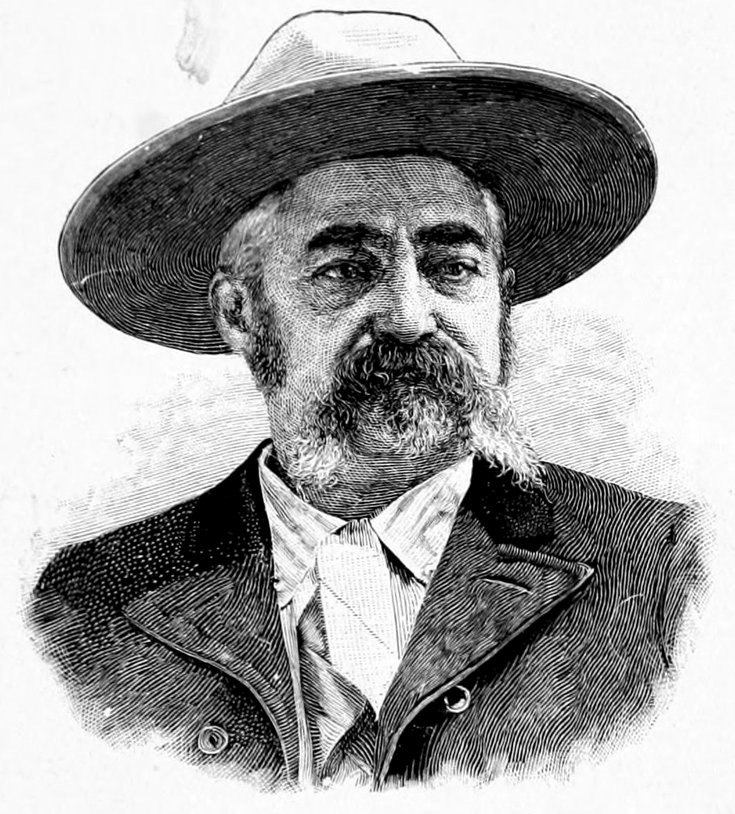
JOHN X. BEIDLER
Leading Vigilante and express messenger
465Election day came, when the negroes, for the first time
in our history, were to exercise the right of suffrage. It
was a great day for them; and the few that were in the
city, soon began to make their appearance, dressed up for
the occasion as for a holiday. A riot was anticipated, as
threats had been made by the roughs in town that the
negroes should not vote without a fight. X. Beidler stood
near the polls to preserve the peace, and see that every
man, black or white, was protected in voting. In the meantime
a colored barber and his negro associate had a set-to
at fisticuffs, to decide some knotty point in politics. The
crowd arrested the combatants, and while conducting
them to the magistrate, the barber escaped and ran home.
Hayes, still in their custody, was roughly charged by one
John Leach with having drawn a pistol upon a white man.
“You lie if you say that,” was the indignant reply of
Hayes.
“Do you call me a liar?” retorted Leach.
“Yes, you or any other man who says I drew a pistol or
carry one.”
As he said this, the crowd released Hayes, and he walked
down the street to a barber shop, where he was followed
by Leach, who seized him by the collar with one hand, and
drawing and cocking a pistol with the other, repeated the
question,
“You drew a pistol upon a white man, did you?”
Hayes again replied in the negative, and raising his
arm said,
“Search me, if you think I have any weapons. My fuss
was with a colored man, not with you. I don’t want anything
to do with you.” As he turned to release himself
from the grasp of Leach, that ruffian, aiming at his heart,
said,
466“If you open your mouth again, I’ll kill you,” and
instantly fired, the ball entering the left side, below the
breast. Hayes lived about an hour.
On being apprised of the affray, X. Beidler hastened to
the spot to arrest Leach. A crowd of roughs stood around
to protect him, but Beidler, pistol in hand, at the risk of
his life, pushed his way through it, and seizing Leach by
the collar, secured him with handcuffs and led him to jail.
Knives had been drawn in the mêlée by Leach’s friends. A
deadly blow had been aimed at Beidler by one Bill Hynson,
which he evaded by the dexterous use of his right arm.
After the man was in prison, and quiet restored, Hynson
sought out Beidler, who was then, as now, a terror to
the roughs, and said to him,
“X., I saved your life. I knocked off the blow just in
time.”
Comprehending the object of this salutation, X. replied
dryly,
“I’m all right now, and much obliged to you. I suppose
you saved my life.”
Hynson, mistaking the irony for sincerity, followed it
up by a request that Beidler would use his influence to get
him a position on the police force of Helena. Beidler
gave him no encouragement, and a few days afterwards
he told Beidler he had got a better thing and did not wish
the place.
From the meagre description given by Hanson of the
man he saw in company with the Chinawoman, during the
evening preceding her murder, Beidler’s suspicions fell
upon Hynson. He watched him narrowly, but could find
no clew.
A day or two after the murder, at a very early hour in
the morning, Beidler, in pursuit of circumstances to justify
his suspicions, abruptly entered an old, deserted building,
which a lot of loafers and roughs had appropriated
467for sleeping purposes. The floor was covered with their
blankets, and the sudden presence of Beidler among them
at so early an hour caused great consternation. They
crept from their covers, and exchanging hurried glances
with each other, as if to inquire, “Which of us is this day
a victim for the dry tree?” fled from the building like
rats from a sinking ship. Hynson was among the number.
In the hurried observation he had taken of the room,
Beidler saw, lying beside Hynson under his blanket, a
Henry rifle, which by the initials on the stock he recognized
as Claggett’s. After the room was deserted, he returned
to it, and seizing the rifle sent it to its owner by
the next express.
Hynson missed the rifle. Meeting Beidler the next day,
he inquired if he had seen it.
“Yes,” replied X. “Whose is it?”
“Mine,” said Hynson defiantly.
“Yours!” rejoined X. sternly. “How came you by
it? You have seen the initials on the stock. Don’t you
know whose it is?”
Seeing that Beidler was not to be deceived, Hynson,
after some prevarication, acknowledged that he took the
rifle from the coach.
“I thought,” said he, “I might as well have it as any
one.”
This admission of guilt would have been followed by
Hynson’s immediate arrest had not Beidler hoped by delay
to find some evidence against him of murder. The
negro Hanson had, in the meantime, seen Hynson. He
told Beidler he resembled the man he saw at the house
of the Chinawoman. Beidler hesitated no longer, but at
once arrested Hynson for stealing the rifle, intending to
keep him in custody until satisfied of his guilt or innocence
of the higher crime. Impatient of this restraint,
Hynson daily vented his wrath upon his keepers.
468“As soon as I get out,” said he to John Fetherstun, “I
intend to kill you. Only give me the chance, and see how
quick I’ll do it.”
John laughed, dismissing all his threats with some
axioms less complimentary to his courage than his bravado,
such as, “You crow well,” “Barking dogs seldom
bite,” etc.
Beidler soon became satisfied that no evidence could
be found sufficient to convict Hynson of murder, and the
stealing of the rifle in a community where higher crimes
were committed daily with impunity did not call for heavier
punishment than the thief had already received. So
Hynson was released. As Fetherstun opened the door of
the prison for him, he said,
“Have you got a six-shooter?”
“No,” replied Hynson.
“Then I’ll give you one, and you can turn loose,” at
the same time drawing a revolver from his belt and offering
it to him. Seeing that Hynson hesitated, he immediately
added, “Take it. It will give you the chance
you’ve been looking for so long.”
Hynson declined taking it, saying,
“I was in jail and feeling bad when I said that.
You’ve always been kind to me. I’ve got nothing against
you, and don’t want to hurt you, but I’m going for X.,
sure,—the man that put me in here.”
X. needed no protector, especially when warned. No
man could draw and fire a pistol with deadlier aim or
greater rapidity, and so Hynson found no opportunity
of putting his threat into execution.
In the Spring of 1868, Beidler, on his return to Helena
from the Whoop-up mines, spent a few days en route at
Benton. The steamboats from St. Louis were daily arriving
with freights, which from this point were conveyed
by teams to all the towns and mining camps in the
469Territory. Hynson, hired as a teamster to Scott Bullard,
a heavy Helena freighter, was on his way to Benton.
Learning that Beidler was there, he frequently in
conversation avowed the intention of shooting him on
sight. As the train approached Benton, Bullard rode into
town in advance of it, and apprised Beidler of his danger.
The day after the arrival of the train, Hynson and
Beidler approached each other in the street. The former
extended his hand in a friendly manner, which Beidler
seized with his left hand, keeping his right in reserve for
the use of his pistol.
“I am told,” said Beidler, “that you have come here to
kill me.”
“I kill you!” said Hynson, in well-affected surprise.
“Yes, you,” said Beidler, dropping the hand he held,
“and if you wish to try it, you’ll never have a better
chance. If that’s what you want, you can’t pull your
pistol too quick.”
Hynson glared at the little, athletic man who confronted
him so boldly, and saw in those burning eyes and that
steady muscle not the smallest trace of fear.
Seizing Beidler again by the hand, he said in hurried
tones,
“X., I did make a fool of myself when drunk in camp
with the boys, in some remarks relating to you, but I
didn’t mean it. I don’t want to hurt you, and never did.
Now, let’s be friends.”
Beidler, who had no other feeling than contempt for the
bragging poltroon, listened in silence.
“I want you,” said Hynson, “to aid me in getting the
position of night-watchman in this city.”
X. replied to this request in general terms, and, turning
on his heel, left Hynson, who afterwards, by some
means which X. could not fathom, received the appointment
he desired.
470Before leaving Benton, X. received a letter from Silver
Bow requesting him to watch for and arrest a person who
had stolen a lot of nuggets and jewelry, and gone from
that place to Benton. Called suddenly away by more important
business, X. instructed Hynson with this service,
who caught the thief and recovered the property, which he
appropriated to his own use, pawning the jewelry for a
sum of money, which was soon squandered. When X. returned,
Hynson, with much difficulty, redeemed most of
the jewelry, which Beidler returned to the owner.
About this time Beidler, as deputy United States marshal,
made a seizure of some contraband goods. One
Charles Williams was an important witness in the case.
The court was held at Helena, one hundred and forty
miles distant from Benton. Beidler discovered that the
defendant and his friends had a plan on foot to prevent
Williams from going to court, which he determined to
forestall. He met Williams by appointment a couple of
miles from town, furnished him a horse, a Henry rifle, and
ten dollars in money, and directed him to ride with all
possible despatch to Helena, he intending to follow in the
coach, which was to leave in a few hours. Beidler saw
nothing of his witness on the route, but, as he had told him
to avoid the road the first day as much as possible, this
occasioned no surprise; but when the second and third
days passed without his appearance, he feared some accident
had befallen him. The day after his arrival at Helena
he received information that the horse had been found
hitched to a post in Benton, with the saddle and gun on
his back, and that Williams had been hanged. Beidler
returned to Benton and secured his property. In a confidential
conversation with Hynson he learned that before
the execution of Williams was completed he was cut down,
taken by his captors below Benton, placed upon a raft
in the Missouri, and upon his promise to leave and not
471return to the country, permitted to escape with his life.
This story, discredited at the time, was confirmed by
Williams himself four years afterwards.
Hynson’s participation in this high-handed outrage,
while acting as a conservator of the peace, roused public
indignation against him. A few days afterwards he provoked
a dispute with Mr. Morgan, the sheriff, and slapped
him in the face. One trouble followed another, until, in
the Summer of 1868, a Mr. Robinson was knocked down
and robbed in the street, and the circumstances all pointed
unmistakably to Hynson, the night-watchman, as the
aggressor. As there was no positive proof of his guilt,
he was suffered to retain his position without molestation.
On the morning of August 18, the same season, Hynson
was observed to convey to a spot on a prairie,
a mile or more distant from town, three pine-tree poles
about twelve feet long and four inches in diameter. Tying
one end of these three poles securely together, he raised
them up in the form of a tripod. When they were stationed
in a substantial manner, and to his liking, he went
to a store and purchased a small coil of rope.
“What is the rope for?”, inquired a bystander.
“To hang a man with,” was his reply.
The listeners understood this as a joke, and dismissed
the subject with a laugh.
Hynson next employed a negro to go out and dig a
grave near the tripod.
“Who’s dead, Massa Hynson?” inquired the man.
“Never you mind,” replied Hynson. “Go ahead and
dig the grave. I’ll furnish the corpse.”
The negro obeyed, and the grave was in readiness at
nightfall.
The next morning the lifeless body of Hynson was
found suspended from the tripod by the rope he had
prepared.
472The citizens flocked in crowds to the spot. Among
them was the negro who dug the grave. When he saw
the swaying form, and had scrutinized the ghastly face,
he exclaimed,
“’Fore God, dat’s de gemman dat tole me to dig de
grave, and said he’d furnish de corpse.”
After the body was cut down, there was found in a
pocket the following letter from the mother of Hynson:
“My dear Son,—I write to relieve my great anxiety, for
I am in great trouble on your account. Your father had a
dream about you. He dreamed that he had a letter from
your lawyer, who said that your case was hopeless. God
grant that it may prove only a dream! I, your poor, brokenhearted
mother, am in suspense on your account. For God’s
sake, come home.”
CHAPTER XLVI JAMES DANIELS
473
Of the early history of this individual I know but
little, and but for circumstances attending his
“taking off,” should not trouble my readers with any
notice of him. That he was hardened in vice and crime,
and, possibly, was one of the worst of all the ruffians
whose careers I have passed under review, will hardly
admit of a doubt, when the reader is informed that he murdered
one man in Tuolumne County, California, and was
only prevented by want of agility to complete a race, from
killing another. His appearance in Helena, and the commission
of the crime for which he lost his life, were almost
simultaneous. In a quarrel incident to a game of cards,
near Helena, he stabbed and instantly killed a man by
the name of Gartley. He was immediately arrested by
the Vigilantes, who surrendered him to the civil authorities.
On his trial for murder, circumstances were proved, which,
in the opinion of the jury, reduced his crime to manslaughter.
Judge Munson sentenced him to three years’
imprisonment in the territorial prison. After a few
weeks’ confinement, a petition for his pardon, signed by
thirty-two respectable citizens of Helena, was also presented
to acting Governor Meagher, who, under mistaken
sense of his own powers, issued an order for his release.
The right to pardon belonged exclusively to the President.
Judge Munson went immediately to the capital to show
the law to the Executive, convince him of his error, and
obtain an order for the re-arrest of Daniels. Meantime,
474that individual, uttering the most diabolical threats against
the witnesses who had testified against him, found his way
back to Helena; and before the judge could effect his
object with the governor, in fact, on the night succeeding
the day of his arrival in Helena, Daniels was arrested
by the Vigilantes and hanged.
As I have endeavored to justify, in all cases where I
deemed the circumstances warranted it, the action of the
Vigilantes in taking life, so, as such circumstances were
not apparent in this case, do I deem it a duty to say that
they committed an irreparable error in the execution of
this man. However much, by his threats and reckless
conduct, he may have deserved death, they had no right
to inflict it. If he had been wrongfully pardoned, he
could easily have been rearrested. He was a single
individual in the midst of a populous community, warned
by his threats of his designs, which could easily have been
thwarted by arresting him, or by setting a careful watch
over his actions. No excuse can be offered for the course
that was pursued. This, at least, was one case where the
Vigilantes exceeded the boundaries of right and justice,
and became themselves the violators of law and propriety.
I was at that time a member of the Executive Committee
of the Virginia City branch of the Vigilante organization,
and that Committee disavowed all responsibility
for the execution of Daniels, and expressed its disapproval
of that act, which, it was believed, did not have the
official sanction of the Executive Committee of Helena,
but was regarded as the unauthorized act of certain
irresponsible members of the organization at Helena.
And I will here take occasion to say that this was not
an isolated instance. Under the pretence of Vigilante
justice, after the establishment of courts of justice in Montana,
and when many of the respectable citizens of the
475Territory had virtually abandoned the order, a few vicious
men continued occasionally to enforce its summary discipline.
Several individuals were hanged who had been detected
in stealing horses, several for giving utterance to
threats of vengeance, and several on mere suspicion of
having committed crime. As soon as this order of things
was understood by the people, the Vigilante institution
was brought to an end, and the men who had misused its
powers were given to understand that any further employment
of them would probably cause it to react upon
themselves. These abuses had not been frequent, and
when discovered were promptly terminated.
CHAPTER XLVII DAVID OPDYKE
476
This man, on some accounts the most noted among
the roughs of Idaho, was of patrician origin,—the
degenerate scion of a family which boasted among its
members some of the leading citizens of New York. He
was born in the vicinity of Cayuga Lake, New York, about
1830, and could not have been more than thirty-six years
of age at the close of his infamous career. He went to
California in 1855, where, for want of more congenial occupation,
he was employed for two years by the California
Stage Company as a stage driver. Thence, in 1858,
he sailed to British Columbia, but finding no business there
suited to his tastes, returned the same year to California,
spending two unprofitable years in Yuba County, and two
years succeeding in Virginia City, Nevada. Excited by the
intelligence from the northern mines, in 1862 he went to
Florence and Warren in Idaho, and the Fall of that year
found him in Boise County, where he located and worked a
valuable claim on the Ophir. In 1864, with an accredited
fortune of fifteen hundred dollars, he removed to Boise City
and bought a livery stable in the centre of the town, which
is still pointed out to visitors as having been the rendezvous
of one of the most reckless and numerous bands of
robbers and road agents in the mountains.
Opdyke’s associations were bad, and he was suspected
of aiding in the circulation of spurious gold dust, at that
time an extensive business with the roughs of the country.
His stable soon became the headquarters of all the
477suspicious characters of Boise, Owyhee, and Alturas
counties. From these and other circumstances, the public
was prepared to believe that all the thefts and robberies
occurring in the country were committed by persons connected
with the “Opdyke gang,” but so careful were they
to cover their tracks, that no positive evidence could be
found against them.
A gentleman by the name of Parks went from Cincinnati,
Ohio, to Baker County, Oregon, in 1862, where he was
elected sheriff. He was very much respected. Early in the
Fall of 1864, he went to Idaho, and in Owyhee County purchased
and located claims on several quartz lodes, specimens
of which he selected to exhibit to his Eastern friends,
and packed carefully in a valise. Coming to Boise City,
preparatory to his departure for the States, he passed
through the streets with the heavy valise in his hand, which,
being observed by some of the “Opdyke gang,” was supposed
by them to contain a large quantity of gold dust.
He remained in Boise four or five days, and was narrowly
watched by the roughs.
On the morning of his departure, at three o’clock, several
of the robbers left by a trail, and coming up with the
coach seven miles east of the city, caused the driver to stop,
fired upon Parks, rifled his pockets of two or three hundred
dollars in money, and departed with the much-coveted
valise. Their chagrin at finding it to contain mere quartz
specimens may be better imagined than described. Parks
returned in the coach to Boise, and died in less than a week
of his wounds. He was buried by the Masons. No clew
to his murderers could be found at the time; but in some
of the criminal developments made afterwards, it was
ascertained that Charley Marcus and three others of the
“gang” were directly concerned in the attack.
The next murderous outrage in which the “Opdyke
gang” was concerned, was the murder and robbery, in
478Port-Neuf Cañon, of five coach passengers from Montana,
in the Summer of 1865. It is now known that Opdyke furnished
arms and ammunition for the party from Idaho,
which engaged in this expedition, and shared in the booty.
Seven or eight of his gang left Boise at the time, and were
joined at Snake River by an equal party of Montana
roughs, who participated with them in the robbery. Frank
Johnson, ostensibly the keeper of a public-house eight miles
below Boise City, was one of the confederates in this crime.
His house was long a rendezvous for robbers, and his
partner Beech kept a similar meeting-place at the Overland
Ferry on Snake River. Beech was hung by the Vigilantes
in Nevada in 1865. Johnson eluded the pursuit of
the Vigilantes, fled to Powder River, Oregon, where he
was arrested by Captain Bledso, Wells, Fargo and Company’s
messenger, on a charge of stealing horses. Found
guilty on his trial, he was sentenced to ten years’ imprisonment
in the Oregon Penitentiary.
Soon after the Port-Neuf robbery, information was given
to the Montana authorities, that one Hank Buckner, an
escaped murderer from that jurisdiction, had turned up
in Idaho, and was living in Boise City. In the Fall of
1863, Buckner, in a dispute with one Brown in the Madison
Valley, drew his pistol and shot him. Buckner was
arrested, examined in Virginia City, and placed in custody
of the sheriff, from whom, by means never made public,
he escaped. The sheriff, a very respectable man, was examined
by the Vigilantes, and acquitted of blame in the
matter; but the story he told, which was positively credited
by the Vigilantes, ought to have led to further investigation,
as it implicated others.
Governor Green Clay Smith sent Neil Howie to Idaho,
with a requisition upon Governor Lyon for the delivery of
Buckner to the Montana authorities. The “Opdyke
gang,” of which Buckner was one, concealed the fugitive,
479on Howie’s arrival, in Dry Creek, ten miles distant from
Boise City. Reenan, the sheriff of the county, found and
arrested him. Governor Lyon being at Lewiston, Buckner
was examined, and despite the efforts of his friends,
who flocked in hundreds to his defence, was ordered by
the magistrate to be confined in jail in Idaho City, until
an order for his surrender could be obtained. Before
this could be received, a writ of habeas corpus was issued
by the probate judge of the county, and Buckner was
released on straw bail. Howie, seldom thwarted, as we
have seen in earlier portions of this history, returned to
Montana, greatly crestfallen, without his prisoner. Buckner,
who was believed to have been a leader in the Port-Neuf robbery, is still at large.
At its session of 1864–65, the Legislature of Idaho set
off and provided for the organization of Ada County, appointing
the election of officers in March, 1865. The
“Opdyke gang” was a strong powder in the Democratic
party. At its request Opdyke was nominated for sheriff,
and by a party vote largely in the ascendant, elected by
a small majority. Soon after his election, under a pretence
of official duty, he avowed the intention of breaking
up a Vigilante organization of about thirty persons,
which had been formed in the Payette River settlement,
thirty miles from Boise City, for the purpose of freeing
their neighborhood from two or three horse-thieves and
manufacturers of spurious gold dust. The Vigilantes
were a great terror to the roughs, and interfered with all
their unlawful and bloody plans for money-making. In pursuance
of this design, Opdyke and his coadjutors had in
some mysterious manner obtained the names of all the
Vigilantes, and procured a warrant for their arrest. The
proceedings, to all outward seeming, were to be conducted
in legal form; but in making the arrest, Opdyke
and his posse proposed to shoot the leaders of the
480Vigilantes, and screen themselves under the plea that they
had resisted. It was arranged that fifteen or twenty of
the “Opdyke gang” would leave Boise City, armed with
double-barrelled shotguns and revolvers, and unite at
Horse-shoe Bend road with as many more from the country,
similarly equipped. They would then proceed with
their warrant to the settlement, and, by stealing a march
upon the citizens, easily effect their diabolical purpose.
Intelligence of their plan came to the ears of the citizens
of Boise City. They secretly despatched a messenger
to the Payette Vigilantes with the information. The
thirty members of that order armed and assembled at
once in self-protection. Opdyke, at the head of fifteen
of the worst men in the Territory, whom he had summoned
as a posse comitatus, left Boise City at four
o’clock P.M. to make the arrest. The party from the
country failed to connect with him, and his party marched
down alone. The Vigilantes, numbering two to one of
his band, met him. They were quite as determined as
their opponents. Surprised at the preparation they had
made to resist him, Opdyke held a parley, and was obliged
to comply with all the terms prescribed by the Vigilantes.
These were, that they would march to Boise City and
answer the warrant, but they would not allow Opdyke to
disarm them or “get the drop” on them. By the aid
of counsel, the complaint against them was dismissed, and
they were discharged, thus bringing to a humiliating
conclusion a deep-laid conspiracy against the lives of
some of the best citizens of the Territory. Nearly all
the Vigilantes had been partisans of Opdyke, and of
course, after this manifestation of his hostility, were very
bitter in their opposition to him. Soon after this the
county commissioners ordered the district attorney, A. G.
Cook, to institute criminal proceedings against Opdyke
for permitting a criminal to escape, and also for
481embezzlement, they having discovered that he was a defaulter
to the county in the sum of eleven hundred dollars.
Cook, however, resigned his office. A. Hurd,
who was appointed to succeed him, prepared indictments
which were sustained by the grand jury on both charges.
Opdyke paid the amount for which he was a defaulter,
and resigned his office, and the prosecutions were withdrawn.
He, however, swore that he would be bitterly
revenged upon the grand jury, which, being composed
chiefly of men of his political faith, ought, he said, to
have saved him, right or wrong, out of party consideration.
The grand jury held a meeting, and sent to him to
ascertain his intentions. He was glad to escape further
molestation by disclaiming all hostile designs against
them.
Early in March, 1865, the citizens of Southern Idaho
fitted out an expedition against the marauding bands of
Indians which, for some months previous, had been engaged
in predatory warfare in that part of the Territory.
Opdyke, as leader, with thirty of his gang, volunteered.
Money, provisions, horses, and other equipment were
furnished by the people. A man by the name of Joseph
Aden was employed to pack the stores, for which purpose
eleven ponies were provided and placed in his charge,
with the understanding that he should receive them in
part payment for his services. In pursuance of that
agreement, he immediately branded and ranched them.
Among the volunteers was a young man of nineteen,
by the name of Reuben Raymond. He had performed
faithful service in the Union army, and was just discharged
at Fort Boise. He was quite a favorite with
the people, and, though necessarily intimate at this time
with the “Opdyke gang,” was perfectly honest and trustworthy.
The expedition ran its course, and, like all expeditions
of the kind, was barren of any marked results.
482Opdyke cached a large portion of the stores on Snake
River for the future use of his road agent band; and the
roughs, all the more daring and impudent for the confidence
the people had reposed in them, became a greater
burden to the community than ever.
Aden turned his ponies out on the commons on the
south side of Boise River, claimed as a ranche by Opdyke
and one Drake,—the latter assuming to exercise a sort
of constructive ownership to the land. Designing to
swindle Aden out of his property in the ponies, Opdyke
told Drake not to surrender them to Aden except on his
written order. Aden employed attorneys and got possession
of the ponies. Opdyke caused his arrest for stealing;
and Aden, leading his ponies, which he hitched in
front of the justice’s office, appeared for trial. He was
discharged, and the crowd dispersed; but Opdyke’s attorney
remained, and persuaded the magistrate to issue
an order for the surrender of the ponies to his client.
Opdyke and his friends took them away, and they were
never seen in Boise City afterwards.
Aden commenced a suit against Cline, the justice, for
damages, and recovered a judgment of eight hundred
dollars, which Cline was obliged to pay. Cline resigned
his office. At Aden’s examination, Reuben Raymond
had sworn to the identity of the ponies, which was disputed
by nearly all the roughs in the expedition, and it
was almost solely on his testimony that Aden was discharged.
The “Opdyke gang” were very angry with
him; and on the morning of April 3, 1865, a few days
after the examination, while Raymond was employed in a
stall in Opdyke’s stable, John C. Clark, a noted rough,
stepped before the stall with his revolver in his hand, and
commenced cursing Raymond. Opdyke and several of his
associates, together with a number of good citizens, were
standing near. Clark finally threatened to shoot Raymond.
483“I am entirely unarmed,” said Raymond, at the same
time pulling open his shirt bosom, “but if you wish to
shoot me down like a dog, there is nothing to hinder you.
Give me a chance, and I will fight you in any way you
choose, though I have nothing against you.”
Clark covered Raymond for a moment or more, with
his pistol, and then with an opprobrious epithet, said, “I
will shoot you, anyway,” and, taking deliberate aim, fired,
and killed Raymond on the spot. This murder produced
the wildest excitement, and Clark, who had been immediately
arrested, was taken out of the guard-house the
second night afterwards, and hanged upon an impromptu
gibbet between the town and the garrison. Threats of
vengeance were publicly proclaimed by the “Opdyke
gang,” Opdyke himself improving the occasion to tell
several of the grand jury men, who had found the indictment
already mentioned against him, that they would not
live to walk the streets of Boise City many days more. It
was also reported that the roughs intended to burn the
city, and not leave a house standing.
The citizens, fully aroused to the dangers of the crisis,
organized a night patrol. Every inhabitant of the city
was armed, and all coöperated for the purpose of clearing
the country of every suspected person in it. While
plans were maturing for this purpose, the roughs became
uneasy, and one after another began to disappear
until but few remained. Opdyke took the alarm for his
own safety, and on the twelfth of April, accompanied by
John Dixon, a notorious confederate in crime, departed
by the Rocky Bar road, and brought up at a cabin thirty
miles distant. A party of Vigilantes followed in close pursuit.
They captured him during the night, and conducting
him ten miles farther on the road to Syrup Creek,
hanged him under a shed between two vacant cabins, on
the following morning. His companion Dixon, who was
caught on the march, was hanged at the same time.
484When this intelligence became known in Boise City,
every suspicious character disappeared, and the vilest
gang of ruffians in Idaho was effectually broken up. Opdyke
had many friends, and was naturally a man of genial
qualities, but he had become corrupted by the evil associations
contracted in Idaho Territory.
It was believed by many, at the time of Opdyke’s execution,
that he was hanged for his money by some of the
employees of the Overland Stage Company. This, however,
was a mistake in his case. The Vigilantes of Boise
City had determined upon his death before he left the city,
a measure they deemed necessary to rid the country of
his associates, and establish peace in the community.
It was true, however, that some of the Overland Stage
Company’s employees were justly suspected of robbery and
murder. On one occasion, two miners from Boise City,
returning to the States, indiscreetly exhibited a large
quantity of gold dust at Gibson’s Ferry on Snake River,
which excited the curiosity of some of the observers. They
were arrested on a pretence of having spurious gold dust,
and hanged by some half dozen of the stage company’s
employees. Their bodies were burned, but no account was
ever given of the gold dust. No one was deceived as to
the character of this act. It was the cold-blooded, heartless
murder for their money, of two honest miners who
were returning to their homes with their hard-earned savings.
This was the popular judgment.
CHAPTER XLVIII A RIDE FOR LIFE
485
Crime, as an organized force in Montana, ceased
with the execution of Plummer and his infamous
band early in 1864. The perseverance with which they
were pursued, and the swift punishment following their
capture, caused the few who escaped either to leave the
Territory or abstain from crime.
From July, 1864, till November, 1868, I was collector
of internal revenue for Montana. The duties of the office
necessitated repeated visits to many of the small gulches
and outlying mining camps, accessible only by bridle
paths. My horseback journeys over these ill-defined
trails, unmarked by any sign of civilization, would aggregate
many thousands of miles—and while such experiences
were necessarily full of adventures, I regarded them
as nearly free from actual peril until undeceived by the
following incident:
Early in the Summer of 1866 I visited all the gulches
and camps in Deer Lodge County, on a collecting trip, and
had arrived at Blackfoot, a little town in the county, where
one of my deputies was located. With the sum which he
had received, my collections amounted to about $12,000.
Of this amount $5,000 or more was gold dust, which, at
$18 an ounce, weighed about twenty-five pounds. With
the entire amount I intended to leave the next day on
horseback for Helena by way of Deer Lodge, some hundred
miles distant across the Rocky Mountains. My
friend, Mr. Murphy, happened to be in Blackfoot on
486special business, and we arranged to travel in company as
far as Deer Lodge, the county seat.
Late in the evening as I was about retiring, Mr. Murphy,
who had been out on business, came to my room, and
in an anxious tone, said he thought he had discovered a
plan on foot to rob us the next day.
“Go with me down street,” said he, “and help me form
an opinion.”
We strolled down to the stables where our horses were,
and thence across the street to a billiard saloon. Standing
by one of the tables, Mr. Murphy directed my attention
to four men seated in the corner of the room, engaged in
close conversation. Something in their manner, their furtive
glances under their broad-brimmed hats, the pauses
in their conversation when approached, excited our suspicions,
and we concluded that as we were the only persons
in town known to have money in any considerable quantity,
it was not improbable that Murphy’s suspicions were
correct. There was nothing in the appearance of the men
to warrant such a conclusion, but we remembered that
Plummer had the port and bearing of a perfect gentleman.
I returned to the hotel and retired with a feeling of uneasiness
that baffled sleep, and as I had resolved to go on,
naturally set myself devising some method of avoiding
collision with these supposed freebooters. I can form no
idea now of the number or character of the expedients that
occurred to me, but I remember that none of them seemed,
at the time, to give promise of escape or safety if these
men had, as I expected, marked me for their prey.
Early next morning Murphy, who had been keenly on
the alert, came to my room and assured me that our suspicions
were unfounded.
“Those men,” he said, “are honest miners. They left
an hour ago to take up claims on a new discovery. The
peculiarities we noticed are ascribable to their desire to
487conceal the locality until they have made their choice of a
claim.”
Though not fully reassured, my fears were greatly allayed
by this intelligence, which was seemingly confirmed
an hour later on being told by the stablekeeper that they
had gone to Bear Gulch, where they said they had found
“something rich.”
It was pleasant to feel that if this information was true
we should not come in contact with them, Bear Gulch being
opposite in direction from our point of destination.
At a bend in the trail, about two miles down the creek,
we came upon a log cabin saloon by the wayside, in front
of which were hitched four horses and leaning beside the
door were four double-barrelled shotguns. A glance was
sufficient to comprehend the situation.
“Great Cæsar! Langford,” said Murphy in an undertone,
“there they are. We are in for it now beyond a
doubt. Those fellows are after our collections.”
Our coming had evidently been anticipated, for the
saloon-keeper stood in the door, and with the familiarity of
an old acquaintance hallooed to Murphy: “Come in, come
in; bring your friend and take a drink.”
“Thank you,” responded Murphy, “I don’t drink,”
and deferred to me.
“I never take anything, either,” said I.
“Well, come in and get a cigar then,” he persisted.
Both replied in a breath that we did not smoke.
“That’s odd,” said he, “to meet two men in the mountains
that neither drink nor smoke. Come in anyway, and
surprise your bowels with a glass of cold water.”
This old joke had lost none of its relish for the four
men within the saloon, who hailed it with a shout and hurried
to the door. We recognized them as the same persons
whom we had marked the previous evening, and were
no longer in doubt concerning their purpose, for they had
488left Blackfoot in the direction of Bear Gulch, and by a
roundabout way had come upon the Deer Lodge trail.
Reining our horses with seeming unconcern, we rode slowly
away, debating, meanwhile, what course to pursue.
“What do you think of the situation?” I inquired of
Murphy.
“Desperate enough,” he replied. “We’re no match
for those rascals. They can pick us off very easily, and
no one will be the wiser. I feel inclined to go no further.”
“That’ll not do,” I rejoined, “for if they’re bent on
robbery they can shoot us before we could get back to
Blackfoot.”
“I’ll tell you what I’ll do,” responded Murphy, after a
pause of a few moments, and as if struck by a sudden
thought, added, “a mile farther down the gulch I’ll strike
a familiar trail over to a ranche on the stage road, leave my
horse there and take the coach to Deer Lodge. If my
horse were as good as yours I’d take the chances and go
on, but this little cayuse would soon be run down by the
robbers.”
“I wish you had a strong horse,” said I, “for I dislike
very much to take the risk alone.”
“Sorry, Langford,” he replied, “but you can see for
yourself it would be madness for me to accompany you.
If they should pursue us it would be impossible for us
to keep together.”
We had now reached the trail leading to the ranche.
Grasping his hand, “Good-bye,” said I; “if fortune
favors us we shall meet at Deer Lodge.”
“Good-bye, and the Lord go with you and protect
you,” was his fervent rejoinder.
I rode on at a moderate speed to the crossing of the
Little Blackfoot, hoping that I might fall in with a fishing
party there, as the stream was full of trout and often
489resorted to by the miners and ranchemen for a day’s recreation.
The valley of the Blackfoot at this ford, and for a
long distance above and below it, along the river, is covered
with a dense willow copse, which even at the distance
of a few feet would conceal a party from a passer-by. I
looked and listened for friendly faces and voices after
fording the stream, and while riding through the coppice.
Uncheered by any sign of life, I seemed to derive a sense
of immediate safety from the thought that my pursuers
would be restrained from attacking me in the valley, lest
they should be surprised by the sudden appearance of an
impromptu rescuing party.
Ascending the plateau at the base of a long, steep hill,
I cast a furtive glance backward and saw at the distance
of a few hundred yards the four ruffians approaching at a
gallop. My heart sank within me, and for a moment I
abandoned all hope of escape.
It was, however, for a moment only. Stealing another
look, I saw that the party were deceived by the leisurely
manner in which I was travelling, and had reined their
horses into a walk. Acting upon the belief that they intended
to delay an attack until I had crossed the hill, I
alighted from my horse, loosened the saddle girth, to favor
his respiration, and walked beside him two miles to the
summit, followed by the ruffians at a distance of about three
hundred yards. I felt that if I could put a mile between
us my horse would achieve the race I saw before me.
“Ned” possessed wonderful powers of endurance, and
was said to be the best four-mile horse in the Bitter Root
Valley, where he was raised, and, though often beaten in a
race of one, two, or even three miles, had been often tried
and as uniformly succeeded where the distance was extended
to four miles. I had often tested his staying powers,
having once ridden him eighty-five miles and once
again ninety-four miles, from Virginia City to Berkin’s
490ranche in Boulder Valley, in one day; on another occasion,
when Governor Green Clay Smith had requested me
to act as messenger to convey to Colonel Howie, the
commander of the militia in camp in Helena, 130 miles
distant, the news of a reported Indian uprising, all telegraphic
communication being suspended, he carried me
ninety-seven miles in fifteen hours, from Virginia City to
Barkley’s ranche, where I obtained another mount, and
completed the journey within twenty hours.
With a mile in my favor, the little ponies ridden by the
pursuers could not overtake me.
While these thoughts occurred to me as affording a
possible means of escape, the brigands doubtless felt that
as soon as I began to descend the hill they would have
me at their mercy. Immediately after passing the crown
of the hill I lost sight of them. Tightening the girth I
sprang into the saddle and urged my horse to his utmost
speed. The narrow trail was thickly studded with boulders
rising several inches above the surface, over which my
horse took many a flying leap, and I was not without apprehension
that an unlucky stumble of my faithful Ned in
attempting to clear them might unhorse me.
When the robbers reached the top of the divide and saw
me at full speed a mile in advance they comprehended the
ruse, and putting spurs to their horses, gave me instant
chase.
It was then that my race for life began. They gained
upon me rapidly at the commencement, and at one time
were so near that I could hear the labored breathing of
their horses. So close, indeed, were they that I seized
my cantinas with the purpose of casting the twenty-five
pound sack of gold dust into the first sheltered nook I could
see by the wayside to lighten the burden of my horse. No
opportunity offered, however, that would have escaped the
sight of those in pursuit, and I replaced the sack, and
491with the weight in excess of two hundred pounds my gallant
horse strove on with unabated speed until I saw one
by one the horses of the robbers worn out by exhaustion.
Two of them that followed longest finally closed the
pursuit with an infernal yell and gave up the chase.
After an urgent ride of two or three miles farther I
completed the trip by a slow pace through the Deer
Lodge Valley, and the next morning took the coach from
Deer Lodge City to Helena, thankful for an escape from
a peril I hope never again to encounter.
CHAPTER XLIX AN INTERESTING ADVENTURE
492
For the first three or four years after the settlement
of Montana, a favorite mode of returning to the
States was by Mackinaw boat, down one or the other of
the two great rivers whose upper waters traverse the Territory.
The water trip, if not less exposed to Indian
attack, was pleasanter, less laborious and expensive,
and sooner accomplished than the long, weary journey by
the plains.
The upper portions, both of the Missouri and Yellowstone,
pass through a country abounding in some of the
grandest, most unique, and most richly diversified scenery
on the continent. Of themselves the rivers are very beautiful,—their
waters pure, cold, broken into frequent
rapids; at one moment passing through tremendous
cañons and gorges; at the next, babbling along widespread
meads; and anon, as if by a transformation of enchantment,
dashing into the midst of a desolation which realizes
all the descriptive horrors of Dante’s “Inferno,”—affording
to the eye a greater variety of picturesque
beauty than any of the other great rivers of the continent.
A journey down them in a Mackinaw boat is an incident
to fill a prominent place in the most adventurous
life.
The point selected for embarkation on the Yellowstone
was about twelve miles above the spot where Captain
Clark started on his descent of the river, when returning
from the famous expedition of 1804–06. An isolated
493grove of lofty cottonwoods has grown upon the only soil
within miles, under the overhanging crags of a cañon
whose sombre walls lift themselves three thousand feet
or more into the atmosphere. The river glides through
those strong jaws with the swiftness and silence of a huge
serpent escaping its pursuers, forming an eddy just in
front of the grove, which, being convenient of access, was
early selected as a favorable place for the construction of
boats and embarkation of companies.
At this grove, in the Fall of 1865, a company of six
hundred persons commenced, in forty-three boats of different
patterns, the long journey of three thousand miles
to the States. The distance to the mouth of the Yellowstone
was eight hundred and twenty miles, and little more
was known of its general character at that time than
could be derived from the geographical memoir written
by Captain Clark sixty years before. A gentleman who
belonged to the party has informed me that, after the
first day’s sail, he had learned to confide so fully in this
narrative for geographical accuracy, that he was enabled
to anticipate, long before reaching them, every prominent
landmark and rapid mentioned in it. No better geographers
than Lewis and Clark have, since their time, visited the
country which they explored; but their book, valuable as
it must ever prove for its historical and topographical
accuracy, left untold the surpassing grandeur and novelty
of the scenes through which they passed. There is not a
river in the world which, for its entire length of one thousand
miles, presents with the same grandeur and magnificence
so much of novelty and variety in the stupendous
natural architecture that adorns its banks. Its source is
in a beautiful lake, unlike, in general character and appearance,
any other body of water on the globe. It is surrounded
by innumerable warm and hot springs, sulphur
deposits, and mud volcanoes. At a few miles’ distance is
494the largest geyser basin in the world, and close at hand
stupendous cataracts and beautiful cascades. Here, too,
is a cañon which for forty miles of distance is filled with
physical wonders, so numerous, strange, and various as to
defy description, and almost surpass comprehension.
Two hundred miles below this immense field of novelties,
we arrive at the mouth of the cañon whence the river
has been of late years frequently navigated, by Mackinaw
and flat boats, to its union with the Missouri. Of this
portion, but little has yet been written except by scientific
explorers. For the first eighty miles of the distance, the
river, almost a continuous rapid, rolls between gently undulating
banks, dotted at intervals with clumps of stunted
pines. Frequent ledges of rock jut into the stream, and
wherever a bend or projection has served to arrest the
flow of debris in time of flood, or catch the detritus
washed from the rocks, a little bottom affords sustenance
to a dense growth of majestic cottonwoods. This feature
is prominent in the river scenery until the stream enters
the Bad Lands, four hundred miles below the cañon.
These groves, unlike the irregular groves that adorn the
Eastern rivers, present to the voyager a straight regular
outline on all sides, a feature imparted to them by the
beavers, which cut down unsparingly both great and small
trees outside the given spaces. This perfect regularity,
always at right angles with the upland shore, gives to
these frequent groves the appearance of artificial cultivation,
and in the very midst of one of the most boundless
solitudes in the world, the observer frequently finds himself
indulging a thought that there may be some old
mediæval castle still standing within the shadow of these
trees.
After one has sailed about eighty miles, and finds himself
descending an expansive reach of the river, the eye is
suddenly attracted by the appearance on the right of an
495immense and seemingly interminable ridge of yellow rocks,
very high, precipitous, and crowned along its summit by
a forest of stunted pines. It is several miles distant, and
its sheer, vertical sides gleam in the sunlight like massive
gold. Far away it stretches, seemingly on an air line beyond
the field of vision, presenting few inequalities of
surface, and none of the features of ordinary mountain
scenery.
The Happy Valley of Rasselas was not more strongly
protected against outside intrusions by the precipices surrounding
it, than is this portion of the Yellowstone Valley
from all access by those who dwell beyond this ridge of
sandstone.
At a distance of ten miles or more from where it first
appears, the river has worn its way through it. We enter
the massive gorge. Higher and higher rise the gleaming
cliffs, seemingly straight up from the river’s bed, until
sunlight disappears, and the blue sky above you spans
like a roof the confronting crags. The illusion vanishes
with decreasing height, the gloom painted in darkness
upon the frightened stream grows again into sunlight, and
for the next few miles you pass through banks of green
adorned on either hand with citadels, temples, towers, turrets,
spires, and castellated ruins, all deftly wrought by
the wind and rain upon the exposed portions of the yellow
rock. Neither the Hudson, with its green hills and
massive knobs, nor the Columbia, with its crags and beetling
cliffs, presents anything at all comparable to this.
At one moment you look up at the sheer sides of a temple
wrought into a form not unlike that of Edfou or Denderah,
except as it surpasses them in its magnificent dimensions,
all its sides presenting in the vitrified fractures
of the layers of rock, regular rows of seeming hieroglyphics,
and its conical, time-worn summit, gray and smooth
with the frosts and storms of centuries. A little beyond
496stand the remains of a castle; and still farther on, seemingly
equidistant from each other, three or four stately
towers; then comes a massive citadel of stone, with embrasures,
walls, and portholes, all the apparent paraphernalia
of a mighty fortress.
These scenes, with all the variety that Nature observes
in her works, occur at intervals of thirty or forty miles,
every time the river penetrates the ridge, for a distance of
two hundred miles; and all the way between these passages,
on one side or the other of the beautiful stream,
you behold stretching along upon the most exact of natural
lines the pine-crowned ridge itself, skirted by meadows
reaching to the margin. Before quite losing this grand
exhibition, the river, fed by Clark’s Fork, the Rosebud,
and the Big Horn, changes its character. The waters become
dark and turbid, and spread out to more than a mile
in width. The valley expands correspondingly, and the
foothills and mountains are more distant. About midway
of this passage through the yellow sandstone, Pompey’s
Pillar, a table of rock separated by the river from
the main ridge, stands isolated, towering to a height of
several hundred feet over the plain, on the brink opposite.
Its summit of less than half an acre, accessible with difficulty
on the inland side, according to Captain Clark, affords
an extensive view of the surrounding country.
At the mouth of the Big Horn the last view of the Rocky
Mountains, which thus far have enlivened the scenery with
their varied phenomena of storm and sunlight, fades upon
the vision, and your voyage lies for several miles through
a richer agricultural region than any you have yet seen.
Here are fine meadows covered with bunch-grass, and,
upon the distant hills, herds of elks, flocks of mountain
sheep, antelopes, and deer. The temptation, often too
great to be resisted, makes the hunter forgetful of Crows
and Sioux, and sometimes lures him to his death. The
497rapids now become less frequent, though several of them
are more formidable. At one point, where the river passes
through the ridge for a distance of six miles, it has no
channel of sufficient depth to float an ordinary Mackinaw,
and voyagers are obliged by main force to push their
boats into the pool below. Captain Clark gave to this
obstruction the name of Buffalo Shoals. A few miles
below this he saw, in the midst of a formidable rapid, a
grizzly bear upon a rock, and gave to the place the name
of Bear Rapids.
The early hunters and trappers of the Northwest found
no region more favorable for their pursuit than the central
valley of the Yellowstone. Here came Ashley, and
Bridger, and Culbertson, and Sarpie, as early as 1817.
The latter built a fort, which he called Fort Alexander,
some remains of which are still standing on the margin of
one of the most delightful meadows in the valley.
The last and most fearful rapid of the Yellowstone is
near the mouth of the Tongue River, and was named by
Captain Clark, Wolf Rapid, because he killed a wolf near
it. The river is here lashed into a fury. The roar of the
rapid is heard for several miles, and the tossing spray
and seething foam can be seen at considerable distance.
The experiment of descending it has much to excite the
fears of a person unaccustomed to river travels, but as
yet it has been unmarked by accident.
Below this rapid we enter upon the last one hundred
and eighty miles between us and the Missouri. The river,
which to this point has displayed its beauties in long
reaches of ten and twelve miles, now becomes crooked like
the Missouri. Its banks are constantly crumbling, and its
channel as constantly shifting. Everything in sight but
adds to the desolation of the scenery, and the traveller
finds it hard to realize that he is sailing on the same river
which he beheld but yesterday so gloriously arrayed. The
498same general features are apparent to its mouth. It is
much larger and wider than the Missouri at its junction
with it, and increases to more than twice its size the latter,
which, as all are aware, for more than a thousand
miles below the Yellowstone has fewer attractions than
any other river in the world.
Not so, however, the upper Missouri. That, like the
Yellowstone, passes through a picturesque and beautiful
country. From its source, where the Madison, Jefferson,
and Gallatin unite to form it, to Fort Benton, a distance
of two hundred miles, it exhibits a great variety of interesting
and stupendous scenery, both of water, valley, rock,
and mountain. There are the Great Falls, the Gate of the
Mountains, and the passage of the river through numerous
cañons, which, in any other portion of the country
than the mountains and rocks of Montana, would be unparalleled
for grandeur and sublimity.
Fort Benton, one of the early posts built by the American
and Northwestern Fur Companies, is at the virtual
head of steamboat navigation on the Missouri, in the
midst of a country formerly occupied by the Blackfeet
Indians,—the most implacable of all the mountain tribes
in their hatred of the whites. From the time of the arrival
of the first settlers of Montana in 1862, until the completion
of railroads into the Territory, Fort Benton was
the commercial depot of the Territory. During the period
of high water every spring it is visited by steamboats
freighted at St. Louis with merchandise for the great
number of traders in the interior towns. A considerable
town has sprung up within the shadows of the old post.
A trip from Fort Benton to the States in a Mackinaw,
though full of danger, was always inviting, while the
same trip by the overland stage, though comparatively
safe, was ever repulsive. In the latter part of August,
1866, Andrew J. Simmons, a citizen of Helena, and ten
499companions, after a wagon journey of one hundred and
forty miles, alighted on the levée at Fort Benton, en route
to the States. In a letter to me descriptive of this journey,
Mr. Simmons writes:
“The varied fortunes and migrating tendencies of the gold
miner, in following the great periodical excitements, had cast
our lots together through rough and pleasant places, through
adversity and prosperity in many of the mining camps of the
Pacific slope; and now, having accomplished a successful mining
season in the Rocky Mountains, a visit to home and friends
was determined upon by descending the Missouri River in a
Mackinaw. In three days our craft was completed. She was
as stanch as pine lumber and nails could make her. She was
thirty-three feet in length, seven and a half feet beam, and
ten inches rake. Sharp at both ends, and ample for our
accommodation, she was a trim built, rakish-looking craft,
which rode the current majestically, and challenged the admiration
of all observers.
“Delighted with the success of our experiment in boat-building,
and animated with hope of a safe and speedy passage
through the two thousand miles of hostile Indian country,
we quickly deposited our personal effects and various creature
comforts in the little vessel, which we called the Self
Riser, and got everything in readiness for embarkation. We
felt, indeed, that the bright visions of home, which had
cheered us through many years of wandering, were soon to be
realized. We had just taken a parting glass with the friends
assembled on the levée to witness our departure, and the farewell
hand-shaking and good wishes were in progress, when a
young man, seemingly not more than twenty, approached me,
and in an imploring voice and manner asked a passage with
us down the river. There was something so touching in the
low, sad tones of his voice, and his subdued manner, that I
involuntarily, and on the instant, found myself deeply interested
in him. He was a stranger to us all, but his pleasant,
honest face, lit up by a pair of expressive eyes, disarmed all
suspicions unfavorable to his character; and it was with real
500regret that I told him, with a view of breaking my refusal as
lightly as possible, that our party was made up of old comrades,
who had seen much service together, and had jointly outfitted
for the trip with the understanding that the company
should not be increased.
“I was about to turn away and join my comrades, who had
already got into the boat, when he persisted,
“‘For the love of God, sir, do not refuse me! I am here
alone among strangers, and have met with many misfortunes
in this country. If you do not take me, I shall lose my last
chance of returning to my friends and relatives.’
“I could not resist the power of this appeal. After a few
words of hasty consultation with my companions, it was agreed
that the young man should accompany us. Never shall I forget
his look of mingled joy and gratitude when I told him to
come on board. Our moorings were then cut loose, and with
many a shout and cheer we bore down upon the rapid current.
When night approached we did not, as was usual with
voyagers, make land and remain until morning, but sailed on,
bringing to for the first time early in the afternoon of the next
day at the mouth of Judith River. There we made camp
under the branching cottonwoods, one hundred and forty miles
from our place of embarkation. Our larder had been replenished
on the trip with three fat antelopes and a buffalo cow,
shot from the boat as we floated along. We had also contrived
to form the acquaintance of our new passenger, but
without learning much of his history. There was something
about him when questioned as to his life in the mountains
which impressed us with the idea that he was guarding a secret
it would cost him great pain to reveal. Respect for his
sensibility soon overcame all curiosity on the subject, and so
the poor boy was only known to us by the unromantic name of
‘Johnny.’ His skill with the pistol, exhibited on several occasions
on our first day out, won him the favor of every man
in the party. We all felt that in his way ‘Johnny’ was one
of us, but his way was not like ours. We soon discovered that
the rough life to which we had been accustomed had no charms
for him. He neither indulged in coarse jokes himself nor
501enjoyed them in others, no profane expressions escaped his
lips, and we were kept constantly upon our guard by some indescribable
delicacy of demeanor on his part, which commanded
our respect. Neither could we impose on him any of
the severe toil of the voyage, but in all the lighter duties no
man was more faithful than he, nor more grateful for relief
from any labor that overtasked his strength.
“We had feasted to repletion on antelope and buffalo at
our first camping place, and when the hour for resting came,
the question arose what should be done with Johnny. He had
no blankets, and there was no alternative but that Humphrey
and I should give him a place with us. So he became
our joint bedfellow for the trip.
“We left at dawn, and before mid-day entered upon that
marvellous tract of country which as yet has received no more
appropriate name than the ‘Bad Lands.’ This significant
title, translated from the original French, Mauvaises Terres,
has been given to an immense tract of barren country stretching
for more than a thousand miles along the Missouri and
Yellowstone; but the portion to which I here allude is but a
single and remarkable feature of this vast earthen desert, and
should receive a more distinctive appellation. The Missouri
at this point, for a distance of thirty miles or more, passes
through a ledge of talcose rock. Its color is a dusky white.
Twelve miles of this distance the entire face of the rock upon
either bank of the river has been eroded by the elements into
countless forms, which suggest a thousand resemblances to artificial
and natural objects, in some instances so exact as almost
to deceive a casual observer. No other spot in the world
has yet been discovered which can boast of such an extensive
display of eroded rock. The river is confined between
precipitous banks a hundred or more feet in height, and all
along the jagged and broken surface, extending from the edge
of these vertical walls beyond the range of vision, these objects
are distributed. It seems as if all the pantheons and art galleries
of the world had been emptied of their contents here.
In one place is an immense round table with a large company
gathered around, realizing at a single glance the legendary
502stories of Arthur and his knights. Through a little nook may
be seen a number of forms that will remind one of the Saviour
and his disciples. Then again suddenly springs into view a
large gathering of people, as if assembled upon some public
occasion. Men in every position, women, angels, animals,
mausoleums, may be seen, and in their immediate vicinity are
larger forms suggestive of dwellings, churches, and cottages.
On the extreme point of one of the bends in the river stands
the most exquisitely fretted castle of imperial dimensions;
spires, minarets, towers, and domes scattered over it in great
profusion. This single object is larger than the Capitol at
Washington. One nearly as large, and presenting points of
great interest, stands diagonally from it, on the opposite side
of the river. Buildings with long lines of colonnades, citadels
with embrasured parapets and bastions at their several angles,
may be seen on every hand. The exhibition is very beautiful,
and so unlike any other exhibition of natural art, as to excite
the wonder not less than the admiration of all beholders. The
difference between these and the eroded rocks of the Yellowstone
is in color and size. The Missouri erosions are much
more delicate, and not confined to architectural forms alone,
but they embrace statuary, furniture, vessels, chariots, and almost
every object in the natural world. They are, moreover,
nearly white, and their surfaces gleam in the sunlight with
all the beauty of polished marble. Awestruck at the multiplicity
and grandeur of the various objects which met our
gaze, we floated through this region of wonders as silently as
if it had been a city of the dead. It did not seem possible as
we sailed under the shadow of these immense citadels, that
they were the mere creation of the elements, and had never
been the abodes of men.
“The navigation of a Mackinaw boat over this portion of
the river was intensely interesting. Our light craft, impelled
by sails and a rapid current, easily at the command of the
helmsman, would sheer around the huge rocks and dash through
the foaming rapids, sweeping bends, crooked channels, and innumerable
islands and sand-bars. The scene was constantly
changing, and new objects of interest presenting themselves.
503“Early on the morning of the third day, one of our company
fired at a black-tailed deer, standing midway to the summit
of a lofty cliff. The animal rolled down the declivity almost
to the water’s edge. The shot was pronounced remarkable.
Out of compliment to the skill of the marksman, as well
as to appease the cravings of appetite, we immediately landed,
built a fire, and proceeded to roast and ‘scoff,’ after the approved
manner of hunters, the tender ribs and haunches, furnishing
a meal which all agreed surpassed anything known to
the modern cuisine. Perhaps this was attributable to the fact
that we were hungry, but then the delicious flavor of the venison
was not spoiled by villainous cookery. Our dessert consisted
of canned fruit and coffee, the whole moistened with a moderate
flow of Bourbon drunk from tin cups. After our repast was
finished, we resumed our journey in the happiest mood, with
the spirit and dash of adventurers who felt themselves equal to
any emergency. At noon we came upon the steamboat Luella,
which, owing to the falling of the river, had left Fort Benton
some weeks before, and was lying below Dauphin’s Rapids,
where her passengers, who were coming down in small boats,
were to join her for the trip to St. Louis. The river, which
owes its spring flood to the early rains and dissolving snows
in the mountain ranges, seldom affords sufficient depth later
than July for steamboats to pass over Dauphin’s and Dead-Man’s
rapids, the two great obstructions to its upper navigation.
Indeed it was matter of speculation whether the
Luella would be able at this late period in the season to make
the trip until after another rise. We remained long enough
to exchange compliments with Captain Marsh, and presenting
him with a quantity of game for his lady passengers, resumed
our voyage.
“While descending the river the forenoon of the next
day, we saw on the right bank half a mile ahead, three
monster bears. They were taking a social drink from the
river. As soon as they had finished, they strolled leisurely
up the bank and disappeared in the cottonwoods. Landing at
the spot, all hands seized their weapons and started enthusiastically
in pursuit of them. We followed their huge tracks
504in the sand up a low coulee, to the top of the bluff, and there
formed in line and proceeded by the flank into the chaparral,
their tracks growing larger and fresher as we advanced, until
suddenly the huge monsters confronted us at a distance of
about thirty paces. Seated on their haunches, their heads
towering above the shrubbery, jaws extended, and paws swaying
to and fro, they by short and eager snuffs, growls, and
snaps, gave us an acute sense of the danger we had mistaken
for sport. Our appetite for bear meat weakened much quicker
than it came, and old ‘Forty-niner,’ who had served a long
apprenticeship in California, coming up at this moment, on
seeing the animals, raised and fired his rifle, shouting in a
voice of terror, ‘Holy Jupiter! They are grizzlies!’ and
turned and ran like a demoralized jack-rabbit in the direction
of the boat. Suddenly recollecting that it was the black
bear and not the grizzly we were in pursuit of, we all followed
his example. Humphrey, slowly bringing up the rear,
proposed that we should ‘give them a round.’ To this I
assented, but urged as a preliminary that we should get out
of the brush and within striking distance of the boat. Before
we could do so, however, the foremost bear made a plunge for
Humphrey, who, facing him, with his gun at his shoulder,
fired with so true an aim, that the great beast with a somersault
fell forward at his feet, and with a roar of pain expired.
The cub, two-thirds the size of its dam, seeing her
fall, turned and fled, leaving the way open for the attack of
the sire, a grand old fellow who sounded instantly to the
charge, and came crashing through the thicket upon us. It
was a moment for action. We opened upon him with a terrible
bombardment from our Henry rifles. In less time than
a minute we had fired thirty-one balls into him. In his endeavors
to reach us, and in his rage and agony, he executed
some tremendous feats of ground and lofty tumbling. The
woods echoed to his howlings, and in a frantic manner he
tore up the earth and broke down the saplings for a considerable
space around. The chaparral cracked beneath the
strokes of his paws, and large pieces of rotten logs were scattered
in all directions. His pluck should have won him a
505more glorious fate, for with all his efforts to attack us, he
died without inflicting any harm, and his death roar, reverberating
through the forest, summoned our frightened companions,
who, with ‘Forty-niner’ in the van, returned in
time to be in at the death. ‘Johnny,’ my faithful henchman,
with revolver in hand, reserving fire for a last contingency,
had stood near while the fight was progressing. He now came
forward and warmly congratulated Humphrey and myself on
our victory. We took the hind quarters of our prize on board,
and nailed one of the huge paws as a trophy, to the top of
our jack-staff, and floated on.
“Toward evening we descried a party of white men on the
right bank, hove to, and went ashore. They proved to be a
party of seven, engaged in chopping wood for steamboats.
They were living in a little shanty, and intended to remain
through the winter. When the boats came up, in the early
spring, they expected to make a profitable sale of their wood,
and go to some less exposed country. During the winter they
designed to increase their wealth by hunting and trapping
for furs. These men were armed with Hawkins rifles, which,
being muzzle-loading, were greatly inferior to the breech-loading
cartridge guns then in use. We warned them of their
danger, but with the energy and enterprise they possessed
also the courage and recklessness of all pioneers. They said
they were ready to take the chances. Poor fellows! The
chances were too strong for them, for only a few days afterwards
a body of Sioux Indians came upon them. They made
a desperate defence, but were overpowered and every one of
them massacred.
“The eighth day of our voyage was mild and lovely. We
had floated seven hundred miles without accident. Each
day had been crowded with events of interest, and our adventures
had all been crowned with success. These, with our
resources for humor, and a general disposition to see only
the ludicrous side of passing incidents, made us cheerful and
good-humored even to boisterousness. Sometimes, even in the
midst of mirth, the thought of our constant exposure to Indian
attack would operate as an unpleasant restraint. But
506we did not shirk the subject, or fail for a moment to look it
steadily in the face. Most of our company knew what Indian
fighting meant, and some had had experience. Three
had followed under the banner of the writer, on the sunny
slopes of the distant Pacific, when gallantry and honor had
called for volunteers for the defence of firesides against savage
forays. In early times upon the Middle Yuba, when Bill
Junes the packer and five others were ruthlessly murdered,
it was ‘Forty-niner’ who sounded the tocsin of war and led
the daylight attack down the winding gorge upon a Digger
ranchero, to its total annihilation. Our uniform experience
had been that where civilized jarred with savage nature, a
conflict was inevitable, and the pioneer had fought his own
battles unaided. Government had done little for his protection,
and less for the savage.
“Occasionally this subject would obtrude itself upon our
thoughts, and we would discuss it in its personal aspects, always
resolving to be on our guard against surprise and attack.
But the prestige of successful adventure made us careless,
and a latent sentiment of pride and confidence in our
arms pervaded the entire party. We had been for several days
passing through the country of the hostile Sioux, and knew
if we should fall in with one of their war parties an attack
would surely follow, and he would be a lucky man who escaped
a bloody fate. As if, by a presentiment of coming evil,
the subject on this day became more than usually exciting.
‘Forty-niner,’ who rather desired a brush with the Indians,
had just expressed his willingness and ability to eat any number
of Sioux for breakfast, should they attack our party, when
our boat rounded a bend in the river, and Humphrey, the first
to make the discovery, exclaimed, ‘Well, there they are. You
can eat them for dinner if you choose.’
“It was high noon. Just before us at the mouth of a coulee
on the south bank of the river, was a large party of Indians.
A hasty glance of mutual surprise and an instant seizure of
arms by both parties, defined, stronger than language could
do, the terms upon which we were to meet. Below the coulee,
there rose to the height of fifty feet, a perpendicular bluff
507around whose base dashed the foaming current. A low open
sand-bar disputed our passage on the opposite side. There
was no alternative. We must go by the channel, within
range of their guns, or not at all. As we steered to a point
across the river, the Indians withdrew to the coulee, one alone
remaining, who accompanied his friendly salutation of ‘How!
How!’ with gestures indicating a desire for us to return to
that side, and engage in trade with them. A moment later
and our boat was opposite the coulee, within which we could
see some of the red devils stripping off their blankets, and
others, already denuded, approaching the verge of the bluff,
armed with bows and arrows and rifles. It was evident we
had come up with a large party of Sioux who were about to
attack us, and we must make the best of the situation. Despite
our labor at the oars, the current swept us down in direct
range of the spot occupied by the Indians, who, before
we had finished fastening our boat, opened fire upon us with
about fifty shots, which fortunately whistled over our heads.
Before they could correct their aim for another fire, we were
behind a breastwork hastily extemporized by throwing up our
blankets and baggage against the exposed gunwale of the boat.
This they pierced with bullets thick as hail, but the protection
it afforded us was ample, and we soon got ready to return
their leaden compliments. Each of our Henry rifles
contained sixteen cartridges when we opened fire, and the distance
being about one hundred and fifty yards to the bluff,
which was literally swarming with savages, not more than
ten minutes elapsed until every one of them had disappeared.
The fearful death howl, however, assured us that our fire had
not been in vain. With the exception of an occasional head
dodging behind the trees, not an Indian could be seen, yet
from the coulee, the sage brush, and low shrubbery, an incessant
firing was kept up, which we returned as often as an
object became visible.
“The effect of our first fire satisfied us that while it would
be death to all on board to attempt to run the channel, we
could in our present position keep the rascals at bay. We
could stand the broiling sun of an August afternoon on a
508heated sand-bar in the Missouri better than the hotter fire
of our savage foes. Early in the action, while rising to fire
from the breastwork, a bullet struck Humphrey in the mouth,
carrying away with it a piece of the jaw and three teeth, and
severely cutting the lips. The wound disabled him, and deprived
us of the best marksman in the party. A little later
‘Forty-niner’ was struck by an arrow in the fleshy part of
the thigh. I pulled out the shaft, and bound up the wound.
Five minutes after, an arrow pierced the calf of his leg, inflicting
a painful wound. These arrows came from a squad
which was protected from our bullets by a depression in the
bluff, oblique to us. So great was their skill with the bow,
that while the main party in front could not harm us with
bullets, they, by bending their arrows, caused them to describe
a curve which would strike their sharp points into the legs
of our boots with unerring precision.
“The pride of ‘Forty-niner’ was now fully aroused. Twice
wounded, he became enraged, desperate, and unsheathing his
bowie-knife, he rose to his feet, and brandished it in the rays
of the sun, launching a terrible imprecation upon the liver,
hearts, and scalps of the savages. ‘Come on,’ he shouted,
‘you infernal sons of Belial! Alone and single-handed, I
will meet any five of the best of you in open fight!’
“The bullets whistled around him from an invisible foe,
but to no purpose. Seizing him by the left arm I pulled him
down, and warned him of the danger of this personal exposure;
but not until he had exhausted his vocabulary of maledictions,
would he yield to my entreaties and resume his place
behind the breastwork. Deprecating his recklessness, I could
not but admire his courage. But as this was no time for
sentiment, I was only too happy, when, of his own accord,
he stretched himself beside me, and I heard the bullets
whistling harmlessly over us. Just at this moment I looked
behind me and caught a glance of my little friend Johnny.
With nothing but a pistol to engage in the conflict, he had
taken no active part in it, but, with the pistol beside him,
he was administering every possible relief to poor wounded
Humphrey. His coolness was remarkable, and inspired us
all with hope.
509“The Indians kept up a brisk fire from various places of
concealment until after sundown. We only responded when
our shots would tell, and finally ceased to fire at all. Our
enemies, thinking we were all slain, sent a party to take our
scalps and plunder. We lay still, behind our breastwork, so
as not to undeceive them. Twenty-seven of their best warriors,
led by Ta-Skun-ka-Du-tah (the ‘Red Dog’), swam
the river half a mile above, and marched down directly in rear
of us. There, at a distance of about three hundred yards,
they sat down in a ring, within easy range of our rifles. Sitting
Bull, their head chief, meantime made medicine on the
south bank for their success, while they, believing that we
were fully in their power, commenced smoking and making
medicine with the intention of destroying us at leisure. (The
names of the chiefs engaged in this attack were learned by
the writer several years after its occurrence when he was employed
as a government agent for the Teton Sioux, of which
tribe Sitting Bull was head chief.)
“The ‘Red Dog’ was a big medicine man. Having filled
and lighted the magic pipe, he first touched the heel of it to
the ground, then raised and pointed the stem to the sun, drew
a few solemn whiffs, forcing the smoke through his nostrils,
and passed the pipe to his neighbor on the right, by whom it
was passed on, until the ceremony was performed by every
man in the circle, and the pipe returned from right to left
without ceremony to the hands of the medicine man. He refilled
it, and it was circulated again from left to right.
Painted sticks with colored sacks of medicine attached were
then stuck in the ground in the centre of the enchanted circle,
and the whole company arose, broke into a guttural
graveyard chant, and commenced the war-dance around the
medicine, the chief meantime waving over it his coo-stick.
This over, the medicine with great solemnity was given to
the sun.
“During the half-hour thus occupied by the Indians, we
were engaged also in making medicine, and we made it strong.
Our ten large Colt’s revolvers were carefully loaded, our
Henry rifles cleaned, and their magazines filled with cartridges.
We were impatiently awaiting the assault when it
510came. Naked, hideously striped with red and black paint,
dancing, contorting their bodies, showering arrows thick and
fast into and around the boat, blowing war whistles made of
the bones of eagles’ wings, whooping and yelling, they rushed
to the onset as if all the devils of pandemonium had been suddenly
let loose. For their arrows and bullets we were prepared,
but this terrific vocal accompaniment for the moment
scattered our courage to the winds. We could well understand
how the stoutest hearts would quail in presence of such an
infernal demonstration. Our hair rose up like quills, and we
could feel our hearts sink within us as the noise and din increased,
filling the forest with horrible reverberations.
“Our little boat, breasting the sluggish current, floated at
a distance of twenty feet from the shore, to which she was
fastened by a strong painter. The red-skins, still shouting
and firing, evidently anticipating an easy victory, rushed
madly onward to the water’s edge, when at a word, we all
rose up and opened a deadly and incessant fire upon them with
our rifles. Our hopes were more than realized in seeing several
fall, and the others beat a hasty retreat to the cottonwoods.
It was now our turn to shout, and we made the welkin ring
with cheers of victory as we jumped from the boat and waded
rapidly to the shore, and pursued the flying demons to their
log covert in a coppice of willows. ‘Forty-niner,’ reminded
that his banqueting hour had arrived, forgetful of his wounds,
rushed impetuously to the charge, brandishing his inevitable
bowie-knife with one hand, his unerring pistol firmly clasped
in the other, and his powerful voice raised to the highest
pitch of angry utterance.
“‘Scatter, you infernal demons!’ he cried, ‘scatter, for not
a devil of you shall escape us.’
“Too true, alas! for Ta-Skun-ka-Du-tah, were these words
of doom. The medicine which he deemed invincible, failed to
protect him from the deadly aim of ‘Forty-niner,’ a bullet
from whose pistol passed through his heart. With a convulsive
leap into the air, and an agonizing death yell, he fell
prone to the earth, grasping the coo-stick and medicine which
had lured him to his fate. Six lifeless bodies of his followers
511lay around, and how many were killed or wounded on the
opposite bank in the early part of the contest, we had no
means of ascertaining. ‘Forty-niner’ made medicine over the
fallen chief, and removed his scalp in a manner which even
he would have approved. Little Johnny displayed great
courage in the fight, and was always near me in the thickest
of it, seemingly ready to avenge any harm that might befall
his benefactor.
“The twilight was fading into darkness, when the Indians
on the opposite side of the river fired upon us for the last
time. Assembling upon the bank in a group a few hundred
yards above us, they were speedily rejoined by the survivors
of the attacking party, who, as we learned from their melancholy
death howl, had communicated to them the disasters of
the battle. The wailing notes, attuned to a dismal cadence,
ringing in echoes through the forest, harmonized gloomily with
the joy and thankfulness which our escape had inspired. We
had no sorrow to squander upon the savages in their distress,
but there was something so heartfelt in the expression of
their grief, that it filled us all with sadness. And there was
no heart in the loud and repeated cheers and firing of rifles
with which we deemed it necessary to respond, lest they should
return and seek to avenge the death of their fallen comrades.
It was simply an act of self-defence; for had the Indians
known our fear of future and immediate attack, and the
anxious plans we made for prompt departure, our doom would
have been certain.
“When the last faint note of the retreating Sioux assured
us of freedom from immediate danger, we took careful note
of our injuries, and made preparations to resume our voyage.
Five of our company had been wounded, none fatally, but all
needed attention and service which we could not bestow. Our
boat and baggage had been pierced by hundreds of bullets.
A companion, who was disqualified by the recent amputation
of his leg from service during the fight, had received a wound
in the back that would have proved fatal but for the interposition
of his wooden leg, which happened to be in range. Another
had an arrow point in his shoulder, and still another
512one in the hip. Then there were Humphrey and ‘Forty-niner,’
so badly wounded as to be incapable of service. Before
daylight a thousand Indians, thirsting for revenge, might
assemble at some point below us, intent upon our destruction.
There was no alternative;—we must leave with all possible
speed, and reach Fort Buford, about one hundred and thirty
miles distant, at the mouth of the Yellowstone, without detention
of any sort. Those of us who were uninjured by the
fight, set about repairing the boat. An hour before midnight
we dropped into the current, and under cover of intense darkness
were borne rapidly down the turbid river. Jostled by
frequent snags, arrested by sand-bars and by various collisions,
kept in constant fear of wreck, we contrived to hold
our course until daylight. Through the succeeding day our
field-glass was in constant use, but as no Indians were visible,
we ventured, while passing a bottom, to fire into a large herd
of antelopes. Two were killed. We disembarked, threw out
pickets, and prepared a hasty meal, and sailed onward. Until
its close, the remainder of the day was without incident;
but just at dark, our boat ran hard aground upon a sand-bar,
and obliged us to remain there during the night. This was
not without risk, for if the Indians had come upon us we
would have been an easy prey. Our ever-faithful Johnny,
who had slept during the day, volunteered as guard, and
wrapped in his blanket, he sat down on the deck, his clear
eye peering into the darkness, and his keen ears detecting the
slightest unusual noise. Several times he mistook the whistle
of an elk, and howl of the wolf, for the Indian, but no Indian
came, and we were aroused at daylight by our trusty
sentinel with the welcome announcement that a large human
habitation was visible. We sprung to our feet, and beheld,
at a distance of three miles ahead, the stockade and bastions
of Fort Union. Fears for our safety and for the poor fellows
whose wounds produced the most intense physical suffering,
were instantly relieved; and every able-bodied man in
the party put forth his best exertions with hearty good will
to remove the boat from the sand-bar. This accomplished,
we soon effected a landing at the fort, but finding no surgeon
513there, crossed the point with our wounded, a distance of two
miles, to Fort Buford, then in process of construction at
the mouth of the Yellowstone. Here we found a Company
of the Thirteenth United States Infantry, under command of
Col. W. G. Rankin, quartered in tents until the completion
of the post. More than half the time their attention was diverted
from work upon the fort by attacks of Sioux, large
bands of whom were prowling through this region. The colonel
received us very kindly, placed a large tent at our disposal,
furnished us with commissary stores, and consigned our
wounded to the skilful treatment of the surgeon.
“We had been two weeks at Fort Buford, when the
steamer Luella arrived with three hundred passengers. Our
taste for adventure having lost its flavor, we reluctantly bade
the kind colonel and his Company good-bye, and took passage
on her for Sioux City. The run down, unmarked by any unusual
incident, and after frequent detentions upon sand-bars,
was accomplished to the head of the great bend above the
town in fourteen days. One of our party crossed the bend,
which is but a few miles in width, to the city, to provide
means upon our arrival for the conveyance of the company
to the Northwestern Railroad, not then completed to the Missouri.
I had just finished a game of whist, when my comrade
Johnny, who was seated beside me, drew me aside and
inquired if I intended to leave the boat at Sioux City. On
receiving, with an affirmative reply, an urgent request to accompany
me to Chicago, he broke into tears and expressed
great regret that we must part so soon, as by remaining on
the boat he could reach his friends and home much sooner
than by any other route.
“‘Come with me on the deck,’ he continued, putting his
arm in mine. ‘I have something to tell you in confidence,
which will greatly surprise you.’
“I had often had occasion during our trip to think that
Johnny would unfold the mystery which enveloped him, before
we separated, and I readily accompanied him to the place
indicated. With much nervous embarrassment, he then said
to me,
514“‘I am indebted to you more deeply than you can even
imagine. You have been a kind friend and benefactor, and
now that the time has come for us to part, I should be more
than criminal did I not reveal myself to you in my true character.
The disguise is no longer necessary for my protection.
I am a woman.’
“Involuntarily I exclaimed, ‘Great Heaven! is it possible!—and
I, all this while, so stupid as not to see it in your conduct!
This accounts for everything I thought so strangely
reticent, so singularly delicate and refined in your manners.’
“‘Let me go on,’ said she, interrupting this rhapsody.
‘Our relation to each other, so changed, must not affect the
deep sense of obligation your kindness has imposed; and besides,
my history, with all its sad vicissitudes, will afford ample
apology for the deceit of which this confession convicts
me. When I came to you and begged for the passage you so
generously granted, I was a poor heart-broken woman, but
now with the multiplied evidences I have of a protecting
Providence, I am comparatively happy. Listen to my story.
Just before the great rebellion I was married to one I dearly
loved. Our home was in Tennessee. I was nineteen, and my
husband, whom I will call Mr. Gordon, a few years older.
Early in the Summer of 1861 he espoused the Union cause,
which brought him in great disfavor with his relatives and
neighbors. Their frequent persecutions drove us from the
country. We sought a new home in California. There he engaged
in extensive mining enterprises, all of which terminated
in failure. He became utterly discouraged, and realized in the
current idiom of the country the condition of one who had “lost
his grip.” I urged him to return to the States, but our means
were nearly exhausted. With the hope of replenishing them,
as a last resort he staked and lost everything at a gambling
table. To my constant entreaties for reformation, he promised
well, until intemperance seized him in its deadly coil.
Naturally high-spirited and honorable, misfortune and dissipation
soon reduced him to a wreck.
“‘In the Spring of 1866 we were living in a mining camp
at the Middle mines, on the western slope of the Sierras. One
515night (I shall never forget it) my unfortunate husband, while
intoxicated, became embroiled in a desperate quarrel at a
game of faro, with a player of much local popularity. A
fearful fight followed, in which he killed his antagonist. He
was followed into the street and his arrest attempted by a
sheriff’s officer. He fled in the direction of his home, was
fired upon and seriously wounded, and in three shots fired
by him in return, he killed one of the arresting party. The
others fled. The crowd, attracted by the firing, pursued him
so hotly that he ran to the hills and secreted himself in the
forest.
“‘During the succeeding six days of bitter anguish I
was in a state of terrible suspense. Late one night relief was
brought by a messenger from my husband, who said he was
lying at a miner’s cabin in the mountains, fifteen miles distant,
seriously wounded, and required medicine and attendance.
I instantly determined to go to him. The man, an old
friend of my husband, discouraged me, lest I should be followed
by the officers, and the hiding-place discovered. This
objection I overcame by donning male attire, and following
his guidance astride a mule. I reached the bedside of my
wretched husband without exciting suspicion, and after several
weeks of careful nursing, his condition was so improved
that he could commence a journey to the States. Fear of
discovery prevented longer delay, and our friend providing
us with means of conveyance, we started on our weary route.
“‘You may readily conceive that the task was disheartening,
for to escape detection it was necessary to avoid all
travelled routes, and literally pick our way through mountains,
valleys, defiles, and cañons, fording rivers where we
could find opportunity, and obtaining food from ranches and
at points remote from the large settlements. My husband’s
condition required constant attention, and on me alone devolved
all the labor and care of the journey. No one, to see
my embrowned face and knotty hands, would have ever
dreamed that I was aught else than the tough wiry boy I appeared,
or that I concealed beneath my disguise a heart torn
with anguish and shaken by continual fear.
516“‘We selected, as least liable to interruption, a route
through Northern California, Oregon, Washington, and Idaho,
intending, after our arrival in Montana, to find some easier
mode of completing our journey. Five long weary months
during which travel was about equally alternated with delay,
found us encamped on the Columbia plains in Washington
Territory near the western border of Montana. Oh! it had
been a terrible perambulation. And now, when beyond the
pursuit of sheriffs, and near the close as we supposed of our
journey, my poor husband, weakened by the internal hemorrhage
from his wound, was prostrated by an attack which
in a few days terminated his life.
“‘I was alone in the wilderness, several hundred miles
from the nearest settlement. For two days and nights I
lingered in that lonely camp beside the dead body of my
husband, without a sound to break the fearful stillness,
save the yelping of coyotes, and the midnight howl of the
wolf. On the third day I heard the welcome sound of an
approaching pack train. The men having it in charge dug
a grave and gave my husband decent burial. I accompanied
their train to Helena, preserving my male incognito without
suspicion. After a brief period of rest and refreshment, I
disposed of my effects and went by coach to Benton, where
I was so fortunate as to fall in with your party. You know
the rest.’
“The recital of this eventful narrative made a profound
impression upon me. I could scarcely realize that it had
fallen from the lips of the mild-mannered, resolute, active
little Johnny, who had been to us all such a pleasant but
enigmatical companion. My sympathies were all warmly
enlisted in favor of the brave woman, but she refused all
further proffers of assistance, assuring me that she was provided
with ample means for the completion of her journey,
and had many able and willing friends who would greet her
return to them with joy. I took leave of her at Sioux City
the next day with real regret, and often since have recalled
to mind the thrilling history of her experience in the
mountains.”
CHAPTER L THE STAGE COACH
517
The stage coach is one among the most vivid memories
of the boy of half a century ago. The very
mention of it recalls the huge oval vehicle with its great
boot behind, fronted by a lofty driver’s seat,—swaying,
tossing, rocking, lumbering and creaking as it dashes
along, impelled by four swift-footed horses, through mud
and mire, over hill and dale, in the daily discharge of its
appointed office. Anon the rapid toot of the horn, closing
with a long refrain, which reverberates from every
hillside, winding a different note to the varied motions of
the coach, and a rattle of the wheels announces the arrival,
and every urchin in the village is on the alert to see its
passage to the hotel, and from the hotel to the post-office.
It was the daily event in the memory of childhood, which
no time can obliterate. As years wore on and improvements
came, and one by one the old-time inventions gave
place to others, the coach began gradually to disappear
from the haunts of busy life, and the swift-winged rail-car
to usurp its customary duties. Seemingly it shrunk away
as if frightened at the improvements multiplying around
it, and sought a freer life in the vast solitudes of the Great
West. There it had full range without a rival for thousands
of miles for a third of a century, and conveyed the
van of that grand army of pioneers across the continent,
who sought and found home and wealth and opened up a
new and richer world than any ever before discovered on
the golden shores of the great Pacific.
518The system of overland travel, which afforded a comparatively
rapid transit for passengers and mails between
the oceans, made the stage coach an object of
peculiar interest to the civilized communities of both continents.
It was the bearer of the earliest news from the gold
fields, the most assured means of communication between
those families and friends whom the lust for fortune had
separated, and the most available conveyance to the land
of gold. The novelty of a trip across the plains, over the
mountains, and through the cañons, its exposures to Indian
attack and massacre, its thrilling escapades and adventures,
can only be known to him who has accomplished
it.
Before the construction of the Union Pacific Railway,
mails and passengers were transported from the States to
Montana by Holliday’s Overland Stage Line, running
from Atchison, Kansas, by way of Denver and Salt Lake
City, and connecting at the latter place with a stage line
owned by other proprietors, running to Virginia City and
Helena, a total distance of nineteen hundred miles. The
route, for nearly its entire distance, lay through a country
occupied by various Indian tribes, several of which
were permanently hostile, and the others ready to become
so as occasion offered, to satisfy their greed for plunder
or robbery. The only habitations of whites, except at the
places mentioned and two or three smaller settlements,
were the log cabins of the stock-tenders. The regular
time for a journey from Atchison to Helena was twenty-two
days. Once started, the only stoppages were at the
changing stations twelve to fifteen miles apart,—the eating
stations being separated by a distance of forty or fifty
miles.
In the Fall of 1864, I made this journey in company
with Samuel T. Hauser,—the time occupied being thirty-one
days and nights of continuous travel. Our journey
519was prolonged by delays occasioned by the incursions of
the hostile Sioux, who had killed several stock-tenders at
different stations, burned the buildings, and stolen the
horses. From their frequent attacks upon the coaches
from ambush, it was necessary for us to be on the constant
lookout, with arms prepared to resist them at any
moment. This cautiousness was intensified by the evidence
of their murderous purpose we met with in our
progress. On the second day after leaving Atchison, the
eastern bound coach met us with one wounded passenger,
the next day with one dead, and the next with another
wounded. The reports of passengers eastward bound
were also very discouraging. Yet this risk of life did not
lessen travel. The coaches were generally full.
As a curious fact in stage-coach statistics, I may be
pardoned for stating that in fourteen years, while National
Bank Examiner for all the Territories and the Pacific
States, and four years, while Collector of Internal
Revenue, my staging to and fro over the continent exceeded
seventy-four thousand miles. I learned in that
experience that the most comfortable as well as most
eligible place for travelling was the outside seat beside
the driver; and as it was seldom in demand by others for
travel by night, I usually had no difficulty in securing it.
For one whose stage travel is pretty constant, no dress
is more suitable than the one usually worn by express
messengers, which consists of warm overalls and fur coat
for ordinary winter weather, and a rubber suit for protection
against storms. The only objection to them,
and that sometimes and in some portions of the country
a serious one, is the liability of the wearer to be mistaken
for a guard. The road agent considers the guard with
treasure in his keeping as legitimate prey, and shoots
him without the least compunction if he evinces any determined
resistance. It was my good fortune for several
520years to travel unmolested over routes which but the day
before or after were the scenes of both murder and robbery.
The ill-starred cañon of the Port-Neuf River, memorable
in all its early and recent history, for murder, robbery,
and disaster, is about forty miles distant from Fort Hall,
Idaho. It was named after an unfortunate Canadian
trapper, murdered there by the Indians, and ever since
that event a curse seems to have rested upon it. Captain
Bonneville established his camp there for the Winter of
1833–34, and during his absence with a few men, those who
remained, reduced by cold and hunger, were obliged to
leave for a more promising location. He found them on
his return in the Spring, encamped on the Blackfoot, a
tributary of Snake River, not very far above Port-Neuf
Cañon. Not only had they been pinched by famine, but
they had fallen in with several Blackfoot bands, and considered
themselves fortunate in being able to retreat from
the dangerous neighborhood without sustaining any loss.
Ever since the stage road from Salt Lake City to
Montana was laid out through this cañon, it has been the
favorite haunt of stage robbers and highwaymen. Nature
seems to have endowed it with extraordinary facilities
for encouraging and protecting this dangerous class
of the community. Both sides of the river wash the base
of basaltic walls, which, by the combined action of fire,
water, and wind, have been eroded into numerous columns,
resembling in formation those of Staffa, and forming
coverts and gateways alike favorable to the commission
of robbery or murder, and the escape of the criminals.
Indeed, it has been with many a commonly received
opinion, that these gateways of rock gave the name to the
cañon, the word Port-Neuf in compound form signifying
“ninth gate.” Notwithstanding its terrible history, the
drive through it upon a summer day is very delightful.
521In the most romantic portion of it, marked by an immense
pile of crumbled basalt and favored by an almost impenetrable
thicket of willows, is the scene of one of the most
horrible tragedies that ever occurred in the murderous history
of this robbers’ den.
Robbery and murder in the early history of the gold-seekers in Montana and Idaho were carried on upon
strictly business principles. No attack upon a coach or a
returning emigrant train was made without almost certain
knowledge of the booty to be obtained. Some of the
band of robbers were at the different mining localities, on
the lookout for victims; and between them and the attacking
party a system of telegraphy existed by which was
communicated all possible information concerning every
departure of the coach with a treasure-box, or passengers
with gold dust.
In the Summer of 1865, Messrs. Parker and McCausland,
who represented the interests of two successful merchants
of Virginia City, and Messrs. Mers and Dinan,
merchants of Nevada City, left Montana for St. Joseph,
Missouri, with about sixty thousand dollars in gold dust
in their possession. For a week or more before leaving, as
was the custom in those days, they had sought by various
devices to mislead any local operatives of the robber gang
who might be watching them, as to the exact time of their
departure, so that when they took leave of Virginia City
they were very confident they had stolen a march upon
them, and would pass the ordeal of a coach ride to Salt
Lake City in safety. Port-Neuf Cañon was regarded as
the dangerous spot. Once through that, they were comparatively
safe. Their treasure, safely packed in buckskin
bags, was in part concealed upon their persons, and
the remainder locked up in a carpet-sack, carefully stowed
away under the back seat which they occupied. Before
their arrival at Snake River bridge, two more passengers,
522Brown and Carpenter, were added to the number. Leaving
there in high spirits, they proceeded at a brisk pace
down the road, entering the cañon at an early hour in the
afternoon. It was a pleasant sunshiny day. Happy in
the belief that before its close they would leave the dreaded
place behind them, and that no attack would be made in
daylight, the members of the company were engaged in
one of those rambling discursive conversations which belong
exclusively to this mode of travel. Each man, however,
as if instigated by the evil spirit of the locality, had,
before arriving at the cañon, examined his weapons of defence
and placed them in a convenient position for use in
case of necessity. Mile after mile was passed, and more
than half the distance through the cañon had been travelled,
when a voice issuing from a clump of bushes by the
roadside sternly commanded the driver to halt, and at
the same moment the muzzles of nine or ten guns were
presented at the passengers, who were ordered to throw
up their hands. “Robbers! Fire on them!” exclaimed
Parker, who had taken a seat on the outside of the coach
for the purpose of watching,—and suiting the action to
the word, he cocked and raised his gun and attempted to
fire, but fell forward riddled with buckshot. At the same
time other shots killed McCausland, Mers, and Dinan, and
seriously wounded Carpenter, who escaped by feigning
death, as one of the robbers was about to shoot him again.
Brown escaped by plunging into the surrounding thicket
of bushes. Charley Parks, the express messenger, received
a serious wound which necessitated the amputation of the
leg at the thigh. The murderers then completed their
work by rifling the bodies of their victims, and seizing
whatever treasure they could find upon and within the
coach, and then made their escape through the basaltic
gateways to the fastnesses of the mountains. The driver,
with his ghastly freight of dead and wounded, returned
523to the station. Large rewards were offered by the stage
company for the arrest of the desperadoes who had committed
this frightful butchery, and for the recovery of
the stolen treasure. Many members of the Vigilante organization
of Montana started in pursuit, but all attempts
to trace the murderers were for some time abortive.
Frank Williams, the driver of the coach, soon after left
the employ of the stage company, and was for some time
a hanger-on of the saloons of Salt Lake City. The lavish
use he made of money while there, excited the suspicion
of those who were in pursuit of the robbers, and when he
left the city, they followed him and watched him closely,
until satisfied that he was using money in larger amounts
than he could have obtained honestly. At Godfrey’s Station,
between Denver and Julesburg, they arrested him.
Conscience-smitten, he fell upon his knees at the feet of his
accusers, and made a full confession, implicating eleven
confederates, whose names and places of abode he revealed.
He admitted that he had driven the coach into the ambush
for the purpose of aiding the robbery, in the avails of
which he was a participant. It probably never occurred
to him that the murder of the passengers was possible; and
from the moment of its occurrence he had not known a
moment’s peace of mind or freedom from fear of arrest.
He was hanged near Denver immediately after his arrest
and confession. The information he gave enabled his captors
to eventually secure the persons of several others engaged
in the robbery, who were summarily executed,—but
the larger portion of the robbers are still at large.
There have been several coach robberies in Port-Neuf
Cañon and the vicinity since the one here recorded, but
none in which life was taken. Indeed, attacks upon the
downward bound coach became so frequent that for several
years before the completion of the railroad the stage company
provided for each treasure coach a guard, whose
524business it was to defend both treasure and passengers
by all means in his power. Among the men selected for
this duty they made choice of two who had figured conspicuously
in the early Vigilante history of Montana,
John X. Beidler and John Fetherstun.
The only stage station in this cañon was known by the
very appropriate name of “Robbers’ Roost,” and I never
passed the place without a feeling of mingled sadness and
horror at the recollection of the tragedy which has given
it such a bloody notoriety. Forty-six times have I passed
through this cañon on trips from Montana to the States
and returning. It has been with me a life-long custom
to take my seat with the driver, and occasionally when riding
through the cañon, clad in a buffalo overcoat, with
headgear to correspond, I have experienced an instinctive
feeling of discomfort at the thought that I might be mistaken
for a guard, who is always deemed the legitimate
prey of the road agent, and shot down by some avenging
Nemesis of the band. The robbers, however, seldom demand
the money or other personal effects of the driver or
messenger, as these, being of small value, poorly compensate
for the risk incurred in robbing the treasure-box
and the passengers.
Among the various devices I had thought of adopting
to escape robbery in case of attack, I finally concluded to
act the part of a messenger, with whose methods long
observation had made me familiar. The objection to this
was that the robbers frequented incog. the stations on the
route of their contemplated depredations, and knew the
personnel of all or nearly all the messengers. No mercy
therefore would be shown to any one who was detected in
the attempt to personate one of them. The risk was too
great to be incurred except by one who courted adventure,
or where the safety of a large amount was involved.
An opportunity finally came.
525My duties as bank examiner required a visit to Santa
Fe, New Mexico, in the latter part of June, 1878. Having
completed my examinations, the cashier of the Second
National Bank requested me on my return to convey to
Denver a considerable sum of gold and currency.
The coach robberies had been so numerous for nearly
a year on this route, that Messrs. Barlow and Sanderson,
the proprietors of the stage line and the express company,
had refused to transport treasure over it, and all
packages of merchandise were sent in charge of trusty
messengers. I reluctantly assented, they taking the risk
of the safe conduct of the money,—the other risk, to me
at least the greater of the two, my own safety, I had to
take myself. I was the only passenger. No one else coveted
a ride over the dismal route. The money was securely
locked in my valise which was packed among the
mail-bags inside the coach. On arriving at Las Vegas a
change of drivers took place. Charley Fernandez, a half-blood
Mexican whose acquaintance I had made years
before while on the same trip, took the reins, and we continued
on our way in excellent spirits. He was known by
the sobriquet “Mexican Charley.” He was an excellent
whip, and noted for his coolness in danger, and kindness to
his horses. At Eureka, Mr. Stewart, the stage company’s
blacksmith, who had been shoeing the horses along the
route, got into the coach. Fatigued with overwork, he rearranged
the mail-bags and spread his blankets, and, without
my knowledge, removed my valise containing the money
to the front boot of the coach. The first half of the night
had worn away. Charley had told me a great number of
thrilling incidents about the stage travel, and the trouble
with road agents along the road. The subject, though
interesting, was not at the time and under the circumstances
particularly inspiring, especially as we were now
passing through the infested portion of the route. I had
526contrived to fall into a doze, and in that creepy mood so
common to people whose condition is half-way between
slumber and wakefulness, had so con-jumbled road agents
and stage coaches, that but for a fortunate jolt now and
then, I should probably have fallen into the unhappy consciousness
that I was really a victim to robbery and disaster.
We were passing at a moderate pace a cluster of
isolated hills, known in that region as “Wagon Mound
Buttes.” The horses had just begun with slackened gait
to ascend a grade, when Charley roused me from my revery
by a quick, short, half-breathless ejaculation,
“What’s that in the road ahead of us?” Every sense I
possessed was roused in an instant. The trust I had undertaken
gave me infinite concern, and I confess to an
alarm bordering upon fear. If I had left that money
behind, I thought, I should have little trouble in taking
care of myself. Peering into the darkness at that moment
partially dispelled by the rising moon, I discovered,
about fifty yards in front, two objects just disappearing
among the bushes by the roadside.
“I guess,” said Charley, reassuringly, “it’s nothing
but burros.”
“Quite likely, Charley,” I replied. “We have seen
them at intervals all the way.”
“That’s what it is, you may depend,” rejoined Charley.
“I’ve often mistook ’em before for the blasted road
agents. But I was a leetle skeered at fust, warn’t you?”
“Considerably, Charley. I don’t want to meet them
this time, at any rate.”
“No danger, I guess,” said Charley, as he touched his
leaders with the whip to urge them up the grade.
The horses pulled along at a quicker gait, and I was
settling back into a state of tranquil somnolence, happy
in the thought that we were not probably the first men
who had been frightened by a couple of jackasses, when
527suddenly, as if springing out of the solid earth, two men
jumped from the bushes. They were about twenty feet
apart. The one most distant, a short, rather slender person,
seized the bits of the leaders with his left hand, holding
in the right a cocked revolver. The other, a stalwart
figure of six feet, with corresponding physical proportions,
raised a double-barrelled shotgun, and aiming it
directly at my head, shouted in a fierce, impetuous tone,
“Halt! Don’t either of you move a hand. I want that
treasure-box.” This startling salutation, with its accompanying
demonstration, for a moment filled me with apprehension,
but the quick reply of Charley, “There’s no
treasure-box aboard,” restored me to instant calmness.
Now, thought I, is the time to put my chosen theory into
practice, and pass myself as express messenger.
“Don’t say a word to them, Charley!” said I, in a
suppressed tone. “Let me do the talking.”
The big robber, whose determination was more strongly
whetted by Charley’s reply to his first demand, now spoke
in an angry tone, and with his gun in closer proximity to
my head, exclaimed,
“I tell you I want that treasure-box, and quick too.
Throw it right down there,” pointing to the ground alongside
the forward wheel of the coach.
My rapid breathing had now so far abated that I was
able to say in a steady, natural tone,
“The driver has told you the truth. I have no treasure-box
on this run. I don’t know what the other boys
have had. You fellow’s have run the road to suit yourselves
this summer. I haven’t had a treasure-box for
more than two months.”
“I know better than that,” he replied, with the usual
formula of oaths, “and if you don’t throw out that box,
I’ll shoot the top of your head off,” at the same time advancing
two or three steps, and aiming his gun with both
528barrels cocked, less than a yard’s distance from my head;—by
reaching forward I could have touched it.
The man was very nervous. I knew that his object was
robbery without murder, rather than murder and robbery
afterwards. In his excitement, which had been rapidly
increasing in intensity, I feared that he might unintentionally
pull the triggers on which his fingers were resting.
To possibly avoid a fatal result in such case, I
moved my head backward and forward, to the right and
left, and tried to keep as much out of range as possible.
All to no purpose:—the gun kept motion with me, and
held me constantly in range. I finally said to him,
“Oblige me by holding your gun a little out of range
with my head. You’ve got the drop on me, but I can’t
believe you wish to kill a man who is ready to give you all
he has.”
“You just give me that treasure-box, and you won’t
be hurt,” he replied, in an obstinate tone, with his gun
still in position.
The other robber, seemingly much amused at the fear
I manifested for my safety, in a jocular manner shouted
to me, in a voice peculiarly feminine,
“Does them gun-barrels look pretty big?”
I replied that I could not readily recall a time in my
life when gun-barrels looked quite as large as they did at
that moment, and that although neither the moon nor
stars were very bright, yet I was quite sure I could read
the advertisements on a page of The New York Herald
which they had used for gun wadding.
This answer excited their mirth, and they laughed quite
heartily, but it did not divert them from their purpose.
After parleying with them a few minutes longer, I handed
the big man the way-pocket containing the way-bill, and
told him that the entire contents of the coach were entered
on it, and he could satisfy himself that there was no
529treasure-box on board. They made the examination and
were convinced.
During this research they watched our movements
closely, lest Charley or I should draw a weapon. Neither
of us was armed. Returning the way-bill to the leather
pocket, the big man in a surly tone inquired,
“Got any passengers aboard?”
“There is a man inside, but he is not a passenger,” I
replied.
“Who is he then, and what is he doing there, if he is
not a passenger?”
“He is the company’s blacksmith.”
Frenzied with the disappointment of not finding a treasure-box,
and thinking that I was screening a passenger
by calling him an employee, the robber exclaimed.
“That’s played out. I want that man,” and, rattling
the coach door, in language redundant with profane superlatives,
he ordered him, if he wished to escape being
shot, to come out and show himself.
Stewart, who had slept through all the previous part
of the colloquy, on being thus summarily summoned, comprehended
the situation of affairs, and slipping a small
roll of greenbacks into his shoe, stepped out of the coach.
“Throw up your hands,” was the stern command addressed
to him emphasized by the double muzzle of a
loaded gun within a few feet of his head. He was not
slow to comply, nor to submit with the best possible grace
to the search which followed, yielding only a single Mexican
dollar.
The fury of the robber as he held this meagre trophy of
his enterprise up to the pale moonlight was dramatic in
the highest possible degree, and yet so associated with his
earlier disappointments, that one could hardly restrain
oneself from bursting into a fit of laughter.
“What business have you,” he yelled, interlarding his
530speech with an unlimited use of profane and opprobrious
epithets, “to be travelling through this country with no
more money than that?”
Stewart answered that he was the horse-shoer of the
company, which paid his bills while on the road, and he
therefore had no need of money while thus employed.
After a careful examination of Stewart’s hands, which
were found to be hard and callous, and the discovery of a
box containing the tools used in horse-shoeing, the robber
was satisfied that he had told the truth, and returned
the Mexican dollar. Baffled at all points, he hurled the
way-pocket into the sage brush, and in a tone of mingled
anger and disgust, exclaimed,
“No passengers, no treasure-box, no nothing. This is
a —— of an outfit.” With his gun still in point-blank range,
he crept close beside the front wheel, and by the subdued
light gazed scrutinizingly into my face for a brief space,
as if to ascertain whether he had ever seen me before. He
repeated this so often that I feared he would resolve the
doubt he evidently entertained of my assured office against
me, and shoot me for the imposition. This to me was the
most terrible moment of the encounter. I returned his
stare each time with an impassive countenance, resolved at
all hazards to persist in my experiment. While thus occupied,
he directed his companion to examine the contents
of the rearward boot and overhaul the mail-bags within the
coach. Ten minutes later, the search proving abortive, he
said in slow, measured tones, dropping back a few paces,
“Well, I guess you’d better drive on.”
Charley gathered up the reins, and was about giving the
word to his horses, when it occurred to me that I might
complete the deception I had all along practiced by a little
ruse which the occasion seemed to demand.
“Hold on, Charley,” and turning to the discomfited
man I added,
531“I want my way-pocket.”
“You can’t have it,” was the prompt reply.
“But I must have it,” I insisted. “I can’t go on without
it. The company will discharge a messenger who loses
his way-pocket.”
This reply seemed to allay his suspicions. He stepped
into the sage brush and returned in a few minutes with
the pocket, which he gave me, and ordered us quite peremptorily
to drive on.
Charley needed no second invitation, but drove on quite
briskly. After mutually congratulating each other on our
escape, we naturally recounted the events of the evening,
and among other things commented upon the feminine
voice of the smaller of the robbers; but I soon dismissed
the subject, feeling too well satisfied with the success of
an artifice which had saved the bank a considerable sum
of money, and possibly both of us from a fatal calamity.
Several months after this adventure, while returning by
stage from Leadville to Pueblo, the driver directed my attention
to a grave marked by a low wooden slab on the
plateau overlooking the Arkansas River a short distance
below Buena Vista. Just beyond it was an abrupt ravine.
“I never pass that grave,” said the driver, “without
being reminded of the event connected with it. A few
weeks ago a band of horses had been stolen from a ranche
on the road between Trinidad and Wagon Mound Buttes,
by two horse-thieves who were pursued by the owners
over the range into the Arkansas Valley. They were overtaken
with the stolen herd in that ravine. On attempting
to enter it the smaller thief commanded the pursuing party
to halt, disregarding which, he fired upon and wounded
two of them. Roused by the firing, the other thief appeared,
and a pitched battle ensued, in which he was slain
outright, and the other fatally wounded. Surgical aid was
532obtained, and the surviving thief was found to be a woman.
She died in a few days thereafter, refusing to the last to
reveal her history, or furnish any clew by which it might
be traced.” This event occurring so soon after the attempt
to rob the coach, convinced the people thereabouts
of the identity of the persons engaged in both outrages.
Many of the “home stations” on the stage lines, where
meals were served, were favorite camping grounds for
freighters engaged in the transportation of merchandise
from the railroad to the interior towns. On the road
between Kelton and Boise, the station at Rock Creek, one
hundred miles distant from the railroad, was kept by
Charles Trotter. It was one of the few stopping-places
where palatable meals were served. Its reputation in this
respect won for it a widespread popularity with the travelling
public, and in process of time a small settlement
sprung up around it. A store was opened, where emigrants
and others could obtain provisions, clothing, and
such other necessaries as they needed. Naturally enough,
many of the newcomers were rough in their tastes, fond of
gambling, drinking, and the athletic sports common in an
unorganized community. The influence exercised by a few
citizens of the better class was all that saved the little settlement
from lapsing into lawlessness and crime.
My diary for 1877 shows that on September 17 I
passed through Rock Creek by stage en route for Boise.
Our coach entered the place about the middle of the afternoon.
An Englishman who had arrived in America a
fortnight before, was the only passenger besides myself. It
was his first journey in a stage coach, and the rough and
desolate region through which it lay presented to his mind
many features of novelty and interest, mingled with no
little disquietude at the strange character of his surroundings.
He was in a condition to be alarmed at anything.
As we alighted from the coach, our attention was directed
533by loud hilarious singing to a company of twenty
or more men approaching the station, bearing in their
midst a long pine box. I perceived at once that it was a
funeral orgie over the burial of some wretch who had paid
the penalty of a summary death for a life of crime. A
person standing near me replied to my inquiry as to the
cause. He said that about two years previous to this
time, a stranger came one morning to the station and
asked for breakfast. He was hungry and moneyless.
Mr. Trotter gave him a breakfast and he left; but something
about his actions and appearance aroused Trotter’s
suspicions, and, concealed by the sage brush, he tracked
him for some distance across the plain, and came up with
him as he was in the act of mounting a horse which
Trotter recognized as the property of a friend in Boise.
Believing that the horse had been stolen, Trotter arrested
the man, who gave his name as William Dowdle, sent him
to Boise, where he was tried for the theft, convicted, and
sentenced to two years’ imprisonment in the Idaho Penitentiary.
Dowdle avowed that if he lived to be free, he
would kill Trotter. At the close of his term he obtained
employment as cook for a freighter named Johnson, and
slowly wended his way to Rock Creek, where his employer
and party camped for a day to replenish their stock of
provisions.
The next morning, armed with a revolver, Dowdle went
to the station to execute his threat, and was greatly
chagrined to learn that Trotter was confined to his bed
with typhoid fever. He sought to alleviate his disappointment
in liquor, which maddened him to that degree
that he threatened the lives of several persons, and, seating
himself beside the road, fired indiscriminately at all
who passed him. One shot hit a Mr. Spencer, a blacksmith,
who was passing quietly along, inflicting what was supposed
to be a mortal wound. Attracted by the reports
534of the pistol, young Wohlgamuth, a relative of Trotter
who had charge of the store, hurried to the doorway,
when a bullet from Dowdle’s pistol penetrated the door-casing,
just grazing his head. He immediately grasped
his revolver from a shelf hard by, and shot Dowdle through
the heart. The villain fell prostrate in the road, exclaiming,
“Such is life, boys, in the days of forty-nine,” and
died instantly. The entire settlement manifested their
approval of Wohlgamuth’s timely shot by a season of
general rejoicing, and a coroner’s jury exonerated him
from all blame.
The funeral followed speedily. A rude coffin of pine,
with four handles of cords knotted into the sides, was the
single preparation. In this the body, incased in Johnson’s
overcoat, was laid, fully exposed, the cover of the
box being laid aside until the conclusion of the ceremonies.
Four strong men grasped the handles, and lifting the
coffin, the procession formed about equally in front and
rear of them, and the march commenced. Frequent
potations had exhilarated the entire company to such a
degree that no attempt was made to preserve regularity
of motion or direction. The line of march was between
a ridge on the south and one on the north side of the
station, about a mile apart. No clergyman was present
to conduct the exercises, and no layman was in condition
to offer a prayer or read the scriptures. The exigency
could only be supplied by vocal music; and in the absence
of hymn books it was thought to be exceedingly proper
and befitting the occasion for all to join in an old California
refrain entitled, “The Days of Forty-Nine.” Indeed,
the last words of Dowdle seemed to convey a request
for it. The song was a doggerel composed in the early
Pacific mining days in commemoration of “Lame Jesse,”
a kindred spirit to Dowdle. The mourners on this occasion
substituted for the name of “Lame Jesse,” that of
535“Dowdle Bill.” This musical service was progressing as
our coach drove up to the station. The song consisted
of a score or more of verses of which I can recall the following
only:
“Old Dowdle Bill was a hard old case;
He never would repent.
He never was known to miss a meal,—
He never paid a cent.
“Old Dowdle Bill, like all the rest,
He did to Death resign;
And in his bloom went up the flume,
In the days of Forty-Nine.”
Mrs. Trotter informed me that this procession of men
bearing the coffin, had marched to and fro between the
two ridges in a state of drunken revelry for a period of
five hours; some singing one, some another verse, producing
an utter confusion of sound, and so excited as to be
utterly unable to preserve a straight line. At one of their
halts near the coach, Johnson, who was at the moment one
of the bearers, discovered that his own overcoat covered
the body.
“—— if they haven’t laid him out in my blue overcoat!”
he exclaimed, and loosening his hold of the handle,
he raised the body, removed the coat, and put it on
his own back. The march was then resumed, and amid
singing, shouts, and laughter, the body was borne to a
low ridge and buried.
Supper being soon announced, my English fellow-traveller
did not appear at the table. He was perfectly
appalled at the scene he had witnessed.
“Is this,” he inquired, with much earnestness, “the
usual way funerals are conducted in this wild country?
We never have such proceedings in England, you know.
If the better class of people do such things, the country
536must be pretty rough. I didn’t know but they’d take me
next, and I hadn’t any appetite.”
I assured him that our lives were perfectly safe; but
it was not until we reached the next eating station, that
hunger seemed to conquer his fears, and he was fully
reassured.
CHAPTER LI RETROSPECTION
537
In the former chapters of this history, we have seen that
the people of Montana did not adopt the Vigilante
code until a crisis had arrived when the question of supremacy
between them and an organized band of robbers
and murderers could be decided only by a trial of strength.
When that time came, the prompt and decisive measures
adopted by the Vigilantes brought peace and security to
the people. If any of the murderous band of marauders
remained in the Territory, fear of punishment kept them
quiet. Occasionally indeed a man would be murdered in
some of the desolate cañons while returning to the States,
but whenever this occurred the offenders were generally
hunted down and summarily executed.
When the executive and judicial officers appointed by
the government arrived in the Territory in the Autumn of
1864, they found the mining camps in the enjoyment of
a repose which was broken only by the varied recreations
which an unorganized society necessarily adopts to pass
away the hours unemployed in the mines. The people
had perfect confidence in the code of the Vigilantes, and
many of them scouted the idea of there being any better
law for their protection. They had made up their minds
to punish all lawbreakers, and there were many who did
not hesitate to declare to the newly arrived officers, that
while the courts might be called upon in the settlement of
civil cases, the people wanted no other laws in dealing with
horse-thieves, robbers, and murderers, than the ones they
538themselves had made. This feeling, though not so general
as was claimed for it, was quite prevalent at that time
among the miners. As soon, however, as they found the
courts adequate to their necessities, they readily conformed
to the laws and their administration after the manner
prescribed by the government, and the Vigilante rule
gradually disappeared. In several extreme cases they anticipated
by immediate action the slower processes of law,
but this occurred only when the offence was of a very
aggravated character.
Some of the leading newspapers of the nation, and the
people of many of the older communities where the hand
of the law was strong, and sufficient for the protection of
all, have denounced the action of the Vigilantes as cruel,
barbarous, and criminal; but none of them have had the
perspicacity to discover any milder or more efficacious substitute,—though
apologies and excuses for the murderers
have been numerous and persistent. The facts narrated
in these volumes are a sufficient reply to these hastily
formed opinions. The measures adopted were strictly
defensive, and those who resorted to them knew full well
that when the federal courts should be organized, they
themselves would in turn be held accountable before the
law for any unwarrantable exercise of power in applying
them. The necessity of the hour was their justification.
Too much credit can never be awarded to the brave and
noble men who put them in force. They checked the emigration
into Montana of a large criminal population, and
thereby prevented the complete extermination of its peace-loving
people, and its abandonment by those who have
since demonstrated, by a development of its varied resources,
its capacity for becoming an immense industrial
State of the Union. They opened up the way for an increasing
tide of emigration from the East, to this new and
delightful portion of our country. They sought mainly
539to protect every man in the enjoyment of his own, and to
afford every citizen equal opportunity to seek for and obtain
the hoarded wealth of the unexplored mountains and
gulches in the richest portion of the continent. They made
laws for a country without law, and executed them with a
vigor suited to every exigency.
Not one of that large cosmopolitan community who
faced the realities of brigand domination and aggression,
ever complained of the means by which they were terminated.
The change was as welcome to them as sunlight
to the flowers, or rain to the parched earth. It changed
their fear into courage, and their despondency into hope.
It cheered them with the promise that their hard toil and
coarse fare would eventuate in good, and that the star
which had led them from homes of comfort to these distant
wilds, did not,—
“Meteor-like, flame lawless through the skies.”
A marked improvement soon became visible in all classes
of society. Pistols were no longer fired, and bowie-knives
were no longer flourished in the saloons. Gambling,
though still followed as a pursuit by many, was freed from
all dangerous concomitants, and the hurdy-gurdy houses
wore an appearance of decency and order that they had not
known before. An air of civil restraint took the place of
recklessness in personal deportment, and men lived and
acted as if they had suddenly found something in the community
worthy of their respect. This enforced reformation
was only to be preserved by a rigid observance of
the regulations which had produced it. There were hundreds
of men in the Territory ready to take advantage of
the smallest relaxation, to rush again into organized robbery
and murder. The Vigilantes understood this, and
that there might be no mistaking their intentions, they
pursued every criminal, from the greatest to the smallest,
540oftentimes aiding the civil authorities, and suffering no
guilty man who fell into their hands to escape punishment.
Nearly one-half of a century has elapsed since the
United States Congress gave to Montana a territorial government.
At that time it was the wildest and least inhabited
portion of our national domain. A very small
portion of it only had been reclaimed from the savage
tribes which had inhabited it for centuries—the few whites
who had gone there holding it by an occupancy so nearly
divided between the lovers and the violators of law and order,
that it was next to impossible to convert it into a
peaceful, law-abiding community. There was nothing in
the writings of early explorers to render it attractive for
any of the purposes of permanent settlement. Captains
Lewis and Clark, who explored this region in 1804–5–6, had
told of its great rivers and valleys, its rocks and its mountains,
and the numerous nomadic tribes which subsisted
upon the herds of buffaloes, elks, and antelopes, that fed
on its perennial grasses. Their story had been repeated
in more, graphic form by Washington Irving in his version
of Captain Bonneville’s expedition. Trappers and hunters
belonging to the Northwestern and American fur companies,
had told many thrilling adventures of their frequent
conflicts with Indians and grizzlies; but no one had
ever testified to the vast wealth of its mountains and
gulches, the surpassing fertility of its valleys and plains,
and the navigability and water facilities of its wonderful
rivers. The possibility that it could ever become anything
more than a field for fur-hunters, or a reserve for some of
our Indian tribes, had never been seriously considered by
any one. All the worst crimes known to the Decalogue
stained its infant annals, until, roused by a spirit of self-defence,
the sober-minded and resolute population visited
in their might with condign punishment the organized
bands of ruffians which had preyed upon their lives and
541property. These, as we have seen, were speedily swept
away from the face of the earth, and the organization of
the Territory was then complete. To-day Montana is the
most attractive of all the States recently admitted into the
Union. With a large and increasing population dwelling
in the cities, agricultural and mining districts, it is rapidly
growing into one of the most powerful States of the
Union. Favored by nature with a healthful climate, and
with seasons of heat and cold equally distributed, it cannot
fail to give birth to a hardy, vigorous, and enterprising
people. The development of its vast and varied
resources has just commenced, yet, under its inspiring influence,
large cities have sprung up, manufactories have
been established, vast valleys subdued, great railroads
constructed, and the work of a steady and increasing improvement
made everywhere visible throughout its borders.
Many of the noble-hearted pioneers who placed themselves
in the van of this movement have passed away.
Montana, now a State of the Union, may well mourn the
loss of such courageous spirits as James Stuart, Walter
Dance, Neil Howie, John Fetherstun, Dr. Glick, John X.
Beidler, and many more who have not lived to see her in
her day of grandeur and triumph. A time should never
come when the memory of these men should cease to be
venerated. It should never be forgotten that Montana
owes its present freedom from crime, its present security
for life and property, to the early achievements of these
self-denying men, and of their comrades who still survive;
who established law where no law existed, spoke order into
existence when all order was threatened with destruction,
declared peace where all was anarchy, and laid broad and
deep the foundations of a great and populous State amid
the perils of robbery and bloodshed. Equal in degree to
the sacrifices made by the brave soldiers of the war who
saved our Republic, were the deeds of those who saved
542Montana from rapine and slaughter. Like them, the
graves of the dead should be crowned with flowers, and the
pathway of the living be brightened with the rewards of a
grateful people.
Standing in the valley of the Mississippi, and beholding
its marvellous development, we talk of the West—its
cities, its agriculture, its progress—with rapture; we
point to it with pride, as the latest and noblest illustration
of our republican system of government; but beyond
the West which we so much admire and eulogize, there is
another West where the work of development is just commencing:
a land where but a quarter of a century ago, all
was bare creation; whose valleys, now teeming with fruition,
had then never cheered the vision of civilized man;
whose rivers, now bordered by thousands of happy homes,
then rolled in solitary grandeur to their union with the
Missouri and the Columbia;—a land whose rugged features,
civilization with all its attendant blessings has
softened, and where an empire has sprung up as if by enchantment;—a
land where all the advantages and resources
of the West of yesterday are increased, and varied,
and spread out upon a scale of magnificence that knows no
parallel, and which fills the full measure of Berkeley’s
prophecy,—
“Westward the course of Empire takes its way.
The first four acts already past,
A fifth shall close the drama with the day.
Time’s noblest offspring is the last.”