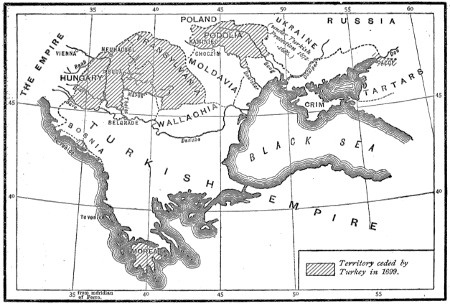
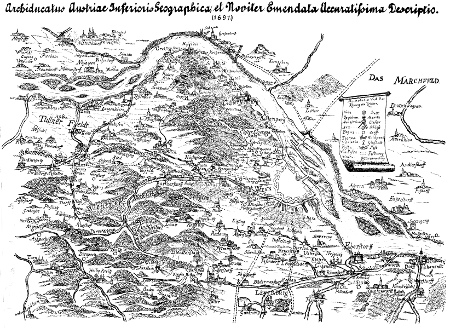
Charles of Lorraine, the Imperial commander, had under his orders less
than 40,000. The levy en masse of Hungary produced 3000 soldiers only
for the Emperor's service, so wide was the sway of the Turks, or so
universal the sympathy for Tekeli. Six thousand Hungarians, supposed to
be raised for the Emperor, went over to the enemy as soon as they
advanced. Yet, contrary to his own opinion, Lorraine began with
offensive operations against the Turkish fortress of Neuhausel. A
partial success was followed by a disastrous repulse, and the army
withdrew south of the Danube, as the main Turkish force approached upon
that same side of the river. Lorraine had some idea of making a stand
near the Raab to cover the Austrian frontier, but the number of the
enemy and the temper of his own soldiers rendered such an attempt too
hazardous. He determined to retreat, and await the reinforcements
already promised by the Princes of the Empire. Garrisons were hastily
flung into Raab, Komorn, and Leopoldstadt.[7] The infantry then
recrossed the Danube and fell back towards Vienna along the Schütt
island, under Count Leslie's orders. The cavalry marched upon the
southern side of the river, but the superior rapidity of their retreat
did not save them from molestation. On July 7 at Petronel, some twenty
miles below Vienna, 15,000 Spahis and Tartars burst upon their march.
For a time Count Taaffe, with the rear guard of 400 men, was in extreme
danger. The exertions of Lorraine and of Louis of Baden rallied the
cavalry and speedily repulsed their disorderly assailants, but in the
confusion several of the officers fell, including Prince Aremberg and
Julius Louis of Savoy, an elder brother of Prince Eugene, and much of
the baggage became the prey of the Tartars. Altenburg and Haimburg,
posts upon the Danube, had been already stormed, after a brief
resistance, by the Turkish infantry.
Those stragglers who first leave the field are always apt to cover
their own flight by the report of an universal overthrow. So fugitives
came galloping to Vienna with a tale of disaster. They spread the rumour
that the Duke of Lorraine was killed and the army totally defeated,
while their alarm seemed amply confirmed by the glow of burning villages
that brightened upon the twilight of the eastern horizon. The Imperial
court, which had delayed its flight so far, in the hope that the enemy
might linger about the fortresses of Raab or of Komorn, tarried now no
longer. "Leopold could never bear to hear plain truths but when he was
afraid," says Eugene. He had refused to recognize the imminence of the
peril until now; and by his confidence had involved in his destruction
others, who had not the same means of escape at the last moment which he
himself possessed. Yet means of escape were barely open to him, when at
length he understood that he must defend or abandon his capital. The
roads to Upper Austria and to Bavaria, along the southern shore of the
Danube, were rightly distrusted. The Emperor, his Empress, and the
Empress Mother, with all their train of courtiers, of ladies, and of
servants, shorn of pomp and bereft of dignity in their flight, poured
over the Leopoldstadt island and the Tabor bridge in all the misery of
panic fear. The prompt destruction of the bridge of Crems, above Vienna,
is said alone to have saved their route from interception by the
Tartars. A part of their baggage actually became the prey of the
marauders. The whole court, including even the Empress herself, who was
far advanced in pregnancy, were driven to seek rest in farms and
cottages. Once they passed the night under a temporary shelter of
boughs. In the universal panic, small room was left for hopes of a
return to the capital and to the palaces that they had quitted. Milan,
Innspruck, Prague were thought of as their future refuge. On to Lintz,
and from Lintz to the frontier they fled, till their confidence at last
returned behind the fortifications of the Bavarian city of Passau. But
they were not the only fugitives from Vienna. The bold march of the
Vizier upon the city, leaving Raab, Komorn, and Presburg in his rear, to
fall an easy prey when once the great prize was captured; this had taken
the citizens by surprise. The retreat of Lorraine, and the skirmish at
Petronel, had filled them with abject terror.
People from the surrounding country who had taken shelter in Vienna no
longer relied upon her as a stronghold, but turned their thoughts to an
escape to Bavaria, or to Styria, or even to the distant Tirol. From nine
o'clock in the evening till two o'clock in the morning, on the 7th and
8th of July, a never-ending stream of carriages and of fugitives were
following in the track of the Imperial cortège. East and south, upon
the horizon, the glare of burning villages told that the Turkish
horsemen were there. High on the summit of the Kahlenberg, the flames of
the Camalduline Convent dreadfully illuminated the track of the
fugitives. Sixty thousand persons, it was believed, left the city in the
course of a few days. Of those who, crossing the Danube, took the roads
into Upper Austria or into Moravia, some fell into the hands of the
Hungarian and Tartar marauders. But few of those who attempted to escape
into Styria succeeded in reaching a place of safety. They perished by
thousands, enveloped by the flying squadrons of the invaders.
In Vienna herself, deserted by her leaders and by so many of her
children, violent tumult raged against the Government, and against the
Jesuits, who were supposed to have instigated the persecution of the
Protestants of Hungary. There was ample cause for terror. The
fortifications were old and imperfect, the suburbs encroached upon the
works, the number of the defenders was small. Thirteen thousand
infantry, supplied by the army of Lorraine, and seven thousand armed
citizens formed the garrison; and, besides these, about sixty thousand
souls were in the city. The command was entrusted to Ernest Rudiger
Count Starhemberg, an officer of tried skill and courage. He had served
with Montecuculi against the Turks, and against both Condé and Turenne
with the same commander and with the Prince of Orange. He entered the
city as the fugitives forsook it. He set the people to work upon the
fortifications, organized them for defence, and assured them that he
would live and die with them. But while writing to the Emperor that he
would joyfully spend the last drop of his blood in defence of his
charge, he confesses that the place is in want of everything, and the
inhabitants panic-stricken. Fortunately he and others with him were the
class of men to restore confidence in the rest. Under him served many
noble volunteers, for the example of the Emperor was not universally
followed. The Bishop of Neustadt, once himself a soldier and a knight
of Malta, was conspicuous among many brave and devoted men for his
liberal donations to the troops, and for his superintendence of the
sanitary state of the city. In one respect alone the place was well
furnished; three hundred and twenty-one pieces of artillery were
supplied by the Imperial arsenal for the fortifications.[8] The city was
defended after the existing fashion, with ten bastions, the curtains
covered by ravelines, with a ditch mostly dry. On the side of the Danube
was merely a wall with towers and platforms, and all the works were more
or less uncared for and decayed. The work of fixing palisades was
postponed till the Turkish army was in sight. It is possible that by a
slightly more rapid march the Vizier might have secured Vienna by a
coup de main.
On July 13, the Turkish regular cavalry came in sight, preceding the
infantry of the main army; and at the last possible moment fire was set
to the suburbs, which impeded the defence. A high wind speedily caused
them to be consumed. On the 14th, the Turkish army took up its
position, encamping in a semicircle, round the whole of the circuit of
the defences not washed by the Danube. A city, surpassing in size and
population the beleaguered capital, sprang up about the walls of Vienna.
The tents of the Vizier were pitched opposite the Burg bastion, in the
suburb of St. Ulric. The camp was crowded not only by soldiers, but by
the merchants of the East, who thronged thither as to a fair to deal in
the plunder of the Christians. The Imperial troops still attempted to
hold the Leopoldstadt island; but on July 16, the Turks threw bridges
across the arm of the Danube, and shortly drove the Christians to the
northern bank of the river. The houses of the Leopoldstadt were given up
to fire by the Turks; and the bridge, leading to the northern shore,
destroyed by the Imperialists. The investment of Vienna was now
completed upon every side. Batteries from the Leopoldstadt, and from the
south and west, crossed it with fire in all directions. Trenches were
opened, and the elaborate approaches and frequent mines of the Turks,
advancing with alarming rapidity, enveloped the western and
south-western face of the works from the Scottish gate to the Burg
bastion.
Upwards of three hundred pieces of artillery played upon the crumbling
defences and the devastated city. The pavement of the streets was torn
up, that the balls might bury themselves in the soft earth where they
fell. The upper floors and roofs of the houses were barricaded with
heavy timber, or covered with sandbags, to guard against the fire of the
dropping shells. The streets themselves were blocked behind the walls,
chains drawn across them, and the houses loop-holed and prepared for
defence to the last extremity. All the gates had been walled up but one,
the Stuben gate, which, being partially covered by the stream of the
Wien, was left open as a sally-port. Early in the siege, the assailed,
frequently issuing forth, returned the attacks of the enemy, frustrated
their operations, and even captured provisions in the hostile lines. But
as time went on, the diminishing numbers of the garrison forbade the
waste of life incurred even in successful sorties.
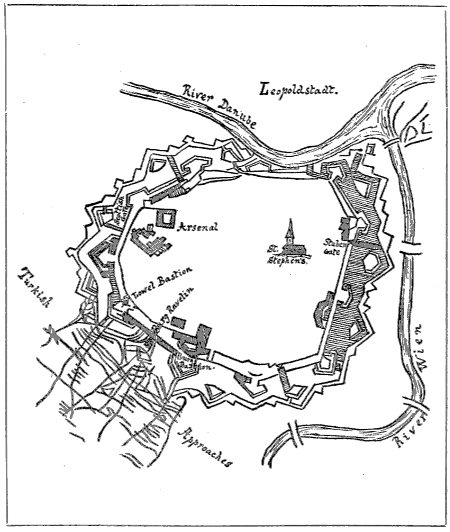
The progress of the Turks was rapid with sap and mine. They were famed
for their skill with entrenching and engineering tools, and the
Christians learnt much from them, though their approaches were unlike
the ordinary European works. Instead of parallel lines to the defences
they drew curves, overlapping each other and continually approaching the
place attacked. The trenches were deep, and fifteen or sixteen feet wide
at the bottom where the ground allowed. The depth of the Turkish works
effectually protected their soldiers, even when they had made a lodgment
in the ditch; for the besieged could not depress their cannon
sufficiently to hurt them.[9] They were protected skilfully by
bomb-proof shelters of timber and of turf, beneath which thousands of
men, hidden and shielded, crouched ready for attack, or for the repulse
of sorties. Their mines penetrated in every direction to the
counterscarp of the place, and ultimately to the walls themselves. At
length the very cellars of the nearest houses were threatened by a
subterranean enemy; and water and drums strewn with peas were placed in
them, to tell, by the slightest vibration, of the work of the Turkish
miner's pick below.
The Turkish miners were bolder than those of the garrison. The latter
were hired labourers of the lowest class, of whom Starhemberg wrote to
Lorraine that nothing would induce them to re-enter a mine after they
had heard the sound of the enemy working near them. On the part of the
enemy, men who had applied for a Timar, or military fief, often
volunteered as miners to prove their courage and to win its reward.
At the very beginning of operations the city all but perished through a
fire, which actually reached the windows of the Imperial arsenal stored
with eighteen hundred barrels of powder. An explosion there would have
opened a road for the Turkish army into Vienna, at once deprived of the
means of resistance and reduced to ruins. The exertions of Captain Count
Guido Starhemberg, nephew of the commandant, who personally
superintended the removal of the powder through the opposite windows,
together with a lucky change of wind, saved the city. Rightly or
wrongly, an incendiary was suspected. The fear of treachery was added to
the legitimate terrors of the citizens. Desertions took place to the
enemy, and spies were actually apprehended within the walls. Hungarians
and other Christians were arrayed upon both sides, and this community of
language and manners, between besiegers and besieged, rendered such a
danger more real.
But from the open force of the attack the worst calamities were to be
feared. On the 23rd, 25th, and 27th of July the opening assaults were
delivered. All were repulsed, but with loss of lives ill-spared.
Closer and closer crept the Turkish sappers. Assault after assault upon
the outer fortifications gradually wrested important positions from the
besieged. The Burg and Löwel bastions, with the connecting curtain
between them and the Burg ravelin, were reduced to an almost shapeless
ruin by the Turkish mines and artillery. Every device was tried to
retard the attack. The arts and ingenuity of a great city were at the
service of the besieged. They made their own powder; and, when
hand-grenades began to fail, the invention of an officer supplied their
place with grenades of earthenware. Nevertheless, on August 7, the Turks
made a lodgment upon the counterscarp, after twenty-three days of firing
and terrible losses upon both sides.
The Janissaries now stood upon the very threshold of the city. Hand to
hand fighting was carried on in the ditches. The citizens armed with
scythes upon the end of poles contended with advantage from above
against the Turkish sabres. Boiling pitch and water stood continually
ready to overwhelm the assailants as they struggled up the shattered
slope of the ramparts. Besiegers and besieged were continually within
pistol shot of each other, and showers of Turkish arrows descended on
the town. As yet no footing was obtained by the Turks within the body of
the place, though the streets and houses stood ready barricaded against
such an event. But the Vizier commanded two hundred thousand men,
Starhemberg but twenty thousand. Disease and the toils and losses of the
defence told fearfully upon the latter. Starhemberg himself was disabled
by dysentery early in the siege, and did all that man could do, carried
in a chair from post to post, amidst the hottest of the fire. On the
other side, Kara Mustapha made his rounds in a litter rendered
shot-proof by plates of iron. The chief engineer of the garrison,
Rimpler, fell. Colonel Bärner, commanding the artillery, and the Prince
of Wurtemberg were disabled. Five thousand men, more than a third of the
regular soldiers, perished. Food became scarce, vermin were eagerly
sought for by the poor, and dysentery followed inevitably in the train
of want. Fever sprang from the confinement, filth, and bad air
inseparable from their condition. Sixty persons a day were dying of
dysentery alone towards the conclusion of the siege. But the humour of
the Viennese asserted itself still among their calamities, and the
spoils of nocturnal chase upon the tiles were sold as "Roof Hares" in
the market. The courage of long endurance, that rarest of all courage,
was tried to the uttermost. The Bishop of Neustadt, bravest of the brave
defenders, laboured unremittingly among the sick, nor cared less for the
safety of the whole, by undertaking the control of sanitary measures.
The otherwise useless non-combatants were organized by him into bands of
scavengers, hospital attendants, and carriers of the wounded.
A despatch from Starhemberg, dated August 18, came safely to the hands
of Lorraine. The commandant wrote boldly, perhaps with an eye to the
probability of his intelligence reaching the Turkish and not the
Imperial general. "I must in the first place, tell your Highness that we
have up to this moment disputed the works with the enemy, foot by foot,
and that they have not gained an inch of ground without paying for it
dearly. Every time that, sword in hand, they have attempted a lodgment,
they have been vigorously repulsed by our men, with such loss that they
no longer dare to put their heads out of their holes." Nevertheless, he
was providing for the worst. "I have caused a new work, well ditched, to
be made in the middle of the Burg ravelin; the Löwel and Burg bastions
are also defended by a second line; and I am even now beginning another
work behind these same bastions. I write this that your Highness may
know that we are forgetting nothing, that we are wide awake, and taking
all imaginable precautions. As in duty bound I assure your Highness,
that to show myself worthy of the confidence which your Highness, and
more especially his Majesty my master, repose in my small services, I
shall never yield the place but with the last drop of my blood."
This despatch was safely carried to Lorraine by Kolschitzki, a Pole.
Many other letters had miscarried, for few messengers penetrated, at the
risk of life, between the city and the slowly mustering forces of
Lorraine. Some swam the arms of the Danube. The most skilful, however,
was this Kolschitzki, who relied upon his knowledge of the Turkish
tongue and manners, and in Turkish dress penetrated the besieging lines,
much as a countryman of our own relied on similar knowledge in a
scarcely less memorable siege. The name of Kolschitzki of Vienna may be
named side by side with that of "Lucknow" Kavanagh, though the Pole not
only passed out through the besiegers, but succeeded in returning again
in a like manner into the city with despatches, to sustain the courage
of the defenders. From his stone chair, high up in the fretted spire of
St. Stephen's, the watchman saw the rockets which rose as signals from
the Christian outposts north of the Danube. But from the southern bank
must the march be made for the deliverance of the city; and was it
possible that Lorraine, or even Sobieski, could carry a force across the
river in the face of such an army?
The garrison record, with painful exactness, the terrible annals of the
siege; what ravelin is deluged with the blood of assailants and of
defenders; where mines have blown the counterscarp into the ditch, or
shattered the salient angle of a bastion; what new quarter of the city
is devastated by the cannonade; what much-prized life is taken; when
the bread begins to fail; what false hopes of relief, or what
exaggerated tidings of calamity, circulate among the citizens. These
details, of overwhelming interest to every man at the moment, and
printed indelibly upon his mind, bring to the distant observer but one
confused and appalling panorama of suffering and of endurance, of
courage and of despair.
The growing anxiety of the city appears in a second despatch of
Starhemberg's, dated August 27. He still tells of attacks repulsed, of
sorties boldly executed, and of mines discovered and foiled, but he
acknowledges the need of succour. "We are losing many men and many
officers, more from dysentery than from the enemy's fire, the deaths
from that disease alone are sixty daily. We have no more grenades, which
were our best defence; our guns are some of them destroyed by the
enemy's fire, some of them burst before firing fifty rounds, from the
bad material used by the founder; and the enemy, seeing they can hold
their lodgments in the ditch with a few men, are massing great numbers
on the counterscarp, to have a large force ready there for some
extraordinary effort.... We await, therefore, your Highness's arrival
with extreme impatience; for my own part not so much from a wish to be
relieved as that I may have the honour of respectfully assuring your
Highness of my obedience, being, as I am, your Highness's most humble
and obedient servant, Starhemberg." The courtly bravado of the
subscription is in strong contrast with the hurried postscript that
follows:—"My miners tell me that they hear the enemy working beneath
them under the Burg bastion; they must have run their gallery from the
other side of the ditch, and there is no time to be lost." When this
despatch was written, both sides believed that the supreme crisis was at
hand.
The 29th of August was looked for as the decisive day. On that
anniversary Stuhlweissenberg and Belgrade had fallen before the
Ottomans.[10] Above all, on that day the strength of Hungary had been
smitten, and her king, Louis, had died, before the hosts of the great
Solyman, on the disastrous field of "The Destruction of Mohacs"—that
battle which first opened Hungary and Austria to the invader.
But the 29th came and passed, with no general attack from the
besiegers. A mine was sprung under the Burg ravelin, nearly completing
the ruin of the work; and three or four hundred Turks attempted to
establish themselves upon the remains, but were driven back again.
Another mine was sprung by the Burg bastion, but no assault followed.
From St. Stephen's considerable movement was noticed among the Turkish
detachments on the left bank of the Danube, occasioned by the march of
Lorraine's army.
In the camp murmurs and dissensions ran high. The Janissaries clamoured
at their lengthy detention in the trenches. They openly accused the
incapacity, or worse faults, of the Vizier. There seems little doubt but
that he had it in his power to have overwhelmed the defenders by a
general and prolonged assault, towards the end of August.
Ottoman leaders had known well how to avail themselves of the obedience
and fatalist courage of their soldiers. Amurath IV., when he won back
Baghdad from the Persians, Mahomet II., at the taking of Constantinople,
had shown how cities could be won. Before the city of the Khalifs for
three days, before the city of the Cæsars from a May sunrise till well
nigh noon, had torrent after torrent of brave, devoted, undisciplined
soldiers wearied the arms and exhausted the ammunition of the defenders,
until the Janissaries arose, fresh and invincible for the decisive
charge. Wave after wave of stormers, fed from inexhaustible multitudes,
had rolled upon the besieged, and, like broken waves, had rolled back in
ruin, until the last and greatest should burst in overwhelming force
upon the breaches. Such an assault would have been surely successful
against Vienna. But the Vizier, in vain security, pictured to himself
the advantages of a surrender, which should preserve the city as a
trophy of his conquest—the seat, perchance, of his sovereignty. The
riches which he dreamed it to contain, he hoped to receive as his own
spoil; not to yield as the booty of the army after a storm. So, while
the decisive days passed, the signal for attack was delayed, except by
small bodies upon single points, until the courage of his soldiers was
dissipated and their confidence destroyed. On the contrary, the
unexpected reprieve gave courage to the defenders. The Janissaries, on
the other hand, impatiently invoked the appearance of the relieving
army to end their sojourn in the trenches by the decisive event of a
stricken field. Slowly, but at last, ere yet too late, that army was
approaching.