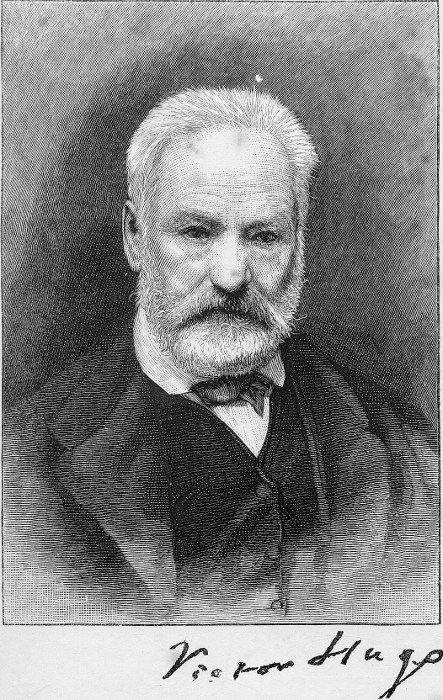
When the news that Victor Hugo had been seized with a serious illness
was made known on the 17th of May, it excited a painful sensation not
only in Paris and throughout France, but also in London, Vienna, and
other European capitals. The great age of the sufferer caused the
gravest apprehensions, notwithstanding his well-known vigour and
robustness of constitution.
The last public act of the poet was to stand sponsor to M. de Lesseps at
the Academy reception, held towards the close of April, 1885. In
accordance with his customary practice he was thinly clad, although the
weather was inclement, and the rain fell while he stood for a
considerable time in the quadrangle. His friends dreaded the result of
this exposure. It seems that the spectators, as if with the
presentiment that they would not see him again, gave him a prolonged
cheer, 'which he acknowledged with the seriousness of a man already
looking back, as from a distance, on the world's transient
satisfactions. He then sat down, apparently absorbed in listening to
what he called the inner voices, scarcely raising his head to respond to
the plaudits evoked by the passage in his honour.' A fortnight after
this incident, Hugo received his friend Lesseps and his family to
dinner, according to his weekly custom. It was noticed by the poet's
relatives, though it escaped the attention of his godson of the Academy,
that the host was far from being in his usual health. Nevertheless, he
exerted himself with his wonted courtesy, and remained with his guests
until they departed at a late hour. He was already suffering from a
cold, caught, it is said, on the 13th of May, when he took one of those
omnibus rides to which, as we have seen, he was very partial. Overtaxed
by his exertions in entertaining his friends, and unable to shake off
the effects of the cold, serious symptoms began to develop themselves.
In addition to an affection of the heart, congestion of the lungs set
in. Although for some time he battled heroically with the disease, he at
length looked for and anticipated death.
A correspondent of the Daily News, reporting a conversation with an
intimate friend of the Hugo family upon the poet's last illness, said:
'He tells me that he never heard of a more terrible struggle between
organic vitality and the morbid causes that are at work. Victor Hugo
would like to die, so that it cannot be said it is his strength of will
that enables him to resist the disease from which he is suffering.
Contrary to what some of the journals have said, he is a very bad
patient. Last night, when after straining his whole body to breathe, he
had fallen into a prostrate state, a strong blister was prescribed, and
the three doctors agreed to stay and watch its effects. As one of them
was going to apply it, Victor Hugo jumped up and not only pushed him
away but the others also, with a muscular force that astounded them. He
rushed to and fro, convulsively throwing up his arms, and clutching the
furniture. In the intervals between the crises, the poet likes to have
his granddaughter near him. He feels that death has come to summon him,
and that medical help is impotent to save him. He chafes at having to
lie in bed. His voice is very weak, but remains audible to those near
him. He was greatly affected on hearing that numbers of working people
come in the evening to stand mutely and respectfully at a short distance
from his house, so as to hear from those who call, as they are walking
away, how he is. With his characteristic politeness, he has ordered that
a direct notification is to be made to the humble watchers in the street
of his decease, and wishes it to be known that his last thoughts have
been about his friends the poor of Paris, with whom he has long been in
brotherhood by feeling.'
On hearing of Victor Hugo's alarming illness, Cardinal Guibert, the
Archbishop of Paris, wrote to Madame Lockroy: 'I have the deepest
sympathy with the sufferings of M. Victor Hugo and with the anxieties of
his family. I have prayed much at the Holy Sacrifice of Mass for the
illustrious patient. Should he desire to see a minister of our holy
religion, although I am myself still weak, and in a state of
convalescence from a disease much resembling his, I should make it my
very pleasing duty to bring him the succour and consolation so much
needed in these cruel ordeals.' M. Lockroy at once replied as follows:
'Madame Lockroy, who cannot leave the bedside of her father-in-law, begs
me to thank you for the sentiments which you have expressed with so much
eloquence and kindness. As regards M. Victor Hugo, he has again said,
within the last few days, that he had no wish during his illness to be
attended by a priest of any persuasion. We should be wanting in our duty
if we did not respect his resolution.' As the correspondent of the
Times observed, the Archbishop could scarcely have expected an
acceptance of his offer, for Victor Hugo was not the man to play the
revolting death-bed farce of Talleyrand; and to have died a Catholic
would not even have been a reversion to the creed of his childhood, for,
strictly speaking, he was not brought up a Catholic. His mother, though
a Vendéan Royalist, was a Voltairian; and when she entered her sons at
the monastic college of Madrid, she declared them Protestants in order
to exempt them from the confessional. But all through life Hugo was a
Theist, and ran the gauntlet of much criticism from sceptical friends in
consequence of his firm belief in the Deity.
There seemed at one time a possibility of the poet's recovery, though
he did not himself share this view. 'I only wish that death may come
quickly,' he exclaimed the day before his death; and again, in passing
through a severe spasmodic fit, he said: 'It is the struggle between day
and night.' The patient's sufferings were very great, and those about
him could desire nothing but his release. For several days he was kept
alive only by injections of morphia. On the evening of the 21st he
rallied sufficiently from his lethargy to embrace his two grandchildren,
both in their 'teens, and to utter a few words. His breathing was
temporarily easier, though the action of the heart continued to be very
feeble. At five o'clock on the following morning the last agony
commenced. Almost his last words, addressed to his granddaughter, were,
'Adieu, Jeanne, adieu!' His final movement of consciousness was to grasp
his grandson's hand. The pulse gradually grew weaker and weaker, and at
half-past one o'clock he raised his head, made a gesture as if bowing,
and fell back lifeless.
In the afternoon M. Nadar attended, to photograph the death-bed. M.
Bonnat, whose striking portrait of Hugo was one of the features of the
Salon a few years ago, took a sketch, and M. Dalou, the sculptor, made a
cast of the head. M. and Madame Jules Simon were the first amongst a
long list of notabilities to pay a visit of condolence to the family.
Early on the morning of the poet's death a crowd had assembled in the
Avenue Victor Hugo, and the painful news of his decease rapidly spread
through their midst, and was soon known throughout Paris.
When the Senate met, shortly after the melancholy event, the President,
M. Le Royer (a Protestant), said: 'Victor Hugo is dead. He who for more
than sixty years has excited the admiration of the world and the
legitimate pride of France has entered into immortality. I will not
sketch his life; everyone knows it. His glory is the property of no
party or opinion; it is the appanage and inheritance of all. I have only
to express the deep and painful emotion of the Senate, and the unanimity
of its regret. In sign of mourning, I have the honour to ask the Senate
to adjourn.' M. Brisson then said: 'The Government joins in the noble
words of the President of the Senate. To-morrow the Government will
have the honour of submitting to the Chamber a Bill for a national
funeral to Victor Hugo.' The Senate then rose. The Municipal Council
paid similar homage to the man whose name was imperishably associated
with that of Paris. The Council also resolved upon attending the funeral in a body.
For some days the poet's death was the only subject of conversation in
Paris. Foreign visitors delayed their departure in order to be able to
say that they had witnessed his funeral. The Mayor of the 46th
arrondissement declared the house where he died to be sacred, and the
property of the city of Paris, and it was decided to give his name to
new streets in the capital. For the first time, it was said, since
Lafayette's death—and even this comparison proved to be
inadequate—France was to celebrate a truly national funeral. The
funerals of Thiers and Gambetta, though the most striking in France for
at least a generation, aroused sympathy in one section of the people,
and drew forth protests from the rest; but all France felt that it could
bow the head with unanimous respect and veneration before the remains of Victor Hugo.
A doubt which had troubled all persons holding religious beliefs in
France was set at rest by the publication of the following unsealed
memorandum handed by the poet to M. Vacquerie on the 2nd of August,
1883:—'I give 50,000 francs to the poor. I wish to be carried to the
cemetery in their hearse. I refuse the prayers (oraisons) of all
churches: I ask for a prayer (prière) from all souls. I believe in
God.—Victor Hugo.' Though rejecting creeds, it was seen that the
illustrious departed had not rejected belief. On one point M. Renan
expressed the universal feeling when he wrote as follows:—'M. Victor
Hugo was one of the evidences of the unity of our French conscience. The
admiration which enveloped his last years has shown that there are still
points upon which we are agreed. Without distinction of class, party,
sect, or literary opinion, the public, for some days past, has hung upon
the heartrending narratives of his agony; and now there is nobody who
does not perceive a great void in the heart of the country. He was an
essential member of the church in whose communion we dwell—one might
say that the spire of that old cathedral has crumbled into dust with the
noble existence which has carried the banner of the ideal highest in our century.'
At the opening of the French Chamber on the 23rd, M. Floquet pronounced
an eloquent eulogium upon Victor Hugo. He spoke of France as having lost
one of her best citizens, who had enriched the treasure of national
glory, had restored courage in adversity, and after having suffered
everything for the Republic had inculcated concord and tolerance. He
described him as a hero of humanity, who for sixty years had been the
champion of the poor, the weak, the humble, the woman, and the child,
and as the advocate of inviolable respect for life, and of mercy to
those who had gone astray. His name ought to be proclaimed, not only in
the academies of artists, poets, and philosophers, but in all
legislative assemblies, on which he had sought to impress the
inspirations of his all-powerful and benevolent genius.
In proposing a vote of 20,000 francs for a national funeral, M. Henri
Brisson said:—'Victor Hugo is no more. While living he became immortal.
Death itself, which often adds to the reputation of men, could not add
to his glory. His genius dominates our century. Through him France
irradiated the world. It is not letters alone that mourn, but our
country and humanity—every reading and thinking man in the whole
world. As regards us Frenchmen, for the last sixty-five years his voice
has entered into our inner moral life and our national existence,
bringing into them all that is sweetest and brightest, most touching and
most elevated, in the private and public history of that long series of
generations which he has charmed, consoled, kindled with pity or
indignation, enlightened, and warmed with his own fire. What man of our
time is not indebted to him? Our democracy laments his loss. He has sung
all its grandeurs; he has wept over all its miseries. The weak and lowly
cherished and venerated his name. They knew that this great man had
their cause in his heart. It is a whole people that will follow him to the grave.'
Loud acclamations followed this speech, and the proposal was adopted by 415 votes to 3.
The news of the poet's death excited as much emotion in the French
provinces as in the capital. The Municipal Councils of Lyons,
Marseilles, and Toulon closed their sittings as a mark of grief, after
having appointed delegates to represent them at the funeral. The
Municipal Council of Besançon sent the following address to the Hugo
family:—'The native town of Victor Hugo, through the Council, places at
the feet of the departed its sentiments of profound grief. The glory of
the greatest of her children will for ever irradiate her and the whole
world. By his genius he was foremost among men of letters and poets. By
his love of his country and of liberty he was the enemy of usurpers and
despots, and the power of his heart and his zeal for the welfare of
humanity place him at the head of the protectors of the oppressed, the
humble, and the weak.' The Mayor of Nancy addressed the following letter
to M. Lockroy:—'The town of Nancy has always felt proud of having been
the birthplace of General Hugo, the father of the man of genius for whom
France mourns. She claimed as a glory for the blood of Lorraine, which
ran in his veins, the renown of the great poet. I am an inadequate but
sincere interpreter of the general grief.' At Algiers the Municipal
Council closed its sittings, and from London, Vienna, and St. Petersburg
messages of sympathy were despatched. On the day following the poet's
death it was computed that at least ten thousand letters and messages of
condolence reached the Avenue Victor Hugo.
A desire having been expressed that Victor Hugo should be buried in the
Panthéon, the feeling spread rapidly through almost all classes. In
pursuance of this wish, M. Anatole de la Forge moved in the Chamber of
Deputies that the Panthéon, known as the Church of St. Geneviève, should
be secularized, in order that Victor Hugo's remains might be buried
there. Urgency was voted for the motion by 229 against 114 votes, but
the Minister of the Interior requested the House to postpone the vote
upon it until the next sitting.
It may be here stated that the Panthéon was commenced in 1764 as a
church, completed in 1790 as a Walhalla, was a church from 1822 to 1830,
and again from 1851 until 1885. The interments in it of Mirabeau,
Voltaire, Rousseau, and Marat are matters of history, as are also the
expulsions which followed. Mirabeau's body was publicly expelled by the
Terrorists; Marat's by the Anti-Terrorists; and Voltaire's and
Rousseau's clandestinely by the Legitimists. In 1881 the last French
Chamber passed a Bill secularizing it; but this did not pass through the Senate.
Two days after the discussion upon M. de la Forge's motion, the
Journal Officiel published a series of documents which summarily
disposed of the matter. Ministers having advised President Grévy that an
opportune moment had arrived for accomplishing the wish expressed by the
Chamber in 1881, and for restoring the building to its original
destination as a burial-place for illustrious Frenchmen, two
Presidential Decrees were made, one declaring the Panthéon to be
henceforth a mausoleum for great men who should have merited the
gratitude of the nation, and the other directing that the body of Victor
Hugo should be laid there. In the Chamber an order of the day was
proposed by the Comte de Mun, condemning the Presidential Decree as a
provocation to Catholics and as an act of feebleness; but this was
rejected by 388 to 83. Another motion expressing the Chamber's entire
approval of the letter and spirit of the Decree was then submitted, and
carried by 338 to 90. Hugo's family consented to the body being taken to
the Panthéon, but insisted on its being carried in a pauper's hearse
from the Arc de Triomphe, where it was to lie in state, to the national mausoleum.
At six o'clock on the morning of the 31st of May the remains of the
poet were transferred to the Arc de Triomphe, where waggon-loads of
flowers and memorial wreaths had been constantly arriving. All the
shops, cafés, and restaurants in the Avenue Victor Hugo, and near the
Triumphal Arch, had remained open all night. 'There was nothing
disorderly,' wrote a correspondent, 'and the impression everything gave
was one of sadness, though all day the aspect of the Place de l'Étoile
had been really festive. The cenotaph was visible from the Tuileries.
The coffin was covered with a silver-spangled pall, which rose from a
base covered with black and violet cloth, violet being regal mourning,
and Victor Hugo having attained an intellectual and moral sovereignty
over France.' Early in the day the crowds of human beings in all the
avenues leading to the Place de l'Étoile were very dense. As evening
drew on the aspect was like that of some great fair. Medals bearing Les
Châtiments, Napoléon le Petit, and other legends, were offered for
sale, as well as medallions and numberless other memorials of the dead.
The display of flowers was wholly unparalleled. At night a flood of
electric light poured upon the Place de l'Étoile, revealing the coffin
with Dalou's powerfully modelled bust at the foot, and bringing out the
flowers and the names of Victor Hugo's works on shields. The effect of
the Horse Guards with torches and veiled lamps was very striking. Twelve
schoolboys, relieved every hour, formed a picket in front of the
cenotaph, round which there was an outer circle of juvenile guards, and
an inner one of Hugo's intimate friends. English literature and the fine
arts were worthily represented in the votive offerings laid at the feet
of the great poet. Wreaths, flowers, and memorial cards were sent in
great abundance. Lord Tennyson wrote under his name the word 'Homage,'
and at the top of his card, 'In Memoriam celeberrimi Poetæ.' Mr.
Browning also was represented, as well as Sir Frederick Leighton, the
President of the Royal Academy. Archdeacon Farrar sent the message, 'In
honour of one who honoured man as man.' Sir F. Burton, director of the
National Gallery, wrote, 'Honour to the memory of the great master;' and
similar tributes were paid by many men of letters, poets, Royal
Academicians, and others.
The funeral ceremony took place on the 1st of June, and it was of such a
character as to live in the memory of all who witnessed it. What
distinguished the procession in honour of Victor Hugo from the only one
comparable with it, that of Gambetta, observed the correspondent of the
Times, was not only its vast size, which was without precedent, but
also the distinct sentiment which dominated both its members and the
crowd. It was at once the triumph of the democracy and an illustration
of its power. In the case of Gambetta, France beheld a statesman cut off
in his prime, with all the dreams of hope and ambition before him. In
the case of Victor Hugo, it was a veteran in letters entering into his
rest. 'At the tidings of his death, all France, all parties, seemed to
claim him; and it was the loss of the poet, the thinker, the
humanitarian, which was first deplored. Then, by degrees, party claims
were put forth. The poet and thinker disappeared, and this made his
funeral less sublime. The crowd paid homage to the political weaknesses
of his latter years, to the democratic philanthropist, to the Extremist
Senator, to a Hugo, in fact, whom posterity will ignore, while honouring
him with a place among great literary geniuses.' The struggle over his
remains ended by other parties giving way, and the people for whom he
had laboured claiming him as their especial champion and prophet. But
certainly, whether for king, priest, statesman, or man of letters, Paris
and the provinces never before turned out in such vast multitudes.
The wreaths arriving from all parts were placed on twelve cars, drawn by
four or six horses each, and they formed a brilliant spectacle. Before
six o'clock in the morning there were already four rows of spectators
assembled on each side of the Champs Élysées. 'The authorities, with
considerable skill and foresight, had directed most of the societies
likely to bear what might be qualified as seditious banners to meet in
the Avenue du Bois de Boulogne. Here accordingly, at a little before
nine o'clock, were massed various free-thought societies, nearly all of
them bearing red flags or banners, from Boulogne, Asnières, Argenteuil,
Suresne, Bicêtre, Sèvres, Puteaux, and other places. Some of the banners
were ornamented with Phrygian caps. Close by, in the Avenue de la Grande
Armée, the proscripts of 1851-52 had also a red banner. By ten o'clock
there were fifteen red flags close to the Arc de Triomphe. At the corner
of the Rue Brunel M. Lissagaray, M. Martin, and some thirty well-known
anarchists had responded to the call of the Revolutionary Committee.
They seemed, however, lost in the crowd. Twice this little group of
anarchists tried to unfurl a red flag, but being so closely watched,
they had not time to hoist the colour in the air before flag-bearer and
flag were both captured. By half-past ten the anarchists, having already
lost two flags, abandoned the Rue Brunel. A little before eleven o'clock
a Commissioner of Police, in plain clothes, accompanied by half-a-dozen
policemen and a company of Republican Guards, marched down the Avenue du
Bois de Boulogne, and, accosting the bearer of every red flag that
seemed at all objectionable, lifted his hat, and demanded that the
emblem should be covered over.' Although disturbances had been feared
none occurred. The Red Republicans and anarchists (whom Victor Hugo had
more than once condemned) were but as a drop in the bucket, compared
with the myriads of other citizens assembled to do honour to the dead.
Although some arrests were made, the greatness of the whole occasion
dwarfed their significance, and the most imposing spectacle within
living memory became a veritable popular triumph, and one reflecting
credit upon the French nation.
Vivid descriptions were penned of the ceremony. According to one of
these, by eleven o'clock the sight at the foot of the Arc de Triomphe
became more and more impressive. The dull, grey sky, the roll of the
muffled drums, the mournful strains of Chopin's Funeral March,
combined with the hushed tones of conversation, helped to impress the
numerous audience gathered round. The bright red robes of the judges and
the sombre gowns of the barristers made a picturesque contrast with the
very plain, unpretending dress of the members of the Government and of
the Foreign Diplomatic Corps, who sat in the most favoured places at the
foot of the Arc. In the background the glitter of cuirassier armour and
the gold braiding of the representatives of the army gave tone and
vivacity to the scene. Much interest was manifested at the presence of
the French Cabinet, of both Houses, and of the English Ambassador,
sitting side by side with M. de Mohrenheim, the Russian Ambassador.
When the mourning family had taken their places, Ministers went to pay
them their condolences. The funeral addresses were then delivered from
a tribune erected on the left of the catafalque. The first speaker, M.
Le Royer, President of the Senate, described Victor Hugo as the most
illustrious senator, whose Olympian forehead, bowed on his breast in an
anticipated posture of immortality, always attracted respectful homage
from all his colleagues. He never mounted the tribune but to support a
cause always dear to him—the Amnesty. Amidst apparent hesitations, he
had all his life consistently pursued a high ideal of justice and
humanity, and his moral action on France was immense. He unmasked the
sophisms of crowned crime, comforted weak hearts, and restored to honest
men right notions of moral law, which had been momentarily obscured.
The speech of the day, however, was delivered by M. Floquet, President
of the Chamber of Deputies. In tones which could be distinctly heard
throughout the vast arena, and with much eloquence of gesture, the
orator said: 'What can equal the grandeur of the spectacle before us,
which history will record! Under this arch, constellated with the
legendary names of so many heroes, who have made France free, and wished
to render her glorious, we see to-day the mortal remains, or rather, I
should say, the still serene image, of the great man who so long sang
the glory of our country and struggled for her liberty. We see here
around us the most eminent men in arts and sciences, the representatives
of the French people, the delegates of our departments and communes,
voluntary and spontaneous ambassadors, and missionaries from the
civilized universe, piously bending the knee before him who was a
sovereign of thought, an exile for crushed right and a betrayed
Republic, a persevering protector of all the weak and oppressed, and the
chosen defender of humanity in our century. In the name of the nation we
salute him, not in the humble attitude of mourning, but with all the
pride of glorification. This is not a funeral, but an apotheosis. We
weep for the man who is gone, but we acclaim the imperishable apostle
whose word remains with us, and, surviving from age to age, will conduct
the world to the definite conquest of liberty, equality, and fraternity.
This immortal giant would have been ill at ease in the solitude and
obscurity of subterranean crypts. We have elevated him there, exposed to
the judgment of men and Nature, under the grand sun which illuminated
his august conscience. Whole peoples realize the poetical dream of this
sweet genius. May this coffin, covered with the flowers of the grateful
inhabitants of Paris, which Victor Hugo loved to call the Cité Mère,
and of which he was the respectful son and faithful servant, teach the
admiring multitude duty, concord, and peace.'
M. Floquet concluded by reciting the verses beginning 'Je hais
l'oppression d'une haine profonde' ('I hate oppression with a profound
hatred'). This address, which elicited enthusiastic approval, was
followed by one from M. Goblet, Minister of Public Instruction. The
Minister said that Victor Hugo, while living, figured in the glorious
pleiad of great poets—with Corneille, Molière, Racine, and Voltaire. He
would always remain the highest personification of the nineteenth
century, the history of which, with its contradictions, its doubts, its
ideas, and aspirations, had been best reflected in his works. The
speaker laid stress upon the profoundly human character of Victor Hugo,
who represented in France the spirit of toleration and peace. M. Émile
Augier, who appeared in the uniform of the Academy, said: 'The great
poet that France has lost vouchsafed me a place in his friendship.
Hence the honour I have to be chosen by the Academy to express our
grief, which is as nothing to that of the whole nation. To the sovereign
poet France renders sovereign honours. She is not prodigal of the
surname Great. Hitherto it has been almost the exclusive appanage of
conquerors; but one preceding poet was universally called the Great
Corneille, and henceforth we shall say the Great Victor Hugo. His
long-acquired renown is now called glory, and posterity commences. We
are not celebrating a funeral, but a coronation.' M. Michelin, President
of the Municipal Council of Paris, delivered the last speech of the day.
On the conclusion of the addresses, the drums beat the salute, and then
the band of the Republican Guard struck up the Marseillaise. Just as
they had reached the chorus of the stirring French national anthem, the
coffin was brought out from the catafalque, and at that precise moment
the sun, bursting through the grey clouds, threw a ray of brilliant
light on the mountain of flowers whence the remains of Victor Hugo had
emerged. Now the march commenced, the school battalions and the
representatives of the Press taking the lead, amid clapping of hands.
Chopin's Marche Funèbre was the music played at the opening of the
ceremonial. After this came in slow movement the strains of the
Marseillaise, which were soon followed by the Chant du Départ, and
then by the Girondins' celebrated chant, Mourir pour la Patrie.
Faithful to the stipulation of his will, Victor Hugo's body was conveyed
to its last resting-place in the poor man's hearse—that is to say, the
cheapest hearse which the Pompes Funèbres provide. As the corpse was
being removed from the cenotaph every head was uncovered. The artillery
of the Invalides and of Mont Valérian boomed out a farewell salute. 'The
procession,' wrote a correspondent of the Daily News, 'had for
vanguard a squadron of mounted gendarmes, followed by General Saussier,
the Governor of Paris, and the Cuirassiers, with band playing; twelve
crown-laden cars, the band of the Republican Guard, the delegates of
Besançon carrying a white crown, the French and foreign journalists, the
Society of Dramatic Authors, and the delegates of the National and other
theatres. The cars were surrounded by the children of the school
battalion. There was no crown on the pauper's hearse. The friends of
the deceased held the cords of the pall, and Georges Hugo walked alone,
behind. He was in evening dress, and looked a young man. His face is
handsome, and his air distinguished. His mother, sister, and different
ladies and other friends of the family walked at a short distance behind
him. The crowd of people was astounding round the Arch of Triumph, and
in the Champs Élysées' side-ways the windows, balconies, house-roofs,
and even the chimney-tops were crowded.'
The very trees seemed to bud with human beings; and the crowd of
spectators in the streets was so deep and serried that it was impossible
for any wearied senator, savant, or other venerable person to get out if
once imprisoned. All along the route of the procession heads were
religiously uncovered as the hearse passed. The school battalion guarded
it, and then came many companies of boyish militia. Gymnastic societies
in white, blue, and red flannel shirts, with white trousers, gaiters,
and caps; delegations of the learned societies, political clubs,
printers, publishers, newspapers, foreign Radicals, literati,
philanthropical societies, fire brigades, humane societies, trades
unions, came in processional order. Each group was distinctly separated
from the other. Down the broad Champs Élysées the procession moved with
great facility, as all carriages had been cleared away before eight
o'clock in the morning. All the available standing-room of the broad
causeway was filled with an eager throng; but the most sublime sight was
presented at the Place de la Concorde. The corner from the Champs
Élysées to the bridge was walled off by the troops, so that an
innumerable multitude was able to collect at this point. Not content
with this, the banks of the Seine, down to the water's edge, on both
sides of the bridge, were thickly studded with people, and every
floating barge or boat was dangerously loaded with spectators. Far up
the broad stretch of the Avenue the procession, with its thousand crowns
and banners, could be seen slowly descending. Many groups had not yet
left the Arc de Triomphe when the head of the procession reached the
Panthéon. A dense mass of spectators had gathered in and around the
Place de la Concorde; but perhaps no portion of the route was so crowded
as the Rue Soufflot, which leads from the Boulevard St. Michel to the
Panthéon. Windows, ladders, roofs, and chimneys were all utilized by
those eager to witness the passing of the procession. Shortly after
half-past one the head of the procession reached the steps of the
Panthéon, and at two o'clock the coffin was brought up the front steps,
and placed on the catafalque. The representatives of the family, of
Government, and the various authorities took their places on either side
of the main entrance. Once more a grand spectacle was offered by the
artistic grouping of crowns, flowers, uniforms, and colours under the
majestic pillars of the Panthéon. Speeches were again delivered, and
these continued while the procession, with, bands and banners, filed
past. The working-class corporations followed in their various order,
and these were succeeded by the Secular Technical School for Girls, the
Republican Socialist Alliance, the Comedians of Paris, the Montmartre
Choral Society, the Women's Suffrage Society, the Radical Socialist
Club, and many other bodies. 'A few minutes after six o'clock,' remarked
the Times correspondent, 'the last crowns and banners passed by, and
after a short interval the troops representing the Army of Paris
commenced their march-past. Dragoons, Republican Guard, and Line were
in their turn acclaimed by the multitude, pleased by their martial
appearance and their light tread after the fatigues of the day. Then
came the blare of the Artillery trumpets, followed by those of the
Dragoons, and at precisely a quarter to seven the last soldier made the
last salute to the remains of Victor Hugo. A statue of Hugo in his
famous posture of reverie fronted the Panthéon. This papier-mâché statue
represented Victor Hugo watching the long procession that did him
honour. It was a trifle; but there was a touch of tender thoughtfulness
in this reminder to the surging multitude that they must not forget the
man who was being borne to the grave.'
Thus ended a funeral pageant worthy, on the whole, of the poet and the
nation—a pageant in which were to be found representatives of all
classes of the French community. Victor Hugo, whose genius recalled the
elder glory of French literature, now sleeps in the Panthéon. While he
differed from the illustrious men of the past, having neither the wit of
Rabelais nor Molière, the classic dignity of Corneille, nor the
philosophic depth of Voltaire, he had a greatness, though of a
different kind, equal to their own. He therefore joins them as an equal.
He has given to French literature a new departure; for every book he has
written, while wet with human tears, is yet stamped with the terrible
earnestness which possessed his spirit, and made immutable by the
Herculean strength of his genius.