Catalogue numbers in the following accounts are those of the
Museum of Natural History, The University of Kansas.
Gopherus berlandieri Agassiz: Texas Tortoise.—A pelvic girdle
and complete shell with a few attached scutes (63494) were found
in stabilized dunes at Camp 1 on July 7, and tracks were seen in
the same area. Fragments of two other shells (63493, 63495) were
found on sand flats between active dunes at Camp 1.
Holbrookia propinqua propinqua Baird and Girard: Keeled Earless
Lizard.—This lizard was abundant on dunes and in pebble-strewn
blow-out areas between dunes at Camp 2, but it occurred
in smaller numbers in the less stabilized dunes of sparser vegetation
at Camp 1. Breeding was in progress at both localities, as evidenced
by the presence of eggs in the oviducts of several females, by the
heightened coloration of both sexes, and by mating behavior.
The mating behavior of this species has not been described in
the literature, and the following observations, made by Raun at
Camp 2 on July 8, may be of interest. A male was seen to circle
a female as the latter remained motionless with tail curved upward
and to the side, exposing a patch of bright pink-orange color on
the ventral surface of the tail. At times the male approached the
female from the rear and slightly to the side, biting the dorsal part
of her neck and simultaneously attempting to effect intromission.
The female several times reacted to this approach by running forward
a few steps, thereby freeing her neck from the grasp of the
male. When the male did not attempt to approach again, the
female appeared to invite copulation by moving in front of him
with tail elevated and the colored ventral surface prominently displayed.
At the time of copulation, the male mounted from the rear
on the right side of the female, grasped her neck, and circled his
tail beneath her tail; at the same time the hindquarters of the female
were arched upward.
To confirm the presumed sexes of the two individuals under observation,
both were collected while in copulation. Examination
of the still-coupled specimens showed that both hemipenes of the
male were everted and the left one had been inserted.
Apparently the pink-orange subcaudal patch of females is present
only in the mating season. It was not present on specimens of this
species taken by Raun and Wilks on Padre Island, Texas, in autumn,
and it is not mentioned in taxonomic descriptions by Axtell (1954)
and Smith (1946).
Measurements of adult specimens in our series indicate that
females are of smaller average size than males, and, as previously
noted by Smith (1946:132), females of this species have disproportionately
shorter tails than do males (Table 1).
Holbrookia propinqua was previously collected on the barrier
island by Axtell (1954:31; see also Axtell and Wasserman, 1953:2),
who took specimens at Boca Jésus María, at a locality six to seven
miles south of Boca Jésus María, and at a point 20 miles east-southeast
of Matamoros. Axtell (loc. cit.) also lists specimens in the
Museum of Zoology, University of Michigan, from Tepehuaje and
from one mile north of Miramar Beach (Tampico).
Specimens (56): 3 ♂ ♂ adult, 1 ♂ subadult, 63433-436, Camp
1, July 7. 33 ♂ ♂ adult, 63437-440, 63443-445, 63447, 63448, 63450-456,
63458, 63460, 63462, 63463, 63465-468, 63470-478; 13 ♀ ♀ adult,
63441, 63446, 63449, 63457, 63459, 63469, 63479-485; 6 juv., 63442,
63461, 63464, 63486-488; Camp 2, July 9-July 10.
Table 1.—Measurements in Millimeters of Adult Specimens of
Holbrookia propinqua from the Barrier Island of Tamaulipas
| Sex |
Number
of
specimens |
Snout-vent
length |
Tail length |
Ratio:
snout-vent
to tail |
| Male |
33 |
56.0±0.5[A]
(49-62) |
77.0±0.7
(69-85) |
0.731±0.001
(0.682-0.817) |
| Female |
14 |
50.9±0.5
(47-53) |
62.2±0.9
(57-68) |
0.825±0.001
(0.735-0.877) |
Cnemidophorus gularis Baird and Girard: Whip-tailed Lizard.—At
both camps we found this species in the same general habitat in
which Holbrookia occurred, but in numbers decidedly fewer than
the latter.
Specimens (4): 2 ♀ ♀ adult, 63489, 63490, Camp 1, July 7.
1 ♂ adult, 63491, 1 ♀ adult, 63492, Camp 2, July 9.
We failed to take specimens of snakes on the barrier island, but
tracks of snakes were noted on two occasions in dunes near Camp 1;
one trail led into a burrow of a kangaroo rat.
Unless otherwise indicated, specimens taken were not molting.
For birds undergoing postnuptial or postjuvenal molt, the degree
of advancement of the molt is indicated by recording the number
of primaries of the old plumage that have not been dropped. For
example, the designation "4 P old" signifies that all primaries except
the distal four have been molted.
Table 2 presents results of a strip census of birds along the strand,
made by three of us from the moving truck on the morning of July
10. Birds characteristically found on sand near the surf were thus
conveniently counted in accurate fashion. Birds not ordinarily found
on the strand could not be treated this way; most were considerably
less abundant than the eight most numerous species listed in Table 2.
Over-all, the numbers of individuals listed are a good index of
abundance of the Great Blue Heron and of the common charadriiform
birds on the beach in early July. The Black Tern is an exception,
however, and this is discussed in the account of that species
on page 327.
Table 2.—Birds[A] Recorded Along 17 Miles of Beach[B] on the
Barrier Island of Tamaulipas
| Species |
Number |
Birds per mile |
| Great Blue Heron |
9 |
0.5 |
| Oyster-catcher |
1 |
0.1 |
| Black-bellied Plover |
20 |
1.2 |
| Wilson Plover |
53 |
3.1 |
| Willet |
43 |
2.5 |
| Sanderling |
55 |
3.2 |
| Laughing Gull |
136 |
8.0 |
| Black Tern |
19 |
1.1 |
| Caspian Tern |
82 |
4.8 |
| Least Tern |
221 |
13.0 |
| Royal Tern |
301 |
17.7 |
| Cabot Tern |
122 |
7.2 |
| |
Total: 1062 |
Total: 62.4 |
Pelecanus erythrorhynchus Gmelin: American White Pelican.—A
flock of approximately 300 individuals was seen resting at the
edge of the Laguna Madre near Camp 2 on July 9. When disturbed
by gunshots, the birds circled high over the laguna and flew to the
west. Among bones found on sand flats at Camp 1 are a left tarsometatarsus
and a pedal phalanx of an American White Pelican.
Supposedly the only breeding colony of this species on the northern
Gulf coast is one in the Laguna Madre near Corpus Christi
(Peterson, 1960:8), but the possibility of one or more such colonies
existing in northeastern Tamaulipas has been suggested by Amadon
and Eckelberry (1955:68) on the basis of their observations of
individuals seen soaring near the coast 15 to 20 miles south of
Brownsville on April 15 and June 5, 1952. According to Hildebrand
(1958:153, and personal communication, August 14, 1961), small
colonies of white pelicans do breed in some years on two small
islands, in the Laguna Madre of Tamaulipas, located at 25° 26´ North
and 93° 30´ West.
In Veracruz the species is recorded as a winter visitant and transient
(Loetscher, 1952:22; Amadon and Eckelberry, 1955:68). Coffey
(1960:289) reports the following observations for Veracruz and
Tamaulipas: a flock of 52 between Tlacotalpan and Alvarado, May
29, 1951; 80 near Cacaliloa, April 20, 1958; 180 birds north of Alvarado,
April 24, 1958; four at Altamira, May 28, 1955; flocks of
three, 13, and 37 "south" of Matamoros, May 20, 1951; 72 at Lomas
del Real, November 20, 1956.
Pelecanus occidentalis Gmelin: Brown Pelican.—Three individuals
flew north over the surf near Camp 1 on July 7, and a lone
bird was seen diving into the Gulf a short distance beyond the surf
near Camp 2 on July 9. Birds seen by us probably were of the
population named P. o. carolinensis, which is resident along the Gulf
coast (Mexican Check-list, 1950:21).
Phalacrocorax sp.: Cormorant.—From 80 to 100 adult and juvenal
cormorants were on the laguna at Camp 2 on July 8 and 9.
Probably they were Common Cormorants (P. olivaceus), but, because
specimens were not taken, we cannot eliminate the possibility
that some (or all) were Double-crested Cormorants (P. auritus).
The former breeds in coastal lowlands of eastern México, whereas the
latter is known in eastern México only as a winter visitant and has
not been recorded in Tamaulipas (Mexican Check-list, 1950:24).
Fregata magnificens Mathews: Magnificent Man-o'-war Bird.—An
observation of a lone bird circling high over the laguna at Camp
2 on July 9 seemingly constitutes the third record of this species in
Tamaulipas. Previous records were reported by Robins, Martin, and
Heed (1951:336), who found "large numbers" in the Barra Trinidad
region (8 miles north of Morón) on April 27 to 29, 1949, and mentioned
an immature male taken at Tampico on April 23, 1923; this
specimen has been identified by P. Brodkorb as F. m. rothschildi.
Ardea herodias Linnaeus: Great Blue Heron.—Our records of
this heron are limited to the following observations: four individuals
on the beach and seven in the laguna at Camp 1, July 7; one on the
beach 52 miles south of Washington Beach, July 8; one 74 miles
south of Washington Beach, July 8; two at Third Pass, July 8; 41
standing on mud-flats at the edge of the laguna near Camp 2, July 9;
nine on the beach 56 to 73 miles south of Washington Beach, July 10;
one on the beach 42 miles south of Washington Beach, July 10.
The status of the Great Blue Heron in coastal Tamaulipas remains
to be determined. The subspecies A. h. wardi (considered a synonym
of A. h. occidentalis by Hellmayr and Conover, 1948) is resident
and breeds on the Gulf coast of Texas and is to be expected as
a resident in Tamaulipas (Mexican Check-list, 1950:27). The
species may breed south to Veracruz, where Loetscher (1955:22)
reports it is "regular at nearly all seasons, chiefly on the coastal
plain"; he records an observation near Tamós on July 1. The subspecies
A. h. herodias and A. h. treganzai winter through much of
México and have been recorded in Tamaulipas (Mexican Check-list,
1950:27).
Florida caerulea (Linnaeus): Little Blue Heron.—We saw a
white (immature) individual feeding with Reddish Egrets along
an inlet at Camp 2 on July 8.
Dichromanassa rufescens rufescens (Gmelin): Reddish Egret.—This
egret was recorded only about the inlet at Camp 2, where 15
individuals were feeding, either singly or in small groups, on July 8
and 9. We noted frequent use of the "Open Wing" method of
foraging, as described by Meyerriecks (1960:108).
Specimen: ♀ juv., 38899, ovary inactive, 587 gm., Camp 2, July
8. This specimen is referable to the nominate subspecies, which is
resident along the Gulf coast. Our record seems to be the first for
the species in Tamaulipas.
Leucophoyx thula (Molina): Snowy Egret.—Ten individuals of
this species were feeding in association with Reddish Egrets in the
inlet at Camp 2 on July 9.
Hydranassa tricolor (P. L. S. Müller): Tricolored Heron.—An
observation of one individual flying along the margin of the laguna
near Camp 2 is our only record of this species.
Nycticorax nycticorax (Linnaeus): Black-crowned Night Heron.—This
heron was found only at the edge of the laguna near Camp 2;
ten individuals were noted on July 8, and 20 were seen perched in
a clump of mesquite trees on July 9. Perhaps half the birds seen
were in juvenal plumage. A juvenile was shot and examined on
July 9 but was not preserved as a specimen.
There appears to be no definite evidence of breeding by this
species in Tamaulipas (Mexican Check-list, 1950:32), but such may
be expected because the species breeds locally in Texas (Peterson,
1960:19) and in Veracruz.
Ajaia ajaja (Linnaeus): Roseate Spoonbill.—On July 9 at Camp
2, 38 spoonbills flew up from the edge of the laguna where they had
been resting near a large flock of white pelicans.
Cathartes aura (Linnaeus): Turkey Vulture.—One Turkey Vulture
was seen flying east at a point 2 miles west of Washington Beach
on July 10. It is noteworthy that we saw no Yellow-headed Vultures
(C. burrovianus), a species recently recorded in the region of
Tampico north to Lomas del Real (Graber and Graber, 1954a).
Colinus virginianus texanus (Lawrence): Bob-white.—This species
was seen only in or near clumps of mesquite near Camp 1, where
three covies (7, 13, and 18 individuals) were flushed on July 7.
Specimen: ♂ juv., 38900, testis 3 mm., 100 gm., 6 P old, Camp 1,
July 7.
Porzana carolina (Linnaeus): Sora Rail.—On sand flats at Camp
1 we found a left humerus and several other post-cranial skeletal
elements that have been identified by Dr. Pierce Brodkorb as belonging
to this species. All the bones are of Recent age. We have
no other record of the Sora Rail on the barrier island, but in all
probability it occurs as a migrant and winter visitant along margins
of the laguna.
Haematopus ostralegus Linnaeus: Oyster-catcher.—One individual
was seen at Camp 2 on July 8, three were noted at the same
locality on July 9, and one was present on the beach 72 miles south
of Washington Beach on July 10. The only previous records of this
species in Tamaulipas are a specimen (♂, 29348) taken by E. R.
Hall 10 miles west and 88 miles south of Matamoros on March 20,
1950 (herewith reported for the first time), and three seen on the
beach near Tepehuaje on May 9, 1949 (Robins, Martin, and Heed,
1951).
Squatarola squatarola (Linnaeus): Black-bellied Plover.—Plovers
of this species were uncommon but regular on the beach; frequently
two individuals were seen together, sometimes in association
with one or more Willets. Specimens (4): ♂, 38915, testis 4
mm., 231 gm.; ♂, 38914, testis 4 mm., 221 gm.; ♂, 38916, testis 3
mm., 209 gm., Camp 1, July 7. Male, 38917, testis 4 mm., 186 gm.,
Camp 2, July 9. The specimens were molting (3-4 P old) into winter
plumage and showed little or no subcutaneous fat.
Our specimens and records probably pertain to nonbreeding individuals
summering on the coast, as the species is known to do in
Texas (Hagar and Packard, 1952:9) and elsewhere in its range
(Eisenmann, 1951:182; Haverschmidt, 1955:336; A.O.U. Check-list,
1957:174). In any event, our dates (July 6 to 10) are unusually
early for autumnal migrants; they do not reach Texas until August
(Peterson, 1960:94), and Loetscher (1955:26) gives August 7 as the
earliest date for southbound migrants in Veracruz.
Charadrius hiaticula semipalmatus Bonaparte: Ringed Plover.—We
have a single record, an adult male (38913, testis 2 × 1 mm.,
heavy fat, 47.0 gm., 4 P old) taken on a sandbar at Camp 2 on July 9.
The bird was feeding in company with a flock of Sanderlings.
There is no previous record of the Ringed Plover in Tamaulipas.
In Texas, Hagar and Packard (1952:8) indicate that the first autumnal
migrants reach the central Gulf coast in the last week of
July. In coastal México, the species has previously been recorded
from August 23 to May 12 (Mexican Check-list, 1950:91). Therefore,
the present record must represent an exceptionally early southbound
migrant, or, more probably, a nonbreeding, summering
individual. According to the A.O.U. Check-list (1957:166), nonbreeding
birds are found in summer in coastal areas south to California,
Panamá, and Florida. Many individuals spend the northern
summer along the coast of Surinam (Haverschmidt, 1955:336).
Charadrius wilsonia wilsonia Ord: Wilson Plover.—This small
plover breeds commonly on the beach and on alkaline flats adjacent
to the laguna. Previous evidence of breeding in Tamaulipas consisted
only of a report of a male with brood patches and an enlarged
testis taken near Tamós on May 30, 1947 (Loetscher, 1955:26).
We saw many pairs of adults and a large number of well-grown
juveniles, and, at a point 4 miles south of Washington Beach, we
collected a brood of three small juveniles that had only recently
hatched. The breeding season apparently was drawing to a close,
for several adults in our collection were in postnuptial molt and
showed marked gonadal regression. From July 6 to 9, a few small
groups of birds were noted, but large groups were not seen until
July 10, when several flocks of up to 60 individuals were found along
the coast 3 to 7 miles south of Washington Beach.
Specimens (12): ♂, 38904, testis 4.5 × 2 mm., 58 gm., 3 P old,
brood patches refeathering; ♂, 38905, testis 5 × 2 mm., 59 gm., 4 P
old, brood patches refeathering; ♂ juv., 38903, 6.2 gm.; 2 sex?,
38901, 38902, 5.7 and 6.2 gm., 4 miles south of Washington Beach,
July 6. Male, 38907, testis 5 × 2 mm., 56 gm., 7 P old, brood patches
refeathering; ♀, 38906, ova to 1 mm., 61 gm., 3 P old, brood patches
refeathering; ♀ juv., 38908, ovary inactive, 54 gm., in body molt;
Camp 1, July 6. Male, 38910, testis 6 × 3 mm., 60 gm., 4 P old; ♀,
38909, ova to 1 mm., 57 gm., 4 P old, brood patches refeathering;
Camp 1, July 8. Male, 38911, testis 2 × 1 mm., 55 gm.; juv., 38912,
no weight or sex recorded; Camp 2, July 9.
Numenius americanus parvus Bishop: Long-billed Curlew.—Lone
individuals and groups of two to five were noted occasionally
along the beach each day. In total, some 30 to 50 birds were
counted, but some individuals may have been recorded more than
once on different days. Specimens (2): ♂, 38918, testis 4 mm.,
some fat, 459 gm., Camp 2, July 9; ♀, 38933, ova to 1 mm., no
weight recorded, Camp 2, July 8.
Our assumption that some or all individuals seen by us were nonbreeding,
summering birds is supported by the fact that our specimens
are referable to the small, northwestern subspecies, N. a. parvus,
rather than to N. a. americanus; the latter breeds south in the
eastern United States to south-central Texas (A.O.U. Check-list,
1957:181). Loetscher (1955:27) saw a flock of 39 curlews near
Tamós on June 30, and he notes that nonbreeding birds are fairly
common at all seasons in Veracruz. Similarly, the species is present
throughout the year on the central Gulf coast of Texas (Hagar and
Packard, 1952:8). Authors of the Mexican Check-list (1950:94)
do not mention the possibility that birds of this species recorded
in México in July are summering rather than migrating. Twelve
supposed migrants seen along Laguna Chila (Cacalilao), Veracruz,
by Coffey (1960:291) on May 31, 1957, may have been summering
birds.
Limosa fedoa (Linnaeus): Marbled Godwit.—Three were seen
in shallow waters of the laguna at Camp 2 on July 9. Specimen:
♂, 38919, testis 6 × 2 mm., fat, 305 gm., 6 P old, Camp 2, July 9.
Probably our records were of nonbreeding birds, which are known
to occur in summer elsewhere in México (Mexican Check-list, 1950:94),
sparingly in Texas (Hagar and Packard, 1952:8), and in South
Carolina (A.O.U. Check-list, 1957:205). Apparently the only record
for this species in Veracruz is one seen on May 11, 1954, east of
Cacalilao (Coffey, 1960:292).
Tringa melanoleuca (Gmelin): Greater Yellowlegs.—Three
birds were seen on alkaline flats at Camp 1 on July 7, and two were
noted at Camp 2 on July 9. There is one previous report of this
species in Tamaulipas, and, since it has been recorded as a migrant
and winter resident in México between July 26 and April 26 (Mexican
Check-list, 1950:95), our records seem to pertain to unusually
early autumnal migrants or, possibly, to nonbreeding, summering
birds. Other mid-summer records are available from Tamós on
June 30 and July 1, and the species is "to be expected every month
of the year" in Veracruz (Loetscher, 1955:27). Sight records for
Veracruz in May (Coffey, 1960:291) may well pertain to summering
birds. There are northern-summer records for this species from
Texas (Hagar and Packard, 1952:8), Surinam (Haverschmidt, 1955:367),
and other areas within the winter range of this yellowlegs
(A.O.U. Check-list, 1957:190).
Catoptrophorus semipalmatus semipalmatus Gmelin: Willet.—The
Willet was common on the island. We found evidence of breeding
and also saw large flocks of birds that were either nonbreeders
summering in the area or early, postbreeding migrants from more
northerly places. All along the beach and at the edge of the laguna
at both camps we found Willets in twos or threes, often accompanied
by one or two Black-bellied Plovers. On July 10 a small juvenile
was captured; two adults in breeding plumage evidenced obvious
concern at this action. On July 6 a flock of 30 birds flew east over
Camp 1, and a flock of 90 was seen flying south over Camp 1 on
July 7.
Specimens (7): ♂, 38922, testis 6 × 1 mm., 264 gm., breeding
plumage; ♀, 38923, ova to 2 mm., 269 gm., breeding plumage; ♀,
38924, ova to 1 mm., 280 gm., 3 P old; ♀, 38925, ova to 1 mm., 319
gm.; ♂, 38921, testis 7 × 2 mm., 211 gm., breeding plumage; Camp
1, July 7. Male, 38927, fat light, 231 gm., 4 P old, Camp 2, July 9.
Juvenile, sex not recorded, 38920, 43.0 gm., 1 mile south of Washington
Beach, July 10. Two of our specimens, both males, are in worn
breeding plumage and evidence no molt; another specimen, a female,
is also in breeding plumage but is molting on the breast. The
remaining two adult skins in our series are three-quarters through
the molt and are for the most part in fresh winter feather.
Dresser (1866:37) took an unspecified number of specimens of
the Willet at the "Boca Grande" in July and August, but actual
breeding in Tamaulipas was first established by C. R. Robins, who
found a "scattered colony of breeding Willets" and took a female
with an egg in the oviduct on May 9, 1949, near Tepehuaje (Sutton,
1950:135). Sutton (op. cit.) has discussed the characters of this
specimen and of birds from Cameron County, Texas. The specimen
from Tepehuaje reportedly is closer to C. s. inornatus than to C. s.
semipalmatus both in size and color, and birds from Cameron
County are intermediate between the two subspecies in size but like
C. s. inornatus in color.
Table 3.—Measurements in Millimeters of Specimens of Catoptrophorus
semipalmatus from the Barrier Island of Tamaulipas
Sex and
Catalogue
Number |
Wing |
Tail |
Full
culmen |
Tarsus |
Weight
in
grams |
| ♂ 38921[A] |
197 |
80.6 |
61.0 |
59.0 |
211 |
| ♂ 38922[A] |
198 |
74.4 |
61.9 |
57.9 |
264 |
| ♂ 38927 |
194 |
75.5 |
60.4 |
56.4 |
231 |
| ♀ 38923[A] |
201 |
71.0 |
59.0 |
55.4 |
269 |
| ♀ 38924 |
199 |
71.0 |
61.3 |
59.0 |
280 |
Measurements of our five adults from the barrier island are presented
in Table 3 for comparison with those of C. s. semipalmatus
and C. s. inornatus given by Ridgway (1919:316-319). Like the
specimens from Cameron County examined by Sutton (op. cit.), our
birds are intermediate in size between average-sized individuals of
the two named subspecies. In color and pattern, we find that our
specimens in breeding plumage fall within the range of variation
of C. s. semipalmatus as exemplified by five specimens in nearly
identical states of wear and fading in the Museum of Natural
History.
On the basis of the evidence presently available, we are reluctant
to follow Sutton (1950:136) in assigning breeding birds from the
Gulf coastal region to C. s. inornatus, a name otherwise applied to a
population of birds breeding inland, in northwestern North America
south to central Utah and Colorado and east to South Dakota (and
formerly to western and southeastern Minnesota and Iowa; see
A.O.U. Check-list, 1957:190). The intermediate characters of birds
breeding in coastal Texas and Tamaulipas probably represent not
the results of actual genetic intermixing of the two named populations
but, rather, an adaptive response of the eastern coastal stock
(C. s. semipalmatus) to environmental modalities distinct from those
operating elsewhere within the range of the eastern coastal population
or on the inland population. Accordingly, we tentatively use
the name C. s. semipalmatus for our Tamaulipan specimens, realizing
that the patterns of geographic variation in the species do not
lend themselves well to taxonomic treatment by the trinomial nomenclatural
system. The need for a comprehensive analysis of
geographic variation in this species, based, if possible, on proper
segregation of age classes along the lines followed by Pitelka (1950)
for Limnodromus, is obviously indicated.
PLATE 5
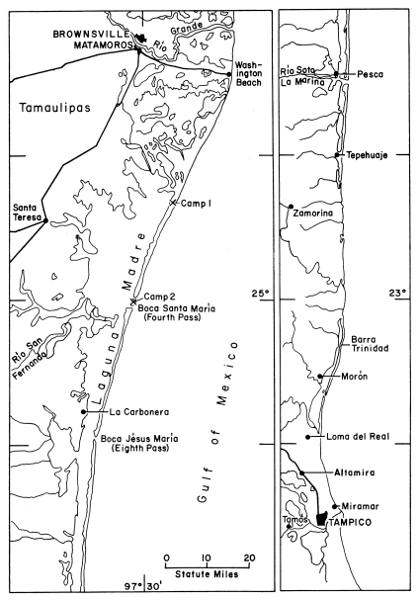 Map of coastal Tamaulipas, showing the barrier island and localities mentioned
in text. Stippled areas are extensively marshy.
Map of coastal Tamaulipas, showing the barrier island and localities mentioned
in text. Stippled areas are extensively marshy.
(Click on image for larger view.)
PLATE 6
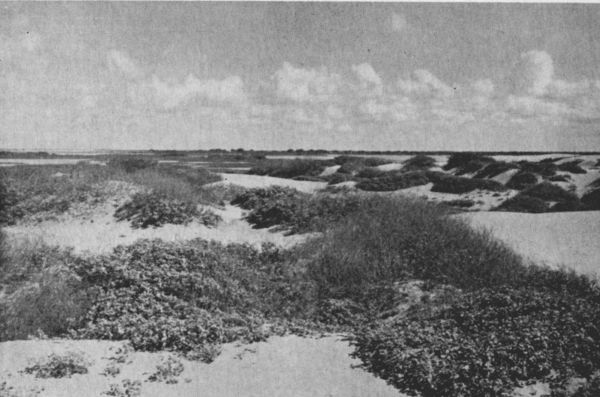 Fig. 1.—Croton and Fimbristylis on stabilized dunes; the Laguna Madre and
surrounding alkaline flats and clay dunes are visible in the background.
Habitat of Road-runner, Ord kangaroo rat, and keeled lizard.
Fig. 1.—Croton and Fimbristylis on stabilized dunes; the Laguna Madre and
surrounding alkaline flats and clay dunes are visible in the background.
Habitat of Road-runner, Ord kangaroo rat, and keeled lizard.
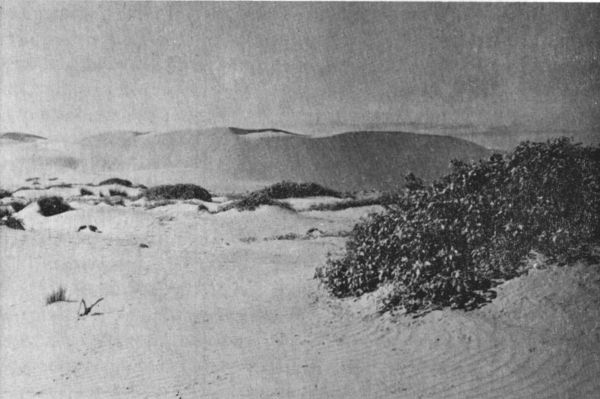 Fig. 2.—Active dune near Camp 1. Other active dunes can be seen in the
background, in the right foreground is a clump of Croton, and in the left
foreground is a small clump of Fimbristylis. Habitat of Road-runner, Ord
kangaroo rat, and keeled lizard.
Fig. 2.—Active dune near Camp 1. Other active dunes can be seen in the
background, in the right foreground is a clump of Croton, and in the left
foreground is a small clump of Fimbristylis. Habitat of Road-runner, Ord
kangaroo rat, and keeled lizard.
Arenaria interpres morinella (Linnaeus): Turnstone.—Approximately
40 individuals were noted along the beach from July 6 to 10,
mostly in small groups; the largest flock included 15 individuals.
Specimens (5): ♂, 38931, testis 4 × 1 mm., moderately fat, 107
gm., 4 P old; ♂, 38932, testis 3 × 1 mm., moderately fat, 103 gm.,
molting; 75 miles south of Washington Beach, July 8. Male, 38928,
testis 2 mm., 111 gm., 3 P old; ♂, 38929, testis 3 mm., moderately
fat, 106 gm., 6 P old; ♂, 38930, testis 2.5 mm., moderately fat, 108
gm., 6 P old; Camp 2, July 9.
The only previous record of the Turnstone in Tamaulipas is an
observation of an unspecified number at Tepehuaje on May 9, 1949
(Robins, Martin, and Heed, 1951). The dates of our records suggest
that nonbreeding birds summer along the coast of Tamaulipas. The
species is present in small numbers in summer along the central
Gulf coast of Texas (Hagar and Packard, 1952:8). Loetscher (1955:26-27)
does not report records for Veracruz in summer, but records
of the species in Yucatán on May 31, 1952 (Paynter, 1955:101), and
on June 16, 1900 (Mexican Check-list, 1950:79), probably represent
summering nonbreeders. Probably also in the same class are supposed
"migrants" seen at Coatzacoalcos on May 17, 1954, and June
4, 1955 (Coffey, 1960:290).
Inasmuch as Haverschmidt (1955:368) reports that nonbreeding
birds summering in Surinam only occasionally assume breeding
plumage, it is noteworthy that our specimens were molting from
nuptial (summer) to winter plumage. None of the nonbreeding
northern shorebirds observed by Eisenmann (1951:183) in Panamá
in summer were in nuptial plumage.
Crocethia alba (Pallas): Sanderling.—This sandpiper was noted
each day along the beach, occasionally singly but more frequently
in groups ranging from 10 to 50 individuals. Specimens (7): ♂,
38936, testis 2 mm., light fat, 49 gm., 5 P old, Camp 1, July 7.
Female, 38937, ova to 1 mm., fat, 58 gm., 4 P old; ♂, 38939, fat,
no weight recorded, 6 P old, breeding plumage; 3 ♂ ♂, 38940-38942,
fat, no weight recorded, 4-5 P old; Camp 2, July 9.
With one exception as noted, our specimens are in worn, nonbreeding
plumage and are replacing their old feathers with new
ones fundamentally the same in color and pattern; the exceptional
specimen is molting from worn breeding plumage into nonbreeding
plumage. Only one other individual in breeding feather was seen
on the island.
According to the Mexican Check-list (1950:99), the Sanderling
has been recorded in México from August to May 19. In Texas,
Peterson (1960:107) reports that it is a migrant, April to June and
July to November, and that it winters along the coast. We suspect
that many of the birds present in Texas in June and July, together
with those recorded by us in Tamaulipas in July, are nonbreeding,
summering individuals. Haverschmidt (1955:368) reports northern-summer
records from Surinam, and, according to the A.O.U. Check-list
(1957:208), nonbreeding birds occur in summer extensively
through winter range of the species, including the Gulf coast of the
United States.
Micropalama himantopus (Bonaparte): Stilt Sandpiper.—Two
birds in worn winter plumage were taken as they foraged together
at the edge of the laguna near Camp 2 on July 9. Specimens (2):
♂, 38934, testis 2.5 mm., heavy fat, 116 gm., 4 P old; ♂, 38935,
testis 3 mm., fat, 111 gm., 4 P old.
Our specimens probably were nonbreeding birds summering between
the breeding range in arctic America and the winter range
in northern South America. The A.O.U. Check-list (1957:202) does
not mention nonbreeding, summering records of this species. The
251 birds seen by Coffey (1960:292) at Cacalilao, Veracruz, on May
11, 1954, were probably migrants.
Recurvirostra americana Gmelin: American Avocet.—This species
was seen only in three large flocks flying south along the beach,
as follows: 56 birds 72 miles south of Washington Beach, July 8;
38 birds 73 miles south of Washington Beach, July 8; 29 birds 72
miles south of Washington Beach, July 10. All birds were in winter
plumage.
All these birds were possibly autumnal migrants, but the dates
are early; the species has not previously been recorded on migration
in México before August (Mexican Check-list, 1950:101). The species
is known to breed in San Luis Potosí (Mexican Check-list, loc.
cit.) and along the lower coast of Texas ("rarely to Brownsville";
A.O.U. Check-list, 1957:209); avocets thus may also breed in coastal
Tamaulipas.
Larus argentatus Pontoppidan: Herring Gull.—A first-year bird
was observed near Camp 2 on July 8, and two subadult individuals
were seen on the beach between the Third and Fourth passes on
July 8.
Larus atricilla Linnaeus: Laughing Gull.—This gull was common
all along the beach. Many individuals were in full breeding feather
and many subadult birds were also present. Specimens (6): ♂
subadult, 38944, testis 5 × 1 mm., 325 gm., molting; ♀, 38945, ovary
small, 309 gm., in molt, brood patches refeathering; sex?, 38943, 315
gm., in molt; sex? subadult, 38946, 327 gm., in molt; Camp 1, July 7.
Female subadult (second-year), 38947, 305 gm., in molt, Camp 2,
July 8. Female, 38926, ova to 2.5 mm., 313 gm., 8 P old, Camp 2,
July 10.
The Mexican Check-list (1950:105) refers to the Laughing Gull
as a common winter resident on both coasts of México from August
7 to May 17, but Loetscher (1955:29) found it locally common
throughout the year on the coast of Veracruz, and he mentioned
seeing birds a short distance south of Tampico in June and July.
The status of this gull in Tamaulipas remains to be determined;
probably it will be found breeding locally, but many of the birds
summering in eastern México are most likely nonbreeders (A.O.U.
Check-list, 1957:226).
Chlidonias niger surinamensis (Gmelin): Black Tern.—On July
6, 7, 8, 9, and on the morning of July 10, we saw this species only
occasionally, recording in total not more than 50 individuals. But,
about noon on July 10, we observed at least 300 birds in compact
flocks of about 50 individuals each between Washington Beach and
a point about 9 miles south of that locality. Approximately one in
ten birds seen was in breeding plumage, the rest being in winter
or subadult plumages, which are indistinguishable in the field. Perhaps
some of the birds seen were nonbreeding, summering individuals,
but we presume that the large groups were southbound
migrants, and we note that autumnal migrants appear in northern
Veracruz as early as July 1 (Loetscher, 1955:30). On the central
Gulf coast of Texas, Hagar and Packard (1952:9) indicate that an
influx of birds occurs in the last week of July, and small numbers
of birds, presumably nonbreeding individuals, are present along the
Gulf coast throughout June and July. Dresser (1866:45) found this
species to be "common at the Boca Grande during the summer."
Specimens (2): ♂, 38948, testis 6 mm., moderately fat, 68 gm.,
in breeding plumage, Camp 1, July 7. Female, 38949, ovary inactive,
49 gm., molt into winter feather almost complete, Camp 2,
July 10.
Hydroprogne caspia (Pallas): Caspian Tern.—The only published
record of the Caspian Tern in Tamaulipas is a report of one
seen at Lomas del Real on November 20, 1956 (Coffey, 1960:260),
but we found it moderately common all along the beach and at the
margin of the laguna. It was frequently associated with the Royal
Tern, which outnumbered it better than three to one (see Table 2).
The species is resident and breeds along the coast of Texas, and it
probably has similar status in Tamaulipas. However, in Veracruz
it is known only as a winter visitant (Loetscher, 1955:30) and
as a spring migrant (Coffey, 1960:293). Specimen: ♀, 38950, ova
to 2 mm., moderately fat, weight not recorded, 5 P old, Camp 2,
July 9.
Sterna hirundo hirundo Linnaeus: Common Tern.—We took a
specimen (♂?, 38951, no fat, 165 gm.), 49 miles south of Washington
Beach on July 8, and saw two others over the laguna at Camp 2
on July 9. Our specimen had nearly finished with molt and feather
growth into adult winter plumage. The status of Common Terns
in Tamaulipas is uncertain; our record, and records from Tamós on
July 1, 1952, and June 12, 1953 (Loetscher, 1955:29), probably pertain
to nonbreeding, summering birds. Yet, the species has bred
on the Texas Gulf coast (A.O.U. Check-list, 1957:235), and it reasonably
may be expected to nest in Tamaulipas. Coffey (1960:293)
saw two individuals at Altamira on May 10, 1954.
Sterna forsteri Nuttall: Forster Tern.—Six were recorded near
Camp 1 on July 7, and two were seen on the beach on July 6 and 10.
The Mexican Check-list (1950:108) does not cite records for
Tamaulipas, but the A.O.U. Check-list (1957:234) includes northern
Tamaulipas within the breeding range. Evidence suggesting breeding
of the species in extreme northern Veracruz is reported by
Loetscher (1955:29) in the form of a female specimen with "ovary
greatly enlarged" taken seven miles west of Tampico on May 30,
1947. In the same area the species also seems to spend the summer
as a nonbreeder, for Loetscher (loc. cit.) saw 20, nearly all in nonbreeding
plumage, on July 1, 1952.
Specimens (4): ♂, 38952, testis 4.5 mm., 150 gm., 8 P old; ♂,
38955, testis 2 mm., 138 gm., 2 P old; ♂, 38953, testis 5 × 1 mm., 142
gm., 5 P old; ♀, 38954, ova to 1 mm., 148 gm., 2 P old; Camp 1,
July 7.
Sterna albifrons antillarum (Lesson): Least Tern.—The status
of this species in Tamaulipas is uncertain, but there is reason to
believe that it breeds, at least in small numbers. We found the
species moderately common and generally flying about in twos,
possibly mated pairs, near both camps and on the beach. Breeding
is suggested by the large sizes of the testes of the two males collected
and by the presence of brood patches on a female taken on July 6,
but we have no direct evidence of nesting in Tamaulipas, and it
should be noted that this species is known to spend the summer in
nonbreeding condition at many places (A.O.U. Check-list, 1957:239).
Loetscher (1955:30) suggests that the species may be found
breeding in Veracruz and mentions a record of 15 seen at Miramar,
Tamaulipas, on June 26, 1952. Dresser (1866:45) found it to be
"abundant" at the "Boca Grande" in summer.
On July 10, we saw flocks of 15 to 20 individuals flying along the
beach a few miles south of Washington Beach.
Specimens (4): ♂, 38958, testis 11 × 4 mm. (right testis 5 × 4
mm.), light fat, 45 gm., 6 P old; ♂, 38959, testis 11 × 4 mm. (right
testis 7 × 4 mm.), light fat, 45 gm., 6 P old; ♀, 38956, ova to 2.5
mm., 42.5 gm., 6 P old, brood patches refeathering; Camp 1, July 6.
Female, 38957, ova to 1 mm., 44 gm., Camp 1, July 7. This last
specimen had essentially completed the autumnal molt into winter
plumage, with only a few feathers remaining ensheathed basally.
Our specimens are referable to S. a. antillarum, being paler dorsally
and slightly lighter gray on the hind-neck than specimens of
S. a. athalassos from Kansas, with which they were compared.
Thalasseus maximus maximus (Boddaert): Royal Tern.—This
species was common all along the beach, occurring for the most
part in flocks of from ten to 50 individuals in association with Cabot
Terns. Data on gonadal condition and brood patches of some of
our specimens suggest that breeding occurs in coastal Tamaulipas, as
previously reported by the Mexican Check-list (1950:110). Robins,
Martin, and Heed (1951) report seeing one Royal Tern near Tepehuaje
on May 9, 1949, and Dresser (1866:44) found the species
"common at the Boca del Rio Grande during the summer."
Specimens (6): ♂, 38960, testis 9 × 4.5 mm., not fat, 484 gm., 6
P old, brood patches refeathering, 4 miles south of Washington
Beach, July 6. Male, 38961, testis 7 × 3 mm., 455 gm., no brood
patches, 8 miles south of Washington Beach, July 6. Male, 38962,
testis 10 × 5 mm., 387 gm., brood patches refeathering; ♀, 38963,
ova to 1 mm., 358 gm., 3 P old; ♀, 38964, ova to 3 mm., 389 gm.,
8 P old; Camp 1, July 7. Female, 38994, ova to 2 mm., 536 gm.,
brood patches refeathering, Camp 2, July 10.
Thalasseus sandvicensis acuflavidus (Cabot): Cabot Tern.—This
tern was moderately common along the beach and margin of the
laguna, and it was seen frequently in company with Royal Terns.
Like the latter, this tern breeds in coastal Texas (A.O.U. Check-list,
1957:241), and it probably also nests in Tamaulipas, although direct
evidence is not available. The only previous record of this species
in Tamaulipas is a report (Robins, Martin, and Heed, 1951) of two
observed on the beach near Tepehuaje on May 9, 1949.
Specimens (4): ♂, 38965, testis 9 × 4.5 mm., 208 gm., 9 P old,
49 miles south of Washington Beach, July 8. Male, 38966, testis
8 × 3 mm., not fat, 192 gm., 8 P old; ♀, 38967, ova to 3 mm., 193
gm., 7 P old, brood patches refeathering; ♀, 38968, ova to 1 mm.,
186 gm., 8 P old, no brood patches; 52 miles south of Washington
Beach, July 8.
Rynchops nigra nigra Linnaeus: Black Skimmer.—We found this
species moderately common at the edge of the laguna at both camps
and occasionally saw it along the beach. Generally two birds, probably
mated pairs, were seen together; twice birds were seen carrying
food in their bills, presumably intended for nestlings. The species
is known to nest in Tamaulipas from "Matamoros Lagoon" south to
Tampico (Mexican Check-list, 1950:112).
Specimens (2): ♂, 38970, testis 40 × 23 mm. (abnormally large,
possibly as a result of hemorrhage), 418 gm., brood patches refeathering;
♂, 38969, testis 17 × 4 mm., fat light, 442 gm., brood
patches refeathering; Camp 1, July 7.
Zenaidura macroura Linnaeus: Mourning Dove.—Our only record
is a lone bird seen in a mesquite near Camp 1 on July 6. Possibly
the species breeds along the margin of the laguna, although Aldrich
and Duvall (1958:113, map) do not include coastal Tamaulipas in
the known breeding range. Loetscher (1955:30) suggests that the
Mourning Dove may be found breeding in the lowlands of northern
Veracruz and cites a record of one seen at Tamós on July 1, 1952.
Geococcyx californianus (Lesson): Road-runner.—At least four
individuals were seen in large dunes at Camp 1 on July 7 and 8.
On several occasions we watched them pursue lizards (Holbrookia
propinqua) at the margins of clumps of Croton and Ipomoea.
Chordeiles minor aserriensis Cherrie: Nighthawk.—Nighthawks
of this species were seen regularly at Camp 1, where we flushed
them from alkaline flats in the day and heard them calling as they
foraged over the dunes in late afternoon.
Specimens (3): ♂, 38971, testis 5 mm., no fat, 62 gm., Camp 1,
July 6. Male, 38972, testis 7.5 mm., no fat, 58 gm.; ♂, 38973, testis
?, no fat, 53 gm.; Camp 1, July 7. The gonads of these birds were
not in full breeding condition, but it is highly probable that the
birds were members of a population that had bred in the area.
Variation in Chordeiles minor in Tamaulipas has recently been
studied by Graber (1955). Two specimens taken by him on August
3, 1953, approximately 9 miles south of Carbonera, resemble birds
from Terrell County, Texas, and represent C. m. aserriensis, as do
our three birds from the barrier island. Two of Graber's specimens
from Lomas del Real, in southeastern Tamaulipas, are distinctly
darker and probably represent C. m. neotropicalis, a subspecies subsequently
described from Chiapas (Selander and Alvarez del Toro,
1955).
Muscivora forficata (Gmelin): Scissor-tailed Flycatcher.—On
July 7 near Camp 1, two individuals were found in stands of mesquite.
One was taken and proved to be an adult male (38974, testis
6 × 3 mm., not fat, 40 gm.) in postnuptial molt (6 P old).
We presume that the two birds recorded by us were members of
a population breeding on the barrier island, rather than autumnal
migrants. The Mexican Check-list (1957:69) records this species
in México only as a transient and winter visitant. But, on the basis
of records of birds seen along the highway between Matamoros and
Ciudad Victoria, Davis (1950) has suggested that the species breeds
in Tamaulipas, and this is supported by a report of one seen at the
north end of the Monterrey Airport on June 1, 1957 (Coffey, 1960:294).
Brown (1958) has recently established that the species breeds
in Nuevo León by finding a nest 33 kilometers (by road) north of
Sabinas, Hidalgo, on July 19, 1954.
Myiarchus cinerascens cinerascens (Lawrence): Ash-throated
Flycatcher.—A juvenal male (38975, testis 2 mm., no fat, 35.0 gm.)
taken in mesquite at Camp 1 constitutes our only record for this
species. Lanyon (1961:441, map) has shown that most of Tamaulipas
is devoid of these flycatchers in the breeding season; the nearest
known breeding Ash-throated Flycatchers are slightly west of
Corpus Christi, Texas, about 200 miles north-northwest of Camp 1
on the barrier beach. Our specimen closely resembles eight specimens
from Coahuila, México, in general coloration and, especially,
in the pattern of colors on the outer rectrices. Probably No. 38975
was from southwestern Texas or Coahuila and had begun its southward
migration. Against this idea lies chiefly the fact that young-of-the-year
tend to move south later than adults of the same species;
so, this bird possibly had been reared in coastal Tamaulipas.
Eremophila alpestris giraudi (Henshaw): Horned Lark.—This
species occurred in moderate numbers on alkaline flats and almost
barren sand flats at both camps. At the time of our visit to the
island, the breeding season apparently was coming to an end, but
we noted no tendency in the birds to flock.
Specimens (7): ♂, 38981, testis 6 mm., 21.0 gm.; ♂, 38977,
testis 7.5 × 4 mm., not fat, 27.5 gm.; ♂, 38979, testis 11 × 7 mm., 29.0
gm.; ♀, 38976, ova to 3 mm., brood patch vascular but regressing,
no fat, 24.4 gm.; sex? juv., 38987, no fat, 21.0 gm.; sex? juv., 38980,
24.0 gm.; Camp 1, July 7. Male, 38982, testis 9.5 × 6 mm., 27.5 gm.,
Camp 2, July 9.
The subspecies E. a. giraudi, which is endemic to the Gulf coastal
plain of Texas and Tamaulipas, has been reported in Tamaulipas
previously only from Bagdad, near Matamoros (Mexican Check-list,
1957:106). The fact that our specimens show characters totally
consistent with those of E. a. giraudi indicates that there is little
genetic interchange between the population we sampled and those
of E. a. diaphora, the closest of which reportedly breeds at Miquihana,
in southwestern Tamaulipas.
Corvus cryptoleucus Couch: White-necked Raven.—Several
groups of six to ten birds were present at Washington Beach on July
6 and 10; but, southward on the island, we recorded this species only
once, on July 9, when a lone individual flew near Camp 2, being
pursued and "buzzed" by two Least Terns. The Mexican Crow
(Corvus imparatus) reportedly is common in the coastal region of
Tamaulipas (Mexican Check-list, 1957:118) but was not seen by us.
Thryomanes bewickii cryptus Oberholser: Bewick Wren.—This
species seemingly breeds in small numbers in mesquite stands near
Camp 1, where we obtained a juvenile and saw another individual.
Specimen: ♀ juv., 38983, no fat, 10.0 gm., Camp 1, July 8. T. b.
cryptus is reported to intergrade with T. b. murinus of Veracruz in
southern Tamaulipas (Mexican Check-list, 1957:160-161).
Mimus polyglottos leucopterus (Vigors): Northern Mockingbird.—We
recorded this species only near Camp 1, where a few pairs
were breeding in stands of mesquite. Males were in full song and
territorial display.
Specimens (2): ♂, 38985, testis 11 × 7 mm., not fat, 43 gm.; ♀,
38984, ova to 4.5 mm., vascular brood patch, 49.0 gm.; Camp 1,
July 7.
PLATE 7
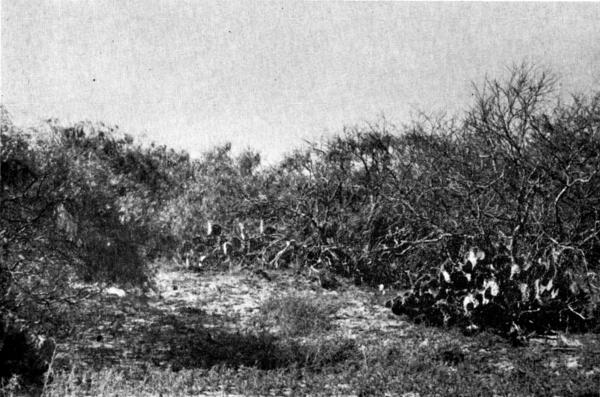 Fig. 1.—Mesquite-cactus formation on clay dune at margin of the Laguna
Madre west of Camp 1. Habitat of Northern Mockingbird, Cardinal, Bob-white,
black-tailed jackrabbit, and Great Plains woodrat.
Fig. 1.—Mesquite-cactus formation on clay dune at margin of the Laguna
Madre west of Camp 1. Habitat of Northern Mockingbird, Cardinal, Bob-white,
black-tailed jackrabbit, and Great Plains woodrat.
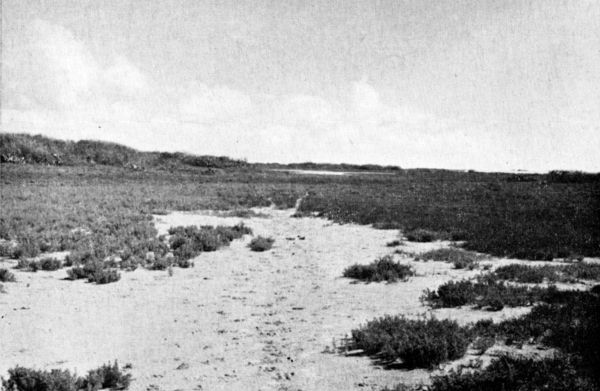 Fig. 2.—Batis-Monanthochloë formation on alkaline flats near the Laguna
Madre, with mesquite bordering stabilized dunes in the left background.
Salicornia, a classical dominant of salt marshes, is here relatively inconspicuous.
Habitat of Nighthawk and Horned Lark.
Fig. 2.—Batis-Monanthochloë formation on alkaline flats near the Laguna
Madre, with mesquite bordering stabilized dunes in the left background.
Salicornia, a classical dominant of salt marshes, is here relatively inconspicuous.
Habitat of Nighthawk and Horned Lark.
PLATE 8
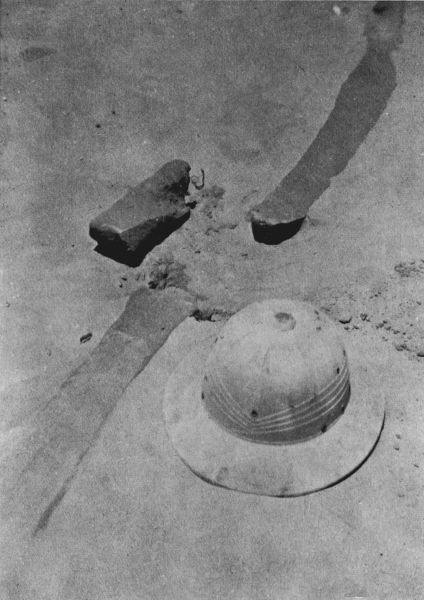 "Fossilized" burrow of Texas Pocket Gopher in a sandy trough between active
dunes. A part of the cast has been broken away to show the general shape
of the old burrow. The diameter of the cast is about 3.5 inches.
"Fossilized" burrow of Texas Pocket Gopher in a sandy trough between active
dunes. A part of the cast has been broken away to show the general shape
of the old burrow. The diameter of the cast is about 3.5 inches.
Cassidix mexicanus prosopidicola Lowery: Great-tailed Grackle.—Small,
postbreeding flocks composed of both adult and juvenal
birds were seen moving along the edge of the laguna at Camp 1.
In the morning the flocks flew south, and in the afternoon groups
of similar size flew north, presumably to a roost at an undetermined
distance north of our camp. Occasionally, a few birds stopped to
rest or to forage on the dunes or in stands of mesquite. At Camp 2
on July 9, a postbreeding adult female and a well-grown, presumably
independent juvenile were taken as they perched in a clump of
mesquite in which we found three old nests of Cassidix; two of the
nests were about four feet apart in one tree, and the third was in
another tree 100 feet from the first.
Specimens (4): ♂ adult, 38988, testis 6 mm., no fat, 209 gm.,
6 P old, Camp 1, July 7. Female, 38989, ova to 3 mm., fat, 115 gm.,
old brood patch, Camp 1, July 8. Female, 38990, ova to 1 mm.,
moderate fat, 107 gm., 7 P old, brood patch refeathering; ♂ juv.,
38991, testis 3 × 1 mm., not fat, 172 gm., 6 P old; Camp 2, July 9.
Table 4.—Measurements in Millimeters of Adult Males of
Cassidix Mexicanus
| Locality |
No. |
Wing |
Tail |
Tarsus |
Weight in
grams |
| Austin, Texas |
17-137[1] |
184.3
(173-200) |
203.8
(178-232) |
46.38
(41.8-50.0) |
225.6 June
(204-253)
202.2 July
(195-207) |
| San Patricio Co., Texas[2] |
5 |
185.2
(182-188) |
204.2
(190-219) |
46.74
(45.1-50.2) |
237.6
(228-245) |
| Barrier Is., Tamps. |
1 |
178 |
185 |
47.1 |
209 |
| Victoria, Tamps.[3] |
4 |
192.2
(186-200) |
224.2
(215-232) |
47.77
(46.0-49.1) |
254.3
(239-276) |
| Tampico, Tamps.[4] |
1 |
197 |
214 |
48.3 |
260 |
| Catemaco, Veracruz[5] |
1 |
193 |
216 |
48.2 |
257 |
Specimens from the barrier island are clearly referable to C. m.
prosopidicola, showing no approach to the larger and, in the female,
darker C. m. mexicanus of Veracruz and San Luis Potosí. In Table
4, measurements of the adult male from the barrier island may be
compared with those of specimens of C. m. prosopidicola from Texas
and a specimen of C. m. mexicanus from Veracruz; it is apparent
that our specimen is assignable to the former.
Evidence of intergradation between the two subspecies is shown
in a series of birds collected near Ciudad Victoria, Tamaulipas, in
May, 1961. The females in the series are highly variable in color
individually, but are on the average paler than C. m. mexicanus from
Veracruz; the males are distinctly larger than C. m. prosopidicola
from Texas. At Miramar, near Tampico, Tamaulipas, a decided
approach to C. m. mexicanus is also evident in the dark color of
females and in the large size of both males (Table 4) and females.
Agelaius phoeniceus megapotamus Oberholser: Red-winged
Blackbird.—This species was recorded only at Camp 1 on July 7,
when we saw two males, one of which was flying south along the
edge of the dunes in a flock of five Great-tailed Grackles. Specimen:
♂, 38992, testis 10 × 7 mm., fat, 54 gm., Camp 1, July 7. The large
size of the testes of this individual indicates breeding condition.
Sturnella magna hoopesi Stone: Eastern Meadowlark.—Meadowlarks
were found in small numbers along the margins of the alkaline
flats at both camps. Breeding was still in progress, for males were
singing and a female shot on July 9 had only recently laid eggs.
Specimens (2): ♂, 38986, testis 13 × 8 mm., not fat, 102 gm.; ♀,
38987, ova to 6 mm., 3 collapsed follicles, not fat, 88 gm.; Camp 2,
July 9.
Richmondena cardinalis canicaudus Chapman: Cardinal.—This
species was recorded only in stands of mesquite near Camp 1, as
follows: July 7, two pairs seen, from which a breeding female was
taken; July 8, three birds seen. Specimen: ♀, 38933, edematous
brood patch, 36.5 gm., Camp 1, July 7. Intergrades between the
present subspecies and R. c. coccinea of Veracruz are reported from
Altamira, Tamaulipas (Mexican Check-list, 1957:329).
Dasypus novemcinctus mexicanus Peters: Nine-banded Armadillo.—Remains
of an armadillo (89017) were found in a mesquite
thicket in the dunes near Camp 1 on July 7. The bones are not badly
weathered and were not embedded in sand.
This species has not been recorded previously on the barrier
island of Tamaulipas, nor, for that matter, on any of the barrier
islands on the western shore of the Gulf of Mexico.
Lepus californicus merriami Mearns: Black-tailed Jackrabbit.—From
two to four individuals were recorded daily in dunes and on
alkaline flats in the vicinity of stands of mesquite and cactus.
Specimens (2): ♀ adult, 89018, pregnant (two embryos, 28 mm.
in crown-rump length), Camp 1, July 6. Male immature, 89019,
Camp 1, July 7. Our specimens have been compared with two skins
of L. c. curti from the type locality at Eighth Pass, with which they
agree reasonably well in color. The size of the adult female is about
that characteristic of other specimens of adult L. c. curti, but characters
of the skull are consistent with those of L. c. merriami.
A specimen of this species from Matamoros and several from
Brownsville, Texas, have been assigned by Hall (1951:43) to L. c.
merriami. Specimens from Padre Island, Texas, reportedly resemble
L. c. curti in smallness of the tympanic bullae but are in other characters
referable to L. c. merriami (Hall, 1951:44).
Spermophilus spilosoma annectens (Merriam): Spotted Ground
Squirrel.—These squirrels were moderately common in dunes at
both camps. They were heard calling, and many tracks and holes
were seen. On July 7, at Camp 1, a lactating, adult female (89020)
and two dependent juveniles (89021, skull only, 89022, skin and
skull) were shot at the entrance of a burrow; the uterus of the adult
showed six placental scars.
Our adult specimen has been compared with ten specimens obtained
by Hall and von Wedel at Eighth Pass in March, 1950; ours
differs from the ten in being paler and slightly larger. The pallor
is perhaps attributable to seasonal variation, and the size (246-79-38-7;
weight, 133 gm.) is within limits that would be expected in a
larger series of the population sampled by Hall and von Wedel.
Hall (1951:38) referred specimens of this squirrel from Eighth
Pass to S. s. annectens.
Geomys personatus personatus True: Texas Pocket Gopher.—This
pocket gopher was abundant on low, stabilized dunes on the
barrier island from four to 73 miles south of Washington Beach.
One of us (Wilks) made a trip down the beach on May 20 and 21,
1961, and collected specimens at localities four miles south and 33
miles south of Washington Beach; additional specimens were taken
at both Camp 1 and Camp 2 from July 6 to 10. At these localities
the gophers seemed to maintain population densities approximating
those of G. personatus on Padre and Mustang islands on the Texan
coast.
There is but one other record of the Texas Pocket Gopher from
México. Goldman (1915) described G. p. tropicalis from Altamira
on the basis of specimens collected in 1898. Since that time, the
species has not been reported as occurring south of Cameron County,
Texas (Kennerly, 1954), some 50 miles northwest of the closest
station of occurrence of the gophers on the barrier beach of
Tamaulipas.
Our specimens are slightly smaller than G. p. personatus and
slightly larger than G. p. megapotamus, the subspecies of nearest
geographic occurrence to the barrier island. The degree to which
our specimens differ in other respects, such as configuration of the
pterygoid, is being studied further by Wilks. For the present,
reference of our material to the nominate subspecies best expresses
the relationships of these coastal gophers.
The fact that pocket gophers from the Tamaulipan barrier island
occupy a position geographically intermediate between present
Texan populations and the isolated population in southern Tamaulipas
(G. p. tropicalis) helps explain the origin of the latter. It is
likely that G. p. tropicalis represents the southern remnant of a once
continuously-distributed population of pocket gophers living in
coastal Tamaulipas in mid-Wisconsin to late Wisconsin time. At
that time, sea level is thought to have been considerably lower than
at present, exposing a sandy strip 80 to 100 miles wide off the present
coastline. Presumably this would have been an area suitable for
gophers and for southward dispersal of individuals from Texas.
The only conceivable barrier to dispersal, and thus to a panmictic
population, would have been the Rio Grande, but over the wide,
low and sandy coastal plain the river channel almost certainly shifted
regularly, thus decreasing its effectiveness as a barrier to movement.
With subsequent rise in sea level, the gophers at Altamira became
isolated and have presumably remained so for a considerable time.
To judge by the marked morphologic differentiation of G. p. tropicalis,
its degree of isolation from other populations has been much
greater than those of populations inhabiting the Tamaulipan barrier
island and the barrier islands of the coast of Texas. Contact between
the latter two populations was probably fairly regular before
man's stabilization of the channel of the lowermost reaches of the
Rio Grande.
At Camp 1 we found evidence of the former occurrence of gophers
in an area now largely covered by active beach dunes. Numerous
skeletal parts of gophers and "fossilized" burrows (Plate 8) were
found on the surface where troughs between active dunes reached
down to an older, darker, and more tightly cemented layer of sand
underlying the present dunes. It is clear that these gophers were
not transported there, because the bones were not damaged, some
of the skeletons were almost complete, and many of the bones were
found near the "fossilized" burrows. Weathered but well preserved
skeletal remains of at least 12 gophers were picked up at this site.
Specimens (17): ♀, 89023, Camp 1, May 20. 4 ♀ ♀, 89024-026,
89029; 3 ♂ ♂, 89027, 89028, 89030; Camp 1, May 21. Male,
89031, Camp 1, July 6. Three ♂ ♂, 89032, 89035, 89038; 4 ♀ ♀,
89033, 89034, 89036, 89037; Camp 2, July 9. Female, 89039, Camp
2, July 10.
Perognathus merriami merriami Allen: Merriam Pocket Mouse.—An
individual taken in a trap in the dunes near Camp 2 constitutes
the first record of this species from the barrier island of Tamaulipas.
This pocket mouse seems to be uncommon on other barrier islands
of the western Gulf of Mexico, for there is only one published report
of its occurrence on Padre Island, Texas (Bailey, 1905:141). Other
nearby stations of occurrence are Altamira, Tamaulipas (Hall and
Kelson, 1960:477), Brownsville, Texas (Bailey, loc. cit.), and 17
miles northwest of Edinburg, Texas (Blair, 1952:240).
Specimen: sex?, 89040, skull only, Camp 2, July 10.
Dipodomys ordii parvabullatus Hall: Ord Kangaroo Rat.—We
found this species uncommon and confined in distribution to dunes,
in which it was recorded as follows: an adult female was shot and
two other individuals were seen at night on July 6 at Camp 1; three
were trapped near Camp 1 on July 7; two were trapped at Camp 2
on July 10.
Specimens (5): ♀, 89041, 2 placental scars, 46 gm., Camp 1,
July 6. Male, 89042, testes scrotal, 47 gm.; ♂, 89044, 60 gm.; ♀,
89043, 44 gm.; Camp 1, July 7. Sex?, 89045, skel. only, Camp 2,
July 10.
Our material does not differ significantly from specimens obtained
by Hall and von Wedel at Boca Jésus María in March, 1950, which
formed the basis for Hall's description (1951:41) of D. o. parvabullatus.
This subspecies is presumably confined in distribution
to the barrier island of Tamaulipas. Two immature specimens from
Bagdad, Tamaulipas, were tentatively assigned by Hall (1951:41)
to D. o. compactus, a subspecies known otherwise only from Padre
Island, Texas.
Neotoma micropus micropus Baird: Southern Plains Woodrat.—This
species was noted only near Camp 1, where numerous houses
were seen in stands of mesquite and prickly-pear cactus and an adult
male (89046, 330 gm.) was taken on July 6. This species has not
been reported previously from the barrier island of Tamaulipas. Our
specimen is referable to the nominate subspecies and shows no
approach to N. m. littoralis, a subspecies known only from the type
locality at Altamira, Tamaulipas (see map, Hall and Kelson, 1960:684).
Procyon lotor (Linnaeus): Raccoon.—A weathered skull and a
broken humerus were found at Camp 2. The skull is being studied
by Dr. E. L. Lundelius, who informs us that it matches a number
of raccoon skulls found in archaeological sites along the Balcones
Escarpment of Texas. Such skulls are larger than skulls of raccoons
occurring today in Texas (P. l. fuscipes) and closely resemble skulls
of raccoons (P. l. excelsus) presently confined in distribution to
Idaho, eastern Oregon, and eastern Washington. Further details of
this situation are to be reported elsewhere by Lundelius.
Taxidea taxus (Schreber): Badger.—Two burrows were found
in the stabilized dunes near Camp 1, tracks were noted on the alkaline
flats, and a weathered skull (89047) was found on the flats west
of Camp 1 on July 7. The skull appears to be of an immature animal,
for the sutures are not well closed and the teeth show little wear.
Our records require an extension of known range of this species
southeasterly by approximately 50 miles. The only previous record
in coastal Tamaulipas is based on two skulls from Matamoros
(Schantz, 1949:301). The skull from the barrier island cannot be
determined to subspecies but on geographic grounds is referable
to T. t. littoralis, with type locality at Corpus Christi, Texas.
Canis sp.—Numerous tracks made either by Coyotes (C. latrans
Say) or by domestic dogs were seen in dunes and on the beach at
both camps. A weathered, posterior part of a canid skull was found
in dunes at Camp 2 on July 10, and a partial left mandible was taken
on the beach at Camp 1 on July 6. Unfortunately, specific identification
of the skull fragments is not possible, but the few reasonably
good characters that we can use suggest that our material is of
domestic dogs rather than of Coyotes. Hall (1951:37) found tracks
and other signs of Coyotes at Eighth Pass but did not take specimens.
Most of the canid scats examined by us contained remains of crabs
and fishes.
Odocoileus virginianus (Boddaert): White-tailed Deer.—A
weathered Recent fragment of a mandible (89048) and part of a
femur (89049) of this species were found near Camp 1 on July 7,
and a metapodal was picked up in the dunes at Camp 2 on July 9.
This species has not been reported previously on the barrier island
of Tamaulipas and it probably no longer occurs there, for we saw
no tracks or other signs of it. Hall (1951) did not find it at Eighth
Pass.
Our specimens probably pertain to O. v. texanus but are possibly
of O. v. veraecrucis, which has been reported from Soto la Marina
(Goldman and Kellogg, 1940:89).
The only species of mammal known from the barrier island of
Tamaulipas that we did not find is the Hispid Cotton Rat (Sigmodon
hispidus). Two specimens of this species trapped near Eighth Pass
in March, 1950, formed the basis for the description of S. h. solus
(Hall, 1951:42), a subspecies known only from the type locality.
