There are few painters of whose private life so
little is known as of that of Veronese. The contemporary
documents have disappeared and scarcely
anything more remains than a few of his letters;
and even those are silent as to his day-by-day existence.
All that it is possible to know—and to this
his paintings abundantly bear witness—is that he
was possessed of an agreeable humour, and a pleasing
personality;—worthy gentleman, somewhat quick
of temper and permitting no slight to be put upon
his dignity, still less upon his honour. He was neither
a sycophant nor a courtier, accepting commissions
but never soliciting them. His “disinterestedness,”
writes Charles Yriarte, “has remained celebrated;
during one entire period of his life, the greater part
of the contracts which he signed with communities
and with convents stipulate barely the value of his
time as a remuneration for his work. This was before
the time when painters were expected to furnish their
colours and their canvases, but demanded only the
price of their toil. Later on, having become, if not
rich—that he never was,—at least celebrated and
independent, he acquired a taste for personal luxury;
he delighted in brilliant fabrics and wore them with
ostentation; he loved horses, dogs, and hunting; he
frequented high society, and brought to it that Italian
open-heartedness which makes the company of the
illustrious a relaxation and a pleasure rather than an
embarrassment or an effort. He won valuable friendships
and was able to retain them until his death.”
Of these friendships, the most efficacious was that
of the Prior of the convent of San Sebastiano, Bernardo
Torlioni, a Veronese by birth, to whom he had
brought letters of introduction. No sooner had young
Caliari arrived in Venice at the beginning of 1555,
than he presented himself to his venerable compatriot,
who promptly took a fancy to him, and bestirred
himself to serve him. Thanks to Torlioni, Paolo obtained
an order for five pictures, including one large
composition, the Coronation of the Virgin and four
dependent panels. These paintings were destined
to adorn the sacristy of the church of San Sebastiano,
of which Bernardo Torlioni was prior. When the work
was done, the Chapter expressed itself as so well
pleased that it entrusted him with the decoration of
the church itself, including the ceiling. It was here
that Veronese painted his admirable series of episodes
from the History of Esther and Ahasuerus.
The success of this series was so great that the
edifice was placed unconditionally in his hands, and
he was free to follow his fantasy unhampered. Following
a method which was habitual with him, he
enhanced the effect of the large panels painted in
fresco, by means of smaller intervening scenes in
chiaroscuro. Here also one finds him indulging his
hobby for architectural painting, such as always
occupies a large place in his pictures; all around the
church he painted truncated columns, ornamented
with arabesques and foliage, “with a richness and a
pomp that were already an inseparable feature of his
style.”
In the works of Veronese, the accessories always
play a highly important part; and it is not difficult
to understand the reason. His main object being to
delight the eye, he attributed considerable space to
vases, furniture, armour, fruits, flowers, graceful draperies,
brilliant costumes, mettlesome horses, and more
especially dogs, with which it was his special whim to
embellish his paintings. The dog was his favourite
animal, and even at that epoch its presence was to be
noted in every picture.
When the church, completely decorated, was
opened to the public, there was general rejoicing;
Veronese received the unanimous vote of approval,
from the populace as well as from the artists.
From that day forth, the ability of the young
painter was openly acknowledged, and his fortune
assured. Furthermore, he had arrived in Venice at
a propitious hour. It was the moment when the
Most Serene Republic, victorious over the seas and
surfeited with wealth, attained the zenith of her glory.
In her opulence Venice chose to employ her treasures
in self-adornment; palaces arose on all sides, the Ducal
Palace itself was redecorated; Sansovino was just
completing the new Government offices. The wealthy
brotherhoods and equally wealthy parishes were seeking
out every painter of repute to decorate their
churches and their convents.
Accordingly, Veronese had arrived at the crucial
moment to satisfy the demands of art. His rivals
were negligible: Salviati, Battista Franco, Lo Schiavone,
Zelotti, Orazio Vocelli the son of Titian, could
none of them hold their own against him. Bordone
was at the court of Francis I. Tintoretto alone, at
the height of his powers, could counterbalance Veronese’s
glory. As to the aged Titian, he was no longer
producing pictures with his old-time fertility; furthermore,
he had already divined the genius of Veronese
and conceived a friendship for him.
And so, throughout thirty-three years, from 1555
to 1588, the masterpieces that were born beneath
Veronese’s fingers succeeded one another without
interruption. The walls of his adopted city became
overspread with his luminous canvases, eloquent of
the joyousness of Italy, resplendent with the triumphant
beauty of Venice.
Shortly after the decoration of San Sebastiano was
completed, Daniele Barbaro, Patriarch of Aquileia
and wealthy patrician of Venice, had a splendid
residence built him at Masiera by Palladio, a celebrated
architect of the period. Being a man of artistic
taste, he wished to embellish it with paintings and
statues worthy of its imposing architecture. For
the sculpture he summoned Alessandro Vittoria; the
paintings were entrusted to Paolo Veronese.
The patriarch Barbaro was one of his friends, and
accordingly allowed him a free hand, and even left
the choice of subjects to him.
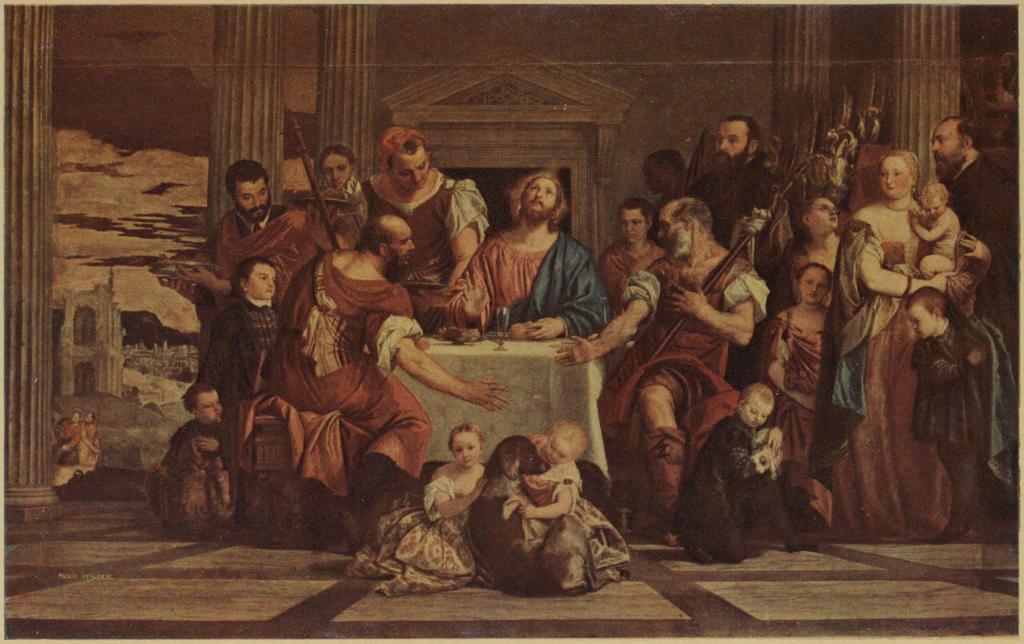
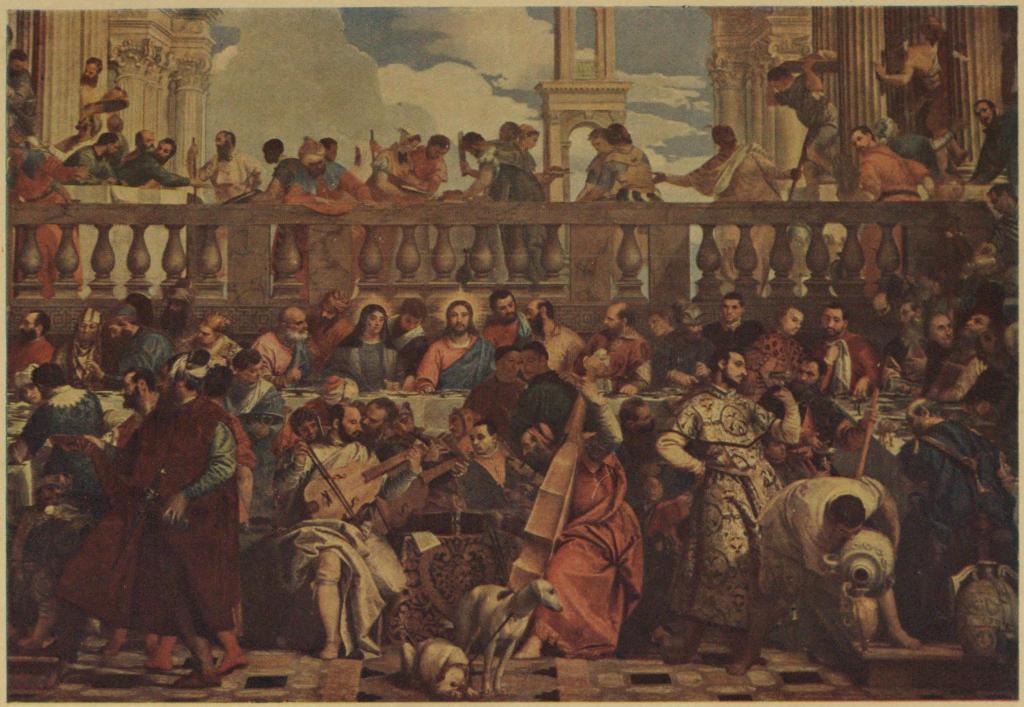
PLATE IV.—THE WEDDING AT CANA
(In the Musée du Louvre)
This immense composition is the most celebrated work by
Veronese. It is considered as one of the masterpieces of all painting.
The greater number of the guests at this feast are portraits
of illustrious characters of the sixteenth century, and the artist has
included himself, along with Tintoretto and Titian, in the group of
musicians in the foreground.
Veronese, who was a prodigiously fertile artist,
left not a single space in Barbaro’s house unoccupied
with colour. Wherever space would not permit of
large compositions, he painted trophies, garlands,
flowers, even statues, possessing all the lustre and
relief of marble. Elsewhere he sketched in architectural
fantasies, simulating colonnades and porticoes,
opening upon landscapes borrowed from the
realm of dreams; he conceived imaginary doors,
before which fictitious lacqueys appeared to be standing.
The principal subjects treated by Veronese at Masiera
include Nobility, Honour, Magnificence, Vice, Virtue,
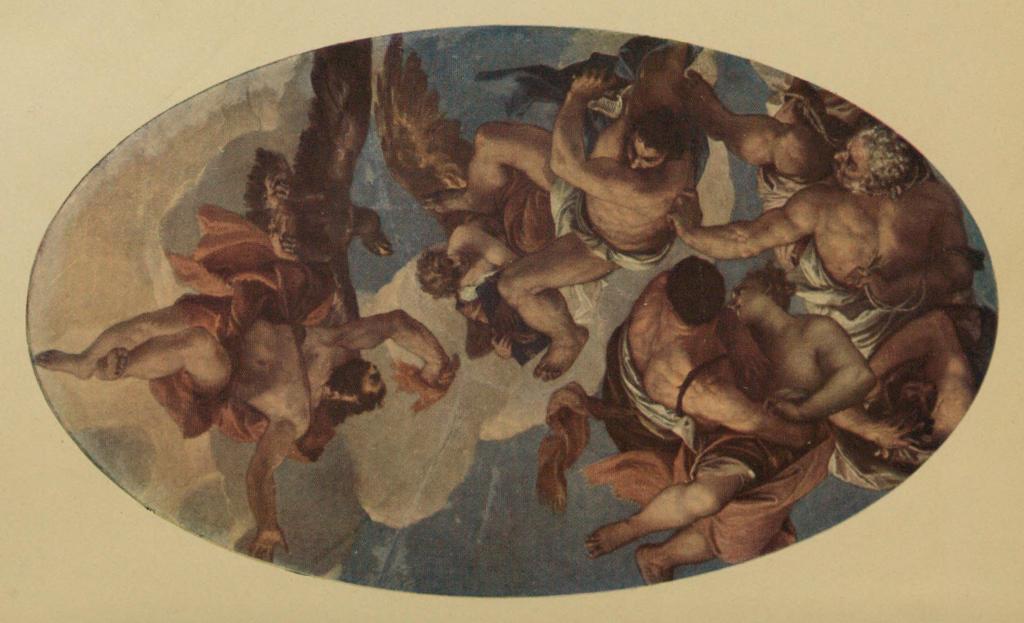
Flora, Pomona, Ceres and Bacchus; then in the ceiling
of the cupola he gathered together all the gods of
Olympus, grouped around Jupiter.
The decorations in the palace at Masiera further
augmented Veronese’s fame. He was now acknowledged
to be the foremost painter of Venice, next to
Titian. Barbaro had been so delighted with his
talents that he determined to do him a service. Standing
well at court, he recommended him to the Signoria.
As a result of this, the latter entrusted him with the
task of redecorating the halls and chambers of the
Doge’s Palace, in conjunction with Tintoretto and
Orazio Titian. Which of the three artists proved
superior it is impossible to decide to-day, because a
fire, occurring in 1576, destroyed their paintings along
with the palace. But public opinion of that period
gave the palm to Veronese.
It seems as though this verdict must have been
justified, in view of the esteem in which his name
was held.
Shortly afterwards, Sansovino having completed
the construction of the library, the procurators instructed
the architect to arrange with Titian as to a
choice of painters to decorate it in competition. Veronese
was immediately designated, together with
Zelotti, Batista Franco, Giuseppe Salviati, Lo Schiavene
and Il Fratina, who were to divide the twenty-one
ceiling panels between them. Three round compartments
fell to the lot of Veronese, who filled them
with figures representing Music, Geometry with Arithmetic,
and Honour. Under Veronese’s brush these
cold abstractions took on the most charming forms;
they were represented by graceful women, each surrounded
by the attributes of the science which she
symbolized. A recompense was promised by the
procurators to the artist whose paintings should be
adjudged most beautiful. Titian was enthusiastic
over those of Veronese. Loyal and noble artist that
he was, he himself solicited the votes of the painters
who had taken part in the competition, and thus
Veronese was declared winner by the voice of his own
competitors. The senate offered him a golden chain
which he delighted to wear on solemn occasions.
These great official works did not diminish the number
of his productions for churches, convents, or private
persons of wealth. No other artist affords an example
of similar fecundity.
And what verges upon prodigy is that he never
employed collaborators, as so many other celebrated
painters have done; the only one that he is known to
have had is his brother Benedetto Caliari, whose
artistic aid was limited to painting in the prospective
of the vast architectural designs with which it pleased
Veronese to embellish all his canvases.
The epoch of his most fertile production was between
1562 and 1565; it was also the period in which
he executed his largest and most celebrated paintings,
notably his famous canvas of the Wedding at Cana,
his Feast at the House of the Pharisee, his Feast at
the House of the Leper, and his Feast at the House
of Simon.
These four pictures are known under the name of
the four Feasts. Two of them belong to France and
hang in the museum of the Louvre, in the room known
by the name of the Salon Carré; these are the Feast
at the House of Simon the Pharisee and the Wedding
at Cana.