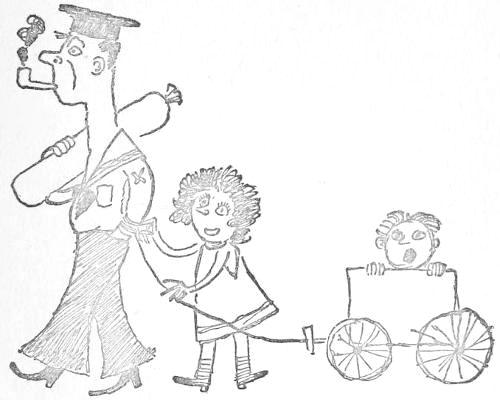
TO THE READER — VERENA IN THE MIDST
The correspondence from which the letters
in this book have been selected passed (with
the exception of the last) during 1919. The last
is a little later.
Mr. Richard Haven, some of whose letters are
to be found in a preceding volume, The Vermilion
Box, is still a bachelor and still lives in Mills
Buildings, Knightsbridge, but is doubtful if he
can afford it much longer.
Miss Verena Raby, the centre of this epistolary
circle, is one of Mr. Haven’s oldest friends. Old
Place, the ancestral home over which she now
reigns, is near Kington in Herefordshire, on the
borders of England and the Principality which
provides us impartially with perplexities and
saviours. Miss Raby is one of a family of nine,
but none of the others neglect any opportunity of
postponing letter-writing. Of these brothers and
sisters, all save one—Lucilla, Nesta’s mother—are
living, or were living when these pages went to
press.
Nesta Rossiter, who is managing Old Place
during Miss Raby’s illness, married Fred Rossiter,
an amateur painter, and they have three children,
Antoinette (or “Tony”), Lobbie and Cyril.
Emily Goodyer is the children’s nurse. She is
also the fiancée of Bert Urible, greengrocer, soldier
and then greengrocer again.
Theodore Raby is Verena’s brother and a
widower with one daughter, Josey.
Walter Raby, another brother, is ranching in
Texas.
Hazel Barrance, daughter of Clara Raby, is
another of Miss Raby’s nieces. She was a V.A.D.
during the War, but has now returned to Kensington
routine, in a not too congenial home. Her
brother Roy also finds Peace heavy on his hands
but has more chances for liberty and diversion,
and grasps most of them.
Evangeline Barrance, a sister still at school, is
one of the youngest editors in Europe.
Mr. Horace Mun-Brown, Miss Raby’s nephew
and a briefless barrister, lives in the Temple on
a small income and a sanguine disposition.
Mr. Septimus Tribe, the husband of Verena’s
youngest sister, Letitia, and by some years her
senior, was at the Board of Trade, but is now in
retirement at Tunbridge Wells.
Clemency Power is an Irish girl who managed
to get out to France during the War, although
under age, and was so happy and busy there that
she abandoned idleness permanently. Her mother,
a widow, the daughter of an Irish peer, lives with
Clemency’s two younger sisters near Kenmare.
Patricia, aged nineteen, is the only one who comes
into this correspondence.
Miss Louisa Parrish, who was at school with
Verena and looks upon that accident as an indissoluble
bond, lives frugally but with no loss of
social position in her late father’s house in a
Berkshire village.
Nicholas Devose is a traveller and artist who
came nearer marrying Verena Raby than any
other man has done.
Bryan Field is a young doctor whose path
crossed that of Clemency Power in France during
the War.
Sir Smithfield Mark is one of the leading surgeons
at Bart’s.
Sinclair Ferguson is Miss Raby’s doctor.
Lady Sandys is a neighbour of the Rossiters in
Kent.
Vincent Frank is remaining in the R.A.F.
although the War is over.
Mrs. Carlyon, whom we meet at once, only to
lose her again, is a neighbour of Miss Raby at
Kington.
E. V. L.
XXVI Louisa Parrish to Verena Raby
My Dear Verena,—I have only just heard of
your accident and cannot understand why you
did not let me know sooner. But perhaps, poor
thing, you can’t write. I heard it through the
Hothams, who had been told by Pauline Bankes.
Still even if you can’t write yourself you must
have some one there who can. Dictating is not an
easy thing, I know, but even a postcard would
have been better than nothing, and then I would
have written at once to cheer you up. But if you
do send a postcard, you will be careful, won’t
you, not to put anything very private on it, as
they are all read here. It was how the village
heard of poor Colonel Onslow’s daughter’s elopement.
No doubt you were too ill to think of all
your friends, and yet in the night, when one thinks
of so much, I wonder my name didn’t occur to
you.
Writing letters is no hardship to me, as it is to
so many people. My brother John, for instance,
can’t bring himself to put pen to paper at all, and
his study is always littered up with unanswered
things. It is very odd, I always think, that the
son of so methodical a man as father was should
be so careless, but I expect it is a throwback or
comes from mother’s side. I am much more like
father in so many ways, as well as having the
Parrish nose and the ears set so far forward, while
John and the others favour the Pegrams.
You must let me know if there is anything I
can do for you besides writing now and then.
Of course, if you were able to knit it would be
better, although there is no one to knit for now.
All the girls that I see knitting are working only
for themselves—those jumpers they wear without
corsets, so very indelicate, I think, especially
when the bust is at all full. It is all so different
from the War, when people were really unselfish.
As long as I can remember, I, personally, have
knitted for others; not that I want to take credit
for it, but it is nice to be able to be of service.
When I was a child it was mittens for the gardener
and the coachman or else those poor Deep
Sea Fishermen.
I suppose you have all the books you want.
You have always been so well provided for, but
there’s a little comforting bedside volume by
Frances Ridley Havergal which I am sending in
case you should want anything of that sort. It
has always helped me, and the other day, after
so many years, I read Queechy again and found
it quite exciting, so I am putting that in too.
Many of the modern books are so outré.
My rheumatism has been rather worse lately,
but I mustn’t tell you things like that when you
are so ill yourself. I should like to know what
your doctor says about you. There was a poor
lady here who slipped and fell and hurt her back,
very much in the same way, I should imagine, and
she lived only a few hours. And dear old Sir
Benjamin Pike, my father’s friend and fellow
magistrate, came to his end in the same way,
through a banana skin. I am sure the regulations
about throwing banana and orange skins away in
the streets should be more strict. In my childhood
we never saw bananas at all, and now they
are everywhere. How odd it is that fashions in
fruit should change as well as fashions in bodies
and in dress, although I for one am against so
much change in dress and think the advertisements
in the weekly papers are dreadful in their
incitement to women to spend money, especially
now when the Prime Minister tells us we should
all save, and I am sure he is right. And the
money people gave for pearls too, at the Red
Cross sale! Perfectly marvellous where it all
comes from, and how different we all are! Those
millionaires buying pearls for their wives, and me
here quite happy with the mosaic brooch my father
brought me from Venice and the agate clasp
which belonged to dear mother.
I must stop now or I shall miss the post.—Always
your loving friend,
Louisa
XXVII Richard Haven to Verena Raby — MOTIVES
My Dear, how odd it is that even the sweetest-natured
men, when asked for a fairy tale for the
young, tend to satire. Pure fancy—comic invention
with no arrière pensée—seems to be the most
evasive medium. That mathematical genius,
W. K. Clifford, could do the genuine thing without
one drop of the gall of sophistication, and so,
of course, could Lewis Carroll, and Burne-Jones
in his letters. But when I asked my old friend,
George Demain, for something amusing and suitable
for a children’s amateur magazine, look at
what he sent! I enclose the original, which please
return. As it is no part of my scheme of life to
teach cynicism, I am withholding it from the
fledgling editors. I don’t mind meeting cynics
(although it is always best that there should be
but one in any company) but I don’t intend consciously
to make any.
One of the extraordinary things of the moment
is how little some men who went through
the War were changed by it all. In fact, it comes
to this, that the War could deal only with what
a man had: it could not create brains or feelings.
The people who talk about it as a purge, an
educator, as discipline and so forth, are saying
what they thought it ought to have been, rather
than what it was. There are clerks in my office
who enlisted and fought and even killed men, and
have now returned to be clerks again, with perfect
resignation, and with no outward sign of development,
except that they do their work with less
care.
I asked one of them what he thought of France
and the French. He had been right through
the War and had come, for the first time in his
life, into relations with the French under every
kind of emotional stress. He ought to have had
numbers of stories to tell and national distinctions
to draw. All he said was—“Funny how far
up from the railway platform their trains are!”
I hope all goes as well with you as it can.
R. H.
[Enclosure]
Once upon a time there was a King who had
never done anything except make laws and draw
his salary, and when he was getting well on in
years he began to wonder if his people really
loved him. He might never have discovered the
answer had not a neighbouring country declared
war against him and threatened to invade his
territory; for “Now,” said the old King, “we will
probe at last into this question of devotion.”
He immediately issued a proclamation that the
country was in danger and that all who wished
to fight could do so but there would be no compulsion.
So the war began and all the men of the
country flocked to the colours and there was great
excitement.
At the end of a year the army of the old King
had conquered and peace was proclaimed.
The day that the troops returned was a great
holiday. The streets were gay with flags and
banners, and every one came out to welcome the
victors. That night the old King, dressed as a
plain citizen, slipped through his palace gates and
mingled with the crowd. He saw the illuminations
and heard with emotion the joyous songs
and cries of exultation.
Overcome by the noise and rejoicing he turned
down a quiet street and presently he came on a
woman weeping in a doorway. He asked the
cause of her grief and she told him that her husband
had been slain in battle.
“Ah,” said the old King, “I am truly sorry to
hear that, but, after all, there is a consolation in
knowing that he died fighting for his King.”
“I am not so sure,” replied the sorrowing
widow. “We had a quarrel and he went and
joined the army to spite me.”
Farther on the King met a poor old man bowed
with grief and sighing deeply as he leaned on his
staff.
“How is this, old man?” cried the King. “Why
do you sorrow when so many are gay?”
“Alas,” groaned the other, “I have just heard
that my son was killed in this horrible war.”
“You have cause for sorrow, my friend,” said
the old King sympathetically, “but remember he
fell in a good cause. He died for his King.”
“Perhaps he did,” replied the poor old man.
“But he didn’t say anything about that when he
marched off. He didn’t want to go, as a matter
of fact. Not a bit. But every one else was going
and he was afraid of being thought a coward.”
At the next corner the old King saw a soldier,
one of the victors. He was lame and haggard
and worn and was leaning against a wall to rest.
“Ah!” cried the old King. “You have been
wounded, my young hero?”
The soldier nodded and looked bored.
“Never mind, my lad,” said the old King, patting
him on the shoulder. “We are all proud of
you—and remember, you risked your life in
honour of your King!”
The soldier turned his tired eyes on him and a
stiff smile made his mouth crooked. “I suppose
that was it,” he said wearily. “I had thought
that I joined up to see a bit of life and have the
girls look at me, but possibly you are right. I
expect it was the King’s honour I was thinking
of.”
So the King returned thoughtfully to his
palace, and as he entered the great hall the
musicians began playing “God keep the King.”
Then all the courtiers who were to receive their
share of the indemnity claimed from the defeated
enemy, and all the commanders who were to receive
titles and honours and large estates, cried
out with one voice “God keep the King!” so that
the people out in the streets heard it and joined
in the shout as if they meant it.
And then the old King went to bed.
LXXIV Nicholas Devose to Verena Raby
My Dear Serena,—If I may call you again
by that name, which to me, in spite of everything,
is sacred still—I have only just had, from
my sister, the news of your illness, having in this
far spot few letters from home, and I write at
once to say that I am deeply grieved and hope
that already you are better.
If you can bring yourself to write, or to send
a message by another hand, I implore you to do
so. You may think it hard that it needed a
serious injury to occur to you before I wrote
again, but that would not necessarily convict me
of callousness. I swear to you, Serena, that not
a day has passed without my thinking of you—and
always with the tenderest devotion to you
and always with self-reproach and regret that, so
largely through my fault, or, even more, my own
impossible temperament, your life may have been
circumscribed and rendered less happy.
I know, through various channels, certain
things about your life to-day, but of course only
externals. I know, for instance, that you have
not married; but whether that is because of me
(as my own singleness is certainly associated with
you, or rather with us), I do not know. I know
by how many years you are my junior, and I am
forty-nine next week. If you are conscious of
loneliness and it is my influence that has kept
you from marrying, I am sorry; but there are
worse things than celibacy and it is probable
that both of us are best suited to that state. I
certainly am. The common notion that every
one ought to marry is as wrong-headed as that
every one ought to be an employer of labour.
Very few persons are really fitted to live
intimately with others; and the senseless heroic
way in which the effort is made or the compromise
sustained is among the chief of those
human tragedies which must most entertain the
ironical gods peering through the opera-glasses of
Heaven.
I must not suggest too much melancholy. I
don’t pretend that life has nothing in it but wistful
memories and regrets. On the contrary, I
taste many moments of pleasure. But—even
while enjoying my own somewhat anti-social nature—I
should, were I asked to stand as fairy
godfather beside cradles, wish for no child a
sufficient income to indulge impulses, nor too emphatic
a desire to be sincere, nor, above all, any
hypertrophied fastidiousness. In a world constructed
not for units but for millions, such gifts
must necessarily isolate their possessor.
When the War broke out I was in Korea.
Since last we met I have been all over the world
and at the present moment am in Fez. I have
thousands of sketches stored away, some of which
might be worth showing, but I can’t bring myself
to the task of selection and all the other arrangements;
I can’t sometimes bear the thought that
anyone else should see them, so you will gather
that I am very little more reasonable than of old
and probably even less fitted to take a place in
the daily world.
If it would be any kind of pleasure to you to
see me—if I could help you in any way—you
have but to let me know. I shall be in Madrid,
at the Grand Hotel, till the end of next month
and will do as you tell me.
N. D.
LXXVII Richard Haven to Verena Raby
My Dear Verena, to return to the great
money problem, I think you ought to know that
the papers print particulars of the will of a
Hastings innkeeper who set apart the interest on
£300 for an annual supper to sixty Hastings
newsboys. And a little while ago I cut from
the Times a will in which the testator, a fellmonger
and a gunner, killed during the War, left
“£1000 in trust during the life of his wife to
apply the income for a treat for the children of
the Chelsea and District Schools, Banstead, such
treat to consist of sweets, strawberries, or a visit
to the pantomime, and to be in the nature of a
surprise.”
Well, there would be no difficulty in arranging
for little things like that. All you want is a
good almoner and perhaps Miss Power would
take the post. And here again you could see
the fun going on, which the dead cannot. At least
we used to think they couldn’t, but the evidence
on the other side is accumulating. There is a
conspiracy afoot to make us think that the dead
“carry on” too much as we do.
All you need is to ask yourself which kind
of worker is least rewarded, or you are most
sorry for, and go ahead. Lamb’s friend, James
White, would have chosen chimney-sweeps. The
late landlord of the Royal Oak at Hastings would
have replied “Newsboys.” Miss Rhoda Broughton
would reply, “Overworked horses.” On my
own list would occur railway porters. Also compositors.
And what about the little girls who
carry gentlemen’s new garments all about Savile
Row and the tailors’ quarters—is anything done
for them? And the window-cleaners—they can’t
have much fun. And oyster-openers—what a life!
And carpet-beaters—Heavens! And the little
telegraph girls, in couples, with the grubby hands.
No, the list would not be hard to compile.
There are possibilities of social regeneration in
it, too. Certain horrible imperfections—due to
haste and false economy and a want of thoroughness—are
allowed year after year to persist, to
the serious impairing of the nation’s nerves, which
might be removed, or at any rate reduced in
number, if some warm-hearted living hand, like
yours now, or wise dead hand, like yours in the
distant future, were outstretched. For example,
a legacy of a thousand pounds would not be
thrown away if the interest on it were offered
every year as a prize to the maker of chests-of-drawers
which would open most easily, or the
maker of looking-glasses which remained at the
desired angle without having to be wedged. The
details would have to be worked out, perhaps
through some furniture trade paper, but what a
heightening of effort and what a saving of temper
might result! And if a prize were offered to the
firm of haberdashers whose buttons were most
securely sewn on, what a wave of comfort might
be started! I bought some soft collars at a first-class
shop only last week and the buttons were
all loose and some of the button-holes were too
small; and it was I who suffered, not the haberdasher.
All he did was to spread his hands and
complain about post-war carelessness; whereas he
might just as well have supervised the things
before they were sent home as not. One of the
most infuriating things in Peace-time is the impossibility
of punishing anybody—except oneself.
The world is so prosperous that one can’t touch
it. Once one could set a tradesman’s knees shaking
by merely expressing the intention of going
elsewhere in future; but it is so no longer.
But this is dull reading for Herefordshire.
Are not these lines on the toilet table of Marie
Antoinette poignant?—
This was her table, these her trim outspread
Brushes and trays and porcelain cups for red;
Here sate she, while her women tired and curled
The most unhappy head in all the world.
R. H.
LXXXVIII Roy Barrance to Verena Raby
Dear Aunt Verena,—Thank you for your
very kind letter, but really I don’t think I am in
any such danger as you seem to fear (and it’s
frightfully decent of you to take so much interest
in me and my affairs) because I always
feel that I am a kind of darling of the gods.
This must sound horribly conceited, but it isn’t
as bad as that really. It’s a kind of faith in a
higher protection, and there’s no harm in having
that, is there? Anyhow, it keeps me from getting
into anything like very serious trouble. I’ve just
had another example of this watchfulness, and
it’s so wonderful that I must tell you about it.
You remember about Stella and how glad we
were that it was all over with her? We shouldn’t
have suited each other a bit, and as a matter of
fact I think she would have dragged me down.
Well, after not seeing her for weeks, I ran into
her in Bond Street on Monday, and before I
knew where I was I’d asked her to dine at the
Elysian the next day. That was yesterday. It
was foolish, I know, but she was so nice and
friendly in spite of it all, and looked rather pathetic,
and I always think one should be as kind
as possible—in fact I learnt it from you.
Anyway, I did it, and then went off and began
to regret it at once. I saw what an ass I
had been to re-open friendship with her. No
one should ever re-open with old flames, particularly
when they haven’t played the game. And
a meal is particularly unwise, because there may
be an extra glass of wine and then where are
you? You get soft and melting and forget what
you ought to remember, and all the fat is in the
fire once more, and before you know where you
are you are very likely engaged again. So I
went about kicking myself for being so gentle and
impulsive, and had a rotten night. The next day
I couldn’t telephone or wire to call it off, because
I hadn’t her address, and the wretched dinner
hung over me like the sword of what’s-his-name
all day. Some men of course wouldn’t have gone
at all, but I hate breaking engagements.
But—and this is the point—I needn’t have
worried at all; and after such a wonderful experience
of watchfulness over me I shall never
worry again—I should be a monster of ingratitude
if I did. Because all the time my guardian angel
was working for me. For when I had dressed
and started out to get to the Elysian punctually,
what do you think?—there was a cordon of police
all round it, to keep me and every one away, and
thousands of people looking on. The restaurant
had caught fire and was gradually but surely
burning to the ground! Wasn’t that an extraordinary
piece of luck, or rather, not luck but intervention?
Of course it was no good looking
for Stella among such a crowd, so I went off to
the Club and dined alone.
A religious fellow would make a tract about an
experience of this kind. I’m afraid I can’t be
called religious exactly, but I have learnt my
lesson.
I am still having bad nights thinking about
my future.—Your affectionate nephew,
Roy
CI Richard Haven to Verena Raby
My Dear, I hope that this heat isn’t too much
for you, but perhaps your circumambient heights
promote a breeze. London has been stifling. The
War has certainly broken down many of our old
conventions. Who, even in the hottest summer,
ever before saw bathing in the Trafalgar Square
fountains? Or stark naked boys careering round
Gordon’s statue. But I saw them to-day—a score
of them—with a policeman after them; for against
bathing there is a law to break, apparently. The
constable did not run, he merely advanced; but
they scampered before him, all gleaming in the
evening sun, dragging their scanty clothes behind
them, and those who were leading paused
now and then to get a leg into their trousers,
hesitated, failed, and were away again. It is
astonishing how little space can intervene between
what appears to be a sauntering policeman and
a naked fleeing boy. This constable was like
Fate.
I once read somewhere that clever women always
tell men that they look overworked. Yesterday
I made the discovery of a form of words
even more soothing when proceeding from feminine
lips: another weapon in the clever woman’s
verbal armoury—should she need any assistance
that way. The solicitous phrase “You are looking
overworked,” is unction perhaps more for the
young than the middle-aged and elderly. No
young man, however conscious of his own abysmal
laziness, can resist it, or want to resist it.
But the maturer man—the man to whom Father
Time’s chief gift is an increase of girth—must
be differently handled. He may be overworked,
but to be told about it, however seducingly, does
not much interest him. Besides he knows when
it is not true: when what looks like the effect of
overwork (supposing the lady to have something
to go upon) is really due to late hours or a glass
too many. In short, he is a little too old for any
flattery but the kind of flattery he is not too old
for. Therefore the clever woman, in dealing with
him, must do otherwise. Taking him by the
hand, she must look at his features with a close
and careful scrutiny which, although it is assumed,
can be extremely comforting, and then
say, in a tone almost of triumph, “You’re getting
thinner.”
Isn’t it about time that you sent me another
medical report? Here is a passage in Swift’s
letters that I hit upon last night:—
“And remember that riches are nine parts in
ten of all that is good in life, and health is the
tenth; drinking coffee comes long after, and yet
it is the eleventh; but without the two former,
you cannot drink it right.”
And here is to-day’s poem:—
If on a Spring night I went by
And God were standing there,
What is the prayer that I would cry
To Him? This is the prayer:
O Lord of Courage grave,
O Master of this night of Spring!
Make firm in me a heart too brave
To ask Thee anything!
Who do you think wrote that? It is a very
fine specimen of what I call “Novelists’ poetry”—the
poetry which men known for their prose
and romance now and then produce. Most of them
occasionally try their hand, and often very interestingly.
One of the best short poems in the
language is an epitome of the life of man by
Eden Phillpotts. Grant Allen wrote some remarkable
lines. The author of The Children of
the Ghetto has published a volume of his verses
which is full of arresting things. Thomas Hardy,
of course, has become poet altogether, and Maurice
Hewlett seems to be that way inclined. But still
I don’t tell you who wrote the lines just quoted:
John Galsworthy.
R. H.
CIX Richard Haven to Verena Raby
Dear Verena, I now send you some notes collected
from the perusal of the gigantic volume on
the Endowed Charities of London as they were
examined by a commission early in the last century.
It is a monument to the public-spirited
dead. In London the benefactions run chiefly to
free schools, alms-houses, subsidized sermons and
doles of bread and coal—“sea coal,” as it is
usually called. Now and then there is an original
touch, as when one Gilbert Keate gave to the
parish of St. Dunstan’s in the East—you know,
the church with the lovely spire built on flying
buttresses—“£60, to be lent gratis, yearly, during
the space of four years, to three young men inhabitants
of this parish (one of them to be of the
Dolphin precinct), by the vestry, to each £20 on
good security, by bond for repayment at four
years’ end, as the inhabitants in vestry should
think fit.”
Samuel Wilson did even better, his will, dated
October 27th, 1766, containing this clause: “And
my mind and will further is, that the said sum of
twenty thousand pounds, or whatever sum be so
paid by my said executors to the said chamberlain,
shall be and remain as a perpetual fund, to be
lent to young men who have been set up one year,
or not more than two years, in some trade or manufacture,
in the city of London, or within three
miles thereof, and can give satisfactory security
for the repayment of the money so lent to them;
... and further my mind and will is, that no
part of this money shall be lent to an alehouse
keeper, a distiller or vendor of distilled liquors.”
That seems to me to be a very excellent disposition
of money; but probably it is not in your
line. The Corporation of London was appointed
to manage the charity, but as a rule these rich
City men left their money to their Chartered Companies
for distribution. Where alms-houses, for
example, are built and endowed there must obviously
be some organization to carry them on;
and the City Companies, who are commonly supposed
to devote their time to eating and drinking,
really exist largely for this admirable purpose.
So do churchwardens; carrying round the plate
is but a small part of their duties.
Here is a pretty compliment, to take the taste
of all that away:—
If I were a rose at your window,
Happiest rose of its crew,
Every blossom I bore would bend inward:
They’d know where the sunshine grew.
A letter from an old friend making his first
long voyage reaches me to-day from Aden. He
says, “Why don’t artists oftener paint circular pictures?
Nothing could be more beautiful than the
views of water and sky, and now and then of
scenery or buildings, that I have been getting
through my porthole. I would almost go so far
as to say that round pictures are the only ones—at
any rate of the open air. You should get one
of the Galleries to arrange a Porthole Exhibition
and start the fashion.”—Good night,
R. H.
P.S.—Here is the latest definition of appendicitis.
“The thing you have the day before your
doctor buys a Rolls-Royce.”
CXII Richard Haven to Verena Raby
Dear Verena, I return to the Charity Book.
Behold the case of Peter Symonds, which may,
or may not, offer suggestions. “Peter Symonds,
by will, dated 4th April, 1586, gave to the parson
and churchwardens of All Saints, Lombard Street,
yearly, for ever, £3, 2s. 8d., to be received of the
churchwardens and socialty of the Company of
Mercers, to be employed by the said parson and
churchwardens in manner following, viz. to pay
30s. thereof yearly, on Good Friday, to the children
of Christ’s Hospital, in London, on condition
that the same children, or threescore of them
at least, should, on the same Good Friday, in the
morning, yearly, for ever, come into the said
church of All Saints ... and he directed that the
said parson and churchwardens should bestow 3s.
4d. in the purchase of good raisins, which should
be divided in threescore parts, in paper, and one
part given to each child; and he gave 16d. of the
said £3, 2s. 8d. to the beadles of the hospital,
who should come with the children.”
Peter Symonds was a man, and perhaps you
would rather be guided by a woman. If so, observe
the example of Margaret Sharles:—
“By will, dated 2nd September, 1600, Margaret
Sharles bequeathed £20 unto such a learned
man as her overseers should think good, to preach
every week in the year, in the parish of Christ
Church ... she also bequeathed to the vicar and
churchwardens, £5 a year, to be employed for
ever, towards the relief of the vicar, curate, clerk,
and sexton by the discretion of the churchwardens
there; she also gave unto and amongst her
poor tenants within the said parish, £6 yearly,
for ever, to be bestowed in manner following: £1,
6s. 8d. for a load of great coals; 16s. for a thousand
billets, to be distributed amongst her said
tenants, three days before Christmas, and the residue
thereof to be spent upon a dinner for her
said poor tenants on Christmas Day, at the sign
of the Bell, in Newgate-market.”
Even better, for your purpose, is the example
of Jane Shank:—
“By will, dated 7th July, 1795, Mrs. Jane
Shank directed that the Painter-stainers’ Company
should divide the interest on her fortune into
twelve equal parts, and shall apply eleven-twelfth
parts thereof in payment of pensions of £10 a
year, to indigent blind women, and retain the remaining
twelfth part as a compensation for their
trouble and expenses. Jane Shank requested that
the Company would advertise for proper objects
of the charity in two morning and two evening
papers, three times each, as often as any vacancies
should happen; and she directed that the persons
to be elected should be of the age of 61 years at
the least, should have been blind three years,
should be widows or unmarried, and unable to
maintain themselves by any employment, should
be in distressed circumstances, born in England,
not in Wales or Ireland, have lived three years
in their present parish, have no income for life
above £10 a year, never having received alms of
any parish or place, never having been a common
beggar, and being of sober life and conversation.”
Jane, you see, was a forerunner of Sir Arthur
Pearson of St. Dunstan’s, who would, I am sure,
have no difficulty in recommending a suitable destination
for any spare funds of your own.
But I must not weary you (or myself) with
these testaments.
Here is a story that was told by my friend, Mrs.
Torwood Leigh. Towards the end of the War
she gave a party to an Officers’ mess stationed in
the neighbourhood, and almost every guest exceeded.
The next day, when they called to return
thanks, each one in turn took her aside to
apologize—for another!
And here is the poem: something lighter for a
change:—
I recollect a nurse called Ann
Who carried me about the grass,
And one fine day a fair young man
Came up and kissed the pretty lass.
She did not make the least objection,
Thinks I “Ha ha!
When I’m grown up I’ll tell mamma.”
And that’s my earliest recollection.
That is a poem by a man pretending to infancy.
Here is a genuine child-product, one of the lyrics
of a little American girl named Hilda Conklin.
Don’t you think it rather beautiful?
The world turns softly
Not to spill its lakes and rivers,
The water is held in its arms
And the sky is held in the water.
What is water,
That pours silver,
And can hold the sky?
Good night,
R. H.
CXXI Evangeline Barrance to Verena Raby — THE TEST A STORY — PEOPLE WHO REALLY DESERVE THE O.B.E. — II. THE POSTMAN — THE CINEMA — HISTORICAL RHYMES — II. LINES ON THE LANDING OF KING JOHN AFTER A CERTAIN TRAGIC EVENT — A VISIT TO THE ZOO — A FABLE — CORRESPONDENCE — I — II — TREES
Dear Aunt Verena,—I am sending you the
second number of The Beguiler and we all hope
it will amuse you. We also hope that no other
number will be needed, not because we are tired,
but because we want you to be well.—Your loving
niece,
Evangeline
No. 2. September, 1919
THE BEGUILER
OR
THE INVALID’S FRIEND
A Miscellany
COMPILED BY
EVANGELINE BARRANCE
ASSISTED BY A BUNCH OF FLOWERS
There was once a girl named Philippa Barnes whose
father and mother died when she was seventeen. As
she was too young to be married and was very rich, she
had to have a guardian, and in reply to an advertisement
a number of candidates for that position came forward.
They were all handsome elderly men of nearly forty, and
when Philippa saw them she liked most of them a good
deal, but as their references were all perfect she was
puzzled how to choose. Being very fond of Shakespeare
she had read The Merchant of Venice and she decided
that she must devise a test, as Portia did, but as it would
be foolish to borrow the idea of the three caskets, which
most people know about, she had to invent a new one.
All the applicants for the post of guardian were told
to be at her family mansion at ten o’clock in the morning,
and when they were assembled Philippa sent for them
one by one and told each that he must recount to her
some anecdote in which he had taken part with some
person of inferior position—such as a bus-conductor or
a taxi-driver or a railway porter or a waiter or a char.
When they had all finished Philippa made her choice,
which fell upon a candidate named Barclay Pole who
was not so tall as the others and not so well dressed,
although his references were beyond dispute.
“But,” said her old nurse, who had been standing by
her side all through the interviews, “why do you choose
him when there are all those handsome ones at your
disposal?”
“Because,” Philippa said, “he was the only one who
when he told the story did not make the other person
call him Sir.”
Barclay Pole thus became her guardian and carried
out his duties with perfect success until it was time to
give her hand in marriage to Captain Knightliville of
the Guards.
“Heartease”
When my brother was small he wanted to be a postman
because he wanted to knock double knocks; but no one
who is grown up would want it, because there is no fun
in spending your life in delivering letters to other people,
other people’s letters are so dull.
Other people have such odd ways with their letters.
Father even is cross when there is a letter for him and
says “Confound the thing!—why can’t they leave me
alone?” But my eldest sister waits for the postman and
is miserable if he doesn’t bring her anything.
Some people lay their letters by their plates and go on
eating. This seems to me extraordinary.
Some of our visitors who get letters say “Excuse me”
before they read them, but others don’t.
When I think of the postman going on for ever and
ever taking letters to other people I am convinced that
he ought to have the O.B.E.
“Rose”
One of the strange things to reflect about is what people
did before the cinema was invented. My father was an
old man before he ever saw a moving picture and when
he was a boy there were none. He does not like them
now because he says he always comes away with either
a headache or a flea, but I like them excessively.
I like the serious ones best, but my brother Jack wants
the comic ones. He can walk like Charlie Chaplin.
He likes Mutt and Jeff too. I know a girl who was
photographed by a cinema man while she was at Church
Parade in the Park and the next week she saw it at a
Picture Palace and recognized herself.
One kind of a film is always very dull and that is the
kind that shows the King shaking hands with the Lord
Mayor and people coming away from football matches.
It is a very curious thing but nearly always when I get
into a cinema this kind of film happens at once and goes
on for a long time, so that it is very often too late to stay
to the end of the story-film.
I wish they would turn more books into films. A
girl I know lived in Paris and saw The Count of Monte
Cristo and it was splendid. Lots of books would make
good films. The other day we all said what books we
would most like to see on the movies. Two girls came
to tea and one said The Black Tulip and the other Little
Women. Jack wanted Twenty Thousand Leagues under
the Sea and I think one of Mrs. Nesbit’s books like
The Enchanted Castle would be splendid.
One thing that I don’t like about the movies is that
they give you too much time to read the short sentences in.
It is funny how a high wind always blows in American
drawing-rooms in the cinema.
M.P.s when you see them on the movies going to the
opening of Parliament always walk too fast.
“Dandelion”
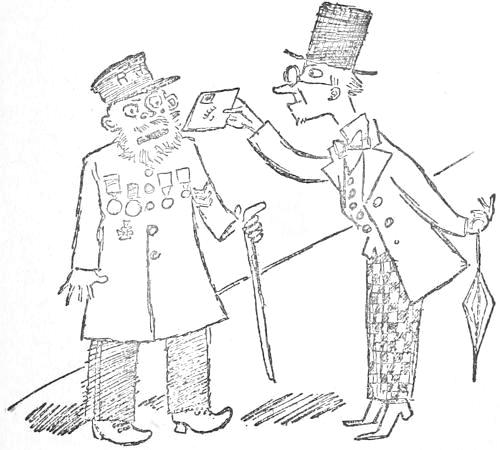
UNFORTUNATE MISUNDERSTANDING NEAR CHELSEA HOSPITAL
“Long live the King” the people cried
And cheered with all their might.
They crowded to the vessel’s side
To see King John alight.
“Will he be clad in gold and silk?”
The children, wondering, said.
“Yes, and in ermine, white as milk
With gold upon his head.”
“Will he wear gems about his neck
And hold a sceptre rare?”
“Yes, when he stands upon the deck
You’ll see them flashing fair.”
But lo! whose is that skimpy form
All bare and shivering?
Whose are those thin and naked legs?
It is—great Heavens!—the King!
Why doth he cower beneath a sack,
As cold as lemon-squash?
The regal panoply, alack,
Is missing in the Wash.
Last Saturday we all went to the Zoo. There were no
lion or tiger cubs, but we went behind the cages in the
reptile house and the keeper showed us some baby crocodiles
and let us hold one. It had the funniest little
teeth like a tiny saw, and a white throat which it can
close up in the water, and a film comes over its eyes
when it likes just like the shutter of a Brownie. The
keeper said it was a few months old but would very
likely live to be a hundred.
Then he hooked a boa constrictor out of its cage and
asked us to hold it. I was frightened at first but after
Jack and the others had held it I tried. Its body feels
terribly strong and electric and all the time it is coiling
about and darting out a little forked tongue. I was very
glad when the keeper took it away.
We saw the diving birds being fed in their tank.
There are two of them, one in a cage at each end, and
the keeper throws little live fish into the tank and lets
out one bird at a time. At first we were very sorry for
the poor little fish, which swim about frantically in all
directions to escape from the terrible great bird who
dashes after them like a cruel submarine; but after a
while we began to want the bird not to miss any. Isn’t
that funny? And my brother Jack got so excited that
he pointed out to the bird where one of the little fish
was hiding and cried out “Here he is, look, down here!
Look, in the corner!”
“Convolvulus”
There was once a garden path paved with flat stones,
and in between the stones were little tufts of thyme and
other herbs.
On each side of the path were beds full of gay flowers,
among which was a very vain geranium, who, when no
one was about, used to mock the thyme because it was
in such an exposed spot and liable to be walked on.
“The proper place for plants,” the geranium said, “is
in a bed where they are safe from people’s feet and are
treated with respect. Look at me!”
“Yes,” said the thyme, “but the more I am trampled
on the sweeter I become and the more the lady who
planted me likes me. Haven’t you seen her squeezing
me with her beautiful hands and then inhaling my
fragrance, whereas if anything hits you you are done for
for ever.”
And at that moment a tennis ball, struck out of the
court near by, fell on the geranium and broke it in two.
The moral is that every one has his own place in life
and we should mind our own business.
“Carnation”
To the Editor of The Beguiler
Dear Madam,—You ask me to tell you what is the
most depressing thing I ever heard. It was this. I was
crossing the Channel on a rough day, feeling more
miserable than I can describe and clinging to my deck-chair
because I knew that to move would be fatal, when
two young men passed me, in rude health and spirits,
both smoking large pipes, and I heard one say, “Personally,
I’ve got no use for a smooth sea.” I can conceive
of nothing more offensively depressing than this.
Hoping you can find a place for the “anecdote” in
your bright little periodical,—I am yours faithfully,
Hector Barrance
To the Editor of The Beguiler
Dear Madam,—I am glad to hear that you approved
of my contribution to your last number. Being still
unable to write, I again send you something copied from
the works of another. It is a poem by Joyce Kilmer, a
young American killed in the war.
Believe me, your admiring subscriber,
Richard Haven
X His mark
I think that I shall never see
A poem lovely as a tree.
A tree whose hungry mouth is prest
Against the earth’s sweet flowing breast;
A tree that looks at God all day,
And lifts her leafy arms to pray;
A tree that may in Summer wear
A nest of robins in her hair;
Upon whose bosom snow has lain;
Who intimately lives with rain.
Poems are made by fools like me,
But only God can make a tree.
End of Number 2 of
The Beguiler; or, The Invalid’s Friend
CXXV Richard Haven to Verena Raby
Dearest Verena, I quite understand your
nervousness about this new doctor, but I think you
should be more of a gambler over it all. You
should be more trustful of your star, which,
though it (to my mind, very reprehensively), allowed
you to have a horrid fall, has made things
as comfortable as possible since. Until I hear to
the contrary I intend to think of the new doctor
as a godsend, and a very agreeable change to old
Ferguson, who struck me as a prosy dog. Be an
optimist, my dear.
The more I think of your money and your character,
the more I incline towards alms-houses,
which, in a human non-Nietzschean country like
ours, I consider to be among the most satisfactory
forms of sheer benevolence. But I am not wholly
convinced, and I should hate to see the interest on
£50,000 going in any way astray. Meanwhile I
have made notes on the alms-houses in this book.
But what perplexes me is that these benevolent
people wait till they are dead. It would be far
more fun to have alms-houses while one was alive
and watch them at work.
Here is an essay on the death of an imaginary
grandmother which little Mary Landseer has produced.
The death of one’s grandmother had been
set, by an almost too whimsical instructress, as
the subject of a composition:—
“One day, I think it was the hapiest day in the
world for me. My Granmother died and left
me £50. Without waiting to morn or wait for
her funral I was walking along Oxford St. in
surch of things to buy. My heart was as light as
a feather as I walked and my boots were up in
the ere.
“First I thought of what my Husband would
like me to have, then with a suden thought I
turned my steps home-would, and that night I
went to a play, the next a nother, and so I went
on till I had only 10s. left. Then how I wished
my other Granmother was died, but it was no
good. And when I had children I wished I had
not been so rash as to spend it on abusments, but
had saved it, but it was gone for ever and my
other Granmother never died, to my grat misfortune.”
It was Mary’s father who wrote that exquisite
thing to a Vicereine in India. “I wash your feet
with my hair,” he said at the end of a letter, employing
an Indian phrase of courtesy, adding, “It
is true that I have very little hair, but then you
have very little feet.”
Behold the punctual poem:—
There is a flower I wish to wear,
But not until first worn by you—
Heartsease—of all earth’s flowers most rare;
Bring it; and bring enough for two.
Good night,
R. H.
CXXXVII Richard Haven to Verena Raby
My Dear, I have no posthumous activities to
recommend to-day, having just returned from a
temple consecrated to youth, where, but for its
antiquity and its Roll of Honour, no one would
think of death. I mean Winchester.
My sister’s boy is there and I went down for
the day to see him: a nice candid jolly boy.
I came to the conclusion that there is a charm
about an old public school greater than that of
a university. The boy is more engaging than the
youth: he may have “side” and affectation among
his contemporaries, but with a much older man
such as I am he is himself in a way that the undergraduate
seldom is. The undergraduate’s whole
desire is so often to be taken for a man, whereas
the schoolboy at most would like to approximate
to an undergraduate.
Of all the schools that I know none is so attractive
as this. Its age, its traditions, its beauty,
alone would single it out: but I am taken with its
spirit too. When I go to see Dick I naturally
meet many of his school-fellows; and I find a candour
and friendliness which is a strange contrast
to the social reserves of boys from other schools
I could name. I don’t know whether the whole
school is similarly fortunate, but in Dick’s house
there is a door-opening, door-closing and passing-the-salt
tendency which I fancy is often bad form
elsewhere. To talk with the immature man is
never easy, wherever you find him, and my inclination
would always be to jump the gulf that is
fixed between real childhood and real manhood;
but Dick’s companions are easier.
Nephews and uncles go through strange vicissitudes.
At first the uncle is an imposing creature
who appears but rarely and when he does must
be treated with respect and called Uncle on every
occasion. And then as the boy grows older and
understands the powers and possibilities of half-crowns
the uncle takes on a god-like mien. And
then, older still, he meets him on more equal
terms; which get more and more equal until the
time comes when he discovers that this once remarkable
person is nothing but a fogey and a
bore. Some uncles, before this last stage is
reached, attach themselves to their nephews as
satellites or boon companions and vie with them
in youthfulness, but I am not likely ever to do
that.
The relations of son and father have somewhat
similar stages, but there is as a rule too close a
tie there to permit of the half-contemptuous easy
terms on which nephew and uncle often rub along.
Dick is a good boy and should do well. I watched
him this afternoon longing to hit out but knowing
that the game demanded self-repression, and admired
him and saw earnest of sound citizenship
in it.
The next thing is to make sure he gets into
my dear Bannister’s College at Cambridge.
But, Verena, how glorious to be a boy! And
yet how comforting, now and then, to be old
enough to be useful to the young—when they
will let us!—Good night,
R. H.
The poem:—
Why do our joys depart
For cares to seize the heart?
I know not. Nature says,
Obey; and man obeys.
I see, and know not why
Thorns live and roses die.
CXLVIII Richard Haven to Verena Raby
My Dear Verena, I think that we may all
feel happier than we were doing. Even if Old
England stands not quite where she did, the bulldog
breed is not extinct. The way in which the
nation has taken the railway trouble, and the
lightning efficiency of the food distributing arrangements,
should put dismay into enemy hearts—and
under the word enemy I include Allies and
rivals—and renew our own individual and corporate
ambition and national spirit. In that way
the Strike may be said to have been a blessing in
disguise, although industrially it has been a calamity.
It may also make people look a little more
narrowly at their pence, which is what we shall
all have to do before long.
The oddest things happened, not the least of
which I heard of yesterday, when one of the few
K.C.’s whom it is my privilege to know showed me
on his watch chain the shilling which had been
given him, in his capacity as a porter at Victoria,
by his butcher, all unconscious of his identity, as
a tip for helping with the family luggage on their
return from the South Coast. The K.C. said
nothing at the time, except Thank you, but when
things are a little quieter he is going to show it to
his purveyor of indifferent Peace-time joints and
enjoy a good laugh with him.
I have been wondering if alms-houses for the
rich are not more important than for the poor.
On all sides I hear of old widowed ladies who,
needing homes, or companions, spend their time
in visiting one married daughter or married son
after another, when they would be far happier in
a little colony like Hampton Court. Couldn’t
you do something for them? But you would have
to be very careful. If any suspicion of charity
got about, the whole scheme would fail. So you
could not put them together, even in the most
exquisite little garden-village homes. They would
have to be isolated. At what point in the social
scale a necessitous old lady ceases to be willing
to have her necessity known, I cannot say; but
certainly those who suffer most from it would
least like it published.
Old gentlemen don’t mind becoming Brothers
of the Charterhouse, but what about their Sisters?
I doubt it.
Only therefore by the exercise of great secrecy
could you benefit them.
And have you ever thought of the men who are
tossed up and down all day and all night on light-ships?
To keep others safe. What a life and
what opportunities to the philanthropist!
Here is the poem, which, I trust, is not too
sad:—
You come not, as aforetime, to the headstone every day,
And I, who died, I do not chide because, my friend, you play;
Only, in playing, think of him who once was kind and dear,
And if you see a beauteous thing, just say, he is not here.
Always “à votre service,” as the nice French officials
say in the South,
R. H.