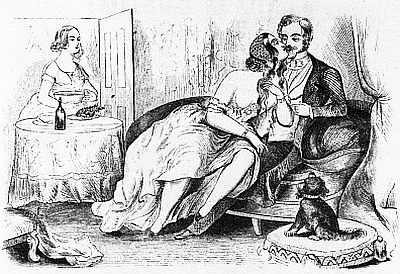
A period of six months elapsed, and it was now the month of
June—voluptuous June, clad in the gorgeous livery of summer. A great
change had taken place in the circumstances of several of the most
prominent characters of our narrative. The grandfather of Fanny—the
blind old basket-maker—had been "gathered to his fathers," and was
sleeping in a humble but honorable grave. The excellent old Corporal,
having seen the remains of his aged friend consigned to its kindred
dust, had procured a comfortable and delightful asylum for the two
orphans in the family of a valued friend of his—an elderly gentleman
whom we shall call Mr. Goldworthy; he was a retired merchant, possessing
an ample fortune, and was a widower, having an only daughter, with whom
he resided in a splendid mansion in Howard street. Miss Alice
Goldworthy, (then in her eighteenth year,) was one of those rare
creatures who seldom bless this grovelling earth with their bright
presence. She was truly an admirable combination of excellent personal
and mental qualities, and possessed in an eminent degree that beautiful
art (so seldom attained) of making all who came within the sphere of her
genial influence, perfectly happy. But her most amiable characteristic
was her good heart, which prompted her to entirely overlook every
consideration of self, in her desire to benefit others. We have now, in
our mind's eye, the exquisite original from whom we imperfectly draw
this beautiful character; her pure soul looks gently forth from the
azure depths of her soft eyes; lovely in her smile, for it is the glad
sunshine of a happy heart—but has that heart ne'er known affliction or
grief? Ah, yes; the harsh world hath, in former times, bruised that
gentle sanctuary of all womanly virtue, by its rude contact; but an
o'er-ruling Providence would not suffer the blighting storms of life to
crush the sweet flower that bent resignedly to the blast—for the angels
in heaven are not more pure and holy than she. Peace be with her, now
and forever! and should her eyes e'er encounter these humble lines, she
will pardon their unknown author for having ventured to gild his pages
with her beautiful character—for he has gazed upon her as upon a star,
shipping with a serene and softened lustre from the blue vault of
heaven.
Her domestic accomplishments were not inferior to her social virtues. In
the charming (because truthful) words of an unpretending but excellent
poet—
"She had read
Her father's well-filled library with profit,
And could talk charmingly; then she could sing
And play, too, passably, and dance with spirit;
Yet she was knowing in all needle-work,
And shone in dairy and kitchen, too
As in the parlor."
When Fanny Aubrey was ushered into the presence of this amiable young
lady, she started with surprise and pleasure—for she instantly
recognized in her the kind young lady who had presented her with the
gold coin on the memorable day when she was entrapped by Sow Nance into
the house of Mr. Tickels. The recognition was mutual; Miss Alice
instantly remembered the pretty fruit girl whose appearance had so much
interested her; and warmly did she welcome both the young orphans, as
future inmates of her family. Fanny had never before lived in such a
grand house, surrounded by every appliance of luxurious wealth; yet the
unbounded kindness of Miss Alice and her worthy father soon placed her
perfectly at her ease. Excellent teachers were provided for her and her
brother Charles—and, under the fostering care of their generous
patrons, they promised to become ornaments to the elevated sphere of
society in which they were probably destined to move.
Time passed on, and nothing occurred to interrupt the smooth current of
Fanny's existence, until it was deemed advisable to engage a person
properly qualified to give her instructions on that indispensable
fixture to a fashionable parlor—the piano-forte. A teacher of some
reputed talent was employed for this purpose; he was a Mr. Price, of
Charlestown—and has since rendered himself somewhat famous for his
amours in the above city with a married lady whom we shall call Mrs.
Stout; he had for some time been giving her lessons on the piano—but
the husband suspected that he was in the habit of imparting to her
secrets more profound than those of music; he accordingly placed himself
in a position to observe the operations of the parties—and soon
detected them under circumstances of a very unequivocal character.
Rushing in, he severely castigated the gay Lothario, who, laboring under
the great disadvantage of having his costume seriously disarranged,
could only implore for mercy, while he assumed the abject posture so
faithfully depicted by a talented artist, in the engraving which
accompanies this chapter. Long previous to this humorous event, Mr.
Price was, as we have stated, engaged to instruct the pretty Fanny
Aubrey in the science and mystery of the noble instrument of which he
was a well-known professor; but he soon began to indulge in such
alarming familiarities with his fair pupil, that she acquainted her
friends with his conduct, and the consequence was that Mr. Price
received a very dishonorable dismissal from the house. Nature has been
very miserly of her favors to this amorous music teacher: his
countenance resembles that of an unwashed charcoal merchant, while his
manners are utterly devoid of anything like gentlemanly refinement.—We
are no great critic of the art of piano teaching; but we opine that it
is rather unnecessary, in the first stages of the instruction, to clasp
a lady's waist, or even to bring one's mouth in too close proximity to
her rosy lips. It leads a sensitive female, or a fastidious gentleman to
suspect the existence of a strong desire to enjoy a more familiar
intimacy with a feminine pupil, and is apt to result in the teacher's
ignominious ejection from the house and family which he attempts to
dishonor.
With the exception of Mr. Price's insults, (from which she easily
escaped by appealing to her kind patrons for protection,) Fanny's life
passed on happily and quietly for some time; until one evening, on
entering the parlor, she was startled by seeing no less a person than
the Hon. Timothy Tickels, of South street, in familiar and friendly
conversation with Mr. Goldworthy and Miss Alice. Mr. Tickels himself
started and turned pale on beholding the maid whom he had attempted to
dishonor under circumstances of such peculiar atrocity; however, he
quickly recovered himself, and bowed low as Mr. Goldworthy presented her
to him, saying—
"Mr. Tickels, this is Miss Aubrey, the young lady whom I spoke to you
about, as having recently come to reside with me. Fanny, this is an old
and much esteemed friend of mine, who has expressed a great desire to
see you, and whom, I am sure, you will love and respect for his piety
and moral excellence!"
Fanny coldly returned the salutations of the lecherous old hypocrite,
whom she had such a good reason to hate and despise; it was evident to
her that he had imposed on her worthy patrons, who really believed him
to be a man of unblemished moral and religious character. During the
evening, other company came in, and Tickels, having placed himself at
Fanny's side, whispered in her ear—
"My dear young lady, I see you recognize me; I also knew you instantly;
for God's sake do not expose me! I am sincerely sorry for the wrong I
meditated against you—I have since repented in sackcloth and ashes.
Promise me, I entreat you, that you will not whisper a word in regard to
that infamous affair to Miss Alice or her father—or, indeed, to any one
else; promise me, angel that you are—will you not?"
Fanny reflected a few moments, during which she asked herself—"What is
the right course for me to pursue in this matter? It will be very wrong
for me to ruin this man by exposing him, if he has sincerely repented.
The Bible tells us to forgive our enemies—ought I not to forgive him?
Yes, I will; my heart and conscience tell me it will be right to do so.
Mr. Tickels," she added, aloud—"I forgive you for having tried to
injure me, and, if you have truly repented, I will never say anything
about the affair which you wish to have kept secret."
How artlessly and ingenuously she pronounced those words of forgiveness,
to a man who had tried to inflict upon her the greatest injury that can
befall woman—a man who, even at that moment, in the black hypocrisy of
his heart, gloated upon her youthful charms as the wolf doth feast his
savage eyes upon the innocent lamb! Yes, and even at that moment, too,
his polluted soul was hatching an infernal plan to get her again in his
power, in a place where no aid was ever likely to wrest her from his
grasp—a place established for purposes of lust and outrage, to which he
had alluded, (in his soliloquy after the rescue of Fanny by the
Corporal,) as the "Chambers of Love."
"Ah, my young paragon of virtue," said the old hypocrite to himself—"it
is all very well for you to prate of forgiveness; but I'll have you in
the 'Chambers' in less than a month—then see if you can again escape
me! In that luxurious underground retreat, from whose mysterious recess
no cry can reach the ears of prying mortals above—there, amid the
sumptuousness of an Oriental palace, will I riot on those charms of
thine, which now I dare but gaze upon! I'll make thee a slave to every
extravagant caprice of my passion; I'll become a god of pleasure, and
thou, my beautiful blonde, shall be my ministering angel; for me shalt
thou fill the glittering wine-cup with the sparkling gem of the grape;
for me shalt thou sing at the banquet, and preside as Venus at the rosy
couch of love."
Such were the thoughts that passed through the mind of the disgusting
old voluptuary, while his lying tongue gave utterance to words like the
following:—
"A thousand thanks, my kind young lady, for that promise! Ah, if you
only knew how beautiful you are, you would not so much blame me for my
folly—my wickedness. But I'll say no more, as such language seems to
pain you. I have, by long fasting and sincere prayer, succeeded in
cleansing my heart from every impure desire—I can now view you with the
holy feelings—the passionless regard, of a father for his daughter. My
dear child, forget not your promise to refrain from exposing an erring
fellow mortal; and may Heaven bless you!"
Poor, unsuspecting Fanny!—could she have seen the black heart of the
smooth villain who addressed her with such pious humility, how well she
might have exclaimed, with Byron—
"Thy love is lust, thy friendship all cheat,
Thy smiles hypocrisy, thy words deceit."
Mr. Tickels continued to visit the Goldworthys frequently; and they, far
from suspecting his real character, always received him with the
familiarity of an old friend. They noticed that Fanny treated him with
marked coolness and reserve; this they thought but little of, however,
merely regarding it as an excess of diffidence.
It is now necessary that we introduce a new character on the stage. This
was a gentleman who bore the rather aristocratic title of the "Chevalier
Duvall," and was supposed to be a foreigner of distinguished birth; and
if noble lineage ever indicated itself by splendid personal or mental
gifts, then was the Chevalier entitled to the fullest belief when he
declared himself to have descended from one of the noblest families of
France—for a man of more superb and commanding beauty never won the
heart of a fair lady. We confess ourselves rather opposed to the
prevailing tastes of authors, who make all their heroes and heroines
perfect paragons of personal beauty—but, in the present instance, we
are dealing, not with an imaginary creation, but with an actual
character. The Chevalier, then, was a man of a thousand; elegant in his
carriage, superbly graceful in every movement, possessing a form of
perfect symmetry, and a countenance faultlessly handsome, no wonder that
he captivated the hearts of many lovely damsels, and made no unfavorable
impression upon the mind of the fair Alice Goldworthy, whom he had
casually met in polished society, and whose admiration he had enlisted,
as much by the charms of inimitable wit as by the graces of his
matchless person. What wonder that the gentle girl, all unskilled as she
was in the ways of the world, should receive his frequent visits with
pleasure; and when her kind father intimated to her that her lover was a
man possessing no visible resources, and was besides very unwilling to
allude to his former history, which was involved in much obscurity, what
wonder that she made herself his champion, and assured her father that
he (the Chevalier) was everything that the most fastidious could desire.
And the good old man, never very inquisitive or meddlesome in what he
considered the affairs of others, and satisfied that his daughter's
views of her lover must be correct, forbore to pain her further by any
insinuations derogatory to the Chevalier's character, and made no
objections to his oft-repeated visits.
Delicious was that dream of love to the pure-hearted maiden! Her lover
was to her the beau ideal of manhood; so delicate in his attentions,
so uniformly respectful in his behavior. What if mystery did exist in
reference to his history and resources?—when did Love ever stop to make
inquiries relative to descent or dollars? As long as she believed Duvall
to be an honorable and good man, she would have deserted her luxurious
home and shared poverty and exile with him, if necessary. Ah, how often
does Love, in the best and purest natures, triumph over filial affection
and every consideration of worldly or pecuniary advantage.
"My Alice," said Duvall, as they were seated in Mr. Goldworthy's
luxurious parlor, at that most delightful period of the
day—twilight—bewitching season, when day softly melts into the embrace
of night!—"My Alice, there is much connected with my name and
fortunes that must be to you a profound mystery; but, believe me, my
name is untainted with dishonor, and my fortunes are free from disgrace.
A solemn vow prevents me from explaining myself further, until the
blissful moment when I can call you wife; then, idol of my soul, shall
you know all. Behold this right hand; it has never committed an action
that could make this cheek blush with shame. And now, fairest among
women, when shall I claim this soft hand as my own lawful prize?"
The day was named, and the happy Alice was for the first time clasped to
the bosom of her lover.
At the hour of noon, on the next day, a gentleman might have been
standing on the steps of the Tremont House, gazing with an eye of
abstraction upon the passing throng. The age of this gentleman might
have been a matter of dubious inquiry; he was not young, you'd swear at
the first glance, and yet, after you had gazed two minutes into his
superb countenance, you would be as ready to swear that he was not over
thirty, or thirty-five at most. In truth, he was one of those singular
persons whose external appearance defies you to form any opinion as to
their age, with any hope of coming within twenty years of the truth. Not
a single gray hair could be seen among the glossy curls that fell over
his noble forehead—not a wrinkle disfigured the smooth surface of his
dark, beautiful skin—and yet there was something that we cannot
define or describe, in the expression of his eyes, which now flashed
with all the fire of youth, and then grew almost dim as with the shadows
of advancing age—a something that indicated to any acute observer that
the elegant stranger had passed the prime of manhood.
He was dressed with tasteful simplicity. A splendid black suit set off
his fine form to advantage; yet his attire was utterly devoid of
ornament. Many were the bright eyes that glanced admiringly at his
handsome person; yet he seemed unconscious of the admiration he excited,
and gazed upon the passing crowd with all the calm complacency of a
philosopher.
This gentleman was the Chevalier Duvall. Not long had he been standing
upon the steps of the Tremont House, when he was accosted by an elderly
gentleman of a portly appearance, whom he cordially greeted with every
token of familiar friendship.
The portly old gentleman was the Honorable Timothy Tickels; he and the
Chevalier had long been intimate friends, having frequently met at the
house of Mr. Goldworthy. After the usual compliments, Mr. Tickels
remarked to his friend—
"By the way, my dear Chevalier, you remember that you long since
promised to introduce me to a sister of yours, whose charms you highly
extolled. I am anxious to see if she really merits your somewhat
extravagant praise. I have a few hours of leisure to-day, and if you
will present me to her, I shall be delighted."
"Certainly, my good sir, certainly," rejoined the Chevalier—"the
distance is but trifling, and if you will do me the honor to accompany
me, to my humble abode, you shall be made acquainted with the most
beautiful woman in Boston. My sister is called the Duchess, and as
mystery is the peculiar characteristic of myself and family, you will
have the kindness to address her by that title."
Mr. Tickels expressed his thanks; and the two gentlemen proceeded to
Somerset street, wherein stood the residence of the Chevalier. It was a
house of modest exterior, very plain but respectable in appearance; yet
the interior was furnished very handsomely. On entering the house,
Duvall directed a servant to inform the Duchess that he had brought a
gentleman to be introduced to her; and in about a quarter of an hour the
lady sent word that she was prepared to receive her brother and his
friend in her boudoir. Accordingly, the gentlemen ascended to that
apartment; and on entering, Mr. Tickels stood for a few moments rooted
to the floor with astonishment.
It was a small chamber, but furnished with every indication of the most
exquisite taste. Fresh flowers, smiling from beautiful vases, scented
the air with their delicious perfume; classic statuary adorned every
corner, and gorgeous drapery at the windows excluded the glare of day,
producing a kind of soft twilight. Voluptuous paintings, with frames
superbly carved and gilded, ornamented the walls; and the footsteps fell
noiseless on the rich and yielding Turkish carpet. A splendid harp and
piano evinced the musical taste of the tenant of that elegant retreat.
But it was not the fragrance of flowers, or the beauties of sculpture,
or the divine skill of the painter, that enthralled the senses of Mr.
Tickels, and caused him to pause as if spell-bound in the centre of the
room. No—his gaze was riveted upon a female form that reclined upon a
sofa; and now we are almost inclined to throw down our pen in despair,
for we are conscious of our inability to describe such a glorious
perfection of womanly beauty as met the enraptured gaze of a man, whose
sensual nature amply qualified him to appreciate such charms as she
possessed.
She was not what the world calls a young woman; yet thirty
years—thirty summers—had not dim'd the lustre of her beauty. Truly,
she was the VENUS OF BOSTON! A brow, expansive and intellectual—hair of
silken texture, that fell in massive luxuriance from beneath a jewelled
head-dress which resembled the coronet of a duchess—cheeks that glowed
with the rosy hue of health and a thousand fiery passions—eyes that
sparkled with that peculiar expression so often seen in women of an
ardent, impetuous nature, now languishing, melting with tender desires,
now darting forth arrows of hate and rage—these were the
characteristics of the Duchess! There she lay, the very personification
of voluptuousness—large in stature, full in form, and exquisitely
beautiful in feature! Her limbs (once the model of a renowned sculptor
at Athens,) would have crazed Canova, and made Powers break his "Greek
Slave" into a thousand fragments; and those limbs—how visible they were
beneath the light, transparent gauze which but partially covered them!
Her leg, with its exquisite ankle and swelling calf,—faultless in
symmetry,—was terminated by a tiny foot which coquettishly played with
a satin slipper on the carpet,—a slipper that would have driven
Cinderella to the commission of suicide. Her ample waist had never been
compressed by the wearing of corsets, or any other barbarous tyranny of
fashion; yet it was graceful, and did not in the least degree approach
an unseemly obesity; and how magnificently did it expand into a glorious
bust, whereon two "hillocks of snow" projected their rose-tinted peaks,
in sportive rivalry—revealed, with bewildering distinctness, by the
absence of any concealing drapery! When she smiled, her lips, like "wet
coral," parted, and displayed teeth of dazzling whiteness, and when she
laughed, she did so musically. Her hand would have put Lord Byron in
extacies, and her taper fingers glittered with costly gems. Such was the
glorious creature who entranced the senses of the Honorable Timothy
Tickels on entering her luxurious boudoir.
She greeted her brother the Chevalier with a smile, and his friend with
a graceful inclination of her head; but she did not arise, for which she
apologized by stating that she was afflicted with a slight lameness
caused by a recent fall. Then she glided into a discourse so witty, so
fascinating, that Mr. Tickels was charmed beyond expression.
"I must really chide you, Chevalier," said she, turning to her
brother—"for not having afforded me the gratification of an earlier
introduction to your friend; for I now have the honor of making his
acquaintance under extremely unfavorable circumstances;—almost an
invalid, and arrayed in this slovenly dishabille. My dear Mr.
Tickels," she added, "you must not look at me, for I am really ashamed
of having been caught in this deplorable plight."
Admirable stroke of art!—to apologize to an accomplished libertine, for
liberally displaying to his amorous gaze charms that would have moved a
marble statue!
"Magnificent Duchess," quoth Mr. Tickels, drawing nearer to her, and
eagerly surveying the exposed charms of her splendid person—"offer no
apology for feasting my eyes on beauty such as yours. I am no fulsome
flatterer when I declare to you, that you are the queen and star of all
the beautiful women it has ever been my lot to behold! You are not
offended at my familiarity?"
The Duchess only said "fie!" and pouted for a moment, so as to display
her ripe lips to advantage; and then her face became radiant with a
smile that made Mr. Tickels' susceptible heart beat against his ribs
like the hammer on a blacksmith's anvil.
The Chevalier rose. "You must excuse me, both of you," said he, as he
took up his hat—"I have got an engagement which will oblige me to
deprive myself of the pleasure of your agreeable company for the
present. So au revoir—make yourself perfectly at home, my dear Mr.
Tickels; and it will be your own fault if you do not ripen the intimacy
which has this day commenced between yourself and the Duchess."
The Chevalier departed, and Mr. Tickels was alone with the magnificent
Duchess.
The old libertine spoke truly when he declared that he had never before
seen such a beautiful woman. Accustomed as he was to the society of
ladies, in whose company he always assumed a degree of familiarity that
was almost offensive, he was nevertheless so awed and intoxicated by the
divine loveliness of the Duchess, that, when he found himself alone with
her, he completely lost his usual self-possession, and could only
declare his admiration by his glances—not by words. For a few minutes
she coquettishly toyed with her fan—then she carelessly passed her
jewelled hand over her queenly brow to remove the clustering hair; and
finally, with an arch glance, she complimented Mr. Tickels on his
taciturnity, and laughingly enquired if he was always thus silent in the
society of ladies?
"Madam," replied Mr. Tickels—"I am struck dumb by your unsurpassable
beauty. Forgive me, but my tongue is mute in the presence of such a
divinity."
"Fie, sir! I must scold you if you flatter me," responded the Duchess,
as her cheeks were suffused with a charming blush—"and yet I find it
very hard to be angry with you, for your compliments are clothed in
language so elegant, that they are far from being odious. Here is my
hand, in token of my forgiveness."
She gave him her hand—a hand so white, so soft, so exquisitely
delicate, that its touch thrilled through the entire frame of Mr.
Tickels. Involuntarily he raised it to his lips, and knelt down before
her;—then suddenly recollecting himself, he arose, murmuring a confused
apology for his rudeness. Her brilliant eyes were turned upon his, with
a soft expression, like that of languishing desire; and partly rising
from the sofa, she made room for Mr. Tickels to seat himself at her
side. This action she accompanied by a gesture of invitation; and
eagerly did the old gentleman sink down upon the soft and yielding sofa.
At first he sat at a respectful distance from her; but gradually he
edged closer and closer, until their persons touched. Still she
manifested not the slightest displeasure; and at last, maddened by his
close proximity to such matchless charms—for lust very often triumphs
over prudence—he ventured to steal his arm around her voluptuous waist.
To his inexpressible delight, she did not repulse him; and then how
wildly palpitated his heart, as he gazed down into those swelling
regions of snow, within whose mysterious depths a score of little Cupids
might have nested! Bolder and bolder grew the excited old voluptuary, as
he found that she did not resist his amorous advances; her fragrant
breath fanned his cheek, and the glances of her lustrous eyes dazzled
his senses. Her ripe lips were provokingly near to his—why not taste
their nectar? He pressed her closer to him, and she turned her charming
face full towards him, and seemed, with an arch smile, to challenge him
to bear off the prize. One little inch alone intervened between her rosy
mouth and his own watering one; in a moment 'twas done! He had stolen
a kiss, and received in return a playful tap with her fan. Who, that has
once ravished a kiss from the divine lips of a lovely woman, does not
feel inclined to repeat the offence? Again and again he kissed her; and
finally, almost beside himself with rapture, he glued his hot lips to
her neck, her shoulders, her bosom. Then Mr. Tickels became sensible
that he had gone too far—for she disengaged herself from his embrace,
and said, with an air of offended dignity—
"You seem to forget yourself, sir; my foolish complacency to the friend
of my brother has, I fear, led me to permit liberties, which have
engendered in your breast desires injurious to my honor. I confess that
I was, for a moment, overcome by certain feelings which I possess, in
common with all others of the human family; nay, I will even admit that
I am of a nature peculiarly ardent and susceptible; and your refined
gallantry, and my close contact with your really very agreeable person,
aroused my passions, and caused me to forget my prudence until your
liberties became so intimate that I feared for the safety of my honor. I
must not forget my position as a lady of character and birth; and I
trust that you will remember your pretensions to the title of a
gentleman."
"Forgive me, beautiful Duchess," cried Tickels, in tones the most
abject—"on my bended knees I implore your pardon. What man, possessing
heart and soul, could view such heavenly charms as thine, without being
betrayed into an indiscretion? But forgive me, and I will ask no greater
favor than to be allowed to kiss that beauteous hand."
"I am not angry with you," said the Duchess, giving him her hand, which
he raised reverently to his lips, "for I can fully appreciate the
feelings which prompted your conduct; therefore, I willingly
forgive,—and now that we are good friends again, you may come and sit
by my side, provided you will promise to be very good, and neither kiss
me or clasp my waist with your arm. So, sir, that is very well—but why
do you gaze so intently at my pretty shoulders and—but, good heavens!
until this moment I was unconscious of my almost naked condition; if you
will persist in looking at me, I must positively cover myself with a
shawl."
"Charming Duchess, that would be worse sacrilege than to cover a costly
jewel with tow-cloth," rejoined Tickels; and the lady smiled at his
gallantry, as she remarked—
"Nevertheless, naughty man, you must not take advantage of my negligent
and slight attire to devour my person with your eyes. Besides, I am too
em bon point for either grace or beauty, and am naturally anxious to
conceal that defect."
"Defect!" exclaimed Tickels,—"if there is one single defect in your
glorious person, then is Venus herself a pattern of ugliness. The
voluptuous fullness of your form is your most delightful attribute."
A silence of some minutes ensued, during which the old libertine
continued his longing gaze, while the lady took up and fondly caressed a
beautiful little lap-dog, whose snowy fleece was prettily set off by a
silver collar, musical with bells. How Tickels envied the little animal,
when its mistress placed it in her bosom, and bestowed upon it every
epithet of tender endearment!
"Poor Fido!" at length said the lady, with a soft sigh,—"thou art the
sole companion of my solitude. You would scarcely believe, Mr. Tickels,
how devotedly I am attached to this little creature, and how much he
loves me in return. He will only take his food from my hand, and I feed
him on the most delicate custards. Every morning I wash him carefully in
rose water, and he is my constant bed-fellow at night. ('Lucky dog!'
sighed Tickels.) I have only his society to dispel the ennui of my
solitude;—but, now I think of it, I have other sources of amusement:
for there are my books, my music, my flowers. By the way, are you fond
of music? Yes, I know you are; for you are a gentleman of too much
elegant refinement of mind, not to love the divine harmony of sweet
sounds. And now I shall put your gallantry to the test by requesting you
to bring my harp hither; and to reward you for your trouble, you shall
hear a song."
The instrument was placed before her, and she sang, with exquisite
feeling and pathos, the beautiful song commencing with—
"'Twere vain to tell thee all I feel,
Or say for thee I sigh."
Tickels, to do him justice, was a true connoisseur in music; and warmly
did he express his gratification at the performance, particularly as the
Duchess accompanied the words by glances expressive of every tender
emotion.
"Heigho! what can have become of the Chevalier? Devoted as he is to the
erratic pursuits of a man of fashion, he is seldom at home, and
consequently I see but little of him." Thus spoke the Duchess, after a
long pause which had begun to be embarrassing.
"Do you long for his return?" asked Tickels—"will not my society
compensate for his absence?"
"Oh, yes!" laughingly replied the lady—"you are gallant and agreeable;
whereas my brother is often moody and abstracted. Besides, you know, a
brother cannot of course be such a pleasant companion to a lady,
as—as—I had almost said a lover. In truth, I am willing to confess
that you are a dear, delightful old gentleman, and I am half in love
with you already. Nay, don't squeeze my hand so, or I shall repent
having made the declaration."
"You are a sweet creature," rejoined Tickels—"and very cruel for having
afforded me a glimpse of heaven, and then shut out the prospect from my
longing gaze. But tell me, how is it that you and your brother are so
completely isolated in society? Certainly you must have relatives and
many friends; yet you complain of solitude. If my question is not
impertinent, will you tell me?—for a woman of your extraordinary beauty
and accomplishments never finds it difficult to surround herself with a
circle of admirers, and loneliness is an evil with which she never need
be afflicted. To say merely that I feel interested in you, would fail to
express the degree of admiration with which I regard you; and it would
afford me an unspeakable pleasure to hear the history of your life, from
those rosy lips."
"Alas!" exclaimed the Duchess, as a tear dim'd for a moment the lustre
of her fine eyes—"my story is but a short and sad one. Such as it is,
however, you shall have it. I was born beneath the fair skies of sunny
France; my parents were noble and rich—my father, the Duke D'Alvear,
could even boast of royal blood in his veins, while my mother was
closely allied to several of the most aristocratic families in the
kingdom. Reared in the lap of luxury, my childhood passed like a
pleasant dream, with nothing to disturb its quiet, until I had reached
my fifteenth year, at which period I lost both my parents by a
catastrophe so sudden, so dreadful, that when you hear its particulars,
you will not blame me for weeping as I do now." Here the lady's voice
was broken by many sobs—but she soon recovered her composure, and
continued her narrative.
"My mother was beautiful but frail—which was in her case peculiarly
unfortunate, for my father was the most jealous of men. He had reason to
suppose that a handsome young Count was too intimate with her; keeping
his suspicions profoundly secret, he made preparations for a long
journey, and having announced his intention of remaining abroad several
months, he departed from Paris. That very night, at midnight, he
abruptly returned, proceeded directly to my mother's chamber, and found
the Count St. Cyr in her arms. The guilty pair were taken too much by
surprise to attempt resistance or escape, and both were slain on the
spot by my father, who had provided himself with weapons for that
purpose. The Duke then went to his own chamber—the report of a pistol
was heard soon afterwards, and the unfortunate man was found dead, with
his brains scattered over the carpet. Thus in one fatal night were my
only brother and myself made orphans—nor was this our only misfortune,
for the notary who had the charge of our joint patrimony, absconded, and
left us penniless. Why need I dwell on the painful details of our
poverty and its attendant miseries? Suffice it to say that I resisted a
hundred offers from men of rank and wealth, who would have maintained me
in luxury had I consented to part with the priceless gem of my virtue.
Yes—I resisted each tempting proposal, for poverty itself was sweeter
to me than dishonor. We came to America, and finally to Boston; the
Chevalier, by giving private lessons in the sword exercise, supports us
both in a style of quiet comfort—but I charge you, sir, never let that
fact be known, for the gossiping world must never learn that the son of
France's proudest noble has so degenerated as to labor for his
support. Of course, with our modest means, we can mix but little in the
gay and fashionable world—as for myself, I prefer to remain at home,
and see but few persons except my brother and such of his intimate
friends as he occasionally brings home with him. My retired habits have
preserved me from the matrimonial speculations of gentlemen, of which I
am very glad, for I do not think I shall ever marry; and the seclusion
of my life has also saved me from the dishonorable proposals of amorous
gentlemen, who are ever ready to insult a good-looking woman provided
she is poor, and they are wealthy. Unfortunately for me, I have a
constant craving for male society; and when thrown into the company of
an agreeable man, be he young or old, passions which have never been
gratified will assert their supremacy in my breast, and I often tremble
lest, in a moment of delirium, I surrender my person unresisting to the
arms of a too fascinating seducer. This weakness of my ardent nature has
already several times nearly brought me to ruin; and when your arms just
now encircled me, and your lips were pressed to mine, the dizzy delight
which I experienced would, in a few moments, have made me your victim,
had I not, by a powerful effort, overcome that intoxication of my senses
which was fast subduing me; I escaped from your arms, and thank heaven!
my honor is preserved. Now, sir, I have frankly told you all; you
certainly will not censure me for my misfortunes—and I trust you will
not blame me for those propensities of nature to which we are all
subject, and which are so peculiarly strong in me as to render their
subjection an act of heroic self-denial."
Thus ended the narrative of the Duchess; and it may well be imagined
that her words inflamed the passions of her listener more than ever. To
have that splendid creature sit by his side, and candidly confess to him
that the ardor of her soul yearned for enjoyments which cold prudence
would not permit her to indulge in,—what could have been more provoking
to his already excited feelings? Mr. Tickels gazed earnestly at her for
a few minutes, and his mind was decided; he resolved, if possible, to
reason her into a compliance with his wishes.
"Madam," said he, assuming a tone of profound respect—"you are an
educated and accomplished lady; your mind is of the most elevated and
superior order. You can reflect, and reason, and view things precisely
as they are, without any exaggeration. Look abroad upon the world, and
you will see all mankind engaged exactly alike—each man and woman is
pursuing that course which he or she deems best calculated to promote
his or her happiness; and happiness is the essence of pleasure. Your
miser hoards gold—that is his source of pleasure; your vain woman
seeks pomp, and display, and adorns her person with many jewels—from
all of which she derives her pleasure; and as the child is pleased
with its rattle, so is the musty antiquarian with his antique
models—so is the traveller with his journeyings and explorations—so is
the soldier with glory—and so is the lady of warm impulses with her
secret amours. All seek to extract pleasure from the pursuit of some
darling object most congenial with their passions, their tastes, their
preferences. Why, then, should any one seek to set aside the order of
things universal—the routine of nature? As consistently might we
disturb the harmonious operation of some complex machinery, as to act in
opposition to the great fundamental law of human nature—viz: that
every created being, endowed with a ruling passion, should seek its
legitimate gratification. By legitimate gratification, I mean, that
indulgence which interferes not with the enjoyments or interests of
others. The miser should not accumulate his gold at the expense of
another; the libertine should not revel in beauty's arms, by force; the
lady must make a willing sacrifice—thus nobody is injured—and thus the
pleasure is legitimate; though bigoted churchmen and canting
hypocrites may declaim on the sin of carnal indulgences unsanctioned by
the priest and his empty ceremonies. Fools! NATURE, and her laws, and
her promptings, and her desires, spurn the trammels of form and custom,
and reign triumphant over the hollow mummery of the parson and his pious
foolery.
"Now, dear madam," continued the artful logician, (whose words belied
his own sentiments, and his own belief,) "supposing that you admit all
these premises; what do we next arrive at? Let me be plain, since you
have been so candid with me. You have admitted that the prevailing and
all-absorbing passion of your nature is—an intense desire to enjoy that
delicious communion which had its origin in the garden of Eden. Why
deprive yourself of the gratification you long for? Why do you hunger
for the fruit which is within your reach? Why disregard the promptings
of nature? Why obstinately turn aside from a bliss which is the rightful
inheritance of every man and woman on the face of the earth? And,
lastly, why are you so cruel to me, whom you have been pleased to
pronounce agreeable? Answer me, charming Duchess, and answer me as your
own generous heart and good sense shall dictate."
The Duchess was silent for a short time, and appeared to reflect
profoundly; then she said, in a tone and manner singularly earnest—
"Listen to me, my friend—for that you are such, I am very sure. I do
not deprive myself of the pleasures of which you speak, in consequence
of any scruples, moral or religious. I have no respect for the
institution of matrimony, or its obligations; I laugh at the doctrines
of those who speak of the crime of an indulgence in Love's pleasures,
without the sanction of the church. I agree with you that we all have
derived from nature the right to feed our diversified passions
according to their several cravings; but while we are authorized, by the
very laws of our being, to seek those delights of sense for which we
yearn, a perverted and ridiculous PUBLIC OPINION prohibits such
indulgences, unless under certain restrictions, and accompanied by
certain forms. Now, though this public opinion undoubtedly is
ridiculous and perverted, it must nevertheless be respected,
particularly by a lady; otherwise the world, (which is public opinion,)
calls her a harlot—points at her the finger of scorn—excludes her from
all decent society, and she is forever disgraced and ruined. I must
preserve my reputation and position as a lady, no matter at what cost,
or what sacrifice; ardently as I long for the delights of love, I shall
never, to enjoy them, surrender my personal freedom by marriage, or my
character by yielding to the solicitations of a lover,—unless, in the
latter case, I should unfortunately, while in the intoxication of
excited passion, grant the favors which he asks; which I pray heaven may
never happen to me! It is all very well, sir," continued the Duchess,
assuming a tone of arch vivacity—"it is all very well for you men to
be in such continual readiness to indulge in the joys of Venus, whenever
opportunity presents itself; for this odious public opinion is very
lenient with you, gay deceivers that you are, and kindly pardons and
even smiles at your amorous frailties; but we poor women, good heavens!
must not swerve six inches from the straight path of rectitude marked
out for us, under pain of eternal condemnation and disgrace; and thus we
are either driven into matrimony, or are obliged to deprive ourselves of
a bliss (to use your own language) which is the rightful inheritance of
every man and woman on the face of the earth. Well," added the Duchess,
in a tone of mock melancholy which was irresistibly charming,—"poor I
must submit to the stern decree, as well as the rest of those
unfortunate mortals called women;—unfortunate because they are women,
and because they are even more ardent in their passions than those who
have the happiness to be men. Let me congratulate you, sir, on your
felicity in belonging to a sex which possesses the exclusive privilege
of unrestricted amative enjoyment; and I am sure you will not refuse to
sympathize with me on my misfortune, in having been born one of those
wretched beings who are doomed to be forever shut out from a Paradise
for which they long,—a Paradise whose bright portals are guarded by the
savage monster, Public Opinion, which ruthlessly denies the admission
within its flowery precincts, of every poor daughter of Eve."
Mr. Tickels had listened with breathless attention to the words of the
Duchess; he plainly saw that she was not to be subdued by argument.
"Her only vulnerable point lies though the avenue of the passions,"
thought he—"for according to her own confession, she was intoxicated
with rapture when encircled by my arms, and when receiving my ardent
kisses; and only escaped the entire surrender of her person to me, by a
powerful effort. My course, then, is plain—I must delicately and
gradually venture on familiarities which are best calculated to arouse
her sensibilities, without incurring her suspicions as to my ultimate
object. I must—I shall succeed; for, by heaven! if I should fail to
make this exquisite creature mine, I'll eat my own heart with vexatious
disappointment!"
"My dear madam," said he, taking the unresisting hand of the Duchess in
both of his, and gently pawing it in a manner that would have been
disgusting to a spectator—"what can I say, after your candid avowal?
Simply, that you are the most ingenuous, the most delightful creature in
the world. I love you to distraction; and yet I will not urge you to
depart from the course which you seem determined to pursue, though by
adhering to that course you deprive me, as well as yourself, of the most
exquisite delights this world can afford. Nevertheless, let us be
friends, if we cannot be lovers. See, my hair is gray; I am old enough
to be your father; will you not confer upon me a daughter's love? Ah,
that bewitching smile is a token of assent. Thanks, sweet one; now, you
know, a father should be the recipient of all his daughter's little joys
and sorrows—he should be made acquainted with all her pretty plans and
all her naughty wishes; is it not so, my charming daughter?[C] Again
your soft smile answers, yes. And when the daughter thus bestows her
confidence upon her father, she leans her head upon his bosom, and his
protecting arm embraces her lovely waist—thus, as I now do yours. He
places his venerated hand in her fair breast—thus—and feels the
pulsations of her pure heart; ah! methinks this little heart of thine,
sweet one, beats more violently than comports with its proper freedom
from fond and gentle longings; thy father must reprove thee, thou
delightful offender—yet he forgives thee with this loving kiss—nay,
start not, for 'tis a father's privilege. How dewy are thy lips, my
daughter, and thy breath is fragrant with the odor of a thousand
flowers—'tis thy father tells thee so! Pretty flutterer, why dost thou
tremble? I will not harm thee. Ah, is it so?—dost thou tremble with the
bliss of being held in a father's arms, and pressed to his heart? Why
doth this bosom heave—why do thine eyes sparkle as if with fire, and
thy cheeks glow with the rosy hue of a ripe peach? What meaneth that
longing, languishing, earnest, voluptuous look? Doth my daughter yearn
after the soft joys of Venus?—Confess it, and I'll forgive thee; for
thou art a passionate darling, and such desires as now swell within my
breast become thee well, for they are nature's promptings, and enhance
thy beauty. Ah, ha! that blush, glowing like a cloud at sunset, assures
me that I am not mistaken. Yes, hide thy radiant face in my bosom, and
let me gather thee closer to my heart—my life—my treasure! Let me no
longer play the father; let me be thy lover—thy all—thy own
Timothy—thy chosen Tickels! Ah, my bird, have I caught thee at
last?—thou art mine—mine—mine—"
Every circumstance of position and the lady's compliance seemed about to
confer upon Mr. Tickels the boon which he so eagerly desired, when at
that critical moment the Duchess uttered a piercing scream, and pointed
frantically upward to a large mirror that hung directly over the sofa
upon which they were partially reclining; the old libertine glanced
hurriedly up at the mirror, and to his horror he saw there reflected the
figure of the Chevalier Duvall, standing in the centre of the room. He
had entered abruptly and noiselessly, and was contemplating the scene
before him with every appearance of astonishment and rage.
The Duchess hid her face in her hands, and sobbed violently, as if
overcome with shame and affright; while old Tickels, pale and trembling
with fear, (for he was a most detestable coward,) fell upon his knees,
and gazed upon the Chevalier with an expression of countenance that
plainly indicated the terror which froze his blood, and rendered him
speechless—for the position in which he and the Duchess had been
detected, would, he well knew, admit of no explanation—no equivocation.
"God of heaven!" said Duvall, in a voice whose calmness rendered it
doubly impressive and terrible—"am I the sport of some delusion—some
conjuror's trick? Do I dream—or do these eyes actually behold that
which appalls my soul? Speak, Duchess—for sister I will not call
you—and you, white-faced craven—what is the meaning of this scene?"
But neither the Duchess nor Mr. Tickels could utter one word in reply.
"Damnation!" exclaimed the Chevalier, drawing a pistol from his pocket,
and cocking it—"answer me, one of you, and that quickly, or there will
be blood spilled here!"
This brought Mr. Tickels to his senses; he arose from his knees and
stammered forth—
"My dear sir—don't shoot, for God's sake—put up that pistol, and I'll
explain all. I—that is—you know, my dear Chevalier—as a man of the
world—beautiful woman—strong temptation—"
"Hold, sir!" cried the Chevalier—"say no more, in that strain, or you
die upon the instant. Duchess, tell me the meaning of all this."
The lady raised her tearful eyes imploringly to the stern face of her
brother, and said, in a voice rendered indistinct by her sobs—
"Oh, brother! pardon your erring sister, who, in a moment of weakness,
forgot her proud and unsullied name! You know the fire and passion of my
nature; and you know the resolution with which I have heretofore
struggled against it. I am inexperienced—unused to the ways of the
world—unaccustomed to the artifices of wicked men. Debarred as I am
from male society, what wonder that, in the company of a male, I should
be overcome by the weakness of a woman's nature? Forgive me, Chevalier,
I implore you—indeed, my honor is preserved; your timely intervention
prevented the consummation of my ruin."
"Sister," rejoined Duvall, gazing at her with a softened aspect—"I do
forgive you, your honor being still undefiled; I know the power of your
passions, notwithstanding your many excellent qualities; and I can
scarcely wonder at your momentary weakness, when an accomplished villain
tempts you to ruin. Hereafter, dear sister, govern those unruly passions
with a rod of iron; remember the grandeur of our ancestral house and
name, and let that remembrance be your safeguard.—As for you, sir,"
continued the Chevalier, turning savagely towards Mr. Tickels, while
his magnificent features grew dark with terrible rage—"as for you, sir,
you have betrayed my confidence and abused my hospitality; I introduced
you into this house, supposing you to be a man of honor and a friend.
You have attempted the seduction of my sister; you have basely tried to
take advantage of the weakness of an inexperienced and unsuspecting
woman; but more than all this, sir—and my blood boils with fury at the
thought!—you would have tarnished the unstained name and honor of a
kingly race! Look you, sir, these wrongs demand instant reparation—one
or both of us must die. Here are two pistols; take your choice; place
yourself at the distance of six paces from me, and let impartial Fate
decide the issue!"
"But, my dear sir," cried the old villain, almost beside himself with
terror—"I can't—I don't want to be killed—my God, sir, I never fired
a pistol in all my life. Can't we settle this matter in some other way?
Will not money—"
"Money!" exclaimed me Chevalier, scornfully—"fool, can money heal a
wounded honor, or wipe away the odium of your insults? Choose your
weapon, sir!"
"Mercy—mercy!" cried the dastard, falling on his knees before his stern
antagonist—"I am rich, let me depart in safety, and I'll give you a
cheque for a hundred—"
The Chevalier cocked a pistol.
"Five hundred—," groaned Tickels.
The pistol was raised, and pointed at his head.
"A thousand dollars!" yelled the victim, his face streaming with a cold
perspiration, his hair bristling, and his teeth chattering with fright.
The Chevalier paused, and said, after a few moments' reflection—
"After all, to make such men as you disgorge a portion of their wealth,
is a punishment as severe as any that I can inflict upon you. You are a
coward and dare not fight; I wish not to murder you in cold blood. I
will content myself with exposing your infamous conduct to the
world—publishing your rascality in every newspaper, and you will be
kicked like a dog from all decent society; this will I do, unless you
immediately fill me out a cheque for the sum of five thousand dollars."
"Five thousand devils!" growled Tickels, gaining courage as he believed
his life to be in no imminent danger—"what! five thousand dollars for
only having kissed and toyed a little with a pretty woman, without
having reaped any substantial benefit? No, no, my friend—you can't come
it; you are, to use a vulgar phrase, cutting it rather fat; I'm not so
precious green as you think. I don't mind giving you a couple of
hundred, or so, for what fun I've had, but five thousand—whew! rather a
high price for the amusement, considering what a remarkably
free-and-easy lady your sister is!"
"No more of this!" thundered the Chevalier, in a tone that made Mr.
Tickels leap two feet into the air—"instantly give me a cheque for the
sum that I demand, or by my royal grandfather's beard, (an oath I dare
not break,) I'll blow your head into fragments!—Look at that clock; it
now lacks one minute of the hour; that minute I give you to decide; if,
at the expiration of that period, you do not consent to do as I request,
you die!"
The muzzle of the pistol was placed in very close proximity to the
victim's head; there was no alternative—life was exceedingly sweet to
Mr. Tickels, although the wickedness of half a century rested heavily on
his soul; in a few seconds more, unless he consented to give up a
portion of his basely acquired wealth, he had every reason to fear that
soul would be ushered into a dark and unfathomable eternity. No wonder,
then, that he tremulously said—
"Put up your weapon; I will do as you require."
Writing materials were soon brought, and in a few minutes the Chevalier
was the possessor of a cheque on a State street bank, bearing the
substantial autograph of Timothy Tickels.
"Now, sir," said Duvall, depositing the valuable document in his
pocket-book—"you are at liberty to depart. I am confident that you
will, for your own sake, keep this affair a profound secret; and so far
as myself and much-injured sister are concerned, you may rest assured
that nothing shall ever be said calculated to compromise your
reputation. I cannot avoid expressing my regret that a man of your
advanced age, and high standing in society, should descend so low as to
manifest such base and grovelling sensuality—such unprincipled
libertinism—especially towards a lady who has heretofore regarded you
as a friend. Go, sir, and seek some other victim, if you will—but
confine your amours to your own class, and do not again aspire to the
favors of a lady in whose veins flows the noblest blood of France!"
Mr. Tickels took his leave of the indignant brother and his much-injured
sister, with a very ill grace; and bent his steps towards his own house,
grinding his teeth with impotent rage. The loss of his money, and the
mortifying disappointment he had experienced, rendered him furious, and
he muttered as he strode thro' the streets with hasty and irregular
steps—
"Eternal curse on my ill fortune! Five thousand dollars gone at one fell
swoop—but hah! the money's nothing, when I think of my being cheated
out of the enjoyment of such celestial charms as those possessed by that
splendid enchantress!—At the very critical moment—when she lay panting
and unresisting in my arms—with all her glorious beauties spread out
before me, like the delicious materials of a dainty feast—just as the
cup of joy was raised to my eager lips, and I was about to quaff its
bewildering contents, to be balked by the unexpected entrance of that
accused Chevalier. Confusion!—I shall go mad with vexation. **** Well,
'tis of no use to grumble about what can't be helped; let me rather turn
my attention to future joys, concerning which there can be no
disappointment. My plans are all arranged; in a few days my pretty Fanny
Aubrey will be an inmate of the luxurious "Chambers of Love." Ha, ha!
that thought almost reconciles me to the loss of the Duchess—though,
egad! she is a luscious piece, all fire, all sentiment, all
enthusiasm! But oh! five thousand dollars, five thousand dollars! *** But
let me see: where is the infernal trap of that scoundrel, Jew Mike,
whom Sow Nance recommended as a fellow well qualified to abduct my
pretty Fanny, and convey her to the "Chambers?" Ah, good; his address is
in my memorandum book: 'Inquire for the Pig Pen, No.—Ann street, any
night after midnight.' Ugh! I don't like this venturing among
cut-throats and thieves, at such untimely hours; but nothing risk,
nothing have; and anything for love!"
The reader's attention is now summoned to the scene which transpired
between the Chevalier and the Duchess, immediately after the departure
of Mr. Tickels from the house.
The Duchess, who had been sitting upon the sofa, bathed in tears and
sobbing as if her heart would break, jumped up, bounded across the
carpet in a series of graceful pirouettes, and then, throwing herself
upon the floor, indulged in a peal of silvery laughter that made the
room fairly echo, exclaiming—
"What a d——d old fool that man is! Oh, I shall die—I shall positively
suffocate with mirth!"
The Chevalier, throwing aside every appearance of indignation and
dignity, placed himself in that humorous and rather vulgar position,
sometimes adopted by jocose youths, who wish to intimate to their
friends the fact that any individual has been most egregiously "sucked
in." Fearing that the uninitiated may not readily comprehend this
pantomimic witticism, we may as well state, for their enlightenment,
that it is accomplished by applying the thumb to the tip of the nose,
and executing a series of gyrations with the open hand; the whole affair
being a very playful and ingenious invention, much practised by
newsboys, cabmen, second-hand clothes dealers, and sporting gentlemen.
"A cool five thousand!" shouted the Chevalier, abandoning this comic
picture, and "squaring off" at his reflection in the mirror, in the most
approved style of the pugilistic art—as if he were about to give
himself a "punch in the head," for being such a funny, clever dog;
"bravo! I'll go and get the cheque cashed at once; and then hurrah for a
brilliant season of glorious dissipation! But, my Duchess, how the devil
did you mange to get the old fool so infatuated—so crazy with passion?
for I stood over ten minutes looking at both of you through the
key-hole, before I entered the room, and I never before saw a man act so
extravagantly ludicrous; it was only with extreme difficulty that I
could keep myself from laughing outright. And you, witch that you are,
looked as if you were panting and dying with amorous desires. By my
soul, 'twas admirably done!"
The Duchess smiled with gratification at the praise; and arising from
the carpet, on which she had been literally rolling in the excess of
her mirth, threw herself upon the sofa in an attitude of voluptuous
abandonment; and while complacently viewing her matchless leg, she
said—
"For your especial entertainment, my Chevalier, I will relate all that
transpired between me and the old goat, after your departure. At first,
he assailed me with a profusion of silly, sickening compliments on my
beauty; I blushed, (you know how well I can blush, when I try,) and
assured him that his praises were divine—so eloquent, so elegantly
conveyed—and yet I thought them intolerably stupid. Then I gave him my
hand to kiss; and its contact with his lips made him as amorous as I
could possibly desire. He knelt at my feet; then arose, apologizing for
his rudeness. I threw all my powers of fascination into my looks, and
permitted him to take a seat by my side, on the sofa. At first, he sat
apart from me; but at last, gaining courage, he moved close to me, and
gently placed his arm around my waist; of course, I did not repulse him.
With secret joy I observed the eagerness with which he regarded such
parts of my person as were exposed—and I took good care to reveal it
liberally; how the odious old wretch gloated upon this bust, which you,
my Chevalier, pronounce so charming! At last, he kissed me—ugh! how
horribly the old creature's breath smelt! But I pretended to be more
pleased than angry; and from my lips his nauseous mouth wandered to my
neck, my shoulders, my bosom. I fairly shuddered as he besmeared me with
his disgusting kisses; and thinking that he had gone far enough, for
that time, I burst from his embrace, and reproached him (but not too
severely,) for his rude behavior—taking good care, however, to fan his
passions into a still fiercer flame, by telling him that my reason for
particularly dreading such familiarities, was, that they had a tendency
to excite my own desires to a degree that was dangerous to my honor. As
I foresaw, this artful assurance was received by him with ill-concealed
delight. He begged my pardon; it is needless to say, I forgave him, and
suffered him to resume his seat at my side, on condition that he would
take no further liberties, knowing very well that he could not long keep
his promise. Then came more compliments; I sang and played for him, and
he was beyond measure delighted. After a short conversation on the
secluded manner in which I lived, and the loneliness which I felt, I
confessed to him that I was half in love with him; while at the same
time I thought him the most disgusting old brute in existence. In return
for my pleasing lie, he pressed my hand fervently, and requested me to
relate to him the story of my life, from "my own rosy lips," as he said.
My Chevalier, you know what splendid powers of imagination, and what a
rich, prolific fancy I possess; and well I may—for am I not a leading
contributor to a fashionable ladies' magazine, besides being the
authoress of "Confessions of a Voluptuous Young Lady of High Rank," and
also the editress of the last edition of the "Memoirs of Miss Frances
Hill?" Well, I entertained my aged admirer with a pretty little
impromptu "romance," "got up expressly for the occasion," as the
playbills have it; and he religiously believed every word of it—though,
of course, it contained not one single word of truth in it. I told him
that my brother and myself—ha, ha!—were the children of some Duke
Thingumby, (whose name I have forgotten already,) who was one of the
greatest nobles in France; yes, faith—our venerable papa had royal
blood in his veins, while our mamma, bless her dear soul, was 'closely
allied to several of the most aristocratic families in the kingdom.'
Then I trumped up a cock-and-bull story about papa killing mamma in a
fit of jealousy, having caught her in a naughty fix with the young Count
Somebody-or-other, whom he also slew, and then, to wind up the fun, went
to his own chamber and shot himself—great booby as he was! Next, the
notary who had charge of our princely fortune, "stepped out," as they
say, and left us, poor orphans, without the price of a penny roll. I was
intensely virtuous, of course, resisted a hundred tempting offers to
become the kept mistress of men of wealth and rank—we came to America,
and settled in Boston, where you now obtain for us a comfortable
subsistence by privately teaching the use of the small sword. Ah, my
Chevalier, wasn't that brought in well? Then I went on to lament that
my passions were so fiery that I could not enjoy the society of an
agreeable man without danger to my honor; and concluded my story by
hinting to Mr. Tickels that my virtue had never been in such peril, as
when his arms had embraced me—for, said I, my senses were fast becoming
intoxicated; and in a few moments more I should have been your victim,
had I not, by a powerful effort, escaped from the sweet delirium which
was stealing over my soul. Thus you will see, Chevalier, that my story
and its accompanying remarks were both judicious and appropriate; my
victim manifested the most intense interest during the recital, and I
could plainly perceive the exciting effect which the concluding words of
my narrative had upon him.
"My story being done,
He gave me for my pains a world of sighs."
"After the completion of my delightful little romance," continued the
Duchess, "the venerable goat attempted to subdue me by the force of
argument; and, to do him justice, I must say that his philosophy, if
not very rational, was at least very profound. He went over the entire
field of moral subtleties, and proved himself an excellent sophist. He
argued that as nature had given me passions, I was justified in
gratifying them, despite the opinions of the world and the prohibitions
of decent society. Much more he said that I have forgotten; but the
drift of his remarks was, that as I had admitted him to be the most
charming and agreeable person in the world, I could not do a better
thing than to throw myself into his arms, and enjoy with him, as he
said, 'the rightful inheritance of every man and every woman on the
face of the earth.'"
"In reply to his specious reasoning, I assured him that I couldn't think
of complying with his wishes, as I should thereby lose my reputation and
position in society, as a lady—which was, I added, the only
consideration that restrained me from testing those joys which he had so
eloquently depicted; for as to any scruples, moral or religious, I had
none whatever. Then I congratulated him on his happiness in belonging to
a sex having the privilege of amative delights, with almost perfect
impunity; and deplored my own hard fate—'for', said I, 'am I not a
woman, and are not women sternly prohibited from tasting the joys of
love unsanctioned by the empty forms of matrimony, under pain of having
their names and characters forever blasted and disgraced?'
"Well, my Chevalier, the old wretch, seeing that he was not likely to
accomplish his object by argument, adopted a new plan. Instantly, he
dropped the lover, and became the fond and doting father, in which
sacred capacity he proceeded to take liberties to which his former
familiarities were as nothing. He began by reminding me of his gray hair
and advanced age; then he asked permission to regard me as a daughter,
to which I made no objection, as I wished to see how far he would
operate during the personation of that character—though I shrewdly
suspected that his actions would be anything but fatherly. Therefore,
when he again clasped my waist, and made me lean against him, I did not
repulse him, for his conduct was in furtherance of our plans; and I
also permitted him, (though with extreme disgust on my part,) to toy
with my breasts, and kiss me again and again, all of which he did under
cover of his holy privileges as a father! The moment had then arrived
for me to play my part; and though the old rascal's conduct and
person were loathsome to me in the extreme, I affected all the languor,
flutter, and ardor of passionate longings; which he perceived with the
most extravagant demonstrations of delight—"
"I know all the rest," interrupted the Chevalier, almost suffocated with
laughter, in which the merry Duchess joined him—"I applied my eye to
the key-hole just at that moment, and saw the old goat, as you properly
term him, hugging you with the ferocity of a bear; I heard him say—'Let
me no longer play the father; let me be thy lover—thy all—thy own
Timothy—thy chosen Tickels!' Ha, ha, ha! was anything so richly
ludicrous. And, by Jove, how admirably you acted, my Duchess! You
appeared absolutely dying with rapture—your eyes seemed to express a
thousand soft wishes—your face glowed as if with the heat of
languishing desire; how wildly you seemed to abandon your person to his
lascivious embraces! and yet I know the disgust which you must have felt
towards him, at that very moment; for he was anything but a comely
object, with his gray hair disordered, his bloated countenance red as
fire, and his dress indecently disarranged. At that moment I noiselessly
stole into the room; and just at the very instant when the old fool
thought himself sure of his prey, you screamed, and pointed to my
reflection in the mirror. The result was precisely as I expected; too
cowardly to fight, afraid of his life, and anxious to preserve his
reputation, he preferred giving me the handsome sum of five thousand
dollars—which money we very much needed, and which will last us a long
time, provided we exercise a reasonable degree of economy. That last
five hundred, which we extracted from the parson, lasted us but little
over a month; let us be more discreet hereafter, my Duchess—we may live
splendidly, but not extravagantly; for old age will come on us
by-and-by, and your beauty will fade—then what is to become of us,
unless we have a snug competency in reserve? And really, my dear, you
must curtail your personal expenditures; you recollect but a week ago
you gave two hundred dollars for that diamond coronet you have on—and
you are constantly purchasing costly dresses and superb shawls. Do you
not observe the plainness of my attire? Believe me, an elegant
simplicity of dress is far more attractive to men of taste, than gaudy
apparel can possibly be."
"Have you done sermonizing?" cried the Duchess, good-humoredly—"really,
you would make an admirable parson; and a far better one, I am sure,
than the reverend gentleman whom we wheedled out of the five hundred
dollars. But go at once and get the cheque cashed; you shall give me
exactly one half, and we both shall have the privilege of expending our
several portions as we choose."
"Agreed," said the Chevalier,—"but I have a little business to transact
in my workshop, before I go to the bank. What are you laughing at?"
"Oh," answered the Duchess—"I cannot help thinking of that amusing old
goat, Mr. Tickels. The recollection of that man will certainly kill me!
The idea of your passing me off as your sister was so rich; he little
suspected that for years we have been tender lovers and co-partners in
the business of fleecing amorous gentlemen out of their money. And then
to represent myself as the daughter of a French nobleman!—Why, my
father gained a very pretty living by going around the streets with a
hand-organ, on which he played with exquisite skill, and was accompanied
in his perambulations by a darling little monkey named Jacko—poor
Jacko! he came to his death by being choked with a roasted potato. My
mother, rest her soul! was an excellent washerwoman, but her unfortunate
fondness for strong drink resulted in her being provided with bed and
board in the alms house, in which excellent institution she died, having
first conferred upon the world the benefit of bringing me into
existence; therefore, instead of having first seen the light within the
marble walls of a French palace, I drew my first breath in the sick ward
of a pauper's home. At ten years of age I was a ballet girl at the
theatre; at fourteen, my Chevalier, it was my good fortune to meet you;
you initiated me, not only into the mysteries of love, but into the art
of making money with far greater facility than as a figurante in the
opera. You christened me 'Duchess,'—took the title of 'Chevalier,' and
together we have led a life of profit, of pleasure, and of charming
variety."
"And I," rejoined the Chevalier, "can boast of a parentage as
distinguished as your own. My father was an English thief and
pickpocket; he took pains to teach me the science of his profession, and
I will venture to affirm that I can remove a gentleman's watch or
pocket-book as gracefully as could my venerated sire himself, whose
career was rather abruptly terminated one fine morning in consequence of
a temporary valet having tied his neckcloth too tightly: he was hung in
front of Newgate jail, for a highway robbery, in which he acquired but
little glory and less profit,—for he only shot an old woman's poodle
dog, and stole a leather purse full of halfpence. My mother was a very
pretty waiting woman at an ordinary tavern; one night she abruptly
stepped out and sailed for America, carrying with her my unfinished
self, and the silver spoons. I saw you—admired you—made you my
mistress, and partner in business, the profitable nature of which is
proved by our being now possessed of the very pretty sum of five
thousand dollars, the result of three hours' operation."
"You have yet one grand stroke of art to accomplish, which will place us
both on the very pinnacle of fortune," said the Duchess. "I allude, of
course, to your approaching marriage with Miss Alice Goldworthy."
The Chevalier's brow darkened, and his handsome features assumed an
expression of uneasiness.
"That," said he, "is the only business in which I ever faltered. Poor
young lady! she is so good, so pure, so confidingly affectionate, that
my heart sinks within me when I think of the ruin which her marriage
with me will bring upon her. When I gaze into her lovely countenance,
and hear the tones of her gentle voice, remorse for the wrong that I
contemplate towards her, strikes me to the soul, and I feel that I am a
wretch indeed."
"Pooh!" exclaimed the Duchess, her lips curling with disdain—"you grow
very sentimental indeed! Perhaps you really love this girl?"
"No, Duchess, no—but I pity her; a devil cannot love an angel. There
was a time when my soul was unstained with guilt or crime—then might I
have aspired to the bliss of loving such a divine creature as Alice; but
now—villain as I am there can be no sympathy between my heart and
hers. Well, well—the die is cast; I will wed her, for I covet the
splendid fortune which she will inherit on the death of her father. You
know that the wedding day will soon arrive; but how I dread its
approach! for I fear that ere I can embrace my bride within the sacred
nuptial couch, she will discover that which I can never remove or
entirely conceal—that fatal mark, the brand of crime, which I carry
upon my person. She loves me; but her love would be changed to hate,
were she to see that horrid emblem of guilt."
"You must conceal it from her view," rejoined the Duchess,
shuddering—"or it will spoil all. The marriage would be annulled by the
discovery of that detestable mark."
"Let us trust to fortune," said the Chevalier.—"I must leave you now,
and shut myself up for an hour or so in my workshop. Afterwards, I
shall go and convert the cheque into substantial cash."
Duvall left the room, and ascended to the highest story in the building.
Here he entered a small apartment, which contained many curious and
remarkable things. A small printing press stood in one corner; in
another was a pile of paper, and other materials; tools of almost every
description lay scattered about, among which were the necessary
implements for robbery and burglary. An experienced police officer would
have instantly pronounced the place a secret den for the printing of
counterfeit bank-notes—and so it was. The gallant Chevalier was the
most expert and dangerous counterfeiter in the country.
Seating himself at a trunk, on which stood writing materials, he drew
forth the cheque which Mr. Tickels had given him. Having examined it
long and narrowly, he took a pen and paper, and wrote an exact copy of
it; this he did so admirably, that Mr. Tickels himself would have been
puzzled to point out the original and genuine cheque which he had
written.
"This will do," said the Chevalier, communing with himself—"to-day I
will draw five thousand dollars; and within a week I will send and
draw five thousand more; and it shall be done so adroitly, that I will
never be suspected. Hurrah! Chevalier Duvall, thy star is on the
ascendant!"
That afternoon the gentleman presented the cheque at the bank; it was
promptly paid, and he returned to the Duchess, with whom he celebrated
the brilliant success of the operation, by a magnificent supper.