Poisonous snakes are especially common in the tropical zones
of the Old and New Worlds. The species found in Europe are
but of small size and not very formidable. In hot countries, on
the other hand, they attain large dimensions, their venom is much
more active, and, although they hardly ever attack man, and in
most cases avoid him, they cause a considerable number of fatal
accidents.
It is sometimes a rather difficult matter to recognise from the
mere appearance of a snake whether it is poisonous or not. Naturalists
themselves are occasionally deceived. It is therefore useful
to learn to distinguish the most dangerous species by their external
characters, and to know in what countries there is a risk of their
being encountered.
Of the continents of the Old World, the poorest in poisonous
snakes is Europe. The only species found there are a Cœlopeltis
(belonging to the Sub-family Dipsadomorphinæ of the Opisthoglypha),
and certain Viperinæ, which rarely exceed 75 centimetres
in length.
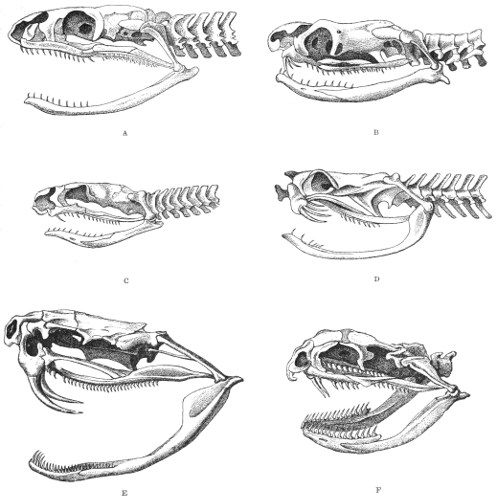
Cœlopeltis, the cranial skeleton and head of which are represented
in fig. 20, is characterised by a narrow, concave frontal shield,
projecting supraciliaries, short snout, large eyes, with round pupils,
two poison-fangs at the back of the upper maxillaries, and a
cylindrical body. The scales of the back are finely grooved, and
in the adult slightly concave.
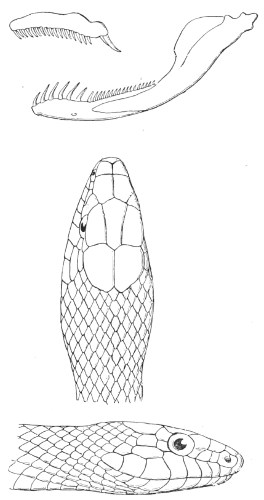
Fig. 20.—Maxillary, Mandible, and
Head of Cœlopeltis monspessulana.
The coloration, olivaceous-brown,
or deep red on the
back, becomes on the ventral
surface pale yellow with brown
streaks, and from five to seven
longitudinal series of small
spots, which are blackish and
edged with yellow on the sides.
The mean total length is
1,800 millimetres. The tail is
somewhat tapering, and about
350 millimetres long.
The only European species
is Cœlopeltis monspessulana,
which is met with pretty commonly
in France, in the
neighbourhood of Montpellier,
and Nice, near Valencia in
Spain, and in Dalmatia. It
is likewise found throughout
North Africa, and in Asia
Minor.
A second species, Cœlopeltis
moilensis, occurs in Southern
Tunis, Egypt, and Arabia.
The European Viperinæ
belong exclusively to the Genus Vipera, the principal zoological
characters of which are as follows:—
Head distinct from the neck, covered with small scales, with or
without frontal and parietal shields; eyes small, with vertically
elongate pupils, separated from the labials by scales; nostrils
lateral. Body cylindrical. Scales keel-shaped, with an apical pit,
in from 19-31 rows; ventral scales rounded. Tail short; subcaudal
scales in two rows.
The Genus Vipera is represented in Europe by several species,
which are likewise found in Western Asia and North Africa.
These species are:—
V. ursinii, V. berus, V. aspis, V. latastii, and V. ammodytes.
1
Snout obtuse, soft on its upper surface, with the frontal and
parietal shields distinct, the former about one and a half times
as long as broad, and almost always longer than the parietals.
A single series of scales between the eyes and the free margin of
the lips.
Temporal shields smooth. Body scales in from 19 to 21 rows,
strongly keeled on the back, less strongly on the sides.
Colour yellowish or pale brown above, grey or dark brown on the
sides, sometimes uniform brown; spots more or less regular on the
vertebral column, oval, elliptic or rhomboidal, dark brown or flecked
with white, sometimes forming an undulous or zigzag band; two or
three longitudinal series of dark brown or black spots on the sides;
small dark dots running obliquely from the eye to the angle of the
mouth; nose and lips white, and one or two dark angular streaks
on the head; chin and throat yellowish; belly black, with transverse
series of white or grey dots. No sexual differences in
coloration.
Total length from 420-500 millimetres; tail 50-55.
Habitat: South-east France (Basses-Alpes); Italy (Abruzzi);
Istria; Mountains of Bosnia; Plains of Lower Austria; Hungary
(environs of Buda-Pesth).
Snout rounded, short and truncate; pupil vertically elongate;
vertical diameter of the eyes equal to or greater than the distance
separating them from the mouth; frontal and parietal shields distinct,
the former as long as broad, usually shorter than the space
separating it from the rostral shield; 6-13 scales round the eyes;
one or rarely two series of scales between the eyes and the lips;
nasal shield single, separated from the rostral by a naso-rostral
shield; temporal scales smooth. Body scales in 21 rows (exceptionally
19 or 23), strongly keeled; 132-150 ventral shields;
38-36 subcaudals.
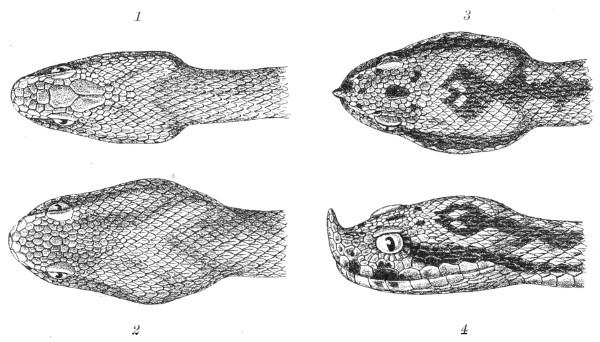
Fig. 21.—(1) Vipera berus; (2) Vipera aspis; (3, 4) Vipera ammodytes.
(Natural size.)
Colour very variable, grey, yellowish, olive, brown, or red above,
generally with an undulating or zigzag band along the vertebral
column, and a series of lateral spots. A black spot shaped like
a V, an X, or a circumflex accent, on the head. The tip of the tail
is yellow or reddish. Some specimens are entirely black.
Total length from 350 to 700 millimetres; tail 75 to 90.
Habitat: Northern Europe, and especially the mountains of
Central Europe; irregularly distributed in Southern Europe;
Northern Spain and Portugal, Northern Italy, Bosnia, Caucasus.
This viper, which is very common in France, ranges as far as
the Scandinavian Peninsula to about the 65th parallel of North
Latitude. It is sometimes met with among the mountains at an
altitude of about 6,500 feet (2,000 metres). It is found on heaths, in
grass-lands, vineyards, and forests. Certain parts of the sandy
moors of North Germany are literally infested with it. It abounds
in the Jura, Isère, Ardèche, Auvergne, Brittany, Vendée, and the
Forest of Fontainebleau.
It seeks its prey by night, and feeds on voles, small birds, frogs,
lizards, and small fish. During the summer it shows a preference
for moist places, often even remaining in the water, in which it
swims with ease.
Light and fire attract it. It does not climb trees, but is
frequently found coiled up on boughs of dead wood scattered on
the ground.
When on the defensive, and preparing to bite, it throws its
head back, and makes a sudden dart of from a foot to sixteen inches.
If irritated it makes a sort of hissing noise.
To pass the winter it retires into the crevices of rocks or into
old tree-trunks, where it entwines itself closely with a number of
its congeners. In this way ten or fifteen vipers are frequently
found together in the same hole.
In April, the whole company awakes, and copulation then takes
place. The eggs are laid in August and September, and the young
immediately crawl out of the shell, already prepared to bite, and
capable of finding their own food. Their length at birth amounts
to 230 millimetres.
The two glands of an adult adder contain about 10 centigrammes
of poison. This small quantity is sometimes sufficient to cause
death; out of 610 persons bitten, Rollinger returns 59 deaths, or
about 10 per cent.
In the departments of Vendée and Loire-Inférieure alone, Viaud
Grand Marais has noted during a period of six years 321 cases of
bites from adders, 62 of which were followed by death. In
Auvergne, Dr. Fredet2 (of Royat) returns 14 cases, which caused 6
deaths.
Snout slightly turned up, soft and squarely truncate; vertical
diameter of the eyes equal to the space separating them from the
mouth; upper surface of the head usually covered with small,
imbricate, smooth or feebly keeled scales, in 4-7 series, between
the supraocular shields, which are prominent. The frontal and
parietal shields are usually wanting; sometimes they are distinct,
but small and irregular; the former are separated from the supraoculars
by two series of scales; 8-13 scales round the eyes; two
(rarely three) series of scales between the eyes and the labials;
nasal shield single, separated from the rostral by a naso-rostral
shield. Body scales in 21-23 rows, strongly keeled; 134-158
ventrals; 32-49 subcaudals.
Coloration very variable, grey, yellowish, brown, or red above,
with a zigzag band as in V. berus. Usually a black U-shaped
mark on the hinder part of the head, with a longitudinal black
streak behind the eyes; upper lip white, or yellowish. Ventral
surface yellow, white, grey, or black, with lighter or darker markings.
Total length, 620-675 millimetres; tail 75-95.
Habitat: France (especially Vendée, the Forest of Fontainebleau,
and the South), Pyrenees, Alsace-Lorraine, the Black Forest,
Switzerland, Italy and Sicily, and the Tyrol.
This viper especially frequents
dry, rocky, and arid
hillsides, which are exposed
to the sun. Like the adder,
it hibernates in tree-trunks
and old walls. It lays from
6 to 15 eggs, from which
the living young immediately
issue, provided with poison.
It feeds upon small rodents,
worms, insects, and young
birds. Raptorial birds,
storks, and hedgehogs pursue
it and devour it in large
numbers.
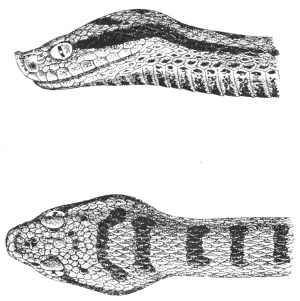
Fig. 22.—Vipera aspis. (Natural size.)
(From the Forest of Fontainebleau.)
Intermediate between V. aspis and V. ammodytes. Snout less
turned up into a corneous appendage than in the latter. Head
covered with small, smooth, or feebly keeled, subimbricate scales,
among which an enlarged frontal shield may sometimes be distinguished;
5-7 longitudinal series of scales between the supraocular
shields; 9-13 scales round the eyes; 2 or 3 series between
the eyes and the labials; nasal shield entire, separated from the
rostral by a naso-rostral. Body scales in 21 rows, strongly keeled;
125-147 ventrals; 32-43 subcaudals.
Coloration grey or brown above, with a longitudinal zigzag
band, usually spotted with white; head with or without spots on
the vertex; black streak behind the eyes; ventral surface grey,
spotted with black and white; tip of the tail usually yellow or
with yellow spots.
Total length, 550-610 millimetres; tail 80-85.
Habitat: Spain and Portugal.
Snout terminated in front by a horny appendage covered with
10-20 small scales; vertical diameter of the eyes less than the
distance separating them from the mouth; upper surface of the
head covered with small, smooth, or feebly keeled scales, among
which an enlarged frontal and a pair of parietal shields are sometimes
distinguishable; 5-7 longitudinal series of scales between
the supraoculars; 10-13 scales round the eyes; two series between
the eyes and the labials; nasal shield entire, separated from the
rostral by a naso-rostral. Body scales in 21-23 rows, strongly
keeled; 133-162 ventrals; 24-38 subcaudals.
Coloration grey, brown, or reddish above, with a zigzag dorsal
band, usually spotted with white; black streak behind the eyes;
belly grey or violaceous; end of the tail yellow, orange, or coral-red.
Total length, 550-640 millimetres; tail 70-80.
Habitat: Southern Tyrol, Carinthia, Styria, Hungary, Danubian
principalities and kingdoms, Turkey. Does not pass beyond the
48th parallel of North Latitude.
This viper loves very sunny places, and hillsides planted with
vines. It rarely hibernates.
In districts in which it is plentiful, it is only necessary to light
a fire at night in order to attract this species in swarms; this is
the best method of taking it.
Its food consists of small rodents, lizards, and birds.
The species of snakes most dangerous to man are found in the
warmer regions of Asia. India especially is infested by the famous
Cobra-di-Capello (Naja tripudians), which possesses the highly
remarkable faculty of dilating its neck in the form of a hood
when irritated, and whose sculptured image appears on almost
all the Hindu monuments.
We shall describe in a separate section (see below, F.) the
Hydrophiinæ, or Sea-snakes, a large number of species of which
frequent the shores of the Indian Ocean, the Strait of Malacca,
the China Sea, the Moluccas, Celebes, and North Australia.
In the case of certain species the area of distribution includes
the whole of the tropical and sub-tropical zones of the Pacific
Ocean, as far as the West Coast of America. It is therefore
preferable to group them together for the purpose of comprehensive
study.
Besides the above, the continent of Asia harbours a multitude of
poisonous snakes belonging to the two Families Colubridæ and
Viperidæ.
The genera and species belonging to these are so diverse, that
we must confine ourselves to mentioning the essential characters
of those that present most interest.
| I.—Family Colubridæ. |
| Subfamily Elapinæ: Genera |
| { (a) Bungarus. |
| { (b) Naja. |
| { (c) Hemibungarus. |
| { (d) Callophis. |
| { (e) Doliophis. |
(a) Bungarus.
Head hardly distinct from the neck; eyes small, with round or
vertically elliptic pupils; nostril between two nasal shields. Two
large poison-fangs followed by one or two small, slightly grooved
teeth (fig. 23). Scales smooth, oblique, in 13-17 rows, enlarged
and hexagonal in shape on the vertebral column; ventral scales
round. Tail relatively short; subcaudal scales in one or two rows.
Two very dangerous snakes found in India and Indo-China
belong to this genus, B. fasciatus and B. candidus (var. cæruleus).
Both are fairly common. In Ceylon B. ceylonicus is met with,
and in South China B. candidus (var. multicinctus). The length
of these snakes is from 1,000-1,500 millimetres. The back is
compressed in the shape of a keel. The neck is not dilatable.
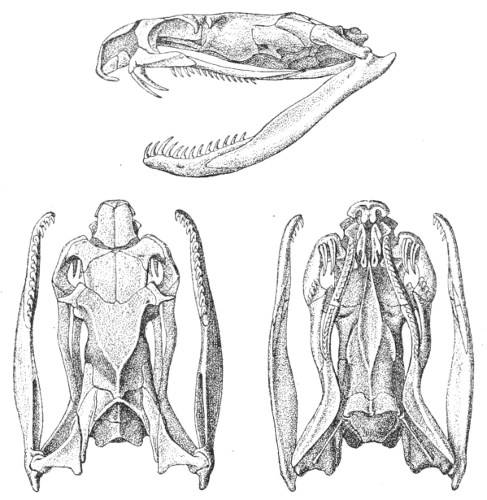
Fig. 23.—Skull of Bungarus. (After G. A. Boulenger, op. cit.)
Colour bright yellow, ringed with black, with a black band
commencing between the eyes, and broadening behind upon the
nape and neck (fig. 24).
Especially abundant on the Coromandel Coast, in Bengal, and in
Burma. In the North-west Provinces of India it is known as the
Koclia-Krait. Its bite is very serious, but does not cause nearly so
many fatalities as that of the Cobra, since its fangs are smaller.
Dogs bitten by B. fasciatus die in from four to five hours.
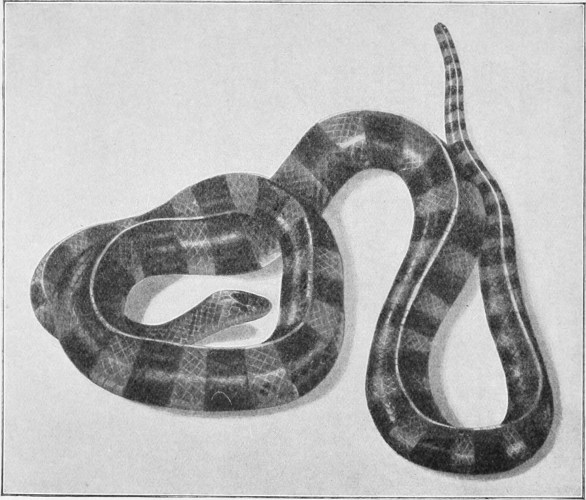
Fig. 24.—Bungarus fasciatus (India). (After Sir Joseph Fayrer.)
Blackish-brown or bluish, with narrow transverse white streaks,
or small white spots, or alternate rings of yellow and dark brown;
belly white. Smaller than the foregoing, scarcely exceeding 1,000
millimetres in length. It is known as the “Krait” in India, where,
after the Cobra, the variety cæruleus causes most deaths among
human beings. It is found in jungles and rice-fields, and commonly
secretes itself in old trees and old walls. It frequently penetrates
into houses, verandahs, bathrooms, and even beds. Sir Joseph
Fayrer relates the story of a lady, who, when travelling in
a palanquin, found on arriving at her destination a “Krait” coiled
up in her luggage, the snake having thus made the journey with
her throughout a whole night.
The Krait may easily be confused with Lycodon aulicus,
a harmless snake which closely resembles it, though it can at
once be distinguished by examining its mouth.
Head scarcely distinct from the neck; eyes with round pupils;
nostril between two nasal shields and an internasal. A pair of solid
grooved poison-fangs. Body elongate, cylindrical, terminated by
a conical and pointed tail. Scales smooth, disposed obliquely, in
15-25 rows. Ventral scales round.
Head small, covered with large shields, a frontal as long as
broad, a supraocular, a præocular, 3 postoculars, 2 + 3 or 3 + 3
temporals, 7 upper labials, 4 lower labials. Neck dilatable by the
separation of the first cervical ribs; 21-35 scales round the neck,
17-25 round the middle of the body; 163-205 ventrals; 42-75
subcaudals.
Total length, 1,500-1,900 millimetres; tail 230.
Coloration very variable, usually cinereous grey or almost black
with a bluish sheen; belly lighter, sometimes tinted with red. The
head is frequently tinged with golden-yellow; it is spotted with
yellowish-white above, and is pure white underneath.
This species is distributed throughout the whole of Southern
Asia, from the south of the Caspian Sea to South China and the
Malay Archipelago.
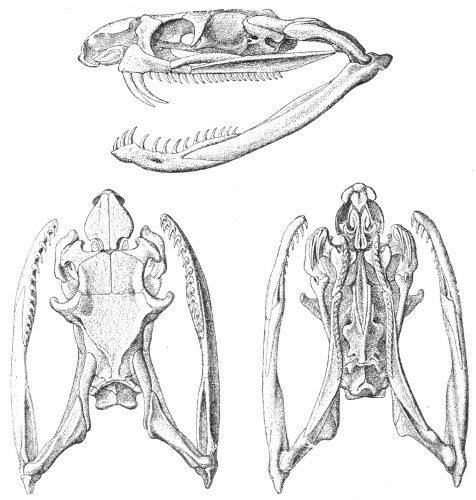
Fig. 25.—Skull of Naja tripudians. (After G. A. Boulenger, op. cit.)
Several varieties occur, and of these the principal are:—
(1) Var. Typica (fig. 27), with a black-and-white spectacle-shaped
mark on the middle of the dorsal surface of the most
dilatable portion of the neck, and one or more dark transverse
bands on the ventral surface, behind the head.
Habitat: India, Ceylon.
(2) Var. Cæca.—Colour, pale brown or uniform dark grey,
without mark on the neck, and with one or more dark transverse
bands on the anterior part of the belly.
Habitat: Transcaspian region, India, Java.
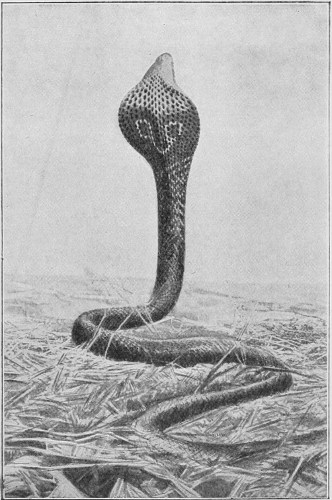
Fig. 26.—Naja tripudians (Cobra-di-Capello) on the
Defensive, preparing to Strike.
(3) Var. Fasciata.—Colour,
brown, olive,
or black, with more or
less distinct light transverse
bands. White
spot edged with black
in the shape of a ring
or of a U on the neck,
behind; a black spot
on each side in front.
Habitat: India,
Indo-China and South
China, Hainan, Cambodia,
Siam, Malay
Peninsula.
(4) Var. Sputatrix.—Black
or dark brown,
with yellow or orange-coloured
spots on the
sides of the head and
neck. The young have
a pale spot in the
shape of a U or an O
on the middle of the
dorsal surface of the neck, and the throat is whitish.
Habitat: Chusan Islands and South China, Burma, Malay
Peninsula, Sumatra, Java.
(5) Var. Leucodira.—Brown or black, without mark on the neck.
Throat yellowish-white, followed by a black transverse band.
Habitat: Sumatra, Malay Peninsula.
(6) Var. Miolepis.—Brown or black; sides of the head and
throat yellowish, no mark on the neck. Young with white rings
completely encircling the body and tail.
Habitat: Sarawak, Labuan, Borneo.
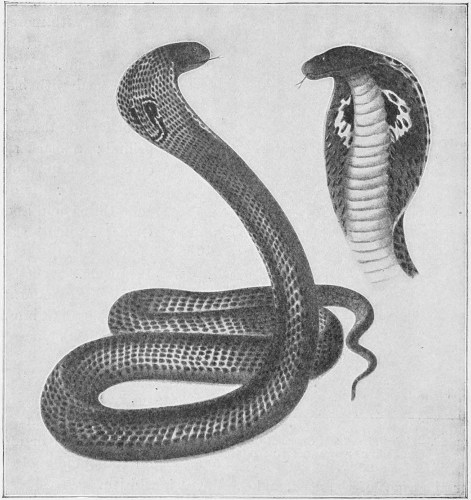
Fig. 27.—Naja tripudians (Cobra-di-Capello). (After Sir Joseph Fayrer.)
Internasal shields shorter than the præfrontals, and in contact
with the præoculars; 1-3 large occipital shields behind the
parietals; 1 præocular and 3 postoculars; 2 + 2 or 2 + 3 temporals;
7 supralabials, 4 infralabials; 21-23 scales across the neck,
17-19 across the middle of the body; 159-175 ventrals; 45-50
subcaudals.
Coloration black or sometimes yellowish above; pale brown or
yellowish on the belly; neck black.
Total length, 1,000 millimetres; tail 160.
Habitat: Philippine Islands.
A pair of large occipital shields; 1 præocular; 3 postoculars;
2 + 2 temporals; 7 supralabials, 4 infralabials; 19-21 scales across
the neck, 15 across the middle of the body; 215-262 ventral scales,
80-117 subcaudals. Neck dilatable.
Coloration very variable, yellowish, brown, olive, or black, with
or without dark transverse bands.
Total length, 3,900 millimetres; tail 630.
Habitat: India, Burma, Indo-China, Siam, Southern China,
Malay Peninsula and Archipelago.
The species of Naja are oviparous, and usually lay some twenty
eggs, elliptical in shape and as large as those of a pigeon, with a
soft shell.
These snakes do not fear the proximity of man, and feed upon
rats, mice, and birds; they seek their prey chiefly in the evening,
after sunset.
They swim extremely well, and frequent the neighbourhood of
water-courses.
Indian legends relate that Brahma, having descended on earth
and fallen asleep one day at high noon, a Naja placed itself in
front of him and, dilating its broad neck, procured for him kindly
shade. In order to repay it for the service rendered, Brahma gave
Naja the marks that it bears on its neck, intended to frighten the
kites and other birds of prey, which are implacable enemies of
this snake.
When a native of the Malabar Coast finds a Naja in his dwelling,
he begs it in a friendly way to depart; if the request be without
avail, he offers it food in order to attract it outside; if the snake
still does not move, the Hindu goes in search of the pious servitors
of one of his divinities, who, procuring an offering, address the most
touching supplications to it (Brehm).
The mortality due to the bite of this snake, which is by far
the most common in India, is considerable. In the course of a
period of eight years, from 1880 to 1887, it amounted on the
average to 19,880 human beings and 2,100 head of cattle every
year.
In 1889, 22,480 persons and 3,793 head of cattle perished from
snake-bite. Since then, the annual tale of fatalities always
fluctuates between 16,000 and 22,000, in spite of the rewards for
the destruction of snakes which the Indian Government has been
obliged to institute, which represent an expenditure of about
£10,000 per annum.
For every 100 persons bitten, it is estimated that on an average
from 25 to 30 die, and in most cases death supervenes in from two
to twelve hours after the bite.
Naja bungarus, or the Hamadryad, is the largest and most
formidable of poisonous snakes. It is very vigorous and very
aggressive, but is more rarely met with than Naja tripudians. It
loves the vicinity of rivers and streams, lives in forests and jungles,
and climbs trees with facility. It feeds upon other snakes (whence
its name Ophiophagus), and also on birds, fish, and small mammals.
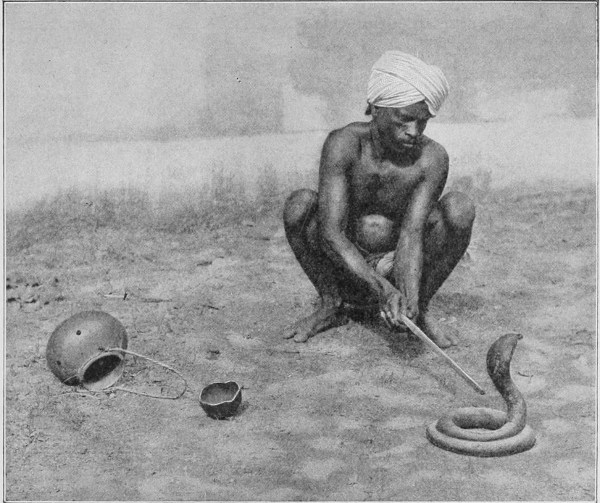
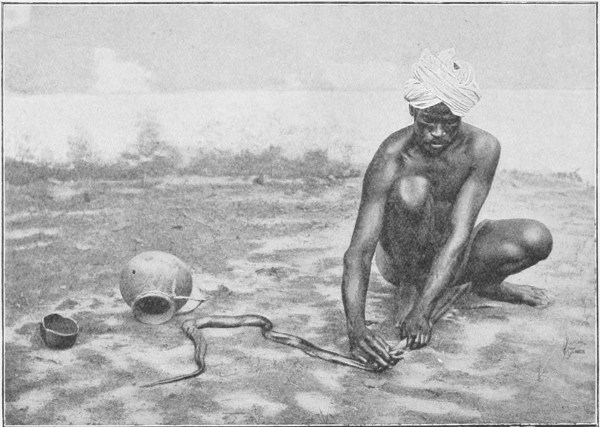
Hindu snake-charmers assert that it is very difficult to capture,
and dangerous owing to its strength; they handle it only after
having extracted its poison-fangs.
A very intelligent Hindu told Torrens how he had seen the way
in which the Hamadryad procures the snakes that form its favourite
food. The Hindu in question happened to be on the flat roof of
his house, when a young Hamadryad appeared quite close to him.
The snake raised its head, expanded its neck, and emitted a shrill
hissing noise. Thereupon a dozen snakes came crawling up from
all directions and assembled round the Hamadryad, when the
latter made a dart at one of them and hastened to devour it
(Fayrer).
The Hamadryad is dreaded with good reason, for not only is
it aggressive, and hurls itself boldly upon its adversary, but it also
pursues him, a trait exhibited by no other poisonous snake.
Cantor relates that in Assam an officer met with several young
Hamadryads which were being watched over by their mother. The
latter turned towards its enemy, who took to his heels with all
speed, pursued by the terrible reptile. The course taken led to a
river, which the fugitive did not hesitate to swim in order to gain
the opposite bank, hoping thus to make good his escape; all,
however, to no purpose. The snake still pursued him, and the
officer saved himself only by a stratagem. He dashed his turban
on the ground; the snake threw itself upon it and savagely bit
it several times, thus giving the officer time to reach a place of
safety.
Cantor’s experiments show that the venom of the Hamadryad
is extremely rapid in its action. A dog usually dies a quarter of an
hour after being bitten, and Nicholson states that he has seen an
elephant bitten by a snake of this species die in three hours.
This genus includes several species of snakes of somewhat small
size, rarely exceeding 700 millimetres in length, with an elongate,
cylindrical body; the head is scarcely distinct from the neck, the
pupil round, and the tail short, while the nostril is situate between
two nasal shields. The temporal shields are arranged in a single
row. The poison-glands sometimes extend into the abdominal
cavity. Scales in 13 or 15 rows; 190-260 ventrals, 12-44 subcaudals
in 2 rows.
Four species belonging to this genus are known:—
(1) H. calligaster.—2 + 3 temporal scales, 6 supralabials.
Colour purple, with black transverse bands separated by narrow
white bars; belly and end of tail red; snout yellow, with a black
band on the upper lip below the eyes.
Total length, 520 millimetres; tail 30.
Habitat: Philippine Islands.
(2) H. collaris.—No anterior temporal scales.
Colour black on the back, with black and red bands on the belly;
a yellow collar on the occiput.
Total length, 430 millimetres; tail 15.
Habitat: Philippine Islands.
(3) H. nigrescens.—Scales in 13 rows. A single temporal scale;
218-251 ventrals; 33-44 subcaudals.
Belly uniformly red; upper lip yellow in front of and behind
the eyes.
Total length, 1,100 millimetres; tail 115.
Habitat: Hills of Western India, from Bombay to Travancore.
(4) H. japonicus.—Scales in 13 rows; 190-216 ventrals; 28-29
subcaudals; temporals 1 + 1.
Colour red on the back, with 1-5 black bands crossed by other
black bands edged with yellow. Snout and sides of head black.
Belly yellow, with large black spots alternating with black transverse
bands.
Total length, 520 millimetres; tail 40.
Habitat: Loo Choo Islands.
This genus is characterised by the maxillary bones extending
forwards beyond the palatines, with a pair of large poison-fangs,
but without other teeth. Head and eyes small, pupils round;
nostril between two nasal shields. Body cylindrical, greatly
elongate. Scales smooth, in 13 rows; ventrals rounded; subcaudals
in 2 rows.
Five species are known:—
(1) C. gracilis.—Red or pale brown, with three longitudinal
black lines passing through brown, or black spots; the lateral spots
alternating with the vertebræ. Black and yellow bands under the
tail and on the belly.
Total length, 740 millimetres; tail 35.
Habitat: Malay Peninsula, Sumatra.
(2) C. trimaculatus.—Head and nape black, with a yellow spot
on each side of the occiput; belly uniform red; tail with two black
rings.
Total length, 335 millimetres; tail 21.
Habitat: India and Burma.
(3) C. maculiceps.—Head and nape black, with one or two
yellow bands on each side. Belly red, two black rings on the tail.
Diameter of the eyes equal to two-thirds of the space separating
them from the mouth.
Total length, 485 millimetres; tail 30.
Habitat: Burma, Indo-China, Malay Peninsula.
(4) C. macclellandii.—Head and neck black, with a yellow
transverse band behind the eyes. The space separating the eyes
equal to that separating them from the mouth. Colour reddish-brown
on the back, with regular and equi-distant black streaks;
belly yellow, with black bands or quadrangular spots. The head
exhibits two black transverse bands separated by a yellow band.
Total length, 620 millimetres; tail 55.
Habitat: Nepal, Sikkim, Assam, Burma, Southern China.
(5) C. bibronii.—Met with by Beddome in the forests of Malabar,
at an altitude of 3,280 feet. Back purplish-brown, with a pearly
lustre, and about forty irregular black transverse bands, extending
to the tip of the tail. Head black in front, cherry-red on the
occiput.
Total length, 640 millimetres; tail 50.
Habitat: Malabar.
All the snakes belonging to the genus Callophis are remarkable
for their bright and varied colours, whence the generic name, which
signifies “beautiful snakes.”
They feed exclusively on other snakes belonging to the Family
Calamaridæ; consequently they are not found in regions where
Calamaridæ do not occur, as, for instance, in Ceylon.
They are essentially terrestrial, and live in old tree-trunks, or
clefts in rocks. They are sluggish, slow-moving, and chiefly
nocturnal.
As a rule they do not seek either to defend themselves or to bite;
consequently fatal accidents caused by them are scarcely known in
the case of human beings. Their venom, however, is very toxic
to animals.
This genus exhibits the same characters as Callophis, except
that the poison-glands, instead of being confined to the temporal
region, extend a very long way on each side of the body, to about
one-third of its length, gradually growing thicker and terminating
at the base of the heart.
It includes four species:—
(1) D. bivirgatus.—Colour reddish-purple or black on the back,
red on the head, tail, and belly.
Total length, 1,610 millimetres; tail 190.
Habitat: Burma, Indo-China, Malay Peninsula, Sumatra, Java,
and Borneo.
(2) D. intestinalis.—Brown or black on the back, with darker
or lighter longitudinal streaks; tail red beneath; belly red, crossed
with black streaks.
Total length, 580 millimetres; tail 45.
Habitat: Burma, Malay Peninsula, Sumatra, Java, Borneo,
Celebes.
(3) D. bilineatus.—Black on the back, with two white streaks
along the whole length of the body. Snout white; belly striped
with black and white bands. Tail orange, with two or three black
rings or spots.
Total length, 710 millimetres; tail 45.
Habitat: Philippine Islands.
(4) D. philippinus.—Back with dark brown cross-bands, merging
into black transverse ventral streaks, which are separated by yellow
or red interspaces. Head brown, with small yellow spots.
Total length, 430 millimetres; tail 35.
Habitat: Philippine Islands.
The Family Viperidæ is represented in Asia by a considerable
number of snakes belonging to the two Subfamilies Viperinæ
and Crotalinæ.
The Asiatic Viperinæ belong to the genera:—
(a) Vipera.
(b) Pseudocerastes.
(c) Cerastes.
(d) Echis.
The Crotalinæ consist of only two genera:—
(e) Ancistrodon.
(f) Lachesis.
(a) Vipera.
We shall not recapitulate here the characters of the Genus
Vipera, which we described in dealing with the vipers of Europe.
The genus is represented by several species, the geographical range
of which is chiefly confined to Eastern and Central Asia.
(1) Vipera renardi.—Resembles V. berus, but the snout is
pointed and soft, with a turned-up tip; a single series of scales
between the eyes and the lips; nostril pierced in the lower half
of a single nasal shield; 8-9 supralabial shields; 4 infralabials.
Body scales in 21 rows; 130-150 ventrals; 24-37 subcaudals.
Coloration the same as in the European V. ursinii, but the
snout and lips are spotted with black or brown.
Total length, 395-620 millimetres; tail 40-75.
Habitat: Central Asia, Turkestan.
(2) V. raddii.—Snout rounded; supraocular shields erectile;
eyes surrounded by a complete circle of 14-17 scales; 9-10
supralabials; body scales in 23 rows; 150-180 ventrals; 23-32
subcaudals.
Coloration pale brown or grey on the back, with a dorsal series
of small reddish spots arranged in alternating pairs. A black mark
like a circumflex accent on the occiput, and a black band behind
the eyes. Belly yellow, speckled with black and white.
Total length, 740 millimetres; tail 50.
Habitat: Armenia.
(3) V. lebetina.—Snout rounded and obtuse, with a well-marked
prominence; 7-12 longitudinal series of scales between the eyes;
supraocular shields well developed or narrow, or broken up into
several small portions; 12-18 scales round the eyes; 9-12 supralabials;
4-5 infralabials; body scales in 23-27 rows; 147-180
ventrals; 29-51 subcaudals.
Coloration variable, grey or pale brown on the back, with a
series of large dark spots. Large brown mark like a circumflex
accent on the crown of the head and another on the occiput. Belly
whitish, speckled with grey-brown; end of tail yellow.
Total length, 960 millimetres; tail 120. The female may attain
the length of 1,350 millimetres.
Habitat: Cyprus, Galilee, Syria, Asia Minor, Transcaspia,
Persia, Mesopotamia, Afghanistan, Baluchistan, Cashmir.
(4) V. russellii (Daboia, or Russell’s Viper). (fig. 28.)—This
viper, which may attain a length of as much as 2,000 millimetres,
is magnificently coloured. Its dorsal surface is brownish-yellow,
marked with large oval spots of blackish-brown, edged with yellow
or white. The belly is covered with transverse bands, with beautiful
triangular black spots, bordered with white. The head, which is
long, ends in front in a thick, rounded snout; it is covered above
with small keeled scales. The nostril, which is large and laterally
placed, is surrounded by three shields and soft smooth skin.
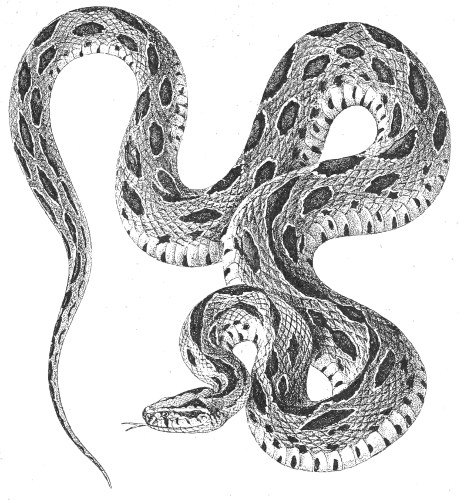
Fig. 28.—Vipera russellii (Syn. Vipera elegans. Daboia, or Russell’s Viper). India.
(After Sir Joseph Fayrer.)
The species is found throughout India, from Bombay to Bengal,
in Ceylon, Burma, and Siam. It is particularly common in Burma,
around Rangoon. For walking in the jungle and rice-fields, the
natives of this region encase their feet and legs in a special kind of
jack-boots made of coarse jute-cloth, in order to protect themselves
from the bites of this snake, which cause a large number of fatal
accidents.
The Daboia ascends the Himalayas to an altitude of 5,250 feet.
It lives in thickets, under stones, and in the clefts of rocks. When
disturbed it makes a terrible hissing, but bites only when attacked
or irritated.
It feeds upon small vertebrates, such as mice, rats, birds, and
frogs, and often enters houses in pursuit of rats.
“Schrott had the opportunity of observing a Daboia on the
defensive. A lady carrying a child on her arm was returning home
towards evening; she had almost reached her house when a bulldog
accompanying her began to bark furiously. Although the lady
saw nothing, she was, nevertheless, frightened and called for help.
Schrott, who was not far away, ran to the spot, and saw a Daboia
lying across the path by which the lady had to proceed. The
reptile had its neck thrown back and its head in a horizontal
position; its bright eyes followed all the movements of the dog, to
whose barks it replied by shrill hisses. It was only waiting for an
opportunity to strike. Schrott called off the dog, and the snake
at once disappeared among the high grass close by. Next day it
was killed at the same spot” (Brehm).
The venom of this viper is terribly potent. According to Russell,
a large dog exhibited symptoms of poisoning five minutes after
being bitten. At the end of a quarter of an hour it lay down, uttering
heartrending cries, began to breathe with difficulty and noisily, was
seized with spasms of the jaws and cramps, and died in frightful
agony less than half an hour after the wound was inflicted. Fowls
in most cases die in less than two minutes. A horse succumbed
in half an hour, and another in eleven hours.
It appears that in India many cattle are killed by Daboias while
grazing (Fayrer).
This genus is represented by a single species (Pseudocerastes
persicus), which appears to be exclusively confined to Persia.
The head is very distinct from the neck, and covered with small
imbricate scales; the eyes, which are small, have vertical pupils;
they are separated from the lips by
small scales. The nostrils are
directed upwards and outwards.
The snout is very short and rounded.
The cylindrical body has 23-25
rows of scales; 151-156 ventrals;
43-49 subcaudals.
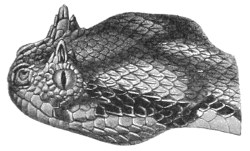
Fig. 29.—Pseudocerastes persicus.
(After Duméril and Bibron.)
The coloration is gray or brown,
with four series of large black spots,
and the head exhibits two longitudinal
black streaks behind the eyes. The belly is whitish, dotted
with black.
Total length, 890 millimetres; tail 110.
The vipers belonging to this genus are much more common
in North Africa, and we shall therefore study them in conjunction
with the African snakes. Cerastes cornutus alone, the special
habitat of which is Egypt, is sometimes met with in Arabia and
on the eastern bank of the Suez Canal.
Echis carinatus (the Phoorsa). (Fig. 30).—This viper is characterised
by the subcaudal shields being arranged in a single row.
It is savage and very aggressive, being always ready to attack. Its
length does not exceed 600 millimetres at the most. The colour
of the body is grey, more or less dark and adorned with streaks,
spots, and dots of blackish-brown. The back displays yellowish-white
wavy lines, forming X-shaped markings. The upper side
of the head exhibits a yellow spot surrounded by brown, and other
small black spots, the whole arrangement forming a fairly good
representation of a cross.
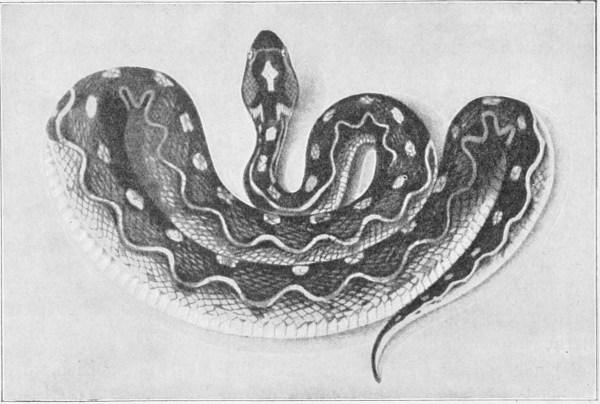
Fig. 30.—Echis carinatus. India.
(After Sir Joseph Fayrer.)
This species is found in India, Persia, Baluchistan, Arabia, and
Palestine; while, as we shall see, it also occurs in Africa. It is
fairly common in the environs of Aden.
In moving over the ground a peculiar sound is produced by the
friction of its scales. It is capable of springing with great agility
a fairly long distance on to its prey. When it believes itself in
danger it coils up, doubling its body twice in the shape of a
crescent, in the middle of which it places its head, ready to
strike. Its venom is very rapid in taking effect.
The snakes belonging to this genus of Crotalinæ are found in
Central and Eastern Asia, but three important species occur in the
New World, in the United States and Central America. The head
is covered with nine large symmetrical shields, but the internasals
and præfrontals are sometimes broken up into scales. The body
is cylindrical; the tail rather short; the subcaudal scales are
arranged in one or two rows.
A. acutus.—The snout of this snake is prolonged into an appendage
directed forwards. The head-shields are finely granulate. Body
scales arranged in 21 rows; 162-166 ventrals; 58-60 subcaudals.
Coloration brown on the back, with blackish-brown X-shaped
spots; head dark brown, yellow on the cheeks, with a black band
running from the eye to the angle of the jaw; belly yellowish,
spotted with brown, with a series of large black transverse blotches.
Total length, 1,500 millimetres; tail 200.
Habitat: Upper Yang-tse, China.
A. halys.—Snout prolonged into an upturned appendage, blunt
at the tip; 7-8 supralabial scales, the third of which forms part
of the margin of the eye; body scales in 23 rows; 149-174
ventrals; 31-44 subcaudals.
Coloration yellowish, grey, red, or pale brown above, with darker
spots or cross-bars. A black spot on the snout; two black spots
on the vertex; a dark, light-edged band
on the temple; belly whitish, more or
less speckled with grey or brown.
Total length, 490 millimetres; tail 65.
Habitat: From the borders of the
Caspian Sea and the Ural River to the
Upper Yenisei; Turkestan.
A. intermedius.—Resembles the foregoing
very closely, but the snout is not
turned up at the end.
Total length, 750 millimetres; tail 85.
Habitat: Central Asia, Eastern
Siberia, Mongolia, and Japan.
A. blomhoffii.—Similar to A. halys,
but the snout is not turned up at the
end, and the body scales are in 21 rows;
137-166 ventral scales; 29-55 subcaudals.
Coloration very variable; grey, brown,
or red above, with large black-edged spots
arranged in pairs; black, light-edged
band on the temple; upper lip uniformly
yellow or red; belly yellow or reddish,
more or less spotted with black, or almost
entirely black.
Total length, 720 millimetres; tail
100.
Habitat: Eastern Siberia, Mongolia,
China, Japan, Siam.
A. himalayanus.—Snout scarcely
turned up, with a hard tip; 5-7 supralabial
shields. Body scales in 21 (rarely
23) rows; 144-166 ventrals; subcaudals
in 35-51 pairs.
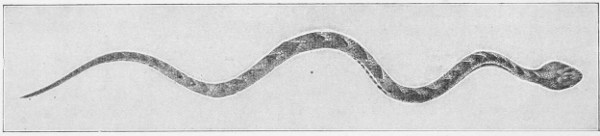
Fig. 31.—Ancistrodon hypnale.
(The Carawalla of Ceylon.)
(After Sir Joseph Fayrer.)
Coloration brown, with black spots or transverse bands; black,
light-edged band from the eye to the angle of the mouth; belly
dark brown, or more or less whitish.
Total length, 590 millimetres; tail 90.
Habitat: Himalayas (5,000 to 10,000 feet), especially in the
North-west; Khasi Hills.
This snake feeds chiefly on mice.
A. rhodostoma.—Snout pointed, somewhat turned up at the
tip: 7-9 supralabial shields; body scales in 21 rows; 138-157
ventrals; 34-54 subcaudal pairs.
Coloration reddish, grey, or pale brown above, with large
angular, dark brown, black-edged spots arranged in pairs or alternating.
Vertebral line almost black; lips yellow, speckled with
brown; brown, black-edged band, running from the eye to the
angle of the mouth. Belly yellowish, spotted with greyish-brown.
Total length, 810 millimetres; tail 90.
Habitat: Java.
A. hypnale (fig. 31).—Snout more or less turned up, with
a hard, pointed end; 7-8 supralabial shields; body scales in
17 rows; 125-155 ventrals; 28-45 subcaudal pairs.
Coloration very variable; brown, yellowish, or greyish above,
sometimes with dark brown spots or transverse bands. Cheeks
brown, with a longitudinal, white, black-edged streak on each side
of the neck. Belly more or less speckled with dark brown.
Total length, 480 millimetres; tail 65.
Habitat: Ceylon, and Western Ghats of India as far north as
Bombay.
In Ceylon this snake is known as the Carawalla. It is much
dreaded, but its bite is not rapidly fatal.
This genus has many representatives in Asia and the New
World. The American species are for the most part of larger
size and more formidable.
They are characterised by a triangular head, covered with small
scales or small shields, and by a cylindrical or compressed body.
The Asiatic species have the subcaudal scales in two rows and the
tail short, and often prehensile, which enables them to climb trees
or bushes, where they lie in wait for their prey.
Their classification is based upon the following characters:—
A. First infralabial scale in contact with its fellow.
I. Scales in 21-25 (rarely 27) rows; 129-158 ventrals; 21-57
subcaudals; 5-9 series of scales between the supraocular
shields; tail non-prehensile.
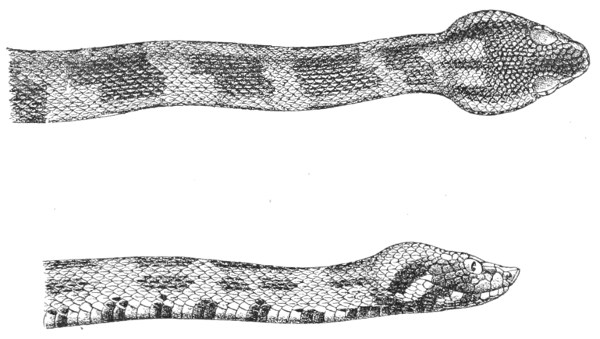
Fig. 32.—Lachesis okinavensis. (After G. A. Boulenger, op. cit.)
(1) L. monticola.—Supraocular shields large, separated by 5-8
scales; snout obtuse.
Colour brown or yellowish above, brown or pale yellow on the
sides, with a brown temporal streak. Belly white, spotted with
brown.
Total length, 740 millimetres; tail 115.
Habitat: Tibet, Himalayas (2,000 to 8,000 feet), Hills of Assam,
Burma, Malay Peninsula, Singapore, Sumatra.
(2) L. okinavensis (fig. 32).—Supraocular shields large, separated
by a transverse series of 6-9 scales; end of snout pointed
and turned up.
Colour brown above, with dark transverse bands and a light
temporal streak. Belly brown, spotted with black, especially on
the sides.
Total length, 350 millimetres; tail 60.
Habitat: Okinawa, Loo Choo Islands.
(3) L. strigatus.—Supraocular shields small, sometimes broken
up, separated by 8-11 convex scales in juxtaposition.
Colour brown above, with black spots often forming a median
zigzag band; temporal band black; belly whitish, spotted with
grey or black; end of tail yellow or reddish.
Total length, 480 millimetres; tail 55.
Habitat: Hills near Bombay, Deccan, Anamallays and Nilgherries.
II. Scales in 27-37 rows; 174-231 ventrals; 54-90 subcaudals;
tail non-prehensile.
(4) L. flavoviridis.—Scales in 33-37 rows; 222-231 ventrals;
75-90 subcaudals; 8-9 supralabials.
Coloration pale brown or greenish-yellow above, marbled with
black; longitudinal black streaks symmetrically disposed on the
head; belly yellow or greenish, with darker spots.
Total length, 1,215 millimetres; tail 220.
Habitat: Loo Choo Islands.
This snake is not infrequently termed by naturalists Trimeresurus
riukianus.
(5) L. cantoris.—Scales in 27-31 rows; 174-184 ventrals;
55-76 subcaudals; 13 supralabials.
Coloration pale brown or dull green, with small black spots;
a whitish streak along the sides of the body; belly white or
greenish.
Total length, 1,020 millimetres; tail 140.
Habitat: Andaman and Nicobar Islands.
III. Scales in 21-27 rows; 160-218 ventrals; 54-92 subcaudals;
tail not or scarcely prehensile.
(6) L. jerdonii.—7-9 scales in a line between the supraocular
shields; scales in 21 or 23 rows; 164-188 ventrals; 54-67
subcaudals.
Coloration greenish-yellow or olive above, mixed with black,
a dorsal series of reddish-brown transverse rhomboidal spots;
upper lip yellow, with one or two black spots; belly yellow, more
or less marbled with black.
Total length, 930 millimetres; tail 145.
Habitat: Assam, Tibet, Upper Yang-tse.
(7) L. mucrosquamatus.—10-15 scales in a line between the
supraocular shields; scales in 25-27 rows; 183-218 ventrals;
72-92 subcaudals. Colour brownish-grey above, with a series
of large black median spots and smaller ones on the sides; a black
streak from the eye to the angle of the mouth; belly brownish,
spotted with white.
Total length, 1,050 millimetres; tail 210.
Habitat: Formosa, Assam.
(8) L. luteus.—12 or 13 scales in a line between the supraocular
shields; scales in 23-25 rows; 182-186 ventrals; 72-74 subcaudals;
supraocular shields large.
Colour yellow above, with a series of dark rhomboidal spots,
and a dorsal, black-spotted zigzag band; a black streak on each
side of the head behind the eyes; belly yellowish, spotted with grey.
Total length, 945 millimetres; tail 164.
Habitat: Loo Choo Islands.
(9) L. purpureomaculatus.—12-15 scales in a line between the
supraocular shields; scales in 25-27 rows; ventrals 160-182;
subcaudals 55-76; supraocular shield very narrow, sometimes
broken up.
Coloration purplish-black above, sometimes variegated with pale
green; flanks pale green; belly olive or greenish-white, uniform
or spotted with black. Some specimens are entirely green.
Total length, 980 millimetres; tail 150.
Habitat: Himalayas, Bengal, Assam, Burma, Malay Peninsula,
Andaman and Nicobar Islands, Pulo-Pinang, Sumatra.
IV. Scales in 21 rows (rarely
19 or 23); 7-13 series of scales
between the supraoculars; tail
more or less prehensile.
(10) L. gramineus (Syn. Trimeresurus
gramineus. The Green
Pit Viper).—145-175 ventral
scales; 53-75 subcaudals; snout
slightly projecting; supraocular
shield narrow.
Colour bright green, rarely
olive or yellowish, with or without
darker transverse bands; end
of tail yellow or red; belly green,
yellow, or white.
Total length, 870 millimetres;
tail 150.
Habitat: South-eastern Asia,
Darjeeling, Himalayas, Ganges
Delta, Siam, Southern China,
Hong Kong, Formosa, Java,
Sumatra, Timor.
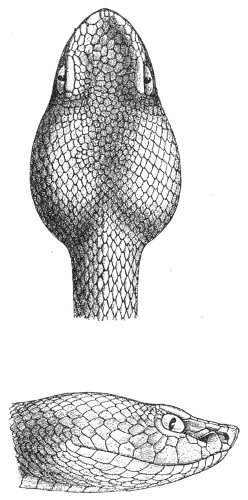
Fig. 33.—Lachesis flavomaculatus.
(After G. A. Boulenger, op. cit.)
(11) L. flavomaculatus (fig.
33).—170-187 ventral scales;
53-73 subcaudals; snout projecting,
obliquely truncate; supraocular shield narrow.
Colour bright green or olive, sometimes barred with reddish-brown;
belly green, olive, or greenish-yellow; end of tail sometimes
red.
Total length, 1,060 millimetres; tail 160.
Habitat: Philippine Islands.
(12) L. sumatranus.—180-191 ventral scales; 58-82 subcaudals;
supraocular shield large.
Coloration bright green, with or without black transverse
bands; yellowish band on each side; belly yellow or green, with
or without black speckles; end of tail red.
Total length, 1,100 millimetres; tail 180.
Habitat: Singapore, Sumatra, Borneo, Palawan.
(13) L. anamallensis.—138-158 ventral scales; 44-58 subcaudals.
Colour green, olive, yellowish, or reddish-brown; a black
temporal band; belly pale green, olive, or yellow; tail usually
black and yellow.
Total length, 730 millimetres; tail 110.
Habitat: Anamallay and Nilgherry Hills, South India.
(14) L. trigonocephalus.—Scales in 17-19 rows, 145-170
ventrals; 53-67 subcaudals.
Coloration green, with or without black transverse bands or
spots; a black temporal streak; belly green or yellow; end of tail
usually black.
Total length, 790 millimetres; tail 130.
Habitat: Ceylon.
(15) L. macrolepis.—Scales in 13-15 rows; 134-143 ventrals;
48-56 subcaudals.
Colour bright green or olive; belly pale green.
Total length, 680 millimetres; tail 120.
Habitat: Southern India.
B. First lower labial shield divided; the portion separated off
forms a pair of small supplementary dental shields; 144-176
ventral scales; 38-57 subcaudals; tail prehensile.
(16) L. puniceus.—Scales in 21-23 rows; 12-14 series of
scales between the supraocular shields.
Colour grey, brown, or red; belly spotted with brown; end of
tail red.
Total length, 640 millimetres; tail 90.
Habitat: Sumatra, Java, Borneo, Natuna Islands.
(17) L. borneensis.—Scales in 19-21 rows; 10-11 series of
scales between the supraocular shields; 152-168 ventrals; 43-65
subcaudals.
Total length, 770 millimetres; tail 105.
Habitat: Borneo, Sumatra.
C. (18) L. wagleri.—Scales in 19-27 rows, 127-154 ventrals;
45-55 subcaudals; tail prehensile.
Colour green, with darker or lighter markings, black and yellow,
or nearly entirely black.
Total length, 980 millimetres; tail 150.
Habitat: Malay Peninsula and Archipelago.
In Africa, poisonous snakes abound throughout the whole of the
tropical and sub-tropical zones. The fatal accidents to human
beings caused by them in this continent are fewer than in India,
since the population of Africa is less dense, but several species
occur, the venom of which is especially dangerous to life.
These species belong in nearly equal numbers to the Families
Colubridæ and Viperidæ.
The poisonous Colubridæ of Africa are all included in the
Subfamily Elapinæ, of which the following are the eight principal
genera:—
(a) Boulengerina.
(b) Elapechis.
(c) Naja.
(d) Sepedon.
(e) Aspidelaps.
(f) Walterinnesia.
(g) Homorelaps.
(h) Dendraspis.
A small snake 240 millimetres in length, the principal characters
of which are as follows:—
Maxillary bones equal to the palatines in length, with a pair of
relatively large poison-fangs, followed by three or four small teeth.
Head hardly distinct from the neck. Eye small, with round
pupil; nostril between two nasal shields. Body cylindrical; scales
smooth, in 21 rows; ventrals rounded. Tail moderate; subcaudal
scales in 2 rows.
The only known species, B. stormsi, is brown, with black
transverse bars on the neck; tail black; belly white in front,
brown behind, with a black border to the scales.
It is found in the region of Lake Tanganyika.
This genus is characterised by the size of the maxillary bones,
which is equal to that of the palatines; a pair of large poison-fangs
followed by two to four small teeth; head not distinct from the
neck; eye small with round pupil; nostril between two nasal
shields. Body cylindrical; scales oblique, smooth, in 13 or 15
rows; ventrals rounded. Tail very short, subcaudal shields in 2
rows.
Six species are known:—
(1) E. guentheri.—Scales in 13 rows. Snout short, rounded; first
lower labial shield in contact with its neighbour behind the
symphysis. Internasal shorter than the præfrontals; length of
frontal three-fourths of that of the parietals.
Coloration whitish or grey above, with black, white-edged cross-bands.
Belly dirty white, brownish, or grey.
Total length, 520 millimetres; tail 50.
Habitat: Gaboon, Congo, Angola, Central Africa.
(2) E. niger.—Snout and arrangement of scales as before.
Internasal shields three-fourths of the length of the præfrontals;
frontal two-thirds of the length of the parietals.
Colour, black all over.
Total length, 420 millimetres; tail 30.
Habitat: Zanzibar.
(3) E. hessii.—Snout as in foregoing. Symphysial shield of the
lower lip in contact with the anterior chin-shields.
Colour grey, with black cross-bars; a series of black spots on
the sides, between the bars; large black blotch on nape; belly
white.
Total length, 160 millimetres; tail 12.
Habitat: Congo.
(4) E. decosteri.—Snout obtusely pointed.
Colour, dark grey, each scale edged with black; belly white.
Total length, 380 millimetres; tail 38.
Habitat: Delagoa Bay.
(5) E. sundevallii.—Snout obtusely pointed.
Colour reddish-brown, with yellow transverse bands, the scales
in which are edged with reddish-brown; upper lip and belly yellow.
Total length, 510 millimetres; tail 43.
Habitat: Caffraria.
(6) E. boulengeri.—Scales in 15 rows.
Colour black on the back, with narrow white transverse bands;
head white, with a black streak along the parietal suture; belly
blackish-grey.
Total length, 170 millimetres; tail 14.
Habitat: Zambesi.
(For the characters of this genus, see Asia, p. 33.)
Six species of Naja are found in Africa:—
(1) N. haje or haie.—Scales in 21-23 rows on the neck, which
is dilatable, although slightly less so than that of N. tripudians,
the Cobra-di-Capello of India.
Six or seven large supralabial shields, sixth or seventh in contact
with the lower postocular. Eyes separated from the labial
shields by the suboculars. 191-214 ventral scales; 53-64 subcaudals.
Colour yellowish, olive, or uniform black; belly yellowish; black
or brown band on the neck; head sometimes blackish.
Total length, 1,180 millimetres; tail 290.
Habitat: Borders of the Sahara, Egypt, Southern Palestine,
East Africa as far south as Mozambique.
Naja haje (the Egyptian Cobra) is common throughout the Nile
Basin, the Sudan and Central Africa. Livingstone mentions it
several times. In Egypt it is met with in the vicinity of ruined
monuments, under the large blocks of stone or among brushwood.
The Egyptians are greatly in dread of it, and hunt it down as
often as possible. When pursued, N. haje turns bravely and faces
its adversary, raising itself upon its tail, puffing out its neck and
hissing fiercely. If too hard pressed it strikes at its enemy.
“A friend of mine,” writes Anderson, “had great difficulty in
escaping from one of these snakes. While botanising one day a
Naja passed quite close to him. My friend darted backwards with
all speed, but the Naja pursued and was about to attack him, when
he stumbled against an ant-hill and fell flat on his back. This, no
doubt, frightened the snake, which disappeared in a twinkling.”
Another case of the same kind is narrated by Waller, who
writes: “A young girl met with her death in a truly dramatic
fashion. She was walking behind some porters on a narrow path,
when suddenly an Aspic came out of a thick bush, attacked and bit
her in the thigh; in spite of all efforts to save her the unfortunate
girl died in less than ten minutes.” This instance, which is absolutely
authentic, proves the truth of the statements made by various
travellers. Natives assert that a full-grown Naja invariably pursues
either a man or an animal, however large, when either passes
within its range (Brehm).
Snake-charmers, of whom there are many in Egypt, always
employ Naja haje for their performances. They know how to
capture it, and tear out its fangs by making it bite a bundle of rags.
This species rarely lives more than six or eight months in
captivity, and is quite untamable. It is fond of bathing, and
remains in the water for hours together.
“The Ancient Egyptians,” write Duméril and Bibron,3 “are
known to have worshipped the Naja, which they regarded as the
protector of their crops. They allowed it to live and multiply
among the cultivated lands, which they apparently entrusted to
the care of their tutelary guardian, recognising that this snake freed
them from the ravages of the rats, the immense number of which
otherwise caused terrible destruction and even actual famine. It was,
therefore, from motives of gratitude that the Egyptian Cobra was
venerated in this way; that its image was hung up in the temples;
that its skin was embalmed; and that its effigy, so easy to recognise
and to reproduce roughly, was graven or sculptured on the stones
of their monuments. This is the explanation of the fact that paintings
representing N. haje are frequently reproduced in hieroglyphics
and on Egyptian sarcophagi.”
The Naja was the tutelary deity of the temples, whose duty was
to prevent the profane from entering. Thus, in one of the crypts
of Denderah we find represented Serpent-genie, figures with a head
like that of a Naja supported by the body of a man, with the hands
armed with enormous cutlasses (Mariette, Dendérah, p. 91, 1875).
(2) N. flava.—Same arrangement of scales. Neck dilatable.
200-227 ventrals; 50-67 subcaudals.
Colour very variable, yellowish, reddish, brown, or black, uniform
or with light spots; sometimes a black transverse band on the neck.
Total length, 1,470 millimetres; tail 230.
Habitat: South Africa.
(3) N. melanoleuca.—Coloration very variable. Sides of the
head yellow or whitish; labial shields tinged with black on the
posterior edge.
Total length, 2,400 millimetres; tail 400.
Habitat: Tropical Africa.
(4) N. nigricollis.—Third supralabial shield the deepest, sixth
and seventh not in contact with the postoculars; 183-228 ventral
scales; 55-68 subcaudals.
Coloration very variable; lower surface of the neck with a black
transverse bar.
Total length, 2,000 millimetres; tail 300.
Habitat: From Senegambia and Upper Egypt to Angola and
the Transvaal.
(5) N. anchietæ.—Scales in 17 rows on the neck and on the
body; 181-192 ventrals; 52-62 subcaudals.
Colour blackish or brown above; end of snout and cheeks
yellow; belly yellow or pale brown, with or without black cross-bar
under the neck.
Total length, 1,800 millimetres; tail 340.
Habitat: Angola and Ovamboland.
(6) N. goldii.—Eyes large, two-thirds the length of the snout
in adults. Scales in 15 rows on the neck and on the body;
194—195 ventrals; 88 subcaudals.
Colour black, uniform, or with transverse series of small whitish
spots; cheeks and end of snout white, with a black border at the
margin of the shields; belly white in front, black behind; subcaudal
scales black.
Total length, 1,750 millimetres.
Habitat: Lower Niger.
Maxillary bones projecting considerably beyond the palatines,
with a pair of large poison-fangs; no other maxillary teeth. Head
not distinct from neck; eyes of moderate size, with round pupils;
nostril between two nasal shields and an internasal. Body cylindrical;
scales oblique, keeled, in 19 rows; ventrals rounded. Tail
moderate; subcaudal scales in 2 rows.
S. hæmachates (The Spitting Snake, or Ring Hals Slang).—This
snake, which is about 700 millimetres in length, is of a bluish-brown
colour, with numerous narrow, undulating and denticulate
cross-bands of yellow or yellowish-white. The throat is black or
dark red; the belly grey.
It is met with throughout West, East, and South Africa, as far
as the Cape of Good Hope, where it is very common. It lives
among bushes in sandy places, where the ground is full of the holes
of rats, moles, and small rodents, upon which it feeds. It is very
active and exhibits great ferocity.
Natives at the Cape declare that this snake is able to project its
venom to a distance of more than a yard, especially if the wind is
blowing in the same direction, and that, if the poison happens to
enter the eye, the inflammation that results therefrom often leads
to loss of sight (Smith).
As to this, a very definite statement is given by Bavay,4 on the
authority of Le Naour:—
“While hunting in Dahomey,” wrote Le Naour to Bavay,
“I thrice met with the snake called the Spitter. On two occasions
my dog was struck in both eyes by the liquid projected
by the reptile. Immediately (less than two minutes afterwards),
symptoms of conjunctivitis manifested themselves, with considerable
swelling of the pupils; the conjunctivitis seemed as though
it were going to be very serious, and yielded only after twelve
days’ treatment with boracic lotion, aided by a few cauterisations
with sulphate of copper.
“During my sojourn at Porto-Novo, a store-keeper at the Dogba
trading station was a victim of the Spitter. While working at his
store he received in his eye a jet of liquid, which produced violent
conjunctivitis.”
Maxillary bones extending forwards beyond the palatines, as in
Sepedon, with a pair of large poison-fangs; no other maxillary
teeth. Head slightly distinct from the neck. Eyes of moderate
size, with round or vertically elliptic pupils. Rostral shield very
large, detached on the sides. Body cylindrical; scales oblique,
smooth or keeled, in 19-23 rows; ventrals rounded. Tail short,
obtuse; subcaudal scales in 2 rows.
(1) A. lubricus.—146-167 ventral scales; 20-28 subcaudals.
Colour orange or red, with black rings; a black bar below the
eyes; upper surface of head sometimes entirely black.
Total length, 590 millimetres; tail 55.
Habitat: Cape Colony and Namaqualand.
(2) A. scutatus (Fula-fula of Mozambique).—115-135 ventrals;
24-38 subcaudals.
Colour pale grey, with black spots or cross-bars, and a black
mark shaped like a circumflex accent on the head. A black collar
encircling the neck, and a black vertical streak below the eye.
Belly whitish.
The total length may be as much as 520 millimetres.
Habitat: Natal, Delagoa Bay, Mozambique.
Maxillary bones prolonged forwards beyond the palatines, with
a pair of large poison-fangs; no other maxillary teeth. Head
distinct from the neck; eyes rather small, with round pupils;
nostril between two or three nasal shields and the internasal.
Body cylindrical; scales smooth or feebly keeled, in 23 rows;
ventrals rounded. Tail rather short; subcaudal scales for the most
part in 2 rows.
W. ægyptia.—Colour blackish-brown on the back, paler on the
belly.
Total length, 1,170 millimetres; tail 170.
Habitat: Egypt.
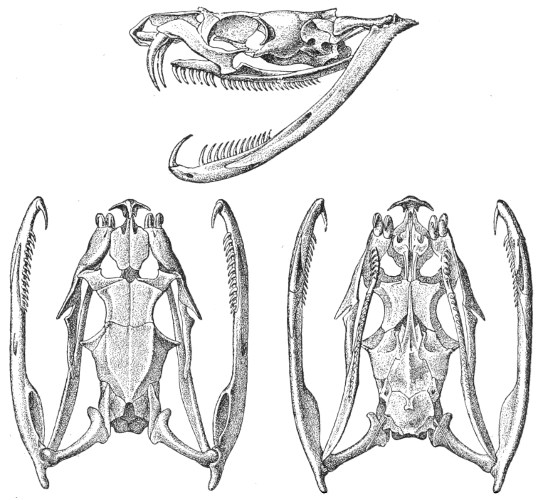
Fig. 34.—Skull of Dendraspis viridis (Poisonous West African Colubrine).
(After G. A. Boulenger, op. cit.)
Maxillary bone curved upwards, bearing a pair of powerful
poison-fangs, not fissured, and not followed by other teeth; a
long tooth at the end of each ramus of the mandible. Head
narrow, elongate; eye moderate, with round pupil; nostril between
two shields. Body slightly compressed; scales smooth, narrow,
very oblique, in 13-23 rows; ventrals rounded. Tail long; subcaudals
in 2 rows.
(1) D. viridis.—211-225 ventral scales; 107-119 subcaudals.
Colour uniform olive-green. Shields on the head edged with
black; lips yellow; belly and tail yellow, with scales and shields
bordered with black.
Total length, 1,830 millimetres; tail 460.
Habitat: West Africa, from the Senegal to the Niger; St.
Thome Island.
(2) D. jamesonii.—Coloration as before. Scales in 15-19 rows
(19-21 on the neck); 210-235 ventrals; 99-121 subcaudals.
Tail sometimes black.
Total length, 2,100 millimetres; tail 560.
Habitat: West Africa, from the Niger to Angola; Central
Africa.
(3) D. angusticeps (The Mamba).—202-270 ventral scales;
99-121 subcaudals.
Colour green, olive, or blackish, uniform; belly yellowish or pale
green; caudal scales and shields not bordered with black.
Total length, 2,000 millimetres; tail 430.
Habitat: West Africa, south of the Congo; Central Africa,
East Africa, Transvaal, Natal.
(4) D. antinorii.—Scales in 21-23 rows; 248 ventrals; 117
subcaudals. Colour olive on the back, yellowish on the belly.
Total length, 2,690 millimetres; tail 545.
Habitat: Abyssinia.
The African Viperidæ all belong to the Subfamily Viperinæ, of
which the following are the seven principal genera:—
(a) Causus.
(b) Vipera.
(c) Bitis.
(d) Cerastes.
(e) Echis.
(f) Atheris.
(g) Atractaspis.
Head distinct from the neck, covered with symmetrical shields;
nostril between two nasal shields, and the internasal; eyes
moderate, with round pupils, separated from the lips by subocular
shields. Body cylindrical; scales smooth or keeled, oblique on
the sides, in 15-22 rows; ventral scales rounded. Tail short;
subcaudals in 2 rows or single.
Four species:—
(1) C. rhombeatus.—Snout obtuse, moderately prominent.
Scales in 17-21 rows; 120-155 ventrals; 15-29 subcaudals.
Colour olive or pale brown, usually with a series of V-shaped
brown spots bordered with white, and a large spot in the form
of a circumflex accent at the back of the head; lips bordered with
black; belly yellowish or grey.
Total length, 700 millimetres; tail 75.
Habitat: Tropical and South Africa, from the Gambia to the
Cape.
(2) C. resimus.—Snout prominent, more or less turned up;
scales in 19-22 rows; 134-152 ventrals; 17-25 subcaudals.
Colour greyish-olive on the back; uniform white on the belly.
Total length, 470 millimetres; tail 40.
Habitat: Central and East Africa, Angola.
(3) C. defilipii.—Snout prominent, more or less turned up.
Scales in 17 rows; 113-125 ventrals; 10-18 subcaudals.
Colour grey or pale brown above, with a series of large rhomboidal
or V-shaped blackish-brown spots; a large A-shaped dark
brown mark on the occiput; an oblique dark streak behind the
eye; supralabial shields edged with black; belly yellowish.
Total length, 400 millimetres; tail 22.
Habitat: Central and East Africa, Transvaal.
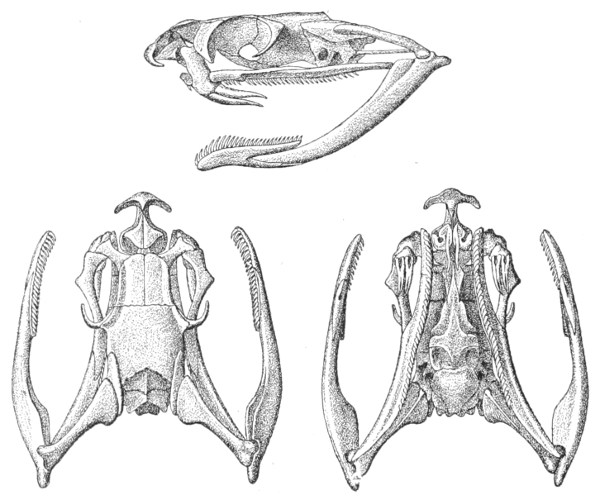
Fig. 35.—Skull of Causus rhombeatus. (After G. A. Boulenger, op. cit.)
(4) C. lichtensteinii.—Snout obtuse; scales in 15 rows; 142-144
ventrals; subcaudals 15-21, single.
Colour greyish, with rather indistinct darker chevron-shaped
cross-bands.
Total length, 413 millimetres; tail 35.
Habitat: West Africa (Gold Coast), Congo.
(For the characters of this genus, see p. 23,—Europe.)
In North Africa are found Vipera latastii, V. ammodytes, and
especially V. lebetina, the range of which extends from Morocco to
Northern India. Vipera superciliaris, which occurs on the coast
of Mozambique, has the snout rounded, and the head covered with
small, imbricate, keeled scales, with a large supraocular shield;
nostril very large, between two nasal shields; scales on the body
strongly keeled, in 27 rows; 142 ventrals; 40 subcaudals.
The colour is pale reddish-brown or orange, with blackish transverse
bars broken by a longitudinal yellow band on each side; the
belly is white, spotted with black.
Total length, 570 millimetres; tail 77.
The Viperidæ belonging to this genus have the head very
distinct from the neck, covered with small imbricate scales; the
eyes rather small, with vertical pupils, separated from the lips
by small scales; the nostrils directed upwards and outwards,
usually pierced in a single nasal shield, with a rather deep pit
above, closed by a valvular supranasal. The postfrontal bones
are very large, in contact with the ectopterygoids. Scales keeled,
with apical pits, in 22-41 rows; ventrals rounded. Tail very
short; subcaudal scales in 2 rows.
(1) B. arietans (the Puff Adder; fig. 37).—This viper has
the nostrils on the upper surface of the snout, and two series of
scales between the supranasal shields; 12-16 supralabials; 3-5
lower labials. The scales on the body are in 29-41 rows, and
strongly keeled; ventrals 131-145; subcaudals 16-34.
The body is thick, the head large and triangular, and the tail
very short. The colour is dirty yellow or orange, with large,
transverse or oblique, chevron-shaped black bands; an oblique
black band extends behind the eye. The belly is dirty yellow,
uniform, or marked with small black spots.
Total length, 1,350 millimetres, sometimes more; tail 160.
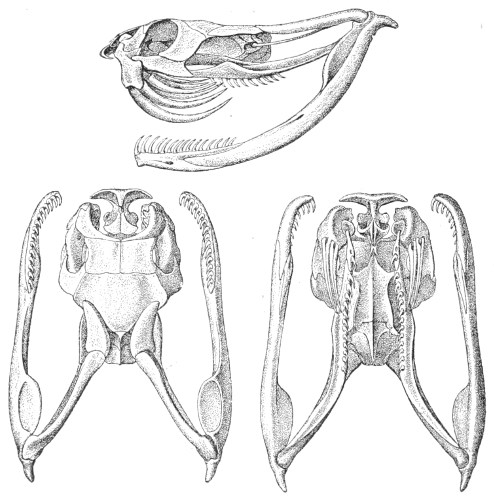
Fig. 36.—Skull of Bitis arietans (the Puff Adder).
(After G. A. Boulenger, op. cit.)
Habitat: This snake is met with throughout Africa, from
Southern Morocco, Kordofan, and Somaliland, to the Cape of Good
Hope, and also in Southern Arabia. It is especially common near
the Niger and on the Congo.
When irritated, it puffs itself out to such an extent that its
body becomes twice the ordinary size. It then doubles back its
head and neck in the shape of an S, and emits a loud and
prolonged hiss. Before biting, it first strikes a blow with its head
as with a battering-ram, thus justifying its French name, vipère
heurtante (Striking Viper).
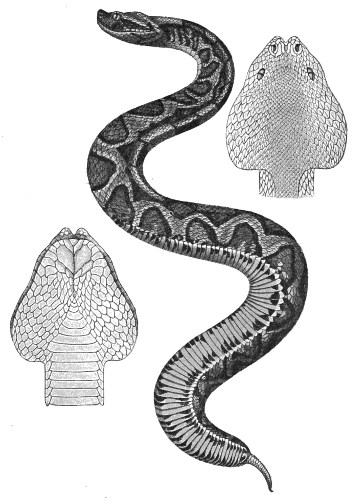
Fig. 37.—Bitis arietans (the Puff Adder). (After Duméril and Bibron.)
The natives of South Africa assert that this Viper is able to
spring high enough to strike a rider on horseback. It feeds upon
rats and mice, in search of which it often approaches habitations.
The Hottentots hunt it in order to obtain its venom; they
pound its head between stones, and mix the pulp with the juice
of certain plants for the purpose of poisoning their arrows.
It lives for a fairly long time in captivity. At the Pasteur
Institute at Lille I have succeeded in keeping one of these snakes
for two years, feeding it by forcing milk and eggs down its throat.
(2) B. peringueyi.—Nostrils opening upwards and outwards.
Head covered with small, strongly keeled scales, which are smallest
on the vertex; 11 scales round the eye; 3 series of scales between
the eye and the lip; 11-14 supralabials. Scales on the body
in 25-27 rows, strongly keeled; 130-132 ventrals; 19-28 subcaudals.
Colour greyish-olive, with 3 longitudinal series of grey or
blackish spots; head sometimes with a trident-shaped dark mark,
followed by a cross; under surface whitish, with small dark spots.
Total length, 325 millimetres; tail 26.
Habitat: Angola and Damaraland.
(3) B. atropos.—Nostrils opening upwards and outwards, 13-16
scales round the eye; 2-5 series of scales between the supranasals;
10-12 supralabials; 3-4 infralabials. Scales on the body
in 29-31 rows, all strongly keeled; 124-145 ventrals; 18-29
subcaudals.
Colour brown or grey-brown, with 4 longitudinal series of dark
spots, edged with black and white; two large black marks on the
head; belly grey or brown, with darker spots.
Total length, 350 millimetres; tail 25.
Habitat: Cape of Good Hope.
(4) B. inornata.—Eyes smaller than in B. atropos, and separated
from the lips by 4 series of scales; supraorbital region raised,
but without erect horn-like scales; 15-17 scales across the head;
13-14 supralabials; 3 lower labials. Scales on the body in 27-29
rows, all keeled; 126-140 ventrals; 19-26 subcaudals.
Total length, 350 millimetres; tail 30.
Habitat: Cape of Good Hope.
(5) B. cornuta (fig. 38).—Nostrils opening upwards and outwards.
Head covered with small, imbricate, strongly keeled scales;
2-5 raised scales, like horns, above each eye; 12-14 scales round
the eye; 12-15 supralabials; 2-3 infralabials. Scales on the body
keeled, in 25-29 rows; 120-152
ventrals; 18-36 subcaudals.
Colour grey or reddish-brown,
with black spots, edged with white
and arranged in 3 or 4 longitudinal
series; a dark, oblique streak from
the eye to the mouth; belly yellow
or brown, uniform or spotted.
Total length, 510 millimetres;
tail 35.
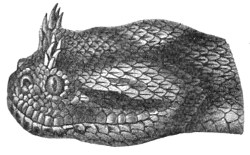
Fig. 38.—Bitis cornuta.
(After Duméril and Bibron.)
Habitat: Cape Colony, Namaqualand, Damaraland.
(6) B. caudalis.—Nostrils opening upwards and outwards.
12-16 scales from one eye to the other across the head; above
each eye a single, erect, horn-like scale; 10-16 scales round the
eye; 10-13 supralabials; 2-3 infralabials. Scales on the body
in 22-29 rows, strongly keeled; 112-153 ventrals; 18-33 subcaudals.
Colour reddish or sandy-grey, with 2 series of brown spots with
light centres, and frequently a vertebral series of narrow spots;
belly dull yellow, uniform, or with small black spots on the sides.
Total length, 360 millimetres; tail 25.
Habitat: South-west Africa, from Angola to Namaqualand.
(7) B. gabonica (Gaboon Viper, or River Jack Viper).—Nostrils
directed upwards and outwards. Head covered with small,
moderately keeled scales, smallest on the vertex, 13-16 from eye
to eye; 15-19 scales round the eye; a pair of erectile, triangular,
nasal “horns,” consisting of sometimes tricuspid shields, between
the supranasals; 13-16 supralabials; 4-5 infralabials. Scales
on the body in 33-41 rows, strongly keeled; lateral scales slightly
oblique; 125-140 ventrals; 17-33 subcaudals.
This viper, which often attains a length of 1,200 millimetres, is
brown, with a vertebral series of quadrangular, yellowish, or light
brown spots connected by black markings; the belly is dull yellow,
with small brown or blackish spots.
Habitat: Tropical Africa (West Africa, from Liberia to Damaraland;
Zanzibar, Mozambique).
This species, which is nocturnal, is often met with on the
Gaboon, and in the forests near the banks of the Ogowai. Its
head is enormous, triangular in shape, and wider above; it has
a bulky body, and a very short tail, terminating abruptly in a
point.
The Gaboon Viper is a savage snake, with very active venom,
and its poison-glands are of the size of large almonds. It lives
in virgin forests, among dead wood and rocks. I have several
times met with it in manioc plantations on the edge of the woods.
In broad daylight it is sluggish, moves somewhat slowly, and never
attacks man. It bites only when surprised.
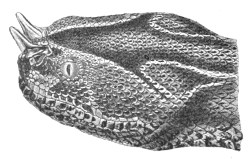
Fig. 39.—Bitis nasicornis.
(After Duméril and Bibron.)
(8) B. nasicornis (fig. 39).—Nostrils
opening upwards
and outwards. Head covered
with small strongly keeled
scales, smaller on the vertex,
14-16 from one eye to the
other; 2 or 3 pairs of compressed,
erectile, horn-like
shields between the supranasals,
usually separated in
the middle by 1 or 2 series of
small scales; 15-18 supralabials;
4-6 infralabials. Scales on the body in 35-41 rows,
strongly keeled; 124-140 ventrals; 16-32 subcaudals.
Colour purple or reddish-brown above, with pale olive or dark
brown spots; a vertebral series of brown, black-edged spots, which
assume a rhomboidal form; sides of head dark brown, with a
triangular light mark in front of the eye, and an oblique light
streak from behind the eye to the mouth; belly pale olive, spotted
with black or yellow.
Total length, 1,250 millimetres; tail 125.
Habitat: West Africa, from Liberia to the Gaboon.
Head very distinct from the neck, covered with small juxtaposed
or slightly imbricate scales; eyes small, with vertical pupils,
separated from the lips by small scales; nostrils opening upwards
and outwards. Body cylindrical; scales keeled, with apical pits,
in 23-35 rows. Tail short; subcaudals in 2 rows.
(1) C. cornutus (fig. 40).—Snout very short and broad; two
erectile horns above the eyes, which are separated by 15-21 scales
and surrounded by 14-18; 4-5 series
of scales between the eyes and the lips;
12-15 supralabials; 3 infralabials;
scales on the body in 27-35 rows;
130-165 ventrals; 25-42 subcaudals.
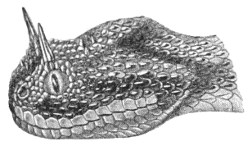
Fig. 40.—Cerastes cornutus.
(After Duméril and Bibron.)
Colour yellowish-brown or grey,
with or without brown spots, forming
4-6 regular series, the two middle ones
sometimes forming cross-bars; an oblique
dark streak behind the eye; belly white; end of tail sometimes
black.
Total length, 720 millimetres; tail 90.
Habitat: Northern border of the Sahara, Egypt, Nubia, Arabia,
and Southern Palestine.
(2) C. vipera.—Snout very short and broad; head covered with
small, tubercularly keeled scales, to the number of 9-13 from eye
to eye; no “horns”; 9-14 scales round the eye; nostril between
two small shields, separated from their neighbours by 5-6 series
of scales; 10-12 supralabials; 3 infralabials. Scales on the body
in 23-27 rows; 102-122 ventrals, rather strongly keeled at the
sides; 18-26 subcaudals. Colour dull yellow, pale brown or reddish,
with or without black spots; end of tail often black above;
ventral surface white.
Total length, 340 millimetres; tail 30.
Habitat: Northern border of the Sahara, from Algeria to Egypt.
The snakes belonging to this genus live constantly hidden in the
sand, lying in wait for small birds, which alight beside them without
suspicion, mistaking their horns for insects or larvæ; they also
feed upon mice. Their poison-fangs are of relatively large size.
These small and exceedingly active vipers, whose colour harmonises
marvellously with their surroundings, are very dangerous
to the Arabs and blacks, who walk barefooted; they frequently
cause fatal accidents.
They are able to exist for a very long time without drinking.
They are attracted by the fires which are lighted at night round
caravan encampments.
(See Asia, p. 48.)
(1) E. carinatus (Efa, Viper of the Pyramids).—The same as
met with in Persia, Arabia, and India. Very common in the
environs of Cairo, and throughout Egypt and Abyssinia. It often
makes its way into towns and villages. Brehm records that he
more than once found an Efa in his house at Khartoum, and that
on one occasion he discovered one of these vipers coiled up beneath
the covering of his bed. At another time, getting up in the night,
he put his foot on one of these animals and was not bitten, the
reptile being very fortunately just at that moment in the act of
devouring a tame bird which it had seized.
It hardly ever happens that a native of Egypt can bring
himself to destroy an Efa, of which he has the greatest dread.
If, as often occurs, he finds one of these reptiles in his house, he
addresses himself to the Hani or juggler, in order that, by his
magic art, he may expel the dangerous visitor. From this custom
the juggler evidently derives no small advantage, for, as is only
right, he does not ply his craft for nothing. In many cases,
indeed, the juggler releases a snake in a house, and then goes and
informs the owner that he knows that a reptile is concealed in his
dwelling, and that, in consideration of a stipulated reward, he will
rid him of it (Brehm).
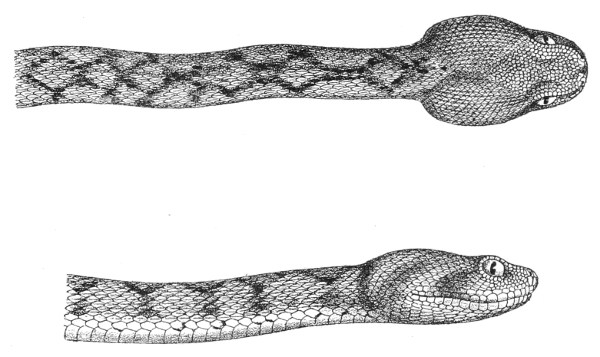
Fig. 41.—Echis coloratus. (After G. A. Boulenger, op. cit.)
(2) E. coloratus (fig. 41).—Scales on the snout and vertex
convex, smooth or bluntly keeled, 13-15 from eye to eye; no
supraocular shield; 17-22 scales round the eye; 12-15 supralabials;
scales on the body in 31-35 rows; 174-205 ventrals;
42-52 subcaudals. No cruciform mark on the head.
Total length, 750 millimetres; tail 80.
Habitat: Palestine, Arabia, Socotra.
Head very distinct from neck, covered with imbricate scales;
eyes large, with vertical pupils, usually separated from the labial
shields by small scales; nostrils lateral. Body slightly compressed;
scales keeled, with apical pits. Tail moderate, prehensile; subcaudal
scales in a single row.
(1) A. chlorechis.—No supraciliary horn-like scales; 9-11 scales
from eye to eye; 25-36 rows of scales in the middle of the body,
strongly keeled; 154-165 ventrals; 53-62 subcaudals.
Colour green, uniform or with small yellow spots; end of tail
yellowish or blackish.
Total length, 520 millimetres; tail 85.
Habitat: West Africa, from Liberia to the Ogowai.
(2) A. squamiger.—No supraciliary horn-like scales; 7-8 scales
from eye to eye; 15-25 rows of scales in the middle of the body,
strongly keeled; 153-173 ventrals; 51-95 subcaudals.
Colour olive, uniform or with more or less regular, narrow
yellow cross-bands, or yellow with green spots; belly pale olive,
marbled with black or yellow, or uniform yellow.
Total length, 550 millimetres; tail 100.
Habitat: West Africa, from the Cameroons to Angola.
(3) A. ceratophorus.—Several erect, supraciliary horn-like scales;
9-10 scales from eye to eye; 25 rows of scales in the middle of
the body, strongly keeled; 142 ventrals; 55 subcaudals.
Colour dark olive, with black spots forming cross-bands; belly
pale olive, speckled with black.
Total length, 210 millimetres; tail 65.
Habitat: East Africa.
This genus is characterised by enormous poison-fangs, a few
teeth on the palatines, and none on the pterygoids. The mandible,
which is edentulous in front, has only two or three small teeth in
the middle of the dentary bone. Head small, not distinct from the
neck, covered with large symmetrical shields; nostril between
two nasal shields; eyes minute, with round pupils; postfrontal
bone absent. Body cylindrical; scales smooth, in 17-37 rows;
ventrals rounded. Tail short; subcaudals in 1 or 2 rows.
(1) A. hildebrandtii.—Six supralabials; no præocular shields;
frontal shorter than the parietals; scales on the body in 17 rows;
ventrals 167-174.
Colour uniform
dark brown.
Total length, 450
millimetres; tail 53.
Habitat: East
Africa.
(2) A. congica.—Five
supralabials, of
which the fourth is
the larger; postocular
in contact with a
large temporal; one
præocular; frontal
as long as or slightly
shorter than the
parietals. Scales on
the body in 19-21
rows; 209-230 ventrals;
19-23 subcaudals.
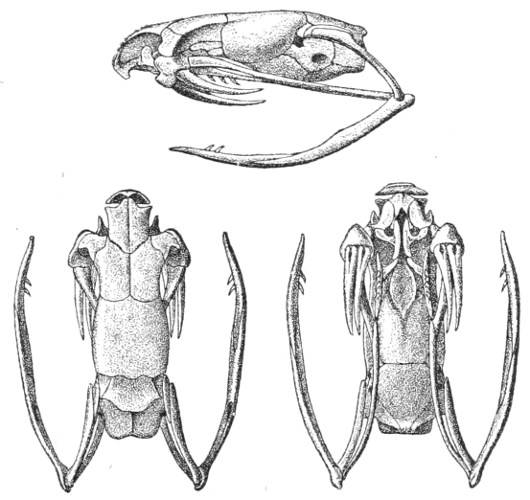
Fig. 42.—Skull of Atractaspis aterrima (African
Viperine). (After G. A. Boulenger, op. cit.)
Colour uniform dark brown or black.
Total length, 450 millimetres; tail 35.
Habitat: Congo, Angola.
(3) A. irregularis.—Characters as before, but scales on the
body in 25-27 rows; 220-257 ventrals, subcaudals 22-28 pairs.
Colour uniform black or dark brown.
Total length, 560 millimetres; tail 35.
Habitat: West Africa, from the Gold Coast to the Congo;
Central Africa.
(4) A. corpulenta.—Postocular shield in contact with a large
temporal; second lower labial very large, fused with the chin-shields.
Scales on the body in 23-27 rows; 178-193 ventrals;
23-27 subcaudals.
Colour uniform blackish-brown; tail sometimes white.
Total length, 345 millimetres; tail 33.
Habitat: West Africa, from Liberia to the Gaboon.
(5) A. rostrata.—Snout very prominent, cuneiform. Third
lower labial very large; first lower labial in contact with its fellow,
behind the symphysial. Scales on the body in 19-23 rows; ventrals
227-248.
Colour uniform dark brown, or blackish.
Total length, 600 millimetres; tail 37.
Habitat: East and Central Africa.
(6) A. bibronii.—Characters as before. Snout prominent, subcuneiform.
Ventral scales, 221-260.
Colour dark purplish-brown above, dull yellow or pale brown
on the belly.
Total length, 600 millimetres; tail 25.
Habitat: Eastern districts of Cape Colony, Natal, Namaqualand,
Angola.
(7) A. aterrima.—Characters as before. Snout rounded;
251-300 ventral scales.
Colour uniform dark brown or black.
Total length, 650 millimetres; tail 30.
Habitat: West and Central Africa.
(8) A. dahomeyensis.—Characters as before. Symphysial shield
in contact with the chin-shields. Scales on the body in 31 rows;
240 ventrals; 24 subcaudals.
Colour black above, brown on the belly.
Total length, 490 millimetres; tail 32.
Habitat: Dahomey.
(9) A. micropholis.—Temporal shields small, 2 + 3 or 4; fourth
or fifth infralabial larger; scales on the body in 25 rows; 210-215
ventrals; 29-30 subcaudals. Frontal shield slightly longer than
broad, much longer than the parietals.
Colour uniform dark brown.
Total length, 330 millimetres; tail 28.
Habitat: Cape Verd.
(10) A. leucomelas.—Characters as before. Frontal one and
two-fifths as long as broad, as long as the parietals.
Colour black, with a vertebral white line, occupying one row
and two half rows of scales; ventrals and subcaudals white;
neck black, head white, with a black spot covering the nasals and
upper head-shields.
Total length, 575 millimetres; tail 40.
Habitat: Somaliland.
(11) A. microlepidota.—Characters as before. Scales on the
body in 29-37 rows; 212-245 ventrals; 26-37 subcaudals.
Colour uniform dark brown.
Total length, 540 millimetres; tail 45.
Habitat: Central and East Africa.
The Sunda Islands and the whole of Malaysia are rich in
poisonous snakes. Those that are found there belong for the most
part to species that we have already met with in India or the
Malay Peninsula. We shall therefore not describe them again
here.
All those that inhabit Australia are included in the great Family
Colubridæ and the Subfamily Elapinæ. There are no Viperidæ;
but certain genera of poisonous Colubridæ are peculiar to this
continent.
These reptiles have been particularly well studied by Gérard
Krefft, formerly Director of the Australian Museum at Sydney,
from whose work5 we shall borrow a considerable portion of the
following notes, and the figures accompanying them.
The genera represented in Australia are:—
| (a) |
Ogmodon. |
| (b) |
Glyphodon. |
| (c) |
Pseudelaps. |
| (d) |
Diemenia. |
| (e) |
Pseudechis. |
| (f) |
Denisonia. |
| (g) |
Micropechis. |
| (h) |
Hoplocephalus. |
| (i) |
Tropidechis. |
| (j) |
Notechis. |
| (k) |
Rhinhoplocephalus. |
| (l) |
Brachyaspis. |
| (m) |
Acanthophis. |
| (n) |
Elapognathus. |
| (o) |
Rhynchelaps. |
| (p) |
Furina. |
This genus is characterised by the maxillary bones extending
forwards as far as the palatines, and bearing, in addition to the
poison-fangs, 6-7 grooved teeth. The head is not distinct from
the neck; the eyes are very small. The body is cylindrical, and
covered with smooth scales in 17 rows. Tail short; subcaudal
scales in 2 rows.
O. vitianus.—Snout elongate, pointed; 139-152 ventral scales;
27-38 subcaudals.
Colour dark brown, lighter on the sides; belly brown or white,
more or less spotted with black; tail black.
Total length, 360 millimetres; tail 45.
Habitat: Fiji Islands.
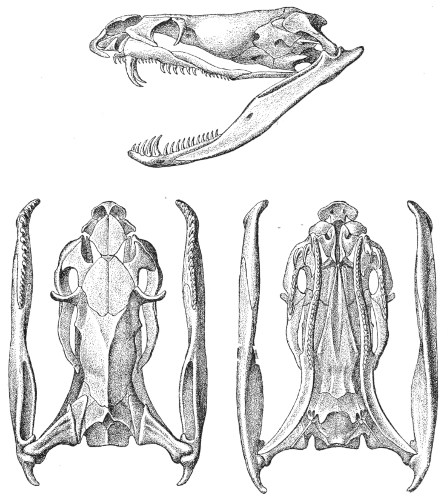
Fig. 43.—Skull of Glyphodon tristis (Australian Colubrine).
(After G. A. Boulenger, op. cit.)
General characters the same; snout rounded; poison-fangs
followed, after a wide interspace, by 6 small grooved teeth;
anterior mandibular teeth strongly developed (fig. 43). Head and
eyes small; pupils round or vertically subelliptic; nostrils pierced
between 2 nasal shields. Body cylindrical; scales smooth, in 17
rows; tail short; subcaudals in 2 rows.
G. tristis.—Ventral scales 165-179; subcaudals 38-52.
Colour dark brown; occiput often yellowish, or pale reddish-brown;
belly yellow.
Total length, 900 millimetres; tail 125.
Habitat: North-eastern Australia and South-eastern New
Guinea.
Maxillaries extending forwards as far as the palatines, with a
pair of large grooved poison-fangs, and, after a wide interval,
8-12 small grooved teeth. The anterior mandibular teeth are
of large size, almost like fangs. Head hardly distinct from the
neck; eyes small, with vertically elliptic pupils. Body cylindrical;
scales smooth, in 15-17 rows. Tail moderate or short; subcaudal
scales in 2 rows.
(1) P. muelleri.—Scales in 15 rows. Nasal shield divided, in
contact with the præocular; 2 + 2 temporals; 139-176 ventral
scales; 21-35 subcaudals.
Colour brown, with a light vertebral line; a more or less distinct
dark, light-edged streak on each side of the head, passing through
the eye; belly yellowish or coral-red; uniform or spotted with
black.
Total length, 500 millimetres; tail 70.
Habitat: Moluccas, New Guinea, New Britain.
(2) P. squamulosus.—Scales in 15 rows. Nasal shield divided,
in contact with the præocular; 1 + 2 temporals; 170-183 ventrals;
34-52 subcaudals.
Colour brown, with a yellowish streak round the snout and
through the eyes to the nape; belly whitish, with confluent black
spots forming lines on each side.
Total length, 375 millimetres; tail 55.
Habitat: New South Wales.
(3) P. krefftii (fig. 44).—Nasal shield entire, in contact with the
præocular; 1 + 2 temporals; 146-156 ventrals; 26-38 subcaudals.
Colour dark brown, with a light longitudinal line on each scale;
a yellowish cross-band on the occiput, connected with another
yellow band which encircles the snout.
Belly yellowish in front, black
behind; subcaudals white, with a
longitudinal black band running between
them.
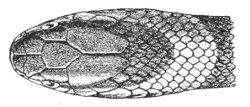
Fig. 44.—Pseudelaps krefftii.
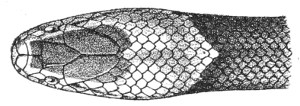
Fig. 45.—Pseudelaps harriettæ.
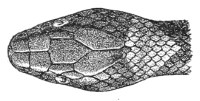
Fig. 46.—Pseudelaps diadema.
Total length, 255 millimetres;
tail 33.
Habitat: Queensland.
(4) P. harriettæ (fig. 45).—Nasal
shield entire, in contact with or
narrowly separated from the præocular;
1 + 2 temporals; 176-193
ventrals; 29-35 subcaudals.
Colour dark brown, with a light
longitudinal line on each scale; a
long yellow blotch on the nape, and,
connected with this, a yellow ring
round the snout; ventrals and subcaudals
brown or black, edged with white.
Total length, 415 millimetres; tail 45.
Habitat: Queensland.
(5) P. diadema (fig. 46).—Nasal shield entire, widely separated
from the præocular; 2 + 2 temporals; third and fourth upper labials
entering the eye; 164-203 ventrals; 40-62 subcaudals. Colour
pale brown or reddish, with a brown edging to each scale forming
a reticulate pattern; a yellow cross-band on the occiput; belly
uniformly white.
Total length, 600 millimetres; tail 80.
Habitat: Eastern, Northern, and Western Australia.
(6) P. warro.—Characters the same as in the previous species;
143 ventrals. Colour brown; a broad lunate black collar on the
nape; head black above, but paler than the collar.
Habitat: Port Curtis, Queensland.
(7) P. sutherlandi.—Characters as before. Scales on the body
in 17 rows; 160 ventrals; 40 subcaudals. Colour red-brown on
the back, yellow on the belly; a broad lunate black collar on the
nape, with a lighter edging; light bars across the head, body, and
tail.
Habitat: Norman River, Queensland.
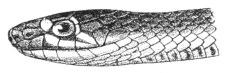
Fig. 47.—Diemenia psammophis.
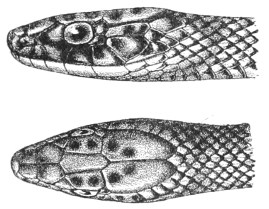
Fig. 48.—Diemenia olivacea. (Northern
Australia and New Guinea).
(After Krefft.)
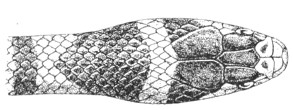
Fig. 49.—Diemenia textilis.
Maxillary bones extending
forwards as far as the palatines,
with a pair of large
grooved poison-fangs, followed,
after an interspace, by 7-15
small grooved teeth; anterior
mandibular teeth much elongated,
resembling poison-fangs.
Head scarcely distinct from the
neck; eyes rather large, with
round pupils; nasal shield entire
or divided; frontal elongate.
Body cylindrical; scales smooth,
in 15-19 rows (more on the
neck). Tail moderate or long;
subcaudals all or for the most
part in 2 rows.
Coloration very variable,
orange-yellow, olive, red-brown,
or pale brown.
Average length, 1,000-1,700 millimetres.
Habitat: South-eastern New Guinea, and Australia.
Seven species of this genus are known, divided into two groups
as follows:—
(1) Scales on the body in 15 rows.
D. psammophis. (fig. 47).—Internasal shields at least half as
long as the præfrontals.
D. torquata.—Internasals
more than half as long as the
præfrontals.
D. olivacea. (fig. 48).—Internasals
not more than half
as long as the præfrontals;
snout broad.
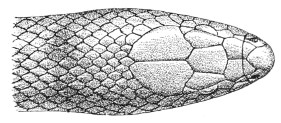
Fig. 50.—Diemenia nuchalis.
(2) Scales in 17 or 19 rows.
D. modesta.—154-165 ventrals.
D. textilis (Brown Snake, fig. 49).—190-232 ventrals.
D. nuchalis (fig. 50).—184-224 ventrals.
Maxillary bones extending forwards as far as the palatines,
with a pair of large grooved poison-fangs followed by 2-5 small
solid teeth; anterior mandibular teeth long. Head distinct from
the neck; eyes rather small,
with round pupils; nostril between
two nasal shields. Body
cylindrical. Scales smooth, in
17-23 rows (more on the
neck). Tail moderate; subcaudals
in 2 rows, or partly
single, partly in 2 rows.
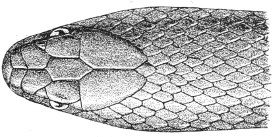
Fig. 51.—Pseudechis porphyriacus.
Total length, 1,500-2,000
millimetres, sometimes more.
Habitat: Australia and New Guinea.
This genus includes eight species.
(1) P. porphyriacus (Black Snake; fig. 51).—Frontal shield
longer than broad; 180-200 ventrals; 50-60 subcaudals.
Colour black on the back; outer row of scales red at the base;
ventrals red, edged with black.
(2) P. cupreus.—199-210 ventrals; 57-72 subcaudals.
Colour coppery above, brown or orange below, all the scales and
shields edged with brown.
(3) P. australis.—199-220 ventrals; 57-70 subcaudals; frontal
shield once and two-thirds to twice as long as broad.
Colour pale brown on the back, yellowish on the belly.
(4) P. darwiniensis.—Frontal as broad as long; 212 ventrals;
54-64 subcaudals.
Colour reddish-brown; head pale brown; belly yellowish-white.
(5) P. papuanus.—Scales in 19-21 rows (26 or 27 on the
neck); 221-224 ventrals; 49-55 subcaudals.
Colour uniform black; chin white.
(6) P. scutellatus.—Subcaudal shields in 2 rows; scales on
the body in 23 rows (25-30 on the neck); 230-233 ventrals;
61-78 subcaudals.
Colour pale brown or dark brown; snout and cheeks pale brown
or yellowish; belly yellow.
(7) P. microlepidotus.—30-36 scales across the neck, 23 across
the middle of the body; 232-237 ventrals; 61-66 pairs of subcaudals.
Colour dark brown on the back, yellowish-grey on the belly;
head sometimes blackish.
(8) P. ferox.—Snout very broadly rounded. Scales on the body
in 23 rows; 235 ventrals; 60 pairs of subcaudals.
Colour black above, yellowish beneath.
Maxillary bones prolonged as far as the palatines, with a pair of
large grooved poison-fangs, followed by 3-5 small solid teeth;
anterior mandibular teeth greatly developed. Head fairly distinct
from the body; eyes small, with round or vertically elliptic pupils;
nasal shield entire or divided. Body cylindrical; scales smooth, in
15-19 rows; tail moderate or short; subcaudals in a single row,
except in one species.
According to the British
Museum Catalogue, the genus
Denisonia includes twenty-one
species, the principal
characters of which are as
follows:—
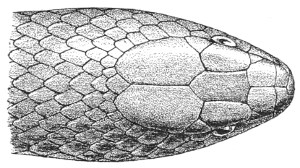
Fig. 52.—Denisonia superba (The Copperhead).
(1) D. superba (The Copperhead.
Fig. 52).—Scales in
15-17 rows; nasal shield
entire, in contact with the
præocular; ventral scales 145-160; subcaudals 41-50.
Colour brownish to dark olive on the back, often yellow or
salmon-red on the sides; belly yellowish or greyish-olive.
Total length, 1,010 millimetres; tail 160.
Habitat: New South Wales, Southern Australia, Tasmania.
(2) D. coronata.—Scales in 15 rows; 138-151 ventrals; 38-51
subcaudals.
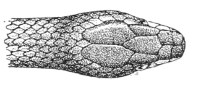
Fig. 53.—Denisonia coronoides.
Colour olive, with a black streak on
each side of the head; belly yellowish
or pale olive.
Total length, 480 millimetres;
tail 95.
Habitat: Western Australia and
New South Wales.
(3) D. coronoides (fig. 53).—Scales in 15 rows; 136-151
ventrals; 39-57 subcaudals.
Colour brown, lips yellow; belly salmon-red to dark olive-grey;
end of tail salmon-red.
Total length, 440 millimetres; tail 80.
Habitat: Southern Australia and Tasmania.
(4) D. muelleri.—Scales in 17 rows; 118 ventrals; 38 subcaudals.
Colour grey-brown; lips and chin with yellow spots; belly grey.
Total length, 292 millimetres; tail 52.
Habitat: Queensland.
(5) D. frenata.—Scales in 19 rows; 167 ventrals; 35 subcaudals.
Colour olive-brown; upper lip yellow; belly white.
Total length, 390 millimetres; tail 54.
Habitat: Lake Elphinstone, Queensland.
(6) D. ramsayi (fig. 54).—Scales in
15 rows; 164 ventrals; 51 subcaudals.
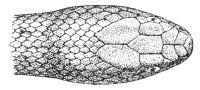
Fig. 54.—Denisonia ramsayi.
Colour dark olive-green above,
yellow beneath; subcaudals nearly
black.
Total length, 265 millimetres;
tail 50.
Habitat: New South Wales.
(7) D. signata (fig. 55).—Scales in
17 rows; 153-170 ventrals; 41-56
subcaudals.
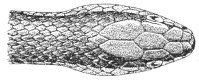
Fig. 55.—Denisonia signata.
Colour dark olive or black, head
brown; belly dark grey or black.
Total length, 640 millimetres; tail 120.
Habitat: Queensland, New South Wales.
(8) D. daemelii.—Scales in 17 rows; 147-168 ventrals; 33-45
subcaudals.
Colour olive, head darker; belly yellowish-white.
Total length, 380 millimetres; tail 60.
Habitat: Queensland.
(9) D. suta.—Scales in 19 rows; 157-164 ventrals; 25-30
subcaudals.
Colour pale olive-brown, head dark brown, nape black; upper
lip and belly yellow.
Total length, 200 millimetres; tail 23.
Habitat: Southern Australia.
(10) D. frontalis.—Scales in 19 rows; 154 ventrals; 30 subcaudals.
Colour light brown, with a vertebral black line; belly pearly-white,
with a median bronze-coloured band.
Total length, 400 millimetres; tail 50.
Habitat: New South Wales.
(11) D. flagellum.—Scales in 17 rows; 132-138 ventrals; 25-27
subcaudals.
Colour pale brown; vertex, occiput, and nape black; upper
lip and belly white.
Total length, 380 millimetres; tail 40.
Habitat: Victoria.
(12) D. maculata. (fig. 56).—Scales
in 17 rows; 121-136 ventrals; 20-30
subcaudals.
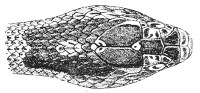
Fig. 56.—Denisonia maculata.
Colour dark grey-brown, or brown;
a large dark olive-green or brown blotch
on the head, with two or three unequal
light grey spots; belly white.
Total length, 400 millimetres;
tail 55.
Habitat: Queensland.
(13) D. punctata.—Scales in 15
rows; 160 ventrals; 25 subcaudals.
Colour pale brown; head and nape
orange; upper lip and belly yellow.
Total length, 350 millimetres; tail 36.
Habitat: North-Western Australia.
(14) D. gouldii (fig. 57).—Scales in 15 rows; 140-170 ventrals;
22-23 subcaudals.
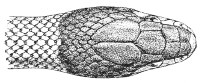
Fig. 57.—Denisonia gouldii.
Colour brownish-yellow; nape black; head covered with a broad
greenish-blue blotch, extending from the nose to the neck; upper
lip and belly yellow.
Total length, 435 millimetres; tail 50.
Habitat: Western and Southern Australia.
(15) D. nigrescens.—Scales in 15 rows; 170-200 ventrals;
30-46 subcaudals.
Colour dark olive; head black; belly yellow.
Total length, 545 millimetres; tail 75.
Habitat: New South Wales and Queensland.
(16) D. nigrostriata.—Scales in 15 rows; 180-184 ventrals;
50-64 subcaudals.
Colour yellow, streaked with black; head dark brown; upper
lip and belly yellowish-white.
Total length, 380 millimetres; tail 52.
Habitat: Queensland.
(17) D. carpentariæ.—Scales in 15 rows; 166-183 ventrals;
31-43 subcaudals.
Colour brown; upper lip and belly yellowish-white.
Total length, 285 millimetres; tail 47.
Habitat: Northern Queensland.
(18) D. pallidiceps.—Scales in 15 rows; 170-178 ventrals;
37-38 subcaudals.
Colour dark olive-brown; head somewhat paler; belly yellowish.
Total length, 590 millimetres; tail 80.
Habitat: Northern Australia.
(19) D. melanura.—Scales in 15 or 17 rows; 165-171 ventrals;
38-48 subcaudals.
Colour dark brown; head and sides usually reddish; belly
yellow; tail black.
Total length, 1,000 millimetres; tail 140.
Habitat: Solomon Islands.
(20) D. par.—Scales in 16 rows; 164-166 ventrals; 40-49
subcaudals.
Colour reddish-brown, in broad bands with white intervals;
head blackish-brown; belly white; tail with red rings.
Total length, 750 millimetres; tail 110.
Habitat: Faro and Howla Islands, Bougainville Straits,
Solomon Islands.
(21) D. woodfordii.—Scales in 17 rows; 166-172 ventrals;
41-45 subcaudal pairs.
Colour brownish-white, with a reticulate pattern; head dark
brown; belly white.
Total length, 670 millimetres; tail 100.
Habitat: New Georgia, Solomon Islands.
Maxillary bones extending forward as far as the palatines, with
a pair of large grooved poison-fangs, followed by three small solid
teeth; mandibular teeth longer in front. Head distinct from the
neck; eyes very small, with round pupils; nostril between two
nasal shields. Body cylindrical; scales smooth, in 15 or 17 rows.
Tail short; subcaudals in 2 rows.
(1) M. ikaheka.—Scales in 15 rows; 180-223 ventrals; 39-55
subcaudals.
Colour yellow and black, in irregular cross-bars; head and tail
black above; belly yellow.
Total length, 1,550 millimetres; tail 180.
Habitat: New Guinea.
(2) M. elapoides.—Scales in 17 rows; 208 ventrals; 35 subcaudals.
Colour cream, with 22 black bands, broader than the interspaces
between them; snout and ocular region black.
Total length, 750 millimetres; tail 75.
Habitat: Florida Island, Solomon Group.
Characters the same as in Micropechis. Scales in 21 rows;
ventrals angulate and notched laterally. Tail moderate; subcaudals
in a single row.
(1) H. bungaroides (Syn. H. variegatus. The Broad-headed
Snake).—204-221 ventrals; 40-56 subcaudals.
Colour black on the back, with yellow spots forming more or
less regular cross-bands on the body; upper lip yellow, margined
with black; belly blackish, yellow on the sides.
Total length, 1,620 millimetres; tail 210.
Habitat: New South Wales.
(2) H. bitorquatus (fig. 58).—Ventral scales strongly angulate
laterally, 191-227; subcaudals 44-59.
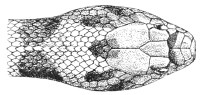
Fig. 58.—Hoplocephalus bitorquatus.
Colour olive-green; head pale
olive, with a bright yellow occipital
blotch, and a large black blotch on
each side of the nape; a pair of
small spots in front of and between
the eyes; three black transverse
blotches on the vertex; belly greyish-olive
or brown.
Total length, 510 millimetres; tail 95.
Habitat: Queensland, New South Wales.
(3) H. stephensii.—239 ventrals; 60 subcaudals.
Body barred alternately with black and white; the black bars
are twice as broad as the white ones; head dark, spotted with
yellow; a W-shaped yellow mark on the back of the head.
Total length, 760 millimetres.
Habitat: Port Macquarie, New South Wales.
Same general characters; nasal shield entire; scales on the
body strongly keeled, in 23 rows. Tail moderate; subcaudals in
a single row.
T. carinatus.—Colour dark olive, with darker cross-bands;
belly yellow, more or less tinged with olive-green.
Total length, 730 millimetres; tail 120.
Habitat: New South Wales, Queensland.
Same general characters; pupil round; nasal shield entire.
Body cylindrical; scales smooth, disposed obliquely, in 15-19
rows, the lateral scales shorter than the dorsals. Tail moderate;
subcaudals in a single row.
N. scutatus (Syn. Hoplocephalus
curtus. The Tiger Snake.
Fig. 59).—Colour dark olive;
belly yellow or olive; the shields
often dark-edged.
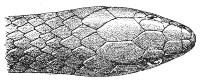
Fig. 59.—Notechis scutatus (The Tiger
Snake.)
Total length, 1,280 millimetres;
tail 170.
Habitat: Australia and Tasmania.
Dentition as in Hoplocephalus. Head but little distinct from
the neck; eyes small, with round pupils; no internasal shields.
Body cylindrical, rigid. Scales smooth, in 15 rows. Tail short;
subcaudals in a single row.
R. bicolor.—Colour greyish-olive on the back, yellowish-white
on the belly; tongue white.
Total length, 395 millimetres; tail 55.
Habitat: Australia.
Characters the same, but head distinct from the neck; eyes
small, with vertically elliptic pupils; nostril between two nasal
shields. Body stout, cylindrical; scales smooth, slightly oblique,
in 19 rows. Tail short; subcaudals in a single row.
B. curta.—Colour uniform olive-brown; belly yellowish.
Total length, 490 millimetres; tail 70.
Habitat: Western Australia.
Maxillary bones extending forwards as far as the palatines,
with a pair of large grooved poison-fangs, followed by two or three
small teeth; anterior mandibular teeth elongate, fang-like. Head
distinct from the neck; eyes small, with vertically elliptic pupils;
nostril in the upper part of a single nasal shield. Body stout,
cylindrical. Scales more or less distinctly keeled, in 21-23 rows.
Tail short, compressed at the end and terminating in a sort of
long spine, turned upwards; anterior subcaudals in a single row,
posterior in 2 rows.
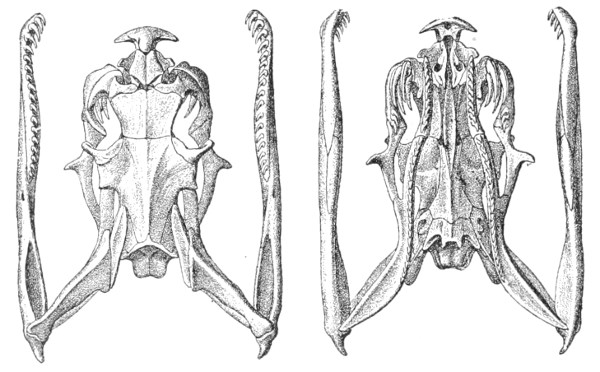
Fig. 60.—Skull of Acanthophis antarcticus. (After G. A. Boulenger, op. cit.)
A. antarcticus (The Death Adder; fig. 61).—Supraocular shields
often raised and angular, assuming the shape of little horns; scales
on the crown of the head rugose and striated; 113-130 ventrals;
41-51 subcaudals (the last 5-27 are divided).
Colour yellow-brown or reddish, with more or less distinct dark
cross-bands; black spots or
small dark bars on the lips;
belly yellowish-white; end of
tail yellow or black, covered
with spiny scales.
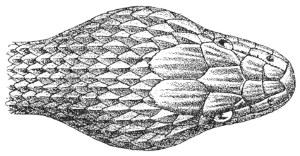
Fig. 61.—Acanthophis antarcticus (The
Death Adder).
Total length, 850 millimetres;
tail 150.
Habitat: Moluccas, New
Guinea, Australia.
Maxillary bones extending forwards as far as the palatines,
with a pair of moderately large grooved poison-fangs; no other
maxillary teeth; mandibular teeth subequal. Eyes moderate, with
round pupils; nasal shield entire. Body cylindrical; scales smooth,
in 15 rows; ventrals rounded; tail moderate; subcaudals in a
single row.
E. minor.—Colour dark olive, with a black occipital blotch in
the young; belly yellow or greenish-grey.
Total length, 460 millimetres; tail 95.
Habitat: South-west Australia.
Maxillary bones extending forwards as far as the palatines,
with a pair of moderately large grooved poison-fangs, and two
small teeth near the posterior extremity of the bone; anterior
mandibular teeth the longest. Head small, not distinct from the
neck; eyes small, with vertically elliptic pupils; nostril in a single
nasal shield. Body short, cylindrical; scales smooth, in 15-17
rows. Tail very short; subcaudals in 2 rows.
(1) R. bertholdi.—Scales in 15 rows; 112-126 ventrals.
Colour yellow, with 19-40 black annuli, usually narrower than
the interspaces; head brown, with a large black blotch on the
nape, and another on the vertex and temples.
Total length, 270 millimetres; tail 22.
Habitat: Southern and Western Australia.
(2) R. australis (fig. 62).—Scales in 17 rows; 152-163 ventrals;
18-20 subcaudals.
Fig. 62.—Rhynchelaps australis.
Colour red on the body, with ill-defined
cross-bars formed of yellowish
black-edged scales; a black blotch on
the head, covering the vertex and
temples, and surrounding the eyes;
another large blotch on the nape;
snout and occiput yellow; belly white.
Total length, 290 millimetres; tail 25.
Habitat: Queensland.
(3) R. semifasciatus.—Scales in 17 rows; 143-170 ventrals;
17-25 subcaudals.
Colour yellow, with brown cross-bands; large brown blotches
on the head and nape; belly white.
Total length, 300 millimetres; tail 30.
Habitat: West Australia.
(4) R. fasciolatus.—Scales in 17 rows; 145-161 ventrals;
22-27 subcaudals.
Colour red, with numerous blackish-brown cross-bands; large
blackish-brown blotches on the head and nape; belly white.
Total length, 335 millimetres; tail 30.
Habitat: West Australia.
Maxillary bones extending forwards beyond the palatines, bearing
a pair of moderately large grooved poison-fangs, and one or
two small teeth near their posterior extremities; mandibular teeth
subequal. Head small, not distinct from neck; eyes very small,
with round pupils; nostril in a single nasal shield. Body cylindrical;
scales smooth, in 15 rows. Tail very short, obtuse; subcaudals
in 2 rows.
(1) F. calonota.—Six supralabial
shields; 126-131
ventrals; 29-30 subcaudals.
Colour yellow, with a
black vertebral stripe; a
black bar across the end of
the snout; a large black
blotch covering the vertex
and the parietals; belly
white.
Total length, 215 millimetres;
tail 33.
Habitat: West Australia.
(2) F. bimaculata.—Scales in 15 rows; 181-200 ventrals;
21-25 subcaudals.
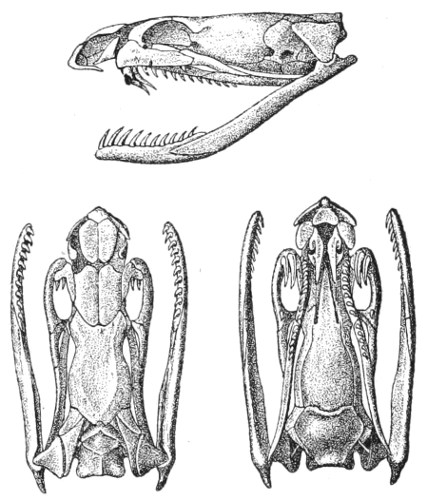
Fig. 63.—Skull of Furina occipitalis.
(After G. A. Boulenger, op. cit.)
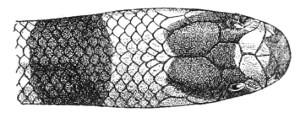
Fig. 64.—Furina occipitalis.
Colour yellow, with large black blotches on the snout, middle
of head, and occiput; belly white.
Total length, 330 millimetres; tail 25.
Habitat: West Australia.
(3) F. occipitalis (fig. 64).—Scales in 15 rows; 180-234 ventrals;
14-25 subcaudals.
Entire body ringed with black and white, annuli narrower on
belly; head black, with a broad white band across the occiput, and
another narrower and irregular one across the snout; nose black.
Total length, 590 millimetres; tail 36.
Habitat: Australia.
There are no poisonous snakes in New Zealand. In New
Caledonia no terrestrial poisonous snakes are known, but Hydrophiidæ
abound on its shores, as on those of the majority of the
islands of the Pacific.
In Australia, especially in New South Wales and farther to the
north, fatalities due to the bites of poisonous snakes are not rare.
The most dangerous species are: Acanthophis antarcticus (the
Death Adder), Diemenia textilis (the Brown Snake), Pseudechis
porphyriacus (the Black Snake), and Notechis scutatus or Hoplocephalus
curtus (the Tiger Snake).
The health authorities of this country have accordingly taken
the wise precaution of circulating very widely among the public
coloured placards bearing illustrations of these four species, with
a description of the essential anatomical details by which they may
be recognised. Similar placards are exhibited in all the schools,
and a generous distribution is made of instructions, printed on
handkerchiefs, indicating the most effective method of treating
poisonous bites.
In Queensland, according to information furnished to me by
Mr. C. W. De Vis, late Director of the Queensland Museum, Brisbane,
the number of deaths resulting from the bites of poisonous
snakes has been only twenty-seven in ten years.
The fauna of the New World includes only a very small number
of poisonous snakes belonging to the family Colubridæ. The
Genus Elaps alone is represented there by twenty-eight species,
scattered over Mexico, Central America, Bolivia, Ecuador, Peru,
Colombia, and Brazil.
Viperidæ, on the other hand, are extremely numerous, and
belong exclusively to the subfamily Crotalinæ; there are no
Viperinæ.
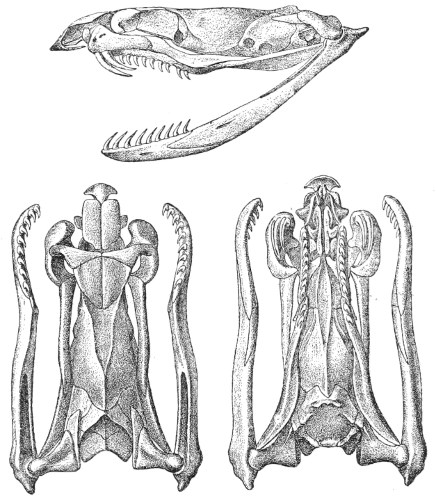
Fig. 65.—Skull of Elaps marcgravii. (After G. A. Boulenger, op. cit.)
The characters of this genus are: Maxillary bones very short,
extending beyond the palatines, and bearing a pair of large poison-fangs;
pterygoid teeth few or absent; mandibular teeth all of
equal length. No postfrontal bones; præfrontals meeting, or
narrowly separated on the median line. Head small, not distinct
from neck; eyes small, with vertically elliptic or sub-elliptic
pupils; nostril between two nasal shields. Body cylindrical; scales
smooth, in 15 rows. Tail short; subcaudal scales in 2 rows, or
partly single, partly in 2 rows.
(1) E. surinamensis.—Seven supralabials, of which the fourth
enters the eye; frontal shield very narrow; 167-182 ventrals.
Colour red, with black annuli disposed in threes (the middle one
broader), separated by narrow yellow interspaces; 7 or 8 sets of
annuli on the body; the red scales dotted with black; head red
above, with the shields black-edged, followed by a black cross-band
behind the parietals.
Total length, 740 millimetres; tail 95. Grows to 1,900 millimetres.
Habitat: Venezuela, Guianas, Northern Brazil, North-east Peru.
(2) E. heterochilus.—Six supralabials, second and third entering
the eye; snout narrow; 209 ventrals.
Colour red, with black annuli, as in E. marcgravii.
Total length, 553 millimetres; tail 43.
Habitat: Brazil.
(3) E. euryxanthus (Sonoran Coral Snake).—Seven supralabials,
third and fourth entering the eye; internasals nearly as long as the
præfrontals; 215-241 ventrals; 21-29 subcaudals.
Colour red, with 11 black annuli edged with yellow; head black.
Total length, 400 millimetres; tail 33.
Habitat: Arizona, Colorado, North-western Mexico. It is found
in Arizona up to an altitude of nearly 6,000 feet (1,800 metres).
(4) E. gravenhorstii.—First lower labial in contact with its
fellow; posterior nasal not reaching the præocular: 191 ventrals;
23 subcaudals.
Colour: Seven sets of black annuli disposed in threes, median
annulus the broadest; head black, with a yellow transverse band
behind the eyes.
Total length, 550 millimetres; tail 50.
Habitat: Brazil.
(5) E. langsdorffii.—Ventrals 204-225; subcaudals 37-54;
1 + 1 temporals.
Colour dark brown, with 63 transverse series of cream-coloured
spots, each occupying one scale; belly yellow, with red cross-bands.
Total length, 300 millimetres.
Habitat: Upper Amazons.
(6) E. buckleyi.—203-211 ventrals; 39-43 subcaudals; 1 + 2
temporals.
Colour orange, with 48-60 black annuli edged with small
yellow spots; head black; temples yellow.
Total length, 505 millimetres; tail 70.
Habitat: Northern Brazil, Eastern Ecuador.
(7) E. anomalus.—227 ventrals; 29 subcaudals; 1 + 1 temporals.
Colour: Body with 55 black annuli separated by narrow
brownish-white bands; belly yellowish; anterior half of head black,
posterior half yellow; tail yellow or red, with 4 black rings.
Total length, 280 millimetres; tail 23.
Habitat: Colombia.
(8) E. heterozonus.—Scales in 15 rows; 210-219 ventrals;
16-23 subcaudals; 1 + 1 temporals.
Colour red or brown, with 17 to 23 black rings, mostly narrower
than the interspaces; a black band on the head across the eyes.
Total length, 900 millimetres; tail 40.
Habitat: Eastern Ecuador, Eastern Peru, Bolivia.
(9) E. elegans.—Scales in 15 rows; 189-221 ventrals; 29-47
subcaudals; 1 + 1 temporals.
Colour: Black annuli in sets of three, separated by reddish-brown
interspaces; 12-17 sets; head black, with yellow blotches.
Total length, 730 millimetres; tail 70.
Habitat: Mexico and Guatemala.
(10) E. annellatus.—Scales in 15 rows; 200-211 ventrals;
30-45 subcaudals; 1 + 1 temporals.
Colour black, with 41-49 narrow white rings on the body,
4-7 on the tail; a white ring on the head.
Total length, 490 millimetres; tail 70.
Habitat: Eastern Peru.
(11) E. decoratus.—Scales in 15 rows; 196-213 ventrals: 29-37
subcaudals.
Colour red, with 15-16 sets of black annuli disposed in threes;
head yellow, with end of snout black, and a black band across the
eyes.
Total length, 625 millimetres.
Habitat: Brazil.
(12) E. dumerilii.—Scales in 15 rows; 197-204 ventrals; 50-53
subcaudals.
Colour: 8-9 sets of three black annuli on red and yellow;
head black, with a yellow band on the occiput.
Total length, 410 millimetres; tail 65.
Habitat: Colombia.
(13) E. corallinus (The Coral Snake).—Scales in 15 rows;
179-231 ventrals; 30-47 subcaudals; 1 + 1 temporals.
Colour: Body with black annuli, separated by red interspaces
edged with yellow; head bluish-black; temples yellow; a blue line
from behind the eye to the lower jaw; tail white.
Total length, 790 millimetres; tail 70.
Habitat: Tropical South America and Lesser Antilles (St.
Thomas, St. Vincent, Martinique).
(14) E. hemprichii.—Scales in 15 rows; 168-181 ventrals;
22-29 subcaudals; 1 + 1 temporals.
Colour: Black, with red or yellow annuli, a broad annulus
between the narrow ones; occiput, upper lip, and temples yellow.
Total length, 720 millimetres; tail 65.
Habitat: Guianas, Colombia, Peru.
(15) E. tschudii.—Scales in 15 rows; 207-221 ventrals; 21-28
subcaudals.
Colour: Body with black annuli broader than the interspaces,
disposed in sets; interspaces red and yellow; snout and occiput
black.
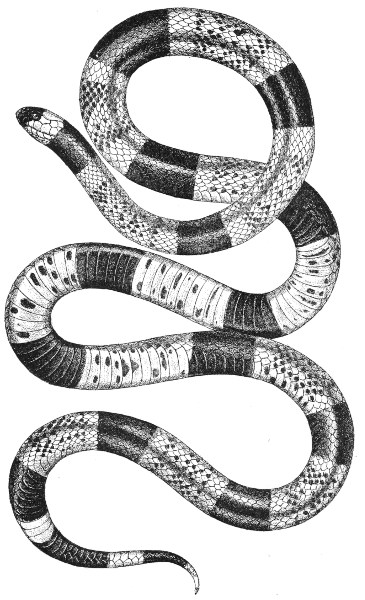
Fig. 66.—Elaps fulvius (The Harlequin Snake, or Coral Snake). (After L. Stejneger.)
Total length, 430 millimetres; tail 35.
Habitat: Peru.
(16) E. dissoleucus.—Scales in 15 rows; 200 ventrals; 19 subcaudals.
Coloration as in foregoing species.
Total length, 1,070 millimetres; tail 35.
Habitat: Venezuela.
(17) E. fulvius (Harlequin, or Coral Snake, fig. 66).—Scales in
15 rows; 180-237 ventrals; 30-59 subcaudals.
Colour: Body with black, red, and yellow annuli; tail with
black and yellow annuli; snout black.
Total length, 990 millimetres; tail 85.
Habitat: Eastern North America, from Southern Virginia, the
Ohio River, and the Missouri to the Rio Grande, Mexico. Central
America.
(18) E. psyches.—Scales in 15 rows; 188-214 ventrals; 32-47
subcaudals.
Colour: Body with alternate black and brown annuli, and 48-52
narrow yellow rings; head black, blotched with yellow.
Total length, 495 millimetres; tail 80.
Habitat: Guianas.
(19) E. spixii.—Scales in 15 rows; 201-219 ventrals; 22-29
subcaudals.
Colour: red, with 20-38 black rings disposed in threes; a black
occipital collar, followed by a wide red space.
Total length, 1,400 millimetres; tail 70.
Habitat: Venezuela and Northern Brazil.
(20) E. frontalis.—Scales in 15 rows; 197-230 ventrals;
15-26 subcaudals. Tail ending very obtusely.
Colour: Body with black annuli disposed in threes, with red and
yellow interspaces; head black, spotted with yellow or red.
Total length, 1,350 millimetres; tail 70.
Habitat: Southern Brazil, Uruguay, Paraguay, Argentina.
(21) E. marcgravii.—Scales in 15 rows; 210-240 ventrals;
23-42 subcaudals.
Colour: Body with black annuli in 6-10 sets of three, separated
by broad red interspaces, the middle annulus usually wider; snout
yellow, the end usually black; back of head red.
Total length, 1,120 millimetres; tail 100.
Habitat: Tropical South America.
(22) E. lemniscatus.—Scales in 15 rows; 241-262 ventrals;
30-39 subcaudals.
Colour: Body with 11-14 sets of black annuli disposed in
threes, separated by red interspaces; head yellow; end of snout
and a band across the middle of the head black.
Total length, 1,000 millimetres; tail 80.
Habitat: Guianas, Brazil.
(23) E. filiformis.—Scales in 15 rows; 290-308 ventrals;
35-45 subcaudals.
Colour: Body with black annuli disposed in threes, with red
interspaces; head yellow; end of snout black; a black band across
the eyes.
Total length, 575 millimetres; tail 40.
Habitat: Amazons, Colombia.
(24) E. mipartitus.—Scales in 15 rows; 210-278 ventrals;
24-34 subcaudals.
Colour: black, with 40-68 narrow white annuli; head black to
between the eyes, elsewhere yellow.
Total length, 610 millimetres; tail 50.
Habitat: Central America and Tropical South America.
(25) E. fraseri.—Scales in 15 rows; 303 ventrals; 25 subcaudals.
Colour: black, with 75 narrow whitish rings with broken outlines;
head black in front, yellow behind.
Total length, 780 millimetres; tail 40.
Habitat: Ecuador.
(26) E. mentalis.—Scales in 15 rows; 255-268 ventrals; 30-31
subcaudals.
Colour: Body black, with 58-70 narrow white annuli, which become
wider on the belly; snout black, occiput yellow; tail annulate,
black and orange.
Total length, 490 millimetres; tail 30.
Habitat.—Colombia and Ecuador.
(27) E. ancoralis.—Scales in 15 rows; 258 ventrals; 31 subcaudals.
Colour: Body with 16 sets of black annuli disposed in threes,
the middle one of each set a little wider; head light in front,
spotted with black; an anchor-shaped black mark on the occiput
and nape.
Total length, 780 millimetres; tail 57.
Habitat: Ecuador.
(28) E. narduccii.—Scales in 15 rows; 240-315 ventrals;
15-33 subcaudals.
Colour: black, beneath with yellow or red cross-bands or transversely
oval spots, sometimes extending as triangular blotches up
the sides; head with a yellow cross-band.
Total length, 720 millimetres; tail 50.
Habitat: Eastern Ecuador, North-eastern Peru, Bolivia.
The species of the genus Elaps, which are remarkable for the
brightness and beauty of their colours, are generally found in
forests.
“The traveller,” says Neuwied, “who ventures into the great
Brazilian forests, where the ground is covered with leafy plants,
is astonished to see shining through the verdure the black and red
rings of the beautiful Coral Snake. Uncertainty as to whether
the creature is dangerous alone prevents him from seizing it. The
body of the snake is not lithe enough to enable it to climb trees.
Its food consists of small animals.”
Dr. Lacerda relates that the Austrian naturalist Wertheimer,
when in the Brazilian settlement of Philadelphia, was bitten by
a Coral Snake in the back of the hand. The usual symptoms of
poisoning manifested themselves immediately, and the unfortunate
man died twelve hours later. Nevertheless, the small size and
slenderness of the fangs, the narrowness of their canals, and the
considerable distance between the fangs and the anterior opening
of the mouth, must necessarily render the bites of these snakes less
serious and of rarer occurrence.
The Solenoglypha
are infinitely more formidable
in the two
divisions of the New
World. They are represented
by a large
number of species, some
of which are feared in
consequence of their size
and ferocity, even more
than on account of the
deadliness of their
venom (fig. 67).
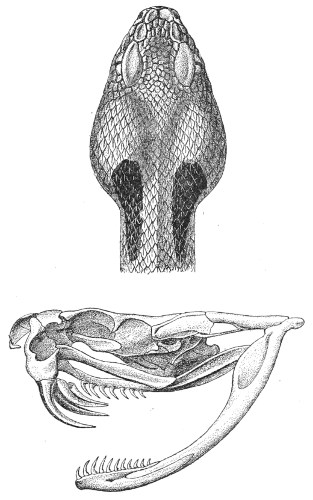
Fig. 67.—Head and Skull of Crotalus horridus.
The American Crotalinæ
are divided into
two groups:—
The first of these
comprises snakes not
provided with the caudal
appendage, which is
characteristic of the
Rattle-Snakes. It consists
of two genera:—
(a) Ancistrodon.
(b) Lachesis.
The second group includes only those snakes the tails of which
are terminated by the scaly appendage known as the “rattle.”
These are likewise divided into
two genera:—
(c) Sistrurus.
(d) Crotalus.
Usually with 9 shields on the
head, or internasals and præfrontals
broken up into scales. Body
cylindrical: scales smooth or
keeled, with apical pits. Tail
moderate or short; subcaudals
single or in 2 rows.
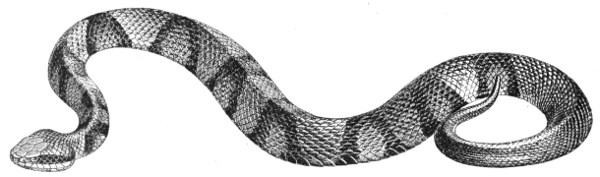
Fig. 68.—Ancistrodon piscivorus (Water Viper). (After Stejneger.)
(1) A. piscivorus (Water Viper,
or Cotton-mouth; fig. 68).—Snout
rounded, soft above. Scales on
the body strongly keeled, in 25
(rarely 27) rows; 130-147 ventrals;
33-51 subcaudals, all single
or the posterior divided.
Colour pale reddish-brown to
dark brown above, with more or
less distinct dark brown cross-bands,
or with alternating
C-shaped dark markings each enclosing
a central spot. Belly dull
yellow spotted with black, or almost
black.
Total length, 1,170 millimetres;
tail 200.
Habitat: Eastern North
America, from North Carolina
and Indiana to Florida and Texas.
The Water Viper lives for the most part in the vicinity of
rivers, and feeds upon fish, but also devours small warm-blooded
animals. The Creoles call it the Congo Snake. It is fairly
common in the environs of New Orleans. In summer time it
conceals itself in the branches of trees at the edge of the water.
It frequents inundated rice-fields, and is a terror to the blacks. It
attacks readily, and opens its jaws some seconds before it bites.
(2) A. bilineatus.—Snout obtusely pointed. Scales more or
less strongly keeled, in 23 (rarely 25) rows; 135-141 ventrals;
52-64 subcaudals, anterior single, posterior divided.
Colour dull yellow or reddish-brown, with more or less distinct
darker cross-bands, or alternating transverse blotches, with yellow
edges; a vertical yellow line on the rostral shield, and a fine
yellow line round the snout; belly brownish or blackish, with
white spots.
Total length, 1,100 millimetres; tail 200.
Habitat: Mexico, Guatemala, Honduras.
(3) A. contortrix (The Copperhead).—Snout rounded or truncate.
Scales strongly keeled, in 23 (rarely 25) rows; 145-155
ventrals; 31-52 subcaudals, anterior single, posterior divided.
Colour dull yellow or reddish-brown, with dark brown or
brick-red cross-bars; these bars are sometimes interrupted on the
vertebral line, and form alternating triangles; belly yellow or
reddish, more or less spotted with grey or brown.
Total length, 990 millimetres; tail 110.
Habitat: North America, from Massachusetts and Kansas to
Northern Florida and Texas.
This snake is often more dreaded than a Rattle-Snake.
In Lachesis the caudal rattle is represented by a series of 10
or 12 rows of spiny scales, which are slightly hooked at the tips.
The head is covered with small shields or smooth or keeled scales,
with or without apical pits. The maxillary is much reduced; the
transverse or pterygoid bone, on the contrary, is greatly developed.
The name is derived from one of the Parcæ, daughters of Night,
who placed the thread on the spindle, and upon whom depended
the fate of men.
In addition to the 19 Asiatic species, of which we have already
given descriptions, the genus Lachesis includes 21 American species.
(1) L. mutus (Bushmaster, or Surucucu).—Two or three scales
separating the internasals in front; 10 to 15 scales on a line between
the supraoculars; 9 or 10 supralabials. Scales tubercularly
keeled, feebly imbricate, in 35 or 37 rows; 200-230 ventrals;
32-50 subcaudals.
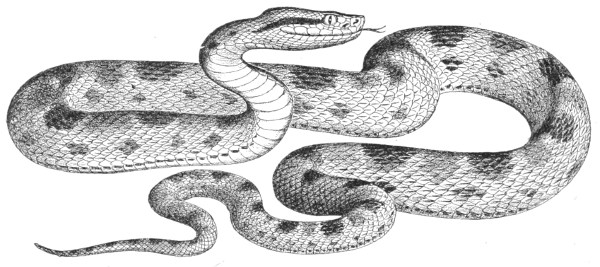
Fig. 69.—Lachesis lanceolatus (Fer-de-lance of Martinique).
(After Stejneger.)
Colour yellow or pinkish on the back, with a series of large
rhomboidal brown or black spots enclosing smaller light spots;
a black streak from the eye to the angle of the mouth.
Total length, 1,995 millimetres; tail 170.
Habitat: Central and Tropical South America.
(2) L. lanceolatus (known as the Fer-de-lance in Martinique,
and Jararacussu in Brazil; fig. 69).—Snout obtuse, slightly turned
up; upper head-scales small, imbricate, more or less strongly
keeled, in 5-10 longitudinal series between the supraoculars,
which are large; 7 or 8 supralabials. Scales in 23-33 rows,
sharply keeled; 180-240 ventrals; 46-70 subcaudals, all or the
greater part in two rows.
Coloration very variable, grey, brown, yellow, olive, or reddish;
uniform or with more or less distinct dark spots, or cross-bands,
or with dark triangles on the sides enclosing pale rhombs; a dark
streak from the eye to the angle of the mouth; belly yellowish,
uniform, or spotted with brown.
Total length, 1,600 millimetres; tail 190.
Habitat: Tropical America; Mexico, Martinique, St. Lucia,
Bequia Island near St. Vincent, Venezuela, Guianas, Rio de Janeiro.
This snake does not exist in Guadeloupe. “In the islands in
which it is found,” says Dr. Rufz de Lavison, “its presence makes
itself felt even where man has built his dwelling and cultivates
the soil. Because of it no one can carelessly lie down to rest in
the shade of a tree; no one can walk in the woods or enter unconcernedly
into the pleasures of the chase.” It is especially
abundant in coffee and sugar plantations, and is met with from the
sea-level up to the summits of the highest mountains in Martinique
and St. Lucia. It not infrequently makes its way into human
habitations, and is not uncommon in gardens, even entering those
of the town of Fort-de-France.
It does not seek its prey by day, but remains on the alert,
always ready to bite. With open mouth, and fangs projecting forwards,
it strikes with the rapidity of lightning. It swims in the
rivers and moves over the ground with great speed. Oviposition
takes place in July, and the young are hatched forthwith, the
usual number being from about 50-60.
It feeds upon lizards and rats, but also destroys a certain number
of fowls and turkeys. All the large animals are afraid of it. Its
bite is extremely dangerous, and causes about a hundred deaths
in Martinique every year.
In striking at its prey or at a man, the Fer-de-lance throws
back its head and opens its jaws widely, with the fangs directed
forwards. It drives in its poison-teeth as with the blow of a
hammer, and quickly draws back again. When very excited, it
resumes its position and strikes afresh. It never becomes tame,
but is capable of living a fairly long time in captivity. I have kept
a number of specimens of it for more than two years, caged in my
laboratory.
(3) L. atrox (Labaria).—Closely resembling L. lanceolatus,
but bulkier; the enormous head is armed with powerful fangs,
which are often more than a centimetre in length; 7 supralabial
shields; scales in 25-29 rows, strongly keeled; 161-216 ventrals;
47-73 pairs of subcaudals.
Colour brown, with dark cross-bands or triangular blotches, with
the apices adjacent on the vertebral line; a dark streak from the
eye to the angle of the mouth; belly yellowish-white, speckled with
brown, or brown spotted with yellowish-white.
Total length, 1,110 millimetres; tail 180.
Habitat: from Central America to Peru and Northern Brazil.
(4) L. pulcher.—Two postocular shields and a subocular,
separated from the labials by one series of scales; 7 supralabials;
scales in 21 or 23 rows, strongly and tubercularly keeled; 156-172
ventrals; 58-64 pairs of subcaudals.
Colour olive-grey, with brown, light-edged cross-bands, which
are continuous or broken on the vertebral line; a light streak
from the eye to the angle of the mouth; belly covered with minute
confluent brown markings, with darker and lighter spots on the
sides.
Total length, 685 millimetres; tail 115.
Habitat: Andes of Ecuador.
(5) L. microphthalmus.—Snout short, rounded; eyes very small;
7 supralabials, of which the third and the sixth or seventh are
the largest; scales in 23 rows, dorsals tubercularly keeled; 159-161
ventrals; 52-55 subcaudal pairs.
Colour yellowish-brown or pale olive on the back, with dark
brown triangles on the sides; posteriorly, the united triangles
form cross-bands; a yellowish band from the eye to the side of
the neck; belly dark brown with yellowish spots.
Total length, 630 millimetres; tail 100.
Habitat: Peru, Ecuador.
(6) L. pictus.—Snout obliquely truncate; two series of scales
between the eye and the labials; scales in 21-23 rows, strongly
keeled; 157-172 ventrals; 40-74 pairs of subcaudals.
Colour pale brown, with a dorsal series of large black-edged
brown spots, which may form a vertebral zigzag band; a black
streak behind the eye, and a vertical bar below the eye; belly
yellowish, spotted with brown.
Total length, 310 millimetres; tail 43.
Habitat: Peru.
(7) L. alternatus.—Head narrow, elongate; 8-9 supralabials;
scales in 29-35 rows, very strongly keeled; 167-181 ventrals;
34-51 pairs of subcaudals.
Colour brown, very elegantly marked with opposite or alternating
pairs of large C-shaped markings, which are dark brown,
edged with black and yellow, and separated by narrow interspaces
of the ground colour; head dark·brown above, with a ⅄̅-shaped
light marking, the transverse bar between the eyes; belly whitish,
spotted with brown or black.
Total length, 1,190 millimetres; tail 110.
Habitat: Southern Brazil, Paraguay, Uruguay, Argentina.
(8) L. neuwiedii (known as the Urutù in Brazil; fig. 70).—Snout
obtusely pointed; supraocular large, separated from its
fellow by 6-9 longitudinal series of scales; 8 or 9 supralabials;
scales very strongly keeled, in 21-27 rows; 168-182 ventrals;
41-53 subcaudals.
Colour yellowish or pale brown, with dark brown black-edged
spots; the spots on the back form a single series or a double
alternating series; a dark spot on the snout; a pair of dark bands
from the vertex to the nape, and another from the eye to the angle
of the mouth; belly yellowish, more or less powdered with brown.
Total length, 770 millimetres; tail 120.
Habitat: Brazil, Paraguay, Argentina.
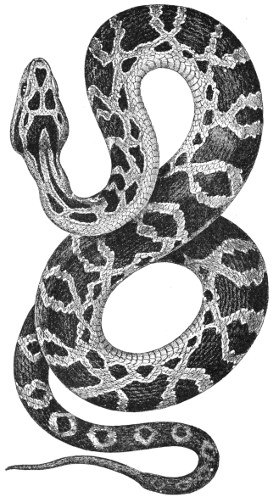
Fig. 70.—Lachesis neuwiedii (known as the Urutù in Brazil).
(After Lacerda.)
(9) L. ammodytoides.—Snout turned up, in the shape of a wart;
two series of scales between the eye and the labials; scales in 23
or 25 rows, very strongly keeled; 149-160 ventrals; 30-38 pairs
of subcaudals.
Colour pale brown, with large brown black-edged spots or
cross-bands, which may alternate and form a zigzag band; a dark
streak behind the eye; belly yellowish, spotted with brown.
Total length, 460 millimetres; tail 55.
Habitat: North-eastern Patagonia and Argentina.
(10) L. xanthogrammus.—Head elongate, snout short; scales
in 27 rows, feebly keeled; 196 ventrals; 54 subcaudals.
Colour very dark olive, with a yellow zigzag line on each side
from the head to the base of the tail; the angular parts enclose
rhombic spaces and lateral triangles; top of head black, with a
pair of undulating yellow bands from the nape to the vertex;
a bright golden band round the snout; labials bright yellow;
ventral shields black, paler in the middle, with yellow triangular
spots at their extremities.
Total length, 1,530 millimetres; tail 190.
Habitat: Eastern Ecuador, Andes of Colombia.
(11) L. castelnaudi.—Head narrow and elongate; scales on the
head smooth or feebly keeled, small; body-scales strongly keeled,
in 25 or 27 rows; 230-253 ventrals; 72-83 subcaudals, all or
majority in a single row.
Colour greyish or brown, with dark or light-edged spots or
cross-bands; head with dark spots, one of which occupies the
middle of the snout; a dark band from the eye to the angle of the
mouth; belly brown or blackish, spotted with yellow.
Total length, 1,220 millimetres; tail 180.
Habitat: Brazil, Ecuador, Eastern Peru.
(12) L. nummifer.—Snout broad, rounded; 10 or 11 supralabials;
scales in 23-27 rows, strongly keeled; 121-134 ventrals; 26-36
subcaudals, all or the majority single.
Colour pale brown, with a dorsal series of rhomboidal spots,
which may form a zigzag band; belly whitish, uniform or spotted
with dark brown.
Total length, 800 millimetres; tail 90.
Habitat: Mexico and Central America.
(13) L. godmani.—Snout broad, rounded; 9 or 10 supralabials;
scales in 21 rows, strongly keeled; 135-142 ventrals; 22-34
subcaudals in a single row.
Colour brown, with or without a dorsal series of large darker
spots; belly yellowish, more or less spotted with grey or blackish.
Total length, 610 millimetres; tail 60.
Habitat: Guatemala.
(14) L. lansbergii.—Snout pointed, turned up at the end, as in
Vipera aspis; scales in 25-27 rows, strongly keeled; 152-159
ventrals; 29-35 subcaudals in a single row.
Colour yellowish-brown, pale brown, or grey, with a dorsal
series of large rhomboidal or squarish spots, usually divided by a
narrow yellow or orange vertebral line; cheeks blackish; belly
powdered with brown, with or without whitish spots.
Total length, 575 millimetres; tail 70.
Habitat: from Southern Mexico to Colombia, Venezuela,
and Brazil.
(15) L. brachystoma.—Similar to the foregoing species; scales
in 23 (rarely 25) rows; 132-150 ventrals; 27-38 subcaudals.
Total length, 500 millimetres; tail 50.
Habitat: Southern Mexico and Central America.
(16) L. bilineatus.—Snout rounded; 7 or 8 supralabials; scales
in 27-35 rows, strongly keeled; 198-218 ventrals; 59-71
subcaudals, all or majority in two rows. Tail prehensile.
Colour green, uniform or spotted with black; a lateral yellow
streak; belly white; end of tail reddish.
Total length, 840 millimetres; tail 125.
Habitat: Brazil, Bolivia, Peru, Ecuador.
(17) L. undulatus.—Snout short, rounded; 11 supralabials;
scales in 21 rows, the dorsals strongly or very strongly keeled;
149-171 ventrals; 41-49 pairs of subcaudals. Tail prehensile.
Colour olive or brown, sometimes speckled with black, with a
dorsal series of rhomboidal dark spots or an undulous or zigzag
band; belly yellowish or brownish, powdered with blackish.
Total length, 570 millimetres; tail 75.
Habitat: Mexico.
(18) L. lateralis.—Snout rounded; 9 supralabials; scales in 21
or 23 rows, rather strongly keeled; 171 ventrals; 59 subcaudals, in
a single row. Tail prehensile.
Colour green, with a yellow line on each side of the body.
Total length, 485 millimetres; tail 75.
Habitat: Costa Rica.
(19) L. bicolor.—Very similar to the foregoing; scales in 21
rows; 164-167 ventrals; 62-67 subcaudals, in a single row.
Colour uniform green, yellowish on the belly.
Total length, 375 millimetres; tail 60.
Habitat: Guatemala.
(20) L. schlegelii.—Snout rounded; 8 or 9 supralabials; scales
in 19-25 rows, more or less strongly keeled; 138-162 ventrals;
47-62 subcaudals, in a single row. Tail prehensile.
Coloration very variable, green or olive, spotted with black, or
with pinkish, reddish, or purplish black-edged spots or cross-bars;
belly yellow, spotted with green, or variegated; end of tail generally
red.
Total length, 600 millimetres; tail 115.
Habitat: Central America, Colombia, Ecuador.
(21) L. nigroviridis.—Snout short, rounded; 9-11 supralabials;
19 rows of scales, rather feebly keeled; 134-146 ventrals; 49-54
subcaudals, in a single row. Tail prehensile.
Colour green or olive, spotted with black; head with a black
streak on each side; belly yellowish.
Total length, 535 millimetres; tail 90.
Habitat: Costa Rica.
(22) L. aurifer.—Snout short and broad; 9 or 10 supralabials;
scales in 19 rows, rather strongly keeled; 154-158 ventrals;
53-61 subcaudals, single. Tail prehensile.
Colour green, spotted with yellow; a black streak on the temple;
belly greenish-yellow.
Total length, 825 millimetres; tail 145.
Habitat: Guatemala.
Head very distinct from neck, covered above with nine large
symmetrical shields; eyes rather small, with vertical pupils. Body
cylindrical; scales keeled, with apical pits; tail short, ending in
a segmented horny apparatus (rattle), producing a special sound;
subcaudals all or the majority in a single row.
(1) S. miliarius (Ground Rattle-Snake).—9-11 supralabials;
scales in 21 or 23 rows, strongly keeled; 127-139 ventrals; 27-36
subcaudals; rattle short, consisting at the most of 10 segments.
Colour greyish, yellowish, or brown, the vertebral line often
orange; two undulating dark stripes from between the eyes to the
occiput, the enclosed space usually orange; belly whitish, spotted
with dark brown or black.
Total length, 520 millimetres; tail 70.
Habitat: South-eastern North America, from North Carolina
to Texas.
(2) S. catenatus (Prairie Rattle-Snake, or Massasanga, fig. 71).—Two
or three series of scales between the eye and the labials;
11-14 supralabials; scales in 23 or 25 rows; 136-153 ventrals;
20-31 subcaudals.
Colour the same as in S. miliarius: a dark spot on the parietal
shields.
Total length, 680 millimetres; tail 80.
Habitat: Great Lakes district; United States east of the
Rocky Mountains and west of the Mississippi; Northern Mexico.
(3) S. ravus.—11 or 12 supralabials; scales in 21 or 23 rows;
147 ventrals; 26 subcaudals.
Colour yellowish-brown, with a dorsal series of dark brown
spots, longer than broad, and a series of transverse dark bars on
each side; belly yellowish, spotted with blackish-brown.
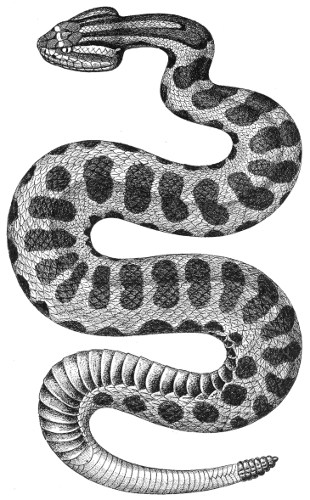
Fig. 71.—Sistrurus catenatus (Prairie Rattle-Snake, or Massasanga).
(After Holbrook and Stejneger.)
Total length, 200 millimetres; tail 22.
Habitat: Vera Cruz, Mexico.
These snakes differ from all others in that the end of the tail
bears a series of large conical scales, forming rattles, each fitting
into the next and movable in such a manner that when the reptile
causes them to move they produce a strident sound (fig. 72).
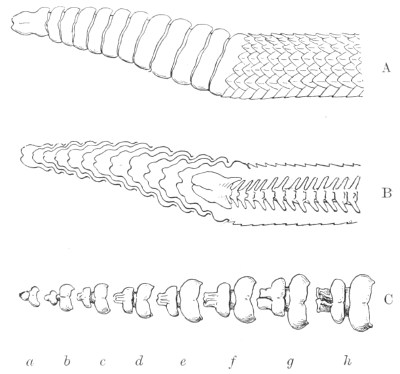
Fig. 72.—A, Horny appendage (rattle) of Crotalus
horridus (three-quarters natural size. After Garman).
B, longitudinal section of the same. C, separated
segments of the appendage: a, terminal point; h,
basal segment (after Czermak).
The length of
these animals often
exceeds 2,000 millimetres.
The head
is flat, very large
and expanded posteriorly,
and terminated
in front by
a short, truncate
snout; it is covered
above with scales or
small shields.
Rattle-Snakes
are armed with enormous
fangs enclosing
a complete canal,
which extends
throughout almost
their entire length.
The poison-glands
are of the size of a large almond.
The number of segments in the rattle is variable, but rarely
exceeds 18 or 20. At the time of the shedding of the skin these
segments fall off and are at once replaced. Contrary to the belief
which was long entertained, their number bears no relation to the
age of the snake.
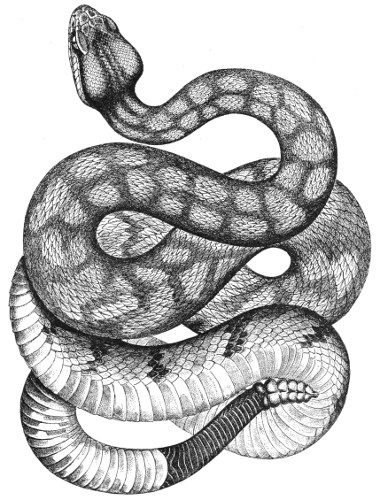
Fig. 73.—Crotalus terrificus (Dog-faced Rattle-Snake, Cascavella in Brazil).
(After Stejneger.)
Rattle-Snakes are met with especially in stony and arid
localities, or among brushwood near water. They hardly ever bite
except when surprised or attacked.
(1) C. terrificus (Dog-faced Rattle-Snake, Cascavella in Brazil;
fig. 73).—Snout very short; three or four series of scales between
the eye and the supralabial shields; body-scales in 23-31 rows,
dorsals very strongly keeled; 160-199 ventrals; 18-30 subcaudals.
Colour brown, with a series of darker, light-edged rhombs,
often lighter in the centre; a dark streak from the eye to the
angle of the mouth; belly yellowish-white, uniform or spotted with
brown; tail generally brown or blackish.
Total length, 1,320 millimetres; tail 130.
Habitat: Arizona, New Mexico, and Texas to Southern Brazil,
and Northern Argentina.
(2) C. scutulatus (Texas Rattle-Snake; fig. 74).—13-16 supralabials;
scales in 25 or 27 rows; dorsals striated and strongly
keeled; 167-170 ventrals; 18-20 subcaudals.
Colour yellowish or greyish-brown, with a series of large dark
brown light-edged rhomboidal spots; an oblique dark streak below
the eye; belly uniform yellowish-white.
Total length, 760 millimetres; tail 65.
Habitat: Arizona, New Mexico, Texas, North Mexico.
(3) C. confluentus (Pacific or Mottled Rattle-Snake; fig. 75).—Upper
head-scales small, striated; 13-18 supralabials; body
scales in 25-29 rows, striated and strongly keeled; 168-197
ventrals; 17-34 subcaudals.
Colour yellowish, greyish, or pale brown, with a dorsal series
of large brown or red spots, usually rhomboidal or transversely
elliptic in shape; a light streak or triangular marking across the
supraocular shields; belly yellowish, uniform or spotted with
brown.
Total length, 1,520 millimetres; tail 140.
Habitat: Western North America, from British Columbia to
South California, eastwards to Assiniboia, Dakota, Nebraska,
Kansas, and Western and Southern Texas; Northern Mexico.
According to Holbrook, this reptile feeds upon young rabbits,
squirrels, rats and other small mammals. It lays its eggs in
August, and the young are hatched at once, and are capable of
seeking their own food.
In captivity as well as under natural conditions the Mottled
Rattle-Snake is an excessively irritable species. “The noise of
the wind,” says Brehm, “or even the distant view of a man or
animal, are sufficient to irritate it. It then coils itself up in a
spiral, and places its head and tail in the centre of the disc thus
formed, in a state of absolute immobility. After a short interval
the creature raises its head to a height of about 8 to 12 inches
above the ground, curves its neck in the shape of an S, and
elevates its tail into a vertical position and shakes it vigorously,
whereupon the strident noise caused by the rattle is heard. So
rapid are the movements communicated by the Crotalus to its tail
that they can scarcely be distinguished. So long as the Crotalus
believes itself menaced it remains in the position that we have
just described, and continues to sound its rattle. If one withdraws
from the irritated snake, the sound gradually lessens and ceases,
to begin again more vigorously when the reptile is once more
approached.”
The bite of these snakes is exceedingly dangerous. Pigs wage
an inveterate war against them and devour them.
At the Pasteur Institute at Lille, I have kept several of these
reptiles in captivity for eighteen months and longer. They
invariably refused their food, and I always had to resort to
artificial feeding. They are easily capable of withstanding a
prolonged fast.
(4) C. durissus (Common Rattle-Snake).—7 or 8 longitudinal
series of scales between the supraoculars, 3 or 4 series of scales
between the eye and the labials; 13-16 supralabials; scales in
25-29 rows, dorsals strongly keeled; ventrals 169-181; 24-32
subcaudals.
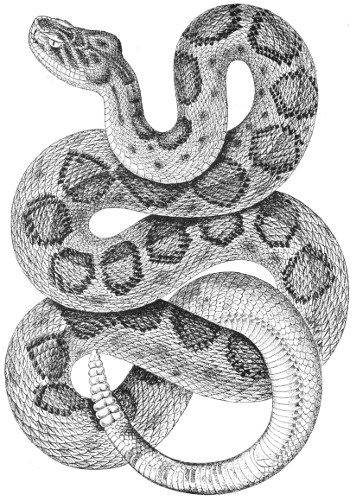
Fig. 74.—Crotalus scutulatus (Texas Rattle-Snake).
(After Baird and Stejneger.)
Colour pale greyish or brownish, with a dorsal series of large
blackish rhomboidal spots; a yellowish cross-line between the
eyes; snout blackish; end of tail usually black; belly yellowish,
more or less spotted with brown or black.
Total length may be as much as 8 feet (2,400 millimetres).
Habitat: South-eastern United States, from North Carolina
to Florida and the mouths of the Mississippi.
(5) C. horridus.—Supraoculars considerably narrower than the
space between them, which is covered by 3-8 longitudinal series
of small scales; 12-16 supralabials; body scales in 23-29 rows,
dorsals very strongly keeled; 165-178 ventrals; 19-29 subcaudals.
Colour greyish-brown, usually with a rusty vertebral stripe,
and V- or M-shaped blackish cross-bands; head uniform above,
with a dark band from the eye to the angle of the mouth; usually
a pair of roundish or triangular dark spots on the nape; belly
yellowish, uniform or spotted with blackish; end of tail blackish.
Total length, 1,340 millimetres; tail 135.
Habitat: United States, from Massachusetts and Iowa to
Northern Florida and Texas.
(6) C. tigris.—13-15 supralabials; scales in 23 or 25 rows,
dorsals strongly keeled; 166-181 ventrals; 26-46 subcaudals.
Colour yellowish or pale brown, with a dorsal series of brown
spots and cross-bands posteriorly; sides with smaller dark spots;
belly yellowish, spotted with brown.
Total length, 380 millimetres; tail 50.
Habitat: Southern California, Lower California, Nevada,
Colorado, Arizona, and Northern Mexico.
(7) C. mitchelli.—14-16 supralabials; scales in 25 rows,
striated, dorsals strongly keeled; 178-198 ventrals; 24-26
subcaudals.
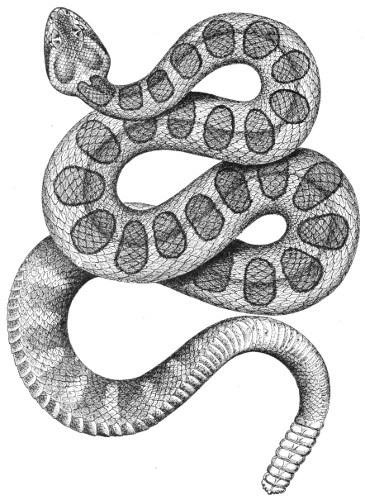
Fig. 75.—Crotalus confluentus (Pacific or Mottled Rattle-Snake).
(After Baird and Stejneger.)
Colour greyish-yellow to salmon-red, finely punctulated with
brown, with a dorsal series of transverse darker spots; belly
yellowish.
Total length, 1,020 millimetres; tail 90.
Habitat: Desert regions of Southern California, Lower California,
and Arizona.
(8) C. triseriatus.—9-13 supralabials; scales in 21-25 rows,
dorsals strongly keeled; 142-184 ventrals; 22-30 subcaudals.
Colour olive or brown, with a vertebral series of rather small
dark brown spots edged with black and white; belly yellowish,
spotted with dark brown, or dark grey-brown powdered with
whitish.
Total length, 530 millimetres; tail 55.
Habitat: Mexico.
(9) C. polystictus.—Closely allied to the foregoing, but 4 internasals,
14 or 15 supralabials, and scales in 27-30 rows; 123-151
ventrals; 18-23 subcaudals.
Colour yellowish-brown, beautifully marked with 6 or 7 longitudinal
series of alternating, elongate, dark brown, black- and white-edged
spots, separated by narrow interspaces of the ground-colour;
a pair of diverging dark bands on the top of the head, separated
by a narrow pinkish-white streak; belly pinkish or yellowish,
spotted with dark brown.
Total length, 600 millimetres; tail 60.
Habitat: Tableland of Mexico.
(10) C. lepidus.—12 supralabials; scales in 21 or 23 rows, dorsals
strongly keeled; 153-169 ventrals; 24-31 subcaudals.
Colour brown or greenish-grey, with dark brown or jet-black
light-edged cross-bands, narrowing on the sides; two dark spots,
or a V- or heart-shaped black marking on the nape; belly dirty
white, spotted with brown.
Total length, 350 millimetres; tail 60.
Habitat: Western Texas, New Mexico, Arizona, North Mexico.
(11) C. cerastes (Horned Rattle-Snake; fig. 76).—Supraocular
transformed into a raised horn-like process; 11-13 supralabials;
scales in 21 or 23 rows; dorsals feebly keeled, each scale along the
middle of the back with a central tubercular swelling; 146 ventrals;
17 subcaudals.
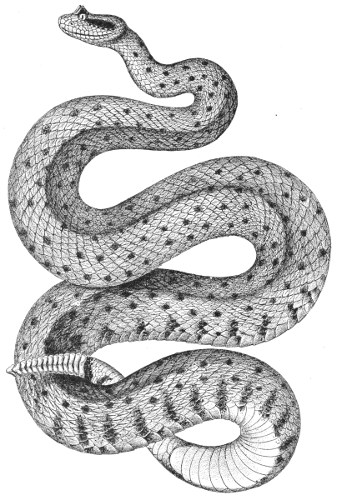
Fig. 76.—Crotalus cerastes (Horned Rattle-Snake.)
(After Baird and Stejneger.)
Colour yellowish, with a dorsal series of rather indistinct brown
blotches; a narrow brown streak from the eye to the angle of the
mouth.
Total length, 250 millimetres; tail 20.
Habitat: Desert regions of Southern California, Nevada,
Arizona, and Utah.
The Sea-Snakes, which are found in great numbers on the
shores of the Indian Ocean, are common throughout the whole
of the tropical zone of the China Sea and the Pacific. They are
met with from the Persian Gulf to the west coast of Equatorial
America, but are entirely absent from the east coast of the same
continent and the west and east coasts of Africa.
They often travel in companies. All are poisonous, and very
savage. They never come to land, and move with difficulty if
taken out of the water, although they are excellent swimmers. It
is impossible to keep them in captivity in aquariums, and they die
in two or three days. Their food consists of fishes and crustacea.
Their tail is prehensile, and they make use of it as an anchor to
attach themselves to coral reefs when they wish to rest. They
generally float on the surface of the waves, but can dive to great
depths, thanks to the extreme dilatability of their lungs, which
enables them to store up large reserves of air. They are viviparous.
In these snakes, the head, which is always very small, is
scarcely distinct from the body. It is often covered with nine
large shields. The body is laterally compressed, and the tail,
which serves as a fin, is similarly flattened. The nostrils open
on the upper surface of the snout, between the nasal shields. The
eyes are always very small.
The number of species at present known is considerable; they
are divided into ten genera. We shall confine ourselves here to
mentioning the principal diagnostic characters of these genera,
and to describing the most common species.
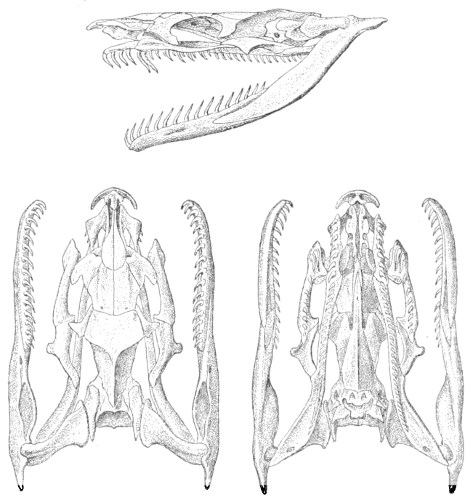
Fig. 77.—Skull of Hydrus platurus.
(After G. A. Boulenger, op. cit.)
Maxillaries longer than the ectopterygoids, not extending
forwards as far as the palatines; poison-fangs grooved, rather
short, followed, after an interspace, by 7 or 8 solid, backwardly
curved teeth. Snout long, bearing the nostrils on its upper
surface; head-shields large, nasals in contact with each other.
Body rather short; scales hexagonal or squarish, juxtaposed; no
distinct ventral scales.
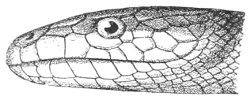
Fig. 78.—Hydrus platurus (syn.
Pelamis bicolor).
(After Krefft.)
The principal species of this genus
is H. platurus (syn. Pelamis bicolor,
fig. 78).
Coloration black or brown and
yellow, with very variable markings.
Total length, 700 millimetres; tail
80.
Habitat: Indian Ocean, Tropical
and Sub-tropical Pacific.
Poison-fangs followed by 5 small teeth. Snout short; nostrils
superior, horizontal, between two nasal shields and an internasal;
frontal and parietal shields large; præocular present. Body rather
elongate; scales hexagonal, juxtaposed; no distinct ventral scales.
T. anomalus.—Body with dark annuli, wider on the back.
Total length, 810 millimetres; tail 84.
Habitat: Java.
Maxillaries longer than the ectopterygoids; frontal and parietal
shields broken up into scales. Body rather elongate; scales subimbricate;
no distinct ventrals.
A. peronii.—Greyish or pale olive, with dark cross-bands; belly
whitish.
Total length, 890 millimetres; tail 115.
Habitat: Western Tropical Pacific.
Snout short; 6 teeth behind the poison-fangs; nostril in a
single nasal shield; head-shields large. Body feebly compressed;
scales imbricate; ventral scales small, but well developed.
H. darwiniensis.—Body
with yellowish-white
and blackish
annuli, the black rings
narrower on the belly;
head dark olive spotted
with black.
Total length, 435
millimetres; tail 43.
Habitat: North
Australia.
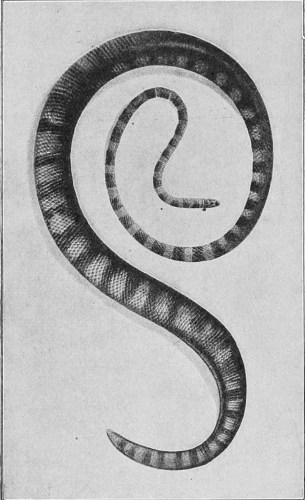
Fig. 79.—Hydrophis coronatus.
(After Sir Joseph Fayrer.)
Poison-fangs large,
followed by a series of
7-18 solid teeth. Head
small; nostrils on the
upper surface of the
snout, pierced in a
single nasal shield;
head-shields large;
præocular present.
Body long, often very
slender anteriorly;
scales on the anterior
part of the body imbricate, rectangular, keeled or tubercular;
ventrals more or less distinct, very small.
A considerable number of (at least 22) species of Hydrophis
are known. Those most frequently met with are the following:—
H. spiralis.—Olive above, yellowish beneath, with black rings;
head black above, with a horse-shoe-shaped yellow mark, the
convexity of which rests on the præfrontal shields; end of tail
black.
Total length, 400 millimetres. Grows to 1,800 millimetres.
Habitat: Coasts of India, and the Malay Archipelago.
H. cærulescens.—Grey above, with black cross-bands, which
form complete rings, or are interrupted on the belly; head uniform
black.
Total length, 665 millimetres; tail 75.
Habitat: Bombay Coast, Bay of Bengal, Straits of Malacca.
H. nigrocinctus.—Pale olive on the back, yellowish on the belly,
with black annuli, which are broader on the back.
Total length, 1,000 millimetres; tail 100.
Habitat: Bay of Bengal and Straits of Malacca.
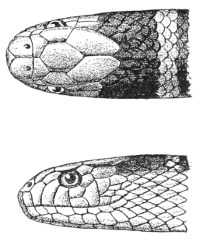
Fig. 80.—Hydrophis elegans.
(After Krefft.)
H. elegans (fig. 80).—Yellowish-white,
back with transverse rhomboidal black
spots, separated by a series of small black
spots; belly with black spots or cross-bars;
head blackish, with a more or less
distinct light crescentic marking across
the snout, from above the eyes.
Total length, 710 millimetres; tail 60.
Habitat: North coast of Australia.
H. gracilis.—Bluish-black or greyish,
olive above in the adult, with more or less
distinct lighter cross-bands anteriorly.
Young sometimes with rhombic black
cross-bands extending to the belly, or sub-interrupted on the sides.
Total length, 1,020 millimetres; tail 90.
Habitat: Coasts of Persia, India, and Ceylon; Malay Archipelago.
H. cantoris.—Body dark olive or blackish anteriorly, with
yellowish cross-bands above; posterior part of body olive above,
yellowish on the sides; tail with olive vertical bars; a blackish
streak along the belly.
Total length, 1,100 millimetres; tail 90.
Habitat: Bay of Bengal.
H. fasciatus.—Head and neck black, the latter with yellowish
cross-bands; body pale, with black annuli, which are broader on
the back.
Total length, 1,000 millimetres; tail 85.
Habitat: From the coasts of India to China and New Guinea.
H. obscurus (syn. H. stricticollis).—Olive or dark green above,
with yellowish cross-bars, which form complete rings round the
slender anterior part of the body; a yellow spot on the snout, and
a yellow streak on each side of the upper surface of the head.
Total length, 970 millimetres; tail 105.
Habitat: Bay of Bengal, Malay Archipelago.
H. leptodira.--Black, with yellow cross-bars on the neck, and
complete annuli on the body, the bars and annuli numbering 77.
Total length, 525 millimetres; tail 40.
Habitat: Mouths of the Ganges.
Poison-fangs large, followed by 4-10 grooved teeth. Head
larger than in Hydrophis; body more or less elongate; scales on
the anterior part of the body imbricate; ventrals more or less
distinct, and always very small.
The species of this genus, 18 in number according to the British
Museum Catalogue, are found in the Indian and Pacific Oceans,
from the Persian Gulf to Japan and New Caledonia.
The most important are:—
D. ornata.—Uniform blackish-olive on the back, whitish on the
belly.
Total length, 1,200 millimetres; tail 130.
Habitat: From the Mouth of Persian Gulf, and the coasts of
India and Ceylon to New Guinea, and North Australia.
D. subcincta.—Trunk with 41 broad dark cross-bands, about as
broad as the interspaces, not extending downwards to the middle
of the side; a series of small roundish, blackish spots along the
lower part of the sides.
Total length, 1,070 millimetres; tail 100.
Habitat: Indian Ocean.
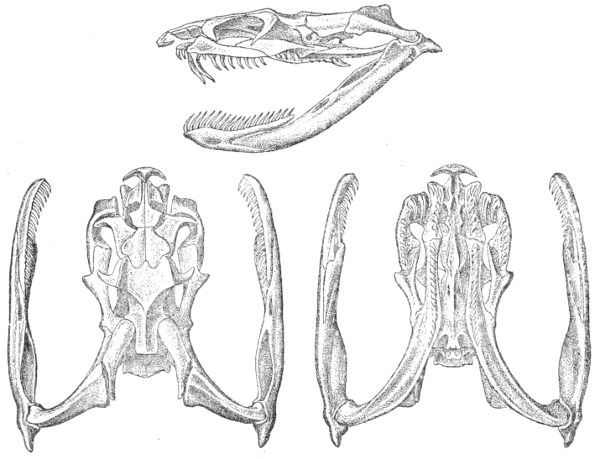
Fig. 81.—Skull of Distira.
(After G. A. Boulenger, op. cit.)
D. cyanocincta.—Greenish-olive above, with dark olive or black
cross-bars or annuli, broader on the back, and sometimes joined by
a black band along the belly, or yellowish, with a black vertebral
stripe and a few bars on the neck.
Total length, 1,500 millimetres; tail 140.
Habitat: From the Persian Gulf and the coasts of India to
China, Japan, and Papuasia.
D. jerdonii.—Olive above, yellowish on the belly, with black
cross-bands forming complete rings in young and half-grown
specimens; a black spot sometimes present between each pair of
annuli.
Total length, 910 millimetres; tail 100.
Habitat: Bay of Bengal, Straits of Malacca, Borneo.
Two large poison-fangs, and 2-4 small feebly grooved teeth.
Body short and stout; scales hexagonal or squarish, juxtaposed,
disappearing almost completely on the belly.
E. curtus.—Above with dark transverse bands, broadest in the
middle; end of tail black.
Total length, 750 millimetres; tail 75.
Habitat Coasts of India and Ceylon.
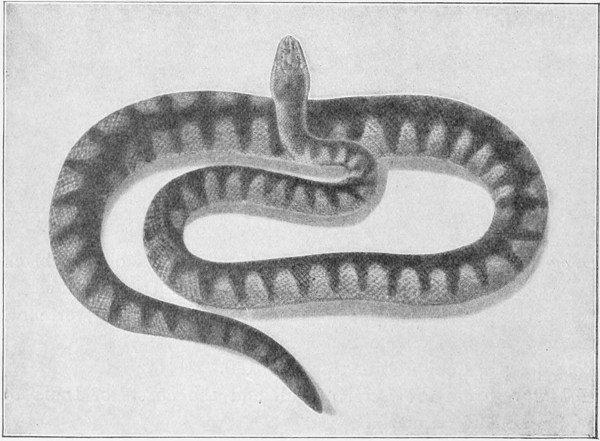
Fig. 82.—Enhydrina valakadien (syn. E. bengalensis).
Two large poison-fangs, followed by 4 solid non-grooved teeth.
Body moderately elongate; scales imbricate; ventrals distinct but
very small.
E. valakadien (syn. E. bengalensis; fig. 82).—Colour olive or
grey, with black transverse bands, usually less distinct in the adult;
sides and belly whitish.
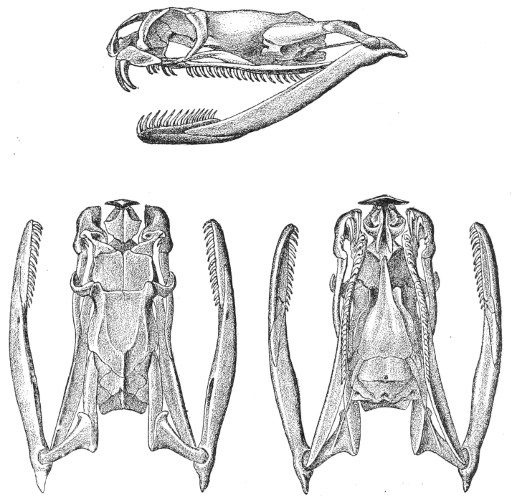
Fig. 83.—Skull of Platurus olubrinus.
(After G. A. Boulenger, op. cit.)
Total length, 1,300 millimetres; tail 190.
Habitat: From the Persian Gulf along the coasts of India and
Burma, to the Malay Archipelago and Papuasia.
Maxillaries a little longer
than the ectopterygoids;
poison-fangs moderate, followed,
after a short interval,
by 8-10 grooved teeth;
anterior mandibular teeth
feebly grooved. Snout
short; head shields large,
or broken up into scales.
Body moderate; scales imbricate;
ventrals large,
keeled in the middle.
A. australis.—Brown, or
cream-colour, with brown
spots forming more or less
distinct cross-bars.
Total length, 930 millimetres;
tail 110.
Habitat: Coasts of New
Guinea and Australia.
Other species of Aipysurus
(A. eydouxii, annulatus,
and lævis) are found
on the coasts of Singapore,
Java, Celebes, and the
Philippine and Loyalty
Islands.
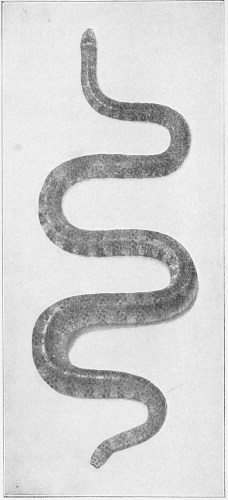
Fig. 84.—Platurus laticaudatus (syn. P. fischeri).
(After Sir Joseph Fayrer.)
Two large poison-fangs, and only one or two small solid teeth
near the posterior extremity of the maxillary. Head shields large;
nostrils lateral, the nasal shields separated by the internasals.
Body greatly elongate; scales smooth and imbricate; ventrals and
subcaudals large.
Four species, distributed in the eastern parts of the Indian
Ocean and in the Western Pacific.
P. laticaudatus (syn. P. fischeri; fig. 84).—Olive above,
yellowish on the belly, with 29-48 black annuli.
Total length: 970 millimetres; tail 90.
Habitat: From the Bay of Bengal to the China Sea and the
Western South Pacific Ocean.
P. colubrinus (fig. 83).—Olive above, yellowish on the belly,
with 28-54 black annuli, some or all of which may be interrupted
below.
Total length, 1,270 millimetres; tail 125.
Habitat: From the Bay of Bengal to the China Sea and the
Western South Pacific Ocean.
P. muelleri.—62 black annuli, some of which are interrupted
on the belly.
Habitat: Only found in the South Pacific Ocean (subtropical
zone), as far as the New Hebrides and the shores of Tasmania.
P. schistorhynchus.—Coloration and size as in P. colubrinus:
body with 25-45 annuli.
Habitat: Western Tropical Pacific.
| (1) EUROPE. |
| Families |
Sub-Families |
Genera |
Geographical Area |
| Colubridæ |
Dipsadomorphinæ |
Cœlopeltis |
Borders of the Mediterranean in France and Spain; Italy (only in Liguria). |
| Viperidæ |
Viperinæ |
Vipera |
France, Italy, Switzerland, Austria-Hungary, Germany, Belgium, Sweden and Norway, Gt. Britain, Spain and Portugal, Bosnia and Herzegovina, Southern Russia, Turkey and Greece. |
| (2) ASIA. |
| Colubridæ |
Hydrophiinæ |
Hydrus
Thalassophis
Acalyptophis
Hydrelaps
Hydrophis
Distira
Enhydris
Enhydrina
Aipysurus
Platurus
|
Persian Gulf, Indian Ocean, Bay of Bengal, Straits of Malacca, China Sea, Philippines, and Malay Archipelago. |
| Elapinæ |
| Bungarus |
India, Ceylon, Burma, Indo-China, Southern China, Dutch Indies, Borneo. |
| Naja |
India, Ceylon, Burma, Indo-China, Dutch Indies, Philippines. |
| Hemibungarus |
South-eastern Asia, India, Japan, Philippines. |
| Callophis |
South-eastern Asia, India, Burma, Indo-China, Formosa, Southern China. |
| Doliophis |
Indo-China, Malay Peninsula. |
| Viperidæ |
Viperinæ |
Vipera |
Turkestan, Ural, Siberia, Caucasus, Persia, Armenia, Western China, India, Ceylon, Himalayas. |
| Pseudocerastes |
Persia. |
| Cerastes |
Arabia, Palestine. |
| Echis |
Persia, Arabia, India, Baluchistan, Afghanistan. |
| Crotalinæ |
Ancistrodon |
Transcaspia, Turkestan, Himalayas, Southern China, Formosa, Japan, Ceylon, Java. |
| Lachesis |
South-eastern Asia, India, Southern China, Indo-China, Formosa, Sumatra. |
| (3) AFRICA. |
| Colubridæ |
Elapinæ |
Boulengerina |
Central Africa. |
| Elapechis |
Central and South Africa. |
| Naja |
Egypt, Central and West Africa, Morocco, Congo, Angola. |
| Sepedon |
South Africa, Cape of Good Hope. |
| Aspidelaps |
South and South-east Africa, Mozambique. |
| Walterinnesia |
Egypt. |
| Homorelaps |
South Africa, Cape of Good Hope. |
| Dendraspis |
Central and South Africa, Angola, Great Lakes, Congo, Transvaal.
|
| Viperidæ |
Viperinæ |
Causus |
West Africa, Gambia, Great Lakes, Congo, Angola, Transvaal. |
| Vipera |
Morocco, Algeria, Tunis, Egypt, Mozambique. |
| Bitis |
Zanzibar, Zambesia, Cape, Transvaal, Congo, the Gaboon, Benguella, Angola, Senegal, Nigeria. |
| Cerastes |
North Africa, the Sahara. |
| Echis |
North Africa, Lake Chad, Soudan, Egypt, Somaliland, Socotra. |
| Atheris |
Tropical Africa, Dahomey, Lagos, the Cameroons, the Gaboon, Congo. |
| Atractaspis |
Tropical and South Africa, Congo, Angola, Lake Chad, the Gaboon, Dahomey, Gold Coast, Zanzibar, Somaliland, Natal, and the Cape.
|
| (4) OCEANIA. |
| Colubridæ |
Hydrophiinæ |
Hydrus
Thalassophis
Hydrelaps
Hydrophis
Distira
Enhydris
Enhydrina
Aipysurus
Platurus
|
Equatorial and Sub-tropical Pacific Ocean, the Moluccas, Papuasia, New Guinea, Celebes, Timor, Australia, Tasmania, New Caledonia, New Hebrides. |
| Elapinæ |
Ogmodon |
Fiji Islands. |
| Glyphodon |
Northern Australia, New Guinea. |
| Pseudelaps |
Australia, the Moluccas, Papuasia. |
| Diemenia |
Australia, New Guinea. |
| Pseudechis |
Australia, New Guinea. |
| Denisonia |
Australia, Solomon Islands, Tasmania. |
| Micropechis |
New Guinea, Solomon Islands. |
| Hoplocephalus |
Australia. |
| Tropidechis |
Australia. |
| Notechis |
Australia, Tasmania. |
| Rhinhoplocephalus |
Australia. |
| Brachyaspis |
Australia. |
| Acanthophis |
Moluccas, Papuasia, Northern Australia. |
| Elapognathus |
Australia. |
| Rhynchelaps |
Australia. |
| Furina |
Australia.
|
| (5) AMERICA. |
| Colubridæ |
Elapinæ |
Elaps |
Mexico, Central America, Bolivia, Ecuador, Peru, Colombia, Brazil. |
| Viperidæ |
Crotalinæ |
Ancistrodon |
North America, Florida, Texas, Mexico, Guatemala. |
| Lachesis |
Central and South America, Martinique, St. Lucia. |
| Sistrurus |
North America east of the Rocky Mountains, Mexico. |
| Crotalus |
Southern Canada, British Columbia, Central America, Guiana, Venezuela, Brazil, Uruguay, Northern Argentina. |