No conveyance in this world is more delightful
than the gondola. In appearance it is undoubtedly
the most beautiful vessel in the world. Like most
characteristic objects appertaining to Venice, it is
suitable to the place: in fact, it is the outcome of
the place. There is nothing strange or unnatural
about Venice. Everything there seems to have
come about through force of necessity, and is
therefore perfectly beautiful. Even as the hansom
cab suits London, or the 'rickshaw suits Japan, or
the jaunting-car suits Ireland, so the gondola is
the vessel for Venice. You cannot separate the
lagoon from the gondola. One completes the
other. Without either Venice would be impossible.
The gondola alone can wend its way
through the intricate water-streets of the Queen
of the Adriatic.
There is no indication of movement whatever
in a gondola. The craft has no springs, no cogs,
no jarring wheels or oily machinery, no vibration.
Simply one sees the palaces glide by in front of
one, and hears the water making a lapping noise
under the bows. The gondolier is out of sight.
Nothing blocks your view of sea and sky, save
the slender steel ferro at the prow. The gondola
is built for leisure: one cannot quite imagine it,
let us say, in America. It is a historic vessel,
with a flavour of sentiment and antiquity about
it, built by a leisured people for idleness, not for
business or for hurry. It is long and slender,
flat-bottomed, and tapers towards each end, where
it rises considerably above the water. It draws
but little water, and has much the form of a skate.
The felce (cabin), placed somewhat astern, is draped
with black cloth, which can be removed in the
summer-time to make room for a striped awning.
This, however, the true Venetian loathes: rather
than use it, I am sure, he would be willing to
swelter under the felce. On each side of the cabin
there is a window, which can be closed in three
separate ways—by a bevelled Venetian glass let
down; by a blind with movable blades; by a
strip of cloth dropped over.
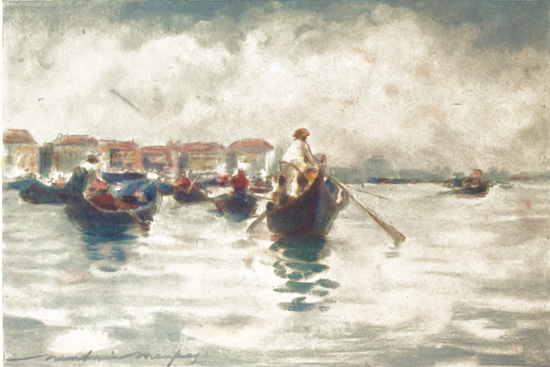
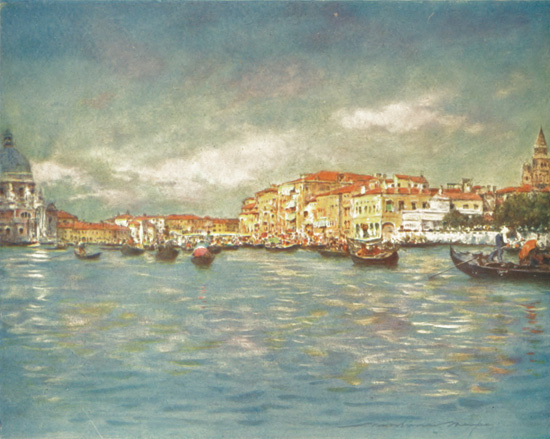
MIDDAY ON THE LAGOON
The gondola is made to hold four people. There
are morocco cushions on either side. As the seats
are very low, you are supplied with two silken
cords with handles, to assist you to rise. As the
cabin is too small to turn in, one must enter a
gondola backwards. The woodwork is carved
according to the wealth of the owner or the taste
of the gondolier. Sometimes it is very elaborate.
Above the door is generally a copper shield on
which the coat-of-arms of the owner is engraved,
surmounted by a crown; on the felce there hangs,
in a small frame, an image of the Holy Virgin, or
of St. Mark, or of St. Theodore, or of St. George,
or of some saint for whom the gondolier has a
special devotion. The lantern also hangs here—a
custom which, as the gondolas sometimes run
without the star in front, is gradually dying out.
On account of the coat-of-arms, the saint, and
the lantern, the left is the place of honour: there
the ladies are placed, or any aged or distinguished
person. There is in the felce a sliding panel,
through which one can communicate with the
gondolier on emergency. At the prow there is a
halberd-like piece of iron, smooth and polished,
called "the ferro," much like the finger-board of
a violin. This serves for decoration, for defence,
for counterpoise to the rower in the stern, and to
test the height of the bridges. It is the pride of
the gondolier to keep this always as bright as
silver. Often when a crowd of gondolas are
moored thickly about the landing-stage, the ferro
is used as a wedge, by the aid of which boats
can be divided. The rower plies his oar standing
on a small platform on the poop, not far behind
the cabin, and facing the direction in which the
gondola is to move.
The skill with which the gondolier manages his
graceful craft is extraordinary. He stands quite
upright on the poop, one foot placed firmly in front
of him, and throws the weight of his body forward
on his oar to such an extent that one fears he may
follow it into the water. It is only by long habit
that he can procure the necessary balance. The
gondola is sensitive to the least impression, and
the downward stroke has the effect of sending the
boat round. It is only by turning the blade in
the water, and raising it gradually upward, that
the gondola can be kept straight. The oar rests
in a fork, beautifully designed to allow free movement.
The gondolier, sole director of his craft,
uses the oar sometimes as a paddle, and sometimes
as a boathook. He rows always on one side.
Under the hands of an efficient man, the gondola
glides over the water like a living thing, turning
the corners of canals with great precision.
Sometimes on festa days the gondoliers practise
feats, such as setting the vessel full-tilt and with
all their might against the stone wall of a quay,
going with such rapidity that you expect man and
boat to be dashed to pieces. Just at the last
moment, with a powerful turn of the oar that
is interesting to watch, he stops dead at the base
of the quay, sometimes nearly grazing it. In much
the same way, in the At Maidan of Constantinople,
long ago, Arab and Turkish horsemen charged
against stone walls and suddenly pulled up.
Very different is the gondola in the hands of an
amateur. Many are the duckings that ensue.
Some of the young patricians, however, occasionally
don the traditional jacket, cap, and girdle of a
gondolier, and guide their own craft in a remarkably
graceful manner.
Few people have any knowledge of the real
meanings of the gondoliers' cries, some of which are
peculiarly sweet and characteristic. When a man
wants to pass on the left, and does not intend to
use the backward stroke, he cries, "Premi!" If,
on the other hand, he wishes to pass on the right,
he cries, "Stali!" Sometimes, if when turning
a dangerous corner he wishes to be especially
emphatic, he cries, "Premi! Premi!" and "Stali!
ah, Stali!" The gondola can be stopped immediately,
however great the rate at which it is travelling,
by placing the blade in front of the fork. If
a man is really expert he stops his gondola very
suddenly, making a great deal of foam with his oar.
When stopping a gondola thus the gondolier cries,
"Sciar!" As you approach the landing-stage a
crowd of ragamuffins, old and young, called "crab-catchers,"
come forward, holding in their hands
staffs, with bent nails attached, with which to
secure your gondola as you place your foot on
shore.
The gondolier is a voluble, gossiping person.
He loves to have a chat at the top of his voice
with another of his kind, and to scream repartee
across the water. He enjoys nothing more than
a quarrel, especially with a man who is across the
canal. Invariably they pass from pertinent observations
on their personal appearances to defamation
of their women. If such language were used
at close quarters on either bank they would come
to blows. I once saw two gondolas hook on to
each other by mistake with their iron axes, and I
shall never forget the discussion that ensued. It
made one's blood literally curdle! The men looked
like two angry sea-birds pecking at each other as
they pulled and pulled in their endeavour to release
themselves. When this had been accomplished
they stood upright, each on his own poop, brandishing
their oars as though they longed to kill.
As a matter of fact, there is rarely any violence
among Venetians except in language. "Body
of Bacchus!" one shouts. "Blood of David!" the
adversary answers. These mythological oaths
being not sufficiently comforting, they continue:
"Low crab!" "Sea-lion!" "Dog!" "Son of a cow!"
"Ass!" "Son of a sow!" "Assassin!" "Ruffian!"
"Spy!" Having reached the worst taunt in their
vocabulary, they take to cursing the rival saints.
"The Madonna of thy landing is a street-walker
who is not worth two candles!" one will cry. "Thy
saint is a rascal who does not know how to make
a decent miracle!" the other will rejoin. The
profanity becomes more terrible as the distance
between them increases. Possibly next time they
meet they will drink a glass of wine together
without remembering the quarrel.
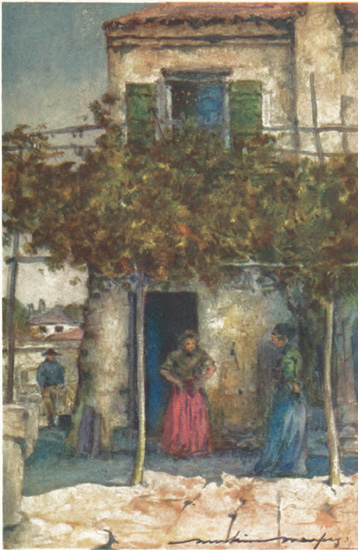
A TRAGHETTO
The gondolier is a more intelligent person than
the ordinary hackman. He knows all the histories
of the different places of interest, and relates them
for the benefit of foreigners. He has a few words
of French and English. Of course, he is a rogue
by nature, and will cheat you on every possible
occasion; but that conduct is common to the
carriers of all countries. And there is something
very frank and amusing about the way in which
they commit their petty thefts. A gondolier likes
to serve Englishmen or Americans, who pay good
prices; but a German is beyond his comprehension.
The Teuton either goes by the tariff or walks—an
eminently foolish act, in the gondolier's opinion.
Every gondolier belongs to a traghetto (ferry-boat
station), from which gondolas cross over to
Venice from various points on the Giudecca.
These traghette have been established for centuries—no
one knows exactly how long; but certainly
they were in existence in the fourteenth century.
To a gondolier a traghetto is, as it were, a club.
There are sixteen traghette. Each is governed
by its own laws and constitutions, which are still
strictly kept; each has its own history, archives,
and parchment documents. By this society are
regulated the gondolier's wages, the limits of his
obedience, his holidays, everything appertaining to
his welfare. There is at each traghetto a little
house in which the gondoliers can sit and gossip
and mend their boats.
One sees some of the finest types there. Years
ago they used to sing there on moonlight nights,
in their beautiful broken Venetian patois, verses
from Tasso. It is long since they have done this
as a habit; but they will do it sometimes if you
pay them sufficiently well. One often hears them
singing on the lagoon to the accompaniment of
an Englishman's golden coins. You can almost
imagine on such occasions that you are living away
back in the Middle Ages—except that now the
Venetians drink a good deal, as they certainly
never did then, and sing in thick, guttural voices,
somewhat hoarse, but on the whole beautiful, as
the musical Venetian dialect must always be. The
songs that they sing are all about lovely maidens and
romantic excursions on the water. The singing is
very fine from a distance, the melody of a human
voice floating out on the calm and silence of the
night. The gondoliers are proud of their talent,
and value it highly.
Nearly every gondolier belongs to a bank. He
is a capable financier. In company with twenty-nine
other men, he deposits 10 lire, and pledges to
pay a weekly sum of 1 lira throughout the year.
On his failing to pay up once a week, 10 per cent.
on each lira is charged. Gondoliers are supposed
to borrow a certain amount, for which 10 per cent.
is charged, every year. The accounts of the bank
are settled in September, and then a new venture
is started.
The gondolier is an inflammable person. He is
much taken up with pretty women getting in and
out of gondolas. Love-making with him begins
on the bridges in the narrow canals, or at the
windows. One fine day, generally very early in
life, when propelling his boat slowly down a side
canal, he sees at an iron grated window the face of
a girl. Instantly becoming enamoured, boldly he
takes up his position every day underneath her
casement, waiting for a look, sighing for a smile.
If by chance the maiden should appear and return
his salute, he takes himself off with great joy; and
at the end of the day, when his work is done, he
and a friend in whom he has confided dress themselves
in their best, and call upon the father of the
girl, formally to ask her hand. He states his
family, his profession, the amount of his income,
and the extent of his love. Two or three months
are allowed to elapse. Then there will be more
gazing at the window and meeting in the calle.
If by the end of that time their affection has
declared itself sincere, the lover and his parents
are invited to supper at the girl's home. Every
stage in a Venetian's love affair is marked by feasts,
generally suppers. On this occasion the young
man again asks the father's consent. This is
accorded him, and the pair are blessed. The
ceremony is called the "dimanda." A little later
comes the betrothal ("segno"), when the lover presents
the girl with her wedding ring, and, if he can
afford it, other rings as well. There is a sumptuous
supper, and thenceforward they are called respectively
"novizza" and "spoza." During the time of
the betrothal the poor gondolier is kept very busy
buying and giving presents to the lady of his choice.
He must give the proper things at the proper times,
and never by any chance make the mistake of
purchasing a comb or scissors, for one is an emblem
of the witch, and the other signify a cutting
tongue. He must remember to present to her at
Christmas a confitura of fruit and raw mustard-seed,
and a box of mandolato; on All Souls' Day
a box of fare; at the Feast of St. Mark a boccolo
or button-hole of rosebuds; at Easter a fugazza or
cake; at Martinmas roast chestnuts. The thing
for the girl to give in return is a silk handkerchief:
it is not considered etiquette to present her lover
with a gift of great value.
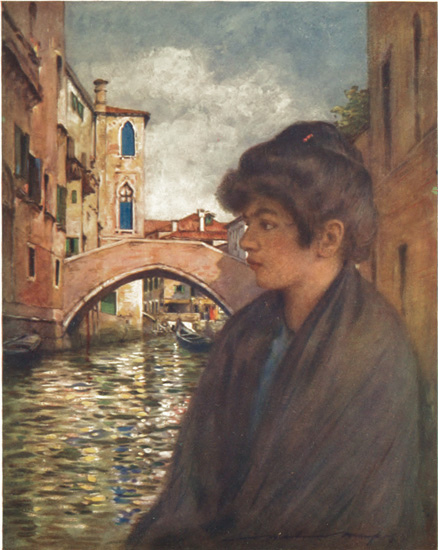
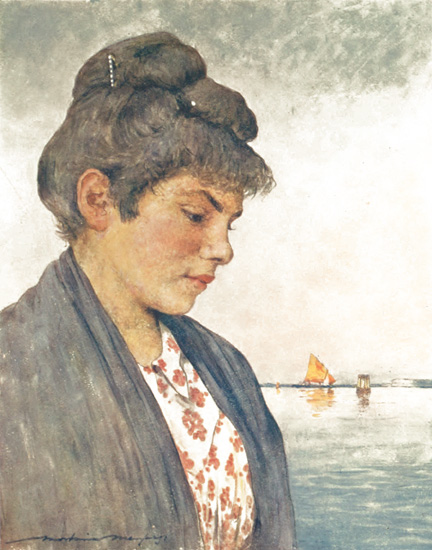
MARIETTA
In Venice everything is ruled by custom. The
most important acts in a Venetian's life are bound
and fettered by it, and he would never dream of
breaking through. He will sacrifice anything for
custom, and never count the cost. For example,
if one saw a gondolier at a festa, or at a baptism,
or at a wedding, you might take him for either a
rich man or a spendthrift. As a matter of fact, he
is neither the one nor the other. Only, he is bound
by custom to do certain things and spend a certain
amount of money at a festa, and he does it regally.
He may have to pinch and scrape at home afterwards;
but that is another matter.
The gondoliers are a very conservative people.
They are the slaves of custom. Custom is to them
a religion. They much prefer their ancient
customs to any new order of comfort or convenience.
Their lives are simple, bright, and easy;
their wants are very few and moderate. House-rent
is cheap: they can procure a fallen palace in
moderately good repair for half a franc a day.
They are frugal and easily pleased; their constitutions
are sound; their climate is fine, and the air
they breathe is pure. Consequently, the gondolier
can live happily, with his wife, on a franc and a
half a day. His meals, to be sure, are always the
same—coffee and bread in the morning, polenta
and fish at mid-day, a soup of shell-fish or artichokes
at night. When the family begins to be large, the
gondolier's life is not ideal; still, in spite of the
hunger and poverty and crowding in Venetian
houses, a great deal of joy manages to find room.
If a baby lives, he grows up into a fine healthy
man, robust and happy; but usually he dies,
especially if he is one of many. Venetian women
seem to have naturally not the slightest idea how
to bring up a baby. It is only after constant habit
and practice, and the loss of lives, that a mother
seems to grasp the first principles of a baby's upbringing.
Before that she will feed it, at two
months old, on black coffee, sour apples, and
wine; allow it to swallow all kinds of lotions and
concoctions prepared by the doting old crones of
the quarter. As the child grows older she lets it
wear during winter the clothes which it wore in
summer. Then she wonders why out of eight
children only four are living. It is a beautiful
sight to see a great gondolier nursing his little
child. He may be harsh and bullying to his
fellows; but he treats Baby with the utmost
tenderness and gentleness. The child is a good
deal safer in his arms than in those of the
mother.
The chief amusements of the gondolier are to go
to the opera or to see marionettes, to make up a
party and spend the day in the country, to compete
in a rowing match, and to give a little supper at a
wine-shop. It is on such days as these that the
true freshness and warmth of his nature appear,
and one sees the gondolier as he is—mirthful,
pungent, gay.
There are two things about which the gondolier
is particular. One is his bread, and the other is
his wine. One seldom finds good wine in Venice.
It is only when the red wine arrives fresh from
Padua and Verona that it is good. Then everyone
rushes to the wine-shops; for nothing spreads
quicker than the reputation of a good wine, and
everyone clamours for it. Very soon it becomes
watery and sour. The white wine the gondoliers
do not like at all. Of bread there are all kinds.
One is expected to have a preference for a certain
make, and there are many different makes. There
are the Chioggian bread, the "pane Commune,"
the "pane col agid," and many others.
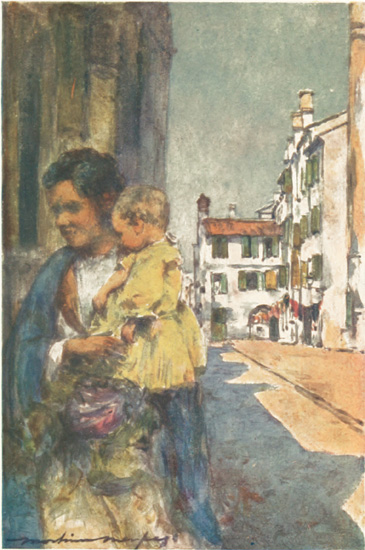
BAMBINO
Men of the gondolier class do not think a great
deal of religion. That is reserved for women.
Church-going is no longer a habit with the men.
Still, whenever matters of ancient custom step in
they invariably do their duty—as in events of
domestic life, such as confirmations,—and the little
chapel to the Madonna at each traghetto has
always its flowers and its few candles placed there
by the reverent hands of the gondoliers.
Times were good for the gondoliers when Venice
was rich and prosperous. Nowadays their gains
are meagre, and they number hundreds where they
numbered thousands in the old days. Noblemen
kept six or seven gondolas, with attendant
gondoliers, and, besides paying them an ample
salary, on festa days allowed them to exact any
payment they chose.
If you are staying in Venice for any length of
time, it is better to hire a gondola and gondolier by
the month than by the day. One only pays five
francs a day, and when off duty the youth makes
an excellent servant in the house. He comes and
knocks at your water-gate at a certain time every
day; also he will wait at table, act as footman, take
care of the children; in fact, he will do everything
one wishes; and he pays the proprietor of the
gondola, out of his own pocket, one franc a day.
It is the ambition of every gondolier to serve an
"Inglese."
They say that Venice is always silent; but I
can vouch that it is not so. At night, if your
lodgings are anywhere near a landing-place, you
will find that it is very noisy indeed. The gondoliers
sleep at their posts on the pedestals of the
two columns as they sit waiting for a job, and they
love their repose in the sunshine; but at night they
become extremely lively, and keep up a perpetual
disturbance of laughter, shouts, and songs until two
o'clock in the morning. They sit on the marble
steps, or on the ends of their gondolas; or they eat
shell-fish and drink wine under the light of the
lamps in the niches of the Madonnas at street
corners; vagabonds from their beds in the street
arise and join them.
One sees on the lagoons gondolas of all kinds,
carrying passengers of all kinds, and it is sometimes
interesting to peep inside as they pass.
There are official gondolas, with the Italian banner
floating at their sterns, carrying some cold, stiff
functionary in full-dress uniform, his breast covered
with decorations. Another carries English people,
phlegmatic tourists, to Chioggia; another, with
lowered felce, hides lovers who are going to breakfast
somewhere on the lagoon; yet another, a
larger gondola, takes a family to the sea baths at
the Lido. There is a red craft waiting at the foot
of some steps; a red bier is brought out of a church
by a red cortege,—it is a corpse, to be buried in a
cemetery on an island on the way to Murano.
(When anyone dies in Venice a notice is posted up
on his house, and on the houses round about,
stating the age, place of birth, and the illness of
which he died; also saying that he has received the
Sacrament and died a good Christian; prayers are
asked for his soul.) There are gondolas in which
are musical instruments of all kinds—violins of
Cremona, cornets, mandolines, tambourines,—a
complete orchestra. Quite a large flotilla of gondolas
follow in its wake. One has fastened to the
side a bluish monster splashing and making the
water foam. That is a dolphin, a marine curiosity
which is displayed by the proud possessors under
all the balconies as they pass, collecting money in a
hat. In order that it may be seen to advantage,
the animal is kept half in the water and half out.
If one is at all interested in gondolas—that is to
say, in the making of them,—nothing could be
more fascinating than to spend a few hours in a
squero (building yard). Any gondolier will be
pleased to take you there, for he is inordinately
proud of his craft. The squeri are picturesque;
but somehow one always associates them with
pitch. The place reeks with it. Always in one
corner there stands the pitch-pot, sending a stream
of thick black smoke up into the air. Small boys
prance around, looking like young imps among the
smoke and blaze, and wave smearing brushes in
their hands. Long lines of boats, like some
strange fish out of water, are drawn up, waiting to
be cleaned or mended. The bottom of a gondola
has to be dried thoroughly and quickly before
receiving its coat of melted tallow. This is done
by lighting a blazing fire of reeds under the boat,
the flames leaping high into the air. Volumes of
smoke arise, roll up over the house-tops, and are
swept away by the breeze. Boys dance a kind of
war-dance round the flames. The art of gondola-building
is exacting. Three qualities are absolutely
necessary to the formation of a perfect craft.
It must draw but little water; it must turn easily;
and it must be rowable by one oarsman only. To
secure this, the hull is built of light thin boards,
and only a portion of the flat bottom rests upon
the water. Thus the boat swings as on a pivot.
Then, the gondola is not equally divided by a line
drawn from stern to bow: in order that the rower
may be balanced, there is more bottom on one side
than on the other. The various woods of which a
gondola is made must be chosen with great care.
They must be well seasoned and without knots, for
the planks are liable to warp and the knots to start.
Once every twenty days in summer the gondolier
forfeits his four lire and takes his gondola to the
squero to be cleaned and scraped. Weeds rapidly
collect at the bottom when the water is warm, and
the deadly toredo bores holes through the planking.
The gondola is hauled up high and dry, and a fire
burnt underneath it. A whole day's earnings in
the summer season is a great loss to the gondolier;
but if he keeps his gondola in good condition it
will last him for a considerable time, perhaps for
five years, and, besides, when the bottom of the
boat is kept clear of weeds and well greased the
speed is greater. When a gondolier sells his craft
it becomes a ferry-boat for five years, the woodwork
slowly bowing and bending until it becomes
a gobbo half buried in the water. Later it is sold
for five lire, broken up, and burnt in the glass
manufactories of Murano.
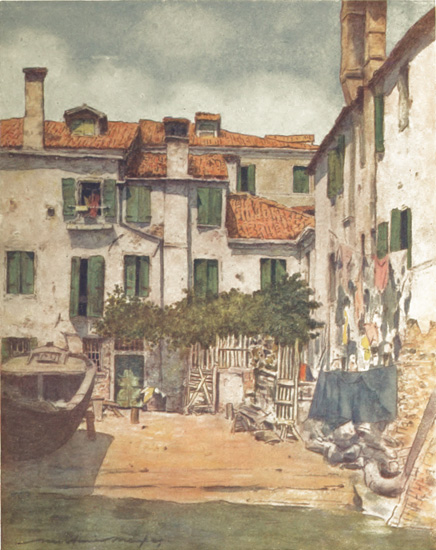
A SQUERO OR BOAT-BUILDING YARD IN VENICE
The natural history of these objects and their
gradual development through centuries would form
a fascinating chapter. To gain some idea of what
the gondola once was, it is as well to study the
pictures of Gentile Bellini and Carpaccio in the
Academy. There you will see Venetian nobles in
their gondolas with their light Eastern rugs. The
ferro was not then hatchet-shaped, with six teeth,
as it is now, but a round club of metal. The
rower was tall and graceful, standing on the poop
in his parti-coloured hose and slashed doublet.
One can see by these pictures what a great change
the gondola has undergone. Those who have not
been to Venice, and wish to know something of a
gondola in its later stage, would do well to study
the pictures of Guardi and Canaletto. Therein
the gondola has not its old brilliant colouring; but
what it has lost in colour it has gained in grace.
Some of the gondoliers are most skilful in
managing without either keel or rudder; like the
Vikings of old, steering with an oar behind.
A good man is devotedly attached to his gondola.
He knows its character and peculiarities.
To the initiated every gondola differs in a hundred
details from its fellow, although they may all have
apparently been built on the same model. A
gondolier's skill in rowing depends largely upon his
knowledge of his craft. One can generally gauge
the efficiency of a man by the brightness of his
ferro. The slightest spot of dew or rain upon it
produces a spot of rust which takes weeks of constant
rubbing to efface. There is a good deal of
brass-work which has to be kept clean; the
cushions must be brushed, and the paint scrubbed;
and altogether a gondolier spends quite an hour
and a half a day on the toilet of his craft, polishing,
oiling, and scrubbing. His own person does
not occupy nearly so much of his attention.
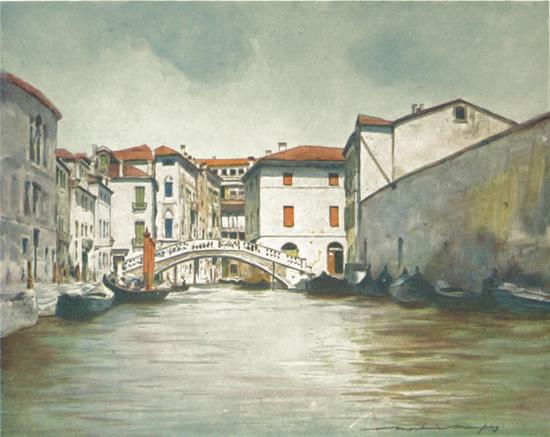
UNDER THE MIDDAY SUN
The gondola is so closely connected with the life
of the sea city that most of one's impressions of
Venice are wound round and about it. It is not
always safe out on the lagoon in a gondola. Often
in summer or in autumn a gale will suddenly arise.
Great masses of cloud will gather in the east, and
gain upon you; they are curved into an arc by the
pressure of the wind from behind, although upon
the water there is scarcely enough breeze to fill a
sail. These great billowy battalions, dark and
angry, advance slowly, steadily; the water changes
from a pale transparent to a pale sea-green as thick
as jade. A feeling of oppression fills the air, a
brooding stillness, for five minutes, while the storm-clouds
gradually overtake you. Then comes a low
humming noise like that of a threshing machine:
it is the wind on the nearest island. You down
sail and make for the first port in view. The
hurricane leaps out from the city, striking the
water and tearing it into foam, flinging the spray
high in air. There is hurry and confusion in the
sky; the thundery clouds are rent and riven; and
through the gaps of dull-coloured vapour you see
the steely blue of the storm-clouds boiling as in a
cauldron; and far above all is blue sky and sunlight;
a rainbow spans the lagoon. Then the
whole tornado sweeps away south-westward. The
sun sets, leaving the sky dark, but with flaming
streamers; then night falls over all. There is
lightning and storm away in the distance. The
heavens assume their customary deep blue, and
the breeze is fresh and cool. These summer storms
are sometimes almost tropical in their fury; but
they are quickly over. Their path is narrow—usually
confined to one line on the lagoon;—but
where they strike they leave devastation in their
track.
The Venetians love festas, and in the days of
the city's wealth and pride the State lavished great
sums and much care upon its entertainments.
Certainly the natural capacities of the city gave
splendid scope for great spectacles. It was a
magnificent background, and seemed to invite
display. The pictures of Bellini, Carpaccio, Veronese,
and all the rest of the old Venetian masters,
prove how deeply the people must have loved the
pageants and State processions. With the collapse
of the State these customs fell into disuse. For
example, there was that wonderful old sport—how
picturesque it must have been!—the battle on the
bridge between the Nicolotti and the Castellani,
rival factions of black and red. There also was the
regatta (I am not sure if it continues)—a great
spectacle that could not be surpassed by any in
Europe. A race was rowed in light gondolas,
smaller than those of ordinary use. The Grand
Canal was crowded with boats of all sizes—sandolas,
barche, barchette, tipos, cavaline, vigieri, bissoni,—there
is no end to the variety of Venetian craft.
The façades of the palaces fluttered with flags,
tapestries, carpets, and curtains,—anything that
would add to the general mass of colour. The
balconies were filled with people; every window
had its bevy of heads. Down below on the water
the scene was brilliant. The course was kept by
large twelve-oared boats, all decorated symbolically.
One represented the Arctic regions, the
rowers being dressed as polar bears, with blocks of
ice for seats; another the tropical regions, with
palms and gorgeous flowers. In the evening there
was a serenade, starting from a point above the
Rialto. The singers and the orchestra were placed
on a barge decorated and lighted by many coloured
lamps, and the music of Donizetti's "A te, o cara"
filled the air. The object of every gondolier on an
occasion of this kind was to get his padrone as near
to the music as possible, whether he wanted it or
not. The singers' barge, therefore, was surrounded
by a solid mass of gondolas, which floated slowly
down the canal together, getting denser as the
canal narrowed to pass under the Rialto bridge.
It was a fantastic scene—with the masses of Bengal
lights, the rising moon, the gondolas swaying
gently to the rhythm of the song and the sea, and
the statuesque gondoliers, creatures of the sea,
standing upright on the stern of their vessels,
or, oars in hand and hair blown by the breeze,
silhouetted against a background of deep-blue
sky.
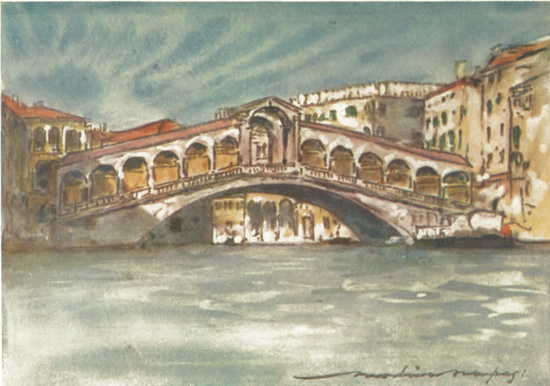
THE RIALTO
The gondolier in Venice is an important person
to the stranger. Half one's comfort depends on
his worthiness or unworthiness. He is like the girl
of childhood's fame "who, if she was good, was
very very good, but, if she was bad, was horrid."
If you are the employer of an ideal gondolier you
will find him thorough, ready-handed, and versatile.
In passing rapidly through Venice one does not
properly appreciate his worth. You must own him
for some months before you discover that he will
attach himself to you and identify himself with
your interests in an almost feudal manner. He
will save you an infinity of trouble, and repay your
confidence with honesty. The gondolier usually
prefers to have a foreigner for a master. The
foreigner pays well, never grumbling at the full
tariff of five lire a day: also, as the foreigner does
not know the language or the place, the gondolier
becomes of some importance in the eyes of his
neighbours, who bid for his patronage. With a
Venetian master he would be paid from three to
five lire a day; the work would be harder, and the
hours later.
When the squerariola (gondola builders) have
finished their work, the vessel will probably have
cost three hundred lire. Even then the craft is not
by any means complete. There are the steel
ornaments and many other details to be bought
and bargained for,—things not procurable at the
squero. For the steel prow (ferro), which must
have the edges of its teeth in one straight line, and
in these days of hurried workmanship is not always
to be found, one must seek in all the smithies in
Venice. A good gondolier, however, will often
possess a ferro, an heirloom, made of hand-wrought
iron, not cast in mould, heavy and brittle, as are
the new ferri, but light and pliant. A ferro of the
good and ancient make, if properly cared for and
not allowed to rust, will outlive many a gondola.
For the sea-horses, the rude carvings, the pictured
Madonnas, the rugs and the covering for the
felce,—all, in fact, that helps to make the gondola
the picturesque craft it is,—one must go to the
various shops in Venice.
Modern progress and modern ideas are rapidly
sweeping away the ancient and hereditary profession
of the gondolier. One feels that his life
and that of the traghetto are drawing to a close—that
soon they will be things of the past. What
would the Grand Canal be like without its swiftly
gliding gondola, black-hulled, black-roofed,—its
most characteristic feature? What a terrible thing
it will be when that exquisite art is forgotten,—when
the Venetian can no longer judge the turn of
a corner or balance himself on the poop,—when
for the picturesque cries "Stali!" and "Premi!"
will be substituted the clank and thud of the
steamers' screws! When a company first began
to run steamers from Venice to the railway station
and public gardens, the gondoliers struck. For
three whole days there were no gondolas running
in Venice; the canals were full of tightly packed
vessels, while their owners hung together in groups
at the wine-shops, talking. A strange and scratch
fleet of nondescript boats plied between Venice
and the islands, and the expression of the gondoliers,
as they leaned over the bridges and
watched the amateur watermen struggling with
their oars, was quite unique. On the second day
a notice was posted up in every traghetto begging
the men to return to their work, and not to bring
dishonour on a profession which had always been
such a source of pride to Venice. This had no
effect. The gondoliers merely enlisted the services
of a barrister, getting him to take a copy of their
demand to the Company—that the offending
steamers should be removed. That was impossible.
The steamers were cheap and useful, and the
gondoliers could not be allowed to dictate to the
State. However, they were told that if they returned
peaceably to their work something might
be done for them. They persisted in their strike,
until suddenly—no one ever knew why, or whence
it came—a single gondola started running from
one of the ferries. That broke the ice. The
gondoliers rushed to their crafts and untied them.
The strike was forgotten. The men's first thought
was to find good custom. I have always felt that
there was something touching in this hopeless
struggle of the gondoliers against the modernity
that is fast settling on and demoralising Venice.
PRINTED BY
NEILL AND COMPANY, LIMITED,
EDINBURGH.