Larger versions of most illustrations may be seen by right-clicking them
and selecting an option to view them separately, or by double-tapping and/or
stretching them.
“Venice herself is poetry, and creates a
poet out of the dullest clay.” It was a
poet who spoke, and his clay was instinct
with the breath of genius. But it is true that
Venice lends wings to duller clay; it has been her
fate to make poets of many who were not so before—a
responsibility that entails loss on her as well
as gain.
She has lived—she has loved and suffered and
created; and the echoes of her creation are with
us still; the pulse of the life which once she knew
continues to throb behind the loud and insistent
present. The story of Venice has been often
written; the Bride of the Adriatic, in her decay
as in her youthful and her mature beauty, has
been the beloved of many men. “Wo betide the
wretch,” cries Landor through the mouth of
Machiavelli, “who desecrates and humiliates her;
she may fall, but she shall rise again.” Venice
even then had passed her zenith; the path she
had entered, though blazing with a glory which
had not attended on her dawn of life, was yet a
path of decline, the resplendent, dazzling path of
the setting sun. And now a second Attilla, as
Napoleon vaunted himself, has descended upon
her. She has been desecrated, but she has never
been dethroned. She could not, if she would,
take the ring off her finger. No hand of man,
however potent, can destroy that once consummated
union, however the stranger and her traitor
sons may abase her from within.
It is to her own domain, embraced by her
mutable yet eternally faithful ocean-lover, that
we must still go to see the relics of her pomp.
The old sternness has passed from her face, that
compelling sovereignty which gave her rank
among the greatest potentates of the Middle
Age; her features, portrayed by these latter days,
are mellowed; a veil of golden haze softens the
bold outlines of that imperious countenance. We
are sometimes tempted to forget that the cup held
by the enchanter, Venice, was filled once with no
dream-inducing liquor, but with a strong potion
to fire the nerves of heroes. Viewing Venice in
her greater days, it is impossible to make that separation
between the artist and the man of action
so deadly to action and to art. The portraits of
the Venetian masters, supreme among the portraits
of the world, could only have been produced by
men who beyond the divine perception of form
and colour were endowed with a profound understanding
and divination of human character. The
pictures of Gentile Bellini, of Carpaccio, of Mansueti,
are a gallery of portraits of stern, strong,
capable, self-confident men; and Giovanni Bellini,
who turned from secular themes to concentrate
his energy on the portrayal of the Madonna and
Child, endowed her with a strength and solemn
pathos which only Giotto could rival, combined
with a luminous richness of colour in which
perhaps he has no rival at all.
No mystics have sprung from Venice. Her
sons have been artists of life, not dreamers, though
the sea, that great weaver of dreams, has been ever
around them. Or rather it is truer to say that the
dreamers of Venice have also been men of action;
strong, capable and intensely practical. They have
not turned their back on the practice of life; they
have loved it in all its forms. Even when they
speak through the medium of allegory, of symbols,
the art of Carpaccio and of Tintoretto is a supreme
record of the interests of the greatest Venetians in
the actions of everything living in this wonderful
world, and in particular—they are not ashamed
to own it—in their supremely wonderful city of
Venice. There are dreamers among those crowds
of Carpaccio, of Gentile Bellini; but their hands
can grasp the weapons and the tools of earth; their
heads and hearts can wrestle with the problems
and passions of earth. Compare them with the
dreamers of Perugino’s school: you feel at once
that a gulf lies between them; the fabric of their
dream is of another substance. The great Venetians
are giants; like the sea’s, their embrace is
vast and powerful, endowed also with the gentleness
of strength. The history of Venetian greatness
in art, in politics, in theology, is the history
of men who have accepted life and strenuously
devoted themselves to mastering its laws. They
were not iconoclasts, because they were not idolaters:
the faculties of temperance and restraint are
apparent in their very enthusiasms. Venice did
not fall because she loved life too well, but because
she had lost the secret of living. Pride became to
her more beautiful than truth, and finally more
worshipful than beauty.
Much has, with truth, been said about the
destruction of Venice. Even in those who have
not known her as she was, who in presence of her
wealth remaining are unconscious of the greatness
of her loss, there constantly stirs indignant sorrow
at the childish wantonness of her inhabitants, which
loves to destroy and asks only a newer and brighter
plaything. But much persists that is indestructible;
and though Venice has become a spectacle for
strangers, for those who are her lovers the old
spirit lingers still near the form it once so gloriously
inhabited, wakened into being, perchance,
by a motion, an echo, a light upon the waters, and
once wakened never again lost or out of mind.
Does not the silent swiftness of the Ten still haunt
the sandolo of the water police, as it steals in the
darkness with unlighted lamp under the shadow of
larger craft moored beside the fondamenta, visible
only when it crosses the path of a light from house
or garden? It is in her water that Venice eternally
lives; it is thus that we think always of her image—elusive,
unfathomable, though plumbed so often
by no novice hand. It is the wonder of Venice
within her waters which justifies the renewal of
the old attempt to reconstruct certain aspects of a
career which has been a challenge to the world, a
mystery on which it has never grown weary of
speculating. And as the light falling from a new
angle on familiar features may reveal some grace
hidden heretofore in shadow or unobserved, so, perchance,
the vision of Venice may be renewed or
kindled through the medium of a new personality.
Venice is inexhaustible, and it is from her waters
that her mine of wealth is drawn. They give
her wings; without them she would be fettered
like other cities of the land. But Venice with her
waters is never dead. The sun may fall with cruel
blankness on calle, piazza and fondamenta, but
nothing can kill the water; it is always mobile,
always alive. Imagine the thoroughfare of an inland
city on such a day as is portrayed in Manet’s
Grand Canal de Venise; heart and eye would curse
the sunshine. But in the luminous truth of Manet’s
picture, as in Venice herself, the heat quivers and
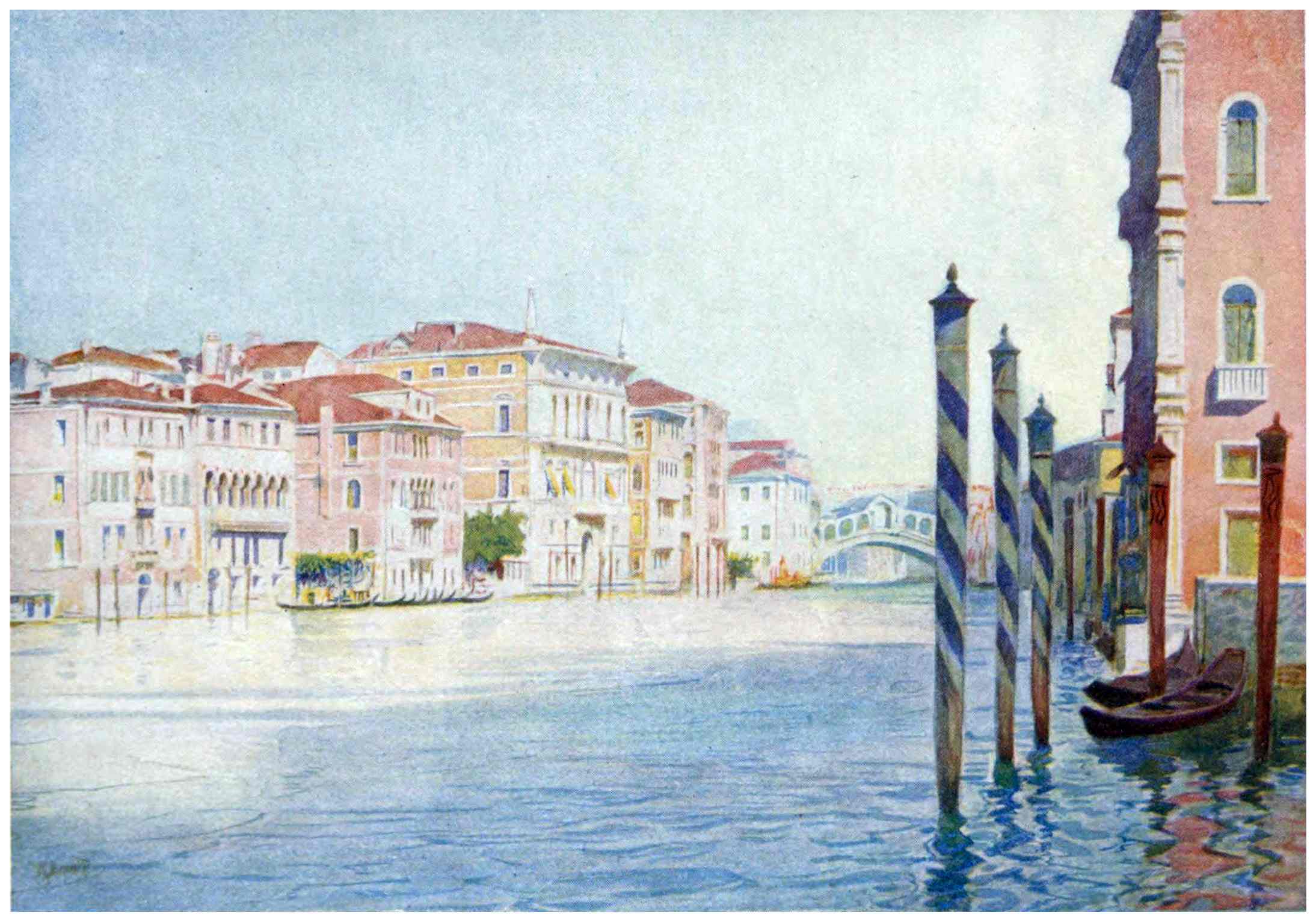
lives. Above ground, blue sky beating down on
blue canal, on the sleepy midday motion of the
gondolas, on the brilliant blue of the striped gondola
posts, which appear to stagger into the water;
and under the surface, the secret of Venice, the
region where reflections lurk, where the long
wavering lines are carried on in the deep, cool,
liquid life below. When Venice is weary, what
should she do but dive into the water as all her
children do? If we look down, when we can
look up no longer, still she is there; a city more
shadowy but not less real, her elements all dissolved
that at our pleasure we may build them again;
And so not build at all,
And therefore build for ever.
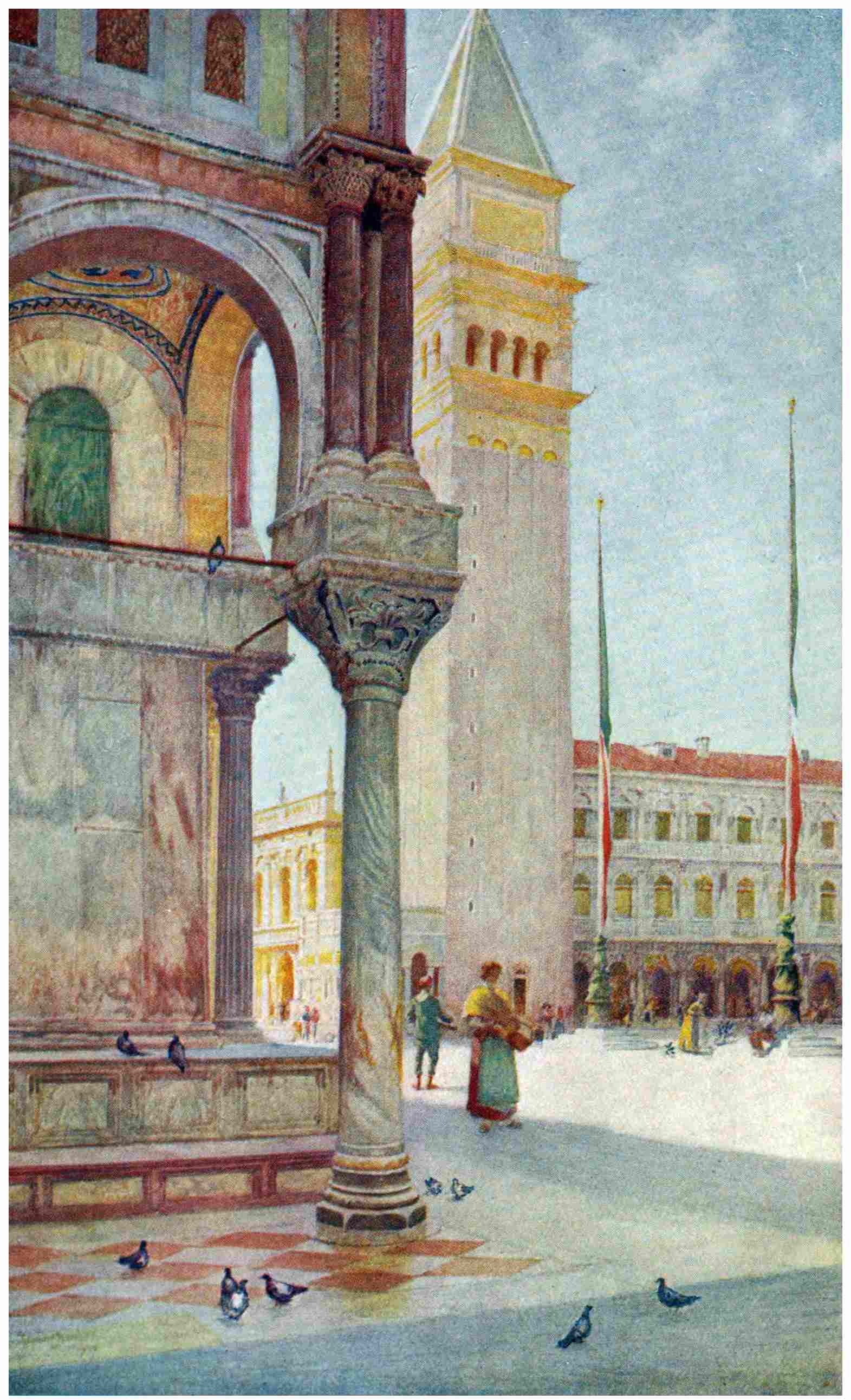
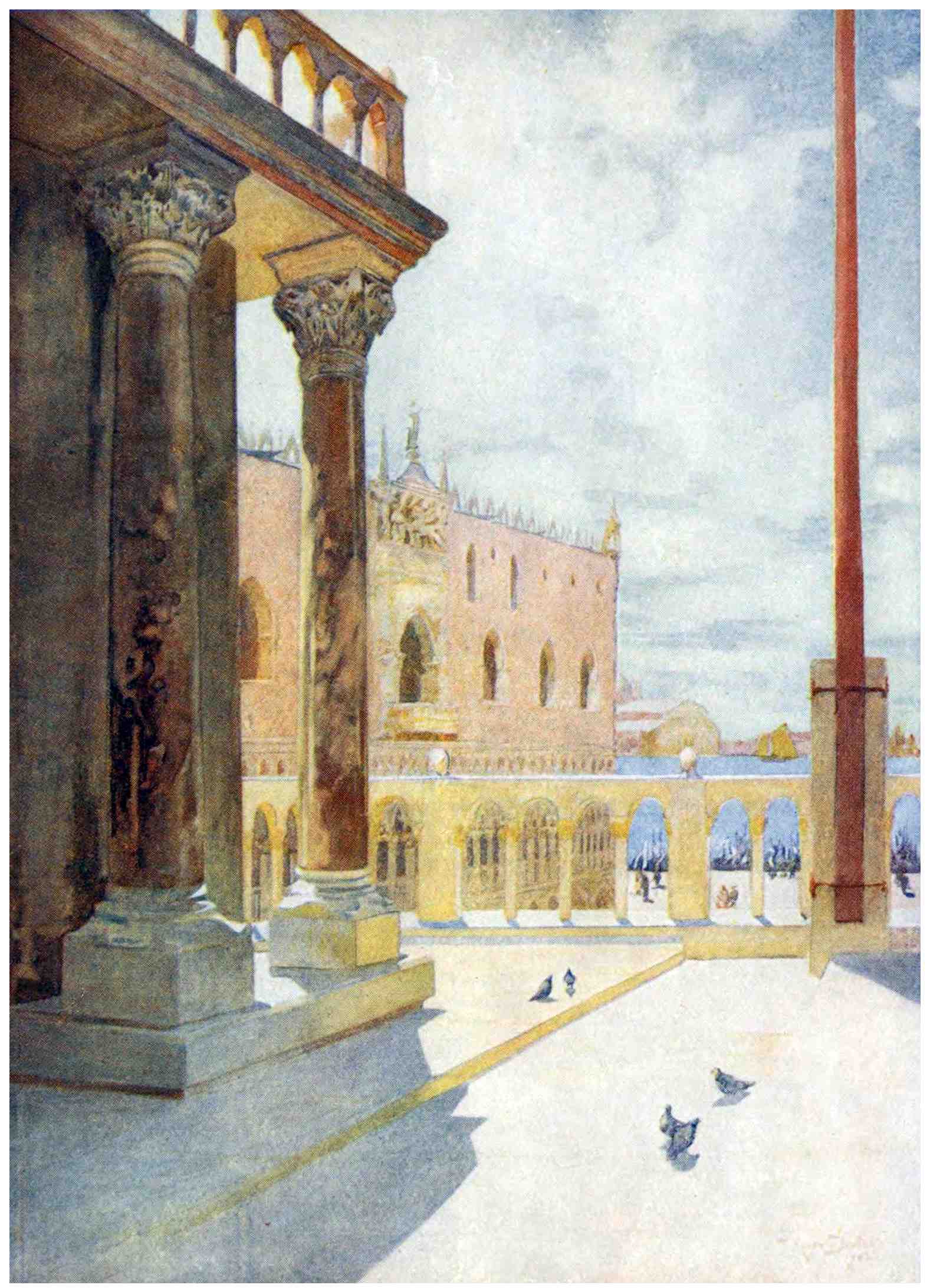
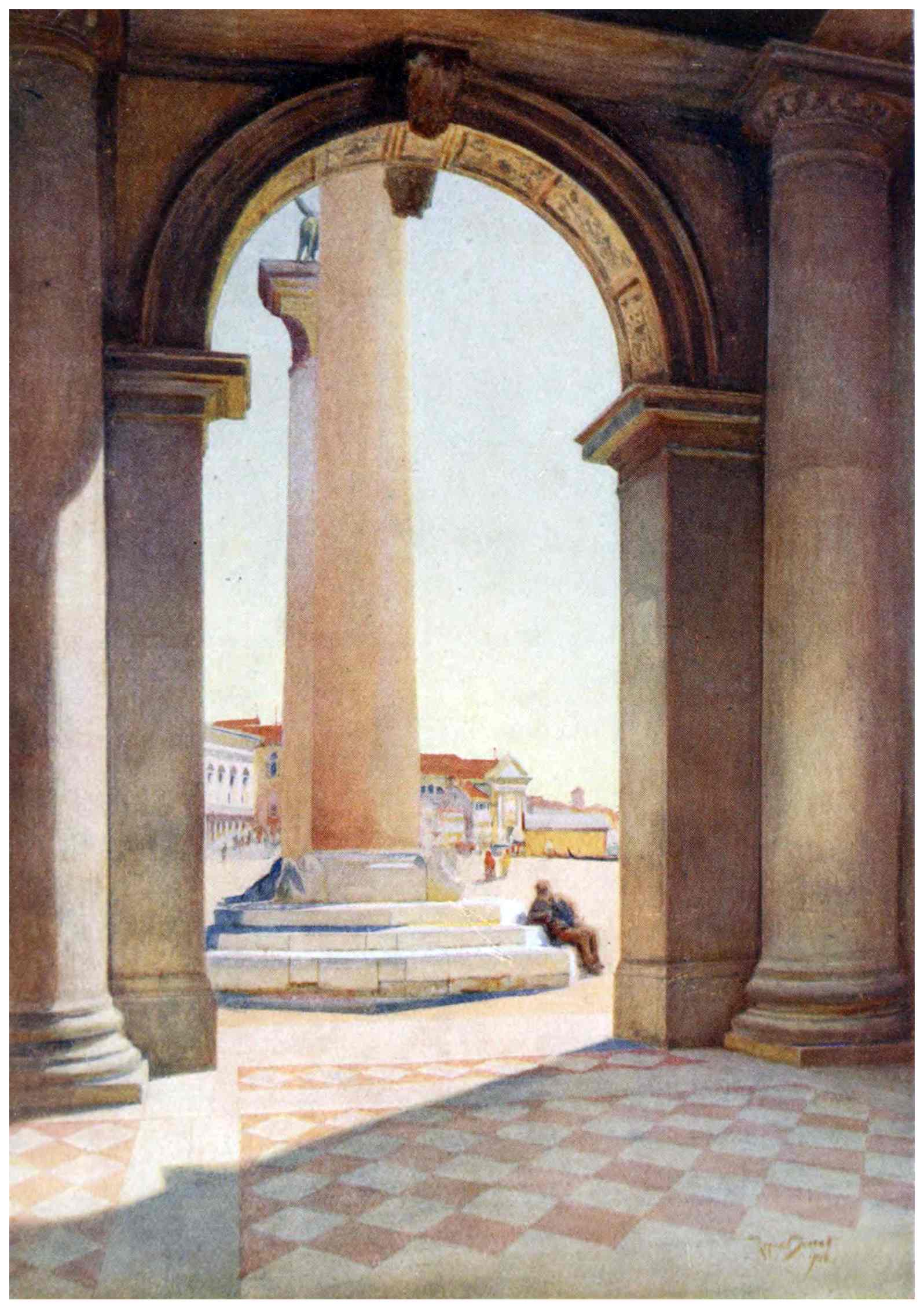
VIEW FROM THE GALLERY OF SAN MARCO.
And if in the middle day we realise this priceless
dowry of Venice, it is in the twilight of
morning or evening that her treasury is unlocked
and she invites us to enter. Turner’s Approach
to Venice is a vision, a dream, but not more divinely
lovely than the reality of Venice in these
hours, even as she appears to duller eyes. Pass
down the Grand Canal in the twilight of an August
evening, the full moon already high and pouring
a lustre from her pale green halo on the broad
sweeping path of the Canal. The noble curves
of the houses to west and south shut out the light;
day is past, the reign of night has begun. Then
cross to the Zattere: you pass into another day. A
full tide flows from east to west, blue and swelling
like the sea, dyed in the west a shining orange
Where the Euganean hills rise in clear soft outline
against the afterglow, while to the east the moon
has laid her silver bridle upon the dim waters.
Cross to the Giudecca and pass along the narrow,
crowded quay into the old palace, which in that
deserted corner shows one dim lamp to the canal.
The great hall opens at the further end on a bowery
garden where a fountain drips in the darkness
and the cicalas begin their piping. Mount the
winding stair, past the kitchen and the great key-shaped
reception room, and look out over the city—across
the whole sweep of the magnificent Giudecca
Canal and the basin of San Marco. The
orange glow is fading and the Euganean hills are
dying into the night, while near at hand one great
golden star is setting behind the Church of the
Redentore, and the moon shines with full brilliance
upon the swaying waters, upon the Ducal Palace
and the churches of the Zattere, with the Salute
as their chief. The night of Venice has begun;
she has put on her jewels and is blazing with light.
At the back of the house, where the lagoons lie
in the shimmering moonlight, is a silent waste of
waters under the stars, broken only by the lights
of the islands. This also is Venice, this mystery
of moonlit water no less than the radiance of the
city. And it is possible to come still nearer to the
lagoon. Passing along a dark rio little changed
from the past, we may cross a bridge into one of
the wonderful gardens for which the Giudecca is
famous. The families of the Silvi, Barbolini and
Istoili, banished in the ninth century for stirring
up tumult in the Republic, when at last they were
recalled by intercession of Emperor Ludovico, inhabited
this island of Spinalunga or Giudecca and
laid out gardens there. This one seems made for
the night. The moonlight streams through the
vine pergolas which cross it in every direction,
lights the broad leaves of the banana tree and the
dome of the Salute behind the dark cypress-spire,
and stars the grass with shining petals. The night
is full of the scent of haystacks built along the
edge of the lagoon, beside the green terrace which
runs the length of the water-wall. Then, as darkness
deepens, we leave to the cicalas their moonlit
paradise, and glide once more into the Grand
Canal. It is at this hour, more than at any other,
that, sweeping round the curves of that marvellous
waterway, it possesses us as an idea, a presence that
is not to be put by, so compelling, so vitally creative,
is its beauty. Truly Venice is poetry, and
would create a poet out of the dullest clay.
Every one will remember that a few years ago
an enterprising man of business attempted with sublime
self-confidence to transfer Venice to London,
to enclose her within the walls of a great exhibition.
Many of us delighted in the miniature
market of Rialto, in gliding through the narrow
waterways, in the cry of the gondoliers, and the
sound of violin and song across the water. But
one gift in the portion of Venice was forgotten, a
gift which she shares indeed with other cities, but
which she alone can put out to interest and increase
a thousandfold. The sky is the roof of all
the world, but Venice alone is paved with sky; and
the streets of Venice with no sky above them are
like the wings of the butterfly without the sun.
Tintoret and Turner saw Venice as the offspring
of sky and water: that is the spirit in which they
have portrayed her; that is the essence of her life.
It has penetrated everything she has created of
enduring beauty. Go into San Marco and look
down at what your feet are treading. Venice,
whose streets are paved with sky, must in her
church also have sky beneath her feet. It is impossible
to imagine a more wonderful pavement
than the undulating marbles of San Marco; its
rich and varied colours bound together with the
rarest inspiration; orient gems captured and imprisoned
and constantly lit with new and vivid
beauty from the domes above. The floor of San
Marco is one of the glories of Venice—of the
world; and it is surely peculiarly expressive of
the inspiration which worked in Venice in the days
of her creative life. San Marco, indeed, in its
superb and dazzling harmonies of colour, is almost
the only living representative of the Venice of
pomegranate and gold which created the Cà d’Oro,
of the City of Carpaccio and Gentile Bellini, whose
cornice-mouldings were interwoven with glittering
golden thread, while every side canal gave
back a glow of colour from richly-tinted walls.
The banners of the Lion in the Piazza no longer
wave in solemn splendour of crimson and gold
above a pavement of pale luminous red; in their
place the tricolour of Italy flaunts over colourless
uniformity. The gold is fading from the Palace
of the Doges, and only in a few rare nooks, such
as the Scuola of the Shoemakers in the Campo San
Tomà, do we find the original colours of an old
relief linger in delicate gradation over window or
door.
Day after day some intimate treasure is torn
from the heart of Venice. Since Ruskin wrote,
one leaf after another has been cut from the
Missal which “once lay open upon the waves,
miraculous, like St. Cuthbert’s book, a golden
legend on countless leaves.” Those leaves are
numbered now. Year by year some familiar
object disappears from bridge or doorway, to be
labelled and hoarded in a distant museum among
aliens and exiles like itself. And here, in Venice
itself, a sentiment of distress, the fastidio of the
Italians, comes over us as we ponder upon the
sculptured relics in the cortile of the Museo Civico.
What meaning have they here? It is atmosphere
that they need—the natural surroundings that
would explain and vivify their forms. Many also
of the Venetian churches are despoiled, and their
paintings hung side by side with alien subjects in
a light they were never intended to bear. The
Austrian had less power to hurt Venice than she
herself possesses. In those of her sons who understand
her malady there flows an undercurrent of
deep sadness, as if day by day they watched the
ebbing of a life in which all their hope and all
their love had root. They cannot sever themselves
from Venice: they cannot save her. Venice pretending
to share in the vulgar life of to-day,
Venice recklessly discarding one glory after another
for the poor exchange of coin, still has a power
over us not wielded by the inland cities of Italy,
happier in the untroubled beauty of their decay.
For, as you are turning with sorrow from some
fresh sign of pitiless destruction, of a sudden she
will flash upon you a new facet of her magic stone,
will draw you spell-bound to her waters and weave
once more that diaphanous web of radiant mystery:
Za per dirtelo,—o Catina,
La campagna me consola;
Ma Venezia è la sola
Che me possa contentar.
Each of us, face to face with Venice, has a new
question to ask of her, and, as he alone framed the
question, the answer will be given to him alone.
Every stone has not yielded up its secret: in some
there may still be a mark yet unperceived beneath
the dust. Here and there in her manuscript there
may lurk between the lines a word for the skilled
or the fortunate. Venice is not yet dumb: every
day and every night the sun and moon and star
make music in her that has not yet been heard:
with patience and love we may redeem here and
there a chord of those divine musicians, or at least
a tone which shall make her harmony more full.
O Venezia benedetta,
No te vogio più lassar.
Chapter Two PHANTOMS OF THE LAGOONS
We have called them the phantoms of the
lagoons, those islands that lie like
shadows among the silver waters; for
it is in this likeness that they appear to us of
the city—strangely mirrored, remote, a group
of clustering spirits, whose common halo is the
sea. They are a choir of spirits, yet each has a
mute music of its own, and accosting them one by
one—slowly and in the silence entering into their
life—we may come to know and love the several
members of this company of the blest, till our
senses grow alive to their harmony as they sing
together, sometimes in the clear, cold light of the
spreading dawn, sometimes in the evening twilight—when
peak after peak is lit with the flame of
sacrifice and, in the Titanic memory of the sunset
cloud, the great fire lit on earth burns up with
solemn flames into the sky.
All the languors, the fierce passions, of Venice,
her vitality and her mysticism, are mirrored in the
lagoons; there is no pulse of Venice that does not
beat in them; in swift sequence, as in a lighter
element, they reflect the phases of her being.
And the islands of the lagoons are, as it were, the
footsteps of young Venice. As she was passing
into her kingdom, she set her feet here and there
among the waters, and where she trod a life was
born. Her roots are far back in the past, far up
upon the mainland, where still remain some fragments
of the giant growth, which, grafted in the
lagoons, was to expand there into a new fulness
of beauty and life. It is as if the genius that
conceived Jesolo, Torcello, the Madonna of San
Donato, had undergone a sea-change as it moved
towards the Adriatic, as if some vision had passed
before it and shaken it, as if the immutable had
felt the first touch of mutability—had been
endowed with a new sense born of the ebb and
flow of ocean tides. In Malamocco she stepped
too near the sea, and left behind the mystery of a
city submerged; but no one can receive into his
mind the peerless blue and green of the open
water beyond the Lido, with the foam upon it, or
the sound of its incessant sweep against the shore,
without feeling that the spirit that had thus
embraced the sea had received a new pulse into
her being—a nerve of desire, of expansion, of
motion, which her mountain infinitudes had not
inspired. And with the new life came new
dreams to Venice, dreams she was not slow to
realise, and into them were woven materials for
which we should seek in vain among the islands,
except in so far as the reflex of her later activities
fell also upon them. The Madonna of San Donato
is the goddess of the lagoons; and if there are
children of Venice who creep also for blessing and
for protection to the borders of her dusky garment,
they are but few. The mystic beauty of that
Madonna was not the beauty that inspired Venice
when she built upon the seas. The robe of her
divinity was more akin to the dazzling incomparable
blue of the bay that lies within the curve of
the Schiavoni, as we may see it from the Palazzo
Ducale on a morning of sunshine and east wind;
that indomitable intensity of colour, unveiled,
resplendent, filled to the brim with the whole
radiance and strength and glory of the day—that
is the girdle of Venice, the cup she drank of in
her strength. But it is clear that she had bowed
to a new dominion: with the ocean she wedded
the world.
The lagoons are full of mysteries of light; they
are a veritable treasure ground of illusion. They
are not one expanse of water over which the light
broods with equable influence; they form a region
of various circles, as it were, of various degrees of
remoteness or tangibility. Almost one feels that
each circle must be inhabited by a spirit appropriate
to itself, and that a common language could
not be between them, so sharp are the limits set
by the play of light. On an early autumn morning
when the sky is clear and the sun streams full
and level upon the clear blue expanse that separates
Venice and Mestre, we seem to have a firm
foothold on this dancing water. It is a substantial
glory; but as our eye flits on from jewel to jewel
in the clear blue paving, a sudden line is drawn
beyond which it may not pass. The rich flood of
vital colour has its bound, and beyond it lies a
region bathed in light so intense that even colour
is refined into a mystic whiteness—a mirror of
crystal, devoid of substance, infinitely remote; and
above it, suspended in that lucent unearthly atmosphere,
hover the towers of Torcello and Burano,
like a mirage of the desert, midway between the
water and the sky. They hang there in completest
isolation, yet with a precise definition, a startling
clearness of contour. There is no vestige of other
buildings or of the earth on which they stand, only
the dome and campanile of Murano, the leaning
spire of Burano and Mazzorbo’s lightning-blasted
tower, their reflections distinctly mirrored in a luminous
medium, half mist, half water. There is
an immense awe in the vision of these phantoms,
caught up into a region where the happy radiant
colour dares not play; and yet not veiled—clearer in
what they choose to reveal than the near city strong
and splendid in the unreserve of the young day,
but so unearthly, so magical, that our morning
spirits scarcely dare accost them. What boat
shall navigate that shining nothingness that divides
them from our brave and brilliant water?
Venice, indeed, at times falls under the phantom
spell. In those mornings of late autumn when the
duel between the sun and the scirocco seems as if
it could not end till day is done and night calls
up her reinforcements of mist, Venice is herself the
ghost, her goblet brimming with a liquor that
seems the drink of death, a perilous, grey, steely
vapour. One only of her islands looms out of the
enfolding, foggy blanket: it is San Michele, the
island of the dead. On such a morning we may
visit this abode of shadows, not at this hour more
strange, more ghostly, than the city. To-day a
veil is hung upon the hard, bare outline of its boundary
wall, which in sunny weather is a glaring eye-sore
as you travel towards Murano over the lagoon.
Here, in the cloisters where once Fra Mauro
dreamed and studied his famous Mappamondo,
there is nothing to terrify the spirit on this morning
of the mist. The black and tinsel drapings,
the strange, unprofitable records of devotion and
bereavement, the panoply of death—all these are
veiled, and only the wild grasses glisten with their
dewdrops on the graves of the very poor, or autumn
leaves and flowers gleam from less humble graves,
while the cypresses raise their solemn spires into
the faintly dawning blue. But the cemetery island
of San Michele together with the islands of the
Giudecca and San Giorgio Maggiore, of San Pietro
di Castello and Sant’ Elena, with many lesser
islands close to Venice, have become absorbed for
us in the life of the city itself. Their bells and
hers sound together; we see them as one with her,
and from them look out to the wider lagoon,
where the remoter islands, the true phantoms,
wander. Many of those near to Venice have had
their vicissitudes, their sometime glorious past, their
pomp and solemn festival. But, bit by bit, it has
been stolen from them, and the treasures which
once they stored have been destroyed or gathered
into the city. Now they serve only as shelters for
those whose life is done—as places of repose for
the dead or for the sick in mind and body. One
only has passed from humble service into a fuller
and happier present. San Lazzaro, once the shelter
of lepers from the East, has become under the Armenian
Benedictines a haunt of active, cultured life.
It has a living industry, printing the ancient trade
of Venice, and is in daily commerce with the East.
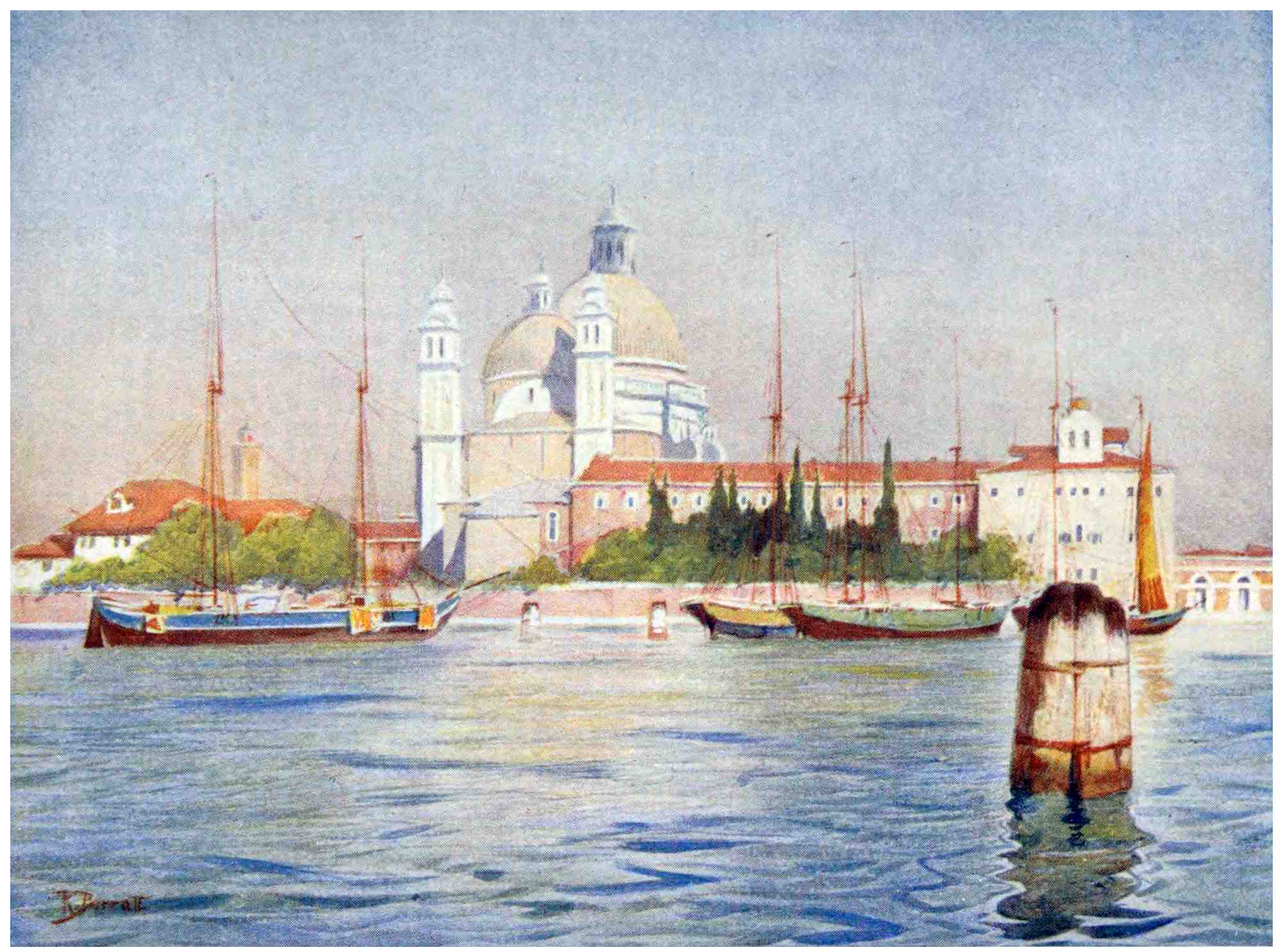
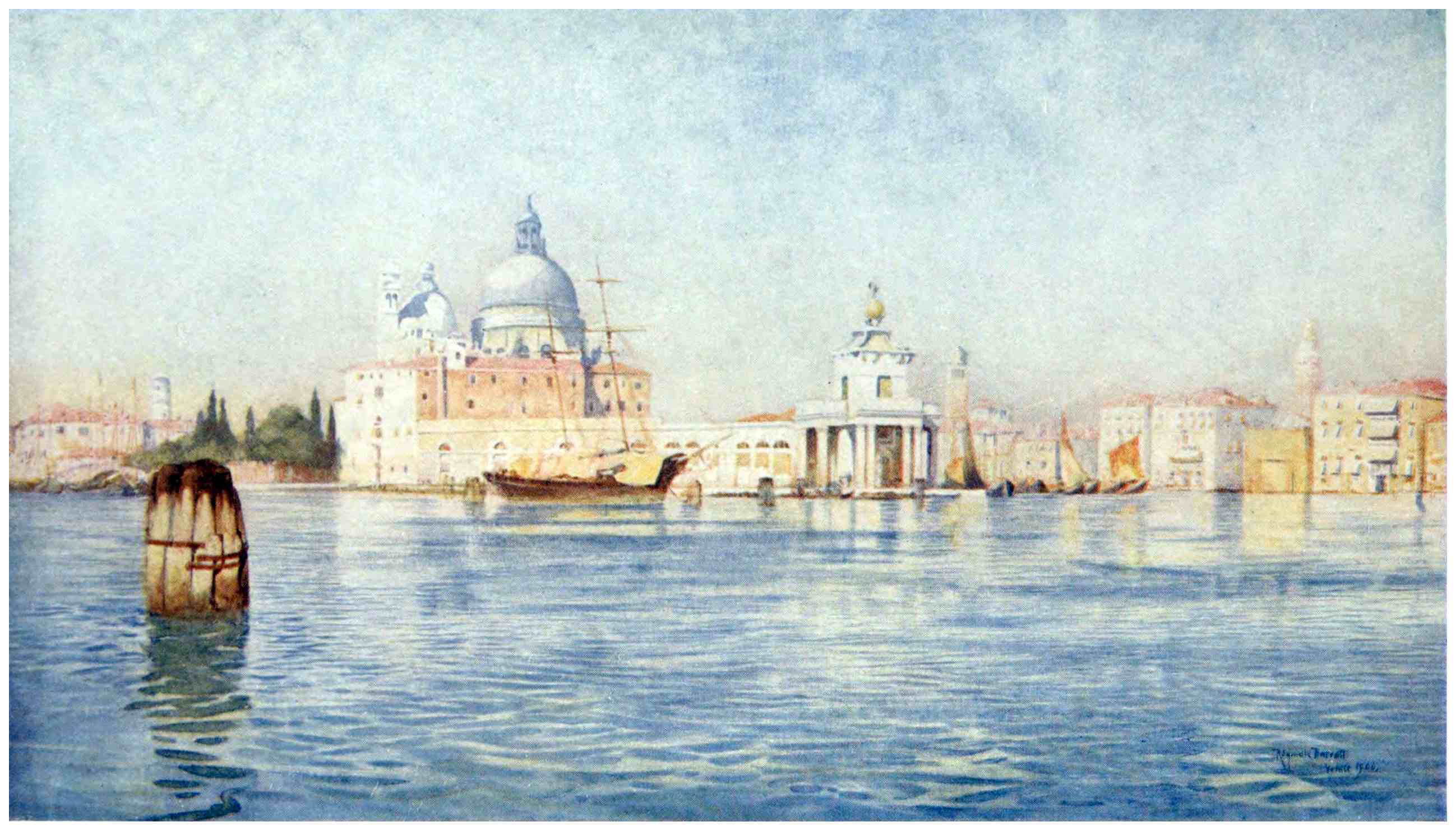
SANTA MARIA DELLA SALUTE.
Torcello is a città morta, but scarcely a cemetery
or a ruin. Relics of a past older than even Torcello
has known are gathered into the humble urn
of her museum; beside it stands abandoned, but
not in ruins, the group of the cathedral buildings
and the vast secular campanile; beyond this there
is nothing but the soil—the golden gardens of
vine and pomegranate, the fields of maize and artichokes
between their narrow canals. The intervening
period has entirely vanished; it is like a
dream. The page of populous palatial Torcello
has been blotted out as if it had had no existence.
No vestige remains of the churches which in
the old maps flourished along the chief canal, of
the names which in the documents have no unsubstantial
sound. None now can remember the time
when the spoiler was busy among the ruined palaces;
he too has passed into the shadows, and the
very stones of Torcello are scattered far and wide.
There is something mysterious in this complete
wiping out of a page of history, so that not time
only, but even the mourners of time have disappeared.
There is something unique in the isolation
of the cathedral and the campanile, rising thus
out of the far past—this mighty masonry alone
among the herbs of the field. Of her great history
Torcello brings only the first page and the
last, the duomo, the peasants’ houses and the thatch
shelters of their boats. Wandering along the
grassy paths beside the vineyards, the pomegranates,
the golden thorn bushes of Torcello, we seem
in a sleepy pastoral land where the sun always
shines. Torcello seems ripe, rich ground for a
new life rather than the cemetery of an old; and
we may feed the fancy as we will, for she does not
refuse her doom; she has no hard contrasts of the
old and new.
The few natives whom foreign gold supports
upon this island of malaria, have their chief haunts
in the cathedral campo, keeping guard over the
treasures of the past. For here upon the campo
stands the urn where Torcello keeps the ashes
of her ancestors—strange relics of old Altinum,
pathetic household gods, forks and spoons and
safety-pins, keys and necklaces, lamps and broken
plates and vases, chains and girdles and mighty
bracelets, some of delicate and some of coarser
make, with more ambitious works of mosaic and
relief, Greek and Roman and Oriental. There is
little in all; yet as we stand here in the museum,
looking out through the sunny window on the
hazy autumn gold of earth and the shimmering
water beyond, this little speaks eloquently to the
mind. Even to Torcello, the aged, these things
are ancestral; their life was in the old Altinum
when Torcello lay still undreamed-of in the womb
of time. Climb the campanile, and you will
wonder no more at the passing of the city at its
feet; it is so mighty, so self-contained and now
so voiceless with any tongue that earth can hear
and understand; almost it seems as if that
iron clapper, lying mute below the bell, were
symbol of Torcello’s farewell to the busy populous
world that needs the call to prayer. The great
tower is given up to mighty musings, and we upon
its summit speculate no more on the forgotten
Middle Age; we are content in the golden earth
beneath our feet, in the soft dreamy azure of the
encircling lagoon, where in the low tide the deep
tracks wind and writhe like glistening water-snakes,
or lie, like the faint transparent veining of
a leaf, upon that smooth expanse of interchanging
marsh and water, the uncertain dominion over
which Torcello towers. For the campanile, in its
vast simplicity of structure, its loneliness, its duration,
is of kin with those great sentinels of the
desert in which the Egyptians embodied their
giant dreams of power. It is here that the soul
of Torcello still abides, to dream out upon the
mystery of day and night to the mountains and
the city and the sea. And even if the sunlight
is rich and jubilant in the yellow fields below,
where the autumn has such fitting habitation,
it spreads upon the waters a broad path of silver
that gleams mysteriously like moonlight upon
the distant spaces of the ocean shield, waking
points of light out of the immense surrounding
dimness. And it is most of all in the deep
night that the gulf of the centuries may be
bridged. The monotonous piping of the cicalas
rises even to this height in the darkness, but no
other sound is heard. It is a strangely moving,
melancholy landscape, half hidden, half revealed,
still holding in its patient, silent heart the tragic
sorrows, the hopes and shattered longings, the
courageous struggle of the past ages, the fierce
cry of desolation, the flames of cities doomed to
destruction in the darkness of night, and their
ruins outspread beneath the unsparing sun. It has
lain now so long deserted, a presence from which
the stream of life has flowed away, carrying with
it all the agitations of joy and sorrow, that among
the fluctuating marshes the key for its deciphering
has been lost.
As we have said, whole pages are torn from
the history of Torcello. Fragments only remain.
But here and there is a word or two that may
be gathered into a sentence. If we approach the
island from the east, by the waterway between
Sant’ Erasmo and Tre Porti instead of by the
narrow channels of the inner lagoon, we may
receive some impression of the relation it once
bore to the mainland. We may see how Torcello
stands as the entrance of the lagoon north of
Venice, the last outpost of the mainland, the first-fruits
of a new career—recognise that she was
once through the Portus Torcellus in closest touch
with the high seas. In the ninth century it was
one Rustico of Torcello who combined with
Buono of Malamocco to carry the bones of St.
Mark from Alexandria to Venice. In 1268
Torcello is specially mentioned by da Canale
among the “Contrees, que armerent lor navie,
et vindrent a lor signor Mesire Laurens Teuple
(Lorenzo Tiepolo) li haut Dus de Venise, et a
Madame la Duchoise” on the occasion of Tiepolo’s
election. Torcello contributed three galleys
completely equipped for the Genoese war, and in
1463 sent one hundred crossbowmen in the service
of the Republic against Trieste.
What is left of this city, which shared the early
glory if not the later pomp of Venice? Where
are her palaces, her gardens, her bridges, her
waterways? Where are her piazzas and calles
and fondamentas, her churches and rich convents?
We pass their names in the old chronicles: Piazza
del Duomo, Rio Campo di San Giovanni, Fondamenta
dei Borgognoni, Calle Santa Margherita,
Fondamenta Bobizo, Ponte di Chà Delfino, Ponte
de Pino, and the rest. Many of these were of
very old foundation: their stones and traces of
their construction have been discovered from time
to time under the mud of the canals. In the
poor houses of the peasants traces still remain of
original windows, cornices and pillars; the main
canal is still spanned by the beautiful ruined bridge
of the Diavolo. But for the rest the grass piazza
with its little group of buildings, its museum
flanked by the cathedral, is the sole echo, itself no
more than an echo of the past.
When Altinum and her neighbouring cities
roused themselves from the crushing desolation of
conquest which had driven them forth to the
remote borders of the mainland, they began to
desire to live anew in the lagoons. There is
no reason to question Dandolo’s statement that
Torcello and the group of surrounding islands,
Burano, Mazzorbo, Constanziana, Amoriana and
Ammiana, were named from the gates of Altinum—a
pathetic attempt to perpetuate the ruined
city. Nuovo Altino was indeed the name for
Torcello, and when the terror of invasion had
momentarily passed, the fugitives ventured back
to the mainland, and brought down to the soft-soiled
island the stones of their ancient city.
Torcello was built from the stones of Altinum;
her very stones were veterans, the stamp of old
times was upon them, the stamp of thoughts that
were often sealed for those men of a later day who
built them anew into their temples. The steps up
to the pulpit in the duomo are perhaps the most
striking instance of this ingrafting of the old upon
the new, the naïve earnestness, perhaps the urgent
haste and need of builders who did not fear to set
an old pagan relief to do service in this temple
of their Christian God. There are various theories
as to the meaning of the wonderful relief
which forms the base of the pulpit stair, cut like
its companion slabs to meet the requirements of
the stair without regard to its individual existence.
We cannot help pausing before it; for it is unique
among the monuments of the estuary, so unique
that it seems incredible it should have been the
work of those late Greek artists who executed the
wonderful beasts and birds of the sanctuary screen.
On the right is a woman’s figure, of Egyptian
rather than Greek or Roman mould, standing
with averted face and head resting on her arms, in
melancholy thought. Beside her a man, like her
resigned and meditative in attitude, but not yet
with the resignation of despair, raises his left arm
as if to ward off a blow. The blow is dealt left-handed
by one who in his right hand holds a pair
of scales and advances swiftly on winged wheels.
He, again, is met in his advance by a fourth figure
whom we only see in part, his right side having
been almost completely cut away. He is fronting
us, however—his feet planted firmly on the
ground, his right hand folded on his breast, while
with his left he grasps the forelock of the impetuous
figure of the winged wheels and balances.
Thanks to the happy discovery by Professor Cattaneo
of part of the fragment missing to the
design, we know that a woman’s figure stood
beyond him, holding in her left hand a palm and
in her right a crown which she raises to the stalwart
conqueror’s head. It is a simple but daring
and most spirited composition. It seems to belong
to a far remoter past than that of the earliest
building of Torcello. Professor Cattaneo explains
it as an allegory of the passage of Time, who on
his winged wheels has already passed one man by,
as he stands stroking his beard, while tears and
sorrow await him in the form of the woman on
his right in mourning guise and posture; the stalwart
man on the left is he who faces Time and
takes him by the forelock, and for him the crown
and palm of victory are in waiting. But Professor
Cattaneo seems to give a needlessly limited significance
to the idea of Time. It is to him the
Time which God offers to man that he may do
what is just and combat his own evil passions; this
seems to him to be expressed by the scales and the
stick he grasps in his hand. Perhaps it is enough
to think merely of the club as that with which a
more familiar Time is wont to deal back-handed
blows at those who are so idle or so sluggish as to
let him pass. At any rate the men of Torcello
could comprehend this language of the rough
stone. What matter if the oracles were dumb?
Which of them had not wept to see the face of
Time averted, which of them had not felt the
weight of his backward blow? And yet this
symbol of old Time must have been mute to them
before the great solemn Madonna in the dusky,
golden circle of the apse; she looks beyond all
fortunes and vicissitudes of man. How should
they dare to pray to her? Worship they may,
and rise with strength to contend with Time and
conquer him, with a weapon to face the mystery
of life; but they meet here no smile of comfort,
no companionable grace. To those men who
dreamed this figure, to us who look upon her and
worship, the dominion of Time is a forgotten
thing; we ask no pity for our human woes; they
have passed, they have crumbled: she gives us a
better gift than pity, insight into the hidden things
of life and of art; she wings with hope, if with
stern hope, our dream of beauty. The mosaics on
the west wall of the cathedral have the same stern
character, with less of beauty than the Madonna
of the apse: the great angels on either side the
weird central Christ in the upper division have a
strangely oriental effect. They might be Indian
gods. They hold the Christian symbols, but with
how abstracted, how remote a gaze they look out
from their aureoles! They are at one with the
noble simplicity and strength and greatness of the
spirit of the building they adorn. Somehow they
seem to us the oldest thing within it; we begin to
be drawn by them into mysteries older than the
caves of Greece whence the pillars of this duomo
came; we begin to share their watch over a vast
desert where all the faiths and imaginings of men
may move and mingle, and find a common altar
under the dome of the evening sky.
Greater than Torcello, and still maintaining, as
near neighbour to Venice, something of its old
activities, Murano lives, none the less, a phantom
life. We would choose, as a fitting atmosphere
for Murano, a day of delicate lights and pale,
lucent water, with faint fine tints within the water
and the sky: a day of the falling year, not expectant,
only acceptant, pausing in the dim quiet of
its decay. Even the hot sunshine, though it irradiates
the features of Murano, cannot penetrate
to that spent heart. The marvellous fascination
of its Grand Canal, with its swift and unaccustomed
current of blue waters, cannot draw us from
the sadness, or disperse the spectral melancholy
which invades the spirit and surrounds it as an atmosphere.
The sun infects the dirty children
with a desire to shine, and prompts somersaults for
a soldino; but the weary women, the old, crouching
men, still creep about the fondamenta impervious
to his rays. Murano is not less disinherited,
not less phantasmal, because the daylight comes to
pierce the semblance of her life. It is strangely
invasive and possessing, this sentiment of a life
outlived, a body whose soul is fled. The long
vine gardens that spread to the lagoon, dispossessed,
but still apparently doing service and rich
in vegetables and fruit, seem as if they would persuade
us of their reality; but their walls are
ruined, their ways are low and narrow; it was not
thus they looked when Bembo and Navagero
paced here in an earthly paradise, a haunt of
nymphs and demigods. The living population of
Murano seems to have fallen under the same spell.
If we bestow on them more than a cursory glance
as we pass along the fondamenta, we seem to
detect in their faces an indescribable sense of
weariness and sorrow and decay. There seem
many old among them, and on the young toil and
privation have already laid their hand. The
strange habitual chant of priest and women and
young girls, going up from tired nerveless throats
in the twilight of San Pietro Martire, seemed
a symbol of the voice of Murano, melancholy,
mechanical, the phantom of a voice—an echo
struck with the hand or by a breath of wind
from a fallen instrument, an instrument that has
lost its virtue and its ring, an instrument unstrung.
We have seen Murano in festa. She can pay her
tribute to free Italy. Ponte Lungo was hung
with lamps, and the desolate campi had their
share in the illumination. In the very piazza of
San Donato a hawker was winding elastic strings
of golden treacle, while women and children in
gay dresses hurried to and fro. In another square,
under the clock tower, a demagogue addressed the
crowd excitedly: there was plentiful noise, plentiful
determination to enjoy. The campanile
looked down and wondered. O Roma o morte.
Had it been Rome then and not death? Rome and
freedom, freedom to destroy the historic and the
old? It was a grand triumph, a triumph justly
commemorated, and yet the conquerors themselves
might grieve over the Italy of to-day. Mazzini, we
know, struck a note of melancholy out of that proud
exultation. Italy, if she lives, lives among ruins,
and for the most part she is careless of her decay.
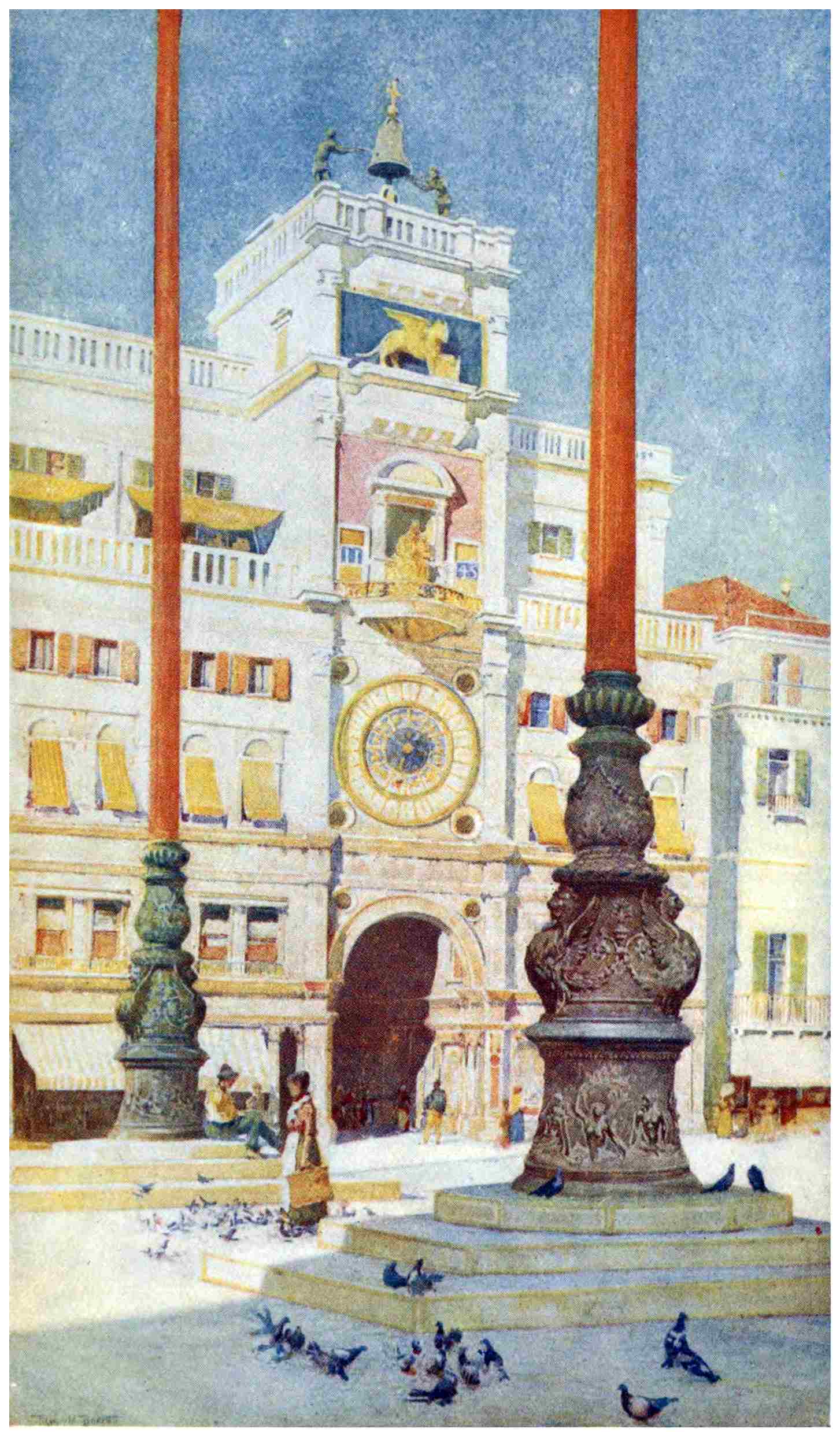
THE CLOCK TOWER.
Murano, like Torcello, is bound by one glorious
link with her Byzantine past, and this one
of the noblest monuments, not of the lagoons
only, but of all Italy; simple, stern, august. San
Donato has not, indeed, gone unscathed by time,
nor by modernity. The wonders of its pavement
are becoming blackened and obscured; holes are
being worn in it, missing cubes leave gaps in the
design. In winter it is constantly flooded by
high tide, and even in other seasons the damp is
ruining a pavement which rivals, if it does not
surpass, that of San Marco. It is impossible to
describe the beauty of the designs, the exquisite
harmonics of its precious marbles, porphyry and
verd-antique, Verona, serpentine and marmo greco,
with noble masses of colour among the smaller
fragments, and a most precious gem of chalcedony,
which, if we may believe the poor old sacristan,
whose complaints concerning his precious floor
wake no response, an English visitor would have
wished to steal. The sacristan can show to all
who will lament with him the ruin wrought by
sacrilegious man. But no profane hand has dared to
raise itself against the Madonna of the apse. This
Madonna of San Donato is even grander, more
august, than that other who in Torcello conquers
Time, and surely it is not without reason that we
have called her the goddess of the lagoons. In
perfect aloofness and secrecy she stands, but with
luminous revelation in her strangely significant
eyes; her white hands uplifted, her white face
shining out of the darkness, the long, straight
folds of her dark robe worked with gold, her feet
resting, it seems, upon a golden fire. The gaze
of this marvellous Madonna seems to comprehend
the world. She is a sphinx who holds the key of
every mystery. In her presence we are overcome
by the impulse to kneel and worship. She is not,
like many Byzantine Madonnas, grotesque, forbidding
in her immensity, in her aloofness; for
even while she rebukes and subdues our littleness
of soul, she draws all our senses as a being of absolute,
inexplicable beauty. She holds us rapt and
will not let us go. The memory of the Duomo
of San Donato is concentrated in the single magical
figure of her Madonna, leaning in benediction
from the golden apse.
Murano is full of corners where Gothic and Byzantine
have combined to beautify portico, pillar
and arch. In the Asilo dei Vecchii are two of the
most ancient fireplaces known in Venice, and at
Venice fireplaces were very early in use. One is a
deep square hollowed in the wall, and furnished
with doors that shut upon it like a panelling,
while two little windows, as usual, open out behind.
The other projects into the room, with
sloping roof and little seats within on either side.
Murano, it is well known, was the pleasure-ground
of the Venetians in happier days; it was here that
the men of the Great Republic had their gardens
elect for solace and for beauty. But with the Republic
Murano fell; the patrimonies of the patricians
were scattered—gradually their palaces were
snatched away, piece by piece, and fell into irrecoverable
ruin. One only now retains some image
of its former splendour, the famous Cà da Mula,
upon the fine sweep of the Grand Canal. The
Madonna of San Donato has looked down on the
spoliation of her temple; she still looks on its
slow decay. She has shared the proud sorrows of
the campanile; in colloquy through the night
what may he not have told of the passing of Murano?
They have little, these solemn guardians of
the past, in common with the exuberant Renaissance,
but perhaps a common fate, the unifying hand
of Time, may have bound their spirits in a confraternity
of grief. The heart of the old campanile
would be stirred with pity for the fate of those deserted
palaces, the sublime Madonna would turn an
eye not of scorn but of sorrow on the fading forms
of those radiant women, so splendid on the frescoed
palace fronts, so alluring in the smooth mirror of
the canal. The work of the spoiler, so far as it
was a work of violence, of a human spoiler, is
done; but the slower work of nature still proceeds.
Long before Murano became a Venetian pleasure-ground,
she had been famous for her painters, for
her ships, for her furnaces. Like Torcello, she
sent vessels to the triumph of the Doge Lorenzo
Tiepolo, and she was conspicuous among the
others, as da Canale says: “For you must know
that those of Murano had on their vessels living
cocks, so that they might be known and whence
they came.” Molmenti thinks that Carpaccio
himself belonged to a shipbuilding family of Murano,
and this is the more interesting in view of
the frequency and detail of shipping operations in
his pictures. Murano was indeed the birthplace of
Venetian art, and the riches of its furnaces glow in
the garments of those early painters, Vivarini, Andrea
and Quirico. From the end of the eleventh
century the glass works had begun to flourish; by
the thirteenth the industry was transferred wholly
to Murano. The legend runs that a certain Cristoforo
Briani, hearing from Marco Polo of the
monopoly of agates, chalcedony and other precious
stones on the coast of Guiana, set about imitating
them. With Domenico Miotto to help him he
succeeded, and the latter carried the art to still
greater perfection, which resulted at last in the
imitation of the pearl. In 1528 Andrea Vidoare
received a special mariegola or charter for the fame
of his wonderful pearls, polished and variegated by
him to a degree unknown before. In the middle
of the fifteenth century the first crystals came from
the furnaces, and the following century was the
golden period of the art—a period coinciding
with the greatest patrician glory of the island. Murano
still burns with its secular fire, winning from
the old world its secrets, the old, wise world that
worshipped fire, to fuse them once more in its crucible
for the wonder of the new; secrets of crystal,
pearl and ruby, and of the blue of the deepest ocean
depths or the impenetrable night sky, imprisoning
them in those transparent cenotaphs in forms of
infinite harmony and grace. And it is not only in
the revival of ancient memories and forgotten mysteries
that the furnaces of Murano play their part;
they contribute also to the present renewal of Venice:
for it is here that the units of the mosaicist’s
art are made. In Murano is laid the foundation-stone
of its success—the quality of the colour, the
depth and richness of the gold. The period of
decadence in the Venetian arts is accurately reflected
in its mosaics; with the decadence of conception
we note also the decadence of colour.
Those hard blatant tones that characterise the late
mosaics of San Marco are records, too permanent,
alas! of a time when the furnaces had lost their
cunning, or rather when the master minds were
blunted and the secret of the ancient colourists allowed
to lie unquestioned under the dust of time.
There is a humbler department of the glass
works which we must not pass by. It lies away
from the furnaces devoted to rare and subtle texture
and design, behind San Pietro Martire, among
the gardens: a manufactory of common glass for
daily use, tumblers and water-bottles and other
humble ware. Here there is the swift operation
of machinery, at least among the coarser glasses,
and a noise of the very inferno with countless
sweating fiends—little black-faced grinning boys,
grateful for a package full of grapes or juicy figs;
there is little mystery in the production of this
coarser glass, or rather few of the obvious accessories
of mystery, the delicate slow fashioning, the
infusion of colours. Instead, the constant noise of
machinery, deafening and exhausting in its incessant
motion, though even here the reign of
machinery is limited: the finer tumblers must go
a longer journey to be filed by a slower, more
gradual process, the direct handiwork of man.
There is an upper circle to which we gladly pass
from this inferno, almost a paradise if we contrast
it with the turmoil and heat below; to reach it we
pass by the troughs of grey sand which all day
men are trampling with the soles of their bare
feet, to mould into fit temper for the furnace.
The floor of the room above is covered and the
walls lined with strange creations of cold, grey
earth, fashioned by hand, roll after roll of clay,
ungainly forms to be inhabited by fire. This
upper attic, with its company of mute grey moulds,
opens out upon the vineyards of Murano, with
water shimmering through the long golden alleys,
and the city visible beyond. The gardens of the
Palazzo da Mula and of San Cipriano are beside
us. The bustle of the new world has invaded the
peaceful seclusion of a spot once sacred to the
student aristocracy of Venice.
For this island, famed for so glorious an industry,
was beloved and honoured by the noblest
of Venetian names, Trifone Gabriele and Pietro
Bembo and Andrea Navagero. Here Navagero
founded one of the first botanic gardens of Europe—“a
terrestrial paradise, a place of nymphs and
demigods”; here Gabriele wandered for hours
under the thick vine pergola walled with jessamine
against the sun. And it was not only as a temporary
pleasure-ground that they loved Murano:
they clung to it as their resting-place in death.
Bernardo Giustiniani desired to be buried by his
palace, at the foot of Ponte Lungo, and Andrea
Navagero in the church of San Martino in the
same quarter where his house was built. Murano
was honoured by at least one royal guest. It was
here that Henry III of France, on his passage
through Venice from Polonia, was given his first
lodging, and the palace which witnessed the first
transports of this rapturous monarch, the palace of
Bartolomeo Capello, still exists, close beside the
church of Santa Maria degli Angeli, at the extreme
western point of the city. It would thus form
the most convenient landing-place, besides commanding
a view of extreme beauty; to the left,
the fine torrent-like sweep of the chief canal, with
the noble Cà da Mula a little lower on the opposite
bank and its gardens immediately over the water;
Venice filling the horizon clear across the lagoon,
where the south curve of Murano ends to-day in a
meadow of rough grass and fragrant herbs; to the
right the Convent of the Angeli, leading on the
eye across the lagoon to the mainland and the distant
mountains beyond. Traces of fresco remain
on the outer walls of the palazzo, and the upper
hall still stretches through the whole breadth of
the house. It is on the balcony of this central
hall that Henry must have stood when he appeared
before dinner to gratify the crowds on the fondamenta
and in the boats below. The view of
Venice in the evening light is exquisitely lovely,
with the lagoon spread like a mirror to reflect the
delicate opaline of the sunset sky. In this hall
hung with cloth of gold and cremosine, and perhaps
with the colours of Veronese, looking over a
paradise of gardens and water to the immortal city,
Henry kept his court, received the legates from
the Pope and said a thousand graceful things about
His Holiness, rejoiced the natives by his noble
bearing, his perfumed gloves, his frank pleasure in
their tribute, his decision to go on foot to the
Angeli to morning Mass. Thus was he initiated
to the magical city and its enchantments by that
wise providence of the Venetians, who made their
islands always stepping-stones, outer courts of the
central shrine, where their pilgrim must pause
awhile to shake the dust of the mainland off his
feet, that the spell might permeate his being and
fill his senses with desire.
The fondamenta below Henry’s palace, leading to
the church of the Angeli, is one of the most desolate
in Murano; the wide green campo of the cemetery
which opens from it is deserted and bare, save
for a few fowls that humbly commemorate the proud
old shield. The dirt of the children is indescribable,
as they press close begging a soldino. But their
dirt is dearer to them. A bargain for a washed face,
even when the reward rings cheerily on the pavement,
brings no response but laughter and surprise.
We are reminded by contrast of the tribute of Andrea
Calmo, a popular poet of the sixteenth century:
E voio tanto bene a quel Muran,
Che, per diroelo certo in veritæ,
Son in pensier de vender le mie intræ.
E venir la per starmene pì san.
Quei horti a pieni de herbe uliose
E quel canal cusi chiaro e pulio
Con quelle belle casi si aierose,
Con tante creature che par riose
Liogo che l’ha stampao Domenedio.
(And I wish so well to that Murano, that to tell
you the sober truth I am thinking of selling my
takings and coming there to live more healthily.
The gardens there are so full of olive trees, and
the canal so clear and clean, the houses so beautiful
and so airy, with so many fair creatures that it
seems a place of joy stamped by the Lord God.)
Beside the Cà da Mula, hidden among some outbuildings,
from which it has in the last years been
partially released, is one of Murano’s finest treasures,
the convent front of San Cipriano, which in
the ninth century, when Malamocco was on the
point of submersion, was brought here by order
of Ordelafo Faliero. Andrea Dandolo dates the
building from 881; it was rebuilt in 1109 and
restored in 1605, and its exquisite façade, still
bearing the stamp of several ages, freed somewhat
from the earth about its base, stands up nobly
from the tangled garden around it. The central
arch is outlined with the finest Byzantine tracery
lined with Gothic, surrounded once with coloured
marbles of which only fragments now remain,
and above this is a frieze of the best Roman of
the Renaissance: slender columns, some Byzantine,
some Gothic, adorn it on either side, and fantastic
Byzantine symbols are sculptured in the stone discs
that are embedded in the walls between the arches
of the cloister. A campanula on the ruined wall
to the left of the arch stands out clear and pale
against the brick building behind, where once the
cloister opened out, an exquisite harmony of lavender
and rose. Fragmentary though it is, this
façade of the famous monastery is one of the most
precious relics of the islands of the lagoons.
There is an island where we cannot think of
death, where decay dare not come; though the
water plants smell faint upon its shores, and
the cypresses that clothe it rise black against the
sky. It is the island that sheltered one of the
most joyful spirits that has ever walked the world,
the island where the larks once sang in such
prolonged impulsive harmony of joy that the
sound of their singing has never passed away; it
may seem to lie silent as a veil upon the water,
but the tremor of the sunshine will waken it to
renewed harmonics of delight—San Francesco del
Deserto. We rejoice to think that the Poverello
set foot in the lagoons, that he left here in the
lonely waters the blossom of his love. St. Francis
of the Desert can wake no thoughts of melancholy,
and indeed this is no deserted place, nor in
the morning of his coming, after the night of
storm, can it have seemed a place of desolation;
for nothing is more wonderful, more prodigally
full of the mysterious rapture of life, than the
flowing in of day upon the lagoons after the
tumult of rain and hurricane. They say that St.
Francis, coming from the Holy Land on a Venetian
ship, was driven by the storm to cast anchor
near Torcello; that as he prayed, the storm subsided,
and a great calm fell on the lagoon. Then
as the Poverello set foot upon this cypress-covered
shore, the sun came out—the sun of the early
summer dawn—and shone through the dripping
branches of the cypresses, covering them with
glistening crystals, and shone on the damp feathered
creatures among the branches and on the
larks among the reedy grass, and as he shone a
choir of voices woke in the lonely island and
a chorus of welcome burst from ten thousand
throats. And the sun shone in the heart of St.
Francis also, and it overflowed with joy; and St.
Francis said to his companion, “The little birds,
our brothers, praise their Creator with joy; and
we also as we walk in the midst of them—let us
sing the praises of God.” And then as St. Bonaventura
relates the legend, the birds sang so clamorously
on the branches that St. Francis had to
entreat their silence till he had sung the Lauds;
but we may read another story if we will, and say
that the dewy matin song of the birds was not so
clamorous as to disturb the quiet morning gladness
of the Poverello, that they sang together in the
dawn. San Francesco del Deserto is not an island
of sorrow. In the little convent inhabited still by
a few quiet Franciscans, the narrow gloomy corner
is to be seen which they name St. Francis’s bed:
in the convent garden there rises a stone memorial
round the tree that flowered from the Saint’s
planted staff. We know these familiar symbols
of the Franciscan convents: the brothers cling to
them as to some fragmentary testament that their
eyes can read and their hand grasp when the living
spirit has fled away; everywhere among the mountain
or the valley solitudes where St. Francis dwelt,
the same dark relics of that luminous spirit are to
be found, the story even of birds banished for ever
by the command of that prince of singers, as if
his own voice chanting eternal litanies could be his
sole delight. They are strange stories; we pass
them by, and go out to find the Poverello where the
cones of the cypresses gleam silver-grey against the
blue. His spirit has taken happy root among
the waters of the lagoons; a new joy and glory is
added to the mountains as they rise in the calm
dawn, clear and luminous from the departing rain
cloud; there is joy and peace in the raised grass
walk between the cypress trees; the island is
indeed a place of life and not of death for those
who have felt the suffering and the joy of love,
and who worship beauty in their hearts.
O Beata Solitudo,
O Sola Beatitudo.
There are still solitudes in the desert of the lagoon
where some of us have dreamed of beginning
a new day. In the hour when the last gold has
faded from the sun-path—when those dancing
gems he flings to leap and sport upon the water
have been slowly gathered in, when the churches
and palaces of the city are folded under one soft
clinging veil, which softens the outline that it does
not obscure, when Torcello and Burano lean in
pallid solitude above the level disc of the marsh,
and the Lido lies like a sea-serpent coiled on itself,
its spires reflected in the motionless mirror far south
to Chioggia—they steal out, these island phantoms,
faint, alluring, upon the still mosaic of the
lagoon, like black pearls in that shell-like surface
of tenderest azure and rose. Shall we not dare to
wander among those lovely paths, those dimly burning
gems? None visits them, unless it be the golden
stars and the dreaming lover of Endymion:
their roof is the broad rainbow spread above them
by the setting sun. They seem sometimes to welcome
a spirit that should come and dwell among
them silently; one that should tread them with
loving reverence and quiet hope, seeking to set free
the fantasies with which earth has stored it, but
which no power of earth may help it to disburden.
Chapter Three THE NUPTIALS OF VENICE
Until the fall of the Venetian Republic
the rite of the Sporalizio del Mare, the
wedding of Venice with the sea, continued
to be celebrated annually at the feast of the Ascension.
Long after the fruits of the espousal had
been gathered, when its renewal had become no
more than a ceremonious display, there stirred a
pulse of present life in the embrace; and in a sense,
the significance of the ceremony never can be lost
while one stone remains upon another in the city
of the sea.
For the earliest celebration of the nuptials there
was need of no golden Bucintoro, no feast of red
wine and chestnuts, no damask roses in a silver
cup, not so much as a ring to seal the bond. For
it was no vaunt of sovereignty; it was a humble
oblation, a prayer to the Creator that His creature
might be calm and tranquil to all who travelled
over it, an oblation to the creature that it might
be pleased to assist the gracious and pacific work
of its Creator. The regal ceremony of later times
was inaugurated by the Doge Pietro Orseolo II
who, having largely increased the sea dominion of
Venice and made himself lord of the Adriatic,
welded his achievement into the fabric of the state
by the ceremony of the espousal. The ring was
not introduced till the year 1177, when Pope Alexander
III, being present at the festival, bestowed it
on the Doge, as token of the papal sanction of the
ceremony, with the words, “Receive it as pledge
of the sovereignty that you and your successors
shall maintain over the sea.” But the true importance
of the festival, whether in its primitive
form or in its later elaboration, is the development
of Venetian policy which it signified—a development
which, for the purposes of this chapter, will
best be considered in relation to events separated by
nearly two centuries, but united in their acknowledgment
of the growing importance of Venice on
the waters. The first is Pietro Orseolo’s Dalmatian
campaign, followed in 1001 by the secret visit
of the German Emperor Otho III, and the second
the famous concordat of Pope Alexander III and
the Emperor Frederick Barbarossa, concluded under
the auspices of Venetian statecraft in 1177.
Pietro Orseolo II appears as one of the most
potent interpreters of the Venetian spirit. He
combined qualities which enabled him to gather
together the threads which the genius of Venice
and the exigencies of her position were weaving,
and to fashion from them a substantial web on
which her industry might operate. He was a
soldier, a great statesman and a patriot. All the
subtlety, all the ambition, all the dreams of glory
with which his potent and spacious mind was
endowed, were at his country’s service, and the
material in which he had to work was plastic to
his touch. Venice lay midway between the kingdoms
of the East and West, and from the earliest
times this fact had determined her importance:
she might rise to greatness or she might be annihilated;
she could not be ignored. The Venice
of Orseolo was instinct with vitality and teeming
with energies, but she was divided against herself.
The foundations of her greatness were already
laid, but her general aim and tendency were not
determined. She was in need of a leader of commanding
mind and capacious imagination, who
could envisage her future, and who should possess
the power of inspiring others with confidence in
his dreams. Such a man was Pietro Orseolo II.
Venice had been threatened with destruction by
the division of the two interests which, interwoven,
were the basis of her power. Before the
final settlement at Rialto she had been torn hither
and thither by the factions of the East and West,
the party favouring Constantinople and the party
favouring the Frankish King; and at any moment
still the Doge’s policy might be wrecked by the
rivalries of the two parties, if he proved lacking in
insight or capacity for uniting in his service the
interests of both.
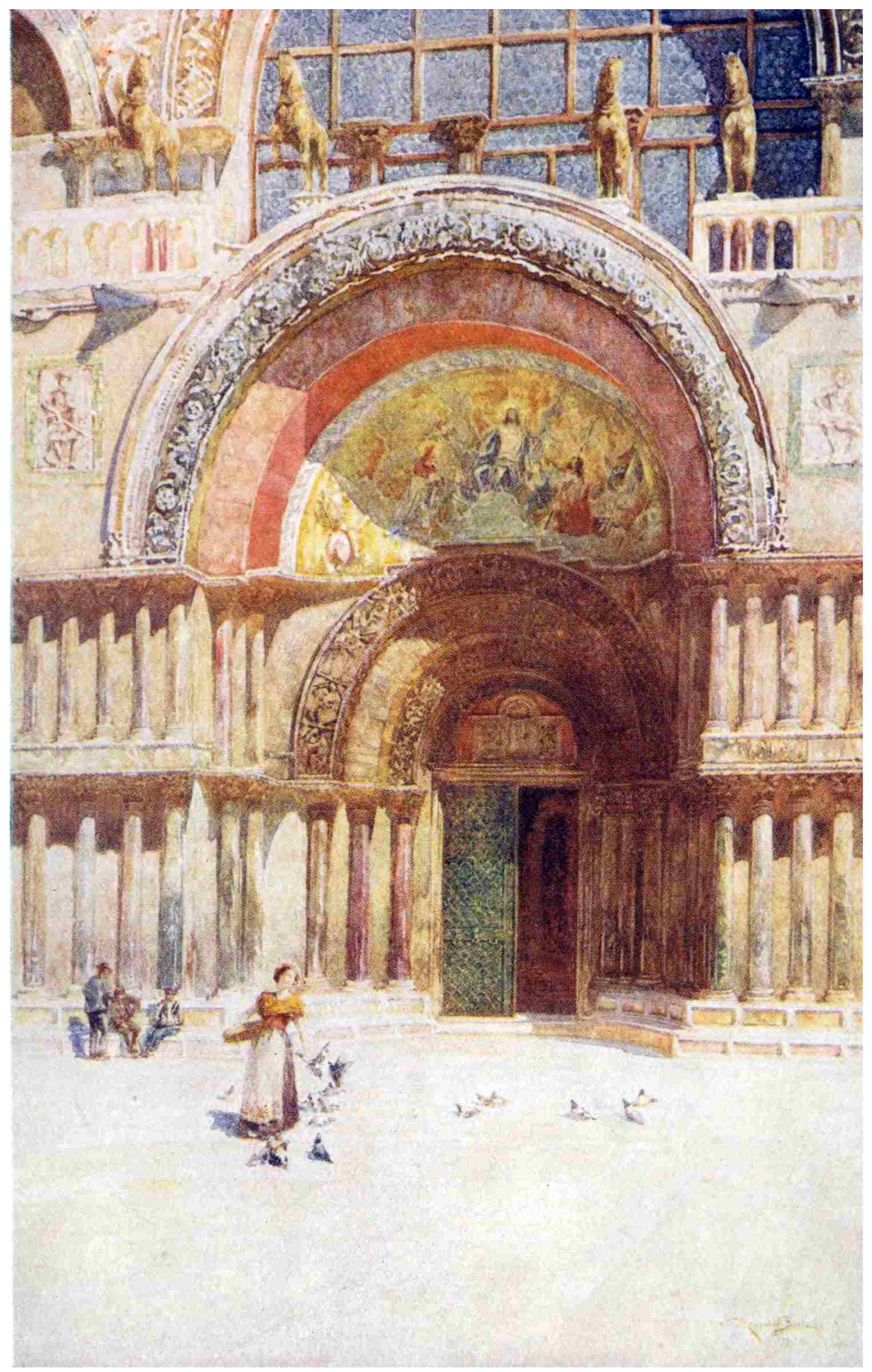
RIVA DEGLI SCHIAVONI.
For some time Dalmatia had been a thorn in
the side of Venice, a refuge for the disloyal, and,
through the agency of the hordes of pirates infesting
the coast, a real menace to her commerce.
Venice had attempted to purchase immunity from
the pirates by payment of an annual indemnity.
Orseolo decided at once to put an end to this payment,
but he realised that the price of the decision
was a foothold in Dalmatia that would need to be
obtained by force of arms. For this end it was
necessary to secure harmony within the city itself,
and, knowing this, he exercised his powers to obtain
approval of his expedition from the authorities
of East and of West, from the Emperors of
Germany and Byzantium. He was successful in
this, and circumstances combined further to aid
his designs. The Croatians and Narentines, by
wreaking on Northern Dalmatia their anger at
the loss of the Venetian indemnity, had prepared
the minds of the Dalmatians to look on the prospect
of Venetian supremacy as one of release rather
than of subjugation. It is said that they even
went so far as to send a message to Orseolo encouraging
his coming. Their province was nominally
under the Emperor of Byzantium, but their
overlord had decided to look favourably on a
means of securing peace and safe passage to his
province at so small an expense to himself. Orseolo
set sail on Ascension Day, after a service in
the Cathedral of Olivolo (now San Pietro di Castello),
fortified by the good will of East and of
West, and the united acclamations of all parties
in Venice. Pride and vigorous hope must have
swelled the hearts of these warriors. It was
summer, and their songs must have travelled across
the dazzling blue of the great basin of St. Mark,
and echoed and re-echoed far out on the crystal
waters of the lagoon. Triumph was anticipated,
and triumph was their portion. Orseolo’s expedition
was little less than a triumphal progress; the
coast towns of Dalmatia from Zara to Ragusa rendered
him their homage. A new and immensely
rich province was acquired by Venice, and the
title of Duke of Dalmatia accorded to himself.
Soon after Orseolo’s return from this campaign,
Venice, unknown to herself, was to receive the
homage of one of the emperors she had made it
her business to propitiate. There is something
that stirs the imagination in this secret visit of
Otho III to the Doge. According to the ingenuous
account of John the Deacon, Venetian ambassador
at the Emperor’s court, it was merely
one of those visits of princely compliment which
the age knew so well how to contrive, and loved
so well to recount—a visit in disguise for humility
or greater freedom, like that of St. Louis to
Brother Giles at Perugia, where host and guest
embrace in fellowship too deep for words. The
Emperor, John the Deacon tells us, was overcome
with admiration of Orseolo’s achievements
in Dalmatia, and filled with longing to see so
great a man, and the chronicler was despatched
to Venice to arrange a meeting. The Doge,
while acknowledging the compliment of Otho’s
message, could not believe in its reality, and consequently
kept his own counsel about it—“tacitus
sibi in corde servabat.” However, when Otho on
his travels had come down to Ravenna for Lent,
John the Deacon was again despatched, and this
time from Doge to Emperor.
It was ultimately arranged that after the Easter
celebration Otho with a handful of followers
should repair, under pretext of a “spring-cure,”
to the abbey of Santa Maria in the isle of Pomposa
at the mouth of the Po. He pretended to
be taking up his quarters here for several days, but
at nightfall he secretly embarked in a small boat
prepared by John the Deacon, and set sail with
him and six followers for Venice. All that
night and all the following day the little boat
battled with the tempest, and the storm was still
unabated the next evening, when it put in at the
island of San Servolo and found itself harboured
at last in the waters of St. Mark. Venice knew
nothing of this arrival; her royal guest had taken
her unawares, and her waterways had prepared
him no welcome. We may picture the anxiety
of Orseolo, alone with the secret of his expected
guest, on the island of San Servolo. The journey
may well have been perilous for so small a boat
even within the sheltering wall of the Lido, and
we may imagine his relief when it could at last
be descried beating towards the island through
the tempestuous waters of the lagoon. In impenetrable
night, concealed from one another’s
eyes by the thick darkness, Emperor and Doge
embraced. Otho was invited to rest for an hour
or two at the convent of San Zaccaria, but he
repaired before dawn to the Ducal Palace and the
lodging made ready for him in the eastern tower.
There is a fascination in attempting to imagine
the two sovereigns moving amid the shadows of
Venetian night, in thinking of the Emperor
watching from the vantage of his tower for daybreak
over the city. There are wonders to be
seen from this eastern aspect, but after the discomfort
of his voyage to Venice the royal captive may
well have felt a longing for a sight of the city
from within. It is all rather like a children’s
game—Orseolo’s feigned first meeting with an
embassy from Otho, his inquiry as to the Emperor’s
health and whereabouts, and the public
dinner with the ambassadors. Venice is robbed
of a pageant, and one most dear to her, the fêting
of a royal guest; the guest is deprived of all
festivities beyond a christening of the Doge’s
daughter; yet the pleasurable excitement of John
the chronicler communicates itself and disarms
our criticism; and it is not till gifts have been
offered and refused—“ne quis cupiditatis et non
Sancti Marci tuæque dilectionis causa me hac venisse
asserat”—till tears and kisses have been exchanged,
and the Emperor, this time preceding
his companions by a day, has set sail once more
for the island of Pomposa, that we break from the
spell of the chronicler and begin to cavil at the
strange conditions of the visit.
Modern historians have laid a probing hand on
the sentimentality of John the Deacon’s tale; they
do not doubt the kisses or the tears, but the
unparalleled eccentricity of secrecy seems to demand
an urgent motive. Why this strange coyness of
the Emperor? Might he not have thought more
to honour Venice and her Doge by coming with
imperial pomp than by stealing in and out of the
triumphant city like a thief in the night? And
why did the persons concerned make public boast
of the success of their freak immediately after its
occurrence? For John tells us that when three
days had passed, the people were assembled by the
Doge at his palace to hear of his achievement,
“and praised no less the faith of the Emperor
than the skill of their leader.” The probable
solution of the various enigmas rather rudely
shatters the romance. Gfrörer lays on Orseolo
the responsibility of the incognito, attributing it
partly to a memory of the fate that overtook the
Candiani’s personal relations with an imperial
house, partly to his desire to treat with the
Emperor unobserved. He recalls point by point
the precautions taken by Orseolo to preclude Otho
from contact with other Venetians, and comes to
the conclusion that in those private interviews
in the tower the “eternal dreamer” was feasted on
the milk and honey of promises, food of which
no third person could have been allowed to partake.
“What lies,” he exclaims, “were invented,
what assurances vouchsafed of the most unbounded
devotion to imperial projects in general and the
longed-for reconstitution of the Roman Empire
in particular! Never was prince so shamefully
abused as Otho III at Venice.” It is not necessary
to abandon our belief in Otho’s personal feelings
for the Doge, augmented by Orseolo’s recent
campaign, to realise that there must have been
another side to the picture. Gulled the royal
guest in all probability was, but there is little
doubt that he had an axe of his own to be ground
on this visit to Venice—that the journey had for
its aim something beyond his delectation in a sight
of the Doge and his obeisance to the Lion. For
the furtherance of his schemes of empire Otho
needed a fleet. He had, Gfrörer tells us, “an
admiral already in view for it. Nothing was
wanted but cables, anchors, equipments; in short
there were not even ships, nor the necessary money,
and above all, there were no sailors. I believe
that Otho III undertook the journey to Venice
precisely to procure for himself these necessary
trifles. Who knows how many times already he
had urged the Doge to hasten his sending of the
long-promised fleet; but in place of ships
nothing had yet come but letters or embassies
carrying specious excuses.” If the historian’s
motivisation is accurate, Otho must have found,
like so many after him, Venice more capable of
exercising persuasion than of submitting to it.
For our uses, however, the original or the revised
versions of the tale serve the same purpose. As an
act of spontaneous homage or an act of practical
policy, the visit of Otho, full as it is of speculative
possibilities, was an imperial tribute to the position
Orseolo had given to Venice, an imperial recognition
of her progress towards supremacy in the
Adriatic.
Orseolo’s achievement and the rite which symbolised
it were confirmed two centuries later when,
in the spring and summer of 1177, Venice was
the meeting place of Pope Alexander III and the
Emperor Frederick Barbarossa. Tradition has
woven a curious romance round the fact of the
Pope’s sojourn in Venice before the coming of
the Emperor. By a manipulation of various
episodes, he is brought as a fugitive to creep among
the tortuous by-ways of the city, sleeping on the
bare ground, and going forward as chance might
direct till he is received as a chaplain—or, to
enhance the thrill of agony, as a scullion—in the
convent of Santa Maria della Carità, and after some
months have elapsed is brought to the notice
of the Doge, when a transformation scene of the
Cinderella type is effected. It is inevitable that
melodramatic touches should have been added to
so important an episode, and the accounts of the
manner of Alexander’s arrival and his bearing in
Venice are many and varied. None the less, it is
clear that splendour and not secrecy, ceremony not
intimacy, are the general colouring of the event.
Frederick had shown himself disposed to make
peace and to accept the mediation of Venice, and
in the early days of the Pope’s visit the Venetians
had acted as counsellors, pending the agreement as
to a meeting place. Significant terms are used by
the chroniclers to account for the ultimate choice,
and the note which they strike is repeated again
and again in the chorus of praise that throughout
the centuries was to wait upon Venice. “Pope
and Emperor sent forth their mandates to divers
parts of the world, that Archbishops, Bishops,
Abbots, Ecclesiastics and secular Princes should
repair to Venice; for Venice is safe for all, fertile
and abounding in supplies, and the people quiet
and peace-loving.” Secure among the lagoons,
Venice is aloof from the disturbances of the mainland
cities, and though her inhabitants are proved
warriors they are peaceable citizens. Many of the
glories of Gentile Bellini’s Procession of the Cross
would be present in the procession in which the
Doge and the magnates of Venice formally conducted
Alexander III to the city—patriarch,
bishops, clergy, and finally the Pope himself, all
in their festival robes. Ecclesiastical and secular
princes of Germany, France, England, Spain,
Hungary and the whole of Italy were crowding to
Venice. The occasion gave scope for her fascinations,
and they were exerted. No opportunity
for display was neglected; ceremony was heaped
upon ceremony.
For over a fortnight Venice was the centre of
correspondence daily renewed between Emperor
and Pope, of embassies hastening to and fro, of
endless postponements and uncertainties. The
Pope retires for a few days to Ferrara; then he is
back again to be received as before. But Venice,
the indomitable, is secure of her will, and preparations
for the coming of the Emperor are growing
apace. In July the Doge’s son is despatched to
meet the royal guest at Ravenna and conduct him
to Venice by way of Chioggia. No tempests disturbed
his arrival. He was conducted in triumph
up the lagoon by the galleys of “honest men”
and Cardinals who had gone forth to Chioggia to
meet him. Slowly the islands of the Lido would
unfold themselves to his eyes, Pellestrina in shining
curves, Malamocco with its long reaches of bare
shore and reeds. The group clustered round
Venice itself—San Servolo, La Grazia, San Lazzaro,
Poveglia—would be green and smiling then,
living islands, not desolated as now for the most
part by magazine or asylum. San Nicolo del Lido
welcomed the guest, and he was borne thence on
the ducal boat to the city and landed at the Riva.
Through the acclamations of an “unheard-of multitude”
his way was made to San Marco, where
the Pope in all his robes, amid a throng of gorgeous
ecclesiastics and laymen, was waiting on the
threshold. As he passed out of the brilliant and
garish day into the solemn mosaiced glory of San
Marco and moved to the high altar between Pope
and Doge singing a Te Deum, “while all gave
thanks to God, rejoicing and exulting and weeping,”
even an emperor and a Barbarossa may well
have surrendered his pride. Even we, spectators
removed by time, find ourselves exalted on the
tide of colour and of sound, and crying to the
Venetians, with the strangers who thronged in
their streets, “Blessed are ye, that so great a peace
has been able to be established in the midst of
you! This shall be a memorial to your name for
ever.” Peace was secured and Venice had accomplished
her task. She had devoted the subtleties
of her statecraft to its performance, but perhaps
the splendour of this hour in San Marco was her
crowning achievement. She asked the recognition
of a Pope, and she brought the temporal sovereign
to his side in a church which is one of the wonders
of Christendom. She polished and gilded every
detail of her worldly magnificence, and poured it
as an oblation at the altar. Her reinforcements to
the cause of Alexander III were drawn from far
back in the ages, from the inspiration of the men
who had fashioned her temple; and may there not
be some deeper signification than merely that of
Frederick’s stubbornness in the “Not to thee, but
to St. Peter,” traditionally attributed to him as he
prostrated himself at his enemy’s feet?
THE DOORWAY OF SAN MARCO.
To Venice there remained, beside the praise of
all Christendom, many tangible tokens of the
events of the summer. Emperor and Pope vied
with each other in evincing their gratitude. Alexander
formally sanctioned and confirmed the title
of Venice as sovereign and queen of the Adriatic,
and bestowed on the Doge a consecrated ring for
use at the Nuptials. And henceforth the ceremony
at San Nicolo del Lido, the place of arrival and
departure for the high seas and for Dalmatia and
the East, was increased in magnificence. No trace
now remains of the church where the rites were
performed; but the grassy squares of San Nicolo
and the wooded slopes of its canal, looking on one
side to the city, on the other to the sea, are beautiful
still. The ocean calls to the lagoon, and the
calm waters of the lagoon sway themselves in
answer; while, outside the Lido, line beyond line
of snowy-crested waves, ever advancing, bear in to
Venice, Bride of the Adriatic, the will of the high
sea.
Chapter Four VENICE IN FESTIVAL
The treaty signed in 1573 between Venice
and Constantinople, though it marked no
real rise in her fortunes, gave her a respite
from the petty and fruitless warfare with the Turk,
in which she had so long been engaged. That
conflict had drained the resources of the Republic
without affording compensating gains. The loss
and horrors of Famagosta might seem to have been
revenged by the battle of Lepanto, where the triumph
of Venice and her allies was complete; but
owing to the dilatoriness and inaction of Don John
of Austria, brother of Philip of Spain, the opportunity
of annihilating the Turkish forces was allowed
to escape, and victory was reduced to little more
than the name. So flagrant had been the character
of Don John’s disloyalty that the Venetians no
longer could mistake his intentions. Spain was an
ally of Venice; but Tommaso Morosini was but
voicing the general conviction when he exclaimed,
“We must face the fact that there will be no
profitable progress, seeing that the victory already
gained by the forces of the League against the
Turk was great in the number of ships captured,
rare in the number of slaves set free, famous by
reason of the power it broke, formidable for the
numbers killed by the sword, glorious for the pride
it laid low, terrible in the fame acquired by it.
And, none the less, no single foot of ground was
gained. Oh, incomparable ignominy and shame
of the allies, that whatever honour they obtained
in consequence of the victory, they lost by not following
it up!” Though nominally in league with
her against the Turk, Spain, owing to her jealousy
of Venice, was unwilling that the war should be
ended. The League of Cambray, formed in 1508
by the European powers unfriendly to Venice,
should have made it clear to the Republic that she
had over-reached her own interests by interference
in the politics of Europe. Moreover, a severe blow
had been dealt to the commerce of Venice by the
discovery of the Cape route to the East. Yet,
though her decline had begun, she still formed a
subject for envy, and there is justice in Morosini’s
conclusion as to the causes of the growing enmity
of Spain. “Ruling,” he says of the Spaniards, “a
good part of Europe, having passed into Africa,
having discovered new territory, dominating most
of Italy, and seeing the Republic, the single part,
the only corner of Italy, to be free and without the
least burden of slavery, they envy it, envying it they
hate it, and hating it they lay snares for it.”
Though the terms of the peace with Constantinople
were humiliating in the extreme (Venice
relinquished the whole of Cyprus, a fortress in
Albania, and agreed within three years to pay an
indemnity of one hundred thousand ducats) it set
her hands free for awhile and gave her a breathing
space in which to return to her pageants. And
for the next few years she laid herself out more
completely than ever before to impress the world
by her splendour. It is not easy to determine the
beginnings of decadent luxury in Venetian history.
Venice had always been a pleasure-house, a place
of entertainment for kings and emperors, a temple
of solemn festival. Perhaps the broad difference
between the splendours of the early and late
Renaissance is that one achieved that perfection of
taste which robes luxury in apparent simplicity,
while the other was more obvious and expansive—the
difference between the Madonnas of Bellini
and of Titian, between the interiors of Carpaccio
and Paul Veronese. There is a real and discernible
difference in aspect between Venice of the fifteenth
and Venice of the sixteenth century, but it
is not the difference between asceticism and luxury.
Venice was never ascetic, no prophet ever drew
her citizens round a sacrificial bonfire on the
Piazza. On the other hand it is said that a Venetian
merchant was burnt in effigy on Savonarola’s
pile because he had attempted to purchase some
of the doomed Florentine treasures. In the
course of the fifteenth century isolated voices were
indeed raised in protest against the luxury of
Venice, and the authorities themselves, as the State
coffers grew empty, tried by oratorical appeal and
detailed legislation to curb the extravagance of
private citizens. But their protests were, in the
main, quite ineffectual. Venice could not resist
the influences that wove for her each day a magical
dress; she could not refuse the treasures of the
East: it was her function to be beautiful, to accept
and love every wonder, to turn her face against
nothing that could glorify. She had always appeared
as a miracle to men, she had always lavished
her treasures on her guests; the vital difference
between the period of her decline and that of her
greatness lies in the gradual relaxation of the ties
binding her to the sources of her wealth. With
the ebbing of her trade her citizens begin to barter
their landed estates and their treasures. Morosini’s
acute and interesting prophecy as to the
private banks into which Venetian money began
to be diverted provides us with a background to
some of the almost fabulous expenditure of the
Cinquecento—“The banker,” he says, “with a
chance of obliging many friends in their need, and
acquiring others by such a service, and with power
to do so without spending money, simply by making
a brief entry, is easily persuaded to satisfy
many. When the opportunity arises of buying
some valuable piece of furniture or decoration,
clothes, jewels and similar things of great price, he
is easily persuaded to please himself, simply ordering
a line or two to be written in his books—reassuring,
or rather, deceiving himself with the
thought that one year being passed in this way, he
can carry time forward, and pass many years in the
same manner, scheming that such an affair or such
an investment as he has in hand, when it has come
to perfection, ought to prove most useful, and that
through its means he may be able to remedy other
disorders; which hope proving fallacious shows
with how little security walks one who places his
thoughts and hopes in the uncertain and inconstant
issues of events.”
The fabric of sixteenth-century Venice was too
largely founded on the “uncertain and inconstant
issues of events,” but none the less it was as radiant
a fabric as any that man has yet fashioned. Something
at least of its nature may be learned from
the details of the entertainment of Henry III in
Venice, and his lodging and reception in the then
fashionable suburb of Murano. Henry came to
Venice in the early summer of 1574, on his way
from Poland to take possession of the throne of
France vacated by the death of his brother Charles
IX. He came at a moment when Venice was rich
in artists to do him honour—Tintoretto, Paolo
Veronese, Palladio and Claudio Merulo: he was
crowned with the laurels of war; while the Republic
was able to clothe herself in the glory of
Lepanto and the respite of her newly concluded
peace with the Turk and, superficially at least,
appeared peculiarly fitted to welcome him. The
young King was gracious, and greedy to drink his
fill of life, and Venice was unique in her celebration.
The visit was one of the most spontaneous,
the most joyful to host and guest, of any that are
recorded in her annals. All the territory of
Venice was prepared to honour him, and his journey
was a triumphal progress. There is something
joyous still about the little inland cities of his
route, echoes of festival still linger in their streets,
romance still dwells in their hearts. At Treviso,
where the young King was welcomed with peculiar
pomp, the Lion of St. Mark, portrayed by three
successive ages, rules still, his majesty sustained by
the sturdiness of life that moves in the city. The
winding cobbled streets are full of bustle and interchange,
the arcades are full of people, vital and
busily employed. Treviso is not a museum. Its
ancient palace of the Cavallieri is still in use,
though its loggia with traces of rich fresco is filled
with lumber. But we are not critical of small
details at Treviso; we thank it for its winding
streets and for its leaping azure river; we thank it
for its countless ancient roofs and painted rafters;
for its houses high and low, harmonious though
endless in variation, for the remnants of fresco,
shadows no doubt of what once they were, but
companionable shadows—horses with still distinguishable
motions, graceful maidens both of land
and sea. These glories are fading but they have
substance still, and on a day of mid-autumn we
are well able to imagine a kingly procession on
the road from Treviso to Mestre. It seems a
pageant, a progress of pomp and colour, as we
pass between the vineyards and maize fields and
the great gardens and pastures of the villas, down
the avenue of plane trees set like gold banners on
silvery flagstaffs with carpets of fallen leaves at
their feet. Behind them are ranked dark cypresses,
pale groups of willow, or companies of
poplar. And these are often garlanded to their
very summits by crimson creepers, and interspersed
with statues, not perhaps great in workmanship,
but tempered and harmonised into beauty by the
seasons. Here and there is a lawn flanked by dark
shrubbery, or a terrace ablaze with dahlias and
salvia. And, among them, Baron Franchetti of
the Cà d’Oro has a home even more worthy of
the golden title than is his palace on the shores
of the Grand Canal—a place where the sun
reveals miraculous hangings in the shrubberies,
sumptuously furnished with scarlet and crimson
and gold.
VIEW FROM CÀ D’ORO.
Some such festival of colour, in banners and
trappings, would be Henry’s preparation for the
pageant of the lagoons. For he was met at
Marghera, half way between Mestre and Venice,
by a troop of senators and noblemen and ambassadors,
and escorted to the palace of Bartolomeo
Capello at Murano. Of the young King’s lodging
at Murano we have spoken elsewhere—of the
hall hung with gold brocade, with golden baldaquin,
green velvet and silk, its entrance guarded
by sixty halberdiers armed for the occasion with
gilt spears borrowed from the chambers of the
Council of Ten. Forty noble youths, in glorious
attire, had been told off to wait on the King.
But, “although a most sumptuous supper was
prepared, none the less His Majesty, when the
senators were gone, showed himself a short while
at the windows dressed in cloth of gold and silk;
after which he went to supper, and the princes
arrived, so that it was most glorious with abundant
supply of exquisite viands and most delicate foods.”
The hearts of the Venetians were won by the
King’s beauty and youth, by his delicate person
and grave aspect, by his majestic bearing and his
eagerness to please and be pleased. He was in
mourning for his brother, but his mourning did
not shadow Venice by its gloom. “His Majesty
appeared in public dressed all in purple (which is
his mourning) with a Flemish cloak, a cap on his
head in the Italian mode, with long veil and
mantle reaching to his feet, slashed jerkin, stockings
and leather collar, and a large shirt-frill most
becomingly worn, with perfumed gloves in his
hand, and wearing on his feet shoes with heels
à la mode française.”
It would be tedious to relate the details of the
splendid entertainments that each day were provided
for his delectation; of salutes that made the
earth and water tremble, of fireworks glowing all
night beneath the windows of the Cà Foscari, of
the blaze of light from the candles set in every
window and cornice and angle of the buildings
along the Grand Canal, of the gilded lilies and
pyramids and wheels reflected in the water, “so
that the canal seemed like another starry sky.”
It was a veritable gala for Henry; he paid a
private visit to the Doge to the great satisfaction
of that prince and his senate, he went about incognito
in a gondola alone with the Duke of
Ferrara, “so that when they thought he was in
his room, he was in some other part of the city,
returning home at an exceedingly late hour accompanied
by many torches, and immensely enjoying
the liberty of this town; and on account of his
charm and courtesy, the whole place gave vent to
the lasting joy and satisfaction it felt in continually
seeing him.” He spent three hours in the
Arsenal, engrossed in viewing the vast preparation
for war and the spoils won from the Turk “in
the sea battle on the day of the great victory”;
and then in the chamber of the Council of Ten,
within the Arsenal, he was provided with a Sugar
Feast, with sugar dishes, knives and forks, so admirably
counterfeit that His Majesty only realised
their nature when his sugar napkin crumbled and
a piece of it fell to the ground. Is there not
something contributive to our picture of Venice
the entertainer, in this feast of sugar given by the
terrible Council of Ten within the walls of the
Arsenal itself? There is naturally much vague
repetition in the chronicles of the time, but here
and there are vital touches which bring the young
King to life before our eyes. At the banquet
given in his honour in the Sala del Gran Consiglio,
having eaten sufficiently himself, he brought the
meal to an end before half of the courses had appeared,
by adroitly causing the Dukes of Savoy
and Ferrara to rise in their places at his side, and
calling for water for his hands during the disturbance
caused by the lords and ambassadors as they
followed the example of the dukes. He told
Giovanni Michele that of all the entertainments
he had witnessed in Venice none had pleased him
more than the “Guerra dei Ponti,” and that if he
had known of it earlier he would have prayed to
have had the spectacle repeated several times, for
he “could have asked nothing better than this.”
The Guerra dei Ponti were wrestling matches that
took place on certain bridges over the canals, and
pages of description might not have told us as
much of the nature of the man who lived behind
the scented gloves and purple mantle, as this single
expression of preference.
Two episodes in the visit of Henry that seem
worthy of fuller record stand out from the rest:
his reception at the Lido and the Ball in the
Ducal Palace; and they represent the achievements
in his honour of two departments of Venetian
activity, the City Guilds and the Court.
While he was still in his lodging at Murano
barges of immense splendour, vying with each
other in symbolism and ingenuity of design, and
each representing one of the trades of Venice, had
arrived to accompany him to the Lido. If we
imagine the Lord Mayor’s Procession, with splendour
a thousandfold enhanced and with drapery
and design of artistic excellence, removed from
the streets to the glittering surface of the lagoon,
we may have some idea of the spectacle. Among
the most splendid of the barges was that of the
Druggists, with an ensign of the Saviour riding
on the world. “The outer coverings themselves
were of cloth of gold, and below them and below
the oars were painted canvases. The poop was
hung within with most beautiful carpets, and on
the four sides four pyramids were erected of sky
blue with fireworks inside them, at the feet of
which were four stucco figures representing four
nymphs, and there were set two arquebuses and a
musket and two flags white and red and a flag
of battle. And on the outside were divers sorts
of arms, spears and shields and six arquebuses.
On the prow was a pyramid with fireworks, on
the top of which was an angel—for this and
the Golden Head were the badges of the two
honoured druggists who had decked the said
vessel—and in the midst of it was a design of a
pelican with a motto round it in letters of gold,
Respice Domino, representing the pelican as wounding
its breast to draw blood from it to nourish its
offspring, just as they, the druggists, faithful and
devoted to their prince and master, gave and
offered to him, not only their faculties but their
blood itself, which is their own life in his service;
and at the foot of the pyramid was a little boy
beating a drum.” The Looking-Glass Makers
also had prepared a magnificent barge glittering
with symbols of their profession. But perhaps
the device of the Glass-Workers of Murano out-rivalled
all others in ingenuity and pomp. “On
two great barges, chained together and covered
with painted canvases, they had erected a furnace
in the form of a sea-monster; and following the
train of vessels, flames were seen issuing from its
mouths, and, the masters having given their consent,
the Glass-Workers made most beautiful vases
of crystal, which were cause of great pleasure to
the King.”
The Convent of Sant’ Elena was the vantage
point chosen for looking on Venice, and at the
moment the army of barges and brigantines
reached it, they spread out in front of His Majesty,
and a salute broke from them all; “to
which the galleys in the train of the King replied
in such ordered unity that His Majesty rose to his
feet with great curiosity to see them, praising exceedingly
so wonderful a sight, admiring to his
right the fair and famous city marvellously built
upon the salt waters, and on the left a forest of so
many ships and vessels with so great noise of artillery
and arquebuses, and of trumpets and drums,
that he remained astounded; while he openly
showed himself not less merry than content, seeing
so rare a thing as was never before seen of
him.” Henry’s arrival at the Lido is portrayed
in the Sala delle Quattro Porte in the Ducal
Palace. He is seen advancing with sprightly step,
between two dignitaries of the Church, up a temporary
wooden bridge towards the Triumphal
Arch and Temple of Palladio. This arch was
decorated with paintings by Paolo and Tintoretto,
and in connexion with it Ridolfi tells a delightful
story of the painting of Henry’s portrait. “Tintoretto,”
says Ridolfi, “was longing to paint the
King’s portrait, and in consequence begged Paolo
to finish the arch by himself; and, taking off his
toga, Tintoretto dressed himself as one of the
Doge’s equerries, and took his place among them
in the Bucintoro as it moved to meet the King,
thus furtively procuring a chalk sketch of the proposed
portrait, which he was afterwards to enlarge
to life size; and having made friends with M.
Bellagarda, the King’s treasurer, he was introduced
with much difficulty, owing to the frequent visits
of the Doge, into the royal apartments to retouch
the portrait from life. Now whilst he stood
painting, and the King with great courtesy admiring,
there entered presumptuously into the apartments
at smith of the Arsenal, presenting an
ill-done portrait by himself, and saying that, while
His Majesty was dining in the Arsenal, he had
done the likeness of him. His presumption was
humbled by a courtier who snatched it from his
hand, and ripping it up with his dagger threw it
into the neighbouring Grand Canal: which incident,
on account of the whispering it produced,
made it difficult for the painter to carry out his
intention. Tintoretto had also observed on that
occasion that from time to time certain persons
were introduced to the King, whom he touched
lightly on the shoulder with his rapier, adding
other ceremonies. And pretending not to understand
the meaning, he asked it of Bellagarda, who
said that they were created knights by His Majesty,
and that he, Tintoretto, might prepare himself
to receive that degree; for he had discussed
the matter with the King, to whom Tintoretto’s
conditions were known and who had shown himself
disposed, in attestation of his powers, to create
him also a knight; but our painter, not being
willing to subject himself to any title, modestly
rejected the offer.” When the portrait was finished
and presented to the King, it was acclaimed
by him as a marvellous likeness, and we may
safely conclude from this that it was fair to look
on. The King presented it to the Doge. Perhaps
the picture from the first had been intended
as a present for Mocenigo, and this was the explanation
of the secrecy observed in regard to it.
COURTYARD OF PALAZZO DUCALE.
The climax of entertainment was reached in the
festa at the Ducal Palace on the second Sunday
after Henry’s arrival (his visit lasted ten days).
The glories of Venice were gathered in that
marvellous hall still hung with the paintings of Carpaccio
and Gentile Bellini, and the exquisite Paradise
of Guariento; for it was yet a year previous
to the great fire which was to give scope to the
contemporary giants. The later victories of Venice
were as yet unchronicled except in the hearts of
living men. There was no thought of sumptuary
laws on this day at least of the great festival.
Ladies were there clothed all in ormesine, adorned
with jewels and pearls of great size, not only in
strings on their necks, but covering their head-dresses
and the cloaks on their shoulders. “And
in their whiteness, their beauty and magnificence,
they formed a choir not so much of nymphs as
of very goddesses. They were set one behind the
other in fair order upon carpeted benches stretching
round the whole hall, leaving an ample space
in the centre, at the head of which was set a royal
seat with a covering of gold and entirely covered
with a baldaquin from top to bottom, and round it
yellow and blue satin.” All the splendours of
Venetian and Oriental cloths were lavished on the
Hall of the Great Council and the Sala del Scrutinio
adjoining. The King as usual entered whole-heartedly
into the festivity. His seat was raised
that he might look over the company, “but he
chose nevertheless to go round and salute all the
ladies with much grace and courtesy, raising his
cap as he went along.” After a time musical
instruments were heard, the ladies were carried off
by the gentlemen, and forming into line they
began to dance a slow measure, passing before the
King and bowing as they passed. “And he stood
the whole while cap in hand.” The French courtiers
were permitted by their master to lay aside
their mourning for the time, and they danced with
great merriment, vying with the most famous
dancers of Venice. But the great feature of the
evening was the tragedy by Cornelio Frangipani—a
mythological masque in honour of the most
Christian King and of Venice herself—with Proteus,
Iris, Mars, Amazons, Pallas and Mercury as
protagonists. To the first printed edition of his
masque Frangipani prefixed an apology for his
title of tragedy, with the usual appeal to classic
precedent. “This tragedy of mine,” he says, “was
recited in such a way as most nearly to approach
to the form of the ancients; all the players sang
in sweetest harmony, now accompanied, now
alone; and finally the chorus of Mercury was
composed of players who had so many various
instruments as were never heard before. The
trumpets introduced the gods on to the appointed
scene with the machinery of tragedy, but this
could not be used to effect on account of the great
concourse of people; and the ancients could not
have been initiated into the musical compositions
in which Claudio Merulo had reached a height
certainly never attained by the ancients.” The
masque is in reality a mere masque of occasion,
comparable to countless English productions in the
Elizabethan age, though lacking in the lyrical grace
they generally possess. Henry is addressed as the
slayer of monsters, the harbinger of peace, the
herald of the age of gold—
Pregamo questo domator de’ mostri
Ch’eterno al mondo viva,
Perchè in pregiata oliva
Ha da cangiar d’ alloro
E apportar l’ antica età del’ oro.
The masque is without literary merit, but we
need not regard it in the cold light of an after day,
caged and with clipped wings. To that glorious
assembly, illumined by the great deeds fresh in
men’s minds and the presence of a royal hero,
Frangipani’s words may well have been kindled
into flame. For if time and place were ever in
conspiracy to wing pedestrian thoughts and words,
it must have been at this fêting of the most Christian
King of France in the City of the Sea.
Pens were busy in Venice during the days of
Henry’s stay. Unsalaried artists, independent of
everything except a means of livelihood, exacted
toll from the royal guest. From the 16,000 scudi
of largess distributed by the King, payments are
enumerated “to writers and poets who presented to
His Majesty Latin works and poems made in praise
of his greatness and splendour.” Gifts, as well as
compliments were exchanged on all hands. The
Duke of Savoy presented the Doge’s wife with a
girdle studded with thirty gold rosettes each containing
four pearls and a precious jewel in the
centre, worth 1,800 scudi. And Henry’s final
token of gratitude to his entertainers was to send
after the Doge, who had accompanied him to
Fusina, a magnificent diamond ring, begging that
Mocenigo should wear it continually in token of
their love. Most of these offerings and acknowledgments,
without doubt, would be merely ceremonial.
Yet the young King’s delight in his
visit had been genuine, and his frank enjoyment
of all Venice offered had won him her sympathy
and even her affection. Memories of the freedom
of his stay went with him to the routine of his
kingship, and he looked backwards with delight
to her winged pleasures. She had spread gifts out
before him, as she does before all, but in his own
hands he had carried the key of her inmost treasures;
for his spirit was joyful and joy is the key to
the unlocking of her heart.
Chapter Five A MERCHANT OF VENICE
“Siamo noi calcolatori” was the confession
of a modern Venetian, quoted lately as
expressive of the spirit that governs Venice
to-day and has lain at the root of her policy in
the past. The confession is striking; for most
men, however calculating in practice, acknowledge
an ideal of spontaneous generosity which causes
them to shun the admission of self-interested
motives. The charge, if charge it can be termed,
is an old one. Again and again it has been
brought against Venice by those to whom her
greatness has been a stumbling-block—“sono calcolatori.”
But perhaps if the indictment be
rightly understood it will be found to need, not
so much a denial as an extension, a fuller statement
of meaning. And this Professor Molmenti
has supplied in his Venice in the Middle Ages.1
“The Venetians,” he says, in commenting on the
support they lent to the Crusades, “never forgot
their commercial and political interests in their
zeal for the faith; they intended to secure for
themselves a market in every corner of the globe.
But their so-called egoism displayed itself in a
profound attachment to their country and their
race; and these greedy hucksters, these selfish
adventurers, as they are sometimes unjustly called,
had at bottom a genuine belief in objects high and
serious; the merchant not seldom became a hero.
These lords of the sea knew how to wed the
passion of Christianity to commercial enterprise,
and welded the aspirations of the faith with the
interests of their country, proving by their action
not only how vain and sterile is an idealism which
consumes itself in morbid dreams, but also that the
mere production of riches will lead to ruin unless
it be tempered, legalised, almost, we would say,
sanctified, by the serene and lifegiving breath of
the ideal.” But because she was supremely successful
in her undertakings, Venice won for herself
much perplexed and hostile comment from those
who were jealous of a mastery sustained with such
apparently effortless self-possession—of an organisation
so complete, so silent, so pervasive. She
has been accused of perfidy, of cruelty, in short, of
shameless egoism. A nation, a state, is pledged to
the preservation of its identity, its conceptions must
be bounded and constantly measured by the power
of other states. The neighbours of Venice in the
days of her glory were selfish and calculating also;
her prominence was due not so much to special
weapons as to her skill in wielding weapons
everywhere in use.
And what can we say of the ends to which she
directed her success, the scope of her arts, the
nature of her pleasures? It must be admitted by
all that the soul of Venice was capacious, unique
in its harmony of imagination and political acumen;
unique in its power of commanding and retaining
respect. A great soul was in the men of Venice;
it was present in all their activities, in their commerce
as in their art. The two were most intimately
allied. Again and again the chroniclers
of Venice crown their catalogue of her glories
with the reminder that their foundation is in
commerce, that the Venetians are a nation of
shopkeepers, and “you have only come to such
estate by reason of the trade done by your shipping
in various parts of the world.” Even in the fifteenth
century it was deemed complimentary to
say to a newly elected Doge, “You have been a
great trader in your young days.” The greatness
of Venice was coincident with the greatness of
her trade. She was lit, it is true, with the
ancient stars of her splendour after the mortal
blow had been struck at her commerce by the
discovery of the Cape route to the East, but the
old unity of her strength had been lost—the firm
foundations of the days when the nobles of Venice
had been the directors of her enterprise. And at
the end of the fifteenth century they no longer sat,
in their togas, behind the counters in Rialto, or
made the basements of their houses into stores.
They had ceased to apprentice their sons to the
merchants on the sea-going galleys. They still
acted as commanders of the ships in times of war,
but in intervals of peace the gulf between noble
and merchant was constantly being enlarged. The
commercial traveller was no longer considered
one of the most distinguished of citizens. The
corner stone had been taken from the building of
Rialto; it had begun to crumble to the dissolution
lamented by Grevembroch in his strange book on
Venetian costumes. In the great days of Venice
her commerce was great, and she knew how to
robe it in glory, how to attract to it the noblest,
and not the meanest, of her sons. Her shops were
the objects of her proudest solicitude, and the
well-being of her merchants the first of her cares.
The hostels provided for foreign traders ranked
with the most sumptuous of her palaces, and the
rules framed for their guidance were amongst the
most liberal in her legislature.
The calculations of Venice, growing with her
growth, impressed on her national consciousness the
importance of her position midway between the
East and the West—her geographical qualification
for becoming the mart of the world. With steady
and concentrated purpose she devoted her energy
to opening up fresh channels of communication.
Sometimes by the marriage of a son or daughter
of the Doge with the heir of a kingdom or a
prince of Constantinople, sometimes by the subjugation
of a common foe, Venice wove new
threads of intercourse with the East. She always
took payment for benefits she conferred in wider
trading advantages. Her merchant vessels were
not private adventures, they represented state enterprise
and were under the control of the central
government, travelling with the fleet and capable
of reinforcing it at need. Seven merchant convoys
left Venice annually for Roumania, Azof,
Trebizond, Cyprus, Armenia, France, England,
Flanders, Spain, Portugal and Egypt. By means
of these vessels the glories of the Orient found
their way to the lands of the West; Venice was
mistress of the treasures of Arabia, and became
their dispenser to Europe. And she was not
merely a mart, a counter of interchange; she
tested the goods at their source; she was not at
the mercy of valuers, her citizen travellers came
into touch with the goods on the soil that produced
them. The East, to which the art of
Venice owes much of its material—its gold, its
gems, its colours—was not an unfathomed mine
but, in a certain sense, a pleasure-ground for her
citizens; they passed to and fro familiarly, guests
of its greatest potentates. They stood face to face
with Cublay Kaan, the monarch of mystery.
The journeys of the famous Poli are among the
most thrilling and significant records of Venetian
history. Through them we are able to realise
something of the Republic’s debt to the lands
of the East—a debt not to be summed up in
enumeration of embroidery and jewels and perfumes
and secrets of colour. In part at least it
consisted of legends and traditions that filtered
into Venice through the hearing and speech of
her travellers—age-old lessons in wisdom, which
must have invested some of the common things of
Venetian life with new meaning and done something
to break down the barriers which ignorance
erects between man and man, knowledge and
knowledge. In the beautiful Persian rendering
of the story of The Three Magi, as told by Marco
Polo, she came into touch with comparative theology,
the familiar Christian tale drawn from an
earlier source. Marco Polo tells how he first
found at Sara the beautiful tombs of Jaspar,
Melchior and Balthasar, with their bodies completely
preserved; how the people of that place
knew nothing of their history save that they were
the bodies of kings; but three days’ journey
onward he had come to the city of the fire-worshippers
and been informed of the three who
had set out to worship a newly born Prophet,
carrying with them gifts to test the extent of his
powers—gold for the earthly King, myrrh for
the physician, incense for the God. “And when
they were come there where the Child was born,
the youngest of these three Kings went all alone
to see the Child, and there he found that it was
like himself, for it seemed of his age and form.
Then he went out much marvelling, and after
him went in the second of the Kings, who was
near in age to the first, and the Child seemed to
him, as to the first, of his own form and age, and
he also went out much perplexed. Then went in
the third, who was of great age, and it happened
to him as to the other two, and he also went out
very pensive. And when all the Kings were
together, they told one another what they had
seen; and they marvelled much and said they
would go in all three together. Then they went
together into the Child’s presence, and they found
Him of the likeness and age that He really was,
for He was only three days old. Then they
adored Him and offered Him their gold and
incense and myrrh. The Child took all their
offerings and gave them a closed box, and then
the three Kings departed and returned to their
country.” Marco Polo goes on to relate how
the Kings, finding the box heavy to bear, sat down
by a well to open it, and, when they had opened
it, they found only stones inside. These, in their
disappointment, they threw into the well and lo!
from the stones fire ascended which they gathered
up and took home with them to worship. With
it they burned all their sacrifices, renewing it from
one altar to another. Other tales he told them
from the wisdom of the East—of the idealist who
found no joy in earthly existence, and the chagrin
of his father the King, who surrounded him with
luxury and with beautiful maidens, but could not
persuade him. One day he rode out on his horse
and saw a dead man by the way. And he was
filled with horror at a sight which he had never
seen before, and he asked those who were with
him the meaning of the sight, and they told him
it was a dead man. “What,” said the son of a
King, “then do all men die?” Yes, truly, they
say. Then the youth asked no more, but rode on
in front in deep thought. And after he had ridden
some way he met a very old man who could not
walk, and who had no teeth, for he had lost them
all by reason of his great age. And when the
King’s son saw the old man he asked what he was
and why he could not walk, and his companions
told him that he could not walk from age, and
that from age he had lost his teeth. And when the
King’s son understood about the dead man and the
old man, he returned to his palace, and said to
himself that he would live no longer in so evil a
world, but that he would go “in search of Him
who never dies, of Him who made him. And so
he departed from his father and from the palace,
and went to the mountains, that are very high and
impassable, and there he lived all his life, most
purely and chastely, and made great abstinence,
for certainly if he had been a Christian, he would
be a great saint with our Lord Jesus Christ.”
Did he find his answer in the mountains? Perhaps
in some dawn or sunset he learned of the
nature of “Him who made him, of Him who
never dies”; perhaps among the wild creatures
he learned before he was old to sing the lauds of
our sister Death. But Polo’s comment on the
story is interesting, for the Venetians would have
little natural sympathy with its hero. They would
prefer Carpaccio’s fairy prince who forsook his
kingdom to follow Ursula and her virgins. The
tale of one who dared not look on life in company
with his kind, would strike a chill across
the full-blooded natures of Venice, so eager to
grasp at all that ministered to enjoyment and
vitality.
SAN GIORGIO.
But Marco’s pack held stories of a more tangible
kind—tales of the Palace of Cublay Kaan, with its
hall that held six thousand men, the inside walls
covered with gold and silver and pictures of great
beasts, and the outside rainbow-coloured, shining
like crystal in the sun, and a landmark far and
wide. And within the circuit of the palace walls
was a green pleasure mound covered with trees
from all parts and with a green palace on its summit.
“And I tell you that the mound and the
trees and the palace are so fair to see that all who
see them have joy and gladness, and therefore has
the great Sire had them made, to have that beautiful
view and to receive from it joy and solace.”
He tells of the wonderful Zecca where coins of
the Great Kaan are stamped—not made of metal,
but of black paper—which may be refused nowhere
throughout the Kaan’s dominions on pain
of death. All who are possessed of gold and treasure
are obliged to bring goods several times in the
year, and receive coins of bark in exchange; and
therefore, Marco explains, “is Cublay richer than
all else in the world.” He describes the posting
system, the rich palaces built for the housing of
messengers, the trees planted along the merchant
routes to act as signposts on the road; “for,” he
says, “you will find these trees along the desert
way, and they are a great comfort to merchant and
messenger.” Visitors to the chapel of San Giorgio
dei Schiavoni will recall the use that Carpaccio
has made of these palm-tree signposts in the Death
of St. Jerome and the Victory of St. George. Marco
tells of magnificent feasts made by the Great Kaan
on his birthday and on New Year’s Day. He delights
in stories of the chase within the domain of
Cublay’s palace of Chandu (perhaps the Xanadu of
Coleridge) the walls of which enclosed a sixteen-mile
circuit, with fountains and rivers and lawns
and beasts of every kind. He describes in detail,
as of special interest to his hearers, the size and
construction of the rods of which the Palace of
Canes was built and the two hundred silken cords
with which it was secured during the summer
months of its existence. He speaks of the “weather
magic” by which rain and fog are warded off
from this palace; and of the Great Kaan’s fancy
that the blood of a royal line should not be spilt
upon the ground to be seen of sun and air, and of
his consequent device for the murder of his uncle
Nayan, whom he tossed to death in a carpet. Baudas
(Baghdad), he says, is the chief city of the
Saracens. A great river flows through it to the
Indian Ocean, which may be reached in eighteen
days. The city is full of merchants and of traffic;
it produces nasich and nac and cramoisy, and gold
and silver brocades richly embroidered with design
of birds and of beasts; and the woods of Bastra,
between Baudas and the sea, produce the finest
dates in the world. He recounts the taking of
this Baudas in the year 1255 by Alaü, the Great
Kaan’s brother, who, when he had taken it, discovered
therein a tower belonging to the Caliph full
of gold and silver and other treasure, so that there
never was so much seen at one time in one place.
When Alaü beheld the great heap of treasure, he
was amazed and sent for the Caliph into his presence
and asked him why he had amassed so great
a treasure and what he had intended to do with it.
“Did you not know that I was your enemy and
coming to lay you waste?” he demanded. “Why,
therefore, did you not take your treasure and give
it to knights and soldiers to defend you and your
city?” The caliph replied nothing, for he did
not know what to answer. So Alaü continued,
“Caliph, I see you love your treasure so much, I
will give you this treasure of yours to eat.” So he
had the Caliph shut up in the tower and commanded
that nothing should be given him to eat or
drink, saying, “Caliph, eat now as much treasure
as you will, for you shall never eat or drink anything
else.” And he left the Caliph in the tower,
where, at the end of four days, he died. Marco
must have opened up to his listeners in Venice
horizons of lands almost comparable in extent to
the sea-spaces familiar to their thoughts from infancy.
He spoke of deserts of many days’ journey,
of the port of Hormos at the edge of one of the
most beautiful of the plains—a city whence precious
stones and spices and cloths of silver and gold
brought by the merchants from India were shipped
to all parts of the world.
But the Poli brought more tangible trophies
than the most circumstantial of tales in their pack.
Foolish artists might have held themselves rich
with these, but the honour of their family would
demand better credentials before welcoming fantastically
arrayed strangers into its bosom. The
courtyard of the house behind the Malibran, at
which on their return from their travels they demanded
admission, is known still as the Corte del
Milione, and its walls are still enriched with Byzantine
cornice and moulding, and with sculptured
beasts as strange as any to be met with in Cublay’s
preserves. The three travellers had the appearance
of Tartars, and from long disuse of their
language they spoke in broken Italian. Tradition
tells of the way in which they heaped exploit
upon exploit in the attempt to convince their incredulous
relatives of their identity; and at last,
according to Ramusio, they invited a number of
their relations to a superb banquet, at which they
themselves appeared in long robes of crimson satin.
When the guests were set down, these robes were
torn into strips and distributed amongst the servants.
Through various metamorphoses of damask
and velvet they came at last to the common dresses
in which they had arrived. And when the tables
were moved and the servants had gone, Marco, as
being the youngest, began to rip up the seams and
welts of these costumes and take out from them
handfuls of rubies and sapphires, carbuncles,
diamonds and emeralds. There was no longer
any doubt or delay; the shaggy tartar beards
had lost all their terrors. These men, who had
suddenly displayed “infinite riches in a little
room,” must undoubtedly be what they claimed
to be; happy the family to which the magicians
belonged; the Doge’s Palace need not be afraid
to welcome them; they must be set high in the
State.
Yet the accumulation of treasure was by no
means the most noteworthy act of their drama.
The Poli had been more than mere traders; from
the first they had been diplomatists of a high order.
Their career seems to give us the key to some of
the wonderful faces that appear in the crowds
pictured by Venetian painters, especially those of
Carpaccio. They are the faces of men who have
met the crisis of life unalarmed, by virtue of a
combination of daring and wisdom which is no
common possession. They are not cold; if they
are severe they are full of feeling—sensitive to the
pathos and humour as well as the sternness of reality.
The Poli had been obliged to furnish themselves
with patience in lands where the transit of a plain
is measured in weeks; three years’ residence in a
city of Persia is mentioned as a matter of detail.
We are not told the reason of delay, only that they
could not go before or behind. They had travelled
in the true spirit of adventure. On that first journey,
when Marco was not of the company, the Great
Kaan’s messengers, who came to request an interview
for their master, who had never set eyes on a
Latin, had found the two brothers open-minded
and trustful. They had acquitted themselves well
in Cublay’s presence, answering all his questions
wisely and in order. He had inquired as to the
manners and customs of Europe, and particularly as
to Western methods of government and the Christian
Church and its Head. He had been “glad
beyond measure” at what he had heard of the
deeds of the Latins, and decided to send a request
to the Christian Apostle for one hundred men
learned in the Christian law and the Seven Arts
and capable of teaching his people that their household
gods were works of the devil and why the
faith of the West was better than theirs. The
thought of the lamp burning before the sepulchre
of God in Jerusalem had stirred his imagination,
and he craved some of its oil for the light of his
temple, or, maybe, his pleasure dome. So the two
Venetians had set out for Europe on his strange
embassy. They were provided with a golden tablet
on which the Kaan had inscribed orders for the
supplying of their needs, food, horses, escorts in
all the countries through which they should pass.
At the end of three years, after long delays on
account of the snows, they arrived at the port of
Layas in Armenia, and from Layas they had come
to Acre in April of the year 1269. At Acre they
had found that Pope Clement IV was dead, and no
new election had as yet been made. Venetian
history teems with dramatic situations, but it would
be difficult to find any stranger than that in which
the Polo brothers now found themselves placed.
Merchants of Venice, they came as ambassadors
from the Lord of All the Tartars to demand
missionaries from the Father of Christendom,
who was not able to supply them because he was
not in existence. In their dilemma at Acre they
consulted Theobald of Piacenza, Legate of Egypt,
who advised them to await the new Pope’s election
and meanwhile to return to their homes. His
advice was accepted, and the two brothers made
their way onwards to Venice, where one of them,
Nicolas, discovered his son, young Marco, a lad of
fifteen years old. They remained in Venice for
two years, but when, at the end of that time, no
Pope had yet been elected, the brothers felt their
return to the Kaan could be deferred no longer.
There is something touching in their fidelity to
the pledge they had given and the constancy of
their merchant faith. They prepared to set out
again. This time little Marco went with them on
an absence that lasted for seventeen years, and was
to gather a greater treasure for the world than any
diamonds and rubies and velvets to be prodigally
scattered on the floor of the Corte del Milione.
At Acre they obtained Theobald’s permission to
fetch some of the holy oil desired by the Kaan
from Jerusalem. The journey to Jerusalem performed,
they returned once more to Acre, and
finally set forth on their return journey to the
Kaan with a letter from Theobald testifying that
they had done all in their power, “but since there
was no Apostle, they could not carry the embassy.”
But when they had gone as far on their journey as
Layas, they were followed by letters from Theobald,
who was now Pope Gregory of Piacenza, begging
their return. They complied with great joy and
set sail for Acre in a galley provided for their use
by the King of Armenia. This was the hour of
their triumph, for they were received by the Pope
with great honour, given costly presents for the
Kaan, and provided with two friars of very great
learning. The names of these two are possibly
better withheld, for they were more learned than
courageous. When they had come as far on their
journey as Layas, their incipient fears of the land
of the Tartars were wrought to a pitch by the sight
of the Saracen Army which was being brought
against Armenia by the Sultan of Babylon, and
they insisted on handing their credentials over
to the Poli and returning at once to Italy. And
the brothers were forced to go on their way with
worse than no preachers of their faith, with tidings
of their defection.
For three and a half years they journeyed on,
detained often by floods and bad weather. The
news of their coming travelled before them to the
Kaan, and he sent his servants forty days’ journey
to meet them. The Kaan received them with joy,
was graciously pleased with the letters and credentials
sent by the Pope, and accepted young
Marco as his liegeman and responsible messenger.
Marco sped well in learning the language, customs
and writing of the Tartars, but it is clear he must
have acquired other than scholastic accomplishments.
He was endowed with tact and power of
observation, and returned from his first embassy
full of news of the men and customs he had
encountered; “for he had seen on several occasions
that when the messengers the Great Kaan
had sent into various parts of the world returned
and told him the results of the embassy on which
they had gone, and could tell him no other news
of the countries where they had been, the Kaan
said they were ignorant fools.” For seventeen
years young Messer Marco was employed in continual
coming and going. He was learned in
many strange and hidden things, and was placed
in honour high above the barons—the darling of
Cublay’s heart. Again and again the three Venetians
asked for leave of absence to visit their
country, but so great was the love Cublay bore to
them that he could not bear to be parted from
them; until at last an embassy arrived from Argon,
King of Levant, asking for a new wife of the
lineage of his dead wife Bolgana, and the Kaan is
persuaded by Argon’s messengers to allow Marco
and his two uncles to depart with them in charge
of the lady. They set out by sea, and after some
twenty months’ sailing and many disasters arrived
at their destination. King Argon was dead, and
the lady Cocachin was bestowed on his son. Of
the six hundred followers who had set out with
them on their journey only eighteen had survived it.
Their mission accomplished, the Poli made their
way to Trebizond, from Trebizond to Constantinople
and from Constantinople to Venice. This
was in the year 1295.
THE DOGANA.
And how would Venice, the place of his birth,
reveal herself to Marco, now he had seen so
many wonders and glories in distant lands? We
may imagine the sun to have been setting as the
travellers turned into the Lido port, dropping a
globe of molten fire vast and mysterious through
the haze, while the last dim rays gleamed golden
on the windows of the Riva degli Schiavoni.
Venice lay among her waters, blue and glittering,
interspersed with jewelled marsh. The last gulls
of those that so gallantly had dipped and sailed all
day upon the water were flying home, their breasts
and wings radiant in the level sunlight round the
home-coming ship. Many citizens of Venice
must have been at the Lido port, thronging to
meet the merchant vessels, to greet their friends
or to have news of them from others. But none
came to meet these three travellers; alone they
embarked in a gondola bearing their cargo with
them. Venice had clothed herself in all her beauty
to give them welcome. Which of Cublay’s glories
could rival this splendour of the lagoon with its
countless treasures of light? The marsh lay in unequal
patches, each outlined with a luminous silver
rim—a magic carpet of dusky olive, threaded
with strands of radiant azure and sprinkled with
ruby and amethyst. As their gondola moved
slowly down towards the city, the boats of the
night fishers passed with the silence of shadows
between them and the glow. And when here and
there a fisher alighted on the marsh or moved
across it like a spirit stepping on the waters, he
must have seemed to Marco the very memory and
renewal of those strange Eastern stories of which
his mind was full. So, under the mystic glow of
the desert, he had seen figures of the caravan rise
and move against the tinted haze of the oasis.
Onwards glided the boat towards the Basin of San
Marco—westward the luminous wonder of lagoon
and marsh, and a cold, clear intensity of stirring
water to the east. And as they drew nearer and
ever nearer, our travellers’ hearts beat high with
the wonders of the city of their birth. The
stars were piercing the night sky in countless
numbers: the yellow lights of the city quivered
along the Riva: the masts of the fishing-fleet
swung clear against the pale western glow in the
waterway of the Giudecca: the flowing tide wound
silver coils about the black shadows of their hulls.
Past the Dogana, keystone of Venice to the Eastern
traveller, their little boat moved down the
quiet waters of the Grand Canal, deep into the
heart of that great shadowy city, apparent Queen
over all the glories of the Cities of the East.
Chapter Six VENICE OF CRUSADE AND PILGRIMAGE
The story of Venice and the Crusades forms
one of the most interesting pages of her
history in relation to the East. The
gradual awakening of her consciousness to the fact
that the pilgrimages to the Holy Land might be
of close significance to herself culminates in her
attitude towards the great Fourth Crusade at the
opening of the thirteenth century. The Crusades
were, in fact, a commercial speculation for Venice,
but a speculation into which she infused all the
vitality and fulness of her nature. And she became,
not merely a place of passage for the East,
but a superb depository of relics to detain pilgrims
on their outward way; a hostel so royally fitted
with food for their senses, their religious cravings
and their mystic imaginings, that one and another
may well have been beguiled into delaying their
departure for more strenuous sanctities. The narratives
of the pilgrims, with their enthusiasms,
their details of relics, their records of Venetian
ceremonies, religious, commercial or domestic,
coloured by their quaintly intimate personal impressions,
form one of the most picturesque pages
of Venetian chronicle.
Pietro Casola, a Milanese pilgrim of the late
fifteenth century, gives us a picture of a city that
is sumptuous and rich in all its dealings, yet pervaded
by a harmony and decorum that has stamped
itself on the face of each individual citizen. We
feel that Pietro Casola has really had a vision of
the meaning of Venice, when, among the inventory
of wonders of the Mass for the pilgrims on
Corpus Christi day, of the velvets, crimson and
damask and scarlet, the cloth of gold and togas
sweeping the ground, each finer than the last, he
pauses to add, “There was great silence, greater
than is ever observed at such festivals, even in the
gathering of so many Venetian gentlemen, so that
you could hear everything. And it seemed to
me that everything was ruled by one alone, who
was obeyed by each man without resistance. And
at this I wondered greatly, for never had I seen so
great obedience at such spectacles.” In the record
of this arresting impression, more even than in the
description of many coloured drapery and white
cloths spread on the piazza, of the groves of oak-trees
bordering the route of the procession and the
candles lit among them, we seem to see before us
the rhythmic solemnity of that unique Procession
on the Piazza of Gentile Bellini. We need only
Casola’s other observant characterisation of the
Venetian gentleman to complete the picture. “I
have considered,” he says, “the quality of these
Venetian gentlemen, who for the most part are
fair men and tall, astute and most subtle in their
dealings; and you must needs, if you would treat
with them, keep your eyes and ears open. They
are proud; I think it is on account of their great
rule. And when a son is born to a Venetian, they
say among themselves, ‘A Signor is born into the
world.’ In their way of living at home they are
sparing and very modest; outside they are very
liberal. The city of Venice retains its old manner
of dress, and they never change it; that is to say,
they wear a long garment of whatever colour they
choose. No one ever goes out by day without his
toga, and for the most part a black one, and they
have carried this custom to such a point that all nations
of the world who are lodging here in Venice,
from the greatest to the least, observe this style,
beginning from the gentlemen to the mariners
and galleymen; a dress certainly full of confidence
and gravity. They look like doctors of law, and
if any were to appear outside his house without his
toga he would be thought a fool.” Without doors
the women also belonged to this sober company,
or at least the marriageable maidens and those
who were no longer of the number of the “belle
giovani”; so sombrely were they covered when
outside their houses, and especially in church, that
Casola says he at first mistook them all for widows,
or nuns of the Benedictine Order. But for the
“belle giovani” it is another matter; they give relief
to the week-day sobriety of these Venetians, so
decorous and black when off duty, though revelling
in such richness of velvet and brocade when the
trumpet of a public function stirs their blood.
THE SHADOW OF THE CAMPANILE.
We are indebted to Casola for a picture of a
Venetian domestic festival at the birth of a child to
the Delfini family. He realised fully that he was
admitted, together with the orator of the King of
France, in order that he might act as reporter of
Venetian magnificence. It was in a room “whose
chimney-piece was all of Carrara marble shining as
gold, so subtly worked with figures and leaves, that
Praxiteles and Pheidias could not have exceeded it.
The ceiling of the room was so finely decorated
with gold and ultramarine, and the walls so richly
worked, that I cannot make report of it. One
desk alone was valued at five hundred ducats, and
the fixtures of the room were in the Venetian style,
such beautiful and natural figures, so much gold
everywhere, that I know not if in the time of
Solomon, who was King of the Jews, when silver
was reputed more vile than carrion, there was such
abundance as was here seen. Of the ornaments of
the bed and of the lady ... I have thought best
rather to keep silence than to speak for fear I
should not be believed. Another thing I will
speak the truth about, and perhaps I shall not be
believed—a matter in which the ducal orator
would not let me lie. There were in the said
room twenty-five Venetian damsels, each one fairer
than the last, who were come to visit the lady who
had borne a child. Their dress was most discreet,
as I said above, alla veneziana: they showed no
more than four to six finger breadths of bare neck
below their shoulders back and front. These damsels
had so many jewels on their heads and round
their necks and on their hands—namely, gold,
precious stones and pearls—that it was the opinion
of those who were there that they were worth
a hundred thousand ducats. Their faces were superbly
painted, and so also the rest of them that
was bare.” The account of this sumptuous interior
is peculiarly valuable when we realise the date
to which it belongs, the period of the first greatness
of Venetian Art, a period which has been sometimes
regarded as one of almost naïve simplicity.
Casola, with his customary exactitude, dwells on
the frugality of Venetian gentlemen in the matter
of food—a frugality that caused the guest to reflect
that the Venetians cared more to feed the eye
than the palate. It was not yet the period of the
sumptuous living deplored by Calmo only half a
century later.
Casola was a more secularly minded pilgrim
than the priest of Florence, Ser Michele, who paid
five visits to the bones of the Holy Innocents at
Murano, and only at the fifth visit was counted
worthy, as he humbly deemed, to see the relics:
Providence, in the form of the sacristan, having
till then failed him. The more festive Casola—who
paid repeated visits to Rialto, “which seemed
to be the source of all the gardens in the world,”
who spent one day in vain attempts to count the
multitudinous boats in and about the city, and who
was so frivolous, for all his long white beard, as to
buy a false front on the piazza—in the midst of
his expatiations on the Venetian maidens, pulls himself
suddenly together with a sense of incongruity
between his diversions and his goal, and shakes
himself free from the allurements of Venice, crying:
“But I am a priest, in the way of the saints;
I did not try to look into their lives any further.
To me it seemed better, as I have said above, to go
in search of the churches and monasteries and to
see the relics of which there are so many. And
this seemed to me a good work for a pilgrim who
was awaiting the departure of the vessel to go to
the Holy Sepulchre, bringing the time to an end
as well as he could.” In the Accademia at Venice
there is a curious little painting, attributed to Carpaccio,
of the assembly of the martyrs of Mount
Ararat in the Church of Sant’ Antonio di Castello,
which stood once on the site of the Public Gardens.
It was a familiar sight for Venice, the dedication of
pilgrims that is represented here; and there is a
strange pathos in the slim, small figures as they
move in two lines half-wavering up the aisle, each
wearing a crown of thorns, perhaps in prophecy of
coming martyrdom. They are not marching confidently
to victory like an army; their crosses are
held at all angles, forming errant patterns among
themselves. Some are girt for their journey in
short vestments under their long robes. It is curiously
unlike a procession native to the city; there
is a dreamlike, mystic quality about it and a lack
of body in its motion which is enhanced, perhaps,
by the extreme detail with which the interior of
the church is transcribed—the models of vessels
in the rafters; the votive limbs and bones hung on
the wooden screen, offerings of the diseased cured
by miracle, as they may be seen in San Giovanni e
Paolo to-day; the coiled rope of the lamp-pulley;
the board with a church notice printed on it; and
everywhere, winding in and out of the picture,
seen through the portal of entrance, disappearing
behind the sanctuary screen, the interminable procession
of the ten thousand little pilgrims.
In 1198 the lords of France flocked with enthusiasm
to a crusade preached by Foulques de Nuilly
under the authority of Innocent III. After much
discussion of practical ways and means, with which
they were less amply provided than with spiritual
enthusiasm, they made choice of six ambassadors
who should procure the necessities of the enterprise,
Jofroi de Villeharduin, Mareschal of Champagne,
Miles li Brabant, Coëns de Bethune, Alars
Magnarians, Jean de Friaise, and Gautiers de Gaudonville.
Venice was decided on by them as the State
most likely to provide what they stood in need of—ships
for the journey—and they departed to
sound the mind of the Republic, arriving in the
first week of Lent in the year 1201. Venice, in
the person of the Doge, Henry Dandolo, opened
the negotiations; the messengers were made to
feel it was no light thing they asked. They were
received and lodged with highest honour, but
they were made to wait for a Council to assemble,
which should consider the matter of their request.
After some days they were admitted to the Ducal
Palace to deliver their message; and its purport
was this: “Sir, we are come to you from the high
barons of France who have taken the sign of the
Cross to avenge the shame of Jesus Christ, and to
conquer Jerusalem if God will grant it them; and
because they know that no people have such
power as you and your people, they pray you for
God’s sake to have pity on the land over seas and
the avenging of the shame of Jesus Christ, so that
they may have ships and the other things necessary.”
The spiritual and sentimental appeal is
left unanswered by the Doge. He asks simply,
“In what way?” “In all ways,” say the messengers,
“that you recommend or advise, which
they would be able to fulfil.” Again the Doge
expresses wonder at the magnitude of what they
ask, bidding them not marvel if another eight
days’ waiting is required of them before the final
answer can be given. At the date fixed by the
Doge they returned to the Palace. Villeharduin
excuses himself from telling all the words that
were said and unsaid, but the gist of the Doge’s
offer was this, that it depended on the consent of
the Great Council and the rest of the Republic.
Venice should provide vessels of transport for four
thousand five hundred horses and squires and
twenty thousand foot soldiers, and viands to last
the whole company nine months. The agreement
was to hold good for a year from the time
of starting, and the sum total of the provision was
to be eighty-five thousand marks. But Venice
would go further, for the love of God, and launch
fifty galleys at her own expense on condition of
receiving the half of all the conquests that were
made by land and sea. Nothing remained but to
win the consent of the Great Council and ask a
formal ratification from the people. Full ten
thousand persons assemble in “the chapel of San
Marco, the fairest that ever was,” and the Doge
recommends them to hear the Mass, and to pray
God’s counsel concerning the request of the envoys.
It will be seen that all is practically accomplished
before the question is put to the people or
God’s grace asked on the undertaking, but no
item of the formality is omitted. The envoys are
sent for by the Doge that they may themselves repeat
their request humbly before the people, and
they came into the church “much stared at by the
crowd who had never seen them.” Again the appeal
is made, Jofroi de Villeharduin taking up the
word by the agreement and desire of the other envoys.
We can picture the strange thrill that ran
through the great multitude as that single voice
broke the silence of St. Mark’s with its burden
of passionate tribute to the greatness of Venice:
“‘Therefore have they chosen you because they
know that no people accustomed to going on the
seas have such power as you and your people; and
they commanded us to throw ourselves at your
feet and not to rise until you had consented to
have pity on the Holy Land beyond the seas.’
Now the six messengers knelt, weeping bitterly,
and the Doge and all the others cried out with
one voice and raised their hands on high and said,
‘We grant it, we grant it.’ And the noise and
tumult and lament of it were so great that never
had any man known a greater.” Then the Doge
himself mounted the lectern and put before the
people the meaning of the alliance that had been
sought with them in preference to all other
peoples by “the best men of the world.” “I
cannot tell you,” says Villeharduin, “all the good
and fair words that the Doge spoke. At last the
matter was ended, and the following day the charters
were drawn up and made and sealed.”
THE CLOCK TOWER FROM GALLERY OF SAN MARCO.
The time of gathering for the pilgrims was
fixed for the following year 1202, at the feast of
St. John, and amid many tears of piety and devotion
the Doge and deputies swore to abide by their
charters, and the envoys of both parties set out for
Rome to receive the confirmation of their covenant
from Innocent III. But the drama which
had begun amid such moving demonstrations of
good will and Christian sentiment necessarily had
its dilemmas and its complications. It was essential
to the fulfilling of the pact that all the crusaders
should assemble at Venice to pay their toll,
and embark on the ships; otherwise the crusaders
could not hope to provide the money due to the
Venetians. The Republic, for its part, had amply
fulfilled its compact. All who arrived were received
with joy and lodged most honourably at
San Nicolo del Lido. The chronicle can find no
parallel for the richness of the provision made for
the would-be crusaders. But there were, alas, three
times as many vessels as there were men and horses
to fill them.—“Ha! it was a great shame,”
bursts out Villeharduin, “that the rest who went
to the other ports did not come here.” The
dilemma was a serious one. Even of those who
were there, some declared themselves unable to
pay their passage, and the money could in no way
be made up. Some were for sacrificing their
whole estate that the Venetians should not lose by
the defection of the others, but the counsel found
small support among those who now wished to be
rid of their bargain. But the small party who felt
themselves, in a sense, the conscience of the Crusade
carried the day. “Rather will we give all we
possess and go poor among the host, than that it
should disperse and come to naught; for God will
render it to us at His good pleasure.” So the
Counts of Flanders, Loys, Hues de St. Pol and
their party began to collect together all their goods
and all they could borrow. “Then you might
have seen a vast quantity of gold and silver borne
to the palace of the Doge to make payment. And
when they had paid, there still was lacking from
the covenant thirty-four thousand marks of silver.
And those who had kept back what they possessed
and would give nothing were very glad at this, for
by this means they thought the expedition would
have failed. But God who counsels the disconsolate
would not so suffer it.” The Doge put before
his people that not only would their just claim
remain unsatisfied though they should exact from
the crusaders the utmost they could collect, but
they would bring discredit on themselves by acting
as strict justice would permit. He suggested the
combining of two advantages, a material and
moral. Let them, he suggests, demand the reconquest
of Zara as substitute for the debt, that they
may not only have the fame of possessing the city
but the praise of generosity. And Dandolo, the
old wise doughty Doge, has yet another suggestion
to propose. There was a great festival one Sunday
in San Marco, and the citizens and barons and pilgrims
were assembled before High Mass began.
Then amid the silent expectation of the great
gathering the Doge mounted the lectern and made
the famous offer of his own person as leader of
the host. “‘I am an old man,’ he said, ‘and
feeble, and should be feeling need of repose, for I
am infirm in body. But I see there is none who
could so well rule and lead you as I who am your
lord. If you will consent that I take the sign of
the Cross to preserve and guide you, and that my
son remain in my stead and keep the city, I would
gladly go to live and die with you and with the
pilgrims.’ And when they heard, they cried all
with one voice: ‘We pray you for God’s sake to
grant us this, and to do so and to come with us.’
And the people of the city and the pilgrims, felt
deep compassion at this, and they wept many tears,
thinking how that valiant man had so much need
to stay behind, for he was an old man, and though
his eyes were still fair to look on he could not see
with them on account of a wound which he had
received in his head. Nevertheless he had a great
heart. Ha! how little they resembled him who
had gone to other ports to avoid danger! So he
came from the pulpit and went to the altar and
knelt down, weeping bitterly, and they sewed the
cross for him on a great cotton cap because he
desired that the people might see it. And the
Venetians began to take the cross in great numbers,
and many on that very day, and still the number
of crusaders was few enough.” It was no wonder
that the pilgrims had great joy in the crusaders for
the good will and valour they felt to be in them.
Whatever aim may previously have been uppermost
as an incentive to enthusiasm and self-oblation,
there was no doubt that Venice now was
giving of her best. This retiring of the old Doge
from his ducal throne to embark on a more arduous
leadership is one of the most moving episodes
in the annals San Marco.
But at this moment an event occurred that
changed, or rather diverted into a new channel
the current of the Crusade, providing in fact, as
our chronicler Villeharduin remarks, the true occasion
of his book. Into the midst of the pilgrims
assembled at Verona on their way to Venice there
came Alexius, son of Isaac the deposed Emperor
of Constantinople, in quest of help against his
usurping uncle. What more opportune than the
neighbouring host of “the most valiant men on
earth” for aiding in the recovery of his lost
kingdom and the reinstatement of his tortured
father. To the crusaders, and especially we may
believe, to the Venetians, this new motive did not
come amiss. It is startlingly like life, this Fourth
Crusade, with its original aim thus gradually becoming
but a secondary purpose in a far more
complicated scheme, a middle distance in an
increasingly extended horizon. The relief of
the Holy Sepulchre, the avenging of the shame
of Christ, assume in fact a rather shadowy outline
in a prospect dominated by Zara and Constantinople.
The departure from Venice did not mark the
term of the obstructions to which the Crusade was
fated. The disgraceful contest between the French
and the Venetians within the streets of Zara, the
defection of a number of the pilgrims, the death
of others at the hands of the wild inland inhabitants
of Dalmatia—all these causes reduced the
already meagre company before it had well started
on its way. The Pope was placed in the dilemma
of strongly disapproving the secular turn given to
the Crusade, while realising that the Venetian fleet
was the only means for accomplishing his ends in
Palestine. His solution was to absolve the barons
for the siege of Zara, permitting them still to use
the fleet—though the devil’s instrument—while
Venice, the provider, remained under interdict.
We here come into contact with an element of
singular interest in the relations of Venice and the
East—her attitude towards the Papacy. The
independence of San Marco was one of the essential
articles of the Venetian creed. In spiritual
matters none could more devoutly bow to the
Apostle of Christendom; but the spiritual supremacy
was an inland sea to Venice: it must be stable,
fixed, defined; it must not flow with a tide upon
the temporal shores where her heart and treasure
lay. The authority of San Marco was a political
principle. All state ceremonies were bound up
with San Marco; the Ducal Palace itself was
subsidiary to the Palace of St. Mark. How should
a State that had sheltered, traditionally at least, a
Pope “stando occulto propter timorem” that had
acted as mediator between Pope and Emperor and
seen the Emperor’s head bowed to the ground on
the pavement of San Marco—how should such a
State be subordinate to any rule but its own complete
self-consciousness? Venice always followed
the eminently practical rule of allowing much
freedom in non-essentials in order to preserve
more closely her control over the really material
issues. The attitude always maintained by her
with regard to the Inquisition is so closely parallel
to her relations with the East and the pagans of
the East, constantly deprecated by the Pope, that
we may fitly quote here Paolo Sarpi’s admirable
reply to the papal protests against conferring the
doctorate in Padua on Protestants; the principle
is the same, though limited in that instance to a
particular and seemingly divergent issue. “If anyone
openly declared his intention of conferring the
doctorate on heretics, or admitted anyone to it
who openly and with scandal professed himself to
be such, it might be said that he had failed to
persecute heresy; but, it being the opinion of the
most Serene Republic that heretics and those who
are known for such should not be admitted to the
doctorate, and it being our duty to consider Catholic
anyone who does not profess the contrary, no
smallest scandal can accrue to the religion even
though it should chance that one not known for
such were to receive the doctorate. The doctorate
in philosophy and medicine is a testimonial that
the scholar is a good philosopher and physician
and that he may be admitted to the practise of that
art, and to say that a heretic is a good doctor does
not prejudice the Catholic faith; certainly it would
prejudice it if anyone were to say that such a man
was a good theologian.” This was the position
of Venice with regard to her pagan allies, the
meaning of her superbly fitted lodges for Turk,
infidel and heretic. The Saracen, the Turk and
the Infidel might not be a good theologian, but
he was a good trader, a channel for the glories
with which Venice loved to clothe and crown
herself. He was a part of her life more essentially
and more irrevocably than the prelates of holy
Church; his ban would have been more terrible
to Venice than papal thunders. It was not primarily
as hot sons of the Church, consumed with
fire for the shame of the Holy Sepulchre that the
Venetians with such generous provision prepared
their ships for the Crusade: it was as men of
business with no small strain of fire in their blood
and a high sense of the glorious worth and destiny
of their city.
THE HORSES OF SAN MARCO, LOOKING SOUTH.
There were moments of inspiration for the
Crusaders amid all their toils and internal strife,
and not least was the first view of Constantinople
which had been for so long the emporium of
Venice. The fleet had harboured at the abbey of
St. Etienne, three miles from Constantinople, and
Villeharduin describes the wonder and enthusiasm
of those who saw then for the first time the marvellous
city “that was sovereign over all others,”
with its rich towers and palaces and churches and
high encircling walls. “And you must know
there was no heart there so daring but trembled.”
We are reminded of this picture of Constantinople
when we stand face to face with Carpaccio’s city
in the Combat of St. George. It so successfully
combines solidity and strength with the airy joy
of watch-towers and towers of pleasure, that at
first we have only the impression of fantastic play
of architecture; but by degrees we come to feel
the seacoast country of Carpaccio, that at first
seemed so wild and unmanned, to be in fact bristling
with defence and preparation. It is immensely
strong in fortifications, no dream or fairy
citadel. It is begirt with towers and walls along
the water; strongholds lurk among the loftiest
crags; towers of defence and battlements peer over
the steep hillside; and, if we look closer, we see
the towers are thronged with men. We remember
Villeharduin’s note, “There were so many men on
the walls and on the towers that it seemed as
if they were made of nothing but people.” It is
a sumptuous city, too, that we see in glimpses
through the gateway, the city of a great oriental
potentate.
We cannot follow Villeharduin through the
vicissitudes of the siege and counter-siege. He
himself confesses in the relation of one point alone
that sixty books would not be able to recount all
the words that were spoken, and the counsels that
were given and taken. In the simple, terse and
trenchant style that Frenchmen, and especially the
Frenchmen of the old chronicles, know how to
wield so perfectly, he tells us of the Doge’s wise
counsel that the city should be approached by way
of the surrounding islands whence they might
gather stores; of the lords’ neglect of this counsel,
“just as if no one of them had ever heard of it”;
of their investment of the palace of Alexius in the
place named Chalcedony, that was “furnished with
all the delights of the human body that could be
imagined befitting the dwelling of a prince”; of
the capture of the city and the ravishing of its
treasures that were so great “that no man could
come to an end of counting the silver and the gold
and plate and precious stones and samite and silken
cloth and dresses vaire and grey, and ermines and
all precious things that were ever found on earth.
And Jofroi de Villeharduin, the Marshall of Champagne,
will bear good witness that to his knowledge
since the centuries began there was never so great
gain in a single city.” The division of the booty
necessarily occasioned heart-burning and revealed
certain vices of “covetoise” undreamed before.
And as time went on and still the passage to
Palestine was delayed the sanctuaries of the Greek
Church were treated with barbarous irreverence
and despoiled of their treasure and sacred vessels.
Then with the retaking of Constantinople from
Marzuflo there followed a time of abandonment of
men and leaders to their fiercest passions and the
almost total destruction of the city. Here again
Venice stepped in, as the merchant had stepped in
to rescue treasure from the pile of Savonarola, to
enrich herself from the ruins of Constantinople.
The taking of Constantinople opened another
door into the Eastern garden from which Venice
had already begun to gather so rich an harvest.
Picture the freights that Venetian vessels were
bearing home in these years of crusade and conquest,
to be gathered finally into the garner of St.
Mark’s! It is strangely thrilling to imagine the
first welcome of the four bronze horses, travel-dimmed
no doubt, who only found their way to
their present station on the forefront of St. Mark’s
after standing many times in peril of being melted
down in the Arsenal where they first were stored.
But at last, says Sansovino, their beauty was recognised
and they were placed on the church. It is
only by degrees that we come to accost and know
the exiles one by one. The more outstanding
spoils, the Pala d’Oro, the great pillars of Acri,
the bronze doors, the horses, the four embracing
kings, these are among the first letters of St. Mark’s
oriental alphabet; but there are many lesser exiles
which have found a shelter in the port of Venice,
which as we wander among the glorious precincts
of San Marco impress themselves upon us one by
one; such is the grave-browed, noble head of
porphyry that keeps solitary watch towards the
waters from the south corner of the outer gallery
of San Marco, as if it had been set down a moment
by its sculptor and forgotten on the white, marble
balustrade. The whole being of San Marco is
bound up with the East, and it is another token
of the magic of Venice that she has been able to
embrace and furnish with a life-giving soil those
plants that had been ruthlessly uprooted and had
made so long and perilous a journey. The official
records, that tell of the arrival from one expedition
and another of Eastern vestures for the clothing of
San Marco, are not mere inventories to us who
have walked upon the variegated pavement between
the solemn pillars and seen the sunlight
illumine one by one the marbles of the walls,
with their imbedded sculpture and mosaic, or gild
the depths of the storied cupolas and the luxuriant
harmonies of colour and design on the recesses of
the windows. They are significant, these records,
like the entry in a parish register of the birth of
some one whom we love; for the church of San
Marco, though in fact a museum of many treasures,
is not a museum of foreign treasures. Her spoils
are not hung up in her as aliens like the spoils that
conquerors bore to ancient temples; they found
her a foster-mother of their own blood and kin.
She herself is sprung from a plant whose first
flowering was not among the floating marshes of
the lagoon.
By permission of the Hon. John Collier.
THE HORSES OF SAN MARCO, LOOKING NORTH.
Turn, on a sunny day, from the Molo towards
San Marco, passing below the portico of the
Ducal Palace adjoining the Piazzetta. Framed
by the pointed arch at the end is a portion of the
wall which once formed the west tower of the
Ducal Palace. This delicate harmony of coloured
marbles and sculptured stone seems a rare and
beautiful creation, not of stone but of something
more plastic, more mobile, so responsive is it to
the light, so luminous, so full of feeling. As we
draw nearer and it becomes more clearly defined,
we see great slabs of marble sawn and spread open
like the pages of a book, corresponding in pattern
as the veining of a leaf. They are linked by
marble rope-work, and between them are inserted
smaller slabs of delicately sculptured stone and a
wonderful coil of mosaic. It is a veritable patchwork
wall, but no less beautiful in its effect of
harmony than in its details—the four porphyry
figures of embracing kings its corner-stone. This
wall is truly a key to the fabric of the church
itself; it is like a window into St. Mark’s, that
treasury of Eastern spoil; the East is in every vein,
in every heart-beat of it. The spoil of the temples
of ancient gods furnished forth the Church of San
Marco as it furnished the saint himself. In this
one angle we have cipollino and porphyry, serpentine
and verd-antico, marmo greco and eastern
mosaic, pillars of granite profound and glittering,
breccia africana and paonazetto. The weight of
centuries is upon it all; ages of lives have gone
to its making, and it came to Venice only when
generations had passed over its head. For the
human race it has never been but old; the mind
loses itself in speculation on that stupendous past
that lies between us and the time when stone was
not. And yet how strangely through that long,
enchanted silence, when the centuries were endowing
it with an immensity of strength and hardness
and endurance for which we have no word of
parallel but in its own nature, it has kept the
similitude and mobility of life, at once withholding
and revealing the riches of its beauty. How can
we wonder that da Contarini, the strange and learned
dreamer of the Cinquecento, burst out into a rapture
of mystic joy in the presence of San Marco,
“that golden church, built by the eternal gods, of
our protector, Messer San Marco”? He celebrates
the pinnacles and shining columns, the throng
of glittering figures that burn like golden spirits
in the sunlight, the sculptured marbles polished
with soft Ethiopian sand. “It might be said that
it has been gathered together from all parts of the
world.” He then proceeds to seek among the
marbles of San Marco those mysterious correspondences
which the wonder of men has always felt
to exist between human nature and the nature of
the stone; he loses himself in contemplation of one
after another of the precious marbles that in wide
surface or minute mosaic form the priceless garment
of St. Mark’s temple: diaspro, which must
be seen in broad extent to realise its strange
radiance, like flocks of cloudlets fleeting before
the wind in the full illumination of the setting
sun, dazzling our eyes with light; or that other
adamantine marble of Africa, the breccia adriana
di Tegoli, a harmony of greens before which serpentine
and verd-antico must bow; or the most
precious porpora of deep and glowing red; or that
queen of all the stones, imperial in its beauty, a
magnetic stone indeed, drawing the spirit into its
luminous depths, weaving round it an enchanted
web of secrecy, of divine inter-relations, till the
human soul seems to commune with the very soul
of colour—diaspro sanguinoso. What would not
Sir Thomas Browne have read in those eloquent
and secret pages where wave follows wave of
colour, deep ocean green, pure carmine, translucent
amethyst. Diaspro sanguinoso! in the setting of
a ring, in the mosaic of a pavement, it is seen a
dense green stone spotted with crimson—bloodstone.
It is as if you saw the human eye in one
of those weird, symbolic paintings of old time, isolated
in its socket without the illumination of the
human countenance about it. This sanguinary jasper
is too subtle, too delicate, too mystical to belong
to that titanic family of the stones of Africa.
The dreaming soil of Egypt might have given it
birth; it might own kinship with the myth of
Aurora’s kiss; but to us it seems fraught with the
magic of a more distant East.
There have been many vindicators of the freedom
of Venice; many assertors that, though in
appearance subject some time to Byzantium, she
has always been politically independent. To us
it seems a matter of lesser moment; but whether,
in fact or in form, Venice were or were not ever
politically dependent on Byzantium, the fact of
her artistic dependence is one which she cannot
deny without perjuring herself before a thousand
witnesses. Document after document more durable
than parchment—though many have already
perished and many perish daily—attests the debt
of Venice to the East. Till she perish altogether
at the hands of a relentless, unregarding tyrant—a
bastard child of Time misnamed Progress—she
must continue to bear witness to her debt. So
long as she breathes, each breath confesses it and
the East will lay her tribute on the tomb of Venice
dead—lamenting as for one of her own children.
Chapter Seven TWO VENETIAN STATUES
In two of the public squares of Venice the statues,
in bronze, of two of her heroes are set up,
the one of a man of war, the other of a comedian:
in the Campo di SS. Giovanni e Paolo the
statue of Bartolomeo Colleoni, in the Campo di
San Bartolomeo that of Carlo Goldoni. The first
is a warrior on horseback in full armour, uplifted
high above the square, disdaining the companionship
of the puny mortals who saunter without a
purpose to and fro under his feet. Horse and rider
stand self-sufficient and alone; one spirit breathes
in both: in the contour of the stern face of the
warrior, with its massive chin and proudly disdainful
lip, in his throat with the muscles standing out
like ropes upon it, and in the sweep of his capacious
brow, under which the keenly penetrating
eyes hold their object in a grip of iron; and, for
the horse, in every line of his superbly curving
neck, in the acute serenity of his down-looking
eye, and in each curling lock of his mane that seem
as if moved together by one controlling impulse.
How clear the outline of his skull, everywhere visible
beneath its fine covering of flesh and muscle!
and his body, like the body of his master, how perfectly
responsive an instrument it is! There is
nothing here of that wild disorder of the beast untamed,
which is mistaken sometimes for strength.
The hand of Colleoni is light upon the bridle, the
horse glories in a subjection that is itself a triumph:
he and his master are one. Do but compare
this for a moment with the prodigious mass,
the plunging man and beast, that overlook the
Riva degli Schiavoni—Victor Emanuel on horseback.
It is not altogether an arbitrary contrast;
the two great monuments seem to represent Venice
before the fall and Venice after. What unity of
purpose, what hope of conquest is there in those
monstrous figures on the Riva? Beneath this
redundancy of flesh and armour how shall they
prevail against the world? They are not only different
in degree, they are of a different species from
Verocchio’s horse and rider. The spirit of the first
Renaissance is in every line of his great statue—its
strength, agility and decorative skill. How
studied is the symmetry, the static perfection of
the whole! how strongly and yet how delicately
he emphasises the rectangular framework of the
design! The rod of Colleoni, the trappings of his
horse, the tail and legs and body-line—each is
made contributive, while the backward poise of the
rider balances the forward motion of the horse,
and all is thus drawn into the scheme. It is all
willed, but with that spontaneity of will which men
call inspiration.
This statue, which so marvellously sums up in
sculpture the central aim of Venice as a state in
the fifteenth century, offers an instructive contrast
to that in the Campo di San Bartolomeo, where
the comedian Goldoni, though raised above the
level of the square, still seems a companionable
part of the life that passes around him, moving in
its midst as he moved amid the life of the eighteenth
century in Venice, meditating upon it,
observing, loving it, faithfully and fearlessly recording
it. Marked by a realistic fidelity and insight
worthy of a greater age, Dal Zotto’s statue
of Goldoni is in its own way itself a masterpiece
and one of the noblest works of modern art in
Venice, full of sympathy and understanding and
admirable in execution. The sculptor might
seem to have lived as an intimate with Goldoni,
and the realism of his treatment suits the subject
singularly well. The comedian is not aloft upon
a pedestal, remote from men, in glorious aloofness;
he is raised but slightly above our heads, not much
observed of the crowd, but observing all. Briskly
he steps along, in buckled shoes, frilled shirt and
neckerchief, his coat flying open, and a book or
manuscript bulging from the pocket of it, his
waistcoat slackly buttoned, his cocked hat tipped
jauntily upon his forehead over his powdered
periwig. As he goes he crushes his gloves with
one hand at his back and with the other marks
progress with his cane. It is a strong, taut little
figure, tending to roundness, with a world of suggestiveness
in every motion, an admirable mingling
of thought and humour in the face that
laughs down on this strange, grotesque, conventional,
lovable Venice. What a strange contrast
is this, of the slippered sage of the eighteenth
century, who houses the swallows in the loose
folds of his slouch hat, and the armed hero of the
fifteenth, whose every muscle is alert, responsive
to the stern controlling will! Goldoni is a sage
upon a different platform, meditating upon a different
world. His Venice is the Venice of
Longhi; she has become pedestrian; she has become
a theme for comedy. Comedy might have
found plentiful food, no doubt, in the Venice that
employed Colleoni, the Venice of the first great
painters. There is a fund of humour and whimsicality
in the strangely fascinating faces of Carpaccio’s
citizens. Yet try to picture them held
up to ridicule by one of themselves upon the
stage, and the imagination faints; the thing is inconceivable.
In Goldoni’s age the interest of life
was shifted to another field, and he stands as the
central figure, the leader in a new campaign, representative
not of its vices or its vanities or its
follies, but of the solid virtues of which these are
the shady side. He is one of those happy spirits
which the reactionary age of small things produced,
not only in Italy but everywhere in the
eighteenth century; a spirit of clear, calm insight
and capable judgment, neither enamoured of the
life of his small circle nor embittered against it,
content to live in the midst of it in serenity and
truth.
Goldoni, Colleoni, each is representative of a
period in the history of the Republic, periods
widely separated in temper and in time, and yet
related intimately; so intimately indeed that the
period of which Goldoni is the master-spirit is
actually foreshadowed in the very presence of the
superb warrior of the other public square. To
study the process of the growth and the decadence
of the Republic is to find that there is no convenient
preconceived theory with which it will fit in;
it rebels against such manipulation, as everything
individual rebels against the ready-made. We
need rather to look upon Venice as upon a plant
that springs and comes to its perfection and fades
slowly away, changing and developing in indefinable
gradations, showing at every stage some
surprising revival from the past, some strange anticipation
of the future. In the fifteenth century
itself, while the earliest artists were at work for
Venice at Murano, and Carpaccio was as yet unborn,
Venice already bore about with her the seeds of
her decay. In fact, the growth of her art coincides
with the slow relaxation of her hold upon
the bulwarks of her policy both at home and
abroad. The election of Foscari as Doge in 1423
marks a moment of change in Venetian life and
government, indicated by the substitution of the
title Signoria for that of Commune Venetiarum,
and by the abolition of the arengo—yet Carpaccio
has still his grave citizens to portray, and Ursula
sleeping the sleep of infancy. Among the exhortations
which tradition has handed down to us as
addressed from time to time to the Venetians by
Doge or by ambassador is that supposed to have
been spoken on his death-bed by Foscari’s precursor,
the Doge Tommaso Mocenigo. It might
have been spoken for our instruction, instead of
as a reminder to his own subjects of what they
knew so well, so vivid an impression is to be derived
from it of the inner life of Venice during
the first thirty years of the fifteenth century.
Whether legendary or not, these exhortations
have something significant and individual about
them which really illuminates; it is as if a light
were suddenly flashed into a vast room, pressing
our vision upon one point, providing a nucleus
of knowledge about which scattered ideas and
impressions may group themselves intelligibly.
Whatever they are, they are not the fabrication
of a later time which has lost understanding of the
spirit that animated the past. If the portrait they
give is imaginary, they have seized upon the
salient features and endowed them with a vitality
which the photograph, however literal, too often
lacks. Mocenigo’s farewell address is an impressive
portico opening upon a new period in the
career of Venice, a strange trumpet-note of ill
omen on the threshold of her greatest glory.
Behold, he says, the fulness of the life you have
achieved, of the riches you have stored; turn
now and preserve it; there is peril in the path
beyond; there is twilight and decay and death.
Your eyes, full of the light, have no knowledge
of the shadow; but mine, dim now with
age, have known it, and its grip is upon my
limbs. Venice heard but might not heed his
warnings. The sun himself must rise and fulfil
his day and set. Decay is in each breath that the
plant draws in; it cannot crystallise the moment;
inexorably it is drawn onwards to maturity and
death. It was inevitable for Venice that as her
strength increased her responsibilities should increase
with it; perforce she must turn her face to
land as well as sea. She could not remain alone,
intent only on nourishing and developing her individual
life. In proportion to her greatness she
must attract others to her, and the circle of her
influence must widen till it passed beyond her
own control. The dying words of Mocenigo
came too late. A temporary delay there might
have been; there was no turning back. Venice
had been drawn already into the vortex of European
mainland politics, and she could not stand
aside. In our own colonial policy we are continually
confronted with the problem of aggression
and defence. In reality there is no boundary between
the two, or the boundary, if it exists, is so
fine that the events of a moment may obliterate
it. St. Theodore carries his shield in his right
hand and his spear in the left; and an old chronicler
of Venetian glory interprets the action as
symbolising the predominance of defence in his
warrior’s ideal. Doge Tommaso Mocenigo would
have approved the interpretation. But spear and
shield cannot exchange their functions. Until the
spear is laid aside, it will insist on leading; and
Venice had not laid aside the spear, she had furnished
herself anew.
“In my time,” says Mocenigo, after a pathetic
preliminary avowal of his obligations to Venice
and of the humble efforts he had made to discharge
them, “in my time, our loan has been reduced
by four millions of ducats, but six millions
still are lacking for the debt incurred in the war
with Padua, Vicenza, Verona.... This city of
ours sends out at present ten million ducats every
year for its trade in different parts of the world,
with ships and galleys and the necessary appointments
to the value of not less than two million
ducats. In this city are three thousand vessels of
from one to two hundred anforas burden, carrying
sixteen thousand mariners: there are three hundred
vessels which alone carry eight thousand
mariners more. Every year sail forty-five galleys,
counting small and great craft, and these take
eleven thousand mariners, three thousand captains
and three thousand calkers. There are three
thousand weavers of silk garments and sixteen
thousand of fustian.... There are one thousand
gentlemen with incomes ranging from seven hundred
to four thousand ducats. If you go on in
this way, you will increase from good to better,
you will be lords of riches and of Christendom.
But beware, as of fire, of taking what belongs to
others and making unjust war, for these are errors
that God cannot tolerate in princes. It is known
to all that the war with the Turk has made you
brave and valorous by sea, ... and in these years
you have so acted that the world has judged you
the leaders of Christendom. You have many men
experienced in embassies and government, men
who are perfect orators. You have many doctors
in diverse sciences, lawyers above all, and for this
reason many foreigners come to you for judgement
in their differences and abide by your decisions.
Take heed, therefore, how you govern such a state
as this, and be careful to give it your counsel and
your warning, lest ever by negligence it suffer loss
of power. And it behoves you earnestly to advise
whoever succeeds me in this place, because
through him the Republic may receive much good
and much harm. Many of you incline to Messer
Marino Caravello; he is a worthy man and for his
worthy qualities deserves that rank. Messer Francesco
Bembo is an honest man, and so is Messer
Giacomo Trevisan. Messer Antonio Contarini,
Messer Faustin Michiel, Messer Alban Badoer, all
these are wise and merit it. Many incline to
Messer Francesco Foscari, not knowing that he is
an ambitious man and a liar, without a basis to
his actions. His intellect is flighty; he embraces
much and holds little. If he is Doge, you will
always be at war. The possessor of ten thousand
ducats will be master but of one. You will spend
gold and silver. You will be robbed of your reputation
and your honour. You will be vassals of
infantry and captains and men-at-arms. I could
not restrain myself from giving you my opinion.
God help you to choose the best, and rule and
keep you in peace.”
Mocenigo’s warning was disregarded. But although
Foscari was made Doge, Venice did not
rush into war. In spite of repeated efforts on the
part of the Florentines to secure an alliance, the
traditions of the old peace policy were tenaciously
adhered to during the first years of the new reign.
It was the temptation to secure Carmagnola as
leader of her forces which finally overcame her
scruples. Foscari’s discourse on this occasion, as
reported by Romanin, is a curiously specious mingling
of philanthropy and self-interest. Reading
between the lines, we understand from it something
of Mocenigo’s fears at the prospect of his
election. The passion of empire is in his heart.
Venice, whom eulogists loved to represent as the
bulwark of Europe against the infidel, is now to
be the champion of down-trodden Florence. It
is the sword of justice that she is to wield. We
are reminded of Veronese’s allegory—Venice
seated upon the world, robed in ermine and scarlet,
her silver and her gold about her, her breast
clasped with a jewelled buckler, round her neck
the rich pearls of her own island fabric, on her
head the royal crown. Her face is in the shadow
of her gilded throne and of the folds of the stiff
rose satin curtain, as she looks out over the world,
over the universe, from her lofty seat on the dark
azure globe. The lion, the sword and the olive
branch are at her feet. What is she dreaming of,
this Venice of the soft, round, shadowed face? Is
it of peace, or of new empire? Is it to the olive
bough or to the sword of justice that she inclines?
In a neighbouring fresco, Neptune, brooding in
profound abstraction beside his trident, deputes to
the lion his watch; but Mars of the mainland is
alert, on foot, and his charger’s head from above
him breathes fire upon his brow.
“You will be the vassals of captains and men-at-arms.”
There was a note of prophecy in Mocenigo’s
closing words, and it is indeed a question, in
face of Verocchio’s superb warrior—who was the
prince and who the vassal, who the servant and
who the master. Colleoni’s triumph at his grand
reception in Venice can scarcely have been the
triumph of a mere man-at-arms. Studying the
magnificent reserve of strength in his grandly
moulded face and neck, we feel Venice must rather
have acknowledged that an Emperor had descended
in her midst. Little wonder that such a man
dared ask a place on the Piazza of St. Mark itself!
The period of his command embraced some of the
most brilliant successes of the Venetian arms on
land. Difficulties and perils that seemed insurmountable
were yet surmounted by a mind
possessed of supreme qualities of judgment, daring
and nobility. Singularly akin, indeed, to
Venice herself was this man who had a key to
the minds of his antagonists, who read their
secrets and forestalled their actions: it is not
strange that he was dear to her. Though
a professional soldier and no Venetian born, he
could act as a worthy representative of Venice, and
there might seem small fear of ruin for a Republic
that could so choose her servants. But Colleoni
had fought against the Lion and set his foot upon
its neck, and the Lion had been constrained to
turn and ask his service of him, the highest tribute
it could offer, the completest confession of its
defeat. And Colleoni could respect and be faithful
to such a paymaster: for twenty years he led
the Republic on land, and was never called to
render an account before her judgment-seat.
Magnanimously at his death he absolves her of all
her debts to him, makes her two grand donations,
then, by his own wish, towers over Venice, a paid
alien, her virtual master, yet such a master as she
was proud to serve. We wonder if this thought
came ever to the mind of Verocchio, the Florentine,
as he moulded the great figure of the hero:
did the imagination please him of Venice the
vassal, Venice subjected beneath the horse and his
rider?
There was a fête given in honour of Colleoni
at Venice in 1455, on the occasion of the bestowing
on him the staff of supreme command. To
Spino, Colleoni’s enthusiastic biographer and fellow
citizen, the episode was portentous, as to one
unfamiliar with Venetian traditions in this respect.
It had, indeed, a significance he did not dream of;
it was the reception not of a victorious fleet, not
of an admiring monarch or fugitive pope, but of
an army of mercenaries and their leader. Spino
tells how Colleoni was accompanied by an escort
of the chief citizens of Bergamo, Brescia and other
cities of the kingdom that had been committed to
his charge; how barges over a thousand were sent
from Venice to fetch him and his party from
Marghera; how the Venetians came out in flocks
to meet him in gondolas and sandolos to the sound
of trumpets and other instruments of music, preceded
by three ships called bucintori, “of marvellous
workmanship and grandeur,” in which were the
Doge and Signoria, the senate and other magistrates;
and how ambassadors of kings and princes
and subject states came to do homage to the new
Serenissimo Pasqual Malipiero. He tells, as all
the chroniclers of festivals at Venice tell, of the
throngs, not only on windows and upon the fondamentas,
but upon the house roofs along the Grand
Canal; of Colleoni’s reception at San Marco and
the display of the sacred treasures at the high altar;
and how, as he knelt before the Doge, the staff
of his office was bestowed upon him with these
words, “By the authority and decree of the most
excellent city of Venice, of us the Doge and of the
Senate, ruler and captain-general of all our men
and arms on land shalt thou be. Take from our
hands this military staff, with good presage and
fortune, as emblem of thy power, to maintain and
defend the majesty, the faith and the judgments
of this State with dignity and with decorum by
thy care and charge.” For ten days the festivals
continued with jousts and tournaments and feats
of arms. But all was not fêting and merriment.
Colleoni held grave discourses also with the Padri,
and “their spirits were confirmed by him,” says
Spino, “in safety and great confidence.”
IN THE PIAZZA.
The Venice who could thus do honour to Colleoni
her general was a superb Venice, superb as
Colleoni himself who in his castle of Malpaga
received not only embassies from kings but kings
themselves; who, at the visit of Cristierino, King
of Dacia, came out to meet him “on a great
courser, caparisoned and equipped for war, and he,
all but his head, imperially clad in complete
armour, attended only by two standard-bearers carrying
his helm and lance, while a little further
behind followed his whole company of six hundred
horse in battle array, with his condottieri and
his squadrons, all gloriously and most nobly armed
and mounted, with flags flying and the sound of
trumpets”; who, besides making rich provision
for all his children, built churches, endowed monasteries
and left to the Venetians, after cancelling
all their debts to him, one hundred thousand
ducats of gold. The Venice that employed Colleoni
was superb—we have a record of her living
features in Gentile Bellini’s marvellous presentment
of the procession in St. Mark’s square—the
brain as flexible, the jaws as rigid as those of the
mighty warrior Verocchio conceived. Yet Spino’s
comment on the last tribute paid by the Venetians
to their general gives us pause—“confessing to
have lost the defender of their liberty.” It was a
confession which could still clothe itself triumphantly
in the great bronze statue, but there is an
omen in the words. In this confession of 1496 is
foreshadowed the fall of 1796.
Much has been written of the social life of this
Venice of the Fall; there are countless sources for
its history in the letters, diaries and memoirs of its
citizens and of its visitors, reputable and disreputable;
richest sources of all, there are the pictures
of Longhi, the comedies of Goldoni. But of the
Venice that lay behind this small round of conventions
and refinements, laxity and tyranny, perhaps
less has been said. Of many avenues by which it
might be approached we shall choose one, and
since the praise of Colleoni has drawn our attention
to the foundations of Venetian power on land,
nothing will better serve our purpose than the
foundation of her power by sea, that Arsenal
which Sansovino described as “the basis and
groundwork of the greatness of this Republic, as
well as the honour of all Italy.” The Arsenal
was, next to San Marco, perhaps the sanctuary of
Venetian faith. It was far more than a mere manufactory
of arms and battleships. In the celebration
of the Sensa its workmen held the post of
honour, the rowing of the Bucintoro. Its officers
were among the most reputed in the State. The
Council of Ten had a room within its precincts.
It was entered by a superb triumphal arch, a sight
which none who visited Venice must miss. The
condition of the Arsenal may well be taken as an
index to the condition of Venice herself.
We may set side by side two pictures of the
Arsenal, one drawn from a curious little work of
early seventeenth century, a time at which, though
Venice was moving down the path of her decay,
the glorious traditions of the past still found renewal
in her present life, and the Venetian fleet
was still a triumphant symbol of Venetian greatness;
the other from the reports of her officials in
the last years before her death. Luca Assarino
was one of many guests who had to say to Venice,
or to the Doge her representative, “My intellect
staggers under the weight of a memory laden with
surpassing favours. You received me into your
house, did me honour, assisted me, protected me.
You clothed yourself in my desires, and promoted
them on every occasion; and this not only without
having had of me any cause to honour me so
highly, but even without having ever seen me.”
He feels he cannot better discharge the burden of
his gratitude than by shaping some of the emotions
inspired in him by his visit to the Arsenal. There
is a touch of sympathy and sometimes even a touch
of truth and insight under the extravagantly symbolic
garb of his appreciation. “Admiring first of
all an immense number of porticoes, where as in
vast maternal wombs I saw in embryo the galleys
whose bodies were being framed, I realised that I
was in the country of vessels, the fatherland of
galleons, and that those masses were so formidable
as to show themselves warriors even in their birth,
fortifying themselves with countless nails and arming
thus their very vitals with iron. I considered
them as wandering islands, which, united, compose
the continent of Venetian glory, the mainland of
the rule of Christendom. I admired with joy the
height of their masts and the size of their sailyards,
and I called them forests under whose shade the
Empire of the sea reposed and the hopes of the
Catholic religion were fortified. And who, I said
to myself, can deny that this Republic has subjugated
the element of water, when none of her
citizens can walk abroad, but that the water, as if
vanquished, kisses his feet at every step?” Like
all recorders of the glories of Venice, he is struck
dumb at certain points by fear of the charge of fabling,
but, collecting himself, he proceeds to speak
of the trophies and relics, the rows of cuirasses,
helmets and swords that remained as “iron memorials
to arm the years against oblivion of Venetian
greatness. What revolutions of the world, what
accidents, what mutations of state, what lakes of
tears and blood did not the dim lightnings of those
fierce habiliments present to the eye of the observer?...
I saw the remains of the Venetian fleet,
vessels, that, as old men, weighted no less with
years than glory, reposed under the magnificence
of the arches which might well be called triumphal
arches. I saw part of those galleons to which
Christianity confesses the debt of her preservation....
And last, I saw below the water so great a
quantity of the planks from which vessels afterwards
are made, that one might truly call it a treasury
hidden in the entrails of a lake. I perceived
that these, as novices in swimming, remained first
a century below the surface, to float after for an
eternity of centuries; and I remarked that they
began by acquiring citizenship in that lake, to end
by showing themselves patricians throughout the
seas, and that there was good reason they should
plant their roots well under water, for they were
the trees on which the liberty of Venice was to
flower.” In his peroration the eulogist strikes a
deeper note. “May it please Almighty God to
preserve you to a longest eternity; and as of old
the nations surrounding you had so high an opinion
of your integrity and justice that they came to you
for judgment of their weightiest and most important
cases, so may heaven grant that the whole of
Christendom may resort always to your threshold
to learn the laws of good government.”
We think sadly of his prayer among the records
of abuse and corruption in the Arsenal of two
centuries later; the Venetian lawyers were still
renowned among the lawyers of the world, but
the State was no longer capable of teaching the
laws of good government to Christendom. The
theatre, the coffee-house, the ridotto, the gay villeggiatura
were now the main channels of her activity;
the tide of life had flowed back from the Arsenal
and left it a sluggish marsh. In the arts of shipbuilding
no advance had been made, and the cause
lay chiefly in an extraordinary slackness of discipline
by which workmen were first allowed to serve in
alternation and in the end were asked for only one
day’s service in the month. Many youths who
had not even seen the Arsenal were in receipt of a
stipend as apprentices, in virtue of hereditary right.
Martinelli tells of porters, valets, novices and even
of a pantaloon in a troop of comic actors who were
thus pleasantly provided for. There was a scarcity
of tools, and even the men in daily attendance at
the Arsenal spent their time in idle lounging and
often in still more mischievous occupations for
lack of anything better to do; disobedience and
disloyalty were rife. The Arsenal was used by
many as a place of winter resort, as workhouses
by the tramps of to-day, and the wood stored for
shipbuilding was consumed in fires for warming
these unbidden guests, or made up into articles of
furniture for sale in the open market. The report
of the Inquisitors of the Arsenal, dated March 1,
1874, which Martinelli quotes, is indeed a terrible
confession: “One sad experience clearly shows that
the smallest concession ... becomes rapidly transformed
into unbridled licence. Not to mention
the immense piles of shavings, from sixty to seventy
thousand vast bundles of wood disappear annually.
The wastage of so great a mass of wood, more
than the equivalent of the complete outfit of ten
or twelve entire ships of the line, is not to be
accounted for under legitimate refuse of normal
work, but points plainly to the voluntary destruction
of undamaged and precious material.” It is
scarcely surprising that with so little care for the
preservation of discipline in the Arsenal and for
the efficiency of its workmen Venice fell behind.
The Arsenal had indeed become, as Martinelli says,
“a monument of the generous conceptions of the
past—a monument, like the church and campanile
of San Marco, beautiful, admirable, glorious, but
as completely incapable as they of offering any
service to the State.” Similar abuses existed also
in the manning of the ships. The officers were
for the most part idle and incompetent, and the
despatches of the Provveditori are a tissue of
lamentable statements as to the depression of that
which had been, and while Venice was to retain
her supremacy, must ever be, the mainstay of her
power. There is desertion among the crews and
operatives; the outfit provided for them is unsuitable
and inadequate. Nicolò Erizzo, Provveditor
Extraordinary to the Islands of the Levant, concludes
a despatch, dated October 30, 1764, as
follows: “Thus it comes about that your Excellencies
have no efficient and capable officers of
marine, and if an occasion were ever to arise when
it were necessary to send them to some distant
part, let me not be deemed presumptuous if I
venture frankly to assure you that they would be
in great straits. I had a proof of the truth of this
when I launched the galley recently built; for
the officers themselves begged me to put a ship’s
captain on board, since at a little distance from
land they did not trust themselves, nor did they
blush to confess it in making this request.”
It was ten years earlier, in 1744, that the Ridotto,
or great public gaming-house, was closed in Venice
by order of the Great Council, and the Venetians,
their chief occupation gone, were reduced to
melancholy peregrination of the Piazza. “They
have all become hypochondriacs,” writes Madame
Sara Gondar. “The Jews are as yellow as melons;
the mask-sellers are dying of starvation; and
wrinkles are growing on the hands of many a
poor old nobleman who has been in the habit of
dealing cards ten hours a day. Vice is absolutely
necessary to the activity of a state.” This then is
the Venice against which Goldoni stands out; and
after all, the essential difference between the world
reflected in his comedies and that world of Gentile
Bellini and Carpaccio, which was Colleoni’s world,
is a difference of horizon. There is an epic grandeur
about Carpaccio’s world: heroes stride across
it, with lesser men and lesser interests in their
train. The small affairs of life are not neglected.
There is the Company of the Stocking, who discuss
their peculiar device and the articles of their
order with the grave elaboration of State councillors.
Venice was always interested in matters
of detail. But in Colleoni’s day the same seriousness
of purpose was available when larger issues
were discerned: in Goldoni’s the power to discern
larger issues has disappeared. The Venetians, lords
once of the sea, can still take interest in their
stockings, but they can take interest in nothing
else. The Lilliputians are in possession. Goldoni
does not quarrel with his age for not being monumental,
and we shall do well to follow his example
and make our peace with it. He looks upon the
clubs of freemasons, the pedantic literary reformers,
the false romanticists, the bourgeois tyrants and
masquerading ladies, with a serene and indulgent
smile. In his famous literary dispute with Gozzi
he maintains before his fiery opponent the calm
and level countenance of truth. The battles rage
around him, but he stands firm and unassailable,
as Colleoni himself may once have stood in the
midst of battles how different, waged in how
different a world!
Chapter Eight VENETIAN WATERWAYS (PART I)
In Venice it is difficult to make choice of one
route rather than another, when the means
of transit is indeed an end in itself, and in
some degree the same delight awaits us on every
way we choose. We may pass hours on the Grand
Canal merely combining enjoyment of its changefulness
with a welcome monotony of rest; every
moment the water is expressive, every moment it
lives under some new impulse and reveals itself
afresh. Carpaccio’s picture, The Miracle of the
Holy Cross, is a marvellous rendering of the life of
the Grand Canal; we are reminded of it again and
again as we turn into the noble sweep of the waters
at the angle of the Cà Foscari. The spirit and
motion of Venice seem to be concentrated in the
picture—the dark water alive with many gondolas,
the fascination of the rhythmic movements of
the rowers, at rest or sharply turning or slowly
propelling. It has caught and embodied the
genius of the canal—that ceaseless change and
variation of angle which keeps it springing and
full of life; that flowing spirit which unifies the
palaces and waters of Venice in a conspiracy of
beauty. Our gondola in some mysterious way
enrols us in this conspiracy; through its motion
we consent to the spirit of the place. We are not
onlookers merely; the gondola pulses with the life
of Venice; it is an instrument of her being. We
feel as we move along that we are needed in the
spectacle of Venice, that we have a share in the
equilibrium which is of the essence of her power.
There is no means of city transit that we can
imagine to rival the gondola in its freedom from
noise and jostling, in its realisation of comfort.
But there are other reasons why it must remain
the essential means of passage in Venice. From
the gondola alone can we hope to realise how the
city stands amid its waters, how living the relation
between land and water is. These are not canals
in the common sense of the word; they are living
streams flowing among islands, each of which is
individual, irregular, unique. Venice is not a tract
of land cut into sections, large or small, by water,
as is an inland city by its streets. A most vigilant
watch was kept over the building of the houses
that they should not transgress the law of the
waters nor interfere with the relation of their currents
to the islands. And this vigilance, perhaps,
combined with the desire of each owner of land
to make use of it to the last fragment, is responsible
for the irregularities and varieties of angle
which make the houses of Venice more individual
than those of any other city. Usually a wall when
it has once displayed to us its surface has finished
its confidences; it has no reserves, no allurements;
it is rigid and uncompromising. But one that
breaks from the level, inclining its proud profile in
response to the tide of the waterway below it, is a
wall of far greater and more individual resources.
It is only by gondola that we can appreciate this
strong element of personality in the houses, and
only by journeying in a gondola that we can learn
to appreciate the individuality of the different
quarters of Venice. It is not merely that one is
peopled by the rich, another by the poor; that one
region abounds in ancient palaces, another in
modern buildings; nor that peculiar treasures of
art are associated with each. Their characters are
divergent. From the canals we realise that Venice
is built upon separate islands and we see their
diversity. The parochial divisions of the sestieri
do not exactly follow the shape of the islands, but
roughly speaking we shall find the waterways in
the district covered by each sestiere distinctive in
character. Castello and Cannaregio, San Polo and
Dorsoduro, each has its own recognisable method
of curve, broad or narrow, wayward or orderly.
VIEW ON GRAND CANAL FROM SAN ANGELO.
The last joy of one who has lived long in
Venice, as well as the first of the new-comer, will
be a gondola journey. It is impossible to exhaust
the certain beauties of even a side canal, not to
speak of its casual surprises. If we are in haste
and time is precious, we do better to make our
way over bridge and calle with what dexterity and
speed we can; for it is an insult to ask haste of the
gondola. Yet, if we accept in the right spirit the
extraordinary delays and dilemmas of traffic—immense,
interminable barges suddenly blocking
the entire canal, or a flock of gondolas and sandolos
in seemingly inextricable confusion—we shall
always have our reward; not only the pleasure of
watching the riddle of passage solve itself, thanks
to the seeming elasticity of the rio, but a glint of
sun-jewels on a new angle of the waters, some
richness of ornament on house or bridge, some
relic of ancient Venice, some name of calle or rio
will break upon us with a fresh revelation. We
cannot come to the end of Venice; she is inexhaustible:
stealing about among the sudden
shadows and broken lights of her waterways,
sweeping in full, swift tide round unexpected
corners and under diminished bridges, some new
idea breaks upon us unawares with irresistible persuasion.
We cannot define its meaning; we cannot
say why details in Venice have so great a
significance. A window opened suddenly in one
of the palaces at night—why does it seem so portentous?
It is another of the manifold gifts of
the waters to Venice, this gift of distinction.
Venice is not like other cities in which a thousand
acts pass unnoted. She has the distinction of a
unique individual whose smallest action is fraught
with a strange immaterial fragrance that is unmistakably
its own. We cannot analyse the fragrance;
we only recognise that it is a spiritual
gift; it emanates only from subtle and penetrating
natures; it is the aroma of life itself. To it we
owe the strange excitement that invades us in
Venetian waters, and makes a gondola tour far
more than a novel mode of traversing a city. As
we watch the citizens of Venice from the water,
see them crossing a bridge, pausing to lean over,
or carried in the stream of passengers, they too
seem endowed with a singular vitality; their passing
and their standing still appear alike purposeful
and portentous. What history might not be
written by questioning the windows that look out
on the side canals, or the tides that have ebbed and
flowed in their channels? It would be a work of
many volumes; for the private records of Venice
are not lacking in fulness. The Piazza of Bellini’s
Procession of the Cross represents one side of Venetian
life, its solemnity, its assurance, its pomp and
colour; but the narrow waters know another side,
the domestic festivities, the courtings, weddings
and banquetings, and private hates. For she was
strong in deeds of darkness as in deeds of light, and
echoes of them still wash against the basements of
her houses. Water is a safer confidant of blood
than earth, and the waters of Venice have received
their full share of such confidences. Ebbing tides
washed out to sea the stains of violence and flowed
in to pave the city anew, yet the atmosphere of
the dark waterways is more enduring than material
stains, and there is no dark deed of ancient Venice
to which they may not still supply a realistic
setting.
THE LIBRARY, PIAZZETTA.
The gondolier’s stock of knowledge will carry
us but a small way on the lesser rios. His catalogue
is ready for the Grand Canal; he can carry
the reader to the obvious points of interest the
guide-book enumerates, but his information does
not usually comprise even the most beautiful of
the palaces of the side canals, and on the more
familiar routes there is much to discover for oneself.
Moreover there are aspects of a gondola tour
which the guide-book cannot include, but which
are none the less important for those who really
wish to know the physiognomy of Venice. And
one is the time of day at which it is to be taken.
Venice is the city of light—more luminous than
any other city; and if it is true that new light or
shadow everywhere alters the aspect of familiar
objects, it is infinitely truer in Venice where each
moment witnesses the birth of some new and
wonderful offspring of the light. If one, who has
known the statue of Colleoni against the intense
blue of the midday sky, comes on him suddenly
when the Campo is in shadow and the Scuola di
San Marco alone still receives the light upon the
rare marble of its upper façade, he will find that,
as the definition of the stern features is lost, a note
of tenderness steals into the proud assertion of the
face. It seems a fresh revelation of character, this
change wrought by a new light in the known and
familiar, and it is one of the peculiar creative gifts
of Venice.
In considering some of the most noteworthy
subjects in the city as she now is, we may imagine
a gondola tour on a day of the high tides in December,
when the water washes in long smooth
waves almost up to the feet of the Lion and St.
Theodore, and gives to the Molo the exhilarating
effect of a sea-shore. The spring tide spurts and
bubbles through the gratings in the Piazza and
Piazzetta, to unite in a lake which covers the
whole pavement till it deepens in the atrium of
San Marco and the heavy outer doors are closed.
As the waters rise, the dominion of light is extended;
the chequered marbles of the Ducal
Palace take on a new brilliance, and the agate eyes
of the Lion glow and sparkle as he looks across
the sun-paths to the sea. We will imagine ourselves
embarking at the Piazzetta and turning into
Venice from the Basin of San Marco, under the
Ponte della Paglia and the Bridge of Sighs. The
entrance into the Rio del Palazzo is flanked on
one side by what was formerly the eastern tower
of the Ducal Palace. Relics of a Byzantine frieze
are all that now remain of it; the rest is lost in
the grand eastern wall of the palace—a superb
monument of the first Renaissance. This wall
would provide material for many hours of study
in the rich variety of its sculptures. Not a capital
or column is left unadorned, and each is particularised
with an apparently inexhaustible variety of
design. The two massive, projecting balconies
of the Anti Sala dei Pregadi, overhanging the rio,
which presented to the sculptor some at least of
the problems of ceiling decoration, are richly
carved beneath with deep circular roses. The remotest
corners are worked with the same conscientious
detail as the more conspicuous, and each with
a view to its position above the rio. As our eyes
grow accustomed to the comparative darkness of the
canal, we see that lions look down on us from the
arches of the topmost windows, and that some of the
upper columns are surrounded by a band of sculpture
similar to that on the pillars of the façade of the
Scuola di San Rocco. Amid the wealth of sculptured
stone there is an impressive severity in the
discs of porphyry set at intervals along the wall;
but perhaps its greatest beauty is the ducal shield
bearing the Barbarigo arms. This shield, placed
over a low water-door, is upheld by two winged
pages with lighted torches in their hands, who are
themselves like songs of light in their graceful and
spirited beauty. Massiveness and grace are magnificently
combined in this east wall of the Ducal Palace;
it is at once solemn and brilliant; and as we
look back to its angle with the Riva, the rose and
snowy marbles gleam as if they were transparent.
A little further and the waters have us in their
power. The Ponte di Canonica denies us passage;
the tide is too high for us to pass beneath it, and
we are forced to return to the Riva degli Schiavoni.
But before we turn we may see one of the most
beautiful of Renaissance palaces rising in clear
whiteness against the blue of the sky. The Greek
marble of its surface is inlaid with circles of serpentine
and porphyry; on either side of the central
building two scrolls, inlaid with palm leaves, bear
the words, Honor et gloria Deo solo, and higher in the
wall are marble slabs most delicately designed with
animals, birds and foliage. A mitre, crown, and
crosier, and various other articles of head-dress are
represented in the stone, but the Capello family had
many branches in Venice, and of the owners of this
particular palace even Tassini has no record. The
most beautiful of its features is set high up, almost
too high to be comfortably seen from the water—two
young companion figures of the first Renaissance,
full of grace and imagination and strength,
each with spear, and scales, and casque surmounted
by three heads. These twin warrior angels look
out with serene strength into the day; they are
lightly armed, but poised and ready for battle.
The duplication of their winged figures, and the
height at which they are placed, makes us think
of them primarily as decorative sculptures; they
cannot possess the intimate charm of the young
warrior of the Palazzo Civran, but they endow the
harmonious marbles of this palace front with a distinction
and character which give it rank among
the first houses of the greatest period in Venice.
After the rains, these precious marbles shine with
a peculiar lustre, and the Palazzo Capello as it
appears to-day is worthy of comparison with the
Palazzo Dario, which glows with serpentine and
porphyry beside the Grand Canal, fresh and fine
and delicate as on the day of its completion.
CORNER OF THE PALAZZO DARIO.
As the water is still rising and the Ponte di
Canonica will not allow room to pass, we must
move along the shining waters of San Marco till
we find a more hospitable waterway. With difficulty
we get under the Ponte del Sepolcro and
thence down the Rio della Pietà in which, at the
distance of a few strokes, we may land if we will
at a low sotto-portico leading to San Giovanni in
Bragora, where Cima’s noble picture, The Baptism
of Christ, is imprisoned behind a stifling modern
altar which makes it impossible to study the composition
as a whole. A little farther, passing a fine
ogival palace on our right, we halt before a plastered
barocco house with remnants of Byzantine
window-posts on an upper story. But our chief
interest lies this time in the basement, in a low,
narrow arch, the crowns of whose pillars, richly
worked in marmo greco with griffins and lions,
are, even in time of normal tides, little above the
level of the water, though probably the arch once
rested on pillars not less than ten feet high. This
buried arch is eloquent of the rising of the waters
on Venice. It arrests us by the beauty of its workmanship;
but it is one of many that we must
pass on each canal, though not all have placidly
accepted submergence; many have kept above the
water by accepting the addition of a capital or
crown. Elsewhere there are notable examples of
this patchwork of which Venice never is ashamed
and which has produced much in her of the greatest
interest. In the Salizzada di San Lio, in the
sestiere of San Giustina, is a pillar, supporting one
side of a sotto-portico, in which a whole page of
Venetian history is comprised. Looking into it,
we see that it is composed of two distinct portions,
that it has in fact two capitals—a capital of the
early Renaissance superimposed on a Byzantine
column which retains its own. They stand happily
united, these children of two ages, but we
naturally ask ourselves the reason of their juncture,
and the answer is that the Byzantine pillar was
once sufficient to itself; it had no need of a crown
to complete its dignity or service. No weight of
years has shrunk it to these dwarfed proportions.
It is the rising of earth from below, not pressure
from above, which has reduced it. The soil of
Venice has been raised, inch by inch and foot by
foot, in defence against her submergence. Many
basements have become uninhabitable, and Galliccioli
records that in the church of SS. Vito e Modesta
an ancient pavement was discovered eight
feet below the existing one, while in SS. Simone e
Giuda three levels were found one above another.
In San Marco a confessional similar to that still at
Torcello, after having been lost sight of for several
centuries, was found three feet below the soil and
one and a half feet below the ordinary level of the
water. Our pillar, therefore, which at one time
planted its foot firmly on the ground, has been
gradually buried alive, and to preserve the serviceableness,
as well as the dignity of the portico—in
fact, to secure its existence as a sotto-portico at all—a
new head had to be added to the Byzantine
pillar to supply the theft at its foot. The incident
is rich in suggestion of the achievement of the
Venetian builders, of the delicate counterpoise and
equilibrium, the ceaseless give-and-take required in
this city of the sea. Venice was crowned queen,
but her dominion could only be maintained by
understanding and reverence of the element she
ruled. To be glorious she had to be most humble;
for the element she constrained is one no human
power can subdue; it would kiss her feet, it would
endow her with glory, but it would not surrender
its life. A thousand times more glorious should
be her dominion, but a thousand times more subtle
must be her insight and her sway. Her finger
must be ever on the pulse of this living force, she
must hold the key of its temperament in her hand,
she must know when to submit. The wedding
of Venice and the sea was not the submersion of
one personality in another, it was a union involving
infinite tact, infinite insight and acceptance.
We move forward again under the Ponte di
Sant’ Antonin beside the Fondamenta dei Furlani
or Friulani, to the little building at its further end,
a sombre little building with heavily barred windows,
but with a sculptured façade. Its outer
door is never more than half open; it appears to
admit visitors reluctantly, and, however bright the
sunshine in the world outside, our first impression
of San Giorgio dei Schiavoni is always gloomy.
Only for two short hours, from ten to twelve in
the morning, the chapel is open—short, because
the sacristan keeps jealous watch upon the clock
and, as if it were with the booming of the great
gun from the royal palace that his true day began,
hurries to close the remaining wing of the outer
door, and bar the chapel into solitude and darkness.
Carpaccio’s pictures were painted for the light.
Their original home was not the Schiavoni chapel,
but the School which, till 1451, the Confraternity
of St. George and St. Triphonius owned in
the convent of San Catterina in the northern extremity
of Venice near the Fondamenta Nuova.
The chapel of the Schiavoni needs more daylight,
and even such as is obtainable is not freely enough
admitted; but Carpaccio is a magician whose spell
can release us from all consciousness of discomfort.
The chapel is an intimate revelation of one of the
most fascinating characters in Venetian history. It
is the completest record of Carpaccio that exists,
the series of paintings in which his imagination
has the fullest range. It is not as a portrait painter
of Venice and the Venetians that Carpaccio is here
employed, his scope is wider and the whole spirit
of his treatment is different. The St. Ursula series
is not lacking in subtle personal touches; but it is
not intimate in the same degree as the St. George,
and it does not touch the level of personal intensity
of the St. Jerome. There are psychological
touches in this chapel of the Schiavoni which it
would be hard to rival in modern art; we are
companioned here by one of the most humorous,
tender, profound and understanding of natures, one
who reflects upon life in the spirit of joy and whose
painful experiences never prevailed against his assurance
of beauty. As is always the case with
Carpaccio, each picture, though one of a series, is
complete in itself. Except with St. Jerome, the
painter shows even a certain carelessness of the
preservation of identity in his hero: St. George
becomes steadily younger from the time of his
combat with the dragon, till, in the third of the
series, a mere boy is represented as presiding at the
baptism of the king and princess. The figure of
St. George in the fight with the dragon is magnificent.
No comparisons are necessary to convince
us of its greatness of conception; but if we consider
for a moment Basaiti’s treatment of this subject,
we shall understand better the material of
which Carpaccio is made. Basaiti’s St. George is
a sentimentalist even in this moment of stress; his
sword-thrust and the spirit expressed in his face
are disconnected. With Carpaccio the source of
St. George’s action is his will. The spirit of the
sword-thrust is revealed in the thrilling purpose of
his armoured limbs, which no metal can obscure.
He is not thinking of graces, but the purpose with
which he is instinct creates its own harmony; he
is one who must prevail. When the stress of the
action is past, his face hardly seems striking, but
here it is so pierced with light, as it gleams in
paleness against the aureole of hair, that it has
become a living flame. Rarely has such glory of
purpose and burning intensity of will been conveyed
in a human face upon canvas. And all the
details of this picture are invested with an accordant
beauty. Even the grotesque fancy that seems
to riot in the horrors of material death has had to
give way before it. The face of the maiden, who
lies, half-eaten, close to the dragon’s feet, is as exquisite
in her death-sleep as that of St. Ursula in
her royal chamber; and the mutilated youth under
the body of the horse is not less lovely. The
horse’s face is wonderful; his large eyes drink in
the purpose of his master; his tongue lolls; his
mane streams wildly as he rushes against the wind.
Like Colleoni’s horse he triumphs under his rider,
not so much ridden as a sharer in his progress;
but he, like his master, moves in another and more
romantic world than Colleoni. Never was horse
more gloriously or more worthily caparisoned; his
trappings are of scarlet, stamped with classic heads
and chased with bronze; his bridle of the richest
gilded leather set with gems. And the dragon too
is beautiful. If we compare this trampling, vivid
creature of the luminous eyes with the crawling
worm against which St. George raises his sword in
the succeeding picture, we shall feel something of
the meaning of the breath of life. The very colour
of his skin seems to have flowed through him with
his blood; he is abjectly grey when dragged on to
the Piazza. This transformation of the dragon is
a great feat, the greater when we remember that
even when he first appears, the virtue is beginning
to go out of him, his claws are already beating the
air with growing impotence. This first picture
of the St. George series is the most complete lyric
of Carpaccio’s that we possess; it is an episode of
high romance, and its landscape is conceived in
the spirit of romantic fantasy. We have noted
elsewhere the treatment of the buildings, the way
the city, which at first sight seems of a dreamlike
quality, like the port whence St. Ursula’s prince sets
out, defines itself gradually as a solid, fortified
citadel, half hidden behind oriental watch-towers.
But we have still to note the inspiration with which
Carpaccio has unified these defences with the grand
sweep of the coast-line. The huge cliffs which
enclose the bay on the left, stretching out to the
yellow light, are worthy to rank with those in
Turner’s Ulysses and Polyphemus. The landscape
to the right of the bay is freer and more fanciful.
A cupolaed duomo crowns the cliff behind the
princess. Men and horses move on the huge projecting
rock, joined to the main cliff only by a
natural arch and by a high-swung delicate bridge.
The houses among the trees and the horsemen
moving over the dizzy bridge enhance the romantic
strangeness of effect. The framing by this
rugged arch of a full-rigged vessel upon the open
sea is one of Carpaccio’s happiest fancies. The
devastated shore, the sea flowing into the city, the
yellow of the sky above the horizon passing into
a troubled paleness of cloud-flecked blue, the wind-driven
vessel on the high sea, the suggestion of
vast ocean spaces—all these combine in the imaginative
grandeur of effect. The second picture of
the series, St. George’s Return, is very different in
atmosphere. It is filled with sunlight, the trampling
of victory and the sound of music. Its keynote
is victorious joy and pomp of festival, sounded
in the spacious sunniness of the Piazza and the
horizon of slope and mountains beyond; sustained
in the buildings that surround the square and the
airy pinnacles and balconies crowded with onlookers,
and in the flags that fly round the octagonal
building winging it with air. The radiant
flowered brocades compete with the trappings of
the horses to perfect the scene; and through it,
and round it, sounds the music of drum and
trumpet from the turbaned band which forms a
background to the royal party, drawing them, as
it were, into the sweep of the central square where
St. George officiates. All moves to the measure of
glad yet solemn music; here is no lightning stroke,
no sudden motion; the muscles of action are relaxed,
in slow measure the horses paw the ground.
The third picture, The Baptism of King and Princess,
is still pervaded with music. The musicians lead
in the scene; the three foreground trumpeters,
conspicuous on the carpeted dais, seem to be
trumpeting for their lives. The golden, cavernous
trumpet-mouth pointing directly at us has a strangely
inspiring effect, seeming to invade us with sound
breaking on the heavy roll of the meditative drummer.
The music connects itself with the background
and helps to widen the horizon. There is
not one of these pictures which is not enlarged by
the suggestion, at least, of some wide background
of nature. Sometimes, as in these jubilant scenes,
it enhances and extends the gladness of the festival,
sometimes it wings our spirits amid conditions that
burden and confine. In the first of the St. Jerome
series, for instance, where the lion arrives, the first
point that strikes us is the obvious humour of the
scene, the effect of the entry of this gentlest and
most companionable of beasts on the Brethren of
the cloister. They do not wait to determine its
intentions: it is a lion. It is wounded and asking
sympathy, but the Brothers have attention for nothing
but their fears. But below the humour there
is tragedy. It is not the quaintness of the lion, or
the scattering monks, or the beasts on the grassy
square, or all the varied monotony of that beautiful
frescoed cloister, that claim our attention as the
heart of the picture. It is the bent and aged figure
of St. Jerome. His features are the same as
in the study scene, but his mature youth has given
place to snowy age. And another change has
come over his face; the radiance of the study
scene is replaced by bewildered sorrow slightly
touched with contempt. A loneliness is now in
his face. In his study he was at peace communing
with other minds or with the mind of God.
But here with the monks he is bewildered—bewildered
and oppressed. We seem to see him
ageing as he eyes his foolish companions. Is this,
he seems to question, the fruit of his long sojourn?
He has asked the sympathy of the Brothers, and
they are beside themselves with fear. There is
deep pathos in this aged figure making his appeal
in vain, and if the cloister filled the horizon, the
effect on our spirits would be stifling. But there
is a great sky overhead, there is an orange tree,
“that busy plant,” there is a winding way amidst
the vista of palm trees and blue hills, there is the
great desert whence the lion has come. The Death
of St. Jerome affords a still more impressive example
of this kind of relief. Here we are not walled
in, the desert is around us; we see it through the
gateway by the well and through the porticoes of
the buildings, and above it in purple outline rise
the snow-capped mountains. And this wide horizon
is peculiarly welcome as an escape from the
confinement of spirit expressed in the funeral procession.
The gladness of the open country, the
hills and mountains, the palm-tree signposts along
the desert way, are a relief to the lion’s agony.
For the lion is the keynote of the picture, though
it is struck so quietly that at first we may even be
unconscious of its sounding. In the foreground on
a narrow strip of pavement lies the body of St.
Jerome. His head rests upon a stone and his long
beard lies straight and smooth upon his breast. It
is quite lifeless, this body, but the kneeling Brothers
think their master is before them. There are
wonderful character studies among these Brothers,
sensual and simple and devout. Those Carpaccio
has chosen to read the Office for the Dead are the
most lifeless. The skull on the blasted tree trunk,
which his love of the grotesque has inserted in the
angle of the wall, seems a fit symbol of the sovereignty
they acknowledge. But we have already
noted the existence of another actor in the scene.
In front of a little group of buildings under a
broad rustic portico lies the lion, not inert like
his master or like the monks who perform the
rites of the dead, not now a suppliant, deprecating
lion. His paw tears the ground, his head is raised;
he roars in the agony of his bereavement. He is
no longer feared, it seems; custom has staled the
terrors of him. To the Brothers he is merely
another animal of the menagerie, one of the last
whims of Brother Jerome. Yet he understands
that his master is not here in this square of the
convent. He has long been content; but now the
desert calls to him and he answers with the voice
of the desert that he had unlearned for a while.
We have mentioned only a few of the series of
paintings in this wonderful chapel, and even of
them the greater part has been left unsaid. Each
picture requires the whole of the two hours, the
Scuola allows, for study of them all; but, in coming
to them from time to time for a few moments
only, we may constantly discover some new token
of their artist’s insight and understanding, some
richness of composition, some delicacy of colour,
some intimate detail of workmanship which makes
us feel Carpaccio’s presence. The beauties of St.
Jerome’s study are almost inexhaustible; the details
of this exquisite room will reveal to us much of
Carpaccio and of Venice. Nothing is in it by
chance or because space has to be filled. The gold
and rose of the apse, the marble of its pillars, the
painted ceiling and richly bound manuscripts, the
delicate bronzes, the colouring of the walls,
the tiny white dog (forerunner of the lion), the
crosier and crimson cushion, all are expressive.
And there is one touch—for which we give
thanks to the artist—unobtrusive but surely significant;
the candles on either wall are held in the
bronze fore-paws of a lion. This Chapel of the
Schiavoni has not gone unscathed; during a fire
that two years ago destroyed a warehouse on the
opposite bank of the canal, the water from the
engines poured through the roof of the chapel,
injuring the pictures on the wall nearest the rio—the
Combat of St. George and his Return with the
Dragon.
Leaving the sestiere of Santa Giustina, with its
relics of ancient Venice and its famous Palace of
the Contarini, on our right, and also on our right,
the Church of San Francesco della Vigna, where
in the darkness of the Giustiniani Chapel are preserved
some of the most beautiful sculptures of the
Lombardi, we turn sharply to the left into the Rio
del Pestrin, and again to the left into the Rio San
Lorenzo. This Rio San Lorenzo is the scene of
one of Gentile Bellini’s most famous pictures. We
are parallel here with the Rio di Sant’ Antonin, by
which we came from the basin of St. Mark. The
miracle represented by Bellini as taking place here
is one of those connected with a fragment of the
true Cross belonging to the School of San Giovanni
Evangelista. Some of the finest artistic power of
Venice was lavished in honouring the virtues of
this relic, and we owe to it inestimably precious
records of the city in the days of her splendour.
We understand in watching Bellini’s procession
something of the nature of those ever-recurring
ceremonies which made Casola feel that the Venetians
must needs be specially beloved of God. The
three-arched bridge of San Lorenzo, which is the
structural centre of the composition, is thronged
with a white-robed confraternity bearing splendid
candles which glint among the trees that are tied
upon the bridge, and that we see receding into the
campo of the church which is hidden from us. In
the centre of the bridge is fixed the banner of the
Confraternity, waving in the wind. The throng
upon the bridge is by no means idle; there is the
effect of that incessant movement of which one is
conscious in the densest crowd, and those at its
edge are eagerly watching the doings in the
water. It is indeed the water that excites our
chief interest; Bellini has contrived to perpetuate
numberless familiar graces and dignities in the
rowers whom we see framed by the central arch
of the bridge, or holding up their boats alongside
of it. But it is the novel element of the swimmers
in the canal which gives the picture a unique place
in our regard. In the space of water between the
bridge and the temporary platform in the immediate
foreground, where kneels a monumental
little company of Venetian gentlemen—tradition
says the family of the Bellini—is an aquatic
display of the most delicate order. Four of the
Brothers swim in the clear green water, upheld
by their flowing robes like a water-lily by its
leaves, and one, the Grand Guardian—as he
treads water with admirable equilibrium and an
easy grace that is beyond all praise—holds up
on high the precious Cross. No words can
describe the delight that these swimmers afford
us. Their whole heart is in the quest; two of
them, an old man and a young, who have been
pursuing the elusive trophy in vain, have seen the
discovery and slackened their strokes; but one,
who has evidently just dived off the fondamenta,
is striking boldly out and trying with down-turned
face to penetrate the depths of the green water.
The negro, stripped, and ready for a plunge, who
stands quaking on the lowest step of a wooden
landing-stage opposite, affords a delightful foil
to the Brothers who swim with such careless
proficiency despite their encumbering robes. If
he would but look up, he would see that his
courage need not be put to the test—that the
lost treasure is already sailing triumphantly ashore.
A VENETIAN BRIDGE.
To identify the exact scene of the picture, we
shall do well to pass into the Rio San Lorenzo
from the Rio del Pestrin and take up our stand
a little beyond the Ponte San Lorenzo at about
the point of Bellini’s wooden bridge. Looking
back we have now in front of us the present
Ponte San Lorenzo in place of Bellini’s beautiful
three-arched bridge, spanning the canal between
the long fondamenta on our left, and the campo
and Church of San Lorenzo, which are still—as
in the picture—wedged between the buildings on
our right. The minute private fondamenta also,
where in the picture kneel two of the foremost
of the procession, is still in existence. On our
left is the fondamenta in front of Bellini’s beautiful
frescoed house, and beyond it several houses of
irregular heights, as in the picture, while the
horizon on this side is still filled by the main
features of Bellini’s background—another Palazzo
Capello bounded on three sides by water, the Rio
Pestrin, the Rio San Lorenzo, and the Rio San
Giovanni Laterano. The palace retains some of
its grandeur; it is easily recognisable by its shape,
though to-day it is one storey higher. The Capello
arms are still to be seen on it, but it has been
robbed of most of its glories of marble and colour.
There is a certain melancholy as well as a fascination
in attempting to reconstruct the scene of
the picture. In the Gallery, when we are face to
face with the frescoed houses that we may only
see foreshortened, we long to join the spectators
across the rio and complete those tantalising
fragments of centaurs and figures on horseback
that combine with more conventional ornaments
to decorate the palace on the fondamenta. But
now we are face to face with reality, the frescoes
are no more. With the exception of the Palazzo
Capello it is only the shape and relative position
of the houses that assures to us their identity.
In Bellini’s time this corner by San Lorenzo
was splendid indeed. The Capello family, which,
according to the chroniclers, was numbered among
the patricians in 1297, played a prominent part in
all Venetian activities, but chiefly in war. It is a
member of this family—Vittore Capello, generalissimo
of Venice in the Turkish campaign of 1462
and 1465, who is represented as kneeling before
Sant’ Elena in the beautiful relief above the façade
of Sant’ Aponal. Another Capello—Vincenzo—in
the succeeding century filled five times
the office of Admiral, and in 1541 erected the façade
of Santa Maria Formosa. Notoriety of a different
kind was brought to the family by Bianca,
who married for love and freedom, and was cheated
of both, but who died Grand Duchess of Tuscany.
This palace of the Capello family at San Giovanni
Laterano was worthy of their fame. The superb
side wall that faces us in Bellini’s picture is like a
tapestry in diamonds of dusky crimson and gold.
It is bordered by a design of gold below the bands
of colour, which are most effectively placed immediately
under the projecting roof. A beautiful design
in red and green, like rich embroidery, forms
a kind of flag, enclosing the Capello symbols on a
shield painted in different shades of blue. Everything
that conventional ornament could do to
beautify the house has been done. Ornamental borders
and squares are set among the bricks, and the
smooth marble facings of the ogival windows are
inlaid with coloured discs and knobs. The lower
square house at the end of the fondamenta, divided
from the Capello palace by the rio, has the same
beauties of ornamental band and stripes of alternating
colours beneath the roof. The single window
in the wall that faces us is magnificent, grated and
enclosed by gilt rope-work; the capitals of its pillars
and its ogival arch are richly gilded, and in
the surface of the stone above are set discs of porphyry
with centre and rim of gold. Over the massive
wooden entrance door is a painted frieze of
green leaves, and discs with Byzantine birds are inserted
in the wall above. A grand surface of wall
is still left for the fresco painter, and Tintoretto
was yet to come. Perhaps the most notable feature
in this lower house is the carving of its chimneys;
each has an individual form. The fondamenta
in the picture is thronged with citizens, and
the conspicuous row of stalwart ladies, who kneel
on its extreme edge above the water, tradition calls
Catterina Cornaro and her train. Certainly this
representation of the Queen of Cyprus and her
train is different from that which Bembo has given
us in his delightful letters to Lucrezia Borgia from
Asolo. Catherine, it is true, was no longer a girl
when she went to her captivity at Asolo; but
there is a lightness and freedom in Bembo’s picture
of the party who told tales of love and
philosophy and idled among the gardens, which
leaves us unprepared for the solidity and uncomeliness
of this uniform row of figures. We know
little of this Queen of Cyprus, but we expect more
grace of her than is possible to these matrons.
They have studied so little how to please in the
wearing of their sumptuous robes, that despite their
jewels they produce an effect of almost conventual
dulness. It is difficult to imagine anything more
magnificent than the dresses of these ladies; they
are literally covered with jewels. Excessively virtuous
they may be, but they are also excessively
lavish; they might well give ground for the legislation
as to women’s dress quoted by Sanudo; but
they have not taught their jewels to shine. The
matron who heads the row is robed in dark velvet:
her sleeves and the front of her bodice are of
gold, slashed with white and trimmed with pearls.
An edging of solid gold, studded with jewels,
passes from her shoulders to her waist; rich lace
completes the decoration of her bodice. Strings of
pearls cross on her breast, and a thickly turned gold
cord is round her neck and hangs in front. She
wears a gold coronet set with gems, and beneath
it a broad ornamental band. A transparent veil
falls down her back, and is draped about her forehead
and neck, covering her long ear-rings. A
jewelled cross hangs on her breast, and a chain
round her waist. Rings are the only possible
splendour she and her ladies are without. The
Venetian ladies and gentlemen standing behind this
Queen of Cyprus and her train are hardly less
sumptuous than they, but their robes are less rigid
and uniform, and very much more gracefully worn.
The men are dressed in a splendour of brocade and
cloth of gold that gives out a rich and sober glow.
We may well feel the inadequacy of words as
We attempt to revive this wonderful painting.
Bellini faithfully recorded Venice, but we cannot
so faithfully record Bellini. We can only hope to
call attention to the detail of what is undoubtedly
one of the most valuable portraits of the Venice of
the first Renaissance by one of the greatest of her
citizens. When we have paused long enough on
the site of the picture and go down the Rio San
Giovanni Laterano, immediately in front of the
Capello Palace, the high water again denies us
passage; but it gives more than it withholds in
compelling us to return to our former junction
with the Rio Pestrin and to pass out among the
coal barges making the wider circuit of the lagoon.
It is a wonderful moment when we come suddenly
from the narrow water into the wide expanse of
the lagoon; and on this December morning a
marvellous vision awaits us. The long brown line
of Sant’ Erasmo lies like a dark cloud on the
water; Burano, San Francesco and Torcello are
isolated in a strange translucency of mist; whilst
from the low tones of the water one red sail rises
like a column of flame. Above Murano the smoke
coils languidly; the cypresses over the cemetery
wall stand out in startling blackness. A flock of
gulls incessantly flickers and glitters on the surface
of lucent aquamarine that stretches away to the
shore where the mountains lie like purple shadows
crowned with a radiancy of snow. The sunlight
of the lagoon in this wintry clearness seems other
than that which falls on the waterways of the city;
this outer robe of Venice to-day is of so immaterial
a texture that we feel the material city slipping
from our grasp. We turn back into it, but by a
way that can feed the visionary sense, by the Rio
dei Mendicanti. It might seem, indeed, that all
vision would die in the dreary, plastered uniformity
of the building that stretches along the fondamenta
on our left. This building was formerly
the Scuola di San Marco; but the superb façade
erected by the Confraternity on the Campo di SS.
Giovanni e Paolo has little in common with these
white-washed walls and dreary sunless corridors.
For this most famous School is now the Hospital
of the Mendicanti, and it is as a visitor to the wards
that we are admitted. Yet amidst these chill
cloisters and corridors is kept one of the most luminous
and visionary treasures of Venice—Tintoretto’s
Procession of St. Ursula and The Virgins. It
is the more precious as being, with Bacchus and
Ariadne and The Paradise, almost the only work
of Tintoretto that we can make sure of fully seeing.
There is abundant light in the cold, grey
church to illumine a picture which is in itself a
song of light in the daybreak.
This stream of wonderful maidens moves all to
one rhythm, winding with sweeping trains down
out of the misty dawn to end and centre in the
glorious figure of St. Ursula waiting the bishop’s
consecration of her mission. She is so entrancingly
radiant that the young cross-bearing bishop
who stands beside her seems, as he gazes, to be illumined
by her fire and joy. The ships in which
the company is to embark lie like phantoms on
the misty sea-line, and the long lights of dawn are
above the water—pale rose and gold and purple—while
the curtain of night is slowly withdrawn,
leaving spaces of darker blue and glowing cloud.
The early morning mists still hang about the
shadowy hulks of the huge vessels and the figures
near the shore, making as it were two spheres of
action. The grassy slope down which the travellers
come, seems in its undulations to yield itself
to their motion, to reflect and echo it, and is luminous
as all the figures are. The faint rainbow
raiments of those distant companies that sweep forward
nearer to the shore are like wings lit from
the dawn and half-folded, while the foremost
ranks of the procession are in the full golden light
of day. Note with what daring Tintoretto has
placed the strong rose-robed angel with the palms
of martyrdom across the picture directly overhead.
Her figure cuts across the phantom ships; one arm
hides part of the procession; yet far from obscuring
or diverting from the central theme, she leads the
eye more directly to St. Ursula. There are no
spectators of this morning procession, unless it be
the marvellous group on the left. The central
figure is that of a woman, meditative, gathered
into herself; she scarcely seems to belong to the
procession; she is dreaming apart with downbent
face, and is very close in feeling to Carpaccio’s
sleeping St. Ursula. Beside her is a radiant youth,
his face one of Giorgione’s faces, in a helm shaped
like a shell and set with pearls. There are many
types of Venetian ladies in the procession, such as
were idealised by one and another of the painters;
all are here, in marvellous richness of raiment and
jewelled headgear. We do not question whether
they are fitly robed for a great journey; we only
share in their joy. The wine of dawn seems to
have entered into them, and to sing in every motion,
every colour of the superb lyric—the intoxication
of embarking on a mystic voyage in the
pale radiance of dawn.
We pass out again through the long corridors
under the great sculptured portal. On our left is
the church of SS. Giovanni e Paolo, a storehouse
of Renaissance art, and before us the friend of
whom we never grow weary—Colleoni astride
of his war-horse in the centre of the square. This
paid servant, this adopted son of Venice, is not on
the Piazza where it was his wish to be; but he
stands even more fitly here upon this small campo
beside the canal. Anywhere he would be monarch;
but we are admitted here into his private presence-chamber,
while the great stirring Piazza would
seem but the crowded outer court. If, before
leaving the campo, we make a short journey on
foot along the Salizzada which passes on the south
of SS. Giovanni e Paolo, we may find a treasure
buried in dirt and neglect. None would guess its
presence; but those who care for unfrequented
paths may venture under the unattractive sotto-portico
which leads to the outer staircase of a once
beautiful Renaissance palace. It is given over to
the poor, but a sculptured doorway still surmounts
the stair; its chief beauty however is a series of delicately
sculptured arches in the brickwork below, and
a fine well-head half imprisoned by the chimney
of a neighbouring bakery. The wall of the bakery
is so near the staircase of the palace that we can
get no complete conception of the arches, and the
dirt and ill odours of this neglected corner are likely
to daunt all but the most enthusiastic seekers after
treasure. Yet these fragments, in elegance and
beauty of design, may rank with the worthiest remains
of the Venetian Renaissance.
PALAZZO SANUDO.
Returning to Colleoni’s square, we again embark
and continue our way down the Rio dei
Mendicanti, past courtyards flooded by still rising
water, and turn soon to the right, into the Rio
Santa Marina—a picturesque canal, ever varying
in width and angle. At the corner of the Palazzo
Pisano we are confronted again by the problem
of the high water. If we would include in our tour
the Palazzo Sanudo, with its riches of many ages,
Byzantine, early Gothic and Ogival, its two courtyards,
its beautiful garden on the fondamenta and
its dolphin-shaped knocker, we must turn to the
right along the Rio delle Erbe. But it is useless
to hope that this morning any gondola will be able
to pass under its low bridges, and in consequence
we must continue our way to the church of the
Miracoli, by skirting the other side of the lozenge-shaped
island on which it stands. We soon turn
at right angles into the Rio dei Miracoli, and in a
few moments we see the sun shining on the cupola
of the church, gilding the marbles of the circular
east tower and lighting the traceries of serpentine
and porphyry and cipollino on the west front. It
is a joyous and radiant aspect, this of the Miracoli,
with its broad spaces of Greek marbles and its
bands of Verona, its plaques of verd-antique and
porphyry, its sculptured angels and grave apostles.
It stands in quiet beauty on the brink of the canal.
From its little campo opens the beautiful inner
courtyard of the Sanudo Palace, while on another
side it is bordered by the spacious and noble Corte
delle Muneghe, formerly known as the Corte Cà
Amadi, from the family whose arms are still to be
seen on the brickwork. Close to the well in this
court stood originally the image of the Madonna,
thanks to whose miracles we now possess this most
beautiful church built in her honour. The chronicles
relate that a certain Francesco Amadi, an inhabitant
of Santa Marina, had piously set up an
image of the Virgin close by his house. The
fame of this image as a worker of wonders grew
so great that it was transferred by Angelo Amadi,
in 1480, to the Corte di Cà Amadi, and set up
there for popular veneration. In his Venetian
Annals for 1480, Malipiero thus briefly relates the
occurrence: “This year began the cult of the
Madonna of Miracles which was at the door of
Corte Nuova, opposite the door of the Amai in
the narrow calle, and because of the crowd of
people it became necessary to move the image,
and carry it to the courtyard of Cà Amai, and immense
offerings have been made of wax, statues,
money and silver, insomuch that it has reached
four hundred ducats in one month. And in process
of time it amounted to three thousand ducats
of alms, and with them we bought Corte Nova
from the houses of the Bembo, Querini and Baroci,
and there was built a most beautiful temple and
convent, into which we put the nuns of Santa
Chiara of Murano.” The foundation-stone was
laid on February 25, 1481, when the image was
moved with great pomp from the court to the
little wooden shelter on the site chosen for the
church. An interesting account of the move is
contained in the Memorie of Angelo Amadi. It
affords a vivid verbal picture of religious festivals
in Venice at the time they were finding their most
splendid expression on canvas. “On the day of
the twenty-fifth of February,” begins Amadi, “in
the name of Messer Jesus Christ and of the glorious
Virgin Mary, we removed the image from our
house to transfer it to the hut or house of wood
where the chapel or church is to be made; at
which removal were present all the Schools or
Fraternities, the Battudi, that is, the School of
Madonna Santa Maria della Misericordia, to which
I belong, and the School of the Carità, and of San
Marco, and that lately founded of San Rocco,
whose brothers go about in sackcloth, beating
themselves continually with scourges and iron
chains.” All the Procurators of San Marco, he
says, were present, with countless cavaliers and
doctors and a great part of the Signoria, the
Patriarch in his pontificals, and a host of vicars
and canons and other clerics, all richly and splendidly
clothed. The Amadi insisted on themselves
carrying the portable stand that had been made
for the image, covered with cloth of gold, cremosine
and cloth of silver, and adorned with silver
candelabra and oriental censers. “Nor would we
allow any other to carry it, that we might demonstrate
publicly that it belonged to us and had been
made by our ancestor.” Four citizens accompanied
the image-bearers, carrying poles on which
to support the stage as it mounted bridges or
stopped in the streets. It was followed by the
dignitaries already enumerated and almost the
whole Venetian populace. The procession left
the house of the Amadi to the sound of trumpet
and pipe; it made a circuit of the bridges, streets
and squares of the city as far as Santa Maria Formosa,
halting in the parish church of the Amadi
for many lauds to be sung. “And along all the
calli and in the squares of the churches all the
people kneeling on the ground prayed devoutly
with tears and hands joined on their breasts, calling
aloud and raising a great outcry.” In this
manner the procession returned to the shelter, and
the foundation-stone was laid by the Patriarch
amid the chanting of lauds. After a final Te Deum
the image was left to the devotions of the people
who, till night fell, continued to pour out their
offerings for the building. There is something
stirring in this ceremony with its popular outcry
and petitions for mercy. It reminds us of that
strong element of piety which in Venice went side
by side with its strong commercial instincts.
The church of the Miracoli seems to belong
peculiarly to Venice in the light of these stories
of its birth. It is itself one of the miracles, this
little Roman temple; with its quadrangular-domed
choir, raised high above the nave, its marble
ambones, its dark painted roof, and walls lined
with marbles, it impresses us with a sense of sublimity.
All here is perfectly proportioned and
decorated with simple and absolute fitness. It is
impossible to mount the flight of marble steps
leading from nave to choir, past the wonderful
little figures of St. Clare and St. Francis with his
profound contemplative smile, past the Annunciation
Angel and the Virgin draped like a Roman
matron, into the choir where the great cross of
porphyry and serpentine hangs in the apse, without
feeling that we are mounting to sacrifice in a
temple full of the Deity. But what part has
that marvellous little company of sea youths and
maidens in the tale of the Passion? They are the
offspring of some delicate fantasy careless of all
save itself, yet they seem to need no other passport
than beauty to their place in the temple. Work
of the same imaginative quality is to be seen on
a pillar in the nave: not here a dream of mermaids
with delicate breasts and arms and glittering tails,
but a purely naturalistic subject. The artist has
conspired with the stone to sing his delight in the
life of the fields, and he has achieved his purpose
so that the very spirit of the wild creatures lives
again. A lizard with smooth scales and lithe,
restless tail, ears of corn, a serpent holding a bird
by its look as it rears itself for a spring, birds fighting
and birds preening their breasts,—all these
delicate beings, that move amid a design of admirable
grace, are a field pilgrim’s scrip laid open for
all who will read. These old artists were not
afraid. To them all things of nature appeared
symbols worthy to lay on the altar. And it is
because of this permeating imaginative vision that
the Church of the Miracoli is one of the jewels
of Venice, instinct with life, from the grave mystery
of its marble-lined walls, slab alternating
with slab, Carrara cream and white, paonazetto,
marmo greco, marbles of Verona red and almond,
to lizard and serpent, siren and infant, from the
dusky gold and colour of the ceiling to the eloquent
figures that stand in constant ministration on the
ambones.
Santa Maria dei Miracoli might well mark the
limit of our tour; but if we go a short distance
further into the Rio San Canciano we shall come
on three examples of the earlier domestic architecture
of Venice, which we shall do well not to
miss. The first is a house by the Ponte Widmann,
dating from the ninth century. It is exceedingly
picturesque, with its long, low portico, and a profusion
of Byzantine ornaments of most varied device
on the walls—weird lions and birds and
oriental beasts. The capitals of the window columns
also are Byzantine, though the balconies are
Renaissance. We can also distinguish, though it
is immured, the ancient solario, or sun-terrace,
which, in this house of old Venice, was evidently
of considerable beauty and extent. Passing under
another bridge after the Ponte Widmann, we come
to the Ponte Pasqualigo, and landing at the calle
on the left, we have on the right of us, only a few
steps down, one of the oldest houses in Venice. So
well cared for is it by its present owners that we
seem not to be examining a relic, but to move in a
living page of the past. On the morning we saw
it, the sun was streaming into the court and falling
on the Signora, who, in scarlet shawl, and with a
brilliant kerchief round her head, was dozing in
the sun. She rose and gave us a cordial welcome,
and we climbed the outer stair, under an immense
projecting roof, into the garden hanging above the
court, full of sunshine and flowers; higher still, on
the altana, was a bright line of clothing hung out
to dry. The structure of the ancient roof overhanging
the stair is very remarkable, with its secondary
beams that jut horizontally under a long
cross-beam running the whole length of the gallery.
The rooms, which open out of one another from
the terrace, are rich also in beams, though now
for the most part covered with a foolish uniformity
of ceiling. The floor of the reception room
is, as usual, paved with small variegated stones,
but it is remarkable for occasional little islands of
mosaic, one of which, a tiny square of deep blue
and gold set diamond-wise, is a veritable gem of
colour. Worthy to rank with this hospitable, ample
house of ancient Venice, is a courtyard opening
on the water, into which we pass immediately from
the Ponte Pasqualigo. The wooden barbicans of
the projecting roof adjoining the portico rest on
pillars of fine earliest Gothic, grave and strong and
simple in their build. The sense that they are individuals
bearing the burden of the beams is increased
by the fact that it is not geometrically
adjusted to their shoulders. It rests there because
they are willing; there is an understanding, a
combinazione between beam and pillar, but the two
were not mechanically made to fit.
A SIDE CANAL.
Returning to the Rio dei Miracoli we leave the
church on our left, and crossing the Rio Santa
Marina and the Rio San Giovanni Grisostomo, we
pass directly into the Rio del Teatro, leaving the
water-entrance to Marco-Polo’s palace on our
right. This corner is one of the most beautiful
in the canals of Venice. It is rich in palaces and
fragments of ancient ornament, and full of strange
interplay of lights from the many tortuous ways that
converge here. There is a constant fascination in
the broad sweep of water at the crossways, in the
problems of traffic, in the warning cries that herald
boat or barge passing under the many bridges.
There is perhaps no spot in Venice so full of ancient
mystery, of the gloom, the light, the sound
and stillness of her waterways. A little further on
we pass into the Rio della Fava, full also of delightful
and unexpected corners; and looking back
from the Ponte di San’ Antonio we see the site of
Mansueti’s picture commemorating another miracle
of the Holy Cross; or rather we see one corner of
the picture; for Mansueti has cut away the whole
length of a calle and all the houses between this
bridge of San’ Antonio and the Campo di San Lio,
so that in his painting, for obvious artistic reasons,
the waters of the canal flow directly in front of the
campo, which he has narrowed to little more than
a fondamenta. In a sketch for this picture now in
the Uffizi at Florence, Mansueti has more faithfully
transcribed the actual surroundings of the Campo
di San Lio. His picture illustrates a miracle of
the Cross that would seem to offer small scope for
artistic treatment. A member of the Confraternity
of San Giovanni Evangelista, on being invited by
another Brother to attend the Cross in procession,
impiously replied, “I will neither accompany it,
nor do I care whether it accompanies me.” Within
a short while, continues Flamino Corner, the perverse
man died and the School assembled for his
burial; but when the procession reached the Ponte
di San Lio, the parish of the dead man, the Holy
Cross became so heavy that no force could avail to
move it. While all stood appalled and dismayed
by such an occurrence, the friend of the dead man
recalled the impious words he had spoken, and
made known the reason of the refusal of the Cross.
It was removed from the procession, and, the chronicler
informs us, withheld henceforth from any
but public solemnities. In Mansueti’s composition
a number of Brothers are gathered on the bridge
attempting to drag the Cross, and the clergy of
San Lio and a group of citizens are waiting on the
campo to receive it. There is much quaintness in
the rendering of this rather humorous incident,
and the picture is full of rich and homely detail, in
the houses and in the doings of their inhabitants,
the chase of a cat, the hanging of a clothes line, the
stacking of the pliant rods on which the clothes
are hung. The windows, with closed or open
gratings, are thronged with onlookers, chiefly splendid
ladies. In Bellini, the windows are unpeopled,
but here there is scarcely one uncarpeted, and without
its contingent of festive heads and shoulders;
whilst in one of the windows, in the house we
can still identify, a fascinating infant prances against
the grating and pokes a fist through the bars. The
bridge in the picture is obviously too low for any
gondola to pass under it; it is merely a temporary
private way thrown across the rio, which it is easy
to believe that Mansueti has substituted in order
that we may see above it the procession winding
out of the Rio del Piombo. As we look back
from the Ponte San’ Antonio we may get, in spite
of Mansueti’s changes, a distinct impression of his
scene; the sun, shining through the small circular
ogival window in the house that still bounds our
horizon, lights up a gay interior of green walls
draped in crimson and gold with singular richness
of effect.
THE GONDOLIERS’ SHRINE.
The name of the Rio della Fava, the Canal
of the Bean, boasts a traditional derivation that
throws a curious light on Venetian pieties. It
appears that in 1480, the same year in which was
initiated the cult of the Madonna dei Miracoli at
the Cà Amadi, another wonder-working image,
under the patronage of the same family, was
thought worthy of a chapel in San Lio. This
chapel was named Santa Maria della Consolazione,
or della Fava, from its proximity to the Ponte
della Fava. “The ecclesiastical writers,” says
Tassini, “recount that the bridge was so named
because a man living by it, who had hidden some
contraband salt under some sacks of beans, a vegetable
he dealt in, when warned that the police
were approaching threw himself at the feet of the
said miraculous image for succour and obtained
this favour—that the Justices, despite their search,
found nothing in the house but simple beans.”
This naïve faith in the willingness of the Madonna
to meet all contingencies survives among the humbler
citizens of Venice to-day. A proof is provided
by the personal experience of a friend who
had bespoken overnight a gondola for the station
in the dark early hours of the next morning.
The gondolier duly arrived and set out with his
fare from San Marco. But they had gone no further
than the church of the Salute when his lamp
gave out and he halted and asked leave to replenish
it. No place for procuring oil was apparent, but
the gondolier knew one. He went to the shrine
of the Madonna and addressed the figure thus,
“Blessed Madonna, thou thinkest harm of no man
and thou wouldst not that harm should come to
any. I turn to thee for help in my need. The
police are not like thee. They will have no pity
in their fine if they see me at the station with my
lamp unlit. I beg thy lamp for this little while.”
And, as there was-no sign of refusal, the Madonna’s
lamp was taken to the station and returned
on the homeward journey.
Continuing our way down the Rio della Fava
we pass almost immediately, on the left, the
Palazzo Gussoni, a palace the great beauty of
which cannot be overlooked. It is a building
of the first Renaissance combining extreme richness
of detail with simplicity of general effect.
The basement is beautifully and variously sculptured
and surmounted by a band of Verona marble;
above it rises a design of leaves and ears of corn
growing and spreading like a plant, and full of
graceful and delicate fancy. The unique feature
of the palace is the richly sculptured stone barbacan
that supports the projecting portion of the
upper storey overhanging the Calle della Fava.
There is in Venice an abundance of fine wooden
barbacans, but this is the only example we remember
of the sumptuous casing in stone.
A little further and we pass below a palace
of the Transition, from whose graceful balcony
keep watch a row of sculptured lions in half-relief.
As we come into the Rio della Guerra, the midday
light plays reflectively on the water, striking
out of it a thousand fitful diamonds, and the now
ebbing tide washes with a soft caressing sound
against the houses. At the juncture of the Rio
della Guerra with the Rio del Palazzo is the Casa
dell’ Angelo so named from the beautiful sculptured
angel on the wall that faces us. It stands
erect, with wings spread, holding in the left hand
a globe signed with the Cross, which it seems in
the act of blessing. The lower part of its body
is covered with two shields bearing, according to
Tassini, the arms of the Narni family. It is
sheltered by a pent-roof, supported on graceful
pillars, most delicately and nobly worked. In the
lunette above the angel, in the immediate shadow
of the roof, is discernible a painting of the Madonna
and Child between two kneeling angels,
which still retain traces of soft and beautiful colouring.
But the most precious possessions of this
palace front are the remnants of fresco under the
broad projecting roof at the further end of the
building. The beautiful figure of a woman, with
head resting on her hand and braided golden hair,
is still intact. There is another fine figure between
the windows, and there are many fading fragments
in the plaster below. Tradition unanimously attributes
these frescoes to Tintoretto, and it is difficult
to believe that the lovely woman could have
come from any other hand.
The Ponte Canonica, which adjoins our first
Capello Palace, now allows us an easy passage, and
we can take our way on the ebbing tide down the
Rio del Palazzo. Below the sombre weight of
the Bridge of Sighs, between the palace and the
prison, we pass again into the aureole of Venice.
Within the brilliant bay formed by the Riva degli
Schiavoni the gulls are making festa, and away
towards the city they whirl and drift like shining
snowflakes in the radiance of the Grand Canal.
As we pass the Piazzetta to land at the Molo, the
golden sword of Justice gleams superbly luminous
in the blue above San Marco. Venice has put on
her glory.
Chapter Nine VENETIAN WATERWAYS (PART II)
The centre of our second tour is an ancient
and comparatively unfrequented region
in the north of Venice—that part of
Cannaregio over which watches the Campanile of
the Madonna dell’ Orto, with its crowning image
of snowy stone and four solemn apostles looking
out over city and lagoon. The beautiful figure
of the Madonna, round whose feet, between the
tiles of her ruddy cupola, spring little plants the
birds have sown, rises day after day triumphant
out of the duel between sun and mist, a pledge of
the victory of light; and through all vicissitudes
of weather she is seen, sometimes in dazzling outline
upon the deep blue, or against a canopy of
grey, sometimes herself tempered to shadowy
greyness by the brilliance of the cumuli that out-rival
even her snowy purity.
We will enter from the Grand Canal by the
Rio San Marcuola, nearly opposite the Correr
Museum, and pass below the Ponte dell’ Anconetta
on the Strada Nuova, or more properly the Corso
Vittorio Emanuele, which in its broad and ungracious
uniformity is one of the most forbidding
streets in Venice. It seems at first to have no reserves
into which by a little tact or sympathy we
may ingratiate ourselves; yet many activities generally
to be encountered in other raiment and
under other auspices, lurk behind its mask. On
this very Rio San Marcuola is a workshop where
antiquities are fabricated for the show-rooms of
the Grand Canal. We see them here in their
early stages, a rude stone well-head awaiting an
ancient sculpture, a Renaissance chimney-piece, a
Byzantine lion in Verona marble; and the forger
is no villain but an honest, genial workman skilled
to do better, but content to supply what he is
asked for. A little beyond the bridge we come
on one of the oldest squeri or boat-building yards
of Venice. Black sprites of boys pass to and fro,
plunging their torches into cauldrons of burning
pitch, to draw them in the wake of flaming
branches along the upturned sides of the gondolas;
and men, with something of the fire and of the
blackness in their eyes and faces, swink like the
skilled demons in Spenser’s cave of Mammon. It
is outside, on the squero, that this coarser work
with pitch and cauldron goes on; in the inner
workshop are the frames of gondolas in making,
exquisite skeletons with subtle apportioning of
oak, elm, nut and larch, and long unbroken sides
of beech. Opposite the squero, on our right, is
the ugly new brick wall of Paolo Sarpi’s convent.
Above it may be seen a weed-grown fragment of
the ancient building with its relief above the door.
Boni has suggested that a more appropriate memorial
to Sarpi’s memory than the erection of a
bronze statue might have been the preservation or
renewal in its original beauty of the old convent
with which he was so closely and intimately
connected.
ENTRANCE OF GRAND CANAL.
We strike almost immediately into the Rio
della Misericordia, and as we look down the long
vista to right and left of us, under the low bridges,
we begin to realise the peculiar character of this
district. It is entirely different from that of our
first tour; long parallel canals run from east to
west, cutting the land into narrow strips and giving
the strips a curious effect of isolation. These
canals are bounded on the west by the lagoon, and
the effect of sunset light flooding the long waterways
is strikingly beautiful. If we were to follow
the Rio della Misericordia to the left, we should
come to the curious wedge-shaped island of the
Ghetto Nuovo and the tall deserted houses of the
Ghetto Vecchio. But we will tend only slightly
to the left, and passing under a low bridge continue
our former course into the Rio della Sensa.
This name has in it echoes of historic festivals; it
originated in the fact that the stalls for the great
Ascension fête on the Piazza were stored in the
warehouses that stood on its banks. As late as the
last celebration of this famous offshoot of the Sposalizio
festival, in the year 1776, fifty-seven thousand
ducats were spent on erecting the enclosure
in which the stalls were set up. The Rio della
Sensa has many links with the past. Above a
door in a humble wall on the fondamenta hangs
a shield on which is sculptured an arm cased
in steel. This shield belonged to the Brazzo
(Braccio) family, of Tuscan origin, who had
settled in Venice and acquired much land in this
district. The name is worthy of preservation;
for one at least of the family has left an enduring
mark in the annals of the city. “In 1437,” we
read in Tassini’s Curiosità Veneziane, “a Geoffrey
da Brazzo, with some companions, founded, in
the Campo di SS. Giovanni e Paolo, the Scuola
di San Marco of which he was the Grand Guardian.”
Within the unpaved court the house of
the worthy Geoffrey is still standing, and it preserves
its early Gothic and Byzantine features but
little obscured by later additions. It is not altogether
gloomy though evidently inhabited by very
poor people; little gardens still blossom from the
leads and window boxes, and tables and chairs are
set out under the vine in the yard below. In the
seventeenth century the family became extinct, its
history being closed by a rather sordid domestic
tragedy; and it is pleasanter to revert to the earlier
days of this simple, dignified citizen’s dwelling
when Geoffrey and his associates discussed in it the
hopes and fears of their School. Another page of
Venetian history lies open for us at the Campo dei
Mori further along the same rio to the right.
Our attention is attracted at once by a curious
figure in oriental turban, with a pack upon its
head, at the corner of the square which strikes the
fondamenta. Two more figures in the same style
of dress are stationed at other corners of the
square. The crowd of urchins who throng round
us the instant we alight will tell us that these are
Sior Rioba and his brothers. The key to these
figures is to be found in a palace, the inner court
of which opens on our right hand as we turn inwards
from the canal. It belonged to three
Greek brothers, by name Rioba, Sandi and Afani,
of the family Mastelli, who leaving the Morea in
the twelfth century, on account of disturbances
there, came with great wealth to Venice and built
themselves this house by the campo which has
preserved their origin in its name. This family
also has a noble record in Venetian annals. It
took part in the Crusade of 1202, and received
citizenship for its reward. Later it rested from
its labours and set up a spice shop in Cannaregio
at the sign of the Camel. From these avocations
it passed to a more reposeful existence on the
banks of the Brenta, and, like the da Brazzo
family, it became extinct in the seventeenth century.
The courtyard of the palace, known now
as the Palazzo Camello, possesses many fascinating
reminders of its past, though some of its old beauties
have been taken from it even in recent years.
The open arches of the sotto-portico have been
filled in, and a corkscrew stair is now only recognisable
by the pillars we see immured in a circular
tower. The pillars that once supported the arches
of the entrance portico, now half buried in the
ground from the constant raising of its level, are
fine and uncommon examples of the transition
from Gothic to Renaissance. Above the portico
are two striking projections of carved stone, once
serving perhaps to support a lantern or coat of
arms, and in the angle of this wall and the main
building are the relics of a Gothic pedestal on
which, without doubt, some image has stood.
The low-beamed court to the water is still intact
with its finely-carved architraves and early Gothic
pillars; but beyond the point of its present habitation
it has been allowed to fall into decay from
the invading damp. If we venture along this
outer court to the water’s edge, we shall find ourselves
in the Rio della Madonna dell’ Orto almost
opposite the campo and church. By the help of
a barge which we may reasonably hope to find
moored alongside the water-door of the court, we
obtained a view of the most characteristic aspect
of the Palazzo Camello. The passer-by on the
fondamenta cannot fail to be impressed by its
beautiful decorative balcony and windows and the
Byzantine frieze in a lower storey, but above all
by a camel and driver sculptured in admirable
relief on the wall.
Returning to the Campo dei Mori, we make
our way again to the Fondamenta della Misericordia,
where we disembarked. Almost immediately
on our left, backing the Palazzo Camello, and
perhaps originally forming a part of it, is the house
of Tintoretto. It is still unspoiled of its ancient
decorations of small sculptured figures and formal
designs; and, above all, it is interesting architecturally
for its elaborate carved wooden cornice on
the two upper storeys to which time has given the
appearance of stone. Howells, in his description
of Tintoretto’s house, conveys an impression of
sordid desolation in the building and its inmates.
It may lately have fallen on better days; for there
is now nothing forbidding about it, and indeed it
is a welcome refuge from the swarms of dirty and
discordant children whom the presence of a stranger
on this campo seems to have a peculiar power of
attracting. Its upper windows look out across the
rio on a garden with a majestic cypress tree, and
down the long canal to the wide waters of the
lagoon. And some of the inmates of the house
still have a share in the ancient, though humbler,
arts of Venice. There are beadmakers working,
as usual in almost total darkness, in an airless room
in the basement. After we have seen these rows
of patient, crouching workers, bending hour after
hour over their gas jets, the beads of the lamp-lit
Merceria will call up irresistibly the low benches,
the glittering wires, the glazed and darkened
windows. For there seems a strange irony in the
birth of these shining toys out of the gloom.
Many unacknowledged artists have worked upon
these beads; much, no doubt, of their workmanship
is mechanical; but if we look into them we
shall find many little originalities in the gradation
of line and colour, many touches of taste and feeling
in their graceful and various designs. The
house is much as it might have been in Tintoretto’s
day, but the walls seem empty and unresponsive
and to have less part in him than those palace
fronts in which some faded fresco bears witness to
the magic of his hand. But there is a building
near by that may rightly be called the house of
Tintoretto, where we may more faithfully commune
with his mind—the Church of the
Madonna dell’ Orto, in which, Ridolfi tells us,
Tintoretto worked for his keep alone “because his
fertile brain was constantly boiling with new
thoughts,” and thereby roused the wrath of his
fellow artists. It was here that Meissonier, coming
in his old age to Venice, set himself down at
the feet of the master and copied Tintoretto’s Last
Judgment in the choir. But it is not primarily for
the artist’s great works in the choir that we return
again and again to the Madonna dell’ Orto. It is
for a painting no less the work of a giant, but of a
giant gifted with tenderness equal to his strength.
The Presentation of the Virgin has been moved
from its original place on the organ to a side
chapel in which both light and space are inadequate,
so that, coming on it first out of the daylight,
we receive only a vague impression of its
greatness. It is only gradually that it breaks on
us in its combination of vigorous motion and life
with sublime repose, and that we come to distinguish
the elements that make up its power and to
appreciate the singleness and intensity of vision
which, amid all its wealth of resource, never
wavers in loyalty to the central idea. In Titian’s
Presentation, the mountain background, the crowd
of Venetian citizens, the old egg woman, the
Virgin, the High Priest, appear as separate interests;
in Tintoretto’s Presentation all the elements
are unified; there is but one moment, one point,
to which everything tends. The lovely women
in the foreground, the mighty figures reclining on
the stair, the mysterious trio behind in the shadow
of the balustrade, all subserve the quiet, yet passionate
drama enacted above in the meeting of the
High Priest and Virgin. At last, as at first, these
two figures fill our mind; their mutual contemplation
is compelling. The Virgin is set against the
sky, near the top of the stair she is ascending with
blithe and childlike confidence, her right hand
over her heart. She has no eyes except for the
High Priest. She moves up to him without hesitation
or drawing back. And he is bent on her
entirely. From the height of his great stature,
with the supreme majesty of his office about him,
the High Priest, between his robe-bearers, extends
his hands above the ascending childish figure—a
world of thought, of awe, of worship, in that
mysterious and lofty benediction.
We will go back again along the Rio della
Sensa to the point where we entered it, turning
now to the right under the Ponte Rosso into the
Rio dei Trasti which soon Widens into a broad
way of unbridged water leading out to the lagoon
and dividing the island of the Madonna dell’ Orto
from that of Sant’ Alvise. The rio into which
we have now come is the third long parallel waterway
we have struck in our journey through this
district. It stretches on either side of us, spanned
by wooden bridges, between the west lagoon and
the Sacca della Misericordia. We will follow it
for a short distance to the left to the little campo
of Sant’ Alvise from which it takes its name.
Here, in the church hangs that series of strange
little canvases that Ruskin did not hesitate to attribute
to Carpaccio. They are hung on a wall
near the entrance door without order or precaution,
signed in great sprawling childish characters Vetor
Carpacio. Perhaps our pleasure at penetrating the
by-ways of the city to this remote little island
makes us at first uncritically appreciative of the
quaint square canvases. Ruskin thought them
the works of Carpaccio at eight or nine years of
age, but he was confessedly writing from memory,
and face to face with the reality might have reconsidered
his verdict. The paintings seem too
sophisticated for a young Carpaccio, too feeble for
an older one. The architectural details belong in
many respects to a period of the Renaissance later
than that which Carpaccio knew, and though,
behind their technical incompetence and absurd
anachronisms, we seem to catch glimpses of the
masterful imaginativeness of Carpaccio, we shall
probably feel Molmenti’s verdict against their
authenticity to be more substantial than Ruskin’s
reminiscence which was framed in the enthusiasm
of his discovery of one of the greatest of Venetian
artists. One of the paintings, The Meeting of
Solomon and the Queen of Sheba, has an interest
apart from its quaint fancy. We may conjecture
that the artist was drawing on a memory of some
work from the east; for the wooden bridge and
the figures wavering at each end of it, the winding
river, the little round Renaissance building to
symbolise Jerusalem, and, above all, the swans in
the stream below, and the tall blue peaks in the
background, remind us of nothing so much as
the willow pattern plate familiar to our childhood.
We will leave on one side the scenes from Christ’s
Passion by Tiepolo, which by some incongruous
chance also are preserved in this humble aisleless
church, merely remarking that it is necessary to
arrive here early; for the sacristan, whose duties
extend to both the churches on the two neighbouring
islands, hurries off at half-past nine for
the office at the Madonna dell’ Orto, and Sant’
Alvise is shut.
We will return along the rio, past the Madonna
dell’ Orto and the Palazzo Camello to the Sacca
della Misericordia. We shall have occasion elsewhere
to speak at length of this unfrequented
square of water. It looks out to Murano and the
mountains, and is bounded on the south and west
by the Abazia della Misericordia and the garden
of the Casa degli Spiriti. The Abazia della Misericordia
is one of the most beautiful ruins in all
Venice. It has its roots far back in the past; for
the abbey church was built in 939 and handed
over to hermits and, later, to Augustinian Brothers,
who added to it a convent. A school was erected
beside the church in 1308, and this was later enlarged
and extended by a hospital and chapel. In
the sixteenth century the old hospice was given
over to the silk-weavers, and another, more spacious
and magnificent, was substituted. On the Fondamenta
dell’ Abazia, close beside the Scuola di
Santa Maria della Misericordia, is a wonderful relief,
over the entrance to the hospice for poorer
members of the confraternity, bearing the date
1505. It represents the Virgin with robes outspread
to enclose and shelter a little company of
hooded Brothers who kneel around her; the relief
is beautiful in workmanship, and there are traces
of lovely colour in the folds of the Virgin’s garments.
An exquisite square campanile rises in the
part of the abbey buildings that is still inhabited
by Franciscan Brothers, but the northern front
which overlooks the Sacca is a long, roofless,
two-storeyed wall of brick with closed shutters—the
façade of a weed-grown ruin. This isolated
northern wall is exquisite in colouring: its pink
plaster has been partly worn away to the red
bricks, partly tempered to soft coral where it still
lies on the hoary stone. Sparse weeds cover the
top, outlined against the sky, and plants which no
hand of man has sown spring from the crevices in
the brick. In the early morning the Abazia is in
shade, and its image in the smooth, shining water
is gifted with a new beauty and strength. Looking
back upon the east wall, part of which is in
ruins, we see the broad Rio di Noale branching in
two smaller channels right and left of the garden
wall of the police station. This wall has a central
window looking out to the lagoon, and often
towards evening two figures may be seen through
it, framed against the green and taking their pleasure
in the garden as in some old picture.
VIEW ON GRAND CANAL.
The Sacca della Misericordia has a majestic
corner-stone in the Casa degli Spiriti, the long garden
of which is joined to the island of the Abazia
by the Ponte della Sacca, a beautiful bridge of pale
rose stone bound and lined with white marble.
To those who live overlooking the Sacca, the
House of the Spirits becomes an inseparable part
of the landscape of the lagoon. Modern incredulity
has preferred to talk of smugglers instead of
spirits, or to find in the weird echoes which inhabit
the Sacca and the neighbouring waterways an
explanation of its name. Others maintain that it
owes it to the companies of wit and intellect that
gathered there in the days of Titian and Aretino;
no proofs, however, have been offered in support
of this alluring suggestion. But if modernity has
driven out the spirits, the house itself has become
a ghost. In the midst of the thunderstorms which
from time to time break over the lagoon the Casa
degli Spiriti stands out a ghostly landmark, framed
suddenly by a sickle of gold or flashing silver, or
illuminated by a level flood of purple, a place of
revel for the spirits of the storm. In the calm
moonlight it appears more pallid than the moon
herself; in the black starless night still the huge
corner-stone looms out on the edge of the lagoon.
And there is no watch-tower to equal the Casa
degli Spiriti for the spectacle of dawn upon the
mountains. Those who wake within Venice under
a glimmering grey sky, with rifts of remote, transparent
blue, hear talk of coming rain. But the
House of Spirits which kept watch all night upon
the north lagoon, has had its day already in one
short hour of dawn. It has seen the Alps rise blue
and clear behind the low green line of the mainland;
it has seen the ruby fire drawn from them
by the dawn; it has seen the crystal path of the
lagoon fade to the dove’s neck with its waves of
peacock green; it has seen the fishing-boats come
pressing with their many-coloured sails against the
sunrise, each, as it turned before the wind, sealed
with a golden blessing from the god of day.
But the House of the Spirits which dominates
these, the immaterial glories of the lagoon, rules
over a domain of vivid colour and activity. For
from the early hours of the morning there is
continual traffic down the Sacca of fruit barges
bound for Rialto from Sant’ Erasmo, the garden
of Venice, and of milk barges from the mainland.
It is not always an easy life, that of the feeders of
the city—in which, as Sansovino says, nothing
grows, but everything is found. There are many
days when cold and rain and adverse winds mean real
suffering to the sellers of fruit and milk. Again
and again one is reminded of T. E. Brown’s wonderful
description of the fishing-boat, with its
dirt, its noise, its foul-mouthed crew transformed
beneath “the broad benediction of the west” as
one sees a milk barge toiling up the channel
against wind and tide, with its crowd of men
and women. The men begin to hoist the sail
with loud excited cries; the women crouch low
for shelter, smoking or munching their crusts.
They seem lumpish leaden combatants in the
lists against the elements, with small hope of
conquest. Then, suddenly, as it rounds the corner
of the Casa degli Spiriti, the ponderous boat with
its dejected crew spreads its sails like a bird, a
thing of swift delight lifted into the strong hand
of the wind.
If we halt but for an hour in the shadow of the
Abazia, we may have a glimpse of many aspects
of the city’s floating life; joy and mourning
follow in unplanned succession, strong passion
and the merchandise of every day jostle each
other. Now there passes down the Sacca a gondola
bearing a coffin to San Michele, now a slow-creeping
barge under a mountain of planks, now
a little company of lowing calves who can have
but one destination in this city without pasture,
now a barge of necklaces from Murano that lie
coiled together like shining fish of many colours.
There is a moment of late August when all
seasons seem to meet and lavish their brightest
colours on Rialto, and on the many fruit-stalls of
Venice and on the barges that creep leisurely up
and down the canals. If we turn again to the
heart of the city in the wake of one of those
fruit barges, we may imagine ourselves sharing in
ancient pomps and festivals. For their tapestry is
gorgeous; pyramids of peaches bound about with
green leaves, of tomatoes and brilliant pepper
pods, huge watermelons cut open to show the crisp,
rosy pulp; piles of figs, brown and green; pears,
apples, grapes; and choicest of all, the delicious
red fragola or strawberry-grape. All these and
many more make up the brilliant burden of the
barges from Sant’ Erasmo. We may follow them
as they wind through the lesser waterways, now in
sun, now in shadow, till the pageant is welcomed
in the full flowing day of the Grand Canal and
the barges empty themselves at Rialto.
Chapter Ten ARTISTS OF THE VENETIAN RENAISSANCE
It can be no matter for wonder that colour
was the elected medium of expression for
Venice: endowed, by reason of her water,
with a twofold gift of light, she was also perhaps
more splendid than any other city in the details of
her daily life. Colour was its substance. Everything
was pictorial and rich and festive. Even on
a dark day the rooms of the Accademia seem full
of sunshine from the treasure they hold of ancient
Venice. If Bellini’s Procession of the Cross on the
Piazza of San Marco were missing from its place,
we should feel that a light had been put out.
The Venetians had always been decorators. The
pictures of the first masters—Vivarini, d’Alemagna,
Jacobello del Fiore and many others—seem
literally spun out of the furnaces of Murano.
They are no primitives in their mastery of colour.
Consider for a moment the Madonna and Saints
of Vivarini and d’Alemagna in the Sala della Presentazione.
The natural life of the fields has been
made to serve a design of amazing richness. The
Virgin’s golden throne is carved With acorns and
roses, and luxuriant oak foliage forms its decorative
fringe; the fruits of the garden in which she sits
are lavished round her; the grass is gemmed with
countless tiny flowers, trefoil and strawberry, milkwort
and potentilla, and the infant Christ has burst
open a golden pomegranate, displaying its burden
of rich crimson seeds. There is scarcely a harmony
of colour unattempted, scarcely a jewel unset,
from the rainbow of the angels’ wings, and the
rim of fluctuating colours on the Virgin’s green
robe folded back over peacock blue, to the mosaics
in the burning gold of the angels’ haloes, in the
Virgin’s crown, and in the mitres of the Fathers.
There too is the very vermilion of Veronese, that
wonderful salvia scarlet to which the Feast in Levi’s
House owes so much of its decorative significance.
We shall be better equipped for understanding the
early colour-masters if we realise that their dowry
came to them not only from the lagoon. The
marvellous rainbow of Venice the “Ambiguous
One” was not their only light nor the deep azure
and emerald and gold, which she hung about her,
the only jewels they knew. The garment of
Venetian art is inwoven with threads of mountain
glory, of rich harvests of grape and golden grain:
we must go up into the mainland of Venice to
understand the art of the first masters no less than
that of Giorgione, Titian, Tintoretto and Veronese,
whose conceptions were penetrated with the very
sunshine of earth, a warmer-bodied, fuller sunshine
than Venice of the waters could know, full of
secret throbbings of the hidden springing life for
light and ripening. Autumn is the loom on which
was woven the robe of Venetian art, autumn with
its indomitable splendours of gold and silver, green
and cremoisin and the supreme scarlet of the salvia.
These colours are steeped in an impermeable dye:
they seem saturated with the light, burning out
the more gloriously, the more intensely, as their
allotted span grows less. The passion of the spring
is of another kind; it needs the present magic of
the sun to draw out its exquisite, incipient radiance;
it cannot lavish glory except when his countenance
is bent upon it. But in the radiance of
autumn foliage there is a daring that darkness is
impotent to quell: it is like a shout of triumph in
the face of death, a procession of all the glory of
earth into the kingdom of the dead, not reluctant, not
made fearful by the rumours that have floated to it
in the grey-mantled dawn, in the fierce trumpeting
of rain and wind; boldly, gloriously it marches,
scattering joyfully the gems it cannot hold, that
nothing shall be saved. We sing no dirge, but a
triumph song, as the golden trophies fall—a gold
more refulgent than Bellini’s façade of San Marco,
though this was gold of the purest even Venice,
the golden city, could win from her furnaces.
We may still see these mainland autumns where
the colour-masters gathered their treasures; on the
borders of the mountains we may sit in such a
garden of the Madonna as Vivarini and his fellows
record. In the late autumn the sun is slow to win
his way; but when he comes there is no splendour
to rival the fire of the salvia-beds, round cups of
concentrated light springing up into spires and
tongues of flame among the arrow-shaped green
leaves. No words can describe the brilliance of
this leaping flame, devouring the sunshine like fuel,
and scattering it abroad in myriad gems of penetrating
brightness. In the long luminous grass of
the lawn will be scattered here and there a rose-bush
of the Madonna’s crimson, and tall gold-edged
lilies may be seen through the close-hung
flaps of the medusa leaves. This splendid tapestry
is spread upon a poplar background of flickering
gold and green, the steadier gold of low mulberries,
and grey-bodied autumn apple-trees on which the
leaves glow blood-red, while behind all rise the
grassy slopes of the mountain outposts crossed by
the shadow of some jutting rock.
Often among the humbler Venetian painters,
less versed in the deeper significance of human life
and religious symbol, we find a singular mastery
of perspective and many signs of familiarity with
the interplay of light and shade among the mountains.
We are reminded again and again of their
apprenticeship to nature as we see one of the countless
ruined towers on the outposts of the Alps rising
against the golden sunset light within its threadbare
rampart of dusky branches. The face of the
mountains was a vital and intimate fact to them,
not an accepted piety. We are, for instance, often
tempted to consider the persons of Cima’s sacred
themes less as the essential interest than as a finely
designed harmony of colour in the foreground of
a landscape. In his native city of Conegliano he
stored his mind with mountain wonders, and in
his wide and delicate horizons there are many
touches inspired by a living memory of the scene.
We have known the joy of that limpid atmosphere
after days of mist and rain, those floating sunlit
clouds upon the transparent blue, that jewel-like
gleam of a deep pool, the delicacy of autumn trees
passing into gold, the foretaste of an untrodden
stronghold in the winding paths that lose themselves
and come again to view as they coil up the
castled heights. The landscape is conventionalised
of course, but its spirit is there—its rare shades of
colour, its marvellous varieties of depth; and ever
behind, there is the vision of the mountains cutting
into the sky in a sharp, clear, azure coldness,
or with a luminous haze round their base in the
mellowness of an autumn day. As backgrounds
we see them only, for Venice had other needs than
of mountains; but many of these painters knew
them as near realities; they had stept home in the
glory of an autumn sunset amid the revel of the vintage,
their whole being intoxicated with the wine
and the splendour of life; they had drunk that fresh-trodden,
unfermented juice, the vino mosto, sufficient
to stir those whose senses are alert and in whom
the passion of the world runs high. It needed
indeed a Titian to transform the vintage of Cadore
into the bacchic rout of his Ariadne, but it is there,
in the wooded mountain slopes, in the pageantry
of evening, when the fancy soars to Ariadne’s
crown faintly dawning in the warm blue, and
sweeps round some mist-clad inland lake to float
among the turreted heights.
PALAZZO REZZONICO.
Or if we take our stand on the keep of the
ruined Roman citadel of Asolo, when the evening
light streaming down into the shadowy undulations
of the valley, which tosses in ceaseless waves round
the mountain’s base, illuminates a land of rich and
golden peace, we feel again the painters of Venice
at our side; the vague, rich spirit of the winding
valleys, allied with the solemn grandeur of the
mountains, above whose dark barrier we have
glimpses of remote and shining peaks, the tiny
citadels half gathered into the folding mist, the
alternate radiance and keen obscurity of the lower
peaks now visited and now forsaken by the inconstant
sunset light, the sudden illumination of a
solitary peasant or a single tree in sharp relief
against the twilight—all these have passed into
the canvas of Giorgione: in him, above all, we
seem to drink that wondrous potion compact of
evening vapour and golden light which the sunset
pours into the dim goblet of the mountain valleys.
And we may record here, how, in the last period
of the Venetian Renaissance, the great decorator
Veronese found a field of activity under the shadow
of Asolo. When Marcantonio Barbaro, Procurator
of San Marco, and his brother the Patriarch
of Aquileja, bade Palladio build their villa at the
little village of Maser, they called on their friend
Paolo to decorate it within. And this perfect
villa is one of the happiest monuments to the two
artists; the excellent skill of both is brought into
congenial play, and to the courtly old patrician
Barbaro we owe a debt which perhaps we partly
cancel in the coin of our pleasure. The simple
yet sumptuous villa lies so dexterously disposed
below its cypress hill, that it seems almost to
consist of the loggia alone as we climb up the
garden slope from the road, through the judicious
mingling of smooth lawn and scythe-cut grass full
of scabious and delicate Alpine flowers. Delicious
scents float down from the late roses along the
terrace and the brilliant flower-beds in the grass;
the medusa tree stands luminous against the evergreen
shrubs and cypress, and against the yellow
wall a huge cactus raises its mysterious purple
sword-blade. The villa is spacious and full of air
and light; the suite of rooms above the loggia,
containing the great part of Paolo’s work, open
one out of the other, and each has a glass door
that leads directly to the lawn and grotto in the
cleft of the hill behind, while the central hall lies
open on each side to wide stretches of mountain
country. There were no stern censors here to ask
Paolo if his homely details were quite in keeping
with the gravity of his theme; the artist was working
for a friend in a house that was full of light
and sunshine and the clear mountain air, and he
has put his soul with most lucid fantasy into the
allegories of autumn and springtime, of Cybele
and Juno, Vulcan and Apollo, of dogs and boys
and girls at play among the mimic balconies,
of sprays of fig and vine leaf; into the figures of
Michelangelesque strength reclining above the
doors, and the tiny processions of men and beasts
in chiaroscuro on the friezes; into the clear, radiant
faces of women and sinewy forms of men; the
eloquent dogs and lions; and not least into the
lithe and gallant figure of himself, advancing from
the mimic door at one end of the long vista to
meet the lady who trips out from the opposite end,
l’amica dell’ artista—or, as the guide-book discreetly
says—his wife. The portrait of himself
is done with much imagination and even pathos.
He was a dreamer, too, this Veronese. These figures
of the painter and his dog give us pause; they
make us feel that he would have been good to
walk the mountains with; that if he could step
out now from the room where he keeps continual
watch, on to the exquisite grass plot, with its happy
tuft of white anemone and pale Michaelmas daisy,
we might win from him some mountain confidence
which he has not entrusted to canvas or fresco. It
is a pleasure to picture Veronese at his work upon
Marcantonio’s villa. Every midday he must have
had good progress to show; for these blithe works
that have kept their colour so fresh and strong are
executed with a few brave master strokes: they
are no less potent in their swift presentment than
in their conception. We can see him dismounting
from his scaffold at the summons of Barbaro, returned
from his morning round among his stables
or his orchards; we can see him still keen and
stirred by the creative impulse, full of that excited
pleasure which accompanies expression, standing a
little aside while Barbaro bears his admiration to
and fro—now confessing that time and office have
rusted his mythology and asking the meaning of
some emblem; now on the lookout for a freak
of his friend, some beast or bird put in perhaps to
give him joy; now in raptures over the old shoes
and broom, which he swears he has just thrashed
the maid for leaving on the cornice, while Paolo
stands by brimming with mirth at the deception;
now called upon to guess the significance of the
fair lady bridled by her lord, which the guide-book
ungallantly interprets as the victory of virtue over
vice, but which to Marcantonio no doubt seemed
capable of less abstract explanation. With all their
nobility of design and execution, there is something
about these frescoes so intimate and sympathetic as
to impart to us the actual joy and health of spirit
which conceived them. Given the skill and the
robust and prodigal genius of Veronese, how should
they not be joyous in these halls full of light and
air and sunshine, the song of birds and of trickling
water, the sounds of meadow and mountain. We
may take leave of the mountains in the midst of
one of those brave companies which must often
have gathered in this earthly Paradise of Marcantonio
Barbaro round the long table spread in the
loggia—such a loggia as Paolo himself so often
painted—looking out, through the arches to the
vista of creepered wall and over the green meadows
studded with golden fruit-trees, to the undulating
country and tracts of woodland, now bathed in
liquid sunshine, now gathered into a soft-enfolding
haze—a wide ocean from which the campaniles
rise like masts of ships, and over which the distant
villas are scattered like shining fishing-boats.
“These workmen,” says d’Annunzio of the
Venetian artists of the Renaissance, “create in a
medium that is itself a joyous mystery—in colour,
the ornament of the world, in colour, which seems
to be the striving of the spirit to become light.
And the entirely new, musical understanding they
have of colour acts in such a way that their creation
transcends the narrow limits of the symbols it represents
and assumes the lofty, revealing faculty of an
infinite harmony.” Colour—which seems to be
the striving of the spirit to become light. These
words recur to us again and again face to face with
the Venetian masters. By the primitives the colours
are laid on as accessory to the scene, as it were fine
enamel; in the Renaissance painters, they are not
only woven into the fabric of the picture, it grows
and moves through them. We may choose, in illustration,
Giovanni Bellini’s small picture of the
Madonna with St. Catherine and the Magdalen in the
Accademia, because, though it is in one sense less
completely representative of the distinguishing features
of the Venetian school than, for instance, his
masterpiece of the Frari, it realises perhaps more
fully than any that “new and musical understanding
of colour” which was the peculiar gift of the
Venetians. It is literally informed with radiance;
flesh itself has become spirit, no longer a covering,
but an atmosphere—a directly perfect expression.
There is no denial or emaciation of the flesh; the
forms are strong, the habitations of a potent earth-spirit.
The faces are pondering, penetrating, profound,
and withal extremely individual; they might
seem impassive, were it not that every feature is
kindled by the pervading colour till we seem to
feel it as a sensuous presence. It is a quality of
colour that so subtly determines the poise of their
hands, that makes their touch so sensitively penetrating
that feeling seems to flow from it without
pressure. The solemn harmony of red and green
and blue, and of the diffused radiance of the flesh
tints, is not only lit from without by the sunlight,
it seems literally to burn from within, depth
behind depth, with light.
The peculiarly luminous treatment of the flesh
perfected by Bellini in repose, it remained for
Tintoretto to realise in motion; this we may venture
to illustrate from a work too immense for our
discussion in any but a limited aspect—his last
great work, The Paradise, in the Ducal Palace.
The quality we are seeking in it becomes the more
remarkable on account of its loss of superficial
colour, so that at first it seems cold and faded as if
a mist had fallen upon it; then, very slowly, like
day breaking out of the veil, colour reveals itself
as a fresh property in the forms. We cannot penetrate
the depth of it; rank behind rank the luminous
faces define themselves like mysterious shapes
of the atmosphere, some mere ghosts in the depths
which daylight cannot pierce, some radiant already
with the light; and across and through them all,
through the flame-winged throng of Cherubim,
piercing all companies and ranks of being to the
extremes of the vast canvas, shoot the rays from
the central source of light in the seat of Christ.
It is a symphony of colour become almost vocal;
we perceive it not only with the eye but in all
our senses, this music of the spheres which one
man has dared to gather into a single canvas. Who
but Tintoretto could have dreamed of achieving
this perspective built solely of human forms and
faces? Into all the mysteries of life—those
echoes of experience which we touch but faintly,
those substances with which we feel inexplicable
correspondencies—into these Tintoretto has
looked: the rays from behind the Son of God
have poured into the heart of the universe, and
from it has grown his Paradise. Joy is the heart
of this great symphony; it works upon us rather
as a creative force than as a thing created, sounding
continually some new note or rarer harmony of
colour. At times it overpowers us, and then amid
the maze of divine musicians and Cherubim and
Seraphim and Thrones and Principalities and
Powers, some single harmonious human form,
strong in beauty, with wings of light, some tender,
lovely face of youth or woman, the solemn gesture
of saint or bishop, the rainbow of an angel’s
wing, gives our intellect a resting-place. For it is
not through obscuring of outlines that this wonder
of music in colour is accomplished; the human
form, on which all the notes are played, is become
indeed a perfect instrument, but not by forfeiting
its material strength or substance; the structure is
massive, solid—if to our notion of solidity we
may unite the gift of perfect ease within an element
whose progress only is by flight, where each
moment is poised but slightly in its passage to the
next, where there is no time because no stable unit
to serve as pedestal for time. In this great picture,
that faculty of the Venetian painters which
we are now illustrating, found perhaps its completest
realisation—the power of winging flesh
with colour so that it is endowed with the very
properties of atmosphere.
By permission of Arnold Mitchell, Esq.
TOWARDS THE RIALTO, SAN ANGELO.
This luminous quality of the Venetian painters
is realised by them in many more general ways
than in the treatment of the human form. We
may consider it in Carpaccio in relation to the significance
of landscape in his compositions. It is
his power of treating a scene atmospherically that
supplies one chief charm of his work. It is never
on a day of splendour that either he or Gentile
Bellini depicts Venice; but constantly on a cold,
colourless day of late autumn the waters of Carpaccio
seem to live again for us as we have seen
them through the perspective of his arches or in
the background of a city picture. We may see the
Grand Canal wind into the dark city under the
pale familiar gold of his Rialto sunset, and scattered
sails on the cold, clear lagoon in weird contrast
of orange with the steely waters or with the
pale rose or white of buildings. There is a peculiar
fascination in this clear neutrality of light in
sky and water and buildings; it is no less a property
of Venice than her more refulgent harmonies.
Whatever hour of day it comes, it has the
strange revelation of the dawn about it, a curious
remoteness in which the works of men arrest
attention as if fraught with a new purport. The
emotional significance of landscape was understood
by Carpaccio in a wonderful degree. How
much depends, for instance, in the scene where
Ursula’s father dismisses the English ambassadors,
on the vista of canal across which lights fall from
dividing waterways! It is the narrowest strip; but
the sunlight on the houses, the exquisite arch of
pale blue sky fading into white above the distant
buildings, give a new value to the interior; the
outside world, on which the sun is shining, seems
to look into the room with the streaming light.
A still more beautiful illustration of Carpaccio’s
understanding of light is to be found in the room
where St. Ursula lies asleep. It seems, in fact,
scarcely an indoor room; through its open doors
and windows it is in close touch with the air and
sky; and the effect of contact with wind and sky
is heightened by the real plumage of the angel’s
grey wings, while the back-sweep of his robe
suggests a sudden alighting after flight with the
current of air still about him. We know of no
picture to surpass this of Carpaccio in conveying
the atmosphere of a room into which the first
light is breaking—the exhilaration of an illumined
wall, the waking of colour on window-ledge,
chair and bedcover, the blending of luminous and
shadowy. It is the light of the first dawn, the
infancy of day, with a suggestion of unillumined
sky, just creeping out of shadow in the expanse of
open, untrellised window behind the plants, a soft,
wonderful stealing green, that has not yet come
into its kingdom. Even buildings are made by
Carpaccio to serve an atmospheric effect. We
might illustrate from almost every picture in San
Giorgio degli Schiavoni, but confining ourselves to
the St. Ursula series, we shall find a notable illustration
in the buildings seen through the water-gate
in the Return of the Embassy, and in the great
Renaissance loggia which fills so conspicuous a
place in the foreground, and to which airiness and
light have been imparted by its great arches, by
the water washing round its base, and by the
spring of the bridge that connects it with the
campo where the King sits under his canopy.
Most striking of all, perhaps, is the subtle architectural
treatment by which, in the great threefold
scene of the Prince’s departure, his meeting with
Ursula and their blessing by the King, Carpaccio
has bestowed an atmosphere of remoteness, almost
of fairy strangeness on the English harbour with
its castles and walls and motley buildings soaring
far up the rocky hillside into the sky, an atmosphere
entirely distinct from the upper-world light
and joyousness of the contrasting court of Ursula’s
father.
There is an element of his native landscape that
Carpaccio incorporated with singular felicity, and
which is peculiarly prominent in his pictures—namely
the shipping of Venice. In the great
trilogy of the Prince’s departure the vessels are
a masterpiece: there is nothing to surpass them in
this kind. Carpaccio seems to have realised to the
full their varied elements of beauty: their static
properties, their weight and substance and the
symmetry of their frame, combined with all the
radiant light and spring of swelling sail and rigging
and flag and countless trappings: all that goes to
make a sailing ship a thing of music. And it is
not only vessels rigged and ready to float in triumph
on the high seas that Carpaccio depicts: there is a
vessel also in squero, with all the song gone from it,
one might think, lying uneasily on its side with its
huge mast aslant across the harbour tower. It is
noteworthy that all the vessels of the English King
seem in course of repair; there is something in
their semi-skeleton condition which singularly
reinforces the dream effect that we have noticed in
this portion of the picture, and the triumphant
vessel that would seem to belong to the gay town
on our right is united in feeling to the shadow city
on the left by the exceeding mystery and beauty
of its reflection. This picture supplies us with
another instance of the way in which Venice operated
as an inspiration in the work of Carpaccio,
even when he was not directly portraying the city
itself. The beautiful effect of a drawbridge over
a great water, such as he knew familiarly in Venice,
had impressed itself on his mind: adapting it to
the requirements of his scene, he reproduces the
bridge of Rialto in the city of the English King,
not forgetting the significance of a crowning figure
in white at the apex of the arch. We cannot
indeed afford to miss a detail in Carpaccio: there
is never any crowding nor taking refuge in vagueness.
The varieties of shipping, the flags hung
from the windows, the most distant figures, are
all treated with the same clearness and precision:
to each its value is assigned. This fulness of
meaning is one of the sources of his fascination
for us: the fact that he has done a little thing
means sometimes more to us, if we can come at
the prompting purpose, than a pageant of main
figures. It is like the side-flash of light which
a seemingly irrelevant act casts sometimes on a
personality.
The fidelity of Bellini and Carpaccio to the facts
of Venice fills us continually with fresh wonder:
it is not the fidelity of copyists standing outside
the scene they paint; their very heart is in its
stones. As we watch Gentile’s gorgeous procession
sweep like a stream from the gate of the Ducal
Palace round the border of the Piazza, with the
sound of trumpets, the rustle and swing of noble
garments and the gleam of banners, we feel that
the painter had heard and felt the triumph of the
music, so marvellously has he conveyed its influence
in these moving figures; we too hear the
jubilation of it as the long tubes pass out and in.
With the pictures of Carpaccio and Gentile Bellini
before us we may do more than conjecture what
manner of men they were who filled the foreground
of contemporary Venice. We have not
masses or dispositions of colour merely: we seem
to move through a crowd of living beings or a
gallery of portraits. No one could paint loungers
as Carpaccio paints them; there is no monotony
in their inaction; the faces are as various as the
men—wonderful faces, some coarse, some refined,
but almost all with that indefinable quality of
pathos in their strength which is one of the essentials
of beauty. There are perhaps comparatively
few among them that would satisfy a conventional
canon of beauty: their fascination lies in the rich
combination of whimsical humour and strength,
melancholy and wit; so eloquent are they, so quick
with intelligence that we are little disposed to
question their material perfection or imperfection.
These citizens of Gentile Bellini, Mansueti and
above all Carpaccio—since in him are realised a
far greater variety of types—impress us profoundly
as men of calm and steady purpose, who have lived,
felt and prevailed. They are men of action, yet
they are dreamers. And this was not from incapacity
in Carpaccio to express vivid motions in
feature or form. When he is more freely composing,
as in the Death of St. Ursula, it would be
hard to rival the brilliance and vivacity with which
he has treated the turmoil of the one-sided fray.
But these citizens—whether of Venice or of Ursula’s
court is immaterial—seem to be governed
by some internal harmony; there is a rhythm in
their motions and in their standing still, which reflects
the spirit of their time. We have only to
compare them with the characters in Longhi’s
eighteenth-century interiors to understand that a
great change has taken place. Imagine Carpaccio
and Bellini set to paint as primary interests the
choosing of a dress, the stopping of a tooth, the
guessing of a riddle, a dancing lesson, a toilette.
These things were part of life, and superbly they
would have done it; they painted lesser acts than
these in the corner of their pictures, for every
detail of the city life so jealously guarded by its
rulers was precious to them. But the difference
lies in the centre of interest. In the eighteenth
century, the detail, the side light, the accessory of
life has swelled into the principal subject, and the
faces of the actors are vacant as never in Carpaccio.
It is not so much that they are less beautiful, that
they are often witless; but they are lacking in purpose,
in subordination to a common control. The
pulse of a great civic life no longer beats in them.
We have considered hitherto the manner in
which Venice used her elected medium of expression,
how her painters had understood and interpreted
the life of the city. We will turn now to
ask what attitude towards the facts of life is reflected
in their canvases. And here we will attempt
again to illustrate, by certain examples, what
aspects of life found most ready acceptance by the
Venetian artists of the Renaissance. We may venture
to seek an illustration of two of its broader
aspects—one foreign, the other native to the mind
of Venice as reflected in her life and in her art—in
two sculptured figures by Antonio Rizzo in the
courtyard of the Ducal Palace. These two figures,
of Adam and Mars, are most original in conception.
Adam holds the apple in his hand; it seems that
he has just partaken of it and that, partaking, he
has been initiated into a new vision. His beautiful
clear-cut face is upturned; his lips are open; his
hand seems to hold in the tumult of his heart.
There is as yet no shame, no contrition, no sense
of sin in Adam’s look, nor in his attitude, but the
immense wonder of a new experience with its yet
undetermined import; and through the ecstasy of
his vision there breaks that strange pain of the
mortal man whose body can scarcely support its
spiritual burden. It seems almost as if Adam were
receiving now that vision of the ages at whose
threshold he stood; he has opened a door which
can never again be shut; he has let in a flood
which is beyond his control, and he is rapt in the
contemplation. The other figure who fills with
Adam a niche in the Arco Foscari is Mars, the god
of war. His body is grandly moulded, stalwart and
disciplined and ready for action; but there are no
tempests in his look; there is no herculean development
of muscle nor trampling vehemence as in
the fresco of Veronese. Rizzo’s war-god is young,
full of grace and beauty, with the dream also of a
poet on his sensuous lips. He is majestic; his
face is grave and thoughtful, with a strange sadness
in its vigilant wisdom. He and Adam seem to
strike together the accord of the Renaissance, the
union of a great expectancy, an uncomprehended
newness, with controlled and ordered purpose and
the conviction of conquest. It is the latter aspect
which seems to find reflection in the mind of
Venice not the mystic promise, the troubled vision,
which the Renaissance held for some of those on
whom its influence fell. In the Venetians of the
first Renaissance there is always the note of calm
and assured knowledge; we may find it again and
again in their artistic annals. In the Casa Civran—the
so-called Casa dell’ Otello beside the Campo
dei Carmini—we again recognise Rizzo’s hand in
one of the most lovely and characteristic figures of
the first Renaissance, which has fortunately survived
the various restorations and spoliations of the house
and stands still intact in its lonely niche on the
plastered wall. It is impossible to convey in words
the vivacity, the nobility and grace of this young
warrior: the proud and magnificent control governing
each motion of his spirited form, the
rhythm in response to which each member of him
moves, so that the effect on us is indeed that of
a song, a victorious, joyful melody. Again and
again we may meet them, Mars and his young disciple,
and others of their kin, in Carpaccio’s crowds.
The young Civran warrior might have stept on to
his niche from the Death of St. Ursula; moreover,
the life that thrills in him is felt not in single figures
only, but in the entire conception of series
after series of Carpaccio, in Bellini’s Procession of
the Cross, in Tintoretto’s St. Ursula and the Virgins
in the Church of the Mendicanti.
It was thus the Venetians confronted life. In
portrait, allegory or story, realised in varying
degrees of naïvety, splendour and refinement, with
more or less penetration and psychological insight,
we find the same balance and control—a unique
harmony of strength, grace and serenity. And if
we turn to the religious art of Venice we shall be
struck by a lack of anything like mystic rapture
or absorption in the sufferings of Christ. We have
but two examples in Venice of Bellini’s portrayal
of the facts of Christ’s mature life, but he has
treated the theme of the Madonna and Child with
a unique profundity. The mystery of life seems
to be shadowed in the face of his Madonnas; his
saints and apostles, so striking in their individuality,
so virile in their piety, have a significance beyond
their perfect act of worship. No Venetian religious
painter before Tintoretto equalled Bellini in solemnity
and depth of conception; but in all we find
the same pervading calm, the same absence of
tumult or the disturbing element of pain or agony.
We will choose an example from Basaiti—the
most perfect, perhaps, of all his works—in illustration
of what seems to us a prevailing characteristic
of the Venetian mind both for strength
and weakness—his Gesu morto con due Angeli. It
is striking in its originality of conception and full
of noble and tender sentiment. There are no
weeping women, no agonised apostles round the
body of Jesus; only the very young keep watch
beside him, two winged infants, at his head and at
his feet. They have found him here, this young
dead god, laid out as if asleep upon the flat stone
by the rock—no blasted rock, its crags are covered
with living shrubs and plants. And he is in the
light: there is no ghostly pallor in his face upturned
to the sky, upon his long, dark hair; so
beautiful a brow, such tender cheeks, so strong
and brave a neck they have never seen. And he
is so still, he lies without fear, not heeding them.
They must not wake him from his sleep. The
infant at his head, whose exquisitely moulded face
is full of that strangely pathetic, antique wisdom
of the very young, half-elfish, half-infantile, feels
the burden of his sagacity upon him. Why had
that brow a crown of thorns instead of flowers
about it? This youth to whom they will now
bear company had not chosen well his pillow or
his crown—though he is so beautiful he was not
wise enough to know that thorns are not for those
who would be at rest. In the picture the wise
infant has taken off the prickly crown that it may
not pierce and rend the dream that holds the
sleeper there so long; he is full of the knowledge
of his triumph, half-fearful lest it should not be
complete. The crown of thorns hangs on his
own left arm, which he raises half in warning, half
in wonder, feeling as his elbow bends the thorns
upwards on his arm from what pain he has saved
that beautiful but foolish youth. And with his
right hand he fondles the hair of Jesus, drawing it
a little back from his forehead to be sure that in
his stealthy theft he has not left some scratch,
some mark of pain. But there are no traces of
the crown in any sign of pain, only a faint, faint
band beneath the hair he has drawn back—a
shadow, as it were, of Christ’s regality. He saved
others, Himself He cannot save. Now with this
little Saviour, this guardian of his pillow, he can at
last sleep in peace. The infant at the feet is more
babylike, less wise, more gleefully wondering. He
has found no thorns on that beautiful, still body,
but he has found another wonder at the feet. The
toes of one he holds in his tiny hand, stroking it
in his delight: he has found, it seems, a little hole
upon the instep bone that the feet of humans are
not wont to wear, and he points in musing, half-delighted
wonder to the other foot, where he spies
the same strange mark. It is a game to this curly
headed cherub. He has not yet dreamed of contact
with something beyond the reach of his baby
wisdom. There is not yet in his chubby face that
look which has stolen into the face of his brother
and which now seems to put a world between
them, a look that amid all its elfish aloofness is
akin to the solicitude of human love. What
dream was this of Basaiti—the figure of this
young God of Light—perfect in form, luminous
and strong, unspoiled and untroubled in his sleep
of death? His eyes if they were open would be
fountains fed from the beauty of the world, but he
has borne no burden of humanity. There is power
to suffer in that strong and beautiful young face,
but it is not the power of the Man of Sorrows.
This is not Jesus who agonised in the garden, or
who wrote upon the ground; it is not the man
from whom Pilate turned away his face.
BRONZE WELL-HEAD BY ALBERGHETTI, COURTYARD OF PALAZZO DUCALE.
There is one only—the last and greatest of the
Venetians of the Renaissance—who could sound
all notes of tragedy and pathos as well as notes of
joy. Tintoretto, the supreme Venetian, the greatest
exponent of the essential spirit of Venice, is
the son of a wider kingdom than hers and of a
greater age than the Renaissance. Unsurpassed as
designer and colourist, he is endowed throughout
with the peculiar gifts of Venice; but during those
years of passionate study, in which he was winning
here and there the secrets of his art, hungry for
knowledge, careless of gain, and bargaining only
for material in which to realise his conceptions—during
those years in which he lived alone in continual
meditation on some fresh labour, he was
probing the deep and passionate things of humanity
as no Venetian artist had ever probed them before.
The streets and churches of the city seem to echo
still to the steps of this genius at once so robust, so
tender, so profound and so joyous. Ridolfi laments
the lavishness of his production, arguing that
restraint of his overflowing fantasy would have
strengthened his conceptions. But Tintoretto had
to work in his own way; the instinct that flowered
in the Scuola di San Rocco, the Bacchus and Ariadne
and the Paradiso, might be trusted to
choose the manner of its relaxation as well as of its
labour. No painter, perhaps, has so wonderfully
combined the dramatist and lyrist; for Tintoretto
with all his vast imaginative strength had power
also over the tenderest springs of melody. There
is hardly a picture of his in which some exquisite
face of youth or woman will not strike a note of
tenderness, and we need only call to mind the
Visitation in the Scuola di San Rocco, to know
what Tintoretto’s tenderness could be. He had
that power, the gift only of the greatest, so
intensely to imagine his central theme that the
most perfectly executed and conspicuous detail
does not divert us into lesser issues. It is exactly
here that his distinguishing greatness reveals itself
He is completely sincere. His vision is too comprehensive
to overlook what really filled the foreground;
his skill of hand too great to allow its
inclusion to be other than an element in the realisation
of his central theme; his concentration too
intense to make him fear lest an accessory should
become a primary interest. We may pause for a
moment in consideration of his greatest tragic
triumph, the Crucifixion, in the Scuola di San
Rocco. The theme is immense, and, like the
Death of Abel, it is treated in a great elemental
spirit. Amid all the throes of nature and the
sufferings of the Son of Man, the world goes on its
way. The ghostly figure of the Arab on his camel,
and the caravan winding down from the city to
depart into the desert, the two splendid knights
who gaze without pity or understanding on this
spectacle of the death of slaves, the man who leans
from his donkey behind the Cross of Christ, all are
as prominent to their little circle as they would be
in life; and they have just that prominence for us—the
immediate participators in the tragedy—that
they would have in life. As always in Tintoretto,
the horizon is vast. Wide ranges of blue,
undulating country extend to the mountains, above
which breaks his peculiar, tender, yellow light of
dawn; he has made them recede into unimagined
distance by setting across the mountains and the
light the raised arm of a mounted figure. There
is a great calm in this horizon, while in the middle
distance above the Arab the wind has set the leaves
quivering on a tree whose thin and twisted branches
sway wildly against the blackness of the storm.
The most impressive light for this picture is
obtained when the setting sun illuminates the
marvellous group of mourners at the foot of the
Cross, so that they stand out in startling brightness
against the heightened depths of the vast background,
while Christ hangs above them dark
within the darkness.
EVENING IN THE PIAZZETTA.
The Scuola di San Rocco is the supreme monument
to Tintoretto’s poetic, as to his plastic genius.
If we are justified in feeling that his understanding
of the life of Christ may be a true touchstone
of a man’s philosophy, it will become a matter of
first interest to us to know how so profound a
thinker as Tintoretto approached the subject.
There is no lack here indeed of tragic depth. The
Temptation of Christ is sufficient alone to vindicate
Tintoretto as gifted with understanding above his
fellows. Another might have compassed the tumultuous,
beautiful earth-spirit, with muscular,
proud, uplifted arms, and face burning with desire;
but who else could have added that touch of
impotence to his restless, aspiring gesture, or have
dreamed the tenderness in the lovely, sorrowful face
of Christ that looks down on this radiant creature
of desire, entirely without judgment or stern denial,
but as if too remote from the appeal to make
reply? The exceeding pathos of this picture
would have been missed if Lucifer, the brightest
of the spirits that fell, were a whit less radiant; if
Christ’s face had one shade less of compassion in
its wondering aloofness. And for our last example
we may choose a picture in which the strength of
Tintoretto is realised in quietness so complete that
a hush seems to lie about it. No painting of his
is greater in conception than that of Christ before
Pilate. The moment he has chosen is that in
which Pilate performs his vain ablution before the
multitude who lightly accept the guilt he attempts
to transfer, in the awful cry, “His blood be on us
and on our children.” Tintoretto has set Pilate’s
face in shadow: a single ray falls across the pillar
behind his head. He looks away from Christ but
not towards the crowd: he has spoken: he would
fain make an end of this drama. It is the fine,
thoughtful, astute face of a Venetian councillor
that Tintoretto has depicted. Christ stands before
him in the full light—removed only by a single
step—a motionless white figure above the restless
crowd, complete in control, gathered into himself
and folded in a great silence and calm; yet not
now more alone than when the crowds cried after
him day and night for a sign. His head is bowed
upon his breast: his closely folded robe follows
the slight curve of his body: his bound hands lie
nerveless in their cords: yet beside the strength of
this bound prisoner the animation of the foreground
figure who grips the cord is impotence
indeed. Most wonderful of all perhaps is the
contrast of a busy scribe at his table below the
judgment-seat, pausing with suspended pen for the
words that shall convict, with the majestic, motionless
figure of Christ. We seem to hear the words
proceeding from those closed lips: he would utter
them so, not moving. It is less the originality of
this picture that impresses us than its profound directness
and truth, comparable only to the story it
illustrates. In understanding none has surpassed
the conception of that single, solitary figure, face
to face with the vast fabric of the judgment-hall,
weighted with its burden of custom and tradition;
none has more profoundly imagined the tragic
triumph in that entire loneliness of the great and
good before the tribunal of man.
Chapter Eleven THE SOUL THAT ENDURES
On an evening of late September Venice revealed
herself to one of her lovers amidst
a spectacle beyond any range of dreams.
Evening was closing in upon the city with cloud
and breeze. In the church of San Giorgio Maggiore
the Tintorettos gleamed dimly from the
walls; daylight was gone. But in the tower high
overhead, clear of the shadows of confining buildings,
the day had still a course to run. The tide
was low, and land and water stretched out in interchanging
coils of olive and azure beneath a purple
storm-cloud, whilst ever against the bar of the
Lido rolled the sea, dyed with that celestial blue
that sometimes steals from the Adriatic into the
basin of San Marco to prostrate itself at the conquering
Lion’s feet. And there lay Venice, her
form outlined against a flood of pearl, the water
bending in a tender, luminous bow behind her
towers. Far away, across the mysterious expanse
of low lagoon, Torcello and Burano gleamed out
in startling pallor against the storm, amid a wild
confusion of dark earth and glittering water.
The Northern Alps were hidden in darkness at
the horizon, but westward across the mainland
the clear, sharp peaks of the Euganean hills rose
up behind the city’s pearly halo, behind the deep
blue of the surging lowlands, in almost unearthly
outline against the sunset sky. In front of them a
livid fire rolled sullenly along the valley, sending
up purple smoke into the cloud. The storm
genie, summoned by nether powers, was descending
to his fearful tryst behind the Euganeans, but,
as he sank, he bent his face upon the pale form of
Venice, his enchantress, and the fire of his wonder
and of his adoration kindled in all her slumbering
limbs a glow of responsive life. A flood of crimson
suffused the pallor of her pearly diadem, and
her maidens, sleeping grey among the waters round
her, unfolded rosy petals upon the surface of the
lagoon.
It is this power of living communion with the
daily pageant in which sun and moon are doge
and emperor, and the stars and the clouds their
retinue—this it is which, finding expression once
at Venice in a temporal glory that has passed
away, is the abiding assurance of her immortality.
This is the spirit which, if once it helped to make
her great, still makes her great to-day, the spirit
that endures. For Venice is not a dead body:
she is a living soul. Overflowing all moulds in
which we may think to contain her, she reveals
herself continually in new mystery, new wonder.
We spoke of Venice as being paved with sky, and
every day there is cast upon her pavement a fresh
revelation of changefulness and beauty. A thousand
forms and patterns move in procession over the
water, passing each instant into something “rich
and strange,” a fleeting succession of aerial designs
drawn with tremulous pencil in colours which
never lived on the palette of a mortal artist. There
is a body of truth at the root of the old fancy which
gifted water-maidens with subtler, more perilously
powerful allurements than their sisters of the land.
Their element is mutability, but they are not soulless,
as men have said: it is only that their soul is
as the soul of water—luminous, flowing, mutable,
reflective, musical, profound: for, though they
are mutable, they are not shallow; it is a part of
their being that they should be susceptible of
change. They cannot tire their victims, they
whose beauty is continually renewed; and yet it
may be that men do well to fear them, for they
have secret communings with things men do not
dream of. Venice has held men, she holds them
still, with the fascination of a water spirit; they
yield to her, they grasp her, but she is still before
them, never mastered, never fully known. Let
those for whom conquest is the ideal in love beware
of Venice the incomparable, the uncompassable:
they who would win her must have power
to worship what they cannot comprehend, they
must desire to leave her spirit free. Then she
will unfold her heart to them, she will give herself
in a moment when the pursuit is still. And
to those who can receive the gift, she will give
herself again and yet again; only they must come
freshly expectant of each fresh revelation, not
clinging to past impressions, not claiming a memory
to be revived. For each renewal is a transformation,
and we must bring new senses to
receive it, senses alive and fresh as earth each
morning to the touch of the old sun ever new.
Venice, when she was most glorious, did but
catch and imprison in her stones those matchless
harmonies of fleeting colour which the sun still
lavishes upon her waters. And there is a season
of the year which, with sun and mist co-operating,
hangs once again her pale walls with their
ancient splendour, and plays a noble part in the
revival of the past. With the first days of autumn
the scirocco begins to wind about the heart of her
plants and creepers, and to steal into their veins.
Swiftly they yield to the intoxication. Under the
folds of the grey mist-mantle, they drink draught
after draught of her brave wine. But another
touch is needed to draw out the virtues of that
liquor: after Circe, Apollo. He bends his look
upon them, and they yield their stores, decking
once more the walls of Venice with frescoes of
scarlet, green and gold, paving once more her
waterways with their old-accustomed pomp. In
the Sacca della Misericordia this natural fresco has
a peculiarly beautiful effect; for upon the spaces
of water between the rafts that float there, the
rich creepers, interwoven among the trees of the
garden of the Spiriti, fling an enchanted carpet of
chequered crimson and green upon a pale rose
ground, covering the whole expanse, save for one
space whereon is set the pale blue watermark of
the sky. One may make rare studies here of the
carpets and bright mats that are to be seen hung
out in the pictures of the old Venetian masters.
They did not copy from the East alone, or rather
they copied from a greater East, whose treasures
travel through a rarer element than water day
after day to the shores of the western world.
The complete stillness of the pools in the Sacca,
undisturbed by any passing steamboat, and even
unruffled by the motion of a gondola, through the
protection of the intervening rafts, gives the rich
pattern a durability unattainable in the waters of
the canals. There is only, as it were, a faint
breathing of the surface, enough to give perpetual
interchange and commerce among the bold brush-strokes
of colour—incessant, subtle weaving of
new harmonies upon the ground-bass—the shadows
deepening or relaxing, when sometimes an insect
dips or a fish rises and starts a fairy circle at
a touch that spreads among the colours until its
delicate life is lost.
A PALACE DOOR.
And if at times we may thus see the past in the
present, at other times we may dream the present
back into the past. Night, the worker of so many
miracles, holds a key with which we may unlock
in Venice the secret of bygone times. There are
hours on the lagoons when even in daylight the
forgotten ages live again and we may keep company
with whom we will, but in the heart of the
city it is by night that we may lay hand on the
pulse of her ancient life, and feel it warm to our
touch, beating slow but constant behind the commotion,
often the desecration, of later times. The
flow of the Grand Canal is less troubled than by
day: it has intervals of peace in which it may sink
into the broad, dark calm of Carpaccio’s waters.
Palace after palace, in fearless and unstudied alternations
of Byzantine, Gothic, Ogival, Renaissance,
Barocco, tower above us, their pillars and balconies
gleaming in faint light of moon or lamp: we seem
almost to trace upon their surface the forms of men
and beasts, and to clothe them once more in the
gold and colour which Venice learned of her lagoons.
By day we feast upon the tints still left to
fall upon the waters, we praise the aged snow of
crumbling stone or the shades of twisted columns,
or the rich profusion of the pale Cà d’Oro. But
what do we know of Venice when she shone upon
the waters in true regality, a monument of all the
glory that the heart or eye of man could conceive?
No one has left us any detailed record of the frescoed
façades of the Venetian palaces, whether on
the Grand Canal or in the remoter waterways;
only here and there we catch a glimpse of them on
the canvases of contemporary painters. It is provokingly
general among the travellers or native-lovers
of Venice, who set themselves to praise her
in words, to find that they have chosen a medium
incapable of achieving what it was asked to do,
and to throw down their weapon in the moment
of trial, struck dumb by the immense wonder of
their theme. They cease from their task before,
it seems to us, they have well begun it, always
anticipating the stinging tongue of the dragon,
Incredulity. We could well forgive them their
inadequacy, so frankly recognised, had they but
attempted a mere catalogue of some of the frescoes
on the walls. Now, it is at night alone that we
can repeople them; that, as we pass along, we can
look up and read into the shadowy spaces those
brilliant chronicles of beauty, power and pride. It
is, indeed, a heavy fate that awaits in Venice the
artist who must work in words; colour and music
can draw nearer, can almost attain to the reality
itself; and yet by words also there is something to
be conveyed of her enduring beauty. The fact
which words can compass may be so told that
there is born from it a sentiment of that rich atmosphere
which is beyond the reach of words;
they may remind or may awaken wonder, itself a
new sense with which to apprehend. Even words
may tell of the water snake of green and gold that
writhes and gleams hour after hour in the faintly
stirred depths of the canal, a creature that in the
world above is a dull grey upright pole; or of
golden treasures, once the refuse of the calli, transformed
to splendour as they float out over the
lagoon; or of the sudden lapping of the water
under the wind down the north lagoon at midnight,
that breaks the smooth image of the moon
into a thousand ripples and passes in a wave that
makes the dim lamps tremble into the narrow
waterways of the city.
But it is not only the waterways of Venice that
at night are eloquent of the past, that seem to take
once more their ancient shape and venture near
for colloquy: the streets and squares and churches
are full of spirits, not unkindly, not afraid, less silent
and secretive than in the busy day, when they
are lonely among a people careless of them, with
other thoughts, other needs and other destinies.
Many a porch or gable or wide-projecting roof,
or sculpture of fantastic beast or naïve saint or
kneeling angel, seems to step out and call upon us
in the night, catching in us perhaps as we pass by
some touch of sympathy with the enduring soul
of the past. One must be late indeed in Venice
to secure untroubled peace. Ever and again, even
after midnight, the silence of the great white
campos is broken by a group scattered here and
there before the door of a café; voices in eager
talk will echo under a low portico, a sleepy child
will clatter by in wooden pattens. But in the low-beamed,
dimly lighted courts, or on the dark steps
at the water-side, under some deserted sotto-portico,
the sounds of the present strike across us like distant
voices in a dream. The one night that lies
over all the ages draws our spirit into harmony
with these stones and lapping waters, that have
stood through change and stress of time, that
have outlived solemnity and joyous festival and have
passed from gentle usage and glorious vesture into
the custody of the poorest, into neglect and decay.
What talk have not these courtyards overheard,
what rich vesture has not swept through them,
what noble thoughts and high hopes have not
confided in their silence? And on the dirty steps
where the children sit and play and throw their
refuse into the water, what carpets have not
been spread, what proud feet have not pressed to
pass into the gondola and join the triumphant
processional of Venice in her prime?
But what of ancient Venice? We sometimes
despair of re-creating her. We ponder on Rialto,
we watch her lights from the lagoons, we go in
and out among her calli, peering into door and
courtyard, climbing an outer stair, penetrating the
recesses of sotto-portico or cellar; and many records
we find of the life which once she lived, but all
belong to the Venice of that second age, when she
was already an established city. We cannot depopulate
her and see again that company of islands
gathered together in the lagoon, of various shapes
and sizes, some covered with wood and undergrowth,
others rising with bare backs from the
water, with large and lonely outposts lying at
greater distance here and there. Yet now and
again come days when the spirit even of this remoter
period returns to its well-nigh forgotten
grave, the days when Venice lies under the rule
of the rain-clouds. The inner waterways of the
city lie dead like opaque marble under the dancing
drops; but down the ways that lead from the
lagoons the wind pours strong and restless from
the sea, beating the water against the walls and
into the damp vaults, a challenge from the sea to
the city, from the sea unbridled and insurgent—yet
not insurgent, for it has never submitted to
her sway. Within Venice, along the slippery
streets, there is gloom and desolation; the sun is
the only visitor to whom her heart stands ever
open; she would shut her gates if she could to
these wild beings of cloud and wind, these houseless,
grey pilgrims that, at no bidding of hers,
come and claim lodging with her as they take
their nomad way. I know not what of the old,
wild fisher heart comes to visit Venice in these
days; phantoms of old time are borne in on the
gusty winds from the sea and the lagoon, and
the commanding voice of the sea wind they must
have known so well seems to clothe them with
substantial life. Into the mist vanishes the frescoed
Venice of high pomp and festival, the Venice
of regal Bucintoro and banqueting of kings, of
brilliant policy and stem civic control. A still
deeper oblivion receives the Venice of small joys
and small sorrows, of Longhi and Goldoni; and
the excitement of the formless past creeps into us,
when yet the future was to make—the hard life
of the first dwellers upon the islands, acute and
mobile in their hourly traffic with wind and sea.
ZATTERE.
There is a corner of Venice little known to the
stranger, or even to Venetians themselves, except
as a passage to the cemetery of San Michele, but
not less loved on that account by those who are
happy enough to have their lot cast there. The
breezes blow with a freshness that is rare in the
more confined spaces of the city or on the Grand
Canal; the tide sets into the Sacca della Misericordia
full and fresh from the northern lagoon,
still beating with the pulse of the open sea. This
favoured, this unique corner of Venice is a large
square basin of water, open on one side to the
lagoon. Venice, at one time, could boast of many
such, but one by one they have been filled in with
earth, and in the sixteenth century, when the
neighbouring Fondamente Nuove were built, the
Sacca della Misericordia itself narrowly escaped
inclusion in the paved parade that was to unite
the whole of North Venice from Santa Giustina
to Sant’ Alvise. The fiat had gone forth, but
happily it remains as yet unfulfilled, and the Sacca
is still a harbour for the zattere, the timber rafts
that are brought down from the mountains, and
set here to season awhile, in sight of their old
home, till at last they are borne away to do service
in the works of man. A tiny hut of planks without
a door is set up here and there upon the rafts,
and a couple of dogs are continually upon the
prowl. Something in this woodyard, the building
of the rafts, the lapping of the inflowing tide
against them, its waves twisted in some angle into
a petulant restlessness, seems to carry us back to
the primeval days before the historic settlement of
the fugitives from the great mainland cities, back
to the manners of the humble fishermen who lived
a hard and frugal life among the low islands of
the Adriatic, in constant commerce with their
patron the sea, in constant vigilance against his
aggression.
The night-lapping of the waves against the
Sacca della Misericordia calls to mind the two
toiling fishermen of Theocritus, whose life must
have been strangely like that of the first dwellers
on the Rivo Alto. Let us quote from Mr. Andrew
Lang’s translation. “Two fishers on a time together
lay and slept: they had strown the dry sea-moss
for a bed in their wattled cabin, and there they
lay against the leafy wall. Beside them were
strewn the instruments of their toilsome hands,
the fishing-creels, the rods of reed, the hooks, the
sails bedraggled with sea-spoil, the lines, the weels,
the lobster-pots woven of rushes, the seines, two oars
and an old coble upon props. Beneath their heads
was a scanty matting, their clothes, their sailor’s
caps. Here was all their toil, here all their wealth.
The threshold had never a door, nor a watch-dog:
all things, all to them seemed superfluity, for
Poverty was their sentinel. They had no neighbour
by them, but ever against their narrow cabin gently
floated up the sea.” This is a page for the history
of Venice in her infancy, or rather for the history
of that earlier time when Venice was as yet unborn.
Out among the islands of the lagoon, which on a
calm, vague day of summer seem to hover in the
atmosphere upon a silver haze, among those luminous
paths of chrysophrase and porphyry, mother-of-pearl
and opal, we shall still find some footsteps
of these first Venetians unerased by tract of time.
Perhaps it is at Sant’ Erasmo that the print is
clearest; there are few materials that we cannot
find here for reconstruction of the primeval settlement.
There are the rush-roofed shelters of the
boats and the rude landing-stages; there are the
low, white capane roofed with thatch or tiles,
the long, narrow, stagnant waterways, the high,
grassy levels bordering the water; there are fields
of reeds, and thickets or fringes of rustling poplars;
there are valli where the fish stir and leap and
gleam continuously, breaking the smooth water
into a thousand ripples; there is the broad, central
waterway, and countless lesser channels and pools
among the reeds, where one may see a boat slowly
winding, guided perhaps by children, their little
figures standing out against the desolate landscape,
the silence broken by no voice but theirs. Thus
must Venice have been in her infancy. And if
from among these lonely waterways and grassy
flats of Sant’ Erasmo we look forward into the
future, we can anticipate the gradual evolution of
a city such as Venice was afterwards to be. The
building of the first mud-huts; the driving of the
first close-set clumps of piles to support more solid
structures; the filling of marsh-pools and strengthening
of foundations; the light wooden bridges
thrust across the water, as one may see them on the
Lido to-day; the transition from houses of wood to
houses of brick and stone, from thatch to tiles; the
building of churches on the higher ground, each
with its plot of grass about it; the paving of
the most frequented ways, the construction of
wells and chimneys, of paved campo and fondamenta;
till we reach at last the city of palaces, of
temples and of towers, the city of sumptuous and
varied colour, the Venezia nobilissima of Carpaccio
and Gentile Bellini.
Transcriber’s Notes
Punctuation, hyphenation, and spelling were made
consistent when a predominant preference was found
in the original book; otherwise they were not changed.
Simple typographical errors were corrected; unbalanced
quotation marks were remedied when the change was
obvious, and otherwise left unbalanced.
Illustrations in this eBook have been positioned
between paragraphs and outside quotations. In versions
of this eBook that support hyperlinks, the page
references in the List of Illustrations lead to the
corresponding illustrations.