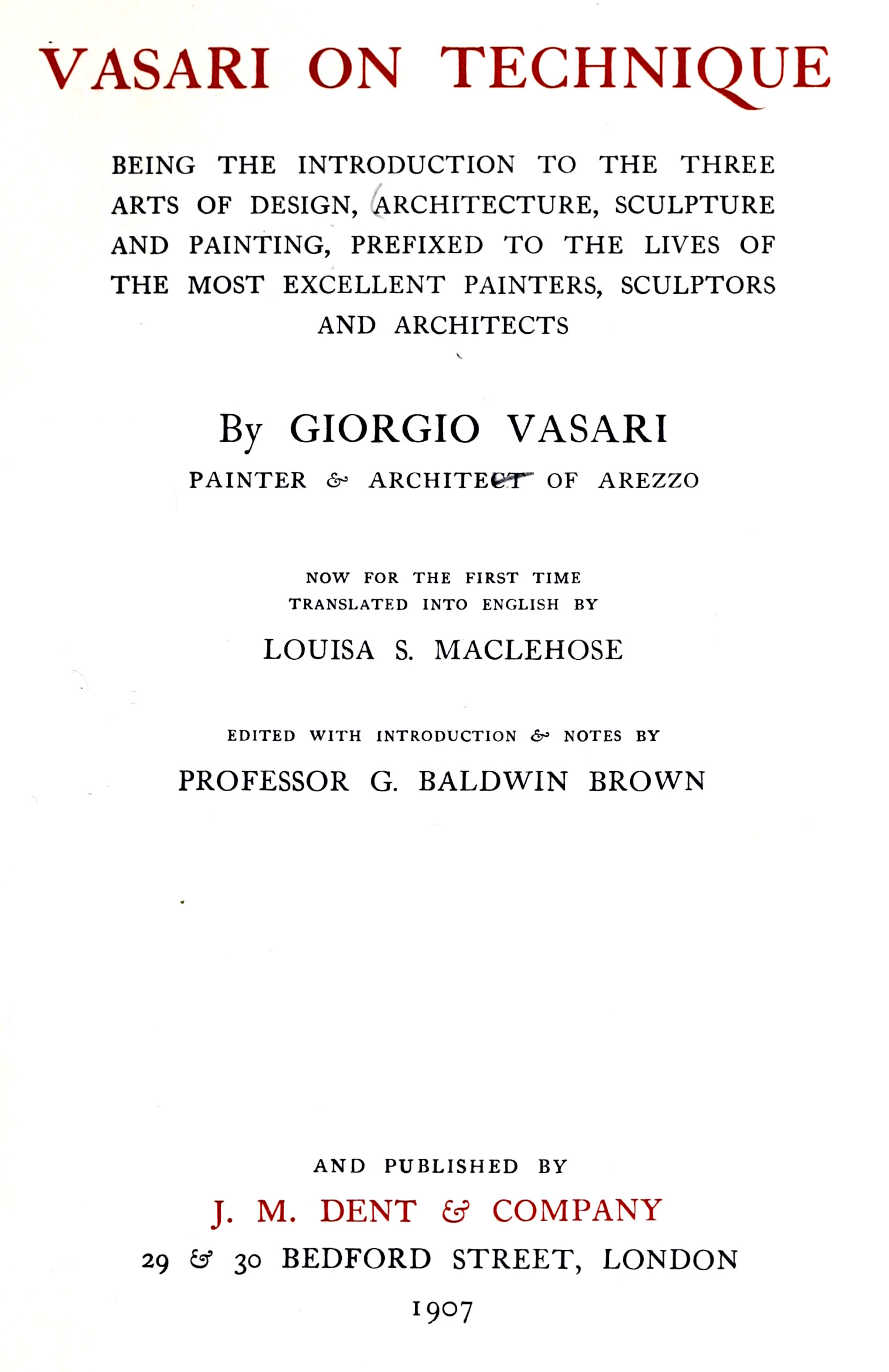
Vasari on Technique
by Giorgio Vasari
★★★★★No ratings yet
Language: English
Sign in to rate this book.
Sign in to shelve this book.
About this eBook
- Author
- Vasari, Giorgio, 1511-1574
- Title
- Vasari on technique : Being the introduction to the three arts of design, architecture, sculpture, and painting. Prefixed to the lives of the most excellent painters, sculptors and architects
- Original Publication
- London: J. M. Dent & Company, 1907.
- Credits
- Richard Tonsing, deaurider, and the Online Distributed Proofreading Team at www.pgdp.net (This file was produced from images generously made available by The Internet Archive)
- Language
- English
- LoC Class
- N: Fine Arts
- Subject
- Sculpture -- Early works to 1800
- Category
- Text
- eBook-No.
- 73397
- Project Gutenberg
- https://www.gutenberg.org/ebooks/73397
- Release Date
- April 14, 2024
- Copyright
- Public domain in the USA.
Contents
- 1.VASARI ON TECHNIQUE BEING THE INTRODUCTION TO THE THREE ARTS OF DESIGN, ARCHITECTURE, SCULPTURE AND PAINTING, PREFIXED TO THE LIVES OF THE MOST EXCELLENT PAINTERS, SCULPTORS AND ARCHITECTS
- 2.PREFATORY NOTE
- 3.TABLE OF CONTENTS
- 4.LIST OF ILLUSTRATIONS
- 5.INTRODUCTORY ESSAY
- 6.OF ARCHITECTURE — CHAPTER I. — § 1. The author’s object in the Discussion of Architecture. — § 2. Of the working of hard stones, and first of Porphyry. — § 3. Of Serpentine. — § 4. Of Cipollaccio. — § 5. Of Breccia (‘Mischio,’ Conglomerate). — § 6. Of Granite. — § 7. Of Paragon (Touchstone). [48] — § 8. Of Transparent Marbles for filling window openings. — § 9. Of Statuary Marbles. — § 10. Of Cipollino Marble. [72] — § 11. Of White Pisan Marble. — § 12. Of Travertine. — § 13. Of Slates. — § 14. Of Peperino. [91] — § 15. Of the Stone from Istria. [92] — § 16. Of Pietra Serena. — § 17. Of Pietra Forte. [102] — § 18. Conclusion of Chapter. — CHAPTER II. — § 19. The work of the Mason. — CHAPTER III. — § 20. Rusticated masonry and the Tuscan Order. — § 21. The Doric Order. — § 22. A constructive device to avoid charging architraves. [113] — § 23. The proportions and parts of the Doric Order. — § 24. The Ionic Order. — § 25. The Corinthian Order. — § 26. The Composite Order. — § 27. Of Terminal Figures. — § 28. German Work (the Gothic Style). — CHAPTER IV. — § 29. The Construction of enriched Stucco Vaults. — § 30. Stucco made with Marble Dust. — CHAPTER V. — § 31. Grottoes and Fountains of ‘Rocaille’ work. — CHAPTER VI. — § 32. Mosaic Pavements. — § 33. Pictorial Mosaics for Walls, etc. — CHAPTER VII. — § 34. The principles of Planning and Design. — § 35. An ideal Palace. — NOTES ON ‘INTRODUCTION’ TO ARCHITECTURE — PORPHYRY AND PORPHYRY QUARRIES. — THE SASSI, DELLA VALLE, AND OTHER COLLECTIONS OF ANTIQUES OF THE EARLY PART OF THE SIXTEENTH CENTURY. — THE PORPHYRY TAZZA OF THE SALA ROTONDA OF THE VATICAN. — FRANCESCO DEL TADDA, AND THE REVIVAL OF SCULPTURE IN PORPHYRY. — THE CORTILE OF THE BELVEDERE IN THE VATICAN, IN THE SIXTEENTH CENTURY. — PARAGON (TOUCHSTONE) AND OTHER STONES ASSOCIATED WITH IT BY VASARI. — TUSCAN MARBLE QUARRIES. — THE ROUND TEMPLE ON THE PIAZZA S. LUIGI DEI FRANCESI, AND ‘MAESTRO GIAN.’ — LIST OF TUSCAN MARBLE QUARRIES WITH THEIR PRODUCTS, AS FAR AS THESE ARE MENTIONED BY VASARI. — RUSTICATED MASONRY. — VASARI’S OPINION ON MEDIAEVAL ARCHITECTURE. — EGG-SHELL MOSAIC. — IDEAL ARCHITECTURE; AN IDEAL PALACE.
- 7.OF SCULPTURE — CHAPTER I. (VIII.) — § 36. The Nature of Sculpture. — § 37. Qualities necessary for Work in the Round. — § 38. Works of Sculpture should be treated with a view to their destined position. — § 39. The Proportions of the Human Figure. — § 40. Artists must depend on their Judgement rather than on the Measuring Rule. — CHAPTER II. (IX.) — § 41. The small Sketch-Model in Wax or Clay. — § 42. The Preparation of Wax. — § 43. Polychrome Wax Effigies. [156] — § 44. The Manipulation of Wax over an Armature. — § 45. The Small Model in Clay. — § 46. The Full-sized Model in Clay. — § 47. Drapery on the Clay Model. — § 48. Transference of the Full-sized Model to the Marble Block. — § 49. Danger of dispensing with the Full-sized Model. — § 50. The Tools and Materials used in Marble Carving. — CHAPTER III. (X.) — § 51. The Origin of Reliefs. — § 52. Pictorial or Perspective Reliefs. — § 53. Low Reliefs (Bassi Rilievi). — § 54. Flat Reliefs (Stiacciati Rilievi). — CHAPTER IV. (XI.) — § 55. The Full-sized Model for Bronze. — § 56. The Piece-Mould in Plaster. — § 57. The Construction of the Core. — § 58. The Piece-Mould lined with a Skin of Wax. — § 59. This Skin of Wax applied over the Core. — § 60. The fire-resisting Envelope applied over the Wax. — § 61. The External Armature. — § 62. The Vents. — § 63. The Wax melted out. — § 64. The Mould in the Casting-pit. — § 65. The Composition of the Bronze. — § 66. Making up Imperfections. — § 67. A simpler Method of Casting small Figures and Reliefs. — § 68. Chasing the Cast and Colouring the Bronze. — § 69. Modern Tours de Force in small Castings. — CHAPTER V. (XII.) — § 70. The Fabrication of Matrices for Medals. — § 71. The Cutting of Intaglios and Cameos. — CHAPTER VI. (XIII.) — § 72. Modelled and stamped Plaster Work. — CHAPTER VII. (XIV.) — § 73. Wood Carving. — NOTES ON ‘INTRODUCTION’ TO SCULPTURE — THE NATURE OF SCULPTURE. — SCULPTURE TREATED FOR POSITION. — WAXEN EFFIGIES AND MEDALLIONS. — PROPORTIONATE ENLARGEMENT. — THE USE OF FULL-SIZED MODELS. — ITALIAN AND GREEK RELIEFS. — THE PROCESSES OF THE BRONZE FOUNDER.
- 8.OF PAINTING — CHAPTER I. (XV.) — § 74. The Nature and Materials of Design or Drawing. [186] — § 75. Use of Design (or Drawing) in the Various Arts. — § 76. Of the Nature of Painting. — CHAPTER II. (XVI.) — § 77. Sketches, Drawings, and Cartoons of different kinds. — § 78. The Use of Cartoons in Mural and Panel Painting. — CHAPTER III. (XVII.) — § 79. Foreshortenings. — CHAPTER IV. (XVIII.) — § 80. On Colouring. — CHAPTER V. (XIX.) — § 81. The Fresco process. — CHAPTER VI. (XX.) — § 82. Painting in Tempera. — CHAPTER VII. (XXI.) — § 83. Oil Painting, its Discovery and Early History. — § 84. How to Prime the Panel or Canvas. — § 85. Drawing, by transfer or directly. — CHAPTER VIII. (XXII.) — § 86. Mural Painting in Oil. — § 87. Vasari’s own Method. — CHAPTER IX. (XXIII.) — § 88. Painting on Canvas. [218] — CHAPTER X. (XXIV.) — § 89. Oil painting on Stone. — CHAPTER XI. (XXV.) — § 90. Imitative Paintings for Decorations. — CHAPTER XII. (XXVI.) — § 91. Sgraffito-work. — § 92. Grotesques, or Fanciful Devices, painted or modelled on Walls. [231] — CHAPTER XIII. (XXVII.) — CHAPTER XIV. (XXVIII.) — § 93. Methods of Gilding. — CHAPTER XV. (XXIX.) — § 94. Glass Mosaics. — § 95. The Preparation of the Mosaic Cubes. — § 96. The Fixing of the Mosaic Cubes. — CHAPTER XVI. (XXX.) — § 97. Pavements in Marble Mosaic and Monochrome. — § 98. Pavements in Variegated Tiles. — § 99. Pavements in Breccia Marble. — CHAPTER XVII. (XXXI.) — § 100. Inlays in Wood. — CHAPTER XVIII. (XXXII.) — § 101. Stained Glass Windows; their Origin and History. — § 102. The Technique of the Stained Glass Window. [271] — CHAPTER XIX. (XXXIII.) — § 103. Niello Work. — § 104. The Origin of Engraving. — § 105. Enamels over Reliefs. — CHAPTER XX. (XXXIV.) — § 106. Metal Inlays. — CHAPTER XXI. (XXXV.) — § 107. Chiaroscuro Wood Engravings. — § 108. Dependence on Design of the Decorative Arts. — NOTES ON ‘INTRODUCTION’ TO PAINTING — FRESCO PAINTING. — TEMPERA PAINTING. — OIL PAINTING. — ENRICHED FAÇADES. — STUCCO ‘GROTESQUES.’ — TARSIA WORK, OR WOOD INLAYS. — THE STAINED GLASS WINDOW. — VASARI’S DESCRIPTION OF ENAMEL WORK.
- 9.INDEX
Community reviews
Sign in to write a review.
No reviews yet.