So, back to Maaseyck and to Maastricht:
to family rejoicings and the generous welcome
of old friends, no light matter when ordered
on the good old Netherlandish scale. Anxiety
there, of course, and much curiosity here, as
to how the promise of early talent would be
justified by the ripening fruit. Nor could the
issue have been long in doubt. The indispensable
test triumphantly passed, the customary
formalities duly complied with, and Hubert
van Eyck took his place among the master
painters of his time, soon to claim rank among
the élite of them all. Of wife or children not
a whisper, but in an age when civism spelt
patriotism, and marriage was recognised as
one of the prime moral obligations of a loyal
citizen, it is inconceivable that a man of his
sterling sense of duty should have done other
than conform to the established practice. His
home and workshop were from the outset probably
cheered by the presence of his younger
brother John, fired by the born artist's enthusiasm
to follow in his senior's footsteps. This
Maastricht studio no doubt also witnessed the
inception of that long series of experiments,
secretly shared in by the two brothers until
carried to perfection, which gave to the world
the new art of oil-painting, and so laid all the
after ages under the deepest obligation to
them.
[24]
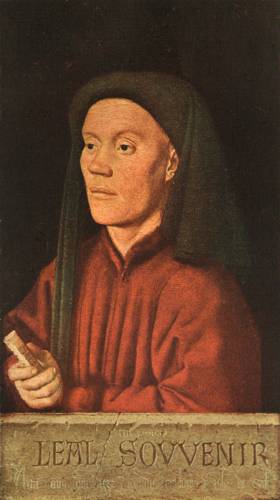
PLATE III.—PORTRAIT OF "TYMOTHEOS"
(By John van Eyck)
A Presentation Portrait, probably from the Painter to his friend
"Timothy," a Greek humanist whose Christian name only is known.
The inscription at the foot reads: "Actum anno Domini 1432,
10 die Octobris, a Iohanne de Eyck." No. 290 in the National
Gallery, London. See pages 63, 64.
John's apprenticeship ended, and he in turn
started on his travels, Hubert would appear
to have removed to Holland, where painters
and miniaturists of the early years of the
fifteenth century repeatedly exhibit marked
traces of his influence; where also miniatures
in a Book of Hours, of date 1412 to 1417, to
the order of Count William for the use of his
only daughter, the fair and ill-starred Jacqueline,
are judged to have been executed by him on
the strength of the many points of resemblance
they bear to the Great Polyptych. The commission
of the latter work itself is now confidently
attributed to the same prince. Observe
the prominence given to the tower of Saint
Martin's at Utrecht and the adjacent view of
Cöln in the centre-piece, "The Adoration of the
Lamb," and to St. Martin himself, the patron
saint of Utrecht, in the panel of "The Knights
of Christ," the banner in his grasp, moreover,
charged with the arms of that town: the
Count's territory was in the diocese of Utrecht
and the ecclesiastical province of Cöln. So
much depends on the origin of this commission
in apportioning the respective share each of
the brothers had in its execution that the
further fact must not be overlooked that Ghent,
for which the great work was completed, had
no sort of connection with either Utrecht or
Cöln, being in the diocese of Tournay and
the ecclesiastical province of Rheims, while the
only saint in the altar-piece specially connected
with Ghent who is characterised by an emblem—St.
Livin, to wit—was also widely venerated
in Zeeland. Finally, not to labour this
aspect of the question unduly, the inscription
on the frame attributes, not the picture's inception,
but its completion, to Jodoc Vyt, the
eventual donor—a form of words so singular
as to admit of no other interpretation than the
plain meaning the expression conveys.
Count William passed away on the 31st of
May 1417, leaving an only child, Jacqueline, aged
seventeen, by his wife, Margaret of Burgundy,
who had predeceased him. Her uncle, John of
Bavaria, Prince-Bishop of Liège, an unscrupulous
ruffian who clearly paid small deference to
women's rights, at once set himself to rob the
unfortunate princess of her possessions. In
September 1418 he marched out on Dordrecht,
where he established his headquarters; Gorcum
and other strongholds speedily succumbed to
his arms, and after an interval, during which he
married Elizabeth of Görlitz, Duchess of Luxemburg
and widow of Anthony of Burgundy, Duke
of Brabant and Limburg, he finally removed to
Holland and installed himself at The Hague,
free now to pursue his nefarious projects. For
thirteen years the country resounded with the
clash of arms and laboured in the rough and
tumble of civil warfare: hence an atmosphere
the least congenial to the cultivation and
patronage of high art. The cities of Flanders
and Brabant were the gainers by the exodus of
craftsmen that presently set in. Of their number,
sooner or later, was Hubert, who, prior to 1425
at any rate, had already settled at Ghent and
acquired the freedom of that city. News of the
unfinished polyptych remaining on his hands
soon came to the ears of Jodoc Vyt, a wealthy
burgher, who eagerly embraced the opportunity
of striking the bargain by which he acquired all
rights in the picture and so linked his name
and personality for all time with this ineffable
monument of the painter's art.
In the centre-piece, "The Adoration of the
Lamb" (frontispiece), we discover the keynote
to the scheme of the work, in the Apocalyptic
Vision of St. John the source of its inspiration.
The Lamb without spot, the blood from its
breast pouring into a chalice, is stood on an
altar, the white cloth over which bears on its
superfrontal the text from the Vulgate, "Behold
the Lamb of God, who taketh away the sins of
the world," and on its stole-ends the legend,
"Jesus, the Way, the Truth, and the Life."
Worshipping angels gather around, some bearing
instruments of the Passion, others swinging
censers, their smoke laden with the prayers of
the saints. In the foreground the Fountain of
Life, flowing down through the ages along the
gentle slope of flower-bejewelled sward, or dispensing
its waters in vivifying jets from the
gurgoyles beneath the feet and from the vases
in the hands of the winged angel above its
standard. To the four quarters groups of the
elect: on the near right those of the Old Law
and among the Gentiles who had lived in expectation
of the Redeemer, the balancing group
on the left typical of the New Law—prophets,
doctors, philosophers, and princes in the former,
the Apostles, popes, bishops, abbots, deacons,
monks, and clerics among the latter. The corresponding
groups back of the altar represent
the army of martyrs whose blood is the seed
of the Church, and the multitude of virgins.
Over all, from the Holy Dove poised high over
the altar, dart rays of light, emblematic of the
Wisdom which had inspired their lives and of
the fire of Love that had heartened their sacrifice.
A carpet of flowers fills in all the open space
fore of the altar, flowering shrubs and trees
that of the mid-distance, while the entire background
is an exquisite example of the realistic
landscape-work that is an abiding charm of the
Netherlandish school. The wonderful harmony
of colour appeals at once to the senses; but
more arresting, on nearer acquaintance, for its
quality and felicity, is the wide range of portraiture
that distinguishes the piece. From the
two lateral panels in the dexter shutter the
Knights of Christ and the Just Judges are pressing
forward to the scene of the Vision, from
the corresponding ones in the sinister shutter
the Holy Hermits and the Holy Pilgrims: the
former on spirited horses—an animal for which
the painter evinces a special affection—the latter
on foot. These panels are even more remarkable
perhaps than the centre-piece for the diversity
and multiplicity of the types portrayed, and for
the wealth of landscape relieved by bird life
lavished in their embellishment.
The "Adoration of the Lamb" is dominated
in the upper zone by a triple panel, the centre
framing the Almighty enthroned in majesty,
whose is the kingdom, the power, and the glory—a
supreme conception of the Eternal Father,
unequalled for majestic stillness of face, intellectual
power of brow, and depth and placidity
of vision; on His right is the Mother of Christ,
testifying to the full the lowliness of the handmaiden
of the Lord, on His left St. John
the Baptist, an earnest type, long of hair and
rugged of beard, barefooted, and in a raiment
of brown camel's hair girdled about the loins,
intensifying the austerity of life ordained for
him who was to prepare the way of the Lord
and make straight His paths. In the "Choir
of Angels" (Plate II.), which is the subject of
the first lateral panel in the dexter shutter, we
have one of the choicest gems of the polyptych,
and it affords us a measure of the distance the
realistic tendencies of the painter had carried
him from the traditions of the mystic school.
Justified by the warrant of Scripture, he translates
these spirit beings into purely human
frames, but with a nerve system attuned to
material sensations. In these angels there is
no suggestion of trance-like ecstasy in contemplation
of the Beatific Vision; they are
angels materialised whose features reflect the
strain of sustained effort and the underlying
sense of pain which in man is inseparable from
the sensing of intense joy. Evidently the master
had fathomed the secrets of the human heart:
the sense possibilities of the spirit world were
without his ken, so he humanised his angels
and evolved types understandable of the people,
and at the same time one of the finest angel
groups of all art. So inexpressibly realistic are
his conceptions that to the poet-biographer Van
Mander, at any rate, it was actually possible to
discern "the different key in which the voice
of each is pitched." But poets are privileged
beings. Accompanying the Choir in their song
of praise with organ, harp, and viol are the
balancing group of angels in the corresponding
compartment of the sinister shutter, types that,
strangely enough, are in striking contrast to
the former, their features moulded in placid contentment.
The extreme panels of this zone
are occupied by life-size presentations of our
First Parents after the Fall, nude figures painted
from the life, with absolute fidelity to nature
and masterly conception of type: in a demi-lunette
over the figure of Adam we see Cain
and Abel making their offerings unto the Lord,
and in that over Eve the slaying of Abel at
the hands of his brother. There is a tradition
extant that the altar-piece was originally furnished
with a predella painted in distemper, a
picture probably of Limbo or of Purgatory, but
no trace of this remains.
[34]
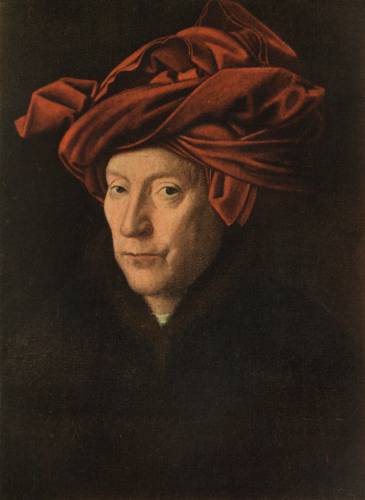
PLATE IV.—PORTRAIT OF THE PAINTER'S
FATHER-IN-LAW
(By John van Eyck)
The subject of this painting has only within recent months been
identified as the father of Margaret van Eyck, with whose portrait,
reproduced in Plate VII., it should be compared. The framework
bears along the upper border the Painter's simple motto "Als ich
can," and at the foot "Iohannes de Eyck me fecit anno 1433,
21 Octobris." No. 222 in the National Gallery, London. See
page 66.
The closed shutters display, filling in the
full width of the middle zone, the scene of the
Annunciation. The Ethyrean Sibyl and the
Cumaean Sibyl occupy the demi-lunettes above
the middle portion of the Virgin's chamber, the
lunettes above the lateral divisions showing
half-length figures of the Prophets Zacharias
and Micheas. Of the four compartments of the
lower zone the inner ones contain statues in
grisaille of St. John the Baptist and St. John
the Evangelist, the outer ones figures in the
attitude of prayer, eminently life-like, of the
donor, Jodoc Vyt, and his wife, Elizabeth
Borluut. Jodoc was the second son of Sir
Nicholas Vyt, Receiver of Flanders,—a wealthy
citizen who owned the lordships of Pamele and
Leedberghe, besides several mansions in Ghent,
of which city he was burgomaster in 1433-34,
after filling various minor municipal offices: by
no means a handsome type, though manifestly a
capable and kindly burgher, well-set, with a somewhat
low forehead, small grey eyes, and a large
mouth with broad under-lip; neither do the short-cropped
hair and growing baldness or the three
warts on upper-lip, nose, and forehead make for
attractiveness. In respect of looks his wife is
the better favoured, striking the beholder as an
indulgent lady, with much of the homely dignity
and serenity of the finer type of Flemish matron.
The Great Polyptych had not yet reached
completion when, on the 18th of September 1426
Hubert van Eyck passed away after a painful
illness. How much of the work remained to be
accomplished none can tell with any hope of
approach to certainty. A whole volume would
not suffice for a critical examination of the
mass of contending theories that for the best
part of a century has been squandered in the
endeavour to allocate to the two brothers their
respective shares in the execution of the picture.
Remember that it had already been some ten
years in the making, and that, although it did
not receive its final touches from the brush of
John van Eyck until 1432, nearly six years after
his brother's death, this period of John's life,
as we shall presently discover, was too fully
occupied in the service of Duke Philip of
Burgundy to have allowed of his spending any
considerable proportion of it in the task of completion.
Remembering also that John's art had
been closely modelled on that of his brother, that
none better comprehended his ideals or was
more intimately acquainted with the working
out of his conceptions, mindful, moreover, of the
deep veneration in which he held his master's
genius, we must suppose that he realised the
obligation of conscientiously adhering to the
art and technique of the picture as he found it,
any obtruding originality in violation of which
would have amounted almost to sacrilege: all
this further enhances the difficulty of differentiating
between the work of the two painters.
Indeed, if so minded, the reader is probably as
well equipped as the writer to solve the puzzle.
[40]
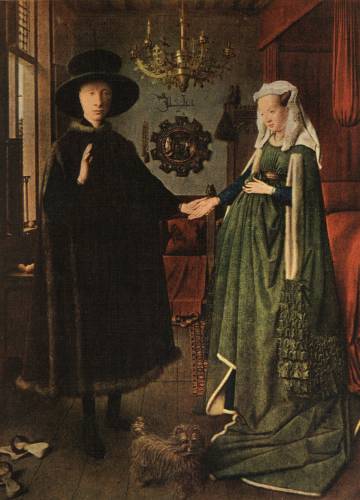
PLATE V.—JOHN ARNOLFINI AND JOAN CENANI,
HIS WIFE
(By John van Eyck)
An incomparable example of the Master's varied gifts, and a
valuable study of contemporary dress and domestic furniture. Joan
Cenani is presumed to have been a younger sister of Margaret van
Eyck, with whose portrait, reproduced in Plate VII., it should be
compared. The carved frame of the mirror on the far wall enshrines
ten small medallions, exquisite miniatures representing the Agony
in the Garden, the Betrayal and St. Peter's Assault on Malchus,
Christ led before Pilate, the Scourging at the Pillar, the Carrying of
the Cross, Calvary, the Deposition, the Entombment, the Descent
into Limbo, and the Resurrection. On the wall above the mirror
we read the precise statement, "Iohannes de eyck fuit hic 1434."
No. 186 in the National Gallery, London. See page 67.
Hubert van Eyck was laid to rest in the
crypt of the chapel for which he had painted
his masterpiece, but in 1533, when chapel and
crypt had to make way for a new aisle, his
remains were transferred to the churchyard, all
except the bone of the right fore-arm, which
was suspended in an iron casket in the porch
of the Cathedral. The brass plate bearing the
well-known epitaph was at the same time placed
in the transept, only to become the spoil of
the Calvinist Iconoclasts in 1578, when already
the casket had somehow or other long since
disappeared. But what of the painter's fame,
to whose workshop laymen of the highest distinction
had felt it a privilege to be admitted,
about whose easel journeymen painters had
flocked, and whom the leading contemporary
artists of the Netherlands had been proud to
call master? During his lifetime, and for a considerable
period after his death, his was a dominating
influence in the Art of the North, and
Van Mander has it on record that whenever the
polyptych was freely exposed to the public gaze
crowds flocked to it from morning till night
"like flies and bees in summer round a basket
of figs and grapes." But in the stress and
turmoil of succeeding generations his memory
gradually faded away; his work, uncared for,
lost hold on the imagination; even his great
masterwork narrowly escaped destruction. Even
so it did not escape dismemberment, or profanation
at the hands of the "restorer." Saved
from the fury of the Iconoclasts in 1566, and
subsequently rescued from the Calvinist leaders
who contemplated its offer to Queen Elizabeth
in acknowledgment of her subsidies, it eventually
became the spoil of the French Republicans;
but after the battle of Waterloo restitution was
effected, and the main portion of the altar-piece,
all that remains of it in Ghent, was reinstated
in its present position. The Adam and Eve
panels, which in 1781 had offended the unsuspected
modesty of Joseph II., and in consequence
been deferentially removed, were ultimately
ceded to the Belgian Government, and now rest
in the Royal Gallery at Brussels; while the other
six shutter panels, which had been safeguarded
through the French occupation, were shamelessly
sold to a dealer in 1816 by the Vicar-General
and churchwardens—in the absence, it
is right to say, of the Bishop—for a paltry 3000
florins, subsequently changing hands for 100,000
francs, and eventually becoming the property of
the Prussian Government for four times that
amount.


