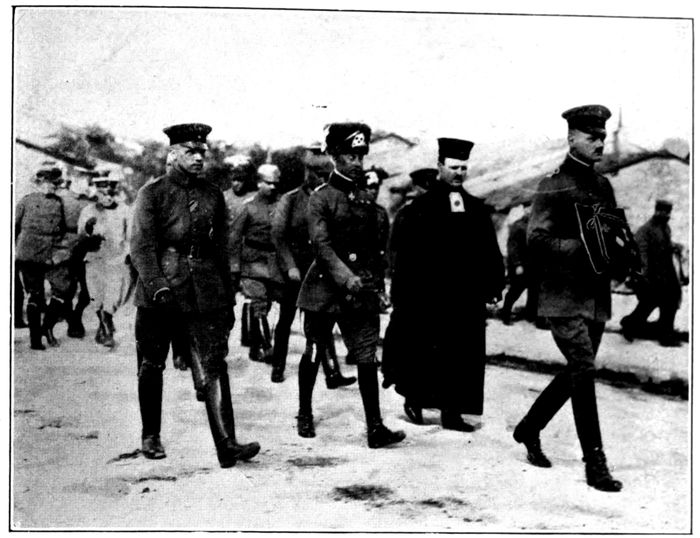
The former Crown Prince in his official face, attending the funeral of a German officer and count, whose military orders are carried on the cushion in front
I did not go into Germany with any foreformed hypotheses
as a skeleton for which to seek flesh; I went to
report exactly what I found there. I am satisfied that
there were dastardly acts during the war, and conditions
inside the country, of which no tangible proofs remained
at the time of my journey; but there are other accusations
concerning which I am still “from Missouri.” I am as
fully convinced as any one that we have done a good deed
in helping to overthrow the nefarious dynasty of Hohenzollernism
and its conscienceless military clique; I believe
the German people often acquiesced in and sometimes
applauded the wrong-doings of their former rulers. But
I cannot shake off the impression that the more voiceless
mass of the nation were under a spell not unlike that cast
by the dreadful dragons of their own old legends, and that
we should to a certain extent take that fact into consideration
in judging them under their new and more or less
dragonless condition. I propose, therefore, that the reader
free himself as much as possible from his natural repulsion
toward its people before setting out on this journey through
the Hungary Empire, to the end that he may gaze about
him with clear, but unprejudiced, eyes. There has been
too much reporting of hearsay evidence, all over the world,
during the past few years, to make any other plan worth
the paper.
Harry A. Franck.
VAGABONDING THROUGH
CHANGING GERMANY
I ON TO THE RHINE
1
For those of us not already members of the famous
divisions that were amalgamated to form the Army of
Occupation, it was almost as difficult to get into Germany
after the armistice as before. All the A. E. F. seemed to
cast longing eyes toward the Rhine—all, at least, except
the veteran minority who had their fill of war and its
appendages for all time to come, and the optimistic few who
had serious hopes of soon looking the Statue of Liberty
in the face. But it was easier to long for than to attain.
In vain we flaunted our qualifications, real and self-bestowed,
before those empowered to issue travel orders. In vain did
we prove that the signing of the armistice had left us duties
so slight that they were not even a fair return for the salary
Uncle Sam paid us, to say nothing of the service we were
eager to render him. G. H. Q. maintained that sphinxlike
silence for which it had long been notorious. The lucky
Third Army seemed to have taken on the characteristics
of a haughty and exclusive club boasting an inexhaustible
waiting-list.
What qualifications, after all, were those that had as their
climax the mere speaking of German? Did not at least the
2Wisconsin half of the 33d Division boast that ability to a
man? As to duties, those of fighting days were soon replaced
by appallingly unbellicose tasks which carried us
still farther afield into the placid wilderness of the S O S
trebly distant from the scene of real activity. But a pebble
dropped into the sea of army routine does not always fail
to bring ripples, in time, to the shore. Suddenly one day,
when the earthquaking roar of barrages and the insistent
screams of air-raid alertes had merged with dim memories
of the past, the half-forgotten request was unexpectedly
answered. The flimsy French telegraph form, languidly
torn open, yielded a laconic, “Report Paris prepared enter
occupied territory.”
The change from the placidity of Alps-girdled Grenoble
to Paris, in those days “capital of the world” indeed, was
abrupt. The city was seething with an international life
such as even she had never before gazed upon in her history.
But with the Rhine attainable at last, one was in no mood
to tarry among the pampered officers dancing attendance
on the Peace Conference—least of all those of us who had
known Paris in the simpler, saner days of old, or in the
humanizing times of war strain.
The Gare de l’Est was swirling with that incredible
tohubohu, that headless confusion which had long reigned
at all important French railway stations. Even in the sixteen
months since I had first seen Paris under war conditions
and taken train at Chaumont—then sternly hidden
under the pseudonym of “G. H. Q.”—that confusion had
trebled. Stolid Britons in khaki and packs clamped their
iron-shod way along the station corridors like draft-horses.
Youthful “Yanks,” not so unlike the Tommies in garb as
in manner, formed human whirlpools about the almost unattainable
den of the American A. P. M. Through compact
throngs of horizon blue squirmed insistent poilus, sputtering
some witty bon mot at every lunge. Here and there circled
3eddies of Belgian troopers, their cap-tassels waving with the
rhythm of their march. Italian soldiers, misfitted in crumpled
and patched dirty-gray, struggled toward a far corner
where stood two haughty carabinieri directly imported from
their own sunny land, stubby rifles, imposing three-cornered
hats, and all. At every guichet or hole in the wall waited
long queues of civilians, chiefly French, with that uncomplaining
patience which a lifetime, or at least a war-time, of
standing in line has given a race that by temperament and
individual habit should be least able to display patience.
Sprightly grisettes tripped through every opening in the
throng, dodging collisions, yet finding time to throw a coquettish
smile at every grinning “Sammy,” irrespective of
rank. Wan, yet sarcastic, women of the working-class
buffeted their multifarious bundles and progeny toward the
platforms. Flush-faced dowagers, upholstered in their
somber best garments, waddled hither and yon in generally
vain attempts to get the scanty thirty kilos of baggage, to
which military rule had reduced civilian passengers, aboard
the train they hoped to take. Well-dressed matrons laboriously
shoved their possessions before them on hand-trucks
won after exertions that had left their hats awry and their
tempers far beyond the point that speech has any meaning,
some with happy, cynical faces at having advanced that far
in the struggle, only to form queue again behind the always
lengthy line of enforced patience which awaited the good
pleasure of baggage-weighers, baggage-handlers, baggage-checkers,
baggage-payment receiving-clerks. Now and then
a begrimed and earth-weary female porter, under the official
cap, bovinely pushed her laden truck into the waiting
throngs, with that supreme indifference to the rights and
comfort of others which couples so strangely with the social
and individual politeness of the French. Once in a while
there appeared a male porter, also in the insignia so familiar
before the war, sallow and fleshless now in comparison
4with his female competitors, sometimes one-armed or shuffling
on a half-useless leg. It would have been hard to find
a place where more labor was expended for less actual
accomplishment.
At the train-gate those in uniform, who had not been
called upon to stand in line for hours, if not for days, to get
passports, to have them stamped and visaed, to fulfil a
score of formalities that must have made the life of a civilian
without official backing not unlike that of a stray cur in
old-time Constantinople, were again specially favored.
Once on the platform—but, alas! there was no escaping
the crush and goal-less helter-skelter of the half-anarchy
that had befallen the railway system of France in the last
supreme lunge of the war. The Nancy-Metz express—the
name still seemed strange, long after the signing of the
armistice—had already been taken by storm. What shall
it gain a man to have formed queue and paid his franc
days before for a reserved place if the corridors leading
to it are so packed and crammed with pillar-like poilus,
laden with equipment enough to stock a hardware-store,
with pack-and-rifle-bearing American doughboys, with the
few lucky civilians who reached the gates early enough to
worm their way into the interstices left, that nothing short
of machine-gun or trench-mortar can clear him an entrance
to it?
Wise, however, is the man who uses his head rather than
his shoulders, even in so unintellectual a matter as boarding
a train. About a parlor-coach, defended by gendarmes,
lounged a half-dozen American officers with that casual,
self-satisfied air of those who “know the ropes” and are
therefore able to bide their time in peace. A constant
stream of harried, disheveled, bundle-laden, would-be passengers
swept down upon the parlor-car entrance, only to
be politely but forcibly balked in their design by the guardsmen
with an oily, “Reserved for the French Staff.” Thus
5is disorder wont to breed intrigue. The platform clock had
raised its hands to strike the hour of departure when the
lieutenant who had offered to share his previous experience
with me sidled cautiously up to a gendarme and breathed
in his ear something that ended with “American Secret
Service.” The words themselves produced little more effect
than there was truth in the whispered assertion. But the
crisp new five-franc note deftly transferred from lieutenant
to gendarme brought as quick results as could the whisper
of “bakshish” in an Arab ear. We sprang lightly up the
guarded steps and along a corridor as clear of humanity
as No Man’s Land on a sunny noonday. Give the French
another year of war, with a few more millions of money-sowing
Allies scattered through the length and breadth of
their fair land, and the back-handed slip of a coin may become
as universal an open sesame as in the most tourist-haunted
corner of Naples.
Another banknote, as judiciously applied, unlocked the
door of a compartment that showed quite visible evidence
of having escaped the public wear and tear of war, due, no
doubt, to the protection afforded it by those magic words,
“French Staff.” But when it had quickly filled to its quota
of six, one might have gazed in vain at the half-dozen
American uniforms, girdled by the exclusive “Sam Browne,”
for any connection with the French, staff or otherwise,
than that which binds all good allies together. The train
glided imperceptibly into motion, yet not without carrying
to our ears the suppressed grunt of a hundred stomachs
compressed by as many hard and unwieldy packs in the
coach ahead, and ground away into the night amid the
shouts of anger, despair, and pretended derision of the
throng of would-be travelers left behind on the platform.
“Troubles over,” said my companion, as we settled down
to such comfort as a night in a European train compartment
affords. “Of course we’ll be hours late, and there will be
6a howling mob at every station as long as we are in France.
But once we get to Metz the trains will have plenty of room;
they’ll be right on time, and all this mob-fighting will be
over.”
“Propaganda,” I mused, noting that in spite of his manner,
as American as his uniform, the lieutenant spoke with
a hint of Teutonic accent. We had long been warned to
see propaganda by the insidious Hun in any suggestion of
criticism, particularly in the unfavorable comparison of
anything French with anything German. Did food cost
more in Paris than on the Rhine? Propaganda! Did some
one suggest that the American soldiers, their fighting task
finished, felt the surge of desire to see their native shores
again? Propaganda! Did a French waiter growl at the
inadequacy of a 10-per-cent. tip? The sale Boche had
surely been propaganding among the dish-handlers.
The same subsidized hand that had admitted us had
locked the parlor-car again as soon as the last staff pass—issued
by the Banque de France—had been collected.
Though hordes might beat with enraged fists, heels, and
sticks on the doors and windows, not even a corridor lounger
could get aboard to disturb our possible slumbers. To
the old and infirm—which in military jargon stands for all
those beyond the age of thirty—even the comfortably filled
compartment of a French wagon de luxe is not an ideal place
in which to pass a long night. But as often as we awoke
to uncramp our legs and cramp them again in another position,
the solace in the thought of what that ride might have
been, standing rigid in a car corridor, swallowing and
reswallowing the heated breath of a half-dozen nationalities,
jolted and compressed by sharp-cornered packs and poilu
hardware, unable to disengage a hand long enough to raise
handkerchief to nose, lulled us quickly to sleep again.
The train was hours late. All trains are hours late in
overcrowded, overburdened France, with her long unrepaired
7lines of communication, her depleted railway personnel,
her insufficient, war-worn rolling-stock, struggling
to carry a traffic that her days of peace never attempted.
It was mid-morning when we reached Nancy, though the
time-table had promised—to the inexperienced few who
still put faith in French horaires—to bring us there while
it was yet night. Here the key that had protected us for
more than twelve hours was found, or its counterpart produced,
by the station-master. Upon our return from
squandering the equivalent of a half-dollar in the station
buffet for three inches of stale and gravelly war-bread
smeared with something that might have been axle-grease
mixed with the sweepings of a shoe-shop, and the privilege
of washing it down with a black liquid that was called coffee
for want of a specific name, the storm had broken. It was
only by extraordinary luck, combined with strenuous physical
exertion, that we manhandled our way through the
horizon-blue maelstrom that had surged into every available
corner, in brazen indifference to “staff” privileges,
back to the places which a companion, volunteering for
that service, had kept for us by dint of something little
short of actual warfare.
From the moment of crossing, not long after, the frontier
between that was France in 1914 and German Lorraine
things seemed to take on a new freedom of movement,
an orderliness that had become almost a memory. The
train was still the same, yet it lost no more time. With a
subtle change in faces, garb, and architecture, plainly evident,
though it is hard to say exactly in what it consisted, came
a smoothness that had long been divorced from travel by
train. There was a calmness in the air as we pulled into
Metz soon after noon which recalled pre-war stations.
The platforms were ample, at least until our train began
to disgorge the incredible multitude that had somehow
found existing-place upon it. The station gates gave exit
8quickly, though every traveler was compelled to show his
permission for entering the city. The aspect of the place
was still German. Along the platform were ranged those
awe-inspiring beings whom the uninitiated among us took
to be German generals or field-officers instead of mere
railway employees; wherever the eye roamed some species
of Verboten gazed sternly upon us. But the iron hand had
lost its grip. Partly for convenience sake, partly in retaliation
for a closely circumscribed journey, years before,
through the land of the Kaiser, I had descended from the
train by a window. What horror such undisciplined barbarism
would have evoked in those other years! Now
the heavy faces under the pseudo-generals’ caps not only
gave no grimace of protest, presaging sterner measures;
not even a shadow of surprise flickered across them. The
grim Verboten signs remained placidly unmoved, like dictators
shorn of power by some force too high above to make
any show of feelings worth while.
The French had already come to Metz. One recognized
that at once in the endless queues that formed at every
window. One was doubly sure of it at sight of a temperament-harassed
official in horizon blue floundering in a
tempest of paperasses, a whirlwind of papers, ink, and unfulfilled
intentions, behind the wicket, earnestly bent on
quickly doing his best, yet somehow making nine motions
where one would have sufficed. But most of the queues
melted away more rapidly than was the Parisian custom;
and as we moved nearer, to consign our baggage or to buy
our tickets, we noted that the quickened progress was due
to a slow but methodically moving German male, still in
his field gray. He had come to the meeting-place of temperament
and Ordnung, or system. Both have their value,
but there are times and places for both.
Among the bright hopes that had gleamed before me
since turning my face toward the fallen enemy was a hot
9bath. To attain so unwonted a luxury in France was,
in the words of its inhabitants, “toute une histoire”—in
fact, an all but endless story. In the first place, the extraordinary
desire must await a Saturday. In the second,
the heater must not have fallen out of practice during its
week of disuse. Thirdly, one must make sure that no
other guest on the same floor had laid the same soapy
plans within an hour of one’s own chosen time. Fourthly,
one must have put up at a hotel that boasted a bathtub,
in itself no simple feat for those forced to live on their own
honest earnings. Fifthly—but life is too short and paper
too expensive to enumerate all the incidental details that
must be brought together in harmonious concordance before
one actually and physically got a real hot bath in France,
after her four years and more of struggle to ward off the
Hun.
But in Germany—or was it only subtle propaganda
again, the persistent rumor that hot baths were of daily
occurrence and within reach of the popular purse? At
any rate, I took stock enough in it to let anticipation play
on the treat in store, once I were settled in Germany. Then
all at once my eyes were caught by two magic words above
an arrow pointing down the station corridor. Incredible!
Some one had had the bright idea of providing a means,
right here in the station, of removing the grime of travel
at once.
A clean bathroom, its “hot” water actually hot, was
all ready in a twinkling—all, that is, except the soap.
There was nothing in the decalogue, rumor had it, that
the Germans would not violate for a bar of soap. Luckily,
the hint had reached me before our commissary in Paris
was out of reach. Yet, soap or no soap, the population
managed to keep itself as presentable as the rank and file
of civilians in the land behind us. The muscular young
barber who kept shop a door or two beyond was as spick
10and span as any to whom I remembered intrusting my
personal appearance in all France. He had, too, that
indefinable something which in army slang is called
“snappy,” and I settled down in his chair with the genuine
relaxation that comes with the ministrations of one who
knows his trade. He answered readily enough a question
put in French, but he answered it in German, which brought
up another query, this time in his mother-tongue.
“Nein,” he replied, “I am French through and through,
’way back for generations. My people have always been
born in Lorraine, but none of us younger ones speak much
French.”
Yes, he had been a German soldier. He had worn the
feldgrau more than two years, in some of the bloodiest
battles on the western front, the last against Americans.
It seemed uncanny to have him flourishing a razor about
the throat of a man whom, a few weeks before, he had
been in duty bound to slay.
“And do you think the people of Metz really like the
change?” I asked, striving to imply by the tone that I
preferred a genuine answer to a diplomatic evasion.
“Ja, sehen Sie,” he began, slowly, rewhetting his razor,
“I am French. My family has always looked forward
to the day when France should come back to us. A-aber”—in
the slow guttural there was a hint of disillusionment—“they
are a wise people, the French, but they have no
Organizationsinn—so little idea of order, of discipline.
They make so much work of simple matters. And they have
such curious rules. In the house next to me lived a man
whose parents were Parisians. His ancestors were all
French. He speaks perfect French and very poor German.
But his grandfather was born, by chance, in Germany,
and they have driven him out of Lorraine, while I, who
barely understand French and have always spoken German,
may remain because my ancestors were born here!”
11“Yet, on the whole, Metz would rather belong to France
than to Germany?”
Like all perfect barber-conversationalists he spaced his
words in rhythm with his work, never losing a stroke:
“We have much feeling for France. There was much
flag-waving, much singing of the ‘Marseillaise.’ But as
to what we would rather do—what have we to say about it,
after all?
“Atrocities? Yes, I have seen some things that should
not have been. It is war. There are brutes in all countries.
I have at least seen a German colonel shoot one of
his own men for killing a wounded French soldier on the
ground.”
The recent history of Metz was plainly visible in her
architecture—ambitious, extravagant, often tasteless buildings
shouldering aside the humble remnants of a French
town of the Middle Ages. In spite of the floods of horizon
blue in her streets the atmosphere of the city was still
Teutonic—heavy, a trifle sour, in no way chic. The skaters
down on a lake before the promenade not only spoke German;
they had not even the Latin grace of movement.
Yet there were signs to remind one that the capital of
Lorraine had changed hands. It came first in petty little
alterations, hastily and crudely made—a paper “Entrée”
pasted over an “Eingang” cut in stone; a signboard pointing
“A Trèves” above an older one reading “Nach Trier.”
A strip of white cloth along the front of a great brownstone
building that had always been the “Kaiserliches Postamt”
announced “République Française; Postes, Télégraphes,
Téléphones.” Street names had not been changed; they
had merely been translated—“Rheinstrasse” had become
also “Rue du Rhin.” The French were making no secret
of their conviction that Metz had returned to them for all
time. They had already begun to make permanent changes.
Yet many mementoes of the paternal government that had
12so hastily fled to the eastward were still doing duty as if
nothing out of the ordinary had happened. The dark-blue
post-boxes still announced themselves as “Briefkasten,”
and bore the fatherly reminder, “Briefmarken und Adresse
nicht vergessen” (“Do not forget stamps and address”).
At least the simple public could be trusted to write the
letter without its attention being called to that necessity.
Where crowds were wont to collect, detailed directions
stared them in the face, instead of leaving them to guess
and scramble, as is too often the case among our lovable
but temperamental allies.
A large number of shops were “Consigné à la Troupe,”
which would have meant “Out of Bounds” to the British
or “Off Limits” to our own soldiers. Others were merely
branded “Maison Allemande,” leaving Allied men in
uniform permission to trade there, if they chose. It might
have paid, too, for nearly all of them had voluntarily added
the confession “Liquidation Totale.” One such proprietor
announced his “Maison Principale à Strasbourg.” He
certainly was “S. O. L.”—which is armyese for something
like “Sadly out of luck.” In fact, the German residents
were being politely but firmly crowded eastward. As
their clearance sales left an empty shop a French merchant
quickly moved in, and the Boche went home to set his
alarm-clock. The departing Hun was forbidden to carry
with him more than two thousand marks as an adult, or
five hundred for each child—and der Deutsche Gott knows
a mark is not much money nowadays!—and he was obliged
to take a train leaving at 5 A.M.
On the esplanade of Metz there once stood a bronze
equestrian statue of Friedrich III, gazing haughtily down
upon his serfs. Now he lay broken-headed in the soil
beneath, under the horse that thrust stiff legs aloft, as on
a battle-field. So rude and sudden had been his downfall
that he had carried with him one side of the massive stone-and-chain
13balustrade that had long protected his pedestal
from plebeian contact. Farther on there was a still more
impressive sign of the times. On the brow of a knoll above
the lake an immense bronze of the late Kaiser—as he fain
would have looked—had been replaced by the statue of a
poilu, hastily daubed, yet artistic for all that, with the
careless yet sure lines of a Rodin. The Kaiser’s gaze—strangely
enough—had been turned toward Germany, and
the bombastic phrase of dedication had, with French sense
of the fitness of things, been left untouched—“Errichtet von
seinem dankbaren Volke.” Even “his grateful people,”
strolling past now and then in pairs or groups, could not
suppress the suggestion of a smile at the respective positions
of dedication and poilu. For the latter gazed toward his
beloved France, with those far-seeing eyes of all his tribe,
and beneath him was his war slogan, purged at last of the
final three letters he had bled so freely to efface—“On
les A.”
A German ex-soldier, under the command of an American
private, rechecked my trunk in less than a minute. The
train was full, but it was not overcrowded. Travelers
boarded it in an orderly manner; there was no erratic
scrambling, no impassable corridor. We left on time and
maintained that advantage to the end of the journey. It
seemed an anachronism to behold a train-load of American
soldiers racing on and on into Germany, perfectly at ease
behind a German crew that did its best to make the trip
as comfortable and swift as possible—and succeeded far
beyond the expectations of the triumphant invaders. In
the first-class coach, “Réservé pour Militaires,” which had
been turned over to us under the terms of the armistice,
all was in perfect working order. Half voiceless with a
cold caught on the unheated French trains on which I had
shivered my way northward from Grenoble, I found this
one too hot. The opening of a window called attention
14to the fact that Germany had been obliged to husband
her every scrap of leather; the window-tackle was now of
woven hemp. One detail suggested bad faith in fulfilling
the armistice terms—the heavy red-velvet stuff covering
the seats had been hastily slashed off, leaving us to sit on
the burlap undercoverings. Probably some undisciplined
railway employee had decided to levy on the enemy while
there was yet time for the material of a gown for his daughter
or his Mädchen. Later journeys showed many a seat
similarly plundered.
A heavy, wet snow was falling when we reached Trèves—or
Trier, as you choose. It was late, and I planned to
dodge into the nearest hotel. I had all but forgotten that
I was no longer among allies, but in the land of the enemy.
The American M. P. who demanded my papers at the station
gate, as his fellows did, even less courteously, of all
civilians, ignored the word “hotel” and directed me to the
billeting-office. Salutes were snapped at me wherever the
street-lamps made my right to them visible. The town
was brown with American khaki, as well as white with the
sodden snow. At the baize-covered desk of what had
evidently once been a German court-room a commissioned
Yank glanced at my orders, ran his finger down a long
ledger page, scrawled a line on a billeting form, and tossed
it toward me.
Beyond the Porta Nigra, the ancient Roman gate that
the would-be Romans of to-day—or yesterday—have so
carefully preserved, I lost my way in the blinding whiteness.
A German civilian was approaching. I caught myself
wondering if he would refuse to answer, and whether I
should stand on my dignity as one of his conquerors if he
did. He seemed flattered that he should have been appealed
to for information. He waded some distance out of his
way to leave me at the door I sought, and on the way he
bubbled over with the excellence of the American soldier,
15with now and then a hint at the good fortune of Trier in
not being occupied by the French or British. When he
had left me I rang the door-bell several times without result.
I decided to adopt a sterner attitude, and pounded lustily
on the massive outer door. At length a window above
opened and a querulous female voice demanded, “Wer
ist da?” To be sure, it was near midnight; but was I
not for once demanding, rather than requesting, admittance?
I strove to give my voice the peremptoriness with
which a German officer would have answered, “American
lieutenant, billeted here.”
“Ich komm’ gleich hinunter,” came the quick reply, in
almost honeyed tones.
The household had not yet gone to bed. It consisted
of three women, of as many generations, the youngest
of whom had come down to let me in. Before we reached
the top of the stairs she began to show solicitude for my
comfort. The mother hastened to arrange the easiest
chair for me before the fire; the grandmother doddered
toothlessly at me from her corner behind the stove; the
family cat was already caressing my boot-tops.
“You must have something to eat!” cried the mother.
“Don’t trouble,” I protested. “I had dinner at Metz.”
“Yes, but that was four hours ago. Some milk and
eggs, at least?”
“Eggs,” I queried, “and milk? I thought there were
none in Germany.”
“Doch,” she replied, with a sage glance, “if you know
where to look for them, and can get there. I have just
been out in the country. I came on the same train you
did. But it is hard to get much. Every one goes out
scouring the country now. And one must have money.
An egg, one mark! Before the war they were never so
much a dozen.”
The eggs were fresh enough, but the milk was decidedly
16watery, and in place of potatoes there was some sort of
jellied turnip, wholly tasteless. While I ate, the daughter
talked incessantly, the mother now and then adding a
word, the grandmother nodding approval at intervals,
with a wrinkled smile. All male members of the family
had been lost in the war, unless one counts the second
fiancée of the daughter, now an officer “over in Germany,”
as she put it. When I started at the expression she smiled:
“Yes, here we are in America, you see. Lucky for us,
too. There will never be any robbery and anarchy here,
and over there it will get worse. Anyhow, we don’t feel
that the Americans are real enemies.”
“No?” I broke in. “Why not?”
“Ach!” she said, evasively, throwing her head on one
side, “they ... they.... Now if it had been the
French, or the British, who had occupied Trier.... At
first the Americans were very easy on us—too easy” (one
felt the German religion of discipline in the phrase). “They
arrived on December first, at noon, and by evening every
soldier had a sweetheart. The newspapers raged. It was
shameful for a girl to give herself for a box of biscuits,
or a cake of chocolate, or even a bar of soap! But they
had been hungry for years, and not even decency, to say
nothing of patriotism, can stand out against continual
hunger. Besides, the war—ach! I don’t know what has
come over the German woman since the war!
“But the Americans are stricter now,” she continued,
“and there are new laws that forbid us to talk to the soldiers—on
the street....”
“German laws?” I interrupted, thoughtlessly, for, to
tell the truth, my mind was wandering a bit, thanks either
to the heat of the porcelain stove or to her garrulousness,
equal to that of any méridionale from southern France.
“Nein, it was ordered by General Pershing.” (She
pronounced it “Pear Shang.”)
17Stupid of me, but my change from the land of an ally
to that of an enemy had been so abrupt, and the evidence
of enmity so slight, that I had scarcely realized it was our
own commander-in-chief who was now reigning in Trier.
I covered my retreat by abruptly putting a question about
the Kaiser. Demigod that I had always found him in the
popular mind in Germany, I felt sure that here, at least,
I should strike a vibrant chord. To my surprise, she
screwed up her face into an expression of disgust and drew
a finger across her throat.
“That for the Kaiser!” she snapped. “Of course, he
wasn’t entirely to blame; and he wanted to quit in nineteen-sixteen.
But the rich people, the Krupps and the like,
hadn’t made enough yet. He didn’t, at least, need to run
away. If he had stayed in Germany, as he should have, no
one would have hurt him; no living man would have
touched a hair of his head. Our Crown Prince? Ach! The
Crown Prince is leichtsinnig (light-minded).”
“Of course, it is natural that the British and French
should treat us worse than the Americans,” she went on,
unexpectedly harking back to an earlier theme. “They
used to bomb us here in Trier, the last months. I have
often had to help Grossmutter down into the cellar”—Grossmutter
smirked confirmation—“but that was nothing
compared to what our brave airmen did to London and
Paris. Why, in Paris they killed hundreds night after
night, and the people were so wild with fright they trampled
one another to death in trying to find refuge....”
“I was in Paris myself during all the big raids, as well
as the shelling by ‘Grosse Bertha,’” I protested, “and I
assure you it was hardly as bad as that.”
“Ah, but they cover up those things so cleverly,” she
replied, quickly, not in the slightest put out by the contradiction.
“There is one thing the Americans do not do well,” she
18rattled on. “They do not make the rich and the influential
contribute their fair share. They make all the people (das
Volk) billet as many as their houses will hold, but the rich
and the officials arrange to take in very few, in their big
houses. And it is the same as before the war ended, with
the food. The wealthy still have plenty of food that they
get through Schleichhandel, tricky methods, and the Americans
do not search them. Children and the sick are supposed
to get milk, and a bit of good bread, or zwiebach.
Yet Grossmutter here is so ill she cannot digest the war-bread,
and still she must eat it, for the rich grab all the better
bread, and, as we have no influence, we cannot get her
what the rules allow.”
I did not then know enough of the American administration
of occupied territory to remind her that food-rationing
was still entirely in the hands of the native officials.
I did know, however, how prone conquering armies
are to keep up the old inequalities; how apt the conqueror
is to call upon the “influential citizens” to take high places
in the local administration; and that “influential citizens”
are not infrequently so because they have been the most
grasping, the most selfish, even if not actually dishonest.
Midnight had long since struck when I was shown into
the guest-room, with a triple “Gute Nacht. Schlafen Sie wohl.”
The deep wooden bedstead was, of course, a bit too short,
and the triangular bolster and two large pillows, taking the
place of the French round traversin, had to be reduced to
American tastes. But the room was speckless; several
minor details of comfort had been arranged with motherly
care, and as I slid down under the feather tick that does
duty as quilt throughout Germany my feet encountered—a
hot flat-iron. I had not felt so old since the day I first
put on long trousers!
My last conscious reflection was a wonder whether the
good citizens of Trier were not, perhaps, “stringing” us a
19bit with their aggressive show of friendliness, of contentment
at our presence. Some of it had been a bit too thick. Yet,
as I thought back over the evening, I could not recall a
word, a tone, a look, that gave the slightest basis to suppose
that my three hostesses were not the simple, frank, docile
Volk they gave every outward evidence of being.
The breakfast next morning consisted of coffee and bread,
with more of the tasteless turnip jelly. All three of the
articles, however, were only in the name what they purported
to be, each being Ersatz, or substitute, for the real
thing. The coffee was really roasted corn, and gave full
proof of that fact by its insipidity. But Frau Franck
served me real sugar with it. The bread—what shall one
say of German war-bread that will make the picture dark
and heavy and indigestible enough? It was cut from just
such a loaf as I had seen gaunt soldiers of the Kaiser hugging
under one arm as they came blinking up out of their dugouts
at the point of a doughboy bayonet, and to say that
such a loaf seemed to be half sawdust and half mud, that it
was heavier and blacker than any adobe brick, and that
its musty scent was all but overpowering, would be far too
mild a statement and the comparison an insult to the mud
brick. The mother claimed it was made of potatoes and
bad meal. I am sure she was over-charitable. Yet on
this atrocious substance, which I, by no means unaccustomed
to strange food, tasted once with a shudder of disgust, the
German masses had been chiefly subsisting since 1915.
No wonder they quit! The night before the bread had been
tolerable, having been brought from the country; but the
three women had stayed up munching that until the last
morsel had disappeared.
The snow had left the trees of Trier beautiful in their
winding-sheets, but the streets had already been swept.
It seemed queer, yet, after sixteen months of similar experience
in France, a matter of course to be able to ask one’s
20way of an American policeman on every corner of this
ancient German town. In the past eight years I had been
less than two in my native land, yet I had a feeling of
knowing the American better than ever before; for to take
him out of his environment is to see him in close-up perspective,
as it were. Even here he seemed to feel perfectly
at home. Now and then a group of school-girls playfully
bombarded an M. P. with snowballs, and if he could not
shout back some jest in genuine German, he at least said
something that “got across.” The populace gave us our
fair half of the sidewalk, some making a little involuntary
motion as if expecting an officer to shove them off it entirely,
in the orthodox Prussian manner. Street-cars were free to
wearers of the “Sam Browne”; enlisted men paid the
infinitesimal fare amid much good-natured “joshing” of
the solemn conductor, with his colonel’s uniform and his
sackful of pewter coins.
On railway trains tickets were a thing of the past to
wearers of khaki. To the border of Lorraine we paid the
French military fare; once in Germany proper, one had only
to satisfy the M. P. at the gate to journey anywhere within
the occupied area. At the imposing building out of which
the Germans had been chased to give place to our “Advanced
G. H. Q.,” I found orders to proceed at once to Coblenz,
but there was time to transgress military rules to the extent
of bringing Grossmutter a loaf of white bread and a can of
condensed milk from our commissary, to repair my damage
to the family larder, before hurrying to the station. Yank
guardsmen now sustained the contentions of the Verboten
signs, instead of letting them waste away in impotence,
as at Metz. A boy marched up and down the platform,
pushing a convenient little news-stand on wheels, and offering
for sale all the important Paris papers, as well as German
ones. The car I entered was reserved for Allied
officers, yet several Boche civilians rode in it unmolested.
21I could not but wonder what would have happened had
conditions been reversed. They were cheerful enough in
spite of what ought to have been a humiliating state of
affairs, possibly because of an impression I heard one
hoarsely whisper to another, “Oh, they’ll go home in another
six months; an American officer told me so.” Evidently
some one had been “fraternizing,” as well as receiving
information which the heads of the Peace Conference
had not yet gained.
The Schnellzug was a real express; the ride like that from
Albany to New York. Now and then we crossed the
winding Moselle, the steep, plump hills of which were
planted to their precipitous crests with orderly vineyards,
each vine carefully tied to its stalk. For mile after mile
the hills were terraced, eight-foot walls of cut stone holding
up four-foot patches of earth, paths for the workers snaking
upward between them. The system was almost exactly
that of the Peruvians under the Incas, far apart as they
were, in time and place, from the German peasant. The
two civilizations could scarcely have compared notes,
yet this was not the only similarity between them. But
then, hunger and over-population breed stern necessity
the world over, and with like necessity as with similar
experience, it is no plagiarism to have worked out the
problem in the same way. Between the vineyards, in
stony clefts in the hills useless for cultivation, orderly towns
were tucked away, clean little towns, still flecked with the
snow of the night before. Even the French officers beside
us marveled at the cleanliness of the towns en Bochie, and
at the extraordinary physical comforts of Mainz—I mean
Mayence—the headquarters of their area of occupation.
Heavy American motor-trucks pounded by along the
already dusty road beside us, alternating now and then
with a captured German one, the Kaiser’s eagles still on
its flanks, but driven by a nonchalant American doughboy,
22its steel tires making an uproar that could be plainly heard
aboard the racing express. Long freight-trains rattled
past in the opposite direction. With open-work wheels,
stubby little cars stenciled “Posen,” “Essen,” “Breslau,”
“Brüssel,” and the like, a half-dozen employees perched
in the cubbyholes on the car ends at regular intervals,
they were German from engine to lack of caboose—except
that here and there a huge box-car lettered “U. S. A.”
towered above its puny Boche fellows like a mounted guard
beside a string of prisoners. There will still be a market
for officers’ uniforms in Germany, though their military
urge be completely emasculated. Even the brakemen of
these freight-trains looked like lieutenants or captains;
a major in appearance proved to be a station guard, a
colonel sold tickets, and the station-master might easily
have been mistaken for a Feldmarschall. Some were, in
fact. For when the Yanks first occupied the region many
of their commanders complained that German officers
were not saluting them, as required by orders of the Army
of Occupation. Investigation disclosed the harmless identity
of the imposing “officers” in question. But the rule was
amended to include any one in uniform; we could not be
wasting our time to find out whether the wearer of a general’s
shoulder-straps was the recent commander of the
4th Army Corps or the town-crier. So that now Allied
officers were saluted by the police, the firemen, the mailmen—including
the half-grown ones who carry special-delivery
letters—and even by the “white wings.”
Those haughty Eisenbahnbeamten took their orders now
from plain American “bucks,” took them unquestioningly,
with signs of friendliness, with a docile, uncomplaining—shall
I say fatalism? The far-famed German discipline
had not broken down even under occupation; it carried
on as persistently, as doggedly as ever. A conductor passing
through our car recalled a “hobo” experience out in
23our West back in the early days of the century. Armed
trainmen had driven the summer-time harvest of free riders
off their trains for more than a week, until so great a multitude
of “boes” had collected in a water-tank town of Dakota
that we took a freight one day completely by storm, from
cow-catcher to caboose. And the bloodthirsty, fire-eating
brakeman who picked his way along that train, gently
requesting the uninvited railroad guests to “Give us a
place for a foot there, pal, won’t you, please?” had the
selfsame expression on his face as did this apologetic,
smirking, square-headed Boche who sidled so gently past us.
My fellow-officers found them cringing, detestably servile.
“Put a gun in their hands,” said one, “and you’d see how
quick their character would change. It’s a whole damned
nation crying ‘Kamerad!’—playing ’possum until the danger
is over.”
Probably it was. But there were times when one could
not help wondering if, after all, there was not sincerity in the
assertion of my guide of the night before:
“We are done; we have had enough at last.”
II GERMANY UNDER THE AMERICAN HEEL
24
The “Residence City” of Coblenz, headquarters of the
American Army of Occupation, is one of the finest
on the Rhine. Wealth has long gravitated toward the
triangle of land at its junction with the Moselle. The
owners—or recent owners—of mines in Lorraine make their
homes there. The mother of the late unlamented Kaiser
was fond of the place and saw to it that no factory chimneys
came to sully its skies with their smoke, or its streets
and her tender heart-strings with the wan and sooty serfs
of industrial progress. The British at Cologne had more
imposing quarters; the French at Mayence, and particularly
at Wiesbaden, enjoyed more artistic advantages. A
few of our virile warriors, still too young to distinguish real
enjoyment from the flesh-pots incident to metropolitan
bustle, were sometimes heard to grumble, “Huh! they gave
us third choice, all right!” But the consensus of opinion
among the Americans was contentment. The sudden
change from the mud burrows of the Argonne, or from the
war-worn villages of the Vosges, made it natural that some
should draw invidious comparisons between our long-suffering
ally and the apparently unscathed enemy. Those
who saw the bogy of “propaganda” in every corner accused
the Germans of preferring that the occupied territory be
the Rhineland, rather than the interior of Germany, “because
this garden spot would make a better impression
25on their enemies, particularly the Americans, so susceptible
to creature comforts.” By inference the Boche might
have offered us East Prussia or Schleswig instead! It was
hard to believe, however, that those splendid, if sometimes
top-heavy, residences stretching for miles along the Rhine
were built, twenty to thirty years ago in many cases, with
any conscious purpose of impressing the prospective enemies
of the Fatherland.
It was these creature comforts of his new billeting area
that made the American soldier feel so strangely at home
on the Rhine. Here his office, in contrast to the rude
stone casernes with their tiny tin stoves that gave off
smoke rather than heat, was cozy, warm, often well carpeted.
His billets scarcely resembled the frigid, medieval ones
of France. Now that no colonel can rank me out of it,
I am free to admit that in all my travels I have never been
better housed and servanted than in Coblenz, nor had a
more solicitous host than the staid old judge who was forced
to take me in for a mere pittance—paid in the end by his
own people. The Regierungsgebäude—it means nothing
more terrifying than “government building”—which the
rulers of the province yielded with outward good grace to
our army staff, need not have blushed to find itself in
Washington society. To be sure, we were able to dispossess
the Germans of their best, whereas the French could only
allot us what their own requirements left; yet there is
still a margin in favor of the Rhineland for material comfort.
I wonder if the American at home understands just what
military occupation means. Some of our Southerners of
the older generation may, but I doubt whether the average
man can visualize it. Occupation means a horde of armed
strangers permeating to every nook and corner of your
town, of your house, of your private life. It means seeing
what you have hidden in that closet behind the chimney;
it means yielding your spare bed, even if not doubling up
26with some other member of the family in order to make
another bed available. It means having your daughters
come into constant close contact with self-assertive young
men, often handsome and fascinating; it means subjecting
yourself, or at least your plans, to the rules, sometimes
even to the whims, of the occupiers.
The Americans came to Coblenz without any of those
bombastic formalities with which the imagination imbues
an occupation. One day the streets were full of soldiers,
a bit slow in their movements and thinking processes,
dressed in bedraggled dull gray, and the next with more
soldiers, of quick perception and buoyant step, dressed in
khaki. The new-comers were just plain fighters, still
dressed in what the shambles of the Argonne had left them
of clothing. They settled down to a shave and a bath
and such comforts as were to be had, with the unassuming
adaptability that marks the American. The Germans,
seeing no signs of those unpleasant things which had always
attended their occupation of a conquered land, probably
smiled to themselves and whispered that these Amerikaner
were strangely ignorant of military privileges. They did
not realize that their own conception of a triumphant army,
the rough treatment, the tear-it-apart-and-take-what-you-want-for-yourself
style of von Kluck’s pets, was not the
American manner. The doughboy might hate a German
man behind a machine-gun as effectively as any one, but
his hatred did not extend to the man’s women and children.
With the latter particularly he quickly showed that camaraderie
for which the French had found him remarkable,
and the plump little square-headed boys and the over-blond
little girls flocked about him so densely that an order
had to be issued requiring parents to keep their children
away from American barracks.
But the Germans soon learned that the occupiers knew
what they were about, or at least learned with vertiginous
27rapidity. A burgomaster who admitted that he might be
able to accommodate four hundred men in his town, if
given time, was informed that there would be six thousand
troops there in an hour, and that they must be lodged before
nightfall. Every factory, every industry of a size worth
considering, that produced anything of use to the Army of
Occupation, was taken over. We paid well for everything
of the sort—or rather, the Germans did in the end, under
the ninth article of the armistice—but we took it. Scarcely
a family escaped the piercing eye of the billeting officer;
clubs, hotels, recreation-halls, the very schools and churches,
were wholly or in part filled with the boyish conquerors
from overseas. We commandeered the poor man’s drinking-places
and transferred them into enlisted men’s barracks.
We shooed the rich man out of his sumptuous club and
turned it over to our officers. We allotted the pompous
Festhalle and many other important buildings to the Y. M.
C. A., and “jazz” and ragtime and burnt-cork jokes took
the place of Lieder and Männerchor. While we occupied
their best buildings, the German staff which necessity had
left in Coblenz huddled into an insignificant little house
on a side-street. Promenading citizens encountered pairs
of Yanks patrolling with fixed bayonets their favorite
Spaziergänge. Day after day throngs of Boches lined up
before the back door to our headquarters, waiting hours
to explain to American lieutenants why they wished to
travel outside our area. Though the lieutenants did not
breakfast until eight, that line formed long before daylight,
and those who did not get in before noon stood on, outwardly
uncomplaining, sometimes munching a war-bread
sandwich, until the office opened again at two, taking their
orders from a buck private, probably from Milwaukee,
with a red band on his arm. A flicker of the M. P.’s eyelid,
a flip of his hand, was usually the only command needed;
so ready has his lifetime of discipline made the average
28German to obey any one who has an authoritative manner.
Every railway-station gate, even the crude little ferries
across the Rhine and the Moselle, were subject to the orders
of pass-gathering American soldiers.
The Germans could not travel, write letters, telephone,
telegraph, publish newspapers, without American permission
or acquiescence. Meetings were no longer family
affairs; a German-speaking American sergeant in plain
clothes sat in on all of them. We marched whole societies
off to jail because they were so careless as to gather about
café tables without the written permission required for such
activities. When they were arrested for violations of these
and sundry other orders their fate was settled, not after
long meditation by sage old gentlemen, but in the twinkling
of an eye by a cocksure lieutenant who had reached the
maturity of twenty-one or two, and who, after the custom of
the A. E. F., “made it snappy,” got it over with at once,
and lost no sleep in wondering if his judgment had been
wrong. In the matter of cafés, we touched the German
in his tenderest spot by forbidding the sale or consumption
of all joy-producing beverages except beer and light wines—and
the American conception of what constitutes a strong
drink does not jibe with the German’s—and permitted even
those to be served only from eleven to two and from five to
seven—though later we took pity on the poor Boche and
extended the latter period three hours deeper into the
evening.
Occasional incidents transcended a bit the spirit of our
really lenient occupation. We ordered the Stars and
Stripes to be flown from every building we occupied; and
there were colonels who made special trips to Paris to get
a flag that could be seen—could not help being seen, in fact—for
fifty kilometers round about. The Germans trembled
with fear to see one of their most cherished bad customs
go by the board when a divisional order commanded them
29to leave their windows open at night, which these strange
new-comers considered a means of avoiding, rather than
abetting, the “flu” and kindred ailments. Over in Mayen
a band of citizens, in some wild lark or a surge of “democracy,”
dragged a stone statue of the Kaiser from its pedestal
and rolled it out to the edge of town. There an American
sergeant in charge of a stone-quarry ordered it broken
up for road material. The Germans put in a claim of
several thousand marks to replace this “work of art.”
The American officer who “surveyed” the case genially
awarded them three mk. fifty—the value of the stone at
current prices. In another village the town-crier summoned
forth every inhabitant over the age of ten, from
the burgomaster down, at nine each morning, to sweep
the streets, and M. P.’s saw to it that no one returned indoors
until the American C. O. had inspected the work and
pronounced it satisfactory. But that particular officer
cannot necessarily be credited with originality for the idea;
he had been a prisoner in Germany. We even took liberties
with the German’s time. On March 12th all clocks
of official standing were moved ahead to correspond to the
“summer hour” of France and the A. E. F., and that automatically
forced private timepieces to be advanced also.
My host declined for a day or two to conform, but he had
only to miss one train to be cured of his obstinacy. Coblenz
was awakened by the insistent notes of the American
reveille; it was reminded of bedtime by that most impressive
of cradle-songs, the American taps, the solemn, reposeful
notes of which floated out across the Rhine like an
invitation to wilful humanity to lay away its disputes as
it had its labors of the day.
In the main, for all the occupation, civilian life proceeded
normally. Trains ran on time; cinemas and music-halls
perpetrated their customary piffle on crowded and uproarious
houses; bare-kneed football games occupied the leisure
30hours of German youths; newspapers appeared as usual,
subject only to the warning to steer clear of a few specified
subjects; cafés were filled at the popular hours in
spite of the restrictions on consumption and the tendency
of their orchestras to degenerate into ragtime. Would
military occupation be anything like this in, say, Delaware?
We often caught ourselves asking the question, and striving
to visualize our own land under a reversal of conditions.
But the imagination never carried us very far in that
direction; at least those of us who had left it in the early
days of the war were unable to picture our native heath
under any such régime.
Though we appropriated their best to our own purposes,
the Germans will find it hard to allege any such wanton
treatment of their property, their homes, their castles, and
their government buildings, as their own hordes so often
committed in France and Belgium. Our officers and men,
with rare exceptions, gave the habitations that had temporarily
become theirs by right of conquest a care which
they would scarcely have bestowed upon their own. The
ballroom floor of Coblenz’s most princely club was solicitously
covered with canvas to protect it from officers’ hob-nails.
Castle Stolzenfels, a favorite place of doughboy
pilgrimage a bit farther up the Rhine, was supplied with
felt slippers for heavily shod visitors. The Baedekers of
the future will no doubt call the tourist’s attention to the
fact that such a Schloss, that this governor’s palace and
that colonel’s residence, were once occupied by American
soldiers, but there will be small chance to insinuate, as
they have against the French of 1689 into the description
of half the monuments on the Rhine, the charge “destroyed
by the Americans in 1919.”
How quickly war shakes down! Until we grew so accustomed
to it that the impression faded away, it was a constant
surprise to note how all the business of life went on
31unconcerned under the occupation. Ordnung still reigned.
The postman still delivered his letters punctually and
placidly. Transportation of all kinds retained almost its
peace-time efficiency. Paper ends and cigarette butts
might litter a corner here and there, but that was merely
evidence that some careless American soldier was not
carrying them to a municipal waste-basket in the disciplined
German fashion. For if the Boches themselves had thrown
off restraint “over in Germany”—a thing hard to believe
and still harder to visualize—there was little evidence of a
similar tendency along the Rhine.
Dovetailed, as it were, into the life of our late adversaries
on the field of battle, there was a wide difference of opinion
in the A. E. F. as to the German character. The French
had no such doubts. They admitted no argument as to the
criminality of the Boche; yet they confessed themselves
unable to understand his psychology. “Ils sont sincèrement
faux” is perhaps the most succinct summing up of the
French verdict. “It took the world a long time to realize
that the German had a national point of view, a way of
thinking quite at variance with the rest of the world”—our
known western world, at least; I fancy we should
find the Japanese not dissimilar if we could read deep down
into his heart. But the puzzling thing about the German’s
“mentality” is that up to a certain point he is quite like
the rest of us. As the alienist’s patient seems perfectly
normal until one chances upon his weak spot, so the German
looks and acts for the most part like any normal human
being. It is only when one stumbles upon the subject of
national ethics that he is found widely separated from the
bulk of mankind. Once one discovers this sharp corner
in his thinking, and is able to turn it with him, it is comparatively
easy to comprehend the German’s peculiar
notions of recent events.
“The Hun,” asserted a European editorial-writer, “feels
32that his army has not been beaten; that, on the contrary,
he had all the military prestige of the war. Then he knew
that there was increasing scarcity of food at home and,
feeling that the Allies were in mortal dread of new drives
by the German army and would be only too glad to
compromise, he proposed an armistice. Germany expected
the world to supply her gladly with all her needs, as a mark
of good faith, and to encourage the timorous Allies she
offered to let them advance to the Rhine. Now the Germans
affect to wonder why Germany is not completely
supplied by the perfidious Allies, and why the garrisons,
having been allowed to see the beautiful Rhine scenery,
do not withdraw. Not only the ignorant classes, but those
supposedly educated, take that attitude. They consider,
apparently, that the armistice was an agreement for mutual
benefit, and the idea that the war was anything but a draw,
with the prestige all on the German side, has not yet penetrated
to the German mind.”
With the above—it was written in January—and the
outward show of friendliness for the American Army of
Occupation as a text, I examined scores of Germans of all
classes, whom our sergeants picked out of the throngs
that passed through our hands and pushed one by one
into my little office overlooking the Rhine. Their attitude,
their answers were always the same, parrot-like in their
sameness. Before a week had passed I could have set
down the replies, almost in their exact words, the instant
the man to be interviewed appeared in the doorway, to
click his heels resoundingly while holding his arms stiffly
at his sides. As becomes a long-disciplined people, the
German is certainly no individualist. Once one has a key
to it, one can be just as sure what he is going to do, and
how he is going to do it, as one can that duplicates of the
shoes one has always worn are going to fit. Yet what
did they really think, away down under their generations
33of discipline? This procession of men with their close-cropped
heads and their china-blue eyes that looked at
me as innocently as a Nürnberg doll, who talked so glibly
with apparent friendliness and perfect frankness, surely
has some thoughts hidden away in the depths of their souls.
Yet one seldom, if ever, caught a glimpse of them. Possibly
there were none there; the iron discipline of a half-century
may have killed the hidden roots as well as destroyed
the plant itself. In contrast with the sturdily independent
American, sharply individualistic still in spite of his year
or two of army training, these heel-clicking automatons
were exasperating in their garrulous taciturnity.
“What most characterizes the German,” said Mosers,
more than a century ago, “is obedience, respect for force.”
What probably struck the plain American doughboy even
more than mere obedience was their passive docility, their
immediate compliance with all our requirements. They
could have been so mean, so disobedient in petty little ways
without openly disobeying. Instead, they seemed to go
out of their road to make our task of occupation easy.
Their racial discipline not merely did not break down;
it permeated every nook and corner. The very children
never gave a gesture, a whisper of wilfulness; the family
warning found them as docile as a lifetime of training had
left the adults. It was easy to imagine French or American
boys under the same conditions—all the bright little Hallowe’en
tricks they would have concocted to make unpleasant
the life of the abhorred enemy rulers. Was it not perhaps
this, from the German point of view, criminally undisciplined
character of other races, as much as their own native
brutality, that caused the armies of the Kaiser to inflict
so many unfair punishments? Any traveler who has noted
the abhorrence with which the German looks upon the simplest
infraction of the most insignificant order—the mere
entering by a “Verbotener Eingang”—that the American
34would disobey and pay his fine and go his way with a smile
of amusement on his face, will not find it difficult to visualize
the red rage with which the German soldier beheld any lack
of seriousness toward the stern and sacred commands of
their armies of occupation.
None of us guessed aright as to Germany’s action in case
of defeat. Talk of starvation though we will, she did not
fight to a standstill, as our South did, for example. She
gave proof of a strong faith in the old adage beginning
“He who fights and runs away....” She quit when the
tide turned, not at the last crag of refuge, and one could not
but feel less respect for her people accordingly. But whatever
remnant of estimation may have been left after their
sudden abandonment of the field might have been enhanced
by an occasional lapse from their docility, by a proof now
and then that they were human, after all. Instead, we
got something that verged very closely upon cringing, as a
personal enemy one had just trounced might bow his thanks
and offer to light his victor’s cigar. It is impossible to
believe that any one could be rendered so docile by mere
orders from above. It is impossible to believe they had no
hatred in their hearts for the nation that finally turned
the balance of war against them. It must be habit, habit
formed by those with superimposed rulers, as contrasted
with those who have their word, or at least fancy they have,
in their own government.
That they should take the fortunes of war philosophically
was comprehensible. The most chauvinistic of them must
now and then have had an inkling that those who live
by the sword might some day catch the flash of it over
their own heads. Or it may be that they had grown so
used to military rule that ours did not bother them. Except
to their politicians, their ex-officers, and the like, who must
have realized most keenly that some one else was “holding
the bag,” what real difference is there between being ruled
35by a just and not ungentle enemy from across the sea and
by an iron-stern hierarchy in distant Berlin? Besides,
has not Germany long contended that the stronger peoples
have absolute rights over the weaker? Why, then, should
they contest their own argument when they suddenly discovered,
to their astonishment, that their claims to the
position of superman were poorly based? The weak
have no rights—it is the German himself who has said so.
Was it this belief that gave their attitude toward us, outwardly
at least, a suggestion of almost Arabic fatalism?
It is no such anomaly as it may seem that the German
and the Turk should have joined forces; they have considerable
in common—“Allah, Il Allah, Thy will be done”!
The last thing the Germans showed toward our Army of
Occupation was enmity. Nothing pointed to a smoldering
resentment behind their masks, as, for example, with the
Mexicans. There was slight difference between an errand
of liaison to a bureau of the German staff-officers left in
Coblenz and similar commissions to the French or the
Italians before the armistice—an atmosphere only a trifle
more strained, which was natural in view of the fact that
I came to order rather than to cajole. The observation
balloon that rode the sky above our area, its immense
Stars and Stripes visible even in unoccupied territory,
was frequently pointed out with interest, never with any
evidence of animosity. There was a constant stream of
people, principally young men, through our offices, inquiring
how they could most easily emigrate to America. Incidentally
we were besieged by scores of “Americans” who
spoke not a word of English, who had been “caught here
by the war” and had in many cases killed time by serving
in the German army, but who now demanded all the privileges
which their “citizenship” was supposed to confer
upon them. A German major wrote a long letter of application
for admission into the American army, with the bland
36complacency with which a pedagogue whose school had
been abolished might apply for a position in another. There
was not a sign of resentment even against “German-Americans”—as
the Boche was accustomed to call them until he
discovered the virtual non-existence of any such anomaly—for
having entered the war against the old Fatherland.
The government of their adopted country had ordered them
to do so, and no one understands better than the German
that government orders are issued to be obeyed.
Some contended that the women in particular had a
deep resentment against the American soldiers, that they
were still loyal to the Kaiser and to the old order of things,
that they saw in us the murderers of their sons and husbands,
the jailers of their prisoners. On a few rare occasions I
felt a breath of frigidity in the attitude of some grande dame
of the haughtier class. But whether it was a definite policy
of conciliation to win the friendship of America, in the hope
that it would soften the blow of the Treaty of Peace, as a
naughty boy strives to make up for his naughtiness at
sight of the whip being taken down from its hook, or a
mere “mothering instinct,” the vast majority of our hostesses,
even though war widows, went out of their way to
make our stay with them pleasant. Clothes were mended,
buttons sewed on unasked. Maids and housewives alike
gave our quarters constant attention. The mass of Americans
on the Rhine came with the impression that they
would be forced to go heavily armed day and night. Except
for the established patrols and sentries, the man or officer
who “toted” a weapon anywhere in the occupied area
could scarcely have aroused the ridicule of his comrades
more had he appeared in sword and armor. There was,
to be sure, a rare case of an American soldier being done
to death by hoodlums in some drunken brawl, but, for the
matter of that, so there was in France.
Now and then one stumbled upon the sophistry that seems
37so established a trait in the German character. No corporation
lawyer could have been more clever in finding
loopholes in the proclamations issued by the Army of Occupation
than those adherents of the “scrap of paper” fallacy
who set out to do so. My host sent up word from time to
time for permission to spend an evening with me over a
bottle of well-aged Rhine wine with which his cellar seemed
still to be liberally stocked. On one occasion the conversation
turned to several holes in the ceiling of my sumptuous
parlor. They were the result, the pompous old judge
explained, of an air raid during the last August of the war.
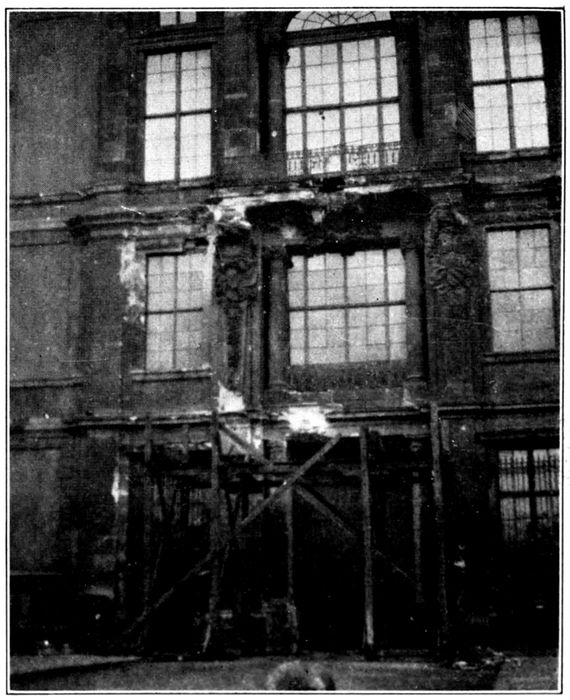
A bomb had carried away the window-shutters, portions of
the granite steps beneath, and had liberally pockmarked
the stone façade of the house.
“It was horrible,” he growled. “We all had to go down
into the cellar, and my poor little grandson cried from
fright. That is no way to make war, against the innocent
non-combatants, and women and children.”
I did not trouble to ask him if he had expressed the same
sentiments among his fellow club-members in, say, May,
1915, for his sophistry was too well trained to be caught in so
simple a trap.
Whatever the docility, the conciliatory attitude of our
forced hosts, however, I have yet to hear that one of them
ever expressed repentance for the horrors their nation
loosed upon the world. The war they seemed to take as
the natural, the unavoidable thing, just a part of life, as
the gambler takes gambling, with no other regret than
that it was their bad luck to lose. Like the gambler,
they may have been sorry they made certain moves in the
game; they may have regretted entering the game at all,
as the gambler would who knew in the end that his adversary
had more money on his hip than he had given him credit
for in the beginning. But it was never a regret for being
a gambler. Did not Nietzsche say that to regret, to repent,
38is a sign of weakness? Unless there was something under his
mask that never showed a hint of its existence on the surface,
the German is still a firm disciple of Nietzschean philosophy.
There was much debate among American officers as to
just what surge of feeling passed through the veins of a
German of high rank forced to salute his conquerors. With
rare exceptions, every Boche in uniform rendered the
required homage with meticulous care. Now and then one
carefully averted his eyes or turned to gaze into a shop-window
in time to avoid the humiliation. But for the most
part they seemed almost to go out of their way to salute,
some almost brazenly, others with a half-friendly little bow.
I shall long remember the invariable click of heels and the
smart hand-to-cap of the resplendent old general with a
white beard who passed me each morning on the route to
our respective offices.
That there was feeling under these brazen exteriors,
however, was proved by the fact that most of the officers
in the occupied area slipped quietly into civilian clothes,
for no other apparent reason than to escape the unwelcome
order. From the day of our entrance no German in uniform
was permitted in our territory unless on official business,
sanctioned by our authorities. But the term “uniform”
was liberally interpreted. A discharged soldier, unable to
invest in a new wardrobe, attained civilian status by exchanging
his ugly, round, red-banded fatigue-bonnet for a
hat or cap; small boys were not rated soldiers simply
because they wore cut-down uniforms. Then on March
1st came a new order from our headquarters commanding
all members of the German army in occupied territory
never to appear in public out of uniform, always to carry
papers showing their presence in our area to be officially
authorized, and to report to an American official every
Monday morning. The streets of Coblenz blossomed
out that day with more varieties of German uniforms than
39most members of the A. E. P. had ever seen outside a
prisoner-of-war inclosure.
It was easy to understand why Germans in uniform
saluted—they were commanded to do so. But why did
every male, from childhood up, in many districts, raise
his hat to us with a subservient “’n Tag”; why the same
words, with a hint of courtesy, from the women? Was it
fear, respect, habit, design? It could scarcely have been
sarcasm; the German peasantry barely knows the meaning
of that. Why should a section foreman, whose only suggestion
of a uniform was a battered old railway cap, go out
of his way to render us military homage? Personally I am
inclined to think that, had conditions been reversed, I should
have climbed a tree or crawled into a culvert. But we came
to wonder if they did not consider the salute a privilege.
Only the well-dressed in the cities showed an attitude
that seemed in keeping with the situation, from our point
of view. They frequently avoided looking at us, pretended
not to see us, treated us much as the Chinese take their
“invisible” property-man at the theater. At the back door
of our headquarters the pompous high priests of business
and politics, or those haughty, well-set-up young men who,
one could see at a glance, had been army officers, averted
their eyes to hide the rage that burned within them when
forced to stand their turn behind some slattern woman or
begrimed workman. In a tramway or train now and then
it was amusing to watch a former captain or major, weather-browned
with service in the field, still boldly displaying
his kaiserly mustache, still wearing his army leggings and
breeches, looking as out of place in his civilian coat as a
cowboy with a cane, as he half openly gritted his teeth at
the “undisciplined” American privates who dared do as
they pleased without so much as asking his leave. But
it was no less amusing to note how superbly oblivious to
his wrath were the merrymaking doughboys.
40The kaiserly mustache of world-wide fame, by the way,
has largely disappeared, at least in the American sector.
In fact, the over-modest lip decoration made famous by
our most popular “movie” star seemed to be the vogue.
More camouflage? More “Kamerad”? A gentle compliment
to the Americans? Or was it merely the natural
change of style, the passing that in time befalls all things,
human or kaiserlich?
Speaking of German officers, when the first inkling
leaked out of Paris that Germany might be required by
the terms of the Treaty of Peace to reduce her army to a
hundred thousand men there was a suggestion of panic
among our German acquaintances. It was not that they
were eager to serve their three years as conscripts, as their
fathers had done. There was parrot-like agreement that
no government would ever again be able to force the manhood
of the land to that sacrifice. Nor was there any great
fear that so small an army would be inadequate to the
requirements of “democratized” Germany. The question
was, “What on earth can we do with all our officers, if
you allow us only four thousand or so?” Prohibition, I
believe, raised the same grave problem with regard to our
bartenders. But as we visualized our own army reduced
to the same stern necessity the panic was comprehensible.
What would we, under similar circumstances, do with
many of our dear old colonels? They would serve admirably
as taxi-door openers along Fifth Avenue—were it not for
their pride. They would scarcely make good grocery
clerks; they were not spry enough, nor accurate enough at
figures. However, the predicament is one the Germans
can scarcely expect the Allies to solve for them.
“War,” said Voltaire, “is the business of Germany.”
One realized more and more the fact in that assertion as new
details of the thorough militarization of land, population,
and industry came to light under our occupancy. Fortifications,
41labyrinths of secret tunnels, massive stores of everything
that could by any possibility be of use in the complicated
business of war; every man up through middle age,
who had still two legs to stand on, marked with his service
in Mars’s workshop; there was some hint of militarization at
every turn. Not the least striking of them was the aggressive
propaganda in favor of war and of loyalty to the war
lords. Not merely were there monuments, inscriptions,
martial mottoes, to din the military inclination into the
simple Volk wherever the eye turned. In the most miserable
little Gasthaus, with its bare floors and not half enough
cover on the beds to make a winter night comfortable,
huge framed pictures of martial nature stared down upon the
shivering guest. Here hung a life-size portrait of Hindenburg;
there was a war scene of Blücher crossing the Rhine;
beyond, an “Opfergaben des Volkes,” in which a long line
of simple laboring people had come to present with great
deference their most cherished possession—a bent old
peasant, a silver heirloom; a girl, her hair—on the altar
of their rulers’ martial ambition. It is doubtful whether
the Germans have any conception of how widely this
harvest of tares has overspread their national life. It may
come to them years hence, when grim necessity has forced
them to dig up the pernicious roots.
But the old order was already beginning to show signs of
change. On a government building over at Trier the first
word of the lettering “Königliches Hauptzollamt” had been
obliterated. In a little town down the Rhine the dingy
HOTEL DEUTSCHER KAISER
Diners 1 mk. 50 und höher
Logis von 2 mk. an
had the word “Kaiser” painted over, though it was still
visible through the whitewash, as if ready to come back at
a new turn of events.
42The adaptability of the German as a merchant has long
since been proved by his commercial success all over the
world. It quickly became evident to the Army of Occupation
that he was not going to let his feelings—if he had any—interfere
with business. As a demand for German uniforms,
equipment, insignia faded away behind the retreating
armies of the Kaiser, commerce instantly adapted itself
to the new conditions. Women who had earned their livelihood
or their pin-money for four years by embroidering
shoulder-straps and knitting sword-knots for the soldiers
in field gray quickly turned their needles to making the
ornaments for which the inquiries of the new-comers showed
a demand. Shop-windows blossomed out overnight in a
chaos of divisional insignia, of service stripes, with khaki
cloth and the coveted shoulder-pins from brass bars to
silver stars, with anything that could appeal to the American
doughboy as a suitable souvenir of his stay on the
Rhine—and this last covers a multitude of sins indeed.
Iron crosses of both classes were dangled before his eager
eyes. The sale of these “highest prizes of German manhood”
to their enemies as mere pocket-pieces roused a
howl of protest in the local papers, but the trinkets could
still be had, if more or less sub rosa. Spiked helmets—he
must be an uninventive or an absurdly truthful member
of the new Watch on the Rhine who cannot show
visible evidence to the amazed folks at home of having
captured at least a dozen Boche officers and despoiled
them of their headgear. Those helmets were carried off
by truck-loads from a storehouse just across the Moselle;
they loaded down the A. E. F. mails until it is
strange there were ships left with space for soldiers homeward
bound. A sergeant marched into his captain’s billet
in an outlying town with a telescoped bundle of six helmets
and laid them down with a snappy, “Nine marks
each, sir.”
43“Can you get me a half-dozen, too?” asked a visiting
lieutenant.
“Don’t know, sir,” replied the sergeant. “He made
these out of some remnants he had left on hand, but he is
not sure he can get any more material.”
If we had not awakened to our peril in time and the
Germans had taken New York, would our seamstresses
have made German flags and our merchants have prominently
displayed them in their windows, tagged with the
price? Possibly. We of the A. E. F. have learned something
of the divorce of patriotism from business since the
days when the money-grabbers first descended upon us
in the training-camps at home. The merchants of Coblenz,
at any rate, were quite as ready to take an order for a
Stars and Stripes six feet by four as for a red, white, and
black banner. What most astonished, perhaps, the khaki-clad
warriors who had just escaped from France was the
German’s lack of profiteering tendencies. Prices were not
only moderate; they remained so in spite of the influx of
Americans and the constant drop in the value of the mark.
The only orders on the subject issued by the American
authorities was the ruling that prices must be the same for
Germans and for the soldiers of occupation; nothing hindered
merchants from raising their rates to all, yet this
rarely happened even in the case of articles of almost
exclusive American consumption.
“Shoe-shine parlors,” sometimes with the added enticement,
“We Shine Your Hobnails,” sprang up in every
block and were so quickly filled with Yanks intent on obeying
the placard to “Look Like a Soldier” that the proprietors
had perforce to encourage their own timid people
by posting the notice, “Germans Also Admitted.” Barber
shops developed hair carpets from sheer inability to find
time to sweep out, and at that the natives were hard put
to it to get rid of their own facial stubble. When the
44abhorred order against photography by members of the
A. E. F. was suddenly and unexpectedly lifted, the camera-shops
resembled the entrance to a ball-park on the day of
the deciding game between the two big leagues. There
was nothing timid or squeamish about German commerce.
Shops were quite ready to display post-cards showing French
ruins with chesty German officers strutting in the foreground,
once they found that these appealed to the indefatigable
and all-embracing American souvenir-hunter.
Down in Cologne a German printing-shop worked overtime
to get out an official history of the American 3d Division.
In the cafés men who had been shooting at us three months
before sat placidly sawing off our own popular airs and
struggling to perpetrate in all its native horror that inexcusable
hubbub known as the “American jazz.” The sign
“American spoken here” met the eye at frequent intervals.
Whether the wording was from ignorance, sarcasm, an
attempt to be complimentary, or a sign of hatred of the
English has not been recorded. There was not much
call for the statement even when it was true, for it was
astounding what a high percentage of the Army of Occupation
spoke enough German to “get by.” The French never
tired of showing their surprise when a Yank addressed
them in their own tongue; the Germans took it as a matter
of course, though they often had the ill manners to insist
on speaking “English” whatever the fluency of the customer
in their own language, a barbaric form of impoliteness
which the French are usually too instinctively tactful to
commit.
On the banks of the Rhine in the heart of “Duddlebug”—keep
it dark! It is merely the American telephone girls’
name for Coblenz, but it would be a grievous treachery
if some careless reader let the secret leak out to Berlin—there
stands one of the forty-eight palaces that belonged
to the ex-Kaiser. Its broad lawn was covered now with
45hastily erected Y. M. C. A. wooden recreation-halls that
contrast strangely with the buildings of the surrounding
city, constructed to stand for centuries, and which awaken
in the German breast a speechless wrath that these irreverent
beings from overseas should have dared to perpetrate such a
lèse-majesté on the sacred precincts. But the Schloss itself
was not occupied by the Americans, and there have been
questions asked as to the reason—whether those in high
standing in our army were showing a sympathy for the
monarch who took Dutch leave which they did not grant the
garden variety of his ex-subjects. The allegation has no
basis. Upon his arrival the commander of the Army of
Occupation gave the palace a careful “once over” and
concluded that the simplest solution was to leave its offices
to the German authorities who were being ousted from
more modern buildings. As to the residence portion, the
wily old caretaker pointed out to the general that there
was neither gas, electricity, nor up-to-date heating facilities.
In the immense drawing- and throne-rooms there was, to
be sure, space enough to billet a battalion of soldiers, but
it would, perhaps, have been too typically Prussian an
action to have risked a repetition of what occurred at Versailles
in 1871 by turning over this mess of royal bric-à-brac
and the glistening polished floors to the tender care of a
hobnailed band of concentrated virility.
Plainly impressive enough outwardly, the “living”-rooms
of the castle would probably be dubbed a “nightmare”
by the American of simple tastes. The striving of the Germans
to ape the successful nations of antiquity, the Greeks,
and particularly the Romans, in art and architecture, as
well as in empire-building, is in evidence here, as in so many
of the ambitious residences of Coblenz. The result is a
new style of “erudite barbarism,” as Romain Rolland calls
it, “laborious efforts to show genius which result in the banal
and grotesque.” The heavy, ponderous luxury and mélange46of style was on the whole oppressive. In the entire series
of rooms there was almost nothing really worth looking at
for itself, except a few good paintings and an occasional
insignificant little gem tucked away in some corner. They
were mainly filled with costly and useless bric-à-brac, royal
presents of chiefly bad taste, from Sultan, Pope, and potentate,
all stuck about with a very stiff air and the customary
German over-ornateness. The place looked far less like a
residence than like a museum which the defenseless owner
had been forced to build to house the irrelevant mass of
junk that had been thrust upon him. Costly ivory sets of
dominoes, chess, table croquet, what not, showed how these
pathetic beings, kings and emperors, passed their time,
which the misfortune of rank did not permit them to spend
wandering the streets or grassy fields like mere human
beings.
The old caretaker had some silly little anecdote for
almost every article he pointed out. He had taken thousands
of visitors through the castle—it was never inhabited
more than a month or two a year even before the war—and
the only thing that had ever been stolen was one of
the carved ivory table-croquet mallets, which had been
taken by an American Red Cross nurse. I was forced to
admit that we had people like that, even in America. In
the royal chapel—now an American Protestant church—the
place usually taken by the pipe organ served as a half-hidden
balcony for the Kaiser, with three glaring red-plush
chairs—those ugly red-plush chairs, no one of which looked
comfortable enough actually to sit in, screamed at one all
over the building—with a similar, simpler embrasure opposite
for the emperor’s personal servants. The main
floor below was fully militarized, like all Germany, the
pews on the right side being reserved for the army and
inscribed with large letters from front to rear—“Generalität,”
“General Kommando,” “Offiziere und Hochbeamter,”47and so on, in careful order of rank. Red slip-covers
with a design of crowns endlessly repeated protected from
dust most of the furniture in the salons and drawing-rooms,
and incidentally shielded the eye, for the furniture itself
was far uglier than the covering.
The most pompous of nouveaux riches could not have
shown more evidence of self-worship in their decorations.
Immense paintings of themselves and of their ancestors
covered half the Hohenzollern walls, showing them in
heroic attitudes and gigantic size, alone with the world at
their feet, or in the very thick of battles, looking calm,
collected, and unafraid amid generals and followers who,
from Bismarck down, had an air of fear which the royal
central figure discountenanced by contrast. Huge portraits
of princes, Kurfürsten, emperors, a goodly percentage
of them looking not quite intelligent enough to make efficient
night-watchmen, stared haughtily from all sides. A
picture of the old Hohenzollern castle, from which the
family—and many of the world’s woes—originally sprang,
occupied a prominent place, as an American “Napoleon
of finance” might hang in his Riverside drawing-room a
painting of the old farm from which he set out to conquer
the earth. Much alleged art by members of the royal
family, as fondly preserved as Lizzy’s first—and last—school
drawing, stood on easels or tables in prominent, insistent
positions. Presents from the Sultan were particularly numerous,
among them massive metal tablets with bits in
Arabic from the Koran. One of these read, according to
the caretaker, “He who talks least says most.” Unfortunately,
the Kaiser could not read Arabic, hence the particularly
pertinent remark was lost upon him. In an obscure
corner hung one of the inevitable German cuckoo clocks,
placed there, if my guide was not mistaken, by a former
empress in memory of the spot where she plighted her troth.
Poor, petty little romances of royalty! Probably it was
48not so much coquetry as an effort to escape the pseudo-magnificence
of those appalling rooms that drove her into
the corner. How could any one be comfortable, either
in mind or in body, with such junk about them, much less
pass the romantic hours of life in their midst? I should
much have preferred to have my Verlobungskuss in a railway
station.
Only the library of the ex-empress, with its German,
French, and English novels and its works of piety, showed
any sign of real human individuality. Her favorite picture
hung there—a painting showing a half-starved woman weeping
and praying over an emaciated child, called “The
Efficacy of Prayer.” No doubt the dear empress got much
sentimental solace out of it—just before the royal dinner
was announced. The Kaiser’s private sleeping-room, on
the other hand, was simplicity itself—far less sumptuous
than my own a few blocks away. He had last slept there,
said the caretaker, in the autumn of 1914, while moving
toward the western front with his staff.
“And all this belongs to the state now, since Germany
has become a republic?” I remarked.
“Only a part of it,” replied my guide. “We are making
up lists of the private and crown property, and his own
possessions will be returned to the Kaiser.”
The outstanding feature of the visit was not the castle
itself, however, but the attitude of this lifelong servant of
the imperial owner. The assertion that no man is a hero
to his valet applies, evidently, clear up to emperors. The
caretaker was a former soldier in a Jäger and forestry battalion,
born in the Thüringerwald fifty-six years ago, a man
of intelligence and not without education. He had been
one of hundreds who applied for a position in the imperial
household in 1882, winning the coveted place because he
came “with an armful of fine references.” To him the
Kaiser and all his clan were just ordinary men, for whom he
49evidently felt neither reverence nor disdain. Nor, I am
sure, was he posing democracy; he looked too tired and
indifferent to play a part for the benefit of my uniform.
The many gossipy tales of royalty, semi-nobility, and ignobility
with which he spiced our stroll were told neither with
ill feeling nor with boastfulness; they were merely his every-day
thoughts, as a printer might talk of his presses or a
farmer of his crops.
Wilhelm der Erste, the first Kaiser, was a good man in
every way, he asserted. He had seen him die. He had been
called to bring him his last glass of water. Bismarck and a
dozen others were gathered about his bed, most of them
kneeling—the picture of Bismarck on his knees was not
easy to visualize somehow—“and the emperor died with
great difficulty”—my informant demonstrated his last
moments almost too realistically. The Kaiser—he who
wrecked the Hohenzollern ship—was a very ordinary man,
possibly something above the average in intelligence, but
he did not have a fair chance in life. There was his useless
arm, and then his ear. For forty years he had suffered
atrociously from an abscess in his left ear. The caretaker
had seen him raging mad with it. No treatment ever
helped him. No, it was not cancer, though his mother died
of that after inhuman suffering, but it was getting nearer
and nearer to his brain, and he could not last many years
now. Then there was his arm. No, it was not inherited,
but resulted from the criminal carelessness of a midwife.
For years he used an apparatus in the hope of getting some
strength into that arm, tying his left hand to a lever and
working it back and forth with his right. But it never did
any good. He never got to the point where he could lift
that arm without taking hold of it with the other. He
grew extraordinarily clever in covering up his infirmity;
when he rode he placed the reins in the useless left hand
with the right, and few would have realized that they were
50just lying there, without any grasp on them at all. He
kept that arm out of photographs; he kept it turned away
from the public with a success that was almost superhuman.
On the whole, he was a man with a good mind. “No one
of average intelligence can help being a knowing man if he
has Ministers and counselors and all the wise men of the realm
coming to him every day and telling him everything.” But
he had too much power, too much chance to rule. He dismissed
Bismarck, “a man such as there is only one born
in a century,” when he was himself still far too young to be
his own Chancellor. He never could take advice; when his
Ministers came to him they were not allowed to tell him
what they thought; they could only salute and do what he
ordered them to do. And he never understood that he
should choose his words with care because they made
more impression than those of an ordinary man.
It was only when I chanced upon his favorite theme—we
had returned to his little lodge, decorated with the
antlers and tusks that were the trophies of his happiest
days—that the caretaker showed any actual enthusiasm
for the ex-Kaiser. I asked if it were true that the former
emperor was a good shot. “Ausgezeichnet!” he cried, his
weary eyes lighting up; “he was a marvelous shot! I have
myself seen him kill more than eight hundred creatures in
one day—and do not forget that he had to shoot with one
arm at that.” He did not mention how much better
record than that the War Lord had made on the western
front, nor the precautions his long experience in the “hunting-field”
had taught him to take against any possible
reprisal by his stalked and cornered game.
The Crown Prince, he had told me somewhere along the
way in the oppressive royal museum, was a very nice little
boy, but his educators spoiled him. Since manhood he
had been “somewhat leichtsinnig”—it was the same expression,
the old refrain, that I had heard wherever the Kaiser’s
51heir was mentioned—“and his mind runs chiefly on women.”
In one of the rooms we had paused before a youthful portrait
of Queen Victoria. “I have seen her often,” remarked
my guide, in his colorless voice. “She came often to visit
us, at many of the palaces, and the first thing she invariably
called for the moment she arrived was cognac.” It may
have been merely a little side-slap at the hated English,
but there was something in that particular portrait that
suggested that the queen would have made a very lively
little grisette, had fate chanced to cast her in that rôle.
Bismarck was plainly the old servant’s favorite among
the titled throng he had served and observed. “When the
second Kaiser died,” he reminisced, “after his very short reign—he
was a good man, too, though proud—he gave me a
message that I was to hand over to Bismarck himself, in
person. The long line of courtiers were aghast when I
insisted on seeing him; they stared angrily when I was
admitted ahead of them to his private study. I knocked,
and there was a noise inside between a grunt and a growl”—some
of our own dear colonels, I mused, had at least that
much Bismarckian about them—“and after I opened the
door I had to peer about for some time before I could see
where he was, the tobacco smoke was so thick. He always
smoked like that. But he was an easy man to talk to,
if you really had a good reason for coming to see him, and
I had. When I went out all the courtiers stared at me with
wonder, but I just waved a hand to them and said, ‘The
audience is over, gentlemen!’ Ah yes, I have seen much
in my day, aber,” he concluded, resignedly, as he accompanied
me to the door of his lodge, “alle diese gute Zeiten sind leider
vorbei.”
III THOU SHALT NOT ... FRATERNIZE
52
The armies of occupation have been credited with the
discovery of a new crime, one not even implied in the
Ten Commandments. Indeed, misinformed mortals have
usually listed it among the virtues. It is “fraternization.”
The average American—unless his habitat be New England—cannot
remain aloof and haughty. Particularly the
unsophisticated doughboy, bubbling over with life and
spirits, is given to making friends with whatever branch of
the human family he chances to find about him. Moreover,
he was grateful for the advance in material comfort,
if not in friendliness, of Germany as compared with the
mutilated portion of France he had known. He did not,
in most cases, stop to think that it was the war which had
made those differences. It was an every-day experience
to hear some simple country boy in khaki remark to his
favorite officer in a slow, puzzled voice, “Sa-ay, Lieutenant,
you know I like these here Boshies a lot better than them
there Frogs.” The wrangles and jealousies with their
neighbors, on which the overcrowded peoples of Europe
feed from infancy, were almost unsuspected by these grownup
children from the wide land of opportunity. The French
took alarm. There seemed to be danger that the sale
Boche would win over les Américains, at least the sympathy
of the men in the ranks, by his insidious “propaganda.”
As a matter of fact, I doubt whether he could have done so.
53The Germans rather overdid their friendliness. Particularly
when it bore any suggestion of cringing, deliberate or
natural, it defeated itself, for, simple as he may be in matters
outside his familiar sphere, the American soldier has an
almost feminine intuition in catching, eventually, a somewhat
hazy but on the whole true conception of the real
facts. But our allies were taking no chances. A categorical
order—some say it emanated from Foch himself—warned
the armies of occupation that there must be “no
fraternization.”
The interpretation of the order varied. As was to be
expected, the Americans carried it out more rigorously
than did their three allies along the Rhine. Its application
also differed somewhat in separate regions within our own
area. At best complete enforcement was impossible.
With soldiers billeted in every house, what was to hinder a
lovelorn buck from making friends with the private who
was billeted in her house and going frequently to visit him?
On cold winter evenings one rarely passed a pair of American
sentries beside their little coal-fires without seeing a
slouchy youth or two in the ugly round cap without vizor
which we had so long associated only with prisoners of
war, or a few shivering and hungry girls, hovering in the
vicinity, eying the soldiers with an air which suggested
that they were willing to give anything for a bit of warmth
or the leavings of the food the sentries were gorging.
Whether they merely wanted company or aspired to soap
and chocolate, there was nothing to prevent them getting
warmer when there were no officers in sight.
The soldiers had their own conception of the meaning
of fraternization. Buying a beer, for instance, was not
fraternizing; tipping the waiter who served it was—unless
he happened to be an attractive barmaid. Taking a walk
or shaking hands with a German man was to disobey the
order; strolling in the moonlight with his sister, or even
54kissing her under cover of a convenient tree-trunk, was not.
The interrelation of our warriors and the civilian population
was continually popping up in curious little details. To
the incessant demand of children for “Schewing Kum,”
as familiar, if more guttural, as in France, the regulation
answer was no longer “No compree,” but “No fraternize.”
Boys shrilling “Along the Wabash” or “Over There,” little
girls innocently calling out to a shocked passer-by in khaki
some phrase that is more common to a railroad construction
gang than to polite society, under the impression that it was
a kindly word of greeting, showed how the American influence
was spreading. “Snell” had taken the place of
“toot sweet” in the soldier vocabulary. German schools
of the future are likely to teach that “spuds” is the American
word for what the “verdammte Engländer” calls potatoes.
When German station-guards ran along the platforms
shouting, “Vorsicht!” at the approach of a train, American
soldiers with a touch of the native tongue translated it
into their lingo and added a warning, “Heads up!” The
adaptable Boche caught the words—or thought he did—and
thereafter it was no unusual experience to hear the
arrival of a Schnellzug prefaced with shouts of, “Hets ub!”
In the later days of the occupation the Yank was more
apt to be wearing a “Gott mit uns” belt than the narrow
web one issued by his supply company, and that belt was
more likely than not to be girdled round with buttons and
metal rosettes from German uniforms, as the original
American wore the scalps of his defeated enemies. Our
intelligence police frequently ran down merchants or manufacturers
guilty of violating the fraternization order by
making or offering for sale articles with the German and the
American flags intertwined, pewter rings bearing the insignia
of some American division and the iron cross; alleged
meerschaum pipes decorated with some phrase expressive
of Germany’s deep love for America in spite of the recent
55“misunderstanding.” The wiseacres saw in all this a
subtle “propaganda,” cleverly directed from Berlin. I
doubt whether it was anything more than the German
merchant’s incorrigible habit of making what he can sell,
of fitting his supply to his customer’s wishes, however
absurd these may seem to him.
Up to the 1st of February Americans on detached service
in Germany ate where they chose. With the non-fraternization
order came the command to patronize only
the restaurants run by the army or its auxiliary societies.
The purpose was double—to shut another avenue to the
fraternizer and to leave to the Germans their own scanty
food store. This question of two widely different sources
of supply side by side required constant vigilance. When
two lakes of vastly different levels are separated only by
a thin wall it is to be expected that a bit of water from the
upper shall spill over into the lower. A pound can of cocoa
cost 50 marks in a German shop—if it could be had at all;
a better pound sold for 1 mk. 25 in our commissary. A
can of butter for which a well-to-do citizen would gladly
have given a week’s income was only a matter of a couple
of dollars for the man in khaki. A bar of soap, a tablet of
chocolate, a can of jam, many of the simple little things
that had become unattainable luxuries to the mass of the
people about us, cost us no more than they did at home
before the war. Even if there was no tendency to profit
by these wide discrepancies—and with the vast percentage
of our soldiers there was not—the natural tender-heartedness
of America’s fighting-man moved him to transgress
orders a bit in favor of charity. Much as one may hate the
Boche, it is hard to watch an anemic little child munch a
bare slice of disgusting war-bread, knowing that you can
purchase a big white loaf made of genuine flour for a paltry
ten cents.
There were curious ramifications in this “fraternization”
56question. Thus, what of the American lieutenant whose
father came over from his home in Düsseldorf or Mannheim
to visit his son? By strict letter of the law they should
not speak to each other. What advice could one give a
Russian-American soldier whose brother was a civilian in
Coblenz? What should the poor Yank do whose German
mother wired him that she was coming from Leipzig to
see him, little guessing that for him to be seen in public
with any woman not in American uniform was an invitation
to the first M. P. who saw him to add to the disgruntled
human collection in the “brig”?
I chanced to be the “goat” in a curious and embarrassing
situation that grew quite naturally out of the non-fraternizing
order. It was down the river at Andernach, a town
which, in the words of the doughboy, boasts “the only
cold-water geyser in the world—except the Y. M. C. A.”
A divisional staff had taken over the “palace” of a family
of the German nobility, who had fled to Berlin at our
approach. One day the daughter of the house unexpectedly
returned, alone but for a maid. She happened to be not
merely young and beautiful—far above the average German
level in the latter regard—but she had all those outward
attractions which good breeding and the unremitting care
of trained guardians from birth to maturity give the fortunate
members of the human family. She was exactly the
type the traveler in foreign lands is always most anxious
to meet, and least successful in meeting. On the evening
of her arrival the senior officer of the house thought to
soften the blow of her unpleasant home-coming by inviting
her to dinner with her unbidden guests. The little circle
was charmed with her tout ensemble. They confided to
one another that she would stand comparison with any
American girl they had ever met—which was the highest
tribute in their vocabulary. She seemed to find the company
agreeable herself. As they rose from the table she
57asked what time breakfast would be served in the morning.
Thanks to the uncertainty of her English, she had mistaken
the simple courtesy for a “standing invitation.”
The officers looked at one another with mute appeal in
their eyes. Nothing would have pleased them better than
to have their grim circle permanently graced by so charming
an addition. But what of the new order against fraternization?
Some day an inspector might drift in, or the
matter reach the erect ears of that mysterious and dreaded
department hidden under the pseudonym of “G-2-B.”
Besides, the officers were all conscientious young men who
took army orders seriously and scorned to use any sophistry
in their interpretation. Furthermore, though it hurt keenly
to admit such a slanderous thought, it was within the range
of possibilities that the young lady was a spy, sent here
with the very purpose of trying to ingratiate herself into the
circle which had so naïvely opened itself to her. It was
known that her family had been in personal touch with the
Kaiser; for all her “American manner,” she made no secret
of being German through and through. What could have
been more in keeping with the methods of Wilhelmstrasse
than the suggestion that she return to her own home and
pass on to Berlin any rumors she might chance to pick up
from her unwelcome guests?
Plainly she must be gotten rid of at once. None of the
officers, however, felt confidence enough in his German
to put it to so crucial a test. Whence, it being my fortune
to drop in on a friend among the perplexed Americans just
at that moment, I was unanimously appointed to the gentle
task of banishing the lady from her own dining-room.
It was at the end of a pleasant little luncheon—the sixth
meal which the daughter of the house had graciously attended.
The conversation had been enlightening, the atmosphere
most congenial, the young lady more unostentatiously
beautiful than ever. We reduced the audience to
58her coming humiliation as low as possible by softly dismissing
the junior members, swallowed our throats, and
began. Nothing, we assured her, had been more pleasant
to us since our arrival in Germany than the privilege of
having her as a guest at our simple mess. Nothing we could
think of—short of being ordered home at once—would
have pleased us more than to have her permanently grace
our board. But ... fortunately our stiff uniform collars
helped to keep our throats in place ... she had possibly
heard of the new army order, a perfectly ridiculous ruling,
to be sure, particularly under such circumstances as these,
but an army order for all that—and no one could know better
than she, the daughter and granddaughter of German high
officers, that army orders are meant to be obeyed—wherein
Pershing himself commanded us to have no more relations
with the civilian population than were absolutely unavoidable.
Wherefore we ... we ... we trusted she would
understand that this was only the official requirement and
in no way represented our own personal inclinations ...
we were compelled to request that she confine herself thereafter
to the upper floor of the house, as her presence on
our floor might easily be misunderstood. Her maid no
doubt could prepare her meals, or there was a hotel a few
yards up the street....
The charming little smile of gratitude with which she
had listened to the prelude had faded to a puzzled interest
as the tone deepened, then to a well-mastered amazement
at the effrontery of the climax. With a constrained, “Is
that all?” she rose to her feet, and as we kicked our chairs
from under us she passed out with a genuinely imperious
carriage, an icy little bow, her beautiful face suffused with
a crimson that would have made a mere poppy look colorless
by comparison. We prided ourselves on having been
extremely diplomatic in our handling of the matter, but
no member of that mess ever again received anything
59better than the barest shadow of a frigid bow from the young
lady, followed at a respectful distance by her maid, whom
they so often met on her way to the hotel a few yards up
the street.
If it were not within the province of a soldier to criticize
orders, one might question whether it would not have
been better to allow regulated “fraternizing” than to
attempt to suppress it entirely. Our soldiers, permeated
through and through, whether consciously or otherwise,
with many of those American ideals, that point of
view, which we are eager for the German Volk to grasp,
that there may be no more kaisers and no more deliberately
built-up military assaults upon the world, would have been
the most effective propaganda in our favor that could have
been devised to loose upon the German nation. Merely
their naïve little stories of how they live at home would
in time have awakened a discontent in certain matters,
spiritual rather than material, that would have been most
salutary. But we committed our customary and familiar
American error of refusing to compromise with human
nature, of attempting impossible suppression instead of
accepting possible regulation, with the result that those
ineradicable plants that might have grown erect and gay
in the sunshine developed into pale-faced, groveling monstrosities
in the cellars and hidden corners. Our allies
in the neighboring areas had the same non-fraternizing
order, yet by not attempting to swallow it whole they
succeeded, probably, in digesting it better.
There was a simple little way of fraternizing in Coblenz
without risking the heavy hand of an M. P. on your shoulder.
It was to just have it happen by merest chance that the
seat of the Fräulein who had taken your eye be next your
own at the municipal theater. It grew increasingly popular
with both officers and enlisted men, that modest little
Stadttheater. The Germans who, before our arrival, had
60been able to drift in at the last moment and be sure of a
seat, were forced to come early in the day and stand in line
as if before a butter-shop. The Kronloge, or royal box,
belonged now to the general commanding the Army of
Occupation—until six each evening, when its eighteen
seats might be disposed of to ordinary people, though the
occupants even in that case were more likely than not to
be girdled by the Sam Browne belt. Some observers make
the encouraging assertion that there will be more devotees
of opera in America when the quarter-million who kept
the watch on the Rhine return home. There was a tendency
to drift more and more toward the Stadttheater, even on the
part of some whom no one would have dared to accuse of
aspiring to “high-brow” rating, though it must be admitted
that the “rag” and “jazz” and slap-stick to which the
“Y” and similar well-meaning camp-followers, steeped in
the “tired business man” fallacy, felt obliged to confine
their efforts in entertaining “the boys,” did not play to
empty houses.
The little Stadttheater gave the principal operas, not merely
of Germany, but of France and Italy, and occasional plays,
chiefly from their own classics. They were usually well
staged, though long drawn out, after the manner of the
German, who can seldom say his say in a few succinct
words and be done as can the Frenchman. The operas, too,
had a heaviness in spots—such as those, for instance, under
the feet of the diaphanous nymphs of one hundred and sixty-five
pounds each who cavorted about the trembling stage—which
did not exactly recall the Opéra in Paris. But it
would be unfair to compare the artistic advantages of a city
of eighty thousand with those of the “capital of the world.”
Probably the performances in Coblenz would have rivaled
those in any but the two or three largest French cities, and
it would be a remarkable town “back in little old U. S. A.”
that could boast such a theater, offering the best things
61of the stage at prices quite within reach of ordinary people.
When one stopped to reflect, those prices were astonishing.
The best seat in the Kronloge was but 5 mk. 50, a bare half-dollar
then, only $1.25 at the normal pre-war exchange, and
accommodations graded down to quite tolerable places in
whatever the Germans call their “peanut gallery” at nine
cents! All of which does not mean that the critical opera-goer
would not gladly endure the quintupled cost for the
privilege of attending a performance at the Opéra Comique
at Paris.
The question of fraternization and the ubiquitous one of
German food shortage were not without their connection.
Intelligence officers were constantly running down rumors
of too much sympathy of our soldiers for the hungry population.
The assertion that Germany had been “starved
to her knees,” however, was scarcely borne out by observations
in the occupied area. It is true that in Coblenz
even the authorized quantities—seven pounds of potatoes,
two hundred grams of meat, seven ounces of sugar, and so on
per person each week, were high in price and not always
available. Milk for invalids and those under seven was
easier to order than to obtain. A notice in the local papers
to “Bring your egg and butter tickets on Monday and get
two cold-storage eggs and forty grams of oleomargarine”
was cause for town-wide rejoicing. Poor old horses that had
faithfully served the A. E. F. to the end of their strength
were easily auctioned at prices averaging a thousand marks
each, in spite of the requirement that a certificate be produced
within a week showing where they had been slaughtered.
There was always a certain Schleichhandel, or underhand
dealing, going on between the wealthy in the cities
and the well-stocked peasants. Rancid butter, to be had
of excellent quality before the war at two marks, cost in
“underground” commerce anything from fifty marks up
which the happy man who found it was in a condition to
62pay. Contrasted with this picture, the wages of an eight-hour
day were seldom over five marks for unskilled, or more
than ten for skilled labor. The out-of-work-insurance
system, less prevalent in our area than “over in Germany,”
made it almost an advantage to be unemployed. A citizen
of Düsseldorf offered a wanderer in the streets eight marks
for a day’s work in his stable. Many a man would gladly
have done the task for three marks before the war. The
wanderer cursed the citizen roundly. “You have the
audacity,” he cried, “to ask me to toil all day for two
marks!” “Two marks?” gasped the citizen; “you misunderstood
me. I said eight.” “I heard you say eight,”
shouted the workman, “and is not eight just two more than
the six we get under the unemployment act? Pest with
your miserable two marks! If you want to pay me ten
for the day—that is, sixteen in all....” He did not add
that by going out into the country with his unearned six
marks he could buy up food and return to the city to sell
it at a handsome profit, but the citizen did not need to be
reminded of that oppressive fact.
It was under such conditions as these that the civilians
about us lived while we gorged ourselves on the full army
ration in the hotels and restaurants we had taken over.
There was always a long and eager waiting line where any
employment of civilians by the Americans carried with it
the right to army food; in many cases it became necessary
to confine the opportunity to war widows or others whose
breadwinners had been killed.
THE FORMER CROWN PRINCE IN HIS OFFICIAL FACE, ATTENDING THE FUNERAL OF A GERMAN OFFICER AND COUNT, WHOSE MILITARY ORDERS ARE CARRIED ON THE CUSHION IN FRONT
THE HEIR TO THE TOPPLED THRONE WEARING HIS UNOFFICIAL AND MORE CHARACTERISTIC EXPRESSION
BARGES OF AMERICAN FOOD-STUFFS ON THEIR WAY UP THE RHINE
BRITISH TOMMIES STOWING THEMSELVES AWAY FOR THE NIGHT ON BARGES ANCHORED NEAR THE HOLLAND FRONTIER
63A man who rented his motor-boat to our Marine Corps
at forty-five marks a day and food for himself brought his
brother along without charge, both of them living well on
the one ration. The poor undoubtedly suffered. Where
haven’t they? Where do they not, even in times of peace?
So did we, in fact, in spite of our unlimited source of supply.
For the barbarous German cooking reduced our perfectly
respectable fare to something resembling in looks, smell,
and taste the “scow” of a British forecastle. In France
we had come to look forward to meal-time as one of the
pleasant oases of existence; on the Rhine it became again
just a necessary ordeal to be gotten over with as soon as
possible. If we were at first inclined to wonder what the
chances were of the men who had been facing us with machine-guns
three months before poisoning us now, it soon
died out, for they served us as deferentially, and far more
quickly, with comparative obliviousness to tips, than had
the garçons beyond the Vosges.
The newspapers complained of a “physical deterioration
and mental degeneration from lack of nourishing food
that often results in a complete collapse of the nervous
system, bringing on a state of continual hysteria.” We
saw something of this, but there were corresponding advantages.
Diabetes and similar disorders that are relieved
by the starvation treatment had vastly decreased. My
host complained that his club, a regal building then open
only to American officers, had lost one-third of its membership
during the war, not in numbers, but in weight, an
average of sixty pounds each. Judging from his still not
diaphanous form, the falling off had been an advantage
to the club’s appearance, if not to its health. But one
cannot always gage the health and resistance of the German
by his outward appearance. He is racially gifted with
red cheeks and plump form. The South American Indian
of the highlands also looks the picture of robust health,
yet he is certainly underfed and dies easily. In a well-to-do
city like Coblenz appearances were particularly deceiving.
The bulk of the population was so well housed, so well
dressed, outwardly so prosperous, that it was hard to
realize how greatly man’s chief necessity, food, was lacking.
In many a mansion to open the door at meal-time was to
catch a strong scent of cheap and unsavory cooking that
64recalled the customary aroma of our lowest tenements.
Healthy as many of them looked, there was no doubt that
for the past year or two the Germans, particularly the old
and the very young, succumbed with surprising rapidity
to ordinarily unimportant diseases. If successful merchants
were beefy and war profiteers rotund, they were
often blue under the eyes. An officer of the chemical
division of our army who conducted a long investigation
within the occupied area found that while the bulk of food
should have been sufficient to keep the population in average
health, the number of calories was barely one-third what
the human engine requires.
The chief reason for this was that food had become more
and more Ersatz—substitute articles, ranging all the way
from “something almost as good” to the mere shadow of
what it pretended to be. “We have become an Ersatz
nation,” wailed the German press, “and have lost in consequence
many of our good qualities. Ersatz butter,
Ersatz bread, Ersatz jam, Ersatz clothing—everything is
becoming Ersatz.” A firm down the river went so far as
to announce an Ersatz meat, called “Fino,” which was
apparently about as satisfactory as the Ersatz beer which
the new kink in the Constitution is forcing upon Americans
at home. Nor was the substitution confined to food
articles, though in other things the lack was more nearly
amusing than serious. Prisoners taken in our last drives
nearly all wore Ersatz shirts, made of paper. Envelopes
bought in Germany fell quickly apart because of the Ersatz
paste that failed to do its duty. Painters labored with
Ersatz daubing material because the linseed-oil their trade
requires had become Ersatz lard for cooking purposes.
Rubber seemed to be the most conspicuous scarcity, at
least in the occupied regions. Bicycle tires showed a
curious ingenuity; suspenders got their stretch from the
weave of the cloth; galoshes were rarely seen. Leather,
65on the other hand, seemed to be more plentiful than we
had been led to believe, though it was high in price. The
cobbler paid twenty-five marks a pound for his materials,
and must have a leather-ticket to get them; real shoes
that cost seven to eight marks before the war ran now as
high as seventy. A tolerable suit of civilian clothing, of
which there was no scarcity in shop-windows, sold for
three or four hundred marks, no more at our exchange
than it would have cost on Broadway, though neither the
material, color, nor make would have satisfied the fastidious
Broadway stroller. After the military stores of field-gray
cloth were released this became a favorite material, not
merely for men’s wear, but for women’s cloaks and children’s
outer garments. Paper was decidedly cheaper than in
France; the newspapers considerably larger. The thousand
and one articles of every-day life showed no extraordinary
scarcity nor anything like the prices of France, far less
self-supporting than Germany in these matters. Nor was
the miscalled “luxury tax”—never collected, of course,
of Americans after the first few exemplary punishments—anything
like as irksome as that decreed on the banks of the
Seine. That the burden of government on the mass of the
people was anything but light, however, was demonstrated
by the testimony of a workman in our provost court that he
earned an average of seventy-five marks a week and paid
one hundred and twenty-five marks a month in taxes!
An Ersatz story going the rounds in Coblenz shows to
what straits matters had come, as well as disproving the
frequent assertion that the German is always devoid of a
sense of humor. A bondholder, well-to-do before the war,
runs the yarn, was too honest or too lacking in foresight to
invest in something bringing war profits, with the result
that along in the third year of hostilities he found himself
approaching a penniless state. Having lost the habit of
work, and being too old to acquire it again, he soon found
66himself in a sad predicament. What most irked his comfort-loving
soul, however, was the increasing Ersatz-ness
of the food on which he was forced to subsist. The day
came when he could bear it no longer. He resolved to
commit suicide. Entering a drug-store, he demanded an
absurdly large dose of prussic acid—and paid what under
other conditions would have been a heartbreaking price
for it. In the dingy little single room to which fortune
had reduced him he wrote a letter of farewell to the world,
swallowed the entire prescription, and lay down to die.
For some time nothing happened. He had always been
under the impression that prussic acid did its work quickly.
Possibly he had been misinformed. He could wait. He
lighted an Ersatz cigarette and settled down to do so. Still
nothing befell him. He stretched out on his sagging bed
with the patience of despair, fell asleep, and woke up late
next morning feeling none the worse for his action.
“Look here,” he cried, bursting in upon the druggist,
“what sort of merchant are you? I paid you a fabulous
price for a large dose of prussic acid—I am tired of life and
want to die—and the stuff has not done me the least harm!”
“Donner und Blitz!” gasped the apothecary. “Why
didn’t you say so? I would have warned you that you
were probably wasting your money. You know everything
in the shop now is Ersatz, and I have no way of knowing
whether Ersatz prussic acid, or any other poison I have
in stock, has any such effect on the human system as does
the real article.”
The purchaser left with angry words, slamming the door
behind him until the Ersatz plate-glass in it crinkled from
the impact. He marched into a shop opposite and bought
a rope, returned to his room, and hanged himself. But
at his first spasm the rope broke. He cast the remnants
from him and stormed back into the rope-shop.
“You call yourself an honest German,” he screamed,
67“yet you sell me, at a rascally price, a cord that breaks
under a niggardly strain of sixty kilos! I am tired of life.
I wanted to hang myself. I....”
“My poor fellow,” said the merchant, soothingly, “you
should have known that all our rope is Ersatz now—made
of paper....”
“Things have come to a pretty pass,” mumbled the victim
of circumstances as he wandered aimlessly on up the street.
“A man can no longer even put himself out of his misery.
I suppose there is nothing left for me but to continue to
live, Ersatz and all.”
He shuffled on until the gnawing of hunger became well-nigh
unendurable, turned a corner, and ran into a long
line of emaciated fellow-citizens before a municipal soup-kitchen.
Falling in at the end of it, he worked his way
forward, paid an Ersatz coin for a bowl of Ersatz stew,
returned to his lodging—and died in twenty minutes.
IV KNOCKING ABOUT THE OCCUPIED AREA
68
If I have spoken chiefly of Coblenz in attempting to picture
the American army in Germany, it is merely because
things centered there. My assignment carried me everywhere
within our occupied area, and several times through
those of our allies. The most vivid imagination could
not have pictured any such Germany as this when I tramped
her roads fifteen, twelve, and ten years before. The native
population, dense as it is, was everywhere inundated by
American khaki. The roads were rivers of Yankee soldiers,
of trucks and automobiles, from the princely limousines of
field-officers and generals to the plebeian Ford or side-car
of mere lieutenants, often with their challenging insignia—an
ax through a Boche helmet, and the like—still painted
on their sides. The towns and villages had turned from
field gray to olive drab. Remember we had nine divisions
in our area, and an American division in column covers
nearly forty miles. American guards with fixed bayonets
patrolled the highways in pairs, like the carabinieri of Italy
and the guardias civiles of Spain—though they were often
the only armed men one met all day long, unless one counts
the platoons, companies, or battalions still diligently drilling
under the leafless apple-trees. We made our own speed
rules, and though civilians may have ground their teeth with
rage as we tore by in a cloud of dust or a shower of mud,
outwardly they chiefly ignored our presence—except the
69girls, the poor, and the children, who more often waved
friendly greetings. Of children there were many everywhere,
mobs of them compared with France—chubby, red-cheeked
little boys, often in cut-down uniforms, nearly
always wearing the red-banded, German fatigue bonnet,
far less artistic, even in color, than the bonnet de police of
French boys, and accentuating the round, close-cropped
skulls that have won the nation the sobriquet of “square-head.”
The plump, hearty, straw-blond little girls were
almost as numerous as their brothers; every town surged
with them; if one of our favorite army correspondents
had not already copyrighted the expression, I should say
that the villages resembled nothing so much as human
hives out of which children poured like disturbed bees.
Every little way along the road a small boy thrust out a
spiked helmet or a “Gott mit uns” belt-buckle for sale as
we raced past. The children not only were on very friendly
terms with our soldiers—all children are—but they got on
well even where the horizon blue of the poilu took the place
of our khaki.
Farmers were back at work in their fields now, most of
them still in the field gray of the trenches, turned into
“civies” by some simple little change. Men of military
age seemed far more plentiful than along French roads.
How clean and unscathed, untouched by the war, it all
looked in contrast to poor, mutilated, devastated France.
Many sturdy draft-horses were still seen, escaped by some
miracle from the maw of war. Goodly dumps of American
and French shells, for quick use should the Germans suddenly
cease to cry “Kamerad!” flashed by. In one spot
was an enormous heap of Boche munitions waiting for our
ordnance section to find some safe means of blowing it up.
There were “Big Bertha” shells, and Zeppelin bombs among
them, of particular interest to those of us who had never
seen them before, but who knew only too well how it feels
70to have them drop within a few yards of us. Every little
while we sped past peasant men and women who were
opening long straw- and earth-covered mounds, built last
autumn under other conditions, and loading wagons with
the huge coarse species of turnip—rutabagas, I believe
we call them—which seemed to form their chief crop and
food. In the big beech forest about the beautiful Larchersee
women and children, and a few men, were picking up
beechnuts under the sepia-brown carpet of last year’s
leaves. Their vegetable fat makes a good Ersatz butter.
Wild ducks still winged their way over the See, or rode its
choppy waves, undisturbed by the rumors of food scarcity.
For not only did the game restrictions of the old régime
still hold; the population was forced to hand over even
its shotguns when we came, and to get one back again was a
long and properly complicated process.
The Americans took upon themselves the repair and
widening of the roads which our heavy trucks had begun to
pound into a condition resembling those of France in the
war zone—at German expense in the end, of course; that
was particularly where the shoe pinched. It broke the
thrifty Boche’s heart to see these extravagant warriors
from overseas, to whom two years of financial carte blanche
had made money seem mere paper, squandering his wealth,
or that of his children, without so much as an if you please.
The labor was German, under the supervision of American
sergeants, and the recruiting of it absurdly simple—to the
Americans. An order to the burgomaster informing him
succinctly, “You will furnish four hundred men at such a
place to-morrow morning at seven for road labor; wages
eight marks a day,” covered our side of the transaction.
Where and how the burgomaster found the laborers was no
soup out of our plates. We often got, of course, the poorest
workmen; men too young or too old for our purposes, men
either already broken on the wheel of industry or not yet
71broken to harness; but there was an easy “come-back”
if the German officials played that game too frequently.
Once enrolled to labor for the American army, a man was
virtually enlisted for the duration of the armistice—save for
suitable reasons or lack of work. Strikes, so epidemic
“over in Germany,” were not permitted in our undertakings.
A keen young lieutenant of engineers was in charge of road
repairs and sawmills in a certain divisional area. One
morning his sergeant at one of the mills called him on the
Signal Corps telephone that linked all the Army of Occupation
together, with the information that the night force
had struck.
“Struck!” cried the lieutenant, aghast at the audacity.
“I’ll be out at once!”
Arrived at the town in question, he dropped in on the
A. P. M. to request that a squad of M. P.’s follow him
without delay, and hurried on to the mill, fingering his .44.
“Order that night force to fall in here at once!” he commanded,
indicating an imaginary line along which the
offending company should be dressed.
“Yes, sir,” saluted the sergeant, and disappeared into
the building.
The lieutenant waited, nursing his rage. A small boy,
blue with cold, edged forward to see what was going on.
Two others, a bit older, thin and spindle-shanked, their
throats and chins muffled in soiled and ragged scarfs, their
gray faces testifying to long malnutrition, idled into view
with that yellow-dog curiosity of hookworm victims. But
the night force gave no evidence of existence. At length
the sergeant reappeared.
“Well,” snapped the lieutenant, “what about it? Where
is that night shift?”
“All present, sir,” replied the sergeant, pointing at the
three shivering urchins. “Last night at midnight I ordered
them to start a new pile of lumber, and the next I see of them
72they was crouching around the boiler—it was a cold night,
sir—and when I ordered them back to work they said they
hadn’t had anything to eat for two days but some war-bread.
You know there’s been some hold-up in the pay
vouchers....”
A small banquet at the neighboring Gasthof ended that
particular strike without the intervention of armed force,
though there were occasionally others that called for the
shadow of it.
In taking over industries of this sort the Americans
adopted the practice of demanding to see the receipted
bills signed by the German military authorities, then
required the same prices. Orders were issued to supply
no civilian trade without written permission from the
Americans. After the first inevitable punishments for not
taking the soft-spoken new-comers at their word, the proprietors
applied the rule with a literalness that was typically
German. A humble old woman knocked timidly at the
lieutenant’s office door one day, and upon being admitted
handed the clerk a long, impressive legal paper. When it
had been deciphered it proved to be a laboriously penned
request for permission to buy lumber at the neighboring
sawmill. In it Frau Schmidt, there present, certified that
she had taken over a vacant shop for the purpose of opening
a shoe-store, that said occupation was legal and of use
to the community, that there was a hole in the floor of
said shop which it was to the advantage of the health and
safety of the community to have mended, wherefore she
respectfully prayed the Herr Leutnant in charge of the
sawmills of the region to authorize her to buy three boards
four inches wide and three feet long. In witness of the
truth of the above assertions of Frau Schmidt, respectable
and duly authorized member of the community, the burgomaster
had this day signed his name and caused his seal to
be affixed.
73The lieutenant solemnly approved the petition and passed
it on “through military channels” to the sergeant at the
sawmill. Any tendency of das Volk to take our occupancy
with fitting seriousness was too valuable to be jeopardized
by typical American informality.
A few days later came another episode to disprove any
rumors that the American heel was being applied with
undue harshness. The village undertaker came in to state
that a man living on the edge of town was expected to die,
and that he had no lumber with which to make him a coffin.
The tender-hearted lieutenant, who had seen many comrades
done to death in tricky ambuscades on the western
front, issued orders that the undertaker be permitted to
purchase materials for a half-dozen caskets, and as the petitioner
bowed his guttural thanks he assured him: “You are
entirely welcome. Whenever you need any more lumber
for a similar purpose do not hesitate to call on me. I hope
you will come early and often.”
The Boche gazed at the speaker with the glass-eyed
expressionlessness peculiar to his race, bowed his thanks
again, and departed. Whether or not he “got the idea”
is not certain. My latest letter from the lieutenant contains
the postscript, “I also had the satisfaction of granting
another request for lumber for six coffins.”
They were singing a familiar old song with new words
during my last weeks in Coblenz, the chorus beginning
“The Rhine, the Rhine, the Yankee Rhine.” For many
miles up and down the historic stream it seemed so indeed.
I have been in many foreign ports in my day, and
in none of them have I seen the American flag so much
in evidence as at the junction of the Moselle and “Father
Rhine.” The excursion steamers—those same side-wheelers
on which you rode that summer you turned
tourist, on which you ate red cabbage at a table
hemmed in by paunchy, gross Germans who rolled their
74sentimental eyes as the famous cliff roused in them a
lusty attempt to sing of the Lorelei with her golden
hair—carried the Stars and Stripes at their stern now.
They were still manned by their German crews; a
resplendent “square-head” officer still majestically paced
the bridge. But they were in command of American
Marines, “snappy,” keen-eyed young fellows who had
fought their way overland—how fiercely the Boche himself
knows only too well—till they came to water again, like the
amphibians that they are. A “leatherneck” at the wheel,
a khaki-clad band playing airs the Rhine cliffs never echoed
back in former years, a compact mass of happy Yanks
packing every corner, they plow placidly up and down the
stream which so many of their passengers never dreamed
of seeing outside their school-books, dipping their flags
to one another as they pass, a rubber-lunged “Y” man
pouring out megaphoned tales and legends as each “castled
crag,” flying the Stars and Stripes or the Tricolor now,
loomed into view, rarely if ever forgetting to add that
unsuspected little touch of “propaganda,” “Burned by
the French in 1689.” Baedeker himself never aspired
to see his land so crowded with tourists and sightseers as it
was in the spring of 1919. Now and then a shipload of
those poilus who waved to us from the shore as we danced
and sang and megaphoned our way up through their territory
came down past Coblenz, their massed horizon blue
so much more tangible than our drab brown, their band
playing quite other tunes than ours, the doughboys ashore
shrilling an occasional greeting to what they half affectionately,
half disdainfully call “the poor Frogs.” There was
a somewhat different atmosphere aboard these horizon-blue
excursion boats than on our own; they seemed to get so
much more satisfaction, a contentment almost too deep for
words, out of the sight of the sale Boche in manacles.
Boatloads of “Tommies” came up to look us over now
75and then, too, a bit disdainful, as is their nature, but friendly,
in their stiff way, for all that, their columns of caps punctuated
here and there by the cocked hat of the saucy “Aussies”
and the red-banded head-gear of those other un-British
Britons from the antipodes who look at first glance so
startlingly like our own M. P.’s. Once we were even favored
with a call by the sea-dogs whose vigil made this new
Watch on the Rhine possible; five “snappy” little submarine-chasers,
that had wormed their way up through
the canals and rivers of France, anchored down beneath
the gigantic monument at the mouth of the Moselle. You
have three guesses as to whether or not the Germans looked
at them with interest.
It was my good fortune to be able to make two excursions
into unoccupied Germany while stationed on the Rhine.
Those who fancy the sight of an American uniform beyond
our lines was like shaking a red tablecloth in a Spanish
bull-ring may be surprised to know that these little jaunts
were by no means rare. We went not merely in full uniform,
quite without camouflage, but in army automobiles
and wholly unarmed—and we came back in a condition
which a cockney would pronounce in the same way. The
first spin was to Düsseldorf, between two of her Sparticist
flurries. Not far above Bonn the landscape changed suddenly
from American to British khaki, with a boundary post
in charge of a circumspect English sergeant between. Below
Cologne, with her swarming “Tommies” and her plump
and comely girl street-car conductors and “motormen”
in their green-banded Boche caps, we passed scores of the
apple-cheeked boy recruits England was sending us to take
the place of those who were “fed up with it,” and who
gazed about them with that wide-eyed interest in every little
detail of this strange new land which the traveler would
fain keep to the end of his days. It seemed natural to find
the British here; one had grown to associate them with the
76flat, low portions of the country. Far down the river a
French post stopped us, but the sentry was so interested
in posing before my kodak that he forgot to mention passes,
and we were soon speeding on through a narrow horizon-blue
belt. The Belgians, who turned the scene to brown
again not far beyond, were even less exacting than the
poilus. At the farther end of the great bridge over the
Rhine between Neuss and Düsseldorf they had a score of
sentries posted behind barbed-wire entanglements, touching
the very edge of the unoccupied city. But our only
formality in passing them was to shout over our shoulders,
“Armée américaine!” that open sesame of western Europe
for nearly two years.
Somewhat to our disappointment the atmosphere of
Düsseldorf was very little different from that of an occupied
city. The ubiquitous small boy surrounded us more densely
wherever our car halted; the thronged streets stared at us
somewhat more searchingly, but there was little other
change in attitude to be noted. Those we asked for directions
gave us the same elaborate courtesy and annoying
assistance; the shops we entered served us as alertly
and at as reasonable prices; the manufacturer we called on
listened to our wants as respectfully as any of his fellows
in the occupied zone—and was quite as willing to open a
credit with the American army. The motto everywhere
seemed to be “Business as usual.” There was next to
nothing to suggest a state of war or siege anywhere within
a thousand miles of us—nothing, at least, except a few
gaunt youths of the ’19 class who guarded railway viaducts
and government buildings, still wearing their full trench
equipment, including—strange to believe!—their camouflaged
iron hats! Postal clerks of the S. O. S. supposed, of
course, that all this brand of head-gear had long since crossed
the Atlantic. Humanity certainly is quick to recuperate.
Here, on the edge of the greatest war in history, with the
77victorious enemy at the very end of the next street, with red
revolution hovering in the air, life went on its even way;
merchants sold their wares; street-cars carried their lolling
passengers; children homeward bound from school with
their books in the hairy cowhide knapsacks we had so often
seen doing other service at the front chattered and laughed
and played their wayside games.
The return to Coblenz was even more informal than the
down-stream trip. Belgian, French, and British guards
waved to us to pass as we approached; only our own frontier
guard halted us, and from then on our right arms grew
weary with returning the salutes that were snapped at us in
constant, unfailing succession.
The second trip was a trifle more exciting, partly because
we had no permission to carry it as far as we did—playing
hooky, which in the army is pronounced “A. W. O. L.”
keeps its zest all through life—partly because we never
knew at what moment the war-battered “Dodge” would
fall to bits beneath us, like the old one-horse shay, and leave
us to struggle back to our billets as best we could. It was
a cold but pleasant Sunday. Up the Rhine to Mainz
nothing broke the rhythm of our still robust motor except
the M. P. at the old stone arch that separated the American
from the broad horizon-blue strip—the two journeys laid
end to end made one realize what an enormous chunk of
Germany the armistice gave the Allies. We halted, of
course, at the cathedral of the French headquarters to see
the “Grablegung Christi (1492),” as every one should,
listened awhile to the whine of the pessimistic old sexton
with his, “Oh, such another war will come again in twenty
years or so; humanity is like that,” and sped on along a
splendid highway to Wiesbaden. The French were making
the most of their stay in this garden spot. They let no
non-fraternizing orders interfere with enjoying the best
the Kurhaus restaurant or cellars, the magnificent, over-ornate
78opera-house, the beautiful park, even the culture of
the better class of German visitors, afforded.
Our pass read Wiesbaden and return, but that would
have made a tame day of it. Rejuvenated of heart, if
saddened of pocketbook, by the Kurhaus luncheon, we rattled
swiftly on to the eastward. In due time we began to
pass French outposts, indifferent to our passage at first,
then growing more and more inquisitive, until there came
one which would not be put off with a flip of the hand and a
shouted “Armée américaine,” but brought us to an abrupt
stop with a long, slim bayonet that came perilously near
disrupting the even purr of our still sturdy motor. The
crucial moment had come. If the French guard could read
our pass we were due to turn back forthwith, chagrined and
crestfallen. But none of us had ever heard of a French
guard who could read an American pass, and we presented
it with that lofty assurance which only those have not
learned who wantonly wasted their time with the A. E. F.
in France. The sentry received the pass dubiously, as
we expected him to; he looked it over on both sides with an
inwardly puzzled but an outwardly wise air, as we knew he
would; he called his corporal, as we had foreseen; the corporal
looked at the pass with the pretended wisdom of all
his kind, handed it back with a courteous “Bien, messieurs,”
as we were certain he would, and we sped on “into Germany.”
It was a bland and sunny afternoon. The suburban
villages of Frankfurt were waddling about in their Sunday
best, the city itself was promenading its less dowdy holiday
attire along the wide, well-swept streets. We brought up
at a square overlooked by a superbly proportioned bronze
gentleman who had lost every stitch of his attire except
his “tin hat,” where we left the car and mingled with
the throng. Passers-by directed us courteously enough to
the “Goethehaus.” Its door-bell handle dangled loosely,
as it had fifteen years before, but a sign informed us that the
79place was closed on Sunday afternoons. The scattered
crowd that had paused to gaze at our strange uniforms
told us to come next day, or any other time than Sunday
afternoon, and we should be admitted at once. We did
not take the trouble to explain how difficult it would be for
us to come another day. Instead, we strolled nonchalantly
through the thickening throng and fell in with the stream of
promenaders along the wide main street. There were four
of us—Colonel—but never mind the name, for this one
happened to be a perfectly good colonel, and he may still
be in the army—and three other officers. We—or, more
exactly, our uniforms—attracted a decided attention.
The majority stared at us vacantly or with puzzled airs;
now and then we saw some man of military age whisper
our identity to his companion. No one gave any indication
of a desire to molest us. Yet somehow the atmosphere
about us was considerably more tense than in Düsseldorf.
Twice we heard a “verdammte” behind us, but as one of them
was followed by the word “Engländer” it may have been
nothing worse than a case of mistaken identity. Still
there was something in the air that whispered we had
best not prolong our call beyond the dictates of good taste.
The shop-windows were fully as well stocked as those of
Cologne or Coblenz; the strollers, on the whole, well dressed.
Their faces, in the expert opinion of the colonel, showed
no more signs of malnutrition than the average crowd
of any large city. Here and there we passed a sturdy,
stern-faced sailor, a heavy Browning or Luger at his side,
reminding us that these men of the sea—or of the Kiel
Canal—had taken over the police duties in many centers.
Otherwise nothing met the eye or ear that one would not
have seen in Frankfurt in days of peace.
As we were retracing our steps, one of my companions
stepped across the street to ask directions to a fashionable
afternoon-tea house. He returned a moment later beside
80a gigantic, heavily armed soldier-policeman. The fellow
had demanded to see our passes, our permission to visit
Frankfurt. Now, in the words of the American soldier,
we had no more permission to visit Frankfurt “than a
rabbit.” But this was the last place in the world to betray
that fact. The pass to Wiesbaden and return I had left
in the car. I showed great eagerness to take the policeman
to see it. He gave evidence of a willingness to accept the
invitation. We were on the point of starting when a more
dapper young soldier-guard, a sergeant, appeared. The
giant clicked his heels sharply and fell into the background.
The sergeant spoke perfect English, with a strong British
accent. He regretted the annoyance of troubling us, but—had
we a pass? I showed renewed eagerness to conduct
him to the car and show it.
“Not at all. Not at all,” he apologized. “As long as
you have a pass it’s quite all right, you know, quite. Ah,
and you have an automobile? Yes, yes, quite, the square
where the bronze Hermes is. It’s quite all right, I assure
you. You will pardon us for troubling you? The Astoria?
Ah, it is rather a jaunt, you know. But here is the Café
Bauer, right in front of you. You’ll find their cakes quite
as good, and their music is topping, you know. Not at all.
Not at all. It’s quite all right, really. So sorry to have
troubled you, you know. Good day, sir.”
It was with difficulty that we found seats in the crowded
café, large as it was. A throng of men and women, somewhat
less buoyant than similar gatherings in Paris, was
sipping beer and wine at the marble-topped tables. A
large orchestra played rather well in a corner. Seidels of
good beer cost us less than they would have in New York
two years before. The bourgeois gathering looked at
us rather fixedly, a bit languidly. I started to light a
cigar, but could not find my matches. A well-dressed man
of middle age at the next table leaned over and lighted it
81for me. Two youthful students in their gay-colored caps
grinned at us rather flippantly. A waiter hovered about
us, bowing low and smirking a bit fatuously whenever we
spoke to him. There was no outward evidence to show
that we were among enemies. Still there was no wisdom
in playing too long with fire, once the initial pleasure of
the game had worn off. It would have been hard to explain
to our own people how we came to be in Frankfurt, even
if nothing worse came of another demand for our passes.
Uncle Sam would never suffer for the loss of that “Dodge,”
but he would be quite apt to show extensive inquisitiveness
to know who lost it. The late afternoon promenade at the
Kurhaus back in Wiesbaden was said to be very interesting.
We paid our reckoning, tipped our tip, and wandered
casually back to the square graced by the bronze young man
whose equipment had gone astray. To say that we were
surprised to find the car waiting where we had left it, the
doughboy-chauffeur dozing in his seat, would be putting
it too strongly. But we were relieved.
The Kurhaus promenade was not what it was “cracked up
to be,” at least not that afternoon. But we may have been
somewhat late. The opera, beginning at six, was excellent,
lacking something of the lightness of the same performance
in Paris, but outdoing it in some details, chiefly in its
mechanical effects. One looked in vain for any suggestion
of under-nourishment in the throng of buxom, “corn-fed”
women and stodgy men who crowded the house and the
top-heavily decorated foyer during the entr’actes. Frenchmen
in uniform, from generals to poilus, gave color to the
rather somber audience and made no bones of “fraternizing”
with the civilians—particularly if she chanced to be
beautiful, which was seldom the case. American officers
were numerous; there were Englishmen, “Anzacs,” Belgians,
Italians, and a Serb or two. The after-theater
dinner at the Kurhaus was sumptuous, except in one detail;
82neither bribery nor pleading could win us the tiniest slice
of the black war-bread that was stintingly served to those
with bread-tickets. Otherwise “wine, women, and song”
were as much in evidence as if war had never come to trouble
the worldly pleasures of Wiesbaden.
We left after ten, of a black night. Our return trip, by
direct route, took us through a strip of neutral territory.
We were startled some eight or ten times by a stentorian
“Halte!” at improvised wooden barriers, in lonely places,
by soldiers in French uniforms who were not Frenchmen,
and who could neither speak any tongue we could muster
nor read our pass. They were French colonials, many
of them blacker than the night in which they kept their
shivering vigil. Most of them delayed us a matter of
several minutes; all of them carried aside their clumsy
barriers and let us pass at last with bad grace. Nearing
Coblenz, we were halted twice by our own soldiers, stationed
in pairs beside their blazing fires, and at three in the morning
we scattered to our billets.
Two cartoons always come to mind when I look back on
those months with the American Watch on the Rhine.
One is French. It shows two poilus sitting on the bank of
the famous stream, the one languidly fishing, with that
placid indifference of the French fisherman as to whether
or not he ever catches anything; the other stretched at
three-fourths length against a wall and yawning with
ennui as he remarks, “And they call this the Army of
Occupation!” The other drawing is American. It shows
Pershing in 1950. He is bald, with a snowy beard reaching
to his still soldierly waist, while on his lap he holds a grandson
to whom he has been telling stories of his great years.
Suddenly, as the erstwhile commander of the A. E. F. is
about to doze off into his afternoon nap, the grandson points
a finger at the map, demanding, “And what is that red spot
in the center of Europe, grandpa?” With one brief glance
83the old general springs to his feet, crying, “Great Cæsar!
I forgot to relieve the Army of Occupation!”
Those two squibs are more than mere jokes; they sum up
the point of view of the soldiers on the Rhine. The French,
and like them the British and Belgians, only too glad that
the struggle that had worn into their very souls was ended
at last, had settled down to all the comfort and leisure
consistent with doing their full duty as guardians of the
strip intrusted to them. The Americans, like a team arriving
at a baseball tournament so late that they could play
only the last three innings, had gone out on the field to
bat up flies and play a practice game to take some of the
sting out of the disappointment of finding the contest over
before they could make better use of their long and arduous
training. It was this species of military oakum-picking
that was the second grievance of the American soldier on the
Rhine; the first was the uncertainty that surrounded his
return to the land of his birth. While the neighboring
armies were walking the necessary posts and sleeping many
and long naps, our soldiers had scarcely found time to wash
the feet that had carried them from the trenches to the
Rhine, much less cure them of their blisters, when orders
swept over the Army of Occupation calling for long hours
of intensive training six days a week. It is said that an
English general on an inspection tour of our area watched
this mile after mile of frenzied trench-digging, of fake
bombing-parties, of sham battles the barrages of which
still made the earth tremble for a hundred miles around,
of never-ending “Squads east and squads west,” without a
word, until he came to the end of the day and of his review.
Then he remarked:
“Astounding! Extraordinary, all this, upon my word!
You chaps certainly have the vim of youth. But ... ah ...
er ... if you don’t mind telling me, just what are you
planning to do? Fight your way back through France?”
V GETTING NEUTRALIZED
84
There is an aged saying to the effect that the longest
way round is often the shortest way home. It applies
to many of the crossroads of life. Toward the end of March
I found myself facing such a fork in my own particular
footpath. My “duties” with the Army of Occupation
had slowed down to a point where I could only write the
word between quotation-marks and speak it with a throaty
laugh. I suggested that I be sent on a walking trip through
unoccupied Germany, whence our information was not so
meager as contradictory. It would have been so simple
to have dropped into the inconspicuous garb of a civilian
right there in Coblenz, and to have slipped noiselessly
over the outer arc of our bridgehead. Eventually, I believe,
the army would have adopted the suggestion. There were
times when it showed an almost human interest in the project.
But I am of an intensely selfish, self-centered disposition;
I wanted to try the adventure myself, personally.
Besides, there was no certainty that my grandson would
care for that species of sport. He might be of quite the
opposite temperament—a solid, respectable, church-going,
respected citizen, and all that sort of thing, you know.
Furthermore, I had not yet taken the first preliminary,
indispensable step toward acquiring a grandson. Wherefore,
in a lucid moment, I recalled the moth-eaten adage
above plagiarized, and concluded that the easiest way
85to get “over into Germany” was to turn my back on the
Rhine and return to France.
It may be that my offer to relieve Uncle Sam from the
burden of my support caught the authorities napping.
At any rate, the application sailed serenely over the reef
on which I fully expected to see it hopelessly shipwrecked,
and a week later I was speeding toward that village in central
France known to the A. E. F. as the “canning factory.”
Relieved for the first time in twenty-three months of
the necessity of awaiting authority for my goings and comings,
I returned a fortnight later to Coblenz. It would
not have been difficult to sneak directly over our line
into unoccupied territory. I knew more than one forest-hidden
loophole in it. But that would scarcely have been
fair to my erstwhile colonel—and with all his faults the
colonel had been rather decent. Besides, while that would
have been the more romantic thing, it might not have led
to as long and unhampered a stay in Germany as a more
orderly and gentlemanly entrance.
Of the two neutralizing points, that to the north was reputed
the more promising. The express to Cologne sped
across white fields that belied the calendar and gave the
heavily blossomed cherry- and apple-trees the appearance
of being laden with clinging snow. The more brassy
British khaki took the place of our own, the compartment
groups changed gradually from American to English officers.
The latter were very young, for the most part, and one
scarcely needed to listen to their almost childish prattle
of their work and things warlike to know that they were
not veterans. Long freight-trains crowded with still
younger Britishers, exuding the extreme callowness of the
untraveled insular youth, rattled into town with us from a
more northern direction, happy to take the place of the
grim and grizzled warriors that were being demobilized.
In the outskirts of the city Germans of both sexes and all
86ages were placidly yet diligently toiling in their little garden
patches into the twilight of the long spring day.
The British, rating me a correspondent, billeted me in a
once proud hotel in the shadow of the great cathedral.
In the scurry of pursuing passport and visées in Paris I
had found no time to change my garb to the kind that
flaps about the ankles. In consequence my evening stroll
was several times broken by as many of England’s boyish
new guardsmen, their bayonets overtopping them by
several inches in some cases, who pounded their rifle-butts
on the pavement in salute and stage-whispered a bit
tremulously:
“Officers is not to walk about too much by theirselves,
sir.”
My query at the first warning had been answered with a:
“Three of them was badly cut up last night, sir.”
There were no outward signs of any such serious enmity,
however; on the contrary, the populace seemed almost
friendly, and at the officers’ club guests were checking their
side-arms with the German doorman.
The tall and hearty Irish guardsman in charge of British
Rhine traffic readily granted my request to go down the
river in one of the daily steamers carrying troops back to
“Blighty” for demobilization. That day’s boat floundered
under the simple little name of Ernst Ludwig Gross Herzog
von Hessen und bei Rhein! I believe the new owners
called it Louie. A score of German girls came down
to the wharf to wave the departing “Tommies” farewell.
All day we passed long strings of barges flying the triangular
flag of the Food Commission, bearing supplies for the Army
of Occupation and the civilian population of the occupied
region. The time was but a few weeks off when the arteries
of the Third Army flowing through France would be entirely
cut off. The food on board the Louie was not unlike our
own army ration; the bunks supplied the officers were of
87a sort that would have moved our own more exacting
wearers of the “Sam Browne” to start a Congressional
investigation. The most noticeable differences between this
Blighty-bound multitude and our own doughboys were three
in number—their lack of inventiveness in amusing themselves,
their lower attitude toward women, and the utter
lack of care of the teeth, conspicuous even among the officers.
We should have been hard put to it, however, to
find a higher type than the youthful captains and lieutenants
in charge of the steamer.
At five we halted for the night beside several huge barges
anchored well out in the stream, their holds filled with very
passable bunks—as soldiering goes. While the Tommies,
pack-laden, clambered down the half-dozen narrow hatches
to their light quarters, I dropped in on the families that
dwelt in the stern of each. Those who have never paid a
similar call might be surprised to find what homelike comfort
reigns in these floating residences. Outwardly the
barges are of the plainest and roughest, coal-carriers for
the most part, with all the smudge and discomfort of such
occupation. As the lower house door at the rear opens, his
eyes are prepared to behold something about as inviting
as the forecastle of a windjammer. Instead they are all
but dazzled by the immaculate, housewifely cleanliness,
the orderly comfort of the interior. The Rhine-plying
dwelling is a close replica of a “lower middle-class” residence
ashore—a half-dozen rooms, carpeted, lace-curtained, the
walls decorated with family portraits, elaborate-framed
mottoes and over-colored statuettes of the Catholic faith,
a great square bed of inviting furnishings in the parental
room, smaller though no less attractive ones in the other
sleeping-chambers, easy-chairs, the latest thing in kitchen
ranges, large lamps that are veritable chandeliers suspended
from the ceiling—nothing was missing, down to the family
cat and canary.
88It was noticeable that though the barges had been commandeered
by their army and they never lost sight of the
fact that their owners were “the enemy,” the English
officers were meticulously courteous in requesting permission
to enter the family cabins. Your Britisher never forgets
that a man’s home is his castle. One could not but
wonder just what the attitude of a German officer would
have been under reversed conditions, for the same motto
is far less deeply ingrained in the Teuton character. The
barge nearest the steamer was occupied by a family with
five children, the oldest aged fourteen, all born on board,
at as many points of the vessel’s constant going and coming
between Rotterdam and Mannheim. Two of them were at
school in the town in which the family was registered as
residents, where the parental marriage was on record,
where the father reported when the order of mobilization
called him to arms. The oldest had already been entered as
“crew,” and was preparing to follow in his father’s footsteps—if
the expression be allowed under the circumstances.
When they had arranged themselves for the night, the
“Tommies” returned on board the steamer for a two-hour
entertainment of such caliber as could be aroused from their
own midst. There were several professional barn-storming
vaudeville performers among them, rather out of practice
from their long trench vigils, but willing enough to offer
such talents as they still possessed. Nor were the amateurs
selfish in preserving their incognito. It was simple fare,
typified by such uproarious jokes as:
“’Ungry, are you? Well, ’ene, ’ere’s a piece of chalk.
Go draw yourself a plate of ’am an’ eggs.”
But it all served to pass the endless last hours that
separated the war-weary veterans from the final ardently
awaited return to “the old woman an’ the kids.”
The tramp of hundreds of hobnailed shoes on the deck
over our heads awoke us at dawn, and by the time we had
89reached the open air Germany had been left behind. It
needed only the glimpse of a cart, drawn by a dog, occupied
by a man, and with a horse hitched behind—a genuine case
of the cart before the horse—trotting along an elevated
highway, sharp-cut against the floor-flat horizon, to tell
us we were in Holland. Besides, there were stodgy windmills
slowly laboring on every hand, to say nothing of the
rather unprepossessing young Dutch lieutenant, in his
sickly gray-green uniform, who had boarded us at the
frontier, to confirm the change of nationality of Father
Rhine. The lieutenant’s duties consisted of graciously
accepting an occasional sip of the genuine old Scotch that
graced the sideboard of the youthful commanding officer,
and of seeing to it that the rifles of the Tommies remained
under lock and key until they reached their sea-going vessel
at the mouth of the river—a task that somehow suggested
a Lilliputian sent to escort a regiment of giants through his
diminutive kingdom.
In the little cluster of officers on the upper deck the
conversation rarely touched on war deeds, even casually,
though one knew that many a thrilling tale was hidden
away in their memories. The talk was all of rehabilitation,
rebuilding of the civilian lives that the Great Adventure
had in so many cases all but wholly wrecked. Among the
men below there was more apathy, more silent dreaming,
interspersed now and then by those crude witticisms with
which their class breaks such mental tension:
“These ’ere blinkin’ Dutch girls always makes me think
as ’ow their faces ’ave been mashed by a steam-roller an’
their bloomin’ legs blowed up with a bicycle pump, so
’elp me!”
The remark might easily be rated an exaggeration, but
the solid Jongvrouws who clattered their wooden-shod way
along the banks could not in all fairness have been called
delicate.
90I was conscious of a flicker of surprise when the Dutch
authorities welcomed me ashore without so much as opening
my baggage—particularly as I was still in uniform.
The hotel I chose turned out to be German in ownership
and personnel. Steeped in the yarns of the past five years,
I looked forward to at least the excitement of having spies
go through my baggage the moment I left it unguarded.
Possibly they did; if so, they were superhumanly clever in
repacking the stuff as they found it.
If I had been so foolish as to suppose that I could hurry
on at once into Germany I should have been sadly disappointed.
The first of the several duties before me was to
apply to the police for a Dutch identity card. Without it
no one could exist at liberty in nor leave the flat little
kingdom. As usually happens in such cases, when one is
in a hurry, the next day was Sunday. The chief excitement
in Rotterdam on the day of rest was no longer the Zoo,
but the American camp, a barbed-wire inclosure out along
the wharves about which the Dutchman and his wife and
progeny packed a dozen rows deep to gaze at doughboys
tossing baseballs or swinging boxing-gloves, with about
as much evidence of the amusement as they might show
before a Rembrandt or a Van Dyck painting. Naturally
so hilarious a Sabbath passes swiftly for a man eager to be
elsewhere!
There were, of course, the window displays of the closed
shops, of unfailing interest to any one long familiar only
with warring lands. No wonder these placid Dutchmen
looked so full-cheeked and contented. Though a tradesman
may have found some things missing, to the casual
eye there were apparently none of the material good things
of life that could not be had in superabundance. Butter,
eggs, cakes, bonbons, fat bacon, meat of every species,
sweets of all kinds, soap as good and as cheap as before
the war, cigarettes, cigars, and tobacco enough to have
91set all France to rioting, all those little dainties which the
gormands of the belligerent countries had ceased even
to sigh for, were here tantalizingly spread out for block
after block, street after street. Restaurants ostentated
menu-cards offering anything a hungry man could pay
for; milk was to be had every few yards at ten Dutch
cents a glass. One had something of the sensation that
would come from seeing diamonds and gold nuggets strewn
along the way just around the corner from the abode of a
band of unsuccessful yeggmen. With the caution bred of
nineteen months in France I had filled the interstices of
my baggage with chocolate and cigars. It was like carrying
gloves to Grenoble. Nothing was more abundantly
displayed in the windows of Rotterdam than those two
articles.
A closer inspection, however, showed that Holland had
not entirely escaped the secondary effects of the war. The
milk that still sold so cheaply showed a distinct evidence
now of too close an alliance between the herd and the pump.
If the restaurants were fully supplied from hors-d’œuvre
to coffee, the aftermath was a very serious shock to the
financial system. There seemed, moreover, to be no place
where the average rank and file of laboring humanity could
get its wholesome fill for a reasonable portion of its income.
The bonbons were a trifle pasty; the cigars not only as
expensive as across the Atlantic—which means manyfold
more than the old Dutch prices—they were far more inviting
behind a plate-glass than when burning in front of the
face. The clothing that was offered in such abundance
usually confessed frankly to membership in the shoddy
class. Suspenders and garters had all but lost their elasticity;
shoes—except the more popular Dutch variety—had
soared to the lofty realms to which all articles of leather
have ascended the world over. Bicycles, the Dutchman’s
chief means of locomotion, however, seemed as easily within
92reach as if the far-spread “rubber crisis” had never discovered
this corner of Europe.
Yet on the whole these happy, red-cheeked, overfed
Dutchmen did not seem to have a care in the world. Their
attitude toward the American uniform appeared to be cold,
at best not above indifference, though the new doughboy
weekly credited them with genuine friendliness. One got
the impression that they were pro-Ally or pro-Boche interchangeably,
as it served their own interests—which after
all is quite in keeping with human nature the world round.
The most serious task of the American detachment was to
prevent the supplies destined for hungry Europe beyond
from dwindling under the hands of the Dutch stevedores
who transhipped them. It would, perhaps, be unfair to
call the stodgy little nation a war profiteer, yet there were
suggestions on all sides that it had not always scorned to
take advantage of the distress of its neighbors. I may be
prejudiced, but I did not find the Hollanders what the
Spaniards calls simpático, not even so much as I had fifteen
years before. If I may so express it, the kingdom left the
same impression one feels upon meeting an old classmate
who has amassed wealth in some of the quicker, less laborious
methods our own land affords. One rejoices, in a way,
at his prosperity, yet one feels more in tune with the less
“successful” old-time friend who has been mellowed by
his fair share of adversities.
Monday, though it was the last day of April, shivered
under a ragged blanket of wet snow. The line-up at the
police station was international and it was long. Furthermore,
the lieutenants behind the extemporized wickets
were genuinely Dutch; they neither gossiped nor loafed,
yet they did not propose to let the haste of a disorderly
outside world disturb their racial serenity or jar their
superb penmanship. They preserved the same sense of
order amid the chaos that surrounded their tight little
93land as the magnificent policemen directing traffic in the
main streets outside, who halted the stranger inadvertently
following the wrong sidewalk with a courteous but exceedingly
firm “You are taking a valk on the rhight side of the
street, pleasse.” In the course of two hours I reached a
wicket—only to find that I needed two photographs. By
the time I had been mugged and reached the head of the
international line again another day had drifted into the
irredeemable past.
It was not easy to get the Hollander to talk of the war
and its kindred topics, even when one found him able
to speak some better-known tongue than his own. He
seemed to hold the subject in some such abhorrence as
cultured persons do the latest scandal, or, more exactly,
perhaps, to look upon it as a highly successful soap manufacturer
does the plebeian commodity on which his social
superstructure is erected. Americans who had been in
the country long enough to penetrate a bit below the surface
were inclined to think that, if he had any other feeling
than pro-Dutch, he leaned a little to the eastward. Especially,
however, was he interested in seeing to it that
both sides were given an equal opportunity of eating undisturbed
at his table—and paying well for the privilege.
In a mild way a clean and orderly hotelkeeper housing
two rival football teams would have displayed the same
attitude.
But gibes at either side were not wholly tabooed. At an
alleged “musical comedy” in a local theater the scene that
produced the most audible mirth depicted the erstwhile
Kaiser and Crown Prince—excellently mimed down to the
crippled arm of the one and the goat-face of the other—enjoying
the bucolic hospitality of their land of refuge.
The father, dressed in one of the most gorgeous of his
innumerable uniforms, stood at a convenient block, splitting
kindling with a one-handed hatchet; the son, in wooden
94shoes and a Zuyder Zee cap, sat on a pierhead serenely
fishing. Above their heads stood a road-sign pointing in
opposite directions to:
Their extended quarrel on who started the war, and why,
brought no evidence of pro-German sympathy from the
audience. It was easy to imagine the horrified protest
from the German Legation which such a skit would have
brought down upon the producer’s head a year before.
A scene that caused little less mirth showed a Dutch frontier
guard so hoary with service that their clothing had sprouted
toadstools and their feet barnacles.
The more widely I inquired the more unlikely seemed the
possibility of getting into Germany. This was in keeping
with my experiences in other lands, had I stopped to think
of it, where it had always proved simpler to dash forward
on a difficult trip first and make inquiries afterward. Our
consulate in Rotterdam had no suggestions to offer and
advised me to see our Legation at The Hague. An excellent
train, showing no evidence that the world had ever been at
war, set me down at the Dutch capital an hour later.
“You want to get into Germany?” queried the Legation,
with elevated eyebrows. “Well, all we can say is God bless
you!”
A deeper probing, however, showed that this was only the
official voice speaking.
“Personally,” continued the particular secretary to whom
I had appealed, with a decided accent on the word, “I would
suggest that you see the German Legation. Officially, of
course, we do not know that any such place exists, but—I
have heard—quite unofficially—that there is a Herr Maltzen
there who.... But of course you could not call on him
in American khaki....”
I came near making the faux pas of asking where the German
95Legation was situated. Of course the secretary could
not have known officially. The first passer-by outside,
however, readily pointed it out to me—just around the
corner. By the time I had returned to Rotterdam and
outfitted myself in civilian garb carefully adjusted to pass
muster at so exacting a function as a German official visit
and at the same time not to suggest wealth to fellow-roadsters
should I succeed in entering the Empire, another day
had been added to my debit column.
On the train to The Hague next morning I tested the
disguise which exceedingly European clothing, a recently
acquired mustache, and the remnants of a tongue I had
once spoken rather fluently afforded by playing German
before my fellow-passengers. To all outward appearances
the attempt was successful, but try as I would I saw a
German spy in every rosy-cheeked, prosperous Dutchman
who turned his bovine eyes fixedly upon me. Herr Maltzen’s
office hours were not until five in the afternoon. When
at last I was ushered into his august presence I summoned
my best German accent and laid as much stress as was
becoming on some distant relatives who—the past five
years willing—still dwelt within the Empire.
“The primary question, of course,” pronounced Herr
Maltzen, in the precise, resonant language of his calling,
“is, are you German or are you an American?”
“American, certainly,” I replied.
“Ah, then it will be difficult, extremely difficult,” boomed
the immaculate Teuton, solemnly. “Up to nine days ago
I was permitted to pass personally on the credentials of
foreign correspondents. But now they must be referred
to Berlin. If you care to make official application....”
“I hereby do so.”
“Unfortunately, it is not so simple as that. The application
must be in writing, giving references to several
persons of the responsible class in Germany, with a statement
96of your activities during the war, copies of your
credentials....”
“And how soon could I expect the answer?”
“With the very best of luck in two weeks, more probably
three or four.”
I returned to Rotterdam in a somewhat dazed condition,
having left Herr Maltzen with the impression that I had
gone to think the problem over. Nor was that a false
impression. It was more of a problem than even the
suave diplomat suspected. It happened that I had a bare
six weeks left for a tramp “over in Germany.” If I frittered
away three-fourths of them among the placid and contented
Dutchmen, there would not be much left except the regret
of having given up the privilege of returning home—eventually—under
army pay and transportation. Moreover,
rumblings from Paris indicated that by that time a
trip through Germany would be of slight interest. I retired
that night more nearly convinced than ever that I was
more properly fitted to become a protectorate under the
mandate of some benevolent league of managers for irresponsible
persons than to attempt to continue as an autonomous
member of society.
Some time in the small hours I was rapped on the forehead
with a brilliant idea. So extraordinary an experience
brought me to a sitting posture and full wakefulness. The
Food Commission had a steamer leaving next day for Danzig.
What could be more to my purpose than to drop off
there and tramp back to Holland? Among my possessions
was an elaborately non-committal letter—I had been given
the privilege of dictating it myself—from the “Hoover
crowd” in Paris, down toward the end of which it was
specifically stated that, while I was not connected with the
Food Commission, they would be glad if any courtesies
could be shown me. Carefully read, it would have made a
rather satisfactory prelude to the request of a starving
97and stranded American to be permitted to buy a half-pound
of bacon. Carelessly perused, however, it might easily
have been mistaken for a document of some importance,
particularly as it was decorated with the imposing letterhead
of the “Supreme Economic Council.” But I had
scarcely expected it to be of use until I had succeeded in
jimmying my way into unoccupied Germany.
The Rotterdam section of the Food Commission was
quite willing that I go to Danzig—or any other place far
enough away to make it impossible for me to further disturb
their complicated labors. But their duties ceased when
they had seen the relief-ships loaded. The ships themselves
were under command of the navy. The buck having
thus successfully been passed, I waded through a soggy
snow-storm to the imposing Dutch building that housed
our officers in blue. An exceedingly courteous naval commander
gave the false impression that he was extremely
sorry not to be able to grant my request, but the already
overcrowded boat, the strict orders against carrying civilians....
In short, I should have realized that red tape is not
confined to the khaki-clad half of our fighting forces. I
shuffled my way back into the heart of the city in my most
downcast mood, tempered far beneath by a sneaking little
satisfaction that at least if I could not get into Germany
I should run no risk of being boiled in oil by the dreadful
Sparticists or tickled to death with garden rakes by a grinning
band of almond-eyed Bolsheviki.
This would never do. The sun had already begun its
last April descent, and I had surrendered nearly three weeks
before the privilege of being able to sit idle and still draw a
salary. I resolved that May should not catch me supinely
squatting in Rotterdam. The chief bridge was soon burned.
At the police station my identity card was stamped “out”
so quickly as to have given a sensitive person the impression
that the country was only too glad to be rid of him. At
98least I must leave Holland, and if I left in an easterly direction
there was only one place that I could bring up. But
what of Herr Maltzen? My dime-novel conception of
international espionage pictured him as having set a half-dozen
of his most trusted agents to dogging my footsteps.
I would outwit them! I hastened back to the hotel and
wrote the Teuton envoy an elaborate application for permission
to enter Germany, with references, copies of credentials,
and touching as gently as possible on my unseemly
activities during the war. Unfortunately, I could recall
the name and address of only one of those distant German
relatives of whom I had boasted; the others I was forced
to fake, arousing new misgivings in my penny-dreadful
conscience. In conclusion I added the subtle misleader
that while awaiting his reply I should make the most of my
time by journeying about Holland and possibly elsewhere.
Then I tossed into a straw suitcase a few indispensable
articles, the confiscation of which I felt I could survive, and
dashed for the evening train to the eastern frontier.
To carry out still further my movie-bred disguise I took
third-class and mingled with the inconspicuous multitude.
There was no use attempting to conceal myself in the coal-bin
or to bribe the guard to lend me his uniform, for the train
did not go beyond the border. On the platform I met an
American lieutenant in full uniform, bound for Hamburg
as a courier; but I cut our interview as short as courtesy
permitted, out of respect for Herr Maltzen’s lynx-eyed
agents. The lieutenant’s suggestion that I ride boldly
with him in first-class comfort gave me a very poor impression
of his subtlety. Evidently he was not well read in
detective and spy literature. However, there was comfort
in the feeling of having a fellow-countryman, particularly
one of official standing, within easy reach.
Holland lay dormant and featureless under a soggy snow
coverlet. Many of her hundreds of fat cattle wore canvas
99jackets. Every town and village was gay with flags in
honor of the tenth birthday of the Dutch princess, a date
of great importance within the little kingdom, though quite
unnoticed by the world at large. The prosperous, well-dressed
workmen in my compartment, having been inconspicuously
let into the secret that I was a German, jokingly-seriously
inquired whether I was a Sparticist or a Bolshevik.
It was evident that they were too well fed to
have any sympathy for either. Then they took to complaining
that my putative fatherland did not send them
enough coal, asserting that thousands had died in Holland
for lack of heat during the past few winters. Beyond
Utrecht the long stretch of sterile sand-dunes aroused a
well-schooled carpenter whose German was fluent to explain
why Holland could not agree to any exchange of territory
with Belgium. To give up the strip of land opposite
Flushing would mean making useless the strong Dutch
fortifications there. The piece farther east offered in
exchange looked all very well on the map, but it was just
such useless heather as this we were gazing out upon.
Holland could not accept a slice of Germany—Emden, for
instance—instead, because that would be certain sooner
or later to lead to war. Of course, he added, teasingly,
Holland could beat Germany with wooden shoes now,
but ten years hence it would not be so easy. Besides, the
Dutch did not care for a part of Belgium, though the
Flemish population was eager to join them. They were
quite content to remain a small country. Big countries,
like rich individuals, had too many troubles, aroused too
much envy. He might have added that the citizens of a
small country have more opportunity of keeping in close
touch with all national questions, but his own speech was a
sufficient demonstration of that fact. He knew, for example,
just what portions of the Zuyder Zee were to be reclaimed,
and marked them on my map. All the southern end was to
100be pumped out, then two other strips farther north. But
the sections north and south of Stavoren were to be left as
they were. The soil was not worth the cost of uncovering
it and the river Yssel must be left an outlet to the ocean,
a viaduct sufficing to carry the railway to the peninsula
opposite.
It may have been the waving flags that turned the conversation
to the royal family. A gardener who had long
worked for them scornfully branded as canards the rumors
in the outside world that the German consort was not
popular. The prince was quite democratic—royalty radiates
democracy nowadays the world over, apparently—and was
so genuinely Dutch that he would not speak German with
any one who knew any other tongue. He spoke most of
the European ones himself, and in addition Tamil and
Hindustani. He took no part whatever in the government—unless
he advised the Queen unofficially in the
privacy of their own chamber—but was interested chiefly
in the Boy Scout movement, in connection with which he
hoped to visit the United States after the war. They were
a very loving couple, quite as much so as if they were perfectly
ordinary people.
By this time the short northern night had fallen. With
two changes of cars I rattled on into it and brought up at
Oldenzaal on the frontier at a late hour. The American
lieutenant put up at the same hotel with me and we discussed
the pros and cons of my hopes of getting into Germany.
They were chiefly cons. The lieutenant was quite
willing for me to make use of his presence consistent with
army ethics, and I retired with a slightly rosier view of
the situation.
In the morning this tint had wholly disappeared. I
could not stir up a spark of optimism anywhere in my
system. Army life has a way of sapping the springs of
personal initiative. To say that I was 99 per cent. convinced
101that I would be back in Oldenzaal before the day was over
would be an under-statement. I would have traded my
chances of passing the frontier for a Dutch cigar. I bought
a ticket on the shuttle train to the first German station
in much the same spirit that a poker-player throws his
last dollar into a game that has been going against him since
the night before.
As a refinement of cruelty the Dutch authorities submitted
us to a second customs examination, even more
searching than that at our arrival. They relentlessly ferreted
out the foodstuffs hidden away in the most unlikely
corners of the smallest luggage, and dropped them under
the low counter at their feet. An emaciated woman bearing
an Austrian passport was thus relieved of seventeen parcels,
down to those containing a half-pound of butter or a slice
of cheese. In her case not even her midday train lunch
escaped. No one could complain that the blockade requirement
against Holland reshipping to Germany was being
violated at Oldenzaal. As we passed out the door to the
platform a soldier ran his hands up and down our persons
in search of suspicious lumps and bulges. My Dutch
identity card had been taken away from me; I no longer
had the legal right to exist anywhere. Once on the train,
however, the food blockade proved to have been less watertight
than it had seemed. As usual, the “wise ones” had
found means of evading it. Several experienced travelers
had provided themselves with official authorization to
bring in ten or twelve pounds of Lebensmittel. A few others
aroused the envy of their fellow-passengers—once the
boundary was passed—by producing succulent odds and
ends from secret linings of their baggage. One loud-voiced
individual asserted that there was much smuggling through
the forests beside us. It is not likely, however, that the
food that escapes the Oldenzaal search brought much relief
to the hunger of Germany.
102The thin-faced Austrian woman sat hunched in a far
corner of the compartment, noiselessly crying. Two middle-aged
Germans of the professor-municipal-employee
caste whispered cautiously together on the opposite cushion.
As we passed the swampy little stream that marks the
boundary they each solemnly gave it a military salute,
and from that moment on raised their voices to a quite
audible pitch. One displayed a sausage he had wrapped in
a pair of trousers. The other produced from a vest pocket
a tiny package of paper-soap leaves, each the size of a visiting-card.
He pressed three or four of them upon his companion.
The latter protested that he could not accept
so serious a sacrifice. The other insisted, and the grateful
recipient bowed low and raised his hat twice in thanks
before he stowed the precious leaves away among his private
papers. They passed a few remarks about the unfairness
of the food blockade, particularly since the signing of the
armistice. One spoke scornfully of the attempt of the
Allies to draw a line between the German government and
the people—there was no such division, he asserted. But
by this time we were grinding to a halt in Bentheim, in all
probability the end of my German journey.
The passengers and their hand-luggage jammed toward
a door flanked by several German non-coms. and a handsome
young lieutenant. I pressed closely on the heels of
the American courier. He was received with extreme
courtesy by the German lieutenant, who personally saw to
it that he was unmolested by boundary or customs officials,
and conducted him to the outgoing waiting-room toward
which we were all striving. Meanwhile a sergeant had
studied my passport, quite innocent of the German visé,
dropped it into the receptacle of doubtful papers, and
motioned to me to stand back and let the others pass,
exactly as I had expected him to do. How ridiculous of
me to fancy I could bluff my way through a cordon of German
103officials, as if they had been French or Italian! Would
they shut me up or merely toss me back on the Dutch?
The last of my legitimate fellow-passengers passed on
into the forbidden land and left me standing quite alone
in the little circle of German non-coms. One of them
rescued my passport and handed it to the handsome young
lieutenant as he returned. He looked at me questioningly.
I addressed him in German and slipped the weak-kneed
Food Commission letter into his hands. Perhaps—but,
alas! my last hope gave a last despairing gasp and died;
the lieutenant read English as easily as you or I!
“You see,” I began, lamely, “as a correspondent, and
more or less connected with the Food Commission, I wished
to have a glimpse of the distribution from Hamburg—and
I can catch one of their ships back from there to Rotterdam.
Then as the lieutenant I am with speaks no German, I
offered to act as interpreter for him on the way. I ...
I....”
I was waiting, of course, to hear the attentive listener
bellow the German version of, “You poor fish! do you
think you can pull that kind of bull on me!” Instead, he
bowed slightly in acknowledgment of my explanation and
looked more closely at my passport.
“You should have had this stamped at the German
Legation in The Hague,” he remarked, softly.
“I did not know until shortly before the train left that the
lieutenant was coming,” I added, hastily, “so there was no
time for that. I thought that, with the letter from the
Food Commission also....”
Either I am really very simple—in my particular asinine
moments I feel the certainty of that fact—or I have been
vouchsafed the gift of putting on a very simple face. The
German gazed an instant into my innocent eyes, then
glanced again at the letter.
“Yes, of course,” he replied, turning toward an experience-faced
104old Feldwebel across the room. “Will you be kind
enough to wait a moment?”
This gentle-voiced young officer, whom I had rather
expected to kick me a few times in the ribs and perhaps
knock me down once or twice with the butt of his side-arm,
returned within the period specified and handed my papers
back to me.
“I have not the authority myself to pass on your case,”
he explained. “I am only a Leutnant, and I shall have to
refer it to the Oberleutnant at the Schloss in town. I do not
think, however, that he will make the slightest difficulty.”
I thought differently. The Ober would almost certainly
be some “hard-boiled” old warrior who would subject
me to all those brutalities his underling had for some
reason seen fit to avoid. Still there was nothing to do but
play the game through.
“I shall send a man with you to show the way,” continued
the lieutenant. “You have plenty of time; the train does
not leave for two hours. Meanwhile you may as well
finish the other formalities and be ready to go on when you
return.”
A customs officer rummaged through my hamper.
“No more soap?” he queried, greedily, as he caught sight
of the two bars I possessed. Evidently he had hoped to
find enough to warrant confiscation. His next dig unearthed
three cakes of commissary chocolate. He carefully
lifted them out and carried them across the room. My
escapade was already beginning to cost me dearly, for real
chocolate is the European traveler’s most valuable possession
in war-time. He laid the precious stuff on a pair
of scales, filled out a long green form, and handed it to me
as he carefully tucked the chocolate back in my hamper.
“Forty-five pfennigs duty,” he said.
At the current exchange that was nearly four cents!
A second official halted me to inquire how much German
105money I had in my possession. I confessed to twenty-five
hundred marks, and exhibited the thick wad of brand-new
fifty-mark Scheine I carried like so much stationery in a
coat pocket. There was no use attempting to conceal it,
for just beyond were the little cabins where passengers were
submitted to personal search. Luckily I had left some
money behind in Rotterdam, in case they confiscated all
of this. But the official was making out a new form.
“This,” he said, handing it to me, “is a certificate for the
amount you are bringing in with you. When you leave
Germany take this to any branch of the Reichsbank and get
another permitting you to take out with you again whatever
is left. Otherwise you can take only fifty marks.”
In the cabin next the one I entered a man was buttoning
his trousers. Stories of skins being treated to a lemon
massage to detect secret writing surged up in my memory.
I had no concealed valuables, but I have never learned to
submit cheerfully to the indignity of personal search. I
turned a grim visage toward the not immaculate soldier
who had entered with me.
“Hollander?” he asked, as I prepared to strip.
“American,” I admitted, for once regretfully. He
would no doubt make the most of that fact.
“Indeed!” he said, his eyes lighting up with interest.
“Have you any valuables on your person?” he continued,
stopping me by a motion from removing my coat.
“None but the money I have declared,” I replied.
“Thank you,” he said, opening the door. “That is all.
Good day.”
A thin soldier with a greenish-gray face and hollow eyes,
dressed in field gray that had seen long service, was assigned
to conduct me to the Schloss. Twice on the way he protested
that I was walking too fast for him. A long alleyway
of splendid trees led to the town, the population of
which was very noticeably thinner and less buoyant of
106step than the Hollanders a few miles behind. At the foot
of an aged castle on a hillock the soldier opened the door
of a former lodge and stepped in after me. The military
office strikingly resembled one of our own—little except
the feldgrau instead of khaki was different. A half-dozen
soldiers and three or four non-coms. were lounging at several
tables sprinkled with papers, ink-bottles, and official stamps.
Two typewriters sat silent, a sheet of unfinished business
drooping over their rolls. Three privates were “horse-playing”
in one corner; two others were loudly engaged
in a friendly argument; the rest were reading newspapers
or humorous weeklies; and all were smoking. The Feldwebel
in charge laid his cigarette on his desk and stepped toward
me. My guide sat down like a man who had finished a long
day’s journey and left me to state my own case. I retold
my story. At the word “American” the soldiers slowly
looked up, then gradually gathered around me. Their
faces were entirely friendly, with a touch of curiosity.
They asked a few simple questions, chiefly on the subject
of food and tobacco conditions in Allied territory. One
wished to know how soon I thought it would be possible to
emigrate to America. The Feldwebel looked at my papers,
sat down at his desk with them, and reached for an official
stamp. Then he seemed to change his mind, rose, and
entered an inner office. A middle-aged, rather hard-faced
first lieutenant came out with him. The soldiers did not
even rise to their feet. The Ober glanced at me, then at
my papers in the hands of the Feldwebel.
“I see no objection,” he said, then turned on his heel
and disappeared.
When the Feldwebel had indorsed my passport I suggested
that he stamp the Food Commission also. A German
military imprint would give it the final touch within
the Empire, at least for any officials who did not read
English well. The under-officer carried out the suggestion
107without comment, and handed the papers back to me. I
had permission to go when I chose.
Before I had done so, thanks to the continued curiosity
of the soldiers, the Oberleutnant sent word that he wished
to see me. I kicked myself inwardly for not having gone
while the going was good, and entered his private office.
He motioned me to a chair, sat down himself, and fell
to asking me questions. They were fully as disconnected
and trivial as many an interrogation of prisoners I had
heard from the lips of American officers. My respect for
the stern discipline and trained staff of the German army
was rapidly oozing away. Like his soldiers, the C. O. of
Bentheim seemed chiefly interested in the plenitude and
price of food and tobacco in France and Belgium. Then
he inquired what people were saying in Paris of the peace
conditions and how soon they expected them to be ready.
“Sie kriegen keinen Frieden—they’ll get no peace!” he cried
suddenly, with considerable heat, when I had mumbled
some sort of answer. Then he abruptly changed the subject,
without indicating just what form the lack of peace
would take, and returned again to food.
“What will Wilson do about his Fourteen Points?” he
interrupted, somewhat later.
“All he can,” I answered evasively, having had no private
tip on the President’s plans.
“Yes, but what can he,” demanded the German, “against
that other pair? We shall all be swamped with Bolshevism—America
along with the rest of us!
“Luckily for you the train comes in the morning,” he
concluded, rising to indicate that the interview was at an
end. “You would not have found us here this afternoon.
May first is a national holiday this year, for the first time.
We are a republic now, with socialistic leanings,” he ended,
half savagely, half sneeringly.
An hour later I was speeding toward Berlin on a fast
108express. I had always found that a dash at the heart of
things was apt to be surer than a dilly-dallying about the
outskirts. Once in the capital, I could lay my plans on a
sounder foundation than by setting out on my proposed
tramp so near the border. To be sure, I had not ventured
to buy a ticket to Berlin at a wicket surrounded by a dozen
soldiers who had heard me assert that I was going to Hamburg.
But—Dame Fortune seeming to have taken me
under her wing for the day—a Dutch trainman with whom
I fell into conversation chanced to have such a ticket in
his pocket, which he was only too glad to sell. As a matter
of fact, I doubt whether the open purchase of the bit of
cardboard would have aroused any comment, much less
created any difficulties. Looking back on it now from the
pinnacle of weeks of travel in all parts of the German
Empire, by every possible means of locomotion, that teapot
tempest of passing the frontier seems far more than ridiculous.
It is possible that the combination of circumstances
made admittance—once gained—seem easier than it really
is. But I cannot shake off the impression that the difficulties
were almost wholly within my own disordered brain—disordered
because of the wild tales that had been dished
out to us by the Allied press. It was, of course, to the
advantage of the correspondents fluttering about the dovecote
at the head of Unter den Linden to create the impression
that the only way to get into Germany was to cross
the frontier on hands and knees in the darkest hour of a
dark night at the most swampy and inaccessible spot, with
a rabbit’s foot grasped firmly in one hand and the last will
and testament in the other. The blague served at least
two purposes—perfectly legitimate purposes at that, from
a professional point of view—it made “bully good reading”
at home, and it scared off competition, in the form of other
correspondents, whose timorous natures precluded the
possibility of attempting the perilous passage.
109Though it sap all the succeeding pages of the “suspense”
so indispensable to continued interest, I may as well confess
here as later that I moved about Germany with perfect
freedom during all my stay there, far more freely than I
could have at the same date in either Allied or neutral
countries, that neither detectives nor spies dogged my
footsteps nor did policemen halt me on every corner to
demand my authority for being at large. Lest he hover
menacingly in the background of some timorous reader’s
memory, embittering any dewdrops of pleasure he may
wring from this tale, let me say at once that I never again
heard from or of the dreadful Herr Maltzen. Indeed, the
castle of Bentheim had scarcely disappeared below the
wet green horizon of a late spring when I caught myself
grumbling that these simple Germans had wrecked what
should have been a tale to cause the longest hair to stand
stiffly erect and the most pachydermous skin to develop
goose-flesh. Saddest of all—let us have the worst and be
done with it—they continued that exasperating simplicity
to the end, and left me little else for all my labors than the
idle vaporings of a summer tourist.
Contrary to my expectations, the train was an excellent
Schnellzug, making rare stops and riding as easily as if the
armistice conditions had not so much as mentioned rolling-stock.
The plush covering of several seats was missing,
as beyond the Rhine, but things were as orderly, the trainmen
as polite and diligently bent on doing their duty as
if they had been under the military command of an exacting
enemy. In our first-class compartment there were two
American lieutenants in uniform, yet there was not so much
as a facial protest that they should be occupying seats
while German men and women stood in the corridor. There
was, to be sure, a bit of rather cold staring, and once what
might have been called an “incident.” At Osnabrück we
were joined by a cropped-headed young German, wearing
110the ribbon of the Iron Cross in the lapel of his civilian
clothing, but whom a chance word informed us was still a
captain, accompanied by two older men. They sat in
expressionless silence for a time; then one of the older men
said, testily:
“Let’s see if we can’t find a more congenial compartment.
Here there is too much English spoken.” And the trio disappeared.
As a matter of fact, the English they heard
was being chiefly spoken by a Dutch diplomat who had fallen
in with us. I could not reflect, however, that to have spoken
German in a French train at that date would have been
positively dangerous. The lieutenants and the diplomat
asserted that they had never before seen any such evidence
of feeling among the defeated enemy, and it is the only
strained situation of the kind that I recall having witnessed
during all my German journey. When we changed cars at
Löhne soldiers and civilians gazed rather coldly, as well
as curiously, at the lieutenants, yet even when people
chatted and laughed with them there was no outward
evidence of protest.
There were very few cattle and almost no laborers in the
fields, though the holiday may have accounted for the
absence of the latter. The landscape looked everywhere
well cultivated and there were no signs that any except
purposely pasture lands had been allowed to lie fallow.
Near Hanover, with its great engine-works, stood hundreds
of rusted locomotives which had been refused by the Allies.
Among them were large numbers that the Germans had
drawn from Russia and which were now useless even to
the Teutons, since they were naphtha-burners, and naphtha
was no longer to be had within the Empire. Acres upon
acres of cars, both passenger and freight, filled another
yard—cars from Posen, from Breslau, from München, and
from Königsberg, from every corner of Germany. At
Nauen the masts of the great wireless station from which
111we had picked up most of our German news during the war
loomed into the evening sky, and beyond were some immense
Zeppelin hangars bulking above the flat landscape like distant
mountains. We reached Berlin on time and before
dark. May-day had brought all city transportation to a
standstill; neither taxi, carriage, nor tramcar was to be
found—though it was reported that this first official national
holiday had been the tamest in years. Farmers’ carts and
beer wagons had been turned into carryalls and transported
a score of passengers each, seated precariously on loose
boards, from station to station. Hotels were as packed
as they seem to be in all capitals in war-time. The magnificent
Adlon, housing the Allied commissions, laughed in
my face. For two hours I canvassed that section of the city
and finally paid eleven marks for accommodation in a hotel
of decayed gentility at the door of which an old sign read:
“Fine rooms on the garden, two marks and upward.” To
be sure, the rate of exchange made the difference considerably
less than it seemed—to those who had purchased their
marks in the foreign market.
VI THE HEART OF THE HUNGARY EMPIRE
112
In many districts of Germany the traveler’s eye was
frequently drawn, during the hectic spring of 1919, to a
large colored poster. It showed two men; the one cold,
gaunt, and hungry, huddled in the rags of his old uniform,
was shuffling through the snow, with a large, dismally
gray city in the background; the other, looking well nourished
and cheerful, wearing a comfortable new civilian
suit, was emerging from a smoke-belching factory and
waving gaily in the air a handful of twenty-mark notes.
Under the picture ran the device: “Don’t go to Berlin!
There every one is hungry and you will find no work. Instead,
go to the nearest government employment office”—the
address of the most convenient being added.
Despite this and many similar efforts on the part of the
authorities and private agencies, people kept crowding into
the capital. Not even a personal appeal from his new
“Reichspräsident” Ebert to the ordinarily laborious and
persistent German to remain at home and keep at work,
rather than to try to better his lot by this vain pilgrimage,
succeeded in shutting off the Berlinward stream of discontented
humanity. War and social disorders seem
always to bring this influx into the national metropolis, the
world over. It is man’s nature to wander in search of
happiness when he is not happy, seldom recognizing that he
is carrying his unhappiness with him and that it is but
113slightly dependent upon the particular spot he inhabits.
In this case the general misery was largely due to the
gnawings of hunger, and surely Berlin, in the year of grace
1919, was the last place in all Germany in which to seek
alleviation from that particular misfortune. Yet the quest
of the rainbow end went hopefully on, until the tenements
of the capital were gorged with famished provincials and her
newspapers teemed with offers of substantial rewards to
any one who would furnish information of rooms, apartments,
or dwelling-houses for rent.
That Berlin was hungry was all too evident, so patent,
in fact, that I feel it my duty to set down in a place apart
the gruesome details of famine and warn the reader to
peruse them only in the presence of a full-course dinner.
But the overcrowding was at first glance less apparent.
Indeed, a superficial glimpse of the heart of Prussianism
showed it surprisingly like what it had been a decade before.
The great outdoor essentials were virtually unaltered.
Only as one amassed bit by bit into a convincing whole
the minor evidences of change, as an experienced lawyer
pieces together the scattered threads of circumstantial
proof, did one reach the conclusion that Berlin was no
longer what she used to be. Her great arteries of suburban
railways, her elevated and underground, pulsated regularly,
without even that clogging of circulation that threatened
the civic health of her great temperamental rival to the
west. Her shops and business houses seemed, except in
one particular, well stocked and prosperous; her sources
of amusement were many and well patronized. Her street
throngs certainly were not shabby in appearance and they
showed no outward signs of leading a hampered existence.
True, they were unusually gaunt-featured—but here we are
encroaching on ground to be explored under more propitious
alimentary circumstances.
Of the revolution, real or feigned, through which it had
114recently passed, the city bore surprisingly few scars. Three
or four government buildings were pockmarked with bullet-holes
that carried the mind back to “election” days in the
capitals of tropical America; over in Alexanderplatz the
bricks and stones flaunted a goodly number of shrapnel
and machine-gun wounds. But that was all, or almost all,
the proof of violence that remained. The palaces of the
late Kaiser stood like abandoned warehouses; the Reichstag
building was cold and silent, testifying to a change of venue
for the government on trial, if not of régime. Yet it could
not, after all, have been much of a “revolution” that had left
unscathed those thirty-two immense and sometimes potbellied
images of the noble Hohenzollerns, elaborately
carved in stone, which still oppressed the stroller along
the Sieges Allee in the otherwise pleasant Tiergarten. The
massive wooden Hindenburg at the end of it, a veritable
personification of brute strength from cropped head to
well-planted feet, stared down upon puny mankind as of
yore, though, to be sure, he looked rather neglected; the
nailing had never been completed and the rare visitors
passed him by now without any attempt to hammer home
their homage. Farther on that other man of iron gazed
away across the esplanade as if he saw nothing in this
temporary abandonment of his principles to cause serious
misgivings.
But perhaps all this will in time be swept away, for
there were signs pointing in that direction. The city
council of Berlin had already decreed that all pictures
and statues of the Hohenzollerns, “especially those of the
deposed Kaiser,” must be removed from the public halls
and schoolrooms. That of itself would constitute a decided
change in the capital. In these first days of May several
hundred busts and countless likenesses of Wilhelm II and
his family had been banished to the cellars of municipal
buildings, not, be it noted, far enough away to make restoration
115difficult. “Among the busts,” said one of the local
papers, “are some of real artistic value”—I cannot, of
course, vouch for the esthetic sense of the editor—“as for
example the marble ones of Kaiser Wilhelm I and of Kaiser
Friedrich III, which for many years have adorned the
meeting-place of the Municipal Council itself.” For all
this there was no lack of graven images of the discredited
War Lord and his tribe still on exhibition; the portraits
“adorning” private residences alone could have filled
many more cellars. It would be difficult to eradicate in a
few brief months a trade-mark which had been stamped
into every article of common or uncommon use.
In return for these artistic losses the city was taking
on new decorations, in the form of placards and posters
unknown in kaiserly days. To begin with, there were the
violent representations in color of what the Bolshevists
were alleged to perpetrate on the civil population that fell
under their bloody misrule, which stared from every conspicuous
wall unprotected by the stern announcement
that bill-posting was verboten. These all ended with an
appeal for volunteers and money to halt “the menace that
is already knocking at the eastern gates of the Fatherland.”
Then there were the more direct enticements to recruits for
newly formed Freicorps—“the protective home guard,”
their authors called it—usually named for the officer whose
signature as commander appeared at the bottom of the
poster. Even the newspapers carried full-page advertisements
setting forth the advantages of enrolling in the independent
battalion of Major B—— or the splendid regiment
of Colonel S——, a far cry indeed from the days of universal
compulsory service. “If you will join my company,”
ran these glowing promises, after long-winded appeals to
patriotism, “you will be commanded by experienced officers,
such as the undersigned, and you will be lodged, fed, and
well paid by the government. What better occupation
116can you find?” These were the freiwillige bands that composed
the German army of 1919, semi-independent groups,
loosely disciplined, and bearing the name of some officer
of the old régime. They may not constitute an overpowering
force, but there is always the possibility that some
man of magnetism and Napoleonic ambition may gather
them all together and become a military dictator. Besides,
there is still the trickery of militaristic Germany to be
reckoned with, genius for subterfuge that will cover up
real training under the pretense of police forces, of turnvereins
and of “athletic unions.”
Thus far these omnipresent appeals did not seem to have
met with overwhelming success. The soldiers guarding
Berlin were virtually all boys of twenty or under; the older
men were probably “fed up with it.” Nor did the insolent
Prussian officer of former days any longer lord it over the
civilian population. He had laid aside his saber and in
most cases his uniform, and perhaps felt safer in his semi-disguise
of “civies” as he mingled with the throng. Military
automobiles carrying stiff-necked generals or haughty
civilians in silk hats still occasionally blasted their way
down Unter den Linden as commandingly as ever did the
Kaiser, but they were wont to halt and grow very quiet
when the plebeian herd became dense enough to demand
its right of way.
Before we leave the subject of posters, however, let us
take a glimpse at those appealing for aid to the Kriegs
und Zivilgefangenen which inundated the city. The
picture showed a group of German prisoners, still in their
red-banded caps and in full uniform—as if the ravages of
time and their captors had not so much as spotted a shoulder-strap—peering
sadly out through a wire barricade. It
was plain to see that some German at home had posed for
the artist, the beings he depicted were so pitifully gaunt
and hungry in appearance. I have seen many thousand
117German prisoners in France, and I cannot recall one who
did not look far better nourished than his fellow-countrymen
beyond the Rhine, more full of health, in fact, than the
civilian population about the detention camps. They may
regret leaving comparative abundance for their hungry
Fatherland, when the day of exodus finally comes. But
the Germans at home were greatly wrought up about their
eight hundred thousand prisoners. Many had convinced
themselves that they would never be returned; the general
impression of their sad lot brought continuous contributions
to the boys and girls who rattled money-cans in the faces
of passers-by, even those who wore an Allied uniform, all
over Berlin. Stories of the mistreatment of prisoners were
quite as current and fully as heartrending in Germany as
they were on the other side of the battle-line. Apparently
captives are always mishandled—by the enemy, and too
well treated on the side of the speaker, a phenomenon even
of our own Civil War. I have no personal knowledge of the
lot of Allied prisoners of war in Germany, but this much is
certain of those wearing the field gray—that the French
neglected them both as to food and work; that the British
treated them fairly in both matters, and that the Americans
overfed and underworked them. But it was a hopeless
task to try to convince their fellow-countrymen that they
were not one and all suffering daily the tortures of the
damned.
Perhaps the greatest surprise that Berlin had in store
for me was the complete safety which her recent enemies
enjoyed there. With German delegates to the Peace
Conference closely guarded behind barbed wire in Versailles,
and German correspondents forbidden even to talk
to the incensed crowds that gathered along those barriers,
it was astounding to find that American and Allied officers
and men, in full uniform, wandered freely about the Prussian
capital at all hours. Doughboys were quite as much at
118home along Unter den Linden as if they had been strolling
down Main Street in Des Moines. Young Germans in
iron hats guarded the entrance to the princely Adlon,
housing the various enemy missions, but any one who chose
passed freely in or out, whatever his nationality, his business
or lack thereof, or his garb. Olive drab attracted no
more attention in Berlin than it did in Coblenz. German
chauffeurs drove poilus and their officers about the streets
as nonchalantly as if they had been taxi-drivers in Paris.
To be sure, most uniformed visitors stuck rather closely
to the center of town, but that was due either to false
impressions of danger or to lack of curiosity—and perhaps
also to the dread of getting out of touch with their own
food-supply. For as a matter of experience they were fully
as safe in Berlin as in Paris or New York—possibly a trifle
more so—they seemed to run less risk of being separated,
legally or forcibly, from their possessions. The hair-raising
tales which correspondents poured out over the
wires via Copenhagen were chiefly instigated by their
clamoring editors and readers at home. Let a few random
shots be fired somewhere in the city and the scribes were
at ease for another day—and the world gasped once more
at the bloody anarchy reigning in Berlin, while the stodgy
Berliner went on about his business, totally oblivious of the
battle that was supposed to be seething about him.
In January, 1919, a group of American officers entered one
of the principal restaurants of Berlin and ordered dinner.
At that date our olive drab was rare enough in the capital
to attract general attention. A civilian at a neighboring
table, somewhat the worse for bottled animosity, gave vent
to his wrath at sight of the visitors. Having no desire to
precipitate a scene, they rose to leave. Several German
officers sprang to their feet and begged them to remain,
assuring them that the disturber would be silenced or
ejected. The Americans declined to stay, whereupon the
119ranking German apologized for the unseemly conduct of an
ill-bred fellow-countryman and invited the group to be his
guests there the following evening.
Now I must take issue with most American travelers in
Germany during the armistice that the general attitude
of courtesy was either pretense, bidding for favor, or “propaganda”
directed by those higher up. In the first place,
a great many Germans did not at that date admit that the
upstarts who had suddenly risen to power were capable
of directing their personal conduct. Moreover, I have
met scores of persons who were neither astute enough nor
closely enough in touch with those outlining national
policies to take part in any concerted plan to curry favor
with their conquerors. I have, furthermore, often successfully
posed as a German or as the subject of a friendly or
neutral power, and have found the attitude toward their
enemies not one whit different under those circumstances
than when they were knowingly speaking to an enemy.
There were undoubtedly many who deliberately sought
to gain advantage by wearing a mask of friendliness; but
there were fully as many who declined to depart from their
customary politeness, whatever the provocation.
Two national characteristics which revolution had not
greatly altered were the habit of commanding rather than
requesting and of looking to the government to take a
paternal attitude toward its subjects. The stern Verboten
still stared down upon the masses at every corner and angle.
It reminded one of the sign in some of our rougher Western
towns bearing the information that “Gentlemen will not
spit on the floor; others must not,” and carrying the implication
that the populace cannot be intrusted to its own
instincts for decency. If only the German could learn
the value of moral suasion, the often greater effectiveness
of a “Please” than of an iron-fisted “Don’t”! Perhaps
it would require a new viewpoint toward life to give full
120strength to the gentler form among a people long trained
to listen only to the sterner admonition. The great trouble
with the verboten attitude is that if those in command accidentally
overlook verboting something, people are almost
certain to do it. Their atrophied sense of right and wrong
gives them no gage of personal conduct. Then there is
always the man to be reckoned with who does a thing
simply because it is verboten—though he is rarely a German.
It is in keeping with this commanding manner that the
ruling class fails to give the rank and file credit for common
horse sense. Instead of the Anglo-Saxon custom of trusting
the individual to take care of himself, German paternalism
flashes constantly in his face signs and placards proffering
officious advice on every conceivable subject. He is warned
to stamp his letters before mailing them, to avoid draughts
if he would keep his health; he is verboten to step off a tramcar
in motion, lest he break his precious neck, and so on
through all the possibilities of earthly existence, until any
but a German would feel like the victim of one of those
motherly women whose extreme solicitude becomes in
practice a constant nagging. The Teuton, however, seems
to like it, and he grows so accustomed to receiving or imparting
information by means of placards that his very shop-windows
are ridiculously littered with them. Here an engraved
card solemnly announces, “This is a suit of clothes”;
there another asserts—more or less truthfully—“Cigars—to
smoke.” One comes to the point of wondering whether
the German does not need most of all to be let alone until
he learns to take care of himself and to behave of his own
free will. Then he might in time recognize that liberty
is objective as well as subjective; that there is true philosophy
in the Anglo-Saxon contention that “every man’s
home is his castle.” Perhaps he is already on his way
to that goal. There were promising signs that Germany
is growing less streng than she used to be, more easy-going,
121more human—unless what seemed to be that was the
merely temporary apathy of under-nourishment.
The war had made fewer changes in the public and business
world of the Fatherland than in Allied countries.
Pariserplatz and Französischestrasse retained their names.
Down in Munich the finest park was still the Englische
Garten. Most American stocks were quoted in the newspapers.
One might still get one’s mail—if any arrived—through
the American Express Company, though its banking
business was in abeyance. The repertoire of the once
Royal Opera included the works of Allied composers, given
only in German, to be sure, but that was the custom even
before the war. Shopkeepers of the tourist-baiting class
spoke English or French on the slightest provocation—often
with provoking insistence. I found myself suddenly
in need of business cards with which to impress the natives,
and the first printing-shop furnished them within three
hours. When I returned to the capital from one of my
jaunts into the provinces with a batch of films that must
be developed and delivered that same evening, the seemingly
impossible was accomplished. I suggested that I
carry them off wet, directly after the hypo bath, washing
and drying them in my hotel room in time to catch a train
at dawn. Where a Frenchman or an Italian would have
thrown up his hands in horror at so unprecedented an
arrangement, the amenable Teuton agreed at once to the
feasibility of the scheme. Thus commerce strode aggressively
on, irrespective of the customer’s nationality, and
with the customary German adaptability.
Some lines of business had, of course, been hard hit by
the war. There was that, for instance, of individual transportation,
public or private. Now and then an iron-tired
automobile screamed by along Unter den Linden, but though
the government was offering machines as cheaply as two
thousand marks each, the scarcity and prohibitive price
122of “benzine” made purchasers rare. In the collections of
dilapidated outfits waiting for fares at railway stations
and public squares it was a question whether horse, coachman,
or carriage was nearest to the brink of starvation.
The animals were miserable runts that were of no military
use even before the scarcity of fodder reduced them to
their resemblance to museum skeletons. The sallow-faced
drivers seemed to envy the beasts the handful of bran they
were forced to grant them daily. Their vagabond garb
was sadly in keeping with the junk on wheels in which
they rattled languidly away when a new victim succumbed
to their hollow-eyed pleading. Most of Berlin seemed to
prefer to walk, and that not merely because the legal fares
had recently been doubled. Taxis might have one or two
real rubber tires, aged and patched, but still pumpable;
the others were almost sure to be some astonishing substitute
which gave the machine a resemblance to a war
victim with one leg—or, more exactly, to a three-legged dog.
The most nearly successful Ersatz tires were iron rims with a
score of little steel springs within them, yet even those did
not make joy-riding popular.
On this subject of Ersatz, or far-fetched substitutes for
the real thing, many pages might be written, even without
trespassing for the moment on the forbidden territory of
food. The department stores were veritable museums of
Ersatz articles. With real shoes costing about sixty dollars,
and real clothing running them a close race, it was essential
that the salesman should be able to appease the wrathful
customer by offering him “something else—er—almost as
good.” The shoe substitutes alone made the shop-windows
a constant source of amazement and interest. Those with
frankly wooden soles and cloth tops were offered for as
little as seven marks. The more ambitious contraptions,
ranging from these simple corn-torturers improved with a
half-dozen iron hinges in the sole to those laboriously pieced
123together out of scraps of leather that suggested the ultimate
fate of the window-straps missing from railway carriages,
ran the whole gamut of prices, up to within a few dollars
of the genuine article. Personally, I have never seen a
German in Ersatz footwear, with the exception of a few
working in their gardens. But on the theory of no smoke
without some fire the immense stocks displayed all over
the country were prima-facie evidence of a considerable
demand. Possibly the substitutes were reserved for interior
domestic use—fetching styles of carpet slippers. On the
street the German still succeeded somehow in holding his
sartorial own, perhaps by the zealous husbanding of his
pre-war wardrobe.
Look where you would you were sure to find some new
Ersatz brazenly staring you in the face. Clothing, furniture,
toys, pictures, drugs, tapestries, bicycles, tools, hand-bags,
string, galoshes, the very money in your pocket, were
but imitations of the real thing. Examine the box of
matches you acquired at last with much patience and
diplomacy and you found it marked, “Without sulphur and
without phosphorus”—a sad fact that would soon have
made itself apparent without formal announcement. The
wood was still genuine; thanks to their scientific forestry,
the Germans have not yet run out of that. But many of
their great forests are thinned out like the hair of the middle-aged
male—and the loss as cleverly concealed. There has
been much Teutonic boasting on this subject of Ersatz,
but since the armistice, at least, it had changed to wailing,
for even if he ever seriously believed otherwise the German
had discovered that the vast majority of his laborious
substitutes did not substitute.
As we are carefully avoiding the mention of food, the
most grievous source of annoyance to the rank and file
of which we can speak here is the lack of tobacco. In
contrast with the rest of the country there were plenty
124of cigars in Berlin—apparently, until one found that the
heaps of boxes adorning tobacconists’ windows were placarded
“Nur leere Kisten,” or at best were filled with
rolls of some species of weed that could not claim the most
distant relationship to the fragrant leaf of Virginia. I
indulged one day, before I had found the open sesame to
the American commissary, in one of the most promising
of those mysterious vegetables, at two marks a throw.
The taste is with me yet. American officers at the Adlon
sometimes ventured to leave food-supplies in the drawers
of their desks, but their cigars they locked in the safe,
along with their secret papers and real money. In the
highest-priced restaurant of Berlin the shout of, “Waiter,
bring two cigarettes!” was sure to focus all eyes on the
prosperous individual who could still subject his fortune
to such extravagance. Here and there along Friedrichstrasse
hawkers assailed passers-by with raucous cries of
“English and American tobacco!” Which proved not only
that the German had lost all national feeling on this painful
subject, but that the British Tommy and the American
doughboy had brought with them some of the tricks they
had learned in France.
These street-corner venders, not merely of the only real
tobacco to be publicly had in Berlin, but of newspapers,
post-cards, and the like, were more apt than not to be
ex-soldiers in field gray, sometimes as high in rank as Feldwebels.
Many others struggled for livelihood by wandering
like gipsies from one cheap café to another, playing some
form of musical instrument and taking up collections from
the clients, often with abashed faces. Which brings us to
the question of gaiety in Berlin. Newspapers, posters,
and blazing electric signs called constant attention to countless
café, cabaret, cinema, and theater entertainments.
Every one of them I visited was well filled, if not overcrowded.
On the whole they were distinctly immoral
125in tone or suggestion. Berlin seems to be running more
and more to this sort of thing. There is something amiss
in the country whose chief newspaper carries the conspicuous
announcement: “Nakedness! Fine artistic postals
now ready to be delivered to the trade,” or with the city
where scores of street-corners are adorned by crowds of men
huddled around a sneaking vender of indecent pictures.
Similar scenes offend the eye in most large cities the world
over, of course, but something seemed to suggest that
Berlin was unusually given to this traffic. The French
claim that theirs is at heart the moral race and that the
Boche is a leader in immorality, and they cite many instances
of prisoners found in possession of disgusting photographs
as one of the proofs of their contention. Peephole
shows were not the least popular of the Berliner’s evening
amusements. His streets, however, were far freer of the
painted stalkers by night than those of Paris, and the outcasts
less aggressive in their tactics. Gambling, and with
it the police corruption that seems to batten best under the
democratic form of government, was reported to be growing
apace, with new “clubs” springing up nightly. Under the
monarchy these were by no means lacking, but they were
more “select,” more exclusive—in other words, less democratic.
Even the government had taken on a Spanish
characteristic in this respect and countenanced a public
lottery, ostensibly, at least, for the benefit of “sucklings.”
At the middle-class theaters the same rarely musical
and never comic inanities that hamper the advancement
of histrionic art in other countries still held sway, with
perhaps an increasing tendency toward the risqué. The
crowd roared as of yore, munched its black-bread sandwiches
between the acts, and seemed for the moment highly
satisfied with life. In contrast there were always seats to be
had at the performances of literary merit and at the opera,
though the war does not seem to have subjected them to
126any special hardships. The investment of a ticket at the
house of song brought high interest—particularly to the
foreigner, for the best orchestra seats were still eight marks
at matinées and twelve in the evening, a mere sixty cents or
a dollar at the armistice rate of exchange. I remember
with especial pleasure excellent performances of “Eurydice”
and of “Martha.” The audience was a plain, bourgeois
gathering, with evening dress as lacking as “roughnecks.”
In the foyer buffet, in contrast to Paris, prices were
exceedingly reasonable, but the most popular offerings,
next to the watery beer, were plates of potatoes, bologna,
pickled fish, and hard-boiled eggs, for, though I should not
mention it here, the German theater-goer of these days
is as constantly munching as an Arab. In the gorgeous
Kaiser’s box sat one lone lieutenant and his wife, while a
cold-eyed old retainer in livery kept guard outside the
locked door as if he were still holding the place for his
beloved emperor.
Though ostensibly the same, German prices were vastly
lower for visitors than for the native residents. For the
first time I had something of the sensation of being a
millionaire—cost was of slight importance. The marks I
spent in Germany I bought at an average of two for fifteen
cents; had I delayed longer in exchanging I might have
had them still cheaper. In some lines, notably in that
we are for the moment avoiding, prices, of course, had
increased accordingly, sometimes outdistancing the advantages
of the low rate of exchange. But the rank and file
still clung to the old standards; it was a hopeless task to
try to make the man in the street understand that the
mark was no longer a mark. He went so far as to accuse
the American government of profiteering, because the
bacon it was indirectly furnishing him cost 7.50 marks
a pound, which to him represented, not fifty-seven cents,
but nearly two dollars. The net result of this drop in
127mark value was that the populace was several degrees
nearer indigence. Those who could spend money freely
were of three classes—foreigners, war profiteers, and those
who derived their nourishment, directly or indirectly,
at the public teat. Not, of course, that even those spent
real money. There was not a penny of real money in
circulation in all Germany. Gold, silver, and copper had
all long since gone the way of other genuine articles in war-time
Germany, and in their place had come Ersatz money.
Pewter coins did service in the smallest denominations;
from a half-mark upward there were only “shin-plasters”
of varying degrees of raggedness, the smaller bills a constant
annoyance because, like most of the pewter coins, they were
of value only in the vicinity of the municipality or chamber
of commerce that issued them. Even the larger notes of
the Reichsbank were precarious holdings that required the
constant vigilance of the owner, lest he wake up some morning
to find that they had been decreed into worthless paper.
But I am getting far ahead of my story. Long before
I began to peer beneath the surface of Berlin I had to face
the problem of legalizing even my superficial existence there.
On the very morning after my arrival I hastened to grim-sounding
Wilhelmstrasse, uncertain whether my next move
would be toward some dank underground dungeon or merely
a swift return to the Dutch border. The awe-inspiring
Foreign Office consisted of several adult school-boys and the
bureaucrat-minded underlings of the old régime. A Rhodes
scholar, who spoke English somewhat better than I, greeted
my entrance with a formal heartiness, thanked me for
adding my services to the growing band that was attempting
to tell a long-deceived world the truth about Germany, and
dictated an Ausweis which, in the name of the Foreign
Office backed by all the authority of the new national
government, gave me permission to go when and where I
chose within the Empire, and forbade any one, large or
128small, to put any difficulties whatever in my way. Like
a sea monster killed at the body, but with its tentacles
still full of their poisoning black fluid, Wilhelmstrasse
seemed to have become innocuous at home long before its
antennæ, such as the dreadful Herr Maltzen at The Hague,
had lost their sting.
If it had been a great relief to see the eyes of passers-by
fade inattentively away at sight of me in my civilian garb,
after two years of being stared at in uniform, it was doubly
pleasant to know that not even the minions of the law
could now question my most erratic wandering to and fro
within the Fatherland. With my blanket Ausweis I was
not even required to report to the police upon my arrival
in a new community, the Polizeiliche Anmeldung that is
one of the banes of German existence. I was, of course,
still expected to fill out the regulation blank at each
hotel or lodging-house I occupied, but this was a far less
troublesome formality than the almost daily quest for,
and standing in line at, police stations would have been.
These hotel forms were virtually uniform throughout the
Empire. They demanded the following information of
each prospective guest: Day of arrival; given and family
name; single, married, or widowed; profession; day,
month, year, town, county, and land of birth; legal residence,
with street and number; citizenship (in German the
word is Staatsangehörigkeit, which sounds much more
like “Property of what government?”); place of last stay,
with full address; proposed length of present stay; whether
or not the registering guest had ever been in that particular
city or locality before; if so, when, why, and how long, and
residence while there. But under the new democracy
hotelkeepers had grown somewhat more easy-going than
in years gone by, and their exactions in this respect never
became burdensome.
It was soon evident that the man in the street commonly
129took me for a German. In Berlin I was frequently appealed
to for directions or local information, not to mention the
requests for financial assistance. To my surprise, my
hearers seldom showed evidence of detecting a foreign
accent, particularly when I spoke with deliberate care.
Even then I was usually considered a German from another
province, sometimes a Dane, a Hollander, or a Scandinavian.
Now and again I assumed a pose out of mere curiosity,
and often “got away with it.” “You are from ——”
(the next town)? was a frequent query, with a tinge of
doubt in the tone. “No, I am from Mechlenburg”—or
some other distant corner of Germany, I sometimes
answered; to which the response was most likely to be,
“Ah yes, I noticed that in your speech.” Now and again
I let a self-complacent inquirer answer for me, as was
the case with a know-it-all waiter in a Berlin dining-room,
who proved his infallible ability to “size up” guests with the
following cocksure assumptions, which he solemnly set
down in his food-ticket register: “Sie sind Holländer,
nicht?” “Jawohl.” “Kaufmann?” “Jawohl.” “Aus
Amsterdam?” “Jawohl.” “Unverheiratet?” “Jawohl,”
and so on to the end of the list. It is never good policy to
peeve a man by showing him up in public. During my
first few days in unoccupied Germany I fancied it the
part of wisdom to at least passively disguise my nationality,
but the notion soon proved ridiculous, and from then on,
with only exceptions enough to test certain impressions,
I went out of my way to announce my real citizenship
among all classes and under all circumstances.
You can learn much of a country by reading its “Want
Ads.” Thus the discovery that the most respectable
newspaper of Rio de Janeiro runs scores of notices of “Female
Companion Wanted,” or “Young Lady Desires Protector,”
quickly orientates the moral viewpoint in Brazil.
In Berlin under the armistice the last pages of the daily
130journals gave a more exact cross-section of local conditions
than the more intentional news columns. There were, of
course, countless pleas for labor of any description, the
majority by ex-soldiers. Then came offers to sell or exchange
all manner of wearing apparel, “A real silk
hat, still in good condition”; “A black suit of real peace-time
cloth”; “A second-hand pair of boots or shoes, such a
size, of REAL LEATHER!” “Four dress shirts, NO WAR
WARES, will be exchanged for a working-man’s blouse
and jumper,” was followed by the enticement (here,
no doubt, was the trail of the war profiteer), “A pair of
COWHIDE boots will be swapped for a Dachshund of
established pedigree.” Farther down were extraordinary
opportunities to buy Leberwurst, Blutwurst, Jagdwurst,
Brühwürstchen, and a host of other appetizing garbage,
without meat-tickets. But the most persistent advertisers
were those bent on recouping their fortunes by marrying
money. It is strange if any new war millionaire in Germany
has not had his opportunity to link his family with that of
some impoverished one of noble lineage. In a single page
of the Berliner Tageblatt, which carries about one-tenth
the type of the same space in our own metropolitan dailies,
there were eighty-seven offers of marriage, some of them
double or more, bringing the total up to at least one hundred.
Many of them were efforts, often more pathetic than
amusing, by small merchants or tradesmen, just returned
from five years in uniform, to find mates who would be of
real assistance in re-establishing their business. But a
considerable number aroused amazement that the wares
offered had not been snapped up long ago. I translate
a few taken at random:
MERCHANT, 38 years, Christian, bachelor, idealist, lover of nature
and sports, fortune of 300,000 marks, wishes to meet a like-minded,
agreeable young lady with corresponding wealth which is safely invested.
Purpose: MARRIAGE.
131FACTORY OWNER, Ph.D., Evangelical, 31, 1 meter 75, fine appearance,
reserve officer, sound, lover of sports, humorous and musical,
400,000 marks property, seeks a LIFE COMPANION of like gifts and
property in safe investments.
Will a BEAUTIFUL, prominent, artistic, musical, and property-loving
woman in her best years make happy an old man (Mosaic) of wealth?
This modest old fellow had many prototypes. Now and
then a man, and the women always, were offered by third
parties, at least ostensibly, half the insertions beginning,
“For my sister”; “For my daughter”; “For my beautiful
niece of twenty-two”; “For my lovely sister-in-law”; and
so on. Some looked like the opportunity of a lifetime:
I seek for my house physician, aged 55, a secure existence with a good,
motherly woman of from 30 to 50....
A neat little BLONDE of 19 with some property seeks gentleman
(Jewish) for the purpose of later marriage....
For a BARONESS of 23, orphan, ¾-MILLION property, later heiress
of big real estate....
If the demands of my calling had not kept me so busy
I should have looked into this splendid opportunity myself;
or into the next one:
Daughter of a BIG MERCHANT, 22, ONE MILLION Property....
But, after all, come to think of it, what is a mere million
marks nowadays?
MERCHANT’S DAUGHTER, 24, tall and elegant appearance, only
child of one of the first Jewish families; 150,000 dowry, later large inheritances....
132A young widow (Jewish), 28 years, without property, longs for another
happy home....
Some did not care how much they spent on advertising.
For instance:
I SEEK FOR MY FRIEND, a free-thinking Jewess, elegant woman
in the fifties, looking much younger, widow, owner of lucrative wholesale
business, a suitable husband of like position. The lady is of beautiful
figure, lovable temperament, highly cultured, distinguished, worldly
wise, and at the same time a good manager and diligent business woman.
[This last detail was plainly a tautology, having already been stated in
the ninth word of the paragraph.] The gentleman should be a merchant
or a government official of high rank. Chief condition is good character,
distinguished sentiments, affectionate disposition. No photographs, but
oral interview solicited. Offers addressed, etc....
This last vacancy should have found many suitable
candidates, if there was truth in the violently pink handbills
that were handed out in the streets of Berlin during
one of the “demonstrations” against the peace terms.
For the sake of brevity I give only its high lights:
END OF MILITARISM
BEGINNING OF JEW RULE!
Fifty months have we stood at the Front honorably and undefeated.
Now we have returned home, ignominiously betrayed by deserters and
mutineers! We hoped to find a free Germany, with a government of the
people. What is offered us?
A GOVERNMENT OF JEWS!
The participation of the Jews in the fights at the Front was almost
nil. Their participation in the new government has already reached
80 per cent.! Yet the percentage of Jewish population in Germany is
only 1½ per cent.!
OPEN YOUR EYES!
COMRADES, YOU KNOW THE BLOODSUCKERS!
COMRADES, WHO WENT TO THE FRONT AS VOLUNTEERS?
133WHO SAT OUT THERE MOSTLY IN THE MUD? WE!
WHO CROWDED INTO THE WAR SERVICES AT HOME?
THE JEWS!
WHO SAT COMFORTABLY AND SAFELY IN CANTEENS
AND OFFICES?
WHICH PHYSICIANS PROTECTED THEIR FELLOW-RACE
FROM THE TRENCHES?
WHO ALWAYS REPORTED US “FIT FOR DUTY” THOUGH
WE WERE ALL SHOT TO PIECES?
These are the people who rule us. [Here followed a long list of names
and blanket accusations.] Even in the Soldiers’ Councils the Jews have
the big word! Four long years these people hung back from the Front,
yet on November 9th they had the courage, guns in hand, to tear away
from us soldiers our cockades, our shoulder-straps, and our medals of
honor!
Comrades, we wish as a free people to decide for ourselves and be
ruled by men of OUR race! The National Assembly must bring into the
government only men of OUR blood and OUR opinions! Our motto
must be:
GERMANY FOR GERMANS!
German people, rend the chains of Jewry asunder! Away with them!
We want neither Pogrom nor Bürgerkrieg! We want a free German people,
ruled by free German men! We will not be the slaves of the Jews!
ELECTORS
Out of the Parties and Societies run by Jews! Elect no Jews! Elect
also no baptized Jews! Elect also none of the so-called “confessionless”
Jews! Give your votes only to men of genuine German blood!
DOWN WITH JEWRY!
Though it is violating the chronological order of my tale,
it may be as well to sum up at once the attitude of Berlin
upon receipt of the peace terms. Four separate times
during my stay in Germany I visited the capital, by combinations
of choice and necessity. On the day the terms
of the proposed treaty were made public apathy seemed
to be the chief characteristic of the populace. If one must
134base conclusions on visible indications, the masses were
far less interested in the news from Versailles than in their
individual struggles for existence. The talk one heard
was not of treaty terms, but of food. Not more than a
dozen at a time gathered before the windows of the Lokal
Anzeiger on Unter den Linden. They read the bulletins
deliberately, some shaking their heads, and strolled on
about their business as if they had been Americans scanning
the latest baseball scores, a trifle disappointed, perhaps,
that the home team had not won. There was no resemblance
whatever to the excited throngs of Teuton colonists who had
surged about the war maps in Rio de Janeiro during August,
1914. One could not but wonder whether this apathy
had reigned in Berlin at that date. Scenes of popular
excitement and violence had been prophesied, but for two
days I wandered the streets of the capital, mingling with
every variety of group, questioning every class of inhabitant,
without once hearing a violent word. A few individuals
asserted that their opinion of America had been sadly
shocked; one or two secretaries of Allied correspondents
haughtily resigned their positions. But the afternoon tea
at the Adlon showed the same gathering of sleek, well-dressed
Germans of both sexes, by no means averse to
genial chats with enemy guests in or out of uniform. There
was no means of forming definite conclusions as to whether
the nation had been stunned with the immensity of the
tragedy that had befallen it or whether these taciturn
beings had some secret cause for satisfaction hidden away
in their labyrinthine minds.
Later I was assured that many had stayed up all night,
waiting for the first draft of the terms. Südermann explained
the apparent apathy with, “We Germans are not
like the French; we mourn in the privacy of our homes,
but we do not show our sorrow in public.” Certainly the
Boche has none of the Frenchman’s sense of the dramatic,
135nor his tendency to hysteria. An observer reported that
the “epoch-making first meeting of the National Assembly
at Weimar opened like the unfinished business of a butchers’
lodge.” Once, during my absence from the capital, there
was a flurry of excitement, but nothing to cause me to
regret my presence elsewhere. The “demonstration”
against the Ally-housing Adlon proved upon my return
to have been serious chiefly in the foreign press. At the
most genuinely German restaurant the head waiter had on
the same date informed an American woman that her guests
would no longer be welcome if they came in Allied uniforms,
and that English would not be spoken—then took her
whispered order in that language behind a concealing
palm. Dodgers were dropped from airplanes on the capital
one day, protesting against a half-dozen articles of the
treaty, demanding the immediate return of German prisoners,
and ending with the query, “Shall noble Germans be
judged by Serb murderers, Negro states, Japs, Chinese,
Siamese?...” Billboards blossomed out with highly colored
maps showing the territory that was being “stolen”
from the Empire. But the populace seemed to give little
attention to these appeals. Ludendorff called the Allied
correspondents together and broke the record for short
interviews with, “If this is what they mean by Wilson’s
Fourteen Points, our enemies can go to hell.” Up to date
they have not fully complied with the general’s proposal.
Haughty Richard Strauss declined to waste words on his
Allied fellow-guests at the Adlon. On May 9th several of
the Berlin dailies admitted at last, “We are conquered.”
Had their staffs been more efficient they might have shared
that news with their readers several months earlier. On
the third Sunday in May, when the subject would long
since have grown cold among less phlegmatic peoples, I
attended a dozen meetings of protest against the peace terms
in as many parts of the city. Nothing could have been
136more ladylike, silent, orderly, and funereal, with the possible
exception of the processions that formed after the
meetings were over and plodded noiselessly down the
shaded length of Unter den Linden.
In the first heat of despair a Trauerwoche, or week of
mourning, was decreed throughout the Empire, with the
cast-iron fist of dreaded Noske to enforce it, but the nation
took it less seriously than its forcible language warranted:
In the time between May 10th and 16th, inclusive, must be postponed:
All public theater and musical representations, plays and similar
jovialities, so long as there is not in them a higher interest for art or
for science, and unless they bear a serious character. Especially are
forbidden:
Representations in music-halls, cabarets, and circuses, musical and
similar entertainments in inns and taverns.
All joyful public dances (Tanzlustbarkeiten), as well as social and
private dance entertainments in public places or taverns.
All dramatic representations and gaieties in the public streets, roads,
squares, and other public places.
Cinematographic entertainments which do not bear witness to the
earnestness of the times; all horse-races and similar public sporting
activities.
Gambling clubs are to close, and to remain closed also after the 16th
until further notice.
There was no clause demanding that Germany fast or
reduce her consumption of food to the minimum; she had
long been showing that evidence of national sorrow without
the necessity of a formal command.
VII “GIVE US FOOD!”
137
Now then, having fortified ourselves for the ordeal,
let us take a swift, running glance at the “food situation”
in Berlin. That we have escaped the subject thus
far is little short of miraculous, for it is almost impossible
to spend an hour in the hungry capital without having
that burning question come up in one form or another.
The inhabitants of every class, particularly the well-to-do,
talked food all the time, in and out of turn. No matter
what topic one brought up, they were sure to drift back
to that. Their best anecdotes were the stirring adventure
of getting a pound of butter or (’Sh!) where they had found a
half-pound of cocoa for sale. The women were always
discussing some kind of Ersatz food, how it tasted or how
nearly it comes to tasting, how to make it up in the least
unappetizing manner, where (Now, keep this strictly to
yourself!) one could get it for only a few times at a fair
price. It is curious how one’s thoughts persist in sticking
to food when one hasn’t enough of it. I soon found myself
thinking of little else, and I am by no means a sybarite or
an epicurean. Most of Germany was hungry, but Berlin
was so in a superlative degree. No one seemed to escape
comparative famine or to have strength of will enough to
avoid discussion of the absorbing topic of the hour. When
I called on Südermann at his comfortable residence in the
suburb of Grunewald he could not confine his thoughts to
drama or literature, or even to the “atrocious” peace terms
138for more than a sentence or two before he also drifted back
to the subject of food—how hungry he had been for months;
how he had suffered from lack of proper nourishment during
a recent convalescence; how he had been forced to resort
to Schleichhandel to keep himself and his sick daughter alive.
Loose-fitting clothing, thin, sallow faces, prominent cheekbones,
were the rule among Berliners; the rosy complexions
and the fine teeth of former days were conspicuous by their
scarcity. The prevailing facial tint in the city was a
grayish-yellow. “Why, how thin you are!” had become
taboo in social circles. Old acquaintance meeting old friend
was almost sure to find his collar grown too large for him.
Old friend, perhaps, did not realize that sartorial change
in his own appearance, his mirror pictured it so gradually,
but he was quick to note a similar uncouthness in the garb
of old acquaintance. In the schoolroom there were not
red cheeks enough to make one pre-war pair, unless the face
of a child recently returned from the country, shining like
a new moon in a fog, trebled the pasty average. Every
row included pitiful cases of arrested development, while
watery eyes turned the solemn, listless gaze of premature
old age on the visitor from every side. The newspapers of
Berlin were full of complaints that pupils were still required
to attend as many hours and otherwise strive to attain pre-war
standards. It was “undemocratic,” protested many parents,
for it gave the few children of those wealthy enough to
indulge in Schleichhandel an unfair advantage over the underfed
youngsters of the masses. Even adults condoled with
one another that their desire and ability to work had sunk
to an incredibly low level. “Three hours in my office,”
moaned one contributor, “and my head is swirling so
dizzily that I am forced to stretch out on my divan, dropping
most pressing affairs. Yet before the war I worked twelve
and fourteen hours a day at high pressure, and strode home
laughing at the idea of fatigue.”
139It was perfectly good form in Berlin for a man in evening
dress to wrap up a crust of black bread and carry it away
with him. Even in the best restaurants waiters in unimpeachable
attire ate all the leavings—in the rare cases
that there were any—on their way back to the kitchen. I
have already mentioned the constant munching of wretched
lunches by theater audiences. The pretense of a meal on
the stage was sure to turn the most uproarious comedy
into a tear-provoking melodrama. Playwrights avoided
such scenes in recent works; managers were apt to “cut
them out” when offering the older classics. The Berliner
suffered far more from the cold than in the bygone days of
plenitude. Two or three raw spells during the month of
May, which I scarcely felt myself, found thousands buttoned
up in one and even two overcoats, and wrapped to their
noses in mufflers. The newspapers were constantly publishing
“hunger sketches”; the jokesters found the prevailing
theme an endless source of sad amusement. “There
are many children of four who have never tasted butter,”
remarked one paragrapher; “some hardly know what meat
is; no one of that age has ever tasted real bread.” A
current joke ran: “How old is your sister?” “I don’t
know,” replied the foil, “but she can still remember how
bananas taste.” A cartoonist showed a lean and hollow-eyed
individual standing aghast before a friend whose
waistcoat still bulged like a bay-window—where he found
him in Berlin is a mystery—with the caption, “Mein lieber
Karl, you must have been getting some of that famous
American bacon!” Those food-supplies from America, so
incessantly announced, were a constant source both of
amusement and of wrath in Germany, not wholly without
reason, as I shall show before I have done with this distressing
subject.
There was a suggestion of the famine victims of India
in many German faces, particularly among the poor of large
140cities and in factory districts. In a social stampede such
as that surging through Germany for the past year or two
those who get down under the hoofs of the herd are the
chief sufferers. The poor, the sick, whether at home or in
hospitals, the weak, the old, the less hardy women, and the
little children showed the most definite evidence of the
efficiency of the blockade and of the decrease in home production.
On the streets, especially of the poorer districts,
the majority of those one passed looked as if they ought
to be in bed, though many a household included invalids
never seen in public. Flocks of ragged, unsoaped, pasty-skinned
children swarmed in the outskirts. Even such
food as was to be had by those in moderate circumstances
contained slight nourishment, next to none for weaklings
and babies; while the most hardy found next morning
that very little of it had been taken up by the body. Hasty
visitors to Berlin, well supplied with funds, who spent a
few days in the best hotels, often with the right to draw
upon the American or Allied commissaries, or with supplies
tucked away in their luggage, were wont to report upon their
return that the hunger of Germany was “all propaganda.”
Those who lived the unfavored life of the masses, even
for as short a time, seldom, if ever, confirmed this complacent
verdict. There were, of course, gradations in want, from the
semi-starvation of the masses to the comparative plenty
of the well-to-do; but the only ones who could be said to
show no signs whatever of under-nourishment were foreigners,
war profiteers, and those with a strangle-hold on the
public purse.
The scarcity of food was everywhere in evidence. Almost
no appetizing things were displayed to the public gaze.
The windows of food-dealers were either empty or filled with
laborious falsehoods about the taste and efficacy of the
Ersatz wares in them. Slot-machines no longer yielded
a return for the dropping of a pewter coin. Street venders
141of anything edible were almost never seen, except a rare
hawker of turnips or asparagus—Spargel, for some reason,
seemed to be nearly plentiful—who needed not even raise
their voices to dispose of their stock in record time. It
was no use dropping in on one’s friends, for even though
the welcome were genuine, their larder was sure to be as
scantily garnished as one’s own.
The distribution of such food as remained was carried
on with the elaborate orderliness for which the German
has long been noted. All Berlin bloomed with posters
advising those entitled to them where they could get six
ounces of marmalade on such a day, or four pounds of
potatoes on another date. The newspapers gave up much
of their space to the Lebensmittelkalender, or “food calendar,”
of Berlin, the capital being divided into hundreds of sections,
or “commissions,” for the purposes of distribution:
Until Sunday, in the divisions of the 169, 170, 190, 205, and 207th Bread
Commissions, 125 grams of cheese per head are being allowed. During
the next week 50 grams of cooking fat for the coupon No. L4 of the new
special card for foodstuffs from outside the Empire. A half-pound of
foreign white flour, for those previously reporting, in the time between
the 4th and the 7th of June, 1919, on the coupon P5 of the new card.
This week, as already stated, there will be given out a new source
of nourishment as a substitute for meat. The main rations remain unchanged.
In Bread Districts 116, 118, 119, 120, and 209 will be given
out 125 grams of marmalade. On the CI and CII cards will be given a
can of condensed milk every four days. Children born between May
1, 1913, and May 1, 1917, receive a card for chocolate (though it is not
guaranteed that they can find any for sale). On coupon E2 will be given
125 grams of American pork products.
As late as May the long-announced supplies of food from
America had not put in an appearance in sufficient quantities
to make an appreciable increase in Germany’s scanty
ration. In the occupied region, where our army kept close
tabs on the distribution and prices, and even assisted the
142municipalities, for the sake of keeping peace in the community,
American foodstuffs reached all classes of the population,
with the exception of the “self-providing” peasants.
But “over in Germany” only tantalizing samples of what
might come later were to be had at the time of my visit.
This may have been the fault of the Boche himself, though
he laid it to the enmity of the Allies, whom he accused of
purposely “keeping him starved,” of dangling before his
hungry nose glowing false promises until he had signed
the Peace Treaty. The “Hoover crowd,” demanding payment
in gold before turning over supplies to the authorities
of unoccupied Germany, often had laden ships in port long
before the Germans were prepared to pay for the cargo.
Moreover, once financially satisfied, they bade the Teutons
“take it away,” and washed their hands of the matter.
There were rumors that large quantities were illegally
acquired by the influential. At any rate, the “American
food products” publicly for sale or visibly in existence
inside Germany were never sufficient, during my stay there,
to drive famine from any door. Berlin and the larger cities
issued a few ounces of them per week to those who arrived
early; in the rest of the country they were as intangible as
rumors of life in the world to come.
The Brotcommissionen charged with the equal distribution
of such food as existed were chiefly run by schoolteachers.
Their laborious system of ledgers and “tickets”
was typically German, on the whole well done, though now
and then their boasted efficiency fell down. Seldom, however,
were such swarming mobs lined up before the places
of distribution as in France—which implied a better management
behind the wicket. Each applicant carried a note-book
in which an entry was made in an orderly but brief
manner, and was soon on his way again, clutching his handful
of precious “tickets.”
My own case was a problem to the particular Bread
143Commission of the ward I first inhabited in Berlin, to which
I hastened as soon as Wilhelmstrasse had legalized my
existence within the country. But they were not only
courteous to a superlative degree, in spite of—or, perhaps,
because of—my nationality; they insisted on working out
the problem, before which a Latin would probably have
thrown up his hands in disgust or despair. There was no
difficulty in supplying me with food-tickets during my stay
in the capital, nor of transferring my right to eat to any
other city in which I chose to make my residence. But
what was to be done for a man who proposed to tramp
across the country, without any fixed dwelling-place? Apparently
the ration system of Germany had neglected to
provide for such cases. A long conference of all members
of the commission wrestled with the enigma, while the line
of ticket-seekers behind me grew to an unprecedented
length. A dozen solutions were suggested, only to be
rejected as irregular or specifically verboten. But a plan
was found at last that seemed free from flaws. Tickets of
all kinds were issued to me at once for the ensuing week,
then the foolscap sheet on which such issue would have
been noted weekly, had I remained in the capital, was
decorated with the words, in conspicuous blue pencil,
“Dauernd auf Reise”—“Always traveling.” Provincial officials
might in some cases decline to honor it, but the commission
was of the unanimous opinion that most of them
would accept the document as a command from the central
government.
Some of the supplies to which the tickets entitled me must
be purchased on the spot, in specified shops scattered
about the neighboring streets. That was a matter of a few
minutes, for the shopkeepers already had them wrapped
in tiny packages of the allotted size. There was a half-pound
of sugar, coarse-grained, but nearly white; then a
bar of sandy soap of the size of a walnut. My week’s
144supply of butter I tucked easily into a safety-match box
and ate with that day’s lunch. Three coupons on an
elaborate card entitled “American Foodstuffs” yielded
four ounces of lard (in lieu of bacon), two ounces of what
seemed to be tallow, and a half-pound of white flour. The
price of the entire collection, being government controlled,
was reasonable enough, especially in view of the foreign
rate of exchange; a total of two mk. eighty, or less than the
butter alone would have cost from “underground” dealers.
Fortunately the meat, potato, and bread tickets were good
anywhere, sparing me the necessity of carrying these supplies
with me. In fact, Reisebrotmarken, or “travel bread-tickets,”
were legal tender throughout the Empire, and
were not confined to any particular date or place. Those
I had been furnished for a month to come, a whole
sheath of them, totaling twenty-five hundred grams. That
sounds, perhaps, like a lot of bread, but the fact is that
each elaborately engraved fifty-gram coupon represented a
thin slice of some black concoction of bran, turnip-meal,
and perhaps sawdust which contained little more nourishment
and was far less appetizing in appearance than the
ticket itself. The potato-tickets were invaluable; without
them one was either denied the chief substance of a Berlin
meal or forced to pay a painful price for an illegal serving
of it; with them one could obtain two hundred and fifty
grams for a mere thirty pfennigs. Other vegetables,
which were just then beginning to appear on bills of fare,
were not subject to ticket regulation.
The white flour left me with a problem equal to that I
had been to the Brotcommissionen. Obviously I could not
afford to waste such a luxury; quite as obviously I could
not eat it raw. In the end I turned it over to the head
waiter of my hotel, together with the lard, and breakfasted
next morning on two long-enduring Pfannkuchen. But the
go-between charged me a mark for his trouble, three marks
145for two eggs, without which a German “pancake” is a failure,
and a mark for the cooking!
I drifted out to the central market of Berlin one afternoon
and found it besieged by endless queues of famished
people, not one of whom showed signs of having had anything
fit to eat, nor a sufficient quantity of anything unfit,
for months. Yet the only articles even of comparative
abundance were heaps of beet-leaves. A few fish, a score
or so of eels, and certain unsavory odds and ends, all “against
tickets,” were surrounded by clamoring throngs which only
the miracle of the loaves and fishes could have fed even
for a day with the quantity on hand. Only the flower-market
showed a supply by any means in keeping with the
demand, and that only because various experiments had
proved flowers of no edible value. The emptiness of these
great market-places, often of ambitious architecture and
fitted with every modern convenience—except food—the
silence of her vast slaughter-house pens, and the idleness
of her sometimes immense, up-to-date kitchens, make the
genuine hunger of Germany most forcibly apparent.
The efforts of the masses to keep from being crowded
over the brink into starvation had given Berlin new customs.
Underfed mobs besieged the trains in their attempts to get
far enough out into the country to pick up a few vegetables
among the peasants. Each evening the elevated, the underground,
and the suburban trains were packed with gaunt,
toil-worn men, women, and children, the last two classes in
the majority, returning from more or less successful foraging
expeditions, on fourth-class tickets, to the surrounding
farms and hamlets; the streets carried until late at night
emaciated beings shuffling homeward, bowed double under
sacks of potatoes or turnips. Then there were the Laubengärten,
or “arbor gardens,” that had grown up within the
past few years. The outer edges of Berlin and of all the
larger cities of Germany were crowded with these “arbor
146colonists,” living in thousands of tiny wooden shacks, usually
unpainted, often built of odds and ends of lumber, of
drygoods-boxes, of tin cans, like those of the negro laborers
along the Panama Canal during its digging. About Berlin
the soil is sandy and gives slight reward for the toil of
husbandry, yet not an acre escaped attempted cultivation.
In most cases a “general farmer” leased a large tract of
land and parceled it out in tiny plots, hiring a carpenter
to build the huts and an experienced gardener to furnish
vegetarian information to the city-bred “colonists.” Here
the laborer or the clerk turned husbandman after his day’s
work in town was done, and got at least air and exercise,
even though he made no appreciable gain in his incessant
struggle for food. Here, too, he might have a goat, “the
poor man’s cow,” to keep him reminded of the taste of milk,
and perhaps a pig for his winter’s meat-supply.
The great shortage in animal flesh and fats had made the
German of the urban rank and file a vegetarian by force.
Theoretically every one got the allotted one hundred and
twenty-five grams of meat a week; practically many could
not even pay for that, and even if they had been able to
it would scarcely have ranked them among the carnivorous
species. The rich, of course, whether in hotels or private
residences, got more than the legal amount, and of a somewhat
higher quality, but they paid fabulous prices for it,
and they could not but realize that they were cheating
their less fortunate fellow-countrymen when they ate it.
The war had not merely reduced Germany’s cattle numerically;
the lack of fodder had made the animals scarcely
fit for butchering. They weighed, perhaps, one half what
they did in time of peace, and the meat was fiberless and
unnourishing as so much dogfish. The best steak I ever
tasted in Berlin would have brought a growl of wrath from
the habitué of a Bowery “joint.” The passing of a gaunt
Schlachtkuh down a city street toward the slaughter-house
147was sure to bring an excited crowd of inhabitants in its wake.
To bread and potatoes had fallen the task of keeping the
mass of the people alive, and the latter were usually, the
former always, of low quality.
The resultant gnawings of perpetual hunger had brought
to light a myriad of Ersatz foods that were in reality no
food at all. It was frequently asserted that this consumption
of unwholesome imitations of food was responsible
for the erratic conduct of many a present-day German,
manifesting itself now in morose, now in talkative moods,
often in more serious deviations from his moral character.
Certainly it had made him less pugnacious. Indirectly
it had made him more of a liar—at least on his bills of fare.
The best hotel in Berlin made no bones of shredding turnips
or beet-roots and serving them as mashed potatoes. Once
in a while an honest waiter warned the unsuspecting client,
as was the case with one who shattered my fond hopes of
an appetizing dish announced on the menu-card he had
handed me. “Venison your grandmother!” he whispered,
hoarsely. “It is horse-meat soaked in vinegar. Take the
beef, for at least that is genuine, poor as it is.” Milk, butter,
and all such “trimmings” as olives, pickles, sauces, preserves,
and the like were wholly unknown in public eating-places.
Pepper I saw but once in all Germany—as a special
luxury in a private household. Coffee might now and then
be had, but an imitation of burnt corn and similar ingredients
took its place in an overwhelming majority of cases,
and cost several times what real coffee did before the war.
Beechnut oil, supplied only to those holding tickets, did
the duty of butter and lard in cooking processes. The
richest and most influential could not get more than their
scanty share of the atrocious, indigestible stuff miscalled
bread. Bakers, naturally, were mighty independent. But
those who could get bread often got cake, for there was
always more or less “underground” traffic in forbidden
148delicacies. One of the most difficult tasks of all was to
lay in a lunch for a journey. Before my first trip out of the
capital I tramped the streets for more than an hour in quest
of something edible to carry along with me, and finally paid
six marks for an egg-and-sausage sandwich that went easily
into a vest pocket.
Good linen had almost wholly disappeared—at least from
sight. It was never seen on dining-tables, having long
since been commandeered by the government for the making
of bandages—or successfully hidden. Paper napkins and
tablecloths were the invariable rule even in the most expensive
establishments. Personal linen was said to be in a sad
state among rich and poor alike; the Ersatz soap or soap-powders
reduced it quickly to the consistency and durability
of tissue-paper. Many of the proudest families had
laid away their best small-clothes, hoping for the return of
less destructive wash-days. As to soap for toilet purposes,
among German residents it was little more than a memory;
such as still existed had absolutely no fat in it, and was made
almost wholly of sand. Foreigners lucky or foresighted
enough to have brought a supply with them might win the
good will of those with whom they came in contact far more
easily than by the distribution of mere money.
But we are getting off the all-absorbing topic of food.
If the reader feels he can endure it, I wish to take him to a
half-dozen meals in Berlin, where he may see and taste
for himself. The first one is in a public soup-kitchen, where
it will be wiser just to look on, or at most to pretend to eat.
Long lines of pitiful beings, women and children predominating,
file by the faintly steaming kettles, each carrying
a small receptacle into which the attendants toss a ladleful
of colored water, sometimes with a piece of turnip or some
still more plebeian root in it. The needy were lucky to
get one such “hot meal” a day; the rest of the time they
consumed the dregs of the markets or things which were fed
149only to hogs before the war. The school lunch and often
the supper of perhaps the majority of the children of Berlin
consisted of a thin but heavy slice of war-bread lightly
smeared with a colic-provoking imitation of jam. In contrast,
one might stroll into the Adlon in the late afternoon
and see plump and prosperous war profiteers—“Jews” the
Berliners called them, though they were by no means confined
to a single race—taking their plentiful “tea” in the
midst of, and often in company with, Allied officers.
My own first German meal—for those in the occupied
region were rather meals in Germany—was a “breakfast”
in a second-class hotel, of the kind with which almost every
one began the day in the Fatherland. There was set before
me with great formality a cupful of lukewarm water with
something in it which made a faint effort to pretend it was
coffee, a very thin slice of war-bread, yielded only after long
argument because I had as yet no bread-tickets, and a
spoonful of a sickly looking purple mess that masqueraded
under the name of “marmalade.” Where the Germans got
their comparative abundance of this last stuff I do not know.
Its appearance suggested that it was made of bruised flesh;
its taste reminded one of rotten apples. The bill on this occasion
was three marks, plus 10 per cent. for service. Begin
a few days on that and see how much “pep” you have left;
by noon you will know the full meaning of the word hungry.
I took lunch that day in a working-man’s restaurant.
There I got a filling, though not a very lasting, dinner of
beans and potatoes, a “German beefsteak”—resembling
our “Hamburger,” but possibly made of horse-meat—a
slice of what Europe calls bacon, which is really salt pork,
and two mugs of weak beer—total, four mk. forty. No
bread was asked or given. The clients ranged from small
merchants to hackmen.
For supper I investigated a long-established vegetarian
restaurant on Friedrichstrasse. An oat soup was followed
150by a plate of mashed peas, one storage egg (two marks),
a cold potato salad, a pint of “white beer,” and a pudding
that would have been tasteless but for its Himbeer sauce,
sickly as hair-oil. The check came to seven mk. seventy-five,
including the usual tip.
A few blocks farther on along this same chief cross-artery
of Berlin is a famous “Tunnel” restaurant below the level
of the sidewalk. If you have been in the German capital
during this century you have no doubt passed it, though
you probably took care not to enter. In 1919 it was one of
the chief rendezvous of lost souls. Girls of sixteen, already
passées, mingled with women of once refined instincts
whom the war had driven to the streets. Their male companions
were chiefly “tough characters,” some of them still
in uniform, who might give you a half-insolent, half-friendly
greeting as you entered, but who displayed little of that
rowdyism so characteristic of their class in our own country.
Here no attention was paid to meatless days, and, though
the date was plainly written on the bill of fare, it offered,
even on Tuesdays and Fridays, several species of beef and
veal and many kinds of game—wild duck, marsh fowl,
rabbit, mountain goat, and so on, all evidently the real
article. The servings were more than generous, the potatoes
almost too plentiful. The menu asserted that “Meat,
bread, and potatoes were served only against tickets,” but
for the payment of an extra twenty-five pfennigs the lack
of these was overlooked, except in the case of bread. A
small glass of some sickly-sweetish stuff called beer cost the
same amount; in the more reputable establishments of the
capital the average price for a beverage little better was
about four times that. Five marks sufficed to settle the
bill, after the most nearly satisfying meal I had so far found
in Berlin. Here 15 per cent. was reckoned in for service.
Evidently the waiters had scorned a mere 10 per cent. in so
low-priced a resort.
151While I ate, an old woman wandered in, peddling some
sort of useless trinkets. She was chalky in color and
emaciated to the last degree, staggering along under her
basket as if it had been an iron chest. Several of the
habitués got rid of her with a pewter coin. I happened to
have no change and gave her instead a few bread-tickets.
The result was not exactly what I had expected. So great
was her gratitude for so extraordinary a gift, beside which
mere money seemed of little or no interest, that she huddled
over my table all the rest of the evening. Before the war
she had been the wife of a shopkeeper in Charlottenburg.
Her husband and both her sons had died in France. Business
had dwindled away for lack of both demand and supply
until she had been dispossessed, and for nearly two years
she had been wandering the night streets of Berlin with
her basket. Her story was that of thousands in the larger
cities of Germany.
“No, I am not exactly sick,” she explained, after all but
toppling over upon me, “but my heart is so weak that it
gives way when I try to work. I faint in the street every
few hours and know nothing about it until I find myself in
some shop door or alleyway where passers-by have carried
me. The back of my head and my neck have ached for
more than a year now, all the time, from the chin clear
around. It is lack of food. I know where I could get plenty
of meat, if I could pay for it and spend six or seven marks
for a coach to get there.”
“But you get American bacon now, don’t you?” I put in,
more out of curiosity to know how she would answer than
to get information.
“Bacon!” she coughed. “Yes, indeed, one slice every
two weeks! Enough to grease my tongue, if it needed it.”
A moment later I chanced to mention Holland. She
broke off a mumbling account of the horrors of war suffering
at home with:
152“Holland! Isn’t that where our Kaiser is? Do you
think our wicked enemies will do something wrong to his
Majesty? Ah me, if only he would come back!”
Like all her class, she was full of apologies for the deposed
ruler and longed to bask once more in the blaze of his former
glory, however far she was personally removed from it.
Nor had her sufferings dimmed her patriotism. An evil-faced
fellow at a neighboring table spat a stream of his
alleged beer on the floor and shouted above the hubbub
of maudlin voices: “Ein Hundeleben ist das in Deutschland!
A dog’s life! Mine for a better country as quick as possible.”
“Rats always desert a sinking ship,” snapped the old
woman, glaring at the speaker with a display of her two
yellow fangs, “no matter how well they have once fared
upon it.”
The fifth meal to which the reader is invited was one
corresponding to our “business man’s lunch.” The clients
were wholesale merchants, brokers, lawyers, and the like.
In its furnishings the place was rather sumptuous, but as
much cannot be said of its food. My own luncheon consisted
of a turnip soup, roast veal (a mere shaving of it,
as tasteless as deteriorated rubber), with one potato, a “German
beefsteak,” some inedible mystery dubbed “lemon
pudding,” and a small bottle of water—beer was no longer
served in this establishment. The bill, including the customary
forced tip, was nineteen mk. eighty, and the scornful
attitude of the waiter proved that it was considerably less
than the average. Even here the majority of the dishes
were some species of Ersatz, and the meat itself was so undernourished
that it had virtually no nourishment to pass on.
Of ten pounds of it, according to the wholesale butcher
who sat opposite me, at least five disappeared in the cooking.
Finish such a meal at one and you were sure to be ragingly
hungry by three. Yet there was less evidence of “profiteering”
in establishments of this kind in Berlin than I had
153expected. The ice-cold bottle of mineral water, for instance,
cost forty-five pfennigs, a mere four cents to foreigners.
The German does not seem to go over his entire stock
daily and mark it higher in price irrespective of its cost to
him, as in Paris and, I fear, in our own beloved land.
But there was one restaurant in Berlin where a real meal,
quite free from Ersatz, could still be had, by those who could
pay for it—the famous Borchardt’s in Französischerstrasse.
Situated in the heart of the capital, in the very shadow of the
government that issues those stern decrees against “underground”
traffic in foodstuffs, it was protected by the rich
and influential, and by the same government officials whose
legal duty it was to suppress it. Admittance was only by
personal introduction, as to a gambling club. The only
laws this establishment obeyed were in the serving of bread
and the use of paper in place of table linen. Meatless days
meant nothing to its chefs; many articles specifically forbidden
in restaurants were openly served to its fortunate
guests. It depended, of course, entirely on Schleichhandel
for its supplies. Among the clients, on the evening in question,
were generals out of uniform, a noted dealer in munitions,
a manufacturer of army cloth, several high government
officials, two or three Allied correspondents, and
Bernsdorff’s right-hand “man” in several of his American
trickeries—in a silky green gown that added to the snaky
effect of her serpent-like eyes. It was she who “fixed” so
thoroughly the proposed attack on us from Mexico during
the early days of 1917.
Four of us dined together, and this is a translation of the
bill:
Cover (tablecloth and napkins, or paper)
2.50
Marks
Two bottles of Yquem
90.
Wine tax on same
18.
Half-bottle Lafanta (ordinary wine)
13.50
Tax on same
2.60
Hors-d’œuvre (radishes, foie gras, etc.)
150.
154Roast veal (very ordinary)
80.
Potatoes (cost, 1 mark in the market)
12.50
Asparagus (plentiful in Berlin)
54.
Charlotte (a tasteless dessert)
20.
Ice
6.
Bread (one very thin slice each—black)
.60
Cigars (three horrible cabbages)
18.
Butter
4.
471.20
10 per cent. for service
47.15
Total
518.35
Thankfully received, May 8, 1919
Fritz Reich.
At that day’s rate of exchange this amounted to something
over forty dollars; at the pre-war rate, which was
still in force so far as the German clients were concerned,
it was about one hundred and twenty-five dollars. Small
wonder the clientèle was “select” and limited.
Before we end this round of restaurants let us settle with
the waiters. About the time of the revolution the majority
of them refused to have their income any longer subject
to the whims of clients, a movement which had spread
through all the larger cities of unoccupied Germany. In
most eating-places a charge of “10 per cent. for service”
was now added to the bill; in a few cases it ran as high as
25 per cent. How soon they will be demanding 100 per cent.
is a question I cannot answer. There were suggestions
that before long they will expect to get free-will tips in addition
to the forced contribution, especially after the first
flock of American tourists descends upon the Fatherland.
In many hotels the bills were stamped “10 per cent. added”
so faintly that the unsuspecting new-comer was often overgenerous
by mistake. At some establishments the waiter
was required to inform the guest that the service fee had
155been included, but the majority labored under no such compulsion,
and those who did frequently whispered the information
so hurriedly that only ears sharpened by financial
worries could catch it. Another favorite trick was to find
it so difficult to make change that the busy client finally
stalked out without it. The advantages to the customer
of this system were dubious; the waiters, on the whole,
seem to like the new arrangement. “We may not get any
more,” I was assured in a wide variety of cases, “or even
as much; but at least we know what we are getting.” Some
of the clan seemed to do their best, in their quiet, phlegmatic
way; others took full advantage of the fact that, like physicians,
they got their fees, anyway, no matter how poor the
service. As is the tendency among the laboring class the
world over, the fellows were inclined greatly to overrate
their importance in these new days of “democracy.” Formerly
they were quite content to be addressed as “Kellner,”
and their chief answered with alacrity to the call of “Ober
Kellner.” To-day the wise diner summons the most humble
of the serving personnel with a respectful, gently modulated
“Herr Ober.”
The question of Schleichhandel, or food trickery, had
grown disturbing all over Germany, particularly so in Berlin.
It is undeniable that those with plenty of money could still
get enough to eat, irrespective both of the law and of the
general supply, though by so doing they abetted profiteering,
hoarding, smuggling, and several other species of rascality.
Perhaps it was not worth while for the government to
expend its energies in combating the illegal traffic in foodstuffs,
which, compared with the whole problem, was a minor
matter and might involve a struggle with the most influential
citizens. More likely the higher officials feared that an
honest inquiry would disclose their own bedraggled skirts.
The newspapers of the capital teemed with such paragraphs
as the following:
156SCHLEICHHANDEL WITH POTATOES
In the past two months not only has underhand dealing become far
more prevalent, but the prices of articles affected by it have greatly
increased. We now have the common circumstance that wares in no
way to be had legally are offered openly for sale in Schleichhandel, so
that the expression “Schleich” (slippery, underground) is no longer true.
For instance, every one knows to-day the price of butter in Schleichhandel,
but very few know the official price. The government has sent out the
following notice:
“The Schleichhandel in potatoes has taken on an impulse that makes
the furnishing of the absolutely necessary potatoes, officially, very seriously
threatened. From many communities, especially in the neighborhood
of large cities, thousands of hundredweight of potatoes are carried
away daily by ‘hamsterers.’ At present the authorities are chiefly
contenting themselves with confiscating the improperly purchased
wares, without taking action against the improper purchasers. A bettering
of the situation can only be hoped for through a sharper enforcement
of the laws and decrees concerning food. The potato-protective law of
July 18, 1918, calls for a punishment of a year’s imprisonment and 10,000
marks fine, or both. For all illegal carrying off of food—and in this,
of course, all Schleichhandel is included—the fine must equal twenty
times the value of the articles.”
Yet for all these threats Borchardt’s and similar establishments
went serenely on, often feeding, in all probability,
the very men who issued these notices.
Of ordinary thievery Germany also had her full share.
Every better-class hotel within the Empire displayed the
following placard in a prominent position in all rooms:
The honorable guests are warned, on account of the constantly increasing
thefts of clothing and footwear, not to leave these articles outside
the room, as was formerly the custom, for cleaning, but to hand them
over personally for that purpose directly to the employees charged with
that service, since otherwise the hotel declines any responsibility for
the loss of such articles.
Verein of Hotel Owners.
As to foodstuffs, thefts were constant and attended with
every species of trickery, some of them typically German in
157their complications. Thieves and smugglers on the large
scale were particularly fond of using the waterways about
the capital. One night the boat-watch on the Spree detected
a vessel loaded with fifty hundredweight of sugar slipping
along in the shadow of the shore. The two brothers on
board, a waiter and a druggist, announced that they had
bought their cargo from a ship, and had paid five thousand
marks for it, but they were unable to explain how the ship
had reached Berlin. They planned to dispose of the sugar
privately, “because it would cause fewer complications.”
A few days later the papers announced:
The police of Berlin report that not only native foodstuffs, but our
foreign imports, are being stolen. American flour disappears in startling
quantities. Many arrests of drivers and their helpers show where much
of it goes. It is stolen, and later most of it comes into Schleichhandel.
The drivers who take the flour from the boats to the bakers are too
seldom given a guardsman, and even when they are they find friends
to act as such and help them in the stealing. Even in the finest weather
the driver puts a tarpaulin over the load, and his accomplice hides himself
under it. There he fills an empty bag he has brought along by
pawing a few handfuls out of each sack of flour and sewing them up
again. Then he slips into some tavern along the way. The number of
sacks remains the same, and as our bakers are not familiar with the fullness
of American flour sacks, hundreds of hundredweight of flour are lost
this way daily. In spite of many arrests the stealing continues.
The wildest rumors on the subject of food were current
in Berlin. One of the yellow sheets of the capital, for instance,
appeared one evening with the blatant head-line,
“Goat Sausage of Child Flesh!” asserting that many
Berliners were unconsciously indulging in cannibalism.
“Where,” shrieked the frenzied article, “are those one
hundred and sixty-five children who have disappeared from
their homes in Berlin during the past month, and of whom
the police have found no trace? Ask the sausage-makers
of one of our worst sections of town, or taste more carefully
158the next ‘goat sausage’ you buy so cheaply in some of our
less reputable shops and restaurants....” To my astonishment,
I found no small number of the populace taking this
tale seriously.
I have it from several officers of the American shipping
board that affairs were still worse along the Kiel Canal
and in the northern ports than in Berlin. At Emden, where
there were even “vinegar tickets,” and along the canal
the inhabitants were ready to sell anything, particularly
nautical instruments, for which Germany has now so little
use, for food—though not for money. Even the seagulls
were said to abandon their other activities to follow the
American flag when a food-ship came into port. Stevedores
sent down into the hold broke open the boxes and ate flour
and lard by the handful, washing it down with condensed
milk. If German guards were placed over them, the only
difference was that the guards ate and drank also. Set
American sentries over them and the stevedores would strike
and possibly shoot. What remained under the circumstances
but to let them battle with their share of the national
hunger in their own indigestible manner?
VIII FAMILY LIFE IN MECHLENBURG
159
Two or three days after my arrival in Berlin I might
have been detected one morning in the act of stepping
out of a wabbly-kneed Droschke at the Stettiner Bahnhof
soon after sunrise. In the northernmost corner of the
Empire there lived—or had lived, at least, before the war—a
family distantly related to my own. I had paid them a
hurried visit ten years before. Now I proposed to renew
the acquaintance, not only for personal reasons, but out of
selfish professional motives. The exact degree of war
suffering would be more easily measured in familiar scenes
and faces; moreover, the German point of view would be
laid before me frankly, without any mask of “propaganda”
or suspicion.
Memories of France had suggested the possible wisdom
of reaching the station well before train-time. I might,
to be sure, have purchased my ticket in leisurely comfort
at the Adlon, but for once I proposed to take pot-luck with
the rank and file. First-hand information is always much
more satisfactory than hearsay or the dilettante observation
of the mere spectator—once the bruises of the experience
have disappeared. The first glimpse of the station interior
all but wrecked my resolution. Early as I was, there were
already several hundred would-be travelers before me.
From both ticket-windows lines four deep of disheveled
Germans of both sexes and all ages curved away into the
160farther ends of the station wings. Boy soldiers with fixed
bayonets paraded the edges of the columns, attempting
languidly and not always successfully to prevent selfish
new-comers from “butting in” out of their turn. I attached
myself to the end of the queue that seemed by a few inches
the shorter. In less than a minute I was jammed into a
throng that quickly stretched in S-shape back into the
central hall of the station.
We moved steadily but almost imperceptibly forward,
shuffling our feet an inch at a time. The majority of my
companions in discomfort were plainly city people of the
poorer classes, bound short distances into the country on
foraging expeditions. They bore every species of receptacle
in which to carry away their possible spoils—hand-bags,
hampers, baskets, grain-sacks, knapsacks, even buckets
and toy wagons. In most cases there were two or three of
these to the person, and as no one dreamed of risking the
precious things out of his own possession, the struggle forward
suggested the writhing of a miscellaneous scrap-heap.
Women were in the majority—sallow, bony-faced creatures
in patched and faded garments that hung about their emaciated
forms as from hat-racks. The men were little less
miserable of aspect, their deep-sunk, watery eyes testifying
to long malnutrition; the children who now and then
shrilled protests at being trodden underfoot were gaunt and
colorless as corpses. Not that healthy individuals were
lacking, but they were just that—individuals, in a throng
which as a whole was patently weak and anemic. The
evidence of the scarcity of soap was all but overpowering.
Seven women and at least three children either fainted or
toppled over from fatigue during the two hours in which
we moved a few yards forward, and they were buffeted
out of the line with what seemed to be the malicious joy
of their competitors behind. I found my own head swimming
long before I had succeeded in turning the corner
161that cut off our view of the pandemonium at the ticket-window.
At eight-thirty this was suddenly closed, amid weak-voiced
shrieks of protest from the struggling column. The
train did not leave until nine, but it was already packed to
the doors. Soldiers, and civilians with military papers,
were served at a supplementary window up to the last
minute before the departure. The disappointed throng
attempted to storm this wicket, only to be driven back at
the point of bayonets, and at length formed in column again
to await the reopening of the public guichets at noon.
The conversation during that three-hour delay was incessantly
on the subject of food. Some of it was good-natured;
the overwhelming majority harped on it in a dreary, hopeless
grumble. Many of the women, it turned out, were
there to buy tickets for their husbands, who were still at
work. Some had spent the previous day there in vain. I
attempted to ease my wearying legs by sitting on my hamper,
but querulous protests assailed me from the rear. The
gloomy seekers after food seemed to resent every inch that
separated them from their goal, even when this was temporarily
unattainable. One would have supposed that the
order-loving Germans might have arranged some system of
numbered checks that would spare such multitudes the
necessity of squandering the day at unproductive waiting
in line, but the railway authorities seemed to be overwhelmed
by the “crisis of transportation.”
From noon until one the struggle raged with double fury.
The boy soldiers asserted their authority in vain. A mere
bayonet-prick in the leg was apparently nothing compared
with the gnawing of continual hunger. Individual fights
developed and often threatened to become general. Those
who got tickets could not escape from the crushing maelstrom
behind them. Women were dragged unconscious from the
fray, often feet first, their skirts about their heads. The
162rear of the column formed a flying wedge and precipitated
a free-for-all fracas that swirled vainly about the window.
When this closed again I was still ten feet away. I concluded
that I had my fill of pot-luck, and, buffeting my
way to the outer air, purchased a ticket for the following
morning at the Adlon.
A little episode at my departure suggested that the ever-obedient
German of Kaiser days was changing in character.
The second-class coach was already filled when I entered it,
except that at one end there was an empty compartment,
on the windows of which had been pasted the word “Bestellt.”
In the olden days the mere announcement that it
was “engaged” would have protected it as easily as bolts
and bars. I decided to test the new democracy. Crowding
my way past a dozen men standing obediently in the corridor,
I entered the forbidden compartment and sat down.
In a minute or two a seatless passenger put his head in at
the door and inquired with humble courtesy whether it was
I who had engaged the section. I shook my head, and a
moment later he was seated beside me. Others followed,
until the compartment was crowded with passengers and
baggage. One of my companions angrily tore the posters
from the windows and tossed them outside.
“Bestellt indeed!” he cried, sneeringly. “Perhaps by the
Soldiers’ Council, eh? I thought we had done away with
those old favoritisms!”
A few minutes later a station porter, in his major’s uniform,
appeared at the door with his arms full of baggage
and followed by two pompous-looking men in silk hats.
At sight of the throng inside he began to bellow in the
familiar old before-the-war style.
“This compartment is bestellt,” he vociferated, in a crown-princely
voice, “and it remains bestellt! You will all get
out of there at once!”
No one moved; on the other hand, no one answered back.
163The porter fumed a bit, led his charges farther down the
train, and perhaps found them another compartment; at
any rate, he never returned. “Democracy” had won.
Yet through it all I could not shake off the feeling that
if any one with a genuinely bold, commanding manner,
an old army officer, for instance, decorated with all the
thingamabobs of his rank, had ordered the compartment
vacated, the occupants would have filed out of it as silently
and meekly as lambs.
The minority still ruled in more ways than one. A placard
on the wall, forbidding the opening of a window without
the unanimous consent of the passengers within the compartment,
was strictly obeyed. The curtains had long
since disappeared, as had the leather straps with which one
raised or lowered the sash, which must now be manipulated
by hand. As in the occupied zone, the seats had been
stripped of their velvety coverings, suggesting that this
had been no special affront to the Allies, but merely a sign
of the scarcity of cloth for ladies’ blouses. It was a cloudless
Sunday, and railway employees along the way were taking
advantage of it to work in their little vegetable gardens,
tucked into every available corner. They did not neglect
their official duties, however, for all that. At every grade
crossing the uniformed guard stood stiffly at attention, his
furled red flag held like a rifle at his side, until the last coach
had passed.
At Spandau there lay acre upon acre of war material of
every species, reddening with rust and overgrowing with
grass and weeds. The sight of it aroused a few murmurs of
discontent from my companions. But they soon fell back
again into that apathetic silence that had reigned since our
departure. A few had read awhile the morning papers,
without a sign of feeling, though the head-lines must have
been startling to a German, then laid them languidly aside.
Apparently the lack of nourishing food left them too sleepy
164to talk. The deadly apathy of the compartment was quite
the antithesis of what it would have been in France; a
cargo of frozen meat could not have been more uncommunicative.
The train showed a singular languor, due perhaps to its
Ersatz coal. It got there eventually, but it seemed to have
no reserve strength to give it vigorous spells. The station
we should have passed at noon was not reached until one-thirty.
Passengers tumbled off en masse and besieged the
platform lunch-room. There were Ersatz coffee, Ersatz
cheese, watery beer, and war-bread for sale, the last only
“against tickets.” I had not yet been supplied with bread-coupons,
but a fellow-passenger tossed me a pair of them
and replied to my thanks with a silent nod. The nauseating
stuff seemed to give the traveler a bit of surplus energy.
They talked a little for the next few miles, though in dreary,
apathetic tones. One had recently journeyed through the
occupied area, and reported “every one is being treated
fairly enough there, especially by the Americans.” A
languid discussion of the Allies ensued, but though it was
evident that no one suspected my nationality, there was not
a harsh word toward the enemy. Another advanced the
wisdom of “seeing Germany first,” insisting that the sons
of the Fatherland had been too much given to running about
foreign lands, to the neglect of their own. Those who carried
lunches ate them without the suggestion of an offer
to share them with their hungry companions, without even
the apologetic pseudo-invitation of the Spaniard. Then
one by one they drifted back to sleep again.
The engine, too, seemed to pick up after lunch—or to
strike a down-grade—and the thatched Gothic roofs of
Mechlenburg soon began to dot the flat landscape. More
people were working in the fields; cattle and sheep were
grazing here and there. Groups of women came down to
the stations to parade homeward with their returning soldier
165sons and brothers. Yet after the first greeting the unsuccessful
warriors seemed to tire of the welcome and strode
half proudly, half defiantly ahead, while the women dropped
sadly to the rear.
Where I changed cars, four fellow-travelers reached the
station lunch-room before me and every edible thing was
bestellt when my turn came. With three hours to wait I
set out along the broad, well-kept highway. A village hotel
served me a huge Pfannkuchen made of real eggs, a few
cold potatoes, and some species of preserved fruit, but
declined to repeat the order. The bill reached the lofty
heights of eight marks. Children playing along the way,
and frequently groups of Sunday strollers, testified that
there was more energy for unnecessary exertion here in
the country than in Berlin. The flat, well-plowed land,
broken only by dark masses of forest, was already giving
promise of a plentiful harvest.
The two women in the compartment I entered at a station
farther on gave only one sign of life during the journey.
A railway coach on a siding bore a placard reading, “Übergabe
Wagen an die Entente.” The women gazed at it with
pained expressions on their gaunt faces.
“It’s a fine new car, too,” sighed one of them, at last,
“with real leather and window-curtains. We don’t get
any such to ride in—and to think of giving it to England!
Ach! These are sad times!”
The sun was still above the horizon when I reached
Schwerin, though it was nearly nine. There was a significant
sign of the times in the dilapidated coach which drove
me to my destination for five marks. In the olden days
one mark would have been considered a generous reward for
the same journey in a spick-and-span outfit. The middle-aged
woman who met me at the door was by no means the
buxom matron she had been ten years before. But her
welcome was none the less hearty.
166“Bist du auch gegen uns gewesen?” she asked, softly, after
her first words of greeting. “You, too, against us?”
“Yes, I was with our army in France,” I replied, watching
her expression closely.
There was regret in her manner, yet, as I had foreseen,
not the faintest suspicion of resentment. The German is
too well trained in obedience to government to dream that
the individual may make a choice of his own international
affairs. As long as I remained in the household there was
never a hint from any member of it that the war had made
any gulf between us. They could not have been more friendly
had I arrived wearing the field gray of the Fatherland.
A brief glance about the establishment sufficed to settle
once for all the query as to whether the civil population
of Germany had really suffered from the ravages of war
and of the blockade. The family had been market-gardeners
for generations. Ten years before they had been prosperous
with the solid, material prosperity of the well-to-do middle
class. In comparison with their neighbors they were still so,
but it was a far call from the plenitude of former days to
the scarcity that now showed its head on every hand. The
establishment that had once been kept up with that pride
of the old-fashioned German as for an old family heirloom,
which laughs at unceasing labor to that end, was everywhere
sadly down at heel. The house was shedding its
ancient paint; the ravages of weather and years gazed
down with a neglected air; the broken panes of glass in the
hotbeds had not been replaced; farm wagons falsely suggested
that the owner was indifferent to their upkeep; the
very tools had all but outlived their usefulness. Not that
the habit of unceasing labor had been lost. The family
sleeping-hours were still from ten to four. But the war
had reduced the available helping hands and the blockade
had shut out materials and supplies, or forced them up to
prices which none but the wealthy could reach.
167Inside the house, particularly in the kitchen, the family
had been reduced to almost as rudimentary a life as the
countrymen of Venezuela, so many were the every-day
appliances that had been confiscated or shut off by the war-time
government, so few the foodstuffs that could be
obtained. Though other fuel was almost unattainable,
gas could only be had from six to seven, eleven to twelve,
and seven to eight. Electricity was turned on from dark
until ten-thirty, which at that season of the year meant
barely an hour. Petroleum or candles were seldom to be
had. All the better utensils had long since been turned
in to the government. When I unearthed a bar of soap
from my baggage the family literally fell on my neck; the
only piece in the house was about the size of a postage-stamp,
and had been husbanded for weeks. Vegetables
were beginning to appear from the garden; without them
there would have been little more than water and salt to
cook. In theory each adult member of the household
received 125 grams of beef a week; in practice they were
lucky to get that much a month. What that meant
in loss of energy I began to learn by experience; for a
mere three days without meat left me weary and ambitionless.
Those who could bring themselves to eat it might
get horse-flesh in the markets, without tickets, but even
that only in very limited quantities. The bread, “made
of potatoes, turnips, and God knows what all they throw
into it,” was far from sufficient. Though the sons and
daughters spent every Sunday foraging the country-side, they
seldom brought home enough to make one genuine meal.
The effect of continued malnutrition seemed to have been
surprisingly slight on those in the prime of life. The
children of ten years before, men and women now, were
plump and hardy, though the color in their cheeks was
by no means equal even to that of the grandfather—sleeping
now in the churchyard—at the time of my former visit.
168Of the two granddaughters, the one born three years before,
when the blockade was only beginning to be felt in these
backwaters of the Empire, was stout and rosy enough;
but her sister of nine months looked pitifully like the waxen
image of a maltreated infant of half that age. The simple-hearted,
plodding head of the household, nearing sixty,
had shrunk almost beyond recognition to those who had
known him in his plump and prosperous years, while his
wife had outdistanced even him in her decline.
Business in the market-gardening line had fallen off
chiefly because of the scarcity of seeds and fertilizers. Then
there was the ever more serious question of labor. Old
women who had gladly accepted three marks for toiling
from dawn until dark ten years before received eleven
now for scratching languidly about the gardens a bare
eight hours with their hoes and rakes. Male help had
begun to drift back since the armistice, but it was by no
means equal to the former standard in numbers, strength,
or willingness. On top of all this came a crushing burden of
taxation. When all the demands of the government were
reckoned up they equaled 40 per cent. of the ever-decreasing
income. The war had brought one advantage, though
it was as nothing compared to the misfortunes. For generations
two or three members of the family had spent
six mornings a week, all summer long, at the market-place
in the heart of town. Since the fall of 1914 not a sprig of
produce had been carried there for sale; clamoring women
now besieged the gate of the establishment itself in far
greater numbers than the gardens could supply.
The hardship of the past four years was not the prevailing
topic of conversation in the household, however,
nor when the subject was forced upon them was it treated
in a whining spirit. Most of the family, like their neighbors,
adroitly avoided it, as a proud prize-fighter might sidestep
references to the bruises of a recent beating. Only the
169mother could now and then be drawn into specifying details
of the disaster.
“Do you see the staging around our church there?” she
asked, drawing me to a window one morning after I had
persisted some time in my questions. “They are replacing
with an Ersatz metal the copper that was taken from the
steeple and the eaves. Even the bells went to the cannon-foundries,
six of them, all but the one that is ringing now.
I never hear it without thinking of an orphan child crying
in the woods after all the rest of its family has been eaten
by wolves. Ach! What we have not sacrificed in this
fight to save the Fatherland from our wolfish enemies!
We gave up our gold and our silver, then our nickel and
our copper, even our smallest pots and pans, our aluminum
and our lead, our leather and our rubber, down to the
last bicycle tire. The horses and the cows are gone, too—I
have only goats to milk now. Then the struggles I have had
to keep the family clothed! Cloth that used to cost fifty
pfennigs a meter has gone up to fifteen marks, and we can
scarcely find any of that. Even thread is sold only against
tickets, and we are lucky to get a spool a month. We are
far better off than the poor people, too, who can only afford
the miserable stuff made of paper or nettles. America also
wants to destroy us; she will not even send us cotton.
And the wicked Schleichhandel and profiteering that go
on! Every city has a hotel or two where you can get anything
you want to eat—if you can pay for it. Yet our honest
tickets are often of no use because rascals have bought up
everything at wicked prices. If we do not get food soon
even this Handarbeiter government will recommence war
against France, surely as you are sitting there. The young
men are all ready to get up and follow our generals. The
new volunteer corps are taking on thousands every day.
Ach! The sufferings of these last years! And now our
cruel enemies expect our poor brave prisoners to rebuild
170Europe. But then, I have no right to complain. At least
my dear own boy was not taken from me.”
The son, whom we will call Heinrich, I had last seen
as a child in knickerbockers. Now he was a powerful, two-fisted
fellow of twenty-one, with a man’s outlook on life.
Having enlisted as a Freiwilliger on his sixteenth birthday,
at the outbreak of the war, he had seen constant service in
Russia, Rumania, and in all the hottest sectors of the
western front, had been twice wounded, twice decorated
with those baubles with which princes coax men to die for
them, and had returned home with the highest non-commissioned
rank in the German army. What struck one
most forcibly was the lack of opportunity offered such men
as he by their beloved Fatherland. In contrast with the
positions that would have been open to so promising a
youngster, with long experience in the command of men, in
America, he had found nothing better than an apprenticeship
in the hardware trade, paying forty marks for the
privilege and bound to serve three long years without pay.
Like nearly all the young men in town, from grocery clerks
to bankers’ sons, he still wore his uniform, stripped of its
marks of rank, not out of pride, but because civilian clothing
was too great a luxury to be indulged, except on Sundays.
I was surprised, too, at the lack of haughtiness which I had
fancied every soldier of Germany felt for his calling. When
I made some casual remark about the gorgeous spiked helmet
he had worn, with its Prussian and Mechlenburger
cockades, which I took for granted he would set great store
by to the ends of his days, he tossed it toward me with:
“Here, take the thing along, if you want it. It will make a
nice souvenir of your visit.” When I coaxed him outdoors
to be photographed in his two iron crosses, he would not put
them on until we had reached a secluded corner of the garden,
because, as he explained, the neighbors might think he was
boastful.
171“I should gladly have died for the Fatherland,” he
remarked, as he tossed the trinkets back into the drawer
full of miscellaneous junk from which he had fished them,
“if only Germany had won the war. But not for this!
Not I, with no other satisfaction than the poor fellows we
buried out there would feel if they could sit up in their
graves and look about them.”
There were startling changes in the solemn, patriarchal
attitude toward life which I had found so amusing, yet so
charming, in the simple people of rural Germany at the time
of my first visit. The war seemed to have given a sad
jolt to the conservative old customs of former days, particularly
among the young people. Perhaps the most tangible
evidence of this fact was to see the daughters calmly light
cigarettes, while the sternly religious father of ten years
before, who would then have flayed them for sneezing in
church, looked idly on without a sign of protest. They were
still at bottom the proper German Fräuleins of the rural
middle class—though as much could not be said of all the
sex even in respectable old Schwerin—but on the surface
there were many of these little tendencies toward the
Leichtsinnig.
When it came to discussions of the war and Germany’s
conduct of it, I found no way in which we could get together.
We might have argued until doomsday, were it fitting for a
guest to badger his hosts, without coming to a single point
of agreement. Every one of the old fallacies was still swallowed,
hook and line. If I had expected national disaster
to bring a change of heart, I should have been grievously
disappointed. To be sure, Mechlenburg is one of the
remotest backwaters of the Empire, and these laborious,
unimaginative tillers of the soil one of its most conservative
elements. They would have considered it unseemly to
make a business of thinking for themselves in political
matters, something akin to accepting a position for which
172they had no previous training. There was that to arouse
pity in the success with which the governing class had
made use of this simple, unquestioning attitude for its own
ends. One felt certain that these honest, straightforward
victims of premeditated official lies would never have lent
a helping hand had they known that the Fatherland was
engaged in a war of conquest and not a war of defense.
Here again it was the mother who was most outspoken
toward what she called “the wicked wrecking of poor,
innocent Germany.” The father and the children expressed
themselves more calmly, if at all, though it was evident
that their convictions were the same. Apparently they
had reached the point where further defense of what they
regarded as the plain facts of the situation seemed a waste
of words.
“I cried when the armistice was signed,” the mother
confided to me one day, “for it meant that our enemies
had done what they set out to do many years ago. They
deliberately planned to destroy us, and they succeeded.
But they were never able to defeat our wonderful armies
in the field. England starved us, otherwise she would
never have won. Then she fostered this Bolshevismus and
Spartakismus and the wicked revolution that undermined
us at the rear. But our brave soldiers at the front never
gave way: they would never have retreated a yard but for
the breakdown at home.”
She was a veritable mine of stories of atrocities by the
English, the French, and especially the Russians, but she
insisted there had never been one committed by the Germans.
“Our courageous soldiers were never like that,” she protested.
“They did not make war that way, like our
heartless enemies.”
Yet in the same breath she rambled on into anecdotes
of what any one of less prejudiced viewpoint would have
called atrocities, but which she advanced as examples of
173the fighting qualities of the German troops. There again
came in that curious German psychology, or mentality, or
insanity, or whatever you choose to call it, which has always
astounded the world at large. “Heinie” had seen the
hungry soldiers recoup themselves by taking food away
from the wicked Rumanians; he had often told how they
entered the houses and carried away everything portable
to sell to the Jews at a song, that the next battle should
not find them unprepared. The officers had just pretended
they did not see the men, for they could not let them go
unfed. They had taken things themselves, too, especially
the reserve officers. But then, war is war. If only I
could get “Heinie” to tell some of the things he had seen
and heard; how, for instance, the dastardly Russians had
screamed when they were pushed back into the marshes,
whole armies of them.
I found more interest in “Heinie’s” stories of the insuperable
difficulties he had overcome as a Feldwebel in keeping
up the discipline of his men after the failure of the last great
German offensive, but I did not press that point in her
presence.
“No,” she went on, in answer to another question, “the
Germans never did anything against women. Those are all
English lies! Heinie never told me of a single case”—“Heinie”
was, of course, no more apt to tell mother such
details than would one of the well-bred boys of our own
Puritan society, but I kept the mental comment to myself.
“Of course there were those shameless Polish girls, and
French and Belgian hussies, who gave themselves freely
to the soldiers, but....
“Certainly the Kaiser will come back,” she insisted. “We
need our Kaiser; we need princes, to govern the Empire.
What are Ebert and all that crowd? Handarbeiter, hand
workers, and nothing more. It is absurd to think that they
can do the work of rulers. We need our princes, who have
174had generations of training in governing. Siehst du, I will
give you an example. We have been Handelsgärtner for
generations. Hermann knows all about the business of
gardening, because he was trained to it as a boy, nicht wahr?
Do you think a man who had never planted a cabbage
could come and do Hermann’s work? Ausgeschlossen!
Well, it is just as foolish for a Handarbeiter like Ebert to
attempt to become a ruler as it would be for one of our
princes to try to run Hermann’s garden.
“Germany is divided into three classes—the rulers, the
middle class (to which we belong), and the proletariat or
hand-workers, which includes Ebert and all these new
upstarts. It is ridiculous to be getting these distinctions
all mixed up. Leave the governing to the princes and
their army officers and the Junkers. We use the nickname
‘Junker’ for our noble gentlemen, von Bernstorff, for
instance, who is well known in America, and all the others
who have a real right to use the ‘von’ before their names,
whose ancestors were first highway robbers and then bold
warriors, and who are naturally very proud”—she evidently
thought this pride quite proper and fitting. “Then our army
officers are chosen from the very best families and can
marry only in the gelehrten class, and only then if the girl
has a dowry of at least eight hundred thousand marks.
So they preserve all the nobility of their caste down through
every generation and keep themselves quite free from
middle-class taint—the real officers I am speaking of,
not the Reservisten, who are just ordinary middle-class men,
merchants and doctors and teachers and the like, acting
as officers during the war. Those are the men who are
trained to govern, and the only ones who can govern.”
GERMANS READING THE PEACE-TERMS BULLETINS BEFORE THE OFFICE OF THE “LOKAL ANZEIGER,” ON UNTER DEN LINDEN
A CORNER OF THE EX-KAISER’S PALACE AFTER THE SPARTICISTS GOT DONE WITH IT
THE GERMAN SOLDIER IS NOT ALWAYS SAVAGE OF FACE
THE GERMAN’S ARTISTIC SENSE LEADS HIM TO OVERDECORATE EVEN HIS MERRY-GO-ROUNDS
175I knew, of course, that the great god of class was still
ruling in Germany, but I confess that this bald statement
of that fact left me somewhat flabbergasted. It is well
to be reminded now and again, however, that the Teuton
regards politics, diplomacy, and government as lifelong
professions and not merely as the fleeting pastimes of
lawyers, automobile-makers, and unsuccessful farmers; it
clarifies our vision and aids us to see his problems more
nearly as he sees them.
Several rambles in and about Schwerin only confirmed the
impressions I had already formed—that the region was
hopelessly conservative and that it had really seriously
suffered from the war and the blockade. On the surface
there was often no great change to be seen; but scratch
beneath it anywhere and a host of social skeletons was sure
to come to light. Even the famous old Schwerinerschloss,
perhaps the most splendid castle in Germany,
showed both this conservatism and the distress of the past
years. The repairs it was undergoing after a recent fire
had ceased abruptly with the flight of the reigning family
of Mechlenburg, but the marks of something more serious
than the conflagration showed in its seedy outward appearance.
Yet not a chair had been disturbed within it, for
all the revolution, and guards stationed about it by the
Soldiers’ Council protected it as zealously as if they, too,
were waiting for “our princes” to come back again. Almost
the only sign of the new order of things was the sight of a
score or more of discharged soldiers calmly fishing in the
great Schwerinersee about the castle, a crime that would
have met with summary vengeance in the old ducal days.
Rumor having it that the peace terms were to be published
that afternoon, I hastily took train one morning
back to Berlin, that I might be in the heart of the uproar
they were expected to arouse. At the frontier of Mechlenburg
soldiers of the late dukedom went carefully through
passengers’ baggage in search of food, particularly eggs,
of which a local ordinance forbade the exportation. The
quest seemed to be thorough and I saw no tips passed, but
there was considerable successful smuggling, which came
176to light as soon as the train was well under way again.
A well-dressed merchant beside me boastfully displayed a
twenty-mark sausage in the bottom of his innocent-looking
hand-bag, and his neighbors, not to be outdone in proof of
cleverness, showed their caches of edibles laboriously concealed
in brief-cases, hat-boxes, and laundry-bags.
“The peasants have grown absolutely shameless,” it was
agreed. “They have the audacity to demand a mark or
more for a single egg, and twenty for a chicken”—in other
words, the rascals had turned upon the bourgeois some
of his own favorite tricks, taking advantage of conditions
which these same merchants would have considered legitimate
sources of profit in their own business. Wrath against
the “conscienceless” countrymen was unlimited, but no
one thought of shaming the smugglers for their cheating.
The contrast between the outward courtesy of these
punctilious examples of the well-to-do class and their total
lack of real, active politeness was provoking. A first-class
compartment had been reserved for a sick soldier who was
plainly on his last journey, with a comrade in attendance.
Travelers visibly able to stand in the corridor crowded
in upon him until the section built for six held thirteen,
and forced the invalid to crouch upright in a corner. Women
were rudely, almost brutally, refused seats, unless they
were pretty, in which case they were overwhelmed with
fawning attentions.
A discussion of America broke out in the compartment
I occupied. It resembled an exchange of opinions on the
character of some dear friend of the gathering who had
inadvertently committed some slight social breach. There
was not a word at which the most chauvinistic of my fellow-countrymen
could have taken offense. When I had listened
for some time to the inexplicable expressions of affection
for the nation that had turned the scales against their
beloved Fatherland, I discarded my incognito. My companions
177acknowledged themselves surprised, then redoubled
their assertions of friendliness. Was their attitude a mere
pose, assumed on the chance of being heard by some representative
of the country they hoped to placate? It seemed
unlikely, for they had had no reason to suspect my nationality.
I decided to overstep the bounds of veracity in the
hope of getting at their real thoughts, if those they were
expressing were merely assumed.
“I said I am an American,” I broke in, “but do not misunderstand
me. We Chileans are quite as truly Americans
as those grasping Yankees who have been fighting against
you.”
To my astonishment, the entire group sprang instantly
to the defense of my real countrymen as against those I had
falsely adopted. All the silly slanders I had once heard in
Chile they discarded as such, and advanced proofs of
Yankee integrity which even I could not have assembled.
“You Chileans have nothing to fear from American
aggression,” the possessor of the twenty-mark sausage
concluded, reassuringly, as the rumble of the train crossing
the Spree set us to gathering our traps together. “The
North Americans are a well-meaning people; but they are
young, and England and France have led them temporarily
astray, though they have not succeeded in corrupting their
simple natures.”
IX THUS SPEAKS GERMANY
178
Lest he talk all the pleasure out of the rambles ahead,
let us get the German’s opinion of the war cleared up
before we start, even if we have to reach forward now and
then for some of the things we shall hear on the way. I
propose, therefore, to give him the floor unreservedly for
a half-hour, without interruption, unless it be to throw in a
question now and then to make his position and his sometimes
curious mental processes clearer. The reader who
feels that the prisoner at the bar is not entitled to tell his
side of the story can easily skip this chapter.
Though I did not get it all from any one person—no resident
of the Fatherland talked so long in the hungry armistice
days—the German point of view averaged about as follows.
There were plenty of variations from this central line, and I
shall attempt to show the frontier of these deviations as
we go along. We shall probably not find this statement
of his point of view very original; most of his arguments
we have heard before, chiefly while the question of our
coming or not coming into the war was seething. Fifteen
years ago, when I first visited him at home, I did not gather
the impression that every German thought alike. To-day
he seems to reach the same conclusions by the same curious
trains of thought, no matter what his caste, profession,
experience, and to some extent his environment—for even
those who remained far from the scene of conflict during
179all the war seem to have worked themselves into much the
same mental attitude as their people at home. But then,
this is also largely true of his enemies, among whom one
hears almost as frequently the tiresome repetition of the
same stereotyped conclusions that have in some cases been
deliberately manufactured for public consumption. One
comes at times to question whether there is really any gain
nowadays in running about the earth gathering men’s
opinions, for they so often bear the factory-made label,
the trade-mark of one great central plant, like the material
commodities of our modern industrial world. The press,
the cable, the propagandist, and the printer have made a
thinking-machine, as Edison has made a talking-machine,
and Burroughs a mechanical arithmetic.
The first, of course, if not the burning question of the
controversy was, who started the war, and why? The
German at home showed a certain impatience at this query,
as a politician might at a question that he had already
repeatedly explained to his constituents. But with care
and perseverance he could usually be drawn into the discussion,
whereupon he outlined the prevailing opinion,
with such minor variations as his slight individuality permitted;
almost always without heat, always without that
stone-blind prejudice that is so frequent among the Allied
man in the street. Then he fell into apathetic silence or
harked back to the ever-present question of food. But
let him tell it in his own way.
“The war was started by circumstances. War had become
a necessity to an over-prosperous world, as bleeding
sometimes becomes necessary to a fat person. Neither side
was wholly and deliberately guilty of beginning it, but
if there is actual personal guilt, it is chiefly that of the
Allies, especially England. We understand the hatred of
France. It came largely from fear, though to a great
extent unnecessary fear. The ruling party in Russia
180wanted war, wanted it as early as 1909, for without it they
would have lost their power. It was a question of interior
politics with them. But with England there was less
excuse. In her case it was only envy and selfishness; the
petty motives that sprout in a shopkeeper’s soul. We were
making successful concurrenz against her in all the markets
of the world—though by our German word ‘concurrenz’
we mean more than mere commercial competition;
she saw herself in danger of losing the hegemony
of Europe, her position as the most important nation on the
globe. She set out deliberately to destroy us, to vernichten,
to bring us to nothing. We hate”—though come to think
of it I do not recall once having heard a German use the
word hate in describing his own feelings, nor did I run
across any reference to the notorious “Hymn of Hate”
during all my travels through the Empire—“we dislike,
then, we blame England most, for it was she more than
any other one party in the controversy who planned and
nourished it. How? By making an Entente against us
that surrounded us with a steel wall; by bolstering up the
revanche feeling in France; by urging on the ruling class
in Russia; by playing on the dormant brutality of the
Russian masses and catering to the natural fanaticism
of the French, deliberately keeping alive their desire to
recover Alsace-Lorraine. Edward VII set the ball rolling
with his constant visits to Paris.”
“I had much intercourse and correspondence with Frenchmen
before the war,” said a German professor of European
history, “and I found a willingness among those of my
own generation, those between thirty and fifty, to drop the
matter, to admit that, after all, Alsace-Lorraine was as much
German as French. Then some ten years ago I began to
note a change of tone. The younger generation was being
pumped full of the revanche spirit from the day they started
to school; in foreign countries every French text-book incited
181crocodile tears over the poor statue of Strassburg,
with its withered flowers. It was this younger generation
that brought France into the war—this and Clemenceau,
who is still living back in 1870.”
“But the despatches, the official state papers already published,
show that England was doing her best to avoid....”
“Oh, you simple Americans! You do not seem to realize
that such things are made for foreign consumption, made
to sell, to flash before a gaping world, to publish in the
school-books of the future, not for actual use, not to be
seriously believed by the experienced and the disillusioned.
That has been the story of European politics for centuries,
since long before you dear, naïve people came into existence.
You are like a new-comer dropping into a poker game that
has been going on since long before you learned to distinguish
one card from another. You do not guess that
the deck is pin-pricked and that every kind of underhand
trick is tacitly allowed, so long as the player can ‘get away
with it.’ Now if we could get the really secret papers that
passed back and forth, especially if we could get what went
on in private conversation or ’way inside the heads of Grey
and the rest of them....”
“Yes, but—you will pardon my naïveté, I am sure—but
if England had long deliberately planned a European
war, why did she have nothing but a contemp—but a very
small army ready when it broke out?”
“Because she expected, as usual, to have some one else
do her fighting for her. And she succeeded! When they
were almost burned beyond recovery she got America to
pull her chestnuts out of the fire—and now America does
not even get enough out of it to salve her scorched fingers.
But for America we should have won the war, unquestionably.
But England has lost it, in a way, too, for she has
been forced to let America assume the most important place
in the world. You will have a war with England yourselves
182for that very reason in a few years, as soon as she
catches her breath and discovers you at the head of the
table, in the seat which she has so long arrogated to herself.
You will be her next victim—with Japan jumping on your
back the moment it is turned.
“Yes, in one sense Germany did want war. She had to
have it or die, for the steel wall England had been forging
about her for twenty years was crushing our life out and
had to be broken. Then, too, there was one party, the
‘Old Germans’—what you call the Junkers—that was not
averse to such a contest. The munition-makers wanted
war, of course; they always do. Some of our generals”—Ludendorff
was the name most frequently heard in this
connection; Hindenburg never—“wanted it. But it is
absurd to accuse the Kaiser of starting it, simply because
he was the figurehead, the most prominent bugaboo, a
catchword for the mob. The Hohenzollerns did us much
damage; but they also brought us much good. The Kaiser
loved peace and did all in his power to keep it. He was the
only emperor—we were the only large nation that had waged
no war or stolen no territory since 1871. But the English-French-Russian
combination drove us into a corner. We
had to have the best army in the world, just as England
has to have the best navy. We had no world-conquering
ambitions; we had no ‘Drang nach Osten’ which our enemies
have so often charged against us, except for trade. Our
diplomats were not what they should have been; Bethmann-Hollweg
has as much guilt as any one in the whole affair,
on our side. We have had no real diplomats, except von
Bülow, since Bismarck. But the Germans as a nation
never wanted war. The Kaiser would not have declared it
even when he did had he not feared that the Social Democrats
would desert him in the crisis if it were put off longer.
We had only self-protection as our war aim from the beginning,
but we did not dare openly say so for fear the enemy,
183which had decided on our annihilation, would take it as an
admission of weakness.”
This whitewashing of the Kaiser was universal in Germany,
as far as my personal experience goes. No one,
whatever his age, sex, caste, place of residence, or political
complexion, accused him of being more than an accessory
before the fact. The most rabid—pardon, I never heard a
German speak rabidly on any subject, unless it was perhaps
the lack of food and tobacco—the most decidedly monarchical
always softened any criticism of the ex-emperor with the
footnote that he, after all, was not chiefly to blame. His
bad counselors, the force of circumstances over which he
had little control ... and so on. Then there were those,
particularly, though not entirely, in the backwaters of
Prussia, the women especially, who gazed after his retreated
figure pityingly, almost tearfully, as if he had been the
principal sufferer from the catastrophe.
Nor did I ever hear any German, not even a Socialist of
the extremest left, not even a Bavarian, admit that Germany
was wholly in the wrong. Once only did I hear a man
go so far as to assert that Germany had at least half the
guilt of the war. He was a stanch-minded, rather conservative
Socialist living in the Polish atmosphere of Bromberg.
On the other hand, citizens of the Allied countries,
who had dwelt in Germany since 1914, were all more or
less firm converts to the England-France-Russia theory.
Such is the power of environment. An English governess,
who had lost a brother in the war and who was returning
home for the first time since it began, expressed the fear
that she would soon be compelled to return to Germany
to preserve her peace of mind. A few laid the blame
entirely to Russia; some charged it all to “the Jews,”
implying a rather extraordinary power on the part of the
million or so of that race within the Empire.
Now and then one ran across a simple old countryman
184who took his opinions wholly and unreservedly as they had
been delivered to him, without ever having opened the
package. “How did it start? Why, let’s see. They
killed some prince down in ... somewhere or other, I
never can remember these foreign names, and his wife, too,
if I remember, and then Russia ...” and so on. He was
of the same class as those who asserted, “I don’t know
when gas was first used, or just where, but it was by the
wicked French—or was it the scoundrelly English?” But
these simple, swallow-it-whole yokels were on the whole
more rare than they would have been in many another
land. However much we may sneer at her Kultur, the
Kaiser régime brought to the most distant corners of the
Empire a certain degree of instruction, even if it was only
of a deliberately Teutonic brand. In the great majority
of cases one was astounded at the clear, comprehensive,
and, within limits, unprejudiced view of all the field of
European politics of many a peasant grubbing out his
existence on a remote hillside. More than one of them
could have exchanged minds with some of our national
officials to the decided advantage of the latter. My memory
still harks back to the tall, ungainly farmer in whose lowly
little inn I spent the last night of my German tramp, a
man who had lived almost incessantly in the trenches
during all the war, and returned home still a “simple soldier,”
who topped off a sharp, clear-cut exposé of the politics
of Europe for the past half-century with: “Who started it?
Listen. Suppose a diligent, sober, hard-working mechanic
is engaged on the same job with an arrogant, often careless,
and sometimes intoxicated competitor. Suppose the competitor
begins to note that if things go on as they are the
sober mechanic will in time be given all the work, for being
the more efficient, or that there will come a time when,
thanks to his diligence, there will be no work left for either
of them. If the rowdy suddenly strikes his rival a foul
185blow in the back when he is not looking and the hard-worker
drops his tools and strikes back, who started it?”
On the conduct of the war there was as nearly unanimity
of opinion as on its genesis. “The Russians and the French,
secretly sustained by England, invaded Germany first.
William”—they call him that almost as often as the Kaiser
now—“who was the only important ruler who had not
declared war in more than forty years, gave them twelve
hours to desist from their designs; they refused, and the
war went on. Had we planned to go to war we should
certainly have passed the tip to the millions of Germans
in foreign lands in time for them to have reached Germany.
You yourself have seen how they poured down to the ports
when they heard of the Fatherland’s danger, and how
regretfully they returned to their far-off duties when it
became apparent that England was not going to let them
come home. Then we went through Belgium. We should
not have done so, of course, but any people would have
done the same to protect its national existence. Besides,
we offered to do so peacefully; the stubborn Belgians
would not have suffered in the slightest. And Belgium
had a secret treaty with the Entente that would have permitted
them to attack us from that side ...” and so on.
“Moral guilt? Not the slightest. As we feel no guilt
whatever for starting the war—because we did not start it—so
we feel none for any of the ways in which we waged it.
The U-boats? What was our drowning of a few silly passengers
who insisted on traveling compared with what the
British were doing in starving our women and children,
our entire nation?” (The old specious argument about the
warning not to take the Lusitania was still frequently
heard.) “We had to use U-boats or starve. A hysterical
world blamed us for the more dramatic but by far the less
wicked of two weapons. Drowning is a pleasant death
compared with starvation. War is war. But it was a very
186stupid mistake on the part of old fool Tirpitz.” (The
admiral probably had his whiskers pulled more often,
figuratively, than any other man in the Empire. True,
he was almost the only German left who felt capable of still
nourishing so luxurious an adornment. But the U-boat
policy had very few partizans left.) “Moral guilt, most
certainly not. But it was the height of asininity. If he
had had ten times as many U-boats, yes, by all means.
But not when it brought in America and still failed to break
the blockade. If the U-boat fans had not insisted on their
program the war would have been over in 1916. But
America would probably have come in, anyway; there were
her loans to the Allies, and the munitions she furnished
them. America, we suspect, was chiefly interested in her
interest.”
To all charges of unfair methods of warfare, of tyranny
over the civilian population, of atrocities, Germany replied
with an all-embracing: “You’re another.” “If we first
used gas”—which by no means all Germans admitted—“think
of those dreadful tanks! If we bombed London and
Paris, see how our dear brethren along the Rhine suffered
from your airmen. If we were forced to be stern with the
population of the occupied regions, go hear what the Russians
did in our eastern provinces. You make martyrs
of your Cavells and Fryatts; we can name you scores of
Germans who suffered worse far more unjustly. As to
accusing us of wanton atrocities, that has become one of the
recognized weapons of modern warfare, one of the tricks
of the game, this shouting of calumnies against your gagged
enemy to a keenly listening audience not averse to feeding
on such morbid morsels. It was accepted as a recognized
misdeal in the political poker game as far back as the Boer
War, when the science of photography first reached the
advanced stage that made it possible to show English
soldiers catching on their bayonets babies that had never
187been within a hundred miles of them. Like all the underhand
moves, it was immensely improved or perfected during
this long life-and-death struggle. That was one of the
things we somewhat neglected, first from lack of foresight,
later because of the impossibility of making ourselves
heard by the audience, of getting it across the footlights,
while our enemies screened the whole front of the stage.
Ninety per cent. of the so-called atrocities were made out of
whole cloth, or out of very slight remnants. We admit the
cleverness of the other side in ‘getting away with it,’ but
now that it has served its purpose we expect him, if he is
the fair sportsman he pretends, to acknowledge it was only
a trick, at least as soon as the smoke and heat of action have
cleared a bit.” (This view was widely held among citizens
of Allied nations who have traveled in Germany since the
signing of the armistice, though few of them admitted it
except in private conversation.) “There were, of course,
things that should not have been. There are in all armies;
there have been in all wars, and always will be. But if
some of our soldiers forgot themselves, if our reserve officers
were not always of the high standard their position called
for, let us tell you of some of the horrible things the Russians
perpetrated in our eastern provinces”—somehow Germany
always seemed to flee eastward when this question of
atrocities came up.
“One of our greatest mistakes was the failure to realize
the value of réclame, of publicity, propaganda, advertising,
or whatever you choose to call it, until it was too late.”
(Berlin was showing one of our great “Hun” pictures in
her principal cinemas at the time of my visit, partly for the
amusement of seeing themselves as others see them, but
chiefly as an example of how they “missed a bet” in not
discovering how the “movies” could also be “mobilized”
for war ends.) “The United States was finally led astray
and brought into the war chiefly because England and
188France made skilful use of propaganda, because they controlled
the great avenues of the transmission of news. It
looks like a silly, childish little trick for the Allies to take
our cables away from us—along with our milch cows—but
it is really very important, for they keep on telling
unrefuted lies about us as long as it serves their purposes.
Now that they have a clear field, they will discolor the
facts more than ever. They censored, doctored their public
prints far more than we did. See how they dare not
even yet publish the terms of the treaty that was handed
us at Versailles; yet we have had them here in Germany for
days. Even the French Chamber and the American Senate
got them first from our papers. Open diplomacy indeed!
There never was a time during the war that French and
English and, when we could get them, American papers
could not be bought at any kiosk in our larger cities. Look
at Haase, who publishes daily the strongest kind of attacks
on the government, quite openly, while the newspapers of
Paris are still sprinkled with the long white hoofprints of
the censor.
“We admit our fault—and we are now paying for it.
This publicity was one of the ‘perfectly legitimate’ moves
in the crooked game of war, one of the cleverest of the
tricks, and we overlooked it, thanks to the thick heads of
our diplomats! It was perhaps the deciding factor. The
English with their shopkeeper souls; the French, crudely
materialistic under their pretended love of art; the traitorous
Italians—were not equal all together to downing us.
But when they succeeded in talking over America, a great
big healthy child overtopping them all, naïve, inexperienced,
rather flattered at being let into a man’s game, somewhat
hysterical”—I am putting things a bit more baldly than I
ever heard them stated, but that is what was meant—“we
might have known it was all over with us. Now we are
in a pretty predicament. We have no national wealth left,
189except our labor, for we have given up everything else.
We cannot even emigrate—except to Russia. My children
will see a great combination with them, unless this Bolshevism
sweeps all before it now while the bars are down.
“But we were never defeated militarily. Ausgeschlossen!
We won the war—on the field of battle, such a war as was
never before waged against a nation in all history. That
is what makes our real defeat so bitter. America did it,
with her unlimited flood of materials, her endless resources,
plus the hunger blockade. With the whole world against
us and starvation undermining us at the rear, what was left
for us? But we still held our front; our line never cracked.
The German army was the best in the world—to-day the
American is—its discipline was strict, but there was a reason,
centuries of experience, behind every command. But
the war lasted too long; we got overtrained, went stale
and....”
No German, from the mouth of the Elbe to the mountains
of Bavaria, admitted for an instant that his army was
defeated. Whatever their other opinions, the Boches insisted
on hugging to themselves the cold conviction that
they were beaten from within, never by a foreign enemy.
They seemed almost fond of boasting that it took America
with her boundless resources to turn the scales against
them. But they were not always consistent in this view,
for they admitted that with the failure of the last offensive
they knew the game was up; they admitted that
Hindenburg himself asserted that the side that succeeded
in bringing up the last half-million fresh troops would win
the war. In this connection it may be of interest to hear
what the German Staff (American Intelligence Section)
thought of the American army. “The United States enlisted
men,” runs their statement, “were excellent soldiers.
They took battle as an adventure and were the best shock
troops of the war when it ended. Their officers were good
190up to and sometimes through battalion commanders; above
that they were astonishingly weak.”
Throughout all Germany the proposed peace terms were
received in much the same spirit they had been in Berlin.
Outwardly they were greeted with surprising calmness,
almost apathy. But one could find protests and to spare
by knowing where to listen. “This peace is even less open
and fair than that of the Congress of Vienna,” came the
first returns. “We expected to lose some territory in the
east, perhaps, but that Alsace-Lorraine should be allowed
to vote which of us she cared to join, that ‘self-determination’
of which Wilson has spoken so much. Both of those
provinces always belonged to Germany, except for the
hundred years between the time Louis XIV stole them from
us and Bismarck won them back; they belonged to Germany
just as much as Poland ever did to the Poles. Lorraine
may want to be French; Alsace certainly does not,
and never did.”
It seemed to be the old men who resented most the loss
of territory, as the women were most savage in their expressions.
Probably grandfather would miss the far corner
lot more than would the younger members of the family,
who had not been accustomed to seeing it so long. When
one could get the Germans to specify, they rated the proposed
terms about as follows: “The loss of the Saar is the
worst; the losses in the east, second; the loss of our colonies,
third.” But they reminded one of a man who has just
returned home and found his house wrecked—the farther
he looks the more damage he discovers; at each new discovery
he gasps a bit more chokingly, and finally stands
dumb before the immensity of the catastrophe that has
befallen him, for some time undecided just what his next
move shall be. “We would rather pay any amount of
indemnity than lose territory,” they went on, at last. “It
is a crime to occupy the Rhineland, the richest, most taxable,
191the most freedom-loving part of Germany. And now
they are trying to steal that from us in addition! The Allies
are trying to Balkanize us. They do not want money from
us; they want to vernichten us, to destroy us completely.
The immense majority of the people of the Rhineland do not
want to abandon us; they are loyal to the Empire. But
the French have the upper hand now; they protect the few
self-seekers who are riding it over the loyal masses; the
British are willing and the Americans are simple enough
to believe that the republic that is to have its capital in
Coblenz represents the desires of the majority. Never!
The Catholics and the capitalists combined to form the
Rhine Republic, with the aid of the French—because they
could thus both have more power for themselves.” (How
true this statement may be I can only judge from the
fact that a very small minority of those I questioned on the
subject while with the Army of Occupation expressed any
desire to see the region separated from Germany, and that I
found virtually no sentiment for abandoning the Empire
in any portion whatever of unoccupied Germany.)
“Then these new frontiers in the east were set by men
who know the conditions there only from books, not from
being on the spot, or at best by men who were misinformed
by the stupid or biased agents they sent. Thus many
towns almost wholly inhabited by Germans are now to be
given to the Poles, and vice versa.” As to the proposed
punishment of the Kaiser, though there seemed to be very
little love and no great loyalty—except in acquitting him
on the score of beginning the war—left for him among the
great mass of the people, this clause aroused as great wrath
as any. The German saw in it a matter of national honor.
Such anger as the peace terms aroused was, of course,
chiefly poured out upon President Wilson. “We believed
in Wilson and he betrayed us,” protested a cantankerous
old man. “Wilson told us that if we chased the Hohenzollerns
192out he would ‘treat us right’; we did so, and now look
what he has gone and done to us! He has led us to slaughter,
and all the time we thought he was leading us out of the
wilderness. He has grossly betrayed us. People put too
much faith in him. I never did, for I always considered his
lean face the mask of hypocrisy, not the countenance of
justice and idealism. We Germans, with few exceptions,
believed him to be a noble character, whereas he is operated
by strings in the hands of the American capitalists, like
the puppets the children at the Guignol mistake for living
people.” “Only the capitalists,” cried a motorman, “led by
Wilson, had any say in this treaty. Your Wilson and his
capitalists are far worse tyrants than the Kaiser ever aspired
to be in his wildest moments.” “Wilson leads the capitalists
of the world against Socialism, against socialistic Germany,
which they fear far more than they ever did a military
Germany,” asserted the Majority-Socialist papers.
On the other hand there were Germans who stanchly
defended Wilson, taking an unprejudiced, scientific view
of the entire question, as they might of the fourth dimension
or of the Bacon-Shakespeare controversy. These were
apt to bring their fellow-countrymen up with a round turn
by asserting that Wilson never promised to make peace with
Germany based on his Fourteen Points. Ah, those Fourteen
Points! If they had been bayonets I should have
resembled a sieve long, long before my journey was ended.
“We Germans can look at the problem from both sides,”
insisted one such open-minded professor, “because we
are more liberal than the Allies, because we travel, we do
business in all parts of the world. We have advanced
beyond the stage of melodrama, of believing that all right,
all good is on one side and the contrary on the other.
The Frenchman rarely leaves home, the Englishman never
changes his mind when he does—he has it set in cement
for safety’s sake before he starts. The American is too
193young to be able to look frankly at a question from both
sides.”
“Militarism,” said a mason who had one crippled leg
left, yet who chatted with me in an equally friendly manner
both before and after he had learned my nationality, “was
our national sport, as football is in England, and whatever
you play most is in America. Now we have discovered
that it is not a very pleasant sport. We have a nose full
of it! Yet we cannot sign this peace. If a man has a
thousand marks left and a footpad says to him: ‘I am going
to take this away from you. Kindly sign this statement
to the effect that you are giving it to me freely. I shall
take it, anyway, but we will both be better off if I have
your consent,’ what would you expect the man to do?
Let the Allies come to Berlin! We cannot go to war again,
but—the people must stand behind the government!”
Just what he meant by the last assertion was not entirely
clear; but at least the first half of the assertion was frequently
borne out by little hints that all but escaped the
eye. Thus, a large bookstore in Berlin bore the meaningful
placard, “War Literature at Half Price!”
“From this date” (May 8th), gasped an important Berlin
daily, “we drop to a fourth-rate power, along with Spain.”
(There were, to be sure, some Spanish suggestions in the
uncleanliness, the apathy, the run-down condition of buildings
that had suffered five years of disrepair, in the emaciated
beggars one occasionally saw in the Germany of 1919.)
“With this ‘peace’ we are down and out; we can never get
on our feet again. There is not wealth enough in all Germany
to pay this indemnity and still save ourselves. We
can never recover because we can never buy the raw materials
we must have to do so. There is nothing left in the country
with which to pay for these raw stuffs except our labor,
and we cannot set to work because we have no raw stuffs
to work with. We are caught in the whirlpool! It is a
194fallacy to think that we shall save money on our army.
The army we have to-day costs us far more than the one
we had when the armistice was signed. If we are required
to have an army of volunteers only and pay them as good
wages as they now require ... to-day one soldier costs
us more than thirty did under the old system! And what
soldiers! We shall not be able to compete with the world,
first of all because the exchange on the mark will make our
raw materials cost us three times what they do our rivals,
and then we have these new eight-hour laws and all the
rest of the advance socialistic program, which they do not
have in other countries. The Allies should have hunted
out the guilty individuals, not punish us all as a nation,
as an incompetent captain punishes his entire company
because he is too lazy or too stupid to catch the actual
wrong-doers. In twenty years Germany will have been
completely destroyed. All the best men will have emigrated.
If we try to spend anything for Kultur—that
excellent heritage of the old régime which our enemies so
falsified and garbled—for working-men’s insurance, new
schools, municipal theaters, even for public baths, the
Allies will say, ‘No, we want that money ourselves; you
owe us that on the old war game you lost.’ In that case
all we can do is to resort to passive resistance”—a strange
German occupation indeed!
The little blond German “ace of aces,” credited with
bringing down some twoscore Allied airmen, hoped to come
to America and play in a circus. He put little faith in the
rumor that he might not be received there, and thought that
if there really was any opposition it could easily be overcome
by getting one of our large “trusts” to take a financial
interest in his case. In fact, the chief worry of many Germans
seemed to be whether or not and how soon they would
be allowed to come to America—North or South. “Rats
desert a sinking ship.” One man whose intelligence and
195experience warranted attention to his words assured me
that he belonged to a party that had been working for
some time in favor of, and that they found a strong sentiment
for—making Germany an American colony! I regret
the inability to report any personal evidence to support his
statements.
But if the general tone was lacrymose, notes of a more
threatening timbre were by no means lacking. “With this
‘peace,’” was one assertion, “we shall have another Thirty
Years’ War and all Europe will go over the brink into the
abyss.” “We Germans got too high,” mused a philosophic
old innkeeper accustomed to take advantage of his profession
as a listening-post. “He who does is due for a fall,
and we got it. But France is the haughty one now, and she
is riding to a cropper. She will rue her overbearing manner,
for the revanche is here already—on our side this time.
And if French and Germans ever go to war again there will
be no prisoners taken!” “If the Germans are forced to sign
this ‘peace,’” cried a fat Hollander who had lived much
in Germany, “there will be another war within ten years,
and all Europe will be destroyed, Holland with the rest,
France certainly, for she is tottering already. If they do
not sign, we shall all be plunged into anarchy.” “We had
looked to Wilson to bring an end to a century-old situation
that had grown intolerable,” moaned a Berlin merchant.
“Now we must drill hatred into our children from their
earliest age, so that in thirty years, when the time is ripe....”
What does Germany plan to do with herself, or what is
left of her, now? Does she wish to remain a republic, to
return to the Hohenzollerns, or to establish a new monarchy
under some other less sinister dynasty? As with so many
of the world’s problems, the answer depends largely on the
papers one, or those of whom one made inquiries, read.
The replies ran the entire gamut. Some asserted that even
the heads of the socialistic parties have lost only the symbols
196of kaiserism, that the masses still keep even those. A
majority of the peasant class is probably monarchical,
when they are not wholly indifferent to anything beyond
their own acres and the price of beer. They seem to like the
distant glamour of a glittering pageantry, a ruler to whom
they can attribute superman or demigod qualities—so long
as the cost thereof is not extracted too openly from their
pockets. The Junkers, the old robber barons from Borussia,
of course still want a monarchy, probably of Hohenzollern
complexion, though the present heir to that bankrupt
estate has not a visible friend in the Empire. “The majority
still want the Kaiser, or at least a monarchy,” one heard
the frequent assertion; “we are not ripe for a republic.”
If I were forced to answer definitely myself I should say
that most educated Germans want nothing more to do
with the Kaiser and his family. Their reply to a query on
this point is most apt to be an energetic, “Ausgeschlossen!”
On the question of no monarchy at all they are by no means
so decided. Naturally there is still a monarchical class left;
there still is even in France. “A vote would probably
give a small majority for the monarchy to-day,” said a
young psychologist. “I have no politics myself; a psychologist
must keep his mind clear of those squabbles, as
an engineer must his gears of sand, but at least the Hohenzollerns
gave us peace and quiet, and while there were some
unpleasant things about their system, they now seem slight
in comparison with what the war has brought us....
The German people are really democratic (sic!), but they
are also monarchical; they want a paternal government,
such as they have been used to during all the living generations.
But we shall probably remain a republic now.”
Said the peasant innkeeper already introduced: “The
monarchy is probably the best system for us; it fits our
mentality and training. But now that we have changed
there is no use in changing back again. There is not enough
197difference between the two schemes of government. So we
shall probably stay what we are. The great trouble with
this king and prince business”—he lived in Saxe-Weimar,
where every seventh man used to wear a crown—“was
that it was so übertrieben, so overdone, with us. They
demanded such swarms of Beamters, of employees, courtiers,
uniforms. And all their petty little nobles! We peasants
don’t mind supporting a few such decorations, but....
Now the Kaiser gets eighty thousand marks a year instead
of twenty-four million, and I doubt if he is suffering from
hunger—which is less than can be said for many of the
people he left behind.”
Possibly the most frequently expressed opinion in the
length and breadth of Germany was the frank, “It does
not much matter what kind of a government we have so
long as we can get wise and honest men at the top.” That,
after all, is the final answer to the whole problem that has
been teasing the world for centuries. “Remember,” smiled
a Dutchman, “that this democracy you are shouting about
is no new American discovery. We tried a republic centuries
ago, and we still have it, though now under a hereditary
president called a king—or just now a queen—and
we find that works best of all.” “We are like birds just let
out of a lifetime cage,” protested a Socialist. “Give us time
to try our wings. We shall fly much better two years from
now. There was a strong republican feeling in Germany
long before the war, but the Kaiser and his crowd ruthlessly
strangled it.” “How fair, how revolutionary, how socialistic
is the ‘new’ Germany,” raged the Independent Socialists,
“is shown by the acquittal of the assassins of Liebknecht
and Luxembourg contrasted with the death-sentence of
Leviné, who was no more a ‘traitor against the constituted
authorities’ than was Hoffmann, who drove him out,
or those who upset the monarchy and established the
‘republic.’”
198But we must be careful not to let partizan rage, sour
grapes, obscure the problem. There has certainly been a
considerable change of feeling in Germany; whether a
sufficient, a final change remains to be seen. The Germans,
whatever their faults, are a foresighted and a deliberate
people. They are scanning the horizon with unprejudiced
eyes in quest of a well-tested theory of government that
will fit their problem. Though they seem for the instant
to be inclined to the left, they are really balancing on the
ridge between republicanism and monarchy, perhaps a
more responsible monarchy than the one they have just
cast off, and it will probably not take much to tip them
definitely to either side. In the offing, too, Bolshevism
is always hovering; not so close, perhaps, as the Germans
themselves fear, or are willing to have the world believe,
but distinctly menacing, for all that. In things political
at least the German is no idealist. Of the rival systems of
government he has an eye chiefly to the material advantages.
Which one will bring him the most Kultur, in the shape
of all those things ranging from subsidized opera to municipal
baths with which the Kaiser régime upholstered his slavery?
Above all, which will give him the earliest and surest opportunity
to get back to work and to capitalize undisturbed
his world-famed diligence? Those are his chief questions.
I never heard in all Germany the hint of a realization that
a republic may be the best form of government because
it gives every citizen more or less of a chance to climb to
the topmost rung of the ladder. But I did now and then
see encouraging signs that the masses are beginning to
realize that a people is responsible for the actions of its
government just as a business man is responsible for his
clerk’s errors—and that is already a long step forward for
Germany.
X SENTENCED TO AMPUTATION
199
The terms of the Peace Treaty having broken upon
Berlin without arousing any of the excited scenes I
had expected, I decided to go away from there. General
apathy might be ruling in the provinces also, but at least
I would be “on my own” if anything happened, and not
where I could dart under the protecting wing of the Ally-housing
Adlon at the first signs of storm. I laid a plan
that promised to kill two birds with one stone. I would
jump to the far eastern border of the Empire, to a section
which Paris had just decreed should be handed over to the
Poles, and I would walk from there into a section which
the Poles had already taken. In other words, I would
examine side by side an amputated member and one which
the consultation of international doctors about the operating-table
on which Germany lay had marked for amputation.
Luckily I took the wrong train on the teeming Friedrichsstrasse
Bahnhof platform next morning, or I should have
been sent back before reaching my goal. I learned just
in time to drop off there that travelers into Polish territory
must have their passports viséed in Frankfurt-am-Oder.
There was a considerable gathering of nervous petitioners
about the door of the haughty German officer who represented
the Empire in this matter, at one of the huge barracks
on the outskirts of town. But the delay was not
correspondingly long, thanks not only to the efficient system
200of his office, but to the fact that many of the applicants
remained only long enough to hear him dismiss them with
an uncompromising “No!” All men of military age—and
in the Germany of 1919 that seemed to mean every male
between puberty and senility—were being refused permission
to enter the amputated province, whether they
were of Polish or German origin. My own case was different.
The officer scowled a bit as the passport I laid
before him revealed my nationality, but he stamped it
quickly, as if in haste to be done with an unpleasant duty.
Whether or not this official right of exit from the Empire
included permission to return was a question which he
curtly dismissed as no affair of his. Evidently I was burning
my bridges behind me.
Frankfurt-am-Oder pulsated with soldiers, confirming
the impression that reigned in khaki-clad circles at Coblenz
that the German army had turned its face toward the east.
Food seemed somewhat less scarce than in the capital. A
moderately edible dinner cost me only eight marks. In
the market-place, however, the stalls and bins were pathetically
near to emptiness. A new annoyance—one that was
destined to pursue me during all the rest of my travels in
Germany—here first became personal. It was the scarcity
of matches. In the days to come that mere hour’s search
for a single box of uncertain, smoke-barraging Streichhölzer
grew to be a pleasant memory. Not far from the city
was one of those many camps of Russian prisoners, rationed
now by American doughboys, some of whose inmates had
nearly five years of German residence to their discredit. If
the testimony of many constant observers was trustworthy,
they dreaded nothing so much as the day when they must
turn their backs on American plenitude and regain their
own famished, disrupted land. True, they were still
farmed out to labor for their enemies. But they seldom
strained themselves with toil, and in exchange were they
201not growing efficient in baseball and enhancing their Tataric
beauty with the silk hats and red neckties furnished by an
all-providing Red Cross?
The station platform of Frankfurt, strewn pellmell with
Polish refugees and their disheveled possessions, recalled
the halcyon days of Ellis Island. A “mixed” train of
leisurely temperament wandered away at last toward the
trunk line to the east which I had fortunately not taken
that morning. Evidently one must get off the principal
arteries of travel to hear one’s fellow-passengers express
themselves frankly and freely. At any rate, there was
far more open discussion of the question of the hour during
that jolting thirty miles than I had ever heard in a day on
sophisticated express trains.
“The idea,” began an old man of sixty or more, apropos
of nothing but the thought that had evidently been running
through his head at sight of the fertile acres about us, “of
expecting us to surrender this, one of the richest sections
of the Fatherland, and to those improvident Poles of all
people! They are an intelligent race—I have never been
one of those who denied them intelligence. But they can
never govern themselves; history has proved that over
and over again. In my twenty-three years’ residence in
Upper Silesia I have seen how the laborers’ houses have
improved, how they have thrived and reached a far higher
plane of culture under German rule. A Polish government
would only bring them down to their natural depths again.
They will never treat the working-man as fairly, as generously
as we have.
“But,” he continued, suddenly, with increased heat,
“we will not see the Fatherland torn to pieces by a band of
wolfish, envious enemies. We will fight for our rights!
We cannot abandon our faithful fellow-countrymen, our
genuine German brethren, to be driven from their homes
or misruled by these wretched Poles. It would be unworthy
202of our German blood! There will be a Bürgerkrieg—a
peasants’ war, with every man fighting for his own sacred
possessions, before we will allow German territory to be
taken from us. I will sacrifice my entire family rather
than allow the Fatherland to be dismembered.”
Our fellow-passengers listened to this tirade of testy old
age with the curious apathy of hunger or indifference which
seemed to have settled upon the nation. Now and then one
or two of them nodded approval of the sentiments expressed;
occasionally they threw in a few words of like tenor. But
on the whole there was little evidence of an enthusiasm
for rescuing their “genuine German brethren” that promised
to go the length of serious personal sacrifice.
All Germany was in bloom, chiefly with the white of early
fruit-trees, giving the landscape a maidenly gaiety that
contrasted strangely with the funereal gloom within the car.
Gangs of women were toiling with shovels along the railway
embankment. The sandy flatlands, supporting little
but scrubby spruce forests, gave way at length to a rich
black soil that heralded the broad fertile granary which
Germany had been called upon to surrender. Barefoot
women and children, interspersed with only a small percentage
of men, stood erect from their labors and gazed
oxlike after the rumbling train. Here and there great
fields of colza, yellow as the saffron robe of a Buddhist priest,
stretched away toward the horizon. The plant furnished,
according to one of my fellow-passengers, a very tolerable
Ersatz oil. Fruit-trees in their white spring garments, their
trunks carefully whitewashed as a protection against
insects, lined every highway. Other trees had been
trimmed down to mere trunks, like those of Brittany and
La Vendée in France, as if they, too, had been called upon
to sacrifice all but life itself to the struggle that had
ended so disastrously.
In the helter-skelter of finding seats in the express that
203picked us up at the junction I had lost sight of the belligerent
old man. A husband and wife who had formed part of his
audience, however, found place in the same compartment as
I. For a long time I attempted to draw them into conversation
by acting as suspiciously as possible. I took
copious notes, snapped my kodak at everything of interest
on the station platforms, and finally took to reading an
English newspaper. All in vain. They stared at me with
that frankness of the continental European, but they would
not be moved to words, not even at sight of the genuine
cigar I ostentatiously extracted from my knapsack. At
length I gave up the attempt and turned to them with some
casual remark, bringing in a reference to my nationality
at the first opportunity.
“Ah,” boasted the woman, “I told my husband that you
looked like an Englishman, or something. But he insisted
you were a Dane.”
“I wonder if the old fellow got a seat, and some one
else to listen to him—with his Bürgerkrieg,” mused the
husband, a moment later. “We Germans have little to
boast of, in governing ourselves. Germany should be
divided up between Belgium, France, and England, or be
given an English king.” Apparently he was quite serious,
though he may have been indulging in that crude sarcasm
to which the German sometimes abandons himself and
which he thinks nicely veiled. “We are not ripe for a
republic. What we are evidently trying to do is to make
ourselves a super-republic in one jump. The Socialists
were against the Kaiser because he put on too much pomp,
but we Germans need that kind of a ruler, some one who
will be stern but kind to us, like a father. The Kaiser
himself was not to blame. At least half, if not a majority,
of the people want him back—or at least another one like
him.”
“We surely will have our Kaiser back again, sooner or
204later,” cried the woman, in a tone like that of a religious
fanatic.
Just then, however, the pair reached their station and
there was no opportunity to get her to elaborate her text.
They shook hands heartily, wished me a “Glückliche
Reise,” and disappeared into the night.
Sunset and dusk had been followed by an almost full
moon that made the evening only a fainter replica of the
perfect cloudless day. Toward nine, however, the sky
became overcast and the darkness impenetrable. This was
soon the case inside as well as out, for during an unusually
protracted stop at a small station a guard marched the
length of the train, putting out all its lights. It seemed
we were approaching the “danger zone.” I had been
laboring under the delusion that the armistice which Germany
had concluded with her enemies was in force on all
fronts. Not at all. The Poles, it seemed, were intrenched
from six hundred to three thousand yards away all along
this section of the line. They had been there since January,
soon after the province of Posen had revolted against
German rule. Almost every night they fired upon the trains,
now and then even with artillery. Sometimes the line was
impassable. German troops, of course, were facing them.
Trench raids were of almost nightly occurrence; some of
them had developed into real battles.
Now and again as we hurled on through the night there
were sounds of distant firing. It was only at Nakel, however,
that we seemed in any personal danger. There the
Poles were barely six hundred yards away, and between the
time we halted at the station and got under way again at
least a hundred shots were fired, most of them the rat-a-tat
of machine-guns and all of them so close at hand that we
unconsciously ducked our heads. The train apparently
escaped unscathed, however, and two stations farther on
the guard lighted it up again, with the announcement that
205danger was over. We rumbled on into Bromberg, where I
descended toward midnight. Soldiers held the station
gate and subjected every traveler—or, more exactly, his
papers—to a careful scrutiny before permitting him to pass.
My own credentials they accepted more readily than those
of many of their fellow-countrymen, some of whom were
herded into a place of detention. As I stepped out through
the gate, another soldier thrust into my hand an Ausweis
permitting me to remain on the streets after dark, for
Bromberg was officially in a state of siege.
When I entered the nearest hotel I found that unofficially
in the same condition. A drunken army officer, who was
the exact picture of what Allied cartoonists would have us
believe all his class, was prancing about the hotel office with
drawn sword, roaring angrily and threatening to spit on
his needle-pointed saber every one in the room. The possible
victims were two half-grown hotel clerks, ridiculous
in their professional evening dress, and a thin, mottled-faced
private soldier, who cowered speechless in different corners.
I was inside before I noticed the disturbance, and pride
would not permit me to retreat. I took station near a
convenient stool and studied the exact degree of uncertainty
of the bully’s legs, with a view to future defense. But for
some reason he took no notice of me and at length lurched
out again into the street, cursing as he went.
I owe it to the goddess of truth to state that this was the
one and only case I ever personally saw of a German officer
living up to the popular Allied conception of his caste.
On the contrary, I found the great majority of them quiet,
courteous and gentlemanly to a high degree, with by no
means so large a sprinkling of the “roughneck” variety as
was to be found among our own officers in Europe. Which
does not mean that they were not often haughty beyond
reason, nor that they may not sometimes have concealed
brutal instincts beneath their polished exteriors. But
206while we are on the subject, let me read into the record the
testimony of their own fellow-countrymen, particularly
that of many a man who served under them.
“Our active officers,” would be the composite answer
of all those I questioned on the subject, “were excellent.
They still had something adel about them—something of
the genuine nobility of the old knights from which the
caste sprang. Their first and foremost thought was the
fatherly care of their men—rendered with a more or less
haughty aloofness, to be sure—that was necessary to discipline—but
a genuine solicitude for the welfare of their
soldiers. Above all”—and here, perhaps, is the chief point
of divergence between them and our own officers of the same
class—“they were rarely or never self-seeking. Our reserve
officers, on the other hand, were by no means of the same
high character. One so often felt the Kaufmann—the soul
of a merchant underneath. Many of them were just
plain rascals, who stole the presents that came addressed
to their soldiers and looted for their own personal benefit.
Then there were many who, though honest and well-meaning
enough, had not the preparation required for so
important an office. They were teachers, or scholars, or
young students, who did not realize that a quiet voice is
more commanding than a noisy one. The great drawback
of our military system, of our national life, in fact, under
the monarchy, was the impenetrable wall that separated
us into the compartments of caste. Old Feldwebels who had
served in the army for twenty years were refused positions
which they could have filled to excellent advantage, in
war-time, because they were not considered in the “officer
class”; and there were set over them men half their own
age, school-boy officers, in some cases, who were barely
eighteen, and who naturally could not have the training
and experience which are required of a lieutenant. Sixty
per cent. of our active officers were slain, and many others
207were not able to return to the line. Only 30 per cent. of
our reserve officers were killed, with the result that before
the war ended a man was lucky to have a superior whom he
could honor and unquestioningly obey.”
It was in Bromberg that I came into personal contact
with more of the class in question than I had in any other
city of the Empire. Not only were soldiers more numerous
here, but I purposely “butted in” upon a half-dozen military
offices, ostensibly to make sure that my papers were in
order, really to feel out the sentiment on the peace terms
and measure the sternness of martial law. But though I
deliberately emphasized my nationality, not once did an
officer show any resentment at my presence. In fact,
most of them saw me to the door at the end of the interview,
and bowed me out with all the ceremony of their exacting
social code. If the verdict that had just been issued in
Paris had burst like a shell among them, they showed no
evidence of panic. The official day’s work went deliberately
on, and the only comment on the peace terms I succeeded
in arousing was a quiet, uncompromising “Quite
unacceptable, of course.”
The city itself was as astonishingly placid in the midst
of what an outsider would have supposed to be exciting
times. Being not only in a state of siege, but having just
heard that it was soon to transfer its allegiance to another
race, one was justified in expecting a town as large as
Trenton or San Antonio to show at least some ripples on
its surface. I looked for them in vain. It was Sunday,
just the day for popular demonstrations in Germany, yet
not only was there no sign whatever of rejoicing among
the Polish population, but nothing even suggesting the
uprising of protest among the German residents which had
been so loudly prophesied. The place resembled some
New England factory town on the same day of the week.
Groups of Polish-looking young men, somewhat uncomfortable
208and stiff in their Sunday best, lounged on the street-corners,
ogling the plump Polish girls on their way to
church. Strollers seemed interested only in keeping to the
shaded side of the street, youths and children only in their
games. Tramways rumbled slowly along as usual—and,
before I forget it, their female conductors wore breeches;
such shops as were habitually open on Sunday seemed to
be doing their customary amount of business. The whole
town was as staid, heavy, and unenthusiastic as the German
character.
In the face of a wide divergence of opinion among its
own inhabitants it was hard for a stranger to decide which
of the two races predominated in Bromberg. The Germans
asserted that only 40 per cent. of the population were
Poles, and that many of them preferred to see things remain
as they were. The Poles defied any one to find more than
twenty Germans among every hundred inhabitants, or to
point out a single member of their race who sincerely wished
to keep his allegiance to the Fatherland. Street and shop
signs were nearly all in German, but that may have been
due to legal requirement. The rank and file of the populace
had a Polish look, yet they seemed to speak German by
choice. Moreover, there is but scant difference of appearance
between Teutons and Poles, particularly when they have
lived their entire lives together in the same environment.
On the wall of a church I dropped into during morning
service there were five columns of names, forty-five each,
of the men who had “Patriotically sacrificed their lives
for a grateful Fatherland.” At least one half of them ended
in “ski,” and in one column alone I counted thirty unquestionably
Polish names. But then, it was a Catholic church,
so there you are again. Perhaps the most unbiased testimony
of all was the fact that the little children playing in
the park virtually all spoke Polish.
I drifted into conversation with an intelligent young
209mechanic taking his Sunday ease in a Bierhalle. He turned
out to be a Pole. As soon as he was convinced of my
identity he shed his mask of commonplace remarks and
fell to talking frankly and sincerely. I do not speak
Polish, hence the rulers of Bromberg might have been
startled to hear the statements that were poured into my
ear in their own tongue. Yet my companion discussed
their shortcomings and the war they had waged, quite
openly, with far less circumspection than a similar criticism
of the powers that be would have required in France or the
United States at the same date.
“You don’t hear much Polish on the streets, do you?”
he began. “But if I could take you into the homes you
would find that the street-door is the dividing line between
the two tongues. In the family circle we all stick to the old
language, and the memory of the ancient nation that is
just being resurrected has never been obscured. We are
not exactly forbidden to speak Polish in public, but if we do
we are quite likely to be thumped on the head, or kicked
in the back, or called “dirty Polacks.” Besides, it is never
to our advantage to admit that we are Poles. You never
know, when you meet a man, whether he is one or not. I
feel sure the waiter there is one, for instance, yet you see
he carefully pretends to understand nothing but German.
We are treated with unfair discrimination from the cradle
to the grave. When I first went to public school I could
not speak German, and there was hardly a day that a gang
of little Deutschen did not beat me to tears. I used to go
home regularly with lumps as big as walnuts on my head.
Even the teacher whipped us for speaking Polish. When
it came time to go to work we could only get the hardest
and most poorly paid jobs. The railways, the government
offices, all the better trades were closed to us. If we applied
for work at a German factory, the first thing they asked
was whether we were Catholics and Poles. In the courts
210a “ski” on the end of a name means a double sentence.
Our taxes were figured far more strictly than those of the
Germans. In the army we are given the dirtiest jobs and
most of the punishments. At the front we were thrown
into the most dangerous positions.
“The Germans could have won the Poles over if they
had done away with these unfair differences and treated
us as equals. They are an efficient people and some of
their ways are better than our ways, but they cannot
get rid of their arrogance and their selfishness. They are
short-sighted. I spent four years at the front, yet I never
once fired at the enemy, but into the air or into the ground.
The majority of Poles did the same thing. You can imagine
the ammunition that was wasted. There is not much
work at home, yet you will not find one Pole in a hundred
of military age in the German volunteer army. You see
many of them in uniform on the streets here—all those redheaded
young fellows are Poles—but that is because they
are still illegally held under the old conscription act. Shortsightedness
again, for if trouble ever starts, the garrison
will eat itself up without any one outside bothering with it.
No Pole of military age can get into the province of Posen,
not even if he was born there. In Berlin there are thousands
of young Poles wandering around in uniform, half
starved, with nothing to do, yet who are not allowed to
come home.
“No, there has been very little mixture of the two races.
Intermarriage is rare. I know only one case of it among my
own acquaintances. It is not the German government
that is opposed to it—on the contrary—but the Church,
and Polish sentiment. The Catholics are against the old
order of things and want a republic; it is the Protestants
who want the Kaiser restored”—here one detected a religious
bias that perhaps somewhat obscured the truth.
“The old-German party wants to fight to the end. If
211they had their say Poland would never get the territory
that has been awarded her. Sign? Of course they will
sign. They are merely stalling, in the hope of having
the blow softened. Nor will the government that accepts
the treaty be overthrown. The Social Democrats are
strong, very strong; they will sign and still live. The
Poles? With very few exceptions they are eager to join the
new empire. Paderewski has become a national hero. Especially
are the peasants strong for the change. For one
thing, it will fatten their pocketbooks. The Germans
pumped them dry of everything. They had to deliver so
many eggs per hen, buying them if the fowls did not lay
enough. Or the guilty hen had to be turned over for
slaughter. It usually went into the officers’ messes. Each
farmer was allowed only one rooster. The same exactions
ruled among all the flocks and herds. Thousands of girls
were sent into the pine forests to gather pitch for turpentine.
No, I do not believe they were mistreated against their
will, except perhaps in a few individual cases, no more
than would happen anywhere under similar circumstances.
Nor do I think the Germans wantonly destroyed trees by
‘ringing’ them. What they did, probably, was tap them
too carelessly and too deep.
“All this talk about Bolshevism overspreading Germany
is nonsense. The Bolshevists are poor, simple fellows
who have nothing to lose and perhaps something to gain,
many of them Chinese laborers brought to Russia in the
time of the Czar, fatalists who think nothing of throwing
their lives away—or of taking those of others. The other
day the Bolshevists decreed in one of the cities they have
captured that the bourgeois should move out into the outskirts
and the proletariat take all the fine houses. Then
they named a ‘poor day’ during which any one who had no
shoes could go into all the houses and take a pair wherever
he found two pairs. Can you imagine the orderly, plodding
212Germans subscribing to any such doctrine as that? I certainly
cannot, for I have lived all my life among them and
I know how they worship Ordnung and Gemütlichkeit.
“Yes, we have several Polish newspapers published here
in Bromberg. But even if you could read them it would
not be worth your while, for they do not mean what they
say. They are doctored and padded and censored by
the German authorities until the only reason we read them
is for the local gossip of our friends and acquaintances.
If it were not Sunday I would take you to meet the editor
of one of them, and you would find that he speaks quite
differently from what he writes in his paper, once he is
sure he is not talking to a German spy.”
The mechanic told me all this without once showing the
slightest evidence of prejudice or bitterness against the
oppressors of his race. He treated the matter with that
academic aloofness, that absence of personal feeling, which
I had so often been astounded to see the Germans themselves
display toward the woes that had come upon them. Perhaps
a lifelong grievance grows numb with years, perhaps
it is less painful when swaddled in calm detachment, perhaps,
the temperamental Polish character takes on a phlegmatic
coating in a German environment. At any rate, all
those groups of youths that lounged on the street-corners,
ogling the girls as they passed on their way homeward
from church, had a get-along-with-as-little-trouble-as-possible-seeing-we-can’t-avoid-it
manner toward the still somewhat
arrogant Germans that made Bromberg outwardly a
picture of peace and contentment.
The half-dozen Teuton residents with whom I talked
seemed rather apathetic toward the sudden change in their
fortunes. The shopkeepers, with one exception, announced
their intention of continuing business in Bromberg, even if it
became necessary to adopt Polish citizenship. The exception
was of the impression that they would be driven out,
213and was not yet making any plans for the future. A station
guard, on the other hand, denounced the decision of Paris
with a genuine Prussian wrath. “Every railway employee
is armed,” he asserted, “and die Polacken will not get anything
that belongs to the Fatherland without a struggle.
It is absurd,” he vociferated, “to expect that we will surrender
a genuine German city like Bromberg to a lot of
improvident wastrels. Let them keep the part about
Posen and south of it; there the Poles are in the majority.
But here”—as usual, it seemed, the section to which they
were entitled was somewhere else.
A lawyer whom I found sunning himself on a park bench
before the fantastic bronze fountain discussed the problem
more quietly, but with no less heat.
“You Americans,” he perorated, “the whole Allied group,
do not understand the problem in its full significance. We
look upon the Poles very much as you do upon your negroes.
They have much the same shiftlessness, much the same
tendency to revert to the semi-savagery out of which we
Germans have lifted them. Now just imagine, for the
moment, that you had been starved to submission in a
war with, say, Mexico, Japan, and England. Suppose a
so-called ‘peace conference’ made up entirely of your
enemies, and sitting, say, in Canada, decreed that Mississippi,
Florida, Alabama—that half a dozen of your most
fertile Southern states must be turned over to the negroes,
to form part of a new negro nation. It is possible that
your people in the North, whom the problem did not directly
touch, might consent to the arrangement. But do you for
a moment think that your hot-blooded Southerners, the
white men who would have to live in that negro nation or
escape with what they could carry with them, would accept
the decision without springing to arms even though it was
signed by a dozen Northerners? That is exactly our case
here, and whether or not this alleged Peace Treaty is accepted
214by the government in Berlin, the Germans of the East
will not see themselves despoiled without a struggle.”
That evening I attended an excellent performance of
Südermann’s Die Ehre in the subsidized municipal theater.
Tickets were even cheaper than in Coblenz, none of them as
high as four marks, even with war tax, poor tax, and “wardrobe.”
The house was crowded with the serious-minded
of all classes, Poles as well as Germans; the actors were of
higher histrionic ability than the average American town
of the size of Bromberg sees once a year. Yet equally
splendid performances were offered here at these slight
prices all the year round. As I strolled hotelward with that
pleasant sensation of satisfaction that comes from an evening
of genuine entertainment, I could not but wonder whether
this, and those other undeniable advantages of German
Kultur, whatever sins might justly be charged against it,
would be kept up after the Poles had taken Bromberg into
their own keeping.
As to the walking trip through these eastern provinces
which I had planned, fate was once more against me. I
might, to be sure, have set out on foot toward the region
already amputated from the Empire, but in the course
of an hour I should have had the privilege of walking back
again. The German-Polish front was just six kilometers
from Bromberg, and a wandering stranger would have had
exactly the same chance of crossing its succession of trenches
as of entering Germany from France a year before. The
one and only way of reaching the province of Posen was
by train from the village of Kreuz, back along the railway
by which I had come.
The place had all the appearance of an international
frontier, a frontier hastily erected and not yet in efficient
running order. Arrangements for examining travelers and
baggage consisted only of an improvised fence along the
station platform, strewn pellmell with a heterogeneous
215throng bound in both directions, and their multifarious
coffers and bundles. The soldiers who patrolled the line
of demarkation with fixed bayonets were callow, thin-faced
youths, or men past middle age who had plainly reached
the stage of uselessness as combat troops. All wore on
their collars the silver oak-leaves of the recently formed
“frontier guard.” Their manner toward the harassed
travelers was either brutal or cringingly friendly. The
Germans in civilian garb who examined passports and
baggage were cantankerous and gruff, as if they resented
the existence of a frontier where the Fatherland had never
admitted that a frontier existed. They vented their wrath
especially against men of military age who wished to enter
Polish territory—and their interpretation of their duties
in that respect was by no means charitable. Among others,
a wretched little dwarf past fifty, whom a glance sufficed
to recognize as useless from a military point of view, even
had his papers not been stamped with the official Untauglich,
was wantonly turned back. Many a family
was left only the choice of abandoning the attempt to
reach its home or of leaving its adult male members behind.
The churls allowed me to pass readily enough, but
rescinded their action a moment later. Once beyond the
barrier, I had paused to photograph the pandemonium that
reigned about it. A lieutenant bellowed and a group of
soldiers and officials quickly swarmed about me. Did I
not know that photography was forbidden at the front?
I protested that the station scenes of Kreuz could scarcely
be called military information. What of that? I knew
that it was within the zone of the armies, did I not? Rules
were rules; it was not the privilege of every Tom, Dick,
and Harry to interpret them to his own liking. A lean,
hawk-faced civilian, who seemed to be in command, ordered
me to open my kodak and confiscated the film it contained.
If I set great store by the pictures on it, he would have it
216developed by the military authorities and let me have those
that proved harmless, upon my return. I thanked him
for his leniency and strolled toward the compartment I
had chosen. Before I had reached it he called me back.
“Let me see your papers again,” he demanded, in a far
gruffer tone.
He glanced casually at them, thrust them into a pocket
of his coat, and snapped angrily: “Get your baggage off
the train! I am not going to let you through.”
It was plain that he was acting from personal rather than
official motives. Probably he considered my failure to
raise my hat and to smile the sycophant smile with which my
fellow-passengers addressed him as an affront to his high
Prussian caste. Fortunately he was not alone in command.
A more even-tempered official without his dyspeptic leanness
beckoned him aside and whispered in his ear. Perhaps
he called his attention to the importance of my credentials
from Wilhelmstrasse. At any rate, he surrendered my
papers after some argument, with an angry shrug of the
shoulders, and his less hungry-looking companion brought
them back to me.
“It has all been arranged,” he smirked. “You may take
the train.”
This was still manned by a German crew. For every
car that left their territory, however, the Poles required
that one of the same class and condition be delivered to
them in exchange. Several long freight-trains, loaded
from end to end with potatoes, rumbled past us on the
parallel track. Two hundred thousand tons of tubers
were sent to Germany each month in exchange for coal.
It was at that date the only commercial intercourse between
the two countries, and explained why potatoes were the one
foodstuff of comparative abundance even in Berlin. At
Biala the station guards were Polish, but there was little
indeed to distinguish them from those of Kreuz and Bromberg.
217Their uniforms, their rifles, every detail of their
equipment, were German, except that some of them wore
the square and rather clumsy-looking Polish cap or had
decorated their round, red-banded fatigue bonnets with
the silver double-eagle of the resurrected empire. Many
were without even this insignia of their new allegiance, and
only the absence of oak-leaves on their collars showed that
they were no longer soldiers of the Fatherland.
We halted at Wronki for two hours, which made our
departure three hours later, for clocks and watches were
turned ahead to correspond with Polish time. Frontier
formalities were even more leisurely and disorganized than
they had been in Kreuz. The Poles seemed to have something
of the amiable but headless temperament of the French.
Their officers, too, in their impressive new uniforms with
broad red or yellow bands, and their rattling sabers, bore
a certain resemblance to children on Christmas morning
that did not help to expedite matters under their jurisdiction.
They were a bit less “snappy” than the more experienced
Germans, somewhat inclined to strut and to flirt, and there
were suggestions in their manner that they might not have
been horrified at the offer of a tip. When at length my
turn had come they found my credentials unsatisfactory.
Why had they not been viséed by the Polish consul in Berlin,
as well as by the Germans at Frankfurt? I had never
dreamed that Berlin boasted a Polish consul. Indeed!
Who, then, did I suppose handled the interests of their
nation there? However, it was all right. As an American
and a fellow-Ally they would let me pass. But I must
promise to report at a certain office in Posen within twenty-four
hours of my arrival.
Barefoot boys were selling huge slabs of bread and generous
lengths of sausage through the car windows. All things
are relative, and to the travelers from Germany these
“ticket-free” viands of doubtful origin seemed a kingly
218repast. With every mile forward now it was easier to
understand why the loss of the province of Posen had been
so serious a blow to the hungry Empire. Here were no
arid, sandy stretches, but an endless expanse of rich black
loam, capable of feeding many times its rather sparse
population. If it had been “pumped dry” by the former
oppressors, it was already well on the road to recovery.
Wheat, corn, and potatoes covered the flat plains to the
horizons on either hand. Cattle and sheep were by no
means rare; pigs, goats, ducks, and chickens flocked about
every village and farm-house, evidently living in democratic
equality with the human inhabitants. There were other
suggestions that we were approaching the easy-going East.
Men in high Russian boots sauntered behind their draft
animals with the leisureliness of those who know the world
was not built in a day, nor yet in a year. Churches of
Oriental aspect, with steep roofs that were still not Gothic,
broke the sameness of the prevailing German architecture.
There was something softly un-Occidental in the atmosphere
of the great city into which we rumbled at sunset, a city
which huge new sign-boards on the station platform stridently
announced was no longer Posen, but “Poznan.”
XI AN AMPUTATED MEMBER
219
(Posen under the Poles)
The same spirit that had led the Poles to impress so
forcibly upon the traveler the fact that the city in
which he had just arrived was now called Poznan (pronounced
Poznánya) had manifested itself in a thousand
other changes. In so far as time had permitted, every
official signboard had already been rendered into Polish
and the detested German ones cast into outer darkness.
Only those familiar with the Slavic tongue of the new
rulers could have guessed what all those glitteringly new
enameled placards that adorned the still Boche-featured
station were commanding them to do or not to do. Every
street in town had been baptized into the new faith and
gaily boasted that fact on every corner. For a time the
names had been announced in both languages, as in Metz;
but a month or so before my arrival the radicals had prevailed
and the older placards had been abolished. True,
in most cases the new ones were merely translations of the
old. But what did it help the German resident who had
neglected to learn Polish to know that the “Alte Markt”
was still the “Old Market” so long as he could not recognize
it under the new designation of “Stary Rynek”? Imagine,
if you can, the sensation of waking up some morning to
find that Main Street has become Ulica Glòwna, or to
discover that the street-car you had always taken no
longer runs to Forest Park but to Ogrott Lass.
220Nothing but the few things that defied quick change,
such as post-boxes or names deeply cut into stone façades,
had escaped the all-embracing renovation. Indeed, many
of these had been deliberately defaced. The cast-iron
“Haltestelle der Strassenbahn” high up on the trolley-supports
had been daubed with red paint, though they
were still recognizable to motormen and would-be passengers.
Many business houses had followed the official
lead, and private signs were more apt than not to have
the German words that had once called attention to the
excellence of the wares within crudely effaced or changed
to the new tongue. Sometimes it was not merely the
language that had been altered, but the whole tenor of the
proprietor’s allegiance. A popular underground beer-hall
in the heart of town was no longer the “Bismarck Tunnel,”
but the “Tunel Wilsona.” German trucks thundering by
on their iron tires bore the white eagle of Poland instead
of the black Prussian bird of prey. German newspapers
were still published, but as the streets they mentioned
were nowhere to be found in all Poznan, their advertisements
and much of their news were rather pointless. It gave me a
curiously helpless feeling to find myself for the first time in
years unable to guess a word of the language about me.
Fortunately all Poznan still spoke German. Only once
during my stay there did I find myself hampered by my
ignorance of Polish—when a theater-ticket office proved to
be in charge of a pair recently arrived from Warsaw. On
more than one occasion my advances were received coldly,
sometimes with scowls. But a reply was always forthcoming,
and whenever I announced myself an American,
who spoke the less welcome of the two tongues by necessity
rather than by choice, apology and friendly overtures immediately
followed.
Having effaced the lingual reminders of their late oppressors,
the Poznanians had proceeded to pay their respects
221to the bronze heroes they had left behind. The Germans,
as is their custom, had littered the public squares with
statues of their chief sword-brandishers, in gigantic size—tender
reminders to the conquered people of the blessings
that had been forced upon them. The downfall of these
had been sudden and unceremonious. Some had descended
so hastily that the allegorical figures at their feet had suffered
the fate so often overtaking faithful henchmen of the fallen
mighty. The stone image of an old woman representing
“Sorrow” looked doubly sorrowful with broken nose, legs,
and fingers. Kaiser Friedrich, Doctor Bismarck with his
panacea of “blood and iron,” the world-famed Wilhelm,
had all left behind them imposing pedestals, like university
chairs awaiting exponents of newer and more lasting doctrines.
Here and there a statue had remained, because it
was Polish, but these were few and small and tucked away
into the more obscure corners.
Next to its change of tongue the most striking feature
of the new Poznan was its military aspect. The streets
swarmed with soldiers even during the day; in the evening
the chief gathering-places became pulsating seas of field
gray. For it was still the garb of their former servitude
that clothed the vast majority of these warriors of the
reborn nation. The silver double-eagle on his service-faded
cap was all that was needed to turn a wearer of the German
uniform into a soldier of Poland. Many still wore their
“Gott mit uns” belt-buckles and their Prussian buttons.
A scattering minority, officers for the most part, were conspicuous
in the full new Polish uniform—double-breasted,
with a forest-green tinge. The high, square cap, distinctive
only of the province of Poznan, was more widely in evidence;
the less cumbersome headgear of military visitors from
Warsaw or Galizia now and then broke the red-banded
monotony. But the only universal sign of new fealty
was the silver double-eagle. This gleamed everywhere.
222Men in civilian garb wore it on their hats or in their coat
lapels; women adorned their bodices with it; boys and girls
proudly displayed it in some conspicuous position. It
fluttered on a thousand banners; it bedecked every Polish
shop-front; it stared from the covers of newly appeared
books, pamphlets, music-sheets in the popular tongue;
the very church spires had replaced their crosses with it.
One could buy the resurrected insignia, of any size or material,
in almost any shop—providing one could produce
“legitimation papers” or other proof that it would not be
used to disguise a German as a Pole.
An over-abundance of swords tended to give the new
army a comic-opera aspect, but this detail was offset by the
genuine military bearing of all but a few of the multitude
in uniform. The great majority, of course, had had German
training. Now, however, they put the “pep” of a new
game into the old forms of soldierly etiquette. Their two-finger
salute was rendered with the precision of ambitious
recruits and at the same time with the exactitude of “old-timers.”
They sprang unfailingly to attention at sight
of a superior officer and stood like automatons until he
turned away. Yet there seemed to be an un-German
comradeship between the rank and file and the commissioned
personnel, a democracy of endeavor, a feeling that
they were all embarked together on the same big new
adventure. There were, to be sure, some officers and a
few men whose sidewalk manners suggested that they had
learned Prussian ways a bit too thoroughly, but they were
lost in a mass that had something of the easy-going temperament
of the East or the South.
All classes of the Polish population were represented in
the new army from the bulking countryman who ran after
me to say that the photograph I had just taken of him
would not be a success because he had not been looking
at the lens during the operation to the major who granted
223me special permission to use my kodak in spite of military
rules. This officer had been late in reaching his office, and
I passed the time in his anteroom in conversation with his
sergeant-major. When he entered at last the entire office
force sprang to its feet with what in an older army would
have been an exaggeration of discipline. The sergeant-major,
his middle finger glued to the seams of his trousers,
explained my presence and request. The major asked
several questions in Polish, which the sergeant repeated to
me in German, relaying my replies back to the major in
his native tongue. When the latter had nodded his approval
and disappeared, and the office force had relaxed into mere
human beings, I expressed my surprise that an officer of
such high rank knew no German.
“Knows no German!” cried the sergeant-major, bursting
into laughter. “The major was for nine years a captain in
the German army. He is a graduate of the War College
in Berlin and was a member of Hindenburg’s staff. But
he never lets a word of the accursed tongue pass his lips if
he can possibly avoid it.”
The new Polish government had established a conscription
act as drastic as if it had been taken bodily from the
old German statute-books. All males between the ages
of seventeen and forty-five were liable to service. Those
between eighteen and thirty had already been called to
the colors, though thus far German residents had been
tacitly exempted. Every afternoon of my stay in Poznan
a hundred or two of recruits, flower-bedecked and carrying
each his carton of travel rations, marched in column of
squads from the railway station to what had once been the
Kaiser’s barracks, singing as they went some rousing Polish
song of the olden days. At least half of them wore more or
less complete German uniforms. Some were so under-sized
that a rifle in their hands would have resembled a
machine-gun. But with few exceptions their military bearing
224testified to previous training under the exacting drill-sergeants
of their former rulers. Watching this new addition
each day to the hordes in uniform that already crowded
the city, one could not but wonder whether the new Poland
was not giving refuge, perhaps unconsciously, to the discredited
spirit of militarism that had so recently been
expelled from its German Fatherland.
The “revolution,” or “Putsch,” as the Poles call it, that
brought about all this new state of affairs had been brief
and to the point. Paderewski, relying, perhaps, on Germany’s
promise to help re-establish the ancient Polish
Kingdom, had come to Posen for the Christmas holidays.
The hotel he occupied had been decorated with the flags
of the Allies. It is scarcely surprising that the Germans
proceeded to tear them down in spite of the armistice that
had recently been concluded. According to several observers,
they might even have “got away with” this had
they not persisted in their Prussian aggressiveness. On
December 27th a Polish youth paused to ask another for a
light from his cigarette. Matches had long been precious
things in Posen. A German officer pounced upon the pair
and demanded to know what conspiracy they were hatching
together. The Polish youths quite properly knocked him
down. Their companions joined in the fracas. The Polish
turnvereins had long had everything prepared for just
such an eventuality. Word swept like prairie fire through
the city. French and Italian prisoners of war sprang to
such arms as they could lay hands on and added their
assistance. The soldiers of the garrison, being chiefly
Poles or of Polish sympathies, walked out almost in a body
and joined the revolt. It raged for twenty-four hours.
In the words of the sergeant-major already introduced:
“It was a busy day from four in the morning until the following
dawn. At least sixty ribs were broken—mostly
German ones.” There have been bloodier revolutions,
225however, for the number killed is set at ten. The Polish
leaders were soon masters of the situation. In three days
they had established order. Their search for arms was
thorough and included Polish as well as German houses.
The government they had already established in secret soon
tautened the reins that had been struck from the hands of
the Germans, and by New Year’s Day Poznan had already
settled down to peace and to a contentment it had not
known in more than a century.
As far, at least, as outward appearances go, there was
nothing particularly oppressive about the new rule. Civilians
were not permitted on the streets after midnight, but
those with any legitimate excuse for night-hawking were
granted special passes. The Poles showed a tendency to
meet half-way their next-door neighbor and late oppressor.
With the exception of a few “Polen-fresser,” German residents
were not driven out, as in Metz and Strassburg.
Boche merchants continued to do business at the old stand.
Newspapers published in Germany were refused admittance,
but that was a fair retaliation for similar action by the new
authorities of the late Empire. Even the detested statues
were not overthrown until March, when the Germans declined
to give the Poles port facilities at Danzig. The language
of the schools, as well as of government offices, was
changed to Polish; but as soon as Berlin consented to a
reciprocal arrangement, German was restored to the curriculum,
though it was taught only a few hours a week, as a
foreign tongue. In short, the conditions of Bromberg had
been nicely reversed in Poznan. It must, to be sure, have
been rather a tough life for the town braggart who had
always espoused the German cause; but there was apparently
nothing to be feared by those who know how to hold
their tongues and confine their attention to their own
affairs—and the German is a past-master at lying low when
it is to his interest to do so. His native tongue was almost
226never heard on the streets, such arrogance as existed was
confined now to the Poles, and the just-let-us-alone-and-we’ll-be-good
rôle had been assumed by the Teutons.
There were suggestions, however, that the Poles were
not yet adepts at governing, nor likely soon to establish a
modern Utopia. Already they had succeeded in encumbering
themselves with fully as much red-tape as the French.
A musician as national leader and rallying-point seemed
to be in keeping with the Polish temperament. There was a
lack of practical directness in their methods, a tendency
toward the erratic, at the expense of orderly progress.
One of their foremost business men turned high official,
to whom I applied for a signature and the imprint of a
government stamp, received me with a protest that he was
“too busy to breathe”—and spent two hours reciting
Polish poetry to me and demonstrating how he had succeeded
in photographing every secret document that had reached
Posen during the war without being once suspected by the
Germans. “I am not experienced in this business of
government,” he apologized, when I succeeded at last in
taking my leave, “but I am ready to sacrifice myself and
all I have to the new Poland.”
The statement rang true in his case, but there were others
whose repetition of it would have raised grave suspicions
that they were putting the cart before the horse. The
rush for government jobs under the new régime had in it
something of the attitude of the faithful henchmen toward
the periodical return to power of their beloved Tammany.
There were tender reminiscences of the A. E. F. in the
flocks of incompetent pretty girls who encumbered government
offices, dipping their charming noses into everything
except that which concerned them, as there was in the
tendency on the part of both sexes to consider government
transportation synonymous with opportunity for “joy-riding.”
It will be strange if the Polish servant-girls and
227factory hands who come to us in the future bring with them
the accept-anything spirit of the past, at least after the period
of orientation to their new environment is over. They are
“feeling their oats” at home now and will be apt to set
their worth and their rights to full equality correspondingly
higher.
The Poles, evidently, are not by nature a frolicsome
people, but they seemed to have thrown away the “lid”
in Poznan and given free play to all the joy within them.
Pianos were more in evidence than they had been during
all the twenty months I had spent in war-torn Europe.
Children appeared to have taken on a new gaiety. Night
life was almost Parisian, except in the more reprehensible
features of the “City of Light.” It may have been due
only to a temporary difference of mood in the two races,
but Polish Poznan struck me as a far more livable place
than German Berlin. Evidently the people of the provinces
were not letting this new attractiveness of the restored
city escape them; the newspapers bristled with offers of
reward for any one giving information of apartments or
houses for rent. Underneath their merriness, however,
the religious current of the race still ran strong and swift.
The churches discharged multitudes daily at the end of
morning mass; no male, be he coachman, policeman,
soldier, or newsboy, ever passed the crucifix at the end of
the principal bridge without reverently raising his hat.
There are Protestant Poles, but they apparently do not live
in Poznan. Now and again, too, there were episodes
quite the opposite of gay to give the city pause in the midst
of its revelry—the drunken sots in uniform, for instance,
who canvassed the shops demanding alms and prophesying
the firing-squad for those who declined to contribute.
Were they not perhaps the outposts of Bolshevism? But
all this was immersed in the general gaiety, tinged with a
mild Orientalism that showed itself not only in the architecture,
228but in such leisurely customs as closing shops and offices
from one to three, in defiance of nearly a century and a half
of the sterner German influence.
It is quite possible that the increased liveliness of the
Poznanians was as much due to the fact that they had
plenty to eat as to their release from Teutonic bondage.
The two things had come together. Being perhaps the
richest agricultural district of the late Empire, the province
of Posen was quick to recover its alimentary footing, once
its frontiers had been closed against the all-devouring
German. With the exception of potatoes, of which the
supply was well in excess of local needs, the exportation of
foodstuffs toward the hungry West had absolutely ceased.
The result was more than noticeable in Poznan; it was
conspicuous, all but overpowering, particularly to those
arriving from famished Germany. Street after street was
lined with a constant tantalization to the new-comer from
the West, arousing his resentment at the appetite that was
so easily satisfied after its constant vociferations in days gone
by—and still to come. Butcher shops displayed an abundance
of everything from frankfurters to sides of beef.
Cheese, butter, eggs by the bushel, candy, sugar, sweetmeats
were heaped high behind glass fronts that would
have been slight protection for them in Berlin. In what
were now known as “restauracya” one might order a breakfast
of eggs, bacon, milk, butter, and all the other things
the mere mention of which would have turned a German
Wirt livid with rage, without so much as exciting a ripple
on the waiter’s brow. At the rathskeller of Poznan’s
artistic old city hall a “steak and everything,” such a steak
as not even a war-profiteer could command anywhere in
Germany, cost a mere seven marks, including the inevitable
mug of beer and the “10 per cent. for service” that was
exacted here also by the Kellners’ union. With the low
rate of exchange—for Poznan was still using German
229money—the price was considerably less than it would have
been in New York at the same date. Far from being short
of fats, the Poles were overgenerous with their grease and
gravies. Bacon could be had in any quantity at six marks
a pound; eggs at thirty pfennigs each. Bread, brown but
excellent, was unlimited. Food-tickets, unknown in hotels
and restaurants, were theoretically required for a few of the
principal articles in the shops, but there was little difficulty
in purchasing without them, at least with the payment of a
slight “premium.” On market-days the immense square
allotted to them was densely crowded from corner to corner
by curiously garbed female hawkers and countrymen offering
every conceivable product of their farms and gardens.
Poznan still consumed a few things that do not appear on
the American bill of fare, such as doves, gull eggs, and
various species of weeds and grasses; but the fact remains
that the well-to-do could get anything their appetites
craved, and the poor were immensely better off than in any
city of Germany. There was only one shortage that irked
the popular soul. Expression of it rang incessantly in my
ears—“Please tell America to send us tobacco!” The
queues before tobacconists’ shops were as long and as persistent
as in Germany. Ragged men of the street eagerly
parted with a precious fifty-pfennig “shin-plaster” for a
miserable “cigarette” filled for only half its length with an
unsuccessful imitation of tobacco. The principal café,
having husbanded its supply of the genuine article, placed
a thousand of them on sale each evening at eight, “as a
special favor to our clients.” By that hour entrance was
quite impossible, and though only two were allowed each
purchaser, there was nothing but the empty box left five
minutes later.
Unselfishness is not one of mankind’s chief virtues, particularly
in that chaos of conflicting interests known to the
world as central Europe. In view of all they had won in
230so short a time, and amid the German shrieks of protest,
it was disconcerting to find that the Poles were far from
satisfied with what had been granted them by the Peace
Conference. From high government officials to the man in
the street they deluged me with their complaints, often
naïvely implying that I had personally had some hand in
framing the terms of the proposed treaty, or at least the
power to have them altered before it was too late. They
were dissatisfied with the western frontier that had been
set for them, especially in West Prussia; they were particularly
disgruntled because they had not been given Danzig
outright. A nation of thirty million people should have a
harbor of its own. Danzig was essentially Polish in its
sympathies, in spite of the deliberate Germanization that
had been practised upon it. Strangely enough they accused
America of having blocked their aspirations in that particular.
They blamed Wilson personally for having shut them
out of Danzig, as well as for the annoying delay in drawing
up the treaty. The Germans had “got at him” through
the Jews. The latter had far too much power in the American
government, as well as in American finances. The
impression was wide-spread in Poznan that Mrs. Wilson is
Jewish. The Germans and the Jews had always stuck
together. Poland had always been far too lenient with the
Jews. She had let them in too easily; had granted them
citizenship too readily. As they spoke either Yiddish,
an offshoot of German, or Russian, they had always lined
up with the enemies of Poland. Half the German spies,
every one of the Russian spies with whom Polish territory
had been flooded during the war, had been Jews. The Poles
in America had gathered money for the alleviation of suffering
in their home-land, and had given it to Jews, Germans,
and Poles, irrespective of race. The Jews in America
had collected similar funds and had expended them only
among the Jews. From whatever point of view one approached
231him, the resident of Poznan had nothing good to
say of the Chosen People.
The story of Posen’s existence under German rule, now
happily ended, was largely a repetition of what had already
been told me in Bromberg. In some ways this region had
been even more harshly treated, if my informants were
trustworthy. Polish skilled workmen “clear down to
button-makers” had been driven out of the province.
Great numbers had been more or less forcibly compelled
to migrate into Germany. There were at least four hundred
thousand Poles in the mines and factories of Westphalia.
Saxony was half Polish; the district between Hamburg
and Bremen was almost entirely Slavish in population.
The Ansiedler—the German settlers whom the government
had brought to Posen—had acquired all the best land.
On the other hand, German Catholics were not allowed to
establish themselves in the province of Posen, lest they
join their coreligionists against the Protestant oppressors.
Perhaps the thing that rankled most was the banishment
of the Polish language from the schools. One could scarcely
speak it with one’s children at home, for fear of their using
it before the teacher. Many of the youngsters had never
more than half learned it. In twenty years more no one
would have dared speak Polish in public. Men had been
given three, and even four, months in prison for privately
teaching their children Polish history. The schools were
hopelessly Prussianized; the German teachers received a
special premium of one thousand marks or more a year
over the regular salaries. All railway jobs went to Germans,
except those of section men at two marks a day. There
had been Polish newspapers and theaters, but they had
never been allowed any freedom of thought or action.
“The trouble with the German, or at least the Prussian,”
one new official put in, “is that it is his nature to get things
by force. He was born that way. Why, the Prussians
232stole even their name; it was originally Barrusen, as the
little corner of Russia was called where the robbers first
banded together. They marauded their way westward
and southward, treading first little people and then little
nations under their iron heels. The very word the German
uses for “get” or “obtain” tells his history. It is kriegen,
to win by war—krieg. You seldom hear him use the
gentler bekommen. Everything he possesses he has gekriegt.
Then he is such a hypocrite! In 1916, when we Poles first
began to suffer seriously from hunger, some German officers
came with baskets of fruit and sandwiches, gathered a
group of Polish urchins, filled their hands with the food,
and had themselves photographed with them, to show the
world how generous and kind-hearted they were. But
they did not tell the world that the moment the photographs
had been taken the food was snatched away from the
hungry children again, some of the officers boxing their
ears, and sent back to the German barracks. How do you
think the Poles who have been crippled for life fighting
for the ‘Fatherland’ feel as they hobble about our streets?
What would you say to serving five years in the German
army only to be interned as a dangerous enemy alien at the
end of it, as is the case with thousands of our sons who were
not able to get across the frontier in time? No, the Germans
in Poznan are not oppressed as our people were under
their rule. We are altogether too soft-hearted with them.”
The German residents themselves, as was to be expected,
took a different view of the situation. When the Polish
authorities had decorated my passport with permission to
return to Berlin, I took no chances of being held up by the
cantankerous dyspeptic at Kreuz and applied for a new
visé by the German Volksrat of Posen. It occupied a
modest little dwelling-house on the wide, curving avenue
no longer recognizable under its former title of “Kaiser
Wilhelm Ring.” Barely had I established my identity
233when the gloomy Germans took me to their bosom. Had
I been fully informed of their side of the situation? Would
I not do them the kindness to return at eleven, when they
would see to it that men of high standing were there to
give me the real facts of the case? My impressions of Posen
would be wholly false if I left it after having consorted
only with Poles.
As a matter of fact I had already “consorted” with no
small number of German residents, chiefly of the small-merchant
class. Those I had found somewhat mixed in
their minds. A few still prophesied a “peasants’ war”
in the territory allotted to Poland; a number of them
shivered with apprehension of a “general Bolshevist uprising.”
But fully as many pooh-poohed both those cheerful
bogies. One thing only was certain—that without
exception they were doing business as usual and would
continue to do so as long as the Poles permitted it. The
feeling for the “Fatherland” did not seem strong enough
among the overwhelming majority of them to stand the
strain of personal sacrifice.
When I returned at eleven the Volksrat had been convoked
in unofficial special session. A half-dozen of the men
who had formerly held high places in the Municipal Council
rose ostentatiously to their feet as I was ushered into the
chief sanctum, and did not sit down again until I had been
comfortably seated. The chief spokesman had long been
something corresponding to chairman of the Board of
Aldermen. His close-cropped head glistened in the sunshine
that entered through the window at his elbow, and
his little ferret-like eyes alternately sought to bore their
way into my mental processes and to light up with a winsome
naïveté which he did not really possess. Most of
the words I set down here are his, though some of them
were now and then thrown in by his subservient but approving
companions.
234“With us Germans,” he began, “it has become a case of
‘Vogel friss oder starb’—eat crow or die. We are forced,
for the time at least, to accept what the Poles see fit to
allow us. The German residents of Posen are not exactly
oppressed, but our lives are hemmed in by a thousand petty
annoyances, some of them highly discouraging. Take,
for instance, this matter of the street names. Granted that
the Poles had the right to put them up in their own language.
It was certainly a sign of fanaticism to tear down the German
names. More than a fourth of the residents of Posen
cannot read the new street placards. There is not a Polish
map of the city in existence. When the province of Posen
came back to us the Polish street names were allowed to
remain until 1879—for more than a hundred years. It
is a sign of childishness, of retarded mentality, to daub
with red paint all the German signs they cannot remove!
It isn’t much more than that to have forbidden the use
of our tongue in governmental affairs. We Germans used
both languages officially clear up to 1876. We even had
the old Prussian laws translated into Polish. It is only
during the last ten years that nothing but German was
permitted in the public schools; and there have always
been plenty of Polish private schools. I am still technically
a member of the Municipal Council, but I cannot understand
a word of the proceedings, because they are in Polish.
Our lawyers cannot practise unless they use that language,
although the judges, who pretend not to know German,
speak it as readily as you or I. Yet these same lawyers
cannot get back into Germany. At least give us time to
learn Polish before abolishing German! Many a man born
here cannot speak it. There are German children of eighteen
or twenty, who have never been outside the province, who
are now learning Polish—that is, to write and speak it
correctly.
“Oh yes, to be sure, we can most of us get permission in
235three or four weeks to leave the province, but only by
abandoning most of our possessions and taking an oath
never to return. No wonder so many Germans become
Poles overnight. You can hardly expect otherwise, when
they have lived here all their lives and have all their property
and friends and interests here. No, military service
is not required of Germans, even if they were born here;
but many of our youths have voluntarily become Polish
soldiers, for the same reason that their parents have suddenly
turned Poles. Naturally, there is fighting along the
boundary of the province. The Poles want to fight, so
they can have an excuse to keep their men under arms,
and what can Germany do but protect herself? Poland is
planning to become an aggressive, militaristic nation, as
was falsely charged against the Fatherland by her enemies.
“The complaints of the Poles at our rule were ridiculous.
We paid German teachers a premium because they had
harder work in teaching German to Polish children and in
seeing that they did not speak the language that was unwisely
used at home. Railroad jobs, except common labor,
were given to Germans because they were more efficient
and trustworthy. Besides, does not Germany own the
railroads? They complain that the best land was taken by
German settlers; but the Poles were only too glad to sell
to our Ansiedler—at high prices. Now they are attacking
us with a fanaticism of the Middle Ages. Eighteen hundred
German teachers, men who have been educating the Poles
for twenty or twenty-five years, have suddenly been discharged
and ordered to vacate government property within
four weeks—yet they are not allowed to go back to Germany.
The Pole is still part barbarian; he is more heartless than
his cousin the Russian.
“Seventy per cent. of the taxes in the province of Posen
are paid by Germans. Yet no German who was not born
here can vote, though Poles who were not can. I know a
236village where there are seventy Germans and five Poles—and
the five Poles run things to suit themselves. Husbands,
wives, and sons often have different rights of suffrage.
The family of Baron X has lived here for a hundred and
fifty years. The baron himself happens to have been born
in Berlin, because his mother went there to see a doctor.
So he cannot vote, though his Polish coachman, who has
not been here ten years, has all the rights of citizenship.
The result is that government affairs are getting into a
hopeless muddle. An ignorant fellow by the name of
Korfanti—a Polish ‘German-eater’—has now the chief
voice in the Municipal Council. The Poles boycott German
merchants. They deluge the city with placards and appeals
not to buy of Germans. For a long time they refused to
trade even a miserable little Polish theater for our splendid
big Stadttheater. When the director of that finally got
permission to take over the wholly inadequate little playhouse
for next season he had to advertise in order to find
out how many Germans intend to stay in Posen—as you
have seen in our German paper. What can the Poles do
with our magnificent Stadttheater? They have no classics
to give in it, nor people of sufficient culture to make up an
audience. We are still allowed to give German opera,
because they know they cannot run that themselves, and
a few of the more educated Poles like it. But our splendid
spoken classics seem to be doomed.
“Then there is their ridiculous hatred of the Jews. The
race may have its faults, but the five or six thousand Jews
of Posen province play a most important business and
financial rôle. They have always understood the advantages
of German Kultur far better than the Poles. There is
a Jewish Volksrat here that tries to keep independent of
both the other elements of the population; but the great
majority of the Jews stand with the Germans. They have
no use for this new Zionism—except for the other fellow—unless
237you take seriously the aspirations of a few impractical
young idealists”—a statement, by the way, which I heard
from Jews of all classes in various parts of Germany.
“We Germans lifted the Poles out of their semi-savagery.
We brought them Kultur. Do not be deceived by what
you see in Posen. It is a magnificent city, is it not?—finer,
perhaps, than you Americans found Coblenz? Yet
everything that gives it magnificence was built by the
Germans—the well-paved streets, the big, wide boulevards,
the splendid parks, all the government buildings and the
best of the private ones, the street-cars, the electric lights,
even the higher state of civilization you find among the
masses. There is not a Pole in the province of Posen who
cannot read and write. Do not make the mistake of
thinking all these things are Polish because the Poles have
stolen them. Before you leave, go and compare Posen
with the Polish cities outside Germany. That will tell the
story. In non-German Poland you will be struck by the
appalling lack of schools, roads, doctors, hospitals, education,
culture, by the sad condition of the workmen and
the peasants—all those things that are included in the German
word Kultur. In Galizia, where Austria virtually
allowed the Poles to run themselves, the houses are only
six feet high, and you could walk all day without finding
a man who can read and write, or who can even speak
German. Their cities are sunk in a degradation of the
Middle Ages. Posen will fall into the same state, if the
present Municipal Council continues in power. There are
already frontier troubles between German and Russian
Poland, and quarrels between the different sections that
confirm what we Germans have always known—that the
Poles cannot govern themselves. Warsaw does not wish to
keep up our splendid system of workmen and old-age
insurance because there is none in Russian Poland. Galizia
complains that farm land is several times higher in price
238in the province of Posen, without admitting that it is
German railroads and German settlers that have made
it so. That advantage will soon disappear. The Poles
will make a mess of the whole province and will have it
sunk into the degradation in which we found it by the
time a real ruling nation takes charge of it again.”
Just how much truth there was mixed in with the considerable
amount of patent nonsense in the ex-chairman’s
declamation only a long stay in Poznan, or time itself,
would show. The fact that the Poles allowed many of
these statements, particularly the protests against the sudden
change of language, to be published in the local German
newspaper speaks at least for their spirit of tolerance.
Though the new government was visibly making mistakes,
and had not yet settled down to the orderliness that should
come from experience, no one but a prejudiced critic could
have discovered immediate evidence that it was making
any such complete “mess” of matters as the German
Volksrat testified. Even if it had been, at least the mass
of the population showed itself happy and contented with
the change, and contentment, after all, may in time result
in more genuine and lasting progress than that which comes
from the forcible feeding of German Kultur.
I dropped in at the Teatro Apollo one evening, chiefly
to find out how it feels to see a play without understanding
a word of it. An immense barnlike building, that looked
as if it had once been a skating-rink or a dancing-pavilion,
was crowded to suffocation with Poles of every class and
variety, from servant-girls in their curious leg-of-mutton
sleeves to colonels in the latest cut of Polish uniform. The
actors—if they could have been dignified with that title—had
recently been imported from Warsaw, and the alleged
play they perpetrated could scarcely have been equaled
by our silliest rough-and-tumble “comedians.” The herd-like
roar with which their inane sallies were unfailingly
239greeted testified that the audience found them entertaining.
But it may be that Poznan was in a particularly simple-minded
mood during its first months of relief from a century
of bitter oppression. I hope so, for I should regret to find
that the startling contrast between this Polish audience
and the German one at the artistic Stadttheater the following
evening fairly represented the difference between the two
races. I believe I am not prejudiced by the fact that the
Volksrat presented me with a free ticket when I say that the
latter performance was one of which any manager might
have been justly proud. The audience, too, resembled the
other about as a gathering of college professors resembles a
collection of factory hands. There was a well-bred solemnity
about it that could not, in this case, have been due merely
to hunger, for there was no munching whatever between
the acts, none even under cover of the darkened house,
except here and there of candy, a luxury so long since forgotten
in Berlin that the happy possessor would never
have dreamed of giving his attention at the same time to
the merely esthetic appeal of the theater. There may have
been Poles in the house, but at least the new army was
conspicuous by its absence. Not a uniform was to be
seen, with the exception of three scattered through the
“peanut gallery.” Two crown boxes, destined only for
Hohenzollern royalty or its representatives, sat empty,
with something of the solemn demeanor of the vacant chair
at the head of the table the day after the funeral. Who
would occupy them when the Poles had taken over the
playhouse? What, moreover, would they do toward maintaining
the high standards of the stage before us? For the
most indefatigable enemy of the Germans must have
admitted that here was something that could ill be spared.
If only they had been contented with bringing the masses
these genuine benefits, without militarism, with more open
competition, without so much appeal to the doctrine of
240force—but it has ever been Germany’s contention that only
by force can the mass of mankind be lifted to higher levels;
that only an army can protect the self-appointed missionaries
of a loftier civilization.
Armed with what those who read Polish assured me was
permission to do so, I set out on foot one morning to the
eastward. Beyond the last group of guards wearing the
silver double-eagle on their threadbare German uniforms,
I fell in with three barefooted Polish peasant women. They
were barely thirty, yet all three were already well-nigh
toothless, and their hardy forms and faces were plainly
marked with the signs that testify to grueling labor and the
constant bearing of children. The German they spoke was
far superior to the dialects of many regions of purely Teutonic
population. Their demeanor was cheerful, yet behind
it one caught frequent glimpses of that background of
patient, unquestioning acceptance of life as it is which
distinguishes the country people of Europe.
The most energetic of the trio showed a willingness to
enter into conversation; the others confined themselves to
an occasional nod of approval, as if the exertion of keeping
pace with us left them no strength to expend in mere words.
It was plain from the beginning that they were not enthusiastic
on the subject then uppermost in the city behind us.
They greeted my first reference to it with expressions
that might have been called indifferent, had they not been
tinged with evidence of a mild resentment.
“What does it matter to us people of the fields,” retorted
the less taciturn of the group, “whether Poles or Germans
sit in the comfort of government offices, so long as they
let us alone? Things were all right as they were, before
the war came. Why trouble us with all these changes?
Now they are breaking our backs with new burdens, as
if we had not had enough of them for five years. First they
take our men and leave us to do their work. I have not a
241male relative left, except my husband, and he is so sickly
that he is no longer a man. He is paid twelve marks for
eight hours’ work; fifteen for ten. But what help is that
when he cannot work ten hours, or even eight? They offered
him the iron cross. He told them he would rather have
something to feed his family with at home. They asked
him if he was not already getting forty marks a month for the
support of his family. How could I feed four children,
even after the other two had died, with forty marks a
month? For three winters I had nothing but dried potatoes
and salt. I could not have bread for myself because the
flour for the children took all the tickets. Now the war is
over, yet they are still taking away what we have left.
The same soldiers come and drive off our horses—for the
silver eagle on their caps has not changed their natures.
Pay for them? Ach, what is eight hundred marks for a
horse that is worth six thousand? And how can we cultivate
our fields without them? Who started the war?
Ach, they are all arguing. What does it matter, so long
as they stop it? Will the Germans sign? They should,
and have done with it. If they don’t, all the men over
fifty, including the Germans and even the Jews”—there
was a sneer in this last word, even in the country—“will
be at it again. We have had enough of it. Yet if the
soldiers come and tell my husband to go he must go, sick
though he is.”
The basket each of the trio carried contained the midday
lunch of her husband in the fields. I turned aside to the
grassy slope on which two of the couples assembled. The
men insisted that I share their meal with them. It was
more nourishing than a ten-mark repast in a Berlin restaurant,
but the absence of bread was significant. When I
gave the men each a pinch of tobacco crumbs they announced
themselves delighted at the exchange, and mumbled
halting words about the well-known generosity of Americans.
242As I turned my kodak upon them they greeted it
with a laughing “Oh, là là!” There was no need to ask
where they had picked up that expression. It oriented
their war experiences as definitely as it will distinguish
for years to come the Americans, in whatever garb one
finds them, who were members of the A. E. F. in France.
The men were less indifferent to the recent change of
government than their wives, but even they could not have
been called enthusiastic. What struck one most was the
wider outlook on life the Germans had been forced to give
them in spite of themselves. Had they been left to till
their farms, these plodding peasants would probably still
have swallowed whole the specious propaganda of their
erstwhile rulers. Now, after four years of military service
that had carried them through all central Europe, they had
developed the habit of forming their own opinions on all
questions; they took any unverified statement, from whatever
source, with more than a grain of salt. It would be a
mistake nowadays to think of the European peasant as the
prejudiced conservative, the plaything of deliberate misinformation,
which he was five years ago. In the light of
his new experiences he is in many cases doing more individual
thinking than the average city resident.
Yet, I must admit, the conclusions of this well-traveled
pair did not boil down into anything very different from the
consensus of opinion, even though they reached them by
their own peculiar trains of thought. Germany, they were
convinced, had the full guilt of the war; not the Kaiser
particularly—they call him “Wilhelm” in Posen province
now, and even there one detects now and again a tendency
toward the old idolatry he seems personally to have enjoyed
throughout the whole Empire—but the military crowd,
“and the capitalists.” They disclaimed any hatred of the
Germans, “until they wanted to rule the earth” and sought
to make the peasants the instruments of their ambition.
243They, too, charged Wilson personally with delaying the
conclusion of peace—on the fate of Danzig they seemed to
be supremely indifferent.
“It’s all politics, anyway,” concluded one of them.
“They are all playing politics. If the Germans don’t sign
they will be divided up as Poland was a hundred and forty
years ago. But this new government in Posen is no better
than the old. What we need is something entirely new—a
government of the peasants and of the working-classes.”
The women had from the beginning tried to lead their
husbands away from “arguing politics,” chiefly with ludicrously
heavy attempts at coquetry, and at length they
succeeded. I regained the highway. On either hand lay
slightly rolling fields of fertile black soil, well cultivated
as far as the eye could see, with only a scattering of trees.
Miles away an abandoned Zeppelin hangar bulked into the
sky. There were more women laborers than men; several
gangs of them were working with picks and shovels; another
group was slowly but patiently loading bricks. Horses
were to be seen here and there, but oxen were in the majority.
Farm-houses showed a rough comfort and a tolerable
cleanliness, villages a passable neatness that may or
may not have been due to German influence. Certainly
the architecture, the farming methods, the communal
customs, were little different from those of Prussia or the
Rhineland.
The dinner served me in the chief tavern of a village of
some two thousand inhabitants was nothing to complain of,
either in variety or price. A general-shop keeper stated
that “with the exception of a few semi-luxuries, such as
cocoa and toilet soap,” his grocery department could still
meet the decreased demands made upon it. In the clothing
lines everything was scarce or wholly lacking. Worst of
all, there was nothing fit to drink or smoke. The strong
spirits that had once been his chief trade had become so
244weak no one but boys would drink them. If only America
would send concentrated alcohol they could doctor the stock
of liquor they had on hand so that no one would know the
difference. Then if they could only get some American
tobacco! Life was not what it used to be, without a real
cigarette from one month’s end to the other. The German
rule, on the whole, had not been so bad as many of the
Allies seemed to believe. They got along, though it was
rather pleasant to be relieved of the arrogant fellows, or
see them crawl into their shells. No German resident in
the village had given any sign of intending to move away.
The communal school was still teaching the German language—two
or three hours a week now. No one had
noticed any other change of any importance. The French
prisoners confined in the province during the war had been
brutally treated. There was no doubt about that; he had
seen it himself. But on the whole the German authorities
had not been much harder on the Polish population than
upon their own people, in Prussia and elsewhere. It was
all part of the war, and every one in the Empire had to bear
his share of the burdens. Happily, it was over now, if only
the new Polish government did not grow ambitious for
military conquests also, with the millions of soldiers, some
of them patriotic to the point of self-sacrifice, under its
command.
My hope of walking out of Posen province suffered the
same fate as my plan of tramping into it from Germany.
In the end I was forced to return to Poznan and make my
exit by train over the same route by which I had entered.
In the third-class compartment I occupied there were five
German residents who had renounced forever their right
to return, for the privilege of leaving now with the more
portable of their possessions. Two of them had been born
in the amputated province; the others had lived there most
of their lives. All spoke Polish as readily as German.
245One masterly, yet scholarly youth, who had served through
the war as a lieutenant, was a school-teacher by profession,
as was the uncle who accompanied him. They had taught
six and twenty-six years, respectively, but had been dispossessed
of their positions and of their government dwellings
by the new rulers. Up to the time we reached the
frontier all five of my companions laid careful emphasis
on the statement that they were going to seek re-establishment
in their civilian professions in what was left of the
Fatherland.
At Wronki the Polish authorities were far more inquisitive
than they had been toward travelers from the other
direction. One by one each compartment group was
herded together, bag and baggage, and strained through
the sieve of a careful search-and-questioning bureau. The
soldier who examined my knapsack glared at the half-dozen
precious American cigars I had left as if nothing but the
presence of his superiors could have prevented him from
confiscating them. Only sufficient food for the day’s
journey was allowed to pass. In some cases this rule was
interpreted rather liberally, but no one got through with
more than ten or twelve pounds to the person. The amount
that was confiscated easily sufficed to feed the garrison of
Wronki for the twenty-four hours before the next westbound
train was due. An old woman, riding fourth class,
who resembled one of India’s famine victims, was despoiled
of almost the entire contents of her trunk-sized chest—several
sacks of flour, a dozen huge loaves of bread, and a
generous supply of sausage. The fact that she spoke only
Polish did not seem to impress the searchers in her favor,
who silenced her wails at last by bundling her bodily back
into the coach and tossing her empty coffer after her.
When at last we were under way again the Germans in
my compartment took to comparing notes. One, a doctor,
was bewailing the “plain theft” of a surgical appliance of
246rubber which the Poles had confiscated in spite of what
seemed to be complete proof that it was his private property
and not part of the German army supplies. A foxy-faced
country youth, who had carefully changed from shoes to
high boots just before the arrival at Wronki, changed back
again now with the announcement that there were some
four thousand marks concealed between the boot soles.
The younger schoolmaster threw off the disguise with
which he had covered his real thoughts and announced,
vociferously:
“You drive me out to work for my livelihood! I will
work for my Fatherland at the same time. I will go to
Bromberg this very evening and join the army again.
We shall see whether the Poles can keep Posen.”
The two other young men asserted that they, too, had
left with exactly that intention. An indignation meeting
against the Poles raged for an hour or more.
“I could have remained and kept my position,” went on
the schoolmaster, “if I had wanted to turn Polack. Both
my parents were Polish; I spoke it before I did German;
but I shall always remain a true son of the Fatherland,
no matter what happens to it.”
A few hundred yards from Kreuz station our train halted
for more than an hour and gave us the pleasure of watching
the Berlin express go on without us. Though it would have
been a matter of twenty seconds to have sprinted across the
delta between the two lines, armed boy soldiers prevented
any one from leaving his compartment. To all appearances
it was a case of “pure meanness” on the part of the German
authorities. Our wrath at being forced to wait a half-day
for a dawdling local train was soon appeased, however,
by the announcement that we were the last travelers who
would be allowed to enter Germany from the province of
Posen “until the war was over.” The frontier had been
closed by orders from Berlin. It is a long way round from
247Poland to Holland, and amid the turmoil of gloomy men,
disheveled women, and squalling children who had been
turned back with their goal so near I found cause to be
personally thankful, particularly as I succeeded in eluding
during all the afternoon the glassy eye of the cantankerous
dyspeptic, who buffeted his way now and then through
the throng.
Some things are still cheap in Germany. A twelve-word
telegram from Kreuz to Berlin cost me nine cents—and it
was delivered in telegraphic haste. The hungry passengers
from farther east with whom I shared a compartment that
evening eyed me greedily as I supped on the supplies I
had brought from Posen. One man wearing several diamonds
leaned toward me as I was cutting my coffee-brown
loaf and sighed, reminiscently, “What beautiful white
bread!” When I offered to share it with him, however,
he refused vigorously, as if his pride would not permit him
to accept what his appetite was so loudly demanding.
Unable to find a place in the section to which my third-class
ticket entitled me, I was riding second-class. The
train-guard on his rounds confiscated my ticket and ignored
my offer to pay the difference, with a stern, “It is unlawful
to ride in a higher class.” On the Friedrichstrasse platform,
however, instead of conducting me to his superiors, he
sidled up to me in the darkness and murmured, “If you
have a five-mark note with you it will be all right.” Germany
is changing indeed if her very railway employees
are taking on these Latin characteristics.
XII ON THE ROAD IN BAVARIA
248
An excellent express raced all day southward across a
Germany lush-green with May. Cattle were scarcer
in the fields, horses so rare a sight as to be almost conspicuous,
but the fields themselves seemed as intensively, as
thoroughly cultivated as my memory pictured them fifteen
and ten years before. Within the train there was no
crowding; the wide aisles and corridors were free from
soldiers and their packs, for though there were a hundred
or more in uniform scattered between the engine and the
last car, a furlong behind, seats were still to be had. The
question naturally arose, Are the Germans so short of
rolling-stock, after complying with the terms of the armistice,
as they pretend? A traveler racing across the Empire
in this roomy, almost luxurious Schnellzug might easily have
concluded that their whining on that score was mere camouflage.
There were even curtains at the wide windows,
though of rather shoddy stuff, and the window-straps of
paper were so nicely disguised as to be almost indistinguishable
from real leather. He who took pains, however,
to dip a bit more deeply into the question found that even
this great trunk line was carrying barely a third of its peace-time
traffic. The red figures, indicating expresses, on the
huge porcelain time-tables decorating station walls were
nearly all pasted over with slips of paper, while the black
ones of Personenzüge, the stop-everywhere-a-long-time trains,
249were more than half canceled. The branch lines had contributed
even more to the Allies. Nor did our aristocratic
Berlin-München express entirely escape overburdening.
At Nürnberg came with sunset such hordes of passengers
of all grades that every available foot of the train was as
densely packed as a fourth-class coach on market-day.
The throng it disgorged at Munich was sufficient to have
peopled a town of very respectable size.
I had made the sudden leap to the southern end of the
Empire as a starting-point of a tramp across it instead of
reversing the process in the hope that here at last I should
find “something doing,” some remnants of excitement.
Munich had just been snatched from the hands of the
Sparticists—or the Bolshevists; the distinction between
the two dreaded groups is not very clear in the German
mind. Leviné, the half-mad Russian Jew who was reputed
the organizing spirit of the revolt, was still dodging from
one hiding-place to another somewhere in the vicinity. To
read the breathless cables to the foreign press was to fancy
Munich under a constant hail of shrapnel and machine-gun
bullets. Ours was the second passenger-train that had
ventured into the city in weeks. All Bavaria was blazing
with huge posters, often blood-red in color, headed by the
dread word “Standrecht” in letters to be seen a hundred
yards away, proclaiming martial law and threatening
sudden and dire fate to any one who strayed from the
straight and narrow path of absolute submission to the
“government-faithful” troops that were still pouring in
from the north. Surely here, if anywhere, was a chance
for a wandering American to get into trouble.
Like so many dreadful things, however, martial law and
beleaguered cities prove more terrible at a distance than on
the spot. True, a group of soldiers in full fighting equipment
held the station exit; but their only act of belligerency
toward the invading throng was to hand each of us a red
250slip granting permission to walk the streets until two in the
morning. A bedraggled hotel directly across the way
spared me that necessity. The information its registry-pad
required of guests was more exacting than its interior
aspect, but neither here nor at the station exit was there
any demand for proof of identity.
Toward midnight, as I was falling asleep, a score of
erratically spaced shots and the brief rat-a-tat of a machine-gun
sounded somewhere not far away. Their direction
was too uncertain, however, to make it worth while to
accept the permission granted by the red slip. In the
morning the city was thronged with the business-bent
quite as if disorders had never dodged in and out of its wide
streets. The main hotels, however, had been partly taken
over by the staffs of the newly arrived troops, and pulsated
with field gray. At the doors very young men in iron
hats leaned their fixed bayonets in the crook of an elbow
while they examined the Ausweis with which each civilian
was supposed to prove his identity. I entered several of
them in the vain hope that the flash of my American passport
would “start something.” The youths in uniform
handed it back each time without so much as a flicker of
curiosity on their rather dull faces. Inside, another boy
volunteer ran his hands hastily over me in quest of concealed
weapons; but not even the most obviously harmless Bavarian
escaped that attention.
The staff evidently had no secrets from the world at
large. At any rate, I wandered into a dozen hotel rooms
that had been turned into offices and idled about undisturbed
while majors gave captains their orders for the day
and lieutenants explained to sergeants the latest commands
from higher up. What had become of that stern discipline
and the far-famed secrecy of the German army? The
soldiers of democratic America were automatons in the
presence of their officers compared with these free-and-easy
251youths in gray; over in Posen the Poles were manyfold
more exacting. Had I been a spy, there were several
opportunities to have pocketed papers strewn about tables
and improvised desks. When at last an officer looked up
at me inquiringly I explained my presence by asking for
written permission to take photographs within the beleaguered
city, and it was granted at once without question.
Berlin had been sinister of aspect; Munich was bland,
a softer, gentler, less verboten land. Its citizens were not
merely courteous; they were aggressively good-natured,
their cheerfulness bubbled over on all who came in contact
with them. It was almost as easy to distinguish a native
from the stiff Prussians who had descended upon them as
if the two groups had worn distinctive uniforms. Yet
Munich had by no means escaped war-time privations.
Long lines of hollow-eyed women flowed sluggishly in and
out of under-stocked food-shops; still longer ones, chiefly
though not entirely male, crept forward to the door of
the rare tobacconists prepared to receive them, and emerged
clutching two half-length cigarettes each, their faces beaming
as if they had suddenly come into an unexpected inheritance.
They were good-natured in spite of what must have
been the saddest cut of all from the Bavarian point of view—the
weakness and high cost of their beloved beer. In those
vast underground Bierhallen for which Munich had been
far-famed for centuries, where customers of both sexes
and any age that can toddle pick out a stone mug and
serve themselves, the price per liter had risen to the breathless
height of thirty-four pfennigs. As if this calamity
were not of itself enough to disrupt the serenity of the
Bavarian temperament, the foaming beverage had sunk to
a mere shadow of its former robust strength.
In the “cellar” of the beautiful Rathaus a buxom barmaid
reminded me that Tuesday and Friday were meatless days
in Germany. The fish she served instead brought me the
252added information that Munich is far from the sea. My
fellow-sufferers constituted a truly democratic gathering.
The still almost portly mayor chuckled with his cronies
at a table barely visible through the smoke-screened forest
of massive pillars. Collarless laborers clinked their mugs,
quite unawed by the presence of city councilors or “big
merchants.” A leather-skinned old peasant sat down
opposite me and opened conversation at once, with no
suggestion of that aloofness of the north. From the rucksack
that had slipped from his shoulders he took a half-loaf of
dull-brown peasant bread and a square of boiled smoked
pork, ordering nothing but a half-bottle of wine. Beer,
he explained, had fallen too low in its estate to be worthy
of his patronage, at least city beer. In his village, three
hours away, he could still endure it. Ach, how the famous
beer of Munich had deteriorated! How far away those
happy days seemed! And to think of paying three marks
for a half-bottle of wine! Why, in the good old days....
And this dinner of mine—a plate of fish bones, some stewed
grass, city bread, and city beer—worthless stuff—potatoes,
to be sure, but not enough to keep a man’s legs under him
for half the afternoon—and a bill of more than eight marks!
I restrained my impulse to tell him of that prize dinner in
Berlin.
He had not always been a peasant. Twenty years before
he had started a factory—roof tiles and bricks. But in
1915 he had gone back to the farm. At least a Bauer got
something to eat. The peace terms? What else could
Germany do but sign? If the shoe had been on the other
foot the war lords in Berlin would have demanded as much
or more. If they hadn’t wanted war in the first place!
Wilhelm and all his crowd should have quit two or three
years ago while the quitting was good. What did it all
matter, anyway, so long as order returned and the peasants
could work without being pestered with all this military
253service, and the taxes, not to mention the “hamsterers,” the
pests! American, was I? He had noticed I was not a
Bavarian. (So had I, straining my ears to catch the meaning
of his atrocious dialect.) He had taken me for a
man from the north, a Hamburger perhaps. American?
They say that is a rich country. He had read somewhere
that even the peasants sometimes had automobiles! How
about the beer? Deteriorating there, too, eh? Ach, this
war! Going to abolish beer! What an insane idea! What
will people live on? They can’t afford wine, and Schnapps
is not good for a man in the long run, and too strong for the
women and children. Well, he must be getting back to
his beet-field. Glad to have met an American. He had
often heard of them. Good day and a happy journey.
Troops were still pouring into Munich. That afternoon
what before the war would have looked to Americans like
a large army marched in column of fours along the bank of
the swift, pale-blue Isar and swung in through the heart
of town. There were infantry, machine-gun, and light-artillery
sections, both horse- and motor-drawn, and from
end to end they were decorated with flowers, which clung
even to the horses’ bridles and peered from the mouths
of the cannon. All the aspect of a conquering army was
there, an army that had retaken one of its own cities after
decades of occupation by the enemy. Greetings showered
upon the columns, a trifle stiff and irresponsive with pride,
after the manner of popular heroes; but it was chiefly voiceless
greetings, the waving of hands and handkerchiefs, in
striking contrast to similar scenes among the French.
The Boy Scouts of a year or two ago filled a large portion,
possibly a majority, of the ranks. The older men scattered
among them bore plainly imprinted on their faces the
information that they had remained chiefly for lack of
ambition or opportunity to re-enter civil life. Their
bronzed features were like frames for those of the eager,
254life-tasting youths they surrounded, not so much in color
as in their disillusioned, nothing-new-to-us expressions.
All wore on their collars the gold or silver oak-leaves of
volunteers for “home and border protection”; an insignia
belonging to generals only before the flight of the Kaiser.
Rumor had it, however, that there were many still held
under the old conscription laws, particularly those of Polish
blood. The same inarticulate voices whispered that, despite
the opinion of Allied staffs, Germany still had a million
men under arms; on the books they were carried as discharged;
in reality they were sustained by the government
as “out-of-works” and housed in barracks near enough to
arsenals or munition dumps to equip themselves in a twinkling.
What percentage of truth the assertion possessed
could only have been determined by long and deliberate
study, for though Munich, like many another city and
even the country districts, seemed to swarm with soldiers,
many of them were so only in outward appearance. Discharged
men were permitted to use their uniforms until
they were worn out; the mere removal of the shoulder-straps
made one a civilian—unlike the soldiers resident
in the occupied region, where civilian garb of field gray
was furnished with the discharged papers—and boys of all
ages, in many cases large enough to have the appearance
of real soldiers, were as apt to wear the uniform and the
red-banded cap without visor as anything else.
The Sparticist uprising in Munich, now crushed, evidently
made less trouble on the spot, as usual, than in foreign
newspapers. All classes of the population—except perhaps
that to which the turn of events had brought the wisdom
of silence—admitted that it had been a nuisance, but it had
left none of them ashen with fear or gaunt with suffering.
Indeed, business seemed to have gone on as usual during
all but the two or three days of retaking the city. Banks
and the larger merchants had been more or less heavily
255levied upon; lawyers and a few other classes whom the
new doctrine ranked as “parasitic” had found it wise to
leave their offices closed; but in the main all agreed that
the population at large was never troubled in their homes
and seldom on the street. The mistreatment of women,
with rumors of which foreign newspapers reeked, was
asserted to have been rare, and their “nationalization,”
which the cables seem to have announced, had not, so far,
at least, been contemplated. All in all, the Bavarian capital
suffered far less than Winnipeg under a similar uprising of
like date.
The moving spirit had come from Russia, as already
mentioned, with a few local theorists or self-seekers of
higher social standing as its chief auxiliaries. The rank
and file of the movement were escaped Russian prisoners
and Munich’s own out-of-works, together with such disorderly
elements as always hover about any upheaval
promising loot or unearned gain. But the city’s chief scare
seemed to have been its recapture by government troops
under orders from Berlin. Then for some fifty hours the
center of town was no proper place for those to dally who
had neglected their insurance premiums. A hundred more
or less of fashionable shop-fronts bore witness to the ease
with which a machine-gunner can make a plate-glass look
like a transparent sieve without once cracking it; rival
sharpshooters had all but rounded off the corners of a few
of the principal buildings. The meek, plaster-faced Protestant
church had been the worst sufferer, as so often
happens to the innocent bystander. The most fire-eating
Münchener admitted that barter and business had lagged
in the heart of town during that brief period.
But Munich’s red days had already faded to a memory.
Even the assassination of hostages, among them some of
the city’s most pompous citizens, by the fleeing Sparticists
was now mentioned in much the same impersonal tone
256with which the Swiss might refer to the death of William
Tell or an Englishman regret the loss of Kitchener. The
blue-and-white flag of Bavaria fluttered again from the
staffs that had been briefly usurped by the red banner of
revolt; the dark-blue uniform of the once half-autonomous
kingdom again asserted its sway over local matters in the
new Volksreich Bayern. At the Deutsches Theater a large
audience placidly sipping its beer set on little shelves before
each seat alternately roared and sniffled at the bare-kneed
mountaineers in feathered hats and the buxom Mädels who
bounced through a home-made but well-done “custom
picture” in the local dialect. It was evident that life in
Munich was not likely to afford any more excitement than
had the apathetic north. The atmosphere of the place
only helped to confirm the ever-hardening conviction that
the German, north or south, east or west, had little real
sympathy for revolutions compared with the privilege of
pursuing his calling steadily and undisturbed. It was
high time to take to the road while a faint hope still remained
that something might lay in wait for me along the way to
put a bit of ginger into a journey that had thus far lamentably
failed to fulfil its promise.
I breakfasted next morning with the German staff.
At least I was the only civilian in the palm-decked dining-room
where a score of high ranking wearers of the iron cross
munched their black bread and purple Ersatz marmalade
with punctilious formality. Away from their men, they
seemed to cling as tenaciously to the rules of their caste
as if disaster had never descended upon it. Each officer
who entered the room paused to click his heels twice resoundingly
and bow low to his seated fellows, none of whom gave
him the slightest attention. It was as truly German a
gesture as the salute with which every wearer of the horizon
blue enters a public eating-place is French.
Nine o’clock had already sounded when I swung over my
257back the rucksack containing my German possessions
and struck out toward the north. Now, if ever, was the
time for the iron hand of the enemy to fall upon me. Perhaps
my mere attempt to leave the city on foot would
bring me an adventure. Vain hope! Neither civilians nor
the endless procession of soldiers gave me any more attention
than they did the peasants returning to their rich
acres. Two sadly uneventful hours out of town a new promise
appeared in the offing. A soldier under a trench helmet,
armed with a glistening fixed bayonet, was patrolling a
crossroad. He stepped forward as he caught sight of me,
grasped his piece in an alert attitude, stared a moment in
my direction, and—turning his back, leaned against a tree
and lighted a cigarette. Evidently I should have to fly
the Stars and Stripes at my masthead if I hoped to attract
attention. Not far beyond stood weather-blackened barracks
sufficient to have housed a regiment. I paused to
photograph a company that was falling in. I marched out
in front of the jostling throng and took a “close-up” of the
lieutenant who was dressing it. He smiled faintly and
stepped to the end of the line to run his eye along it. I
refrained from carrying out an impulse to slap him on the
back and shout: “Heh, old top! I am an American, just out
of the army! What are you going to do about it?” and
plodded on down the broad highway. How could a city
be called beleaguered and a country under martial law if
strangers could wander in and out of them at will, photographing
as they went?
Fifteen kilometers from the capital I stopped at a crossroads
Gasthaus, quite prepared to hear my suggestion of
food answered with a sneer. Two or three youthful ex-soldiers
still in uniform sat at one of the bare wooden tables,
sipping the inevitable half-liter mugs of beer. I ordered
one myself, not merely because I was thirsty, but because
that is the invariable introduction to any request in a
258Bavarian inn. As the ponderous but neat matron set the
foaming glass before me with the never-lacking “May it
taste well!” I opened preliminaries on the food question,
speaking gently, lest so presumptive a request from a total
stranger awaken the wrath of the discharged soldiers.
Mine hostess had no such misgivings. In a voice as loud
and penetrating as my own had been inarticulate she bade
me explain my desires in detail. I huskily whispered eggs,
fried eggs, a plebeian dish, perhaps, in the land of my
birth, but certainly a greater height of luxury in Germany
than I had yet attained. I quail still at the audacity of that
request, which I proffered with an elbow on the alert to
protect my skull from the reply by physical force I more
than half expected. Instead she made not a sound, after
the manner of Bavarian innkeepesses when taking orders,
and faded heavily but noiselessly away in the direction of
the kitchen.
A few minutes later I beheld two Spiegeleier descending
upon me, not merely real eggs, but of that year’s vintage.
One of them alone might have been an astonishment; a
whole pair of them trotting side by side as if the Kaiser
had never dreamed how fetching the letters Rex Mundis
would look after his name was all but too much for me. I
caught myself clinging to the bench under me as one might
to the seat of an airplane about to buck, or whatever it is
ships of the air do when they feel skittish. A whole plateful
of boiled potatoes bore the regal couple attendance, and
a generous slab of almost edible bread, quite unlike a city
helping both in size and quality, brought up the rear.
When I reached for a fifty-mark note and asked for the
reckoning the hostess went through a laborious process in
mental arithmetic and announced that, including the
two half-liters of beer, I was indebted to the extent of one
mk. twenty-seven! In the slang of our school-days, “You
could have knocked me over with a feather,” particularly
259as four hours earlier, back in a modest Munich hotel, I had
been mulcted twelve marks for an Ersatz breakfast of
“coffee, bread, marmalade,” and four very thin slices of
ham.
Twenty kilometers out of the city the flat landscape
became slightly rolling. Immense fields of mustard planted
in narrow rows splashed it here and there with brilliant
saffron patches. Now and then an Ersatz bicycle rattled
by, its rider, like the constant thin procession of pedestrians,
decorated with the inevitable rucksack, more or less full.
The women always seemed the more heavily laden, but
no one had the appearance of being burdened, so natural
a part of the custom of rural Germany is the knapsack
of Swiss origin. Each passer-by looked at me a bit sourly,
as if his inner thoughts were not wholly agreeable, and
gave no sign or sound of greeting, proof in itself that I was
still in the vicinity of a large city. But their very expressions
gave evidence that I was not being taken for a tramp,
as would have been the case in many another land. Germany
is perhaps the easiest country in the world in which
to make a walking trip, for the habit of wandering the
highways and footpaths, rucksack on back, is all but
universal. Yet this very fact makes it also in a way the
least satisfactory, so little attention does the wanderer
attract, and there are consequently fewer openings for
conversation.
Many fine work-horses were still to be seen in spite of the
drain of war, but oxen were in the majority. At least half
the laborers in the fields still wore the red-banded army
cap, often with the Bavarian cocarde still upon it. One could
not but wonder just what were the inner reflections of the
one-armed or one-legged men to be seen here and there
struggling along behind their plows, back in their native
hills again, maimed for life in a quarrel in which they really
had neither part nor interest. Whatever they thought,
260they were outwardly as cheerful as their more fortunate
fellows.
I had intended to let my fellow-pedestrians break the
ice first, out of curiosity to know how far from the city
they would begin to do so. But the continued silence
grew a bit oppressive, and in mid-afternoon I fell into step
with a curiously mated couple who had quenched their
thirst in the same Gasthaus as I a few minutes before.
The woman was a more than buxom Frau of some forty
summers, intelligent, educated, and of decided personality.
She was bareheaded, her full-moon face sunburnt to a
rich brown, her massive, muscular form visibly in perspiration,
an empty rucksack on her back. Her husband, at
least sixty, scrawny, sallow-faced under the cap of a forest-ranger,
hobbled in her wake, leading two rather work-broken
horses. He was what one might call a faint individual,
one of those insignificant characters that fade quickly
from the memory, a creature of scanty mentality, and a
veritable cesspool of ignorance, prejudice, and superstition
thrown into relief by the virility of his forceful spouse.
The man had set out that morning from Munich to
deliver the horses to a purchaser a hundred miles away
in the Bavarian hills. Poor as they were, the animals had
been sold for seven thousand marks. A first-class horse
was worth six to ten thousand nowadays, he asserted.
Times had indeed changed. A few years ago only an
insane man would have paid as many hundred. It was
a hot day for the middle of May, a quick change from the
long, unusual cold spell. The crops would suffer. He
didn’t mind walking, if only beer were not so expensive
when one got thirsty. Having exhausted his scant mental
reservoir with these and a few as commonplace remarks,
he fell into the rear conversationally as well as physically,
and abandoned the field to his sharp-witted spouse.
She, having more than her share of all too solid flesh to
261carry, had left the afternoon before and passed the night
at a wayside inn. It was not that she was fond of such
excursions nor that she could not trust her husband away
from home. While he was delivering the horses she would
go “hamstering,” buying up a ruck-sackful of food among the
peasants of that region, if any could be coaxed out of them,
and they would return by train. Fortunately, fourth-class
was still cheap. Before the war she had never dreamed
of going anything but second. I broke my usual rule of
the road and mentioned my scribbling proclivities. A
moment later we were deeply engrossed in a discussion of
German novelists and dramatists. The placid, bourgeois-looking
Frau had read everything of importance her literary
fellow-countrymen had produced; she was by no means
ignorant of the best things in that line in the outside world.
Thrown into the crucible of her forceful mentality, the
characters of fiction had emerged as far more living beings
than the men and women who passed us now and then
on the road—immensely more so, it was evident, though
she did not say so, than the husband who plodded behind
us, frankly admitting by his very attitude that we had
entered waters hopelessly beyond his depth. Of all the
restrictions the war had brought, none had struck her quite
so directly as the decrease in quality and number of the
plays at Munich’s municipal theater. Luckily they were
now improving. But she always had to go alone. He—with
a toss of her head to the rear—didn’t care for anything
but the movies. He laughed himself sick over those.
As to opera, her greatest pleasure in life, he hadn’t the
faintest conception of what it was all about. He liked
American ragtime (she pronounced it “rhakteam”), however.
Still, America had opera also, nicht wahr? Had not
many of Germany’s best singers gone to my country?
There was Slézak, for instance, and Schumann-Heink and
Farrar....
262I might have questioned her notion of the nationality
of some of the names she mentioned, but what did it matter?
Obviously it was a waste of breath to ask whether she
was pleased with the change of events that had given
Germany universal suffrage for both sexes. She had voted,
of course, at the first opportunity, dragging him along with
her; he had so little interest in those matters. Her political
opinions were no less decided than her artistic. Ludwig?
She had often seen him. He was rather a harmless individual,
but his position had not been harmless. It was a
relief to be rid of him and all his clan. He would have
made a much better stable-boy than king. He had wanted
war just as much as had the Kaiser, whose robber-knight
blood had shown up in him. But the Kaiser had not
personally been so guilty as some others, Ludendorff, for
instance ... and so on. The Crown Prince! A clown,
a disgrace to Germany. Nobody had ever loved the Crown
Prince—except the women of a certain class.
Bavaria would be much better off separated from the
Empire. She was of the opinion that the majority of
Bavarians preferred it. At least they did in her circle,
though the strict Catholics—she glanced half-way over her
shoulder—perhaps did not. Republican, Sparticist, or
Bolshevik—it didn’t matter which, so long as they could
get good, efficient rulers. So far they had been deplorably
weak—no real leaders. The recent uprising in Munich had
been something of a nuisance, to be sure. They were
rather glad the government troops had come. But the
soldiers were mostly Prussians, and once a Prussian gets in
you can never pry him out again.
We had reached the village of Hohenkammer, thirty-five
kilometers out, which I had chosen as my first stopping-place.
My companion of an hour shook hands with what
I flattered myself was a gesture of regret that our conversation
had been so brief, fell back into step with her
263movie-and-ragtime-minded husband, and the pair disappeared
around the inn that bulged into a sharp turn of the
highway.
I entered the invitingly cool and homelike Gasthaus prepared
to be coldly turned away. Innkeepers had often
been exacting in their demands for credentials during my
earlier journeys in Germany. With the first mug of beer,
however, the portly landlady gave me permission—one
can scarcely use a stronger expression than that for the
casual way in which guests are accepted in Bavarian public-houses—to
spend the night, and that without so much as
referring to registration or proofs of identity. Then, after
expressing her placid astonishment that I wanted to see
it before bedtime, she sent a muscular, barefoot, but well-scrubbed
kitchen-maid to show me into room No. 1
above. It was plainly furnished with two small wooden
bedsteads and the prime necessities, looked out on the broad
highway and a patch of rolling fields beyond, and was as
specklessly clean as are most Bavarian inns.
Rumor had it that any stranger stopping overnight in a
German village courted trouble if he neglected to report
his presence to the Bürgermeister, as he is expected to do
to the police in the cities. I had been omitting the latter
formality on the strength of my Wilhelmstrasse pass.
These literal countrymen, however, might not see the matter
in the same light. Moreover, being probably the only
stranger spending the night in Hohenkammer, my presence
was certain to be common knowledge an hour after my
arrival. I decided to forestall pertinent inquiries by taking
the lead in making them.
The building a few yards down the highway bearing
the placard “Wohnung des Bürgermeisters” was a simple,
one-story, whitewashed cottage, possibly the least imposing
dwelling in town. These village rulers, being chosen by
popular vote within the community, are apt to be its least
264pompous citizens, both because the latter do not care to
accept an unpaid office and because the “plain people”
hold the voting majority. The woman who tried in vain
to silence a howling child and a barking dog before she
came to the door in answer to my knock was just a shade
better than the servant class. The husband she summoned at
my request was a peasant slightly above the general level.
He took his time in coming and greeted me coldly, a
trifle sharply. One felt the German official in his attitude,
with its scorn for the mere petitioner, the law’s underling,
the subject class. Had I reported my arrival in town in
the regulation manner, he would have kept that attitude.
I should have been treated as something between a mild
criminal and an unimportant citizen whom the law had
required to submit himself to the Bürgermeister’s good
pleasure. Instead, I assumed the upper caste myself.
I drew forth a visiting-card and handed it to him with a
regal gesture, at the same time addressing him in my most
haughty, university-circles German. He glanced at my
unapologetic countenance, stared at the card, then back
into my stern face, his official manner oozing slowly but
steadily away, like the rotundity of a lightly punctured tire.
By the time I began to speak again he had shrunk to his
natural place in society, that of a simple, hard-working
peasant whom chance had given an official standing.
The assertion that I was a traveling correspondent meant
little more to him than did the card which he was still turning
over and over in his stubby fingers like some child’s puzzle.
The Germans are not accustomed to the go-and-hunt
method of gathering information to satisfy popular curiosity
concerning the ways of foreign lands. I must find a better
excuse for coming to Hohenkammer or I should leave him
as puzzled as the card had. A brilliant idea struck me.
On the strength of the “Hoover crowd” letter in my pocket,
I informed him that I was walking through Germany to
265study food conditions, wording the statement in a way that
caused him to assume that I had been officially sent on
such a mission. He fell into the trap at once. From the
rather neutral, unofficial, yet unresponsive attitude to which
my unexpected introduction had reduced him he changed
quickly to a bland, eager manner that showed genuine interest.
Here was an American studying food conditions;
Germany was anxiously awaiting food from America; it
was up to him, as the ruler of Hohenkammer, to put his
best foot forward and give me all the information I desired.
Here in the country, he began, people had never actually
suffered for want of food. They had lived better than he
had during his four years at the front. Fats were the only
substance of which there was any serious want. Milk was
also needed, but they could get along. They did not suffer
much for lack of meat; there were tickets for it here in the
country also, but they were issued only after the meat each
family got by slaughtering its own animals had been
reckoned out. Some families got no food-tickets whatever,
unless it was for bread. They were what Germans call
Selbstversorger (“self-providers”)—that is, the great majority
of the peasants and all the village residents except the shopkeepers
who cultivated no land, the priest, the schoolmaster,
and so on. No, they had not received any American bacon
or any other Lebensmittel; every one took that to be a joke,
something the Allies were dangling before their eyes to
keep them good-natured. He had never actually believed
before I turned up on this official mission for studying the
food situation that America actually meant to send food.
Yes, he had been on the western front the entire war,
fifty-two months in the trenches, and never once wounded.
His first Americans he had seen at St.-Mihiel; as soldiers
they seemed to be pretty good, but of course I must not
forget that the German army was far different in 1918
from what it was in 1914. He very much doubted whether
266Americans could have driven them back in those days.
More likely it would have been the opposite.
As I turned to go he took his leave with a mixture of
deference and friendliness. He had not asked to see the
papers bearing out all these statements I had been making,
but there was a hint in the depth of his eyes that he felt it
his duty to do so, if only he could venture to make such
a demand of so highly placed a personage. I went far
enough away to make sure he would not have the courage
to demand them—which would have been his first act
had I approached him as a mere traveler—then turned back,
drawing the documents from a pocket as if I had just thought
of them. He glanced at them in a most apologetic manner,
protesting the while that of course he had never for an instant
doubted my word, and returned them with a deferential bow.
All in all, this plan of posing as an official scout of the
“Amerikanische Lebensmittel Kommission” had been a
brilliant idea, marked with a success that moved me to use
the same innocent ruse a score of times when any other
means of gathering information might have been frustrated.
One must have a reasonable excuse for traveling on foot in
Germany. To pretend to be doing so for lack of funds
would be absurd, since fourth-class fare costs an infinitesimal
sum, much less than the least amount of food one could live
on for the same distance. The only weakness in my simple
little trick was the frequent question as to why the Americans
who had sent me out on my important mission had not furnished
me a bicycle. The German roads were so good; one
could cover so much more ground on a Fahrrad.... Driven
into that corner, there was no other defense but to mumble
something about how much more closely the foot traveler
can get in touch with the plain people, or to take advantage
of some fork in the conversation to change the subject.
When I returned to the inn, the “guest-room” was
crowded. Stocky, sun-browned countrymen of all ages,
267rather slow of wit, chatting of the simple topics of the farm
in their misshapen Bavarian dialect, were crowded around
the half-dozen plain wooden tables that held their immense
beer-mugs, while the air was opaque with the smoke from
their long-stemmed porcelain pipes. The entrance of a
total stranger was evidently an event to the circle. The
rare guests who spent the night in Hohenkammer were
nearly always teamsters or peddlers who traveled the
same route so constantly that their faces were as familiar
as those of the village residents. As each table in turn
caught sight of me, the conversation died down like a
motor that had slowly been shut off, until the most absolute
silence reigned. How long it might have lasted would be
hard to guess. It had already grown decidedly oppressive
when I turned to my nearest neighbor and broke the ice
with some commonplace remark. He answered with extreme
brevity and an evidence of something between bashfulness
and a deference tinged with suspicion. Several times I
broke the silence which followed each reply before these
reached the dignity of full sentences. It was like starting
a motor on a cold morning. Bit by bit, however, we got
under way; others joined in, and in something less than a
half-hour we were buzzing along full speed ahead, the entire
roomful adding their voices to the steady hum of conversation
which my appearance had interrupted.
Thus far I had not mentioned my nationality at the inn,
being in doubt whether the result would be to increase
our conversational speed or bring it to a grating and sudden
halt. When I did, it was ludicrously like the shifting of
gears. The talk slowed down for a minute or more, while
the information I had vouchsafed passed from table to table
in half-audible whispers, then sped ahead more noisily, if
less swiftly, than before. On the whole, curiosity was
chiefly in evidence. There was perhaps a bit of wonder
and certainly some incredulity in the simple, gaping faces,
268but quite as surely no signs of enmity or resentment. Before
long the table at which I sat was doubly crowded and
questions as to America and her ways were pouring down
upon me in a flood which it was quite beyond the power of
a single voice to stem. Friendly questions they certainly
were, without even a suggestion of the sarcasm one sometimes
caught a hint of in more haughty German circles.
Yet in the gathering were at least a score of men who had
been more or less injured for life in a struggle which they
themselves admitted the nation I represented had turned
against them. I have been so long absent from my native
land that I cannot quite picture to myself what would
happen to the man who thus walked in upon a gathering
of American farmers, boldly announcing himself a German
just out of the army, but something tells me he would not
have passed so perfectly agreeable an evening as I did in
the village inn of Hohenkammer.
With my third mug of beer the landlord himself sat down
beside me. Not, of course—prohibition forbid!—that I
had ordered a third pint of beer in addition to the two that
the plump matron had served me with a very satisfying
supper. In fact, I had not once mentioned the subject of
beverages. Merely to take one’s seat at any inn table in
Bavaria is equivalent to shouting, “Glas Bier!” No questions
were asked, but mine host—so far more often mine
hostess—is as certain to set a foaming mug before the new
arrival as he—or she—is to abhor the habit of drinking
water; and woe betide the man who drains what he hopes
is his last mug without rising instantly to his feet, for some
sharp-eyed member of the innkeeper’s family circle is sure
to thrust another dripping beaker under his chin before he
can catch his breath to protest. On the other hand, no
one is forced to gage his thirst by that of his neighbors, as
in many a less placid land. The treating habit is slightly
developed in rural Bavaria. On very special occasions
269some one may “set ’em up” for the friend beside him, or
even for three or four of his cronies, but it is the almost
invariable rule that each client call for his own reckoning
at the end of the evening.
The innkeeper had returned at late dusk from tilling his
fields several miles away. Like his fellows throughout
Bavaria, he was a peasant except by night and on holidays.
During the working-day the burden, if it could be called one,
of his urban establishment fell upon his wife and children.
It was natural, therefore, that the topic with which he wedged
his way into the conversation should have been that of
husbandry. Seeds, he asserted, were still fairly good,
fortunately, though in a few species the war had left them
sadly inferior. But the harvest would be poor this year.
The coldest spring in as far back as he could remember
had lasted much later than ever before. Then, instead of
the rain they should have had, scarcely a drop had fallen
and things were already beginning to shrivel. As if they
had not troubles enough as it was! With beer gone up to
sixteen pfennigs a pint instead of the ten of the good old
days before the war! And such beer! Hardly 3 per cent.
alcohol in it now instead of 11! The old peasants had
stopped drinking it entirely—the very men who had been
his best customers. They distilled a home-made Schnapps
now, and stayed at home to drink it. Naturally such weak
stuff as this—he held up his half-empty mug with an
expression of disgust on his face—could not satisfy the old-fashioned
Bavarian taste. Before the war he had served
an average of a thousand beers a day. Now he drew barely
two hundred. And as fast as business fell off taxes increased.
He would give a good deal to know where they were going
to end. Especially now, with these ridiculous terms the
Allies were asking Germany to sign. How could they
sign? It would scarcely leave them their shirt and trousers.
And they, the peasants and country people, would have
270to pay for it, they and the factory hands; not the bigwigs
in Berlin and Essen who were so ready to accept
England’s challenge. No, it would not pay Bavaria to
assert her independence. They did not love the northern
German, but when all was said and done it would be better
to stick with him.
Suddenly the brain-racking dialect in which the Wirt
and his cronies had been sharing their views on this and
other subjects halted and died down to utter silence, with
that same curious similarity to a shut-off motor that my
entrance had caused. I looked about me, wondering what
I had done to bring on this new stillness. Every man in the
room had removed his hat and all but two their porcelain
pipes. Except for the latter, who puffed faintly and noiselessly
now and then, the whole assembly sat perfectly
motionless. For a moment or more I was puzzled; then a
light suddenly broke upon me. The bell of the village
church was tolling the end of evening vespers.
Hohenkammer, like the majority of Bavarian towns,
was a strictly Catholic community. The women, from the
barefoot kitchen servant to the highest lady of the village,
had slipped quietly off to church while their husbands
gathered in the Gasthaus, and the latter were now showing
their respect for the ceremony they had attended by proxy.
They sat erect, without a bowed head among them, but in
the motionless silence of “living statues,” except that
toward the end, as if in protest that their good crony, the
village priest, should take undue advantage of his position
and prolong their pose beyond reason with his persistent
tolling, several squirmed in their seats, and two, possibly
the free-thinkers of the community, hawked and spat
noisily and what seemed a bit ostentatiously. As the
ringing ceased, each clumsily crossed himself rather hastily,
slapped his hat back upon his head, and the buzz of conversation
rapidly rose again to its previous volume.
XIII INNS AND BYWAYS
271
A brilliant, almost tropical sun, staring in upon me
through flimsy white cotton curtains, awoke me soon
after five. Country people the world over have small patience
with late risers, and make no provision for guests
who may have contracted that bad habit. My companions
of the night before had long since scattered to their fields
when I descended to the Gastzimmer, veritably gleaming
with the sand-and-water polish it had just received. The
calmly busy landlady solicitously inquired how I had slept,
and while I forced down my “breakfast” of Ersatz coffee
and dull-brown peasant bread she laid before me the inn
register, a small, flat ledger plainly bearing the marks of its
profession in the form of beer and grease stains on its cover
and first pages. I had been mistaken in supposing that
Bavaria’s change to a republic had dispensed with that
once important formality. In fact, I recall but one public
lodging on my German journey where my personal history
was not called for before my departure. But there was
nothing to have hindered me from assuming a fictitious
identity. When I had scrawled across the page under the
hieroglyphics of previous guests the half-dozen items
required by the police, the hostess laid the book away
without so much as looking at the new entry. My bill
for supper, lodging, “breakfast,” and four pints of beer
was five marks and seventy-two pfennigs, and the order-loving
272Frau insisted on scooping out of her satchel the
last tiny copper to make the exact change before she wished
me good day and a pleasant journey.
The single village street, which was also the main highway,
was thronged with small boys slowly going to
school when I stepped out into the flooding sunshine soon
after seven. One of the most striking sights in Germany
is the flocks of children everywhere, in spite of the wastage
of more than four years of war and food scarcity. Certainly
none of these plump little “square-heads” showed
any evidence of having suffered from hunger; compared
with the pale, anemic urchins of large cities they were indeed
pictures of health. They resembled the latter as ripe
tomatoes resemble gnarled and half-grown green apples.
At least half of them wore some portion of army uniform,
cut down from the war-time garb of their elders, no doubt,
the round, red-banded cap covered nearly every head, and
many carried their books and coarse lunches in the hairy
cowhide knapsacks of the trenches, usually with a cracked
slate and the soiled rag with which they wiped their exercises
off it swinging from a strap at the rear. They showed
as much curiosity at the sight of a stranger in town as their
fathers had the night before, but when I stealthily opened
my kodak and strolled slowly toward them they stampeded
in a body and disappeared pellmell within the schoolhouse
door.
The sun was already high in the cloudless sky. It would
have been hard to imagine more perfect weather. The
landscape, too, was entrancing; gently rolling fields deep-green
with spring alternating with almost black patches
of evergreen forests, through which the broad, light-gray
highroad wound and undulated as soothingly as an immense
ocean-liner on a slowly pulsating sea. Every few miles a
small town rose above the horizon, now astride the highway,
now gazing down upon it from a sloping hillside. Wonderfully
273clean towns they were, speckless from their scrubbed
floors to their whitewashed church steeples, all framed in
velvety green meadows or the fertile fields in which their
inhabitants of both sexes plodded diligently but never
hurriedly through the labors of the day. It was difficult
to imagine how these simple, gentle-spoken folk could
have won a world-wide reputation as the most savage and
brutal warriors in modern history.
Toward noon appeared the first of Bavaria’s great hop-fields,
the plants that would climb house-high by August
now barely visible. In many of them the hop-frames
were still being set up—vast networks of poles taller than
the telegraph lines along the way, crisscrossed with more
slender crosspieces from which hung thousands of thin
strings ready for the climbing vines. The war had affected
even this bucolic industry. Twine, complained a peasant
with whom I paused to chat, had more than quadrupled
in price, and one was lucky at that not to find the stuff
made of paper when the time came to use it. In many a
field the erection of the frames had not yet begun, and
the poles still stood in clusters strikingly resembling Indian
wigwams, where they had been stacked after the harvest
of the September before.
At Pfaffenhofen, still posing as a “food controller,” I
dropped in on a general merchant. The ruse served as
an opening to extended conversation here even better
than it had in the smaller town behind. The Kaufmann
was almost too eager to impress me, and through me
America, with the necessity of replenishing his shrunken
stock. He reiterated that fats, soap, rice, soup materials,
milk, cocoa and sugar were most lacking, and in the order
named. Then there was tobacco, more scarce than any
of these, except perhaps fats. If only America would send
them tobacco! In other lines? Well, all sorts of clothing
materials were needed, of course they had been hoping
274ever since the armistice that America would send them
cotton. People were wearing all manner of Ersatz cloth.
He took from his show-window what looked like a very
coarse cotton shirt, but which had a brittle feel, and spread
it out before me. It was made of nettles. Sometimes the
lengthwise threads were cotton and the cross threads
nettle, which made a bit more durable stuff, but he could
not say much even for that. As to the nettle shirt before
me, he sold it for fourteen marks because he refused to
accept profit on such stuff. But what good was such a
shirt to the peasants? They wore it a few days, washed it
once and—kaput, finished, it crumpled together like burnt
paper. Many children could no longer go to school; their
clothes had been patched out of existence. During the war
there had been few marriages in the rural districts because,
the boys being away at war, a fair division of the inheritances
could not be made even when the girls found matches.
Now many wanted to marry, but most of them found it impossible
because they could not get any bed-linen or many
of the other things that are necessary to establish a household.
No, he did not think there had been any great
increase in irregularities between the sexes because of war
conditions, at least not in such well-to-do farming communities
as the one about Pfaffenhofen. He had heard,
however, that in the large cities....
The Bavarians are not merely great lovers of flowers;
they have no hesitancy in showing that fondness, as is so
often the case with less simple people. The house window,
be it only that of the humblest little crossroads inn, which
was not gay with blossoms of a half-dozen species was a
curiosity. About every house, in every yard were great
bushes of lilac, hydrangea, and several other flowering
shrubs; add to this the fact that all fruit-trees were just
then in full bloom and it will be less difficult to picture the
veritable flower-garden through which I was tramping.
275Nor were the inhabitants satisfied to let inanimate nature
alone decorate herself with spring. The sourest-looking old
peasant was almost sure to have a cluster of flowers tucked
into a shirt buttonhole or the lapel of his well-worn jacket;
girls and women decked themselves out no more universally
than did the males of all ages, from the tottering urchin
not yet old enough to go to school to the doddering grandfather
leaning his gnarled hands on his home-made cane
in the shade of the projecting house eaves. Men and boys
wore them most often in the bands of their curious slouch-hats,
beside the turkey feather or the shaving-brush with
which the Bavarian headgear is frequently embellished the
year round.
In each village a new May-pole towered above everything
else, often visible when the hamlet itself was quite out of
sight. On the first day of the month that of the year
before had been cut down and the tallest pine-tree available,
trimmed of its branches except for a little tuft at the top,
had been set up before the chief Gasthaus, amid celebrations
that included the emptying of many kegs of beer. Its
upper half encircled with wreaths, streamers, and winding,
flower-woven lianas, and decorated with a dozen flags, it
suggested at a distance the totem-pole of some childlike
tropical tribe rather than the plaything of a plodding and
laborious people of western Europe.
I set my pace in a way to bring me into the larger towns
at noon and to some quaint and quiet village at nightfall.
In the latter, one was surer to find homelike accommodations
and simpler, more naïve people with whom to chat
through the evening. The cities, even of only a few thousand
inhabitants, too nearly resembled Berlin or Munich to
prove of continued interest. The constant traveler, too,
comes to abhor the world-wide sameness of city hotels.
Moreover, the larger the town the scantier was the food
in the Germany of 1919. The guest who sat down to an
276excellently cooked dinner of a thick peasant soup, a man’s
size portion of beef, veal, or pork, potatoes in unlimited
quantity, bread that was almost white and made of real
wheat, and a few other vegetables thrown in, all for a cost
of two marks, might easily have imagined that all this
talk of food shortage was mere pretense. Surely this last
month before the beginning of harvest, in the last year
of the war, with the question of signing or not signing the
peace terms throbbing through all Germany, was the time
of all times to find a certain answer to the query of the outside
world as to the truth of the German’s cry of starvation.
But the answer one found in the smaller villages of Bavaria
would have been far from the true one of the nation at
large.
Now and then my plans went wrong. Conditions differed,
even in two towns of almost identical appearance.
Thus at Ingolstadt, which was large enough to have been
gaunt with hunger, there was every evidence of plenty.
Here I had expected trouble also of another sort. The
town was heavily garrisoned, as it had been even before the
war. Soldiers swarmed everywhere; at the inn where my
tramping appetite was so amply satisfied they surrounded
me on every side. I was fully prepared to be halted at
any moment, perhaps to be placed under arrest. Instead,
the more openly I watched military maneuvers, the more
boldly I put questions to the youths in uniform, the less I
was suspected. In Reichertshofen the night before, where
I had sat some time in silence, reading, in a smoke-clouded
beer-hall crowded with laborers from the local mills, far
more questioning glances had been cast in my direction.
On the other hand the hamlet I chose for the night sometimes
proved a bit too small. One must strike a careful
average or slip from the high ridge of plenitude. Denkendorf,
an afternoon’s tramp north of the garrison city, was
so tiny that the waddling old landlady gasped at my placid
277assumption that of course she could serve me supper.
Beer, to be sure, she could furnish me as long as the evening
lasted; das beste Zimmer—the very best room in the house—and
it was almost imposing in its speckless solemnity—I
could have all to myself, if I cared to pay as high as a whole
mark for the night! But food.... She mumbled and
shook her head, waddled like a matronly old duck back and
forth between the “guest-room” and the kitchen, with its
massive smoked beams and medieval appliances, she
brought me more beer, she pooh-poohed my suggestion that
the chickens and geese that flocked all through the hamlet
might offer a solution to the problem, and at length disappeared
making some inarticulate noise that left me in
doubt whether she had caught an idea or had decided to
abandon me to my hungry fate.
The short night had fallen and I had fully reconciled
myself to retiring supperless when the kitchen door let in a
feeble shaft of light which silhouetted my cask-shaped hostess
approaching with something in her hands. No doubt she
was foisting another mug of beer upon me! My mistake.
With a complacent grunt she placed on the no longer visible
table two well-filled plates and turned to light a strawlike
wick protruding from a flat bottle of grease. By its slight
rays I made out a heaping portion of boiled potatoes and
an enormous Pfannkuchen—the German cross between an
omelet and a pancake. It must have been a robust appetite
indeed that did not succumb before this substitute
for the food which Denkendorf, in the opinion of the landlady,
so entirely lacked.
Meanwhile I had made a new acquaintance. A young
soldier in the uniform of a sergeant had for some time been
my only companion in the “guest-room.” His face suggested
intelligence and an agreeable personality. For a
long time we both sipped our beer in silence at opposite
tables. I broke the ice at last, well aware that he would
278not have done so had we sat there all night. As in the
older sections of our own country, so in the Old World it
is not the custom to speak unnecessarily to strangers.
He answered my casual remark with a smile, however,
rose, and, carrying his mug of beer with him, sat down on
the opposite side of my table. I took pains to bring out
my nationality at the first opportunity.
“American?” he cried, with the nearest imitation I had
yet heard in Germany of the indignant surprise I had
always expected that information to evoke, “and what are
you doing here?”
There was something more than mere curiosity in his
voice, though his tone could not quite have been called angry.
It was more nearly the German official guttural. I smiled
placidly as I answered, throwing in a hint, as usual, about
the food commission. He was instantly mollified. He
did not even suggest seeing my papers, though he announced
himself the traveling police force of that region, covering
some ten small towns. Within five minutes we were as
deep in conversation as if we had discovered ourselves to
be friends of long standing. He was of a naturally sociable
disposition, like all Bavarians, and his sociability was distinctly
enhanced when I shared with him my last nibble
of chocolate and “split” with him one of my rare American
cigars. He had not had a smoke in a week, not even an
Ersatz one; and it was at least a year since he had tasted
chocolate. In return for my appalling sacrifice he insisted
on presenting me with the two eggs he had been able to
“hamster” during that day’s round of duty. When I
handed them to the caisson-built landlady with instructions
to serve us one each in the morning, my relations
with the police-soldier were established on a friendly basis
for life.
Before bedtime we had reached the point where he turned
his revolver over to me, that I might satisfy my curiosity
279as to its inner workings. In return I spread all but one
of my official and pseudo-official papers out before him
in the flickering light of the grease wick, not because he had
made any formal request to see them, but that I might keep
him amused, as one holds the interest of a baby by flashing
something gaudy before it or holding a ticking watch to its
ear. Not, let it be plainly understood, that my new friend
was of low intellectual level. Far from it. A Nürnberger
of twenty-five who had seen all the war, on several fronts,
he was judicious and “keen,” quite equal to his new position
as country gendarme. But there is something naïve,
babylike in the Bavarian character even after it has been
tempered and remolded by wide and varied experience.
The next morning he insisted on rising early to accompany
me a few miles on my journey. He expressed his astonishment
that I carried no weapon, and though he laughed at
the notion that I was in any danger without one, he did
not propose that anything should befall me on his “beat.”
As we advanced, our conversation grew more serious. He
was not quite ready to admit that Germany had started
the war, but he was forceful in his assertion that the capitalists
and the “Old German” party had wanted it. The
working-class, he insisted, would never have gone into the
war if those higher up had not made them think Germany
had been treacherously attacked, that England and France
had determined to annihilate her. He was still not wholly
convinced that those were not the facts, but he was enraged
at what he insisted were the crimes of the capitalists. It
goes without saying that he was a Socialist, his leanings
being toward the conservative side of that widely spread
party. He told several tales of fraternization with French
soldiers of similar opinions during his years in the trenches.
The republican idea, he asserted, had been much in evidence
among the working-classes long before the war,
but it had never dared openly show its head. For German
280rulers, from Kaiser and princes down to his own army officers,
he had the bitterest scorn. Their first and foremost interest
in life he summed up under the head of “women.” Some
of his personal-knowledge anecdotes of the “high and
mighty” were not fit to print. His opinions of German
womanhood, or at least girlhood, were astonishingly low
for a youth of so naïve and optimistic a character. On the
other hand he lapsed every little while into childlike boasting
of Germany’s military prowess, quite innocently, as one
might point to the fertility or the sunshine of one’s native
land. The Germans had first used gas; they had been the
first to invent gas-masks; they had air-raided the capitals
of their enemies, sunk them at sea long before the slow-witted
Allies had ever thought of any such weapons or
contrivances.
Some ten miles from our eating-place we drifted into the
street-lanes of a huddled little village, older than the German
Empire, in quest of the Gasthaus. Three hours of
tramping are sufficient to recall the refreshing qualities of
Bavarian beer. However reprehensible it may have been
before the war, with its dreadful eleven percentage of alcohol,
it was certainly a harmless beverage in 1919, superior in
attack on a roadside thirst even to nature’s noblest substitute,
water. If the reader will promise not to use the
evidence against me, I will confess that I emptied as many
as eight pint mugs of beer during a single day of my German
tramp, and was as much intoxicated at the end of it as I
should have been with as many quarts of milk. Nor
would the natural conclusion that I am impervious to
strong drink be just; the exact opposite is the bitter truth.
The adult Bavarian who does not daily double, if not
treble, my best performance is either an oddity or a complete
financial failure, yet I have never seen one affected
by his constant libations even to the point of increased
gaiety.
281The justly criticized features of our saloons are quite unknown
in the Bavarian Gasthäuser. In the first place, they
are patronized by both sexes and all classes, with the consequent
improvement in character. On Sunday evening,
after his sermon, the village priest or pastor, the latter
accompanied by his wife, drops in for a pint before retiring
to his well-earned rest. Rowdyism, foul language, obscenity
either of word or act are as rare as in the family
circle. Never having been branded society’s black sheep,
the Bavarian beer-hall is quite as respected and self-respecting
a member of the community as any other business house.
It is the village club for both sexes, with an atmosphere
quite as ladylike as, if somewhat less effeminate, than, a sewing-circle;
and it is certainly a boon to the thirsty traveler
tramping the sun-flooded highways. All of which is not
a plea for beer-drinking by those who do not care for the
dreadful stuff, but merely a warning that personally I
propose to continue the wicked habit as long—whenever, at
least, I am tramping the roads of Bavaria.
These village inns are all of the same type. A quaint and
placid building with the mellowed atmosphere that comes
with respectable old age, usually of two stories, always
with an exceedingly steep roof from which peer a few dormer-windows,
like wondering urchins perched in some place of
vantage, is pierced through the center by a long, low, cool
passageway that leads to the family garden or back yard.
Just inside the street entrance this hallway is flanked by
two doors, on one of which, in old Gothic letters, is the word
“Gastzimmer” (guest-room). Thus the new-comer is spared
the embarrassment of bursting in upon the intimacies of
the family circle that would result from his entering the
opposite door. The world has few public places as homelike
as the cool and cozy room to which the placarded door
gives admittance. Unpainted wooden tables, polished
gleaming white with sand and water, fill the room without
282any suggestion of crowding. At one side sits a porcelain
stove, square-faced and high, its surface broken into small
square plaques, the whole shining intensely with its blue,
blue-gray, or greenish tint. Beyond this, in a corner, a
tall, old-time clock with weights tick-tacks with the dignified,
placid serenity of quiet old age. Three or four pairs of
antlers protrude from the walls; several small mirrors, and a
number of framed pictures, most of them painful to the
artistic sense that has reached the first stage of development,
break the soothingly tinted surfaces between them. In
the corner behind the door is a small glass-faced cupboard
in which hang the long, hand-decorated porcelain pipes
of the local smoking-club, each with the name of its owner
stenciled upon it. Far to the rear sits a middle-aged phonograph
with the contrite yet defiant air of a recent comer
who realizes himself rather out of place and not over-popular
in the conservative old society upon which he has forced
himself. Deep window embrasures, gay with flowers in
dull-red pots, hung with snowy little lace curtains, are
backed by even more immaculate glass, in small squares.
This bulges outwardly in a way to admit a maximum of
light, yet is quite impenetrable from the outside, from where
it merely throws back into the face of the would-be observer
his own reflection. In the afternoon a powerfully built young
woman, barefoot or shod only in low slippers, is almost
certain to be found ironing at one of the tables. At the
others sit a guest or two, their heavy glass or stone mugs
before them. No fowls, dogs, or other domestic nuisances
are permitted to enter, though the placid, Bavarian family
cat is almost sure to look each new-comer over with a
more or less disapproving air from her place of vantage
toward the rear. It would take sharp eyes indeed to
detect a fleck of dust, a beer stain, or the tiniest cobweb
anywhere in the room.
Over the door is a sign, as time-mellowed as an ancient
283painting, announcing the price of a liter of beer—risen to
thirty-two or thirty-four pfennigs in these sad war-times—though
seldom mentioning the beverage by name. That
information is not needed in a community where other
drinks are as strangers in a strange land. About the spigots
at the rear hovers a woman who might resent being called
old and fat, yet who would find it difficult to convince a
critical observer that she could lay any claim to being
either young or slender. As often as a guest enters to
take his seat at a table, with a mumbled “Scoot” she
waddles forward with a dripping half-liter mug of beer,
bringing another the instant her apparently dull but really
eagle eye catches sight of one emptied. At her waist hangs
from a strap over the opposite shoulder a huge satchel-purse
of ancient design from which she scoops up a pudgy handful
of copper and pewter coins whenever a guest indicates
that he is ready to pay his reckoning, and dismisses him
with another “Scoot” as he opens the door. From a score
to a hundred times an hour, depending on the time of day,
the size of the village, and the popularity of that particular
establishment, a bell tinkles and she waddles to a little
trap-door near the spigots to fill the receptacle that is handed
in by some neighbor, usually an urchin or a disheveled
little girl barely tall enough to peer in at the waist-high
opening, and thrusts it out again as she drops another
handful of copper coins into her capacious wallet.
They are always named in huge letters on the street
façade, these Bavarian Gasthäuser: “Zum Rothen Hahn”
(“To the Red Rooster”), “Zum Grauen Ross” (“To the
Gray Steed”), “To the Golden Star,” “To the Black Bear,”
“To the Golden Angel,” “To the Blue Grapes,” “To the
White Swan,” “To the Post,” and so on through all the
colors of the animal, vegetable, and heavenly kingdom.
Whether in reference to the good old days when Bavaria’s
beer was more elevating in its strength, or merely an evidence
284of the mixture of the poetic and the religious in the native
character, one of the favorite names is “To the Ladder of
Heaven.”
In the evening the interior scene changes somewhat.
The laundress has become a serving-maid, the man of the
house has returned from his fields and joins his waddling
spouse in carrying foaming mugs from spigots to trap-door
or to tables, crowded now with muscular, sun-browned
peasants languid from the labors of the day. Then is the
time that a rare traveling guest may ask to be shown to
one of the clean and simple little chambers above. The
wise man will always seek one of these inns of the olden
days in which to spend the night, even in cities large enough
to boast more presumptuous quarters. The establishment
announcing itself as a “Hotel” is certain to be several
times more expensive, often less clean and comfortable,
superior only in outward show, and always far less homelike
than the modest Gasthaus.
It may have been imagination, but I fancied I saw a
considerable variation in types in different villages. In
some almost every inhabitant seemed broad-shouldered and
brawny; in others the under-sized prevailed. This particular
hamlet in which the police-soldier and I took our farewell
glass appeared to be the gathering-place of dwarfs.
At any rate, a majority of those I caught sight of could
have walked under my outstretched arm. It may be that
the war had carried off the full-grown, or they may have been
away tilling the fields. The head of the inn family, aged
sixty or more, was as exact a copy of the gnomes whom Rip
van Winkle found playing ninepins as the most experienced
stage manager could have chosen and costumed. Hunched
back, hooked nose, short legs, long, tasseled, woolen knit
cap, whimsical smile and all, he was the exact picture of
those play-people of our childhood fairy-books. Indeed,
he went them one better, for the long vest that covered his
285unnatural expanse of chest gleamed with a score of buttons
fashioned from silver coins of centuries ago, of the size of
half-dollars. He sold me an extra one, at the instigation of
my companion, for the appalling price of two marks! It
proved to date back to the days when Spain held chief
sway over the continent of Europe. His wife was his
companion even in appearance and suggested some medieval
gargoyle as she paddled in upon us, clutching a froth-topped
stone mug in either dwarfish hand. She had the fairy-tale
kindness of heart, too, for when my companion suggested
that his thirst was no greater than his hunger she duck-footed
noiselessly away and returned with a generous wedge of her
own bread. It was distinctly brown and would not have
struck the casual American observer as a delicacy, but the
Nürnberger fell upon it with a smacking of the lips and a
joyful: “Na! Das ist Bauernbrod—genuine peasant’s bread.
You don’t get that in the cities, na!”
He took his final leave at the top of the rise beyond the
village, deploring the fact that he could not continue with
me to Berlin and imploring me to come again some other
year when we could tramp the Bavarian hills together.
When I turned and looked back, nearly a half-mile beyond,
he stood in the selfsame spot, and he snatched off his red-banded
fatigue cap and waved it half gaily, half sadly
after me.
Miles ahead, over a mountainous ridge shaded by a cool
and murmuring evergreen forest, I descended through the
fields toward Beilngries, a reddish patch on the landscape
ahead. A glass-clear brook that was almost a river hurried
away across the meadow. I shed my clothes and plunged
into it. A thin man was wandering along its grassy bank
like a poet hunting inspiration or a victim of misfortune
seeking solace for his tortured spirit. I overtook him soon
after I had dressed. His garb was not that of a Bavarian
villager; his manner and his speech suggested a Prussian,
286or at least a man from the north. I expected him to show
more curiosity at sight of a wandering stranger than had the
simple countrymen of the region. When I accosted him
he asked if the water was cold and lapsed into silence. I
made a casual reference to my walk from Munich. In
any other country the mere recital of that distance on foot
would have aroused astonishment. He said he had himself
been fond of walking in his younger days. I implied in a
conversational footnote that I was bound for Berlin. He
assured me the trip would take me through some pleasant
scenery. I emphasized my accent until a man of his class
must have recognized that I was a foreigner. He remarked
that these days were sad days for Germany. I worked
carefully up to the announcement, in the most dramatic
manner I could command, that I was an American recently
discharged from the army. He hoped I would carry home a
pleasant impression of German landscapes, even if I did
not find the country what it had once been in other respects.
As we parted at the edge of the town he deplored the
scarcity and high price of food, shook hands limply, and
wished me a successful journey. In other words, there was
no means of arousing his interest, to say nothing of surprise
or resentment, that the citizen of a country with which his
own was still at war should be wandering freely with kodak
and note-book through his Fatherland. His attitude was
that of the vast majority of Germans I met on my journey,
and to this day I have not ceased to wonder why their attitude
should have been so indifferent. Had the whole
country been starved out of the aggressive, suspicious manner
of the Kaiser days, or was there truth in the assertion
that they had always considered strangers honored guests
and treated them as such? More likely the form of government
under which they had so long lived had left the individual
German the impression that personally it was no
affair of his, that it was up to the officials who had appointed
287themselves over him to attend to such matters, while the
government itself had grown so weak and disjointed that
it took no cognizance of wandering strangers.
Whatever else may be said of them, the Germans certainly
are a hard-working, diligent people, even in the midst
of calamities. Boys of barely fourteen followed the plow
from dawn to dark of these long northern summer days.
Laborers toiled steadily at road-mending, at keeping in
repair the material things the Kaiser régime had left them,
as ambitiously as if the thought had never occurred to
them that all this labor might in the end prove of advantage
only to their enemies. Except that the letters “P. G.”
or “P. W.” were not painted on their garments, there was
nothing to distinguish these gangs of workmen in fields
and along the roads from the prisoners of war one had
grown so accustomed to see at similar tasks in France.
They wore the same patched and discolored field gray,
the same weather-faded fatigue caps. How those red-banded
caps had permeated into the utmost corners of
the land!
Between Beilngries and Bershing, two attractive towns
with more than their share of food and comfort in the Germany
of armistice days, I left the highway for the towpath
of the once famous Ludwig Canal that parallels it. To all
appearances this had long since been abandoned as a means
of transportation. Nowhere in the many miles I followed it
did I come upon a canal-boat, though its many locks were
still in working order and the lock-tenders’ dwellings still
inhabited. The disappearance of canal-boats may have
been merely temporary, as was that of automobiles, of which
I remember seeing only three during all my tramp in Germany,
except those in the military service.
For a long time I trod the carpet-like towpath without
meeting or overtaking any fellow-traveler. It was as if I
had discovered some unknown and perfect route of my own.
288The mirror surface of the canal beside me pictured my
movements far more perfectly than any cinema film, reproducing
every slightest tint and color. Now and again I
halted to stretch out on the grassy slope at the edge of the
water, in the all-bathing sunshine. Snow-white cherry-trees
were slowly, regretfully shedding their blossoms,
flecking the ground and here and there the edge of the
canal with their cast-off petals. Bright-pink apple-trees,
just coming into full bloom, were humming with myriad
bees. A few birds sang gaily, yet a bit drowsily, falling
wholly silent now and then, as if awed by nature’s loveliness.
A weather-browned woman, her head covered with a
clean white kerchief with strands of apple-blossom pink
in it, knelt at the edge of the waterway a bit farther on,
cutting the long grass with a little curved sickle, her every
motion, too, caught by the mirroring canal. Along the
highway below tramped others of her species, bearing to
town on their backs the green fodder similarly gathered,
in long cone-shaped baskets or wrapped in a large cloth.
One had heaped her basket high with bright-yellow mustard,
splashing the whitish roadway as with a splotch of paint.
Vehicles there were none, except the little handcarts drawn
by barefoot women or children, and now and then a man
sometimes similarly unshod. Oxen reddish against green
meadows or whitish against the red soil were standing idle,
knee-deep in grass or slowly plowing the gently rolling fields.
Farther off, clumps of cattle ranging from dark brown to
faint yellow speckled the rounded hillocks. Fields white
with daisies, yellow with buttercups, lilac with some other
species of small flower, vied with one another in beautifying
the more distant landscape. Still farther off, the world
was mottled with clumps of forest, in which mingled the
black evergreen of perennial foliage with the light green
of new leaves. An owl or some member of his family hooted
contentedly from the nearest woods. Modest little houses,
289with sharp, very-old-red roofs and whitewashed walls
dulled by years of weather, stood in clusters of varying size
on the sun-flooded hillsides. Nothing in the velvety,
gentle scene, so different from the surly landscape of factory
districts, suggested war, except now and again the red-banded
caps of the men. The more wonder came upon
me that these slow, simple country people with their never-failing
greetings and their entire lack of warlike manner
could have formed a part of the most militaristic nation in
history.
XIV “FOOD WEASELS”
290
For some days past every person I met along the way,
young or old, had bidden me good day with the all-embracing
“Scoot”. I had taken this at first to be an abbreviation
of “Es ist gut,” until an innkeeper had explained it as
a shortening of the medieval “Grüss Gott” (“May God’s
greeting go with you”). In mid-afternoon of this Saturday
the custom suddenly ceased, as did the solitude of the towpath.
A group of men and women, bearing rucksacks,
baskets, valises, and all manner of receptacles, appeared
from under the flowery foliage ahead and marched past me
at a more aggressive pace than that of the country people.
Their garb, their manner, somewhat sour and unfriendly,
particularly the absence of any form of greeting, distinguished
them from the villagers of the region. More
and more groups appeared, some numbering a full dozen,
following one another so closely as to form an almost continual
procession. Some marched on the farther bank
of the canal, as if our own had become too crowded with
traffic for comfort, all hurrying by me into the south, with
set, perspiring faces. I took them to be residents of the
larger towns beyond, returning from the end of a railway
spur ahead with purchases from the Saturday-morning market
at Nürnberg. It was some time before I discovered that
quite the opposite was the case.
They were “hamsterers,” city people setting out to scour
291the country for food. “Hamster” is a German word for
an animal of the weasel family, which squirms in and out
through every possible opening in quest of nourishment.
During the war it came to be the popular designation of
those who seek to augment their scanty ticket-limited
rations by canvassing among the peasants, until the term
in all its forms, as noun, verb, adjective, has become a
universally recognized bit of the language. Women with
time to spare, children free from school, go “hamstering”
any day of the week. But Saturday afternoon and Sunday,
when the masses are relieved of their labors, is the time of
a general exodus from every city in Germany. There is
not a peasant in the land, I have been assured, who has not
been regularly “hamstered” during the past two years. In
their feverish quest the famished human weasels cross and
crisscross their lines through all the Empire. “Hamsterers”
hurrying north or east in the hope of discovering unfished
waters pass “hamsterers” racing south or west bound on the
same chiefly vain errand. Another difficulty adds to their
misfortunes, however, and limits the majority to their own
section of the country. It is not the cost of transportation,
except in the case of those at the lowest financial ebb, for
fourth-class fare is more than cheap and includes all the
baggage the traveler can lug with him. But any journey
of more than twenty-five kilometers requires the permission
of the local authorities. Without their Ausweis the railways
will not sell tickets to stations beyond that distance.
Hence the custom is to ride as far into the country as possible,
make a wide circle on foot, or sometimes on a bicycle,
during the Sunday following, “hamstering” as one goes, and
fetch up at the station again in time for the last train to
the city. In consequence the regions within the attainable
distance around large cities are so thoroughly “fished out”
that the peasants receive new callers with sullen silence.
I had been conscious of a sourness in the greetings of the
292country people all that Saturday, quite distinct from their
cheery friendliness of the days before. Now it was explained.
They had taken me for a “hamsterer” with a knapsack
full of the food their region could so ill spare. Not
that any of them, probably, was suffering from hunger.
But man is a selfish creature. He resents another’s acquisition
of anything which may ever by any chance be of use
to him. Particularly “der Deutsche Bauer (the German
peasant),” as a “hamsterer” with whom I fell in later put it,
“is never an idealist. He believes in looking out for himself
first and foremost”—which characteristic, by the way,
is not confined to his class in Germany, nor indeed to any
land. “War, patriotism, Fatherland have no place in his
heart when they clash with the interests of his purse,” my
informant went on. “Hence he has taken full advantage
of the misery of others, using the keen competition to boost
his prices far beyond all reason.”
Many a labor-weary workman of the cities, with a half-dozen
mouths to fill, many a tired, emaciated woman, tramps
the byways of Germany all Sunday long, halting at a
score or two of farm-houses, dragging aching legs homeward
late at night, with only three or four eggs, a few potatoes,
and now and then a half-pound of butter to show for the
exertion. Sometimes other food-seekers have completely
annihilated the peasant’s stock. Sometimes he has only
enough for his own needs. Often his prices are so high that
the “hamsterer” cannot reach them—the Bauer knows by
years of experience now that if he bides his time some one
to whom price is a minor detail will appear, perhaps the
agents of the rich man’s hotels and restaurants of Berlin
and the larger cities. Frequently he is of a miserly disposition,
and hoards his produce against an imagined day
of complete famine, or in the hope that the unreasonable
prices will become even more unreasonable. There are
laws against “hamstering,” as there are against selling
293foodstuffs at more than the established price. Now and
again the weary urban dweller who has tramped the country-side
all day sees himself held up by a gendarme and despoiled
of all his meager gleanings. But the peasant, for some reason,
is seldom molested in his profiteering.
The northern Bavarian complains that the people of
Saxony outbid him among his own villages; the Saxon
accuses the iron-fisted Prussian of descending upon his
fields and carrying off the food so badly needed at home.
For those with influence have little difficulty in reaching
beyond the legal twenty-five kilometer limit. The result
is that foodstuffs on which the government has set a maximum
price often never reach the market, but are gathered
on the spot at prices several times higher than the law
sanctions.
“You see that farm over there?” asked a food-canvasser
with whom I walked an hour or more one Sunday. “I
stopped there and tried to buy butter. ‘We haven’t an
ounce of butter to our names,’ said the woman. ‘Ah,’
said I, just to see if I could not catch her in a lie, ‘but I pay
as high as twenty marks a pound.’ ‘In that case,’ said the
Unverschämte, ‘I can let you have any amount you want
up to thirty pounds.’ I could not really pay that price,
of course, being a poor man, working hard for nine marks
a day. But when I told her I would report her to the
police she laughed in my face and slammed the door.”
It was easy to understand now why so many of those I
had interviewed in my official capacity at Coblenz had
expressed the opinion that sooner or later the poor of the
cities would descend upon the peasants in bands and rob
them of all their hoardings. The countrymen themselves
showed that fear of this now and then gnawed at their
souls, not so much by their speech as by their circumspect
actions. The sight of these swarms of “hamsterers”
descended from the north like locusts from the desert gave
294the prophecy new meaning. It would have been so easy
for a few groups of them to join together and wreak
the vengeance of their class on the “hard-hearted” peasants.
Had they been of a less orderly, lifelong-disciplined race
they might have thus run amuck months before. Instead,
they plodded on through all the hardships circumstances
had woven for them, with that all-suffering, uncomplaining
sort of fatalism with which the war seems to have inoculated
the German soul.
Thus far the question of lodging had always been simple.
I had only to pick out a village ahead on the map and put
up at its chief Gasthaus. But Saturday night and the
“hamsterers” gave the situation a new twist. With a
leisurely twenty miles behind me I turned aside to the
pleasing little hamlet of Mühlhausen, quite certain I had
reached the end of that day’s journey. But the Gastzimmer
of the chief inn presented an astonishing afternoon sight.
Its every table was densely surrounded by dust-streaked
men, women, and older children, their rucksacks and straw
coffers strewn about the floor. Instead of the serene,
leisurely-diligent matron whom I expected to greet my
entrance with a welcoming “Scoot” I found a sharp-tongued,
harassed female vainly striving to silence the constant
refrain of, “Hier! Glas Bier, bitte!” Far from having a mug
set before me almost at the instant I took my seat, I was
forced to remain standing, and it was several minutes before
I could catch her attention long enough to request “das
beste Zimmer.” “Room!” she snapped, in a tone I had
never dreamed a Bavarian landlady could muster; “overfilled
hours ago!” Incredible! I had scarcely seen a fellow-guest
for the night during all my tramp from Munich.
Well, I would enjoy one of those good Gasthaus suppers
and find lodging in another public-house at my leisure.
Again I had reckoned without my hostess. When I succeeded
in once more catching the attention of the distracted
295matron, she flung at me over a shoulder: “Not a bite!
‘Hamsterers’ have eaten every crumb in town.”
It was only too true. The other inn of Mühlhausen had
been as thoroughly raided. Moreover, its beds also were
already “overfilled.” The seemingly impossible had come
to pass—my chosen village not only would not shelter me
for the night; it would not even assuage my gnawing hunger
before driving me forth into the wide, inhospitable world
beyond. Truly war has its infernal details!
As always happens in such cases, the next town was at
least twice as far away as the average distance between its
neighbors. Fortunately an isolated little “beer-arbor”
a few miles farther on had laid in a Saturday stock. The
Wirt not only served me bread, but a generous cut of some
mysterious species of sausage, without so much as batting
an eyelid at my presumptuous request. Weary, dusty
“hamsterers” of both sexes and all ages were enjoying his
Spartan hospitality also, their scanty fare contrasting suggestively
with the great slabs of home-smoked cold ham, the
hard-boiled eggs, Bauernbrod and butter with which a group
of plump, taciturn peasant youths and girls gorged themselves
at another mug-decorated table with the surreptitious
demeanor of yeggmen enjoying their ill-gotten winnings.
The stragglers of the human weasel army punctuated the
highway for a few kilometers farther. Some were war
victims, stumping past on crippled legs; some were so
gaunt-featured and thin that one wondered how they had
succeeded in entering the race at all. The last one of the
day was a woman past middle age, mountainous of form,
her broad expanse of ruddy face streaked with dust and
perspiration, who sat weightily on a roadside boulder,
munching the remnants of a black-bread-and-smoked-pork
lunch and gazing despairingly into the highway vista down
which her more nimble-legged competitors had long since
vanished.
296In the end I was glad Mühlhausen had repulsed me, for I
had a most delightful walk from sunset into dusk in forest-flanked
solitude along the Ludwig Canal, with a swim in
reflected moonshine to top it off. Darkness had completely
fallen on the long summer day when I reached Neumarkt
with thirty miles behind me. Under ordinary circumstances
I should have had a large choice of lodgings; the place was
important enough to call itself a city and its broad main
street was lined by a continuous procession of peak-gabled
Gasthäuser. But it, too, was flooded with “hamsterers.”
They packed every beer-dispensing “guest-room”; they
crowded every public lodging, awaiting the dawn of Sunday
to charge forth in all directions upon the surrounding
country-side. I made the circuit of its cobble-paved center
four times, suffering a score of scornful rebuffs before I
found a man who admitted vaguely that he might be able
to shelter me for the night.
He was another of those curious fairy-tale dwarfs one
finds tucked away in the corners of Bavaria, and his eyrie
befitted his personal appearance. It was a disjointed
little den filled with the medieval paraphernalia—and incidentally
with much of the unsavoriness—that had collected
there during its several centuries of existence. One
stooped to enter the beer-hall, and rubbed one’s eyes for the
astonishment of being suddenly carried back to the Middle
Ages—as well as from the acrid clouds of smoke that suddenly
assailed them; one all but crawled on hands and knees
to reach the stoop-shouldered, dark cubbyholes miscalled
sleeping-chambers above. Indeed, the establishment did
not presume to pose as a Gasthaus; it contented itself with
the more modest title of Gastwirtschaft.
But there were more than mere physical difficulties in
gaining admittance to the so-called lodgings under the
eaves. The dwarfish Wirt had first to be satisfied that I
was a paying guest. When I asked to be shown at once
297to my quarters, he gasped, protestingly, “Aber trinken Sie
kein Glas Bier!” I would indeed, and with it I would eat
a substantial supper, if he could furnish one. That he
could, and did. How he had gathered so many of the foodstuffs
which most Germans strive for in vain, including
such delicacies as eggs, veal, and butter, is no business of
mine. My chief interest just then was to welcome the heaping
plates which his gnomish urchins brought me from the
cavernous hole of a kitchen out of which peered now and then
the witchlike face of his wife-cook. The same impish little
brats pattered about in their bare feet among the guests,
serving them beer as often as a mug was emptied and
listening with grinning faces to the sometimes obscene
anecdotes with which a few of them assailed the rafters.
Most of the clients that evening were of the respectable
class, being “hamstering” men and wives forced to put up
with whatever circumstances required of them, but they
were in striking contrast to the disreputable habitués of what
was evidently Neumarkt’s least gentlemanly establishment.
In all the wine-soaked uproar of the evening there was but
a single reference to what one fancied would have been any
German’s chief interest in those particular days. A maudlin
braggart made a casual, parenthetical boast of what he
“would do to the cursed Allies if he ever caught them
again.” The habitual guests applauded drunkenly, the
transient ones preserved the same enduring silence they had
displayed all the evening, the braggart lurched on along
some wholly irrelevant theme, and the misshapen host
continued serving his beer and pocketing pewter coins and
“shin-plasters” with a mumble and a grimace that said as
plainly as words, “Vell, vhat do I care vhat happens to the
country if I can still do a paying pusiness?” But then, he
was of the race that has often been accused of having no
patriotism for anything beyond its own purse, whatever
country it inhabits.
298When we had paid rather reasonable bills for the forbidden
fruits that had been set before us, the Wirt lighted what
seemed to be a straw stuffed with grease and conducted
me and three “hamstering” workmen from Nürnberg up
a low, twisting passageway to a garret crowded with four
nests on legs which he dignified with the name of beds.
I will spare the tender-hearted reader any detailed description
of our chamber, beyond remarking that we paid eighty
pfennigs each for our accommodations, and were vastly
overcharged at that. It was the only “hardship” of my
German journey. My companions compared notes for
a half-hour or more, on the misfortunes and possibilities of
their war-time avocation, each taking care not to give the
others any inkling of what corner of the landscape he hoped
most successfully to “hamster” on the morrow, and by midnight
the overpopulated rendezvous of Neumarkt had
sunk into its brief “pre-hamstering” slumber.
Being ahead of my schedule, and moreover the day being
Sunday, I did not loaf away until nine next morning. The
main highway had swung westward toward Nürnberg.
The more modest country road I followed due north led
over a gently rolling region through many clumps of forest.
Scattered groups of peasants returning from church passed
me in almost continual procession during the noon hour.
The older women stalked uncomfortably along in tight-fitting
black gowns that resembled the styles to be seen in
paintings of a century ago, holding their outer skirts knee-high
and showing curiously decorated petticoats. On their
heads they wore closely fitting kerchiefs of silky appearance,
jet black in color, though on week-days they were coiffed
with white cotton. Some ostentated light-colored aprons
and pale-blue embroidered cloths knotted at the back of the
neck and held in place by a breastpin in the form of a crucifix
or other religious design. In one hand they gripped a
prayer-book and in the other an amber or black rosary.
299The boys and girls, almost without exception, carried their
heavy hob-nailed shoes in their hands and slapped along
joyfully in their bare feet. In every village was an open-air
bowling-alley, sometimes half hidden behind a crude
lattice-work and always closely connected with the beer-dispensary,
in which the younger men joined in their weekly
sport as soon as church was over. Somewhere within sight
of them hovered the grown girls, big blond German Mädchen
with their often pretty faces and their plowman’s arms,
hands, ankles, and feet, dressed in their gay, light-colored
Sunday best.
Huge lilac-bushes in fullest bloom sweetened the constant
breeze with their perfume. The glassy surface of the canal
still glistened in the near distance to the left; a cool, clear
stream meandered in and out along the slight valley to the
right. Countrymen trundled past on bicycles that still
boasted good rubber tires, in contrast with the jolting
substitutes to which most city riders had been reduced.
A few of the returning “hamsterers” were similarly mounted,
though the majority trudged mournfully on foot, carrying
bags and knapsacks half filled with vegetables, chiefly
potatoes, with live geese, ducks, or chickens. One youth
pedaled past with a lamb gazing out of the rucksack on
his back with the wondering eyes of a country boy taking
his first journey. When I overtook him on the next long
rise the rider displayed his woolly treasure proudly, at the
same time complaining that he had been forced to pay
“a whole seven marks” for it. As I turned aside for a dip
in the inviting stream, the Munich-Berlin airplane express
bourdonned by overhead, perhaps a thousand meters above,
setting a bee-line through the glorious summer sky and
contrasting strangely with the medieval life underfoot
about me.
At Gnadenberg, beside the artistic ruins of a once famous
cloister with a hillside forest vista, an inn supplied me a
300generous dinner, with luscious young roast pork as the chief
ingredient. The traveler in Germany during the armistice
was far more impressed by such a repast than by mere
ruins of the Middle Ages. The innkeeper and his wife had
little in common with their competitors of the region.
They were a youthful couple from Hamburg, who had
adopted this almost unprecedented means of assuring
themselves the livelihood which the war had denied them at
home. Amid the distressing Bavarian dialect with which
my ears had been assailed since my arrival in Munich their
grammatical German speech was like a flash of light in a
dark corner.
By four I had already attained the parlor suite of the
principal Gasthaus of Altdorf, my three huge windows looking
out upon the broad main street of a truly picturesque
town. Ancient peaked gables cut the horizon with their
saw edge on every hand. The entire façade of the aged
church that boomed the quarter-hours across the way was
shaded by a mighty tree that looked like a giant green
haystack. A dozen other clocks, in towers or scattered
about the inn, loudly questioned the veracity of the church-bells
and of one another at as frequent intervals. Time
may be of less importance to the Bavarian than to some
less tranquil people, but he believes in marking it thoroughly.
His every room boasts a clock or two, his villages resemble
a horlogerie in the throes of anarchy, with every timepiece
loudly expounding its own personal opinion, until the entire
twenty-four hours becomes a constant uproar of conflicting
theories, like the hubbub of some Bolshevik assembly. Most
of them are not contented with single statements, but insist
on repeating their quarter-hourly misinformation. The
preoccupied guest or the uneasy sleeper refrains with difficulty
from shouting at some insistent timepiece or church-bell:
“Yes, you said that a moment ago. For Heaven’s sake,
don’t be so redundant!” But his protest would be sure to
301be drowned out by the clangor of some other clock vociferously
correcting the statements of its competitors. It is
always a quarter to, or after, something or other according
to the clocks of Bavaria. The wise man scorns them all
and takes his time from the sun or his appetite.
Over my beer I fell into conversation with an old merchant
from Nürnberg and his sister-in-law. The pair were the
most nearly resentful toward America of any persons I
met in Germany, yet not so much so but that we passed
a most agreeable evening together. The man clung doggedly
to a theory that seemed to be moribund in Germany
that America’s only real reason for entering the war was
to protect her investments in the Allied cause. The woman
had been a hack writer on sundry subjects for a half-century,
and a frequent contributor to German-language papers
in America. As is frequently the case with her sex, she was
far more bitter and decidedly less open-minded toward
her country’s enemies than the men. Her chief complaint,
however, was that America’s entrance into the war had cut
her off from her most lucrative field, and her principal
anxiety the question as to how soon she would again be
able to exchange manuscripts for American drafts. She
grew almost vociferous in demanding, not of me, but of her
companion, why American writers were permitted to roam
at large in Germany while the two countries were still at
war, particularly why the Allies did not allow the same
privileges to German writers. I was as much in the dark
on that subject as she. Her companion, however, assured
her that it was because Germany had always been more
frank and open-minded than her enemies; that the more
freedom allowed enemy correspondents the sooner would
the world come to realize that Germany’s cause had been
the more just. She admitted all this, adding that nowhere
were justice and enlightenment so fully developed as in her
beloved Fatherland, but she rather spoiled the assertion
302by her constant amazement that I dared go about the country
unarmed. In all the torrent of words she poured forth
one outburst still stands out in my memory:
“Fortunately,” she cried, “Roosevelt is dead. He would
have made it even harder for poor Germany than Wilson
has. Why should that man have joined our enemies, too,
after we had treated him like a king? His daughter accepted
a nice wedding-present from our Kaiser, and then he turned
against us!”
One sensed the curious working of the typical German
mind in that remark. The Kaiser had given a friendly
gift, he had received a man with honor, hence anything the
Kaiser chose to do thereafter should have met with that
man’s unqualified approval. It was a most natural conclusion,
from the German point of view. Did not the
Kaiser and his clan rise to the height from which they fell
partly by the judicious distribution of “honors” to those
who might otherwise have successfully opposed them,
by the lavishing of badges and medals, of honorariums and
preferences, of iron crosses and costly baubles?
A young man at an adjacent table took exception to some
accusation against America by the cantankerous old merchant,
and joined in the conversation. From that moment
forth I was not once called upon to defend my country’s
actions; our new companion did so far more effectively
than I could possibly have done. He was professor of
philosophy in the ancient University of Altdorf, and his
power of viewing a question from both sides, with absolute
impartiality, without the faintest glow of personal feeling,
attained the realms of the supernatural. During the entire
war he had been an officer at the front, having returned to
his academic duties within a month after the signing of the
armistice. As women are frequently more rabid than men
in their hatred of a warring enemy, so are the men who have
taken the least active part in the conflict commonly the
303more furious. One can often recognize almost at a glance
the real soldier—not the parader in uniform at the rear,
but him who has seen actual warfare; he is wiser and less
fanatical, he is more apt to realize that his enemy, too,
had something to fight for, that every war in history has
had some right on both sides.
When we exchanged names I found that the professor
was more familiar than I with a tale I once wrote of a journey
around the world, republished in his own tongue. The
discovery led us into discussions that lasted late into the
evening. In the morning he conducted me through the
venerable seat of learning to which he was attached. It
had suffered much from the war, not merely financially,
but in the loss of fully two-thirds of its faculty and students.
Three-fourths of them had returned now, but they had
not brought with them the pre-war atmosphere. He
detected an impatience with academic pursuits, a superficiality
that had never before been known in German
universities. Particularly the youths who had served as
officers during the war submitted themselves with great
difficulty to the discipline of the class-room. The chief
“sight” of the institution was an underground cell in which
the afterward famous Wallenstein was once confined. In
his youth the general attended the university for a year,
the last one of the sixteenth century. His studies, however,
had been almost entirely confined to the attractions of the
Gasthäuser and the charms of the fair maidens of the surrounding
villages. The attempt one day to enliven academic
proceedings with an alcoholic exhilaration, of which he was
not even the legal possessor financially, brought him to the
sobering depths of the iron-barred cellar and eventually to
expulsion. But alas for diligence and sobriety! While the
self-denying grinds of his day have sunk centuries deep into
oblivion, the name of Wallenstein is emblazoned in letters a
meter high across the façade of the steep-gabled dwelling
304in which he recuperated during the useless daylight hours
from his nightly lucubrations.
The professor pointed out to me a byway leading due
northward over the green hills. Now it strode joyfully
across broad meadows and ripening wheat-fields about
which scampered wild rabbits as I advanced; now it climbed
deliberately up into the cathedral depths of evergreen forests
that stretched away for hours in any direction. Bucolic
little hamlets welcomed me as often as thirst suggested the
attractiveness of dropping the rucksack from my shoulders
to the bench of a refreshing country inn. I had struck a
Protestant streak, wedged in between two broad Catholic
regions. It may have been but a trick of the imagination,
but the local dialect seemed to have grown more German
with the change. Certainly the beer was different, pale
yellow in contrast with the mahogany brown of the far
heavier brew to the south. Whether or not it was due to
mere chance or to a difference in taste, the two types of the
beverage seemed to go with their respective form of Christianity
through all Bavaria. But, alas! none of it was the
beer of yesteryear. On the walls of one tiny Gastzimmer
hung large framed portraits, dauby in composition, of four
youthful soldiers. The shuffling old woman who served me
caught my questioning glance at the largest of them.
“My youngest,” she explained, in her toothless mumble.
“He has been missing since October, 1914. Never a word.
He, over there, was slaughtered at Verdun. My oldest, he
with the cap of an Unteroffizier, is a prisoner in France.
They will never let him come back, it is said. The other,
in the smallest picture, is working in the fields out yonder,
but he has a stiff arm and he cannot do much. Pictures
cost so now, too; we had to get a smaller one each year.
My man was in it also. He still suffers from the malady
of the trenches. He spends more than half his days in bed.
War is schrecklich—frightful,” she concluded, but she said it in
305the dull, dispassionate tone in which she might have deplored
the lack of rain or the loss of a part of her herd. Indeed,
there seemed to be more feeling in her voice as she added:
“And they took all our horses. We have only an ox left
now, and the cows.”
Descending into a valley beyond, I met a score of school-boys,
of about fifteen, each with a knapsack on his back,
climbing slowly upward into the forest. They crowded
closely around a middle-aged man, similarly burdened,
who was talking as he walked and to whom the boys gave
such fixed attention that they did not so much as glance
at me. His topic, as I caught from the few words I heard,
was Roman history, on which he was discoursing as deliberately
as if the group had been seated in their stuffy class-room
in the village below. Yet it was mid-morning of a
Monday. This German custom of excursion-lessons might
be adopted to advantage in our own land; were it not that
our fondness for co-education would tend to distract scholarly
attention.
Toward noon the byways descended from the hills,
became a highway, and turned eastward along a broad
river valley. Hersbruck, at the turning-point, was surrounded
on two sides by railways, with all their attendant
grime and clatter, but the town itself was as peak-gabled
and cobble-paved, as Middle-Aged in appearance, as if
modern science had never invaded it. The population left
over after the all-important brewing and serving of beer
had been accomplished seemed to busy itself with supplying
the peasants of the neighboring regions. I declined the
valley road and climbed again into the hills to the north.
Their first flanks, on the edge of the town, were strewn with
impressive villas, obviously new and strikingly out of keeping
with the modest old town below. They reminded one
of the flashy, rouge-lacquered daughters of our simple
immigrants. A youth in blouse and field-gray trousers,
306who was setting me on my way, smiled faintly and quizzically
when I called attention to them.
“Rich men?” I queried.
“Yes, indeed,” he answered, with something curiously
like a growl in his voice.
“What do they do?” I went on, chiefly to make conversation.
“Nothing,” he replied, in a tone that suggested the
subject was distasteful.
“Then how did they get rich?” I persisted.
“Wise men,” he mumbled, with a meaning side glance.
“All built since the war?” I hazarded, after a moment,
gazing again along the snowy hillside.
He nodded silently, with something faintly like a wink,
at the same time glancing cautiously upward, as if he feared
the ostentatious villas would vent their influential wrath
upon him for giving their questionable pedigree to a stranger.
Farther on, along a soft-footed country road that undulated
over a landscape blooming with fruit-trees and immense
lilac-bushes, I came upon a youthful shepherd hobbling
after his grazing sheep on a crude wooden leg that seemed
to have been fashioned with an ax from the trunk of a
sapling. I attempted to rouse him to a recital of his war
experiences, but he scowled at my first hint and preserved
a moody silence. A much older man, tending his fat cattle
a mile beyond, was, on the contrary, eager to “fight the war
over again.” It suggested to him none of the bitter memories
that assailed the one-legged shepherd. He had been
too old to serve, and his two sons, cultivating a field across
the way, had returned in full health. He expressed a mild
thankfulness that it was over, however, because of the
restrictions it had imposed upon the peasants. For every
cow he possessed he was obliged to deliver two liters of
milk a day. An official milk-gatherer from the town passed
each morning. Any cow that habitually fell below the
307standard set must be reported ready for slaughter. Unproductive
hens suffered the same fate. He owned ten
Stück of them, a hundred and fifty in all, with four roosters
to keep them company, and was forced to contribute four
hundred and fifty eggs a week to the town larder. At good
prices? Oh yes, the prices were not bad—three times those
of before the war, but by no means what the “hamsterers”
would gladly pay. Of course, he smiled contentedly, there
were still milk and eggs left over for his own use. The country
people did not suffer from hunger. They could not
afford to, with their constant hard labor. It was different
with the city folks, who put in short hours and sat down
much of the time. He had heard that all the war restrictions
would be over in August. He certainly hoped so, for
life was growing very tiresome with all these regulations.
Every one of his half-hundred cows wore about its neck
a broad board, decorated in colors with fantastic figures,
from which hung a large bell. Each of the latter was distinct
in timbre and all of fine tone. The chimes produced
by the grazing herd was a real music that the breeze wafted
to my ears until I had passed the crest of the next hillock.
How so much metal suitable for cannon-making had escaped
the Kaiser’s brass-gatherers was a mystery which the extraordinary
influence of the peasant class only partly explained.
Beyond the medieval ruin of Hohenstein, which had served
me for half the afternoon as a lighthouse does the mariner,
the narrow road led gradually downward and brought me
once more toward sunset, to the river valley. The railway
followed the stream closely, piercing the many towering
crags with its tunnels. But the broad highroad wound in
great curves that almost doubled the distance, avoiding
every slightest ridge, as if the road-builders of centuries ago
had been bent on making the journey through this charming
region as long as possible.
Velden, claiming the title of “city,” was as unprogressive
308and as nearly unclean as any town I ever saw in Bavaria.
A half-dozen inns flashed signs of welcome in the stranger’s
face, yet declined to furnish the hospitality they seemed to
offer. I canvassed them all, only to be as many times turned
away by females almost as slatternly in appearance and as
resentful of would-be guests as the Indians of the Andes.
One might have fancied the hookworm had invaded the
town, so un-Bavarian was the ambitionless manner of its
inhabitants and the disheveled aspect of its clientless public-houses.
Only one of the latter consented even to lodge me,
and that with a bad grace that was colder than indifference.
None of them would so much as listen when I broached the
question of food.
The shopkeepers treated me with equal scorn. One after
another they asserted that they had not a scrap of Lebensmittel
of any species to sell. Three times, however, they
directed me to the Gasthaus that had been most decided in
proclaiming its inability to supply my wants, assuring me
that the proprietor was a farmer and stock-breeder who had
“more than enough of everything, if the truth were known.”
But a second visit to the alleged food-hoarder merely aroused
the assertion that his fellow-townsmen were prevaricators
striving to cover up their own faults by slandering a poor,
hard-working neighbor.
Apparently Velden had developed a case of nerves on the
food question. This was natural from its size and situation—it
was large enough to feel something of the pinch
that the blockade had brought to every German city, yet
nearly enough peasant-like in character to make hoarding
possible. I did not propose, however, to let an excusable
selfishness deprive me of my evening meal. When it became
certain that voluntary accommodations were not to be had,
I took a leaf from my South American note-book and appealed
my case to the local authorities.
The Bürgermeister was a miller on the river-bank at the
309edge of town. He received me as coldly as I had expected,
and continued to discuss with an aged assistant the action
to be taken on certain documents which my arrival had
found them studying. I did not press matters, well knowing
that I could gain full attention when I chose and being
interested in examining the town headquarters. It
was a high, time-smudged room of the old stone mill, with
great beams across its ceiling and crude pigeonholes stuffed
with musty, age-yellowed official papers along its walls.
Now and again a local citizen knocked timidly at the door
and entered, hat in hand, to make some request of the
town’s chief authority, his apologetic air an amusing contrast
to the commanding tone with which the Bürgermeister’s
wife bade him, from the opposite entrance, come
to supper.
He was on the point of obeying this summons when I
drew forth my impressive papers and stated my case.
The mayor and his assistant quickly lost their supercilious
attitude. The former even gave my demands precedence
over those of his wife. He slapped a hat on his head and,
leaving two or three fellow-citizens standing uncovered
where the new turn of events had found them, set out with
me for the center of town. There he confirmed the assertions
of the “prevaricators” by marching unhesitatingly
into the same Gasthaus, to “The Black Bear” that had twice
turned me away. Bidding me take seat at a table, he disappeared
into the kitchen. Several moments later he returned,
smiling encouragingly, and sat down opposite me
with the information that “everything had been arranged.”
Behind him came the landlady who had so forcibly denied
the existence of food on her premises a half-hour before,
smirking hospitality now and bearing in either hand a mug
of beer. Before we had emptied these she set before me a
heaping plateful of steaming potatoes, boiled in their jackets,
enough cold ham to have satisfied even a tramp’s appetite
310several times over, and a loaf of good peasant’s bread of the
size and shape of a grindstone.
The Bürgermeister remained with me to the end of his
second mug of beer, declining to eat for reason of the supper
that was awaiting him at home, but answering my questions
with the over-courteous deliberation that befitted the official
part I was playing. When he left, the Wirt seemed to feel
it his duty to give as constant attention as possible to so
important a guest. He sat down in the vacated chair
opposite and, except when his beer-serving duties required
him to absent himself momentarily, remained there all the
evening. He was of the heavy, stolid type of most of his
class, a peasant by day and the chief assistant of his inn-keeping
spouse during the evening. For fully a half-hour
he stared at me unbrokenly, watching my every slightest
movement as an inventor might the actions of his latest
contraption. A group of his fellow-townsmen, sipping their
beer at another table, kept similar vigil, never once taking
their eyes off me, uttering not a sound, sitting as motionless
as the old stone statues they somehow resembled, except
now and then to raise their mugs to their lips and set them
noiselessly down again. The rather slatternly spouse and
her brood of unkempt urchins surrounded still another table,
eying me as fixedly as the rest. I attempted several times
to break the ice, with no other success than to evoke a
guttural monosyllable from the staring landlord. The entire
assembly seemed to be dumm beyond recovery, to be stupidity
personified. Unable to force oneself upon them, one could
only sit and wonder what was taking place inside their thick
skulls. Their vacant faces gave not an inkling of thought.
Whenever I exploded a question in the oppressive silence
the Wirt answered it like a school-boy reciting some reply
learned by heart from his books. The stone-headed group
listened motionless until long after his voice had died away,
and drifted back into their silent, automatic beer-drinking.
311It was, of course, as much bashfulness as stupidity that
held them dumb. Peasants the world over are more or less
chary of expressing themselves before strangers, before
“city people,” particularly when their dialect differs considerably
from the cultured form of their language. But
what seemed queerest in such groups as these was their
utter lack of curiosity, their apparently complete want of
interest in anything beyond their own narrow sphere.
They knew I was an American, they knew I had seen much
of the other side of the struggle that had oppressed them
for nearly five years and brought their once powerful Fatherland
close to annihilation. Yet they had not a question to
ask. It was as if they had grown accustomed through
generations of training to having their information delivered
to them in packages bearing the seal of their overlords, and
considered it neither advantageous nor seemly to tap any
other sources they came upon in their life’s journey.
Very gradually, as the evening wore on, the landlord’s
replies to my queries reached the length of being informative.
Velden, he asserted, was a Protestant community;
there was not a Catholic in town, nor a Jew. On the other
hand, Neuhaus, a few miles beyond, paid universal homage
to Rome. With a population of one hundred and seventy
families, averaging four to five each now, or a total of eight
hundred, Velden had lost thirty-seven men in the war,
besides three times that many being seriously wounded,
nearly half of them more or less crippled for life. Then
there were some fifty prisoners in France, whom they never
expected to return. The Allies would keep them to rebuild
the cities the Germans had destroyed—and those the
Allied artillery had ruined, too; that was the especially unfair
side of it. No, he had not been a soldier himself—he was
barely forty and to all appearances as powerful as an ox—because
he had been more useful at home. His family
had not exactly suffered, though the schools had become
312almost a farce, with all the teachers at war. Women?
Faugh! How can women teach boys? They grow up
altogether too soft even under the strengest of masters. As
to food; well, being mostly peasants, they probably had
about a hundred pounds of fat or meat where two hundred
or so were needed. But it was a constant struggle to keep
the “hamsterers” from carrying off what the town required
for its own use.
That the struggle had been won was evident from the
quantities of ham, beef, potatoes, and bread which his wife
served her habitual clients in the course of the evening.
She seemed to have food hidden away in every nook and
cranny of the house, like a miser his gold, and acknowledged
its existence with the canniness of the South American
Indian. As she lighted me to a comfortable bedchamber
above, as clean as the lower story was disorderly, she remarked,
apologetically:
“If I had known in what purpose you were here I would
not have sent you away when you first came. But another
American food commissioner was in Velden just two days
ago, a major who has his headquarters in Nürnberg. He
came with a German captain, and they went fishing on the
river.”
In the morning she served me real coffee, with milk and
white loaf sugar, two eggs, appealingly fresh, bread and
butter, and an excellent cake—and her bill for everything,
including the lodging, was six marks. In Berlin or Munich
the food alone, had it been attainable, would have cost
thirty to forty marks. Plainly it was advantageous to
Velden to pose as suffering from food scarcity.
The same species of selfishness was in evidence in the
region round about. Not one of the several villages tucked
away in the great evergreen forests of the “Fränkische
Schweitz” through which my route wound that day would
exchange foodstuffs of any species for mere money. When
313noon lay so far behind me that I was tempted to use physical
force to satisfy my appetite, I entered the crude Gasthaus
of a little woodcutters’ hamlet. A family of nearly a dozen
sat at a table occupying half the room, wolfing a dinner
that gave little evidence of war-time scarcity. Here, too,
there was an abundance of meat, potatoes, bread, and
several other appetizing things. But strangers were welcome
only to beer. Could one live on that, there would
never be any excuse for going hungry in Bavaria. When I
asked for food also the coarse-featured, bedraggled female
who had filled my mug snarled like a dog over a bone and
sat down with her family again, heaping her plate high
with a steaming stew. I persisted, and she rose at last
with a growl and served me a bowl of some kind of oatmeal
gruel, liquid with milk. For this she demanded ten pfennigs,
or nearly three-fourths of a cent. But if it was cheap,
nothing could induce her to sell more of it. My loudest
appeals for a second helping, for anything else, even for a
slice of the immense loaf of bread from which each member
of the gorging family slashed himself a generous portion at
frequent intervals, were treated with the scornful silence
with which the police sergeant might ignore the shouts
of a drunken prisoner.
Birds sang a bit dolefully in the immense forest that
stretched for miles beyond. Peasants were scraping up the
mosslike growth that covered the ground and piling it in
heaps near the road, whence it was hauled away in wagons
so low on their wheels that they suggested dachshunds.
The stuff served as bedding for cattle, sometimes for fertilizer,
and now and then, during the past year or two, as
fodder. The tops of all trees felled were carried away and
made use of in the same manner. A dozen times a day,
through all this region of Bavaria, I passed women, singly
or in groups, in the villages, laboriously chopping up the
tops and branches of evergreens on broad wooden blocks,
314with a tool resembling a heavy meat-cleaver. Hundreds
of the larger trees had been tapped for their pitch, used
in the making of turpentine, the trunks being scarred with
a dozen large V-shaped gashes joined together by a single
line ending at a receptacle of the form of a sea-shell. Horses
were almost never seen along the roads, and seldom in the
fields. The draught animals were oxen, or, still more often,
cows, gaunt and languid from their double contribution
to man’s requirements. At the rare blacksmith shops the
combined force of two or three workmen was more likely
to be found shoeing a cow than anything else. Of all the
signs of the paternal care the Kaiser’s government took
of its people, none, perhaps, was more amusing than the
Hemmstelle along the way. At the top of every grade stood
a post with a cast-iron rectangle bearing that word—German
for “braking-place”—and, for the benefit of the
illiterate, an image of the old-fashioned wagon-brake—a
species of iron shoe to be placed under the hind wheel—that
is still widely used in the region. Evidently the
fatherly government could not even trust its simple subjects
to recognize a hill when they saw one.
Pegnitz, though not much larger, was a much more progressive
town than Velden. Its principal Gasthaus was
just enough unlike a city hotel to retain all the charm of a
country inn, while boasting such improvements as tablecloths
and electric buttons that actually brought a servant
to the same room as that occupied by the guest who pressed
them. Yet it retained an innlike modesty of price. My
full day’s accommodation there cost no more than had my
night in Velden—or would not have had I had the courage
to refuse the mugs of beer that were instantly forthcoming
as often as I sat down at the guest-room table. To be sure,
no meat was served, being replaced by fish. The day was
Tuesday and for some reason Pegnitz obeyed the law commanding
all Germany to go meatless twice a week. Apparently
315it was alone among the Bavarian towns in observing
this regulation. I remember no other day without meat
in all my tramp northward from Munich, even though
Friday always caught me in a Catholic section. Usually I
had meat twice a day, often three times, and, on one glorious
occasion, four.
An afternoon downpour held me for a day in Pegnitz.
I improved the time by visiting most of the merchants in
town, in my pseudo-official capacity. Of the three grocers,
two were completely out of foodstuffs, the other fairly well
supplied. They took turns in stocking up with everything
available, so that each became the town grocer every third
month and contented himself with dispensing a few non-edible
articles during the intervening sixty days. The
baker, who looked so much like a heavy-weight pugilist
that even the huge grindstone loaves seemed delicate
in his massive hands, was stoking his oven with rubbish
from the surrounding forest, mixed with charcoal, when I
found him. Fuel, he complained, had become such a problem
that it would have kept him awake nights, if a baker ever
had any time to sleep. Before the war the rest of the town
burned coal; now he had to compete with every one for his
wood and charcoal. His oven was an immense affair of
stone and brick, quite like the outdoor bake-huts one finds
through all Bavaria, but set down into the cellar at the
back of his shop and reaching to the roof. He opened a
sack of flour and spread some of it out before me. It looked
like a very coarse bran. Yet it was twice as expensive
as the fine white flour of pre-war days, he growled. Bread
prices in Pegnitz had a bit more than doubled. He had
no more say in setting the price than any other citizen; the
Municipal Council had assumed that responsibility. Women,
children, and men in poor health suffered from the stuff.
Some had ruined their stomachs entirely with it. Yet
Pegnitz bread had never been made of anything but wheat.
316In Munich the bakers used potato flour and worse; he had
seen some of the rascals put in sawdust. He had heard that
America was sending white flour to Germany, but certainly
none of it had ever reached Pegnitz.
The village milk-dealer was more incensed on this subject
of bread than on the scarcity of his own stock. Or perhaps
a milder verb would more exactly picture his attitude; he
was too anemic and lifeless to be incensed at anything.
His cadaverous form gave him the appearance of an undernourished
child, compared to the brawny baker, and anger
was too strong an emotion for his weakened state. Misfortune
merely left him sad and increased the hopeless
look in his watery eyes, deep sunken in their wide frame
of blue flesh-rings. He had spent two years in the trenches
and returned home so far gone in health that he could not
even endure the war-bread his wife and five small children
had grown so thin on during his absence. Before the war
he could carry a canful of milk the entire length of the shop
without the least difficulty. Now if he merely attempted
to lift one his head swam for an hour afterward. People
were not exactly starved to death, he said, but they were so
run down that if they caught anything, even the minor ills
no one had paid any attention to before the war, they were
more apt to die than to get well. Pegnitz had lost more
of its inhabitants at home in that way than had been killed
in the war.
One hundred and forty liters of milk was the daily supply
for a population of three thousand now. The town had
consumed about five hundred before the war. Children
under two were entitled to a liter a day, but only those
whose parents were first to arrive when the daily supply
came in got that amount. My visit was well timed, for
customers were already forming a line at the door, each
carrying a small pail or pitcher and clutching in one hand
his precious yellow milk-sheet. It was five in the afternoon.
317The town milk-gatherer drew up before the door in an
ancient “Dachshund” wagon drawn by two emaciated
horses, and carried his four cans inside. The dispenser
introduced me to him and turned to help his wife dole out
the precious liquid. They knew, of course, the family conditions
of every customer and, in consequence, the amount
to which each was entitled, and clipped the corresponding
coupons from the yellow sheets without so much as glancing
at them. Some received as little as a small cupful; the
majority took a half-liter. In ten minutes the four cans
stood empty and the shopkeeper slouched out to join us
again.
“You see that woman?” he asked, pointing after the
retreating figure of his last customer. “She looks about
sixty, nicht wahr? She is really thirty-six. Her husband
was killed at Verdun. She has four small children and is entitled
to two full liters. But she can only afford to buy a half-liter
a day—milk has doubled in price in the past four years;
thirty-two pfennigs a liter now—so she always comes near
the end when there is not two liters left, because she is
ashamed to say she cannot buy her full allowance. We
always save a half-liter for her, and if some one else comes
first we tell them the cans are ausgepumpt. There are many
like her in Pegnitz—unable to pay for as much as their
tickets allow them. That is lucky, too, for there would
not be half enough to go round. If I were not in the milk
business myself I don’t know what I should do, either,
with our five children. About all the profit we get out
of the business now is our own three liters.”
The milk-gatherer was of a jolly temperament. His smile
disclosed every few seconds the two lonely yellow fangs that
decorated his upper jaw. Perhaps no other one thing so
strikingly illustrates the deterioration which the war has
brought the German physique as the condition of the teeth.
In my former visits to the Empire I had constantly admired
318the splendid, strong white teeth of all classes. To-day
it is almost rare to find an adult with a full set. The majority
are as unsightly in this respect as the lower classes
of England. When the prisoners who poured in upon us
during the last drives of the war first called attention to
this change for the worse, I set it down as the result of life
in the trenches. Back of the lines, however, Ersatz food
and under-nourishment seem to have had as deleterious
an effect.
Milk, said the man who had brought Pegnitz its supply
for years, was by no means as rich as it used to be. Fodder
was scarce, and every one used his milch cow as oxen now,
far more than formerly. He set out at four every morning
of his life, covered twenty miles, or more than twice what
he had before the war, and sometimes could not fill his
four cans at that. Up to a few months before he had had
an assistant—an English prisoner. He never tired of singing
the praises of “my Englishman,” as he called him.
He worked some reference to him into every sentence, each
time displaying his fangs in his pleasure at the recollection.
“My Englishman” had come to him in 1915. He was a
bank clerk at home and knew no more of farming than a
child. But he had learned quickly, and to speak German
as well—a sad German it must have been indeed if he
had copied from the dialect of the region. For months at a
time “my Englishman” had driven the milk route alone,
while he remained at home to work in the fields. Run
away! Nonsense! He had told people he had never
enjoyed himself half so much in London. He had promised
to come back after peace. He stayed until two months
after the armistice. His last words were that he knew he
could never endure it to sit all day on a stool, in a stuffy
office, after roaming the hills of Bavaria nearly four years.
On Sundays he went miles away to visit other Englishmen.
French prisoners went where they liked, too; no one ever
bothered them. They had all left in January, in a special
train. Yes, most of them had been good workmen, “my
Englishman” especially. They had labored with the women
in the fields when the men were away, and helped them about
the house. They had always been friendly, sometimes too
friendly. Did I see that little boy across the street, there
in front of the widow’s cloth-shop? Every one knew he
was English. But what could you expect, with husbands
away sometimes for years at a time?
WOMEN AND OXEN—OR COWS—WERE MORE NUMEROUS THAN MEN AND HORSES IN THE FIELDS
THE BAVARIAN PEASANT DOES HIS BAKING IN AN OUTDOOR OVEN
WOMEN CHOPPING UP THE TOPS OF EVERGREEN TREES FOR FUEL AND FODDER
THE GREAT BREWERIES OF KULMBACH NEARLY ALL STOOD IDLE
319Pegnitz boasted a large iron-foundry and a considerable
population of factory hands. Rumor had it that this class
held more enmity toward citizens of the Allied powers
than the rural population, that it would even be dangerous
for me to mix with them. I took pains, therefore, to stroll
toward the foundry gate as the workmen were leaving, at
six. They toiled eight hours a day, like all their class
throughout Germany now, but took advantage of the change
to sleep late, “like the capitalists,” beginning their labors
at eight and taking two hours off at noon. I picked out an
intelligent-looking workman and fell into conversation
with him, deliberately emphasizing the fact that I was an
American. A considerable group of his fellows crowded
around us, and several joined in the conversation. But
though two or three scowled a bit when my nationality was
whispered through the gathering, it was evidently merely
a sign that they were puzzling to know how I had come
so far afield so soon after the signing of the armistice. Far
from showing any enmity, they evinced a most friendly
curiosity, tinged only once or twice with a mild and crude
attempt at sarcasm which the others at once scowled down.
Several wished to know how wages were in their line in
America, particularly whether our workmen had forced
“the capitalists” to grant the eight-hour day, and several
inquired how soon I thought it would be possible to emigrate—how
soon, that is, that enough ships would be released
320from military service to bring fares down within reach of a
working-man’s purse. Not one of them seemed to suspect
that there might be other difficulties than financial ones.
Then, of course, the majority deluged me with questions
as to when America would actually begin to send fats and
foodstuffs and raw materials for their factories and—and
tobacco. There was little suggestion of under-nourishment
in this gathering, though, to be sure, none of them seemed
overfed. They looked hardy and fit; the faces under the
red-banded, visorless caps that covered a majority of the
heads showed few signs of ill health. It is not so much
the factory hands themselves, with their out-of-work pensions
even when labor is lacking, who suffer from the stagnation
of Germany’s industries, as the hangers-on of the
factory class—the busy-time helpers, the unprovided women
and children, the small shopkeepers who depend on this
class for their clientèle.
XV MUSIC STILL HAS CHARMS
321
A broad highway offering several fine vistas brought
me at noon to Bayreuth. The street that led me to
the central square was called Wagnerstrasse and passed
directly by the last home of the famous composer. As soon
as a frock-tailed hotel force had ministered to my immediate
necessities I strolled back to visit the place. Somewhere
I had picked up the impression that it had been turned
into a museum, like the former residences of Goethe and
Schiller. Nearly a year before, I recalled the Paris papers
had announced the death of Frau Wagner, and certainly the
Germans would not allow the home of their great musician
to fall into other hands. I turned in at the tall grilled gate,
fastened only with a latch, and sauntered along the broad
driveway, shaded by magnificent trees that half hid the
wide house at the end of it. This was a two-story building
in reddish-yellow brick, rectangular of façade under its
almost flat roof, the door gained by a balustraded stone
veranda without covering and with steps at either end.
A large bust, not of the composer, as I had fancied at a
distance, but of his royal companion, Ludwig, stared down
the driveway at my approach. As I paused to look at this
the only person in sight glanced up at me with what seemed
an air between anger and surprise. He was an aged gardener,
shriveled in form and face, who was engaged in
watering the masses of flowers of many species that surrounded
322the house on every side. Something in his manner,
as he set down his watering-pot and shuffled toward me,
plus the absence of any of the outward signs of a public
place of pilgrimage, suggested that I was in the wrong pew.
“Does some one live here?” I hazarded, lamely.
“Certainly, the Wagner family,” he replied, sharply,
glaring at me under bushy eyebrows.
“But—er—Frau Wagner being dead, I thought....”
“Frau Wagner is as alive as you or I,” he retorted, staring
as if he suspected me of being some harmless species of
maniac.
“Frau Cosima Wagner, wife of the composer?” I persisted,
smiling at what seemed to be the forgetfulness of an
old man; “why, my dear fellow, her death was in the papers
a year ago....”
“Frau Cosima Wagner, jawohl, mein Herr,” he retorted.
“As I cut flowers for her room every morning and see her
every afternoon, I suppose I know as much about it as the
papers. It was quite another Frau Wagner who died
last year; and the fool newspapers seldom know what they
are talking about, anyway. Then there is....”
His voice had dropped to a whisper and I followed the
gaze he had turned into the house. Over the veranda
balustrade a bareheaded man stared down at us like one who
had been disturbed from mental labors, or an afternoon nap,
by our chatter. He was short and slight, yet rather strongly
built, too, with iron-gray hair and a smooth-shaven face.
A photograph I had seen somewhere suddenly rose to the
surface of my memory and I recognized Siegfried Wagner,
son of the musician, whose existence I had for the moment
forgotten. Having glared us into silence, he turned abruptly
and re-entered the house.
“Herr Siegfried and his wife and his two children live
here also,” went on the gardener, in a whisper that was
still harsh and uninviting, “and....”
323But I was already beating a discreet retreat, resolved to
make sure of my ground before I marched in upon another
“museum.”
I turned down the next side-street, passing on the corner
the house of Herr Chamberlain, the Englishman who married
Frau Wagner’s daughter, and, farther on, the former
home of Liszt, not the least of the old lady’s acquaintances,
then unexpectedly found myself again looking in upon the
Wagner residence. The high brick wall had suddenly
ended and the iron-grilled fence that followed it disclosed
flower-gardens and house in their entirety. It was an
agreeable dwelling-place, certainly, flanked front and rear
with forest-like parks in which birds sang constantly,
and set far enough back from the main street so that its
noises blended together into what, no doubt, the composer
would have recognized as music.
But I had no intention of spying upon a private residence.
I turned my face sternly to the front and hurried on—until
a sound between a cough and a hiss, twice repeated, called
my attention once more to the flower-plots behind the grill.
The aged gardener was worming his way hurriedly toward
me and beckoning me to wait. When only an upright iron
bar separated us he whispered hoarsely, still in his curiously
unwelcoming tone:
“If you wish to see the Wagner grave, turn down that
next opening into the park and come back this way through
it. I will be at the gate to let you in.”
He had the back entrance to the Wagner estate unlocked
when I reached it and led the way around a mass of flowering
bushes to the plain flat slab of marble without inscription
under which the composer lies buried in his own back yard.
But for the house fifty yards away it would have been
easy to imagine oneself in the depth of a forest. The old
gardener considered his fee earned when he had showed me
the grave, and he answered my questions with cold brevity.
324He had held his present position for thirty-eight years.
Of course he had known Herr Richard. Hadn’t he seen
and talked with him every day for many years? No, there
was nothing unusual about him. He was like any other
rich man, except that he was always making music. It was
plain that the gardener thought this a rather foolish hobby.
He spoke of his former master with that slight tinge of
scorn, mingled with considerable pride at the importance
of his own position, which servants so often show in discussing
employers whom the world considers famous, and
changed the subject as soon as possible to the all-engrossing
scarcity of food. Even Herr Siegfried and his family suffered
from that, he asserted. He was still grumbling
hungrily when he pocketed what pewter coins I had left
and, locking the gate, shuffled back to his watering-pots.
The outwardly ugly Wagner opera-house on a hillock
at the farther end of town was as dismal in its abandonment
as most cheap structures become that have stood five
years unoccupied and unrepaired. There was nothing
to recall the famous singers and the international throngs
from kings to scrimping schoolma’ams from overseas, who
had so often gathered here for the annual Wagner festival.
A few convalescing soldiers lounged under the surrounding
trees; from the graveled terrace one had an all-embracing
view of Bayreuth and the rolling hills about it. But only
a few twittering birds broke the silence of a spot that had
so often echoed with the strident strains of all the musical
instruments known to mankind.
The change from a country town of three thousand
to a city of thirty thousand emphasized once more the disadvantage,
in the matter of food, of the urban dweller.
The hotel that housed me in Bayreuth swarmed with
waiters in evening dress and with a host of useless flunkies,
but its dining-room was no place for a tramp’s appetite.
The scarcity was made all the more oppressive by the
325counting of crumbs and laboriously entering them in a
ledger, which occupied an imposing personage at the door,
after the fashion of Europe’s more expensive establishments.
In a Bavarian Gasthaus a dinner of meat, potatoes, bread,
and perhaps a soup left the most robust guest at peace with
the world for hours afterward. I ordered the same here,
but when I had seen the “meat” I quickly concluded not
to skip the fish course, and the sight of that turned my
attention once more to the menu-card. When I had made
way with all it had to offer, from top to bottom, I rose with a
strong desire to go somewhere and get something to eat.
It would probably have been a vain quest, in Bayreuth.
Yet my bill was more than one-fourth as much as the one
hundred and twenty-four marks I had squandered during my
first week on the road in Bavaria.
The hotel personnel was vastly excited at the announcement
of my nationality. To them it seemed to augur
the arrival of more of my fellow-countrymen, with their well-filled
purses, to be the rebeginning of the good old days
when tips showered upon them. Moreover, it gave them
an opportunity to air their opinions on the “peace of violence”
and the Allied world in general. They were typically
German opinions, all carefully tabulated under the customary
headings. The very errand-boys bubbled over with
impressions on those unescapable Fourteen Points; they
knew by heart the reasons why the proposed treaty was
“inacceptable” and “unfulfillable.” But the final attitude
of all was, “Let’s stop this foolish fighting and get back to
the times of the annual festival and its flocks of tourists.”
The Royal Opera House next door announced a gala
performance that evening. I got my ticket early, fearful
of being crowded away from what promised to be my first
artistic treat in a fortnight. I took pains to choose a seat
near enough the front to catch each detail, yet far enough
away from the orchestra not to be deafened by its Wagnerian
326roar—and when I arrived the orchestra seemed to
have been dead for years! The place it should have occupied
was filled with broken chairs and music-racks black
with age, and resembled nothing so much as grandfather’s
garret. A single light, somewhat more powerful than a
candle, burned high up under the dome of the house and
cast faint, weird flickers over its dusty regal splendor.
For some reason the place was cold as an ice-house, though
the weather outside was comfortable, and the scattered
audience shivered audibly in its scanty Ersatz garments.
It was without doubt the most poorly dressed, unprepossessing
little collection of hearers that I had ever seen gathered
together in such an edifice. One was reminded not merely
that the textile-mills of Bayreuth had only paper to work
with now, but that soap had become an unattainable luxury
in Germany. Plainly das Volk had taken over the exiled
king’s playhouse for itself. Even the ornate old royal loge
was occupied by a few patched soldiers and giggling girls
of the appearance of waitresses. But to what purpose?
Surely such an audience as this could not find entertainment
in one of Germany’s classics! Alas! it was I who had
been led astray! The promising title of the play announced
was mere camouflage. Who perpetrated the incomprehensible,
inane rubbish on which the curtain finally rose, and
why, are questions I willingly left to the howling audience,
which dodged back and forth, utterly oblivious of the fact
that the Royal Opera House had been erected before theater-builders
discovered that it was easier to see between two
heads than through one. Surely German Kultur, theatrically
at least, was on the down-grade in Bayreuth.
A few miles out along a highway framed in apple blossoms
next morning I overtook a group of some twenty
persons. The knapsacks on their backs suggested a party
of “hamsterers,” but as I drew nearer I noted that each
carried some species of musical instrument. Now and
327again the whole group fell to singing and playing as they
marched, oblivious to the stares of the peasants along the
way. I concluded that it was my duty to satisfy my
curiosity by joining them, and did so by a simple little
ruse, plus the assistance of my kodak. They were a Sängerverein
from Bayreuth. Each holiday they celebrated
by an excursion to some neighboring town, and this was
Himmelsfahrt, or Assumption Day. The members ranged
from shy little girls of twelve to stodgy men and women of
fifty. The leader was a blind man, a veteran of the trenches,
who not only directed the playing and singing, with his
cane as a baton, but marched briskly along the snaky
highway without a hint of assistance.
There were a half-dozen discharged soldiers in the
glee club, but if anything this increased the eagerness with
which I was welcomed. Their attitude was almost exactly
what would be that of a football team which chanced to
meet a rival player a year or so after disbanding—they were
glad to compare notes and to amuse themselves by living
over old times again. For a while I deliberately tried to
stir up some sign of anger or resentment among them;
if they had any personal feelings during the contest they
had now completely faded out of existence. One dwarfish,
insignificant, whole-hearted little fellow, a mill-hand on
week-days, had been in the same sector as I during the
reduction of the St.-Mihiel salient. Unless we misunderstood
each other’s description of it, I had entered the dugout
he had lived in for months a few hours after he so hastily
abandoned it. He laughed heartily at my description of
the food we had found still on the stove; he had been cook
himself that morning. Every one knew, he asserted, that
the St.-Mihiel attack was coming, two weeks before it
started, but no one had expected it that cold, rainy morning.
On the strength of the coincidence we had discovered, he
proposed me as an honorary member of the Verein for the
328day, and the nomination was quickly and unanimously
accepted.
We loafed on through the perfect early-summer morning,
a soloist striking up on voice and instrument now and then,
the whole club joining frequently in some old German song
proposed by the blind leader, halting here and there to sit
in the shade of a grassy slope, pouring pellmell every mile
or two into a Gasthaus, where even the shy little girls emptied
their half-liter mugs of beer without an effort. One of the
ex-soldiers enlivened the stroll by giving me his unexpurgated
opinion of the Prussians. They “hogged” everything they
could lay their hands on, he grumbled. Prussian wounded
sent to Bavaria had been fed like princes; Bavarians who
were so unfortunate as to be assigned to hospitals in Prussia—he
had suffered that misfortune himself—had been treated
like cattle and robbed even of the food sent them from home.
He “had no use for” die verdammten Preussen, from any
viewpoint; it was their “big men” who had started the
war in the first place, but.... No, indeed, Bavaria could
not afford to separate from Prussia. She had no coal of
her own and she had no seaport. Business interests were
too closely linked together through all the Empire to make
separation possible. It would be cutting their own throats.
Toward noon we reached the village of Neudrossenfeld,
where the Verein had engaged for the day a rambling old
country inn, with a spacious dance-hall above an outdoor
Kegelbahn for those who bowled, and a shady arbor overlooking
a vast stretch of rolling summer landscape for those
who did not, in the garden at the rear. Other glee clubs,
from Kulmbach and another neighboring city, had occupied
the other two Gasthäuser and every even semi-public establishment.
The town resounded from one end to the other
with singing and playing, with laughter and dancing, with
the clatter of ninepins and the rattle of table utensils. A
lone stranger without glee-club standing would have been
329forced to plod on, hungry and thirsty. I spent half the
afternoon in the shady arbor. Several of the girls were well
worth looking at; the music, not being over-ambitious,
added just the needed touch to the languid, sun-flooded day.
One could not but be struck by the innocence of these
typically Bavarian pleasures. Not a suggestion of rowdyism,
none of the questionable antics of similar gatherings
in some other lands, marred the amusements of these childlike
holiday-makers. They were as gentle-mannered as
the tones of the guitars, zithers, and mandolins they
thrummed so diligently, with never a rude word or act even
toward hangers-on like myself. Yet there was a bit less
gaiety than one would have expected. Even the youthful
drifted now and then into moods of sadness—or was it mere
apathy due to their long lack of abundant wholesome food?
The philosophical old landlord brought us a word of wisdom
with each double-handful of overflowing beer-mugs. “If
ever the world gets reasonable again,” he mused, “the
good old times will come back—and we shall be able to serve
real beer at the proper price. But what ideas people get
into their Schädels nowadays! They can never let well
enough alone. The moment man gets contented, the
moment he has everything as it should be, he must go and
start something and tumble it all into a heap again.”
A rumor broke out that cookies were being sold across
the street. I joined the foraging-party that quickly fled
from the arbor. When we reached the house of the enterprising
old lady who had mothered this brilliant idea it was
packed with clamoring humanity like the scene of the latest
crime of violence. At intervals a glee-clubber catapulted
out of the mob, grinning gleefully and tenaciously clutching
in one hand a paper sack containing three of the precious
Kuchen, but even with so low a ration the producer could
not begin to make headway against the feverish demands.
I decided that I could not justly add my extraneous competition
330in a contest that meant so much more to others and,
taking my leave of the Sängerverein, struck off again to the
north.
A middle-aged baker from Kulmbach, who had been
“hamstering” all day, with slight success, fell in with me.
He had that pathetic, uncomplaining manner of so many
of his class, seeming to lay his misfortunes at the door of
some power too high to be reached by mere human protest.
The war had left him one eye and a weakened physique.
Two Ersatz teeth gleamed at me dully whenever his wan
smile disclosed them. He worked nights, and earned forty-eight
marks a week. That was eighteen more than he had
been paid before the war, to be sure, and the hours were
a bit shorter. But how was a man to feed a wife and three
children on forty-eight marks, with present prices; would
I tell him that? He walked his legs off during the hours
he wished to be sleeping, and often came home without
so much as a potato. There were a dozen or so in his rucksack
now, and he had tramped more than thirty kilometers.
I suggested that the apples would be large enough on the
trees that bordered our route to be worth picking in a
couple of months. He gave me a startled glance, as if I
had proposed that we rob a bank together. The apples
along public highways, he explained patiently, were property
of the state. No one but those the government sent to
pick them could touch them. True, hunger was driving
people to strange doings these days. Guards patrolled
the roads now when the apples began to get ripe. Peasants
had to protect their potato-fields in the same manner. He,
however, would remain an honest man, no matter what
happened to him or to his wife and his three children.
The apparently complete absence of country police was
one of the things I had often wondered at during my tramp.
The baker assured me that none were needed, except in
harvest time. He had never seen a kodak in action. He
331would not at first believe that it could catch a picture in an
instant. Surely it would need a half-hour or so to get down
all the details! Queer people Americans must be, to send
men out through the world just to get pictures of simple
country people. Still he wouldn’t mind having a trade
like that himself—if it were not for his wife and his three
children.
Kulmbach, noted the world over for its beer, is surrounded
with immense breweries as with a medieval city
wall. But the majority of them stood idle. The beverages
to be had in its Gasthäuser, too, bore little resemblance to
the rich Kulmbacher of pre-war days. Thanks perhaps to
its industrial character, the city of breweries seemed to be
even shorter of food than Bayreuth; or it may be that its
customary supply had disappeared during the celebration
of Assumption Day. The meat-tickets I had carried all the
way from Munich were required here for the first time.
Some very appetizing little rolls were displayed in several
shop-windows, but when I attempted to stock up on them
I found they were to be had in exchange for special Marken,
issued to Kulmbachers only. There was a more sinister,
a more surly air about Kulmbach, with its garrison of Prussian-mannered
soldiers housed in a great fortress on a hill
towering high above the town, than I had thus far found in
Bavaria.
As I sat down to an alleged dinner in a self-styled hotel,
my attention was drawn to a noisy group at a neighboring
table. I stared in amazement, not so much because the
five men opposite were Italian soldiers in the uniform with
which I had grown so familiar during my service on the Padovan
plains the summer before, but because of the astonishing
contrast between them and the pale, thin Germans
about me. The traveler grows quickly accustomed to any
abnormality of type of the people among whom he is living.
He soon forgets that they look different from other people—until
332suddenly the appearance of some really normal being
in their midst brings his judgment back with a jerk to his
customary standards. I had grown to think of the Germans,
particularly the Bavarians, as looking quite fit, a trifle under
weight perhaps, but healthy and strong. Now all at once,
in comparison with these ruddy, plump, animated Italians,
they seemed a nation of invalids. The energetic chatter
of the visitors brought out in striking relief the listless
taciturnity of the natives; they talked more in an hour
than I had ever heard all Germany do in a day. Meanwhile
they made way with an immense bowlful of—well, what
would you expect Italians to be eating? Macaroni, of
course, and with it heaping plates of meat, vegetables, and
white hard-bread that made the scant fare before me look
like a phantom meal. I called the landlady aside and
asked if I might not be served macaroni also. She gave me
a disgusted look and informed me that she would be glad
to do so—if I would bring it with me, as the Italians had.
When I had paid my absurd bill I broke in upon the garrulous
southerners. They greeted my use of their tongue
with a lingual uproar, particularly after I had mentioned
my nationality, but quickly cooled again with a reference
to Fiume, and satisfied my curiosity only to the extent of
stating that they were billeted in Kulmbach “on official
business.”
I sought to replenish my food-tickets before setting out
again next morning, but found the municipal Lebensmittelversorgung
packed ten rows deep with disheveled housewives.
Scientists have figured it out that the human body
loses twice as much fat standing in line the four or five
hours necessary to obtain the few ounces of grease-products
issued weekly on the German food ration as the applicant
receives for his trouble. The housewife, they assert, who
remains in bed instead of entering the contest gains materially
by her conservation of energy. In other words,
333apparently, it would have been better for the Fatherland—to
say nothing of the rest of the world—had the entire
nation insisted on sleeping during the five years that turned
humanity topsy-turvy. Millions agree with them. But
for once the German populace declines to accept the assertions
of higher authorities and persists in wearing itself
out by its struggles to obtain food. However short-sighted
this policy may be on the part of the natives, it is certain
that the tail-end of a multitude besieging a food-ticket dispensary
is no place for a traveler gifted with scant patience
and a tendency to profanity, and I left Kulmbach behind
hours before I could have hoped to reach the laborious
officials who dealt out legal permission to eat.
A General Staff map in several sheets, openly sold in the
shops and giving every cowpath of the region, made it
possible for me to set a course due north by compass over
the almost mountainous region beyond. “Roads” little
more deserving the name than those of the Andes led me
up and down across fertile fields, through deep-wooded
valleys, and into cozy little country villages tucked away
in delightful corners of the landscape. Even in these the
peasant inhabitants complained of the scarcity of food,
and for the most part declined to sell anything. They
recalled the South American Indian again in their transparent
ruses to explain the visible presence of foodstuffs.
Ducks, geese, and chickens, here and there guinea-fowls,
peacocks, rabbits, not to mention pigs, sheep, and cattle,
enlivened the village lanes and the surrounding meadows,
but every suggestion of meat brought from innkeepers and
shopkeepers clumsy, non-committal replies. At one Gasthaus
where I had been refused anything but beer I opened by
design the wrong door at my exit, and stared with amazement
at four heaping bushel baskets of eggs, a score of grindstone-shaped
cheeses, and an abundant supply of other
local products that all but completely filled what I had
334correctly surmised was the family storeroom. “They are
not ours,” exclaimed the landlady, hastily; “they belong
to others, who will not permit us to sell anything.” Her
competitor across the street was more hospitable, but the
anticipations I unwisely permitted his honeyed words to
arouse were sadly wrecked when the “dinner” he promised
stopped abruptly at a watery soup, with a meager serving
of real bread and butter. Another village astonished me by
yielding a whole half-pound of cheese; it boasted a Kuhkäserei—what
we might call a “cow cheesery”—that was
fortunately out of proportion to its transportation facilities.
Rodach, at the bottom of a deep cleft in the hills where my
route crossed the main railway line to the south, had several
by no means empty shops. I canvassed them all without
reward, except that one less hard-hearted soul granted me
a scoopful of the mysterious purple “marmalade” which,
with the possible exception of turnips, seemed to be the only
plentiful foodstuff in Germany. But has the reader ever
carried a pint of marmalade, wrapped in a sheet of porous
paper, over ten miles of mountainous byways on a warm
summer afternoon? If not, may I not be permitted to
insist, out of the fullness of experience, that it is far wiser
to swallow the sickly stuff on the spot, without hoping in
vain to find bread to accompany it, or, indeed, to smear it
on some convenient house-wall, than to undertake that
hazardous feat?
In short, my travels were growing more and more a constant
foraging expedition, with success never quite overhauling
appetite. The country, indeed, was changing in
character, and with it the inhabitants. I had entered a
region noted for its slate quarries, and in place of the attractive
little villages, with their red-tile roofs and masses of
flowering bushes, there came dismal, slate-built black
hamlets, almost treeless in setting and peopled by less
progressive, more slovenly citizens. The only public hostess
335of Lahm refused to take me in for the night because her husband
was not at home, a circumstance for which I was duly
thankful after one glimpse of her slatternly household. A
mile or more farther on my eyes were drawn to an unusual
sight. An immense rounded hillock ahead stood forth in
the sunset like an enameled landscape painted in daring
lilac-purple hues. When I reached it I found acres upon
acres closely grown with that species of wild pansy which
American children call “snap-heads.” Similar fields followed,
until the entire country-side had taken on the-same
curious color, and the breeze blowing across it carried to
the nostrils a perfume almost overpowering in its intensity.
They were not, as I supposed, meadows lying fallow and
overrun with a useless, if attractive, weed, but another
example of the German’s genius for discovering Ersatz
species of nourishment. Sown like wheat in the spring, the
flowers were harvested, stem and all, in the autumn, and
sent to Hamburg to be made into “tea.”
Effelter was as black as any African tribe, but its Gasthaus
was homelike enough within. By the time darkness had
thoroughly fallen its every table was closely surrounded
by oxlike, hob-nailed countrymen who had stamped in,
singly or in small groups, as the last daylight faded away.
The innkeeper and his family strove in vain to keep every
mug filled, and sprinkled the floor from end to end with
drippings of beer. The town was Catholic. While the
church-bell tolled the end of evening vespers, the entire
gathering sat silently, with bared heads, as is the Bavarian
custom, but once the tolling had ceased they did not resume
their interrupted conversation. Instead they rose as one
man and, each carrying his beer-mug, filed solemnly across
the hallway into an adjoining room. The landlord disappeared
with them, and I was left entirely alone, except
for one horny-handed man of fifty at my own table. He
slid bit by bit along the bench on which we both sat, until
336his elbow touched mine, and entered into conversation by
proffering some remark in the crippled dialect of the
region about the close connection between crops and
weather.
From the adjoining room rose sounds of untrained oratory,
mingled with the dull clinking of beer-mugs. The innkeeper
and his family had by no means abandoned their service of
supply; they had merely laid out a new line of communication
between spigots and consumers. Gradually the orderly
discussion became a dispute, then an uproar in which a
score of raucous voices joined. I looked questioningly at
my companion.
“They are electing a new Bürgemeister,” he explained,
interrupting a question he was asking about the “peasants”
of America. “It is always a fight between the Bürger and
the Arbeiter—the citizens and the workers—in which the
workers always win in the end.”
One could easily surmise in which class he claimed membership
by the scornful tone in which he pronounced the
word “citizen.”
“I live in another town,” he added, when I expressed
surprise that he remained with me in the unlighted Gastzimmer
instead of joining his fellows.
I slipped out into the hallway and glanced in upon the
disputants. A powerful young peasant stood in an open
space between the tables, waving his beer-mug over his head
with a gesture worthy of the Latin race, at the same time
shouting some tirade against the “citizens.” An older man,
somewhat better dressed, pounded the table with his empty
glass and bellowed repeatedly: “Na, da’ is’ giene Wahrhied!
Da’ is’ giene Wahrhied, na!” The other twoscore electors
sipped their beer placidly and added new clouds to the blue
haze of tobacco smoke that already half hid the gathering,
only now and then adding their voices to the dispute. It
was evident that the youthful Arbeiter had the great majority
337with him. As I turned away, my eyes caught a detail of
the election that had so far escaped my attention. In a
corner of the hallway, huddled closely together, stood a
score or more of women, dressed in the gloomy all-black of
church service, peering curiously into the room where their
husbands smoked, drank, and disputed, and preserving the
most absolute silence.
I mentioned the detail to my companion of the guest-room,
recalling frequent assertions by Germans in a position
to know that the women had been quick to take advantage
of the granting of equal suffrage to both sexes by
the new “republican” government.
“Certainly,” he replied, “they have the right to vote,
but the German Frau has not lost her character. She is
still satisfied to let her man speak for her. Oh yes, to be
sure, in the large cities there are women who insist on voting
for themselves. But then, in the cities there are women
who insist on smoking cigarettes!”
In contrast with this conservative, rural viewpoint I
have been assured by persons worthy of credence that in
the more populous centers some 80 per cent. of the women
flocked to the polls for the first election in which suffrage
was granted them.
An Arbeiter was eventually elected burgmaster of Effelter,
as the non-resident had prophesied, but not until
long after I had retired to a bedroom above the place of
meeting. The vocal uproar intruded for some time upon
my dreams and mingled fantastically with them. From the
dull clinking of mugs that continued far into the night it
was easy to surmise that the evening election turned out
to the complete satisfaction, at least, of the innkeeper and
his family.
My route next morning lay along the top of a high plateau,
wooded in places, but by no means such an Andean
wilderness of forest and mountain as that which spread
338away to the horizon on the left, across a great chasm, in the
direction of Teuschnitz. Black hills of slate stood here
and there tumbled together in disorderly heaps. Tschirn,
the last town of Bavaria, laid out on a bare sloping hillside
as if on display as a curiosity in the world’s museum, was
jet-black from end to end. Not merely were its walls and
roofs covered with slate, but its very foundations and
cobblestones, even the miniature lake in its outskirts, were
slate-black in color.
It was in Tschirn that I discovered I had been “overlooking
a bet” on the food question—experience, alas! so
often arrives too late to be of value! The innkeepess to
whom I murmured some hint about lunch shook her head
without looking up from her ironing, but a moment later
she added, casually:
“You passed the butcher’s house a few yards down the
hill, and to-day is Saturday.”
The last day of the week, I had been slow in discovering,
was meat day in most of the smaller towns of Germany.
I grasped at the hint and hastened down to the slate-faced
Metzgerei. As I thrust my head in at the door, the Falstaffian
butcher paused with his cleaver in the air and rumbled,
“Ha! Ein ganz Fremder!” (“A total stranger”). The
carcass of a single steer was rapidly disappearing under his
experienced hands into the baskets of the citizens who
formed a line at the home-made counter. As each received
his portion and added his meat-tickets to the heap that
already overflowed a cigar-box, the butcher marked a
name off the list that lay before him. I drew out the
Anmeldungskarte I had received in Berlin, by no means
hopeful that it would be honored in a Bavarian mountain
village. The butcher glanced at it, read the penciled
“Dauernd auf Reise” (“Always traveling”) at the top, and
handed it back to me. The regulations required that I
present the document to the Bürgermeister, who would issue
339me meat-tickets to be in turn handed to the butcher; but
it happened that the Bürgermeister and butcher of Tschirn
were one and the same person.
“Amerikaner, eh!” he cried, hospitably, at once giving
me precedence over his fellow-townsmen, whose stares had
doubled at the revelation of my nationality. “Na, they
say it is always meat day in America!”
He carefully selected the best portion of the carcass,
cut it through the center to get the choicest morsel, and
slashed off an appetizing tenderloin that represented the
two hundred grams of the weekly meat ration of Tschirn so
exactly that the scales teetered for several seconds. Then
he added another slice that brought the weight up to a
generous half-pound and threw in a nubbin of suet for
good measure.
“Making just two marks,” he announced, wrapping it up
in a sheet of the local newspaper. “That will put kick in
your legs for a day or two—if you watch the cook that
prepares it for you.”
There was nothing to indicate where Bavaria ended and
Saxe-Weimar began, except the sudden appearance of blue
post-boxes instead of yellow, and the change in beer. This
jumped all at once from sixteen pfennigs a mug to twenty-five,
thirty, and, before the day was done, to forty, at the
same time deteriorating in size and quality so rapidly that
I took to patronizing hillside springs instead of wayside
taverns. At the first town over the border I found the
municipal ration official at leisure and laid in a new supply
of food-tickets. My week’s allowance of butter, sugar,
and lard I bought on the spot, since those particular Marken
were good only in specified local shops. The purchases
did not add materially to the weight of my knapsack. I
confess to having cheated the authorities a bit, too, for I
had suddenly discovered a loophole in the iron-clad German
rationing system. The jolly butcher-mayor of Tschirn
340had neglected to note on my “travel-sheet” the tenderloin
he had issued me. Meat-tickets were therefore furnished
with the rest—and I accepted them without protest. Had
all officials been as obliging as he I might have played the
same passive trick in every town I passed. But the clerks
of the Saxe-Weimar municipality decorated my precious
document in a thoroughly German manner with the information
that I had been supplied all the tickets to which
I was entitled for the ensuing week. That Saturday, however,
was a Gargantuan period, and a vivid contrast to the
hungry day before; for barely had I received this new
collection of Marken when an innkeeper served me a generous
meat dinner without demanding any of them.
A tramp through the Thuringian highlands, with their
deep, black-wooded valleys and glorious hilltops bathed
in the cloudless sunshine of early summer, their flower-scented
breezes and pine-perfumed woodlands, would convert
to pedestrianism the most sedentary of mortals. Laasen
was still slate-black, like a village in deep mourning, but
the next town, seen far off across a valley in its forest frame,
was gay again under the familiar red-tile roofs. With
sunset I reached Saalfeld, a considerable city in a broad
lowland, boasting a certain grimy industrial progress and
long accustomed to batten on tourists. In these untraveled
days it was sadly down at heel, and had a grasping disposition
that made it far less agreeable than the simple little
towns behind that earn their own honest living. Food, of
course, was scarce and poor, and, as is always the case,
the more one paid for it the more exacting was the demand
for tickets. A hawk-faced hostess charged me twice as
much for boiling the meat I had brought with me as I had
paid for it in Tschirn.
Sunday had come again. The cities, therefore, were all
but forsaken and my hob-nails echoed resoundingly through
the stone-paved streets. Their inhabitants one found
341miles beyond, “hamstering” the country-side or holidaying
with song, dancing, and beer in the little villages higher up
among the hills. The habitual tramp, however, was nowhere
to be seen; the Great War has driven him from the
highways of Europe. An occasional band of gipsies,
idling about their little houses on wheels, in some shaded
glen, or peering out through their white-curtained windows,
were the only fellow-vagabonds I met during all my German
tramp. I talked with several of them, but they were unusually
wary of tongue, taking me perhaps for a government
spy; hence there was no way of knowing whether their
fiery-eyed assertion of patriotism was truth or pretense.
My last village host was a man of far more culture than
the average peasant innkeeper. In his youth he had
attended the Realschule of Weimar. But Germany is not
America in its opportunity to climb the ladder of success
irrespective of caste and origin, and he had drifted back to
his turnip-fields and a slattern household strangely out of
keeping with his clear-thinking mental equipment. He
had gone through the entire war as a private, which fact
of itself was a striking commentary on the depressing
caste system of the German army. Yet there was not the
slightest hint in his speech or manner to suggest that he
resented what would have been branded a crying injustice
in a more democratic land. A society of solidified strata
he seemed to find natural and unavoidable. The goddess
of chance had been more kind to him than had his fellow-men.
Four unbroken years he had served in the trenches,
on every front, yet though he towered 1.87 meters aloft,
or an inch above the regulation German parapet, his only
wound was a tiny nick in the lobe of an ear. Gas, however,
had left him hollow-chested and given him, during his
frequent spasms of coughing, a curious resemblance to a
shepherd’s crook.
The thoroughness with which Germany utilized her
342man-power during the war was personified in this human
pine-tree of the Weimar hills. He had been granted just
two furloughs—of six and fourteen days, respectively.
Both of them he had spent in his fields, laboring from dawn
to dark, for, as he put it, “the women were never able to
keep up with the crops.” His only grievance against fate,
however, was the setback it had given the education of
his children. Since 1914 his boys had received only four
hours of schooling a week—as to the girls he said nothing,
as if they did not matter. The teachers had all gone to war;
the village pastor had done his best to take the place of
six of them. Women, he admitted, might have made
tolerable substitutes, but in Germany that was not the
custom and they had never been prepared to teach. The
optimistic American attitude of overlooking the lack of
specific preparation when occasion demanded has no champions
in the Fatherland, where professions, as well as trades,
are taken with racial seriousness. The end of the war, he
complained, with the only suggestion of bitterness he displayed
during a long evening, had found him with a son
“going on twelve” who could barely spell out the simplest
words and could not reckon up the cost of a few mugs of
beer without using his fingers.
XVI FLYING HOMEWARD
343
The next afternoon found me descending the great avenue
of chestnuts, white then with blossoms, that leads
from the Belvedere into the city of Weimar. The period
was that between two sittings of the National Assembly
in this temporary capital of the new German Volksreich,
and the last residence of Goethe, had sunk again into its
normal state—that of a leisurely, dignified, old provincial
town, more engrossed with its local cares than with problems
of world-wide significance. Self-seeking “representatives
of the people,” frock-tailed bureaucrats, scurrying correspondents
from the four comers of the earth and the flocks
of hangers-on which these unavoidable appendages of
modern society inevitably bring in their train, had all fled
Berlinward. Weimar had been restored to her own simple
people, except that one of her squares swarmed with the
Jews of Leipzig, who had set up here their booths for an
annual fair and awakened all the surrounding echoes with
their strident bargainings.
The waiter who served me in a hotel which the fleeing
Assembly had left forlorn and gloomy was a veteran Feldwebel
and a radical Socialist. The combination gave his
point of view curious twists. He raged fiercely against the
lack of discipline of the new German army of volunteers.
The damage they had done to billets they had recently
abandoned he pictured to me with tears in his watery eyes.
344Did I imagine the men who served under him had ever
dared commit such depredations? Could I believe for an
instant that his soldiers had ever passed an officer without
saluting him? Ausgeschlossen! He would have felled the
entire company, like cattle in a slaughter-house! Yet in the
same breath he gave vent to Utopian theories that implied
a human perfection fit for thrumming harps on the golden
stairs of the dreary after-world of the theologians. Man
in the mass, he asserted, was orderly and obedient, ready
to make his desires subservient to the welfare of society.
It was only the few evil spirits in each gathering who stirred
up the rest to deeds of communal misfortune. The mass of
workmen wished only to pursue their labors in peace; but
the evil spirits forced them to strike. Soldiers, even the
volunteer soldiers of the new order of things that was
breaking upon the world, wished nothing so much as to be
real soldiers; but they were led astray by the fiends in
human form among them. These latter must be segregated
and destroyed, root and branch.
I broke in upon his dreams to ask if he could not, perhaps,
round up a pair of eggs somewhere.
“Eggs, my dear sir!” he cried, raising both arms aloft and
dropping them inertly at his sides. “Before the National
Assembly came to Weimar we bought them anywhere for
thirty pfennigs, or at most thirty-five. Then came the
swarms of politicians and bureaucrats—it is the same old
capitalistic government, for all its change of coat—every
last little one of them with an allowance of thirty marks a
day for expenses, on top of their generous salaries. It is
a lucky man who finds an egg in the whole dukedom now,
even if he pays two marks for it.”
My German tramp ended at Weimar. Circumstances
required that I catch a steamer leaving Rotterdam for
the famous port of Hoboken three days later, and to accomplish
that feat meant swift movement and close connections.
345The most rapid, if not the most direct, route lay through
Berlin. Trains are never too certain in war-time, however,
and I concluded to leave the delay-provoking earth and
take to the air.
There was a regular airplane mail service between Weimar
and Berlin, three times a day in each direction, with room
for a passenger or two on each trip. The German may
not forgive his enemies, but he is quite ready to do business
with them, to clothe them or to fly them, to meet any
demand of a possible customer, whatever his origin. He
still tempers his manners to outward appearances, however,
for the great leaden god of caste sits heavily upon him, in
spite of his sudden conversion to democracy. Turn up
at his office in tramping garb and you are sure to be received
like the beggar at the gate. Whisper in his ear that you
are prepared to pay four hundred and fifty marks for the
privilege of sitting two hours in his airplane express and
he grovels at your feet.
The price was high, but it would have been several times
more so for those unable to buy their marks at the foreign
rate of exchange. A swift military automobile called for
me at the hotel next morning, picking up a captain in mufti
next door, who welcomed me in a manner befitting the
ostensible fatness of my purse. On the way to the flying-field,
several miles out, we gathered two youthful lieutenants
in civilian garb and slouchy caps, commonplace in appearance
as professional truck-drivers. The captain introduced
me to them, emphasizing my nationality, and stating
that they were the pilot and pathfinder, respectively, who
were to accompany me on my journey. They raised their
caps and bowed ceremoniously. The pilot had taken part
in seven raids on Paris and four on London, but the biplane
that was already fanning the air in its eagerness to be off
had seen service only on the eastern front. It still bore
all the military markings and a dozen patched bullet-holes
346in wings and tail. The captain turned me over to a middle-aged
woman in an anteroom of the hangar, who tucked me
solicitously into a flying-suit, that service being included
in the price of the trip.
Flying had become so commonplace an experience that
this simple journey warrants perhaps no more space than a
train-ride. Being my own first departure from the solid
earth, however, it took on a personal interest that was
enhanced by the ruthlessness with which my layman impressions
were shattered. I had always supposed, for instance,
that passengers of the air were tucked snugly into upholstered
seats and secured from individual mishap by some
species of leather harness. Not at all! When my knapsack
had been tossed into the cockpit—where there was room for
a steamer-trunk or two—the pathfinder motioned to me to
climb in after it. I did so, and gazed about me in amazement.
Upholstered seats indeed! Two loose boards, a
foot wide and rudely gnawed off on the ends by some species
of Ersatz saw, teetered insecurely on the two frail strips
of wood that half concealed the steering-wires. Now and
then, during the journey, they slipped off at one end or the
other, giving the ride an annoying resemblance to a jolting
over country roads in a farm wagon. One might at least
have been furnished a cushion, at two hundred and twenty-five
marks an hour!
The pathfinder took his seat on one of the boards and I
on the other. Behind me was a stout strap, attached to
the framework of the machine.
“I suppose I am to put this around me?” I remarked, as
casually as possible, picking up the dangling strip of leather.
“Oh no, you won’t need that,” replied my companion
of the cockpit, absently. “We are not going high; not over
a thousand meters or so.” He spoke as if a little drop of
that much would do no one any harm.
The silly notion flashed through my head that perhaps
347these wicked Huns were planning to flip me out somewhere
along the way, an absurdity which a second glance at the
pathfinder’s seat, as insecure as my own, smothered in ridicule.
There was no mail and no other passenger than myself
that morning. Regular service means just that, with the
German, and the flight would have started promptly at
nine even had I not been there to offset the cost of gasolene
at two dollars a quart. We roared deafeningly, crawled a
few yards, sped faster and faster across a long field, the tall
grass bowing prostrate as we passed, rose imperceptibly
into the air and, circling completely around, sailed majestically
over a tiny toy house that had been a huge hangar
a moment before, and were away into the north.
Like all long-imagined experiences this one was far less
exciting in realization than in anticipation. At the start
I felt a slight tremor, about equal to the sensation of turning
a corner a bit too swiftly in an automobile. Now and
then, as I peered over the side at the shrunken earth, the
reflection flashed upon me that there was nothing but
air for thousands of feet beneath us; but the thought was
no more terrifying than the average person feels toward
water when he first sails out to sea. By the time Weimar
had disappeared I felt as comfortably at home as if I had
been seated on the floor of a jolting box-car—the parallel
is chosen advisedly. I glanced through the morning paper,
scribbled a few belated notes, and exchanged casual remarks
in sign language with my companion.
The roar of the machine made conversation impossible.
Whenever a new town of any importance appeared on the
animated relief map far below us, the pathfinder thrust a
thumb downward at it and pointed the place out on the
more articulate paper map in his hands. The view was much
the same as that from the brow of a high mountain. I
knew a dozen headlands in the Andes below which the
world spread out in this same entrancing entirety, except
348that here the performance was continuous rather than
stationary, as a cinema film is different from a “still”
picture. To say that the earth lay like a carpet beneath
would be no trite comparison. It resembled nothing so
much as that—a rich Persian carpet worked with all manner
of fantastic figures; unless it more exactly imitated the
“crazy-quilt” of our grandmothers’ day, with the same
curiously shaped patches of every conceivable form and
almost every known color. Here were long narrow strips
of brilliant green; there, irregular squares of flowery purple-red;
beyond, mustard-yellow insets of ridiculously misshapen
outlines; farther off, scraps of daisy-white, and between
them all velvety brown patches that only experience
could have recognized as plowed fields. I caught myself
musing as to how long it would be before enterprising mankind
took to shaping the surface of the earth to commercial
purposes, advising the airmen by the form of the meadows
to “Stop at Müller’s for gas and oil,” or to “See Smith for
wings and propellers.” All the scraps of the rag-bag had
been utilized by the thrifty quilt-maker. Corn-fields looked
like stray bits of green corduroy cloth; wheat-fields like the
remnants of an old khaki uniform; the countless forests
like scattered pieces of the somber garb cast off after the
period of family mourning was over; rivers like sections of
narrow, faded-black tape woven fantastically through the
pattern in ridiculously snaky attempts at decorative effect.
Here and there the carpet was moth-eaten—where a crop of
hay had recently been gathered. A forest that had lately
been turned into telegraph poles seemed a handful of matches
spilled by some careless smoker; ponds and small lakes, the
holes burned by the sparks from his pipe.
We had taken a rough road. Like all those inexperienced
with the element, I suppose, I had always thought that
flying through the air would be smoother than sailing the
calmest sea known to the tropical doldrums.
349Experience left another illusion ruthlessly shattered. It
was a fitful, blustery day, with a high wind that rocked
and tossed us about like a dory on a heavy sea; moreover,
at irregular intervals averaging perhaps a minute apart
the machine struck an air current that bounced us high off
our precarious perches in the cockpit as a “thank-you-ma’am”
tosses into one another’s laps the back-seat passengers
in an automobile. The sickening drop just beyond
each such ridge in the air road gave one the same unpleasant
sensation of vacancy in the middle of the body that comes
with the too sudden descent of an elevator. Particularly
was this true when the pilot, in jockeying with the playful
air waves, shut off his motor until he had regained his chosen
altitude. There may be nothing more serious about a
faulty carburetor a thousand yards aloft than on the ground,
but the novice in aerial navigation is apt to listen with
rapt attention to anything that ever so briefly suggests
engine trouble.
Yet none of these little starts reached the height of fear.
There was something efficient about the ex-raider who sat
at the controls with all the assurance of a long-experienced
chauffeur that would have made fright seem absurd. I
did get cold feet, it is true, but in the literal rather than the
figurative sense. After a May of unbroken sunshine, early
June had turned almost bitter cold, and the thin board floor
of the cockpit was but slight protection against the wintry
blasts. Every now and then we ran through a rain-storm,
but so swiftly that barely a drop touched us. Between them
the sun occasionally flashed forth and mottled the earth-carpet
beneath with fleeing cloud shadows. Now the
clouds charged past close over our heads, now we dived
headlong into them; when we were clear of them they
moved as does a landscape seen from a swift train—those
near at hand sped swiftly to the rear, those farther off rode
slowly forward, seeming to keep pace with us. Villages
350by the score were almost constantly visible, reddish-gray
specks like rosettes embroidered at irregular intervals into
the carpet pattern. It made one feel like a “Peeping Tom”
to look down into their domestic activities from aloft. The
highways between them seemed even more erratic in their
courses than on the ground, and aroused still more wonder
than the pedestrian would have felt as to what excuse they
found for their strange deviations. Gnatlike men and
women were everywhere toiling in the fields and only rarely
ceased their labors to glance upward as we droned by
overhead. Many enticing subjects for my kodak rode
tantalizingly southward into the past, emphasizing at
least one advantage of the tramp over the passenger of
the air.
We landed at Leipzig, girdled by its wide belt of “arbor
gardens,” theoretically to leave and pick up mail. But
as there was none in either direction that morning, the
halt was really made only to give the pilot time to smoke a
cigarette. That finished, we were off again, rolling for
miles across a wheat-field, then leaving the earth as swiftly
as it had risen up to meet us ten minutes before. Landing
and departure seem to be the most serious and time-losing
tasks of the airman, and, once more aloft, the pilot settled
down with the contentment of a being returned again to its
native element. As we neared Berlin the scene below
turned chiefly to sand and forest, with only rare, small
villages. One broad strip that had been an artillery proving-ground
was pitted for miles as with the smallpox. To
my disappointment, we did not fly over the capital, but
came to earth on the arid plain of Johannesthal, in the
southernmost suburbs, the sand cutting into our faces like
stinging gnats as we snorted across it to the cluster of
massive hangars which the machine seemed to recognize
as home. My companions took their leave courteously
but quickly and disappeared within their billets. Another
351middle-aged woman despoiled me of my flying-togs, requested
me to sign a receipt that I had been duly
delivered according to the terms of the contract, and a
swift automobile set me down, still half deaf from the
roar of the airplane, at the corner of Friedrichstrasse
and Unter den Linden—as it would have at any other
part of Berlin I might have chosen—just three hours
from the time I had been picked up at my hotel in
Weimar.
The capital was still plodding along with that hungry
placidity which I had always found there. Surely it is the
least exciting city of its size in the world, even in the midst
of wars and revolutions! My total expenses during thirty-five
days within unoccupied Germany summed up to three
thousand marks, a less appalling amount than it would
have been to a German, since the low rate of exchange
reduced it to barely two hundred and fifty dollars. Of
this—and the difference is worthy of comment—eighty
dollars had been spent for food and only sixteen dollars for
lodging. Transportation had cost me seventy dollars and
the rest had gone for theater-tickets, photographic supplies,
and the odds and ends that the traveler customarily picks
up along the way more or less necessarily. There remained
in my purse some five hundred marks in war-time “shin-plasters,”
of scant value in the world ahead even were I
permitted to carry them over the border. Unfortunately
the best bargains in the Germany of 1919 were just those
things that cannot be carried away—hotel rooms, railway
and street-car tickets, public baths, cab and taxi rides,
theater and opera seats and a few bulky commodities such
as paper or books. Perhaps a connoisseur might have
picked up advantageously art treasures, jewels, or the
curiosities of medieval households, but for one without that
training there was little choice but to follow the lead of all
Allied officers leaving the capital and invest in a pair of
352field-glasses. The lenses for which Germany is famous
had greatly risen in price, but by no means as much as the
mark had fallen in foreign exchange.
Only one episode broke the monotony of the swift express
journey to the Holland border. I gained a seat in the
dining-car at last, only to discover that the one possibly
edible dish on the bill of fare cost two marks more than the
few I had kept in German currency. To change a French
or Dutch banknote would have meant to load myself down
again with useless Boche paper money. Suddenly a brilliant
idea burst upon me. In my bag there was still a
block or two of the French chocolate which I had wheedled
out of the American commissary in Berlin. I dug it up,
broke off two inch-wide sections, and held them out toward
a cheerful-looking young man seated on the floor of the
corridor.
“Would that be worth two marks to you?” I asked.
“Two marks!” he shouted, snatching at the chocolate
with one hand while the other dived for his purse. “Have
you any more of it to sell?”
At least a dozen persons of both sexes came to ask me the
same question before my brief dinner was over. Their
eagerness aroused a curiosity to know just how much they
would be willing to pay for so rare a delicacy. I opened
my bag once more and, taking out the unopened half-pound
that remained, laid it tantalizingly on the corner of
my table. If eyes could have eaten, it would have disappeared
more quickly than a scrap thrown among a flock
of seagulls. When the likelihood of becoming the center
of a riot seemed imminent, I rose to my feet.
“Meine Herrschaften,” I began, teasingly, “in a few hours
I shall be in Holland, where chocolate can be had in abundance.
It would be a shame to take this last bar out of a
country where it is so scarce. It is genuine French chocolate,
no ‘war wares,’ So many of you have wished to buy
353it that I see no just way of disposing of it except to put it
up at auction.”
“Ah, the true American spirit!” sneered at least a half-dozen
in the same breath. “Always looking for a chance to
make money.”
I ignored the sarcastic sallies and asked for bids. The
offers began at ten marks, rose swiftly, and stopped a
moment later at twenty-five. To a German that was still
the equivalent of ten dollars. I regret to report that the
successful bidder was a disgustingly fat Jewess who seemed
least in need of nourishment of the entire carload. The
cheerful-looking young man who had bought the first
morsels had been eager to carry this prize to the fiancée
he was soon to see for the first time since demobilization,
but he had abandoned the race at twenty marks.
“Now then, meine Damen und Herren,” I went on,
haughtily, when the purchaser had tucked the chocolate
into her jeweled arm-bag with a sybaritic leer and laid the
specified sum before me, “I am no war-profiteer, nor have I
the soul of a merchant. These twenty-five marks I shall
hand to this gentleman opposite”—he had the appearance
of one who could safely be intrusted with that amount—“with
the understanding that he give it to the first grand
blessé he meets—the first soldier who has lost an arm, a
leg, or an eye.”
The expressions of praise that arose on all sides grew
maudlin. The trustee I had chosen ceremoniously wrote
his address on a visiting-card and handed it to the Jewess,
requesting hers in return, and promising to forward a receipt
signed by the recipient of the “noble American benefaction.”
Then he fell into conversation with me, learned
the purpose that had brought me to Germany, and implored
me to continue to Essen with him, where he was
connected with the Krupp factories. He would see to it
that I was received by Herr von Krupp-Bohlen himself—the
354husband of Frau Bertha whom the Kaiser had permitted
to saddle himself with the glorious family name—and
that I be conducted into every corner of the plant, a privilege
which had been accorded no Allied correspondent
since the war began. His pleas grew almost tearful in
spite of my reminder that time and transatlantic steamers
wait for no man. The world, he blubbered, had a wholly
false notion of the great Krupps of Essen. They were really
overflowing with charity. Were they not paying regular
wages to almost their war-time force of workmen, though
there was employment for only a small fraction of them?
It was high time a fair-minded report wiped out the slanders
that had been heaped upon a noble family and establishment
by the wicked Allied propagandists. Essen at least
would never be troubled with labor agitators and Sparticist
uprisings....
We reached Bentheim on the frontier at four. Most of
my companions of the chocolate episode had been left
behind with the change of cars at Löhne, and the coaches
now disgorged a throng of fat, prosperous-looking Hollanders.
War and suffering, after all, are good for the soul, one could
not but reflect, at the sudden change from the adversity-tamed
Germans to these gross, red-faced, paunchy, overfed
Dutchmen, who, though it be something approaching
heresy to say so, perhaps, were far less agreeable to every
sense, who had something in their manner that suggested
that their acquaintance was not worth cultivating. My
last chance for a German adventure had come. Unless the
frontier officials at Bentheim visited their wrath upon me
in some form or other, my journey through the Fatherland
would forever remain like the memory of a Sunday-school
picnic in the crater of an extinct volcano—a picnic to which
most of the party had neglected to bring their lunch-baskets,
and where the rest had spilled their scant fare several
times in the sand and ashes along the way.
355The same dapper young lieutenant and grizzled old
sergeant of five weeks before still held the station gate.
Apparently neither of them recognized me as a former
acquaintance. At any rate, they showed no curiosity to
know how I had managed to spend that length of time on a
little journey to Hamburg. Perhaps the stamp of the
Foreign Office on my passport left them no choice but to
hold their peace. The customs inspector was a bit more
inquisitive. He rummaged through my hamper with the
manner of one accustomed to do his duty to the letter,
at the same time desiring to know how much German
money the gentleman was carrying with him. A placard
on the wall warned travelers that no gold, only three marks
in silver, and not more than fifty marks in paper could be
taken out of the country. Those who had more than that
amount were the losers, for though the frontier guards gave
French or Dutch paper in return for what they took away, it
was at a far less advantageous rate of exchange than that in
the open market. The inspector accepted my assertion of
marklessness without question, but in the mean time he
had brought to light the spiked helmet that had been given
me in Schwerin. His face took on an expression of puzzled
amusement.
“So! You are taking it with you?” he chuckled, in a
tone implying the belief that it had decorated my own head
during the war.
“It was given me as a souvenir,” I replied. “I am an
American.”
“So!” he rumbled again, looking up at me with an air
of surprise—“American!”
He turned the helmet over several times in his hands,
apparently deep in thought, then tucked it down into the
hamper again and closed the lid.
“We-ell,” he said, slowly, “take it along. We don’t need
them any more.”
356There was but one barrier left between me and freedom.
Judging from the disheveled appearance of the fat Hollanders
who emerged, after long delay in every case, from
the little wooden booths along the wall, the personal search
that awaited me would be exacting and thorough. One
could not expect them to take my word for it that I had
no German money or other forbidden valuables concealed
about my person. Yet that was exactly what they did.
True, five weeks of knocking about in a “hand-me-down”
that had been no fit costume for attending a court function
in the first place had not left me the appearance of a walking
treasury. But frontier officials commonly put less faith
in the outward aspect of their victims than did the courteous
German soldier who dropped his hands at his sides as I
mentioned my nationality and opened the door again without
laying a finger upon me.
“Happy journey,” he smiled, as I turned away, “and—and
when you get back to America tell them to send us
more food.”
My last hope of adventure had faded away, and Germany
lay behind me. At Oldenzaal the Dutch were more exacting
in their formalities than their neighbors had been, but
they admitted me without any other opposition than the
racial leisureliness that caused me to miss the evening train.
A stroll through the frontier village was like walking through
a teeming market-place after escape from a desert island.
The shop-windows bulged with every conceivable species
of foodstuffs—heaps of immense fat sausages, suspended
carcasses of well-fed cattle, calves, sheep, and hogs, huge
wooden pails of butter, overflowing baskets of eggs, hillocks
of chocolate and sweets of every description, countless
cans of cocoa.... I had almost forgotten that nature,
abetted by industry, supplied mankind with such abundance
and variety of appetizing things. I restrained with difficulty
my impulse to buy of everything in sight.
357At the hotel that evening the steak that was casually
set before me would have instigated a riot in Berlin. Moreover,
it was surrounded by a sea of succulent gravy. I
could not recall ever having seen a drop of gravy
in all Germany. When I paid my bill, bright silver coins
were handed me as change. A workman across the room
lighted a fat cigar as nonchalantly as if they grew on the
trees outside the window. Luxurious private automobiles
rolled past on noiseless rubber tires.
In the train next morning the eye was instantly attracted
to the window-straps of real leather, to the perfect condition
of the seat-cushions. A German returning to his
pre-war residence in Buenos Aires with his Argentine wife
and two attractive daughters, whom I had met at table the
evening before, insisted that I share his compartment with
them. He had spent three months and several thousand
marks to obtain his passports, and the authorities at the
border had forced him to leave behind all but the amount
barely sufficient to pay his expenses to his destination.
The transplanted wife was far more pro-German in her
utterances than her husband, and flayed the “wicked
Allies” ceaselessly in her fiery native tongue. During all
the journey the youngest daughter, a girl of sixteen whose
unqualified beauty highly sanctioned this particular mixture
of races, sat huddled together in her corner like a
statue of bodily suffering. Only once that morning did
she open her faultless lips. At my expression of solicitude
she turned her breath-taking countenance toward me and
murmured in a tone that made even German sound musical:
“You see, we have not been used to rich food in Germany
since I was a child, and—and last night I ate so much!”
The stern days of the Kaiser’s régime, with their depressing
submergence of personal liberty, would seem to have
faded away. During all my weeks of wandering at large
throughout the Fatherland not once did a guardian of the
358law so much as whisper in my ear. In contrast, during
twenty-four hours in Holland I was twice taken in charge
by detectives—it seems they were looking for a “bird”
named Vogel—once in the streets of Oldenzaal and again
as I descended from the train at Rotterdam.
THE END
TRANSCRIBER’S NOTES
Foreward and p. 112, changed "Hungry Empire" to "Hungary Empire" everywhere.
P. 10, changed “Organisationssinn” to “Organizationsinn”.