Having thus cleared away the mass of doubtful or
erroneous statistics depending on comparisons of the
vaccinated and the unvaccinated in limited areas or
selected groups of patients, we turn to the only really
important evidence, those “masses of national experience”
which Sir John Simon, the great official advocate
of vaccination, tells us we must now appeal to for an
authoritative decision on the question of the value of
vaccination; to which may be added certain classes of
official evidence serving as test cases or “control experiments”
on a large scale. Almost the whole of the
evidence will be derived from the Reports of the recent
Royal Commission.
In determining what statistics really mean the
graphic is the only scientific method, since, except in a
few very simple cases, long tables of figures are confusing;
and if divided up and averages taken, as is often
done, they can be manipulated so as to conceal their
real teaching. Diagrams, on the other hand, enable us
to see the whole bearing of the variations that occur,
while for comparisons of one set of figures with another
their superiority is overwhelming. This is especially
the case with the statistics of epidemics and of general
mortality, because the variations are so irregular and
often so large as to render tables of figures very puzzling,
while any just comparison of several tables with
each other becomes impossible. I shall therefore put
all the statistics I have to lay before my readers in the
form of diagrams, which, I believe, with a little explanation,
will enable any one to grasp the main points
of the argument.
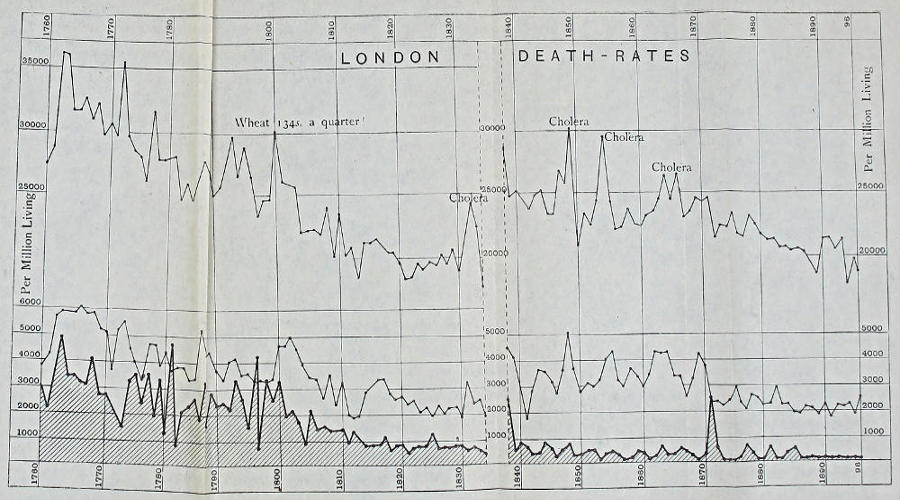
The first and largest of the diagrams illustrating
this question is that exhibiting the mortality of London
from the year 1760 down to the present day (see
end of volume). It is divided into two portions, that
from 1750 to 1834 being derived from the old “Bills of
Mortality,” that from 1838 to 1896 from the Reports
of the Registrar-General.
The “Bills of Mortality” are the only material
available for the first period, and they are far inferior
in accuracy to the modern registration, but they
are probably of a fairly uniform character throughout,
and may therefore be as useful for purposes of
comparison as if they were more minutely accurate.
It is admitted that they did not include the whole of the
deaths, and the death-rates calculated from the estimated
population will therefore be too low as compared
with those of the Registrar-General, but the course of
each death rate—its various risings or fallings—will
probably be nearly true.[7] The years are given along
the bottom of the diagram, and the deaths per million
living are indicated at the two ends and in the centre,
the last four years of the Bills of Mortality being
omitted because they are considered to be especially
inaccurate. The upper line gives the total death-rate
from all causes, the middle line the death-rate from the
chief zymotic diseases—measles, scarlet-fever, diphtheria,
whooping-cough and, fevers generally, excluding
small-pox, and the lower line small-pox only. The
same diseases, as nearly as they can be identified in the
Bills of Mortality according to Dr. Creighton, are
given in the earlier portion of the diagram from the
figures given in his great work, A History of Epidemics
in Britain. With the exception of these zymotics the
diagram is the same as that presented to the Royal
Commission (3rd Report, diagram J.), but it is carried
back to an earlier date.
Let us now examine the lowest line, showing the
small-pox death-rate. First taking the period from
1760 to 1800, we see, amid great fluctuations and
some exceptional epidemics, a well-marked steady decline
which, though obscured by its great irregularity,
amounts to a difference of 1,000 per million living.
This decline continues, perhaps somewhat more rapidly,
to 1820. From that date to 1834 the decline is much
less, and is hardly perceptible. The period of Registration
opens with the great epidemic of 1838, and
thenceforward to 1885 the decline is very slow indeed;
while, if we average the great epidemic of 1871 with
the preceding ten years, we shall not be able to discover
any decline at all. From 1886, however, there
is a rather sudden decline to a very low death-rate,
which has continued to the present time. Now it is
alleged by advocates of vaccination, and by the Commissioners
in their Report, that the decline from 1800
onwards is due to vaccination, either wholly or in
great part, and that “the marked decline of small-pox
in the first quarter of the present century affords substantial
evidence in favour of the protective influence
of vaccination.”[8] This conclusion is not only entirely
unwarranted by the evidence on any accepted methods
of scientific reasoning, but it is disproved by several
important facts. In the first place the decline in the
first quarter of the century is a clear continuation of a
decline which had been going on during the preceding
forty years, and whatever causes produced that earlier
decline may very well have produced the continuation
of it. Again, in the first quarter of the century, vaccination
was comparatively small in amount and imperfectly
performed. Since 1854 it has been compulsory
and almost universal; yet from 1854 to 1884 there is
almost no decline of small-pox perceptible, and the
severest epidemic of the century occurred in the midst
of that period. Yet again, the one clearly marked
decline of small-pox has been in the ten years from
1886 to 1896, and it is precisely in this period that
there has been a great falling off in vaccination in
London from only 7 per cent. less than the births in
1885 to 20·6 per cent. less in 1894, the last year given
in the Reports of the Local Government Board; and
the decrease of vaccinations has continued since.
But even more important, as showing that vaccination
has had nothing whatever to do with the decrease of
small-pox, is the very close general parallelism of the
line showing the other zymotic diseases, the diminution
of which it is admitted has been caused by improved
hygienic conditions. The decline of this group
of diseases in the first quarter of this century, though
somewhat less regular, is quite as well marked as in
the case of small-pox, as is also its decline in the last
forty years of the 18th century, strongly suggesting
that both declines are due to common causes. Let
any one examine this diagram carefully and say if it
is credible that from 1760 to 1800 both declines are
due to some improved conditions of hygiene and sanitation,
but that after 1800, while the zymotics have
continued to decline from the same class of causes one
zymotic—small-pox—must have been influenced by a
new cause—vaccination, to produce its corresponding
decline. Yet this is the astounding claim made by
the Royal Commissioners! And if we turn to the
other half of the diagram showing the period of registration,
the difficulty becomes even greater. We first
have a period from 1838 to 1870, in which the zymotics
actually rose; and from 1838 to 1871, averaging
the great epidemic with the preceding ten years, we
find that small-pox also rose, or at the best remained
quite stationary. From 1871 to 1875 zymotics are
much lower, but run quite parallel with small-pox;
then there is a slight decline in both, and zymotics
and small-pox remain lower in the last ten years than
they have ever been before, although in this last
period vaccination has greatly diminished.
Turning to the upper line, showing the death-rate
from all causes, we again find a parallelism throughout,
indicating improved general conditions acting
upon all diseases. The decline of the total death-rate
from 1760 to 1810 is remarkably great, and it continues
at a somewhat less rate to 1830, just as do the
zymotics and small-pox. Then commences a period
from 1840 to 1870 of hardly perceptible decline partly
due to successive epidemics of cholera, again running
parallel with the course of the zymotics and of small-pox,
followed by a great decline to the present time,
corresponding in amount to that at the beginning of
the century.
The Commissioners repeatedly call attention to the
fact that the mortality from measles has not at all
declined and that other zymotics have not declined in
the same proportion as small-pox, and they argue:
“If improved sanitary conditions were the cause of
small-pox becoming less, we should expect to see that
they had exercised a similar influence over almost all
other diseases. Why should they not produce the
same effect in the case of measles, scarlet fever, whooping-cough,
and indeed any disease spread by contagion
or infection and from which recovery was possible?”
This seems a most extraordinary position to be taken
in view of the well-known disappearance of various
diseases at different epochs. Why did leprosy almost
disappear from England at so early a period and
plague later on? Surely to some improved conditions
of health. The Commissioners do not, and we may
presume cannot, tell us why measles, of all the zymotic
diseases, has rather increased than diminished
during the whole of this century. Many students of
epidemics hold that certain diseases are liable to replace
each other, as suggested by Dr. Watt, of Glasgow,
in the case of measles and small-pox. Dr. Farr,
the great medical statistician, adopted this view. In his
Annual Report to the Registrar-General in 1872 (p. 224),
he says: “The zymotic diseases replace each other;
and when one is rooted out it is apt to be replaced by
others which ravage the human race indifferently
whenever the conditions of healthy life are wanting.
They have this property in common with weeds and
other forms of life: as one species recedes another
advances.” This last remark is very suggestive in
view of the modern germ-theory of these diseases.
This substitution theory is adopted by Dr. Creighton,
who in his History of Epidemics in England suggests
that plague was replaced by typhus fever and small-pox;
and, later on, measles, which was insignificant
before the middle of the seventeenth century, began
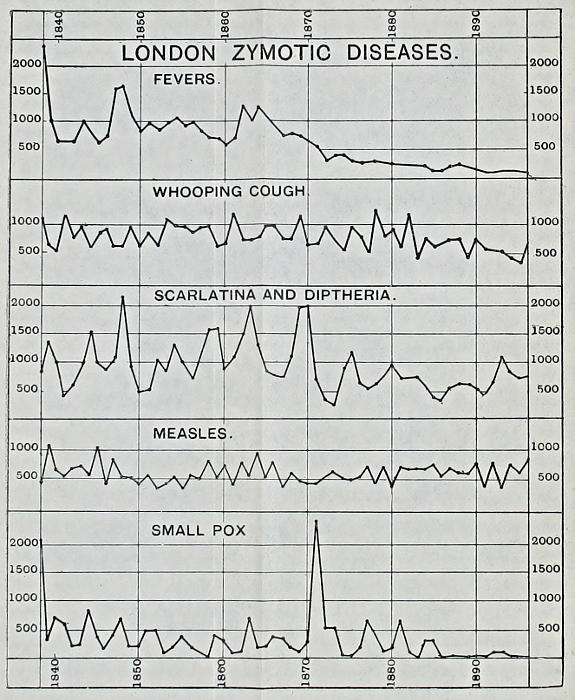
to replace the latter disease. In order to show the
actual state of the mortality from these diseases
during the epoch of registration, I have prepared a
diagram (II.) giving the death-rates for London of
five of the chief zymotics, from the returns of the
Registrar-General, under the headings he adopted
down to 1868—for to divide fevers into three kinds
for half the period, and to separate scarlatina and
diphtheria, as first done in 1859, would prevent any
useful comparison from being made.
The lowest line, as in the larger diagram, shows
Small-pox. Above it is Measles, which keeps on the
whole a very level course, showing, however, the
high middle period of the zymotics and two low
periods, from 1869 to 1876, and from 1848 to 1856, the
first nearly corresponding to the very high small-pox
death-rate from 1870 to 1881; and the other just
following the two small-pox epidemics of 1844 and
1848, thus supporting the view that it is in process of
replacing that disease. Scarlatina and diphtheria show
the high rate of zymotics generally from 1848 to
1870, with a large though irregular decline subsequently.
Whooping-cough shows a nearly level
course to 1882 and then a well-marked decline. Fevers
(typhus, enteric, and simple) show the usual high
middle period, but with an earlier and more continuous
decline than any of the other zymotic diseases. We
thus see that all these diseases exhibit common features
though in very different degrees, all indicating the
action of general causes, some of which it is by no
means difficult to point out.
In 1845 began the great development of our railway
system, and with it the rapid growth of London, from
a population of two millions in 1844 to one of four
millions in 1884. This rapid growth of population
was at first accompanied with overcrowding, and
as no adequate measures of sanitation were then provided
the conditions were prepared for that, increase of
zymotic disease which constitutes so remarkable a
feature of the London death-rates between 1848 and
1866. But at the latter date commenced a considerable
decline both in the total mortality and in that
from all the zymotic diseases, except measles and
small-pox, but more especially in fevers and diphtheria,
and this decrease is equally well explained by the
completion, in 1865, of that gigantic work, the main
drainage of London. The last marked decline in
small-pox, in fevers, and to a less marked degree in
whooping-cough, is coincident with a recognition of
the fact that hospitals are themselves often centres of
contagion, and the establishment of floating hospitals
for London cases of small-pox. Perhaps even more
beneficial was the modern system of excluding sewer-gas
from houses.
We thus see that the increase or decrease of the
chief zymotic diseases in London during the period
of registration, is clearly connected with adverse or
favourable hygienic conditions of a definite kind.
During the greater part of this period small-pox and
measles alone showed no marked increase or decrease,
indicating that the special measures affecting them
had not been put in practice, till ten years back the
adoption of an effective system of isolation in the case
of small-pox has been followed by such marked results
wherever it has been adopted as to show that this is
the one method yet tried that has produced any large
and unmistakable effect, thus confirming the experience
of the town of Leicester, which will be referred
to later on.
The Commissioners in their Final Report lay the
greatest stress on the decline of small-pox at the beginning
of the century, which “followed upon the
introduction of vaccination,” both in England, in
Western Europe, and in the United States. They
declare that “there is no proof that sanitary improvements
were the main cause of the decline of small-pox,”
and that “no evidence is forthcoming to show
that during the first quarter of the nineteenth century
these improvements differentiated that quarter
from the last quarter or half of the preceding century
in any way at all comparable to the extent of the
differentiation in respect to small-pox” (p. 19 par. 79).
To the accuracy of these statements I demur in the
strongest manner. There is proof that sanitary improvements
were the main cause of this decline of
small-pox early in the century, viz., that the other
zymotic diseases as a whole showed a simultaneous
decline to a nearly equal amount, while the general
death-rate showed a decline to a much greater amount,
both admittedly due to improved hygienic conditions,
since there is no other known cause of the diminution
of disease; and that the Commissioners altogether
ignore these two facts affords, to my mind, a convincing
proof of their incapacity to deal with this
great statistical question. And, as to the second
point, I maintain that there is ample direct evidence,
for those who look for it, of great improvements in
the hygienic conditions of London quite adequate to
account for the great decline in the general mortality,
and therefore equally adequate to account for the
lesser declines in zymotic diseases and in small-pox,
both of which began in the last century, and only
became somewhat intensified in the first quarter of
the present century, to be followed twenty years later
by a complete check or even a partial rise. This rise
was equally marked in small-pox as in the other
diseases, and thus proved, as clearly as anything can
be proved, that its decline and fluctuations are in no
way dependent on vaccination, but are due to causes
of the very same general nature as in the case of other
diseases.
To give the evidence for this improvement in London
hygiene would, however, break the continuity of
the discussion as to small-pox and vaccination; but
the comparison of the general and zymotic death-rates
with that of small-pox exhibits so clearly the identity
of the causes which have acted upon them all as to
render the detailed examination of the various improved
conditions that led to the diminished mortality
unnecessary. The diagram showing the death-rates
from these three causes of itself furnishes a complete
refutation of the Commissioners’ argument. The
evidence as to the nature of the improved conditions
will be given in another work to be published shortly.
We have no general statistics of mortality in England
and Wales till the establishment of the Registration
system in 1838, but the results make up for
their limited duration by their superior accuracy.
Till the year 1870 no record was kept of the amount
of vaccination except as performed by the public
vaccinators, but since 1872 all vaccinations are recorded,
and the numbers published by the Local
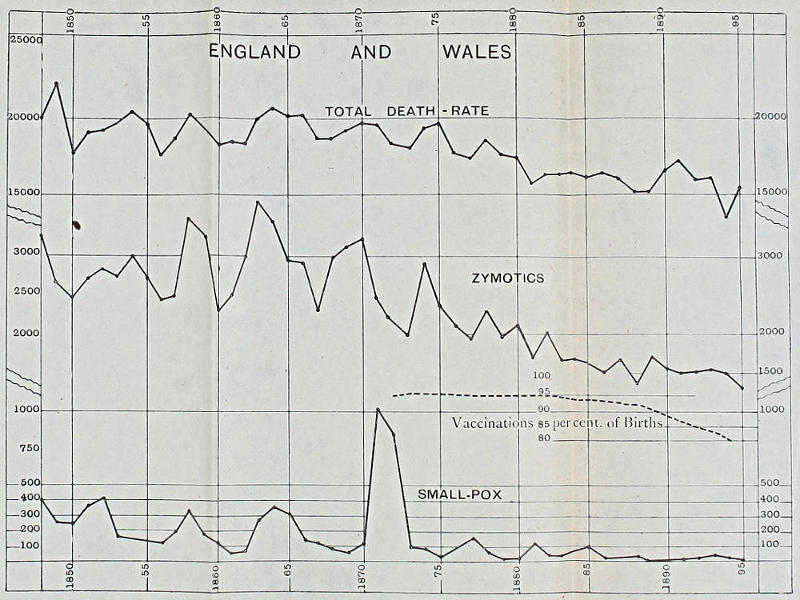
Government Board. My third diagram is for the
purpose of showing graphically the relation of small-pox
to other zymotic diseases, and to vaccination, for
England and Wales. The lower line shows small-pox,
the middle one zymotic diseases, and the upper the
total death-rates. The relations of the three are much
the same as in the London diagram, the beginning of
the great decline of zymotics being in 1871, and that
of small-pox in 1872, but the line of small-pox is much
lower, and zymotics somewhat lower than in London,
due to a larger proportion of the inhabitants living
under comparatively healthy rural conditions.
But if the amount of vaccination were the main
and almost exclusive factor in determining the amount
of small-pox, there ought to be little or no difference
between London and the country. But here, as in all
other cases, the great factor of comparative density
of population in compared areas is seen to have its
full effect on small-pox mortality as in that of all
other zymotic diseases.
This non-relation between vaccination and small-pox
mortality is further proved by the thick dotted
line showing the vaccinations per cent. of births for
the last 22 years, as given in the “Final Report”
(p. 34). The diminution of vaccination in various
parts of the country began about 1884, and from 1886
has been continuous and rapid, and it is during this
very period that small-pox has been continuously less
in amount than has ever been known before. Both
in the relation of London small-pox to that of the
whole country, and in the relation of small-pox to
vaccination, we find proof of the total inefficacy of
that operation.
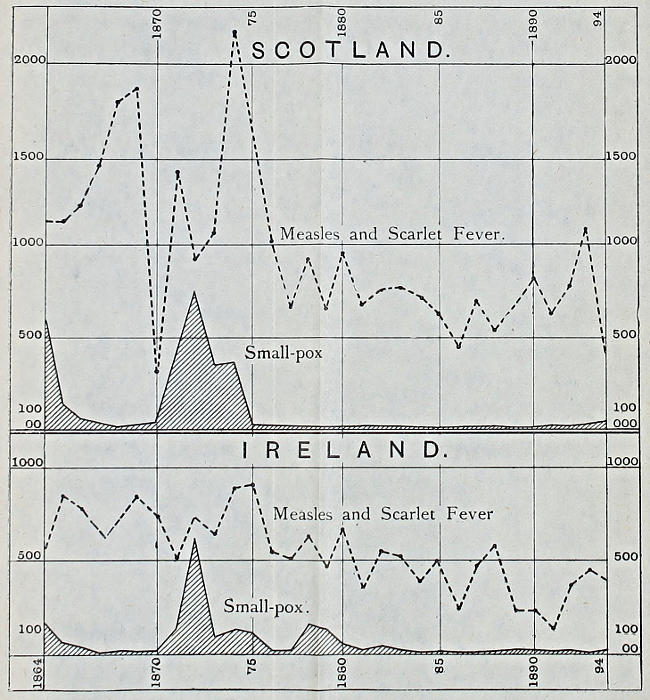
In their Final Report the Commissioners give us
Tables of the death-rates from small-pox, measles, and
scarlet-fever in Scotland and Ireland; and from these
Tables I have constructed my diagram (IV.), combining
the two latter diseases for simplicity, and
including the period of compulsory vaccination and
accurate registration in both countries.
The most interesting feature of this diagram is
the striking difference in the death-rates of the two
countries. Scotland, the richer, more populous, and
more prosperous country having a much greater mortality,
both from the two zymotics and from small-pox,
than poor, famine-stricken, depopulated Ireland. The
maximum death-rate by the two zymotics in Scotland
is considerably more than double that in Ireland, and
the minimum is larger in the same proportion. In
small-pox the difference is also very large in the same
direction, for although the death-rate during the great
epidemic in 1872 was only one-fourth greater in Scotland,
yet as the epidemic there lasted three years, the
total death-rate for those years was nearly twice as
great as for the same period in Ireland, which, however,
had a small epidemic later on in 1878. Since
1883 small-pox has been almost absent from both
countries, as from England; but taking the twenty
years of repeated epidemics from 1864 to 1883, we
find the average small-pox death-rate of Scotland to
be about 139, and that of Ireland 85 per million, or
considerably more than as three to two. But even
Scotland had a much lower small-pox mortality than
England, the proportions being as follows for the three
years which included the epidemic of 1871-3:
- Ireland, 800 per million in the three years.
- Scotland, 1,450 per million in the three years.
- England, 2,000 per million in the three years.
Now the Royal Commissioners make no remark
whatever on these very suggestive facts, and they
have arranged the information in tables in such a
way as to render it very difficult to discover them;
and this is another proof of their incapacity to deal
with statistical questions. They seem to be unable to
look at small-pox from any other point of view than
that of the vaccinationist, and thus miss the essential
features of the evidence they have before them.
Every statistician knows the enormous value of the
representation of tabular statistics by means of diagrammatic
curves. It is the only way by which in
many cases the real teaching of statistics can be
detected. An enormous number of such diagrams,
more or less instructive and complete, were presented
to them, and, at great cost, are printed in the Reports;
but I cannot find that, in their Final Report, they
have made any adequate use of them, or have once
referred to them, and thus it is that they have overlooked
so many of the most vital teachings of the
huge mass of figures with which they had to deal.
It is one of the most certain of facts relating
to sanitation that comparative density of population
affects disease, and especially the zymotic diseases,
more than any other factor that can be ascertained.
It is mainly a case of purity of the air, and consequent
purification of the blood; and when we consider
that breathing is the most vital and most continuous
of all organic functions, that we must and do breathe
every moment of our lives, that the air we breathe is
taken into the lungs, one of the largest and most
delicate organs of the body, and that the air so taken
in acts directly upon the blood, and thus affects the
whole organism, we see at once how vitally important
it is that the air around us should be as free as possible
from contamination, either by the breathing of other
people, or by injurious gases or particles from decomposing
organic matter, or by the germs of disease.
Hence it happens that under our present terribly
imperfect social arrangements the death-rate (other
things being equal) is a function of the population per
square mile, or perhaps more accurately of the proportion
of town to rural populations.
In the light of this consideration let us again compare
these diagrams of Irish, Scottish, and English
death-rates. In Ireland only 11 per cent. of the population
live in the towns of 100,000 inhabitants and
upwards. In Scotland 30 per cent., and in England
and Wales 54 per cent.; and we find the mortality
from zymotic diseases to be roughly proportional to
these figures. We see here unmistakable cause and
effect. Impure air, with all else that overcrowding
implies on the one hand, higher death-rate on the
other. This explains the constant difference between
London and rural mortality, and it also explains what
seems to have puzzled the Commissioners more than
anything else—the intractability of some of the zymotics
to ordinary sanitation, as in the case of measles
especially, and in a less degree of whooping-cough—for
in their case the continual growth of urban as
opposed to rural populations has neutralised the effects
of such improved conditions as we have been able to
introduce.
But the most important fact for our present purpose
is, that small-pox is subject to this law just as are the
other zymotics, while it pays no attention whatever
to vaccination. The statistician to the Registrar-General
for Scotland gave evidence that ever since
1864 more than 96 per cent. of the children born have
been vaccinated or had had previous small-pox, and
he makes no suggestion of any deficiency that can be
remedied. But in the case of Ireland the medical
commissioner for the Local Government Board for
Ireland, Dr. MacCabe, told the Commissioners that
vaccination there was very imperfect, and that a large
proportion of the population was “unprotected by
vaccination,” this state of things being due to various
causes, which he explained (2nd Rep., QQ. 3,059-3,075).
But neither Dr. MacCabe nor the Commissioners notice
the suggestive, and from their point of view alarming,
fact that imperfectly vaccinated Ireland had had
far less small-pox mortality than thoroughly well-vaccinated
Scotland, enormously less than well-vaccinated
England, and overwhelmingly less than equally
well-vaccinated London. Ireland—Scotland—England—London—a
graduated series in density of population,
and in zymotic death-rate; the small-pox death-rate
increasing in the same order and to an enormous
extent, quite regardless of the fact that the last three
have had practically complete vaccination during the
whole period of the comparison; while Ireland alone,
with the lowest small-pox death-rate by far, has, on
official testimony, the least amount of vaccination. And
yet the majority of the Commissioners still pin their
faith on vaccination, and maintain that the cumulative
force of the testimony in its favour is irresistible!
And further, that “sanitary improvements” cannot
be asserted to afford “an adequate explanation of the
diminished mortality from small-pox.”
It will now be clear to my readers that these conclusions,
set forth as the final outcome of their seven
years’ labours, are the very reverse of the true ones,
and that they have arrived at them by neglecting
altogether to consider, in their mutual relations, “those
great masses of national statistics” which alone can
be depended on to point out true causes, but have
limited themselves to such facts as the alleged mortalities
of the vaccinated and the unvaccinated, changes
of age-incidence, and other matters of detail, some of
which are entirely vitiated by untrustworthy evidence
while others require skilled statistical treatment to
arrive at true results, a subject quite beyond the
powers of untrained physicians and lawyers, however
eminent in their own special departments.[9]
Before proceeding to discuss those special test-cases
in our own country which still more completely show
the impotence of vaccination, it will be well to notice
a few Continental States which have been, and still
are, quoted as affording illustrations of its benefits.
We will first take Sweden, which has had fairly
complete national statistics longer than any other
country, and we are now fortunately able to give the
facts on the most recent official testimony—the Report
furnished by the Swedish Board of Health to the
Royal Commission, and published in the Appendix to
their Sixth Report (pp. 751-56). Such great authorities
as Sir William Gull, Dr. Seaton, and Mr. Marson,
stated before the Committee of Enquiry in 1871 that
Sweden was one of the best vaccinated countries, and
that the Swedes were the best vaccinators. Sir John
Simon’s celebrated paper, which was laid before Parliament
in 1857 and was one of the chief supports of
compulsory legislation, made much of Sweden, and had
a special diagram to illustrate the effects of vaccination
on small-pox. This paper is reproduced in the
First Report of the recent Royal Commission (pp. 61-113),
and we find the usual comparison of small-pox
mortality in the last and present century which is held
to be conclusive as to the benefits of vaccination. He
says vaccination was introduced in 1801, and divides
his diagram into two halves differently coloured before
and after this date. It will be observed that, as in
England, there was a great and sudden decrease of
small-pox mortality after 1801, the date of the first
vaccination in Sweden, and by 1812 the whole reduction
of mortality was completed. But from that date
for more than sixty years there was an almost continuous
increase in frequency and severity of the
epidemics. To account for this sudden and enormous
decrease Sir John Simon states, in a note, and without
giving his authority: “About 1810 the vaccinations
were amounting to nearly a quarter of the number of
births.” But these were almost certainly both adults
and children of various ages, and the official returns
now given show that down to 1812, when the whole
reduction of small-pox mortality had been effected, only
8 per cent. of the population had been vaccinated. We
are told in a note to the official tables that the first
successful vaccination in Stockholm was at the end of
1810, so that the earlier vaccinations must have been
mainly in the rural districts; yet the earlier Stockholm
epidemics in 1807, before a single inhabitant was
vaccinated, and in 1825, were less severe than the six
later ones, when vaccination was far more general.
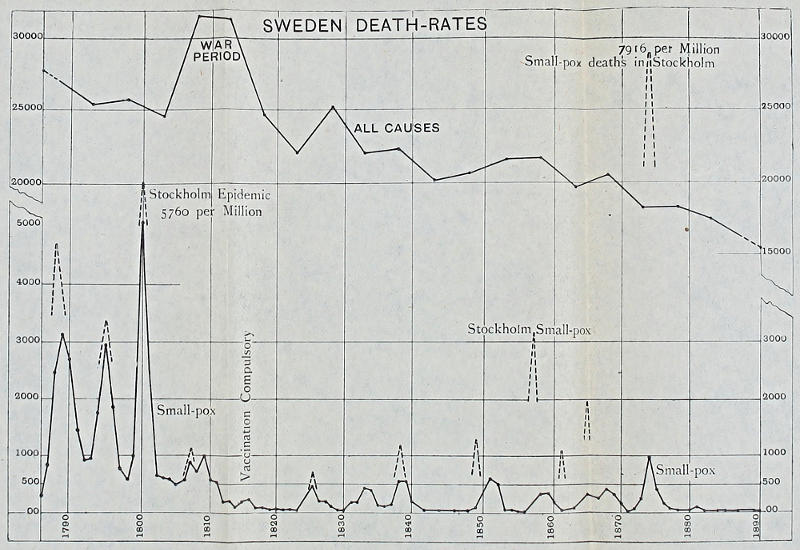
Bearing these facts in mind, and looking at diagram
V., we see that it absolutely negatives the idea of
vaccination having had anything to do with the great
reduction of small-pox mortality, which was almost all
effected before the first successful vaccination in the
capital on the 17th December, 1810! And this becomes
still more clear when we see that as vaccination
increased among a population which, the official
Report tells us, had the most “perfect confidence” in
it, small-pox epidemics increased in virulence, especially
in the capital (shown in the diagram by the dotted
peaks) where, in 1874, there was a small-pox mortality
of 7,916 per million, reaching 10,290 per million during
the whole epidemic, which lasted two years. This
was worse than the worst epidemic in London during
the eighteenth century.[10]
But although there is no sign of a relation between
vaccination and the decrease of small-pox, there is a
very clear relation between it and the decrease in the
general mortality. This is necessarily shown on a
much smaller vertical scale to bring it into the diagram.
If it were on the same scale as the small-pox
line, its downward slope would be four times as rapid
as it is. The decrease in the century is from about
27,000 to 15,000 per million, and, with the exception
of the period of the Napoleonic wars, the improvement
is nearly continuous throughout. There has evidently
been a great and continuous improvement in healthy
conditions of life in Sweden, as in our own country
and probably in all other European nations; and this
improvement, or some special portion of it, must have
acted powerfully on small-pox to cause the enormous
diminution of the disease down to 1812, with which,
as we have seen, vaccination could have had nothing
to do. The only thing that vaccination seems to have
done is, to have acted as a check to this diminution,
since it is otherwise impossible to explain the complete
cessation of improvement as the operation became
more general; and this is more especially the
case in view of the fact that the general death-rate
has continued to decrease at almost the same rate
down to the present day!
The enormous small-pox mortality in Stockholm has
been explained as the result of very deficient vaccination;
but the Swedish Board of Health states that this
deficiency was more apparent than real, first, because
25 per cent. of the children born in Stockholm die
before completing their first year, and also because of
neglect to report private vaccinations, so that “the
low figures for Stockholm depend more on the cases of
vaccination not having been reported than on their
not having been effected.” (Sixth Report, p. 754,
1st col., 3rd par.)
The plain and obvious teaching of the facts embodied
in this diagram is, that small-pox mortality is
in no way influenced (except it be injuriously) by
vaccination, but that here, as elsewhere, it does bear
an obvious relation to density of population; and also
that, when uninfluenced by vaccination, it follows the
same law of decrease with improved conditions of
general health as does the total death-rate.
This case of Sweden alone affords complete proof of
the uselessness of vaccination; yet the Commissioners
in the Final Report (par. 59) refer to the great diminution
of small-pox mortality in the first twenty years of
the century as being due to it. They make no comparison
with the total death-rate; they say nothing
of the increase of small-pox from 1824 to 1874; they
omit all reference to the terrible Stockholm epidemics
increasing continuously for fifty years of legally
enforced vaccination and culminating in that of 1874,
which was far worse than the worst known in London
during the whole of the eighteenth century. Official
blindness to the most obvious facts and conclusions
can hardly have a more striking illustration than the
appeal to the case of Sweden as being favourable to
the claims of vaccination.
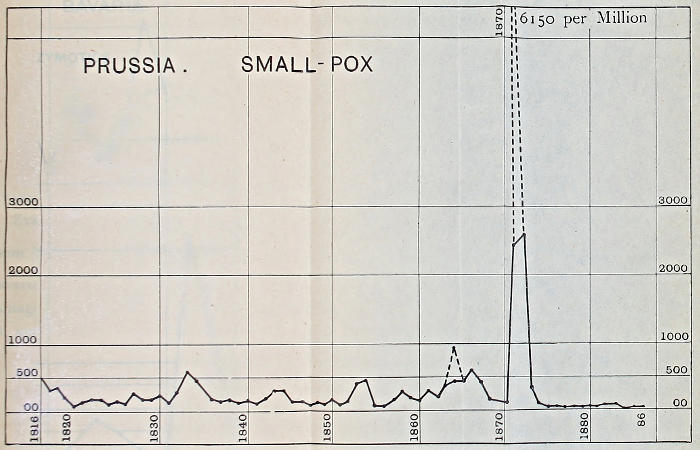
My next diagram (No. VI.) shows the course of
small-pox in Prussia since 1816, with an indication of
the epidemics in Berlin in 1864 and 1871. Dr. Seaton,
in 1871, said to the Committee on Vaccination
(Q. 5,608), “I know Prussia is well protected,” and
the general medical opinion was expressed thus in
an article in the Pall Mall Gazette (May 24, 1871):
“Prussia is the country where revaccination is most
generally practised, the law making the precaution
obligatory on every person, and the authorities conscientiously
watching over its performance. As a
natural result, cases of small-pox are rare.” Never
was there a more glaring untruth than this last statement.
It is true that revaccination was enforced in
public schools and other institutions, and most rigidly
in the Army, so that a very large proportion of the
adult male population must have been revaccinated;
but, instead of cases of small-pox being rare, there
had been for the twenty-four years preceding 1871 a
much greater small-pox mortality in Prussia than in
England, the annual average being 248 per million for
the former and only 210 for the latter. A comparison
of the two diagrams shows the difference at a glance.
English small-pox only once reached 400 per million
(in 1852), while in Prussia it four times exceeded that
amount. And immediately after the words above
quoted were written the great epidemic of 1871-72
caused a mortality in revaccinated Prussia more than
double that of England! Now, after these facts have
been persistently made known by the anti-vaccinators,
the amount of vaccination in Prussia before 1871 is
depreciated, and Dr. A. F. Hopkirk actually classes it
among countries “without compulsory vaccination.”
(See table and diagram opposite p. 238 in the 2nd Report.)
In the city of Berlin we have indicated two
epidemics, that in 1864, with a death-rate a little
under 1,000 per million, while that in 1871 rose to
6,150 per million, or considerably more than twice as
much as that of London in the same year, although
the city must have contained a very large male population
which had passed through the army, and had
therefore been revaccinated.
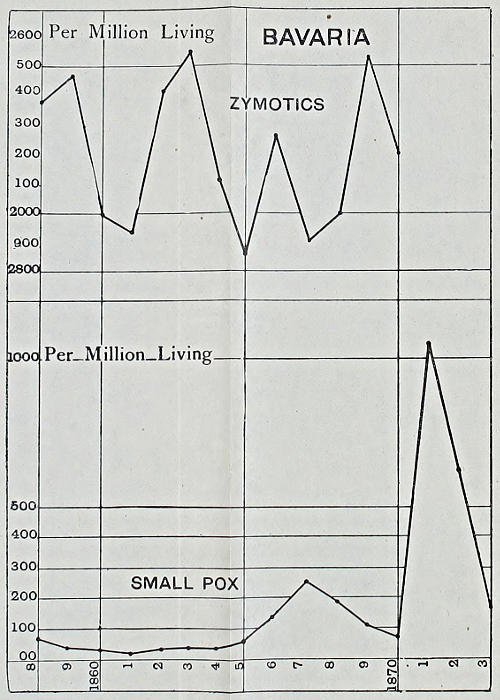
I give one more diagram (No. VII.) of small-pox in
Bavaria, from a table laid before the Royal Commission
by Dr. Hopkirk for the purpose of showing the results
of long-continued compulsory vaccination. He stated
to the Commission that vaccination was made compulsory
in 1807, and that in 1871 there were 30,742
cases of small-pox, of which 95·7 per cent. were
vaccinated. (2nd Report, Q. 1,489.) He then explains
that this was because “nearly the whole population
was vaccinated”; but he does not give any figures to
prove that the vaccinated formed more than this proportion
of the whole population; and as the vaccination
age was one year, it is certain that they did not
do so.[11] He calls this being “slightly attacked,” and
argues that it implies “some special protection.” No
doubt the small-pox mortality of Bavaria was rather
low, about equal to that of Ireland; but in 1871 it rose
to over 1,000 per million, while Ireland had only 600,
besides which the epidemic lasted for two years, and
was therefore very nearly equal to that of England.
But we have the explanation when we look at the line
showing the other zymotics, for these are decidedly
lower than those of England, showing better general
sanitary conditions. In Bavaria, as in all the other
countries we have examined, the behaviour of small-pox
shows no relation to vaccination, but the very
closest relation to the other zymotics and to density of
population. The fact of 95·7 per cent. of the small-pox
patients having been vaccinated agrees with that of
our Highgate hospital, but is even more remarkable
as applying to the population of a whole country, and
is alone sufficient to condemn vaccination as useless.
And as there were 5,070 deaths to these cases, the
fatality was 16·5 per cent., or almost the same as that
of the last century; so that here again, and on a
gigantic scale, the theory that the disease is “mitigated”
by vaccination, even where not prevented, is
shown to be utterly baseless. Yet this case of
Bavaria was chosen by a strong vaccinist as affording
a striking proof of the value of vaccination when
thoroughly carried out, and I cannot find that the
Commissioners took the trouble to make the comparisons
here given, which would at once have shown
them that what the case of Bavaria really proves is
the complete uselessness of vaccination.
This most misleading, unscientific, and unfair
proceeding, of giving certain figures of small-pox
mortality among the well vaccinated, and then,
without any adequate comparison, asserting that they
afford a proof of the value of vaccination, may be here
illustrated by another example. In the original paper
by Sir John Simon on the History and Practice of
Vaccination, presented to Parliament in 1857, there
is, in the Appendix, a statement by Dr. T. Graham
Balfour, surgeon to the Royal Military Asylum for
Orphans at Chelsea, as to the effects of vaccination in
that institution—that since the opening of the Asylum
in 1803 the Vaccination Register has been accurately
kept, and that every one who entered was vaccinated
unless he had been vaccinated before or had had
small-pox; and he adds: “Satisfactory evidence can
therefore, in this instance, be obtained that they were
all protected.” Then he gives the statistics, showing
that during forty-eight years, from 1803 to 1851,
among 31,705 boys there were thirty-nine cases and
four deaths, giving a mortality at the rate of 126 per
million on the average number in the Asylum, and
concludes by saying: “The preceding facts appear to
offer most conclusive proofs of the value of vaccination.”
But he gives no comparison with other boys of
about the same age and living under equally healthy
conditions, but who had not been so uniformly or so
recently vaccinated; for it must be remembered that,
as this was long before the epoch of compulsory
vaccination, a large proportion of the boys would be
unvaccinated at their entrance, and would therefore
have the alleged benefit of a recent vaccination. But
when we make the comparison, which both Dr.
Balfour and Sir John Simon failed to make, we find
that these well vaccinated and protected boys had
a greater small-pox mortality than the imperfectly
protected outsiders. For in the First Report of the
Commission (p. 114, Table B) we find it stated that in
the period of optional vaccination (1847-53) the death-rate
from small-pox of persons from ten to fifteen years[12]
was 94 per million! Instead of offering “most conclusive
proofs of the value of vaccination,” his own
facts and figures, if they prove anything at all, prove
not only the uselessness but the evil of vaccination, and
that it really tends to increase small-pox mortality.
And this conclusion is also reached by Professor Adolf
Vogt, who, in the elaborate statistical paper sent by
him to the Royal Commission, and printed in their
Sixth Report, but not otherwise noticed by them,
shows by abundant statistics from various countries
that the small-pox death-rate and fatality have been
increased during epidemics occurring in the epoch of
vaccination.
One more point deserves notice before leaving this
part of the inquiry, which is the specially high small-pox
mortality of great commercial seaports. The
following table, compiled from Dr. Pierce’s Vital
Statistics for the Continental towns and from the
Reports of the Royal Commission for those of our own
country, is very remarkable and instructive.
| Name of Town. |
Year. |
Small-pox
Death-rate
per Million. |
| Hamburgh |
1871 |
15,440 |
| Rotterdam |
1871 |
14,280 |
| Cork |
1872 |
9,600 |
| Sunderland |
1871 |
8,650 |
| Stockholm |
1874 |
7,916 |
| Trieste |
1872 |
6,980 |
| Newcastle-on-Tyne |
1871 |
5,410 |
| Portsmouth |
1872 |
4,420 |
| Dublin |
1872 |
4,330 |
| Liverpool |
1871 |
3,890 |
| Plymouth |
1872 |
3,000 |
The small-pox death-rate in the case of the lowest
of these towns is very much higher than in London
during the same epidemic, and it is quite clear that
vaccination can have had nothing to do with this
difference. For if it be alleged that vaccination was
neglected in Hamburgh and Rotterdam, of which we
find no particulars, this cannot be said of Cork, Sunderland,
and Newcastle. Again, if the very limited and
imperfect vaccination of the first quarter of the century
is to have the credit of the striking reduction of
small-pox mortality that then occurred, as the Royal
Commissioners claim, a small deficiency in the very
much more extensive and better vaccination that generally
prevailed in 1871, cannot be the explanation of
a small-pox mortality greater than in the worst years
of London when there was no vaccination. Partial
vaccination cannot be claimed as producing marvellous
effects at one time and less than nothing at all at
another time, yet this is what the advocates of vaccination
constantly do. But on the sanitation theory
the explanation is simple. Mercantile seaports have
grown up along the banks of harbours or tidal rivers
whose waters and shores have been polluted by sewage
for centuries. They are always densely crowded owing
to the value of situations as near as possible to the
shipping. Hence there is always a large population
living under the worst sanitary conditions, with bad
drainage, bad ventilation, abundance of filth and decaying
organic matter, and all the conditions favourable
to the spread of zymotic diseases and their exceptional
fatality. Such populations have maintained to our
day the insanitary conditions of the last century, and
thus present us with a similarly great small-pox mortality,
without any regard to the amount of vaccination
that may be practised. In this case they illustrate
the same principle which so well explains the very
different amounts of small-pox mortality in Ireland,
Scotland, England, and London, with hardly any difference
in the quantity of vaccination.
The Royal Commissioners, with all these facts
before them or at their command, have made none of
these comparisons. They give the figures of small-pox
mortality, and either explain them by alleged
increase or decrease of vaccination, or argue that, as
some other disease—such as measles—did not decrease
at the same time or to the same amount, therefore
sanitation cannot have influenced small-pox. They
never once compare small-pox mortality with general
mortality, or with the rest of the group of zymotics,
and thus fail to see their wonderfully close agreement—their
simultaneous rise and fall, which so clearly
shows their subjection to the same influences and
proves that no special additional influence can have
operated in the case of small-pox.