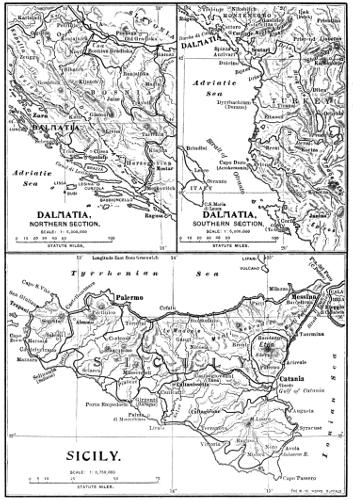
It was with an appetite whetted by long waiting that I landed in Sicily
on the last day of May, 1897. Anybody might enjoy travel in Sicily.
Its scenery is magnificent. A mountainous country with a coast-line
of rugged headlands, and here and there a river breaking through to
the sea, opening up vistas into the interior and forming a fertile
plain at its mouth; above all, snow-capped and smoking Ætna, with its
nearly eleven thousand feet towering so high as to be seen from every
part of the island except the valleys, form a combination attractive
even to one who has left history and art out of his travelling outfit.
The student of history, however, gets a keener enjoyment in this land
where so much history—ancient, mediæval, and modern—has been enacted.
Not only was it the apple of discord between Rome and Carthage, but,
to say nothing of Sikans, Elymi, and Sikels, because their movements
are wrapped in the mist of a prehistoric past, Phœnicians, Greeks,
Carthaginians, Romans, Franks, Vandals, Goths, Byzantines, Saracens,
Normans, Germans, French, and Spaniards successively shaped its
destinies until Garibaldi at last brought it to rest in the bosom of
the kingdom of Italy. But Sicily has an especial interest for the
student of the history and art of ancient Greece. He who studies the
country now known as Greece and neglects the greater Hellas in the west
makes a great mistake. Akragas and Selinus have left more imposing
ruins than Athens, Olympia, and Delphi; and Syracuse was at one time
the most populous and the most powerful of all Greek cities.
It was this especial claim which drew me and my two companions, members
of the American School at Athens, to Catania. We desired to become as
familiar with western Hellas as we had already become with eastern
Hellas. We came rather too late in the year; not that physical comfort
is an element for great consideration in such a land; it is rather
the psychological aspect which I have in mind. Theocritus has thrown
such associations of spring over Sicily that the traveller feels
that he ought to be there with “pulses thronged with the fulness of
the spring,” which can hardly be the case in the great heat of June.
Perhaps our bicycles might seem to some out of time with Theocritus
and Pindar, and we did not try to throw any glamour of poetry over
them. But they were vastly convenient. We had sent forward our heavy
luggage to Palermo, and they carried all that we needed for two weeks.
While they were not a substitute for trains, they freed us from servile
dependence on trains. If a train went our way at our time, as it
did from Syracuse to Girgenti, we took it. But finding no railroad
connection between Girgenti and Selinus, except such as took us across
to the north side of the island and then back again to the south side,
we passed the intervening space in a direct line along the southern
shore, saving both time and money. When we were at Syracuse we wished
to visit the river Asinaros, where the fugitive Athenian army was
brought to bay and slaughtered and captured. The five o’clock train was
too early. Who likes to take a morning meal at half-past four with the
fear of losing a train before his eyes? Discomfort if not dyspepsia
hovers over him. The alternative of a later train involved giving up
the day to this excursion, and we needed that day for something else.
We took a comfortable meal, and, starting at six o’clock, at a quarter
past eight were on the banks of the Asinaros, and by the aid of a train
were back in Syracuse at ten o’clock, ready for a good day’s work.
Our beginning was inauspicious. A chapter of small accidents on the
lava-paved streets of Catania kept us hovering around a shop presided
over by a woman in which sewing-machines and a few other miscellaneous
machines, including bicycles, were repaired. Here, in a subordinate
position, was one of those mechanics who know how to do things as if
by instinct, a not unworthy successor of Hephæstos, who used to do
business on a grander scale hard by, with Ætna for his forge. Your
real mechanic, from Tubal Cain down, is always the right man in the
right place. A deft-handed New Hampshire mechanic once said to me,
after putting some dislocated object to rights in less than five
minutes, “I shall have to charge you ten cents for doing the job and
fifteen cents for knowing how.” It struck me as a good expression of
the claims of the guild.
When we got off it was nearly eleven o’clock, and the flower of the
day was gone; but we had vowed to see the sunrise from the theatre of
Taormina the next morning; and so we sped off in the heat over roads
so bad as to make us repent of all the hard things we had said of the
roads of Greece. A good deal of the way lay between Ætna and the sea
over lava-beds of various ages, among them the identical stream which,
coming down fresh and hot, turned Himilco from proceeding straight
against Dionysius and Syracuse after the destruction of Messina,
and obliged him to make the circuit of the awful mountain. Shortly
after noon we passed, on the highest of these lava-beds, Acireale,
the most important of several Acis, all of which commemorate Acis,
who here, to his grief, associated with Galatea and Polyphemus. Near
by are several jagged islands pointed out by tradition as the very
rocks which the latter hurled at Ulysses with such poor results. From
this point on Taormina lay clear before us in the distance, high up
above the sea, though but a short horizontal distance from it. When
we reached Giardini, the village on the seashore which serves as a
railroad station for Taormina, parched with heat and thirst, we were
reminded of the verse of Euripides, “The sea washes away all human
ills,” and we here began a series of baths with which we encircled the
island. Nemesis marked me when, in exuberance of spirit, I made the
understatement, “This bath is worth a dollar,” and made it cost me
just that amount. Between the road and the shore was a railroad with a
cactus hedge on each side of it. In passing this I hardly noticed that
my wheel had lightly brushed against a cactus plant. But we had hardly
begun the ascent to Taormina before my wheel was in a state of collapse.
Well, the morrow must take thought for the things of itself. Here was
Taormina for us to enjoy. We had planned to spend one night only here,
because there was little material for archæological study except the
famous theatre, which in its present state is Roman. It was indeed
refreshing to see near the upper rim of the theatre, and partly covered
by its massive but cheap-looking walls of brick, the foundations of
a Greek temple in four courses with its perfect joints of stone. But
while Syracuse and Girgenti and Selinus were our proper fields for
study, Taormina was for pleasure. From this eyrie, Ætna, which from
Catania is in some degree disappointing, as is even Mont Blanc when
seen from Chamonix, rises as grandly as does Mont Blanc when seen
from the heights across the valley, Flégère or Brévent; and when the
sun, rising over Calabria, gives a rosy color to the slope up to the
snow-line, one gazes, forgetting the theatre in the glory of the
mountain.
Although we had studied the theatre adequately on the first day, we
were caught by the charm of the place; and a second sunrise in the
theatre seemed so desirable that we broke our carefully drawn up
itinerary at the very outset, the necessary two-thirds vote being
easily obtained. About a thousand feet above Taormina rises a height
which once served as an acropolis to ancient Tauromenium, crowned
with a village and castle called Mola. Having climbed this in the
hot afternoon we saw, about another thousand feet above us, a point
called Monte Venere, which seemed to dominate the whole region. We
subsequently read in Frances Elliot’s “Travels in Sicily,” "Certain
misguided travellers have even been known to attempt Monte Venere." But
not suspecting at the time that we were misguided, but only questioning
whether the scaling of Monte Venere would cost us our table d’hôte
dinner at the Hotel Timeo, we decided, by a rather doubtful two-thirds
vote, to try it. We stormed it at a pace such as the Bavarian division
struck at Speicheren when told that a fresh keg of beer was to be
broached “up there” at ten o’clock, and that they must be on hand.
As the result of our toil we got a superb view into the interior,
including a peep in behind Ætna, which from this point seemed even
grander than from Taormina. It was labor well spent.
During our whole stay at Taormina there was no spot on which my eye and
my thoughts so frequently rested as on the little tongue of land just
below us to the south, which we had passed in coming from Catania. On
this vine-covered plain once lay Naxos, settled by men from Chalkis
in 734 B.C. What a chain of consequences followed upon this
small beginning! Leontini and Catania were founded from Naxos itself
almost immediately afterward. Dorian Corinth, following hard after
Ionian Chalkis, founded Syracuse, and with the birth of western Hellas
the strife of Dorian and Ionian was made a part of its life. But before
this strife brought ruin a period of expansion and prosperity followed
which finds its only parallel in the two centuries and a half of the
history of our own country.
Having no desire to traverse again a bad road, we took an early
train, which brought us back to Catania at eight o’clock. Our first
visit there was to the “divine artificer,” who found eight punctures
impartially distributed over my two tires. We thus learned to know the
cactus in a new light. Hereafter we avoided even a dry piece of it
lying in the road as cavalry would avoid caltrops. We took advantage
of the necessary delay to visit the most interesting monument of Greek
Catania, the theatre, covered by lava, on which rest the houses of the
modern city. Enough underground excavation has been done to enable one
to realize the appearance of the place when Alcibiades here harangued
the Catanians to bring them over to the Athenian alliance, and had
such drastic force lent to his lisping oratory by a body of Athenian
hoplites, who, coming from their camp outside the city, broke down
a weak spot in the wall and entered the city before he got to his
peroration.
Again it was about noon when we mounted with intention to ride to
Lentini, somewhat over a third of the way to Syracuse, across a level
plain, and then take a train across the hill-country to within ten
miles of Syracuse, there to resume our ride. For an hour or more we
were passing through the famous “Campi Læstrygonii,” which Cicero calls
“uberrima pars Siciliæ,” now known as the plain of Catania, the most
extensive plain in Sicily. Then we crossed the Symæthos, and soon
began a gentle climb, with the sun almost in the zenith. Now and then
a turn in the road, or if not that, a look over the shoulder, gave us
a fine view of Ætna, which kept increasing in majesty as we receded
from it. I was thankful that we had not climbed it. That would have in
some measure vulgarized it. A geologist might do it in the line of his
profession. But one who wishes to keep the Ætna of Æschylus and Pindar
may do better to gaze with awe from the hill of Syracuse, as they
did, upon this Greek Sinai. I do not want to overpower a mountain like
that. I want it to overpower me. One may doubt whether Coleridge would
or could have written his hymn to Mont Blanc if he had “conquered” it,
as tourists express it.
Just as the train for Syracuse was coming in we reached Lentini
station, and this time the sea that “washes away all human ills” was
not available. We here made a resolve to do our work in the future
when the sun was nearer the horizon. There was nothing of interest
for us to investigate in the city of Gorgias, the sophist and orator,
whose silver tongue, combined with a bold and transparent trick of the
Segestans, duped the Athenians, who thought themselves the wisest of
men, into the Sicilian expedition. We were accordingly glad to speed
along to Priolo, a station between the ruins of Megara and the flat
peninsula, Thapsos. Just beyond the latter, having ridden long enough
to get up steam, we washed away our ills for that day with the hill of
Syracuse looking down upon us, and then as renewed men passed, when the
sun was approaching the horizon, over that historic hill, and looked
down on the historic harbor and on little Ortygia, large enough to hold
the modern city as it held the first Corinthian colony. What a tide of
associations rush over one at this sight! In a sense we were at our
goal. Had we closed our journey with that nightfall we should at least
have read our Thucydides for the future with different eyes.
In an exaltation of spirit we came to the Casa Politi, almost at
the point of Ortygia, looking out upon the sea, where we found a
German host and hostess. After our strenuous and partially successful
wrestling with Italian, which had generally ended by our falling back
on the member who had taken Italian at Harvard to straighten out for us
the tangled web of the dialogue, how welcome it was when we asked the
question, “Haben Sie vielleicht gutes Bier?” to get straight from the
shoulder the honest answer, “Jawohl, gewiss,” and the more tangible
answer of three foaming mugs from a cool cellar. We had lived in the
spirit a good deal that day, enjoying the beauty of Taormina, Ætna,
and Syracuse, and holding converse with Alcibiades and Gorgias and
Thucydides. Now we hobnobbed with Gambrinus, and enjoyed “the warmest
welcome in an inn.”
I have never had more full and exhilarating days than those four
days in Syracuse, days full of revelation, recollection, reverie,
or, to put it more prosaically, days devoted to study in history and
topography. The ruins of Syracuse are not to the casual observer very
imposing. One might almost say of them, “periere etiamque ruinæ.”
But even these ruins have great interest for the archæologist. There
is, for example, an old temple near the northern end of Ortygia, for
the most part embedded in the buildings of the modern city, yet with
its east end cleared and showing several entire columns with a part
of the architrave upon them. And what a surprise here awaits one who
thinks of a Doric temple as built on a stereotyped plan! Instead of
the thirteen columns on the long sides which one is apt to look for
as going with a six-column front, here are eighteen or nineteen, it
is not yet quite certain which. The columns stand less than their
diameter apart, and the abaci are so broad that they nearly touch. So
small is the intercolumnar space that archæologists incline to the
belief that in this one Doric temple there were triglyphs only over
the columns, and not also between them as in all other known cases.
Everything about this temple stamps it as the oldest in Sicily. An
inscription on the top step, in very archaic letters, much worn and
difficult to read, contains the name of Apollo in the ancient form,
Ἀπέλονι. The inscription may, of course, be later than the temple; but
it is in itself old enough to warrant the supposition that the temple
was erected soon after the first Corinthian colonists established
themselves in the island. While the inscription makes it reasonably
certain that the temple belonged to Apollo, the god under whose guiding
hand all these Dorians went out into these western seas, tradition,
with strange perversity, has given it the name of “Temple of Diana.”
But it is all in the family. Whether tradition has also erred in naming
the temple on the highest part of the island, into which the cathedral
has been so immured that the old temple columns protrude on each
side of the church, the “Temple of Minerva,” is a question to which
archæologists have not yet returned a unanimous answer. Indications
point rather to Zeus. This temple owes its preservation, such as it
is, to this immuring of the cathedral in it. In fact, the temple is
nearly all present, although one might almost pass it by in the daytime
without seeing it. Another temple ruin on the edge of the plateau,
which begins about two miles south of the city, across the Anapos, one
might also easily overlook in a casual survey, because it consists only
of two columns without capitals, and a broad extent of the foundations
from which the accumulated earth has been only partially removed. This
was the famous temple of Olympian Zeus, built probably in the days of
Hiero I., soon after the Persian war, but on the site of a temple still
more venerable. One seeks a reason for the location of this holy place
at such a distance from the city. Holm, the German historian of Sicily,
argues with some plausibility that this was no mere suburb of Syracuse,
but the original Syracuse itself. In the first place, the list of the
citizens of Syracuse was kept here down at least to the time of the
Athenian invasion. In the second place, tradition, which, when rightly
consulted, tells so much, says that Archias, the founder of Syracuse,
had two daughters, Ortygia and Syracusa, which may point to two
co-ordinate settlements, Ortygia and Syracuse; the latter, which was on
this temple plateau, being subsequently merged in the former, but, as
sometimes happens in such cases, giving its name to the combined result.
Besides these temple ruins there are many more foundations that tell a
more or less interesting story. Then there are remains of the ancient
city that can never be ruined: for instance, the great stone quarries,
pits over a hundred feet deep and acres broad, in some of which the
Athenian prisoners were penned up to waste away under the gaze of the
pitiless captors; the Greek theatre, cut out of the solid rock; the
great altar of Hiero II., six hundred feet long and about half as
broad, also of solid rock. Then there is the mighty Hexapylon, which
closed the fortifications of Dionysius at the northwest at the point
where they challenged attack from the land side. With its sally-ports
and rock-hewn passages, some capacious enough to quarter regiments
of cavalary, showing holes cut in the projecting corners of rock,
through which the hitch-reins of the horses were wont to be passed,
and its great magazines, it stands a lasting memorial to the energy
of a tyrant. But while this fortress is practically indestructible, an
impregnable fortress is a dream incapable of realization. Marcellus and
his stout Romans came in through these fortifications, not entirely, it
is true, by their own might, but by the aid of traitors, against whom
no walls are proof.
One of the stone quarries, the Latomia del Paradiso, has an added
interest from its association with the tyrant who made himself hated
as well as feared, while Gelon was only feared without being hated.
An inner recess of the quarry is called the “Ear of Dionysius,” and
tradition says that at the inner end of this recess either he or his
creatures sat and listened to the murmurs that the people uttered
against him, and that these murmurs were requited with swift and fatal
punishment. Certain it is that a whisper in this cave produces a
wonderful resonance, and a pistol-shot is like the roar of a cannon;
but that people who had anything to say against the butcher should come
up within ear-shot of him to utter it is not very likely. Historians
are not quite sure that the connection of Dionysius with this recess is
altogether mythical, but that he shaped it with the fell purpose above
mentioned is not to be thought of, as the whole quarry is older than
his time, and was probably, with the Latomia dei Cappuccini, a prison
for the Athenians.
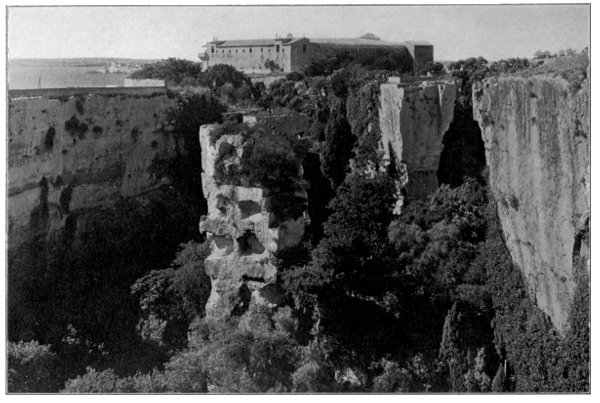
STONE QUARRY AT SYRACUSE CALLED LATOMIA DEI CAPPUCCINI
No object is more frequently mentioned in connection with Syracuse than
Arethusa, the nymph changed into a fountain when pursued across the
sea by the river Alpheius. The water of this fountain, much praised in
antiquity, has in recent times become brackish by the letting in of
salt water through earthquakes. But what it has lost in real excellence
it has gained in stylish appearance. For the sake of its ancient
renown, washerwomen have recently been excluded from it, a fine wall
put about it, and papyrus plants added to make it look picturesque.
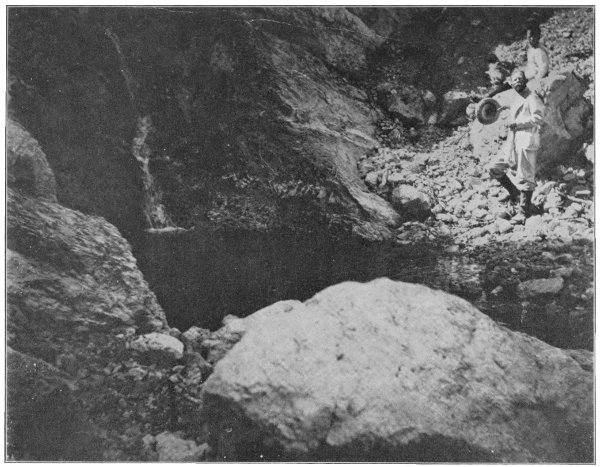
Enveloped in a more natural beauty lies the rival fountain, Kyane,
the source of the southern branch of the Anapos some distance south
of the Olympieum. The nymph Kyane was turned into a fountain by Pluto
because she told Demeter of the rape of Persephone. We gave half a day
to Kyane, and had ourselves pushed up a stream lined with reeds and
papyrus, the latter a reminder of Saracen occupation, to this spring,
from which the stream comes forth with a rush. It is difficult to
decide which is more beautiful, the clear, deep, broad spring or the
stream through which one approaches it. The whole journey is like an
excursion into fairy-land, the outside world being shut out by the
reeds and papyrus.
But if the monuments of Syracuse are on the whole comparatively
unimpressive, what a history is crowded into the less than three
centuries between Gelon, the second founder of the city, in that he
made it great, and Marcellus. This history is far from being a mere
record of slaughter, and sieges, and sack of cities. The time of Hiero
I. is memorable for the appearance at Syracuse, in familiar if not
always friendly converse, of Pindar, Simonides, Bacchylides, Æschylus,
Epicharmos and Xenophanes. One must not think of the poetry of this
Hieronian circle as exotic because most of the poets were transplanted:
to the Greek poets any place in the Greek world where they were
appreciated and cared for was home. Anacreon sang as well and as
naturally at Samos and Athens as at his native Teos; Simonides’s muse
was apparently equally happy in Athens, Thessaly, and Sicily; and even
the Theban eagle suffered no relaxation of his wings at the Syracusan
court; nay, he appears to have made his loftiest flights there. Over
one-third of his epinicion odes are for Sicilian victors. Of the Titan
Æschylus alone of that company one may suspect that, although he did
not always get on well at home, yet the sojourn so far from Eleusis and
Marathon found him homesick and heartsick. It is only rarely in the
world’s history that such a lot of stars gather around a court. It is a
good deal that Syracuse was again visited by the muses in the time of
Hiero II., when Theocritus took up his abode there.
The afternoon before we left Syracuse we got a reminder that its
greatness did not all pass away with the Roman occupation. The enormous
catacombs from Christian times speak of new and better days. But what
stirs one more is one particular spot in the crypt of St. Marcian, a
church partly made out of a temple of Bacchus. Here, in front of an
old altar, a block of stone is pointed out as the stone on which St.
Paul stood when he preached at Syracuse. One gets impatiently sceptical
about traces of the saints in Italy; but why not accept the report
that in his three days’ stay at Syracuse, recorded in the Acts of the
Apostles, St. Paul preached here? What is more fitting than that, by
the very altar of the god of revelry, the great apostle should speak
as he spoke at Athens? At any rate, I add this spot to Appii Forum and
Tres Tabernæ as a place where I trod in the footsteps of a man beside
whom Gelon, Pyrrhus, and Hannibal were pygmies.
On the journey from Syracuse to Girgenti by rail through the heart of
Sicily the most interesting point is Castrogiovanni, the ancient Enna,
called the navel of Sicily, a height from which one sees mountains
diverging in every direction, a real Knotenpunkt. The railroad
affords a view of Enna only from some distance as it plunges into a
long tunnel under the ridge joining this height to another almost as
high, on which stands Calascibetta. The surroundings of the old Sikel
town, Enna, which, being early colonized by Syracuse, became a lasting
monument of Greek domination over the Sikel, were probably much more
beautiful in ancient times. On these rather bare heights there was once
such luxuriant growth of woods and flowers that hunting-dogs lost the
scent of the game. In this flower-garden the Sicilian legend placed the
rape of Persephone.
As the train approached Girgenti it passed through the great sulphur
region of the world. Here thousands of boys, many of them under ten
years of age, carry the sulphur up to the surface. These boys are bound
over by their parents to the overseers of the mines for the sum of two
hundred francs, more or less, which they are expected to work off. But
it takes years to do it, and many die before they succeed. The parents
spend the purchase money and the children live on in despair. Our
informant, a German-American, who had come over to study the sulphur
industry, and who was not a sentimentalist, said that the sight of
these boys going up and down the ladders with tears rolling down their
cheeks had made him join in their sighs and carry a heavy heart all the
way to Palermo.
The case of Girgenti is that of Syracuse reversed. Its history is not
so very important, but its ruins are impressive. Even at Himera, where
Theron and Akragas stood by Gelon and Syracuse, it was in a second
rôle. On that occasion, when the larger part of the Carthaginian
prisoners fell to Akragas, apparently because they strayed into
Akragantine territory after the battle, some of the citizens are
said to have got five hundred slaves apiece. From this time Akragas
gave itself up to the amassing of wealth. As a consequence it became
the least martial and most luxurious of Greek cities, showing, like
Corinth, that a Dorian city, when once given over to pleasure, could
outdo the Ionians in that direction. While Syracuse battled with
Athens, Akragas remained neutral. About the only form of strenuous
activity to which it arose was athletics; and even then a victory was
made an occasion for a display of wealth. When Exænetos won in the
stadion at Olympia, three hundred span of milk-white horses accompanied
him into the city.
The luxury of Akragas took on a peculiarly showy and almost gross type.
The men loaded themselves with gold ornaments. They erected tombs to
horses which had won Olympic victories and to other favorite animals. A
typical Akragantine was Gellias, who used to have slaves stand at his
door and invite every passing stranger to come in; and once, when five
hundred knights from Gela made a visit to Akragas in the winter, he
took them all in, entertained them, and gave each of them a new chiton
and himation. That the means of entertainment did not fail him is shown
by the statement that he had three hundred rock-hewn wine-barrels,
holding each a hundred amphoræ, and a big vat holding a thousand
amphoræ, out of which these were filled; and this was private
hospitality.
One could hardly expect moderation when such bountiful provision for
carousal was at hand. Athenæus tells a story showing how well the young
men lived up to their privileges. Some of these, drinking themselves
dizzy at a banquet, declared that the house rocked like a ship, and, as
if to avert impending shipwreck, began to lighten ship by pitching the
furniture out of the windows, to the danger, and then to the hilarious
delight, of the passers-by. But as a crowd and some disorder resulted,
the generals went to the house to investigate the matter. The young
bloods were equal to the emergency. They accosted the graybeards as
Tritons, thanked them for deliverance from the storm, and vowed to
sacrifice to them so soon as they had got over their sea-sickness and
fright. The old men, being carried away with the humor of the thing,
entered into the spirit of the joke, and that house was ever after
known as “the ship.”
Such a joke might have been played in a good many other towns, but
the following bit of gossip, if not true, is ben trovato, and has a
peculiarly Akragantine flavor. It is related that at the fatal siege
of the city by the Carthaginians, when all was at stake, a law was
passed restricting the guards when at their posts to one under-mattress
and one over-mattress, one blanket, and two pillows. If these things
were done in a green tree, what was done in a dry? Empedocles, the
most eminent citizen of Akragas, said of his fellow-citizens that they
indulged in high living as if they were going to die to-morrow, but
built as if they were going to live forever. The first half of this
statement we have to judge by gossip, which, as it is very bulky and
all to the same point, may well make us believe that when there is so
much smoke there must be some fire. For the corroboration of the latter
half, go to Girgenti and circumspice.
What a moment was that when, toward the end of the afternoon, after
toiling up from the station on the north side of Girgenti to the city
itself, which occupied the site of the acropolis of Akragas, we looked
down on the plateau sloping southward toward the sea, and dotted with
the famous ruins long known to us by photographs. About a mile below
us, in the direction of the ruins, was the Hôtel des Temples, which we
had been told in Syracuse was to close for the summer the day before.
But as “the Greeks got into Troy by trying,” we thought we would try to
get into this hotel, and be near our goal. At the door a boy declared
that the house was closed; but at our request he said he would call the
padrone. In ten minutes there appeared in riding clothes, and leading a
horse, the most charming landlord of Sicily, with a bewitching smile
and the manners of a gentleman. He said that, although his house was
closed and his cook gone, he had not the heart to send us back up into
the city. We could have, he said, eight or nine beds apiece, and, as
he had a hunting comrade with him for the night, he could give us some
soup and meat.
More than satisfied to have established a base of operations, without
a delay of five minutes we were at the Concordia Temple, the most
perfectly preserved Greek temple, unless we except perhaps the Theseum.
Having an hour and a half of daylight, we used it in getting a first
view of nearly everything on the plateau, and then returned to what we
supposed was to be a frugal meal. But the dinner was an Akragantine
feast, the best of the whole journey, with the possible exception of
the next one at the same table. We wondered what sort of a dinner the
regular cook would have produced if this was done by a novice; and when
the padrone made apologies for his dinner, we searched his smiling face
for traces of sarcasm.
The next day we enjoyed in detail what we had already enjoyed in the
lump, that row of temples lined up along the southern edge of the
plateau which here ends in a rocky precipice. These temples when
new, with the city of half a million inhabitants behind it, and the
acropolis above it with still more temples, must have been a very
effective sight to one coming up from the sea five miles away.
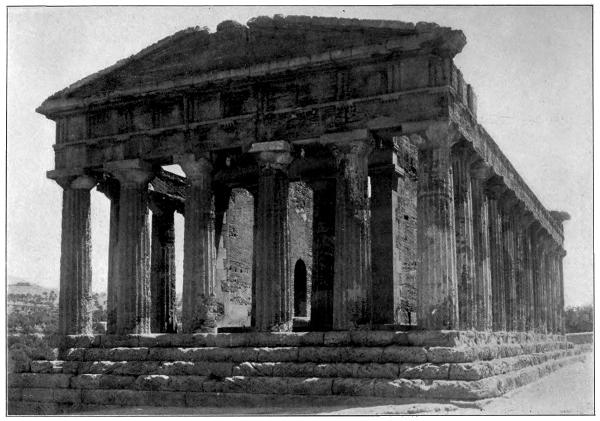
SO-CALLED CONCORDIA TEMPLE AT GIRGENTI
Although the material of the temples is a friable yellow sandstone,
quarried near by, we must not in reconstructing our picture think of
them as yellow temples. They doubtless had stucco and paint enough to
hide this core. The stone is so porous that it is not surprising to
find the columns on the south side—i.e., the side most exposed to
the sirocco—badly eaten away. The whole line dates from the fifth
century, and was doubtless planned and begun by Theron, who had armies
of slaves from Himera.
What Greek name the Concordia Temple had is unknown. Holm suspects
that it is the temple of Demeter, although the substructure under a
church farther up the hill has generally been assigned to her. It owes
its excellent preservation to the fact that in the Middle Ages it was
turned into a church of St. Gregory of the turnips, whoever he was,
when the cella walls were perforated with a series of arches on each
side, to let in the light.
The next best preserved is the temple of Hera Lacinia, in the most
commanding situation of all, having the precipice, which is here higher
and more abrupt, on its east front, as well as on its south side. It
is also considerably the highest of the line. Its present name is
surely wrong. It is quite likely to have been a temple of Poseidon,
a divinity held in honor at Akragas, a horse-rearing as well as a
maritime city. The temple of Herakles is more interesting than either
of these, although only one column stands upright; the rest lie as they
were thrown down by an earthquake, in such good order that it would be
easy to set them up again; and the result would be much more important
than Cavalari’s so-called temple of Castor and Pollux, which, being a
corner of a temple put together out of two different temples, should be
properly called "Cavalari’s folly." The temple of Herakles is rightly
named. It was identified as being at the sacred gate and near the
agora. It is much larger than the two temples already described, and
shows, like them, traces of a great conflagration which reddened the
yellow stone in places. Its ground plan is very clear but peculiar, and
so extremely interesting. Sicily is the place of all others to study
the construction of the Greek temple.
But the object of greatest interest is the Zeus Temple, still farther
west in the line. This justifies the saying of Empedocles above quoted,
being so large that the Parthenon could be lost in one corner of it, as
the wooden ladle was lost in Lady Wouter Van Twiller’s pocket. It is
the most massive of Greek temples, in the sense in which the temple of
Zeus at Olympia is more massive than the Parthenon—i.e., its columns
and all its members are larger. So enormous were its dimensions that
the architect readily saw that he must deviate from the ordinary
rules of construction. Columns of friable stone fifty-five feet high,
supporting an unusually heavy entablature, needed support themselves.
Accordingly they were embedded in a continuous wall. What one here saw
was not a line of graceful columns between which and the cella one
could walk about, but only a great wall with half columns protruding
from it. These half columns were not really independent members. The
small blocks composing them run over into the wall to the right and
left. They simply serve to break up a monotonous wall, and to present
the appearance of columns. This contour, which is a little over a
semi-circumference, averages about twenty feet, being, of course,
greater at the bottom. A man’s back, as was remarked by Diodorus
Siculus, easily fits into the flutings. The clearest idea, however, of
the large proportions of the temple I got by noting that the grooves
in a triglyph lying on the ground measured fifteen feet in length. It
would also be no exaggeration to say that a company could dance on the
top of one of the capitals lying about.
The inside of this temple must have been as peculiar as the outside.
The great question here is where to place the gigantic figures called
Atlantes or Telamones, male figures corresponding to the female figures
on the Erechtheum, but, unlike them, showing exertion, like Atlas in
the Olympia metope. Probably they stood on the lateral walls of the
cella, and, with their twenty-five feet, they would reach up to the
roof, like the second row of columns at Pæstum. The cella probably ran
clear through from one end of the temple to the other, and, while the
two divisions of the temple to the right and left of it, which were
as much closed as the cella itself, had entrances from the east, the
cella was probably entered from the west. One has to say “probably”
very often in speaking of the interior, because the temple has been
nearly all carried away to make the pier at Porto Empedocle, the harbor
of the modern city. As late as 1401 three columns were still standing
and carrying a piece of the architrave. But the temple entered very
early on the stage of dilapidation, for the reason that the roof was
never put upon it. For more than half a century, even from the time of
Theron, Akragas had wrought upon this monster building, and had not
finished it when the Carthaginian fury broke upon her. Although the
city rose again, and even prospered, it never saw a day for taking up
again such a gigantic enterprise.
Besides this temple of Olympian Zeus there was an older temple of
Zeus Polieus on the acropolis, to which an unusual interest attaches,
because it was built by Phalaris, of execrable memory, who, having
attached to himself a band of laborers for the construction of the
temple, by their help seized the sovereign power and subverted the
democracy. Down in the crypt of the Church of Santa Maria dei Greci
we were shown a regular stylobate of three steps, and on the top step
eight columns, the upper parts of which run up into the church, which
shows also columns of the other long side of the temple. Tradition
claims this as the identical temple built by Phalaris. But as the forms
of the columns forbid putting them back into the sixth century we do
better to identify them with the temple of Athena on the acropolis. The
temple built by Phalaris is to be sought, then, on the ground occupied
by the modern cathedral. Jove gave place to Jesus, and the virgin
goddess, as at Athens, to the Virgin Mother.
When we told our smiling host that we intended to ride in one day
from his hotel to Castelvetrano, the point of departure for Selinus,
he said the thing was impossible. We told him that, while we admitted
his judgment in all that pertained to horses, we were going to make
the sixty-two miles which, according to Baedeker, lay between us and
our goal between sunrise and sunset, however bad the road might be. He
then, like a true sportsman, got interested, offered to bet, and when
we declined begged us to telegraph back to him if we really did it.
As we had to wake up the cook the next morning, after waking up
ourselves, the sun was well up in the heavens before we got off. But
the coffee which cost us so much time must have told on our gait; for a
fellow-countryman, whom we first met two days later at Palermo, seemed
impressed by it, and rather proud of it. He asked, “Didn’t I see you go
through Porto Empedocle the day before yesterday morning on bicycles?”
When we assented he said: “Well, I told the American Consul who was
with me, ‘I bet dose vas American boys.’” And the next day he repeated,
as if pleased with his own sagacity, “I told the Consul, ‘I bet dose
vas American boys.’”
As we started the next morning toward Selinus, after passing the night
at Castelvetrano, I realized that this, more even than Syracuse, was my
chief object of interest in this long-delayed Sicilian journey.
The history of this short-lived colony of a colony is invested with a
pathetic interest. Planted by Sicilian Megara in 628 B.C.,
as an outpost of Hellas toward the west, it was a standing challenge
to the Phœnicians. But there was not always war between Hellas and
Canaan. The Phœnicians, who had long been in possession of the west
end of the island, were bent on gain, while the Greek sought rather
for a free unfolding of his civic life; and so, Selinus, with a little
temporizing, got on with its neighbors.
There were some strange vicissitudes in Sicilian politics. From the
time when Carthage appeared in Sicily as a protector of the older
Phœnician settlements, Selinus saw its advantage in siding with her
against other rivals. On the great day of Himera, Gelon and Theron had
to contend against Selinus as well as against Carthage. This off-side
play was not, however, regarded by the other Sicilian cities as
sufficient cause for shutting Selinus out of the sisterhood of states.
But, while Selinus had an eye to profit, it did not, like Akragas,
forget the art of war. That she was a power in western Sicily in the
days when Carthage was so strangely inactive for seventy years after
Himera, is shown by an inscription of this time, which mentions a
victory won by the Selinuntians “with the aid of Zeus and Phobos and
Herakles and Apollo and Poseidon and the Tyndaridæ and Athena and
Malophoros and Pasikrateia and the other gods, but especially Zeus.”
This drawing in of so large a part of the pantheon implies that it was
a great victory. Probably it was won from Segesta, that most hated
Elymian neighbor. But Segesta knew how to help herself. After she had
lured Athens to destruction in this same quarrel, she invoked the
Carthaginian on a mission of destruction. For the Carthaginian was not
subdued, but was biding his time, and, when he again fell upon Sicily,
it was his old ally, Selinus, that first felt the weight of his arm.
Then Zeus and Phobos seemed to forsake her. But her conduct was such
in that awful visitation that Hellas had no reason to blush for this
daughter.
The force which Hannibal led against her was, at the lowest estimate,
100,000, which was more than the total population of the city. The
first attack on the land side, where the walls were weak and out of
repair because no danger had threatened for years, was repulsed. A call
for help was sent to both Akragas and Syracuse. The former might have
had its contingent before the walls in three days, allowing one for the
messenger. But Akragas waited for the Syracusans, who were two days
farther off, to come and take them on the way. She paid the penalty
for this delay three years later. She, as well as Syracuse, ought to
have known that at Selinus they would be fighting for their own life.
Syracuse was, moreover, an ally of Selinus in the war against Athens,
which was finished only three years before with such eclat as to make
Syracuse a proper champion of the Greek cities against the great enemy.
It is probable that the call for help was sent out before the enemy
actually made its assault, but so speedy were the movements of the
Carthaginians that one might have expected even prompt aid to come too
late. Selinus, however, held out with such tenacity as to frustrate all
calculation. For nine days, in the consciousness that she stood as a
vanguard of Hellas, while the eastern hills were eagerly scanned for
the succor that was hourly expected, Selinus conducted a defence rarely
equalled in history.
There were not men enough to allow reliefs in defending the wall. The
same men stood at their posts day and night. The old men brought new
weapons, and sharpened those that were dull. The women carried food and
water. Even on the ninth day, when the fierce Iberian mercenaries broke
through the wall and the weary defenders, and got inside the city, the
defence did not cease. The city had to be taken house by house, men
and women hurling down stones from the house-tops until the supply was
exhausted. And now, house after house was pillaged by men spurred on by
the promise of free plunder given by Hannibal; and delicate women fell
into hands compared with which the claws of wild beasts were tender.
Soldiers paraded the streets with heads on the points of their spears
and strings of hands slung over their shoulders. Only 2,600 survivors
somehow found their way to Akragas.
On this very day a large force started from Syracuse; but when, united
with the contingent of Akragas, it confronted the Carthaginians, the
woe of Selinus was accomplished. Hannibal told these belated allies
that he had dealt Selinus only its deserts, and that even its gods had
pronounced against it. What a theme for a Jeremiah!
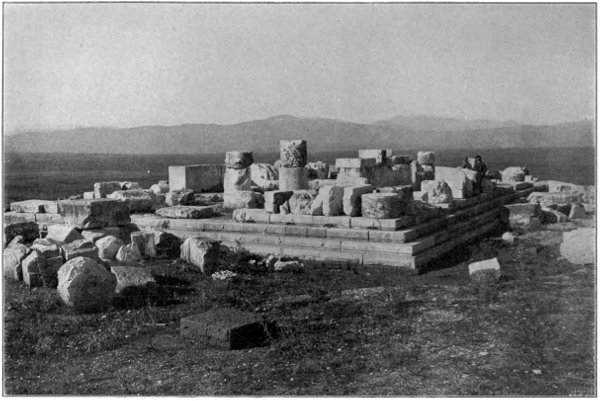
The six large temples of Selinus lie in a worse condition than that
in which the Carthaginians left them. Earthquakes have been more
active here than at Akragas. But these ruins, in two large groups,
one on the acropolis and one on a plateau to the east, are the most
interesting, as well as the most impressive, ruins in Europe. Their
interest lies in the fact that they present us in tangible form the
history of Greek architecture as it unfolded itself in a provincial
town. There is Temple C (probably a Herakles temple; but archæologists
have refrained from giving doubtful names, and designated the temples
by letters. Perhaps the names given at Syracuse and Girgenti, though
false, are better pegs to serve the memory than letters), with
“shapeless sculpture,” the well-known metope representing Perseus
cutting off the head of Medusa, and another with Heracles carrying
the mischievous Kerkopes flung over his shoulder. These grotesque
attempts at sculpture, as well as the general consideration that the
first thought of a colony was to erect a temple, allow us to date this
oldest temple of Selinus as early as 600 B.C. The architecture
is vastly better than the sculpture, a complete Doric style, with
something of the clumsiness which marks the venerable ruin at Corinth.
Then we may notice Temple E, probably a Hera temple, the southernmost
of the three on the eastern plateau, a large and beautiful temple, once
most gorgeously painted, and giving us, perhaps, more light than any
other temple on the subject of polychromy in Doric architecture. The
metopes, the best of which is Zeus receiving Hera on Mount Ida, mark
this temple as a product of the early part of the fifth century, about
the time of the temple of Zeus at Olympia. Then, at the other end of
this line, on the eastern plateau, is Temple G, so enormous that it
is supposed, like its brother at Akragas, to have been meant for none
other than Zeus, the King of the gods. It is a few feet longer and a
few feet wider than the great Akragas temple. Its date is given with a
melancholy certainty; for it, as well as the Akragas temple, was never
finished. It may well have taken a small community like this as much
as the “forty and six years” which the Temple of Jerusalem required to
put up such a colossal building. An especial interest attaches to it
because we see it, as it were, stopped midway in a lively process of
coming into being. Some of the huge drums are combined into columns,
a few of which are fluted from top to bottom, while others have a
little start of fluting at the top and bottom, and still others are
only cut in the form of a twenty-sided polygon. But one must go to
Campo Bello, about five miles distant, to feel in a still more lively
manner the interruption of the building process. Here one sees a cliff
where in one case workmen had just marked out, with a circular groove,
a column-drum to be detached from its bed. In another place is one
around which workmen have hewn for months, so that it is almost ready
to be detached. Hard by are some already detached and rolled a little
distance toward Selinus; still others are found transported half-way or
more to the temple. The people of the country are filled with wonder
at the sight. They recognize the fact that all these blocks were meant
for the great temple; and some of them told an early traveller that the
women of Selinus used to carry these stones on their heads from the
quarry to the temple, spinning flax all the way as they went, adding,
with naïveté: “But, you know, it was a race of women much larger than
ours.”
These interesting temples show, as they stand side by side, great
freedom in the application of the rules of Doric style. For instance,
the number of columns on the side of a hexastyle temple varies from
thirteen to seventeen. The number of steps also varies from two to six,
instead of the canonical three.
When we visited Segesta the next day and saw its temple, also
unfinished, as it was when the city was stricken down by the Greek
Agathocles, we felt little pity for this city which had stirred up so
much mischief for its foe, Selinus, and for its friend, Athens. But
perhaps, after all, this Elymian city’s greatest crime was saying, “I
must live.” If Selinus refused to accept this proposition, Segesta
called in Athens or Carthage, regardless of the woes that might in
consequence come upon those who disputed her right to live.
In shooting down from Segesta to the northern shore, without further
exploration of what may be called the country of Æneas, we got glimpses
of Mount Eryx, the favorite haunt of Venus; and later in the day the
train brought us to Palermo, “that wonderful cross-section of history.”
But as it was not rich in Greek history our tour in western Hellas was
at an end.