USURY:
OR
Interest, Premium and Discount.
A LECTURE[A]
DELIVERED BEFORE THE STUDENTS OF
CRITTENDEN’S PHILADELPHIA COMMERCIAL COLLEGE,
BY
S. H. CRITTENDEN, Attorney at Law,
PRINCIPAL.
Our subject to-day is Usury.
We will first speak of this subject in its direct relation to
Book-Keeping. That is, as to its treatment under different
forms, on the Ledger, since this is in reality the phase in which
it is of most importance for us to consider it. Afterwards we
will glance at the matter in the view of utility, economy and
legality.
The ledger titles which embrace this subject, are Interest,
Discount and Premium. These are all often, and indeed
generally, embodied in one account, headed Interest, yet they
are radically different divisions of the account, both in
their nature and manner of computation; although all tending
to one point, when placed upon the merchant’s books, viz: to
add to his total gains or losses.
McCullock’s Commercial Dictionary has the following definitions
of Interest and Discount:
“Interest, is the sum paid by the borrower of a sum of
money, or of any sort of valuable produce, to the lender, for its
use.”
“Discount, is an allowance made on account of an immediate
advance of a sum of money, not due till some future period.”
Premium, according to Webster’s Dictionary, is “a bounty,
or something offered or given for the loan of money, usually a
sum beyond the interest.”
These definitions, though not full, will yet serve as a foundation
on which to construct an explanation that may make these
terms more easy of comprehension. You perceive that in order
to apply the definition of Interest, which I have quoted, we
must look upon every person who is indebted to another, as a
borrower; that is, as having in his possession, certain property
which belongs of right to that other person; and for retaining
the use of which he must pay him an equivalent. If you
consider in this light all transactions in which Interest is
demanded and paid, this portion of the subject will perhaps be
sufficiently plain without additional comment.
It is in relation to the second division of the account that
most confusion usually arises. There are not less than three
distinct transactions, which are all included in the usual
language of business men, under the single term Discount.
They are:
1st. When a deduction is made for payment of a note or
account before due; 2d. When a per centage is taken off from
a sale, in consideration of ready money; 3d. When money is
remitted from one country to another, at an additional expense
or at a loss.
If at an expense, it is sometimes called Premium.
For illustration, under the 1st division; suppose A holds a
note against B for $500 due in four months, and B comes
to-day and proffers payment; the custom is, for A to deduct
the interest on $500 for four months, from the face of the note;
and to accept the balance as payment in full: thus considering
the use of the remainder of the amount, sufficient to compensate
for the deficiency in the payment of the face of the bill. But
this is manifestly incorrect, if we take the existing law of this
State, which declares the value of the money to be but six per
cent. per annum, to be founded on just principles. For the
interest on the remainder of the note, after deducting the
interest on the face of the note therefrom, is not sufficient at
the same rate per cent. to make up the original sum. So that
B, by paying thus in advance, secures a larger rate of interest
than is lawful. Yet this is the usage, and it is an old adage,
and well established, that usage makes law. This is what is
termed Bank Discount. True Discount, is such a sum, as,
when deducted from the original debt, the interest on the
balance will just equal the amount deducted. The method of
ascertaining this is by proportion, or, as it is called in arithmetics,
rule of three. Thus we would say, as the amount of $100.
and interest for the given time and rate is to the interest on
$100. for the same time and rate, so is the total sum to the
amount of discount to be deducted therefrom. Stated thus,—
102.00 : 2.00 :: 500.00 : the answer.
2d. If C sells goods to D and within a certain limited time,
usually among the jobbing trade of our city 30 days after purchase,
D pays for them in cash, usage again allows him a
deduction from the face of the invoice of say 5 per cent.
This is also called Discount, but it is not properly such. For
it is only a deduction of such a proportion or per centage of
the bill, on fulfillment of certain conditions; while Discount is
reckoned with reference to time to run, as well as rate per cent.;
in fine, Discount is simple Interest paid beforehand.
3d. The term Discount is also applied to that sum which is
advanced beyond or deducted from the amount of a debt,
in remitting money from one country to another.
Thus, if I wish to remit a sum of money to any foreign
country, it is needful for me to ascertain what is the difference
of valuation at the present time between money of the denominations
used and ordinarily obtainable here, and those in the
country to which the remittance is to be made. This valuation
I suppose you all understand is a merely arbitrary one, fixed
at the will of the supreme power in any State, and varying
according to circumstances and the ideas of the law makers. If,
for instance, owing to the different amounts of alloy used in
coining pieces of corresponding value in different countries,
there is say 5 per cent. more precious metal in the coin of that
country to which I wish to remit than in that of our own
country, I must necessarily pay this difference in addition to
the original sum, in order to render the account of my correspondent
good according to the valuation in his country. If
on the other hand the intrinsic value of our coin is 5 per cent.
the greater, then one hundred dollars of our coin will pay one
hundred and five dollars of the other.
The proper term for this is Exchange, and if this name were
universally adopted, there would be far less of confusion in the
ideas associated with such transactions, in the minds of most
persons.
We will now turn to a consideration of the peculiar nature of
Interest, or more properly Usury, and the reasons assigned for
a limitation of its rate by law. Formerly, the amount received
in payment for the loan of capital, was denominated Usury; that
is to say, rent for its use and enjoyment.
This is the correct term, for Interest is only the rent, or price
paid for the enjoyment of an object of value.
But this word has acquired an odious meaning, and is now
understood to express an illegal and oppressive rate of interest
only, the milder but less expressive term being substituted by
common usage.
In earlier times, before the advantage and utility of a reserve
capital was known and appreciated, the demand of a rent for
its use by lenders, was looked upon as an abuse of power, and
an oppression towards the needy. And, more still, it seems
from the accounts handed down to us by the writers of those
days, that even that frugality, without which capital cannot be
amassed, was looked upon as parsimony, and deemed a public
injury, by the populace, who looked upon all sums not spent by
the great proprietors, as lost to themselves. They could not
comprehend that money laid by, as a capital for some profitable
employment, was to all intents equally spent; and that to in a
way far more beneficial to the poor. For a laboring man is
never sure of earning a subsistence save where there is a capital
in reserve for him to work upon. This inability to understand
its use gave rise to strong prejudice against rich individuals, who
do not spend their whole income as it comes in; such a feeling
still exists to a great extent: formerly it was universal. Lenders
themselves were infected by it, and were so much ashamed of
the part they were acting as to employ the most disreputable
agents in the collection of profits perfectly just, and highly
useful to society.
There have been from time to time various species and modifications
of statutes, and enactments for the promotion of public
liberty, and the advancement of happiness, both private and
public.
Yet, though these ordinances have been provided in all good
faith, by the legislators, it is evident to every person who
observes closely, and compares causes and effects, that oftentimes
their operation is inefficient for the end aimed at; and often
directly the reverse in effect from the original intention of their
makers. Especially, it seems to me, is this the case in the
matter of those laws relating to Usury.
There exists almost universally, a sort of hereditary prejudice
against the very name of Usury. Almost every one will plead
guilty to such feelings as these: “Usury is a bad thing, and as
such ought to be prevented; Usurers are a bad sort of men, a
very bad sort of men, and as such ought to be punished and
suppressed.” Now, it is not wonderful that men fall into such
opinions, and become firmly grounded in them, when they hear
them handed down and repeated by those to whom they are in
the habit of looking with confidence for correct ideas.
For it cannot be expected that the mass of mankind should
find leisure, even had they the ability, to examine into the grounds
of a hundredth part of the rules and maxims which they find
themselves compelled to follow and observe. The fact is, that
wherever it has been attempted to limit the rate of Interest, or
to abolish it altogether by law, there the practice of Usury has
uniformly revived. And, as might naturally be expected, the
more severe the penalties, and the more rigid their execution,
the higher the rate of interest was sure to rise. Because the
risk being so much greater, the lender must needs have a larger
premium of insurance to tempt him to incur it. It is a matter
of history, that at Rome, during the continuance of the republican
form of government the rates of interest were enormous.
The simple and plain reason of this was, that the debtors who
were always plebeians, were continually threatening their patrician
creditors.
So also, in those Christian countries where Interest on loans
has been forbidden, or what is equivalent, where it has been
placed by law at so low a point as would not suffice to pay the
risk of loss to a lender, the practice has been made over almost
entirely to the Jews; while at the same time so great has been
the extortion, oppression, and humiliation to which this people
were exposed that nothing short of a very heavy rate of Interest
could indemnify them for such risks and repeated losses.
Thus in any case the ratio of the Premium of insurance, which
frequently forms the greater portion of what is called Interest,
will depend upon the degree of security presented to the lender.
The greater the risk, the higher will be the rate of Interest.
When we detach from the rate of interest all that is paid as a
security to the lender against the risk of partial or total loss of
his capital, it remains to consider that part which is purely and
simply Interest: that is to say, rent paid for the use of capital.
This is the point upon which many wise legislators have
endeavored to lay down laws as infallible guides, and many
learned economists have advocated such restrictive enactments,
as even to this day obtain in most civilized countries. The
Romans seem, according to Cato, to have considered an Usurer,
as worse than a thief. For, says he, “Our Ancestors, enacted
in their laws, that a thief should be condemned to pay double,
but an Usurer, quadruple.”
Even that most learned commentator on law, Sir Henry
Blackstone, pronounces that a legal limit ought to be placed to
this branch of trade.
I will quote from Blackstone, on this subject. He says, when
speaking of the general points in the contract of hiring and
borrowing: [2 Com., p. 454,] “There is one species of this
price or reward, the most usual of any, but concerning which
many good and learned men have in former times very much
perplexed themselves, and other people, by raising doubts about
its legality in foro conscientie.
“That is, when money is lent on a contract, to receive not only
the principal sum again, but also an increase by way of compensation
for the use; which is generally called Interest by those
who think it lawful, and Usury by those who do not so; for those
enemies to Interest, in general, make no distinction between that
and Usury, holding any increase of money to be indefensibly
usurious. And this they ground, as well on the prohibition of
it by the law of Moses among the Jews, as also upon what
is said to be laid down by Aristotle, that money is naturally
barren, and to make it breed money is preposterous and a
perversion of the end of its institution, which was only to serve
the purposes of Exchange, and not of increase. Hence the
school divines have branded the practice of taking Interest as
being contrary to the divine law, both natural and revealed:
and the canon law has proscribed the taking any, the least,
increase for the loan of money, as a mortal sin.
“But in answer to this it hath been observed, that the Mosaical
precept was clearly a political, and not a moral precept. It
only prohibited the Jews from taking Usury from their brethren,
the Jews: but in express words, permitted them to take it of a
stranger; which proves that the taking of moderate Usury, or
a reward for the use, for so the word signifies, is not malum in se,
(a sin in itself considered,) since it was allowed where any but
an Israelite was concerned. And as to the reason given by
Aristotle, and deduced from the natural barrenness of money,
the same may with equal force be alleged of houses, which never
breed houses; and twenty other things, which nobody doubts it
is lawful to make profit of, by letting them to hire.
“And though money was originally used only for the purposes
of exchange, yet the laws of any State may be well justified
in permitting it to be turned to the purposes of profit, if the
convenience of society, (the great end for which money was
invented,) shall require it. And that the allowance of moderate
Interest tends greatly to the benefit of the public, especially in
a trading country, will appear from that generally acknowledged
principle, that commerce cannot subsist without mutual and
extensive credit. Unless money, therefore, can be borrowed,
trade cannot be carried on: and if no Premium were allowed
for the hire of money, few persons would care to lend it; or,
at least, the ease of borrowing at a short warning, (which is the
life of commerce,) would be entirely at an end.
“And as to any scruples of conscience, since all other conveniences
of life may be either bought or hired, there seems to
be no greater oppression in taking a recompense or price for
the hire of this, than of any other convenience.”
For the taking of such recompense we have moreover, the
very highest authority in the words of our Saviour, who, in the
parable of the talents, censures the slothful servant in these
words: “Thou wicked and slothful servant, thou knewest that
I reap where I sowed not, and gather where I have not strewed.
Thou oughtest therefore to have put my money at the exchangers,
and then at my coming I should have received mine own
with Usury.”
Dr. Adam Smith, in his work entitled “Wealth of Nations,”
[Vol. 1, p. 429,] published in 1776, and which has been long a
text book for political economists, says: “A capital lent at
Interest may, in this manner, be considered as an assignment
from the lender to the borrower of a certain considerable portion
of the annual produce; upon condition that the borrower in
return shall, during the continuance of the loan, annually assign
to the lender a smaller portion, called the Interest; and at the
end of it a portion equally considerable with that which had
originally been assigned to him, called the repayment. Though
money, either coin, or paper, serves generally as the deed of
assignment, both to the smaller and to the more considerable
portion, it is of itself altogether different from what is assigned
by it.” And again: “As such capitals are commonly lent out,
and paid back in money, they constitute what is called the
monied interest.” “In some countries the Interest of money
has been prohibited by law. But as something can everywhere
be made by the use of money, something ought everywhere to be
paid for the use of it. This regulation instead of preventing,
has been found from experience, to increase the evil of Usury;
the debtor being obliged to pay, not only for the use of the
money, but for the risk which his creditor runs by accepting a
compensation for that use. He is obliged, if one may say so,
to insure his creditor from the penalties of Usury.”
“In countries where Interest is permitted, the law, in order
to prevent the extortion of Usury, generally fixes the highest
rate which can be taken without incurring a penalty. This rate
ought always to be somewhat above the lowest market price, or
the price which is commonly paid for the use of money by those
who can give the most undoubted security.”
“If this legal rate should be fixed below the lowest market rate,
the effects of this fixation must be nearly the same as those of
a total prohibition of Interest.”
“The creditor will not lend his money for less than the use of
it is worth, and the debtor must pay him for the risk which he
runs by accepting the full value of that use. If it is fixed
precisely at the lowest market price, it ruins, with honest people,
who respect the laws of their country, the credit of all those
who cannot give the very best security, and obliges them to
have recourse to exorbitant usurers.”
“The legal rate, it is to be observed, though it ought to be
somewhat above, ought not to be much above the lowest market
rate. If the legal rate of interest in Great Britain, for example,
were fixed so high as eight or ten per cent. the greater part of
the money which was to be lent, would be lent to prodigals and
projectors, who alone would be willing to give this high rate of
Interest. Sober people, who will give for the use of money no
more than a part of what they are likely to make by the use of
it, would not venture into the competition. A great part of the
capital of the country, would thus be kept out of the hands
most likely to make a profitable and advantageous use of it,
and thrown into those most likely to waste and destroy it. Where
the legal rate of Interest, on the contrary, is fixed but a very
little above the lowest market rate, sober people are universally
preferred as borrowers to prodigals and projectors. The person
who lends money gets nearly as much Interest from the former,
as he dare take from the latter, and his money is much safer in
the hands of the one set of people, than in those of the other. A
great part of the capital of the country is thus thrown into the
hands in which it is most likely to be employed with advantage.
“No law can reduce the common rate of Interest below the
lowest ordinary market rate at the time when that law is made.
Notwithstanding the edict of 1766, by which the French king
attempted to reduce the rate of Interest from five to four per
cent., money continued to be lent in France at five per cent.:
the law being evaded in several different ways.”
Puffendorf, whose treatise on the “Laws of Nature and of
Nations,” was published in England in 1710, says: “The arguments
which are brought against Usury are easily answered.
It is urged that the loan of a consumable commodity ought to
be given gratis, because the loan of all other things is so. But
I answer that I have the power of granting the use of my goods
that are not consumable either gratis, or for rent: whereof, the
one is a loan, the other a letting. So what should hinder me
from granting the use of my money also, either gratis, or for a
certain recompense? When one man borrows to increase his
wealth, or improve his condition, why should another lend to
him for nothing? Nay, ’tis an unreasonable thing, when you
vastly improve your fortune with my money, not to admit me
to some share of the gain. For I, in the meantime, am debarred
from making that advantage which I might have otherwise
expected, by applying it to my own use. Besides, I have parted
with something valuable, which ought therefore to be considered:
for in lieu of my money, I have only an action against your
person, which cannot be prosecuted without some trouble. It
may also happen by some accident that the debt may be lost.
Nay, sometimes the debtor must be courted and caressed, that
it be not lost. And some borrow on purpose to make their
creditors dependent on them. As, the Marechal de Rochelause,
when he was taxed by Louis XIII. with taking part with the
Duke of Mayenne, pleaded in excuse, that he did not follow the
Duke, but his money: for his debt would be in a desperate
condition if he did not stick close to his debtor.
“Besides, it is not seldom that we lend to persons who are
utterly unable to pay; and therefore some are of the opinion
that it would be for the advantage of the public, to allow none
but merchants to take up money at use; for this would make
the poor industrious, and force them to frugality, who, some of
them, are not afraid to pay Interest for money to maintain their
extravagancies. And monied men, rather than let their money
lie dead, would either take to merchandise themselves or would
put out their money to those who do: which would make trade
flourish to the great benefit of the commonwealth.
Grotius is of the opinion, “that the legal interest ought to be
stated, not according to the gains of the borrower, but the loss
that thereby accrues to the lender: as in buying and selling,
and other contracts, no regard is had to what the receiver may
make of the commodity, but what goes away from the seller.”
“And in this case so much goes away as every man in his own
calling might, and usually does, make of his money; allowance
being made for hazards, which in some cases are more, and in
others less. With this, I so far agree: that no man can complain,
if his debtor makes a vast and unexpected return of his
money; but yet there is no doubt but I may demand higher
Interest of him that makes a very gainful trade, than I can of
another who drives a poor one.”
These are the opinions of men learned in the science of
political economy; and are entitled to weighty consideration;
but it seems to me, they do not, any of them, reach quite far
enough into the subject. All of them appeared to be fettered
by the pressure of that same generally recognized opinion to
which I have before adverted.
The proposition I am inclined to favor on this much mooted
point is aptly expressed in the words of Jeremy Bentham. It
is, “that no man of ripe years, and of sound mind, acting freely,
and with his eyes open, ought to be hindered, with a view to his
advantage, from making such a bargain in the way of obtaining
money, as he thinks fit, nor, (what is a necessary consequence,)
anybody hindered from supplying him, upon any terms he
thinks proper to accede to.”
There are but two definitions which can be given to Usury.
One is, taking a larger rate of Interest than the law allows;
this is the legal or, political definition. The other is taking
more Interest than is usual for other people to give and take;
this is the moral one. And now, in order that the law may
touch the point, and actually prohibit Usury, it is needful first
that the law should supercede morals, or conventional custom,
and fix that point.
One thing is certain, that antecedently to custom, which has
grown to be established conventionally, there could not be such
a thing as Usury. For what rate of interest is more right than
another? In one land ten per cent. is the legal and therefore
(as the advocates of limitation would say) the proper rate; in
an another five per cent. is the utmost which the tender consciences
of the legislators will allow. Even in the same country,
from time to time, the rates are and have been varied as the
wants of the community, the exigencies of the times, or the
whims of the legislators prompted.
It is, then, convenience which has produced whatever there is
of custom in the matter. “And what, (asks Bentham appropriately,)
is there in custom, to make it so much more deserving of
observance than convenience, which first gave it birth?”
It is convenient for me to give 8 per cent. for money. “No,”
says the law, “you shall not.” Why? “Because it is not convenient
for your neighbor to give more than 6 per cent. for
it.” Can anything be more absurd?
Then again, as to the opprobrious name. No appellation or
particular stigma of disrepute affixes to a man who being the
owner of a house, gets as high a rent for it as he can. Indeed
this is the common practice with such persons, and nobody is
ashamed to do so, or professes to do otherwise. Now, why a
man who possesses money, and takes as much as he can get for
it, say 8, 10 or 12 per cent. should be loaded with vile epithets,
any more than if he had bought a house with it, and then made
the same profit from renting the house, is more than I can see.
Another point, in which the good policy of the existing
restrictive laws upon this subject, seems doubtful, is that they
operate in only one direction. If it is wrong, and worthy of
punishment, to take more than the fixed maximum of interest
for the use of money, why not make it a penal offence to offer
less than that amount, as well as to accept more?
There are divers reasons given by the advocates of the laws
restricting the rates of Interest why they are beneficial and
ought to be enforced. Among these are: that they prevent
prodigality, and protect the poor and simple from extortion
and imposition.
As to preventing prodigality: does not every one know that
so long as a person has money, or property of any sort, with
which it is possible for him to display prodigality, no Usury
laws will stop him from expending it; and, that after his property
is gone and he has no more to expend, none are more ready
to promise the largest Interest, providing he can thereby obtain
additional money to spend? for what he gets is clear gain, he having
nothing to lose. This, it would seem is a hopeless class,
for whose protection or advantage to legislate.
Besides prodigals, there are three other classes, to whose benefit
such restrictive laws are supposed by their authors to insure.
They are the indigent, the rashly enterprising, and the simple.
That is to say, those whose pecuniary necessities are so pressing,
as to render them willing to pay an Interest, above the ordinary
rate, rather than not to have the money; those who from
rashness, may be disposed to venture upon the giving such a
rate without duly considering the consequence; and those whose
natural carelessness combined with ignorance would lead them
to acquiesce in it.
Let us look at the conditions of these classes a few moments.
Here is a small trader we will say, whose stock in trade consists
of only a small amount of property, combined with an, as yet,
perfectly untarnished reputation for punctuality in payments.
This last, all who know anything of business, will at once admit
to be the principal, and most important item of his stock. For
with such a character, no merchant will refuse to credit him for
articles needful to carry on his business; and thus all goes well
with him.
But now his carefully cherished credit is in danger. He has
been disappointed in his expectations of a ready sale for some
part of his goods, or in obtaining money promised him for a
debt, and finds himself without the means to promptly meet
an obligation falling due to-morrow.
His position is such in the matter of property as not to render
it worth anybody’s while to lend him at the legal rate; in
short he cannot raise money to meet this obligation at that
rate, and must do one of two things—either lose his credit,
which will ruin utterly his prospects of making a comfortable
subsistence for his family; or he must obtain the means of
saving this cherished treasure intact, by paying somewhat more
for the use of the money. We can at once see what he, who
has every motive and means for judging rightly in the matter,
would decide to be the wisest course, and the one nearest the
path of rectitude. As a matter of course, if he could obtain
the money at a low rate, he would not pay the higher one.
But now the legislator who knows nothing of any of these circumstances,
but whose heart overflows with prudence, and
loving kindness for the poor man, steps in, and says: “It signifies
nothing; you shall not have the money, for it would be
doing you a mischief to allow you to borrow on such terms.”
There might be worse cruelty, but not easily greater folly.
Next, in regard to the ignorant and simple, for whose protection
from imposition or fraud, these laws are enacted. First,
could any degree of simplicity or want of tact be greater or
more evident than that displayed in such a case as we have
just spoken of; where a legislator could confine a man under
such circumstances, to a given rate of Interest?
Second, suppose the wisdom of the legislator to be never so
much greater than that of the individual, no matter how weak
that may be, how useless is the exertion of it in this case only,
while there remains so many other occasions where the simplicity
of the sufferer would make him the victim of injustice, and
where the legislator cannot interpose to protect him. In every
day affairs, in the matter of buying and selling, whether with
money, or on credit, such persons are liable to be overreached;
and yet none have thought that for this reason, a legal price
ought to be set upon all goods, of whatever description. Nor,
supposing that even this endless undertaking were accomplished
by the legislator, would it avail anything unless he also
should regulate the exact amount of each article which each
man should buy.
When matters arrive at this point, we find the person in the
position of those for whom the law provides entirely, as not
being fit to take care of themselves: such are usually denominated
idiots.
And now, as we have considered at some length the needlessness
and inefficiency of such legislation, let us for a few moments,
look at some of its evil results.
We will speak at first of those who are by this means virtually
prohibited from obtaining money on loans. Consider for a
moment, what distress and inconvenience it would produce were
the privilege of borrowing denied to everybody. Just that
inconvenience is occasioned to those people whose security
would, if they were allowed to add a little of the rate of Interest,
be sufficient to obtain the needed funds, but is not sufficient
for that purpose when such liberty is denied. Thus the misfortune
of not happening to be possessed of that amount of property
which is considered a sufficient security, is made the ground,
under such legislation, of inflicting hardships upon a man, which
those who are so fortunate as to have such security do not suffer.
The only point of distinction between the two classes, is that
the necessity of one is greater than that of the other. For
were this not the case, they would not be willing, as we have
supposed, to pay more to be rid of it.
Another ill effect, is that of rendering the terms of obtaining
money so much the worse for many whose circumstances are
such that they are not altogether precluded from obtaining it,
at some rate. Those who cannot borrow, may get what they
want, so long as they have anything to sell. But, while out of
loving kindness, or other motive, the law precludes a man from
borrowing, upon terms too disadvantageous, it does not forbid
him from selling at any, even the most ruinous rates.
Everybody knows that forced sales are attended with loss:
and to this loss an amount of Interest, which would at first seem
exorbitant, would bear but a small proportion.
When a man’s goods are taken, and sold under an execution,
it is considered a good sale if the net amount reaches two-thirds
what it would take to replace them again. In this way the
kindness of the law, costs him directly 331⁄3 per cent. at least;
supposing, what is seldom the case, that no more property was
taken than just enough to satisfy the claim. Now, if he had
been permitted to hire the money at, say 12 per cent. per annum
it would require nearly three years for the same amount to
accrue, as interest, while the probabilities are that he would be
able to pay off the whole debt long before the expiration of that
period.
To the laws prohibiting Usury, too, we may look, as the prime
cause of the establishment, and the strongest supporter of that
branch of business, which is ordinarily looked upon as so disreputable,
and at whose door are laid so many and grievious
complaints of oppression, &c., viz: pawn-broking:—a business
based only on the unsatisfied wants and necessities of that
very class for whose protection from imposition such laws are
made.
So we might multiply cases and arguments, but perhaps
sufficient has already been said to lead those who think, to the
conclusion that is embodied in our proposition: viz: that every
man ought to have the same right to buy and sell money at a
profit, as he has to do so with merchandise or other property.
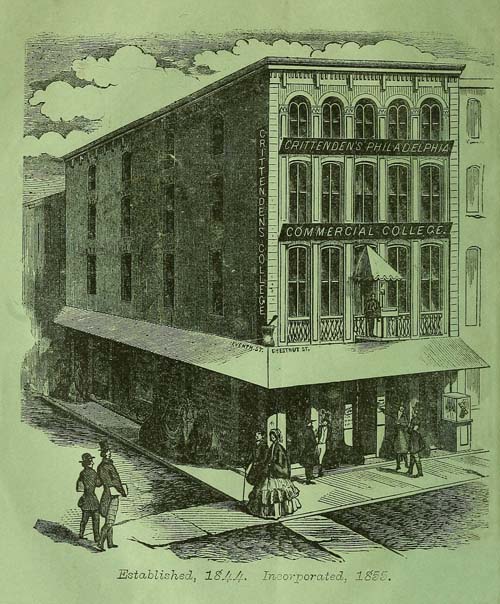
CRITTENDEN’S PHILADELPHIA
COMMERCIAL COLLEGE.
Established, 1844. Incorporated, 1855.