| | Page. |
| Use of mines | 5 |
| Specially menaced points | 5 |
| Surface observations | 5 |
| Indications revealing enemy galleries | 6 |
| Listening for underground noise | 6 |
| Position of listening posts | 6 |
| Hours and precautions | 7 |
| What is heard | 7 |
| Distance at which noise can be heard | 7 |
| Direction from which noise comes | 8 |
| Useful information on mines | 8 |
| Defensive systems | 8 |
| Interval between galleries | 8 |
| Start, depth, and progress of work | 9 |
| Barrage trench for miners | 9 |
| Camouflet | 9 |
| Offensive galleries | 10 |
| Superimposed galleries | 10 |
| Mine chamber | 11 |
| Launching an attack | 11 |
| Craters | 11 |
| Craters to be occupied | 11 |
| Craters that the enemy occupies | 12 |
| Craters not occupied | 12 |
| Diagrams | 9, 10, 12, 13 |
USE OF MINES IN TRENCH WARFARE.
[From the French St. Cyr School.]
(Secret and Confidential. For Official Use Only. Not to be Taken into
First-Line Trenches.)
In sectors where the distance between the two lines is below
150 meters, mine warfare must be used. When the trenches are
farther apart, underground warfare is seldom employed. In
special cases, however, when there are strong ventilators and the
line is stable enough to permit of it, advance may be made
underground.
The most vulnerable points evidently are the following: The
outposts in advance of the line, machine-gun positions approximately
located by the enemy, and the junction points of the
communicating trenches with the first line.
Underground activity, either offensive or defensive, is first
observed from those points in our lines nearest to it. All
enemy trenches facing a salient of our lines will be the object
of particular attention and closest daily observation. This observation
of the first-line trenches should disclose the presence of
enemy underground works and their approximate location.
One of the difficult questions in mining is the removal of the
earth. Expert miners sometimes remove the earth as far as 100
to 200 meters from the entrance to the gallery. They throw it
on old ruined shelters, in shell holes, on the reverse of the
trenches. But these precautions are not always rigidly observed.
When the noncommissioned officer is absent, or the enemy bombards
a little strongly, some one in the working party not wanting
to work overtime throws several clods of earth on the
parapet.
Freshly placed earth coming from underground is white and
less dull in color than that of the parapets, which have been
washed by the rain and blackened by explosives. The difference
in color for the first day or so is striking. In chalk, large
white spots are seen on the reverse of the German trench, daily
growing larger. Without doubt they are working near by, and
should be watched.
A communication trench comes out at a salient, and runs back
from 150 to 200 meters. Patches of chalk, freshly moved and
increasing daily, are observed. These are indications of underground
work starting from the salient.
Four or five meters of enemy trench without loopholes, but
with loopholes close together to the left and right, may mark a
gallery entrance.
A miner's working relief reaches the gallery, each man carrying
a piece of the frame or a lining plank over his shoulder, the
ends of which can be seen over the parapet or through the
loopholes. These are indications of a gallery position, especially
if the men all move in the same direction and are lost to
view at the same place.
From a raised point on the second or third line we see, with
field glasses, an abnormal accumulation of sandbags in a well-known
area. These sacks may indicate an underground gallery.
Patrols sent out in front of the enemy trenches sometimes
bring back valuable information. They may hear the rumble
of ventilators, the noise of a truck moving on the rails, men
working near a gallery entrance, etc.
The enemy fire with heavy calibers on portions of the first
line. Often the same corner is bombarded. This may indicate
that the enemy artillery is seeking to facilitate the miner's
work by overthrowing the entrances to troublesome galleries in
the trench attacked.
Listening for underground noise.—The observation of hostile
trenches may give indications which will limit the zone necessary
to be watched; but for accurate results we must listen for underground
noises.
Positions of listening posts.—The listening post is placed at
the head of a gallery, in an angle of a gallery, in a deep dug-out,
in a niche under the parapet, or on the bottom of the
trench. The points nearest to the enemy trench are selected
for the listening posts. Below the outposts there is always a
niche, allowing a man to place his ear to the ground (hence the
name listening posts).
Hours and precautions.—The most favorable hours are morning
about 4 or 5 o'clock, at 2 p. m., and at midnight. All the
occupants of that part of the trench must keep still, and all
work in the trench and the mine must cease for a given time.
What is heard.—The inexperienced ear hears too many things,
and is easily mistaken in the noises heard. A relief passing in
the enemy trench or in his own trench at 40 meters sounds
strangely like the noise of a pick. A man hitting a ground sill
or striking it with his heel gives the idea that work is being
done. The impact of bullets on the parapet at night, when a
fusillade is uninterrupted, also gives the idea of underground
work. A man filing a fuse at the foot of his loophole suggests
the presence of an enemy revolving borer. A man who snores
beside the gallery entrance imitates the noise of a ventilator
and may be mistaken for it.
However, to even a partially trained ear the noise of the
pickax is characteristic. It is not a harsh sound, like that of a
heel striking on chalk ground, nor is it like the shock of bullets
piercing the parapet. It is a low, rhythmic sound, with
regular cadence. In a gallery the miner works kneeling. When
he has struck five or six blows with the pickax, he takes a
breath. He repeats this process about 12 times. He stops two
or three minutes, and the second miner clears away the earth
and fills the truck with sacks. The first miner resumes his
work. It is easy to distinguish this regular cadence peculiar to
the miner.
In an infantry company there are always several miners by
occupation, or several men familiar with engineering. These
men are selected specially for the listening service. They can
give accurate information to the officers and noncommissioned
officers of a sapper company. It is also a good thing for a
platoon commander to descend into a gallery and train his ear
by exchanging pickax signals with the miner in the adjoining
gallery.
Distance at which noise can be heard.—The following indications
help in determining the distance of underground work:
Four men work in a gallery. They start the work, then
stop. The ear is placed against the side of the wall, the other
ear being covered by the hand. If the work is heard under these
conditions, it is at a distance of 25 to 30 meters.
If all noise is avoided, and the work is heard without placing
the ear against the wall, the distance is 12 to 15 meters.
If there is talking or working going on, and still the underground
work is heard in spite of it, the distance is 8 to 10 meters.
At six meters a man can hear all the sounds of the pickax, the
chalk crumbling, the pieces rolling down on one another, the
sliding and stacking of cases. These noises sound as if they
were immediately below.
At four meters a man can hear talking, the scraping of buttons
against the wall, the miner turning around.
The humming of a ventilator can be heard at 40 meters without
taking precautions to hear it.
An automatic borer can be heard all through the sector.
Directions from which noise comes.—It is easier to determine
the direction of noise than the distance. There is always
a chance of making observations in the galleries—one on the
right, the other on the left of the noise. The exact location
of the enemy underground work can be determined by intersections.
The engineer companies have an apparatus for intensifying
the sound (strong microphones). They reinforce the sound
when the apparatus is in the direction of the source of the
sound. Their greatest defect is that they magnify sound too
much and too many things are heard. Why hear for a distance
of 100 meters when the enemy trench is only 40 meters away?
Everything is heard in a mine gallery. It is difficult to distinguish
among the many noises that of the enemy miner's pick.
The ear is amply sufficient.
The beginner has a tendency to exaggerate the proximity of
sounds. He thinks he is close to the enemy when he is still
at a distance, and he takes steps to catch the enemy by exploding
a camouflet, whose only effect is to retard his own work.
Defensive system.—Two arrangements can be adopted: Fan-shaped
arrangement (Fig. A) or arrangement of independent
parallel galleries (Fig. B). The second arrangement is preferable.
Interval between galleries.—Arrangement 2 being adopted, calculate
the interval between two neighboring galleries in such
manner as to prevent the enemy working underground. At the
head of each gallery two elbows of 6 meters, with boring chambers,
are made. A 6-meter boring is made from each chamber.
At the bottom of the boring a camouflet is placed, effective for
radius of 6 meters (not more heavily charged or the gallery
will be demolished). The camouflet of the neighboring gallery
forms a tangent to the first. The interval between the two
galleries can not, therefore, be greater than 36 meters. In
practice we would take 30 meters.
Start, depth, and progress of work.—Start from first line.
Start at 4 meters, with a slope of 20 per cent to 30 per cent
down to a depth of 10 meters. Then horizontal. Length to
gallery and return without ventilation can cover 30 meters.
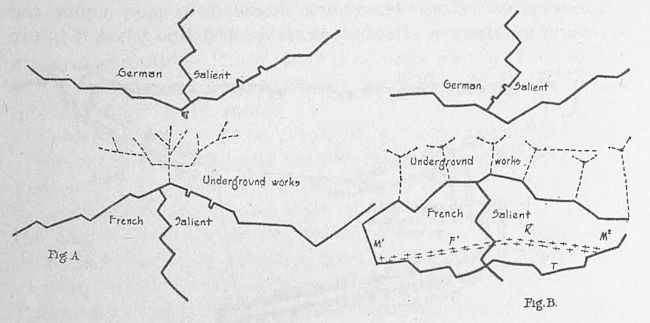
Fig. A. Fig. B.
Barrage trench for miners.—If the enemy passes in spite of
everything, the explosion should at least have been foreseen.
The enemy's attack must be limited or stopped, and this is
always possible after the explosion of the charge, which may
explode well in advance of our lines and act only as a strong
means of launching his attack. The barrage trench is established
at from 40 to 50 meters in rear of the salient T (Fig. B).
In front of the parapet T, wire entanglement R, and two machine-gun
positions M1 and M2 are placed. When the enemy's
explosion is near, only a few men are left to occupy the salient.
The German explosion does not bury anyone, and when the
attack is launched it breaks down at the entanglement R.
Camouflet.—The sector commander is warned when the defense
is about to explode a camouflet. About 10 meters on each
side of the gallery are evacuated as a precaution. The only danger
is in having several sandbags fall on the sides of the gallery
entrance. Warn the working party charged with the relief, in
order that they may not block the passage of men in the first
line. Do not fire or make any changes in that part of the
trench, in order that the enemy may not locate the position.
Do not fire rockets before a given time. The camouflet sometimes
shakes the ground and dust is visible. Nine times out of
ten the camouflet is used at night.
When the enemy explodes a camouflet, fire a quantity of
rockets to locate the positions. Fire grenades and throw bombs
at the presumable position of the gallery. Send several men in
front of the parapet to listen to what is going on in the enemy
trench.
Offensive galleries.—These are intended to pass under the
adversary's defenses. Depth.—Start at first line when it is far
enough away from the enemy. Start at second line, or at
special communication trench about 20 meters in the rear of
the first line, when the enemy trench is too near. (See preceding.)
A depth of 15 to 18 meters should be attained. The
work is done as in ordinary galleries.
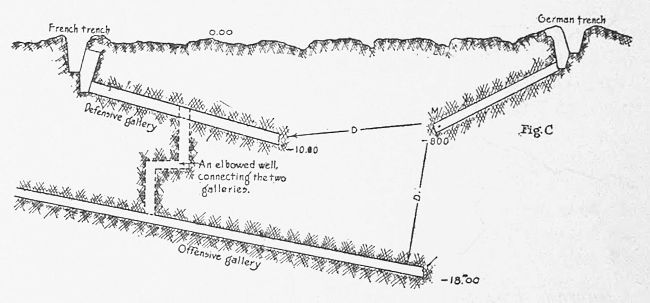
Fig. C.
Superimposed galleries.—This procedure gives splendid results
in deceiving the enemy, who thinks he is protecting himself.
The defensive gallery starts at the first line and the
offensive gallery starts in rear of it. Both galleries are on the
same vertical plane, the second being more advanced in the
direction of the enemy than the first. An enemy listener easily
confuses one with the other, and the offensive gallery passes
under him. (See Fig. C.) Distances D and D1 are the same.
The miner, M, confuses the two sounds, and the offensive
gallery passes under him.
Mine chambers.—They are of special interest to the Engineer
Corps from a technical point of view. The best hours for
exploding them are 4 a. m. and 7 p. m. When an attack is
launched at a great distance, or when there is to be no attack,
the explosion is preceded by several minutes of noise in the
trenches. We commence firing and show several bayonets over
the parapet. The enemy believes an attack is coming, comes
out of his shelter, and mans his trenches. After the explosion
we fire on the mine crater for four hours with artillery, grenades,
and bombs. This fire should cover all the area exploded by the
mine chamber and should prevent any help to the wounded or
buried.
Launching an attack by means of mining.—The mine is an
irresistible means of launching an attack. In a mined sector
the best troops completely lose their bearings for several seconds
after an explosion. These several seconds prevent the machine
gun from firing, and the assailant gains a foothold in the first
line and often in the second.
A mine attack should be prepared in the following manner:
Several days beforehand the attacking troops are sent to the
rest camp. The plan of the jumping-off trenches, the trenches
to be attacked, the ground trace of the crater, and the zone of
the searchlights are drawn on the ground with chalk. Each
attacking fraction is placed in position, with the matériel to be
carried. Each fraction's line of advance is marked out in
chalk, as well as the section of the enemy's trench to be occupied
and the position of the barrage. Every detail is studied thoroughly,
and the exercise repeated a dozen times. The attack
is then carried out as planned.
Craters.—The question of the occupation of craters must be
decided by an authority higher than the platoon commander.
In certain cases it is well to occupy them; in others, inadvisable.
We will discuss only the practical work to be done in each case.
Craters to be occupied.—Crown the rim on the enemy side
with a continuous trench, joined to the lines by (at least) two
communicating trenches. Run out galleries in three directions,
first for protection and later for use in the attack. Construct
bombproofs on the half cone on the enemy side.
A crater is a position advantageous for the construction of
auxiliary defenses, for the removal of earth from the galleries,
for massing troops for an attack, and for flanking the lines.
Craters that the enemy occupies.—They should be hampered
with bombs and grenades. We should head off the enemy by
means of two well-placed mine chambers, which are always
possible to fire rapidly when the scheme of defense is by independent
galleries.
Craters not occupied.—It is well to see what goes on at the
bottom. An outpost of several men or a sentinel may be posted
for this purpose in a communicating trench on the friendly rim.
Two communicating trenches may also be used to crown the
friendly rim with a trench with slight counterslope. The outposts
place a dozen loopholes permitting fire on the bottom. We
may also fill up the bottom with chevaux de frise and other
auxiliary obstacles that can be thrown in. If the craters are
in the way, we can always turn them by mining. (See figures
for different examples:)
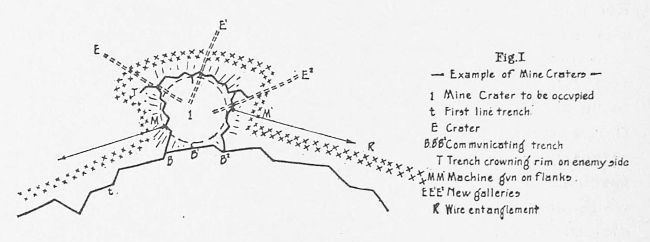
Fig. I.
—Example of Mine Craters—
1 Mine Crater to be occupied
t First line trench
E Crater
B B1 B2 Communicating trench
T Trench crowning rim on enemy side
M M1 Machine gun on flanks
E E1 E2 New galleries
R Wire entanglement
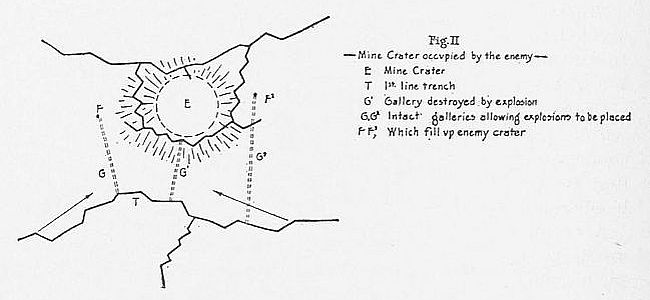
Fig. II.
—Mine Crater occupied by the enemy—
E Mine Crater
T 1st line trench
G1 Gallery destroyed by explosion
G G2 Intact galleries allowing explosions to be placed
F F2 Which fill up enemy crater
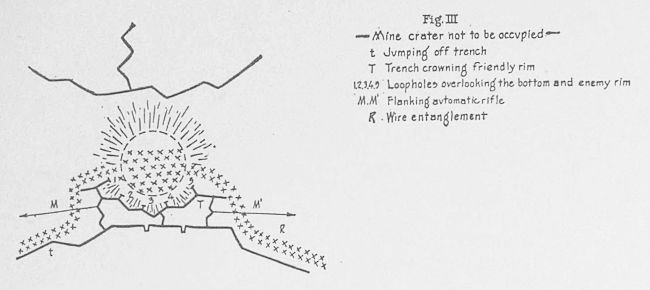
Fig. III.
—Mine crater not to be occupied—
t Jumping off trench
T Trench crowning friendly rim
1 2 3 4 5 Loopholes overlooking the bottom and enemy rim
M M1 Flanking automatic rifle
R Wire entanglement
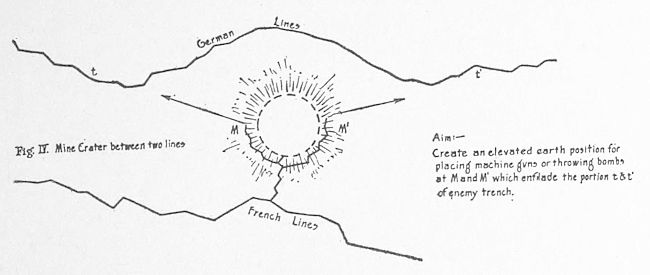
Fig. IV. Mine Crater between two lines
Aim:—
Create an elevated earth position for
placing machine guns or throwing bombs
at M and M1 which enfilade the portion t & t1
of enemy trench.
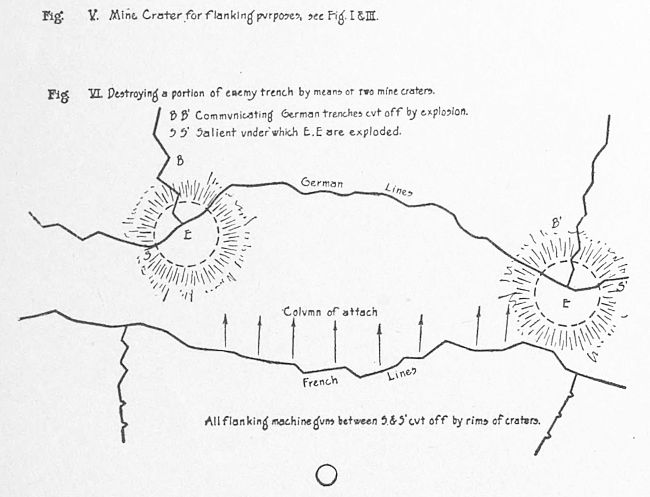
Fig. V. Mine Crater for flanking purposes, -1see Fig. I & III.
Fig. VI. Destroying a portion of enemy trench by means of two mine craters.
B B1 Communicating German trenches cut off by explosion.
S S1 Salient under which E.E are exploded.
All flanking machine guns between S & S1 cut off by rims of craters.
TRANSCRIBER'S NOTE
Obvious typographical errors and punctuation errors have been
corrected after careful comparison with other occurrences within
the text and consultation of external sources.
Except for those changes noted below, all misspellings in the text,
and inconsistent or archaic usage, have been retained.
Pg 8: '(fig. a)' replaced by '(Fig. A)'.
Pg 8: '(fig. b)' replaced by '(Fig. B)'.
Pg 9: '(fig. 2)' replaced by '(Fig. B)'.
Pg 9: 'positions M and' replaced by 'positions M1 and'.
Pg 10: '(See figure.)' replaced by '(See Fig. C.)'.