THE next two days our trip was disagreeable because of continued
rains, but on the third day we camped at four-thirty close to a “path”
that led to the largest Indian village. I was determined to visit it
and pictured quite a little town. We could see the tall column of
smoke from their fires.
My companion and I were so eager to get to this village next morning
that we did not wait to eat, but, taking a handful of food, set out
with one Boviander to carry a knife and lantern.
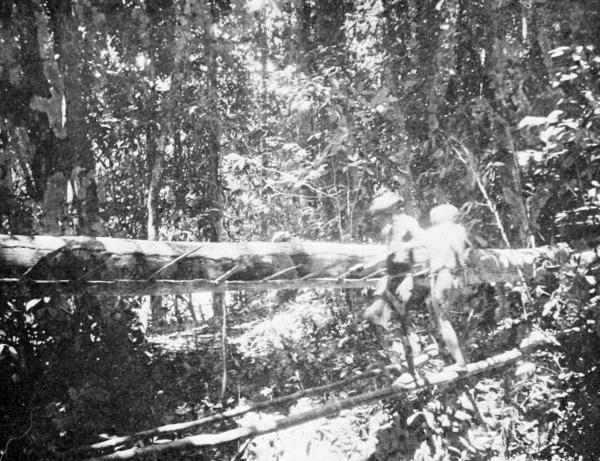
For the first time I learned something of the difficulties of jungle
travel. We had to slash through vines, wade through bogs of slime and
mud, clamber over gnarled roots and stumble around in the most tangled
growth of vegetation I ever saw.
“If this is a ‘path,’” I said to Lewis, “I’m glad I’m not in the
wilderness.”
“No go outside path,” grinned the Boviander.
We assured him that we would not, but we could find no trace of a path
at all. When we were not in muddy bogs, feeling our way to make sure
we would not step into some hole over our heads, or clambering around
fallen trees and brush, we were going up short but steep little hills
covered with tangled vines. After two hours of this, and being almost
exhausted, we came to a clearing.
“Here it is,” shouted Lewis.
And as if to prove it we heard a rooster crow. Eagerly we stumbled out
into the clearing and saw the few huts, but the place was deserted.
“More further,” said the Boviander; “someone he die.”
By this he meant that some member of the village had died. The Indians
always desert their village when anyone dies in it, and move on to
establish another. They will never live in a village where anyone has
died.
The lonely rooster crowed defiantly at us as we skirted the village
to find the “path.” Having found it we moved on about a mile.
“Ah, here we are,” I declared as I came into an opening.
Not a soul in sight!
“Another die,” commented our Boviander, shrugging his shoulders.
“If the death rate is very high we’ll never overtake that village,”
grumbled Lewis.
Up above were tiny patches of blue, bits of the sky that we could see
through the thick jungle growth. I saw some smoke and decided that at
last we were close to the village. But at the opening we saw but a
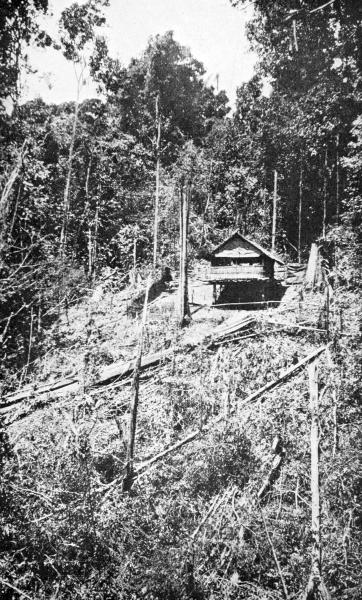
single “house” or shelter. The Indian came forward to see us.
Lewis had prospected up through this section before sending for me,
and when he saw this Indian he exclaimed in a low voice, “That’s
Simon.”
He didn’t seem at all glad to find him there, but I had no opportunity
to ask him about it before Simon, the Indian, advanced and, smiling as
blandly as a Chinaman, exclaimed cordially:
“Me-a-ree!”
He told us that the village was quite a distance on, and offered to
lead us there. Lewis could not well refuse, as we had now gone far
away from our camp and the district was wild and unknown to any of us.
But I could see that he was not very well pleased with the prospect.
Simon motioned to his boy, a handsome, copper-colored youth, to start
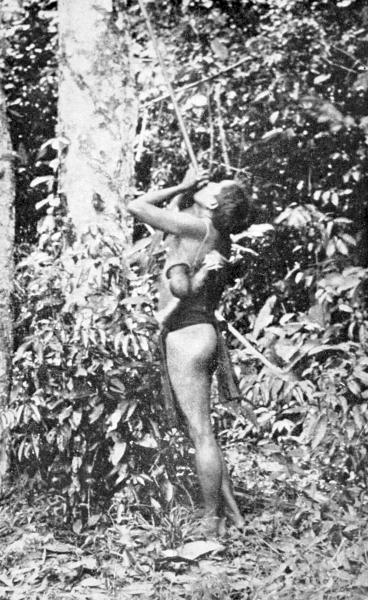
on with him, and proceeded to lead the way, taking a blowpipe and
quiver of the poisoned arrows with him. This, too, troubled Lewis. But
there seemed nothing else to do, so we followed.
On the way Lewis told me what was worrying him. During his previous
prospecting trip when he went up the river to make sure that there
were diamond fields before sending for me, he had found an old Indian
very sick at one of the villages. This was Simon’s father. Lewis did
what he could for the sick old Indian, giving him quinine pills, the
universal cure-all in the jungle, but the old man died.
On this trip one of our men had heard that Simon believed Lewis had
purposely killed his father and that he did it with the “magic pills,”
as he called the quinine.
“They say Simon has acted queerly ever since,” explained Lewis, “and
he may imagine that I really did kill his father and start a little
‘ka-ni-a-mer’ of his own between just him and me.”
“And what on earth is a ‘ka-ni-a-mer’?” I demanded.
“Just about the same as an old Kentucky feud where two families try
for years to kill each other off. So you see I’m not extremely
trustful of this bland Simon Injun,” said Lewis.
“And to top it all,” he added, “I dreamed the other night that my
mother came and warned me to look out as I was to be in great danger.”
This made me decidedly uneasy and I was determined to keep my eye on
Simon every minute, staying between him and Lewis.
The trip to the village seemed long. There was considerable uphill
going. Every once in a while Simon would turn and jabber at his boy,
who would instantly look around at us, then reply to his father, who
would hurry on faster than ever. They were setting a terrific pace.
Already wearied with our travels before we came to Simon’s hut, this
was overdoing it just a little. But, worse than that, I got the idea
that Simon was trying to lose us, to rush on far ahead and then hide
and kill us—or kill Lewis anyway, with his blowpipe from ambush. I
knew that just a scratch from the poisoned tip of one of those slender
arrows would finish Lewis, or anyone else.
“You take my gun,” I said to Lewis, “and take it easy, while I keep up
with him and keep him right in plain sight.”
Lewis is a heavy-built man and it was more difficult for him to keep
up the hot pace uphill. I hurried on and got quite close to them.
Simon spoke to his boy, who turned around and gave a little jump of
astonishment to see me so close. He spoke sharply to his father, who
turned around. Just as he turned around I purposely pulled my revolver
from the holster with a great flourish.
To these native Indians our revolvers are wonderful and fearful
things. They regard them with awe and also with fear. That so small a
thing held lightly in the hand could deal death is one of the most
amazing things they know about. When Simon saw this he at once
slackened his pace and gave me another bland smile.
“Me-a-ree. Me-a-ree!” he said.
“Me-a-ree,” I replied, but kept my revolver in my hand. After that he
slowed up and made no attempt to lose us, but he kept looking back
frequently and earnestly to make sure that I was not pointing the
deadly “mystery gun” at him.
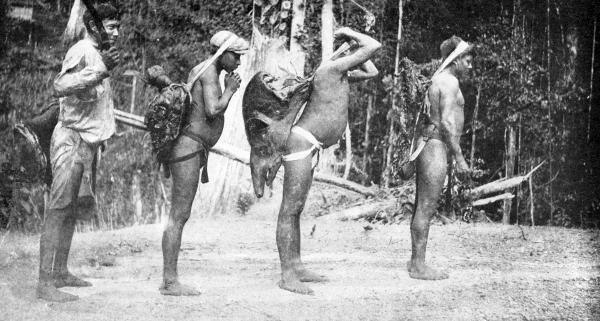
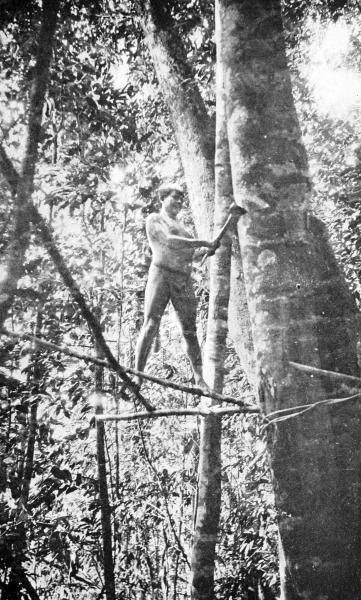
We passed many small platforms lashed to tall trees. I thought they
were the “graves” of Indians, as I knew that many of our American
Indians had the custom of leaving their dead on high platforms. But
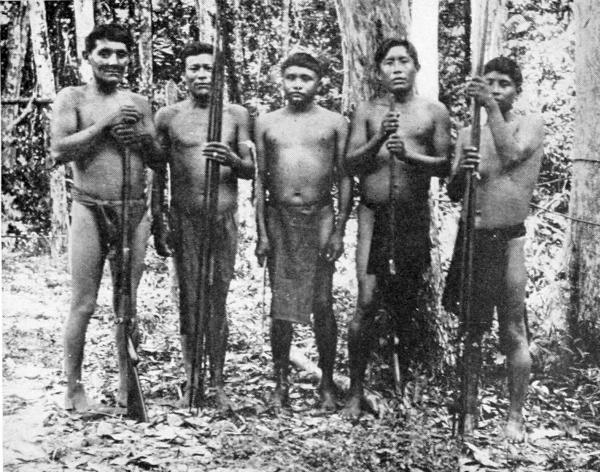
the Boviander explained that they were hunting stations. The Indians
climb up and kneel on these platforms motionless for hours, waiting
for game to pass so that they can kill it with blowpipes, spears, bows
and arrows or with their crude guns.
It was getting late and I had just begun to wonder if we would have to
camp in that dismal swamp all night when I heard the sound of a horn.
It was some Indian call made by blowing on a shell. Simon nodded,
meaning that it was the village.
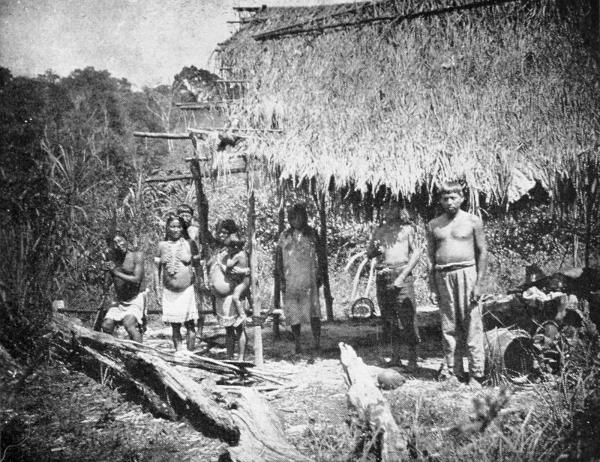
Soon we came into a great clearing. I expected to see a thriving
village, since I had been assured that Assura was the largest of the
Indian villages. And it was the largest, yet it consisted of only
seven houses, with A-shaped roofs of reeds, and one larger or communal
house with a conical roof.
Three of the mangiest, sorriest looking dogs I had ever beheld, howled
mournfully when we came into the clearing, then tucked their tails
between their legs and ran away to hide, having performed their duty
of warning the villagers of our approach.
I was greatly interested, for the villagers did not know that we were
coming and I was sure to find them in their primitive life without
“putting on” for company. They flocked about us, more curious than we,
for we had seen Indians and knew something about their customs by this
time, but few of them had seen any white men except the Dutch and
half-breed Dutch “pork-knockers,” or wandering diamond miners.
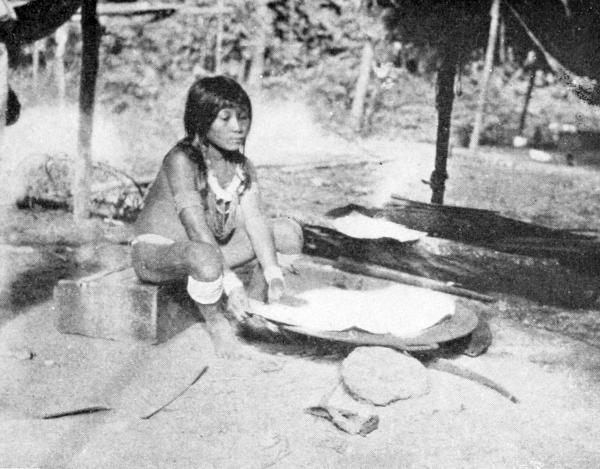
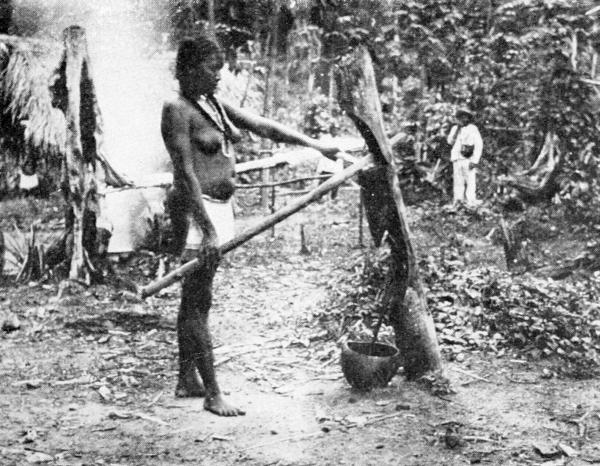
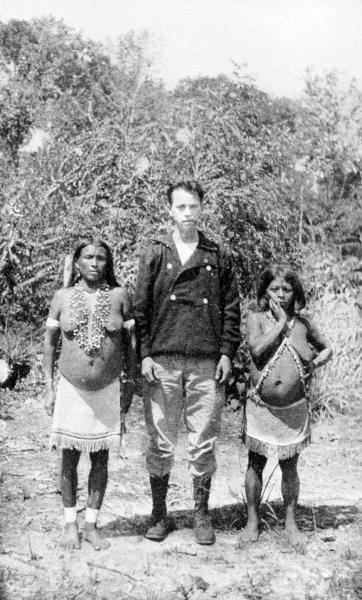
As usual, they wore no clothes except the red loin cloth of the men
and the queyu, or tiny apron of the women. But every garment that we
wore was a curiosity to them. I am sure that had we marched in there,
wearing no more than a loin cloth, they would not have been greatly
interested. But hats, coats, vests, trousers, leggings, shoes—all of
those garments were wonderful curiosities to them all, as you may well
imagine.
There was an all-around exchange of “Me-a-rees” and we passed around
some cigarettes, whereupon they knew that we were friends.
How they crowded about us, children with no clothes at all, and tiny
babies that could not walk crawled along over the filthy ground,
through spots of black mud and shallow pools of stagnant water,
picking up the dirt and animal refuse from the ground and apparently
feasting on it. It made us shudder to see them, yet those tiny babies
seemed quite contented and quite healthy. At once I wondered what an
American mother who dresses her baby in costly flannels and
embroidered linens, places it in a hundred dollar baby carriage and
wraps it in another hundred dollar fur robe, would say if her pink
little darling were to be stripped and left to crawl about through
the muck of this jungle clearing to get chummy with chiggers and
stinging red ants, big ugly black beetles, mosquitoes and other
things!