LONDON:
PRINTED BY WILLIAM CLOWES AND SONS,
STAMFORD STREET AND CHARING CROSS.
DEDICATED TO COLONEL GEORGE EARL CHURCH, F.R.G.S., CHAIRMAN OF THE MADEIRA AND MAMORÉ RAILWAY COMPANY,
BY HIS
OBLIGED AND FAITHFUL SERVANT
EDWARD D. MATHEWS, ASSOC. MEM. INST. C.E.
PREFACE.
A few years ago I was Resident Engineer of the
projected Madeira and Mamoré Railway, to be constructed
in the Province of Matto Grosso, in the
Empire of Brazil, and as nearly as possible in the
centre of the Continent of South America. From
various causes the prosecution of the enterprise fell
into abeyance for some considerable time. When
the works were temporarily stopped, several reasons
combined to induce me to return home by way of
Bolivia and Peru. During that journey I kept up my
ordinary custom of keeping a rough diary, and I have
since dressed up my notes into something of a consecutive
form. The resumption of the railway works
has led me to think that some interest would attach
to a description of a route across South America that
has yet been but little travelled over. It has also
occurred to me, that nowadays, when the Eastern
trip to India, China, Japan, and home viâ San
Francisco and New York, has been done by so many
there may be adventurous spirits in search of new
worlds to conquer, who would be pleased to know of
a journey offering the combined attractions of canoeing
on the magnificent affluents of the Amazon and
a journey in the saddle across the Andes. My
endeavour therefore has been to give all the information
in my possession regarding the method and
expense of travelling over the route indicated.
In grateful remembrance of many kindnesses
received, I have dedicated my labours to the indefatigable
worker who, for many years past, has
devoted his life to the noble enterprise of opening a
way to the markets of Europe for the many and
varied products of the Republic of Bolivia and the
Province of Matto Grosso in the Empire of Brazil.
CONTENTS.
PAGE
CHAPTER I.
Brazilian coast—True and false Salinas—Dangers of the mouth of the
Amazon—Pará—Steamers on the Amazon—Amazon Steam
Shipping Company, Limited—Vicinity of Pará—European residents—Climate
Bay of Marajo—Lighthouses—Rule of the road for steamers—Vegetation
on the Amazon—Rubber trees—Boa Vista—Corralinha—Breves—Parainha—Gurupá—Mont
Alegre—Cattle-feeding
grounds—River Tapajoz—Santarem—American settlers—Obidos—Manufacture
of charqui—Villa Bella—Serpa—Navigation
of the Amazon
Manáos—Trade direct with Europe—Obelisk commemorating opening
of the river Amazon to all flags—Climate of Manáos—Absence
of mosquitoes—River Madeira—Rubber-collecting preferred to
agriculture—Mode of collection and preparation of the rubber—Guaraná
Borba—Tobacco—Island of Araras—Piedras de Uruás—Cachoerina—Exaltacion—Manicoré—Mundurucu
Indians—Marmélos—Bayetas—Juma—Mission
of San Pedro—Crato—Old penal
settlement—Umaitá—Parententin Indians—Missionary efforts
unable to reclaim these savages—Praia of Tamandoa—Turtles—San
Antonio
Madeira and Mamoré Railway—Ocean steamers can ascend to the
first rapid—Brazilian outposts—Difference between high and low
water below the rapid—Rainfall—Temperature—Scenery—Marks
on rocks—Glossy black deposit on rocks—Trees of the
forest—Brazil nuts—Alligators—Peixebois, pirahybas, pirarucus,
and other fish—Tapirs, how shot—Onças, and other animals—Birds,
wild turkeys, ducks, etc.—Insects, mosquitoes, ants, etc.—Snakes,
etc., etc.
Rapids of the Madeira River—Journey undertaken—Canoes, Indians,
and other requirements for the journey described—Articles good
for trading with savages—Provisions, etc.
A start made—Canoe heavily laden—San Antonio rapid passed—Slow
progress made—Method of passing over strong currents—The
current of Macacos—The Bay of Theotonio—Canoe nearly
swamped in same—The Falls of Theotonio—Fish at foot of falls—Franciscan
mission to the Pamas—The portage of Theotonio
Currents above Theotonio—Loss of a small canoe—Theft of rum at
night by one of the Bolivian boatmen—The rapid of Morinhos—Crew
turn out to be very weak and slow—Plan for securing a
good crew—The river Yaci-Paraná—Morning fogs—Igarapé of
the Caripuna savages—Capitan Cinco’s Island—Buena Esperanza—Rations
given to the boatmen
The rapid of Calderão do Inferno—Attacks of fever and vomiting—Caripuna
savages—Death of a Bolivian boy—Earth-eating
practised by the Indians—Death of Mariano, a Bolivian boatman—Peculiar
custom prevailing amongst the Indians—The
Falls of Girão—Miseries of a wet night
San Louise—Track across the big bend of the river—Corrientes and
Remansos—The rapid of Paredão—Violence of one of the
Indian boatmen during a fit—The rapids of Pederneira—La
Cruz—Probability that the country is level in the interior on
the right bank of the river—As Penhas Coloradas
The rapid of Araras—Farinha and sardines for supper—Difficulty of
treating the Indians successfully when they are sick—The
current of Periquitos—Arrival at the Rabo do Ribeirão—The
Bolivian Indian’s chaunt at night—Passage of the Rabo do
Ribeirão—Quantity of farinha consumed by boatmen, in the
form of “shebee”—Canoe aground in the bay below the main
fall of Ribeirão—The river Ribeirão—The portage of Ribeirão—Curious
marks on rocks
Bad arrangements of the Bolivian patrons for rationing their men—The
rapid of Misericordia—Tradition attached thereto—Meeting
with canoes from Bolivia—The Madeira rapids and the junction
of the river Beni—Nomenclature of the river Madeira in its
different sections—The rapids of Layes—Wild cocoa trees—The
Falls of Pao Grande
The river Yata—Meeting with another party descending from
Bolivia—The rapids of Bananeiras—Abandoned settlement—Variability
of the Bolivian character—The cabeçeiras of Bananeiras—The
Sierra da Paca Nova—The rapids of Guajará Guasu and
Merim—A few hints on leaving the last of the rapids
Start made up river above rapids with drums beating—The islands of
Cavalho Marinho—A party of Baure Indians met with—Rate of
progress calculated at two miles per hour—Otters, alligators, and
monkeys shot—Steam navigation practicable on the river above
the rapids—Stock taken of food-supplies left—Long hours worked
Junction of the river Itenez—Short description of the Itenez or
Guaporé and its affluents—Fires at night prohibited on account
of savages—A capybara shot—Abundance of game above the
rapids—False alarms of attack by savages—Cooking-stove rigged
up in the canoe—The river Matocari—Hard work towing canoe—Open
pampas—Strong gale from the south hinders progress—Chocolotales
of Exaltacion—Falling banks—Estancia de Santiago—Value
of oxen in the Estancias of Mojos
“El Cerrito”—Small steamer, the Explorador—“Taita Crusa”—The
town of Exaltacion—The fifteen missions of the Beni and
the tribes that belong to them—Some numerals and words in
Mojeño, Cayubaba, Canichana, and Yuracaré—Education of the
Indians
Festival of St. John the Baptist—Water-throwing—Morning mass—Church
of La Exaltacion de la Santa Cruz—“Macheteros,” or
Soldiers of the Cross—Decrease of the Indians of the Beni—Suggestions
for the re-population of the department—A crew for
Trinidad obtained with difficulty—Desertion of an Indian lad—Landslip
and dangers of the port of Exaltacion—Changes in the
courses of the rivers—Richness of the soil—Prices of provisions
Leave Exaltacion—Improvement in crew—Mobima Indians of
Santa Ana—“Mani” planted on sandbanks—The river Yacuma—Trading
up the Yacuma to Reyes, San Pablo, San Borja, etc.—Multitudes
of mosquitoes, etc.—Shoal of fish—Storks, ducks,
flamingoes—Canichana Indians—The river Apiri and the village
of San Ignacio—Poling over the shallows—The river Jamucheo—San
Pedro—Traders haul their canoes over a portage to San
Pedro—Weather turns very cold—The river Ybari—Arrival at
Trinidad
Pampas of Trinidad—Oxen of the Beni—Merchants of Trinidad—Carayanas—Cholos—Indios—Chicha,
general drink in Bolivia—Baile
and Spanish dance—Bolivian drinking—Bolivian peculiarities—The
old maid’s black cat—Smallpox amongst the
Indians—Depopulation of Trinidad—Wages of the peons—Drills,
hammocks, shirts, and hats made by Indians—Prices of
provisions—Trade in Trinidad—Depreciated currency—Melgarejos
Start from Trinidad with convoy of nine canoes—Hacienda de
San Antonio—Shifting of the river’s course—The river Securé—Bella
Vista, the port of Loreto—Siriono savages—State and
ceremony in preparation of meals—Excellent character of Bolivian
chocolate—Junction of the river Grande—River Piray—The
Mamoré left, and the Chapari entered—The Chimoré route to
Coni preferable to that of the Chapari—Class of steamers suitable
for the Upper Mamoré—Difficulties of navigation in the Chapari—Scarcity
of game—Number of Indians available in Trinidad
for navigation of the upper rivers—The raya fish—Jaguars—Mountain
ranges approached—Bamboo trees seen—The river
Coni
Coni and its trade—Yuracaré Indians—Their bark shirts, ornaments,
and dyes—Musical instruments—Tradition of Cain and Abel—Difference
between the Indians of the interior and those of the
plains—Bravery of the Yuracarés—Start from Coni—Pachimoco—River
San Antonio—Cristal Maio—Continuous rains—Zinc-roofed
houses—Coca plantations—Minas Maio—Metalliferous
character of district—Coffee and cotton—El Chaco—Cuesta of
Lina Tambo—Los Jocotales—Inca Corral—Cuesta de Malaga—Snowstorms
Total change in the appearance of nature—Cochi-janchi—Barley
and potatoes—Chuño—Road to Coni by Bandiola—Sacába—Approach
to Cochabamba—Tambos—Apartments—The city and
people—Luxuriously furnished houses—Fruits, flowers, and grain
crops—Douche baths—Alaméda, or public garden—Sweets and
ices—Tertulias and rocking-chairs—Commercial firms and their
trade—Cascarilla, or cinchona bark—Hospitality of foreign
residents and others—Moonlight ride—Climate—Want of sanitary
arrangements—Mineral wealth of the district
Shortest route to the Pacific coast from Cochabamba—Journey to
Sucre viâ Totora determined upon—Leave Cochabamba in one
of Haviland and Keay’s coaches—Dangers of the journey—Tarata
and Cliza—The pampas compared to the plains of
Central India—Punata—Señor Manuel Arauco, his house, family,
museum, etc.—Manufacture of felt hats, ponchos, etc.—Arani—Lagoons
near Vacas—Irrigation works—New road between
Arani and Totora—Pocona—Totora—Proposed road from Totora
to the river Chimoré—Probable future system of roads in the
east of Bolivia—Misque—Ravines and river-courses used as
roads—Aiquile—Chinguri—Quiroga—Palca—Cuestas Jaboncillo
and Masa-Cruz—Canto Molino—Thermal spring of Huata—First
view of Sucre
Sucre—Seat of the Government—Court of Justice and Archbishopric—Cathedral—Image
of “Our Lady of Guadalupe”—Plate and
pictures—Revolting character of the pictures—The clergy of
Bolivia—Palacio del Gobierno—Sala del Congreso—Deputies and
Debates—Treaty with Chili—Diplomatic body—Politics and
parties—Quintin Quevedo—Casimir Corral—Sack of his house
in La Paz—Rojos, or Ballivianistas—Hilarion Daza—Schemes
for roads to the river Paraguay—River Amazon v. river Paraguay—Remarks
upon the finances of Bolivia—Results to be expected
from the enterprise of the Madeira and Mamoré Railway—Closing
of Congress—The Bolivian flag—Revolution of 1874—Defeat
of Quevedo and Corral, and deposition of Frias by Daza
The Prado of Sucre—Belzu’s Rotunda—The President’s evening constitutional—Personal
politics—Quevedo’s birthday banquet—Dancing
with the general—Ball at the Chilian Embassy—Baile
caramba!—Environs of Sucre—La Paz not visited on account of
revolution in progress—Routes to ocean and home—Santa Cruz,
Curumbá, and the Paraguay—Oran and the Vermejo—Tarija and
Cinti—Cinti wines and spirits—Cobija and Desert of Atacama—Silver
mines of Caracoles, etc.—Encroachments by Chili—Official
report on the Desert of Atacama, published by the Government
of Chili—Description of the road to Tacna and Arica commenced—Preparations
for journey—Servants and their pay—“Postas”—Buying
and selling mules—A few requisites for a land journey
Leave Sucre under escort of English residents—Village of Nutshucc—Yotala—“Quintas,”
or farmhouses—Don Tomas Frias’ country-house—Señor
Pacheco’s quinta—The river Cachimayo and its
basket bridge—Fever at Nutshucc—The river Pilcomayo—Terrado
and Pampa-tambo—Quebrada Honda—Bartolo—Potosí—The
Soroche—The Fonda Coca—The Cerro de Potosí—Silver
mines—Reservoirs—Church of La Matriz—The mint—New
coinage—Burying money—Future of mining in Potosí—Departure
from Potosí—Tarapaya—Yocalla—Yocalla bridge built by the
devil in a night—Leñas—Loss of my aneroid barometer—Vicuñas—Condors—Lagunillas—Tolapalca—Bolivian
Norfolk-Howards,
or Vinchutas—Vilcapujio—Curious custom of Indian
women—Llamas and alpacas—Ancacata—The pampa of Aullagas—The
“Chulpas”—Catariri, Pazna and Poopo—Miserable appearance
of mining towns in Bolivia—Machacamarca—Rumours of
revolution—Beautiful mirage—Arrival at Oruro
Oruro—Mineral districts and mining operations—“Barilla”—Freighting
ore by llamas—Future of mining in Oruro—Attempted
revolution in Oruro—Night attack on the Quartel—Start from
Oruro for Tacna—The river Desaguadero—The ferry called
La Barca—Llollia—Escape of the mules during night—Indian
cooking arrangements—Dress and appearance of Indian men and
women—El Cruzero—“Quinoa”—Heavy storms—Electrified
state of the atmosphere—Peculiar strata observed near El Cruzero—Curahuara
de Carangas—Its church, people, and parish priest—Travelling
jewellers—Mining prospects of the district
Pichagas—The peak of Sahama—Chocos—Capture of a sheep for
fresh meat—Ostriches—Sepulturas—Mortality amongst animals—Mule
attacked with belly pains—El Cerro del Volcan—Las
Siete Vueltas—Bright-coloured hills—Peru entered—Tacora—Mules
attacked with soroche—El Rio de Azufre—Aqueduct to
Tacna from river Maury—The pass of Chulancani—Apacheta
of bones—Aspect of the Pacific slope of the Andes—Projected
railway between Tacna and La Paz—The Portada—El Ingenio—Palca—New
road in construction—Arrival at Tacna—The
hotel Bola de Oro—Tacna and its trade—Attempt to sell the
mules in Tacna—Railway from Tacna to Arica—Effects of the
great hurricane wave of 1869—Arica—By steamer from Arica to
Callao—Callao—Its magnificent harbour—Lima—The cathedral—Plaza
de Armas—Old bridge, built in 1608—Firemen—By
steamer from Lima to Panamá—Payta—Panamá—Severe fires—The
prison—Rail to Aspinwall—Aspinwall—Home by mail
steamer
Brazilian coast—True and false Salinas—Dangers of the mouth of the
Amazon—Pará—Steamers on the Amazon—Amazon Steam Shipping
Company, Limited—Vicinity of Pará—European residents—Climate.
After about twenty days’ steaming from Liverpool
with southerly and westerly courses, the low-lying
coast of the north of Brazil appears, and navigators
who are not acquainted with the locality have
considerable trouble in making out the pilot station
of the Salinas.
The false Salinas are about half a day’s steam to
the east of the true, which, again, are a few hours’
steam from the mouth of the Amazon River. At the
true Salinas there is a lighthouse and a small
village, a large red house, visible from the deck of
the steamer, being the barrack in which the pilots
for Pará live.
The steamer in which I had a passage had been
chartered specially for the conveyance of the railway
staff to which I belonged. The captain knew
nothing at all of the spot to which he had undertaken
to navigate his ship, and took the vessel considerably
to the east of the Salinas; we were therefore
a night and a day coasting about in soundings. At
dark, a slight gale gave the sea the most phosphorescent
appearance that, in the course of a good many
voyages, I have yet seen. Every wave, as it curled
over, broke in vivid phosphorescent fire, and it
appeared as though we were steaming through a sea
of flaming spirits.
The mouth of the river Amazon has many shifting
banks and reefs of which no accurate information
exists, and vessels are frequently lost in attempting
to get up to Pará without a pilot. In 1873, three
vessels, laden with iron for the Madeira and Mamoré
railway, were lost, one after another, on the reefs near
the Braganza lightship, which had shifted from her
moorings and remained away from her station for
many months. More pilots are required at the
station of Salinas, for it has often happened that
captains of vessels have got tired of beating about,
waiting for a pilot to come off, and have attempted
to enter the river alone, only to lose their vessels and
cargoes.
The river Pará may be termed an outlet or arm
of the river Amazon, and on its right bank the city
of Pará is situated. The land on the left bank of
the river forms the island of Marajo, which appears
to be subject to periodical inundations, but is valuable
as a feeding-ground for cattle. The rise and fall of
the river at Pará is about twenty feet at highest
tides.
In front of the city the river affords splendid
anchorage for almost any amount of shipping, but
the wharfage is very badly arranged, as there is no
pier or jetty at which vessels can unload, consequently
much time is lost in transhipping cargoes
from the vessels into launches, and from these to the
wharves. The practice has been to build out these
wharves into the river at low water; and as each
successive wharf has been completed, the river has
silted up its frontage, and so rendered necessary the
building of a new one further out. The “Rua da
Praia,” which doubtless was the “Street of the
Shore” some fifty years ago, is now the third line
back from the river, and so the city is extending
itself out into the water instead of backwards into
the country. A wharf on screw piles, and a jetty
with a cross-head wharf at its end, would probably
not cause the silting, and would not cost more, while
it would be more durable than the badly built stone
walls that are now from time to time put up in front
of each other.
The bay of Pará presents a cheerful aspect, from
the number of vessels generally found there. The
Red Cross line, owned and admirably maintained by
Messrs. Singlehurst, Brocklehurst & Co., of Liverpool,
Booth’s line, Garrison’s and another American line
between Brazil and New York, all touch at Pará,
and the Amazon Steam Shipping Company, Limited,
always have some of their steamers lying in front
of the wharves. The trade of the Amazon valley is
already sufficient to maintain a considerable number
of steamers in the river, the finest and largest of
which, built by Messrs. Laird and Co. of Birkenhead,
were formerly owned by the Baron Mauá. The
Baron sold his steamers and workshops, with the
subventions from the Brazilian Government to the
Amazon Steam Shipping Company, Limited, formed
in London a few years ago. This company, being
desirous of maintaining its purchased monopoly of the
trade of the Amazon, has bought up the two Brazilian
companies that also traded on the river. One was
called the “Fluvial Paraense,” and traded from Pará
to Manáos, and to several small towns on the islands
near Pará. This company’s boats were all built by
Messrs. Pusey, Jones & Co., of Delaware, on American
principles, with cabins on upper deck, and are very
suitable for river navigation. The other company
was the “Alta Amazonas Company,” owners of
three or four small steamers, built by Laird & Co.,
that traded on the upper waters of the Amazon, and
on its confluents—the Madeira, Purus, and Rio Negro.
There are also several other steamers on the river,
owned by private firms, which pick up all the
freights left by, and even give great opposition to,
the powerful English company. A new enterprise
has lately been started in London, with the object of
placing tugs and barges on the Amazon, and the
Madeira and Mamoré Railway Company will doubtless
run its own craft between Pará and San Antonio,
the terminus of its railway on the Madeira River.
The Amazon, therefore, is likely in future years to
bear a considerable increase of steam shipping on
its broad bosom, for attention seems to be almost
universally directed to the magnificent facilities that
it offers, for the ready export to the European
markets of the produce of Northern Brazil, Peru, and
Bolivia.
The city of Pará has not much to boast of in
architecture; nevertheless, from the river, it has an
imposing appearance, from the number of its churches.
The convent of San Merced and the president’s
palace, amongst old buildings, and the new theatre,
a very elegant structure, are all worthy of notice.
The streets are mostly broad and well paved, fairly
lighted with gas by an English company, and kept
decently clean. There is a very good market-place,
and water is now being laid on to every house.
Excellent hired carriages ply, at moderate prices, for
the accommodation of the richer city merchants;
while a tramway, worked by a locomotive and cars,
takes the humbler individual out to join his family
circle in the cooler districts of Nazareth, a very
pretty suburb of Pará, where the principal merchants
have built many elegant villa residences. As most
of the roads run down avenues of very handsome
palm trees, the effect of the whole is charming.
There are also two public gardens, maintained with a
good deal of taste.
The Europeans resident in Pará are extremely
hospitable, and the staff of engineers and others to
which I was attached, took away with them to the
solitudes of the Madeira River most grateful recollections
of the kindness, attention, and good wishes
bestowed on them during their stay in Pará, more
especially by the English and German consuls.
Pará does not enjoy a very good reputation for
its climate, but I do not think it is so bad as is
generally supposed. It has a fair alternation of wet
and dry seasons, and the air is so pure that it is said
that persons suffering from consumption rapidly
recover after a short stay there. Yellow fever and
small-pox sometimes linger a long time amongst the
lower classes, being maintained a good deal, I believe,
by the exhalations at low tides from the silted-up
mud in front of the river wall. As I have said, it is
probable that this silting up could in future be
avoided by erecting a screw-piled pier instead of a
wharf wall; and if the country behind the town were
cleared further inland, the plague of mosquitoes
might be materially decreased.
A trip up the Amazon is extremely pleasant, for
the steamers of the Amazon company are commanded
by very accomplished and amiable Brazilian captains.
The table is very fairly found for one that can
accustom himself to Brazilian cookery, and a liberal
ration of Portuguese “vino verde” is supplied to
passengers. The upper deck, covered with a double-planked
water-tight awning which protects one
from the hot sun, affords an agreeable lounge during
the day, whilst at night it forms the general dormitory
where each passenger slings his hammock and
mosquito net, if he has been thoughtful enough to
provide himself with these indispensable articles of a
travelling equipment for Brazil.
CHAPTER II.
Bay of Marajo—Lighthouses—Rule of the road for steamers—Vegetation
on the Amazon—Rubber trees—Boa Vista—Corralinha—Breves—Parainha—Gurupá—Mont
Alegre—Cattle-feeding grounds—River
Tapajoz—Santarem—American settlers—Obidos—Manufacture of
charqui—Villa Bella—Serpa—Navigation of the Amazon.
The start up river is generally made from Pará
soon after midnight, in order that the wide estuary
termed the Bay of Marajo may be passed before noon
of the following day, as the trade wind that sets in
towards the afternoon raises too high a sea for the
steamers built with overhanging main decks.
In the immediate neighbourhood of Pará there are
some sugar plantations and brick and tile factories,
which have a pretty appearance on the river banks, but
as soon as the steamer passes the bay and gets into
the narrow channels which are at the junction of the
river Pará and the main stream of the Amazon, the
scenery becomes flat and monotonous. There are
several well-kept lighthouses on the banks of the bay
and on the islands therein, but more will be required
as the navigation increases. Some of the channels
through which the steamers work their way are so
narrow, that there is hardly room for two steamers
to pass each other in them; some are therefore used
for the ascending journey only, while others serve
for the downward passage; and so well is this “rule
of the road” kept by the Brazilian pilots and captains,
that collisions are of very rare occurrence. On the
main river the rule is that ascending steamers should
keep to either bank, by preference the right, whilst
descending steamers have the centre of the river and
the full force of the current let free for them.
The islands and the mainland in the lower part
of the Amazon are covered with a dense vegetation,
almost impassable by any living being but the tapir,
or “anta” as it is there called, the lianas and water
plants being closely intertwined and growing
amongst the lofty trees of the forest. In these low-lying
lands a considerable population of Brazilian,
Portuguese, negroes and half-castes live, their occupation
being entirely confined to the collecting of the
rubber for which the city of Pará is famous. This
tree (Siphonia elastica) grows in groups, small paths
called “estradas” being cut through the localities
where it most abounds. The lands being mostly
subject to flooding at high water, all the houses are
built upon piles; and as no cultivation can be carried
on, the dwellers therein are entirely dependent on the
steamers for their supplies of provisions. Nearly
every house has a small wharf projecting out into
the river, to which the steamers can haul up and
receive the firewood prepared for them, or take in
the rubber, on their return journeys to Pará. In
consequence of the daily flooding of these lands, it is
not strange that the people have a washed-out and
sallow look, and appear to suffer greatly from fever
and ague.
Leaving Pará behind us, the first places passed
on the upward journey are Boa Vista and Corralinha,
the latter a little town that, from the steamer, looks
very pretty with its white church and houses. On
the second day, Breves, a small town on a very
narrow channel of the Amazon, is arrived at. It is
a small, unimportant, and very unhealthy place,
being built on land that cannot be a couple of feet
above high water. Then Parainha and Gurupá,
small villages, are passed, and Mont Alegre is reached
on the third day. Here there are large pampas, on
which cattle are reared in great numbers.
These “fazendas de ganado,” or cattle-runs, are
very valuable properties, especially those that have
hilly lands on them, where the cattle can take refuge
during the periodical inundations. The fourth day
brings the steamer to Santarem, on the Tapajoz
River, a short distance from its junction with the
Amazon. The Tapajoz is a fine river of clear darkish-coloured
water, very different in appearance to the
whitish water of the great river, which always
contains a certain amount of sediment.
Santarem is a very pretty town of about 3000 or
4000 inhabitants, and is built upon rising ground on
the right bank, its fine church showing to great
advantage. The climate of this place appears to be
delightful and the lands of very good quality. On
a range of hills a few leagues from the town, some
American settlers have established themselves, and
seem to be well satisfied with their location. They
grow sugar-cane largely, selling their sugar and rum
to great advantage in Santarem.
Obidos, about a day’s steaming from Santarem, is
the next town on the Amazon, and has more inhabitants
than any of the places yet passed. Here there
is a small fort, and a few artillerymen keep up a
show of barring the passage of the river to any
possibly hostile craft. Large stores of firewood are
kept on the river-side for the steamers, most of which
call here to embark bullocks or their necessary supply
of fuel. In Obidos a great trade in “charqui,” or
jerked beef, is carried on, it being the emporium to
which the owners of the estancias send their stocks.
Obidos charqui appears to enjoy a special fame
throughout Brazil, and is preferred to that made in
the southern provinces of the empire. To acquire a
taste for it takes considerable time, although, “faute
de mieux,” I have managed to make many a good
hearty meal from it. It is curious to note the clever
manner in which the fresh meat is cut out into great
sheets, called “mantas,” or blankets. These sheets
of meat are rubbed with salt, and after being dried
in the sun and wind, are rolled up into bundles,
which are tied up with lianas and are then ready for
sale. The price of a Brazilian arroba of charqui,
weighing thirty-three pounds, varies from six to ten
milreis, say from fourpence to sevenpence per pound.
Obidos is about the highest place on the Amazon at
which the daily influence of the tides is felt, the river
rising and falling about two feet at this place;
against a tide of about twenty feet at Pará.
Above Obidos, high lands on the right bank of
the Amazon mark where the provinces of Pará and
Amazonas meet: these hills are known as the Serra
dos Parentins. The small town of Villa Bella on the
right or southern bank of the river being passed,
Serpa, opposite the river Madeira, is reached on
the sixth day’s navigation from Pará. Here, in
view of the opening up of trade with Bolivia viâ
the Madeira River and the Railway of the Rapids,
the Brazilian Government has lately established a
custom-house; and the town, though but small now,
will doubtless become of importance in the course of
a few years. Unless the steamer in which one is
voyaging is on a special trip up the Madeira, a visit
will have to be paid to Manáos, the capital of the
province of Amazonas, for it is there that the larger
steamers remain, and passengers for the upper waters
of the Amazon, the Purus, or the Madeira, have to
take the smaller but still comfortable steamers that
ascend these rivers.
The navigation of the river Amazon is free all
the year round, between Pará and Manáos, for vessels
of any tonnage or draught, if we except the alleged
existence, in September or October of very dry years,
of a sandbank near Villa Bella, on which it is said
that vessels drawing more than eight feet have
grounded; but if they have, it has, in my belief, been
owing to faulty pilotage, for I think there must be
good water always throughout the whole of the
course.
CHAPTER III.
Manáos—Trade direct with Europe—Obelisk commemorating opening of
the river Amazon to all flags—Climate of Manáos—Absence of
mosquitoes—River Madeira—Rubber-collecting preferred to agriculture—Mode
of collection and preparation of the rubber—Guaraná.
Manáos, a small but well-built town of about 5000
inhabitants, is situated on the banks of the Rio
Negro, whose black waters offer a great contrast to
the white but muddy waters of the Amazon. The
town is clean and fairly paved, and the stores, kept
principally by Portuguese merchants, are extremely
well filled with general articles. The authorities of
the province, led by their intelligent and talented
president, Doctor Domingos Monteiro Peixoto, are
evidently desirous of improving the condition of the
place by every possible means, and concessions and
subventions are given to any scheme that promises
to be of public utility. Premiums on cattle imported
to Manáos are given; a contract for lighting the town
with gas, and a liberal subvention for a water supply
are offered; while the sum of £10,000 per annum was
given to a concessionnaire for the organization of a
company to run steamers direct from Manáos to
Europe, six times during the twelve months. There
is also a German house lately established, whose
vessels are towed up the Amazon without having to
unload at Pará, the house receiving a considerable
drawback on the duties payable according to the
general tariff. A good public school where boys are
taught useful trades and handicrafts exists, and
appears to be well managed. Some Germans were
engaged in Hamburg, and brought to Manáos as
teachers of carpentry, masonry, smith’s-work, and
other useful occupations, and were paid good salaries,
but could not settle themselves down to steady work
or to Brazilian fare; they were therefore sent back
to Hamburg, at great loss and expense to the
province.
There is at Manáos an obelisk erected to commemorate
the opening of the river Amazon to free
navigation by all flags. This took place in 1867,
and was a politic act on the part of the Emperor of
Brazil, which is much appreciated by all the dwellers
on the river. For the present this privilege is only
given as far as Manáos on the Amazon, and Borba
on the Madeira, but there is no doubt but that it
will be extended to all the navigable waters when
commerce calls for further facilities.
As a field for emigration, Manáos offers many
advantages; its climate is good, and there are no
mosquitoes or other insect plague, for although these
abound on the Amazon and other rivers, there are
none on the lower part of the Rio Negro. The
blackness of the water of this river is said to be
caused by the tannin imparted to it by the trees on
its banks, and the presence of this substance, though
perfectly harmless to human beings, seems to be fatal
to the production of insect life. After a stay in
Manáos, one wishes that all the waters of South
America could be impregnated in like manner, so
that the fearful plague of flies and mosquitoes might
become unknown throughout the land. Grants of
good agricultural land would doubtless be made by
the provincial authorities, and as there is a well-established
city, and constant communication by
steamers with Europe at least once a week, emigrants
would not feel so lonely as they do in districts less
accessible.
The Madeira is much narrower than the Amazon,
and may be said to have a general width of about
half a mile to 1000 yards. The current is, however,
much swifter than that of the Amazon, and runs,
when the river is at half flood, at about four miles an
hour. The banks are, as a rule, much higher and
better defined than those of the Amazon, there being
few, if any, lagoons on its course from Serpa to the
rapids.
The only trade of consequence at present on the
river Madeira is the collection of rubber, the forests
on either bank abounding in groves of the Syphonia
elastica, the tree that yields this valuable product.
The rubber trade, as at present carried on, on this
river, is a most delusive one, and few, if any, of the
speculators have gained fortunes from their labours.
In consequence of the large profits that were made
when the river was first opened up, the “seringueiros,”
as the collectors are called, devote all their
time to working the trees already discovered, or to
finding out new ones; therefore agriculture is
entirely neglected, and all provisions have to be
brought from Pará; for, in many cases, the seringueiros
will not tell off an Indian to hunt or fish,
labour being so scarce that, in order to send as
much rubber as possible to their creditors in Pará,
the seringueiros must get all the work they can out
of their Indians in the season favourable for entering
the forests. This season may be said to last from
April to November. The “estradas,” or roads of
rubber trees, yield well on the Madeira, but some
are much more prolific than others; trees on lands
that are inundated at times only, yielding better
than those on very low or on elevated grounds. The
method of collection is, that small tin pots, possibly
holding about a third of a pint, are hung on the
tree closely under an incision made at an angle so
that the sap of the tree may run into the pot.
These are emptied daily into convenient vessels,
which are carried to the peon’s hut near by. Fires
made from nuts of the motocu palm are then made,
and the sap being emptied out into large vessels, the
operator dips a kind of flat wooden shovel in it, and
immediately holds the shovel over the smoke, which
causes the sap to coagulate quickly. The smoke
from these nuts is found to effect this much quicker
than any other process; and from the large demand
for them, these nuts are in some districts getting
very scarce, the absurd practice of felling the tree
for the sake of the nut having been much resorted
to. The operation above described having been
frequently repeated, the coagulated sap attains a
thickness of about a couple of inches; it is then cut
on one side, and the shovel is withdrawn, leaving
the rubber in its marketable shape, its price being
regulated according to its freedom from impurities.
There is, however, very little difference in quality
of the “bolachas,” or biscuits, as they are called, the
price generally being about 26 to 30 milreis, say
£2 12s. to £3 per Brazilian arroba of 33 lbs.,
according to the demand or the crop. A low
quality, called “sernamby” in Pará and “negro-head”
on the London market, is a collection of all
the scrapings of, or droppings from, the vessels, and,
being full of impurities, fetches only about half the
price of the “bolachas.”
The only other exports from the Madeira River
are Brazil nuts (Bertholetis exelsa) and Sapucaya
nuts (Acythis ollaria), which are collected and
shipped to Pará, principally for exportation to the
United States.
Guaraná, collected principally at the town of
Maués nearly opposite to Serpa, but situated
inland upon a small stream of the same name, forms
an item of considerable value in the trade with
Bolivia and the province of Matto Grosso, and is
a preparation of the fruit of the guaraná tree
(Paullinia sorbilis).
The beans are ground up, and pressed into
cylindrical masses of about eight or ten inches in
length by one and a half to two inches diameter.
The quality varies in accordance with the evenness
of the paste and its freedom from impurities. The
taste is slightly acrid, and its property of astringency
renders it valuable in diarrhœa and other kindred
sicknesses; but in the central parts of South America
it is freely taken as a beverage, and there are many
Bolivians who would fast all day, and even forswear
their beloved “chicha,” rather than miss their glass
of guaraná and water, taken at daybreak, immediately
after rising. What the peculiar virtues of the
guaraná may be, I cannot say; for, though I tried it
many times, I discovered none at all. Some people
consider it a specific for sick headache, but my
experience does not allow me to recommend it as a
perfect cure. Probably it sustains the body in a
similar manner to the coca plant; for I have seen
many Bolivians who positively could not begin their
day’s work without their glass of guaraná. In
order to drink it, the mass is rasped down on the
dried tongue of the pirarucú fish, until about a teaspoonful
of powder is obtained, and this is taken
with half a pint of water sweetened to the palate.
So great a sale exists for this article both in Bolivia
and in Matto Grosso, that traders on the Madeira
River never make the return journey without taking
several hundredweights amongst their cargoes, and
some are content to load up their canoes entirely
with it.
CHAPTER IV.
Borba—Tobacco—Island of Araras—Piedras de Uruás— Cachoerina—Exaltacion—Manicoré—Mundurucu
Indians—Marmélos—Bayetas—Juma—Mission
of San Pedro—Crato—Old penal settlement—Umaitá—Parententin
Indians—Missionary efforts unable to reclaim these
savages—Praia of Tamandoa—Turtles—San Antonio.
The first village arrived at in the ascent of the
Madeira is Borba, an old Jesuit settlement about
twelve hours’ steam from the junction of the Madeira
and Amazon. Tobacco of excellent quality is grown
at Borba, and fetches about two milreis, or four
shillings, per pound. The method of preparing the
tobacco is very simple, the picked leaves being
strung up in the roof of the hut until properly dried,
when they are, by hand, pressed into a stick-like
form of an inch and a half in diameter, and being
tied closely round with split cane, are sold in “masas”
of from four to six feet in length.
Ascending the river, Sapucaia-oroca and Arauna-cuara,
rubber gatherers’ huts are passed, and the
Island of Araras is reached on the third day’s
steaming in the river. This island is of considerable
size, and is the property of the Amazon Steam
Shipping Company of Pará. It is very rich in
rubber and nut trees, and sarsaparilla and other
drugs are found there, but no minerals.
About three hours’ steam above this island, “Las
Piedras de Uruás,” or the Rocks of Uruás, are
reached. These form the first danger to navigation,
and, uncovered at low water, leave only a channel
of about fifty yards wide, a rather tortuous passage
for the steamer. A careful pilot can, however,
always take a steamer drawing not more than eight
feet through with perfect safety; while from high
to half-flood water, the rocks offer no obstruction
whatever.
Next in order, Cachoerina and Exaltacion are
passed, the former a single house only, and the latter
one of the largest rubber settlements on the river.
On the fifth day the village of Manicoré is arrived
at. It is a settlement of the Mundurucu Indians
who have been brought into entire subjection, and
who, though proverbially lazy, are quiet and well
disposed. At this village are several storekeepers
who trade with these Indians.
Marmélos, a collection of sandbanks requiring
caution on the part of the pilot when the river is
low, come next in order. Then Bayetas and Juma,
both rubber stations, and San Pedro, a government
mission under the care of Franciscan friars, are passed
in succession. Crato, one of the best cleared spots
on the river, is reached on the eighth day’s journey:
here there are good grazing grounds, and the place
is now remarkable for its healthy climate, though
strange to say, not many years ago, perhaps less
than thirty, it was used by the Brazilian Government
as a penal settlement where prisoners of very bad
character were kept, the climate being then so bad
that their term of imprisonment was soon cut short
by their death. About three miles above Crato is
Umaitá, a thriving Portuguese settlement belonging
to Don Juan Montero, who is the wealthiest settler
on the Madeira River. He has a small steamer of
his own that trades between Umaitá and Pará. Das
Abeillas, a Brazilian rubber collector’s head-quarters,
is the next station passed, and then an ascending
steamer enters on the reserve of the Parententin
Indians, and steams through some score or so of
leagues of lands where no settler has yet been able
to keep a footing. It is supposed that, about two
centuries ago, these savages were Christianized by
the earlier Jesuit Fathers, and that, in consequence
of some bad treatment, they revolted, and are now
deadly enemies of any settlers, whether whites or
mestizoes. The idea is strengthened by the fact
that a raid on one of their temporary settlements,
practised a few years ago by the Portuguese of
Umaitá, in retaliation for a murderous attack on a
rubber gatherer’s hut set up near the territory
roamed over by these savages, found roughly carved
crosses and figures that might be supposed to represent
saints, in the huts of these Parententins. However
this may be, they now have the reputation of being
cannibals, and no settler dares to set up a hut on
their territory, although it contains very rich growths
of rubber trees.
The Brazilian Government does not allow the
improvement of these savage races by the only
practical method, namely extermination, but trusts to
the efforts of the few missionary friars to whom is
entrusted the work of proselytizing the untamed
tribes of the interior of the empire. These efforts
might doubtless be successful in partially civilizing
milder tribes, such as the Mundurucus of the
Amazon, the Pamas of the Purus, or the Caripunas
of the Madeira, but they are perfectly unable to tame
fierce tribes, such as the Parententins of the Madeira,
the Ycanga Pirangas of the Jamary, or the Sirionos of
the River Grande of Eastern Bolivia, tribes that refuse
to hold any converse with the white faces, but attack
suddenly with their arrows whenever they can come
across an unprepared party. For these irreclaimable
sons of the forest there is no taming method other
than the rifle and bullet, and it is no use trying to
shirk the fact that they must be removed out of the
way of the opening up to commerce of the Amazon
and its tributaries.
The termination of the Parententin territory is
marked by the junction of the river Machado on the
eastern or right bank of the Madeira. Above this
point the huts of rubber gatherers are again met
with, and on the ninth day’s steaming on the
Madeira, the “Praia,” or sandbank of Tamandoa,
which at low water forms a vast and barren deposit
for many miles of the river’s course, is reached. In
the dry season, when the river is low, in the months
of August and September, enormous numbers of
turtles frequent these sandbanks for the purpose of
depositing their eggs. On one occasion, passing
this bank in a canoe at daybreak, I saw an extraordinary
sight. For miles, as far as the eye could
reach down the river, which hereabouts runs straight
for some six or seven miles, were continuous rows of
turtle at the water’s edge; the rows being eight and
ten deep, many thousands of turtle must have been
collected together. The business of gathering the
eggs of these turtles for making oil, and catching the
turtles for food, is one of the regular occupations of
the settlers on the river, who flock to these sandbanks
in great number at the time of lowest water.
On the tenth day’s journey on the Madeira, and
about the sixteenth from Pará, the steamer should
arrive at San Antonio, the first of the rapids of the
Madeira River. The total distance from Pará to San
Antonio is said to be about 1600 miles, the upward
journey generally occupying fifteen to sixteen days,
while the return has been made by a steamer belonging
to the National Bolivian Navigation Company,
in six days and seven hours.
CHAPTER V.
Madeira and Mamoré Railway—Ocean steamers can ascend to the first
rapid—Brazilian outposts—Difference between high and low water
below the rapid—Rainfall—Temperature—Scenery—Marks on rocks—Glossy
black deposit on rocks—Trees of the forest—Brazil nuts—Alligators—Peixebois,
pirahybas, pirarucus, and other fish—Tapirs,
how shot—Onças, and other animals—Birds, wild turkeys, ducks,
etc.—Insects, mosquitoes, ants, etc.—Snakes, etc., etc.
From San Antonio the railway commences that is
in course of construction by the Madeira and Mamoré
Railway Company. This line, which is to run upon
the eastern side of the rapids, has for its object the
establishment of communication between the navigable
waters of the Mamoré and Guaporé or Itenez
in Eastern Bolivia, and the Madeira and Amazon in
Northern Brazil. The length of the line will be
about 180 miles, and it is estimated to cost £6000
per mile, with a metre gauge. At foot of the rapid
of San Antonio the river forms a bay on the right
or eastern bank of the river, on which the wharf and
terminus of the railway will be built. For eight or
nine months of the year, ocean-going steamers could
ascend the Madeira and make fast alongside the
bank, but for three months of the dry season, August
to October, steamers that do not draw more than
three to four feet will have to ship the produce
brought down by the railway to San Antonio, and
tranship into the ocean steamers either at Manáos,
Serpa, or Pará.
My object being to describe a route of travel,
it would be out of place to remark at length upon
the commercial importance of the enterprise of the
Madeira and Mamoré Railway; I would therefore
claim attention for it principally on the ground that
it will afford means of rapidly passing the barrier
placed by the falls of the Madeira River in the way
of navigation from Bolivia and the province of Matto
Grosso, in Brazil, to the Amazonian outlet to the
Atlantic Ocean. No doubt exists in my mind that
the railway will draw to itself a very considerable
and important traffic, as it will open up provinces
in Bolivia and Brazil that at present have no means
whatever of exporting their valuable products of
either mineral or agricultural industry.
San Antonio bears a bad reputation for ague and
fever, but I lived there for nearly two years and did
not suffer any serious attack, and the place is rapidly
improving now that a somewhat extensive clearing
has been made. A Brazilian outpost, or “destacamento,”
with about thirty soldiers under the charge
of a captain-commandant, is maintained, the next
destacamento being on the river Itenez, in the
province of Matto Grosso. The Madeira River below
the falls has a total difference of forty-eight feet
and a half between the highest flood water in the
rains, and its lowest water in the dry season. The
highest water is generally reached in the month of
March, while the lowest obtains in September. The
rainfall at San Antonio, according to measurements
taken by me in 1872 and 1873, may be said to be
about ninety inches per annum. There are six
months of dry season, from May to October inclusive,
and from January to March seems to be the wettest
quarter. The heat, at times, is great in the dry
season, the thermometer sometimes rising, to 95°
Fahr. in the shade; but, speaking generally, the
temperature is not nearly so high as might be expected
from the latitude of the place, the highest and lowest
average temperatures for the year being 82° to 88°
at day, and 69° to 75° at night.
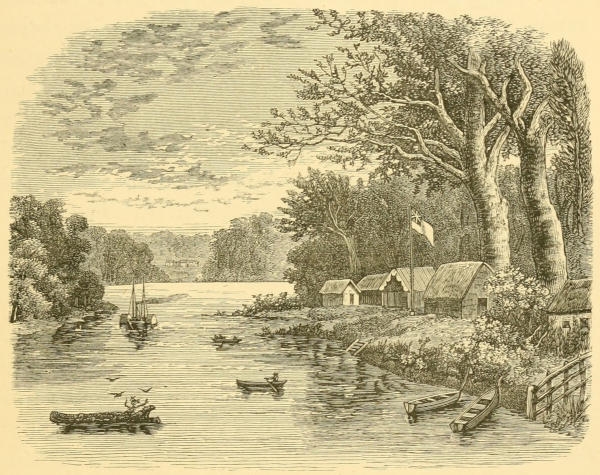
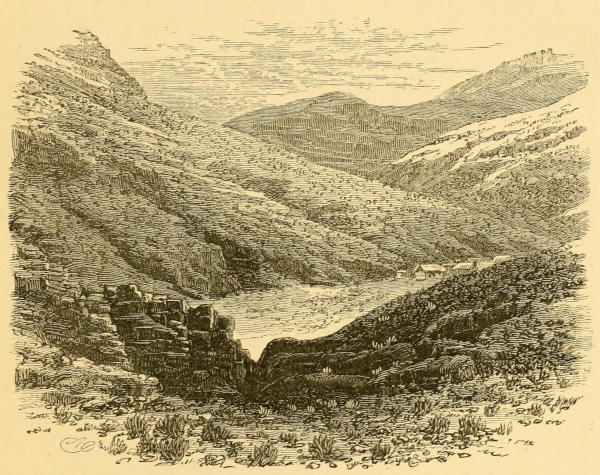
SAN ANTONIO—RIVER MADEIRA (LOOKING DOWN STREAM).
At San Antonio on the railway side, or right
bank, of the river, the land is hilly, and the islands
forming the rapid have a pleasing look, as they are
covered with foliage. Below the settlement is a spit
of rock running out into mid river, and uncovered at
low water. On these rocks are many peculiar
grooves or marks on the sloping surfaces; they are
about a finger’s depth, and cross each other at
different angles, while some are quite distinct and
separate from the others. It has been suggested
that these marks are the work of some of the tribes
of the district, but my opinion would rather be, that
they have been caused by glacial action. At the
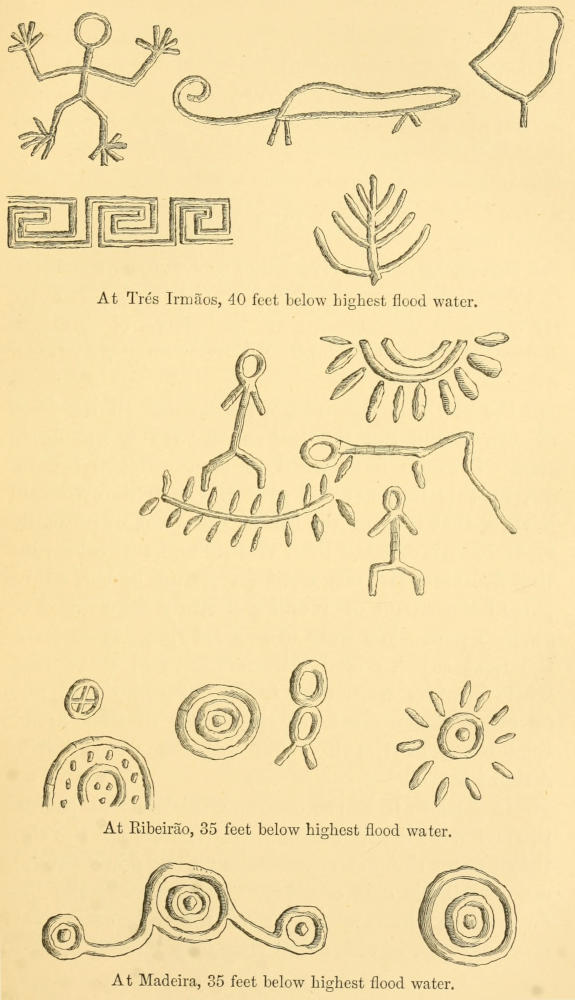
rapid of Ribeirão there are some carvings on rocks
uncovered at lowest water only, that represent
animals, birds, and circles or squares, and these
of course are due to human agency; but the
occurrence at all the rapids, and the great number of
the straight grooves, decidedly favours the view that
they are not the result of manual labour. The rocks
at all the rapids are covered with a glossy black
substance, which seems to be a deposit left by the
waters during floods, and possibly enamelled by the
sun’s heat during the dry season. If I recollect
rightly, Humboldt noticed this deposit on the rocks
of the upper waters of the Orinoco, and defined it
to be a deposit left by the flood waters of the rainy
seasons, but as I have not his “Travels in South
America” at hand to refer to, I may be incorrect in
this reference.
The forests are of lofty trees, many being of very
valuable timber for house building and for railway
purposes. Rubber trees are plentiful, also Brazil
nuts and cocoa trees, the latter in a wild state but
yielding very excellent fruits. Sarsaparilla, vanilla,
copayba and annatto abound, also fustic and other
dyewoods, while many of the barks and bejucas or
sipoys might be utilized as fibres. The Brazil nut
tree Bertholetis excelsa is perhaps the handsomest
tree of the forest, its dark green foliage showing to
great advantage over the top of its neighbours.
The fruit when fresh is very agreeable and sweet,
being very different to the nut as sold dry and
tasteless in London.
Of fish and game, the forest and the river yield
an abundant supply to the settler or traveller. Besides
turtle in any quantity, alligators are in great
numbers. The former is a favourite food of the
Indian labourers of Brazil and Eastern Bolivia, who
are also not at all averse to a dish of the latter; and
I can vouch for the fact that the tail of a young alligator
not more than three or four feet in length is
a most excellent dish, being as nearly like filleted
sole as can be imagined. When the reptiles grow
to a larger size, the flesh has a very repugnant flavour
and smell of musk. Amongst fishes may be
mentioned—the boto, which has the shape of a
large porpoise, but is white-coloured and has a snout
or proboscis about a foot in length. The peixeboi
and pirahyba are very large, many being seven
and eight feet in length; they, as well as the botos,
are only killed for the oil that can be extracted from
their carcases by boiling. Pirarucus of very large
size and weight are found principally in the back
waters or lagoons bordering on the river, and are
much sought after for salting down, in which state
they form the staple food of the settlers on the
Madeira. I have heard that a fair-sized pirarucú
will give from five to six Brazilian arrobas (of 33
lbs. each) of salted fish, and as I have seen them
over ten feet long and eighteen inches to two feet
in diameter, I can give them credit for yielding such
a large quantity of solid food. The pescado, a fish
with scales, and to be caught from one to three feet
in length, is the best eating fish in the river, and
is equal in flavour to fresh cod or bream. This fish
is curious from the fact of its having two stones
situated in the broad bones at the top of the head,
just above the eyes. The tambaqui, dorado, surubi,
pintado, and the joão may also be named as good
eating fish, while the fisherman will often wish
heartily that the palometa fish could be exterminated
at once and for ever. This fish is flat and
small, seldom passing a foot in length, but has a
very large mouth for its size, full of the sharpest
possible teeth, with which it not only takes the bait
from the hook without any danger to itself, but has
also been known to take a good-sized piece out of
a bather’s leg.
The only large animal in the country is the
tapir, sometimes called the “anta,” and sometimes
the “gran bestia.” He is a very timorous and
inoffensive animal, and must be shot at night-time,
the practice being for the huntsman to set up what
is called a “chapapa,” or raised platform of poles,
sometimes placed in the fork of a conveniently
situated tree. This platform must command the pool
of mud where the tapir comes for his nightly bath
and supper of succulent roots; and some hunters
place a candle or small lamp near the pool, the light
of which attracts the stupid beast. A moonlight
night is, however, the best for the sport, if such it
may be called, and as soon as the animal shows,
the contents of one barrel are generally sufficient to
bring down the game. The tapirs are as large as
a fair-sized Brazilian bullock, and the flesh is much
like beef in taste. There are also “onças,” a species
of small jaguar, and tiger-cats of small size; wild pigs,
or peccaries, in great number; capybaras, or river
hogs; squirrels and other small rodents, monkeys
in great variety, small deer, sloths, ant-eaters, armadillos;
“lapas,” or “pacas,” a rodent whose flesh is
capital eating; and “lobos,” or otters, of great size
and fierceness.
Besides numerous small birds of great beauty in
their plumage, such as toucans, humming-birds,
“carpinteros,” and “campaneros” or bell-ringers,
there are hoopoes, or “ciganas,” which are uniformly
reckoned as unclean, and the ever-present forest
scavenger, the vulture, or “souchu,” called “urubu”
in Brazil and “samura” in Central America. A
more pleasant and useful list would comprise—“pavas”
and “guachacas,” species of wild pheasants;
“mutuns,” or wild turkeys; “perdrices,” or wild
partridges; “patos royales,” or black ducks—the
finest duck in the world; “marecas,” or Orinoco
geese—a brown duck equal, I should think, to a
canvas-back; sheldrakes, snipes, widgeons, teal,
herons, storks, and numerous other water fowl.
From this list it may be seen that the locality offers
plenty of occupation for the sportsman who is
content with small game, and is not ambitious of
leaving his name on the roll of the mighty hunters
of “greater game.”
The insect plagues of the district have still to be
mentioned; and certainly, when one looks back upon
the sufferings undergone from the attacks of these
brutes, one is tempted to wonder greatly why such
plagues exist. Many fine arguments have been
brought forward by the advocates of the theory that
everything in nature has its use, in order to prove that
some good results from the existence of a mosquito,
but I who have suffered for years from these pests
have hitherto failed to discover any benefit in their
attacks, and cannot see the excellence of the design
that exposes a human body to be the breeding
ground of a “gusanero,” a beast of a fly that attacks
you, you know not when, till after three or four
months you know that he has done so, by the
swelling up of the bitten part into a fair-sized boil,
from which issues a maggot of perhaps an inch and
a half in length. I have heard it said that the bite
of a mosquito is beneficial, as it thins the blood of a
dweller in swampy tropical regions; but if this were
so, they might be arranged to carry out this beneficial
design without causing exquisite pain to the
party operated upon; but the theory is an incorrect
one, for there are spots on the banks of the Amazonian
rivers where there would be much less fever
if the countless hosts of mosquitoes or “carapanas,”
“gusaneros,” “marigueys” and “tavernas,” could be
exterminated. The ant tribes are also very numerous
and objectionable, coming raiding at times in such
numbers that there is nothing left to do, but, snatching
up your clothes and bedding as quickly as you may,
make tracks to a new location. The larger ants are
very venomous, their bite causing intense pain, equal
almost to that caused by scorpions or centipedes,
which, also, are pretty numerous in the dead wood
and rotting leaves of the forest. Snakes, also, are
plentiful, the deadly coral snake, and a yellow and
black fellow called the “tiger,” being the species
most frequently met with. The former is seldom
seen more than about a foot in length, while the
latter is frequently met with eight or ten feet long
and four to six inches in diameter. A list of these
insect and reptile plagues gives a rather horrible
idea of the district, but the annoyances are lost sight
of in the excitement and pleasure caused by travelling
through new solitudes and territories so far
removed from all civilization; and at nightfall, when
on the march, one lays down perfectly at one’s ease
on an outstretched hide, without giving a thought
to any of the venomous creatures that possibly pass
over the sleeper just as they would over a log of
wood intervening in their path. A good mosquito-net,
or bar, as it is sometimes called, is a perfect
safeguard to the intrusion of any of these creatures,
provided that the falling sides and ends are well
secured from being raised by wind during the night:
but I would especially advise a traveller to avoid the
ordinary net that outfitters and others always recommend
so strongly. The mariguey of the Madeira is
about the size of a midge, and will lodge on the net,
and having walked inside will torment the inmate
beyond belief. The only materials that circumvent
him entirely, and yet allow for ventilation, are
ordinary figured muslins, or a thin blue unglazed
calico with a small check pattern, both of which can
be had in Pará at moderate prices.
CHAPTER VI.
Rapids of the Madeira River—Journey undertaken—Canoes, Indians, and
other requirements for the journey described—Articles good for
trading with savages—Provisions, etc.
The journey onwards becomes rather laborious, as
canoes must now be the means employed for the
ascent of the rapids and the upper riverine systems
of Eastern Bolivia and Western Brazil. I made this
journey in 1874, starting from San Antonio on the
24th of April, in company with some Bolivian
merchants who were returning to their country with
general stores purchased in Pará, for sale in the
department of the Beni in Eastern Bolivia. When
prosecuting my journey, I endeavoured to note down
whatever might have called for notice during the
day’s run, and although incurring, perhaps, the risk
of being rather tedious, I think it will now be the
best plan to copy the notes I then entered in my
diary, in order that the rapids and other portions of
the route travelled over may be described in proper
order.
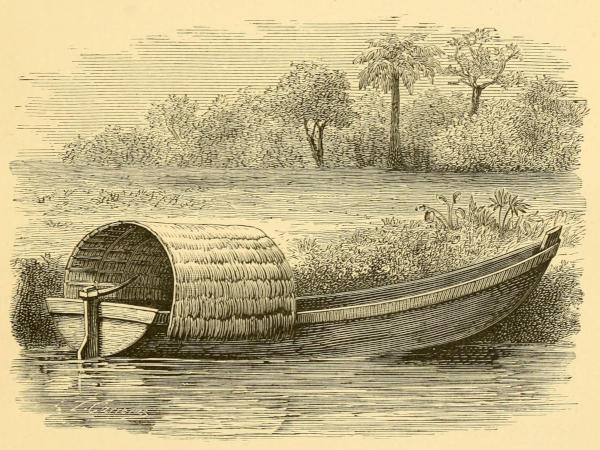
GARITEA, OR TRAVELLER’S CANOE, RIVER MADEIRA.
But, first, it is necessary to describe the arrangements
requisite for the ascent of the rapids and the
Mamoré to the most eastern towns of Bolivia. Large
canoes, called on the river “batelãos,” or “igariteas,”
are the craft required, a good and useful one being
from eight to ten yards in length, by about four or
five feet beam; they draw from two to four feet of
water, and will carry from three to six tons. A
crew of not less than ten peons and a captain is
required for a canoe laden with, say three tons, and
the Bolivian Indians of the Beni are the best paddlers
or “marineros,” the Brazilian peons not being so
expert in getting the canoes over the many miles of
broken water that have to be encountered. It is
unwise to attempt to make either the upward or
downward journey with single embarkations, because
at, at least three of the rapids, the canoes have to be
totally unladen and dragged over the portages, which
invariably have to cross a small but steep hill, and
one crew is quite unable to haul the canoe over any
one of these hills. It is best, therefore, always to
arrange a party of three or more canoes, before commencing
the ascent or descent of the rapids. Canoes
travelling singly are also much exposed to attacks
from the wandering families of savages on the river
banks, while parties of three or more canoes in
company have rarely if ever been molested. A small
canoe, or “montaria,” is extremely useful for the
purpose of sending the cable ahead of the large
canoe, when a strong current is met with that the
paddles are unable to overcome. This cable should
be about fifty or sixty yards long, and may be of
good hemp or piassava; there should be one for each
canoe, and the test of the strain of at least thirty
men should be applied to each cable before the
journey is commenced, as breakages of bad cables
cause an immense amount of vexation, and a great
deal of danger. The canoes have a cabin at the
stern end, made of palm leaves, covered with a
raw hide if possible. In this cabin the “patron,” or
owner, arranges his small stores, guns, books, etc.,
and, with the addition of a narrow hair mattress,
manages to make of it a very snug abode, which
serves for his parlour by day, and sleeping quarters
at night, except when amongst the rapids, when it is
always safer to sleep on shore, for fear of the canoe
breaking away during the night, and taking its
sleeping occupant over the nearest rapid below.
Besides, it is not advisable to trust one’s self too
implicitly in the hands of the Indian marineros, for
cases are on record where an Indian, to be revenged
on his patron for some well-deserved punishment
perhaps, has cut the rope by which the canoe has
been made fast, and has sent his patron to his last
reckoning in a brutal and treacherous manner; and it
must be borne in mind that, in a crew of Indians,
there may easily be one black sheep, however tractable
and good-natured the majority are. I have
never had cause to complain of treachery or vindictiveness
on the part of the Bolivian Indians, and
believe that if they are kindly and honestly dealt
with they are most trustworthy in every way; but
discretion is the better part of valour, and it is well
to be on the safe side, which is, amongst the rapids,
the river bank, and not the cabin, or “camarota,” of
the canoe. It is also well to provide each canoe with
a short length of chain and a good stout padlock, for
securing it to a tree at nightfall.
The traveller will naturally furnish himself with
firing-irons after his own heart, but I would recommend
him to add to his own particular fancy, a
Winchester sixteen-shot repeating rifle, for they
make splendid shooting, are light, portable, and
carry a good armament ready at hand in case of a
brush with savages. A double-barrelled shot-gun;
a pair of revolvers (not fitted with cartridge extractors,
which invariably get rusted and clogged
up unless they are taken to pieces and cleaned
thoroughly every day—an almost impossible task),
a good hunting knife, or “machete,” for clearing
one’s path amongst the reeds on the river bank or
through the forest, and a good assortment of fish-hooks
and lines, will about complete the inventory of
“materiel de guerre” advisable. To preserve one’s
guns and knives from the rust which covers them
completely in one night if they are left ungreased, I
found that the best thing was “Andiroba oil,” which
can be obtained in any quantity in Pará or Manáos.
This oil is expressed from the nuts of the Andiroba
tree (Xylocarpus caropa), and is used in Brazil for
lighting purposes principally. It makes, however,
a first-rate lubricant for machinery, and the way it
protects steel or iron from rust is simply marvellous.
Guns and pistols should be rubbed clean about twice
a week, and then, if the oil is laid on lightly with
wool or tow, they will keep their polish and browning
in the dampest spots. A stock of knives, axes,
machetes, beads, fish-hooks, and ready-made canvas
or common flannel shirts should also be taken, in
readiness for the chance of an amicable “pow-wow”
with the “barbaros,” as the traveller will naturally
be desirous of bringing away a record of his visit, in
the shape of arrows, bows, necklets of seeds, feathers,
teeth ornaments, etc., from these gentry. As for
provisions, it is well not to despise the humble
farinha, charqui, or bacalao, although most Europeans
find it difficult to bring their palates to this plain
diet; but when the ducks have been wild, or the
exigencies of the journey have hindered the traveller
from procuring his supper from the fresh meats
afforded by the forest or the river, he will find that
the good appetite his day’s work with the canoe has
given him, proves a good sauce, even to a dish of
charqui soup, rice, and farinha. I found that a spoonful
of “Liebig’s Extract,” added to the “chupe,” or
thick soup, which is the only dish known to Bolivian
peons, rendered it both palatable and nutritious.
Some live fowls and a few tins of vegetables, salmon,
herrings, or sardines would not be amiss, as one
must prepare for a voyage of about seven weeks
between San Antonio and Exaltacion, the first town
arrived at in Bolivia. For liquors, the river affords
good potable water for those that are teetotally inclined;
but temperance principles are good for those
only that cannot keep their drinking propensities
within bounds, and I do not think that a European
can keep his health in any tropical climate without
a small and regular supply of some stimulant. A
bottle or two of brandy in case of illness, a box of
claret, or a garrafão of “vino verde,” will be as
much as the traveller can find space in his canoe for,
especially as it is vitally necessary to have a good
supply of cachaça (ordinary white rum, made from
sugar cane, and called aguadiente, caña, pisco, or
cachaça, according to locality) for the Indian crew,
who need a ration, about a wine-glassful, night and
morning, and also whenever they have to work at
hauling the canoes in the water for any length of
time. The traveller also will not despise a nip of
cachaça when the wind blows coldly, and at night a
little in a bowl of tea is very agreeable. As a
preservative against fever, I have found it a good
plan to take, every morning at daybreak, before
coffee or eating, a small quantity, say about two
and a half or three grains, of quinine, in a small glass
of any kind of spirit; and this plan, if carried out
regularly, will, I believe, take a man safely through
any of the most malarious districts of South America.
A capital preparation which a traveller in the tropics
should, in my opinion, always be provided with, is
Angostura bitters, which are made at the city of
Angostura, on the river Orinoco, in Venezuela.
These bitters, besides having great preservative
properties against fever, for cascarilla or quinine
bark is doubtless their principal ingredient, are
about the finest appetizers that I ever met with. A
small cocktail made with Angostura will give any
one an appetite for the roughest and plainest meal
that can be imagined, and I am confident that the
immunity that I have enjoyed from ague has been
mainly owing to my use of these bitters, as I have
thereby been enabled to keep up my appetite, and
make a square meal where others have been quite
unable to do more than look at, and perhaps turn
away from, the dishes of charqui and farinha which
are often the only fare to be met with in Brazil.
CHAPTER VII.
A start made—Canoe heavily laden—San Antonio rapid passed—Slow
progress made—Method of passing over strong currents—The current
of Macacos—The Bay of Theotonio—Canoe nearly swamped in same—The
Falls of Theotonio—Fish at foot of falls—Franciscan mission to
the Pamas—The portage of Theotonio.
On the 24th of April, I woke up all hands at 3 a.m.,
and we had the last boxes packed, the fowls caught,
put in the coop, and all on board ready for a start
at seven o’clock. On calling over the roll of oarsmen,
or “marineros,” as they are called, we found
that a Bolivian boy was missing, having hid himself
in the forest, so as to be left behind; for there are
many of these Indians that are so lazy that they
would rather remain on the Madeira River than
undergo the hard work of the ascent of the rapids
on their way to their own country. The canoe was
very low down in the water, the top of the gunwale
not being more than three inches out, and she therefore
leaked rather badly round the top seams; but as
the wood swelled from the immersion, the leakage
decreased. We took about an hour and a half to get
from the right or eastern bank of the river, below
the rapid of San Antonio, to the other side, where
the shortest land portage for the baggage is found.
On the passage across, the canoe hung several times
in the strong current, as the crew were not yet
practised together, and I had a good deal of shouting
and encouraging to do in order to avoid being
carried some distance down stream. The Bolivian
Indian’s term for “putting on a spurt” is “churka,”
and a good crew of twelve or fourteen paddles will
make even a heavily laden canoe almost leap in the
water when the paddlers “churka” well together.
A Bolivian paddle is oar-shaped, and about four or
five feet in length, by six inches width at the blade;
but a Brazilian one is much shorter, has a crutch-shaped
handle and a round blade fifteen or sixteen
inches diameter: both paddles can do excellent work
in strong hands. I had to send back to the other
side for a few things that, of course, had been forgotten,
including my two retriever dogs, “Jack”
and “Burro,” who got safely through the journey
up the rapids with me, but had some narrow escapes
from the alligators. By the time we got the baggage
over the portage to the upper side of the fall, it
commenced to rain heavily, so the tarpaulins were
brought into service, and the night was passed above
the fall, the empty canoes having been hauled up
the rapid on the San Antonio side, and passed across
the river above the fall. On the 25th, the cargo was
all on board again by 7 a.m., and the ascent of the
river recommenced, much hard work being met with
in the frequent strong currents, or “correntezas.”
We stayed for breakfast in an igarapé, or small
stream, opposite the Macacos hut, and in the afternoon
passed the first current of the same name by
roping, stopping at dark between the currents.
Any one who has not travelled in a canoe up
stream on a broad and rapid river like the Madeira,
is almost unable to imagine the delays and vexations
caused by the slow progress that is all that can be
made. The canoes must always be kept as close as
possible to the bank, for out in mid-stream the
paddles would be quite unable to keep way on the
boat, while near the banks there is generally a little
quiet water. When currents are arrived at that
cannot be surmounted without the use of the cable,
roping must be resorted to, and then one can’t do
more than perhaps twenty yards in as many minutes,
for the overhanging bushes give great trouble to keep
clear of, while at the same time they are very
serviceable to haul by.
The 26th, Sunday—but not a day of rest, for the
men prefer continuing the journey, and one cannot
carry provisions sufficient to allow for one idle day
in seven—we started at 5.30 a.m., after a cup of tea,
and soon came to some very hard work, roping over
the second current of Macacos, which we passed
quite through by about 10 a.m. The land hereabouts
is rather hilly on the eastern or left side,
the rocks in some places rising twenty or thirty feet
above the water even when the river is full. We
arrived at the cataract of Theotonio about mid-day,
after being very nearly swamped in the rough water
below the fall. The river widens out at the foot of
each one of the principal rapids, and in the case of
the Theotonio, the greatest fall on the river, the bay
is of very considerable size. The water here is
always in a more or less agitated state, from the
effect of the principal fall, which is about twenty-six
feet in height, and when the wind blows up stream,
the waves rise so much that canoes run great danger
of being swamped. The captain of my crew took
us out too far in the centre of the river, as he was
anxious to avoid being thrown into the surf on the
bank; but the canoe was so heavily laden that the
waves dashed over the sides, and we ran great danger
of swamping. Some of the crew took fright, and by
rising up and ceasing to paddle, endangered greatly
the safety of the canoe, its occupants, and cargo.
However, by encouraging them by words and prompt
action in baling out the water that had entered the
canoe, we happily got to the foot of the fall, and
hauled up the canoe on the flat rocks.
The fall of Theotonio is at all times a most
majestic one, but is more especially so at low water,
when the full effect of the cataract can be seen.
The river here is probably more than a mile in
width, the fall being divided into three parts by
rocky islands. I had previously visited this fall at
a time when the river was almost at its lowest, and
was then able to walk on the uncovered rocks almost
to its centre. One could then stand right in front
of the horseshoe fall and thoroughly enjoy the grand
sight of the foaming and splashing waters. Any
amount of fish may be caught in the pools below the
fall during the months of low water, and wandering
bands of the savages are then frequently met with at
this rapid. At my first visit the pools were so full
of fish, that some Brazilian soldiers who accompanied
me were able to spear, with the greatest ease, some
very large tambaquis. The fish appear to attempt
to ascend the river and get stunned at the foot of
the rapid, for they can be seen in the pools, rolling
about rather than swimming in a natural manner.
On the right or western bank of the river, at this
fall, there was, during my time, a mission established
by a Franciscan friar, “Frai Luis Zarraga,” an Italian
of good education and most pleasing and courteous
manners. He had at one time as many as 200
savages of the Pama tribe, that appears to have
its hunting grounds between the Madeira and the
Purus Rivers, which, near the Theotonio Fall, are
probably not more than fifty or sixty miles apart.
These savages appear to be very mild and tractable,
but the Fraile found it impossible to keep them at
the mission for more than about two to three months
at a time; they would then leave him, promising to
return in a certain number of moons. This wandering
custom appears to be a characteristic of all the
savage tribes of the interior of South America, and
is doubtless governed or suggested by the exigencies
of hunting. When the river is full, the ravines also
have plenty of water, and the fish and game go up
to the sources of the waters, following the water in
its downward retreat during the dry season; and the
savages, who have only their hunting and fishing to
depend upon for food supplies, are thus forced to be
almost continually on the move.
The afternoon of the 26th was occupied in transferring
my garitea and baggage to the upper side of
the fall. The portage is about 600 yards in length,
and passes over a rocky hill about fifty feet in height,
the canoe being passed over it on rough rollers made
from boughs cut from the forest near by. The
Bolivian merchants, in whose company I had
arranged to make the journey, were waiting at
Theotonio for me, and I very soon saw how useless
it would have been to have attempted to have made
the journey alone. These other patrons sent about
five and twenty men to assist my crew in passing
the canoe over the hill, which was done in about an
hour, safely and without much trouble. We also
carried over about half the cargo before nightfall;
and, my tent being set up, I passed a good night,
the morning part being delightfully cool.
CHAPTER VIII.
Currents above Theotonio—Loss of a small canoe—Theft of rum at night
by one of the Bolivian boatmen—The rapid of Morinhos—Crew turn
out to be very weak and slow—Plan for securing a good crew—The
river Yaci-Paraná—Morning fogs—Igarapé of the Caripuna savages—Capitan
Cinco’s Island—Buena Esperanza—Rations given to the
boatmen.
On the 27th, the rest of the cargo was on board, and
breakfast over by about mid-day, when we started
in line, I being last of the total file of seven canoes.
About a couple of miles above Theotonio, we came
to a very strong current, and had to pass over a
very dangerous point of rock, getting over safely
with hard work and much shouting. About 5 p.m.
we came to a current by an island, the current being
very strong, and the worst we had yet passed.
Señor Morales sent his montaria to assist me in
getting to a point of safety for the night; but the
montaria was badly managed in passing the prow of
my garitea, which was tied in mid-current to a tree,
and, owing to this mismanagement, she struck a
rock, filled, and was sucked under my canoe, and
away in a moment. The four men in her fortunately
escaped, by jumping on the rock and clinging to the
branches of the tree, from whence they passed into
my canoe. We had a dreadfully hard time for about
a couple of hours, and had my rope broken we should
have gone down stream at a rapid rate; but, fortunately,
all went well, and we got to where the other
canoes were made fast for the night, about 100 yards
ahead, by 8 p.m., and had a bad night, as, in consequence
of arriving so late, we were unable to cook
a supper or set up the tent.
The next day, the 28th, we started at daybreak,
about half-past five o’clock, and stopping
for a short time only, about ten, for breakfast, concluded
a good day’s work by half-past-five at night,
when we arrived at some small shanties of palm-leaves,
that had been set up by the engineers of the
railway when cutting a road through the forest for
the entire length of the river amongst the rapids.
Here we should have passed a tolerable night, had
it not been that one of my men got to my stores,
and stole sufficient cachaça (white rum) to make
him not only very drunk, but also so offensively
noisy, that I had to get up several times during the
night and quiet him, not only by threats, but also
by a mild application of corporal punishment. It is
a very bad plan to be continually beating one’s peons,
or Indian servants, for every fault they commit.
A patron who always has a blow or a bad word for
his men cannot expect even Indians to esteem him
or work willingly for him; but it must be borne
in mind that there is no law or authority to appeal
to in the solitudes that have to be travelled through
in the centre of South America: in fact, the patron
must be the judge, and frequently the executioner
as well, of the law; and for serious offences, such as
gross insubordination, theft, or continued drunkenness,
there is no other remedy than a judiciously
applied whipping. The best plan will be found,
when the necessity arises, to form a court of which
perforce you must constitute yourself both judge
and witness, condemn the criminal to a punishment
proportionate to the offence, and have the sentence
duly administered by the captain of the crew. Thus
the men will see that they are not arbitrarily
punished, and a proper amount of discipline will
be maintained; but I am bound to say that the
Bolivian Indians can be perfectly well managed
with a very slight show of authority.
The next morning I had a good deal of trouble
to get my drunken reveller on board, and very soon
after starting he dropped his paddle in the river,
probably doing so on purpose, in order that he
should not be made to work. This was very annoying,
but it was of little use punishing a man in
his condition, so we had to make the best way we
could with one paddle short. About half-past eight
in the morning we got to the next rapid, called
“Morinhos,” during a heavy fall of rain, and made
preparations for ascending by a channel on the
right or eastern bank. The upper part only of the
cargoes of the canoes was unloaded at this rapid,
and the crews assisting each other, all the craft were
passed through the broken waters in about four
hours. Some 200 yards above the fall we had some
heavy roping work, and my canoe again struck
on a rock in a full current, giving us altogether
five or six hours’ hard work to get free; but at
length we got off again, and roped ahead to where
the other patrons had awaited us. Arriving by
night at the resting-place, or “pascana,” as it is
called, is very unpleasant, as the boys have not time
to put up my small tent or screen of waterproofs,
and paddling after dark is very dangerous. Hereabouts
it became clear that my crew could not keep
up with the other canoes, so I asked the Bolivian
patrons to go ahead and leave me to my snail’s pace;
this, however, they refused to do. The reason for
my delay was clearly that I had a most wretched
crew in my canoe, great in number—being sixteen
in all—but worthless in quality; and also they were
men of different villages, and therefore did not work
well together. To travel amongst the rapids with
any degree of pleasure, one must be able to do as
did one of the Bolivian patrons, Don Miguel Cuellas,
who owned three of the largest canoes; two of the
others belonging to one Señor Juan de Dios Molina,
and the remaining one, besides my own, to Don
Ruperto Morales. Each of Señor Cuellas’ canoes
was manned with men from one village, two
having none but Baures, while the other had
Itonamas only; thus the men understand their
captains, and work with will like a machine. Where
practicable, the plan is to find a good captain and
let him select his men from amongst his own
“parientes” or relations.
On the 30th we did a good day’s work, my crew
improving a little, and at night we stopped on the
left bank, opposite the mouth of the river Yaci
Paraná, that enters the Madeira on the eastern or
Brazilian side. The night was passed in a wild
cane brake, a kind of reed called in the district
“chuchia,” and from the straight tops of which the
savages make their arrows. The morning of the
1st of May broke with a very heavy fog, which,
hanging over the river, did not lift until the sun
attained full power by about eight o’clock. We
made our start, however, at 4.15 a.m., and during
the whole day paddled straight forward, the only
troubles being in places where the fallen trees
stretching out from the banks forced us to go out
into the river where the current is always very
powerful. These awkward spots being of frequent
occurrence, my poor fellows could not keep up with
the other crews, but after a very hard day’s work
we got, at 6.30 p.m., to an “igarapé,” or ravine, on
the left bank, where one of the Bolivian patrons had
waited for me. This igarapé is known as the
“igarapé de los Caripunas,” as these savages have a
“malocal,” or clearing, in the forest about eight
miles from the river. They are often to be met
with hereabouts, but I was not fortunate enough to
come across them. The fogs were on again the
following morning, but, nevertheless, we started at
4.30 a.m., and crossed over to an island known as
Capitan Cinco’s, this being the name of the head
man of the savages of the Caripuna tribe. We
coasted round this island until about 10 a.m., when
we crossed over to the mainland on the railway side
of the river, namely the eastern or Brazilian side.
From 11.30 a.m. to 1.30 p.m. we stopped for breakfast
about half a mile below where the other canoes
had pulled up. In the afternoon we paddled on till
half-past six at night, when we got to some huts
left by the railway engineers, and known by the
name of “Buena Esperanza;” the Bolivian patrons
having arrived there as early as three o’clock in
the afternoon. Here I had a conversation with the
Bolivian patrons, and sought their advice as to the
slow rate at which my men managed to paddle
the canoe, and heard, to my disgust, that there was
a report going about that my rations to the crew
were insufficient, and that some of my men had said
so. The rations I had been giving my men were
daily ¾lb. of charqui (jerked beef), 1½lb. of farinha
(yuca flour), some rice, flour, sugar, coffee, and a
liberal serving of cachaça (white rum) night and
morning. The meat, rice, and farinha were, in my
case, larger rations than those given by the Bolivian
patrons to their men, while the sugar and coffee
were extras altogether; and the other men only got
tots of cachaça after working in the water, or any
other specially trying work. I was very much
annoyed at this wretched lie, the fact being that
my crew was composed of a thoroughly worthless set
of fellows; too lazy even to make themselves a cup
of coffee before starting in the early morning.
CHAPTER IX. — FOOTNOTES
The rapid of Calderão do Inferno—Attacks of fever and vomiting—Caripuna
savages—Death of a Bolivian boy—Earth-eating practised
by the Indians—Death of Mariano, a Bolivian boatman—Peculiar
custom prevailing amongst the Indians—The Falls of Girão—Miseries
of a wet night.
The following day we arrived at the foot of the
rapid bearing the suggestive name of “Calderão do
Inferno,” or “Cauldron of Hell.” This name is given
to a succession of six rapids extending over about
a mile and a half of the river, the upper one being
the principal, with a fall of about eight feet; the
lower five are called the “Rabo,” or tail, of the
“Calderão.” These were all passed on the left or
Bolivian side of the river, the whole of the 4th and
part of the 5th being occupied in passing the
cargoes over the land portage used for overcoming
the upper rapid. This portage is very little short
of a mile in length, and the road being very rough
and rocky, the men had very hard work. The
canoes were hauled up empty through a creek or
channel between the islands and the mainland.
The mornings now were always foggy, and the sun
during the day seemed to be exceptionally powerful,
and several of my crew were sickening with fever.
I myself had rather a bad attack of vomiting, and
had to take as much rest as possible while the
cargoes were being carried round the fall. A cup
of tea made from some sort of balsam, and given to
me by one of the Bolivian patrons, had good effect
in allaying the sickness, but I found the most relief
from two or three draughts of Lamplough’s “Pyretic
Saline,” a medicine that every traveller in South
American forests should carry. At the upper
portage of this fall we found two of the bark canoes,
belonging to the Caripuna savages, who have a
“malocal,” or clearing inland, near this rapid. The
canoes appeared to have been abandoned for some
time, as they were full of mud, having probably been
sunk on the bank, according to the custom of these
savages, when the river was at its flood height.
The savages did not show, and we had no time to
spare to search for them in the interior. Travellers
must be on their guard in the neighbourhood of this
rapid, for the tribe bears a very bad and treacherous
character; and although they have been friendly to
many passers-by, and were so to the engineers who
cut the track for the railway, they have attacked
small parties with great ferocity.
On the 6th it was nine o’clock before the last of
my packages was carried over, and all the canoes
started, the Bolivian patrons having again kindly
waited for me. Above the fall we had much roping
and pulling up stream by the bushes, although some
of the other canoes that had good strong crews were
able to get on with paddles only. The sun was
terribly hot and overpowering, so at mid-day I
ordered my men to stop and finish their breakfasts,
which they had had to take very hurriedly before
starting in the morning. One of my Bolivian boys,
a lad about fourteen or fifteen years old, had been
complaining yesterday and to-day of fever, so I had
allowed him to leave his paddle and lie down on
the top of the cargo, the only available space for
idle hands. Just as the canoe touched the bank I
saw him fall back from a sitting posture, and to my
horror, when I got from my cabin to him, I found
he was evidently dying. I applied smelling-salts
to his nose, and bathed his forehead with cachaça,
the liquor nearest to hand, giving him also a
spoonful to drink; but he died quickly, and apparently
without pain. This was another blow to
add to our misfortunes, especially as we had a man
very ill at the time, and with too good reason feared
that the shock of poor Bruno’s death would prove
too great for him. The boy Bruno had been in my
service for nearly eighteen months before leaving
San Antonio, and was always a weak and sickly
boy, besides being afflicted with the disgusting vice
of “earth-eating,” so common to many of the Indian
tribes of South America. I had succeeded in
keeping him from this practice whilst I had him in
regular service at San Antonio, but it appeared that
at the rapid of Morinhos he had seen some particular
kind of earth that aroused the dormant habit, and,
indulging himself too largely, his stomach must have
got into a thoroughly disorganized state, so that he
was unable to resist the intense heat of the sun.
It was melancholy work, paddling up stream all
day with the dead body of the boy on board, and
another of the Indians in a dangerous state; but the
longest day comes to an end, and at 3.30 p.m. we
crossed over to the Brazilian side of the river, just
below the last rock of the Girão Falls. The hills near
this fall show bold and high as one ascends the river,
and we arrived at the port, a small bay at the foot of
the fall, about seven o’clock. During the night my
forebodings as to losing the other sick man, Mariano,
were verified, as he died about daybreak. This was
the man who at Morinhos stole liquor, and fell into
the river during the night; he then caught cold, and
had been ailing ever since. I gave him the best
remedies that I had at hand, also wine, arrowroot,
and beef-tea, made from Liebig’s “Extract,” and I could
not see that there was any sickness that should cause
his death; but, about a couple of days ago, his squaw
and other relations evidently made up their minds
that he ought not to recover, and in accordance with
a custom that exists with many of the Indian tribes,
they gave him numerous commissions to those
members of his family and other friends that had
preceded him in their last journey. I have frequently
observed the existence of this custom amongst Bolivian
Indians of the Beni: when one of them falls sick, his
immediate friends and companions seem to settle
amongst themselves whether the sick man shall
recover or not; and if their verdict is unfavourable,
the poor man gets no remedies and very little, if any,
food or care. The prediction is therefore brought to
realization, and as the fatal moment is seen to draw
near, the friends deliver to the moribund messages
to their relatives or acquaintances that have beforehand
joined the majority.[2] It is quite useless to leave
a sick Indian to the care of his fellows only, and in
all cases where these Indians are brought together in
numbers, attendants and nurses of other races must
be provided for the care of the sick. I myself was
very unwell about this time, and was quite unable to
do more for my sick than give out medicines and
wine, or arrowroot, etc., for them. I could not sit
up with them at nights, and, unfortunately, I had no
companion or head man that could be depended upon.
The next day, the 7th of May, we buried poor
Bruno and Mariano at about mid-day, side by side, at
the foot of the fall, and setting up a rough wooden
cross over the graves, left them to the solitudes of
the forest. The crew in consequence of these deaths
were very downhearted, and not much work could
be got out of them this day; the canoes were, however,
emptied of their cargoes, and hauled over the
land portage, to the upper side of the fall. This
portage is nearly half a mile in length, and is over
very rocky ground; the canoes are therefore exposed
to suffer damage if the men are not careful to keep
them on the rollers. The whole of the 8th of May
was taken up in repairing the canoes, and in getting
the cargoes transported over the portage, and put on
board again above the fall, ready for a start on the
following day. The night of the 8th was very wet
and miserable, the rain coming down in torrents
nearly the whole night long. It was very late in
the evening before we got all our baggage re-embarked
in the canoes, and as we should have lost
some time in the morning if I had ordered my tent
and camp bedstead to be set up for the night, I had
decided to pass the night on a hide with a waterproof
sheet stretched on sticks and strings overhead,
little guessing that we were to have such a wet
night. I shall not easily forget the wretched night I
passed. To have any light was impossible, and so I
had to keep my blankets tucked in under the waterproof
awning as well as I could in the dark. With
all my efforts I could not keep the drippings of the
sheet overhead clear of the outstretched hide, so after
a very little time I found myself laying in a hide full
of water, my gun and revolvers alongside of me also
coming in for a good wetting. The men must have
suffered far more than I did, for they had not put up
any shelters at all, and were simply laying on the
bank of the river, exposed to the full fury of the
storm. I therefore looked forward to a fresh succession
of fevers and other illnesses amongst them.
[2] This custom of the Indians, seems by the following extract from
Josephus to have had its prototype in eastern lands in times of very
ancient date.
Josephus, “Wars of the Jews,” book 7, chap. 8, s. 7. In Eleazar’s speech
to the Sicarii, when advising his followers to put themselves to death
rather than fall alive into the hands of the Romans, occur these words:—“We,
therefore, who have been brought up in a discipline of our own,
ought to become an example to others of our readiness to die; yet if we
do not stand in need of foreigners to support us in this matter, let us
regard those Indians who profess the exercise of philosophy; for these
good men do but unwillingly undergo the time of life, and look upon it as
a necessary servitude, and make haste to let their souls loose from their
bodies; nay, when no misfortune presses them to it, nor drives them upon
it, these have such a desire of a life of immortality, that they tell other
men beforehand that they are about to depart; and nobody hinders them,
but every one thinks them happy men, and gives them letters to be
carried to their familiar friends that are dead; so firmly and certainly do
they believe that souls converse with one another in the other world. So
when these men have heard all such commands that were to be given
them, they deliver their body to the fire; and, in order to their getting their
soul a separation from the body in the greatest purity, they die in the
midst of hymns of commendations made to them; for their dearest friends
conduct them to their death more readily than do any of the rest of mankind
conduct their fellow-citizens when they are going on a very long
journey, who, at the same time, weep on their own account, but look upon
the others as happy persons, as so soon to be made partakers of the
immortal order of beings. Are not we, therefore, ashamed to have lower
notions than the Indians?”
CHAPTER X.
The rapid of Trés Irmãos—Meeting with the Pacaguara savages—The
river Trés Irmãos—Wild turkeys.
On the morning of the 9th, we left Girão at six
o’clock, with all our blankets and clothes thoroughly
wet, and with no chance of drying them. No coffee,
either, could be had, as no dry sticks could be found;
so we had to be content with a nip at the flask, and
a tot of cachaça served all round to the crew. We
had more rain during the day, everything in consequence
being dull and dispiriting. I had a smart
attack of shakes and fever at night, probably from
the severe wetting endured the previous night. I
stopped work at about four in the afternoon, so as to
give time to get some kind of shelter ready and
some supper cooked, passing the night in the
camarote or cabin of the canoe, as I was afraid of
the damp on shore after the heavy rain of the
previous night.
For the 10th there was nothing special to note;
the weather improved, and we made pretty fair
progress. On the 11th we came, about 8 a.m., in
sight of the hills of Trés Irmãos, or the “Three
Brothers,” the highest hills I had yet seen in the
district. We passed the rapid of the same name
towards nightfall without any difficulty, and very
little towing work. This rapid is only troublesome to
travellers when the river is low; when there is plenty
of water it becomes merely a corriente. As we were
making our canoes fast for the night a short distance
above the rapid, we heard voices below us, and,
stealing up out of the deepening shadows, saw a bark
canoe approach, with three men and a child seated in
it. They were the first “Barbaros,” or savages, that
I had seen, and were objects of great interest to me.
They were of the tribe called “Pacaguaras,” and
have their “malocal,” or clearing, on the river Trés
Irmãos, which runs into the Madeira on the Brazilian
side. They are not to be confounded with the
Caripunas that are generally met with at the rapid
of Calderão do Inferno, and were very careful to let
us know that they were Pacaguaras, and not Caripunas.
The three men were of very fair features,
two of them rather good-looking, and, except in their
adornments of feathers, very similar to the Bolivian
Indians of the Beni, although, perhaps, a shade
lighter in colour. Their hair is jet black, cut
squarely above their eyebrows, and hanging down
behind almost to their shoulders; they have no
whiskers or beard. The absence of these facial
appendages seems to be a characteristic of the savage
tribes of the interior of South America, and I
observed that these Pacaguaras seemed to be much
surprised at the length of these adornments of some
of the travellers, and would take hold of one’s
whiskers, giving them a good pull, possibly with a
view to see if they were false; when, finding that
they adhered firmly to the faces, they would burst
out into a hearty laugh. They were dressed in
shirts and trousers that they had received from the
engineering parties that had lately been up the river,
but in their natural state a few feathers and a little
string form the whole of their wardrobe. It is said
that when once they put on an article of clothing
that is given to them, they never remove it until it
drops to pieces, and certainly the state of the shirts
I saw them in warranted the report. Their language
appears to be a succession of semi-articulated sounds,
shrugs, signs, and much laughter, and the word
“shuma,” which is said to mean “good,” stands
them in great stead in their conversation with
passers-by. Some of them have picked up a few
Spanish and Portuguese words, and the first question
they address to one is to ask one’s name; and if they
hear a new one, they give it to the next child that is
born in their malocal. The three men that paid us
a visit were named Patricio, Isiriaco, and Gregorio,
while the head man, or “Capitan,” of the tribe is one
Mariano, who, however, is not a true Pacaguara,
but a runaway Cayubaba, from the town of Exaltacion
in the Beni. They were very friendly to us, and
seemed to be very pleased to see my mayordomo
again, as they had known him some months before,
when he was up the river with the railway engineers.
We gave them some cachaça and some biscuits, and
they promised to bring us some yucas and maize in
the morning, and, bidding us good-night, they paddled
away in the dark at a rapid rate. Their bark canoes
are wonderful structures, being about fifteen or sixteen
feet long, and made out of one single piece of
bark, about half or three quarters of an inch in
thickness, tied tip at either end, and stretched out in
the middle, the stretchers forming the seats. These
canoes are rather heavy to carry on land, but, sitting
very lightly on the water, are driven along rapidly,
with very little exertion on the part of the paddlers.
They also appear to be very safe, and will go up or
down all the smaller rapids. There is generally a
small fire carried at one end, where a sufficient
quantity of earth is placed to prevent the canoe
being burnt. If all the “Barbaros” were like these
Pacaguaras, they would give but little trouble to
travellers or settlers, a little stealing being probably
the only annoyance to be anticipated from
them.
CASCARA, OR BARK CANOE OF THE CARIPUNAS AND OTHER TRIBES
OF THE RIVER MADEIRA.
The next morning, the 12th, we started early,
and tried to go up the river Trés Irmãos to the
malocal of the Pacaguaras, but were unable to go so
far for fear of being separated from the other canoes.
The river near its junction with the Madeira is
about 200 yards in width, is very deep, and is very
abundantly stocked with fish; indeed, all the rivers
and ravines that debouch into the big river amongst
the rapids are full of fish at the junction, as it would
seem that the fish like to frequent the quieter waters
there met with. While we were breakfasting at a
small clearing about a mile or so above the rapid,
three of the Pacaguaras came up with a quantity of
fine fresh maize, but no yucas or plantains; and they
made us understand by signs, and pointing to the
sun, that they had not had time to go to their
clearing, where the plantains and yucas were growing.
We bought the maize from them by barter,
giving them an axe, a machete, or cutlass, and some
fish-hooks in exchange; and I also obtained a couple
of sets of the capybara teeth that they use as ear
ornaments, for they can hardly be called ear-rings, as
they are stuck behind the ear by a small piece of
wax. I presented the Capitan Mariano with an
accordion, with which he seemed highly pleased, and
they parted from us evidently very contented with
our treatment of them.
Up to the present time I had but little chance
of shooting, but nevertheless generally managed to
get a shot at a pava or a mareca while the canoe
was en route, although, as I was always behind the
other canoes, I only got other people’s leavings, in
stray birds that had escaped discovery, or that had
returned to the river bank, possibly thinking that
all the canoes had passed. To-day, however, I was
fortunate enough to bag a “mutun,” or wild turkey,
a very handsome black bird, with a bright yellow
horn-shaped wattle over his beak. He had a fine
fleshy breast, and made us a capital supper. One
of my best men, a Canichana Indian, was down to-day
with a very bad attack of ague fever.
CHAPTER XI.
San Louise—Track across the big bend of the river—Corrientes and
Remansos—The rapid of Paredão—Violence of one of the Indian
boatmen during a fit—The rapids of Pederneira—La Cruz—Probability
that the country is level in the interior on the right bank of
the river—As Penhas Coloradas.
On the 13th, we started at daybreak, and passed
the hut called “San Louise” about 8 a.m. From
this hut the track cut by the railway engineers turns
inland, and crosses the big bend of the river, coming
out again at the hut called “La Cruz,” near the
rapid of Araras. From 8.30 to 9.30 a.m. we were
roping through currents below the rapid of Paredão,
so called from the wall-like appearance of the rocks,
that break up the fall into several channels of broken
water that one sees glistening about half a league
before getting up to them. The approach to Paredão
for the whole of this half-league is about the worst
we have yet encountered. We came up on the right
bank, and had to encounter a constant succession of
“corrientes” and “remansos;” this latter being a
return current that in many places, especially bays,
runs up stream inshore with great force, until,
meeting the down current at some projecting point,
it again takes the downward course. The remansos
hereabouts are particularly dangerous, for the river
bank is sheer rock, and the current drives the canoe
with such force towards the rocks, that it would
certainly break in pieces with the shock if it were
allowed to strike. More by good luck than by good
judgment, we escaped the danger, although once or
twice we were running great risk; once in the
remanso, and once in a great “rebujo,” or boiling
up of the water, which probably takes place over a
sunken rock. Arriving at the foot of the fall, we
made fast for the night. There was a slight wave
on from the cachuela; but, as we were moored
against a mudbank, it did not do us any damage.
We had to put off the unloading till next day, as
the creek up which the canoes have to be pulled for
this purpose is so narrow that only one boat at a
time can be got up it. The cachuela is one of the
prettiest yet passed, being broken up with large
islands and rocks into three channels, up the eastern
one of which we are to pass.
The next morning, the 14th, we were occupied
till about eleven o’clock in getting our canoes over
the fall, and reloaded again at the upper side. From
the top of a rock I superintended the hauling up of
my canoe over the projecting corner of a miniature
promontory, and was surprised to see the immense
amount of strain on the rope, although the canoe
was being pulled through water; and I looked on
with some fear and trembling, not only on this
occasion, but always when I saw my only means of
locomotion dependent entirely upon the holding
together of a few strands of hemp, and my ropes
were unfortunately of very inferior quality, and far
from new. To-day, two of my men were ill, the one
with fever and the other with an epileptic fit. So
violent was this poor young fellow in his throes, that
we had to tie him tightly with cords, or he would
not only have done himself some injury, but would
probably have ill-treated some of the other men. I
never before saw such a curious case; for the sufferer,
a young man of about eighteen or twenty, did not
seem to lose consciousness, although he refused to
answer, or even to speak, but ground his teeth, and,
foaming at the mouth, would seize a stick or paddle,
and, rushing at those nearest to him, would scatter
them far and wide. He put me very much in mind
of what I had often heard of in India, but fortunately
had never seen—a mad Mussulman running
amuck in a Hindoo bazaar. We managed, with
difficulty, to get a lasso over our madman, and then
to tie him securely, and in about a couple of hours
he came to his senses, but was not thoroughly well
for at least a week after the attack. We paddled on
through quiet water all the afternoon until, about
5 p.m., we made fast about a league below the next
cachuela, called Pederneira.
On the 15th we started in good time, and by
7.15 a.m. were at the Pederneira Falls, which we
passed in three ropes’ lengths. The river was much
broken in centre, and the waves were rather high;
but on the right side there was no other difficulty
than that caused by a strong current. It is said
that, at low water, this rapid is a bad one, and I
could see that there are many rocks below the level
of water to-day. The country hereabouts appears
to be level on both sides of the river, and is consequently
uninteresting. At 2 p.m. we came to some
islands, and a rapid that has not had a name given
to it. At low water it is said to disappear altogether;
but to-day it looks quite as formidable as Trés Irmãos
or Pederneira. We crossed the river below the
islands, and had some tough pulling to avoid being
drawn into a current and on to rocks near the left
bank, getting successfully across about 100 yards
above the dreaded dangers, and, keeping on up the
river-side, came shortly to some rocky points and
strong currents. Here one of the Bolivian patrons
sent the small canoe and four men to give me
some help, which was very acceptable, as my men
were almost knocked up after a hard and long day’s
work; and we got to the sleeping-place by about
seven o’clock.
Next morning, the 16th, we started very early,
probably before 3 a.m., and at daybreak crossed over
to the right bank. The mornings have generally
been foggy and cloudy for the last few days, and
this, together with the slight attacks of fever that
I suffered from at Calderão and Girão, entirely
prevented my endeavouring to fix positions by
observations; and, besides, I dare not stay behind
the other canoes, or I should be left to get over the
upper rapids with my weak crew, and probably break
down at Ribeirão, where the land portage is very
steep. This morning, the pavas were very abundant.
I got a couple before breakfast; several others
that were wounded got away into the bush, and
there was no time to look for them. At 3 p.m. we
passed by some high banks of rock and red earth on
the right bank, cut down straight by the river. One
big lump from them has fallen down into the river,
and forms a conspicuous landmark, in the distance
looking like a large canoe. In the evening I got
three more pavas, and one of my men got a very
fine “perdrix,” as they call it, although to me it
appeared more like a jungle fowl. It had a most
wonderfully fleshy breast, and was as tender as a
young chicken; so we were excellently well off for
fresh meat to-day.
The 17th we made another early start, and
passed the hut called “La Cruz” about 7 a.m. At
this spot the track cut by the engineers of the railway
across the big bend of the river comes out
again, the distance between the two huts of San
Louise and La Cruz being about eighteen miles.
The whole of this distance was described to me as
perfectly level and dry, by several of the Indians
who had accompanied the engineers and Señor
Ignacio Arauz, the Bolivian patron who furnished
the peons for the work, and to whose energy and
perseverance the successful cutting of the track
alongside the rapids was mainly due. I had in my
canoe a very intelligent Bolivian, of rather a superior
class, who had been one of the “mayordomos,” or
foremen, under Señor Arauz, and this man assured
me that from the track over the big bend, looking eastwards,
no sign of hills could be seen, but only a vast
undulating plain covered with low scrub or brushwood.
Señor Arauz has also assured me that there
are no hills to be seen; and a short walk inland,
together with all the evidence that I could collect
leads me to the belief that a cut across the interior,
entirely avoiding the greater bends of the River, say
from the Trés Irmãos River to the Ribeirão Falls,
would not only shorten the length of the line of
railway, but would locate it where the smallest amount
of earthwork and bridging would be met with.
After breakfasting about mid-day, we tried to
pass under the high red cliffs called “As Penhas
Coloradas,” which rise straight up from the water
a height of perhaps 100 feet. The current runs
very strongly under these cliffs, and we found it
impossible to pass underneath them, there being no
foothold for the men to pass with ropes; and there
are no bushes available for the “ganchos,” or long
hook-ended poles, which are of great service all
through the journey. We had, therefore, to cross
over to the left or Brazilian shore, and thereby lost
all the ground we had gained since breakfast; and
we got across at 3 p.m., just in front of where we
had started from after breakfast. We had some
good sport with the pavas before nightfall, four of
them falling to my gun; and about 5 p.m. we
arrived at a very strong corriente, where, to my
great joy, one of my Bolivian friends had left three
men to assist me. With this extra help, we were
able to overcome the current by paddles only, and
arrived at the sleeping-place before dark.
CHAPTER XII.
The rapid of Araras—Farinha and sardines for supper—Difficulty of
treating the Indians successfully when they are sick—The current of
Periquitos—Arrival at the Rabo do Ribeirão—The Bolivian Indian’s
chaunt at night—Passage of the Rabo do Ribeirão—Quantity of
farinha consumed by boatmen, in the form of “shebee”—Canoe
aground in the bay below the main fall of Ribeirão—The river
Ribeirão—The portage of Ribeirão—Curious marks on rocks.
The following morning, the 18th, another very
early start was made, and at daybreak we heard a
gunshot from the other side, and knew thereby that
the Bolivian patrons had crossed over to the other
side, to which I accordingly made haste to follow;
but we soon had to recross, on account of strong
currents amongst the islands that are below the
rapid of Araras. These constant crossings of the
river cause one to lose much ground, as in mid-stream
the current always takes one a considerable distance
down stream, and it requires very strong pulling
even in a small canoe to cross from bank to bank in
a straight line. After coasting round the islands
we finally went over to the right bank again, and
ascended the rapid by one rope’s length of hauling
for about eighty feet, so that this cachuela was, in
the then state of the river, passed very easily. It is
said that when the river is dry it should be ascended
on the left bank at this rapid, but at full river there
is a very heavy “olada,” or wave, on that bank.
We got to another of the engineering stations, called
“Barracão das Araras,” about half-past eleven, and
called a halt for breakfast; but before we could get
our meal cooked, a heavy storm of rain fell and put
out all the fires, so that we had to eat our food in
a half-cooked state. A soup with farinha, rice, and
onions, in a semi-raw condition, is not the most
palatable of dishes, but a good appetite never fails
one up the rapids; so we make the best of circumstances,
and thinking ourselves lucky even to get a
half-cooked breakfast, paddle on till 5 p.m., when
the rain again bothers us, and we pull up for the
night, and content ourselves with a dish of wetted
farinha and sardines for supper. Many people
would fancy this but a poor repast, but I found on
many occasions, when perhaps time or circumstances
did not allow any cooking to be done, that I could
satisfy my hunger very well indeed with these
homely articles. The mode of preparation is very
simple indeed: take a bowl full of farinha, and pick
out the small sticks and lumps that are always
found in Brazilian farinha, and then moisten with
sufficient water to make the grains soft but not
pappy, break up three or four sardines and mix
them with the farinha, pouring a little of the oil
over it as well. The dish is then ready, and wants
nothing but good appetite for sauce.
The next morning, the 19th, was damp and dull,
and we started somewhat later than usual, the men
being tired and downhearted with the rain. My
Canichana, Candido Cayuva, passed a very bad
night with the ague—and I do not wonder at it, for
he must have got thoroughly wet through during
the day—and, indeed, it was a miracle that he did
not die during the night. He complained last
night of pains in his chest, and I gave him twenty-five
drops of chlorodine, and some arnica to rub
where the pain was most violent. He felt much
better after this, and I found out this morning that,
feeling so, he had, like a madman, bathed at nightfall
in the river; consequently he had a strong
return of fever during the night, and it was indeed
wonderful that he survived. So difficult is it to
treat these Indians with any chance of success, for
at any moment they will commit some foolish act
that may carry them off at a moment’s notice.
We arrived at the corriente of “Periquitos”
about half-past ten, and although the cachuela was
rather fierce, and the wave somewhat high, we
passed the canoe safely up the right bank without
any very great deal of trouble or danger. We kept
on at work till seven in the evening, when we got
up to the last corriente of the “Rabo do Ribeirão,”
and, arriving after dark, had to make the canoes fast
in a most awkward place, where they bumped on
the rocks all night in a wretched manner, so that
one got very little, if any, sleep.
Besides being kept from sleep by the constant
bumping on the rocks, we were treated by our men
to more than the usual nightly allowance of
chanting. The Bolivian Indians of the Beni, having
been civilized by the Jesuit missionaries, are exceedingly
superstitious, and when on a dangerous
journey are very regular with their nightly orisons,
the refrain of which forms a prayer to the Virgin
(“a livrar nos siempre de todo mal”) to “deliver us
always from every ill.” These words are sung to
a rather solemn chant, and as many of the men have
very fair voices, and not at all a bad idea of
harmony, the singing at night, if one be not too
near to it, has a very soothing and pleasant effect.
The passage of the rapids of Ribeirão, being considered
both difficult and dangerous, accounts for
an extra allowance of the chanting the night before
the first corrientes were ascended.
The passage of the “Rabo,” or tail, and the
main fall of Ribeirão occupied us three whole days
and part of the fourth. The Rabo extends for about
five miles below the real fall, and is a succession of
whirlpools and currents, extremely dangerous to
canoes either on the upward or downward journey.
The downward journey is by far the most dangerous,
as the canoes have to be steered in full course
through the boulders and rocks scattered over this
length of the river, which here has an average fall
of about four and a half feet per mile.
At daybreak on the 20th we commenced the
arduous ascent, and by breakfast-time had overcome
eight severe corrientes. The next one was about
three quarters of a mile in length, being one continued
current, running possibly about eight miles
an hour for the whole distance. We failed to get
to the top of this corriente before dark, and had to
dodge inside a sandbank, which fortunately afforded
a resting-place for the night.
On the 21st we started as soon as we could see—for
amongst these strong currents it is impossible
to move in the dark—and proceeded up the creek
formed between an island and the right bank of
the mainland. Here also the current is very strong,
and forms, one may say, a continuous cachuela, up
which we have to pass in ropes’ lengths. The
progress made was consequently slow, and as the
greater part of my men were sick, I was greatly
dependent on my Bolivian friends for assistance.
Fortunately I had good stocks of cachaça (white
rum) and farinha (yuca flour), and at each stoppage
I plied the men of the other canoes with a tot of rum
and a handful of farinha; so they helped me along
willingly. This farinha they eat constantly during
the journey, putting about a handful into a gourd
or calabash (“tortuma”), filling up with water, and
they seem to find much refreshment from this
preparation, which they call “shebee.” So fond
are they of it, that frequent halts for “shebee”-taking
have to be allowed, the mayordomos and
others of a higher grade adding a little sugar to the
mess when they can obtain it; but this latter
luxurious addition the poor peons seldom get,
although mine had it throughout the voyage, for I
had taken a large stock of coarse sugar with me.
In the afternoon we had to partially unload the
canoes in order to ascend the current known as the
“Cuerpo del Rabo,” or the “body of the tail,” and at
dusk made fast at the top, and set to work carrying
overland the cargo taken out of the canoes, so that
we might be ready again for an early start next day.
Next morning, the 22nd, we started at 6 a.m.,
after having had to catch the fowls, of which I still
had ten left, and which the boys had allowed to
escape from the coop, that had got much broken in
the work of carrying it over the land portages. I
feared they would all be lost in the forest, but when
free they appeared to be quite dazed, and were
caught without very much trouble, a couple of
wildish ones being shot as the quickest means of
stopping them. Roping and hauling by the bushes,
we proceeded but slowly, but soon got a sight of the
“salto” itself. This is the main body of the fall,
with a drop of about fourteen feet; and imposing
enough it looked, being much broken up into islands,
with huge waves breaking heavily over the numerous
rocks. The river at the Rabo and at the fall is very
broad, and this probably accounts for the name of
Ribeirão, or “great river,” being given to this part
of it. Two corrientes were ascended by roping, and
then a short stretch at the paddles brought us to
another, the thirteenth of the series forming the
“rabo,” and which we ascended between the land
and a large tree that forms a point. This is at times
the last current before entering the remanso that
takes the canoes up to the foot of the main fall.
There proved, however, to be two more before we
got into the bay with its “remanso” and “olada,”
that form the chief and most dangerous features of
the passage of this salto. One of my Bolivian
friends lent me a second captain, and I took the men
out of the small canoe, or “montaria,” so that I
passed these dangers with fourteen paddles going
and two captains aft, each using his big paddle for
steering, one on either side of the “popa,” or stern.
It is a great help throughout the journey to have
two good captains behind, for when strong currents
or dangerous bits of river have to be encountered,
one of them can keep the boat in its proper course;
while the other encourages the paddlers forward,
keeping them together in their strokes by shouts and
good sounding thumps of his heel on the projecting
boards on which the captains have to stand behind
the “camarota,” or cabin.
The wave, or “olada,” was not nearly so bad as
that met with at Theotonio, and as the canoe was
much lighter we passed very well, the only approach
to a casualty being that we grounded on a sandbank
in the bay, on which a canoe preceding us had struck
also, but which it was impossible to avoid from the
set of the current right on to it. However, the
peons jumped into the water with great alacrity, and
pushed us afloat again before the waves had time to
swamp us. I had heard a good deal of the danger
of this “remanso” and “olada,” but with a good
crew and captains, and a garitea well up at the prow,
I don’t think it is much to be feared. The unloading
place for the land portage is a short distance up the
mouth of the river Ribeirão, which comes into the big
river a stone’s throw below the fall on the right or
Brazilian side, and we got safely into quiet water up
the Ribeirão by about 1 p.m., overtaking two of the
Bolivian patrons who had got ahead of me, and had
already passed their canoes and cargoes over the
portage.
The “arrastre,” or portage, is not nearly so steep
as at Theotonio or Girão, being, perhaps, an ascent
of one in eight for about 100 yards over a pretty
even bed of rock, then one in twelve over earth for
another 200 yards, level for 200 more, and then sharp
down to the river in about a further 100 yards, at
the rate of about one in four.
We got our cargoes unloaded, two canoes being
hauled over the portage before dark, my own being
left for the following day. To drag the heavy canoes
up the ascent taxed all the powers of the thirty men
that we could get together for the work, but by dint
of cachaça and shouting we got the craft over
without assistance from the patrons who had preceded
us.
The accompanying sketches of curious marks to
be seen on rocks at three of the rapids, were made by
Mr. Alan Grant-Dalton, who was my able and indefatigable
assistant engineer during our stay at San
Antonio. My ascent of the rapids having been
made whilst the river was in flood, these marks were
all under water, and I was consequently unable to
inspect them; but I have been assured by many
travellers that Mr. Grant-Dalton’s sketches are exact
and faithful copies of the inscriptions. Most probably
they are the work of the Caripuna, or other wandering
savages, for the Bolivian Indians ascending
and descending the river are not likely to have
wasted their time cutting these figures out of the
hard rock.
CURIOUS INSCRIPTIONS ON ROCKS AT DIFFERENT RAPIDS.
At Trés Irmãos, 40 feet below highest flood water.
At Ribeirão, 35 feet below highest flood water.
At Madeira, 35 feet below highest flood water.
CHAPTER XIII.
Bad arrangements of the Bolivian patrons for rationing their men—The
rapid of Misericordia—Tradition attached thereto—Meeting with
canoes from Bolivia—The Madeira rapids and the junction of the
river Beni—Nomenclature of the river Madeira in its different
sections—The rapids of Layes—Wild cocoa trees—The Falls of Pao
Grande.
On the 23rd, in Ribeirão, we woke up all hands at
daybreak, and got the last canoe over to the upper
side. I would have liked to have stopped for the
day at this fall, so as to give the men a few hours’
leisure, that they might fish in the quiet water of the
river Ribeirão, wash their clothes and rest a bit; but
the Bolivian patrons were for going ahead, so we
passed the cargo over and got ready for a start by
about 2 p.m. We were to proceed that day as far as
the next rapid, called Misericordia, and there delay
while hunters were sent to try for some wild pigs
or other fresh meat, as the stocks of that article
remaining to the Bolivian patrons were getting
rather low.
It appears to be the custom with Bolivian patrons
to start with barely sufficient provisions for the time
they expect the journey to take; they don’t provide
any surplus in case of delay. Then during the first
days of the journey they give the men excessively
large rations, in order that they may be well satisfied
at starting, and so for the last two weeks of the run
the men have to be put on half, or even less than
half, rations. For instance, one of the Bolivian
patrons advised me that the ration of rice should be
half a pound daily, besides farinha; at this rate one
could not carry enough rice for all the journey. And
certainly the quantity is more than necessary; from
three to four ounces per man daily being quite
enough to thicken the “chupe,” or soup, which is the
stock dish of the Bolivian peon. This system is
quite characteristic of Bolivians, both Indians and
Carayanas (i.e., those having Spanish blood in their
veins), for they cannot take anything by degrees;
they must finish it all at once. Thus a bottle of wine
or cachaça must be drunk at one sitting, and the
next day they will go without. So also with their
chicha-drinking; they will prepare a huge quantity,
and get through it in one evening, then go without
until another “fiesta” day or other suitable occasion
calls for a fresh brew. At starting it was reckoned
that we should do the journey up the rapids, and to
the village of Exaltacion, in about five weeks; but a
month has now passed, and we have at least another
week’s work to get through before we get out of the
rapids. At this time I still had provisions in farinha
and charqui for three weeks further, and had been
able to spare four “alquieres” (bundles of 1 cwt.
each) of farinha, and treat the men of the other
canoes to cachaça every day for some time past.
Charqui was somewhat scarcer, for we had counted
upon game, but had only met with a few pavas,
there being no time available for sending the men
into the woods.
We got to Misericordia at 4 p.m., and unloaded half
the cargoes, passing two canoes before dark up a creek
on the right bank, at the end of which there was a very
steep bit of rock, with very little water on it upon
which to get the canoe over. This cachuela is especially
dangerous, although at first sight it appears a mere
corriente; but the river swirls over a point of rock
and forms a succession of whirlpools from which,
they say, a canoe, if once drawn in, can never escape.
In ascending, this rapid must be passed by the creek
on the right bank; but at low water it is said that
the rapid does not offer much obstacle, although I
am inclined to think that this information is very
uncertain. The aforesaid channel on the right bank
offers no obstacles that cannot be overcome by hard
work in unloading or hauling, and is therefore
preferable. The descent should be made almost in
mid-channel, while, if anything, steering to the left
rather than to the right bank. There is a tradition
that the name of Misericordia was given to this rapid
after a dreadful occurrence that is said to have
happened in the early part of this century, when
a party of Brazilian soldiers from the province of
Mato Grosso descending the rapids, one of their
canoes wrecked in mid-stream; some of the men
succeeding in temporarily escaping to the rock, on
which, their comrades being unable to afford them
any help by ropes, or approach them with canoes,
they were starved to death in sight of, but absolutely
out of the reach of, their comrades. If this story be
a true one, it is difficult to determine whose fate was
the hardest; that of those who perished seeing their
end approaching by slow but sure degrees, or that
of their sorrowing comrades on the mainland, who
were unable to afford any help to the sufferers on the
dreadful rock. With this fearsome tale attached to
the spot, well may the Bolivian Indian, on nearing
the cachuela, fervently chant the solemn “Misericordia!
Misericordia! livra nos siempre de todo
mal.”
On the 24th, we found that the canoes left the
night before below the rapid had grounded from
the fall of the river, and we had to take a little more
cargo out so that they might float, when we got
them hauled up the creek over the rocks, and reloaded
by eight o’clock. Just as we were starting,
we saw three canoes coming down the river from
Bolivia, and got news that the country was in a
state of revolution. This was a bad augury for the
success of my journey through the Republic; but
there was no help for it but to go ahead, and take
things as they might be. We also learned that the
Brazilian consul in the Beni provinces had recently
been assassinated by one of his own Brazilian servants
in his estancia, a few leagues below the village of
Exaltacion. I was pleased to find that this outrage
had not been committed by Bolivian Indians, who
are, as a rule, much quieter and more tractable than
the mixed races of Brazil. Proceeding onwards
from Misericordia, our canoes kept on the right
bank, arriving at nightfall at a good stopping-place,
after having passed over four strong currents, and
leaving the main part of the next cachuela to be
passed on the following morning with the canoes
half unloaded.
The whole of the 25th was occupied in passing
the principal fall of the Madeira Rapid and the
currents above it. The junction of the river Beni
occurs amongst the currents above the principal fall,
and from this circumstance the fall has been named
the “Cachuela de Madeira,” as below the junction
the Madeira River is said to commence. From the
junction of the Beni to that of the Itenez, the river
is by some called the Rio Grande, by others the
Itenez, and it is only above the latter junction that
the Mamoré reigns. Above the Madeira Fall, and in
the neighbourhood of the junction of the Beni, the
river is much broken up by islands, and consequently
the navigation of this stretch is almost, if not quite,
as bad as that of the “Rabo do Ribeirão.” At the
junction of the river Beni, the river appears as
though it divided itself into two parts, and they
seemed to me to be almost of equal width and volume
of water. This day the south wind blew very strong
and cold, and all the men complained greatly, as they
had to be constantly in the water.
Early morning of the 26th the expedition continued
the ascent of the river, arriving at the rapids
of “Layes” about 11.30 a.m. These rapids are
formed by two small falls with a current below
them, and were passed with canoes half unloaded.
Near the fall, but below it, is a wide stream on the
right side of the river, and we halted for breakfast
here, so as to allow the men time to fish; but they
had no luck in consequence of the south wind, which,
it is said, hinders the fish from taking the baits.
We got clear of the fall and canoes reloaded by about
4 p.m., and, though late, determined to endeavour to
overtake the canoes that had got ahead of us, and
which we saw up stream above us; but we were
only able to get about a quarter of a mile or so when
it got dark, and we had to pull up and make fast for
the night. This cachuela gave us more trouble than
was anticipated; but I fancy that it is better at low
water, for the channels then would be better defined:
now the channels are amongst rocks, and very
difficult to find and to keep the canoes in. In this
part of the river I noticed a great many wild cocoa
trees, which, although growing almost universally on
the banks of the Madeira and Mamoré, are hereabouts
more thickly collected together. The fruit of these
trees is of very superior quality, and it would require
very little labour to organize an excellent plantation.
The 27th we started at daybreak, and got out
of the last of the Layes currents by eight o’clock,
and came in sight of the bluffs and highlands of the
next cachuela, called “Pao Grande,” at which we
arrived by 9.30 a.m., pulling up in a capital little
port with a good sandbank, but only room for about
four canoes at a time. Here we overtook the other
canoes that had got ahead, and had to unload all our
cargoes, as the fall is impassable with loaded canoes
at any season of the year. The channel we passed
up is on the right or Brazilian side of the river, and
to look at seems to be one of the worst passes
amongst the rapids, having two “saltos,” or jumps,
each of about four feet in height, up which one would
hardly fancy that canoes could be made to ascend.
It was wonderful to see how well the Bolivian
Indians managed to make the heavy canoes ascend
these almost perpendicular falls. They would first
seek out a part of the fall that, as well as having
plenty of water going over it—say about eighteen
inches in depth—should have a good supply of weeds
growing on the rocks, as over these weeds the
bottom of the canoe slides easily. Then the bulk
of the men are set to pull steadily on the two ropes
that are attached to the bow, these ropes being
spread out as much as possible on either side, so
that a pull can be put on right or left as circumstances
require. A rope is also kept on the stern, but
only requires the attention of a couple of good men,
while in the canoe the captain at the helm directs
all the workers, and two of the best men in the bows
keep the canoe off the rocks as she answers to the
pull of the men on shore. In this manner three
heavy canoes were passed up this fall in about a
couple of hours. On the land side of the channel
the rocks stand up about twenty feet above the
water, and it was rather an exciting scene to stand
on one of these rocks and see the men pulling and
shouting down below. My canoe shipped a good
deal of water by slewing round as it was being
pulled up one of the jumps. This was caused by
one of the head ropes being allowed to slacken at
this inopportune moment; but, as she was empty, it
did not much matter. The path over which the
cargoes are carried is about a quarter of a mile in
length, and goes over very rocky ground. At dark
we had nearly all our cargo over, so stopped work
for the night. Weather dull and cold, the wind
being still southerly and chilly. The men are,
however, improving in health, slight attacks of
fever with one or two of them being the only
complaints.
CHAPTER XIV.
The river Yata—Meeting with another party descending from Bolivia—The
rapids of Bananeiras—Abandoned settlement—Variability of the
Bolivian character—The cabeçeiras of Bananeiras—The Sierra da
Paca Nova—The rapids of Guajará Guasu and Merim—A few hints
on leaving the last of the rapids.
The next morning (the 28th) broke dull and cloudy,
but warmer than the past two days, and by about
7.30 the sun came out to cheer us up. The river
Yata, which we passed about this time, enters into
the Madeira on its left or Bolivian bank, and appears
to be a considerable stream, it being perhaps
100 yards in width at the junction. On the right
or Brazilian side, opposite to the Yata, are rocks and
a very stiff current, which by some travellers have
been set down as a cachuela, but which are not now
included in the existing nineteen.
Hereabouts we met a canoe descending the river
from Bolivia, with about thirty men and four or five
women going down to Bayetas, a rubber-gathering
station already mentioned as being on the lower
part of the Madeira. The men were all Cruzeños,
and in charge of a capataz only, from whom I
bought a small quantity of fresh Bolivian yuca flour,
for which he charged me six hard dollars for about
twenty-five pounds, worth at Exaltacion, in the Beni,
about a dollar. This generous Bolivian was out of
sugar, and begged me to let him have a few pounds.
I had a good stock, so gave him five pounds, for
which he allowed me a dollar out of the six he took
from me for the yuca flour, although, if I had
charged him according to his idea of the value of his
food supplies in the cachuelas, I ought to have
charged him about a dollar a pound. The whole of
this day we paddled up the right or Brazilian bank
until the first small current below the Bananeiras
Falls was reached, when we crossed over to the
Bolivian shore, where, about 5.30 p.m., we got stuck
amongst a lot of driftwood, our hawsers getting
entangled therein, so that we could not get up to
the unloading place that night, but had to make fast
and pass the night on a small mudbank as best we
could.
On the 29th we got up to the port of the Bananeiras
Falls by about six o’clock, and found the
canoes that had preceded us, with their cargoes
passed but the canoes still on this side. The channels
for passing the canoes were full of rocks, and
very dangerous, the one ours went up being very
dry, and giving a great amount of work to the men.
Some of the canoes went up a channel lower down
stream than that I chose for mine, but had to
encounter a drop in the water of about eight feet in
as many yards, one of them filling and being saved
with great difficulty. As we were detained the
whole day at this fall, I took the opportunity of
loading up a stock of cartridges for the journey,
from the last rapid to the first village in Bolivia
(Exaltacion), a journey of about ten days, during
which very little time, if any, can be spared for
stoppages.
At this fall, about eight or ten years ago, two
Bolivians made a small settlement on the left or
Bolivian side of the river, with the object of forming
a rubber-gathering business. One of them, Don
Miguel Cuellas, was returning to Bolivia, having
made a small competency out of rubber on the
Madeira River below San Antonio. He owned three
of the largest canoes of the seven forming our expedition,
his portion of the goods for sale in Bolivia
going up with us being worth at least seven or eight
thousand pounds. He told me that he and his
partner lived at Bananeiras for about twelve months,
but that they found the yield from the rubber trees
to be very much less than that given by the trees
below the falls of the Madeira; that their health had
been uniformly good, and that they had not been
molested by the savages, who seem in this part of
the river to roam about on the Brazilian shore only.
Our cargoes were carried over the portage to the
eastern side of the island which overlooks the fall,
and we were ready to begin the struggle with the
numerous currents which are found amongst the
islands stretching above the main fall for nearly
four miles of the river’s course, and which are
known as the “Cabeçeiras,” or heads of the Bananeiras
Falls; but the day was too far advanced to
think of making any progress before nightfall.
Before leaving this cachuela, I had afforded me
a convincing proof of the instability of character and
the true selfishness of some Bolivians. There were
three patrons in the expedition besides myself, and
one of these, a certain Juan de Dios Molina, had
arranged, before starting from San Antonio, that he
would throughout the journey keep with my canoe,
as my crew being known to be a very weak one,
I was certain to require constant help at the rapids
and currents. Besides having settled this, in the
way of business, at San Antonio, this Molina had
frequently during the journey assured me, as a friend,
that he would not separate from me until we arrived
at the townships of the Beni; but I discovered at
Bananeiras that for some days past he had been
complaining to the other two patrons of the great
delays that I caused him, and had declared his intention
of abandoning me to my own resources. This
he took care not to do until we were almost out of
the rapids, as he thought he would have no further
need for the services of my small canoe, or montaria—which
had been very serviceable to all the party,
since the one belonging to Señor Morales was lost
in Morinhos—and he also thought that he had
obtained from me all the surplus cachaça and farinha
that I had to spare, so that he could separate from
me without much loss to himself. If Molina showed
me the bad side of Bolivian character—and it was
not much to be wondered at with him, seeing that he
was almost a full-blooded Indian—I was fortunate in
finding the good side in Don Miguel Cuellas, who
volunteered to assist me, and waited for me amongst
the difficult places in the rapids yet to be passed, and
never lost sight of me until we reached Exaltacion,
which we did two clear days before Molina, much to
that worthy’s chagrin. And thus it is with the
Bolivians; you will find many crafty, mean, and
untruthful characters amongst them, but close by
this undesirable acquaintance you are sure to find
a generous, warm-hearted, and true friend such as I
found in Don Miguel Cuellas, without whose assistance
I should certainly have come to grief amongst
the cabeçeiras of Bananeiras, or the wandering
savages of the upper waters of the Madeira. To
Don Miguel I am always bound to give sincere
thanks whenever I think of the latter end of my
journey on that river.
On the 30th we started, as usual, in good time,
and had to cross the openings of channels between
islands which appeared to me to be unpleasantly
dangerous, as the current ran fearfully strong down
them. We got over two of these safely, and then
saw Molina cross to an island in mid-stream, which
he barely succeeded in gaining. I liked the look of
this job much less than keeping to the mainland, for
I believe that if we had tried to follow, we should
certainly have missed the island, and have been
carried down stream right into the main body of the
cachuela, for my crew could never have made headway
against the powerful current running in mid-river;
so, as I had the montaria, I kept to the mainland,
and struggled on till about 10.30, when I
saw Don Miguel’s three canoes ahead of me on the
same side, and unloading part of their cargoes in
order to get over a shallow current. On getting
up, Don Miguel offered me a pull by his men, which
I joyfully accepted, and got over the current well,
breakfasting above it, and starting again soon after
mid-day. I got on pretty well after this, being
generally able to keep at the tail of the largest of the
three canoes, called for distinction the “batelão.”
These cabeçeiras of Bananeiras are as bad, if not
worse, than those of the Madeira Rapid, but not so
tiring as those of the Rabo of Ribeirão; we got
through the last of them by about half-past three,
and paddled on up the left bank till 5 p.m., when
we arrived at the stopping-place for the night. The
weather was again dull and cold, the morning
having been foggy, with small drizzling rain, and
as we had no sun, the men kept on their ponchos
all day. From where we stopped, one sees the high
range of hills called the “Sierra da Paca Nova,”
which form part of the Cordilheira Geral; they are
a considerable distance from the river, being apparently
some thirty or forty miles inland.
The next morning, the 31st, was a very early
daybreak, and we started at 5 a.m., there being a
thick mist on the river till nearly nine o’clock, when
the sun came out warm and bright. When the fog
rose, all the seven canoes were almost in hail of one
another, and as we had been paddling all the morning
without encountering any currents, I found that
I was able to keep my place in the file, behind the
batelão; so that Molina, who did not wait on the last
two mornings, as usual, for me to come up to his
“pascana,” or stopping-place, will find it hard work
to abandon me to my own resources, as he intended.
After breakfasting about mid-day as usual, we arrived
at the next rapid of Guajará-guasu, where all the
seven canoes met together again, having to unload
half their cargoes before they could be hauled over
the shallow currents on the left or Bolivian side.
Over this cachuela I was assisted by Don Miguel’s
men, who gladly accepted their “pinga,” or tot of
cachaça, instead of Molina’s men, who had heretofore
enjoyed this extra allowance. It was nightfall before
we got all the canoes over the rapid, and as
hereabouts the men begin to have fears of the
“barbaros,” or savages, we got our suppers over as
quickly as possible, and then re-embarked the cargoes
by moonlight, so as to be ready for an early start.
On June the 1st the day was fine, and the canoes
started by 5 a.m., but I had to wait whilst some of
my men fetched the montaria over the rapid; however,
we soon overtook the batelão, and in trying to
pass it at a corriente got foul of its rope, by which
the crew were hauling from shore. Fouling the
rope sent the batelão round on the rocks, and she
being a very heavy craft, deeply laden with iron and
other merchandise, gave a great deal of work to get
round again and afloat. About half a league above
the top current of Guajará-guasu, there is on the left
bank a very peculiar thin layer of rock, hollowed out
by a very strong and dangerous “remanso,” or
return current; the canoes run great risk of being
driven on to the bank, and as the layer of rock
jutted out about five feet above the water level, we
ran great danger from the sharp projections.
At about ten o’clock we came to Guajará Merim
(the word “Guasu” meaning “Great,” and “Merim”
“Little,” in the Lingua Geral of Northern Brazil),
which is the last of the nineteen rapids, and is at the
top end of a large island lying between the two
Guajarás. This rapid we passed on the left or
Brazilian shore, it being at this time of year little
more than a corriente, which we easily surmounted
by hauling for one rope’s length, and so we passed
above the region of the cachuelas, it being the
thirty-ninth day since we left San Antonio.
The ascent of the cachuelas has been somewhat
wearisome, as we have had to go through thirty-seven
clear days of hard and constant labour, battling
with the force of the many currents; but with a
good crew and pleasant companions, both of which
vital necessaries were wanting to me on my journey,
I would not at all mind doing the rapids over again.
To go with about three or four canoes well manned,
and with a couple of montarias, would be much
better than travelling with such a large number of
canoes as seven; for the last of these has to wait such
a long time at all the currents and cachuelas, where
hauling by the rope is required before its turn comes.
With a well-organized expedition I think the ascent,
in this season of the year, might be accomplished in
twenty-eight or thirty days. It may here be noted
that a good hemp hawser an inch or an inch and a
quarter in diameter, and about 200 feet in length,
should be provided for each canoe. Piassava ropes
do not answer, although from their lightness they
are desirable; but they break so frequently, that they
cannot be depended upon. Also each canoe should
have a double and a single block to match the rope,
as these are very useful at the land portages if from
any cause the expedition should be short-handed.
A good set of tools, a few nails, and some pitch tar
and oakum should be provided, not forgetting a few
sheets of tin for patching up holes that may be
knocked into the canoes by obtrusive rocks.
CHAPTER XV.
Start made up river above rapids with drums beating—The islands of
Cavalho Marinho—A party of Baure Indians met with—Rate of progress
calculated at two miles per hour—Otters, alligators, and monkeys
shot—Steam navigation practicable on the river above the rapids—Stock
taken of food-supplies left—Long hours worked.
Having got all the canoes over the last of the
cachuelas, we started onwards with flags flying from
the bows of the canoes, and with several “cajas,” or
drums, beating triumphal tattoos. The Indian boatmen
always appear much delighted at having successfully
surmounted the cachuelas, although they
have to prepare for very long hours of hard paddling
up the section of the river from the rapids to Exaltacion,
as, owing to this length being much infested
with savages on both shores, it is customary to stop
as little as possible during the day.
The river above the falls is about half a mile in
width, the country on either side being flat, and the
banks covered with a very thick growth of “chuchia,”
a kind of wild cane that throws out a spear-like
point fringed at the top with feathery seeds. From
the straight tops of these canes the savages make
their arrows, which are generally about five or six
feet in length, looking almost more like spears or
lances than arrows.
About half-past five in the evening we arrived
at the islands called “Cavalho Marinho,” and encamped
for the night on one of them, it being always
desirable to stop the night at an island if possible, as
one is then perfectly secure from any attack by the
savages, who in this part of the river do not seem to
have any canoes.
The start was ordered very early the next morning,
it being 2.30 a.m. only when all hands were
called up, and we paddled on amongst the islands for
some time before crossing over to the right bank.
The islands are several in number, but have plenty
of water in all the channels, so that there would be
no obstruction to navigation by steamers, although
with canoes one has to keep crossing from bank to
bank in order to avoid the strong currents found at
every bend of the stream. The country remains
very flat and uninteresting, but the plague of marigueys,
tavernas, and carapanas was something
fearful, and much worse than anything I had experienced
amongst the rapids. We kept on till
6.30 p.m., after fourteen and a half hours’ work,
allowing for the stoppages made for breakfast, etc.,
during which meal we were joined by a party descending
from Bolivia, on their way to the Lower
Madeira, on the usual speculation of rubber-gathering.
The men were about thirty in number, and
were all “Baures” or “Joaquinianos,” and were a
very fine set of fellows—indeed, as fine-looking a lot
of Indians as one could put together in almost any
quarter of the world.
The next start was earlier still, it being but half-past
twelve at night when we recommenced our
upward journey, by the light of a splendid full
moon. The men got very little sleep and rose up
very unwillingly, the long stretches of work being
most trying, as at night one is sleepy, and by day
the sun is very fatiguing.
I calculated to-day that our rate of progress is
about two miles an hour. Each stroke of the paddle
takes the canoe about a yard and a half, and we
average forty-four strokes per minute; this gives
sixty-six yards per minute, say about two miles per
hour. Yesterday we paddled for fourteen and a half
hours, and should therefore have done twenty-nine
miles, and I fancy that was about the distance
travelled.
To-day we stopped for breakfast at 10 a.m., after
nine and a half hours’ continuous paddle, and were
off again at 11.30. I heard that Molina’s men have
now used up all their farinha, and have but little
rice and charqui left; the effect of short commons
being very visible with them, for they are generally
the last of the file, and in trying to pass us this day
they were easily beaten by my men.
In the afternoon I shot a “lontra,” which I take
to be an otter, as it has its cave in the roots of trees
growing near the river bank. This fellow was of
a dark dun colour, and about the size of my dog
“Jack,” who was a rather large and well-grown
retriever. I had heard that the “lontra” was a
beaver; but this was evidently an otter, with five-toed
feet webbed, and with an otter-like head and
tail, broad and flat, placed crosswise to the body, with
the broad sides up and down. “Jack” was very
near having a tussle with the otters—for there were
three altogether—and he jumped into the river after
them, swimming after their heads as they bobbed up
and down, and I was obliged to be careful with the
rifle to be sure of not hitting “Jack” instead of the
otters, of whom I fancy one more was killed besides
the one we got into the canoe. At night we roasted
the flesh, and I had a bit of the “lomo,” or fillet,
which was excellent, and much like fair juicy beef.
I don’t know whether otters are eaten at home, but
on the river Madeira they are thought fair game,
and in fact almost anything that can be killed is
now eaten by the men. Don Miguel’s men to-day
shot three “caymanes” (alligators) and nine monkeys,
all of which were roasted, the monkeys whole,
good meals being made, and the joints remaining
stored up for the next day. Monkey is good eating,
but rather tough; cayman flesh I declined at present,
the animals shot to-day being old and musky-flavoured.
To-day we worked fifteen and a half
hours altogether.
June 4th. The start was made at 1.30 a.m.,
and we kept up the left bank, the day being fine,
and the sun not quite so hot as usual. I have
paddled a good deal these last days, and this morning
did so from 4.30 a.m. till 9.30, a fair stretch for
one quite unaccustomed to such work; but I fancied
that I helped the canoe along, for every extra paddle
tells, and I got a spurt out of the men every now
and again, by encouraging them with a timely
“churka, churka!” My men were not in very good
form, but what they would have been if, like the
other crews, they had been obliged to be on short
rations of farinha, charqui, and cachaça, I cannot
conceive.
During the afternoon we passed a river coming
in on the right or Brazilian bank, and then a long
stretch of bank on the left side, falling into the
river, causing a very strong current, with many
trees sticking up, and greatly obstructing the navigation
for canoes, which are always obliged to hug
the shore. We got to the stopping-place, or
“pascana,” by about 7 p.m., finding Don Miguel
and Señor Morales encamped there; but Molina is
still behind—in fact, we have not seen him since
early morning. At nightfall we passed a large
“playa,” or sandbank, on which there were a great
many large cranes and other aquatic birds. We
worked this day seventeen hours, as we only stopped
half an hour for breakfast, the men eating cold otter
and farinha. My bag to-day was four small cranes,
which made a capital pot at night, and three pigeons,
which I got at one shot, and with B B; these the
boy roasted for cold luncheon to-morrow.
June 5th. The start was ordered at 1.30 a.m., a
slight rain falling; we keep up the left bank, which
appears to be the favourite one on this portion of the
river, from the idea that the right or Brazilian side
is a favourite hunting-ground of the savages. The
river continues of a uniform width of about six or
seven hundred yards, it being just a good shot for the
Winchester rifle from one side to the other. Daybreak
is generally a good time to get something for
the pot, as one is able to get nearer to one’s game
than one can during the day, and this morning I
got one very fine black duck (pato royale), and a
couple of trumpeters or Orinoco geese (marecas).
We christened these ducks “trumpeters,” from the
trumpeting noise they make as they fly low over the
water, giving one plenty of notice of their approach,
in time to pick up the gun and be ready for them.
The river navigation for steamers would be
excellent, so far as the depth of water is concerned,
but the cutting of the wood fuel would be rather a
difficult point to manage. There is, of course, plenty
of wood on either bank; but the fear of attacks
from the savages will render the establishment of
wood-cutting stations a difficult question. The
proper way will be for the Brazilian and Bolivian
Governments to act jointly, and set up armed stockades
on alternate sides of the river, say at distances
of fifty miles apart, each one to be garrisoned by
about forty or fifty men, who could organize wood-cutting
parties, the sale of the fuel going a good way
towards the payment of the expenses. In this way
the forest would get thinned, and the savages would
either make terms or retire further into the interior.
The tribe that infests the right or Brazilian side are
called “Sirionos,” and those on the left or Bolivian
bank are “Chacobos.” These latter, it is said, are
sometimes friendly, and have traded with the villagers
of Exaltacion; but the former are a fierce and
warlike tribe, that refuse to enter into any converse
whatever with either the civilized Indians of Bolivia,
or with the “Carayanas,” as the Bolivians of Spanish
extract are called.
We got up to the pascana for breakfast by
about 11.30 a.m., and found that Don Miguel had
kindly waited for us since about nine o’clock; however,
we came up at the same time as the batelão
did, so the delay was not altogether due to us.
Knowing that Don Miguel was short of farinha, I
asked him how many days we should be in arriving
at the village of Exaltacion, so that I might see if I
had any stores to spare, as it would be better to
reduce my rations than arrive at the pueblos with
surplus food, while the other canoes were short.
Molina’s men are, I know, on very short commons;
but, then, his canoes have stayed behind, so that I
cannot share with them. Don Miguel calculated
that we should be in Exaltacion by about the 14th,
and that about a couple of days before that we
should arrive at the “chacos,” or plantations, where
we could purchase plantains and other bread stuffs;
so, as I have five alquieres of farinha left, and we
require one in two days, with full rations of one
pound and a half per man daily, I could spare at
least one alquiere, which I passed over to Don
Miguel, with an arroba of good wheaten flour.
After continuing the journey up the right bank,
which is still preferred, as being freer from visits
from savages, we saw, about 5.30 p.m., that Don
Miguel had crossed over, to avoid a small corriente
running pretty strongly round a rocky point; but
as I saw that Señor Morales had kept to the same
bank, and had stopped for the night about a mile
and a half ahead, I managed to rope round the
rock, and joined Señor Morales by about 7 p.m.,
after having had some little trouble in finding our
way in the dark round a “playa,” or sandbank.
On June the 6th we started at 2.45 a.m., and
at daybreak saw an immense number of monkeys,
pavas, and cranes, or “garças,” on the banks and
in the overhanging trees; but we were unable to
do any shooting, as this morning we had got rather
too far behind the other canoes. In this portion of
the river there appears to be a great lagoon, not far
from the left bank, and the muddy banks of a small
“igarapé,” or ravine, evidently running out of the
lake were trodden up by the birds’ feet just like
a poultry-yard. We did not get up to-day to the
breakfast pascana until 2 p.m., as we had a very
hard and long morning’s work, having had to cross
the river several times to avoid strong running
currents, and at one very large and shallow playa
we had to pull with the rope, the men walking on
the sandbank. We got up to the other canoes very
late, and found that Don Miguel had very kindly
waited for us as usual, and, to my disgust, I found
that the batelão had arrived before us, having probably
passed us before daybreak, or having started
before us. I had to thank Don Miguel very much
for having waited, as otherwise we should have
paddled on without any breakfast; as it was, we
were quite fagged and dismally hungry, having
paddled for eleven hours without any stoppage.
We could only give the men just time enough to
cook and eat their chupe, and then off again after
Don Miguel, who promised to stop at 4 p.m., so that
we might get up to the sleeping-place in good time;
but he must have gone much further than he intended,
for it was 10 p.m. before we got up to him
again. My men were much fagged, and it was too
late for any cooking, so they had to put up with
an extra ration of farinha and a “pinga” of cachaça,
whilst my stand-by of sardines and farinha served me
for a supper. To-day we paddled for eighteen hours,
and it seemed that we were to have several days’
hard work such as this before we get to Exaltacion,
for the “barbaros” are said to be very bold hereabouts
in the vicinity of the junction of the Itenez,
where we now are.
CHAPTER XVI.
Junction of the river Itenez—Short description of the Itenez or Guaporé
and its affluents—Fires at night prohibited on account of savages—A
capybara shot—Abundance of game above the rapids—False alarms
of attack by savages—Cooking-stove rigged up in the canoe—The
river Matocari—Hard work towing canoe—Open pampas—Strong
gale from the south hinders progress—Chocolotales of Exaltacion—Falling
banks—Estancia de Santiago—Value of oxen in the Estancias
of Mojos.
June 7th. Starting at twenty minutes past midnight,
we were soon left behind by the other canoes,
and at daybreak there was a thick mist on, which
cleared up by about seven o’clock; but no canoes
were in sight. On the left bank there are many
lagoons, for the number of ducks, cranes, and other
waterfowl hereabouts was very great. We passed
a long stretch of falling bank, with some trees overhanging,
and looking, as we passed under them,
much as though they would fall on us. The current
underneath these falling banks is always very strong,
and gives great trouble to overcome, on account of
the large number of trees and dead wood at the foot
of the bank. The river began to widen considerably,
and as the wind blew strongly up stream, a very
considerable sea soon arose.
About 11 a.m. we got in sight of the junction
of a river on the right bank, and at first took it
for the Itenez; but it turned out only to be an arm
of that river, for, proceeding onwards, we saw the
other canoes encamped upon a large sandbank
formed between the junction of the Itenez and the
Mamoré. The river Itenez, whose waters are clear
and dark-coloured, whilst the Mamoré’s are muddy
and whitish, is much wider than the Mamoré, which,
however, gives its colour to the united waters below
the junction, thus proving, probably, that the volume
of its waters is greater than that of the Itenez. Both
these rivers are exceedingly handsome at the junction,
and so fine a “meeting of the waters” it would
be difficult to match. This junction may be said to
be the point of union of the extensive system of
rivers that flow over the northern plain of Bolivia,
and down part of the southern slope of the Cordilhera
Geral, in the province of Mato Grosso in
Brazil. The river Itenez in its higher portions is
called the Guaporé, its head waters being separated
from those of the river Paraguay by a land portage
of but few miles in length. There are but few
settlements or villages upon its right bank, or on the
tributaries that empty themselves into it on that
side, the town of Mato Grosso, near the source,
being the one of most consequence, while the fort of
Principe da Beira, about fifty miles from the junction,
is simply a Brazilian outpost, at which, however,
a considerable fortification has been erected.
On the left bank there enter two rivers, called the
Maddalena and the Baure, or Blanco, which are
entirely in Bolivian territory; and on these rivers
are some important villages, peopled by different
tribes of civilized Indians, who were Christianized
by the Jesuit missionaries of the Beni, and are to-day
reckoned with that department. On a branch
of the Baure River, near the abandoned missions of
San Simon and San Nicolas, gold quartz veins of
surpassing richness have, for some years, been known
to exist, and a Chilian society has lately been formed
to work these reefs. With the river Itenez we have
nothing more to do; the Mamoré, the sources of
which are all in Bolivian territory, being the river
up which the journey was prosecuted.
In this part of the journey the Bolivians talk a
great deal of the presence of “barbaros,” and orders
were given that the canoes should not separate as
they had hitherto done; but I had little hope that
the order would be carried out, for my men had
taken it into their heads to be sick again with fevers
and ague, so that my canoe was generally a long
way behind the others.
We left the junction of the rivers about 3 p.m.,
and at 5 p.m. stopped again for the evening meal,
starting again in about half an hour, and keeping on
till about nine, when we stopped at a large playa for
the night. Here the Bolivian patrons gave a good
sample of the discipline they maintain with their
Indians. The orders were that, as we were in territories
supposed to be much roamed over by the
savages, we were to start early—as soon after midnight
as possible—keep on till breakfast-time, about
8 or 9 a.m., then on again till dinner, about 5 or 6
p.m., when we were to shift quarters again ahead to
some convenient spot—a playa, if possible—where,
making fast the canoes quietly, we were to sleep till
midnight, and then start ahead again. At this
sleeping-place no lights or loud talking to be
allowed. Instead of this, when we got to this playa,
one of the crews, who had some lumps of alligator
flesh unroasted, lit fires and cooked the meat, and
the patrons said nothing to them; and it appeared to
me that the fear of losing the meat, although they
had an enormous quantity already roasted, was
greater than the fear of attack from the barbaros.
Doubtless there are barbaros hereabouts, especially
in the lands bordering on the Itenez, and higher up
the Mamoré; there is also an igarapé below the
junction of the two great rivers on the left bank,
which leads up into districts bordering on the higher
parts of the Beni, where the Chacobo barbaros are
said to be in great numbers; but it is a chance that
they should be on the great river, and my experience
would go to prove that they will not attack even
a single canoe, or else I was lucky enough to ascend
the river when they were not on its banks, but up
country.
June 8th. We started at 2 a.m., and kept
up the right bank of the Mamoré, and having left
the Madeira below the junction, we are now altogether
in Bolivian territory. This morning I paddled
from the start till breakfast-time, at 9 a.m., and
kept the men sharp to their work, succeeding so
well that we kept up with the other canoes, thus
proving that when my men chose to work well there
was no reason why we should be behindhand.
When I work we have thirteen paddles going, and
this number ought to and can send our canoe, which
is not a large one, along right well; but if I take a
short nap, or rest a time in the camarote, the men
sleep at their paddles, and we then drop to the
rear.
About 5.30 this morning, before it was fairly
light, we passed an open pampa, with an igarapé
running out at a sharp angle up stream into the
river. It appeared as though it was a large drain cut
by hand, for the slopes were just like canal banks,
being covered with short grass, while the water
running down was clear, and seemingly some three
or four feet in depth.
Just above this igarapé I saw a large dark
animal, the size of a large hog, moving slowly up
the river bank, having, apparently, just emerged
from its morning bath. In the dim light I could not
be sure whether it was an animal or a savage, but
as we were only about a dozen yards from the bank,
I dropped my paddle, and taking up my gun, which
was always ready to hand, let fly a charge of B B
at the moving mass, which rolled down the bank
into the river again. It proved to be a “capybara,”
or water-hog, and I was much pleased, as I had
heard a great deal of this animal, and had never seen
it or got a good description of it. The savages
make ear ornaments of the front teeth of this rodent,
and I have already stated that I was fortunate
enough to get four of these from the Pacaguaras of
the river Trés Irmãos. The capybara has the body
of a pig, the hind quarters slightly humped and
covered with long bristles; the feet are three hoofed;
legs short and stumpy, but with plenty of flesh on
them; the head is almost exactly the shape of a rat’s,
with three upper and three lower teeth just like the
incisors of a rat or rabbit. Its colour is a dark dun
all over. The teeth are very difficult to get out of
the head, more than three parts of their length being
set in the jaws. The only way is to hang the skull
up until it dries sufficiently to allow the teeth to
shake out, but this is an affair of some months.
This capybara gave us plenty of good fresh meat,
for I should think we got about four or five Bolivian
arrobas, say 1 or 1¼ cwt. from him; whole, he took
four of my strongest men to drag him along. The
meat greatly resembles the flesh of river turtles, but
it is not so tough; one can’t compare it to any other
kind of animal flesh, it isn’t like beef or pork, but is
something like rather tasteless veal. The fat cannot
be eaten, as it has a strong fishy taste. On arriving
at the breakfast place we cooked some steaks, which
were very palatable, and roughly roasted the joints,
that being the way in which the meat is kept when
time will not allow of its being properly made into
charqui, i.e. jerked or dried in the sun.
In the afternoon I shot a cayman for the men,
who had for some days been anxious to get one; this
fellow was about eight feet long, and was among the
reeds (capim) at the foot of the bank. A charge
of B B in his eye troubled him seriously, and backing
the canoe to him, we finished him with a bullet in
the same eye that was wounded by the shot. Hauling
him on board, we put him in the bows of the
canoe in order that we might roast or “chapapear”
him at the first stopping-place. I also shot to-day a
large stork, called here a “cabeça seca,” or dry head,
very much like, and probably identical with, the
“adjutant” of Calcutta. This fellow stands about a
couple of feet off the ground, body white with black
feathers in the wings, head fearfully ugly, with
wattles all down the neck and bare head. In this
part of the river every canoe is well stocked with
meat, for everything seems eatable here. Birds of all
kinds are eaten, except, of course, vultures and hawks,
called here “souchus” and “gabilans;” also a very
common bird on these rivers, called a “cigana,” and
which is I think the “hoopoe;” so, also, everything
else, be it monkey, lizard, or alligator, is welcome to
the men. This abundance of meat, whether fish,
flesh, or fowl, justifies, in some measure, the practice
of the Bolivian patrons, of trusting to the shooting
above the rapids for meat, and giving all the Obidos
charqui, etc., to the men amongst the cachuelas.
At 2 p.m. another halt was ordered for dinner,
and then to row on till 10 p.m. for a short rest.
About five o’clock we crossed from the right to the
left bank, one of Don Miguel’s canoes dropping
behind to allow the large batelão and my own canoe
to get into proper file, as Don Miguel had given
orders to one of his mayordomos always to stop in
the rear. Just as I pulled up into my place, I heard
shouting, and saw the peons of the rearmost canoe,
many of whom had gone on shore, come running
down the bank and throw themselves into the river,
shouting out “Los bougres! los bougres!” The
mayordomo mounted on the top of the camarote with
his rifle, and I, concluding that the men had seen
barbaros in the forest, ordered my crew to paddle
out from under the bank, so that I might get a range
for my rifle if necessary. The sun was, however,
setting right in our faces, and prevented my seeing
what was going on with the other canoe. The
mayordomo fired three shots, and, when his peons
had struggled into the canoe, paddled away as
quickly as possible, shouting to the canoes that were
on ahead, and to the crew of one, who, a short
distance up stream, had landed on a sandbank, and
were roasting alligator-flesh. When we all got
together again, I found that the peons who went
on shore, declared that they had seen two barbaros
in the bush, and that the mayordomo had seen three
on the bank some distance down stream. At these he
fired, but, from the fact of the sun being in line, he
could not be sure whether he hit them or not.
Every one was much alarmed, as the savages hereabouts
are said to be very bold; having at this spot,
about three years ago, attacked a single canoe,
killing a Brazilian, who was going to Bolivia as
consul, and all his crew except one Indian, who
managed to hide in the bush and then find his way
by land to Exaltacion. We kept on until 7 p.m.,
when, crossing the river, we got to a large playa, at
which we made fast for the night, no fires being
allowed, and the night passed quietly.
June 9th. The start was made at 2 a.m., the canoes
working up the right bank until daylight, when we
were obliged to cross over to the other side, in order
to avoid a strong current that we could not overcome
with the paddles. I took a paddle till daylight,
and then went on watch, rifle in hand, ready
to do my best in case of a discharge of arrows from
the bush; but my good fortune prevailed, and
although we were, during the greater part of the
day, far behind the other canoes, no attack was
made upon us. There was a very cold wind from
the south beginning to blow to-day, the men seeming
to suffer much from it—one of them especially complaining
greatly of the effect on his eyes, which
were almost closed up, and apparently giving him
great pain.
The usual halts for breakfast and dinner were
made during the day, and at nightfall we moved on
up the river, looking for a playa to pass the night
on. While paddling on in the dark, some of the
canoes being on either side of the river, we were
startled by hearing four shots fired from the canoes
on the opposite side to ourselves. It was impossible
to cross the river in the dark, and so we had to wait
in great anxiety to know what was occurring. The
firing ceasing, I kept on up stream, and overtook
Señor Morales, who was on the same side of the
river, from whence we heard the canoes opposite to
us proceeding on their way, and we accordingly
judged that there had been a false alarm. Soon
afterwards the moon rose, and Don Miguel’s canoes
came over to our side, and we learned that they had
heard, while waiting for the large canoe that had
fallen somewhat in the rear, some suspicious noises
in the bush, sticks cracking, as though from being
trodden upon; so they discharged their guns in the
direction of the sounds, and soon afterwards crossed
over to the side where Señor Morales and I were.
The funk about barbaros was now at its height, and
every little noise in the bush, whether by night or
by day, is set down to barbaros following the canoes,
until a convenient spot, such as a point of land
commanding the canoes as they ascended near the
bank, should be chosen for the attack. Arriving at
a small playa, which afforded a clear space of about
a score of yards to the forest, we made fast for the
night, sleeping pretty soundly for a few hours,
although we had no watch set or sentinels on
guard.
June 10th. Started at 2.15 a.m., and by good
luck I was able to keep my canoe somewhat ahead
of the others, as towards daylight the other patrons
and their mayordomos stopped about a good deal,
shooting pavas, which were very numerous hereabouts.
I did not get any, as to have tried to do
so would have necessitated my stopping also to
follow the birds into the bush, and I could not afford
to lose the good place I had obtained to-day in the
file of canoes.
To-day I rigged up a cooking-stove in the canoe,
by filling a large zinc basin that I had with sand,
and thus I was able to get a cup of coffee or even
some “chupe” for breakfast, prepared by my boy
while the canoe was en route. This saved me a good
deal of time, and enabled me to get something to eat
at the hour most agreeable to me, and as the
stoppages for breakfast and dinner were now made
very early in the day, I found the invention a very
good and useful one.
We had been travelling for the last three days
through a very uniformly level country, but slightly
raised above the highest flood line, but the forest
still continues on either side of the river, the pampas
passed as yet having been very small. The river
keeps very good for navigation, although the many
playas would give a pilot considerable trouble at
night, the canoes often getting fast in the mud, and
having to be guided into deep water by a man at the
bow with a sounding-pole.
June 11th. We started very early at 1.15 a.m.,
and at 3 a.m. passed an igarapé, on the left bank,
called the “Mayosa,” which appears to be one of
the few well-known points between the junction of
the Itenez and the pueblo of Exaltacion. There was
nothing special to record during the day, and about
6 p.m., as we came to a large playa, formed by a
rocky formation, we concluded to stop for the night,
and let the men get a little more sleep than they had
lately been able to have allowed them.
June 12th. Started at 2 a.m., and at 8 a.m.
we passed the river Matocari, emptying into the
Mamoré on the right bank, its outlet being about
fifty yards in width. This stream is said to be
navigable as far as the villages of San Ramon and
San Joaquin, which are distant from the Mamoré
about two days’ paddle during the rainy season.
Goods for these villages may in that season be taken
up this river, instead of being taken down to the
junction of the Itenez, and passing the Fort of
Principe da Beira, up the river Maddalena. During
the afternoon we passed many pampas on either side
of the river, which still keeps a fair breadth of about
500 or 600 yards. The pampas seem to be slightly
raised above the highest river level, but sufficiently
so to prevent their being flooded except in very high
floods. At night we were unable to find any playa
convenient for the night halt, so we made fast the
canoes to a stump about fifteen yards from the
shore.
June 13th. The morning was very cold and
chilly; we started at 1.30 a.m., crossing over to the
left bank, following in rear of the big canoe, or
batelão. Towards 4 a.m. a very strong and cold
wind came up from the south, with a thick fog, and
we made poor progress, crossing from one bank to
another on account of strong currents, in one case
having to send the men on shore to pull with the
rope, which was very hard work, as the mud on the
bank was very soft, making the men very cold, wet,
and dirty, as they sank in it at every step up to their
knees. When they came on board again, I served
them with a ration of cachaça, and when the day
broke we found that, notwithstanding all our mishaps,
we were well up with the other canoes. The
cold wind seemed to make the men very stupid and
dull, and their rate of paddling got to be so bad,
that, as I was determined not to lose the other canoes,
I had to keep on without stopping to cook any breakfast,
but made shift with what we had left over from
the previous day.
About mid-day we came to large open pampas
on either side of the river, which in this part of its
course has some very severe bends, some of them
being almost right angles. On the left bank is a
grove of trees standing alone, and looking almost
like young poplars, and as they are on the top of a
cliff-like bank of yellow earth cut down by the
current straight to the water, they form rather a
remarkable landmark. In consequence of repeated
crossings of the river to avoid shoals or currents,
we made but slow progress, and this part of the
river will require a good deal of study before
steamers will be able to navigate easily, the playas
especially being very numerous, and stretching out
a great distance into the river.
We stopped for the night on the left bank, at a
very large playa, which was so soft and muddy, that
in trying to go after some ducks, I got thoroughly
into it, and had to crawl out on hands and knees.
Through this I spoiled a good pair of high boots;
for my boy, who should have washed and dried them
carefully, put them right into the fire for the second
operation, and burnt the fronts completely off.
During the night the south wind increased to almost
a gale, and we were cold and miserable till morning.
June 14th. We did not start till 5.30 a.m., and
made but poor progress on account of the gale which,
blowing down on us, keeps us back. The men, also,
are apparently quite unable to put out any power,
and look more like a lot of blue-faced mummies than
men, for it is curious how blue the Indians seem to
turn when suffering intense cold, which certainly
knocks them up much more than the hottest sun
does. The country now appears more open, and
extensive pampas are now very frequently occurring.
This day we could only work about
twelve hours, and at night the gale moderated.
June 15th. Started at 3.30 a.m., the day breaking
cold and dull like the preceding ones, but the wind
had somewhat moderated from that of yesterday,
which might be termed half a gale.
The men still seemed in a numbed state, and it
was impossible to get the least exertion out of them,
for they paddle in an inert and wretched manner
during the continuance of the cold. My thermometer
had unfortunately got broken, but I should judge
that the mercury would have stood very near, if not
below, 50° Fahr.
At breakfast time to-day we found, on landing
and passing through the fringe of forest on the bank,
that we had arrived at the “chocolotales” of Exaltacion
so that at last we had arrived near to some
sort of civilization. These “chocolotales” appear to
be very extensive and are found on both sides of the
river, but to discover them it is necessary to go
ashore and push one’s way through the belt or
fringe of chuchia and brushwood that has been left
all along the river bank. These plantations of cocoa
trees, or “chocolotales,” as they are called, were
made in the last century by the Mojos Indians of the
department of the Beni, who were gathered together
from their wandering habits, and formed into villages
by the Jesuit missionaries of the Spanish South
American dependencies of Peru and Bolivia. They
are very extensive, and are now claimed as government
properties, being farmed out, by the authorities
of Exaltacion and Trinidad, to speculators who make
good profits, as there is no labour, or very little,
expended in clearing. At the proper season, which
is during the months when the river is in flood, from
February to March, the Cayubaba Indians from
Exaltacion descend to these plantations, and collecting
the cocoa pods which are then ripe, clear the
trees somewhat of the dead leaves and rubbish that
has fallen during the year, leaving the chocolotales
to the savages and wild animals until the collecting
time again comes round.
During the afternoon we passed a succession of
these chocolotales, and also some small clearings, or
“chacos,” with plantains and other fruits growing
in abundance. Each chaco has its hut, where the
Cayubabas live during the few months in which
they stay upon their plantations; but there were no
inhabitants, the proper season for staying down the
river having gone by. The absence of the proprietors
did not, however, keep my fellow-travellers
and the Indian boatmen from helping themselves to
all the plantains and pumpkins that they could lay
their hands on; and I was told that it was an understood
custom that all travellers should help themselves
as freely as they wished at these plantations,
which are the first that parties ascending the rapids
into Bolivia can arrive at.
Hereabouts we had to cross to the right bank to
avoid a very strong current; and having to go under
a very long stretch of falling bank, we very narrowly
escaped being buried by a fall of many tons of
earth. While paddling along, our captain saw
ahead, small pieces of earth dropping down the
straight wall of the bank, and just had time to sheer
out into mid-river when down the mass came, very
nearly bringing with it a lofty tree, which, had it
fallen, would certainly have reached us with its topmost
branches. Canoes ascending the river are
much exposed to this danger, and in passing under
these falling banks a constant watch must be kept.
To-day we found an arrow floating down the
river, which the men declared to belong to the
Chacobo tribe of savages that roam about in these
districts; the arrow was of same size, form, and
make as those used by the Caripunas and Pacaguaras
of the Rapids.
At night we stopped opposite to the “Estancia
de Santiago,” the first of the cattle feeding-grounds
of Bolivia that one arrives at in ascending the
Mamoré. This was formerly the property of Don
Barros Cardozo, Brazilian Consul in the Beni for
some years, and who had been murdered by one of
his Brazilian servants only a few weeks previously,
as we had been informed by the canoes we met
descending the river at the Misericordia Rapid.
We now learned that the assassin had been hunted
by the mayordomo, and other servants of the deceased
consul, for some days, until he was discovered endeavouring
to escape down the river in a small
canoe; and that, as he refused to surrender and
menaced his pursuers with the same knife with
which he had murdered his master, he was shot
down and killed without waiting for process of law.
This estancia is reported to have nearly 8000 head
of cattle, and I was informed that, had the consul not
lost his life, he had intended to drive a large number
of his cattle by land from Guajará Merim to San
Antonio. From the estancia to the first cachuela,
the cattle would have been taken in canoes or on
rafts—a comparatively easy work, as the navigation
is entirely free from other obstacle than the playas
or banks of sand which stretch out into the river at
low water, leaving, however, in every case a channel
deep enough and wide enough for craft that do not
draw much water. Pasturage for the cattle would
be easily found at night along the river banks,
which are covered with “capim,” a rough wild grass,
or “chuchia,” the wild cane, the succulent points of
which are greedily eaten by the cattle. Oxen in the
estancias of Mojos are worth from fifteen to twenty
“pesos faibles,” say about £2 10s. to £3 10s. a head,
while at San Antonio and on the higher Madeira
they are worth from eighty to one hundred milreis,
or £8 to £10.
CHAPTER XVII.
“El Cerrito”—Small steamer, the Explorador—“Taita Crusa”—The
town of Exaltacion—The fifteen missions of the Beni and the tribes
that belong to them—Some numerals and words in Mojeño, Cayubaba,
Canichana, and Yuracaré—Education of the Indians.
June 16th. We started at midnight in hopes of
getting to the town of Exaltacion during the day,
but did not get on very well till daybreak, for
having to cross the river several times in the dark,
we lost much way. At 9 a.m. we arrived at “El
Cerrito,” a chaco, and clearing with workshops for
building canoes etc., belonging to the National
Bolivian Navigation Company, the sister enterprise
of the Railway of the Cachuelas. Here was a small
steamer called the Explorador, which had in 1871
been taken entire up the rapids by Dr. Juan Francisco
Velarde, the energetic agent of the navigation
company. The taking of this small steamer over
the rapids was certainly a most arduous task, and
Dr. Velarde, and the American mechanics who accompanied
him, deserve every credit for their pluck
and steadfast determination to succeed in getting
their craft over the nineteen cachuelas. The Explorador
is a small steamer about forty feet in length,
and was built by Messrs. Yarrow and Co. of Poplar,
specially for the river Mamoré, her hull being made
of the best Lowmoor iron, in order to resist the
blows which she must have received in striking
against the numerous rocks amongst the rapids, and
when being hauled over the portages by the Indians,
of whom there were about eighty employed. Her
hull stood well, but her engines were not nearly
strong enough, and broke down repeatedly in endeavouring
to stem the currents. This little steamer
is now quiet in the upper waters of the Mamoré,
waiting for new engines, when she would be able to
carry on a good business trading amongst the towns
of the Beni, a department whose roads are laid out
by nature in the stupendous network of riverine
canals with which it is favoured, and upon which
the villages are built.
El Cerrito is so called from its being the only
hill that is to be found on this part of the river for
many miles, and it is said to be the only spot that at
exceptionally high floods remains above water. Here
we got some fresh beef, eggs, and yucas, so we made
a capital breakfast, that one did not require much
coaxing to attack; for after fifty-three days since we
started from San Antonio, during which time we
had to get our meals when we could, and sometimes
off what to many people would seem uneatable
food, it will be believed that the sight of a piece
of fresh beef was cheering indeed.
I started from El Cerrito about 1 p.m., having
obtained the loan of five strong Cayubaba Indians
to help my crew, who were glad of assistance; but
just above the Cerrito the river runs straight for
a considerable distance, and the current runs so
strongly that I found we were quite unable to surmount
it with paddles, so we had to put out a rope
for towing, which was very difficult work as the
bank was very muddy. At about 8 p.m. we stopped
for the night at a hacienda, about five miles below
Exaltacion, sleeping in the canoe, as it was too late
to go up to the house and visit the “patron” that
night.
The following morning I went up to the house,
and introduced myself to the patron Señor José
Aqurusa, or, as he is called by the Indians of the
district, Taita (Father) Crusa. He was evidently
an Indian, but of very good presence and manners,
and being tall and grey-headed, he had rather a
striking appearance. He is said to have great
authority over the civilized Indians, being a “Cacique,”
or head man, of the Cayubabas, and it is
supposed that even the wandering Chacobos respect
him and his cattle; while, during a time that he was
corregidor of Exaltacion, they became friendly and
visited the village for trading purposes. There were
a good many Indians, mostly Cayubabas, about the
house, and of women I think there must have been
about five or six to each man, while children were
running and rolling about in small droves. The
house is of the usual South American up-country
construction, open all round and with roof of palm
leaves, of very great size in order to cover the
sugar-mill, as well as certain great cupboard-like
constructions which served as sleeping apartments
for the women and children. Underneath this immense
roof all the business of the day goes on, from
the cutting up of the bullock to the cooking of the
“chupe,” or soup, for breakfast or dinner, or the
preparation of the national beverage of Bolivia,
the “chicha,” without which few Bolivians, be they
Indians or of Spanish extraction, can exist: but of
this chicha we shall have more hereafter. The
sugar-mill was of primitive construction, but seemed
to work well, and turned out sugar of an excellent
quality. It was worked by a couple of very fine
bullocks, the simple plan of ladling from the “trapiche,”
or mill, to the boilers being used instead of
more complicated appliances. The working parts
of the trapiche were all made of hard wood of
excellent quality, the workmanship of the cogs and
rollers speaking volumes for the ingenuity and skill
of the Indian carpenters. There were a few bullocks
in a corral, but they afforded a great contrast to the
two fat oxen that worked the mill and that had
evidently been stall-fed, and Señor Aqurusa set down
the thin condition of those in the corral to the fact
that during the past rainy season, in the early part
of the year, the floods had been very high, and had
consequently spoiled the greater portion of the
pasturage.
Crossing over to the right bank, I called at the
“chaco,” or plantation, of Señor Francisco Ceballos,
who received me very kindly, entertaining me very
hospitably, and offering me free quarters in his
house in Exaltacion, to which town, situated on the
left bank of the Mamoré, we went about mid-day.
The “puerto,” or landing-place for the town, is
situated at the apex of a large bend in the river,
each arm being at least a league in length. The wind
therefore, blowing up or down the river, exerts
a great force on the craft made fast at the foot
of the bank, which rises more than fifty feet above
low water.
The town of Exaltacion is placed about a couple
of miles inland from the river, the road to it being
across a pampa, with a few isolated trees and a rough
grass three or four feet in height, which at certain
seasons is burnt, so that new grass fit for the cattle
may spring up; the burning has to be done when
the wind is quiet, and can be only done in patches,
for if the fires were not kept under control, the villages
and plantations would be greatly endangered.
The town is built on this flat pampa, and consists of
about a hundred houses, built of adobe walls, with
tiled roofs, arranged in square blocks in the usual
South American fashion. I had to stay in Exaltacion
about ten days, as it was necessary to find a
new crew, the men that I had brought with me from
San Antonio being either from Exaltacion, or from
the other villages on the Magdalena and Baures
rivers; they consequently were very averse to continuing
the journey up the river to Trinidad, and, as
they sadly stood in need of rest, I determined to
suffer the delay, and seek a new crew rather than
oppress my old one by forcing them to take me on
further.
The following is a list of the fifteen principal
missions of the department of the Beni, which
appears to have been one of the great fields of
Jesuitical missionary effort in the sixteenth and
seventeenth centuries.
Exaltacion, on the Mamoré, peopled by Cayubabas (1).
Santa Ana, on the Yacuma, an affluent of the Mamoré, peopled by
Mobimas (2).
San Xavier, on the Mamoré, peopled by Mojeños (3).
San Ignacio, on the Tijamuchi, an affluent of the Mamoré, peopled by
Mojeños (3).
Trinidad, on the Ybari, an affluent of the Mamoré, peopled by Mojeños
(3).
Loreto, on the Ybari, an affluent of the Mamoré, peopled by Mojeños (3).
San Pedro, on the Machupa, an affluent of the Itenez, peopled by Canichanas (4).
San Joaquin, on the Machupa, an affluent of the Itenez, peopled by Itonamas
or Machotos (5).
San Ramon, on the Machupa, an affluent of the Itenez, peopled by Itonamas
or Machotos (5).
San Carlos, on the Itonama, an affluent of the Itenez, peopled by
Baures (6).
Magdalena, on the Itonama, an affluent of the Itenez, peopled by
Baures (6).
N. S. del Concepcion, on the Baures, or Blanco, an affluent of the Itenez,
peopled by Baures (6).
N. S. del Carmen, on the Baures, or Blanco, an affluent of the Itenez,
peopled by Baures (6).
Reyes, on the Beni, an affluent of the Mamoré, peopled by Maropas (7).
San Borja, on the Apiri, an affluent of the Mamoré, peopled by Maropas (7).
There are seven tribes of Indians in these fifteen
villages, each tribe having a language of its own.
There are also differences in the dialects of villages
speaking the same mother tongue, such as Trinidad
and San Xavier, or Magdalena and Nuestra Señora
del Concepcion; but while these differences serve to
render the Babel of tongues in the Beni still more
confusing, one is only able to detect the seven leading
languages as numbered in the list. There is another
tribe (of whom more hereafter) that inhabit the lands
on the highest waters of the Mamoré; this tribe is
called the Yuracarés, but they are never reckoned
amongst the Indians of the Beni.
Of the seven languages, the following numbers
and words are all that I had an opportunity of
obtaining:—
Mojeño, or Trinitario.
Cayubaba.
Canichana.
One
Etona
Carata
Merca
Two
Apina
Mitia
Calila
Three
Mopona
Curapa
Carajaca
Four
Chata
Five
Mitaru
Six
Tariduboi
In endeavouring to follow the sound of these
words I have used the Spanish alphabet, that is
to say, a broad, i to be e, e a short a, u like oo;
j to be h, c hard before a and o, etc., etc. The
Mojeños and Canichanas do not appear to be able
to count beyond three; arriving at that, they commence
again, and have to arrange all their calculations
in sets of threes, which seems to be a most
complicated proceeding; thus, for a peso, or dollar,
that contains eight reales, they count “apina mopona”
and “apina”, or two threes and two; how
they get on in the higher numbers I could not
understand, but as most of the Indians have learned
the Spanish numerals, I observed that they invariably
counted the first three numbers in their
own language and then went off into cuatro, cinco,
etc. I managed to get the Cayubabas up to “tariduboi,”
or six, and then they would go on with
siete, ocho, nueve, etc. The Trinitarios have a
peculiarity with regard to their first numeral which
is worthy of mention; if they are counting they
will say “Etona,” but if there is only one article
or thing to be spoken of, they say “Etonaricha,”
the addition of “icha” appearing to be a kind of
diminutive. The following are a few words that
I noted.
Mojeño, or Trinitario.
Cayubaba.
Yuracaré.
Man
Jiro
Yasi
Woman
Seni
Atoñanes
People
Chani
Father
Taita, or Pilla
Taita, or Apana
Atata
Mother
Meme
Apipi
Ameme
Son or Daughter
Chicha
Chiromi
Wife
Atoñanes
Husband
Até
My
Ni
Ni and Ma
Boy
Miji
Girl
Mijiasi
Sun
Sachi
Maca
Puyne
Moon
Cóje
Injani
Chuvi
Star
Reyje
Pusichi
Day
Sachi
Carachu
Night
Yoti
Garra (g soft)
Fire
Yuco
Doré
Ayma
Water
Uni
Quita
Sama
Earth
Motaji
Datu
Horse
Cuoyo
To eat
Pinica
Pañani
Come and eat
Pi ana pinica
Aviro pañani
To drink
Nero
Pacogucoi (g soft)
Bring fire
Piuma yuco
Picha doré
Cuncayama
Bring water
Piuma uni
Picha quita
Cuncayamsama
I go to drink water
Nero uni
Little
Paisarini
Irique
Very little
Paisarichi
Padetai
Go to sleep
Piana tinoca
Many people
Psinto poiachani
Let us go
Yánavori
Deep
Tupano
River
Cosará
Here
Pfjóca
Take hold
Anoca
There is not (no hay!)
Tajina
The above words I have set down as near to the
sounds as I could. It seems that many years ago
the Indians had a method of writing by short
strokes, signs, and hieroglyphics; but that method
is now almost entirely forgotten, and those who
can write use the ordinary Roman letters. I have
seen many excellent writers amongst them. All of
them who had done service in the churches as
sacristans and choristers are able to write; they
also can read music, for which they use the ordinary
five-line system. There are small schools in all the
principal Indian villages in which reading, writing,
and Catholic prayers are taught in the Castilian
language; and I was rather surprised to see the
amount of rudimentary knowledge that is drilled
into the Indians, who, as a race, are not at all
deficient in natural intellect, being, I believe, of a
much higher grade than the Brazilian negroes of
African descent.
CHAPTER XVIII.
Festival of St. John the Baptist—Water-throwing—Morning mass—Church
of La Exaltacion de la Santa Cruz—“Macheteros,” or Soldiers
of the Cross—Decrease of the Indians of the Beni—Suggestions for
the re-population of the department—A crew for Trinidad obtained
with difficulty—Desertion of an Indian lad—Landslip and dangers of
the port of Exaltacion—Changes in the courses of the rivers—Richness
of the soil—Prices of provisions.
While I was staying in Exaltacion the Festival of
St. John the Baptist occurred, on the 24th of
June, and the village was in fiesta, and no work
of any kind was done by the Indians. The chief
duty on this day appears to be to throw as much
water over each other as possible, this being a custom
that has been introduced by the Bolivian patrons
or masters who are of Spanish origin. The great
object is to wet thoroughly the best-dressed man or
woman who shows on the street or at a window;
and possibly this is meant for a kind of baptism,
for as one cannot be made to go to the river as St.
John and his followers did, the river is brought, in
buckets and other vessels, to the unbeliever, who
must suffer the infliction of a good wetting with the
best grace he may; and thus he is at all events
made to practise the Christian virtues of patience
and long-suffering, for there is no escape from the
devout followers of the saint, the best plan being to
put on an old suit of clothing and provide one’s self
also with a bucket and squirt and set forth baptizing
on one’s own account.
Morning mass was held with great beating of
drums and blowing of horns, the water play being
abandoned for the nonce. The church is a very
old edifice built of adobes, and was constructed by
the Jesuits more than 200 years ago, the “cura” of
the town informing me that there were ecclesiastical
records belonging to it which vouched for its age.
The façade facing on the central square of the
village is highly ornamented with figures in cement
handsomely painted; the columns are made in a
twisted pattern, and there are, on either side of the
principal door, images of a Christ and a Virgin,
about eight feet in height, elaborately moulded and
painted. The interior has been highly decorated
with relievo ornamentation in mud cement, but has
now become much decayed, all the pictures, of which
there were a great many, having fallen out of their
frames.
The service of the mass was of most barbarous
character, and has evidently been adapted to the
customs of the aborigines of these parts by the
Jesuits. There were two Indians with head-dresses
of macaw’s feathers arranged so as to form a circle
at the back of the head, and attached thereto is a
long appendage, reaching to the ground and made
of the breast feathers of the toucan, terminating
with a real tiger’s tail. These men have a species of
bell-anklets to their feet, and a large wooden machete,
or cutlass, in their right hands. Thus accoutred
they execute dances in front of the altar and the
church door. These fellows are called “macheteros,”
and are intended to typify, I presume, the soldiers
of the Church fighting and conquering its enemies.
The interior of the church during mass presents a
good effect from the bright colours of the “tipoys”
of the Indian women, the two plaits of whose long
glossy black hair are finished off with bright-coloured
ribbons called “ariches.” The “tipoy” is made of
white or bright-coloured calico or print, and is a
long and straight garment which hangs in graceful
folds to the feet of the wearer, whose arms are
always bare from the shoulder. The bright colours
of these dresses made an effective contrast to the
dark and sombre look of the church. The singing
is of a squally character, the aim seeming to be to
sing through the nose as much as possible; but every
one seems to be thoroughly in earnest, and all cross
themselves in proper fashion.
INDIAN GIRL OF EXALTACION.
Most of these Indian women are, in their youth,
comely and well featured, many of them being of
very fair complexion, the darkest having skins of a
burnished coppery hue. Some of them, however,
adopt the barbarian’s practice of filing or chipping
their front teeth into sharp points, and this gives
them a horrid look and reminds one of the dental
arrangements of the alligators. This barbarous
custom is also practised slightly, in some of the
larger towns of the interior of Bolivia, and it strikes
one as particularly painful to meet a señorita, blessed
perhaps with pretty features and dressed in fashionable
attire, and to observe when she opens her lips
to smile that she discloses a set of teeth as sharp as
any rattlesnake’s.
The Indians of the Beni are, I fear, decreasing
rapidly in numbers, and the deserted houses and
lines of old streets now in ruins give a sad and
desolate look to Exaltacion. The present population
cannot be more than 1500, and I should judge that
less than fifty years ago there must have been
nearly 4000 Indians at the mission of “La Exaltacion
de la Santa Cruz,” or “The Raising of the
Holy Cross.”
The climate of Exaltacion is, I should judge, a
very good one, except at times when the river overflows
its banks, an occurrence which appears to occur
with rather a remarkable regularity about once in
seven years. The lands of Exaltacion are then
flooded to a depth of perhaps six inches, and after
the retirement of the waters, ague fever is epidemic,
but at other times the air is pure and healthy. The
reason for the decline of the Indian population is to
be found, without doubt, in the baneful effects to
Bolivia of the rubber-collecting trade of the Madeira
and Purus rivers. This trade is the real cause that
is rapidly depopulating, not only Exaltacion, but all
the towns of the department of the Beni. To take
the year 1873 as an example of the working of the
emigration from Bolivia to the rubber districts of
Northern Brazil. In that year forty-three canoes
descended the rapids from Bolivia, with merchants
on their way to Europe with ventures of “cascarilla”
(cinchona bark), or with speculators in the
rubber estradas of the Madeira River, while in the
same year thirteen canoes only ascended to Bolivia.
We may average the Indians that leave Bolivia with
these canoes at ten per canoe, and thus we have an
exodus of 430 Indians from their country in twelve
months, while only 130 return in the same period;
we thus have 300 Indians lost to Bolivia in 1873,
and as the rubber-collecting fever has been decidedly
on the decrease for the last four or five years, the
year 1873 does not give a fifth of the number of
Indians that have left in previous years. We may,
I venture to think, estimate the drain of human life
that the department of the Beni has suffered from
the Northern Brazilian rubber trade at 1000 men
per annum during the decade of 1862 to 1872. The
worst feature of this emigration is, perhaps, the fact
that rubber speculators and merchants descending
the rapids will not allow the Indians to take any of
the females of their families with them. This is
done on account of avarice in some cases and
necessity in others, which prompt the “patron” or
owner of the descending craft to load his canoes as
fully as he can with his merchandise, reserving as
small a space as possible for provisions, which, on
account of the quantity of farinha consumed, occupy
so much space, that every mouth that requires to be
filled, without its owner being able to assist in the
propulsion of the craft, becomes a very serious consideration.
Thus it arises that in every town of the
Beni the females are in a majority of perhaps five to
one over the males, and the populations are decreasing.
According to the data given by a Portuguese
exploring expedition, which travelled in 1749 from
Pará to Matto Grosso viâ the river Madeira, an
account of which has been published in a compilation,
by Colonel George Earl Church, of the explorations
that have been made in the valley of the river
Madeira, there was then in the fifteen missions of
the Beni, a total population of 26,000 Indians; while
at the present day, if all the Indians were collected
together in these towns, it is probable that not more
than 8000 would be found.
The only plan that is likely to succeed in restoring
to these villages the Indian population, which
is probably that which is best suited to the locality
and climate, is that a treaty should be made by
Bolivia with Brazil for the redemption of these
Indians from the slavery in which they are held by
their patrons the seringueiros, or rubber collectors.
It is true that the old form of slavery was abolished
in Bolivia when the Republic gained its independence;
and in Brazil, in later years, every child of a
slave is born free, so that in the due course of events
slavery will be altogether abolished in the empire;
but on the Amazon, Madeira, and Purus rivers a far
worse form of slavery exists, for both Brazilian and
Bolivian patrons keep their Indians in their power
by means of debt and drink. At most of the barracas
on the Madeira River where the seringueiros
live, the Sundays are passed in perfect orgies of
drunkenness, for it is on that day that the peon
delivers over to the patron the rubber that he has
collected during the week. The patron is also a
shopkeeper, and therefore treats his peon liberally to
white rum (called “cachaça” on the river), and, when
under the influence of this liquor, the poor peon is
induced to buy trinkets, calicoes, ribbons, and other
articles that he could do very well without. These
are charged to him at enormous prices, whilst his
rubber is credited to him at inversely corresponding
low ones, and thus he is kept under a heavy load of
debt, and cannot, under the Brazilian laws, leave his
patron until it is worked off, which happy event the
patron takes care shall not happen. A Bolivian
authority, aided by Brazilian officials, should visit
these unhappy exiles, and settle between patron and
peon the just state of the accounts; thus a thousand
Bolivian peons could with ease be gathered together
on the banks of the Madeira River. They could be
put to work on the railway of the rapids for two or
three years with advantage to themselves and to
their country, and return to their native villages at
the expiration of their agreements, with a small fund
in hand. This would be the most expeditious method
of repopulating the now half-deserted villages of the
department of the Beni.
It was with difficulty that I obtained a crew of
Indians in Exaltacion for the journey to Trinidad,
for all the able-bodied men of the place were either
at their plantations on the river or had gone with
traders to the villages on the affluents of the Itenez.
However, by overbidding one of the traders for a
crew of Trinitarios, who, besides getting better pay
from me, preferred to return to their own town
rather than go with the trader to Reyes and other
outlying towns, I was able to arrange for recommencing
my journey on the 28th of June. On
which day, after having taken my farewell of the
principal men of the place, and having seen the last
lot of baggage taken down to the puerto, I was
ready to start by about 9 a.m., when, to my
disgust, I found that my servant-boy named Trinidad,
a young Indian that had been in my service for
more than twelve months, and had accompanied me
up over the rapids, had absconded and was missing.
I sent back to the village for him, and lost several
hours waiting in hopes that he would turn up, but
without success. This is one of the most disagreeable
features of travelling on the upper waters of the
Mamoré, that at each successive village one is exposed
to the loss of men; for the struggle for hands
is very great amongst the traders, and the Bolivian
Indian is easily tempted, besides being cunning
enough to take advance money from two or three
patrons at the same time, if he can get the chance of
doing so. I tired of waiting for the runaway, and
was fearful of losing some of the other men, who
might, during the delay, change their minds as to
going further up the river, and give me the slip also,
so I started with nine paddlers and a captain—a fair
crew, but one seat empty, which looked ugly.
The port of the town of Exaltacion must, if the
town is ever to be served by steamer traffic, be
moved higher up the river. While I was there an
enormous mass of the bank at the port gave way
and fell into the river, causing the loss of one man
and a large canoe. This landslip measured more
than 100 feet in length, the breadth of earth
that fell being more than thirty feet at top, which
was upwards of forty feet above the then water
level. It is therefore evident that a more secure
situation must be sought for the port, when any
navigation of the Mamoré commences. On this
part of the river, boats are much exposed to danger
from the falling banks, which are called “tierras
disbarrancandas.” The Mamoré, and indeed all the
rivers of the Beni valley, are for ever shifting their
courses in many parts of the forests through which
they flow. They undermine the banks on one side,
which, falling away, form the numerous curves on
the convex side of which the mud and sand brought
down by the current is deposited, and playas and
banks are formed, on which a forest grows in course
of time. The river on the concave side of the curve
is continually causing the trees of the terra firma
to fall and obstruct the waterway, a barricade or
“pausada” is formed, the river then returns in exceptionally
high floods to its old course on the convex
shore, bursting through the playas and sandbanks,
and so the ever recurring changes of the
river course continue. In illustration of this, I saw
on the river Chapari a place where the current was
breaking down a bank that was apparently terra
firma, and had trees growing on it that were of
great age. At the foot of this bank, and under
some fifteen feet of earth, was a deposit of timber,
blackened and, in fact, almost carbonized by time
and pressure of the super-incumbent earth. From
the manner in which these logs of timber were
deposited, one above the other, it was evident that
they formed part of a huge collection of driftwood,
such as may often be seen collected together in
many parts of the rivers. On the Mamoré all
“chacos,” “barracas,” and “pueblos” are placed
some distance from the river, generally from half
a mile to a mile, so that they may not be exposed to
danger from the frequent changes of the river’s
course. In the cachuelas this feature of the river
does not appear to exist, as there the formation of
the country is of a more rocky nature.
At Exaltacion food-stuffs grown in the country
are very cheap, the supply from the chacos being
far greater than the wants of the sparse and scattered
population. Cultivation, as is usual in all
tropical countries, is carried on with a very small
amount of labour, the rich soil requiring no digging
or ploughing—sowing, only, being sufficient to give
rich crops of maize, rice, yucas, yams, pumpkins,
plantains, melons, tobacco, and all other kinds of
tropical vegetation. The following are some of the
prices of provisions in the Beni: “farinha de
yuca,” or mandioca flour, twelve reales (4s. 10d.) per
Bolivian arroba of twenty-five pounds; rice, six
reales the arroba in the husk—this only produces
about fifteen pounds when husked, thus the dressed
rice may be put at 2d. per pound. Sugar, brown, in
cakes, called “empanisadas,” half a reale, say 2½d.
per pound; when partially refined and of a small and
white grain, it sells at one reale per pound. Ordinary
aguadiente, called cachaça below the rapids, and
white rum in English colonies, fetches eight reales
(3s. 2½d.) per frasqueira of three bottles, a stronger
and better sort of spirit, called “re-sacada,” being
worth eight reales per bottle. Fresh meat sells at
one peso of eight reales (3s. 2½d.) per arroba of
twenty-five pounds; when preserved, by being salted
and dried in the sun, it is called “charqui,” and
sells at three pesos (9s. 7½d.) per arroba, say 4⅗d. per
pound. Wheaten bread is very scarce, and when
obtainable costs half a reale, say 2½d., for a small
cake that may perhaps weigh a couple of ounces; the
reason for such a high price being that the flour has
to be brought all the way from Cochabamba, a town
in the interior of Bolivia that will be described hereafter.
The tobacco grown in the Beni is of rough
appearance in the dried leaf. It is all used up in the
manufacture of very badly shaped cigars called
“puros,” which sell for six reales, say 2s. 8d., per
100. In the absence of Havannahs or good smoking
mixture, a traveller will find them very acceptable.
CHAPTER XIX.
Leave Exaltacion—Improvement in crew—Mobima Indians of Santa Ana—“Mani”
planted on sandbanks—The river Yacuma—Trading up
the Yacuma to Reyes, San Pablo, San Borja, etc.—Multitudes of
mosquitoes, etc.—Shoal of fish—Storks, ducks, flamingoes—Canichana
Indians—The river Apiri and the village of San Ignacio—Poling
over the shallows—The river Jamucheo—San Pedro—Traders haul
their canoes over a portage to San Pedro—Weather turns very cold—The
river Ybari—Arrival at Trinidad.
On the 28th of June I continued my journey up the
river Mamoré, starting from the puerto of Exaltacion
about 1 p.m., and soon arriving at a landing-place
that is used when the river is full in the rainy
season. This appeared to me to be a much better
place for a permanent port, although it is further
away from the village than the lower one, but it has
the advantage that when the river is full it fills a
creek that runs to within a quarter of a mile of the
town, and up which canoes can then ascend, while,
in the dry season, it is not so subject to dangerous
landslips as the lower port is, for the banks are not
nearly so high.
We paddled on up stream till about 9 p.m., when
we stopped for the night at a playa, starting the
next morning at 5 a.m. with every prospect of a
good day’s work, as the men are all strong and well,
and of a much better class than my old crew. I
have now eight Trinitarios and two Cruzeños, these
last being much better paddlers than Cruzeños
generally are, one of them also bidding fair to make
me a very useful servant in place of the lad that
decamped yesterday. The river continues to be
about half a mile in width, and presents no features
of special interest, large playas or sandbanks alternating
with long stretches of falling banks. In the
afternoon we saw a canoe with Mobima Indians
from Santa Ana on the Yacuma River, who come to
the large playas on the Mamoré in the dry season,
to sow maize and various kinds of beans thereon.
We halted at 9 p.m., the night being a very unpleasant
one from the great number of mosquitoes,
the camarota of the canoe being so full of traps that
it was impossible to set up the “toldeta,” or mosquito
curtain, without letting in a lot of these bloodthirsty
monsters; and on day appearing, I found the curtain
was a perfect hive of them, and that I had suffered a
serious loss of vital fluid. We started early the next
morning (June 30th), the men requiring very little
urging. At daybreak I went ashore on a large
playa, and found it planted with two sorts of
“frijoles,” or beans, and a kind of small pulse,
called here “mani,” which, from the description
given me, appears to be much like East Indian
“gram” (i.e. the large red class). This planting is
carried on by the Santa Ana people, who come here
in their narrow canoes or dug-outs, very long and
very narrow, some being perhaps thirty feet long by
sixteen or eighteen inches wide. This is the class
of canoe used by the Cayubabas of Exaltacion, and
by most of the Indian tribes of the Beni.
About half-past two in the afternoon we passed
the mouth of the river Yacuma, on which is the
pueblo of Santa Ana, the head-quarters of the Mobima
Indians. From the breadth at its mouth, the
river appears to be of considerable size; and the
village is said to be “doce tornos,” or twelve bends
up river, this being the method by which the Indians
describe a distance on these rivers. Probably the
village is a good day’s paddle from the junction of
the Yacuma with the Mamoré. It is by this river
that traders take goods for the pueblos of Reyes, San
Pablo, San Borja, and Santa Cruz, all of which are
peopled by the Maropa Indians, and from which
villages a trade is carried to the towns of Apolobamba
in Bolivian territory, and Sandia in Peruvian.
The river Yacuma is said to be navigable all the
year round for large canoes, and is free from
savages; therefore a small steamer may be advantageously
employed here, after the construction of
the railway of the cachuelas. The Beni River is said
to be known from its sources, near La Paz, down to
Cavinas, where there is a small village and a mission;
but below that point few persons, if any, have of late
years navigated, for the savages, who infest the
lands near the junction of the Beni and the Mamoré,
at the Madeira Falls, are much dreaded. Doubtless
these savages would be easily driven off when navigation
commences in earnest on these waters, but
it is just as well to have two lines of communication
with the south-eastern towns of Peru. One of the
merchants who accompanied me up the rapids, sold
goods, to the value of £3400, in Exaltacion to a
trader who sends canoes up the affluents of the
Mamoré or the Itenez to the various pueblos of the
department of the Beni, such as San Joaquin, San
Ramon, San Nicolas, and San Pedro on the Machupa
River, Magdalena on the Itonama, Concepcion de
Baures and El Carmen on the Baures or Blanco
River, the before-mentioned town of Reyes and
others on the Yacuma, and San Ignacio on the
Jamucheo. Considerable trade will doubtless be
opened up with these towns and villages, and work
will be found for two small steamers; one to run
on the affluents of the Mamoré, and the other on
those of the Itenez, the head-quarters of both being
at Exaltacion or El Cerrito, just below.
July 1st. Started at 5 a.m., having had better
luck with the mosquitoes last night, as I only had
about half a dozen under the curtain instead of
about a hundred, as I had the night before; but the
men, who slept on shore on a high sandbank, passed
a bad time and got no sleep at all, as the wind
continually lifted up the toldetas and allowed the
mosquitoes a free right of way. As soon as it was
light I had pretty good sport, getting a “cabeça
seca,” three ducks, and a pava in a very short time.
There is always plenty of game to be had on this
part of the river—so much so that one need scarcely
provide any charqui, if it were not rather imprudent
to trust entirely to one’s gun for the supply of a
canoe’s crew of boatmen.
THE BATA.
The country we pass through is very uniform,
“playas” and “tierras disbarrancandas,” and bits
of pampa land, alternating with each other. There
are no “barbaros” hereabouts, and I should say
the lands from Exaltacion to Trinidad would be
very valuable for emigration; climate splendid, land
of excellent quality for the production of crops of
sugar-cane, rice, maize, plantains, and every other
description of tropical produce, together with capital
pampas for cattle rearing. The bag to-day was
splendid—two cabeça secas, a very large stork, called
a “bata,” four ducks, and a pava; total eight. Also,
we got about a dozen good-sized fish, which the
men pulled out with their hands, there being a
shoal of them close inshore; and if we had had
a net we could have got a canoe full with ease. The
“bata” is of the stork tribe; it stands about five
feet high. Its wings, fully extended, cover eight feet
six inches; colour white, head without feathers, but
deep black skin, with red bag or wattle on the
breast, where the body-feathers commence. The
beak is black, with a curious upward turn, and is
about twelve inches long. This fellow I shot with
the rifle at about 200 yards. He had strength
left to make for the bush, but my young retriever
“Burro” bolted after him and kept him prisoner
amongst a heap of dead timber, until one of the
Indians got up to him and finished him off with
sundry blows on the head. The flesh of these birds
is excellent eating, a steak off the breast, toasted over
the wood fire, being very tasty. We saw a pair or
two of flamingoes, and also some spoonbills; but
these birds seem very wary, and do not allow one
to get even within a rifle-shot of 200 or 300 yards.
July 2nd. Started at 3.30 a.m. This morning
we see but few ducks or other birds, the wind
perhaps driving them to cover, as it blows strong
from the north-east. We have now passed the run of
the Santa Ana people, for we do not find the playas
sown with anything; nor do we meet with canoes,
as we did yesterday, when we saw two or three
lots of these Santa Ana Indians. This was a very
uneventful day, with no shooting to speak of.
Stopped for the night about 7 p.m.
July 3rd. Started about 4.30 a.m., rather later
than usual, the men having overslept themselves; for
we had intended to make the start about two instead
of after four o’clock. Soon after sunrise we met a
canoe with Canichana Indians, going to some chaco
that they have near here, so we are now in the
San Pedro district. We don’t make the progress
I had hoped for, and it is clear that my canoe
is undermanned; so I fear we shall take eight or
ten days from Exaltacion to Trinidad instead of the
usual six or seven. I found to-day that we had
passed the river Apiri yesterday morning, about
breakfast-time. This river appears to be placed in
the maps (Johnston’s) too high up the Mamoré by
about a day’s journey—say fifteen or twenty miles.
The pueblo of San Borja is on this river, but is
a very small and insignificant place.
At 3 p.m. a heavy storm of rain, with thunder
and lightning, came up with the wind, which has
for the last two or three days been blowing from the
north-east. About a third of an inch of rain fell.
We stopped for the night about seven o’clock, and
started the next morning, July 4th, shortly before
3 a.m., making a good early morning run. At daybreak
plenty of duck were about, and I got a couple
of marrecas and five cuervos, the latter a kind of
black teal that I consider to be very good eating.
In the afternoon my captain, one Pedro Yche, a
Trinitario Indian, left his steering for a time, and
took a spell at the paddles. He is a remarkably fine
Indian, and very strong, being far above the ordinary
stamina of the Indians. On the journey up the
rapids he was the moving spirit amongst Don
Miguel’s men, and whenever he put his shoulder to
the canoes, in hauling them over the land portages,
they had to go! To-day he started paddling with
such good will that the paddle broke with the force
he exerted in pulling it through the water. As we
were short of paddles, he made the men cut a lot of
long “chuchia” (wild cane) poles, from twelve to fourteen
feet in length, and over the shallow waters of
the playas we poled along, progressing very fairly.
This is a favourite method with the Brazilians when
travelling on the rivers, but the Bolivian Indians
soon tire at it, and seem to prefer the monotonous
work of paddling. At night we stopped opposite
to the mouth of the river Jamucheo or Tijamuchi,
seven days’ journey up which is the pueblo of San
Ignacio. To-day my total shooting was three ducks,
eight cuervos, and a pava—a good bag, sufficient for
a good “pot” and a grill for all hands.
July 5th. We started very early—at 3 a.m.—and
about mid-day stopped for breakfast at the “puerto”
or landing-place for the village of San Pedro, which
is situated at the head of the river Machupa, which
is an affluent of the Itenez. This village is peopled
by the Canichana tribe of the Beni Indians, and is
about a couple of leagues from the eastern bank of
the Mamoré. There must be some slightly raised
land, sufficiently elevated to form a watershed, a
short distance from this bank of the great river, for
the Machupa and other affluents of the Itenez run
in a north-easterly direction, but the elevations are
not of sufficient size to be seen as hills. There are
two ports for San Pedro, at the upper one of which
we stayed for the night. The sheds at these ports
are large and well built, an Indian always living at
them, who is termed the sentinel, and whose duty is
to take care of the canoes of the villagers or traders,
who leave their craft at the port while they visit the
pueblo. From the style of the work, the quality of
the timber, and the tidiness of the place, my previous
favourable opinion, obtained by the employment of
a few Canichanas in San Antonio, was confirmed, to
the effect that these Indians are the most desirable
of any of the various tribes of the Beni. They are
excellent workmen with the axe, and are, I think,
less addicted to the use of ardent spirits than the
Cayubabas or the Trinitarios. Traders going to
San Pedro use the port on the Mamoré instead of
going the round by the river Itenez. Their canoes
are hauled up on land, and dragged by oxen across
the two leagues of pampa between the Mamoré and
the Machupa; and when steam navigation on the
Mamoré commences, no doubt a corduroy road over
this tract would be a great acquisition, so that the
town of San Pedro may be accessible during all
seasons from the Mamoré.
July 6th. We started again about 3 a.m., and at
daybreak came to a playa where the current ran
very strong; so tried the other side, but found the
current worse, and the bank falling. We therefore
returned to the playa, and dragged the canoe about
a mile with a light rope, the men walking on the
sand, and a couple of men in the canoe keeping her
in a straight course with their chuchia poles. This
morning the river was rising, and so the current
was more rapid than usual, and the sandbanks were
falling away as the water rose. In the afternoon we
passed the port of the village of San Xavier, which
is situated on a creek running into the Mamoré on
its right bank, and at 5.30 p.m. stopped for the night
at some “chacos” on the left bank of the river.
During the night there was a little rain, and the
wind changed from the north, where it had been for
the last few days, round to the south, thus promising
us some more cold nights.
July 7th. The south wind caused the day to break
cold and dull, the thermometer going down to 66°
Fahr., and not beginning to rise until past eight
o’clock in the day; nevertheless, the men started
early, because they hoped to get to the puerto of
Trinidad, on the river Ybari, before nightfall. No
shooting to-day, and very dull, unpleasant travelling
on account of the cold; so I wrapped myself up in
my Scotch maud, and read till twelve o’clock, when
we stopped for breakfast. During the morning we
were much delayed by the strong wind, which, being
from the south, was right in our faces, and we were
quite unable to make head against it in the shallow
waters over the playas; we had, therefore, to keep
under the banks in order to be somewhat sheltered
from the wind, but as these banks were falling ones
(“tierras disbarrancandas”), it was very unpleasant
work. I had some sharp words with my captain,
Pedro Yche, who is a good fellow, but very self-willed,
and was far too fond of risking the canoe
and our lives under these banks rather than brave
the cold wind on the exposed playas. In consequence
of all this trouble we did not make the
progress we had hoped for, and at nightfall I ordered
the canoe to the left bank of the river, where the
banks were not falling, and where we could pass the
night secure from the danger of being crushed by a
heavy fall of earth; but we had a very bad night
on account of the powerful wind, which many times
during the night I fancied would cause the canoe to
drag her moorings.
July 8th. The thermometer went down to 57°,
and the night appeared to me to be about the coldest
I had yet passed in the tropics; but perhaps above
the cachuelas, when the south wind was blowing, it
might have been as cold. I had not then a thermometer
to register by, and was able to keep under
the toldeta; but last night this arrangement was quite
useless, for the wind blew right through the camarota
with a force so great as to render the fixing up of a
curtain an utter impossibility. I think that Humboldt
says that 21·8° Centigrade, equal to say 71°
Fahrenheit, kept him from sleeping, so that our 57°
may be considered as very trying indeed; and so we
found it.
We made a start about 5.30 a.m., as soon as
daylight appeared—for there was no temptation to
linger under our blankets, which were quite unable
to keep out the searching wind—and about 7.30 we
left the Mamoré, entering a river called Ybari, about
100 yards wide at its mouth. In this part of the
Mamoré there are two rivers of the same name,
“Ybari,” and on one of these, the one now referred
to, the town of Trinidad, the capital of the department
of the Beni, is situated; on the other, about a
couple of days’ journey southward, is the village of
Loreto. This Ybari has plenty of water all the year
round, and at present appears to be fairly navigable
for small steamers, as it is perfectly free from dead
wood or sandbanks, and the Indians tell me that
even in the dry season there is water enough for
large gariteas that draw, when loaded, four or five
feet.
About mid-day we got to some chacos, or
plantations, and stopped at one for breakfast, as it
belonged to a “pariente,” or relation, of my captain
Pedro. The barraca was, however, empty, and the
whole place seemed left to take care of itself. It
was said that the people had gone to Cuatro Ojos,
on the river Piray, the port for the town of Santa
Cruz de la Sierra, the most important place in the
north-east of Bolivia. There was not much to lose
in the chaco, for the chocolotales have no fruit at this
season, and the “caña,” or sugar-cane, was not ripe,
and the only edible things to be found in the clearing
were pumpkins, called here “oquejos” (the
nearest spelling that I can get in Spanish, the “qu”
standing for “k,” but “okehose” in English would
give the nearest pronunciation), and in Brazil
“jurumus” and “sapallos.” We helped ourselves
to some of these as an addition to our chupe, and
after our meal proceeded on our journey, the wind
blowing so cold and strong that we made very poor
progress. At nightfall we were still a good way
from the puerto for Trinidad, so we stopped for
the night at another of the chacos, which are now
encountered pretty frequently on either side of the
Ybari.
July 9th. The thermometer during the night
went down to 52½°, and from one’s feelings it might
easily be thought that we were travelling in the
northern hemisphere instead of in the southern.
We arrived at the port of Trinidad about 9 a.m.,
and finding that the town was about two leagues
from the river, we prepared our breakfast and sent
messengers to the town for horses to ride there
on, and for bullock-carts for the baggage. The
so-called port of Trinidad is like all the other
ports on the rivers, simply a place where, from the
depth of water, canoes can be moored to the bank, a
few steps being cut up the bank to the shed at the
top where the sentinel, whose duty it is to watch the
canoes, finds shelter.
CHAPTER XX.
Pampas of Trinidad—Oxen of the Beni—Merchants of Trinidad—Carayanas—Cholos—Indios—Chicha,
general drink in Bolivia—Baile and
Spanish dance—Bolivian drinking—Bolivian peculiarities—The old
maid’s black cat—Smallpox amongst the Indians—Depopulation of
Trinidad—Wages of the peons—Drills, hammocks, shirts, and hats
made by Indians—Prices of provisions—Trade in Trinidad—Depreciated
currency—Melgarejos.
In the afternoon I was agreeably surprised by the
arrival of Don Ignacio Bello, who very kindly rode
over from Trinidad to escort me to the town, where
he treated me in a most kind and hospitable manner.
Don Bello is the principal merchant of Trinidad, and
had, in 1872, made a journey down the rapids and
to Pará, returning from thence in 1873; and as I
had accompanied him from San Antonio to Pará, we
were old friends.
The road from the Ybari is over a flat pampa,
which stretches far beyond Trinidad, up to the
Itenez River, and which is covered with a species
of rough, tall grass that requires burning frequently.
These pampas are almost annually flooded, and are,
I think, more subject to these inundations than the
pampas on the opposite side of the Mamoré and near
Exaltacion. The inundations sometimes rise up to
the town of Trinidad, there being only one street
that is said to be left dry on these occasions. The
grazing lands generally have some slight eminences
upon them, where the cattle find refuge during these
floods. Upon the retirement of the waters, and
when the sun has dried the rubbish, it is set fire
to in as many places as possible and burnt up, after
which the young grass springs up quickly with
renewed vigour, and the cattle thrive excellently.
The oxen of the department of the Beni are really
handsome animals, being nearly twice as large as
those of Brazil; indeed, I have seen many that would
compare very favourably with our ordinary English
bullocks. The heaviest of them are kept for hauling
purposes, and are very well trained both for carts
and for the “trapiches,” or sugar-mills.
Trinidad is the capital of the department of the
Beni, and is the seat of the prefecture. It is, however,
but a small town, though larger than Exaltacion;
the houses are many of them well built, of
brick or adobe walls, and all have tiled roofs. There
are a few merchants and storekeepers of considerable
position and resources, whose principal trade appears
to be the export of cocoa to Cochabamba and Santa
Cruz, receiving in return flour and potatoes from
Cochabamba, and dry goods from Santa Cruz, these
latter being brought thither from the Brazilian town
of Curumbá, on the river Paraguay. The merchants
are all Bolivians of Spanish descent, but the bulk of
the population is formed of Mojeño, or Trinitario
Indians, who appear to me to be the most intelligent,
as they certainly are the best-looking, of all the
tribes of the Beni.
SKETCHES OF TRINITARIO INDIANS.
These Indians acknowledge the Bolivians as their
patrons or employers only, and each tribe has its
“cacique,” or headman, who seems to have authority
over the whole tribe, and who is generally in the
pay of the prefect or corregidor, as the case may be.
The Bolivians of pure Spanish descent are called
“Carayanas,” whilst the mixed races are called
“Cholos,” and the pure Indians are termed “Indios.”
The Trinitario Indians are a very good-looking
race, but they are becoming so mixed with the
carayanas, that complexions of all shades, from almost
white to dusky red copper, are found amongst
them. They are intelligent, and naturally active
and hard working, but are much given to habits
of drinking, which render them very uncertain and
little to be depended upon. Their principal drink
is “chicha,” the national beverage of Bolivia, of
which there are two kinds, “chicha cocida” and
“chicha mascada,” or boiled and chewed, the latter
disgusting mode of preparation being the favourite.
The chicha cocida, or boiled chicha, is a simple
preparation of maize corn, ground and boiled in any
large vessel. The liquor being strained off and
allowed to stand for a day to settle, forms, before
fermentation sets in, a very pleasant drink, which is
not intoxicating, but is very healthy and nutritious;
indeed, I hardly know any drink that can be taken
in hot climates with more impunity and with greater
satisfaction. It is something like, but to my thinking
much pleasanter than, the oatmeal and water drunk
so largely by the stokers and others who have to
stand the heat of the stoke-holes of ocean steamers.
Chicha mascada is a very different affair, and as
this is the national beverage used in Bolivia, from
the president down to the cholo, it is, although repugnant
to civilized notions, necessary to describe
it. The maize corn is first ground ready for a grand
chicha brew, to which the owner of the chicha to
be made invites as many old women as is thought
needful. These hags are seated round empty flat
tubs, called “bateas,” and each one filling her mouth
with the powdered corn, squirts it out into the batea
after having mumbled it well with her often toothless
jaws. When a sufficient quantity of this odious
mess is collected, water is added in accordance with
the idea of the quantity of liquor to be disposed of
at the coming festival, or sufficient for a day or
two’s sale; the brew is then agitated well with a
stick, and, having been boiled for a short time, is left
to cool, when it is put by for use. After keeping
for two or three days, it ferments, and becomes almost
equal in intoxicating effects to good home-brewed
ale. The Indians prepare large quantities of this
chicha mascada whenever they wish to have a
drinking bout, or whenever any festival of the
Church or village takes place. On these occasions
enormous quantities are drunk, and the bout never
terminates until the supply is out, by which time
the drinkers are all thoroughly tipsy.
So general is the use of this filthy drink throughout
the republic, that all European travellers must
be careful, when accepting a drink of chicha, to be
sure that they know how it has been prepared. To
my mind, the Bolivians will never be a people that
merit respect until they do away with the numerous
chicha mascada shops that are to be found in every
town and village, and on every road, throughout the
republic. The very idea of the horrid thing is
enough to demoralize any people, and how a custom
derived from savages can have taken such firm hold
upon a people of Spanish descent, is hard to imagine.
I must, however, at the same time say that there
are numerous Bolivian families amongst the higher
classes in which the chicha mascada is never
allowed to be seen or used.
While in Trinidad I was honoured by a “baile,”
or ball, at which, as I had the privilege of supplying
the drinks, chicha mascada was rigidly tabooed.
At this dance all the respectable families of the town
attended, and the affair was a very ceremonious one.
We had a full wind and string band of Indians, who
played some very fair polka and quadrille music, in
which the bass accompaniment of the “bajones” was
very prominent. This “bajo” is like an enormous
Pan-pipe, or like half a dozen organ tubes, made of
bamboo. The first of these tubes is about six feet
in length, and the last about half that. The player
rests the foot of the longest one on the ground,
and, holding the instrument in a sloping position,
blows through the rough mouthpieces fitted in the
top of the tubes, producing a rumbling sort of bass
accompaniment, which appeared to me to entirely
spoil the effect of the violins and fifes, which discoursed
some very fair dance music. Another noisy
accompaniment was afforded by the “caja,” or drum,
made of a small section of a tree hollowed out, and
having a hide stretched tightly over either end,
which was vigorously beaten by rough short sticks
about nine inches in length.
I now saw for the first time what is probably
the real Spanish dance; for although polkas and
quadrilles have found their way even to the centre
of South America, still the “baile suelto,” or loose
dance, as it is called, is the favourite. There is a
good deal of grace and good dancing in this affair,
in which a couple occupy in their turn all the floor
of the room, while the company beat time to the
music with a loud clapping of hands. This beating
time is to give the dancers encouragement to good
and lively dancing, and it is a pleasant sight to see
a stately old don pirouette round his fair (dare we
say dusky?) partner, with a dexterous flourish of the
handkerchief which both performers use throughout
the dance. As the custom is that any one of the
company seated around who is detected neglecting
to join in beating time should be immediately condemned
to “take a drink,” I had occasion several
times to thank my luck that the national drink was
not necessarily an accompaniment of the national
dance. As, however, a good strong brandy or white
rum (aguadiente) punch was the favourite article of
consumption, it was just as well not to be “fined in a
drink” too often. I must say that the company, “el
bello sexo” included, were very good hands at refreshing
themselves with the punch—so much so
that it became, long ere the close of the ball, hard
to tell whether the “baile borracho” was simulated
or real. This baile borracho, or drunken dance,
is another Bolivian custom, which consists in reeling
through a quadrille as though one were unable to
dance straight, the most highly applauded performer
being the “he” or “she” who can best simulate intoxication.
It is often said—and perhaps it is a just reproach—that
we English people are a hard-drinking set,
but I think that the Bolivians beat us hollow; and
certainly, in my few travels, east and west, I never
came across any people that could at all compare
with the Bolivians in downright hard drinking, and
I don’t suppose that any other country can boast of
such an institution as the baile borracho, which is
occasionally danced in the best society of Bolivia.
While taking note of some peculiarities of
Bolivian character in the way of eating and drinking,
I am reminded of a custom that I think is
decidedly, among civilized people, confined to Bolivians
(for we can, perhaps, hardly count the Chinese
as within the pale of civilization, although they call
us barbarians). I allude to the liking that Bolivians
have for eating cats, which are much esteemed in
Bolivia, where they are fattened up for the table. I
have tasted monkey, lizard, and indeed almost every
kind of living thing that can be shot in the forests,
but it has not yet been my lot to eat cat knowingly;
so I can’t say whether the flesh of Bolivian cats is
superior to that of specimens of the feline race in
other parts of the world, or whether it is equal to
Ostend rabbit. But the Bolivian cat looks much like
his relations in other countries, so probably the
explanation is that the Bolivians are a peculiar
people, and that their liking for cats and chicha
mascada is one of their peculiarities. During my
stay in Trinidad I was most hospitably entertained
at the table of Don Ignacio Bello, where, fortunately
for me, cats and chicha mascada were not on the
menu; but good fresh beef in abundance formed the
staple food, varied with mutton now and then, and
fish almost every day. As Don Bello had no spare
sleeping-quarters to offer me, I was accommodated
with a couple of rooms in the house of an amiable
aged and virgin member of the “bello sexo” of
Trinidad, and during my stay there her favourite cat
was missed. The old lady was disconsolate, and a
general search was ordered, at which I assisted; and
chancing to look into the round brick oven in the
back yard, I espied a black cat therein, which refused
to be aroused by sundry prods and blows from a
thick stick. Discovering that it had departed this
life, I delicately informed its sorrowing owner that
she might console herself by dining off her pet,
which, doubtless feeling its last end approaching, had
gone into the oven to bake itself, so that its mistress
might be saved the trouble and pain of preparing it
for the table. However, the old lady averred that
she could not eat a pet that she had possessed, I
think she said, for some twenty years or more; but
my belief was that she thought it would be too
tough, being of such great age. Anyhow, it is
certain that in many Bolivian families the cats are
petted, and, when fat and in good condition, slain
and devoured.
At the time of my visit the town did not display
a very animated appearance, for small-pox was very
prevalent at the time, and numbers of people, both
old and young, appeared to have suffered greatly.
This disease almost decimates the Indians at frequently
recurring intervals, for the authorities have
no idea of isolating the sick, and vaccination is but
partially enforced; the Indians, in ignorance of
its benefits, being naturally averse to it. At San
Antonio, the doctors of the railway staff had, however,
very little difficulty in persuading the Indians
to submit themselves to the operation, which was
so successful, that out of upwards of 100 Indians
who were on the station when the small-pox broke
out amongst us, only four, I think, died; notwithstanding
that very few, if any, of them had been
vaccinated in their own country, and that the disease,
operating upon Indian blood, seems to be specially
virulent.
The people also complained bitterly of the great
emigration to the rubber-grounds of Brazil, and
spoke of Trinidad as depopulated, many houses
appearing to be left altogether empty and uncared
for. Nevertheless, there seems to be a good deal
of business done in the place, and the principal
merchants appear to be very well off; but the construction
of the Madeira and Mamoré Railway,
which would cause an entire change in the route of
trade with Bolivia, is the only event that can save
the once flourishing department of the Beni from
becoming again the hunting-grounds of the savage
Siriono and the haunt of the wild beasts of the
forests. The opening up of the route past the rapids
would arrest entirely the decay of these fertile
provinces, by affording a ready means of transit to
a good market for the chocolate, sugar, tobacco,
oxen, hides, tallow, skins, and other produce, for
which the inhabitants are now only able to realize
but a small amount in value compared with what
they will be able to when the route is open, and
some of the Bolivian peons in exile in Brazil have
been brought back to their homes.
In consequence of the scarcity of hands, the
peons now get thirty to forty per cent. more for their
journeys than they did a couple of years ago; thus,
from Trinidad to Coni, they now get eight pesos for
the up river voyage, and two for bringing back the
canoes, while formerly the price was six to seven
pesos for the round trip. The monthly rate of pay
does not, however, seem to have altered much, as it
is still about five pesos (16s.) per month.
The Indians of Trinidad, Santa Cruz, and other
towns of the department of the Beni, though, like
most men of Indian race, fond of the dolce far
niente, “swing in a hammock,” “smoke cigarette”
kind of existence, are very clever in their specialities.
Some of the produce of their hand-looms will compare
very favourably with the fabrics of civilized
countries, if not for texture, at least for strength and
durability, and a wearer of their “macanas,” or linen
drill, can be certain that there is no shoddy or size
in the material. So, also, the hammocks they weave
from the native cotton are handsome and strong,
whilst the “cascaras,” or bark shirts, that they beat
out of the inner skin of several trees, are marvels of
patience and ingenuity, and the hats they weave
from the young and tender leaves of a low-growing
palm tree are quite equal to the much-vaunted hats
of Panamá. A straw hat worth about three or four
dollars in the Beni, the collection of the straws for
which has occupied an Indian for months, would be
equal to one costing twenty or thirty in Panamá.
Prices of provisions are much the same as those
current in Exaltacion. I observed, however, that
Manchester goods, such as calicoes, longcloths,
ribbons, etc., are brought to Trinidad from Curumbá,
viâ Santa Cruz, at prices far below those at which
they can be brought at present from Pará, viâ the
cachuelas, and it is evident that when the trade in
these goods is carried up the Amazon and over the
railway, the merchants of Pará must be contented
with smaller profits than those they now obtain.
Pará on the Amazon, and Curumbá on the Paraguay,
are both Brazilian ports, and I presume that the
same tariff of customs rules alike at both places;
nevertheless, calicoes bought in Pará, that cannot be
sold in the river Madeira for less than 250 or 300
reis (say 1s. to 1s. 2½d.) per yard, can be bought in
Trinidad at two reales, or 9½d.; also longcloths
on the Madeira sell at 200 to 300 reis (9½d. to
1s. 2½d.) per yard, and are only worth one and
a half to two and a half reales (say 7¼d. to 1s.)
per yard in Trinidad. It must, however, be noted
that only very low quality goods are brought
from Curumbá, and that the secret of business in
Trinidad seems to be to sell at a low price without
regard to quality. The articles that leave the best
profit when taken up the cachuelas are iron pots,
enamelled saucepans, and other general ironware for
house use; also claret of a low class—for any stuff
called “wine” and sold in bottles, with pretty
etiquettes, fetches eight reales (3s. 2½d.) per bottle—and
no Bolivian in the Beni would pay more, even
for “Chateau Margaux” or “Chambertin.” Gunpowder
in one-pound tins fetches twenty reales, or
about 8s. 6d.
As I found that Don Bello was on the point of
making a journey to Cochabamba by the rivers
Chapari and Coni, I decided to proceed in his company,
and give up any idea of visiting Santa Cruz,
more especially as I was informed that the river
Piray was very dry, and the Siriono savages, who
dwell on its banks, were very active, having attacked
several canoes during the months immediately prior
to my arrival in Trinidad.
Before leaving Trinidad, it is the best plan to
change any Brazilian paper money that one may
have, for it is perfectly useless in the interior of
Bolivia; and one must be careful to examine well
the dollars given in exchange, as there is an
immense amount of bad money in the Beni, where
the worst of the extremely depreciated currency of
Bolivia seems to have collected. The fact is, that
when any of the traders get hold of any good silver
dollars, they immediately inter them in some safe
spot, as it is thus only that they can keep any funds
they may have over what they need for their
ordinary trade requirements, which they keep going
by the use of the depreciated coins. To get properly
acquainted with the money of Bolivia takes considerable
time and trouble. The best coinage is the
new one struck during recent years at the mint at
Potosí, namely, the dollar of 500 grains, equal in
value and quality to the Peruvian sole. Half-dollar
pieces, reales, and medios are also coined of equally
good quality. The old money from Spanish times,
and the dollars bearing a tree on the reverse, are all
of good silver, but for the last twenty years or so a
succession of presidents have enriched themselves at
the expense of the country by the issue of an inferior
coinage, culminating with the scandalous production
issued by Melgarejo and his minister Muñoz. These
pesos, or “Melgarejos,” as they are called, are
nominally worth eight reales, or about 3s. 2½d., but
intrinsically they may be worth about 2s. They
are also called “moneda de dos caras,” or the
“money with two faces,” as they bear the profiles
of the president and his minister, who have, unwittingly,
held themselves up to the derision and
hatred of their countrymen, by putting the legend
“Honor y Talento” (“Honour and Talent”) on the
infamous robbery they perpetrated. The Melgarejos
have been largely imitated by clever coiners in
various parts of the republic, so that the diversity of
impressions has become exceedingly great, and in
some towns the coins that have faces with long
beards are most acceptable, while in others the short-bearded
ones only will pass. I found it a good plan
to keep about half long beards and half short beards
in my stock, and then, on arriving at a town, one
soon finds out what style is most in fashion, and can
act accordingly.
The Government was making some faint endeavours
to get some of this vile money out of
circulation, and many were the projects put forward
for the purpose by the members of the Congress of
1874; but revolution, which appears to be the normal
condition of Bolivia, broke out towards the end of
the year, and then the question became, not what
were the infirmities from which the country suffered,
but who should be doctor or president, and consequently
the depreciated currency still remains a
curse to the country.
CHAPTER XXI.
Start from Trinidad with convoy of nine canoes—Hacienda de San
Antonio—Shifting of the river’s course—The river Securé—Bella
Vista, the port of Loreto—Siriono savages—State and ceremony in
preparation of meals—Excellent character of Bolivian chocolate—Junction
of the river Grande—River Piray—The Mamoré left, and
the Chapari entered—The Chimoré route to Coni preferable to that
of the Chapari—Class of steamers suitable for the upper Mamoré—Difficulties
of navigation in the Chapari—Scarcity of game—Number
of Indians available in Trinidad for navigation of the upper rivers—The
raya fish—Jaguars—Mountain ranges approached—Bamboo trees
seen—The river Coni.
When one is dependent upon Bolivian Indians for
means of locomotion, it is impossible to secure punctuality
in starting, and although the men were
ordered for the 15th of the month (July, 1874), it
was the 19th before they were ready. The 16th
was the feast of the “Virgen del Carmen,” and of
course the men could not leave on the eve of a holy
festival; which being over, they required a couple of
days at least to sleep off the effects of the heavy
drinking which seems to be the sole end and aim of
these frequently recurring “dias de fiesta.”
On the 19th, my canoe, a light one, joined a
convoy of nine, with an aggregate number of 100
Indians in the crews, that then left Trinidad for the
port of Cochabamba, at the head of the river Coni,
which falls into the Chapari, one of the principal
affluents of the river Mamoré. All these canoes
were laden with cocoa in the bean, or “pepita” as it
is called, a few tiger skins and tamarinds being the
only other articles that were taken up for sale in the
interior of Bolivia.
Canoes ascending the Mamoré from Trinidad do
not have to return by the river Ybari, as there is a
lagoon, about a league from the town, from which
a creek, or “curiche,” gives egress to the principal
river, which above Trinidad still preserves a bold
and wide course, with free facilities for navigation,
and has many plantations and sugar estates on its
banks.
The first night we bivouacked on the Mamoré, a
short distance only above the junction of the creek
just mentioned, and on the 20th we made good
progress, as the light canoes, or “montarias,” travel
rapidly. In the afternoon we stopped for a couple
of hours at the “trapiche” of Don Mariano Vargas,
the “Intendente” of Police for Trinidad. This
gentleman, a native of Cochabamba, or a “Colla,”
as those born in the hilly interior of Bolivia are
termed by the Bolivians of the plains of the Beni,
treated us very hospitably, and showed me great
kindness, supplying me gratis with a new rudder
for my canoe, which, after starting from Trinidad,
had proved too small for its work. The sugar-cane
plantations (“cañaverales”) on this estate were of
considerable extent, and there were also large
tobacco, coffee, and cocoa plantations.
The river hereabouts, as elsewhere above Exaltacion,
appears to be continually changing its course,
for behind Don Mariano’s establishment is a channel,
now dry, that has evidently been the course in past
years, and the river again shows signs at this point
of making back for its old track. The want of
any knowledge amongst the settlers as to how to
keep the river within bounds must at times lead
to serious losses. Although the river overflows
its banks frequently on this part of its course, there
is no doubt that rough groynes run at an angle,
covering the weak places, so as to prevent the banks
being destroyed and falling, would tend to keep the
river more in one course; for behind the groynes
silt would soon be deposited, and the bank would not
be exposed to so much scour, as the force of the
stream would be diverted more into mid-channel.
We left Don Mariano’s about 5 p.m., and at
nightfall stopped at a sand playa after an hour
and a half’s good work, and, having had a quiet
night, started again on the 21st, at daybreak. The
climate on this part of the river seems to be excellent,
and the temperatures, I noted, in the shade
of my cabin, which was covered with palm leaves
and a bullock’s hide, varied from 62° Fahr. at night
to 88° at mid-day. We passed some large lagoons
on the right bank of the river, and on the left bank
saw the mouth of the river Securé, on the sandbar
of which were congregated together a larger
number of alligators, basking in the sun, than I saw
on any other part of the Mamoré. It was no use
shooting any of them, as we had plenty of beef in
the canoes, and although the Indians are very glad
to eat cayman flesh when amongst the rapids, they
scorn the idea when in their own country of the Beni,
where the term “cayman-eater” (“come caiman”)
is a common term of abuse in their villages. The
river Securé has its rise in the mountains of the
northern part of the province of Cochabamba, and
though broad and wide for a great portion of its
course, is very shallow, and entirely unnavigable from
the driftwood and timber collected therein. An expedition,
sent up by the Prefect of the Beni from
Trinidad, shortly before my arrival there, returned
with the only result of the impracticability for any
kind of navigation. At mid-day we stopped on the
right bank, at the mouth of a small but rapid
stream running through mudbanks, where it was
expected that we should be able to get some plantains
and yams, etc.; but the banks were too soft
to enable us to go to the chacos close by, belonging
to the villagers of Loreto, and the stream was too
shallow for the canoes. About 4 p.m. we got to
Bella Vista, the port of Loreto, where we stayed
while Don Bello went about a quarter of a mile
inland to a hacienda, for some tamarinds to add
to his merchandise for Cochabamba. Here is a
trapiche, and many large and well-kept cane-fields
and plantations, but the land is much cut up by
old river-courses, called “madres,” or mothers, and
must be almost entirely inundated in exceptionally
high floods, such as those caused by the rains of
1872 and 1873, which were two very wet years.
The town of Loreto is about a couple of leagues
from the river, and is inhabited by Indians of the
Trinitario family. As we were leaving, one Señor
Nasario Buitraga came down the river from Cochabamba
and the river Chapari, his arrival delaying
us till nightfall, as Don Bello and he had some
little business and a great deal of talk to get
through. Buitraga’s account of the state of politics
in Bolivia was not very encouraging to the prospects
of my journey, as there was fear of a coup
d’état by President Frias and his party, who, being
in a minority, were supposed to entertain the idea
of dismissing the Congress forcibly, as they had
the troops at their disposal. Chatting over these
things with Buitraga detained us till 7.30 p.m.,
when the men were ordered to their paddles, and the
journey was continued until midnight, when a suitable
resting-place was found on a playa.
The next two days, the 22nd and 23rd, had
nothing of importance worthy record, except that
we made good progress, the journey being continued
steadfastly and pleasantly. Above Bella
Vista, it is said that the right bank is subject
to visitation by the Siriono savages, a fierce and
thoroughly intractable tribe, that infest the banks
of the river Piray. It is, therefore, advisable for
canoes to keep on the left bank, on which, a
short distance in the interior, are plantations of
cocoa belonging to the Government. On this part
of the river I had frequent opportunities of adding
something fresh to the supper-table, either in the
way of a duck or pava, or perhaps a stork that
had fallen to a long shot from my Winchester.
Remembering these suppers brings vividly to my
mind the amount of state that a Bolivian patron
observes at his meals when en voyage. Immediately
the canoes touch land, whether for the mid-day
or for the evening meal, the first thing the
captain of the crews must see to is to put on some
of his men to clear a space in the bush for the
patron; then, while others seek dry firewood, some
are despatched to the canoes for the patron’s camp-table,
chair, and hammock, in which last luxurious
resting-place, swinging from tree to tree, the patron
smokes the everlasting “cigarito de maiz” (cigarette
rolled in husks of the Indian corn), whilst his body-servant
prepares the repast. Then, while the cooking
goes on, the camp-table is covered with a small
cloth, the cleanliness of which does not appear to
be so much an object as that it should have as
much embroidery or lace attached to it as possible.
In fact, I have seen many table-cloths, with about a
square yard of cloth in the centre, having from two
to three feet of embroidery on every side. Next, the
much-coveted deep silver dish that every Bolivian of
any pretensions to decency must have, even though
he has not a clean shirt in his portmanteau, is produced
and placed in due state on the embroidered
cloth. This dish, or “fuente,” as it is termed, having
been filled with “chupe” (a kind of watery stew,
composed of whatever meat or fish is in the larder
for the day, with rice, onions, garlic, “ahi,” or strong
chillies, and any vegetable added), a plateful of
farinha is also placed on the table, together with as
many different kinds of bread or biscuit as possible;
and the patron, guests, and confidential dependents
having taken their seats, all state and ceremony is
at an end, for each one being armed with a spoon, a
simultaneous attack upon the silver fuente, or
fount, is at once commenced, and he who is most
dexterous with his weapon secures not only the
major portion of the savoury mess, but, if he be a
successful fisher, the most solid and substantial
morsels.
The meal is not, however, considered complete
without a cup of chocolate, made from the excellent
cocoa growing on the banks of the Mamoré River,
near Exaltacion and Trinidad. This chocolate is, in
my opinion, quite equal, if not superior, to the well-known
Maravilla or Caracas cocoa, so largely sold
at the present day, and may be exported in large
quantities from Bolivia when the railway of the
rapids is complete. At present each trader to Pará
takes a full cargo of cocoa in hide seroons, a ready
sale being sure to be met with there, as the quality
is so much superior to that grown in Brazil itself.
On the 24th, the sixth day after leaving Trinidad,
we arrived at the “Junta de los Rios,” being the
junction of the Rio Grande with the Mamoré. The
Rio Grande takes its rise on the southern slopes of
the mountains near the town of Cochabamba, from
whence it flows in a southerly direction until it is
turned towards the west by the mountains near
Sucre, when it takes a magnificent curve round to
the north, and flows on to join the Mamoré; and
although it has the longest course of the rivers of
Bolivia, it is so shallow that it is quite useless for
purposes of navigation. Although the whole of its
course is laid down on most maps, I should be
inclined to think that probably it has never been
fully explored, for the Siriono savages have made
their last stand in the strip of land through which
it flows, between the Piray and the Itonama or
Magdalena.
About forty leagues from the Junta de los
Rios, the river Piray runs into the Rio Grande on
its left bank, and from this point the Rio Grande
receives the name of Sará until it joins the Mamoré.
The Piray, of the navigation of which I can only
speak from hearsay, flows from the district of Santa
Cruz, and is said to be free from all obstacle for at
least eight months of the year; but for the remaining
four I should think it would be closed to steamers,
as even canoes have to be unloaded and dragged over
the shallows, which, I was told, are of frequent
occurrence. The Rio Grande at its mouth appeared
to be very dry, while the Mamoré had plenty of
water, and was about 500 yards in width.
About 9 a.m. on the 25th, we entered the river
Chapari, leaving the Mamoré, or as it is called from
the junction upwards, the Chimoré, on our left. I
was only able to ascend the Chimoré a short distance,
just to get some slight idea of its capabilities for
navigation purposes, and it seemed to me to be a far
superior river in volume of water to the Chapari,
which is barely 200 yards wide at its junction with
the Mamoré, and brings down beautifully clear water,
that soon becomes lost in the muddy waters of the
larger river. I was much disappointed that Don
Bello did not arrange to ascend the Chimoré to its
port of the same name, instead of taking the
Chapari, which, as will hereafter be seen, is full of
obstructions to the progress of the canoes. I suppose
the reason why the Chapari route is the one in
general use, is that it allows the canoes to ascend
right up to the (so-called) port of Coni, or the
landing-place and depôt for the city of Cochabamba;
while the port of the Chimoré is about two leagues
distant therefrom. A good road might easily be
made across from Chimoré to Coni, and I should
think that the ascent of the Chimoré could be done
in about half the time required for that of the
Chapari, as I have been credibly informed that
there are no rapids, and but few shallows, on the
Chimoré.
Throughout the day the Chapari kept of a
uniform width of about 150 yards, and though every
turn of the river caused the usual playa, or sandbank,
there was always a fair channel for the canoes.
Steamers for the upper waters of the Mamoré—that
is, above the rapids—should be about 80 or
100 tons burthen, and stern-wheel boats would probably
be the best for the purpose, as they would be of
lighter draft than screw-propellers. Eighteen inches
to two feet should be the limit of draft, although the
channels would generally admit of deeper vessels
being used—indeed, some of the canoes draw three
and three feet six inches; but the danger of grounding
on the playa is so constant, that only flat-bottomed
craft would be always sure of making fair progress.
At present the practice is, when it is found impossible
to haul the canoes, with their loads, over the
shallows, to unload them and drag the packages
through the shallow water, in hides doubled up so
as to form rough and water-tight boxes, termed
“pelotos,” and frequently the cargoes are thus drawn
along for two or three days successively.
When steam navigation is commenced on these
upper waters of the Mamoré, a station should be set
up opposite to the Junta de los Rios, that is, on
the left bank of the Mamoré. It would serve as a
depository for canoes and goods from or for Santa
Cruz, and would be free from attacks of the Siriono
savages, who are on the opposite shore, and do not
seem to use canoes at all. As we proceed with the
journey, we shall see what the capabilities of the
Chapari are for navigation; but rapids and strong
currents (“cachuelas” and “corrientes”) are spoken
of as existing higher up, and also “barbaros,” or
savages, called Yuracarés; but they are “manso,”
or tame, being called barbaros simply because they
refuse to be baptized into the Roman Catholic
Church.
During the day we were frequently much delayed
by getting into false channels amongst the sandbanks;
these often obliged us to return a considerable
distance before we got into the right course, as
they do not connect with each other, but end
abruptly in a most inexplicable manner.
There is very little, if anything, to shoot on the
river Chapari, for the Yuracarés are such good
hunters that game of all kinds has become very
scarce in their district. Fish is said to be very
abundant, but as we worked long hours by day, the
men were too tired to sit up fishing at night, and
consequently we had no time to test the resources of
the river in this respect.
On the 26th we paddled, nearly the whole of the
day, through a succession of snags and dead trees
that had collected across the river, and formed an
almost complete barricade. These obstructions
might be removed by hauling them down stream
with a steam-tug, but the operation would be a long
and difficult one. In the afternoon, being about
ten minutes behind the other canoes, I took up a
channel on the right bank, and kept on round a
large island formed in a big bend of the river, the
channel being very dry, and in places very full of
snags. It is, however, much shorter than the main
course of the river, which we got into again before
nightfall.
July 27th. Throughout the day’s journey the
river was wider than the part travelled over yesterday,
and there were fewer snags and less fallen
timber to delay the canoes. To-day we overtake two
large cargo canoes, or gariteas, belonging to Don
Bello, and there are four others ahead, all laden with
cocoa for sale in Cochabamba. Thus there are nine
canoes altogether in our party, and this would seem
to give proof that there are a good many men
always to be had in Trinidad, although to look at
the place one would fancy it deserted; and such was
the impression that I gathered from my visit there.
However, when one thinks of the number of canoes
always in movement on the upper rivers, it is clear
that there must be a considerable population. To-day
I counted up the “tripulaciones,” or crews, with
us and the four canoes ahead, and made the number
of men to be exactly 100, exclusive of servants.
Most of these are from Trinidad, and there are other
canoes on the Piray for Cuatro Ojos, and down the
Mamoré to Santa Ana, Exaltacion, and the other
villages. During the afternoon we passed a station
called the “Cruz,” being simply a rough cross
set up to mark the half distance from the mouth of
the river to the port of Coni.
The next day (28th) the morning was very cold,
the thermometer going down to 60°, through the
continuance of a strong south wind which has been
blowing for the last few days. The river this day
was bordered with groves of chuchia, which one
of the Bolivian patrons chose to set on fire. The
canes being very dry, the fire took large proportions
with great rapidity, and the wind blowing
straight down stream, our canoes passed a bad
time from the quantity of ashes that were blown
over us.
During the afternoon, Don Bello being a short
distance ahead of my canoe, I saw him take aim at
something near him on the bank; but his gun missed
fire, and he beckoned to me. However, before I
could get fairly up, a fine deer ran down the bank
and rapidly up again. Having my double barrel in
hand, I fired with B B, but was out of range. The
deer was as large as a good-sized English sheep, and
I much regretted that we did not manage between
us to secure him. During the evening I consoled
myself by making the best rifle-shot I ever made, or
probably ever shall make, killing a pava from the
opposite side of the river, the bird being at the top
of a tree probably 100 feet high, and the river
being more than 150 yards in width. Certainly
the Winchester rifles do make extraordinary good
shooting; but such a shot as this was, of course,
a chance that will never occur again to one.
On the 29th the river, which during the last
three days had been very fairly favourable for
navigation, again appeared full of old timber and
snags; we therefore made very slow progress, having
to make many delays on account of the heavy cargo
canoes, which drew from two to four feet of water,
requiring to be partially unloaded in many parts
of the course travelled over to-day. Our lighter
passenger canoes, or montarias, could have got far
in advance of the cargo craft, but we should not
have gained time by doing so, for the probable
result would have been that we should have been
kept waiting an unconscionable time for the cargoes
at the Coni, while the crews were fishing and otherwise
delaying, as they invariably do when out of the
sight of their patrons. Upon one occasion, when
they overtook us, we found that one of the men
had just been stung by a “raya” fish, the wound
being in the heel. The man was suffering a good
deal of pain—about as much, I judged, as that caused
by a scorpion’s sting. I gave him a glass of cachaça,
with about thirty drops of chlorodyne, to dull the
pain; and as we had no ammonia available at the
moment, I advised him to bathe his leg and foot
freely with urine. The raya of these rivers appears
to be much smaller than that of the coasts of Venezuela,
where I have seen them nearly two feet
square; while these are rarely more than six or
eight inches square. The bite or sting is here,
consequently, not so much to be dreaded as that of
the rayas of Venezuela, which cause a wound that
might be thought to have been caused by a severe cut
from a jagged knife; while on these rivers the wound
is invariably a punctured one only. In Venezuela
the wound is considered to be very dangerous, and
people rarely recover from it, while here it appears
not to have much more effect than the sting of a
scorpion or centipede; but that is bad enough, and
painful in the extreme. The offensive weapon of
the raya is placed at the root of the tail, and is,
perhaps, three or four inches in length, by about a
quarter of an inch in width. The sides are serrated,
the points of the teeth being set at an angle, with
its apex towards the end of the sting, and thus,
when this probe is driven into whatever the fish
is attacking, it enters readily; but when it is withdrawn,
the teeth scratch and tear the sides of the
wound, doubtless depositing at this time the poison,
which is probably injected through small channels
along these teeth in the same way as the rattlesnake
and the cobra di capella inject their poison down
a groove in the under side of their fangs. As
the fish is flat and of a dark brown colour, it is at
all times difficult to detect; but it is more especially
so on the stony beds of the upper rivers, where the
men, who have to wade barefooted over the shallows,
are always in danger, the rayas being in great
abundance. A good stout pair of thigh boots is,
however, a perfect preservative from the attack of
this venomous fish.
On the next two days, the 30th and 31st of July,
our toilsome journey was continued in a constant
battle with the shallow water and stockades of dead
wood. During a mid-day halt, one of the Bolivian
merchants, who had a number of tiger skins as part
of his cargo, opened the packages and spread the
skins out on the sandbanks, to have the dust and
insects beaten out of them, as well as to air them—an
operation that is very necessary, as the skins, being
fresh, are soon damaged if left packed for any length
of time. The trade in these skins seems to be a
favourite one, the best sale for them being in La Paz,
where the Quichuan Indians pay a long price for
them for use on their feast-days. When dressed in
these skins, and their heads adorned with macaw
feathers, they are supposed to represent the wild
animals of their country’s forests. These tigers or
jaguars are of good size, and must be splendid beasts
when alive, as some of the skins are fully five and
six feet from the root of the tail to the tip of the
nose, with dark and lustrous spots that give them a
very handsome appearance. From the large trade
in these skins, it would seem that these animals are
very numerous in the forests and on the pampas of
the Beni, and it seems strange that throughout the
journey we did not meet with any of them, although
their footprints were always met with wherever we
landed.
August 1st. The river appears to be wider than
ever, being at least 500 yards in width, and running
very strongly. We are now six days on this river,
and instead of its decreasing it grows wider, but it
is also much shallower—so much so that, what with
the shallows and dead wood, it would be quite impossible
to take up any kind of steamer. At mid-day
we saw four large otters (“lobos”), and I sent a ball
amongst them from about 500 yards distance. It
seemed as though one had been hit, for there was a
great commotion amongst them, and only three were
seen afterwards, though the body of the wounded
one did not turn up, probably being carried away by
the strong current; the other three made for the
shore and were lost in the bush. In the afternoon
my montaria was very nearly upset; for we were
pulling hard against a strong current, when it
mounted a sunken pole, and, swinging round, the
rudder broke clear away. Drifting down stream, we
managed to get hold of a stump, and, passing a rope
on shore, hauled up to the bank to effect repairs. In
any little accident such as this, the principal danger
seems to be caused by the men themselves, who,
instead of sitting perfectly still, get excited and rise
from their seats, and as the canoe sways about, they
disturb the equilibrium, and one is fortunate indeed
if an upset does not occur; therefore, the first thing
for the patron to do in any accident is to shout at
the men to keep their seats, and, if necessary, enforce
his orders by any means at his command. To-day
the “marigueys,” “carapanas,” and mosquitoes made
their appearance again, the lower part of this river
having been very free from these pests; but as the
nights have got much warmer, owing to the cessation
of the south wind, the increased temperature
may have brought them out.
August 2nd. The morning start is now obliged
to be deferred until full daylight, as the numerous
shallows and other obstructions render it impossible
to travel in the dark. Just as we were starting we
saw a small canoe pass rapidly by us on the opposite
side of the river. There were three men in it, who
were the first of the Yuracaré Indians that we had
seen. We called to them, but they would not
answer or come over to us. These Indians do not
use bark canoes like the Caripunas and Pacaguaras
of the rapids, but dug-outs of a very narrow and
long description, much similar to those used by the
Cayubabas of Exaltacion.
High mountains in the south now made their
appearance, being probably the ridge shown on the
maps as running from the Chapari towards the
Chilon and the Rio Grande. The tops of these hills
were in sight yesterday afternoon, but this morning
whole ranges come into view, following one another
far into the interior, the summits of those farthest
off being lost in the cloudy atmosphere.
On the banks of this upper part of the river, the
large kind of bamboo grows in abundance. This
very useful tree is here called “taquarembo,” while
in Venezuela I recollect it is called “wacwa,” and
this difference of names given to things in Spanish-speaking
countries causes great confusion of ideas to
travellers. Bamboo is not found on the Amazon or
on the Madeira, as it seems to require a dryer and
higher land.
Soon after starting we arrived at the mouth of
the river Coni, which enters the Chapari on its right
bank. The port of Coni, where we finally leave our
canoes and take to the road for Cochabamba, is about
six leagues from the junction of the Coni with the
Chapari, which changes its name above the junction
to San Mateo. The Coni is a small river about 100
yards in width at its outlet, and so shallow that we
had to drag the canoes over the bar, which we had
no sooner overcome than fresh shallows obstructed
our progress. Indeed, so unsuitable for any navigation
is this river, that the whole of this day and the
two following ones, the 3rd and 4th of August, were
occupied in one incessant struggle with the shallows,
so that the six leagues (eighteen miles) from the
mouth of the river to the port occupied us for three
entire days. These shallows are dignified by the
name of the “cachuelas,” or falls, of the Coni, but
they are properly speaking “corrientes,” or rapids,
running over long banks covered with loose stones
brought down from the mountains during the floods;
and as the whole course of this river is one constant
succession of these rapids, it is surprising that it has
been selected by the Bolivian traders instead of the
Chimoré, to arrive at which the road from Cochabamba
would only have been some four leagues
longer.
THROUGH BOLIVIA AND PERU.
CHAPTER XXII.
Coni and its trade—Yuracaré Indians—Their bark shirts, ornaments, and
dyes—Musical instruments—Tradition of Cain and Abel—Difference
between the Indians of the interior and those of the plains—Bravery
of the Yuracarés—Start from Coni—Pachimoco—River San Antonio—Cristal
Maio—Continuous rains—Zinc-roofed houses—Coca plantations—Minas
Maio—Metalliferous character of district—Coffee and
cotton—El Chaco—Cuesta of Lina Tambo—Los Jocotales—Inca
Corral—Cuesta de Malaga—Snowstorms.
Coni is distant about forty-five leagues from Cochabamba,
and is only a small clearing in the jungle,
with a few huts, where the mule-drivers and traders
from Cochabamba remain while waiting in the dry
season for the arrival of the canoes from Trinidad.
At this place I found a corregidor and a few traders
who had come down from Cochabamba, the corregidor
to receive the departmental tolls on the traffic,
and the traders their cargoes of cocoa, as well as to
ship the return loads of wheaten flour, salt, and
potatoes.
The salt is made up in bricks weighing probably
ten or twelve pounds each, and is brought from the
“salitreras,” or salinas of Central and Western Bolivia.
A brick, or “pan” as it is called, is worth three
pesos, or about 9s. 6d., in Trinidad. The trade in
this article is a very important one to the civilized
Indians of the Beni, as that department is entirely
without any salt deposits; but the savages of the
Madeira, such as the Caripunas and Pacaguaras, do
not seem to have acquired a taste for the luxury, as,
although they will eat salted provisions when given
to them, they do not ask for salt or care to accept it.
There were about 200 mules in all waiting at
Coni, the cargo for each one being eight Bolivian
arrobas, or about two hundred-weight. During the
five or six months that this trade is open, more than
1000 cargoes of eight arrobas each are received from
Cochabamba in salt or flour, while a similar quantity
of cocoa, dressed hides, and tiger skins is returned;
and this trade is carried on under every possible
difficulty of miserable roads and defective means of
navigation. As the mule-drivers only come to Coni
when they expect to get a freight, intending travellers
must make arrangements to have animals ready
for their arrival, or they will probably have to foot
it over very bad roads. The hire of a mule from
Coni to Cochabamba, or vice versâ, is fourteen pesos
(about £2 5s.).
Coni is about 950 feet above sea-level, and has a
delightful climate, the vegetation not being of that
dense and rank nature found on the Amazon and
Madeira Rivers. There are consequently fewer insect
plagues, such as mosquitoes, etc., and fever and
ague are very little if at all known. When the
Amazonian route for the commerce of Bolivia begins
to be fairly opened up, the present location of the
port of Coni must be abandoned, and a clearing and
port made on the Chimoré, at the small Indian
village of the same name on that river.
The district is the home of the Yuracaré Indians,
who are called savages, but are very friendly and
well disposed. They are nomads in so far as that
they only live in one clearing for perhaps two or
three years, until they are tired of the spot, or fancy
that the chaco does not yield so well as it did at
first; while possibly another reason for the move is
that, as they are very smart hunters, the game has
got scarce within reasonable walking distance. They
then shift to another part of their district, which
extends from the higher waters of the Chapari to the
foot of the hills of San Antonio and Espiritu Santo on
the road to Cochabamba.
The day after our arrival at Coni, two of the
headmen came to pay us a visit, accompanied by
half a dozen of their women, who were laden with
burdens of plantains and yams, which they carried in
nets, supported on their backs by a band which
passed across their foreheads. These people are
very much like the ordinary Mojos Indians and the
Pacaguaras of the river Trés Irmãos, but are much
more civilized than the latter tribe, as they do not all
wear their hair in the usual savage style, cut close
over the eyes and hanging down behind, while they
always have some sort of clothing, either a bark
shirt or some articles purchased from the traders.
Many of them understand Spanish very fairly, and
they all were very well behaved; indeed, it was
wonderful to see what self-restraint they exercised,
controlling their curiosity in a marvellous manner,
and not asking for everything that took their fancy,
as do the Pacaguaras and Caripunas of the rapids;
and I rewarded their patience accordingly by presents
of cigars, sugar, biscuits, and a “pinga” or
small drink of Hollands apiece, which latter they
seemed to approve of highly. The men are fairly
formed and of good stature, but the women are
undersized, and appear to be rather ill-treated, as is
customary among savage tribes.
NECKLACE OF BRIGHT RED BEANS.
They use but few adornments, a necklace of
wooden beads or of seeds being the general ornament
amongst them. Their
bark shirts are the finest
that are made anywhere in
the Beni. Those made by
the Mojos Indians are all of
a dark-brown colour, and of
coarse, rough texture; but
the Yuracarés make theirs
from a tree that gives a fine
white bark, which, when beaten out to the proper
thinness, is painted in very bright colours. Some
of the patterns thus painted on the shirts are of
great merit, and all the colours are extracted from
the various dye-yielding trees or earths of the
forests. A good cascara can be bought from them
for about two pesos. The chief, or cacique of the
tribe, on state occasions wears a curious appendage
or pigtail, composed of bright feathers from macaws
and toucans, backs of bright-coloured beetles, and
shells of nuts, etc. All the tribe paint small black
stripes and rings on their arms and legs, whilst the
women have a smear of red or black paint on their
cheeks. I was fortunate enough to secure three
very fine specimens of these bark shirts, one of the
cacique’s pigtails, some of their necklaces, and a set
of their musical instruments, which, as may be surmised,
are of a most primitive character. They are
of various shapes, producing at most three or four
notes, and are generally made of some hard kind of
wood; but a monkey’s thigh-bone or the leg-bone of
a stork is often pressed into the service, as, being
hollow, these bones are easily made into a rough kind
of flute or whistle. I could not discover much
melody in the concerts which these Indians favoured
us with, the principal object seeming to be the production
of as much noise as possible; the custom
being for as many performers as there are instruments,
to seat themselves in a ring, and each one to
produce any note he pleases without the slightest
reference to his neighbour’s efforts. The effect is
therefore more startling than pleasant, especially as
the fifers are accompanied by a drummer, whose
business seems to be to overcome, if possible, with
his own horrible instrument, the effect of the ear-piercing
whistles.
GROUP OF BOLIVIAN MUSICAL INSTRUMENTS, ETC.
A, Flute, made of hard wood; B B B, Whistles, made of
hard wood; C, Flutes, made of leg-bones of a stork; D D
D, Necklaces, made of seeds and beads; E, Ornaments, made
of nut-shells and toucan breast feathers; F, Small comb, made of
hard wood; G G, Necklaces of monkey’s teeth; H, Tooth
of Capybara, used as ear ornament by Caripunas.
These Indians produce a very fair kind of cloth
or drill from the wild cotton which is found in abundance
on their territory, and as they are very clever
in extracting dyes of different colours from the
forest, they make up some very good hammock-cloths,
sashes, and other articles. They probably
have been taught this art of weaving by the civilized
Indians of the Beni, who, as I have before mentioned,
make some very excellent and durable
material called macanas.
AUTHOR, AND YURACARÉ INDIANS. (From a photograph
taken at Cochabamba.)
The corregidor says that altogether there are
about 500 or 600 men in the tribe, and they
appear to be fairly under his orders. As I was travelling
on public business and had taken charge of
despatches for the Government at Chuquisaca from
the prefect of the Beni, the corregidor offered me
a guard of these Indians for the journey to Cochabamba,
and appointed the cacique and five young
Indians to accompany me. The cacique’s name was
Gregorio Frias, and he seemed to have an idea that
he was a relative of the then president of the republic,
Don Tomas Frias; and perhaps he was not
far wrong, as I was told that a few years ago a
brother of his excellency lived in the district for
some time, and had many of these Indians at work
on his chaco and coffee plantations, some trees of
which are still to be seen at the Coni, bearing excellent
fruit. The other Indians were young men,
named Juan Baptista, Amadeo, Carlos, Roman, and
Donato, who were all pleasant-looking young fellows
that I was glad to have as companions of my march
to Cochabamba.
The Yuracarés have evidently been under the
tutelage of the Jesuit missionaries in bygone years,
as they preserve a few traditions in proof thereof.
It is supposed that some unscrupulous servant of the
Church made use of the ascendancy gained by the
Jesuits over these Indians for his own purposes, and
oppressed them until they turned against him and
his religion. I observed that the oldest of those
who travelled with me always took off their hats
when passing a church, as though they had some
idea of paying respect to it; but the same men told
me that they considered the priests to be very bad
men, and that they would not allow them to visit or
remain in their villages.
I translate the following account of one of their
traditions from a journal published in Cochabamba
in October, 1872, in which is given a short account
of the sources of the river Mamoré. The paper
says, that “a little distance above the junction of
the rivers Sacta and Vio, three large stones are met
with, placed one above the other in the form of a
column about thirty yards in height, dividing the
river into two channels, and offering a gigantic and
imposing spectacle to the observer. According to
the tradition of the Yuracarés, the human species
sprang from the union of the tiger with these stones,
the offspring being called Mamoré, which, in their
tongue, is equivalent for Eve. This Eve had two
sons: one, a son of crime and perversity, became the
progenitor of the Carais, as the Yuracarés call the
Bolivians and other strangers who pass through
their territory; the other, full of goodness, virtue,
and blessings, was the ancestor of the Yuracarés.
This tradition, which parodies the characters of Cain
and Abel, serves to prove that these Indians preserve
some notions of the Book of Genesis, which
had probably been taught them by the missionaries
that had been amongst them.” Here is a confusion of
ideas, one of the most curious of which seems to me
to be the placing the tiger as the deity, or first cause,
as this would seem to have some analogy with the
tiger-worship prevailing amongst certain tribes of
the jungles of Hindostan.
At Coni I was first struck with the great difference
between the Bolivian Indians of the interior
of the republic and the Indians of the plains of the
Beni. The former, who are all styled “Collas”
(meaning dwellers in the Cordilleras) by those who
inhabit the plains, are at first sight seen to be of an
entirely different race, evidently dwellers in a cold
climate, whilst the Indians of the plains are only
able to live in warm tropical places. The Colla
Indian is hardly ever seen without his poncho on,
and muffler, or “bufanda,” round his neck. At a
glance you see that he has an aversion to the
cleansing effect of water, whilst the Indian of the
plains only wears his poncho at nights or on very
cold days, and will, if he is allowed, spend half his
time in bathing. The Yuracarés who accompanied
me continually stopped for a bath every time we
crossed the river.
Through the kindness of Don Ignacio Bello, to
whom nearly all the animals then at the Coni were
contracted, I was able to arrange for mules for my
journey to Cochabamba; and on the 9th of August I
started, accompanied by an arriero, or mule-driver,
and my servant-boy, the Cruzeño that I had been
fortunate enough to secure in Exaltacion, who, instead
of going from Trinidad to Santa Cruz, his
native place, had decided to follow me to Sucre on
the understanding that I should send him home
from that town—a promise that I readily agreed
to, for he had become very useful and trustworthy,
but which he, poor boy, never saw carried
out, as he died of small-pox in Cochabamba. The
Cacique of the Yuracarés and the five boys of the
tribe also accompanied me, and proved very useful
on the road, as they generally managed during the
day to shoot with their bows and arrows either fish
from the river or game from the forest, a welcome
addition to the repasts at the nightly halts. These
Indians always volunteer to accompany a traveller
of any position, and as it was desirable that they
should be especially well disposed towards the
navigation and railway enterprises, I took considerable
pains to conciliate them, and believe that
when operations are resumed for opening up the
Bolivian commerce they will be found very useful
allies. As labourers will have to be taken to the
works from the interior of the republic, the Yuracarés
can be made very useful in clearing ground at
the Chimoré port, and in navigating the canoes that
take the labourers as far as Trinidad, or perhaps as
far as the first of the rapids, Guajará Merim, from
whence the labourers could march to the various
points on the railway where their services are
required. They could also be made use of as guards
against the few hostile tribes of the Mamoré, such
as the Sirionos and the Chacobos; while, under
proper management, it might be possible to induce
a hundred or two of them to locate themselves at
the wooding stations which will be required above
the rapids when steam navigation is organized. As
these Indians are more expert with their bows and
arrows than any other tribe of the Mamoré, their
presence would effectually check the incursions of
those savages that refuse to approach civilization in
the slightest degree. They are also reputed to be
the bravest of all the tribes of the Beni, as proof of
which I was told that the many marks and scars on
their bodies are caused by the practice that prevails
amongst the young braves of the tribe of slashing
their bodies in sport, to show how well they can
bear pain; and if a quarrel arises amongst them, the
custom is for the whole of the tribe to turn out in
the chaco, or some other open spot, where the belligerents
are set opposite each other at about 100
paces, when, each being armed with bow and arrows,
a regular duel ensues, the tribe encouraging the
combatants to continue the fight until one of them
is mortally wounded or sinks exhausted from loss of
blood.
The road from the Coni leads in a south-west
direction, and is simply a path cut through the
forest of sufficient width for a mule and its cargo.
After about four hours’ ride we arrived at Pachimoco,
a single house, where lives the Intendente of the
Yuracarés, José Tiflis by name, and next in authority
to the cacique. We were received very kindly, the
supplies of the chaco, such as yucas, maize, and
plantains, being freely offered to us. Here I noticed
that many of these Indians suffer from skin
diseases, amongst them being a leper. Their women
are dirty and uncombed, and, after the usual manner
of savages, have to do all the hard work of wood
and water carrying, while the men hunt, fish, and
plant in the chacos. From the Coni to Pachimoco
is reckoned as five leagues, but it cannot be more
than four, if so much, as we were travelling barely
four hours and did not do more than about a league
an hour, as the road was very bad, being full of pot-holes
of mud and slush. The “naturales,” as the
Yuracarés are generally termed by the Bolivians, are
splendid walkers, and on the few good parts of the
road I had to keep my mule well at work in order
to be up with the cacique, who led the way on foot
ahead, carrying my gun, and a very fair-sized
burden slung at his back. Just as we got to the
clearing a heavy shower of rain fell, so I decided
not to go any further that night, but accepted the
invitation of the intendente, who had the centre
of the hut cleared for my camp-bed. A number of
the Trinitario boatmen, who had walked over from
the Coni to visit the Yuracarés, slept just outside the
hut, and kept up a continuous chatter till far on into
the night.
The next morning (10th August) the mules were
caught and cargoes up by about half-past seven, and,
bidding adieu to the intendente and his family, we
took the road, refreshed by a few hours’ good sleep.
A couple of hours’ riding brought us to the river
San Antonio, an affluent of the San Mateo, which
river runs into the Chapari. The San Antonio,
where we first crossed it, is about a mile in width,
forming, at this dry season, an immense playa of
water-worn stones, through which the river finds its
way in shallow channels, whilst during the rains
the whole width is covered with a very turbulent
and rapid stream, perfectly impassable by man or
beast. The eastern bank of this river was a succession
of high cliffs. One which we passed under I
judged to be 130 to 150 feet sheer perpendicular
height, being cut straight down—the rock, a rotten
sandstone of reddish brown colour, having been cut
down by the river, which is continually wearing
it away at its base. Other cliffs, as high and
yellower in colour, appeared on ahead, glistening
brightly in the glare of the sun. Amongst the
stones in the bed of the river were limestones, sandstones,
and conglomerates of all colours, many being
splotched with a bright red lichen that grows on the
rocks and stones that are under water. The limestones
were almost all veined with a clear opaque
quartz, and I observed a fine class of serpentine, the
base of a dark olive green, with veins of whitish
colour.
Having crossed the river, the track leaves the
plains of the Mamoré and the Chapari, and soon
commences to enter upon the mountainous districts
called the Yungas of Espiritu Santo. The track so
far is but a path cut through the forest, and is in
wet weather quite impassable, from the depth of
mud and the numerous holes in which mule and
rider may easily come to grief. Over the hilly lands
it has in former days been roughly paved in parts,
after the fashion of old Spanish roads. Where this
rough paving is absent the paths are much worn by
the trampling of the mules, and by the drainage of
the rains which hollows them out, so that at times
one seems to be riding between two walls of earth.
After about seven hours’ ride, we arrived at a
“pascana,” or stopping-place, in the Yungas, near
the same river that we had crossed early in the
morning; and the spot being convenient for a resting-place,
we halted for the night, turning the mules
loose to graze on the river-banks. This practice of
loosing the mules at night causes great delay in
starting on the following morning, but it is unavoidable
until clearings are made in the forest, as the
animals must be free to wander at will in the forest
in search of the softer leaves, succulent plants, and
small patches of grass, which is all they get after
their day’s work, for the arrieros will not carry any
corn with them, as it would occupy the place of a
cargo, and so deprive them of so much freight.
On this part of the journey, a small tent that I
had with me came in exceedingly useful, as without
it I should have had to sleep at night exposed to the
dews, which are very heavy, to say nothing of the
rains, which fell frequently. A small ridge-shaped
tent of striped cloth is easily carried on such a
journey, as it requires two poles only, which should
be jointed and form one package together with the
pegs and ropes, whilst the cloth folds into another.
The two packages just fit nicely between two portmanteaus,
and complete one mule-burden. The tent-cloth
should by all means be double, as the heavy
rains soon soak through, and drip from a single
cloth.
August 11th. We could not start till half-past
seven in the morning, having had considerable
trouble to get the mules together. The road keeps
up the course of the San Antonio, into which it
descends frequently, and these ascents and descents,
or “cuestas,” as they are called, gave us some of
the roughest riding I have ever had. When the
hill to be surmounted is very high and steep, the
path is cut in zig-zags, which were so short and of
such sharp turns that when one mule was in the
bend of one angle the next one in the file was
immediately below, while the preceding one would
be just overhead. However, I managed to ride the
whole way, although it is the usual practice to climb
these cuestas on foot, and drive one’s mule on ahead,
after having made fast the bridle to the saddle; but
I had to dismount once in crossing the river, when
the mule had mounted a large stone in mid-stream,
and was in danger of slipping; so I got down, and
having coaxed her to descend into the stream again,
was able to remount and complete the passage. The
day was passed in this kind of rough work, and
towards afternoon we came to patches of cleared
lands and scattered houses in the district known as
Espiritu Santo. Our third halt was made at one of
these clearings, called “Cristal Maio,” situated at an
elevation of 1920 feet above sea-level. These settlements
are made by Bolivians of the type found
throughout the interior of the republic, such as
Cochabambinos, Pazeños, etc., as they are called
according to the town or district from which they
come. It is, however, only the Bolivians with any
tinge of Spanish blood that are known by these
names, as the pure Indians are all either Quichuans
or Aymarás.
The principal proprietor of the district is a Señor
Prado of Totora near Cochabamba, and by permission
of his mayordomo, or head man, I put up for the
night in one of his houses; and as I had during the
day shot a fine large black monkey, we had a good
supper for all hands. This mayordomo was at first
inclined to refuse us permission to stay for the night
on the lands under his care, and ordered us off, even
going so far as to fetch a rusty old musket out, and
threaten to shoot our mules, which my arriero had
very imprudently let loose into a clearing of grass
without permission; but upon my ordering the
mules to be caught and tied up, he was pacified, and
a little quiet persuasion, accompanied by a cigar and
a “pinga” of “re-sacada” or nip of extra strong
aguadiente from my travelling flask, together with
the prospect of a share of our supper of roast
monkey, procured us leave to hang up our hammocks
in the house and turn the mules into the
regular “largadero,” or grazing ground, along the
river-bank.
Before night closed in I had a splendid bath in
the torrent near at hand, and as all mosquitoes,
marigueys, and other venomous flies have been left
behind, it was highly enjoyable. Amongst the
rocks in the bed of the torrent was a soft kind of
marble, quite white and crystalline; there was also a
slaty sort of limestone of an earthy nature, with thin
white veins or bands of quartz; and there was
evidence in the rusty look of many boulders that
iron enters into the composition of many of the
formations of the district, even if true ironstone is
not to be found. A stone was given to me here
which had bands of a soft black substance that
seemed to me to be an inferior kind of plumbago, and
I was told that there was a large deposit of this
mineral in the neighbourhood.
Rain is said to be almost perpetual in this district,
the months of August and September alone
being blessed with a few fine days. The houses, in
view of this constant rain, are built with roofs of
very steep pitch, with an angle of sixty degrees perhaps;
whilst the settlers who can afford the heavy cost
have covered their houses with sheets of tin or zinc,
brought at great expense from Cochabamba and the
Pacific coast. The timbers used are extraordinarily
heavy, in order that the violence of the wind in the
frequent storms may not overturn the houses. A
foundation wall of dry stone, raised about eighteen
inches from the ground, is first placed, and on that
a bed-plate of hard timber dressed with the axe to
twelve or fourteen inches square, then the uprights
and wall-plates to match complete a most solid
framing. In many cases side walls are altogether
absent, the only closed-up part being in the tall
sloping roof. The wind has thus free passage
through the lower part, and the house is not so
easily overturned—a catastrophe which I was told
frequently happens to houses with closed side walls.
The chief agriculture of the district is that of
“coca,” the “cocales” or plantations of which seem
to be the principal wealth of the settlers, as the best
districts for the production of this valuable plant
appear to be the eastern slopes of the northern hills
of Bolivia. A very large trade in the article is
carried on at most of the towns of the republic, but
Totora appears to be the principal depôt. The plant
is a small tree, allowed to grow to four or five feet
in height, and planted in rows about eighteen inches
apart, which are kept in excellent order. The leaves,
which are narrow and about two or three inches in
length, are collected carefully, dried in the sun on a
prepared earthen or cement floor, and then, when
pressed into “seroons,” are ready for dispatch to
Totora, where they fetch from eleven to sixteen
pesos the “sesta” of twenty-two pounds, say 1s. 7d.
to 2s. 4d. per pound.
The use of coca is almost unknown to, and
certainly not practised by the Indians of the plains
of the Mamoré, but the Quichuan and Aymará
Indians appear to be unable to exist without this
stimulant, for it serves them in place of food and
drink when driving their mules or llamas on the
long journeys which separate the towns of the
interior of the republic. These Indians carry,
attached to their belts or waistbands, a small pouch
with two compartments: in the larger the coca
leaves are kept; whilst the other has a store of wood-ashes,
a pinch of which is put into the mouth along
with two or three of the leaves. The use of wood-ashes
put me in mind of the East Indies, where a
small quantity of lime or ashes is used along with
the betel leaves and areca palm nut, the whole together
forming the luxury for masticating called
“Pan.” I heard some wonderful tales of the
pedestrian powers of the Indians, and observed that
the arrieros and others with whom I travelled
always provided a store of coca amongst the first
articles, when preparing for a journey. Any of
these Indians will think nothing of keeping on the
run all day behind the baggage-mules, and doing
thirty or forty miles daily for weeks together. I
cannot speak from personal experience of the beneficial
effects of “coca-chewing” in staving off
hunger, as on my journeys I have always been
fortunate enough to have sufficient provision for the
day’s requirements in my saddle-bags; and I must
say that I always preferred even a hard biscuit, to
say nothing of a hard-boiled egg or a snack of cold
meat, to a chew of coca; so perhaps the few experiments
I made were not sufficiently persevered in.
There is very little if any taste in the coca leaf, the
only flavour being such as well washed-out tea
leaves would be likely to afford.
The night passed quietly under the roof placed
at our disposition by our irate friend the mayordomo,
and the following day, the 12th August, we
started about 8 a.m., after the usual trouble and
delay in catching the mules. This fourth day’s ride
continued to be over very rough ground, the whole
of the distance done being over a succession of
cuestas, which, in places, were actual staircases.
At one moment the rider would ascend to 3000 feet
elevation, and then quickly down to 2500 and even
2000, the road being dug out of the side of the rock,
just wide enough to allow of the passage of one
mule with its burden.
At a place called Minas Maio there is a tradition
that gold has been found in the sands of the ravine,
and at a river called the “Tuy,” in Espiritu Santo,
the river-bed was full of quartz stones, from which
I selected a few that have since been declared by a
geological authority to have come from gold-bearing
reefs. There is also much shaly ironstone in some
of the ravines, while copper pyrites abound in some
of the quartz stones in the rivers; and there is no
doubt that the region is highly metalliferous, and
will well repay explorers when improved navigation
on the Mamoré and the projected railway round the
rapids of the Madeira shall have caused the amelioration
of the present bad roads of the district.
There are a good many houses on the slopes of
the hills surrounding the broader part of the valley
of the Tuy, which appears to be still on the watershed
of the Mamoré. Several of these houses are
roofed with sheets of tin, and the clearings, though
small, are many in number, thus making up a good
acreage of cleared land. Towards dusk we stopped
at a place called “El Chaco,” and occupied a corner
of a hut; but whose it was, or by whose permission
we took up our quarters therein, I failed to discover.
There were one or two miserable-looking
Indians about, but they said nothing to us as we
appropriated the space we required; and it seems
to be the custom in these parts for travellers to enter
any house they please, and take possession of whatever
part of it suits their fancy best. I observed,
however, that this custom only holds good when the
traveller, from his appearance and belongings in
baggage, animals, servants, etc., seems likely to be
able to pay for the shelter he seeks. In consequence
of the many clearings, it is now necessary to tie up
the mules at night, and they are given a grass called
“saracachi,” which appears to be grown especially
for them. This grass, which is rough and coarse,
but much liked by the animals, is peculiar to the
district, and grows in low stunted bunches, which
are cut off at the ground, leaving the roots, which
soon afford another growth. Coffee of a very
superior class grows here, but does not appear to
be cultivated largely, owing, doubtless, to the greater
profits yielded by the coca. Cotton also is somewhat
general, and the trees appeared to be of very
fine growth, but as they were only in flower, I could
not judge of the quality. Cultivating the coca
for trade, and plantains for food, appear to be the
sole occupation of the wretched-looking Collas and
Quichuan Indians, who all seem, in this district at
least, to be a most morose set of fellows. They work
in regular gangs in the coca plantations, about a
dozen Quichuan Indians, or peons, at work, cleaning
between the rows, being overlooked by a colla
“sobre-estante,” or foreman. The settlers are inhospitable
in the extreme, but perhaps this may be
because they only produce sufficient provisions for
their own use. I found it impossible to purchase even
a fowl, or a few eggs, at any price; so that, had I not
had with me a small supply of good “charqui” from
Trinidad, and a few tinned meats, I should have
passed a bad time on this part of the road. The
people about here appear to understand but little
Spanish, their ordinary language being Quichuan;
and they appear to be in the utmost poverty,
although I was told that the peons earn four reales
per day (about 1s. 7d.), and are found in rations
of yucas and plantains. They are, as a rule, dirty
and uncombed, being clothed in rags of all colours—that
is, if one can apply the word “colour” to the
different dingy hues that prevail in their extraordinary
apparel.
The mountains at El Chaco rise, on either
side of the river, to a height of probably 6000 or
7000 feet, their tops, generally in the clouds, being
clothed with forest. Rain fell heavily during the
night, and the following morning (the 13th) was
also wet, so we waited till 8 a.m., when, there being
no sign of a break in the downpour, we made up our
minds to brave the worst and continue our journey.
The road soon became terribly bad, being much
softened by the heavy rain; and on one cuesta,
where there had been a great landslip during the
past wet season, the riding became very dangerous—so
much so that we were forced to dismount and
drive the mules on ahead. This landslip was of
such extent that it seemed as though the whole
side of the hill had fallen away, the path being
covered up for more than a mile in length, a distance
that had to be traversed in drenching rain
over the débris of the mountain-side; and as at
every step one sank in the soft earth nearly up
to one’s knees, both men and animals were glad
to get on to the track again. The summit of this
range, called the “Cuesta del Lina Tambo,” took
us up to about 6150 feet above sea-level. Towards
afternoon the rain ceased, but the forest was very
wet and the mists very thick.
At about 5000 feet elevation, I noticed that the
lowland vegetation of palms of all classes ceased,
and tree-ferns became very numerous, whilst mosses
and ferns in endless varieties were most luxuriant.
The trees, which were now less lofty, were all
thickly covered with moss.
After passing the summit of Lina Tambo, we
crossed a river, called the San Jacinto, over a bridge
of rough timbers, spanning perhaps sixty feet, and
built with abutments of dry stone (i.e. without
mortar). From these abutments large balks of
timber projected on either side about twelve feet,
and were joined together by a centre span of about
thirty-five, the whole forming a substantial, though
strange-looking structure. When crossing this river,
one would be led to think that the main watershed
of the district had been passed, as the San Jacinto
apparently flows in a contrary direction to that of
the San Mateo and San Antonio; but this must
be caused by a great bend of the ravine which
forms its course, for it is also an affluent of the
Chapari and Chimoré system, the highest Cordillera
being still two days’ ride further on. Owing to
the time occupied in trudging across the landslip,
the night overtook us before we could reach the next
houses, called Los Jocotales, and we therefore made
the fifth night’s halt at a “pascana,” or resting-place,
by the road-side, setting up the tent, and
hobbling the mules to prevent their straying; but
notwithstanding our care in this respect, we found
next morning that one of them was missing, and
from her tracks we found that she, having probably
slipped her hobbles, had wandered onwards on her
own account, thinking, doubtless, that as the roads
were so bad she would get on better without a
burden. We had to divide her cargo amongst the
others, and after following her up for about a
couple of hours, we found her, grazing by the way-side,
and were again able to make her perform her
share of the work; and soon after we came to Los
Jocotales, where we had hoped to have passed the
previous night. At this place tolls are taken, two
reales, or 9½d., being charged for each cargo of
merchandise carried by mules or donkeys; but luggage,
or any articles not intended for sale, are
allowed to go free. The traders complain bitterly
of having to pay tolls upon a road that is so little
cared for as this is; and certainly their complaints
are just ones, for no repairs are ever done to the
road unless a landslip takes place, which, as it
totally destroys the road, renders a reconstruction
imperatively necessary. This toll is farmed out by
the municipality of Cochabamba, and the farmer
being supposed to maintain the road out of the tolls
he collects, of course he does not spend more in
repairs than he is positively obliged to.
Towards mid-day we ascended a very high ridge
of hills, on the summit of which the aneroid marked
nearly 8000 feet above sea-level. Here my arriero
knocked up with a bad foot, from having, at Pachimoco,
trodden upon an arrow, which entered the sole
of his foot. The wound being but a slight one, he
did not pay proper attention to it, but now, from
the walking, it has become so painful as to necessitate
his taking some rest; so, although it was only about
two o’clock in the afternoon, as soon as we had
passed the hill we made for the first houses that
were to be seen. These were a few small huts
where live the Indians in charge of the cattle
grazing on the coarse and rough grass on the hillsides.
These huts are called Inca Corral, and are
pitched in a wide valley, running nearly north and
south at an elevation of 7715 feet above sea-level.
The wind blew down this valley with searching
force, the thermometer at night sinking to 39½°
Fahr. The Quichuan Indians build their huts so
small and so low in height, that I was at first much
averse to sleeping in any of them, especially as they
are generally black with smoke and dirt from the
fire burning in an earthen pan on the floor, the
smoke from which has to find its way through
sundry holes and crevices in the walls and roof. At
this place I set up my tent, but the wind blew so
keenly that the canvas was quite unable to keep it
out; and although I had plenty of blankets, I passed
a miserable night, from the intense cold caused by
the searching gusts, which seemed to pass right
through all the wraps I could heap on the camp-bed.
After this night’s experience I was never too particular
as to the size or the condition of the hut
offered me as a sleeping-place, for in these high
altitudes, four walls with a roof of mud, or of any
other solid material, are much preferable to canvas.
The country has now become much more open,
the tropical forests having been left behind and below
us. The ferns of all kinds are now lost, and the few
trees are quite stunted and covered with mosses and
lichens, which, being mostly of a whitish colour, give
an appearance of age and decay to the prospect.
Maize of a very large size and very sweet is grown
here, also barley and potatoes. A so-called fruit,
but which is really a root, in appearance and taste
much like a small yellow carrot, is eaten raw in
large quantities, and esteemed a great delicacy by
the cotters; its name, as nearly as I could make out,
is “Yacunes.”
On the next day, August 15th, when daylight
broke, the grass was covered with hoar-frost, and as
the thermometer only registered 39°, the cold seemed
intense—at least, to our party, who had just come
from the tropical plains of the Mamoré. The morning
was, however, clear, and therefore, as soon as the sun
shone over the hills, the temperature rose rapidly.
Proceeding up the valley or raised plateau of Inca
Corral, we soon began the ascent of the Cuesta de
Malaga, the highest on the road between Coni and
Cochabamba. This hill is really the dividing ridge
of the watersheds of the Mamoré and Rio Grande
systems. On this ascent I noticed that all trees
stopped at about 10,800 feet elevation. Some high
peaks near the pass had snow in their crevices, and
I was told that in 1873 a snow-storm in August
filled up the pass, and an arriero and his “recua,”
or drove of mules, perished in the drift. A cross set
up by the way-side attests the catastrophe. Here
we met a party of the Yuracaré Indians on their
way back from Cochabamba, where they had been
sent by the Corregidor of Coni as escort to a lady
relation of his returning thither. The poor fellows
seemed to feel the cold terribly, as the only wraps
they had were their bark shirts and a few strips of
linen cloth. Their blue faces and swollen fingers
told a tale of so great suffering, that the few reales
they gained by their journey were indeed well
earned. Seeing how the cold affected these Indians,
I asked the party with me if they would not rather
return; but the younger ones, who had never been
to Cochabamba, were anxious to see the city, and
therefore elected to go. Fortunately, I had a few
spare blankets, and at nights, when they were
huddled together, they were able to keep fairly
warm.
The summit of the pass I made to be 12,550 feet,
and soon after crossing it we came to cultivated lands
and a few isolated huts.
CHAPTER XXIII. — FOOTNOTES
Total change in the appearance of nature—Cochi-janchi—Barley and
potatoes—Chuño—Koad to Coni by Bandiola—Sacába—Approach to
Cochabamba—Tambos—Apartments—The city and people—Luxuriously
furnished houses—Fruits, flowers, and grain crops—Douche
baths—Alaméda, or public garden—Sweets and ices—Tertulias and
rocking-chairs—Commercial firms and their trade—Cascarilla, or
cinchona bark—Hospitality of foreign residents and others—Moonlight
ride—Climate—Want of sanitary arrangements—Mineral wealth
of the district.
From the top of the cuesta of Malaga onwards into
Bolivia the face of nature is so changed, that one
seems to have suddenly arrived in another land. To
the north of this hill, the mountains are covered
with trees, and the plains bear their luxuriant wealth
of tropical vegetation, but on the south the aspect
is very different. On this side, the rocky mountain
ranges of the Andes seem to produce nothing but
crops of stones, which lie so thickly upon all the
level plains that cultivation can only be carried on
after the most laborious work. This rocky and stony
nature of the soil gives the country a very dreary
look, which is only relieved by trees and foliage,
wherever a river has afforded opportunities of
irrigation.
On the uplands and slopes of the hills barley
and potatoes are grown, while on the uncultivated
lands a rough and long grass grows in tufts, and
affords fair grazing for sheep and oxen.
About 5 p.m. we arrived at Cochi-janchi, at 10,950
feet above sea-level. This village has a particularly
melancholy look, as there is not a vestige of a tree
to be seen; the houses, which are very small in size,
being built with walls and roofs of mud, or adobe,
placed in enclosures made by walls of the same
material. There is a small church built with mud,
like the houses, and there are altogether about fifty
or sixty farms scattered over the hill-side. The
people must be very industrious, as the hills are
much cultivated, some up to their summits, of probably
12,500 or 13,000 feet elevation. The district
supplies Cochabamba with potatoes, and there appears
to be a large trade done in them, both fresh and
preserved. In the latter state they are called
“chuño,” which is really nothing more than a frozen
potato, and a most horrid substitute for the real
article. The process of preserving seems to be that
the potatoes are cut into slices and then into cubes,
about the size of ordinary dice; these are exposed
to the almost nightly frosts until they present a dry,
corky appearance, in which state they will keep for
any length of time, and form the staple article of
food with the Quichuan Indians; indeed, throughout
the interior of the republic, the chuño is met with
at every table. I cannot say that I discovered its
excellencies, for it seemed to me to taste just as it
looks, like cork; but it is nevertheless a favourite
component part of the chupe, which forms the first
course both at breakfast and dinner. And certainly it
appears to me to be the easiest method by which
potatoes can be preserved; no tins or air-tight cases
being required—a dry floor or sack serving all purposes
for storage.
The mules are now fed with barley, given to
them in the straw and unthreshed. This fodder
seems to suit both mules and horses admirably, but
requires to be varied now and then with grass food
when the animal is not on a journey. It costs, near
Cochabamba, about two pesos, or 6s. 2d., the quintal
of 100 lbs. weight, about sufficient for four animals’
nightly rations.
From Cochi-janchi there is another track that
leads to Coni, by passing through a district called
Bandiola, to the east of Espiritu Santo; but that
track also has to pass the ridge of Malaga, and I was
credibly informed that the cuestas in that direction
are far more severe than those over which I travelled;
and as my Yuracaré Indians refused to return to
their homes by the Bandiola road, I think it may be
agreed that it is not a practicable one. The Malaga
cuesta, although rising to a great height, was not
very steep, the ascent and descent being so gradual
that I did not once have to dismount from my mule
in going over it.
Next day, August 16th, the thermometer stood
at 45° at six o’clock, which was quite cold enough to
be pleasant, but not so sharp as the previous night
at Inca Corral. I tried to get my arriero started
early, but as he had many visits to make in the
pueblo, and much chicha to drink at each house, it
was past ten o’clock before we got on the road again.
We soon began another ascent, which was very
laborious, as the mules show signs of tiring more
and more every day. The top of this hill was 600
feet lower than the cuesta of Malaga.
After passing several small and insignificant
villages, we came to the town of Sacába, a very considerable
place. The day was market day, and the
“plazas,” or squares, were full of the country people,
who wear ponchos and shawls of the brightest colours,
so that the scene was most picturesque. These markets
are held in the open air, and almost everything that
can be named is to be bought. Bread, meat, general
provisions and stores, drugs, dyes, woollens, calicoes,
and other stuffs of all kinds, pots, pans, and household
implements, the stalls being all mixed up
together, so that the market has a look as though the
tradesmen of the town had emptied the contents of
their shops out into the plaza. There are, however,
no public horse or cattle fairs in Bolivia, the trade in
animals being carried on quietly between the owners
of the flocks of sheep and droves of oxen that one
sees on the hills, and the butchers. The beasts are
always killed, and their carcases dressed and cut up
at public abattoirs outside the town, the meat being
sold in the plazas or market-places, there being no
butchers’ shops in any of the streets. The houses of
Sacába are decently built in regular streets, but as
the town is situated in a stony plain, the dust was
very trying when a strong north wind was blowing.
Our ride up to and through the town was done
during a perfect dust-storm—so thick that it was
necessary to tie our handkerchiefs over our faces, or
we should, I think, have been suffocated. As for
the people in the open plaza, they must have suffered
severely, and their goods of a perishable nature must
have been almost spoiled by the clouds of dust that
passed over the town.
Leaving Sacába, our shortest route lay across a
ridge of mountains that stretch out into the plain,
and behind which the city of Cochabamba is situated;
but, as the mules were very tired and footsore, we
kept to the plain, and went round the end of the ridge.
The approach to Cochabamba was up a stream,
now dry, with what appeared to be country residences
on either side, many having considerable
pretensions to comfort, and all having good, well-stocked
gardens. These country houses are called
“quintas,” and the owners mostly have town residences
as well. A bridge for the road had been
built over the river, but one of the piers had fallen,
from the simple fact that the foundations were not
on rock, but on sand and small stones. We entered
the city about half-past six in the evening, crossing
the principal plaza just as it was getting dark,
putting up at the “tambo,” where, with difficulty, I
succeeded in getting a small and dark room, which
was quite destitute of any bedding or furniture.
There was nothing to be had to eat or drink in the
tambo, and I could only get a plate of greasily cooked
beef-steak, which my boy managed to buy somewhere
outside; but, notwithstanding the poverty of
the accommodation, having had supper, I managed
to pass a very good night, as I had my camp-bed,
and was therefore independent of hotel fittings, being
always able to sleep well, provided that I could get
under a water-tight roof.
The tambo is an old Spanish institution that is
fast giving way to the hotel, or “posada,” and probably
Bolivia is the only South American republic where
the tambo can be seen in its old-fashioned style.
The tambo of Bolivia is not so well managed as the
travelling bungalow of India, where the wayfarer
not only finds a room, but also finds the necessary
articles of furniture, such as a cot and washing apparatus,
while there is always an attendant who
can prepare a repast if the traveller has no servant
of his own. In Cochabamba the tambo, as a
building, outwardly is all well enough, but the
rooms are small, dark, and badly ventilated, and in
place of furniture a brick or mud shelf, of a width
sufficient for sleeping on, is built up in one corner,
or right across the end of the room. Sometimes this
sleeping-bank takes the form of a daïs, raised only
about a foot above the ordinary floor of the room,
and the arrangement is in Bolivia not confined to
tambos, but found also in many middle-class houses
in use instead of bedsteads. Most travellers carry a
mattress and pillows with their baggage; and in
Bolivia a very useful mattress is made, specially for
travelling, not too thick, and with one side covered
with leather, so that when rolled up there is no
danger of the stuff side getting wet, and when in
use the leather side, being below, helps to keep the
damp from the sleeper. Bolivians seem to be able
to sleep soundly on this table or shelf arrangement;
but European travellers should be careful to have
their own cots with them, as, if they try the tables,
they will soon find that sleep is out of the question,
the mud or bricks being tenanted by armies of
active insects, to whom the arrival of a stranger in
the land affords an opportunity for varying their
nightly rations of Bolivian vitality that they are
not at all slack in availing themselves of. Materials
for washing seem to be quite superfluities in
Bolivian tambos, and it becomes, therefore, necessary
to carry a metal basin on one’s travels. However,
the daily charge for a room is not at all extravagant,
being a couple of reales, or about ninepence; but
probably the proprietors of the tambos think that
as the tribes of insects, that may be said to be joint
owners of the hostelry, are sure to take a good contribution
for themselves out of the unlucky traveller,
it would be but justice to let off his pocket as lightly
as possible. Fortunately for me, I was not destined
to remain long in the tambo of Cochabamba, for on
the following day I presented my letters of introduction,
and soon had several kind offers of hospitality
from various friends. Probably the reason
why tambos are so badly furnished and attended
to, is that it is the custom for travellers in Bolivia
to quarter themselves on friends, and therefore there
is not sufficient custom for good hotels. Had I
arrived earlier in the day, I should have gone
straight to the friends to whom I had been recommended;
but, after all, I found that I had so many
offers that, as I could not divide my time fairly
amongst all the hospitable people who were willing to
house me, I decided the difficulty by taking apartments,
and secured a first floor in one of the best
streets leading out of the principal square. My
drawing-room was very large and lofty, and, being
furnished in the usual South American style, with
chairs, sofas, and a very small pedestal table, had
quite a diplomatic look about it. The rent was also
in diplomatic style, being sixty pesos faibles, or
about £10 per month—quite enough, considering
that no attendance or cooking was required, as I
invariably took my meals with one or other of my
acquaintances, and my boy prepared my morning
coffee and attended to the rooms. More moderate
apartments may be had in the city, but one cannot
reckon upon getting a couple of decent rooms for
less than thirty or forty pesos per month—say £5
to £8.
VIEW OF COCHABAMBA. (From a photograph.)
Cochabamba, probably the most important town
of the republic of Bolivia, is situated in a plain
8450 feet above sea-level, overlooked by the rugged
snow-clad heights of Tunari and Larati, whose giant
tops rise fully 10,000 feet above the city. The town
is well built, with regular streets, which all lead to
the usual central plaza, in which are the government
and municipal offices, and a cathedral that
occupies nearly the whole of one side of the square.
The public offices have a handsome colonnade extending
over the foot pavement and running round
two sides of the plaza, forming a promenade with
good shelter either from sun or rain. There are
in the city about 50,000 people, and amongst the
upper classes are found many descendants of old
Spanish families, but the bulk of the population are
Indians of Quichuan or Aymará extraction. The
language of society and commerce is Castilian, and
the Indians of the town, who amongst themselves
use their own tongue, whether Quichuan or Aymará,
nearly all speak or understand Spanish; in the
outlying villages and farms very few have been
sufficiently educated to know any but their own
language, and it therefore becomes necessary to
have an interpreter for the journey from one town
to another. These Indians present many features of
interest, but their character and peculiarities are
seen to greater advantage in their little homesteads
on the mountains, and we shall have frequent opportunities
of meeting with them outside the cities.
After many weeks of rough travelling, one of the
greatest pleasures of arriving at Cochabamba is to
meet with a well, nay, highly educated society, the
fairer portion of which especially attract observation;
for, apart from the natural charms with which
“el bello sexo” of Spanish descent are largely endowed,
the ladies of Cochabamba are generally
accomplished musicians, while many are also good
linguists, French and Italian being more in favour
than English or German. But the “bello sexo” of
Sucre, or Chuquisaca, as it is otherwise called, are
generally considered to be more graceful and elegant
than those of Cochabamba; so I must not part with
all my praises for “las bellas Cochabambinas,” but
reserve some for the fair Sucrenses, or Chuquisaqueñas.
Many of the best houses are luxuriously
furnished, and as all the furniture and appointments
are either of American or European manufacture,
the cost of an establishment must be very excessive,
as everything has to be brought on mules or
donkeys over the Andes from the ports of the
Pacific coast. I saw several drawing-rooms in the
city that had as much plate-glass and as many ornaments
as are to be seen in a tastefully furnished
house in London, and most houses of any pretensions
have good pianos, which, costing perhaps £60 or
£80 in Europe, are worth about £200 by the time
they get to Cochabamba. At this rate, one can
easily see that it must take a small fortune to
furnish a house decently in the interior of the
republic of Bolivia.
The chief wealth of the department appears to
be in agriculture, for Cochabamba may certainly
claim to be the agricultural capital of Bolivia, La
Paz, Potosí, and Oruro being the chief mineral
centres, whilst the true capital of the republic,
Sucre, is the political and educational centre.
Cochabamba is the storehouse for the crops of wheat,
maize, barley, and potatoes that are grown on the
plains on which the city is built. There are many
large gardens in the outskirts of the town, which
produce fruits of all kinds, such as grapes, oranges,
apples, pears, peaches, apricots, and strawberries.
Roses, carnations, camelias, and most European
flowers are also grown, so that a visitor may easily
fancy himself in the south of France, or even in a
well-stocked garden at home, only that the latter
idea must be of one of the finest summer days of
England for the comparison to hold good at all, for
it is almost impossible otherwise to compare the blue
sky and fine clear atmosphere of Cochabamba with
our own murky and cloudy skies. Nearly all the
quintas, or country houses, are furnished with
bathing arrangements, and have good gardens
attached to them; but the one that took my fancy
most was named “Maiorina,” a most valuable possession,
or “finca,” as they are called. This finca
not only has the largest and best stock of fruit and
flowers, but it also has a really splendid douche bath.
The house is built on a steep hill-side, and a small
mountain stream of clear cold water is led by an
aqueduct into the bath-house, which is dug out to a
depth of perhaps twelve feet, and well lined with
marble. The fall of water is about twenty feet, and
as the stream enters the bath-house with a volume
of about six inches deep by twelve inches in width,
the blow received by the bather at the bottom is so
severe that great caution is required to avoid
exposing one’s head to the full force of the water.
The stream has its rise in the snow that almost continually
lies on the top of Tunari, and the water is
therefore intensely cold—so much so, that to descend
into the well of the bath nearly takes one’s breath
away. The first effect of the cold upon me was to
give an intense pain at the back of the head below
the ears. I was therefore very cautious at first to
keep clear of the big douche, and, holding my hands
over my head, and bending forward somewhat in a
diving attitude, receive the spray only, diverted from
the main stream by the hands. I was told that
several incautious bathers had been knocked down
by the fall, and as the attendant does not remain in
the bath-room, such an occurrence may easily end
fatally. Notwithstanding the intense coldness of
the water, and the fact that the bath is about three
miles from the city, it is well frequented, and I saw
many young ladies go with great regularity, although
I should have thought the cold would have deterred
them from bathing. The bath is the property of the
owner of the Finca Maiorina, but he kindly allows
the public to use it on payment of a reale each, or
about 4½d., a payment which can only suffice to keep
an attendant. The cost of construction and the
repairs must be altogether at the expense of the
proprietor, to whom all visitors to Cochabamba
should be very grateful, for the bath is certainly a
splendid luxury.
Cochabamba, like the generality of South American
towns, has its “alaméda,” or place of public
resort. To call these alamédas parks, would be misleading,
for they are generally too small to be
dignified with such a title, being more like some of
the small parks or gardens that have of late years
been made in the suburbs of London, on spots that
were previously howling wastes, tenanted only by
brickbats, dead cats, and street arabs. Certainly
London has somewhat improved latterly in the
matter of public enclosures, but still we could take
a lesson in this respect from South America, where,
when a town is commenced, almost the first thing
projected is a plaza, or public square, and then
an alaméda, or public garden; so that the town, as it
grows, is sure of having some open breathing-places
left unbuilt upon. Such a course might be adopted
with great advantage in each of the rapidly built up
suburban districts of London, where street is built
close upon street, and terrace upon terrace, so that
to get a breath of fresh air one is obliged to travel
long distances to one of our noble parks, or right into
the country. The alaméda of Cochabamba is just
outside the town, and easily accessible on an evening
or early morning stroll; it consists of four avenues
made by poplar trees. But one cannot speak highly
of the care bestowed on its preservation, for the
walks are covered with a thick dust, which rises in
clouds upon the slightest provocation. The entrance
is through a gate or façade of considerable size,
built of rough stonework, covered with plaster, on
which, painted in bright and glaring colours, are
representations, by a native artist, of some of the
battles fought during the War of Independence,
that ended in the break up of the empire of Spain
in South America into the republics of the present
day. Art in Bolivia does not appear to have risen
to any great height, and therefore the frescoes and
paintings by native artists that are to be seen in
public places are not of a very high order of merit,
and remind one forcibly of the cheap and highly
coloured scenes sold at home for children’s portable
theatres. The rules of perspective also appear to be
about as much known in Bolivia as they apparently
are in China or Japan; so that the paintings have
a mediæval or Byzantine look about them, which
might perhaps be highly appreciated in certain high
art circles of the present day.
The city is fairly furnished with shops, which do
not, however, make any great show in the windows,
the goods being laid out in large stores or warehouses.
A few fondas and billiard-rooms have
inferior table d’hôtes, where the ordinary meals of the
country can be procured, but the cuisine is of very
third-rate character, and such places are therefore to
be avoided if possible. Chocolate, sweets, and confectionery
are plentiful and good, but the splendid
ices that are to be had all through the year are the
greatest luxury of Cochabamba. These are both
cheap and good, and are made, it is said, from the
snow always lying in the crevices of the heights
of Tunari, from whence it is brought down by
Indians for the ice-makers, who turn it into cream,
vanilla, lemon, or strawberry ices, which meet with a
ready sale during the heat of the mid-day and afternoon
hours.
At the “tertulias,” or evening parties, which
are quite an institution in Cochabamba, ices play an
important part, along with tea, coffee, cigarettes,
and small-talk. These tertulias are, to my mind,
about the most dreary performances that a human
being can be forced to assist at. It is the custom
after dinner for the ladies of the house to take up
their positions in rocking-chairs, a number of which
are placed in a circle, generally near the open
windows, except on the few occasions when the
weather is unfavourable. Gentlemen friends are then
expected to drop in promiscuously and, occupying
the vacant chairs, provide the ladies with a feast
of small-talk and scandal, which seems to be as
much admired in the west of the world as it is
in the east. Frequently these meetings take a
political turn—and, indeed, one may almost say that
they always do—for it is very rare to find more than
one of the various parties of the day represented at
a tertulia, as party spirit runs so high in the
gloriously free republics, that it is not at all safe
to differ in opinion with your neighbour at what
would appear to be a friendly reunion. A stranger,
of course, is not supposed to take any side in
politics, but it is difficult to avoid being thought
to be of the same party as one’s host; and it is
therefore sometimes necessary to shift your opinions
with every visit that you make during the course
of the evening, as you are not expected to stay at
any one house more than half an hour at the most,
unless you are on very intimate terms with the
family. To see a circle of say ten or a dozen
people rocking away, some vigorously and others
lackadaisically, while endeavouring to keep up a
conversation, has a very funny look; but the motion
of the chairs is so pleasant, that one soon falls in
with the custom, and rocks as hard as any of the
natives, though not able to join always in the chatting.
The same kind of dreary visiting is practised
on Sunday afternoons, from about two until four or
five, during which hours polite and proper young
men are to be seen hastening from house to house,
got up in most elaborate style, and evidently making
a most serious business of a social duty that, if taken
more leisurely, would be a pleasure. A peculiarity
I noticed particularly at these tertulias was, that
each of the ladies present was addressed by the title
of “señorita.” Whatever her age or position in life,
married or single, rich or poor, all are señoritas in
Bolivia. It used to sound excessively funny to
hear an old lady, perhaps a grandmamma, called
“señorita,” whilst the same term was used for her
granddaughters; but, as in Rome one must do as
Romans do, so, in Bolivia, a traveller who wishes
to be thought polite and cultivated must be careful
to address all Bolivianas by the style and title of
“señorita.”
There are many commercial firms of considerable
standing, the principal being three German houses,
who make very large importations of European
manufactures. All these goods have to be brought
on mules’ backs from the ports of the Pacific coast
over the Andes, and are therefore greatly enhanced
in value by the time they get to be exposed for
sale in the merchant’s store, the freight from the
port of Arica to the interior of the republic varying
from £40 to £80 per ton of twenty quintals of
100 Spanish pounds each, according to the season
or the class of goods. A ton would be about eight
mule-loads, and taking beer or wine as an example,
we find that the cost of the freight of a case of
any liquor from the Pacific coast would be £1 5s.,
and at times £2 10s., while the first cost at home
of a case of beer would not perhaps be more than
10s. or 12s.
In consequence of this excessively high cost of
freighting, the exports of Bolivia are limited almost
entirely to the richest portions of the minerals with
which the interior of the country abounds, and to
“cascarilla,” or the bark of the cinchona tree.
Bolivia enjoys an almost total monopoly of this
latter valuable product, which received the name
of Peruvian bark, because Bolivia itself was called
Alto Peru before the War of Independence; but, at
the present time, I think it may safely be asserted
that all the Peruvian bark that is exported from
Peru is collected in the forests of the province of
Caupolican in Bolivia.[3] Indeed, so localized is the
cinchona tree, being only found over, comparatively
speaking, a small tract of country, that it may be
feared that in a few years it will become almost
extinct, as the tree dies after the bark has been
stripped from it. The government of Bolivia—that
is to say, whenever there is any central power worth
calling a government—is always satisfied with collecting
the export duties on the “cascarilla,” and
takes no steps whatever to ensure the replanting of
the forests, but seems to be satisfied with prohibiting
the export of plants or seeds, and thinks thus to
keep the valuable trade to the country, ignoring
totally the fact that the day is fast approaching
when all the cinchona trees will have been killed,
and a trade that might, with very little care, have
been a continuous source of revenue, will be entirely
lost. But this short-sighted policy is pursued in
Bolivia in every branch of revenue. Even the sums
received from farming the tolls on the roads, such as
they are, have to be sent to the provincial or central
treasuries, and not a cent is spent in repairs until
the road gets into a totally impassable condition,
when a few spasmodic efforts are made, and the
smallest amount possible is laid out, in order that
the cash shall only be diverted from the public
treasury for as short a time as may be.
Notwithstanding the difficulties under which
trade is carried on in Bolivia, the merchants appear
to do a flourishing business, and some of the best
firms keep up princely establishments, and generally
have branches in all the chief towns of the republic.
The foreigners resident in Bolivia are somewhat
exclusive in their social life, and although on
friendly terms with the townspeople, it is only on
certain occasions that one sees a mixed company
of Bolivians and Europeans. But I noticed that
this exclusiveness only referred to dinner-parties—a
class of entertainment for which the European
residents evidently do not think the Bolivians
sufficiently well educated. There is, it must be
allowed, good reason for thinking so, as the manners
and customs of a Bolivian dinner-table differ in
many essential points from a European one. For
instance, salt-cellars are not often provided with
salt-spoons; one’s own knife being thought to be
all that is wanted for carving the joint, serving
vegetables, and helping one’s self to salt, pepper, or
mustard. Similarly, table or gravy spoons are
almost unknown, as every one helps himself to soup
or gravy with his own spoon. These little peculiarities,
doubtless, account for the almost general
absence of European guests at Bolivian tables, and
vice versâ. At balls or soirées it is, of course,
absolutely necessary that ladies should be, if not
in a majority, at least well represented; and as
there are not sufficient European ladies in any town
even for a quadrille, it is upon these occasions that
one gets a chance of seeing the ladies of the country
to the greatest advantage. The German merchants
do not seem to admire the “bello sexo” of Bolivia
sufficiently to be often caught in the matrimonial
net, and any bold adventurer who falls captive to
the charms of a fair Boliviana, and accepts her for
better or worse, is by his fellow-countrymen rather
thought to have made a mistake. Frequently the
balls and parties are got up in an impromptu
manner, and then they are really delightful. I
remember one of these, at which, after dancing till
nearly midnight, a moonlight ride was proposed,
and immediately put into execution. There was
no lack of horses, and, through the kindness of one
of my German friends, I was excellently well
mounted; and away we started, about half a dozen
ladies and a dozen cavaliers. Through the quiet
town we rode at a good pace, and out across the
plain to a lagoon, then entirely dry, where we
ran races by the bright moonlight, and let off some
rockets and crackers that one of the Germans had
brought with him. We passed our pocket-flasks
round, the ladies also not disdaining a small nip
to keep them from catching cold with the night air,
and then back to town, having thoroughly enjoyed
the ride.
The foreign residents in Cochabamba always
receive travellers with the greatest kindness and
hospitality, and for my part I shall always retain
the liveliest memories of the good time I spent with
them. By one of the principal German firms I was
received quite as a friend, although I was not provided
with letters of introduction to the house. The
establishment I refer to was throughout kept up on
a most magnificent scale, and the arrangements of
the various rooms, such as dining, billiard, and
smoking and reading rooms, were as complete and
as well ordered as many a club at home. An
American firm of contractors for public works, and
owners of the coaches that run from Cochabamba to
Arani through the valley of Cliza, have a fine house
and workshops just on the outskirts of the city, and
are, far and away, the most hospitable men it has
ever been my lot to meet with; indeed, I do not call
to mind ever having seen such an open house kept
up anywhere else. So truly hospitable are these
worthy Americans, that they expect every English-speaking
traveller who passes through Cochabamba
to go direct to their house, and just take up his
quarters there, as though he were an old friend of
years’ standing. I was an entire stranger to them,
and did not know of this excellent custom of theirs,
and so I fear that I involuntarily offended them by
going to the tambo instead of to their establishment;
however, I did my best afterwards to make
up for lost time, by eating as many breakfasts and
dinners with them as possible, for they certainly
kept the best cook in Cochabamba. Every day these
good fellows have meals prepared for at least half a
dozen more people than they have staying with
them at the moment, so that they are always prepared
to receive casual droppers-in, and on Sundays
I have seen a score or so of self-invited guests sit
down to a first-rate breakfast, excellent in character
and quality, both in eatables and drinkables, and the
meal has gone on just as though it had been specially
prepared for the occasion. Long life to these hospitable
Yankees, say I, and may their shadow never
be less! and I am sure that every one who knows
them personally will echo my wish for their prosperity
and success.
While praising the hospitality of the foreigners
resident in Cochabamba, I must not forget that
shown me by many of the native families of the
town, lest it should be thought that the Bolivians
are behind their European friends in this respect.
By all the Bolivians with whom I came in contact, I
was received with the greatest cordiality, and by
one family, to the head of which I had been specially
recommended by Don Ignacio Bello of Trinidad,
I was received quite as one of the family circle,
which I take to be about the greatest compliment
that can be paid to a stranger. My host, in this
case, was a travelled and highly educated man, while
his charming señora was of one of the best families
of La Paz, and they had evidently improved greatly
upon the general manners and customs of the
country, for their table was always well appointed,
and bountifully supplied with good things.
Cochabamba has a small theatre, but there is no
regular company, and travelling ones seldom visit
the town, as it is out of the principal routes of
travel. During my stay, there was an amateur performance
by young men, who took both male and
female parts; but their acting was childish and nonsensical
in the extreme, and the townsfolk seemed to
be of the same opinion, for the amateurs played to
empty benches.
The climate of Cochabamba may, in my opinion,
be classed amongst the finest of the world, as it
enjoys an almost perpetual summer, whilst the
nights are pleasantly cool, and therefore invigorating
to constitutions depressed by the humid heat
of the Madeira and Amazon valleys. There seems
to be but little difference all the year round. Certain
months have more rain than others, the wettest
months being November to January, but even then
the rain only falls in the shape of good heavy
showers, lasting, perhaps, an hour or so, when the
sun breaks out again. A thoroughly wet day, with
rain falling from morn till night, is a great rarity in
Cochabamba, although at higher and lower altitudes,
in the same parallel of latitude, such days are of
frequent occurrence, while the central plains of
Bolivia seem to have just a desirable amount of
rainfall and no more.
Few towns could be mentioned that are more
advantageously situated, from a hygienic point of
view; indeed, I should say that a “City of Health”
might be established at Cochabamba with very good
results. Fever and ague are quite unknown, and if
sanitary matters were attended to, it might soon
be said that the place was quite free from diseases
of any kind; but unfortunately, at present, such
sicknesses as small-pox and scarlet fever are got rid
of with difficulty, owing to the filthy habits of at
least four-fifths of the natives of the place, who seem
to be quite without any notions of public cleanliness.
There are no sewers or drains of any kind whatever,
and consequently the state of the whole city, with
the exception of a few of the principal squares and
main thoroughfares, which are swept every day by a
gang of prisoners from the town jail, can be easier
imagined than described. Vaccination also is much
neglected, and consequently, when an outbreak of
this dreadful scourge occurs, it rapidly takes vast
dimensions, and great numbers suffer and die, for the
Indian blood seems to cause the disease to take its
most virulent form.
A town like this offers a most favourable opportunity
for showing clearly the advantages afforded
by a dry earth system of sewage to cities destitute of
a plentiful supply of water. A president who would
introduce this beneficent system into Bolivia would,
in my opinion, confer a far greater favour on his
country than any of its rulers have hitherto succeeded
in doing. It will, perhaps, scarcely be
credited, that even in the best establishments there
are no closets or other receptacles for house refuse;
indeed, in my experience throughout the country,
such a convenience never came to my notice, excepting
in the houses of the foreign residents. There is
a back yard to most houses, which I can only
describe as a dreadful cloaca maxima, and this horrid
place is frequented by all the members of the family,
without distinction of age or sex. The house refuse
is thrown in this yard, and although pigs, dogs,
mules, and any other animals that may be on the
establishment are turned loose therein, the hot sun
seems left to do the work of a disinfectant, except that
an occasional sweeping takes place, when the rubbish
that remains is set fire to, and burned to ashes.
When one sees such a dreadful want of the
commonest knowledge of sanitary matters amongst
a society otherwise sufficiently cultivated, one is
almost tempted to think that there must be something
fundamentally wrong in the educational system
of the country; and certainly it must be set
down as a great blot upon the teachings of the
Roman Catholic clergy of South America, that they
have not taught their flocks the elementary principle
that “cleanliness is next to godliness.” The people
are, however, so apathetic, and so thoroughly wedded
to their customs, that probably a revolution might
be threatened to any president who should endeavour
to make a law of common decency obligatory
in the republic. Perhaps, however, it has been
thought that sewers are beyond the financial resources
of the towns; and there may be another
good reason, namely, that an abundant supply of
water is not to be depended upon all the year round.
But dry earth is always at hand, and therefore it
seems at once apparent that Moule’s system would
confer great blessings upon all the communities, if it
were thoroughly carried out.
Very little has been done in mining in the immediate
neighbourhood of Cochabamba, as from its
great distance from the coast the carriage of any
but the richest silver ores would be too expensive
to leave any profit for the miner. There is, however,
without doubt, immense wealth in minerals in
all the hills encircling the plain in which the city
stands, and, in proof of this, I was shown many
specimens of manganese, silver, and lead ores that
had been taken from the outcrop of the lodes in the
district. These minerals must remain unexplored
until the railway and navigation of the Madeira
valley shall have opened up Eastern Bolivia, and
caused good roads to be made from the head-waters of
the Madeira and Amazon to the interior of the
republic.
The people of Cochabamba, of all classes and
shades of public opinion, are resolved to do all that
lies in their power to assist this enterprise to completion,
for they see in it their only hope of emancipating
themselves from the heavy costs and charges
levied upon all their European necessities by the
merchants of La Paz and the Peruvian ports on the
Pacific coast, as also their only hope of securing an
outlet for those abundant agricultural products that
are now lost for want of customers.
[3] The average yearly shipments of Peruvian bark from Arica
amount to 9611 cwts., of 100 lbs. each, having a cash value at the port of
about £118,300. (See Appendix, p. 400.)
CHAPTER XXIV.
Shortest route to the Pacific coast from Cochabamba—Journey to Sucre
viâ Totora determined upon—Leave Cochabamba in one of Haviland
and Keay’s coaches—Dangers of the journey—Tarata and Cliza—The
pampas compared to the plains of Central India—Punata—Señor
Manuel Arauco, his house, family, museum, etc.—Manufacture of
felt hats, ponchos, etc.—Arani—Lagoons near Vacas—Irrigation
works—New road between Arani and Totora—Pocona—Totora—Proposed
road from Totora to the river Chimoré—Probable future
system of roads in the east of Bolivia—Misque—Ravines and river-courses
used as roads—Aiquile—Chinguri—Quiroga—Palca—Cuestas
Jaboncillo and Masa-Cruz—Canto Molino—Thermal spring of Huata—First
view of Sucre.
From Cochabamba, the shortest route across the
republic to the Pacific coast, is to go by Oruro
to Tacna and Arica, and the road is a regularly
travelled one, with posting-houses, which I have
been told are the best in Bolivia. My business
obliged me to visit Sucre, and I determined to make
a round by Totora and Misque, in order to see a new
cart-road that was in course of construction from
Arani to Totora, at which place I hoped to obtain some
information as to the practicability of a road from
thence to the Chimoré, the proposed new port for
the navigation enterprise of the Madeira River.
The only means of travelling in the interior of
Bolivia is by mules; so I bargained with an arriero
for the necessary animals for the journey to Sucre,
at the rate of fifteen pesos, about £2 8s., for each
animal, the arriero having to provide forage at his
own expense. This is the best bargain to make,
but the arrieros prefer getting the traveller to buy
the forage, so that, acting in collusion with the villagers
or posting-house keepers, they may be able
to defraud the unfortunate traveller daily. The
usual charge per mule from Cochabamba to Sucre
is about twelve or thirteen pesos, say £2, inclusive
of expenses for forage, etc.; but the route by Totora
is longer than the route mostly used, which goes by
San Pedro, so I had to pay a higher price. As
some parts of the road are said to be infested by
foot-pads, it is not advisable to travel alone; and as
it would be difficult to find an honest arriero who
would do so, it is just as well to make some inquiries
about the arriero that offers his services, and
secure one that is known to the merchants or
respectable people. The gentry who in Bolivia
practise the profession of mule-drivers, are not as a
rule to be trusted with untold gold, but the “gay
muleteer” seems all over the world to have rather a
shady reputation; however, if a traveller secures an
arriero that is well known to the merchants, he and
his belongings will be perfectly safe.
On the 31st of August, I despatched my arriero
ahead with my baggage and saddle-mules, and
settled to leave Cochabamba in Messrs. Haviland and
Keay’s coach about mid-day, the proprietors, my
worthy American friends, having given me a free
ride to Arani. We ought to have left at mid-day,
but the prefect was behindhand with his despatches
to the central government at Sucre, so we were
detained for nearly an hour beyond the proper time
of starting. The coaches are big, lumbering affairs,
looking like a cross between a Spanish diligence
and a French char-à-banc, but they are, by their
weight and strength of springs and wheels, well
suited to the extremely rough roads that have to be
travelled over. They are drawn by six horses, driven
in our case by an American coachman with a
wooden leg, he having had his leg broken in one of
the frequent upsets that the conveyances meet with.
A Bolivian who travelled in my company to Totora,
and who was contractor for the new road that I was
going to see, was lame from the same cause; so
when I took my seat, and said farewell to the friends
who came to see me off, I must say I had serious
misgivings as to whether I should reach the journey’s
end in safety, and would far rather have mounted
my mule, instead of accepting the seat in the coach.
The roads were frightfully loose, the six horses
raising fearful clouds of dust; consequently the
driver and native passengers required frequent and
copious draughts of their national drinks at every
chicha-shop we passed, these libations being varied
by repeated applications to bottles of “pisco,” or
white rum, during the runs between the “chicherias.”
I don’t think that I could conscientiously
say that this heavy drinking was entirely caused by
the dust, as all the passengers seemed to have provided
themselves with bottles of pisco quite as part
of their travelling impedimenta. The result was
that the driver soon got so intoxicated that he was
quite unable to keep his team on the track which
was dignified with the name of a road. How he
managed to keep himself on the box was a marvel;
but I fancy that he was able to jam the end of his
wooden leg into a crack in the foot-board, and so,
getting a purchase, he was able to retain his seat
notwithstanding his condition, and the severe lurches
that the coach took at frequent intervals. As for
the passengers, the frequent drinks took effect in
different ways; the men were mostly hilarious and
noisy, but the females of the party, and some of the
younger males, were very ill. Certainly the movements
of the coach, as it swayed and rolled over the
ruts and channels in the track, were almost as bad
as those of a small Liverpool liner “in the Bay of
Biscay O!” but if so much pisco and chicha had not
been consumed en route, I think we should have
been spared some of the very distressing scenes that
occurred on the road.
Leaving Cochabamba, we were soon on the
pampas, and as August is one of the dry months,
the fields were bare and dusty, but in the spring and
showery seasons large crops of barley, wheat, and
maize are raised. The pampas are dotted over with
the dome-shaped huts and houses of the Quichuan
Indians, and from their being built in mud and
stones, the country presents features similar to many
of the plains of Central India, with their stone and
mud walled villages. We passed through the towns
of Tarata and Cliza, both populous and flourishing
places, built on the flat pampas, and at each of these
towns we had to stop while politics were discussed,
and vast quantities of pisco and chicha consumed;
indeed, these stoppages were so frequent and of
such lengthy duration, that it was quite dark before
we arrived at Punata, where my Bolivian friends
had determined to put up for the night; considering
the bad state of the roads, the condition of our
Jehu, the frequent jibbing of the horses, who, whenever
the coach got into an extra deep rut, scattered
all over the road and stood head to head, refusing
either to pull, or even to move out of the way and
allow the passengers to push the coach themselves, a
performance that we had to go through several times,
until the horses seemed to be ashamed of themselves,
and suddenly started off at full gallop again.
The arriero, with the mules and luggage, got to
Punata shortly before we arrived there, and were
waiting for us on the plaza. My Bolivian friend
would not allow me to go to the public tambo, but
took me to the house of a friend of his, Señor Manuel
Arauco, who received me most kindly, and gave me
both house-room and entertainment. My host is
one of the most influential persons of Punata, and
a most remarkable man. On entering his house I
was much struck with the dignity of his appearance,
he being perhaps six feet three or four inches, and
of a frame suitable to such a height; but when he
did me the honour of introducing me to his family,
and I beheld a tall and stately lady in the prime of
life, with, three queenly daughters, all up to six feet
at least, and of most handsome and pleasing features,
I thought it would be hard to match such a bevy of
graces anywhere else in the world. My first impressions
almost inclined me to believe that some
one of the numerous accidents of the journey from
Cochabamba had been fatal in its effects, and that I,
a second Gulliver, had awakened in Brobdignagia,
but the kind and pleasing manners of my host and
hostess soon convinced me that, though my entertainers
were giants they were also mortals. The
evening passed away quickly, in the usual rocking-chair
and desultory chit-chat style, and the following
morning I was ready for the road by 7 a.m.; but my
Bolivian friend was not to the fore, heavy drinking
not being compatible with early rising. I therefore
sent my baggage mules ahead with the arriero and
servant boy, giving them orders to wait for me at
Vacas, the village where we intended to make the
next halt, the distance from Punata being about
thirty miles.
While waiting for my Bolivian friend to sleep
off the effects of yesterday’s chicha and pisco, I
strolled through the streets of Punata, which I found
to be a town of about 16,000 inhabitants, with the
usual central plaza, and roughly paved, but well
laid-out streets. The chief trade seemed to be in
wheat, barley, and potatoes, which were to be
bought either wholesale or retail in almost every
store. Clothing for the Indian population seems to
be made in the town; ponchos and a kind of rough
cloth being made from vicunha and other wools.
Felt hats are also a staple industry of the place, and,
being of excellent quality, are much sought for
throughout the republic. The best and softest are
made from vicunha wool, and are worth from twelve
to fifteen pesos bolivianos—say £2 10s. to £3; but
one of sheep’s wool can be bought for any price,
from half a dollar upwards. The makers of these
hats use a rough frame, on which a cloth is stretched
to receive the wool; under this is suspended a kind
of bow, the cord of which passes about an inch or
two over the cloth; the wool is then beaten by the
cord being pulled smartly, the effect of the process
being to beat the wool into a very fine fluff, which
is wetted and pressed into the required shape with
the addition of sufficient size to give the necessary
stiffness. The delay in starting also gave me the
opportunity of becoming better acquainted with my
host, Señor Arauco, whom I found to be a most
worthy and intelligent man. He possesses a very
interesting museum of animals, birds, insects, and
general products of the province, and although he is
of independent circumstances, he is by no means an
idle man. He told me that his amusements consisted
of the “arts and sciences,” and that he made
what discoveries he could, and instructed young men
of the town in any that proved to be useful. Indeed,
the whole family seemed to be occupied in teaching
something, for the young ladies taught artificial-flower
making and lace-making gratuitously, they
having learned these useful accomplishments from
books. Señor Arauco’s labours included photographing,
bird-stuffing, and preserving skins of
animals, cabinet-making, tanning, and wood-staining;
and he showed me some excellently tanned specimens
of leather of different colours and qualities;
also various dyestuffs and drugs collected in the
forests of the hills which border on the plains of the
Beni. Amongst other articles, I noticed and brought
away samples of brasiletto wood, campeachy, and a
root which might be utilized as a purple dye instead
of orchella weed; also turmeric, collected near Santa
Cruz, and called “coorcama” in the district. This
article commands a large sale in Europe at about
£30 per ton, and as it is to be found in large quantities
on the slope of all the hills bordering the
plains of the Beni, it might, with great advantage,
be made an article of export when the railway of the
rapids has been constructed. Señor Arauco, spoke
with great enthusiasm of the benefits to accrue to
the eastern provinces of Bolivia from the completion
of the railway and navigation schemes.
Towards mid-day my Bolivian companion pulled
himself together, and we started from Punata about
1 p.m., and, after a couple of hours’ ride, passed
through Arani, a small town at the end of the
pampa, remarkable only for its extremely narrow and
ill-paved streets. We then began to ascend the hills
by the new road, for which my Bolivian companion
was the contractor. The road is worked in zigzag
grades up the mountain sides, the inclination being
probably 1 in 8 and 1 in 10, and seeming to me
to be too steep for any kind of coach, including
American ones with wooden-legged drivers. The
scenery in these parts is wild and gloomy, the hills
being almost denuded of any kind of vegetation
except a long rough grass, which seems to give good
pasturage to the cattle, roaming about apparently
quite untended or watched by any one. The view
from the hills looking across the pampas of Arani
and Cliza would have been very fine had it not been
much obscured by clouds of dust, and by the mirage
left by the intense heat of the mid-day sun.
We had to ride pretty sharply, as travelling after
dark on such roads is not at all a pleasant business,
for one could easily miss the road, and find one’s self
rolling down the mountain side; but we had better
luck, and got to Vacas about seven o’clock, just as
night was falling in. Near Vacas are the lagoons
from which it is proposed to take water for the
irrigation of the pampas of the Cliza and Arani
valley. These lakes are three in number, the largest
being about one and a half leagues in length, by half
a league in breadth. The works, which have been
carried out by Messrs. Haviland and Keay, of
Cochabamba, for account of Mr. Henry Meiggs, of
Lima, are now in abeyance, and it was supposed that
they would be abandoned, as it was surmised that if
the channels cut from the lagoons to the pampas
were opened, the lagoons would drain dry in about
four years, and therefore no return for the capital
spent (about £50,000) would be obtained. I think
it may be considered that these lagoons are only
drainage deposits from the surrounding hills, which
attain altitudes of 14,000 and 15,000 feet, the lakes
themselves being about 9500 feet above sea level,
while the pampas to be irrigated are at an altitude
of nearly 9000 feet. There are no rivers to empty
themselves into the lagoons, and there is only the
drainage of the hills to depend upon, and as this
drainage is probably in excess of the yearly evaporation,
the level of the water is kept up; but some
authorities think that the lakes are decreasing yearly
in size, while others say that the level is kept up by
a supply from springs below the ordinary surface
level. These lakes are probably parallels, on a small
scale, of Lake Titicaca, in the north-western corner
of Bolivia, or of the Lake of Valencia in Venezuela,
lakes that are known to be decreasing rapidly from
extended agriculture, aided, in the case of Lake
Valencia, by denudation of forests. If irrigation
could be taken to the pampa lands of the Cliza
valley, they would perhaps become the richest
agricultural plains in the world, as their climate,
owing to the considerable elevation, is suitable for
the production of almost any cereal; and it seems
somewhat strange that proper statistics of the rainfall
of the district have not been taken, in order to
determine whether the yearly supply received into
the lakes would be equal to the demand.
Vacas is a small Indian village, of no other
interest than that it is said that from thence exists a
path that leads to the Chimoré and Coni, and its
position on the map would lead to the belief that
it is favourably situated for explorations to those
rivers. As we arrived after dark, we found the
posta locked up and deserted, but, after some little
trouble, the man in charge was hunted up by our
arriero, and a fowl and some potatoes having been
purchased, we set our boys to make a “chupe;” for
we had been provident enough to put up a small bag
of onions, chillies, and other condiments, not forgetting
the ever necessary garlic, before we left
Cochabamba. We therefore managed to make a very
excellent pot, which provided us with a capital
supper, after which my camp-bed was put together
for me, and my Bolivian friend contented himself
with a shake-down on the mud bench, which, with a
rough table, forms the only furniture of the postas,
whilst the arriero and the boys slept on the hides
and mats that we carried for covering the cargoes
of baggage, and for protecting the animals’ backs
from the pack-saddles.
The next morning, the 2nd of September, we
were up betimes, having our mules saddled and
cargoes up by 6 a.m., when we left Vacas, intending
to make the day’s journey end at Totora, distant
about twelve leagues. The greater part of the route
lay over the new road from Arani to Totora, which
has been made without any engineering help, the
grades, consequently, being very uncertain. The
sites chosen for the road might also in many cases
have been much improved upon. In one instance,
part of the road, about two leagues before arriving at
Pocona, a small and unimportant village about midway
between Arani and Totora, has been taken over
a ridge, the descent from which is accomplished by
a zigzag of three inclines of possibly 1 in 6 at
least, while a far preferable route up a ravine near
by was available, in which the abrupt descent
might have been avoided by a continuous grade of
about 1 in 25. However, considerable work has
been undertaken in the construction of this road,
some of the cuts being of great depth, one point of
rock being cut down fifty feet at least. Altogether,
the work reflects the greatest credit on the contractor,
Señor Demetrio Jordan, of Cochabamba, it being the
first piece of road construction undertaken in the
republic by a Bolivian contractor. The tools in use
by the peons were of the most miserable description,
and of native manufacture, and, considering this, it
is clear that the Quichuan Indians may be made very
fair navvies. The daily wages they earned were, I
was given to understand, about four reales, or 1s. 7d.,
without provisions.
Pocona merits no other mention, than that its
beautiful site, at the head of a splendid valley, will
attract a population when the interior of the republic
enjoys the facilities of improved ways of
communication.
At dusk we arrived at Totora, the approach to
which reminded me very much of a ride in the
Black Country of home, for the numerous chicherias
on the outskirts of the town were belching forth
many-tongued flames of fire into the gathering darkness.
Totora is a place of considerable trade, and
contains about 15,000 inhabitants. It is the chief
emporium in Eastern Bolivia for “coca,” which is
collected here from the plantations of the Yungas of
San Antonio and Espiritu Santo, etc., and despatched
to the towns of the interior. The tax levied
on this article forms a principal item of the budget
of the treasury of the republic, and my friend the
Bolivian contractor received payment for his road
from Arani by the hypothecation of this tax for a
certain number of years. Coffee, flour, sugar, and
potatoes are also articles of export to other departments,
while foreign merchandise finds its way here
from Sucre and Santa Cruz, numerous droves or
“recuas” of mules and donkeys being met with
between Totora and Sucre.
In Totora I sought information with reference to
roads leading to the head-waters of the Chimoré,
and was introduced to two of the principal men
of the place, Don Eugenio Soriano, and Don
Saturnino Vela. These gentlemen are owners of
“cocales,” or plantations of coca, in the hills which
form the watersheds of the affluents of the Mamoré,
and of those of the Rio Grande, Señor Soriano has
made a track from Totora to Arepucho, where his
cocales are situated, and is now cutting a further
track from Arepucho to the Chimoré. He assured
me that a much better road is found by Arepucho
than by Espiritu Santo and the Yungas of San
Antonio, and gave me the distances thus: Totora to
Arepucho, fourteen leagues, and Arepucho to the
Chimoré, twelve leagues; total twenty-six. The road
from Cochabamba to Coni, viâ Espiritu Santo, is
forty-four leagues. If the road from Arepucho to
Totora be made, the twenty-six leagues can be
easily ridden in two or three days at most; and
from Totora to Cochabamba, the road being good,
can be done in two days, making, say, five days in
all, the last day of which can be done in coach from
Arani. The Espiritu Santo route cannot be got
over with any degree of comfort in less than seven
days, and the road is not susceptible of much improvement;
whilst the wide crossing of the river
San Antonio renders the route almost impracticable
for general traffic. It appears, therefore, that future
efforts for the opening up of the interior of Bolivia
by the Amazon and Madeira route, should be directed
to the construction of a road from the Chimoré, viâ
Arepucho, to Vacas or Totora, this latter place
having the advantage of being a good starting-point
for a road to Sucre, as well as to Cochabamba and
Oruro. These roads may, at some future date, be
developed into an internal system of railways for
the eastern part of Bolivia, in connection with the
Madeira and Mamoré Railway.
The next day’s journey was to terminate at
Misque, distant about twelve leagues. The arriero
and his mules were despatched early, whilst I waited
till about nine o’clock, by which time a breakfast
was prepared for me by the family that, through
the introduction of my Bolivian companion, had
given me lodgings for the night.
The height of Totora is about 10,000 feet above
sea-level, and the surrounding country is rocky and
barren. The road rises slightly on leaving the
town, and soon falls on to a large plain, about 500
feet below the Totora hills. It then rises very
sharply to 11,500 feet, only to descend, by a very
steep and bad “cuesta,” into a narrow and tortuous
quebrada, up which it runs for about a couple of
leagues. This part of the route was said to be
infested by robbers, but though I passed up it alone
I was unmolested, except by stray cattle, that
several times disputed the right of way with me.
Certainly a better place for attacking travellers
could scarcely be imagined, for the ravine was
in many parts not more than twenty yards in
width, its steep sides being covered with brushwood,
affording capital cover for an ambush.
Road-making in Bolivia is still in its infancy,
and in the hilly parts of the interior the tracks are
taken up the bottom of the ravines, as, during the
dry seasons, a better riding road is found there
than could, without considerable work, be had on
the sides. This arrangement is all very well when
the ravines and rivers are dry, but in the rainy
season they become quite impassable, and consequently
all communication between towns situated
as Totora and Misque are, is at an end until dry
weather returns. Riding in these ravine roads is
also very dangerous in unsettled weather, for a
storm may occur on the hills from which the ravine
leads, and a flood will then come down upon the
unfortunate traveller, with but little warning of its
approach.
I overtook the arriero, with his train of cargo-mules,
about two o’clock in the afternoon, and the
whole day was passed in very rough riding, the
“cuestas” and “bajadas” or ascents and descents
being frequent and severe. At Misque, where
we arrived about 7 p.m., I presented a letter of
introduction with which I had been favoured to
one of the head men of the town, who I will
leave nameless, on account of the shabby manner
in which the people of his household treated
me. The patron himself was not at home when
I arrived, and it seemed that his people had been
celebrating his temporary absence with a drinking
bout; for when I knocked at the door, I was greeted
with shouts of derisive laughter, and roughly told
that I had better take up my quarters in the
“cabildo,” or town gaol. This incivility mattered
but little to me, personally, as I had my small tent
and plenty of provisions, and could therefore pitch
my camp in the plaza of the town with perfect
comfort to myself; but I always preferred getting
house quarters, if possible, as, the nights being cold,
my arriero and servant-boy required shelter also.
However, we found an empty room in the town
hall, and took possession of it, cooking our supper
in the courtyard; and during the night the patron
returned, and immediately came to see me, tendering
profuse and profound apologies for the way in which
his people had treated me. Such an occurrence
deserves noting, on account of its being the only
instance that ever I heard of upon which a traveller
has been turned away with inhospitality from a
Bolivian house of any pretensions to respectability,
and I am sure the owner, in this case, was very
much annoyed at his family’s rudeness.
Misque is an old cathedral town, once of considerable
importance, as is evidenced by the many
pretentious buildings, now empty and falling into
decay. It is said that the abandonment of the town
during late years has been caused by a curse that
has fallen on it, because of the murder, during a
revolution, of one of the bishops of Misque, who,
after death, was dragged through the town at a
horse’s tail. The true reason for the desertion of
the place is more probably to be found in the prevalence
of an aguish fever, caused by bad drainage.
The town is situated in a beautiful plain, about 7000
feet above sea-level, and should, therefore, be very
healthy. Irrigation has been carried to some extent,
several fields and “pôtreros,” or feeding-grounds for
cattle, in the immediate neighbourhood of the town
being in very fair order. Due provision for the
escape of surplus water has not, however, been
provided, and the stagnant water, left to dry up
by evaporation, is doubtless the cause of the sickness.
The next stage, done on September 4th, was
from Misque to Aiquile, about ten leagues. The
first half of the day’s riding was made up a very
wide and almost dry river-bed, the slopes of the
hills on either side being dotted with comfortable-looking
farmhouses. The road travelled over
during this day was much more level than that
of the previous days, the greatest altitude passed
being about 9000 feet, and we arrived at Aiquile
early in the afternoon. The corregidor of the town
was a very amiable and pleasant man, who soon
procured very comfortable lodgings for me, in the
house of an old lady said to be 105 years old.
This age was duly attested by the church books,
and certainly the appearance of the old lady seemed
to give authenticity to the statement. She herself
told me that she attributed her great age to the
miraculous care of a “Crucified Christ” that she
had in a glass case, and under lace curtains, in
her principal room; but the climate of the place
seemed to me so delightful, that I should not have
been surprised to have heard that people generally
lived to great ages there. The town is a thriving
place, of about 4000 inhabitants, the streets being
broad and well laid out. The trade seems to be
entirely in agricultural products, principally carried
on with the town of Santa Cruz de la Sierra, to
which place a road branches off from Aiquile. Flour,
potatoes, coca, and salt are sent to Santa Cruz, in
return for sugar and chocolate. Aiquile is 7850
feet above sea-level.
September 5th. We were in the saddle by 8 a.m.,
and on for Chinguri and Quiroga, another stage of
about nine leagues. Both these places are small
hamlets of little importance, the only thing worthy
of mention being that at Quiroga, about 7000
feet above sea-level, there are several very large
and fine “cañaverales,” or fields of sugar-cane,
small in height and of slender growth, but said to
yield good produce. Cultivation was well carried on,
considerable work in aqueducts, channels, and other
irrigational requirements having been executed.
The corregidor of Quiroga was not so amiable as his
official brother of Aiquile, and refused to give me
any assistance in obtaining a night’s lodging. We
therefore looked about the town to shift for ourselves
as we best could, and entering the courtyard of the
largest house in the place, we found that the owner
was absent, and therefore we appropriated the
“patio,” or central courtyard, to our use, and made
up our beds under the verandah, which protected us
a little from the dew at night.
From Quiroga to Palca forms the next day’s
journey of about twelve leagues, mostly through a
succession of ravines, the bottom lands being cultivated
with sugar-cane and maize, or lucerne (“alfa”),
wherever irrigation has been found practicable. At
about the middle of the stage the traveller enters
upon the course of the Rio Grande, flowing between
two ranges of hills, on either of which a road
might, with considerable ease, be constructed. Bolivian
road-makers, as I have already observed,
prefer the bed of a river to its banks, and so
the road or track is taken up the stream, crossing
it about seven times. The river was rising rapidly
as we rode up its course, and I therefore looked
out anxiously for a bridge, which is much talked
of as a wonderful work of art; but, on getting
to it, found that, as is apparently customary with
bridges in Bolivia, it consisted of abutments only,
the roadway being missing entirely; so we had to
ford the river again, the water coming well up
to our saddles. This bridge had a suspended roadway
on chains, to which so great a sag or curve
was given, that during a heavy flood the whole top
structure was washed away. The site was well
chosen at two points of rock jutting out from the
main hills on either side, and approaching each other
to within about 100 feet, the foundations for
the abutments being so good, that, notwithstanding
the badness of the masonry, they had for some
years resisted the frequent floods. The Rio Grande,
therefore, does not offer any very great obstacle to
the formation of a good road to Sucre, which will
some day be constructed—that is, when the Bolivians
begin to think more of road-making, and improving
the interior of their country, than of revolutions.
In the rainy season, when the river is full, and, by
reason of its extremely swift current, quite impassable
to animals, a “balsa,” or raft, worked somewhat
lower down the river than the site of the broken
bridge, forms the only means of communication.
The day’s ride terminated at Palca, a small farm, or
“hacienda,” where, the proprietor being absent, we
could get no other accommodation than a bare room
to sleep in and fodder for our mules.
The last stage commences at Palca, and ends at
Sucre. The ride is a short one of about eight
leagues, but on account of the many ascents and
descents it is advisable to set out early. We left
about 6 a.m., and soon reached the “Cuesta de
Jaboncillo,” so called from the greasy nature of the
earth—apparently a steatite, or soapstone—on which
the mules find great difficulty in keeping a footing.
This cuesta, short but sharp in slope, is of no great
height; but the next, called “Masa Cruz,” rises to
about 8550 feet above sea-level, and on the Sucre
side falls 1350 feet in about a couple of miles. This
was perhaps the steepest hill that I ever recollect
riding over; for although the ruling gradient would
be only about 1 in 9, or say 11 per cent., many parts
of the descent were 1 in 4, or 25 per cent., and in
these places it was as much as I could do to preserve
my seat in the saddle. A traveller in the interior of
Bolivia must be careful to purchase a stout and strong
crupper—the best being the native-made ones—to be
made fast, by at least three thongs or laces, to as
many rings or D hooks at the back of the saddle.
These do not gall the mules so much as the English
make; but many travellers prefer a breeching and
breast-strap, so that they are ready for both ascents
and descents.
At the foot of Masa Cruz, on a small plot of flat
land, formed at the junction of three large and deep
ravines, are a few houses and a flour-mill called “El
Canto Molino.” Here most of the maize and wheat
grown in the Cochabamba districts is ground. It
seemed strange that corn should have to be brought
all the way from Cochabamba to this place to be
ground, and the fact offers a striking example of the
difficulties caused by the want of good roads; for,
just as Mahomet had to go to the mountain when he
found that the mountain could not go to him, so the
corn of Cochabamba has to be taken to Canto Molino
to be turned into flour, for there only is good material
for millstones to be found. It would be almost an
impossibility to drag grindstones up the ascents between
the Canto Molino and Cochabamba, but the corn
and flour can be easily carried, and affords remunerative
employment to a small army of mule and donkey
proprietors. The machinery of the mill is, as may be
supposed, of very old-fashioned and primitive construction,
being principally made of hard wood. The
power is obtained from a vertical wheel, driven by
water led down from the neighbouring ravines.
From Canto Molino the road leads up a ravine
of from 200 to 300 yards in width, with hilly
country on either side offering good sidelong ground
for a road; but here again the road is taken up
the bed of the river, which, from being dry for the
greater part of the year, offers a ready-made road
quite good enough for animal traffic. At Huata,
in this ravine, there is a thermal spring, at which
a bathing establishment, much patronized by the
residents of Sucre, has been built. The spring is
led into a receptacle about twenty feet square by
five or six feet deep, the water flowing constantly
through, so that one can enjoy its delightful temperature
notwithstanding the smallness of the bath.
I had no means of gauging the temperature, but
should guess that it was about 75° or 80° Fahr.; and
it is necessary to be rather cautious about exposure
after bathing, as the place being about 8000 feet
above sea-level, changes in the temperature are not
infrequent. Beyond Huata there is a very sharp
cuesta, which rises to 10,000 feet elevation, and
shortly after surmounting the crest of this hill, the
capital of Bolivia, Sucre, or Chuquisaca as it is called
in the Quichuan tongue, comes into view. The first
appearance of the town is both pleasing and imposing,
for the number of churches, convents, and
other large public buildings give an air of importance
to the place, which is not maintained upon
closer inspection. The country round about is very
bare and dull-looking, vegetation being, it may be
said, entirely absent from the prospect, as water in
the district is very scarce, and only to be met with
in the bottom of the numerous ravines, with which
the surrounding hills are deeply scored. On the
eighth day from Cochabamba I arrived at Sucre, the
time usually occupied in travelling between the two
places being five to six days; the détour that I made,
by Totora, occupying two days more than the route
by the valley of San Pedro.
SUCRE, OR CHUQUISACA, CAPITAL OF BOLIVIA.
CHAPTER XXV.
Sucre—Seat of the Government—Court of Justice and Archbishopric—Cathedral—Image
of “Our Lady of Guadalupe”—Plate and pictures—Revolting
character of the pictures—The clergy of Bolivia—Palacio
del Gobierno—Sala del Congreso—Deputies and Debates—Treaty
with Chili—Diplomatic body—Politics and parties—Quintin Quevedo—Casimir
Corral—Sack of his house in La Paz—Rojos, or Ballivianistas—Hilarion
Daza—Schemes for roads to the river Paraguay—River
Amazon v. river Paraguay—Remarks upon the finances of Bolivia—Results
to be expected from the enterprise of the Madeira and
Mamoré Railway—Closing of Congress—The Bolivian flag—Revolution
of 1874—Defeat of Quevedo and Corral, and deposition of Frias
by Daza.
The capital of Bolivia was formerly called “Chuquisaca,”
which in the Quichuan tongue is said to
mean “River of Gold,” but at the establishment of the
independence of the republic, the town received the
name of “Sucre,” in honour of Bolivar’s celebrated
coadjutor. If General Sucre gained fame by the
nomination, the town certainly lost a pretty name
and received a very commonplace one. Amongst
the Indians and lower orders the prettier title is
preserved, but as amongst the educated classes the
ugly one prevails, I suppose one must, in writing of
the town, follow the lead of the upper ten.
Sucre owes its importance to its being theoretically
the constitutional seat of the government
of the republic, but as, owing to the frequent revolutions,
the government is generally “en campaña,” or
“on the war path,” the other towns, such as La Paz,
Oruro, and Cochabamba, have the responsibility of
housing the president and his ministers quite as
often as the capital. Both Cochabamba and La Paz
possess larger populations than the capital, which
may be said to have about 25,000 people, who are of
very mixed races, ranging from the pure-blooded
descendants of the “Sangre Azul” of Old Castile,
through the “cholo,” or half-breed, down to the
Quichuan and Aymará Indians.
There are no manufactures whatever carried on
in the town, and but little commerce, the merchants
of the district being numerically far below those of
Cochabamba, La Paz, or even Santa Cruz de la
Sierra. In former years the Indians appear to have
been well skilled in the art of inlaying in mother-of-pearl
and ivory. Many beautiful specimens of this
work, in cabinets, crucifixes, and ornaments, can be
seen in Sucre, although they are now becoming very
scarce, as travellers have nearly exhausted the stocks,
and the art seems to have entirely died out. There
are a few well-stocked drapery stores, and a well-managed
and completely equipped “Botica Inglese,”
or English chemist and druggist’s establishment, to
which is attached an American bar for soda ice-cream
drinks and other curiously compounded and
consoling beverages, which receive a fair share of
the patronage of the young men about town.
It is said that Sucre owes its origin to the
proximity of the famous Silver Hill of Potosí, the
wealthier miners of that place having chosen it as a
preferable place of residence to the cold and bleak
slopes of the mineral district of Potosí, from which it
is distant about twenty-five leagues. Universities
and ecclesiastical establishments were erected, and in
the early part of the seventeenth century the town
became the seat of an archbishopric and of a supreme
court of justice for the Spanish acquisitions in
South America, with the titles of “San Arzobispado
y Real Audencia de la Plata y Charcas,” and jurisdiction
from the river Plate up to Alto Peru,
formerly the country of the Charcas Indians, a race
said to exist prior to the Incas. Most of the universities
have been allowed to decline, so that to-day
there are but two that have maintained any degree
of repute. I did not have an opportunity of becoming
acquainted with the routine of academical
life in Sucre, but judging by the number of
diploma’d men in the country, the acquisition of the
title of “Dr.” cannot be a very difficult task. In
Bolivia, as indeed in most South American countries,
one is quite safe in accosting a stranger or chance
acquaintance as “Señor Doctor;” and if this be not
the right title, then one may try “Mi General,” or
at least “Mi Coronel.”
Churches and conventual establishments abound
in the city, but none of them are at all remarkable
for their architecture, which is of the plainest possible
style, the simplicity being spoiled by a thick coat of
plaster. The largest of these edifices, the cathedral
dedicated to “Nuestra Señora de la Guadalupe,”
standing in one corner of the principal square, is a
spacious building, the interior of which, on account
of its extent, presents an imposing appearance on
festival days, when it is filled with a well-dressed
congregation. This church must, in very recent
times, have been the receptacle of an enormous
wealth of jewels and precious metals, poured into its
treasury by the successful miners of Potosí. The
principal object of value, and of interest to strangers,
is the image or picture of “Our Lady of Guadalupe,”
from whom the church takes its name. The figure
is rather more than six feet in height, and is formed
in jewels of many kinds, set upon a plate of gold.
All the precious stones are of great size and of first-rate
quality, but some of the pearls are of especial
beauty, advantage having been taken of peculiarities
of shape to fashion them into representations of
animals or birds, which adorn the virgin’s robe.
Thus, a pearl about the size of a pigeon’s egg, and
with a peculiar shape, has, by the addition of a
golden head and legs, been made to represent a
slender Italian greyhound; another represents an ox,
another a frog, whilst the whole of the figure gleams
resplendently with rubies, diamonds, emeralds, and
jewels of all kinds. Some authorities set down the
value of the image at 2,000,000 dollars, but I think
this must be an exaggerated estimate, as probably,
had the church been in the possession of such a
large amount of convertible treasure, not even the
sanctity of the patron saint of Sucre would have
saved her from the rapacious hands of some of the
adventurers that have occupied the presidential
chair. On high festivals the image is carried
round the principal squares of the town, under the
escort of a procession, including the president and
his ministers, the archbishop and his principal
clergy, a battalion of infantry, bands of music, and
the most important merchants, lawyers, doctors,
and gentry of the town. Upon these occasions
“Sucre” is en fête, fine weather being almost always
to be relied upon; the streets are full of people of all
ranks and conditions, the gay colourings of the
ponchos, shawls, and petticoats of the lower orders
affording a lively contrast to the black coats and silk
dresses of civilized society.
Besides the rich image of the virgin, the cathedral
contains a very valuable collection of vestments
and plate, and it is said that a few years ago it
possessed twenty-four massive silver candelabra;
but President Melgarejo, being pressed for silver to
continue the coinage of his bad money (“Moneda
de dos Caras”), melted down all these magnificent
candlesticks except two, which alone remain to
testify of the splendour of the church in former
days, and of the ruthless vandalism of a Bolivian
in power. The two remaining are about seven
feet in height, and appear to be of solid silver.
There are also several fine paintings, some of which
have been attributed to Velasquez and Murillo;
they may be worthy specimens of the masters,
but the taste displayed in the exhibition of these
pictures in a church is, to say the least, peculiar, as
the subjects portrayed are of the most revolting
character. One is a representation of the flaying
alive of a saint (St. Bartolomeo, I think): a dreadful
picture, with full life-size figures, representing
an executioner tearing the skin from the saint’s
body, while he holds between his teeth the knife
which he has been using during his ghastly work.
The horridly cool and unconcerned look of the
wretch, who goes about his business as steadily as
though he were skinning the hide from a dead
bullock, is most marvellously painted; whilst the
suffering, yet resolute look of the saint, can be more
easily imagined than described. Another of these
pictures depicts the martyrdom of a saint in a
cauldron of boiling oil, another a saint being impaled,
and each one of these pictures perpetuates the
memory of a dreadful crime that has, at some period
of the church’s history, either been committed or
imagined. The policy of accustoming unreasoning
Indians to such scenes seems to be a very unwise one.
The whole of Bolivia may be said to be priest-ridden,
but Sucre, perhaps, suffers more than any
other place in the republic from the incubus of a
numerous and not over scrupulous clergy. Travellers
in South America will scarcely need to be
told that the Roman Catholic clergy include men
of all shades of character; but though I have met
many worthy pastors in other countries of the
continent, I must unwillingly say, that I cannot
recollect having met with any very striking excellence
of character amongst the priesthood of Bolivia.
Open violation of the vow of celibacy, insobriety,
passion for jewellery, fine horses, and other worldly
gear, are amongst the most venial of the charges
that might be brought against many members of the
clergy; so that one is tempted to think that the first
reform the country requires is a reform amongst
its pastors and teachers.
The streets and squares of the town are broad,
and fairly well paved, and the town has altogether a
rather imposing appearance, although it is to be
regretted that the sanitary arrangements of the
municipality should in Sucre, as well as in the other
principal towns of Bolivia, be remarkable and conspicuous
solely from the utter absence of care or
attention to the commonest requirements of our
times. The description that I have given of the
state of Cochabamba will apply equally to Sucre,
and need not, therefore, be repeated. For this reason
it is, that small-pox hangs for such long periods
of time about these cities, and kills yearly large
numbers of the Indian population, who, averse to
vaccination in ignorance of its benefits, fall easy
victims to this terrible scourge of South American
cities. Whilst I was in Sucre this plague was rife,
my own servant-boy, the Cruzeño who accompanied
me from Exaltacion, falling a victim thereto.
Two sides of the principal square of the town are
occupied by the Government House, the Hall of
Congress, the Municipal Buildings, and a Barrack.
The first, dignified with the name of “Palacio del
Gobierno,” is a very plainly-built edifice, with
interior and fittings of the simplest possible style.
Here the president has a suite of apartments, and
the several ministers have offices. The “Sala del
Congreso,” or House of Commons, is arranged after
the usual South American fashion, with a “barra,”
or outer bar, to which the public are admitted without
any restriction, except on occasions when the
house itself votes a secret sitting. A president of
congress, and two secretaries, are elected by ballot
from amongst the deputies every month, the president’s
duties being to preserve order, whilst the
secretaries regulate the proceedings and edit the
reports of the speeches; but, as these reports seldom
leave the printer’s hands until some months have
elapsed, they cannot be said to be of any very great
value, either to the deputies themselves or to the
country. The barra divides the hall into two equal
parts, so that when a debate of interest takes place,
the public present far outnumbers the deputies, and
does not fail to make its presence felt by frequently
interrupting the speakers with approving hurrahs
for a popular sentiment, or groans, cat-calls, hisses,
and other lively expressions of disgust, for one that
does not coincide with the mob’s whim of the
moment. The members of the house generally
speak from their seats, but at times the public shout
for them to ascend the tribune, as a small pulpit
placed at one side of the hall is grandiloquently
termed. Two soldiers, armed with rifle and bayonet,
standing at the centre of the barra, curb, in some
measure, the fury of the mob that at times fills the
hall, and protect unpopular deputies from actual
violence. During my stay in Sucre, a treaty of
boundaries with Chili, which, being very adverse to
Bolivia in its terms, was naturally much disliked by
a decided majority of all classes, came on for discussion,
and at several sittings I fully expected to
see a free fight in the Congress Hall. Popular
deputies would harangue the crowd at the barra,
which would loudly cheer the sentences that sympathized
with its patriotic notions, whilst those
members who dared to differ from the opinions of
the mobocracy were scarcely allowed a hearing.
Republican institutions may be acceptable dispensations
of Providence to well-settled countries, but
probably a European, visiting the Congress of Bolivia
at a stormy sitting, will carry away with him
the belief that the advent of a thoroughgoing
despot would be about the best event that could
happen to the country. The Bolivian House of
Commons may, however, in one respect, be considered
an improvement upon our English one, for
the presence of ladies is not supposed to be a hindrance
to the proper discharge of the functions of a
deputy. The ladies of Sucre, instead of having to
hide behind a grating, are accommodated in an open
gallery, occupying a prominent position at one end
of the hall, so that a susceptible deputy may be
animated to oratorical effect by the smiles and approbation
of his fair countrywomen. During the debate
on the Chilian question, several very excellent
speeches were made, and though I was much impressed
with the eloquence displayed by many of
the deputies, I could not help especially remarking
the speech of a youthful deputy from Cochabamba,
who, apparently scarcely of age (although he must
have been, or he could not have been elected), spoke
for about three hours, in a style that showed he had
thoroughly mastered his subject; but doubtless the
presence in the gallery of a young lady to whom he
was paying his addresses, and who was one of the
prettiest girls of the city, gave him courage to offer
his opinions at length to his fellow-deputies, the
majority of whom had, in age at least, a better right
to the title of “patres conscripti.” This question
of settlement of boundaries with Chili occupied
the attention of the Congress for nearly a whole
month, being argued with much warmth by the
opponents and supporters of the treaty which the
government had made with the Chilian minister,
Señor Carlos Walker-Martinez. The final modifications,
as agreed to by the Congress, defined the
twenty-fourth degree of latitude as the northern
Chilian boundary, from the Pacific coast to the
highest points of the Andean range, excepting towns
already under Bolivian government, such as Antofogasta—not
to be confounded with the town of the
same name on the coast. This treaty, therefore,
reduced the Bolivian coast-line to even less than that
afforded by the miserably small slip given to the
republic at the time of the partition of the Spanish
empire of South America.
A sort of private box is apportioned to the
members of the diplomatic body, from which, for
some years past, a representative of Great Britain
has been missing, Brazil, Peru, Chili, and the Argentine
Confederation only, maintaining resident ministers.
As long as there was any chance of raising a
loan on the London market, the presidents of Bolivia
managed to accredit ministers to England, but
as soon as it became evident that there was very
little prospect of launching further loans, the envoy
invariably found that the state of his private finances
necessitated his departure from the court of St.
James, for the poverty of the treasury of Bolivia is,
apparently, so great, that the country is unable to
maintain any paid representatives abroad. A misunderstanding
seems to have occurred between the
last English minister to Bolivia and one of the
numerous presidents that have, during the past few
years, successively usurped the powers of government,
the president going so far as to send the
minister his passport; since when, the English
government has declined to accredit any one to the
republic. As this happened some years ago, it
might now be an assistance to a struggling country,
if the recognition of European governments were
afforded by the presence of ministers or consuls.
Politics in Bolivia are best described as purely
personal, for the different political parties seem to
spring up, change, and die out according as some
ambitious leader comes to the front, and soon gives
place to a newer man. During my stay in the
republic I tried to discover whether there was any
difference in the policy of the parties, but, to my
perhaps limited vision, they all seemed embued with
the same creed, namely, either to turn or keep your
adversary out of place and power. One party,
called “Rojos,” or “Reds,” may perhaps be deemed
“Liberals,” whilst another, “Los Oligarcas,” may be
supposed to be the “Conservatives”; but it was
difficult to see that either of them had any other
platform than the ruling maxim just mentioned.
The political division was, however, at the time to
which I refer, a threefold one—Quevedistas (Oligarchs),
Corralistas (Liberal Oligarchs), and Ballivianistas
(Rojos, or Radicals). The party once led
by General Melgarejo, a former president, had then
for its chief General Quintin Quevedo, and its supporters
were therefore termed Quevedistas. They
were decidedly in a minority, but their activity and
good organization, aided by the unpopular course of
action taken in the disputes with Chili by the party
in power, enabled them to commence a revolution
which very nearly succeeded in placing General
Quevedo at the head of the country. However, the
old adage of “many a slip, etc.,” is very applicable
to the fortunes of revolutionists; and the final result
of Quevedo’s enterprise was that he had to seek a
refuge in Puno, where, I regret to hear, he has since
died. There are rumours that he was poisoned, and
it is quite probable that this means of breaking
up the party may have been resorted to, for by
Quevedo’s death only could it have been entirely
defeated, all his followers being greatly attached to
him. He was universally looked up to as the future
president, and his career seems to have been
singularly free from the faults that have, with few
exceptions, been recorded of the rulers of Bolivia.
GENERAL QUEVEDO.
(From a photograph taken at Cochabamba.)
The “Corralistas” were led by Dr. Casimiro
Corral, minister of home government and foreign
affairs under the presidency of General Morales,
and seemed to me to embrace the most talented men
of the country. This party was, however, singularly
unfortunate, not being popular with the lower
orders. Its leader had to expatriate himself to the
town of Puno, which, together with Tacna, seems to
be the refuge of disappointed Bolivian revolutionists.
The government of the day did not, however, come
out of the dispute with Dr. Corral with any great
éclat, as they gained a very bloodless victory over
the gallant doctor and some of his adherents, who,
to the number of about twenty, were holding a conference
in the doctor’s house at La Paz on a certain
evening in September, 1874. The meeting probably
was a political one, but there was no immediate
danger of a disturbance of the public peace from the
fact that politics were being discussed. However,
the government determined that the assembling of
a caucus opposed to their own régime was a movement
that must at once be suppressed vi et armis, so
they sent a general in command of a company of
infantry, with a field-gun, which they loaded with
grape shot and laid point blank on Dr. Corral’s front
door. Then, after a flourish of bugles, the general
summoned the doctor and his friends, mostly young
men, to surrender, and upon their declining to open
the said front door, the cannon was discharged, and
a way made for the entrance of the soldiers. Then,
whilst part of the troop fired from the street at the
closed windows, the remainder entered, firing upwards
through the floor, so that the gallant doctor
and his adherents were exposed to a curious style
of cross-fire. Of course, resistance was out of the
question, and Dr. Corral, with about half a dozen of
his friends, after being well buffeted by the soldiery,
and after witnessing the sack and destruction of the
contents of the house, were marched off to the
military prison, where they remained until they
could raise sufficient funds to pay their jailers for
conniving at their escape. Occurrences such as
these are very frequent in Bolivia, notwithstanding
that it is supposed to enjoy the free liberty of republican
institutions.
The third party in Bolivia has been in power for
about three years, and therefore has had a long term
of office, although it has hard work to keep its place.
The terms “Rojos,” or “Reds,” and “El partido
Ballivian” are somewhat indiscriminately applied to
this section of public opinion, which includes many
independent members, as well as many of the supporters
and co-political religionists of the lately
deceased President Don Adolfo Ballivian. At the
time I write of, it was nominally headed by Dr.
Tomas Frias, who was apparently far too old to be
at the head of a turbulent republic, and he was
evidently only a puppet in the hands of his able
minister of “all work,” Dr. Mariano Baptista, one of
the cleverest men Bolivia has ever produced. However,
Dr. Frias and his “alter ego,” Dr. Baptista,
have lately been jockeyed out of the reins of government,
and exiled from the country by an unprincipled
adventurer, one General Hilarion Daza,
whose advent to power must universally be allowed
to be the greatest misfortune that could possibly
have happened to the republic. He commenced
life, I have been credibly informed, as a “mozo,”
or waiting-boy, in the house of an Englishman in
Sucre. He was then a tailor for a short time,
after which he became fired with military ardour,
and, joining the army, his audacity and unscrupulousness
made him so useful to his first patron,
General Melgarejo, that he passed rapidly from the
appointment of “full private” to that of “general
of division.” Arrived at this position, he took the
earliest opportunity of deserting his benefactor,
and selling himself and his battalion to General
Morales, after whose death by the hand of his
son-in-law, Daza became generalissimo of the army,
and subsequently minister of war to President
Frias. Being thus practically in command of the
republic, he soon usurped the supreme power, for
notwithstanding that at the commencement of the
last Quevedistic movement he voluntarily took an
oath to support the civil power of the state, exemplified
in the person of Dr. Frias, he so manipulated
matters that poor old Dr. Frias was driven
into exile, and the quondam “mozo” installed himself
at the head of the republic. Of all the adventurous
careers recorded in the annals of South
American republics, Daza’s, when written on
history’s page, will perhaps stand out as the most
glaring instance of successful perfidy and audacity.
The secret of his success is, however, easily discovered,
and proves how little suited are republican
institutions to countries which, like Bolivia, contain
such a mixture of races that adventurers are never
at a loss to find elements of discord ready to be set
in action against the respectable portion of the community.
Daza, throughout his career, made it his
study to keep one battalion of soldiers, well clothed,
fed, and paid; the result being, that whilst the
soldiers talked loudly of their “country,” they
really served their chief, who thus had unlimited
power at his command. The finances of Bolivia
have generally had to be balanced by means of
forced loans or contributions; but whether the
treasury had or had not the wherewithal to pay the
salaries of the ministers and the employés of the
various departments, it had, somehow or other, to
find pay for the first battalion; and on the shoulders
of this battalion, composed entirely of uneducated
Indians, Daza has ridden to the presidential palace.
Installed in power, he seems, however, to be
endeavouring to conduct himself in somewhat more
civilized fashion than when he was a simple general
of division, for one of his principal supporters (an
Englishman) tells me that he rules his countrymen
excellently well, and that, as to his moral character,
whereas he was formerly drunk every evening, he
now only allows himself to be thus overcome on
three nights in the week. Let us hope, therefore, that
he will go on improving in respectability until, if he
stays in office long enough, he becomes a model for
South American presidents. But to what a pitch of
degradation must the country have sunk, when a
man of Daza’s antecedents and character is elevated
to the seat once honoured by occupants such as the
great liberator, Simon Bolivar, and his famous
coadjutor and friend, General Sucre.
A great deal of the time of the Congress, which,
I believe, only sits for two or three months in the
year, is always taken up in considering new schemes,
which speculators are continually bringing forward
with the object of breaking up Bolivia’s isolation
from the civilized world. Not that I would by this
be understood as saying that I consider the republic
to be outside the pale of civilization but, hemmed in,
as she is, by the Andes and her neighbours, Peru
and Chili, on the west, and by the impenetrable
swamps and morasses of the yet unexplored Gran
Chaco on the east, she may with truth be said to be so
secluded as almost to form a small world of her own,
and will continue to do so until the magnificent
route of the Amazonian watershed is accepted as
the natural inlet and outlet of trade. In the
Congress of 1874 most of the schemes for which
new concessions or renewal of old ones were being
sought, were connected with the opening up of the
eastern side of Bolivia. On the Pacific side, the
only enterprises are connected with the silver mines
and nitrate deposits of the desert of Atacama—a
district so rich in minerals, that alone it should be
sufficient to form the basis of the well-being of its
fortunate owners, the Bolivian nation. From La
Paz many efforts have been made to conduct the
trade of Bolivia, by the lake of Titicaca and Puno,
to the Peruvian seaboard, but up to the present time
little has been done except the granting of concessions
for projected railways, although a couple of
steamers have with great trouble been carried up to
and launched on the lake.
The applications for concessions on the eastern
side were four in number, all having for their object
the construction of roads across the unknown territory
which separates Bolivia from the river Paraguay.
One scheme which met with a good deal of favour
in Sucre, was started by a Señor Antonio Paradiz,
who obtained the renewal of concessions granted so
long ago as 1853, for the construction of a cart-road
from Santa Cruz, viâ Chiquitos, to a port on the
Paraguay, to be called Port Vargas, and to be situated
about 180 miles below the Brazilian port of
Curumbá. The projector of the enterprise estimated
that with about £60,000 he could complete his track,
establish a rural colony at the port, and place two
steamers, a schooner, and sundry lighters upon the
river. He secured the right to all duties that might
be levied at the port, for a period of eight years.
But the scheme has doubtless fallen through, for
poor Señor Paradiz lost his life in his patriotic
endeavour to open up a new trade-route for his
country, being killed by savages in 1875, while
ascending the river Paraguay, exploring for a good
situation for his proposed Port Vargas.
The second scheme was propounded by Señor
Miguel Suarez Arana, a Bolivian gentleman of good
family. He proposed to construct two cart-roads,
one from Santa Cruz to an undefined port on the
Paraguay, and the other from a town called Lagunillas
in the Cordillera to the same undefined port.
This concessionnaire asked for two-thirds of the
duties to be created at the proposed port, for a
period of forty years, together with tolls, premiums,
and other special advantages; but nothing was done
in the matter by the Congress, and doubtless the
scheme remains on record as a project only.
The next scheme was one brought forward by
one Captain Greenleaf Cilley, a retired commander
of the United States navy, who had married in
Buenos Ayres a lady descended from one Oliden,
who received a concession of lands from Bolivia
nearly fifty years ago, and whose name is still
recorded on all the maps of the republic. These
lands are high and well-suited for the cultivation of
coffee or cocoa, and Captain Cilley hoped to be able
to attract emigration to them, if he could obtain a
concession for a railway and funds wherewith to
construct it. He therefore asked for a concession to
construct a railway from Santa Cruz to the territory
of “Otuquis,” on the upper waters of the river of
the same name, an affluent of the river Paraguay,
and in which the Oliden lands are situated. The
length of this proposed line would probably be not
less than 300 miles, and Captain Cilley, who estimated
the cost of construction at £8000 per mile,
asked for a guarantee of seven per cent. on the expenditure,
and for two leagues of land on either side
of the line. But even Bolivia was not reckless
enough to promise a guarantee on such an enormous
capital, and this scheme has also gone to the region
of cloudland.
The fourth and last scheme was “invented
and arranged” by Dr. Reyes Cardona, some time
minister to the court of St. James, and to the
Brazilian court at Rio Janeiro. This enterprising
statesman proposed a colossal scheme of railroads,
commencing at Bahia Negra on the Paraguay,
crossing the deserts of Izozo to Santa Cruz, and
thence passing by Sucre on to La Paz. The doctor
wrote pamphlet after pamphlet and paper after paper
concerning the merits of this vague scheme, but the
only settled idea that he seemed to have was to seize
the funds belonging to the Madeira and Mamoré
Railway. In what part of the grand scheme of
internal railways for Bolivia the fund was to be
spent did not appear to be of much consequence, so
that it was handed over to the doctor, to be dealt
with as his much-vaunted “honor, talento, y patriotismo”
should direct.
These numerous and spasmodic efforts to obtain
an outlet for trade in an eastern direction, made by
Bolivians themselves, prove satisfactorily that the
proper route for the commerce of the country is
acknowledged to be one that shall lead to the
Atlantic Ocean. Whether this route should be
down the Paraguay or the Amazon is, in my
opinion, sufficiently well determined in favour of
the latter river, whose affluents spring from the
richest slopes of the republic, and flow through its
most fertile plains. Whatever opposition there is in
Bolivia to the opening of an eastward trade route, is
kept up by a small minority of interested parties,
principally some of the leading merchants of La Paz
and Tacna, who see in the success of the eastward
route a break-up of the monopoly of trade that they
have so long enjoyed, and a consequent probable
diminution of their profits. Another influence retarding
the development of the trade of Bolivia, is
the jealousy that exists between the principal towns,
and which, instead of finding vent in a healthy competition
of trade, occupies itself with any sort of
project calculated to hinder the legitimate progress
of one town or province above its neighbours. The
Paceños are, as a rule, very jealous of the growth of
Cochabamba, and of the importance that will accrue
to that town from the opening of an eastward route;
and many of the deputies of the La Paz provinces
have systematically voted against enterprises whose
realization would improve the condition of the
eastern provinces: but in the Congress of 1874 three
deputies, Dr. Belisario Salinas of La Paz, and Señores
Roman and Merisalde of the Yungas of La
Paz, deserve to be mentioned as having emancipated
themselves from these narrow ideas, preferring
to assist in the general development and
welfare of their country, rather than restrain their
efforts to the benefit only of their own immediate
provinces.
One of the most talented ministers that the
republic ever possessed, Don Rafael Bustillo, writing
to the Brazilian government in 1863, described
in forcible language the position of his country.
“Bolivia,” he wrote, “occupies a territory entirely
central in the vast continent of South America. She
has but five degrees of latitude on the Pacific Coast,
and even this is disputed, in part, by the Republic
of Chili. (This five degrees has been reduced to
two and a half by the treaty of 1874, and one
almost certain result of the war now being carried
on by Bolivia and Peru against Chili, will be that
Bolivia will lose all her seaboard; for if Chili prove
victorious, she will certainly annex the whole of the
desert of Atacama, whilst if Bolivia and Peru succeed
in their ill-advised enterprise, Bolivia will probably
have to cede the same much-coveted territory
to Peru in payment for her assistance.) Bolivia
is seated upon the masses of silver of the double
range of the Andes. She has a territory fertile
beyond measure, where the treasures of the most
opposite climates are grouped together. With all
this, Bolivia perishes from consumption for want
of methods of communication which may carry to
the markets of the world her valuable productions,
and stimulate her sons to labour and industry.”
These words, which forcibly depict the condition and
requirements of the republic, are almost household
words in the country; yet, although they are well
known and thoroughly appreciated, the interests of
the monopolizing merchants of the Pacific seaboard
have hitherto been powerful enough to preserve the
isolation of Bolivia, which they have only allowed to
be communicated with through their narrow toll-gates
of Arica, Tacna, and La Paz. The only certain
means of providing efficient modes of transport
for the, at present, useless riches of the country, lie
on its eastern side, for nature has declared that the
route to Europe shall not be a western one; and the
navigation of the Madeira and Amazon Rivers, when
the railway of the rapids is completed, will offer a
more speedy and economic transport than can be
afforded by any scheme having the river Paraguay
for its basis. In regard to time, the Madeira and
Mamoré Railway can with ease despatch its freights
from the port of San Antonio to Europe in twenty-eight
days or possibly less, whilst the Paraguayan
route from Bahia Negra to Europe will occupy at
least forty. In reference to cost, the Madeira and
Mamoré Railway offers to carry a ton of freight from
the centres of Bolivia to the markets of Europe for
£15, whilst the lowest estimate by the Paraguayan
route was that of £26 per ton, proposed in 1858 for
the navigation of the Vermejo.
Another reason for the present deplorable condition
of the country may be found in the absolute
non-existence of any financial talent, or even ordinary
knowledge of national account-keeping amongst
the ministers and officials in power of late years.
This has been thoroughly exposed in the matter of
the loan raised in London in 1872; and if the shortcomings
of the officials of the finance department
are not to be set down to want of knowledge, they
must be charged to want of candour or straightforwardness.
In the financial accounts for 1873
the debt appears as 8,500,000 Bolivian dollars, or
£1,700,000, the correct nominal amount of the loan;
and although no notice is taken of the operation of
the sinking fund, which by the end of 1873 had
paid off a first drawing of £34,000, there is in the
estimated outgoings of the treasury a credit taken
for the service of a loan of £2,000,000.
The national receipts at the time the country
gained its independence amounted to 2,500,000 of
hard dollars, and in 1873 were as nearly as possible
of similar amount, being 2,566,034 Bolivian dollars,
or say £513,207, showing clearly the state of stagnation
in which the country has vegetated during
its fifty years of independence. In the same year the
minister of finance declared a required expenditure
of 3,660,679 dollars, or say £732,135, thus showing
a deficit of £218,928; and, nevertheless, the minister
did not propose to Congress any plan for equalizing
the national accounts; whilst it is a fact that in the
Congress of 1874 not one proposal, either financial
or political, except the treaty with Chili, emanated
from the ministry. In the ministerial statement of
the national finances, or budget, for 1874 one sees
at a glance that there is no effort made to equalize
income and expenditure, for not much more than
£20,000 per annum is got from the Bolivian people
by any kind of direct taxation.
Customs’ rentals cannot be expected to increase
until the completion of the Madeira and Mamoré
Railway creates new entries on the eastern side
of the republic, for Peru only can benefit by any
growth of commerce on the western side, having
stipulated with Bolivia that it shall only pay her
£81,000 per annum out of the receipts of the port
of Arica. It seems certain, therefore, that direct
taxation must be resorted to, and as there is no
individual poverty visible in the country, there is
no reason why the government should not be able
to show easily a fair balance-sheet, which should
meet the current wants of the nation, and provide
honourably for the service of the public debt.
It is not, perhaps, too much to say that the
realization of the joint enterprises of the Madeira
and Mamoré Railway, and the National Bolivian
Navigation Company, will change the entire character,
not only of the eastern provinces of Bolivia,
but also of the republic itself; whilst, at the same
time, the Brazilian provinces of Matto Grosso and the
Amazons will be most materially benefited. It may,
in the case of Bolivia, seem absurd to say that its
mineral wealth can ever appreciably decrease; and,
certainly, such an assertion must, to any one that
has passed over the highly metalliferous districts
of Potosí, Oruro, and the whole central plain of
the country, appear entirely groundless; but the
examples of California and Australia teach us, that
though mineral discoveries are the first cause of the
creation and settlement of new countries, it is the
development of their agricultural and industrial
resources that causes them to take rank amongst
the nations of the world: and this it is that Colonel
Church’s enterprises will do for Bolivia, for there
can be no doubt but that their realization will place
Bolivia in the foremost rank of the republics of
South America. No scheme that has for its object
the opening-up of the country on any other sides
than its northern and eastern can effect this result;
for there alone exist immense plains and tracts of
country suitable for any kind of agriculture or
cattle-rearing. On the western side, the barren
and inaccessible heights of the Andes forbid any
attempts at settling, while the southern and eastern
territory of the Gran Chaco is a cheerless swamp,
never capable of affording a home to other than
the irreclaimable savage, or the wild animals of the
fast-decreasing forests of the continent.
Few, perhaps, are the enterprises that can hope
to create and unfold such vast industries as those
found in the districts to be benefited by the opening
of the Amazonian route to the interior of the continent;
for as the traveller descends, in an eastward
journey, from the barren summits of the Andean
Mountains, he will find that the railway will prove
the outlet, not only for the mineral riches of
Bolivia, her wools, hides, and other animal products,
the cinchona bark (cascarilla), and other
drugs, dyes, and commercial values of her unexplored
forests, but also for the agricultural riches
that already exist in considerable scale on the
descending plateaux of her eastern plains. At altitudes
of 12,000 feet, barley and potatoes are grown;
at 9000 to 6000, corn, potatoes, apples, pears, and all
kinds of fruits; at 6000 to 2000, coffee, coca, cocoa,
and plantains; and from 2000 to the plains, cocoa,
plantains, sugar-cane, maize, mandioc, arrowroot,
yams, tobacco, and other tropical products. The
republic, therefore, in addition to the speculative
allurements of mineral wealth, can hold forth substantial
inducements to the breeder of stock, or
the tiller of the soil; and there is no doubt that
the character of the people will improve when,
through facilities of communication, remunerative
work is afforded them, for Bolivians, whether of
Indian or Spanish extraction, are very industrious,
differing greatly in this respect from the inhabitants
of many other countries of South America.
Politically considered, the enterprise will be of
vast benefit to Bolivia, for her population will find
employment in the impetus given to commerce, and
will consequently become less turbulent, as revolutions
will decrease commensurately with the interest
that each one will find in their increasing
prosperity. A bond of unity will also be created
for Bolivia, with her powerful neighbour Brazil,
whereby she will be rendered more secure from the
encroachments of the republics of the Pacific seaboard.
The results, financially considered, will be, that
a trade, equal, if not superior, to that now carried
on through the Peruvian towns of Tacna and Arica,
will be created on the eastern side of the republic;
and from the custom’s receipts of this trade, Bolivia
would have far more than sufficient to keep up the
service of, and rapidly pay off, both her internal
and external debts. Taking the year 1873 as a
guide, we find that the imports through the port
of Arica amounted to £1,422,369, and the exports
to £860,607. Of these figures, three-fourths of the
imports, or £1,066,766, and £842,345 of the exports,
fairly belong to Bolivia, making a total of £1,909,121
in value of Bolivian commerce that passes through
Peru. The duties arising from this trade may
reasonably be averaged at twenty per cent. of the
gross value, so that Bolivia annually affords Peru
a rental of more than £381,000, out of which she
magnanimously grants Bolivia a subsidy of £81,000.
That Bolivian commerce is not decreasing is proved
by the fact that the exports of Arica for 1874
exceeded those of 1873 by nearly a million hard
dollars, or about £200,000. These statistics sufficiently
account for the opposition offered by the
parties interested in the above trade to the opening-up
of the Amazonian trade-route. (See Appendix,
p. 400.)
Bolivia is generally supposed to have rather more
than 2,750,000 inhabitants; the above figures give,
therefore, an average trade of about 14s. per head
per annum, and it is not unreasonable to suppose
that a similar amount of trade will soon be carried
over the Madeira and Mamoré Railway. The loan
of 1872 demands an annual service for interest and
sinking fund of £136,000, and the gradual payment
of the other debts of the country would require
about £120,000 more. This total requirement of
£256,000 would, in a very few years, be provided
by the custom’s duties collected on the eastern route,
for the amount is not equal to three-fourths of the
duties shown to be received by Peru from Bolivian
commerce.
Bolivia would still have the Peruvian subsidy,
the profits received from sale of the nitrates and
guano of the desert of Atacama and islands near
the Pacific coast. These sources of revenue, together
with the departmental rentals, would more
than suffice for the general government expenses
and the improvement of her internal means of communication.
It is not, therefore, too much to say
that the realization of the Madeira and Mamoré
Railway may be made the means of materially
changing and improving the present deplorable
financial and political situation of the republic. It
is, however, hopeless to expect that the men in
power should have sufficient foresight or courage
to enable them to foster such an important and
promising scheme of progress for their country. No,
the policy of the so-called statesmen of Bolivia is
the short-sighted one of self-interest, and because
the realization of Colonel Church’s enterprises would
not be attended by immediate pecuniary advantages
to themselves, they have of late years placed every
possible impediment in his way. Fortunately for
the masses of the population, Colonel Church has
proved himself to be of sterner and honester metal
than Bolivian statesmen are made of, and has refused
bribes innumerable, offered him with the
view of tempting him to abandon his enterprise,
and leave the Bolivian people to the mercies of their
gaolers of the Pacific seaboard; and so the country
will, in spite of its leading men, probably receive
the immense benefit of communication with Europe
by the Amazon River within a reasonable time. I
can only hope that Colonel Church may be spared
to a long life, during which he may reap the due
reward of his steadfastness of purpose and integrity
of motives, by seeing the development of the country,
which will then hail him as its best and truest
friend since the days of the great liberator Simon
Bolivar, who may be said to have given it independence
or birth, while Colonel Church will
have given it lungs, through which to breath the
invigorating stimulus of intercourse with the civilization
of Europe.
The labours of a Bolivian Congress generally
last about sixty days, and for the rest of the year
the president and his ministers reign supreme.
The closing of the house is celebrated by a procession
of the ministers, who, led by the president,
and escorted by a body-guard of soldiers, go from
the Casa del Gobierno to the Sala del Congreso,
where they are received by the members, standing
and uncovered. By the way, Bolivian deputies,
though representatives of a land of liberty, are
not allowed, as our members are, to wear their
hats in the House, but have to leave them in the
lobby. The president, arrayed in a gorgeous
uniform of dark blue, embroidered heavily with
gold lace, begirt with a tricoloured scarf round
his waist, with a tricoloured plume in his cocked
hat, gives the spectator a curious notion of republican
simplicity. On every state occasion the
president is immediately preceded by the national
flag, which is, perhaps, the prettiest flag to be found
(barring, of course, our own Union-Jack). It is
composed of three colours, yellow, red, and green,
arranged in three wide parallel bars; and I have
heard it said, that the three colours were adopted
to typify the green earth, and the rising and the
setting sun, the founders of the republic wishing
their Indian population to believe that their country
included the whole of the world.
PRESIDENT FRIAS.
(From a photograph taken at Cochabamba.)
At the ceremony of closing Congress in November,
1874, Dr. Tomas Frias, the reigning
president, who was, I believe, upwards of eighty
years of age, carried himself right royally, and read
his speech to the deputies with quite as much
hauteur as a crowned monarch might be expected to
employ. He was answered by the President of the
Congress, who congratulated the members upon the
termination of their labours, which, as far as I could
discover, had consisted mainly of squabbling amongst
themselves and vilifying the government. The
result of their labours soon proved to be disastrous
in the extreme, for the country was again in revolution
within less than a fortnight after the closing
of the session. If the members could have agreed
together upon a ministry to replace the then existing,
one, peace would have been preserved; but
though the majority worked well together in
abusing all who were then in office under Dr. Frias,
they could not at all agree as to their successors.
Under these circumstances the government encouraged
the Congress in wasting time in fruitless
recriminations and discussions until the closing day
came, when, as the deputies were anxious to return
to their respective districts before the rainy season
should set in and render the roads impassable, they
easily succeeded in hurrying a short bill through the
house, giving them powers to raise a revenue equal
to that of the previous budget. The government
were thus masters of the field, but were not left in
peaceable possession very long, for as Daza’s battalion,
which was then in Sucre, was the only one
that had received any pay for many months, the
other battalions, termed the second and third, then
stationed near Cochabamba, took the opportunity
of the return of General Quevedo from Congress to
revolt and declare him president of the republic,
vice Frias, to be deposed in due course. It is quite
possible that Quevedo thought the second and third
battalions were not strong enough to fight “Daza’s
Own;” but, anyhow, he refused to head the proposed
revolution, and endeavoured to induce the revolted
troops to remain quietly in their barracks, promising
to represent their claims to the government at Sucre.
But Daza, seeing an opportunity of ridding himself
of one of his probable rivals for the presidency,
managed to get the government to decree that
Quevedo had incited the soldiery to rebel. He then
made a declaration of steadfast attachment to Frias,
and marched to Cochabamba to put down a revolution
which would never have existed but for his
violence. This was his programme, but his real
object was to get Quevedo into his power, succeeding
in which, he most probably would have had him
shot without any trial; indeed, it was currently
reported that he had said publicly that he would do
so. This threat coming to Quevedo’s knowledge,
made him pause while on his return to Sucre to lay
the complaints of the soldiery before the government,
and obliged him to take measures to secure
his own personal safety. His partisans, in various
parts of the republic, then very unwisely rose in his
favour, and attempted to take possession of Oruro
and Cochabamba; but, as they were very badly
armed, totally undisciplined, and almost entirely
without leaders, they were soon beaten and dispersed.
There was a good deal of desultory fighting,
and a number of the revolutionists, under a Dr.
Miguel Aguirre, entrenched themselves in Cochabamba,
where they were attacked by President
Frias and General Daza. Daza’s star was, however,
in the ascendant, and though the besiegers were
driven to great straits for ammunition, so much so
that if the Quevedistas had attacked vigorously they
must have been victorious, after about a week’s
fighting the revolutionists withdrew, and left the
city in the hands of Daza, who shortly after followed
up his victory so rapidly, that near La Paz, at the
battle of Chacomo, the revolutionary party were
utterly defeated, their leader, Quevedo having to
fly to Puno in Peru, the usual sanctuary of losers in
the political struggles of Bolivia. This crushing
defeat of the revolutionists, who included partisans
both of Quevedo and Corral, ought to have had the
effect of firmly establishing the civil power of the
state, exemplified in the person of the venerable
President Frias; but Daza, who had probably fermented
the rebellion even while he combated it,
would not be satisfied with a settlement that did
not fully realize his ambition. Revolution therefore
again raised its hydra-head; and Daza, making terms
with a Dr. Oblitas of Cochabamba, one of the most
unscrupulous partisans of Quevedo, soon drove poor
Dr. Frias from the country, and reaching the summit
of a Bolivian’s aspirations, installed himself in the
coveted presidential palace. Here we will leave him,
hoping that the reports which have reached England
of his changed demeanour now that he has
obtained the supreme power, have some truth in
them, and that his country, as I fear it will, may
not progress, land-crab fashion, backwards to the
miserable state of tyranny and oppression under
which it groaned and suffered in the times of Belzu
and Melgarejo.
CHAPTER XXVI.
The Prado of Sucre—Belzu’s Rotunda—The President’s evening constitutional—Personal
politics—Quevedo’s birthday banquet—Dancing
with the general—Ball at the Chilian Embassy—Baile caramba!—Environs
of Sucre—La Paz not visited on account of revolution in
progress—Routes to ocean and home—Santa Cruz, Curumbá, and the
Paraguay—Oran and the Vermejo—Tarija and Cinti—Cinti wines
and spirits—Cobija and Desert of Atacama—Silver mines of Caracoles,
etc.—Encroachments by Chili—Official report on the Desert of
Atacama, published by the Government of Chili—Description of the
road to Tacna and Arica commenced—Preparations for journey—Servants
and their pay—“Postas”—Buying and selling mules—A
few requisites for a land journey.
Before leaving Sucre notice should Be taken of the
public gardens here, called the “Prado,” although in
other towns the gardens are generally termed
“alamédas.” The prado occupies a very fine site
on the outskirts of the city, and might, with a slight
amount of judicious expenditure, be made an exceedingly
beautiful recreation-ground. The site slopes
gently downwards from the city to a ravine, and an
attempt at hanging gardens has been introduced, but
the idea has not been fully developed, the poverty or
apathy of the municipality having allowed the whole
affair to remain in an unfinished state. Notwithstanding
this, I must allow that some little care has
been bestowed in the way of beds of flowers, gravel
walks, and seats, etc., so that the prado of Sucre has
not such a melancholy look as the alaméda of Cochabamba,
which was entirely deserted and neglected by
the authorities of that town. During my stay in
Sucre, I, at the request of a friend, designed a plan
for completing the prado; and presented the drawings
to the municipality, who acknowledged my labours
by a courteous letter of thanks. The designs were
framed and placed upon the walls of the council
chamber, but I soon found that there was not public
spirit enough in the august body of councillors to
carry out the work, although the cost would have
been trifling, considering the improvements that
would have been effected. I have no doubt that my
plans are still hanging on the wall, a memorial of
labour thrown away; but as I was only en route
through the city, I had no intention of making
profit out of the execution of the work, and
probably as there was no scope for making a job out
of it, the apathy of the councillors is easily accounted
for.
At the bottom of the prado is a rotunda, erected
by General Belzu, to commemorate his escape from
the bullet of an assassin, who attacked him at that
spot whilst he was enjoying his evening stroll. By
the way, this evening stroll, or one may almost call
it “parade,” of the president, seems to be an established
institution in Sucre, for every evening the
venerable Doctor Frias, followed by two aide-de-camps,
was accustomed to take his daily constitutional.
General Quevedo, who was looked upon as
the probable future president, was also in the habit
of taking exercise about the same time, but as he was
only a candidate for the presidency he was not able
to have a military escort, although he never lacked
a goodly following of the younger members of his
party; and on Sunday evenings and fiesta days, it
was quite amusing to see the parade of the different
political sets. On these occasions a visitor had
frequent opportunities of observing that the rancour
and ill-feeling that existed between the several parties
was evidently not caused by differences of political
feeling, but rather by personal hatred; for any
chance that occurred of offering a slight insult one
to the other, such as occupying the centre of the
path, or the best seat, was eagerly made use of, and
on several occasions I quite expected to see the
pocket revolvers drawn and made free use of; certainly,
if fierce looks could have wounded opponents,
they were freely given and returned. I have
mentioned before that politics in Bolivia are purely
personal, and in the case of the Quevedistas I can
quite understand why they were so, for a more
amiable and pleasant man than General Quevedo it
has rarely been my lot to meet. I remember well
the anniversary of his birthday that occurred on the
31st of October, 1874. His friends then gave him a
supper at his lodgings in Sucre, and it was very
pleasant to see the zeal with which every one present
joined in doing him honour by toasting him in
champagne while it lasted, and afterwards in bitter
beer. After the banquet a number of speeches
followed, some of which were exceedingly eloquent,
though, perhaps, a trifle too bombastic in style.
This part of the ceremony over, the company could
not separate without further testifying its enthusiasm
by an impromptu ball; but, as it was a bachelor’s
party, this part of the entertainment promised to
become rather slow, until the general got on his feet
to acknowledge the good feeling of his entertainers
by dancing a “baile suelta,” or Spanish dance, with
each one in succession. At home we should,
perhaps, fancy it rather a queer proceeding on the
part of one of our leading statesmen, if after their
whitebait dinner, or other friendly gathering, they
were to perform a Highland fling or hornpipe with
each of their political supporters, but in Bolivia it is
quite en règle; and as in Rome one must do as the
Romans do, I joined with great gusto in the ceremony,
and had the honour of specially trotting out
the general in a grand pas de deux à l’Anglais. As
the company present were all of one political colour,
the utmost good humour prevailed, and notwithstanding
the absurdity of the affair, I think we all
enjoyed the evening thoroughly.
Talking of dancing reminds me of a very different
affair that took place whilst I was in Sucre, when
the Chilian minister gave a splendid ball at his
residence to celebrate the treaty of boundaries that
by skilful diplomacy he had obtained from the
Bolivian Congress. The house tenanted by the
minister was the property of the Melgarejo family,
and, as is usual in the best buildings throughout not
only Bolivia, but most Spanish South American
countries, was built in the form of a square enclosing
a handsome “patio,” or court, which was roofed in
with awnings for the occasion; while the side walls
being decorated with flags and a profusion of lamps,
the effect of the whole was very charming when
“the lights shone o’er fair women,” for the élite of
Sucre were present, the fair Chuquisaqueñas coming
out very strong both in numbers and in quality.
The rest of the quotation as to the “brave men,” is
perhaps best omitted, although the Bolivian race
bears a high reputation for courage amongst South
American people; indeed, there is a story current,
that after a battle in Peru in which the Bolivians
succeeded in capturing the entire Peruvian army,
the Bolivian commander had the Peruvians formed
up in line, when, placing his own band of music in
the front, he ordered the unfortunate prisoners to
dance to the tune, exclaiming “Baile caramba!”
and the story goes that the Peruvians obeyed the
strange order rather than be shot down by their
conquerors. I could never obtain exact information
as to the date or place of this occurrence, but every
Bolivian firmly believes it to have happened, so
much so that the words “Baile, etc.!” accompanied
with an offensive expression, are universally used in
depreciation of the Peruvians; but a traveller’s idea
of Bolivian bravery would, I think, be that it is
rather of a Falstaffian order, “much cry and little
wool.”
To return however to our particular “baile,” altogether
about 500 people were present, and the evening
was a great success, although at one time it ran great
risk of coming to an untimely end, owing to the
imprudence of the chief of the embassy, who, possibly
elated by his diplomatic victory, aided, perhaps, by
the exhilarating effects of Clicquot and Mumm, so far
lost his balance as to inform one of his fair partners,
a lady of one of the best families of the town, that she
was an angel, but that she had married a brute of a
husband. This pleasant remark was unfortunately
overheard by the happy “brute,” who very pluckily
at once reclaimed his bride, and having placed her
under the protection of her mother, he sought the
Chilian, and challenged him to immediate mortal
combat out in the street. Mutual friends intervened
to prevent the further progress of a dispute that
looked ugly enough, and dancing being kept up with
vigour matters quieted down. The next day the
Chilian apologized, and although the gossips of Sucre
kept the squabble alive as long as possible, nothing
more came of it.
Beyond the public buildings and conventual
establishments to which I have already referred,
Sucre offers nothing of interest to a traveller, who,
unless he has business to transact or friends to visit,
is likely to make his stay in the town as brief as
possible, for although the climate of Sucre is almost
as good as that of Cochabamba, its environs do not
offer any special attractions for short excursions.
The only places near that are worthy of notice, are
Huata, which has already been described, and where
the thermal spring repays the visitor’s trouble with
a grateful and welcome bath. On the road to Potosí,
a ride of about a couple of hours brings one to a
village called Nutshucc, where the wealthier inhabitants
of Sucre have built their “quintas,” or
country residences. The road goes out on the south
side of the town, and, as usual, is taken up a ravine,
which at the time I rode up it had a good deal of
water, in places reaching to the horse’s girths.
But this being on my way to the Pacific, and
my business in Bolivia being completed with the
close of the Congress, I may continue the description
of my journey, first premising that at Sucre
a homeward-bound traveller will probably determine
which route he will take towards ocean and home.
My business engagements rendering it of the
greatest urgency that I should arrive in England
with as little delay as possible, I chose the shortest
land journey viâ Potosí, Oruro, and Tacna to Arica
on the Pacific coast. I greatly regretted having to
leave Bolivia without visiting La Paz (which is the
first city of the republic in regard to commerce and
population, although politically second to Sucre),
but owing to the revolution having made its head-quarters
there, it was impossible to find “muleteros”
that would expose their animals to the risk of being
taken either for the service of the revolution or of
the government, so that I was forced to give up
the idea of visiting La Paz, and must therefore refer
intending travellers to other writers for a description
of that city.
In deciding upon the route, the first consideration
will be whether the traveller wishes to reach
the Pacific or Atlantic Oceans. Should he desire to
avoid either the land transit over the Panamá railway,
or the bad weather so prevalent in the Straits
of Magellan, his course will be directed to the
Atlantic. As I have before stated, the best route to
this ocean is down the Madeira and Amazon Rivers,
but if our traveller has arrived in Bolivia by ascending
those rivers, he will be anxious to see new
worlds, and will steer his course either for the
Paraguay or the Vermejo.
Should the former river be chosen, the traveller
must, from Sucre, make his way to Santa Cruz de la
Sierra, from which town there is a track running
through the villages of the Cordillera to Curumbá,
a Brazilian town on the western bank of the
Paraguay. From this place there are occasional
steamers trading up and down the river, by which
Asuncion can be reached, and from thence to Buenos
Ayres there is a regular service. This route
involves a land journey of about 850 miles, being
about 300 from Sucre to Santa Cruz and 550 from
thence to Curumbá. A straight line from Sucre to
Curumbá would be under 500 miles, but there is
no known road running direct between the two
places; and in 1875 a Bolivian Commission, sent for
the purpose of opening up a track, returned without
success, having been unable to attempt to cross the
lagoons and swamps of Izozo. The road viâ Santa
Cruz is a well-known one, and in fairly dry weather
presents no obstacles that a good mule cannot overcome,
the principal difficulties being those presented
by a journey through sparsely inhabited districts
almost entirely destitute of resources for a traveller,
who must therefore depend upon his own animals
and what he can carry with him in provisions,
bedding, and other requisites. Arrived at Curumbá
the rest of the journey to Buenos Ayres would
probably be a very pleasant one, navigating down
the magnificent river known above Corrientes as the
Paraguay and below as the Paraná and Rio de la
Plata.
If the Vermejo route be attempted, a land
journey of about 400 miles to Oran, viâ Potosí,
Cinti, and Tarija, must be undertaken, and from
Oran, I have been informed, canoes can be obtained
for Corrientes, a distance by river of about 900
miles. The land journey is a rough one, as it
passes over a very mountainous country, but probably
a traveller would find more resources en route
than by the Santa Cruz and Curumbá line. Both
Cinti and Tarija are places of considerable trade, and
the former is specially noted for its wines and spirits,
which find their way, not only all over Bolivia, but
into the neighbouring republics of Peru and Chili.
The Cinti wines are very excellent in character, and
compare very favourably with ordinary wines of
Portugal or Spain, whilst the “aguadiente de ubas,”
or “strong waters of the grape,” of Cinti is far
preferable to the greater part of such spirits as gin
or common whiskey and brandy, and is quite equal
to the best white rum of the West Indies or the
best “Pisco” of Peru. In Sucre and Cochabamba
this spirit is called “cingani,” and costs ten reales,
or 4s. 2d. per bottle, whilst the Cinti wine of fairly
good quality costs half that price for the same
quantity.
There is a route to the port of Cobija, the only
Bolivian seaport on the Pacific coast, but the entire
journey from Porco to Cobija, being through a
perfectly deserted country of most mountainous and
barren character, should not be undertaken unless
the traveller has special reasons for visiting the
desert of Atacama with its silver mines and
“salitreros,” or nitrate deposits.
The department of Atacama has been a constant
cause of envy to Chilian adventurers, and consequently,
for many years past, frequent disputes as to
the boundary line have occurred; but these have
now been settled for a time by the treaty made in
1874, to which I have already referred, and by
which the astute Chilian minister Don Carlos
Walker y Martinez succeeded in transferring about
sixty miles of coast-line from Bolivia to Chili. This
was a most serious loss to Bolivia, already almost
land-locked, but doubtless the Chilians will not be
content until they have gained all the Pacific seaboard
available, and have united their territory to
that of Peru at the river Loa, thus entirely isolating
Bolivia from free communication with the Pacific.
The unfortunate internal dissensions of the Bolivians
assist the Chilians greatly in their efforts to absorb
the whole of this rich mineral district of Atacama,
but as the Chilians are a far more enterprising
people than the Bolivians, one can scarcely regret
that such a rich territory should become the property
of a people capable of developing its resources. For
information upon this part of Bolivia an inquirer
should procure a work entitled “Ten Years in South
America,” written by Benjamin S. Dingman, an
American engineer, and published by Messrs.
Trübner and Co. The following remarks on the
desert of Atacama are therein found, and as I had
no opportunity of visiting the district I may perhaps
be excused for making the following quotation, as
being the best testimony available to me of the
richness of this part of Bolivia. The volume devoted
to Bolivia opens with an account of “the Caracoles
silver mines which were discovered in 1870 in the
desert of Atacama, by Don José Diaz Gana, whose
innumerable explorations have been the means of
opening an extensive horizon to the capital and
industry of Bolivia and Chili. It appears that Diaz
Gana, not being satisfied with the result of his
explorations on the borders of the desert, sent a
part of his company to the interior to explore some
mountains where he had reason to believe some rich
veins of ore would be found. His envoys, Saavedra,
Mendez, Porras, and Reyes, arrived at the table-land
which serves as the base of those beautiful grey
mountains. Reyes, climbing up the easy slope,
picked up loose pieces of silver where now are the
Merceditas and Deseada mines, and continued
picking them up in different directions, not knowing
their value, but thinking possibly they might be of
service. Later on he joined his companions, who
had also found loose pieces of ore, and had made
marks in the lead with their knives. Two of them
immediately started to the coast to inform their
patron. They had been to Diaz Gana what Sancho
Mundo was to Columbus. The discovery was made,
and that dry and solitary desert a short time after
was the centre of an active population. Diaz Gana
baptized that emporium of riches ‘Caracoles,’ for the
fossils characterizing the lias were abundant, and as
a matter-of-fact man he fixed upon this notable
geological formation to give a name to his discovery.
The young Chilian Francisco Bascunan Alvarez is
another of those untiring explorers who have helped
to convert the desert into a field of industry and
labour. After long and laborious explorations in
Copiapo, Bolivia, and Catamarca in 1857, he returned
to the desert in 1870 and discovered in Caracoles
the group called Isla on account of its topographical
position. The mines are from 10,000 to 15,000 feet
above the level of the sea, and among the richest
may be noted the Deseada, Merceditas, Flor del
Desierto, Esperanza, San José and Esmeralda. Then
there are the Federico Errasurig, Sud America,
Salvadora, and a host of others, some of great
promise, others worth little or nothing. The experiments
made by men of science resulted in the
encouragement of all kinds of enterprises, and
Caracoles soon became an immense field of speculators
disposing of large capitals. The merchants
of Chili, both native and foreign, were the founders
of these companies, the stock of which was sold
at fabulous premiums. In Caracoles fortunes were
made in a day, and not insignificant ones either,
but of millions. But in this, as well as in other
pursuits of life, all cannot have the same luck, and
thousands went there only to bury their fortunes
and their bones also in their vain search for the
hidden treasures.”
After the celebration of the treaty whereby the
boundary line between Bolivia and Chili was fixed
at the 24th parallel of latitude, the government of
the latter republic lost little time in commencing to
utilize the treasures of the desert which would
probably remain undeveloped as long as they were
in Bolivian hands. A commission of exploration
was sent under the auspices of the government, and
the results obtained are given to the world in a
pamphlet whose objects are therein thus set forth:
“The Chilian government, desirous of rendering
aid to private enterprise, has sent thither two commissioners,
one for the purpose of discovering the
natural sources of wealth existing in this desert and
now hidden from view, and the other to study the
means of affording ready access for those who may
be engaged in the work of bringing its produce
within reach of the markets of the world.” The
pamphlet is entitled “Nitrate and Guano Deposits
in the desert of Atacama; an account of the
measures taken by the government of Chili to
facilitate the development thereof,” and was published
by the Chilian Consulate in London.
With these few remarks upon the routes from
Bolivia to the ocean, I will take up the description
of the road viâ Potosí and Oruro to Tacna and Arica.
In preparing for this journey a traveller should
engage a servant who knows the road well; and
there are plenty of handy fellows always on the look
out for such service. I was to be accompanied to
England by the son of an old English resident in
Bolivia, a young lad who was being sent to England
to complete his education, so that we required two
servant boys, as we had, what with baggage and
saddle mules, too many animals for one boy to look
after properly. My companion’s father sent with
us as his son’s factotum, a very handy Argentine
gaucho who was most useful on the road, as he
thoroughly understood the management of the mules
and their pack apparatus, which, if not kept in good
order, is sure to give the travellers endless trouble.
I selected one “Juan de la Cruz Peña,” a man from
the province of Valle Grande, who had made the
journey several times, and turned out a very fair
servant, although he was not nearly so handy with
the animals as the Argentine “Marco.” A fair
sum to pay one of these men for the journey from
Sucre to Tacna is forty-five pesos, about £7, and he
will want his food, or a payment of two reales (9d.)
per day in lieu thereof. A mule must be provided
for him, and he will generally find his own saddle,
bridle, and sleeping-blankets.
Occasionally arrieros, who are going down to
Tacna with minerals from Potosí or Oruro, and
returning to Sucre with European goods, will undertake
the carriage of a traveller’s baggage on some of
their spare animals; but it is scarcely safe to trust
any of these gentry, as they are quite likely to leave
your baggage anywhere on the road wherever their
animals may break down; and as they always require
pay before they start, it is not a very safe proceeding
to trust one’s belongings to them.
“The Posta” is an institution that I have only
met with in Bolivia, and if it were properly worked,
it would be a great assistance to travellers in a
country where there are scarcely any roads; but the
government in this, as in every other branch of the
public service, seems to look only to the one end of
making as much as possible out of it. As soon as a
revolution is over, the ministers who have installed
themselves in Government House, call for tenders for
farming the “postas” between the principal towns
of the republic. The successful contractor having
paid to the government the purchase price of the
contract, is supposed to supply a sufficient number
of mules for the post-houses on the route he has
contracted for. These postas are generally about
four to six leagues apart, and a few Indian huts are
found in their neighbourhood. The contractor sells
to these Indians the right of carrying the travellers
and their baggage; and screws as much as he can
out of them for the transfer of the monopoly of the
work between each station. The tolls are fixed by
the government, and the corregidor of any town
will furnish the traveller with a “guia,” or list of
the postas and the tolls to be paid per mile between
each of them. The rates vary slightly, according
to the situation of the posta, but are generally from
two to two and a half reales per mule per league,
which would be about 3d. to 3½d. per mile; and
this price includes the services of an Indian in
charge of the animals. Of course, the Indians, who
have to pay heavily for the privilege of working the
posta, provide wretched animals, whilst the government
contractor, who rarely, if ever, visits the route,
but lives either at La Paz or Sucre, never troubles
himself as to whether the post-houses are kept in
good condition, and supplied with sufficient and
proper animals.
Between Potosí and Oruro there are very fair
post-houses, in which, in times of peace, baggage
mules can be depended upon from post to post; and
if one can be sure that everything connected with
the posta is in good working order, and that there is
no probability of a revolution coming on, this becomes
a very good plan of getting over the road quickly
and economically; but you must take your own
saddle animal, for it is simply impossible to ride the
rough posta mules.
About buying mules for a journey in Bolivia
many opinions prevail; for some people think it
best to buy low-priced animals, so that the loss in
selling upon arrival at one’s destination may not be
great; but I think that loss is better avoided by
purchasing good animals, which, although costly,
are more likely to find a buyer at a good price.
There is, however, great difficulty in selling animals
in Tacna, for after such a long journey it is almost
impossible to avoid their arriving in poor condition;
and then the arrieros of Tacna, knowing that the
traveller is obliged to leave for Arica and the ocean
steamer, conspire together and refuse to give anything
at all like a proper price for the animals,
alleging their condition as rendering them valueless.
Good mules are, however, certain to pass
through the trials of the road better than low-priced
and weedy animals; they therefore are likely to
find a buyer, as there are generally travellers for
Bolivia looking out for a good mount for their
journey. For ours we had to provide eight animals,
namely, four good saddle mules, three for baggage,
and one spare one that could take its turn either
under saddle or pack, as required. This last we
found a very useful assistant, as, when a sore back
or lameness occurred, we thus had means of freeing
the injured animal from its burden until recovery.
The saddle mules cost from 150 Bolivianos, or pesos
fuertes (4s. 2d. each), up to 400, the highest price
being for a very fine “macho,” or he-mule, belonging
to the father of my young compagnon de voyage, Don
Alfredo. This macho, a beautifully marked grey,
standing perhaps fourteen hands in height and proportionately
well built, would always command a
high price, as, on account of his great strength, he
was capable of becoming a “pianera,” or carrier of
pianos over the Andes. This task appears to be
the highest test of strength for a mule; but I have
been told that an animal seldom makes more than
three journeys under the burden, as the third essay
of the herculean feat appears to break down the poor
beast’s constitution entirely. The profits to an
arriero on the transport of a piano from Tacna to
Bolivia are so great that he could almost afford to
slaughter his mule at the termination of a successful
journey, and thus spare the poor brute a repetition
of the dreadful ordeal; for the weight of a piano is
fully equal to two ordinary mule burdens. Our
baggage mules were bought in Oruro, costing from
80 to 120 Bolivianos each, and whilst all the saddle
mules arrived in Tacna in fair condition, we found
notwithstanding our having a spare animal, and
all the care that we could exercise, the trials of
the road were so great, that the four cheaper-priced
animals finished their journey in such a bad state
that we found ourselves only able to realize but a
small portion of their cost. The saddle mules could,
however, have been easily and well sold had we not
been under engagement to send them back to Bolivia
with the servants; and, after the double journey,
those that had to be sold realized very nearly their
cost price. Certainly my experience is, that it is
cheaper in the long run to buy first-class animals
only.
For a journey over the Andes, a traveller must
provide himself with a good poncho as well as a
good overcoat, for the early mornings and the nights
are sometimes very sharp and cold. A waterproof
sheet, that will come well over the shoulders and
fall over the pommel of the saddle, is also not at all
to be despised, as nothing is more objectionable than
to get one’s knees thoroughly soaked in some of the
heavy rain storms that are frequently encountered at
all seasons of the year. It is a good plan to carry
a cot that will fold up into a small compass and
lay between the two packs of a baggage mule; a
mattress and blankets are also necessary; whilst it
is as well to have a mosquito bar with one, as, in
case of being obliged to pass a night in the open, it
will be found very useful in keeping off the heavy
dew.
For eatables, a sheep can be purchased on many
parts of the route for about a dollar; so that, with
mutton or a fowl, a good chupe can be made at
the postas, if one’s servant has any idea of cooking
it. A few tins of green peas or carrots help one to
do without the dreadful “chuño,” which is the only
vegetable obtainable; and, above all, some Liebig’s
extract of meat should be carried, as it is a most
welcome addition to the cuisine. A little coffee, tea,
and sugar should also be taken, and then one is
independent of the keepers of the “pulperias”
attached to the postas. At these shops bad bottled
ale can be bought at prices varying from four to
eight reales (1s. 8d. to 2s. 2d.) the small bottle; but
it is well to avoid this as much as possible, and carry
with one some of the best Cinti cingani, which is a
safe and wholesome beverage when used moderately.
I have found it excellent when taken with a dash of
Angostura bitters, a bottle of which forms a very
acceptable addition to one’s baggage. The following
are some of the retail prices in Bolivia of things
useful for the journey. Tea, three pesos, say 9s. 4d.
per pound; coffee six reales, 2s. 3d. per pound;
brandy (Martel’s) two pesos and a half (7s. 10d.) per
bottle; tinned meats, such as paté de foie gras, etc.,
three pesos (9s. 4d.) each; tins of sardines, four
pesos (12s. 6d.) per dozen.
Before starting, a traveller should be very careful
to see that all the pack saddles of his mules are
complete and in good working order, otherwise he
will suffer endless annoyances on the road. An
“aparejo,” or pack-saddle, with “reatas” (hide
ropes), “cinchas” (belly-bands), “sogas,” (head-ropes),
“caronas,” skins for placing under the saddle
to preserve the mules’ backs from injury, and every
necessary, costs from fifteen pesos to twenty, say
£2 6s. 8d. to £3 1s. 8d. A good “tapa-carga,” or
cover for the baggage, costs about nine pesos, or, say
£1 10s. The best made in Oruro are an entire
hide, roughly dressed, with the hair on, cut square
and bound with white leather curiously pinked out
into quaint patterns. A small handy set of shoeing
tools, a few shoes, and a supply of nails should be
carried; and attention to these minor details of a
journey will save much trouble, as, when all appliances
are in good order, the stages of the road pass
by pleasantly enough, and the travellers arrive at
the posta which marks the end of the day’s work in
good temper, inclined to do good justice to whatever
is forthcoming for the nightly repast, after which the
thoroughly earned rest is heartily enjoyed both by
masters, men, and animals.
CHAPTER XXVII.
Leave Sucre under escort of English residents—Village of Nutshucc—Yotala—“Quintas,”
or farmhouses—Don Tomas Frias’ country-house—Señor
Pacheco’s quinta—The river Cachimayo and its basket
bridge—Fever at Nutshucc—The river Pilcomayo—Terrado and
Pampa-tambo—Quebrada Honda—Bartolo—Potosí—The Soroche—The
Fonda Coca—The Cerro de Potosí—Silver mines—Reservoirs—Church
of La Matriz—The mint—New coinage—Burying money—Future
of mining in Potosí—Departure from Potosí—Tarapaya—Yocalla—Yocalla
bridge built by the devil in a night—Leñas—Loss
of my aneroid barometer—Vicuñas—Condors—Lagunillas—Tolapalca—Bolivian
Norfolk-Howards, or Vinchutas—Vilcapujio—Curious
custom of Indian women—Llamas and alpacas—Ancacata—The
pampa of Aullagas—The “Chulpas”—Catariri, Pazna and Poopo—Miserable
appearance of mining towns in Bolivia—Machacamarca—Rumours
of revolution—Beautiful mirage—Arrival at Oruro.
My homeward journey from Bolivia was commenced
on the 22nd of December, 1874, when Don Alfredo
and I left Sucre, accompanied by Alfredo’s father
and three other English friends, who formed the
entire British community, and who very kindly
escorted us for a few miles on our way, so that
we might be fairly started with a hearty English
farewell and good wishes for a successful journey.
About four o’clock in the afternoon we rode out, in
number eight horsemen, making quite a commotion
as we clattered through the roughly paved streets of
the town.
That evening we only intended to ride as far as
the village of Nutshucc, where we had been invited
to pass the night at the house of Doctor Calvo,
formerly minister of justice and public education.
Nutshucc, distant about three leagues from Sucre, is
a place of resort of the principal residents of the
capital, who have built themselves country residences,
termed “quintas,” or farmhouses, but which are
generally much more pretentious than farmhouses in
our own country. A smaller village, called Yotala,
which lays between Sucre and Nutshucc, is a small
and slovenly-looking place, in which chicha making
and drinking appear to be the principal occupations
carried on. Between Yotala and Nutshucc there are
some well-built quintas on either side of the road,
several of which have substantially-built retaining
walls round the grounds, to protect them from the
scour of the floods, which even at the time we rode
up the ravine, in many places reached up to the
girths of our animals. One of the finest of these
quintas belonged to Señor Arturo Arana, a successful
miner, who had made a large fortune out of the silver
mines of Huanchaca. In contrast to this really fine
house was a little den in course of erection by
Don Tomas Frias, the then president of the republic,
who was having a most curious little box, about
sixteen feet square and three stories high, built as
his place of refuge when seeking relaxation from the
cares of state. The fact that the president was
building himself a country residence was so much
talked of in every town of the republic, that I had
expected to see quite a palatial edifice, or at least a
building as imposing as many of the quintas of the
rich mine-owners of Bolivia, or some of the mansions
built by the Melgarejo family during the presidency
of the general of that name; but if all Doctor Frias’s
requirements were on as limited a scale as his
country house in the Cachimayo valley, the country
could not have suffered much from him personally.
Yet, although he was a man of most modest and unambitious
desires, his minister of war, Daza, made
up in show and extravagance for his leader’s
economy.
At Nutshucc the ford of the river Cachimayo,
which must be crossed by travellers to or from
Potosí, is very frequently impassable. On the Sucre
side stands the handsomest villa residence in Bolivia,
the property of Don Gregorio Pacheco, who, I
believe, has also made his fortune in silver mining,
which seems to be the only occupation in Bolivia
that leads to affluence. The house is well built, of
stone, with a stucco front, having a spacious corridor
supported on well-proportioned pillars; the whole
arrangement being very comfortable, and the owner
is proud of it accordingly. On our arrival we found
that the Cachimayo was coming down in flood, we had
therefore to leave our animals at Señor Pacheco’s,
and cross the river, about eighty yards in width, in
a basket bridge, the property and invention of Señor
Pacheco, and therefore universally considered to be a
most marvellous and clever enterprise. The river is
spanned by a stout rope hawser, about three inches
in diameter, supported on either bank by a tripod of
poles, well guyed down on every side. Under the
tripods are placed drums, turned alternately by
manual labour, as it is required to cause the basket
to cross over from side to side. The basket is slung
from roughly-cut wooden pulley wheels, which work
on the hawser, but as the whole affair is of the
roughest workmanship and materials, the motion is
so jolty and erratic that the occupant of the basket
is generally sea-sick before getting half-way over the
stream, while the chances are that the hauling ropes
break down during the passage, when the voyageur
is left in mid-air and mid-stream until he can be
rescued from the unpleasant position by an acrobatic
performance of an Indian, who has to go out on the
hawser with a new hauling rope.
Nutshucc is considered a very charming place by
the Chuquisaquenos, who think it the height of
luxury to be the owner of a quinta in the narrow
ravine of the Cachimayo; but although it is pretty
by contrast to the dreary plain in which Sucre
stands, I did not think it at all equal to some of the
environs of Cochabamba. The hills on either side of
the Cachimayo ravine are of a shaly rock, which
crumbles down in regular slopes with a uniformly
dull and heavy look, that quite take away any idea
of the picturesqueness which the valley might have,
were the rocks of a more solid character. My
experience of the place was not altogether pleasant,
for on my first visit there I was taken with a severe
attack of ague-fever, probably the last lingerings of
the usual ill effects of a stay amongst the rapids of
the Madeira River, and which the damp climate of
Nutshucc brought out. This illness came upon me
whilst visiting the Calvo family, and I was greatly
indebted to the extreme kindness with which I was
cared for during the three days upon which I was
too weak to attempt the return journey to Sucre;
but, kindness and hospitality are, I must say, the
rule in Bolivia, for in all my travels through the
country I only remember one house, already mentioned,
where I was treated with anything but the greatest
courtesy and friendship. This good account of
Bolivians, refers, however, only to those of Spanish
descent, for the Indians, both Quichuans and Aymarás,
as a rule, especially in the small villages and at the
post-houses, are brutish and rude in the extreme,
and even the offer of ready money payment will not,
in some places, procure for a traveller fodder for his
animals, or a few simple necessaries for himself.
However, to continue the journey, our animals,
which had remained the night at Señor Pacheco’s,
were the following morning, the floods having
abated, ridden across the ford; and at early dawn,
having been fortified with a cup of coffee, we started
on our way, intending to make Quebrada Honda our
resting-place at night, as this forms the first stage
between Sucre and Potosí. Leaving Nutshucc,
which I make to be about 8000 feet above sea-level,
the road lays up a very narrow quebrada, or ravine,
at the head of which a steep ascent, or cuesta,
called El Cruzero, has to be ascended to a height of
nearly 9000 feet above sea-level, from whence the
track rapidly falls again, until, after passing a small
village called Calara, the river Pilcomayo is reached.
The altitude has then fallen to about 7000 feet, and
the river, which flows through a valley about a mile
in width, in flood-time is impassable; but we were
able to ford it easily, carefully avoiding some very
treacherous-looking quicksands that were dotted
about the river bed. A short distance above where
we crossed, the valley narrows considerably, and
there is high ground on either side of the stream.
The track would conduct one to the ruins of a bridge
which has been built over the Pilcomayo, but the
road bed of the structure was in such a rotten condition,
that the arrieros do well to trust themselves
to the chances of the ford rather than risk falling
through from the bridge into the river. On either
side of the ravine are patches of cultivated land,
watered by “azequias,” or irrigation channels, led
from the necessary distance up the stream.
Leaving the Pilcomayo, the road again ascends a
cuesta, at top of which are the stations of Terrado
and Pampa-tambo, at an elevation of 9850 feet above
sea-level. These are not good places to stop at, being
small farms and not regular “postas,” so we kept on
our road, which crosses cuesta after cuesta, until we
arrived at a deep and wide ravine, called Quebrada
Honda, where we intended to stay the night, at a
post-house in the bottom, having travelled about
twelve leagues during the day. The general elevation
of the country has somewhat increased, the
summits of the hills on either side of the ravine
being about 12,000, whilst the post-house in the
bottom is about 11,200 feet above sea-level. At this
place we had great difficulty in getting the public
room opened for us, and were refused forage for our
animals and food for ourselves, under the plea that
the owner of the house was from home; but by a
slight display of firmness, and a few hints as to the
great importance to the government of the business
upon which we were travelling, we got the Indians
in charge to produce the keys, and open the room
appropriated to the use of travellers. For barley in
the straw, which is the fodder generally given to
mules in this part of the country, we had to pay four
pesos per quintal, or about 13s. for a bundle
supposed to weigh 100 lbs. Our servant boys
managed to get themselves some chupe, made from
dried mutton and chuño, whilst Alfredo and I supped
off some cold provisions which the kindness of our
friends in Sucre had provided for us. The temperature
at night was low enough to make the use of
blankets desirable, and as the post-house was new
and clean, we passed a good night, and rose betimes,
intending to get to Potosí before nightfall if possible.
Starting soon after six o’clock on the following
morning, we made good and rapid progress. Ascending
the cuesta on the Potosí side, there is nothing
noteworthy on the road until, at about a league and
a half from Quebrada Honda, some small lakes are
seen in a plain surrounded by high hills. These
drainage pools of water are a common feature
amongst the Andean ranges, and are many of them
situated at very high altitudes, those we passed to-day
being at about 11,750 feet above sea-level. They
are very shallow, and cattle were walking across
them at pleasure, whilst several couple of ducks and
some teal were on the margin of the water, together
with numberless “gabiotas,” or tern, which rose up
screaming at being disturbed from their work of
searching for worms in the wet sandy mud over
which the track passes. About mid-day we arrived
at Bartolo, a small and miserable village, at which
the traveller should arrange to stay as short a time
as possible, for the dust and dirt of the place are
intolerable. We refreshed ourselves with our cold
provisions, and a bottle of ale from our travelling
larder, whilst our “mozos,” (servant-boys) indulged
in copious draughts of chicha mascada, which horrible
beverage is the only drink purchasable at Bartolo.
Riding hard all the afternoon, we arrived at Potosí
about half-past six, just as night was closing in,
having done fourteen leagues and a half in the day’s
journey. We were so fatigued that I did not care
that evening to present a letter of introduction that
my German friends in Sucre had given me to their
correspondent in Potosí, so we made straight for the
best tambo in the town, called the “Tambo Artéche.”
This tambo is a very large building, forming a
square, with yards for the animals at the rear. The
square has galleries on every side, and reminded
one of some of the old-fashioned inns of home. We
got a very good room off one of the galleries, and
after partaking of some poached eggs and chupe,
procured from a “fonda” near by, were very glad to
see our cots put up, and to have the prospect of a
good night’s rest. This tambo was one of the best
that I recollect in my travels through Bolivia, but
the only accommodation afforded consisted of an
empty room for ourselves, and the use of a yard, or
“corral,” for our animals. For the former we were
charged six reales, say 2s. 3d. per day, and this sum
was the sole demand made upon us for the use of
the hotel, as we only had to pay for the barley that
our animals consumed, and nothing at all for their
safe custody, so that if the entertainment offered a
traveller at a Bolivian tambo be small, the charges
are moderate in proportion. Barley was the same
price as at Quebrada Honda.
The next day was Christmas Day (1874), and
we rose up to so cold, clear, and bright an atmosphere,
that I might well have fancied that we were
in Old England, especially as snow had fallen during
the night, and lay thick on the courtyard. Soon
after rising I experienced an unpleasant sensation in
the throat, which caused a feeling of faintness, and
was said to be the effect of the sickness called
“soroche,” that attacks all new comers to Potosí. It
is not, however, a specialty of the place, but the
effect of the high altitude, and is not felt so severely
by travellers passing from the interior of Bolivia to
the Pacific, as, in consequence of the more gradual
nature of the ascent, probably their lungs have time
to adapt themselves to the rarified condition of the
atmosphere. Persons arriving from the Pacific are
much more exposed to the bad influences of this
sickness, and several fatal cases are recorded of
almost sudden death amongst new comers direct from
westward. The first symptoms are giddiness and
vomiting, and sufferers are advised to lie down at
once, or at all events cease any kind of exertion.
The scent of ammonia and garlic are said to be good
remedies; whilst the use of spirits is advocated by
some, but by others considered to be sure to bring
fatal consequences with it. My own personal experience
was that a moderate quantity of spirits,
taken at the first feeling of faintness, arrested its
progress; but the balance of opinion is so entirely
against the use of alcohol by sufferers from soroche,
that I would be loath to place my single evidence in
the scale. The Indians aver that their favourite
stimulant, coca, is a complete preservative, and some
recommend the addition of a mouthful of snow or ice
to the “chew.”
EL CERRO DE POTOSÍ.
The soroche did not, however, prevent our
feeling the want of a good breakfast, so we left our
tambo and proceeded to the Fonda Coca, a very
decent and clean little restaurant near by, where
we had a very nice mutton chupe, with eggs poached
in it; some so-called beef-steaks, which were hard
and greasy; a very good bottle of Cinti wine, and
some coffee. The charge for this breakfast for two
was eleven reales and a half, or about 4s. 10d., a sum
which was certainly not unreasonable. We then
strolled out to see the city, which is built at an elevation
of about 13,500 feet above sea-level, at the foot
of the magnificent Cerro de Potosí, an immense
white-capped cone, whose summit is probably more
than 2000 feet above the city, the most interesting
in Bolivia, having at one time a population of
probably over 200,000, but now only being able to
boast of about a tenth of that number. The famous
Cerro, which might well be termed the “Silver Hill
of Potosí,” has in times of recent date yielded
immense stores of treasure, and was doubtless the
principal source of Spain’s former great wealth.
Whilst the mines were workable without machinery
the profits derived from them must have been
enormous, but even the seemingly fabulous riches
of this hill of silver will not tempt speculators to
attempt the impossible, and try to drag powerful
pumping engines over the Andes from the Pacific
to Potosí. Consequently the output of mineral
has so decreased that the population has emigrated
or died off, and the greater part of the city
is in ruins, which standing desolate and forlorn
on the barren hill-side, only serve as a monument
of the departed activity of the place. The city
has also suffered more from revolutions than any
other in the republic, having been a continual
bone of contention between opposing factions,
many of the houses bearing marks of the severity
of the struggles of which they have been the silent
but suffering witnesses. Some few interesting
remains of former prosperity may still be seen, the
twisted columns of the façade of the church of the
“Matriz” are marvels of architectural effect, and
the reservoirs for the storage of the water supplying
the power for the stamping-mills constructed during
the time of the Spaniards, show that though the
Spanish government was a despotic one, it designed
and carried out works that its republican successors
seem quite unable to match, for I do not recollect
to have seen anywhere in Bolivia a single public
institution that has been erected since the War of
Independence, saving some paltry-looking “cuartels,”
or barracks, of which there are two or three to
every town; whilst churches, convents, colleges, and
other buildings, dating back before the war, are
seen in every city of importance.
The streets of Potosí are very narrow, the houses
very old-fashioned, much smoke-begrimed, and
blackened with the accumulated dust and dirt of
years; for although water is laid on from the
reservoirs for the supply of the town, its use seems
to be avoided as much as possible. This fear of
water may be the result of the constant coldness
of the climate and the piercing winds which
are seldom absent from the bleak heights of the
Andes. The Indians all have a dreadfully unwashed
look about them, and their places of public
resort, such as the “recoba,” or market-place,
are perfect pig-sties. The principal object of
interest in Potosí is the mint, where is to be
seen the only steam-engine at work in Bolivia.
The machinery was made by a Philadelphian firm
of engineers, and, being under the superintendence
of Americans, is kept in very fair working order,
the coins struck being very good impressions, though,
as the feeding is done by hand, many of them
come out in incomplete shape. This machine was
set up by General Melgarejo, who is said to have
pressed on its erection as rapidly as possible, in
order, probably, that he might lose no time in
flooding the country with his abominable base
coinage. He certainly would not have taken so
much pains and trouble with any other enterprise;
for it is said that the beams for the stamps were
dragged by oxen all the way from the forests of
Tucuman, and considering the numerous hills and
ravines that have to be crossed between Tucuman
and Potosí, one may say that Melgarejo is to be
credited with a considerable achievement, even
though the object he may have had in view was a
rascally one. The coinage that has been struck
recently, consisting of Bolivianos, or dollars, of 4s. 2d.
value, half Bolivianos, reales, and medio reales, is of
first-rate quality, and is so much sought after by the
Indian population that it has been found extremely
difficult to keep pace with the demand, the Indians of
Bolivia having the propensity, in common with all
other uncivilized peoples, of burying their earnings,
and they are cunning enough not to bury the bad
Melgarejos, but only the good new money. The
Quichuan Indians apparently do not care much for
ornaments, such as bangles or armlets; the women
wear a kind of spoon-headed pin, made of silver or
baser metal, according to the wealth of the wearer.
These pins, or skewers as they might more properly
be termed, seem to do the double duty of pinning
up a shawl or head-gear, and of being used as
spoons in the consumption of chupe and chicha.
The women are also fond of amassing as many
different coins as possible, and attaching them to a
knitted bag, which they use as a kind of market
purse. These “murchilas,” as they are termed, are
often covered with silver moneys of all sizes and
nationalities, and some very rare old Spanish coins
may thus be met with by amateurs who will pay
the owner a good price in current money.
Among other curiosities worth looking for are
the “mechas,” and “yescas,” or tinder-cases and
steel-strikers, for which the town is noted. Some
of these yescas are true works of art, the engraving
being executed in good style; whilst many of them
are inlaid in gold on hard steel in a wonderful
manner. The “mechas,” or tinder-cases, are also
very nicely designed and executed, in silver or
gold, and together with the steel-strikers form a
good memorial of the cleverness of the art-workers
of Potosí.
YESCA AND MECHA HOLDER (POTOSÍ).
There does not seem much immediate future
for the mining interests of Potosí, although it is an
undoubted fact that the Cerro still contains inexhaustible
supplies of silver ore, but none of the
old levels and shafts can be worked, nor can new
ones be sunk advantageously, without heavy pumping
machinery, which it is practically impossible to
carry up from the coast. But, at some future day,
when railways shall have opened up the interior
of Bolivia, these mines will again become valuable;
but even then, the mines of Oruro and Huanchaca,
and others located in the central plains of the
republic, are much more advantageously situated for
purposes of export than the deposits of Potosí. A
great drawback to successful mining in these
regions is found in the total absence of fuel for
smelting purposes, as the forests that once existed in
the lower ravines of the metalliferous districts have
been entirely exhausted, and no discovery of coal
has yet been made, or is, perhaps, likely to be made,
within a reasonable distance for transport.
We remained a couple of days only in Potosí,
perfecting our arrangements for the next stage of
our journey, namely to Oruro, a distance of about
200 miles. Three of the baggage mules that we
brought from Sucre had been hired only, at the rate
of fifteen pesos each, and we had to decide whether
our onward march should be continued with hired
animals, or whether we would chance finding the
posta in good working order. For hired pack
mules to Tacna, the end of our journey, we were
asked sixty pesos each, with the condition that we
should find forage on the road; thus, probably the
three animals we required would have cost us altogether
about 250 pesos for the trip, whilst, travelling
posta, the same number of animals ought not to
cost more than about half that sum: we therefore
decided to risk it, especially as we were assured in
Potosí that the posta to Oruro was in excellent
working order. I was very glad to get away from
the town, for the climate did not seem to suit me,
as I had a return of my Nutshucc experiences of
ague; and on the 27th of December, a Sunday
morning, having arranged that the posta mules
should be at the tambo by 6 a.m., we should have
started early had we not been delayed by the
absence of one of our mozos, who had been indulging
too freely over-night. It seemed that we were
fated to suffer delays and difficulties, for soon after
starting I was again attacked with a fit of ague and
vomiting, which came on so severely that on
reaching a small village called Calamarca, scarcely
a league out of Potosí, I found myself quite unable
to proceed, and had to dismount at a small and
horridly dirty chicheria, where I was allowed to lie
down in a corner on some mats and rugs. After
taking warm water to aid the vomiting, and going
through the regular stages of cold shivers and
burning heat, I managed to get half an hour’s sleep,
and rose up sufficiently recovered to be able to
mount my mule again. In consequence of this
delay we made but a very poor day’s work, and only
got as far as Tarapaya, distant about five leagues
from Potosí. On our road we met the posta
Indians returning with their mules, and they informed
us that they had left our baggage in charge
of the “maestro,” or keeper of the posta at Tarapaya,
and they told us that we should be sure of
getting animals there for the next stage to Yocalla.
We were much pleased with the celerity with which
the muleteers of the first stage out had done their
part, and thought that it augured well for our
onward progress; but, alas, on arriving at the post-house
we found our baggage placed in an empty
room with open doors, and not a living soul about
the place. The village was about half a mile away
from the post-house, so Alfredo went on with the
mozos, to buy barley for our saddle mules, some
supper for ourselves, and engage baggage mules
for the next day’s work. The speed shown by the
Indian muleteers from Potosí was now explained,
for they feared that had we arrived at Tarapaya
before they had left, and found no animals ready to
take us on, we should have forced them to wait
till the following day, and carry our baggage the
next stage to Yocalla and they would thus have had
double duty to do, so they hasted to return that
they might pass us on the road and shirk their
work by telling us the flattering tale that other
animals were in readiness for us. As travellers
have to pay for the first stage out of a town before
starting, and at double the rate of the other stages,
they are exposed to such tricks as the one played
upon us; and as we had paid the maestro at Potosí,
we let the fellows pass us, thinking all was right.
However, I congratulated myself that our baggage
was safe, and had a nap until Alfredo returned
with the eatables and fodder, but with the doleful
intelligence that no mules could be got without
sending on to Yocalla, four leagues ahead. I am
afraid that we made some rather hard remarks
upon our friends at Potosí, who had so strongly
advised us to travel posta, for had we agreed to pay
the price asked by the arriero who offered us
animals for Tacna, we should have been independent
of the tricks of the Indian post-boys; however, we
had our supper, and turned in, hoping that our
troubles would be confined to the first day only.
The next day we started Marco, the gaucho, on
to Yocalla, to return as quickly as possible with
baggage mules, and waited as patiently as we could.
I felt much better than yesterday, and this being an
off-day for the shakes, I took a good dose of quinine,
and hoped that, as we were getting to a somewhat
lower level, the attacks of ague, or soroche,
would cease. The post-house of Tarapaya is about
11,200 feet above sea-level, and the small village,
about half a mile distant, seems to be entirely deserted,
only one or two Indians being visible, and they were
very much disinclined to sell us any provisions;
indeed, we had to threaten to shoot a fowl for ourselves,
before we could induce the owner to sell it
to us for a very fair price of two reales and a half,
or about 1s. It was not till nearly two o’clock in
the afternoon that Marco returned with baggage
mules, and we then made haste to saddle up and get
on the road. Alfredo and I started on ahead of the
boys; but, as I was not over strong, we could not
ride at any but a walking pace; it was therefore
quite dark before we arrived at Yocalla, near which
we crossed the best masonry bridge in Bolivia—a
single arch of about thirty feet span, and of masonry
excellently well put together. The Indians of Yocalla
say the devil built it in a single night; if so, his
satanic majesty must be a very good mason. I
wondered whether the explanation of this tale might
not be that the bridge was one of the last works
carried out under the Spanish government’s régime,
and that possibly the builder might have been a freemason,
in which case the priests would most probably
have told the Indians that it was built by a devil.
The mozos and the baggage mules did not arrive
at Yocalla until nearly ten at night, as they had
encountered a very difficult task in driving the posta
mules, which were very wild; at least, this was the
explanation that the boys gave us of their delay; but,
as we left Tarapaya before they did, I am rather
inclined to think that they had a good long visit to a
chicheria on the road. Until they arrived with the
beds, we passed a bad time, for the mud berths in the
post-house were not the softest couches, even when
we had spread out all our rugs and saddle-cloths; and
we were very glad to see them arrive safely with
their cargoes, for we had got quite downhearted
with surmising all manner of accidents that might
have happened. This tedious waiting and uneasiness
brought back my old enemy, the ague, so that I
passed a bad night, and on the following morning
could scarcely summon up courage enough to mount
my mule and take to the road again. About eight
o’clock, however, we managed to get off, after a cup
of tea, and started for the next posta, called Leñas,
about seven leagues distant.
Our road here lay principally over two long and
steep cuestas, the one nearest to Yocalla rising to
nearly 14,000 feet above sea-level, at which height
there is a small lake or pool with a few ducks. On
either side of the road the mountain tops, which
were covered with snow, rose probably 1000 or 1500
feet higher than the summit of the pass. The next
ascent, which is nearer to Leñas, rises about 5000
feet higher than the elevation assigned to the Yocalla
cuesta, and on passing over it we met with a slight
hail-storm. We arrived at the Leñas posta about
three o’clock in the afternoon, having travelled
slowly on account of my weakness, and we thought
it prudent to be content with our day’s work of seven
leagues. So we decided to rest for the remainder of
the day, that our saddle mules might also refresh
themselves thoroughly and be ready for a good day’s
work to-morrow. Leñas is a single house, situated
in a small plain surrounded entirely by rugged
rocky eminences, amongst which Alfredo and the
two mozos had great sport hunting “biscachas,” a
lively little animal that makes its home in the holes
of the rocks, and is so much like them in colour, a
dark bluish grey, that a very sharp look-out is
wanted to distinguish them. In shape they appear to
be a cross between a squirrel and a rabbit, having
the tail and ears of the former, and head and body of
the latter, to which, when cooked, they assimilate
greatly in flavour.
Barley was very scarce here, the Indians asking
as much as six pesos two reales, or £1 sterling,
per quintal of 100 lbs.; but, by a few threats of
complaint to the corregidor of the district, although
we had not the slightest idea who he might be or
where to find him, we got the price reduced to five
pesos, about 16s. To a quintal of barley in the
straw, we added an arroba (25 lbs. weight) of the
grain, costing twelve reales, about 5s., so that
the mules, five in number, both feasted and rested
well. The keep of the animals is the most costly
part of the expenses of a journey in Bolivia, so that
there is no doubt but that posting is the best way
to travel, provided that one can be sure before
starting that the posta arrangements are complete
and in good working order throughout the route,
and that the traveller has provided himself with a
good saddle mule.
Shortly after arriving at Leñas, I set to work to
write up my diary; and, looking for my aneroid
barometer, I found, to my sorrow, that I had lost it
on the road. I recollected that when the hail-storm
commenced, as we were ascending the last cuesta, I
put my heavy poncho on, and when the storm was
over the sun came out so strongly that, being unable
to bear the heat and weight of the said poncho, I
had to take it off again, and so must have lifted the
aneroid, which hung in its leather case by a small
strap round my neck, over my head at the same time,
without noticing its fall. This might easily have
happened at any time, as it was a very small one,
scarcely as large as a good-sized watch, and I would
certainly recommend the use of the larger sizes,
although they are much heavier and more cumbersome.
No doubt it was careless in the extreme to
drop an aneroid without noticing its fall; but when
one is suffering from fever, perhaps shaking with
cold and scarcely knowing how to sit on the mule,
a small watch-sized article may easily drop unnoticed.
The loss was most annoying to me, as one of the
chief pleasures of the road was at an end, namely,
the noting down of the differences of elevation of
the different ravines and cuestas. In order to make
every effort to recover my loss, I sent an Indian on
foot and my mozo Juan on a mule, with orders to
return as far as Yocalla, if necessary, as possibly the
postilions who took back the mules belonging to
that place, might have found it, and have taken it
along with them. Juan returned about ten at night,
saying he had found the postilions in a hut about
half way to Yocalla, resting for the night, but that
he could not get any tidings from them of the
missing aneroid, although he searched their packs
and pockets; so probably some of the llama men
that passed us on the road had found it, and it was
lost to me altogether.
We left Leñas on the following morning about
eight o’clock, being furnished with very good posting
mules, that were to carry our baggage to the
next posta, Lagunillas, distant seven leagues. The
road crossed the “cabeçeiras,” or head-waters, of the
Pilcomayo several times, the broadest stream being
about half-way between Leñas and Lagunillas, and
flowing through a valley that would be very pretty
scenery were there any trees or other vegetation
than the brown tufted grass, which is all the sign
of life to be seen at these great elevations, except
the “vicuñas,” which we met for the first time
hereabouts. These animals are about the size of a
small fallow deer, which, when seen at a distance,
they very much resemble. They seem to confine
their wanderings to the central plateau of the Andes,
for they are not found eastward of Potosí, or westward
of the pass of Tacora. Probably they keep to
these limits because they form the zone in which
fewest villages or towns are found; they cannot be
influenced by elevation or climate, for similar circumstances
may be found in many other parts of the
country. They go in droves of different sizes, sometimes
not more than four or five being together,
whilst at times droves containing as many scores are
met with. Their fur is of a light dun colour on the
back of the animal, the breast and neck being almost
white. The skins are not much valued at home,
although they make beautiful rugs for carriage use,
or in place of quilts as bed coverings, for which
purposes they are very suitable for elderly people,
as, while they are warm and soft, they are exceedingly
light. A good rug takes, I was told, about
twenty skins; but it is a bad plan to buy the made-up
rugs in Bolivia, as the makers there charge a
very heavy price for putting the skins together,
whilst their work is of such very ordinary character
that the skins have to be resewn and relined after
arriving in England. For some rugs that I bought
in Tacna I paid about £7 each; but the bargain was
a very bad one, for although the price was not above
that usually asked in Bolivia, I found, on getting
them home to London, that at the principal furriers
of the West End much better vicuña rugs, well sewn
and preserved, could be bought for about one fourth
of the price that I paid in Tacna. If the skins
were more valuable, so as to make it worth while
killing vicuñas for the sake of the furs, some excellent
sport might be had in the Andes, for they are
nobody’s property, and as free to all comers as are
the ducks in the lagoons. They are, however, so
tame, that there would not be much glory in stalking
them, for many times on the road I could have
knocked them over with a bullet from my revolver;
and I passed several that had evidently been wounded
by passing travellers, and left to drag out their life
in pain and misery. Wherever practicable, we shot
the poor beasts, and left their carcases for the condors,
eagles, and vultures that are continually soaring
over the mule tracks of the Andes on the look-out
for their horrid banquet. Often, when riding over
the Andes, a huge dark shadow comes suddenly
over the path, and the traveller, looking upwards,
sees the magnificent condor floating in the bright
sunlight and rising to his resting-place amongst the
snow-clad peaks. These birds are seldom to be seen
at rest, but occasionally they may be observed feasting
on some poor mule that has fallen exhausted by the
way-side. The eagles may then be noticed flying
round in circles, watching for their turn, which
comes next, whilst the vultures are dotted over the
plain, waiting contentedly until the more lordly birds
have satisfied themselves, when they will fall to and
not leave the carcase until nothing but the skeleton
remains.
We arrived at Lagunillas about one o’clock,
having done the seven leagues in the five hours,
and we found good mules ready for the next stage,
which would take us to Tolapalca, about four leagues
distant. Lagunillas is a small “aldea,” or village, of
perhaps a dozen small houses and a church, built like
the houses, of sun-dried adobes, or mud-bricks, and
roofed with rushes. The place is named from two
lagoons close by, where we saw many ducks and
large flocks of tern, or “gabiotas,” some of the ducks
being regular “pato royales,” like the black and
white ones of the Mamoré River. I tried a shot at
them from my revolver, but the range was too great,
although they seemed so tame that I was almost
sure of them. As the Indians have no guns, the
ducks very rarely get disturbed; this probably
accounts for their tameness. After resting a couple
of hours, during which the saddle mules enjoyed a
feed of barley and had a roll in the dust of the corral,
we took to the road again, and, leaving the hilly
country, got on to an elevated pampa land, over
which we made pretty rapid travelling, getting to
Tolapalca about half-past five, before night closed in.
During the afternoon ride, rain threatened to come
down heavily, but confined itself to the neighbouring
hills. The post-house of Tolapalca is a very desolate
place, and must be at a great elevation, possibly
14,000 feet; here I began to miss my poor lost
aneroid. The rooms are deplorably small and
abominably dirty; but, at these elevations it is
impossible to sleep out-of-doors, as the nights are
not only very cold, but the storms of wind, rain,
and snow are very frequent, so there is nothing to
be done but to put up with the dirt and discomfort
of the postas. Travelling on the Andes is very
different to a journey in India, where, if the bungalow
be not to one’s liking, the absence of dew at night
allows one to sleep either in the verandah or out in
the open. In most parts of South America, a man
who slept out of doors whilst any sort of a roof was
within a reasonable distance would be looked upon
as little less than a madman. At Tolapalca, we got
some fresh but lean mutton, and made a very fair
chupe for supper, after which we hoped for a good
night’s rest; but alas, my hopes were vain, for, no
sooner had I blown out the candle than I was
attacked by an army of Bolivian Norfolk-Howards,
called here “chinches” or “vinchutas.” As I was
hours before, thoroughly wearied out, I at last got
a little broken sleep. The night was very cold, so
that I was obliged to keep under my blankets along
with the bugs, and bear it out as best I could. The
strange thing was, that when I struck a light, not
a single brute could I discover; yet immediately I
put the light out and courted sleep, my horrid persecutors
recommenced the torment. How I envied
my young Bolivian friend and the two mozos, who
all snored away with most dismal regularity, whilst
I was tossing about on my cot and venting smothered
“blessings” (?) on the invaders of my rest.
The next day was the last of the year 1874, and,
rising early, we settled our account at the Tolapalca
posta for barley, at five pesos the quintal, and for
posting mules on to the next stage at Vilcapujio. I
endeavoured to have a deduction made from our bill
for the entertainment I had afforded to the vinchutas
during the night, but could not get our Indian hosts
to see the matter in the same light as I did. Soon
after starting, rain, changing into a heavy snow-storm,
began to fall, and kept us company all the
way to the next posta, a distance of four leagues,
which we accomplished in about two hours and a
half. Vilcapujio was the site of a battle in the War
of Independence, and is a fine open pampa, affording
plenty of room for a fight, with hills on either side
for good positions. The post-house is very large,
and somewhat cleaner than that at Tolapalca. Here
we got some very fair mutton and potatoes, so that
arriving early we were able to make a better breakfast
than was possible on days when we could not
reach the end of a stage until the afternoon, when,
perhaps, another piece of the road would have to be
got over before nightfall. If an English traveller in
these parts has been fortunate enough to secure a
mozo, that has a little idea of cooking, his plan is
to show the mozo at starting what kind of a broth,
or chupe, he likes, and then, when materials are
available at the different post-houses, he stands some
chance of getting a broth that is both eatable and
nourishing; but the chupes prepared for travellers
by the Indians of the postas are simply abominable.
Their colour is an earthy red, and they taste of
nothing but fire, grease, and garlic, the first from the
great quantity of “aji,” or chillies, put in, the second
from the dirty state of the cooking-pots, and the last
is inseparable from all Bolivian cookery.
On leaving Vilcapujio about mid-day, I was
much amused by seeing three Indian women rush
out of the adjoining huts, each one bearing a few
burning embers in a broken piece of an earthen pot.
These embers they placed in the mule track, and
then, kneeling and crossing themselves, they retired
to their huts, leaving the burning ashes in the pathway.
My mozo’s account of this pantomime was that
the women prayed that the mules might travel as
rapidly as the smoke of their fires did, but as the
smoke does not return to the place from whence it
started the explanation does not appear to be a very
good one. My idea was that the women might be
the wives of the postilions, and as the smoke never
returned, so these wives, like many fashionable ones
of Europe, prayed that the husbands might vanish as
the smoke did; but as there were three wives to two
postilions this theory would not work, so I had to
leave the problem unsolved.
Large droves of llamas and alpacas were scattered
about over the pampa of Vilcapujio, and I observed
that these animals mixed but little together, the one
or two stray ones in each large drove looking like
visitors, out of place. After leaving the pampa the
road becomes more uneven, and crosses the river
Ancacata several times. Ancacata is about four
leagues from Vilcapujio, but the posta way-bills, or
“guias,” give the distance as six leagues. We
arrived late in the afternoon, having travelled very
slowly, on account of the strong wind, which blew so
piercingly cold over the pampa that, at times, we
were fain to stop the mules and turn our backs to it.
The village of Ancacata is pitched in a narrow
valley, through which the river of the same name
runs, the hills on either side, although barren and
stony, having rather an imposing look from being
covered with tufts of short dry grass, of a bright
yellow colour, giving quite a golden tinge to them
in the fading sunset.
The houses are all in a tumble-down and ruinous
state, the posta being in the same condition, with
scarcely plaster enough on its walls for the travelling
snobs of Bolivia, both natives and foreigners, to
scrawl their valued names and sentiments. One of
these defacers of public property advises passers-by
that on a certain day he passed through Ancacata
with his “amiable spouse,” as he defines his wife:
happy man! or else given to falsehood-telling to
keep his better half in a state of amiability. So
common is the habit of writing one’s name in public
places, that even the mountain roads of the Andes
can show many examples of the abominable practice.
Notwithstanding the ruinous state of the post-house,
we passed a very good night, as we were, I am
happy to record, not troubled with unpleasant companions
as we had been at Tolapalca. We congratulated
ourselves greatly on this, as the next day
we had a very long ride before us, having to get
over three stages before nightfall, so as to sleep the
following night at Poopo.
The next morning was the first in the new year
of 1875, and we rose at half-past four, leaving
Ancacata at six o’clock sharp. The morning was
fine and clear, but very cold, the tops of the hills
being all covered with snow. The road runs down
the river for about a couple of leagues, and then gets
out on the pampa lands of Aullagas, bordering on
the lake of Poopo. The country hereabouts is
dotted over with cottages and huts of a much
superior character to those of the villages lately
passed through, and the Indians seem more well-to-do
than those living on the hills.
In this part of the country a traveller going west
first comes across those very remarkable and interesting
relics of antiquity called “chulpas.” They are
dotted all over the central plain of Bolivia, and a few
are also found on the lower parts of the slopes of the
mountains on either side. Whether the chulpa has
been a house or a tomb, and who were its builders,
are questions that, as far as I know, remain entirely
unanswered. As for its builders, the only information
to be obtained regarding them from the present
inhabitants of Bolivia, whether Indians or Bolivians
of Spanish extraction, is that the chulpa was a “casa
de los Gentiles,” or literally translated, a “house of
the Gentiles,” and that the Gentiles were the
inhabitants of the country before the introduction of
the Christian religion by the missionaries who
followed in the wake of the Spanish conquerors of
the Incas. The explanation does not seem to be a
feasible one, as the Incas settled in Peru more than
in Bolivia, and have left in the former country many
monuments in stonework of their skill as handicraftsmen,
while the chulpa is a rough erection of
“adobes,” or sun-dried mud bricks, and is the only
relic of former ages that Bolivia has to boast of.
The makers of the chulpa, must, therefore, probably
be looked for in a race that existed prior to the
Incas.
A CHULPA.
The chulpas are of various heights, ranging from
ten to twenty and occasionally thirty feet high, the
difference arising probably from the more rapid
decay of the shorter ones. In shape they are at the
ground line generally about fifteen feet wide by six
feet broad, outside measurements, and as the walls
are twelve to fifteen inches in thickness, the inside
forms a long and very narrow parallelogram. The
doors all have a lintel of stone, and are in every case
turned to the east, doubtless in connection with the
rising sun, as even when the chulpas are found in
groups (although they are generally placed singly or
in pairs) I observed they were always pitched so
that the eastward view for each one of them was
quite uninterrupted. Towards the top the walls
gradually approach each other, but as I could not
find one that was quite closed in, it is impossible to
be certain whether the top was flat, or formed by
bringing all the walls together in a point. A
remarkable thing about these chulpas is the excellent
quality of the adobes of which they are constructed.
These are evidently only sun-dried mud or common
earth, and have very little straw or fibrous matter in
them, yet they must have lasted for many centuries,
and will, as they are protected as far as possible,
both by the authorities and by the traditions of the
Indian inhabitants of the district, probably last for
centuries yet to come, and this, notwithstanding the
fierce storms that sweep over the desolate plains of
the altaplanicia of Bolivia, and the extreme alternations
of heat and cold which occur in almost each
successive day and night. So wonderful is the
tenacity of the material of which these adobes are
composed, that I question whether kiln-dried bricks
would have any chance of equalling their durability.
By some people these chulpas are set down as tombs,
but I have not heard of any bones having been
discovered in them, although gold and silver ornaments,
as well as pottery have frequently been
found. One of our mozos told us that there was a
tradition that the builders of these chulpas, whoever
they were, at the approach of death caused themselves
to be walled up in them without food, in the
belief that after death they would be transported to
new life, in a land which they called by the name of
“Buenos Ayres,” but as this tale was told me by our
Argentino Marco, perhaps it was an invention of his
own, and only served to show the ready wit of a
gaucho.
Arriving at the posta of Catariri about 11 a.m.,
we halted for breakfast, and, changing our baggage
mules, which got over the ground admirably although
they were not promising animals to look at, we took
the road again without much loss of time. From
Catariri to Pazna, the next post, the road lies
principally over the pampa of Aullagas, which is
capital arable land, planted largely with barley and
potatoes. Nearing Pazna, we approached more
nearly to the lake of Aullagas, or, as it is called in
most maps, the lake of Poopo, and saw a most
beautiful mirage. Some distance in the lake are two
small and hilly islands, and these appeared to be
lifted high into the air, whilst on the western side of
the lake a snow-covered mountain was raised quite
into the clouds.
At Pazna we stayed only just long enough to
change our baggage mules, and got a couple of very
young mules given us that gave much trouble at
first start, as they wished, apparently, to travel any
road but the one we wanted them to take. However,
when once we got them on the right road they
made very good progress, so that we finished our
day’s run by six o’clock, having done sixteen leagues,
say fifty miles, in about twelve hours, including our
two stoppages, which occupied two out of the twelve;
not bad work! Poopo is a miserable-looking place,
built in a ravine, up which the houses are built on
either side, the middle forming the “high street.”
Nearly the whole village seemed to be in ruins, and,
as it was New Year’s Day, all the inhabitants, at least
the few to be seen about, were more or less intoxicated.
I have already mentioned the prevalence of
drunkenness in Bolivia, but certainly this vile habit
seems to be even more general in the mining towns
that in the purely agricultural ones. These latter
also have better-built houses, and are altogether more
cheerful looking than the former. Perhaps these
differences may be somewhat accounted for by the
dismal prospects that the working miners of Bolivia
have before them, for although the mineral extracted
is almost uniformly of great richness, the cost of
carrying the article to a market is so great that little
profit is left to the actual miner. There seems to be
but small hope of better times for the mining
industry until good roads are made and a route for
exportation completed in an eastward direction. At
Poopo there are a few mines in which tin, or
“estaño,” seems to be the principal mineral found.
The altitude of Poopo above sea-level is given by
Hugo Reck at 378 metres, equal to 12,431 feet.
The posta was in as ruinous a condition as the other
houses, and a small church seemed to be the only
building that had a complete roof to it. No provisions
were obtainable, so we had to content ourselves
with a tin of rognons sauté from our travelling
stores, and had it not been for this resource we
should have remained supperless after our long day’s
ride.
The next morning we left Poopo early, with very
good posta mules and travelled well, the whole of
the road to the next station, called Machacamarca,
distant about six leagues, being over pampa land.
At Machacamarca we breakfasted and were preparing
to start, when a party, consisting of three Bolivians
and two ladies, rode up from Oruro. The boss of the
party stared hard at me, and then claimed acquaintance
as having met me in Sucre. I did not recollect
him, so he told me his name, and that he was a
proprietor of tin mines at Poopo. He confirmed the
rumours that we had heard along the road for the
past two or three days, of a revolution in La Paz, in
favour of General Quintin Quevedo, and told me that
he had received a letter from the general, telling him
that he was en route for La Paz, to put himself at the
head of the movement. This news caused me to give
up all idea of visiting La Paz, as the roads between
Oruro and that city were in the possession of General
Daza and his officers, who, I feared, would not
scruple to take my mules from me, and leave me
without means of travelling. The only plan I could
adopt, was to push on for Oruro with all speed, in
hope of being able to arrange for a continuance of
my journey to Tacna before Daza or any of his men
arrived there. We therefore made all possible haste,
but were much delayed by encountering a very
heavy storm of wind, hail, and rain, which drove
over the pampa with great violence. Before the
storm, the mirage on the pampa was the finest I
have ever seen. The hill at the foot of which Oruro
lies appeared to be separated from us by a lake, and
I said to Alfredo that we should have to go round
it. The droves of llamas and their attendants
seemed to be walking in the lake, but as we
approached the water seemed to disappear gradually,
at about the distance of a quarter of a mile only from
us. I have never seen such a distinct and clear
effect on any other occasion, and could not but conjecture
that the coming storm had something to do
with it.
We arrived at Oruro about 4 p.m., having
travelled thirteen leagues during the day, and put
up at the house of the Peruvian consul (Señor
Urquidi) to whom my young travelling-companion
was recommended. The consul received us very
kindly, giving us a capital room in his house, and a
good corral for our animals, so that our mules were
comparatively safe for the present.
CHAPTER XXVIII.
Oruro—Mineral districts and mining operations—“Barilla”—Freighting
ore by llamas—Future of mining in Oruro—Attempted revolution in
Oruro—Night attack on the Quartel—Start from Oruro for Tacna—The
river Desaguadero—The ferry called La Barca—Llollia—Escape
of the mules during night—Indian cooking arrangements—Dress and
appearance of Indian men and women—El Cruzero—“Quinoa”—Heavy
storms—Electrified state of the atmosphere—Peculiar strata
observed near El Cruzero—Curahuara de Carangas—Its church, people,
and parish priest—Travelling jewellers—Mining prospects of the
district.
Oruro, situated 12,530 feet above sea-level, is a
dreary-looking town, containing about 8000 inhabitants.
The plain on which it stands is entirely
destitute of any kind of vegetation, and the hilly
district not far from the town is especially famous
for its mines of tin, copper, and silver. So numerous
are the veins of ore that it may almost be said that a
blind man striking with a pick at the hill-side would
be sure to find mineral of some kind or other, and
the “Cornish divining rod” would be of but little
use here, as it would be attracted in so many
directions at the same time that its miraculous
powers would probably be quite useless. The richest
veins are, however, those only that pay for working
at present, on account of the great distance that has
to be traversed between Oruro and any seaport.
Most of the mercantile houses engaged in Bolivian
trade have agencies in the town, and there are
several Englishmen and Americans engaged in
mining, with as good results as can be expected in
the absence of other means of transport for the ore
than llamas and donkeys.
I visited several of the mines, but a description
of any one will give an idea of the work carried on
at them. One of the English miners, a Mr. Penny,
who had been resident in Bolivia for more than
twenty-five years, invited me to his property of San
José Chica, a flourishing mine about a mile from
Oruro. The two working shafts, connected by
galleries and with numerous headings were worked
by the old Spaniards, but some difficulty is now met
with from the influx of water, which cannot be kept
under with the limited pumping-power available,
until steam machinery can be imported into the
district. Apart from this drawback, the mine
appeared to be in fair working order, the lode
yielding silver and tin ore of various values, percentages
of from six to sixty per cent. being named. The
mineral, as it came up to the top of the shafts, seemed
to me to require only a little picking over, in order
to free it from the rocky stuff adhering to the ore;
but the practice is to select the best-looking lumps
only, the remainder, which would doubtless pay well
if passed through proper crushing-machinery and
then reduced by smelting, being run away to spoil
as valueless. The Indians soon get very expert in
the work of picking out the best ore, and the
selected mass is broken up by hand into small chips,
washed in order to get rid of as much of the earthy
impurities as possible, and packed into small bags of
50 lbs. each.
Many of the ores, when thus dressed, yield sixty to
seventy per cent. of tin, and the mineral is known in
the English markets as “barilla,” being shipped per
steamer from Arica in the same condition as it is
sent from the mine, the small bags stowing capitally
between larger cargo. The freight paid for carriage
of this ore from Oruro to Tacna by llamas, the
cheapest mode of transport that exists at present on
that route, is from two to three pesos per quintal,
say from £7 5s. to £10 15s. per ton of 2240 lbs., the
distance being said to be from eighty to a hundred
leagues. This would give an average rate of about
8d. per ton per mile, and as each ton carried requires
twenty-two llamas, it follows that each llama earns
about one-third of a penny per mile for his owner.
It is a very curious sight to see the llamas loaded up
for their journey, and upon one occasion I saw over
500 being prepared for the road. Having been
driven together as closely as possible, a rope is
passed around the crowded animals, being so placed
as to hang on the necks of the outer ones, thus
forming a perfect ring fence. They are then let out
one at a time, a piece of hairy llama hide, or sheepskin
with wool on, is placed on their necks, and a
couple of bags tied on, pack fashion. The llama is
then left to its own devices until the whole “recua,”
or drove, have been laden with their burdens, when
they are driven on the road, being led sometimes by
one of the finest of the drove, or by a tall black
alpaca, or sometimes by an old hill pony; but, whatever
the leader may be, he always has a bell tied
round his neck, the ceaseless clangour from which
seems to keep the drove together, warning them not
to delay too long by the road-side nibbling any
stray grass that they can find, and which appears to
be all the forage they get. At the close of the day,
as soon as night falls, the llamas are again driven
closely together, their burdens taken off and stacked
up in the form of a rough shed, under which the
arriero shelters himself for the night. The burdens
being removed, the animals are free to roam around
and forage for themselves, having to trust to chance
whether there be any water and grass near. At
break of day they are all gathered together again,
and the journey is resumed, it being perfectly
wonderful to see what little trouble the men have to
get their droves together each morning.
The cost of freighting the ore by llamas to the
seaport is not excessive, but the time occupied on
the journey is very great, the principal house in
Oruro assuring me that it often took twelve months
before they could obtain a return from their investments
in “barilla.” When the Amazonian route is
opened up by the completion of the Railway of the
Madeira Rapids, a road from Totora to the port on
the Chimoré River will be made, the existing road
between Oruro and Cochabamba will be improved,
and the whole of the mineral products of the central
Andean valley of Bolivia will find its way to
European markets over the shortest, easiest, and
most natural route, even before the finances of
the country shall have sufficiently improved to
enable an interior system of railways to be commenced.
There is no great difference in distance
between Oruro and Tacna, and Oruro and the port
on the Chimoré, but a journey with animals by the
latter route offers far less risk, as pasturage is everywhere
plentiful, and there is no danger of the
animals dying from the effects of the soroche, so
fatal on the pass of Tacora, the highest point of the
Andes, passed on the roads from Oruro to the Pacific
coast. If ever the happy day that shall see the
opening of the Madeira and Mamoré Railway dawns
for Bolivia, then few speculations appear to me to be
more promising than that of mining near Oruro.
The want of fuel for smelting purposes will not,
when good roads are made, be felt so much at Oruro
as at Potosí, for Oruro is within a reasonable distance
of the eastern slopes of the Andes, which are well
wooded.
As I expected, the revolution had entirely broken
up the posta service between Oruro and Tacna,
as well as that upon the La Paz road, so I had to
suffer a week’s detention at Oruro, whilst looking
out to purchase baggage mules. Animals of every
kind were very scarce, but I was fortunate enough to
secure a couple, though at very high prices; and our
host, finding that we could not purchase any others,
lent my companion Alfredo a baggage mule, and so
we were at length provided for our journey on to
Tacna.
During our stay in Oruro, the townspeople were
much excited as to which side to take in the
revolution. The prefect raised a small band of
recruits and took them out to join General Daza,
who was supposed to be encamped about a day’s
march on the La Paz road. In his absence some
conspirators of Quevedistic tendencies formed secret
bands, and endeavoured to get up a “pronunciamento”
for their favourite, General Quintine
Quevedo. The night of January the 8th was
chosen by the Quevedists for an attack upon the
“quartel,” or barracks, which were held for the
government by a “comandante” and about a
hundred men. We had all turned in early, but
about two o’clock in the morning our host called
us up, saying that the revolution had commenced
in the town. Alfredo and I dressed as quickly as
possible, so that we might be prepared for any
eventualities. At first the firing was rather rapid,
but after about half an hour’s smart fusilade, it
dropped off to single shots, as though one party
were gradually retiring to the outskirts of the
town. The shouting ceased by three o’clock, and
all being quiet, we turned in again till daylight,
when we found that a party of Quevedistas,
supposed to be about five and twenty in number,
having attacked the quartel, had been repulsed.
Two of the defenders of the quartel were killed,
and the comandante-general, who appeared to have
conducted himself with great bravery, was hit twice
in the arm and also in the side, the latter wound
being a very dangerous one. The whole proceeding
seemed to have been a very senseless one on the
part of the Quevedistas, unless, as is very probable,
they had a secret understanding with the soldiers
in the quartel; if they had, the bravery of the
comandante must have cowed his men, so that they
feared to assist the attacking party, who were able
to retreat without loss. The following morning the
authorities were very active, and three or four men
were taken into custody on suspicion, but it did
not appear to be known for certain who were the
leaders of the attack. Rumour said that the plan
was, if the quartel had been taken, that requisitions
or robberies would have been committed upon
the principal mercantile houses, especially upon
those that were thought to be favourable to the
present government. As our host was agent for
Messrs. Campbell & Co. of Tacna, who were thought
to be “Gobiernistas,” all the mules in his corral,
our own amongst the number, had been marked
out for requisition, and, I fancy, not even my own
well-known Quevedistic proclivities would have
saved them. A forced contribution of 10,000 pesos
was also to have been raised from the firm, whilst
the other mercantile houses were put on the list for
sums varying from a couple to five thousand pesos.
However, fortunately for us, the combination did
not succeed, and as we had everything in readiness
for our onward journey we hoped to get away
safely on the following morning. Late the same
evening an arriero came in from Tacna with a
recua of about fifty mules, and as the animals
and their trappings were in good condition they
formed quite an imposing sight. From this arriero
I was able to hire a couple of “aparejos” in good
order, to replace two of mine, which were not
complete. He charged me eight pesos for the hire
of each one, and this turned out to be a cheaper
method of equipping one’s self than purchasing
new aparejos and selling them at the end of the
journey.
The following night passed quietly without any
more attempts at revolution. Patrols were kept
up in the streets, and although the Quevedistas
threatened another row, none took place. The next
day, January 9th, at 5 a.m., I called our mozos,
and we began to arrange our baggage for a start.
As our new mules were saddle animals, and consequently
unaccustomed to cargo work, we had a
good deal of trouble to get ready; but by about
eight o’clock we managed to make a start, intending
to travel that day as far as La Barca, a distance
of twelve leagues. However, before we were out
of Oruro we had more trouble with the animals,
as they apparently wished to go every road but
the right one. One mule, a fine grey animal that
would have made a perfect match for my young
companion’s “macho,” with which it would have
made a fine pair for a coach, was particularly lively,
and nearly succeeded in jumping to the top of an
almost perpendicular bank, over four feet in height,
and this with over a couple of hundred-weight on
his pack-saddle. So we went on with many
troubles, until getting on the road outside the town
the animals behaved themselves better.
The road out of Oruro first crosses the junction
of two ranges of hills, in both of which are several
mines, the right-hand range behind the town being
worked by an apparently very well managed mining
enterprise, said to belong to the house of Blondell
& Co. The road then is over pampa land, and
nothing but pampa of the dullest and flattest kind
conceivable. Here a macho, that we were allowing
to run loose, took it into its head to bolt back for
Oruro, and Alfredo and I had to scamper after him
for about a league, until we headed him, and turned
him back on the right road. We arrived at the
river Desaguadero about four in the afternoon,
and to the ferry called La Barca about six
o’clock. Here we found a troop of donkeys crossing,
but made them wait whilst we were ferried over,
much to the disgust of their owners, but the Indians
hereabout are quite insolent enough, and it is
necessary to put them in their proper place now
and then.
The Desaguadero is a riverine canal, which
unites the lake of Titicaca with that of Poopo, or
Choro. The canal has to be crossed on a pontoon
or raft, kept in its course by a hide rope stretched
from bank to bank, a distance of about 300 yards.
The tolls collected are one reale, say 4¾d., per mule,
half a reale for a donkey, and five llamas are passed
for one reale. The pontoon is made of three large
barrels lashed together in a row, and having three
pointed caissoons on the front. A twisted hide
rope, fully three inches and a half in diameter, and
most wonderfully made, is stretched across the river,
being anchored to heavy stones on either side. The
pointed caissoons are placed up stream, and the
proper direction being given to the rudder, the
current lent some slight assistance to the two men
who worked the launch across the river by handwork.
The launch might have a better flooring,
and the landing-stages might with little expense
be greatly improved; but still, on the whole, the
ferry is very serviceable to travellers, and, as the
traffic is considerable, it must be a fortune to the
old lady who is the proprietor, and who resides at
the house on the western side of the river. The
Desaguadero is the outlet for the surplus waters of
lake Titicaca, the largest fresh-water lake of the
South American continent, and has a course of
about 200 miles in length before emptying itself
into the lake of Poopo. At La Barca it is about
fifty or sixty yards wide, and has but a slight
current, is very muddy, and is said to be about
twenty-four feet in depth at the crossing, but did
not seem to me to be so deep. Without considerable
dredging it would not be available for steamers,
as it is very narrow and changes its course continually,
leaving shallow places and “playas”
(sandbanks) at every turn. The level of lake
Titicaca is given in Keith Johnston’s maps as
12,846 feet above sea-level, whilst the lake of Poopo
is probably about 12,400 feet. This gives an incline
of about two feet per mile between the two lakes,
a fall which is probably pretty evenly distributed
over the entire course of the river.
Having crossed the river, we entered the house
belonging to the proprietress of the ferry, and
engaged a large room where my companion and I
could have our cots at one end, whilst our mozos
slept on hides laid on the floor at the other. We
here made ourselves pretty comfortable, and having
bought some mutton, had a good chupe made for
supper, after which we turned in for a good night’s
rest in hope of making good progress on the morrow.
At La Barca prices were moderate, barley for the
mules being two pesos the quintal, whilst the total
charge for the mutton for our supper and the use of
the room for the night was only a peso, so that, if
there be no great accommodation for travellers at
the Desaguadero Hotel and ferry, at least one cannot
complain of the charges. Sunday, January the 10th,
was to see us to the nearest village, called Llollia,
pronounced “Yocclia,” an Indian settlement, about
twelve leagues from La Barca. We rose at five, but
it was nearly eight o’clock before we got the mules
all saddled and cargoes up. The road all day lay
entirely over pampas which, in most places, were
very muddy and covered with the rain which had
fallen during the preceding night, and which lay in
many places three and four inches in depth. This
made the travelling very heavy work; but, notwithstanding,
we did the twelve leagues by four o’clock
in the afternoon. The tops of the ranges of hills in
sight were covered with snow, and during the greater
part of the day a very cold wind blew, with heavy
driving rain, but fortunately at our backs. Llollia
is a small Indian aldea, or collection of ranchos, built
of mud, plastered with a little lime on the inside,
and with very small, coffin-shaped doors, which gave
one a good idea of what living in a “chulpa” must
have been like. The Indians here are Aymarás,
and are very cunning,—one fellow came out to meet
us long before we neared the village, and tried his
best to make us believe that a room he offered us
was the only one to be had. On arrival we went to
see his hut, and found it was more than three parts
full of barley, so we looked round amongst the other
ranchos, and soon got offers right and left, securing
a tolerably-sized room for ourselves and a corral for
the mules.
The next day was a wretched lost one. On
waking at 5 a.m., I took my accustomed dose of
quinine, and, dressing leisurely, went out to the
corral, expecting to find the boys saddling the mules;
but neither mules nor mozos were visible, and the
unpleasant fact forced itself on my unwilling belief
that the mules had bolted during the night, and
that the mule-boys were after them on foot. This
was confirmed, in mixed Aymará and Spanish, by
the old woman of the house to which the corral was
attached. About seven o’clock, Marco returned
with five of them, the other four having apparently
taken the direction of La Barca. Juan had gone
after these on foot; so, having dispatched Marco on
one of the animals, all Alfredo and I could do
was to wait patiently, take care of the four left in
our charge, and nurse our discontents as well as we
could. We had bought a small sheep for a couple of
pesos on arriving at Llollia last night, so we made
ourselves a breakfast of roast mutton, which we
toasted in one of the ground fireplaces of the country,
and waited the day out. These fireplaces are worthy
of note. A hole is dug in the ground about eighteen
inches in depth and two feet in diameter, and over
this a framework of clay is made, with holes of
different sizes, to receive the various cooking-pots.
Roasting must be done on spits passed through the
holes; so the meat comes out very much smoked,
unless great care is taken to have only embers in the
bottom of the oven. For rough cooking, the affair
answers its purpose well, and one would be inclined
to think that a good idea for camp ovens might be
taken from it, if a curved sheet of cast or wrought
iron were used instead of the clay frame, as good
clay would in many places be difficult, perhaps impossible,
to obtain, and would take too long to
manufacture. The plan of digging a hole in the
ground for a camp oven is, of course, not a new one;
but it would seem that the curved top would be
much simpler and lighter for transport than the
camp ovens that are in general use.
QUICHUAN OVEN (LLOLLIA).
Section through oven.
Section through Oven and Air Intake.
The Indians of Llollia and the district are of the
Aymará race, and are strong and well built generally.
In their own way they are certainly industrious, for
it is very unusual to meet either a man or a woman
who is not spinning, whether indoors or out of doors,
seated or walking. They are all owners of large
flocks of sheep, whilst many of them also have droves
of llamas and alpacas, the last of which are said to
yield large profits from the sale of the famous alpaca
wool. Both men and women wear nothing but dark
blue homespun clothing, with stockings of the natural
colour of the wool. The men wear their hair long,
twisted round the top of their heads in small and
narrow plaits, which have very much the semblance
of plaited horse-tails. They are scarcely ever seen
without the universal poncho over their shoulders.
The women wear a countless number of woollen
petticoats, which are puckered up round about their
waists in a most elaborate manner, and, reaching
about half-way down the calf of the leg, display a
pair of ankles and feet which, to all appearance,
might be made of bronze or copper. A square of
woollen cloth, or shawl, is worn tied round the neck,
secured in front by a couple of spoon-shaped skewers;
whilst, generally at their backs, a baby is seen stowed
away in the folds of the shawl—for babies are almost
as numerous in the hovels on the tops of the Andes
as they are in some of the back slums or courts of
St. Giles. Their head-dresses are also peculiar,
being something mediæval in shape and look. A
frame of straw is made up in form of a lozenge, with
a hole in the centre to fit the head, and this is
covered with dark blue or red cloth; a curtain
hanging down on all sides about six inches deep,
making a capital sort of sunshade. One would not
think that the women required any protection from
the sun’s rays, for their faces are like their hands
and ankles, of a deep brown colour, from the accumulated
dust of years; whilst a red glow, that the cold
winds give them, aids the semblance of their skins to
well-seasoned mahogany. Washing of any sort is
unknown on the higher Andes, where the strong
cold winds makes even a traveller feel inclined to
follow the universal custom, and let well alone.
QUICHUAN WOMAN OF LLOLLIA.
Towards the close of the day, much to our joy,
the animals turned up, the boys having had to return
all the way to La Barca, where the four mules had
been captured and placed in the corral. It was
fortunate for us that they did not attempt to swim
across the river Desaguadero, as it was evident that
they had made up their minds to return to Oruro.
Perhaps they thought they would be ferried over
although they arrived without riders, for our boys
were told that at daybreak they were all found
waiting on the shore close by the ferry-boat. Thus
all we lost was an entire day—bad enough, but to
have lost the animals would have been much worse;
so we consoled ourselves and prepared to continue
the journey early to-morrow, making as long a day
of it as we could. At first I thought that some of
the Indians had done us the trick of letting out the
mules, so as to get paid for fetching them back, or
as vengeance for our not having bought barley of
them; but I convinced myself that the mules got
over the mud walls of the corral, they being very
low.
On the following day, January 12th, our work
was from Llollia to El Cruzero, fourteen leagues,
and although we roused up at five o’clock, it took a
couple of hours to get the cargoes up and ready for
the start. Notwithstanding a heavy hail-storm and
rain yesterday evening and during the night, the
road was not bad for travelling, as the pampas were
more elevated and sandier than those nearer Oruro.
Hereabouts there are many ranchos scattered over
the pampa, and good crops of barley, potatoes, and
quinoa were growing. This “quinoa” is a small
grain about the size of millet or rape seed, and is
eaten by the Aymará Indians in the same way as
gram or rice is eaten by the Indians of Hindostan.
When boiled or soaked it throws out a gelatinous
substance that causes it to form a mass, in which
state it is used by the Indians as their principal
article of food. By Bolivians of higher grade, it is
only used to thicken the chupe, or soup, and in
that way is very agreeable. There were also many
flocks of sheep, llamas, and alpacas, as well as many
vicuñas, which in these parts are very tame.
From Capillitas, a station about seven leagues
from Llollia onwards, the country is much rougher,
and the road takes up a very picturesque quebrada,
the strata of some of the rocks standing up perpendicular.
Here one of the mules that had a very
light burden, consisting of bedding only, managed to
kick off her cargo, and set to work with teeth and
hoofs to tear up as much as she could of it, succeeding
in ruining a bag and sundry other articles before
we could rescue them from her.
Towards four in the afternoon came on the usual
storm of hail, rain, and wind, accompanied by vivid
flashes of lightning, some of which were most unpleasantly
near us. To know what a hail-storm
really means, one must cross the Andes, for some of
these afternoon storms were the heaviest I have ever
met with either at sea or land. In fact, so large
were the hailstones in many instances, that I congratulated
myself on being the lucky possessor of
two hats, one of which, a large-brimmed thick
vicuña felt, I could put on over a soft wide-awake,
and then, tying a large scarf over all, so as to cover
up my ears and the back of my neck, I could ride
out any storm. I recollect many occasions on which
the stones came down with such force, being driven
by the high wind, that we were fain to turn our
backs to the fury of the squall, otherwise I really
think the mules would have been stunned had we
forced them to receive the hail on their faces.
During the evening the air seemed to be most
highly charged with electricity, and after nightfall
the flashes of lightning were intensely vivid, the
contrast causing the night to look blacker than usual.
Whilst riding slowly along I was for some time
puzzled by noticing two luminous points moving
backwards and forwards right in front of me, and
seemingly accompanying me with great regularity.
Reaching out my hand towards these lights, I was
astonished to find that they were on the two points
of my mules’ ears, which, as they wagged to and
fro in mule fashion, gleamed like the points of damp
lucifer matches. Upon directing my companions’
and the mozos’ attention to the other animals, we
found a similar condition to exist with each one,
although it was more distinct in some cases than in
others. Every one has heard that sparks can be
produced from a cat’s back, when the fur is rubbed
the wrong way, but I never heard that mules or
other animals had the same power of evolving
electricity; but probably the wet state of the hair on
their ears, and the highly charged condition of the
atmosphere, accounted for the phenomenon.
We did not get to El Cruzero, which consists of a
few wretched hovels and a small church at the side
of a brook, until nearly nine at night, some of us
being drenched to the skin, and every one complaining
bitterly of the cold. Here we had considerable
difficulty in inducing the Indians to open their doors
to us and provide us with a shelter for the night.
We knocked for some time, at the door of the only
hovel in which we could see a glimmer of light
through the cracks of the door, and were at length
gruffly told to go on our way to the next village,
three and a half leagues distant. This we did not
approve of, and so we tried the stratagem of shouting
to the Indians, that we were part of General
Quevedo’s advance-guard, and that if we were not
admitted in a friendly manner we should return on
the morrow with the general, who would visit them
with heavy punishment. The name of Quevedo
seemed to be a power to conjure by, for after the
Indians had jabbered together excitedly, the door
opened and a couple appeared, who with a lantern,
and many apologies for delay, showed us to an
adjoining hovel, which was about large enough to
swing a cat round in, as the saying goes. However,
we got our baggage inside, and arranged to sleep on
top of it, as there was no room for setting up our
cots. We tried to light a fire in the doorway, to
warm our benumbed bodies and cook a supper, but
the smoke filled the hovel, so that we were obliged
to put out the fire and content ourselves with
biscuits, sardines, and a night-cap of cingani. There
was no good corral available, so we had to put the
mules in the yard of the church close by, the mozos
sleeping in the gateway to take care they did not
escape during the night. This was thought to be
great sacrilege by the Indians, but necessity knows
no law, and Quevedo’s name had again to help us
through the difficulty.
On the following day we determined to give the
mules a short journey only, as far as Curahuara de
Carangas, the village to which the Indians had on
the preceding night recommended us to go. Fortunately
the day was fine, so, having dried our ponchos
and rugs as well as we could, and making an early
breakfast, we settled up for the barley supplied us,
and gave the Indians a couple of dollars for sweeping
up the litter made by the animals in the church-yard,
thus quite reconciling them to the sacrilege
they charged us with last night.
The road from Cruzero onwards is good riding,
being mostly sandy, over an undulating pampa. On
the way I noticed a very peculiar formation of
strata. A plain was completely walled in on either
side by upheavals of, in some places, rock, in others
earth; the dip on either side corresponding exactly,
and being pitched at about an angle of 60° with the
horizon.
These inclined walls varied in height in different
places, in some having been worn away to the
surface of the plain, in others rising, to perhaps fifty
feet in height, but their almost parallel lines could
be seen along the plain as far as the eye could reach.
The thickness of these inverted strata might have
been about twenty feet, whilst the width of the land
between them was probably about half a mile. The
effect on the landscape was very striking, and it is
exceedingly difficult to set up any theory that may
give a reasonable suggestion as to the forces of
nature which caused this immense rift in what was
once a level portion of the earth’s crust.
We arrived at Curahuara de Carangas about mid-day,
and put up at one of the principal houses. The
pueblo is small, forming one square, or “plaza” only,
with a church on one of the sides. This church is
said to be upwards of 200 years old, and is a very
primitive building of adobe bricks and rush-covered
roof, with a tower separated from the main building,
as is frequently the case with old churches throughout
South America. The town is not at quite
such a high elevation as Potosí, being only about
12,900 feet above sea-level; but, as it is built on a
slope rising from a vast plain, the climate is frightfully
bleak.
The population is probably not more than 800
or 1000 souls, all told, but nevertheless the cura, or
parish priest, seems to make a fine living out of them;
at least, so we thought when we found him bargaining
with a couple of travelling jewellers, who arrived
on the same day as ourselves. The cura, who was a
stout hearty man of some fifty years of age, was,
though a priest, the head of a family, consisting
of a buxom Quichuana and half a dozen sons and
daughters. When we called he had just suited his
morganatic wife and daughters with rings all round,
and was debating whether he had sufficient cash or
chefalonia and plata piña with which to purchase a
very large diamond ring, which the “joyeros,” or
jewellers, were tempting him to purchase as an
episcopal jewel. The diamond was of rather a
yellowish colour, about the size of a small sugar
almond. The price asked was 6000 pesos, but
doubtless the sellers would willingly have taken
about fifteen hundred; but the priest could not raise
a sufficient amount just at the moment, as his faithful
flock were not in very good spirits, owing to the
slackness in mining operations and the rumours of
revolution.
These travelling jewellers are frequently met
with in Bolivia, and, as they carry a very considerable
stock of their wares, they never travel
alone, but always in couples at least. They generally
have one or two large diamonds on sale, and sometimes
make a very good bargain with a rich priest
or a successful miner. In payment they are open to
take any other valuables, for they are keen hands at
a bargain, being generally of the Israelitish persuasion;
and a quantity of “chefalonia,” or old silver plate,
such as candlesticks, cups or basons, or a few pounds’
weight of “plata piña” (pure silver in the moulds, as
turned out from the smelting works at the mines),
are always as acceptable to them as hard dollars.
These joyeros come from either Lima or Valparaiso,
and it is said that whenever they sell a
gros lot, such as a valuable diamond, they always
leave the town and neighbourhood as quickly
as possible, for fear the purchaser should repent
of his bargain; and it is the best policy, whenever
a traveller is asked an opinion of a large
diamond or other jewel, to give a favourable one,
for so many false jewels have been sold in Bolivia
that the susceptible feelings of the owner of a rare
and precious stone may be easily offended.
About nine leagues from the town there are
mines of silver, and the inhabitants expect that the
district will some day be equal to the famous
Caracoles mines of the coast; but their sanguine
hopes are not, in my opinion, ever likely to be
realized, as their situation is far away from any
possible railway route, even supposing the projected
line between Tacna and La Paz should be carried
out. The difficulties of transport, fuel, and forage
will therefore be always so great as to preclude the
idea of successful mining. Provisions of every kind
were very dear, and fresh meat seldom to be had,
nor even fowls nor eggs. Barley for the mules cost
six pesos the quintal in the straw, but was to cost
yet more further on the road to Tacna.
CHAPTER XXIX.
Pichagas—The peak of Sahama—Chocos—Capture of a sheep for fresh
meat—Ostriches—Sepulturas—Mortality amongst animals—Mule
attacked with belly pains—El Cerro del Volcan—Las Siete Vueltas—Bright-coloured
hills—Peru entered—Tacora—Mules attacked with
soroche—El Rio de Azufre—Aqueduct to Tacna from river Maury—The
Pass of Chulancani—Apacheta of bones—Aspect of the Pacific
slope of the Andes—Projected railway between Tacna and La Paz—The
Portada—El Ingenio—Palca—New road in construction—Arrival
at Tacna—The hotel Bola de Oro—Tacna and its trade—Attempt
to sell the mules in Tacna—Railway from Tacna to Arica—Effects
of the great hurricane wave of 1869—Arica—By steamer
from Arica to Callao—Callao—Its magnificent harbour—Lima—The
cathedral—Plaza de Armas—Old bridge, built in 1608—Firemen—By
steamer from Lima to Panamá—Payta—Panamá—Severe fires—The
prison—Rail to Aspinwall—Aspinwall—Home by mail steamer.
The following day, January 14th, we called up the
mozos about two o’clock in the morning, and by
about five we had had our coffee, mules were saddled,
packs all up, and a start made. The morning was
fine and clear as usual, for the storms come on
generally in the afternoon. The road out of the
village is northward, and soon gets into a rather
wide quebrada with a river, which we crossed and
recrossed several times. A small plain, with good
grass, plenty of water, a few ranchos, and the largest
herd of alpacas that we had yet seen, is called
Pichagas. A little distance from this, a short but
sharp cuesta—in the ascent of which one of our pack
mules fell just on the edge of the precipice—takes up
from the ravine to a rocky plateau, which I guessed
to be about 800 feet higher than the plain of Curahuara.
Arriving at the top of the cuesta, zigzagged
out of the side of the ravine, a rocky plateau extends
as far as the eye can reach. From thence the ravine
looks like a great rent in the earth, the sides being
so straight and evenly matched that it is evident
some stupendous force of nature must have burst the
solid rocks asunder, for the enormous rift cannot
have been caused by the action of the small stream
that runs in the bottom of the ravine, or “cañon,”
as it would be called in the northern continent.
On the plateau, the rock is over hard, flat, rocky
ground, until it approaches the foot of the noble
peak of Sahama. This mountain is always snow-covered
at its summit, which Hugo Reck gives as
6546 metres, or 21,470 feet above sea-level. Sahama
is but sluggishly active, as nothing but a small
amount of smoke has ever been observed to ascend from
it. Its outline is exceedingly regular and graceful
in form, and as it rises nearly 8000 feet above the
plateau from which it springs, it affords a sight that
for impressive grandeur is scarcely to be equalled
elsewhere in nature. The almost equally beautiful
peaks called Las Tetillas are also visible more to
the northward, from this plain, and, together with
Sahama, form a prospect which alone would repay a
lover of mountain scenery for his journey across the
Andes.
Hereabouts were many vicuñas, so tame that
they allowed one to approach well within pistol-shot.
These animals remind one of the deer in many of the
parks and forests of our own country, their fawn-coloured
backs and white bellies, long necks and
slender legs completely carrying out the illusion.
In the afternoon we had the usual storm of hail,
thunder, and lightning, during which we arrived at
Chocos, a solitary house and pulperiâ, well-provided
with every necessary except fresh meat. Fortunately
we had provided ourselves with this on the road, for,
seeing a good flock of sheep, Marco caught one with
his lasso, gaucho fashion. This seems to be the
proper thing for travellers to do en voyage over
the Andes, to help themselves when in want of fresh
meat, for the owners of sheep or poultry, for instance,
will never sell them willingly except in the market
towns; but no sooner had we caught our mutton,
than a woman, before invisible, appeared mysteriously
from goodness knows where, probably from behind
some large boulder, of which there were a vast
number scattered over the plain. She did not appear
much put out at our summary proceedings, and what
little anger she did show was doubtless put on just
for appearance’ sake, being easily pacified by the
present of a couple of melgarejos, with short beards,
which are the fashion in this part of the country.
The sheep raised at such high altitudes are very
small, smaller even than Welsh mutton; but the
meat is sweet and makes a capital chupe, and a
whole sheep for about 3s. cannot be dear whatever
its size. Our prize was easily carried by Marco
across the pommel of his saddle, and, arriving at
Chocos, was soon killed, skinned, cut up, and cooked
into a good supper for all hands, including our
friends the joyeros, who joined us again, and
shared our meal, which consisted of the inevitable
chupe, a fry of chops, some bottled beer, and an
excellent cup of chocolate; the total expense, with
the charge for the room and the use of the corral for
the animals, being just 10s. between us all. Barley
was, however, very dear, being seven pesos, or about
22s., the quintal, and seems to be getting dearer and
dearer every stage, until at last we almost expect to
have to feed our mules with the money itself. During
the night a hail-storm raged with great fury, but being
under a good strong roof we did not mind it. Our
mules must, however, have suffered greatly in their
open corral, and it is astonishing how fresh they
always turn out in the morning whatever may have
been the weather during the night; indeed, it seems
that, so long as they get plenty of fodder, rain, hail,
snow, or frost have very little effect upon them.
Our next stage should have been from Chocos to
Cosepilla, a run of twelve leagues; but on arriving
at Sepulturas we heard that there was no barley to
be had at Cosepilla, so we decided to remain the
night at Sepulturas. The road travelled during the
day had nothing particularly worthy of mention,
nearly the whole of the distance being over pampa
land, with only one cuesta of consequence which
might easily have been avoided. During the day
we passed several recuas of mules and donkeys, these
having for some days past been very few in number.
We also saw an ostrich (“avestruz”), the only one
that we saw during the journey to Tacna. It
was of dark grey colour and of fair size, and was
within easy rifle-shot, but lolloped rapidly away.
Further south the ostriches are more plentiful, but
there appear to be very few on the Bolivian Andes,
whilst the “guanaco,” so numerous in Chili, Argentine,
and Patagonia, does not seem to come so far
north. Vicuña were in great numbers: in one herd,
scarcely 200 yards away from the track, I counted
twenty-six; others of ten and twelve were very
frequent.
We arrived at Sepulturas about one o’clock in
the afternoon, and gave the mules a good long rest,
intending to make a long journey of about sixteen
leagues (nearly fifty miles) on the morrow. The
posada here is pretty fair, though not so good as
the one at Chocos. A regular tariff of prices for
chupes, etc., is posted up, but bears the comforting
announcement that the good things offered to the
traveller will be “proporcionado con el mayor gusto
cuando posible,” or “supplied with the greatest
pleasure when possible;” the two last saving words
being doubtless intended to cover a multitude of
deficiencies, and to lead up to the old posada answer
of “No hay, señor.”
Next morning we rose soon after midnight, but
my mozo was suffering from a slight attack of ague,
so we were delayed until nearly five o’clock before
we could get on the road. The air was fine and
frosty, and freshened us up famously. Before leaving
this place we note why it bears the unpleasant and
very suggestive name of Sepulturas, or “the Tombs.”
For some reason, at present unexplained, it seems to
be peculiarly fatal to animals, and has become a
perfect charnel-field. The number of dead mules
and donkeys, together with the whitened bones of
former corpses, scattered over the plain was something
extraordinary, giving such a melancholy look
to the place that it seems strange indeed that
travellers should make it a halting-place; and how
any one could be found to live there, and keep up
the posada, was one of those things that pass an
ordinary person’s comprehension. Probably this
excessive mortality is caused by the “soroche,” or
“mountain sickness,” which is doubtless strongest in
its effects at this point of the journey over the
Andes. Some people blame the water of the locality
more than the altitude, but I did not hear that the
human travellers passing through or the inhabitants
of the posada suffered equally with animals, as would
have been the case if the drinking water had been
poisonous. However, be the cause what it may, I
should advise any wanderer over the route from
Oruro to Tacna, or vice versâ, to arrange if possible
not to break his journey at Sepulturas, the mere
sight of the place being enough to give him very
melancholy recollections, and had it not been for the
report we heard of the lack of fodder for the animals
at Cosepillas, we should have ridden on there instead
of passing the night in the “Tombs.”
Fortunately for us, none of our animals showed
signs of sickness before leaving, but we had not
been long on the road when one of the baggage
mules was attacked with belly pains, and stood still,
groaning and shaking violently. I was in great
fear for her, as she was the weakest of the batch;
but our gaucho Marco was equal to the occasion,
and had the packs off her in a moment, whilst he
covered her loins with a rug, and fomented her
belly with urine—a treatment that recovered her
quickly and completely.
Four leagues from Sepulturas is Cosepilla, a
large and well-built tambo, to which we ought to
have come last night, as, notwithstanding what was
told us at Sepulturas, there was barley to be had,
but at ten pesos per quintal. From this place a
very high peak, which we were told was named
El Cerro del Volcan, was a very beautiful sight,
being entirely snow-covered, and of almost equal
beauty with the volcano of Sajáma. There were no
signs of eruption, which is said to take place only
in the dry season. The road all day was good,
though very stony, with only a couple of cuestas,
one of which, called “Las Siete Vueltas,” or “The
Seven Turns,” is a noticeable feature of the journey.
The pampas are traversed by numerous small
streams that bring down beautiful clear iced water
from the snow-covered peaks, some of which display
on their steep sides, where the snow cannot lie, a
variety of colours that give a most peculiar appearance
to the landscape.
The best description that I can give of this, is
that the hills look as though they had been draped
with immense striped blankets; the bands of colour,
which are disposed vertically, consisting of bright
red, yellow, and slatey blue. The vertical position
of these stripes does not answer to the inclination
of the strata, which is probably similar to the
peculiar rocky formation noticed near El Cruzero,
the different coloured earths lying one upon the
other. Some convulsion of nature, or the wearing
away of time, has cut through the strata in an
angular direction; and at the point where each one
of the strata comes to the surface, the detritus or
broken earth has fallen straight down the hill-side,
thus giving the appearance to which I have alluded.
We arrived at Tacora, our next halting-place,
about five o’clock, having travelled for twelve hours
without any stoppages, and having crossed the
frontier and entered on Peruvian territory. Here
there is a very fair tambo with the usual supply of
un-eatables. No barley to be had for the animals,
but dried “alfa” was obtainable at eight and a half
pesos the quintal, equal to about £29 per ton—a
stiffish price for “dried lucerne.”
PASS OF TACORA.
The following day, Sunday, January 17th, we
left the post-house of Tacora about 7.30 a.m., the
morning being frosty and cold, as is usual on these
elevated table-lands. The first league travelled was
over a pampa, terminated by a cuesta particularly
dreaded for the soroche; and certainly the number
of carcases and skeletons of mules and donkeys on
either side of the path was truly appalling. I felt
something unusual myself, and notwithstanding that
it is said to be dangerous to take liquor when
suffering from this sickness, I took a little brandy
and bitters, and, attacking the contents of my saddle-bags,
ate my breakfast of hard-boiled eggs and
biscuits, soon feeling considerably better. The
mules also showed, by lagging behind, some
symptoms of this dreaded soroche; but our mozos
took some cloves of garlic from their “alforjas,” and,
bruising them, rubbed them into the animal’s
nostrils. To the one most affected they squirted
“aguadiente” into his ears, with which treatment
the animals appeared to revive; but we got on
slowly, the boys telling us that it would not do
to urge the mules beyond a walking pace.
Passing the cuesta and arriving again on flat
lands, we crossed a river called El Rio de Azufre,
the water of which has a most unpleasant taste and
smell, the latter reminding one of the odour exhaled
by rotting seaweed. The banks of this stream were
encrusted with a yellow deposit, whilst the bed also
was covered with a bright yellow slime. This
stream is the last that runs eastward, and soon after
crossing it the track comes to the highest point
over which the road to Tacna passes. Before
descending, one notices to the northward, deeply
indented on the side of the peak of Tacora, the
aqueduct which conveys the water of the river
Maury, an affluent of the Desaguadero, to the town
of Tacna. This pass, which is called Chulancani,
is surmounted by a huge cairn, or “apacheta,”
composed principally of the bones of the mules and
donkeys that have fallen victims to the soroche.
To this heap every passing arriero adds either a
stone or a whitened bone, picked up from the
way-side, and devoutedly crossing himself, prays to
the Holy Virgin or to his patron saint for a safe
passage to his home. Close by the cairn, which
stands probably at an elevation of rather more than
15,000 feet above sea-level, grows a rough and
gnarled tree of the kind called “kenña” in the
district, and forming a remarkable feature of the
route.
After crossing the summit of the pass the
descent to the Pacific coast is commenced, and the
steep nature of the western slope of the Andes
becomes conspicuous at once. Indeed the whole
aspect of the country changes, for there are no more
pampas or table-lands in sight, and no grass or
other signs of vegetation. Owing to the almost
total absence of rainfall, nothing green or growing
is to be seen on the western slopes of the Andes,
except in the bottom of the ravines, where, by skill
and hard labour, some industrious “ranchero” has
been able to effect a little irrigation. Owing to the
broken and ravined character of the hill-side but a
short view is to be obtained, from which one would
almost be inclined to fancy that the mountains had
split asunder; the part towards the Pacific having,
as it sank down, broken up into inextricable confusion,
whilst the bulk, remaining unshaken towards
the interior of the continent, preserved its original
formation of valley, plain, and hill.
But notwithstanding the rough nature of the
descent to the Pacific, engineers bold enough to
project a railway down it have been found, and we
observed several bench marks indicating the course
of the once-intended line from Tacna to La Paz.
The obstacles to be overcome between Tacna and
the summit pass, will, in my opinion, render this
undertaking most difficult, if not impossible; but
once the Cuesta of Tacora is passed, and the
pampas entered on, the line would be comparatively
easy, although, if the La Paz road is like the Oruro
one, there would be some difficult cuestas to descend
before gaining the lower plateau of the Desaguadero.
LA PORTADA.
About five leagues from the Tacora post-house
the track follows a very steep and stony descent to
the Portada, where there is a mining establishment
belonging to Messrs. Blondell of Oruro and Tacna.
The mines were not being worked, but one could
not but notice the neat look of the buildings, which
were mostly roofed with corrugated zinc, as also
were the “pulperias” adjoining, of which there are
four very good-looking concerns with well-stored
shops and good rooms for travellers; but I wondered
how so many of them could find a living for their
proprietors. Alfa at eight pesos the quintal was
to be had, but no “cebada,” and on this side of the
Andes, alfa, or “lucerne,” dried or fresh, with an
occasional feed of American oats, seems to be the
principal fodder for the animals.
Entering another ravine, called Angostura, which
forms the direct descent to Tacna, and is a very stony
and bad road, descending probably one foot in every
yard or thereabouts, we passed several pulperias or
ranchos where the numerous arrieros stop. One of
these, sometimes recommended to travellers, and
called El Ingenio, must be avoided, as it is in ruins.
We had arranged to close the day’s journey at
Palca, where we arrived about 4 p.m., and found
very fair lodgings, chupes and coffee, whilst alfa,
now descending in price, was to be had at six pesos
the quintal. At this posada we met a French Abbé
who was going to Bolivia with intent to earn a
livelihood as a professor of French, either in La Paz
or Sucre, and as I could converse with him a little
in his own language, we passed a pleasant evening,
and he continued his solitary journey about two in
the morning. He had only one mozo with him,
and as he could barely make himself understood in
Spanish, he must have had rather a bad time on
the road. He seemed to have no idea of the hardships
before him, but as I was very near the conclusion
of my journey, and he was just commencing
his, I was glad to be able to fit him up with sundry
rugs, and a waterproof sheet, of which he would
stand in great need during the afternoon storms off
the higher Andes.
ANGOSTURA.
Leaving Palca at half-past seven, we rode down
the quebrada at a slow pace, on account of the very
rough and stony nature of the ground and the tired
state of some of the mules, which were evidently
beginning to feel the effects of the long journey.
The bottom of the ravine, from Palca down to the
plains of Tacna, is generally well cultivated, producing
alfa and maize (“mais”) in good quantity,
by dint of much irrigation from the small stream
which flows down the ravine, aided by the water
brought over the summit from the river Maury.
About three leagues distant from Palca, we got on
to the finished part of the new road, which was then
in course of construction from Tacna towards Bolivia.
Some hundreds of men were at work, and their rough
encampments on either side of the ravine gave it
quite a busy look. The road was being very well
made, and was, I understood, being worked as nearly
as possible to the lines laid down by the railway
engineers; so that if at any time the railway scheme
becomes financially practicable, the road will be partly
available for the railway cuttings and embankments.
But even if the more ambitious enterprise should
never be attempted, the new road will be a great
improvement on the old track, and proves that Peru
is straining every nerve to keep her monopoly of
Bolivian trade.
About two in the afternoon we rode out of the
hills, and entered on the plains on which the town
of Tacna and its environs stand. Passing through
Pachia, the principal suburb, the gardens of which
are all wonderfully cultivated considering the fearfully
dry nature of the soil and the distance from which
water has to be brought, we arrived at the city about
4 p.m., very dusty and tired, and put up at the hotel
“Bola de Oro,” or “Golden Ball,” a very fair establishment,
and decidedly the best that I had met with
in all my journey from the Atlantic to the Pacific,
for even the town of Pará, Brazil’s principal city on
the Amazon, cannot boast so good an hotel as the
Bola de Oro of Tacna.
From the material of which the houses are composed,
the town and its environs have a strange and
somewhat dull and heavy appearance, notwithstanding
that the houses are mostly built as lightly as possible,
in order the better to withstand the frequently
occurring earthquakes. The walls are generally
lath, plastered over with mud, or adobes, one brick
in thickness; and the roofs are also of mud, tempered
so well that even the intense heat of the sun does not
cause it to crack. These roofs are made in a very
peculiar shape, and generally the houses have quite
the appearance of toy houses; but at night, when
the windows are opened and the interiors well lit up,
they look very cheerful and lively. The streets are
broad and kept very clean, with gaslights in the
principal ones. The plazas are neat, though small,
and there is a prettily arranged garden with an
elegant cast-iron fountain in the principal square,
where the “society” of Tacna meet in the cool of
the evening to enjoy a promenade, enlivened by the
strains of a military band.
The commerce of Tacna is undoubtedly of very
important character; but one sees at a glance that
the only raison d’être of the city is its being
situated on the one exit practicable at present for
Bolivia to the Pacific coast. There are no Peruvian
towns in communication with Tacna. The long
lines of donkeys and mules seen continually entering
or leaving the town, are all either destined for,
or coming from, the neighbouring republic of Bolivia,
and the few merchants with whom I conversed
seemed to have the idea that the realization of the
Madeira and Mamoré Railway would materially affect
their trade.
After having rested a night in a bed that was a
real luxury after our long ride and rough quarters, and
having had a look round the town, we arranged that
we would leave for Arica in time to catch the first
steamer for Callao, leaving on the 23rd of the month.
We then presented our letters of introduction, one
that I had to a German merchant being very serviceable,
for, like all Germans with whom it has been
my good fortune to meet abroad, this gentleman was
exceedingly kind and disposed to serve one in any
way possible. The streets of Tacna are well supplied
with shops and stores of every kind. Drapers,
hatters, shoemakers, and others all make a great
display of their wares, which, like most of their
confrères in our European towns, they are always
selling at a great sacrifice. The latest French
fashions soon make their appearance in Tacna, and
“La Bella Boliviana,” the “Bon Marché,” and other
establishments, have always a good display of the
most tempting materials of dress, which they sell at
reasonable prices, considering the long route they
have had to be brought over, either by Panamá or
the Straits of Magellan.
As there is nothing in the neighbourhood of
Tacna worthy a visit, the four days I had to wait
would have hung very heavily on my hands had it
not been for the occupation I found in trying to sell
my mules, which, having landed me safely as far as
they could take me, were now of no further service.
But buyers, thinking that I must sell at any price
on account of my leaving for Europe, thought it, as
usual, one of their many opportunities for making a
good bargain out of travellers from the interior, and
would not offer anything like reasonable prices.
Thus, for five mules, costing nearly 1100 pesos, of
which four were in excellent condition considering
the long journey and hard work they had gone
through, the best offer I could get was 600 pesos,
or little more than half the cost; and I was advised
by my merchant friends of the place that this offer
was not a very low one, and probably only made
because of the very excellent character of two
machos, these being so strong and sound as to be
valuable as “pianeras,” or pianoforte carriers. I
offered to sell the lot for 1000 pesos, and to give in
with the bargain my travelling cot, a revolver, a
couple of excellent “tapa cargas,” and all the
“aparejos,” or pack saddles and gear. These
sundries would all be very useful to intending
travellers, and were well worth at least another 100
pesos. However, I could not find a buyer at my
price, and therefore determined to sell the mule that
was in worst condition, and send the others back
to Bolivia for sale there, as our two mozos had to
return, and would require at least three animals for
their journey. Sometimes it happens that travellers
bringing servants down from Bolivia are lucky
enough to meet others returning, who will engage
the mozos, and thus save the first hirer further
expense; but the revolution going on had stopped
all business between Tacna and the interior. The
result of the course adopted was, that instead of
losing about 500 or 600 pesos (nearly £100), I only
lost about 100, or £15, which was the cost of fodder
for the animals and rations to the mozos on their
return journey to Sucre. True, I ran the risk of
losing the animals altogether in the revolution that
was then going on; but fortune favoured me, and
they got back to Sucre safely, as I had calculated that
they would; for I knew the boys would naturally be
very averse to being pressed into the service of either
the government or the revolutionists, and would
give both parties a wide berth should they come
across either of them on their way back. There is
no doubt that the best and only way to avoid loss in
realizing the cost of the animals necessary for crossing
the Andes, is to buy the best class of mules, and, if
the journey ends at Tacna, send them back to Bolivia,
where they are always worth their cost; and one can
generally manage to draw the value of the mules
returning, from one of the mercantile houses of
Tacna, less a small commission for selling the mules
in Bolivia.
We left Tacna, on the morning of the 23rd, by
the ten o’clock train, arriving at Arica about mid-day,
the distance being about forty miles, and the fare
three pesos for first class, and four reales for each
package of luggage. The line runs over a sandy
plain like that on which Tacna is situated. At times
a small cutting had been made; but there were none
more than some six to eight feet deep, and very few
banks, and only two or three bridges. The rail used
is a flat-footed one, of perhaps sixty-five pounds per
yard, and the road is very well maintained, being
well ballasted and boxed up. Nearing Arica the
road runs close along by the sea, and we saw several
remains of the effects of the great hurricane wave of
1869. The hull of a steamer of perhaps 600 or 800
tons, was quite a quarter of a mile inshore, where it
had been deposited by the retiring wave; and there
was a great deal of damaged and now valueless
machinery scattered along the line of railway and
sea-coast.
The Peruvian coast offers very little facility to
shipping, and most of its ports, except Callao, are
scarcely more than open roadsteads. Arica has been
built at a small bay which has a few rocky islands to
defend it from the south winds. The town, never
very large, is now much reduced in size, the greater
part of the inhabitants living in huts built up of
tarpaulins, boards, etc., placed well up the side of the
hill, apparently to be out of the way of another
earthquake wave. The custom-house has been rebuilt
with brick walls and zinc roof; a small church
also has zinc roofing—an article which enters largely
into the composition of all the houses, and gives the
place a very temporary and make-shift look. There
is a neat pier, erected on six-inch wrought-iron piles,
which enables passengers to embark clear of the surf.
The steamship Lima being in port, we took tickets
at the mail-agent’s office, paying 353 soles each for
passage to Southampton, and thirty soles each fare
over the Panamá Railway, and at once went on board,
leaving Arica about five in the afternoon. The Lima
is a very long and narrow screw boat, with state
cabins on deck, and she rolled considerably from
having her main decks crowded with bullocks, and
her upper deck littered up with merchandize of all
sorts. Indeed, her upper deck was in the utmost
confusion, caused by a peculiar practice which exists
on nearly all the Pacific Steam Navigation Company’s
boats. This is, that dealers in all kinds of
provisions are allowed to take passages principally
between Valparaiso and Callao, and exhibit their
wares on the deck, so that the ship is completely
cumbered with their goods, and the crew have
little chance of managing the ship properly. The
practice may remunerate the company, as each
dealer pays according to the space of the deck that
he occupies, but passengers are greatly inconvenienced
and endangered thereby.
The next day, Sunday, we passed Islay, Mollendo,
the shipping port for the railway to Arequipa and
Puno, and Quilpa, stopping only to land and receive
passengers. On Monday we spent the greater part
of the day at Lomas, shipping sugar, rum, and
bullocks. This place consists of about half a dozen
huts only, and the coast is as arid and wretched-looking
as the whole line of the Pacific coast really
is. It is said, however, that there is good cultivable
land, with haciendas for sugar and pôtreros, or
grazing grounds for cattle, a few leagues inland.
The Tuesday was passed principally at Pisco, a dull
and miserable-looking place, worthy of note only for
its capital aguadiente, or white rum, said to be made
from grapes, but probably made from sugar-cane. It
is, however, a very pure spirit, and an opportunity of
tasting it genuine should not be neglected. A great
many Chinese are settled at Pisco, and there is a
railway to the town of Yca, about fifty miles southward.
During the run up from Arica, every
morning had been foggy, necessitating a very slow
rate of speed, and a continual sounding of the fog-horn,
and on Wednesday morning, the 27th, we
anchored in Callao Bay, about seven o’clock in the
morning.
Callao Bay is a remarkably fine piece of water, of
large extent, and so well defended from all winds,
that the water is always like a mill-pond. It has,
however, like all the other ports of the Pacific coast,
suffered from earthquake waves, though in a far
less degree than many others. Much shipping, two
monitors, and other Peruvian men-of-war were in
harbour, also two other men-of-war, one English and
one American, and the whole scene betokened the
near presence of a large city. We dressed hastily to
go on shore to the office of the Pacific Steam Navigation
Company, in order to secure a good berth on
the steamer which we had to change to for Panamá,
the Lima, etc., being on the berth between Callao
and Valparaiso, while the Oroya and others run the
Callao and Panamá trip. Finding the office did not
open until ten o’clock, we remained on shore to
breakfast at a very good restaurant in the Hotel
de Comercio, near the “Plaza Principal.” This
necessary duty duly performed to our high satisfaction,
both as regards quality and price, we chose our
berths at the office, and returned to the Lima to shift
our baggage to the Oroya, a fine paddle steamer,
whose captain, a worthy old American, who had
been at sea for more than fifty years, kept her in
better order than, perhaps, any other mail steamer
that floats. Everything in the shape of paint, brass,
and plain wood, was most delightfully clean and well
scoured, whilst the cabins were a real treat to see.
Certainly the contrast from the confused decks of the
Lima to the order and neatness of the Oroya was
very striking. Returning on shore again, we passed
the floating dock, in which was the steamship Payta,
also of the Pacific Steam Navigation Company’s
fleet, and which had a short while previously been
run on a rock at the port of Santa, near Truxillo.
The government foundries, with several private
establishments of a similar nature, also attract attention;
and, indeed, the whole aspect of the bay showed
that a large amount of work was going on. Callao
itself is like most other Peruvian towns, not at all
striking, the houses having the same toylike and
temporary look that one notices on arriving at
Tacna.
There being nothing to detain us in Callao, and
the Oroya not leaving until the following day, we
determined to pay Lima a visit, and taking tickets
at four reales each, a twenty minutes’ ride brought us
to the capital of Peru. It is situated at the foot of the
hills which, all along the Peruvian coast, run sometimes
close to the sea, and at others recede somewhat
inland, leaving a sandy plain from their slopes seawards.
On one of these plains Lima is built. Entering
the city, the European-like look of the shops is
the first thing that claims attention; and were it not
for the flat roofs, and the unfinished look of the
houses, the tops of which are not even graced with a
cornice, one might easily imagine one’s self to be in
a large European town. We put up at the Hotel
Maury, the table d’hôte dinner at which did not come
up to that given at the Golden Ball of Tacna.
Of churches there are many, the principal ones
being, the famous Cathedral in the Plaza, with its
two towers, where the Brothers Gutierrez were hung
by the townspeople after their brutal murder of
President Balta; and the church of Panamá, with a
wonderful façade of images, curved pillars, etc. The
Plaza de Armas, is pretty though small. Here the
military bands play every evening; and as chairs can
be hired, the time passes away pleasantly. Over a
river that flows through Lima is a very old bridge,
solidly and well built, and bearing an inscription
with the date of 1608, “regnante Felipo III.” The
alaméda close by is very little cared for, and appeared
to be falling into ruins, the society of Lima apparently
caring more for a stroll along the well-paved Calle
de Comercio, than for public gardens. In the
evening an alarm of fire brought out three companies
of “bombarderos,” a sort of volunteer fire
brigade. They looked very gallant and gay in their
well-appointed uniforms, which did not appear to
have seen much service. The hat they wore was of
curious shape, made of black shining material, and in
form a cross between a very large solah topee and a
coalheaver’s bonnet; it did not seem so suitable as
the helmet our own firemen wear, but the corps
being a volunteer one, probably something must be
sacrificed to effect. I noticed some of them return to
their rooms in the hotel after the alarm had subsided.
They were evidently men of good position in society,
and went to their work with kid gloves on; but
possibly, as the alarm was a false one, they did not
require to take them off. I should think that a bad
fire in Lima would be a most serious matter, for the
houses are of a flimsy nature, and have a great deal
of wood in their composition.
The next day, the 28th of January, we left Lima
at 8 a.m., and had an hour or so in Callao to get a
few newspapers and books for use on the voyage to
Panamá. The Oroya started about mid-day, but
once outside the harbour we got into a thick fog,
which is said to hang about these coasts at this time
of the year. This fog accompanied us all the day,
and the early part of the next, when we passed
H.M.S. Repulse, flying Admiral Cochrane’s flag, and
on the 30th we arrived at Payta at mid-day. This
is a small town in the usual Peruvian tumble-down
style, and not worth landing to see. We had to take
in some sugar as cargo, and were detained till
evening. The next three days passed without anything
worthy of note, save, perhaps, that though the
weather was fine, the ocean was anything but
“Pacific,” the breezes being strong from the north
and west.
On the 3rd of February, the seventh day out from
Callao, we arrived off Panamá about mid-day. The
approach is exceedingly pretty, as the steamer passes
several islands clothed with bush to the water’s
edge, and forming a pleasant contrast to the arid
coasts of Peru. On one of these islands, Taboga,
the Pacific Steam Navigation Company have a
station and pier, and there is a good-sized village
with fields of maize and plantains, looking fresh and
green. The ocean steamers stop at an island about
a mile and a half from the town, and from thence
a smaller steamer conveys passengers, mails, and
specie up to Panamá. From this island the town
looks pretty, but on arriving one sees that it is old
and somewhat dirty. The wharves are large, but
have been patched up and enlarged from time to
time.
Two severe fires, that occurred in the city within
eighteen months, had destroyed many large houses;
the central hotel and adjoining buildings in the
plaza being in ruins. The insurance companies,
Imperial and Sun, of London, lost large sums of
money; the agent in Panamá, a Monsieur de Roux,
telling me he had sent in claims for more than a
million dollars, and now the companies wisely
decline any further risks. The cathedral is a plain
old-fashioned edifice, the towers of which are spotted
with pearl-oyster shells, probably to put one in mind
of the pest of small-pox, which is at times very bad
in the town, although on the whole it seems to have
a very fair climate, and not to deserve the bad reputation
that is universally attributed to it. The
Grand Central Hotel, at which we stayed, is well
managed, and the prices charged are reasonable.
Before leaving Panamá we paid a visit to the prison,
where the criminals are kept in large rooms, having
barred windows opening to the ground, through
which the prisoners are allowed to converse freely
with all comers. They may also divert themselves
with the manufacture of small curiosities, the best
being engraved cocoa-nuts and gourds, on which
they carve very pretty designs, and for which they
ask about a dollar apiece.
The royal mail steamer Tasmanian being announced
to leave Aspinwall at 5 p.m. on the 5th,
we decided to go there by the early morning train,
leaving Panamá at 7 a.m. in order to have a few
hours to look round the town of Aspinwall, or Colon,
as it is called in the country. The transit by railway
across the Isthmus of Panamá is so well known by
travellers that very little description is now needed.
The notorious incivility of the employés and the
discomfort of the carriages, coupled with the exorbitant
tariff of £6 for about fifty miles distance,
render this part of the journey so unpleasant in
every way that no one would use this railway were
there any other means available of passing the
Isthmus; but as the Panamá Railway Company
have at present a monopoly of the inter-oceanic
traffic, they probably think that civility and reasonable
treatment of passengers is quite an unnecessary
item of management, their trade not being likely
to be driven away until they have had a lifetime
of their profits.
The country on the Pacific side of the hills that
run through the Isthmus, and on the upper parts of
the Chagres River which flows into the Atlantic, is
pretty enough, there being several small villages
through which the line passes, at each of which the
clearings made in the bush show the usual luxuriant
tropical growth of maize, plantains, and other
products; but the flat country nearer Aspinwall is
one vast swamp. The completion of the line
through this is one of the most notable feats of
engineering, and the passage over it recalls vividly
to the mind the dismal story of the numerous deaths
that occurred during the construction, the number
being so great that it is said, the laying of each
sleeper cost a life. Aspinwall is also built amongst
the swamps, and were it not that the miasma rising
round the town is blown inland by the fresh sea
breezes, it would certainly be a most unhealthy
place.
The city is small and uninteresting, and the less
one stays in it the better. We found the Tasmanian
in the agonies of coaling, and who shall describe the
grim state of dust and dirt that afflicts mail steamers
when this unfortunately necessary operation is being
carried on. Although all doors and windows
between the saloons and the hold are carefully
closed, the dust permeates everywhere; whilst the
noises, foul odours, and still fouler language, that
rise from the crowd of negroes following one
another in quick succession up and down the planks
leading from the vessel to the shore, are so unbearable,
that to remain on deck is absolutely impossible;
a stroll even along the hot and uninteresting streets
of Aspinwall therefore becomes preferable to going
on board before the hour of departure. The longest
day has, however, its ending, and what with buying
a few shells and other simple curiosities in the
market-place, inspecting the statue of Columbus,
and breakfasting at one of the very second-rate
restaurants, we managed to pass away the time
until the coaling of the Tasmanian was completed,
and the bell rang to warn passengers to go on board.
The voyage home from Aspinwall commenced
on the evening of the 5th; on the 10th we were at
Jamaica, on the 14th at St. Thomas’, and on the
1st of March I landed at Plymouth, well pleased to
be home again in Old England after so long and
varied a journey by river, land, and sea.
APPENDIX. — TABLE OF APPROXIMATE HEIGHTS. — Exports from the Port of Arica during the Years 1872-4, the Bulk of the Articles being the Produce of the Republic of Bolivia. — Table showing the Temperature, Rainfall, and Depth of Flood-water below the Falls of San Antonio on the Madeira River, from Observations taken by the Author in 1873. — Estimate of Time and Expense of a Journey from Liverpool to Pará, thence across the Continent, and return to England.
Note.—The foregoing is a very liberal estimate, particularly in the items
of pay and keep of crew from San Antonio to Coni, but it is well to be liberal
to the Indians both in pay and keep, as a traveller thereby ensures the health
and contentment of his men. Also the item of loss on sale of mules is the
outside amount that could be spent, but by good management it should be
saved altogether. The cost of my journey from San Antonio to Southampton
was as nearly as possible £400; adding £50, from Liverpool to San Antonio,
would make the round trip to cost £450, and I believe it can be made for this
amount.
LONDON: PRINTED BY WILLIAM CLOWES AND SONS, STAMFORD STREET
AND CHARING CROSS.