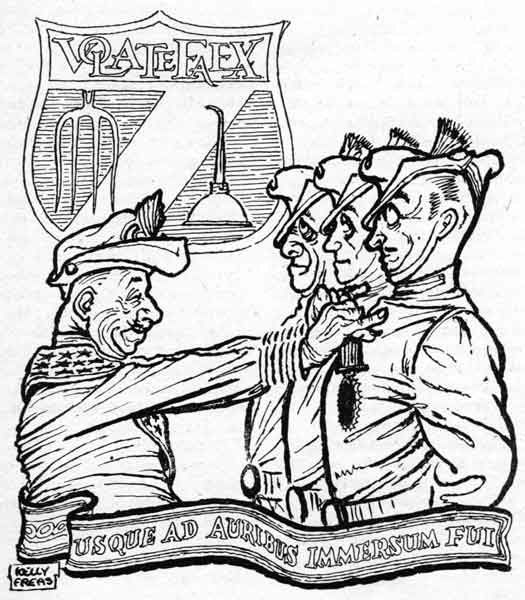
Banner ripped open his orders, read them, stared in disbelief for a quick
moment, then cursed wildly while reaching for the telephone.
“Hello, Gastonia? Yes, I got ’em. What kinda way to waste our time you
lunkheads think ... oh, it’s you, colonel!”
Banner dropped the receiver and let it dangle. He sank into the only soft chair
in the apartment and watched hypnotically as the phone’s receiver limply coiled
and uncoiled at the end of the wire.
Somebody knocked on, then opened the door. “Hi, pretty boy, you got our
orders?”
“Come on in and hear about it,” Banner said. He got up from the chair, ran his
hands compulsively through his recently short-cropped red hair, hung up the
phone and shoved the orders into his co-pilot’s hands.
Harcraft read them over three times, then sank into the chair just vacated by
Banner. Finally—while Banner poured them both a drink—he managed to blurt,
“Potato fertilizer and tractor fuel—Oh, no. Oh, no, no, no!”
“Oh, yes, yes, yes,” Banner said bitterly. “We are heroes of the spaceways;
yes, indeed. We train for ten years. Acquire great skill in the art of the
patrol. We dedicate ourselves to the protection of the Federation. We ready
ourselves for war. We gird our young, strong loins, we—”
“You’re getting hysterical,” said Harcraft, who poured himself another drink,
began pacing the floor and took up where Banner had left off. “We’ve never even
been lost on patrol. And now they do this. It’s unbelievable! Potato fertilizer
and tractor fuel. We’re supposed to travel thirty-six light-years, pick up one
thousand sleds of the stuff, deliver it to some God-forsaken farm planet
another thirty years out, and return to base. You know what they’ll do then?”
He turned to Banner, pointed his finger accusingly and repeated, “You know what
they’ll do then?”
“How would I know,” said Banner, glumly staring into his drink.
“Well, I can tell you what they’ll do. Yes, sir, I can tell you.” Harcraft’s
pudgy face and oversize brown eyes seemed to melt into each other, giving him
the appearance of an angry, if not very bright, chimpanzee.
“O.K., what’ll they do?” Banner said.
“They’ll give us medals. That’s what they’ll do. For safe delivery of one
million tons of tractor fuel, you two fine specimens of manhood are hereby
presented with the Order of the Oil. And for your courageous service in
delivering two million tons of potato fertilizer, you are also awarded the
shield of—”
“Never mind,” Banner said. “It could be worse. They could’ve saddled us with a
Bean Brain. Come on. Let’s go to some bar and get sober. We’re leaving for
freight duty at 1700.”
The Bean Brain met them at the air lock. “Name is Arnold. Here’s my orders.”
Banner stared at Harcraft, Harcraft stared at Arnold.
“Get inside,” said Banner.
The Bean Brain smiled, “Er ... could you sort of lead the way? I’ve never been
inside a ship before. If you got some kind of can, it would save a mess. I’ll
probably vomit a while.”
They stopped calling him Bean Brain three days later. He was still sick,
miserably spacesick, and neither Banner nor Harcraft had the heart to keep
needling him. On the fourth day he managed to get up and around. They ate their
first meal together that day. “Let’s get something straight right off the bat,”
Banner said. “Neither Harcraft nor I got anything against you ’cept prejudice.
That right, Harcraft?”
“Right,” Harcraft said.
“In short,” continued Banner, between puffs on a cigarette, “all we know is
what we’ve heard.”
“And that’s not good,” said Harcraft.
“Item one,” said Banner, blowing smoke at the ceiling ventilator. “Patrol
Command came up with the Bean Brain idea about six months ago. Patrol Command,
in its infinite wisdom, has never seen fit to explain why Bean Brains
are sometimes assigned, evidently at random, to small patrol vessels such as
this. The orders always state that the ‘passenger’ will accompany pilot and
co-pilot throughout the entire trip, will obey orders, yet is equal in rank to
the ship’s commanding officer. The Bean Brain has no duties aboard. This seems
to make sense, at least, since Bean Brains aren’t trained for anything and
can’t do anything.”
“Item two,” said Banner, taking his eyes off the ceiling and pointing a finger
at Arnold. “I have, or had, two good friends—both patrol captains—who had the
honor of taxiing Bean Brains around the universe. One never came back. The
other, Captain Slatkin, came back and got a big medal for reasons he’ll never
talk about.”
“And Slatkin liked to brag,” said Harcraft, knowingly.
Arnold stood up slowly. He was a small man, but as he looked up at the ship’s
pilot and co-pilot, he gave both the impression of height and strength. “I’ll
tell you something, too,” he said, speaking slowly as if in pain. “I don’t know
why Bean Brains are assigned to ships like this either. I’ve never been told. I
took the job because I didn’t like what I was doing before. I’ve never had any
real training, and this seemed like a chance to do something that sounded like
fun.
“Like I said, I’ve never been told anything. They tested me for a lot of
things, then gave me my orders and told me to come along. And if you’re
wondering, I flunked the ESP tests, so there’s nothing there. You want to
consider me dead weight? O.K., your privilege. Leave me alone if you want to,
I’ll do the same. Be friendly, I’ll be friendly. Ask me to help. I’ll do my
best.”
Then he got up and went back to his bunk.
During the next six weeks, Arnold spent most of the time in his bunk, scanning
tapes from the ship’s micro-library on an overhead viewer. At meal times he was
polite, offering no further information about himself, yet entering into any
conversation that centered around such trivia as terrestrial sports, taxes,
money, liquor, food, government agencies. By mutual, if silent, agreement,
neither women nor work were discussed.
Working in the ship’s control room, sometimes together, sometimes spelling each
other, Banner and Harcraft speculated bitterly and endlessly about their
passenger. Theories to explain his presence—most of them propounded by
Harcraft—were created, torn apart, modified, exploded, in giant sequences of
effort which left both men finally exhausted and tired of the whole business.
On the second day of the seventh week out, their ennui vanished. A ship was
picked up by the spec-spanner, and at their delight at the break in routine,
they summoned Arnold up to the cabin.
“Take a good look,” said Banner, “it’s an Ankorbadian ship. Probably the first
and last you’ll ever see.” Arnold watched as Banner’s finger tracked a slowly
moving point of light across a recessed ceiling screen.
“Yes, sir,” said Harcraft, “you are looking at the representatives of mankind’s
only sibling. The noble Ankorbades.” Then he recited in a singsong voice:
“A simple race the Ankorbades
They wear no clothes and live in caves
But out in space they do in minutes
What our ships do at speeds infinite.”
“Cultural paranoia,” added Harcraft.
“Huh?”
“I mean just what I said. You and a million others recite that ditty, or
variations of it every day of the week. It all adds up to the fact that the
world is full of small-egged animals who for ten years have done nothing but
just scream that we’re about to be attacked by the savage Ankorbades.”
“Tch, tch,” said Banner, “treason, my lieutenant, treason. Of you I had
expected at least a show of chauvinism.”
“Stop tch-tching me,” Harcraft said irritably. “You’ve known how I felt
about this mess for a long time.”
“Yes, indeed,” said Banner, yawning, “ever since you took that micro-course in
culturology you have insights into the situation denied to the rest of the
race.”
“Anyway,” Harcraft said, making a small adjustment on the screen, “you and
countless other atavisms are reacting in a very predictable way. Since you
can’t reconcile the naked Ankorbades and their superior technology, and since
they are alien to point of showing no interest whatsoever in our elaborate art,
institutions, rituals—”
“And since,” piped up Arnold, startling both men, “the human unconscious can’t
help but equate nakedness with savagery, we have armed our mighty planet to the
teeth, convinced that Armageddon is around the corner.”
“Well,” said the surprised Harcraft.
“Where’d you pick that up,” asked Banner.
“From Captain Slatkin,” said Arnold, smiling. “I met him when I was
indoctrinated. He took the same micro-course in culturology. ’Course, he only
believed that stuff when he was scared.”
“Oh, you don’t say,” said Banner. “Tell us, my little friend, are you too,
convinced that Armageddon is around the corner? Not that I really think you’re
capable of having an opinion.”
“I got plenty of opinions, all right,” said Arnold quietly, staring at his
shoes. “Opinion number one is this: We’re not really at war yet, but within the
past two years, fifty-six patrol ships have disappeared in the vicinity of our
friendly neighbor.”
“That’s not an opinion,” Banner said. “And disappeared can mean a lot of
things.”
“Opinion number two,” continued Arnold, scratching himself under an arm. “About
the only diplomatic relations we got with them animals is when they write a
note complaining about some Patrol ship getting too close to some piece of dirt
in their system.”
“Speaking of that, you’ll have to excuse me for a moment,” Harcraft said.
“Stop clowning,” snapped Banner. “Listen to him. Here’s your chance to get some
insight into the nature of the thorn in your side. Go on, Bean Brain. Any more
opinions?”
“Yeah. If you’re such a wise guy, tell me why you’re here right now. Why?”
Arnold’s mouth screwed itself into a knowing, bitter smile. “When both of you
were children you heard the story about the Big Fleet. So you made it into the
Patrol, spent the rest of your life training, looking, thinking that some day—”
Harcraft broke in, “That tale about an Ankorbadian fleet build-up has been
discredited a full thousand times. When they pried that crazy scout out of his
ship, he was an hour away from the crematorium. You try spending forty-six days
in space without food or water sometime! You’ll see hidden arsenals of alien
ships till hell won’t have it.”
“And,” added Banner, “where is this fleet build-up supposed to take place? The
patrol has had every planet in reachable space under scheduled surveillance for
the past twenty years. You don’t hide a thousand S-type cruisers in somebody’s
pocket.”
“So nobody’s scared, huh?” said Arnold. “So the entire space command has been
playing footsie all over the galaxy for twenty years looking for a thousand
ships that aren’t there in the first place, huh?”
“Routine surveillance,” said Harcraft.
“A thousand ships,” said Arnold, slapping his sweating forehead. “They’ll burn
through our defense system like—”
“You’re a paranoid rabble rouser,” said Banner lightly. “We’ve got work to do
up here. How about getting back to your bunk?”
Two days later they made scheduled contact with the caravan of potato
fertilizer and tractor fuel. One thousand sleds, in tandem, were in proper
orbit two hundred miles above Sedor II. Their orders provided for a landing on
the planet and a short ship-leave, at the discretion of the ship’s pilot to
refresh personnel.
Banner and Harcraft decided against landing. All necessary contact, now that
they were out of hyperdrive, could be accomplished with the ship’s radio. Short
planetfalls were, psychologically, more trouble than they were worth, often
destroying the hard-earned, delicate space orientation which was their only
defense against the abysmal boredom.
“It’s a dull place anyway,” explained Harcraft to Arnold, who had come up to
the control room. “It’s a mining and processing settlement. Maybe five hundred
families altogether. Got a funny religion, too.”
“Huh, what kind?”
“Well,” began Harcraft breezily, “sort of sacrificial you might say. They
believe in killing strangers who annoy their women.”
“A dull place,” agreed Arnold, wiping his nose with his sleeve.
“Speaking of religion,” said Banner, “I just talked to their monitor on the
radio. They’ve picked up twelve big ships on their scanner during the past two
days.”
“Ankorbades?” asked Arnold quickly.
“Uh-huh. But not what you think. It’s Easter time or some such thing at home.
They all return to the home planet and stay there for about thirty days in the
spring. Religious festival.”
“Oh, yeah. They paint themselves blue and howl at both of their moons for a
month. I read about it once.”
“We’ll be home, too, pretty soon,” ventured Harcraft, for whom the return
journey was subjectively always short.
“Let’s hitch up to those sleds,” Banner said. “It’s time to get going.”
Four weeks later two of the fertilizer sleds went out of phase and
automatically cut the ship out of hyperdrive.
“A welcome diversion,” said Banner to Harcraft, “you are now about to meet your
mortal enemy face to face.”
“Manual labor? Never,” said Harcraft, assuming the pose of a man bravely facing
the firing squad. “Patrol duty is my lifeblood. Even freight duty such as this
I can stomach. But manual labor! Please captain, let the air out of the ship,
if you will, but never shall these hands—”
“Somebody call me?” asked Arnold, appearing silently.
“Yeah,” said Banner, “how’d you like to help?”
“Sure, what you got.”
“Couple sleds are out of phase. You and Harcraft are going to slip into suits
and go out and find the trouble.”
Arnold shrugged, “O.K. with me, when do we start?”
“Pretty quick,” said Banner, who had turned to look at the ship’s spec-scanner.
“Looks like we’re in a belt of meteorites. We’ll be able to match velocities,
but we could still be creamed if the path gets too eccentric. Show him the way,
Harcraft. I don’t want to take any longer than necessary, either. Understand?”
Fifteen minutes later, both Arnold and Harcraft were out of the air lock, each
clutching a new phase unit. Harcraft called instructions to Arnold over his
suit’s inter-com, but within minutes the smaller man was, if anything, more
adept at the business of maneuvering himself through the void than his teacher.
They replaced the phase unit in the first sled—the fiftieth from the ship—with
Harcraft doing the work and Arnold watching.
“Can you do the next one alone?” Harcraft asked.
“Easy as pie,” Arnold said. “Where is it?”
“About two hundred sleds farther back. Numbers on the side. Number two hundred
sixty-three. Can you remember?”
“I ain’t dumb. Where you gonna be?”
“Back in the ship. We’ll be waiting for you.”
Back again in the control cabin with Banner, Harcraft was about to congratulate
himself on inventing the apprentice system, when a piercing scream brought both
men to their feet. “It’s Arnold,” Banner said. “Arnold, you all right?”
Harcraft pushed Banner away from the speaker. “Arnold, what’s wrong, you O.K.?”
The speaker remained silent.
“You better suit up,” Banner said quietly.
“Yeah,” Harcraft said, staring dumbly at the speaker. “Yeah, I better suit up.”
“Wait. Better take a look on the viewscreen.”
“Hey, he’s coming this way! Quick, get ready at the air lock!”
It was fifteen minutes before they could get anything out of him, and then he
wasn’t too coherent. They gave him an injection of herodine to quiet him down,
but his eyes still rolled wildly and all he could manage was: “Big hunk of rock
... big hunk of rock ... rock, quick ... monkey ships.”
“Any idea what he’s talking about?”
“No,” Banner said thoughtfully. “There was a sizable meteorite that came pretty
close while you were on your way back to the ship, but I’d already tracked it
before either one of you went outside.”
“How close?”
“Hm-m-m. Visually, a dozen kilometers, I’d guess. I could run the tape if you—”
“Velocities almost the same?” asked Harcraft, who was now fiddling with the
viewscreen controls.
“Yeah. Shouldn’t be too hard to find. How about lugging Bean Brain back to his
bunk. I’ll run the tape, then you can plot it on the screen.”
When Harcraft returned to the control cabin, Banner had already plotted it on
the screen.
“I’ll say it’s a big piece of rock! About four kilometers in diameter.”
“Yeah, but nothing out of order.”
“Uh-huh. Let me turn up the magnification a little and see if—” Banner watched
as Harcraft turned control buttons, skillfully increasing magnification without
losing the held of view. Suddenly, the object exploded into iridescence.
“What—”
“Watch,” Harcraft said. He bumped the magnification as much as he dared.
“The Ankorbadian fleet,” said Banner between clenched teeth.
They spent the next hour scanning the ship’s micro-library for anything at all
on Ankorbadian religious practices. There was nothing. Arnold awoke in another
hour and seemed remarkably free of hysteria.
“What do you know about our friends’ religious holiday?” asked Banner. “We
checked the library without any luck.”
Arnold scratched the side of his face. “Lemme think. Yeah, I remember. They go
home to celebrate spring, like you said.”
“They all go home?”
“Uh-huh. They got to. Only time they can mate. Only place, too.”
“How long they stay? I’ve heard it’s about one of our months, but we have to
know exactly.”
“That’s all I know. Read it some place a long time ago. Can I go back to sleep
now?”
“Go back to sleep,” said Banner.
They spent the next three hours maneuvering carefully around the asteroid. They
took six thousand feet of movies and stared at the projections for another
three hours. One thousand seven hundred and thirty silvery needles flashed
reflected starlight into astonished, wild eyes.
“At least,” whispered Banner, “there’s nobody there.”
“A lot of good that does us. They’ll be back from their home planet in a few
weeks, just as soon as the breeding season is over. Why should they leave
anybody here? There’s not a map in the galaxy that indicates the position of
this piece of rock. And we haven’t any weapons.”
“I don’t suppose the computer—”
“You can’t compute an orbit without at least one more reference point. Besides,
we’re four weeks from any kind of fleet contact.”
“Great. In other words, they’ll be back here, ready to roll before we can even
tell anybody that we don’t know how to find it again.”
“Right. And since there’s not any room left to park another ship of that size,
it’s a pretty safe assumption that they are ready to roll.”
“Armageddon,” muttered Harcraft.
“You sure we don’t have anything to—”
“Weapons? Yeah. We have a pistol and three small nitro paks in a locker some
place. You couldn’t even blow your way inside one of those ships. And if you
could, you’d spend two weeks and then blow yourself to hell before you’d know
anything about the armament.”
“O.K., let’s land and look around. Go get Arnold.”
They cut off the sleds and plunged down, landing between two of the ships.
Before putting on suits, Banner sent Arnold to the locker to get the three
nitro paks. He hoped it would help him overcome the terrible feeling of
nakedness and impotence.
They spent only a little time out of the ship. There was nothing to see that
hadn’t been seen before, and the heavy artificial gravity generated by the
alien ships—coupled with a maze of deep crevices—made walking difficult and
dangerous.
Back in the control cabin, Banner turned to Harcraft, “Any ideas?”
“Ideas? You mean for saving Homo sapiens? I’m afraid not. I simply do not feel
up to saving six billion sentient organisms today. I feel—”
“You’re getting hysterical,” said Banner, whose own tight, small voice was
barely audible.
“I got an opinion,” said Arnold. “You guys stop crying for a minute and I’ll
tell you.”
It took him five minutes to explain the whole thing. When he was through, both
Banner and Harcraft turned him down flat. “Not a chance,” said Banner. It would
take a week to set the thing up, and then it wouldn’t work. Our best chance is
a long one, but maybe we’ll make it. We’re four weeks away from any fleet
contact, but it’s the only sensible course of action.”
“That makes it a total of eight weeks, with four weeks to get back here. That’s
two months,” said Arnold. “You think they’re gonna wait two months before they
shove out of here?”
“Maybe not,” Banner said. “But that’s the only thing to do. And the sooner we
get started the better the chances. Let’s get going.”
“You look here—” Arnold began.
“No more opinions, Bean Brain. You’re not entitled to an opinion. You think we
should take your word for everything you told us? Tell me why. You said
yourself you never had any training. So you’re guessing and hoping. It would
take a staff of two dozen highly specialized technicians to even evaluate your
idea, much less put it into action. Hell, man, face it. What do you know about
geology, chemistry, mining? What do you know about anything?”
Arnold pointed a trembling finger at Banner. “Look, I told you that I know
rock. I know plenty of gardening, too. I gave you guys a chance to say O.K. You
still say no? Have it your way, but we’ll do it my way.” Both Banner and
Harcraft found themselves staring into the barrel of the ship’s only weapon.
Harcraft recovered from his astonishment quicker than Banner. “O.K., Bean
Brain, have it your way.” Quickly, casually he started for the cabin door.
Then, with such speed that Banner hardly saw the movement, he chopped down
viciously toward Arnold’s wrist with the edge of his hand.
Harcraft recovered consciousness a half hour later. “Don’t try that again,
little boy,” said Arnold with unconcealed hatred. “I’ll give you another thirty
minutes to catch your breath. Then we all go to work.”
It took ten days instead of seven. Under Arnold’s close supervision, they made
the ship perform like a tractor, an air hammer, a foundation borer and an
angledozer.
Once, when they told him that some particular maneuver couldn’t be done, he
took the controls himself, and came so close to killing them all that Banner,
out of sheer terror, took over and made it do the things Arnold decreed
necessary.
Finally it was finished. Two million tons of potato fertilizer, one million
tons of tractor fuel combined into a slimy pulp lay jammed into the largest
crevice on the asteroid. A few hours later they were a thousand miles out in
space.
“Now?” asked Banner.
“Now,” said Arnold.
With the viewscreen at maximum magnification, they watched as the asteroid blew
itself into a thousand million pieces.
In the control cabin, a short week away from fleet contact, Banner was still
gloating over the movies. “Look at these. Before and After. How many medals you
think we can carry on our strong, manly chests?”
“I really couldn’t care less,” answered Harcraft. “While you’ve been sitting
there enriching your fantasy life, I’ve solved the mystery of mysteries.”
“Out with it.”
“O.K. While our little friend has been lying on his bunk ruining his beady eyes
on the micro-viewer, I’ve been asking myself significant questions. Question
number one: What kind of person does it take to survive the inactivity and
boredom of three, four, maybe six months in a space can like this? Answer: It
takes a highly trained and conditioned person such as yours truly or yourself.
Arnold is obviously not such a person.”
“Obviously.”
“Question number two: Under what circumstances can a person as obviously
intelligent as Arnold manage not to become a highly specialized member of
society? And last, what kind of person can be so revoltingly unspecialized as
to know, with fanatical certainty, that the main ingredient of a good potato
fertilizer is ammonium nitrate; that such a substance is rather ineffective as
an explosive unless you mix it with a good oxidizable material, such as Diesel
fuel; that a four-square mile chunk of rock is ‘brittle’—”
“And don’t forget to add another nice facet—that he’s a lot cleverer in the
manly art of self-defense than you’ll ever be.”
“I acknowledge my humiliation and at the same time repeat my question: What
kind of person can be so unspecialized and at the same time so miserably
competent?”
“I give up. Do you really know the answer?”
“I know this. I know that whoever he is, it makes good sense to send somebody
like him along with two overspecialized robots like us. Look at us. You
couldn’t pull a cotter pin with a pair of pliers if you knew what a cotter pin
was. As for myself, if I’d of gotten that gun away from Arnold, I’m not even
sure I’d have known how to fire it.”
“Which still doesn’t answer any questions.”
“There are still a hundred places on our primitive homeland that provide the
answer,” said Harcraft thoughtfully. “Places where men spend half the year
working with vegetables and fertilizer—”
“And the other half breaking rock with a sledge hammer?”
“Yes. And there’s probably no better place than a cell to train for the
isolation of space.”
“Uh-huh. It also explains a certain familiarity with makeshift explosives and
weapons.”
“And, brother Bean Brain,” summed up Harcraft wistfully. “What better place in
the universe to find asylum from specialization.”
THE END