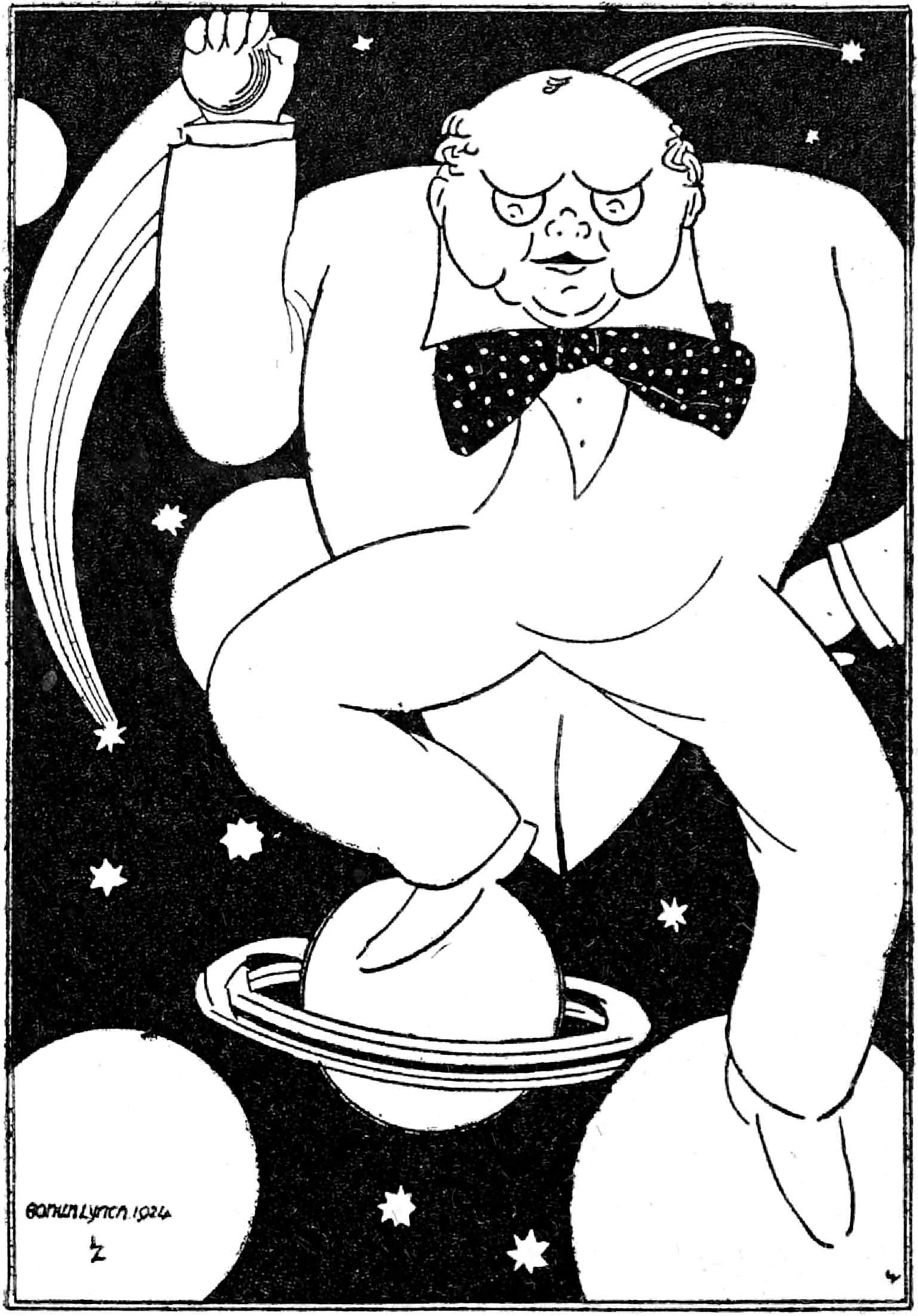
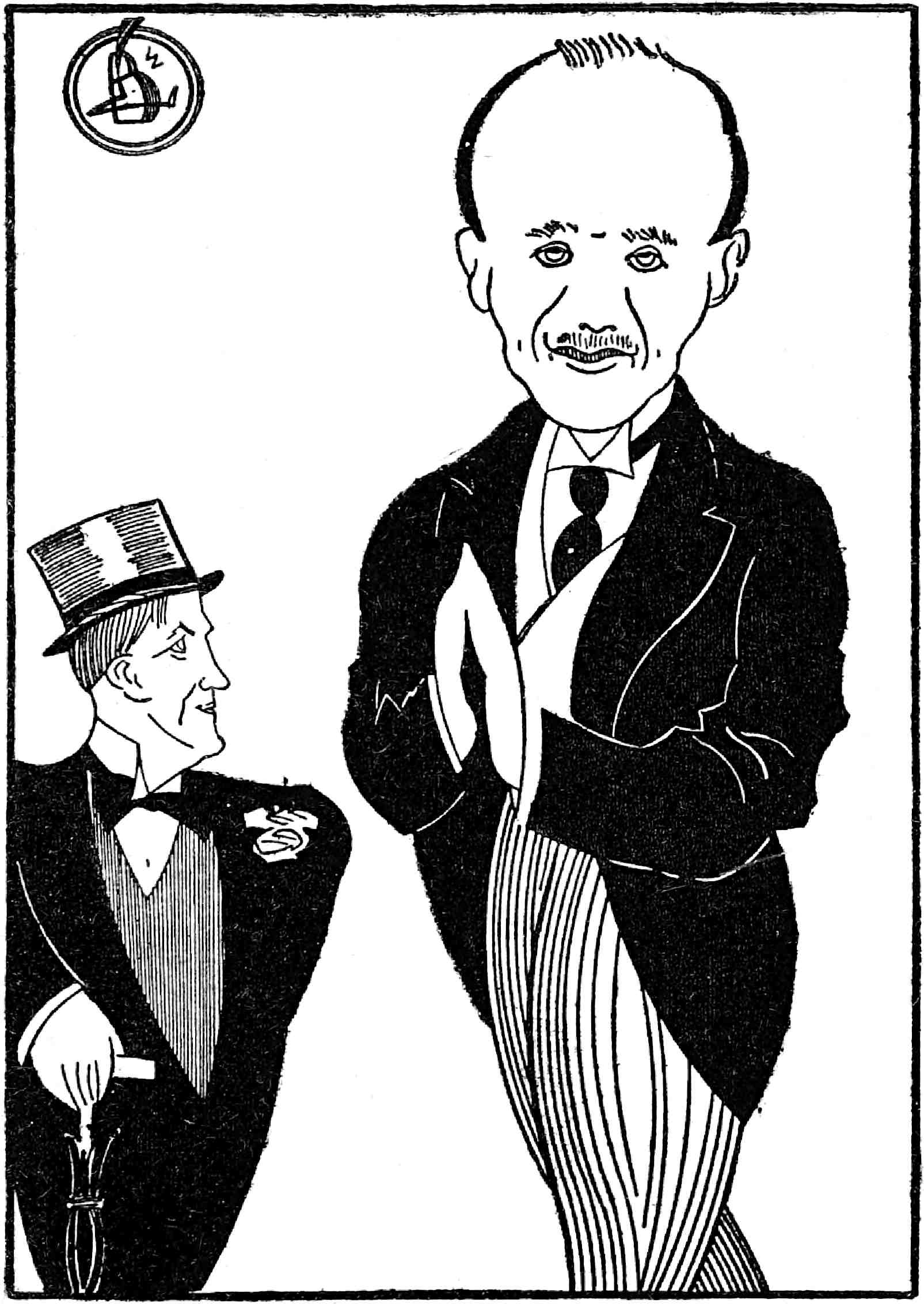
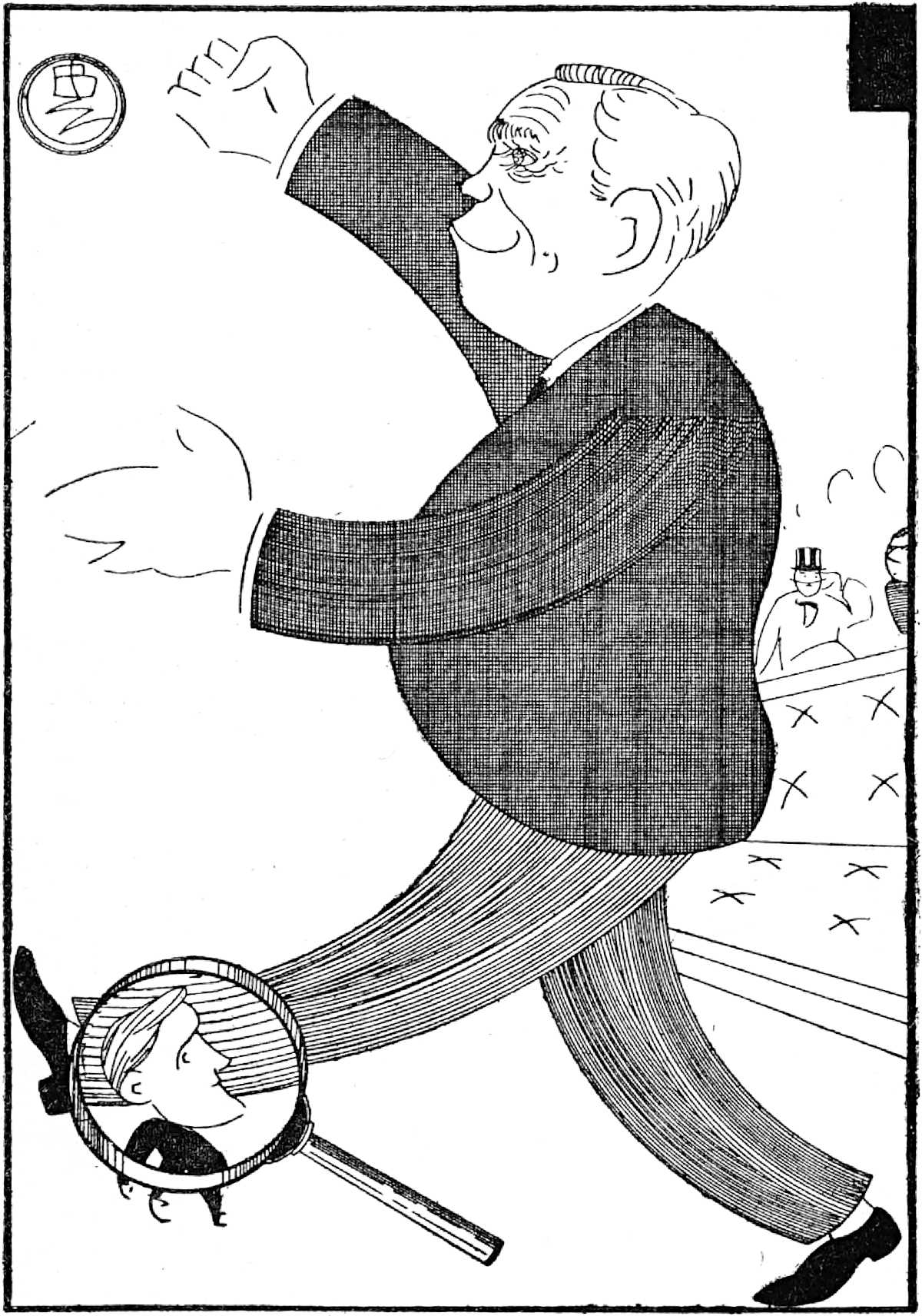
THE UNIVERSAL CONFLICT
NINETEEN ANYTHING—NINETEEN SOMETHING ELSE
By the Rt. Hon. Winsom Stunster Chortill
CHAPTER MXCVII
Golgotha
More criticisms—My “interference” with the Heavenly
Twins—Suggested operations against Venus—My memoranda
on Venus and Jupiter—Detailed proposals—Our new
super-planetary battering-ram—Lord Krusher baffled—Correspondence
between us—Lord Krusher’s objections—My
reply—His antagonism—Meeting of the Allied
Planetary Council—Serious position—The Archangel
Gabriel’s shortcomings—My plan for saving the situation—The
crisis—My resignation—Reflections.
Scarcely had died away the reverberations
of criticism, enhanced by venomous
personal attacks upon myself for my so-called
“interference” in the operations against
the Heavenly Twins, when a new crisis of even
more momentous significance was sprung upon
the Cabinet. In the previous December, with
the fullest concurrence of the First Air Lord
and the Board of Aerial Operations, I had planned
a lightning raid on the planet of Venus to be
carried out by our obsolete comets. The political
situation has so important a bearing upon this
project that I must here interpolate a memorandum
which, as long before as the previous July,
I had addressed to the Secretary of State for
Extra Planetary Affairs and circulated to my
colleagues.
Memorandum.
Mr. Chortill to the Extra Planetary Secretary.
I can no longer preserve silence on the subject
of Venus. Venusian hostility may quite well
be fatal to the whole grand operation which we
and our planetary allies are at present co-ordinating
against the Central Planets. The
grip of Mars upon Venus is unquestionably
tightening; and, if no intervention is undertaken,
but, on the contrary, the spirit of laissez-faire is
allowed to prevail, we shall not only lose a strong
potential adherent, but, which is equally important,
also forfeit considerable sympathy
amongst our own people. The plan of the
Martians is quite plain. Availing themselves of
that well-known astronomical phenomenon—the
Transit of Venus—they will undoubtedly
utilise that period of uncertainty to detach this
wavering planet from our cause and bind her
irrevocably to themselves. That would be
nothing short of a disaster.
At the same time, knowing his difficulties in
coping with the tasks of his office, I instructed
the faithful Smashterton Jones to convey the
following message to the Prime Minister himself:
Mr. Chortill to the Prime Minister.
I am seriously exercised in my mind about
Jupiter. I fear that, by confining ourselves to
the narrow requirements of tactical gain, we are
neglecting inter-planetary strategy. Do, I beg
you, consider this point. If Jupiter can be
induced—I don’t suggest that this proposal is
necessarily the best, but, let us say, by the offer
of one or both of the rings of Saturn under a
Mandate of the League of Planets—if Jupiter
could in this or some other manner be induced
to take an active part, at least in the aerial blockade
to cut off from the Central Planets the communication
which at present they enjoy outside the Solar
System, there is no doubt but that the conflict
would be sensibly shortened, and it might make a
difference of centuries. I enclose a Memorandum
on Venus which I have sent to the Extra
Planetary Secretary, and upon which I should
value your remarks.
W. S. C.
Reverting now to the plan for an aerial raid
on the planet of Venus. We had the old comets,
quite ineffective for operations against the major
Planets, but powerful and not at all to be despised;
we had a satisfactory surplus of meteors which
could be employed in support; and we had in
addition the newly constructed, and in all respects
novel, planetary battering-ram, specially designed
for jarring, or, as the technical word is, “boosting”
heavenly bodies out of their orbits—the
apple of the eye of old Lord Krusher and the
Board of Aerial Construction. This formidable
engine, unique, as we were led to believe, in
the whole stellar universe, must in any case
carry out her trials somewhere, and might as well
be utilised in toppling a potential antagonist out
of our path, instead of being sent to the Milky
Way for the usual two months’ test. So much
for material. Of trained personnel we had,
though not an abundance, a reasonable margin.
Only one thing seemed to baffle the mighty war
mind of old Lord Krusher and our experts—a
satisfactory jumping-off place. Accordingly, the
day before the Cabinet met, I dictated the
following:—
First Lord to the First Air Lord.
Referring to our conversation with regard to
the Venus Striking Force, and the necessity for
a jumping-off place, has it occurred to you that
the Mountains of the Moon are in every way
adapted for this purpose? A force of comets and
meteors with the necessary reserves, L. of C.
troops, etc., based upon this strategic point, not
only dominates the principal airways and traffic
routes, but points a spear directly at the heart of
the enemy. Request therefore that you will
examine this proposition, and, in conjunction
with Aerial Operations, furnish me immediately
with an estimate of the material, plant, etc.,
required to convert these natural fastnesses into
a suitable base.
W. S. C.
To this he replied in a characteristic letter:—
Trusty and well-beloved Winsom,
Your plan is, like yourself, marvellous! Nobody
but you could have thought of it. I could
turn the Mountains of the Moon into the base
you require in forty-eight hours, but for one overriding
difficulty, which your memorandum does
not meet. There is no AIR on the Moon, my
Winsom, and human beings being what they are,
air is necessary IF THEY ARE NOT TO PERISH.
Only THREE things are necessary to win the
war: air, SPEED, and GUTS. I have got the
last, you are providing the second, but where
are we to get the AIR?
Skegness?
We had better try the Valley of the Dry Bones
instead, if the archæologists can find it for us.
Failing that, Sinbad’s cavern.
Yours till Ginger pops,
Krusher.
This was the kind of thoughtless criticism
to which I was occasionally subjected by the old
air-dog.[1] Magnificent in his courage, more often
right than wrong, a splendid example of British
brain-power, there were times when he made the
error of estimating other people’s mental capacity
by his own. Time was pressing, so I wirelessed
the following reply:—
First Lord to First Air Lord:
Take Supply of Oxygen in Canisters,
which settled the matter. Alas! I was to discover
later that this too speedy resolution of his
difficulties was merely to succeed in antagonising
the bluff old warrior against the whole project.
Meanwhile the great Council of the Allied
Planets met, and it became all too apparent that
the operations, as a whole, were being pursued
with even more than our customary hesitation
and delay. The Archangel Gabriel, an excellent
First Minister in times of peace, was beginning
to give unmistakable signs of being too old and
slow-witted for his work. Since his well-remembered
and highly successful controversy with
Lucifer, some æons before, his powers had been
steadily waning; and it was speedily becoming
apparent that he had no longer the mental alertness
and vigour of body for a prolonged campaign
conducted under the stress of modern conditions.
At times—as, for instance, over the thunderbolt
shortage—he would arouse himself to prodigious
efforts, equalling, if not outstripping, his ancient
prowess. And then he would fall into always
increasing periods of apathy, from which there
was no extracting him.
In these circumstances I wrote the following
memorandum:—
Memorandum by the Rt. Hon. Winsom Stunster
Chortill on the general situation:
We have now been at war for forty-three years
and eleven days. A prodigious expenditure of
blood and treasure has so far secured for us no
material advantage. The essential services are
suffering from lack of co-ordination. Much valuable
energy is being wasted in duplication of
effort.
I have indicated in the accompanying appendices
(36 in number) detailed plans for a change
of policy on all the fronts, and I attach also an
additional memorandum with 7 sequellæ, 41
maps and a detailed schedule of supplies, dealing
with the political situation likely to arise on the
Transit of Venus, and outlining a scheme of
operations for immediate consideration and
adoption.
After all these years it becomes necessary to
say that the Allied cause is suffering from a want
of decision. As each new problem arises we
seem to be more and more unprepared. This
cannot be indefinitely prolonged, and only one
sensible solution presents itself—namely, that the
control of all policy, operations and forces should
be centred under one hand. Modesty forbids
the suggestion that the serious crisis in our
national fortunes demands that I should indicate
myself as the most suitable person to have charge
of this enterprise; but if consulted I should be
willing to express my opinion on the matter.
W. S. C.
On the following day, the most fateful of my
life, I was unable to resist a foreboding that things
were not yet destined to go right for the Allied
cause. The careful records I had kept of my
administration satisfied me, as I looked through
them, that for all I had done I could assure
myself of the approval of posterity. We had
created, equipped and maintained a gigantic
aerial machine. No hostile forces had so much
as come within sight of our planet. My further
schemes, to which I had applied every existing
intellectual test, made us reasonably certain of a
speedy result; and I left my room and strode
across to the Council with a conviction in my
heart that I could carry through my proposals—and
yet with a haunting fear of the unexpected.
On arriving at the Council Chamber my forebodings
became heavier. The proceedings were
of a most perfunctory nature. All controversial
business was adjourned to a later meeting, and
we were informed that a crisis made it necessary
for the head of the Government to demand the
resignations of his entire Ministry. With a
heavy heart I parted with the insignia of my
office, realising, as I did so, that the struggle
must now be indefinitely prolonged. The head
of the Government, animated by that spirit
of kindliness towards myself which he had ever
shown, pressed me to accept a gilded sinecure.
With every wish to avoid giving him pain I felt
myself obliged to decline. Posterity, he told me,
would appreciate my zeal in the public service.
Posterity, I felt to myself, as I left the building,
would, thanks to my diaries, at least understand.
AN EMINENT GEORGIAN
Some Extracts from an Essay in the Manner
of a Distinguished Writer
During the latter part of the closing
year of the nineteenth century, an English
traveller, sojourning with his wife and
daughter near the hot springs of Rotorua in New
Zealand, was observed one day to dash from the
verandah of his hotel, hatless, into the street,
and accost a passing urchin. The lad was singularly
unprepossessing; he squinted, his right
shoulder was strangely deformed, and his ears
were much too large for his head. Unlike most
children in receipt of flattering attentions from
an elderly and distinguished stranger, he snarled,
spat on the ground, and hurried away muttering
oaths. The astonished relatives of the traveller,
hurrying out in pursuit of him—in the belief, as
the wife said afterwards, that he was suddenly demented—found
their husband and parent almost
beside himself with excitement. “That boy,”
he said, pointing towards the receding figure a
hand that shook with emotion—“that boy will
end as Prime Minister of England.” Convinced
that his mind was wandering, they led him back
with soothing words to the hotel; but his unerring
judgment was once again to be confirmed by the
verdict of time. The speaker was Dr. Quank
Brane, the eminent psychologist; the boy, soon
to be known to the greater part of the universe,
equally for the profundity of his wisdom and
the variety of his gifts and achievements, was
Erasmus Galileo McCann, philosopher, scientist,
theologian, naval and military strategist, scholar,
economist and some time First Minister of the
Crown.
The boyhood of this monument of versatile
genius, no less than his manhood, was remarkable.
At the age of one, when dropped by his nurse,
a fact which accounted for the deformity of his
shoulder, he was distinctly heard, as if in anticipation
of his interjectional habits of later life,
to rip out an accusing oath; and, when the
startled slattern turned up her hands and eyes
in horror, he added, “Don’t stare like a fool, go
and get the doctor!” At three years old his
father presented him with all the volumes of
Buckle’s History of Civilisation, which he had
completely mastered before he was five. His
dissertation of The Lesser Cists in Invertebrates,
published at the age of seven, is still a standard
work of this little known branch of biological
science. Many years later an old friend of the
family told an admiring conclave of relatives of
an encounter with the young McCann, in which
he himself was considerably worsted. In the
course of a journey across the Warraboora plains,
a wild and almost uninhabited tract of country,
his provisions gave out. Some friendly natives
whom he encountered contrived to spare him
a few dried corn cobs, but these could hardly
last him indefinitely. Starvation stared him in
the face. One day, however, as he was making
a frugal meal of a large aboriginal lizard, that he
found entangled in the undergrowth, a strange
urchin dropped on his head from out of a tree
fern, uttering savage whoops, tore the carcass
from his astonished fingers, and devoured it
without a word of apology.
“That,” said the older man with resignation,
“was my last morsel of food. I must now die.”
“Je n’en vois pas la nécessité,” returned the
youth (it was McCann), quoting La Rochefoucauld
with the nonchalance of complete
familiarity; wherewith he swung himself into the
branches of a Kauri pine, and disappeared without
another word. Giving himself up for lost, the
lonely traveller prepared for death; but before
nightfall the youth returned with a wallet of
provender, and accompanied by guides who
piloted them back to civilisation. The boy
appeared blissfully unaware that he had done
anything remarkable. “Such astonishing sang-froid,”
the traveller used to conclude, “I never
encountered before or since. I knew he was
destined for greatness.”
His schooldays and college life were curiously
uneventful. He secured the uncoveted distinction
of remaining at the bottom of the bottom
form of the school for three years, and of failing
ignominiously in the Cambridge Junior Local.
Wiseacres shook their heads and quoted scores
of instances of infantile precocity. It began to
look as though the early promise was after all no
more than a false dawn; and then, to everyone’s
astonishment, at the age of 19½ he planned,
financed and brought out The People’s Piffle, a
daily journal exactly corresponding to the literary
appetites of the masses of the British reading
public. Among other novel features of this newspaper,
alternative opinions were presented in
parallel columns on the leader page, the appointment
of the editor was subject to confirmation
or change every three months by a referendum
of the readers, and, in place of the obsolete insurances
against accident, continued subscription
for a period of 25 years or longer conferred a
pensionable right upon the subscriber.
So momentous a development in the literary
activities of the country created a profound impression.
More than one well-known actress
sent him her autograph unsolicited. A film star
was heard to refer to him as “some guy.” The
Prime Minister of the day shook hands with him
in public. Lord Thundercliffe shook in his
shoes, and redoubled his fulminating denunciations
of everything. But the day of Lord
Thundercliffe was over: a new era was at hand,
the era of universal genius; and McCann, its
prophet and its leader, was even then poising
himself on the crest of the wave that was to
sweep away the wreckage of the old century, and
sweep in the reforms of the new, and sweep him
personally into a position of eminence hitherto
unknown in our annals.
Just at about this time a resident at Claydamp-on-the-Wash
was astonished, in the course of a
country walk, to see a tall, thin gentleman leaning
over a gate in an attitude of insupportable
dejection. The enormous brogues; the ill-fitting
brown suit; the high-domed forehead;
the bushy brown spade beard; the huge spectacles
perched on the lofty sensitive nose; the
dreamy eyes looking far away into the mists, all
suggested a certain literary personage. Could
it be? Was it possible? Overcoming a natural
hesitation at intruding upon the privacy of one
who was obviously a recluse, he hesitatingly
ventured to approach. “I beg your pardon,” he
said, “but surely I am addressing Mr. Lytton
Strachey?” and without giving the stranger
time to answer he added, “Is anything the
matter? Can I help in any way?”
The solitary turned upon him eyes that were
suffused with tears. “Oh, no,” he replied, “no.
Nothing. I was born too early, that is all.”
And on being pressed for a further explanation
he continued, “By the ordinary processes of
Nature I must inevitably predecease this monstrosity
of talent; and I am excluded from the
possibility of writing the only Georgian biography
that offers any kind of scope for my abilities.”
He was of politics; and he was not of politics.
He built up abstract theories of Government in
his articles in the morning Press: and demolished
them in the evening in his speeches in the House
of Commons. He attracted the sympathies of
simple folk by a life of Spartan discipline; and
disgusted them by a profuse and shameless bestowal
of peerages and honours. He angled for
the votes of the mercenary and idle by a wholesale
creation of state benevolences; and threw away
what he had gained by an almost niggardly supervision
and husbandry of the national income.
As Controller and chief proprietor of the great
Press Trust, he denounced the infamies and
exactions of the great profiteering combines in
which he himself was the principal partner: and
as Prime Minister of a secular Government he
disestablished the Church of which he, as
Cardinal Archbishop, was the protesting head.
Writing at about this time Count Puffendorff
Seidlitz, the Megalomanian Ambassador, reported
to his Government that it was perfectly vain to
cherish the slightest hope of undermining the
national popularity of one who so supremely
embodied in himself the qualities, and the
inconsistencies, and the portentous humbug that
chiefly characterised the nation of which he was
the head. Nothing could be done at present.
Above all there must be no haste. “But I do
not despair,” he added, “for, though ignorant
of music, the man has a certain coarse feeling
for the arts—and that, in a country of Philistines,
must in the long run betray him into our hands.”
Fatal self-complacency! At the very moment
when those words were being penned, McCann
was—where? He was in the anteroom of the
Princess Vodkha, that luckless Ambassador’s
sovereign, waiting to seal with a courtly handclasp
the Trade Agreement between Megalomania
and this country. Poor Count Puffendorff
Seidlitz! Where Lord Thundercliffe and his
brother Lord Miasma has failed, it was hardly
to be supposed that he would succeed.
So ended, in a thin filmy haze, a life of service
and sacrament. To the very end they thought
he might be saved. The general public, brought
suddenly to the realisation of the approaching
calamity, stood dumbly in the streets, or hurried
away—hoping. But the sands were running
down; the tide, long since turned, was ebbing
with inexorable swiftness; the night was indeed
at hand. A greater and more terrible accuser
than Lord Thundercliffe hovered over the sick
man’s bed; and a greater and wiser Judge than
public opinion was waiting to pronounce the
verdict from which there is no appeal.
MY FIRST DERBY
“No,” I said, “as a matter of fact I’ve
never been to the Derby—and to tell
you the truth——” I went on.
He winced. He did not want me to tell him
the truth. If the truth was (as it was) that I
didn’t care two cassowary’s eggs whether I went
to the Derby or not, that was the very last thing
he desired to hear. He wanted to keep his
opinion of me as unimpaired by such idiosyncrasies,
as I would permit. These thoughts
rippled over the mild surface of his features like
gusts of wind across the waters of a pond. I
allowed the words to die away in my throat.
After all, to give pain flagrantly—
“Promise me,” he urged, “p-p-promise me
you’ll take a day off and go to-morrow. It’s one
of the sights of the world. The Downs black
with people——”
“Black?” I murmured, “surely not in this
heat?”
“Oh, well, covered with people then, stiff with
people, crowded for miles and miles with millions
and millions of all classes in the land——”
“Dear, dear,” I said, “first, second, and
third!”
He ignored this miserable attempt at buffoonery.
“Yes,” he averred, “all classes in the land,
thimble-rigging, cocoanut shying, confidence
tricking, eating, drinking, laughing, cheering.
Vehicles of all sorts, shapes, sizes, motive power,
blocking all the roads in the neighbourhood.
And the horses, my dear boy, the horses! Until
you’ve seen those horses, trained to a hair, with
coats like satin, ready to run for their lives, why,
you simply haven’t seen anything. And the
crowd in the paddock. You must see the crowd
in the paddock. And the bookies. No man’s
lived, till he’s been done down on the Downs.
Now promise me faithfully——”
“Very well,” I said hurriedly to forestall the
otherwise inevitable repetition, “I promise....”
It was rather fun, I admit. From the moment
when the wheel-barrow on which, apparently, I
had made the journey in the company of a Zulu
chief, Lady Diana Manners, Mr. Justice Salter,
and a dear little Eskimo girl aged seven, drew up
at Boulter’s Lock—no, no—not Boulter’s Lock—Tattenham
Corner, I knew I was in for one of the
great days of my life. There, glittering in the
sunlight in all its pristine colouring, stood the
brand-new Tattenham Corner House, erected
for the occasion by Sir Joseph Lyons himself,
who, with Lord Howard de Walden on one side
of him and the Prime Minister on the other,
stood in the doorway receiving his guests. A
prodigious negro, with an unexpectedly small
voice, announced me (for some reason) as “Mr.
Mallaby Deeley,” and I found myself walking
on a vast deep verandah, laid out with innumerable
little luncheon tables, through which
a long procession of horses was intricately
manœuvring.
“The paddock,” murmured my Zulu companion.
“It’s an idea of Sir Joseph’s. The
combination of a sit-down luncheon and form at a
glance. Extraordinarily convenient.”
We sat down at a table. Immediately a
jockey and his horse sat down opposite to us.
“Order us a drink each, dearie,” said the
jockey, “it’s a fearful business this perambulatin’
about; and you get nothing for it. Eh? Oh,
gin for ’er, and I’ll take a glass o’ port.”
“And what is your young friend’s name?”
enquired the judge, suddenly putting his head
from under the table.
“Ah,” said the jockey, knowingly, “that ’ud
be telling, that would.” He tapped his nose
mysteriously and drank.
“But, my good sir,” complained the judge,
“how can I back your horse if I don’t know its
name?”
“By the process of elimination,” said the
jockey sagely.
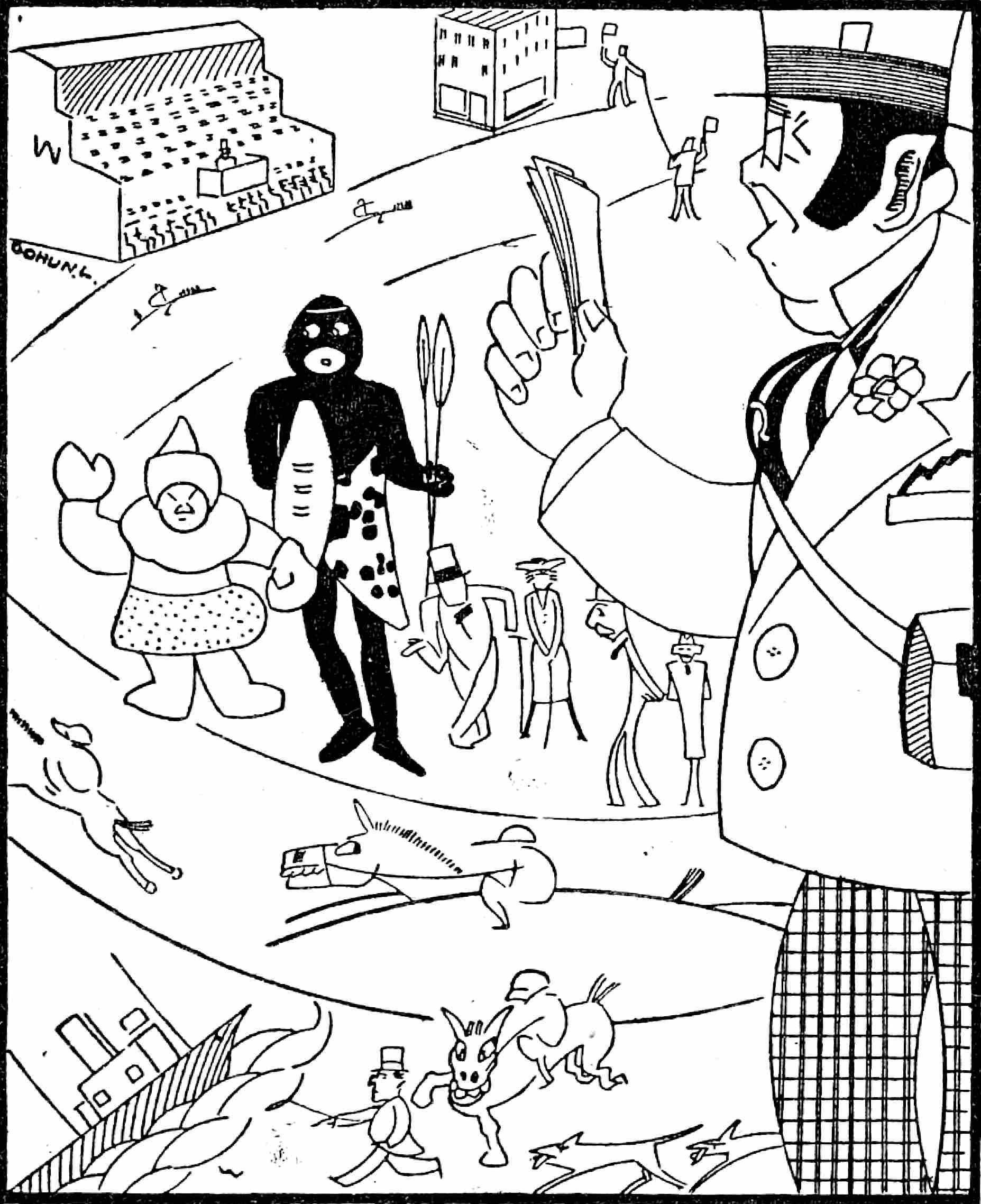
“Done down on the Downs.”
“Elimination,” said the judge, “what of?”
“Yourself,” said the jockey; and his mount
choked coyly in her glass.
At this moment the King appeared, followed
by Aristotle, Sir Thomas Beecham, and others.
“The next race is about to begin,” he said
severely, “and you’ve none of you brushed your
hair.”
It was a long time before I found the bookmaker.
Any number of spurious ones rose up
in my path and taunted me; but He always
escaped. At last I thought of looking under
one of the thimbles; and there he was in deep
calculation.
“What price Poltergeist?” I demanded. I
wanted to say Psychology, but the word somehow
refused to shape itself.
“It all depends,” he replied shrewdly, “on
whether you want to buy or to sell,” wherewith
he crossed his legs, smiled on only one side of
his face, and returned to his calculations.
“Aren’t you a bookmaker?” I faltered.
“Certainly,” he cried shrilly, “and I’m making
a book now, can’t you see?” He held up a kind
of primitive loose-leaf ledger, made of calico pages
bound in sheepskin.
“Very durable,” he explained, and broke into
a harsh chant:
“If I lay sevens and fours
And you take fives and threes—
What do they care for gaming laws,
Who have not felt the squeeze,
Who sacrifice the world’s applause
And gain ignoble ease?
With odds laid off or on,
And prices up or down——”
He broke off abruptly and rose to his feet.
The miscellany in his lap was scattered upon the
ground.
“Pick up my work-basket,” he exclaimed,
“and give me the kaleidoscope,” I handed him
the strange black instrument at which he was
pointing, and began groping on my knees among
the pins and needles. He turned towards the
sun, and gazed at it through the object in his hand.
“Look out,” he exclaimed suddenly, “they’re
off.”
Simultaneously a voice near me said, “The
King’s calling you,” and I began to run. Immediately
the hounds were slipped from the leash,
and the hunt settled down in my wake. The
ship began to sway from side to side, and the
roaring grew louder and louder. Still I ran,
flashing past the booths, past upturned umbrellas
with cards scattered over them, past the stewards’
enclosure, past the Royal Box. The thundering
grew louder and more insistent. I was flying
along the track with the whole field plunging
after me. Hoarse cries. I redouble my efforts.
My head is going to burst. The Royal Box
whizzes past again. The winning post. I’m
falling....
A long time afterwards, a voice said:
“He’s quite all right. A touch of heat-stroke
is nothing, really, you know. Quiet. Couple of
days in bed.”
I opened my eyes.
“Sir Joseph Lyons——” I began.
“All right,” said the doctor, “you shut up.”
“I’ve promised to go to the Derby,” I protested.
“Next year,” replied the doctor. “Just
drink this, will you?”
ON ETERNAL LIFE
Somebody—a certain Dr. Friedenberg
to be truthful—has thrown out suggestions
of the dreadful possibility of indefinitely
prolonging the human existence; in fact of
bringing about a kind of mundane immortality.
Hair is to be made to grow upon bald heads
(no, mine is not bald); short men will increase
in stature by several inches; and fat men will
become slender and graceful. The last is perhaps
an attractive prospect. Wait. Tell me this.
Who wants to live for ever? And having
disposed of that pertinent question, in the affirmative
if you will, who wants his neighbour to live
for ever?
Who wants to stereotype the control of human
affairs in the hands that find it so difficult to
control them? What becomes of young ideas,
new movements and general progress, in a universe
of bald pates thatched, short men grown taller and
corpulence made small? For in all this one
hears nothing about recharging the brain;
and bodily vigour does little to stave off mental
paralysis of the kind that usually comes on with
age. Would flowing hair and graceful figure
countervail the growth of avarice, deceit and
malice; or check the relentless march of stupidity?
Would it not rather be the case, that from year
to year all the more unpleasant of human characteristics
would intensify and harden?
And, by the way, think of the population of this
miserable little globe in a thousand years or so.
Nobody dies. We all live and multiply for
eternity. It increases by geometric progression.
To-day we are, let us say, a paltry thousand
million of people. In a year’s time, at a conservative
estimate, we should double our population.
In a few hundred years—good heavens! Life
would become like the platform of Piccadilly
Circus at six o’clock in the evening.
Piccadilly! This subject is inextricably
bound up in my mind with Piccadilly. I will
explain why.
Not long ago, when musing upon Dr. Friedenberg’s
discoveries, I had occasion to use the railway
of that name. I boarded a crowded train,
thinking deeply. I took my place (most incautiously,
I admit, but there happened to be no
other place to take) standing beside a forbidding
military gentleman, whose arms were full of brown
paper parcels. In the immediate vicinity stood a
large stern woman, solidly planted near the door,
who disdained the help of the strap and supported
herself, with arms akimbo and legs wide apart.
The train ran smoothly enough through Dover
Street and Down Street, and my line of thought,
on this problem of perpetual life, developed into
a kind of saga to the rhythm of the movement over
the rails. The whole subject went before my
eyes like a glorious vision. I knew just what I
was going to say in this essay....
And then the train back-jumped, and the large
stern woman, in the effort to retain her balance,
planted one of her feet with relentless precision,
exactly on one of mine, and simultaneously drove
her right elbow into my ribs. In really considerable
agony I recoiled, involuntarily loosening
my grip of the supporting strap. Immediately
the train swerved, and threw me into the bosom
of the military gentleman, whose armful of
parcels burst from his control and smothered
the occupants of the neighbouring seats. Muttering
imprecations, he crouched on the swaying
floor and began to pick them up. I stooped to
help him; and our heads met with a grinding
crash....
Meanwhile the woman—the—the unspeakable
monster who had caused the calamity, stood
entirely unmoved, gazing through the glass
doors at the conductor.
Think of such a person going down through
all eternity committing outrages of this kind—probably
one a day. Eternal life? Penal servitude
for life is more to her deserving.
THE NEXT WAR—AND MILITARY SERVICE
Russia and Germany have joined hands;
France and Belgium have banded together;
Italy has made a secret treaty with the
Kemalists—a fact which can hardly afford much
satisfaction to the kingdom of Serbs, Croats, and
Slovenes, leave alone the Greeks! Poland and
her neighbours are on much the same terms of
cordiality as rival opera singers. There is
Bessarabia; there is (so to call it for convenience)
Germania Irridenta; there is the Burgenland;
all simmering merrily away. There are heartburnings
in Transylvania. I cannot think that
even the Sanjak is really placid—it has always
wallowed in grievances from time immemorial.
Indeed (so I am told), it needs but a spark to set
the whole contraption in a blaze. Only a spark!...
We are sitting on a wood pile soaked in
petrol; and the boys at Paris and elsewhere are
out with their tinder-boxes.
Viewed from one point of view, this situation
has arisen very appositely to certain investigations
conducted not long ago by The Times, and provides
a capital solution to the problems of how to find
careers for our sons, and what to do with our
daughters. But there are some of us[2] to whom
even the satisfaction of starting our children in
(or rather out of) the world, would be but a poor
recompense for the physical discomfort (it’s not
the danger; we none of us mind danger; we
rather like it) of resuming active hostilities ourselves.
As Leggitt says[3]: “Danger I scorn;
but discomfort is the parent of anxiety; and
anxiety is the handmaid of despair.” That’s
good enough for me.
Besides, wars are not what they were. The
last war was, to a great extent, won, and the next
war will be entirely won, behind the lines.
“Lord Northcliffe,” says a military historian[4]
in his article on war in the Encyclopædia, “Lord
Northcliffe dealt heavier blows than Haig. Haig
hit harder than Rawlinson, Rawlinson than
Godley, and Godley (through a long string of
intermediary Blenkinsops and Chislehursts) than
Private Muggins. In fact, the whole lesson of
the war was that Muggins didn’t matter twopennyworth
of gin. The further back you were,
the more you could do. If Captain Slogger,
the Company Commander, stopped one—why,
anybody else could carry on. But if the
R.T.O.’s clerk at the base went down with
writer’s cramp, the repercussions might be felt
all over Europe. And in the next war....”
And so on.
Push this to its logical conclusion and what do
you find? An entirely new conception of the
theory of national service. The duty of every
man, with love of country in his heart, is to fit
himself to play a far-reaching, noble, and adequate
part in the next war—from a distance at which
brains will really tell. As Sir Cuthbert puts it,
“The duty of the soldiers of the future is to
consolidate the front behind the front.” No
mawkish sentimental considerations should interfere
with the attainment of this. “If others
have to fall in the front line, drop a tear, good
citizen, or if you feel so disposed, drop two tears.
But for the sake of your country, and its final
victory in the struggle, see to it that you are not
the one who falls.”
I will. I will see to it with punctilious care.
It is my duty; and I shall discharge it with the
same devotion as I displayed in the last war, when
I rose from assistant warehouse clerk (graded as
bombardier) in the E.F.C. receiving shed, via
R.T.O.’s clerk at Boulavre (graded as Staff
Sergeant of Musketry), assistant press censor
(graded as Squadron Leader of Cavalry with rank
of Captain) and Base Commandant (graded as
G.S.O. 2, but with rank of colonel on the staff
and pay and allowances of a Lieutenant-General)
to the proud position which I occupied at the
end. I have nothing to complain of.... I
cannot deny that I had all kinds of obstacles to
overcome. Ignorant prejudiced fools, blind to
the interests of their country, were constantly
endeavouring to comb me out. And so it will
be in the next war. The earnest patriot will find
himself thwarted and misunderstood at every
turn. Nothing but a knowledge of the niceties
of the medical board, will avail to defeat these
busybodies. Indeed, it may at times be necessary
to indulge in a little pardonable deception.
Thus, a cigarette soaked in laudanum, and smoked
half an hour before the doctor’s examination, will
produce all the symptoms of general paralysis,
heart failure, and abdominal catarrh; yet, in an
hour or two at most, the smoker will have recovered
most of his faculties, and the remainder
will return in, at the outside, a few days. A
glass of vinegar, swallowed without deglutition,
produces the pallor of a ghost and the pulse and
temperature of a lizard; yet the effects have
rarely lasted longer than a week. And there are,
of course, such well-known (but to my thinking
too crude) expedients as self-inflicted wounds and
even amputations.
Perhaps it is best, indeed, to make preparations
in advance. It must never be forgotten that a
large civilian population is necessary to carry on
what are called “the essential public services.” No
one should disdain to do his duty in one of these
capacities. And if, as in the last war, the only
sons of widowed mothers are to be given special
consideration, we must not hesitate to take full
advantage of such a provision. A judicious use
of the knife or poison cup, or possibly a combination
of the two, will place many a strapping fellow
in the necessary condition of exemption.
Promptski-Buzzoff, in his elaborate, but too
little known, treatise “Die Vermeidung des
Kriegesdienstes”[5] lays down that “the spinal
marrow of a nation is to be found in the conscience
of its citizens.” This is profoundly and undeniably
true. The pages of history are bespattered
with the fragments of empires that
have disintegrated through the decay of their
moral fibre. Every good citizen, says Buzzoff,
should cultivate a conscience as inflexible as
Bessemer steel. A properly cultivated conscience
will no more permit its owner to kill, or be killed,
than a vacuum brake will let a train run away.
It’s automatic. You mention the word war, and
there’s an instant inhibition. This kind of thing
however, needs considerable preparation. It is
always open to misinterpretation if your conscience
doesn’t develop until the outbreak of
war; although that, in itself, is not a consideration
which ought to deter a man with the interests
of his country at heart.
Many of us, again, are indispensable. Until late
in 1917, I was indispensable myself. And next
time I fully intend to be indispensable all through
the war. I shall get elected to some legislative
body—say the London County Council; and my
devotion to duty will do the rest. But, of course,
in case of mischance I shall be prepared with an
alternative plan, several alternative plans in fact.
And, in the last resort, I shall place my services at
the disposal of the Director-General of Lines of
Communication. After all, speaking as one who
has already fought a campaign in that capacity,
one has a sense of responsibility and power, even
in the humblest posts behind the line, of which
even Divisional and Corps commanders might be
envious. As an R.T.O.’s assistant, one is conscious
of a control over the destinies of others,
that almost partakes of divinity. A motion of
the hand, a word on a scrap of paper, and divisions
and their baggage may be separated for ever;
provisions consigned to one country may find
themselves devoured in another; and Generals
waiting to begin a battle may awake on zero day
to the fact that they have no forces, except their
staffs, wherewith to fight.
It will be understood that I offer these suggestions
on the understanding that we find ourselves
allied to a country in which there will be
some approximation, in the amenities offered to
L. of C., to those enjoyed in the larger cities in
France during the war. Otherwise, frankly,
nothing doing! I have been studying the appendices
to Splitz’s book on the Russian Army[6]; and
the feeding is hardly up to what I might call a
civilised war standard. Thus, on L. of C., the
weekly ration allowance appears to be four gold
roubles’ worth of straw soup, three poods of
lycopodium seed cake, and two samovars of
liquorice water, together with thirty-seven foot-calories
of bonemeal and a packet of spearmint—which,
although it compares favourably with the
diet of Divisional and Corps Commanders in that
country[7], has but little attraction for the gourmet.
And in any case what about the residuum?
After all, we can’t all of us expect carte blanche to
send trains backwards and forwards—passed to
you, please, and to you, please, and so on. Even
on the grander scale, there’ll never be room for
more than a million or so R.T.O.’s all told (and
that will include the other side). Something’s
got to be done for the rest of us. Even the
L. of C. troops will be up to full strength at last.
They’ll absorb a number of millions; but they’ll
fill up eventually. Even the essential public
services at home can’t be swelled indefinitely.
There will come a time when everything useful
has been filled up, and there are still people left
over.
Well, we can’t all be satisfied in this world. It
was never intended that we should. And, so far
as I can see, the overplus will have to make themselves
comfortable in the trenches. It will be a
galling thought to them that they’re poked away
there out of everything, with no real work to do.
But it doesn’t really matter, for we’ll win the
war all right.
We’ll win it in spite of them.
FIRST PLAYS FOR BEGINNERS
This is the Truth about the production
of first plays.
First the author, in the secrecy of his
chamber, painfully gives birth to an idea, and
clothes it in words—if possible of not more than
one syllable. Then he shows it to his best
friend, who obligingly points out that the whole
conception is faulty, and that the dialogue is
beneath contempt. He then reads it to his
second-best friend, who wakes from his slumber
greatly refreshed. By the end of a short period
he has no friends left: but he has learnt a few
of the more obvious imperfections of his work.
In despair of ever reconciling the conflicting
criticisms to which it has been subjected, he
posts it defiantly to Grossmith and Malone, Sir
Alfred Butt, Mr. Charles Cochran, Mr. Laurillard,
Mr. de Courville, and the whole gang of impresarios.
It returns from each of them accompanied
by a printed slip. He then slinks to the office
of a dramatic agent.
The dramatic agent is a florid man with a
super-silk hat. He receives the author with the
gracious condescension of royalty greeting an
inferior. The author, overcome at the honour
which is being conferred, gratefully deposits his
precious MS. in the luxurious plush-padded
basket which is held out by an underling. The
basket is reverently placed upon the table;
mutual expressions of goodwill are exchanged;
the author is bowed out.
Then the dramatic agent shakes the MS. out
of the basket, as though it were verminous; pitchforks
it into the recesses of a safe; locks the safe
with a loud clang, and loses the key for two years.
At the end of two years Cyrus K. Bimetaller,
the celebrated “Stunt” King, visits the dramatic
agent to throw in his teeth the forty-seven
separate scripts of forty-seven separate plays—but
why go into this? He says that all dealings
between them are at an end, and demands his
account. The dramatic agent mechanically opens
the safe to get out his books—and there lies the
neglected MS. As a last bid for fortune he
places it eloquently in the hands of Cyrus K.
The latter grunts, and sprawls on the sofa to
“size it up.” This process occupies five minutes.
At the end of that time he remarks laconically,
“This is the goods.”
The author is now summoned from Kilimanjaro,
where he is growing grape-fruit, in order to
give his assistance at rehearsals. He arrives,
however, only just in time for the first night,
when scores of hands drag him on to a prodigiously
vast stage to abase himself before a jeering
audience. His spasmodic efforts to speak merely
confirm the impression that he is a congenital
epileptic.
Next day the newspapers, after a flattering
reference to his personal appearance, unite in
denouncing the play as the work of a man with
the intelligence of a crossing-sweeper and the
originality of a jackass. These comments are
judiciously edited and made up as posters. The
effect is stupendous, and the public flocks to the
theatre. The author is a made man.
At least, he hopes he is.
Letters pour in upon him from all quarters
demanding more plays from his pen. Actresses
lie in wait for him at garden parties, and say,
archly, “Oh, Mr. Blotto, when are you going to
write a play for me?” Actor-managers call him
“old boy”; and allow themselves to be seen
shaking hands with him. The gifted gods and
goddesses who are performing his play make no
secret of his acquaintance. The great Cyrus K.
Bimetaller strokes a mighty stomach in silence.
The dramatic agent grunts, “I told you so,” and
gives another polish to the super-silk hat.
Melisande, writing her customary column in the
Evening Quacker, observes: “Last night, at Mr.
Blotto’s delightful play which is charming London,
I saw the Duchess of Dripp, Count Sforzando,
Mr. and Miss Mossop, and the Hon. ‘Toothy’
Badger. The house was crowded, of course.
Mr. Blotto himself looked in during the evening,
but hurried away on being recognised. He is so
retiring.”
In the middle of this chorus of enthusiasm the
author bashfully brings forward another play.
Everyone scrambles to read it. Each points out
a separate defect. All unite in pronouncing it
“essentially undramatic.” It finds its way into
that limbo of lost manuscripts, the safe of the
silk-hatted agent. Setting his teeth, the author
completes another play. It passes from hand to
hand, becoming dog-eared in the journey, and
finally returns to him, in silence and tatters. It
seems hardly worthwhile adding it to the mountains
of paper on the Agent’s shelves, so somebody
tosses it behind a book-case, where it is treated
with the scorn it merits by mice and insects.
By now the first play has been supplanted by a
Bessarabian allegory, and the author’s name has
long been forgotten. Still buoyed up with hope,
he plans a chef d’œuvre—a drama. “Something
Shakespearian,” he modestly proclaims. Very
few people, however, even bother to read this,
all eyes being fixed on a genius from Kurdistan,
who is taking away the breath of theatrical London
in a play written entirely in Esperanto. The
author spends his last few shillings on a ticket to
the Argentine, and begins a fresh life as a herdsman.
Years pass. The author is far from unsuccessful
in his new venture. In fact, he becomes
extremely wealthy. He buys up his employer’s
hacienda. He buys up several other people’s
haciendas. He buys up the greater part of the
Argentine Republic. He has serious thoughts of
buying up South America and selling it to the
United States. But his better nature prevails,
and he returns to England and buys a peerage
instead. On the day appointed for him to be
introduced to the House of Lords, his eye happens
to see the poster of a new play—The Dusky Child.
The name touches a chord. He recognises it as
his own work. He forgets his engagement with
the Peers of the Realm, and hurries off once again
in pursuit of literary reputation.
His old friend the dramatic agent is comparatively
unchanged. He is a little more silk-hatted,
a little more rotund, and a little more
contemptuous of every one else. He recognises
the author at once, ejaculates laconically: “I
told you so,” and takes him to meet Erasmus W.
Bogg, the new impresario who is producing the
play. They hurriedly prepare for the first night.
The Lord Chancellor is very annoyed. The
author snaps his fingers. At last literary fame
is in his grasp. It seems an extraordinarily cold
winter, but that doesn’t really matter. He
hurries on the rehearsals, snapping his fingers.
How amazingly chilly it has become.
The House of Lords are sending the Lieutenant
of the Tower to arrest him. Ha, ha, let them.
He snaps his fingers.
Really, this weather, after the climate of the
Argentine, is beyond a joke. For goodness sake
hurry up with that scenery. What’s that about
the Lord Chancellor? Mr. Ramsay MacDonald—what?
The who?
Eh?
He wakes up to find his cherished first play still
unperformed—still, indeed, uncompleted. Kilimanjaro,
a dream. The Argentine, a dream.
The peerage—a dream, too. He shudders at that
escape.
Brr! Why, dammit, the fire’s out!
HATS
The hat, says my copy of the Concise
Oxford Dictionary, is “man’s, woman’s
outdoor headcovering, usually with brim.”
Not unto me the glory of writing about woman’s
outdoor headcovering. These mysteries are too
sacred to be profaned. But man’s hats are another
thing. I have a number of my own. There is none
of which I am not, in secret, ashamed.
Some men have the faculty of knowing what
hats they can wear with credit—or, if not with
credit, at least without sacrifice of self-respect.
They go to the hatter, pick out a perfectly
ordinary “headcovering” (usually “with brim”),
and leave the shop gorgeously transformed.
Their very discards can be reblocked and made to
look, if anything, better than new. And I? I
go from one hatter to another in an endless
pilgrimage in search of something in which I shall
look less ridiculous (observe I say “less ridiculous”—I
am easy to please), and find it never.
I follow my friends into the places where they
hat themselves; I allow myself to be persuaded
into buying some hateful contrivance—“a perfect
fit, sir”; and in three days the damn thing shrinks
so that I can’t get it on my head. Or again, I
try to allow for this by ordering a larger size,
whereafter, either I spend the whole of my spare
time stuffing the lining with paper or else it
gradually but relentlessly sinks, and settles on
the bridge of my nose.
The very brims play tricks with me. I have a
bowler. I bought it, I distinctly remember, on
account of the width of its brim. I have always
liked a wide brim. Not that it ever keeps off
the sun or rain, but somehow it gives confidence.
There is something spacious about a wide brim.
Something suggestive of an opulence to which I
have in no other way ever pretended.
Well. Anyhow. I gave up wearing my bowler,
because it insisted on shrinking. It perched itself
higher and higher on my head, until I began to
think it really wasn’t safe. It might fall off and
get run over. Nobody wants to expose even a
rebellious hat to the dangers of London traffic.
I went to my hatter (why I say my hatter I can’t
think. Nobody is my hatter. Many have tried,
none has succeeded). I went to a hatter; bought
a large brown felt hat, wore it away (like a bride
setting out for the honeymoon); and arranged for
the bowler to be safely conveyed to my home,
hoping that all would be well.
Well? Not a bit of it. The brown hat
swelled and swelled. All the newspapers in
London contributed in their turn to keeping us
from parting. In vain. That hat had a craving
for adventure; it wanted to make its way in the
world alone; and a gust of east wind carried it
(together with so much of the “Evening News”
as had enabled it to maintain a precarious balance
on my brow) under a passing bus. I hurried
home with feelings almost of friendship for my
erring bowler. I said magnanimously that forgiveness——
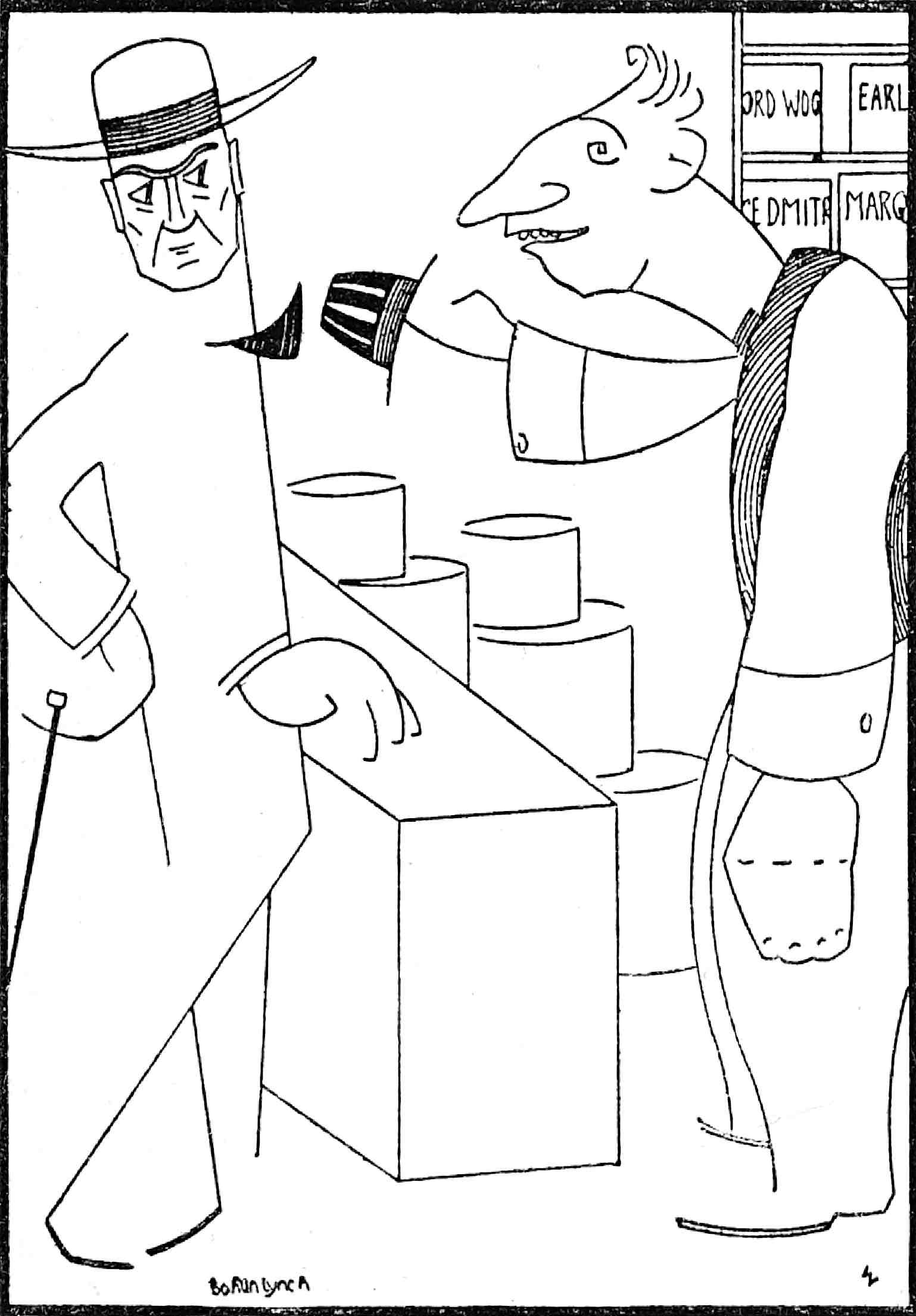
“In which I shall not look so ridiculous.”
Somehow it didn’t look the same. I was
prepared to swear that when I handed it
over to the hatter (my hatter, very well) it
did in some sort cover my head. But now—it
had diminished to the size of a child’s toy.
And the brim—the brim had shrunk to the
merest shadow.
I have at last given up the struggle. I wear
anything that comes along. Not that it matters.
People have survived their hats before now.
These, after all, are the merest idiosyncrasies of
head-covering. Observe, for instance, the hats
of the great. There you find something of real
distinction.
It is one of the curious things about really
great men that they are unable to resist the
bizarre in hats. They don’t turn out in strange
trousers, or curiously contrived coats. You don’t
see them walking about in sandals, or veldtschoons.
They don’t tie up their beards with ribbon; or
shave their eyebrows; or put caste-marks on their
faces. Right up to their head-coverings they are
indistinguishable from you and me. I don’t
wish to flatter us, but very often they are less
pleasant to look at ... and then their
greatness declares itself, or their originality
breaks loose, or some other eerie characteristic
finds its appropriate expression, in the form of
an article of apparel about as distinctive and
ugly as Britannia’s helmet.
Not long ago I met a noble Viscount, a man who
might easily become Prime Minister—I saw him,
I mean; I encountered him in the street. He
was wearing a hat that suggested a bowler, but
was not a bowler—that might have been a
“Daily Mail” hat, only it was black with a dull
surface, and, if I may so put it, had soft rounded
lines in place of sharp ones—that—that in fact
was indescribable. The rest of his garments
were those of a normal citizen. There were no
unfamiliar excrescences on his coat. His collar
and tie were much like my own.
Later in the day I saw in front of me a tall,
hurrying figure striding towards the House of
Commons. The stooping gait and sombre
clothing might easily have been those of a mere
scholar or clergyman. But the figure bore upon
its head a shapeless contrivance of purple velvet;
and by that I knew it was—(well, you know who
it was as well as I do).
Look at Mr. Winston Churchill. Look at
Admiral Beatty. Whoever saw a service hat
quite like Admiral Beatty’s? Though I admit,
in his case, the oddity is accentuated by his
way of wearing it. Look at the hats of foreign
potentates. Look at——
Look at Mr. Lloyd George. I have never
actually seen him in one of his “family” hats—but
I know his hatted appearance intimately
through a picture. It is a photograph representing
“the man who won the war,” as a
vigorous smiling personage in a grey tweed suit.
It seems to be very much the kind of suit that
you or I might select for golf. But—here
distinction creeps in—the upper part of his body
is swathed in something that resembles a horse
blanket ... and he is crowned with the
headdress of a Tyrolean brigand.
I am going to be a great man. I know it by
my hats.
SHAREHOLDERS’ BLOOD
GRAND (TRUNK) FEATURE SERIAL.
CANADIAN FILMS LIMITED.
We are in the Wild West of Canada—a
land full of mustangs and moccasins.
People with hard faces are riding about
in strange clothes. Gently nurtured maidens are
scrubbing out the cowshed, or digging up the
manure heap. The hired-woman is sitting in the
sunlight with a book. It is a typical scene in a
British Dominion; we know it is Canada, however,
because there’s a flick, and the screen says:
THIS IS THE CITY OF BISON SNOUT,
FED BY THE GRAND TRUNK RAILWAY,
CANADA’S PREMIER RAILROAD.
Then there’s another flick, and, lo! a magnificent
train, racing across the prairie, gives us a hint that
we are watching Canada’s premier railroad in
operation. The screen obligingly confirms this
impression by—Flick:
LUXURY, SPEED, AND SECURITY.
THE GRAND TRUNK MILLIONAIRES’
LIMITED THUNDERING ACROSS THE
CONTINENT
ON ITS JOURNEY TO BISON SNOUT.
The scene changes, now, to a precipitous hill
overlooking the smiling valley through which the
train is thundering. Far away you can see her
plume of smoke, racing across the sky. And here,
in the foreground, are two sinister figures,
mounted on the inevitable mustangs, masked
and visored, grim and silent. Oo! They look like
Irish gunmen; and as soon as they espy the train
they turn simultaneously to each other and
exclaim with sinister emphasis—Snick:
THERE’S BOODLE IN THIS.
Click—and we’re back again with our two
desperadoes, galloping like mad from their point
of vantage towards their luckless prey. (Noise off—cloppety,
cloppety, cloppety, clop.)
Next we have a close-up of the train as it
speeds over the landscape. The passengers are
sitting back in their places, wreathed in smiles.
They like their train. They think it particularly
safe; and behind it all there is the feeling of
immense security derived from the thought that
they are travelling in a British Dominion of the
British Empire under the waving protection of
the Union Jack on which the sun never
sets. The orchestra interprets their thoughts,
and ours, by playing a selection of patriotic
melodies.
Now we are shown something really out of the
way. Thus: Snick:
ON THE FOOTPLATE.
Flick:
SWAYING ALONG AT HUNDREDS OF
MILES AN HOUR, THE JOVIAL
ENGINEER AND HIS MERRY COLLABORATORS
PASS THE TIME WITH
DANCE AND SONG.
Click: And there they are, swaying like dipsomaniacs,
dancing like dervishes, and opening their
mouths like bullfrogs in a drought. Of course,
you can’t hear what they’re singing, but a gramophone
(off) obligingly strikes up at this moment:
Sons of the sea,
All British born,
Sailing every ocean,
Laughing foes to scorn—
and so on. A little inappropriate to the setting
perhaps; but, oh, how apposite to what follows!
Suddenly the face of the jovial engineer clouds
over. He shades his eyes with his hands. Rushing
to the eyeholes, he peers out into the day.
His collaborators copy him. We know something
is coming. We stir uneasily in our seats. Somehow
we can’t help associating this action with the
two sinister——What’s that? He’s beckoning
to the chief mate (or whatever the fellow’s called).
The chief mate’s beckoning to him. Neither
dares leave the eyeholes. How can they communicate
with each other? Still the train
speeds on. Oh! the engineer’s drawing his
revolver. Ah! it’s empty! So is the chief mate’s.
So is everybody’s. He flings it down with a curse.
He’s going to speak to the chief mate. He’s
speaking: Snick:
SAY, YOU GUYS, IT’S HELL OR HOME.
AND ME FOR HOME!
Flick:
STOKE UP YOUR BOILERS, YOU BLEAR-EYED
SKUNKS!
An underling flings open the door of the furnace.
He staggers back. Empty! He rushes with
a shovel to the coal bunkers. The others rush
after him. Oh, there’s no coal! The train’s
slowing down every minute. The desperadoes
are riding nearer and nearer. We can hear the
thunder of their hoofs—I mean their horses’
hoofs. (Noise off—cloppety, cloppety, cloppety,
clop.)
Ah! what are they doing now? They’re going
to throw one of the underlings into the furnace
to keep the train going. They’re going to burn
the engineer and the chief mate. They’re going
to pull the engine to pieces and burn that. Anything
to escape. Anything to escape....
Suddenly the chief mate, who’s looking through
the eyehole, gives a great shout. He’s very excited
and relieved. He’s speaking—listen, look, I
mean.
Flick:
WHY IT’S ONLY THE SHERIFF’S BOYS
HAVING A GAME WITH US!
The others do not agree with him. They point
rudely at him, and curse him for a fool. But he
only smiles and says through his smile:
Click:
SURE—IT’S THE SHERIFF RIGHT
ENOUGH. I SEEN HIS LIL’ BUTTON.
HIS DEPUTY’S WITH HIM.
I DONE SEE HIS BUTTON, TOO.
They rush to the eyeholes again. There’s no
doubt this time. They throw up their hats and
cheer. They are beside themselves. They even
go so far as to pull up the train. The passengers
crowd to the windows. At first they are alarmed.
They shrink back. They mutter among themselves.
Click:
IT’S A HOLD-UP.
BUSH-RANGERS.
and so on. But the engineer puts all that right.
He descends royally from the footplate and walks
along the train reassuring them. Flick:
IT’S ALL RIGHT, LADIES AND GENTS.
IT’S ONLY THE SHERIFF OF THE
DOMINION COME TO PAY US A SURPRISE
VISIT.
What a joke! How they laugh! And cheer!
They crowd to the window. They swarm out on
to the line. They offer expensive drinks to the
engineer and his collaborators, which are
accepted. They pass round the hat.
And then the sheriff approaches. He asks them
to line up. They are delighted. Another priceless
joke. Ha! Ha! Ha! What a wit the man has,
to be sure! He suggests they should produce
their valuables. Only too delighted. Their stocks
and shares, jewellery—everything, in fact, they
have with them.
THEY’RE “OF NO VALUE” TO YOU
NOW.
Ha! Ha! Ha! They’re doubled up with
laughter. They’re holding their sides. What a
funny man. What a very fun——Eh? He’s
speaking again.
GET A MOVE ON IF YOU DON’T WANT
A DOSE OF LEAD!
Oh, of course, very subtle. It’s all part of the
joke. He’s acting so well, isn’t he?
What’s he doing? He’s putting all their
valuables into a bag. He’s taking them away.
He’s a——He’s a robber! Oh, no! Oh, not
that! But he is. Old men are weeping over
the loss of their life’s savings. Old women——Oh,
this isn’t funny at all!
A handsome young woman is speaking to him.
She’s pleading, she’s on her knees.
Click:
IF YOU TAKE THAT IT MEANS I
CAN’T GET MARRIED. WE WERE
GOING TO START HOUSEKEEPING
ON MY FIRST PREFERENCE STOCK.
She’s broken down. He’s laughing, the brute!
He’s roaring with laughter. So’s his fellow
desperado.
Who’s this? What a funny fat man! Oh,
it’s going to end happily after all. He’s a
policeman, I suppose, but his hat looks a bit
queer. Oh, an American hat—I see. He’s
very angry with the brigands—the sheriffs,
I mean. He’s speaking.
Click:
THIS OUTFIT’S WORTH AT PAR
£37,073,492.
Flick:
“THIS WOULD MAKE MY APPRAISEMENT
OF ALL THE STOCK, THE VALUE
OF WHICH IS HERE IN ISSUE, NOT
LESS THAN $48,000,000.”
Oh, it’s too bad! They’re laughing at him,
too.
Plick:
GET AWAY HOME, YOU FAT OLD GUY,
BACK TO THE STATES WHERE YOU
BELONG.
He’s very angry indeed. He’s turning away
in high dudgeon. He makes a last appeal.
Flick:
BUT AIN’T YOU THE SHERIFF?
Blick:
WHY, YES; BUT WHAT’S THAT GOT
TO DO WITH IT?
Snick:
WELL, I MEAN TO SAY——
Click:
A MAN’S GOTTER LIVE, AIN’T HE,
EVEN IF HE IS A SHERIFF? AND
THEY’RE ONLY DURNED ENGLISH
GUYS, ANYWAY.
THE PERSONAL COLUMN
The big events of the world, the things
so remote from most of us, float serenely
down the midstream of the day’s news,
little heeded, I confess, by me; but the flotsam
of life is brought to one’s very feet by the undercurrents
and eddies of the Personal Column.
The news headings of one’s morning paper
deal with subjects whole worlds away from one’s
own humble existence. The movements of
Marshal Foch; the Japanese Earthquake; the
Recognition of Russia. Even (long since) when
the “Date of the Peace Celebrations” was
announced, it was a comparatively lifeless statement.
To vitalise it, to humanise it, one had
to go to the neighbourhood of the Personal
Column. Thus:—
“Champagne. Approaching Peace Celebrations.
Advertiser representing principals
holding stocks of the best known brands
of Champagne, etc., etc.... Apply to
‘Benefactor.’”
Here at last we were in the heart of things.
“Stocks of the best known brands of champagne.”
This unlocked the tongue, set speculation working.
What brands? What is your favourite
brand? One reviewed a pageant of sparkling
names such as Ayala, Irroy, Heidsieck, Mumm,
Moet, Pommery, Roederer and the Widow, the
dainty Clicquot.... And then arose the
question what to do on Peace Night—Jazz?
Theatre? Opera? Or should it be a quiet
dinner (preferably at home) with Jones, who
shared one’s last Xmas in the Salient, and Smith
the Silent, who never let one down, and Robinson?...
I seem to remember that I wrote
to “Benefactor.”
Actually “Benefactor” was not, so to speak, a
Member of the Personal Column, though he
dwelt very near to it. His announcement
abutted on a poignant appeal for a “Suitable
Place to Stop” from a young minesweeping
lieutenant who, having exhausted his patience in
ransacking London for a bed, had lit upon the
discovery that a large part of the hotel accommodation
in this city was still in the clutches
of Sir Alfred Mond and his Merry Men; but it
was published (wrongly, of course) under the
heading: “Business Opportunities.” What
creature would sink so low as to make a business
opportunity out of the sale of that golden drink,
of those “best brands of Champagne”—and in
the Peace season, too? Perish the thought!
To the Personal Column let “Benefactor” be
admitted.
The Personal Column is the quintessence of
journalism, an inexhaustible lucky-bag of strange
communications and curious announcements.
Do you want a furnished caravan? Napoleon
relics? Are you a philatelist? Would you
like a summer outing in Kew Gardens? Have
you a haunted house? These, after all, are
things that touch one’s daily life. Marshal Foch
might go to the Sandwich Islands, and the
philatelist and I would wish him God-speed, and
think of it no more; but a haunted house (even
if it be only haunted by mice) brings one “up
against it!” Are you bored with your life?
The Personal Column is a constant provocation
to plunge into the whirlpool of the unknown.
Thus at random: An officer, aged 20, of cheerful
artistic and musical tastes, wishes to correspond
with somebody with a view to “real friendship.”
There’s your chance. And what dark story,
think you, is concealed behind the following:
“The Black Cat is watching: green eyes.
S?”
What tale of a temptation spurned lurks in:
“Scalo: I may be poor but I love truth far
better than gold—Misk?”
Under the influence of what jealous pangs
came this to be penned:
“Ralph—Who is BABS—Remember Olga?”
(The following, in a happier vein, tells presumably
of a lovers’ quarrel made up:
“Whitewings. Darling you know really you
are the only thing on earth I love. Snowdrop.”)
The big news columns tell us what our intellectuals
consider it good for us to know, in
the manner in which they consider it good for
us to be told. The Ruhr Occupation, denounced
by Mr. Garvin, upheld by Lord Rothermere—The
Betrayal of the Country to Labour (in the
Gospel according to Mr. Churchill)—The
League of Nations—Bootlegging and Prohibition.
But the Personal Column—ah!—the
Personal Column gives us a peep into the throbbing
lives of our neighbours; we become partakers
in the bliss of Whitewings and Snowdrop,
we share “S’s” apprehension of the Black Cat,
and our hearts go out to Misk and Olga—poor
forgotten Olga. Here are no world politics
dished up by statesmen manqué, or camouflaged
by great journalists, no subjects to be discussed
in catchwords and manufactured phrases, but
the myriad voices, from the streets around, crying
out at the impulse of the eternal verities.
SOCIETY SIDESHOWS
Extracted from the Private Diary of the
Hon. “Toothy” Badger
Dined at the House last night. Ridiculous
party given by “Bulgy” Gobblespoon
to celebrate his wife’s election: the first
husband and wife to sit together. To everyone’s
dismay, it proved that she had only scraped in by
the Prohibitionist vote, to win which she had to
pledge herself never to allow any form of alcohol
on any table at which she sat. Very restrictive
of her dining out, I should imagine, and utterly
destructive of her own dinners, which used to be
rather fun. Impossible to imagine the gloom of
that gathering! Even old Bitters, who was
wheedled off the Front Bench to come down and
say something amusing, was quite unable to
sparkle on Schweppes’ ginger ale. Hurried away
with little “Squeaky” Paddington (old Ponto’s
new wife) to sample a drink and a spot of foot
shuffling at Sheep’s. Very stuffy and a lot of
ghastly people.
Somebody, turning out their lumber-room, has
presented a whole shoot of pictures to the
National Gallery; so I went to see who was
looking at them. What that place exists for I
can never understand. Hardly anyone there
except a herd of frowsy old women, with paint-boxes,
who took jolly good care that nobody
should come within a mile of anything worth
looking at. One rather jolly girl—but very
severe. The rest awful. A couple of anxious-looking
people walking up and down, looking
intense and making speeches about Ghirlandajo
or Cimabue to an audience of yokels that doesn’t
know either from cream cheese; and the remainder
of London seems to use the portico as a
convenient meeting-place, and never goes inside
at all.
Broke my rule against large parties last night in
order to go and stare at the women Members of
Parliament, who allowed themselves to be shown
off by old Lady Paramount Nectar at Ambrosia
House. Never again. The rooms are big enough
Heaven knows; but they seemed to have invited
everyone in London, who had a dress-suit. Lady
Biltong, whose figure needs to be put under
restraint, was carried out fainting. Poor Bottisford
had two ribs stove in going up the staircase
and didn’t know it till he got home—kept murmuring
that he must have got a touch of pleurisy
in the fog. And old Sir William Bylge trod on a
lady’s train and brought it clean away from the
gathers (whatever those may be). Needless to
say, it proved to be a Royalty, but only a minor
one. Never saw so many foreign potentates and
creatures gathered together in my life before:
the Duca di Corona Largo, Count Papryka da
Chili, the Prince and Princess of Asta Mañana, a
woman from New York, the Gizzawd of Abbyssinia,
old Ramon Allones, looking younger than
ever, and heaps of others. Nothing to eat, of
course, and sickly sherbetty stuff masquerading as
champagne. Hurried away to Stag’s with George
Mossop to wash the taste out of our mouths. If
old Paramount Nectar had lived, how different
that supper would have been! As it is, if they
took a bottle out of his cellar now, and poured it
on his tomb, I believe he’d rise from the dead in
very shame. Seems a bit too low to accept old
Lady P.’s hospitality, and then slang the food;
but, after all, he was my father’s cousin, and one
feels it reflects on one’s own palate that a relation
by marriage should give inferior wine.
Country house parties nowadays are becoming
absurd. In the old days there was a lot to be
said for country house visits. Even quite recently
they could be profitably undertaken. But now!
Nous avons changê tout cela. The advent of a
Labour Government has put the final kybosh on
even the limited hospitality one enjoyed last
year. Three invitations this morning. One from
Ditchwater Abbey—a place I loathe; one from
Hugo Hamstringer, the fellow that made a
fortune out of glue in the war, bought everything,
lost the whole boiling in multiple eggshops
during the slump, and is now trying to
make two ends meet in that awful barrack of a
place, Dundahead Hall, that he took over from
“Wacker” with a block of dud oil shares in payment
for his “calls” in Hamstringer, Limited,
before the Company went bust—(nothing
would induce me to go near him); and one from
dear little Phyllis Biddiker, whose husband has
lost everything in Southern Ireland, and who is
scraping along somehow by letting off apartments
at the Weir House (their place in Berkshire)
to wealthy Colonials over here for the
British Empire Exhibition. None asked me for
more than a week-end. All say “Bring your own
whisky if you want any.” Phyllis has had a
present of Australian Burgundy from one of her
lodgers, and offers to share it. I shall stay at home.
Because my brother Henry chose to marry, why
should his almost-a-flapper daughter be motted
on me to cart about London? A jade, a sly
boots and a minx, she makes my life a burden.
She makes me give her expensive meals, which I
rather like; but I draw the line at being a decoy
duck. Last night, having bled me of my entire
income at Mah Jongg—a game I shall never hope
to learn—she demanded to be taken to an unintelligibly
highbrow play, knowing, I suppose,
that, after the agony of listening to it, I should be
as wax in her hands. Then she led me by easy
stages to Sheep’s Club, by pretending she wanted
to dance with me. There (by the merest accident,
of course) we found young Geoffrey
Bannister, the one young man in London I was
cautioned against allowing her to meet—as if an
uncle has any control whatever—and the whole
plot stood revealed. Before I could contort my
features into a frown, they were dancing in the
middle of the room, where they seemed to spend
the remainder of the evening. I was allowed to
give them supper; they allowed me to take them
away at two a.m. They were almost too good to
be true till we got home—driving back in
Geoffrey’s car; and then they suddenly insisted
on starting off to “be in at the death” at the
Hunt Ball at Hillsbury, looking in at Bridget
Hanover’s dance in Brook Street on the way.
Told them to go to the Hunt Ball at another place
beginning with the same initial, sent Geoffrey
home, and packed her off to bed. No more nieces
for me.
They call them “winter sports.” You cram
yourself, with everybody you dislike most, into
the same train; stamp round the decks of the boat
in a blizzard, swearing and trying to keep warm;
ruin your digestion with the beastly food in the
Train de Luxe; scrimmage with thirty other
people for the sleeping berth you all booked six
months before; turn out at the frontier to be
browbeaten by hordes of douaniers; and arrive
in the early morning feeling and looking like the
Ancient Mariner, and discover that your rooms
at the hotel have been swiped by somebody else.
You turn out the manager, who shrugs his
shoulders, and, after a fearful row, condescends to
offer you sleeping room in an attic, on terms for
which you could buy a large mansion in most
countries. But your spirit is broken, and, rather
than face the journey back, you accept with
resignation, and crawl into the hovel allotted to
you. You unpack your traps, and find that one
of your skates is missing, or else that the straps
have disappeared from your skis. But you are
desperate now; you bind them on your feet with
string, and rush out into the snow. You are immediately
knocked down by some confounded
beginner who has lost control and is flying down
the hill at the rate of knots. You stagger to your
feet gasping, with snow down your neck and both
your skis adrift. While you are readjusting
them, a bob-sleigh whizzes into you, sweeps you
off your feet on top of its crew, and obligingly
overturns down an embankment. The occupants
of the sleigh are people you’ve been trying to
avoid for years; and, instead of cursing you for
being in the way, they fall on your neck and invite
you to dinner. You are in such pain from broken
arms and legs, that you can’t think of an excuse,
so you have to accept. After dinner they rob
you at bridge, and, as a crowning blow, the man of
the party borrows money from you. At last you
break away, hurry back—and find the interesting
girl you were hoping to talk to, deeply
engaged with some wretched subaltern. And then
the Lord Chancellor or some other fearful bore
insists on talking about home politics—the one
thing you were dying to forget. You mutter
excuses and stumble off to turn in—still nursing
your wounds. Some idiot has left the window
open, and there are icicles hanging from the ceiling
and a pile of snow in the middle of your bed. Next
day you repeat the performance, which goes on for
a fortnight at least. Winter “sports”! It must
refer to the people, and not to the pastimes.
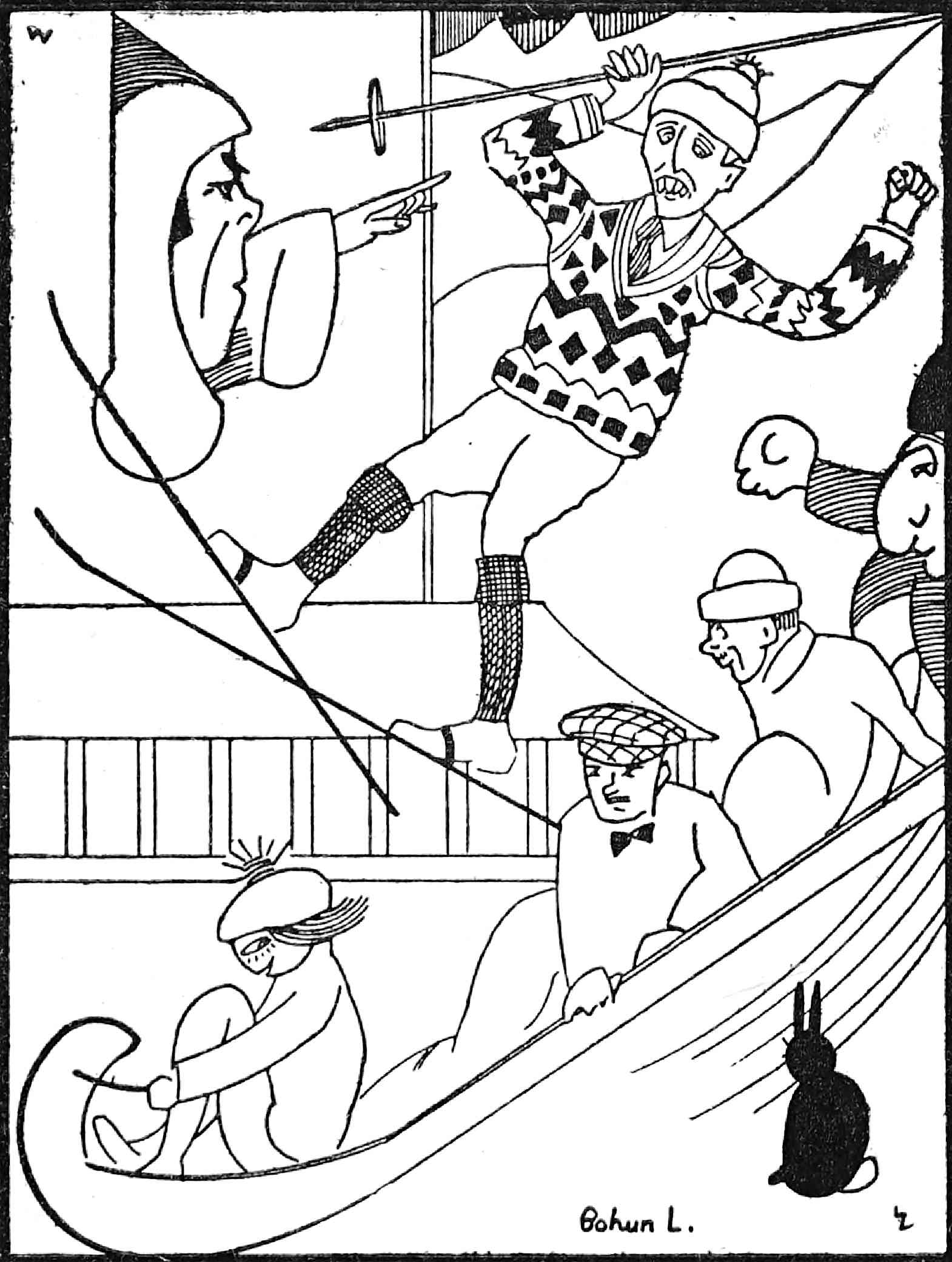
“And obligingly overturns down an embankment.”
LATTER-DAY DRAMAS — MORALITY — ACT I
(In the manner of John Galsworthy.)
Scene: The rectory at Swilberry. The rector,
the Rev. Hardy Heavyweight, is going through
the accounts of the village cricket club with
Diggers, his sexton and factotum.
Diggers (adding up as he goes along): And three
and sixpence is four pound two and a penny
’a’penny, and five shillin’ is four seven one a
half; and there’s that cheque from Mr.
Selvidge.
Heavyweight (comparing each item in the bank
book): That’s not entered here.
Diggers: Paid in later, per’aps. The cheque——
Heavyweight: Yes—it will be in the pocket of
the book. (He gropes for it.) There seem
to be a lot of papers here. (He pulls them
out.) Why, good heavens!
Diggers: What’s matter, Sir?
Heavyweight (in a changed voice that belies his
words): Nothing, Diggers, nothing....
Here’s the cheque (he holds it up).... Who
had charge of this book?
Diggers (mildly surprised): Miss Agatha, Sir.
Heavyweight (mechanically—he is thinking hard
of something else): You’ve never seemed to
get accustomed to calling her Mrs. Foxglove,
Diggers.
Diggers (heartily): No, Sir, that I ’aven’t. An’
when them ’orrible divorce proceedings is
finished an’ she’s quit o’ that thing of a
’usband, she will be Miss Agatha again, to all
intents an’ purposes.
Heavyweight (pained): I think we mustn’t talk
about that, Diggers. The club accounts
are all right?
Diggers (disappointed): Yes, Sir.
Heavyweight: Thank you for helping me.
Would you ask Mrs. Foxglove to come?
Diggers: Miss Agatha, Sir? Certainly. (He
goes. The rector leans back in his chair, with
his face drawn with anxiety. He toys with
the papers he has abstracted from the pocket
of the bank book. He shakes his head sadly
as he reads. Suddenly Agatha Foxglove, a
charming and vital creature, bursts in on him.)
Agatha: Hello, papa—what’s up?
Heavyweight (looking away from her): Agatha,
dear, these letters—(he holds them up)—these
letters from a man called Jim, they’re yours,
are they?
Agatha (taken aback): Ye—yes. I....
Heavyweight: (appealingly): I’m sure there’s
an explanation, dear. Won’t you tell me?
Agatha (laughing uneasily): Well, er, I suppose ...
where did you find them? (He silently
points to the book.) I don’t know. I suppose
I must have put them there accidentally,
from my table.... It comes of keeping
those horrible accounts for you.
Heavyweight (sadly): But the contents, Agatha,
dear.
Agatha (sharply): You’ve read them?
Heavyweight: I was unable to help reading
them. They were lying open among the
cheques. (Tenderly): Won’t you explain?
Agatha (with the modern mixture of frankness and
impatience): Of course, there’s an explanation,
papa. You surely don’t suppose that,
with a drunken imbecile for a husband, I
could do entirely without sympathy and
affection?
Heavyweight (apprehensively): Then—you were—unfaithful?
Agatha (swiftly): But we’re going to be married,
as soon as the decree is made absolute.
Heavyweight (pitifully): I’m sure, my dear,
that that was your intention; but, as a
clergyman——
Agatha (anxious): You won’t tell anyone——?
Heavyweight: My child, can’t you see? can’t
you feel for me? As a clergyman I believe—I
am bound to believe—that marriage is an
irrevocable tie. Divorce on proper grounds
I have to recognise, as a servant of the State;
but when I see the procedure abused by
those who have forfeited their right to
invoke it, how can I, as a conscientious
minister of God—how can I stand aside
because the culprit is my own adopted
daughter and ward? I am morally bound
to inform the King’s Proctor.
Agatha: But father—father. Oh, for God’s
sake—(she becomes incoherent.)
Heavyweight: Ah, my child, my child. Morality
demands—(His voice breaks. There is a
terrible pause. He goes to the bookshelf.)
Agatha (agonised): Oh—what are you doing?
Heavyweight (in a dead, mirthless voice): Looking
out my train to London.
The Curtain Falls.
ACT II
Scene: The Divorce Court.
Mr. Whassit (Agatha’s Counsel):—a temptation
which, please God, I shall never encounter
myself. And further——
The Judge (testily): Mr. Whassit, is it necessary
to prolong this?
Mr. Whassit (firmly): My Lord, I have a duty
to my client, and——
The Judge: Yes, yes, I know, Mr. Whassit.
Your conduct of the case has been very
proper; and, of course, if you wish to proceed,
I shall say no more. But you’ve not
traversed a single fact——
Mr. Whassit (sitting down at last): I will leave
the matter in your Lordship’s hands.
The Judge: That is well.... This is an
application to make absolute a decree nisi
pronounced in October last. The King’s
Proctor has intervened, alleging misconduct
on the part of petitioner, such as would have
invalidated her plea; and he has amply and
abundantly proved his case. The application
therefore fails, and the petitioner will
pay the costs of the intervention.
But that is not all. In the course of the
proceedings, which were defended, the cross-examination
of the petitioner was directed
towards establishing these very adulteries,
which have now been proved. She denied
them with vehemence, and went so far as to
comment, from the witness-box, upon the
propriety of counsel raising issues of the
kind. Now this is a serious matter. It is
one thing to make what I might call a formal
denial of adultery, in an undefended case,
though technically it might be perjury, and
I myself should view even that with gravity;
it is quite another thing in a defended case,
where the matter has definitely been put in
issue, to make a denial of the kind; and I
cannot see how the situation differs from
that of a plaintiff who comes before the court
seeking relief, let us say, on a Bill of Exchange,
and falsely denies an allegation of fraud, or
some other invalidating factor. In both
cases there may result a serious miscarriage
of justice, which at least cannot be so in an
undefended divorce suit, where it is to be
imagined that the respondent is indifferent
to the consequences.
(Addressing Agatha at the solicitor’s table):
It has been urged most eloquently by your
counsel that you had much to endure, and
many temptations to the course upon which
you ultimately embarked with so much
recklessness. That may be so; or, again,
it may not. It might be taken into account
by another court, as a mitigating circumstance.
But the Law, which I am here to
administer, gives me, as I see it, no choice.
Public morality must be vindicated; and a
flagrant perjury of a kind that has become
all too prevalent of late, is more than I can
pass unchallenged. The papers in this
case will therefore be forwarded to the
Director of Public Prosecutions.
Agatha (hysterically): My Lord. We—I—Oh
God——
The Usher (sternly): Silence.
Diggers (patting her hand): There, there, Miss
Agatha. Don’t take on.
Heavyweight (on the other side): My dear—don’t
let’s have a scene.
Her Solicitor (kindly): Hush! You mustn’t
interrupt his Lordship, you know.
Agatha (wildly): But if I don’t, they’ll prosecute
me!
The Usher (to the Serjeant of Police): Get ’er
solicitor to take ’er quietly outside. (The
Serjeant complies.)
Diggers (following and moaning as he goes): Why
did you go an’ do it, Mr. ’Eavyweight, Sir?
(Wringing his hands more than ever): Oh,
Miss Agatha, Miss Agatha.
Heavyweight (trying hard to be brave): Hush,
Diggers, be a man. Bear up. Courage.
Diggers (bursting into tears): Oh, Mr. ’Eavyweight,
Sir, ’ow could you?
Heavyweight (who has only done his duty): You
don’t understand, my poor fellow....
Morality demands——(His voice breaks.
They vanish in the wake of the Serjeant.)
The Registrar (calling the next case): Boggs
versus Boggs and Boggs, Boggs intervening.
(He hands up a bundle of papers to the judge.)
A Counsel (rising): This is an application for
administration de bonis non, my Lord. I
understand——
The Curtain Falls.
ACT IV
Scene: The streets of London (many years later).
Heavyweight and Diggers walk slowly along,
searching the faces of the passers-by. Suddenly
Heavyweight stops in front of a thin, emaciated
woman.
Heavyweight: God! It’s you, Agatha, at last....
Have you come to this?
Agatha (unsteadily): Don’t interfere with me.
I’m looking after myself. What I do is my
affair.
Diggers (incoherently): Oh, Miss Agatha, Miss
Agatha. (He strokes her hand.)
Heavyweight (tenderly): My dear. You’re
worn out, thin, hungry. Wait. We’ll buy
some food and wine and take you back.
Come, Diggers. (They enter a shop. She
leans against a lamp-post. A detective appears
suddenly beside her.)
The Detective (addressing her sharply): Solicitin’,
you was.... You come along o’ me.
Agatha (furiously): I won’t, I won’t! It’s a lie.
The Detective: Now, then, be civil.... Ticket
o’ leave, ain’t you?
Agatha: Oh, what’s that to do with you? I’ve
served my time. You’ve no further claim
on me.
The Detective (grimly): ’Aven’t we? You just
come along. (He takes her arm. Maddened,
she deals him a vicious backhander in the
mouth and escapes from his grasp, fleeing along
the pavement.) That won’t do you no good,
my girl. (He starts in pursuit. Heavyweight
reappears, followed by the faithful
Diggers.)
Heavyweight (anxiously): Agatha, Agatha....
My God! (Realising what has happened, he
rushes in pursuit.)
Diggers: Oh, Miss Agatha, Miss Agatha.
(He walks unsteadily after them, wringing his
hands. There is a hoarse shout, off, then a
horrible crash and a sharp, sickening scream.
The detective and Heavyweight reappear,
carrying a lifeless form.)
Diggers (in an agony): What’s happened? Oh,
what’s happened to Miss Agatha?
The Detective (huskily): Run over. (Addressing
Heavyweight): Not my fault, Sir. I
couldn’t let ’er ’op it like that.
Heavyweight (brokenly): My poor fellow, I
know. You only did your duty.... The
social code must be upheld. Morality demands——(His
voice breaks for the last time,
and the curtain descends on his tears.)
The End of the Play.
ETERNITY AND POST-ETERNITY
(An endless Tone-Drama in the Shavian manner.)
Through the skylight of the subterranean dwelling of
Colonel Lazyboy (R.A.S.C., T.D.), in the
Chiltern Hills, an apparently endless procession
of clouds may be seen racing across a Mediterranean-blue
sky, a sure sign that rain will fall
later. We may omit a number of stage
directions about the history of the Lazyboy
family, the detailed furnishing of the cavern,
the mental processes of the Colonel himself, and
a stupendous preface on “Midwifery and the
Modern Play”—it being sufficient to state
that, although a spacious mansion stands in the
grounds hard by, it is entirely given over to
the servants, the family preferring to share
the cave life of the Colonel, who, since he
commanded a Chinese Labour Battalion during
the second battle of the Somme, has been quite
unable to reaccustom himself to living in a
house, preferring, as he says, the harder and
more natural life of the dug-out.
The Colonel, Mrs. Lazyboy (a faded, bored
woman), Mercia, their daughter, and Harmodius
Hashovit, her husband, are at their
morning wrangle. In the middle of the row,
Nurse Allsopp hurries in. Being Mercia’s
old nurse she is virtually mistress (and master)
of the house.
Mrs. Lazyboy: Oh, dear! What is it now,
Nursey?
Nurse: Oh, Im sure I beg pardon, Maam, but
heres Miss Mercias young man—(suddenly
observing Hashovit)—Oh, Im sure I beg
pardon, sir, I didn’t see you. I meant to
say——
Hashovit (heavily): You meant that popinjay
Eustace Brill. You needn’t make a mystery
about it, Nurse. Everyone knows hes my
wifes young man.
Nurse (shocked): Oh, that Im sure they dont,
sir.
The Colonel (pained): Harmodius, my dear
fellow, er——Allsopp, tell Mr. Brill were
not at home.
Mercia (bouncing up): Certainly not! Send
Youstee away because Harmys jealous. Ill
go and let him in myself.
Hashovit (sneering): So that you can kiss him
in the passage without anyone seeing you——
Mercia (proudly): Ill kiss him before you all.
(A terrific crash and splintering of glass
heralds the arrival of Eustace by the skylight.
He lands on the table, which collapses under
him; recovers his feet, and smiles genially
around.)
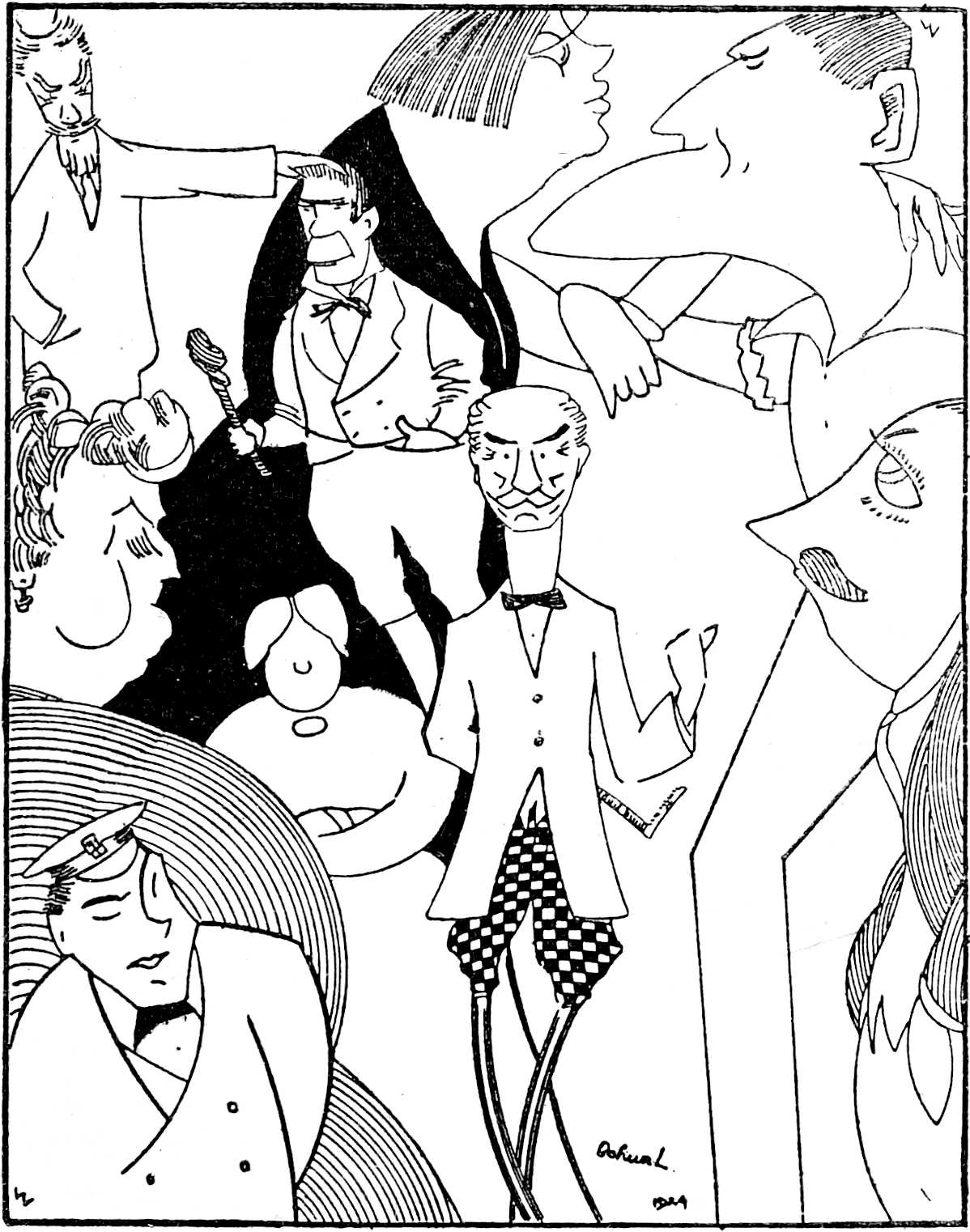
“The influence of that man Shaw.”
Mercia (crooning): Yousteeee!
The Colonel (testily): Confound it all, Brill, I
wish you wouldn’t tear the place to pieces
like that.... And you’ve shot a great fid
of glass into my eye. Damn the thing.
(He gropes, and finally extracts it.) There,
now itll bleed for the rest of the day!
Eustace (surprised): I thought you prided yourself
on keeping up active service conditions.
The Colonel: So I do.
Eustace: Then why make all this fuss about a
trifling wound? You ought to be grateful.
It adds a touch of reality to your life.
The Colonel: Id rather you left me to supply
the reality myself, Brill. However—(Mercia,
true to her threat, embraces Eustace with
fervour).... Now really, Mercia, upon
my soul.... (He clicks his tongue with
vexation.)
Eustace (taken aback): Mercia, dear. I know
you mean it awfully nicely. But really, in
public——
Hashovit (glowering): You see—you degrade
yourself to no purpose.
The Colonel (warmly): Degrade? Nonsense!...
I, of course, dont mean to
imply——
Hashovit: But damn it all, Colonel——
Mercia (screaming): Dont shout, Harmodius.
The wrangle proceeds on the familiar Shavian lines,
the party being reinforced for no apparent
reason by the arrival of Dan Bigby, an old
sea-captain, and Michael John O’Sullivan.
Eustace (at long last): Look here, Im getting
sick of this. Its all too much like a play by
Bernard Shaw.
Hashovit (growling): Everyone is at heart a
Shavian.
The Colonel (hastily): No, really, Harmodius....
O’Sullivan, Brill, we cant have that——
| Eustace: The truth about Shaw—— |
} |
(Spoken together.) |
| |
|
| Hashovit: My idea of Shaw—— |
} |
| |
|
| Michael John: Sure, if you come
to talk about Shaw—— |
} |
| |
|
| Mrs. Lazyboy: Hes quite right. The
influence of that man Shaw—— |
} |
| |
|
| Captain Dan: Who was Shaw, anyway? |
} |
The Colonel (in his parade voice): Silence.
Youre on parade. Behave accordingly.
Captain Dan: Avast there. Belay.
Mercia (stamping): I wont belay. I object——
Eustace: But whats this to do with Shaw?
And whats the use of objecting when cosmic
forces grip people by the throat? Ive no
wish whatever to do anything thats not A1 at
Lloyds and all that. But——
Hashovit: Cosmic fiddlesticks. Its lust, Brill,
and you know it. You and Mercia want to
misconduct yourselves, and its no good your
trying to draw a red herring of formulas and
psycho-analytic bosh across the track. It
wont wash. In my young days——
Mercia (icily): I dont think were greatly
interested in your young days, Harmodius.
Hashovit: Be quiet, Mercia. I will speak my
mind, so youd better make up your minds to
listen. In my young days if a man and a
girl wanted to behave improperly they just
did so and said no more about it. But
youve no decency. Youre not content with
forbidden fruit, you go and flaunt your
liaison in the husband’s face, and make a
parade of it before all his and your friends.
I wonder you dont advertise it in the papers.
Upon my soul, its what were coming to——
Eustace: But——
Hashovit (yelling): Dont you interrupt me, sir.
I dont care a swizzle stick about your stealing
my wifes affections. As a matter of fact,
she hasnt got any, as youll jolly soon discover
when the noveltys worn off——
Mercia: Oh, Harmy. (She weeps.)
Hashovit: I dont care if you take her to Brighton
or Nijni Novgorod—if youre such a blasted
fool as to spend so much money on her. I
dont care if you sit all day squeezing her
hand, looking into her eyes till you both
squint, pawing her about, and talking that
horrible sickly twaddle I couldn’t help overhearing
last night (he shudders at the recollection)....
But—(rising to his feet)—but
I will not have all your friends and my
friends whispering and talking about me as
though I were something to be pitied.
(His voice rising to a scream.) If you want
to know, I think Im just about the damn
luckiest fellow alive to have unloaded this
viperish, discontented, addle-headed, empty-hearted
baggage on the most crass and
pitiable fool Ive ever met—and if you want
to say any more—(his poor, overstrained voice
cracks and dies away in his throat with a
mouse’s squeak; whereat he expresses his
feelings by tearing the cushions to pieces and
scattering the bits on the floor.)
The Colonel: Come, come, my dear fellow—pull
yourself together.
Mercia (crisply): What I like about Harmodius
is his obvious self-control.
Hashovit (his eyes bulging; he speaks in a hoarse
whisper): Shut up, you she-porcupine, you
hateful female skunk, you—(his vocal chords
snap and his voice goes for ever.)
Mercia: His manners are so perfect, too: and
hes so brave.... Cry-baby!
Hashovit (inarticulately): o o o o o o o b b—(or
some similar noise. Blood gushes from his
mouth.)
Nurse Allsopp: There, my poddle-poodkins,
come with nursey-wursey. (Addressing the
others sharply): And if you want any lunch
go and wash your hands, all of you. (She
leads Harmodius out by the hand. The
others, except Eustace and Mercia, follow
her meekly.)
Eustace (uneasily): You expect me to admire all
that, I suppose.
Mercia (fixing him with vampire eyes): I expect
you to admire nothing except me.
Eustace: Admire you. I loathe you. I struggle
to escape from you. Youre like some awful
drug, the same odious intoxication, the same
irresistible fascination, and the same deadly
remorse when its all over. You steal away
my senses, and make me a slave.
Mercia: I make you a priest, not a slave.
Eustace: No, its slavery.
Mercia: Priesthood. High Priesthood to the
divine desire in all of us.
Eustace (retreating): Im afraid of that.
Mercia (snaring him with her eyes): Afraid!
Afraid of worshipping love?
Eustace: Yes. Ive no vocation.
Mercia (dangerously): Does that mean youve no
inclination?
Eustace: No. It means what it says....
You talk about priesthood of love. You
seem to think no vocation is necessary,
though I suppose youd admit it in the case
of a priest of Buddhism. Religion is a
dedication of the spirit; Love, a dedication
of the heart. You cant dedicate your spirit
till its broken; nor can you your heart;
and hearts dont break as easily as crockery,
let me tell you. (Espying Michael John in
the passage): O’Sullivan.
Michael John (entering and curling himself up
in the coal-scuttle): Speak.
Eustace: Tell her how long a mans heart must
beat against that of a woman before it will
break.
Michael John: Four years and ninety minutes
exactly. On the tick of the ninetieth
minute the heart cracks, and the imprisoned
soul passes from its bondage into the numbing
bliss of everlasting heartache——
Captain Dan (entering unobserved and taking up
the tale): And in the fifth year he shall be
exalted above human understanding....
In the dog watches and under the dog stars
Ive looked upon the ways of mankind, and held
my hand from destroying them in sheer——
Eustace: Pity?
Captain Dan: Pity. No! Indifference.
Mercia (fixing him with her eyes): Danny, I
make you mine. The priesthood of love——
Captain Dan (uneasily): Avast there.
Mercia (triumphantly): There’s no avasting
where Ill take you. (Breaking into a chant)
I go by the mountains and rivers,
I go by the seashore and fell.
Eustace (satirically):
While the thankless old mariner shivers
Michael John:
And strives to break loose from her spell.
Mercia (her voice rising to prophetic fervour):
But the child, still unborn, of my yearning,
Shall go in the van as our guide,
Captain Dan (chuckling feebly):
Down the pathway of shame to the burning,
Mercia (laughing horribly):
When Im Daniel the Mariners Bride.
(She sweeps him into her arms and carries him
away shouting.)
Mercia (disappearing): Io. Io. Dionysos!
Captain Dan (in a high falsetto): Let the skies
rain joy!
Eustace (passionately): How can you, Mercia,
how can you? (He is seized by uncontrollable
weeping.) Im crying, O’Sullivan——
Michael John: Im wantin a cry meself. (He
bursts into tears.)
Mercia’s voice (a long way off): But you must
let me come back and look after Harmodius’s
clothes——
Many years elapse. They are still talking.
Mercia (temporizing): After all, if I leave Harmodius
for Eustace, or Eustace for Danny——
The Colonel (who is deaf by now): Whats that?
Mrs. Lazyboy (who is nearly as deaf and very
feeble): Shes talking about the childrens
holidays.
The Colonel: He! He! He!
Mr. Fuzzlewhitt (Mercias great grandson):
After all, if she had deserted Harmodius
Hashovit——
Mrs. Fuzzlewhitt (who is thoroughly tired of the
story): Yes, Rejjy, I know....
Monsieur Chose: Bernard Shaw says in his play
about Mercia and Harmodius Hashovit that
if Mrs. Lazyboy——
Somebody: Theres a storm coming. Its going
to cleanse the world. (The sky darkens.)
Somebody else: It makes no difference. The
human brain will survive.
A Third Person: The human antheap will
continue to surge with meaningless movement.
A Fourth: The human voice will continue to
cry from nothing to nothing.
A Fifth: The human hand will continue to
write, and posterity will bury the writings.
A Sixth: And Shaw alone shall be assured of
immortality.
The storm breaks with prodigious force. Eternity
arrives.
A Shining One: Yes, the immortals are all in
their places. Dante and Cervantes had a
squabble last night, but theyve made it up.
The Eternal: Good.
The Shining One: Shakespeare has been giving
trouble, too. Hes jealous of Shaw.
The Eternal (apprehensively): Im not at all
easy in my own mind about Shaw.
Mr. Shaw (on the steps of the eternal throne): Im
really very sorry. Its no wish of mine, you
know.
The Eternal (apologetically, and handing over the
crown and sceptre of Heaven): Not at all.
Its a pleasure to make this trifling acknowledgment
of your genius.
The End of the Play.
THE ENCHANTED ISLAND — I — II — III
(A Fantasy in the manner of J. M. Barrie.)
The pink and white drawing-room of
Emily Jane’s house—or rather of the
house of Emily Jane’s father, Mister
Balbus, is so caressingly harmonious to the eye,
so surpassingly restful, so eminently a place of
happy people, that one knows instinctively it will
be visited by a tragedy. It is just a question of
time, and this gentle atmosphere will find itself
charged with the electricity of conflicting human
emotions; dear women’s hearts will break and
be laid aside in pot-pourri jars; strong sentimental
men will walk their sweet, melancholy way; and
we shall all go home the cleaner, mentally, for a
refreshing bath of tears. Emily Jane is not yet
in the drawing-room. The appropriate atmosphere
has first to be created, so that we may catch
our breath just a little as Miss Compton or Miss
Celli trips on. Emily Jane is really a very
ordinary kind of girl, plump, pleasant-looking,
and neither very clever nor specially athletic.
But to her mother she is still a tiny toddling mite
in a knitted woollen coat with pink ribbons, and
to Daddy, Mister Balbus, she is a resplendent
goddess.
At last, after a preliminary conversation about
stamp-collecting, or some other harmless hobby,
between McVittie and Price, two old dullards
introduced to fill in the few awkward minutes
while the latecomers are clambering into their
stalls, Mister Balbus comes into the room. There
is nothing remarkable about Mister Balbus. In
the eyes of his wife he is an irresistibly lovable
plexus of male weaknesses; in the eyes of Emily
Jane he is closely related to the Almighty.
Actually he is nobody in particular, an architect
of sorts; but we are to see him through their
eyes, and so he appears in the play as a genial and
gigantic mixture of a demigod and a buffoon.
Mr. Aynesworth is appropriately selected to
represent him.
“Good morning,” he says.
“Good morning,” reply McVittie and Price,
delighted that any of the principal characters
should condescend to speak to them.
“Where’s our little Emily Jane?” he asks,
tenderly.
“Here, Daddy,” replies a sweet voice.
“Where, my lovely one?”
“In the chimney, Daddy”; and the dear
child clambers down and rushes into his arms
without even waiting to brush off the soot.
McVittie and Price make clucking noises of
approval and delight. This is typical of what
goes on in the Balbus household every day. How
can it be possible that anything except joy should
be in store for them? But ah——
Mr. Balbus: Where is Mammy, my treasure?
Emily Jane: Waiting for Daddy darling, in his
study.
Mr. Balbus: Will my little heart ask her to
come?
Emily Jane trips away so happily and obediently.
“Well, Price,” says Mr. Balbus, “I
must go and see how they’re getting on with the
wall.”
Price: Haven’t you finished it yet?
Mr. Balbus: I don’t think I ever shall. Balbus
was building a wall in the time of the Roman
Empire; and I suppose he’ll go on for the
rest of time.
McVittie: Which wall is it this time, Balbus?
Mr. Balbus: The Great Wall of China. They’ve
retained me to go and inspect it. I leave
to-morrow.
Mrs. Balbus hurries in and embraces her husband
shamelessly. Emily Jane follows and embraces
them both. McVittie and Price, not to
be outdone, embrace each other in the corner.
“You’re going to China, my husband?” asks
Mrs. Balbus, tenderly.
“Yes, wife.”
“I’ll go with you.”
Emily Jane: And I, Daddy.
McVittie & Price: We will come too, old
friend.
Mr. Balbus beams at them through his tears.
The audience beam at each other through theirs.
They have been wrecked.
They are all on a deserted island which, from
the stunted shrubs and bleak outlook, is probably
in the neighbourhood of Tristan da Cunha.
McVittie and Price are pretending to be tremendously
brave and contented over a meal of
roasted berries.
“These are really delicious,” says McVittie.
“Capital,” says Price. “Have some more.”
“No thanks. My doctor, you know. He
won’t let me enjoy myself.”
“A glass of this delicious rock-water, then.
Most stimulating.”
“No, my dear fellow. I’ve done magnificently.
Not another sup.”
But it is really only pretend. The brave
fellows are concealing their anxiety for fear of
alarming Emily Jane and her mother who are
resting in the bivouac near by. Actually they
are full of apprehension.
“Price,” says McVittie at last, leaning forward
mysteriously.
“McVittie?” He leans forward too; their
long noses almost touch.
“I’m uneasy.” A hoarse whisper.
“So am I. Very.” A squeak of terror.
“I’ve found out the name of this island, Price.”
“Indeed?”
McVittie sinks his voice even deeper.
“It’s called—Umborroweeboo.”
“Gracious. What ever does that mean?”
“It means....” His voice becomes blood-curdling
in its intensity. “It means The-Island-that-wants-to-be-let-alone.
It’s a sinister spot,
Price. They say....”
Darkness begins to close in rapidly. Price
shivers.
“What do they say?”
“They say it can vanish beneath the sea and
reappear in another place, after remaining submerged
for years.”
“Good heavens.” Price is very uneasy. Emily
Jane appears from the bivouac and prostrates
herself on the ground.
“I love you, dear little island,” she murmurs,
kissing the shore. “I would like to be married
to a beautiful island like you.”
“I shall come to claim that promise one day,”
says a deep, rich voice from nowhere.
Emily Jane: Did anyone speak?
McVittie: No one. I heard nothing.
Price: I thought—why, what’s that?
Mr. Balbus (emerging from a hollow tree): What’s
what?
Price: That. There. Look.
The others: Where?
Price: There. Look. Now it’s there. Quick.
It’s moved again. (A strain of unearthly music.)
Everybody: Hark. What’s that? (Mrs. Balbus
crawls out of the bivouac on her hands and
knees.)
Mrs. Balbus (fondly): John, you’ve left off your
comforter.... Why are you all in a ring?
You’ll have the fairies out if you stand in a
ring.
McVittie (uneasily): In a ring? I didn’t notice.
I think——(He turns to move away but finds
himself rooted to the ground.) Well, this is
most extraordinary.
Emily Jane: What is extraordinary, dear Mr.
McVittie?
McVittie: I can’t move hand or foot.
Mr. Balbus: Good Lord. Nor can I.
Price: Nor I.
Emily Jane: I can a little. It’s getting very
difficult. Now I can’t either. (The strain
of music is heard again.)
Mrs. Balbus: Ugh! The horrid thing’s got hold
of me now. I can’t move either. John,
make them stop it at once.
Mr. Balbus (feebly): How can I, my dear? I’m
quite powerless.
Emily Jane (illusion suddenly stripped from her
eyes—for that is what happens under the spell
of this magic island): Oh, Daddy, I thought
there was nothing you couldn’t do. And
now, now—you’re just like anybody
else.
Mrs. Balbus (critically): You certainly look
strange, John; not at all your usual self.
Mr. Balbus (for the first time seeing his wife and
daughter as they really are): Please be quiet
both of you and don’t talk about things you
don’t understand. McVittie, what are we
to do?
McVittie (philosophically): Wait for the island
to disappear, I suppose. (The strain of music
sounds once more.)
Price (excitedly): There it is moving about again.
The thing I saw before.
Emily Jane: It’s like a tiny, tiny man.
Mr. Balbus: I don’t fancy this at all.
Price: It’s coming nearer. (An elvish figure
appears dancing towards them. It is puffing
a stupendous pipe.)
Mr. Balbus (trying to be severe and failing signally):
Who are you, please?
The Figure (dancing more than ever): Macconachie.
Emily Jane: What do you mean by trespassing
on our island?
Macconachie: I live here. It’s my home. You
are the trespassers. But you’re very welcome.
(With goblin glee.) I’ve been waiting
for you, for a long time.
Mr. Balbus: Waiting for us. Nonsense. You
don’t know who we are, even.
Macconachie: Oh yes I do. I’ve been watching
you for a long time. Especially Emily
Jane. I want Emily Jane.
Mrs. Balbus: Want Emily Jane? The idea of
such a thing! Go away, Sir, at once.
Macconachie: You think you’re her mother, I
suppose? (Addressing Balbus) And you
believe yourself to be her father?
Mr. Balbus (with dignity): I certainly do.
Macconachie: But you’re not, you’re not.
She’s mine.
Mrs. Balbus (indignantly): Sir! John, don’t
listen to a word he says.
Macconachie: You’re all mine. I want you all.
McVittie (hoarsely): Want us all? What for,
may I ask?
Macconachie: To draw tears from simple
hearts. You’ll see.
But they don’t understand at all, and look
blankly at one another, as he flits about like a will
o’ the wisp still puffing at his gigantic pipe.
The drawing-room again. They are all, except
Emily Jane, sitting there in disconsolate melancholy.
Mr. Balbus (with a deep sigh): It’s for the best
of course.... But I miss her sadly.
McVittie & Price: It’s terrible, terrible. (They
sigh).
Mrs. Balbus: I always felt there was something
unearthly about the child. (She sighs very
deeply.)
There is a long pause. They are thinking of
their terrible experience when Macconachie flitted
over their heads like a sprite, and the solid island
sank beneath their feet, and they were left clinging
to a raft.
“When the island began to submerge”—begins
Mr. Balbus, and then he checks himself
with a sob.
McVittie (for the hundredth time): I could have
sworn I had her in my arms on the raft. (His
voice breaks.)
Price: You didn’t hear the Voice—
Mrs. Balbus: Voice—what voice?
Price: Something about claiming a promise.
And she gave a little cry of wonder. I heard
it. (He walks gloomily over to the window.)
Mr. Balbus (suddenly enlightened): That’s what
Macconachie meant, when he said “to draw
tears from simple hearts.” I begin to understand....
Price (at the window): How very curious.
Mrs. Balbus: My curtains? They are certainly
not.
Price (in choking tones): Look at the lake—it’s
drying up, or something.
They all rush to the window. An amazing
thing is in progress. The bottom of the lake
seems to be rising. Stunted shrubs are pushing
themselves above the water.
“My gracious powers, it’s the island,” cries Mr.
Balbus.
Price (quoting McVittie’s long-forgotten remark):
They say it can vanish beneath the sea, and
reappear in another place after remaining
submerged for years.
McVittie: There’s somebody moving on it.
Look. Among the trees.
Mr. Balbus: It’s Macconachie. (He hails the
island. Macconachie comes ashore, and flits up
to the house.)
Mr. Balbus (in a trembling voice): Where is she,
Sir? Tell us where she is?
Macconachie: Emily Jane? She’s touring in
America. Making a fortune.
Mr. Balbus: But will she come back, Sir?
Macconachie: If you need her sufficiently, and
wish for her often enough, and believe with
strength, she will assuredly come back.
Mr. Balbus: But why should she have been
taken from us, Sir? We loved her, cared for
her. She was happy with us.
“To carry my message to the hearts of men,”
replies Macconachie, with a wistful smile. “I
may need any of you in the future and then——”
He pauses. “But till then farewell.” And he
flits through the window; and the island submerges
again. But the others sit in rapt silence,
for they have seen beyond the veil.
PRESIDENT WILSON — Scene I. — Scene II. — Scene III. — Scene IV. — Scene V.
(A Chronicle in the manner of John Drinkwater.)
—The President’s Chamber in the White
House, Autumn, 1918.
Woodrow Wilson, lean, single-purposed, masterful,
is signing State documents with inflexible pen.
Joseph Tumulty, a chubby little man, is
leaning affectionately on the back of the President’s
chair, following the movements of his pen
with dog-like veneration. The President, still
writing, breaks the silence without looking up.
Wilson: Tumulty.
Tumulty: Yes, Governor.
Wilson: I wouldn’t have you think I’m insensible
to the merits of your proposals—but
I can’t accept them. In the bargainings
and shifts of the Allies I must be unfettered,
if necessary blindly followed, by the American
delegation. Otherwise there’ll be another
Congress of Vienna.... It’s not that I
criticise our Allies, I would be loath to do
that; but I understand their passions and
distress. Firmness on our part may perhaps
redress the balance.... Where’s Lansing?
(The Secretary of State comes in.)
Lansing: Good morning, Mr. President.
Wilson (wistfully): Why—you’re mighty formal,
Lansing. I’ve not to convince you again,
I trust. Why, Lansing——
Lansing: I hold, as you know, that with the
Republicans in a majority in both Houses,
it’s an act of, I won’t say folly, Mr. President,
but an act of ill-judgment to have them
uncommitted to the terms of peace.
Wilson: I’m taking Hoover and White.
Lansing: White means nothing, and Hoover is
only an expert. Lodge, Root, Leonard
Wood should all go with you as delegates.
Wilson: No, Mr. Secretary. (Tumulty bows
his head as if to a blow.) No, a thousand
times.
Lansing: They’ll tear up your work otherwise.
I speak as your friend, Mr. President.
Myself as you know I don’t think extravagantly
well of your plan for a League of
Nations. I’ve never disguised that.
Though a fine ideal it isn’t practical——But
setting my views aside, and speaking as
a friend to the proposal, because it’s your
proposal, I feel bound to say that, if the
Republicans aren’t pledged to it in advance,
it will never pass Congress.
Wilson (affectionately): Lansing, you’re so
logical and clear there seems to be no escape
from your reasoning. I’ve no doubt you
size up the Republican intentions mighty
well. But you’re wrong for all that; and
where you go wrong is right at the beginning.
Don’t you see the choice of evils before
me? If I don’t take the Republicans they
may try to wreck my work when it’s done,
true; but if I do take them the work won’t
be done at all.
Lansing (stiffly): I can’t allow that, Mr. President.
They’re good, patriotic Americans.
Wilson: Who says they aren’t? Who suggests
for one moment that they won’t do their
best for America and the Allies? But will
they do the best for the world? (Lansing
is silent.) Will they tie the world up in a
League against war; or will they inflict a
vindictive peace, that’ll do no more than sow
the seeds of another?
Lansing: You distrust their patriotism?
Wilson: Never. I distrust their passions. Or
say I’m wrong. Say their conception of the
peace is the proper one, and mine a delusion.
How can we work together? The Delegation
couldn’t be depended on to agree in
the smallest particular. I should just be
playing a lone hand; and the Allies, knowing
my house to be divided against itself, would
put me aside in the Conference like a cipher.
No, Lansing. I’ll go to Paris with those on
whom I can rely. I’ll so tie up the peace
with the League, that the one can’t live
without the other; and if, as you prophesy,
I find myself deserted by Congress, I’ll go
over their heads to the American people in
whose ideals the thing has its roots. That is
my final decision.
Lansing: I hope you’ll not regret it.
(He takes his leave. The others follow him
with their eyes. The President gives a half
laugh.)
Wilson: Ah, if one could only add to the good
qualities one’s friends possess, the good
qualities one would have them possess....
(He sighs). These Commissions (holding up
the papers he has signed), they’re all in order
now?
Tumulty: Yes, Governor.
Wilson: Deliver them yourself. (He reads out
the names as he hands them over.) House
... Lansing ... White.
The Scene Closes.
—Wilson’s house in the Place des Etats
Unis, Paris, in the year 1919. A spring
morning. The windows of the room look out
upon an old-world square—made safe for
democracy by American detectives.
Woodrow Wilson sits in a deep armchair by the
table. His colleagues Clemenceau, David
Lloyd George and Orlando are grouped
around him.
Wilson: Gentlemen, a little merriment would
season our labours. (Polite murmurs.) There
was a man, a Confederate soldier, in our
civil war, who soliloquised thus on a long
hard march: “I love my country, and I’m
fighting for my country; but if this war ends
I’ll be dad-burned if I ever love another
country.”
The Others (spiritlessly): Ha! Ha! Ha!
Wilson: Signor Orlando, you don’t laugh.
Orlando: No, sare.
Wilson: I’m sorry. The point of my story
was somewhat directed to you. I feel rather
like that Confederate soldier. I took the
American people into war; but I don’t mean
to have them dragged into another by a bad
territorial settlement in the Adriatic!
Orlando: Well, Fiume can be waiting.
Wilson: All things can wait. But don’t, I beg
you, fall into error. My view of that matter
will never change. Monsieur Clemenceau,
Gentlemen, be with me in this I entreat you.
(A brief silence.) And now, Part I of the
Treaty. We are agreed to incorporate the
Covenant of the League of Nations there?
(There is still silence.) Gentlemen, I can’t
think that you hesitate——
Clemenceau: Sur cette question de la Société
des Nations. Il est bien entendu, n’est
ce pas, que la Traité de Garantie, La Pacte,
entre La France, Les Etats Unis, et la
Grande Bretagne——?
Wilson: Why, Mr. Lloyd George will answer
for England, but I guess there’s no doubt
at all concerning America.
Lloyd George: As the President says, I answer
for Great Britain. I have agreed in her
name that, in certain conditions, she shall be
bound to act with France. On the fulfilment
of those conditions, she will so act.
Clemenceau: Alors, en principe je suis d’accord.
Wilson: In principle. Yes, Monsieur. In
principle we have never differed. But on
the concrete proposition that this Covenant
as drafted be embodied in the Treaty——?
Clemenceau: Well, I do not object.
Wilson: You take a weight from my mind....
I wish to be frank, Gentlemen. I am not
happy about the voting of the British Empire
in the Assembly of the League. I can’t
disguise from you that it’s a difficult provision
to explain to the American people.
It may antagonise them. I make a final
effort. Mr. Lloyd George, would your
Dominions be irreconcilable to exercising
their vote in one Empire delegation?
Lloyd George: They would reject it, Mr.
President. I myself would move the rejection.
(A brief pause.)
Wilson: I put the question formally. That
the Covenant, as drafted, stand embodied in
the Treaty of Peace. (Aye.) Gentlemen,
I thank you for your forbearance. These
questions of the Saar Valley and Danzig....
(They pass to other business.)
The Scene Closes.
—The anteroom of a public hall at
Pueblo in the Western States, during President
Wilson’s tour on behalf of the Treaty of
Versailles. September 25th, 1919. When the
door is open, the speaker’s voice in the main
hall is distinctly audible.
Admiral Grayson is waiting anxiously.
Mrs. Wilson hurries in.
Mrs. Wilson: The President—it’s critical. He
must be persuaded against continuing this
tour.
Grayson: I have been saying that, ma’am, for
a long time.
Mrs. Wilson: But it grows more urgent. I
left the platform to find you. How he’ll
finish I don’t know. He was swaying and
the utterance seemed more difficult each
minute. Nothing but his iron determination
sustains him.
Grayson: Nothing but the depth of his convictions
and his devotion to the task he
has begun, have brought him so far.
Mrs. Wilson: You must prevail on him, Admiral.
If he breaks, the League breaks. Use that
with him.
Grayson: Prevail. Have you ever tried, ma’am,
to prevail upon a monolith? (Tumulty
enters, jubilant). How does it go?
Tumulty: He’s carrying them. The old wonderful
Wilson touch. Listen.
He throws open the door. The President’s
rich, musical voice, full of power, is borne in
upon them.
Mrs. Wilson: Why, he sounds to be quite
recovered.
Grayson (reverently): Hush, ma’am. It is the
voice of a prophet.
Wilson (off): Now that the mists of this great
question have cleared away, I believe that
men will see the truth, eye to eye and face to
face. There is one thing that the American
people always rise to and extend their hand
to, and that is the truth of justice and of
liberty and of peace. We have accepted that
truth, and we are going to be led by it; and it
is going to lead us, and through us the world,
out into pastures of quietness and peace, such
as the world never dreamed of before.
Prolonged applause. The President enters,
followed by local magnates and his staff.
Tumulty: Oh, Governor, this is the best you’ve
ever done.
Wilson: Tumulty, it does me good to hear you
speak so. I guess—why, surely this building
is strangely unsteady—or—Everything’s
going. Why, Grayson, it’s—it’s dark.
Grayson: Bear up, Sir. A touch of vertigo.
You’re tired.
Wilson (horror in his eyes): No. My speech.
Failing. I can’t—articulate.
He sinks into Grayson’s arms, and is lowered
into a chair. Mrs. Wilson falls on her knees
beside him.
Tumulty: In God’s name, Admiral——?
Grayson: Paralysis. The tour is over.
They prepare to carry the President away.
The Scene closes.
—A room in the White House. January
16th, 1920. Woodrow Wilson, a shadow of
himself, is at his desk. Tumulty as usual is
behind the President’s chair. The President
is reading a telegram.
Wilson: Tumulty, this is bitter. Bitter.
Tumulty: Yes, Governor.
Wilson: They’re meeting beyond the sea in
Paris. The League that received birth in
American ideals. And the chair of America
is empty, not by the declared wish of the
people—I’d not believe it, were such a wish
expressed—but by the strength of personal
rancour in the Senate. It’s unbelievable.
Tumulty: And no one there to represent
American ideals and aspirations!
Wilson: Brazil. This telegram says the
Brazilian spoke for the whole American
continent: that was brave and far-sighted
of him. But it cuts me to the heart to think
that the duty of speaking for America should
rest elsewhere than on us.
Tumulty: It’s hard.
Wilson: Hard? It’s cynically false. Tumulty.
I can’t believe that is the wish of the country.
I will take them the Covenant with my two
hands, reason with them, explain....
Tumulty (gently): No, dear Governor, you have
done all that a man could do. Another
effort would waste your life——
Wilson: I would give it gladly.
Tumulty: To no purpose, now.
The Scene closes.
—The Presidential Room at the Capitol,
Washington. Just before 12 noon on March
4th, 1921.
Woodrow Wilson, Marshall, the Vice-President,
and Tumulty are waiting for the
hour to strike that will make Warren Harding
President of the United States of America, and
Wilson a free citizen again.
Wilson: They have been great years to live in.
I’ve tried to be worthy of them.
Tumulty: And succeeded, with Lincoln and
George Washington, Governor.
Wilson (shyly): You put me in mighty good
company. Anyone can be great in great
times. The events we’ve been through called
for something superhuman. I wish I could
have given that.
Marshall: No man could have done more, Mr.
President. Some day the world will see it.
Wilson: Marshall, I’m not ambitious for the
world to see any such thing. I want my
work to prosper. That is all.
Tumulty: It has made a beginning.
Wilson: A small beginning, a halting beginning,
but a beginning, yes. Yet when I think of
what the League could be doing to facilitate
a general settling down to peace, if only
America were behind it— And yet again,
perhaps it is well. Maybe, if things had not
so fallen out, the weaknesses of the thing we
made would not have become manifest, until
it was too late for improvement.
Marshall: You think it has weaknesses?
Wilson: The highest product of man’s mind,
the law, is full of weaknesses, Marshall. How
can this new conception have escaped them?
But the idea will surely triumph. I have
faith.
Tumulty: The new administration will kill it,
if they can.
Wilson: I have faith.... It must be nearly
time now.
A tall, spare man followed by his colleagues
walks into the Chamber. This is Senator
Lodge, the President’s life-long political foe.
Lodge (stiffly): Mr. President, we have come, as
a Committee of the Senate, to notify you
that the Senate and the House are about to
adjourn, and await your pleasure.
Wilson (rising with majesty): Senator Lodge, I
have no further communication to make. I
thank you.... The few seconds now remaining
no more than suffice me to lay down
the authority derived from my office. (The
clock strikes twelve.) Gentlemen, I wish you
well, and farewell. Come, Tumulty.
He goes. Simultaneously a roar of applause
without, proclaims the accession of President
Harding.
The Scene closes.
[THE END.]
JEMIMA BLOGGS — ACT I
(A Play of Life as it is, in the Manchester manner of
Mr. St. John Ervine.)
Scene: A dingy parlour in a London Suburb. Two
men in ill-fitting garments are sitting glumly, in
comfortless chairs with shabby and rather soiled
covers, on either side of a dismal mockery of a
fire. The room is lit with incandescent gas,
which shows a sickly yellow through a raw haze,
offensively compounded of “London Particular”
and the penetrating yellow fumes of cheap
coal. The men are Joseph Bloggs (52), one of
life’s many failures, and Henry Hooker (49),
another of them. Their tired white faces are
resting on their hands, and they are staring into
the smoking grate. At last Hooker breaks the
intolerable silence.
Hooker (gloomily): The fire’s smoking.
Bloggs: Yes. (He pokes it. The fire smoulders
angrily. They cough. There is a pause.
Hooker looks out of the window.)
Hooker (darkly): It’s raining.
Bloggs (with a deep sigh): Yes.... Has the
fog lifted?
Hooker: No. It’s getting thicker.
Bloggs (with resignation): Ah, well. (Jemima (42)
comes in, tiredly. She is the wife of Bloggs, a
thin, prematurely grey-haired woman, haggard
with cares. The fire welcomes her with a
spiteful volley of lyddite.)
Jemima (wearily): You’re here, are you?
Bloggs: Yes.... The fire’s smoking.
Jemima (with a sigh): I’ll make it up. (She makes
a listless attack on it with the poker. The fire
goes out.) The coals are so bad. (She painfully
rekindles it.)
Hooker: Yes.
Jemima (addressing Bloggs): That kid’s very bad
again. She’s coughing something awful.
Bloggs: Better have the doctor.
Jemima: Perhaps Mr. Hooker would tell him on
his way home?
Hooker: Yes.
Jemima: The gas company’s going to cut off the
gas to-morrow, unless—Joseph, couldn’t we
pay something on account?
Bloggs: I’ll see what I can do.
Hooker: Life’s very hard.
Jemima: Yes. (She begins to lay the table with
enamel cups and saucers.) You’ll stay for tea,
Mr. Hooker?
Hooker (drearily): Yes. I suppose so. (They
wait in silent misery for the kettle to boil.)
The Curtain Falls.
[Pg 127]
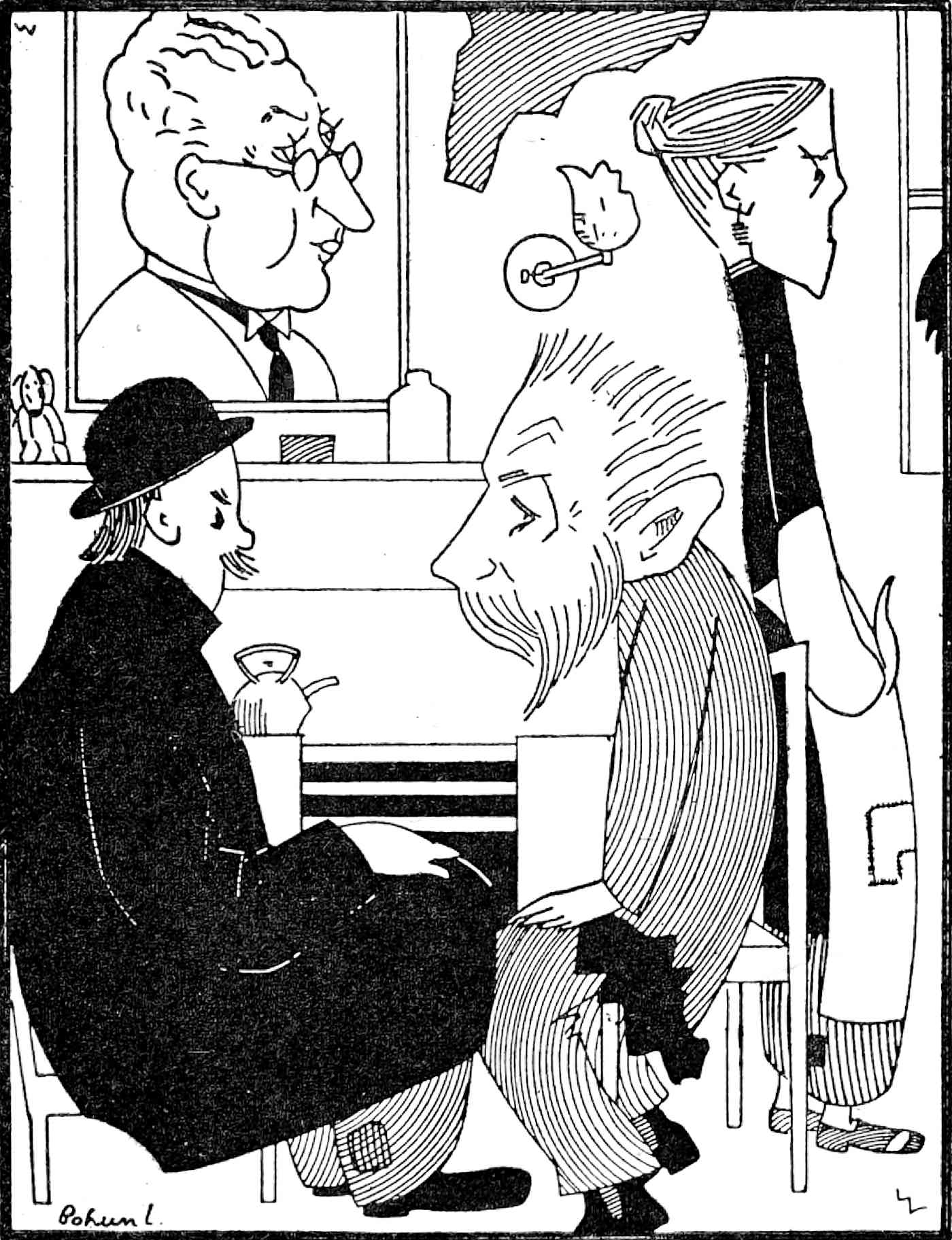
Hooker: Life’s very hard.
UNDER EASTERN SKIES — First Scene. — Second Scene. — Third Scene. — Fourth Scene.
(A Romantic Drama suitable for performance at
His Majesty’s Theatre.)
—A street in Damascus, copied, with
meticulous exactitude, from the Byway of
Beggars in that famous city. Even the smells
are there—thanks to an ingenious contrivance of
concealed sprays, by means of which the appropriate
odour is insinuated into the nostrils of
the audience.
A party of camels, an elephant and a couple of
giraffes, are loitering about in the charge of
officials from the Zoological Gardens disguised
as Bedouin Sheiks. Ali Baba, Sinbad the
Sailor, Shibli Bagarag, and other familiar
Eastern figures are exchanging hoarse Oriental
salutations from their houses and shops. Goats,
sheep, goatwomen, shepherds, etc., complete
the picture.
Ali Baba (in a wailing shriek): Inshallah,
wullahy, eywallah.
Shibli Bagarag (lamenting): Eywah! Traadisveribadahii!
(He beats his breast).
A Passer-by (indignantly addressing a stolid camel-driver):
Bismillah, O Son of my Uncle, have
thy camels, on whom be peace, acquired a
firman investing in them the sole use of this
highway?
The Outraged Camel-driver (forgetting his part
and falling back on the language of Regent’s
Park): ’Ere. Look ’ere——
Another Passer-by (hastily interrupting, and
turning upon the first with contumely): Hence,
brother of a baboon. Mock not dumb
beasts, as it is written.
A Goat: M-a-a-a-a.
A Goatwoman: Aie, little one, muzzle thy
tongue ... (resuming her conversation). In
sooth, O my father, as thou dost say——
The Goat (rebelliously): M-a-a-a-a-a.
The Goatwoman: Arree, be silent, child of
misfortune, or thou shalt see the inside
of a stewpan. (The goat thinks better
of it.)
The Hajji Oskarashi Ben Daoud Ben Ismail (a
holy and very dirty man of enormous size,
sinister appearance and awe-inspiring voice,
appearing from a hovel): Alms. Alms for the
love of Allah. (People give him money. He
takes it nonchalantly and without thanks.)
Alms in the name of the Compassionate.
(He moves majestically on, until he meets a
disreputable-looking being who has just emerged
from a side street. Aside to this apparition.)
Is all arranged?
His Confederate (in a low tone): Ya, holy one.
(At the top of his voice in order to deceive
everyone except the audience.) Nay, I have
nothing for thee, thou evil-smelling and
consummate old humbug.
Oskarashi (whining): Deny not of thy plenty, O
gracious benefactor, as it is written. (Aside)
What is the signal?
His Confederate (giving money with bad grace):
Veialeikum a-salaam, O holy one. (Aside)
Three raps on the outer postern gate: and
then——
Oskarashi (showing his teeth in a terrible smile):
And then—blood and much booty (passing on).
Alms in the name of Allah.
The Goat (unable to contain itself): M-a-a-a-a-a!
The Camels and Giraffes: M-o-o-o-o-o!
The Elephant—But no, we cannot describe the
cry of the elephant.
A Muezzin (appearing on his minaret): La Allah
il Allah (a bell tolls. The faithful prostrate
themselves towards the East).
—Bagdad. The harem of Oskarashi
ben Daoud, etc. We deduce either
that alms-seeking in the East is a highly
lucrative profession, or else that the “much
booty,” referred to in the first scene, proved even
more abundant than was expected. The harem
is an enormous apartment, about the size of the
Albert Hall, with a swimming pool fed by a
golden fountain in the centre, and rows of
marble colonnades receding in all directions into
an apparently illimitable distance. A vast
concourse of beautiful and, despite their biscuit-coloured
complexions, unmistakably European
young women, languish on cushions of every
variety of texture and colouring.
A pair of acrobats, a jazz band of strange
instruments, and some kind of Oriental glee
party are giving a simultaneous performance.
Some withered crones with birches are chastising
certain recalcitrant wives in a corner. Our
friends the camels, giraffes and elephants have
been replaced by a party of leopards, duck-billed
platypuses, anthropoid apes, okapis and
tapirs. Oskarashi himself, comatose after an
enormous Eastern supper, is keeping awake with
difficulty, propped up against a mound of
cushions piled on a huge divan. Entwined
around him, serpent-wise, is Zobeide el Okra,
the Bulbul of the harem.
The Glee Party (bursting into the well-known
Eastern ditty):
We sit and gobble with chopsticks and spoon
From the midnight hour to the stroke of noon,
Gobble at work and——
Oskarashi: Enough. Let them be dispatched.
(Black slaves hurl them into the Tigris, which
obligingly flows near by.) Let the feast
proceed. (An obsequious conjurer appears;
nobody, however, pays any attention, except the
junior members of the audience, who are
properly fascinated.)
One of the Acrobats (drawing aside his disguise
and revealing himself as the terrible Aswarak—whom
we forgot to mention in Scene I, but who
plays an important part in the proceedings. He
addresses one of the attendants, who draws aside
his disguise and reveals the features of the
dreaded Boo Boo): All is ready?
Boo Boo (grimly): Ya Aswarak. Allah hath
favoured us. Every door is stopped and the
black guards have received their price.
Aswarak: It is well.... Remember she is to
be mine.
Boo Boo: Whom—I mean who?
Aswarak (rapturously): The Bulbul of the night,
the reward of the favoured of Islam.
Boo Boo: Have a care, Holy One, we may be
overheard.
Aswarak: And the signal?
Boo Boo: Thy song. (The conjurer concludes
his entertainment.)
Aswarak: I will now sing.
Everyone: Oh, Allah, must this be?
Oskarashi (grimly): Let him sing. Guards be
at hand to do my bidding.
Aswarak (aside): Thy last bidding in this world,
O corpulent Father of Obscenity. (Aloud)
As thou sayest, O Protector of the Poor. (He
takes his lute and sings, gazing ardently—almost
too ardently—at Zobeide):
Ah, when the sun
Gives up the ghost;
And lovers run,
With ardent boast,
To woo the one
Each fancies most—
The stars arise
Behind thine eyes
O Bulbul.
All:
Aswarak:
And I thy sighs
Apostrophize
O Bulbul.
All:
Oskarashi (who has no intention of allowing this
kind of thing to go on): Enough! Well sung,
Minstrel. (Darkly) Thy reward?
Aswarak (throwing off his disguise): Thy head,
Father of Abomination. (Tumult. He draws
a sword and rushes at the divan. The wives
scuttle wailing, pursued by the guards, who pour
into the chamber. Everyone runs shouting
after someone else. Oskarashi strikes his
assailants into a heap, and hurls himself roaring
into the Tigris. The curtain falls upon a
writhing mass of humanity.)
—The action has for some reason
shifted to China—probably in order that Mr.
Gloomy Bishop, the celebrated producer, may
be enabled to show the London public what he is
really capable of, when he cares to extend himself.
The stage, therefore, is a blaze of red
lacquer and Chinese Lanterns, supplemented by
pagodas, palanquins and pigtails. A forbidding
archway of crumbling masonry—flanked on
either side by a barbaric figure armed with
crossbow, javelin, long horsehair moustache and
a hideous expression of brutality, indicates
that the action is about to continue at the
Gateway of the Lotus—a bypath in Old Pekin.
Oskarashi, the Venerable Hajji, has lain here
in honourable concealment ever since his escape
in the Tigris. But ah! his hiding place has
been discovered. This is made apparent by
the highly suspicious conduct of two strolling
passers-by, whose physical characteristics appear
to correspond more or less accurately with those
of Aswarak and the odious Boo Boo.
First Stroller (accosting the other with all the
honeyed courtesy of the Celestial Empire):
Honourable Dweller in a foreign land, deign
to accept of my accursed superfluity. (Gives
money and continues in an undertone) The
detested of Islam has been discovered.
Second Stroller (performing the ceremonies,
observances and obeisances prescribed in the
canons of Celestial etiquette): May the shadow
of this undeserving one diminish and disappear,
if he should unworthily be found
wanting in gratitude to your honourable and
beatific and excellent self. (Pouches the coins
and continues also in an undertone) Where,
O Father of Procrastination?
First Stroller: As Confucius justly remarks,
charity—(dropping his voice). In a certain
hovel in the back street beyond the wall, he
conceals himself, plying the disreputable
calling—may his porkers perish—of a seller
of swine’s flesh—the curse of the prophet’s
beard be upon him. Everything is arranged.
To-night we surround the house: rush in
at the appointed hour: and nail him to the
counter in the midst of his abominable
merchandise. Bismillah.
Second Stroller (fiercely): Inshallah! (Louder)
The honourable greeting of your illustrious
Excellency has brought sunshine and hope
into the miserable existence of this one.
First Stroller: Your honourable praise is
sweeter in the ears of this obsequious
rubbish-heap, than the music of the Celestial
stars. Peace be with you.
They depart. A bundle of rags and blankets
in a neighbouring corner suddenly comes to
life, and reveals the familiar lineaments of
Oskarashi, as he slinks away, like an enormous
anthropoid ape, to his hovel in the back street
beyond the wall.
—We now find ourselves at night in
an even more ancient and dilapidated part of
the city—the neighbourhood of the hovel in the
back street, beyond the wall. A number of
American tourists, shepherded by an unsightly
and bespectacled Baboo from the local Cook’s
office, are making a tour of these rather unsavoury
precincts, before embarking to join the P. and O.
steamer at Hong Kong. Lurking in the background
are Aswarak, Boo Boo and Co., with
an arsenal of weapons, closing in upon their
enemy.
The Baboo (addressing his audience collectively):
And—here—we—have—a—typical—example—of—the—ar—chitecture—of
old—Pekin—dating—to—a—time—co—eval—with—Ginghis
Khan—in—my—country.
A Tourist: My, Sally. Look at here! (To the
guide) Say, cutey, what you callum this?
(She points to a procession forming up among
the houses.)
The Baboo: This—is—a very—fortunate—circumstance.
Ladies—and—gentlemen—we—are—about—to—witness—a—Manchu—funeral.
Another Tourist: Some guy pegged out, I
guess.
The Baboo: We must—withdraw—to—one—side.
(They do so.)
Aswarak (or Boo Boo): A thousand curses. We
must delay the assault until this pig of an
unbeliever has been taken away. (They
confer.)
The procession advances, headed by the
Mourners, who are singing a terrible wailing
melody. As they approach the words become
audible.
The Mourners (dolefully):
Honourable mandarin gone west,
Welly sick belly and pain in chest,
Silly fellow leave off winter vest,
No can facee breeze.
First catchee chicken-pox, then get croup,
Double pneumonia, and off he poop:
Chop-suey, Laichee, Birds-nest-soup,
That’s good stage Chinese.
(They go out with their melancholy burden.)
The Baboo: We—will—now—return—in
time—for—the—especial—dance—for—ladies—and gentlemen—at—the—Nautical—Club.
(He takes his tribe away.)
(The stage darkens. Aswarak and Co. begin
to emerge stealthily from their hiding place.
Red limelight illumines the stage. Weird
music. They rush into the hovel. Reappear
raving like Bedlamites. Oskarashi has
escaped. They realise that he was in the
coffin of the Manchu funeral. In the thick of
the hubbub, the voices of the returning mourners
are heard.)
The Mourners (returning):
Chinky Chinky Chip Chip Choop,
And any damn rot you please,
Chop-suey, Laichee, Birds-nest-soup
Welly good stage Chinese.
Aswarak (foaming at the mouth): Halt, evil-tongued
progeny of obscene mothers!
The Mourners (tearing off their disguises): What?
Offal-eating scum of the bazaar! (They fall
on each other. The curtain falls on the familiar
spectacle of writhing humanity.)
The last scene we are not sure about. It
depends largely on the temperamental judgment
of Mr. Gloomy Bishop. It was originally planned
to be the courtyard of the Dalai Lamasery of
Thibet. Mr. Bishop, however, leans in favour
of a Patagonian village or alternatively a street
scene in Tristan d’Acunha. He thinks the latter
might enable him to introduce a talking penguin
as a counterweight to Mr. Charles Cochran’s
singing duck. And he is not absolutely certain
that he wouldn’t like a Honolulu surf scene, or
perhaps a salt mining camp on the Gulf of
Carpentaria. Mr. Bishop is not sure; and he
must have time to think it over.
Things, therefore, are held up until the producer
and author can come to an agreement.
But on one thing the author is adamant.
Oskarashi has got to come to a sticky end. The
author absolutely refuses to allow the fellow to be
perpetuated in another play.
THE VODKA BOTTLE
(A Play of Russian Life in the manner of Anton
Tchekov.)
The study of Ivan Ivanovitch Bougárov, a wealthy
landowner. Bougárov is alone at the desk. A
vodka bottle and a measuring glass are at his
elbow.
Bougárov (sniffing the glass): It’s strong enough,
I think.... Brr, what a filthy stench!...
Where are the directions? (He gropes for a piece
of paper.) Here they are. Sprinkle it on
toasted cheese, and leave it lying about in the
vicinity of their holes. (Examining the
bottle.) That ought to be sufficient for all
the rats in Little Russia as the saying is.
(Enter Stepan Stepanovitch Rumbunkski.)
Rumbunkski: Good morning, honoured Ivan
Ivanovitch.
Bougárov: Little Fathers, Stepan Stepanovitch,
how you startled me.
Rumbunkski: Your nerves are upset, my darling.
You must give up the vodka, and all that.
Bougárov: But my dear little Stepan Stepanovitch,
you are wrong; because you see, my
dearest little Stepan Stepanovitch, I don’t
drink vodka now, and so it can’t be vodka.
Rumbunkski: Don’t drink vodka?
Bougárov: No, my precious, I don’t drink it any
more; so you see you must be wrong, my
little woodchuck.
Rumbunkski: But, Ivan Ivanovitch, my dear
fellow, don’t try to stuff my head, as the
French say. You must drink vodka, because
there’s a bottle and glass on the table before
you. I don’t say you drink to excess, my
dearest little love-bird, but you must drink
it sometimes—or you wouldn’t have it always
on the table in front of you, and so on.
Bougárov: Stepan Stepanovitch, be careful how
you contradict me, because I can’t stand it,
my dear little flying-fish, and that’s a fact.
You ought to know better than to come into a
brother landowner’s house and accuse him of
drunkenness to his face. It’s mean; it’s
beastly; it’s not worthy of you, my little
alligator.
Rumbunkski: I didn’t accuse you of anything of
the kind. I only said——
Bougárov: Well, well, you withdraw. That’s
all right. We’ll say no more about it.
Rumbunkski: But excuse me, my dear Ivan
Ivanovitch, I don’t withdraw, because I have
said nothing that calls for withdrawal. I
didn’t make any beastly accusation and all
that. All I said——
Bougárov: Oh, little God Almighty, won’t you
stop talking! I can’t stand it, I tell you.
My head’s bursting, and I’ve got a terrible
pain in my shoulder blades. And both my
ears are burning.
Rumbunkski: All I said was that vodka didn’t
agree with you, and you know it doesn’t.
Why everyone knows perfectly well that one
night, at Roobikov’s, you——
Bougárov: Excuse me, Stepan Stepanovitch, but
you’d better go. Yes, you had better go. I
might do you a mischief, and so on; and I shall
be sorry afterwards. That night at Roobikov’s,
let me tell you, you were in a disgusting
state yourself, and unfit to pass an
opinion on anybody.
Rumbunkski: That’s a lie, Ivan Ivanovitch: you
were always a liar and an intriguer. And as for
doing me a mischief, come and try, that’s all!
Bougárov: Oh, little Mothers, help me to be
patient. You’re a skunk and a coward,
Stepan Stepanovitch. A skunk. You know
you’re safe in threatening me, because I’m
on my last legs with disease, and dying out,
and all that, and so you think you can insult
me with impunity. But when Dmitri
Dmitriov thrashed you with a cane——
Rumbunkski: What’s this? What’s this lie
about Dmitri Dmitriov. Oh, Little Uncles
and Aunts, this is a bit too much!
Bougárov: Yes. Dmitri Dmitriov thrashed you,
didn’t he? And you ran squealing about the
room, trying to hide under the furniture——
Rumbunkski: Ivan Ivanovitch, how can you tell
such falsehoods? I was wounded at the
time and couldn’t put up a fight. But I
settled him afterwards.
Bougárov: Yes. By having him waylaid and
thrashed by Yats, the blacksmith.
Rumbunkski: Ivan Ivanovitch, you impugn my
honour. You insult me. If you weren’t an
old infirm vodka drunkard I’d smash you
into a jelly. I’d stamp on your face. But
please don’t imagine I shall marry your
daughter now. I say, please don’t. That’s
finished. You don’t marry into a family
that insults you. No. Never.
Bougárov: Now, my dear Stepan Stepanovitch,
do be reasonable. Anything harsh that I
may have said you brought on yourself, my
darling. You shouldn’t have begun about
the vodka, my dearest little duck-billed
platypus.
Rumbunkski: So I’m a coward, am I? Just wait.
I’ll get my breath, and then you’ll see....
I’m sick. I must have a drink. (Seizes the
vodka bottle.)
Bougárov (trying to take it away): Not that, my
dear fellow. Give it back, I implore you.
Rumbunkski: I must have a drink, I tell you...
I’m seeing stars ... bats are flying round
my head ... I’m falling—(drinks from the
bottle). T’shoo! Pfui!! What disgusting
liquor.
Bougárov (protesting): It isn’t liquor at all,
honoured Stepan Stepanovitch. It’s poison,
my dearest little frog. I told you it wasn’t
vodka, and you wouldn’t believe me.
Rumbunkski (in wild horror): Poison. Where’s
an emetic?... I can’t see.... My head’s
going to burst.... Now my heart’s come
to pieces. My nose is twitching. Both my
eyes are falling out. Ah—h——(falls into
a chair sobbing hysterically).
Bougárov (yelling): He’s poisoned. I’m a rat-catcher
... we’re all murderers.... Little
Fathers, have pity! (Enter Irena Ivanovna,
Bougárov’s daughter.) There. Your husband
to be. I’ve murdered him. Lock me
up. Suffocate yourself. Tickle his throat.
Give him mustard and water. A drink.
I’m fainting. Quick. (She gives him the
glass from the desk. He drains it.) Pouagh!
Now I’m poisoned too.... My ears have
gone to sleep.... All my teeth are aching.
I’m agony all over (collapses on the sofa
screaming).
Irena Ivanovna (wildly): Vodka—Champagne—Mustard
and Water. (She plies them with
assorted liquors, which they drink gratefully.
They are shaken by internal tempests. They
recover slowly.)
Bougárov (faintly): Give thanks to Irena Ivanovna,
my dear Stepan Stepanovitch. Without
the presence of mind of your wife-to-be
you’d be a dead man, my little angel-elect.
Rumbunkski (feebly): I say no. I’ve told you I
won’t marry her. Impugn my honour and
all that. A thousand times no.
Irena (tenderly): Nobody’s impugned your
honour, illustrious Stepan Stepanovitch.
Your mind is affected by the poison, my
little darling.
Rumbunkski: No. He did (indicates Bougárov).
He accuses me of waylaying Dmitri Dmitriov.
Not that he has any right to talk after
what was done to Andrey Andreyvitch.
Bougárov (as violently as he is able): Now I give
you one chance, Stepan Stepanovitch. Either
stop these insinuations or leave my house.
Yes. I’m sick of you. Yes. I’ve had
enough. Enough, I say.
Rumbunkski (staggering): I’ll go. Yes. I’d better
go. I’m fainting with pain, and I’ve such a
bilious attack I can hardly move without
nausea; but I’d sooner suffer any torments
than put up with false friends.
Irena: False friends? Take care what you say,
Stepan Stepanovitch. When you talk about
false friends remember how you betrayed
Nicolai Nicolaivitch at Moscow, and so on.
Think of the Cheka and all that, before you
talk of disloyalty, my little wood pigeon.
Bougárov (sneering): And remember that even
if I am a dying man with heart disease and
paralysis, I’ve got people in my house who
are good enough to settle the hash of a lame
hen like you, honoured Stepan Stepanovitch
Rumbunkski.
Rumbunkski: Ah, you threaten, do you? Wait a
bit.... Ah, Little Fathers, this poison.
I’m dead again. (He falls over sideways.)
Irena Ivanovna (screaming at Bougárov): He’s
dead. Unnatural father. Murderer.
Bougárov (at the top of his voice): Don’t yell like
that. You inflict me with the most acute
palpitations.... I can’t see.... I’m a dead
man. (He sinks back in his chair.)
Irena Ivanovna: Little Fathers and Mothers!...
I must escape. (She drains the vodka
bottle and falls prostrate. They all lie motionless.
You think they are dead; but they are
not. Just as the light is failing they come to
life one by one and resume their dispute. The
fall of the curtain and the end of the play leave
nothing decided.)
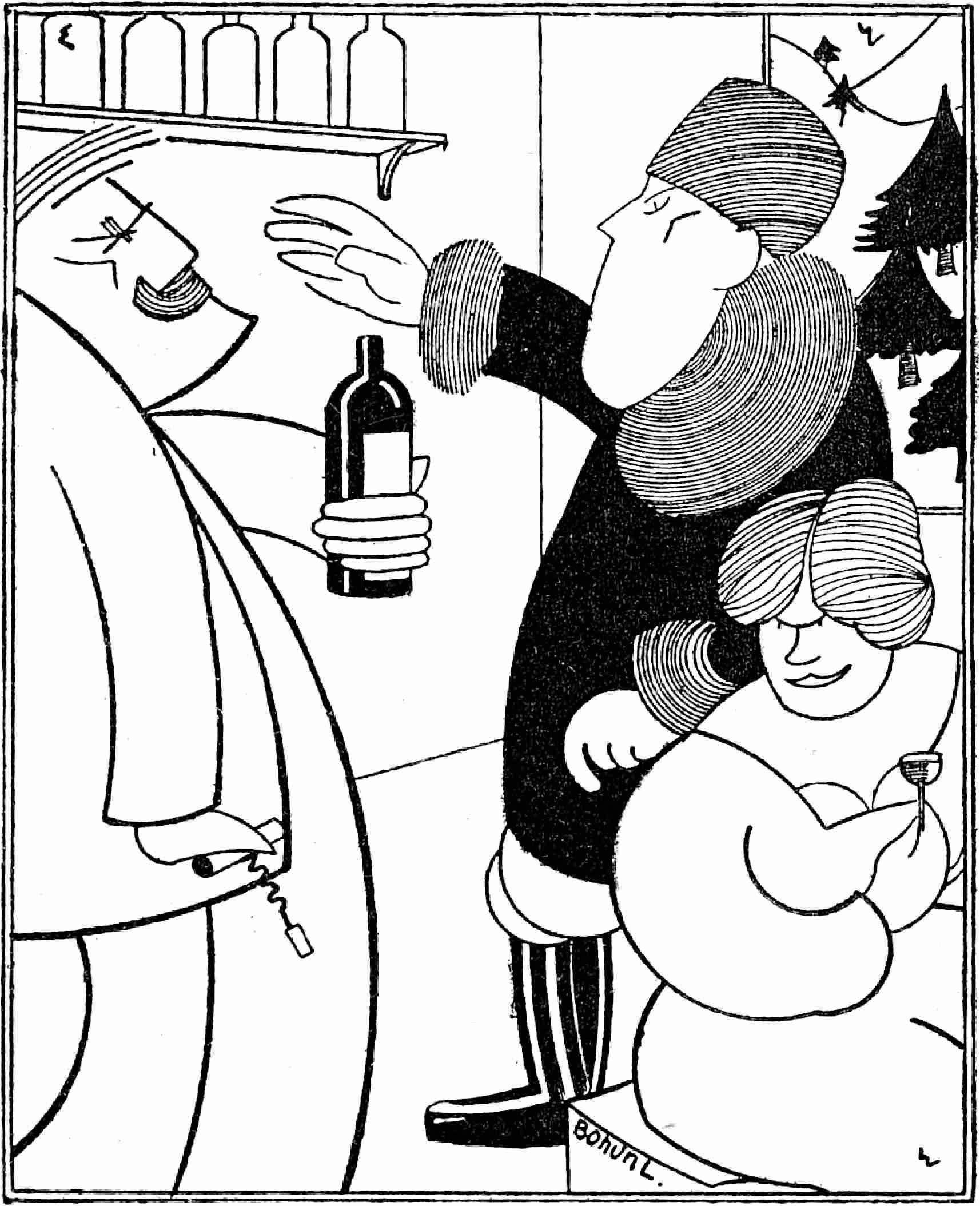
Rumbunkski: Ah! Little Fathers, this poison——
THE SLAYBOY OF THE WESTERN WORLD — Scene I. — Scene II. — Scene III.
(A Play in the Irish Manner.)
—A hovel by the sea at Ballycottin, near
Queenstown. Eamon, in squalid garments and
in an appropriate attitude of misery, is
crouched over the fire. Seamus Smitha is
distilling poteen by the door. Peadar Roabensôn
and the Men of Gunn (a war-like clan)
are lurking in the background. Caitilin ni
Houlihan, Bridgeen Dick, and the Widow
Markiewicz are watching Eamon with speechless
devotion. The door is flung open and
Sean de Browna bursts in.
Sean: Where’s himself?
Seamus: Taking a bit of sleep, maybe, if he’s
able—God help him!
Sean (exultantly): There’s fine doings on the
sands this night, with great ships boarded
and sunk and the lads making grand talk.
Rifles and cannon we’ve taken, and munitions
would be enough for a great war.
The Men of Gunn (murmuring appreciatively):
Bully for you, Kid!
Peadar: It’s himself will bless these tidings.
(Addressing Eamon with conspicuous timidity):
Mister, honey, he’s after saying they’ve
sunk the British Navy, and captured all the
munitions in the western world.
Eamon: The blessing of Gunn upon those words!
(Dropping his voice): I say, what d’you
imagine they’ve really got?
Peadar (dropping his): Oh, I don’t know—a few
dozen rifles, I suppose, and a couple of boxes
of S.A.A. One has to exaggerate a bit in an
Irish drama.
(Enter Boûgus, claimant to the throne of
Ulster, followed by Naisi and Narsti, the sons
of Gunn.)
Boûgus (in bloodthirsty tones): It’s taking the
arms up to the caves they are, till all’s ready
to strike the blow; and it’s fine gory heads
there’ll be, and great masses of dead bodies
that day in the six counties, and throughout
the land, so you’ll not avoid to tread on the
white upturned faces of the dead, they
lying so thick. And I’ll be king that day in
Ulster, and the black Orangemen destroyed
and vanquished.
The Men of Gunn (with appreciation): Sa-ay,
kid, that’s talking.
Eamon: Let you go down now, Boûgus, with
Naisi and Narsti and the men of Gunn; for
I’ve word that Cosgrave, or perhaps
Mulcahy, do be coming to Castlebar or
maybe Dundalk, and it’s there he must be
sent away with scorn and laughter, and maybe
a leaden bullet or two.
The Men of Gunn (springing to their feet): Easy
money. Get right after it, boys.
Boûgus (bursting into song): Oh, Alannah, Acushla,
Asthore, Macree, Honomandhiaul!!! (He
dashes out at the head of the party. Eamon
wraps himself complacently in his rags and
nods over the fire. The women continue to
regard him with speechless devotion.)
—A hovel by the sea at Ballyruff. The
roar of breakers almost drowns the voices of the
speakers. Enter Seamus Smitha and Peadar
hurriedly.
Seamus: Where’s himself?
Sean: Asleep, God help him, and dreaming of
Caitilin ni Houlihan, the creature, and her
wedded to him in these coming days.
Peadar (roughly): It’s her he can put from
his mind then, for she’s up there on the hillside
with Cosgrave and Mulcahy, and James
Craig, and they going on together with dancing
and merriment, the way would surprise the
stags for leppin’; and her that let on to be
a decent woman would marry a holy man.
Bridgeen Dick (sharply): Let yourself be holding
your tongue now, Peadar Roabensôn, with
your great noises to waken the seven sleepers,
and he not stretched in his bed a dozen hours
to be resting after his great labours.
Boûgus (rushing in, followed by Naisi and Narsti):
It’s destroyed we are, entirely.
Eamon (sitting up suddenly): I beg your pardon?
Did you say destroyed?
Boûgus: Aye, destroyed.... She’s turned
against us, and joined the hands of Cosgrave
and James in friendship—as Deirdre, in the
days of old, did try with Conchubor and the
sons of Usna.
Eamon (in an undertone, to one of his personal
retinue): My God, what are we to do now?
The Other (whispering): You must make a speech
in Gaelic.
Eamon (also whispering): I can’t. I’ve left the
book at the Mansion House.
The Other: Well, you must think of something
appropriate in English, then.
Boûgus (keening): Oh, whirra, whirra, Ochone,
Ochone. (They all burst into tears.)
Eamon (as one pronouncing a curse): If the sun
could have darkened to hide her shame, and
the waters of the great ocean given themselves
to wash away her faithlessness, it’s a
strange, black, arid world we’d be living in
this day. O’Connell, Parnell, Redmond,
she’s broken the heart in all of them; and
now it’s mine she’s broken, too; and it’s
not Cosgrave and James that she’ll spare in
the days to come.—I will go out with the
Men of Gunn....
—A hovel by the sea among the Balmy
Stones of Claptrapatrick, near Ballyidiocee.
Enter Seamus as usual.
Seamus: Where’s himself?
Sean: Musha avick, how many more times will
I be telling you in this play that he’s asleep,
God help him, the holy man, and maybe
dreaming, if he’s able, of the grand goings on
there’ll be when they’re after making him
Pope and King of all the world, and he a
scraggy, thin, weakly man would put you
in mind of an old hen, or maybe a worn-out
jackass to be taken from the shafts and
turned away among the roots and grasses
to die.
Peadar: Sure, I’m thinking that’s not what
he’d be dreaming at all, but the great joy
of making combats and running here and
there in high spirits, with the Men of Gunn
around him.
Eamon (mournfully): The heart’s broke in me,
Seamus Smitha, for it’s all put aside and
finished now, and there’s no more doings I
can contrive; and there’s nothing left but
to go back, the way we came, among the
Bohunks and Dagoes, and die in a little dirty
state in the hind end of America.
The Widow Markiewicz (scornfully): And isn’t
there land called England over across a
dirty bit of water would hardly wet your
boots to cross it; where do be fine houses,
and gold ornaments, and a stupid uncomplaining
people to govern, and a crazy Parliament
over it all is calling for ever on the
Mother of God to send an alternative
Government?
The Men of Gunn: Gee whiz!!
The Widow: How do you say, Eamon!
Will you take this country and people and
make a new Ireland there; and be leaving
the North and the South to slit the throats
on each other?
Eamon (in a great voice): I’ll do it, so....
And won’t it be the fine adventure to hold
it over the heads of Cosgrave and Mulcahy,
when I’m sitting in the seat of Lloyd George
with the Kings and Emperors and Presidents
of the world around under my feet, and
Boûgus beside me, and Naisi and Narsti on
my either hand, and the Men of Gunn holding
the fair land of England, and me Lord
of it all?
Bridgeen: And haven’t you the right, Mister
honey, to be sitting in that place and taking
your ease, and a sup of whiskey itself maybe;
for it’s you surely is destroyed by thinking
and fighting in these days in Ireland, and
where would there be your match for craft
and savagery in all the western islands?
Eamon: I have so. (To Naisi and Narsti):
Call up the Men of Gunn, and let Boûgus be
there, and Seamus, and Sean, and Peadar
Roabensôn, and any other man would make
his future, so; and I’ll lead them out to
England, or Russia itself if need be, and split
the brainpan on Lloyd George and all of
them, and be master of the world in their
places; and so I will. (They go out.)
The Widow Markiewicz (looking after them as
they go): And isn’t he the fine handsome
lad to be riding forth on a great adventure;
and he, God help him, nothing but a poor
crazy scholar, with a great savagery and
bitterness in his heart?
IMPOLITICS — A MEMBER OF PARLIAMENT
A man, or woman, who has just been
elected to Parliament may be pardoned if,
in the words of Gilbert, “the compliment
implied, inflates” him (or her) “with legitimate
pride.” It is rather difficult, when the declaration
of the poll is announced by the Returning
Officer, and you find yourself, by a swinging (or
narrow) majority, the elected representative of
some 30,000 people, to avoid a certain feeling of
pleasurable self-congratulation. For the first
time in your life you are, suddenly, the central
figure of a great demonstration. You are
astonished at your own popularity. Strangers
rush up and clasp you by the hand; bearded men
kiss you on both cheeks; you are taken in charge
by the police, to save you from being torn limb
from limb by your almost too enthusiastic friends.
And, if there is a fleeting resemblance, in the
triumphal march from the returning office to the
headquarters of your organisation, to the old-time
procession to the scaffold of a popular highwayman—a
resemblance heightened by the necessity
for making a speech on a crazy wooden erection
usually known as “the hustings,” that air of
spurious importance is, for the most part, effaced
next day, when you leave your constituency by
train, unrecognised and even unremarked. After
the splendours of the previous night, this anonymity
is an almost painful contrast; but there
are lower depths of abasement to be reached.
You have yet to pay your first visit to the House
of Commons.
In the interval between your election and the
summoning of Parliament, you have probably to
some extent recovered your normal self-confidence.
You have doubtless secured a home near
Westminster, “to be near the House, you know.”
You may even have been interviewed by a provincial
paper. It is just possible that one of
the leaders of your party—a junior one—in the
first generous glow of the election results, may
have shaken you by the hand. Perhaps (but this
happens very rarely) the august personage who
speaks from the Front Bench in the name of your
party, may have stared you out of countenance at
Lady Broadside’s reception. You are actually
beginning to feel that you are Somebody after
all; and so you nerve yourself to make your first
visit to the scene of your future labours.
Somehow, as you slink into Old Palace Yard, the
fine fervour of enthusiasm, that accompanied you
in your walk along Victoria Street, seems to have
largely abated. You cannot help secretly
wondering whether you will be required to produce
credentials by the doorkeeper. You visualise
a painful moment, when a gigantic functionary will
say politely, but oh so firmly, in response to your
frantic asseverations, “Very sorry, sir, but if you
can’t prove you’re a member, I can’t let you in.”
You wonder whether he will accept the evidence
of the birth certificate, and the cutting from the
“Times” announcing your victory, which you
hastily stuffed into your pocket before starting
out; or whether you had better lie in wait for
some senior member of your party, and steal in, in
his wake. And, whilst these fearful doubts are
invading your mind, you find yourself at the
entrance, and an enormous, genial, rubicund
policeman accosts you smilingly: “Good morning,
Sir! New member, Sir?”
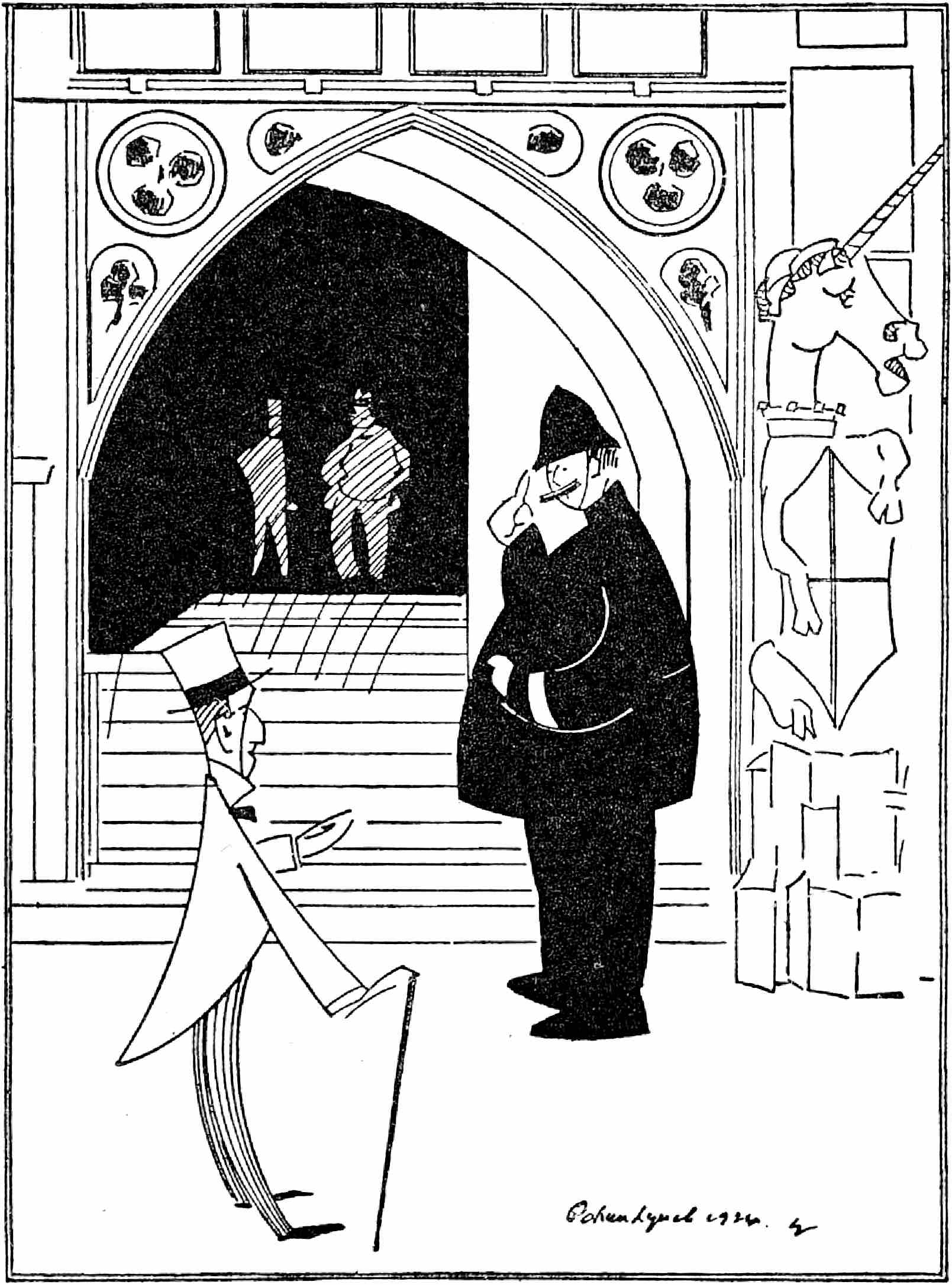
Down, swelling heart!
You try to avoid bursting with pride;
acknowledge his salute; and walk in. But ah,
you think, the terrors are yet to come. Another
constable equally large, equally genial, touches
his hat as you pass through the swing doors, and
says: “Cloakroom on the right, sir.” “Here
at least,” you fear, “there will be a challenge.”
An attendant comes up to you. He gives you a
searching look. Your heart sinks into your boots.
“Good Heavens,” you think to yourself, “I am
in the wrong part of the building—this is probably
reserved for Cabinet Ministers.” You are about
to mutter an excuse and slink away. Quite
unnecessary. He was only memorising your face.
“Name, sir?” he asks. You give it; you will never
have to do so again. Like your face and appearance,
it has been indelibly recorded for future reference.
“Your peg’s here, sir,” he says; and you find,
rather to your astonishment, that a peg has
already been reserved for you, and bears your
name. Two or three other members come in—old
members evidently, for he knows them personally.
They exchange greetings; and you think
to yourself: now where have I seen something
like this before?—Your mind, in a flash, bridges
a gulf of a quarter of a century, and takes you
back to your first day at your public school....
“New boy, sir?” said the janitor, committing
your face and name to memory. “Mr. ——’s
house, sir? That’s your peg in that corner;
them’s the school notices under that shed, see?
You ought to read them every day; and that’s
the tuckshop the other side of the road opposite
the gates.” ... “New member, sir?” enquires
the attendant. “There’s your peg, sir;
you’ll find the Post Office at the top of the stairs
on the left of the Lobby; you ought to ask there
for the letters. Smoking-room, sir? Along the
corridor, turn to the right; and it’s on your
left-hand side.”
Truly the boy is father to the man.
You leave your coat, and wander up the stairs
to the inner Lobby. You sample the thrill of
receiving your first batch of letters in the House
of Commons. You peep reverentially into the
empty Chamber—half afraid to go inside for fear
of inadvertently transgressing some rule of the
House. You would like to look at the Library
and the smoking-room; and yet you feel a certain
unwillingness to trouble the attendants with
questions. Suddenly a stranger, noticing your
irresolution, saunters up to you. “New member?”
he asks affably (as who should say “New
boy?”); and when you have admitted the soft
impeachment—“Thought so,” he continues,
“I think I knew most of the last Parliament. Care
to look round? I’ve nothing to do for an hour.”
And, even as you accept, you remember how
Williams (or Brown), who afterwards grew to be
your alter ego, took pity on you in the old days at
Greyfriars, led you round and “put you wise”;
and, whilst your new friend is explaining the
mysteries of the Chamber—the Chair, the Cross
Benches, the Bar, the Galleries—leading you
through the Library, along the passages to the
House of Lords, and making you acquainted with
your new public school, you think with gratitude,
and some wonder, of the eternal youth of human
institutions.
WOES OF THE WHIPS
The Chief Whip of a Party is a very
august personage. He shares in the
councils of the Party leaders. He is one
of the links that bind them to the Headquarters
organisation, and the constituencies. He holds the
party together on the lines laid down by the
Leader. He keeps a watchful eye upon recalcitrants,
like a sheep-dog with wayward sheep.
He is, in fact, the Chief of Staff; and his lot
is not an unenviable one.
The Junior Whips are another matter. Rebellious
members of the party who would, however,
feel some compunction about speaking their minds
to the Chief Whip, lay bare their grievances, with
embarrassing plain-spokenness, to the juniors.
The Scottish and Welsh Whips must often find
themselves like to the unfortunate victims of that
mythological giant, whose habit it was to tie the
legs of his foes to opposing fir-trees, and, releasing
the trees, divide them in twain—by reason of the
rival claims of their own particular groups of
members and of the Chief Whip himself. Needless
to say, in all parties, there is the fullest opportunity
for members to bring their point of view to the
notice of the leaders, both through the Whips
and at party meetings. But once a party decision
has been taken, it is obvious that, for the sake
of the unity of the party, it is highly important
that its members should present a consolidated
front. And it is when the preconceived opinions
of individual members, or special circumstances in
their constituencies, happen to be at variance
with the general policy of the party, that the
troubles of the Junior Whips begin. They have
obviously an inclination towards those who compose
their own group, such as the Welsh members
or Scottish members; they have also their duty
towards the party as a whole—not always easily
to be reconciled. Anyone who experienced the
unenviable position of a Junior Staff Officer in one
of the feuds that habitually raged between
battalion and brigade, or between brigade and
division, during the war, will have a fairly accurate
understanding of the trials of a Junior Whip.
But that is not all. The Whips are responsible
for the social side of the party as well. Sir
Augustus and Lady Broadside, let us say, offer
to arrange a reception. For some reason, limitation
of space for instance, it is not possible to
invite everybody. On the Whips falls the
invidious duty of making the selection, who shall
be asked and who not. And when this difficult
task has been performed, it is discovered that, by
an oversight, there is no record of the fact that
some new member is married—consequently
he is asked and his wife is not, with inevitable
heartburnings as the result. Or, again, there
are ceremonial duties to be attended to. Members
wishing to attend the King’s Levee must have
their paths made smooth. The presentation at
Court of the wives and daughters of members
must be arranged. The Whips must expect to
be consulted, as well, on sumptuary questions,
such, for instance, as whether a member ought to
buy a levee dress, or whether it will be considered
sufficient if he avails himself of the new regulation,
and attends in evening coat and knee breeches;
and what is the most appropriate garment,
other than a white sheet, in which to make a
maiden speech.
As if that was not enough, there are the
speaking arrangements to be made. It does not,
of course, follow that the list will be adhered to,
but, for the convenience of the Speaker, it is
usual for him to be furnished “through the usual
channels,” which means in other words by the
Whips, with a list of members of each party who
would like to speak in any Debate. Obviously
some selection must be made, or in a Parliament
of active politicians, such as the present, the list
of each party would be impossibly large. More
than half a dozen names for each party would be
more of a hindrance to the Speaker than a help,
because there would be no possibility of getting
them all in—seeing that the normal hours of
Debate are between four in the afternoon and
eleven at night—seven hours in all—and the
average duration of speeches is twenty minutes,
giving a maximum of twenty-one speakers. This
process of selection calls for tact of the highest
order. On the one hand, if the list is too full, the
Whip must not put off further volunteers in
such a manner as to discourage them. On the
other hand, he must be careful not to create the
impression that he wants them to speak always,
or they will never leave him in peace. Even the
most sensible and level-headed people are touchy
about their speaking; and the effect of a hasty
word may easily take a whole session to efface from
the mind of the person to whom it was addressed.
Nor do the Whip’s duties end there. A
question suddenly arises needing instant determination.
On the one hand, the leader may make
up his mind at once as to the party attitude; in
that case the Whips must hurry round, and
communicate it to the members of the party.
On the other hand, the leader may wish to know
the feelings of his party before deciding on a
course of action; there is no opportunity for
holding a party meeting, the decision must be
taken probably within half an hour; it now
becomes the duty of the Whips to flit from
member to member, collecting opinions and
suggestions for communication to the Leader by
the “Chief.” Or it may be necessary to “keep
a house” for one of the back-benchers who is
“raising a question on the adjournment”;
again the busy Whips must hurry here and there
lobbying their party to make sure that forty
members will be present, to protect their colleague
against the misfortune of being “counted out.”
And then, on top of all this, there is liaison with
the other parties, which in practice is more or
less reserved for the Chief Whip himself—for this
kind of work demands the delicacy of Agag.
These are the accommodations, arrangements of
business, exchange of party views, that necessarily
go on behind the scenes as a preliminary to the
set Debates—especially in connection with the
procedure of the House and the settlement of the
order of public business.
There is a certain glamour in being styled a
Whip. Your name and, probably, your photograph
are published in the papers; you are given
special facilities for entertaining your fellow-members;
if your party happens to be in power,
you hold a junior office in the Treasury. The
Chief Whip, despite his responsibilities, has, on
the whole, an interesting job. He is largely concerned
with what is sometimes called the kitchen
side of politics; but his function of linking up the
Parliamentary party with the leader, calls for high
qualities; and his weight, in the determination of
the party programme in the conclave of leaders,
is considerable. The Junior Whips are devotees
of a high order to their party’s organisation.
Their task is a thankless one. They condemn
themselves to well-nigh Trappist vows in the
Chamber, because they are almost always at
work outside it. They place themselves at
everyone’s beck and call. They are in demand
to smooth out any difficulty that may arise.
In fact, as a man once said, who was A.D.C. to
a Colonial Governor: “It’s a spittoon of a
life.”
YOUNG MEN AND “MAIDENS”
Defer it as you may, upon one pretext or
another, the fatal moment will come at
last when you must make your maiden
speech. There have, it is to be supposed, been
members of Parliament of such agonising modesty
or such iron self-restraint, that they would have
been willing to pass their entire Parliamentary
lives in silence. But sooner or later, and probably
sooner than later, an aggregation of pressures—duty
to the constituency, the spur of
amour propre, green jealousy of the triumph of X.,
who so impressed the House by his speech on
the Protection of Insects Bill, the subtle encouragement
of some fair flatterer who, when X.’s
speech was discussed, eyed you archly and
murmured, “Of course you ...” leaving your
vanity to fill in the blanks—these, and other compelling
reasons, combine to persuade you to the
irrevocable step of giving in your name to the
Whips, after which, feeling like a man who has
made an appointment with his dentist, you slink
away and prepare for the worst.
With becoming modesty, you select some
insignificant, and relatively trivial, subject—such
as World Federation, the Solar system, or
the relations of the Almighty and the Universe,
as affording you scope for the pronouncement
you feel it in you to make. You collect a whole
pantechnicon-load of authorities, which, when
you have read them through, are allowed to lie
piled in the darkest passages of your house for the
servants to fall over; you take a ticket for the
British Museum Library; you apply yourself to
study with all the fervour of a Bengalee competing
for an examination. And then, one or at
the most two days before the great oration is
scheduled to be delivered, your Whip says
casually, “Oh, we’ve had to change the arrangements.
We’re getting you in on the Committee
stage of the Impurities in Milk (Abolition) Bill”;
and all your labour is shown to be wasted and
vain. There are only three days left. You rush
to the Dairy Produce Association, the Institute
of Milkmaids, and the Society for the Preservation
of Cattle and Kine, from each of which you
receive an undigested mass of propaganda, disguised
in the form of scientific tracts. There is
no time to push your investigations beyond these,
so you set yourself to learn them word by word.
You come down to the House on the fatal day
primed with knowledge, with lactialities on your
lips and the milk of human kindness bubbling
from your heart—and you discover that, before
your arrival, a member of your own party, interested
in the welfare of subject populations of the
Empire, has moved the Adjournment of the House
to draw attention to a matter of urgent and
definite public importance, namely, the refusal of
the Government to issue practising licences and
a charter of incorporation to the witch-doctors
in the U-Ba-Be district of Abeokeuta.
You seek out your Whip, demanding information.
He tells you that the Government has
changed its mind about the Bill on which you
were to speak, and intends, in its place, to introduce
an Amending Act in connection with the
Acquisition of Mineral Royalties in Zanzibar,
Proclamation of 1872. Having no knowledge
whatever of Zanzibar or minerals, other than
those in bottles, and only a nodding acquaintance
with the lesser grades of royalty, you feel bound
to demur, when he suggests that you should
“give tongue” at such short notice on this
subject. Whereupon he offers you your choice
between the Protection of Herrings (Scotland)
Bill, Second Reading; the Civil Service and
Revenue Departments (grants in respect of
medical referees, destitute aliens, and port and
riparian sanitary authorities) Vote on Account;
and the Army and Air Force Annual Bill.
Smitten with despair at the prospect of the
vigils, prayer and fasting entailed in the mastery
of any one of these three subjects, and fortified
by a hazy recollection of “King Solomon’s
Mines,” you quaveringly ask whether it would
not be possible for you to speak on the Witch
Doctors Adjournment. As your Whip has been
searching high and low for someone to do this
very thing, he almost invites you to dinner in his
relief; and hurries away with your name to the
Speaker. In due course he seeks you out in the
Library, where you are sitting, in a cold perspiration
at your own temerity, and struggling to
master a report on “Witchcraft and the Black
Arts as practised in the Continent of Africa,”
furnished through the medium of the Aborigines
Suppression Society in 1850—apparently the only
standard work on the subject. He informs you
that you will be called immediately after the
Government has replied. Your heart sinks into
your boots; a clammy sweat breaks out upon
your forehead; and you apply yourself assiduously
to the report.
Just before 8.15 p.m. you stagger into the
Chamber. To your excited fancy it seems to have
grown very large. The seat on which you are
accustomed to sit, seems an immense distance
from the Speaker’s Chair. But, as the House is
practically empty, you sneak into somebody’s
corner seat, and hope for the best. The one
encouraging factor in the whole proceedings is
that, in spite of the ghastly hash that the mover
of the resolution seems to be making, the patient
House is attentively listening in silence. After
all, you think, remembering your own triumphant
speeches during the election, the swing of the
words, the thrill of the audience, the storm of
applause—after all, it can’t be as difficult as all
that.... An Under-Secretary begins a half-hearted
defence of the Government. He says he
is quite certain that in this case the House will
consider that the House ought to be extremely
careful before responding to the suggestion made
by his hon. and gallant friend that the House is
at liberty to vary a former decision of that House,
as hon. members below the gangway seem to
imagine. He goes on to say, er—that the Government—er—will,
of course, be ruled—er—or perhaps
he ought to say guided—er—by the view of
the House towards—er—or with regard to the
matter—assuming that in that matter or—er—as
he would rather put it, in such questions—er—the
opinion of the House must be the governing
consideration. Furthermore, he would remind
the House, with the permission of the House,
that the House is always reluctant to set aside a
privilege won by the House in former times and
upheld on the floor of the House by statesmen
like Drigg and Bulgman with the full approval of
the House—an approval, Mr. Speaker, which, as
the House is aware, is recorded in the journals of
the House, and which he is satisfied—nay,
assured—that all members of the House would
pause before challenging.
With this adjuration he resumes his place.
You climb tremulously to your feet. The Speaker
calls: “Mr. Wutherspoon.” And immediately
most of the people in the Chamber rise, and hurry
out, with looks of disgust and loathing. The
bustle of their exit rather takes away from the
effect of your carefully prepared opening sentences;
and your biting gibe at the expense of
the Minister seems in some mysterious way to
have lost the greater part of its sting. Those
to whom it is audible ejaculate a mirthless
“Ha, ha,” to encourage a maiden speaker, and
vanish in the wake of those members who have
already left. You wonder to yourself, in dismay,
whatever induced you to embark upon a Parliamentary
career; and at the same moment,
stumbling, quite by accident, upon some happy
phrase, you are greeted, to your astonishment,
with modified cheering. This is what you were
waiting for. You feel that Parliament is not so
insensible to your merits, as you had at first
supposed. You seize the lapel of your coat with
your left hand, and, throwing out your right in a
generous half-circle, you venture boldly upon the
great passage in your speech, beginning, “The
witch-doctors of U-Ba-Be, a humble section of our
fellow-subjects, organised, as who shall say they
have no right to be organised, in a society, union
or corporation, turn their eyes and lift up their
voices to this House of Commons imploring....”
Somehow, by the malignant intervention of
unhappy chance, before you have said half a
dozen words of this moving passage, a deathly
silence has fallen upon the Chamber; all eyes are
fixed upon you; you stumble and falter; and
murmured conversation at once begins. Again
you blunder on a telling phrase. Once more
you find you are being listened to. This is a
pity, because it betrays you into a touch of
self-confidence. Immediately, all around you,
faces, like flowers in the morning sun, expand
into smiling bloom. But you are getting into
your stride: you correct that mistake with a
modest remark and a deprecating movement of the
hand. Whereupon, you are cheered. You turn
with graceful assurance towards the Chair.
“Why, Mr. Speaker, the witch-doctors of U-Ba-Be,”
you begin; and you find that the Speaker,
who has a legion of duties beyond listening to the
speeches, is in earnest conversation over the arm
of the Chair with one of the Whips, or perhaps
is writing, or—and this is so disconcerting as
almost to petrify one with astonishment—he has
vacated the Chair to the Deputy-Speaker, who
wearing neither wig nor gown, is well-nigh
invisible under the mighty canopy. In the dismay
of this paralysing discovery, your legs endeavour
to collapse under you. You nerve yourself for a
prodigious effort, jettison the witch-doctors into
space, and endeavour to sweep into the peroration,
so carefully prepared on the subject of World
Peace, adapted later to the Milk Bill, and now,
with suitable alterations, doing service on behalf
of the subject populations of the Empire. You
get along very nicely for about two minutes;
you feel that you are taking the House into your
arms; you carefully avoid a second glance at the
Chair, and look along the benches, warming to
your work. Alas! at that moment somebody
laughs. In all human probability his laughter had
nothing to do with anything you said. In a
feverish effort to recall your words, for purposes
of correction, you lose the sequence of ideas, and
the peroration follows the witch-doctors into the
limbo of forgotten things. You lamely thank the
House for its indulgence; and sit down covered
with ignominy and shame.
Then, to your astonishment, other members
turn round, and nod to you—nods of approval.
Somebody says “Well done.” Somebody else
leans forward, and pats you on the back. One of
the leaders on the Front Bench actually turns
round and looks at you. The Whip who arranged
for your call offers words of congratulation.
You congratulate yourself—on having got it over.
FRONT BENCHES AND BACK BENCHES
The Front Bench, which faces the Treasury
Box, and is located on the right of
the Speaker’s Chair, is reserved for
Ministers of the Crown. The Front Opposition
Bench, which is on the left of the Speaker’s Chair
and faces a similar box, is reserved for ex-Ministers
and Privy Councillors in opposition. What
secrets of State these massive brass-bound boxes
contain, must be a source of anxious wonder to
everyone who attends a Debate and looks down
upon them from one of the Galleries. They
look as though they are the very Holy of Holies
of the Constitution, the arcana in which repose
the mystic foundations of our greatness. You
feel that, at least, they ought to contain Doomsday
Book, the original manuscript of Magna Carta,
and the Declaration of Rights. So massive and
monumental is their appearance, so hallowed their
associations, that you would not be surprised
to discover that the special form of oath in the
House of Commons was to swear “By the
Treasury Box!” as kings of old did swear par le
splendeur Dex.
Lovers of Stevenson will recall how, during
his stay on the Island of Apemama, having been
afflicted by influenza, and when all Western
medicines had failed, he put himself in the hands
of Tembinok’s Chief Magician, who, by invoking
the deity Chench, effected a miraculous cure—so
shaking the scepticism of Stevenson that he
pursued investigations with the magician, which
culminated in the discovery that Chench occupied
a small wooden box in the Warlock’s house.
Insatiable in his desire to extend his theological
knowledge, he succeeded, after protracted bargaining,
in acquiring the tenement of the god, bore
it home in triumph, found himself, like one of
his own characters in the story of the Bottle
Imp, unable to resist the pangs of curiosity, and,
with who can guess what delicious anticipations of
the unknown, removed the lid—only to discover
three cowrie shells and a little piece of matting.
Such are the disappointments of the seeker after
truth who should bring himself to open the
Treasury boxes, for one is empty and the other
contains a cheaply bound and quite unremarkable
copy of the Bible and a couple of pieces of cardboard
bearing a certain family resemblance to
that part of the paraphernalia of the optician
that he hangs on the wall to test your sight
by—which are, in fact, copies in large letters of
the oath, the Scotch oath and the Affirmation,
required by law to be taken on signing the roll
of Parliament, and embodied in this form for the
convenience of the Clerk who administers them.
But this is a digression from the Front and
Back Benches. The two members for the City
of London, by some curious old survival, are
entitled to sit on the Front Bench of their party;
but in practice, since both Front Benches are
notoriously insufficient to accommodate all claimants
to seats, this traditional right of the City
members is only exercised on the first day of
a new Session, as who should put a barrier once
a year across a private road, to prevent the right
from lapsing. Nowadays with three large parties
in the House, the third headed by two ex-Prime
Ministers and a number of distinguished ex-Ministers
and Privy Councillors, the front bench
below the gangway, on the right of the Speaker’s
Chair, has, by the Speaker’s ruling, become a
Front Bench. Its opposite number on the left
of the Chair has no special status. By virtue
of their office, the Whips sit on the front benches
of their respective parties. All the remainder of
the House constitutes the back benches, with
the exception of the Cross-benches—which, however,
though actually within the Chamber, are,
by a fiction, outside the House, being behind the
Bar. It follows that a member may not address
the House from the Cross-benches; but since,
by way of compensation, the Members’ Galleries
on either side of the House, though outside the
Chamber, are, in fact, by a similar fiction, inside
the House, a member may, and in Mr. Pemberton
Billing’s time did, address the House from these
lofty altitudes above it (if he is so fortunate as
to catch the Speaker’s eye), giving himself, in the
exercise of this privilege, the appearance of a
contemplative passenger leaning over the side
of a ship.
So much for the physical difference between
the Front and Back Benches. What of the
Front and Back Benchers? The Front Bencher
is the finished product of the Parliamentary
machine. He is, to the humble majority of his
fellows, what the members of those august and
mystic societies, like “Pop” at Eton, are reputed
to be, to their less distinguished brethren. A
Front Bencher is, by tradition of the House,
entitled to catch the Speaker’s eye in preference
to any Back Bencher. He need not attend
prayers: indeed, if he values the privileges of his
order, he will be careful never to attend prayers,
but will saunter in to take his place whilst the
Speaker’s Chaplain is bowing his way backwards
down the floor of the House. He has the privilege
of putting his feet on the Table, a practice
which he not infrequently carries into his own
home—to the mingled pride of his family and
astonishment of his friends. But if the position
has these privileges to give, it has also its responsibilities.
Front Benchers must behave with
decorum, and that is more than is expected of
anyone else. They are the Sixth Form boys,
and must set an example.
The successful Back Bencher should approach
his work in the spirit of the Lower Third.
Whilst he should not actually permit himself the
relaxation of practical joking, and would perhaps
be called to order if he shook a mouse out of his
trouser leg, like “Pater” Winton in Kipling’s
story, he has within reasonable limits of good
humour, an ample licence to make sport. One
well-known member of the House spends the
greater part of his Parliamentary time twisting
order papers into something between a spill and
a spear, which he then ostentatiously throws upon
the floor, as though he feared to encounter the
temptation of continuing to hold them. Another
is assiduous in the manufacture of paper darts,
which as yet have never been thrown.
The experiences of other deliberative Assemblies
have taught the House of Commons that
Back Benchers are not to be trusted with inkwells.
This is probably the reason why there is no provision
for making notes, except upon one’s knee.
But a lot of quiet fun can be had out of raising
points of order that are not points of order, and
by the judicious organisation of a hum of conversation
to drown an opponent’s speech. Isolated
interjections, if possible foreign to the subject
of the Debate, and Supplementary Questions
bearing no relation whatever to the original
question, are also amongst the legitimate weapons
of the Back Benchers. And finally, there is the
great Parliamentary instrument, the use of which
is almost entirely confined to Back Benchers, of
moving the Adjournment of the House. Where
some luckless Minister can be tripped up in
answering a question, and it can be made to
appear that the answer reveals a state of affairs
definite, urgent and of public importance, the
Speaker may be asked for leave to move the
adjournment. If leave be granted, the motion
is made, and, if supported by 40 members, is set
down for discussion at 8.15 on the same evening,
irrespective of what business has been allotted
to that hour. This, in the hands of senior Back
Benchers, can be turned to very effective account.
Junior Back Benchers are well advised to master
the use of the lesser Parliamentary weapons to
begin with.
In all seriousness, there is a noticeable difference
between Front and Back Benchers, noticeable
whether you put Back Benchers on the front
benches or Front Benchers on the back benches.
Thus, in the last Parliament, Mr. Austen Chamberlain
and Mr. Lloyd George, addressing the
House from back bench corner seats, contrived
to present the appearance of Gullivers amid
Lilliputian surroundings—a phenomenon largely
attributable to the Front Bench manner. Some
members of the new Government (and one or
two members of the last Government) who have
not yet attained to Front Bench dimensions,
present an equally astonishing contrast of the
opposite kind. Their painfully unsuccessful
efforts to command attention are a source
of dismay to their friends and discomfort to
their foes. The secret of successful Front
Benchery is heavy thinking, and a heavier form
of expression. His chief weapon is the polysyllable.
A Back Bencher does best to study
plain speech, the simpler the better. He may
enliven his argument with jest and flippancy.
He may controvert his opponent with a plain
denial.
Woe to the leader who makes a joke. “Pas
de plaisanteries, Madame,” observed a scandalised
European monarch, to his jesting spouse: and
that is a safe rule for Front Benchers in
Debate. If a man is dull enough he can get
almost anywhere, once he has reached the Front
Bench; but ah, how difficult are the demands
upon those behind him! The speeches which
the House would fill to hear from the Front
Bench, would, with equal certainty, denude it of
all occupants, if delivered from behind. A
Front Bench speech may run half an hour, three-quarters
of an hour, and even, in the case of the
leaders, an hour. No Back Bencher should
speak for more than twenty minutes, and fifteen
is better. The Front Bench speech should be
sonorous, well documented, weighty, responsible—in
fact, a pronouncement. The Back
Bench speech should be pithy, strictly to the
point, not too serious, and, above all, modest—in
the nature of a tentative expression of opinion.
Fortunately Front Benchers are not always
dull—though they do their best. And Back
Benchers as a rule are far from modest.
For a consequence the proceedings often provide
such a feast of good fun, that successive
Chancellors of the Exchequer have only narrowly
resisted the imposition of an Entertainment Tax.
This would be fair enough, if substantial compensation
were payable for enduring the agonies
of devastating boredom entailed by sitting
through, for instance, some of the Scot——
Hush! There are too many Members of that
virile race, for such remarks to be altogether
wise.
“ORDER, ORDER”
In other lands they manage things differently.
The President of the Lower House is enthroned
on a majestic dais, at the head of
a steep flight of steps; the Tribune, from which
speeches are made, is beneath him; and he
could, if he wished, bring the orator to reason,
or, if need be, to the conclusion of his discourse,
by a few steadying taps on the head with the
ivory mallet which (auctioneer-wise) is his normal
instrument for obtaining order. The mallet is
reinforced by a large muffin bell, which, in times
of distress, the President rings. And his final
means of expressing disapproval is to put on his
hat—a custom which perhaps furnishes us with
the source of the jolly old folk tale, recorded in
Grimm, of the King who used to suppress insurrections
by pulling down his hat over his eyes,
whereby cannons were fired off in all directions.
This picturesque ceremonial, far more imposing
than the procedure of the House of Commons, is
also less effective for the maintenance of order.
In the course of really closely reasoned arguments,
in those less reticent assemblies, inkwells have
been known to fly, the members have been kept
from each other’s throats only by the intervention
of the sabre-girt attendants, and the very citadel
of the President himself has been beset; whereat,
jangling his bell with one hand, and repulsing
his assailants with a ruler in the other, he has
resolutely maintained his hat upon his head, in
testimony of the fact that, legally speaking and
despite “the tumult and the shouting,” the
séance has long been at an end.
But in the House of Commons the powers of
the Speaker are satisfactorily real; not only has
he temporary jurisdiction over all persons within
the precincts of the Palace, he has also unassailable
power to deal with the members. He is
himself both a member and something more than
a member. He is chosen by the vote of the House;
and, once approved by the King, is vested with
supreme authority in the management of the
Commons. Should a point of procedure arise,
his decision is final. Should a question be put
of which he disapproves he may disallow it.
Should a member say that which, in the Speaker’s
opinion, should not have been said, he may order
the member to withdraw. Should his ruling be
disobeyed he may send a member out of the
Chamber. Should the defiance be persisted in,
he may suspend the member from the service
of the House, whereafter that member may not
be admitted to the precincts, until, by resolution,
the House itself has terminated his suspension.
Yet the Speaker, omnipotent though he seems,
is also the servant of the House. It was instructive
not long ago to hear Speaker Whitley
define his powers, in relation to the Crown, almost
in the very words used by Speaker Lenthall, well-nigh
three hundred years before: “For myself I
think my reply must be that I have no tongue
to speak in this place, but as the House is pleased
to direct me.”
It must not, however, be supposed that the
Speaker exercises his functions of authority
harshly. His principal weapon, in fact, is a kind
of awful benignity. It is doubtful if there has
ever been a Speaker of the House of Commons
who maintained his position by severity; indeed,
the House of Commons, which is far from being
the unintelligent assembly one might suppose, if
one judged by the Press, would never choose a
person with whom there was the slightest risk
of friction; for the House is very jealous of the
rights of members. An indication of the kind of
results that might be produced by an assumption
of too pedagogic a heaviness, on the part of the
Chair, was given in the Debate on the Army
and Air Force Annual Bill in the last Parliament.
In the early hours of the morning, after a trying
all-night sitting, Sir Frederick Banbury, who
was temporarily in the Chair, raised his voice a
little beyond the pitch of good humour in calling
to order Mr. Lansbury, who was addressing the
House, whereat the latter bluffly retorted:
“You must not shout at me. Order yourself.”
Strictly speaking, Mr. Lansbury was out of order
in making this retort. He should have deferred
to the ruling of the temporary Chairman, and,
if necessary, raised the matter with the Speaker
after questions on the following day. But there
has never been in modern times a member so
jealous of the privileges of the House as Sir
Frederick Banbury. He realised that tempers,
his own perhaps included, had worn a little
frayed during the sitting; and therefore, contenting
himself by reminding the offender that
he must not challenge the decisions of the
Chair, he dexterously shepherded the discussion
into safer channels.
Speaker Whitley keeps order by an unbroken
suavity of manner, a great sense of fair play and
a wise lenience towards faults committed in
error, from which it will be seen that his hold
upon the House is very largely due to the feelings
of personal affection, in addition to natural respect
and loyalty, with which he is regarded by all
members, even the most junior. He is quite
capable of administering a rebuke, but he prefers
to conquer by gentleness: that is his peculiar
quality. With Speaker Lowther it was a keen
sense of humour and, if necessary, a blasting
and ironic wit, that gave him his ascendancy.
This is not to say that Speaker Whitley is always
grave; far from it. His rulings are most often
touched with humour. But it is a quiet, gentle
humour, like the man himself—the humour of
a serious man, not the esprit of a wit. With Mr.
Speaker Peel the governing factor was a tremendous,
awe-inspiring dignity—something of
the same kind as that traditionally ascribed to
Dr. Arnold of Rugby School.
It must not, indeed, be imagined that the
House of Commons never gets out of hand:
nor must it be imagined that the House of
Commons has only got out of hand since the
Labour Party grew large. The House of Commons
must always have been a troublesome body.
“Scenes” in the House have taken place right
back to the days of Oliver Cromwell; indeed, Mr.
Drinkwater in his play gave a vivid representation
of a scene in the House in those days. The very
carpets on the floor are eloquent of what took
place in former times; for the red line, down the
outer edge of the strip that borders the front
benches, is no less than a warning to members
that, in speaking, they must not put their feet
beyond it, on pain of being “out of order”:
and the purpose of this rule is to keep them from
engaging each other with their swords instead of
their tongues in the heat of Debate! There
were scenes in the House, constant scenes, in the
old Reform Bill days and in the old Irish days.
Mr. T. P. O’Connor still tells the dramatic story
of the expulsion of Bradlaugh, and equally
dramatic stories of the bodily removal of Irish
members. Mr. Lloyd George himself has stories
of suspension to tell. There were scenes in Parliament
just before the war—when, for instance,
Mr. McNeill threw a book at Mr. Churchill.
There were scenes in the last Parliament, as
when the four Labour members were suspended,
and on other occasions. There will inevitably be
scenes in the present Parliament; and it is
safe to say that scenes will take place so long as
the Commons shall survive.
But whereas in other countries, despite the
muffin bell and the top hat, the President cannot
avoid being drawn in, in the Mother of Parliaments
the Speaker is something more than a
restraining influence, he is the embodiment of
law and order. He has behind him for the
suppression of disorder the whole power of the
State. He could fill the House of Commons
with police, and suppress disorder of any magnitude;
and if such an occasion arose, and threatened,
as it would, our whole Parliamentary
institution, the Speaker for the time being would
unhesitatingly do so. But that situation will
hardly arise. We do most things in this country
in the spirit in which we play our games. Members
know that, if they transgress the rules beyond
a certain point, they will be suspended. They
know that when suspended the Speaker will sign
to the Sergeant-at-Arms and the Sergeant-at-Arms,
advancing up the floor of the House, will
require them to leave the Chamber. And
because it is part of the rules of the game that
they must do so, they will do so, in the same
spirit as they would accept the decision of the
umpire in a cricket match. So much for individuals.
And if a party—which happened once
in the last Parliament—as an organised whole,
were to make business impossible by concerted
noise, the Speaker has yet another weapon in his
armoury. Under Standing Order he may, “in
view of grave disorder,” adjourn the House
“without question put,” and give the forces of
reason time to reassert themselves.
How undramatic! Yes. But the whole point
about the Speaker is that he is not a Loud-Speaker.
LORDS AND COMMONS
Though housed in the same building,
though separated by a mere matter of
yards of stone-flagged corridor and lobby,
no two assemblies more essentially different in
character, than the House of Commons and the
House of Peers, could easily be imagined. They
exist, it is true, for legislative purposes, the one
being complementary to the other; but when that
has been said not many points of similarity
remain. The Speaker of the Commons is enthroned
in a majestic canopied chair, dominating
the Assembly over which he rules; the Lord
Chancellor, who presides over the proceedings of
the House of Lords, squats on a monstrous
crimson cushion, like a feather-bed gone mad,
facing a yet more monstrous crimson cushion
upon which, on occasions of State, His Majesty’s
Judges sit back to back, reproducing that obsolete
formation, the hollow square, with which we won
the battle of Waterloo. The Speaker of the
Commons is so called because he so seldom
speaks—because, indeed, he is the only member of
the House who may not speak, except as the
House directs him. The Lord Chancellor, on
the other hand, may, and habitually does, indulge
in any flights of dithyrambic eloquence that
happen to surge out of his teeming brain; and,
though, unlike the Speaker, it does not lie with
him to determine the order in which Noble Lords
shall address the House, he might, if he chose,
monopolise the whole time with his own speeches.
Indeed, when Lord Birkenhead was Chancellor
such a happening was not regarded as....
Fortunately, no such proceeding is possible in
the House of Commons, or, with a series of
stunning reports, Mr. Pringle, Commander Kenworthy
and Mr. David Kirkwood would explode
from suppressed mortification; and there are
others whose peace of mind would be seriously
impaired. But in the House of Lords they are
only too anxious to avoid speaking; indeed, the
difficulty usually seems to be, to overcome the
natural reluctance of Noble Lords to allow their
voices to be heard, in that rarefied atmosphere,
before they have reached the years of threescore
and ten, laid down by the Psalmist as the normal
span of mankind.
In such circumstances of difference what
wonder that each House regards the other as a
sort of lusus naturæ, a freak, a giant pumpkin?
This sense of strangeness finds the extreme of its
expression, in the House of Commons, in such
outbursts as Mr. Jack Jones’s bitter expostulation
against “those marionettes,” on the occasion
when the Commons were sent for by the Lords
to hear a Commission read, and found in the
Gilded Chamber five Lords Commissioners resplendent
in robes, seated in line; a solitary
Back Bench Bishop, and one very junior Peer,
probably a mere Baron, who, having wandered in
by mistake, sought to efface himself under the lee
of Black Rod’s box. “That,” said Mr. Jack
Jones bitterly, “is what they think of Us.”
Indeed, a chilling disdain is the chief characteristic
of the public attitude of the Upper towards the
Lower House—as for instance when the latter, in a
new Parliament, are haughtily bidden to “repair
to the place where you are to sit,” as though they
were fowls, “and proceed to the choice of some
proper person to be your Speaker,” as though,
without that admonition, they would choose
somebody from the neighbourhood of Leicester
Square. This well-bred contempt is repaid, in
the Commons, by veiled references to “another
place.” On this exchange of courtesies, the
Peers seem to come off best; though, when it
comes to practicalities, the positions are reversed,
as any student of the Parliament Act knows only
too well—little now remaining to the Peers of
their former legislative glory.
They get it back upon the faithful Commons, in
virtue of their position in the Constitution as the
Supreme Judicial Tribunal of the kingdom, whereby
it follows that, if, under the Parliament Act,
they cannot oppose indefinitely the legislative
will of the Commons, they can to some small
extent indemnify themselves, in their capacity
of final interpretative authority, after the legislation
has been passed. In practice they delegate
this function to the Law Lords, five of whom,
seated on the red benches with rickety desks in
front of them, spend interminable mornings
appraising subtle and circumlocutory arguments
addressed to them from the Bar of the House by
learned Counsel, standing at a kind of lectern,
and surrounded by their fellows eager to propound
distinctions. There is, however, nothing
to prevent any Noble Lord so minded from partaking
in this intellectual feast. Indeed, a legend
obtains of a sturdy independent Peer, jealous of
what would be called in the House of Commons
“private members’ rights,” who, for years, insisted
on attending, on these occasions, and
delivering himself of ponderous allocutions of
which no one present, himself least of all, understood
one word of the meaning. It says much
for the self-restraint of our Hereditary Nobles
that his example has not been followed in modern
times—though with Sir Frederick Banbury
elevated to the Peerage one can never be quite
sure.
The House of Lords, in short, is a living
example of the utility of the unworkable, the
practicality of the impracticable, and the incredible
sanity of the British Constitution. By
all the rules of the game, in a Chamber composed
of more than 600 people, fully half of whom have
no serious political interests, governed apparently
by no rules of procedure, and held in check, in
fact, by nothing except tradition, the proceedings
might be expected to be those of a disorderly
rabble. In fact, 80 members is a good attendance,
and 50 is nearer the average. The speeches
are as a rule so closely reasoned, so admirably
informed and of such excellence of style, as to be
a source of never-ending envy to members of the
Commons. Such a thing as a “constituency”
speech is, of course, unknown. There are no
“dockyard” members. Nothing need be said
with a view to a general election. Nor can a
member of the Upper Chamber be imagined
making a speech, for the sake of speaking. It is
not exactly an inviting atmosphere for such an
undertaking. Imagine yourself standing up to
address a huge and almost empty chamber,
furnished with crimson benches, and tenanted
by a smattering of elderly gentlemen all staring
with polite fixity at their boots. It really looks
as though this undemocratic and almost atavistic
body, despite all its anomalies, was in practice
something of an example to its elective fellow-House,
both in the expeditious transaction of
business and in the orderliness of its proceedings.
Their very method of voting is indicative of their
critical keenness, their impatience with the
institutions of this world, their determination to
be satisfied with nothing less than perfection.
The form of the vote is not, as in the Commons,
“Aye” and “No,” but “Content” and “Not
Content.”
Usually they are not content.
IRREVERENT INTERVIEWS AND OTHER IRRELEVANCES — WITH LORD BALFOUR AT THE WASHINGTON CONFERENCE
He received me with exquisite courtesy,
waved me into a chair, sank into another
himself, and sat, with folded hands and
an expression compounded of saintly refinement
and dignified composure, regarding me gravely
through limpid, untroubled eyes, protected from
the tarnishing realities of the world by horn-rimmed
spectacles. His silky, white hair gleamed
softly in the half-light. His moustache reposed
over a mouth touched with wistful sadness, but
serene and courageous. Rarely have I seen anything
more placid and self-possessed. But he
had his small irritations. I was one of them.
“Yes,” he began, with the faintest air of
hesitation, “yes. It’s good of you to have come—er.
Er—most obliging, I’m sure. It’s a pity
they didn’t tell me about it. You see, I’d already
arranged.... Yes—(really troubled)—most unfortunate!
(Brightening.) We might walk a
little way together. (Troubled again.) But perhaps
that wouldn’t suit you—no. It would?
That’s very lucky. Shall we go now?...
They’ll give me a hat, I suppose?...”
We found ourselves walking down a prodigious
staircase, and I heard him say, “Extraordinary
buildings these American hotels! I always wonder
on what principle they’re constructed. The
groining of the roof, for instance....” Well,
to be truthful, I’m not really sure that he said
“groining,” for my mind (I confess it with
shame) was wandering speculatively among the
mysterious “them” by whom all great men are
surrounded. “They” are always lurking in the
background. “They” do all the interesting
things; but when some really unpleasant job
comes along “they” always work it off on
“him.” You can picture “them” planning
out the day. “Now,” they say, “there’s your
speech on the Irish question, your report for the
League of Nations, the article you promised to
write for the Hibbert Journal, new socks and ties,
another hat, and that awful check waistcoat you
bought to be exchanged for something quieter.
We’ll do all that. Then there’s the christening
of the Infant Princess Vodkha, and General
Thing’s funeral. You’d better take those.
They’re very important. Oh, and there’s the
Pilgrims’ dinner in the evening. You can go to
that, too. Mind you say nothing in your speech
that we shall be sorry for afterwards.” I should
like to be one of “them,” and feel that I was
really pulling my weight in the country.
That, roughly, was the train of my thoughts,
when I remembered that an interviewer’s business
is to interview and not to acquiesce in excursions
into the by-paths of architecture. “They”
would never allow that.
“—and I’ve wondered sometimes,” he was
saying, “whether the cantilever had anything to
do with it. But—but, no doubt, you can tell
me that.”
“I can,” I said, “but it would take too long
to explain. Besides, the public expects me to
put my few moments with you to a better purpose
than discussing mechanics. The world is expecting
a new era to date from the Washington Conference;
and, as the chief British delegate——”
“The trouble with the world,” he replied,
“is that it is perpetually expecting the millennium.
They expected it after the Congress of
Berlin. They expected it to emerge from the
Hague Peace Conference, and they got the Great
War! They expected a new Heaven and a new
Earth out of the Peace Treaty; they got the
League of Nations, which was an enormous step
forward. And because the League hasn’t revolutionised
humanity, because in the space of two
years it hasn’t yet effectively counter-checked all
the instincts and passions which man has inherited
from the anthropoid ape, they brand it as
a failure—or, at best, a half success—and turn
their eyes to Washington; and if we should not
be able (and who can predict that we shall be
able?) to realise all the passionate hopes and
aspirations in their hearts, they’ll turn away from
our work in despair (however useful and practical
it may be), and they’ll go on staring into the
future, straining their sight in search of changes,
that, by their very nature, are not to be perceived;
and, because they cannot watch a kind of sensational
picture-drama of evolution unfolding
before their eyes, they will condemn each progressive
step as a futility.”
“Now, in this particular case,” I began, for
he had paused dreamily.
“I have always had warm feelings for America,”
he continued, inconsequently as it seemed;
“indeed, some of my earliest public speeches
were devoted—Yes? Were you about to say
anything?—were devoted to pleading for what
one might call a Pax Anglo-Americana, as something
wider than the Pax Britannica, and as a
step towards—a step towards some better understanding
between the various states of the world.”
I sought to pin him down. “And is that your
expectation of the outcome of this Conference?”
“I see no reason why one should not hope,
and ... and, indeed, there seems to me every
reason for believing, that our ... our discussions
and conversations will reveal sufficient of our
respective points of view to serve as a basis for
future negotiations, and possibly to give a broad
indication of the lines upon which a general
agreement might ultimately be reached.”
I changed front swiftly. “You were in the
United States in 1917?”
“In 1917, yes.”
“Do you notice many changes?”
“I can’t help feeling that there is a certain
popular aridity which, I should have said, was
conspicuously absent on the occasion of my last
visit. Naturally, during a war, public opinion
tends to be exuberant and ... and, indeed, at
times fluid——”
“Then you think the political atmosphere of
America has become noticeably drier?”
“I think you must not ask me to discuss the
politics of a friendly Power within ... within
the confines of that Power. Or, indeed, you
may ask, of course, but I feel it would be improper
to answer.”
I flung myself upon him from another angle.
“People in England cannot help wondering
what effect Mr. Hara’s assassination will have
on the Conference.”
“I have always thought,” he replied, after a
pause, “that in a society so constituted as ours,
it is impossible that such an incident—or, or,
indeed, any incident—should be devoid of effect
and significance.”
“It might prejudice the issue?”
“Conceivably. Or, on the other hand, in
certain circumstances, by drawing attention to
what is called the War Party in Japan—if such a
party exists, as to which I say nothing—it might,
in the long run, exercise quite the opposite
influence.”
I tried a more direct approach. “Might I
ask what will be the policy of the British Delegation?”
“Certainly. The policy of the British Delegation,
subject to the approval of His Majesty’s
Government, will be that decided upon, after
due deliberation, by the Chief Delegate in consultation
with his colleagues.”
We walked on a few yards in silence—I
struggling to frame a question that he could not
evade, he with his eyes on the horizon and his
thoughts (I imagine) in another planet. To
relieve my evident distress, he said at last,
“Would you like me to say anything further?”
I threw diplomacy to the winds and faced him
with savage determination. I said to myself
that I would not be trifled with.
“Sir,” I cried, “we have talked for half an
hour. I think I know less of your thoughts on
this subject now than before we began. In the
name of the publicity for which I have heard you
appeal in the League of Nations, say something
specific of your hopes and fears, something to
which posterity may point a finger, saying, ‘Here
was a statesman with vision. He knew.’”
“That,” he replied with gentle gravity, “is
a little difficult. Er—as ... as you know, I am
always unwilling to assume the rôle of prophet.
Indeed, I am not prepared to say that in the
scheme of things as I understand it—and using
... using the word in the sense that is customary
to me—that such a thing as a prophecy has any
existence at all. But I feel—yes, I feel the
necessity which you have urged upon me with—er—with—er
... so eloquently; and I am above
all things—and at all times—desirous of affording
such proper information as the public ought to
receive, upon such a topic as our present Conference,
to those whose ... whose work it is to—to
disseminate—er—such information. I see no
harm, therefore, in acceding to your request, at
the same time making it clear that, since these
issues are momentous and easily imperilled, you
must observe the ... the greatest discretion in
any use—er—in any use to which you may put
my words.”
Overpowered at the apparent success of my
appeal to his better feelings, I could only bow my
thanks. The veteran statesman veiled his eyes
with their tired lids and seemed to ponder.
“Well,” he said at last, “subject to what I
have already stated, I see no reason why I should
not say that the Outlook is not ... is not as bad
as it might be. And now—yes, this is where I
must leave you. It has been a great pleasure to
speak so frankly; and I know you will be discreet.
Good-bye.”
And then he left me and strolled on his way
with serene detachment. But whether the “Outlook”
to which he referred was the paper of that
name, or the prospect before the Washington
Conference, those who have read so far are as
well able to judge as I.
WITH MONSIEUR BRIAND AFTER THE WASHINGTON CONFERENCE
The great liner warped into the quay.
Hushed expectation poised itself over
the multitude. A dumpy figure, almost
incredibly small against the vastness of the ship,
appeared at the head of the accommodation
ladder, and waddled slowly down the side, followed,
at a respectful distance, by obsequious
midgets. It approached nearer, resolving itself
into a small round-shouldered man with a heavy,
pale face, distinguished eyebrows and prodigious
moustaches. His eyes were grey and meditative;
his hair a shaggy, black mane, bursting irrepressibly
from under his hat. He strode ashore,
and prostrated himself on the soil of his beloved
country.
“Ah, la patrie,” he cried in his thrilling,
resonant voice, rising from his knees as he spoke,
and lifting his right hand in solemn invocation.
“Ah, my country, thy faithful Aristide, thy
humble servitor salutes thee. He returns, inflated
with no Imperialism, but none the less
from the depths of his heart proud to have upheld,
in thy name, before all the assembled conscience
of mankind, those principles of liberty, those
imperishable ideals of justice, of international
comity and brotherhood, that fine spirit of self-abnegation
in which it has ever been the boast
of France to lead the world. Oh, liberty, what
sacrifice would we not willingly offer in thy
behalf? Oh, freedom, where is thy source if
not in France? Oh, humanity——”
I tapped him on the shoulder.
“I’ve been waiting for you,” I said.
“Vous dites, M’sieur?” he asked indignantly.
“I’ve been waiting for you,” I repeated
sternly. “What do I hear that you’ve been
saying in Washington about British warships and
sardine-hunting, French submarines and botanical
expeditions, and the unknown X?”
He showed his teeth in a grim smile.
“The unknown X? Qu’est-ce que c’est ça?
M’sieur veut dire peut-être ‘La femme X’?”
“No evasions,” I warned him. “I am here
in the interests of the British public. They are
pained, Monsieur, pained! They know nothing
of international politics, and very little about
politicians—even their own. But they know
that, in their quiet way, they’ve grown to be
fond of your people. They see that you misunderstand
them. And it hurts them to think
that the Entente Cordiale——”
He flicked his fingers impatiently.
“L’entente cordiale! Ah, M’sieu, l’entente cordiale! ...
Are you understanding French?”
“Not noticeably,” I confessed.
“Alors! Well, I shall tell you in English....
What is it, this Entente Cordiale? Hein? An
understanding of friends, n’est ce pas? What the
Americans call a ‘gentleman’s agreement.’ You
make it because you trust so much, that you will
not care to have a Treaty. Well, then, but you
must trust your vis-à-vis. You must not put
all the bad construction on his doing. Not even
a Treaty will stand that. You cannot have
Entente, and then go on nag, nag, nag, like an old
peasant woman with the toothache. Oh, it is
impossible, M’sieu, impossible!”
“Angora?” I hinted.
“Angora....” He shrugged bluffly. “Well,
yes, Angora. That is, perhaps, a pity. We are—we
are in the soup with Angora.” He passed
it off with a disarming grin. “But, après tout,
what can you expect of Bouillon? We shall
settle all that.... And it is not Angora that
threaten our Entente, M’sieu. Ah, no! That is
a small thing. A few Kemalist do not imperil
Anglo-French relations. Pouf!...”
His face grew troubled and sad.
“M’sieu, you know perfectly. It is Germany.
Yes. You talk a lot of the separate peace with
Turkey. In the letter that is so; but in the
spirit you make a separate peace with Germany.
Oh, yes. This is not epigram—it is truth.
Germany, she does not intend to pay. Perhaps
she cannot pay. I do not know. It is possible
she cannot; but you in England pretend to her
that she cannot pay and to us that she will pay.
Ménager la chèvre et le chou! Is that entente
cordiale?...”
“You see,” I endeavoured to explain, “this is
a subject on which there are two views in England.
One side holds that Germany can pay
something—the precise sum varies according to
the knowledge and dispassion of the thinker.
The other party contends that she can pay nothing
at all—that it would be wiser in the general
interest of Europe to cancel the whole debt; and
that view, not widely held, is gaining ground——”
“At the expense of France,” he interjected
sharply. “Yes. Not at your expense, my
generous friend, but at the expense of
France.”
“That,” I answered, “is partly true; but not
entirely true. Viewed in its immediate context,
it may be so; but taken in perspective, the trade
revival in Germany——”
“Ah,” he cried, “Ah, ça, M’sieu! The trade
revival in Germany. And then, M’sieu, and
then? The political revival of Germany. The
military revival of Germany. The German
hegemony. Mittel Europa. Merci, M’sieu!
And France, what of France?”
“France,” I began, “is a member of the League
of Nations.”
“And Germany,” he replied, “is not. And
America is not. And Russia, with her army of
two millions, is not. Thank you for your League
of Nations, M’sieu. What will it be in ten years?
Perhaps the great co-ordinating harmoniser of
the whole world. Perhaps not. What is America
wishing since I leave Washington. They
will have a new League, with no Covenant.
C’est à dire nothing that binds—nothing that
give security to such as France. Just a lot of
amiable pleasantry, that you interpret as you
please. Much of your Press are support them.
Do that give confidence to France?... First
we are to have the Tripartite Treaty—England,
America, France. Then that is not ratify.
And our English friends say, ‘Never mind. You
have it all in Article 10. The League of Nations
will protect you.’ Now, perhaps, the League will
follow the Tripartite Treaty. Oh, yes, I know
they say the Association will be side by side
with the League. But how can you have that?
It is a rival system. They say it will be found
upon The Hague Tribunal. Then what comes to
the International Court? It is to make of
international politics a kind of bouillabaisse....
Non, M’sieu! I am head of a Government. I
am responsible to a nation. Do you seriously
advise me to trust in the League of
Nations?”
“I advise you,” I answered, “to trust more
in ideas, and less in things. Ideas let loose in the
world cannot be destroyed. The League of
Nations is an idea—not an office at Geneva.
Civilisation is an idea; religion is an idea. What
banded the nations together for the Great War?
The strength of an idea.”
“Self-preservation,” he muttered, cynically.
“Monsieur le Président, that is unworthy.”
(He bowed ironically at the rebuke.) “It is the
contemptible argument of the materialist. What
drew our young men to fight in 1914? Self-preservation.
Never! I doubt if half of them
knew the meaning of it. It was the conviction
that an evil thing was being done, and the belief
that it was their duty to prevent it.”
“Some of your Statesmen,” he continued, as
if my remark had not been made, “are so kind as
to teach my Government his business. They
stand up in public and lecture us, warn us. Italy
go wild with rage, because some lying journalist
attribute to me what I have not said. England
and America link arms and get drunk on formulas
of disarmament, that perhaps mean nothing in
the light of science to-day. Japan disguise herself
as a mandarin and go behind the scenes in
China ... and Germany and Russia look on
with sardonic satisfaction to see the isolation of
France, and prepare for the next ‘Day’! That
give one great encouragement to disarm. And
all the time to be uncertain—uncertain of one’s
friends.... You say your people, they have
love for France. Ma foi, they take a strange
method to show it!... I do not understand.
No, I do not understand.”
“Must one,” I asked him, “must one always
understand? Cannot one have faith in a friendship,
tried and proved?”
“You say to have faith,” he mused. “Yes,
but that is not so easy. For every belief there
must be a foundation—the rock on which the
Church is build. Where is my rock?”
“The English dead,” I murmured.
His voice suddenly softened.
“Ah, M’sieu, those dead. I was forgetting....
We have all lived at so much pressure since
the Peace, that we forget too often the fundamentals.
We live for so many such strenuous
years steeped in sentiment, that now we have a
reaction.... Those dead in their quiet graves
in the North of France—sleeping there till the
end of time.
“Yes. We have been too impatient, and we
say things that we do not mean. It is not only
here in France; your Ministers, too, have been
at fault. But, au fond, it means nothing.
“Listen. I shall tell you. Let us speak no
more of L’Entente Cordiale. It is a phrase of
politicians and tradesmen. We shall say in
future La Grande Amitié. It shall be—it is—a
great love between two peoples, sanctified in a
bitter struggle for a common aim.... I am
glad to have talked with you, M’sieu. Perhaps
our conversation can be having good results.
“Do not be too hasty with us. Remember,
France have much to fear on the Continent. If
we do what seem to you wrong, then be patient.
It is not perversity, always.”
He clambered into the car that waited, and
drove away through the cheering ranks of his
fellow-countrymen....
And I wondered.
WITH MR. LLOYD GEORGE DURING HIS PREMIERSHIP
“... And which of us,” he said, smiling
at me over the breakfast table, “which of us do
you wish to see?”
I murmured that I did not understand—er....
“A friend of yours writing in the press,” he
explained drily, “has been good enough to find
in me a second Jekyll and Hyde. Very well.
With which of us do you wish to talk—Lloyd
Jekyll or Hyde George?”
“Which,” I asked cautiously, “is which?”
“Both,” he replied, “are Me. Your friend
misconceives the situation. He attributes all
my political mistakes and failures to Hyde; and
the successes I attain to Jekyll. But the truth
is that between them they have always pulled
me this way and that; and most of my actions
are a compromise between their conflicting
injunctions. Hyde is still the shrewd Welsh
solicitor, who sharpened his wits from morning
to night, that Jekyll might have his opportunity.
Jekyll is still the idealist who dreamt in his youth
of Welsh Home Rule; who upheld the Boers in
his middle age because of the nobility of their
struggle against overwhelming odds; and now
in the fullness of maturity has conferred upon
Ireland the freedom she has sought for centuries.”
“But——” I interjected.
He waved me aside. An inspiration had
mastered him.
“The clouds of despair,” he chanted, “were
gathered over our heads. They menaced our
security, they threatened our national safety.
No avenue of peace has been left unexplored....
The helmsman stands stark and firm, on
the crosstrees. The ship of State lurches perilously
on the ocean. The captain cons the
passage with anxious eyes, the binnacle clasped
in his hand, his belaying-pin beside him. Mountainous
billows tower above us. The hour is
dark. The time is nigh. Shipwreck, despite all
our efforts, appears inevitable.... But faith,
like a little child, steals in with the dawn; and
the splendour of the sunlight, bursting upon the
immemorial hills, floods the valleys with limpid
rapture, and bathes all nature in joy unspeakable.
The sheep frolic around the homestead. The
housewife plies her needle with diligent care.
And the ship of State, with its lonely pilot, worn
but triumphant on the forecastle, glides in safety
into the appointed harbour——”
“This,” I protested, “is not an Eisteddfodd,”
but he ignored me.
“The tempest,” he continued, “the tempest
will abate; the watchers will come down upon
the shore with gladness in their hearts; and the
golden glory of my native hills will shine in the
souls of men, leading them upward, and ever
toward the light.”
A galvanic sweep of the arms brought this
whirlwind of speech to a conclusion. A dish of
eggs and bacon abruptly clattered on the floor.
He pushed the muffins towards me, and refilled
his teacup.
“Hyde has been trying to persuade me for
some time,” he began, leaning forward confidentially,
“to go to the country on the Irish
issue. A far stronger rallying cry than ‘Hang
the Kaiser!’ and ‘Search their pockets!’ Better
even than the ‘Land fit for heroes’ and the
‘Bulging corn-bins.’ It would have been quite
easy, you know, to break off negotiations on the
question of allegiance. From the point of view
of expediency there was a lot to be said for it.
It might have swept the country. But Jekyll
refused. I think he was right.
“All the same, Hyde’s a shrewd fellow. He
sees in a flash what can be turned to good account.
He prides himself on knowing what the public
wants; and he makes me give it to them.
My speech just now, for instance, would have
been immensely successful in the House of
Commons.... It—er—it didn’t seem to
appeal to you.”
“It reminded me,” I replied, “if I may say
so without offence, of your Christmas message
to the Lloyd George Liberal Magazine.”
“Ah!” he exclaimed, “another of Hyde’s
activities. You read the magazine, then?”
“Not often,” I answered.
“I am afraid,” he said, “I am afraid you found
my message wanting in literary flavour.”
“On the contrary, I should say its flavour
was almost too pronounced.”
He smiled ruefully.
“Well,” he said, “you may be right—though
personally I thought one or two passages rather
fine. But, of course, Hyde ... the truth is,
the fellow has an unerring flair for political
situations; and he’s always bringing forward
these highly flavoured sentiments and fathering
them on to me, on the plea that they’re what the
public wants. And the worst of it is, he’s right.
The public likes that kind of thing.”
“Not the intelligent public,” I remonstrated.
“I don’t know what you mean by that. If
you mean the intelligentsia, they don’t count
politically.... Suppose my Government fell,
what would happen? There’d be a General
Election—in which I’m afraid Hyde George
would come to the front—which I might lose.
Another Government would replace me—perhaps
Edward Grey and Bob Cecil. And then? One
of two things. Either they’d carry on in the
same quiet, undistinguished and often shifty
manner, as I do, balancing one interest against
another, and being satisfied with the occasional
inch of progress that one makes from time to
time; or they’d launch out in an ambitious way,
and the conflicting interests of modern society
would crush them in six months.”
“Surely,” I said, “government in accordance
with principle——”
“The fundamental principle of Government,”
he interrupted, “is reputed to be the consent of
the governed. But one is not always dealing
with first principles; and for practical purposes
one of the most indispensable things is the goodwill
of the Press. The Press is controlled by
capital interests. That is a consideration. The
organisation of Labour is another consideration—powerful,
though less powerful than formerly.
There is the Entente with France to maintain,
without going so far to maintain it as will offend
large numbers of people here. There is an
understanding to keep with America, and an
Alliance to modify with Japan. There is a part
to be played in the League of Nations, and that
must often inevitably conflict with the cordiality
of this country’s relations with certain countries,
that are doing us no harm but are misconducting
their relations with other countries—instances
abound. There is the question of raising revenue—who
is to contribute; in what proportions;
how? Every decision you make on any detail
of these subjects, is going to hit somebody hard
in the pocket, perhaps turn him out of employment....
And you talk of principles like a
professor of mathematics considering the functions
of π. I get so tired of this unpractical
nonsense. That’s why I can’t get on with Bob
Cecil. It’s a thousand pities; for if only he’d
recognise these things and take his head out of
the clouds, he’d be invaluable at the Foreign
Office.... But to hear him talk, anyone would
think, not only that my Government was a set
of ill-balanced, self-seeking opportunists, inaccessible
to any consideration except their own profit,
but that what he calls honest government was as
simple as beggar-my-neighbour.”
“You know, sir,” I interjected deferentially,
“some people can’t help feeling that a little
more adherence to principle in dealing with
Ireland would have saved——”
“My dear young friend,” he said in a pitying
tone, “have you ever studied the Irish question
divorced from the rhodomontade of Ulster, and
the hysteria of the South? If you have, you’ll
see that there’s right—a lot of it—on both sides.
It would have been easy enough to apply a catchpenny
solution to Ireland—that’s what we’ve
been doing for generations, as each successive
crisis occurred. Any twopenny Tory demagogue
can denounce me for not giving Ireland another
taste of Cromwell. But can you see British
troops engaged in the process? Any paltry
crank can storm at my want of faith in not
giving them a Republic long ago; but can you
see this country acquiescing in the Balkanisation
of the British Isles? And can you see the
outside world welcoming the creation of another
small State in Europe?... You’ve got to
come to solutions slowly in these matters; and
the only principle that counts, is the preservation
of the Commonwealth of Nations to which we
belong.”
“And have you preserved that by your settlement?”
I asked him.
“It depends,” he said gravely, “on the spirit
in which it is carried out. If neither party in
Ireland can agree, and if they will not be reconciled
to us, then we have achieved nothing. But
if,” his voice grew in volume, “if there is a
purpose in life; and if great trust breeds great
trust, as I believe; and if faith and hope are
more than words to humanity, and direct our
thoughts and inspire our bravest acts; then,
surely, this work will endure.”
He raised his hand, solemnly.
“Sir,” I said, “I have travelled much in our
Empire. The Dominions are my second home.
Are they to be Dominions still? Or, if they
claim it, are they to become Free States also?”
“It is a Dominion status,” he replied. “The
name does not matter.”
“Are you sure?”
“The real tie,” he answered, “must be one
of loyalty and love. It is a small matter how the
thing is called: and if those qualities are absent
you will not better it by the name of Dominion....
“And now,” he said, “I’ve talked long
enough. I’ve a Cabinet Council and an interview
with the Foreign Secretary to get through
before lunch; and there are three confounded
deputations which Hyde insists on my seeing
personally. So you must go.”
Wherewith he disappeared through one of the
multitude of doors surrounding his breakfast-room.
WITH LORD BIRKENHEAD ON THE WOOLSACK
He had thrown himself negligently into
a formidable wooden armchair. Lace
ruffles of the eighteenth century clung
round his wrists, and partly concealed his hands.
Crossed over its fellow-knee, he displayed with
pardonable ostentation a powerful calf, set on a
shapely ankle, and set off by the silken hose of
his high office. A prodigious cigar—Flor Monumento—protruded
from the corner of his mouth.
Intellectual intolerance was the distinguishing
characteristic of his face.
The gentlemen ushers, marshals, petty bag
keepers, javelin men and other menials, who had
heralded me into the presence, bowed themselves
obsequiously out. I sat down nervously on the
edge of a chair. He eyed me with a freezing
compound of disdainful curiosity and disfavour.
Abashed out of countenance, I slipped out of
my hands and fell on the floor with a faint thud.
It seemed that it would only add to the solecism
if I began groping about on the floor for myself—I
made up my mind that I would let myself lie
where I had fallen, until he wasn’t looking; but,
somewhat to my surprise, he picked me up in
the most courtly manner, dusted me, and restored
me to my chair.
“Don’t be alarmed,” he said reassuringly.
“It’s the look that does it. No witness has ever
resisted it yet. They used to curl up, and go
limp, and lean over the side of the box, when I
began my cross-examination; and it has not
lost its power.”
“Have you ever tried it on Mr. Lloyd
George?” I gasped.
“Once,” he replied, “only once, and that long
ago—for, you understand, it would hardly be
fitting in me to hamper and embarrass His
Majesty’s Government.”
“Was it effective?”
“I think I may claim that it impaired his
digestion seriously for a few days. He tried to
resist it, you see, and the after-effects in such a
case become cumulatively more powerful....
As a matter of fact, his visit to Gairloch—well,
perhaps I’d better say nothing further. Of
course, the remainder of the Cabinet are the
merest children. I can quell Fisher or Horne
with comparative ease; I have even succeeded
in making Curzon blush; and, as you know, on a
recent occasion I overthrew poor Carson so
severely that for several days they despaired of
his reason. My castigations are notorious. Let
me warn you to take great care....”
“Would it,” I began nervously, “would it fall
under the heading of incurring a castigation, if I
were so presumptuous as to inquire about your
hobbies?”
“By no means. A very proper question. I
am devoted to all sports. Football, cricket,
tennis, water polo, lion hunting, kiss-in-the-ring
and spillikins are among my favourites; but I
think that most of all I enjoy a quiet game of
pogo with the Cabinet.... Sing? Yes, I
sing frequently. My favourite song? I think
my favourite is that fine old ditty, ‘Rendle, My
Son.’ You are unacquainted with it?” He
broke into a prodigious baritone:
“Where have you been all the night, Rendle, my son?
Where have you been all the night, my pretty one?
At the O.P. Club, dear mother.
Make my bed soon,
For F. E. was there, and I fain would lie down.”
“Indeed,” he continued, “I am devoted to
simple old songs of all kinds—‘Weel May the
Dail Row,’ for instance, and ‘Solly in Our Alley.’”
“And now,” I ventured to say, “... I was
instructed to ask you for a Christmas message to
the public.”
“If you will write something of the necessary
degree of sickliness, I’ve no objection to signing
it,” he replied. “Or wait.... It happens
that I have to deliver a judgment in the House
this afternoon, in the case of a curious old man
named Klaus against the Attorney-General for
detinue, wrongful imprisonment, and a declaration
of nationality. He has been excluded from the
country under some of the numerous regulations
of the Defence of the Realm Act, and his sack,
which appears to contain an astonishing miscellany
of objects, has been confiscated by the
Customs authorities.... Would that serve
your purpose? It will figure in the next edition
of my judgments.”
“If I might hear it, perhaps....”
“Certainly.” He drew a formidable case-book
from the shelf behind him, adjusted a pair of
horn spectacles, and read as follows:
“In this case your lordships have been moved
to set aside a decision by the Court of Appeal,
affirming the decision of the King’s Bench, whereby
the Attorney-General, the Sheriff, and the
Justices of Lower Mudhaven were upheld in
refusing admission into this country to the
appellant, S. Klaus, a person of indubitable
ex-enemy origin, but widely esteemed in this
country, who carries on an old-established business
in many parts of the world.
“It has been claimed on behalf of the appellant
that, by long use, he has acquired a prescriptive
domicile amounting to British nationality, which,
since it has been enjoyed without interruption
for more than ninety years, is to be taken, by
irrebuttable presumption, as having arisen in time
immemorial, which, as we are all aware, means
from the time of Richard I. It was contended
for the Crown, that, by reason of the various
statutes and regulations prohibiting the presence
of enemies in this country during the war of
1914-1918, this user was in law interrupted, and
therefore is bad as a plea. The appellant replies
that, despite the prohibitions, he did, in fact,
continue to ply his calling here during the four
years in question; and in the Court below he
called a number of witnesses, whose credit is in
no way impeached, to depose that, to their knowledge,
at a certain season in each year, he visited
this country in order to keep his business afloat.
This is certainly a matter to which the attention
of the proper authorities ought to be drawn, for
clearly at that time the appropriate person to
have carried on his affairs was the Controller of
Enemy Businesses under the supervision of the
Public Trustee; and some inquiry seems to me to
be called for, into the neglect of that official to
carry out his duties. This, however, by the way.
“Passing over the testimony of Elsie Biggers
and John Marmaduke Baxter-Cunliffe, also known
by the alias of ‘Tweety,’ both of whom depose to
having seen the appellant descend through the
chimney in their respective houses a year ago,
but whose tender years—three in the first case
and two and a-half, as I believe, in the second—raise
a doubt in my mind as to their understanding
of the nature of an oath, there is unquestionable
and unimpeachable evidence of some person or
persons unknown having placed a variety of
articles in the houses, and, indeed, in the stockings,
of a number of the deponents in this cause, which
were not there before. The appellant avers that
it was he who placed them there; and, as no
alternative hypothesis has been advanced by the
Crown, I should, I think, be disposed to accept
the appellant’s word as conclusive, were it
necessary for me, in advising your lordships as to
the judgment which your lordships will shortly
deliver, to pronounce either upon one side or
upon the other in this conflict of testimony—so
far as it can be so called.
“But is it necessary to go into these questions?
Mr. Attorney-General, arguendo, has urged upon
us that, where a person performs an act of which
he is legally incapable, then it is as if the act in
question had not been performed; and he cites
the cases of a child under seven, who is doli
incapax, and of a child between seven and fourteen,
who is prima facie doli incapax, and the case of a
minor incurring a debt other than for necessaries,
and of a person who makes a will, not in due form
of law. From these premises, he contends that,
since it was illegal for the appellant to come to, or
be in, this country, it must be taken, for our purposes,
that he was never there; and the plea of
prescriptive domicile must fall to the ground.
“My lords, I am unable to resist this argument.
Where a person, whether wilfully or not, steps
outside the ambit of the law, it is clearly established
that he does so at his own risk; and
ignorance will not thereafter avail him as an
excuse. I must advise your lordships to pronounce,
that, despite the evidence, the appellant
was not in this country during the war, that the
user upon which he bases his title was interrupted
during that time, and, consequently, that his
first plea must fail——”
He broke off, and looked at me, quizzically.
“What do you think of that reasoning?” he
asked. “Ingenious, isn’t it?”
“Hardly ingenuous though,” I murmured;
“and it seems to me——”
He drew himself to his full height, and glared.
One corner of his mouth went down, and the
other rose to the level of his lower eyelid. It
was the celebrated sneer.
“No doubt,” he said icily, “no doubt in the
purlieus of Tooting Bec or Brockley, whichever
you inhabit, remarks of that kind pass current as
wit. I daresay, among cannibals and anthropoid
apes, there is to be found a rough sense of coarse
buffoonery that is tickled by such vulgar exuberance;
but, among the aristocracy of an old
civilisation, your behaviour would provoke pity,
rather than mirth, were it not that, with us, the
impudence of a scavenger is accounted a more
noxious thing than his trade——”
“Really,” I began, “I must protest——”
“What? Argument?” he cried harshly. He
smote a bell. An old and trembling man doddered
into the room. He pointed dramatically.
“Remove it,” he ordered.... I judged it
best to remove myself.
And as I walked away along the corridor the
notes of “Rendle, My Son” floated after me.
Only at that distance I could not be quite sure
that the name was Rendle.