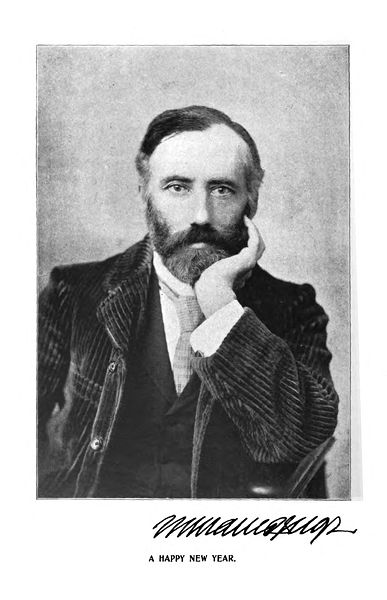
BY ALEXANDER WILDER, M.D.
Goethe,
has pictured Faust as having
first acquired the learning of
the schools, philosophy, medicine,
jurisprudence and theology; then as
going forth with Mephisto in quest of
excitement, to which comes a tragic ending.
The shock of this paralyzes him
for a time from further endeavor. In
the Second Book of the drama, he again
rises up with strong resolve to begin an
active career in the busy world.
Somewhat in analogy with this is the
history of every one who leaves adolescence
behind and attempts without the
discipline of experience, to find a place
and engage in the future work of life.
Too often, however, it is more the varied
wanderings of a Jung-Stilling, requiring
the vicissitudes of years of preparation.
Lamartine desired to enter upon a
military life, but it was repugnant to the
wishes of his family that he should take
service, either in the army of Bonaparte,
or of any country that might be opposed
to France. His father retained his royalist
sentiments with characteristic stubbornness,
and his older uncle, the recognized
head of the family, though a
former friend of Mirabeau, had refused
the office of Senator when offered to him
by the Emperor. Young Lamartine was
thus handicapped and forced to idleness.
He spent some winters in Paris, and
mingled with the gaieties and dissipations
which young men encountered at
the metropolis. The result was self-abasement.
He incurred debts at the
gaming table, which his limited allowance
though eked out by secret contributions
from his mother, were insufficient
to meet; and he formed acquaintances
that were a serious drawback to
him in later years.
Perhaps he, like Bunyan, depicted
himself in darker colors than there was
really occasion. "There was not," says
he, "air enough in the sky, fire enough
in the sun, or space enough on the earth
for the want of breath, excitement and
burning that consumed me. I was a
living fever; I had the delirium and inquietude
of it in every part. The sober
habits of my years of study, and the
tranquil piety of my mother and our
teachers, have been put far away from
me. My friendships were as unworthy
as my feelings. I had become intimate
with the most giddy and turbulent young
men of my country and period."
Nevertheless while he was going forward
so readily in disorderly ways he
was actually repelled by them. Indeed,
he was only imitating others, and not
really following his own natural disposition.
When he came to be alone, the
solitude purified him.
In 1813 he again visited Italy. His
first opportunity for activity now came.
Paris having surrendered and Napoleon
having abdicated, the Allied Powers of
Europe placed Louis XVIII. on the
throne of France. This prince had always
been liberal in his views, and he
now proclaimed a constitutional government.
This conciliated all parties, royalists
and republicans alike. Lamartine
was enrolled in the Royal Guard, and
was of the force that marched against
Bonaparte upon his return from Elba.
The statement has been generally accepted
and believed that the reception of
the Emperor on this occasion was of the
nature of a triumph. Lamartine declares
that this was unqualifiedly untrue. The
enthusiasm, he affirms, was confined entirely
to the soldiers and to the dregs of
the population. France, itself, the real
France, had become utterly weary of
this fighting for the aggrandizement of
this one man. It had welcomed Louis
XVIII., but not as the king of a counter-revolution.
It did not contemplate any
going back to former conditions. The
king was received as the king of the
Liberal Constitution.
"All the movement of the Revolution
of 1789 which had been interrupted was
commenced anew by us after the fall of
the Imperial Government. The entire
France,—the France that thought and
not the France that clamored—was perfectly
conscious that the return of Bonaparte
meant the return of the military
régime and tyranny. Of this it stood in
dread. The Twentieth of March [1815]
was a conspiracy of the army and not a
movement of the nation. If there had
not been an army organized in France
that was ready to fly under the eagles of
its Emperor, the Emperor would never
have reached Paris."
Nevertheless Lamartine was confounded
by what took place. In the brief space
of eight days apart, he saw one France
ready to rise up in mass against Bonaparte,
and then another France prostrate
at his feet. From that day he despaired
of the omnipotence of opinion and believed
even more than he ought in the
power of bayonets.
Louis XVIII., the Count d'Artois and
son, with Marshal Marmont and the
royal forces left Paris the night before
Bonaparte made his entry. As they
passed the cities on their retreat, the
citizens brought them food, execrating
the "Pretorians" who had overturned
the institutions and peace of the country.
Royalists and Republicans alike participated
in this denunciation of the treason
of the army.
At Arras the king left the troops and
went on by himself to Belgium. The
Count d'Artois and Marshal Marmont,
the commander of the forces, followed
soon afterward, after having issued a
proclamation absolving the men from
their oath. Thus abandoned, the question
arose, what was next to be done.
After a desultory discussion, a musketeer
declared that the true and safe course
was to leave France and take service
abroad.
Lamartine opposed this proposition.
Though but twenty-four years of age,
he had won the respect of his comrades.
Stepping on the wheel of a wagon he
addressed them. It was his first attempt
to speak in public. He referred to the
significant fact that his family had been
loyal to the monarchy, but had not
emigrated during the Revolution. He
had been nurtured in such sentiments.
Louis XVIII. had now given France a
representative government. The cause
of Republican Liberty and the cause of
the Bourbons had thus become united.
If now the two parties should continue
to act together, the reign of Bonaparte
would be short and his fall complete.
But if the royalists should now emigrate,
they would, by so doing abandon
the Republicans to the army. The blood
of the Republicans would smother all resistance
to the Empire. The duty, therefore,
of those now present, both to their
country and to their families, forbade
that they should follow the king out of
the French territory.
Most of the men voted to remain; a
few rode away. Being now without
officers, a temporary organization was
effected, posts established around Bethune
and a patrol provided. Four days
later a capitulation took place, by which
they were permitted to go to their families,
but excluded from Paris.
Lamartine, however, put on the dress
of a citizen and went in a cabriolet to
Paris. A few days later he was present
at a review of the troops.
The Emperor, he observed, exhibited
none of that ideal of intellectual beauty
and innate royalty, which writers had
so often depicted. He seemed to be conscious
that the ground was not solid under
his feet. His movements indicated
distrust and hesitation. As the troops
defiled before him they cheered with "a
concentrated accent of hopelessness."
Lamartine went home with renewed
confidence.
The Imperial conscription filled the
Chevalier, his father, with dismay. Lamartine
declared to him that he would
in no case enter the ranks himself or
procure a substitute. He would sooner
be shot to death. Leaving home, he
put on the dress of a peasant laborer, and
eluding the videttes on the frontier,
crossed into Switzerland.
For some weeks he was the guest of
the Baron de Vincy, an emigrant nobleman
whose property had been confiscated.
Himself almost without money
and his entertainers impoverished, he
could not bring himself to burden them
longer. Leaving them abruptly, he
made his way to Geneva. He was actually
considering the project of applying
to be a tutor in a Russian family and
travelling to the Crimea, Circassia and
Persia, when the final overthrow of
Bonaparte called him back to France.
He became again a member of the military
household of the king. Here he
found his oldest and most beloved of
friends, the Count Aymon de Virieu.
They had been in college together, had
travelled in Italy, their fathers had
shared danger together in the Royal
Guard on the fatal Tenth of August.
They were ever after as two brothers,
one in thought, one in soul, one in purse.
They continued members of the Guard
till it was disbanded.
Some years afterward Virieu made
Lamartine acquainted with several persons
of distinction whose good offices indirectly
facilitated Lamartine's entry into
public life.
Virieu was boisterous, full of jest, and
a skeptic in religion. He was through
his mother, descended from Montaigne,
and he had inherited that author's disposition.
He quoted him incessantly.
Lamartine, on the contrary, had inherited
from his mother, a melancholic
temperament, quiet, serious and religious.
He could not bear Montaigne's
skepticism, nor his salacious utterances.
"Man is born to believe," he
declared. "To believe in nothing is the
way to accomplish nothing, and impurity
in speech is a soiling of the soul."
He spent a summer with Virieu and
his family in Dauphiné. Their way of
living was a reflection of his boyhood
life at home, and brought calm and repose
to his mind.
Virieu afterward became serious like
his mother and withdrawing from public
life on account of his health, died some
years later. "In him," says Lamartine,
"I lost the living witness of the first
half of my own life. I felt that death
had torn out the dearest page of my history,
and that it was enshrouded with
him."
Another fellow-student whom Lamartine
repeatedly mentions, was the baron
Louis de Vignet, of Chambery, in Savoy.
They were often competitors for the
prizes. Vignet gave up the profession of
law and accepted a life of poverty for
the sake of his mother and sister. He
had been a skeptic and scoffer in religion
and repulsive in temper, but watching
with his dying mother, he became
changed and was modest, pensive, gentle
and melancholy.
He had hesitated to renew his acquaintance
with Lamartine during the
latter's wild career in Paris, but now,
meeting accidentally, the two were
drawn together at once. Vignet greeted
Lamartine more as a father than as a
comrade, and they quickly formed a
compact of friendship. As if to seal it
they went together to Charmettes to
visit the house where Rousseau had
lived, and afterward went to Servolex
together.
Vignet was a nephew of the Counts de
Maistre, two of whom were distinguished
in the political arena and world of letters.
Lamartine was received by the
elders as a son, and the younger members
of the family as a brother. He
remained with them during the summer.
The wholesome influence took his mind
away from the philosophy of the guardhouse
and the effeminate literature then
current in France. It was indeed an important
epoch in his history. Time,
death, difference of country and opinion
afterward separated them, but he always
vividly remembered that summer at the
house of Colonel de Maistre and Louis
de Vignet.
A diversion of the household consisted
of recitations of verse. Vignet had collected
a large number of effusions which
were current among the Savoyards.
Lamartine also ventured to recite his
own verses before Colonel de Maistre
and his daughters. The old man admired
his pure French diction and predicted
to his nephew that Lamartine
would become distinguished.
Another summer found Lamartine at
home in Milly. The family had gone
away; the father and uncles to a hunting
party in Burgundy, the mother on a
journey, and the sisters on visits to
friends, or to the convent. He was left
alone with no companionship but an old
servant-woman, his horse and his dog.
The silence, the loneliness of the garden,
and the empty rooms reminded him of
the tomb. It was in keeping with his
state of mind. He felt himself, or rather
he desired to feel himself dead.
In this mood he again resumed familiar
relations with the Abbé Dumont,
his former schoolmaster at Bussières.
The abbé had himself become the parish
priest. There had been a tragedy in his
life before he gave up his place in the
world to take orders. He was the original
of Jocelyn in Lamartine's little poem.
Lamartine rode daily to the parsonage.
The two discoursed on topics more
or less abstruse, such as the state of
man on the earth, the vanity of ambition,
the religions, philosophies and
literature of different peoples, the esteem
bestowed on one great man over another,
the superiority of certain authors
to their rivals, the greatness of spirit in
some and littleness in others. To set
forth their views they quoted authors of
every age, like Plato, Cicero, Seneca,
Fénélon, Bossuet, Voltaire, Rousseau.
Poetry was more severely handled.
Dumont appreciated only the sense of
language, and did not care for the musicalness
of what was uttered. They
both agreed that in the study of rhythm
and the mechanic consonance of rhyme
there was a puerile attempt to associate
a sensual delight of sound to some grand
thought or manly sentiment. Versifying
pertains to the speech of a people's infancy,
prose to that of its maturity.
Lamartine conceived that poetry does
not consist in the mere sensuousness of
verse, but in the ideas, the sentiment,
the image. "To change an utterance
into music does not perfect it, but materializes
it. The simple sentence justly
and forcibly expressing the pure thought
or naked sentiment without a dream as to
the sound or form of phrase, is the genuine
style, the expression, the WORD."
These conversations naturally drifted
to the supreme questions of the time—to
politics, philosophy and religion.
Dumont was that contradictory character,
found so often in many countries—a
royalist although a democrat, and
opposed to the Revolution, although he
detested the ancient régime and actually
accepted the very aims and doctrines
which the Revolution contemplated.
Both he and Lamartine had been "fed
with the marrow of Greek and Roman
literature." They adored Liberty as a
well-sounding term before they came to
consider it as a holy thing and as the
moral quality in every free man.
Dumont was philosophic, like the century
in which he was born. In his house
there was no token to show that he was
a priest—neither breviary, nor crucifix,
nor image of a saint, nor priestly garment.
All these he relegated to the
sacristy. He considered the mystic rites
of Christianity which he performed as
belonging to the routine of his profession,
to be little else than a ritual of no
importance, a code of morals illustrated
by symbolic dogmas and traditional practices,
that did not encroach on his mental
independence and reason. He spoke
of God to an infantile people, using the
dialect of the sanctuary. But when he
returned home he discoursed in the language
of Plato, Cicero and Rousseau.
His mind was incredulous, but his soul,
softened by his sad fortune, was religious.
His great goodness of heart enabled him
to give to this vague piety the form and
reality of a precise faith. He constrained
his intelligence to bow under the yoke of
Catholicism and the dogmas of religion.
He read and admired the writings of
Chateaubriand and others of the time,
but he was not convinced; he did not
believe what they taught.
Lamartine, on the other hand, was influenced
by the religion of his infancy.
Piety always came back to him when he
was alone; it made him better, as though
the thought of man when he is isolated
from others was his best counsellor. It
was not so much a matter of conviction,
as a wish that it should be true. The
poetry and affectionateness of religion
swayed his will. He could contemplate
the mystery of the Incarnation as filling,
or at least bridging over, the unmeasurable
space between humanity and God.
If he did not quite admit this as actual
fact, he revered it as a wonderful poem
of the soul. He embellished it with the
charms of his imagination, he embalmed
it with his desires, he colored it with the
tints of his thought and enthusiasm; in
short,—he subordinated his rebellious
reason to this earnest desire to believe,
so that he might be able to love and
pray. He put away from him, as by
force, every shadow of doubt and repugnance,
and almost succeeded in producing
the illusions for which he was so eager,
and in conforming the habit of his soul
to the current sentiment of the epoch.
If he did not really worship his mother's
God as his own God, he at least carried
him in his heart as an idol.
The cordial relations of the two friends
were maintained for years. The priest
continued to minister in his little church
and gave much assistance to the mother
of Lamartine in her charities. Above
his grave in the cemetery is a stone with
a brief epitaph, and beneath it the words:
"Alphonse de Lamartine à son ami."
The mental depression under which
Lamartine labored, seriously affected
his health. The family physician was
alarmed. Plainly enough it was from
causes outside of the province of medicine
and so instead of prescribing medicines
he ordered the young man to go to
Aix in Savoy, to the hot sulphur springs.
He borrowed money from a friend of
the family and went. Vignet procured
a room for him, and paid him several
visits during his sojourn. It was early
Autumn. October had just begun, and
the leaves on the trees had put on their
colors. The bathing season was over,
and the usual guests had gone away,
leaving the place solitary.
There was another patient in the
house. This was a lady from Paris. She
was in a decline and had been at Aix
several months. Lamartine, however,
had no inclination to see her.
An accident on the lake brought them
together in which he rescued her from
imminent peril of life. The acquaintance
thus begun became at once an ardent
attachment. Lamartine describes
it as "repose of the heart, after having
met with the long-sought and till then
unfound object of its restless adoration;
the long-desired idol of that vague, unquiet
adoration of supreme beauty which
agitates the soul till the divinity has
been discovered."
This lady, the "Julie" of his story,
was the wife of an old man, a friend of
the Emperor Napoleon. He had first
seen her at the convent where she was
receiving her education. She was a native
of the island where the Virginia of
the romance was said to have been born,
and had been brought to France. She
was without friends to protect her or the
necessary dowry to attract proposals of
marriage. The old gentleman in pity
for her friendless condition, had married
her, receiving her as a daughter and not
as a wife. Her health had given way,
and he sent her to Aix in hope that
the mountain air and bathing might restore
her.
She had no liking for gallantry. Yet
she did not affect prudery or reserve.
She declared her understanding of their
peculiar relations in terms the most
forceful: "Eternity in one instant and
the Infinite in one sensation." Then she
said further: "I do not know whether
this is what is called love; nor do I wish
to know; but it is the most supreme and
entire happiness that the soul of one
created being can draw from the soul,
eyes and voice of another being like herself—a
being who, till now, was wanting
to her happiness, and whose existence
she completes."
She had lived among philosophers of
the French school, and did not have
views like those of the women of Europe
who bowed before another criterion than
their conscience. "I believe," said she,
"in the God who has engraved his symbol
in Nature, his law in our hearts, his
morality in our reason. Reason, feeling
and conscience are the only revelation in
which I believe." She then asked that
this their mutual affection should remain
"like a pure thought" and so be in no
way blended with any other relations.
In this way six weeks passed by.
They adhered strictly to their line of
action, yet she fretted jealously at the
thought that Lamartine would love another
after her death, and even attempted
suicide; but presently yielded the point,
and even predicted that he would yet
find another like and as dear as herself.
Winter drew near and they left Savoy
for their respective homes. Unknown to
her, Lamartine followed her travelling
coach to Paris, and then went to Milly
where Vignet was awaiting him.
He remained at home till January. He
had exhausted his allowance of money.
His mother observed his restlessness and
attributed it to want of diversion. She
presented him with a diamond, the last
jewel which she had retained from her
young girlhood, and bade him go to
Paris. "It is the last token of my love,"
said she,—"and I stake it in the lottery
of Providence."
This gift had a wholesome influence.
He became thenceforth more prudent in
the expending of money, and never parted
with the gem till his other resources
were exhausted. He no more affected to
be engaged in study while actually
spending his time in dissipation. He
directed his days to reading in history,
science, political economy and diplomacy.
The Count de Virieu was in
Paris and received him to share his
modest lodgings.
Nevertheless, his money though now
carefully managed, was finally exhausted.
He was called upon by old
creditors to pay the "debts of honor"
that he had incurred in former years.
He had renewed his intimacy with Julie,
and her husband gave him the warmest
of welcomes. Her health was failing
fast, and he took frequent excursions
with her about Paris in the hope of
benefit. At the end of the winter the
alternative was presented to support
himself or go back to Milly.
When in college he had written verses
which his friends there greatly admired.
He continued to do so at different times,
and had brought a collection of them to
Paris. He now offered them to publishers
but without success. He was obliged
to submit. He made a farewell excursion
with Julie to St. Cloud, and left Paris
the next morning.
That summer was for him more terrible
than ever. He saw no hope of emerging
from poverty and obscurity. Crops
failed that year and the resources of the
family were straitened to actual penury.
His health suffered and serious results
were apprehended. He was again ordered
to go to Aix. His mother procured
the money for him by surreptitiously
selling trees that were growing
on their little farm.
A note from Julie informed him that
her husband was ill, but told him to go
to Aix and wait for her. When he arrived
there, there came a package forwarded
from Chambery enclosing letters
from Paris. One of these was from Julie[1]
containing a lock of hair and bidding
him farewell. It had been herself and
not her husband, that was ill and dying.
She had given up her former disbelief.
"God will send you another sister," she
wrote, "and she will be the pious helpmate
of your life. I will ask it of him."
A letter from the husband asked Lamartine
to continue to him as a son.
The shock almost bereft him of reason.
He wandered for months over the mountains
of Savoy and Switzerland, as he
describes, "like a darkened soul that
had lost the light of heaven and had no
mind for that of earth." His mother
secretly procured money for him in the
hope that travel would alleviate his condition,
the cause of which she did not
imagine. Autumn was passing, however,
and she could no longer frame excuses
for his absence. He must return
home.
As he was returning in the boat from
Lyons, he contemplated the prospects
before him. He had chafed for an active
life, and destiny was compelling him to
fold his wings in the nest from which
he had been eager to escape. Now, in
his exhaustion, he was willing to give
up, hoping soon to die. "I was convinced,"
says he, "that in those months
of love, of delirium and of grief, my
heart had exhausted all the delights and
bitternesses of a long life; that I had
nothing more than for some months
more to bury the memory of Julie under
the ashes of my heart; and that the
angel whose steps I had followed in
thought into another life would soon
call me to shorten my absence and begin
the eternal love. The feeling that this
was sure, now gave me comfort and enabled
me to accept with patience the interval
which I believed would be a short
one between the parting and the reunion."
When the boat arrived at Mâcon,
Lamartine saw nobody at the landing to
welcome him. But as he picked up his
valise he found himself suddenly embraced
and almost smothered by the caresses
of a dog. It was Azor, the same
that had so abruptly broken up his Ossianic
interview, seven years before,
with Lucy, on the terrace. It was necessary
to give him a strap of the valise
to hold to keep him from getting under
the feet of other travellers.
The Chevalier, his father, however,
was only a little way off. He was watching
with an opera-glass to see whether
the dog had found his son. He now
conducted him home by the most frequented
streets, as if to show him to
those whom he met. The dog had already
gone to announce him, and Lamartine
found his mother and sisters at the
door.
The house had been recently purchased
for a winter residence. The
mother had besought this outlay for the
sake of her five daughters, to be able to
provide them with tutors and governesses
and to introduce them advantageously
into society. The Chevalier lost
no time in showing his son the various
rooms and conveniences and bringing
him to the apartment for himself.
Lamartine had retired for the evening
when his mother came into the room.
She had noted his profound depression
and now silently caressed him.
"Who would have told me," said she,
"that in twenty-two years I would see
my child blighted in the vigor of his
soul and heart, and his countenance enshrouded
in a secret grief?"
Then, forbearing to enquire further,
she explained the embarrassed condition
of the family. Their property, always
small, had been greatly reduced by the
expenses of his education, travels, and
wayward adventures. "I do not mention
this to reproach you," said she;
"you know that if my tears could have
been changed into gold for you, I would
have put it into your hands."
The purchase of the house, the saving
of money to furnish dowries for his sisters,
and bad harvests had narrowed
their circumstances. His father had
worried at the thought of leaving his
children without a patrimony; and
though he had taken great delight in
them in their tender years, he reproached
himself now for their existence.
What she could do to help, she had
done. In their various exigencies she
had been generously helped by Madame
Paradis, their neighbor. This lady had
done this from affection, only stipulating
that their father should not know.
She had furnished the money for Lamartine's
expenses.
"I had hoped," she continued, "that
your father's family would perceive the
craving for activity which is wasting
your youth, and be prompted to the outlay
necessary to enable you to enter and
go through with the preparatory course
for an administrative or diplomatic career.
I have reasoned with them, prayed,
conjured, wept, humbled myself before
them as it is glorious and agreeable for
a mother to humiliate herself for her
son. It is in vain."
As he was to be the heir to their estates,
they saw no necessity for him to
desire or be ambitious for an active career
beyond their sphere of life. Hence her
pleading had only brought harsh words
and unkind feeling toward herself without
doing him any service.
If Providence had granted her wish
she would have made use of every opportunity
to open for him a larger horizon,
and a career worthy of him. But he
must wait. She also asked him to make
her his only confidant. A complaint to
his father would drive him to despair,
because he could not help. "Accept
this obscure and unoccupied life for a
few years," she pleaded. "I will pray
God to move the hearts of your uncles
and aunts, and to open for my son that
field of activity, extent, glory and happy
fortune, which he has permitted a mother
to desire for such a son as you."
To such an appeal Lamartine could
only acquiesce. The life upon which he
thus entered has had many counterparts.
The older uncle gave law to the whole
family as its recognized head. He and
his nephew had many angry encounters.
The mother would endeavor anxiously
to reconcile them. The Chevalier, bearing
in mind the interest of all his children,
remained neutral.
The uncle, regarding Alphonse as his
prospective successor, desired him to remain
quietly at home, cultivate science,
apply himself to agriculture and domestic
economy, and in time become the
head of a family in the province. Lamartine
acknowledged that such a career
would have been the most natural and
happy. "But," he adds, "everyone
when coming into the world has his
allotment marked out in his nature.
This career was not for me, and my
uncle had not been able to read the fact
in my eyes."
His life at Mâcon that winter was as
monotonous as that of monks in a cloister.
He spent the forenoons in his room
with his books and dog. Dinner was at
noon; and after that all assembled at
the mansion of the uncle. This was a
season to be dreaded. His mother was
then subjected to reproaches and remonstrances
from every one for every trifling
fault of her children. The aunts seemed
to regard them as their own, and actually
loved their brother's wife; but they desired
to exercise the rights of motherhood
without the burdens. Sometimes
she would repel their attacks, but oftener
she only wept. Then would follow explanations,
excuses and caresses; and
so it would go, only to be resumed the
next day.
She was a woman superior to them all,
high-spirited and dignified; but the future
interest of her children depended
on their good-will, and for this reason
she was submissive. "We called this
the Hour of Martyrdom," says Lamartine,
"and we sought to make it up to
her by redoubling our tenderness after
we came out."
In the afternoon, she helped the tutors
with her daughters, or herself received
visitors. Her house and discourse were
to her neighbors an attraction far exceeding
that of the majestic austerity at the
great house, the Hotel de Lamartine.
The Chevalier would go out to visit some
former comrade, or one of the older inhabitants,
when they would amuse themselves
with playing at checkers, backgammon
or "Boston."
Lamartine himself would repair to his
room, or walk out with his dog in the
paths that intersected the fields behind
the Alms House. There were grand
views in the distance, but he only gazed
on the Alps as the prisoner looks on the
wall beyond which he has tasted of sunshine,
love and freedom.
He also visited a comrade of his
father's at the place. The man was unable
to use his limbs, and kept himself
cheerful by working as a jeweler and repairer
of watches. Lamartine helped
him and became daily a welcome visitor.
The leading families of Mâcon cultivated
social relations, and there was a
drawing-room party somewhere every
night. Lamartine accompanied his
mother and sisters, but made his escape
before diversions began.
At his uncle's, however, it was different.
The visitors included the most
eminent men of the district, diplomats,
scholars and others of distinction. Ten
of these, with his uncle, organized the
Academy of Mâcon. It held meetings in
the library which were usually attended
by thirty or forty members. Papers
were presented on subjects of importance,
social, industrial or scientific.
Lamartine was admitted to membership
despite his youth at the proposition
of his uncle. He delivered his first discourse
upon the Advantages Derived
from Interchange of Ideas between Peoples
by Means of Literature. Years after he
burned this paper in disgust at its commonplace
character.
One of the most interesting members
of this Academy, M. de Larnaud, he describes
as "a Universal Dictionary in a
human form, all the ashes of the Alexandrian
Library contained in the skull
of a living man." M. de Larnaud, he
declares, "knew everything and impassioned
everything." He had engaged
in the Revolution in 1789 with the
ardor of a delirium, but after the massacre
of the Tenth of August, he turned his
sympathies to the victims. He was intimate
with the Girondins,—above all
with Madame Roland and Vergniaud—and
he accepted heartily their doctrine
of a free Republic which should be wise
and pure. He did not mourn their fate
on the scaffold which was their pedestal
for history, but he mourned that vote
which they gave "for the death of the
king to save the people." Although a
nation is often saved by a martyrdom,
he knew that it is never saved by a
crime.
M. de Larnaud had no less enthusiasm
for poetry and literature than for politics.
He was a comrade of Rouget de
Lisle, the author of the Marsellaise
Hymn; he had taken part at sittings of
the Academies; he was a member of all
the Cercles; he followed all the Courts,
visited all the Salôns, attended all the
theatres, absorbing all that was knowable,
all that pertained to the two orders
of things. He remembered everything
and would tell it with a manner and
gesture that made the hearer understand
and behold it all. Everything—antiquity,
past history and present—was
to be learned from him.
He was quick to perceive the bent of
Lamartine. He visited the young man
in his chamber and discoursed familiarly
with him, as though both were of the
same age and plane of intelligence. He
did not venture, however, to speak with
like freedom in the drawing-room in
presence of the uncle, the pious aunts,
and the various classes of visitors. But
in young Lamartine's chamber he would
display his old-time enthusiasm for the
great men and great achievements at
the beginning of the Revolution before
the period of the ascendancy of the populace,
the Commune of Paris, and the
Terror. The philosopher was again
manifest in him under the simulacrum
of the man of the world, and he denounced
the Imperial régime of Bonaparte
with fierceness.
From him Lamartine derived the conception
of the scenes, the men and
characters which he set forth so admirably
in the History of the Girondists.
His friendship remained constant till
his death.
One day as Lamartine was walking in
the street his dog made the acquaintance
of another dog belonging to a physician
of the place. The owner was M. de
Ronot, who had been a fellow-student at
College. Warm friendship now sprang
up between them. Lamartine pays him
this tribute: "I was often absent from
the land of my birth, especially after
death had blighted all the roots of my
family; but I knew that there was one
who watched for my return, who followed
with his eye my adverse fortunes,
who fought against the envies, hatreds
and calumnies that grovelled on the soil
of our homestead—alas, about our gravestones,
and who received with delight
everything in my life that was good fortune,
and with grief everything that was
sad."
He died many years afterward with
the name of Lamartine on his lips. It
was at the period when Lamartine was
in deepest adversity, and abandoned by
the many who in brighter times had ardently
professed their friendship.
When the time came in spring for the
family to go back to Milly, the whole
family welcomed this modest abode as
an asylum. The mother resumed the
instructing of her daughters, and her
visits to the sick and poor. Lamartine
often went with her. He always found
living in a city to be intolerable, but
he brought his melancholy with him.
He renewed his intimacy with the Abbé
Dumont at the garden of the parsonage,
and gradually recovered health and
spirits.
Translations of Byron's poems appeared
that season in French journals.
Lamartine was prompted to endeavors of
similar character. That autumn he
wrote several of his Meditations, and read
portions of them to his father. The old
Chevalier, who knew nothing of the new
school of poetry, was deeply affected,
but feared to utter praise, lest it should
be from parental partiality.
The second winter at the new house in
Mâcon was passed like the first. Lamartine
had no liking for the social entertainments.
When Lent came, he left
home and spent the spring and summer
with his other uncle, the Abbé Lamartine,
at D'Urcy in Upper Burgundy.
This uncle had been compelled, by the
accident of having been a second son, to
take priest's orders. Thus interdicted
from having a family of his own he bestowed
his affection richly upon his
younger brother and children. He considered
them as his own, and Lamartine
was recognized as his heir. They spent
the summer and autumn in their younger
years, at his patriarchal mansion, and
he took an actual part in their education.
It was here that Lamartine acquired his
passion for life in the country.
The abbé had spent his noviciate at
Paris, and mingled in society in the
time of Louis XV. He was a man of
the world rather than of the Church.
Relinquishing the priestly functions at
the Revolution, he now lived by himself
on his share of the paternal estate, a
Homeric life, hermit-like, as a philosopher
and cultivator of the soil.
His housekeeper, herself formerly a
nun, persuaded him to purchase dogs
and a horse for his nephew. Lamartine
had always been beloved by all the domestics,
and his uncle, who was the
most affectionate of men, treated him as
a personal friend rather than as a kinsman.
One afternoon in the latter part of
July, he was riding back from a jaunt in
the neighboring forest when a letter-carrier
delivered him a note from two
Roman ladies at an inn at Pont-de-Pany.
His uncle, in whom humor was a prominent
quality, demanded at once to know
the mystery.
"There must be no mystery with me,"
said he. "The heroes of a romance always
need a confidant, and I have known
both parts in my time."
He continued his badinage, promising
to be discreet as well as faithful; but
Lamartine, unable to endure it, protested
that he could not form any new attachment.
"That linden-tree is older than you,"
the uncle replied. "I have cut it five
times in twenty years, and it has more
sap and branches now than when I came
here."
"Burn it at the root," Lamartine retorted
in desperation, "and then see
whether it will spring up again."
It was an adventure of a new character.
The two ladies, the princess Regina
di —— and her aunt, had been commended
to his good offices by the Count
Saluce de ——, a Breton nobleman belonging
to an emigrant family, then living
at Rome. He had come temporarily
to France and took service in the Royal
Guard, there forming an intimate friendship
with Lamartine. The princess was
a maiden wife of sixteen who had been
forced against her will into a marriage
ceremony with an elderly kinsman, and
had fled with her aunt to France. The
count was her lover, and had been arrested
as he was about to accompany her.
Lamartine had been apprised of all this
before by letters from his friend, and now
complied faithfully with his wishes by
finding the two fugitives a residence at
Noyon near Geneva. Meanwhile a suit
was in progress for an annulment of the
marriage.
Some days afterward a letter came from
the count apprising Lamartine that this
would not take place. The princess was
liable, therefore, to forfeit her property,
and upon her return to Italy, to be imprisoned
in a convent. The prince, her
husband, who was old and infirm, had
desired the marriage only for the purpose
of assuring her estate to his heirs. He
now offered, if Count Saluce would not
press the suit, that he would cast a veil
over what had passed, and let her live
with her grandmother in future. This
would spare her reputation and social
position. But Saluce must go far away.
He decided to comply with the conditions,
and had already left Italy for
Spain to join his uncle's regiment and
embark for the Philippine Islands.
Lamartine deplored the fatal necessity
but felt himself obliged to approve the
course taken by his friend. Yet Regina
had not been consulted, and perhaps
she would have chosen exile with him
before freedom and fortune elsewhere.
Certainly, the count had constituted himself
judge and sacrificing priest without
consulting the victim, but the sacrifice
was commended by delicacy of sentiment,
by honor, virtue, even by love
itself.
When Lamartine met Regina she read
all in his face. As she perused the letter
she was seized with fury. She denounced
her lover as savage and cowardly, not
worthy of the least token of regard.
Hurrying to her room, she threw his
letters and keepsakes out of the window
and commanded her nurse to go and sink
them in the lake; that thus six months
of love and delirium might be swallowed
up. The nurse fully reciprocated the
sentiments of her mistress. She saw no
merit in such generosity as Saluce had
exhibited. A Roman would have gone
to every extreme, knowing love and
nothing else.
Three days passed before the young
princess made her appearance. She had
become more calm. She told Lamartine
that she was now undeceived; what she
had thought she loved was a phantom
that had vanished.
She was turning her regard upon him.
His unflagging kindness and assiduity
had affected her. But susceptible as he
might be, the memory of his own lost
one, and his friendship for Saluce, were
intervening. Finally, however, upon
learning that Lamartine would be in
Paris the coming winter, she declared
her purpose to be there likewise.
Her uncles had come for her, and she
returned with them to Rome. One of
them afterward accompanied her and her
grandmother to Paris, and Lamartine
met them there the coming winter.
He had now resolved to try his fortune
once more. It was declared by Charles
Fourier, that when God implanted a desire
in a human soul it was his promise
of its fruition. Lamartine was now to
realize its verity.
"If you examine a man that has been well-disciplined and purified by
philosophy, you will find nothing that is unsound, false, or foul in him."
"The noble delight in the noble; the base do not; the bee goes to the
lotus from the wood; not so the frog, though living in the same lake."