A fisherman brought a stool to the doorway of his home and, sitting
down, he began to mend his nets.
His cottage stood in the midst of green meadows, and his eyes grew
glad as he looked at the green grass. After the heat of the fair
summer's day it was so cool, so refreshing.
At the foot of the meadows lay a large lake of clear blue water. The
fisherman knew it well. It was there his work was done, through
sunshine or through storm.
To-day, as his gaze wandered from the green meadows to the blue lake,
he thought he saw the waters stretch out soft arms, until slowly they
drew the fair meadows, the little cottage into a loving embrace.
The fisherman, his wife and their foster-child lived very quietly on
this pleasant spot. It was but seldom that any one passed their door,
for between the beautiful meadows and the nearest town lay a wood. So
wild and gloomy was the wood, so tangled its pathway, that no one
cared to enter it.
Moreover, it was said that there were strange beings lurking amid the
gloom—ugly goblins, misshapen gnomes; and there were shadowy spirits
too, which flitted through the branches of the strongest trees, and
these even the bravest would not wish to see.
Through this dark and haunted wood the old fisherman had often to
journey.
It was true that he entered the dreaded shades with fear, yet no
spectre ever crossed his path. But perhaps that was because the
thoughts of the old man were pure, or perhaps because he never entered
the forest without singing a hymn in a clear brave voice.
As the fisherman sat mending his nets on this fair summer eve he began
to move restlessly, to glance around uneasily.
Then a sudden terror fell upon him as he heard a noise in the forest
behind.
Ah, how the trees rustled and how the grass was being trampled
underfoot! Could it be a horseman who made haste to escape from some
terrible foe?
And now, although he was wide awake, the fisherman seemed to see a
figure, which he had seen before only in his dreams.
He saw the figure of a tall, strong, snow-white man, who came with
slow steps toward him, and at each step he took, the figure nodded his
great white head.
The fisherman rubbed his eyes as he glanced toward the wood. At the
same moment the wind seemed to blow the leaves aside to make room for
the snow-white man, whose head never ceased to nod.
'Well,' said the fisherman to himself, 'I have ever passed through the
forest unharmed, why should I fear that evil will befall me here?' and
he began to repeat aloud a verse of the Bible.
At the sound of his own voice courage crept back into the heart of the
fisherman, moreover the words of the Holy Book rebuked his fears. Nor
was it long before he was able even to laugh and to see how foolish he
had been.
For listen! The white nodding man was after all only a stream which
the fisherman knew very well, a stream which ran and bubbled out of
the forest and fell into the lake. As for the rustling noise, the
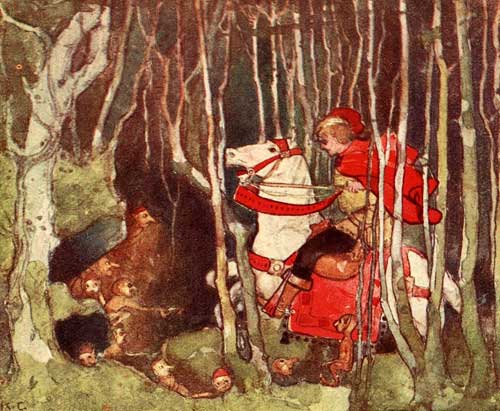
fisherman saw what had caused that, as a gaily clad knight rode forth
from the forest shadows toward the little cottage.
This was no spectre or spirit of the wood, this stranger who wore the
garments of a knight of high degree. He rode a white horse, which
stepped softly, so that the flowers in the meadows lifted their
delicate heads uninjured by his tread.
The fisherman raised his cap as the stranger drew near, and then
quietly went on mending his nets.
Now when the knight saw the old man's face it was welcome to him, as
indeed any human face would have been after the terrors of the forest.
There he had seen strange mocking faces peering at him whichever way
he turned, there he had been followed by strange shadowy forms from
which escape had been wellnigh impossible; here at length was a kind
and friendly mortal. He would ask him for the food and shelter of
which both he and his steed stood in need.
'Dear sir,' answered the fisherman when he had listened to the
knight's request, 'dear sir, if you will deign to enter our lonely
cottage, you will find a welcome with the food and shelter we offer.
As for your horse, can it have a better stable than this tree-shaded
meadow, or more delicious fodder than this green grass?'
Well pleased with this answer, the knight dismounted, and together he
and the fisherman freed the white horse from its saddle and bridle,
and turned it loose into the waving meadow.
Then the old man led the stranger into the cottage.
Here, by the light of the kitchen fire, sat the fisherman's wife. She
rose, with a kind greeting for the unexpected guest. Then seating
herself again in her armchair, she pointed to an old stool with a
broken leg. 'Sit there, good knight,' she said; 'only you must sit
still, lest the broken leg prove too weak to bear you.'
Carrying the stool over beside the old woman, the knight placed it
carefully on the floor and seated himself as he was bidden. As he sat
there talking with the good old fisherman and his wife, it seemed to
him almost as though he were their son, who had come home again after
journeying in a distant land.
It was only when the knight began to speak of the wood that the
fisherman grew restless and refused to listen.
'It were wiser, Sir Knight,' he said, 'not to talk of the wood at
nightfall, or indeed to say much of it at any time.'
And then the old couple told their guest how simply they lived in the
little cottage by the lake, and they in their turn listened eagerly
while the knight told them of himself. He was named Sir Huldbrand, and
he dwelt in his castle of Ringstetten, which stood near the source of
the river Danube.
Now, as he talked or listened to the quiet tales of the old fisherman,
the knight heard a strange sound that seemed to come from the
direction of the window. Again and again it came, a strange sound as
of water being dashed against the window-panes.
It was plain that the fisherman heard it too, for at each splash a
frown crossed his good-natured face.
A louder splash, and a shower of water streamed through the loosely
built window-frame into the kitchen.
Then the old man could sit still no longer. He hastened to the window,
and opening it called out in an angry voice, 'Undine, cease these
childish tricks. A stranger, and he a knight, is in our cottage.'
A low laugh answered him. Hearing it, the old man shut the window and
sat down again, saying to his guest, 'Sir Knight, forgive this rude
behaviour. Undine my foster-daughter is still only a child, although
she is now nearly eighteen years of age. Yet her tricks are harmless,
and she herself is full of kindness.'
'Ah,' said the old woman to her husband, 'to you, who are not with her
save when the day's work is over, her pranks may seem harmless. But
you would not talk so lightly of her ways were she by your side all
day. Ever I must watch her, lest she spoil my baking, or undo my
spinning or burn the soup. Nay—'
'It is true,' said the old man, interrupting his wife with a smile,
'it is true that you have the maiden by your side throughout the
livelong day, while I have but the sea. Yet when the sea is rough and
breaks down my dykes I do not love it the less. Even so do you love
the little one no less for all her tricks and tiresome ways.'
The old woman turned to her guest. 'Indeed, Sir Knight, he speaks
truly. It is not possible to be angry with the maiden long.'
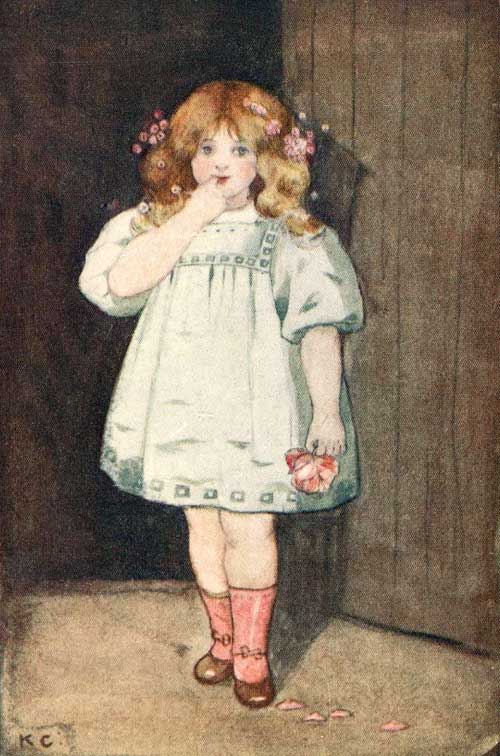
At that moment the door flew open, and she, the maiden of whom they
spoke, entered the little kitchen. She was fairer far than any one the
knight had ever seen.
'Father,' she cried, 'where is he, the stranger guest?'
Even as she spoke her eyes fell on the knight, who had sprung to his
feet as she entered the cottage. He stood gazing in wonder at the
marvellous beauty of the maiden.
But before he could greet her, she was at his side, trustingly looking
up into his face. Then kneeling before him, she seized his hand and
made him seat himself again on the broken old stool.
'You are beautiful, Sir Knight,' she said, 'but how did you come to
this little cottage? Have you looked for us long before you could find
us? Have you had to pass through the terrible forest ere you could
reach us, Sir Knight?'
The knight would have told the maiden the story of his adventures in
the wood, but Undine's foster-mother was already speaking, and her
tones were loud and angry.
'Go, maiden, go get you to work, and trouble not the stranger with
your questions.'
Then Undine, unashamed, drew a little footstool near to Huldbrand, and
sitting down to her spinning, cried, 'I shall work here, close to the
beautiful knight.'
The old fisherman took no notice of the wilful maiden, and began to
speak of other things, hoping that the guest would forget his
foster-daughter's questions.
But even had the knight been able to forget, Undine did not mean to
sit there quietly, her questions unanswered.
Her sweet voice broke upon the silence. 'Our beautiful guest has not
yet told me how he reached our cottage,' she said.
'It is even as you thought,' answered the knight. 'I journeyed through
the haunted wood ere I found this safe and hospitable shelter.'
'Then tell me of your wonderful adventures,' demanded the maiden, 'for
without these no one may pass through the forest.'
Huldbrand shuddered as he remembered the strange beings who had
startled him as he rode through the wood. He glanced distrustfully
toward the window. Were the grim figures there, peering at him through
the window-pane? No, he could see nothing save the dim night light,
which now closed them in.
The knight drew himself up, ashamed of his foolish fears, and turning
toward the maiden, he was beginning to tell her of the wonders which
had befallen him, when the fisherman hurriedly interrupted.
'Nay, now, Sir Knight,' he cried, 'tell not your tale until the hours
of dark have passed.'
At her foster-father's words Undine sprang angrily from the footstool
and stood before him. Her eyes flashed and grew larger, colder.
'You say to the stranger not to tell his tale, father,' she cried,
'you say to him not to answer me. But he shall speak, he shall, he
shall!' And in her anger she stamped her little feet.
The knight wellnigh smiled as he watched the maiden's wrath, but the
old man was grieved that the stranger should see the wayward behaviour
of his foster-child, and he reproved her for her anger. The old woman
also muttered her displeasure.
Then Undine slipped quickly toward the door of the little cottage. She
did not choose to listen to these rebukes.
'I will not stay with you, for you do nothing but scold me, and you
will not do anything that I wish,' she cried, and before they could
reach her she had opened the door, and was away and out, out into the
dark night.