THE GEMS—PRECIOUS METALS—VALUABLE ORES AND USEFUL MINERALS OF THE
UNITED STATES FROM AGATE TO ZINC—THEIR DISTINGUISHING CHARACTERS,
USES AND LOCALITIES—A MINERALOGY FOR MINERS.
THIS stone is a mixture of several kinds of quartz, mainly the white,
red, brown and black, disposed in layers or clouds. The layers are
zigzag, circular or in straight bands (onyx). Occurs in irregular
rounded masses; not very translucent; not altered by heat or acids;
cannot be cut with a knife nor split into plates; takes a high polish;
lustre glassy; gravity 2.5.
Value.—Used for jewelry and ornamental work, mortars, vases,
knife-handles, burnishers, etc. The colors are deepened by boiling in
oil and then in sulphuric acid.
Localities.—Found in granite and trap regions, generally by the shores
of rivers, lakes and the sea; as, north-west shore of Lake Superior;
Missouri, Columbia, Colorado and Connecticut Rivers; Crescent City,
Cal.; Hancock County, Ga.; near Tampa Bay, Fla.; Fulton, Penn.;
Yellowstone Lake, Wy.[3]
Occurs in mealy or solid crusts, often fibrous; dissolves in water;
tastes sweetish-astringent; melts and froths up when heated.
Value.—Extensively used in dyeing and calico-printing, candle-making,
dressing skins, clarifying liquors and in pharmacy.
Localities.—Found incrusting and impregnating dark slaty rocks, with
yellow streaks. Cape Sable, Md.; Cleveland County, N. C.; coal slates
on Ohio River, and in caves in Sevier, De Kalb, Coffee and Franklin
Counties, Tenn.; also Esmeralda and Storey Counties, Nev.
Same as Rock Crystal, but colored purple or bluish violet. Generally
in clustered crystals.
Value.—When clear and finely colored, it is a favorite gem.
Localities.—Usually found with agate. Keweenaw Point, Pic Bay and
Gargontwa on Lake Superior; Bristol, R. I.; Surry, N. H.; East Bradford,
Aston, Chester, Thornbury, Edgemont, Sadsbury, Birmingham, Middletown
and Providence, Penn.; Greensboro, N. C.
Occurs massive; compact; high lustre; brittle; breaks with a curved
surface; will not scratch marble; burns, but not readily, with a pale
blue flame and little smoke; will not form coke by roasting; gravity
1.4 to 1.8.
Value.—Used for fuel and sometimes cut into inkstands, etc.
Localities.—Found in beds between slates and sandstones, and east of
the Alleghany range only, as Eastern Pennsylvania; Portsmouth, R. I.;
Mansfield, Mass.; North Carolina. No workable beds will be found in New
York.
The rocks in anthracite regions are tilted, bent and broken, never level
to any great extent. Impressions of leaves are good indications.
Occurs fibrous or granular; color lead gray, often tarnished; shining
lustre, brittle; but thin pieces can be cut off with a knife; melts in a
candle, at a high heat passing off in vapor; gravity 4.5.
Value.—The source of the antimony of commerce, containing seventy per
cent.
Localities.—Found associated with Silver, Spathic Iron, Blende,
Baryta and Quartz. Carmel, Me.; Lyme, N. H.; Soldier’s Delight,
Md.; Aurora, Nev.; San Amedio Cañon and Tulare County, Cal.
Occurs finely fibrous, flax-like; flexible, not elastic; silky lustre,
sometimes greenish; gravity 3.
Value.—Used for lining safes and steam-packing, and for making
incombustible cloth, lamp-wicks, etc.
Localities.—Found in granite-regions east of the Alleghanies; often
with Serpentine. Brighton, Dedham, Newbury, Pelham and Sheffield,
Mass.; Milford, West Farms, Winchester and Wilton, Conn.; Chester, Mt.
Holly and Cavendish, Vt.; Patterson, Phillipstown, Monroe and Staten
Island, N. Y.; Brunswick, N. J.; East Nottingham, Goshen and Aston,
Penn.; Bare Hills and Cooptown, Md.; Barnet’s Mills, Va.
Occurs massive; brittle; breaking with high lustre like hardened tar,
and with curved surface; melts and burns readily with flame and smoke;
gravity 1.2, sometimes floats on water.
Value.—Used for cements and varnishes.
Localities.—Found generally near the surface. Near the coast of Santa
Barbara, Cal.; West Virginia, twenty miles south of Parkersburg.
Occurs in crystals and masses with glassy lustre, or earthy and dull;
brittle; crackles and blackens, and finally fuses by heat; dissolves
with effervescence in nitric acid; gravity 3.5.
Value.—A valuable ore of copper, containing sixty per cent.
Localities.—Found chiefly in lead and copper mines. Perkiomen lead
mine, Cornwall, Phoenixville and Nicholson’s Gap, Pa; near New
Brunswick, N. J.; near Mineral Point, Wis.; Polk County, Tenn.;
Calaveras and Mariposa Counties, Cal.; near Virginia City, Mont.
Occurs in crystals, plates and masses; powder white; brittle; crackles
when strongly heated; not dissolved in acids; easily distinguished by
its weight; gravity 4.5, or twice as heavy as Gypsum.
Value.—Used extensively as white paint and in pottery.
Localities.—Found in mining districts, often with lead, copper and iron
ores, and in limestone. Piermont, N. H.; Hatfield, Southampton and
Leverett, Mass.; Cheshire and Berlin, Conn.; Pillar Point, Rossie,
Carlisle, Scoharie, De Kalb, Gouverneur, N. Y.; Fauquier and Buckingham
Counties, Va.; Union, Gaston and Orange Counties, N. C.; near Paris, and
in Anderson, Fayette, Mercer and Owen Counties, Ky.; on Brown’s Creek
and Haysboro, Tenn.; Bainbridge, O.; Scales Mound, Ill.; Prince Vein,
Lake Superior; Mine-a-Barton, Mo.; near Fort Wallace, N. M.; Ingo
County, Cal.
Occurs in masses, beds or seams; softer and duller than Anthracite;
often a bright pitchy lustre; brittle, showing a slaty or jointed
structure rather than curved surface; powder black; burns readily with
yellow flame; by roasting forms coke; gravity 1.5 or less.
Value.—Used for fuel and the production of gas, coke, carbolic acid and
aniline.
Localities.—Found west of Harrisburg, Pa., in rocks (slates and
sandstones) less disturbed than in the Anthracite region. Western
Pennsylvania; South-east Ohio; West Virginia; Eastern Kentucky and
Tennessee to Tuscaloosa; North-west Kentucky; Illinois; Iowa; Missouri;
Kansas; Arkansas; Northern Texas; Central Michigan; Owyhee County,
Idaho; Deer Lodge and Gallatin Counties and sixty miles north-east of
Bannock, Mont.
Occurs in crystals and masses; waxy lustre, but not always very
apparent; usual color, rosin-yellow to dark brown; brittle; the powder,
which is whitish to reddish-brown, dissolves in muriatic acid giving off
the odor of rotten eggs; by roasting gives off sulphur-fumes; infusible
alone, but on charcoal at a high heat gives off white fumes; gravity 4.
Value.—An ore of zinc (containing sixty-six per cent.) and a source of
white vitriol. Often worked for its Silver and Gold.
Localities.—Found with lead and other ores. Lubec and Bingham, Me.;
Eaton, Warren and Shelburne, N. H.; Sterling, Southampton and Hatfield,
Mass.; Brookfield, Berlin, Roxbury and Monroe, Conn.; near Wurtzboro’,
Cooper’s Falls, Mineral Point, Fowler, Ancram, Clinton and Spraker’s
Basin, N. Y.; Wheatley and Perkiomen lead-mines, Schuylkill,
Shannonville and Friedensville, Pa.; Austin’s lead-mine, Va.; Haysboro’,
Brown’s Creek and Polk Counties, Tenn.; Prince Vein, Mich.; Dubuque,
Ia.; Warsaw, Rosiclare and Galena, Ill.; Shullsburg, Wis.; Stillwater,
Minn.
Occurs in masses or beds, looking much like hard brown earth; loose or
porous and earthy, rather than compact and nodular; powder
yellowish-brown; when strongly heated becomes black and magnetic;
gravity nearly 4. An earthy yellow variety is called Yellow Ochre.
Value.—An important ore, yielding thirty-five per cent.
Localities.—Found in low, marshy grounds; widely distributed. Lebanon,
N. H.; Berkshire and Plymouth Counties, Mass.; Columbia, St. Lawrence,
Franklin and Jefferson Counties, N. Y.; New Limerick, Katahdin,
Newfield, Shapleigh, Argyle, Clinton, Williamsburg and Lebanon, Me.;
Darien and Martin Counties, Ind.; Monmouth County, N. J.; Somerset and
Worcester Counties, Md.; Michigan, Ohio, Illinois, Wisconsin, etc.
Occurs in crystals and masses; metallic lustre; tarnishes yellow, gray
and finally black; easily cut or broken; when heated gives off fumes of
sulphur and antimony, affording a button of silver; dissolved in nitric
acid, it silvers copper placed in it; gravity 6.
Value.—A rich ore of silver, containing over sixty per cent.
Localities.—Found in veins with other silver ores, in Nevada and Idaho.
Occurs like Bituminous Coal, but usually brownish-black with less
lustre, and often showing a woody or slaty structure; powder always
brown; contains fossil plants; gravity between 1.2 and 1.5.
Value.—Inferior to No. 10. Makes no coke. Can be used in the
manufacture of alum.
Localities.—Found in thin veins or elliptical masses, never in
extensive layers like Pennsylvania coal. Near Richmond, Va.; Deep
River, N. C.; Michigan, Missouri, Texas; Evanston, Utah; Coal Creek and
Bellmonte, Col.; Boreman, Dearborn River and Greenhorn Gulch, Mont.
Occurs in crystals and masses; glossy lustre; harder than marble;
brittle; heated it swells up, becomes opaque and emits a green light;
dissolves, when powdered, in hot sulphuric acid without effervescence;
gravity 3.4.
Value.—An ore of zinc yielding from forty to sixty per cent.
Localities.—Found in limestone rock with other ores. Friedensville,
Perkiomen, Phœnixville, Lancaster and Selin’s Grove, Pa.; Austin’s
Mines in Wythe County, Va.; Claiborne County, Tenn.; Jefferson County,
Mo.
Occurs in compact masses; dull lustre; brittle, breaking with a curved
surface; burns readily but does not melt; does not soil the fingers;
gravity about 1.2.
Value.—Used for fuel and for making gas, oil and ornaments.
Localities.—Found in the Mississippi Valley; Kentucky; Lick, Ohio;
Illinois; Moniteau County, Mo.; Kenawha County, Va.; Beaver County, Pa.
Occurs in masses or pebbles; at first grayish, but by exposure to the
sun becomes uniform flesh, red or brown, never striped,—although
Carnelian may form one of the bands of an Agate; brittle, breaking
with a curved surface; very hard; takes a fine polish; glassy or
resinous lustre; gravity 2.6.
Value.—Used for jewelry. When of two layers, white and red, (properly
called sardonyx,) it is used for cameos.
Localities.—Same as Agate.
Occurs crystallized, fibrous and massive; color white, often faint
bluish; glassy lustre; very brittle; under the blow-pipe crackles and
melts, tinging the flame red; does not dissolve in acids; gravity 4.
Value.—The source of nitrate of strontia, used in fire-works.
Localities.—Found in limestone, gypsum and sandstone. Rossie,
Schoharie, Chaumont Bay, Depauville and Stark, N. Y.; Frankstown, Pa.;
Strontian and Put-in-Bay Islands, Lake Erie; near Nashville, Tenn.; Fort
Dodge, Iowa.
Occurs in crystals, in powder or masses; glassy lustre; brittle;
dissolves in nitric acid with effervescence; heated strongly on charcoal
crackles and fuses, giving a globule of lead; gravity 6.4.
Value.—A rich ore of lead yielding seventy-five per cent.
Localities.—Found in lead mines. Southampton, Mass.; Perkiomen,
Phœnixville, Charlestown and Schuylkill, Pa.; Wythe County, Va.;
Washington Mine, N. C.; Valle’s Diggings, Mine-la-Motte and
Mine-a-Burton, Mo.; Davies and Rock Counties, Ill.; Blue Mounds, Wis.;
Ingo County, Cal.
Occurs in compact masses; powder dark brown; small pieces sometimes
attracted by the magnet; brittle, breaking with uneven surface; with
borax melts into a green globule; not acted upon by acids; little
lustre; gravity 4.4.
Value.—Used in making the chrome pigments.
Localities.—Found in Serpentine. Bare Hills, Cooptown and north part
of Cecil County, Md.; Nottingham, W. Goshen, Williston, Fulton, Mineral
Hill, Texas and Unionville, Pa.; Jay, New Fane, Westfield and Troy, Vt.;
Chester and Blanford, Mass.; Loudon County, Va.; Yancy County, N. C.;
North Almaden, New Idria and Coloma, Cal.
Occurs in granular or earthy masses; resembles iron-rust, but is a
yellowish-red; powder scarlet; easily cut with a knife; thrown on
red-hot iron, evaporates, giving off odor of sulphur; rubbed on copper,
“silvers” it; gravity 9, or about as heavy as Copper.
Value.—The source of mercury (containing eighty-four per cent.) and
vermilion.
Localities.—Found in slate and limestone rocks. Centreville,
Coulterville, New Idria and New Almaden, and Lake and San Luis Obispo
Counties, California; Idaho.
Occurs crystallized and massive; does not scratch glass easily; metallic
lustre; tarnish, copper-red; powder, blackish-gray; brittle; heated on
charcoal gives off sulphur fumes; heated with borax gives a blue glass;
gravity 5.
Value.—An ore of cobalt, yielding twenty per cent.
Localities.—Usually found in slate or granite rocks with Copper
Pyrites. Mineral Hill, Md.; Mine-la-Motte, Mo.
Occurs in irregular masses; metallic lustre; can be cut with a knife;
malleable; ductile; fusible; gravity 8.8.
Value.—A source of copper and silver.
Localities.—Most abundant in the trap and “freestone” regions. New
Brunswick, Somerville, Schuyler’s and Flemington, N. J.; Whately, Mass.;
Cornwall and Shannonville, Pa.; Polk County, Tenn.; Keweenaw Point, Lake
Superior; Calaveras, Amador and Santa Barbara Counties, Cal.; on Gila
River, Ariz.
Occurs crystallized and massive; color, blackish lead-gray, often
tarnished blue or green; nearly as hard as marble; brittle; a splinter
will melt in a candle, giving off the odor of sulphur; dissolved in
nitric acid, it will coat a knife-blade with copper; metallic lustre;
gravity 5.5.
Value.—An ore of copper, yielding seventy-five per cent.
Localities.—Found at copper-mines. Simsbury, Bristol and Cheshire,
Conn.; Schuyler’s Mines, N. J.; Orange County, Va.; near Newmarket, Md.;
Lake Superior copper-region; La Paz, Arizona; Washoe, Humboldt, Nye and
Churchill Counties, Nev.
Occurs in masses; metallic lustre; color pale copper-red; tarnishes gray
to black; powder pale brownish-black; brittle; on charcoal melts giving
the odor of garlic; becomes green in nitric acid; gravity 7.5.
Value.—An ore of nickel (containing forty-four per cent.) and arsenic.
Localities.—Found in granite regions. Chatham, Conn.
Occurs in crystals and masses; color brass-yellow; tarnishes green;
metallic lustre when freshly broken; can be cut with a knife; brittle;
powder greenish black; on charcoal melts giving off sulphur fumes;
dissolves in nitric acid, making a green liquid; gravity 4.2.
Value.—If of a fine yellow hue, it is a valuable copper ore (yielding
from twelve to forty per cent.) and source of blue vitriol.
Localities.—Found in mountainous or granite regions with other ores.
Lubec and Dexter, Me.; Franconia, Unity, Warren, Eaton, Lyme, Haverhill
and Shelburne, N. H.; Corinth, Waterbury and Strafford, Vt.;
Southampton, Turner’s Falls, Hatfield and Sterling, Mass.; Bristol and
Middletown, Conn.; Ancram, Rossie, Wurtzboro’ and Ellenville, N. Y.;
Phœnixville and Pottstown, Pa.; Bare Hills, Catoctin Mountains, near
Newmarket and Finksbury, Md.; Phœnix and Walton Mines, Va.;
Greensboro, Charlotte and Phœnix Mines, N. C.; Hiwassee Mines, Tenn;
Cherokee, Rabun and Habersham Counties, Ga.; Presque Island, Lake
Superior; Mineral Point, Wis.; Union, Keystone, Empire and other mines,
Calaveras County, La Victoire and Haskell claims in Mariposa County,
Amador and Plumas Counties, Cal.; near Virginia City, Mont.
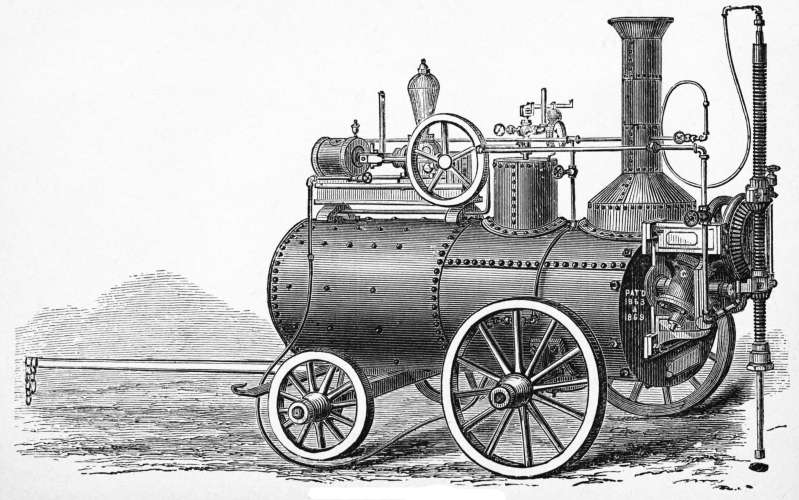 PROSPECTING DIAMOND DRILL.
Occurs in crystals and irregular angular masses; cannot be scratched by
any other mineral or the file; brilliant lustre; feels cold to the
touch; when rubbed on the sleeve exhibits electricity for hours; retains
the breath but a short time; often tinged yellow, red, or green; gravity
3.5.
Value.—Used for jewelry, lenses and for cutting glass.
Localities.—Found in gold-regions, in river-washings of sand and
pebbles; usually with coarse gold, but deeper down. Rutherford,
Cabarras, Franklin and Lincoln Counties, N. C.; Hall County, Ga.;
Manchester, Va.; Cherokee Ravine, N. San Juan, French Canal, Forrest
Hill, Placerville and Fiddletown, Cal.
Occurs in granular masses, sometimes with bluish crystals; looks like
fine grained iron ore; breaks with uneven surface; scratches quartz
easily; very tough; brittle; gravity 4.
Value.—Used extensively as a cutting and polishing material.
Localities.—Found generally in limestone or granite with Magnetic Iron
Ore. Chester, Mass.; Newlin and Unionville, Penn.; Macon and Guilford
Counties, N. C.
Occurs in square crystals and in masses; glassy lustre; powder white;
brittle; crackles when heated and then shines in the dark; does not
effervesce with acids; is not scratched by marble; gravity 3.
Value.—Used as flux in glass and iron works.
Localities.—Found in limestone, granite, slate, etc., often at
lead-mines. Blue Hill Bay, Me.; Westmoreland, N. H.; Putney, Vt.;
Southampton, Mass.; Trumbull, Plymouth, Middletown and Willimantic,
Conn.; Muscolonge Lake, Rossie and Johnsburg, N. Y.; near Franklin, N.
J.; near Woodstock and Shepardstown, Va.; Smith County, Tenn.; Mercer
County, Ky.; Gallatin County, along the Ohio, Ill. Castle Dome
District, Ariz.
Occurs crystallized and in masses; generally made of coarse grains;
brittle; powder dark reddish-brown; heated with soda turns bluish-green;
dissolves in muriatic acid; gravity 5.
Value.—An ore of zinc.
Localities.—Found in limestone with Garnet and Zincite. Hamburg and
Stirling Hill, N. J.
Occurs in crystals and masses; brilliant lustre; brittle; easily broken;
powder, when finely rubbed is black; can be cut with a knife; heated it
gives off sulphur and melts; dissolves in nitric acid leaving a white
powder at the bottom; gravity 7.5—or a little heavier than cast-iron.
Value.—The main source of lead (yielding eighty per cent), and also
smelted for the silver it contains. Used also in glazing stone-ware.
Localities.—Generally found in limestone with Iron Pyrites, zinc-ore,
etc. That found in slate is richest in silver. Abounds in Missouri,
Illinois, Iowa, Wisconsin and Arkansas; Rossie, Wurtzboro, Ancram,
Macomb and Ellenville, N. Y.; Lubec, Blue Hill Bay, Bingham and
Parsonsville, Me.; Eaton, Shelburne, Haverill, Warren and Bath, N. H.;
Thetford, Vt.; Southampton, Leverett and Sterling, Mass.; Middletown and
Roxbury, Conn.; Phœnixville, Charlestown, Schuylkill, Pequea Valley
and Shannonville, Pa.; Austin’s and Walton’s Mines, Va.; Cabarras
County, N. C.; Brown’s Creek and Haysboro, Tenn.; Chocolate River,
Mich.; Ingo County, Cal.; on Walker’s River and Steamboat Springs, Nev.;
Castle Dome and Eureka, Ariz.; Clear Creek County, Col.; Virginia City
and Red Bluff Lode, Mont.; Cache Valley, Utah.
Occurs in crystals with four-sided faces; often nearly round; deep red,
which grows darker by heat; rarely yellow; also in brown masses; melts
at a high heat; brittle; not scratched by a knife; glassy lustre;
gravity 4.
Value.—The clear deep red and yellow varieties are used for jewelry;
the massive brown is ground for “emery.”
Localities.—Found in slate and granite rocks. Bethel, Parsonsfield,
Phippsburg, Windham, Brunswick and Ranford, Me.; Hanover, Franconia,
Haverhill, Warren, Unity, Lisbon and Grafton, N. H.; New Fane, Cabot and
Cavendish, Vt.; Carlisle, Boxborough, Brookfield, Brimfield, Newbury,
Bedford, Chesterfield and Barre, Mass.; Reading, Monroe, Haddam and
Middletown, Conn.; Rogers’ Rock, Crown Point, Willsboro, Middletown,
Amity, and near Yonkers, N. Y.; Franklin, N. J.; Pennsbury, Warwick,
Aston, Knauertown, Chester, Leiperville and Mineral Hill, Pa.; Dickson’s
Quarry, Del.; Hope Valley, Cal.; near Virginia City, on Yellowstone and
Madison Rivers, Mont.
Occurs in scales, grains and nuggets, or disseminated through cellular
quartz; metallic lustre; without tarnish; can be cut and hammered into
thin plates; not dissolved by nitric acid; gravity 19, when pure and of
a rich gold yellow color. The pale or brass yellow specimens are much
lighter, the gravity being as low as 13. A grayish yellow gold,
occurring in small, flat grains has a gravity of about 16.
Localities.—Found in veins of quartz running through greenish or
grayish slates, the quartz at the surface being generally full of
cavities and rusted, and the slates below the surface often containing
little cubic crystals of Iron Pyrites: also in the valleys traversed
by mountain-streams and in the river sands and gravel below. Iron and
Copper Pyrites, Galena and Blende frequently contain gold. Masses
of quartz and pyrites from the gold-regions, which make no show of gold,
sometimes pay well; the value of such specimens can be
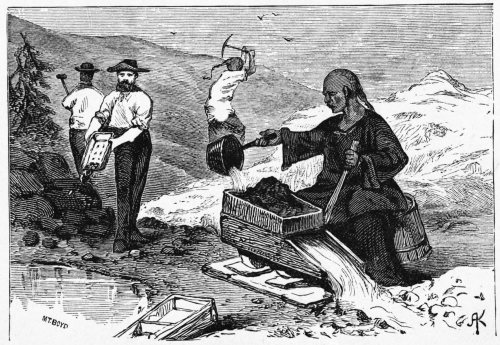 WASHING AURIFEROUS SANDS.
determined only by an assayer. Eastern range of Appalachians, as
Habersham, Rabun, Clark, Hall, Lumpkin and Lincoln Counties, Ga.;
Abbeville, Chesterfield, Union, Lancaster and Pickens Counties, S. C.;
Montgomery, Cabarras, Mechlenburg, Burke and Lincoln Counties, N. C.;
Spotsylvania, Buckingham, Fauquier, Stafford, Culpepper, Orange,
Goochland and Louisa Counties, Va.; Dedham, Mass.; Bridgewater, Vt.;
Canaan and Lisbon, N. H.; on Sandy River and Madrid, Me. Numberless
points along the higher Rocky Mountains and western slope of Sierra
Nevada, as near Santa Fe, Cerillos and Avo, New Mex.; San Francisco,
Wauba and Yuma District, Ariz; between Long’s Peak and Pike’s Peak,
Col.; Comstock Lode, Nev.; Owyhee, Boise and Flint Districts and Poorman
Lode, Idaho; Emigrant and Alder Gulches, Red Bluff and near Jefferson
River, Mont.; Josephine District, Powder, Burnt, and John Day Rivers,
western slope of Cascade Mountains, and southern coast, Oregon; Tulare,
Fresno, Mariposa, Tuolumne, Calaveras, El Dorado, Placer, Nevada, Yuba,
Sierra, Butte, Plumas, Shasta, Siskiyou Amador and Del Norte Counties,
Cal. Rare in the coal-regions and Mississippi Valley.
Occurs in foliated, scaly and granular masses; can be cut into thin
slices, which are flexible, but not elastic; impressible by the nail;
feels greasy; leaves a shining trace on paper; metallic lustre; not
altered by heat or acids; gravity 2.
Value.—Used for pencils, polishing, glazing, for making steel,
crucibles, overcoming friction, etc.
Localities.—Found in granite, slate and limestone rocks. Sturbridge,
North Brookfield, Brimfield, Hinsdale and Worthington, Mass.; Cornwall
and Ashford, Conn.; Brandon, Vt.; Woodstock, Me.; Goshen, Hillsboro and
Keene, N. H.; Ticonderoga, Fishkill, Roger’s Rock, Johnsburg, Fort Ann,
Amity, Rossie and Alexandria, N. Y.; Franklin and Lockwood, N. J.;
Southampton and Buck’s County, Penn.; on the Gunpowder, Md.; Albemarle
County, Va.; Wake, N. C.; Tiger River and Spartanburgh, S. C.; Sonora,
Cal. (The soft black slate, often mistaken for Graphite, leaves a
coaly trace on paper not a shining streak.)
Occurs in crystallized or granular masses; metallic lustre; color
between steel-gray and iron-black; brittle; the powder dissolved in
nitric acid makes a brownish green solution; melts at a red heat;
gravity 5.
Value.—An ore of copper, (containing thirty-three per cent.) and
silver, of which Nevada specimens have sixteen per cent.
Localities.—Found with gold, silver and lead. Kellogg Mines, Ark.;
Mariposa and Shasta Counties, Cal.; Sheba and De Soto Mines, and near
Austin, Nev.; Heintzelman and Santa Rita Mines, Arizona.
Occurs in plates, fibres coarse and fine, and massive; pearly or
glistening; powder white, which if heated and mixed with water, turns
hard; does not dissolve in sulphuric acid; may be scratched by the nail;
gravity 2.3.
Value.—Used for stucco, manure, glazing, statuary, manufacture of
glass, etc. A variety, called Satin Spar, worked into necklace beads
and other ornaments, is finely fibrous and compact, taking a polish
(though easily scratched,) and then resembles pearl or opal.
Localities.—Found with marl or clay, limestone and salt. Camillus,
Manlius, Stark and Lockport, N. Y.; on the St. Mary’s and Patuxent, Md.;
Washington County and Lynchburg, Va.; Charleston, S. C.; Poland, Ottawa
and Canfield, O.; Davidson and Summer Counties, Tenn.; Grand Rapids and
Sagenaw Bay, Mich.; Des Moines River, Iowa; Walker Lake and Six Mile
Cañon, Nev.; Fort Dodge.
Occurs in crystals, wax-like masses, or in crusts; when scratched shows
a shining streak; becomes brown on exposure; quite soft, easily cut; a
small piece placed on zinc and moistened, swells up, turns black and
shows metallic silver on being pressed with a knife; dissolves in
hartshorn; gravity 5.5.
Value.—An ore of silver, yielding seventy per cent.
Localities.-Found in slate with other silver ores. Lake Superior Mining
Region; Austin and Comstock Lode, Nev.; Willow Springs and San Francisco
districts, Eldorado Cañon, Ariz.; Poorman Mine, Idaho.
Occurs in masses and square crystals; splendent lustre; color,
bronze-yellow; brittle; strikes fire with steel; heated it gives off
sulphur fumes; powder brownish; gravity 5.
Value.—Affords sulphur, copperas and alum. When found outside of the
coal region, it often contains gold and silver.
Localities.—Found in all kinds of rocks. Bingham, Corinna, Farmington,
Waterville, Brooksville, Peru and Jewett’s Island, Me.; Shelburne, Unity
and Warren, N. H.; Baltimore, Hartford and Shoreham, Vt.; Heath,
Hubbardston and Hawley, Mass.; Roxbury, Monroe, Orange, Milford,
Middletown, Stafford, Colchester, Ashford, Tolland and Union, Conn.;
Rossie, Malone, Phillips, Johnsburgh, Canton, Chester, Warwick and
Franklin, Putnam and Orange Counties, N. Y.; Chester, Knauertown,
Cornwall and Pottstown, Pa.; Greensboro’, N. C.; Mercer County, Ky.;
Bainbridge, O.; Galena at Marsden’s Diggings, Ill.; on Sugar Creek,
Ind.; mines of Colorado and California.
Occurs in masses, either in veins or as rounded stones; dull lustre, yet
takes a high polish; breaks with a curved surface; not attacked by
acids; is scratched by Rock Crystal; gravity 2.5.
Value.—Used for mosaics and other ornaments when compact, fine-grained
and bright color.
Localities.—Found everywhere. Sugar Loaf Mountain and Machiasport, Me.;
Saugus, Mass.; Castleton and Colchester, Vt.; Bloomingrove, N. Y.;
Murphy’s, Col.; Red Bluff, Mont.
Occurs in beds; it is a fine, white clay, plastic when wet; when dry is
scaly or compact; can be crumbled in the fingers and feels gritty;
adheres to the tongue; does not dissolve in acids.
Value.—Used for the finest porcelain and for adulterating candy.
Localities.—Found generally with iron-ore and fire-clay. Common on the
eastern slope of the Alleghanies; Branford, Vt.; Beekman, Athol,
Johnsburgh and McIntyre, N. Y.; Perth Amboy, N. J.; Reading, Tamaqua and
New Garden, Penn.; Mt. Savage, Md.; Richmond, Va.; Newcastle and
Wilmington, Del.; Edgefield, S. C.; near Augusta, Ga.; Jacksonville,
Ala.
Occurs in beds or masses, consisting of minute flattened grains; little
lustre; generally soils the fingers; breathed upon has a clayey odor;
color, brownish-red, powder more red; dissolves in strong muriatic acid
with some effervescence; brittle; gravity 4.
Value.—An ore of iron yielding thirty-three per cent. Generally mixed
with other ores at the furnace.
Localities.—Found in sandstone. Wayne, Madison, Oneida and Herkimer
Counties, N. Y.; Marietta O.
Occurs in masses, with smooth rounded surfaces and fibrous structure;
sometimes as hollow nodules, which are velvety-black inside; its powder
when rubbed is yellowish-brown; when strongly heated turns black;
scratches glass feebly; brittle; dissolves in hot aqua-regia; gravity 4.
Value.—A common ore of pig-iron, containing sixty per cent.; used also
for polishing buttons, etc.
Localities.—Found in heavy beds with mica-slate, quartz, limestone,
etc. Salisbury and Kent, Conn.; Amenia, Fishkill, Dover and Beekman, N.
Y.; Richmond and Lenox, Mass.; Pittsfield, Putney, Bennington and
Ripton, Vt.; Hamburgh, N. J.; Pikeland and White Marsh, Penn.;
Marquette, Mich.; Makoquata River, Iowa; Iron Mountains, Stow and Green
Counties, Mo.; Centerville, Ala.; near Raleigh and Smithfield, N. C.; on
Coal Creek, Col.; and in coal areas generally.
Occurs in granular masses, coarse or fine; attracted by the magnet, or
affecting the compass-needle; powder black; brittle; dissolves in
muriatic acid; gravity 5.
Value.—An important ore, yielding sixty-five per cent.
Localities.—Found in granite, slate and limestone rocks. Warren, Essex,
Clinton, Saratoga, Herkimer, Orange and Putnam Counties, N. Y.; Raymond
and Marshall’s Island, Me.; Franconia, Jackson, Winchester, Lisbon,
Swanzey and Unity, N. H.; Bridgewater, Chittenden, Marlboro, Rochester,
Troy and Bethel, Vt.; Cambealon, R. I; Hawley and Bernardston, Mass.;
Haddam, Conn.; Goshen, Webb’s Mine, Cornwall and White Marsh, Penn.;
Hamburg, N. J.; Scott’s Mills and Deer Creek, Md.; Mitchell and Madison
Counties, N. C.; Spartanburg, S. C.; Laclede and Crawford Counties, Mo.;
Sierra County, (Gold Valley,) Plumas, Tulare, Mariposa, Placer and El
Dorado Counties, Cal.
Occurs massive; brittle; deep orange-yellow; powder grayish-black;
metallic lustre; tarnishes easily; slightly attracts the
compass-needle; melts at a high heat, giving off sulphur-fumes; gravity
4.5.
Value.—Affords sulphur, copperas and nickel.
Localities.—Found in granite regions, often with copper and iron ores.
Stafford, Corinth and Shrewsbury, Vt.; Trumbull and Monroe, Conn.; Port
Henry, Diana and Orange County, N. Y.; Hurdstown, N. J.; Gap Mine,
Lancaster County, Pa.; Ducktown Mines, Tenn.
Occurs in incrustations with smooth surface and fibrous; powder paler
green than the mineral; brittle; by heat crackles and turns black;
effervesces in acids; takes a fine polish, showing bands or rings;
gravity 4.
Value.—Used for jewelry and inlaid work.
Localities.—Found in copper and lead mines. Cheshire, Conn.; Brunswick
and Schuyler’s Mines, N. J.; Morgantown, Cornwall, near Nicholson’s Gap,
Perkiomen and Phœnixville Lead Mines, Pa.; Petapsco Mines, Md.;
Davidson County N. C.; Polk County, Tenn.; Left Hand River and Mineral
Point, Wis.; Falls of St. Croix, Minn.; Jefferson County and Mine la
Motte, Mo.; Calaveras County, Cal.; Big Williams’ Fork, Ariz.; Wild Cat
Cañon and near Virginia City, Mont.
Occurs in masses; glassy lustre; color flesh or rose-red; becomes black
on exposure; tough; melted with borax gives a violet-blue color; gravity
3.5.
Value.—Used in glazing stone-ware.
Localities.—Found in granite regions, often with iron-ore. Blue Hill
Bay, Me.; Cummington, Warwick and Plainfield, Mass.; Irasburg and
Coventry, Vt.; Winchester, and Hinsdale, N. H.; Cumberland, R. I.;
Franklin and Hamburg, N. J.
Occurs coarse and fine granular; frequently veined or mottled; brittle;
can be cut with a knife; takes a polish; effervesces with acids;
reduced to quicklime by heat; a gray variety contains stems and joints
of worm-like fossils; gravity 2.5.
Localities.—Brandon, Rutland, Dorset, Shoreham, Pittsford, Middlebury,
Fairhaven, Cavendish, Lowell, Troy and Sudbury, Vt.; West Stockbridge,
Egremont, Great Barrington, Lanesboro, New Ashford, Sheffield, New
Marlboro, Adams, Cheshire and Stoneham, Mass.; Clinton, Essex, Dutchess,
Onondaga, Putnam, St. Lawrence, Warren and Westchester, Counties, N. Y.;
Smithfield, R. I.; New Haven, Milford, Conn.; near Philadelphia, N. J.;
Texas and Hagerstown, Md.; Lancaster County, Pa.; Jefferson and
Genevieve Counties, Mo.; Knox and Sevier Counties, Tenn.; Joliet, Ill.;
Cherokee and Macon Counties, N. C.; Marquette, Mich.; near Deep River
and on the Michigamig and Menominee Rivers, Wis.
Occurs in masses, which can be split into very thin, elastic leaves;
pearly lustre; at a high heat becomes opaque; gravity 3.
Value.—Used for doors of stoves, etc.
Localities.—Found in granite regions. Buckfield, Freeport and Oxford,
Me.; Acworth, Grafton and Alstead, N. H.; Chesterfield, Barre, Mendon,
South Royalston, Brimfield, Goshen and Russell, Mass.; Monroe, Haddam
and Middletown, Conn.; Warwick, Edenville, Edwards, Monroe and
Greenfield, N. Y.; Pennsbury, Thornbury, Unionville, Middletown and
Chestnut Hill, Pa.; Jones’ Falls, Md.
Resembles Specular Iron Ore, but consists of thin shining scales or
leaves; powder dark red; a thin flake is translucent, showing red light;
feels somewhat slippery.
Value.—Used as an ore of iron and for polishing.
Localities.—Hawley, Mass.; Piermont, N. H.; Ticonderoga, N. Y.;
Warwick, Penn.; Loudon County, Va.
Occurs in thin crusts, delicate needles, or disseminated through the
loose earth in caves; glossy lustre; brittle; cool, saline taste;
crackles and burns brightly on live coals; a little harder than
Gypsum.
Value.—Used in the manufacture of gunpowder, fulminating powders,
nitric acid, etc.
Localities.—Marion County, Ky.; White County, Tenn.; near Rosiclare,
Ill.; Silver Peak, Nev.
Occurs in masses and little columns, often with small rounded surfaces;
one ore is soft enough to be impressed by the nail, and soils; the other
will scratch glass faintly; heated with borax, makes a violet glass;
dissolves in hot muriatic acid, giving forth a yellowish-green gas;
gravity 4 to 5.
Value.—Used for bleaching and for obtaining oxygen.
Localities.—Found in granite regions, often with iron-ore. Brandon,
Bennington, Monkton, Irasburg and Chittenden, Vt.; Hillsdale,
Westmoreland and Westchester, N. H.; Plainfield, West Stockbridge and
Conway, Mass.; Salisbury and Kent, Conn.; Montgomery County, Md.; Lake
Superior Mining Region; Dubuque, Iowa; Deep Diggings, Mo.; Red Island,
Cal.; Martinsburg, N. Y.
Occurs in grains or lumps; metallic, silvery lustre; can be hammered
out; heavier and harder than silver; not dissolved in nitric acid;
gravity 17.
Value.—Nearly equal to Gold. Used for making chemical and
philosophical apparatus, for coating copper, brass, etc.
Localities.—Found in river-gravel with Gold. Rutherford County, N.
C.; Klamath region, Cape Blanco, on Salmon River, South Fork of Trinity,
Butte, Honcut, Cañon and Wood’s Creeks, and on Middle Fork of American
River, Cal.; at Gold Flat, Nev.
Occurs in crystals and masses; cochineal-red; powder brownish-red;
nearly opaque; brittle; dissolves in nitric acid; heated on charcoal
yields a globule of copper; gravity 6.
Value.—Affords copper, (sixty per cent.,) and blue vitriol.
Localities.—Found in trap regions with other copper ores. Schuyler’s,
Somerville, New Brunswick and Flemington Mines, N. J.; Cornwall, Pa.;
Ladenton, N. Y.; Lake Superior Region. Not abundant.
54—Red Hematite.
Occurs in compact masses, with rounded surfaces or kidney-shaped;
fibrous structure; color brownish-red to iron-black; but powder
invariably red; when black, the lustre is somewhat metallic, otherwise
dull; brittle; scratches glass with difficulty; dissolves slowly in
strong muriatic acid; gravity 4.5 to 5.
Value.—An ore of iron, yielding from thirty-six to fifty per cent. In
powder, used as pigment and for polishing metals.
Localities.—Found usually in beds with granite or limestone. Aroostook
County and Hodgdon, Me.; Antwerp, Ticonderoga, Crown Point and
Gouverneur, N. Y.; Vernon, N. J.; West Whiteland, Pa.; Chatham and
Orange Counties, N. C.; Marquette, Mich; Shasta County, Cal. This
mineral graduates into a soft, earthy variety, called red ochre, and
into a compact, slaty variety, called red chalk, which has a clayey
odor when breathed on.
Occurs in crystals and masses; metallic lustre; brittle; powder
cochineal-red; easily cut; at a high heat yields a silver globule; the
powder heated with potash turns black; gravity 6.
Value.—An ore of silver yielding sixty per cent.
Localities.—Found at gold and silver mines. Washoe and Austin, Nev.;
Poorman Lode, Idaho.
Occurs in masses; wax-like; a trifle harder than marble; when fresh can
be scratched by the nail; soapy feel; takes a polish; cleavable; gravity
2.8.
Value.—Used as a marble and worked into inkstands, etc.
Localities.—Found with steatite, serpentine, limestone, etc.
Antwerp, Canton, Fowler, De Kalb, Edwards, Russell and Gouverneur, N. Y.
Occurs in crystals and masses; transparent; glassy lustre; colorless;
tough; brittle; not acted upon by acids or heat; electric by friction;
gravity 2.5.
Value.—Cut for ornaments, lenses, etc.
Localities.—Common in sandstone, limestone and iron ore. Paris, Me.;
Benton and Bartlett, N. H.; Sharon and Woodstock, Vt.; Pelham and
Chesterfield, Mass.; Ellenville, Little Falls, Watervliet, Fairfield,
Middleville, Fowler, Antwerp, Rossie, Lake George and Palatine, N. Y.;
Minnesota Mine, Lake Superior; Ouachita Spring, Ark.
Occurs in irregular beds or masses; brittle; saline taste; crackles in
the fire.
Localities.—Found with gypsum, clay and sandstone. Washington County,
Va.; Petit Anse, La.; Silver Peak, Nev.; Salmon River Mountains, Oregon.
Occurs in crystals generally; metallic lustre; powder pale brown;
brittle; unchanged by heat or acids; if powdered and fused with potash,
then dissolved in muriatic acid, the solution boiled with tinfoil
assumes a beautiful violet color; gravity 4.
Value.—Used for coloring porcelain and artificial teeth.
Localities.—Found in granite and, limestone rocks. Warren, Me.;
Merrimack, and Warren, N. H.; Bristol, Putney and Waterbury, Vt.;
Windsor, Shelburne, Barre, Conway and Leyden, Mass.; Monroe, Conn.;
Warwick, Edenville, Amity and Kingsbridge, N. Y.; Sudsbury, West
Bradford, Parksburg, Concord and Newlin, Pa.; Newton, N. J.; Crowder’s
and Clubb Mountains, N. C.; Habersham and Lincoln Counties, Ga.; Magnet
Cave, Ark.
Occurs in masses; feeble, resinous lustre; color oily green; powder
whitish; often yellowish gray on the outside; can be cut easily; takes a
fine polish; becomes reddish by heat; gravity 2.5—same as Marble.
Value.—Worked into mantels, jambs, table-tops, and many other
ornaments.
Localities.—Found as a rock in large masses. Deer Isle, Me.; Baltimore,
Cavendish, Jay and Troy, Vt.; Newbury, Blanford, Middlefield and
Westfield, Mass.; Newport, R. I.; near New Haven and Milford, Conn.;
Port Henry, Antwerp, Syracuse, Warwick, Phillipstown, Canton,
Gouverneur, Johnsburg, Davenport’s Neck, New Rochelle and Rye, N. Y.;
Frankford, Hoboken and Montville, N. J.; Texas, Pa.; Cooptown, Md.;
Patterson, N. C.; Calaveras County, Cal.; Alder Gulch, Mont. Marble
veined with serpentine is called verd-antique.
Occurs in incrustations and masses; color bluish-green; not fibrous;
surface smooth; easily cut; does not effervesce in acid; blackens by
heat; gravity 2.
Value.—An ore of copper, yielding thirty per cent.
Localities.—Found with other copper ores. Somerville and Schuyler’s, N.
J.; Morgantown and Cornwall, Pa.; Wolcottville, Conn.; Big Williams’
Fork, Ariz.
Occurs in masses, or strings and threads penetrating rocks and native
copper and galena; metallic lustre; tarnishes grayish black; can be cut
in slices and hammered out; dissolved in muriatic acid, it turns black
on exposure; gravity 10.
Localities.—Chiefly found with copper near trap-rocks, and in fine
grained galena and dark brown blende. Gold contains from one to
fifteen per cent. Bridgewater, N. J.; Davidson and Stanley Counties, N.
C.; Lake Superior Region; Poorman’s Lode, Idaho; Comstock Lode and
Montezuma Ledge, Nev.; Alpine County and Maris Vein, Cal.; Clear Creek
County, Col.
Occurs in small lumps, plates and threads; color dark gray; cuts like
lead; melts in a candle giving off sulphur fumes; gravity 7.
Value.—The most important ore of silver, containing eighty-seven per
cent.
Localities.—May be found almost everywhere, except in the coal regions;
associated with other ores, quartz, limestone, baryta, etc. Most
abundant where mineral veins cross one another. Comstock Lode, Gold
Hill, Reese River, Cortez District and Silver-Sprout Vein, Nev.; Clear
Creek County, Nev.
Occurs in crystals and masses; metallic lustre; color tin-white to
steel-gray; powder dark gray; brittle; gives off garlic odor in a
candle; melted with borax makes a deep blue glass; gravity 6.5 to 7.
Value.—An ore of cobalt and arsenic, containing eighteen to seventy per
cent.
Localities.—Found in veins in granite regions with other ores, Mine la
Motte, Mo.; Chatham, Conn.
Occurs in masses, often rounded, covered with minute crystals, or
honeycombed; color white, dirty yellow or stone color; glassy lustre;
brittle; effervesces in nitric acid; barely scratches glass; barely
translucent; gravity 4.4.
Value.—Yields fifty per cent. of zinc.
Localities.—Found generally in limestone with galena and blende.
Friedenville, Lancaster and Perkiomen, Pa.; Linden and Mineral Points,
Wis.; Lawrence, County, Ark.; Ewing’s Diggings, Minn.
Occurs in crystals or plates somewhat curving; also (in coal regions) in
nodules with concentric layers like an onion; brittle; color varies from
white to yellowish-brown or dark-brown; strongly heated it blackens and
will then attract the compass needle; the powder effervesces in nitric
acid; melted with borax makes a green or yellow glass; gravity 3.8.
Value.—Yields thirty per cent. of iron, well adapted for steel.
Localities.—Found in granite and coal-formations, often with other
ores. Plymouth, Vt.; Sterling, Mass.; Roxbury, Conn.; Antwerp, Herman
and Rossie, N. Y.; Fentress and Harlem Mines, N. C.; Coal Regions of
Western Pa., Virginia, Eastern Ohio, etc.
Occurs crystallized and in large masses, high metallic lustre; color
steel-gray or iron-black; brittle; opaque except when very thin; the
powder when very fine and rubbed on white paper shows red; the powder
dissolves slowly in muriatic acid; by a strong heat yields a black mass
which attracts the needle; gravity 5.
Value.—Yields from fifty to seventy per cent. of iron.
Localities.—Found in granite regions. Marquette, Mich.; Pilot Knob and
Iron Mountains, Mo.; St. Lawrence County, N. Y.; Bartlett, Lisbon and
Franconia, N. H.; Chittenden and Weathersfield, Vt.; Sauk County, Wis.
Occurs in pyramidal crystals; glassy lustre; powder white; scratches
rock-crystal; by heat becomes black; gravity 3.5.
Value.—A gem; clear specimens weighing over four carats, are valued at
half the price of the diamond.
Localities.—Found in granular limestone and clay. Amity and Gouverneur,
N. Y.; Franklin and Byram, N. J.; Bolton and Boxborough, Mass.
Occurs in masses, consisting of minute pearly scales or grains; can be
marked by the nail; hardens by heat; soapy feel; gravity 2.5.
Value.—Used for fire-stones, tubes, in manufacture of porcelain, etc.
Localities.—Found in beds with limestone, serpentine and slate. Orr’s
Island, Me.; Francestown, Keene, Orford and Pelham, N. H.; Athens,
Cavendish, Marlboro, Moreton, New Fane, Bradboro, Troy, Waterville,
Westfield, Weathersfield and Windham, Vt.; Middlefield, Lenox and
Westfield, Mass.; Manayunk and Chestnut Hill, Pa.; Albemarle and Loudon
Counties, Va.; Staten Island and St. Lawrence County, N. Y.; Bare Hills,
Md.
Occurs in crystals and in fibrous or granular masses; glassy lustre;
brittle; thin pieces melt before a blow-pipe tinging the flame red;
effervesces with acids; gravity 3.6.
Value.—A source of nitrate of strontia used in fire-works.
Localities.—Found in limestone. Schoharie, Muscalonge Lake, Chaumont
Bay and Theresa, N. Y.
Occurs in crystals, masses and crusts; brittle; can be easily cut; burns
with a blue flame and sulphur odor; gravity 2.
Localities.—Found in limestone and gypsum, and around geysers and
sulphur springs. Springport, N. Y.; on the Potomac, twenty-five miles
above Washington; Put-in-Bay Island, Lake Erie; Clear Lake, Cal.; Santa
Barbara County, Col.; Humboldt County, Nev.
Occurs in crystals, grains and masses; high lustre; powder gray or
brownish; brittle; will strike fire with steel; unaltered by heat or
acids; gravity 7,—being nearly as heavy as lead-ore.
Value.—The only ore of tin, containing seventy-nine per cent. No
gold-mine ever paid such profits as the tin mines of Cornwall.
Localities.—Jackson, N. H.; Temescal, Cal.; Boonville, Idaho; near
Fredericktown, Mo.
Occurs in crystals; glassy lustre; brittle; scratches rock-crystal;
not acted upon by ordinary heat or acids; gravity 3.5.
Value.—A gem; the most esteemed are the rose-red and white.
Localities.—Found in granite. Trumbull, Willimantic and Middletown,
Conn.; Crowder’s Mountain, N. C.; Thomas’s Mountains, Utah.
Occurs in crystals, usually in long, slender three-sided prisms which
break easily, glassy lustre; brittle; becomes milk-white by heat;
scratches rock-crystal and garnet; gravity 3.
Value.—Used for jewelry.
Localities.—Found in granite rocks. Paris, Albany and Hebron, Me.;
Chesterfield and Goshen, Mass.; Newlin and Marple, Pa.
Occurs in crystals and masses; metallic lustre; quickly tarnishes; color
between copper-red and light-brown; powder pale grayish-black; dissolves
in nitric acid; at a high heat melts to a copper globule; heated on
charcoal gives off fumes of sulphur; gravity 5.
Value.—An important ore of copper yielding sixty per cent.
Localities.—Found in granite, freestone, etc., with other ores. Bristol
and Cheshire, Conn.; Mahoopeny, Pa.; Copper Mines of N. J.
Occurs in masses; earthy and loose; can be broken by the fingers, and
soils; no lustre; melted with borax makes a violet glass; feels very
light.
Value.—Used in bleaching and for making smalt.
Localities.—Found in low places, generally in the vicinity of slate or
iron ore beds. Warren, Vt.; Blue Hill, Hodgdon and Thomaston, Me.;
Columbia and Duchess Counties, Austerlitz, Canaan Centre and
Martinsburg, N. Y.; East Bradford and White Marsh, Pa.; Mine la Motte,
Mo.
Occurs in crystals and masses; feeble lustre; brittle; can hardly be cut
with a knife; sometimes scratches glass; makes a jelly in muriatic acid;
gravity 4.
Value.—Contains seventy per cent. of zinc.
Localities.—Found in limestone with zincite. Franklin and Sterling,
N. J.
Occurs in foliated masses or grains, powder orange-yellow; brittle;
dissolves in acids without effervescence; gravity 5.5.
Value.—Yields seventy-five per cent. of zinc.
Localities.—Found in limestone with Franklinite, Garnet, etc.
Sterling Hill and Mine Hill, N. J.