The early summer dawn was
creeping over the silent Campagna
when Tristan reached the
Inn of The Golden Shield.
As one dazed he had traversed
the deserted, echoing
streets in the mysterious half-light
which flooded the Eternal
City; a light in which everything
was sharply defined yet
seemed oddly spectral and ghostlike.
Deep down in his heart two emotions were contending,
appalling in their intensity and appeal. One was an agonized
fear for the woman he loved with a love so unwavering that
his love was actually himself, his whole being, the sacrament
that consecrated his life and ruled his destiny.
She had left Avalon; she had left him to whom she had
plighted her troth. Where was she and why was Roger de
Laval in Rome?
An icy fear gripped his heart at the thought; a nameless
dread and horror of the terrible scene he had witnessed at
the midnight feast of Theodora.
For a time he was as one obsessed, hardly master of himself
and his actions. In an age where scenes such as those he
had witnessed were quickly forgotten the death of Roxana
and young Fabio created but little stir. Rome, just emerging
from under the dark cloud of Marozia's regime, in the throes
of ever-recurring convulsions, without a helmsman to guide
the tottering ship of state, received the grim tidings with a
shrug of apathy; and the cowed burghers discussed in awed
whispers the dread power of one whose vengeance none
dared to brave.
Tristan's unsophisticated mind could not so easily forget.
He had stood at the brink of the abyss, he had looked down
into the murky depths from which there was no escape once
the fumes had conquered the senses and vanquished resistance.
With a shudder he called to mind, how utterly and
completely he had abandoned himself to the lure of the sorceress,
how little short of a miracle had saved him. She had
led him on step by step, and the struggle had but begun.
No one was astir at the inn.
He ascended the stairs leading to his chamber. The chill
of the night was still lingering in the dusky passages. He
lighted the taper of a tiny lamp that burnt before an image of
the Mother of Sorrows in a niche.
Then he sank upon his couch. His vitality seemed to be
ebbing and his mind clouding before the problems that began
to crowd in upon him.
Nothing since he left Avalon, nothing external or merely
human, had stirred him as had his meeting with Theodora.
It had roused in him a dormant, embryonic faculty, active
and vivid. What it called into his senses was not a mere
series of pictures. It created a visual representation of the
horrified creature, roused from the flattering oblivion of
death to memory and shame and dread, nothing really forgotten,
nothing past, the old lie that death ends all pitifully
unmasked.
He shuddered as he thought of the consequences of surrender
from which a silent voice out of the far off past had
saved him—just in time.
His life lay open before him as a book, every fact recorded,
nothing extenuated.
A calm, relentless voice bade him search his own life, if he
had done aught amiss. He had never taken or desired that
which was another's. Yet his years had been a ceaseless
perturbation. There had been endless and desperate clutchings
at bliss, followed by the swift discovery that the exquisite
light had faded, leaving a chill gloaming that threatened a
lonely night. And if the day had failed in its promise what
would the night do?
His soul cried out for rest, for peace from the enemy;
peace, not this endless striving. He was terrified. In the
ignominious lament there was desertion, as if he were too
small for the fight. He was demanding happiness, and that
his own burden should rest on another's shoulders. How
silent was the universe around him! He stood in tremendous,
eternal isolation.
Pale and colorless as a moonstone at first the ghostly dawn
had quickened to the iridescence of the opal, flaming into a
glory of gold and purple in the awakening east.
And now the wall in the courtyard was no longer grey. A
faint, clear, golden light was beginning to flow and filter into
it, dispelling, one by one, the dark shadows that lurked in
the corners. Somewhere in the distance the dreamer heard
the shrill silver of a lark, and a dull monotonous sound, felt
rather than heard, suggested that sleeping Rome was about
to wake.
And then came the sun. A long golden ray stabbed the
mists and leaped into his chamber like a living thing. The
little sanctuary lamp before the image of the Blessed Virgin
glowed no more.
After a brief rest Tristan arose, noting for the first time
with a degree of chagrin that his dagger had not been restored
to him.
It was day now. The sun was high and hot. The streets
and thoroughfares were thronged. A bright, fierce light beat
down upon dome and spire and pinnacle, flooding the august
ruins of the Cæsars and the thousand temples of the Holy
Cross with brilliant radiance from the cloudless azure of the
heavens. Over the Tiber white wisps of mist were rising.
Beyond, the massive bulk of the Emperor's Tomb was revealed
above the roofs of the houses, and the olive groves of Mount
Janiculum glistened silvery in the rays of the morning sun.
It was only when, refreshed after a brief rest and frugal
refreshments, Tristan quitted the inn, taking the direction of
Castel San Angelo, that the incidents leading up to his arrival
at the feast of Theodora slowly filtered through his mind.
Withal there was a link missing in the chain of events.
From the time he had left the Lateran in pursuit of the two
strangers everything seemed an utter blank. What mysterious
forces had been at work conveying him to his destiny,
he could not even fathom and, in a state of perplexity, such
as he had rarely experienced, he pursued his way, paying little
heed to the life and turmoil that seethed around him.
Upon entering Castel San Angelo he was informed that
the Grand Chamberlain had arrived but a few moments before
and he immediately sought the presence of the man whose
sinister countenance held out little promise of the solution of
the mystery.
In an octagon chamber, the small windows of which,
resembling port-holes, looked out upon the Campagna, Basil
was fretfully perambulating as Tristan entered.
After a greeting which was frosty enough on both sides,
Tristan briefly stated the matter which weighed upon his
mind.
The Grand Chamberlain watched him narrowly, nodding
now and then by way of affirmation, as Tristan related the
experience at the Lateran, referring especially to two mysterious
strangers whom he had followed to a distant part of the
city, believing they might offer some clue to the outrage committed
at the Lateran on the previous night.
Basil regarded the new captain with a mixture of curiosity
and gloom. Perchance he was as much concerned in discovering
what Tristan knew as the latter was in finding a solution
of the two-fold mystery. After having questioned him on his
experience, without offering any suggestion that might clear
up his visitor's mind, Basil touched upon the precarious state
of the city and its hidden dangers.
Tristan listened attentively to the sombre account, little
guessing its purpose.
"Much have I heard of the prevailing lawless state," he
interposed at last, "of dark deeds hidden in the silent bosom
of the night, of feud and rebellion against the Church which
is powerless to defend herself for the want of a master-hand
that would evoke order out of chaos."
The dark-robed figure by his side gave a grim nod.
"Men are closely allied to beasts, giving rein to their
desires and appetites as the tigers and hyenas. It is only
fear that will restrain them, fear of some despotic invisible
force that pervades the universe, whose chiefest attribute is
not so much creative as destructive. It is only through fear
you can rule the filthy rabble that reviles to-day its idol of
yesterday."
There was an undercurrent of scorn in Basil's voice and
Tristan saw, as it were, the lightning of an angry or disdainful
thought flashing through the sombre depths of his eyes.
"What of the Lady Theodora?" Tristan interposed bluntly.
Basil gave a nameless shrug.
"She bends men's hearts to her own desires, taking from
them their will and soul. The hot passion of love is to her a
toy, clasped and unclasped in the pink hollow of her hand."
And, as he spoke, Basil suited the gesture to the word,
closing his fingers in the air and again unclosing them.
"As long as she retains the magic of her beauty so long
will her sway over the Seven Hills endure," he added after a
brief pause.
"What of the woman who paid the penalty of her daring?"
Tristan ventured to inquire.
Basil regarded the questioner quizzically.
"There have been many disturbances of late," he spoke
after a pause. "Roxana's lust for Theodora's power proved
her undoing. Theodora will suffer no rival to threaten her
with Marozia's fate."
"I have heard it whispered she is assembling about her
men who are ready to go to any extreme," Tristan interposed
tentatively, thrown off his guard by Basil's affability of manner.
The latter gave a start, but recovered himself.
"Idle rumors. The Romans must have something to talk
about. Odo of Cluny is thundering his denunciations with
such fervid eloquence that they cannot but linger in the
rabble's mind."
"The hermit of Mount Aventine?" Tristan queried.
"Even he! He has a strange craze, a doctrine of the End
of Time, to be accomplished when the cycle of the sæculum
has run its course. A doctrine he most furiously proclaims
in language seemingly inspired, and which he promulgates to
farther his own dark ends."
"A theory most dark and strange," Tristan replied with a
shudder, for he was far from free of the superstition of the
times.
Basil gave a shrug. His tone was lurid.
"What shall it matter to us, who shall hardly tread this
earth when the fateful moment comes?"
"If it were true nevertheless?" Tristan replied meditatively.
A sombre fire burnt in the eyes of the Grand Chamberlain.
"Then, indeed, should we not pluck the flowers in our
path, defying darkness and death and the fiery chariot of
the All-destroyer that is to sweep us to our doom?"
Tristan shuddered.
Some such words he had indeed heard among the pilgrim
throngs without clearly grasping their import. They had
haunted his memory and had, for the time at least, laid a
restraining hand upon his impulses.
But the mystery of the Monk of Cluny weighed lightly
against the mystery of the woman who held in the hollow of
her hand the destinies of Rome.
Basil seemed to read Tristan's thoughts.
Reclining in his chair, he eyed him narrowly.
"You, too, but narrowly escaped the blandishments of the
Sorceress, blandishments to which many another would have
succumbed. I marvel at your self-restraint, not being bound
by any vow."
The speaker paused and waited, his eyes lying in ambush
under the dark straight brows.
The memory still oppressed Tristan and the mood did not
escape Basil, who stored it up for future reckoning.
"Perchance I, too, might have succumbed to the Lady
Theodora's beauty, had not something interposed at the crucial
moment."
"The memory of some earlier love, perchance?" Basil
queried with a smile.
Tristan gave a sigh. He thought of Hellayne and the
impending meeting with Roger de Laval.
His questioner abandoned the subject. Master in dissimulation
he had read the truth on Tristan's brow.
"Pray then to your guardian saint, if of such a one you
boast," he continued after a pause, "to intervene, should
temptation in its most alluring form face you again," he said
with deliberate slowness. "You witnessed the end of Fabio
of the Cavalli?"—
Tristan shuddered.
"And yet there was a time when he called all these charms
his own, and his command was obeyed in Theodora's gilded
halls."
"Can love so utterly vanish?" Tristan queried with an
incredulous glance at the speaker.
Basil gave a soundless laugh.
"Love!" he said. "Hearts are but pawns in Theodora's
hands. Her ambition is to rule, and he who can give to her
what her heart desires is the favorite of the hour. Beware of
her! Once the poison of her kisses rankles in your blood
nothing can save you from your doom."
Basil watched the effect of his words upon his listener and
for the nonce he seemed content. Tristan would take heed.
When Tristan had taken his leave a panel in the wall opened
noiselessly and Il Gobbo peered into the chamber.
Basil locked and bolted the door which led into the corridor,
and the sinister, bat-like form stepped out of its dark frame
and approached the inmate of the chamber with a fawning
gesture.
"If your lordship will believe me," he said in a husky
undertone, "I am at last on the trail."
"What now?"
"I may not tell your nobility as yet."
"Do you want another bezant, dog?"
"It is not that, my lord."
"Then, who does he consort with?"
"I have tracked him as a panther tracks its prey—he
consorts with no one."
"Then continue to follow him and see if he consorts with
any—woman."
"A woman?"
"Why not, fool?"
"But had your nobility said there was a woman—"
"There always is."
"Your nobility let him go—and yet—one word—"
"I must know more, before I strike. I knew he would
come. There is more to this than we wot of. Theodora is
infatuated with his austerity. He has jilted her and she
smarts under the blow. She will move heaven and earth to
bring him to her feet. Meanwhile there are weightier matters
to be considered. Perchance I shall pay you an early call in
your noble abode. Prepare fitly and bid the ghosts troop
from their haunted caves. And now be off! Your quarry
has the start!"
Il Gobbo bowed grotesquely and receded backward towards
the panel which closed soundlessly behind him.
Basil remained alone in the octagon cabinet.
He strode slowly towards one of the windows that faced to
southward and gazed long and pensively out upon the undulating
expanse of the Roman Campagna.
"Three messengers, yet none has returned," he muttered
darkly. "Can it be that I have lost my clutch on destiny?"
Once again the pale planets of
night ruled the sky, when Tristan
emerged from his inn and
took the direction of the Palatine.
All memories of his meeting
with the Lord Basil had faded
before the import of the coming
hour, when he was to stand face
to face with him who held in his
hand the fate of two beings destined for each other from the
beginning of time and torn asunder by the ruthless hand of
Fate.
There was not a sound, save the echo of his own footsteps,
as Tristan wound his way through the narrow streets, high
cliffs of ancient houses on either side, down which the white
disk of the moon penetrated but a yard or two.
At the foot of the Palatine Hill, cutting into the moonlight,
the Colosseum rose before him, gaunt, vast, sinister, a silhouette
of enormous blackness, pierced as with innumerable
empty eyes flooded by greenish, ghostly moonlight. Necromancers
and folk practising the occult arts dwelled in ancient
houses built with the honey-colored Travertine, stolen from
the Hill of the Cæsars. It was said that strange sounds
echoed from the arena at night; that the voices of those who
had died for the faith in the olden days could be heard
screaming in agony at certain periods of the moon.
Gigantic masses of gaunt masonry rose around him as,
with fleet steps, he traversed the deserted thoroughfares. In
the greenish moonlight he could discern the tumbled ruins of
arches and temples scattered about the dark waste. His
gaze also encountered the frowning masonry of more recent
buildings. The castellated palace of one of the Frescobaldi
had been reared right across that ancient site, including in its
massive bulk more than one monument of imperial days.
As he approached the region of the Arch of the Seven
Candles, as the Arch of Titus with its carving of the Jewish
Candelabrum borne in triumph was then called, Tristan
walked more warily.
The reputed dangers of the Campo Vaccino knocking at the
gates of his memory, he loosened the sword in his scabbard.
He had, by this time, arrived at the end of the street, that
curves towards the Arch of Titus, which commands the avenue
of lone holm-oaks, leading towards the Appian Way.
Suddenly a man emerged from the shadows. He was
armed with sword and buckler, his body was covered with
hauberk of mail and he wore the conical steel casque in vogue
since Norman arms served as the military model.
Roger and Tristan confronted each other, the former's face
tense, drawn, white; the latter with calm eyes in which there
was the light of a great regret. An expression not easy to
read lay in Laval's eyes, eyes that scanned Tristan from
under half-shut lids.
"So you have come?" the stranger said brutally, after a
brief and painful pause.
"I have never broken my word," Tristan replied.
"Well spoken! I shall be plain and brief, if you will own
the truth."
"I have nothing to conceal, my lord."
Roger's eyes gleamed with yet livelier malice.
"Where is the Lady Hellayne? Where is my wife?"
"As God lives, I know not. Yet—I would give my life,
to know."
"Indeed! You may be given that chance. You are frank
at least—"
"I may have wronged you in heart, my lord,—but never
in deed—" Tristan replied.
"What I have seen, I have seen," the other snarled
viciously. "Perchance this silent devotion accounts also
for many other things."
"I do not understand, my lord."
"Soon after your flight the Lady Hellayne departed, without
a word."
"So you were pleased to inform me."
"I was not pleased," spat out Laval. "How do you
explain her flight?"
"I do not explain, my lord. I have not seen or heard
from the Lady Hellayne since I left Avalon."
"Then you still aver the lie?"
Tristan raised himself to his full height.
"I am speaking truth, my lord. Why, indeed, should she
have left you without even a word?"
Roger eyed the man before him as a cat eyes a captured
bird at a foot's distance of mock freedom.
"Why, indeed, save for love of you?"
Tristan raised his hands.
"Deep in my heart and soul I worship the Lady Hellayne,"
he said. "For me she had but friendship. Else were I not
here!"
"A sainted pilgrim," sneered the Count, "in the Groves
of Enchantment. And for such a one she left her liege
lord."
His mocking laughter resounded through the ruins.
"You wrong the Lady Hellayne and myself. Of myself I
will not speak. As concerns her—"
"Of her you shall not speak! Save to tell me her abode."
"Of her I shall speak," Tristan flashed. "You are
insulting your wife—"
"Take care lest worse befall yourself," snarled Laval,
advancing towards the object of his wrath.
Tristan's look of contempt cut him to the quick.
"You think to bully me as you bully your menials," he
said quietly. "I do not fear you!"
"Why, then, did you leave Avalon, if it was not fear that
drove you?" drawled Laval, his eyes a mere slit in the face,
drawn and white.
The utter baseness and conceit in the speaker's nature
were so plainly revealed in his utterance that Tristan replied
contemptuously:
"It was not fear of you, my lord, but the Lady Hellayne's
expressed desire that brought me to Rome."
"The Lady Hellayne's desire? Then it was she who
feared for you?"
"It was not fear for my body, but my soul."
"Your soul? Why your soul?"
"Because my love for her was a wrong to you, my lord,—even
though I loved her but in thought."—
"On that night in the garden—you embraced in
thought?"
The leer had deepened on the speaker's face.
"A resistless something impelled—"
"And you a fair and pleasant-featured youth, beside
Roger de Laval—her husband. And now you are here
doing penance at the shrines, at the Lady Theodora's
shrine?"
"What I am doing in Rome does not concern you, my lord,"
Tristan interposed firmly. "I did not attend the Lady
Theodora's feast of my own choice—"
"Nor were you in her pavilion of your own choice. Yet a
pinch more of penance will set that right also."
"I take it, my lord, that I have satisfied your anxiety,"
Tristan replied, as he started to pass the other.
Laval caught him roughly by the shoulder.
"Not so fast," he cried. "I shall inform you when I
have done with you—"
Tristan's face was white, as he peered into the mask of
cunning that leered from the other's countenance. Perchance
he would not have heeded the threat had it not been for his
anxiety on Hellayne's account. He suspected that Laval
knew more than he cared to tell.
"For the last time I ask, where is the Lady Hellayne?"
The Count's form rose towering above him, as he threw
the words in Tristan's face.
"For the last time I tell you, my lord, I know not," Tristan
replied, eye in eye. "Though I would gladly give my life
to know."
"Perchance you may. I have been told the Lady Hellayne
is here in Rome. Wherefore is she here? Can it be the
spirit that prompted the pilgrimage to her lost lover? Will
you take oath, that you have not seen her?"
The speaker's eyes blazed ominously.
Tristan raised his head.
"I will, my lord, upon the Cross!"
Roger's heavy hand smote his cheek.
"Liar!"—
A woman who at that moment crept in the shadows of the
Arch of Titus saw Tristan, sword in hand, defending himself
against a man apparently much more powerful than himself.
For a moment or two she gazed, bewildered, not knowing
what to do. Tristan at first seemed to stand entirely on the
defensive, but soon his blood grew hot and, in answer to his
adversary's lunge, he lunged again. But the other held a
dagger in his left hand and with it easily parried the blade.
The next pass she saw Tristan reel. She could bear no
more and rushed screaming towards some footmen with
torches who were standing outside a dark and heavily
shuttered building.
Tristan and Roger de Laval rushed at each other with
redoubled fury. Both had heard the cry and their blows
rang out with echoing clatter, filling the desolate spaces with
a sound not seldom heard there in those days. It was a
struggle of sheer strength, in which the odds were all against
Tristan. He began to yield step by step. Soon a yet fiercer
blow of his antagonist must bring him down to his knees, and
he fell back farther, as a veritable rain of blows fell upon him.
Four men followed by a woman rushed to the scene.
"Haste! Haste!" she cried frantically. "There is
murder abroad!"
She fancied she should behold the younger man already
vanquished by his more vigorous enemy. On the contrary,
he seemed to have regained his strength and was now pressing
the other with an agility and vigor that outweighed the
strength of maturity on the part of his adversary.
All was clear in the bright moonlight, as if the sun had been
blazing down upon them, and, as the woman leaped forward,
she beheld Tristan's assailant gain some advantage. He
was pressed back along the Arch towards the spot where she
stood.
What now followed she could not see. It was all the
work of a moment. But the next instant she saw the elder
man raise his arm as if to strike with his dagger. Tristan
staggered and fell, and the other was about to strike him
through when, with a wild, frantic outcry of terror, she rushed
between them, arresting the blow ere it could fall.
"Hellayne!"
A cry in which Tristan's smothered feelings broke through
every restraint winged itself from the mouth of the fallen
man.
"Tristan!" came the hysterical response.
Roger had hurled his wife aside, his eyes flaming like live
coals under their bushy brows.
Those whom Hellayne had summoned to Tristan's aid,
when she first arrived on the scene of the conflict, unacquainted
with the cause of the quarrel and doubtful which side to aid,
stood idly by, since with Tristan's fall there seemed to be no
farther demand for their services, nor did Roger's towering
stature invite interference.
In the heat of the conflict with its attendant turmoil none
of those immediately concerned had remarked a procession
approaching from the distance which now emerged from the
shadow of the great arch into the moonlit thoroughfare.
It was headed by four giant Nubians, carrying a litter on
silver poles, from between the half-shut silken curtains of
which peered the face of a woman. In its wake marched a
score of Ethiopians in fantastic livery, their broad, naked
scimitars glistening ominously in the moonlight.
The litter and its escort arrived but just in time. Ere
Laval's blade could pierce the heart of his prostrate victim,
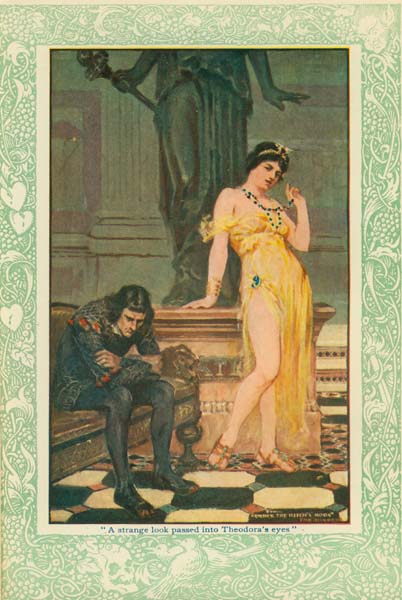
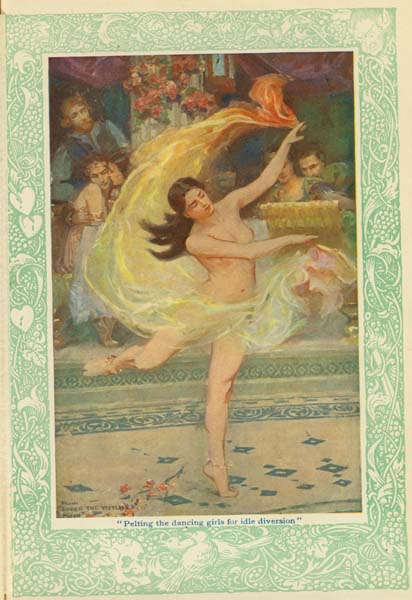
Theodora had leaped from her litter and thrown her saffron
scarf over the prostrate youth.
With all the outlines of her beautiful form revealed through
the thin robe of spangled gauze she faced the irate aggressor
and her voice cut like steel as she said:
"Dare to touch him beneath this scarf! This man is
mine."
Laval drew back, but his glaring eyes, his parted lips and
his labored breath argued little in favor of the fallen man,
even though the blow was, for the moment, averted.
With foam-flecked lips he turned to Theodora.
"This man is mine! His life is forfeit. Stand back, that
I may wipe this blot from my escutcheon."
Theodora faced the speaker undauntedly.
Ere he could reply, a woman's voice shrieked.
"Save him! Save him! He is innocent! He has done
naught amiss!"
Hellayne, whom the Count had hurled against the masonry
of the arch, bruising her until she was barely able to support
herself, at this moment threw herself between them.
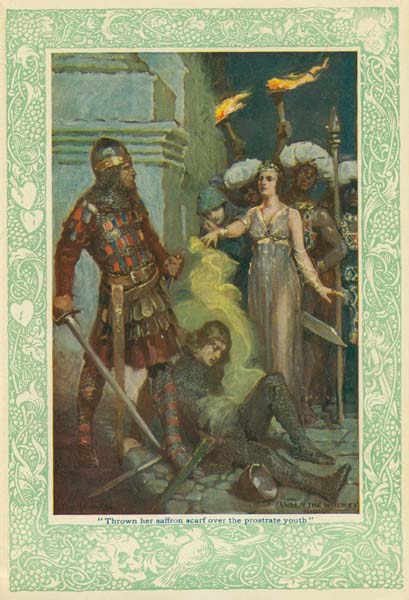
"Thrown her saffron scarf over the prostrate youth"
"Who is this woman?" Theodora turned to Tristan's
assailant. "Who is this woman?" Hellayne's eyes silently
questioned Tristan.
Laval's sardonic laughter pealed through the silence.
"This lady is my wife, the Countess Hellayne de Laval,
noble Theodora, who has followed her perjured lover to
Rome, so they may do penance in company," he replied
sardonically. "His life is forfeit. His offence is two-fold.
Within the hour he swore he knew naught of her abode.
But—since you claim him,—by ties this scarf proclaims—take
him and welcome! I shall not anticipate the fate you
prepare for your noble lovers!"
The two women faced each other in frozen silence, in the
consciousness of being rivals. Each knew instinctively it
would be a fight between them to the death.
Theodora surveyed Hellayne's wonderful beauty, appraising
her charms against her own, and Hellayne's gaze swept
the face and form of the Roman.
Tristan had scrambled to his feet, his face white with shame
and rage. From Theodora, in whose eyes he read that
which caused him to tremble in his inmost soul, he turned to
Hellayne.
"Oh, why have you done this thing, Hellayne, why?—oh,
why?"
Roger de Laval laughed viciously.
"It was indeed not to be expected that the Lady Hellayne
would find her recalcitrant lover in the arms of the Lady
Theodora."
With an inarticulate outcry of rage Tristan was about to
hurl himself upon his opponent, had not Theodora placed a
restraining hand upon him, while her dark eyes challenged
Hellayne.
All the revulsion of his nature against this man rose up in
him and rent him. All the love for Hellayne, which in these
days had been floating on the wings of longing, soared anew.
But his efforts at vindication in this strangest of all predicaments
were put to naught by the woman herself.
"Hear me, Hellayne—it is not true!" he cried, and
paused with a choking sensation.
Hellayne stood as if turned to stone.
Then her eyes swept Tristan with a look of such incredulous
misery that it froze the words that were about to tumble from
his lips.
With a wail of anguish she turned and fled down the moonlit
path like a hunted deer.
"Up and after her!" Laval shouted to the men whom
Hellayne had summoned to the scene and these, eager to
demonstrate their usefulness, started in pursuit, Roger leading,
ere Tristan could even make a move to interfere.
Hellayne had fled into the open portals of a church at the
end of the street. She tottered and fell. Crawling through
the semi-darkness she gasped and leaned against a pillar.
She saw a small side chapel, where, before an image of the
Virgin, guttered a brace of tapers. But ere she reached the
shrine her pursuers were upon her. As, with a shriek of
mortal fear she fell, she gazed into the brutal features of
Roger de Laval. His lips were foam-flecked, revealing his
wolfish teeth.
It was then her strength forsook her. She fell fainting
upon the hard stone floor of the church.—
For a pace Tristan and Theodora faced each other in silence.
It was the woman who spoke.
Her voice was cold as steel.
"I have saved your life, Tristan! The weapon which my
slaves have taken from you awaits the call of its rightful
claimant."
She reentered her litter while Tristan stood by, utterly
dazed. But, when the slaves raised the silver poles, she gave
him a parting glance from within the curtains that seemed to
electrify his whole being.
After the litter-bearers and their retinue had trooped off,
Tristan remained for a time in the shadow of the Arch of the
Seven Candles.
He knew not where to turn in his misery, nor what to do.
In the same hour he had found and lost his love anew.
It was past the hour of midnight.
In a dimly lighted turret
chamber in the house of
Hormazd the Persian there sat
two personages whose very
presence seemed to enhance
the sinister gloom that brooded
over the circular vault.
The countenance of the Grand
Chamberlain was paler than
usual and there was a slight gathering of the eyebrows, not to
say a frown, which in an ordinary mortal might have signified
little, but in one who had so habitual a command of his
emotions, would indicate to those who knew him well an
unusual degree of restlessness. His voice was calm however,
and now and then a bland smile belied the shadows on his
brow.
At times his gaze stole towards a dimly lighted alcove
wherein moved a dark cowled figure, its grotesque shadow
reflected in distorted outlines upon the floor.
"The Moor tarries over long," Basil spoke at last.
"So do the ends of destiny," replied a voice that seemed
to come from the bowels of the earth.
"He is fleeter than a deer and more ferocious than a
tiger," the Grand Chamberlain interposed. "Nothing has
ever daunted him, nor lives the man who would thwart him
and live. Can you tell me where he is now?"
"Patience!" came the sepulchral reply. "The magic disk
reveals all things! Anon you shall know."
Informed by daily gossip and the reports of his innumerable
spies, Basil was aware of a growing belief among the people
that the power he wielded was not altogether human, and he
would have viewed it with satisfaction even had he not shared
it. Seeing in it an additional force helpful to the realization
of his ambition, he had thrown himself blindly into the vortex
of black magic which was to give to him that which his soul
desired.
In this chamber, filled with strange narcotic scents and the
mysterious rustling of unseen presences, by which he believed
it to be peopled, with the aid of one who seemed the personified
Principle of Evil, Basil assembled about him the forces that
would ultimately launch him at the goal of his ambition.
This devil's kitchen was the portal to the Unseen, the shrine
of the Unknown, the observatory of the Past and the Future,
and the laboratory of the Forbidden. There were dim and
mysterious mirrors, before which stood brazen tripods whose
fumes, as they wreathed upward, gleamed with dusky fires.
It was in these mirrors that the wizard could summon the
dead and the distant to appear darkly, in scarcely definable
glimpses. But he could also produce apparitions more vivid,
more startling and more beautiful. Once, in the dark depths
of the chamber, Basil had seen a woman's phantom apparition
suddenly become strangely luminous, her garments glowing
like flames of many colors, that shifted and blent and alternated
in ceaseless dance and play, waving and trembling in
unearthly glory, till she seemed to be of the very flame herself.
The reflection of the world of shadows was upon her;
its splendors were wrapping her round like a mantle. He
watched her with bated breath, not daring to speak. And
brighter, ever brighter, dazzling, ever more dazzling, had
grown the flaming phantom, till the wondrous transfiguration
reached the height of its beauty and its terror. Then the
phantom of murdered Marozia, evoked at his expressed
desire from the land of shadows, had faded, dying slowly
away in the mysterious depths of the mirror, as the fires that
produced it sank and died in white ashes.
There could be no doubt. It was the emissary of Darkness
himself who held forth in this dim, demon-haunted chamber
where he had so often listened to the record of his awful
visions. He had made him see in his dreadful ravings the
great vaults of wrath, where dwelt the dread power of Evil.
He had made him see the King of the Hopeless Throngs on
his black basaltic throne in the terrific glare-illumined caves,
where Michael had cast him and where Pain's roar rises
eternally night and day. He had made him see the great
Lord of the Doomed Shadows, receiving the homage of those
dreadful slaves, those terror-spreading angels of woe whose
hand flings destruction over the earth and sea and air, while
flames were fawning and licking his feet with countless
tongues.
And then he had shown to him a spirit mightier and more
subtle than any of those great wild destroyers who rush
blindly through nature, a spirit who starts in silence on her
errand, whom none behold as, creeping through the gloom,
she undermines, unties and loosens all the pillars of creation,
with no more sign nor sound than a black snake in the tangled
grass, till with a thunder that stuns the world the house of
God comes crashing down—dread Hekaté herself.
Was there any crime he had left undone?
His subterranean prisons in which limbs unlearned to bend
and eyes to see concealed things whose screams would make
the flesh of a ghost creep, if flesh one had.
But now there was a darker light in Basil's eyes, a something
more ominous of evil in his manner. The wizard's
revelation had possessed his soul and his whole terrible being
seemed intensified. With the patience of one conscious of
a superhuman destiny he waited the summons that was to
come to him, even though his soul was consumed by devouring
flames.
For he had come yet upon another matter; an inner voice,
whose appeal he dared not ignore, had informed him long
ago of his waning power with Theodora. From the man
wont to command he had fallen to the level of the whimpering
slave, content to pick up such morsels as the woman saw fit
to throw at his feet. Only on the morning of this day, which
had gone down the never returning tide of time, a terrible
scene had passed between them. And he knew he had lost.
Basil had been an unseen witness of Theodora's and Tristan's
meeting in the sunken gardens on the Aventine. Every
moment he had hoped to see the man succumb to charms
which no mortal had yet withstood upon whom she had
chosen to exert them, and on the point of his poniard sat
Death, ready to step in and finish the game. From the fate
he had decreed him some unknown power had saved Tristan.
But Basil, knowing that Theodora, once she was jilted by
the object of her desire, would leave nothing undone to
conquer and subdue, was resolved to remove from his path
one who must, sooner or later, become a successful rival.
By some miraculous interposition of Providence Tristan had
escaped the fate he had prepared for him on the night when
he had tracked the two strangers from the Lateran. He had
had him conveyed for dead to the porch of Theodora's palace.
But Fate had made him her mock.
Never had Basil met Theodora in a mood so fierce and
destructive as on the morning after she had destroyed Roxana
and her lover, and had, in turn, been jilted by Tristan. And,
verily, Basil could not have chosen a more inopportune time
to press his suit or to voice his resentment and disapprobation.
Theodora had driven every one from her presence and the
unwelcome suitor shared the fate of her menials. Her dark
hints had driven the former favorite to madness, for his
passion-inflamed brain could not bear the thought that the
love he craved, the body he had possessed, should be another's,
while he was drifting into the silent ranks of the discarded.
He knew for a surety that Theodora was not confiding in him
as of old. Had she somehow guessed the dread mystery of
the crypts in the Emperor's Tomb, or had some demon of
Hell whispered it into her ear during the dark watches of the
night?
A flash of lightning followed by a terrific peal of thunder
roused him from his reveries. The storm which had threatened
during the early hours of the evening now roared and
shrieked round the tower and the very elements seemed in
accord with the dark plottings in Hormazd's chamber.
"How much longer must I wait ere the fiends will reveal their
secrets?" Basil at last turned to the exponent of the black arts.
The wizard paused before the questioner.
"To what investigation shall we first proceed?"
"You must already have divined my thoughts."
"I knew the instant you arrived. But there is an incompleteness
which makes my perceptions less exact than usual."
"Where are my messengers? To the number of three
have I sped. None has returned."
The Oriental touched a knob and the lamps were suddenly
extinguished, leaving the room illumined by the red glow
of the oven. Then he bade his visitor fix his eyes on the
surface of the disk.
"Upon this you will presently behold two scenes."
He poured a few drops of something resembling black oil
upon the disk, which at once spread in a mirror-like surface.
Then he began to mutter some words in an Oriental tongue,
and lighted a few grains of a chemical preparation which
emitted an odor of bitter aloë. This, when the flames had
subsided, he threw upon the oil which at the contact became
iridescent.
Basil looked and waited in vain.
The conjurer exhausted all the selections which he thought
appropriate. The oil gradually lost the changing aspect it had
acquired from the burning substance, and returned to its dull
murky tints, and the interest which had appeared on Basil's
features gave place to a contemptuous sneer.
"Are you, after all, but a trickster who would impose his
art upon the unwary?"
The magician did not reply to this insult, nor did it seem to
affect him visibly.
"We must try a mightier spell," he said, "for hostile
forces are in conjunction against us."
By a small tongs he raised from the fire the metallic plate
that had been lying upon it. Its surface presented the appearance
of oxidized silver with a deep glow of heat.
Upon this he claimed to be able to produce the picture of
past or future events, and many scenes had been reflected
upon the magic shield.
He now poured upon it a spoonful of liquid which spread
simmering and became quickly dissipated in light vapors.
Then he busied himself with scattering over the plate some
grains that looked like salt which the heated metal instantly
consumed.
At the end of a few moments he experienced what resembled
an electric or magnetic shock. His frame quivered, his lips
ceased to repeat the muttered incantations, his hand firmly
grasped the tongs by which he raised the metal aloft, now
made brighter by the drugs just consumed, and upon which
appeared a white spot, which enlarged till it filled the lower
half of the plate.
What it represented it was difficult to say. It might have
been a sheet or a snow drift. Basil felt an indefinable dread,
as above it shimmered forth the vague resemblance of a man
on horseback, apparently riding at breakneck speed.
Slowly his contour became more distinct. Now the horseman
appeared to have reached a ford. Spurring his steed, he
plunged into the stream whose waters seemed for a time to
carry horse and rider along with the swift current. But he
gained the opposite shore, and the apparition faded slowly
from sight.
"It is the Moor!" cried Basil in a paroxysm of excitement.
"He has forded the rapids of the Garigliano. Now be kind
to me O Fate—let this thing come to pass!"
He gave a gasp of relief, wiping the beads from his brow.
The cowled figure now walked up to the central brazier,
muttering words in a language his visitor could not understand.
Then he bade Basil walk round and round it, fixing
his eyes steadily upon the small blue flame which danced on
the surface of the burning charcoal.
When giddiness prevented his continuing his perambulation
he made him kneel beside the brazier with his eyes
riveted upon it.
Its fumes enveloped him and dulled his brain.
The wizard crooned a slow, monotonous chant. Basil felt
his senses keep pace with it, and presently he felt himself
going round and round in an interminable descent. The
glare of the brazier shrank and diminished, invaded from
outside by an overpowering blackness. Slowly it became
but a single point of fire, a dark star, which at length flamed
into a torch. Beside him, with white and leering face, stood
the dark cowled figure, and below him there seemed to stretch
intricate galleries, strangled, interminable caves.
"Where am I?" shrieked the Grand Chamberlain, overpowered
by the fumes and the fear that was upon him.
"Unless you reach the pit," came the dark reply, "farewell
forever to your schemes. You will never see a crown
upon your head."
"What of Theodora?" Basil turned to his companion,
choking and blinded.
"If the bat-winged fiends will carry you safely across the
abyss you shall see," came the reply.
A rush as of wings resounded through the room, as of
monstrous bats.
"Gehenna's flame shall smoothe her brow," the wizard
spoke again. "When Death brings her here, she shall stand
upon the highest steps, in her dark magnificence she shall
command—a shadow among shadows. Are you content?"
There was a pause.
The storm howled with redoubled fury, flinging great hailstones
against the time-worn masonry of the wizard's tower.
"Then," Basil spoke at last, his hands gripping his throat
with a choking sensation, "give me back the love for which
my soul thirsts and wither the bones of him who dares to
aspire to Theodora's hand."
The wizard regarded him with an inscrutable glance.
"The dark and silent angels, once divine, now lost, who
do my errands, shall ever circle round your path. Everlasting
ties bind us, the one to the other. Keep but the pact
and that which seems but a wild dream shall be fulfilled anon.
They shall guide you through the dark galleries of fear, till
you reach the goal."
"Your words are dark as the decrees of Fate," Basil
replied, as the fumes of the brazier slowly cleared in his
brain and he seemed to emerge once more from the endless
caverns of night, staring about him with dazed senses.
"You heed but what your passion prompts," the cowled
figure interposed sternly, "oblivious of that greater destiny
that awaits you! It is a perilous love born in the depths of
Hell. Will you wreck your life for that which, at best, is but
a fleeting passion—a one day's dream?"
"Well may you counsel who have never known the hell of
love!" Basil cried fiercely. "The fiery torrent that rushes
through my veins defies cold reason."
The cowled figure nodded.
"Many a ruler in whose shadow men have cowered, has
obeyed a woman's whim and tamely borne her yoke. Are
you of those, my lord?"
"I have set my soul upon this thing and Fate shall give to
me that which I crave!" Basil cried fiercely.
The wizard nodded.
"Fate cannot long delay the last great throw."
"What would you counsel?" the Grand Chamberlain
queried eagerly, peering into the cowled and muffled face,
from which two eyes sent their insane gleam into his own.
"Send her soul into the dark caverns of fear—surround
her with unceasing dread—let the ghosts of those you have
sent butchered to their doom surround her nightly pillow,
whispering strange tales into her ears,—then, when fear
grips the maddened brain and there seems no rescue but the
grave—then peals the hour."
Basil gazed thoughtfully into the wizard's cowled face.
"When may that be?"
"I will gaze into the silent pools of my forbidden knowledge
with the dark spirits that keep me company. I have mysterious
rules for finding day and hour."
"I cannot expel the passion that rankles in my blood,"
Basil interposed darkly. "But I will tear out my heart
strings ere I shirk the call. An emperor's crown were worth
a tenfold price, and ere I, too, descend to the dread shadows,
I mean to see it won."
"These thoughts are idle," said the wizard. "Only the
weak plumb the depths of their own soul. The strong man's
bark sails lightly on victorious tides. Your soul is pledged
to the Powers of Darkness."
"And by the fiends that sit at Hell's dark gate, I mean to
do their bidding," Basil replied fiercely. "Else were I
indeed the mock of destiny. Tell me but this—how did
you obtain a knowledge at which the fiend himself would
pale?"
The wizard regarded him for a moment in silence.
"You who have peered behind the curtain that screens
the dreadful boundaries—you who have seen the pale
phantom of Marozia, whom you have sent to her doom,—how
dare you ask?"
Basil had raised both hands as if to ward off an evil spirit.
"This, too, then is known to you? Tell me! Was what
I saw a dream?"
"What you have seen—you have seen," the cowled form
replied enigmatically. "The cocks are crowing—and the
pale dawn glimmers in the East."
Throwing his mantle about him, Basil left the turret chamber
and, after creeping down a narrow winding stair, he made
for his villa on the Pincian Hill.
Roger de Laval had chosen
for his abode in Rome a sombre
and frowning building not far
from the grim ways of the Campo
Marzo, half palace half fortalice,
constructed about a huge square
tower with massive doors. Like
all palace fortresses of the time
which might at any moment have
to stand a siege, either at the
hands of a city mob or at those of some rapacious noble, it
contained in its vaulted halls and tower chambers all the
requisites for protracted resistance as well as aggression. On
the walls between flaunting banners hung the many quartered
shields and the dark coats of chain, the tabards of the heralds
and the leathern jerkins of the bowmen. On the shelves
between the arches stood long rows of hauberks and shining
steel caps. Dark tapestries covered the walls and the bright
light of the Roman day fell muted through the narrow slits in
the sombre masonry which served as windows.
It was not to seek his wife that Roger had come to Rome,
and his meeting with Tristan in the gardens of Theodora had
been purely accidental. While his vanity and selfishness had
received a severe shock in Hellayne's departure, without even
a farewell, he had not allowed an incident in itself so trifling
to disturb the even tenor of his ways. He had loved to display
her at his feasts as one displays some exceeding handsome
plaything that gives pleasure to the senses; otherwise
he and the countess had no common bond of interest. Hellayne
was the only child of one of the most powerful barons of
Provence, and had been given in marriage to the older man
before she even realized what the bonds implied. Only after
meeting Tristan had the awakening come, and youth sought
youth.
That which brought every one to Rome in an age when Rome
was still by common consent the centre of the universe, such
as the Saxon Chronicles of the Millennium pronounce it, had
also caused Roger de Laval to seek the Holy Shrines, not in
quest of spiritual benefit, but of temporal aggrandizement,
in the character of an investiture from the Vicar of Christ
himself. His disappointment at finding the head of Christendom
a prisoner in his own palace was perhaps only mitigated
by the disclosure that he should have to rely upon his own
fertility of mind for the realization of a long-fostered ambition.
On one of his visits to the Lateran, hoping to obtain an
interview with the Pontiff, he had met Basil as representative
of the Roman government, in the absence of Alberic, and a
sinister attraction had sprung up between them in the consciousness
that each had something to give the other lacked.
This bond was even strengthened by Basil's promise to aid
the stranger in the attainment of his desires, and at last
Roger had confided in Basil the story of the shadow that had
spread its gloomy pinions over the castle of Avalon. Basil
had listened and suggested that the Lord Laval drown his
sorrows at the board of Theodora. Therein the latter had
acquiesced, with the result that he met Tristan on that night.
Hellayne was sitting alone by the window in a long silent
gallery. She could not take her eyes off the restless outline
of the clouds where head on head and face on face continued
taking shape. In vain her teased brain tried to see but clouds.
Two nights ago had not a horrid face grinned at her from out
of these same clouds? The face of a wolf it had seemed.
And it had taken human shape and changed to the face of the
man who had brought her to this abode from the sanctuary
where she had fallen by the shrine.
And yet, as she looked at the sun, whose beams were fast
dwindling on the bar of the horizon, how she yearned to keep
the light a little longer, if only a few short minutes. She
could have cried out to the sun not to leave her so soon,
again to wage her lonely war with the Twilight and with Fear.
For during the hours of day her lord was away. Business of
state he termed what took him from her side. With a leer
he left and with a leer he was wont to return. And with him
the memory of his meeting with Tristan!
She had found him again, the man she loved! Found him—but
how? And Hellayne covered her burning eyes with
her white hands.
This other woman who had stepped in between her and
Tristan, who had laid a detaining hand upon his arm and had
silently challenged her for his possession—what was she to
him?
For three days and three nights the thought had tormented
her even to the verge of madness. Had she sacrificed everything
but to find him she loved in the arms of another?
Silently she had borne the taunts of her lord, his insults, his
vile insinuations. He did not understand. He never understood.
What of it? In the great balance what mattered it
after all?
She must see Tristan. She must hear the truth from his
own lips. In vain she puzzled her brain how to reach him.
She remembered his last outcry of protest. There was a
mystery she must solve. Come what might, she was once
more the woman who loved. And she was going to claim
the payment of love!
As regarded that other, to whom she had bound herself,
her conscience had long absolved her of an obligation that
had been forced upon her. Had fate and fact not proved the
thing impossible? Had fate not cast them again and again
into each other's arms and made mock of their conscience?
Nature had made them lovers, let it be the will of God or the
devil.
And lovers till death should they be henceforth. He
belonged to her. Away with faith—away with fear of this
world, or the next. Away with all but the dear present, in
which the brutality of others had set her free. For a moment
her thoughts turned almost pagan.
Was she to return to the old, loveless life in that far corner
of the earth, while he whom she loved took up a new existence
in the centre of the world, loving another to whose ambition
he might owe a great career? She needed indeed to sit in
silence, she who had done daring things without a misgiving,
as if impelled by a power not her own. She had done them,
marvelling at her own courage, at her own faith in him she
loved, and she had not faltered.
The torturing dusk was drowning every living thing in
pallid waves of shadow. One by one, through the wan
gallery in which she was locked, the motley spectres of night
would pass in all their horrors, and begin their crazy, soundless
nods and becks.
Suddenly she cowered back, shuddering, with her eyes
fixed on the darkening depths of the gallery and her day
dreams died, like pale ashes crumbling on the hearth.
Roger de Laval had entered and was regarding her with a
malignant leer that almost froze the blood in her veins.
She knew not what business had taken him abroad. Nevertheless
was assured that some dark deed was slumbering
in the depths of his soul.
"Are you thinking of your fine lover?" he said as he slowly
advanced towards her. "You are grieved to have your
thoughts broken into by your husband? No doubt you wish
me dead—"
"Spare me this torture, my lord," she entreated. "I
have answered a thousand times—"
"Then answer again—"
"I swear before God and the Saints he is guiltless. He
knew not I was in Rome."
"Swear what you will! A woman's oath is but a wind
upon one's cheek on a warm summer day—gone ere you
have felt it. The oath of a woman who has followed her
lover—"
"I have not done so!"
"You have done your best to make the world believe it."
"What of yourself?" There was a ring of scorn in her
voice.
"You have brought me to shame!"
"What of the women you have shared with me?"
Hellayne's eyes met those of her tormentor.
"It is a man's part!"
"And you are a man!"
"One at least shall have cause to think so."
"Perchance you will have him murdered. Why not kill
me, too? That, too, is a man's part."
He gave a great roar.
"And who says that I shall not?"
An icy fear, not for herself, but for Tristan, gripped her
heart. She tried to hide it under a mantle of indifference.
"What have you ever done to make yourself beloved?"
"By Beelzebub—you—the runaway mistress of a fop—dares
to question me—her rightful lord?"
"Who made the laws that bound me to your keeping?
They are man-made, and God knows as little of them as he
knows of you. It was your measureless conceit, your boundless
egotism, that whispered to you that any woman should
feel honored, should deem it the height of glory, to be your
wife."
"And is it not?"
She shuddered.
"You never dreamed there might be something in the
depths of my soul that cried out for more than the mere comforts
and exigencies of existence! Something that craved
love, companionship, and, above all, friendship. What have
you done to waken this little slumbering voice which died in
the shadow of your tremendous egotism?"
He stared at her.
"He has taught you this speech, by God!"
"He has awakened my true self! What was I to you but
part of your magnificence, a thing to make your fellows
envious—"
He roared. She continued:
"The one decent woman of your life—your world—"
His eyes glared.
"So then, this low-born churl is a better man than I?"
"At least he knew I had a soul of my own."
"Skillfully cultivated to his own sweet ends."
"His ends were innocent, else had he not fled."
"Knowing that you would follow him."
"He knew naught."
"That remains to be seen."
"It was you who brought us together!" she said with quiet
scorn. "You were so sure in your pride and your power and
of my own timidity that you thought it impossible that something
might defy them. And you could not understand that
another might be so much closer to my nature, or that I had
a nature of my own. In those days I well remember, ere my
heart had strayed too far, I tried to waken you to the great
danger. I tried to speak of mine. But you would not be
apprised of aught that would seem a concession to your pride.
So we are come to this!"
Her eyes filled with tears.
"Come to what?" he thundered.
"My ruin—and your disgrace!"
His breast heaved.
"Of you I know nothing. As for myself—I suffer no
disgrace. I am too much a man of sense for that. Not a
soul but thinks that you are absent with my consent. A
pilgrimage to Rome! Many a woman has, for her soul's good
gone alone. Not a soul, I warrant, has thought of your connection
with that fellow's plight. Not a soul but thinks that
this is the sole cause of your disappearance. And when I,
too, went I was careful to leave the rumor behind."
He stepped closer, his breath fanning her pale cheeks.
She looked almost like a ghost in the grey twilight.
"And now—" he continued, licking his sensuous lips,
"you are found—you are found—my beautiful wife—you
are found—and—to the eyes of the world at least—unstained.
One alone whose lips are sealed, knows."
Hellayne's lips tightened.
"And a woman."
A strange expression came into his face.
"Have you spied upon me, too?"
"You forget the meeting at the Arch."
"No woman will spread the story of a rival's claims!"
There was a pause, then he continued, with deliberate
slowness:
"You shall come back with me—my beautiful Hellayne—my
wife in name, if not in deed! And you shall submit
to my caresses, knowing, as I do, how loathsome they are.
And you shall smile—smile—and appear happy—my wife
henceforth in name only. And you shall smile no less at
what henceforth your lord's pleasure may be with other women—fair
as yourself—and you shall grow old and grey, and
the thing you call your soul shall die and wither up your
beauty—and never a word shall pass your lips anent this
chastisement. And at last you shall die—and be laid by—and
not a soul shall ever be the wiser for your shame."
Hellayne covered her face with her hands.
"And if I should refuse to accept this fate?"
"Then you shall be flung into a nunnery."
"And if I refuse to become a nun?"
"Then your lover shall pay the price—with his blood
instead of yours. Know you the woman he so madly loves?"
"It is a lie!" she shrieked.
There was a moment's silence.
"Her name is Theodora. Saw you ever fairer creature?"
"God!"
"I want your answer!" leered the man.
"I do not refuse!"
An evil smile curved his lips.
"I knew you would be reasonable—my fair Hellayne!"
His lips were parted in a fatuous smile. He pictured to
himself the pain at the parting and indeed his satisfaction
was so great that he decided to prolong it yet a little longer.
How amusing it would be to watch the face of him who had
dared to love Hellayne. Knowing as now he did all the
motives for his actions, it gave him pleasure to think that he
could mar the astonishing good fortune of this adventurer
who had found employment in the service of Alberic by the
intrusion of this passion for another woman. It would be
real joy to see this creature of sentiment thus torn and tortured.
And it was yet a greater joy to force Hellayne to
witness the struggle, forced to smile at the conquest of her
lover by another woman. And he would watch the pangs of
their suffering till the day of his departure.
With her own blue eyes Hellayne should witness the love
of him she had so madly followed, estranged by the beauty
of Theodora, whose lure no mortal might resist.
After he had entered his own chamber, Hellayne flew like
a mad thing down the gloom-haunted gallery. Could she
but escape from this humiliation—even through death's
doors—she would not shrink. She felt, if she remained,
she would go mad.
It was true, then! Tristan loved another. The old love
had been forgotten and cast aside! All her fears and misgivings
returned in one mad whirl.
Frantically she tried to remove the heavy bolt when she
was paralyzed by a demoniacal laugh that issued behind her
and swooning she fell at the feet of the man whose name she
bore.
Never had Tristan's feelings
been more hopelessly involved
than since that eventful night
by the Arch of the Seven Candles
when, like a ghost of the
past, Hellayne had once more
crossed his path and had given
his solemn pledge the lie. And
the more Tristan's thoughts
reverted to that fateful hour,
when his oath seemed like so many words written upon water,
and the man who believed him guilty held his life in the
hollow of his hand, the greater grew his misery and unrest.
Physically exhausted, mentally startled at the vehemence of
his own feelings, he was suffering the relapse of a passion
which he thought had burnt itself out, letting his mind drift
back to the memory of happier days—days now gone forever.
Why had she followed him? What was she doing here?
Was the old fight to be renewed? And withal happiness
mingled with the pain.
In the midst of these thoughts came others.
Had she accompanied the Count Laval to Rome and were
his questionings mere pretense, to surprise the unguarded
confession of a wrong of which he knew himself sinless? Had
she been here all these days, seeking him perchance, yet not
daring to make her presence known?
And now where was she? Hardly found had he lost her?
And see her he must—whatever the hazard, even to death.
How much he had to say to her. How much he had to ask.
Her presence had undone everything. Was the old life to
begin again, only with a change of scenes?
He had read her love for him in her eyes, and he could have
almost wished that moment to have been his last, ere the
untimely arrival of Theodora saved him from the death stroke
of his enraged enemy. For he had seen the light fade from
Hellayne's blue eyes when she faced the other woman, and
Laval's taunts had found receptive ears. Everything had
conspired against him on that night, even to seeming the
thing he was not, and with a heart heavy to breaking Tristan
scoured the city of Rome for three days in quest of the woman,
but to no avail.
His duties were not onerous and the city was quiet. No
farther attempts had been made to liberate the Pontiff and
the feuds between the rival factions seemed for the nonce
suspended.
Nevertheless Tristan felt instinctively, that all was not
well. Night after night Basil descended into the crypts of
the Emperor's Tomb, sometimes alone, sometimes with one
or two companions, men Tristan had never seen. Ostensibly
the Grand Chamberlain visited the cells of certain prisoners
of state, and one night Tristan ventured to follow him. But
he was seized with so great a terror that he resolved to confide
in Odo of Cluny, who possessed the entire confidence of the
Senator of Rome, and be guided by his counsel.
In the meantime, like a thunderbolt out of a clear sky, the
terrible thing had happened again. From the churches of
Santa Maria in Trastevere and Santa Sabina of the Aventine,
the Holy Host had been taken, notwithstanding the increased
number of guards keeping watch in the sanctuaries.
Rome shivered in the throes of abject terror. People
whispered in groups along the thoroughfares, hardly daring
to raise their voices, and many asserted that the Antichrist
had returned once more to earth and that the End of Time
was nigh. Like a dread foreboding of evil it gripped Tristan's
soul.
And day and night interminable processions of hermits and
monks traversed the city with crosses and banners and
smouldering incense. Their chants could be heard from the
ancient Flaminian to the Appian Gate.
Once more the shades of evening laid their cool touch upon
the city's fevered brow, and as the distant hills rose into a
black mass against the sunset two figures emerged on the
battlements of the Emperor's Tomb and gazed down on the
dimmed outlines of the Pontifical City.
Before them lay a prospect fit to rouse in the hearts of all
who knew its history an indescribable emotion. There, before
them, lay the broad field of Rome, whereon the first ominous
activities of the Old World's conquerors had been enacted.
There in the mellow light of eve, lay the Latin land, once
popular and rich beyond all quarters of the earth since the
plain of Babylon became a desert, and now no less deserted
and forlorn. And from the height from which these two
looked down upon it, its shallow hills and ridges were truly
minimized to the aspect of one mighty plain, increasing the
vast sense of desolation. Rome—Rome alone—denied the
melancholy story of disaster, utter and complete, the work of
Goth and Hun and of malarial terror.
But now over all this solemn prospect was the luminous
blue light of evening, fading to violet and palest yellow in the
farthest west, where lay the Tyrrhene Sea.
Presently one of the two laid aside his cloak and, baring
his arms to the kiss of the wind that crept softly about them,
said in weary accents:
"Never in all my life, Father, have I known a day to pass
as tardily as this, for to me the coming hour is fraught with
evil that may abide with me forever, and my soul is eager to
know its doom, yet shrinks from the sentence that may be
passed."
Odo of Cluny looked into Tristan's weary face.
"I, too, have a presentiment of Evil, as never before," the
monk replied, laying a gentle hand on his companion's shoulder.
"There are things abroad in Rome—one dares not
even whisper. The Lord Alberic chose an evil hour for his
pilgrimage to Monte Gargano. Have you no tidings?"
"No tidings," reechoed Tristan gloomily.
Odo of Cluny nodded pensively.
"It seems passing strange. I know not why—" his voice
sank to a whisper. "I mistrust the Grand Chamberlain.
Whom can we trust? A poison wind is blowing over these
hills—withering—destroying. The awful sacrilege at
Santa Maria in Trastevere, following so closely upon the one
at the Lateran, is but another proof that dark powers are at
work—powers defying human ken—devils in human shape,
doomed to burn to a crisp in the eternal fires."
"Meanwhile—what can we do?"
"Have you seen the Lord Basil?"—
"He was much concerned, examined the place in person,
but found no clue."
"Are your men trustworthy?"
"I know not, Father! For a slight service I chanced to do
the Lord Alberic he made me captain of the guard in place of
one who had incurred his displeasure. My men are Swiss
and Lombards, a Spaniard or two—some Calabrians—no
Romans."
"Therein lies your salvation," interposed the Benedictine.
"How many guard this tomb?"
"Some four score men—why do you ask?"
"I hardly know—save that there lurks some dark mystery
behind the curtain. Let no man—nor woman—relax your
watchfulness. There are tempests that destroy even the
cedars of Lebanon," the monk continued with meaning.
"And such a one may burst one night."
"Your words are dark, Father, and fill me with misgivings."
"And well they should," Odo interposed with a penetrating
glance at the young captain. "For rumor hath it that another
bird has strayed into the Lady Theodora's bower—"
Tristan colored under the monk's scrutiny.
"I was present at her feast. Yet I know not how I got
there!"
The monk looked puzzled.
"Now that you have crossed the dark path of Marozia's
sister I fear the ambushed gorge and the black arrow that sings
from the hidden depths. Why seek the dark waters of Satan,
when the white walls of Christ rise luminously before you?"
"What is the import of these strange words so strangely
uttered?" Tristan turned to the monk with a puzzled air.
"That shall be made known to you in time. Treason
lurks everywhere. Seal your ears against the Siren's song.
Some say she is a vampire returned to earth, doomed to live
on, as long as men are base enough to barter their soul for her
kisses. And yet—how much longer? The Millennium
draws nigh. The End of Time is near."
There was a pause. Tristan tried to speak, but the words
would not come from his lips.
At last with an effort he stammered:
"At the risk of incurring your censure, Father—even to
the palace of Theodora must I wend my steps to recover that
which is my own."
And he informed the Monk of Cluny how he had lost his
poniard and his scarf of blue Samite.
"Why not send one you trust to fetch them back?" protested
the monk. "It is not well to brave the peril twice."
"Myself must I go, Father. For once and all time I mean
to break her spell."
"Deem you to accomplish that which no man hath—and
live?"
"There is that which shall keep my honor inviolate,"
Tristan replied.
The cloudless sky was shot with dreamy stars, and cooling
breezes were wafted over the Roman Campagna. Through
the stillness came the muffled challenges of the guard.
The twain crossed the ramparts of the Mausoleum in
silence, holding to their way which led towards a postern,
when suddenly, out of the battlements' embrazure, peered
two gray, ghastly faces, which disappeared as suddenly. But
Tristan's quick eye had marked them and, plucking at the
monk's sleeve, he whispered:
"Look yonder, Father—where stand two forms that scan
us eagerly. My bewildered brain refuses me the knowledge
I seek, yet I could vouch the sight of them is somehow familiar
to my eyes."
"That may well be," replied the monk. "For all this day
long have I been haunted by the consciousness that our movements
are being watched. Yet, I marvel not, for until Purgatory
receive the soul of this accursed wanton, there is
neither peace nor security for us. Her devilish hand may
even now be informing all this dark plot, that seethes about
us," Odo of Cluny concluded in apprehensive tones.
Presently they drew near the great gateway, before which
the flicker of cressets showed a company of the guard, with
breast plates and shields, their faces hidden by the lowered
visors of their Norman casks. Among them they noted a
wizened eunuch, who, after peering at them with his ferret-like
eyes, pointed to a door sunk in the wall, the while he
whispered something in Tristan's ear. Thereupon Odo and
Tristan entered the guard chamber.
It was deserted.
Beneath the cressets' uncertain gleam, as they emerged
beyond, stood the eunuch with the same ferret-like glance,
pointing across the dim passage, to, where could be made out
the entrance to a gallery. The group behind them stood
immobile in the flickering light and the space about them was
naught but a shadowy void. Yet, as they went, their ears
caught the clink of unseen mail, the murmur of unseen voices,
and Tristan gripped the monk's arm and said in husky tones:
"By all the saints,—we are fairly in the midst of Basil's
creatures. An open foe I can face without shrinking, but I
tell you this peril, ambushed in impenetrable night, saps my
courage as naught else would. If but one battle-cry would
shatter this numbing silence, one simple sword would flash,
as it leaps from its scabbard, I should be myself again, ready
to face any foe!"
They entered the half gloom of a painted gallery where
dog-headed deities held forth in grotesque representation
beside the crucified Christ. They stole along its whole
deserted length until they reached a door, hardly discernible
in the pictured wall. The lamps burned low, but in the
centre of the marble floor a brazier sent up a brighter flame,
filling the air with a fragrance as of sandal wood.
Tristan's hand groped for a spring along the outer edge of
the door. At his touch a panel receded. Both he and the
monk entered and the door closed noiselessly behind them.
Tristan produced a candle and two flints from under his coat
of mail. But ere he could light it by striking the flints, the
approach of a dim light from the farther end of the tortuous
gallery caused him to start, and both watched its approach
with dread and misgiving.
Soon a voice fell on their ear, answered by another, and
Tristan swiftly drew his companion into a shadowy recess
which concealed them while it yet enabled them to hear every
word spoken by the two.
"Thus we administer justice in Rome," said the one
speaker, in whom Tristan recognized the voice of the Grand
Chamberlain.
"Somewhat like in our own feudal chateaux," came back
the surly reply.
Tristan started as the voice reached his ear. How came
Roger de Laval here in that company?
"You approve?" said the silken voice.
"There is nothing like night and thirst to make the flesh
pliable."
"Then why not profit thereby?—But are you still
resolved upon this thing?"—
There was a pause. The voice barked reply:
"It is a fair exchange."
Their talk died to a vague murmur till presently the harsher
voice rose above the silence.
"Well, then, my Lord Basil, if these matters be as you say,—if
you will use your good offices with the Lady Theodora—"
"Can you doubt my sincerity—my desire to promote your
interests—even to the detriment of my own?"
His companion spat viciously.
"He who sups with the devil must needs have a long
spoon. What is to be your share?"
"Your meaning is not quite clear, my lord."
"Naught for naught!" Roger snarled viciously. "Shall
we say—the price of your services?"
"My lord," piped Basil with an injured air, "you wrong
me deeply. It is but my interest in you, my desire to see you
reconciled to your beautiful wife—"
"How know you she is beautiful?" came the snarling reply.
"I, too, was an unseen witness of your meeting at the Arch
of the Seven Candles," Basil replied suavely.
"Was all Rome abroad to gaze upon my shame?" growled
Basil's companion. "Though—in a manner—I am revenged,"
he continued, through his clenched teeth. "Instead
of giving her her freedom, I shall use her shrinking
body for my plaything—I shall use her so that no other lover
shall desire her. As for that low-born churl—"
With a low cry Tristan, sword in hand, made a forward
lunge. The monk's grip restrained him.
"Madman!" Odo whispered in his ear. "Would you
court certain death?"
The words of the twain had died to a whisper. Thus they
were lost to Tristan's ear, though he strained every nerve,
a deadly fear for Hellayne weighting down his soul.
The two continued their walk, passing so near that Tristan
could have touched the hem of their garbs. Basil was
importuning his companion on some matter which the latter
could not hear. Laval's reply seemed not in accord with the
Grand Chamberlain's plans, for his voice became more
insistent.
"But you will come—my lord—and you will bring your
beautiful Countess? Remember, her presence in Rome is no
longer a secret. And—whatever the cause which prompted
her—pilgrimage, would you have the Roman mob point
sneering fingers at Roger de Laval?"—
"By God, they shall not!"
"Then the wisdom of my counsel speaks for itself," Basil
interposed soothingly. "It is the one reward I crave."
There was a pause. Whatever of evil brooded in that
brief space of time only these two knew.
"It shall be as you say," Roger replied at last, and from
their chain mail the gleam of the lantern they carried evoked
intermittent answer.
When their steps had died to silence Tristan turned to the
monk. His voice was unsteady and there was a great fear
in his eyes.
"Father, I need your help as have I never needed human
help before. There is some devil's stew simmering in the
Lord Basil's cauldron. I fear the worst for her—"
Odo shot a questioning glance at the speaker.
"The wife of the Count Laval?" he returned sharply.
"Father—you know why I am here—and how I have
striven to tear this love from my heart and soul. Would she
had not come! Would I had never seen her more—for
where is it all to lead? For, after all, she is his wife—and
I am the transgressor. But now I fear for her life. You
have heard, Father. I must see her! I must have speech
with her. I must warn her. Father—I promise—that
shall be all—if you will but consent and find her—for I
know not her abode."
"You promise—" interposed the monk. "Promise nothing.
For if you meet, it will not be all. All flesh is weak.
Entrust your message to my care and I shall try to do your
bidding. But see her no more! Your souls are in grave
peril—and Death stands behind you, waiting the last throw."
"Even if our souls should be forever stamped with their
dark errors I must see her. I must know why she came
hither—I must know the worst. Else should I never find
rest this side of the grave. Father, in mercy, do my bidding,
for gloom and misery hold my soul in their clutches, and I
must know, ere the twilight of Eternity engulfs us both."
"We will speak of this anon," the Monk of Cluny interposed,
as together they left the gallery, now sunk in the deepest
gloom and, passing through the vaulted corridors, emerged
upon the ramparts. No sign of life appeared in the twilight,
cast by the towering walls, save where in the shadowy passages
the dimmed lights of cressets marked the passing of
armed men.
Below, the city of Rome began to take shape in the dim and
ghostly starlight, thrusting shadowy domes and towers out
of her dark slumber.
In the distance the undulating crests of the Alban Hills
mingled with the night mists, and from the nearby Neronian
Field came the croaking of the ravens, intensifying rather than
breaking the stillness.
A voice whose prompting he
could not resist, impelled Tristan,
after his parting from the
Monk of Cluny, to follow the
Grand Chamberlain, who had
taken the direction of the Pincian
Hill. His retreating form
became more phantom-like in
the misty moonlight, as viewed
from the ramparts of the Emperor's
Tomb. Nevertheless, mindful of the parting words of
the monk, and filled with dire misgivings, Tristan set out at
once. True to his determination, he procured a small lantern
and a piece of coarse thick cloth, which he concealed under
his cloak, then, by a solitary pathway, he followed the direction
he had seen Basil take. The Bridge of San Angelo was
deserted and not a human being was abroad.
After a time he arrived at a small copse, where Basil's
form had disappeared from sight. Clearing away the underbrush,
Tristan came to what seemed a fissure in a wall, which
cast a tremendous shadow over the surrounding trees and
bushes. Creeping in as far as he dared, he paused, then,
with mingled emotions of expectancy and apprehension
which affected him so powerfully that for a moment he was
hardly master of his actions, he slowly and carefully uncovered
his lantern, struck two flints and lighted the wick.
His first glance was intuitively directed to the cavity that
opened beneath him.
Of Basil he saw no trace, notwithstanding he had seen him
enter the cavity at the point where he himself had entered.
Ere long however, he heard a thin, long-drawn sound, now
louder, now softer; now approaching, now receding, now
verging toward shrillness, now returning to a faint, gentle
swell. This strange, unearthly music was interrupted by a
succession of long, deep rolling sounds, which rose grandly
about the fissures above, like prisoned thunderbolts striving
to escape. Roused by the mystery of the place and the
uncertainty of his own purpose, Tristan was, for a moment,
roused to a pitch of such excitement that almost threatened
to unsteady his reason. Conscious of the danger attending
his venture, and the fearful legends of invisible beings and
worlds, he was constrained to believe that demons were
hovering around him in viewless assemblies, calling to him
in unearthly voices, in an unknown tongue, to proceed upon
his enterprise and take the consequences of his daring.
Thus he remained for a time, fearful of advancing or
retracing his steps, looking fixedly into the trackless gloom
and listening to the strange sounds which, alternately rising
and falling, still floated around him. The fitful light of his
lantern suddenly fell upon a shape that seemed to creep
through one of the stone galleries. In the unsteady gleam
it appeared from the distance like a gnome wandering
through the bowels of the earth, or a forsaken spirit
from purgatory.
Had it been but a trick of his imagination, or had his mortal
eyes seen a denizen of the beyond? At last he aroused himself,
trimmed with careful hand his guiding wick and set
forth to penetrate the great rift.
He moved on in an oblique direction for several feet, now
creeping over the tops of the foundation arches, now skirting
the extremities of the protrusions in the ruined brickwork,
now descending into dark, slimy, rubbish-choked chasms,
until the rift suddenly diminished in all directions.
For a moment Tristan paused and considered. He was
almost tempted to retrace his steps, abandoning the purpose
upon which he had come. Before him stretched interminable
gloom, brooding, he knew not over what caverns and caves,
inhabited by denizens of night.
He moved onward, with less caution than he had formerly
employed, when suddenly and without warning a considerable
portion of brickwork fell with lightning suddenness from
above. It missed him, else he should never had known
what happened. But some stray bricks hurled him prostrate
on the foundation arch, dislocating his right shoulder, and
shattering his lantern into atoms. A groan of anguish rose
to his lips. He was left in impenetrable darkness.
For a short time Tristan lay as one stunned in his dark
solitude. Then, trying to raise himself, he began to experience
in all their severity the fierce spasms, the dull gnawings
that were the miserable consequences of the injury he had
sustained. His arm lay numbed by his side, and for the
space of some moments he had neither the strength nor the
will to even move the sound limbs of his body.
But gradually the anguish of his body awakened a wilder
and strange distemper in his mind, and then the two agonies,
physical and mental, rioted over him in fierce rivalry, divesting
him of all thoughts, save such as were aroused by their own
agency. At length, however, the pangs seemed to grow less
frequent. He hardly knew now from what part of his body
they proceeded. Insensibly his faculties of thinking and
feeling grew blank; he remained for a time in a mysterious,
unrefreshing repose of body and mind, and at last his disordered
senses, left unguided and unrestrained, became the
victims of a sudden and terrible illusion.
The black darkness about him appeared, after an interval,
to be dawning into a dull, misty light, like the reflection on
clouds which threaten a thunderstorm at the close of day.
Soon this atmosphere seemed to be crossed and streaked
with a fantastic trellis work of white, seething vapor. Then
the mass of brickwork which had fallen in, grew visible,
enlarged to an enormous bulk and endowed with the power
of locomotion, by which it mysteriously swelled and shrank,
raised and depressed itself, without quitting for a moment its
position near him. And then, from its dark and toiling surface,
there rose a long array of dusky shapes, which twined
themselves about the misty trellis work above and took the
palpable forms of human countenances.
There were infantile faces wreathed with grave worms that
hung round them like locks of slimy hair; aged faces dabbled
with gore and slashed with wounds; youthful faces, seamed
with livid channels along which ran unceasing tears; lovely
faces distorted into the fixed coma of despairing gloom. Not
one of these countenances exactly resembled the other. Each
was stigmatized by a revolting character of its own. Yet,
however deformed their other features, the eyes of all were
preserved unimpaired. Speechless and bodiless they floated
in unceasing myriads up to the fantastic trellis work, which
seemed to swell its wild proportions to receive them. There
they clustered in their goblin amphitheatre, and fixedly and
silently they glared down, without exception, on the intruder's
face.
Meanwhile the walls at the side began to gleam out with a
light of their own, making jaded boundaries to the midway
scenes of phantom faces. Then the rifts in their surface
widened, and disgorged misshapen figures of priests and
idols of the olden time, which came forth in every hideous
deformity of aspect, mocking at the faces of the trellis work,
while behind and over the whole soared shapes of gigantic
darkness. From this ghastly assemblage there came not the
slightest sound. The stillness of a dead and ruined world
was about him, possessed of appalling mysteries, veiled in
quivering vapors and glooming shadows.
Days, years, centuries seemed to pass, as Tristan lay
gazing up in a trance of horror into this realm of peopled and
ghostly darkness.
At last he staggered to his feet. He must find an egress
or go mad. Slowly raising himself upon his uninjured arm,
he looked vainly about for the faintest glimmer of light. Not
a single object was discernible about him. Darkness hemmed
him in, in rayless and triumphant obscurity.
The first agony of the pain having resolved itself into a
dull changeless sensation, the vision that had possessed his
senses was now, in a vast and shadowy form, present only to
his memory, filling the darkness with fearful recollections and
urging him on, in a restless, headlong yearning, to effect his
escape from this lonely and unhallowed sepulchre.
"I must pass into light. I must breathe the air of the sky,
or I shall perish in this vault," he muttered in a hoarse voice,
which the fitful echoes mocked by throwing his words as it
were, to each other, even to the faintest whisper of its last
recipient.
Gradually and painfully he commenced his meditated
retreat.
Tristan's brain still whirled with the emotion that had so
entirely overwhelmed his mind, as, staggering through the
interminable gloom, he set forth on his toilsome, perilous
journey.
Suddenly however he paused, bewildered, in the darkness.
He had no doubt mistaken the direction, and a gleam of
light, streaming through the fissure of the rock, informed him
that there were others in this abode of darkness, beside himself.
Had he come upon the object of his quest?
For a moment Tristan's heart stood still, then, with all the
caution which the darkness, the danger of secret pitfalls and
the risk of discovery suggested, he crept toward the crevice
until the glow gradually increased. From the bowels of the
earth, as it were, voices were now audible; they seemed to
issue from the depths of a cavern directly below where Tristan
stood. Groping his way carefully along the wall of rock,
he at last reached the spot whence the light issued and presently
started at finding himself before an aperture just wide
enough to admit the body of a single man. A sort of perpendicular
ladder was formed in the wall of narrow juttings of
stone, and below these was the rock chamber from which the
voices proceeded.
It was some time ere the confusion of his ideas and the
darkness allowed Tristan to form any notion of the character
of the locality, when it suddenly dawned upon him that he had
strayed into a place regarding which he had heard and wondered
much: the Catacombs of St. Calixtus.
This revelation was by no means reassuring, although the
presence of others held out hope that he would discover an
exit from this shadowy labyrinth.
For a moment Tristan remained as one transfixed, as he
gazed from his lofty pinnacle into the shadowy vault below.
He saw a stone table, lighted with a single taper, in the
centre of which lay an unsheathed dagger, and an object the
exact character of which he could not determine in the half
gloom, also a brazen bowl. About a dozen men in cloaks
with black vizors stood around, and one, taller than the rest,
the gleam of whose eyes shone through the slits of his mask,
appeared to be concluding an address to his companions.
The words were indistinguishable to Tristan but, when the
speaker had concluded, a dark murmur arose which subsided
anon. Then those present crowded around the stone table.
The taper was momentarily obscured by the intervening
throng, and Tristan could not see the ceremony, though he
could hear the muttered formula of an oath they seemed to
be taking. What he did see caused the chill of death to run
through his veins.
The group again receding, the man bared his left arm,
raised the dagger on high and let it descend. Tristan saw
the blood weltering slowly from the self-inflicted wound,
trickling drop by drop into the brazen bowl, which another
muffled figure was holding. Then each one present repeated
the ceremony, he who was presenting the bowl being the last
to mingle his blood with that of the rest.
Then another stepped forth and, raising the bloody knife
on high, stabbed the object that lay upon the table. Some
mysterious signs passed between them, meaningless words
that struck Tristan's ear with the vague memory of a dimly
remembered dream. Then he who seemed to be the speaker
raised the object on high and, walking to a niche, concealed
in the shadows, placed it in, what seemed to Tristan, a fissure
in the rock.
Like ghosts returning to the bowels of the earth, they
glided away, silently, soundlessly, and soon the silence of
death hovered once again in the rock caverns of the Catacombs
of St. Calixtus.
In breathless suspense, utterly oblivious of the injury he
had sustained, Tristan gazed into the deserted rock chamber
where the dim light of the taper still flickered in a faint breath
of air wafted from without.
Hardly did the hearts of the Magi when the vision of the
Star in the East first dawned upon their eyes experience a
transport more vivid than that which animated Tristan when
he found his terrible stress relieved.
But almost immediately a reaction set in and a dire misgiving
extinguished the quick ray of hope that had lighted his
heart, luring him on to escape from these caverns of Death.
By a strange mischance they had neglected to extinguish
the taper. They might return at any moment and, his presence
discovered, the doom in store for the intruder on their
secret rites was not a matter of surmise. Composing himself
to patience, Tristan waited, glaring as a caged tiger at the
gates whose opening or closing might spell freedom or doom.
At last, after a considerable lapse of time, moments that
seemed eternity, he resolved to hazard the descent.
Slowly and painfully moving, with the pace and perseverance
of a turtle, he writhed downward upon his unguided
course until he reached the bottom of the cavern. Breathless
with exhaustion after his breakneck descent, he waited in
the shadow of a projecting rock. When the deep sepulchral
silence remained undisturbed, he advanced toward the fissure
in the rock where one of the muffled company had placed the
mysterious object.
Tristan's quest was not at once rewarded. The shelving
in the rock cavern, being irregular and almost indistinguishable,
offered no clue to the mystery. A great fear was upon
him, but he was determined, to discover the meaning of it all.
Suddenly he paused. A small cabinet of sandal wood,
concealed behind the jutting stone, had caught his eye. It
was painted to resemble the rock and the untrained eye would
not linger upon it. A small keyhole was revealed, but the
key had been taken away.
Tristan stood irresolute, with straining eyes and listening
ear. Not a sound was audible. Even the piping of the night
wind in the rock fissures seemed to have died to silence.
With quick resolution he inserted one of the sharp-edged
flints and gave a wrench.
When the top receded he could not repress an outcry. A
chill coursed coldly through his veins. His breath came and
went in sobs, as from one half drowned.
He only glanced at what was before him for the fraction of
a second. But he knew what had made the very soul within
him shudder and his bones grind, as if in mortal agony.
It was as though Hell itself had opened the gates. He
staggered back in a paroxysm of horror.—
With a grim, set face Tristan closed the top of the cabinet
and replaced it on the rocky ledge. Thus he stood, his face
buried in his hands. Could the All-seeing God permit such
an outrage and let the perpetrators live?
But there was no time for reflection. At any moment one
of the muffled phantoms might return, and indeed he thought
he heard steps approaching through one of the rock galleries.
He crouched in breathless, agonized suspense, for it did not
suffer him longer in these caverns of crime and death.
He dimly remembered the direction in which the nocturnal
company had departed and, after some research, he discovered
a narrow corridor that seemed to slope upward through the
gloom. His lantern having been broken to atoms, the taper
held out little promise of life beyond a brief space of time
during which he must find the entrance of the cavern, if he
did not wish to meet a fate even worse than death in the
event of discovery.
Grimly resolved Tristan raised the flickering taper and
entered the gallery on his left. The Stygian gloom almost
extinguished the feeble light, though he noted every object he
passed, every turn in the tortuous ascent.
After some time which seemed eternity he at last perceived
a dim glow at the extremity of the gallery, and soon found
himself before the outer cavity of the stone wall, in a region
of the city that seemed miles removed from the place where
he had entered.
It was near daybreak. The moon shone faintly in the
grey heavens and a vaporous mist was sinking from shapeless
clouds that hovered over the course of the Tiber.
Tristan looked about his solitary lurking place, but beheld
no human being in its lonely recesses. Then his eyes fixed
themselves with a shudder upon the glooming vault from
which he had made his escape.
He was on the track of a terrible mystery, a mystery which
shunned the light of day and of heaven. He must fathom it,
whatever the risk. A strange new energy possessed him.
His life at last seemed to have a purpose. He was no longer
a rolling stone. There was work ahead. His future course
stood out clearly defined, as Tristan turned his back upon
the Catacombs of St. Calixtus and took the direction of the
Aventine. To Odo, the Monk of Cluny, he must confide the
terrible discovery he had made in the mephitic caverns of the
Catacombs. To him he must turn for counsel, of which he
stood sorely in need. And in some way which he could not
account for to himself, Tristan felt as if the fate of Hellayne
was bound up in these dreadful mysteries. At first the
thought seemed absurd, but somehow it gained upon him
and began to add new weight to his burden. Could he but
see her! Could he but have speech with her. A great dread
seized him at the thought of what might be her fate at the
present hour. What would she think of him who seemed to
have abandoned her in the hour of dire distress, when she
needed him above all men on earth?
Did her intuition, did her heart inform her that he had
roamed the city for days in the hope of finding her? Had
her heart informed her that, like a spirit judged and condemned,
he found neither rest nor peace in his vain endeavors
to discover her abode? Was she sinking under her loneliness,
perishing from uncertainty of her fate, doubts of his
allegiance? To what perils and miseries had he exposed her,
and to what end? He groaned in despair, as his mind
reverted from the dark present to the happy past. A past,
forever gone!—
A faint streak of light crept across the East, permeating
the grey dawn with roseate hues as Tristan re-entered the
Emperor's Tomb to partake of an hour or two of much needed
rest, ere the business of the new-born day claimed him its own.
After some hours of much
needed rest Tristan started out
to find the Monk of Cluny. The
task he had set himself was not
one easy of execution, since the
Benedictine friar was wont to
visit the Roman sanctuaries
following the promptings of the
spirit without adhering to a
definite routine. Thus the
greater part of the day was consumed in a futile quest of him
of whose counsel he stood sorely in need.
At the hour of sunset Tristan set anew upon his quest.
His feet carried him to a remote region of the city, and when
he regained his bearings he found himself before the convent
of Santa Maria del Priorata with its environing groves of
oleander and almond trees.
The moon was floating like a huge pearl of silver through
vast seas of blue. The sleeping flowers were closed, like
half-extinguished censers, breathing faint incense on the
night's pale brow. From some dark bough a nightingale
was shaking down a flood of song. The fountains from their
stone basins leaped moonward in the passion of their love
and seemed to fall sobbing back to earth. The night air
breathed hot and languorous across the gardens of the Pincian
Mount. Lutes tinkled here and there. And the magic
of the night thrilled Tristan's soul. As in a trance his gaze
followed the white figure that was moving noiselessly down a
moss grown path. A thick hedge of laurel concealed her now.
Then she paused as if she, too, were enraptured by the magic
of the night.
The moon illumined the central lawn and the whispering
fountains. Tall cypresses seemed to intensify the shade.
In the distance he could faintly discern the white balustrade,
crowning a terrace where green alleys wound obscurely
beneath the canopy of darkest oak, and moss and violet made
their softest bed. In the very centre of it was a small domed
temple, a shrine to Love.
Tristan's senses began to swoon. Was it a hallucination—was
it reality? A moon maiden she seemed, made mortal
for a night, to teach all comers love in the sacred grove.
"Hellayne! Hellayne!"
His voice sounded strange to his own ears.
As in a dream he saw her come towards him. She came
so silent and so pale in the spectral light that he feared lest
it was the spectre of his mind that came to meet him. And
once more the voice cried "Hellayne!" and then they lay
in each other's arms. All her reluctance, all her doubts seemed
to have flown at the sound of her name from his lips.
"Hellayne! Hellayne!" he whispered deliriously, kissing
her eyes, her hair, her sweet lips, and folding her so close to
him, as if he would never again part from her he loved better
than life. "At last I have found you! How came you here?
Speak! Is it indeed yourself, or is it some mocking spirit
that has borrowed your form?"
And again he kissed her and their eyes held silent commune.
"It is I who have just refound you!" she whispered, as he
looked enraptured into the sweet girlish face, the face that
had not changed since he had left Avalon, though she seemed
to have become more womanly, and in her eyes lay a pathetic
sorrow.
What a rapture there was in that clear tone. But she
trembled as she spoke. Would he understand? Would he
believe?
"But—why—why—are you here?" he stammered.
"I have sought you long."
"You have followed me? You are not then a nun?"
"You see I am not."
"But why—oh why,—have you done this thing?"
She made no answer.
"You are here in Rome—and he is here. And you did
not know?"
"I knew!" she replied with a little nod, like a questioned
child.
"You knew! And he believes that I knew!"
"That is a small matter, dear. For he knows, that you
knew not."
The endearment startled him. It seemed to cast her faith
upon him.
"What are you doing here?" he said.
"I came because I had to come! I had no choice—!"
"No choice! Then why did you send me away?"
She gave a little shrug.
"I knew not how much I loved you."
"And yet, dearest, you cannot remain here. You know
his moods better than any one else—and you know if he
finds us—for your own sake, dearest, you cannot remain."
In the warmth of his entreaty he had used as endearing
words as she. They were precious to her ears.
"Let him come!" she said, nestling close to him. "Let
him come and kill me!"
She glanced about. He pointed to the castellated building
that rose darkly beyond the holm-oaks.
"Yonder—is yonder your abode?" he stammered.
Suddenly the woman in her gained the mastery.
"Oh no! No! No! Let us hide! Wretch that I am, to
risk your life with mine."
She had flung herself upon him. Around them rioted
roses in wild profusion. To him it seemed like a bosquet of
Eden. Upon his breast she sobbed. But no consideration of
past or present could restrain his hand from gently soothing
her silken hair.
"Oh, why did you leave me?" she cried. "Why could we
not have loved without all this? Surely two souls can love—if
love they must—without doing wrong to any one."
His arms stole about her.
"Speak to me! Speak to me!" she whispered with
upturned face.
"Had I known that this would happen, I should have
known that I did foolishly," he replied. "You should have
known, dearest. You thought to kill our love by cutting it
to earth. You have but made its roots grow deeper down
into the present and the future!"
She nodded dreamily.
"Perchance you speak truth!" she said. "You see me
here by your side, having crossed leagues and leagues to seek
your soul, my home—my only home forever. And as surely
as the bee goes back to its one hallowed oak have I refound
you. And as surely as the ocean knows that every breath of
vapor lifted from its face shall some day come back to its breast,
so surely did you know that your love must return to you."
"Unless," he said, "it sinks into the unseen springs that
are so deep that they are lost from sight forever."
"Lost—nothing is lost. The deepest water shall break
out some day and reach the lake—the river. Then, why
not now? I am one who cannot wait for eternity."
"And yet, eternity I fear, is waiting for us!"
There was a deep silence, lasting apace.
"Ah, I know," she said at last. "I know I ought to think
as you do. I should be conscience stricken now, as I was then.
I should be glad that you left me. But I am not—I am not.
I am here, dearest, to ask you if you love me still?"—
"Love you?" he replied in a transport, holding her close,
while he covered her eyes and her upturned face with kisses.
"I love you as never woman was loved—as the night loves
the dew in the cups of the upturned flowers—as the nightingale
loves the dream that weaves its phantom webs
about her bowers. I love you above everything in heaven
or on earth. You knew the answer, dearest. Why did you
ask?"
"I see it in your eyes. You love me still," she crooned,
her beautiful white arms about his neck, "notwithstanding—"
He started. And yet, after the scene she had witnessed on
that night, her doubts were but too well-founded. Yet she
had not queried before.
"Strange fortunes crossed my path since I came here,"
he said. "Ambition lured—I followed, as one who lost his
way. Would you have had me do otherwise?"
In his eyes she read the truth. Yet the shadow of that
other woman had come between them as a phantom.
"Oh, no,—although I never thought that you were made
for statecraft."
"I am in the service of the Senator. And the Senator of
Rome is her foe."
"And you?"
"I am his servant."
She laughed nervously.
"I never thought you would come to this, my love."
"Nor ever should I have thought so. But fate is strange.
The Holy Father is imprisoned in the Lateran. To him I
wended my way. But the only service I did him was to
prevent his escape—unwittingly. I visited the sanctuaries.
But though prayers hovered on my lips, repentance was not
in my heart. And then it came to pass. And I feel like one
borne in a bark that has neither sail nor rudder. And if,
instead of being far-floated to these Roman shores, I am
headed for a port where all is security and peace, can I prevent
it? I am borne on! I close my eyes and try to think that
Fate has intended it for my good."
"For your good!" she said bitterly.
"For yours no less, perchance."
"How so, dearest? What good can come to me from
your soul's security? To me, who believe our love is rightful?"
"And yet you sent me from you—into darkness—loneliness—despair?"
She stroked his hair.
"It was fear as well as conscience that prompted. You
once said that all things are right, that may not be escaped.
You said, that if God was at the back of all things, all things
were pure—"
"I know I said it! But, what I meant, I know not now. I
saw things strangely then."
"There were days when I, too, lost my vision," she said
softly, "when I said to myself: there is truth and truth—the
higher and the lower. It was the higher, if you like to
call it so, Tristan, that prompted the deed. Since then I have
come down to earth, and the lower truth, more fit for beings
of clay, proclaims my presence here—"
"What will you do?" he queried anxiously.
"I know not—I know not! I came here to be with you—without
ever a thought of meeting him again whom I have
wronged—if wronged indeed I have. He has vowed to kill
you! Oh, to what a pass have I brought you—my love—my
love! Let us fly from Rome! Let us leave this city.
He will never know. And as for me—he but loves me
because I am fair to look upon, and lovable in the eyes of
another. What I have suffered in the silence, in the darkness,
you will never know. You shall take me with you—anywhere
will I go—so we shake the dust of this city from our
feet."
She leapt at him again and flung her arms about his neck,
her face upturned. He had neither will nor power to release
himself. He scarcely had the strength to speak the words
which he knew would stab her to the heart.
Even ere he spoke she fell away from him as if she had
read his mind.
"So you persuaded him of your repentance," she cried.
"You are friends over the body of your murdered love! And
I—who gave all—am left alone,—the foe of either. It
was nobly done."
He stared at her as if he thought she had gone mad.
"Listen, Hellayne," he urged, taking her hands in his, in
the endeavor to soothe her. "What spirit of evil has whispered
this madness into your ears? Even just now you
said, he has sworn to kill me. How could there be reconciliation
between Roger de Laval and myself—who love his
wife?"
"Then what is it?" she queried, her eyes upon his lips as
if she were waiting sentence to be pronounced upon her.
"I am the Senator's man!"
The words fell upon her ears like the knell of doom.
"He will release you! I will go to him—if your pride is
greater, than your love."
She was all woman now, deaf to reason and entreaty,
thinking of nothing but her great love of him.
He drew her down beside him on the marble seat.
"Listen, Hellayne! You do not understand—you wrong
me cruelly. Naught is there in this world that I would not
do to make you happy—you, whose love and happiness are
my one concern while life endures. But this thing may not
be. The Senator of Rome is away on a pilgrimage. He has
chosen me to watch over this city till his return. Danger
lurks about me in every guise. Its nature I know not. But
I do know that there is some dark power at work plotting evil.
There is one I do not trust—the Lord Basil."
Hellayne gave a start.
"The bosom friend, so it would seem, of the Count Laval."
The color had left Tristan's face.
"You have met?"
"He appears to have taken a great liking to my lord.
Almost daily does he call, and they seem to have some secret
matter between them."
Tristan gripped Hellayne's hand so fiercely that she hardly
suppressed an outcry.
"Have you surprised any utterance?"
"Only a name. They thought I was out of earshot."
"What name?"
"Theodora!"
She watched him narrowly as she spoke the word.
He gave a start.
"Theodora," Hellayne repeated slowly. "She who saved
your life when my poor efforts failed."
There was a tinge of bitterness in her tone which did not
escape Tristan's ear. Ere he could make reply, she followed
it up with the question:
"What is there between you and her?"
"For aught I know it is some strange whim of the woman,
call it infatuation if you will," he replied, "which, though I
have repelled her, still maintains. It was at her feast I first
met the Lord Roger face to face."
"How came you there?" she questioned with pained voice.
Tristan recounted the circumstances, concealing nothing
from the time of his arrival in Rome to the present hour.
Hellayne listened wearily, but the account he gave seemed
rather to irritate than to reconcile her to him, who thus laid
bare his heart before her.
"And so soon was I forgot?" she crooned.
"Never for a moment were you forgot, my Hellayne," he
replied with all the fervor of persuasion at his command.
"At all times have I loved you, at all times was your image
enshrined in my heart. Theodora is all-powerful in Rome,
as was Marozia before her. The magistrates, the officers of
the Senator's court, are her creatures,—Basil no less than
the rest. Would that the Lord Alberic returned, for the
burden he has placed upon my shoulders is exceeding heavy.
But you, my Hellayne, what will you do? I cannot bear the
thought of knowing you with him who has wrecked your life,
your happiness."
In Hellayne's blue eyes there was a great pain.
"Why mind such trifles since you but think of yourself?"
"You do not understand!" he protested. "Can I with
honor abandon the trust which the Senator has imposed?
What if the dreadful thing should happen? What if sudden
sedition should sweep his power into the night of oblivion?
Could I stand face to face with him, should he ask: 'How
have you kept your trust?'"
Steps were approaching on the greensward.
Hellayne turned pale and Tristan's arm closed about her,
determined to defend her to the death against whosoever
should dare intrude.
Then it was as if some impalpable barrier had arisen
between the man and the woman. It seemed the last hard
malice of Fate to have brought them so near to what was not
to be.
Hardly had Tristan drawn her throbbing bosom to his
embrace when a dark shadow fell athwart their path and,
looking up, he became aware of a forbidding form that stood
hard by, wrapped in a black mantle that reached to his heels.
From under a hood which was drawn over his face two beady
eyes gleamed with smouldering fire, while the hooked nose
gave the face the semblance of a bird of prey, which illusion
the cruel mouth did little to dispel.
Hellayne, too, had seen this phantom of ill omen and was
about to release herself from Tristan's arms, her face white
as her robe, when the speech of the intruder arrested her
movement.
"A message from the Lady Theodora."
A hot flush passed over Tristan's face, giving way to a
deadly pallor as, hesitating to take the proffered tablet, he
replied with ill-concealed vexation:
"Whom does the Lady Theodora honor by sending so ill-favored
a messenger?"
The cowled figure fixed his piercing eyes first upon Tristan
then upon Hellayne.
"The Lord Tristan will do well to pay heed to the summons,
if he values that which lies nearest his heart."
But ere he, for whom the message was intended, could take
it, Hellayne had snatched it from the messenger, had broken
the seal and devoured its contents by the light of the moon
which made the night as bright as day.
Then, with a shrill laugh, she cast it at Tristan's feet and,
ere the latter could recover himself, both the woman and the
messenger had gone and he stood alone in the bosquet of
roses, vainly calling the name of her who had left him without
a word to his misery and despair.
The palace of Theodora on
Mount Aventine was aglow with
life and movement for the festivities
of the evening. The
lights of countless cressets were
reflected from the marble floor
of the great reception hall and
shone on the rich panelling, and
the many-hued tapestries which
decked the walls.
In the shadow of the little marble kiosk which rose, a relic
of a happier age, among oleander and myrtles, shadowed by
tall cypresses, silent guardians of the past, Theodora and Basil
faced each other. The white, livid face of the man gave testimony
to the passions that consumed him, as his burning gaze
swept the woman before him.
"I have spoken, my Lord Basil! Should some unforeseen
mischance befall him I have summoned hither, look to it
that I require not his blood at your hands."
Theodora's tone silenced all further questioning. After a
pause she continued: "And if you desire farther proof that
this man shall not stand against my enchantments, pass into
yonder kiosk and through its carven windows shall you be
able to witness all that passes between us."
She ceased with quivering lips, the while Basil regarded
her from under half-shut lids, filled with sudden brooding,
and for a space there was silence. At last he said in a low,
unsteady voice:
"So I did not err when my hatred rose against this puppet
of the Senator's, who came to Rome to do penance for a kiss.
You love him, your foe, while I, your utter slave, must stand
by and, with aching heart, see your mad desire bring all our
schemes to naught."
His hand closed on his dagger hilt, but Theodora's eyes
flashed like bared swords as with set face she said:
"Fool!—to see but that which lies in your path, not the
intricate nets which are spread in the darkness. I mean to
make this man my very own! His fevered lips shall close on
mine, and in my embrace he shall climb to the heaven of the
Gods. He shall be mine! He shall do my bidding utterly.
He shall open for me the gates of the Emperor's Tomb. He
shall stand beside me when I am proclaimed mistress of
Rome! For my love he shall defy the world that is—and
the world that is not."
"And what of the woman he loves?" Basil snarled venomously,
and the pallor of Theodora's face informed him that
the arrow he had sped had hit the mark.
She held out her wonderful statuesque arms, then, raising
herself to her full height, she said:
"Is the pale woman from his native land a match for me?
What rare sport it shall be to make of this Hellayne a mock,
and of her name a memory, and put Theodora's in its high
place. Do you doubt my power to do as I say?"
"Verily I do believe that you love this pilgrim," Basil said
sullenly. "And while I am preparing the quake that shall
tumble Alberic's dominion into dust and oblivion, you are
making him the happiest of mortals. And deem you I will
stand by and see yon dotard reap the fruits of my endeavors
and revel where I, your slave, am starving for a look?"
"Well have you chosen the word, my lord—my slave!
For then were Theodora indeed the puppet of a lust-bitten
subject did she heed his mad ravings and his idle plaints.
Know, my lord, that my love is his to whom I choose to give
it, his who gives to me that in return which I desire. And
though I have drunk deep of the goblet of passion, never has
my heart beat one jot the faster, nor has the fire in my soul
been kindled until I met him whom this night I have summoned."
"And deem you, fairest Theodora, that the sainted pilgrim
will come?" Basil interposed with an evil leer.
An inscrutable smile curved Theodora's crimson lips.
"Let that be my affair, my lord, but—that everything may
be clear between us—know this: when I summoned him,
after he had spurned me on the night when I intended to make
him the happiest of men, it was to torture him, to make a
mock of him, to arouse his passions till they overmastered
all else, till in very truth he forgot his God, his honor, and the
woman for whose kisses he does such noble penance—but
now—"
"But now?" came the echo from Basil's lips.
"Who says I shall not?" Theodora replied with her inscrutable
smile. "Who shall gainsay me? You—my lord?"
There was a strange light in Basil's eyes, kindled by her
mockery.
"And when he kneels at your feet, drunk with passion—laying
bare his soul in his mad infatuation—who shall prevent
this dagger from drinking his heart's blood, even as he
peers into the portals of bliss?"
Theodora's eyes flashed lightnings.
"I shall kill you with my own hands, if you but dare but
touch one hair of his head," she said with a calm that was
more terrible than any outburst of rage would have been.
"He is mine, to do with as I choose, and look well to it, my
lord, that your shadow darken not the path between us.—Else
I shall demand of you such a reckoning as none who
may hear of it in after days shall dare thwart Theodora—either
in love or in hate."
Basil's writhing form swayed to and fro; passion-tossed he
tried in vain to speak when she raised her hand.
With a gesture of baffled wrath and rage Basil bowed low.
A sudden light leaped into his eyes as he raised her hand to
his lips. Then he retreated into the shadow of the kiosk.
A moment later Tristan came within view, walking as one
in a trance. Mechanically he passed towards the banquet
hall. Then he paused, seeming to wait for some signal from
within.
A hand stole into his and drew him resistlessly into the
shadows.
"Why do you linger here? Behold where the moonlight
calls."
"Where is your mistress?" Tristan turned to the Circassian.
A strange smile played on Persephoné's lips.
"She awaits you in yonder kiosk," she replied, edging
close to him. "Take care you do not thwart her though—for
to-day she strikes to kill."
"It is well," Tristan replied. "It must come, and will be
no more torture now than any other time."
Persephoné gave a strange smile, then she led him through
a cypress avenue, at the remote end of which the marble
kiosk gleamed white in the moonlight.
Pointing to it with white outstretched arm she gave him a
mock bow and returned to the palace.
His lips grimly set, Tristan, insensible to the beauty of the
summer night, strode down the flower-bordered path. Woven
sheets of silvery moonlight, insubstantial and unreal, lay
upon the greensward. The sounds of distant lutes and harps
sank down through the hot air. The sky was radiant with
the magic lustre of a great white moon, suspended like an
alabaster lamp in the deep azure overhead. Her rays invaded
the sombre bosquets, lighted the trellised rose-walks and cast
into bold relief against the deep shadows of palm and ilex
many feathery fountain sprays, crowning flower-filled basins
of alabaster with whispering coolness.
The path was strewn with powdered sea shells and bordered
on either side with rare plants, filling the air with exquisite
perfume. Between thickets of yellow tufted mimosa and
leafy bowers of acacia shimmered the crystal surface of the
marble cinctured lake, tinted with pale gold and shrouded by
pearl-hued vapors.—Pink and white myrtles, golden-hued
jonquils, rainbow tinted chrysanthema, purple rhododendrons,
iris, lilac and magnolia mingled their odors in an almost disconcerting
orgy, and rare orchids raised their glowing petals
with tropical gorgeousness from vases of verdigris bronze in
the moonlight.
At the entrance of the marble kiosk, there stood the immobile
form of a woman, half hidden behind a cluster of blooming
orchids.
The silver light of the moon fell upon the pale features of
Theodora. Her gaze was fixed upon the dark avenue of
cypress trees, through which Tristan was swiftly approaching.
She stood there waiting for him, clad in misty white, like
the moonbeams, yet the byssus of her garb was no whiter
than was the throat that rose from the faultless trunk of her
body, no whiter than her wonderful hands and arms.
Tristan's lips tightened. He had come to claim the scarf
and dagger. To-night should end it all. There was no place
in his life for this woman whose beauty would be the undoing
of him who gave himself up to its fatal spell.
As he stood before her, a gleam of moonlight on his broad
shoulders, Theodora felt the blood recede to her heart, the
while she gazed on his set, yet watchful face. His silence
seemed to numb her faculties and her voice sounded strange
as, extending her hand, she said:
"Welcome, my Lord Tristan."
He bowed low, barely touching the soft white fingers.
"The Lady Theodora has been pleased to summon me and
I have obeyed. I am here to claim the dagger which was
taken from me and the scarf of blue samite."
Theodora glanced at him for a moment, the blood drumming
in her ears and driving a coherent answer from her mind,
while Tristan met her gaze without flinching, with the memory
of Hellayne in his heart.
"Presently will I reveal this matter to you, my Lord Tristan,"
she said at last. "Meanwhile sit you here beside me—for
the night is hot, and I have waited long for your coming."
For a moment Tristan hesitated, then he took his seat
beside her on the marble bench, his brain afire, as he mused
on all the treachery her soft bosom held.
"You look strangely at me, Tristan," she said in a low
tone, dropping all formality, "almost as if it gave you pain
to sit beside me. Yet I cannot think that a man like you has
never rested beside a beautiful woman in an hour of solitude
and passion."
A laugh, soft as the music of the Castalian fountain, fell on
Tristan's ear, but as he sat without answer, she continued,
her face very close to his:
"Strange, indeed, my words may sound in your ears,
Tristan—and yet—can it be that you are blind as well as
deaf to the call of the Goddess of Love, who rules us all?"
She paused, her lips ajar, her eyes alight with a strange
fire, such as he had seen therein on the night in the sunken
gardens, beyond the glimmering lake.
"And what have I to give to you, Lady Theodora," he said at
length. "What can you expect from me, the giving of which
would not turn my honor to disgrace and my strength to
water?"
At his words she rose up and, towering her glorious womanhood
above him, glided behind the marble bench and, leaning
hot hands upon his shoulders, bent low her head, till strands
of perfumed hair rested on his tense features.
"Do you love power, Tristan?" she said with low, yet
vibrant voice. "I tell you that, if you give yourself to me,
there are no heights to which the lover of Theodora may not
climb. The way lies open from camp to palace, from sword
to sceptre, and, though the aim be high, at least it is worth
the risk. Steep is the path, but, though attainment seems
impossible, I tell you it is the wings of love that shall raise you
and bid you soar to flights of glory and rapture. I offer you
a kingdom, if you will but lay your sword at my feet and yet
more besides, for, Tristan, I offer you myself."
The perfumed head bent lower and the scented cloud fell
more thickly upon him as he sat there, dazed and enchanted
out of all powers of resistance by the misty sapphire eyes that
gleamed amid it, and seemed to drag his soul from out of
him. Now his head was pillowed on her soft bosom and her
white arms were about him, while lingering kisses burnt on
his unresponsive lips, when suddenly she faced round with a
cry, for there, directly before them in the clearing, stood a
woman, whose gleaming white robe, untouched by any color,
save that of the violet band that bound it round her shoulders,
seemed one with the sun-kissed hair, tied into a simple knot.
Hellayne stood there as if deprived of motion, her blue
eyes wide with horror and pain, her curved lips parted, as if
to speak, though no sound came from them, until Tristan
turned and, as their glances met, he gave a strangled groan
and buried his face in his hands.
Theodora stood immobile, with blazing eyes and terrible
face, then she clapped her hands twice and at the sound two
eunuchs appeared and stood motionless awaiting their mistress'
behest. For apace there was silence, while Theodora
glanced from the one to the other, quivering from head to
foot with the violence of the passion that possessed her,
casting anon a glance at Tristan who stood silent, with bowed
head.
At length she glided up to him and, as she laid her two
white hands on his broad shoulders, Tristan shuddered and
felt a longing to make an end of all her evil beauty and
devilish cunning. Then, deliberately, she took the scarf of
blue samite, which lay beside her and put her foot upon it.
"This is very precious to you, Tristan, is it not?" she said
in her sweet voice, while her witching eyes sank into his.
"I was about to tell you how you might serve me, and deserve
all the happiness that is in store for you when I was interrupted
by the appearance of this woman. Can you tell me,
who she is, and why she is regarding you so strangely?"
As she spoke she turned slowly towards Hellayne whose
face was pale as death.
A spasm of rage shook Tristan, at the sight of the woman
who regarded him out of wide, pitiful eyes, but even as he
longed to pierce the heart of her who was striving to wreck
all he held dear, Odo of Cluny's warning seemed to clear his
brain of the rage and hate that was clouding it, and in that
instant he knew, if he played his part, he held in his hand
the last throw in the dread game, of which Rome was the
pawn.
"In all things will I do your bidding, Lady Theodora,—for
who can withstand your beauty and your enchantment?"
said a voice that seemed not part of himself.
Theodora turned to Hellayne.
"You have heard the words the Lord Tristan has spoken,"
she said in veiled tone of mockery. "Tell me now, did you
not know that I was engaged upon matters of state when you
intruded yourself into our presence?"
For a moment the blue eyes of Hellayne flashed swords
with the dark orbs of Theodora. There was a silence and
the two women read each other's inmost thoughts, Hellayne
meeting Theodora's contemptuous scorn with the keen look
of one who has seen her peril and has nerved herself to meet
it.
To Tristan she did not even vouchsafe a glance.
"I followed one, perjured and forsworn," she said in tones
that cut Tristan's very soul, while a look of immeasurable
contempt flashed from her blue eyes. "You are welcome to
him, Lady Theodora. I do not even envy you his memory."
Ere Theodora could reply, Hellayne, with a choking sob,
turned and fled down the moonlit path like some hunted
thing, and ere either realized what had happened she had
vanished in the night.
Tristan, dreading the worst, his soul bruised in its innermost
depths, cursing himself for having permitted any consideration
except Hellayne's life to interfere with his preconceived
plans, started to follow, when Theodora, guessing his
purpose, suddenly barred his way.
Ere he could prevent, she had thrown her arms about him
and her face upturned to his stormy brow she whispered
deliriously, utterly oblivious of two eyes that burnt from their
sockets like live coals:
"I love you! I love you!" and her whole being seemed
ablaze with the fire of an all-devouring passion. "Tristan,
I love you with a love so idolatrous, that I could slay you with
these hands rather than be spurned, be denied by you. Love
me Tristan—love me! And I shall give you such love in
return as mortals have never known. I am as one in a trance—I
cannot see—I cannot think! I, the woman born to
command—am begging—imploring—I care not what you
do with me—what becomes of me. Take me!—I am
yours—body and soul!"
Her face was lighted up by the pale rays of the moon.
But, though his senses were steeped in a delirium that almost
took from him his manhood, the gloom but deepened on
Tristan's brow, while with moist hungry lips she kissed him,
again and again.
At last, seemingly on the verge of merging his whole being
into her own, he succeeded in extricating himself from the
steely coils of those white arms.
"Lady Theodora," he said in cold and constrained tones,
"I am too poor to return even in part such priceless favors of
the Lady Theodora's love!"
Stung in her innermost soul by his words, trembling from
head to foot with the violence of her emotions, she panted in
a passion of anger and shame.
"You dare? This to me? Since then you will not love
me—take this—"
Above him, in her hand, gleamed his own unsheathed
dagger.
Tristan with a supple movement caught the white wrist and
wrenched the weapon from her.
"The Lady Theodora is always true to herself," he said
with cutting irony, retreating from her in the direction of the
lake.
She threw out her arms.
"Tristan—Tristan—forgive me! Come back—I am
not myself."
He paused.
"And were you Aphrodite, I should spurn your love,—I
should refuse to kiss the lips, which a slave, a churl has
defiled."
"You spurn me," she laughed deliriously. "Perchance,
you are right. And yet," she added in a sadder tone, "how
often does fate but grant us the dream and destroy the
reality. Go—ere I forget, and do what I may repent of.
Go! My brain is on fire. I know not what I am saying.
Go!"
As Tristan turned without response, a gleam of deadly
hatred shone from her eyes. For a long time she stood
motionless by the kiosk, staring as one in a trance down the
long cypress avenue, whose shadows had swallowed up
Tristan's retreating form.
The spectral rays of the moon broke here and there
through the dense, leafy canopy, and dream-like the distant
sounds of harps and flutes were wafted through the stillness
of the starlit southern night.

The appearance of Basil who
had emerged from the kiosk
and regarded Theodora with a
look in his pale, passion distorted
features that seemed to
light up recesses in his own
heart and soul which he himself
had never fathomed, caused the
woman to turn. But she looked
at the man with an almost unknowing
stare. Notwithstanding a self-control which she
rarely lost, she had not found herself. The incredible had
happened. When she seemed absolutely sure of the man,
he had denied her. Her ruse had been her undoing. For
Hellayne's presence had been neither accidental, nor had
Hellayne herself brought it about. The messenger who had
summoned Tristan had skillfully absolved both commissions.
He was to have brought the woman to the tryst, that she might,
with her own eyes, witness her rival's triumph. In her flight
she had vanquished Theodora.
Stealthily as a snake moves in the grass, Basil came nearer
and nearer. When he had reached Theodora's side he took
the white hand and raised it, unresisting, to his lips. His eyes
sought those of the woman, but a moment or two elapsed ere
she seemed even to note his presence.
He bent low. There was love, passion, adoration in his
eyes and there was more. Theodora had over-acted her
part. He had seen the fire in her eyes and he knew. It was
more than the determination to make Tristan pliable to her
desires in the great hour when she was to enter Castel San
Angelo as mistress of Rome. He saw the abyss that yawned
at his own feet, and in that moment two resolves had shaped
themselves in Basil's mind, shadowy, but gaining definite
shape with each passing moment, and, while his fevered lips
touched Theodora's hand, all the evil passions in his nature
leaped into his brain.
Suddenly Theodora, glancing down at him, as if she for the
first time noted his presence, spoke.
"Acknowledge, my lord, that I have attained my ends!
For, had it not been for the appearance of that woman, I
should have conquered—ay—conquered beyond a doubt."
But when she looked at him she hardly recognized in him
the man she knew, so terribly had rage and jealousy distorted
his countenance.
"How can I gainsay that you have conquered, fairest Theodora,"
he said, "when I heard the soft accents of your endearments
and your panting breath, as you drowned his soul in
fiery kisses? 'Tis but another poor fool swallowed up in the
unsatisfied whirlpool of your desires, another victim marked
for the holocaust that is to be. But why did the Lady Theodora
cry out and bring the tender love scene to a close all
unfinished?"
"By pale Hekaté, I had almost forgot the woman! Why
did I permit her to go without strangling her on the spot?"
she cried, the growing anger which the man's speech had
aroused, brought to white heat in the reminder.
"The honor of being strangled by the fair hands of the
Lady Theodora may be great," sneered Basil. "Yet I question
if the Lady Hellayne would submit without a struggle
even to so fair an opponent."
"Why do you taunt me?" Theodora flashed.
"Why?" he cried. "Because I witnessed another reaping
the fruit of the deeds I have sown—another stealing from me
the love of the woman I have possessed,—one, too, held in
silken bondage by another's wife. Rather would I plunge
this knife into my own heart and—"
Theodora's bosom heaved convulsively.
"Put up your dagger, my lord," she said, with a wave of
her hand. "For, ere long, it shall drink its fill. Strange it is
that I—the like of whose beauty, as they tell me, is not on
earth—should be conquered by a woman from the North—that
the fires of the South should be quenched by Northern
ice. I could almost wish that matters had run differently
between her and myself, for she is brave, else had she not
faced me as she did."
"What else can you look for, Lady Theodora, from one
sprung from such a race?" replied the man sullenly. "I
tell you, Lady Theodora, if you do not ward yourself against
her, she will vanquish you utterly, body and soul."
"The future shall decide between us. I am still Theodora,
and it will go hard with you, if you interpret my will according
to your own desires. I foresee that we shall have need of all
our resources when the hour tolls that shall see Theodora set
upon the throne that is her own, and then—let deeds speak,
not words."
"Since when have you found occasion to doubt the sureness
of my blade, Lady Theodora?" answered Basil, a dark
look in his furtive eyes.
"Peace, my lord!" interposed Theodora. "Why do you
raise up the ghost of that which has been between us? Bury
the past, for the last throw that is in the hands of destiny
ends the game which has been played round this city of Rome
these many weary days."
"And had you, Theodora, of a truth won over this Tristan,"
came the dark reply, "so that one hour's delight in your arms
would have caused him to forget the world about him—what
of me who has given to you the love, the devotion of a slave?"
At the words Theodora flung wide her shimmering arms
and cried:
"I tell you, my lord, that as I hold you and every man
captive on whom my charms have fallen, so shall I hold in
chains the soul of this Tristan, even though he resist—to
the last."
"Full well do I know the potency of your spell," answered
Basil with lowering eyes, "and, I doubt me, if such is the case.
Nevertheless, I warn you, Lady Theodora, not to place too
great a share of this desperate venture on the shoulders of
one you have never proved."
A contemptuous smile curved Theodora's lips as she rose
from her seat. With a single sweep her draperies fell from
her like mist from a snow-clad peak, and for the space of a
moment there was silence, broken only by Basil's panting
breath. At last Theodora spoke.
"Man's honor is so much chaff for the burning, when the
darts of love pierce his brain. With beauty's weapons I have
fought before, and once again the victory shall be mine!"
There was an ominous light in Basil's eyes.
"Beware, lest the victory be not purchased with the blood
of one whom your fickleness has chosen to sit in the empty
seat of the discarded. At the bidding of a mad passion have
you been defeated."
A flood of words surged irresistibly to Basil's lips, but at
the sight of Theodora's set face the words froze in the utterance.
But when the woman stared into space, her face
showing no sign that she had even heard his speech, he continued:
"And when you are stretched out on a bed of torment and
call for death to ease your pain, let the bitterest pang be that,
had you enlisted my blade and cherished the devotion I bore
you, this night's work would have set the seal of victory on
our perilous venture."
"Blinded I have been," said Theodora, a strange light
leaping to her eyes, "to all the devotion which now I begin to
fathom more clearly. Answer me then, my lord! Is it only
to slake the pangs of mad jealousy that you taunt me with
words which no man has dared to speak—and live?"
The sheen of a drawn dagger flashed above his head.
Basil faced the death that lurked in Theodora's uplifted arm
and he replied in an unmoved voice:
"Lady Theodora, if you harbor one single doubt in your
mind of him who has worked your will on those you consigned
to their doom and laid their proud heads low in the dust of
the grave, let your blade descend and quit me according to
what I have deserved. Nay—Lady Theodora," he continued,
as her white arm still hovered tense above him, "it is
quite evident your love I never had, your trust I have lost!
Therefore send my soul to the dim realms of the underworld,
for I have no longer any desire for life."
He was gazing up at her with eyes full of passionate devotion,
when of a sudden the blade dropped from her grasp,
tinkling on the stone beneath, and, burying her face in her
hands, Theodora burst into an agony of tears that shook her
form with piteous sobbing.
"By all the saints, dear lady, weep not," Basil pleaded,
placing gentle hands upon her shoulders. "Rather let your
dagger do its work and drink my blood, than that grief should
thus undo you."
"Truly had some evil spirit entered into me," she spoke
at length in broken accents, "else had I not so madly suspected
one whose devotion to me has never wavered. Can
you forgive me, my lord, most trusted and doubted of my
friends?"
With a fierce outcry the man cast himself at her feet, and,
bending low, kissed her hands, while, in tones, hoarse with
passion, he stammered:
"Let me then prove my love, Lady Theodora, most beautiful
of all women on earth! Set the task! Show me how to
win back that which I have lost! Let me become your utter
slave."
And, so saying, he swept the unresisting woman into his
grasp, and as her body lay motionless against his breast the
sight of her lips so close to his own sent the hot blood hurtling
through his fevered brain.
Theodora shuddered in his embrace.
He kissed her, again and again, and her wet lips roused in
him all the demoniacal passions of his nature.
"Speak," he stammered, "what must I do to prove to you
the love which is in my heart—the passion that burns my
soul to crisp, as the fires of hell the souls of the damned?"
Theodora's eyes were closed, as if she hesitated to speak
the words that her lips had framed. He, Tristan, had brought
her to this pass. He had denied, insulted her, he had made
a mock of her in the eyes of this man, who was kneeling at
her feet, bond slave of his passions. By his side no task
would have seemed too great of accomplishment. And whatever
the fruits of her plotting he was to have shared them.
How she hated him; and how she hated that woman who had
come between them. As for him whose stammering words
of love tumbled from his drunken lips, Theodora could have
driven her poniard through his heart without wincing in the
act.
"If you love me then, as you say," she whispered at last,
"revenge me on him who has put this slight upon me!"
A baleful light shone in Basil's eyes.
"He dies this very night."
She raised her hands with a shudder.
"No—no! Not a quick death! He would die as another
changes his garment—with a smile.—No! Not a quick
death! Let him live, but wish he were dead a thousand
times. Strike him through his honor. Strike him through
the woman he loves."
For a pace Basil was silent. Could Theodora have read his
thoughts at this moment the weapon would not have dropped
from her nerveless grasp.
"Ah!" he said, and a film seemed to pass over his eyes in
the utterance. "There is nothing that shall be left undone—through
his honor—through the woman he loves."
She utterly abandoned herself to him now, suffering his
endearments and kisses like a thing of stone and thereby
rousing his passions to their highest pitch. She could have
strangled him like a poisonous reptile that defiled her body,
but, after having suffered his embrace for a time, she suddenly
shook herself free of him.
"My lord—what of our plans? How much longer must
I wait ere the clarions announce to Rome that the Emperor's
Tomb harbors a new mistress? What of Alberic? What of
Hassan Abdullah, the Saracen?"
Basil was regarding her with a mixture of savage passion,
doubt, incredulity and something like fear.
"The death-hounds are on Alberic's scent," he said at
last, with an effort to steady his voice, and hold in leash his
feelings, which threatened to master him, as his eyes devoured
the woman's beauty.—"Hassan Abdullah is even now in
Rome."
"Can we rely upon him and his Saracens when the hour
tolls that shall see Theodora mistress of Rome?"
"Weighing a sack of gold against the infidel's treachery,
it is safe to predict that the scales will tip in favor of the bribe—so
it be large enough."
"Be lavish with him, and if his heart be set on other matters—"
She paused, regarding the man with an inscrutable look.
Shrewd as he was, he caught not its meaning.
"Why not entrust to his care the Lady Hellayne?"
The devilish suggestion seemed to find not as enthusiastic
a reception as she had anticipated.
"After having seen the Lady Theodora," Basil said, his
eyes avoiding those of the woman, "I fear the Lady Hellayne
will appear poor in Hassan Abdullah's eyes."
Theodora had grown pensive.
"I do not think so. To me she seemed like a snow-capped
volcano. All ice without, all fire within. Perchance I should
bow to your better judgment, my lord, and perchance to
Hassan Abdullah's, whose good taste in preferring the Lady
Theodora cannot be gainsaid. But, our guests are becoming
impatient. Take me to the palace."
Basil barred the woman's way.
"And when you have reached the summit of your desire,
will you remember certain nuptials consummated in a certain
chamber in the Emperor's Tomb, between two placed as we
are and mated as we?"
Theodora's lips curved in one of those rare smiles which
brought him to whom she gave it to her feet, her abject slave.
"I shall remember, my lord," she said, and, linking her
arm in his, they strode towards the palace.
The dawn of the following day
brought in its wake consternation
and terror. From the
churches of the two Egyptian
Martyrs, Sts. Cosmas and
Damian, the Holy Host had
been taken during the preceding
night. Frightened beyond
measure, the ministering priests
had suffered the terrible secret
to leak out, and this circumstance, coupled with the unexplained
absence of the Senator, the tardiness of the Prefect
to start his investigations, and the captivity of the Pontiff,
threw the Romans into a panic. It was impossible to guard
every church in Rome against a similar outrage, as the guards
of the Senator were inadequate in number, and, consisting
chiefly of foreign elements, could not be relied upon.
The early hours of the morning found Tristan in the hermitage
of Odo of Cluny. To him he confided the incidents
of the night and his adventure in the Catacombs. To him he
also imparted the terrible discovery he had made.
Odo of Cluny listened in silence, his face betraying no sign
of the emotion he felt. When Tristan had concluded his
account he regarded him long and earnestly.
"I, too, have long known that all is not well, that there is
something brewing in this witches' cauldron which may not
stand the light of day.—"
"But what is it?" cried Tristan. "Tell me, Father, for a
great fear as of some horrible danger is upon me; a fear I
cannot define and which yet will not leave me."
Odo's face was calm and grave. The Benedictine monk
had been listening intently, but with a detached interest, as
to some tale which, even if it concerned himself, could not
in the least disturb his equanimity. With his supernormal
quickness of perception he knew at once the powers with
which he had to cope. Tristan had told him of the devilish
face in the panel during the night of his first watch at the
Lateran.
"The powers of Evil at work are so great that only a miracle
from heaven can save us," he said at last. "Listen well,
and lose not a word of what I am about to say. Have you
ever heard of one Mani, who lived in Babylonia some seven
hundred years ago and founded a religion in which he professed
to blend the teachings of Christ with the cult of the
old Persian Magi?"
A negative gesture came in response. Tristan's face was
tense with anxiety. Odo continued:
"According to his teachings there exist two kingdoms:
the kingdom of Light and the kingdom of Darkness. Light
represents the beneficent primal spirit: God. Darkness is
likewise a spiritual kingdom: Satan and his demons were
born from the kingdom of Darkness. These two kingdoms
have stood opposed to each other from all eternity—touching
each other's boundaries, yet remaining unmingled. At last
Satan began to rage and made an incursion into the kingdom
of Light. Now, the God of Light begat the primal man and
sent him, equipped with the five pure elements, to fight against
Satan. But the latter proved himself the stronger, and the
primal man was, for the time, vanquished. In time the cult
of the Manichæans spread. The seat of the Manichæan
pope was for centuries at Samarkand. From there, defying
persecutions, the sect spread, and obtained a foothold in
northern Africa at the time of St. Augustine. Thence it slowly
invaded Italy."
Tristan listened with deep attention.
"The original creed had meanwhile been split up into
numerous sects," Odo of Cluny continued. "The followers
of Mani believed there were two Gods,—the one of Light,
the other of Darkness, both equally powerful in their separate
kingdoms. But lately one by the name of Bogumil proclaims
that God never created the world, that Christ had not an
actual body, that he neither could have been born, nor that
he died, that our bodies are evil, a foul excrescence, as it
were, of the evil principle. Maintaining that God had two
sons—Satan the older and Christ the younger—they refuse
homage to the latter, Regent of the Celestial World, and worship
Lucifer. And they hold meetings and perform diabolical
ceremonies, in which they make wafers of ashes and drink
the blood of a goat, which their devil-priests administer to
them in communion."
Odo of Cluny paused and took a long breath, fixing Tristan
with his dark eyes. And when Tristan, stark with horror,
dared not trust himself to speak, Odo concluded:
"This is the peril that confronts us! And Holy Church
is without a head, and the cardinals cannot cope with the terrible
scourge. It is this you saw, my son, and, had your presence
been discovered, you would never again have greeted
the light of day."
At last Tristan found his tongue.
"God forbid that there should be such a thing, that men
should worship the Fiend."
"Nevertheless they do," Odo replied, "and other things
too awful for mortal mind to credit."
The perspiration came out on Tristan's brow. Although
he was prepared for matters of infinite moment and knew
that this interview might well be one of the decisive moments
of his life, he yet possessed the detached attitude of mind
which was curious of strange learning and information, even
in a crisis.
"And you have known this, Father?" he said at last, "and
you have done nothing to check the evil?"
"We are living in evil times, my son," Odo replied. "I
have long known of the existence of this black heresy, which
has slowly spread its baleful cult, until it has reached our very
shores. But that they would dare to establish themselves in
the city of the Apostle, this I was not prepared to accept, until
the terrible crime at the Lateran removed the last doubt.
And now I know that the foul thing has obtained a footing
here, and more than that, I know that some high in power
are affiliated with this society of Satan, that would establish
the reign of Lucifer among the Seven Hills. Did you not
tell me, my son, of one, terrible of aspect, who peered through
the panel in the Capella Palatina on the night of that first
and most horrible outrage?"
"One who looked as the Fiend might look, did he assume
human guise," Tristan confirmed with a nod.
"The high priest of Satan," Odo returned, "a familiar of
black magic—the most terrible of all heinous crimes against
Holy Church. A wave of crime is rolling its crimson tide
over the Eternal City such as the annals of the Church have
never recorded. It started in the reign of Marozia, and
Theodora is leagued with the fiend, as was her sister before
her."
Odo paused for a moment, breathing deep, while Tristan
listened spellbound.
"Have you ever pondered," he continued with slow emphasis,
"why the Lord Alberic entrusted to you, a stranger, so
important a post as the command of the Emperor's Tomb?
That there may be one he does not trust and who that one
may be?"
Tristan gave a start.
"There is one I do not trust—one who seems to wrap
himself in a poison mist of evil—the Lord Basil."
"Be wary and circumspect. Has he of late come to the
Tomb?"
"Three days ago—in company with a stranger from the
North—one I may not meet and again look upon heaven."
"The woman's husband?" Odo queried with a penetrating
glance.
Tristan colored.
"How these two met I cannot fathom."
"Remember one thing, my son, their alliance portends evil
to some one. What did they in the crypts?"
"The Lord Basil seems to have taken a fancy to exploring
the cells," Tristan replied. "Those who have followed him
report that he holds strange converse with the ghost of some
mad monk whom he starved into eternity."
"And this converse—what is its subject?" Odo queried
with awakening interest.
"A prophecy and a woman," Tristan replied. "Though
those who heard them were so terror stricken at their infectious
madness that they fled—not daring to tarry longer lest
they would find themselves in the clutches of the fiend."
"A prophecy and a woman," Odo repeated pensively.
"The Lord Alberic has confided much in me—his fears—his
doubts! For even he knows not, how his mother came to
her untimely end."
"The Lady Marozia?"
"The tale is known to you?"
"Rumors—flimsy—intangible—"
"One night she was mysteriously strangled. The Lord
Alberic was almost beside himself. But the mystery remained
unsolved."
After a pause Odo continued:
"I, too, have not been idle. We must lull them in security!
We must appear utterly paralyzed. Our terror will increase
their boldness. Their ultimate object is still hidden. We
must be wary. The Lord Alberic must be informed. We
must spike the bait."
"I have despatched a trusty messenger in the guise of a
peasant to the shrine of the Archangel," Tristan interposed.
"God grant that he arrive not too late," Odo replied.
"And now, my son, listen to my words. A great soul and a
stout heart must he have who sets himself to such a task as
is before you! We are surrounded by the very fiends of
Hell in human guise. Speak to no one of what you have
seen. If you are in need of counsel, come to me!"
Odo raised his hands, pronouncing a silent blessing over
the kneeling visitor and Tristan departed, dazed and trembling,
wide-eyed and with pallid lips.
As he passed Mount Aventine the dark-robed form of a
hunchback suddenly rose like a ghost from the ground beside
him and, approaching Tristan, muttered some words in an
unintelligible jargon. Believing he was dealing with a beggar,
Tristan was about to dismiss the ill-favored gnome with a
gift, which the latter refused, motioning to Tristan to incline
his ear.
With an ill-concealed gesture of impatience Tristan complied,
but his strange interlocutor had hardly delivered himself
of his message when Tristan recoiled as if he had seen a snake
in the grass before him, every vestige of color fading from his
face.
"At the Lateran?" he chokingly replied to the whispered
confidence of the hunchback.
The latter nodded.
"At the Lateran."
Ere Tristan could recover from his surprise, his informant
had disappeared among the ruins.
For some time he stood as if rooted to the spot.
It was too monstrous—too unbelievable and yet—what
could prompt his informant to invent so terrible a tale?
At midnight, two nights hence, the consecrated wafer was
to be taken from the tabernacle in the Lateran!
Perchance he had spoken even to one of the sect who had,
at the last moment, repented of his share in the contemplated
outrage.
If it were granted to him to deliver Rome and the world from
this terror! A strange fire gleamed in his eyes as he returned
to Castel San Angelo.
Himself, he would keep the watch at the Lateran and foil
the plot.
Basil the Grand Chamberlain
was giving one of his renowned
feasts in his villa on the Pincian
Mount. But on this evening he
had limited the number of his
guests to two score. On his
right sat Roger de Laval, the
guest of honor, on his left the
Lady Hellayne. Over the company
stretched a canopy of cloth
of gold. The chairs were of gilt bronze, their arms were
carved in elaborate arabesques. The dishes were of gold;
the cups inlaid with jewels. There was gayety and laughter.
Far into the night they caroused.
Hellayne's face was the only apprehensive one at the board.
She was pale and worn, and her countenance betrayed her
reluctance to be present at a feast into the spirit of which she
could not enter. She was dimly conscious of the fact that
Basil devoured her with his eyes and her lord seemed to find
more suited entertainment with the other women who were
present than with his own wife. Only by threats and coercion
had he prevailed upon her to attend the Grand Chamberlain's
banquet. With a brutality that was part of his coarse nature
he now left her to shift for herself, and she tolerated Basil's
unmistakable insinuations only from a sense of utter helplessness.
Her beauty had indeed aroused the host's passion to a
point where he threw caution to the winds. The exquisite
face, framed in a wealth of golden hair, the deep blue eyes,
the marble whiteness of the skin, the faultless contours of
her form—an ensemble utterly opposed to the darker Roman
type—had aroused in him desires which soon swept away
the thin veneer of dissimulation and filled Hellayne with a
secret dread which she endeavored to control. Her thoughts
were with the man by whom she believed herself betrayed,
and while life seemed to hold nothing that would repay her
for enduring any longer the secret agonies that overwhelmed
her, it was to guard her honor that her wits were sharpened
and, believing in the adage that danger, when bravely faced,
disappears, she entered, though with a heavy heart, into the
vagaries of Basil, but, like a premonition of evil, her dread
increased with every moment.
And now the host announced to his guests his intention of
leaving Rome on the morrow for his estate in the Rocca,
where an overpunctilious overseer demanded his presence.
Raising his goblet he pledged the beautiful wife of the
Count de Laval. It was a toast that was eagerly received and
responded to, and even Hellayne was forced to appear joyous,
for all that her heart was on the point of breaking.
She raised her goblet, a beautiful chased cup of gold, in
acknowledgment. But she did not see the ill-omened smile
that flitted over the thin lips of Basil, and she wished for
Tristan as she had never wished for him before.
After a time the guests quitted the banquet hall for the
moonlit garden, and Basil's attentions became more and
more insistent. It was in vain Hellayne's eyes strained for
her lord. He was not to be found.—
It was on the following morning when the horrible news
aroused the Romans that the young wife of the strange lord
from Provence had, during the night, suddenly died at the
banquet of the Grand Chamberlain. From a friar whom he
chanced to pass on his way to the Lateran Tristan received
the first news.
Fra Geronimo's face was white as death, and his limbs
shook as with a palsy. He had been the confessor of the
Lady Hellayne, the only visitor allowed to come near her.
"Have you heard the tidings?" he cried in a quavering
voice, on beholding Tristan.
"What tidings?" Tristan returned, struck by the horror in
the friar's face.
"The Lady Hellayne is dead!" he said with a sob.
Tristan stared at him as if a thunderbolt had cleft the
ground beside him. For a moment he seemed bereft of
understanding.
"Dead?" he gasped with a choking sensation. "What
is it you say?"
"Well may you doubt your ears," the friar sobbed. "But
Mater Sanctissima, it is the truth! Madonna Hellayne is
dead. They found her dead—early this morning—in the
vineyard of the Lord Basil."
"In the vineyard of the Lord Basil?" came back the echo
from Tristan's lips.
"There was a feast, lasting well into the night. The Lady
Hellayne took suddenly ill. They fetched a mediciner. When
he arrived it was all over."
"God of Heaven! Where is she now?"
"They conveyed her to the palace of the Lord Laval, to
prepare her for interment."
Without a word Tristan started to break away from the
friar, his head in a whirl, his senses benumbed. The latter
caught him betime.
"What would you do?"
Tristan stared at him as one suddenly gone mad.
"I will see her."
"It is impossible!" the friar replied. "You cannot see
her."
From Tristan's eyes came a glare that would have daunted
many a one of greater physical prowess than his informant.
"Cannot? Who is to prevent me?"
"The man whom fate gave her for mate," replied the friar.
"That dog—"
"A brawl in the presence of death? Would you thus dishonor
her memory? Would she wish it so?"
For a moment Tristan stared at the man before him as if
he heard some message from afar, the meaning of which he
but faintly guessed.
Then a blinding rush of tears came to his eyes. He
shook with the agony of his grief regardless of those who
passed and paused and wondered, while the friar's words of
comfort and solace fell on unmindful ears.
At last, heedless of his companion, heedless of his surroundings,
heedless of everything, he rushed away to seek
solitude, where he would not see a human face, not hear a
human voice.
He must be alone with his grief, alone with his Maker. It
seemed to him he was going mad. It was all too monstrous,
too terrible, too unbelievable.
How was it possible that one so young, so strong, so beautiful,
should die?
Friar Geronimo knew not. But his gaze had caused Tristan
to shiver as in an ague.
He remembered the discourse of Basil and his companion
in the galleries of the Emperor's Tomb.
Twice was he on the point of warning Hellayne not to
attend Basil's banquet.
Each time something had intervened. The warning had
remained unspoken.
Would she have heeded it?
He gave a groan of anguish.
Hellayne was dead! That was the one all absorbing fact
which had taken possession of him, blotting out every other
thought, every other consideration.
She was dead—dead—dead! The hideous phrase
boomed again and again through his distracted mind. Compared
with that overwhelming catastrophe what signified the
Hour, the Why and the When. She was dead—dead—dead!
For hours he sat alone in the solitudes of Mount Aventine,
where no prying eyes would witness his grief. And the
storm which had arisen and swept the Seven Hilled City with
the vehemence of a tropical hurricane seemed but a feeble
echo of the tempest that raged within his soul.
She was dead—dead—dead. The waves of the Tiber
seemed to shout it as they leapt up and dashed their foam
against the rocky declivities of the Mount of Cloisters. The
wind seemed now to moan it piteously, now to shriek it
fiercely, as it scudded by, wrapping its invisible coils about
him and seeming intent on tearing him from his resting place.
Towards evening he rose and, skirting the heights, descended
into the city, dishevelled and bedraggled, yet caring
nothing what spectacle he might afford. And presently a
grim procession overtook the solitary rambler, and at the
sight of the black, cowled and visored forms that advanced
in the lurid light of the waxen tapers, Tristan knelt in the
street with head bowed till her body had been borne past.
No one heeded him. They carried her to the church of Santa
Maria in Cosmedin, and thither he followed presently, and,
in the shadow of one of the pillars of the aisle, he crouched,
while the monks chanted the funeral psalms.
The singing ended the friars departed, and those who had
formed the cortege began to leave the church. In an hour
he was alone, alone with the beloved dead, and there on his
knees he remained, and no one knew whether, during that
horrid hour, he prayed or blasphemed.
It may have been toward the third hour of the night when
Tristan staggered up, stiff and cramped, from the cold stone.
Slowly, in a half-dazed condition, he walked down the aisle
and gained the door of the church. He tried to open it, but
it resisted his efforts, and he realized it was locked for the
night.
The appreciation of his position afforded him not the
slightest dismay. On the contrary, his feelings were rather
of relief. At least there was none other to share his grief!
He had not known whither he should repair, so distracted was
his mind, and now chance or fate had settled the matter for
him by decreeing that he should remain.
Tristan turned and slowly paced back, until he stood
beside the great, black catafalque, at each corner of which a
tall wax taper was burning. His steps rang with a hollow
sound through the vast, gloomy spaces of the cold and empty
church. But these were not matters to occupy his mind in
such a season, no more than the damp, chill air which permeated
every nook and corner. Of all of these he remained
unconscious in the absorbing anguish that possessed his soul.
Near the foot of the bier there was a bench, and there he
took his seat and, resting his elbows on his knees, took his
dishevelled head between his trembling hands. His thoughts
were all of her whose poor, murdered clay lay encased above
him. In turn he reviewed each scene of his life where it had
touched upon her own. He evoked every word she had
spoken to him since they had again met on that memorable
night.
Thus he sat, clenching his hands and torturing his dull inert
brain while the night wore slowly on. Later a still more
frenzied mood obsessed him, a burning desire to look once
more upon the sweet face he had loved so well. What was
there to prevent him? Who was there to gainsay him?
He arose and uttered aloud the challenge in his madness.
His voice echoed mournfully along the aisles and the sound
of the echoes chilled him, though his purpose gathered
strength.
Tristan advanced, and, after a moment's pause, with the
silver embroidered hem of the pall in his hands, suddenly
swept off that mantle of black cloth, setting up such a gust of
wind as all but quenched the tapers. He caught up the
bench upon which he had been sitting and, dragging it forward,
mounted it and stood, his chest on a level with the
coffin lid. His trembling hands fumbled along its surface.
He found it unfastened. Without thought or care how he
went about the thing, he raised it and let it crash to the
ground. It fell on the stone flags with a noise like thunder,
booming and reverberating through the gloomy vaults.
A form all in purest white lay there beneath his gaze, the
face covered by a white veil. With deepest reverence, and
a prayer to her departed soul to forgive the desecration of his
loving hands, he tremblingly drew the veil aside.
How beautiful she was in the calm peace of death! She
lay there like one gently sleeping, the faintest smile upon her
lips, and, as he gazed, it was hard to believe that she was
truly dead. Her lips had lost nothing of their natural color.
They were as red as he had ever seen them in life.
How could this be?
The lips of the dead are wont to assume a livid hue.
Tristan stared for a moment, his awe and grief almost
effaced by the intensity of his wonder. This face, so ivory
pale, wore not the ashen aspect of one that would never wake
again. There was a warmth about that pallor. And then he
bit his nether lip until it bled, and it seemed a miracle that he
did not scream, seeing how overwrought were his senses.
For it had seemed to him that the draperies on her bosom
had slightly moved, in a gentle, almost imperceptible heave,
as if she breathed. He looked—and there it came again!
God! What madness had seized upon him, that his eyes
should so deceive him! It was the draught that stirred the
air about the church, and blew great shrouds of wax down
the taper's yellow sides. He manned himself to a more sober
mood and looked again.
And now his doubts were all dispelled. He knew that he
had mastered any errant fancy, and that his eyes were grown
wise and discriminating, and he knew, too, that she lived!
Her bosom slowly rose and fell; the color of her lips, the hue
of her cheek, confirmed the assurance that she breathed!
He paused a second to ponder. That morning her appearance
had been such that the mediciner had been deceived by
it and had pronounced her dead. Yet now there were signs
of life! What could it portend, but that the effects of a
poison were passing off and that she was recovering?
In the first wild excess of joy, that sent the blood tingling
and beating through his brain, his first impulse was to run
for help. Then Tristan bethought himself of the closed doors
and he realized that, no matter how loudly he shouted, no one
would hear him. He must succour her himself as best he
could, and meanwhile she must be protected from the chill
night air of the church, cold as the air of a tomb. He had his
cloak, a heavy serviceable garment, and, if more were needed,
there was the pall which he had removed, and which lay in a
heap about the legs of the bench.
Leaning forward Tristan slowly passed his hand under her
head and gently raised it. Then, slipping it downward, he
thrust his arm after it, until he had her round the waist in a
firm grip. Thus he raised her from the coffin, and the warmth
of her body on his arms, the ready bending of her limbs,
were so many added proofs that she lived.
Gently and reverently Tristan raised the supple form in
his arms, an intoxication of almost divine joy pervading him
as the prayers fell faster from his lips than they had ever
since he had recited them on his mother's knee. He laid her
on the bench, while he divested himself of the cloak.
Suddenly he paused and stood listening with bated breath.
Steps were approaching from without.
Tristan's first impulse was to rush towards the door,
shouting his tidings and imploring assistance. Then, a
sudden, almost instinctive dread caught and chilled him.
Who was it that came at such an hour? What would any
one seek in the church of Santa Maria in Cosmedin at dead
of night? Was the church indeed their goal, or were they
but chance passers-by?
That last question remained not long unanswered. The
steps came nearer. They paused before the door. Something
heavy was hurled against it. Then some one spoke.
"It is locked, Tebaldo! Get out your tools and force it!"
Tristan's wits were working at fever pace. It may have
been that he was swift of thought beyond any ordinary man,
or it may have been a flash of inspiration, or a conclusion to
which he leapt by instinct. But in that moment the whole
problematical plot was revealed to him. Poisoned forsooth
she had been, but by a drug that but produced for a time the
outward appearance of death, so truly simulated as even to
deceive the most learned of doctors. Tristan had heard of
such poisons, and here, in very truth, was one of them at
work. Some one, no doubt, intended secretly to bear her
off. And to-morrow, when men found a broken church door
and a violated bier, they would set the sacrilege down to
some wizard who had need of the body for his dark practices.
Tristan cursed himself in that dark hour. Had he but
peered earlier into her coffin while yet there might have been
time to save her. And now? The sweat stood out in beads
upon his brow. At that door there were, to judge by the
sound of their footsteps and voices, some five or six men.
For a weapon he had only his dagger. What could he do to
defend her? Basil's plans would suffer no defeat through his
discovery when to-morrow the sacrilege was revealed. His
own body, lying cold and stark beside the desolated bier,
would be but an incident in the work of profanation they
would find; an item that in no wise could modify the conclusion
at which they would naturally arrive.
A strange and mysterious
thing is the working of terror
on the human mind. Some it
renders incapable of thought or
action, paralyzing their limbs
and stagnating the blood in
their veins; such creatures die
in anticipating death. Others,
under the stress of that grim
emotion have their wits preternaturally
sharpened. The instinct of self-preservation
assumes command and urges them to swift and feverish
action.
After a moment of terrible suspense Tristan's hands fell
limply beside him. At the next he was himself again. His
cheeks were livid, his lips bloodless. But his hands were
steady and his wits under control.
Concealment—concealment for Hellayne and himself—was
the thing that now imported, and no sooner was the
thought conceived than the means were devised. Slender
means they were, yet since they were the best the place
afforded, he must trust to them without demurring, and pray
to God that the intruders might lack the wit to search. And
with that fresh hope it came to him that he must find a way
as to make them believe that to search would be a waste of
effort.
The odds against him lay in the little time at his disposal.
Yet a little time there was. The door was stout, and those
outside might not resort to violent means to break it open
lest the noise arouse the street.
With what tools the sbirri were at work he could not guess,
but surely they must be such as to leave him but a few
moments. Already they had begun. He could distinguish
a crunching sound as of steel biting into wood.
Swiftly and silently Tristan set to work. Like a ghost he
glided round the coffin's side, where the lid was lying. He
raised it and, after he had deposited Hellayne on the ground,
mounted the bench and replaced it. Next he gathered up
the cumbrous pall and, mounting the bench once more, spread
it over the coffin. This way and that he pulled it, until it
appeared undisturbed as when he had entered.
What time he toiled, the half of his mind intent upon his
task, the other half was as intent upon the progress of the
workers at the door.
At last it was done. Tristan replaced the bench at the
foot of the catafalque and, gathering up the woman in his
arms, as though her weight had been that of a feather, he
bore her swiftly out of the radius of the four tapers into the
black, impenetrable gloom beyond. On he sped towards the
high altar, flying now as men fly in evil dreams, with the
sensation of an enemy upon them, and their progress a mere
stand still.
Thus he gained the chancel, stumbling against the railing
as he passed, and pausing for an instant, wondering whether
those outside had heard. But the grinding sound continued
and he breathed more freely. He mounted the altar stairs,
the distant light behind him feebly guiding him on, then he
ran round to the right and heaved a great sigh of relief upon
finding his hopes realized. The altar stood a pace or so
from the wall, and behind it there was just such a concealment
as he had hoped to find.
Tristan paused at the mouth of that black well, and even
as he paused something that gave out a metallic sound,
dropped at the far end of the church. Intuition informed
him that it was the lock which the miscreants had cut from
the door. He waited no longer, but like a deer scudding to
cover, plunged into the dark abyss.
Hellayne, wrapped in his cloak, as she was, he placed on
the ground, then crept forward on hands and knees and
thrust out his head, trusting to the darkness to conceal him.
He waited thus for a time, his heart beating almost audibly
in the intermittent silence, his head and face on fire with the
fever of sudden reaction.
From his point of vantage it was impossible for Tristan to
see the door that was hidden in the black gloom. Away in
the centre of the church, an island of light in that vast well
of blackness, stood the catafalque with its four waxen tapers.
Something creaked, and almost immediately he saw the
flames of those tapers bend toward him, beaten over by the
gust that smote them from the door. Thus he surmised that
Tebaldo and his men had entered. Their soft foot-fall, for
they were treading lightly now, succeeded, and at last they
took shape, shadowy at first, then clearly defined, as they
emerged within the circle of the light.
For a moment they stood in half whispered conversation,
their voices a mere boom of sound in which no words were
to be distinguished. Then Tristan saw Tebaldo step forward,
and by his side another he knew by his great height—Gamba,
the deposed captain. Tebaldo dragged away, even as Tristan
had done, the pall that hid the coffin. Next he seized
the bench and gave a brisk order to his men.
"Spread a cloth!"
In obedience to his command, the four who were with him
spread a cloak among them, each holding one of its corners.
Apparently they intended to carry away the dead body in
this manner.
The sbirro now mounted the bench and started to remove
the coffin lid, when a blasphemous cry of rage broke from
his lips that defied utterly the sanctity of the place.
"By the body of Christ! The coffin is empty!"—
It was the roar of an enraged beast and was succeeded by
a heavy crash, as he let fall the coffin lid. A second later a
second crash waked the midnight echoes of that silent place.
In a burst of maniacal fury he had hurled the coffin from
its trestles.
Then he leaped down from the bench and flung all caution
to the winds in the rage that possessed him.
"It is a trick of the devil," he shouted. "They have laid
a trap for us, and you have never even informed yourselves."
There was foam about the corners of his mouth, the veins
had swollen on his forehead, and from the mad bulging of
his eyes spoke fury and abject terror. Bully as Tebaldo was,
he could, on occasion, become a coward.
"Away!" he shouted to his men. "Look to your weapons!
Away!"
Gamba muttered something under his breath, words the
listener's ear could not catch. If it were a suggestion that
the church should be searched, ere they abandoned it! But
Tebaldo's answer speedily relieved his fears.
"I'll take no chances," he barked. "Let us go separately.
Myself first and do you follow and get clear of this quarter as
best you may."
Scarcely had the echoes of his footsteps died away, ere
the others followed in a rush, fearful of being caught in
some trap that was here laid for them, and restrained from
flying on the instant but by their still greater fear of their
master.
Thanking Heaven for this miraculous deliverance, and for
his own foresight in so arranging matters as to utterly mislead
the ravishers, Tristan now devoted his whole attention to
Hellayne. Her breathing had become deeper and more
regular, so that in all respects she resembled one sunk into
healthful slumber. He hoped she would waken before the
elapse of many moments, for to try to bear her away in his
arms would have been sheer madness. And now it occurred
to him that he should have restoratives ready for the time of
her regaining consciousness. Inspiration suggested to him
the wine that should be stored in the sacristy for altar
purposes. It was unconsecrated, and there could be no sacrilege
in using it.
He crept round to the front of the altar. At the angle a
candle branch protruded at the height of his head. It held
some three or four tapers and was so placed as to enable the
priest to read his missal at early Mass on dark winter mornings.
Tristan plucked one of the candles from its socket and,
hastening down the church, lighted it from one of the burning
tapers of the bier. Screening it with his hand he retraced
his steps and regained the chancel. Then, turning to the
left, he made for a door which gave access to the sacristy.
It yielded and he passed down a short, stone flagged passage
and entered a spacious chamber beyond.
An oak settle was placed against one wall, and above it
hung an enormous, rudely carved crucifix. On a bench in a
corner stood a basin and ewer of metal, while a few vestments,
suspended beside these, completed the appointments of the
austere and white-washed chamber. Placing his candle on
a cupboard, he opened one of the drawers. It was full of
garments of different kinds, among which he noticed several
monks' habits. Tristan rummaged to the bottom, only to
find therein some odd pairs of sandals.
Disappointed, Tristan closed the drawer and tried another,
with no better fortune. Here were undervests of fine linen,
newly washed and fragrant with rosemary. He abandoned
the chest and gave his attention to the cupboard. It was
locked, but the key was there. Tristan's candle reflected a
blaze of gold and silver vessels, consecrated chalices, and
several richly carved ciboria of solid gold, set with precious
stones. But in a corner he discovered a dark brown, gourd-shaped
object. It was a skin of wine and, with a half-suppressed
cry of joy, he seized upon it.
At that moment a piercing scream rang through the stillness
of the church and startled him so that for some moments he
stood frozen with terror, a hundred wild conjectures leaping
into his brain.
Had the ruffians remained hidden in the church? Had
they returned? Did the screams imply that Hellayne had
been awakened by their hands?
A second time it came, and now it seemed to break the
hideous spell that its first utterance had cast over him.
Dropping the leathern bottle he sped back, down the stone
passage to the door that abutted on the church.
There, by the high altar, Tristan saw a form that seemed
at first but a phantom, in which he presently recognized
Hellayne, the dim rays of the distant tapers searching out
the white robe with which her limbs were draped. She was
alone, and he knew at once that it was but the natural fear
consequent upon awakening in such a place, that had evoked
the cry he had heard.
"Hellayne!" he called, advancing swiftly to reassure her.
"Hellayne!"
There was a gasp, a moment's silence.
"Tristan?" she cried questioningly. "What has
happened? Why am I here?"
He was beside her now and found her trembling like an
aspen.
"Something horrible has happened, my Hellayne," he
replied. "But it is over now, and the evil is averted."
"What is it?" she insisted, pale as death. "Why am I
here?"
"You shall learn presently."
He stooped, to gather up the cloak, which had slipped from
her shoulders.
"Do you wrap this about you," he urged, assisting her with
his own hands. "Are you faint, Hellayne?"
"I scarce know," she answered, in a frightened voice.
"There is a black horror upon me. Tell me," she implored
again, "Why am I here? What does it all mean?"
He drew her away now, promising to tell her everything
once she were out of these forbidding surroundings. He
assisted her to the sacristy and, seating her upon a settle,
produced the wine skin. At first she babbled like a child, of
not being thirsty, but he insisted.
"It is not a matter of quenching your thirst, dearest Hellayne.
The wine will warm and revive you! Come, dearest—drink!"
She obeyed him now, and having got the first gulp down
her throat, she took a long draught, which soon produced a
healthier color, driving the ashen pallor from her cheeks.
"I am cold, Tristan," she shuddered.
He turned to the drawer in which he had espied the monks'
habits and pulling one out, held it for her to put on. She sat
there now in that garment of coarse black cloth, the cowl
flung back upon her shoulder, the fairest postulant that ever
entered upon a novitiate.
"You are good to me, Tristan," she murmured plaintively,
"and I have used you very ill! You do not love that other
woman?" She paused, passing her hand across her brow.
"Only you, dearest—only you!"
"What is the hour?" she turned to him suddenly.
It was a matter he left unheeded. He bade her brace
herself, and take courage to listen to what he was about to
tell. He assured her that the horror of it all was passed and
that she had naught to fear.
"But—how came I here?" she cried. "I must have lain
in a swoon, for I remember nothing."
And then her quick mind, leaping to a reasonable conclusion,
and assisted perhaps by the memory of the shattered
catafalque which she had seen, her eyes dilating with a
curious affright as they were turned upon his own, she asked
of a sudden:
"Did you believe that I was dead?"
"Yes," he replied with an unnatural calm in his voice.
"Every one believed you were dead, Hellayne."
And with this he told her the entire story of what had
befallen, saving only his own part therein, nor did he try to
explain his own opportune presence in the church. When he
spoke of the coming of Tebaldo and his men she shuddered
and closed her eyes. Only after he had concluded his tale
did she turn them full upon him. Their brightness seemed
to increase, and now he saw that she was weeping.
"And you were there to save me, Tristan?" she murmured
brokenly. "Oh, Tristan, it seems that you are ever at hand
when I have need of you! You are, indeed, my one true
friend—the one true friend that never fails me!"
"Are you feeling stronger, Hellayne?" he asked abruptly.
"Yes—I am stronger!"
She rose as if to test her strength.
"Indeed little ails me save the horror of this thing. The
thought of it seems to turn me sick and dizzy."
"Sit then and rest!" he enjoined. "Presently, when you
feel equal to it, we shall start out!"
"Whither shall we go?" she asked.
"Why—to the abode of your liege lord."
"Why—yes—" she answered at length, as though it had
been the last suggestion she had expected. "And when he
returns," she added, after a pause, "he will owe you no small
thanks for your solicitude on my behalf."
There was a pause. A hundred thoughts thronged Tristan's
mind.
Presently she spoke again.
"Tristan," she inquired very gently, "what was it that
brought you to the church?"
"I came with the others, Hellayne," he replied, and,
fearing such questions as might follow—questions he had
been dreading ever since he brought her to the sacristy, he
said:
"If you are recovered, we had better set out."
"I am not yet sufficiently recovered," she replied. "And,
before we go, there are a few points in this strange adventure
that I would have you make clear to me! Meanwhile we
are very well here! If the good fathers do come upon us,
what shall it signify?"—
Tristan groaned inwardly and grew more afraid than when
Basil's men had broken into the church an hour ago.
"What detained you after all had gone?"
"I remained to pray," he answered, with a sense of irritation
at her persistence. "What else was there to do in a
church?"
"To pray for me?"
"Assuredly."
"Dear, faithful heart," she murmured. "And I have used
you so cruelly. But you merited my cruelty—Tristan!
Say that you did, else must I perish of remorse."
"Perchance I deserved it," he replied. "But perchance
not so much as you bestowed, had you understood my motives,"
he said unguardedly.
"If I had understood your motives?" she mused. "Ay—there
is much I do not understand! Even in this night's
business there are not wanting things that remain mysterious,
despite the elucidations you have supplied. Tell me, Tristan—what
was it that caused you to believe, that I still lived?"
"I did not believe it," he blundered like a fool, never
seeing whither her question led.
"You did not?" she cried, with deep surprise, and now,
when it was too late, he understood. "What was it then
that induced you, to lift the coffin lid?"—
"You ask me more than I can tell you," he answered
almost roughly, for fear lest the monks would come at any
moment.
She looked at him with eyes that were singularly luminous.
"But I must know," she insisted. "Have I not the
right? Tell me now! Was it that you wished to see my
face once more before they gave me over to the grave?"
"Perchance it was, Hellayne," he answered. Then he
suggested their going, but she never heeded his anxiety.
"Do you love me then so much, dearest Tristan?"
He swung round to her now, and he knew that his face was
white, whiter than the woman's had been when he had seen
her in the coffin. His eyes seemed to burn in their sockets.
A madness seized upon him and completely mastered him.
He had undergone so much that day of grief, and that night
the victim of a hundred emotions, that he no longer
controlled himself. As it was, her words robbed him of the last
lingering restraint.
"Love you?" he replied, in a voice that was unlike his
own. "You are dearer to me than all I have, all I am, all I
ever hope to be! You are the guardian angel of my existence,
the saint to whom I have turned mornings and evenings
in my prayers! I love you more than life!"
He paused, staggered by his own climax. The thought of
what he had said and what the consequences must be, rushed
suddenly upon him. He shivered as a man may shiver in
waking from a trance. He dropped upon his knees before
her.
"Forgive," he entreated. "Forgive—and forget!"
"Neither forgive nor forget will I," came her voice,
charged with an ineffable sweetness, such as he had never
before heard from her lips, and her hands lay softly on his
bowed head as if she would bless and soothe him. "I am
conscious of no offence that craves forgiveness, and what
you have said to me I would not forget if I could. Whence
springs this fear of yours, dear Tristan? Has not he to
whom I once bound myself in a thoughtless moment, he
who never understood, or cared to understand my nature,
he whose cruelty and neglect have made me what I am to-day,
lost every right, human or divine? Am I more than a woman
and are you less than a man that you should tremble for the
confession which, in a wild moment, I have dragged from
you? For that wild moment I shall be thankful to my life's
end, for your words have been the sweetest that my poor
ears have ever listened to. I count you the truest friend and
the noblest lover the world has ever known. Need it surprise
you then, that I love you, and that mine would be a
happy life if I might spend it in growing worthy of this noble
love of yours?"
There was a choking sensation in his throat and tears in
his eyes. Transport the blackest soul from among the
damned in Hell, wash it white of its sins and seat it upon
one of the glorious thrones of Heaven,—such were the
emotions that surged through his soul. At last he found his
tongue.
"Dearest," he said, "bethink yourself of what you say!
You are still his wife—and the Church grants no severance
of the bonds that have united two for better or worse."
"Then shall we see the Holy Father. He is just and he
will be merciful. Will you take me, Tristan, no matter to
what odd shifts a cruel Fortune may drive us? Will you take
me?"
She held his face between her palms and forced his eyes
to meet her eyes.
"Will you take me, Tristan?" she said again.
"Hellayne—"
It was all he could say.
Then a great sadness overwhelmed him, a tide that swept
the frail bark of happiness high and dry upon the shores of
black despair.
"To-morrow, Hellayne, you will be what you were yesterday."
"I have thought of that," she said, a slight flutter in her
tone. "But—Hellayne is dead.—We must so dispose that
they will let her rest in peace."—
He stared at her speechless, so
taken was he with the immensity
of the thing she had suggested.
Fear, wonder, joy
seemed to contend for the
mastery.
"Why do you look at me so,
Tristan?" she said at last.
"What is it that daunts you?"
"But how is this thing possible?" he stammered, still in a state
of bewilderment.
"What difficulty does it present?" she returned. "The
Lord Basil himself has rendered very possible what I suggest.
We may look on him to-morrow as our best friend—"
"But Tebaldo knows," he interposed.
"True! Deem you, he will dare to tell the world what he
knows? He might be asked to tell how he came by his
knowledge. And that might prove a difficult question to
answer. Tell me, Tristan," she continued, "if he had
succeeded in carrying me away, what deem you would have
been said to-morrow in Rome when the coffin was found
empty?"—
"They would naturally assume that your body had been
stolen by some wizard or some daring doctor of anatomy."
"Ah! And if we were quietly to quit the church and be
clear of Rome before morning—would not the same be
said?"
He pondered a while, staggered by the immensity of the
risk, when suddenly a memory flashed through his mind that
left his limbs numb as if they had been paralyzed by a thunderbolt.
It was the night on which the terrible crime at the Lateran
was to be committed. Even now it could not be far from the
midnight hour. Did he dare, even for the consideration of
the greatest happiness which the world and life had to give,
to forego his duty towards the Church and the Senator of
Rome?
Hellayne noted his hesitancy.
"Why do you waste precious moments, Tristan?" she
queried. "Is it that you do not love me enough?"
A negative gesture came in response, and his eyes told her
more than words could have expressed.
At last he spoke.
"If I hesitate," he said, trying to avoid the real issue,
instead of stating it without circumlocution, "it is because I
would not have you do now of what, hereafter, you might
repent. I would not have you be misled by the impulse of a
moment into an act whose consequences must endure while
life endures."
"Is that the reasoning of love?" she said very quietly.
"Is this cold argument, this weighing of issues consistent
with the hot passion you professed so lately?"
"It is," he replied. "It is because I love you more than
I love myself, that I would have you ponder, ere you adventure
your life upon a broken raft such as mine. You are still
the wife of another."
"No!" she replied, her eyes preternaturally brilliant in the
intensity of her emotion. "Hellayne, the wife of Roger de
Laval, is dead—as dead to him, as if she in reality were
bedded in the coffin. Where is he? Where is the man who
should have been where you are, Tristan? I venture to say
his grief did not overburden him. He will find ready consolation
in the arms of another for the wife who was to him
but the plaything of his idle hours. He never loved me! He
even threatened to shut me up within convent walls for the
rest of my days if I did not return with him—his mistress,—his
wife but in a name, a thing to submit to his loathsome
kisses and caresses, while her soul is another's. He himself
and death, which perchance he himself decreed, have
severed bonds no persuasion would have tempted me to
break. Tristan, I am yours—take me."
She held out her beautiful arms.
He was in mortal torment.
"Nevertheless, Hellayne, to-night of all nights it may not
be—" he stammered. "Listen, dearest—"
"Enough!" she silenced him, as she rose. She swept
towards him and, before he knew it, her hands were on his
shoulders, her face upturned, her blue eyes holding his own,
depriving him of will and resistance.
"Tristan," she said, and there was an intensity almost
fierce in her tones, "moments are fleeting, and you stand
there reasoning with me and bidding me weigh what already
is weighed for all time. Will you wait until escape is rendered
impossible, until we are discovered, before you will
decide to save me and to grasp with both hands the happiness
that is yours; this happiness that is not twice offered in a
lifetime?"
She was so close to him that he could almost feel the
beating of her heart. He was now as wax in her hands.
Forgotten were all considerations of rank and station. They
were just man and woman whose fates were linked together
irrevocably. Under the sway of an impulse he could not
resist, he kissed her upturned face, her lips, her eyes. Then
he broke from her clasp and, bracing himself for the task to
which they stood committed by that act, he said, the words
tumbling from his lips:
"Hellayne, we know not who is abroad to-night. We
know not what dangers are lurking in the shadows. Tebaldo
and his men may even now be scouring the streets of Rome
for a fugitive, and once in their power all the saints could not
save us from our doom. I know not the object of this plot
of which you were the victim, and even the Lord Roger may
be but the dupe of another. I will take you to the convent
of the Blessed Sisters of Santa Maria in Trastevere, that
you may dwell there in safety until I have ascertained that
all danger is past. You shall enter as my sister, trying to
escape the attention of an unwelcome suitor. But the thing
that chiefly exercises my mind now is how to make our escape
unobserved."
Hellayne nodded dreamily.
"I have thought of it already."
"You have thought of it?" he replied. "And of what
have you thought?"
For answer she stepped back a pace and drew the cowl of
the monk's habit over her head until her features were lost
in the shadows. Her meaning was clear to him at once.
With a cry of relief he turned to the drawer whence he had
taken the habit in which she was arrayed and, selecting
another, he hastily donned it above the garments he wore.
No sooner was it done than he caught her by the arm.
There was no time to be lost. Moments were flying.
If he should be too late at the Lateran!
"Come!" he said in an urgent voice.
At the first step she stumbled. The habit was so long
that it cumbered her feet. But that was a difficulty soon
overcome. Without regarding the omen, he cut with his
dagger a piece from the skirt, enough to leave her freedom
of movement and, this accomplished, they set out.
They crossed the church swiftly and silently, then entered
the porch, where he left her in order to peer out upon the
street. All was quiet. Rome was wrapt in sleep. From the
moon he gleaned it wanted less than an hour to midnight.
Drawing their cowls about their faces, they abandoned the
main streets, Tristan conducting his charge through narrow
alleys, deserted of the living. These lanes were dark and
steep, the moonlight being unable to penetrate the chasms
formed between the tall, ill-favored houses. They stumbled
frequently, and in some places he carried her almost bodily,
to avoid the filth of the quarter they were traversing.
The night was solemn and beautiful. Myriads of stars
paved the deep vault of heaven. The moon, now in her
zenith, hung like a silver lamp in the midst of them; a stream
of quivering, rosy light, issuing from the north, traversed the
sky like the tail of some stupendous comet, sending forth,
ever and anon, corruscations like flaming meteors.
At last they reached the Transtiberine region and the
convent of Santa Maria in Trastevere hove into sight. The
range of habitations around were in a ruinous state and the
whole aspect of the region was so dismal as to encourage
but few ramblers to venture there after nightfall.
Passing through the ill-famed quarter of the Sclavonians,
where, in after time, one of the blackest crimes in history was
committed, Tristan and Hellayne at last arrived before the
gates of the convent. They had spoken but little, dreading
even the faintest echo of their footsteps might bring a pursuer
on their track. Their summons for admission was,
after a considerable wait, answered by the porter of the
gate, who, upon seeing two monks, relinquished his station
by the wicket and descended to inquire into their behest.
Hellayne shrank up to Tristan, as the latter stated their
purpose and the old monk, unable to understand the jargon
of his belated caller, withdrew, mumbling some equally unintelligible
reply.
Hellayne's eyes were those of a frightened deer.
"What will he do, Tristan?" she whispered, "Oh, Tristan,
do not leave me! I feel I shall never see you again,
Tristan—my love—take me away—I am afraid—"
He held her close to him.
"There is nothing to fear, my Hellayne! To-morrow night
I shall return and place you safely where we may see each
other till I have absolved my duties to the Senator. Do not
fear, sweetheart! Of all the abodes in Rome the sanctity of
the convent is inviolate! But I hear steps approaching—some
one is coming. Courage, dearest—remember how
much is at stake!"
Another moment and they stood before the Abbess of
Santa Maria in Trastevere.
Summoning all his presence of mind, Tristan told his tale
and made his request. Danger lurking in the infatuation of
a Roman noble was threatening his sister. She had fled
from his innuendos and begged the convent's asylum for a
brief space of time, when he, Tristan, would claim her. He
explained Hellayne's attire, and the Abbess, raising the
woman's head, looked long and earnestly into her face.
What she saw seemed to confirm of the truth of Tristan's
speech, and she agreed readily to his request. Tristan
kissed Hellayne on the brow, then, after a brief and affectionate
farewell and the assurance that he would return on the
following day, he left her in charge of the Blessed Sisters.
With a sob she followed the Abbess and the gates shut behind
them.
For a moment Tristan felt as if all the world about him was
sinking into a dark bottomless pit.
Then, suppressing an outcry of anguish, his winged feet
bore him across Rome towards the Basilica of St. John in
Lateran.
It still lacked a few minutes of
midnight when Tristan arrived
at the Lateran. The guard had
been set in all the chapels, as
on the night when he had kept
the watch before.
Without confiding his purpose
to any one, he traversed the
silent corridors until he came to
the chapel where he was to
watch all night.
The men-at-arms were posted outside the door. A lamp
was burning in the corridor, and strict orders had been given
that no person whatsoever was to pass into the chapel.
After assuring himself that all was secure, Tristan seated
himself in a chair which stood in the centre of the chapel.
The place was dim and ghostly. A red lamp burnt before
the Blessed Sacrament, and from the roof of the chapel hung
another lamp of bronze. The light was turned low, but it
threw a slight radiance upon portions of the mosaic of the floor.
Tristan unbuckled his sword and placed it ready to hand.
The whole of the Basilica was hushed in sleep. There was a
heaviness and oppression in the air, and no sound broke the
stillness in the courts of the palace.
Memory flared up and down like the light of a lamp, as
Tristan pondered over the changes and vicissitudes of his
life, with all its miseries and heart-aches, as he thought of
the future and of Hellayne. Danger encompassed them on
every side. But there had been even greater terrors when
he had plucked her from the very grip of Death, from the
midst of her foes.
And then he began to pray, pray for Hellayne's happiness
and safety, and his whispering voice sounded as if a dry leaf
was being blown over the marble floor, and when it ceased
the silence fell over him like a cloak, enveloping him in its
heavy, stifling folds.
He had been on guard in the Lateran before, but the
silence had never seemed so deep as it was now. His mind,
heated and filled with the events of the past days, would not
be tranquil. And yet there was a deadly fascination in this
profound silence, in which it seemed his own mind and the
riot of his thoughts were living and awake.
What, if even now some lurking danger were approaching
through the thousand corridors and anterooms of the palace!
For on this night the enemies of Christ were abroad, silently
unfurling the sable banners of Hell.
The thought was almost unbearable. It was not fear
which Tristan felt, rather a restlessness he was unable to
control. Although the night was no hotter than usual, perspiration
began to break out upon his face, and he felt athirst.
The fumes of incense that permeated the chapel, increased
his drowsiness.
With something of an effort Tristan strode to the door and
opened it. In the corridor two men-at-arms were on guard,
one standing against the wall, the other walking slowly to
and fro. The men reported that all was well, and that no
one had passed that way. Tristan closed the door and
returned inside. He walked up the chapel's length and
then, his drawn sword beside him on the marble, knelt in
prayer before the Blessed Sacrament which he had come to
guard.
There, for a little, his confused and restless mind found
peace.
But not for long.
A drowsiness more heavy and insistent than any he had
ever known began to assail him. It billowed into his brain,
wave after wave. It assailed him with an irresistible, physical
assault. He fought against it despairingly and hopelessly,
knowing that he would be vanquished. Once, twice, sword
in hand, as though the long blade could help him in the fight,
he staggered up and down the chapel. Then, with a smothered
groan, he sank into the chair, the sword slipping from
his grasp. He felt as if deep waters were closing over him.
There was a sound like dim and distant drums in his ears, a
sensation of sinking, lower, ever lower,—then utter oblivion.
And now silence reigned, silence more intense than his
mind had ever known.
The red lamp burned before the Host. The lamp in the
centre of the chapel threw a dim radiance upon the bowed
form of Tristan, whose sword crossed the mosaics of the
floor.
Silence there was in the whole circuit of the Lateran.
Even the Blessed Father, prisoner in his own chamber,
was asleep. The domestic prelates, the whole vast ecclesiastical
court were wrapt in deep repose.
In the chapel of St. Luke the silence was broken by the
deep breathing of Tristan. It was not the breathing of a man
in healthy sleep. It was a long-drawn catching at the breath,
then once more a difficult inhalation. The men-at-arms outside
in the corridor heard nothing of it. The sound was
confined to the interior alone.
The ceiling of the chapel was painted, and the various panels
were divided by gilded oak beadings.
Almost in the centre, directly above where Tristan reposed
in leaden slumber, was a panel some two feet square, which
represented in faint and faded colors the martyrdom of St.
Sebastian.
Suddenly, without a sound, the panel parted.
If the sleeper had been awake he would have seen almost
at his feet a swaying ladder of silk rope, which for a moment
or two hissed back and forth over the tesselated floor.
Now the dark square in the painted ceiling became faintly
illumined. In its dim oblong a formless shape centred itself.
The faint hiss from the end of the silken rope ladder recommenced
and down the ladder from the roof of the chapel
descended a formless spectre, with incredible swiftness, with
incredible silence.
The spider had dropped from the centre of its web. It had
chosen the time well. It was upon its business.
The trembling of the rope ladder ceased. Without a sound
the black figure emerged into the pale light thrown by the
central lamp. The figure was horrible. It was robed in
deepest black, and as it made a quick bird-like movement of
the head, the face, plucked as from some deadly nightmare,
was so awful that it seemed well that Tristan was unconscious.
The High Priest of Satan stood in the chapel of the Lateran.
His quick, dexterous fingers ran over Tristan's sleeping form.
Then he nodded approvingly.
There was a soft pattering of steps and now the black form
passed out of the circle of light and emerged into the red
light of the lamp, which burned before the altar.
Above, upon the embroidered frontal, were the curtains of
white silk edged with gold—the gates of the tabernacle.
A long, lean arm, hardly more than a bone, drew apart the
curtains. Mingling with the heavy breathing of the sleeping
man there was a sharp sound, most startling in the intense
silence.
It was a bestial snarl of satisfaction. It was followed by
abominable chirpings of triumph, cold, inhuman, but real.
Tristan slept on. The men-at-arms kept their faithful
watch. In the whole of the Lateran Palace no one knew
that the High Priest of Satan was prowling through the precincts
and had seized upon his awful prey.
He thrust the Holy Host into a silver box, and placed
it next to his bosom. Then he drew a wafer of the exact
size and shape of the stolen Host from the pocket of his
robe. Gliding over to Tristan he thrust this unconsecrated
wafer into his doublet.
Then the black bat-like thing mounted to the ceiling. The
lemon-colored light reappeared for a moment. In its glare
the dark phantom looked terrific, like a fiend from Hell. The
rope ladder moved silently upwards, and the painted panel
with the arrow-pierced Sebastian dropped soundlessly into
its place.
The red lamp burnt in front of the tabernacle. But the
chapel was empty now.
At dawn the unexpected happened.
The guards, expecting to be relieved, found themselves
face to face with a special commission, come to visit the
Lateran. It consisted of the Cardinal-Archbishop of Ravenna,
the Cardinal of Orvieto, the Prefect of the Camera and Basil
the Grand Chamberlain.
After having made the rounds they at last arrived before
the chapel of St. Luke. They found the two men-at-arms
stationed at the door, alert at their post. The men were
exhausted; their faces appeared grey and drawn in the morning
light, but they reported that no one had passed into the
chapel, nor had they seen anything of Tristan since midnight,
when he had questioned them.
The doors of the chapel were locked. Tristan held the
keys. Repeated knocks elicited no response.
The Archbishop of Ravenna looked anxiously at the Prefect
of the Camera.
"I do not like this, Messer Salviati," he said in a low
voice. "I fear there is something wrong here."
"Beat upon the door more loudly," the Prefect turned to
one of the halberdiers, and the man struck the solid oak
with the staff of his axe, till the whole corridor, filled with the
ghostly advance light of dawn, rang and echoed with the
noise.
The Prefect of the Camera turned to the Archbishop.
"It would seem the Capitano has fallen asleep. That is
not a thing he ought to have done—but as the chapel seems
inviolate we need hardly remain longer."
And he looked inquiringly at the Grand Chamberlain.
The latter shook his head dubiously.
"I fear the Capitano can hardly be asleep, since we have
called him so loudly," he said, looking from the one to the
other. "I would suggest that the door of the chapel be
forced."
They were some time about it. The door was of massive
oak, the lock well made and true. A man-at-arms had been
despatched to another part of the Lateran to bring a locksmith
who, for nearly half an hour, toiled at his task.
It was accomplished at last and the four entered the chapel.
It stretched before them, long, narrow, almost fantastic in
the grey light of morning.
The painted ceiling above held no color now. The mosaics
of the floor were dead and lifeless. In the centre of the
chapel, with face unnaturally pale, sat Tristan, huddled up in
the velvet chair. By his side lay his naked sword.
The lamp which was suspended from the centre of the
ceiling had almost expired.
In front of the altar the wick, floating on the oil, in its bowl of
red glass, gave almost the only note of color against the grey.
As they entered the chapel, the four genuflected to the
altar. And while the Prefect and Basil went over to where
Tristan was sleeping in his chair, and stood about with
alarmed eyes, the Cardinal of Orvieto and the Archbishop of
Ravenna approached the tabernacle with the proper reverences,
parted the curtains and staggered back, indescribable
horror in their faces.
The Holy Host had disappeared.
The priests stared at each other in terror. What did it
mean? Again the Body of Our Lord had been taken from
His resting-place. The captain of the guard was asleep in
his chair. Verily the demons were at work once more and
Hell was loosed again.
The Archbishop of Ravenna began to weep. He covered
his face with his hands. As he knelt upon the altar steps,
great tears trickled through his trembling fingers, while he
sent up prayers to the Almighty that this sacrilege might be
discovered and its perpetrators brought to justice. On either
side of him knelt the priests who had come into the chapel
after them. Their hearts were filled with fear and sorrow.
The Cardinal of Ravenna rose at last.
His old, lean face shone with holy anger and sorrow.
"An expiatory service will be held in this chapel before
noon," he addressed those present. "I shall myself say
Mass here. Meanwhile the whole of the palace must be
aroused. Somewhere the emissaries of Satan have in their
possession the Blessed Sacrament. See that the secret Judas
does not escape us!"
Almost upon his words there came a loud wail of anguish
from the centre of the chapel where Tristan was still huddled
in his chair.
Basil had opened the doublet at his neck, as if to give him
air, and the Prefect of the Camera, who was standing by,
clapped his hands to his temples, and groaned like a soul in
torment.
The two ecclesiastics hurried down from the altar steps.
Upon the lining of Tristan's doublet there lay the large
round wafer, which every one present believed to be the consecrated
Host.
The Cardinal-Archbishop reverently took the wafer from
Tristan and held it up in two hands.
The men-at-arms sank to their knees with a rattle and
ring of accoutrement.
Every one knelt.
Then in improvised procession, His Eminence restored the
wafer to the tabernacle.
Tristan was dragged out of the chapel.
In the corridor horror-stricken men-at-arms buffeted him
into some sort of consciousness. His bewildered ears caught
the words: "To San Angelo," as he staggered between the
men-at-arms as one in the thrall of an evil dream, leaving
behind him a nameless fear and horror among the monks,
priests and attendants at the Lateran.
END OF BOOK THE THIRD