JELI, THE SHEPHERD.
JELI, THE SHEPHERD.
Jeli, who had charge of the horses, was
thirteen when he first became acquainted
with the young gentleman, Don
Alfonso. But he was so small that he did
not come up to the belly of the old mare
Bianca, who carried the big bell for the
drove. Wherever his animals wandered
for their pasturage, here and there, on the
mountains and down in the plain, he was
always to be found erect and motionless on
some eminence or squatting on some big
rock.
His friend, Don Alfonso, while he was
at his country seat, went to find him all
the days that God sent to Tebidi, and
shared with him his piece of chocolate
and shepherd's barley-bread and the fruit
stolen in the neighborhood.
At first Jeli called the young nobleman
eccellenza—your excellence—as is the custom
in Sicily, but after they had had one
good quarrel their friendship was established
on a solid basis. Jeli taught his
friend how to climb up to the magpies'
nests on the tip-top of the walnut-trees,
higher than the campanile of Licodia, to
knock down a sparrow on the wing with a
stone, and to mount with one spring on the
bare backs of his half-wild animals, seizing
by the mane the first that came within
reach, without being frightened by the
wrathful whinnyings and the desperate
leaps of the untrained colts.
Ah! the delightful gallops across the
mown fields with their hair flying in the
wind; the lovely April days when the wind
billowed the green grass and the horses
neighed in the pastures; the glorious
summer noons when the whitening fields
lay silent under the cloudy sky, and the
crickets crackled among the clods as
though the stubble were on fire; the
bright wintry sky seen through the naked
branches of the almond trees shivering
under the north wind, and the narrow
path sounding frozen under the horses'
hoofs, and the larks singing on high in
the warmth, in the azure; the delicious
summer afternoons that passed slowly,
slowly, like the clouds; the sweet odor of
the hay in which they plunged their elbows,
and the melancholy humming of the
evening insects, and those two notes of
Jeli's zufolo or whistle, always the same—iuh
iuh!—making one think of distant
things, of the feast of Saint John, of
Christmas eve, of the dawn of the scampagnata,[4]
of all those great events of the
past which seemed sad, so distant were
they, and made you look up with moistened
eyes as if all the stars that were
kindling in heaven poured showers into
your heart and made it overflow!
Jeli, himself, did not suffer from any
such melancholy; he squatted on the side
of the hill with puffed-out cheeks, quite
intent on sounding his iuh! iuh! iuh!
Then he would bring together his drove
by dint of shouts and stones, and drive
them into the stable beyond the "poggio
alla Croce."[5]
Out of breath he would mount the hillside
beyond the valley, and sometimes
shout to his friend Alfonso,—
"Call the dog! ohè! Call the dog!"
or "Fling a good-sized stone at the bay
who's got the better of me and is slowly
wandering away, dallying among the
bushes of the valley," or "To-morrow
bring me a big needle—one of gnà Lia's."
He could do all sorts of things with the
needle, and he had a heap of odds and
ends in his canvas bag, in case of need, to
mend his trousers or the sleeves of his
jacket; he also knew how to braid horsehairs,
and with the clay in the valley he
used to wash out his own handkerchief
which he wore around his neck when it
was cold. In fact, provided he had his
bag with him, he needed nothing in the
world, whether he were in the woods of
Resecone, or lost in the depths of the plain
of Caltagirone. Gnà Lia used to say,—
"Do you see Jeli, the shepherd? He is
always alone in the fields, as if he himself
had been born a colt, and that's why he
knows how to make the cross with his two
hands!"[6]
Indeed, it is true that Jeli needed nothing,
but everybody connected with the estate
would have gladly helped him in any way
because he was a serviceable lad, and there
was always a chance of getting something
from him. Gnà Lia baked bread for him
out of neighborly love, and he showed his
gratitude by making her osier baskets for
her eggs, reels of reeds, and other little
things.
"Let us do as his animals do," said gnà
Lia, "they scratch each other's backs."
At Tebidi every one had known him
since he was a baby; there was no time
when he wasn't seen among the tails of
the horses pasturing in the "field of the
lettighiere" and he had grown up, so to
speak, under their eyes, though really no
one ever saw him very much, for he was
forever here and there, roaming about with
his drove.
"He had rained down from heaven and
the earth had taken him up," as the proverb
has it; he was just one of those who have
neither home nor relatives. His mamma
was out at service at Vizzini, and he never
saw her more than once a year when he
went with his colts to the fair of San Giovanni;
and the day that she died they came
to call him—it was one Saturday evening—and
on the following Monday Jeli was
back with his drove, so that the contadino
who had taken his place in looking after
the horses might not lose a day's work;
but the poor lad came back so upset that
he kept letting the colts get into the
ploughed land.
"Ohè! Jeli!" cried massaro Agrippino,
from the threshing-floor. "You want to
have a taste of the rope's end, do you, you
son of a dog?"
Jeli started to run after his stray colts,
and drove them mechanically toward the
hill; but always before his eyes he saw his
mamma with her head done up in the white
handkerchief. She would never speak to
him more!
His father was a cow-herd at Ragoleti,
beyond Licodia, "where the malaria could
be harvested," as the peasants of that
region say, meaning to signify its density;
but in the malarious lands the pasturage is
fat and cows do not catch the fever. Jeli
for that reason stayed in the fields all the
year long, either at Don Ferrante's, or in
the enclosure of la Commenda, or in the
valley of il Jacitano, and the hunters or
travellers who took cross-cut over the country
saw him in this place or in that, like a
dog without a master.
He did not suffer from this state of things
because he was accustomed to be with his
horses, as they moved about leisurely nibbling
the clover, and with the birds who
flew around him in bevies, while the sun
accomplished his daily journey, slowly,
slowly, until the shadows grew long and
then vanished; he had time to watch the
clouds pile up on the horizon, one behind
another, and imagine them mountains and
valleys; he knew how the wind blew when
it brought thunder-showers, and what color
the clouds were when it was going to snow.
Everything had its aspect and significance,
and his eyes and ears were kept on the
alert all day long. In the same way when
toward sunset the young herdsman began
to play his alder-whistle, the brown mare
would come up, lazily cropping the clover,
and also stand looking with great, pensive
eyes.
The only place where he suffered a little
from melancholy was in the desert lands of
Passanitello, where not a grass-blade or a
shrub is to be seen, and during the hot
months not a bird flies. The horses there
would cluster together with drooping heads
to shade one another, and during the long
days of the threshing that mighty silent
radiance rained down without mitigation
for sixteen hours. Wherever pasturage
was abundant and the horses liked to loiter,
the lad busied himself with something
else—he would make reed-cages for the
crickets, or carved pipes and little baskets
of bulrushes; with four branches he could
set up a shelter for himself when the North
wind drove the long lines of crows through
the valley, or, when the cicadæ fluttered
their wings in the broiling sun over the
parched stubble; he would roast acorns in
the coals of his sumach fire and imagine
they were chestnuts, or toast his thick slice
of bread when it began to grow musty, because,
when he was at Passanitello in winter,
the roads were so bad that sometimes a
fortnight would elapse without a single
soul passing.
Don Alfonso, who had been kept in cotton
by his parents, envied his friend Jeli
the canvas bag in which he stored his
effects,—his bread, his onions, his bottle
of wine, his neckerchief for cold weather,
his little hoard of rags and thread and
needles, his little tin food-box and his flint;
he envied him especially that superb spotted
mare, that animal with rough forelock and
wicked eyes, swelling her indignant nostrils
like a fierce mastiff when anyone tried to
mount her. Sometimes she would allow
Jeli to get on her back and scratch her
ears; she was jealous of him, and would
come smelling round to find out what he
was saying.
"Let the vajata be," Jeli would say,
"She isn't ugly, but she doesn't know
you."
After Scordu from Bucchiere took away
the Calabrian which he had bought at San
Giovanni's Fair, under agreement to keep
her in the drove until vintage time, Zaino,
the bay colt, orphaned, refused to be comforted
and galloped over the mountain
precipices with long, lamenting neighings,
and its nose in the wind. Jeli ran behind
it, calling to it with loud shouts, and the
colt paused to listen with its head in the
air, and its ears pricking back and forth,
and switching its flanks with its tail.
"It's because they have carried off his
mother, and he doesn't know what to make
of it," observed the herdsman. "Now we
must keep him in sight, for he would be
capable of jumping over the precipice.
That was the way I felt when my mamma
died; I couldn't see with my eyes."
Then, after the colt began to try the
clover and to make believe bite:—
"See! he is gradually beginning to forget....
But this one will be sold, too.
Horses are made to be sold, just as lambs
are born to go to the butcher, and the
clouds to bring the rain. Only the birds
have nothing else to do but sing and fly all
day."
These ideas did not come to him clear
cut and in sequence one after the other,
for it was rarely that he had anyone to talk
with, and, therefore, he had no cause for
haste in starting them up and disentangling
them in the depths of his brain, where he
was accustomed to let them sprout and
grow gradually, as the twigs burgeon under
the sun.
"Even the birds," he added, "have to
hunt for food, and when the snow covers
the ground they perish."
Then he pondered for a moment,—"You
are like the birds; but when winter comes
you can sit by the fire and do nothing."
But Don Alfonso replied that he too
went to school and had to study. Jeli
opened his eyes wide and was all ears,
while the signorino began to read, and he
looked at the book and at the young master
himself with a suspicious air, listening with
that slight winking of the eyelids which
indicates intensity of attention in beasts
little accustomed to mankind.
He was delighted with the poetry that
caressed his ears with the harmony of an
incomprehensible song, and occasionally he
frowned, drew up his chin, and made it evident
that a great mental operation was taking
place within him; then he nodded "yes,
yes," with a crafty smile, and scratched
his head. Then when the signorino started
to write so as to show how many things
he knew how to do, Jeli could have staid
whole days watching him; and suddenly he
would look round suspiciously. He could
not be persuaded that the words that were
said either by him or by Don Alfonso could
possibly be repeated on paper, and still
more—those things that had not proceeded
from their mouths, and he ended with that
shrewd smile.
Every new idea which knocked for entrance
at his head made him suspicious; he
seemed to try it with the wild diffidence of
his vajata. But he expressed no wonder at
anything in the world; he might have been
told that in cities horses rode in carriages,—he
would have kept on that mask of
oriental indifference which is the dignity of
a Sicilian peasant. It would seem as if he
intrenched himself instinctively in his ignorance,
as if it were the force of poverty.
Every time that he remained short of arguments
he would repeat,—
"I do not know at all. I am poor," with
that obstinate smile that was intended to
be shrewd.
He had asked his friend Alfonso to
write for him the name of Mara on a piece
of paper that he had found somewhere, because
it was his habit to pick up whatever
he saw lying about and put into his packet
of odds and ends. One day, after being
rather quiet and looking round anxiously,
he said, very gravely,—
"I'm in love with some one."
Alfonso, though he knew how to read,
opened his eyes in astonishment.
"Yes," continued Jeli, "massaro Agrippino's
daughter Mara, who used to be here;
but now they're at Marineo, in that great
house in the plain that you can see from
the 'plain of the lettighiere' yonder."
"O you're going to get married, then?"
"Yes, when I'm grown up and have six
onze a year wages. Mara knows nothing
about it."
"Why, haven't you told her?"
Jeli shook his head and reflected. Then
he opened his hoard and unfolded the
paper which bore the written name.
"It must be that it says 'Mara'; Don
Gesualdo, the campiere,[7] has read it; and
fra Cola, when he came down here begging
for beans."
"He who knows how to write," he went
on saying, "is like one who preserves words
in his tinder-box and can carry them in his
pocket, and even send them this way and
that."
"Now what are you going to do with
that piece of paper that you can't read?"
asked Alfonso.
Jeli shrugged his shoulders, but kept on
carefully folding his written leaf to put
away in his heap of odds and ends.
He had known la Mara ever since she
was a little girl. Their acquaintance had
begun in a pitched battle once when they
met down in the valley, both of them after
blackberries. The little girl, knowing that
she was "within her rights," had seized
Jeli by the neck as if he were a thief.
For awhile they exchanged blows on the
slope—"You one, I one,"—as the cooper
does on the hoops of his barrels; but when
they got tired of it they gradually calmed
down, though they still had each other by
the hair.
"Who are you?" demanded Mara.
And when Jeli with less breeding refused
to tell who he was,—
"I am Mara, the daughter of Massaro
Agrippino, who is the keeper of all these
fields here."
Jeli then let his grasp relax, and the
little girl set to work to pick up the blackberries
that had fallen during their struggle,
now and then glancing with curiosity
at her antagonist.
"Just beyond the bridge, on the edge of
the orchard, there are lots of big berries,"
suggested the little maid, "and the hens
are eating them."
Jeli meantime was creeping off stealthily,
and Mara, after standing on tip-toe to
watch him disappearing in the grove,
turned her back and ran home as fast as
her legs would carry her.
But from that day forth they began to
be friends. Mara went with her hemp to
spin on to the parapet of the little bridge,
and Jeli would slowly drive his cattle
toward the slopes of the poggio del Bandito.
At first he kept at a distance, roving
around and looking from afar, with suspicion
in his face, but he kept gradually
edging near, with the watchful gait of a
dog used to stones. When at last he
joined her, they remained long hours without
speaking a word, Jeli attentively watching
the intricate work of the stockings
which Mara's mamma had hung round her
neck, or she looking on while he carved
his pretty zig-zags on the almond sticks.
Then they would separate, he going one
way, she the other, without saying a word,
and the little girl as soon as she was in
sight of her house would start to run, kicking
high her petticoat with her little red
legs.
When the prickly pears were ripe they
would settle down in the thick of the bushes,
peeling the figs all the live-long day. They
would wander together under the immemorial
walnuts, and Jeli would beat so
many of the walnuts that they would
shower down thick as hail, and the girl
would tire herself out picking them up with
jubilant shouts—more than she could
carry; and then she would scamper away
nimbly, holding up the two corners of her
apron, bobbing like a little old woman.
During the winter time, Mara dared not
put her nose out of doors, it was so cold.
Sometimes toward evening could be seen
the smoke of Jeli's fires of sumach wood,
which he built on the Piano del lettighiere, or
on the Poggio di Macca, so as not to perish
of the cold, like the tomtits which he sometimes
found in the morning behind some
rock, or in the shelter of a clod. The
horses also found pleasure in dangling
their tails around the fire, and they would
cuddle close together so as to be warmer.
In March, the larks came back to the
plain, the sparrows to the roofs, the leaves
and the nests to the hedges. Mara took
up her habit of going about with Jeli in
the soft grass among the flowering bushes
under the still bare trees which were just
beginning to show tender points of green.
Jeli would make his way through the
brambles like a bloodhound, so as to discover
the nests of the blackbirds which
would look up to him in astonishment with
their little keen eyes; the two children
would carry, cuddled in their hearts, little
wee rabbits just born, almost without fur,
but already quick to move their long ears.
They would scour the fields in pursuit
of the drove of horses, entering the plains
behind the hay-gatherers, step for step
with the herd, pausing every time that a
mare stopped to pluck a mouthful of grass.
At evening, when they got back to the
bridge, they separated, he going in one
direction, she in another, without saying
good-by.
Thus they passed the whole summer.
When the sun began to go down behind
the Poggio alla Croce, the robin red-breasts
also went toward the mountain, as it grew
dark, following the light among the clumps
of prickly pears. The crickets and cicadæ
were no longer heard, and at that hour a
great melancholy spread through the air.
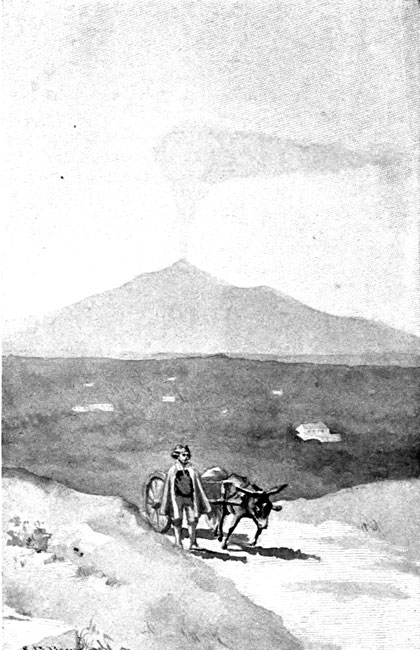
About that time, to Jeli's tumble-down
hovel came his father, the cowherd, who
had caught the malaria at Ragoleti, and
could scarcely dismount from the ass which
brought him. Jeli started a fire quickly,
and ran to "the hall" for some hen's eggs.
"Put a little straw down in front of the
fire as soon as you can," said his father,
"for I feel the fever returning."
The chill of the fever was so severe that
compare Menu buried under his thick
cloak, the saddle-bags of the ass and Jeli's
sacks shook as the leaves do in November,
in spite of the great blaze of branches
which made his face white as a corpse.
The contadini of the farm came to ask
him,—
"How do you think you feel, compare
Menu?"
The poor man could only answer with
a whine like a sucking puppy.
"It's a kind of malaria that kills more
surely than a rifle bullet," said his friends,
as they warmed their hands at the fire.
The doctor was called, but it was money
thrown away, because the disease is one of
those clear and evident ones which even a
boy would know how to cure; unless the
fever happens to be so severe that it will
kill at any rate, a little quinine cures it
quickly.
Compare Menu spent the eyes of his
head for quinine but it was as good as
thrown down a well.
"Take a good dose of ecalibbiso tea,
which does not cost anything," suggested
massaro Agrippino, "and if it doesn't
work as well as quinine it doesn't ruin you
by its cost."
So he took the decoction of eucaliptus,
but the fever returned all the same, and
even more violently. Jeli attended to his
father the best he knew how. Every morning
before he went off with his colts, he left
him his medicine all prepared in a drinking
cup, his bundle of dry branches within
reach, his eggs in the hot ashes, and he
came back as early as he could in the
afternoon with more wood for the night,
and the bottle of wine and a little piece of
mutton, which he had gone as far as
Licodia to buy for him. The poor lad did
everything as handily as a clever maiden
would have done, and his father, following
him with weary eyes in his operations
about the hovel, sometimes smiled to think
that the boy would be able to do for himself
in case he were left alone in the world.
On days when the fever left him for a
few hours, compare Menu would get up, all
feeble as he was, and with his head
wrapped in his handkerchief, would stagger
out to the door to wait for Jeli while the
sun was still warm. When Jeli dropped
the bundle of wood at the door-steps, and
placed the bottle and the eggs on the table,
he would say to him,—
"Put the ecalibbiso to boiling for to-night,"
or, "Remember that your aunt
Agata has charge of your mother's money,
when I shall be no more."
Jeli would nod "yes" with his head.
"It is hopeless," said massaro Agrippino,
every time he came to see compare Menu
and his fever. "His blood is all diseased
by this time."
Compare Menu listened without winking,
with his face whiter than his night-cap.
He now no longer got up. Jeli began to
weep when he found himself not strong
enough to help him turn from one side to
the other; shortly after compare Menu lay
perfectly still. The last words that he
spoke to his boy were,—
"When I am dead, go to the owner of
the cows at Ragoleti and let him give you
the three onze and the twelve tumoli of corn,
which are my due from March till now."
"No," replied Jeli, "it's only two onze
and a half, because you left the cows more
than a month ago, and one must be fair to
one's padrone."
"True!" agreed compare Menu, closing
his eyes.
"Now I am quite alone in the world,
like a lost colt which the wolves may eat!"
said Jeli to himself, when his father had
been carried off to the cemetery of Licodia.
Mara had been one of those who came
to see the dead man's house with that
morbid curiosity which is excited by horrible
things.
"Do you see how I am left?" asked
Jeli, but the girl drew back so frightened
that he could not induce her to step inside
the house where the dead man had been.
Jeli went to receive the money due his
father, and then he started off with his
drove for Passanitello, where the grass was
already tall on the fallow-land, and the
fodder was abundant; therefore, the colts
remained there for some time in pasture.
Meantime Jeli had been growing into a
big lad, and Mara also must be grown tall,
he often thought to himself, while he played
on his zufalo; and when he returned to
Tebidi after some little time, slowly driving
forward the mares through the dangerous
paths of "Uncle Cosimo's Fountain,"
he scanned the little bridge down in
the valley, and the hovel in the Valle del
Jacitano, and the roof of "the Hall" where
the pigeons were always flying.
But at that time the padrone had dismissed
massaro Agrippino, and all Mara's
family were just on the point of moving
away.
Jeli found the girl, who had grown tall
and very pretty, standing at the entrance
of the yard watching the furniture and
things, which they were loading on the cart.
The empty room seemed to him more
gloomy and smoky than ever before. The
table, the commode and the images of the
Virgin and of Saint John, and even the
nails for hanging up the gourds for seed
had left on the walls the marks where they
had been for so many years.
"We are going away," said Mara, when
she saw him looking around. "We are
going down to Marineo, where the great
house stands in the plain."
Jeli took hold and helped massaro Agrippino
and la gnà Lia load up the cart, and
when there was nothing else to carry out
of the room he went and sat down with
Mara on the edge of the watering-trough.
"Even houses," he remarked, when he
saw the last hamper piled on, "even houses,
when anything is taken away from them,
do not any longer seem the same."
"At Marineo," replied Mara, "we shall
have much better rooms, mamma says, and
large as the cheese house."
"Now that you are going away, I shall
not want to come here any more; it seems
to me as if winter had come back—to see
that door closed."
"At Marineo we shall find other friends,
Pudda la rossa and the campiere's daughter;
it will be jolly there; they have more than
eighty harvesters in the season, and the
bag-pipes, and they dance on the threshing-floor."
Massaro Agrippino and his wife had
gone off with the cart. Mara ran behind
them, full of joyous excitement, carrying
the baskets with the pigeons. Jeli was
going to accompany her as far as the little
bridge; and when Mara was just on the
point of disappearing down the valley he
called after her, "Mara! oh! Mara!"
"What do you want?" demanded Mara.
He knew not what he wanted.
"Oh! what will you do here all alone?"
asked the girl.
"I shall stay with the colts."
Mara ran skipping away, and he stood
there as if rooted to the spot so as to catch
the last sounds of the cart rattling over
the stones.
The sun was just resting on the high
rocks of the Poggio alla Croce, the gray
crests of the olive trees were shading into
the twilight and over the vast campagna
far away, nothing was heard except the
tinkling bell of "Bianca" in the gathering
stillness.
Mara, now that she was in the midst of
new faces and amid all the bustle of the
grape gathering, forgot about Jeli; but he
was always thinking about her, because he
had nothing else to do in the long days
that he spent looking at the horses' tails.
There was now no special reason for him to
go down into the valley beyond the bridge,
and no one ever saw him any more at the
farm.
Thus it was that he was for some time
ignorant that Mara had become betrothed—so
much water had run and run under
the bridge. The only time that he saw
the girl was on the day of Saint John's Festa,
when he went to the fair with his colts to
sell; a festa which changed everything for
him into poison, and caused the bread to
fall out of his mouth by reason of an accident
that befell one of the padrone's colts—the
Lord deliver us!
On the day of the fair, the factor waited
for the colts ever since dawn, walking impatiently
up and down in his well-polished
boots behind the groups of horses and
mules that came filing in along the highway
from this direction and that. It was almost
time for the fair to close, and still
Jeli with his animals was not in sight beyond
the turn made by the highway. On
the parched slopes of Calvario and the
Mulino a vento—the Wind-Mill Mountain—there
remained only a few droves of sheep
gathered in a circle, with noses drooping
and weary eyes, and a few yoke of oxen
with long hair—of the kind that are sold
to satisfy unpaid rent, waiting motionless
under the boiling sun.
Yonder toward the valley, the bell of
San Giovanni's was ringing for High
Mass, accompanied by the long crackling
of the fireworks.
Then the fair grounds seemed to spring
up, and there ran a prolonged cry among
the shops of the green grocers, clustered
in the place called salita dei Galli, spreading
through the country roads and seeming
to return from the valley where the church
stood.
"Viva San Giovanni!"
"Santo diavolone!" screamed the factor.
"That assassin of a Jeli will make me lose
the fair!"
The sheep lifted their heads in astonishment
and began to bleat all at once, and
the cattle also made a step or two, slowly
looking around with their great, calm eyes.
The factor was in a rage because he was
expected that day to pay the rent due for
the large enclosures—as the contract expressed
it, "when Saint John arrived under
the elm;" and to make up the full sum,
the profits on the sale of the colts was necessary.
Meantime the colts and horses
and mules were coming in such numbers
as the good Lord had seen fit to make, all
curried and shining and adorned with tassels
and cockades and bells; and they
were switching their tails to while away
their tedium, and turning their heads
toward every one who passed, and evidently
waiting for some charitable soul
willing to buy them.
"He must have gone to sleep on the
way, the assassin!" yelled the factor, "and
so made me lose the sale of my colts."
In reality, Jeli had travelled all night so
that the colts might reach the fair fresh,
and get a good position on their arrival;
and he had reached the piano del Corvo,
and the "three kings" had not yet set,
but were shining over monte Arturo.
There was a continuous procession of
carts passing along the road, and people
mounted on horses or mules going to the
festa. Therefore, the young fellow kept
his eyes open so that the colts, frightened
by the unusual commotion, might not get
away, but that he might keep them together
along the ridge of the road behind
la bianca, the white mare, who with the
bell around her neck, always travelled
straight ahead without minding anything.
From time to time, when the road ran
over the crest of the hills, the bell of
Saint John's could be heard in the distance,
and in the darkness and silence of the
plain the rumor of the festa was distinguishable,
and along the whole road far
away, wherever there were people on foot
or on horseback going to Vizzini, were
heard shouts of "Viva San Giovanni!"
And the rockets rose up high in the air
and brilliant behind the mountains of la
Canzaria, like the rain of meteors in
August.
"It is like Christmas Eve!" Jeli kept
saying to the boy, who was helping him
drive the herd. "And in every place
there is feasting and light, and throughout
the whole campagna you can see fireworks."
The boy was half asleep as he forced
one leg after the other, and he made no
response; but Jeli, who felt his blood stir
within him at the sound of that bell, could
not keep quiet, as if each one of those
rockets that left their silent shining trails
on the darkness behind the mountains
burst forth from his soul.
"Mara also must be going to the festa
of Saint John," he said, "because she goes
every year."
And without caring because the boy
made no reply,—
"Don't you know? Mara is now so big
that she must be taller than her mother,
and when I saw her last I couldn't believe
that it was the very same girl with whom I
used to go after prickly pears and knock
off the nuts."
And he began to sing at the top of his
voice all the songs that he knew.
"Oh Alfio, why do you sleep?" he
cried, when he was through with them.
"Look out that you keep la bianca always
behind you, look out!"
"No, I am not asleep," replied Alfio,
with a hoarse voice.
"Do you see la puddara[8] which stands
winking down at us yonder, as if they were
firing up rockets also at Santa Domenica?
It is almost sunrise; we shall reach the
fair in time to secure a good position. Ah!
morellino bello! you pretty little brownie!
You shall have a new halter, that you
shall, with red cockades for the fair; and
so shall you, stellato!"[9]
Thus he went on, talking to one and
another of his colts so that they might be
encouraged hearing his voice in the darkness.
But it grieved him to think that
the stellato and the morellino were going to
the fair to be sold.
"When they are sold, they'll go off with
a new master, and we shan't see them any
more in the herd, just as it was with Mara
after she went to Marineo.
"Her father is well-to-do down there at
Marineo, and when I was there, found
myself, poor fellow that I was, sitting down
to bread and wine and cheese, and everything
good that God gives, and as if he
were the factor himself, and he has the
keys to everything, and I could eat up
the whole place if I had wanted. Mara
scarcely knew me, it had been so long
since we had seen each other, and she
cried out,—'Oh, look! there's Jeli the
guardian of the horses, from Tebidi. He
is like one who comes home from abroad,
who only at the sight of the distant mountain-top
is quick enough to recognize the
country where he grew up.' Gnà Lia
didn't want me to speak to her daughter
with the thee and the thou, because Mara
had grown to be so big, and the people
who don't know about things easily gossip.
But Mara only laughed, and looked
as if she had only just that minute been
baking the bread, so rosy her face was; she
was getting the dinner ready, and she was
unfolding the table-cloth, and she seemed
different. 'Oh, have you forgotten Tebidi?'
I asked her as soon as gnà Lia went out
to broach a fresh cask of wine. 'No, no,
I haven't forgotten' said she. 'At Tebidi
there was a bell with a campanile looking
like the handle of a salt-cellar, and there
used to be two stone cats which stood at
the entrance of the garden.' I felt all
through me those things that she was saying.
Mara looked at me from head to
heels, with her eyes wide open, and then
she said,—'How tall you've grown!' and
then she began to laugh, and then she
patted me on the head—here!"
In this way Jeli, the guardian of the
horses, came to lose his place; for just at
that instant there suddenly appeared a
coach, which had given no sign of its approach,
because it had been slowly climbing
the steep ascent, but started off at full
speed as soon as it reached the level ground
at the top, with a great cracking of whips
and jingling of bells, as if it were carried
by the devil himself. The colts, in alarm,
galloped off quicker than a flash, as if there
had been an earthquake, and all the shouts
and cries and ohi! ohi! ohi's! of Jeli and
the boy scarcely sufficed to collect them
again around la bianca, who in spite of her
gravity had shied away desperately with
the bell around her neck.
When Jeli had counted over his animals
he discovered that stellato was missing, and
he buried his hands in his hair, because at
that place the road ran along side a deep
ravine, and it was down in that ravine that
stellato broke his back—a colt worth a
dozen onze, like a dozen angels from Paradise!
Weeping and shouting he went
calling the colt ahu! ahu! It was too dark
to see it. At last stellato replied from the
bottom of the ravine with a melancholy
neigh, as if it had human speech, poor
creature!
"Oh, mamma mia!" cried Jeli and the
boy, as they went to it. "Oh, what bad
luck! mamma mia!"
The travellers on their way to the festa,
hearing such a lamentation in the darkness,
asked what they had lost, and then
when they learned what had happened,
went on their way.
The stellato remained motionless where
it had fallen, with its legs in the air, and
while Jeli was feeling it all over, weeping
and talking to it as if he could make it
understand, the poor creature stretched
out its neck painfully and turned its head
toward him, and then could be heard its
breathing, cut short by its agony.
"Something must be broken!" mourned
Jeli in despair, because nothing could be
seen in the darkness; and the colt, inert as
a rock, let its head fall back. Alfio, who
remained on the road above in charge of
the drove, had begun to view the matter
more calmly, and had taken out his bread
from his bag.
The sky by this time was beginning to
grow pale, and the mountains all around
seemed to be blossoming out, one after
another, dark and high. From the bend
in the road the country round about began
to stand out, with monte del Calvario and
monte del Mulino a vento—the Windmill
Mountain—outlined against the dawn.
They were still in shadow, but the flocks of
sheep made white blurs, and as the herds
of cattle grazing along the ridge of the
mountains wandered hither and thither
against the azure sky, it seemed as if the
profile of the mountain itself were alive
and full of motion.
The bell from the depths of the valley
was no longer heard; travellers were growing
less numerous, and those who passed
along were in haste to reach the fair.
Poor Jeli knew not what saint to call on in
that solitude. Alfio himself could not help
him in any way; so the boy continued
breaking off the morsels of his loaf leisurely.
At last the factor was seen coming along
mounted, cursing and swearing as he
came, at seeing his animals stopped on
the road. When Alfio saw him he ran off
down the hill. But Jeli did not stir from
the side of the stellato. The factor left his
mule by the roadside, and climbed down
into the ravine. He tried to help the colt
to rise; he pulled him by the tail.
"Let him be," said Jeli, as white in the
face as if it were himself whose back was
broken. "Let him be! Don't you see
that he can't move, poor creature."
The stellato, in fact, at every movement
and at every attempt made to help him,
set up a screech that seemed human. The
factor fell on Jeli tooth and nail, and gave
him as many kicks as there are angels and
saints in Paradise. By this time Alfio had
got his courage back, and had returned to
the road, so that the animals might not be
without a guardian, and he tried to excuse
himself, saying, "'T wasn't my fault. I
was on ahead with the bianca."
"There's nothing more to be done,"
said the factor at last, having persuaded
himself that it was all time lost. "Nothing
can be done with this colt but to take
his pelt; that's good for something."
Jeli began to tremble like a leaf when he
saw the factor go and fetch his gun from
the mule's pack.
"Get off of him, good-for-nothing!"
shouted the factor. "I don't know what
keeps me from laying you out beside this
colt, which is worth more than you, in
spite of the swine's baptism which that
thief of a priest gave you!"
The stellato, unable to move, turned its
head, with its big, steady eyes, as if it
understood every word, and its skin crisped
in waves along the back-bone as if a chill
ran over it.
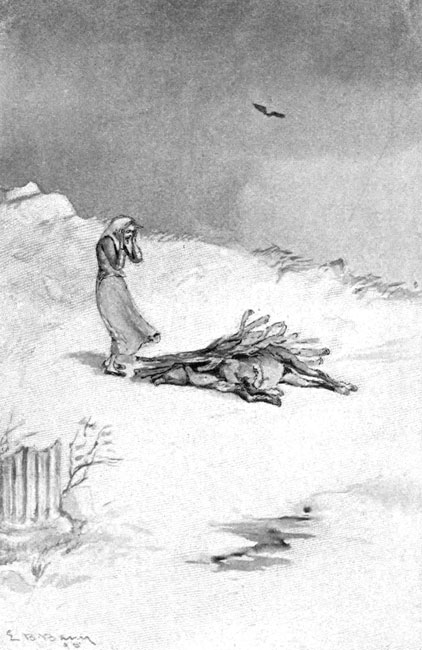
In that way, the factor killed the stellato
on the spot, so as at least to save his pelt,
and the dull noise which the gun held at
short range made, as the charge pierced
the living flesh, Jeli thought he felt in his
own heart.
"Now if you want a piece of advice
from me," said the factor, as he left him
there, "I'd not let the master lay eyes on
you, in spite of that bit of wages due you,
for you may be sure, he'd give it to you
with a vengeance!"
The factor went off together with Alfio,
taking along the other colts, which did not
once turn round to see what had become
of the stellato, but proceeded cropping the
grass along the ridge. The poor stellato
was left alone in the ravine waiting for the
knacker to flay him, its eyes were still wide
open, and its four legs stretched into the
air, for to stretch them up was the only
thing it could do.
Jeli, now that he had seen how the factor
had been able to aim at the colt, as it
painfully lifted its head in fear, and had
been courageous enough to fire off the gun
at it, no longer wept, but remained sitting
on a rock looking at the stellato till the
men came to take off the pelt. Now he
might go at his own pleasure and enjoy the
festa, or stand in the square all day long
and see the gentlemen in the café, as best
pleased him, for now he no longer had
bread or a shelter, and it behooved him to
find a new padrone, if any one would take
him after the misfortune of the stellato.
Thus go things in this world:—While
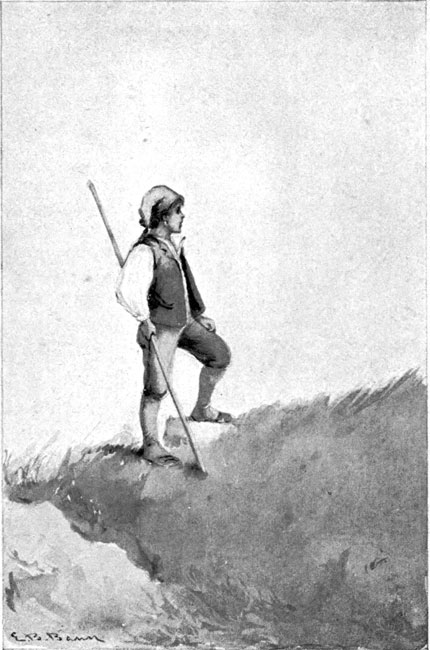
Jeli was seeking a new employer, walking
about with his bag over his shoulder and
his staff in his hand, the band was playing
gayly in the square, with plumes in their
caps, and surrounded by a merry throng
of white hats thick as flies, and the gentlemen
were enjoying themselves as they sat
at their coffee. All the people were
dressed in holiday attire like the animals
of the fair, and in one corner of the square
was a lady, with a short gown and flesh-colored
stockings, making her appear bare-legged,
and she was pounding on a great
box before a great painted sheet on which
appeared a slaughter of Christians with
blood flowing in torrents, and, there among
the throng, gazing with open mouth, was
massaro Cola, whom he used to know when
he was at Passanitello, and he told him that
he would find him an employer, because
compare Isidoro Macca was in want of a
herdsman for his hogs.
"But I wouldn't say anything about
stellato," recommended massaro Cola. "A
misfortune like that might happen to any
one in the world. But it is best not to
talk about it."
So they went in search of compare
Macca, who was at the ball, and while
massaro Cola went to plead his cause, Jeli
waited outside in the street in the midst of
the throng, who were gazing in at the door
of the hall. In the big room, there was a
world of people jumping about enjoying
themselves, all flushed and perspiring, and
making a great trampling on the floor,
while above all was heard the ron ron of
the double bass, and as soon as one piece
of music, costing a grano,[10] was finished
they would all lift their fingers to signify
that they wanted another; and the man of
the double bass would make a cross with a
piece of charcoal on the wall, to keep
account to the last, and then begin over
again.
"Those in there spend without thought,"
said Jeli, to himself. "That means that
they have their pockets full and are not in
trouble as I am, for lack of an employer,
and if they sweat and tire themselves out
in dancing, it is for their own pleasure, as
if they were paid by the day."
Massaro Cola came back saying that
compare Macca needed no one.
Then Jeli turned away, and walked off
gloomily, gloomily.
Mara's home was toward Sant'Antonio,
where the houses climb up the mountainside,
facing the valley of la Canziria, all
green with prickly pears, and with the mill-wheels
churning the water into foam in
the lowlands by the stream. But Jeli
hadn't the courage to go in that direction,
now that they needed no one to watch the
swine; and, making his way amid the
throng which jostled him and pushed him
without any thought of him, he seemed
more alone than ever he had been when he
was with his colts in the plains of Passanitello,
and he felt like weeping.
At last massaro Agrippino, wandering
about with his arms swinging, and enjoying
the festa, fell in with him in the square,
and shouted to him,—
"Oh! Jeli! oh!" and took him home.
Mara was in gala dress, with such long
ear-rings that they hung down to her
cheeks, and she was standing on the
threshold with her hands folded, loaded
with rings, waiting till it should grow dark,
so as to go and see the fireworks.
"Oh!" said Mara to him, "so you have
come also for the festa of Saint John!"
Jeli did not want to go in because he
was shabbily dressed, but massaro Agrippino
forced him in saying that it was not
the first time they had ever seen each
other, and that he knew that he had come
to the fair with his employer's colts. Gnà
Lia poured him out a good generous glass
of wine, and wanted to take him with them
to see the illuminations, together with the
comari and their other neighbors.
When they reached the square Jeli stood
with open mouth, wondering at the spectacle;
the whole square seemed a sea of fire
as when the steppes are burning, and the
reason was the great number of torches
which the devout lighted under the eyes of
the saint, who stood enjoying it all at the
entrance of il Rosario—all black under his
silver baldachin. The acolytes were coming
and going amid the flames like so
many demons, and there was, moreover, a
woman in loose attire and with dishevelled
hair, and with her eyes staring out of her
head, also engaged in lighting the candles,
and a priest in a black soutane and without
a hat, like one rendered crazy by
religion.
"There's the son of massaro Neri, the
factor of Saloni, and he is spending more
than ten lire for rockets," said gnà Lia,
pointing to a young man who was going
round through the square holding two
rockets in each hand, just like candles, so
that all the women devoured him with their
eyes, and cried to him: "Viva San Giovanni!"
"His father is rich and owns more than
twenty head of cattle," added massaro
Agrippino.
Mara also knew well that he had carried
the great banner in the procession, and held
it as straight as a pillar—such a strong and
handsome youth was he.
Massaro Neri's son seemed to have
heard them, and he set off his rockets for
Mara, making the wheel of fire before her,
and after this part of the fireworks was
over, he joined them, and took them to the
ball and to the cosmorama, where the new
world and the old world were to be seen
depicted, and he paid for them all, even
for Jeli, who followed behind the others
like a masterless cur, to see massaro Neri's
son dancing with Mara, who whirled round
and crouched down like a dove on a roof,
and held daintily up the corner of her
apron, and massaro Neri's son gamboling
like a colt, so that gnà Lia wept like a
child at the consolation of the sight, and
massaro Agrippino nodded with his head
to signify that all was going to his mind.
At last when they were all tired, they
went out where the people were promenading,
and they were carried away by the
crowd as if they were in the midst of a
torrent, and there they saw the transparencies
lighted where the decapitation of Saint
John was represented with such faithfulness
that it would have moved the heart of a
Turk, and the saint kicked out his legs like
a goat under the hatchet. Near by the
band was playing under a great wooden
umbrella, all lighted up, and in the square
there was such a crowd that one would
have said never before had so many
Christians come to the fair.
Mara went holding massaro Neri's son's
arm, as if she were a fine lady, and she
whispered into his ear and laughed, as if
she were having a fine time. Jeli was
utterly tired out, and actually went to sleep
sitting on the sidewalk till the first bombs
of the fireworks were sent up. At that
moment Mara was still by the side of
massaro Neri's son, leaning against him
with her hands clasped on his shoulder,
and in the different-colored lights from the
fireworks she seemed now all white and
now all rosy. When the last sparks died
away in the darkness of the sky, massaro
Neri's son turned toward her, with green
light on his face, and gave her a kiss.
Jeli said nothing, but at that instant all
that he had enjoyed till then changed into
poison, and he began once more to think
of his misfortunes, which he had for the
moment forgotten—that he was without
an employer—and knew not what to do,
nor where to go, that he had no food or
shelter; that the dogs might eat him as
they were eating the poor stellato left down
in the bottom of the ravine, skinned to the
hoofs!
Meantime, around him the people were
still making merry in the darkness that
had ensued; Mara, with her companions,
was dancing and singing through the rock-paved
streets as they turned homeward.
"Good-night! Good-night—buona notte!"
shouted the people to one another, as they
were left at their own doors. Mara shouted
"good-night—buona notte!" in her musical
voice, and it expressed her happiness, and
massaro Neri's son did not see fit to leave
her while massaro Agrippino and gnà Lia
were disputing about the opening of the
house door. No one gave Jeli a thought,
till at last massaro Agrippino remembered
him, and said,—
"And where are you going?"
"I don't know," said Jeli.
"Come and see me to-morrow and I will
help you find a place. For to-night, go
back to the square where we have been
hearing the band play. You'll find a spot
on some bench, and sleep out doors; you
must be used to that."
Jeli was used to that, but what pained
him was that Mara said nothing to him,
but left him there at the door as if he were
a beggar; and the next day when he came
back to see massaro Agrippino, he was
hardly alone with the girl before he said to
her,—
"Oh, gnà Mara! How you forget old
friends!"
"Oh, is that you, Jeli?" replied Mara.
"No, I haven't forgotten you. But I was
so tired after the fireworks!"
"You're in love with him aren't you—massaro
Neri's son?" demanded Jeli, twirling
his staff in his hands.
"What are you saying?" abruptly interposed
gnà Mara. "My mother is there
and hears everything you say."
Massaro Agrippino found him a place as
shepherd at la Salonia, where massaro
Neri was factor, but as Jeli was not very
much skilled in taking care of sheep, he
had to be content with far smaller wages
than he had been having.
Now he attended faithfully to his flocks,
and strove to learn how cheese is made—the
ricotta and the caciocavallo, and all the
other products of the flocks; but in the
gossip that went on at eventide in the
yard, among the shepherds and contadini,
while the women were preparing the beans
for the soup, if ever massaro Neri's son
was mentioned as soon to marry massaro
Agrippino's Mara, Jeli said not a word,
and never dared open his mouth.
One time when the keeper insulted him,
by saying, jestingly, that Mara refused to
have anything more to do with him, after
every one had declared that they were to
be husband and wife, Jeli, as he went to
the pot where the milk was boiling, replied,
as he slowly shook in the rennet,—
"Now Mara has grown to be so pretty,
she seems like a lady."
But as he was patient and laborious,
and quickly got hold of the secrets of the
business, even better than one who had
been born to it, and as he was accustomed
to be with animals, he came to love his
sheep as if they were his own, and for this
reason the distemper—il male—did not
do so much damage at la Salonia, and the
flock prospered, so that it was a delight for
massaro Neri every time that he came
to the estate, and the next year it was
no great trouble to induce the padrone to
increase Jeli's wages, so that he came to
have as much as he got in looking out for
the horses. And it was money well spent,
for Jeli never thought of reckoning up the
miles and miles that he travelled in search
of the best pasturage for his flock, and if
the sheep were with young or were sick, he
would take them to his saddle-bags and
carry the lambs in his arms, and they
would lick his face, thrusting their noses
out of his pocket, and they would even
suck his ears.
In the famous snow storm of Santa
Lucia's night, the snow fell four handbreadths
deep in the lago morto at la
Salonia, and all around for miles and miles
there was nothing else to be seen when day
came, and nothing would have been left of
the sheep but the ears, had not Jeli got up
three or four times in the course of the
night to drive the sheep into the yard, so
that the poor beasts shook the snow from
their backs and did not remain, as it were
buried, as was the case in so many of the
neighboring flocks—at least so massaro
Agrippino said when he came to give a
look to a field of beans which he had at la
Salonia, and he also said that that story of
massaro Neri's son marrying his daughter
Mara was a lie made up of whole cloth—that
Mara had some one else in mind.
"It was said they were to be married at
Christmas," said Jeli.
"Nothing of the sort; they aren't to
marry at all; it's all the gossip of envious
folks who meddle with others' business,"
replied massaro Agrippino.
But the keeper, who had known about it
for some time, having heard it talked about
in town when he was there on Sunday, told
the story as it really was, after massaro
Agrippino had gone away.
"The engagement was broken because
massaro Neri's son had learned that
massaro Agrippino's Mara was keeping
company with Don Alfonso, the signorino,
who had known Mara from a little girl;
and massaro Neri had declared that his
son was to be a man respected as his
father was, and the only horns he wanted
in his house should be those of his oxen."
Jeli was present at this conversation, sitting
with the others in the circle at breakfast,
and at that instant was cutting his
bread. He still said nothing, but his appetite
left him for that day.
While he was driving his sheep out to
pasture he began to think of Mara, as she
had been when she was a little girl, when
they were together all day long wandering
through the valle del Jacitano and over the
poggio alla Croce, and how she stood looking
at him, with her chin in the air, while
he climbed up to the tree-tops after the
birds' nests; and he thought also of Don
Alfonso, who used to come and see him
from the neighboring villa, and how they
would stretch themselves out on their
bellies, stirring up crickets' nests with
straws. All these things he considered
and reconsidered for hours and hours, as
he sat on the edge of the brook, holding
his knees between his arms, and thinking
of the tall walnuts of Tebidi, and the thick
bushes in the valleys and the slopes of the
hills, green with sumachs, and the gray
olive trees spreading through the valley
like a fog, and the red-tiled roof of the
house, and the campanile that looked like
"a handle of a salt cellar" among the
oranges of the garden.
Here the campagna stretched away
naked, desert, speckled with dried grass,
blending silently with the distant horizon.
In Spring the bean pods had begun to
fill out when Mara came to la Salonia with
her father and mother and the boy and
the ass, to pick the beans, and they all
came together to sleep at the farm for two
or three days during the picking.
In this way Jeli saw the girl morning
and evening, and they would sit together
on the wall of the sheep-fold and talk,
while the boy looked after the sheep.
"It seems as if I were at Tebidi again,"
said Mara, "when we were little things,
and used to stand on the foot bridge."
Jeli also remembered everything, though
he said little, being always a judicious
youth, and of few words.
When the harvest was over, and the eve
of parting had come, Mara went out to talk
with the young man, just as he was making
"ricotto cheese," and he was wholly intent
in skimming the whey with his ladle.
"Now I'll say addio," said she, "for to-morrow
we return to Vizzini."
"How have the beans gone?"
"Bad! la lupa[11] has eaten them all this
year."
"It depends on the rain which has been
scarce," said Jeli. "We have had to kill
even the lambs because there hasn't been
enough feed for them. Over all of la
Salonia there hasn't been three inches of
grass."
"But that doesn't affect you. You always
have your wages, good year or bad."
"Yes, that's so," said he. "But it disgusts
me to give those poor creatures to
the butcher."
"Do you remember when you came for
the festa of Saint John, and were left without
a padrone?"
"Yes, I remember."
"It was my father who got you a place
here with massaro Neri."
"And why didn't you marry massaro
Neri's son?"
"Because it wasn't the will of God. My
father has been unlucky," she continued,
after a brief pause. "Since we came to
Marineo, everything has gone ill with us.
The beans, the corn, that piece of vineyard
that we have yonder. Then my brother
went off to the army, and we lost a mule
that was worth forty onze."
"I know," said Jeli, "the bay mule."
"Now, that we have lost all our property,
who would want to marry me?"
Mara was breaking up a twig of briar
while she said this, with her chin in her
bosom, and, with her elbow, she gently
nudged Jeli's elbow without appearing to
mean it. But Jeli, with his eyes on the
churn, also made no response, and she
went on,—
"At Tebidi they used to say that you
and I would be husband and wife, do you
remember?"
"Yes," said Jeli, and he laid his ladle on
the top of the churn. "But I am a poor
shepherd, and I can not pretend to a
massaro's daughter like you."
La Mara remained silent for a little
while, and then she said, "If you want
me, I will willingly be yours."
"Really?"
"Yes, really."
"And what will massaro Agrippino say
to it?"
"My father says that now that you know
your trade, and since you are not one of
those who waste their wages, but make one
soldo into two, and do not eat to consume
bread, in time you will come to have flocks
of your own, and will be rich."
"If that is so," said Jeli, in conclusion,
"I will gladly take you."
"There," said Mara, as soon as it had
grown dark and the sheep were relapsing
into silence, "if you want a kiss, I will give
you one, because we are going to be husband
and wife."
Jeli took one in "holy peace," and not
knowing what to say, added, "I have always
loved you, even when you were going to
desert me for the son of massaro Neri."
But he had not the heart to speak of the
other one.
"Don't you see? We were meant for
one another," said Mara, in conclusion.
Massaro Agrippino, in fact, said "Yes,"
and gnà Lia put on a new gown, and she
had a pair of velvet trousers made for their
son-in-law. Mara was as lovely and fresh
as a rose, with her white mantellina, reminding
you of the Paschal lamb, and that
amber necklace which made her neck look
so white; so, when Jeli walked through the
street at her side, he marched stiffly and
erect, dressed in his new cloth and velvet
suit, and he did not dare even blow his
nose with his red silk handkerchief, lest he
should make a fool of himself; and the
neighbors and all who knew the story of
Don Alfonso laughed in his face.
When Mara said "sissignore," and the
priest made her Jeli's wife with a grand
sign of the cross, Jeli took her home, and
it seemed to him as if they had given him
all the gold of the Madonna, and all the
lands that he had seen with his eyes.
"Now that we are husband and wife,"
said he, when they reached their house, as
he was sitting in front of her, and trying to
appear very humble, "now that we are
husband and wife, I may tell you that it
does not seem to me true as you pretended—you
might have had ever so many
better husbands than I—so beautiful and
gracious you are."
The poor fellow could not find anything
else to say, and he could not contain his
delight to see Mara setting and arranging
everything through the house, and playing
la padrona. He found it impossible to tear
himself away to return to la Salonia; when
he started Monday, he was very slow in
arranging in the pack of the ass, his saddle-bags,
and his cloak, and his umbrella.
"You ought to come to la Salonia, yourself,"
he said to his wife, who was watching
him from the door-step. "You ought
to come with me."
But the young woman began to laugh,
and replied that she was not born to look
after sheep, and had no reason to go to la
Salonia.
Truly, Mara was not born for tending
sheep, and she was not accustomed to the
January tramontana wind, which stiffens
the hand on the staff, and it seems as if
your fingers would drop off, or to furious
storms that come, when the water
penetrates to your very bones, and again,
when the dust drives choking through the
streets, when the sheep travel under the
boiling sun, or to the hard bed on the
ground, and the mouldy bread, and the
long, silent, solitary days, when through
the arid fields nothing else is seen in the
distance but occasionally some sun-burned
peasant driving his ass silently along over
the white, interminable road.
Jeli knew at least that Mara was warm
and comfortable under the quilts, or was
spinning in front of the fire, talking with
the women of the neighborhood, or was
enjoying the sun on the balcony, while he
was returning from the pasture tired and
thirsty, or wet through with the rain, or
when the wind drifted the snow back of
his hut and put out his fire of branches.
Every month Mara went to receive the
wages from the padrone, and they lacked
neither eggs nor fowls, nor oil in the lamp,
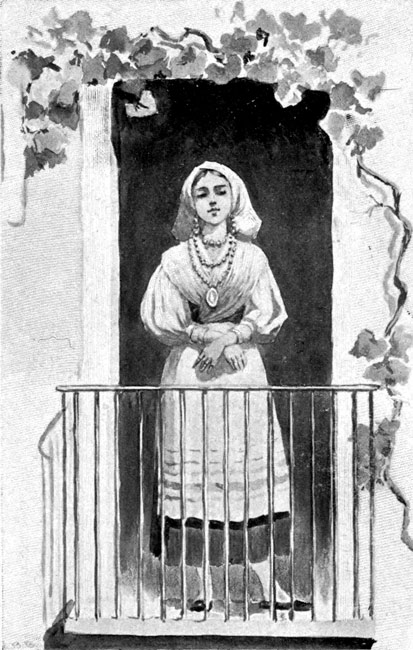
nor wine in the jug. Twice a month Jeli
came home to see her, and she would stand
on the balcony looking for him with her
spindle in her hand, and after he had left
the ass in the stable and removed his pack
and filled the rack with oats, and placed
the wood under the shed in the yard, or
whatever he brought into the kitchen,
Mara would help him hang his cloak on
the nail and take off his leather leggings
before the hearth, and pour him out a
glass of wine, and set to work to boil the
soup and get the table ready, quiet and
thoughtful, like a good housewife, while
talking of this thing and that,—of the
brooding hen that was setting, of the cloth
that was on the loom, of the calf which
they were raising, never forgetting anything
of what she had been doing.
Jeli, when he found himself at home, felt
that he was more important than the pope.
But on the eve of Santa Barbara he
came home unexpectedly late, when all
the lights were out in the street and the
town clock was striking midnight. He
came in because the mare which the padrone
had left out at pasture had been suddenly
taken sick, and he saw that it was a
case that required the services of the farrier
quickly, and he had wanted to bring him to
town in spite of the rain that was falling
like a torrent, and the muddy roads into
which he sunk half up to his knees.
Knock and call as loud as he might behind
the door, he had to wait half an hour
under the eaves, while the water ran out
at his heels. At last his wife came to open
for him, and began to scold worse than if
it had been herself who had been obliged
to wander across country in such a tempest.
"Oh, what's the matter?" she demanded.
"How you frightened me coming at this
time o' night! Does it seem to you a
proper Christian time to come? To-morrow
I shall be ill!"
"Go back to bed, I will start up a fire."
"No, I'll have to go and get some
wood."
"I'll go."
"No, I say."
When Mara returned with the wood in
her arms Jeli said to her, "Why did you
leave the door to the yard open? Was
there not enough wood in the kitchen?"
"No, I went to get it under the shed."
She let him kiss her, coldly, coldly, and
turned her head in another direction.
"His wife lets him wait at the door,"
said the neighbors, "when there is another
bird in the nest."
But Jeli knew nothing about the fact that
his wife was untrue to him, nor did any one
care to tell him, because it could surely be
of no consequence, for he had taken the
woman with a damaged reputation after
massaro Neri's son had jilted her, because
he knew of the story of Don Alfonso. But
Jeli seemed to live happy and contented in
the shame of it, and grew as fat as a pig;
for the proverb has it "horns are lean but
they make the house fat." At last, one
time, the herdman's boy told it to him in
his face, while they were scuffling about
the pieces of cheese that had been stolen.
"Now that Don Alfonso has taken your
wife you consider yourself his brother-in-law,
and you are proud enough to be a
crowned king with those horns on your
head."
The factor and the keeper expected to
see blood flow for those insulting words,
but on the contrary Jeli stood stupefied, as
if he had not heard, or as if it concerned
him not, wearing the dull face of an ox
whose horns really fitted him.
Now that Easter was at hand the factor
sent all the men of the estate to confession,
with the hope that through the fear of God
they would not do any more stealing. Jeli
also went, and at the church entrance
sought for the boy with whom he had exchanged
those hot words, and he threw his
arms around his neck, saying,—
"The confessor has bade me pardon
you; but I am not angry with you for such
gossip; and if you will not steal any more
of the cheese from me, I will not take any
further notice of what you said to me in
passion."
It was from that moment that they nicknamed
him Corno d'ore—"Gold horns"—and
the nickname stuck to him and all his,
even after he had washed his horns in blood.
La Mara also went to confession and returned
from the church all wrapped up in
her mantellina, and with her eyes cast down,
so that she seemed a genuine Santa Maria
Maddelena. Jeli, who was silently waiting
for her on the balcony, when he saw her
coming in that way, seeming as if she had
the Holy Presence in her heart, kept looking
at her,—pale, pale from his foot to his
head as if he saw her for the first time, or
as if his Mara had been changed for him,
and he seemed hardly to dare to lift his
eyes to her while she was shaking the cloth
and setting the table, calm and neat as ever.
Then after long thinking he put the
question to her: "Is it true that you keep
company with Don Alfonso?"
Mara looked him full in the face with
those black eyes of hers and made the sign
of the cross.
"Why do you want to make me commit
a sin on this day?" she demanded.
"I did not believe it, because Don Alfonso
and I were always together when we
were boys, and there never passed a day
that he did not come to Tebidi when he
was in the country there; and then he is
rich, and has bushels of money, and if he
wanted women he might get married, nor
would he lack anything, either clothes to
wear, or bread to eat."
But Mara was really angry, and she began
to scold so that the poor fellow did not
dare lift his nose from his plate.
At last, so that that gift of God which
they were eating might not turn into poison,
Mara changed the conversation, and asked
him if he had thought of weeding that little
plot of flax which they had sowed in the
bean field.
"Yes," replied Jeli, "and the flax will do
well."
"If that is so," said Mara, "this spring
I will make you two new shirts which will
keep you warm."
In truth Jeli did not realize what
"cuckold" meant, and he did not know
what jealousy was. Every new thing found
difficulty in getting into his head, and this
became so great that, in making its way in,
it played devilish work, especially when he
saw his Mara before him so beautiful and
white and neat, and how she had herself
chosen him, and how he had thought about
her so many years, and so many years, ever
since he was a young boy, so that the day
when they told him that she was going to
marry some one else, he had had no heart
to eat anything or to drink all day long.
Then again he thought of Don Alfonso,
who had been his companion so many
times, and how he had always brought him
strange feeling within his heart. Don Alfonso
had grown so tall that he no longer
seemed the same person, and now he had
a full beard, curly like his hair, and a velvet
coat and a gold chain across his waistcoat.
But he recognized Jeli, and patted him on
the shoulder in salutation. He had come
with the padrone of the estate and a number
of friends to have a jollification while
the sheep-shearing was in progress, and
Mara also came unexpectedly, under the
pretext that she was pregnant, and longed
for some fresh ricotto.
It was a beautiful warm day in the pale
fields, with the grain in flower and the
long green rows of the vines; the sheep
were gamboling and bleating for delight,
at feeling themselves freed from all that
weight of wool, and in the kitchen, the
women had made a great fire to cook all
the provisions that the padrone had brought
for the dinner.
The gentlemen, while they were waiting,
had sat down in the shade under the carob-trees,
and were playing tambourines and
bag-pipes, and dancing with the girls of
the estate, as if they were all of the same
class.
Jeli, meantime, went on with his work
shearing the sheep, and felt something
within him, without knowing what, like
a thorn, like a nail, like a pair of shears,
working within him, slowly, slowly, like a
poison.
The padrone had ordered that they
should kill a couple of goats, and the yearling
sheep, and some chickens, and a turkey
cock. In fact, he was going to do
things on a grand scale, and lavishly, so as
to do honor to his friends; and while all
those creatures were squealing under the
death-agony, and the goats were screaming
under the knife, Jeli felt his knees tremble,
and little by little, it seemed to him that
the wool that he was shearing, and the
grass in which the sheep were leaping,
were stained with blood.
"Don't go," he said to Mara, when Don
Alfonso called her to come and dance with
the rest. "Don't go, Mara."
"Why not?"
"I don't want you to go. Do not go."
"I hear them calling me."
He uttered not another intelligible word
while he stayed with the sheep that he was
shearing. Mara shrugged her shoulders,
and went to dance. She was blushing
with delight, and her two black eyes shone
like two stars, and she smiled so that there
was a gleam of white teeth, and all the gold
ornaments tossed and scintillated on her
wrists and on her bosom, so that she
seemed like the Madonna herself.
Jeli had arisen to his full height, with
the long shears in his hand, and white in
face, as white as once he had seen his
father, the cowherd, when he was trembling
with fever in front of the fire in the hovel.
Suddenly, when he saw how Don Alfonso,
with his curling beard and his velvet coat,
and the gold chain at his waistcoat, took
Mara by the hand to dance—then—only
at that moment that he touched her did he
fling himself on him and cut his throat
with one stroke, as if he had been a goat.
Later, while they were leading him off
to the judge, bound, wholly unmanned, without
daring to make the least resistance,—
"How," said he, "should I not have
killed him. He robbed me of my Mara!"