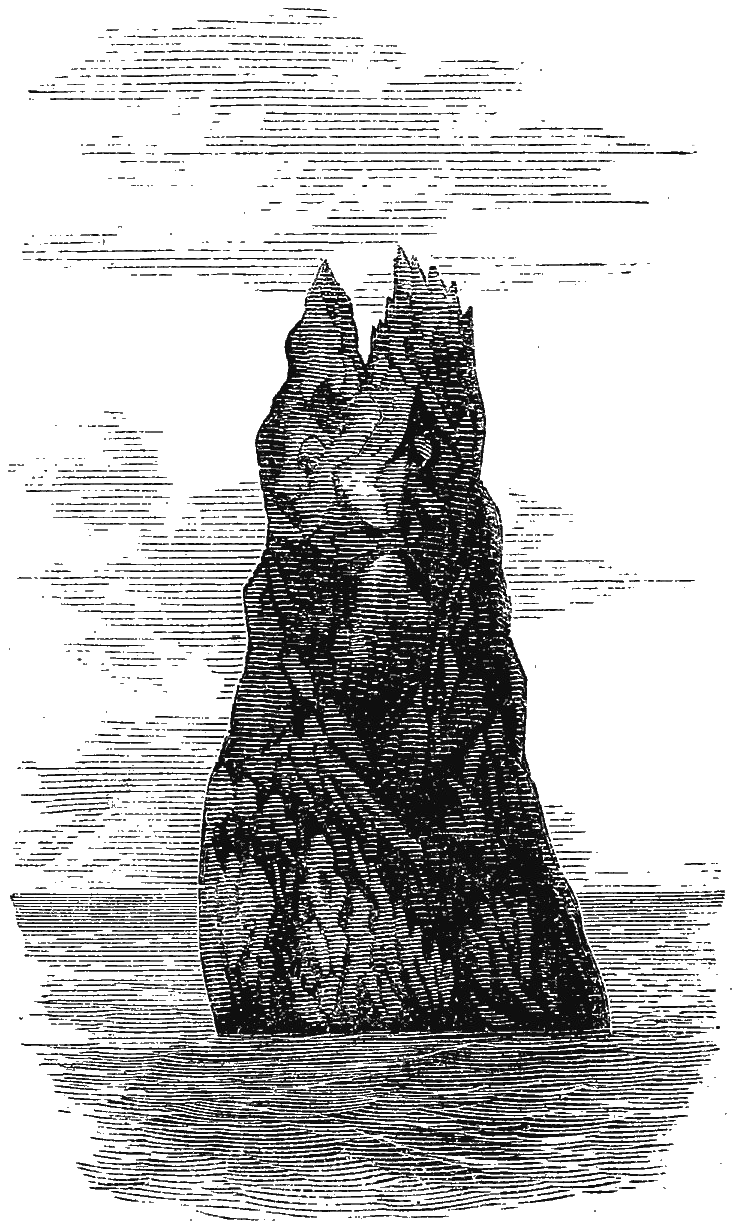
I. OUTWARD BOUND. — THE MIZZEN MAST. A DREAM. — THANKSGIVING. — SATURDAY DINNER. — SAILOR’S FARE. — APPLES AT SEA. — CAPRICES OF THE SEA. — RELIGIOUS ADMONITION FROM THE STEWARDESS. — DECISION IN A CAPTAIN. — THE NIGHT WATCH. — FLYING FISH — LOSING ONE’S SHADOW. — THE CLOUDS OF MAGELLAN. — SALT WATER BATHS. — SEA BIRDS. — SOME OF THE CREW ALWAYS AT WORK. — SOUTH AMERICA IN SIGHT. — SOCIAL LIFE AT SEA. — NIGHTS AT SEA. — WATCHING THE WAVES. — ALL NIGHT AWAKE. — EVENING SERVICE. — CAPE HORN LATITUDES. — RESUMING THE MINISTRY, AT SEA.
He travels, and I too; I tread his deck,
Ascend his topmast; through his peering eyes
Discover countries; with a kindred heart
Suffer his woes, and share in his escapes;
While Fancy, like the finger of a clock,
Runs the great circuit, and is still at home.
Cowper.
There are so many running to and
fro, and knowledge is thereby so increased,
that I doubted, at first, if
my friends did well to ask me to write for
publication an account of my voyage. But
I considered that impressions made on every
new observer add something to the already
large information of intelligent readers, besides
reviving agreeable recollections. The
thought that I may suggest to some friend
in need of long rest one means of finding
it, or encourage him to adopt it, leads me
to give, as requested, the following narrative.
The writer, having been ill in the early
part of 1869, was advised by physicians and
friends to try the effect of foreign travel;
but in what direction it was difficult to decide.
With every suggestion of experienced
friends there would arise some association
of fatigue in sight-seeing, of monotony in
resting long in one place. Pleasant as it
would be to nestle in some quiet nook in
Switzerland, or to take up an abode in one
of the Channel Islands,—Alderney, for example,
where there would be much to gratify
curiosity, and where the distance from the
centres of information would not be great,—the
thought of being confined to one place
or even district of country, or of being
tempted to visit interesting scenes, and especially
to make the acquaintance of interesting
men, awakened such anticipations of
labor as to forbid any hope of restoration
from that source.
A son of the writer was compelled in
youth, by ill-health, to leave his studies and
go to sea. In the fall of 1869 he received
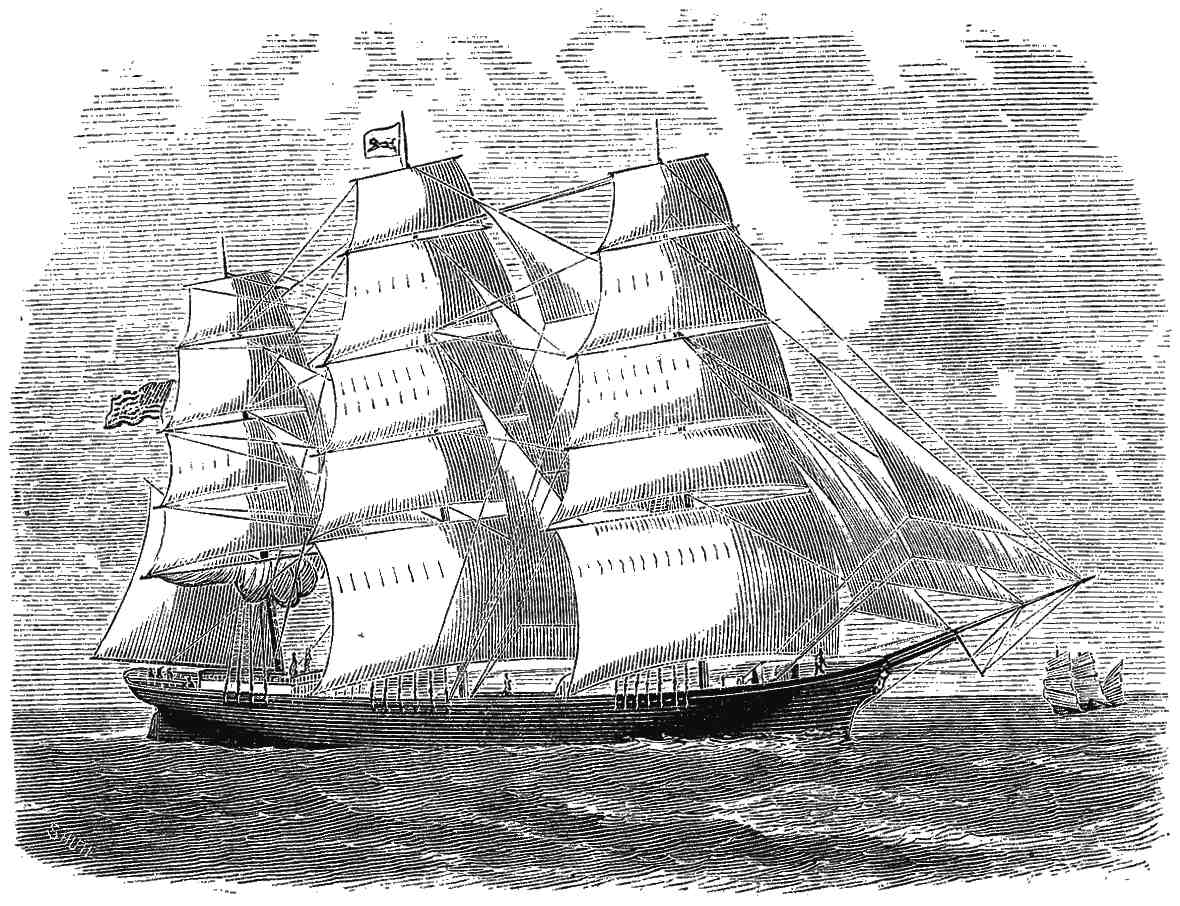
command of a commodious ship, the “Golden
Fleece,” which sailed in October of that
year for San Francisco, Hong Kong, and
Manila. By the kindness of Messrs. William
F. Weld & Co., the writer and two
members of his family accompanied him as
passengers.
Many were the questions to which these
passengers required answers previous to their
embarkation on so long a voyage. The gale
of September, 1869, which levelled our Boston
Coliseum, and damaged so many steeples,
and made such havoc among poplars and
other trees whose roots run near the surface,
led to the inquiry, What were the ordinary
chances of such gales at sea? This question
was answered by producing the log-book of
a recent voyage from Mexico, in which it
appeared that the weather, day after day,
was so free from any cause for fear that the
impression was allowed to gain strength that
storms were an exception in sea-faring life.
As to the gale just mentioned, it seemed
safer to be at sea at such a time, with sea-room,
than under roofs and chimneys, or in
streets.
October 28, 1869, the ship Golden Fleece
left Pier No. 12, East River, New York,
in charge of a tug, and dropped anchor
in the stream until the next morning. Members
of our family circle went with us
till we came to anchor, when they went
over the side into the tug, where one of
them took a sketch of us with her pencil,
completing a sketch already taken of our
cabin and staterooms for friends at home.
We finally saw them reach the wharf, when
we ceased waving our adieus and repaired
to the cabin to put ourselves in sea trim.
The sailors were in good condition. The
Shipping Master who brought them on
board, had told them that the Golden Fleece
was a religious ship; no swearing or fighting
is allowed; a minister is among the passengers;
the captain is kind and would
treat them well. He had collected a good
set of men; and when they stood on the
lower deck and the shipping master called
their names and checked them on the capstan,
it seemed to me that I had never seen
so many good faces among so many sailors.
None came on board intoxicated, but this
was not strange seeing it was but the third
hour of the day.
We weighed anchor at six o’clock the next
morning. The pilot had charge and took us
down to Sandy Hook. We heard bells on
shore at Staten Island and supposed that
they were ringing for church.
We saw the pilot boat coming for the
pilot at noon. It took him from us, and we
began our voyage. The hills of Neversink
alone remained to remind us for a short time
of home and country. Twenty or thirty
sail started with us, but our good ship took
the lead and kept it.
After dinner the two mates gathered the
men on the main deck to divide them into
watches. They were unknown to the mates
by name, but as each chose a man he pointed
to him. Being divided, they repaired to
their bunks and changed from one side of
the forecastle to the other according as they
found themselves in either watch. It was
touching to see them, each with all his
worldly goods in his arms passing each other
to their respective berths.
In two days after leaving New York we
were in the Gulf Stream. We sailed through
leagues of herbage which was borne from
the shores by the Stream, and like us was
going to sea. The ship rolled; and soon the
wind freshened and we were in a gale. We
had our first sight of “mountain waves,” so
called; but they needed some imagination
and a little fear to make them mountainous.
They were enough however to make us
uncomfortable. The gale lasted two days.
We took the impression that such was to be
the ordinary experience in the voyage,—discomfort
and tediousness. But we were
happy to find that it was not so; for, during
the whole voyage, there were very few such
experiences,—so infrequent, indeed, as to
excite surprise when they came. The morning
after the gale the weather was fine.
Going on deck, we found that we had exchanged
the sharp air of the latter part of
October in New England for the temperature
of the early part of June.
Soon we were in the Tropic of Cancer. It
seemed like a new world. Never before had
we looked upon such a sky. There was no
stratification in the clouds, and nothing of
the cumulus formation; but the surface of
the sky was composed of innumerable fleecy
things moving in the gentlest manner, as
though they feared to disturb slumber. The
gentle motion was just the thing to induce
sleep. As we thought of the turbulent
state of the elements the day before, the sky
now looked like an army which had been
dismissed. It seemed as though there was
not wind enough to form a large cloud.
The hammock was made fast, one end of it
to an iron belaying-pin in the saddle of the
mizzen mast, in the shade of the spanker,
and the other end to the rail. A hammock
meets you at every point with the needed
support. It brought strange sensations of
rest to lie and listen to the plashing of the
water against the sides of the ship. The
measured roll of the vessel now was pleasurable.
There was an easy swing to the hammock,
as though a considerate hand were
keeping it moving. How much better this
rest and peace than travelling in Switzerland,
or being pent up in the Azores, or
wandering through Italy, if one needs rest
and at the same time change of place! To
an overworked brain here is seclusion indeed.
There is here no post-office, with its delivery
three times a day, so welcome on shore; no
newspapers; no door bell; no agents soliciting
attention to new works, and begging you
to put your name down and accept a copy, as
though you had subscribed; no succession
of engagements;
“No cares to break the long repose;”
no crowd of passengers, nor daily calculation
as to the day of arrival; nor jar of
machinery, as in a steamboat, making you
feel, day and night, that somebody is laboriously
at work; and, to crown all, seemingly
no end to your vacation.
But those clouds in the tropics! You had
thought, perhaps, heretofore, that only at
night the heavens declare the glory of God.
Perhaps you find that the book which you
brought on deck to read, but which you have
no desire to open, may have in it a fly-leaf,
on which, as you lie in the hammock, with
one knee raised for a writing-table, you may
indite these dreamy lines:—
THE CLOUDS IN THE TROPICS.
Did we not think o’er ocean’s restless plain
To see embattled hosts, and feel the affray?
But lo! a truce is here, and gala-day;
Nor lines of march, nor rank and file remain.
The fleecy clouds move o’er the tranquil plain,
And fling their trade-wind signals to the breeze,
To Capricorn from Cancer, realm of peace!
They seek no martial order to regain,
But take some fancied likeness, one by one,
Or shape themselves in wizard groups of things;
No haste, nor deep designs, no jostling crowds.
The hosts are going home, their service done.
What sense of power the wide-spread quiet brings!
In calms or storms “His strength is in the clouds.”
The meteorology in the latter part of the
Book of Job stood in no need of modern
science to captivate the hearts of the worshippers
of the true God. “Dost thou know
the balancing of the clouds, the wondrous
works of Him which is perfect in knowledge?”
The charm of sea-life in a sailing-vessel I
found to be constant occupation of the mind
without wearying it. At first it seemed a
duty to read the periodicals which we
brought with us, the new books reserved for
the voyage, the choice articles in the quarterlies
which had been commended to us. But
for these we found no time. What charm
could there be in Dante when a school of
porpoises was in sight, each of them leaping
out of water just for the pleasure of the
dive back? If the mate called down the
companion-way, “A sail on the lee-bow!”
the paper-folder must keep the place in the
uncut volume till you know all about her.
It would be tedious waiting at a corner of a
street ten minutes for a horse-car; but it was
pleasant to wait an hour and forty minutes
to come up with the stranger ahead, gaining
upon her all the time, meanwhile watching
the flying-fish which the ship started on the
wing, or going forward into the bows and
looking over to see the ship dash through the
waves, with “a bone in her mouth,” till
suddenly the main topgallant-sail splits, and
so fulfills the expectation expressed for the
last five days that it could not long survive;
and now, as it is the change of watch,
and all hands are on deck, what could be
more interesting than to see twenty-eight of
them take in the old sail and bend the new
one, then line the side of the ship with their
curious faces to inspect the bark which we
have now overtaken. She is the “Doon of
Ayr,” one hundred and six days from Japan
for New York, and as she was tacking we
came so near that one might throw a biscuit
on board. The captains of the bark and the
ship had time for a few words of inquiry and
information; then the two wanderers on the
deep parted company, and watched each
other for half an hour, and sighted each
other, no doubt, occasionally, for an hour
and a half, till each became to the other a
speck. You have long ago forgotten your
book, your journal, and magazine. This
event, and its many interludes, are more
interesting to you than a battle in Lord
Derby’s Homer; it is practical life; you begin
to feel that everything which you enjoy
will be without the intrusion of periodical
engagements, and you feel surprised that
no such engagements now demand your
thoughts.
Among the incidents at sea which give a
charm to life, one is, Speaking a vessel.
This is a metaphorical expression, retained
from the former days before signals were
used in conversation, and when vessels had
to come near enough to each other for the
speaking to act its part. We had been out
five or six days, when a sail was descried on
the starboard bow. It proved to be a bark;
and we were as glad to see her as though
we had met an old friend in a foreign land.
The bark soon hoisted her ensign, which was
the same as raising your hat in passing. We
hoisted ours, which was a signal of recognition.
The bark ran up four flags, which we
recognized by the spyglass as 6 9 5 7, showing
her number in the book to be 6957.
Turning to it, we read “Sachem.” We ran
up 4 5 9 1, our number in the book. The
bark displayed 5 6 2 8, which we found to
be “Salem.” We showed 4 7 8 2,—“New
York.” The bark gave 6 8 7 4,—“Zanzibar.”
We returned 2 1 8 0,—“California.”
The bark showed 6,—“six days
out.” We did the same. The bark showed
numeral pendant,—this meaning “longitude,”
and with it 54 38. We replied
with 54 30,—our calculation. The bark
then dipped her ensign, hauling it down half
way, then raising it again. This was done
three times. We did the same, which was
equivalent to “good-bye” on either side, and
lifting the hat; we added 6 3 8 9, meaning,
“Wish you a pleasant voyage.” The answer
was, 5 7 8 3, “Many thanks.”
These courtesies at sea are pleasant.
Coming up with the vessel, or she and you
drawing near in passing, reading the numbers
by the spyglass, and arranging all the
signals, is an agreeable occupation for the
larger part of two hours, including the departure
of the vessels from each other, as
though friends were parting, leaving the
ocean more a solitude than before.
Meeting vessels, or passing them at a distance,
exchanging signals, making out their
numbers, bring remote parts of the earth
suddenly to mind. Thus new trains of
thought succeed each other entirely disconnected.
I always enjoyed exercise on horseback
for one principal reason,—that on
horseback you cannot long pursue one train
of thought. Your conjunctions are disjunctive.
If you purpose to make out your
evening lecture on horseback, your attention
is so frequently taken by something in the
road, or by the action of the horse, that you
probably come home without any connected
plan. So at sea. The occasional sight of a
sail is an illustration of the charm of sea-life
as having complete possession of your
thoughts without leaving you long at liberty
to pore over a subject. If you meet a Norwegian
bark, and the captain tells you he is
twenty-four days from Buenos Ayres, there
is Norway and Buenos Ayres for your meditation,
and perhaps for your statistical or
geographical inquiry. If the “Queen of the
Pacific,” eighty-seven days from Macao for
London, comes in sight, there is another
chapter in the world’s great miscellany.
That sail yonder proves to be the “Hungarian,”
from Saguenay, twenty-one days out,
bound to Melbourne, with lumber. You
have another illustration of commerce binding
together the ends of the earth. You
soon excuse those friends of yours at home
who commiserated you on the prospect of a
long, monotonous sea-voyage. Where is the
monotony? Not in the ship’s clock, which
enumerates every hour and half-hour by a
system of horology altogether different from
shore time-pieces; not in the boatswain’s
“Pumpship” at evening, when twelve or
fifteen men entertain you with a song.
Every tune at the pumps must have a
chorus. The sentiment in the song is the
least important feature of it; the celebration
of some portion of the earth or seas,
other than here and now: “I wish I was in
Mobile Bay,” “I’m bound for the Rio
Grande,” with the astounding chorus from
twenty-eight men, part of whom the fine
moonlight and the song tempt from their
bunks, is an antidote to monotony.
The sailors were a merry set. Though
only half of the crew—that is, one watch—were
required each night at the pumps, all
hands at first generally turned out because it
was the time for a song. It was a nightly
pleasure to be on the poop deck when the
pumps were manned, and to hear twenty
men sing. When making sail after a gale,
the crew are ready for the loudest singing,
unless it be at the pumps. For example,
when hauling on the topsail halyards, they
may have this song, the shanty man, as they
call him, solo singer, beginning with a wailing
strain:
Solo: O poor Reuben Ranzo! (twice)
Chorus: Ranzo, boys, Ranzo!
Solo: Ranzo was no sailor! (twice)
Chorus: Ranzo, boys, Ranzo!
Solo: He shipped on board a whaler! (twice)
Chorus: Ranzo, boys, Ranzo!
Solo: The captain was a bad man! (twice)
Chorus: Ranzo, boys, Ranzo!
Solo: He put him in the rigging! (twice)
Chorus: Ranzo, boys, Ranzo!
Solo: He gave him six-and-thirty— (twice)
by which time the topsail is mast-headed,
and the mate cries, “Belay!”
When the mainsail is to be set, and they
are hauling down the main tack, this, perhaps,
is the song:—
Solo: “’Way! haul away! haul away! my ro-sey;
Chorus: ’Way! haul away! haul away! Joe!”
the long pull, the strong pull, the pull altogether
being given at the word “Joe;” then
no more pulling till the same word recurs.
When hauling on the main sheet, this is
often the song, sung responsively:
Shanty man: “Haul the bowline; Kitty is my darling.
Crew: Haul the bowline, the bowline haul!”
That no one may think of me above that
which he seeth me to be, or that he heareth
of me, let me say that I find, on inquiry,
that the “main tack” is the line which hauls
down that corner of the main sail which is
toward the wind; called, therefore, the
“weather clew.” The “main sheet” hauls
the other corner of the main sail; called,
therefore, “the lee clew.” Why a rope
should be called a sheet is a piece of nautical
metonymy which it would be difficult to
explain. “Larboard” and “starboard”
were formerly used to designate respectively
the left and the right side of the ship, standing
aft and looking forward; but the two
words, so much alike, were not always
readily apprehended, and so were changed
to “port and starboard.” Why the word
“port” is used, does not appear; nor can any
one tell why “Reuben Ranzo” is associated
with one of the long pulls; if there be any
philosophy in it, or historic association, it is
as deep as the sea, or hopelessly lost.
After singing at the pumps in good
weather when there was not much work,
the men would have some amusement.
Sometimes it was “Hunt the Slipper.”
Then, again, two men sat down opposite
each other, their hands and feet tied, and a
capstan bar was run through each of the two
men’s arms, behind him. The two would
push each other with their feet till one
would lose his balance, and fall over; then,
being helpless, he was at the mercy of his
comrade’s feet till he begged for quarter.
These games were interspersed with declamations.
We had some of Macauley’s “Lays
of Ancient Rome,” “Spartacus,” “My name
is Norval.” The merry laugh and the clapping
of hands at the declaimers, and, now
and then, the youthful voice of a boy reciting
his piece from Henry Clay, or a story
from the “Reader,” beguiled many an evening
in the tropics.
On crossing the line, one evening when
we were on the poop deck, we were startled
by a voice on the lower deck, “What ship’s
that?” The captain replied. The voice
answered, “I shall call upon you to-morrow;
I have an engagement this evening.” At 3,
P. M., the next day, being Saturday, we were
summoned on deck by one of the sailors,
who announced that Neptune was coming
on board. All at once we saw a grotesque
figure swinging in the air over the water,
half-way up to the main yard, two of the
sailors pulling him in. He came on board,
wet from his waist; and there came also over
the sides a female figure and a young man.
They came to the front cabin door, and
saluted the captain, who stood ready to receive
them. Neptune had on spectacles
made of a tin can, epaulets of the same,
buskins made of duck, long hair of rope-yarns,
a duck tunic, and a girdle of twisted
ropes. Mrs. Neptune had on a long duck
mantle, her face blackened with burnt cork,
and a large fan made of wood, and covered
with sail-cloth; she used it gracefully. The
son bore his father’s trident, which was a
four pronged iron, called “the grains,” used
for spearing sharks. He, also, was fantastically
dressed. They made obeisance to the
captain, who welcomed them on board in a
short speech. They then repaired to a booth
fitted up as a sort of marquee, flung up the
sides, and called a young man from the crew.
They asked him if he ever crossed the line
before; then set him in a barrel, with his
feet out, inquired his name, where from and
whither bound, and as he opened his mouth
to answer, they inserted the paint brush filled
with soap and lime, with which the son was
lathering him, who then produced an old
saw fixed in a piece of wood for a sheath
and handle and shaved him. Neptune then
ordered him to be washed; when four men
took him and dipped him into a barrel of
water. This they did to three young men.
They then came up to our deck and saluted
us. The captain informed them that we
were all liege subjects of Neptune and
needed not to be sworn. They then wished
us a pleasant voyage,—Mrs. N. taking her
husband’s arm, fanning herself gracefully,—and
they withdrew. While it was a successful
masquerade, well sustained in all the
parts,—the boys consenting to be hazed
conscious that they were contributing something
to the dramatic poetry of sea-life,—it
was easy to see that it was capable of abuse.
The officers saw that they should be careful
how they allowed this liberty. To an
invalid at sea these things are medicine; and,
as I am writing in the interest of some who
may betake themselves for the first time to
sea in a sailing-ship for health, I would say
that they must wait till they are in circumstances
to find how “dulce est desipere in
loco,” how pleasant it is at sea to be even
gamesome upon occasions.
One day as I lay in the hammock I found
myself in a revery; my eye being fixed on a
bright, new rope which appeared among the
running rigging. I mention it as an illustration
of the frames of mind which steal
upon an invalid passenger, especially in a
sailing-ship, because undisturbed there by a
crowd, or by the noise of steam and its
machinery. Would any one think that a
single halyard among five or six others could
bring to mind Burke’s treatise on the “Sublime
and Beautiful”? But it was even so.
I found my eye going up the new rope in
admiration at the perfect regularity in the
twist of the strands. An artist cannot
always combine the hempen yarns with the
exactness which the ropemaker’s wheel gives
them. My eye went from the new rope to
the old ones; all had the same perfect twist
throughout the ship. The ropes, from belaying-pin
to truck, the signal halyard and
the hawser, seemed instinct with “the
beauty of fitness,” to borrow a term from
the above-mentioned writer,—a common
window-sash, with its parallelograms of
panes, serving that great genius for an illustration.
“Thus pleasure is spread through the earth
In stray gifts, to be claimed by whoever shall find.
Thus a rich loving-kindness, redundantly kind,
Moves all nature to gladness and mirth.”
I cannot forget the simple pleasure which
this meditation on a rope gave me, carrying
me back to youthful days in my native place,
and to the ropewalks there, the swift spindles,
the horse in the cellar turning the
wheel, the spinners, each with a bunch of
hemp around him hitching it to the spindle,
then walking backwards, paying out the
hemp through his hands with judicious care,
the rope all the time growing lengthwise,
down the walk. It used to be a wonder to
me how the horse in the cellar, going about
on the tan, could twist the twine at the end
of the bridge as accurately as it was twisted
at the spindle. Unconscious influence, remote
causations, continents, oceans, years,
intervening between the agent and the effect
of his example and words, were illustrated
by the horse in the ropewalk; and the revery
would have been protracted, had not a vessel
ahead caught my eye. Coming to my senses
I thought of Dean Swift’s satire on Robert
Boyle’s pious and sentimental writings,
which the Dean had to read in the hearing
of Lady Berkeley, whose simplicity and enthusiasm
he was pleased to ridicule, in revenge
for the task imposed on him, under the
guise of mimicking Mr. Boyle, in the famous
piece, “Meditations on a Broomstick.”
But few things have so pleasing an effect
in solving the kinks in one’s brain as to lie
in a hammock on deck at sea far away from
care, and let the fancy like the poet’s river
“wander at its own sweet will.” This wandering
would have continued, had I not been
startled by descrying as aforesaid a vessel
ahead, hove to, directly across our course,
under short sail, her jib-boom gone, all looking
as if she was in distress and trying to
intercept us for relief. We began to consider
how many we could accommodate in
case she proved to be in a sinking condition;
how our provisions would hold out; and
other prudential questionings; which were
soon dissipated by finding that she was a
whaler with a whale alongside, a man standing
on him cutting in, and the rest of the
crew, some of them, hoisting up the pieces,
and others trying them out. This episode in
practical life contrasted well with the revery
with which the forenoon begun, making with
it a good illustration of the variety in sea-life.
It had rained in torrents one night, and it
kept on till nine o’clock the next day. The
sailors stopped the lee scuppers, and soon the
deck had several inches of water on the lee
side. The ducks were released and thought
their paradise regained. The sailors could
not resist the opportunity to do a little washing;
so flannel shirts and other articles of
apparel came forth into the common tub, the
main deck; being trampled on by bare feet
instead of the more laborious process of the
washing-board. The sturdy limbs bared up
to the knees showed fine sets of muscles,
enough to excite the admiration of an artist
pursuing anatomical studies. After the
sailors had finished, they turned their attention
to the pigs, which were severally walked
into the water on two legs by the men, when
they were chased and knocked about and
scrubbed, till, by their looks, they made you
believe the saying of the market-men that
ship-fed pork has no superior. There was
no monotony here.
But there was monotony soon in the doldrums.
These are a region near the equator,
between the north-east and south-east trades,
where calms and rains abound, puffs of wind
varying in direction every half-hour, trying
to the sailors, disappointing the captain’s
hopes. He yearns for steam; even an old
captain will resolve, for the hundredth time
in his life, that he will never go to sea
again; he jumps on his hat and whistles for
the wind. Then a breeze springs up, and he
rubs his hands, and thinks that, after all, his
ship is better than a steamer, till, in half an
hour, she is almost motionless.
Then is the time for the sharks to appear.
They are slow creatures and cannot keep up
with a good sailor; so in calms they come
and lie alongside. The little pilot-fishes, the
curious attendants of the shark, directing his
attention to food, are with him. The grains
are thrust at the shark; and, if they fasten
in him, a bend of a rope around his tail
brings him on board. Sailors have great
spite against sharks; they may show tenderness
to other creatures, but for sharks they
have no mercy. They will use their sheath-knives
about his nose, and disfigure him in
all conceivable ways. Their theory is that a
shark never dies till sunset. Sharks are
hard to kill. You may cut off their heads
and tails, and disembowel them, and even
then the trunk will thrash the deck at so
lively a rate that his executioners will have
need to jump about for safety. In contrast
with the shark, the dolphin seemed to me for
beauty to verify all that poets have said of
him. It is my belief that a dolphin’s mouth
is as perfect a curve as nature ever produces.
His tints, when dying, are no fiction. Two
sword-fish were caught one day, and the
rapidity with which they were stripped of
their flesh, and their back-bones hung up to
dry, rivalled the skill and speed of young
surgical practitioners.
Few if any need to be informed that the
mizzen mast is the hindmost of the three
masts of a ship. The mizzen mast of the
Golden Fleece is a solid stick, but the foremast
and mainmast are built. In this section
of the country it is not always easy to
find trees large, tall, straight enough for the
foremast and mainmast of a large ship. A
smaller one will answer for a mizzen mast.
The foremast and mainmast are specimens
of ingenious mechanical work, eight or nine
pieces in each of them making a circumference
of sixty-two inches. Iron bands gird
these heavy staves, which are grooved and
jointed together. There are five hoops of
broad iron, five feet apart. The mainmast
being in the centre of the ship is continually
scraped, oiled, and varnished. The iron
hoops are painted vermilion, which sets off
the color of the spruce wood. It is pleasant
to look on the manufactured masts which
show what human skill can do; for example,
a mainmast that can support those immense
yards which when lowered to the deck you
can scarcely believe are each of them itself
less than a mast, for it supports a huge
weight of canvas stretched upon it.
The mainmast holds up a top mast also
with its yards and sails, a top-gallant mast
with yards and sails, the royal, and sometimes
a sky sail. Then the foremast also,
which bears the same burden and is also a
manufactured thing; as you think of it, a
hundred feet ahead of you, pioneering your
way and taking the first brunt of the sea, you
cannot help regarding it as the most heroic of
the three masts. Inspiring as the sight of
these always is, I cannot withhold from the
mizzen mast peculiar attachment. As already
stated, one end of the hammock is fastened to
it, the other end to the rail; on one side or the
other there is almost always a shade from the
spanker, a principal fore and aft sail which
swings from it.
Lying here about Thanksgiving time I was
musing on the mizzen mast, when I fell
asleep, but my musing continued. The
mizzen mast, once a live tree, seemed now
to be a living person; it appeared to be
soliloquizing, though now and then it seemed
to be addressing an audience, and again it
was whispering to me. I fancied it saying
thus:—
“I was once a shoot which a fox could
tread down; then a sapling. I grew on
the side of a hill in the Aroostook region.
The Indian names of my native lakes and
rivers have been for so long a time disused
that I cannot now distinguish between the
Chern-quas-a-ban-to-cook, the Ah-mo-gen-ga-mook
and “the far-winding Skoo-doo-wab-skook-sis.”
Once these names were
familiar to me. Now I wander with you who
sail with us in the wilderness of ocean. You
sympathize with me, perhaps, in my exile
from the stillness of nature. You are tempted
to fancy me contrasting my rough life with
the silence in which I grew. Years passed
over me and my kindred in the untrodden
forest; what ornithology I might describe;
what songs I might recite; tell what eagles
visited my top; what rare plumage is remembered
as having showed itself in my foliage.
Squirrels gambolled on my limbs, woodpeckers
ransacked my sides for their prey.
Many a woodbine has climbed into me, lived
its short life, and turned crimson under the
first touch of frost.
One day men came beneath me with axes,
measured my girth, looked up to my top.
Great was my fall. I lay on the ground,
my top was brought to a level with my root.
I became a mere trunk, was borne to the
shipyard, my foot set in the hold of this
ship then new, and soon I was made ready
for my vesture of canvas in place of buds
and blossoms; I began a new life among the
winds on the seas. Now I am sailing about
the world; I have been many times round
Cape Horn, am familiar with the lightnings
off the River Plate, have compared the gales
around the Cape of Good Hope with those
of the Horn; know the latitudes where the
trade winds begin and where they cease. I
am a favorite resort of passengers in a sailing
ship. I stand aloof from the main deck
where work is all the time going on and
there is much passing to and fro. The
house,” (here it seemed to be addressing an
audience) “which is the raised covering of
the cabin, is there, extending perhaps one
third the whole length of the ship, affording
on its top a place for promenading. From
me swings the spanker, a large fore and aft
sail, helping the wind to balance the ship
and much of the time throwing a shade;
and there is almost always a current of air
stirring beneath it. Under me and in the
spanker’s shade the passengers spend a large
part of every pleasant day reading, writing,
conversing, enjoying the ocean scenes. Every
pleasant evening is sure to gather them
under me. My length runs down through
the forward cabin where I am cased in.
There the preacher or reader stands, with a
congregation of about thirty. I am therefore
a witness of a large part of a passenger’s
experience at sea. His impressions and reflections,
his reading, his writing, his conversation,
his journal, may properly be dated
under me.
It might be supposed” (here it seemed to
relapse into soliloquy,) “that the shipbuilder
had ideality playing about him when he
placed me, a tree of the wood, in the most interesting
position, to be a centre of social
life, a shelter to meditative hours, identifying
myself with the choicest moments of sea
life, retaining a magnetism which memory is
destined to feel in coming years. Such is
my origin and early history, and such the
associations, in memory, with the mast under
which most of the impressions to be recorded
here, no doubt, by one of our passengers
will be received. If his readers (should
he have any) shall be so happy as to find
themselves under a mizzen mast at sea, let it
shed the healing, healthful influence on them
which seem to be descending on the sleeper
under my shade.”
This last remark, seeming to be such a
personal allusion to myself, had the effect to
startle me, and I roused myself, surprised at
having been asleep, and I looked up to the
mizzen mast to see who was speaking. It
was the mate who that moment was saying,
“Set the crojick;”1 whereupon four sailors
came to the belaying-pins where my hammock
swung and began to loosen the buntlines. I
went below to prepare myself for the Thanksgiving
dinner.
We kept Thanksgiving, it having been
appointed before we sailed, so that we knew
the day. We dined at four, instead of our
usual hour (half past twelve), and so we
were at table part of the time with those at
home. Our dinner was:—1. Oyster soup;
2. Boiled salmon and scalloped oysters; 8.
Roast fowl; 4. Huckleberry pudding; 5.
Apple pies of dried apple. Now, should any
one envy us, or should his mouth water at
such a bill of fare, let him know that oysters
and salmon from tin cans are not the same
as those fresh from Faneuil-Hall Market.
We may be said to have had a Thanksgiving
dinner once a week. But the principal
dish was not fowl. Far from it. It was
salt fish; but probably no better meal from
this article of food is ever served on shore.
With every desirable vegetable, and some
sparkling champagne cider which a thoughtful
friend had placed among our stores, we
were rivals with Ruth when she sat beside
the reapers of Boaz in the harvest field, and
he reached her the parched corn “and she
did eat and was sufficed and left.” For
dessert we had at that meal “roly-poly,”
which is thin flour paste spread with apple
sauce, then rolled together and boiled; this
with sweet sauce flavored with vanilla made
us for the time imagine ourselves on shore.
We entertained each other at these feasts
with the choicest anecdotes, which our repasts
disposed us to call to mind and to
relish; for example, instances of Mr. Choate’s
ingenuity, as, when defending a sea captain
charged with cruelty to his crew, he undertook
to show that so far from being cruel he
was eminently considerate, so much so that
instead of searching the law books to find
out, as the witnesses alleged, what punishments
were allowable and could be inflicted
with impunity, he was only guarding himself
against the excessive use of legitimate
discipline; “he read the books with paternal
yearnings; he was a mild but firm parent;”
and instead of keeping his crew on vile
trash, tasteless, sometime loathsome, “think,
gentlemen of the jury, of applying such
words to the nutritious lob scouse and the
succulent dandy funk!” How could the
jury help saying as they presently did, Not
guilty?
Perhaps the reader, if he be not already
versed in the articles of luxurious food
served to sailors, will be willing to have his
curiosity gratified as he reads what are the
component parts of lob scouse and dandy
funk, the mention of which by the eloquent
advocate helped him to clear his client, the
captain.
“Lob scouse” is salt meat and potatoes
cut small and stewed.
“Dandy funk” is hard bread broken up,
soaked in water, mixed with molasses, and
baked in pans. Why Mr. Choate should
call it “succulent,” or lob scouse “nutritious,”
it requires legal cunning to detect.
“Sea Pie” is lob scouse with dumplings
in it, the meat not cut so fine; perhaps fresh
meat. When a pig is killed the sailors the
next Sunday generally have sea pie for dinner,
made with fresh pork.
“Bread Hash” is hard bread and salt meat
minced fine and baked.
“Potato Hash” is potatoes and meat
minced fine and baked.
“Manavellings” are remnants from the
cabin table, the boy’s treat.
We mourned the disappearance of our
apples. They began to decay three weeks
after we left New York, and our steward was
obliged to employ his ingenuity in finding
ways to use them up. We thought with
pleasure of the tropical fruits which we
hoped one day to taste; but nothing, we felt
sure, could take the place of a northern
apple. We expected to miss it as much as
Sydney Smith did his summer beverage, in
a place which he lugubriously describes as
being situated “five miles from a lemon.”
The steward was passing from the galley
to the cabin table with a plate of hash. A
sudden lurch made him lose his balance.
His arms went into the air and the hash left
the plate and went in a body against the side
of the ship where a coil of rope hung; and
it remained fast, the coil forming an oval
frame for it. We pitied the steward but
did not weep for the hash. Some of us
thought we could understand the action of a
company of boys at a boarding school, who
were asked in Lent what luxury they would
each propose to forego during the season of
fasting and humiliation as a religious offering.
Slips of paper were given to them and
in a little while were collected. Every one
of the forty papers bore the word, Hash.
Some of our company were so lost to a sense
of propriety as to exult at the steward’s
mishap.
We have a stewardess, Annie Cardozo,
wife of the steward who is a Cape de Verd,
Portuguese, man. She is an Irish woman, very
talkative, of good disposition. She was fixing
my mattress; I remarked that it was too
low on the side next the room. “Well,”
said she, pleasantly, “we must think of the
Lord, he had no where to lie down.” She
may have thought that I was querulous,
which in the present instance was not the
case; but I accepted the admonition.
One evening in the Gulf Stream just at
dark the top-gallant sail was blowing adrift
from the “gaskets,” (the ropes with which
it was furled;) and the whole sail was likely
to get loose. The captain said that it must
be secured. The mate doubted if it was safe
to send men aloft in such a gale. The captain
replied that he had been obliged when
he was before the mast to go aloft in worse
weather. He could not spare the sail. The
mate gave the order: “Go aloft, some of you,
and make fast that top-gallant sail.” Six or
eight men sprang into the rigging and soon
the sail was furled.
The captain’s eye is necessarily the most of
the time all over the ship. We were sitting
on deck when the ship was laboring in a
cross sea. He noticed that the main topmast
stays quivered. The stays had within a few
days all been “set up” for Cape weather,
but these were not so taut as they should be.
It was only a wakeful eye which would have
noticed it. The remedy was applied at once.
It is interesting to me as a father to hear the
young captain spoken of by the sailors to
each other as “the old man.” Had he a
wife, though she were only eighteen years
of age she would nevertheless be called “the
old woman.” This made it less offensive
to hear myself, though decidedly far from
seventy, spoken of as “the old gentleman.”
At night, or from eight P. M. the two
mates take turns to be four hours each on
deck, with or near the man at the wheel.
They direct the steering according to the
captain’s orders, oversee the ship, and report
to the captain several times during the night
as to wind and weather. Two of the crew
keep a lookout in the bows two hours at a
time watching against collisions and in some
latitudes against ice. The law of the road,
“When you meet turn to the right,” is the
law at sea. The chances of collision are
few. You wonder that you so unfrequently
meet a sail, especially remembering the long
list in every paper of arrivals, departures,
vessels spoken. In thick weather, especially
while on a coast, the danger increases and a
sharp lookout is the rule.
I have seen at least a thousand in the
last few weeks. They resemble the smelt,
though larger. They start up before or near
the ship in small flocks and fly fifty or a hundred
feet. By taking wing though for short
distances they are able to elude the dolphin,
the swiftest of their pursuers, who wondering
what has become of them, darts on
ahead. Their escape by flying is probably as
incredible to the dolphin as the sailors tell us
it was to the mother of a sailor who was
questioning him as to his experiences at
sea. He told her many wonderful things, as,
that a wheel of one of Pharaoh’s chariots
came up on his anchor; that he saw a
whale caught, in whose stomach was found
a handkerchief with a Hebrew word on it
which a minister on shore declared to be
Jonah; that there are now fishes in the sea
of Tiberias which have in their gills fluted
pieces of pearl resembling money, by which
name they are now called, and that some
give them the name of “Peter’s pence,” supposing
the fishes to be descendants of the
fish which Peter drew from the sea. But
when he described fishes flying in the air,
taking wing before his ship, the faith of the
listener gave way; the other stories, she said
might be true, for they had a foundation in
holy writ; but flying fish were too great a tax
on her belief.—One was washed on board,
whose wings, extended and dried, had a gossamer
appearance so delicate that one might
readily believe them to be the wings of something
more delicate than a fish.
For about a week we have been directly
under the sun. When we came under lat.
21° S. we could see nothing of our shadows
at noon. Had we been ignorant of the cause
we might have been in a frame of mind predisposing
us to listen to German stories of a
man’s selling his shadow to the evil one: for
what had become of ours? Had we been
of those ‘whose souls proud science never
taught to stray far as the solar walk or milky
way,’ we imagined what our speculations on
this phenomenon would have been. One’s
shadow certainly can never be less than in
21° S. Under our feet there was to each
of us something like one of the clouds of
Magellan.
These we saw in the evening in the south-east,
half way up to the zenith. They are
two dark spots, one larger than the other,
about twenty paces apart, not far from
two yards broad. No stars appear in them.
The telescope shows them to be openings
into a milky way or paths of star dust,
groups of heavenly bodies so many and so
distant that their light is confused. Hence
these openings in the bright heavens have the
appearance of clouds, though they are not
clouds; but the light which is in them is
darkness, its excess confusing the irradiation.
You can have sea water brought to your
room for sponge baths, or there is easy access
to a room in the ship fitted up with all the
conveniences for bathing. The men pour
water through a hole on deck into a reservoir
over head; pure sea water; the quantity
making you remember the saying of Horace,
‘Dulce est detrahere acervo’,—It is pleasant
to draw from a heap. In the Gulf Stream
the water would suit those who must dip
their razors into warm water. All who wish
for cold baths will have them as they get
further North. You have a sense of affluence
in drawing on the Atlantic for your morning
bath.
It is interesting to meet birds hundreds of
miles from land. When the ship is going at
her greatest speed, twelve or thirteen miles
an hour, these birds fly faster, some of them
forty and fifty miles, making you feel how
they surpass man in all his means of speed.
One is astonished at their quickness of sight.
You throw pieces of paper, for example,
overboard, and though you have not been
able for half an hour to see a bird, straightway
they will come one by one around you,
but you cannot tell whence. Their sharpness
of sight also is marvellous, shown in
their discovering fishes beneath the surface
of the water, even when the sea is troubled.
A ship’s work is never done. All the time
something is giving way and must be repaired;
the sails are to be patched, ropes replaced,
and day and night orders issue for
taking in or making sail. None in particular
are designated for ordinary work, but the
order is given to the watch on deck: “Go
aloft, some of you, and do this or that,”
when they all spring into the shrouds; and
when it is seen that enough are on their way
the hindmost fall back.
In good weather, the sails which need
mending are spread on the deck and subjected
to the needle. The thimble instead
of being on a finger is fixed on a leather
“palm,” which is drawn over the hand and
affords the means of giving a strong push.
It is composing to sit by and watch the sewing,
or to lie in your hammock soothed by
the measured monotony of the stitching and
the plashing water. It is doubtful whether
anything furnishes an invalid with more
complete repose than a life on board a well-appointed
sailing ship.
The captain sent a man aloft at six A. M.
to look for land. In fifteen minutes he
called down, Land ho! It was Roccas Keys,
one of the eastern projections of South
America, about four miles from us. The
white rollers soon showed themselves, with
rocks behind the breakers. It was a pleasant
sight in the morning sun, a relief after seeing
nothing for a long time but the seemingly
endless waters. A current had set in, but
we were still in fifty fathoms of water.
After watching the breakers an hour they
disappeared. At four P. M. the captain thinking
that we were too near the shore to pass
Cape St. Rocque and Cape St. Augustine,
tacked for two and a half hours, which made
him feel sure of clearing the land in the
night.
The twenty-fifth of November was a beautiful
day in contrast to the probable state of
the climate at home, and calling us all on
deck. One of the passengers sat plying her
needle on the chief signal flag, another writing,
one enjoying the soothing influences of
the day in his hammock, the captain fixing
his signals with a contrivance for keeping
them separate and easily handled. Soft airs
were about us. The clouds showed that we
were in the trade wind region. Instead of
banks of clouds and thunderheads there were
innumerable fleecy clouds, mostly small, giving
a calm look to the heavens. We seldom
see this for a long time on land. We are in
all respects the larger part of the time as if
we were in a pleasure boat. No doubt other
ships would awaken as agreeable sensations,
but we are much of the time impressed with
the gracefulness of our ship’s motions. We
are instructed that this is owing in part to the
stowage. She is not too much “by the
head” nor “by the stern;” yet, after all,
there is sometimes an indescribable air of
beauty in a craft which the wisest builder
will fail to define or to account for, while
every one sees and feels it. Wholly ignorant
of niceties in the art of steering, I soon
learned by the action of the ship that it
made a difference in her behavior whether
one man or another were at the wheel.
Many a time have I been so impressed with
the way in which the ship rode the waves
that I have left my seat to see who was
steering, and have found that Nelson was
having his trick at the wheel. Nelson is a tall
sailor, about fifty years of age, an American,
not always as exemplary on shore for his
temperate habits as at sea he is skillful in his
profession. He has the eye and hand of
a marksman in encountering groundswells,
running through chop seas; making me think
of the gallant manner in which some policemen
help ladies cross the thoroughfares.
For nearly a month we have had quiet
nights. Sleep is as deep and dreams as
natural as on shore. Bed time is at half
past nine and breakfast at half past seven.
Going to sleep or waking in the night knowing
that a mate and fifteen men are up and
round about you and will be succeeded once
in four hours by others, it is not strange that
you should have a feeling of repose. It is
useless for you to have an anxious thought.
You could not go up to the royals nor out to
the jib in an emergency; these men will go
for you. How would it do at home to feel
that angels who excel in strength are in the
dwelling, in the cars, being caused to fly
swiftly to keep you in all your ways?
We spent the afternoon on deck watching
the waves, they being fairly entitled to the designation
of billows. The sea was white with
foam, though the day was fine; while round
about the ship the eddying water presented
numberless forms of beauty. These words
by one of the poets are sometimes as true of
sea water as of fresh:
“How beautiful the water is!
To me ’tis wondrous fair;
No spot can ever lonely be
If water sparkle there.
It hath a thousand tongues of mirth,
Of grandeur or delight,
And every heart is gladder made
When water greets the sight.”
Every now and then an enormous wave
would break astern or about midship, like a
mad pursuer compelled suddenly to give up
the chase and die with a roar which seemed
to tell what it would have been glad to do.
It was Saturday afternoon, the time devoted
by us at home to driving into the country;
but the larger part of the afternoon went by
unheeded while we were watching these
frantic waters spending themselves one after
another in their harmless wrath. There is
more of pleasurable excitement in such a
contemplation in a ship under sail than in
driving; the sea air in fine weather giving
exhilaration to the system which is in some
degree a substitute for exercise. The ceaseless
play of the water, never repeating itself
in the same shape, interests the mind without
fatigue, keeps attention awake by new surprises.
We were at the mouth of the River
La Plata, or “the River Plate,” as it is
familiarly called, between Uragua and Paraguay,
a region for disagreeable weather.
Squalls, thunder and lightning, rain, everything
which can make sea faring people uneasy,
abound. But though we are nearly
opposite the mouth of the river we are enjoying
a perfect day. Still we are notified that
we are in a region where we must not be surprised
at sudden changes. Since a week
after leaving New York we have been in exhilarating
weather. All through November
the thermometer has been at 60 or 70 in the
cabin. On deck it has been cool enough, in
the shade of a sail or under an awning. It
was only the night before last that I felt the
need of more than a sheet for a covering,
though it was the fifth of December. The
mere thought of sitting on a doorstep or
piazza at home at this season to watch the
stars, brought forcibly to mind the contrast
of our respective climates. Home is 43 degrees
north of the equator; we are now,
Dec. 20th, thirty-seven degrees south of it;
hence we are 43 + 37 = 80 degrees from
home; and sixty miles being a degree we
are 80 × 60 = 4800 miles from home, not
reckoning the difference in our longitude.
We went to sleep with everything favoring
the expectation of a peaceful night, but at
midnight the tramp of feet on deck revealed
that all hands had been summoned to take
in sail. The noise made by the heavy boots
of thirty men was not unlike the noise made
by horses on being removed from a burning
stable. The scene on deck that night must
have been a good specimen of “River Plate
weather,” judging from the description given
of it by the officers. The captain said in a
letter which he sent home:—
“At eleven o’clock a bank of clouds rose
in the northern horizon with occasional
flashes of lightning. As the clouds crept
toward the zenith the flashes grew more frequent
until they became incessant, playing
over the whole of the north western sky accompanied
by constant growls of thunder.
Thinking a heavy squall was near I took in
the royal and top gallant sails, hauled the
courses up snug, had the topsail halyards and
braces all laid down clear and kept the men
standing by. When the clouds reached the
zenith sharp flashes of lightning came at
short intervals in addition to the constant
display of heat lightning which had spread
over the whole sky, keeping it in a perpetual
blaze which I can compare only to a universal
Aurora Borealis. Then it began to thunder
in terrific peals with a continuous growl in
the way of a running sub bass. I ordered all
the cabin shutters to be closed tight that
the flashes might not startle the sleepers, for
it seemed as though the most brilliant day
were alternating moment after moment with
the blackest night. Then it began to rain.
To use a sailor’s expression, “every drop was
a bucketfull.” In the most literal sense, it
poured. Every flash seemed the reopening
of the sky, while the thunder had a combined
sound of rattling and roaring, each of these
noises vieing with the other, making me feel
as though parks of artillery were crashing the
reservoirs, bringing down their contents by
floods. Withal, there was the phenomenon
which landsmen are slow to believe, balls of
fire resting on the trucks and yard arms, and
called by sailors, “corpasants,” (a corruption
of “corpus sancti”) these electric fires
appearing to envelope the ship, availing
themselves of all its points. All this was a
combination of sights and sounds characteristic
of the River Plate region. I thought
every moment that a hurricane squall would
burst upon us. It did blow hard. The
wind changed entirely round the compass by
spells, catching us aback two or three times,
compelling us to brace the yards round, but
the gale did not amount to anything serious.
In a couple of hours the storm subsided.
While it lasted it was appalling. All the
powers of the air seemed to be in requisition
to work some disaster.”
Some days later upon going on deck in
the morning, the scene was a picture of
desolation. A heavy gale was blowing and
several sails had been stripped off by the
winds. The mast and spars made me think
of the nut trees in the country after a
gale when the leaves are gone; the spars
were hardly clothed with canvas enough to
keep the ship on her way, the few sails
which remained being furled, to save them;
only some of the canvas about the bowsprit
and foremast being spread, with the mizzen
staysail, to prevent the ship from broaching
to. Eighteen men were aloft securing the
sails, the ship going only two or three knots.
Some of the torn sails had been sent down
on deck. I never desired more the skill of a
draftsman that I might picture the appearance
of some of the sails as they came down
after the gale had spent its ingenuity in riddling
them. The shapes of the rents could
not have been contrived by human skill; the
canvas was not merely torn, it was picked in
pieces, mocking any attempt to bring it together
and even to divine how its parts were
ever related to each other. The way in
which the sail cloth was dishevelled by the
gale, laid out in shreds, every thread loosened
from its neighbor, some parts of the sail
mangled, other parts minced as no art of
human fingers or mechanical skill could rival,
made the sailors despair of any attempt to do
mending in the premises. They wound large
parts of a topsail together for scouring-rags,
some of it for cleaning brass work and other
uses, for which the riddling wind had made
the duck surprisingly soft like flannel, and
some of it like lint.
It seems fearful to lie so far removed from
the habitable parts of the globe, a little company
of human beings without neighbors,
and with no means of help should we need
it. Yet there are birds flying around us;
some of them are resting on these waves.
This inspires us with a feeling of safety.
The sight of life in these creatures seems to
be a connecting link between us and the
living God. “From the ends of the earth,”
literally, we cry to God when our hearts are
overwhelmed by a sense of solitude. I am
writing in a large easy chair, in which
it requires some effort to preserve an upright
position. The chair is made fast with rope
yarns tying it to staples driven in to the
floor; but for these I should go over. My
inkstand is lashed with seizings to the swinging
rest in front of me, diverting my attention
from writing to the ink in the glass
which at every roll of the ship climbs so
nearly to an angle of forty-five degrees as to
excite apprehension that it will spill. Ink is
at best a source of mischief to all of us under
the wisest precautions. What should I do
just now should mine run over the floor?
The stream would look as capricious as the
wanderings of the children of Israel in the
wilderness look on the map. I could not
run for help, nor even stand, to call; I will
put the cork in after dipping the pen when
we are midway between a lee and weather
roll. The girls are sewing as composedly as
at home, one of them reading aloud from
Dickens’ Mutual Friend. When I raise my
eyes from my papers and look out of the
window and see the water racing by us,
white with foam, I need only the jingling of
bells to make me fancy that I am in a sleigh.
The man at the wheel keeps his post in his
oil-cloth coat; I hear the pelting rain when the
door is opened by the captain going up to ask
“how she heads;” the gale is strengthening;
we are nearing Cape Horn.
The ship rolled so incessantly all night
that I lay awake till morning. The carpenter
has made me a berth board which raises
the outer edge of my mattress so that as
the ship rolls I am able to preserve an equilibrium.
But everything in my room which
could get loose was piled up in a promiscuous
heap. For the first time for six weeks I did
not appear at breakfast, but lay till 11 A. M.
hoping to sleep.
The gale lasted all day. In the evening
we had religious services with the watch below.
The captain read a chapter, made remarks,
and called on me to follow. I told
them how I had heard one of the boatswains
singing, “Jesus sought me when a stranger,”
in the hymn “Come thou Fount,” &c., written
by Rev. Mr. Robinson, a Baptist minister
in England, who, as a distinguished hymnologist
of Baltimore told me, quoting from an
English paper which he has preserved, departed
from his early faith, but in after years when
driving with a friend he heard singing and
stopping to listen these words of his own
hymn caught his ear:
“Jesus sought me when a stranger
Wandering from the fold of God;”
when Mr. Robinson, lifting his hands as in
prayer, said, “I would give worlds if I could
now feel as I did when I wrote that hymn.”
The incident seemed to me a remarkable indicating
of divine grace endeavoring to call
home a wandering sheep to the Shepherd and
Bishop of souls, by causing him to remember
so forcibly his former religious hope.
Dec. 14. At eight and a half o’clock,
P. M. it is light enough on deck to read small
print. The day breaks at two, and there is a
long morning twilight; the sun rises at four.
We have to-day passed 50° S. This is the
beginning of the Cape Horn region.
To-day we have been running seven knots
with a fair wind, and going in toward the
coast, for several nautical reasons. At four
P. M. we saw a dense cloud forming and in
half an hour there came a heavy rain and
fresh breeze, the ship going twelve knots, so
fast that we shortened sail lest we should
get out of the line of the Straits of Lemaire
and run too near the Falkland Islands. The
captain’s plan of steering for the coast proved
as he expected, for now the southwest wind
would have set us too far east.
Dec. 19. Had services in the evening at
seven by day light. It was the anniversary
of my first sermon as Colleague pastor of the
First Church at Cambridge, forty years ago.
It was my first attempt to preach since
February 14th. On account of uneasy motion
in the vessel, sat and conducted the exercises.
Did not feel the least inconvenience
from the effort but slept quietly all night.
II. CAPE HORN. — ROUND THE HORN. — DANGERS IN THE CABIN. — CHRISTMAS AT SEA. — A YOUNG SAILOR’S EXPERIENCE. — THE SHIP’S TRACK. — MAKING LAND ROUND THE HORN. — THE LAST DAY OF THE YEAR. — NEW YEAR’S DIVERSIONS. — FAIR WEATHER PAST THE HORN. — CHANGE OF SEASONS AT SEA. — THE MORNING HOUR. — CLEANING SHIP. — THROWING MANUSCRIPTS OVERBOARD. — BURNING TAR BARRELS. — TEN THOUSAND MILES FROM HOME. — A SAILOR AT HIS MEAL. — BRILLIANT NIGHT. — THE SOUTH EAST TRADE WINDS. — RELIGIOUS INTEREST. — SCRIPTURE PROMISES. — SUNRISE ON DECK. — LOW TONES OF NATURE. — THE SHIP’S GUNS. — THE SHIP PUT IN PERFECT ORDER. — CROSSING THE LINE AGAIN. — BONITOS. — WHALE FEED. — A MARINE ARTIST ON BOARD. — THE END OF THE NORTH EAST TRADES. — BOSONS. — THE CAPTAIN’S CLOSING ADDRESS.
All places that the eye of Heaven visits
Are to a wise man ports and happy havens.
Teach thy necessity to reason thus:
There is no virtue like necessity.
Shakspeare: Richard II.

At six o’clock, A. M., Dec. 20, a man at
the mast-head cried, “Land, ho!”
We saw the highlands of Tierra del
Fuego, about a hundred miles from Cape
Horn. We lay on the water motionless.
About a mile from us was a brig apparently
bound the same way. The captain ordered a
boat to be made ready; and the mate, one of
the boatswains, and three sailors, rowed to
her. She proved to be the brig “Hazard,”
Capt. Lewis, of Boston, belonging to Messrs.
Baker and Morrill, eighty days from Malaga,
bound to San Francisco, with raisins and
lemons. The visitors received much information,
and gave papers,—which, though fifty-seven
days old, were gladly received,—some
buckwheat, and other things; and received
kind tokens in return. The swell would
often hide the boat from the ship and the
ship from the boat, except the upper sails.
In the afternoon the wind sprung up fair;
soon we came close to, and the captains had
conversation.
Tierra del Fuego lies south of Patagonia,
separated by the Straits of Magellan. It has
high hills, which, at a distance, look like
domes. Many bays indent the coast, causing
it to bend frequently. Between this district
of country and Staten Land or Island, are the
Straits of Le Maire, twelve miles broad.
Entering the Straits with a fair wind and a
strong current, on the morning of a bright,
cool day, Dec. 21, we went at the rate of
thirteen knots. We came alongside of a
great patch of seaweed and kelp on which
were eleven large birds. We had tacked or
had been becalmed for almost a week, losing
nearly five days. We therefore enjoyed our
speed the more. The hills were picturesque
in the variety of their shapes; their jaggedness
and grouping were beyond imagination.
One cluster was surmounted by an enormous
stone, fluted like a sea-shell, looking as if it
were placed there for a memorial purpose.
There was another hill which terminated
in the appearance of a man’s head, the face
upward, the features regular, and so much
resembling one of the sailors that it received
his name. Flocks of wild ducks, twenty or
thirty in each, albatrosses, cape hens, cape
pigeons, penguins or divers, were abundant.
These penguins float with only the head
above water, and dive often; they all made
the scene most lively. We sat or stood three
or four hours enjoying the wild enchantment.
It was worth to any one a voyage from New
York. We saw no trace of an inhabitant.
They are said to be of large stature, almost
naked, their skin and flesh toughened by the
climate. They do no tillage, but live on
shell-fish and game. I shall always remember
this region for its wild beauty and seemingly
intense barrenness.
We came up with a New-Bedford whaler;
the name “Selah” was on her quarter, whaleboats
over her side, and men at the mast-head,
looking for whales or seals. We also descried
a large ship ahead of us which we
overtook. She proved to be the “Cambrian,”
Liverpool, seventy days out. We enjoyed
the sight of her, an iron vessel, with
wire rigging, neat and handsome.
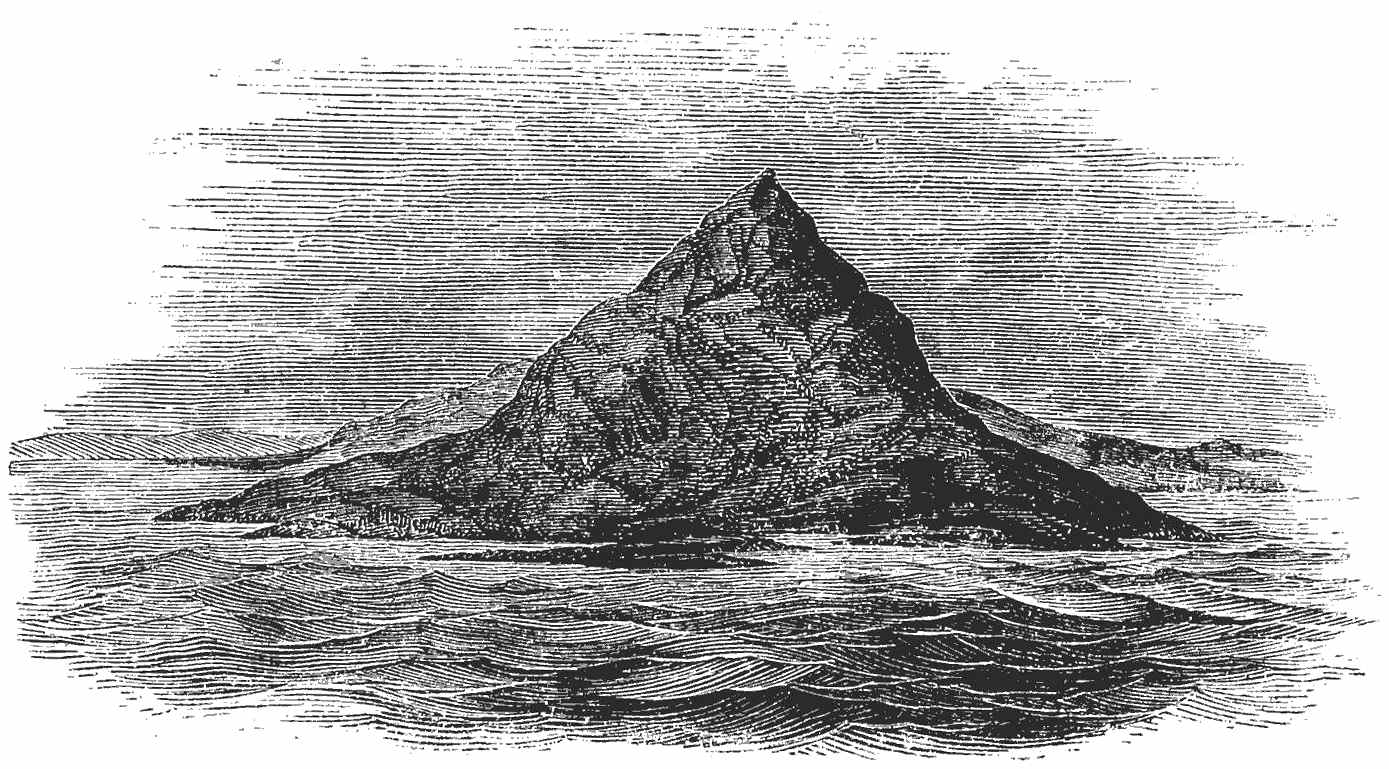
At length we saw Cape Horn Island, the
object of our desire, and at 7, P. M., were
abreast of it. Some high rocks stood about
like sentinels. We were within a mile of
the Cape.
Cape Horn Island is the southernmost extremity
of Tierra del Fuego, in south latitude
55° 58´. It is the southern termination of a
group of rocky islands surmounted with a
dome-like hill, out of which is a projection
like a straight horn. But Schouten, the
Dutch discoverer, is said to have named Cape
Horn from Hoorn, in the Netherlands, his
native place. The whole hill is a bare rock;
indeed, how could anything, even the lowest
forms of vegetable life, find root on a place
smitten as this is by the waves? Only the
lichens, stealing with seeming compassion
over every form in nature doomed to barrenness,
succeed in holding on to these rocks.
The hill is about eight hundred feet high, its
base environed by low, black rocks, with not
a sign even of marine vegetation. One line
of these rocks looks like a fort, the seeming
gateway, higher than the rest of the wall,
being composed of perpendicular fragments.
All along the base of the rough hill, low,
irregular piles, like a growth of thorns and
brambles around a bowlder in a field, constitute
a fringe, as though Nature felt that
the place needed some appropriate decoration;
and what could be more so than that
which she has here given? For a long space
toward the termination of the Cape, sharp
rocks stand up in groups, and some apart,
making a gradual ending of the scene, all in
agreement with the wildness which marks
the region.
The sight of this spot, one landmark of our
continent, can never fade from the memory
of the beholder. Like many a distinguished
object it is of moderate size, its impressiveness
being due not to its bulk or height, but
to its position. At first you are disappointed
in not seeing at such a place something colossal;
you would have it mountainous; at
least, you would have thought that it would
be columnar. Nothing of this; you have
the disappointment which you feel on seeing
for the first time a distinguished man,
whom you find to be of low stature, whereas
you would have had him of imposing appearance.
But soon, however, you feel that you
are at one of the ends of the earth. Here
the Atlantic and Pacific Oceans begin, the
great deep dividing itself into those two
principal features of our globe. Anything
monumental, any thing statuesque, or even
picturesque, here, you feel would be trifling.
Like silence, more expressive at times than
speech, the total absence of all display here
is sublimity itself; you would not have it
otherwise than an infinite solitude, unpretentious,
without form, almost chaotic. Around
this point it is as though there were a contest
to which ocean each billow shall divide; here
the winds and waters make incessant war;
the sea always roars and the fulness thereof.
The rocks which finally terminate the Cape
stand apart, as you sometimes see corners of
blocks of buildings where an extensive fire
has raged and the most of the walls have
fallen in; but here and there a shoulder of
a wall overhangs the ruins.
We stood together as we passed the last
landmarks, and sang,
“Praise God, from whom all blessings flow.”
It had been a day from beginning to end of
constant pleasure, from the moment that we
entered the Straits of Le Maire. We had
accomplished one great design in our voyage.
Would that the pleasant theory that musical
sounds leave their vibration in the air might
have reality given to it, and praise to God
break forth from all of every language who
navigate the Cape!
We had reason to feel that we were not a
great way from circumpolar regions; for at
a quarter before eleven, the night previous,
there were lingering streaks of pink light in
the west. We never before read out of doors
so late in the evening as we did that 21st of
December on deck.
We had been steering south, going five degrees
below the Cape; then we needed to
turn and go northward; but the fierce winds
made no account of our plan. You may be
several weeks trying in vain, as a ship belonging
to our firm was, to double the Cape;
but by favoring winds, we were only six days.
Once only during this time had we a full
view of the Horn; our captain had been
here six times, and now for the second time
only saw the Cape. Nothing lay between
us and the Antarctic Circle and the South
Pole. The waves were Cape-Horn swells,
peculiar to that region. The sight of the
ocean there was wild beyond description.
Now and then the sun would come out, but
his smile seemed sarcastic. Going on deck
to view the tempest you are made to feel, as
the ship goes down into deep places, that
you would be more surprised at her coming
up than if she should disappear. It is a
good time and place for faith. One of the
Latin fathers said, “Qui discat orare, discat
navigare;” Let him who would learn to
pray go to sea. It is to be doubted whether
there are many places on the globe where
one feels the power of solitude precisely as
here. In the depth of a wilderness, or among
mountains, solitude is more like death; but
here it seems to have consciousness; you are
spell-bound by some awful power; there is
an infinitude about these watery realms; it
seems like being in eternity. In the ascent
of Mont Blanc, while gazing from the Mer
de Glace on those needles of granite, inaccessible
except to the eagle, I once felt that
nothing could exceed the sense of desolateness
there inspired; but to be at the end of a
continent, with two oceans separating and
forming a wild race-way where they go asunder,
all the winds and storms being summoned
to witness the inauguration of two
oceans, their frantic uproar seemingly designed
for the great occasion, Patagonia and
Tierra del Fuego with their stupendous solitudes
listening to the clamor; and then the
feeling that the next place recorded on the
map is the Antarctic Circle, with its barriers
of cold and ice, you are warranted in the
conviction that you are as near the confines
of unearthly dimensions as you can be on
this planet. You think of home, and the
thought of your separation from friends and
country and your consignment to these awful
wilds, gives you a feeling of littleness, of
nothingness, seldom if ever experienced elsewhere.
And here is the proud ship that
stretched her length in the pier at New York
so far as to hold her spar over the passing
drays, reaching almost to the opposite ware-rooms,
now less than an egg-shell in these
waters,—a tiny nautilus, a bubble, whose
destruction any moment, unseen by any
human eye, could not detain any of these
proud waters to be so much as a mound over
her grave.
One day, before we entered the Straits and
reached Cape Horn, along the neighborhood
of Patagonia, the sea was more than usually
disturbed, a ground-swell succeeding a gale
lifting the waves higher than we had seen
them, so that the motion of the ship had no
uniformity for any two consecutive moments
during the larger part of the day,—a cold,
cheerless day, the sun now and then shining
faintly, the wind ahead, no chance for a nautical
observation, everything to the last degree
forlorn. A bird came in all this turmoil
and lighted in the water near the ship,
and swam about us. The sight suggested
the following lines:—
THE CAPE-HORN ALBATROSS.
The ship lay tossing on the stormy ocean,
A head wind challenging her right of way;
Sail after sail she furled; in exultation
The waves accounted her their yielding prey.
On her lee beam the Patagonia coast line
Keeps ambushed reefs to snare the drifting keel;
We fancied breakers in the dying sunshine,
And questioned what the daybreak would reveal.
No cities, towns, nor quiet rural village
Gladden the heart along this lonely way;
But cannibals may lurk with death and pillage
For all whom winds and currents force astray.
The Falkland Isles, Tierra del Fuego,
Straits of Le Maire, the near Antarctic Zone,
The stormy Horn, whose rocks the tempest echo,
Can faith and courage there maintain their throne?
Watching the swell from out the cabin windows,
The towering waves piled high and steep appear;
But what is riding on those mighty billows?
An albatross. The sight allays my fear.
Her snow-white breast she settles on the water,
Her dark wings fluttering while she trims her form,
Then calmly rides; nor can the great waves daunt her,
Nor will she heed the menace of the storm.
She spreads her wings, flies low across the vessel,
She scans the wake, then sails around the bows,
Not moving either pinion; much I marvel
How like one flying in a dream she goes.
She craves the presence of no other sea-bird;
She revels in the power to go at will;
The ocean solitudes, the wandering seaward,
The distant sail, her daring spirit thrill.
Behold, this fowl hath neither barn nor storehouse;
An unseen Hand assists her search for food;
Storms bring her up deep things of ocean’s produce,
Prized the more highly in the storm pursued.
With joy each day I’ll take the wings of morning,
Dwell in the utmost parts of this lone sea;
E’en there thy hand shall lead me, still adoring,
And thy right hand shall hold who trust in Thee.
It became stormy in the afternoon of December
21st, with rain. We were driven off
our course. The sea came over the sides of
the main deck. The motion of the ship was
that of a rocking horse. She was so full of
a cantering spirit that I knew it would be
useless to expect sleep in my berth, so I lay
upon a cabin sofa and had rest. The waves
were Cape Horn swells. We are directly at
the foot of the American continent inclining
upwards toward the North. Should we do
as well the rest of the way as the preceding,
we shall be a hundred and twelve days only
from New York to San Francisco. We were
all on deck this afternoon enjoying the Cape
Horn scenery. The captain and I talked of
an event in our family history when he was
eight years old, which made this day memorable.
We did not then dream of going round
Cape Horn twenty-one years from that day.
“O how great is thy goodness which thou
hast laid up for them that fear thee, which
thou hast wrought for them which trust in
thee before the sons of men.”
Dec. 24. The gale to-day exceeded anything
which we have had. The sight of the
ocean was wild beyond description. I went
on deck and held on, to see the tempest.
The ship went down into deep places, more
profound, seemingly, than ever before. But
she is a noble sea boat. We have understood
how men become enthusiastically attached
to the vessel which they are ready to
think has consciously borne them around the
globe.
You soon are so much used to the wild
behavior of the sea that you lose all apprehension
of danger. Some experiences in the
cabin, in bad weather, make you feel that
you are more safe on deck where you seem
to have more ‘sea room.’ It is hard to walk
in the cabin; the walls are so near you that
your eye is more affected with the motion
than on deck. You must watch for a windward
roll, which does not let you down so
low or so violently as a lee roll; then you
run to your seat or to a side of the cabin,
where you grasp something till the lee lurch
has spent itself, when you make for the next
point, like runners in playing ball. The
difficulty of lifting your feet is marvellous.
You are as really cumbered as though you
had weights on your feet, or wore heavy
clothing. It is amusing to see even the captain
pause in the middle of the cabin, unable
to move, his feet judiciously wide apart,
waiting for the back roll to restore the level.
He retorts by expressing the wish that the
congregation at home could see their pastor
in his efforts to get across the cabin.
But it is not all fun. I was sitting about
six feet from the stove in the dining-room, in
the forward cabin, in the low easy-chair
which we brought from home. The back
legs were inside a closet, the threshold of
which it was hoped would serve for a stay
against sliding; when the ship gave a lurch,
and I went head first into the low wooden
box, in which the stove, a very heavy one,
stood, my weight pushing the stove out of
place, and bringing me down on my knees
and wrists, the chair following me on my
back. The steward ran and helped me up.
After a few moments I was well, but I
record this as a merciful preservation. Feeling
strong and able-bodied, I have no trouble
from such mishaps, but I would not advise
a feeble person to go to sea, certainly not
round Cape Horn; but if he must go, to be
as careful in the cabin as he can see that he
must be on deck.
It would have been pleasant to our friends
to see stockings on our door handles and to
witness the contents. Mine had a colored-letter
drawing of the words, “The Lord is
my Shepherd;” a long shoe-case made of
duck, bound with green; a small muslin bag
filled with lumps of white sugar, marked,
Cape Horn confectionary. The captain had
a green necktie, made in a region where
neckties are not often devised, the materials,
however, unquestionably from “Chandler’s”
or “Hovey’s;” also a pen-wiper; the mates
had some articles of needle work, and chains
made in part of bloom raisins which came
the other day from the brig Hazard. Fresh
raisins off Cape Horn are a greater curiosity
and luxury than friends at home can suppose.
The captain’s presents to the donors
of these gifts were, a jar of pickles and a
bottle of olives; mine were destined to be for
some time useless, there being no shops in
this region; but the small pieces of gold expressed
a good intention. The afternoon
was spent by a party, including the captain
and first mate, around the stove in the forward
cabin listening to one of Dickens’
Christmas Carols, they having already enjoyed
six volumes of his works in beguiling
some dreary afternoons; also, in amusing
themselves with the exercise of “bean bags,”
on deck. When it was dark we were entertained
with narratives of expedients which
were used in preparing the presents, the
emptying of the rag bag and the search
among its contents for materials, the difficulty
of standing, of going about and even of
sitting at work while the ship was playing
her antics of position; the devices by the
principal actors in hanging up the presents
so as to elude detection, pretending unusual
wakefulness in sitting up beyond midnight
and trying to persuade the captain that he
needed sleep; and especially the attempt to
keep awake beyond the hour when the mate
would come down to the pantry to refresh
himself with a bite of salt beef and pie.
The amusements of the day ended with putting
down the cabin light and standing at
the window to see and hear the boatswain
perform his Christmas Carol, sitting in his
little room, his feet on his bunk level with
his head, he singing, “Shall we gather at
the river?” his pipe in his hand lifted to his
mouth for a few whiffs at the end of each
verse, the pipe seemingly performing the part
of the customary interlude on the musical
instrument at church. So we had our Christmas
presents where a year ago we little expected.
Last evening we observed our custom
of having Milton’s Christmas Hymn read
to us, the captain being appointed the reader.
It was very dark and stormy at noon, but we
had a merry Christmas.
* * * * *
Dec. 26. It rains, and there is the thickest
fog which it seems to me I ever saw. I
groped my way into the bows, to look, as a
transcendentalist would say, “into the invisible.”
A sailor was in the bows alone,
leaning against the forestay, wrapped in his
oil-cloth coat, looking out for any vessel
which might be passing. His watch was for
two hours, a dreary, uninteresting service.
He was a young man, full of zeal to go
aloft, among the first to venture out to the
weather earring, to leap upon the swinging
board over the side or stern in painting.
None seem so happy as the boys of the crew;
but this duty of watching in a fog, of a cold
day, has as little excitement in it as any thing
in a sailor’s routine.
One who had been several years before the
mast and afterwards successively third,
second, first mate, lately said to me, “When
a young man, standing on the top gallant
forecastle, leaning against the forestay, in a
foggy day or dark night, the ship rushing
into the dark unknown beyond, I sometimes
thought, What if there should be an end to
the sea, a precipice over which we should
plunge, an undiscovered continent against
which we should run! How did Columbus
feel on his first voyage in a fog or in darkness?
What a picture of life, its unknown
future! so little the sailor knows what may
be ahead of the ship; but the captain, confident
in his chart, compass and reckoning,
knows the way that he takes.”
I have been much affected by what the
young sailor told me of his first months
before the mast; how he parted with members
of his family circle, the ship just taken
in tow by the tug, the last line which held
them to the shore cast off, he standing with
his arm on the rail, his head on his hand,
looking at those he loved best on earth, and
thinking what scenes he should pass through
in the sixteen months before he should see
them, if ever, again; when he was roused
from his reverie by the mate’s calling to him,
“Boy, what are you standing there for? go
forward and tie up those cabbages.” He
saw one of his family waving a handkerchief
to him; but he was ashamed to be seen
answering it; the hour of sentiment had
passed; he must go and tie up the cabbages.
The first few nights at sea the profane, vile
talk of some of the sailors at night used to
keep him awake, astonished and terrified.
He used to say to himself, “My God! have I
come to this? Did I once have a christian
home? Why did I leave it? The physician
said that I must go to sea, but he could not
have known what life in a forecastle is. An
old sailor said to me, ‘Boy, do you know
that you stepped into hell afloat, when you
came here?’ Soon I managed to stop up
my ears when I turned in, so as not to hear
the dreadful talk.”
I said to him, “How did you help using
their language and practising their wicked
ways?”
He replied, “So far from corrupting me
you will think it strange, perhaps, if I say
that it made me more pure. I left off some
things which I used to practise without
compunction. But the behavior of the men
showed me what I should become, if I practised
any kind of wickedness. When I
heard the men swear and talk ribaldry, I repeated
passages of Scripture as fast as I
could, said all the hymns I could remember,
and I knew a good many. My sister once
promised me a half dollar if I would learn
the Wesminster Assembly’s Shorter Catechism;
I said it to her, and she gave me the
money, and I used to say that Catechism
over and over in bed; Effectual Calling,
Justification by faith, and, What is required,
and What is forbidden in each of the commandments,
used to be to me in that forecastle
like a cloth dipped in some aromatic
liquid and pressed to my face.”
I told the young man that if he would
write and publish his experience he might
find, by the good that he would do, why
providence led him into that bitter experience
in the forecastle.
“I often think,” said he, “of those words:
‘His way is in the sea,’ for I am sure it has
been so with me.”
The recollection of this narrative was
forced upon me in looking into the fog as I
lay in the knightheads and looked over and
watched the cutwater breaking the way for
the ship. But it grew cold, and I retreated
to the stove.
We had a lively time in the middle of the
night. The jib could not stand the gale,
part of it was blown to tatters, much of it
was blown away. It is a three-cornered sail,
sixty feet in its extreme length. The men
said that the noise of the wind among the
loose sails was as though the forward part of
the ship was breaking up. The watch below
had turned in half an hour before, but now
all hands were ordered on deck. Twenty-four
men were on the main yard taking in the
sail. It makes a landsman dizzy to see them
standing aloft on a foot rope, the wind filling
the sail and keeping it stiffly bent from them;
yet they must clutch it, bring it in against
the wind, holding on by the little slack
which they must contrive to gather, their
feet meanwhile with nothing under them but
a rope. I could liken the noise of the wind
and the roar of the sea only to the noise
made by an express train when you are
standing on a platform at a railway station.
The sound sleep into which I fell was not disturbed
by this uproar, but it yielded to so
slight a cause as the dropping of water upon
my bed. The hot weather of previous
weeks had made the chinks open, and now
the rain had found its way through the deck.
There was no more sleep in the premises
for that night. An alarm of fire is hardly
less effectual in its power to wake you than
the slow, measured, dripping water. The
captain brought his india rubber coat, spread
it over the bed, and made a place for a pool,
which in the morning was filled, the tenant
having been obliged to beat a retreat for the
remainder of the night to a cabin sofa.
Dec. 26. We are almost round the Cape.
From Lat. 50° South in the Atlantic to 50°
South in the Pacific is called “round the
Cape.” We are getting into the longitude
of Boston, 71° W., so that time with us will
be the same as with those at home, for a
while.
Dec. 27. We came within twenty-five
miles of Tierra del Fuego again, on its
western side, the wind setting us that way,
so that we had to tack and run W. instead of
S. E. The captain, after he has taken an
observation, draws a line on his chart with
his pen, showing the distance run and the
direction for the last twenty-four hours. It
is described for the last three days thus, (the
line representing the number of degrees,
according to an arbitrary measurement, and
each day indicated by a cipher:)
Sometimes the course is deflected by contrary
winds; for example, thus:
which is a loss. We
have a chart with the
tracks of several vessels
printed on it. One vessel was sixty days
in getting round the Cape; the winds let us
pass in twelve. The vessel referred to made
several squares in her course, with other
geometrical figures, sailing a part of the time
thus:
You hereby see one cause of long passages.
One day we made only eight miles out of one
hundred and twenty sailed; a few days before
we went two hundred and forty miles.
One day while going round the Cape we
gained so little that we should be, at that
rate, one thousand days in getting to San
Francisco.
Dec. 29. Saturday afternoon the captain
said, “We shall see land before dark.” At
sunset our hope was fulfilled. We saw, fifteen
miles off, a high hill in New Chili,
formerly a part of Patagonia. We tacked and
ran S. W. instead of N. W. To-day the
head wind beat us within twelve miles of
land, and again we had to tack. We must
do it once more this evening. The captain
evidently has a great strain on his mind,
though he says but little. He keeps on deck
a large part of the time of late, leaving little
or nothing to the mates.
A year ago to-day I should have anticipated
being anywhere as here. Never have
I had so much cause for wonder and joy at
the close of a year. Blessed sickness! which
prepared the way into the wilderness of
waters. It would not be easy to trace the
connection of the following lines which occurred
to me about this time, with the meditations
suggested by the close of the year;
but I had been thinking of our Omnipresent
Saviour as once living in a house; a humble
dwelling, no doubt, in “a city called Nazareth.”
It was good to think of Him who has
now gone up on high that he might fill all
things, as once tabernacled with men. The
train of thought will serve for an illustration
of the liberty which the mind will sometimes
take of being independent of situation and
circumstances:
“And the two disciples heard him speak, and they
followed Jesus. Then Jesus turned and saw them
following, and saith unto them, What seek ye?
They said unto him, Rabbi, (which is to say, being
interpreted, Master,) where dwellest thou? He
saith unto them, Come and see. They came and
saw where he dwelt and abode with him that day;
for it was about the tenth hour.” John I. 37, 39.
This roof once covered him who built the sky;
A room inclosed him who now fills all space
With thousand thousands rendering ministry;
He led the way to this His dwelling place,
And two disciples shared his courtesies,
Had friendly talk and brake their privacies,
Nor once withdrew from him their wondering eyes.
Sleep soothed him here whose eyes are flames of fire;
Here waked he at the crowing of the cock;
Hunger and thirst his daily thoughts require
Who now feeds worlds, as one would feed a flock.
Here would he kneel in prayer; dominions own
Him sovereign, bide his orders; round his throne
Prayers ceaseless rise, urged in his name alone.
Not far from this abode the wild gazelle
Cropped the red lilies and would venture near.
The devils knew him, cried, foreboding ill,
Fell down before him with tormenting fear.
Diseases fled; he stayed the expiring breath,
Bade the blind see; he brake the bars of death,
His home, the while, despised Nazareth.
By night upon this housetop oft he sat;
He watched the young moon as the light of day
Grew dim from east to west; he tarrying yet
Her crescent sank; on snow crowned Hermon lay
The lingering twilight, with a roseate hue
Tinging the snow, the small hills lost to view.
He formed that light; he framed the darkness too.
Let me believe that on this humble floor
His mother sought a piece of money lost,
And swept the house; his young eyes counting o’er
The pieces nine, she craved the stray piece most.
He wandering o’er these hills of Galilee
Beheld a flock all shepherdless and free,
The shepherd searching one through brake and lea.
Faith loves the mystery which it cannot read,
How he a child once in a manger lay,
Yet prayed he thus: The glory which I had
With Thee ere time was now repeat in me.
The eastern wise men to his cradle came,
Yet said this child; “Ere Abraham was, I am;”
He made the star which did their zeal inflame.
All which the twelve possessed by faith I have;
I live by faith of thee, thou Son of God!
Yet would I this my tabernacle leave
And look upon my Lord in his abode.
When in the lonesome valley praying thee,
“Master, where dwelleth thou?” do thou on me
Let fall the whisper, saying, ‘Come and see’.
The serious and ludicrous are near akin
in emotional relationship, for we often pass
without a shock from the one to the other,
and it matters not which takes precedence.
Some of our company younger than the rest
yearned for sport. So the captain said that
they might have a candy scrape. Accordingly
some molasses was sent to the galley to
be boiled, while the chief agents in the enterprise
shelled some nuts to be put into a
part of it, the rest being intended to be pulled
and therefore was kept clear. The molasses
proved to be old and fermented, therefore it
did not boil well and so could not harden.
The result was, instead of nut candy, a pan
of sour molasses mixed with nuts, which was
offered to us as a second course at supper.
The other half of the molasses was sentenced
to be boiled over again. The steward appeared
with it and laid it before the adepts in
candy frolics; but it looked like a mass of
kelp; he had vainly tried to work it into a
state which would tempt the appetite; but it
was too stiff to be pulled, so he had chopped
it into a likeness to sticks. Though it tasted
burnt and sour, it was pronounced as good
as could be expected.—At sundown one of
the mates found some fire crackers which had
escaped discovery in some former voyage.
The sailors were allowed to celebrate the advent
of New Year, so they borrowed of the
steward some tin vessels and as soon as eight
bells were struck, forward and aft, they
set up a fearful din and the crackers were
fired, to welcome the incoming year. The
noise resembled that with which, as we afterwards
observed, the Chinese prelude their
fights. In the midst of the tumult the stentorian
voice of the boatswain was heard
resounding some admonitory strain, ending
with his favorite canticle, “On Canaan’s
happy shore.”
After beating about the Horn for eight
days, going only from forty to eighty miles
day after day, a fine breeze sprung up and we
have for twenty-four hours been going at the
rate of ten knots an hour, sometimes faster.
To look out of the cabin windows and see
the water racing by makes one dizzy, and
you hasten on deck to gratify the eye with a
longer range of sight.
12 M., we have made two hundred and
fifty-nine miles the last twenty-four hours,
the best day’s run of the voyage thus far.
In the Gulf we made two hundred and fifty
miles, and once nearly as much off the River
Plate.
One of the tiniest little fishes which we
have seen was found on deck. It was
washed over the side yesterday when every
twenty minutes a sea came over the rail.
The little thing shows us what the birds pick
up at sea. “The small and the great are
there.” We are glad to see the smallest
thing in this region of wonders in the deep.
We are now fully round the Horn, having
passed beyond 50° S., which completed the
semicircle. At 12 M. one day lately we had
gone beyond 50° to 43°. Patches of blue
sky appear. Our spirits are revived. The
ship seems to partake of our joy. Toward
evening to-day she seemed to the captain
to be exerting herself beyond her strength,
having on a crowd of canvas. He ordered
the royals to be taken down, to our regret;
but it relieved her. We are promised another
race at daybreak should the weather be fair.
One of the pleasant things about this
voyage is, the frequent change of seasons.
Leaving New York late in October we were
in a few days in the warm region of the
Gulf; then came spring and summer in the
tropics, then fall and winter with severe
blasts round the Horn. To-day, Jan. 6th,
spring seems to have dawned. By Jan. 20th,
we shall have premonitions of summer heat.
I took my old seat on the house under the
mizzenmast, a mild air about me yet strong
enough to bear the ship along at the rate of
eight or nine knots, the sky clear, the water
smooth, the horizon distinct, everything indicating
our approach to the tropics.
If I were asked, “What recurs to you
most frequently with pleasure in your experience
at sea thus far”, I should say, The
hour under the mizzen mast, morning after
morning. The solitude there was unrivalled.
In the depths of a forest you are not sure of
being alone; for you yourself have come
thither, and what hinders the approach of
others? Half of the ship’s company are
asleep; those who are up are busily occupied;
before you left your bed you heard the
tramp of feet overhead. The dash of buckets
of water, the noise of brooms, the holy-stone
drawn backwards and forwards and
athwart ship, and then the perfect quiet,
made you feel that everything was ready for
any one who wished to be alone on deck.
Behind you, but hidden from view by the
spanker, is the man at the wheel; the rudder-head
jounces monotonously at every turn;
a sailor here and there creeps about barefooted;
the steward makes his official visits to
the galley; these, and the few others who
are stirring, only seem to make you feel that
you are isolated. The depths are around
you; the distant sail tells you that yonder is
a company of human beings shut out like
you from the world; you understand how
solitary you are, by musing on them; you
fancy how lonesome you would be sailing
away, as they seem to be, from human fellowship,
not considering that you are also. I had
made an index to the book of Psalms, easily
drawn up, and had written it on paper the
size of a small ‘Testament and Psalms,’ twelve
pages, and had pasted it in my small Testament.
I did not need De Wette, nor Rosenmuller,
nor any other commentator to remind
me that a word of David was in Hiphil
or Hophal, Piel or Pual; the index, looked
over, beginning; A, As the hart panteth,
42. B, Behold, bless ye, 134. D, Deliver
me from, 59, would each day suggest a
Psalm which seemed to have the same key
note with the feelings with which I had
awaked. No song of bird, no wheels, nor
hum of labor disturbed the exceeding peace
which all nature seemed to have concentrated,
in this morning hour in the solitude of ocean.
I could not refrain from thinking how it
would have been wholly broken up by paddle
wheels or propeller, and by the sympathy
which the jaded mind would have with the
incessant walking beam, the alternating pistons;
and by the column of black smoke, the
imprisoned steam. Let trade, and strong
nerves, and economy of time, and imperative
engagements gratefully avail themselves of
machinery in passing from one side of the sea
to the other, but let some sailing vessels be
spared, with their poetry of motion, and architecture
of canvas, mystery of rigging, habits,
usages, phraseology, modes of life, the tar and
slush, the going aloft instead of down into the
furnace room, the laying becalmed instead of
driving ahead impetuously, reckless of wind
and weather. In our desire for the advancement
of mankind, we do not calculate for indisposition.
It is out of place. But these
clipper ships could not be better contrived
for comfort, had they been arranged expressly
for invalids.
We are having the first premonition of
port. The sailors are employed washing the
white paint with potash in the way of spring
cleaning. Every rope in the standing rigging
is to be tarred and the ship is to be painted
inside and outside, so that when she enters
port she will look as new as when she left
home. You may wonder how a vessel can
be painted outside at sea. Here in the
Pacific there are days when the weather and
the swell of the sea allow staging to be lashed
to the side, stern, and bows, and men move
safely from point to point with brushes.
When first I began to throw writings overboard
I was careful to tear them into small
pieces, supposing that they might be picked
up. I soon learned that this was useless.
The captain seeing me do it told me that he
would be willing to throw any writing into
the sea fearless of its being found and read.
In a very little while the water would reduce
it to pulp, the incessant motion would destroy
it, and even if it did not, the chance
of its being picked up or washed ashore
would be many millions to one of its ever
coming into anybody’s hand. Among the
countless things which we had seen afloat we
never saw at sea a piece of writing. After
this I took some old manuscripts on deck and
threw them overboard, leaf by leaf. A sermon
which one of the children at home had
written for me in pencil from dictation I had
copied in ink and the original was now useless.
Mother Cary’s chickens flew down
upon the pages as they one after another settled
on the water, and finally a large albatross
came, lighted on the water, watched
the leaves as they floated along and tried to
eat one. We little imagined, that rainy
afternoon as we sat on the piazza at Milton,
that the leaves which one who may read
this held in her hand would pass under the
eye of a Cape Horn albatross on the Pacific
Ocean.
When the sailors have used up a barrel of
tar, they have sport in putting kerosene in
the barrel, lighting it, and dropping it to leeward.
It blazes, vehemently, and while we
sail away from it we cannot persuade ourselves
that it is not moving rapidly from us.
The swell of the sea causes it to disappear
now and then, rising up occasionally very far
astern. Some on shore have thought that
this might be a false light to vessels. Sailors
are too well accustomed to the practice to be
deceived by it; but apart from this, in mid
ocean there is no danger of mistaking it for a
light house.—Having spoken of dropping the
barrel to leeward rather than to windward
where it might be blown against the ship, I
am reminded of a prudential maxim at sea:
Never throw anything overboard to windward
but 1. Ashes; 2. Hot water.
We have sailed over ten thousand miles,
and have five thousand more to sail before
we come to “Frisco.” It seems strange to
think of arriving there by land in ten days
from home, while we have been from Oct.
26th to Jan. 12th, seventy-eight days, on our
way. If we were in haste to reach our port
this difference of speed would try our patience.
As it is we are grateful; it seems
painful to be whirled along in ten days, night
and day, instead of coming at our leisure unmindful
of time, willing to be where we are,
indefinitely, except that we sympathize with
the captain’s desire to make a short voyage,
and feeling willing also to shorten this part
of our way knowing that we shall have sufficient
experience of the sea by the time that
we have belted the globe.
Seeing a sailor go to the galley with his
tin pan, receive his allowance from the cook,
take it out on deck, seat himself on a spar, I
was reminded of his limited supply of table
cutlery. But in the first place he has no
table. He holds his pan in his hand, lays
his biscuit on the spar, his drink along side
of it, takes his piece of potato, turnip, cabbage
with his finger, serves his bone in the
same way, and if the piece of meat which
has fallen to his lot needs to be divided he
feels for his sheath knife which he carries all
the time in its sheath behind him, holds the
meat with one hand and makes the sheath
knife play the part both of knife and fork.
He wipes his fingers on his pants. Artificial
and useless do many things appear at sea,
as, for example, forks, napkins, and, of course,
napkin rings, doilies, sugar bowls, slop bowls,
saucers, ladles, dessert spoons; in short the
things absolutely indispensable at a sailor’s
meal could be counted on the fingers of one
hand, omitting the thumb and little finger.
Yet there are frequently young men in a
crew who have been used to the numberless
luxuries of life. I had a talk yesterday with
the son of a minister; early in the voyage his
fine face attracted me. He has eleven brothers
and sisters at home. He had a desire to
see the world; was weary of the shop, of the
few associates in a country village. This is
his first long voyage. He makes light of
privations and dangers; says that almost all
the things which he used to have on the
table at home would now seem superfluities.
He would need experience to make them
necessary. He would feel toward some of
them, no doubt, as a sailor did in a boarding
house who spit on the floor, which the waiter
perceiving kept pushing a spittoon nearer to
him; till at last the sailor annoyed by it
said, “If you keep pushing that thing so
near to me I shall be in danger of spitting in
it.”
The moon set at half past nine, and left
the heavens aglow. Imagine the milky way,
without its milky appearance, all the haze
gone, the stars in it in crowds. The nebulous
light dissolves in brilliant worlds, the
Southern Cross at one end,
just above the Southern horizon, Orion at the
other end in the zenith, and several of the
bright constellations full in view.2
We celebrated a birthday a few days since,
(Jan. 8th,) by having the South East Trades
set in, blowing us on our direct course to San
Francisco. Rose at six and sat on deck, the
ship going at the rate of eleven knots, the
foam flying before us in sheets. These S. E.
Trade winds blow from 25° S. to the Equator,
both in the Atlantic and Pacific Oceans.
The N. E. Trades blow from Lat. 30° N. to
lat. 5° N.3
My colleague, the captain, spoke to the
crew on the Prodigal Son. We have conversed
with several of the men, and have
found that there are among them those who
make a practice of secret prayer. We concluded
to have a meeting in the evening,
when we would explain the way to be saved.
Twenty-four of the crew were present; indeed
all who could be spared from duty. I spoke
from the words, “Ho, every one that thirsteth,”
&c., (Is. 55,) and the captain followed.
Some of them showed a tearful interest. I
advised them to begin and act as believers in
the Saviour of men, to give up the long,
wearisome endeavor which some of them had
confessed to me they had been pursuing for
years, to find if they were christians, or
when and how they became such. Several
of them are members of christian families,
all of them have heard the gospel, understand
the way of acceptance with God, are
respectful in their attendance on religious
service, show at times that they are impressed
with the truths which they hear. It
is deeply affecting to speak to these men.
Soon they will be scattered to the four winds.
Few of them shall we meet again in this
world. This thought cannot fail to make
one affectionate and earnest in preaching to
them. It may be stated here that I never
felt more deeply the privilege of declaring
the gospel to men, nor did I in my congregation
ever feel more the need of carefulness in
my statement of christian truth. These men
weighed everything which was spoken, did not
care for excellency of speech, nor man’s wisdom;
loved simplicity, felt nothing compared
with the representations of Christ, his words,
his treatment by men, his claims on them, his
present and future glory, and his coming to
judge the world.
These have been a great, I may truly say,
constant source of delight: “Have not I
commanded thee? Be strong and of a good
courage; for the Lord thy God is with thee
whithersoever thou goest.” Jos. I, 9. This
was so impressed on my mind before leaving
home, that I ventured to take it for my sailing
orders. I feel that I have not come to
sea of my own motion. I tried every other
method of recovery, had many other plans
of travel; but one after another was frustrated,
and I was shut up to this, which, like
a certain iron gate before a prisoner and his
angel, is beautifully said to have “opened to
them of his own accord.” I have no expectation
other than that all will be well. Everything
has proceeded so much better than I
could have expected that there seems to be
nothing to do but to receive trustfully every
day’s experience. Words of Scripture have
had a wonderfully sedative effect. When
the sea rises I remember, “The Lord on high
is mightier than the noise of many waters,
yea, than the mighty waves of the sea.”
Ps. 93. One day in the Gulf Stream, when all
around was in confusion, I thought of these
words: “The waters saw thee, O God, the
waters saw thee; they were afraid; the
depths also were troubled.” Ps. 77:10. It
was a comfort to know that there is One of
whom the sea is afraid. If my heart can say,
“O God, thou art my God,” why should I
fear the sea? I may even say, “Lord, if it
be thou, bid me come to thee on the water;”
I may even come down out of the ship to go to
Jesus. I was glad that the sea was afraid;
it gave me a feeling of superiority to the sea.
Paul says, “And in nothing terrified by your
adversaries, which,” that is, your not being
terrified, “is to them an evident token of
perdition, but to you of salvation, and that
of God.” One morning, lately, at home, as
I was rising, my eye was caught by these
words in the “Scripture Promises” which
hung in my room: “When thou passest
through the waters I will be with thee.” Is.
43:2. This, and the passage above quoted
from Joshua, are most frequently in my
thoughts. If those at home could look in
upon us, they would give thanks. The day
before we left New York, a clergyman who
came on board said, “Probably the history
of navigation contains no instance more remarkable
than this: A father and daughters
going to sea with a son and brother for captain,
with everything combining to make
them happy.” We said with thankful
hearts, “The Lord hath done great things
for us, whereof we are glad.”
On hearing eight bells last night I supposed
it to be twelve o’clock. Having gone
to bed at half past eight I felt rested, looked
out of my window and thought I saw “The
Dipper,” not knowing but that the ship was
tacking and going North. Wishing to salute
our old friend, the north star, I put on my
wrapper and went on deck and was told by
the man at the wheel that it was five o’clock.
The eight bells were for four o’clock instead
of twelve, so soundly had I slept. I staid
up to see the sunrise, wishing to correct the
impression which I had long cherished that
there is more to be enjoyed in the idea of
sunrise than in its actual beauty. This I
was willing to attribute to the want of disposition
when drowsy to appreciate the morning.
We are prejudiced in favor of a departing
day, look kindly on the advancing darkness;
we have pleasant associations with the
season of repose; it awakens no apprehensions
of care, nor of labor; each step of coming
night is associated with quiet, while the
opening day is the signal for noise; we are
not so much disposed to welcome an untried
day with its liabilities, as a finished day
which can make no new demands upon us.
The valedictory of sundown implies less responsibility
than the salutatory of a new day.
The progressive development of evening with
the softening, fading colors, its pathos, finds
us more disposed to sympathize with it
than we are with a day yet to be tested.
But morning has it votaries and its poetry.
Therefore,
“Now while the Heaven by the sun’s team untrod
Hath took no print of the approaching light,”
let me see once more if the beauty of morning
is real or wholly ideal. There are no
birds in our tops to herald its coming; no
living things to make it appear that they
welcome the return of light, the flying fish
are no more of them on the wing than when
the ship at night breaks in among them, nor
do the porpoises gambol more at day break
than at noon. There is a touch of pathos in
seeing the stars pale in the growing light;
but they cannot awaken much sentiment in
us; we find it, if at all, in the victories of
light over darkness; the imprint of beauty
on monotony; the responses of the zenith
and then of the west to the first outgoings
of the morning in the east, the crimson bars,
the purpling cloud, the snowy top of a pile
whose base is yet black. But do we not
yield a ready response to these oft quoted
words, or do we pass them over as the desponding
language of a decaying race: “Let
others hail the rising sun,” and count it as
merely an act of resistless sympathy to “bow
to him whose course is run?” It must be acknowledged
that sitting on deck three quarters
of an hour in a dishabille dress in the
middle of January to see day break, required
the temperature of Pacific latitudes to make
the experience pleasant. I could not decide
which to choose, abstractly. “The day is
Thine, the night also is Thine.”
One cannot but be impressed with the
same thing at sea which meets us everywhere
on the land, the low pitch of natural tones,
in the wind, the thunder, the waves in mid
ocean. If the thunder made the same indiscreet
noises as some of our locomotives,
thunder storms would be more appalling than
they ever are now. May we not see the
benevolence of God in this? As one sits for
a long time soothed by the wind blowing
through the grass, so in listening to the
waves around the ship he is not agitated but
composed. Even in a tempest the key note
of the wind through the cordage has a low
pitch; “strong without rage,” much of the
time. So with the roar of the sea. Men’s
voices in a multitude met for conversation partake
of the same quality. I remember that
some years ago several gentlemen were in
the Exchange in an English metropolis on
some ordinary business day, and on going upstairs
they noticed the uniform pitch which
the voices below naturally assumed. One or
two of these gentlemen were musical men,
who, on being appealed to, gave it as their
opinion that the pitch was on F, and there
being no excitement the hum or droning
sound continued uniform on that low note.
One may catch that note much of the time
at sea; yet there is no painful monotone in
nature. There are, it may be, so many kinds
of voices in the world, and none of them is
without signification; yet a wonderful harmony
prevails, without any artificial arrangement
to keep the ruling pitch at F.
Our two guns, nine pounders, have been
raised from the hold and painted black.
They have been in the hold much of the time,
and unless we meet a pirate they will not be
needed, except in case of their being required
to announce an astounding passage. A hundred
and twelve days is the ship’s shortest
passage. We are only twenty-five hundred
miles from San Francisco, which is small
compared to the fifteen thousand five hundred
with which we began.
Every thing about the ship, outside as well
as inside, is in beautiful order. Even the belaying
pins, of which there are about forty,
including all on each side of the deck and
about the masts, have been scraped and varnished.
No house on shore is in a more
creditable state of neatness. No idleness is
allowed, but we are not so much at a loss to
find employment for the sailors as was one
captain, who, when everything about his ship
was in perfect order, still kept his men occupied
by setting them to scrape the anchors.
Jan. 22. We crossed the line to-day.
Nov. 22d we crossed it in the Atlantic. By
land over the continent where we then were
is four thousand miles; but we have sailed
thirteen thousand. We are two days behind
the ship’s shortest passage, and we watch the
winds. To sit on deck in a summer suit,
listening to the music of the water as the
ship glides along, and watching the light and
shadows, is perfect enjoyment to an invalid
feeling that this medicine is accomplishing a
cure.
To-day one of the boatswains caught with
a hook two bonitos. They are as large as
the largest mackerel; the flesh hard. We
are to dine upon them to-morrow; but what
shall we do for lettuce? Every now and
then we are made to feel that there are some
good things on land. But we are as often
reminded what a barren region these deep
waters are. They evidently were not designed
to support human life. Instead of
abounding in articles of food, we do not find
any, except by accident, till we draw near to
rocks, or run upon soundings.
Yet the Creator “opens his hand” even
here, and ‘satisfies the desires of every living
thing.’ At night we were startled by a bright
light around the ship. We were in a patch
of whale feed, a kind of skid, myriads of little
creatures who give out a phosphorescent
light. It seemed like a patch of the milky
way. The mate lowered a bucket, hoping to
bring some of the animalculæ on deck; but
they either eluded us, or were too minute for
observation apart.
If sailors are kept in good condition by
being furnished with something to do, instead
of being suffered to be idle, it is so with all
of us. While one of the female passengers
is sitting by me on deck, writing, the other
has been furnished by the mate with a small
paint brush, and is painting blue the brass
hoops of the twelve deck water buckets.
They are to stand in a row, each with a letter
of the name of the ship, Golden Fleece, the
name furnishing a letter for each of the
buckets.
Having been almost becalmed for several
days, the doldrum weather ended with a
heavy rain last night. Going on deck after
breakfast, we found the ship driving ahead
nine knots instead of three. It was a merry
sight. I betook myself to the hammock,
and lay there till twelve, the captain and one
of his sisters sitting by, writing home, and
the other reciting Virgil to me, and learning,
at my request, Hannah’s song (I Sam. II.)
It was one of the choice forenoons of the
voyage. We gained a half day on the
ship’s best passage, and by one o’clock the
wind increased, so that we are now only one
day and a half behind the enviable time.
Pleasant as rest is, one cannot suppress the
desire to be at work.
Six or eight bosons have flown above and
around the ship all day. Unlike the Albatross,
they keep their wings in constant motion;
the Albatross has none, after rising a
little from the surface. They are white.
The tail feathers terminate in a long sharp
point, in resemblance of a marlinspike, which
has led sailors to call the bird after the
boatswain.
Feb. 6. This evening the captain invited
the sailors to a valedictory religious service.
He spoke to them from the words, “God is
love,” which he judiciously explained in consistency
with the other attributes. He told
the men that he never sailed with a crew
with whom he was more pleased. He would
be willing to have them all sail with him
again, which he had never before been able
to say to a crew. Of the various groups of
laboring men with which I have been connected,
I have never seen among them a
greater proportion of faithful men, of good
dispositions, civil behavior, pleasant manners,
intelligent, and fully deserving the encomium
of the captain. Some of them were from
Northern European nations, and proverbially
there are no better sailors than they, Danes,
Swedes, Norwegians. Some of them were
from highly respectable family circles; for all
of them I formed a strong personal attachment.
It is with sorrow that I think of their
leaving us, as of course they will soon after
reaching port; for after the manner of these
citizens of the world, they will, the most of
them, ship at once for sea again. Some
of them came with us for the round voyage;
these will remain with us; the rest will soon
be like the gulf weed which falls into the
many ocean currents. It was gratifying to
think that for nearly four months they have
been under christian influences, have listened
to the word of salvation, have joined in
christian worship, have had abundant opportunities
to read the Bible, listen to moral
advice and religious instruction. I will record
the names of the whole company.4
Feb. 10. The captain called all hands into
the forward cabin, and gave them a Temperance
address, warning against the evil men
who drug sailors, ship them on board a vessel
just sailing, securing to themselves the
sailor’s advance wages, and thrusting him on
board stupefied, leaving him to come to himself
at sea, perhaps bound on a long voyage,
with but a pittance coming to him at the
close. It was a capital lecture, full of anecdotes;
it put the sailors in good spirits, affected
them with its kindness, while it impressed
them with its good sense.5
As I must be much absorbed on arriving
at anchorage, and shall wish to get my
journal and letters into the mail at once, I
will finish the journal now.
In one sense God has kept my eyes from
tears; but as it regards tears of joy, I have
never felt like shedding so many. My principal
reading, (I will say again,) for the pleasure
to my taste, if I were to mention no other reason,
has been in the Old Testament. I know
not why I should specify the book of Deuteronomy,
only it is noticeable in the account in
Matthew of the Saviour’s temptation in the
wilderness, it appears that of his four quotations
from the Old Testament prefaced by
“It is written,” thereby foiling the suggestions
of Satan, three of them are in the
Book of Deuteronomy. In the Old Testament
I have seen and heard God talking
with men, which I have felt more at sea than
on land. Whenever they prayed, there was
sure to be an answer, excepting to the ungrateful,
godless Saul. It has deeply moved
me to think of God as always at hand when
one prays. This has comforted me on the
ocean. When I have heard the gale at night,
or have seen the ocean lashed to fury, I could
not resist the feeling: It is God, not nature;
God is doing something. This has kept down
every feeling of fear, for I knew that the wind
could not blow longer nor stronger than he
should let it out. Nor was the ocean more
than a little water in the hollow of his hand.
The voyage has made permanent impressions,
I trust, upon me, concerning the personality
of God, his intimate knowledge, his personal
love, all having their most perfect expression
and seal in the life, and, above all, in the
atoning death of Jesus Christ.
Of course I have had thoughts of home
which but for this would have agitated me.
But why should I fear future events, with
such experience as this voyage has given me?
How little I had to do about this voyage;
how manifestly it has been the work of God.
Not according to my works, but of his mercy
he saves me. Had I done some great service
for God, He could not make me feel his goodness
more. Now it is all of grace, not earned,
but for nothing. Far better this than though
I felt that it was of works; for his grace is a
better foundation than our deserts. If he
has done so much for me for nothing, I may
confidently ask Him for all that I need. As
I told the sailors one Sabbath, God never
sells anything; He never lets a man give
him an equivalent; He will receive as much
grateful love as we will give, but nothing in
the light of payment.
Let me never feel on shore that if I were
at sea I could have more vivid impressions of
God’s presence. The following lines I wrote
to rebuke this feeling:
PRIVATE WORSHIP IN THE CAMP OF ISRAEL.
My God, how good to be
In the wilderness with Thee
When Israel’s tribes pursued their desert way.
Leaving the Red Sea strand
To find the Promised Land,
Thou shepherdest thy flock by night and day.
So great a change in that one night!
Pharaoh no more, the God of gods was then their risen light.
Treading the deep sea floor,
Dry shod from shore to shore,
The wall of waters piled on either hand;
Hearing the rushing waves
Fill up the Egyptians’ graves,
The foremost vainly struggling for the land,
Thee would I love with all my soul,
My heart should rove no more; God should possess the whole.
Encamped where Elim spread
Her palm-trees overhead,
With wells of water springing all around,
Not the new-found fruit
Would so my longings suit,
Nor the cold water from the pebbly ground
Could so revive my spirit there,
As when in some still place I sought my God in prayer.
Now moves the ransomed host
Far from the sea-washed coast,
And plunges deep where foot hath seldom trod;
And see that cloud by day
Marking out their way,
Guiding them safe as by a royal road.
My God, I could not see that sign,
And not with rapture cry, My soul, this God is thine!
And when the night came on,
The fading twilight gone,
Or whether storms or stars should fill the sphere,
That pillared cloud grew bright
With more than earthly light;
No need of words to whisper, God is here.
Finding some place beneath the sky,
My God, my very present God! nightly I’d cry.
When manna strews the ground,
And quails the camp surround,
And when the rock breaks forth in living streams,
And cities walled to heaven
To them are freely given,
Wonders of grace, exceeding all their dreams,
My God! each day and hour I’d be,
With heart and soul, a living sacrifice to thee.
To see the words in stone
Graven by God alone,
To hear the voice which from the darkness spake,
To see the man of God
Trail his princely rod,
And cry, “Forbear! my soul doth fear and quake.”
Oh, could I ever sin again!
Would not my soul become thy living temple then?
Behold the priest-borne ark
Resting in Jordan; mark!
It tarries till the host are all passed o’er,
Then slowly leaves the stream;
The friendly waters seem
Listing till every foot has reached the shore.
How sweet to live, how safe to die,
That wondrous ark of God before me passing by!
But pause, my soul! and see
If Israel’s God to thee
Hath not approached in loving-kindness nigher;
What place like Bethlehem!
The Saviour’s footprints deem
Steps leading up to God, ascending higher.
Hast thou forgot Gethsemane?
The world’s four thousand years had not a Calvary.
How hast thou loved and prayed?
How feared, adored, obeyed?
Is God in Christ less than a pillared cloud?
Are words he wrote in stone
More than the Word, his Son?
Is not “the living way” the better road?
Surely, whate’er thine eyes can see
In Israel’s favored lot, falls far this side of thee.
Awake! awake! my powers,
And Israel’s God and ours
Love, serve, and worship with a double flame;
God’s ancient methods learn;
The elder Scripture turn,
Tracing therein the great Immanuel’s name.
So shall thy worship perfect be,
And both the Testaments shall shine full orbed o’er thee.
III. CALIFORNIA. THE SANDWICH ISLANDS. HONG KONG. — THE PRIVILEGE OF SLOW MOTION. — SAN FRANCISCO. — LEAVING SAN FRANCISCO. — THE SANDWICH ISLANDS GROUP. — ATLANTIC OCEAN SCENERY DESIRED. — ARRIVAL AT HONG KONG. YAT MOON PASS. — LIFE IN HONG KONG. — CHINESE TRADESMEN. — CHINESE DRESSMAKER. — NATIONAL SHIPS. — HONG KONG SOCIETY. — VICTORIA PEAK. — SHOPPING. — REGATTA IN HONG KONG HARBOR. — COMFORTABLE BEDDING. — A SUNKEN VESSEL. — LOW ESTIMATE OF LIFE AMONG CHINESE. — REV. JAMES LEGGE, D. D. L.L. D. — PACIFIC MAIL STEAMER.
Long have they voyaged o’er the distant seas;
And what a heart-delight they feel at last,
So many toils, so many dangers past,
To view the port desired, he only knows
Who on the stormy deck for many a day
Hath tossed, a weary of his ocean way,
And watched, all anxious, every wind that blows.
Southey.
One day at sundown the captain said
as he looked at his watch, “At five
minutes past nine this evening we
shall see Farralone light.” We had altered
our course several times that day; the current
was strong, the wind was aft, so that
only one course of sails drew; therefore we
paid little attention to the remark, supposing
it to be a guess, or at best a hope, rather
than an opinion.
At nine o’clock P. M. Feb. 11, a man was
sent aloft to see if there was a lighthouse visible.
At twenty minutes after nine he called
out, “Light, ho! three points on the port
bow.” In five or ten minutes we saw it from
the deck. We felt that this part of the
voyage was over. We had been to 59° S.,
being five degrees south of Cape Horn, and
had sailed back to 37° N. and were also now
far west of Boston.
We dropped anchor at San Francisco Feb.
12th, making the voyage in 111 days, one
day less than the good ship had logged before.
We took pleasure in reading on shore
the record which I give below.6
One of the San Francisco papers spoke of
there being two of the pastors of Boston in
San Francisco, one of whom, a pastor there for
thirty-five years, had been a hundred and
eleven days in coming from New York to
California, while the other, a young man,
had been only ten days on his way. This
was true, and it showed what progress had
been made within a life time in the means
of intercourse between distant parts of the
country.
It is easy, however, to imagine a state of
things in which it would be a privilege to be
a hundred and eleven days on the way from
Boston to San Francisco. If the opportunity
of navigation were wholly cut off and the
only way of passing from New York to California
should be to be whirled along in ten
days from point to point, men would say,
“Alas! for modern degeneracy. Time was,
within the memory of not a few now living,
when it was a luxury to travel. You could
take passage in one of those clippers whose
names and exploits now seem fabulous, and
the only memorials of them are paintings and
photographs on our parlor walls, and in books
of art; and in those palaces you could sail
down one side of the continent, reach Cape
Horn, go five degrees south of it to make a
safe run around the great land mark and
pass up on the other side. Think of the
privilege of running through the Straits
of Lemaire, of coming close by the shores of
Patagonia and Tierra del Fuego, of experiencing
those Cape Horn swells, of feeling
that you were not far from Antarctic regions.
Those were days when life had some romance
in it. Now you seem to be fired out of a
field piece; the next thing will be to creep
into a pneumatic machine, the air will be exhausted
and in a state of suspended consciousness
you will wake from your short
delirious dream and will be told that you
have been shot eight thousand miles across
the continent. Some like this; annihilate
time and distance and they ask no more; for
our part give us the old ways; steam is good
in its place; but we envy those who could be
a hundred and eleven days on the water,
passing from the east to the west.”
It would be gratifying to indulge in full
descriptions of San Francisco and the enjoyment
derived from valued friends. In doing
this, I could most cordially repeat the enthusiastic
words of others. Let me give at
once the scale by which I soon learned to
measure everything in this wonderful region,
indicated by some first impressions:
Before leaving home, an elderly lady told
me that she had long watched her calla lily,
hoping that it would open in time to be presented
to me before I left home. It came at
last, perfectly beautiful, such as the stem had
yielded several times before; the same silvery
frost work on its petals, the same odor of
lemon balm in the calyx. I told the venerable
donor that I believed that the impression
made by her rare gift, so long and carefully
watched, a beautiful unit, lovely in its oneness,
would have a charm for me which I
could not suppose would be forgotten in
more luxuriant climes. My one calla lily
which had made a last impression upon me
on leaving home, was brought forcibly to mind
the morning after my arrival. I was requested
to walk to the window, where I was
told some favorites of mine were waiting to
see me. There stood in a border to a flower
garden, thirty calla lily plants, each plant
with its lily in perfect growth. There was
no more spirit in me. Is this the scale by
which you excel your friends at the East? I
found it to be so. A pleasurable feeling of
being vanquished came over me. Every
hour brought its new surprise. I gave up.
I was in California.
A day or two after, the seal was set to my
conviction that I was there. I had the pleasure
of experiencing an earthquake. About
ten o’clock one fair day, suddenly a noise
came, such as I never before heard, and a
motion unlike anything which I had ever felt
before. It lasted not more than five seconds.
But Cape Horn did not shake after that pattern.
No description can convey any idea
of the feeling excited by it. I turned involuntarily
to my door, and, opening it, found
the family in the entry, brought there in the
same bewildered state of mind as myself.
Apprehension of danger soon subsided; but
we wished ourselves at sea, in order to be safe.
The view of the Pacific from the Cliff
House seemed to me the most interesting of
sea views from shore. In itself, it so impressed
me; but, added to this, the recollection
of the great extent of territory of which
it is a boundary, makes it approach near to
the sublime. The coast line of California,
taking in its curves and indentations, it is
said in an able statistical paper in that
State, is equal to a straight line drawn from
San Francisco to Plymouth, Mass. Those
seals, climbing upon the rocks not many feet
from you, undisturbed by your presence, giving
you a new chapter in natural history,
opening animal life to you as you may not
have seen it before, remind you that you are
in a region of the earth far from your home.
One day in driving we came to a hill which,
though it was only the fifteenth of March,
had began to put forth a combination of
colors so numerous and brilliant as to make
you believe at first that they were the work
of art. A little below, the ground was
without any sign of spring. A soil which
could so quickly feel the sun as to give forth
its luxuriance profusely, as it were at a day’s
warning, though lifted but a little above the
general level, impresses one with its extremely
sensitive nature, making you ready to believe
anything which is told you of its fruitfulness.
So many friends come around you here
that your home circle seems to have stretched
its circumference; for those who dwell under
these western skies seem to retain their
native qualities, which make you identify
them at once as those whom you formerly
knew and loved. Ties of friendship or
valued acquaintance draw many to you, in
connection or association with people whom
you are glad to recall in the features, the
voices, of their descendants. The names of
Oakland and Alameda, and of other places,
will ever be associated in our minds with
names and scenes most precious. I left this
wonderful region with great love for it,
deeply impressed with the many valued
friends whom I found or made there.
March 28th. A company of thirty escorted
us down the harbor, in the tug. Some of
the gentlemen contrived to get on board the
Fleece, but to our disappointment the rest of
the party remained in the tug. The deck of
the ship being high above the tug, our conversation,
with reminiscences, compliments,
assurances of continual remembrance, messages,
could not be so sentimental as if conveyed
in whispers. As we went down the
harbor, the swell was great, and we were
sorry that many of the pleasant faces preferred
to turn and look from us overboard;
whereby our conversation, difficult though it
had been for some time, was wholly cut off.
At length the signal was given for parting,
and the little tug with its company, the most
of whom we could not expect to see again,
darted ahead of us; a cloud of handkerchiefs
gave us their parting salute, which we continued
to answer till the tug was lost amid
the crowd of vessels in the harbor. Soon
the heavy swell outside admonished us that
we also were mortal, and we shut ourselves
from the sight of each other.
We sailed to the Sandwich Islands at the
request of our agents at San Francisco to
obtain freight for China. We sailed by the
whole group, in fine weather. A sudden
bend in our course brought us at once within
sight of Honolulu, thirty days from San
Francisco. After looking at the volcanic
ridges of the group, precipitous, shapeless,
barren, the red earth and stones making you
feel as though they had not wholly cooled, it
was a pleasing surprise to have this immediate
view of the town, looking as though it
had always been there, suggesting no signs
of a feeble settlement making effort to live.
The church spire, the neat cottages, the signs
of husbandry, the cattle, the roads traversed
by handsome horses with good carriages, the
pendulous waving branches, and the banana,
softening the sterner features of nature, made
at once an impression which was prepossessing.
We anchored where we were advised by
the pilot to do so. But we were too near the
reef to feel safe should we have a gale. The
wind was blowing so as to make it evidently
most uncomfortable if not hazardous to land,
at least for ladies or invalids. The captain
felt obliged to venture in the native boat,
which the Hawaian boatmen declared to be
safe, though the great sail was out of proportion
to the small craft, judged by our nautical
measurement. We concluded to allow
him to go ashore as an experiment; but we
could more unhesitatingly have insured him
around Cape Horn in his ship than in that
boat going through that surf over the bar.
We watched him gaining on the breakers one
after another, expecting every moment to see
him in the waves, till with the spy glass we
could see that the shore was safely reached.
He was to send back word whether we might
venture to take passage in one of the native
boats, and what length of time his business
would require him to remain at this port.
He sent back word that he found no freight;
that nothing seemed to warrant our remaining,
that if we came ashore it would be only
for one hour, it being then not far from sun
down. We had kind messages from Rev.
Dr. Judd, who offered to ask Capt. Truxton,
of the U. S. vessel “Jamestown,” to send
his yawl for us if we would stay. H. M.
Whitney, Esq., editor of the Honolulu Commercial,
politely sent us an invitation to his
house during our visit should we come ashore.
Rev. Hiram Bingham, and S. B. Dole, Esq.,
both sons of missionaries, came off to see us,
inviting us to a meeting of “Cousins” which
was to be held that evening. The temptation
was for every reason very great. We
had anticipated this visit for a long time; indeed
it had seemed a prominent event of the
voyage in our anticipation; it would surely
be so in our memories. We could not hope
to have such an opportunity again to see
these islands, to have intercourse with these
missionary friends. But had we any right to
detain the ship, lying as she must do, close to
the reef? We saw that, once on shore, the
inducement to make a tour of several days
to visit missionary stations, to look upon
the faces of some whom we remembered as
having gone from our shores, some whose
faces and forms we should find imprinted
with the signs of honorable service; and then
to see that world renowned volcano, the
scene of that gigantic tidal wave, to observe
how it lifted itself up, to take its measurements,
to note the way of its fearful retreat,
all this would be an expenditure of time and
strength which we did not feel at liberty to
make.
Messrs. Bingham and Dole remained on
board till we weighed anchor. They proposed
that we should sing a hymn: “My
days are gliding swiftly by;” our cabinet
organ joining to leave our notes of worship
impressed on those beloved shores. Because
our unseen friends “did not detain us” while
we were flying from them, we were the more
affected by the thoughts of them, and by
imagining the interchange which we should
have had of profitable conversation. Everything
which we bore away with us deepened
our regret at parting.—The attractive style
in which the Honolulu Advertiser was made
up and printed, gave me very favorable impressions
of the state of the practical arts in
Honolulu. For several weeks we were refreshed
by the largest and sweetest oranges
and the best bananas which I have met with
in our whole voyage. There is no part of
the world which I have seen which I would
sooner revisit, or where I should expect greater
enjoyment from very many sources than
the Sandwich Islands. In a fine moonlight
Saturday evening we sailed away from this
most interesting group.
* * * * *
Of all the bright days which have gladdened
our way, none have surpassed those
which we spent in going from the Sandwich
Islands to China. Existence was a charm in
that beautiful climate, that trade-wind region.
Thirty-three days of perfect weather, one
succeeding another with seemingly new
beauty, made us feel that we had left this
world of storms. If I ever need an emblem
of perfect peace, the voyage from the Sandwich
Islands to China will be sure to revive
in my memory.
With new sensations of interest, we
reached the China Sea. The Bashee group
of Islands marks one entrance to it from the
Pacific. We passed close to the island of
Belintang. Here I had a first imaginary
glimpse of the heathen world in a singular
spectacle, which I would have said was an
illusion had not all whom I asked to notice
it agreed that it was a remarkable object.
About sixty feet from the island, in the
water, stands a high rock, in the shape of a
flattened ellipse, wholly isolated. Its base
looks as though it were stuccoed with large
sea-shells, the grooved side of each facing
you. One half of the elevation is shapeless,
but the other half is as good an image of a
monstrous idol god as can be found.
“What seemed a head,
The likeness of a kingly crown had on,”
or, perhaps, a mitre or a fillet. The eyes are
like the eyes of a plaster bust, made by two
protuberances of the rock, volcanic blisters;
and over the whole figure seems to be thrown
a rude drapery, which a little fancy converts
into a robe. The whole effect is that of a
huge idol god. There it stands at the gateway
of the China Sea; and, if superstition
had employed sculptors and architects to set
up an image of Buddha there, no better result
could have been achieved. No hand, however,
founded this on the seas and established
it on the floods. There is a marine picturesqueness
about the rock as a whole which is
very fine. I am thus minute in the description,
hoping that some who read these pages
will, on seeing the Bashee image, make a
more extended description.
The mind soon tires of tranquil scenes.
On the way from the Sandwich Islands to
China I had my fill of tranquility. I found
myself yearning for a gale; felt great respect
for the Gulf Stream, with waves as high as
the main yard; longed to see breakers; wondered
why the sea would not occasionally
come over our rail. There seemed to be
talent about the Rio de la Plata; Cape Horn
was true genius; the North Atlantic a giant
with a progeny in its own image. The
halcyon waters of the Pacific impressed me
as amiable but weak; their countenance wore
a perpetual smile; they looked as though
they believed themselves to have reached a
sinless state. You long to see their temper
tested; you would be willing to see them
ruffled, even angry; hear them lift their
voice out of its monotony with upbraiding,
rather than be so unnaturally gentle. Does
the sea have waves of mettle which it employs
in hazardous enterprises, trusting them,
and only them, in daring feats? I came to
feel that there were waters which bore a
character for hardihood, nurtured by tempests,
voiced for symphonious concerts with
typhoons, not counting their lives dear unto
them but dying on the high places of the
field. Let me see them once more! When
will this trade wind region come to an end,
and the sea utter its voice and lift up its
hands on high? I felt that the sea reverenced
greatness, honored its waters which
stormed impregnable rocks and poured out
their lives at the call of duty. These lines
came to me, in this connection:
ELECT WAVES.
The sea has gallant troops, adventurous waves;
Tell me, intrepid mariner, where are they?
Not where the peaceful isles adorn the bay,
Nor where the tranquil sea a smooth beach laves,
But where huge billows tunnel giant caves,
Forcing through spouting horns in myriad showers
Enormous breakers which the chafed sea pours
On sharpened rocks, finding their several graves.
Or, where a light-house guards the rock-bound coast
The sea will summon up its fierce brigade
To quench the lantern, leaping high in air.
These, not its halcyon waves, it honors most.
Who moved first on the deep, the Spirit, said,
“Whom the Lord loves he chastens, nor will spare.”
The wind did not serve to bring us round
Great Lema Island. After tacking several
times, and beating about the headland from
early in the morning till two o’clock, the
prospect of our being kept in a dangerous
position till after sunset, induced the captain
to venture into Yat Moon Pass, where we
should have a direct run into Hong Kong
harbor.
The pass between Great Lema and Ya
Chou Island was narrow; in some parts not
more than two lengths of the vessel in width.
A hidden rock in the middle of the narrow
passage led the captain to deliberate long before
he concluded to enter. Finally it
seemed best to make the venture, rather than
beat around the point day after day. The
wind was blowing directly through the pass,
the weather was fair, a run of half an hour
would bring us into open sea, beyond the
reach of danger. Accordingly we entered,
keeping close to the starboard side, throwing
the lead all the way. The sailors
amused themselves with trying to throw
pieces of coal ashore, which now and then
they succeeded in doing. The captain went
aloft with his spy glass; we listened with
breathless interest to hear the result of his
observation from step to step, the word
“steady” every few moments keeping up
our courage. Everything depended on our
meeting a favorable wind at the other end.
Should it be blowing into the pass, or die
away and leave us becalmed, we should not
prove to have mended our prospect. We
gratefully acknowledged the good hand of
God in causing us to find that the wind
which brought us through the narrows blew
in the same direction when we reached the
open sea.
Five miles out, two pilots hailed us from
opposite points, each in his rude sampan,
their sails of matting and their oars combining
to bring each first to the ship. The
wind favored one, who came astern and
caught a rope, which he nimbly climbed and
came aboard. There was a woman with an
oar, sculling and steering, while her husband
and one or two boys and girls managed the
sails. On her back her infant was strapped,
a boy sixteen months old, as we were informed.
The little fellow had to endure all
the motions of his mother at the oar, peeping
over each of her shoulders by turns, and
holding her neck with his hands. This, we
found, is the common mode of life among
infants here, children eight years old being
harnessed to the employment of thus carrying
about their infant brothers and sisters.
Hong Kong, or Sweet Waters, is an island
off the coast of China, east of the entrance
of the Canton river. It came into the possession
of the British by a treaty with China
June 25, 1843. Its length from east to west
is eight miles; its breadth varies from two
to six miles. The surface is mountainous.
There are good places of anchorage in its
waters. Violent winds are frequent. The
population, which is not far from forty thousand,
is mostly Chinese. It is a free port.
Among the people in the streets are Parsees
from Persia, who deal in the productions of
their country; and Sepoys from Hindostan,
and elsewhere. These are police officers and
soldiers, intensely black, so much so that one
accustomed to the sight of an African negro
with a tinge of yellow in his complexion,
looks at these Sepoys with admiration at the
unqualified blackness of their skin. They are,
moreover, tall, straight, well proportioned
men. Some of the districts of Hong Kong are
Stanley, Pokfalum, Aberdeen, Victoria, of
which the latter is the principal, being the
seat of government. Victoria Peak, overlooking
the harbor and vicinity, is about eighteen
hundred feet high.
We went on shore to church, after our service
with the sailors in the morning, and
attended worship at Rev. Dr. Legge’s chapel,
known as “Union Church.” It is a beautiful
building, on an elevated spot, with foliage
of the bamboo trees around it. Over the
speaker a punka of blue silk was kept in
motion by a coolie out of sight, making it
comfortable for the preacher. Good Dr.
Duff protested against punkas in the church
as luxurious and worldly. After being in
the East India climate a while, he said, “I
must have a punka over me when I preach
here.” I preached for Dr. Legge the next
Sabbath morning, and five or six other times,
and went ashore again in the afternoon occasionally
to the chapel and once heard the
Rev. Mr. Turner, a missionary sustained by a
British society, preach to a congregation of
Chinese. I was struck with their devout appearance
in prayer. All was unintelligible
till the doxology, in Old Hundred.
English schools for Chinese youth, maintained
here by the government, one of them
with over one hundred and fifty young men,
taught by Mr. Stuart, I had the pleasure of
visiting, and was interested to hear the native
youths read well in English, with little
Chinese accent.
One of the boys about fifteen years of age
was pointed out to me as a Japanese youth.
The teacher told me that the custom of
Japan obliged a boy of his rank to wear a
short sword in public. I saw the sword of
this youth in his desk, it being laid aside
in the school room. One could not help
fancying that such an instrument would not
generally be a recommendation of the wearer
as a playmate.
We found ourselves at once in the centre
of communication with all parts of the commercial
world on taking our position among
the shipping in this English free port. We
continued to live on board the ship, being
advised by all that we should find it more
comfortable than on shore. There were at
least two hundred vessels here, from the four
quarters of the globe. Their national flags
were an interesting study. The first evening
of our arrival we manned our boat and
were rowed round among the steamers and
principal vessels, going close to those whose
bands were playing their national airs.
It was only a day or two before the arrival
of our large craft had attracted the swarms of
the native trades-people. Every forenoon
for some time our deck was filled with cases
loaded with carved ivory, sandal wood
work, jewelry, fans, curious boxes, shawls
and scarfs of India work, with articles of
wearing apparel, both useful and ornamental.
The pilot whom we took at the end of Yat
Moon Pass, a native Chinaman, had given us
our first lesson in pidgin English; for by
noticing his use of our language and copying
his forms of expression, we soon found ourselves
able to make ourselves understood.
We were instructed by friendly visitors to be
on our guard against paying anything near
the price demanded for an article by these
hucksters. Their effrontery in demanding
enormous sums for trifles became a constant
source of amusement. For example: One
of our company would hold up a Japanese
bamboo watch chain and say, “How muchee
pricee?” “Half dollar.” “No; my no
can do; that belong too muchee pricee.”
“No, no, not too muchee; that very fine;
that belong number one thing.” But the
purchaser lays it down, and resumes a book
or work. The tradesman waits and finally
says, “Well, how muchee you pay?” “One
quarter.” He gives an expression of contempt,
pretends to pack up his things in
haste, but keeps an eye on the customer to
see some sign of relenting, and at last in
despair comes with the chain, saying, “Here,
you take; give me one quart;”—which is
much nearer the real worth.
It became necessary soon after our arrival
for some of our number to employ a dressmaker,
and one was recommended who visited
ships where there were ladies on board. His
features were far from masculine; his prices,
thirty-five cents a day, was in correspondence;
his thimble was on his thumb, his
motion in sewing seemed to be that of
pushing more than of pulling; his progress
slow, all day being spent on something which
ordinarily was done at home, it was said, in
two or three hours.
We were invited to breakfast at the reasonable
hour of nine, on board the Pacific Mail
Steamer, to tea on board the “Great Northern,”
and to examine her telegraphic apparatus
and the arrangements for laying the submarine
cable between Hong Kong and Shanghai.
We were handsomely entertained on
board the “Delaware,” “Colorado,” “Ashuelot,”
U. S. vessels, and we became acquainted
with the routine of service on board such
vessels. The commander and scientific men
in these ships contributed greatly to our
pleasure.
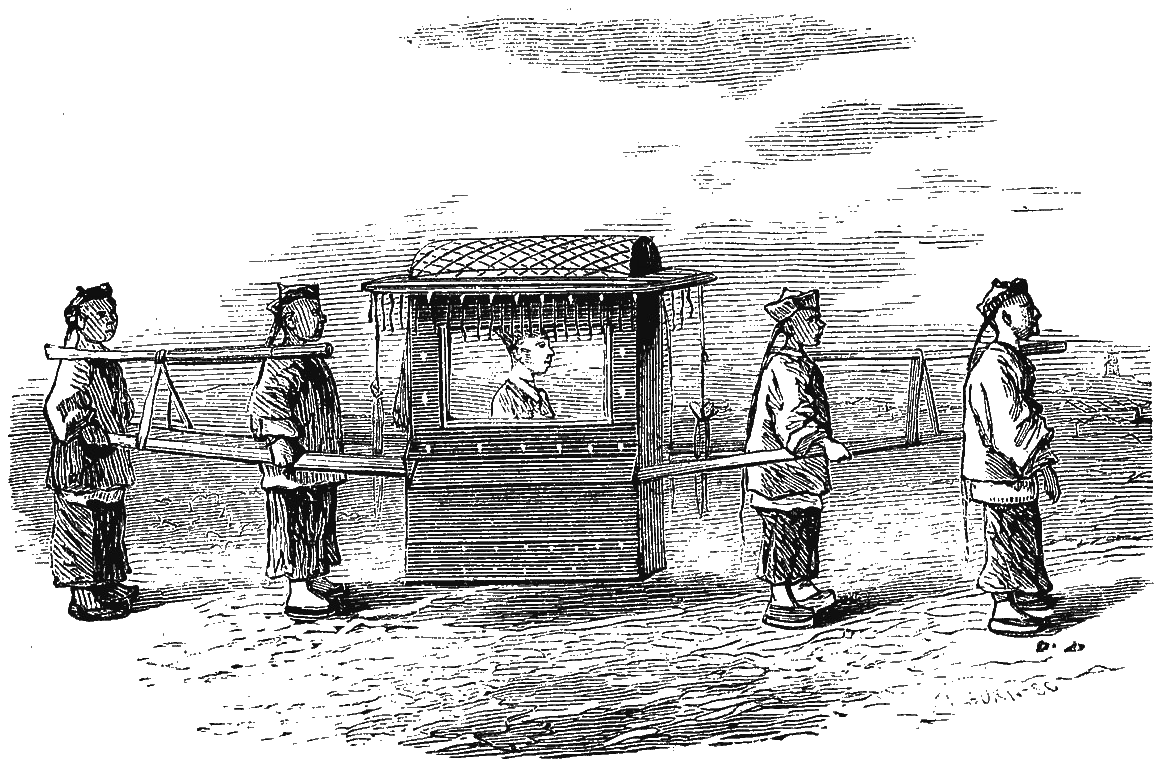
We formed the acquaintance of interesting
families on shore, from whom we received
gratifying attentions, enjoyed their hospitality,
were entertained at their croquet parties,
some of which were held in high places, on
the side of the hill which forms the chief
eminence of Hong Kong, affording a picturesque
view of the shipping in the harbor.
It would be difficult to name any place,
where friends assemble to enjoy out-of door
sports, more animating than the heights of
Hong Kong, commanding views of the ocean
in every direction, the sea breeze invigorating
the spirits which have felt the heat of the
town several hundred feet below.
A principal source of enjoyment in this interesting
spot is in going up Victoria Peak.
You take a sedan chair at the landing, four
coolies to each chair, two dollars for each
chair. The men bear you cheerfully along
up hill, three or four miles, stopping to rest
two or three times when they come to shady
places by the side of a great rock, or with
fine sea views in prospect, till you reach the
summit, where stands a flag staff, to signalize
to the town below the arrival of vessels, a
nine pounder being run out to announce a mail
steamer, or distinguished vessels. Going up
you are an hour and a half, unless you pause
frequently to look at geological or mineralogical
curiosities. You feel unwilling to quit
the enchanted spot, the sea breeze, the newly
arrived ship, the wonderful expanse of ocean
on every side; till the lengthening shadows
admonish you that it will be dark before you
reach China town. After that, you take
your boat in which your oarsmen from the
ship a half a mile off have come for you, and
you reach your floating habitation after dark.
Going ashore to do shopping, you encounter
a crowd of chair coolies at the landing,
calling to you, pushing each other, contending
for your custom. “Here, Missy,
you come this side; you belong my; my
have you last time;” till you select a chair,
when the rest subside, or a sepoy comes and
silences them with blows from his billy,
which are administered freely. If the two
men who carry you do not go fast enough,
you call out, “Chop chop;” if too fast,
“Man man,” till you get to the store.
Some of the answers from the shop-keepers
to your questions are, “Have got;” “no
can do;” “Melican like man like this;” “no
have got;” “him makee Japan;” “he no
sandal wood; cedar wood, sandal wood oil.”
Asking for some music paper I was told,
“no got; my makee you some.” A sheet
of blank paper was spread on the counter, a
ruler which moved on rollers was laid on it,
a plate partly filled with india ink was drawn
within reach, a camel’s hair paint brush instead
of a pen, drew the lines. Much of the
work you could not distinguish from music-paper
ruled by machine; the distances of
some of the staves from each other were not
regular; but the lines of each staff were
remarkably even. A half quire was ready
the next day. The shop-keepers add up the
amount of your purchases on frames, such as
we see in our primary schools; but the system
of numeration I could not understand,
the attempted explanation being in confused
pidgin English.
It was a merry sight on the 15th of
November 1870, when boats of all descriptions
were gathered for a race, and nine yachts.
The shipping, with which the harbor was
well filled, was ordered to change moorings,
and make a clear passage for the boats. An
Order of Exercise was printed for each of
the two days, giving information of the names
of the Patrons, Committee, Stewards, Judge,
Umpire, Starters. The Band of Her Majesty’s
29th Regiment played, the names of the
pieces being duly entered on the handsome
programme. Single pair sculling boats, to be
competed in by men who have never won
a sculling race in China or elsewhere; boats
pulled by Non-commissioned officers and men
of any Regiment or Corps in Garrison, men
of war Gigs, Pair Oars, and two Pair Sculling
Boats, House Boats pulled by Chinamen,
Gig and Punt Chase, Canoes; all open boats,
Chinese excepted; yachts not exceeding
fifteen tons measurement; the Chinaman’s
Cup, The American Cup, presented by the
American Community, The United Service
Cup, The Canton Cup, presented by the
Canton Regatta Club, made up the attractive
programme. Some lady recently arrived
is chosen to present the prize to one of the
winning competitors, with a little speech prepared
for her. The honor fell that year to
one of our company. The yacht prize was
won by the Naiad, belonging to R. F. Hawke,
Esq., an honorable citizen of Hong Kong.
A sailing match from Hong Kong to Macao
was advertised to come off the same season.
As you pass through the apartments of
some of the dwellings in Hong Kong, you
notice that bedsteads and beds are arranged
for comfort in a hot climate. No blankets
nor even sheets are visible. The bed is covered
with bamboo matting, smooth and cool.
Bajous and Pajamas, (loose jackets and pants,)
of cotton, linen, silk, or bamboo cloth, are
all the covering which is necessary, in the
hottest nights. But the greatest luxury is
the cool pillow. A strip of bamboo cloth
tied round a pillow, no sewing necessary
except of tapes to fasten it, keeps the head
cool.
While we were at Hong Kong, a fine
English ship came in and ran directly upon a
point of the shore in full sight of the shipping.
She sank in the water deep enough
to cover all but a few feet of her masts.
Some of the cargo was recovered; the vessel
was a total loss. No blame was attached
to the captain. Had there been a design to
throw the vessel away, it could not have
been done with greater safety to all on
board; but the three masts of the sunken
Dunmail, probably standing yet in Hong
Kong harbor, are a warning against the least
presumption in the very moment of apparent
safety.
Some of us called at the American Consulate
on the Fourth of July, to pay our respects
to the American Consul. One of the
young men present mentioned this incident:
He saw from his window a Chinaman with
a vase of water on his head. He himself
showed a reckless disregard of human life,
in proposing to try his pistol on the vase.
The bullet grazed the Chinaman’s heel.
The young man was arrested, but the prosecution
was withdrawn, on the plaintiff’s representation
that satisfaction had been made.
The satisfaction consisted in the proposition
of the Chinaman to settle for one dollar,
which the young man willingly paid. Whereupon
another Chinaman came forward and
offered to stand fire for one dollar.—The outrage
on the French Catholics at Tientsin,
thirteen of whom were murdered, was atoned
for in part by the authorities, by putting to
death thirteen of their countrymen. Thirteen
of the assassins were not to be found,
so the authorities hired men to take their
places, which they did for five hundred dollars
each. The papers of the day represented
the volunteers as saying that by their
death they should earn money for their
families, whom otherwise they should leave
in poverty. One needs to live among such
people, if he would understand the degradation
to which heathenism can debase
mankind so far as to make them capable of
such a deed. Robbery of the dwelling,
money from clothing laid aside at night, and
articles of jewelry is of constant occurrence.
I spent a fortnight at the house of R. F.
Hawke, Esq., whose father-in-law, the Rev.
Dr. Legge, the eminent Chinese scholar,
was engaged on his five or six large volumes
of the Chinese classics. The Doctor is not
impressed with the intellectual ability of
Confucius nor of his followers. His
translations are invaluable, as saving missionaries
and other students of the Chinese
much pains by placing Chinese literature before
them in a digested form. One could
not help regretting that this laborious scholar
cannot have the advantage of an international
copyright law to afford protection
to his costly fruits of research. American
authors suffer the same loss, however, as he,
in seeing their valuable works appropriated
by foreigners.
It was with a feeling of national pride that
we repeatedly saw the Pacific Mail Company’s
steamer “China,” Capt. Doane, thirty
days from San Francisco, come into the harbor
promptly on the day she was due. She
is a noble ship of four thousand tons. Capt.
Doane came on board our ship, and invited
us to inspect his vessel. It is one of the
principal events of the month with Americans
to have the Pacific Mail Steamers appear.
All other steamers seem diminutive
by the side of them. It seemed strange to
find on board these vessels five or six live
oxen and the appurtenances of a slaughter-house,
bestowed, however, out of sight.
We stayed in Hong Kong six months waiting
for hemp to fall in Manila. While the
ship lay at anchor we enjoyed the privilege,
by the favor of Messrs. Augustine Heard &
Co., of visiting several places in China and
the East Indies.
IV. CANTON, SHANGHAI, SINGAPORE, MACAO. — HALL OF COMPETITIVE EXAMINATION. — CHINESE BRIDES AND WEDDINGS. — “GODS MANY.” — THE BAMBOO. — MIXTURE IN TEAS. — ARCHDEACON GRAY. — SHANGHAI. — MACAO. — SHANGHAI PORCELAIN. — WORK OF THE LAW IN THE HEART. — AN ARISTOCRATIC CHINESE FAMILY. — POSTURE OF CHINESE PUPILS. — AMOY. — FUNG SHUY. — PIDGIN ENGLISH. — A PEACOCK ORDERED FOR DINNER. — DIRECTIONS TO A SERVANT IN PIDGIN ENGLISH. — A TYPHOON. — SINGAPORE. — CURRY.
This is a traveller, sir; knows men and
Manners, and has ploughed up the sea so far
Till both the poles have knocked; has seen the sun
Take coach, and can distinguish the color
Of his horses and their kind.
Beaumont and Fletcher’s “Scornful Lady.”

The city of Canton is only eight hours
by steamer from Hong Kong. Arriving
in the Canton river you find
yourself in a floating population in boats,
close together, as though ground rents were
as dear as in Broadway. When you enter a
boat for a passage up the river you marvel
that the boat can extricate itself from the
snarl; but you are in a few moments on your
way, meeting a seemingly endless throng of
people, among whom you involuntarily close
your eyes as if in anticipation of a crash.
We were the guests of the Rev. Dr. Happer
of the American Presbyterian Mission, who
on our arrival at Hong Kong had kindly sent
and invited us. We were also entertained
by the other members of the Mission, Messrs.
Noyes, Marcellus, and McChesney. We
visited Dr. Ker’s Hospital. Over a hundred
Chinese were sitting in a commodious room
listening to a native evangelist, and going
out by tens to receive medical treatment.
This hospital was formerly sustained by the
American Board of Foreign Missions, with
Dr. Peter Parker for surgeon and physician.
Being introduced to Archdeacon Gray, he
very kindly went with us two afternoons
among the temples and many remarkable
places. We saw the temple in which are
five hundred bronzed images of gods or deified
men, each in a posture or holding an
emblem representing some action or attribute.
We saw the water-clock made by
tubs of water placed one above another, each
dripping into the one below it, and the lowest
holding a graduated stick which rose
through a hole in the lid, and as each hour-mark
on the stick appears through the hole,
a man goes up to the roof with a painted
sign announcing to the people the time of
day. This seems to be an heirloom from
past ages when the “Clepsydra” was in use,
of which this is a specimen. Adherence to
this useless thing is one illustration of the
Chinese attachment to antiquity. As you go
about the city, you see things which carry
you back two thousand years, oxen treading
clay, men sifting wheat in sieves fastened
on the ends of planks laid on rolling stones,
and a man standing on each and keeping up
a motion on the planks like “tilting,” or
“seesaw,” a laborious process of doing a
simple thing. Then you see works of art
surpassing modern western skill; as, for example,
an elephant’s tusk undergoing three
years of carving; price, one hundred and
fifty dollars. Then you visit an eating-house,
which Archdeacon Gray begs you to
endure, to know that some things related of
the Chinese are not fictions. He goes to a
man who is eating, and courteously taking
up his plate, says, “What is this?” The
man laughs and says, “Rat.” He goes to
another, and, taking his plate, says, “What
is this?” The man cheerfully replies, “Black
cat.” Another man says, “Dog.” Around
the room, on hooks, are evident signs that
the men were truthful. You make swift retreat,
but are constrained by your guide to
look into an opium shop, where the customer,
as he comes in, mounts a table, lies at full
length, with his head on a wicker pillow
hollowed in the middle to fit the neck, then
is furnished with a pipe and lamp and box of
opium, which he smokes till he is stupefied.
Emerging from such scenes of degradation
into the narrow street, ten feet wide, you
may see a woman at a door with a child three
years old, with whom she is playing “pease
porridge hot,” going through the motions
as we learned them in childhood; and you
wonder whether Mother Goose derived her
knowledge from the disciples of Confucius,
or whether she did actually live and die, as
is now asserted, in Rowe Street, Boston.
This Chinese woman and her child playing
at “pease porridge hot,” is one of those
touches of nature which make “all the world
akin.” You next reach a place where intellectual
competition throws some of our university
feats into the shade.
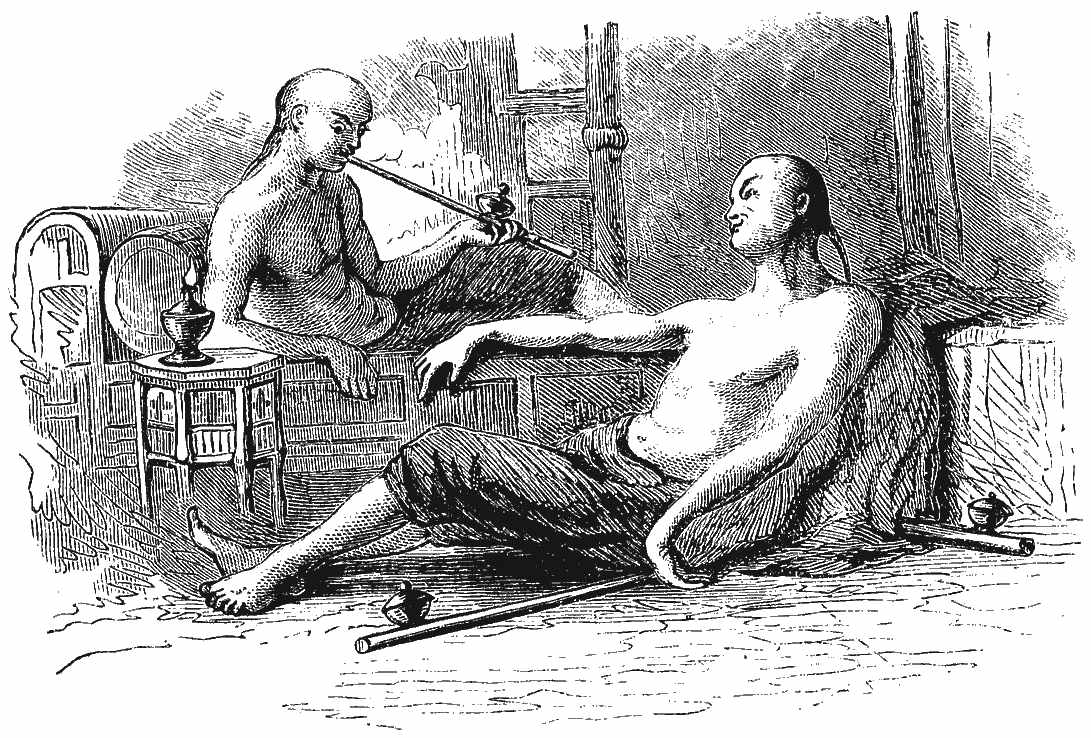
One is in each of the eighteen provincial
cities of China. Though familiar by description,
perhaps, to the reader, I venture to repeat
that it is a large open ground,—the
one in Canton measuring 689,250 square
feet. On one hand, there are seventy-five
lanes containing 4,767 cells; on the other,
sixty-eight lanes with 3,886 cells, making a
total of 8,653 cells. Once in three years
men of every age, from the youth to the
aged, assemble to write prize essays for a
literary degree. A candidate is fastened into
each cell for three days and nights, with rice
and water, planks being fixed in grooves in
the sides of the cell, serving for a sleeping
place, and for a writing-table by day. The
strictest search is made to see that no book
or paper is secreted in any dress. The essays
are received by three officers, who seal up
the outside page of each essay on which is
written the name, age, residence, ancestors,
&c., of the writer. They are passed to
another officer who sees that they are copied
in red ink, the object of the copying being
that the original handwriting may not be
recognized by the judges. Nearly two thousand
writers are employed in copying. They
have rooms fitted up for them in the “Hall
of Perfect Honesty.” The governor of the
province is ex-officio chief superintendent.
Imperial commissioners from Pekin assist in
the examinations. They meet in the “Hall
of Auspicious Stars.” This hall is looked
upon with feelings of awe. Success in these
examinations is followed by fame, wealth,
and honor; and failure, by years of toil and
possibly of repeated disappointment. Messengers
wait to carry the names of the successful
candidates to every part of the province.
The governor gives them a feast;
after which they go in state dress to worship
the tablets of their ancestors. Odes as well
as essays are presented. The following are
specimens of the themes at the last examination
previous to 1870:—
“If the will be set on virtue, there will be
no practice of wickedness.”
“It is only the individual possessed of the
most entire sincerity that can exist under
heaven, who can adjust the great, invariable
interests of mankind.”
“There are ministers who seek the tranquillity
of the state, and find their pleasure
in securing that tranquillity.”
What can be more abstruse? Few among
us would attempt to be original on such
themes.
This system of competitive literary examinations
here described has been maintained
more than a thousand years. There are
records proving this. On the first day three
essays and one piece of poetry are required;
each essay must have seven hundred words,
the poetry must consist of seven hundred
and sixteen lines, with five words in each.
The pieces required on the other two days
vary from this. The successful competitors
are immortalized in fame; their triumph goes
down to posterity on the family tablets, is
noted on their tombs, secures honor to their
children.
Though I visited this “Hall” with Archdeacon
Gray, and received minute information
from him, I am since indebted for helps
to my memory to a paper read before a literary
society in Canton, by Dr. J. G. Ker.
One morning some of my party were
standing by the window of a friend’s house
in Canton which overlooks the canal with its
brown water and crowd of sampans. As they
watched the different phases of domestic life
in those habitations, one of the party, familiar
with them, remarked that there was probably
a wedding, or rather the festivities attendant
upon a wedding, in one of the nearest sampans,
as she had heard a young woman wailing
the night before. She said it is a custom
with Chinese brides to pass the night before
their weddings in bewailing their future
troubles; for as they seldom see their intended
masters before the wedding, there is
great uncertainty in connection with their
new mode of life; generally it is going from
one form of servitude into one to which they
had not grown accustomed. There seems to
be no real wedding ceremony, but a feast and
a sort of reception for three days. During
that time the young couple perform some
acts of devotion before the ancestral tablets.
After that the bridegroom takes his partner
to his father’s boat, where she cooks the rice,
scrubs, and helps row for the rest of her life.
The young ladies thought that they would
go to the reception. Accordingly, eight of
them crowded into the sampan (being told
that no cards were used) and sat in Turkish
fashion on the nice floor. The bride came
before them in a red dress, saluted them,
then brought in a tray of square cakes,
which had been made with peanut oil. She
then gave them tea in small cups such as
children play with. They considered that
as the tea was made with the foul water of
the canal occupied by a crowd of sampans, it
could not be in the highest degree tasteful.
As they went out they were told that the
adjoining boat was the home of the bridegroom’s
father, where the bride would the
next day find her home. A roasted pig with
its garniture of herbs was exposed on deck,
but it did not awaken any desire.
We were greatly favored, through the influence
of Archdeacon Gray, in having the
rare privilege of being admitted to the bedchamber
of “the god of Walled Cities.”
We climbed up antique, decayed stairs, into a
forlorn room, not so inviting as apartments in
some barns at home. There was the huge
god, six feet in height; his slippers were at
the side of his bed; his garments were on
pegs; the wash-stand was there, with its furniture,
and the water was poured into the
bowl ready for use. His Majesty was of
wood, fantastically painted. We were taken
into his wife’s apartment, which was the
next room. There women resort to make
petitions with vows, promising the goddess
a new dress, for example, if their prayer is
heard.
In several temples we saw men consulting
the gods in some affairs of interest to them.
Kneeling and touching the ground with the
forehead nine times, they would then take a
long box of sticks, each with a number inscribed
on it, shake it till a stick fell out,
which was then handed to the priest, who
consulted a book, and told the petitioner the
answer to his prayer.
We came in one temple to the “Chamber
of Horrors.” There in ten cells were depicted
the torments awaiting the wicked in
the next world. In the tenth the victims
were coming out in the shape of hideous
wild animals, the blessed dead on eminences
around looking down with various expressions
on their faces. We came also to the
“Temple of the Five Genii,”—Fire, Earth,
Water, Wood, and Metals. These Genii
originally came to the city on five rams,
which were turned to stone, for perpetuity,
and remain there to this day, uncouth, almost
shapeless blocks. A tower, said to be six
hundred years old, stands in honor of them.
The large bell covered with Chinese characters
is doomed to silence; for there is a
tradition that if struck, some great misfortune
would fall upon the city. A visitor
inadvertently striking it would excite consternation
among the people. During a siege
of Canton a piece of the bell was knocked
out of it by a cannon-ball.
While we were detained in a temple by
rain, the Buddhist priests showed us much
kindness, setting a table in the courtyard
overlooking a sheet of water, and giving us
clear tea in little cups, on trays having each
compartments filled with dried fruits. It
seemed strange to be “sitting at meat in an
idol’s temple.” While we were there, the
priests descried the sunshades which some of
the party had brought with them. Their
amusement was not exceeded by any pleasure
manifested by children at the sight of new
things. They opened them, they shut them,
turned them over and over, held them over
one another, explaining to each other their
use; and one man, pointing to one of our
umbrellas, said, “That I can understand;
but is this really an umbrella?”
As our party of four emerged from their
chairs at each temple, crowds of a hundred
or more would follow us to the gate, and
wait there for us to re-appear. Mothers
would lift little children to see the odd
foreigners. Not one word, sign, or look of
contempt or disrespect, however, did we witness
during the four or five days that we
spent in the city. The streets being, most
of them, only eight or ten feet wide, the
people were frequently stopped by our
chairs, and had to stand sideways to let us
pass, but never did they make us feel that
we were intruders. About two months after
this, the affair at Tientsin happened, and the
people in many parts of the empire were
excited to some degree against foreigners.
Receiving an invitation to re-visit Canton, I
was strongly advised not to go, on the ground
that, while mercantile men, obviously on
business, might visit the place in safety, the
sight of a foreigner, led there by curiosity,
might awaken suspicion and lead to violence.
I saw in Canton a large granite building
erecting, already two-thirds of its intended
height reached and covering a large space, the
staging of which was composed wholly of
bamboo. It is doubtful if there was a nail
used in the whole of it, the parts being
securely fastened with osiers of rattan. It
brought to mind the provision so beneficently
made for the use of man in these countries
where timber is seldom found. Few things,
if any, serve such a variety of purposes as
the bamboo. Bridges are built of it; it is
used for water pipes, masts, boxes, cups, baskets,
mats, paper, fences, writing instruments;
while the long green leaves afford shade. It
grows from fifty to eighty feet in a year, and
in a second year becomes as hard as ever.
One who is curious in botanical formations
cannot but have admired the provision made
for strengthening the stalk of straw by the
joints, which occur at a distance of a few
inches; an arrangement which must puzzle
an atheist. In the joints of the bamboo lie
the hiding of its power. The joints being
easily made water tight, the canes are
adapted to use in many ways. One cannot
live in an eastern country without soon
forming an attachment to this product of
nature so wonderfully supplying many of
the necessities of life.
As we were passing along a street in Canton,
a gentleman, long a resident there, suddenly
stopped and pointed to a large quantity
of an herb, spread in the sun. “That,”
said he, “is jasmine, which is one of the
principal ingredients used to give your teas
a flavor.” But I will not venture further on
this topic, only observing that one of our
party who took tea with us in the idol’s temple,
(tea without sugar and cream,) testified
that there was an aroma about it to which
exported teas were strangers.
Archdeacon Gray is well known to all who
have visited Canton. He is in the prime of
life, an accomplished gentleman, making you
love him at once by his beautifully courteous
manners, his fine intelligence. He gave me
a cordial invitation to occupy his pulpit on
Sabbath morning; but there was to be a communion
service at the Presbyterian Mission,
with some additions to the church, and I declined.
But he came in the intermission and
insisted on my preaching in the afternoon,
which I did. His house and church are on a
bend of the Canton River; and perhaps even
our Hudson River does not anywhere present
a finer view. His house is full of rare Chinese
curiosities, which he is happy to show
to visitors. I preached in the evening to the
Presbyterian Mission, at the house of one of
their number. This Mission is exerting a
decided influence; its supporters may well be
encouraged. I found a strong feeling among
them in favor of sending out single ladies, in
companies, to live together and to labor in
conjunction with the Mission. There is a
decided approbation in the Canton Mission
of ladies thus living together, and working
under the direction of a mission.
I spent four or five days at Shanghai, on
another excursion from Hong Kong. This
I described in a letter to Bishop Eastburn, as
several things which I saw there in connection
with Episcopal friends made it agreeable
to acquaint him with them. The letter was
kindly published in “The Christian Witness”
of this city, and copied by “the Boston
Transcript.” I take this opportunity to
insert the most of that letter, from one of
the papers above mentioned.
Hong Kong, China, October 10, 1870.
My dear Bishop Eastburn,—I shall
not soon forget that the first letter which
met my eye on reaching San Francisco, after
a voyage of one hundred and eleven days,
was in your handwriting. I have since then
been so pleasantly reminded of you through
a good man’s influence here in China that I
must tell you of it. Being on a visit to
Shanghai, I was invited to attend worship in
a Chinese chapel five miles from the city.
We went through the fields in chairs borne
by coolies, till we came to the village where
trade was plying all its arts, and handicraft
its implements, unconscious of the Sabbath.
A small church-bell notified us that we were
near the chapel; and soon we emerged from
heathenish sounds and sights into a christian
temple, neat and orderly in all its appointments.
There were about one hundred and
fifty Chinese assembled for worship, which
was conducted by a very good looking Chinaman,
tall, and of pleasing address. Though
ignorant of every word he said, my attention
was riveted by his agreeable action and manner,
eminently becoming a preacher of the
gospel and withal eloquent, if his whole appearance
and the attention of the people
were true indications. I could see that the
services were liturgical from the responses,
and from the Chinese books used by the
people, the little girls around me keeping my
attention directed to the place in the service;
though very little good did this do me, except
that it helped me to keep my book
right side up. The service ended with singing,
“There is a happy land,” the tune so
familiarly known in our Sabbath schools.
The preacher came to speak with me before
service, with his welcome in very good
English; and after service he came again and
gave me much information. He has been
rector there sixteen years, the chapel being
built and he being sustained there by the
munificence, said he, “of a Mr. William Appleton,
of Boston.” This made my heart
leap for joy, to come so far into heathenism
and find myself in a christian temple erected
and maintained by a fellow-citizen of Boston.
Mr. Appleton I did not know personally,
though I once received a very kind note
from him with a pamphlet. But I had long
cherished a sincere love for him from many
impressions of his truly estimable character.
I was led to think, What a memorial of christian
zeal has he built in this distant land!
What pleasure it must afford his happy spirit
in heaven to look down on this place of christian
worship in the depths of heathenism!
What a noble use of wealth, blessing a multitude
of people who but for him might have
been left in heathenish ignorance! I told
the preacher that I should report his chapel
and his labors to christian friends at home,
and I mentioned your name in speaking of
those who would be glad to hear of him.
He desired me to give his respects to you;
so it is my pleasure to send you the respectful
and christian salutation of the Reverend
Wong Kwong Chi, of one of the villages of
Shanghai.
As we came out of the chapel, our ears
were saluted with some musical instruments
from a house where people were making a
tumult over a dead person. Little knew they
of that “happy land, far, far away:” which
the people of Appleton Chapel had just been
celebrating. I felt a desire to tell good men
in Boston that there yet remaineth much land
to be possessed here by christian philanthropists;
that they can readily find villages of
sixty thousand waiting each for its chapel, to
say nothing of cities with millions in them,
where it would be easy to begin a work for
the ransomed spirits of good men and women
to review with pleasure in heaven. Truly
enviable is that rich christian who can employ
wealth to do good for him when he is
with Christ. The Appleton Chapel at
Shanghai seemed to me a cup of cold water,
the donor of which is not losing his reward.
From the steamboat-landing at Shanghai,
looking across the river, you see a comely
church of fair proportions, surrounded in
part with banyan and bamboo trees, affording
it a perpetually verdant appearance. It is a
stone chapel for seamen, built through the
efforts of A. A. Hayes, Jr., of the firm of
Olyphant & Co., and son of Dr. A. A.
Hayes, of Boston. It is under the care of
the Rev. Mr. Syle, Presbyterian, a devoted
and most useful man. A large churchyard
has there received the remains of seamen of
all nations. It is within the same enclosure
with the church, ornamented with plants and
trees, and is nearly filled with the dead. It
has been opened fourteen years, and there
are fourteen hundred interments. The graves
are in close and even rows for economy of
rooms, so that this large collection of the
dead looks like a buried battalion who have
lain down by platoons. The orderly disposal
of them has a saddening influence. I never
before felt that there is a natural appropriateness
in having a burial-place, as Job says of
the land of the departed, “a land without
any order.” We feel that promptitude and
exactness are out of place at a funeral; but
slowness and delay are congenial. Surely,
these ranks of the dead will not rise by roll-call,
though they lay down in such good
order. They made me think of some lines
of an uncle of Sir Walter Scott, a sea-captain,
on a sunken man-of-war, all her crew on
board:—
‘In death’s dark road at anchor fast they stay,
Till Heaven’s loud signal shall in thunder roar;
Then, starting up, all hands shall quick obey;
Sheet home the topsail, and with speed unmoor.’
7
One of the most charming places in China,
is Macao, three hours distant by steamer from
Hong Kong, the people of which place resort
to Macao in the hot season, as the fine sea-breezes
there greatly mitigate the heat. The
drives about the place, commanding in every
direction an open sea-view, are beautiful.
The old church of St. Paul, the most of which
remains, though ruined by fire, is a fine specimen
of architecture. The most notable thing
in Macao is the grotto where Camoens, the
Portuguese poet, died in banishment for publishing
a satire on the viceroy. The wild botany
of the place, and the geological upheavals
which give clear signs of glacial action, are
remarkable. Bowlders are piled up here in
ways which show a hydrodynamic force beyond
human skill. Near the grotto is a cemetery
for foreigners; and, among the many
sainted dead from missionary circles there
entombed, the christian traveller lingers with
deep interest around the burial-place of
Morrison.
One Sabbath morning I went with a christian
friend through a wild district, in the
neighborhood of a large city in China, to a
mission station. The people were everywhere
at work; nothing suggested the Sabbath,
till we heard the little church-bell,
whose notes were in pleasing contrast to the
hum of business. We came to the mission
compound, where two missionaries and their
wives had their abode. The joy with which
they welcomed us made us feel most deeply
their isolation from christian society. The
sight of friends from America seemed to
intensify their loneliness. Here were four
beloved christian people who were living in
these wilds, to teach these heathen tribes the
knowledge of God and of his Son. On inquiring
what encouragement they found in
their work, we were told that two or three
women had lately shown a disposition to
hear religious conversation, and listen to the
Scriptures. Immediately we thought of four
hundred millions in China and its dependencies,
who were ignorant of the true God.
Here were three native women who were persuaded
to listen to religious reading. As we
were preparing to leave, our missionary
friends seemed to cling to us with strong
affection. We were going back to America,
leaving them in the solitudes of heathenism.
They were far from unhappy, and their few
tears were only the natural expression of
awakened memories. One of the missionary
brethren, showing us the way to the gate,
passed with us through a room where we
saw, among gardening tools, some sheets of
paper, lying loose. There were so many of
them, looking alike, that they attracted our
notice. We found that the specks on them
were the eggs of silkworms. They were
mere dots, as the reader familiar with the
sight in books or nature, is aware. It occurred
to me what a display of silk fabrics,
with their rainbow colors, we had been looking
upon! how many ships are freighted
with them! how many millions of wealth
they represent! what a world of thought and
feeling is associated with them! On those
pieces of paper were the beginnings of silk,—a
word, taken in all its connections and associations,
of mighty power. In those little
specks one might fancy himself reading, “By
whom shall Jacob arise? for he is small.”
We told our missionary brother that, while
he raised silkworms and saw their cocoons,
he surely would never despise the day of
small things,—a lesson, he assured us, which
was often repeated to him, and gave him
encouragement.
It is well for one who believes in the ultimate
prevalence of Christianity to come into
China by the way of the Sandwich Islands.
He will receive confirmation to his faith, he
will be defended against temptations to unbelief
when surrounded as he will be in
China with one-half the population of the
earth ignorant of the true God, by having
seen in the Sandwich Islands what the gospel
has done among a race who were as unlikely
to be converted as any portion of the
human family. If he comes from his ship
and steps ashore on the Sabbath in China,
and sees coopers and blockmakers and boatbuilders
busily at work, the tailors’ shops
filled with men plying their needles, the
stationers ruling paper, the coolies instead
of horses and mules carrying everything
which ever lades a ship, from the quay to
the storehouses, the thought will come over
him, What progress is the knowledge of the
gospel likely to make among this people?
Perhaps he spends a Sabbath in the country.
Here he may look to see the people withdrawn
from the requirements which the business
of a seaport makes of the inhabitants;
but in the country he will find the people as
busy with their handicraft or trade as the
people of the city, giving no sign that the
idea of the Sabbath and of the God of the
Sabbath has visited their minds. He will be
overwhelmed with the contemplation of four
hundred millions of human beings utterly destitute
of the knowledge of God. He remembers
how at home his heart used to glow on
hearing accounts of additions to native
churches, and the rehearsal was followed by
joyful missionary hymns sung impromptu,—
“Yes, we trust the day is breaking;
Joyful times are near at hand;”
and he asks himself whether he is losing his
confidence in the ultimate triumph of christianity,
and in the sufficiency of divine power
to turn the hearts of nations as the rivers
of waters are turned. If he be a firm believer
in the Bible, he will say that while
he remembers the conquest of Canaan, especially
its first great achievement, the capture
of Jericho, his faith never can falter.
Were not the aborigines of Canaan devoted
to destruction by the Almighty, and their
land apportioned to the tribes, with minute
directions how to take possession of it, the
very line of march prescribed, the great
tribe of Judah in the forefront? And did
not our Lord spring out of Judah? Has he
not “upon his vesture and upon his thigh a
name written,—King of kings and Lord of
lords?” While, on returning to his christian
ordinances at home a christian traveller in
China may be less excited than he used to
be there at the report of a few conversions
among the heathen, because he will have an
enlarged idea of the gross darkness which
covers the people, he will only have exchanged
his former confidence in man for a
more entire confidence in God. The accumulation
of difficulties in the way of the
gospel he will regard only as those barrels
of water which were poured on Elijah’s altar,
serving to make the fire from heaven more
triumphant.
I was sitting on the steamer at Shanghai
conversing with a friend about the productions,
natural and artificial, of that region,
and I expressed the desire to find something
peculiar to the place which I might take to
America. In about an hour, happening to
look at the people on the wharf my friend
clapped his hands and said, “Here is something
peculiar to Shanghai; now you can
have your wish gratified.” He called a man
on board who laid down before us a large
basket filled with small teapots. I thought
of course that he was indulging in humor at
my expense, but he said that people from all
parts would buy baskets and barrels of this
ware; that they declared that nothing was
more popular at home, at fairs, and for
presents. He selected twenty-five small teapots
and packed them for me in a basket,
saying that if I did not appreciate them my
venerable lady friends would. They were
made of a material found in that region, a
fine clay, brown, of different shades, some of
them highly ornamented with an intermixture
of green, all of them furnished with
strainers and other conveniences. I brought
them to America and when I say that in a
few weeks only one of them remained in my
possession, nothing need be added to confirm
the Rev. Mr. Syle’s judgment in his selection
of a representative present from Shanghai.
When I add that the twenty-five articles cost
a dollar and twenty-five cents, no further inducement
will be necessary to persuade visitors
to provide themselves with one means of
furnishing friends with acceptable presents.
Going into a monastery in China with a
clergyman who could converse in Chinese,
we saw among the inmates a woman who
seemed to be ever praying, as she sat a little
retired from the rest. The superior told us
that she was praying all the time, being overheard
frequently in the night upon her bed in
supplication. He said that there was some
great burden upon her mind, which she would
not disclose. She was evidently not insane;
and, from all that I could learn about her, I
came to the conclusion that she was under
conviction of sin; sinfulness, rather than any
particular transgression, was the burden upon
her heart. That there are many throughout
the heathen world thus exercised, we cannot
question; the second chapter of Romans
speaks of them, among others, “with the
work of the law written in their hearts.”
They may be few compared with the whole
heathen world; yet how interesting to think
that such may be in a state of mind fitting
them to accept the gospel, should it be made
known to them, and that they will not perish
merely for not being acquainted with it.
Thus, where sin abounds, grace may much
more abound, choosing its subjects independently
of human instructors. ‘Thou canst not
tell whither it goeth,’—this superhuman
agency. This thought is some little relief to
one, as he wanders about in those regions of
the shadow of death, impressed by much that
he sees with the reflection how true to the
letter is the apostle’s description, in the first
chapter of Romans, of the heathen world.
The party of young friends who called on
the bride, called also at the house of an aristocratic
Chinese family, with whom one of
their number was acquainted. There were
several young daughters and sons in the family,
who all spoke some words of English.
A missionary’s daughter acted as interpreter.
The Chinese young ladies brought out their
state dresses, which were heavily embroidered
with silver and gold. They put them on
their visitors, made them walk about the
courtyard, following them with shouts of
laughter. They then gave them cake and
cups of clear tea. One lady belonging to
the family smoked a long pipe, and offered
another pipe, with opium, to her guests.
The Chinese young ladies showed their little
feet, apparently with much pride, to the
visitors; three inches and a half each was
the measure of nearly all the feet.
In a school for girls taught by a missionary
lady, the visitors saw pupils from five to fifteen
years. The feet of these children were
generally swathed, and the girls showed, by
their faces, great pain. Mothers came in to
listen while the teacher was talking to the
children. The girls, when reciting, stood
with their backs to the teacher, a mark of
respect. They sang several of our familiar
Sabbath-school hymns.
The Steamer from Shanghai to Hong Kong
put in at Amoy to bring the cargo of a disabled
bark to Hong Kong. This gave some
of my family who had been making a visit to
Shanghai an opportunity to see Amoy. It is
situated on a barren, hilly island; its streets
are as narrow as lanes. Going through them
in chairs, you come out upon a hilly district,
with few trees, covered with remarkable
rocks, many of them bowlders, not settled
so far in the ground as most rocks, but
lifted from it, some of them on their smallest
ends, and some leaning towards each other,
making natural rooms, with mossy floors,
and an opening at the top. Some of them
are used as temples on a small scale; idols,
discolored by age and damp, are perched in
them. Some real temples are built of the
largest bowlders. In one of them, as one of
the party was sitting on the stool in front of
the idol, looking at the hideous images with
which the temple was filled, expressing her
wonder that human beings prayed to such
things, one of the missionaries present asked
an old priest if they really did believe in
them. He said he could not tell whether
the people did believe in them or not. The
images might, or they might not, be gods;
but “it was the custom to worship them;
and, after all, whether they heard or not, it
amounted to about the same thing as the
worship by christians of their God.”
The foreigners, merchants, missionaries,
and others, do not, as a general thing, live in
the city, but on a small island across the
harbor, rocky, like the larger island where
the city is built, but not quite so dreary
and barren. Attempts have been made to
fertilize it, not wholly without success.
Many of the houses are attractive, commanding
a good sea-view.
From a great cave called the “Tiger’s
Mouth,” formed by two rocks projecting
from the side of a hill, a flat one forming
the lower jaw, or the floor of the cave,
and the upper stone curving over it, making
a good resemblance to an animal’s mouth,
you look down upon a wild, barren tract of
country, where the rocks, my informant said,
reminded her of almonds stuck into the top
of a Christmas pudding, or as if giants had
been having a battle, and their missiles had
been left on the field in the reckless position
where they fell. One rock, about eighty tons
in weight, was balanced on another larger
rock so evenly that one man, putting forth
all his strength, could make it tilt slightly.
They say that a typhoon makes it rock perceptibly.
Just below it is a small Chinese
cottage. The woman who occupied it was
asked if she was not afraid to live there, for
if the bowlder should tilt a little too much,
one end of it would go through her roof.
But she said, “No, it is good ‘Fung Shuy,’
and will bring good luck to my dwelling,”
This leads me to speak of “Fung Shuy.”
Though the literal meaning of “Fung Shuy”
is “wind and water,” this does not give any
idea of the thing.
The Chinese regard the south as the source
of good influence, inasmuch as vegetable life,
with all the genial influences of spring and
summer, are from that region. The north,
they perceive, is the source of death to the
vegetable kingdom. As animals partake of
the diverse influences proceeding from these
two opposite regions, they infer that men
are susceptible to the same. They suppose,
therefore, that there is a vital influence moving
all the time from south to north. This
may be obstructed. To secure its full effect,
they prefer to have their dwellings front
south; for they hold that from the north
evil influences are constantly proceeding.
Even the dead, they believe, are susceptible
to these adverse influences. If graves are
placed so as to meet good influences, it is
called good Fung Shuy. It is a subject of
great study to ascertain the influences which
promote good Fung Shuy and hinder the
bad. Anything, as a hill, rock, trees, standing
due north and not very remote, especially
if the region toward the south is unobstructed,
and particularly if water is in that
direction, is good Fung Shuy. There are
men who may be called professors of Fung
Shuy, who are experts in the science. The
woman in Amoy thought that the bowlder
near her house was good Fung Shuy. The
term may be defined, the science of positions
favoring good, and shielding from bad, influences.
This is related to the extensive subject
of ancestral worship, which would lead
me too far from my narrative.
“Pidgin-English” is a singular form of
speech which the Chinese language assumes
when the natives are first attempting to use
English. Pidgin means business. You are
made by it to think of the dialect which we
fall into in talking to infants. If any one
can explain why infants are supposed to understand
us better when we make our words
terminate in ee or y, he may proceed and
explain the natural philosophy of Pidgin-English.
In talking to a Chinaman you find
yourself, as it were, addressing an infantile
capacity, imitating his own Pidgin way of
speaking, even in talking to an adult. I will
give one or two specimens of pidgin-English,
which I found in print. The first is Norval’s
Narrative, taken, as the reader hardly needs
to be informed, from the Rev. Dr. Home’s
tragedy of “Douglass.”
NORVAL’S NARRATIVE.
My name is Norval. On the Grampian hills
My father feeds his flock, a frugal swain,
Whose constant cares were to increase his store
And keep his only son, myself, at home.
For I had heard of battles, and I longed
To follow to the field some warlike lord.
And Heaven soon granted what my sire denied.
This moon which rose last night, round as my shield,
Had not yet filled her horns, when by her light
A band of fierce barbarians from the hills
Rushed like a torrent down upon the vale
Sweeping our flocks and herds. The shepherds fled
For safety and for succor. I alone
With bended bow and quiver full of arrows
Hovered about the enemy, and marked
The road he took, then hasted to my friends,
Whom, with a troop of fifty chosen men,
I met advancing. The pursuit I led
Till we o’ertook the spoil-encumbered foe.
We fought and conquered. Ere a sword was drawn,
An arrow from my bow had pierced their chief,
Who wore that day the arms which now I wear.
Returning home in triumph, I disdained
The shepherd’s slothful life; and having heard
That our good king had summoned his bold peers
To lead their warriors to the Carron side,
I left my father’s house, and took with me
A chosen servant to conduct my steps,
Yon trembling coward, who forsook his master.
Journeying with this intent, I passed these towers,
And, Heaven-directed, came this day to do
The happy deed that gilds my humble name.
PIDGIN-ENGLISH OF NORVAL’S NARRATIVE.
My name belong
8 Norval. Topside that Grampian hillee
My father makee pay
9 chow chow
10 he sheep.
He smallee heartee man; too muchee take care that dolla, gallo.
So fashion he wanchee keep my;
11 counta one piecie chilo,
12 stop he own side.
My no wanchee. Wanchee go long that largee mandoli.
13Little teem,
14 Joss pay my what thing my father no likee pay.
15That moon last nightee get up loune, alla same my hat;
No go up full, no got square; that plenty piecie man,
16That lobbel man
17 too muchee qui-si,
18 alla same that tiger,
Chop chop come down that hillee, catchee that sheep long that cow,
That man custom take care, too muchee quick lun way.
My one piecie owne spie eye,
19 see that ladlone man what side he walkee.
Hi-yah! No good chancie findee he catchee my flen.
20Too piecie loon choon lun catchee that lobbel man;
21 he
No can walkee welly quick; he pocket too much full up.
So fashion knockee he largee.
22 He head man no got shottee far
23My knockee he head. Hi-yah! My number one stlong
24 man.
Catchee he jacket, long he trousa, galo.
25 You like look see?
My go puttee on just now. My go home, largie heart just now.
My no likee take care that sheep. So fashion my hear you go fightee this side,
26My takee one servant, come you country, come helpie you,
He heart all same cow; too muchee fear; lun away;
Masquie!
27 Joss take care pay my come your house.
28
* * * * *
The following is a better specimen, there
being fewer liberties in the rendering:—
EXCELSIOR.
The shades of night were falling fast,
As through an Alpine village passed
A youth, who bore, mid snow and ice,
A banner with the strange device,
Excelsior!
His brow was sad; his eye beneath
Flashed like a falchion from its sheath;
And like a silver clarion rung
The accents of that unknown tongue.
Excelsior!
In happy homes he saw the light
Of household fires gleam warm and bright;
Above, the spectral glaciers shone,
And from his lips escaped a groan,
Excelsior!
“Try not the pass!” the old man said;
“Dark lowers the tempest overhead;
The roaring torrent is deep and wide!”
And loud that clarion voice replied,
Excelsior!
“Oh, stay!” the maiden said, “and rest
Thy weary head upon this breast!”
A tear stood in his bright blue eye;
But still he answered, with a sigh,
Excelsior!
“Beware the pine-tree’s withered branch!
Beware the awful avalanche!”
This was the peasant’s last Good-night;
A voice replied, far up the height,
Excelsior!
At break of day, as heavenward
The pious monks of Saint Bernard
Uttered the oft-repeated prayer,
A voice cried through the startled air,
Excelsior!
A traveller, by the faithful hound,
Half buried in the snow was found,
Still grasping in his hand of ice
That banner with the strange device,
Excelsior!
There in the twilight cold and gray,
Lifeless, but beautiful, he lay;
And from the sky, serene and far,
A voice fell like a falling star,
Excelsior!
TOPSIDE GALAH.
That nightee teem
29 he come chop chop,
30One young man walkee, no can stop.
Colo masquie,
31 icee masquie,
He got flag chop b’long welly culio see
32Topside Galah.
Hee too muchee solly;
33 one piecie
34 eye
Lookee sharp so fashion, alla same mi;
35He talkee largee, talkee stlong,
36Too muchee culio,
37 alla same gong.
Topside Galah.
Inside any housee he can see light;
Any piecie loom
38 got fire all light?
He look see plenty ice more high,
Inside he mouf he plenty cly;
39Topside Galah.
“No can walkee!” ole man speakee he;
40“Bimeby lain
41 come; no can see;
Hab got water, welly wide!”
Masquie! mi
42 must go topside;
Topside Galah.
“Man-man!”
43 one galo
44 talkee he;
“What for you go topside? look see.”
“Nother teem,” he makee plenty cly.
45Masquie; alla teem he walkee plenty high.
46Topside Galah.
“Take care that spilum tlee,
47 young man!
Take care that icee!” he no man man;
48That coolie chin chin
49 he good night;
He talkee, “Mi can go all light.”
Topside Galah.
Joss pidgin
50 man chop chop begin,
51Morning teem that Joss chin chin;
52No see any man; he plenty fear,
Cause some man talkee,
53 he can hear.
Topside Galah.
Young man makee die;
54 one largee dog see;
Too muchee bobbery findee he,
55Hand too muchee colo;
56 inside can stop,
Alla same piecee flag, got culio chop,
57,58Topside Galah.
One captain ordered a peacock for dinner.
We had a variety of feelings in anticipating
the repast, none of them agreeable.
On coming to table, no peacock appeared.
The steward was summoned. “I told you
have a peacock. Why no peacock?” The
steward as though afraid, said, “I go ashore
to get him peacock; I say, ‘Cap’n want peacock.
Policee-man come; he say, What for
you come ashore no paper tell you may come
get peacock? Then he look all a same mad,
say, ‘Go long, get in ship; I see you again I
catchee you; I lock you up in ‘go-down.’
Then I frightened; so I get no peacock for
dinner.” The explanation was as good as a
feast, including the look of terror, the gesticulation,
the many ellipses in the narration.
But the captain who had had great experience
of Chinese human nature, said that he
had no doubt the whole story was a fabrication.
I heard a captain of a steamer address his
man-servant thus, when sending him from
the cabin to his stateroom on deck for a box
of writing paper: “Boy, you go topside my
room. You see two piecee box belong all
same, (look just alike.) One piecee have
pens; my no wanchee that. Other piecee
have paper. My wanchee. You makee pay
my, (bring that to me.) Savez? (do you
understand?”) The waiter nodded assent,
and brought the right box.
A lady was giving a dinner party to several
gentleman and ladies. She told her
butler to “set the table for sixteen piecee
man.”
A sampan man whom our captain wished
to hire, was asked by him how many there
were to row his sampan. He replied,
“Seven piecee man,” meaning, as it proved,
himself, several sons, most of them young
boys, and the mother who rowed with her
infant tied round her neck; making seven
hands, not counting the babe.
A gentleman who was joking with one of
his sedan bearers, talking nonsense, was answered,
“Massa C., you belong too much
culio, (too funny.) My never have see one
man all same culio.”
The American Eagle, that fierce gray bird
with a bending beak, is known even in China
by that celebrated feature. A Chinese servant
told his master that while he was out a
gentleman called. On being asked who it
was, the servant said: “My no savee; but
my can speakee what fashion he makee look
see;” (what his appearance was.) “He
belong one smallee man; no too muchee
stout; had got one nose all same that Melican
chickey.”
The mysteries of human speech are impressively
illustrated in the ease with which
the children of foreign extraction, brought
up from infancy in China, learn and skilfully
use the slight tones and the other niceties of
the language. An ear accustomed to music
of course is a great help in learning this language;
but when a person is in the least dull
of hearing, it is not easy to distinguish between
some of the words, and especially the
intonations, which in the Cantonese dialect,
for example, so largely determine the meaning.
One thought impressed me in thinking
of the language as a barrier against the rest
of the world: If the Chinese nature is naturally
upright, and if sin is owing wholly to
contamination by intercourse with depraved
people, how happens it that China does not
present us with a people of saints? having
been kept by their language, as they have
been, from mixing with men. That language
has done more than their great wall in separating
them from the rest of mankind.
We had a typhoon at Hong Kong, Sept.
29. I was spending a fortnight at the house
of Dr. Legge. On Sabbath evening at sundown
there was an appearance of rain, with
some unusual disturbances in the air; soon
the servants came into the parlor with planks
and joists to strengthen the windows, the
same precaution being used outside. The
wind rapidly increased, till the strength of
our gale at Boston, Sept. 8, 1869, had but a
faint resemblance to it. Instead of one
blast, there were lulls; then a renewed tempest
increasing in strength while the typhoon
lasted, which in this case was from sundown
on Sunday till Tuesday at daybreak. Hundreds
of lives were lost in Hong Kong harbor.
The ships were almost invisible from
the shore, the spoon-drift being nearly equal
to a thick fog. We were grateful that the
typhoon did not find us at sea. We could
understand the answers of old sea-captains,
who, on some one in our hearing saying that
he should like to witness a typhoon, shook
their heads, looked grave, and said, “You
will never wish to see another.”59
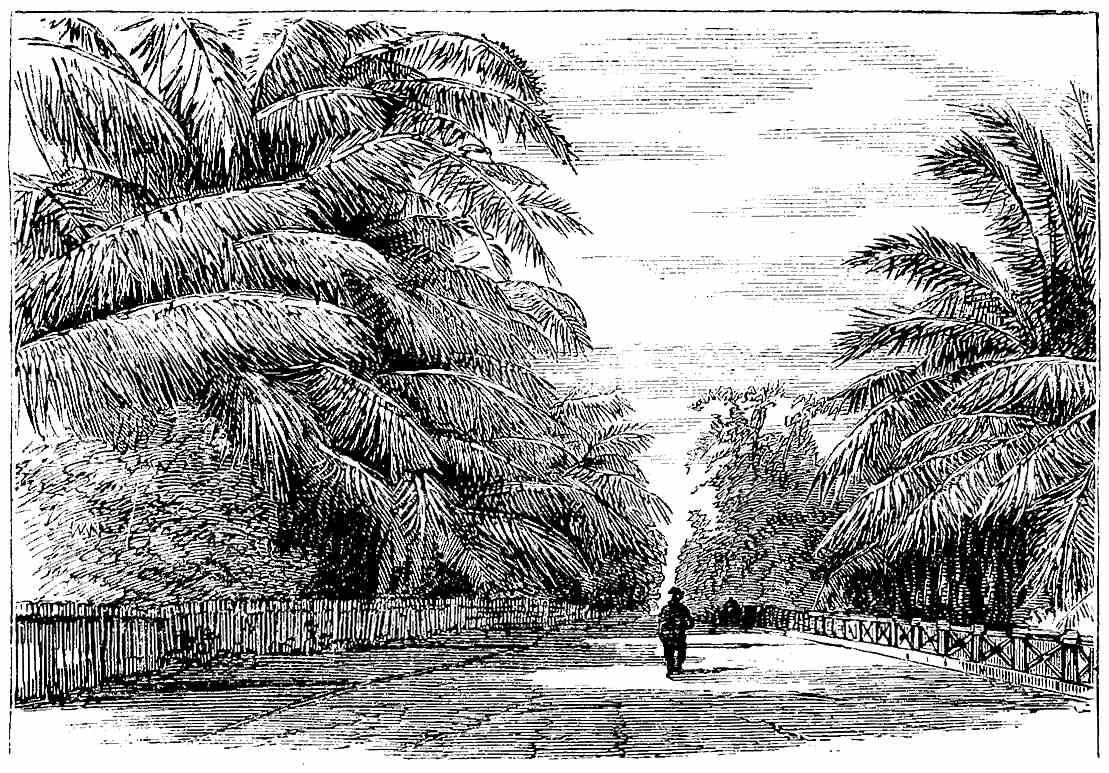
Another excursion by favor of the Messrs.
Heard and of Captain Arthur H. Clark of
the steamer “Suwo Nada,” plying between
Hong Kong and Singapore, was made to
Singapore. On the way, we stopped at Saigon,
a French port in Cochin China, from
which the French were then compelling the
enemy to retire. Rice is largely exported
from this place, and opium is received to an
amount which tells a fearful story. Here we
saw noble specimens of tigers, which are
declared by authors of high repute to have
destroyed on an average one man a day
through the year, not many years ago, in
some parts of the East Indies. They swim
over to the islands from the main lands.
They approach their victim from behind,
felling him with a blow upon the head.
Singapore is about eight days by steamer
from Hong Kong, including the visit to Saigon.
At Singapore you feel that you are
in the East Indies, from the luxuriant foliage,
the birds of marvellous plumage. We were
politely taken to the country seat of Dr.
John Little, by his brother, Matthew Little,
Esq., where we found ourselves in a forest of
cocoanut trees. The fruit is brought in
loads to the mill, where a long blade in a
frame separates the outer covering, and the
nut goes through several processes by which
every part of it is turned to use. The saying
is that the cocoanut serves ninety-nine
purposes. The rough husk being subjected
to a powerful pressure is at once reduced to
a fibrous state ready to be worked into coir
mats or spun into cheap ropes. The natural
bend of the husk, adapting it to the human
head, it is sometimes carefully prepared, and
dyed, then worn. We were entertained in a
sumptuous manner with true East Indian
bounty. We rode home after nine o’clock in
the evening, listening to every sound, the
rustling of every tree and brake, prepared to
see a tiger spring upon the horses. We were
glad to see the lights of the town in exchange
for the long, solitary road which,
however, with all its imaginary or real perils
we would not willingly have failed to travel.
At the residence of Cyrus Wakefield, Jr., and
Temple R. Fay, we were superbly entertained,
and from these gentlemen we received
very many favors. Among them, a
box of corals which had attracted my notice
as I passed through the packing room of the
counting house of Messrs. Bousteed & Co.,
and which awakened a hopeless desire to
purchase, I afterward found was in preparation
for us.—Mr. Vaughan and Mr. Hanna
laid us under great obligations by their beautiful
hospitality.
A principal road runs close by the sea, is
well shaded, and abounds in delicious odors
from the gardens. The house and grounds
of a rich Chinaman, Mr. Whampoa, are
visited by foreigners as objects of interest.
Rare East-India plants, ponds filled with the
pink lotus, vines trained or trimmed in fantastic
shapes, such as eagles, deer, lions, and
many others, on frames, trees with great
variety of foliage, make the place attractive.
A six-legged turtle which we examined was
an object of much interest to its owner. He
is a venerable man, speaks English well,
gives free admission to visitors introduced by
any one with whom he is acquainted.
It made us feel that we were indeed in
Eastern regions to be contiguous, as we were
one day, to the residence of a Rajah, the
name savoring of Oriental life.
To those who are fond of this condiment,
it may be interesting to know that Singapore
has the reputation of furnishing the best
article in this form of diet. It would require
one to be more of a connoisseur than
the writer to decide whether Singapore,
Manila, or Anjer is entitled to the palm in
preparing this article of luxury. Those who
award it to Singapore say there are ingredients
in the mixture at this place which are
not to be obtained elsewhere; for they can
not be exported and retain their flavor, the
excellence of curry depending, we are told,
on its being prepared fresh every day. The
flavor of the fresh cocoanut is essential.
Those who have eaten curry powder on their
food in this country, have an agreeable surprise
on tasting the article of curry in the
East Indies. The servants grind some of the
ingredients on stones, and the frequency
with which we saw the operation as we
passed along the streets in Singapore, made
us feel that the preparation of curry root has
a reputation which it requires labor to maintain.
To specify all that is to be enjoyed in
Singapore through every sense, would fill a
volume. We went off to the “Suwo Nada”
in a boat and steamed away from this garden
of luxuries by groves of cocoanut trees,
through lines of ships from all quarters of
the globe, and, after an enchanting passage,
found ourselves once more safe in Hong
Kong harbor.
V. MANILA.—HOMEWARD BOUND. — MANILA CIGARS. — THE CHURCH OF SANTA ANA. — PINA ARTICLES. — GAME COCKS. — TIGER AND BUFFALO FIGHT. — FIRE-FLIES. — SPANISH MUSIC. — CLIMATE OF MANILA. — RELIGIOUS SERVICE. — TROPICAL FRUITS. — THE CASSOWARY. — LEAVING MANILA. — PASSING ANJER. — CAPE OF GOOD HOPE. — TABLE MOUNTAIN. — ST. HELENA. — ISLAND OF ASCENSION — THE NORTH STAR RE-APPEARS. — DISCOMFORTS AT SEA. — TARRING DOWN. — OUR THREE CREWS. — OLD PORTRAIT OF THE SAILOR. — THE KNIGHT HEAD. — A SAILOR PUT IN IRONS. — SOME APPEARANCE OF MUTINY QUELLED. — ON HAVING A FIN IN THE CREW. — ON PRAISING A CREW. — THE POWER OF KINDNESS. — THE BOY BEN AT THE WHEEL. — ACCIDENT AND PRESERVATION. — BIRD ON MIZZEN TOP GALLANT MAST. — THE BOAT’S CREW — “HOLD THE REEL.” — GALES OFF THE CAPE OF GOOD HOPE. — WERE WE NEVER AFRAID AT SEA? — THE RUDDER. — RETROSPECT OF RELIGIOUS SERVICES AT SEA. — DROPPING ANCHOR FOR THE LAST TIME. — IN DOCK. — FIRST IMPRESSIONS ON REACHING LAND. — SUBSEQUENT EXPERIENCE OF OUR SHIP. — NELSON, OUR STEERSMAN, DROWNED. — LUXURY OF SEEING A SNOW-STORM.
My country, sir, is not a single spot
Of such a mould, or fixed to such a clime;
No! ’tis the social circle of my friends,
The loved community in which I’m linked,
And in whose welfare all my wishes centre.
Miller’s Mahomet.
* * * * *
Whose heart has ne’er within him burned
As home his footsteps he hath turned
From wandering on a foreign strand?
W. Scott; Lay of the Last Minstrel.
* * * * *
There blend the ties that strengthen
Our hearts in hours of grief,
The silver links that lengthen
Joy’s visits when most brief.
Then dost thou sigh for pleasure?
Oh! do not widely roam,
But seek that hidden treasure
At home, dear home!
Bernard Barton.
On the 22d of November we left Hong
Kong for Manila, our agents concluding
to wait no longer for hemp
to fall, but to load the ship with sugar. We
took in three million pounds, enough, we
were told, to supply our whole country one
day.
We reached Manila Bay Dec. 1, but we
would not have wondered had we been
weeks, instead of five days, in contest with
the current and head winds. One day we
tacked fourteen times off Manila. At length
we dropped anchor in the spacious roadstead,
and waited for the health officers and the
custom-house officials to inspect us. No one
is allowed to have any communication with a
vessel until she is officially visited. Steam-tugs
would be an advantage to weary mariners
contending against the current in sight
of anchorage.
We were the guests of a gentleman and
his wife, he a member of the house of
Messrs. Peele, Hubbell, & Co.60 We were
there seven weeks, and, even if delicacy
permitted, language would fail in the attempt
to express what we enjoyed in that beautiful
house. Situated at one end of the city in
the parish of Santa Ana we were removed
from the noise and tumult of business. The
river runs near the house with a current of
at least four miles an hour, bringing down,
day by day, literally innumerable wild herbage
plants washed from the lakes in the
country. Few things ever gave me a more
vivid idea of infinitude than that ceaseless
flow of herbage. Immense plaintain-leaves
stood round the house looking like the blades
of huge oars; the banana hung in large clusters;
the garden was filled with many things
to delight the eye. The house covered a
large area. You enter it by a spacious driveway,
roofed over with the main building.
Stone steps lead up to the story on which
are all the rooms in the house, high and
wide, opening into the large hall. Instead
of carpets, floors here are polished, by rubbing
them with the plaintain-leaf. The
house was cool and in all respects most comfortable.
The eye is refreshed by constant
verdure, the grass in December and January
having the brilliant green which our early
grass presents in the month of June. It
seemed strange to be riding in open carriages
at Christmas-time and January, with ladies
in muslin dresses, or requiring only light
shawls. The atmosphere is clear, and the
stars have so peculiar a lustre as to be the
subject of remark by foreigners. The river
runs about fifteen miles to a lake, by cocoanut
groves, and in some places by steep cliffs
nearly two hundred and fifty feet on each
side, covered with foliage, and having small
cascades. In the river there are as many as
twenty-eight rapids. Some of our party ascended
them in canoes, spending two days
on an excursion with a company. One
evening a party of gentlemen took a small
steamer, the private property of a friend,
and went with us up to the lake. It was a
moonlight night; the East-Indian scenery,
the curves in the stream, and at last the
scenery of the lake, made the excursion enchanting.
The society in Manila, composed of American,
English, Scotch, and Spanish people,
was delightful. Their hospitalities, entertainments,
and numberless courtesies make
deep impressions upon a visitor. There are
no unpleasant distinctions among them; they
maintain an agreeable freedom in their intercourse.
Indeed one cannot spend a few days
in Manila without feeling glad if it happens
to be at the close of a long tour; for as it
will be most likely to be pronounced the
climax of his social experience, it will be appropriate
to leave it at the close.
I used to drive with Mr. Peirce when he
visited the sugar mills where his House were
obtaining their supply of sugar to load our
ship. We saw the crude material just from
the cane, drying in the sun. I remember
that on our passage home from Manila the
cabin table happened to be short of sugar;
but having three million pounds on board
we ventured to draw on the cargo for a supply.
When it came on table from the hold,
the sight of it made us feel that sugar refinery
was far from being a luxury, for it was
hard to believe that the dark, coarse stuff
could ever become white powdered sugar.
Could we but shut our eyes, as we were
inclined to do when we put it into our
cups, we could draw from it a power of
sweetness, though with a large tare and tret
of original fibrous matter.
I visited the great cigar factories and
imagined how my friends, lay and clerical,
would envy me the privilege. But I could
not be in the atmosphere of the factory ten
minutes without experiencing a feeling akin
to vertigo, which made me retreat to the
open air. By going out and in several times
I succeeded in gratifying my curiosity. The
gentlemanly foreman begged me to take
some of his products as specimens. I told
him I could not appreciate them. He said
if I would allow him to give me only one he
was sure that he could overcome my repugnance.
He went to a private drawer and
drew out one on which he duly expatiated,
then wrapped it in a paper and gave it to
me. It is now in my drawer at home, two
years old, well seasoned; waiting for my
decision whether it will be safe to give it to
some clerical friend who will promise that he
will leave off smoking if I will treat his
resolution with this very choicest Manila.
Or would the gift have a powerful effect in
an opposite direction?
We were near the old Church of Santa
Ana, whose bells many times a day remind
the faithful of their devotions. They were
played skilfully, with a loud noise and with
a vivacity such as I never before heard from
bells. On one bell a man would drum a
tune, the military music on a church bell
having a decidedly frivolous effect. At six
o’clock in the afternoon, the native inhabitants
pause wherever they may happen to be
at the vesper bell, and perform their devotions.
I frequently met the Archbishop and
his secretary in an evening walk, who would
stop suddenly when the bell struck and, uncovering
their heads, would repeat their
prayers. I visited most of the churches.
Imposture nowhere reigns with more open
demands upon the credulity of the people.
In one of the churches there are large paintings
of the “Holy Girdle,” whose marvellous
cures, and power over serpents, and the
bestowment of blessings in answer to faith
in it, are described in large letters. Each
of the many parishes has a monthly procession
in which the population join. One
evening we encountered a procession which
blocked the streets for two hours. Four
thousand women in black filled each side of
the wide street, chanting Scripture and
prayers, the men occupying the middle of
the street with an imposing show of images
of canonized persons surrounded with lighted
chandeliers. Each woman in this procession
had a lighted wax candle which she had
bought of the priests, to be returned to them
after the march. This is the source of a
large revenue to the Church. These processions
keep up a lively enthusiasm among the
people.
The manufacture of the Pina articles employs
the people at home. These exquisite
articles, such as veils, handkerchiefs, &c., are
made of the fibre of the pine-apple; at almost
every house in some of the poorer parts
of the city you see this work on small frames,
exposed to the sun.
The men are very many of them occupied
in the training of game-cocks; frequently
every tenth man you meet will have one of
these birds under his arm.
One Sabbath we were told there was a
fight between a tiger and a buffalo on exhibition.
The buffaloes are meek, docile
animals, used instead of oxen. Their horns
are wide-spread and very long. The buffalo
took the tiger on his horns, threw him high,
and the fall indisposed him for further effort.
Some of the most beautiful objects here
are the trees filled with fire-flies. Sometimes
all along a road the trees will be crowned
with the small creatures, their light constantly
emitted; so that the tree looks as
though it were filled with gems. Few sights
are more attractive.
The inhabitants resort in the evening to
the Pier, which is a solid structure extending
a sixteenth of a mile into the bay, a sea-view
on all sides; and once a week there is
music by the bands, which draws crowds.
Much of this Spanish music is more sentimental
than we are accustomed to hear addressed
to the populace, exciting a thoughtful
attention.
Manila is the capital of Luzon, one of the
Philippine Islands. The climate in December
and January was intensely hot. After
nine o’clock in the morning, it was not
agreeable to be out of doors, even to drive;
but at five in the afternoon, and in the evening,
the cool sea-breezes made it pleasant to
be abroad.
Religious services are sustained on Sabbath
evenings by a few christian friends at
the house of one of their number, but there
is no public place of Protestant worship
there. It was instructive to go from China,
from the depths of heathen idolatry, into
the depths of formalism under the name of
Christianity. You question whether you
have advanced at all into the light of truth;
for though it is a relief to be where the
Scriptures and the names and forms of christianity
are heard and seen, you are impressed
with the bias of the human heart to idolatry.
To come from heathenism in China, and
Roman Catholic superstition in Manila, into
christian temples here at home, makes you
wonder that only a certain number of leagues
of salt water separate between us and such
places as Canton or Manila.
Of all the fruits which I have tasted in
any part of the world, nothing has seemed to
me preferable to the East Indian Mango.
It is about the length of a full grown cucumber,
as large as the largest specimens of that
vegetable, smaller at one end that at the
other. It has a flat stone extending from
end to end. The skin is about the thickness
of that of the banana. You stand the mango
on one end in your plate and slice it on
either side of the stone. Two slices then
lay before you. With a dessert spoon you
take out piece after piece of the tender fruit,
and when you have eaten both halves to the
skin, there yet remains the stone, which has
a great deal on it. You take it up in both
hands and pass your mouth around it. By
this time your hands and face are a spectacle
which you can judge of by the predicament
which you see your neighbor to be in. You
are ready to agree with the East Indian
maxim that a mango never should be eaten
except in a tub of water. You cannot help
beginning with another; but let it be small,
or you will be likely to inquire if you may
not divide your second with a friend. The
fruit is of about the same color inside as
the muskmelon, but it is harder, though not
tough, not disagreeably sweet; juicy, nutritious.
We began to receive them at Hong
Kong in May, from Manila, where they are
in perfection. We were surprised on seeing
them upon the table at Christmas in Manila,
a forcing process being used there to bring
them forward.
Another valuable fruit in the East Indies
is the Mangastene. It is of the size of the
tomato and looks like it in shape; it is of the
deep purple color of the purple grape. The
outside shell, which is easily broken by the
hand, being removed, a snow white fruit appears,
divided like the tomato into as many
sections. Its juice is slightly acid,—more
correctly, acidulated,—a pleasant sour.
There being little or nothing solid in it, the
saying is that one may eat of the fruit indefinitely.
There are few fruits better adapted
to a warm climate.
At Shanghai the Watermelon attains a degree
of perfection which I have never known
exceeded.
The Pumelo, though a coarse fruit, is valuable.
It resembles the West India shadduck;
it is a large, fleshy orange, not so
juicy as that fruit.
To those who are fond of the banana it
must be a delight to spend time where they
can fully gratify their taste for it. The Sandwich
Islands gave us the best specimens.—I
cannot say it would be easy for me to enlarge
this description of foreign fruits; indeed
it would be painful, for the mention of
these fruits is a vivid reminder of lost joys,
joys pure, innocent, health-giving, a source
of gratitude to the Giver of all good, stimulating
the anticipation of future pleasure,
which divine revelation does not consider it
beneath itself to specify among the promised
pleasures of heaven. It used to be a pleasant
theme of meditation in those East India
regions, that in the fields of the blest there
is a species of tree (not, of course, one solitary
tree) which bears twelve manner of
fruits, and yields fruit every month. It was
a harmless fancy of an invalid which twelve
of all the fruits known to him he would
select for that species of tree to bear. His
taste would make grave mistakes in putting
the watermelon, for example, on the same
tree with the plum; which led him to question
whether the structural nature of the
tree might not be supposed to be as far beyond
his present botanical knowledge as the
yield of the tree would surpass his present
experience. His acquaintance with the almost
perpetual banana gave him some idea
of the practicability of vegetation reaching
to the extent, even, of yielding fruit every
month; so that without consulting with the
botanical critic he would load his tree with
the East Indian mango, mangastenes, apricots,
muskmelons, peaches, pears, grapes, apples,
quinces, watermelons, banana, figs; and
then he would consider how inadequate was
a pomological catalogue to express the known
objects which stood ready to tempt his appetite.
The queen of Sheba, herself from the
East, perhaps admonished him by seeming to
say that a greater than Solomon would hereafter
‘feed him and lead him to living fountains
of waters.’
At Manila one object after another would
be continually presenting itself to our notice,
leading the thoughts into the still remote
parts of the eastern world. In the yard of a
gentleman stood this singular creature, which
you felt obliged to call a bird yet you would
prefer that it should be classed as an animal,
for it seemed to belong among animals,
though it is a biped. Its enormous legs,
eighteen inches long, its fleshy protuberance
on its head, coarsely imitating the tuft on the
head of the peacock, left you in doubt how
to assign it a place among the tribes of the
animal kingdom, reminding you of the exploit
in rhyming which a wit perpetrated
with its name and its place of nativity, making
Cassowary to rhyme with ‘missionary,’
and Timbuctoo with ‘hymn-book too.’
We left Manila Jan. 20th, with great regret.
We were taking leave of valued
friends, besides bidding adieu to scenes of
interest which had not been surpassed in our
experience. We had reached the eastern
limit of our long voyage; we were to turn
and find our way to the western continent.
Objects of thrilling interest were yet to be
passed. But how could we help feeling the
need of special assistance in the great undertaking
of going round the other half of
the globe? These words came to me, and
some lines were suggested by them:
“When the even was come he saith unto them, Let us pass
over unto the other side.” Mark iv. 25.
They went, and as they sailed
A storm came down upon the lake;
It made the boldest spirits quake;
Their faith forsook them, so their courage failed.
He on a pillow slept;
The stormy waters waked not Him.
But prayer had power to break the dream
Which through the tempest Him asleep had kept.
There on Gadara’s shore
Hell’s sullen legion knew his form;
He and the twelve, escaped the storm,
Enrage their spiteful enemies the more.
He speaks, the gale goes down;
The legion at his bidding flee;
The maniac finds recovery
And spreads abroad the Nazarene’s renown.
We leave what may betide,
Saviour! to thy Almighty power.
So, trusting in thy love each hour,
We will pass over to the other side.
We began our homeward voyage from
Manila Jan. 20, and reached Anjer, Feb. 1.
Anjer is the western point of Java; vessels
pass it to and from the China seas. “Passed
Anjer,” in the marine reports, signifies that a
vessel has left the China seas on her homeward
way, or has just entered them on her
outward voyage. Anjer supplies vessels with
poultry, vegetables, fruits and water. On
enquiring for bananas, we were told by a man
who came on board that he would get us “a
fathom of them for a dollar.” It was a large
Oriental statement, with a basis of truth;
but six feet of bananas for a dollar seemed
too good to be true.
Batavia is about seventy-five miles from
Anjer; the road to it is characterized by
Dutch solidity and thoroughness. Opposite
the hotel at Anjer is a banian-tree, said to be
the largest in diameter in that part of the
world, composed of shoots which have descended
from the top, taken root, and become
principal parts of the tree. We saw from
shore our ship under sail, waiting for us,
beating about against a head wind and current.
The sight was animating. We rowed
off to her four miles, glad to be on board the
noble thing which had borne us more than
half round the world, and was waiting to
complete the great circuit. As often as we
now see in the marine record, “Passed
Anjer,” we recall the sensations with which
we looked off from that lighthouse, which is
the first or last object of interest to all who
navigate those East-Indian seas.
It was extremely interesting to be approaching
this famous point. That great
maritime revelation, the opening of a new
route to India in 1487, the story of Bartholomew
Diaz and Vasco da Gama, and of the
first navigators around that point, who used
to bury their journals and set up a stone
pointing to them, that the homeward-bound
vessels might, by this primitive mail arrangement,
get the latest news of them, made it
an object of deep interest. Here the astronomers
come from different countries, to observe
the signs of the heavens; and certainly
no place can be conceived of more favorable
for such purposes. The clear atmosphere
and the perfect horizon make it a place well
fitted for telescopes to try their power. The
Indian Ocean opening here, spreads before
the observer the scene of some of the most
interesting events of history. Being about
four thousand miles from north to south, and
of equal breadth, and receiving the Red Sea,
holding the Persian Gulf and the Bay of
Bengal, distinguished by such islands as
Madagascar, Mauritius, Ceylon, and by such
rivers as the Tigris, Euphrates, Indus, Ganges,
and by the great equatorial current which,
after it leaves the wide coast of China, crosses
this ocean to the Mozambique Channel, seeking
the east coast of Africa, and making its
way by the Cape of Good Hope,—this
Indian Ocean does not yield in historic or
natural interest to the two greater oceans.
Its northern part, divided from the southern
by the Tropic of Capricorn, floats the commerce
of Europe and this country with
China, India, and the Malay Islands. Arabia
and Persia, and the opposite India have used
its waters for centuries in their local commerce.
Points of interest along its seacoast,
gulfs, and rivers are, Aden and Mocha in
Arabia, Bassorah in Turkey, Bombay, Madras,
Calcutta in Hindostan, and Point de
Galle in Ceylon. It seemed more like the
centre of the world on this ocean than elsewhere.
Its astronomical attractions and its
sunsets give it a peculiar charm, though after
all that has been said of Indian Ocean sunsets,
I am constrained to say that in Princeton,
Massachusetts, I have seen more wonderful
sunsets than I saw in the Indian Ocean.
Table Mountain, which makes the most
prominent object at the Cape of Good Hope,
though not the southernmost point, is 3,816
feet high. It has a flat summit of great
extent, and from that peculiarity in its formation
it has its name. It is seen in clear
weather fifty or sixty miles distant. You
would think it a burial-place of kings, having
something stately in appearance, as
though it were a mausoleum erected by
human art, like the pyramids built by successive
generations. We sailed away from it in
the latter part of an afternoon, reflecting
that we had looked upon the last object connected
with the continents of the other hemisphere.
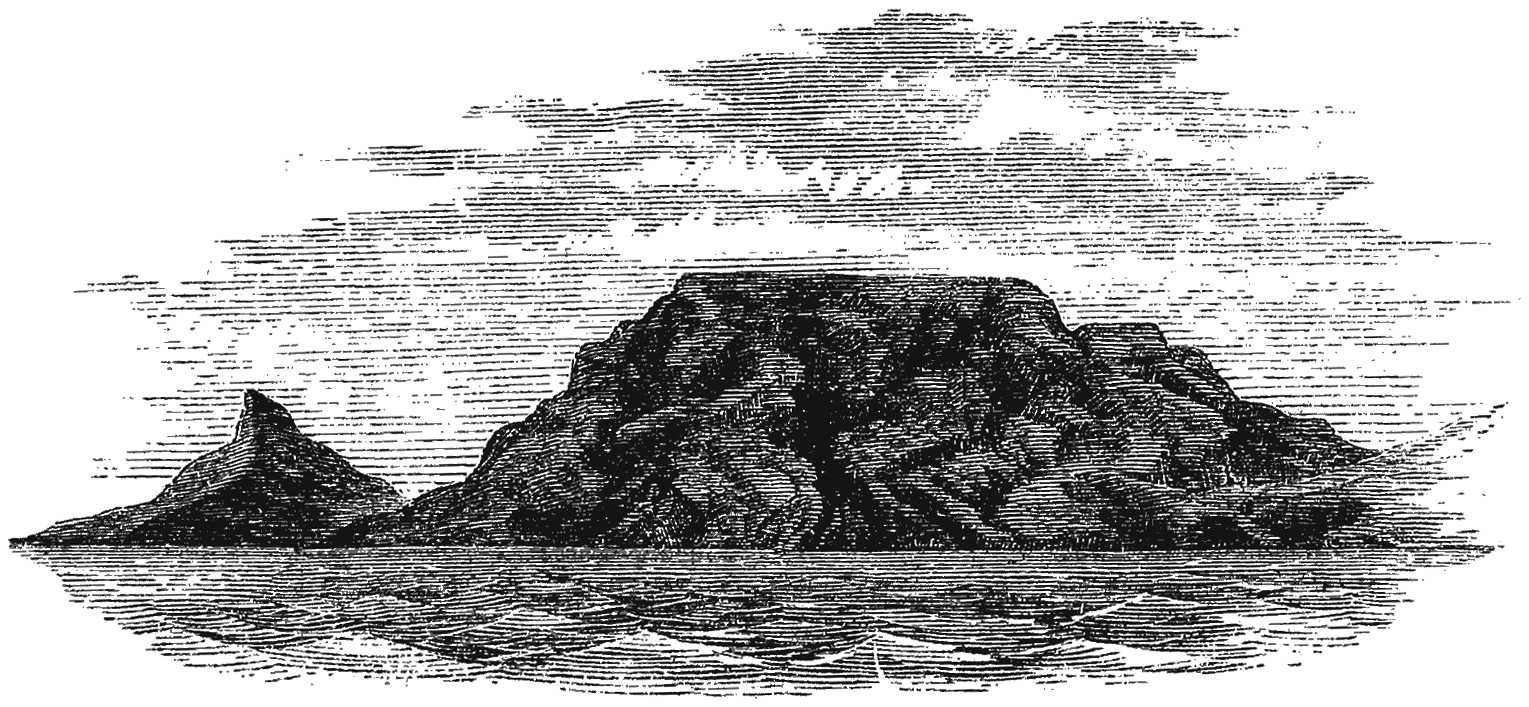
We came very near this deeply interesting
spot which for several years held the attention
of the world. We could appreciate the
saying of the notable prisoner there, who
spoke of himself as “chained to this rock;”
for the island impresses you as a huge rock.
Very few isolated places seem to have more
connection with the world; for twenty-five
vessels on an average each day pass by it,
showing their signals, to be reported. To
begin and speak of the place, and the
thoughts and feelings which it suggested,
would not be expected. We could not go
ashore without first entering the ship and
paying port duties; but we had a full view
of “Longwood,” where Napoleon lived, and
where he met death.
We resolved to go on board a British man-of-war
which we should pass not far off. On
lowering the largest boat into the water, the
seams proved to have opened, and she soon
filled. The gig which we used all summer
in going ashore at Hong Kong was more
seaworthy; so we set off in her for the man-of-war.
We took four men to row and one
to bail, which he had to do nimbly, the water
gaining on him, obliging the stroke-oar to
lend him a hand. By keeping our feet on a
level with the rail, we managed to reach the
“Rattlesnake” without being wet, though
we discussed the question whether a handkerchief
at half mast on an oar would be
likely to be seen, if we were swamped. We
went and returned safely, having received
from the ship the news of the French and
Prussian war, three months old, and having
also received of a New Bedford whaler some
vegetables, which we tried in vain to pay for.
The midshipmen of the “Rattlesnake” said
that they were attracted by a noble American
vessel which entered the harbor that
morning, and they asked if we could tell
them her name. After listening to their description,
we, with becoming diffidence,
informed them that it was the Golden Fleece.
The last point on which our eyes rested
was the Island of Ascension, always interesting
to every one at school as the most solitary-looking
spot in the dreary South Atlantic.
A whaler tacked and came near us;
two of the men stood aloft watching for
whales. Feeling that they were the last of
our race whom we should behold for some
time, and with sincere respect for the hardy
men on their ocean hunting-ground, I waved
my hat to them, and the two caps aloft made
hearty response.
We soon found by the signs above us that
we were entering the northern hemisphere.
One evening we saw, just above the horizon,
two stars of “The Dipper.” It was several
nights before the North Star came up the
watery hill. The poet Spenser probably had
never sailed in these latitudes when he wrote
of the North Star as never being below the
horizon:—
“By this, the Northern wagoner had set
His sevenfold teme behind the stedfast starre
That was in ocean waves yet never wet,
But firme is fixt, and sendeth light from farre
To all that on the wide deepe wandering arre.”
61
But at last it came up, dripping wet, and
inspired in us the hope of soon watching it
from our windows at home.
While it is true that as much was combined
as could be wished for to render this
voyage agreeable, those who have been at
sea will not believe that we were free from
the ordinary discomforts or annoyances of
sea-life. For the satisfaction of those who
have suffered in sailing vessels it will be well
for me to show our dark side of sea-life in
some of its principal annoyances; doing
this, however, for the sake of the truth, that
the voyage may not appear to have been out
of the ordinary experience of those who go
down to the sea.
One of the first things which we all suffer
at sea is revealed in the inspired account of
sea-faring experience, which we are presented
with in the contrasted experience of being
on shore: “Then are they glad because they
be quiet.” There are times at sea when stability
seems to be the most enviable state.
In weariness the invalid passenger, tossed
and not comforted, feels constrained to quote
one of the earliest verses of inspiration:
“Let the dry land appear.” Yet there is so
much that provokes mirth in the midst of
discomfort that it is not easy to say on which
side the balance lies, whether of discomfort
or amusement. Behold three men, two of
them at least used to the sea, setting out
from different parts of the main cabin to
make their way to the table in the forward
cabin. The ship rolls over on her port side,
and the cabin-floor is at once an inclined
plane at a grade very much removed from
horizontal. They have a steep hill to ascend;
and a seven-pound weight on either
foot, ashore, would not be more cumbrous
than that which seems now to be holding
them to the floor. The sensation in trying to
move cannot be unlike that which would be
felt in an exhausted receiver. If the weight
of the atmosphere on the human body, fifteen
pounds to the square inch, instead of
being equally diffused could be concentrated
on the feet, the sensation probably would
not be unlike that which one feels in trying
to get across a ship’s deck when she is thrown
over to the side opposite to that whither you
are going. So these three gentlemen stand
immovably fixed in the middle of the floor,
their feet discreetly wide apart to preserve
the upright position of the body. Then the
ship rolls over on the other side, and the
three travellers to the dinner table go involuntarily
fast to the side of the cabin and
hold on by a door, while the ship rolls once
more, and comes back, it may be, with mitigated
severity. At last a favorable opportunity
is seized and the three slide into their
seats in postures more necessary than graceful.
Then begins a series of mishaps at
table. No careful adjustment of the dishes,
nor even the security provided for them by
the racks can guard against the accidents
which befall cups and saucers indiscreetly
filled, or plates of soup not well provided
with suitable dunnage of slices of bread underneath
the lee side. A barrel of apples
falls against the door of a locker and empties
itself over the floor; and a canister of lamp-oil,
whose cork had not been made tight,
follows after the apples, and they are no
longer eatable. Oh to be quiet! What
seems more desirable than a good foundation?
One day when the ship was rolling heavily
it was difficult to keep your seat on the settee,
and impossible to lie reclined. Every
thing which was not lashed to some fixture
about the room, or to staples driven into the
floor, was sure to adopt a nomadic state and
go from side to side. Among other things
a “Pilgrim’s Progress,” which had been left
on a table, fell from it and went sliding to
and fro, exciting lively sensations in me at
the thought that Mr. Ready-to-Halt and his
friend, Mr. Despondency, were moving at a
pace ill suited to the crutches of the old gentleman;
for the book went like a shuttle
back and forth on the floor.
The little stove in the cabin felt the
changeable wind, and did not draw well.
This required the frequent attention of the
steward. He was a Portuguese man, with a
dark skin. He sat on the canvas carpet
whittling, to make lightwood, to start the
fire. The ship went down on one side, and
the steward with it, whittling all the while,
then sliding back in his upright position,
maintained with becoming gravity, till the
passengers, no longer able to contain themselves,
were made merry at the sight. This
made him show his white teeth, silently,
without anything so undignified as a laugh;
at which the passengers were increasingly
merry.
What shall I say of the cockroaches, red
ants, tarantulas, and mice? One thing can
be said in favor of all of them,—they were
not musquitoes. This was a nightly consolation;
but it was the only good thing which
could be said of them all. The ants would
cover every vessel in which they could find
any thing to drink; fresh water seemed to
be their chief delight; if a wet sponge were
hung up to dry, on taking it down the little
creatures would be there in legions. The
white ant is the bane of the Indian climate;
their depredations, however, are chiefly on
shore. I was going up the front stairs of a
gentleman’s dwelling in China, when his foot
went through a stair. “Ah,” said he, “the
ants have been at work here!” But at sea
we found the cockroaches most destructive.
It is not pleasant to find several of them on
your pillow when you go into your stateroom
at night. They are harmless to the
person, but the covers of books, and everything
which has been pasted or glued, all
lacker work, and paper generally, suffer from
them. Yet there are housekeepers on shore
who can inveigh against vermin, as well as
people at sea.
There are some people who cannot bear
any noise overhead at night. If the gale
does not wake them and keep them awake,
twenty or thirty sailors hoisting or lowering
the spanker, their boots making a noise not
so gentle as that of prunello dancing-pumps
will do it. If the stillness of the night and
the passenger’s sleep are broken by the mate
pacing the deck to keep himself awake, the
heels of his boots will be chiefly answerable;
for these make the principal disturbance; he
cannot always comfortably wear India rubbers
during his watch; he is to be pitied if
he has a nervous passenger, and thanked if
he is able to forego his walks on the house
for the invalid’s sake.
It would seem as though there should be a
special punishment for those who practise
fraud in ships’ stores. Your appetite is delicate;
you have no source of supply but your
locker; that is furnished with bottles and
jars which profess to hold, for instance, jellies,
made and provided expressly for sea-faring
appetites. Your hopes of a comfortable
supper are vested in a jar of jelly which
the steward has placed on table, hoping to
provoke an appetite. On opening it, instead
of the fruit jelly which the label assures you
is within, you find only gelatine, flavored
with an extract resembling the fruit. There
is nothing on the table for which you feel
any desire but the promised jelly; you find
yourself secretly invoking a sea-faring experience
like this upon the man who has so
deceived you, till at last your suffering is so
great under your disappointment, which
grows intense as the tasteless supper proceeds,
that in stern disapprobation of this annoying
ship-chandler trick, you feel resolved to make
it known, promising him that if you ever go
to sea again you will pay special attention
and see if his name is on the labels of the
jellies. He who writes this and they who
read it will not fail to remember that invalids
are apt to be unreasonable. So small a matter
as a jar of preserves disappointing the
expectation of a nervous patient, especially
at sea, where there are no means of alleviation,
may be more than a match for the
philosophy and the resolution of the best of
men and women.
When I have said these things, very few
discomforts or annoyances remain which are
not incident to almost any situation on shore.
Many things there we are freed from at sea;
the noise of cats at night, the barking of
dogs, the scream of locomotives, the painfully
regular puffing of stationary engines, the
roar of wheels, the annoyances of mischievous
boys, these you escape at sea; all of
them in sailing-vessels, for in steamers you
have some of them. If one should fairly
add up the comparative discomforts of ship
and shore, would life at sea prove to have
the most of them? I came to the conclusion
that a good sailing-ship, with agreeable company,
is as near a perfect state of rest and
peace as ever falls to our lot.
“Tarring down,” already mentioned, and
now repeated because the operation is renewed
as the vessel is coming near to port,
is to a landsman an animating sight. Every
rope in the standing rigging, beginning aloft,
feels the smearing process, which is carried
on without gloves. The stays, which run
between the masts at an angle of forty-five
degrees, are reached at every point by the
boys, each in what is called a boatswain’s
chair, not unlike the seat of a swing; in
which he is lowered at his call by a boy or
the mate on deck, who belays him at each
descent a few feet at a time. Often have I
watched these boys suspended sixty feet
above the deck, wiping the rope with the
sopping rags which they dip in the tar-bucket
till they reach the deck; and I have thought
what a sight one of these boys would be to
his mother,—her pet besmeared with tar
from head to foot, one suit of his clothes,
kept for the occasion, doomed to go overboard
after the tarring down near port, the
boy feeling an honest pride as he illustrates
in his work the dignity of labor. But perhaps
the mother’s heart would yearn towards
her child more than when she should see him
in “the boatswain’s chair,” on seeing him at
his meals. I repeat it, he has no table. He
goes to the galley with his tin pot; the
cook gives him his portion of tea or coffee,
sweetened with molasses; the boy cuts a piece
of beef from out the mess-kid, gets a piece
of “hard-tack” from the “bread barge,” sits
down on deck, or on a spare spar, lays his tin
pan beside him, and with his sheath-knife
and fingers despatches his “grub.” Many
at their rich mahogany tables loaded with
China-ware and silver would give it all for
the boy’s appetite and power of digestion.
Our three crews, were, one from New York
to San Francisco, the second, from San Francisco
to the Sandwich Islands and Hong
Kong, the third, from Hong Kong to Manila
and thence to New York.
It would be more than could be expected
of human nature subjected to the trials of
nautical life, to behave with perfect propriety
under all the various conditions to which
men must be subjected in a long voyage.
From New York to San Francisco we were
favored with a set of men who could not be
excelled in their dispositions and behavior.
I have already quoted the complimentary remarks
of the captain in his last address to
them. In San Francisco, although there is
not the opportunity to make a good selection
which there is in the port of New York, we
were also highly favored in our men.
We had three libraries sent on board before
we left New York, which did excellent
service. It was interesting to see the men
after religious services on the Sabbath morning,
finding shady places about the ship with
their books and tracts from these libraries.
This is in contrast to the old system of
things among sailors. A familiar picture of
a sailor used to be a man with a monkey led
by a string in one hand, a parrot cage in the
other, a tarpaulin with a quarter of a yard
of black ribbon flying, no suspenders, his
trowsers revealing a zone of blue shirt above
his waistbands. The appearance of our crew
from New York was far in advance of such a
portraiture. It is still seen, though the contrast
is very frequent.
On our way from Manila the Captain invited
me to go down with him to the knight
head, at the foot of the bowsprit, where you
may extemporize a good seat protected with
ropes. There you have a good view of the
ship, and, taking the foremast for a guide, can
learn the names of the different sails, see the
arrangement of the jibs, and, leaning over,
watch the cutwater dividing the billows,
throwing up sheets of foam, the spray saluting
you as often as the ship buries herself in
a huge wave. We indulged ourselves in
some mathematical calculations as to the
bulk of water displaced by the ship as she
floated, with several problems adjacent.
This ship is two hundred and ten feet long.
Malone Block, in Boston, where we formerly
lived, has six dwellings, each twenty-three
feet long, making the block a hundred and
thirty-eight feet, so that the ship is once and
a half the length of that block! We did
much ciphering on the wood work, which
may not have escaped the paint brush, or the
constant wear from the weather. If it survives,
a reader may find there some curious
calculations in the mensuration of solids.
The crew which we shipped in Hong Kong
were several of them, as it proved, released
from jail to ship; they were, in part, the off-couring
of English vessels. They were disposed
to take advantage of the officers when
possible, doing as little work as would serve to
make them appear busy. One of them was
sent aloft to slush down the mast, and the
second mate observed that he was loitering
about in the rigging, to kill time. At eight
bells he came down on deck, intending to go
to breakfast with his watch and let somebody
else finish his work; but the mate ordered
him aloft to complete his job. This he refused
to do, saying he would not work when
it was his watch below. The captain heard
the dispute and told the man that if he did
not obey the orders he would put him in
irons. He continuing obstinate, they put
irons on his hands and placed him in the
poop deck hatch, and gave him hard bread
and water for food. He held out forty-eight
hours in spite of the captain’s continual conversation
with him; when leg irons were
brought and were going on; then he humbly
consented to obey the order and to behave
well. The captain has since told me it was
the only time that he ever confined a sailor,
and he was inclined afterward to wish that
he had been still more patient, trying to
conquer the man by his usual method of moral
suasion. “But,” said he, “it was the only
direct refusal of duty which I ever had, and
with such a dangerous crew I felt the necessity
of showing decision.” I record it with
my grateful acknowledgment that though
this man was kept manacled in the lazareet,
under my stateroom, I did not know when
he was put there, nor was I aware of his
crime and his punishment till several months
after our arrival.—One other incident will
complete the criminal record of the ship.
On the voyage from Manila to New York
we had the only interruption to our peace.
One day we were informed by the steward
that some of the men had thrown their beef
overboard; that they were excited; and he
feared trouble. The captain made inquiry
into the cause of disaffection, the ringleaders
in it, the nature of their threats.
He called them together on the main deck
in the afternoon. All were there except the
man at the wheel. They were dressed in
their Sunday clothes; they stood round as
men do when there is a strike. The passengers
kept out of sight, but were within hearing.
We had heard of mutinies; perhaps
we were now to have some practical experience
of them.
The captain told them that the steward
had informed him that they found fault with
their beef. He believed that there may have
been some reason for complaint; that a new
barrel had been opened that morning; he believed
that the first pieces had been exposed
to the air, the brine having been absorbed
since leaving New York; that the steward
happened to give these pieces to them rather
than to the cabin table, but there was no
design in doing so; that had we had one of
the pieces for dinner that day, we should no
doubt have complained that it was not as
fresh after coming round Cape Horn as it
was on leaving Fulton Market; but we
would not for this have abused the steward.
Now as we were getting to the last tier of
the beef barrels he should have to shorten
their allowance a little, especially if they
preferred to throw their beef overboard,
which they might do if they pleased, but
they would gain nothing by it; we were all
in the same boat sharing alike. He had
heard of some expressions being used which
were not right; he hoped he was misinformed;
they would find that so long as they
showed themselves to be reasonable men
they would have no just ground of complaint.
They also knew what the consequences
would be to any one who should
make trouble.
The men separated peacefully, making no
more complaint; for we soon drew from
deeper brine and the beef proved to be all
right.
Perhaps it was accidental, but the captain
said that complaints against the grub had
been most frequently made by some Irishmen
in his different crews. Whether these
offenders had been accustomed to the best of
fare on shore, and so were less able to bear
discomforts in sea life, or whether they were
of a more jealous disposition than others
from some natural cause in their temperament,
he would not say, but he had found it
more difficult to suit a man of this class in the
matter of grub than others; the shillaleh
was too ready to appear at a fancied attempt
to get an advantage over him in his food.
For quick witted, daring, nimble, nautical
feats, none have surpassed Irish sailors. As
quick as any one of his watch, you are sure
to find an Irishman lying out on the yard
arm as far as to the weather earring, in a gale.
It is not right to lay hold of a few cases
and impute certain classes of faults to men
of one nation, as though these men were all of
them specially addicted to that kind of transgression.
There is no assignable reason, for
example, why an Irishman, rather than a
Swede, should be quick to find fault with his
grub; if it has so happened that, as a captain
told us, he never in a long course of
years, had a disturbance in his crew about
the grub but an Irishman was sure to be at
the bottom of it; that even when in all other
respects the Irishman was exemplary in his
disposition, grub was sure to be a weak point
with him; still we would prefer to hear the
experience of others before we drew a conclusion
unfavorable to a whole class of men in
that particular.
There is a singular superstition among
some seamen that where there is a Fin in the
crew, you may be sure of bad luck. Had we
been superstitious, we might have augured
ill for ourselves, because the first entry on
our shipping list was of John Reholm, Finland.
Now John Reholm was, as to behavior,
blameless. He was short and stout, about
forty-five years old, always ready to go aloft,
good at mending old sails, quiet, always at
Sabbath service, often betraying emotion,
which was noticeable in his moistened eye,
his quivering lip. I do not remember to
have heard him speak a word, so that I doubt
if he could speak English, except a few indispensable
sentences, though he understood
the spoken tongue. Yet when all hands
were on deck in some exigency, you would
be attracted by his readiness to lead off in
that part of the work which called for a
strong arm; he knew where to look for the
corner of the sail which the wind had torn
then twisted. On receiving at the wheel
your salutation as you passed him, though his
hands might both be needed to keep the
wheel straight he would be sure to lift a
hand to his cap, and acknowledge your attention.
There was no bad luck about him.
He went the round voyage with us. Would
that I could hear of his welfare. If any one
says a disparaging word about a Fin, the
image of a saint among sailors rises to my
thoughts in the person of John Reholm.
Now that I am out of all danger of incurring
the disapprobation of the mates, I am
free to speak thus about a sailor, and I would
be glad to say more. One Sabbath I spoke
to the crew in terms of commendation. We
were lying at anchor in Hong Kong harbor.
In the night there were signs of a gale.
One anchor only was down; the ship drifted,
and we were afoul of an English bark. As
the wind was still rising and we had lately
had a typhoon, we were apprehensive of
another. All hands in each vessel were at
work, some aloft, clearing the rigging and
fending off, and those below anxiously watching
the growing snarl, contending with unequal
strength against the chafing, and now
and then the grinding action, of the vessel.
From my window I could see and hear all
that was going on, as we lay close to. The
crews being strangers one to the other, many
of them of different nationality, there was
due deference paid to each other, courteous,
kind expressions, regrets on the one side at
running upon a neighbor, on the other the
deprecation or the ready acceptance of apologies,
the ‘don’t mention it,’ or, ‘we should
have been foul of you, if the wind had been
the other way.’ After working hard from
two o’clock till four, in the dark, we were
clear of each other, and the spare anchor
went down to hold us fast. No words of
impatience met my ear during the whole
work of disentangling the snarl. It came in
my way to speak of this the next Sabbath.
A few days after we were discussing the
sailors, when one of the mates said to me,
“I was afraid last Sabbath that you were
going too far in praising them.” “Yes,”
said the other, “I was on tenter hooks, till
you got through.” I am ready to defer to
the practical judgment of the mates, yet we
may be too sparing of kind words, courteous
tones, and praise, in our treatment of those
whom we would impress with the feeling
that they are under authority. It will not
hurt any of us to have in mind the injunction
of an old poet:
“Praise, above all; for praise prevails;
Heap up the measure, load the scales,
And good to goodness add.
The generous soul her Saviour aids,
While peevish obloquy degrades;
The Lord is great and glad.”
Early in the passage to California the men
were at work about the ropes on deck, when
one of them was told to loosen a topgallant
halyard which was foul. He laid hold of
the wrong rope. The voice of upbraiding
came from one of the oldest of the crew;
“Have you been on board this ship a fortnight
and don’t you know the topgallant
halyard?” Another sailor answered, “O,
Daniel is learning fast; he’ll come all right
soon; trust him.” Daniel was evidently
touched by this unexpected expression of
kindness; he wiped his eyes with the back
of his hand; but whether from perspiration
or not I could not tell.
In the straits of Lemaire, going round
Cape Horn, we overtook and were likely to
pass a British ship, wire rigged, a ship of
fine style. The sea was rough; we were
coming too near. The boy Ben was having
his trick at the wheel. He was the youngest
on board. The little fellow did his best to
keep the ship from broaching to, but the sea
was too strong for his young arms. I pitied
Ben, for I knew how mortified he would be
to have another supplant him; and he was
ambitious of making good his standing as a
sailor. Just then a kind voice called to him;
“Ben, you are a good little steersman; you can
steer as well as any of them most of the
time; but just now the sea is getting up; we
should like to pass that ship and not get too
near her; one of the able bodied sailors
ought to be at the helm; ring the bell and
call Nelson to come and take the wheel.”
Nelson came, and worked the ship so that
she soon shot ahead. Ben left the wheel
with the proud satisfaction that his efforts
were appreciated and praised; that only Nelson
could do better than he; and Nelson was
twenty years his senior. The little incident
made me also sensitive about the eyes. I
would rather do such an act of kindness to a
young man than outstrip a British clipper.
As I look back on the dangers of our way,
and remember how many times by night and
day, aloft and on deck, our men have been
exposed to accident, I cannot refrain from
recording my gratitude to the Preserver of
men. One day all hands were around the
mainmast hoisting a yard. I was standing
with the captain near the wheel, when we
heard a noise unlike anything which we ever
heard on ship board. It lasted only two or
three seconds, but was so peculiar that it
was frightful. Was the ship grating over a
sunken rock; had she opened a seam, and
was the water pouring in? Going forward,
the men were found standing silently over
one of their number who was lying senseless
on deck. One of the chain runners which
hoists a yard twenty-five or thirty feet, had
given way in one of its upper links, and the
chain had come down through the block to
the deck. This was the noise which alarmed
us. In falling, the chain struck one of the
men on the shoulder and he fell senseless.
He was soon restored, but he was laid up a
fortnight. Had the blow been upon his
head, the weight of the chain made it probable
that the hurt would have been more
serious. This was the only accident which
we had to record during the whole voyage.
One afternoon about five o’clock, several
weeks after we had “passed Anjer,” a bird
as large as a heron came and sat for half an
hour on a yard. We were several hundred
miles from any land. The bird was not idle,
for his frequent change of position, the
motions of his head evidently helping his
eye-sight, showed that his thoughts were
busy about the next stage in his flight. He
will go westward, I said to myself, keeping
up as long as possible with the sun; but still
he will spend the night somewhere on the
waves. I watched him till he flew. To
my surprise, instead of going toward the sun
he flew eastward. I would have dissuaded
him from such a decision, at least would
have inquired by what train of thought he
came to the conclusion that he would fly
toward the night. On reflection it occurred
to me that he took the most direct course
toward the morning; by going in that direction
he would meet the sun before we should
see him. Perhaps instinct had taught him
this lesson, and therefore he flew into the
darkness as the speediest way to the morning.
He “who maketh us wiser than the
fowls of heaven” has given then an instinct
before which ours is as nothing. Experience,
the comparison of events, wisdom
learned from mistakes, from sorrow, from
loss, is ours, to guide us on our heavenward
path. Improving by such experience we are
“wiser than the fowls;” otherwise their instinct
makes our folly more pitiable. As the
bird flew from me toward the east, this train
of thought arose:
THE BIRD ON THE MIZZEN MAST.
THE PASSENGER.
Come! fly with the ship to the westerly ocean;
See how the pathway is flooded with light;
The east is beclouded, the waves in commotion;
Darkness approaches; why tempt you the night?
THE BIRD.
I fly to the day break; I seek the sun rising;
I brave the short darkness, I covet the day,
And sooner than you I shall welcome the morning;
Fare thee well, passenger! bid me not stay.
THE PASSENGER.
See how the driftweed is wandering seaward;
Driven and scattered it soon will be lost;
From billow to billow, benighted, unfriended,
Companionless, weary, thus you will be tost.
THE BIRD.
I fly o’er the driftweed past Mozambique Channel,
And Aden, and Mocha, Bassora, Bombay;
The Tigris, Euphrates, the Indus, the Ganges,
So please me, I joyfully leave on my way.
You, later o’ertaken by darkness, then midnight,
Will slumber long after the stars shall have paled;
Adieu! to thee, passenger; eastward I travel;
The morning! the morning! I first shall have hailed.
I leave thee a blessing, with kind admonition:
Never fear thou the sundown, and dread not the night;
God can reveal to thee treasures of darkness;
Then welcome the darkness; thrice welcome the light.
There were four young men, and one who
was an occasional substitute, who served the
six months that we were in Hong Kong
harbor, and at other times, in rowing us
ashore and in our visits to ships. Sometimes
the service took several hours; the distance
was now and then great. When we went
ashore at Anjer we were rowed four miles;
when we went to church we were each time
absent from the boat on shore two hours;
calls, shopping, business, made large drafts
on their patience; for though our visits
ashore gave them also opportunity to supply
some wants as well as to gratify their curiosity,
still there were unavoidable delays on
our part which could not have been to the
young crew always pleasant. In no instance
did they manifest that they felt these visits
to be irksome. In looking back upon their
unwearied, prompt, always cheerful service,
I feel that we owe them more than thanks;
but I fear to write this lest I incur the disapprobation
of some of the officers, who would
be moved to tell me that the young men had
as easy a time as though they had been tarring
down, mending sails, scrubbing brass;
that passengers must be careful how they
praise sailors. This shall be remembered
and duly practised on board ship; but on
shore the names of Parslow, Twichell, Coffin,
Ryder and Treadwell, will always be associated
with happy hours. May the young
men be successful master mariners, and while
they are mates may they know how to
mingle kind words with discipline.
During the whole voyage from first to last,
it was always exciting to hear the mate issue
this summons. Generally, we knew by it
that the ship was going at such a quickened
speed that the mate wished to verify it by
measurement. When the order was given,
two of the boys came aft; one of them took
from the locker the reel which had on it a
line of several fathoms; the other held the
glass. The end of the line which was
thrown into the water had on it a wide piece
of thin wood, triangular. The line was
fastened to it through each of the angles,
so that the piece of clapboard stood upright
in the water, thus feeling the draft as the
ship went on. The reel was held by the
boy in both hands over his head to keep the
line from running foul. Pieces of tape were
tied into the line twenty-two and a half feet
apart. The glass ran fourteen seconds.
When it was empty the boy cried, “up;”
and the mate knowing how many knots had
passed through his hand in fourteen seconds,
easily reckoned how many knots (or miles)
an hour the ship was running. We never
went over thirteen and a half; sometimes
only two; and in a dead calm a reel could
not have turned; our rate of motion would
have been 0. Perhaps in a short time a
breeze would be setting us forward, so that
the mate would call out, “Hold the reel.”
It may have been fancy, but the gales at
the Cape of Good Hope impressed me differently
from those at Cape Horn. The latter
place, and the associations with it, make one
feel that there is more of a sub base in its
winds and waters. There, two oceans form
and go apart to either side of a continent;
you are near the polar regions, the realms of
snow and ice. You expect every manifestation
of sublimity, but not of caprice; the
awful forms of nature, grandeur with stillness;
or, when storms are summoned, there
is a heavy tread in their battalions. Off the
Cape of Good Hope we had the impression
that the wind was as fierce, its rate of motion
perhaps greater, but we could not tremble
before it as we did at Cape Horn. Two
gales off the Cape of Good Hope gave us
good specimens of the violent weather in
that region. The sun was nearly out on
each of the two days, but the wind, though
not as fitful as in a typhoon, was as violent
as in a typhoon gale in the China Seas. A
British ship as large as ours was near us the
whole of one day, so that we saw by the
way in which the gale was serving her, how
we probably appeared to our neighbor. At
one time she seemed to be moored on a
mountain top; in a few moments she was
lost to sight, but this of course was owing as
much to our depression and elevation as to
hers. There was so much regularity in our
motion that it awakened no fear. My daughters
were captivated by the wildness of the
scenery, but the roll of the ship was so great
that it was not easy to keep upright; so the
captain had pillows brought on deck, and by
passing ropes around the passengers, and
making them fast, the pillows and they were
secure against the lee and the weather roll,
and for a short time they kept their lookout.
That the scene was less terrific than corresponding
tempests at Cape Horn was owing
in part to our having more experience on
reaching the eastern continent, but mostly, as
it seemed to me, to the more awful grandeur
of the Cape Horn region.
I will begin by relating an incident in the
sea-faring experience of Dr. Lyman Beecher,
who preached in my pulpit one Sabbath soon
after returning from England, and related
this incident, using it to enforce the text:
“Therefore being justified by faith, we have
peace with God, through our Lord Jesus
Christ.” He said that while a storm was
raging, he heard a lady enter a room adjoining
his and address some one in these words:
“Mary, how can you be sitting there in your
rocking-chair, as though nothing was going
to happen? Do you know that we may all
be at the bottom of the sea in five minutes?
Stir about and do something. Pray do not
sit there rocking and singing.”
He recognized the voice as that of an
English lady who was on her way to Canada,
her husband connected with the government.
Mary was her serving maid.
Mary said, “Please, madam, I have done
everything which you told me to do; is there
anything else which you think of?”
“No,” said the lady, “but I cannot bear
to see you so peaceful, humming your tunes
when the ship is breaking up.”
“The men have done all they can to save
themselves and us,” said Mary, “and I see
nothing to do but pray and wait.”
“‘Pray and wait,’” said her mistress, “on
the point of going down! I am raving
distracted, and you are as calm as a clock.
Why don’t you scream, and show some feeling,
and not sit there like a statue?”
“What good would it do to scream?”
said Mary. “God can hear us whisper; He
is looking on the ship and on each of us, and
He hears every petition.”
“Oh,” said the lady, “I would give the
world to feel so. But it is too late to pray.
I cannot think; I shall die crazy.”
Mary said, “When the storm began I was
reading in the fifth of Romans: ‘Therefore
being justified by faith we have peace with
God through our Lord Jesus Christ.’ I felt
calm; my peace is made with God through
Christ; that text keeps me from screaming.
If I die, I shall go to God, for Christ has
made peace for me with Him.”
With such words Mary composed the agitated
mind of her mistress; when suddenly
the sun broke through the clouds, and
though the waves were fearfully tempestuous,
the ship rode them safely; Mary’s
Saviour had said to them, “Peace, be
still.”
If there were hours when we might have
been made afraid, it was not in gales, nor in
the raging of the sea; but in some peaceful,
moonlight night, when everything was beautiful
to the eye, we saw that we might have
reason to tremble. If the insidious current
should take the ship and prevent her from
passing a certain headland, we might be
stranded on a desolate coast and see the
ship piled up, a helpless thing, in the sands,
and ourselves left to the horrors of want.
We would be passing a forlorn place in the
China seas, for example, and the current
might prove more than the wind could overcome;
we might be swept round a point
where we heard the surf roar on the beach,
and it might depend on a favorable change
of wind in a few moments whether we
should drift into deep water and go round
another point, or whether that spot was to
be the graveyard of our noble vessel. At
such moments life re-appears to you with
its long-forgotten passages, and the future
seems filled with pictures of woe, such, perhaps,
as you had never seen, even in dreams.
At times like these, you have experience of
the special care of God, are made to feel the
practical value of the doctrine of a particular
providence, you receive instruction in the
nature of prayer, learn more lessons in faith
than years of ordinary experience can furnish,
and deep convictions of the privilege
and duty of childlike confidence in the
Almighty, such that you are persuaded a
thousand temptations to unbelief cannot overcome.—them.
There are paradoxes in one’s
feelings in times of imminent danger. It is
easy at these moments, strange as it may
seem, to forget your own possible loss and
sorrow, and lose yourself in thinking of your
ship, of which you may have felt so proud,
and which, having borne you half round the
globe, must, perhaps, now bury her stem or
stern ignobly in the sand, all her rich panelwork
being made of no account by the
waves breaking ruthlessly in through the
rent sides, the spars and sails left free to be
the sport of the tempest, and soon her freight
melting away in the surge. You feel that
you would sacrifice anything short of life itself,
to prevent such disaster. And when
suddenly the wind comes round the headland,
and you find that you have met a
favorable breeze, and the ship goes safely
again on her way, you wonder at yourself,
perhaps, for rejoicing in her deliverance
equally with your own, and you fall to repeating
passages of the hundred and seventh
Psalm, with thanksgiving.
The rudder affords a constant fund of interest
when the ship is at her full speed.
The parting and closing water makes incessant
forms of beauty; you may hang over
the counter and look down into the wake
for a long time, and not be weary. The
swift rush of the water to close up the furrow
made by the keel keeps attention awake:
the graceful sinking of the stern in alternation
with the bows, bringing you down to a
level with the waves, then far above them,
brings apprehension enough with it to make
a novice question why he has never heard
people who have seen it describe their pleasure.
When night has set in and the phosphoresence
happens to be abundant, kaleidoscopes
never revealed such wonders to the
eye.
We had religious services every Sabbath
morning, when the weather allowed, at nine
o’clock. Almost all hands would attend, it
being left optional with them. On the way
from the Sandwich Islands to China, in the
trade-wind region, we had the service on
deck. No preacher ever enjoyed the sight
which met his eye in the objects around his
pulpit more than those which were seen from
that place of worship. Immediately around
the speaker were twenty-five sailors, well
dressed, wakeful, well behaved; an awning
was over them; their singing was animating;
the beauty of the ocean scenery, the sight
of distant vessels, the sound of the water as
the ship went through it, contributed to the
enjoyment of the Sabbath stillness, which
seemed to have at sea as on land a hush unlike
the week-days. While natural scenery
cannot inspire the heart with spiritual emotions,
yet when these exist they are sometimes
assisted in their peaceful, elevating
power over us by a contemplation of such a
prospect as we had on that deck in those
Sabbath hours.—We had in all about seventy
men and boys who sailed with us. The most
of these placed themselves under religious
influences while on board; now they are
scattered like the driftweed which went by
us; but in the different vessels in which they
now sail they may feel the power of some
good impressions which they received; for
not only on the Sabbath, but in the weekly
Bible-class, they were affectionately exhorted
by their captain, who added to his spiritual
efforts for them kind instruction in morals,
useful information on subjects relating to
their calling, and to the younger portion of
them lessons in navigation and practical seamanship.
In the libraries there was a good
mixture of secular books.
Most of the sailors showed by contrast the
value of early education in furnishing the
mind with religious ideas as well as the letter
of scriptural knowledge. It is doubtful
whether “George,” at his time of life, can
succeed in solving that great mystery “how
an ‘elephant’ can go through the eye of a
needle;” though had he begun in youth he
might have received instruction which would
have at least reduced the elephant to a
camel. Some sailors like him awaken affection
for them which it is pleasant to cherish.
But the sea-birds are hardly more vagrant
now than they.
May 16, at 11, A. M., we took a pilot off
New York, and at 9, P. M., dropped anchor,
having been gone nearly nineteen months,
and, including our excursions from Hong
Kong, having sailed forty-two thousand miles.
All this time no sickness, accident, loss, nor
painful delay had occurred to us. Our only
regret was that the voyage had come to an end.
* * * * *
In looking back upon it and recalling pleasurable
seasons, those which most readily recur
to me, (and let not the threefold mention
of it seem obtrusive,) are, Morning hours on
deck alone with a Bible. I only repeat the
experience of every one who loves the Word
of God. The mind freed from care sees in
the Bible at such times meanings which
grammars and lexicons never can impart.
Nature might reveal things most wonderful
at such a place as Singapore; but in a psalm
read in the silence of the sea, there would
often appear marvellous things in the language
of Scripture, in its simple incidents, in
the characters portrayed or acting themselves
out unconsciously in their trials and joys,
which would create an interest never excited
by the plumage of East-India birds, or coral
branches, or curiously twisted and beautifully
enamelled shells, or by the marvellous
light on insects and creeping things, or by
precious stones, and pearls, and fine linen,
and purple, and silk, and scarlet, and all
thyine-wood, and cinamon, and odors, and
ointments, and frankincense. I cannot forget
the impressions made upon me by reading
connectedly all the experiences and the language
of the prophet Jeremiah. They were
like the strange constellations which rise to
view in low latitudes. I have felt among the
wonderful things of God the truth of that inspired
declaration, “Thou hast magnified thy
word above all thy name.”
On reaching home, it was deeply interesting
to find, at sick-beds, in stricken households,
and in circles where the goodness of
God had filled pious hearts with thankfulness,
that one need not travel to be filled
with all the fulness of God. “Neither is it
beyond the sea, that thou shouldest say,
Who shall go over the sea for us and bring it
to us, that we may hear it and do it?” I
found that some who had not left home for
two years but had toiled in shops, and counting-rooms,
and laboratories, and domestic
life, had been increased with the increase of
God.
It is easier to go round the world than
through it. But in going through it we are
tempted to think perhaps that in solitude
with its retirement, we can have more of
God’s presence than in the busy scenes of
life. This led me at the close of our voyage,
going back with restored health to busy
scenes, to resolve that I would endeavor to
guard against the feeling that there are
places or conditions to which God’s presence
is confined. Not in the solitudes of ocean,
nor in rural scenes, “neither in this mountain
nor yet at Jerusalem,” need we be, to
enjoy communion with God.
We left the Golden Fleece in a very narrow
dock at Brooklyn, N. Y. It seemed
humiliating to the noble ship to be warped
among sloops and schooners into her berth;
she appeared to be submitting to it as a
strong man disabled and sick yields passively
to nurses. The sailors, all who had not
sprung ashore five minutes after the ship was
docked, stood looking at us over the rails,
some of them leaning on an arm, some resting
their chins on the rails, after we had
shaken hands with them, with a long farewell.
It was a pleasant morning in spring when
we set out in the cars from New York to
Boston. Having been a hundred and sixteen
days on the water since leaving Manila, we
were prepared to appreciate the solid earth.
The privilege of walking and not coming to
the ship’s rail every few minutes, was
vividly felt. I hardly enjoyed anything in
detail, when first on land again; every thing
was absorbed in the one consciousness of
being on the solid earth. “Then are they
glad because they be quiet,” says the sacred
penman, describing the sailors’ feelings, on
reaching shore.
It was a windy day when we reached
Boston. Clouds of dust filled the streets.
It was not so at sea. It occurred to me,
How do these people endure such discomfort?
It seemed to me that they must find sufficient
comforts on land, notwithstanding the dust,
to make existence tolerable. I soon found
that there are things to be enjoyed on land
as well as at sea.
Language fails me in attempting to describe
the experience of arriving home and
of being at home, after an absence of nineteen
months on ship board. We are willing,
too willing, perhaps, to fancy resemblances
in earthly occurrences to possible scenes of
terror hereafter; but let us make our joyful
experiences foretokens of heavenly bliss.
It had a powerful effect upon our company
to hear that shortly after our safe arrival,
laden with such experience of the divine
goodness, a singular calamity happened to
the ship. She came round to Boston in
charge of the first officer, the captain having
concluded to retire from the sea. She
loaded with ice, and sailed for Bombay. In
a few days after leaving port, fire was discovered
in her lower hold, ascribed to a
spark from a cigar or pipe, while loading.
She put into Halifax, where fire engines
nearly filled her with water. After a long
detention at Boston for repairs, she went to
sea. We were made to feel that our safety
through our long voyage and our happy
arrival were not accidents; we recalled moments
when a slight change in our affairs
would have been followed with disaster; it
was sealed afresh upon our hearts that we
were under obligation to the providential
care of God never to be forgotten, always to
be mentioned with humbleness of mind, with
thanksgiving and praise.
We were grieved to hear that Nelson,
whom I have more than once referred to as
an able helmsman, fell from a boat in the
harbor of New York a short time after we
arrived, and was drowned. The report
which we received of the event conveyed an
intimation that he had been drinking too
freely. He certainly had marks of genius,
showing itself in the way in which he made
the ship toss the waves from the bows. It
was a pleasure, when he was steering, to go
forward and climb into the knight heads, and
lean over and feel by the way in which the
ship went through the water that Nelson was
driving her. To be there was as pleasurable
as it ever can be to any one to sit by the
side of Mr. Bonner, with a cigar in one’s
mouth, while he is driving “Fashion.” A
great swell coming toward you, looking
every moment as though it would overflow
the deck, Nelson sees, draws in his nigh
rein, runs the ship into it as though he
would say, Why leap ye, ye high hills? for
now he is on the top of one of them and
not a drop has reached the deck; though
they are the mighty waves of the sea he
seems to sport with them. He fell by strong
drink; the great wave overtook him which
has engulphed so many; he died ignobly in
smooth water, not in battle, hand to hand
with a tempest.
Much as I had enjoyed in different climes
among the Creator’s works, I remember that
when the first fall of snow came after my
arrival, it seemed to me that I had not witnessed
anything abroad so beautiful. I had
not seen snow for two years. I was in the
country, and I walked two hours, enjoying
what seemed to me a most charming meteoric
phenomenon, a snow-storm. In deference to
custom I took an umbrella with me, and I
felt it proper to open it, but as it hid the
falling snow from my view, I shut it. I
wondered if people were unhappy from any
cause, who lived where they could see the
snow crystals forming and alighting around
them.
Here let me abruptly close, else I shall
more than confirm the general belief to
which the preceding narrative may have
given confirmation, that there is a fatal power
in sea-faring experience to amplify one’s experience
beyond due limit. I will only add
my thanks to the benevolent reader for his
companionship while attending to this narration,
wishing him, after a prosperous voyage
through life, a safe arrival at his home on
high.