THE TAWNY TROOP METHOD
The dance at the Willow Roads Country Club took
place the night before Terry O'Brien's trial. Watts,
with some feeling of wanting the life pulses of the
Minga Bunch about him, went leisurely down the
mountain road clad in the golf tweeds against which a
club dance would not discriminate. As he looked in
through the long windows that opened on the river, the
lawyer was thinking that the indiscretions and bold
franchises of the youth of the day were somehow,
though coarser, a less harmful thing than the evasions
and concealments of earlier days. One thing the man,
staring in upon the throngs watching the little cubs of
the "stag line" with their important faces, noting the
calm, inexpressive faces of the girls, would have asked
for—enthusiasm. Watts reviewed the whole history
of the dance, Bacchante and stately minuet and
folk dance, gigue and morrice, and wondered what
good the dance was without the laughing lips, the light
of the eyes, the merry face. He saw the young figures
of the girls coming down the staircase, faces
washed of all human expression, calm, subtle, in some
instances of a Cleopatra-like Eastern subtlety, but
never gay. The tall, dark man, accustomed to reading
faces, wondered if indeed gayety had gone out of
the world. "Gayety," thought Watts, "means innocence.
Perhaps in a machine-run world there can be
no innocence."
Down the staircase they came, scarlet and white
satin, blue tulle, black tulle, pretty gold and silver slippers.
Little necks filmy with powder, smooth heads,
coiled, puffed and banded, long white arms, smooth
white sides visible to the waist. Feet and legs devoid
of grace, thickened by athletics and crudely pushed
and planted in the unlovely strutting dances, yet not so
unnatural, not so different, just young things pushed
about by the great Energy—Life.
Any ballroom, the lawyer knew, spells but one thing.
In spite of its protected, assured air, its look of flowered
convention and jeweled dames playing propriety,
it is, in all truth, the scene of the play of young blood,
the attraction of young creatures. Since the days of
the excitement over Byron's "Waltz" the eternal
comment of men and women, wall-flowers and chaperons
evades this evident truth and registers the same
objection to all that is not sentimental convention.
But ballrooms go on existing. Watts, with a smile,
wondered how many dances were in full blast along
the Hudson River, so many fields of flower-pollen
flying that Friday night. His mind wandered back
over the fair old stately days of the great mansions of
the early Americans. He thought about Colonial
dances up and down this river, visualized homes along
the great stream, the time of Cooper's "Satanstoe,"
of Irving's homesteads, of belles of the Revolution
and the days of Lincoln. Shipman, with his own peculiar
imagination, reviewed the youth and beauty of
those days when, we are told, youth was so pure and
innocent, beauty so lovely and soft and mild and biddable.
Yet the lawyer, staring at the purple night of river,
pondered. If old pictures and old letters told the
truth there was always, even in those crinolines, in
those little cream and rouge pots and dainty curls and
fichus, Revolt. Who, dear indignant Mama, wore
those exceedingly décolleté ball gowns where half the
bosom was exposed? Does not old poetry hint at delicious
skins, and curves and fragrances and coiled
enticements? Watts grinned. "Funny," the man
thought, "it was all a heap more sensuous than those
skinny little muscular worldlings in there, only it was
unconscious. The Victorian tradition was somehow
able to have kisses stolen and little ankles noted and a
fervid, tight clasping waltz danced without for one
moment facing what the thing meant; so mid-Victorians
got by with little censure; but it was far away
from frankness and honesty and truth."
The tall, dark man staring through the windows
caught sight of Minga, standing alone near the entrance,
and he hastened toward her. The girl in the
blue gown with its orange butterflies had a curious
look of defiance and of being at bay that the lawyer
instantly noticed. Watts bent over her with real tenderness.
The little bobbed head was held very high.
"All alone?" The lawyer was no habitué of stag
lines; he did not know that this was a fatal thing to
say to a girl of Minga's group. But the music struck
up, and he, a lover of music and dancing, felt the answering
striking up of his being. "Will you dance?"
he asked her, a little awkwardly.
To the man's surprise, Minga, with a curious little
catch of the breath, almost flung herself into his clasp.
Considering the difference in their height, they went
well together. Watts, with a sort of boyish pride, saw
the wondering, derisive glance of the important "stag
line" as they slid by. The room rapidly filled; the
babel and clash of the regulation dance was on.
Shipman loved dancing almost childishly. His
head, dappled dark, was picturesque; the curious grim
look of his dark face made him conspicuous among
the couples that interlaced each other in pacing, gliding,
backing measures. Miss Aurelia, seated in a row
of commenting elders, noticed Minga, her vivid face
laid not too restrainedly along the dark line of the
lawyer's arm; she indicated this to Sard, who had
brought Tawny Troop up to introduce him.
"My dear!" Miss Aurelia in gray satin and lace
was pontifical, "Isn't Minga too familiar, a little conspicuous?
Mr. Shipman is such a dignified man. I'm
sure he doesn't like it; but, of course, he doesn't know
what to do. What man would?"
Sard smiled. "Mr. Shipman always does know
what to do. If he thinks Minga oughtn't to do that,
he'll tell her so; but I don't believe he thinks so."
"Oh!" breathed Miss Aurelia; she spoke behind
her handkerchief to the friend on the other side.
"Happy little Sard," she said sentimentally, "so loyal;
she quite spoils Minga Gerould," breathed Miss Aurelia.
It was the regular ballroom twaddle. Oceans of
this stuff is talked by watching, waiting chaperons,
who believe each other's statements with credulity and
an unoriginality quite wonderful in the face of what is
actually happening before them. Miss Reely turned
back to Sard. "I wish you girls,"—she dropped her
handkerchief; the exquisite Tawny restored it—"I
wish you girls understood what charm delicacy and—er—modesty
have for a man." Tawny nodded. "I'm
for it myself," he remarked sympathetically.
"But Minga doesn't want to charm a man, especially,"
said Sard gaily. "She just likes to dance
that way because everybody's doing it; she's probably
sorry she doesn't reach farther up Shipman's arm because
that would look more like the picture in
'Vogue.'" Sard, motioning to the other cheek-to-cheek
couples, nodded mischievously at Shipman.
Her own first dance had been instantly taken and
with a lively glow of color and enthusiasm she was
somehow glad to have the lawyer see it to be so. She
cast an appreciative eye on Minga's little azure form
with its butterfly corsage, the soft arms bare and free.
"Isn't she a darling?" she turned to Tawny Troop.
"You don't know how lucky you are."
To her astonishment the youth swept her with
raised eyebrows, eyes of nonchalance. "Oh, I say,
didn't you know that was off?" said Troop with his
best hotel accent.
To his suggestion that they should dance again she
took her easy position. Sard was the instinctively
high-bred dancer, the kind of a girl who without affectation
can give herself and her partner instant distinction,
with a poise, an éclat of rhythmic motion
that is very rare. Now as they circled the room she
looked up to the smooth face of the elegant Tawny.
"What did you mean about yours and Minga's
engagement? Surely you haven't quarreled?"
"I've broken it," announced the youth distastefully.
Tawny drew himself up with an air. "I couldn't
stand that last fandango of hers," said young Tawny.
"Don't want to marry a tough."
The music stopped with a splurge. Sard stood staring
at the young fellow. "You've broken it?" her
glance went quickly to Minga, who was leaving the
ballroom with Shipman,—the dark head bent down to
the little curly bob. "Oh-h!" Sard accused him
mockingly. "You're jealous! you couldn't mean that
about Minga! She's everybody's sweetheart; she always
will be. Why, even my father——"
Young Troop stiffened. "I don't mind ordinary
things, the game, you know—I——" Tawny had the
grace to hesitate, then snapped, quite finally for one
of his youth—"I like any line that's decent, but when
you see your fiancée in the arms of a hired man, a
tramp she's spent the whole afternoon with, why
you——"
"What do you mean?" asked Sard.
Tawny Troop, a young person of not very fine instinct,
had forgotten or did not know the mettle of
the girl to whom he spoke.
"Oh, it's nothing against Minga; she can do what
she likes, but," with insufferable American swagger,
"she's forfeited the Troop jewels; she doesn't wear
my brown diamonds any more, that's all." He laid
a hand on Sard's arm. "Don't eat the air," he suggested.
Sard switched away from his hand; her eyes hotly
repudiated him. "Do you care to explain?" the girl
asked coldly. "Minga Gerould is my friend, you
understand, visiting me; if you have anything to say
I will hear it."
Tawny stood irresolute. He had a grudge against
Dunstan Bogart; it was well to make this girl, Dunstan's
sister, feel something. The alert young bantam
figure of the unformed boy-of-the-world took an unlovely
attitude of assured insolence. Tawny smiled,
his thick lower lip in a sneer. "I've got the Gang
with me," he said in a low tone. "We all know you
and Minga hunt in couples; you hang together because
you're peculiar in your tastes—what? Only,
when that hired man of yours shows his preference
for one of you, the lovey-dovey business will crack!
See what I mean?"
They stood on the piazza that overhung the river.
The night boat, like a great caterpillar, set with golden
jewels, forged up midstream. The search-lights with
their white eyes probed the bank, moving over palisade
and promontory. Now a white ray picked out
some millionaire's home on the east bank, now some
white temple-like building on the west, now it shot
up to the sky, now it rested like the long honey-sucking
tube of a great moth on some arbored, flower-like
cottage along the rocky shore.
The music had begun again; this time it had an
Indian plaint, a long skirling cadence that might
have been sung in days gone by among the rocks and
trees of these very shores by a red maiden standing
wrapped in her blanket on a moonlit crest or staring
with great burning eyes into the rising sun. Sard
saw Watts and Minga go back into the ballroom;
the rose-colored light played over the little face lifted
to the man's dark tenderness, Sard looked after them
uneasily. "Everyone looks like that at Minga, but—but
it would be different if Watts Shipman——"
Sard suddenly realized the power of the personality
that was shadowing Minga. Before this, the girl had
seen Shipman dominate things; did he then guess the
thing she herself was just learning? Were there protection
and care in the grim face with its look of
power and divining? Sard's eyes suddenly filled with
quick tears. "I could kill Tawny," the girl told herself.
"I could kill him if——" but the "if" that
dwelt in her heart Sard would not allow herself to say.
She looked out on the river and spoke gently to the boy
at her side. She thought suddenly of Colter sitting
up there in the room over the garage with his books
and magnifying glass. It made her quiet. To be like
Colter, calm and patient with things, that was what
she must try.
"You mustn't mistake," she said with almost
womanly kindness. "Shan't we sit here and talk instead
of dancing? I'd like," Sard spoke with her
curious motherly little air of concern, "I'd like to
know precisely what you meant by that last speech.
You mustn't say things like that, you know, it's not
done. If you apologize, I can explain to you about
Colter, but not unless," said Sard with girlish dignity,
"not unless."
Then Troop, the product of unlimited wealth, unlimited
license, turned and showed his true blood.
All his essential commonness, his cheap values and
squalid assumptions leaped to life. Sard looked with
the loathing of her true aristocracy of the spirit on
the shoddy training of this boy, who had the assurance
and ease of a young prince.
"I wasn't born yesterday," Tawny insisted spitefully;
the sensuous lines from his nose down to his lip
deepened. "What I saw on the Hackensack was
enough for me," said Tawny. "My faith! what a
girl will do nowadays! Of course—Cinny," he laughed
viciously, "but Minga Gerould, who could go anywhere!"
Sard almost giggled; the words gave Tawny away.
Young Troop thought still of "going to" places other
people were born to. The girl, instinctively disliking
him, yet instinctively parleyed with him. Sard, alive
to her world, to the quick back-action of the Minga
group, thought she could see Gertrude's hand in this.
That young person who schemed, who desired things,
who had unknown to Minga invited Tawny to the
house and to the Hackensack picnic and to this ball.
Gertrude was a young person who desired things.
Gertrude knew the history of the famous Troop engagement
ring and saw no reason why she should not
add it to the golden snake collection. Also, there had
undoubtedly been aspects of the day on the Hackensack
that Gertrude must turn to other than their
rightful conclusions. Sard remembered the shrill
screaming, the maudlin sounds of gayety; she had
questioned Dunstan, who had flushed and turned away
growling. "Well,—we didn't find any pearls, that's
all; no, I'll say we didn't find any pearls," this with
saturnine inflection. Sard sat looking at the opposite
river shore strung with blue-gold lights, fruited like
long lines of orchards. Suddenly the girl saw the
world as in the old days court ladies must have seen
it, wanting to cry and bite out their little tongues or
the little tongues of other women. The spiteful small
messes of intrigue, the contemptible inference and
origins of personal slander.
"As far as I can see," came Tawny's drawling,
slightly nasal tones, "the girl was off with your hired
man chasing around those swamps; why she wanted
to jump into a bog with him I don't know, or was it
to get away from him? Any old boy would have
done, I dare say." Tawny laughed his cracked, old
man's laugh. "Of course, you all covered the thing
up pretty well. She's vamping that lawyer now!
Well, I must say she likes 'em old."
Sard, utterly generous, utterly untainted of mind,
could hardly take this fellow in. She leaned forward
anxiously. "You mean," she said gravely, "oh, what
are you trying to say?"
Young Troop had risen; something craven in him
made him aware that it might not be best to stay and
face such real emotion. Anger in Sard might be a
difficult thing to laugh off. He admired her while he
feared her. Now a breezy, heated throng spilled out
of the long doors onto the piazza; the girls perched
upon the rails and let the river breeze cool their hot
faces, while the boys leaned against pillars, hands in
pockets, getting off the time-honored persiflage of the
young dancing swain. Tawny saw Gertrude, in black
net, still entwined by the golden serpents and with a
green jade circlet round her dark hair. The great
dramatic eyes summoned him. "Thanks, awfully
much," he drawled in the silly parlance of the "star"
dancer. "I'll say I enjoyed it; that was some little
fox trot, what?" Tawny was edging away when
Sard Bogart, with a curious gesture of command,
stopped him.
"You mustn't think you—you can go on with this
sort of thing," the girl said in a low voice. "That
inference of yours stops right here; no matter what
there is between you and Minga—you—you can't go
on saying things." The now rather dismayed Tawny
found himself once more against the Bogart directness,
and squirmed uncomfortably.
"Oh, forget it—I've 'destroyed the papers,'" he
quoted with dramatic raillery. "Minga won't get
shown up by me." Again Gertrude looking over her
partner's shoulder summoned him.
"Say, but isn't Gert a looker?" breathed Tawny.
"I guess she wants to be rushed next dance, things
getting a little slow for Gert; I promised to look up a
new crowd of cut-ins for her; well, so long!"
Tawny bowed with a curious half cross-eyed look of
sneaking amusement. His eyes were smouldering
with a caddish kind of excitement; he could afford to
be good humored.
"Say, I'll cut it out," he pledged. "I'll drop the
story; I can't speak for the girls, Cinny and Gert and
all, they've been having a lot of fun with Minga in
the dressing-room; she took a good deal of guying,
they say. Of course," advised Tawny patronizingly,
"you ought to let her know it has made a difference
in her popularity."
Just then Dunstan came up. He shoved past
Troop, ignoring him while he elbowed him. "Sard,"
he said clearly, "I must ask you to stop talking to
this—er—cad. He has been discussing a friend of
yours, our friend,—well, I think we don't need him
in our vicinity."
"Your friend will need you both all right," muttered
Tawny vindictively; "she'll need you both for
dance partners and—and everything else!"
As the groups on the piazza filtered back to the ballroom,
Sard seized her brother's coat sleeve. "Go and
get Minga quickly," she said, "and Mr. Shipman if
you can. Oh, quick, before she realizes."
Dunstan looked at her, his eyes quick with passionate
fire. "So you've heard," he said wonderingly.
"Well, that chap is about the lowest skunk;
they don't have hells for that kind," said the boy
bitterly, "they just let them stew in their own juice."
But his sister would not listen; she was thinking
quickly.
"Go get them, dear; tell them to come out here
and then order some ice-cream and we'll make a little
party of our own."
Hastily Sard devised a way to shield Minga; instinctively
she thought of Shipman. "Get Watts,
too," she urged. Dunstan saw how dark her eyes
were and wondered. He half smiled. "Old Doomsday
book and Sard," he half chuckled under his perturbation.
"What a couple of old nuts, yet not so
bad, either." Then he thought of Colter and bit his
lips.
But Dunstan, hurrying for the door and seizing
Minga where she stood proud, bewildered, and alone,
grabbed her in true "cutting-in" fashion. "Gee,
I've been waiting for this chance," he breathed.
"I say, Minga, don't you dance with your host even
once in the evening?"
She shot a swift look at him. "Dunce," in a low
voice, "the Bunch think I'm—not—nice—they've
been saying things; it was Gertrude, I think," Minga
mocked with her little face. Her red lips quivered,
and Dunstan, with a curious look of man determination,
steered her into an increasing velocity and brilliancy
of step. "Bing! this is good music," breathed
the boy. "All right, Minga, old sport, eyes right,
head up, what? The rest of them are caterpillars
and worms, what? And Tawny Troop is—is—is a
butterlion—not even a chocolate pussy in a Christmas
stocking!"
The gay rallying brought the bright blood to the
vivid little face. Minga threw back her head and her
gay laugh pealed out, which was what Dunce wanted.
"Where's Shipman?" he asked, lips close to the fluttering
little head. Again the face clouded and poor
Dunstan, his resources at an end, gave her Sard's
message. "Say!" he tried to challenge the girl, tried
to help her keep the sweet gay insouciance, the so-called
"pep" that was Minga's greatest asset....
"Once more around the room," said Dunce, "once
more past Gertrude, the great Human Vampire-steady—once
more past the gang of glarers," meaning
the chaperons, "steady; and then out that little door
to the right. See? and then find old Sard, see? and
then a nice long spin out in the moonlight. Who
wants to dance this sizzling night?"
"All—right," breathed Minga, "all right. Say,
Dunce," but while she smiled and shook her head at
him for the benefit of the observing Bunch, Minga's
voice was trembling, "say, Dunce, you aren't a
good—good sort—or anything like that, are you?"
The boyish arm tightened. "I'm any old thing you
want," he said gruffly. "I'm any old thing you need,
Minga."
Meanwhile Sard sat waiting for them, the soft
summer night cooling the cheeks Tawny had made
feverish.
"So that's the way Minga's law works out,"
thought the girl slowly, "and the law of Minga's
Bunch! She never even fancied this Tawny Troop.
She took him away from another girl just for the fun
of wearing his ring, and now Gertrude plays the same
game. And Gertrude, because she works for it, has
more power than Minga." Sard, leaning forward,
looking into the ballroom, watched Minga and Dunce
finish the dance; she saw them throw back their heads
and laugh together.
As Dunstan and his partner joined her, Sard rose.
"Did you ask Mr. Shipman if he would join us?" she
questioned her brother; "where is he?" But Watts,
it seemed, could not be found, and to Sard's surprise
Minga seemed nearly frenzied as she stood there
trembling like a frightened child.
"Sard," the girl urged breathlessly, "the music
isn't very good, is it? Do you want to stay very
much? Mr. Shipman has g-gone up the mountain;
he wanted to—to turn in early on account of the case
to-morrow. Sard," Minga gulped, "I think this is a
stupid dance, don't you? Shall we go—— Come
on!"
Minga's eyes had deep shadows under them; her
face, under its not too well put on color, was piteous
and woebegone. Dunstan chafed helplessly; no one
had ever before seen Minga like this. It was insufferable
that any stranger should see it. The youth
tucked her arm under his and called up all his powers
of gay loquacity.
"You aren't all fed up, Minga—not you. Oh, you
little worn out society dame! Music not jazzy enough,
and she says 'the floor is gritty'; we'll have to fix
that. What!" Dunstan, looking over his partner's
head, raised his eyebrows at his sister. He nodded
violently and said with deaf-mute's emphasized lips,
"Take her home!"
Suddenly Sard understood. Gertrude's propaganda
had had its deadly effect. Neither she nor Minga had
their usual eager partners. The Tawny Troop stag
line of "cut-ins" was being marshaled for Gertrude
and one or two cronies. Curiously enough the
"Minga Bunch," the devil-may-care, unrestrained
crowd had turned and rended its gay little leader.
The usual way had been taken. It was not a very
new way; the way of gray-haired men and women
for other more devoted and more highly inspired
leaders, that of unanswerable personal slander.
The girl stood there aghast. Then she smiled a
little disdainfully and turned to her brother. "Will
you drive us, Dunce?" she asked, "or shall we call
a taxi?"
"I had a dance with Cinny," said Dunce, "but
she's sitting under the trees with that fellow with the
spook glimmers; she's vamping him for his new tennis
racket. I'll drive you. But," Dunce shut his teeth
hard, "when I leave this bunch I leave it for good
and all, you understand; you do too, Sard? You do
too, Minga?"
All the way home the three young things were silent.
They saw the dark trees slide by, half piteously,
wanting to run to them and hide their heads in their
soft branches and tell them things. All the kind
earth, the hills and the river, seemed maternal, strong
to their hot hearts, burning with scorn and contempt.
Dunstan knew painfully his own part in the miserable
intrigue. Tawny and Gertrude merely revenged
themselves, and they had taken it out on little, jolly,
happy Minga. As the girls got out, Dunstan stopped
his car in a kind of blare of cut-out and racing engine;
it was like getting off the blast of his own
feelings. The boy groaned "good-bye" and was
gone.
Sard undressed in the moonlight. There was no
other light in her room, and so she had not pulled the
shades down. The trees towered into the white moonlit
sky and she saw the orange-colored glow over the
garage where Colter sat reading. The man's curious
calm life of books and plants, the way he kept aloof
yet was ready and effective, above all his patient
helplessness before the awful dark of his memory,
swept over the girl. Sard looked at her bed. "I
can't sleep to-night," she said. "I want to talk, to
talk to someone—I want——" Sard went slowly
and looked up at the mountain where the organ
builder's house loomed back of the sky. She thought
of Shipman and smiled a little but lightly shook her
head. "No," she said, "he's kind, kind, wonderfully
kind and strong, but——" The girl, a white crepe
wrapper over her nightgown, looked long and solemnly
at Colter's light; suddenly the orange square
darkened.... The man was lying now on his
narrow bed, the sweep of hair off that forehead Sard
knew so well, the long, fine hands lying careless and
relaxed, the fine sensitive face swept with its look of
suffering, perhaps already drowned in the great black
waves of sleep. Did sleep ever bring back to Colter
his birthright, did he ever see in dreams familiar faces
or hear voices? Sard found herself kneeling at the
window watching the dark window, her face flushed.
"I wonder, who he is," breathed the girl, "oh, if I
could only tell him who he is. If I could bring Light
to him!" Sard knelt, staring out into the dark, her
face hot, her heart pounding.
"I can't stand this," she muttered. "I—I feel
desperate, queer to-night. I might run out into the
night, anywhere, to anyone. I wonder! oh, I wonder——"
Suddenly she got up from her crouching position;
with tawny hair falling, tossing back from her forehead,
she caught up a little pocket flash and holding
it before her carefully felt her way down the tower-room
stairs to Minga's room. Sard knocked softly.
"May I come in? You aren't asleep?"
There was no answer. The older girl gently turned
the knob and looked in. The room was in moonlit
whiteness. There, still in her rumpled blue and orange,
the little butterfly back bare, the arms tossed
frantically out, she lay, the whole figure prey to
sweeping and tearing things. Minga was curled up
on the bed. There was no doubt about the little shivers
and shakes, she was sobbing.
"Minga—precious!" Something big and devastating
tore through the older girl's senses. She felt suddenly
old, like Minga's mother. This motherliness,
though Sard did not know it, was a keystone to her
being; it was the thing Shipman had half seen, it was
the beautiful balance of the Winged Victory. The
girl sat quietly down on the bed; so this was another
Law for her then; she must know keenly and helplessly
the sorrow of others, she must blindly strive to
learn how to help. Dora, Colter, and now little gay
Minga.
"Minga," urged the girl, pitifully, "don't cry like
that—why, it's not that silly Bunch, is it? We don't
care for them, we have other friends. Watts Shipman
and—and—-" Sard went a little vaguely over
a possible list of "other friends." There was no answer,
and she leaned down, trying to raise the buried
face. "Honey, can't I know?" then urgently,
"Minga, don't cry like that, it's—it's self-pity, isn't
it?" Sard groped about to give expression to a
thought that was hardly formed in her. "I suppose
self-pity's one thing we must never, never let ourselves
have," the girl said softly.
There was a sudden cessation of sobs, and Minga
slowly raising on her elbows turned up in the half
light a broken face.
"I can't help ... pitying myself.... I've
been so—so crazy; and now," shuddering, "I
can't play any more."
"You poor little thing, poor little thing," Sard
paused, her hand passed over the tousled head. This
young face and hand were inexperienced, but Sard
was like a pilot trying to pierce mists. "I guess we've
always got to play," she said, "even when we—well,
that Punchinello idea, you know. But anyway,
Minga, you mustn't cry like that because it's wrong;
it does something to your nerves. I remember they
said it in the psychology class."
"But I've done an awful thing," wept Minga. She
sat up suddenly. "Sard, you don't know what I did
to-night," Minga lifted her hand and passed it
swiftly over her face as if she would brush away
some new look of shame and repeated:
"I've done the awful thing; I wouldn't have cared
if it had been anyone else, but I felt wild after I had
given Tawny back his ring and I thought I'd take a
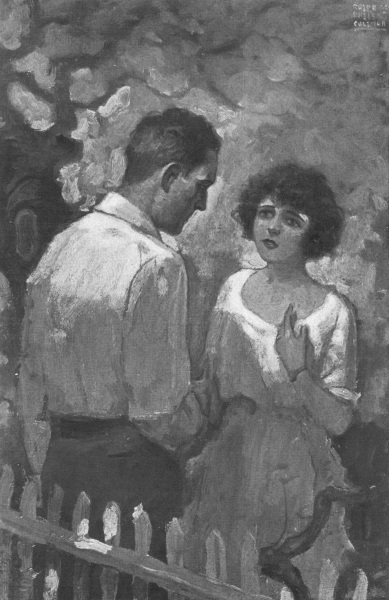
chance and so, oh, Sard, while we were dancing I told
Watts Shipman I loved him, and told him in a silly
way, a Cinny, Gertrude way, and that's the awful
thing; for you see, Sard, I do love him. Oh, I do,
I do," cried poor little Minga. "But I told him in
that way, and he doesn't respect me."
Sard, rocked by a surprise that bordered very nearly
on hysterical laughter, crept up closer to the little
sufferer.
"My hat!" she said in awed tones. Her hair swept
over her leaning face; she pushed it back. "My hat!"
Minga fell on her friend, burying her face in this
long veil of hair. "I did—I did—I couldn't seem to
help it—I was wild, you see, and I needed a friend,
a sort of fatherly person, don't you know." Minga
lifted her face and looked at her chum helplessly.
"He is the only person that ever scolded me and
made me mind, and so, you see, I loved him." There
was a long silence, then, "I think he's wonderful. I
thought maybe he could make me—make me—better."
Sard, with a rush of understanding, threw her arms
around the forlorn figure.
"Poor little thing," she crooned.
"No," said Minga with a kind of shudder, "not
that any more, Sard. I guess I'm different now; I
guess I've got to be a nut or high-brow or something.
I've got to grow bigger, you see," with a piteous gesture.
"I thought he might grow to care if he knew
I did, and I told him. It was out by that fountain,
you know, and the—the water seemed like tears."
Minga's eyes widened over her own poetic thought.
"My goodness," she ejaculated, "I'll always think of
that now when I see that fountain." Then she went
on, "But when I told him," the young voice broke a
little piteously, "he just took my two hands as if he
was going to sort of hold me from myself and himself.
Oh, a terrible way and then he said ... he
just said, 'You are a very dear little thing, you are
a very dear little thing'—and it was finished," said
Minga with her childish gulp. "I couldn't screech or
howl and make him come back. I—I didn't even try.
He just walked away from me. It was like a play,
only awful; he walked right straight toward the
mountain—I saw him in the moonlight and now,"
said Minga, "I—I have this awful ache."
There was a long silence, Sard trying to understand
this change in her friend. She began suddenly to see
as if unrolled on a flaming scroll another great law of
lives like Minga's, that whoever tries to control them
will lose them, but whoever knows how to control
them and does not try has them bound fast and submissive.
In the new days of the rapid rising of
women this fact contains a new challenge for men.
There is no reason why women should not rise but
there also is no reason why men, once superior, now
rapidly being rated as inferior, at least by women,
should not look into this challenge. If woman grows
more fine, why should not a man also rise and create
a new fineness that shall still dominate her and make
her happy in that mastery for which she will forever
ask.
The moonlight shone through the long luxurious
rooms, the silver patterns threw their strange symbols
on the floor until almost morning, and the dawn became
a steadiness of gray and rose.
When at last they parted, Sard looked thoughtfully
at her friend. "The trial's on to-day," she said
slowly, "and the Bunch are all mad, so they won't
go; and I don't think you ought to go, Minga."
"Just the same, I shall," whispered Minga doggedly.
"I'm going with Dunce." Then a thought
struck her. "Oh, Sard, did Dunce tell you what
Judgie is going to do to Colter?"
The other girl started. "Do to Colter!" Sard
paused at the door, her face scared inquiry through
the dawn-light.
"Well," Minga was sleepily yawning, "I think
Dunce said that Judgie had heard some of all this
mess and so he had told Colter to get out. He seems
to think it doesn't do to have a gentleman—well, you
know what I mean, for a hired man, anyway." Minga,
seeing her friend's face, was a little nervous. "That's
what Dunce said; you'd better ask him. Imagine!"
said little heavy-eyed Minga. "Imagine!"
Something slow, defined, inevitable crept around
Sard's heart, with a shiver; the girl tried to face it,
tried with her ardent and alert soul to know it for
what it was. It was hate, and it was hate of her father.
She trembled slightly, for as she looked into
her heart and saw that dark shape of Hate lying at
its door, she heard a soft whisper again in her ear;
little curls tickled her ears, soft whispering came to
her and her head was laid on a soft pulsating little
breast.
"We aren't afraid of Foddy, little Sard; we love
him; he won't put us in prison."
Softly closing the door, softly stumbling up the
steps to the tower-room, the girl tried to put these
things against that dark shape lying across the threshold
of her heart. "Oh, but he has put me in prison,"
she sobbed, "he has put me in prison—I—I—could
never make him understand." Sard threw herself
face downward on her bed. The birds were all singing,
the sun came with bright morning over the happy
sparkle of the river. A girl lay tearless before the
dark shape of hate and the memory of love and before
a slow dawning of a new feeling she could not
name, the old cry came:
"Oh, Mother!" whispered Sard. "Oh, Mother!
Mother!"