UNDER THE BIG TOP
By Courtney Ryley Cooper
The Cross-Cut
The White Desert
Under the Big Top
The Last Frontier
Lions ’N’ Tigers ’N’ Everything
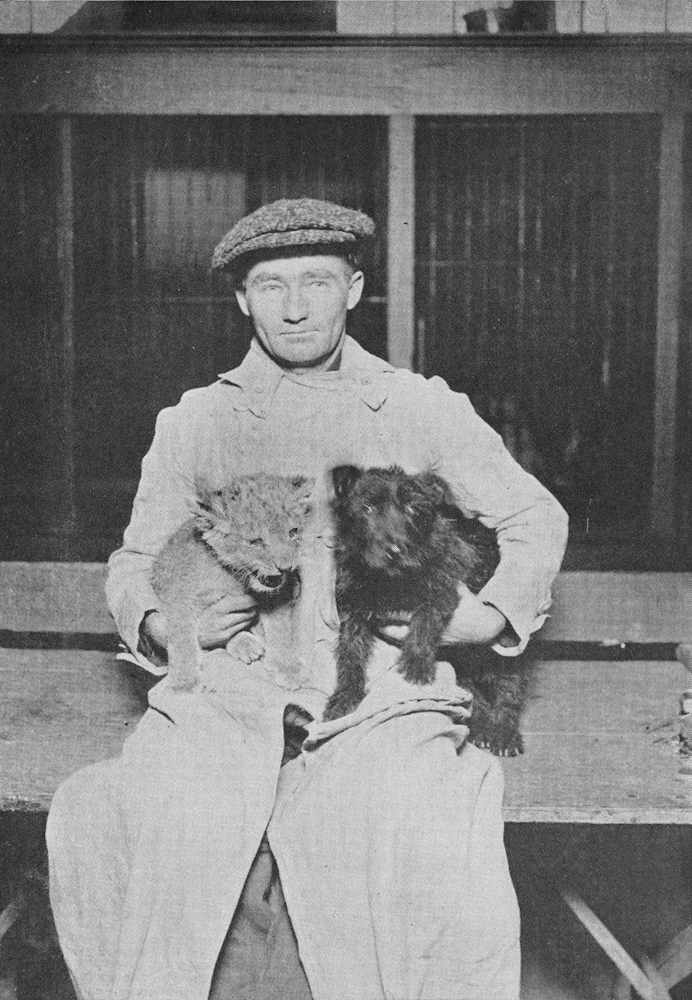
SCOTTY, AND GRIT, THE LION SHE ADOPTED. FRONTISPIECE.
See Page 144.
Whole book · 18 sections
By Courtney Ryley Cooper
The Cross-Cut
The White Desert
Under the Big Top
The Last Frontier
Lions ’N’ Tigers ’N’ Everything
SCOTTY, AND GRIT, THE LION SHE ADOPTED. FRONTISPIECE.
See Page 144.
UNDER THE BIG TOP
By
COURTNEY RYLEY COOPER
With Illustrations
BOSTON
LITTLE, BROWN, AND COMPANY
1924
Copyright, 1920, 1921, 1922, 1923,
By Courtney Ryley Cooper.
All rights reserved
Printed in the United States of America
TO
Harry Tammen
“With Love and Good Cheer”
| CHAPTER | PAGE | |
| I | The Why of the Circus | 1 |
| II | “Those Press Agents!” | 21 |
| III | But We All Like It | 48 |
| IV | On Entering the Menagerie | 75 |
| V | Our Friends, the Elephants | 93 |
| VI | When the Animals Escape | 115 |
| VII | Mothers of the Menagerie | 136 |
| VIII | In the Steel Arena | 161 |
| IX | “The Circus Man’s Best Friend” | 180 |
| X | The Children of the Big Tops | 193 |
| XI | “The Show Must Go On!” | 212 |
| Scotty, and Grit, the lion she adopted | Frontispiece |
| PAGE | |
| The circus unloads in a conspicuous place | 10 |
| “Here comes the parade!” | 10 |
| “To such Indians as Short Bull, Buffalo Bill was little less than a god” | 46 |
| “And upon this platform—!” a side-show crowd | 60 |
| An orang-outang husband and wife | 92 |
| Casey, who died of appendicitis | 92 |
| Kas and Mo practising their act | 102 |
| Moon and Snyder in the performing arena | 102 |
| “Cap” Richards, who fights animals for a living | 118 |
| One of those placid United States Government Hyneys | 118 |
| “I’ve got him eating out of my hand!” | 172 |
| The boys are counted upon as a part of the equipment | 182 |
| Enough seats must be put into place to accommodate a whole village | 182 |
| Children of the Big Tops. One is the daughter of a lion trainer, the other the cub of a trained lion | 194 |
| The clowns are always ready to amuse a circus baby | 198 |
| Stuck! | 222 |
| A runaway circus wagon | 222 |
UNDER THE BIG TOP
Snow is flying. It is early March, and cold. Hardly what one would call “circus” weather, yet there under the train sheds it stands at the end of a south-bound passenger train, a thing of resplendency, of silver and gold lettering, of backgrounds in which the main color is a beaming red, while along the length of it is emblazoned the caption:
From ahead the “highball signal.” A few quick handshakes, a last recounting of orders from the general agent who talks to his car manager until the last possible moment. A rear platform, crowded with strong-shouldered young men, milling and jostling. A cheer. The train is moving. Soon only the owner and his general agent remain on the station platform, watching the red and gold car as it travels far into the damp, cold haziness of the railroad yards, finally to disappear. The circus season has begun!
Rather, the first physical demonstration of a beginning has taken place. In reality, for the show owner, the season begins when the season ends. Paradoxical? Not a bit. To circus goers the circus season concludes in the autumn. To circus makers the next season begins at the same time. A big show doesn’t “just go on the road.” Circuses, to their makers, are an exact science. When the show comes home in the autumn, they begin their preparations to send it forth again in the spring. They know what wagons to repair, what painting is necessary, how many railroad cars must be discarded and replaced by new ones; whether the “big top” or main tent will stand another season and where the show is to travel in the summer days to come. It doesn’t “just happen” that a circus goes to a certain town. The reason why has been studied out long in advance, and the show arrives for one of two reasons; either there is a surety of sufficient money to make a profitable day’s business, or it is necessary to play the town in order to reach one farther on where the crowds are sure and the money certain.
Circuses don’t “take all the money out of a town”; neither do they always play at a certain place “just because it’s a good show town.” Often it isn’t, and the big organization loses money, leaving more cash in the village than it took away. But a show train can travel only about one hundred and fifty miles a day, at the most, and if there isn’t sure money within three hundred miles, it must take the best it can get and be satisfied. I have seen “canvas op’rys” exhibit in places where the traveling population of the show was greater than that of the village itself! And it is all carefully figured out in advance, with every possible circumstance taken into consideration; crops, money conditions, hard or good times, floods, forest fires,—everything which can affect a pocketbook. If Jonesville and Thomasville lie within twenty miles of each other, and Jonesville has had a disastrous flood in its surrounding country while Thomasville has escaped, the circus is routed to Thomasville. How does the circus know? It must know, for knowing is part of its life.
There is no other business organization which pays more attention to the various local conditions of the United States. The informants are the owners of the billboard privileges in each town along the proposed route, playing a good business policy by telling the truth about their community; often a circus general agent has the news of a crop failure even before the Department of Agriculture! So every town is picked, every town is known. If a State capital has only a small population, when does a circus play it? When the legislature is in session and the town is crowded! Does a circus play a college town in July? Hardly, but it will be glad to pay a visit in April, May or late September. The students are there at those times; in July they have gone home. The circus knows! More, the circus prepares; long before the snows begin to melt, even the size of the show has been decided upon, according to the money conditions of the country.
So the departure of the “bill car” or advertising car is a carefully thought out, preconceived thing. It is to arrive at a certain town in the far South on a certain day, stay there so many hours and depart at a certain time. All season it must live up to a schedule,—that of being three weeks ahead of the show. If it loses a day through storm or accident, then its men must do double work, a “brigade” of billposters being dropped at one town to look after the billposting, banner tacking, country routes and “programming,” while the car, short-handed, hurries on to the next town and overtakes its schedule, leaving the “brigade” to catch up as best it can.
For the circus accepts no outside assistance; it depends upon nothing but itself and its own finely attuned organization. Theatrical companies leave their billposting to local concerns. It has the time to do so. A circus must move day by day; consequently it has its own railroad cars, its own equipment, its own men for everything. The “bill car” carries its own boiler for making paste; its lockers are filled with “paper” or billing sufficient to last two months at a time. Above these are berths where sleep the twenty or twenty-five men who make up the car, the billposters, “tack spitters” or banner men, the lithographers, the “squarers” or men who obtain permission for the posting of paper or the tacking of banners, and the manager. It costs the world’s biggest show two thousand dollars a day for its “advance” alone, for the mere publicity and promotion which heralds the coming of the circus!
More than a hundred men travel ahead of the show, merely to bring it to a town. There is the general contracting agent, who makes all the primary arrangements, who arranges contracts for the circus grounds, for the billboards, for the exhibition and parade licenses, for the banners which overnight appear on the front of trolley cars, or flutter from the span wires, for the ten tons of hay, the five tons of straw, the three hundred bushels of oats, the twelve hundred bushels of bran, the one hundred and fifty bales of shavings which are used by the show to sprinkle in entrances and rings and hippodrome track—sawdust, in spite of tradition, is not used about a circus—for the cord of wood necessary to keep up steam in the calliope, the ton of coal which will be consumed in the big traveling ranges upon which is cooked the food for the thousand or so persons of the show, and the nine hundred loaves of fresh bread for humans and two hundred loaves of stale for the polar bears. To say nothing of a broken-down horse or two to be killed for the lions, tigers and cat animals, and the buying of ton after ton of beef from the divisional supply houses of the big packing companies for the human complement of the show.
This completed, the agent hurries on, each day a constant round of contracts. A single item may bring its difficulties: suppose, in the year that has passed since his last visit, the usual show grounds has been cut up into building lots! He must find another, fully five hundred feet square, fairly level, rentable at a reasonable price, not too far from the center of town and easily reached by main trunk car lines. It isn’t easy. But he does it.
Then arrives the “Number 1” car, with its billposters, banner men and “country routers.” Some of the billboards are contracted for and are easily covered with the brilliantly lettered advertising posters. In which, you’ve perhaps noticed, is a predominance of red. The reason is simply that red is an elemental color. It is the children’s favorite. The circus appeals to the elemental, to the child in us all. Hence—red!
Each man on the “bill car” has his job. It is the duty of the “banner squarer” to argue the owner of any building with a blank wall which can be seen from a downtown street, into allowing that wall to be covered by cloth announcements proclaiming the coming of the circus—without payment in actual money. The banner squarer who buys space for anything except passes to the circus, and general admission passes at that, is looked down upon by his fellow workers as a coward and disloyal. Isn’t a circus pass the most valuable thing there is?
Once that permission is gained, the “tack spitters” or banner men begin their work. No matter how difficult the wall may be, they will cover it. If it is too high to be reached by ladders, they will swing a scaffold from the top and there, in hot sun or chilling rain, fill their mouths with broad-headed tacks and work their magnetized hammers at a speed of fully forty blows to the minute. And a “tack spitter” actually spits tacks—or rather, blows them—by rolling them one by one to his lips with his tongue, flat side toward the waiting hammer, then propelling them by air pressure to the magnet. An expert can hit the magnetized end of his hammer at two or three inches; others prefer to merely force the tack through their lips on the end of their tongue until it reaches the magnet. Thus, with one hand holding the canvas in position, the other swinging the hammer, and with nothing to hold them to their scaffolding save their sense of balance, these men work sometimes as high as two hundred feet above the ground and brave the death of broken ropes, a misstep or being literally blown from their dangerous position,—to advertise a circus they never see!
Remember, the billposter and the banner man must always be from a week to three weeks ahead of the show, depending upon which of the three advertising cars he accompanies. The result is that all he actually knows of his own circus is what he sees in the posters he daily distributes.
Incidentally a circus isn’t content with merely billing the city in which it is to show. Its territory of potential patrons extends for a distance of forty miles on every side of the show place, and these forty miles must be covered by each bill car in a single day. Hence men depart by rail, buggy and automobile for the “country routes,” and if they don’t get back in time,—sorry, but the car must move, and they catch up as best they can.
There are three such cars with the big shows, one three weeks ahead, one two weeks and the last one only a week. The job of the last two named is to do everything that hasn’t been accounted for before, to renew billing that has been torn by wind or washed by rain,—and to fight!
For circuses quarrel. It is a battle to a business death once one circus crosses the trail of another. Every big show carries in advance what is known as an “opposition brigade” with no other duties save to fight the like brigades of other shows. As fast as one circus puts up a piece of billing, the “opposition” attempts to cover it. The result is flying paste brushes and buckets, faster flying fists, broken noses, black eyes, police, jail, bail,—and the same thing over again until one side tires and quits, or circus day arrives to end the war of the opposition crews. This part of the “advance” knows no schedule, nothing, in fact, except to fight until a battle is won or lost. Sometimes a billboard will bear as many as ten or twelve layers of posters, each alternate layer representing a different show; the last and winning layer slapped into place a bare twelve hours before the arrival of the contending circuses!
Then there are the press agents who flit here and there, doubling on their tracks, dropping in at a newspaper in one town during the morning, appearing at another newspaper office fifty miles away in the afternoon, and still a third or perhaps a fourth farther on that night, according to the flexibility of train schedules. To say nothing of the “checkers up” who inspect the work of the various cars and the “opposition brigade” and send each night a report of good or bad work to the general agent. And after all these are gone—
There comes the twenty-four-hour man.
They originally called him that because he came to town twenty-four hours before the circus arrived. A better reason might be because he works nearly twenty-four hours of the day. His is the task of seeing that every contract is ready to be fulfilled, that the fire department will have a man stationed at the fire plug nearest the circus lot to provide water for the sprinkling carts, horses, elephants and lemonade, that the circus grounds itself is in shape to receive the big show, any high weeds cut away, holes filled, hummocks leveled off; that the sidewalk crossings are well provided with boardings to protect them from the heavy wheels of the circus wagons, all bridges safe on the parade route, and on that which leads from the unloading point to the circus lot, the licenses granted, food ready; and after checking up on some twenty or thirty additional items he can sleep until four o’clock in the morning, when he must awaken to await the arrival of the show trains, arouse the various crews, and guide the cook-house wagon with its chefs, waiters and flunkeys, to the circus lot that preparations may be begun at once for breakfast. Yet there are those who believe that a circus “merely comes and goes!”
Did you ever notice for instance that the show trains are always “spotted” at the same place? Did you ever seek the reason? There is one—rest assured of that—a circus never does anything without its consideration of cause and effect!
A big show must record receipts of from $6,000 to $14,000 a day in order to live, such are a single day’s expenses according to the size. Often it exhibits in towns which have barely more than twelve thousand or fifteen thousand population and to gain a livelihood, not a single opportunity must be missed, not a solitary chance to get one more person into the big tent passed by. Therefore, from the minute that circus arrives in town, it must do its utmost to flaunt itself before every available person and breed the desire to visit the grounds where roar the lions and the tigers, where the bands play and the bespangled actors flash about the arena. It has one message and one alone, that of the instillation of the holiday spirit, the creating of an atmosphere by which a person says involuntarily and then repeats:
“Circus day—circus day—circus day!”
So it chooses a spot to unload where it can be seen by men going to work, by the early rising newsboy, and found easily by those hundreds of enthusiasts who set their alarm clocks for the gray of dawn “to see the show come in.” It sends its wagons to the circus grounds along routes selected for the same purpose—a circus wagon never goes up a side street when it can traverse one where a greater number of persons can see it. Always must that message be sent broadcast:
“Circus day—circus day!”
And did you ever notice that there is no conveyance which makes exactly the same sort of noise as a circus wagon? There’s a different truckling about the wheels, a different, hollower resonance as the axle flanges touch the steel of the hub rims. It’s meant to be that way; a circus wagon wouldn’t be such if it were like any other vehicle. It must shout its announcement from curb to curb, so that even the preoccupied citizen looks up and says to himself, “Circus day!”
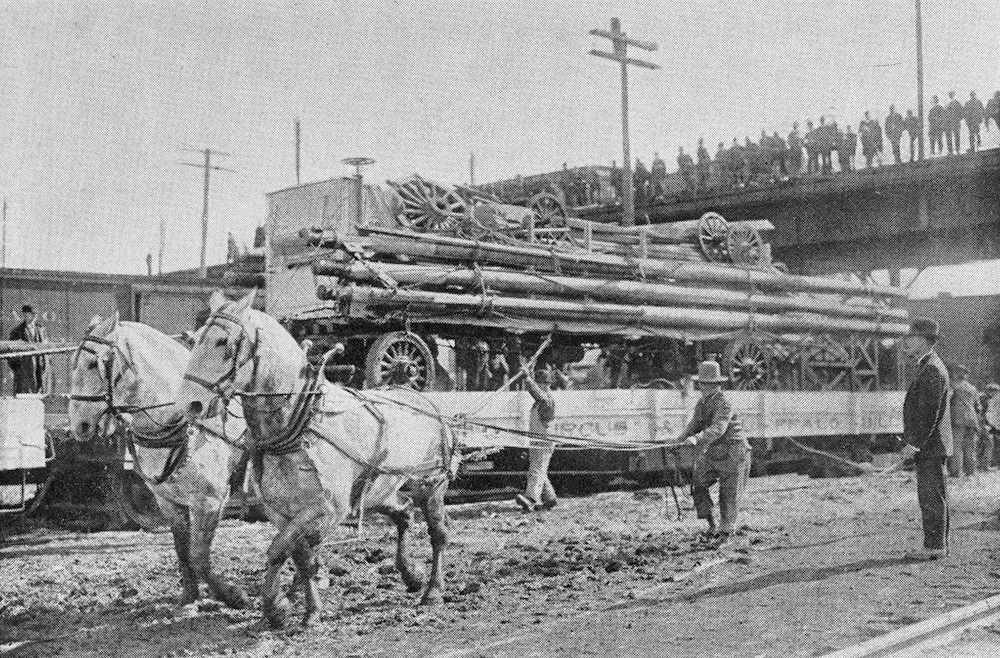
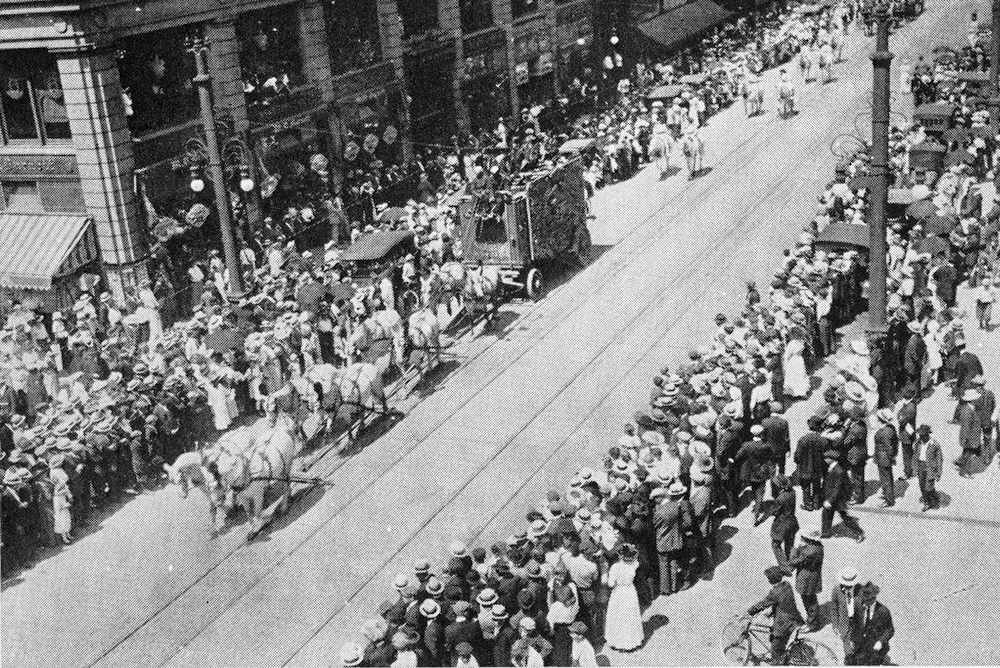
And it does seem that there are more and better horses with the circuses nowadays than there once were, though of course there were always plenty of them. Is it because the wagons are heavier or—?
Not at all. Simply because horses are going out of fashion; draught horses are seen rarely on the streets any more. Every one loves the sight of a pretty horse. A good-looking equine exhibition on the street to-day is almost as much of a curiosity as an automobile once was. So the circus has plenty!
Why—every one asks the question—are those little red flags stuck about a circus ground before ever a tent goes up? Do they mean anything? Or are they there just so that the drivers will know where to bring their wagons? Their meaning is simply this,—that without them, there might not be a circus. Those little red flags, fluttering at the end of thin iron stakes stuck into the ground, are the map of the big show. They have been placed there by a hurrying lot superintendent, and to the workmen, the canvas men, the roughnecks—
Beg pardon? Not “roughnecks” in the general acceptance of the term. The circus is a land of slang. Its people and workmen and departments are designated by argot terms which mean a separate division of the circus. “Roughnecks” are common workmen. Plank men and seat men are those who erect the seats to accommodate the thousands who gather at the afternoon and night performances. “Canvas men” load and unload the tents and aid in their erection. The “big top gang” works nowhere except on the “big top” or main tent.
“Razorbacks” load and unload the cars. “Kinkers” are performers; “flunkeys” those who wait upon the people of the circus in the “cook house” or eating tent. “Punks” indicate a boy, an animal, anything not yet arrived at the age of maturity. Those who work in the side show belong to the “kid-show” crew. The entrance, where you give your ticket to the bawling attendants, is the “marquee.” The attendants of the menagerie are “animal men.” The lions and tigers and leopards are “cats.” Anything in the pony, goat, llama or bovine class, which can be taken to the circus grounds at the end of a rope or halter is “led stock.” And the elephants are “bulls.” But to return to those little red flags:
They form a book of information. They tell the drivers, the workmen and others just where the big top will be, where the connections must be made to lead to the menagerie at one end and the stables and dressing tents at the other. They show the position of the “midway” and the side show,—in fact, every one of the fourteen or so tents which go to make up the mushroom growth of canvas which constitutes the circus. Once they make their appearance, the rest is comparatively easy. The long center poles are placed and raised into position. The canvas travels upward. The tableau wagons and animal dens are wheeled into line. A bugle sounds—
“Hold-d-d-d-d yoah ho’sses. The elly—phants are coming-g-g-g-g!”
There are few horses to hold these days as the gleaming, resplendent parade turns into the main street, with its crowded curbings, its balloon vendors, its shouting fakirs and excited children. But a circus lives to a certain degree in the past. That bellowing warning has been a part of circusdom for years. It is expected, and therefore it is given. A parade wouldn’t really be a parade without it.
Nor without the balloon vendors. Did you ever stop to consider that they might be present along the crowded streets to breed atmosphere as much as anything else? Bright colors—cheery colors. Remarks about the circus and the fact that this is the glad holiday of them all:
“Buy baby a bal-loon! Buy baby a nice red bal-loon. Baby won’t be happy when she goes to the circus without a bal-loon. Remember, when baby goes to the circus—buy baby a bal-loon.”
The old power of suggestion! When baby goes to the circus! Baby may have been scheduled to return home just as soon as she saw the parade. But now it’s a different matter. Baby’s never seen a circus; it might as well be now!
And the parade is passing! Every one in it seems happy. And bright. And cheerful. And smiling. Seems impossible that some one out of that long procession should not possess a grouch. But they’re all smiling because—
It’s part of their work to smile, in parade and performance. Isn’t a circus the typification of happiness? Isn’t it the bespangled fairyland which drops out of the night, glories in the sunlight, then fades with the gathering darkness? Smile—smile—smile! That is the order, and it is carried out.
Three lions’ cages have passed, with the sideboards down and the pacing animals displayed. Then a cage which is closed. Certainly if they could leave three cages open, they could leave a fourth. Wonder what’s in that cage; it must be valuable, something out of the ordinary or they would show it.
There you stand and wonder, wonder at a game that is as old as that of Adam and Eve and the Serpent, old as the world itself,—that of Curiosity. What’s in that wagon? What’s in that wagon?
Nor do you stop to consider that this may be the purpose of the whole parade, this play upon curiosity and upon the child-like credulity that is in all of us. The billboards, with their big, red letters, have announced a mile-long street parade, which will present a sample of everything that is in the big, wonderful circus.
One little word has stuck in your mind. A sample! From childhood days that has meant something very, very small with which you raced to the store, that you might return with a yard-length match for it. The thing you got was so much bigger than the sample. If it requires a mile to display a sample of the circus’s charms, what must the real thing be? You reason without considering. Then—what were in those closed wagons? Besides, if the lion trainer can sit in the cage with three lions during parade, merely as a sample, what must he do in the performance!
Here comes a wagon with ten clowns atop it. The billboards said there would be fifty clowns—count ’em—fifty, in the performance. That must be true. There are ten here, just as a sample!
How that one thought sticks! Then the band plays. The horses prance, as though they were dancing for sheer joy. Of course they aren’t trained to dance in parade. Why should they be?
Why? Just so that they will achieve the object which that whole parade pursues, the embodiment of joy, of light-heartedness, the appeal which touches the hearts of us all when there is even a mention of a cessation of work and worries, of a real, true holiday. So the horses dance, and the clowns grimace, and the big-footed policeman in the tiny police patrol picks up an urchin for a half-block’s ride, and the calliope player turns to the hundred or so children trotting in his wake with the question:
“Well, kids, what’ll it be next?”
Oh, there’s joy about a circus parade, joy beyond the gleam of the gold and silver, the blaring of the bands, the glittering of the spangles upon the dresses of the equestriennes,—the joy of a thing well done, of an experiment in psychology worked out to the nth degree. There goes another closed wagon. Perhaps it’s got the rhinoceros in it! Or—may be—didn’t some one mention the fact that the circus had a new sort of animal that no one in town ever had seen before?
Oh, well. Ho hum! Half the day gone. Nobody at the office will be fit for work, anyway. Guess you’ll go to the circus!
“Now-w-w-w-w, ladies and gentlemen-n-n-n, there are yet fortay-y-y-five minutes before the big show begins. Fortay-y-y-y-five minutes. A long time to wait, ladies-s-s-s and gentlemen. So we have arranged for your benefit a special exhibition in the Grand Annex and Museum of Wonders to delight the eye, please the brain and sharpen the intellect. If you will just step a bit closer-r-r-r-r—r!”
“I have brought out before you, ladies-s-s-s and gentlemen, a few of the strange and curious-s-s-s peo-ple who go to make up this Museum of Wonders. Starting at the right—”
Why have you stepped closer? You really hadn’t intended to move at all. But you did, didn’t you? Because some one jostled slightly; wasn’t that it? The human is an obliging person. Some one jostled and edged closer. The operation had started with only four or five men, far out there at the edge of the crowd. Naturally you haven’t seen them,—a hundred other persons have jostled forward since then. Could they have been men in the employ of the side show, paid to move forward at the signal, and by one little movement cause a whole crowd of hundreds and hundreds of persons to obey that command from the “ballyhoo” man?
Incidentally, he’s talking again, describing all the “strange and curious-s-s-s peo-ple,” urging that you become better acquainted with them inside. And repeating:
“Fortay-y-y-y-five minutes to wait. Don’t spend your time on the hot, dusty, circus lot. Fortay-y-y-y-y-y-five minutes to wait. Plenty of time before the big show. Fortay-y-y-y-y-y-five minutes.”
So you go in. Humans hate to wait. Circuses learned that almost as soon as the humans. For aren’t circuses human themselves? After that—
“The B-e-e-g show! This a-way to the b-e-e-g show! Performance starts in five min-utes! Buy yoah tickets for the be-e-g show!”
It’s crowded about the ticket wagon. Up at the window the ticket seller is scooping in money with both hands, apparently throwing it on the floor. You’ve heard that about ticket wagons before,—about how they throw silver and gold and paper bills indiscriminately about them until they stand literally knee-deep in money.
But inside the ticket wagon all is orderly. The silver passes into one drawer just below the marble plate of the ticket window. The gold goes into another. The currency travels into deep wicker baskets, one for dollar bills, one for fives, one for tens, and one for any denominations above that. A circus isn’t so unbusiness-like, after all! Then you go onward.
Through those gates at last! What a crowd! What a jam; why can’t they make them bigger?
They could. But then that wouldn’t cause a crowd. A crowd, you know, means popularity. Like breeds like. There might be fully a hundred dollars, even more, wandering about out there on the circus grounds that would be lost if the front gates didn’t indicate a rush on the part of all humanity to get inside. Strange how they think of those things!
What was that the ticket taker said to the fat woman who was trying to smuggle her ten-year-old boy through by carrying him in her arms? Wasn’t it:
“Hey, Lady! Put down that there young man an’ let him carry you! Twenty-five cents more for the young man, Lady.”
And what was it the manager had remarked to himself as the protesting fat woman had paid the extra money:
“Put the most honest woman in the world on a street car or at a circus gate with a kid, and she’ll lie her head off to get him through for half-fare!”
The menagerie. You’ve often wondered about menageries, why circuses go to the expense of carrying them. Yet—
Perhaps you’ve never realized that were it not for the circus menagerie, a great part of the youthful population of the United States would be devoid of an education in natural history. That most of the towns which a circus visits are without a zoo, and that the only chance which the population has to view jungle or strange beasts is when the show comes to town?
Also that the circus, utilizing everything, even as a packing house makes some use of every by-product, keeps its cost of operation down through that very fact? That there are many municipalities which would charge exorbitant licenses were it not for the fact that the circus has certain educational features in its menagerie that are necessary to the education of its youth?
More, the animal actors of the show are the cheapest actors a circus can carry. They draw no salaries and require no expensive food, and they serve a triple purpose: they take part in the parade, they form the menagerie and they work in the big show—all without salary. And now:
Now-w-w-w-w, the b-e-e-g show!
Just like a great big family, isn’t it, going through its stunts? But it isn’t.
It’s a community, with community lines, class, divisions and society!
Every grade of performer belongs to a certain Strata. The contortionist is not on the same plane with the aerialist, nor is the aerialist as high in social life as the equestrienne. Speaking of equestriennes, why are they able to stay on those horses so easily? And why are ring horses invariably white, gray, or dappled?
That’s why: so the equestriennes can stand on their backs! But that’s no answer. Pardon, but it is. Powdered resin, if you ever have seen it, is white. Powdered resin prevents one from slipping. But it can’t be noticed when it is sprinkled on the back of a white or gray horse!
All but over! Into the hippodrome track go the rumbling chariots, each with its horses four abreast. They’re off! The whites are in the lead—if they’ll only hold it! But the blacks have gained! They’ve passed the whites! Now they’re neck and neck again! A cheer! The whites are ahead again! Neck and neck once more. Now the blacks are in the lead! Now the whites! And they cross the tape nose and nose!
But it was a good race. If they could only have gone around the track once more—
They would have finished nose and nose again! For a circus is in the game of pleasing every one, those who want the blacks to win and those who favor the whites! So, at every turn, at the end of the track, the inside chariot veers to the outside rail, while the outside chariot cuts across to the inside track. The difference in distance brings them neck and neck,—and so they might race forever!
And that, really, is the secret and the why of the circus; the pleasing of every one. After all, it’s a simple task, for the circus has learned one great thing,—that somewhere in our hearts is something that never grows up, that old though we may be in years, the child lives within us just the same, and whether we be seven or seventy, that “something” answers the call of happiness, invariably!
Once upon a time, there was an elephant which objected to going into a cage. Because of that fact, a million dollars or so was made, and he ceased to be “just an elephant.” He formed a forerunner of national advertising, and a synonym for everything that is big. He lives to-day, nearly thirty years after his death, in Jumbo peanuts, Jumbo soap, Jumbo shoes, Jumbo bananas, Jumbo this, that and the other thing. All because a press agent “slipped it over.”
To you who are not familiar with the inside workings of a newspaper, let it be known that there is but one person in the entire newspaper world who is to be feared. Public officials must either walk the straight and narrow path, or be shown up for their misdeeds. The rich and powerful “influence” may exert his czarism over a newspaper office for a certain length of time, but sooner or later, the newspaper exposes him, and sets him right—or wrong—in the eyes of the people. For everything there is a remedy, except for the press agent, the man who is employed by amusement enterprises, hotels, railroads, and other forms of trade which live through the constant interest of the public, to arouse that interest by more closely personal means than the ordinary methods of the advertising columns. The press agent has but one duty, one desire, one god,—to outwit the newspaper. What’s more, he does it.
Incidentally, a press agent isn’t what his fiction description would have him. He neither wears a checked suit and red vest, nor talks in a loud voice. Too often he is a college bred man, with a brain which measures up to his salary. He is the high-finance artist of newspaperdom, and his methods are as diversified as the colors of the rainbow. All too often he does not appear; when he is unseen and unnoticed, then he is doing his hardest work. He is the general in command of the forces of an endless contest, and his army of ideas changes with the moods of the public. The last time you ate a Jumbo peanut, you paid homage to a press agent who played his trick more than a quarter of a century ago!
All of which does not mean that the press agent is a menace. Often he is a power for good. But a newspaper likes to believe that it is printing facts, not the output of an imagination. It likes to believe that its news is legitimate and that it is not some carefully concocted affair designed to make persons hurry to a certain playhouse or a certain circus. Therefore when an actress is robbed of her jewels, the city editor cynically throws the story, which has come through the regular channels of a report to the police, into the wastebasket. When a wildly dishevelled young lady hurries to headquarters to tell of her suffering in the secret harem of some modern Bluebeard, a reporter is assigned rather hastily to discover whether a motion picture of that sort is to be exhibited soon. When a society burglar begins to operate in town, leaving peculiar notes behind him, there is the question as to whether it is the forerunner of a publicity plan for a Raffles drama. Behind all this sort of thing, all too often, is to be found some keen-witted young man who never even goes near a newspaper, whose name often is not known, who chuckles at his success, and whom the city editor cusses long and enthusiastically when the game works. It is a joyful battle which never ends, which is carried on in good nature—for the simple reason that there’s no other way to combat it—and in which the honors are even. Sometimes it is the newspaper which wins, with the result that months of work are lost. Sometimes it is the press agent who is victorious,—with the result that history is made. In the light of which you may remember the name of “Death Valley Scotty,” who was supposed to own a mysterious mine in the heat-ridden regions of Death Valley. Scotty wanted to get rid of some of his surplus wealth. He made a record-breaking trip across the country on a special train, threw money from the rear platform, turned Broadway upside down, making his name—and the name of the railroad which carried him across country—known to every person in the United States. But Scotty couldn’t do it again.
All for the reason that hundreds of visages would become sour. Hundreds of directing minds of newspapers would remember the trip which Scotty made once before and the delight of the publicity department of a certain railroad. Hundreds of lips would grunt: “Press-agent stuff!” and throw the dispatch in the wastebasket.
But to return to the elephant which didn’t care to get into a cage, for it was then that the press agent really started. Before that time he had been a person who would glide into a newspaper office, leave his “press stuff”, buy the editor a drink and give him a few complimentary tickets to the circus or the play, whichever it happened to be. Sometimes too, just for the publicity it would cause, he would engage in a duel with an opposing press agent, or perpetrate some minor exploit which would get the name of his show into the paper. But all thought of national and even international publicity was beyond him. Then an elephant lay down and refused to budge; and the whole world sat up as a result of it!
His name was Jumbo, which, at that time, meant nothing. A tremendous pachyderm of the African species, he had been exhibited for years at the London Zoölogical Gardens. Naturally, being an elephant, Jumbo was a favorite with the children, who gathered about him on every exhibition day, to feed him peanuts and to watch his lumbering, ungainly antics. That was the end of their interest. Then along came P. T. Barnum.
No circus in America, at that time, ever had possessed a menagerie that could be featured. In fact, until this time—it was at the beginning of the 80’s—the freak had been the main advertising attraction. Three-legged calves, double-headed ladies, the “Horse with his Tail where his Head Should Be”, and other exhibits of this nature had been looked upon as the very last word in circus exhibits. Even the “Cardiff Giant”—which was the invention of George Hull, who lived at Binghamton, New York, and who carved the “prehistoric man” from a solid block of stone, dotted him with pores, buried him for two years, and then “discovered” him while making an excavation—had become common enough for various enterprising side-show attraction purveyors to advertise “Cardiff Giants, guaranteed against cracking, peeling or blistering”, at a very reasonable price. The circus business, in fact, needed a rejuvenation, and Barnum sent emissaries to Europe with instructions to buy menagerie features, such as “twenty camels, thirty ostriches, and other big stuff.” Naturally, one of the agents saw Jumbo and cabled Barnum regarding him. The reply was an order to buy.
In Jumbo there was nothing unusual—to the circus man—except that he was to be advertised as the biggest elephant in the world. To carry this thought, his name on the advertising bills had been changed to “Mastodon”, and the posters already printed. The directors of the Zoölogical Society had set the price and agreed to the sale. The brief announcement had been made in the London newspapers that Jumbo, a favorite with the children at the Zoölogical Gardens, had been sold to P. T. Barnum, the widely known American circus man. There was nothing more to the transaction. Jumbo was going to America, and while a great many children felt sorry, that was the end of it. Then the unexpected happened!
Jumbo had been accustomed to a life of ease and tranquillity. His quarters had been—to an elephantine mind, at least—spacious and exceedingly comfortable. Therefore, when strange men attempted to prod him into the big, barred cage in which he was to be confined on the journey to America, Jumbo did exactly what any petted, pampered elephant would do under the circumstances. He refused to enter. More, when they sought to force him, he flopped to the floor and with pachydermic grunts announced that if he was going into that cage, he’d have to be carried. Which was no small job, considering the fact that Jumbo measured his weight by the ton. Then came the inspiration.
That afternoon, school children found themselves listening to a tearful tale by a mournful appearing gentleman, who told them in sympathetic fashion how Jumbo, the pet elephant, had refused to leave the little children whom he loved so well. Wasn’t it cruel that a circus man should take away a loving, kind-hearted pet like Jumbo? Poor old Jumbo, who loved the children so that he could not bring himself to leave them! Nice old Jumbo, who even now was trumpeting and bellowing and resisting all efforts to place him in the cage that would remove him forever from his little playmates! It was just about this time that the children began to realize how much they loved Jumbo,—that Jumbo, in fact, had been a great, wonderful thing in their lives. A few of them cried for pity. It was the beginning of the end.
Would the dear little children care to circulate petitions asking for the retention of their dear old playmate? Of course, it was none of the affable stranger’s business; he really didn’t care, one way or the other, what happened to Jumbo. But he really did hate to see a money-grabbing circus man break up such a wonderful friendship as had existed between dear old Jumbo and all the childhood of London. Naturally, the fact that the London Zoölogical Society had been glad to part with the beast for the simple reason that its African blood made it intractable, often surly, and sometimes dangerous, was not mentioned. Nor the very apparent truth that Jumbo’s refusal to enter that cage easily could be traced to a streak of ugly temper. The very soft-hearted men who went about London, interesting children, teachers—and of course, parents—in the sad fate of Jumbo, and the blank lives of London’s childhood once the pachyderm had been kidnapped from their midst by a cold-hearted, calloused circus man who didn’t and couldn’t understand the tenderness of an elephant’s heart, said nothing to indicate that they were connected in any manner with the brutal circus man whom they berated. Child after child took the petitions and began to circulate them. Boys and girls who never had seen even a picture of Jumbo wept over the elephant’s fate,—and circulated more petitions. Teachers began to talk about the horrible affair and wonder where they were to take their wards on holidays when Jumbo, dear old Jumbo, was torn from them forever. Parents, excited by the red eyes and woeful mien of their offspring, began writing letters to the papers, and every day the circus men tried and tried and tried to get dear old Jumbo into the cage. But Jumbo wouldn’t go; he loved the little children with such fervor that he simply refused to leave the old home fireside. Strangely enough, the circus men used very crude and uncouth methods. They pushed Jumbo and struck him and mistreated him and cursed him. Hard-hearted circus men!
By this time, the newspapers had placed Jumbo in the position of honor upon the first page. They had been forced to it. Jumbo had become news, real news. The Humane Society had begun to fight the cruel circus men, impelled by influences which had back of them those same hard-hearted beasts who were trying to tear Jumbo from his happy home. Suits were started, in the effort to gain injunctions against the removal of the pachyderm. Guiding spirits appeared, who suggested that there should be parades of children in protestation against the removal of the beast. They were held. The whole city of London now was in a ferment over Jumbo. More, what interested London at that time, interested the whole world, with the result that the cables soon were carrying their burden of the troubles of “the biggest elephant on earth.”
Back in America printing orders hastily were rescinded and remodeled. The name of “Mastodon” now meant nothing. The word “Jumbo” had become a household affair; day after day the cables carried the news of London’s uproar. Day after day passed without the circus men succeeding in getting Jumbo into his cage.
The directors of the Zoölogical Garden were attacked and threatened with removal from office. The sadness of Jumbo’s departure even found its way into Parliament, where a speech was made, full of tears and pleading, in the hope that something might be done to prevent the removal of the most beloved thing of childhood, the dear old elephant Jumbo. Even Queen Victoria was appealed to, in the hope that she might be able to devise some way to save the mammoth elephant. More, the Queen even took the time to give her views on the subject, to sympathize both with the children and with the elephant,—but Jumbo was sold. Into slavery he must go.
But this was not the end. Jumbo had a wife—Alice. Soon the cables were buzzing with sympathetic stories regarding her. Every sob sister that London possessed was at work on the Jumbo story now; every organization which was interested in the slightest manner in dumb animals was protesting, petitioning, even threatening. Nor could the repeated assertion of the Zoölogical directors to the effect that they had sold Jumbo because he was intractable, unmanageable and possibly dangerous make the slightest patter in the sea of disapproval. Day after day,—then the circus men took inventory of their accomplishments.
To date, figured at space rates, the Jumbo excitement had brought them exactly a half million dollars in advertising. The peak had been reached. The decision was made to transport Jumbo. And strangest of the strange! Once that decision came, Jumbo entered his cage! The circus men simply changed his food from its accustomed place to the shipping den, and in went Jumbo. But even then London didn’t awaken.
They followed him to the docks, thousands of children, and as many women and men. Banners were carried protesting, even to the minute of the ship’s sailing. The cables that day buzzed the news that Jumbo had been taken away just in time to evade the mob spirit and to escape a concerted attack of thousands which would have resulted in bloodshed—and the retention of Jumbo in London, thus leading to international complications and a possibility of diplomatic correspondence—over an elephant! When Jumbo landed in America, the police reserves were needed to keep clear the docks. Such is the value of publicity.
Is it any wonder therefore, that even to-day Jumbo is a trade name in a hundred diversified branches? Jumbo did a good many things for national advertising. More, he gave one of the first great lessons in a good name properly exploited. Yet Jumbo was the result of a press-agent inspiration! More, the strangest part of it all is the fact that years later, Jumbo lived up to the high-mindedness and spirit of good-heartedness with which he had been credited. He died a hero!
It was at a grade crossing, and the circus was “loading out.” Jumbo, slightly in the lead of a baby elephant, had crossed a railroad track, then turned just in time to see that the life of the calf was endangered by the swift approach of a switch engine. The great beast turned; with head lowered, he butted the baby out of the way of the engine and into a zone of safety, only to be struck himself and killed,—while saving a life! But this really wonderful thing brought but little publicity. Jumbo was dead; the press agents were busy on more live and more useful things.
Thus goes the story of the press agent; look behind some of the best remembered things of America, and you will find him pulling the strings. For instance, even to-day it is a common expression to say that a person has a white elephant on his hands. It came from a press agent. More, the really queer thing about it was the fact that the man who had the white elephant really and truly on his hands possessed a genuine white pachyderm, while the one who caused the trouble had only—
Perhaps the whole story can be repeated. It is known only to showmen, and it is the story of a fight between a genuine white elephant and one which—well, which wasn’t. Again Barnum was one of the participants, while on the other end of the contest was Adam Forepaugh, a rival circus owner. Both were to exhibit in Philadelphia at the same time, and for that exhibition, Barnum had saved his greatest trump. He had actually procured the thing which, at that time, was the dream of every circus owner,—a sacred white elephant from India. Almost simultaneously there came a dispatch from Algiers saying that the Barnum elephant was a leprous imitation, and that the real white elephant of sacred descent was being shipped, not to Barnum, but to Adam Forepaugh. It was the beginning of a white elephant war.
Again did elephants become news. The city was plastered with posters, while billposters engaged in fist fights and the police patrols were kept busy. The curiosity of the public had become aroused. The papers did the only possible thing,—printed the news. The rival exhibitions came, with the result that both shows did an overwhelming business. The Barnum circus displayed an elephant with a cream-colored blaze down its trunk and light spotted legs, as real a white elephant as ever a white elephant could be. But at the other show was “The Light of Asia,” a great beast covered by a large velvet-spangled cloth, with a head, trunk and legs of purest white. Moreover, the audience was invited to step up and touch it! Which the audience did.
In the performance, “The Light of Asia” was brought in, stripped of its velvet trappings and placed on a large stage, where a “professor” lectured upon its life, history and habits, meanwhile dodging dexterously that the affectionate beast might not rub against him. The head and trunk and legs of the beast had been carefully enameled, but that was as far as the risk could be taken. More enameling might have clogged the pores of the skin and killed the beast; hence the rest of the body had been kalsomined only. But to the public, this was the real white elephant, while the other, possessed by Barnum, was only a poor imitation. The result was that when interest in white elephants waned, Adam Forepaugh washed the paint from his pachyderm and again became the owner of an ordinary elephant. Barnum wasn’t as lucky. Nature had given his beast its coloring, with the result that he had “a white elephant on his hands,” about which the public cared nothing, because it was considered only a poor imitation!
Nor is this the only time when the real has been forgotten and the bogus become the real. Nor the only instance when an elephant has figured in “press stuff.” For in a certain portion of the Middle West, the name of Rajah is a household affair, while in the newspaper offices of that section of the country the same name recalls some pleasure and a good measure of chagrin. Rajah formed the basis of many a column of free publicity, which explains much, especially why the press agent exists, why the newspaper editor cocks his head and narrows his eyes at the slightest hint of “press stuff”, and why the actress who loses her jewels doesn’t get her name in the paper. It is what might be called “insidious promotion.”
When a newspaper prints an advertisement stating certain things, and displayed in advertising type and in an advertising manner, the person who reads it knows it to be an advertisement and takes the statement as that of an interested person who desires to sell his wares. Naturally, he understands that this person wants to sell what he offers and that he is telling its good points to the exclusion of all else. It is an equitable affair in which the seller talks to the buyer through the medium of print.
But when a press-agent story is printed, the basis is different. Now, it is not the seller who is striving to arouse interest; it is the newspaper itself which is speaking as a third party. The seller himself has ceased to exist. An outside person is doing the talking, and in a confidential manner which causes more interest than all the advertising in the world. More, that newspaper is responsible, and the person who reaps the benefit isn’t. Hence the press agent, whose job is to get into the newspapers what the newspapers do not desire to print. All of which rounds out the prelude to Rajah.
There wasn’t anything marvelous about him. He was only an elephant which belonged to the Lemon Brothers Circus, which, at that time, maintained its winter quarters in Argentine, Kansas, about seven miles from Kansas City, Missouri, and its several large newspapers. One day the press agent of the circus looked long and seriously at Rajah. However, once his idea had come into being, he didn’t seek the newspapers. In fact, he kept as far away as possible. Instead, he went to the menagerie superintendent and with him held a long and confidential conversation. That night, a riot call rang in from Argentine. Rajah had escaped!
What really had happened was the mere fact that the menagerie superintendent had loosened Rajah’s chain and kicked him out the door of the menagerie house, leaving him to wander at will. Which Rajah did. The unexpected always causes excitement, with the result that when Rajah poked an inquisitive trunk into the front door of a grocery store that was keeping late hours, it formed the beginning of a young panic.
The word spread. Persons sought the tops of their porches, barricaded their doors and telephoned for the police. Those who happened to be on the sidewalk at the time the big pachyderm wobbled up the middle of the street, took to trees and telephone poles. The police arrived, looked at Rajah, held a consultation, decided that an elephant was too large to be arrested, and put in a hurry call for the fire department. The fire department arrived, looked for a fire, couldn’t find any, and turned the hose on Rajah. Which Rajah didn’t relish. So he leaned against a barn or two, smashed them, walked through a few fences, and the panic was on again with renewed excitement.
Rajah had become a “story” now. He had interested the multitude and stampeded his way into print. A riot call is news. The next day, Rajah and the fact that he belonged to the Lemon Brothers Circus was on the front page of every paper—with pictures of the scene of the rampage. Which meant just this to the press agent: without cost, the press agent, simply by kicking poor old Rajah out of the menagerie house, had obtained the usually unattainable.
Back in his stall, Rajah existed in peace until another inspiration came. It was during flood times, when the Kaw and Missouri rivers were far out of their banks and overflowing the “bottoms” regions of Kansas City, Armourdale, Argentine and other suburbs. Naturally, the newspapers were printing every line that hard-working reporters could obtain. And on the first page was Rajah!
He had become news again. A train had been stalled in the danger zone; the locomotive was dead, and there was no switch engine available. It was then that Rajah had come to the rescue, to act as a switch engine and save human lives. After that, Rajah became an influential elephant.
Every few weeks his trainer would be dangerously injured and taken to his home. Just why he wasn’t taken to a hospital wasn’t explained. Then, at intervals of a month or so, Rajah would break loose again, until at last Argentine became somewhat accustomed to see a lost elephant loping up the street, and the news value departed. But there still remained hope, even in a shopworn performance.
Early one morning—just when Argentine was doing its best sleeping—mysterious telephone calls began to shoot about the little town. Rajah was loose again, and this time he was dangerous! He had mangled an assistant keeper, broken down the door of the menagerie house and was out for blood!
Things seem worse at two o’clock in the morning than they do at two o’clock in the afternoon. Again the riot calls went in, and when the police arrived, it was to find a number of circus men patrolling the streets, all armed with rifles.
“We’ve got our orders to kill him!” they announced grimly, and went on searching for Rajah.
But Rajah was lost. Parties of police, determined circus men, all looked for Rajah in vain. The menagerie house was empty; the doors were broken. Rajah was gone, and Argentine perspired with excitement. Every barn was suspected, every vacant lot. Houses were locked and barred, lest Rajah, coming suddenly out of hiding, should move in that direction.
Two days went by, in which Argentine forgot everything else and looked for Rajah, in which the newspapers of Kansas City sent special representatives to write the story of a lost elephant and a terror-ridden town, and in which hurrying circus owners went about from one detachment of searchers to another, sorrowfully but grimly repeating the order:
“This is the end. If you see that elephant, shoot, and shoot to kill! We’d rather see him dead than endangering lives and property this way. Kill him!”
But there was no Rajah to kill!
Another day slid by and into gloaming. Then the word went forth. Rajah had been found! He had waded out through the Kaw River to a small island, and there he had established his little empire. Again was shouted the order:
“Shoot and shoot to kill!”
Round after round banged forth from the rifles. But two things prohibited Rajah being killed. One was the fact that it was dark now, and that Rajah couldn’t be seen. Another was a matter which wasn’t mentioned at the time: the cartridges which were being fired contained no bullets!
It was all very exciting and melodramatic: the shouts of the hunters, the blaze of the rifles as they spat forth their yellow flare into the night, the sorrow of the circus owners over the loss of their prized elephant, the fear of the townspeople; it was news of a different and thrilling sort, and the melodrama lasted until the morning papers had passed their press time. Then the firing ceased, in the hope that Rajah was dead. Dawn revealed the fact that he wasn’t, and with the knowledge, the last card was played.
“Men,” it was the menagerie superintendent speaking, “I hate to give up like this. Rajah’s always liked me, and I’ve—I’ve always thought a lot of him. I think just enough of him to—to risk my life to bring him back again.”
“I won’t permit it!” A terribly frightened circus owner had interrupted. “I’m not going to have you killed just to—”
“I’ll sign an agreement, if you want me to, that you won’t be responsible if I’m killed.” The menagerie superintendent was bent glumly on suicide. “But, whether you want me to or not, I’m going after Rajah! And I’m going alone!”
Whereupon, midst the gasps of the multitude, in the gray and cheerless dawn, he rowed out into the Kaw, straight toward the terrible beast which awaited him there on the island. Two or three thousand hearts halted in their beating. Two or three thousand pairs of lungs labored in their breathing while the trainer cut down the distance with slow, steady strokes of the oars, passed out of earshot of those who waited, hoping that he wouldn’t be killed, yet reflecting upon the fact that they’d never seen a man murdered by an elephant. On he went, fearless, intrepid. The boat grated on the sand of the island, the trainer leaped forth, grasped his bull-hook a bit tighter, and headed straight toward the elephant.
“Hello, Rajah,” he announced.
Rajah, not being gifted with conversational powers, couldn’t answer. So he did the next best thing, the kneeling salaam which he had learned in the ring. The trainer sunk the bull-hook gently behind one ear.
“Come on home, Old Kid,” was his command. “Guess we’ve pulled enough excitement to last ’em awhile.”
Far across the river, on the bank, it all looked very stagey and thrilling. It appeared even worse when the trainer, with shouts and dramatics, forced the poor old elephant to wade the river. Then the crowd scattered as Rajah ran up the bank, back to that dear old menagerie house and the hay he knew would be awaiting him.
A few weeks later, some one told the true story of Rajah’s horrible escape, and grumbling newspaper men put the elephant’s name on the office blacklist.
“No more fakes about that elephant!” Such was the word that went forth.
It was night a few months later. The telegraph editor of the Kansas City Star looked up from his desk, toward the night editor. Scorn was implanted heavily upon his features.
“They’re still faking Rajah,” he announced. “Here’s a query from Texas.”
“What’s it say?”
“Plenty.” Then the telegraph editor read: “Frank Fisher, trainer of Rajah, killed while trying to subdue the beast while on rampage. How much?”
Then both of them grinned. The query was crumpled into a ball. A swerving arc, it traveled under the lights, half across the room, into the wastebasket.
While down in Texas a bit of canvas covered the torn, broken form of what once had been a man. Far in a corner of the menagerie tent sulked a huge beast, Rajah, gone bad at last,—Rajah, the elephant who had simulated viciousness until at last he had become vicious; Rajah, who finally had become the basic force of a real news story.
That never was printed! But it wasn’t the newspaper’s fault. The two editors merely were trying to guard the public from what seemed to be another Rajah hoax. The guard had been raised at the wrong time; that was all.
And indeed it is a good guard which can stand against the every assault of him who desires to “make” the columns of a newspaper with something that will advertise his wares. Out in Denver one summer night a few years ago, a black-garbed woman sauntered slowly down Seventeenth Street. Suddenly she staggered and fell. When the police ambulance arrived, she was, to all appearances, unconscious. An hour later, in the county hospital, she awoke, to stare about her in non-understanding manner, to look dazedly at the attendants, then to ask:
“Who am I?”
It was a plain case of amnesia. The doctors applied every test known to produce the symptoms of true amnesia—non-response to tickling the soles of the feet; no evidence of pain by being pricked with a needle at certain points of the anatomy. Test after test—every evidence of amnesia, or forgetfulness of self—was present. Question after question was asked, finally to bring a slight flicker of memory:
“Yes, that was it. I was going somewhere. Where was I going?” The face became blank. “Where—where was I going?”
Hours passed. There came no answer to supply the destination of the woman. It was on her mind, that question, even in greater strength than curiosity as to her own identity. Where was she going?
It was a strange case. The woman was well, even richly dressed. She had every appearance of having come from a good home and being of aristocratic stock. In the parlance of the newspaper office it was a “good talk yarn.” The newspapers, doing their level best to aid some one in distress, printed pictures of the woman, with descriptions of height, weight, color of eyes and hair, and did everything possible to obtain some clue to her identity. Persons by the hundreds hurried to the hospital to see her, in an effort to furnish some clue that might lead to her identity. It was impossible. For three days it continued, and then—
“I know where I was going!”
The woman had raised herself in bed, weirdly, excitedly, just at the moment when all the newspaper reporters were there. Hurriedly they clustered about the bed.
“Yes—where were you going? Do you remember?”
“Perfectly.” Still the excited voice went on. “I was going to the downtown box office to buy a ticket to the show that starts to-morrow at Elitch’s Gardens. I was—”
Most of the reporters began taking notes. But out of the number was a man who himself had been a press agent.
“Junk!” he snorted and started in search of the press agent of the summer resort. He found him. That night, after much sweating, the agent confessed. Later he became the city editor of the biggest newspaper in Denver, but it was after he had “reformed.” For the newspaper had its revenge. It didn’t even mention the fact that the woman had regained consciousness. The public, seeing nothing, naturally supposed that she still was in a state of amnesia. Another day went by, with still no mention, and a part of the public forgot. By the fourth day, there were even no inquiries over the telephone. The public’s mind had turned to the latest murder, a press agent was swearing under his breath—just as city editors were swearing at him—a fair amount of expense money was gone to naught, and the mystery of “The Woman in Black” remained a mystery.
But more often the rewards lie on the other side. More, when you think of the ingenuity, the scheming, the knowledge of psychological values and the mass mind-reading which has been his, you’re just a bit glad that the press agent has won and “slipped over his story.” To wit, one Jimmy Fitzpatrick, and an adroit little move which accomplished many things.
Jimmy was in Detroit, and he wasn’t especially fortunate. The Detroit newspapers seemed to care nothing for the fact that he was appearing in the interests of the Young Buffalo Wild West Show. There were other shows of the same type that were vastly better, which charged no more and which gave a much superior performance. So, coolly and candidly, the Detroit editors announced to Jimmy the fact that, so far as they were concerned, there was too much real news awaiting publication. Young Buffalo must struggle along without their aid.
Jimmy bowed his way tearfully out of the offices. He went to his hotel. He thought, long and hard. He figured the population of Detroit, then divided it by five in an effort to gain some hazy idea as to the number of small boys the town contained. The result evidently was satisfactory. Jimmy returned to the newspaper offices.
But this time he went no farther than the want-ad counter. There he wrote an advertisement, paid for it and departed. It read simply:
WANTED—Five dogs for Indian Feast. Must be fat, clean and healthy. Will pay five dollars apiece for right dogs. Apply Thursday morning at 9 o’clock.
James Fitzpatrick, Agent,
Young Buffalo Wild West Show,
Blank Hotel.
Into every newspaper went the advertisement. The next morning Jimmy purposely slept late, only to be awakened. There were dogs in the lobby of the hotel, dogs in the elevators, dogs in the halls, dogs in the office, in the lounges—everywhere. There were dogs in the street, in the alleys and on the car tracks. When the number reached five hundred, the police were called. When the aggregate went to two thousand, out came the reserves. Every mongrel pup in Detroit, it seemed, had been collared by some one who needed five dollars, and hurried to Jimmy’s hotel. The street became blocked with small boys, dog catchers, hobos with prospective five-dollar bills whining at the end of a string, women, girls, fox-terriers, Skye terriers, Newfoundlands, collies and just plain dogs. Every few feet a fight was in progress, with boys yelling, dogs snapping and snarling, and policemen vaguely attempting to stop the unstoppable. Two thousand kinds of barking echoed through the business district. Downtown Detroit simply stopped work and watched a conglomerate dog fight. No longer was Jimmy Fitzpatrick an outcast of the news columns. He had become the creator of the funniest story of months. That night he glowed with happiness and pride; the account of his two thousand dogs, the police and a canine-blocked street was on the first page of every paper. More—
He hadn’t even been forced to part with the twenty-five dollars. For the Humane Society, aroused by the thought of a dog feast, had threatened to put him under arrest if he even attempted it. Certainly James Fitzpatrick did not care for arrest. He only wanted the name of his show in the paper, the glowing title of Young Buffalo where he desired to see it.
Incidentally, the name of “Buffalo” brings memories,—and perhaps a confession. I once was a press agent myself.
Colonel William Frederick Cody (Buffalo Bill) was the man in whom my sun of work and endeavor rose and set. More, Buffalo Bill, big, bluff, good-hearted, roaring Buffalo Bill, realized that had it not been for the first press stories which appeared in the guise of fiction and through which Buffalo Bill rode, shot, scalped Indians, saved fair maidens in distress and did everything else that a godlike hero should have done, his life might have been in vain as regarded public recognition.
Not, understand, that Buffalo Bill was not every inch the man that Young America believed him to be. For he was, and as the years go by his place in the history of western civilization, will grow constantly bigger, constantly more important. Far out upon the Sioux reservations I have seen Indian squaws who have come a hundred miles overland, carrying their papooses, that these Indian babies might look upon the great Pahaska, the man who had fought their fathers and grandfathers, and who was brave enough to be honored, even by the children of an enemy! To such Indians as Short Bull, to Woman Dress, who saved the life of General Sheridan, to No Neck and Horn Cloud and others who really knew an Indian fighter when they saw one, Buffalo Bill was little less than a god. But of what use is all the traditional glory in the world from a monetary standpoint, if the public doesn’t know it, and the public isn’t constantly reminded of the fact? Buffalo Bill was a showman, and I was his press agent, for a time, at least.
Which perhaps may explain several things. A certain mayor of Chicago, for instance, may remember a telegram from Colonel William Frederick Cody (Buffalo Bill) congratulating him upon being the executive of the second largest city in the United States and asking permission to salute him, with his assembled cowboys, vaqueros and rough riders of the world, from the saddle on the steps of the city hall. If the mayor does remember it, and if the mayor has prized that as a tribute, I’m sorry, but I’m in the confessional now. A bald, long-nosed press agent was behind it. There was a reason.
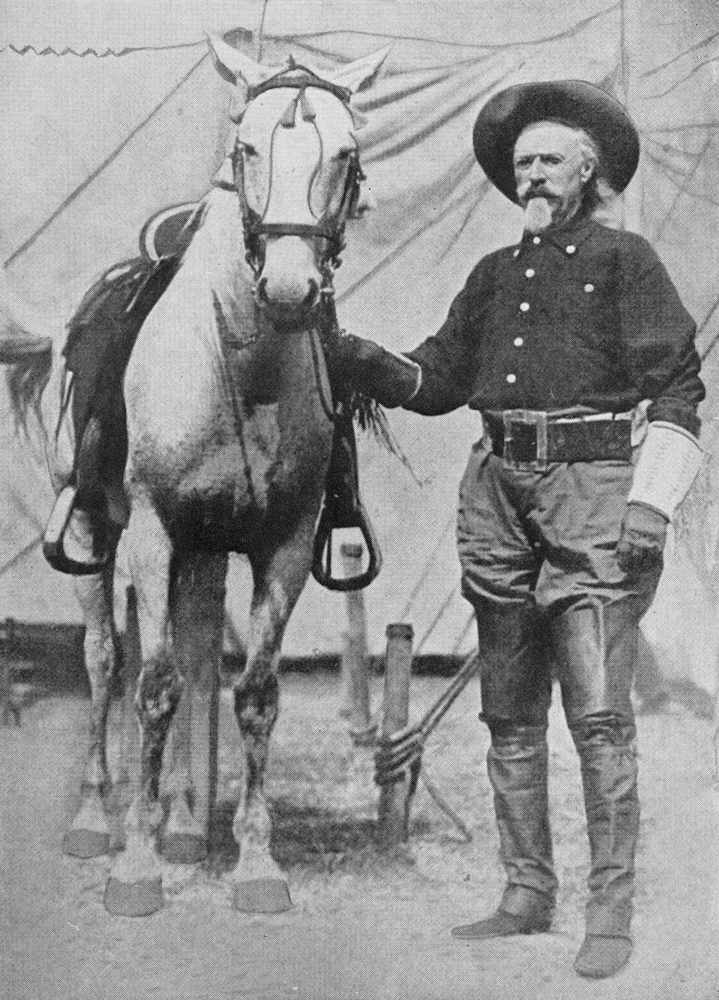
Buffalo Bill was to exhibit at White City. There is an ordinance in Chicago which prohibits circus parades in the loop section. But could I but have arranged that salute from the saddle on the steps of the city hall, it would have ceased to have been a circus parade, but a compliment to the mayor of a great city. Through the loop district the entire cavalcade would have gone, while the Chicago’s downtown section would have seen the first circus parade in years without police interference,—in fact, one actually sanctioned by the city! But the mayor was out of town, darn it!
Or perhaps the King of England may remember the fact that he received a cablegram in the early days of the war with Germany. I know it was an enthusiastic thing, because I wrote it myself. It offered the services of Buffalo Bill and his Congress of Rough Riders of the World to go through the German lines like rain water through a gutter. If I’m not mistaken, His Majesty replied. I guess my apologies are due the King. Buffalo Bill didn’t O. K. that cablegram until after it was sent. But let this be known: the “Old Man”, as he was known to the ones who worked for him, fought for him, quarreled with him and loved him, was just enough of a fighter, just enough of a youth in spite of his white hairs and three-score-and-more years, to have gone!
And now for just a little confidential chat between ourselves, regarding some of the things which make us happy.
Nearly everything else in the world has changed. In the last fifty years we’ve had a topsy-turvy affair of progress and education, sophistication, and advancement. Everything has gone forward; this old globe has become a swift-moving, wiseacre thing, in which only one relic remains of a previous time:
We still like to be bunked!
Not only like it, but love it, and demand it. Not only bunked in new ways and new methods, but in the old, familiar ways as well; in fact, by the identical tricks which were in vogue in the days when Barnum hurt the feelings of our sophisticated grandparents by announcing frankly that one of their real wants was the want to be humbugged!
In fact, so far as amusement is concerned, there is practically no change in human nature as regards its desire to be flimflammed. Customs may change; moral laws grow more flexible or rigid, as the case may be; wars come and go while diplomats change the whole face of the earth; and psycho-analysts declare that the human race has gone through a crucible, to emerge a newer, different thing. But just the same, deep down in the hearts of all of us, there is one thing which remains the same, calling incessantly:
“Bunk me again; I like it!”
Understand, however, when the term “bunk” is used, bunk is meant, and not bunco. The shorter word may be a derivative of the other, but in its new form it means something vastly different from the older and more vicious expression. Bunco is reminiscent of gold bricks, green goods, sewing-machine promissory-note contracts, the selling of the Woolworth Building, the three-shell game, short change and three-card monte. Bunk is something entirely different, a more innocent manner of getting the money and at the same time pleasing the person who has done the paying. Bunco cannot be worked without arousing one certain thing in the victim,—cupidity. He believes he is going to get something for nothing, by cheating the other fellow. He ends up by being cheated himself and by racing to the police station to tell what thieves the other men were. Bunk requires also one ingredient, that of curiosity, and ends in an entirely different manner; the bunker is pleased, the bunkee is pleased, perhaps knowing all the time that his enjoyment was gained by his susceptibility to the attractions of a palpable fake. But perhaps an illustration would serve better.
In the “personal columns” of lax newspapers, one often sees such advertisements as the following:
Will some gallant gentleman take pity on the loneliness of a young, pretty widow of 35, possessed of a fair fortune bequeathed by her former husband? Will make wonderful wife to right man. Widow, Box 188.
Now, if you’re “the right man,” you won’t answer. In the first place, you know that no pretty widow possessed of a fortune need advertise for a husband. But if you have a strain of cupidity uppermost in your nature, you’ll see only one line in that advertisement: “possessed of a fair fortune, bequeathed by her former husband.” You can see yourself with that fortune; and you know very well that if you’re lucky enough to get that widow, it won’t be long before that fortune is in your hands. So you answer the advertisement, telling some ten or twenty lies about yourself to make an impression. Then you receive a reply!
However, it doesn’t come from the widow. It is signed by her agent, who regrets to state that there have been so many answers to the advertisement that it is impossible for the young woman to answer each one personally. However, your letter has shown such sterling qualities, that he would like to have further correspondence with you, with a view to settling the matter for the widow and arranging the marriage. You answer that letter. He answers yours. More correspondence ensues. It finally comes to a point where, if you can satisfy the agent that you are not a fortune hunter, but a good, honest young man looking for a loving wife, he is absolutely sure that the wedding is the same as settled. All that is necessary is for you to put a thousand dollars in his hands, as a guarantee of your good faith, and everything’s arranged.
The fortune is in your grasp! You get that thousand dollars some way. You are so busy thinking about the fact that you are going to cheat that widow of her fortune that you forget entirely that other cheats may be at work. You deposit the thousand dollars—and wait. And wait and wait and wait. Then you report to the police that you’ve been robbed. That’s bunco.
Bunk is something entirely different, a far more innocent game in which no one is really injured, and in which the components are curiosity, amiability, a self-hypnotism which makes the victim believe he’s happier for the bunking, and which often, through its sheer foolishness, results in amusement for every one concerned. Just as an example:
Two rival ice companies operate in a fair-sized town on one of the Great Lakes. One of them deals in artificial ice, the other in natural. And one of them—it wouldn’t be fair to state which—made the discovery that its ice was harder and lasted longer than the product of the rival firm.
The man at the head of the company was well-versed in bunk. He didn’t do the usual thing—that of advertising the hardness and long-lasting qualities of his ice in the newspapers. Instead he hired a few judicious persons to start a series of vile rumors against his own company! The product of the other ice manufacturer was far superior; it would last twice as long! Not until these rumors were well circulated did the shrewd ice manufacturer do his advertising. Then he answered the charges in a page advertisement and challenged his rival to an “ice contest.”
No one in town ever had heard of an ice contest. Neither had the promoter, for that matter, until the idea occurred to him. The plan was for each company to place a chunk of ice of the same weight in the public square, and let the sun do its worst. The ice that lasted the longest naturally would be the best.
The other company fell into the snare. The plans were made, and the town gathered to see the ice contest! Now, of all amusements that might be imagined, a race between two cakes of ice for the longevity championship belt hardly could be called the most exciting. Yet it is a matter of record that on the day of that ice race, half the town thronged the square to watch two pieces of water crystal melt slowly away, and bets were made, running as high as fifty dollars a side! More interest was created in ice during that one day than in all the previous history of the town! Naturally, the promoter’s cake came under the wire an easy winner, and the proceeds of his business jumped a hundred per cent. overnight! He might have used the usual methods forever without more than a gradual increase. But he understood the fine art of bunk, profited thereby and every one was happy,—except the rival concern.
As a matter of fact, the practise of bunk has become one of the allied arts in American promotion. Time was when only such men as P. T. Barnum practised it. To-day, however, it is a widespread affair that takes in nearly every business, every enterprise in the country. Nine out of ten fire-and-closing-out sales are bunk,—simply another manner of turning old stock which could not be sold at an ordinary sale, but which travels over the counters quickly when the buying public believes that necessity forces the owners to place it on sale. The motion-picture companies are bunk artists extraordinary, with their personal appearances, their “blurbs” in the various trade magazines, their super this and super-super that, and their inevitable romance of everything. Did you ever stop to think that nearly every one who amounts to anything in pictures is simply saturated with romance? There’s not a marriage that isn’t romantic, not a family that isn’t the happiest on earth; superlatives of a land of enchantment are everywhere in the world of the motion picture. All for one purpose: to create romantic thoughts in the minds of readers, and a desire, now that they have read romance, to see it. Whereupon they go to the pictures.
Politicians use it; you know they’re not going to keep their campaign promises when you vote. But you smile in forgiving fashion and tell yourself that it’s just part of the game. It is; part of the bunk of being a politician! The preacher who tells his congregation that the church must be abreast of the times and puts a jazz band in his church on Sunday is practising the game of bunk. The hotels which call pork and beans by a French name and double their prices for same are merely “slipping over the bunk.” Only pork and beans, it is true, but the name seems to add something to the taste, and you pay the extra price gladly. The society woman who “consents” to go into the movies,—bunk again. More, it is simply a revival of that old, old trick practised years ago on the stage until it became worn out in that field, dressed up and refurnished for a new line of endeavor. What’s more, it works! For that matter, even the railroads are not immune.
You’ve perhaps ridden from New York to Chicago on an “extra fare” train. You’ve paid eight perfectly good dollars for the privilege and lolled in your seat in the supreme satisfaction of knowing that if the train is more than fifty-five minutes late, the railroad will be forced to give you back a dollar an hour for every hour of delay. Therein lies the secret of the success of the extra fare train,—that refund. If the ordinary passenger didn’t know he was going to force the railroad into giving back part of his money, should the train be late, the popularity of paying eight dollars more for a ride between New York and Chicago might pall. Railroads are looked upon as octopi—or puses, whichever you choose. The public has paid them much money, and the public is tickled when it can make them pay some of it back. So the public rushes for the extra fare train, feeling that even should the thing be late, there’ll be a lot of satisfaction in that refund. Nor does the public stop for a moment to consider that it’s a rare, rare thing that a fast train is more than thirty minutes late, and that the railroad company can count on every cent of its extra fare money ninety-nine times out of a hundred! More, that even should the train be a full eight hours late—or even twenty hours late—what would the payee have gained over the slow train? Nothing at all, except the disappointment of believing he was going to reach a certain town eight hours ahead of another train, and failing to do it! Of course, the railroads merely classify it all as shrewd business. But a showman would call it bunk.
It even invades restaurants, this practise of the bunk. Not long ago I sat in a big New York night café which caters largely to the out-of-town trade. I had with me as a guest a man from Kansas City. The waiter approached and took the order. Then, with a furtive glance about the big room, he placed the menu card to his lips, and from its protection asked, sotto voce:
“What’ll it be to drink?”
I’d been there before,—and ordered coffee. But the eyes of the man from Kansas City glowed with the light of adventure.
“What can we get?” he asked.
“Leave it to me,” came the guarded answer from behind the menu card. The Kansas City man “left it.” Ten minutes later, the waiter returned with something in a cocktail glass,—something that looked like a Bronx, but which was merely a mixture of a dash of pepper and a conglomeration of non-alcoholic “make-believes.” The Kansas City man drank it greedily and motioned the waiter nearer.
“Do it again,” he ordered. But the glum-faced servant shook his head.
“Sorry,” he announced in the saddest of sad tones, “but we can serve only one to a patron. Supply’s pretty short, you know.”
Whereupon the Kansas City man went home, proclaiming loudly that he had been served a cocktail right out in the open at the so-and-so restaurant and that the place had protection that a battleship couldn’t break through. If the waiter had served him three or four of the things, enough to produce a well-formulated “kick,” and if the “kick” had not appeared, there might have been a different story. But the waiter didn’t; he served one ten-cent drink, told not a single lie, gave the man a thrill and charged him a dollar. With the result that every one was happy. So goeth the bunk!
Naturally, however, since the practise of bunkery originated in the outdoor show business, it is there that it thrives to its greatest extent, and there it has achieved some of its biggest victories. Once the disease has seized its victims, there is nothing that can compete against it. Art, science, business,—everything must fall before it. Just as an example, let’s go back into history for one comparison, then face the present for another. In the days of P. T. Barnum, this showman became the possessor of one Charles Stratton, a midget whose height was only thirty-one inches, and whose name he changed to “General” Tom Thumb. Then he took him to London for an exhibition in Egyptian Hall. About the same time, Robert Benjamin Haydon, one of England’s greatest painters, placed the last brush-touch upon his masterpiece, “The Banishment of Aristides,” and decided to exhibit it in another part of Egyptian Hall. It became a contest between art and bunk, between a masterpiece and a person who had no other claim to public interest than that he was not quite half as large as the ordinary human being. The title of “General” was a fake; the name of Tom Thumb was a fake. Whatever was told of his history, lineage and accomplishments was largely fakery, simply because there never was a lecture on a freak that was otherwise. But—
A week passed in the battle of the midget and the masterpiece. At the end of that time, there was an accounting in which it was found that “General” Tom Thumb had held the public interest to the extent of three thousand dollars in admissions, while the “Banishment of Aristides” had brought in exactly thirty-four dollars and sixty cents. Whereupon the painter went out and shot himself, while General Tom Thumb continued to roll in the shekels.
That, of course, was many years ago. But have times changed since then? Have they? Two years ago I was in a fair-sized city of the Middle West, and happened in on a quarrelsome meeting of a Chautauqua committee. It all resolved itself into the fact that the city council had allowed a small five-car carnival company the privilege of exhibiting in town on the same days as the Chautauqua, and while the educational entertainment was literally starving, the carnival was reaping a harvest because of the exhibition of a “pit show” containing four “pigmy cannibals” which were supposed to live on raw dog. I went to the Chautauqua. Then I went to the carnival, where the “pit show” of the “pigmy cannibals” was a thing of constant crowds. Under a new name and a new ballyhoo, the cannibals were reaping a harvest. The year before they had been the “last four survivors of the Ancient Aztec tribe.” To the show world they were what is known as “pinheads,” and a pin head is nothing more than a certain type of idiot, whose lack of development shows in stature and in the head, which is barely larger than an orange. Circus and carnival men obtain them for the most part in Mexican and half-breed settlements, paying a royalty for them to the parents instead of the customary wages. Heartless? In a manner, yes. But on the other hand it often is more humane than otherwise. They are better treated, perhaps, than in the home they left. They are well fed, well cared for and clothed in the winter, and what is most important, the very thing which takes away their earning power forms their means of livelihood! However, the fact remains that they are idiots, nothing more, not persons with undeveloped brains, but with practically no brains whatever. This accounts for the small, conical shape of their heads and their slanting features; much more room is occupied by their jaws than by their cerebrum and cerebellum. They speak no English, for the reason that they have the brain capacity to utter only a few guttural sounds. The “dog feast” was Belgian hare. So there you are!
The whole thing is that art or enlightenment or anything else hasn’t a chance against a good freak, whether it be human or a freak of achievement; once you’re in the humor for being bunked, you don’t desire any one to interfere with your enjoyment!
Therein lies one of the secrets of bunk as it is practised in the amusement world. There are others, several of them, but they all are aided and abetted by that desire, which, like the measles, or the pip, attacks the rich and poor, educated and uneducated alike. I’ve been in the show game since I was a boy of sixteen. I’m a bit old and bald now. Last year, in Chicago, I had a very important engagement. One block from my destination was a “store show” with an “exact reproduction of the assassination of the Russian Czar and his family in wax figures.” This was the first true account ever given of this mysterious, yet historical thing. The “spieler” said so. The inside lecturer, who talked through an interpreter, was Ivan Pietrovitch, one of the very members of the firing squad which had ended the life of Czar Nicholas. For the first time in history, the truth could become known!
Did I stop to think what would have happened if a member of that firing squad really had come to America,—if he could have gotten past the immigration authorities? Did I even consider the fact that his picture would have been in every paper in the country, that a half dozen syndicates would have been struggling for his story, that news-reel photographers would have put him into the movies the minute he landed, and that his true account, supplemented by photographs and documents, would have been a matter of real, live news? Did I think of it? I did not. I just wanted to be bunked about that time, so I forgot my engagement and went in!
Nor is it all done without thinking beforehand. More often it happens when the victim knows that he is paying his money to see a fake, and does it deliberately, joyously, “just to see what it will be like.” For instance, the gypsy fortune teller.
If you don’t know that a gypsy fortune teller is a fake of the first water, it’s because you’re either too superstitious to be comfortable, or just plain ignorant. But you’ve had your fortune told. You’ve gone away happy and satisfied.
At more than one fair, I have seen a couple halt before a “mitt joint” where a greasy Mexican or Syrian or anything else but a gypsy stands, dressed in dirty red calico, and announcing in broken English that she can tell your past, present and future. A moment of hesitancy. Then:
“Let’s have our fortunes told!”
“Oh, she’s just a fake.”
“I know, but she might tell us something!”
So in they go. The fortune teller asks them when they were born,—and then tells them how old they are. She then asks for a piece of money—which she keeps in addition to the fee paid—and places it upon the bunkee’s forehead.
“You will live ver’ long,” she announces. “You will be ver’ hap’. You will have three children. You will mar’ the girl you love. You will succeed in business. You will lose a lit’ mon’, but make much more back. Zat is all.”
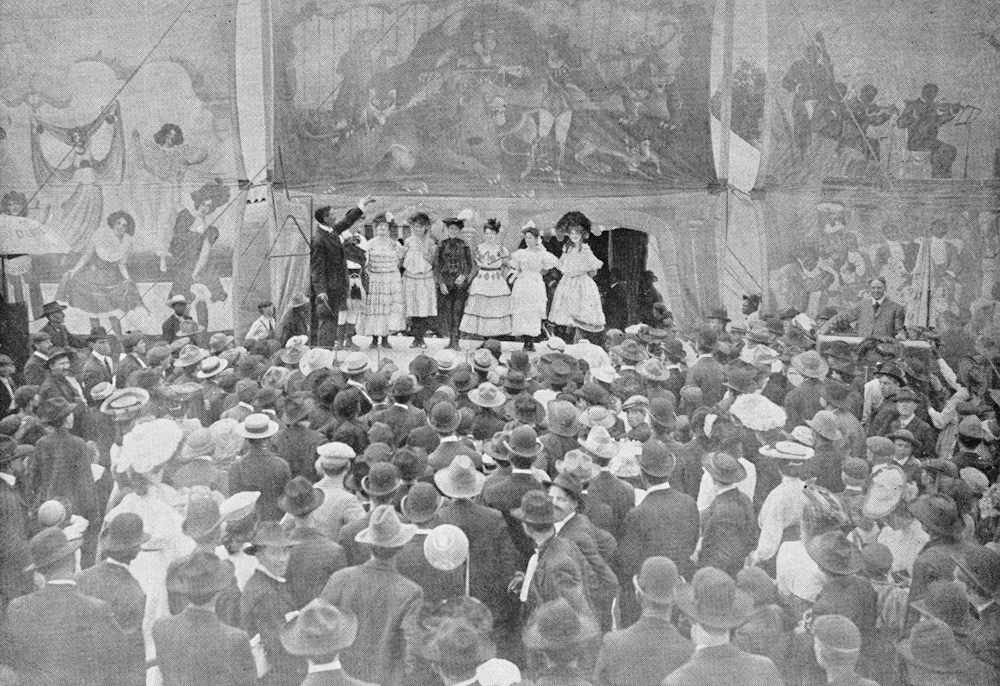
All that for fifty cents. The other member gets the same thing. Out they go, pleased. They’re going to marry, have money, three children—
There’s the sticking point. They don’t want three children. Well, maybe that gypsy was wrong. Anyway, there’s another “mitt joint” just a few feet ahead. In they go. This time they’re going to have a family of eight! For an additional fifty cents apiece, they’ve gotten five more children! Cheap at that.
On to the next. And the next. Time and again on fair and carnival lots, I have seen persons make the rounds of absolutely every palmist, or “mitt joint,” pay from fifty cents to a dollar in each place, everywhere be told a “fortune” that was different in every detail, and go home perfectly satisfied! And because of that, I once asked one of the biggest carnival men in the country the reason.
“Plain, everyday curiosity,” came his answer. “The average person is more curious than cats. If curiosity killed human beings, as it is supposed to dispose of felines, we’d all be dead. Curiosity made Franklin fly his kite, you know. Curiosity made Newton find out why the apple hit him on the head. Curiosity sent Columbus across the ocean,—and when you sit down and figure it out, curiosity is really the thing that keeps us going. When we’re kids, we bust open the watch to see what’s inside. When we’re grown up, we listen to some bird with adenoids tell how the wild man was captured by seventeen burly sailors on the Isle of Madagascar, and then pay our money to go in and see if he’s really as vicious as the spieler says he is. And when we get a strong suspicion that the wild man is only a South Carolina negro with a wig and a false set of tusks and a bum leopard rug wrapped around him, we don’t get mad about it. We’ve found out what we’ve started to find out, haven’t we? Yep, I guess that answers the question. Curiosity.”
“For instance, I’ve seen a chump stand at a ‘set’ or crooked ‘slum spindle’ at a county fair, where every other prize is a watch and every other one a little red celluloid rose, and turn the thing three hundred and fifty times at ten cents a copy and win nothing but a red rose every time. Three hundred and fifty little red celluloid roses for thirty-five dollars. Curiosity. He wants to see if he really can win one of those watches. When he finds out he can’t, he doesn’t get sore, he’s satisfied!”
“And if you don’t believe that the human race is eaten up with curiosity, just take a slant at those two Oregon John shows. Got in a jam with one of the fellows over his contract and thought he was going to cancel. So we booked another. Then the other fellow came on. Both of ’em set up their shows on the lot, advertising the original Oregon John, and it looked kind of bad for awhile until they opened up. After that, we tied ’em both up for the whole season!”
I followed his direction and observed two “pit shows.” There I saw, beyond the black mass of “lookers” who were surrounding the ballyhoo stands, two banners, almost identical, displaying the hold-up of a train by a lone bandit and the proclamation that within the pit was the one and only and original Oregon John, the bandit.
The “bandit” incidentally, in this sort of an exhibition, consists of the half-mummified cadaver of some unfortunate that has kicked around an undertaking shop for two or three years unclaimed by any one who will pay the funeral expenses. Then along comes a showman, who buys the body and takes it out on the road, exhibiting it as the remains of Oregon John, or California Pete, or Mexican Querto, or whomever he desires. The poor cadaver cannot talk back. The bullet holes produced artificially, are shown to prove just how he died at the hands of a posse. The lecture details a list of crime that would have made Oregon John or California Pete or whoever he happens to be a first-page feature in every paper in the country for months. But that never is considered. The crowd looks, gets a good, morbid sort of thrill, a few shivers and a couple of shocks and calls it a wonderful amusement. In real life, the poor mummy may have been a Sunday-school superintendent. In death he is the worst of the worst, and the more horrible his make-believe past, the more anxious the crowd is to take a look at him. In fact, the “push” in front of the two shows which the carnival owner indicated was tremendous. The showman smiled:
“First they go into one show and look at the only and original Oregon John and listen to the lecturer announce the fact that his rival across the way is a faker, a crook and seven different kinds of a liar. Then they go out—and hurry to the show across the way, just to see what the fake looks like. There they hear the same thing,—that the other man is a faker. And I’ve seen ’em go back to the first show a second time, just to take another look so they can make up their minds about the thing. After which, they go home, and ‘a fine time was had by all.’”
So, after all, perhaps the carnival man was right. It’s curiosity which lures forth the dime, where solid business couldn’t even drag it out! Curiosity first, and then the desire to see some one else become a bunkee also. For in this latter phase lies a gold mine.
It started, as a great many other things started, in the days of P. T. Barnum. It has continued, with very little variation, ever since. I know one man who makes a living by exhibiting, year in and year out, a flock of “petrified bats.” Of course, it is a “pit show,” you go up the stairs and look down a sort of well-like arrangement where you behold a dozen or so ordinary bricks, or “brick-bats.”
Whereupon you’re mad as Hades for a moment, sheepish for five minutes more, then determined, until you have hurried out, found a friend and steered him toward the most wonderful show that he ever saw,—the “Petrified Bat.” He pays his money, and goes in, and your laugh comes when he finds he’s been fooled. So out he goes to find some one else,—and the showman makes a living!
Incidentally, it may be surprising to know that the very tricks of this sort, originated by Barnum and others of his type, still are running to-day, and making money. Fifty years is a long time. In fact, when you come to consider, the world has absolutely turned over in that time. The airplane has come, electricity been developed, this, that and the other thing done, and you’d think—
But just the same, last summer, I was wandering over the lot of a small circus in a Kansas town. Aside from the side-show tent was a smaller “black top,” or tent made of black canvas, in front of which stood a talker, speaking very confidentially to the crowd before him.
“Now, I hope the ladies won’t take any offense,” he was announcing, “but what we have to show in there is for men only. It wouldn’t be wise for me to describe it out here; I know you boys don’t want me to go into details. Anyway, a word to the wise is sufficient. So, I’m not going to talk you to death, and I’m going to make my apologies to the ladies. For men only—for men only—and only twenty-five cents!”
Near me stood a man and a woman. The man hesitated, but the woman nudged him.
“Go on in,” she tempted, “and see what it is. Then you can tell me.”
Curiosity! In went Husband. Out he came, a sickly green.
“Nothing but a darned pair of suspenders!” he snorted. The woman giggled.
“That’s one on you! That’s one on you, all right. Wait ’til I tell—”
“Sh-h-h-h-h!” He had caught her arm. “Don’t tell anybody! Wait until I get hold of Tom and steer him in there! Won’t he be mad?”
Thus the endless chain was started, and several hundred persons paid their money in tribute to a trick which has existed unchanged since long before the Civil War! The “For Men Only” show, with variations, has been running now for three generations,—and there are few times that it fails.
So it goes. Away back in the last century, Barnum exhibited the “horse with his tail where his head should be.” There was nothing untruthful in it. The exhibit was a horse standing in a stall with his tail instead of his head, at the feed box. They came, they saw, then they went out and got others to come and see. That was in the 40’s. I have seen the very same trick doing a “turn-away” business within the last four months!
In fact, the list is endless. I can make an excellent pair of Siamese Twins in fifteen minutes, by the application of a double belt of rubber, made to resemble human flesh, which passes around both bodies and joins by a heavy strip, which connects the two torsos. After that, all that is necessary is to teach the “twins” to walk together, so that when one is going forward, the other is traveling backward, and to arrange the “patter”, which always begins:
“And now, my dear friends, if you will gather a bit closer, I will endeavor to explain to you the strange history of these queer people. Born on the Island of Hootchi, fifty-eight miles west of the Isle of Pataloochin, they were discovered by the king of the tribe and raised to a position which almost equaled royalty, where they were found by a roving sea captain, etc.—”
Always get the sea captain in. Why? Because of the romance of it! He travels in strange places. He sees strange things. Isn’t it natural therefore that he would be the one to bring these weird people to this country,—for your edification?
An elastic-skinned man may be manufactured by the same method, and those “strange people” are useful as well as ornamental. More than one side-show exhibit helps to “put up” and “tear down” the show, a perfectly healthy, normal human being, when he isn’t at his job of being one of “these queer people.”
For a two-headed man, all you have to do is find a person with a large wen on his forehead. There are twenty concerns that will make a mask and wig which will fit that face, in exact miniature of the man’s own physiognomy. And if you don’t care about expense, that face can be made to open and close its eyes, move its ears, move its mouth and even smoke a cigarette, simply through the application of “pull cords” such as are used for ventriloquist’s figures, and by a suction tube attached to a bulb for the smoking stunt.
In fact, for the purpose of the showman—and for the purpose of the spectator—a fake is always better than the real thing. It’s more along the lines of what the public wants. The statement sounds queer, but just the same—
Perhaps you’ve heard of “Jo-Jo, the Dog-Faced Boy?” There was a real Jo-Jo, it is true, who lived in Russia and through some freak of misfortune possessed a face which was remarkably like that of a dog. But that isn’t the Jo-Jo which lives in your memory. The one of whom you think was a fake!
He was nothing more than an English variety performer who was an adept at imitating the barking of dogs. An American showman procured somewhere a picture of the original Jo-Jo and had an expensive wig made to imitate him. Then the Englishman was dressed in the garb of a Russian peasant, and for months, in Boston, in New York, and in practically every other city of the East, thousands of persons struggled to see this “strange man with the face of a dog.”
Over in Russia, the original Jo-Jo heard of his rival and hastened for America, hoping for a fortune. Wasn’t he the real thing? He was, but that mattered little. Jo-Jo, the real Dog-Faced Boy, couldn’t bark like the faker could. Hence he drew a fair salary at a museum, but that was about all!
The list of fakery can go on, through nearly every historical freak that lives in memory. The Dahomey Giant, an account of which you can find in nearly every encyclopedia, was a bit of bunk,—merely a seven-foot negro. The “missing link” was only a hairy child. And even the first “Wild Man” was a fake, just as every wild man from Borneo, Siam, Yonkers or the Bronx, since then, has been a fake. But you’ve seen the wild man, haven’t you? So have I!
What’s more, even the genuine is often a fake. A few seasons ago, the only real, living adult gorilla ever shown in captivity toured America, and made, oh, many dollars for his owner. He was genuine. There was no doubt about it. On every side were documents to show that he was genuine; as many as ten famous blood specialists and microscopists said that he was genuine. In fact, they almost went so far as to call him the missing link and to swear that at last Darwin’s theory had been proven. Yet he was only an overgrown black-faced chimpanzee!
How simple it had been. We simply selected ten men whom we knew were not hunters of gorillas, or showmen, or students of animal life. We went to them with the chimpanzee, and we were very frank, and very, very earnest.
“Gentlemen,” we announced, “we think we’ve got a gorilla here, but we’re not sure. Nobody knows very much about gorillas, because they’re so rare. We’ve been wondering whether you could make a blood test and tell us by the corpuscles of this animal whether or not it really is a gorilla?”
They believed they could. They made the tests. Then they gave their announcement. This was a gorilla! A real, live, adult gorilla! How did they know? Simply because a gorilla is an anthropoidal ape, belonging to the same species, in a way, as a human being. The blood corpuscles nearly correspond. The corpuscles of this beast conformed more closely to those of a human being than anything else they ever had examined. Therefore, it must be a gorilla!
So, with the documentary evidence signed by ten famous men, with micro-photographic pictures of the blood corpuscles to prove it, out we went with our gorilla! And in the people came to see it; didn’t ten famous doctors who should know, proclaim it a gorilla? The fact that they had no real gorilla blood by which to make comparisons had something to do with their statements, of course. But we didn’t mention that.
Again, we received the news that a baby elephant was about to be born to one of the herd. At the head of our show was a little, Napoleonic appearing man who could have given P. T. Barnum a night-school education in shrewdness, and still left him a babe in arms. He received the news. Then he reached for the telephone.
Would a certain physician, who then was the mayor of the city, like to attend an unusual thing like the birth of a baby elephant? The physician would. And would fifteen other doctors—as he called them, one by one—be interested? Certainly. Why? Curiosity! They had brought many a human baby into the world, but never had they seen a baby elephant born. So out they went. And they stood in a line beside the baby elephant, after it had been introduced to this world, and allowed their photographs to be taken. Then—
Out to a waiting, gasping, bunk-loving amusement world went a baby elephant which had required the attendance of sixteen of the biggest doctors of the West to start it in life. One baby elephant—sixteen doctors. There were the pictures. There were the signatures:
This is to certify that I, this day, did attend at the birth of Cutie, the baby elephant, that she was born at 8:22 A. M., and that there is every indication that she will live to be a healthy adult pachyderm.
Signed, this day and date.
With this evidence before them, through the admission gates there crowded some fifty thousand persons before Cutie decided to curl up her toes and die,—fifty thousand persons eager and riotous to see a baby so wonderful that sixteen famous doctors were required to bring her into the world. Nor did they stop to consider that Cutie’s mother was born without a doctor within a thousand miles of her, and that, since the world began, a million elephants more or less have entered into this life without even knowing what a doctor looked like!
Once, on a circus with which I was connected, our feature act of the side show was Prince Biji, the Wild Man from Tasmania. Prince Biji was born and lived on Clark Street in Chicago, where his tailor-made clothing was the envy of every other negro in the neighborhood. On the circus, Prince Biji dressed himself in an imitation plush leopard skin, carried a spear and shield, wore tusks, and hung about his throat a necklace of human teeth, souvenirs of his victims, killed in battle in the wilds of Tasmania. In fact, Prince Biji was an excellent feature. He looked wild. He acted wild. Within the side show, the lecturer would speak as follows:
“Now, ladies and gentlemen, we come to one of the greatest educational features of this vast collection of strange and unusual creatures,—Prince Biji, the wild man from Tasmania. Now, we make no claims for Prince Biji, such that he eats raw meat or devours serpents alive, or anything foolish like that. Prince Biji is merely here as an example of his warlike tribe, being obtained under bond from the government of Tasmania as an exhibit of the fiendish races which inhabit its strange and fearsome jungles. Now, Prince Biji can neither speak nor understand a word of English. Can you, Biji?”
Whereupon Biji would shake his head violently. He could not understand a single word of English. Perhaps it was mind reading which made him shake his head in answer to a question in English. The lecturer went on.
“You see, he cannot understand or speak a word of English. Now, Prince Biji, for your edification, will do his native sword dance, as performed in the jungles of Tasmania. Do your sword dance, Biji.”
Whereupon, Biji, not understanding a word of English, would do his sword dance and sing one of the songs of his wild and native land, a conglomeration of guttural sounds composed of whatever popped into his head. Then the lecturer would go on with his speech.
But about this time, Biji would look down into the audience. And every few days, he would see there some negro whom he either had met in his show days or around Chicago. About the time the lecturer would be repeating the fact that poor Biji had never been able to master the English tongue, Biji would beam down at his friend, and exclaim:
“Wha’, hello, Big Sly! Where yo’ been at all dis yere time?”
Big Sly would greet him effusively. The lecturer would never even glance in Biji’s direction. On he would go with his talk, while Prince Biji and Big Sly carried on an animated conversation, asked about each other’s relatives and made arrangements to meet after the show. Then Biji would straighten again, while the lecturer would draw the crowd confidentially nearer him, and announce:
“Now Prince Biji has brought with him to this country a limited number of a small, queer-shaped pod which grows in his native jungles of Tasmania, and which, upon being blessed by the savage priests of his strange and warlike tribe, are supposed to prevent forever evil spirits, illness and bad luck. As I have mentioned, he has only a limited amount of these, and as a special favor this afternoon, he has decided to allow a small number to be sold and will consent to pass these little lucky beans out among you, at the small and reasonable price of twenty-five cents, a quarter of a dollar.”
Whereupon, Prince Biji, who could not speak a single word of English, would reach immediately for an old cigar box, half-filled with hard, black affairs, such as we knew in kidhood days as “yonkypin nuts.” And the crowd would step up and buy until the supply was gone!
In which case, even curiosity cannot be saddled with the weight of the explanation. Nor can psychology, nor showmanship, nor anything else, save one fact:
We just like to be bunked!
Back in my kidhood days, when, as a runaway youngster, I was achieving a life ambition—and five dollars a week—as “the clowns” of a tatterdemalion little circus which clattered about through the Middle West, there was a magnet beneath the ragged old menagerie top which compelled me, day after day, to contemplative attention. It was a lion, old and blind and toothless, dragging out the final days of its existence as the “star” of a “collection of beasts of the plain and jungle”, which appeared ferociously numerous on our billing, but which consistently failed to appear when the gates were open and the great or small crowd thronged through to the big top and its moth-eaten, amateurish performance. In fact, old Duke, with the exception of a few goats, a monkey cage, a cinnamon bear and a couple of anæmic native deer, was about all the menagerie we had, and certainly, to me, the most interesting of the lot.
So, in that time of rest between the matinée and the night show, I would wander to the aged Nubian’s cage, to stand staring at the black-maned, toothless creature, majestic even in its senility; wondering what it thought about this life it led, and whether it ever longed for the glorious days of the veldt it never again would see.
One day as I pondered youthfully on the problem of lion psychology, an old animal man came beside me, and we began to talk, one with the romance of youth, the other with the wisdom of experience. And I said:
“Poor old thing. It must be awful.”
“How so?” The trainer looked up quizzically. “’Cause he’s locked up? Don’t you ever think it. Wouldn’t get out if he could.”
“I don’t mean that. He’s taken care of, all right. But everything’s different for him; he doesn’t understand anything that’s going on, and he’s away from everything that has anything in common with him or—”
Then it was that Experience interrupted. The trainer spat disgustedly and poked forth an emphatic finger.
“Shucks! Listen, kid, when you’ve been around animals as long as I have, you’ll find out that a lot of this theory stuff is the bunk. Us humans ain’t the only ones that can use their brains. Get that? And something more; the trouble with us is we’ve got the swell head. We think that because we can talk and use our hands and build houses and do a lot of fool things to our digestions; we think that because we’re what we are, that we’re the real and only McCoy. That’s just where we’re wrong. I never saw a wild animal yet that didn’t show some basic characteristic of the human being. The only trouble is that most of us don’t have the chance or the desire to watch ’em long enough. And I know! I’ve nursed lions with the toothache and carried baby tigers in my arms before their eyes were opened. And I’m saying that the dividing line between animals and humans is mighty thin, that they’re just like us!”
That was fifteen years ago. I’ve traveled with some big shows since then; I’ve known many a trainer, and once I spent twenty years in as many minutes one afternoon as the guest of three lions and three tigers in the arena during the performance of their act. Long ago I forgot what the old animal man looked like, but I’ve never forgotten his words. What’s more, in the years that have gone, instance after instance has piled up, in story and actual experience, to emphasize it all. Under the great spread of a circus menagerie top, from the heavy steel dens, the big tanks, the strong enclosures which house the various animals have come examples of every human emotion: love, hate, jealousy, fear, deceit, faith and all the others which we humans possess; envy, malice, forgiveness, humor, self-sacrifice, gratitude; on and on the list runs until there are times when I wonder if there is any dividing line at all! Why, among animals there’s even nationality!
It all happened long before the war, so the fact that it was a “made in Germany” affair is permissible. We wanted a new elephant, and the order naturally was sent to Carl Hagenbeck, from whom most circus animals were then procured, and who reared, trained and acclimated his beasts at his “Tierpark” on the outskirts of Hamburg, Germany. The answer to the order was an almost tearful letter from Hagenbeck.
Because of his friendship for the owner of the show, he was giving up his greatest prize, Old Mamma, his pet elephant!
She was more than just a mere trained beast, he wrote. The children played with her, and she was all but a nursemaid to them. She did the work about the park; she was gentle and kind and understanding. It was as though Carl Hagenbeck were parting with some dearly beloved relative or a faithful servant, instead of a circus animal. And the show awaited the coming of the new pachyderm with a constantly growing interest. Then Mamma arrived!
The first report came with the sight of a sweating, cussing animal man who plodded wearily to the circus lot, disheveled, disturbed in body and temper. He sought the owner.
“Of all the rotten, no-good bulls I ever seen in my life,” he growled, “that new Hagenbeck elephant’s the worst! She won’t do nothing!”
“But Hagenbeck wrote me—”
“I don’t care what he wrote you; I’m talking about what he handed you! That elephant’s a lemon! We can’t get it to do nothing; it acts like it ain’t even got good sense! Come on down and look for yourself.”
Harry Tammen—he was the owner—went, and Harry Tammen looked. He retired to his circus car that night disappointed and disgusted. The wonderful elephant about which Carl Hagenbeck had written so enthusiastically either could not, or would not, do anything that would indicate former training. Only by sheer tugging with “bull-hooks” and pushing with two-by-fours had it been shunted from its car, and then, once on the ground, it trumpeted and squealed and stared blankly at the shouting animal men,—but obeyed not a single command. Such was Mamma’s arrival on the circus, and such was the daily programme. She was literally pushed and pulled to the lot each day, and pulled and pushed back to the circus train at night, an aimless, useless old beast that was more of a liability to the circus than an asset. Then Hagenbeck came to America and Tammen met him in St. Louis.
“A fine elephant you sold me!” he blurted. “It hasn’t got a brain in its head!”
Hagenbeck almost wept.
“Ach gott, Harry!” came excitedly. “Dot old Mamma elephant—she iss human! All day long she played with the children, unt ven day gif her a piece of cinnamon cake—ach gott, she’d get on her knees to thank them! I come along to her unt I say: ‘Wie gehts, Mamma,’ and—”
“Wait a minute!” A great light was beginning to break in on Harry Tammen. “What would you say?”
“Wie gehts! or Vas ist lohse? Or—”
“That’s enough!” came from the circus owner. “You win! We’ve been trying to talk English to something that doesn’t understand any language but German!”
The next day Tammen returned to his circus, and seeking the picket line in the menagerie where the great, hulking elephants were tethered, he approached the supposedly imbecilic Hagenbeck importation.
“Wie gehts, Mamma!” he exclaimed. “Vas ist lohse?”
You’ve seen a dog welcome his master after long absence,—the frenzy of joy, the unbounded happiness? Magnify that dog into a poor, lost, three-ton elephant in a strange land, among strange people, hearing only a strange tongue—then suddenly finding a familiar tone of speech—and you have Old Mamma when she caught that sentence in German. She trumpeted, she sank to her knees and rose again, she wrapped her trunk about the little circus owner and tried in her elephantine way to caress him. She squealed and jumped about and pulled at her picket pin; then Tammen called one of the “bull-tenders.”
“Dig up some one around this show who can talk German,” he ordered. “We’ve got to translate everything for a while to this poor old bull. She’s in a foreign country—and we’ve got to teach her English!”
And that was the explanation of Old Mamma’s apparent imbecility. She had been captured by German-speaking members of a Hagenbeck expedition, trained by a German, kept on a German animal reservation and received her every command in German. She never had heard any other language, and it was not until patient animal men, giving first the command in German and then repeating it in English, had “taught” her the language of her new home that she became of value. That was a good many years ago. To-day it is Mamma who leads the elephant herd of the big circus, who tests the bridges before her followers step upon it, who trumpets her orders to the rest of the great pachyderms on parade, who is first to catch the trainer’s command in the ring. She is the head of the herd, and she has become Americanized. What’s more, she’s forgotten German now, in spite of the fact that they say an elephant never forgets.
I’m afraid that story about elephants who never forget is one of the traditions of the circus which can be contraverted, and I think it’s another evidence that there’s the human strain in animals or the animal strain in humans, whichever way you want to put it. I personally once defied the old tradition by feeding an elephant a nice hunk of tobacco one afternoon and going back the next day, expecting to be killed, only to find that the chocolate and sweetening in the plug had been particularly pleasing, and that a second offering was gratefully accepted. I’ve seen elephants forget real injuries, cruel treatment, for instance, and then, on the other hand, I know of an old “bull” which recognized, after some eight years, the man who had trained him in India. Which leads to the fact that memory represents the same quality among elephants that it does in human beings. It’s a matter of personality; some remember, some forget. In the language of the old trainer: “They’re just the same as us!”
Forgive me for being garrulous about elephants; it’s the innate fault of any one who ever has trouped beneath the white tops; there is no circus man who does not love them. But there are other animals and other traits. Among them—jealousy!
Not envy, understand, though I’ve seen that too, but pure jealousy, borne of blighted love, jealousy that once almost led to animal infanticide.
Prince was his name and he was an inbred. That meant he had been under suspicion from the day of his birth, first for illness resultant from his bad breeding, that would rob the circus of a parade animal, then for the evidences of an evil temper which might at any day turn Prince into a “killer.” Prince was the son of a brother and sister, and in the animal world there are the same inflexible rules of progeneration regarding the union of relatives too closely associated that there are among humans. Therefore Prince was not a select specimen of the menagerie, and certainly, in the opinion of the animal men, he was not to be mated with any of the thoroughbred lionesses which the show possessed.
But Prince thought otherwise. Prince selected his mate, Beauty, and roared and growled to be placed in the same cage with her. The animal men refused, and gave Beauty her natural mate, Duke, a great, thoroughbred, black-maned Nubian lion. And that day the trouble began.
Prince became mean and vicious. He tried to attack his trainer. He was sullen and treacherous and grouchy; and he became more so as time progressed. Often, in the arena, when the lions were working together in their act, Prince sought to sink his heavy claws in the form of Duke as that animal passed his pedestal. Once he leaped at the other lion, and only the bull-whip and flaring revolver of Captain Dutch Ricardo, the trainer, drove him off. Prince was jealous—plain, downright jealous—and he was willing to kill to vent the anger that was in him.
Finally, Beauty presented the circus with four little lion cubs, and day after day we would see Prince watching the babies between the bars of his cage, hissing and growling at them. As they grew older, they shared the happiness of every cub around a tent show; they were allowed to wander about the menagerie, or were carried around and petted by the circus children; cubs—lion, tiger or bear—are the most pampered things around the “big top.” But Prince never lost his hate for them.
In fact, that hatred grew. One day the animal act was on, and Beauty was in the big arena with the other lions, while the cubs played about outside. The “leaps” were on, that part of the act where the animals jump through a ring of fire above a hurdle, and the whole great mass of beasts was tumbling and plunging about the enclosure. Suddenly Prince, about to take a hurdle, saw that one of the cubs had come close to the steel bars. He changed his course, a great roar rumbled from his throat, and with a quick swerve, he was at the side of the arena, his heavy paws extended between the bars, trying his best to claw to death the fluffy, scrambling little creature which barely had eluded him. Animal men beat the inbred back, and he turned on Duke. Again a fight between lions was almost an unadvertised feature of the show. Again Ricardo separated them. Soon after that, Prince was relegated to his cage, to be, in the future, only a parade and menagerie feature. Jealousy had made him too dangerous a beast to be trusted in the arena.
Human traits? They’re everywhere about a circus menagerie. Every old animal trainer is full of stories concerning them. The more a person is in the proximity of animals, the more he hears of their attitude toward life, the more he is convinced that in make-up we’re basically just about the same; different only in physical appearance. For instance, you’d hardly expect to find humorists among the savage occupants of a lion’s den, but they’re present just the same. I know of one case in particular.
On one of the big circuses is an “untameable lion” act which works as a special feature of the side show. Never was there a fiercer animal than the crouching, hissing, roaring beast which lunges and plunges at its trainer, fighting away the stinging whip as he seeks to penetrate its fusillade and leap upon the grim-faced man before him. Time after time he lunges, only to recoil before the barking roar of the trainer’s revolver; effort after effort is made in vain to force him to the obedience of a single command, and as the trainer glides from the cage, the roaring beast leaps, claws extended, his great body crashing against the steel door which is closed just in time.
Twenty minutes later a big “group” animal act is shown in the main show. The various stunts are gone through and then comes an announcement:
“Ladies-s-s and ge’llmun. I beg t’introduce the tamest, best-trained lion ever shown in captivity—Old Solomon. Watch him!”
The trainer approaches Solomon, pets him, teases him, mauls him about, pulls his tail, and finally puts his head in his mouth, all without one bit of resistance from the amiable old fellow. And the strange part of it all is the fact that the fierce beast of the side show and the complacent old pet of the main tent are the same! Yet they say that humor is missing in animaldom. Often I have seen a trainer feeding tigers and lions strips of meat with his bare hands, while ten minutes before those same animals were in the arena, hissing and growling and clawing at his every approach. And there is a difference even in the tone of their growls; a trainer can tell in an instant whether the beast is in earnest or whether he is just playing.
So it goes. There’s a story for every cage and a human trait for every story. Some time when you look into a hippopotamus den, at the heavy, hoggish body, at the small, senseless eyes, the big snout and general imbecilic appearance of the beast, just remember that even this hulking thing of the River Nile has its human attributes, and that it can even become lonely.
The evidence of it came while a big western circus was starting forth on its long trip of the spring from the winter quarters at Denver, Colorado, to its opening stand at Albuquerque, New Mexico, several years ago. The run from Denver to Trinidad had been made by daylight, and at the “feeding stop” the animal men made the rounds of the various cages and dens to assure themselves of the comfort of their charges: it would be cold that night; the long trains would travel over the mountains. Cage by cage they visited, then one after another they reported to the manager:
“That baby hippopotamus is sure raising a rumpus. Don’t know what’s wrong with it. We’ve put two extra bales of straw in there, and it certainly can’t be cold. We’ve given it plenty to eat, and it can’t be hungry. But it sure is raising the roof!”
The manager summoned the menagerie superintendent, and together they went to the hippopotamus den. The unwieldy, wobbly thing was backed up against one end of its den, its heavy head sagging, its eyes cocked like those of a dog when it is awaiting its master’s forgiveness. It was whining,—a sort of a drooling whimper that added to the atmosphere of dejection, a full ton of fat sadness, crying for something it could not name. Long the two men watched. Finally the superintendent scratched his head.
“I wonder—” he began. Then, with a sudden impulse, he climbed upon the wagon and, unlocking the door of the cage, went within. There he seated himself on the straw and waited.
For a moment the hippopotamus regarded him in lubberly surprise. Then gradually the whimpering died away as the big animal crawled to the animal man and laid down beside him. The superintendent grinned.
“Nothing wrong with this hip!” he announced. “It’s just a poor, lonesome baby. We’ll get one of the ‘razorbacks’ to come in and stay with him to-night. He’ll be all right.”
The train was canvassed for a razor-back, or train loader, who desired to sleep with a hippopotamus. It was a long search which ended in success only after a promise of double wages. The man clambered into the den where the infant river hog was whimpering again and gingerly touched the beast’s head. The hippopotamus seemed to like it,—and thereby began a strange friendship of the circus.
The “blood-sweating behemoth” did not cry that night, nor the next, nor the next after that; for the razor-back had found that a hippopotamus is an aimless, usually gentle beast, too lazy most of the time to think about anything save his own comfort, and that there was no danger in remaining in his den. More than that, he was earning double money for “doing nothing”, which was agreeable. The razor-back had found a new vocation, that of being a nursemaid to a baby hippopotamus, and he stuck with the job. And, when the “situation” ended, it was in death: he was killed in fighting a fire, born of a flying engine spark, in the straw of his companion’s den as the circus ground along on its night’s journey in the northwest a year or so later. The fire extinguished, the razor-back turned from the top of the den where he had crawled to investigate the damage, and, slipping, fell from the train. Again the hippopotamus whimpered, but this time it was in loneliness for a specific thing, his friend and companion who was gone. Nor could he be satisfied by a substitute.
For grief exists among animals, caged as well as domestic. True, it displays itself more forcibly in some animals than others, but its manifestation is present in them all. I have seen a tiger grieve for its mate, a leopard for her cubs, an elephant for its trainer. And when it comes to simians—
When you lose a simian on the circus, usually through the ravages of that man-made disease, tuberculosis, you almost infallibly lose two. A few pitiful days of grieving, in which the mate grows weaker and weaker, in which its cries almost resemble a human sob, then an animal man takes a little burden out behind the big top and buries it. The second death has come,—to the mate who has grieved itself into the grave.
Particularly is this true of the mated orang-outangs and chimpanzees. In life they seem to be all that is required of a perfectly wedded pair. Clinging to her mate, dependent upon him for everything, the orang-outang “wife”—if Darwin’s theory counts for anything—goes to show that the days of the cave man were perverted ones. For certainly, as representatives of the jungle, the orang-outang’s wedded life is the model for which all human standards strive. Faithful, kind, protecting and gentle, the male constantly cares for the weaker mate, and more than once I have seen an orang-outang “husband” sorting out the choicer bits of food—and, cooing gently, hand them to his wife.
Then, when illness comes, the mate seems to realize the danger. It sits by the side of the stricken companion, moving closer when it whines, even stroking it gently, as though to soothe its pain. Few orang-outang keepers are there who do not stand by their task twenty-four hours of the day, when illness comes to their charges. For it is as though some dumb but understanding human were dying, while a mate sits beside, ready to give its life also in grief. And that is almost inevitable, once death strikes. Refusing food, covering its face now and then as it piteously whines out its grief, it waits for the time when death will take it, too,—and the end usually comes within a week. Out in the West, I know a circus owner who has two stuffed and mounted figures of orang-outangs that he does not want for ornamental purposes, and that he certainly doesn’t need for a study in natural history, since he has a living menagerie that he can watch any time he chooses.
“But I saw them die,” he explains. “The male went first, and it was just like a good husband dying in the arms of his wife. She seemed to know, seemed to realize what death meant, and that her mate never could be with her again. Then she began to waste; soon she was dead, too. And—well, maybe I’m soft-hearted, but I just figured that affection like theirs deserved something better than burial on a circus lot. So I had ’em stuffed so they could be together, in semblance, at least.”
And that is the story of more than one pair of Orangs and chimpanzees. There are few humans who can love more tenderly and more truly than they. So much for the love of man and wife.
But of all the animals that displayed the traits of humanity—at least, of all I’ve seen—it remained for Casey to display nearly every one possible.
More than seven feet tall, with his hands extended over his head, strong enough to seize a man by his feet and simply rip him apart, a three-ton lunge chain constantly about his neck to check him should his nature ever change, Casey was as amiable and boyishly playful as a kid just out of school. He appeared to take a delight in being a show feature; it was fun to him. And he was a feature!
In his heavy cage, he would sit looking aimlessly at the crowds, until his trainer or you or I or any one who knew him would approach with the signal for the ballyhoo:
“All right, Casey! Big mouth!”
The result would be a hideous grimace, heavy fangs showing, skin furled back from the yellow teeth, eyes narrowed, a growling, drooling sound issuing from the heavily muscled throat. Then would come the second command:
“Casey! Go mad!”
He would leap about the cage, screaming and shrilling, pounding the top and bottom almost simultaneously, rocking the big, steel-barred structure, biting and tearing at everything which came in his way, a perfect specimen of an animal maniac. And it was after such a performance as this that the trainer—on the first day of his arrival on the circus at Del Rio, Texas,—suggested that the cage be opened and Casey brought out at the end of his heavy chain for a “lecture” at close range. A side show “talker”—for Casey was being exhibited as a special attraction—moved hastily away.
“Not me!” he exclaimed. “Not with that thing! I’ll lecture on the Aztec Midgets and I’ll even let a bull-snake curl around my neck! But I won’t be caught around that monk!”
And it was the same with the others. They had seen Casey “go mad.” That was enough; they had engagements elsewhere. Fox, the owner, looked at me, a visitor to the show.
“Want to make the talk?” he asked.
I laughed and assented, for I thought I knew Casey. I had played with him at winter quarters, I had seen him under a good many conditions, and I knew him to be an amiable, good-hearted, friendly beast who didn’t know his own power. I went to the platform and started my speech.
It must have been a fizzle. Certainly, I knew nothing about the art of being a side-show talker. And when, halting and struggling for words, I finally ceased, I felt a warm, soft hand glide into mine. It was Casey’s, and he was looking up at me with eyes I know were sympathetic. Even he knew that as a “spieler” I had failed.
Casey ate from a bucket, with a spoon. He wore trousers most of the time, with a penchant for letting the suspenders hang. He smoked a cigar or a pipe and lighted it himself. He could use a hammer and saw to a certain extent, and his chief toy was a heavy block of wood made far heavier by the hundreds of nails he had driven into it, like a child at play. He drank beer—it was before prohibition—and now and then he would become mildly intoxicated and sit in his cage grinning at his trainer, or snoring away the effects of alcohol. He could make a noise that sounded like “no” when he really meant “no.”
Fox, his trainer, found him one day in his heavy cage, doubled in pain. He called a physician, and after the diagnosis had been made, the doctor turned excitedly.
“I can hardly believe it in a monkey! But there are all the symptoms. There is only one chance—an operation!”
Casey was hurried to a hospital and placed under an anesthetic, with all the conditions pertaining to a human being in the same circumstances. The incision was made, the doctor’s theory proven correct, but too late. Things had gone too far. Casey died, and from the effects of that intensely human ailment,—acute appendicitis!
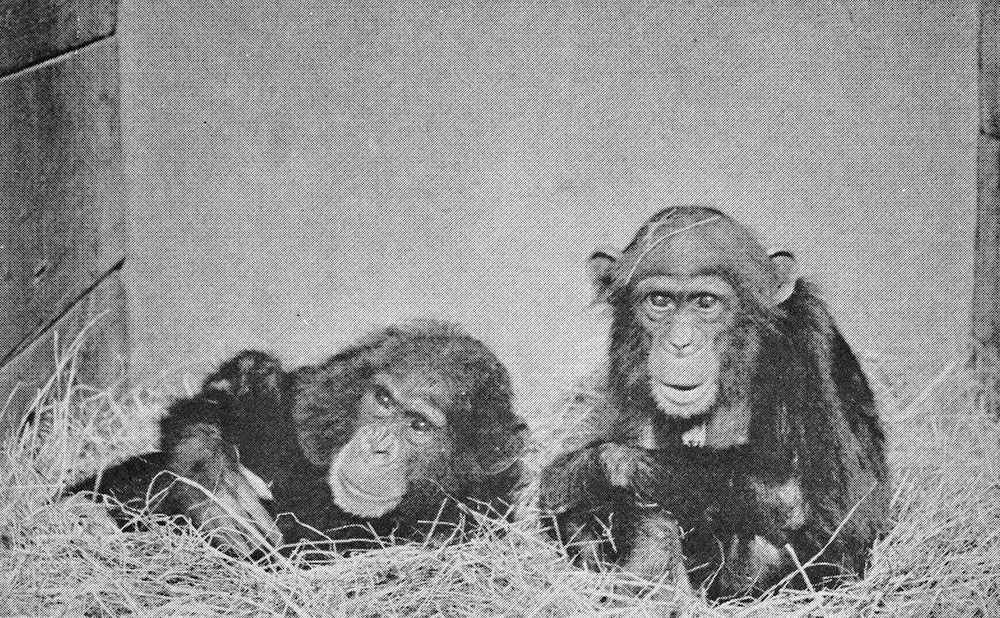
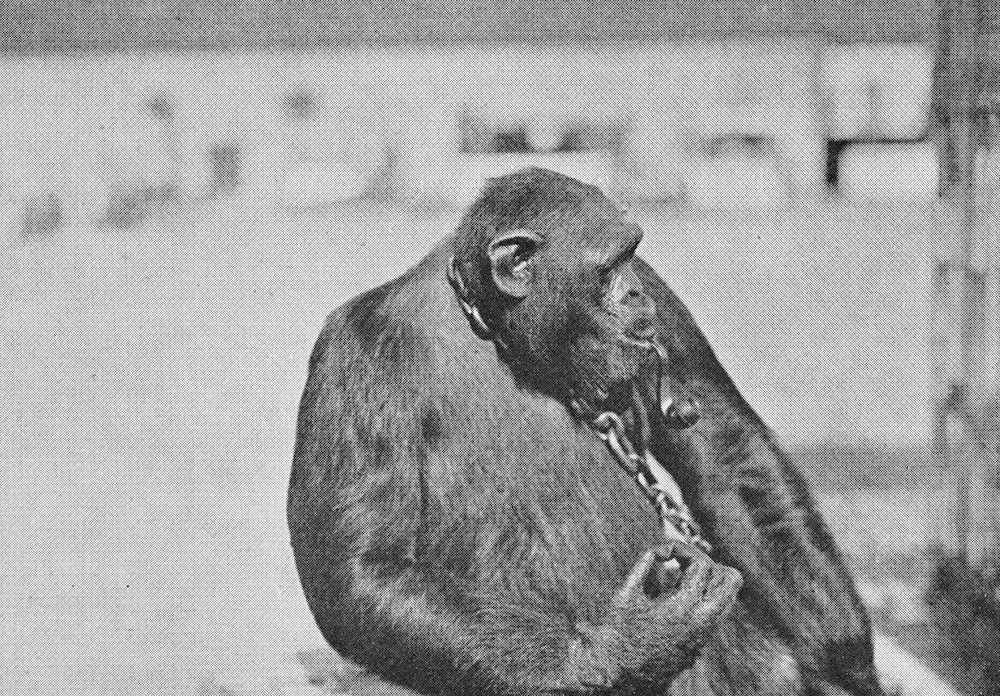
Personality, as has been remarked before, has its part in the animal kingdom, just as with the human family. The hyena is a sneak, an animal tramp, ready to seize upon that which the richer have left behind; a filthy vagrant, ostracized even among his own co-occupants of the animal kingdom. The lion is a sluggard, a poser, a sort of motion-picture actor among animals, perhaps a bit big-headed because his looks have given him the title of the king of beasts. The leopard is a cat, just as a mean, vicious-tongued gossip is a cat; both wait for the psychological moment to strike, fawning and docile and even friendly until that moment shall come. Of course, the leopard is dumb. It therefore strikes with its teeth, instead of by words. The tiger is pugnacious, even as a man who knows his strength is pugnacious; place one tiger and three lions in the same arena, and the tiger will come forth bloody, but alive. The lions will stay behind, dead. The chimpanzee, the Koolakamba, the marmoset and others of the monkey and ape breeds are buffoons. The rhinoceros is a sulking dunce. Throughout the whole list, each has his one element of personality, his one characteristic of echoed human nature which stands forth and identifies him,—all but the elephant. And he has everything!
You don’t like tigers, do you? Or hyenas? Or lions? You wouldn’t care to make a pet of a rhinoceros, or have a giraffe running his neck over the transom of the kitchen door when the grass in the back yard had become too short for cropping? But haven’t you said more than once, as you stood in front of the picket line, punching forth peanuts, that “you just loved elephants?” If you haven’t, you’re different from ninety-nine per cent. of the persons who attend a circus. The reason all lies in that one fact of personality.
For the personality of an elephant is everything that is contained in the personality of a magnetic human being. He is a buffoon,—yet he can be a tragedian. He is a child, yet an age-old sage; an ardent lover, still as ardent a hater; strong-minded, but possessing weaknesses; stolid, and at the same time shrewd with a shrewdness one might believe impossible in a beast; honest, yet a thief; faithful, but tricky as a coquette; a clown with a serious mind; and a wrecker, with the heart of a saint.
It’s a long list. Yet I’ve seen every phase of it exemplified in elephants, even to the extent of temperament! Of course, that sounds impossible; only opera stars and long-haired poets and motion-picture stars are temperamental. Very well then, consider this:
On a certain circus to which I happened to be attached for several years were Kas and Mo, twin baby elephants, and named respectively for Kansas and Missouri. They were young; naturally the training which usually is given elephants in the compounds of India, or the European Zoölogical gardens before shipment to America, had been missing, and the two youngsters were forced to receive their education as the circus trouped along through the summer months, or waited away the snowy weeks in winter quarters until the sun shone again. One day, after they had been with the circus several seasons, I happened to notice them in the winter quarters yard, where they had been picketed for an hour or two of sunshine.
No one was near. No one was giving orders. Yet those elephants were acting in the same manner as I had seen them perform that morning in the practise ring. They raised their feet in unison, they knelt in unison, they trumpeted in unison and did the “hootchie-kootchie” together. An accident? Not at all. They simply were practising their act, even as a human performer would practise. And they were in earnest! A moment later, Kas floundered in the midst of a number and stopped, with his attention on something far more important than acting: a wisp of hay, dropped by an animal man as he passed. His trunk went forth to grasp the food greedily, while Mo, intent upon his practise, continued his work. But a second later came a squeal, a grunt, a whirling trunk which caught Kas just back of the ears and sent him reeling dizzily. He recovered; and the fight was on, while “bull men”, or elephant keepers, tumbled out of the animal house, while hooks sought flesh and the two squealing, angry elephants were parted. At last came peace and the head bull tender grinned as he passed.
“Got in a scrap over their act,” he explained. “Worse’n a ham song an’ dance team. But they’ll make up. Watch ’em.”
I watched the two hulking beasts; they were six feet tall, in spite of their “babyhood.” For fully five minutes neither knew that the other was on earth; each sulking, each looking in the opposite direction, each appearing to be thinking up uncomplimentary remarks about the other. Then gradually the air cleared. Fifteen minutes later, they were back on the job once more, again going through the new number of their act,—and without a trainer in sight. If that isn’t temperament!
Of course, as has been mentioned before, it is sure death to give tobacco to an elephant. He’ll remember you for years and years, and a few more years after that, and then, when you finally show up, proceed to commit murder. It sounds logical.
But Kas and Mo are two of the best little tobacco chewers I know. If you’ll feed them tobacco, they’ll remember it,—and stick out their trunks for more. All for the reason that they like it, just as nearly every other elephant likes it, for the licorice and sugar it contains. The tobacco itself may be bitter, if it is chewed long enough, as is the case with the human family. But the elephant differs. He gets only the taste of the licorice and sugar and syrup as it goes down. And he wants more!
For an elephant’s appetite is his most childish trait. In age he may be at the possible time of discretion which should attend the passage of some hundred years of growth; but in appetite, he still is a kid of the all day sucker stage. That’s why he likes peanuts, simply because while his leathery brow may be wrinkled and old, his stomach is blessed with eternal youth. Give him hay, and he will look upon you as a friend. Give him sugar cane, lollypops, marshmallows, peanuts, popcorn, chew-w-w-wi-n-g gum an’ candy and he will love you like a flock of brothers. And watermelon! If there is an elephant heaven, it consists of watermelons everywhere, and not a guard in sight!
Everything goes down—just so it is sweet and gummy and of the type that the small boy crams into his face on the way home from school. Perhaps that is why there is such an affinity between the urchin and the elephant. Also, there is another trait which might indicate that the elephant, no matter what its age, is perpetually in a stage of second childhood. It gets the colic!
“It rarely fails,” said Henry Boucher, an elephant trainer one night in Chicago, as he strove to rescue old one hundred and twenty-five year “Mamma” from an onslaught of colic. “Get ’em in these big towns where the crowds are heavy, and where there’s plenty of time for the bunch to stand in front of the elephant line, and sure as shootin’, one of the blamed fools will show up with the colic! When it comes to sweet stuff, they ain’t got as much sense as a two-year-old kid. Look at that blamed old fool, now! Swelled up like a poisoned pup! And she’s the head of the herd and supposed to have some brains!”
But Mamma was beyond the stage where she could be insulted or reproached. Her piglike eyes were bulging, while her stomach was bulging even more. Within that stomach was a conglomeration of peanuts, candy, chewing gum, popcorn, gumdrops, hay, apples, bananas and whatever else in the line of sweets had come her way; Mamma had refused nothing, and now she was paying the penalty. Yet, as Boucher had said, she was the head of the herd, the most sagacious, most thoughtful old elephant of the whole thirty-ton bunch. That means a great deal.
Many a time I had seen Old Mamma stop the procession from the train to the circus lot, that she might test the strength of a bridge before allowing her herd to venture upon it. Carefully, slowly, one ponderous forefoot raised, she would take every possible precaution before allowing her weight to come upon the span, easing her tremendous bulk upon the structure with a shrewd conception of avoirdupois that was almost human. Nor did she move until she was certain that there came no creak of weakness, no crackle of bending timbers. Then, just as slowly, the other foot came forward,—and gradually she moved upon the bridge, while the whole herd waited for her signal that all was safe.
Once, too, I was on the circus when two lions broke loose. The elephants became panicky; they milled and circled, breaking from their picket pins, and lunging wildly in their attempts at escape.
A shrill, trumpeting blast from Mamma and they ceased their excitement. They waited, even as a well-trained military company awaits the command of a superior, while their leader went to the side-wall, raised it with her trunk, and signaled them to come on. One by one, hurrying, it is true, but orderly, they went into the open, to be corralled by the wily old commander, trotted across the lot to safety, and held there until the animal men could cease capturing the lions long enough to cajole the elephants back to the menagerie tent.
Again have I seen her with an obstreperous “rogue” chained to her side, and seemingly aware of what it all meant. Only one thing will hold down an elephant when it is “going bad.” That is work, work and more work. Give Mamma that “rogue” in time, and her percentage of failures would be few. Hour after hour would she work him, leading him to the rear of wagons, pretending herself to push, but shunting all the labor upon him, until, from sheer fatigue, he was ready to go back to the picket line and be a good boy.
Yet this was the beast which lay on the ground in Chicago, bulging like an overgrown balloon, squealing her pain, wiggling her trunk, rolling her piglike eyes, and waiting until the attendants should arrive with the whisky, Jamaica ginger and paregoric!
Which, one would say, was a childish thing. True, and there are many other traits about an elephant that are equally paradoxical. We once had an elephant whose regular, accepted job was to save the show. His occupation in circus life was the same as that of some strong-shouldered, slow-thinking day laborer whose mind never was above his task, and who was paid for his muscles and not his brains. When rain came, it was Barney for whom the lot superintendent yelped, that the big, hulking elephant might place his gigantic forehead against the rear end of a wagon and succeed in removing it from the mire after twenty and even thirty horses, hook-roped to every available part of the vehicle, had failed. He helped to unload the show in the brisk, keen air of early morning, shunting the wagons into position for the draft teams after the pull-up horses had brought them to the runs; and more than once, when a switch engine wasn’t handy, I’ve seen old Barney hitched to a freight car or two, to drag them out of the way when they projected too far upon the team tracks, thus making the turning of the six and eight and ten-horse teams a difficult matter as they hooked up for the trip to the show lot. After all this was done, the bosses magnanimously would allow him to be attached to a string of three or four wagons, the “clean-up” of unloading, that he might drag them to the circus grounds, clustered with every workman who desired a free ride.
After this came the work of the show lot itself. Barney carried “quarter poles” for the canvas men of the big top. He moved the property wagons here, there and the other place, and “spotted” them conveniently for the work of the performance. When the heavy, three-ton tractor became stuck in the mud, it was old Barney who yanked it back to solid earth. When night came, he got the wagons off the lot, then, the cry of “mule-up!” echoing from his keeper, shambled to the glaring lights of the circus train that he might assist in the loading. From dawn until midnight, the constant cry was for Barney, with only one bit of respite. That was when he accompanied the rest of the herd into the ring for their performance.
Not that Barney did the various tricks which had been taught the others. Far from it. The good old beast always had been too busy for such things. But there was one stunt which had come upon him naturally, which seemed to carry for him all the amusement and joy and recompense necessary for his life of hard work, and that was the fact that he did the hootchie-kootchie!
No one, about the show at least, had taught him. No one knew that he possessed the “art” of the Egyptian dance until one day when the side show happened to be backed up against the menagerie tent in such a way that the squealing music which accompanied the contortions of “La Belle Fatima” sounded directly behind the elephant picket line. As soon as that music began surprised “bull-men” saw a peculiar glint come into Barney’s eyes. His head began to sway, and his trunk curled high in the air with delight. Then ponderously, one hind foot was raised and swung far across the other, to be swept back again and planted on the earth while the other rear hoof was jerked up into a comical sweep. It was an elephantine interpretation of the “kootch”, danced with a verve and spirit which few elephants possess, in spite of the fact that they seem to take a delight in it—a “kootch” with a bit of a shimmy thrown in for good measure—and laughing bull-tenders sought the menagerie superintendent to tell him of Barney’s newest accomplishment.
Whether or not it was self-taught remains a mystery. For ten years Barney had been a working elephant, nothing else. His duties were too manifold to allow him the vacation of the parade; even in winter quarters he was hauling hay or dragging the wagons about while the other elephants practised their acts. He had been a working elephant long before he came, to the show; if ever he had been trained, that time had been at least fifteen or twenty years in the past. Yet as long as that music lasted, just so long did Barney perform his imitation of the dances of the streets of Cairo. And the next day, Barney went into performance!
That was his sole stunt for a long time. He needed no cue. When the music played, he danced. That was all there was to it. And how he danced! Finally the head bull-man got an idea, and working with Barney on bright days, or when the jobs about the lot were slack, taught him to blow a huge mouth organ, so that he could furnish his own music. However, there was only one difficulty. Barney wouldn’t stop playing!
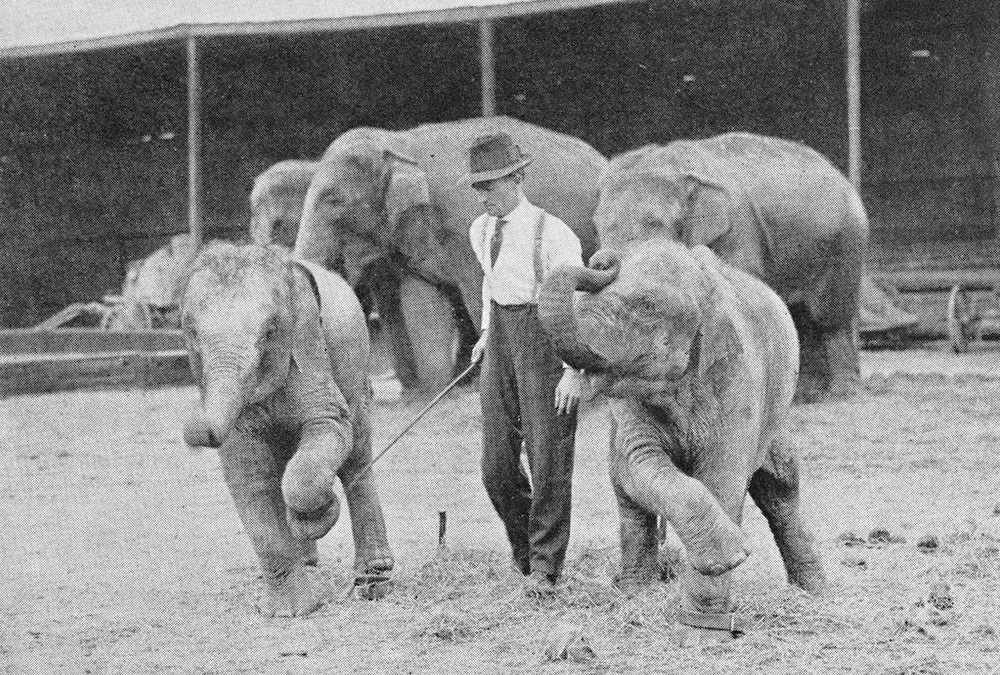
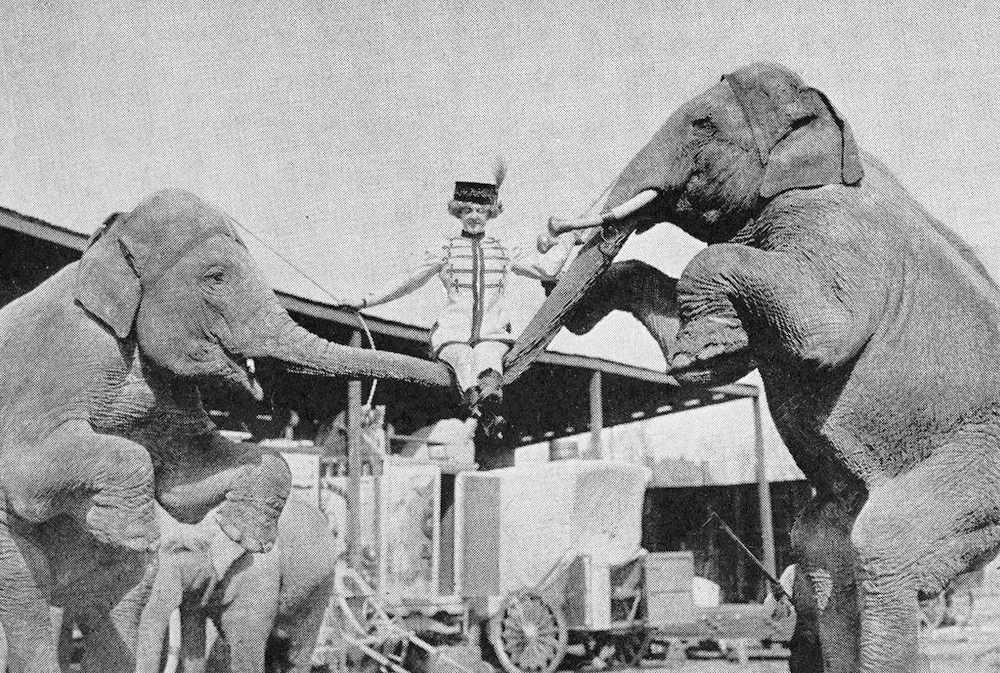
He had an ear for music, that elephant! True, the only notes he could play consisted of the general conglomeration as he blew through the harp, then sucked in the air again, but it seemed to be enough for Barney. Then came a night in the mud, when the poor old elephant was squealing with fright as he sank to his belly in the mire, yet struggled faithfully on at his task of rescue, where the men and tractors and horses had failed.
The work was grueling. It was almost cruel. Not that Barney protested, not that he sought to quit,—but simply through the horrible strain of self-inflicted punishment as the big beast went from one task to another, willingly, gladly, his muscles straining, the huge veins standing forth about his ears like knotted cords. The lot superintendent drew a muddy hand across his forehead.
“Wish we could let him rest!” came whole-heartedly, “but there ain’t a chance. If he don’t work—we don’t get off this lot!”
The bull-tender frowned. He scratched his head. Then suddenly he grinned and hurried away.
“Got an idea,” he announced, over his shoulder. “Maybe it’ll cheer him up.”
He was gone a moment, only to slosh back through the mud, carrying a bulky object which he held forth toward the tired, faithful, old elephant.
“Here, Barney,” he said, “make a little music for yourself as you go along.”
It was the mouth harp. The elephant trumpeted, then projected his trunk. A moment more and he was working harder than ever, the big harp curled in his proboscis, and the exhaust of his tremendous lungs bringing from it strange, sonorous discords. But Barney liked them, which was all that was necessary. When dawn came and the last of the wagons was trundled off the lot, they led Barney to the elephant cars, trotting placidly and serenely,—still blowing on his harp. After that, the instrument became a regular accompaniment. I have seen, more than once, in the gray light of dawn, a tremendous hulk of an elephant pushing circus wagons about as they came from the steel runways of the flat cars, a big mouth-harp curled in his trunk, playing his own particular style of music as he worked!
But to return to Mamma and her colic and the paregoric. Sounds foolish, doesn’t it—paregoric for an elephant? Or Jamaica ginger, or whiskey? Yet it is a fact that paregoric is carried by the gallon with more than one circus, merely to cure colic in elephants. The same once was true of whiskey—with the exception of the fact that it came by the barrel. Of course, that was in the days before the Eighteenth Amendment,—an amendment, by the way, which once, at least, brought its complications in the elephant world. And all because of the fact that Jerry, a seventy-year-old kid, was a toper.
At the same time, Jerry had two other afflictions. One was the fact that he was a chronic addictee of the colic. The other was that he hated the hippopotamus.
When a circus is in winter quarters, a certain amount of laxity is allowed among the animals. There is not the danger of panics, or squeamish visitors, and more than once I have seen a two-year-old lion, known to be harmless to the circus workmen, wandering about, perfectly free and perfectly at peace with the world, being shunted out of the way should he amble into the blacksmith shop, and often kicked, as a big dog would be kicked, when he decided to make his bed on the piles of canvas where the “sailors” were repairing various bits of tenting for the summer. So it was perfectly natural that Jerry, who was somewhat of a clown, should not be constantly picketed with the rest of the elephants in their big cemented space at the end of the menagerie house. The result was that Jerry spent most of his time at the hippopotamus tank.
It was a rough life that he led for the hippo, which, you must understand, is not the really fierce, open-mouthed thing that you see on the circus billboards in the act of swallowing several boatloads of scrambling Africans, but a slothful, slow-thinking water hog, with no thought other than the warmth of his tank and a sufficiency of hay from one day to the next.
Just why Jerry disliked him isn’t known. Perhaps it started in mere playfulness. Perhaps too, it began at some far distant time, back in the dim days of ancestry, for such things happen in the animal kingdom. I once saw a young chimpanzee become hysterical with fright when it was forced, for press-agent picture purposes, to pose on the back of a stuffed baby elephant! The chimpanzee couldn’t forget,—and this in spite of the fact that the baby elephant had been an object of taxidermy for more than five years! Therefore, there is no need to seek the reason for Jerry’s dislike. It simply existed.
All day long he would stand beside the high, steel grating which surrounded the hippopotamus tank, waiting for the big river hog to raise his head from the water. The minute that happened, the elephant’s trunk would shoot forth as sinuously as a snake, and with a smacking blow descend upon the pop-eyed, flat head of the hippo. There was little force to the assault; it would correspond to a human slap, more than the striking of a fist. Yet it was enough to worry that poor old hippopotamus into a state of almost constant submersion. Hour after hour Jerry would await his chance, while the hippopotamus would sulk beneath water, his nostrils barely visible at a far and safe end of the tank. Then would come a moment of forgetfulness,—but never for Jerry. His trunk always was ready. The moment that hippo came into view, out went that stinging, smacking slap, and the poor, persecuted old hip would seek the depths again. Month after month it continued, then Jerry contracted one of his usual attacks of colic.
Rather, faked it, for that was one of Jerry’s best little tricks. He liked the remedy—whiskey—and knew that there was but one way to obtain it. It’s comparatively easy to tell when a human being is a malingerer, but with an animal it is different, and Jerry had all the fine points of the colic well rehearsed. His belly would distend, his eyes pop, and his squeals and grunts become piteous, with the result that the animal men, rather than take the chance of neglecting an elephant which really was ill, would pour a couple of quarts of whiskey or Jamaica ginger down him, mark it up on the expense account, and go back to their other work. Either suited Jerry, for each contained alcohol, and that was all he desired. A short time after the administration of the dose, he again would be on his feet, a bit bleary-eyed and immensely pleased with the world, mildly intoxicated, and too happy even to bother his pet enemy, the hippopotamus. But this time conditions were different.
In the first place, Jerry hadn’t tasted a good drink for a long while. With the coming of prohibition, the usual barrels of whisky had vanished. Jamaica ginger also had become scarcer, owing to an increase in cost. The last few attempts at illness on the part of the elephant had been met by concoctions that were bad-tasting, red-peppery and containing but a small amount of alcohol, incidentally of but small aid in curing elephantine colic. The stomach of an elephant seems built for alcohol; it will respond quicker to whisky than any other remedy.
The result was that the head animal man had prevailed upon the police department to transfer to him, for elephant medicinal purposes, a small barrel of moonshine which had been captured in a raid and contained more of living fire than alcohol. And it was about this time that Jerry keeled over.
The high-proof remedy was brought forth and poured down him. Jerry gulped, and continued to be ill. They tried it again, and Jerry got another drink. Evidently his pachydermic mind was working fast: drinks had been few and far between, and he intended to get as many as possible while the supply lasted. Twice more they poured the concoction down him. Then Jerry rose.
But it was a different Jerry. His eyes had a far-away look. There was a sort of wavering gait to his lumbering walk, and an angular curl to his trunk which denoted that his sense of direction was a bit awry. For a few moments he trundled about the menagerie house, sniffing at the hay, scratching his back against the heavy posts, and squealing delightedly. Then his blinking eyes fastened upon the bulky form of the hippopotamus, just coming out of his tank for an airing.
A trumpet blast, and Jerry loped across the menagerie house. He leaned against the iron grating—and went through. A half hour later, when sweating animal men, with ropes, chains, other elephants and bull-hooks dragged Jerry away, the hippopotamus tank was a wreck, the hip himself had broken away, rampaged through a double door and was shivering in the snow of the outside yard, while the whole animal house had gone wild. Here and there through the cat cages, sporadic fights were breaking forth. The monkeys were squealing and shrilling with fright. The ostriches were holding pugilistic contests; the sacred cattle were milling and horning, and trouble was everywhere. Let one fight start in a menagerie, and they all get the fever. Jerry had started his fight,—and finished it; the poor old hippopotamus was a mass of bruises, cuts and trunk marks, while Jerry, bellowing and leering, strove his best to break away and finish the job. With a larger elephant chained to each side of him, they dragged him to the picket line and imprisoned him there, nor was he ever again allowed the freedom of the animal house. What is more, Jerry now belongs to the temperance forces,—by request. And his attacks of colic have become far fewer, for now he receives only one half of one per cent. remedies.
Surprising that an elephant should get drunk and then attack his worst enemy? Not at all. I have seen them do far more surprising things, and things which would indicate that the scientist who says that an animal cannot reason never studied elephants. When a three-ton beast can display the fact that he knows he is committing theft, that he must choose his time for criminality and then, the deed accomplished, cover up his trail so that no incriminating evidence be left behind, something beyond mere accident must be responsible. It sounds impossible, yet it happened on the Ferrari Wild Animal show some years ago,—and the “criminal” was an elephant.
There is only one time of the day when the menagerie tent of a circus is deserted, and that is the hour shortly before opening time, when, after everything has been made in readiness for the reception of the afternoon crowds, the menagerie and candy force hurries to the cook-house for the noonday meal. It was upon the return from this one day that a complaint came from the menagerie candy stand. Some one had stolen a barrel of lemonade!
“Anybody let them elephants loose?” the menagerie superintendent asked, as the report was made to him. But no one had. The picket line then was examined. Every elephant was in place, every chain safely about the stake in a half-hitch. Suspicion then turned to canvas men and “roughnecks”, who might have sneaked into the tent, stolen the contents of the barrel, and carried the “juice” away for sale at reduced prices to the purveyors at outside “snack stands”, those inevitable booths which are set up about every circus by the townspeople. But investigation along this line also resulted in failure. And the next day the contents of another barrel disappeared!
Now was the time for action, and a guard was set during the noon hour. Nothing happened! The next day, the guard remained, and for four days after that. The lemonade continued to repose undisturbed in the barrel. Then, believing that the danger had passed, the guard was removed,—with the result that the refreshments disappeared once more, lemons, sugar and all! This time Bill Rice, one of the managers of the show, and now a circus owner himself, decided to stand guard, but not in the open.
Hidden behind the side wall, he took his place when the rest of the menagerie crew departed and began his vigil. For a long time there was not a movement, not an indication that the mystery of the disappearing lemonade would be solved. Suddenly, however, his attention centered upon a peculiar clanking noise which emanated from the elephant line. There, one of the largest of the herd was working at his chain with his trunk, raising and lowering the loose end of the chain, drawing it forward, throwing it back; stopping to look about him in fear of discovery, then hurrying to his work again. A moment more, and the elephant stepped forth free, then, picking up the loose chain, so that it would not betray him by its noise in dragging, he hurried to the lemonade barrel, deposited the chain gently on the ground, drank the lemonade, ate the lemons, scooped up what remaining sugar had become deposited on the bottom of the barrel, and the job finished, once more raised the chain and returned to his post in line. There Rice saw the thing which made him gasp. For that elephant had curled the chain in his trunk, and with a single deft movement had placed the “half-hitch” upon the stake again! And even a human must take a lesson or two before he becomes an adept in the “half-hitch!”
This is the sort of thing which gives a circus man a feeling of almost reverence for elephants. Once in the circus business, once aware of the strange things that the beasts will do, nothing seems impossible for them. Perhaps the circus man gives them credit for too much brain power. And perhaps, on the other hand, even he underestimates them. For there are things which are not easily explained.
I have known an elephant to kill his trainer while in a rage, and then later mourn for him, displaying all the remorse, all the evidences of conscience that could possibly be shown by a human murderer. I have known elephants to work with their worst enemies in performance, to exert every possible effort to “put on a good show”, to be friendly and even helpful with those enemies in the ring,—yet once outside the big top, to refuse utterly to abide them. A dog, for instance, is an object of dislike to an elephant, but he will go into performance with one and appear absolutely satisfied. But let that dog come within his range while he stands in the picket line!
I once saw the execution of a “killer” elephant, while visiting a small show in South Dakota. For twenty-four hours, ever since the murder, the brute had been a prisoner in the big elephant car, surly and sulky and defiant. Yet when the show management ordered a switch engine to each end of the car, when the beast’s hind legs were being fastened to heavy, hempen ropes, leading through the opening of the rear end of the car to one switch engine, and a steel-cable noose, attached to the other engine, was being fashioned for his neck, that beast ceased his angry trumpeting and sullen grumbling. Instead, a piteous note came into his call. He curled his trunk in, and when they beat it away with their bull-hooks, he sank to his knees and begged! What was the explanation? Why should that elephant have ceased his defiance, to become friendly, even piteously supplicating as they prepared for his death? A circus man will tell you he knew that his time had come, and knew he was begging—and begging in vain—that they spare his life! I still can hear the cries of that elephant as the noose was placed about his neck and the signal given to the engineers to tighten the ropes; it was like the cry of a soul in terror! To a circus man it is explainable. That elephant knew. Some innate sense of right and wrong told him that he had committed a crime and that he was to be punished. But here is a happening which even a circus man will not attempt to explain, for it goes into something deeper, something more subtle even than intuition:
Last year, on a western circus, Snyder, the biggest elephant of the herd, went bad. The story of his killing has been told and retold, for it was a dramatic affair which included even the wrecking of a menagerie. But there is one angle which has not been touched upon:
Snyder’s whole venom that day had been centered upon another member of the herd, Floto, whose sole offense, it seemed, was that he was the most docile of the herd. Hard-working animal men had kept them apart by a bulwark of elephants; to attack Floto, Snyder first must attack in turn Mamma, and Frieda and Alice, all nearly as large as he, all capable of giving him a good fight, and not one afraid. Snyder seemed to understand. A few sallies, a few rebuffs in the shape of swift-lashing trunks, and he confined himself to attempts to sneak around the end of the herd, or to catch Floto at a moment when he was unguarded. But this was impossible. Then came the time of execution.
The rifles were ready. Fingers were at the triggers. But humanity on the part of the animal men demanded that first the swiftness of poison be attempted. The heart was cut from an apple, and the space crammed with cyanide of potassium, enough, in fact, to kill several elephants. Then, cajoling and tempting him with the fruit, the superintendent went as near the mad beast as possible and tossed him the poison-laden sphere. Snyder stepped forward eagerly; he had not been fed for twenty-four hours. He stretched his trunk to raise the fruit, sniffed at it, stopped, and drew away. Then with a sudden movement, he grasped it again, and whirling, tossed it over the backs of the protecting herd, straight in front of the hated Floto. Only the swiftness of an animal man, who darted under the elephants and seized the apple before the greedy, slothful pachyderm in the rear could grasp it, saved the show from the loss of a second and innocent brute.
How did Snyder learn in that brief second of sniffing that the red, alluring apple was in reality a thing of death? And did he seize the chance to accomplish through strategy what he could not achieve by physical force?
You may answer the question yourself!
Perhaps at some time in your life you’ve stood in front of a lion’s cage at a circus, watching the pacing beast within and speculating upon what is happening in the mind of the shifting, uneasy creature as he makes the rounds from one end of the den to the other, poking his heavy nose against the bars, leaping upon the partition at one end, rebounding, growling, then springing at the heavily barred, double-locked door before taking up his pacing step once more.
Presumably it is easy to read that mind. He wants to get out. There is murder in those deep eyes; you can see it. The gruff growl is one of hate and malice and enmity toward all those about him, toward the trainers with their feeding forks, toward the massing crowds flooding through from the marquee for their look at the menagerie before traveling on to the seats of the big show. You can see viciousness there, and bloody desire and determination. You know that only one thought occupies that bestial brain,—to escape those steel bars, to break forth upon the humans he hates, to destroy, to devour.
And the only discrepancy about the meditation is the fact that you are entirely wrong! If that lion is thinking at all, he’s wondering whether he’s going to get a bone for breakfast the next morning, or whether it will be lean meat. As for escaping,—why should he leave a good home and make a lot of trouble for himself? That pacing and leaping is merely obedience to a natural law which commands that he take a certain amount of exercise, nothing more.
Not that jungle animals often do not commit murder when they escape. But when this happens it usually is the result of long waiting for a specific object. A leopard, for instance, will take its chance at death that it may kill a trainer it hates. But ordinarily the jungle animal that you see within a cage at a circus has no idea and no desire to leave. If it does, it isn’t happy until it gets back into its dear old cage once more, back home where there is safety and comfort and where the world isn’t rough and uneven and decidedly unpleasant,—as it is outside the bars. Queer, but it’s true; the escape of an animal about a circus is often funnier than it is serious.
There must be a reason, and there is. The usual animal that you see in the circus isn’t a product of the jungle. He wouldn’t recognize his “native heath” if he should be introduced to it. His world from cubhood has been a cage; he was born in one, he was reared in one, and he knows absolutely nothing about the other life. He regards his cage as his home, as his natural habitat, and is lost without it. True, give a lion or tiger or leopard even a day in the open country, and he will revert to type. The old instincts will come upon him, he will kill his food in the same manner that his ancestors killed, when they were wild, free creatures, knowing nothing else. He will become the savage beast that his instincts command him to be. He will fall as naturally into the stealth, the sagacity and the cunning of the jungle as though he had been bred to that life. But he can’t do this in a few minutes. The result is that when he does escape, through innate animal curiosity which leads him to investigate why his cage door should be open instead of closed, or why a lock or bar should give beneath his weight when he leaps, he finds himself in an unkind, noisy, excited sphere full of troubles and annoyance, and wishes that he’d never wandered from the old fireside.
It’s a sort of animal psychology. A beast may be mean within an arena. He may even be a killer. Yet once on the outside, he may be a poor, befuddled thing, happy to find again the open door leading to his cage, and glad to get away from the hurly-burly into which a misstep of curiosity led him. His mind leads no more naturally to thoughts of escape than it would to tatting or embroidery. If you doubt the fact, watch closely the next time you witness a wild animal act. You will see that the arena is of steel, that the door is safely trussed and laced with heavy leather straps. But that the entire top of the great, metal enclosure is covered with nothing more than a broad expanse of woven hemp netting! And as an illustration of that little remark about the “killer”:
One time, Ed Warner, general agent of a circus, and myself stood in the wings of a theater in Denver. We were making the lions and tigers of the circus pay for their winter feed by a short tour of vaudeville performances, and out upon the stage Captain Ricardo, the trainer, high-booted, gold-laced, was sending the tawny beasts through their category of tricks, meanwhile keeping a weather eye trained upon a vicious, murderous, inbred lion, whose sole desire seemed to consist of an ambition to separate “Cap” from his internal arrangements. Day after day, week after week, and month after month, through the summer season of the circus they had fought and sparred, the lion snarling and roaring on his pedestal, his claw-fringed forefeet striking out in vicious circles as the whip of the trainer curled toward him, the lips drawn back from the ugly, yellow teeth, the evil eyes narrowed and squinted, his whole being one of fierce animosity toward this one hated personage, his trainer.
The act was nearing its finish, the leaping of the hurdles by the various trained beasts and “Cap” was putting the barricades in place. One of them stuck; the trainer yanked at it in an effort to straighten it and failed. With a leap, he then rushed forward to correct the position of the hurdle, and in doing so cramped himself between the “turntable” and the steel walls of the arena, with his back half-turned toward the killer.
“Cap! Cap! Look out!”
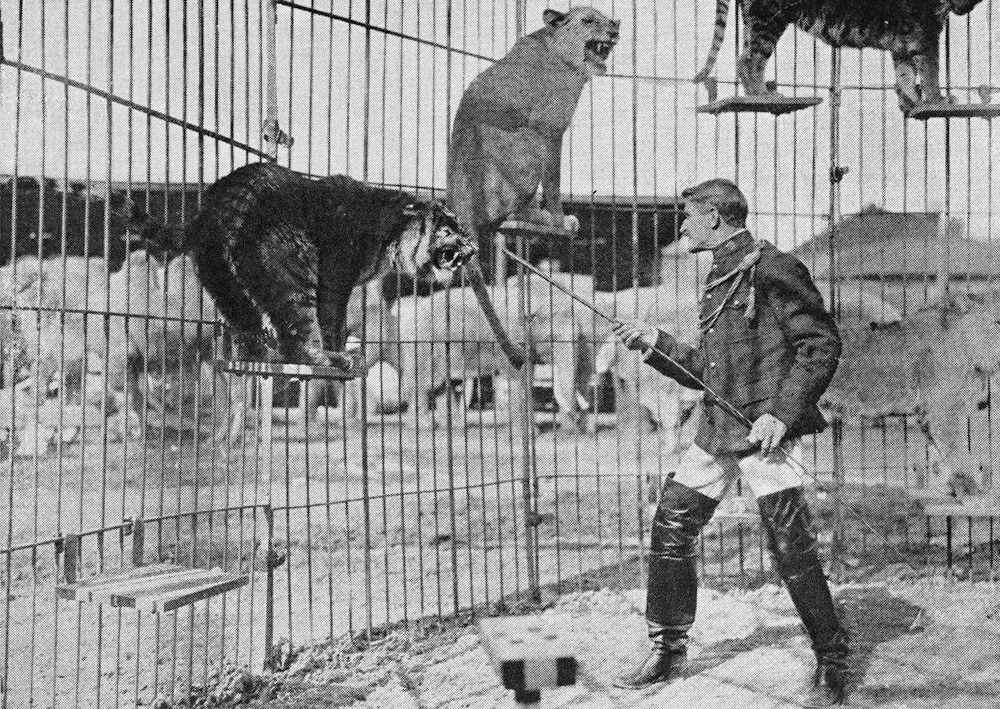
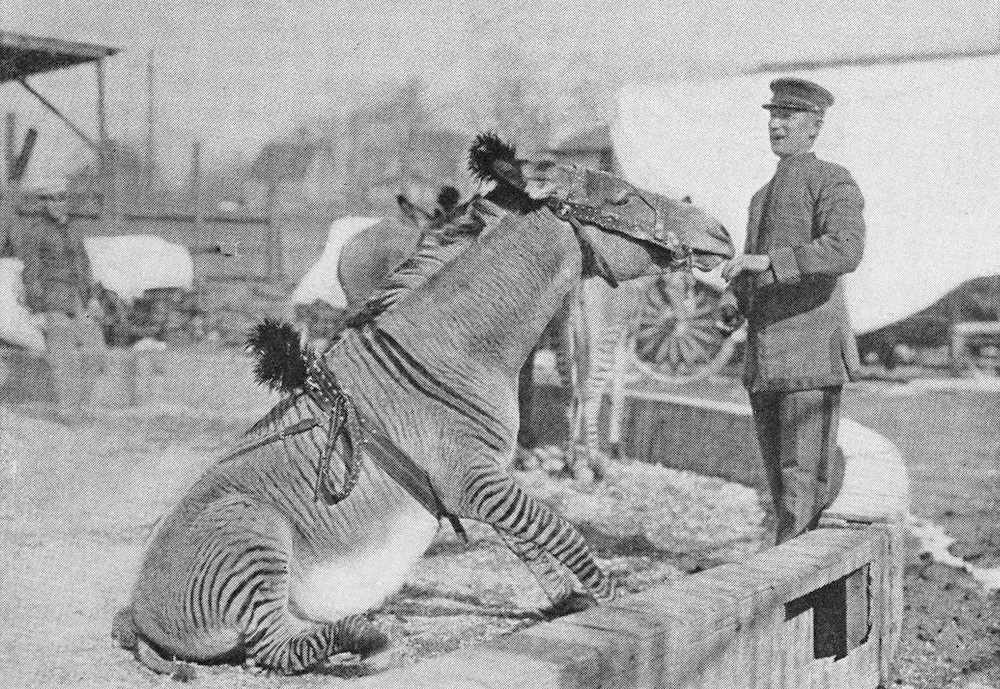
Ed and I were shouting from the wings, regardless of what the audience might think. For the killer had jumped from his pedestal and was creeping forward with all the sinuosity of a snake, toward the victim for whom he had waited. The trainer turned to find the ugly, open jaws of the lion not three feet away!
An instantaneous action and he had drawn his revolver, with its heavily wadded blank cartridges, sending shot after shot straight into the eyes of the malicious beast, the powder singeing the hair of the broad, flat forehead, the wadding stinging and disconcerting him. The lion whirled dazedly and pawed with the pain of the attack. The instant was enough for the trainer to jump clear and bring his bull-whip into action, while Ed and I—it was in the days before the Eighteenth Amendment—hurried out to get something that would put the strength back into our knees.
A week later, we were in another theater. It was just before the performance, and the three of us were in the trainer’s dressing room listening to a recital by the lion-man of how he inadvertently allowed one finger to rest too long near a lion’s mouth,—hence the missing digit. Above us was scuffling and noise, bumping and shouts, and Warner grunted.
“They sure make plenty of noise when they set a stage at this show shop, don’t they?”
“You said it.”
We continued our talk, while the noise above grew greater, finally to still. There came the sound of clanging steps on the iron stairs leading from the stage. Then the door was thrown open, and a belligerent stage carpenter faced the animal trainer.
“I wish you’d keep them toothless ole lions o’ yours locked up,” he blurted. “I’ve had a helluva time with ’em!”
“You?”
“Yeh. Came on the stage just now and found three of ’em wandering around. I gave two of ’em a kick and they jumped back in their cage, but the third one tried to get funny with me. So I whaled the tar out of him with a stage prop and made a cut alongside his head. Better get up there. He’s bleedin’. But I couldn’t help it; we can’t have them things runnin’ loose when we’re trying to set a stage.”
We went upstairs, to find, half-sitting, half-leaning against the side of the cage, a disconsolate, amazed lion, staring dejectedly through the bars and licking the blood which ran down his nose from a cut just in front of one ear. He had the appearance of some one who had encountered a very, very rough time, and who had not yet recovered from his fright and his surprise. We simply stood and stared. It was the inbred, the killer! Nor did we tell the stage carpenter his record.
The explanation is simple. In his cage, that lion was a bully and a ruffian because that was his element, that his stamping ground, that his home. But once outside, he had lost his bearing, the attack of the stage carpenter literally had swept him from his feet, and he had turned from a killer to a coward.
Nor is this the only instance. There is in the carnival business a personage known as Bill Rice. Every one in the circus or carnival business knows Bill. They don’t know his shows, for the simple reason that he changes his mind about every season and puts out a new one. This was one of the years when he was running a circus and, of course, presenting each day a street parade.
Among his animals was a vicious lion. And one day as the den was being cleaned for the parade, the animal man forgot to put into place the bar which held tight the steel door.
The cage went out on parade. The lion began to pace its prison. A jolt, and it struck the door. A second later, while telephone poles became clustered with human fruit, while horses reared and plunged, while women reached for baby buggies and hurriedly got them out of the way, forgetting entirely the fact that the babies themselves had been placed on the curbing, while men seized wives in their arms and hustled them to safety, without looking to see whether they were their own wives or the wives of some one else, the lion plumped to the pavement and stared dizzily about him for an instant, while he tried to fathom what had happened.
Then came panic. On all sides, including that of the lion. The cage had gone on. The horses pulling the den immediately in the rear had engaged in a runaway. Everywhere, people were shouting, milling, running and climbing trees and telephone poles. The lion scrambled vaguely, made a false start or two, whirled, then dived straight for a small negro restaurant across the street.
The restaurant had been full when things started. But its windows had opened automatically, through the simple method of persons going through glass, sash and all. At the instant the lion entered the door, a negro waiter was just arriving at one of the front tables with a tray of food. He saw the lion. One wild toss and the leonine beast found himself in the midst of a shower of soup, ham bones, chitlins and whatnot, while the waiter, screaming, made for the kitchen.
It was a bit disconcerting. For one excited, panicky second the lion fought the clattering dishes, clawing at them and biting vaguely at the atmosphere. Then stung by hot soup, half blinded by the pounding of crockery as it descended upon his eye and skull bones, he leaped at random and ran for a new place of hiding. And his path led toward the kitchen also!
The chef went out a window. Also the waiter. The dishwasher, deafened by the clattering of the crockery which he was massaging, had not received the warning in time to avail himself of a method of exit. He turned, saw a lion entering his domain, and did the only natural thing, opened a small door leading to the drain pipes beneath the sink, and dived in. Just then, some excited person appeared in the front of the restaurant with a shotgun, and fired.
The charge went wild except for a few shots which did no more than sting the lion’s hide, but the noise was enough. Befuddled, bewildered, in the midst of a strange world and a conglomeration of annoying surroundings, the beast leaped again and sought retreat.
Happiness! A hole! Something to crawl into, some place where he might hide! It was the opening beneath the sink. And there the animal men of the circus found them, a fear-whitened, speechless negro, and an amazement-stricken lion, wedged in together, side by side, and neither making the first move to come out. The lion didn’t want to. He was safe in a hole. The negro dishwasher couldn’t. Even after the lion had been lassoed, pulled forth and dragged like some great, shaggy, recalcitrant dog into a shifting den, the dishwasher could do nothing but gasp and sit there beneath the sink. And between the two the lion was perhaps the more frightened!
Talk to the animal trainer, and he will tell you that as a rule it is not the maliciousness of an escaped animal which causes trouble. It’s the panic of the crowd about him and the fright of the animal himself. The fear in a beast’s mind when he suddenly becomes free is all pervading. He does not know that every one else is afraid of him; he believes that he is in a world surrounded by enemies, that the safety of the cage has vanished, and that he must fight—if fight there be—for his very existence. It was during such a case as this that a tiger which escaped from a circus at Twin Falls, Idaho, a number of years ago, killed a child, and was in turn killed by Frank Tammen, the manager of the show, with a revolver. In his native state, a revolver shot would mean nothing to an eight-foot, four-hundred-pound tiger. It would simply bring a charge and the death of the hunter. But in the circus, the tiger was killed simply because he was out of his element, he was frightened, dazed, and he had not been loose sufficiently long to gain the natural savagery which time would bring him by the sheer command of instinct.
In fact, panic is the ruling power of the suddenly loosed animal. In elephants this is almost invariably true. Yet in spite of it, there is always an indication that the ruling sense of humor which appears always to be present in the elephantine mind, is there even in the frenzy of flight. And when the elephants break loose, there is this to remember: keep out of the way! For an elephant does not know how to go around anything. His ideas run along straight lines, and his paths follow his ideas.
In Winnipeg, for instance, several years ago, a circus was showing on the fair grounds. A severe storm came up, and the elephants became frightened. They decided to run, the whole herd of them, and some thirty tons of elephantine flesh suddenly broke loose and headed for new and open fields where there was no thunder, no lightning and no wind.
Before them was one of the buildings of the fair association. It was a solid structure, built to stand year after year. At least, that was the idea in the minds of those who had erected it. But the path of the escaping pachyderms was on a line that included the building! The head of the herd, leading the chase, could have turned to the right some fifty or seventy-five feet and gone on without an obstruction. Was it done? It was not. A building showed ahead of her; she lowered her head, and hunching her shoulders, went on. A crash, the splintering of wood, the flying dust of mortar and the clattering of brick. Where the wall had been was now a hole, with the rear end of an elephant disappearing within, followed closely by the rest of the thundering herd, each one taking out a bit more as it went through.
The other side—and a repetition. When the runaway was over, the building contained a perfect tunnel. As for the elephants, they ran until they became tired, breaking down a few fences and wooden sheds and other inconsequential impediments which had arisen in their path; then they stopped at a haystack and gorged themselves until the trainers arrived, gave them all a good berating and hustled them back to the show again.
The same was true in Riverside, California. There it was the same herd, led by the same old elephant, old enough, one would think, to have better sense, since one hundred and twenty-five circus seasons had passed since she was a bouncing baby of some three hundred pounds. This time Old Mamma led the way through a barber shop, taking with her, draped over her shoulders, the mug rack which hung at one end, and distributing along the street the vari-colored shaving-soap receptacles with their gaudy lettering and resplendent flowers, while the rest of the herd, trumpeting and bellowing, clattered along in the rear. From there the course led down the street, where, a bit tired, Mamma stopped at a fruit stand, the rest of the herd nudging up beside her, while the proprietors yelled for the police,—and departed.
The oranges and apples were great. Mamma enjoyed ’em. Also Alice and Floto and Frieda and the rest of the bulky runaways. In the rear the crowd, recovering a bit from its fright, began to close in. Just then, however, Mamma happened to notice that within the store hung a beautiful bunch of bananas. So she went in, taking the door with her. After that a new panic, for the floor was breaking, and an elephant hates an unsound footing. So she and the rest of the herd went out again,—through the wall on the other side!
Once more a runaway, which led to the free and open country. An hour or so of wandering about. Then the herd grew tired. Back into town it came, and a few minutes later, a yelping livery stable owner scurried down the street with the announcement that his place of business had just been visited by a flock of elephants that was eating up everything in the barn!
There the animal men found them, peaceable, glad to obey their commands, happy and squealing and grunting as they answered the shout of “mule up” and trudged back once more to the circus. And the animal men will tell you that when the elephants dropped in at that livery stable they were doing their pachydermic best to get back to the show. They were through with their panic, they realized that they were lost, and they had but one thing to guide them,—the smell of fresh hay which would indicate to them the menagerie. They found that odor in a livery stable, and there they stopped. It wasn’t exactly home, but it was a good substitute.
It is indeed seldom that the escape of any animal in a circus is a premeditated thing. The accidental opening of a door, the breaking of bars, or a wreck of some sort is the thing which usually leads to the cry “Th’ lions is loose!” or the scurrying of a wild beast through the menagerie. But premeditated escapes have happened, and among them is the story of Fuller, a gigantic black-faced chimpanzee, whose mind, according to the scientists, was but a few notches below that of the human.
Fuller once had been the pet of a Pasadena millionaire and had been allowed to run loose about the estate. However, that brought complications. Residents of the neighborhood began to complain that their houses were being burglarized, ice boxes robbed, and in one instance an elderly man who affected a silk hat, Prince Albert and cane, investigated a noise in the hallway to find a six-foot chimpanzee just making his exit with his cane in one hand and the silk topper slanted over one eye. Then Fuller began to invite himself to breakfast rooms, even bedrooms, loping in the windows at inopportune times and causing everything from hysteria to riot calls, with the result that he ceased to be a pampered pet and became a circus exhibit. And there, for the first time, Fuller found out what it meant to hate. Not a hundred feet away, in the winter quarters, was the elephant line and that, to Fuller, meant trouble.
The elephant and the chimpanzee are natural enemies. That enmity came into being in the circus winter quarters, and the gigantic Fuller spent most of his time sitting crouched in his cage, grimacing and yowling at the hulking beasts, even repeating one of his tricks of other days,—that of wiggling his fingers at his nose. Day after day he worked at his chains, loosing them, only to have them replaced by the animal men. Then one night the telephone in the winter home of Henry Boucher, head animal trainer of the circus, whirred viciously. He answered to find the night watchman at the other end of the line:
“Get over here as quick as you can!” came the excited message. “Fuller’s loose and he’s whipping all the elephants! They’re about to bust through the building. Hurry!”
Boucher hurried,—to find that the watchman’s report had been correct. The herd had broken loose from its picket pins and was crowded in one corner of the building, milling and trumpeting. Only one elephant still was showing fight, a great tusker, and he was about ready to quit. His rushes had availed him nothing; Fuller merely ducked out of the way, and chattering, returned to the attack. The long, heavy tusks had been useless. Their thrusts struck only air as Fuller dodged them. The great blows of the forefeet, aimed at Fuller, had hit nothingness. The sweep of the heavy trunk had inevitably been met by the chimpanzee, who grasped it with his great hands as it circled toward him, then swung upon it until it had lost the force of the blow. Without inflicting a single injury, Fuller had won a “moral” victory simply by tantalizing the great beasts until their frenzy had reached the point of panic. And then Boucher approached him.
A kick, a cuff and a few cusswords. Fuller—his weight was close to two hundred and fifty pounds, and the strength of his great shoulders sufficient to tear a man limb from limb—merely squealed, raised one arm in front of his face like a child afraid of a slapping, then, in obedience to the command, trundled back to his cage. He had achieved his aim. He had wanted to whip those elephants, and he had done it. The object accomplished, he went back to captivity in peace.
But things do not always end as amiably when the circus animals get loose. As is the case with disease, the complications following the escape of jungle beasts often causes more excitement than the escape itself. To wit, the story of Bad Axe, Michigan, and an “escape yarn” that has become laughing history in circusdom. The recital requires a bit of an introduction.
Kaiser and Sultan, two of the lions of the show, were a bit different from the usual run of beasts, inasmuch as they had been led about as pets until almost the last possible moment when their catlike natures could be trusted. Strange as it may be, this often leads to bad temper when the beasts have reached the adult age, and certainly in the case of the two lions, there was little of fear and little of bewilderment when an animal man inadvertently left open a door of their cage and allowed them to wander forth.
The show at this time possessed what it once had believed to be a wonderful feature,—the result of a government experiment which had resulted in the cross-breeding of a Grevy’s zebra, from Africa, and a Rocky Mountain “Canary”, or burro, from Colorado. The result had been a strange and fearsome beast, possessing the striped body of a zebra, the uncertainty, the viciousness, the meanness and wildness of a jungle animal, combined with the head of a Missouri mule and all that goes with that contrary creature. Long months had been spent in training the things, with the result that they did wonderfully well in rehearsals, and the opposite during the performances. It was nothing at all for the “Five United States Government Hyneys” as they were called, to enter the show tent at a trot,—and keep on trotting. You could find Hyneys scattered all about the circus grounds—and about the town for that matter—trampling gardens, eating up flower beds, kicking the stuffing out of poor, innocent country horses who didn’t know enough to kick back, running up damage suits, attachments and causing trouble in general for the circus fixer. It was a dull week indeed when the Hyneys didn’t run away at least three times. Often they batted a thousand by pulling a runaway once a day. The result of which was a change in the circus program, from a glowing announcement of these wonderful beasts and the astonishing category of tricks which they had mastered, to the simple announcement:
The Five United States Government Hyneys
Will Now Proceed
TO DO AS THEY PLEASE!
Which they did. And which leads to the opening of the drama of Bad Axe, Michigan. It all happened before the show. The parade had just returned to the lot, the cages had been “spotted” in their regular places in the menagerie, and in the big top, or main tent, the canvas men, the roughnecks, the seat and plank men, the property men and “punks” were busily engaged in putting on the final touches before the opening of the doors for the matinée performance.
Everywhere was the well-greased, smooth-working activity of a circus in its final moment of preparation. From the padroom, a “pony punk” was leading the five recalcitrant Hyneys back to the menagerie from a short and eventful runaway. At one of the forward center poles, “Cow”, an assistant boss canvas man, was holding an iron stake which “Fullhouse”, a workman, was about to pound into the ground with a sixteen-pound sledge. Everything was traveling along smoothly, beautifully. Then a streaking figure shot from the “connection” or entrance to the menagerie, his arms waving, his eyes wild.
“F’r Gawd’s sake, run!” he yelled. “Th’ lions is loose! They’re right behind me!”
And they were,—Sultan and Kaiser, entering on a trot, perfectly composed through the experience of others days when they had been led about at the end of a leash as cubs, and looking for trouble. The center poles became alive with property men and seat-workers. Two-hundred-pound “Fat”, a plank man, made a three-foot leap for a trapeze tape and clambered up it in a far more agile manner than the acrobat himself could have done. Fullhouse dropped his sledge and ran a half mile to a tree where he was found roosting an hour later. “Cow”, still holding his iron stake, looked around somewhat hazily, saw Sultan only a few feet away, swung high the stake, walloped the lion in the forehead, knocked him flat and all but unconscious, then did a bit of running himself. Just then Kaiser saw the Hyneys with their zebra stripes, and a new angle of activity started. The zebra forms the lion’s natural meat in the wild state.
It all seemed to come back to Kaiser,—the old call of the veldt. He roared, with a note strange to the circus menagerie. Then he leaped, claws extended, mouth wide, straight for the rumps of the nearest Hyney.
But that was all. Out came vicious heels that caught the beast in the chest and knocked him back. He came on once more, only to find the world filled with kicking, sharp hoofs that battled him in the face and head and chest, that knocked the wind out of his lungs, that cut and whanged and battered him until at last, whimpering and bleeding, he turned and sought flight, the animal men after him, leaving behind a mulish, contrary creature that allowed his ears to go flat, and his raucous voice to raise in a long hee-haw of victory.
One lion was blinking in the daze of returning consciousness, the other was whipped and cowering in a clump of brush near the tent. Both of them were more than willing to quit. But the excitement still went on, for the elephants had decided to become panic-stricken.
The lions had passed the elephant line before the hulking beasts seemed to realize that the right and proper thing for an occasion like this should be a runaway. Whereupon the head of the herd emitted a bellow of excitement, pulled her stake from the ground, and made a hole in the side wall of the tent for the general exodus. One by one the big creatures ambled forth, squealing and trumpeting, the noise of their exit calling a small contingent of the animal men from the primary business of catching lions. Only one arrived in time, Boucher, the menagerie superintendent, and he got there just as the rear of the last elephant was disappearing.
A leap and he caught the hulking, squealing beast by its piglike tail and sought to run along behind it until his shouts could bring the head of the herd to her senses. He was wrong. The elephant herd merely rounded into express-train speed and kept going, while Boucher, his feet touching the ground once in a while, still clung to the last elephant’s tail and yelled himself hoarse, in vain. Then—more complications!
An eight-horse team, harnessed to an empty pole wagon, was just crossing the lot, quietly, peaceably, without any knowledge of what had gone on in the tent. Then came the elephants! Swarms of elephants, trumpeting, squealing, and thundering, as they came up from behind, alongside the wagon and its eight horses. It was too much. The driver pulled and tugged his best. It was useless. The horses, all eight of them, with the pole wagon clattering along behind, ran away also. Their idea was to evade the elephants. The result was that they stayed side by side, neither gaining on the other, while in the rear, Boucher still hung to an elephant’s tail.
Half across the lot and another element entered,—a man in an automobile. Glancing over his shoulder, he saw a world full of elephants and horses, all coming toward him at once. So he decided to move faster than they. He didn’t. Just as his machine got into its speed on the rough, rutty ground, the elephants and horses came alongside.
And side by side the race began, the queerest race, so circus men say, in history,—a herd of elephants, an eight-horse team attached to a wagon, and a human being in an automobile. The elephants bellowed. The horses did all but scream. The man on the pole wagon yelled, and so did Boucher and the driver of the automobile.
Just before them stood the cook house. The automobile, under the guidance of a human being, ran halfway through the tent before it could be stopped. The elephants slid on their haunches and decided to quit. The horses, with a sudden swerve, ran around the end and finally came to a halt. The race was over. And the queer part of it all was that by this time the lions were back in their cages, both of them whipped to a standstill, and both of them glad to be home again where there were no hoofs or iron bars, and where life ran on the level!
And so goes the usual animal escape. There is often more to cause laughter than tragedy. For it is the good luck of the circus that most escapes happen when the tent is empty, during the cleaning time of the cages, or during a storm when the performance has been abandoned. And it is seldom that the audience itself suffers as a result. There have even been cases where animals have escaped during the performance of a circus and been recaptured, without a person in the great throng knowing anything of the occurrence!
I once saw a picture in strange surroundings. It was “The Madonna and Child”, tacked in a lion’s den by a bent old keeper who had cut it from a magazine and posted it there. Beneath this symbol of a sacred thing was a lioness and her cub.
To the old animal keeper there was nothing unusual about it; merely a comparison of beautiful motherhood.
Perhaps the old keeper was right in his picture comparison. Perhaps he was wrong; perhaps too great familiarity with the jungle beasts under his care had endowed them with qualities not apparent to others. But this I know—when it comes to the most wonderful thing in the world, you will find in the cages of the menageries the same things that you find in every day life: I mean the exalted emotions of motherhood.
Perhaps you have seen an overworked woman who has become a mother, a gaunt, scrawny, weary-eyed person in whom the mother instinct has been stifled by the necessity of hard work; the woman whose life consists of nine long hours every day in the factory, who drags her steps homeward and then, in seeming indifference to her offspring, disregards the cries of the child for companionship, for love and for evidences of affection? Magnify this a hundred times, and you have the “working mother” of the menagerie. It is almost an invariable rule.
Incidentally, they have a saying under the canvas roof of the circus menagerie which might be adapted to home life,—that the mother instinct is something which must be fostered and aided in developing. Were lawmakers to study this phase of animal life, it might mean some different statutes in regard to women who work in factories, and whose life is a drudgery, for as a rule, the brute animal is treated with more kindliness in this regard than the human. The woman continues to work; there is nothing else for her to do if she is to earn the food to place in the mouth of the child-to-be. The animal mother, as a rule, is treated differently. She becomes a ward of the circus, to be pampered and petted and cared for until her child is born and until the mother is strong enough to go forth once more into the circus world and earn her living.
The side boards about her den are drawn, and she is in solitude. She is allowed the peace and quiet which she deserves. Every brute comfort is hers. The mother instinct is allowed to develop without the interference of outside influences,—with the result that the circus becomes the possessor of a healthy lion or tiger cub, as the case may be. Or any other animal, for that matter.
But sometimes, through ignorance or carelessness, the rules are not followed; the working mother is treated as the human mother too often is treated, with the result that there is a neglected child, a scrawny, underfed, undernourished thing which crawls piteously about and too often dies. If it lives, it is because the same thing has happened that happens in the human sphere,—the infant has become a bottle baby.
You can find the story of these bottle babies on nearly every circus, accompanied by caustic remarks for some animal man who didn’t know enough to allow the mother instinct to take definite form in the mind of an overworked brute. They are orphans, and, as in the case with humans, they start life under a handicap.
On a circus with which I once was connected, there came to the train one night a woman animal trainer, carrying something soft and furry wrapped in a shawl. Investigation proved it to be a tiny lion cub, born that day to a lion mother who had been forced to work in the arena until almost the very moment of her cub’s birth. The result was that the mother had neglected her child. Staring, wondering, the poor mother had wandered about her cage, not knowing what had happened to her, not being able to understand that this furry little ball of fluffiness was her own life and blood. When its tiny paws had struck at her breasts, she had clawed them away, as she would have clawed away an intruder. So the animal men had taken the child from her and given it to the woman trainer, to be raised as a bottle baby,—a poor little thing condemned to orphanage because his mother had not been allowed to intensify the instincts which would have told her what motherhood meant.
There at the “grease joint” as the little restaurant which is set up every night besides the loading runs is called, we named him “King” and hoped for his success in life. But we knew what would follow,—that he would have the same inclinations as any motherless human child, that he would develop traits, the counterpart of which can be found in many a waif of the higher stratas of life. But we hoped, nevertheless.
“King” became the pet of the circus train. Far in the night, as the long strings of flat cars and sleeping coaches were grinding their tortuous way from one city to another, a wandering porter suddenly would be frightened by the sight of two glaring, green eyes, then hurry forward to rescue the shoe of some actress, or actor from the spot where “King” had dragged it to chew it to pieces. Nothing was safe from that lion cub. Regularly three times a day he had his bottle, a regulation child’s nursing bottle, upon which he pulled with all the enthusiasm in the world. Every one petted him, every one pampered him. The clowns tried to teach him comical tricks, and he learned them. There even came the time when, about a quarter grown, he would follow the actors to the “grease joint” after the night performance and beg for food from the table, with the result that the clowns taught him to eat even strawberries and cream! Then the inevitable happened.
King became so large that it was impossible longer to allow him out of confinement. His claws had grown until they were more than half an inch in length. There were horses and ponies and small “led stock” constantly about the train, and there was the fear that some day the brute instinct might come to the surface and King would leap to the attack. The result was that he was caged and an attempt was made to train him. It was impossible. King had been a waif, and the life of a little outcast had made him a renegade.
All the wiles which the trainers knew were practised upon him. They were of no avail. Intractable morose, hateful, King spent the entire time in the arena in lunging at the trainers, in roaring and clawing at them, and in making attempts to tear out their lives. Day after day the sessions continued. Then the animal men, droop-shouldered from fatigue, sought the circus owner.
“It’s no use. That orphan won’t work. He’s turned out just what we thought he’d turn out to be. Either we let him alone and simply use him for exhibition, or we’ll have a killer on our hands.”
Nor is there any better comparison for the few lines which we see so often in the newspapers:
“The prisoner pleaded for clemency on the part of the judge, giving as his excuse the fact that he had been allowed to run wild as a boy, without restraint and without the benefit of home training.”
Such is the usual story of the overworked mother and the bottle baby. But in one case, at least, it was different,—a case which made circus history, and which began one of the most beautiful stories of the circus menagerie,—a story of mother love transferred and glorified.
It was in the winter quarters of a western circus that Mrs. Fred Alispaw, known to the billboards as “Zora, the Bravest Woman in the World”, arrived one morning in the early spring to take up the work of training the “cats” for the road. Into the steel arena they went, the sleek, striped tigers, the heavily maned lions, and lastly, the pet of the group, “Beauty”, a great Bengal lioness, usually the most tractable of the whole group. But on this day, something was wrong. Beauty refused to respond to the demands of the trainer; she was surly and defiant and even vicious. Until dusk, Zora strove to subdue the beast, but in vain. An hour later came the reason, in the word that Beauty had given birth to a cub. More, she had refused to care for it.
Hurriedly the trainer went to the great cat’s cage, to find her wandering about in a dazed, stupid manner, while far in a corner of the den was a piteous, yowling bit of animal life, the neglected child. The animal tenders had not known. Beauty’s cub had come into the world without the aid of mother love. Beauty simply could not understand; her attitude toward her baby was one of plain indifference. The only thing she could know, the only thing she could feel was pain.
Until late that night, the trainer and animal men sought in vain to make the mother understand her duties. It was impossible. Then Zora made a decision:
“Beauty’s never going to raise that cub,” she announced. “The only thing we can do is to try to find a substitute.”
Hurried calls were made to the Home for Homeless Animals, then to the dog pound. At last the word came.
“We’ve got a little Skye terrier out here with four puppies. Think she’d do?”
There was a long debate. The terrier itself, they knew, would be little bigger than the cub. But a chance was better than nothing at all. So out into the snowy night went Zora, to return at last to the menagerie house with a big basket, closely wrapped. In it was a fond-eyed little Skye terrier, whose motherhood had saved her life. She had been unclaimed at the city dog pound. Another day and the door to the chloroform room would have opened. “Scotty” as she had been dubbed by the dog-catchers, would have been no more. Then the puppies had come, and even pound keepers can be soft-hearted. So Scotty had lived.
Now, in the softly wrapped basket, she and her puppies were carried into the big, steam-heated menagerie house of the circus. One by one the yelping little things were taken from her breast, while her big, soft brown eyes watched them as they were carried away. Then, in their place, came a lion cub!
There was no resistance on the part of the patient little dog-mother,—only wonderment. The yowling cub, denied food practically from the moment of its birth, sought the breasts hurriedly, hungrily. For a few moments the Skye terrier, no more than twice the size of its strange foster baby, allowed the poor, scrawny thing to nurse, then, with a sudden little cry, leaped from her basket and went in search of her puppies.
They say that there were tears in the eyes of the menagerie man who carried away those four pitiful little babies,—things condemned to death that a lion might live. I believe it, for I have found more soft-heartedness than cruelty in the menagerie. But Scotty did not know they had gone to their death; here and there about the menagerie house she searched, even scampering under the feet of the tremendous elephants, braving death itself that she might look for the things that were her own flesh and blood; for the death of a strange dog, once it wanders along the picket line of the elephants, is almost a certainty.
But this time was an exception. Perhaps by some strange freak of animal intuition, the great, hulking beasts knew her to be only a poor, wondering mother, in search of her young. They snorted and trumpeted, but they neither crushed her nor swept at her with their tremendous trunks. On she went, unmolested, to bark with sharp, staccato calls,—calls which went unanswered. Out where the snow lay heavy about the menagerie house was a little box, covered by a heavy cloth. Within was a sponge of chloroform and four little puppies that never would play again.
An hour, then Scotty went back to her basket, to whine pitifully as the night grew older, to fret nervously, and to watch with inquiring eyes the strange, yowling thing which clambered about her. Finally they slept, the lion which some day was to be the king of a menagerie, and the tiny Skye terrier which was to be its mother.
For three days the fruitless search continued, for Scotty had not forgotten. Into every nook and cranny of the menagerie house she went, only to return from a hopeless search to the one thing which could fill the void left by the departure of her puppies,—the scrambling, hungry cub. Then, resigned at last, she settled herself to her new task, devoting her whole time and strength to this strange, new thing which, by some sort of animal instinct, she seemed to know needed her care and nourishment. The circus men stood about the basket and grinned. Now and then a coarse hand traveled toward eyes which had seen the tragedies of the circus lot come and go, the blow-downs, the floods, the great stretches of canvas a stricken thing in the midst of ice and snow, when the show had lingered too long upon the road in the months of autumn; the horror of wrecks and the terror of burning horses, trapped in fiery cars; men who had seen everything that can speak human terror, human sorrow, the ebb and flow of human emotions, yet men not sufficiently calloused to withstand the piteous eyes of a little Skye terrier dog who still whined for her missing puppies, yet who was willing to mother a lion!
For two months it continued, while the cub grew bigger and fatter, until he was nearly the size of his foster mother. Then Scotty decided upon action. The cub was old enough to be weaned, and Scotty decided that it should be done. “Grit”—such had the cub been named because of his tenacity—decided otherwise. For days a battle was in progress, in which the terrier nipped and snapped at her strange brood, in which the lion yowled and scratched and strove by main force to continue the ration to which he had been accustomed, finally to result in a truce which cut the apportionment of food to two meals a day. Finally Scotty lowered this to one, and at last weaned the cub entirely. But they did not part company.
Love had become engendered in the heart of the lion as well as in that of the dog! Once they tried to take Scotty away; the result was a screeching, catlike solo which continued until the mother playmate was returned. So the companionship continued, of a lion and a dog,—even though the baby now was larger than the mother who had saved his life!
Months passed. Grit gained his first taste of meat, and together they gnawed on the same bone. Then, in clumsy playfulness, the meal at last finished, the lion would raise a paw and with one cuff send his little foster mother scrambling half across the cage in which they now lived. But the mastery didn’t last long. A bark and a snap, then Grit would settle in funny dignity, as though wondering what he had done to offend the black, shaggy little thing which had announced herself to be the mistress of his destinies. The animal men watched and laughed, in spite of the fact that they knew it all must end some day.
At last the time came, when Grit was a year old and fully eight times the size of the little beast who had given him life. They took Scotty away, and that day was a memorable one in that particular menagerie. The fear had come that in his rough play, Grit some day might draw blood, and blood to a lion is all that tradition asserts for it, crazing the beast, calling into play its every instinct of the jungle.
So tender hands reached between the bars, and Scotty came forth, to be lugged away, while a bounding, clumsy lion whined and roared and bellowed and clawed at the bars. If ever a child cried for its mother, Grit cried that day. More, the dog, secluded in another part of the menagerie, whined piteously and sought escape by every possible means. But it all was a necessity. The companionship of Grit and Scotty had ended, for the safety of a tiny dog who had mothered a king of beasts. But not the visits.
Under the care of watchful animal men, the dog was taken to “see” her child once every few days, that the grief of both might be assuaged. Gradually the intervals were lengthened until the visits ceased. But never was there a time during the three years which the dog remained with the show that it failed to recognize Grit as it passed the lion’s cage, or to bark a greeting in dog language, while the lion bounded and roared in playful, happy acknowledgment.
To-day, Scotty is a pensioner. Old, a bit gray, she is the prized possession of a ranch in the hills of Colorado, where Zora and her husband, Fred Alispaw, are realizing a dream of circus days in the home for which every performer hopes and plans.
But last year the circus came to Denver, and forty miles across country Zora and her husband rode horseback that they might catch the train to the city to see the thing of canvas and spangles which they still loved. Zora carried a basket, from which peeped a funny little misshapen animal, Scotty, on the way from the solitude of the mountains to the bustle and the blare of the circus, to see her baby.
And “the baby!” In a great group of performing lions, one stood forth preëminent, a magnificent Nubian, full-maned, proud, even haughty. It was Grit, the king of the group, and to him they led Scotty.
There was a moment of sniffing. Then suddenly the lion growled playfully and bounded in clumsy, kittenish fashion about his cage. The dog barked and leaped. Even after years, they had recognized each other. Zora looked toward her husband.
“Do you think we dare take the chance?”
Fred Alispaw nodded and grinned. A moment more and Scotty was within the cage, a tiny bit of dog flesh, frolicking about with a lion which tried his best to be kittenish. The old bond still was there. Grit still remembered his mother and loved her! Nor was that to be the last visit. As long as Scotty lives, and whenever the gleaming lights of the circus chandeliers shine in Denver, a man and a woman will make a long pilgrimage across the plateaus to the railroad and thence to the city, bringing Scotty with them,—a proud little mother going to look upon her son, her boy, her baby who became a king!
Nor in all of this was Beauty, the real mother, to be blamed. She simply was a worker who, through a mistake in menagerie records, had been denied the right to learn what motherhood means. For once that thing is developed in the menagerie, no obstacle is too great for the animal mother to overcome for the benefit of her tiny burden of the heart, no danger too great to be dared for the safety of the thing which is the blood of her blood, the life of her life, as truly, as fully as the human baby is the life of the human mother. Even death itself means nothing!
In the halter, or “led stock” one year, was a group of llamas, long necked, sheeplike beasts from South America. To one of the gentle animals was born a fragile kid, and the mother nurtured it with all the love and tenderness of a human mother.
But animal children reach the investigation stage much earlier than do those of the higher race. When the kid was two days old, it looked about it, noticed the far stretches of the menagerie tent, the weird things which were contained there, and started upon a tour of investigation. Here and there it wandered, while the mother watched anxiously, calling vainly for its return to the fold. The kid apparently paid no attention and gamboled on, at last taking a course which led directly toward the elephant herd.
Danger! The mother seemed to sense it. Her sheeplike “ba-a-a-a-a-a” became a tremulous, almost hysterical thing. But the kid did not heed. Straight toward the massive beasts it wandered, while the mother tugged at her halter, swerved and jumped and strained, but to no avail.
Five feet more, and the kid was playing under the very feet of the hulking pachyderms, while they, all too easily frightened, had begun to fret and were threatening every second to start the milling operation which precedes a stampede. At the halter the mother made one last, frenzied effort; then the rope parted.
A leap, and she had cleared the partition which enclosed the herd. Then, straight toward the elephants she sped, her frightened cry of warning echoing through the menagerie tent like the cry of some human mother warning her child of danger. It was the finishing touch. Just as she reached the picket line, that milling of tremendous, ton-weighted forms began. Two great mountainous beasts crashed as they turned, catching between their massive bodies the delicate form of the mother llama, crushing it and killing it, while the kid, bleating with fright now, scampered to safety far at the other side of the tent. A mother had saved the life of her child at the cost of her own.
Naturally there followed the inevitable consultation of animal men. A mother was dead; who now was to feed and care for the baby? At last a lion tender scratched his head.
“About the only thing I see to do is to put it in the Foolish House with that mess of goats,” came his suggestion. “There’s one of ’em that’s got a kid. She might take on this here orphan.”
The Foolish House was a corner of the menagerie surrounded by carved figures of Mother Goose characters, devised to amuse the children. To provide more amusement, a dozen or so goats had been placed in the enclosure, with the idea that their appetite for paper would be as highly amusing as the constant pleading of the elephants and monkeys for peanuts. There went the little South American orphan, to bleat piteously, to search from one to another of the paper-eating occupants, and, at last, to come to the mother and her baby.
Perhaps there is a universal language among animals. I don’t know. All that I can say is that the llama and the mother goat rubbed noses, apparently talked it over, and there was an end to it. The orphan was adopted. What is more, she was reared with as much maternalism as was bestowed upon the true baby, and the person who sought to interfere was met with a hurtling pair of horns! It was simply another instance of the mother instinct that is in the heart of an animal. In any menagerie you can find a hundred examples of it.
More, you will find that an animal will grieve for her young, and that she will do exactly the same thing which more than one human mother has done,—seek for a substitute when her own baby is taken from her in death. In the “dog wagon” was a giant rhesus, a performing monkey, which, because of her act, consisting of tricks performed in company with a pony and several dogs, was carried separately from the other simians of the circus. One day a baby came to her, and with all the tenderness of a human mother she crooned over it, and fondled it, and held it close to her breast. But that afternoon only a drooling, piteous sound came from her compartment. The baby was dead, and animal men had carried it away. In a far corner of the den the monkey had begun that period which only too often ends with a small grave on the circus lot,—suicide through starvation, superinduced by grief. But a day later the mother changed her mind.
In the next compartment of the cage was a performing dog with four puppies. Those wobbly little things seemed to fascinate the grieving mother. Hour after hour she watched them, calling to them, striving by every means at her command to induce one of them to come to her. Then, one day, in bringing forth the dog for its performance in the ring, the compartment door accidentally was left open. When the dog was returned, it was found that one of her puppies was missing. Kidnapped!
The rhesus had followed the inclinations of her mother nature. Denied a child of her own, she had taken a substitute, and she loved him with a whole-heartedness that was almost pathetic.
It was a new world to the poor little wobbly puppy, but she lightened it as much as possible for him. She taught him to nurse at her breast; hour after hour would she scheme to devise some way in which he could cling to her, as her own child would have done, as she leaped about her cage. It was useless, and at last she abandoned it, apparently content to forego the natural impulses of her life to swing and bound, that she might hold tight in her arms the baby which had taken, in part at least, the place of her own child. Gradually she weaned him; then came the call of kind.
Outside the cage, the pack barked and played and raced. The dog nature of the adopted child urged that he be with them, with the result that, whining, he would stand at the edge of the cage, striving to paw his way through, while with chirping and twitting the monkey would endeavor to claim his attention; it was the pitiful sight of a mother with a wayward child. At last it was necessary that the door be opened for him, and out he went, out into the world for which he longed and the life for which he fretted, while behind, in the cage, remained a mother who did not forget. Nor—be it said to the credit of the adopted child—did he wholly forget his mother. There were times when he would go to the cage and beg, with the result that a delighted mother would leap and scream until the attendants would open the door for him. Then in he would go, while the rhesus would fondle him and croon over him in a frenzy of delight. But these periods grew farther and farther between. At last came the time when the dog, fully grown now, forgot his monkey mother entirely. The same was not true of the rhesus; she could recognize her child, even in the midst of the pack, and at the bars would call to him and strive to entice him to her. But the dog would not heed.
Mother nature! It is present in the menagerie in its every beautiful phase. The uninformed have some weird stories of caged jungle beasts,—how they hate their young and kill them, rather than see them endure captivity. It is not true. The jungle beast, when caged, often does kill her babies; but it is through love for them, not dislike. Their poor, non-understanding brains know but the instinctive rules of the jungle, and when those are not successful within the confines of a cage, death results.
For instance, the instinct of a cat beast is, in time of danger, to carry its young to a place of safety. Therefore when a thronging crowd, or some unusual excitement, causes nervousness on the part of a lion or tiger mother, she naturally seizes her cub by the nape of the neck, and lifting it, strives to find some spot in which it will be protected and safe from the dangers which she believes are present. But no such place is available. Back and forth she paces, turning, twisting, almost writhing in her anxiety for seclusion. If the cage is closed and darkened, she will set her cub down immediately. But if the attendants are uneducated in the ways of the jungle breed, or are careless, and allow that cage to remain open and the fancied fears to continue, the mother naturally will continue to carry her young, with the result that when, at last, the baby is set down, it is dead,—from suffocation. The mother has not killed her baby. The attendants have done it, through ignorance and carelessness. The same is true when a lioness or tigress kills her young by attack. Carelessness, inattention, lack of nutrition; all have maddened the ill, hungry beast. She is a mother in delirium, and more than one human mother has killed her baby while suffering from mental aberration. The same is true of animals. But there is this to the credit of the animal mother: never has there been a cub killed after its lips have touched her mother breasts!
If you do not believe in animal love, watch, some day, the grief of a menagerie mother, the silent, trustful grief of the beast as she watches for the man who has taken her dead baby away. To him she looks for its return; her eyes search for him in disregard of all others; he is the one who took her baby away, and in some trustful way she believes he will bring it back. She cannot realize the meaning of death; her baby still is alive, her baby will come back to her! The travail continues for days, until at last the undeveloped intellect fails of concentration and her grief is ended through a merciful forgetfulness. Which brings about the story of a seemingly unnatural mother,—who wasn’t.
The birth of an elephant calf is an unusual thing in a circus. Therefore when Alice, one of the great “bulls”—as elephants are called in show language—brought a baby into the world, there was happiness and excitement. But only for a short time. Hardly had the baby been born when the mother turned upon it and beat it to death!
There was only one conclusion to be drawn; that the mother did not want her baby to be born into captivity, and that she rather would see it dead than living under such conditions. When her second baby came, the legs of the tremendous beast were chained to heavy stakes driven deep into the ground, and the baby taken from her at the earliest possible moment. That day was a mad one on the circus. Alice tore the stakes from the ground; she butted her way through every surrounding protectorate that could be raised against her; she was an elephant gone insane. The baby died. A third time, and Fred Alispaw, her trainer, began to investigate,—with some surprising results. Alice had not been trying to kill her baby; she had been trying to bring it to life!
For Alispaw learned some interesting things about elephant mothers. One of them was the fact that they bring babies into the world in solitude, in a swamp or at a water hole, often as far as a hundred miles from the rest of the herd. He learned that, to start the circulation and to really cause the beginning of the functioning of life in the newly born calf, the mother beats her baby with her trunk, kicks it about, stamps it into the mud and often throws it high into the air, allowing it to drop into the water, from which she immediately rescues it, that the performance again may be begun. For hours this continues, until circulation is established to its fullest extent, and the baby is ready for the other struggles of childhood. In her kicking and beating and stamping, Alice merely had followed the traditions of her jungle instincts. Nor was her brute mind to know that beneath her was a cement floor, which meant death to her child at the first blow!
Therefore, with this knowledge, an experiment was attempted. The elephant was given to a city park zoo, with instructions that she be allowed to follow her natural instincts when the time came for the baby to be brought into the world. One day she wandered away, to remain for nearly a week. Then she returned, bringing with her a tiny elephant calf, upon which she bestowed every evidence of affection. More, she tried her level best to rear it. But again she had not counted upon the influences of civilization. The public became too interested and too generous. The calf died from being over-fed.
So, you see, the spirit of motherhood can be present even in a fat, wobbly, pig-eyed elephant. In fact, you can find it in every part of the menagerie and in every degree, just as you can find every phase of it in the human race. Perhaps you’ve seen the human mother who goes into hysterics the moment her child leaves the front lawn, who runs frantically about searching for it, then, when the lost is found, cuffs and slaps and scolds it all the way home? The next time you see a camel and a calf, watch them. You’ll find the same sort of performance.
If ever a poor baby was tied to a mother’s apron strings, it is a camel’s calf. Privileges? It has none. Ever must it be beside its mother, otherwise there is a near panic and trouble in plenty! Once a camel calf wanders from its mother, the menagerie is raucous with bawling and braying, while the mother tugs at her rope, kicks and bites at everything near and gives every evidence of hysteria. Then, the second she has recovered her child, chastisement follows. She butts it about. She scolds it with coarse, frequently repeated grunts, and as a finale, seizes it by the nape of the neck with her heavy teeth, lifts it high and slams it on the ground. Woe be unto that camel calf if it tries to arise in the next two or three hours. Mother is watching it, mother is peevish, and mother has that look in her eyes which more than one human mother displays as she turns hurriedly and announces:
“No! No! No, I said! Mamma spank!”
Indeed, the existence of a baby camel is far from a happy one. It has no child life whatever, no babyish rambles or gambols; it is simply an attachment to a mother. Haven’t you seen many a human child struggling along under the same conditions?
More than that, you’ve seen the child of the ostrich in human life, the poor, neglected, catch-as-catch-can affair which wanders through childhood while its mother is too busy even to notice the last time its neck was washed; who has for a mother its father, who knows about as much concerning the rearing of a child as a man could be expected to know, which is nothing? That, in the menagerie, is the baby ostrich, the outcast of the circus. Its mother is a society woman, its father a poor, henpecked fish, and its life a muddle from beginning to end. Such a thing as hatching eggs? Oh, dear, no!
To begin with, in the natural state, the eggs of an ostrich, each weighing from three to four pounds, are scratched into a hole in the sand and lightly covered. Then Mamma strolls away, leaving the rest of the work, in the daytime, to the sun. The night shift is taken by Papa, who is a poor lunkhead anyway, and who doesn’t know any more than to hatch the eggs upon which his wife should be setting. For forty-two days this continues, and then the mother ostrich finally consents to take some time from her regular duties of swallowing oranges, pieces of glass and anything else that glitters. She actually breaks the eggs, so that the chicks may emerge. This completed, she is utterly fatigued, and the henpecked husband once more takes up his duties, for it is he who mothers the brood and protects it, not the female. Such a thing as raising children? My word!
Which brings me to another phase of the question of parentage, and perhaps the strangest. It is perhaps only natural that a beast should show the instincts of motherhood. But what of the father? In one case, at least, I have the knowledge that the instinct of parentage exists even in the male, for I have seen it.
“Glory,” the mother, was ill, dying. There was no hope for the newly born cub which strove in vain to suckle at her breast; the eyes of the beast already were glazed, the great legs and paws were beginning to straighten with a rigor which formed a prelude to death. In the other half of the cage paced Hamid, her mate and the father of her cub, roaring in a tremulous, grumbling fashion, and leaping at intervals against the bars. They were Nubian lions, and Hamid was the largest black-maned specimen of the menagerie.
The customary consultation was held among the attendants. Then an animal man entered the den of the mother beast, being forced however, because of a broken lock, to go through the portion occupied by Hamid, and reach the lioness through the partition door which divided the cage. Very carefully he lifted the cub and started out on his return trip with it. But as he came through the partition he slipped, and, a yowling ball of fur, the cub rolled to the floor.
A leap, and Hamid was on the man, knocking him to one side, then swerving that he might seize the cub in his jaws. Menagerie attendants shouted and ran for prod-rods, that they might attempt to save the life of a helpless infant. But suddenly they ceased their efforts.
For the jaws of Hamid were clinched with gentle, almost loving strength upon the nape of that baby’s neck. A moment more and he had set the cub upon the floor, spraddling it with his forelegs and roaring his defiance at the entire circus. It was hours before they could take the cub from him, and then he roared and bounded and paced until it was fed from a bottle and returned to him. In the days and months which followed, no mother could have been more gentle, more careful, more affectionate than Hamid was with his cub; the menagerie tent was one series of rough growls and thunderous roars until he learned that the daily kidnapping of the baby was only for the purpose of feeding it.
Together they stayed, together they are to-day, Hamid and Hamid the Second,—a father and a son he mothered when the lioness who had borne him passed into the Great Beyond!
“Congo”, a giant Koolakamba of the ape family, had been on a rampage for hours. And with Congo that meant trouble. Seven feet tall, measuring from his funny, crooked feet to his upraised, twisted hands; with great, canine tusks that could rip and tear like the thrust of a sabre, Congo was something to regard with care when he revolted against the confinement of his heavy, steel-barred cage, and roared forth his ultimatums of rebellion.
And he was on a rampage. Twice he had knocked over his three-ton cage, only to raise it again with a sweep of one great arm as the whip of the trainer cut about his face and neck. The heavy log chain which encircled his throat strained and clanked. Finally, as the whip cut deeper, one broad, black hand went swiftly upward, caught the whip and jerked it from the trainer’s hand. The loose lips parted from ugly incisors. One crunch of the jaws and the whip had become only a shapeless mass. Then, small eyes gleaming maliciously, black hands weaving slowly before the bulging chest, Congo strained harder than ever at his chain, the bellowing roars sounding louder and louder in the approaching mania of absolute revolt. The trainer whirled.
“Hasn’t Mrs. Wright shown up yet?” he asked anxiously.
“Not yet—wait a minute—think she’s just coming in the door.”
“Good!”
The trainer turned from his charge as the form of a woman showed in the door of the winter quarters where Congo was being housed for a month before the opening of the circus season. He smiled weakly and waved a hand.
“Do you mind trying to do something with him?” he asked. “Mr. Wright went downtown and—I guess he’s scared of me.”
“Of course he is.” A black-haired, black-eyed woman, the wife of the man who had reared Congo from a tiny “punk”, who had cared for the beast ever since the day it was purchased from the captain of a Cape Lopez freighter, came hurriedly forward. Congo howled at her as he had howled and roared at the trainer. But she paid no attention. He snarled. But a moment later he was cooing with apelike delight. The woman had gone straight to his cage, put an arm about his neck, and was stroking his face as one would stroke the face of a baby! Congo was mollified,—and by a woman!
“That was the whole trouble,” she said, as chairs were brought forward, and the big ape seated himself beside her with one arm about her neck, “he was just frightened. He didn’t know you, and he was scared. See? He’s not afraid of me. Congo—give me a big hug! There, that’s it.”
The tremendous arm, its muscles capable of raising three tons in leverage from the ground, grasped tight at the shoulders of the woman. The heavy, ugly lips pursed. A cooing sound came from them, then, like some big, ugly boy, the seven-foot ape laid his head on the shoulder of his mistress, sighed, and was content,—because he no longer was afraid. In that lies the secret of animal training; in that lies the explanation of the fact that in many an instance a woman can tame a wild beast when a man has failed; a woman can subjugate an arena full of lions or tigers or leopards when the entrance of a man might mean a combined assault and the horrible moments which come when the caged jungle beasts realize their superiority. For it is the truth—hard as it may be to swallow—that it is not the person within the steel arena who is afraid, but the beast! The cat animals, the chimpanzee, the elephant all have fear in their hearts. And the gentleness of womankind can best soothe this fear and allay it. Hence the fact that nearly every circus which travels here and there about the country through the summer months has one woman who performs in the steel arena, who is heralded as “the lady of the iron nerves” and “a person born without fear”, when the truth of the matter is merely the fact that she knows enough to gain the confidence of the beasts under her care, and to assure them that they are friends, that there is nothing to fear on either side!
A realm apart in the circus world is that of the woman who trains the “cats” or feline beasts which perform in the big, steel arena, the large, lubberly elephants, or ostriches, or even the grunting, slow-thinking, piglike hippopotamus. She occupies an entirely different sphere from that of the equestrienne, the contortionist, or the acrobat. Her mode of life, her work, her dangers—even her entry into the circus world—all are different. She is made, not born; she is herself trained, even as the animals under her supervision are trained, and her mental equipment must be far greater than that of the woman who swings on the high trapeze, or does a “perch act” during the “mixed aerial number” of the circus. They need know only the laws of equilibrium and of health and strength.
I stood one day during the training season, watching the efforts of a woman animal trainer, as she sought to force a leopard to its pedestal. Time after time she touched it with the whip, not viciously, not cruelly, but merely with sufficient force to tell it that she was in command and that she wanted a certain thing accomplished. The leopard hissed and roared. Its ugly teeth bared and it fought the whip with vicious, boxerlike thrusts of its claw-studded paws as though it were a living enemy. For fifteen minutes the contest continued, while the leopard grew more and more intractable. At last, the woman curled her whip, stood thoughtful a moment and then, with a sudden resolve, dropped her weapon, and, one hand extended, began to move ever so slowly toward the hissing, crouching beast.
Literally inch by inch she made the journey, while the leopard weaved and twisted before her, hissing, growling, evidently awaiting the first untoward move by the trainer before it leaped in attack. But that move did not come. At last they were separated by only a few feet,—then even this space narrowed. A hand went out and touched the cringing coat of the feline beast, while it writhed and yowled, too surprised either to attack or to run. For a long moment after that, the woman did not move. Then, slowly, gently, she began to caress the beast, patting it, tickling it behind the ears, stroking its fur as one would stroke some giant house cat. The growling ceased. The glare left the eyes. The woman moved even closer. Another moment, while the hand played gently about the beast’s head. Then—
“Tony!”
She had moved away and was calling to the menagerie superintendent. That person hurried forward.
“Anything wrong?” he asked, peering between the bars of the arena, as he watched her open the door which would allow the spotted cat to return to its cage. She nodded.
“Plenty. No wonder I couldn’t work the poor thing. It’s got an ulcerated tooth!”
The leopard went back into its cage, to receive the rough but well-intentioned services of the menagerie men as they first lashed it, then gave the injections of cocaine which would deaden the pain until the refractory tooth could be pulled, and its agony alleviated. The woman turned to me.
“You’ve got to know more than how to whip an animal to be a trainer,” she explained, with a laugh. “I thought something was wrong from the way that cat was acting. But I couldn’t tell what it was until I got close. Then I saw the swelling in the jaw—and touched it. Did you notice how it winced? After that it was easy.”
“I didn’t know—”
“That they had aches and pains? Why not? A horse has them, doesn’t it? Or a house dog? Why shouldn’t a jungle animal? Perhaps it’s because I’m around them more than I am domestic animals, but there are times when I believe they are nearer human beings when it comes to ailments than even our pets. Just for instance—”
She led the way down the line of permanent cages to where a three-months-old lion cub was yowling at the bars. A leather collar was around its neck, while a small chain hung near by. She opened the cage door and brought the yowling beast forth, then attached the chain.
“Come along, Honey,” she urged. “Time for your walk. Never get over your troubles unless you walk them off. There,” she cajoled, as the limping, yowling little puff of fur settled on its haunches and sat crying pitifully, “I know it hurts—but that’s what I’m trying to get rid of for you. Come along!”
I noticed the cub then; its legs were stiff and knotty! every step seemed one of agony. The trainer nodded.
“Rheumatism,” came her explanation. “It’s an inbred, the child of a brother and sister. The same rules apply to it that apply to human beings. A child under these circumstances would be weak and sickly. So are animals. It’s rare for one of them ever to amount to anything, but we’ve got to try to salvage what we can. This one could hardly move two weeks ago. Now it can walk all the way around the menagerie house.”
“After all,” she said, as we strolled along, the cub lion thumping painfully in our wake, “it’s a great deal like teaching school,—this animal-training business. Perhaps the simile appeals more to me for the simple reason that I once was a school-teacher. A far jump? Not at all. I dealt then with human children and taught them readin’, writin’, and ’rithmetic. Here I deal with animal children and teach them to jump through a hoop, or leap over hurdles. And all the time I am struck by the similarity of my problems.”
“For instance, in the schoolroom you must figure out your pupils. There are the ones who are afraid of you, simply because you are a teacher, and you can’t give them any advancement until you can conquer that fear. It is the same in the steel arena. Now and then you will find an animal that has been mistreated on some other circus, and who has been started out under a cruel trainer, who believed in beating the beast half to death to obtain his results. Naturally, when that animal faces you, it is a lunatic through fear. It believes your main object is to try to kill it, and naturally it intends to fight back with every bit of strength and power it possesses. And not until you can assure that beast that your idea is kindliness—coupled with firmness—and that its lot will be easy so long as it does what is required of it, can you really begin to train it. Isn’t that a parallel for the child who has been beaten for not getting his lessons, who has been bullied, and who has been taught that his instructor is an ogre instead of a friend?”
“Then, too, there are the defectives, just like this cub I’m leading around. However, this is a mild case. Here.” We stopped in front of a cage, and the trainer moved close to the bars. The result was a wild, screeching roar from the lion within. A leap, and the beast had sought the farthest corner, huddling there, hissing, its eyes gleaming, its jaws wide and threatening.
“Acts like a crazy person—with hallucinations,” I said.
“That’s because he is crazy,” came the answer. “Crazy as any lunatic that ever was confined in an asylum. He’s an inbred too; it went to his mind. You can see absolute terror in his every action. He hasn’t enough brain-balance to be taught that he is safe in the company of humans. Therefore it’s impossible to train him. He’s only a menagerie lion, and he’ll never be anything else. He’d kill a trainer the minute he was let loose in the arena, not because he’s naturally a murderer, but because he would fully believe that his life was in danger unless he could slay his enemy before that enemy could slay him. So you see,” and there was a little laugh, “when we work an act in the steel arena, it’s a good deal like the last day of school. We pick our pupils to provide the entertainment.”
And the next time you’re around the circus, seek out some one among the animal men and ask him why all the caged beasts aren’t workers. He may not give the reason with the same discernment as the ex-school-teacher. But the theory behind it will be just the same.
Strange that a school-teacher should turn animal trainer? Not at all. Inquire into the past of Lucia Zora, billed as “the bravest woman in the world”, and you’ll find that at one time she was a member of the Russian Ballet. Ask Mrs. Henry Boucher about the days of her past, and she’ll tell you that she was a seventeen-year-old girl assistant to the wardrobe woman of a small circus before she went into the business of training elephants. Mlle. Adgie, one of the most famous of woman animal trainers, occupied a position far remote from lions and tigers before she took up the life of the steel arena. In a wild animal circus which winters on the Pacific Coast is Mabel Stark, whose act is that of wrestling a tiger. Six hundred pounds it weighs; yet every day, within the arena, she struggles with it as one would struggle with a human being; she mauls it about, slaps it, throws it from her, dances around the arena with it, and goes through the every motion of a rough-and-tumble bout. Nor is it some toothless, aged old beast that has neither the strength nor the inclination to object. The only time it ever missed a performance was when a careless animal man placed another tiger in the same den with it. One leap, a crunching attack,—and the other beast was dead! With any other animals it is a murderer. With Miss Stark it is only a playful cat, ready to do her bidding. Yet Miss Stark can count on her fingers the years she has been training animals. Before that she had never been nearer them than the ordinary spectator.
All this in support of the statement that the woman animal trainer is made and not born, as is the case with the usual performer of the circus. You will find in the equestrienne the descendant of a long line of riders. Her mother before her was a rider, and her grandmother, even back to the fourth and fifth generation. She is trained to the “rosinback”, as the ring horse is called, from the moment she is large enough to sit upon it. From her birth she is destined to become a rider; her thoughts are never elsewhere. It is the same with the acrobat. Stroll into the “big top” of the circus following the matinée performance, and you will find every ring clustered with fathers and mothers teaching their offspring the tricks and stunts which have given them a living beneath the canvas tents of the circus, training them from youth that the children may take their places and carry on the family name when they are gone. But with the animal trainer, all is different. She steps into the game in maturity; she trains for it as one would take a college course for some profession.
Usually it comes about through marriage. A girl of the circus, or even of the outside world, marries one of the menagerie men and travels with the show. She knows nothing of acrobatics, she is unable to accomplish the trapeze or riding feats which require bodily training from childhood, and yet she has the ambition to do something more than merely to ride in parade, or to form a part of the “grand, glittering and magnificent introductory spectacle.” And so she naturally turns to the menagerie, where her husband perhaps works. She learns the habits of the animals, their ailments, their idiosyncrasies. And, sooner or later, the day inevitably arrives when she begs her husband for the privilege of going into the arena with him when he works one of the various animal acts. The thrill has gotten into her blood. Once within the arena, she seldom leaves. In fact, soon after that first visit, the husband turns his attention to the general work of the menagerie, the care of the animals, the inspection of the cages, and the hundred and one other duties which he has been forced to neglect while he “worked” the animals. Some one else has taken his place; some one who seems to have far greater success than he; some one whom the animals obey with an implicit sort of faith, and who is far less nervous, far less fidgety and far less regardful of the possible dangers of the arena than ever he had been. There are many business men who say that their wives can drive the family car far better in the congested traffic of a city than they; their minds are free for that one purpose, they concentrate upon it, while the man may be attempting to figure out a business deal and listen for the whistle of the traffic cop at the same moment. It is the same with a woman in the animal arena. Once within the steel bars, the world goes by without a thought from her. The entire concentration of mind is upon those beasts, and the animals seem to know it. In the circus, it is the animal act performed by a woman that gets the greatest applause, and mostly because it is deserved.
Gentleness, too, is one of the reasons why animals are trained more swiftly by the feminine occupants of the arena, for it is through the conquering of fear that the beast itself is conquered. When an animal learns that, while it may be the subject of an overlord in the form of a trainer, it has nothing to fear in the way of bodily harm, it can be counted upon as a working animal, and not before. So long as the animal lives in fear, so long is it dangerous. But when that fear is gone—
“I’m all right now,” said the wife of Captain Ricardo, an animal trainer, one day as she stood in an arena with a new lion which was in the third week of its instructions, “I’ve got him eating out of my hand!”
“Literally, or figuratively?” I asked.
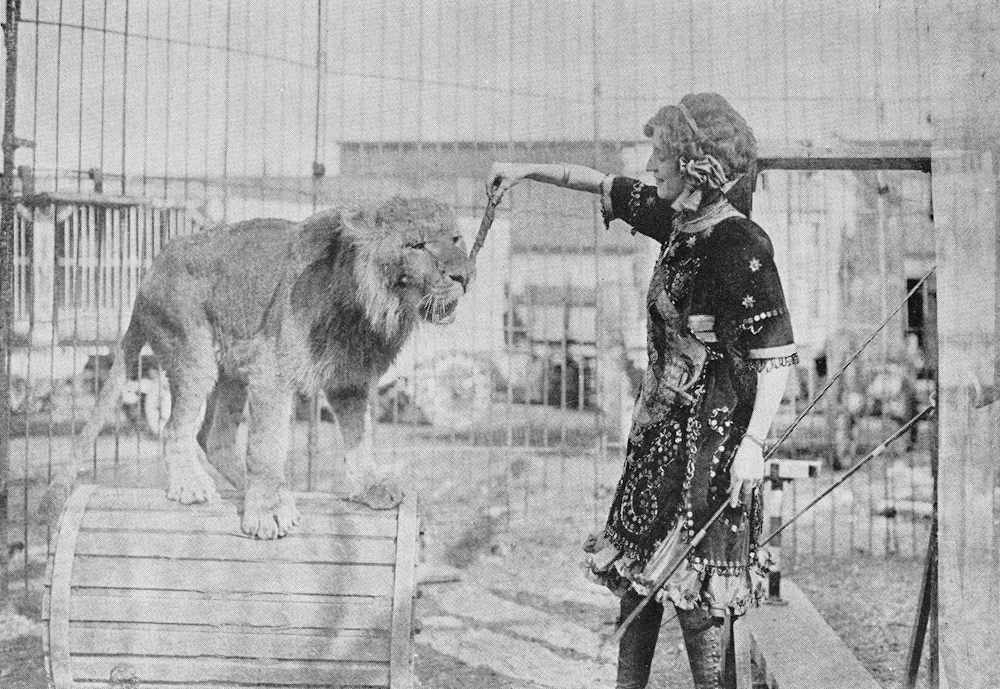
“Judge for yourself,” came her answer, as a strip of meat was tossed to her by an attendant from without. Then slowly she went forward toward the half-cringing beast, balancing itself upon a property “barrel.” She held forth the meat. The lion hesitated, turned as though to run, swung slowly back again, and with mincing jaws reached out for the food. The hand of the woman was not eight inches from the beast’s fangs, but that hand was unharmed. The lion had realized that this person was not an enemy, but a friend; that it was being rewarded for the fulfillment of a task. The battle of training had been won.
But don’t misunderstand. Lions or tigers—or any other dangerous feline beasts—are not trained by handing them pieces of meat. It is an entirely different process; harmless, but effective. And those first days of primary training, strangely enough, are the safest of all for the woman who desires to introduce new beasts to the intricacies of a trained act.
Within the cage, the beast is tied and trussed long enough for a heavy, leather strap to be passed about its body and securely fastened. To this is attached a rope which runs outside, through the top of the arena, and there through a pulley to the hands of waiting animal men. Then the beast is allowed to go through the opened door from its den to the arena, while the woman who is to make a “working animal” of it awaits, armed only with a whip and a revolver loaded with blank cartridges,—the last resort in case of emergency, should the rope or belt break.
The first instinct of the beast is to leap—at an enemy. It obeys the call of fear and lunges, but in vain. Outside, the men have pulled on the rope leading to the leather belt. Instead of striking against the human target, the beast finds itself clawing and twisting aimlessly in midair, while the thing it fears still stands, a few feet away, unharmed, and making no move toward it.
A wait of a few seconds and it is lowered, only to leap again and to find itself once more suspended harmlessly. Again and again, until finally there comes the time when it neglects to leap, and instead, seeks refuge in running. But once more the “mechanic”, as the belt and rope are called, interferes. It stops, and hissing, awaits the approach of the enemy.
Thus the first battle has been won. Gradually, by aid of light touches with the whip, the trainer forces the animal in the direction she desires him to go. Slowly she directs him to a pedestal, and in the efforts at escape, the beast leaps upon it. The first step in training has been accomplished. The beast has found that through some strange power, which must come from the trainer herself, it is unable to attack her. Naturally, its unfunctioning brain cannot understand the mechanical principles of the rope and belt, and the men outside the arena, who pull upon it. It simply attributes this invulnerability to attack to the trainer herself and realizes a helplessness in her presence. It consequently retreats, hearing certain commands as it does so. The constant repetition of this teaches it first to mount a pedestal, then to leap over hurdles and finally to do all the things which are seen during a “cat” act in the performance of a circus.
At first it does this all through fear. But gradually, as the days pass, it finds that the woman neither molests it nor annoys it so long as it follows the rote in which it is being trained. The result is a confidence, yes, even a spirit of friendship. The hiss of a lion in the arena is not nearly as vicious as it sounds.
With elephants, of course, the proceeding is different. There, the woman who trains them merely has to improve upon instructions already given, for the great mammals usually come to this country already trained. In the first place, practically every working elephant comes from India. The African elephant, as a rule, is a vicious, sullen outlaw, unamenable to kindness or to teachings. The Indian, on the other hand, has been accustomed to human beings all its life. It has worked in the compounds of India at such tasks as carrying logs, or hauling wagons, and it understands the superiority of human kind. From there it usually is taken to some training menagerie, where it is given another course of instructions in the primary things required by a circus, this usually happening in Germany. After that, it arrives in America; and the training which follows is usually only an elaboration of the rudiments it already has learned. But at that, it’s a good, hard job. If you don’t believe it, select for yourself some day a nice herd of, say, ten elephants, weighing from one to three tons apiece, and try to do the things that you’ve seen the woman trainer do in the circus,—such as swinging on the trunks of two of them, upraised some ten feet above the ground, while the rest of the herd forms a tableau in the background. And at the same time, smile and make a few bows to the audience. It isn’t so terribly easy!
Nor is the task of any animal trainer, man or woman, a simple job. There are many things to know, many things which require constant vigilance, neglect of which may bring death! An animal with an ulcerated tooth is not the same tractable beast as when in good health and humor. I once saw a woman escape from the arena after the last blank cartridge had been fired from her revolver straight into the eyes of an attacking Bengal tiger, causing it to halt and wheel, not three feet from her. And in that instant of indecision she whirled through the steel gate and was safe. It was puzzling: the fact that the most faithful, the hardest working tiger of all her group should suddenly “go bad” and rebel against her every effort to make it obey her commands. In truth, it was a mystery to every one, until the tiger had been taken back to its cage, strapped, and a minute examination made of its teeth and feet. In the latter was the cause found. A claw had turned and was growing straight into the flesh. The foot was swollen and sore. Well, perhaps at some time in your life you’ve had an ingrowing toe nail? That was what was wrong with the tiger, on a larger scale, of course. And it made him just ugly enough to want to kill somebody. He nearly succeeded.
Indigestion, too much feeding, under-feeding, lack of rest, exposure during some run of the circus in the early months of fall, when the wind whips along the train and chills the animals unless the dens are properly covered; excess of heat on hot days, bad water,—all these things may have their effect within the steel arena. More than that, the emotions must be taken into consideration, even to gratitude.
On one of the traveling carnivals of the country is an animal act which contains one leopard that is by far the best performer of the whole group. The woman who displays the act, the wife of its owner, can do as she pleases with that one cat. If it doesn’t obey the command to mount its pedestal, she neither whips it nor rails at it. She simply walks swiftly and firmly to it, seizes it by the nape of the neck and lifts it into place. If it growls at her, she cuffs it with her open hand and scolds it as one would scold a house cat. She knows that nothing she can do can displace the affection in the heart of that great, spotted feline beast. And of course, there is a story behind it.
It was in the autumn, and the carnival was rounding out its season in the south, only to be caught in a “norther”, one of those sudden descents of ice-cold rain which freezes the moment it strikes the ground. The train was on the move before the dens could be shrouded in canvas and filled with straw to give the necessary warmth to the jungle animals, and one of the leopards, an intractable, hateful beast that had absolutely refused to respond to every effort at subjugation, had become chilled,—with the inevitable result of pneumonia. The owner went rather disconsolately to his wife.
“Going to lose that Beauty cat,” he announced. “Pneumonia.”
Woman nature came to the surface.
“But aren’t you doing anything for it?”
“That cat? I should say not; it’d tear you to pieces the minute you went into the cage.”
“Not if it’s sick—I shouldn’t think—” Then there was a pause. “I’m going to try it, anyway.”
Against the protestations of her husband, she made her preparations. Cloths were cut. Liniments and hot packs were made ready. Then, surrounded by men with feeding forks, flanked by her husband with a revolver, she made her entrance into the cage. The leopard hissed at her and sought to rise. Impossible—the ravages of fever and of disease prevented. Closer the woman went and applied the packs. As the befanged mouth was opened, she poured medicine down the red throat. The leopard did not resist,—through sheer inability to summon the necessary strength. It was the beginning of a week’s vigil.
Gradually the cat came to know that this person who stayed beside him day and night was there for the purpose of relief. There was comfort in the heat of those packs; the medications allayed the pain and brought easier breathing. The time came when the eyes of the beast followed her as she left the cage and watched for her until she returned. Recovery set in, but with it there was no recurrence of the hissing and roaring and rebellion against the association of a human. One day the husband came beside the cage to find the great, emaciated cat asleep, its head pillowed in the lap of the woman. Health came at last, and with it the announcement from the wife that she intended to train the hitherto untrainable beast. Into the arena they went. Five minutes later, she had tossed aside her whip and was directing the beast by hand, lifting it to the pedestals and down again, or catching it by the loose skin of its neck and guiding it from one side of the arena to the other. That was four years ago. And in all that time, not one hiss of anger has ever come from that leopard’s throat!
A long time ago, when I was a yellow-haired boy—I’m bald and a bit old now—the Wild West Show of Buffalo Bill came to town, and I was one of those lucky persons who could set the alarm clock, and then, in answer to its call, watch the circus arrive without even budging out of bed. For I lived near the “show lot” where all the big circuses gave their exhibits, and I felt that life held something more for me than for the ordinary boy.
I say I could watch the show without leaving bed. But I didn’t. No boy does. And it happened that during the course of the morning, wandering about, I came upon a canvas man bending over a ripped portion of the circus tent where it lay stretched on the ground, striving aimlessly to sew the rent with a broken needle.
“Hello, kid!” he greeted me. “Run home and get me a good needle, will you?”
“Gi’ me a ticket to the show?” I asked in reply.
“No—I can’t. They don’t let us working fellows give tickets away.”
Just the same, I got the needle, and on my return, the canvas man looked up with a grin.
“You kids are the best friends we’ve got!” he announced, and I ran home to tell the news,—that a circus man had said that boys were the best—
But there came a sniff from my sister.
“He only said that because he wanted the needle,” was her caustic comment. “I notice he didn’t give you a ticket.”
Twenty years later, I stood on the steps of my private car, and strangely enough it was one of the managerial cars of the show of which Buffalo Bill formed the chief feature. Things had changed a bit since the olden days when I salvaged the needle. Now I counted Buffalo Bill as my friend and comrade, the destinies of six hundred people and two great trains of circus paraphernalia were under my partial control and—
“Kid,” I said, as a boy passed and I leaned out from the vestibule, “run over to the circus lot and ask the boss canvas man if he’s going to be able to get the tent up on time for the afternoon show. We got in here late, you know.”
“Yes, sir!” and the boy was gone. Five minutes later, he returned, panting. “He’s going to get it up all right.”
“Thanks,” I said, and grinned. “You kids are the best friends we’ve got.”
Then something crossed my mind,—a picture of twenty years before. I reached into a pocket for my pad of reserved seat passes.
“Guess you’ve got a friend?” I asked, and the boy nodded. A moment later, he was running away shouting,—and clasping tight at tickets for two grand-stand seats.
Nor was it all memory that prompted the gift of three dollars’ worth of seats for a ten-cent errand. It was the general knowledge that I had spoken the truth, and that this boy represented other boys,—boys who not a week before had saved the whole circus, who had made it possible for the doors to open, and the thronging mass of people, representing thousands and thousands of dollars, to crowd through the main gates and in to the performance. More, were it not for the boys of the United States, the boys who cluster about the long circus trains in the gray of morning, who rally to the call of the boss canvas man and stay by him through thick and thin until the last stringer is laid and the last duty done,—the big circuses of the country would not be able to run at all! Therefore, is it any wonder that we call them our buddies?
The boys, collectively, and that includes youngsters from twelve to eighteen years of age, are counted upon by the circus as a part of their equipment, in just as important a sense as the railroad cars themselves, or the tents or the performers and executive staff. And for this reason:
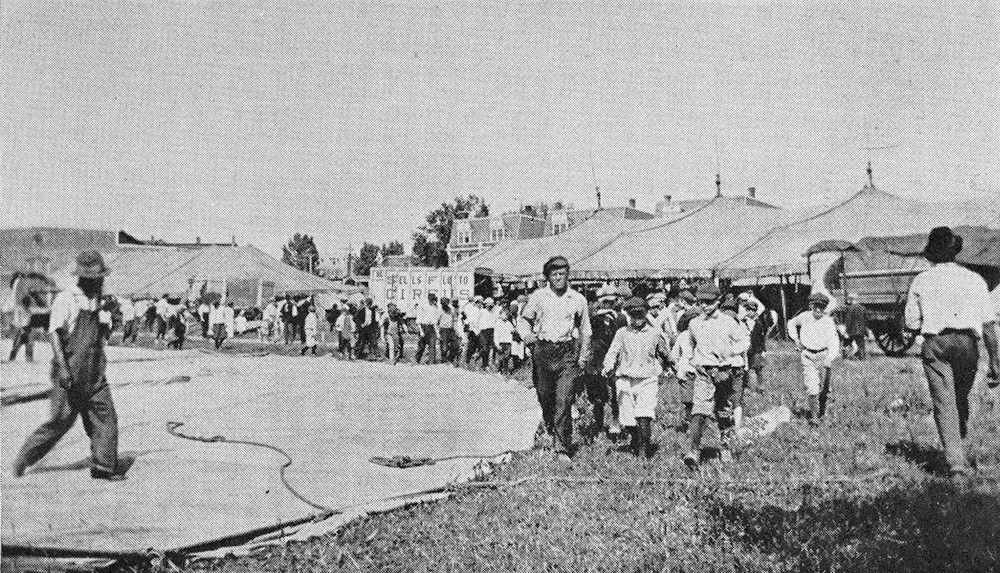
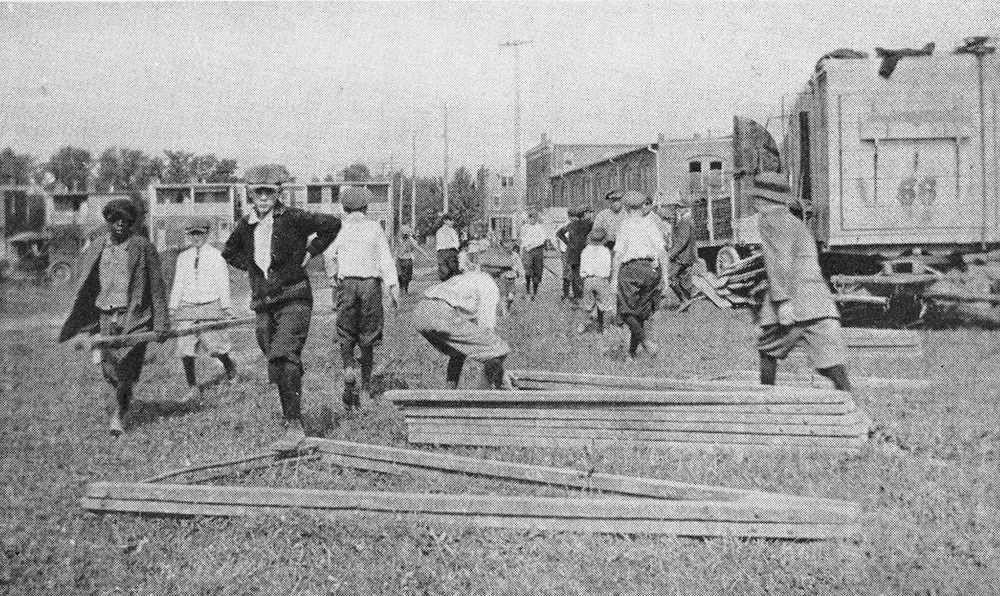
The present-day circus is too gigantic a thing to be handled by its creators alone, where the matter of manual labor is concerned. The tremendous spread of canvas, the vast amount of “hand work”, the intricate details, the necessity for hundreds, yes, even thousands of hands ready to grasp this piece of trapping or that bit of rope, these things are too numerous and great in expanse to be coped with by the ordinary amount of labor which can be carried on the long trains. Often, too, it is impossible to procure that labor. The inroads of harvest time in Kansas, the lure of high wages at the various mines when the shows strike the metal belts, the constant drift and flow of men make it next to impossible at times to procure the necessary number of laborers needed to daily erect the numberless tents which cluster about the “big top”, and to put into place the tier upon tier of seats needed for the influx of the matinée and night crowds. But the show cannot stop for that. It is an inexorable rule of circusdom that the show must go on—on—in spite of rain, in spite of fire and flood, in spite of wrecks, of illness or death.
Therefore, the shortage or absence of workmen cannot and must not stop the circus. Nor does it; for there is always one element that can be depended upon, always one group of persons who will not fail,—the boys. And it is to them that the circus looks for aid in all times and for salvation in the hour of need.
What do they do? Theirs are the willing tasks that can be achieved better by youthful hands than by stronger ones; theirs the enthusiasm that even the loyal “roughneck”—and those coarse men of the circus are loyal—cannot fulfill in as good a measure. On every circus, at the time the regular admission tickets are printed and the gilded passes put into their pads and apportioned to the various agents and members of the executive staff, great piles of square, white tickets are also given out to the bosses of the working crews. And these tickets—passes in truth—are labelled with something fraught with meaning:
“BOY’S TICKET.”
They are the tickets that some day during the long season, some gloomy hour in the progress of the big show, may save the circus! But first to the ordinary dependence upon the best friend that the circus possesses, the boy:
You’ll hear the call early in the morning, even before the switch engines have ceased clanging, and the steel runs have been shoved to the ground by the cook house crew and razorbacks, that the cook house and range wagons may be run from the flat cars and transported to the circus lot for the preparation of breakfast. You’ll hear it from the leather lungs of the boss canvas man and his assistant, busy in the rounding up of the “big top” crew in the semi-darkness; from the lips of the head menagerie men down at the big cars which convey the elephants or “bulls”, the horses or “ring stock”, and the smaller, hay-eating animals of the menagerie, known as the “led stock.” You’ll hear it echoing all along the lengthy sections of the circus train, the same message voiced in different tongues:
“Hey, boys! Step lively there! Want to go to the circus?”
And the call is always answered. As the long pole and “stringer” wagons pull away from the circus train, drawn by their broad-backed draught stock of from eight to twelve horses, you’ll find perched upon those wagons the inevitable clusters of town urchins, beginning their work of the day. As the “led stock” starts on its tramp to the lot, you’ll find the leaders to be the youngsters who have arisen long before daybreak “to see the circus come in.” As the canvas wagons depart, they too will have their apportionment of youthful workers, and more than once, standing beside the boss canvas man on some gloomy, drizzling morning, I’ve seen him nod his head and heard the cheery remark that all circus men yearn for:
“Oh, we’ll get up in good time to-day! The lot’s a little sandy, and it’s a long haul, but we’ll make it. There are plenty of boys!”
In that last sentence lies the explanation. It means that the difficulties which the weather has placed upon the circus have been overcome by an outside influence, that the obstacles in the path of the show have been met and conquered through an ever ready ally,—the boys.
How willing they are! When the big top, or main tent, is stretched, preparatory to the raising, boys are side by side with the regular workmen of the circus, pulling and tugging away at the heavy sheets of tenting, so that they may be laced into place about the bale-rings of the center poles. When the “stringer” and “jack” and “plank wagons”, carrying the various portions of the seating arrangements, pull into position, it is the boys who drag the loads from the pile into which they are tossed and lug them into place under the canvas. When there is straw to be sprinkled over wet or muddy ground, you’ll find there long strings of youngsters hurrying along at a “double”, their arms full of straw, an endless chain of activity, all working toward the end that the circus grounds may be inviting for the circus throngs, all imbued within a moment, it seems, with that rule of circusdom: “The show must go on!”
The morning is the rush time of the circus. In only a few hours, the big show must be unloaded from the trains which have brought it from the last town and hauled to the circus grounds, a distance varying from a quarter of a mile to three miles. From twelve to fifteen tents must be laid out and raised, the cook house, the horse tents, the blacksmith shop, the menagerie tents, the side show, the dressing “top”, the “juice joints” or lemonade stands, and the “big top” itself, covering alone a space ranging from three to five hundred feet long, and from a hundred and fifty to two hundred and fifty feet wide. Into this big top must be placed seating arrangements for from five thousand to fifteen thousand persons. And did you ever stop to consider what a tremendous throng fifteen thousand persons really is? It means that enough seats must be put into place to accommodate a whole village; that the people themselves, if placed in a single line, and each one occupying a foot of space, would stretch for nearly three miles!
Seats for three miles of humanity! And all raised within a few hours, at a time when every section of the lot is clamoring for aid. The parade must be made ready. The wagons must be washed and cleansed, if they have been in mud the day before. The cages of the cat animals must be cleaned, food must be brought for the greedy elephants, the rough spots of the hippodrome track must be cleared away with hoe and grub hook, lest a hummock bring death to some rider, or break an axle of the plunging chariots, with the attendant injury to horse, driver, and even the spectators. Everything is happening at once; for every hand there is a double burden. And it is then that the boy is more than welcomed.
The seats are placed in position mainly through his aid. The quarter poles, which support that part of the tent leading from the ridge to the eaves, are raised by him. The outer poles, supporting the canvas at the spots where the guy ropes leave the eaves to be connected to the stakes, stand staunch and true to their duty through the exertion of youthful muscle. The thousand errands of the circus lot are run, the hay and straw are distributed through the menagerie, the ponies are cared for, and—
But there is one thing that is not done! No water is carried for the elephants! That is a relic of a bygone day. In these times, the big circus is too efficient, too jealous of every possible moment of time saved, to allow boys to carry water for elephants. That is taken care of by a special water trough which is carried by the show, and which is unloaded at the nearest fire hydrant, and to which the elephants are led. There are too many other duties for the boys to permit them to waste time and effort watering elephants!
It is a fight against time, every moment, every second. Downtown the bands are blaring and the crowds watching the various samples of tinsel and spangle which the show puts on view to lure the throngs to the circus lot. Minutes are passing. By one o’clock, everything must be ready. Barking shouts sound from the bosses around the lot, but by a staunch rule of the circus, there is little swearing. For a reason of business efficiency, to say nothing of the moral side. If there is swearing and coarseness, parents may refuse to allow their boys to help “put up the show.” And without those boys, there may be disaster. One o’clock drawing nearer, nearer. Then the gates must be opened and the waiting crowds allowed to enter. It seems impossible, yet it is done. I have seen the circus in many a tight place. And I have seen it pulled out of that tight place—by boys!
For instance, Astoria, Oregon. If you never have been there, let it be known that Astoria is a town built upon stilts. Owing to the tides which back up the Columbia, it was necessary, in building the town, to raise it above the seepage and creeping influx of the water, with the result that there is not a vacant lot in the whole city that is on a level with the streets. More, the one lot which could be reached by the circus—it was the Sells Floto-Buffalo Bill Show in 1916—was nearly a foot deep in sand.
The menagerie was left on the sort of bridge-viaduct which formed the main street of the town. The show lot was twenty feet below this level, with not a single runway or incline by which the wagons could be taken on the lot itself. Every bit of canvas, every stringer, every piece of paraphernalia, every pole, every chandelier, absolutely everything which went into the making of that circus, must be placed on that lot by hand and carried through the shifting sand from fifty to five hundred feet!
It was almost impossible to unload. The elephants, used in pulling and pushing the heavy wagons from the trains, broke through the boarding of the causeways, and squealing, retreated, for an elephant is afraid of an unsound footing. The horses were nearly useless. An hour passed, two—three. The owner of the show, traveling along with it for a few weeks, sought out Bill Curtis, the boss canvas man.
“We’re not going to be able to make it!” he announced.
Bill smiled. “Yes, we will!”
“How?”
“I’ve got Shorty and Fullhouse out in town, rounding up every boy they can find. They’ll pull us through.”
And they did! Back came Shorty. Back came Fullhouse, both of them looking like modern editions of the Pied Piper of Hamelin, followed by throngs of boys, ranging from youngsters of eight and nine to youths of nineteen and twenty. Here and there the groups were placed. Sharp orders were shouted; a military preciseness and crispness of command seemed to have come into the air. Among the waiting volunteers walked Bill Curtis, eyes narrowed, lips grim.
“It’s up to you, Boys!” he announced, time after time. “We can’t make it—we’re stuck. Are you going to save the show?”
The answer was the usual one that a boy would give under such circumstances. Clambering, hurrying forms rushed about the wagons. Skids were placed. A thousand hands helped to shunt the big center poles to the lot and then carry them to place. The stringers, the jacks, the canvas itself,—one by one the parts of the big circus went into place; and at two o’clock, only an hour late, the show opened its doors to a crowd that, up to that time, had been the biggest in all its history!
And this is the story of the boy in more places than one during the journey of the circus. When the wreck comes and the battered trains pull into town hours late, the boys are the ones who help to drag it to the lot and to raise it into place that the show may go on. When storm strikes it and the tents are flattened, again it is the boy who helps to pull the big show out of the hole. Always happy, always willing, always loyal even to the extent of sore muscles and blistered hands, he is ready for any task and any duty. And let it be said, to the credit of the circus, that it does not forget and that it does not fail in its part of the promise. The minute the task is done, each straw boss hurries to the superintendent with his list of names, to return a moment later with the reward of faithful duty, the ticket to the show which had been promised in the beginning.
Nor is the actual putting up of the show the only manner in which the friendship of the boy is counted upon in the circus world. It is to him that the circus looks to spread the news of its coming, coincident with the placing of the first glaring bills. Upon him devolves the real enthusiasm of the parade; for what is a clown band or a clown policeman without his throng of boys trailing along in the rear? Is the calliope really worth while if it does not have its crowd of youthful attendants? Hardly! The boy and his love of the circus have the real job of making a parade enjoyable. For by their interest is gauged the interest of the crowds which line the curbings to watch.
More, the boy is counted upon every step of the way. Long before the circus comes to town, he often has done his duty and earned his pass, in helping the billposters with their tasks, or by distributing the thousands of heralds, or advertising leaflets, by which the show makes its house-to-house canvas.
As for the performance—
The circus has its reasons for everything. If it is a good circus—and most of them try to be good—it will have a performance which is worth while, the best that its status in the show world can afford. And you’ll notice that if you’ve ever been a boy, the ticket you’ve earned to the circus has admitted you to the afternoon performance! The reasons were many.
In the first place, the circus has been grateful. It wants to pay its debt, and no boy likes to wait from noon until night for his reward. In the second place, it is the enthusiasm of the boy which makes or unmakes the circus performance. The howls of joy, the shouts of laughter when the clowns come tumbling in, are infectious. They spread from the youngsters to the older folks; they travel here and there about the high-piled tiers of seats. The adult grin spreads and develops into a chuckle,—and the chuckle to an uproarious laugh. The enjoyment invades everything, and when the performance is over, the thousands troop out with a smile lingering upon their features, with enjoyment in their hearts; and a part of it, at least, was due to that first outbreak of happiness from the boys themselves.
So, with all this on their side of the ledger, with story after story in the annals of circusdom where boys have saved the show with the performance dependent in a way upon them, and with their aid and alliance relied upon every step of the way, is it any wonder that the modern circus, marvel of efficiency that it is, looks upon the boys as a necessary ingredient, to be treated fairly, honorably and truthfully, and to be referred to, as one circusman talks to another, in terms of affection? Indeed, it is not; for they’re our buddies!
Every woman says it sooner or later, that is, every woman who goes to a circus. High upon the close-packed tiers of seats she sits, watching the white, sleek ring horses or “rosinbacks”—resin never is pronounced correctly under the white tops—the flash of the riding acts, the swaying grace of the “casting numbers”, the “perch” and “traps” and other aerial performances, as the general ensemble of air-acrobatics swings into action; listening to the characteristic lilt and high-corneted blare of the circus band, enjoying herself immensely until—the music changes.
The aerialists swing to their tapes and descend to the hippodrome tracks, there to don their clogs and robes and lose themselves in the vast expanse of the circus tent as they return to the dressing rooms. A wild hullaballoo comes from the “pad room”, where the performers await their entrance into the main tent. A shrieking, siren note sounds from the compressed air calliope, augmenting the band. Then, tumbling and shouting, the clowns come forth, and one of them is trundling a baby carriage, with a two-year-old child within, his chubby face smeared with clown-white, and perhaps, squeezed tight in his arms, a baby lion! Then it is that the remark is sure to come:
“Oh, that poor little baby!”
Whereupon the woman leans toward her companion. Together they decide that it must be terrible to be a circus baby, to be forced into a wandering, uncouth sort of gypsy life; a homeless existence where there are coarse men, shouting, hurrying laborers, the sting of unkind elements, and no chance whatever for the enlightenment of culture, or for an opportunity to gain from life what it should hold for every youngster.
It sounds very true. The surprising part, however, is that it is not true in any particular, and could the baby in the carriage—the one who clasps tight at the soft, furry ball that some day will be a ferocious, caged, black-maned Nubian—could that youngster reply, it would be to the effect that the sympathy is being wasted, and that he has a chance in life for all that it can hold, an opportunity for everything that one could desire, far above the ordinary child born in the ordinary American home!
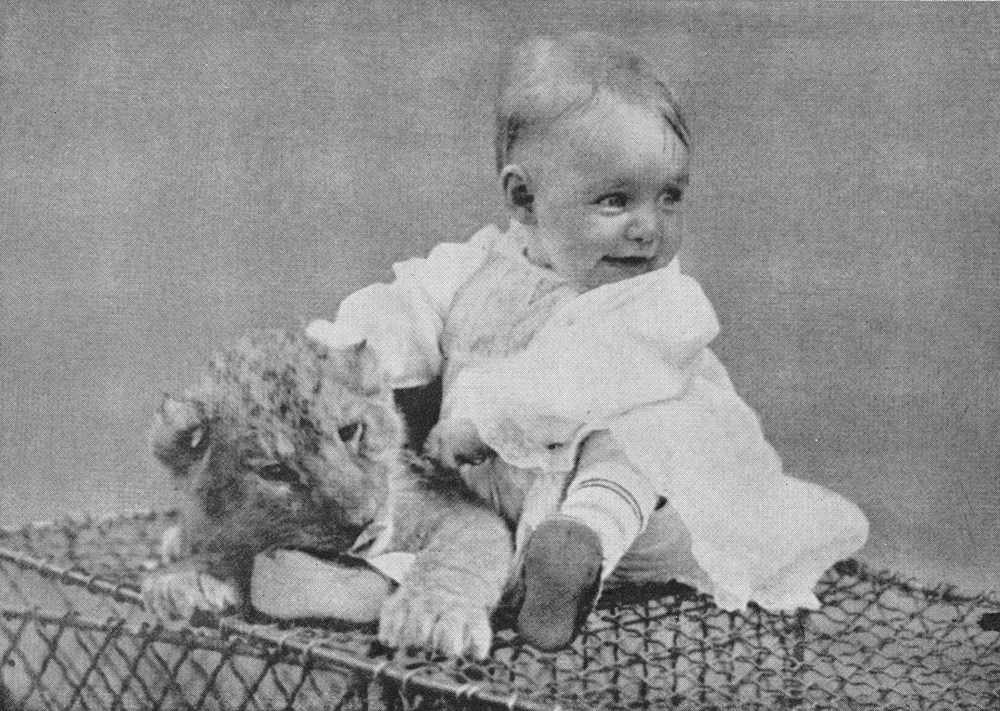
Impossible? Not at all. The circus is a definite thing; a world apart, it is true, but nevertheless, a world which revolves upon a well-oiled axle, which brooks neither tempest nor disaster, which knows no obstacle to defeat it from its purpose of traveling on, day after day, a fairyland, mysterious in its coming, mysterious in the fleeting lights and hurrying, shadowy forms of its departure, yet a well-conceived, steadily balanced affair in which the baby plays as great a part as the adult; for the baby of to-day is the circus man or woman of to-morrow, and the circus succeeds through the generations of those who have learned its intricacies from childhood.
So, if you are a circus goer—and who isn’t?—don’t pity the baby or the youngster of the circus world. And above all, don’t think of the child as a poor little thing in the midst of ruffianism and neglect.
Buffalo Bill is dead now. But during his life, what would you, as a child, have given to have been trundled on his lap each afternoon, there to listen wide-eyed, while the white-haired old plainsman told just how he slew Yellowhand in the famous duel of the Battle of the Warbonnet, and to hear from him, the man who helped to build it, the story of the conquering of the great, free West? Few indeed were the children about Buffalo Bill’s Wild West show who did not have their daily story hour in which the great scout himself regaled them. Those visits were in themselves an education. But wait; the story of the circus child is one that must start at the beginning.
The mother? There is the child insured through the very life she leads, for the circus woman is nothing if not moral, and thrifty and sturdy. Her life is not an easy one, it is true, as concerns the physical; it is the busy, hurrying existence of one who must be ever ready for the call of the bugle, who must meet the elements as they come and smile in spite of fatigue, of cold or rain or blazing sun. But it is her life; she is inured to it, and she wants nothing else. As to the moral side: she has neither the time nor the inclination to be anything but moral. From the time that the long trains glide into town in the early morning until the last torch is extinguished, and the tired “pull-up” teams at last have been taken to the stock cars at night, her day is one constant succession of activity. Morning brings the parade, afternoon the matinée, night still another performance. And no circus train lingers after the main tent flutters to the ground; there is no time for the “wild party”, for the “town johnny” or the “joy ride”, even though the inclination should tend that way, which it doesn’t. Always, too, there lurks ahead the specter of winter, grim, cold, forbidding winter, when the bands no longer will blare; when the steel-throated calliope will stand deserted and desolate in the winter quarters yards; when the sleek, bulky draft stock will become rough-coated and clumsily kittenish as it wanders the ranch or farm where it is pastured; when the land of the tent is forgotten in the minds of the ordinary person; but when the attention of the performer must be more keenly bent than ever upon the days when the sun will shine and the pennants flutter atop the mastheads of the center poles. For though the circus stops, the performer never ceases. If she is an acrobat, there must be daily practice in order that muscles remain supple. If she is a rider, the obligation is even greater; for the ring horse or “rosinback” is something that must not be neglected. The rider who sways and somersaults before the thronged tents of the summer is merely reaping the benefits of a winter of hard, arduous work. Not only is the ring horse of a type especially adapted to bareback riding, a horse without nerves, without skittishness and with highly developed sense of rhythm and well-timed locomotion, but it also is the result of constant care and of constant exercise and training. The rider must not neglect him, winter or summer!
If she is a trainer of animals, her duties are equally strenuous in the winter months. Each day is the steel arena erected in the big animal house. Snow and cold may lay without; blustery, gripping winds may sweep and swirl, but within the warmth of the menagerie house there is the circus of the summer as concerns the animals and their trainer.
So it goes all the way through the list of the circus woman’s activities. Energy, sturdiness and courage are her lot, just as it also must be the lot of the man who is her husband. The trainer of lions cannot drink; his eye must be ever keen when the beasts are snarling on their pedestals. The “caster” of the high, double-trapeze acts, who swings and sways at the roofs of the tents during the summer months, cannot get out of condition, either mentally or physically. The nets which stretch beneath are not the protection they seem. A fall at the wrong angle means a broken leg or arm,—or worse, a broken back or neck. Perfect continuity of life is the price demanded of the circus man or woman, and it is only natural that this should be transmitted to the circus child.
As it is with the moral fiber, so is it with health. It is only a matter of from six to eight weeks from the time that the circus mother leaves the ring until she is back again with her child. Health is hers and health is her baby’s; the long-drawn-out illness so often attendant upon childbirth is absent with the circus woman. Rugged health and a constitution endowed with vast reserves of physical and mental strength are the bulwarks of her crisis, and they rarely fail.
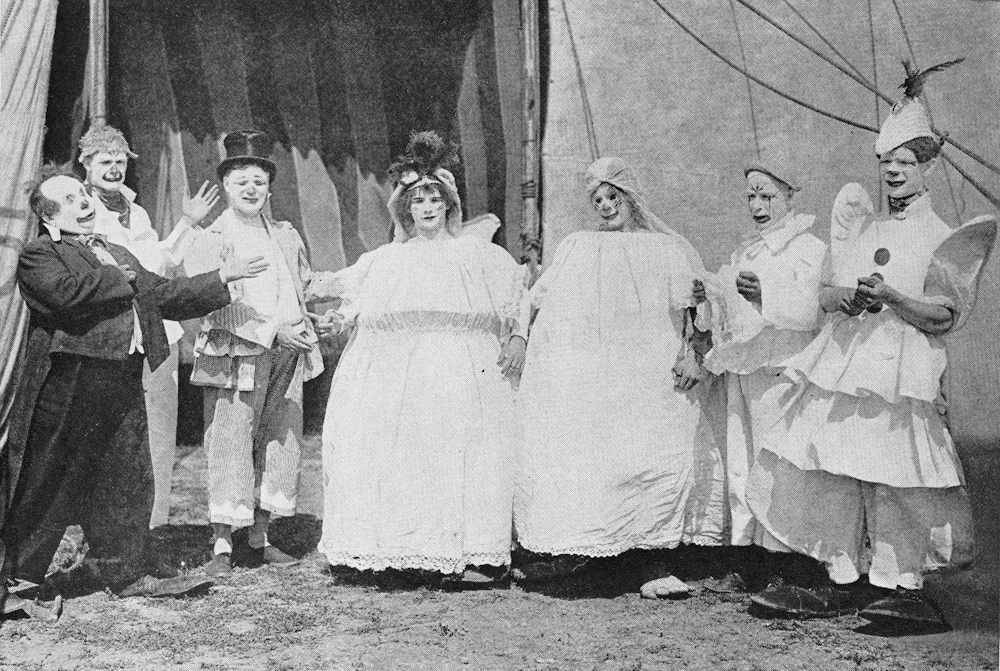
And so it’s a wonderful day in the circus when the new baby is brought on. About the pad room, the other women of the show have been sewing for weeks, for the new baby is not a personal, solitary thing, as it so often is in other walks of life. It is a circus baby; it belongs to the tented world and all those in it, to a world devoted, a world that is segregated to a certain degree, a wandering world without the constant ties of home, and a world in which love and softness of heart are predominant features. Instead of one nurse, there are dozens. Instead of a baby who cries unattended while its mother is performing before the thousands of the big circus tent, there are constantly outstretched arms. It is “their” baby, theirs to comfort and to make happy, theirs to coddle and pamper, theirs to dream for, and hope for and work for. Nor does this feeling include only the performers; it spreads to the “roughnecks”, who become grinning, tongue-halted men in the presence of the new visitor; to the menagerie, where the animal men steal the baby leopard while its mother sleeps, that the human baby may have a “kitten” with which to play. It goes even to the “juice joints” or concession stands; the child of the circus never wants for dainties! The clowns romp for it, grimacing and doing tricks far beyond their fun-making capacities of the ring, for this is a labor of love. The horse attendants bring forth the prettiest pony, and it belongs to the baby, as far as usage is concerned. The natural longing for home ties, which, strangely enough, is stronger in the circus person than in the ordinary run of mortals, centers in the child. It has an entire community working for its happiness and its future. Often you’ve seen a baby in the ring with the clowns. You’ve thought of it as a part of the performance, something which must be repeated twice a day, whether there are clouds and storm, or sun and blistering weather. But you have been wrong. The clowns are merely romping with their playmate, that is all; the adult wanderers are merely making life more pleasant for a little fellow who has just come into the circus world. What matters it if that romp occurs in the comparative seclusion of the pad room or before thousands of persons?
So, the first few years are traversed. Then comes the time of education. It is here that much sympathy is directed toward the circus child, and much sympathy wasted. For the youngster of the “white tops”, the “heir to the ballyhoo” as it often is called, has more opportunities for education, more chance to learn the necessary things of life, more openings to become conversant in youth with things that many persons obtain only at college than nine out of ten of American children! But perhaps that needs proof.
Remember first that the circus season ends generally in October and does not begin again until April. That leaves six months for the usual city schooling, for most circus performers spend their winters in the municipality where the show is stored until spring. Therefore, the child is deprived of only three months’ study a year, and this is more than recompensed by the opportunities for learning which abound about it.
For instance, does the usual child at six, or seven, begin a study of applied psychology? Hardly. The circus child does, and for the reason that the whole circus business is built upon psychology. The circus man knows what an ordinary person will do under nearly every possible condition, because his life has been devoted to the study of humanity. Crowd spirit—not mob spirit, understand, but crowd spirit—is ever before him. He sees every walk and class of life represented in the throngs which daily pass through the main gates. He knows the vagaries of the human mind as represented in the reserved seats as apart from that of the “blues” or general admission seats. He knows wherein the ordinary citizen of a lumbering district, for instance, differs from that of the person who lives in a mining or agricultural section of the country. He early learns the fundamental rules which govern the actions of humans, and all these things are brought as naturally to the attention of the circus child as a love for fairy tales.
A study of natural history is his from the beginning, for there is always the animal man to lead him about the menagerie, and to tell him everything there is to know about the beasts who are imprisoned there. He is taught by men who know, by those who spend their lives in companionship with the animals. He learns the relationship of the lion, the tiger, the leopard, the jaguar and cougar of the feline family and comes to know them as more than mere animals. He knows the difference between an African elephant and an Asiatic, so that he can tell them by sight. He learns that all monkeys do not belong to the antecedents of the human family, and the reason why the chimpanzee and the Koolakamba are more closely related to man than, for instance, the marmoset or the rhesus. Books, it is true, on the subject, are missing. But the best students do not study volumes; they investigate the things themselves.
He becomes a weather prophet through the days that he spends with the boss canvas man, studying the sky and learning the reasons for the sudden rush of orders and the “guying out” gangs which hurry from rope to rope about the big tent, tightening the hempen braces of the spreading canvas to withstand a “blow” or the soggy deluge of rain.
He knows machinery,—for the circus is a world of it. The gasoline engine and all that it contains become familiar to him through the ever-present questions that are readily answered. For isn’t he a circus child? The man on the big tractor explains to him the mysteries of the automobile. The calliope player takes him along on parade and tells him the story of steam, to the accompaniment of the screaming notes of the howling, screeching “horse piano.” So it is with the patent stake drivers, the “spool wagons” which raise and lower the tent, the heavy, sturdy equipment of the wagons and railroad stock,—he comes to know it all, because he is reared in a place where it is a part of his life.
He learns of music from the bandmaster,—and let it be known that among the circus “wind-jammers” there are as many students of classical music as there are in the orchestras of the theater and the concert hall. In the preliminary “concerts” which precede the main performance, half or more of the numbers are of the classical nature, as may be gleaned from the following programme, taken at random from a circus programme. And lest there be doubt, the year was 1915, and the circus Ringling Brothers:
1. Atlantis (The Lost Continent) Suite in four parts—Sefranek. Atlantis is a continent mentioned in Plato’s history, and extended across the Atlantic Ocean approximately from Europe to Yucatan. This continent, it is believed, was the home of a great race which conquered and civilized the world. The Azores Islands are considered to be the tops of the lofty mountains and are all that now remain of the great country. No. 1, Nocturne and Morning Hymn of Praise. No. 2, A Court Function. No. 3, “I Love Thee” (The Prince and Aana). No. 4, The Destruction of Atlantis.
2. Southern Memories—Medley Overture—Hecker.
3. Selection—From Samson et Dalila—Saint-Saëns.
4. Star and Crescent March—Richards.
5. Suite—The Last Days of Pompeii—Sousa.
A. In the House of Burbo and Stratonice.
B. Nydia.
C. The Destruction of Pompeii and Nydia’s Death.6. Selection—From Madame Butterfly—Puccini.
7. The Hall of Fame—Selection of Favorite Melodies—Sefranek. Containing Keler Bela’s “Racoczy”, Verdi’s “Celeste Aida”, Fucik’s “Entry of the Gladiators”, Rubenstein’s “Melody in F”, Grieg’s “Peer Gynt”, Dvorák’s “Humoresque” and the finale from Liszt’s First Hungarian Rhapsody.
Sounds queer, doesn’t it, this sort of music in a circus? Yet, if you will remember, that is the type which is always played in the “concert” before the main show. Naturally, once the rush of the performance has begun, conditions change. There is the blare and hurry of the swift, staccato-timed popular air, or the sway of the waltz during the aerial numbers. But before the show, the “concert” must have its classics, classics which change from day to day, for the bandmaster tires of hearing the same thing over and over. The other type of music and its repetition is necessary, of course, for the performance, for the music forms the cues of the circus; the show changes with the changes of the band, and even the trainmaster, at the cars, a half mile away, busy with the struggle of loading the show for the night, can tell the exact status of the performance by the strains which float to him from the circus band. But the preliminary music is different; there the programme can be varied, and it is only natural that the circus child, hearing from the cradle up a nightly variation which takes in the work of every celebrated composer, should receive an education in music far beyond the reach of ninety per cent. of America’s children. More, for he receives it in a way that brings no effort. It is no work for him to learn that Tschaikowsky was the composer of “1812”, or that Offenbach wrote “Orpheus.” It comes to him by the simple method of day-to-day assimilation.
History he does not gain from books. True, he may know little of the wrangles of Europe and the precepts of Confucius, but he knows his America! The afternoon, that time of rest between the matinée and the night show, is the circus man and circus woman’s time for roaming. It is a rest period, and then, the insatiable curiosity of the circus becomes rampant. The townspeople are curious about the circus folk and forget that the feeling is mutual. For the circus people are also curious about the city which they, for a day, are visiting. It is only natural that the circus child knows the story of Barbara Frietchie from seeing the tablet which is placed on the bridge adjacent to where her house once stood. He sees the monument to George Washington’s mother in Fredericksburg, Virginia, and the old home where once she lived. He stands beside the monument to those who fell in the Real Rebellion in Canada and learns the story of that bubble-dream of empire. He hears the story of the Battle of Gettysburg when the circus plays the town and the circus folk troop out, after the matinée, to go over the battlefield. He sees George Washington’s tomb, because the circus people hurry for the interurban car which takes them to Mount Vernon when the show plays Washington. And as he sees he learns—by actual contact!
Nearly twenty thousand miles a year he travels, at a time when curiosity is at its best, and when the one compelling word “why” is constantly on his lips. He knows every railroad and the kind of country it traverses. He knows every city, for he wanders it. He knows the quiet beauty of New York State, the tumbled wonders of the Rockies, the vast expanses of desert leading to the Salton Sea and thence to California; the beautiful reaches of the Saskatchewan, far to the north; the broad, serene beauty of the Mississippi, for the circus must ever seek new territory, new fields, and the circus child goes along! And how many children make a tourist trip of twenty thousand miles a year?
But the roughness of it all, the uncouthness, the hurrying, swearing laborers! The gambling and the graft of the side shows, the short-changers in the “connection”, the constant form of Temptation ever beckoning! So? Let it be known that the gambling, the graft and the thievery of the modern circus are largely fables. Time was, it is true, when those things existed. To-day, the number of shows which permit anything of the sort, and they are the smallest of the small, can be counted on the fingers of one hand. Quite the opposite; the circus of to-day employs from one to five detectives, to say nothing of the manager, whose eye is ever alert. Once I managed a show, for a brief space of time. I saw a woman looking rather queerly at her change. She made no protest; she merely believed she had made a mistake. But the instinct was there; somebody was “shorting.” That night, the show was minus one ticket seller. He had paid for his fifty-cent pilfering by losing his job, his “hold-back” of some twenty-dollars in pay, and his transportation home at the end of the season. Swift and stern punishment, it is true, for a petty offense. But he had violated an inexorable rule.
The roughness, the coarseness? Let a man stand some day beside a group of unshaven “ruffians” of the circus as they drive a stake into the ground with the rhythmic swing of their great, sixteen-pound sledges. Let him make some insulting remark about the pretty little girl in tights who is hurrying to take her place in parade. No, on reconsideration, don’t try the experiment, for the circus is primitive in one way. It knows only one answer to an insult,—force! The roughness and the coarseness are not so predominant as one might think.
The elements cannot be governed, it is true. In the circus world, one must fight the cold drizzle of autumnal rain, the blazing sun of July and August, the “northers” of the south with their sleet and freezing rain, the blatter and fierceness of the tempest as it sweeps upon the bellowing, swaying canvas, the crash of the circus wreck as the hurrying train strikes an open switch; but those are things which build character, not destroy it; which bring a strength instead of weakness, sturdiness instead of pliability, courage instead of the yellow streak. Nor is this all.
Those three months of books of which the child has been deprived during the winter months have not been forgotten. Everybody doesn’t go in parade. Always there is some one who is willing to tutor the circus child, to the extent that when autumn comes again, that child is able to make its advancement in grade at the public school it attends. As for the other end of the teaching, it is not at all an unusual thing to hear childish voices singing in the dressing tent on Sunday morning; a Sunday-school of the circus is in progress.
So much for the mental development and the physical well-being. As for the future, the circus child usually knows or cares about only one, and that is the life of his father and mother. If they are riders, then his ambition is to be a rider also. If they are aerialists, he too is drawn toward the flying trapeze or the swinging ladder. Long before most children begin to think about the time when life must be of their own making, rehearsals begin, with the mother and father as tutors and the child as the pupil. Step by step the game is learned, whether it is in the treasury wagon as an executive, or within the ring curbs as an equestrian or equestrienne. Circus families exist from generation to generation; there is a certain honor in the family name, a certain pride in making each generation more famous, more daring, more worthy than the one that went before. The light of pride really begins to show in the eyes of the circus mother and father when they see their son or their daughter displaying more agility than they, more adaptability for the part they play under canvas, more hope of being a stellar attraction than they have formed. Their reward comes in knowing that they have given to their child the health, the stability and the training which will make it greater than they. The child’s reward comes in the upheld honor of the family name and the monetary benefit that results from a “feature act.”
In this, some fail. It is inevitable. But the number of failures in the circus world is diminutive compared to that in the world outside. The training, the constant thought of the future, the hardy life is against anything but success. This applies even to marriage, for the circus man seldom seeks beyond his sphere for a wife; the circus girl looks to the land of the “white tops” for the man who is to be her husband, and divorces are few.
A blank future,—that of the circus act? Some time when you’re in New York, you’ll inevitably drift to a great theater where a “riding clown” is the greatest attraction. His income is nearly that of the President. Meet him and you will find a quiet, modest, well-educated young man, married, proud of his wife and baby, who some day will be greater than he, unconscious apparently of the fact that he, of the circus, is the drawing power which pulls thousands of dollars into the box office every day. Meet his mother, and you will find a quaint, twinkling-eyed, humorous English woman whose fondest memories are of the days back “home” when she and her husband and the children had their own show—and gave most of the performance. She will tell you that she was a circus baby and that her son was a circus baby, and that they are proud of it. Go into their home, and you will find it one of happiness, of children clamoring for the mother not to work herself to death for them, and the mother protesting that all the children do is entertain her. They form the Hanneford Family, and “Poodles”, the star, is the son. They are typical of the circus, and they are still of the circus, for each summer finds them under the great, dun-colored stretches of the “big top”, far happier there than in any comfortable, convenient theater. Their story is simply the story that has been told here,—the story of nearly every circus group, with the exception, of course, that every one cannot be a star.
And even should the child of the circus desire to leave the “white tops” and go into some form of business in the outer world, the basic structure is there to permit it. More, there is a certain amount of knowledge about the fundamental things which is present in the circus boy or girl of fifteen that does not come to the usual young man or woman until twenty or twenty-two. In the first place, there is the absolutely essential one of knowing one’s neighbor, of being able to discern the various phases of human nature as they present themselves. The psychological quality of circus life, which is apparent from the moment that one stops to look at the waving banners of the side show, until the rattling, clattering excitement of the chariot race has announced the finish of the main show, has fitted the child far before the usual time for the job of “figuring out the other fellow.” The moral restraint imposed by the hard work of the circus lot has builded a good foundation of honesty of purpose and tenacity. The travel, and the necessary broadening influences which go with it, play to the advantage of the seeker of fortune in a new world.
But she was pretty. She was young. She had been a circus baby, and her mother had been a circus baby before her. Her name was synonymous with a long line of riders, dating back to the time when Old Dan Rice was the drawing power of thousands to his little one-ring circus, and when Barnum was making money by telling the people the truth about the fact that they liked to be fooled. A motion-picture company had made her an offer,—at a far greater salary than she ever could expect beneath the pennants of the circus.
He was a rider also. But he was something more. The growth of mechanical power about the circus had interested him. He had tinkered with machinery. Then he had patented a number of useful inventions with the result that he too was being sought from without.
They had talked it all over in the shadow of the big top, just at that time of evening when the circus lot holds the greatest power for those who know it, between twilight and dusk, when the old calliope is tooting down at the car line, when “Shanty”, as the chandelier man of every circus is known, is sending the first of the gleaming light clusters up the sides of the center poles, when the first of the shadowy bulk of the throng of the night is beginning to make its way circuswards. Then they had gone to the manager, two circus babies who had grown to manhood and womanhood in the shadow of the big top, and who now stood at the threshold of a new life.
“We wanted to tell you first,” they said. “We’re going to be married.”
The manager grinned; he had guessed it long before.
“Fine,” he answered. “I’ll spread the word; we’ll have a little blow-out in the cook house with a special menu and everything like that. But—what are you going to do then?”
“Then?” They appeared surprised.
“Yes. How about these offers? Are you going to—”
“Oh, those!” They laughed at a matter long laid to rest. “We’re going to stay with the circus!”
When Happy Brandon, our concession owner, came home from the mud and muck and variegated troubles of a combat division’s lot in the Big Muss, I noticed that there was no difference in the quality of his grin, no evidence of hard times or bitter memories in his features, and certainly no indication that he had been doing other than enjoying life. So I began the inevitable search for a reason. Happy had been where the shells hit hard, thick and often. He had seen mud and privation and—
“But it didn’t strike me so bad,” he announced, with a shrug of his shoulders. “I’ve seen a lot worse mud than we ran into over there. Remember that time in Kansas City when the lot was so slick it wouldn’t even hold up the seats?”
“And they fell? Yes, I remember.”
“Well, that was war that day, only we didn’t know it.” Happy became emphatic. “Just a little bit worse, because women and kids got hurt, and that’s a lot worse than seeing men get shot up—or even being plugged yourself.”
“Pretty hard life though, at that?”
Happy slanted his head and grinned broadly.
“Quit your kidding!” he chuckled. “There wasn’t any of it half as tough as that night when we closed the season at Fort Worth, in a norther, with an eighth of an inch of ice over everything, three dollars in the ticket wagon, and the Big Boss burning up the stages and ring properties to keep the men warm enough to load the trains!”
“That’s true. But how about keeping your spirits up all the time and—”
“Spirits?” Happy laughed again. “Say, listen; remember that rainy spring we put in up in the Dakotas? Remember the fact that I had the juice joint during those glad and glorious days when it rained twenty-five hours out of every twenty-four? Well, any guy who’s tried to make a living selling ice-cold lemonade to half-frozen audiences through five weeks of rainy weather—well, he ain’t going to let anything faze him. Anyhow,” and Happy’s grin took on a more confidential air, “nothing stops a circus guy!”
Whereupon I gave up Happy as a bad job,—in so far as romantic tales of the horrors of war were concerned. Then, a day or so later I met Finn, who once was a ticket seller, “fixer” and general all-around handy man about the Buffalo Bill show.
“Gosh, I had a cinch!” he told me. “First they had me at a remount station; that’s how I got my commission: from knowing more than the captain about horses and how they ought to be handled to stand rough going. Then they sent me out squaring up squawks from French peasants; claims for damages and the like.”
“Pretty tough customers, were they?”
Finn jabbed me in the ribs.
“Where do you get that stuff?” he jibed. “Tough? To a bird who’s heard squawks from professionals? There wasn’t one of ’em who could raise half the row that most any native’ll kick up after his horse has gotten scared of the elephants and run away and smashed up his new buggy. To say nothing of arguing a hostile city council into cutting the license, or smoothing down some nice domestic dame after a Squarehead skinner has driven an eight-horse team and the hippopotamus den across her flower garden. Nope, it was just pie to a circus fixer; I almost got ashamed of myself!”
And it was about this time that I awoke to something,—that it’s a mighty happy knowledge for a man to possess, the fact that once upon a time he has lived the life of the circus, seen its hardships, experienced the thousand and one stumbling blocks that are ever in the path of the circus man, and been a part of that great struggle for existence which goes relentlessly on every day of the circus’s season.
Perhaps you still imagine a circus to be solely a place of spangles and tinsel and gold and lace; of blaring bands and funny clowns; of beautiful equestriennes and sleek, graceful “rosinbacks”; of swirling, fairylike aerialists, and shimmering beauty everywhere? That’s only the veneer! A circus is a fighting machine of grueling work, of long, hard hours which begin in the gray of dawn and do not cease until the last torch has been extinguished down at the railroad yards late at night; a thing which fights constantly for its very life against the demons of adversity, of accident, of fire and flood and storm; a great, primitive, determined organization that meets defeat every day, yet will not recognize it; that faces disaster time and again during its season, and yet refuses to countenance it; a place where death stalks for those who paint the bright hues of that veneer which is shown the public,—a driving, dogged, almost desperate thing which forces its way forward, through the sheer grit and determination of the men and women who can laugh in the face of fatigue, bodily discomfort, and sometimes in the leering features of Death itself! That’s a circus!
It’s no place for a grouch,—this land of the tinsel and the white tops. It’s no place for the person easily discouraged. He’s gone from the ranks long before he has served even a period of apprenticeship. It’s no place for the man who cannot grit his teeth and fight on when everything’s against him, when the rain is pouring, when the circus lot is hip deep in mud, yes, even when the great cars of the circus train are piled in the ditch, and when the groans and cries of the injured humans are mingling with the screeching yowls of panic-stricken, fright-crazed animals. Far ahead, plastered on every barn and billboard, are the multi-colored announcements of:
RAIN OR SHINE
THE WORLD’S GREATEST SHOW
WILL POSITIVELY APPEAR.
And the show must go on!
Late one night at Riverside, California, I sat in a private car wished upon me by a soft-hearted circus owner who had named me, in a streak of sentimentality, his personal representative. It was midnight, and my boy was serving me the final meal of a day which had begun at four o’clock that morning. This was the first section, loaded and ready for the highball that would start the long train on its rocking journey toward the next town.
Far away, I could see the calcium flares of the circus lot, where hurrying canvas men, roughnecks and bosses were loading the seats and paraphernalia of the “big top” for transportation to the second section. Faint orders came from the distance; then, like some great cloud, the big top floated to the ground, and in the dim light, I could see the hazy forms of the canvas men as they rushed forward to the unlacing of the sections of the tremendous canvas.
Ahead, the highball sounded, the wheels began to turn,—only to stop with a jarring, grating crash which rocked the train. Voices sounded, high, strident.
“Where’s the fixer? Get him off this section! He’s got to stay behind!”
Trouble! The “fixer” and I collided on the platform, and I threw him his coat, shirt and hat as he dropped to the ground. Over there on the circus lot, forms were clustered now about four figures that never again would unlace a canvas. A cable had parted; one of the great center poles had crashed downward in the darkness. Four men were dead.
The next afternoon, in El Centro, California, I stood at the padroom entrance, watching the afternoon show. It was a “turn-away crowd”; every seat was jammed, every available bit of straw that could be sprinkled about the hippodrome track black with its covering of close-packed humanity, and the show was “going” as only a show can go before a capacity audience. Never was the circus moving more in unison; the whistle of the equestrian director denoting the changes of the acts brought forth greater and greater efforts on the part of the performers; the clowns, as they tumbled into the ring, fairly seemed to bubble with merriment. And in the midst of all this, I chanced to glance upward.
There, on the gleaming brightness of the great canvas above me, were blots against the filtered sunlight, blots which told a story of tragedy. Great patches of dark red they were, the life fluid of men who had loved this tremendous, generic thing which possessed the strength to overcome even fear of death itself, the blood-stains of the men who had died the night before, died as they worked, that the show, their show, might go on!
And it isn’t that they don’t know, don’t realize. We’ll go back, for instance, to the night in Fort Worth, of which Happy Brandon spoke, the closing date of the season, with a “norther” cutting through the canvas at a fifty-mile clip, bearing a mist which froze as it struck, transforming the great circus into a thing of stiff, sheeted ice, coating the canvas, glazing the wagons, while performers huddled about a smoking wood fire in the dressing tents and the bandmen relieved one another at playing to allow the warming of fingers cramped and cold-stiffened. It was a time of desperation,—but the show went on.
Upon the seats were a scattered hundred or so overcoated persons in a great expanse that would seat ten thousand. A few had paid their way; the others were those who had received passes and who grimly had resolved to get “their money’s worth” in spite of temperature, storm or discomfort. And for these, the show went on.
The mercury stood at freezing; icicles hung from the eaves of the tents, but still the band played, still the be-tighted aerialists shot from one trapeze to the other, even though the filtering mist coated the bars of the aerials themselves with ice and death chased every leap. Then came night and the struggle to load.
Long ago the animals, every cage covered with canvas side-walling, double bedding of straw in each den, had been hauled to the train. The menagerie top dropped to the ground while frenzied men, their clothes frozen through hours of exposure to the spray-laden wind, strove with all their strength to roll it into some sort of shape in which it could be loaded. In vain. A great, boardy mass, it no longer could be shunted into the wagon which once had carried it, and the “spools”, those tremendous canvas carriers of the circus, must be saved for the more valuable canvas of the big top. And so the menagerie top became an abandoned thing, to be left behind and sold for junk.
One by one, the great platforms and stages were lugged forth and gasoline from the chandelier wagons poured upon them to start the blaze. Men are only men; human endurance can stand so much, then it breaks. And these workmen of the circus, accustomed to warm weather, lightly clothed, were reaching the point where they could labor no longer without warmth.
The hours dragged on, while plank after plank, property after property, the paraphernalia of the circus, was brought forth from under the shielding spread of the big top canvas, and loaded for the trip home. Then the voice of Bill Curtis, lot superintendent, sounded, compelling and vibrant above the shrill of the wind and the rattle of the sleet against the frozen grass.
“Six good men! Shake a leg, now! Six good men who ain’t afraid to die!”
In the light of a gasoline flare they gathered, humped and shivering and waiting. The cold gray eyes of the superintendent looked them over, one by one. Then he barked:
“Well! Let’s see a grin on your faces! I don’t want any man who can’t grin!”
There was a moment of uncertainty. Grins and the risk of death are not usually easily coupled. A long wait, then a rumbling laugh. It was Fullhouse—gangly, blubbery Fullhouse—who could eat more eggs, drink more coffee, cram more bread than any other man who invaded the circus cook house. Fullhouse had found a laugh, and the others joined him. Bill Curtis’s hands went to his hips.
“Boys,” came quietly, “I ain’t kidding you. Those center poles have got all the weight they can stand now. When the fall grips are released and the canvas drops, that weight’s liable to break every pole. And when that happens, somebody’s going to get killed. Anybody want to back out?”
He waited. There was no word of weakening. Bill swung the big torch into position to light the interior of the big top.
“All right!” he ordered brusquely. “Each man to a center pole. Don’t let the fall guys go until I give the order. Then turn ’em loose and run to beat hell!”
The shadowy forms went forward. One by one, Bill checked them at their stations. Out of the dimness beneath that stretch of ice-coated danger, the answers came clear and resonant. The lungs of Bill Curtis filled to their capacity. Then out burst the bawling order:
“Let go!”
Scurrying forms. An awful instant of waiting while the poles creaked with their tremendous weight, and the canvas sagged downward. Then, while Bill’s heart began to beat again, the big, sleety mass floated to the ground, and six men ran forth to safety.
The poles had held. Six men had gambled with death and won. Ten minutes later, it all was forgotten in a new struggle, as the spool wagons came forward and workmen strove to make them cope with loads which tripled in size and weight their usual capacity.
It’s all in a day when the game is that of a circus, and the best thing to do is to laugh and forget!
And don’t think that the clowns are the only ones who can make money by causing laughter around “the white tops.” There are times when laughs are scarce, when laughs are valuable, and when laughs can mean salvation. To wit, Fort Madison, Iowa, and a cloudburst.
Again it was Bill Curtis, bossing the gang on a lot knee-deep in water. In the midst of the afternoon show the cloudburst had come, while a panicky audience sloshed forth to the open lot and waded toward the paved streets. Every inch of canvas bellied with water, while in their efforts to save the whole great tissue from ruin, men with shotguns banged away at the bulging “pockets” above, to open a way for the escape of the water and to relieve the strain on center poles already loaded far beyond their strength. Here and there about the lot, thirty, even forty horses were hook-roped in the battle to move the tremendous wagons. Hour after hour the struggle went on, the tragedy of a circus in the mud,—and there are few enemies more feared in the tented world. Horses went to their bellies in the mire and lay there, helpless and gasping, while grim-faced men, their hearts aching at the pain they caused, hitched other horses to them and dragged them bodily forth. The retrieving of every wagon was a seemingly insurmountable task; yet it was only the beginning.
Only the empty wagons had been dragged forth; the circus still was on the lot, with only one method of salvation. It must be carried off by hand!
Wet, mud-caked, tired, the men tried their best to obey the commands which streamed from the lips of Bill Curtis. Already fatigued from hours in the flood, they endeavored to whip their tired bodies to greater effort; struggled to make their brains respond to the orders which came to them. In vain.
From a hastily improvised cook house, high on a half-dry hummock, came cans of steaming coffee; whisky was barred on the big circuses long before the prohibition act. The hot stimulant aided efforts for awhile. Then its effects died. The men lagged; the straggling lines drew farther and farther apart.
“Fullhouse!”
Once again, as at Fort Worth, the gangly roughneck was slated for the position of a life saver. Muddy, tired, bedraggled, he pulled his way through the mire and faced the superintendent. That person jammed a hand into a pocket.
“How big does five dollars look to you?”
“Big as the moon!”
“Good! Cokehead!” Bill Curtis had called a stubby, funny-faced negro to him and had asked him the same question. Then a five-dollar bill traveled into the hands of each.
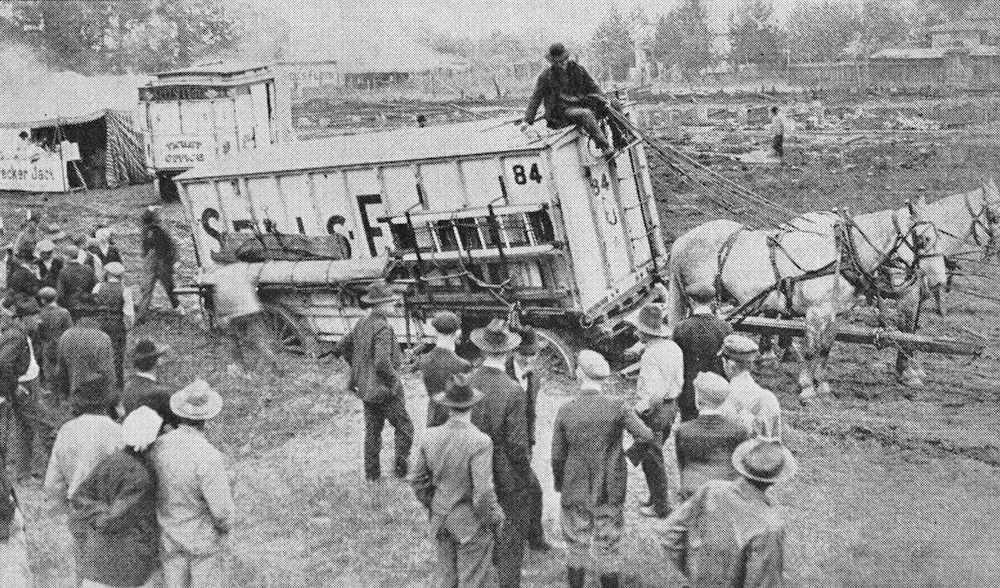
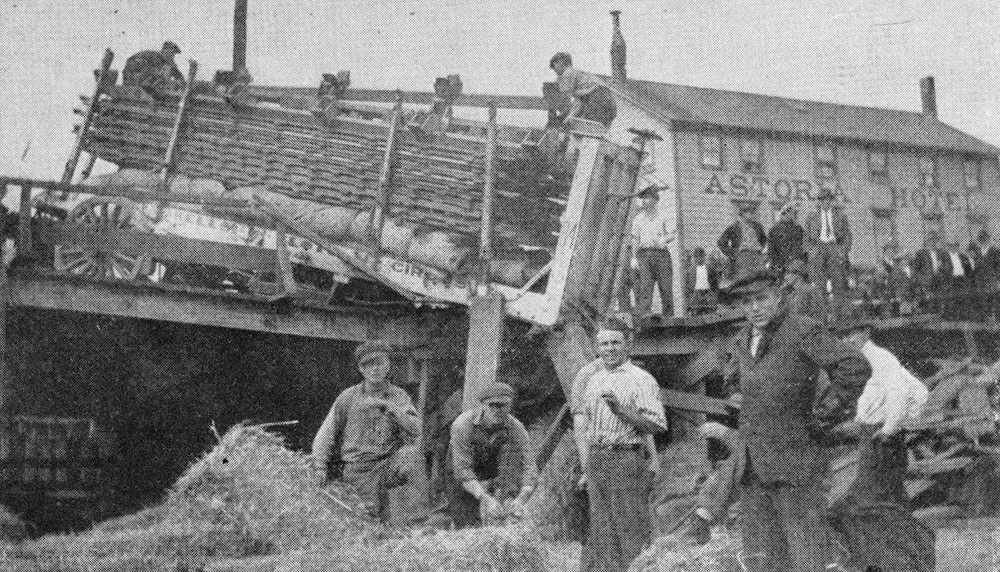
“I want you two to work together. Get where the gang seems the most tired. Start laughing and joking the minute you get there—and keep it up! And when you’ve laughed up that money, there’s more waiting! Now, hop to it!”
The value of a laugh! A circus was in the mud. Fifteen hours away was another town, fifteen hours away were boys and girls—and men and women—waiting for the glitter and sparkle of a parade, waiting for the music of the circus bands, the shimmer of the sun upon the sleek backs of parade horses, the long lines of elephants, the steel-throated scream of the calliope. And now that circus was in the mud, with fifty miles of railroading yet to be done, the whole, tremendous thing to be carried out of a flood by hand. All that could save it was the chance of a laugh!
Out into the lines of dead-tired workmen went Cokehead and Fullhouse. The negro began to cackle, the white man to boom and rumble with forced laughter. For a long time the other workmen only stared. Then the foolishness of it all struck one, more gifted with a sense of humor than the others. He grinned. Then he chuckled. Soon he was laughing with the two “professionals.” Another joined him—then another and another. Soon the whole line was laughing; nor could one tell the reason. Some one, spurred by the infectious stimulant of laughter, began to sing. Others joined him. The lines began to move with more spirit, more speed. Steadily the lines moved now, in machine-like rhythm, to the accompaniment of singing and laughter which made them forget the mud, made them forget the chill of wet clothing, the ache of stiffening muscles. By daylight and torchlight the singing and laughter and work went on. And at two o’clock the next morning, a tired trainmaster raised his hand in signal to the railroad men that the trains were loaded at last; that laughter had done what cursing or beating or whisky could not have done; that the show would go on; and that those who waited in the next town would not wait in vain. Thus men endured all under Bill Curtis.
As for Bill himself, I saw him last summer, hobbling around the hippodrome track of the Hagenbeck-Wallace Shows, a cane aiding a leg which had been crippled more than a year, the big frame a bit gaunt from racking pain, the skin of the high-boned face a trifle more tightly drawn than usual. But the genial old bark still was in the voice and the quick straight smile on the lips.
“I got mine in the smash-up,” he confided cheerily. “It was a little tough for awhile; couldn’t get around much. But,” and he waved the cane toward the flashing performance, the glaring chandeliers, the rocking “rosinbacks” in the rings and the tight-packed audience, “even that jamboree couldn’t stop us. The old trick’s still moving!”
And “that jamboree” was something which made you gasp in horror when you read about it, the wreck of the Hagenbeck-Wallace circus trains near Gary, Indiana, with a casualty list which consumed columns.
Bill was in the last car of the circus train when the speeding troop train crashed into it from the rear. Ploughing through the splintered coach, the engine caught Bill on its cowcatcher and, unconscious, he lay just beneath the extended front of the boiler as the engine carried him on to the finish of its work of destruction. Another car was torn to kindling, another and another, and upon the engine which caused the destruction was the crumpled, limp form of Bill Curtis, lucky enough to receive out of his wild ride of disaster only an injured leg. And slight indeed is that, when compared to the death rate in every coach which his carrier, the colliding engine, caused.
I saw others about the circus that day, one or two with arms or legs missing; many who were scarred and weakened for life. But still they were with “the old op’ry”, still working away that the show might go on. And Bill was only an example of all.
Just for instance, you cannot charge up Bill’s circus faithfulness to the fact that he can’t do anything else. Or to the lure of a large salary, or the fact that he might not be able to find another job. Many a big mechanical firm has tried to hire Bill. He gets about $75 a week on the circus, not more than $100, anyway. His offers have run far above $15,000 a year, for Bill is the inventor of the “spool wagon” which now carries the circus canvas, raises and lowers the poles, puts up the big tent all by itself and saves the work of forty men. He is the originator of the “chain system” of circus seats which can be set up in the middle of a street without a single stake to hold them in place. He invented the Curtis stake driver, and the Curtis “guy-rope tightener”, the Curtis “fool-proof wagon” which saves many a man from injury at the unloading runs. Everywhere about the circus on which he works can be found the evidences of Bill Curtis’s genius, and the inventions go with his salary. He is the type of inventor—the overnight kind—to whom you can give an order one day and receive a model of the invention the next, and who is sought after everywhere. But does Bill listen to the siren call of other business and a soft job for life? Hardly!
“I’d miss the excitement,” he says; “I’d feel kind of lost not to be studying the skies to figure out whether or not a blow’s coming, or whether we’re going to fight the rain and mud to get off the lot. I’d miss the chugging of the engines when the show goes up in the morning and the gamble against time. I guess I’d just wither and die in a soft job.”
“You see,” comes his explanation, “a fellow stays in the circus game because of the spirit of combat that’s in him. It’s a life where you don’t know what you’re going up against from one day to the next, a constant fight against time and against the elements. It means a lot to a fellow to know he can do the impossible; and believe me, when you roll into a town at ten o’clock in the morning, get up your tents, feed six or seven hundred people, give a two-mile parade, put on two performances and get away for your next town by midnight, well, you’ve run rings around impossibilities, and there’s a lot of satisfaction in it.”
And that is the life of the circus game,—to size up an impossibility, grin, grit your teeth and whip it! The circus world is full of Bills; that’s why, for one hundred and eighty days out of the year, the great caravans grind away a mileage ranging from sixteen thousand to thirty thousand miles, through mud, rain, fire, flood, hot weather, storms and difficulties, rarely missing even a parade, and with less than a score of lost performances for the whole season.
Figure it out for yourself. Take the biggest dry-goods store in New York City. Figure that store to be open and doing business until the last possible moment at night. Then, suddenly, it moves. The next day, in Philadelphia, eighty miles away, transported on trains ranging from thirty to ninety cars, that big store erects its own shelter, lays out its goods, opens its doors and is ready for business again, to say nothing of having erected its own restaurant, fed a thousand persons and given a demonstration of its wares through the streets in the morning. Add to all this the handicaps of weather, of railroad tie-ups, of delays, of fire and accident, and you have a small idea of what it means to transport a circus.
How is it done? By system, and by herculean grit that knows no master in the way of obstacles. Moving, moving, moving, the circus is ever traveling onward, ever fighting forward to the next stand. Long before the menagerie doors are opened for the night performance, the horse tents, the tableau wagons, the cook house and blacksmith shop have been loaded and started on the torch-defined route to the “runs”, or loading place in the railroad yards. By the time the bugle sounds for the entry which starts the big show, hurrying animal men are closing up the cages, while roaring tractors and clanking six-horse teams are shunted into position for the trip to the trains.
Perhaps you’ve noticed, when you came forth from the big show at night, that something is missing? It is the menagerie—tent and all—gone! While the acts flared before you in the big tent, the menagerie tent has fallen and been loaded. The cages have been transported to the trains and loaded. More than that, the highball has sounded, and from one to three trains, carrying the cook house, the parade paraphernalia, the tableaus, half of the executive staff, the same number of superintendents and straw bosses, the animals, and even a part of the performers, are speeding on toward the next town, leaving only that great tent and the seats of the main show to follow. It is only by such speed as this that the great thing can move. And move it must in this manner, in spite of every obstacle that Nature can throw in its way, if the waiting throngs of the next town are to see the spangles and tinsel on the morrow. Is it any wonder, therefore, that the circus man laughs at impossibilities? Is it any wonder that the man with a grouch, the man looking for a soft spot, the pessimist, or the growler against the petty troubles of life, has no place in the circus world? A thing that will even go deliberately into almost certain disaster to fulfill its promises can not afford to harbor the weakling, either in grit or physique. And I mean just what I say: a circus will gamble with its very life and the lives of every one of the thousand or so persons who go to make up its great family, to keep its word, to make good on its billing of:
RAIN OR SHINE—POSITIVE APPEARANCE!
As evidence: It was late in the summer of 1915 that I sat in the rickety, wobbling caboose of a local freight train on a corkscrew railroad in eastern Kansas. In all my railroading I had never struck rougher riding; it seemed constantly that the slow-running train must leave the rails, even at its “speed” of less than five miles an hour. I was ahead of my show—Sells Floto—and a week later the long, heavily loaded trains of the circus must make this route, if it lived up to its billing. I sought the engineer.
“How in blazes are those two circus trains going to get over this road?” I asked. The engineer snorted.
“It’s suicide, man!” he growled. “This road’s on the hog. They’ve just taken the circus’s money on the hope that God’ll pull ’em through. But it can’t be done—not on this road! I don’t want to act pessimistic, but I’m an old-timer on this line, and I’ve seen it go to pieces mile by mile. They haven’t had a track-walker over it in three months, and there hasn’t been a train heavier than ten cars on it in a year. Even then it’s a gamble. So there you are; do what you please, but I’m telling you that you’re playing with trouble.”
I hurried to the telegraph, to wire the general agent in Chicago:
Protect against almost certain wreck on Blank railroad. Worst road I ever saw. We’re bound for the ditch sure if we try to make it. Advise cancellation of towns on line.
And back came the answer:
Too late for cancellation. Folks are watching for us and we’ve got to take the chance. Have insured on possible damages to train and paraphernalia. Will do everything possible to safeguard trains; but can’t disappoint. We’ll make the gamble.
Ed. C. Warner,
General Agent.
And a week later, into possible death for the six hundred or so persons who composed the Sells Floto Circus, into the possibility of destruction by wreck and the fire which inevitably follows, with the consequent dangers of escape by the wild animals and all the horror attendant upon a railroad catastrophe went that circus. Every one knew what might come; every one was aware of the thing which threatened,—but on they went. Three days later, in St. Louis, I got a telegram from Warner, who had gone on to take the chance with the rest:
Show wrecked, but luck was with us. Ten flat cars went into the ditch but no one hurt and only one day lost. No animals in turnover, and everything salvaged. Damage about thirty thousand dollars.
Ed. C. Warner,
General Agent.
And there, I think, is typified the spirit of the big tops. A spirit which finds its best expression in the story of the Barnum and Bailey shows in 1906, as told by the simple note at the end of the route book of Charles Andress, the official Boswell:
“As the forms go to press, the ‘greatest show on earth’ is having a terrible battle with the floods of the Mississippi in the South, but has kept up with its paper.”
In Hattiesburg, in Meridian, in Charlotte and Raleigh and Richmond and two score more towns through the South, the great organization of five trains had fought against constant rains, against floods and lots knee-deep in mud, not pulling off of some of them until the dawn of the next day, and arriving in the following town as late as four o’clock in the afternoon. But it had kept its word, and through day after day of grueling struggles, had remained abreast of its “paper” or billing, forcing its way onward in spite of everything. Last year, one of the big shows had only two days more to go before the end of the season. Word came from Opelousas, Louisiana, that the danger of being mired was almost certain. But did the circus cancel its last two days and go home? It did not! It accepted the challenge of the elements and went onward to the fight!
It lost. Wagons were sunk in the mud until one could not see the wheels. Elephants, striving to rescue the great carriers, became panic-stricken and stampeded. The only meals served in two days were from a cook-house wagon, abandoned where it careened, hub-deep in the mud. Horses, caught in quicksand, went over their heads, only to be dragged forth by hundreds of men, tugging at lariats thrown about the necks of the poor animals just before they went under. It cost $40,000 to make that losing fight,—but that fight was made. There is always the chance to win, and anybody can be a quitter.
And please don’t think that this spirit of conflict is a thing which arises only now and then. A circus’s season begins in the spring; it ends in the autumn, and from the beginning to the end, it is one constant struggle against every possible obstacle which Fate can devise. But perhaps the story of just two months will give a better illustration.
One season, in company with its owner, I joined the show late in September for a “vacation.” The owner’s illness—and a too great faith in me—made me his representative. And in those two months which intervened between the date of joining and the happy morning when the show train rolled into winter quarters, these little things arose to add to the gayety of the occasion.
We decided to show Marshfield, Oregon, where no circus ever had exhibited. Troubles followed, and many of them,—with broken crossings, marshy spots on the haul to the lot, difficulties in obtaining water and room for unloading the trains. But it carried its own reward. For there were persons in Marshfield who had stayed up all night to greet the circus, persons who had never even seen an elephant or a lion or tiger!
Every one worked that day. Even the owner—and Dun and Bradstreet rate him at something like fourteen millions—stood on the front gate, taking tickets. A boy passed through an hour before the show began. Ten minutes later he came forth, while the owner, Harry Tammen, yelled at him:
“Hey, kid! Coming back?”
The boy stared.
“Maybe.”
“But don’t you want to see the show?”
“Oh,” and the boy grinned. “I’ve saw it.”
Tammen reached forth and collared that boy, who had walked around the menagerie tent and believed he had seen a circus performance.
“You come with me, kid!” was his command, as he turned the ticket-taking over to me. “I didn’t know there was an animal like you. Gosh! You don’t even know what to look for in a circus!”
They went inside. Two hours later, as the chariot racers bumped and careened around the rutty hippodrome track, I saw them again, the millionaire owner and the wide-eyed youngster, sitting high on the close-packed seats, both gummy with circus popcorn, both swinging their feet—and watching with all the eye-power that a human body can possess. And afterward—
“What were the receipts to-day?” I asked. Harry Tammen turned sharply.
“Darned if I know,” he exclaimed. “I don’t care whether we made a cent or not. Just being with that kid and living his happiness with him at his first circus,—that was reward enough for me!”
Then Harry Tammen turned away, but not soon enough to prevent my seeing the gleam of something that bespoke sentimentality in his eyes. Which proves also that it isn’t always the money which lures the circus on to its yearly fight. Perhaps the show gets a part of its own reward from giving joy to others? Stranger things have happened.
Onward, to a fight with an escaped lion at Medford, the threat of a forest fire at Weed, California, which crept closer and closer to the railroad over which we must depart, and which licked and spat at the long trains as they shot through its smoky, threatening radius. On to Riverside, where the poles fell and where four men died. On to Yuma, Arizona, with its heat of 112°, and an afternoon show only, that we might make the long, hard run to Phoenix.
The first section was loaded, but the train didn’t start. I sought the reason and found it in a crowd of men struggling vainly to shunt two escaped ostriches back into their cages. In vain; the ostriches were fighting in a duel to the death.
Men beat at them, yelled at them, sought to rope them and pull them apart, in vain. Kicking and leaping, the ostriches realized only one thing, that one of them must die, and we settled down to the only available resource, the watching the giant cock-fight and a hope for a speedy ending. It came in one tremendous kick of the victor, and an aggravated case of a decapitated chicken. The victor had beheaded his rival. The duel was over, the recalcitrant ostrich was loaded and the show went on, an hour late.
The puffing engines strove their best to make up time, then, far in the night, stopped in the midst of the desert. Shouts sounded and yelling bosses herded out the scrambling workmen. Fire!
Far ahead the sky was red from the glare of the burning train. A spark from the engine had settled in a side-show wagon; the draught of the train’s progress had done the rest. Miles from water, miles from aid. If that train moved on, with its consequent pressure of air, it meant the whole train must burn!
Rushing men dragged forth the steel cables which were used to guy out the poles of the big top. Then, sharp orders came from smoke-choked throats:
“Uncouple that car!”
Quickly the burning flat car was “spotted” with the rest of the train safe on each side. Men, wrapped in wet canvas, struggled forward against the heat to “lasso” the whole burning mass with the cables. Out came the work elephants, their pulling harness slapping about their shoulders as they were shunted into position. One by one they were hooked to the cables. Bull-hooks gleamed in the red light as the elephant men urged their beasts forward, straining against the taut strands of steel. A moment of racking labor, then a crashing roar as the blazing car tumbled down the embankment, its sparks and embers scattering, its flare becoming greater than ever. And there we left it, ten thousand dollars’ worth of lost effort, blazing away, as we went on, minus one side-show, two parade wagons and a flat car. But the crowds which lined the streets in Phoenix the next day and grumbled because the parade was an hour late did not, could not know the reason, and it is a part of circus ethics to keep one’s troubles to oneself.
Three days of peace with only such minor things as bad lots, long hauls, bad connections of motive power at terminals,—only the everyday happenings of circusdom. Then came Warren, Arizona.
The doors were opened late. There was a reason: a block away, a circus wagon had collided with a fire plug, with the result that for two hours a flood streamed in on the circus lot before the water main could be dammed. The city of Warren, Arizona, collected a hundred dollars damages. No one mentioned the fact that the trifling event had cost the circus five hundred dollars additional for straw to cover the mud. And no one cared. It’s all in a day, and later on, when a bibulous circus goer wandered into the side show and insisted on saying unkind things to the Half Man-Half Woman until the sensitive nature of that duo-person rebelled to the extent of tapping the intruder on the head with a monkey wrench, thereby precipitating a riot, no one did more than shrug his shoulders. You can’t figure the mental workings of a circus freak, so why worry?
El Paso, and a tent crammed with people who had come for just one purpose,—to see our “feature”, a pugilistic champion who had trained in El Paso a few years before. The announcer yelled forth his name. But no “Champion of the World” responded.
Again, while frantic circusmen sought the star, in vain. He was gone! The ticket men worked overtime refunding money, while hard-boiled circus men searched for the pugilist and swore never again to have a person on the show who didn’t have the circus spirit, no matter how many dollars he might draw. Eighty miles away they found him, where he had ridden cramped, and half-frozen, in a refrigerator car. Angrily they learned his story,—of a debt of two thousand dollars he didn’t want to pay, and an attempt to defeat the sheriff who was in the way with an attachment, by hiding in a refrigerator car. Then the train moved out, carrying a champion of the world with it.
The show fined him $2,500, but that didn’t make up for the lost prestige of a promise unfulfilled. Better a wreck, or a blowdown or anything, save a thing lost through being a quitter!
After that, a delayed train at San Antonio and a circus lot too small for the show itself mattered little. Or the cloudburst at Bryant, the cold drizzles at Tyler and Sheridan, or even the day at Wichita Falls, with a gale blowing so strong that even to raise the big top meant disaster. Those were things against which men fought and did their best. The top did not go up, but the show went on, with a side wall draped about the seats and the performance proceeding in the open!
Fort Worth. That norther, with its horrible barrier of ice. Then the trip home; but even then, the difficulties did not cease. A spark in a horse car. Another fire, and strong men ready to risk death to save the best-loved things of the circus,—its horses!
And all that happened within two months. Every circus season can tell treble that number of stories. But always there echoes that call which means everything in the circus world: “The show must go on!”
And on it goes!
THE END