Life was not always so pleasant on board
the Fuller. Hard words were the common
run of things and the most frightful and artistic
profanity often punctuated the working of the
ship. Given a ship's company barely strong
enough to handle a two thousand five hundred
ton three-skysail yarder, even had they all been
seasoned able seamen, our officers had to contend
with a crew over half of which rated below that
of the "ordinary" classification of seamanship,
thick skinned clodhoppers, all thumbs on a dark
night, and for many weeks after leaving port, as
useless as so much living ballast. The kicking
and moulding into form of this conglomerate
mass of deep sea flotsam, gathered for the ship
by the boarding masters, and duly signed on the
ship's articles as A.B., called for all but superhuman
efforts. The curse is far more potent than
the gentle plea, especially when hard fists and
hobnailed sea boots are backed by all of the age
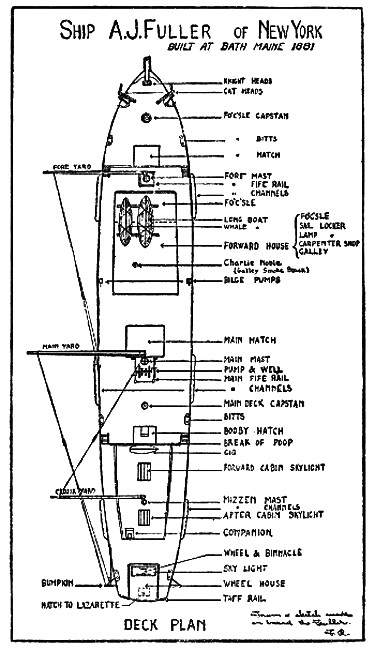
old authority of the sea. To work a ship of the
proportions of the Fuller, with seventeen hands
forward, called for man driving without thought
of anything but the work required.
The latter days of the sailing ship as a carrier,
before invoking the aid of steam auxiliary apparatus,
in the hoisting and hauling, brought forth
the brute sea officer aft, and the hardened fo'c'sle
crowd, half sailor and half drudge, forward. The
"bucko mate" walked her decks, and the jack tar,
stripped of his pigtail, his bell mouthed canvas
trousers, his varnished sailor hat, and his grog,
remained in plain dungaree and cotton shirt to
work the biggest sailing craft in the history of the
world on the last hard stages of their storm
tossed voyages.
Mixed with our real sailors were the worthless
(so far as sea lore went) scrapings of the waterfront.
Shipped by the boarding masters for the
benefit of their three months' "advance," and
furnished for sea with rotten kits of dunnage,
as unreliable and unfitted for the work as the
poor unfortunate dubs who were forced by an
unkind fate to wear them.
On the other hand, the real sailor-men of the
crew were valued accordingly, and I can hardly
remember an instance where either one of the
mates singled out for abuse those men who had
shipped as A.B. and were so in fact. My schoolship
training (St. Mary's '97) stood by me, and
though barely turned eighteen, I was saved from
most of the drudgery meted out to the farmers
of the watch.
After washing through the heavy seas we encountered
for the first few weeks of the voyage,
while beating off the coast on the long reach eastward
to the Azores, the long hard pine sweep of
the main deck became slippery with a deposit
of white salt-water slime. The sheen of this
scum, in the moonlight, under a film of running
water, gave the decks a ghastly "Flying Dutchman"
like appearance, and the footing became
so precarious that something had to be done.
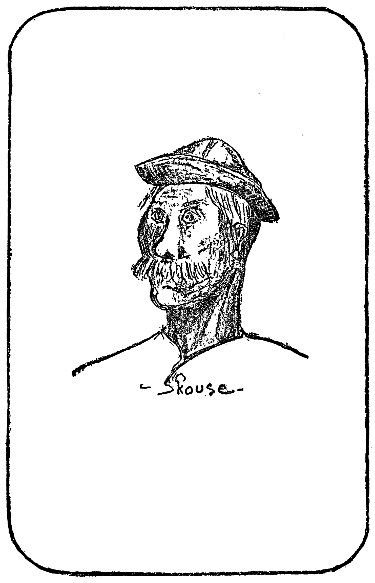
"They have the 'bear' out," Scouse announced,
as he trudged into the fo'c'sle carrying a "kid" of
cracker hash, ditto of burgoo, a can of coffee, and
a bag of hard tack, this cargo of sustenance being
our regulation breakfast menu.
"The bear?" I asked, as we gathered about this
appetizing spread.
"Yes, the bear," volunteered Brenden, grinning
with the rest of the sailors. "The bear for
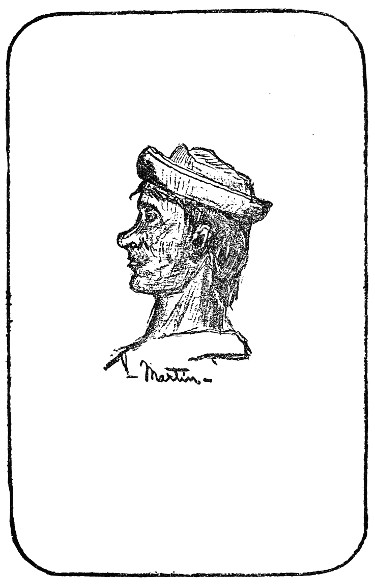
Scouse, and Joe, and Martin, and Fred."
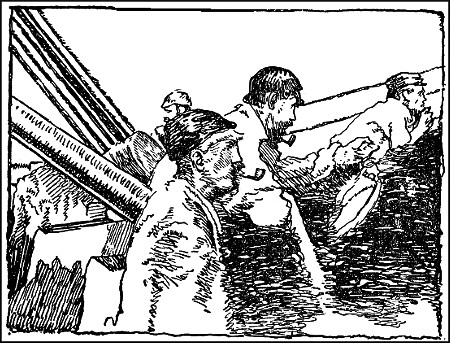
At eight bells, as we mustered aft, a subdued
banter went on among the men. The starboard
watch were all grinning, and as they went below
four sheepish looking fellows of the other side
turned the "bear" over to the farmers of our
watch. "Keep that jackass baby carriage moving
now. D'ye hear me? Keep it moving!" bellowed
the mate, for there was some reluctance in
taking hold, and as Scouse and Martin tailed on,
opposed to Joe and Fred, the doleful scrape of
the bear mingled with the general laughter at the
mate's sally.
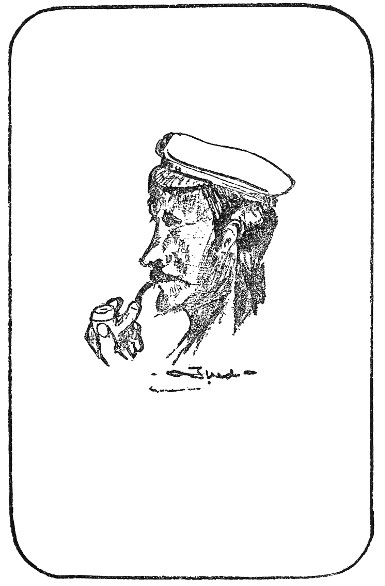
The bear consisted of a heavy box, a thick
thrum mat lashed on the bottom of it, and the
inside loaded with broken holy stones and charged
with wet sand. Four stout rope lanyards were
rigged to the corners and served to haul the thing
back and forth while the sand filtered down
through the mat, providing the necessary scouring
agent. A day or two with the bear in constant
service, both day and night, cleaned up the
decks and provided us with considerable amusement,
that is, those of us who were lucky enough
to be kept at more dignified jobs.
Ships leaving the Atlantic Coast in the winter
months bend their best suit of sails. The severe
weather usually encountered in working clear of
the land, and the chance of having to ratch off
from a lee shore, make this precaution one of
great importance. The fact that green crews are
bound to be more or less slow in taking in sail
during squalls may also account for the "storm
suit" under which we sailed from port.
On our first night out, shortly before one bell
in the mid watch, our crowd having just gone below,
the fore topmast stays'l blew from the bolt
ropes with the report of a cannon. We had already
clambered into our bunks, dog tired, when
this occurred, and muttered oaths, anticipating a
call of "all hands," came from untold depths of
weariness within the fo'c'sle. On deck there was
the hurried tramping of feet, and the shouting of
the second mate. We could hear the long wail
of the men at brace and downhaul, the "Ah-hee-Oh-hee-ah-Ho!"
with all of its variation as the
slaves of the ropes launched their age-old complaint
on the whipping winds. I lapsed into slumber
with the dim consciousness that the second
mate was handling the situation alone, and a
heartfelt thanks for the warmth of the blankets
in my narrow bunk; a foot above me the cold
rain pattered against the roof of the fo'c'sle
house, its music mingling with the swish of the
water under the fore channels.
After three weeks of beating to the eastward,
having fetched almost as far across as the Azores,
and being in the region of the northern limit of
the N. E. trades, the captain hauled his wind
and squared away for the run through the trade
wind belt to the doldrums and the line. Fine
weather became the order of the day and life on
board settled down to a more regular routine.
On a Saturday morning, the day having
broken remarkably fine, a brilliant red sunset followed
by a cold grey dawn, assuring us of the
settled weather that the steady "glass" made more
certain, all the world seemed ready to rejoice,
for it was Christmas Day. Word was passed
into the fo'c'sle by the other watch, as we turned
out for our breakfast, "We shift sail today."
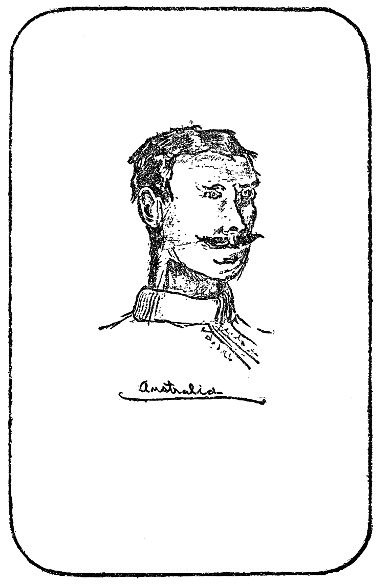
"All hands on deck for us, me boys!" piped
Australia. "An' the first watch on deck tonight,"
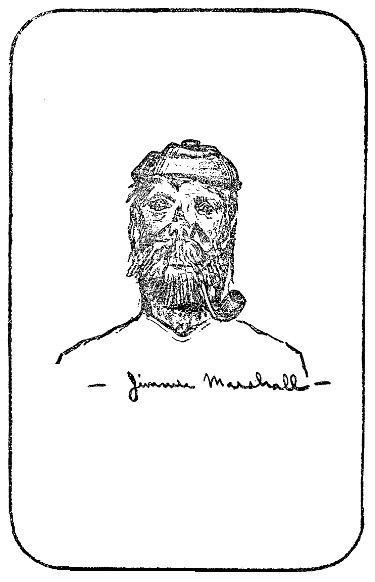
chipped in Jimmy Marshall, "an' a hell
of a Christmas Day!"
Jimmy lit his pipe for a morning puff; climbing
into his bunk, he dangled his short legs over
the frowsy head of big Scouse who sat with his
dejected poll bent under the upper bunk board,
a fair sample of the despondent crowd of farmers
who faced a Christmas Day of labor.
"A hell of a Christmas Day, boys,
A hell of a Christmas Day,
For we are bound for the bloody Horn
Ten thousand miles away."
Jimmy rendered this little ditty of cheerfulness
as Fred picked up the breakfast kids and started
for the galley, while we turned out on the sun-splashed
planks as the last of eight bells vibrated
over the ship. She lay still in a near calm like a
scene by Turner, all of her canvas hanging in
picturesque festoons from the jackstays, where
the starboard watch had cast off the courses and
tops'ls, leaving them depending in their gear.
The decks had not been washed down, in order to
keep them dry, and the mate himself had turned
out at four bells to start the ball rolling.
Long bundles of the fine weather canvas were
stretched on the decks ready for swaying aloft.
Working like demons in the forenoon, and with
all hands on deck after dinner, which was dispatched
in haste, we had the courses, and in turn
the tops'ls and light sails, lowered to the deck,
and the gantlines rigged to hoist the summer
canvas; this we sent aloft in record time. These
old sails, soft and mellow, veterans of a dozen
voyages, patched and repatched, with whole new
cloths of a lighter grade here and there streaking
the dull white-weathered surface, were as
smooth and pliable as a baby's bonnet.
On some of them, the fore upper tops'l especially,
we found records of the many crews who
had handled them before. "James Brine, Liverpool.
On his last voyage," was one inscription.
I hope Brine achieved his end and stayed ashore.
A date under this was hardly decipherable but
may have been Jan., June, or July, the day the
eighth, and the year 1893.
Bending a sail calls for the nicest knowledge;
the passing of the head earing must be done in
a certain manner, so the head of the sail will hold
well up on the yard arm; the gear, consisting of
tacks, sheets, clew garnets, and buntlines, in the
case of a "course," not to mention the leechlines,
and bowlines, must all be rove and rigged just
so. The "robands" or pieces of rope yarn, are all
looped through the "head holes" ready for bending
the sail to the iron jackstay on the yard, and
when a sailor does the job, all goes as smooth as
a wedding when the parson knows his job.
After the labors of a busy day, the ship presented
the comfortable well-patched appearance
of a man in the woods, free from the stiffness of
new white linen, and naturally fitting into the
familiar folds of old duds, unconventional but
plenty good enough. The bright spars still attested
to her "smartness," but we were in easy
trade wind weather and dressed accordingly. The
fores'l was particularly large, with extra clothes
in the leeches, made to catch and hold every
breath of wind blowing over the deck.
The sail locker was re-stowed with our "best
suit," and between the coils of canvas we liberally
spread a bundle of old newspapers brought
out by the mate. "To give the rats something
to chew on," he remarked, as we ran the stiff new
canvas in, tier upon tier.
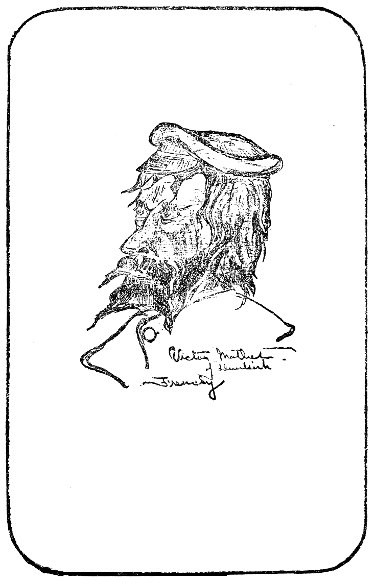
One thing that Frenchy called my attention
to in the stowing of the locker was the fact that
the storm canvas, lower tops'ls and stays'ls, were
placed handy for immediate removal, the mate
assuring himself of this fact by personal supervision;
indeed he knew just where each particular
sail was located in the locker, and could go in and
lay his hand upon it in the darkest night, as he
more than once demonstrated during the course
of the voyage.
That night a tired lot of men sat down to supper.
The cold salt beef, the hard bread and the
can of tea came from the galley in their usual
order. Fred, who was mess cook for that week,
went back to the galley, after depositing the regulation
Saturday night grub. As he left the
fo'c'sle door he turned back at us with a grin on
his wide good natured face, bristling with uneven
outcroppings of yellow stubble. Fred reminded
me of an amiable plodder hulking out in his dungaree
jacket, while the watch fell to on the beef
and tack.
"I guess he forgot to thank the cook for putting
so many bugs in the tea," ventured Brenden.
"Maybe he's going aft to take Christmas Dinner
with the captain in the cabin. They have a
real plum pudding there; I saw it in the galley,"
said Joe.
Plum pudding! Christmas! The thoughts of
loved ones far away, and of those distant homes
that perhaps were remembering some of us out
on the broad bosom of the deep waters, came as
a pang. All of us, I believe, felt this. For a moment
or two silence ensued, then Fred burst
through the fo'c'sle door with the big surprise.
"Pie, boys! Pie!" he shouted, depositing three
tin plates on the fo'c'sle deck, for we dined with
the deck as a table, sitting about the kids on low
benches. The precious pie was cut with the
greatest regard for equality by no less an expert
hand than that of Frenchy, assisted by Australia,
who showed us how to cut a pie into three parts
by measuring across the diameter with a knife,
adding a little to this, and then this length went
three times into the circumference.
Jimmy Marshall failed to agree with this theory,
but was fairly beaten in the result, for Australia
was right. The pie certainly was cut into
three very equal parts.
"An engineer in the mines showed me this,"
said Australia. "He says, 'Pie times across the
pie, is all the way around.' Mathematics is wot
he calls this." Australia was nearly right at that,
and the marks he made on the crust of the confections
baked by Chow served as a reliable guide
for Frenchy, also bolstering him immensely in the
eyes of the more humble members of the port
watch. That Australia chap certainly knew a
thing or two, even if he was not the best sailor
in the world.
But Jimmy Marshall's comment was simply,
"Rats!"
After supper, when pipes were glowing, and
most of us sought our bunks for the hour or so
that remained to us in the last dog watch, a discussion
arose as to what kind of pie it was.
Frenchy, the great gastronomic authority,
claimed it was English currant pie. "They taste
so bitter, that's why I know," he added with an
air of finality.
Others differed with him. Scouse said it was
red crabapple pie. Martin claimed it was nothing
but plum pie. I thought it tasted like cranberry,
but was not sure. At last, to settle the
matter, and at the earnest request of the crabbed
Jimmy, Fred trudged aft to the galley to consult
Chow and wind up the argument. He returned
in triumph with a large tin can done up in a
gaudy red label marked "Pie Fruit."
Shortly after entering the N. E. trades we
encountered the region of tropic rains, of daily
thunder storms, and of abundant drinking and
washing water. We rigged an old sail over the
gallows frame in the main deck to catch the rain,
which was teemed through a canvas pipe to the
main tank, a large upright iron cylinder standing
on the keelson blocks in the main hold just
abaft of the main mast. Our allowance of three
quarts a day, per man, was anything but satisfying
in the tropic atmosphere of the torrid zone.
At least half of this "whack" of water went to
the galley for use in the preparation of food and
the rest was divided between the scuttle butt and
the water barrel, from which it was drawn sparingly
for washing purposes; usually a mere rinse
to clean off the salt of a sea water scrub.
In the extreme heat, during the frequent periods
of calm, our suffering through the lack of
water became intense. The Fuller, like many
other ships sailing from New York, put to sea
with her water tank barely a quarter full, relying
on the tropic rains to replenish the supply. When
the rains did finally come we fairly reveled in the
luxury of abundant fresh water, drinking, washing
clothes, bathing, and just plain wasteful wallowing
in the refreshing element. With the first
douse of rain all hands turned out on deck to fill
their pannikins under the spouting drains from
the forward house.
The conduct of a deep water sailing voyage
in the old days of wooden ships called for what
today would be considered the highest type of
scientific management. In the maintenance of
the vessel, each part of the complicated fabric
received its due attention at some particular point
in the voyage where the weather was favorable
for that certain operation. So in the entry to
the rainy belt, that uncertain region of the doldrums
where almost constant precipitation takes
turn about with calm or light baffling winds, we
were turned loose on the job of scrubbing paintwork.
The work was started aft and each watch
did its own side of the ship, there being much
rivalry as to who was doing the most work.
Everybody took a hand in this and Brenden and
Marshall would curse unmercifully at the job
when well out of earshot of the after guard. Our
hands became wrinkled with the constant wet, the
calloused flesh getting soft and cheesy, while our
oilskins, in which we worked during the worst
downpours, became soaked and clammy through
constant use.
We were not allowed the bucket of classic
"sewgee" of the steam ship sailor, a mixture of
caustic soda, soft soap and water, but were provided
with nothing but a small tin of brick dust
and a rag of burlap; a rope handled deck bucket
and a small swab completed the outfit. Add to
this formula an abundance of "elbow grease,"
and slithers of tropic rain, and you get paintwork
polished smooth and white as ivory. A week or
so, with all hands on the paintwork, whenever the
working of the ship would permit, transformed
her into a model of neatness. Woe to the luckless
wretch who by any chance marred the deck
or paintwork with a drop of grease or tar.
About this time we made our acquaintance
with the flying fish, these swift travellers often
shooting over our deck at night and being caught
in the belly of one of the courses or the spanker.
A flying fish for breakfast is not bad, and many
were caught by the men on deck keeping a sharp
lookout for them. The mates were also watching
for the bag of flying fish and whenever one
landed on the poop or in the waist, one or the
other of the mates would call out and have a hand
bring the fish aft.
One night a fish landed somewhere in the waist.
We could hear the wet splatter of the flying fins,
as it was calm and the deck quiet. Mr. Zerk,
who was leaning against the weather swifter of
the mizzen shrouds, roused himself and called out
for someone to bring the fish aft.
Several of the watch started to search for the
visitor, for we also had heard him land, but without
success.
"How about that fish?" shouted the mate, after
a decent interval, while the search was going
on.
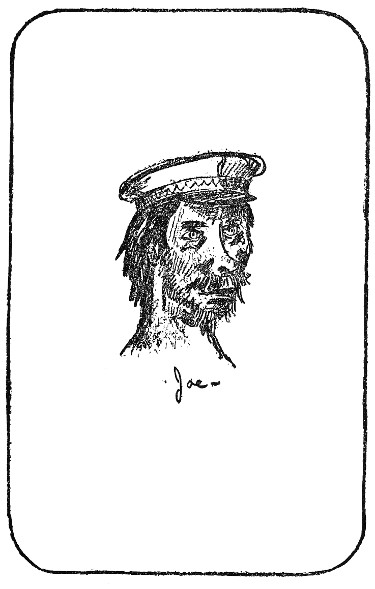
"Can't find it, sir," Joe piped up.
"The hell you can't!" thundered the mate.
"There he is," and again we heard a faint "splash,
splash" of the wings.
"Get a light, you damn fools," was the order,
for it was mighty dark. "Come now quick.
Pronto!" and as Scouse banged on the door of
the deck room occupied by Chips, in order to get
him to open the lamp locker, we thought we heard
the "splash, splash" again.
With the aid of a lantern and all of the watch
the entire deck was searched. Finally, Jimmy
Marshall let out a whoop, "Here he was! Here
he was!" Some water on the deck, near the coils
of rope hanging from the main pin rail, looked
as though Jimmy was close to the flying fish.
"Here he was!" again shouted the excited
Jimmy, grabbing the lantern from the hand of
Scouse.
"Here he what?" demanded the mate, coming
down into the waist. The mate bent over the wet
spot and exploded in a string of oaths. "No flying
fish ever made that! Here, you!" and he
grabbed Jimmy. "This is some of your damn
monkey shines, you old dried up bundle of sea
tripe! —— —— your gray hairs, I'll flying fish
you! Lay aloft to the main skysail yard and
watch the stars! I'll call you down on deck whenever
we need you!"
For several nights after that Jimmy spent his
time climbing up and down the main rigging,
for no sooner would he get up than the mate
would think of something to do that required his
presence on deck.
The flying fish episode furnished us with something
to talk about in the fo'c'sle, and while
Jimmy always tried to leave the impression that
the joke was on the mate and the rest of us, we
felt that his over zeal in discovering the puddle
of water in which his clever hand had simulated
the nervous flapping of the fins of a flying fish
had turned the tables. My idea was that Jimmy,
after seeing how well the thing was taking, could
not resist the temptation to get the credit.
We also harpooned our first bonita, a very active,
virile fish, shaped like a short double ended
spindle buoy, and striped lengthwise. These fish
are exceedingly lively and jump about with terrific
energy when brought on deck. Before taking
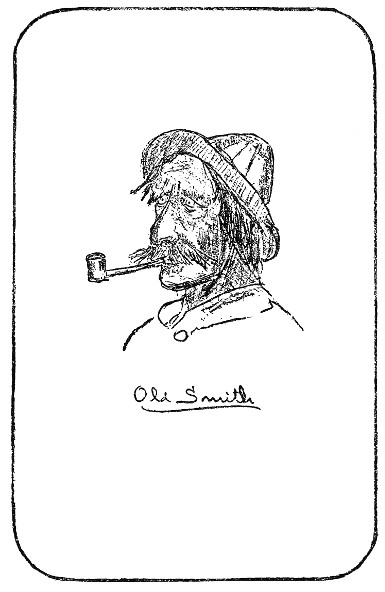
this fish to the galley, Old Smith of the other
watch, and Frenchy, and of course Jimmy Marshall,
tested the meat with a silver coin, to see if
it was of the poison variety.
"If the silver turns black the fish is poison,"
explained Frenchy. In this case the bonita was
pronounced "good to eat," and a great feast was
on that night; however, I never cared much for
fish anyway and did not touch it. Chow had certainly
made an ill looking mess of it, garnished
with broken tack, and basted with pork fat.
"You'll wisht you had a bit of this tucker afore
we get to Honolulu," was the comment of Joe,
who proceeded to help himself liberally.