The Henrietta C. March was a brig of
five hundred tons burden, and was
bound for Santa Cruz in the West Indies;
and Captain March had stopped off his home
port to take aboard his wife and daughter
and Drew, who had been given a long vacation
by his church. The mate of the brig
had been taken suddenly ill, and for two
days the captain had been trying to get a
man to fill his place.
It was with an impression of almost Crusoe-like
loneliness that Drew found himself
upon the deck when they reached the brig
at last, and the mate, with the crew at his
heels, had gone forward to swing the boat
to her place on the center-house, and then
to the windlass to heave the chain short.
Drew set his baggage down on the deck and,
walking forward, watched the men heaving
at the windlass, the jar and clank of which
filled the vessel. On the quarter-deck the
captain, in his shirt-sleeves and wearing a
shapeless brown hat, walked back and forth,
occasionally glancing aloft at the fly, which
was beginning to straighten out in the freshening
southwest breeze. His wife and daughter
were nowhere in sight.
The clank of the windlass grew slower and
slower as the cable shortened, and every
moment or two Medbury glanced over the
bow. Finally he raised his hand above his
head, and the men came trooping down from
the forecastle-deck, some going aloft to
loosen sails and others going to various
stations with a businesslike directness that
seemed to Drew to be under the guidance
of wordless intuition. He stood leaning
against the fore-rigging as two came toward
him with the unseeing look of men who,
having a duty to perform, recognize no obstacle,
and, gently pushing him aside, began
to throw to the deck the coils of running
rigging against which he had been leaning.
He moved from place to place, always finding
himself in the way and being pushed
aside with the silent directness that seemed
purely impersonal, until at last, throwing off
his coat, he began to pull with the rest. In
silence they made place for him. For a time
he found his hands catching awkwardly at
halyards and braces and slipping over and
under other harder hands; then at last he
caught the swing, and his body rose and sank
with the bodies of the others, and his breathing
came heavily and thickened with theirs.
The minister had found himself.
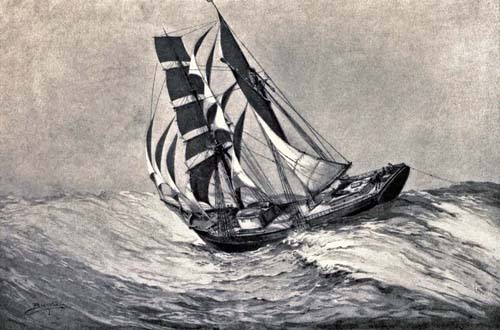
It was not until the brig slowly paid off,
heeling before the fresh breeze, and the outward-bound
song began its chant about her
forefoot, that he gathered up his baggage
and went aft. Captain March was at the
wheel.
"Go right down and make yourself to
home," he said. "They'll show you your
room. I declare, you take a hold like an old
hand. We'll be sending you aloft in a few
days."
Drew smiled, but shook his head.
"No," he said; "I shall stick to the
deck."
As he went down the companionway and
stepped across the cabin, he saw the round
little form of Mrs. March kneeling before a
locker in what was to be his room. She
turned her head at the sound of his footsteps.
"I thought I'd tidy your room up a bit,"
she told him. "Gracious knows, it needs it.
You'd think it started out as a carpenter shop
or sail-loft, but got discouraged and ended
up just plain litter. I guess Cap'n March
has left house-cleaning out of his almanac.
And he said this room was clean!"
"Oh, I am sure it will do nicely, Mrs.
March," Drew replied. "My mother says
I'm fond of a comfortable disorder."
"I guess men are all alike in that," she
said: "they like a clutter—they think it's
having things handy. But I hope you'll
excuse my back," she went on. "I was
just telling my daughter that I was almost
ashamed to show my face to you. There
I was scolding about Cap'n March being so
late, when all the time you and he were so
anxious to get off and he scurrying around
to find a mate. I declare, sometimes it seems
as if the good Lord didn't do his best
by women when he gave them tongues.
They're like drums to little children—make
a dreadful noise and keep them from better
things."
Drew smiled. It seemed clear that the
captain had used some latitude in explaining
his late return home. Meanwhile Mrs.
March was backing out of the room.
"There," she said; "it's in a sort of
order, if you don't look too close."
Ten minutes later Drew came out into
the cabin, having put away his belongings.
"I am sure the room couldn't be better,
Mrs. March," he said. "It seems to me
delightfully cozy and neat."
Mrs. March shook her head and smiled
as she said:
"I'd 'a' been better satisfied if you hadn't
mentioned its being so nice. I've noticed
this about men folks, that when things suit
them, they don't notice them. When Cap'n
March talks and acts like a man right out
of the Bible, I'm sure he's been up to mischief,
or else has something unpleasant on
his mind, one."
Drew laughed as he replied:
"Then I'm going to cultivate wise silences,
Mrs. March. I'll give you the impression of
a man walking in a dream. I have come on
this voyage to learn things; you are not letting
me lose any time."
"Oh, if you came to learn things, you'll
be wasting time by talking with the rest of
us: you must go to my daughter here. She's
been called to that, you know—to teach all
men and nations." Her voice held a curious
note: pride, resentment, anxiety, all seemed
to marshal themselves in the words.
"Mother!"
Drew turned quickly at the one word, to
see the daughter standing in the doorway
of her room. He noticed that while the girl's
brow was drawn in a frown, her lips had the
undecided irregularity of curve that hinted
at a smile suppressed. This study of particulars
did not make him any the less
alert to a general impression of striking
beauty. He smiled and bowed somewhat
elaborately, to which the girl returned a
curt little nod, though her answering smile
was friendly.
He had the tact to seem not to recognize the
tension and to turn to other subjects, and
he now said, with a heartiness that seemed
to have long been waiting for expression, that
they really were off at last. His glance at
the hanging lamp over the table, gently swaying
in its gimbals, had the effect of bringing
the corroborative testimony of its motion to
their notice, while he went on to add that it
seemed too good to be true. He said that
ever since the brig had anchored off the harbor
he had been haunted by the fear that
something would happen at the last moment
to keep him at home. Not till now had he
felt safe.
"It's the other way about with me," said
Mrs. March. "I shall not feel safe till I
get home again. If the Lord meant for us
to go wandering about on the face of the
waters, he would have made them steady
enough to build roads on. If he put people
'way on the other side of the earth, he meant
them to stay there—and us, too," she added
lamely, but with sufficient clearness.
Drew halted half-way up the companionway.
"You don't mean to say that you are
afraid of the sea, Mrs. March," he asked,
"after all your voyages?"
"I've been going with Cap'n March off
and on for twenty-five—yes, thirty—years,"
she answered; "yet I never go out
of sight of land without feeling that I'm
making faces at my Maker and daring him
to punish me."
"Oh, mother's fear is her most precious
possession," said the girl, now for the first
time coming forth into the cabin. "Nothing
has ever happened to her at sea; and
that, she feels, is the best reason for thinking
that something is bound to happen the next
time." She put her hand on the elder
woman's shoulder and smiled down on her
from her greater height.
"Well, that's reasonable," retorted Mrs.
March. "I was never one to shut my eyes
and claim it wasn't thundering. I've got
my hearing. What does the good Lord give
us feelings for if he doesn't mean us to
use them?" With this challenge to unbelief
in design in nature, she went to her
room.
Captain March was still at the wheel when
Drew returned to the deck. Medbury was
forward with the crew, busily stowing the
anchor. Little by little, Blackwater was disappearing
behind the high white cliffs. Drew
took up the glass which lay in its box against
the frame of the sliding hood of the companionway
and looked toward the village.
Even as he looked, the white spire of his
church disappeared from view. He saw it
vanish, and put the glass down, to see the
girl standing in the companionway watching
the changing shore.
"I've seen the last of my church for three
months," he said to her; "now I am really
loose and free."
"It's good to get away from responsibility
for a while," she said. "I feel now as
if I could dismiss all thought and worry
until I return. Then things may look different
to me. I am going to think so, anyway."
"Hetty," said the captain, "just run
down and get my pipe off my desk, won't
you? You're younger than I am. Besides,
I'm busy." He turned to Drew. "Ashore
I smoke cigars mostly; my wife says a pipe's
low. But here I'm master." He looked
about his little kingdom with a mild, complacent
face.
His daughter brought his pipe, and, with
the gentle look not yet gone from his face,
he was filling it when a boyish-looking lad
came aft along the starboard side of the
house, sent by the mate to take the wheel.
Drew, watching the captain, saw his face
change. As the lad came to the quarter-deck,
the captain pointed a stubby finger at him.
"You—" he began harshly, and then
hesitated and glanced at his daughter. The
boy stopped and turned a frightened look
upon the captain.
"Ever been to sea before?" demanded
the captain.
"Yes, sir," faltered the boy.
"When?"
"Along the sound here—last summer,"
he answered.
"Ah," said the captain; then he added:
"Didn't you learn the le'ward side of a
vessel?"
The boy gave a startled look aloft, and
then, with a flaming face, turned quickly
and came back along the lee side of the
house. The captain gave him the course,
and without another word walked over to
the rail, where his daughter stood with Drew.
"Sometimes they forget, sometimes
they're green and don't know, and sometimes
it's just impudence," he said in a
voice that the boy could hear. "No matter
which it is, ninety-nine times in a hundred
the sailorman who does it tumbles right
into trouble. This happened to be the hundredth
time."
His daughter took him by the shoulders
and shook him gently.
"Do you mean to say," she asked in a
low voice, "that you might have punished
that boy for coming aft on the wrong side?
You could see he had forgotten or didn't
know. Would you?"
He smiled upon her.
"Well," he answered, "he'd have remembered
the next time if I had."
She drew back haughtily.
"I am going to parade—parade up and
down that gangway by the hour!" she told
him.
Her father chuckled.
"Nothing to hinder," he declared.
"You're not down on the articles as a
forecastle-hand, are you?"
She did not stay to listen, but went indignantly
away; at the cabin door, however,
she turned and came back.
"You wouldn't have done it," she told
him; "I know you wouldn't." She stooped—she
was taller than he—and kissed him
lightly. Then she went below.
Her father gazed after her.
"Sometimes she's a thousand feet tall,"
he said to Drew; "and then again—"
"No taller than your heart," suggested
Drew as he hesitated.
"That's about it, I guess," said the captain.
The wind freshened as night came on, and
had a touch of winter in its sting. They
were now running fast by the coast, the high
cliffs of which rose dark and desolate on the
starboard. The water was black, save where
it ran hissing along the sides in a ragged
gray ribbon of foam. Behind them, in the
west, a crimson flush lingered in the sky.
Drew stood at the break in the poop-deck,
watching the shadowy forms of the crew moving
about the deck forward as they made
the royal snug for the night; far overhead
he could hear the pennant halyards slatting
against the topmast in the dark. Every taut
line and halyard sang in the breeze, and there
was a dull, humming roar in the canvas;
under the lower sails, across the deck, the
wind swept crackling and keen.
He heard the mate's last "That's well;
belay!" and watched him come aft. He
passed without speaking, then hesitated and
came back.
"After we get through the Race," he
said, "we'll begin to get the swell." He
spoke absent-mindedly, as if he were thinking
of something quite different; then he
walked to the rail and sat down. Drew followed
him.
Leaning his elbows on his knees, Medbury
sat for a long time without speaking;
at last he looked up with a little laugh.
"I'd give something to be out of this,"
he said. "I was a fool to come. I might
have known better. It's funny, but a man
may know a woman all his life, and at the
end of the time know as little about her as
if he'd never seen her—that is, really know
her—how she'll take things. Now, I suppose
this was the very worst thing I could
have done. All that I've got to do is to
wait till she gets ready and she'll tell me
so. Oh, I can see just how she'll look and
what she'll say! I don't need to have her
tell me. 'You might have thought of my
feelings!'"—he changed his voice,—"that's
what she'll say. And I—" he
broke off impatiently.
Drew looked at him in bewilderment.
"I don't think I understand," he said.
"You don't? Why, mother said she told
you all about it one time when you were at
the house; she said she had to tell some one.
That's how I felt to-night, and I thought you
knew."
A light broke in upon Drew.
"Ah!" he said. Then he went on: "Yes,
she told me; but she did not tell me the
young lady's name. It is Miss March?"
"Yes," Medbury answered. "I thought
you must know. You'd have been the only
one in Blackwater if you hadn't. Sometimes
I feel like the town clock, with every
one watching my face. That's one reason
why I like the China seas; I can't get farther
away."
"Your mother told me very little," said
Drew; "she was worrying about your not
coming home, and lonely, and it did her good
to speak. It did not seem to me a hopeless
situation as she told it. Captain March
strikes me as being a reasonable man."
"I guess she didn't tell you all, then.
Well, I was thinking of what she said and
how much she thought of you, and, thinking
you knew, I made up my mind to ask
your advice. I felt that I had to talk to
some one." He hesitated a moment and
then, with a boyish laugh, went on: "You
see, Hetty and I had always been pretty good
friends from the time we went to school together.
Well, I've never got over it. When
I first went to sea she used to write to me;
but after a while she went out to Oberlin to
live with an aunt while she went to college;
and as I was half the time on the other side
of the world, we kind of lost track of each
other. I guess she lost track of me more
than I did of her, for she's changed since I
saw her last, three years ago, and I can't
quite make her out. She's friendly enough,
but she's different, and has come home with
a wild notion of going out to China as a missionary.
Good Lord! a girl like that to be
thrown away on those—" He could think
of no word strong enough to convey his contempt.
"Well," he went on, "I can't see
any place for me in that plan, but that
doesn't seem to trouble her. That's what
worries me. Of course the old man's set
against her going; but he's set against me,
too, because I'm a sailor. That's the way
things stand. When I heard she was going
out with her father this trip, and the mate
was sick, I rushed off to the old man and
offered to go with him. He wouldn't hear
of it, and engaged two others; but I saw
them privately, and they backed out. The
old man can't understand why they did.
To-day he came to me, and here I am. I've
been offered a good vessel, and I intended
to stay home a spell; but when I heard Hetty
was going, it seemed to me it was my
last chance—to go with her; but I guess it
was a mistake. I can see she thinks I've done
a foolish thing, and is angry."
"I think I can understand how she feels—how
most women would feel," said Drew,
slowly, after a long pause. "Her sense of
justice is outraged—perhaps that's too
strong a word; but she feels that you have
taken an unfair advantage of her in leaving
her no way of escape. She might not have
cared to escape, but she likes to feel that
retreat is open to her. A woman fights at
a disadvantage in these things; she is more
sensitive to public opinion than are men,
and she has the instinct of a hunted creature.
I don't know that I can make it clear,"
he concluded hopelessly. "Then, too, I may
be wholly wrong."
"Well, I don't know what I am going
to do, now I'm here," said Medbury, forlornly.
"I should say, attend strictly to business
and see her as little as possible for a while,"
Drew told him. "As for her anger, that
may be a good sign. If she were simply
indifferent to you, she wouldn't care. She
could leave it safely to time to make your
coming ridiculous."
When Drew entered the cabin, an hour
later, Hetty sat at the table reading, shading
her eyes with her hand; her mother sat
knitting near her; and on the lounge her
father reclined, pipe in mouth, his hat on the
floor beside him. Blinking in the strong light,
Drew sat down without removing his overcoat.
"Ain't you going to stay a while?" asked
the captain. "You can't make church calls
to-night."
Drew laughed.
"No," he said; "that's true. I'm out
of that. But I'm going back on deck soon.
I can't get enough of it: the world seems all
sky and stars. I had lost sight of the fact
that the earth is so trivial."
Captain March let his feet come slowly
to the floor and picked up his hat.
"That's a good deal so," he said. "Still,
there's enough earth lying loose around the
Race to keep me from forgetting it, at least
till we've dropped it astern. I guess I'll go
take a look up on deck."
As her father disappeared, Hetty laid
down her book and looked up.
"Where are we now?" she asked Drew.
"Little Gull Island light is just ahead of
us," he answered.
"That will be our last sight of land,
won't it?" she asked. "I'm going up to
say good-by."
When she had gone, her mother dropped
her knitting in her lap.
"I guess ministers are used to people
coming to them with all their troubles," she
began, with a plaintive little note creeping
into her usually cheery voice, "and I do
hope you won't think I'm trying to spoil
your vacation by troubling you with ours;
but Cap'n March and I have talked and
talked till we ain't on speaking terms with
our own judgments any more, and what to
do next I don't know." Then she, too, told
the story.
At the end of her hurried recital she said:
"What she thinks of Tom I don't know;
she's awfully close-mouthed about some
things. I like Tom, and if I had my way
I guess I'd let the young folks settle it
themselves. But Cap'n March he's different.
He's going to take it for granted that she
won't think of Tom because her father disapproves
of her marrying a sailor; and he
will be so sure of it, and so exasperating,
that I don't know what he'll make her do
first—marry Tom or go right off to China.
In the end he'll let her do just what she
makes up her mind to do. He always did,
and he always will. If it's one thing, I don't
care; but to think of her going off alone to
the other side of the world—" She picked
up her work and began to knit rapidly, with
fast-falling tears.
Drew sat with his elbow on the back of
the chair, his chin in the palm of his hand,
looking down at the floor.
"I wish I knew what to say—to advise,
Mrs. March," he now said; "but I do not.
Perhaps after a while—"
"Yes," she broke in eagerly; "that's all
we could expect. I told Cap'n March I was
going to speak to you, and he seemed real
pleased. I'm sure you'll think of some way
out," she added, with the cheerful optimism
with which we shift the burden of our desperate
affairs to the shoulders of others. It
is hard to believe that Fate will continue
unkind when our friends are moved. "And
I hope," she went on, "that you won't feel
it a duty to encourage Hetty's missionary
notions. Of course you're a minister and
believe in missionaries, and I shouldn't ask
you to go against your conscience; but I
suppose you can believe in them without
thinking that everybody's fit for the work.
I'm sure Hetty isn't. All the missionary
women I ever saw were thin and homely,
and their clothes seemed just thrown at them.
Hetty isn't a bit like that. I can say so, if
she is my daughter. And I've scarcely seen
her for three years; and if now she should
go away to live at the end of the world among
heathen idols, with not a homelike thing, and
no one to mother her when she needs mothering,
then I think that religion is very kind
to the heathen, who don't want it, and very
cruel to a mother who has always been a
God-fearing woman and only wants her child
near her when she comes to die. She's all
I've got."
She had been speaking with increasing
rapidity, but now a light footfall sounded
on deck, going aft, and she stopped.
"Go up on deck," she said to Drew. "I
don't want her to know I've ever mentioned
this to you. She's a dear girl, but sometimes
I feel like a hen who is the mother of a duckling.
What she's going to do next I don't
know."
Drew met the girl by the corner of the
house.
"I've been showing father the stars,"
she said. "He, a sailor, and not to know
them! I told him I thought it shameful."
"I suppose he knew the north star," he
said, smiling.
"Oh, yes; he knew that. The others
didn't seem to impress him. He said they
were too shifty to be of much use."
"I think there are some folks who know
so much that it kind o' clogs their brains
and keeps them from working right," said
Captain March, coming up behind her. "I
have an idea that we can use just about so
much, and all over and above that is just
pure waste. I once had a mate that was
like that. He could name all the stars, too,
and knew a good many things of that sort
that didn't help him much to find his longitude;
but as for the look of the sky, or the
heave of the sea, or the feel of the wind,
that meant nothing more to him than so much
blank paper. Now, when I walk the deck
at night and look up and see the stars shining
overhead, winter or summer, they're company
for me. That's enough for me; what
men call 'em I don't care. I suppose the
good Lord's got his own names for them."
Hetty stayed on deck till Little Gull Island
light came abreast; but when she had gone
below the captain sought out Drew as he
stood by the main-rigging and told him his
daughter's desire. He made no mention of
Medbury.
"Her mother thought you might help us,"
he concluded; "and I hope you can, for
we're in sore trouble. Still, I don't ask you
to advise against your conscience. Now I
say, 'No,' to her; but if she feels she's got
to go, and doesn't change, why, I shall say,
'Yes,' in the end. I know that. My father
always wanted me to stay ashore, but I was
wild to go to sea. It seemed that I had to
go, and in the end I did. I don't know that
I got all I expected, but I got what I wanted;
and if my girl sets her heart on this as the
only way for her to lead her life, why, I
sha'n't put a stone in her way when once
I'm sure. It wouldn't be right."