WHO ROBBED THE SAFE?
WHILE Myles Manning was struggling with
one of the great trials of his life in New
York, events were taking place at Mountain Junction
in which he would have been greatly interested
had he known of them. In the first place, Ben
Watkins’ uncle, the division superintendent, had
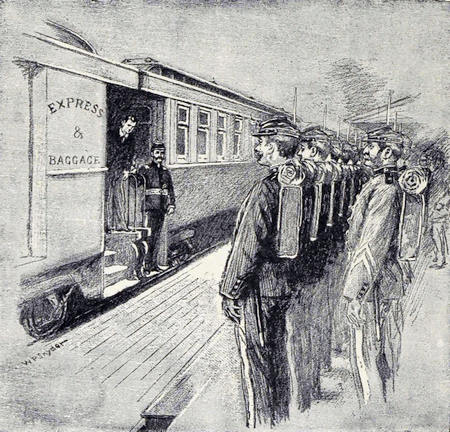
returned, and, with the powerful aid of the 50th
Regiment, N. G. S. N. Y., was proceeding vigorously
against the railroad strikers in that part of the
country. Several leaders were arrested and locked
up to await trial, but Jacob Allen, who was supposed
to be chief among them, was not to be found,
though every effort was made to discover his hiding-place
and a large reward was offered for his apprehension.
He had not been seen in town since the
morning of his rescue from the jail, and, though his
little house was closely watched, it could not be
discovered that he had any communication with his
family. Still, the efforts for his capture were not
relaxed, for the fall term of court would open at
Mountain Junction on the following Monday, and it
was deemed important that Allen’s case, together
with those of his associates, should then be tried.
The second event of interest to Myles was the
return to town of Ben Watkins himself, and the
consequences that followed immediately upon it.
He had been released by the strikers who captured
him, together with Lieutenant Easter and his command,
in a town about forty miles away, and left at
liberty to work his way back as best he could.
This he succeeded in doing, and he reached Mountain
Junction about the same time as his uncle.
Ben became greatly excited when he learned of
his uncle’s return and of Myles Manning’s departure.
He inquired at the hotel office if the latter had
left any letter or package for him, and on being told
that he had not the young man broke forth into a
torrent of abuse, not only against Myles, but against
all reporters, whom he denounced as a prying, sneaking
set of fellows, unfit to be admitted into decent
society.
All this was heard by several persons, including
Billings, who, concealed behind his immense shirt-collar,
was sitting in the hotel office. He listened
quietly for a few minutes, but when Ben began to
include all reporters in his abuse the little man
could no longer stand it. He jumped up and, stepping
squarely in front of the bully, declared that he
was a reporter, and demanded that the other make
an instant apology for his words, or prepare to suffer
the consequences.
“And who will make me suffer, I should like to
know?” cried Ben, gazing with contempt upon the
absurd figure cut by this champion of reporters.
“Perhaps I will,” answered Billings, affecting his
languid drawl, “or perhaps I will leave it to my
friend, ‘Lord Steerem,’ don’t you know.”
“You impudent puppy!” screamed Ben in a fury,
now recognizing Billings as the reporter who had
made him the laughing-stock of all New London.
“If you weren’t so small as to be beneath contempt
I’d thrash you to within an inch of your life. Now
clear out of here before I hurt you, and don’t you
ever dare come in my way again.”
“I’m a little threshing-machine myself,” answered
Billings, coolly, “and I am geared up to just about
your size, Mr. Bigman, So come on if you dare. I
don’t care that”—snapping his fingers in Ben’s face—“for
you or your bluster.”
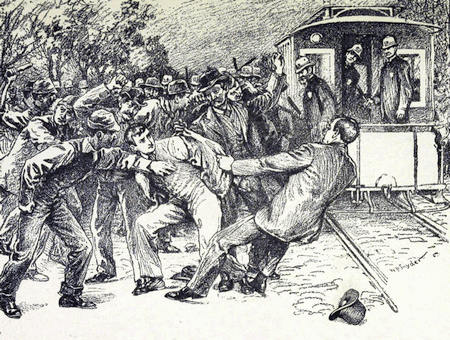
Ben aimed a blow at him, which the reporter
cleverly dodged. Before there was a chance for
another, the by-standers, who were vastly entertained
by Billings’ exhibition of pluck, rushed in
and separated the two, declaring that Ben ought to
be ashamed of himself to strike at a fellow not half
his size.
Ben sulkily left the hotel, vowing vengeance
against both Billings and Myles, while the little
man, who was prevented from following him, entertained
his captors with the story of “Lord Steerem,”
the famous coxswain.
The division superintendent was a harsh man,
who entertained no affection for his nephew, and
had only given him his position because he was
his brother’s son. He suspected Ben’s unfitness for
the place, and had been on the point of discharging
him several times. Now, when Ben entered the
office, he found his uncle greatly dissatisfied with his
conduct of affairs during the preceding four days.
“If it had not been for your overbearing manner
and absurd display of authority,” he said to Ben,
“there would have been no serious outbreak here,
nor any destruction of the company’s property.
Now I’ll trouble you for the key to the safe.”
With all his known faults Ben had never been
suspected of dishonesty by his uncle, who was
obliged to trust his assistant implicitly in many
things.
Ben hesitated a moment and then said that he
had left the key in his room for greater safety, and
would be obliged to go there for it.
“A pretty place your room is to leave a thing
of such value!” growled the superintendent. “You
should not have let it go out of your possession for
an instant.”
“I was afraid I might be robbed by the strikers,”
answered Ben.
“Nonsense! The strikers are not the sort of fellows
to rob individuals. You ought to know that
as well as I. Now hurry up and get the key. I
must have the books out of the safe at once.”
Ben left the office and in a few minutes returned.
With a well assumed air of agitation he said that
the key was nowhere to be found, and that it must
have been stolen from his room during his absence
from town.
“Whom do you suspect of stealing it?” demanded
his uncle.
“I don’t suspect anybody unless it is some of the
strikers.”
“The strikers again! Always the strikers,” sneered
the other. “Well, sir, we will soon find out. If the
key was stolen it was done for the purpose of robbing
the safe. I shall have the lock picked, and if
any thing is missing I will believe that the key was
taken from your room as you say. If every thing is
all right in the safe I shall be forced to believe that
you have lost the key, and have trumped up this
story to conceal your carelessness. In that case the
position of assistant superintendent of this division
will instantly become vacant, for I shall have no
further use for you.”
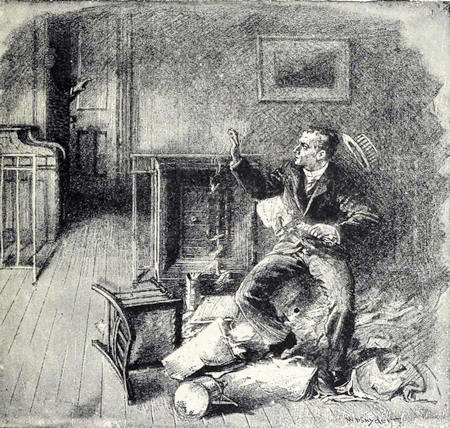
An hour later the lock was picked and the safe
opened. The superintendent carefully examined its
contents, taking from it every book and bundle of
papers.
“Well, sir,” he said, turning to Ben after satisfying
himself that every thing was as he left it, “what
have you to say now?”
“I don’t see any money package,” answered Ben,
stooping and peering into the empty safe.
“Money package! What money package?”
“One containing a thousand dollars that came by
express from the treasurer the day you went away.
I receipted for it in your name and locked it up in
the safe, but it doesn’t seem to be there now.”
“No, I should say it wasn’t!” exclaimed the
superintendent, rather staggered by this proof that
his nephew’s story of being robbed was true, and,
searching his face keenly, “You are sure there is no
mistake about that package?”
“Certainly not, sir. You will find a copy of the
receipt I gave for it in the blotter and the sum
entered in the cash-book.”
Examination proved both of these statements to
be true.
“Did you say that the money came from the
treasurer’s office?”
“Yes, sir.”
“Then one or more of the bills it contained must
have been marked, for that is a precaution I never
knew the treasurer to neglect.”
A dispatch sent to the general office of the company,
informing the treasurer of the robbery and
asking if any of the bills in that package could be
identified, set his clerks to examining a certain little
memorandum-book.
In a very short time a reply reached Mountain Junction.
Yes, in package number so and so, containing
one thousand dollars, sent to the division superintendent
on such a date, one fifty-dollar bill was privately
marked in the manner usual with the treasurer.
On the following day the division superintendent
spent several hours in the only bank of Mountain
Junction, where he and the cashier closely examined
every fifty-dollar bill among its deposits, but none
bearing the private mark of the treasurer of the
railroad company was to be found. Just as they
had satisfied themselves of this the proprietor of the
principal hotel came in to make his weekly deposit
of funds, which he always did on Saturday.
After he had gone the cashier returned to the
private office in which the superintendent still sat.
“Here are two more fifties that have just come
in,” he said. “Perhaps you had better look at
them.”
The first one was not marked, but the second!
Yes, it bore the fatal sign, a tiny red cross made in
a spot where it would never be detected unless a
person knew just where to look for it.
“Then you’ve struck the trail at last?” said the
cashier.
“Yes, and I’ll follow it up close while it is
fresh,” answered the superintendent. “What a bit
of luck it is that this very bill should be passed
right here in town. Why, we’ll have the thief
locked up inside of three days.”
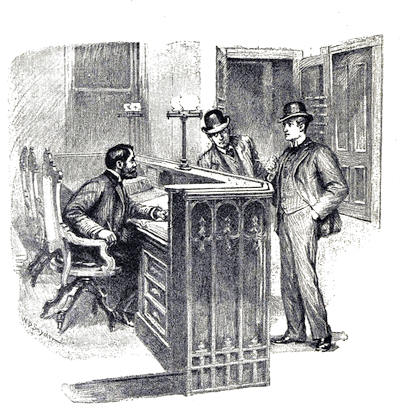
Then the superintendent went to the hotel, and
taking the proprietor to one side, asked him if he
could recollect taking in any fifty-dollar bills during
the past week.
“Yes, I took in two of them, and have just now
deposited them along with some other money in the
bank,” was the answer.
“Can you remember who gave them to you?”
“Oh, yes; one came from a drummer who left on
Monday, the day before the strike broke out, and
the other came from a New York reporter, who only
went away yesterday.”
“Was there any unusual circumstance attending
the receipt of either of these bills?”
“No—why, yes, there was too! The reporter was
an impudent young dog, and didn’t have any money
when I first asked him to pay his bill. He was
going out of town and I made him leave his watch
as security. The next morning he redeemed it and
paid his bill with one of those fifties.”
“Do you remember his name?”
“No; but it is on the register. Here it is. Manning;
Myles Manning, New York City. I think he
was a friend of your nephew. Anyhow, they had
drinks together the night he came.”
“Will you kindly send a messenger to my office
with word that I should like to see my nephew here
for a minute?”
“Certainly.”
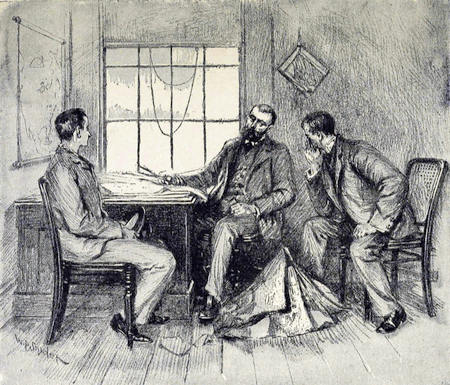
When Ben came he found his uncle sitting with
the landlord in the latter’s room.
“Do you know a New York reporter named Manning?”
was the first question put to him.
“To be sure I do. He was in my class at X——,
and was out here this week doing the strike for the
Phonograph.”
“What sort of a character does he bear?”
“Why, pretty fair, I believe; but of course I
wouldn’t like to say any thing against an old
classmate.”
“In the present case if you know any thing about
the young man it is your duty to tell it. He is suspected
of taking that thousand dollars.”
Ben gave a well-acted start of surprise.
“Oh, that can’t be,” he said. “Myles Manning
would never do such a thing as that. He may be a
little wild, but he couldn’t be a thief.”
“What do you mean by a little wild?”
“Oh, takes an occasional drink and plays a game
now and then.”
“Did you and he drink together the night he
came here?”
“I believe we did have one or two glasses.”
“Did he get drunk?”
“No, not exactly what you might call drunk.”
“Did you play cards?”
“Yes, we had a game or two.”
“For money?”
“Yes.”
“Did Manning win?”
“Well, no, not exactly.”
“Did he lose?”
“I believe he did.”
“How much?”
“Pretty near all he had, I guess. At least he
complained of being cleaned out.”
“Did he complain of this to you?”
“Yes, and tried to borrow money of me to pay
his hotel bill.”
“And you refused to lend it?”
“Yes. I told him I was short myself.”
“What did he say to that?”
“Oh, he got mad and said he was bound to have
his money back some way.”
“Did you win his money?”
“No, sir.”
“Who did?”
“I think Lieutenant Easter must have won it, for
he was the only one playing with us.”
“While Manning was in your room did he know
that the key of my safe was in your possession?”
“I think he did.”
“What makes you think so?”
“Because it fell from my pocket when I drew out
my handkerchief while we were playing cards, and
I said then that I guessed it was not safe there, and
that I should hide it in my room.”
“Did he see where you put it?”
“I don’t know, but he might have, for I had no
thought of concealing it from him.”
“Have you had any other cause to be suspicions
of him?”
“Not in connection with the money.”
“In connection with any thing else, then?”
“Well, he did seem to be pretty thick with the
strikers.”
“In what way?”
“In telling them of our plans. Both Lieutenant
Easter and I thought he told them of our plan to
send a train through, and so gave them the chance
to capture it and us. Manning was with us, and
when they asked him what he was doing there, he
produced a note from Jake Allen, which said he was
their friend and must be treated as such.”
“How did they treat him?”
“I don’t know; but he was the only one left behind
when they carried us off, and that looked very
suspicious to me.”
“Well,” said the superintendent, “from all accounts
this Manning is a fellow who will bear pretty
close watching. I won’t say yet that he robbed my
safe, but I must confess things begin to look that
way. I wish you would show me your room, Ben,
and the one Manning occupied while he was here.”
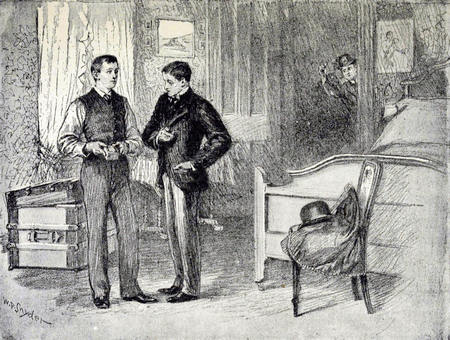
So the superintendent, his nephew, and the landlord
went up to No. 16, where Ben showed the corner
of a bureau drawer in which he said the key had
been hidden. Then they went to the room that had
been Myles’, only three doors away. In answer to
their knock Billings’ voice shouted: “Come in!”
He now occupied it, and was sitting up by the window
writing.
“Excuse the intrusion,” said the landlord, “but
these gentlemen have a particular reason for wishing
to see this room, and I thought perhaps you would
not mind.”
“Oh, not at all,” answered Billings, scowling at
Ben. “I will leave and let them have it all to themselves
if they say so.”
They did not say so, and he did not leave, but sat
watching them closely and wondering what they
were up to.
Ben in particular seemed anxious to examine
every article of furniture in the room very closely.
He looked behind the bureau and peered under the
wash-stand.
“What do you expect to find?” asked his uncle.
“I don’t expect to find any thing, but I thought it
just possible that he might have hidden the envelope
somewhere in this room if he took it. Of course he
didn’t, though. He wouldn’t do such a thing.
Hello! what’s this?”
As Ben uttered this exclamation he was gazing
intently at the floor close to one wall of the room
and near the door.
“What’s what? I don’t see any thing,” said his
uncle, looking at the floor.
“Neither do I,” replied Ben, “but I just trod on
something that felt like paper under the carpet.”
“Of course,” broke in the landlord, “we always
put paper under our carpets.”
“But this has a peculiar feeling, like an extra
thickness of paper.”
“Why don’t you look under the carpet, then, and
see what it is?” asked the superintendent.
“I would rather not, uncle. He is my friend, you
know.”
“Nonsense! I hope he isn’t your friend if what
we suspect of him is true. But step out of the
way and let me see what wonderful discovery you
have made. It is probably only a crease in the floor
paper.”
So saying the superintendent stooped, inserted his
hand beneath the edge of the carpet and drew forth
the identical express envelope that the package of
missing bills had come in.
The three looked at each other without a word,
while Billings pretended to have resumed his
writing.
When they were again in the landlord’s room the
superintendent said:
“Proof is accumulating so fast against this Manning
that I shall procure a warrant, send it on to
our New York detective, and have him arrested.”
“Oh, uncle, don’t do it?” exclaimed Ben. “Remember
that he is a gentleman, and that a thing of
this kind would ruin him.”
“Your kind heart does you credit, Ben, but in a
case of this sort mercy must give way to justice.
Yes, it is clearly my duty to have him arrested. At
the same time I shall write out a full account of the
affair and send it to the president of the road, so
that he will get it the first thing Monday morning.
He can then decide what is to be done.”
The superintendent did as he proposed, and his
letter was the first one President Walker Saxon, of
the A. & B. Road, saw lying on his desk as he entered
his office Monday morning. He had intended
stopping at the office of the Phonograph, in which
he was a stockholder, and speaking to the city editor
about Myles Manning, but as it was early he changed
his mind and decided that he would first go to his
own office and glance over the mail.
At the same time a dispatch directed to Myles lay
uncalled for in the city room of the Phonograph. It
came from Billings, and was:
“Look sharp, old man. Suspect B. W. is making trouble
for you here. Do not know yet what it is, but will post you
as soon as I get on the inside track. Pretty sure I shall have
to thrash him yet.”