On a cold November morning a group of girls
stood beside two mules in front of a house in
Batang on the border of Tibet. Two were
Americans, and the others, Tibetans.
"How long must you stay in America,
Doris?" asked one of the Tibetan girls very
sadly.
"If I study hard every day," answered
Doris, "I can come back in ten years."
"That's not so bad," said another of the
girls, "because, you see, if you will study night
and day, you can get through and come back in
five years."
"We must go," said Dorothy. "Father and
Mother have gone on a half-hour ago."
There were tears in all eyes as Doris and
Dorothy sprang into their saddles.
"Good-by! Good-by!" they called as the
mules started forward.
Since they were babies, Doris and Dorothy
Shelton had lived in Tibet, the land that is called
"the roof of the world," because it is higher
than any other country in the world. They had
taken many trips, clinging to the backs of their
mules as they went almost straight up on the
rough mountain roads, but the journey on which
they were starting now, as the sun rose from
behind the snow-capped mountains, was to be
the most thrilling of all.
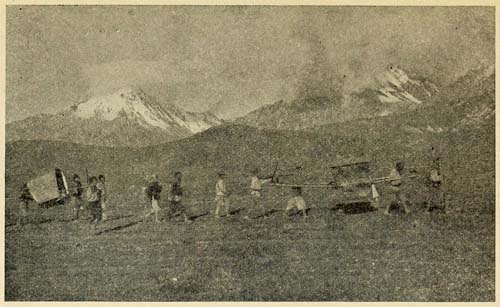
The Shelton Family Crossing the Mountains of Tibet
Mrs. Shelton and the girls are in the chairs carried by barefoot coolies.
They soon overtook their mother and father
and the servants. In front of the party rode
guards, for the country was full of robber
bands. Then came six mule drivers driving the
twenty-five mules that were loaded with tents,
baggage, and food. Following the mule drivers
Mrs. Shelton rode in a sedan chair fastened to
two poles which rested on the shoulders of four
carriers who wore fine, bright-red turbans and
long robes of grey pulu or wool, which were tied
about the waist. In the party were Andru,
Drashi, and Shen-si, the three servants who had
helped to care for Doris and Dorothy since they
were babies.
Last of all, on a mule strong enough to carry
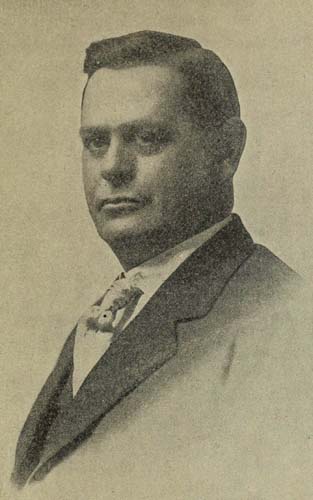
his two hundred and thirty pounds, rode Dr.
Albert Shelton. Everyone in Batang knew
"Big Doctor Shelton," and everyone loved
him.
Seventeen years before this time, when he
left the medical school in Kansas, he looked over
a map of the world to find the place that needed
a doctor most. There was not a town in Kansas
that did not have a doctor in it or near to it,
and in some of the towns there were many
doctors.
"I should like to go to a place where there
are no other doctors," he said.
"Well, then," said a friend, "go to Tibet.
That is the place for you, because in all Tibet
there is no doctor. But you may not get there
alive. The Dalai Lama, who is the head of
everything in Tibet, government and Buddhist
Church, lives in Lhasa, the capital, and he will
not let any Christian missionary or doctor come
within the walls of his city. Some have tried
to go, but most of them were killed."
The more Albert Shelton thought about the
land without a doctor, the more he wished to go
there. He talked to his young wife, and she
wanted to go, too, so one day they took a
steamer from San Francisco and crossed the
Pacific Ocean to China where a boat carried
them a thousand miles up the Yangtze River.
Then they went still farther on a little Chinese
house-boat pulled by thirty men who walked
along the bank. After the house-boat had gone
up the river for nearly two months, they stepped
off on shore and rode on the backs of mules for
seven hundred miles.
More than a year after they left Kansas, they
reached the town of Tatsienlu on the border of
Tibet. If they could have stuck a pin eight
thousand miles long right through the earth,
it would have come out not far from where they
started. The nearest doctor was seven hundred
miles away, so Dr. Shelton decided to live in
Tatsienlu until he could find a way to get farther
into the closed land of Tibet.
Doris and Dorothy were born at Tatsienlu,
among mountains that rose more than twenty
thousand feet above the level of the ocean, so
high that they were covered with snow in July
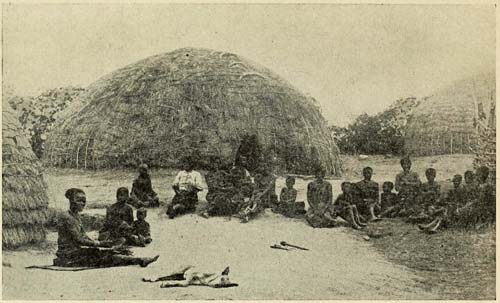
and August. They were used to the strange
little "yaks,"—houses covered with goat's
hair. They watched their father make brick
and saw lumber and teach the men how to build
houses like the one he had built for himself.
After five years Dr. Shelton was permitted
to go farther inland to Batang to start a hospital.
When the people heard of the "good
doctor" who had come so far across the ocean,
and who could do such wonderful things to make
sick people well, they came from all over the
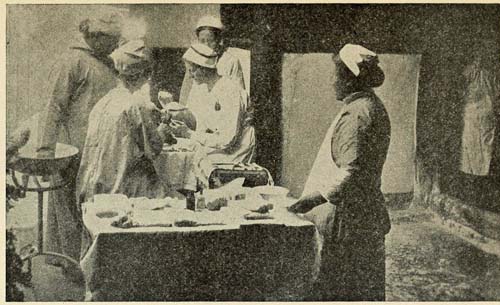
country to see him. At first he had to use for
his operating table a door laid across two tables.
Then he and his friends sawed lumber and
baked brick and built a hospital. For ten years
he lived at Batang, and many thousands of people
came there to be helped.
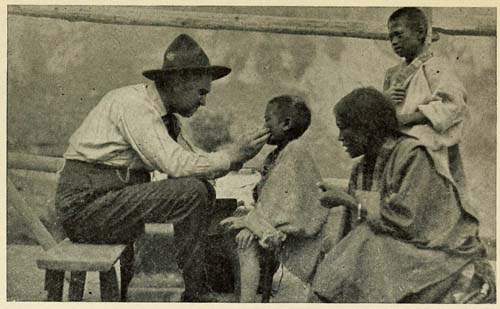
Dr. Shelton Treating a Tibetan Boy
He ministered to all who needed him despite the lack of a hospital. This treatment is being
given on a house top.
Then a wonderful thing happened—Dr. Shelton
was to go into Lhasa, the capital of the land-without-a-doctor.
The Dalai Lama had kept out
all missionaries because he was afraid the people
would discover that their idols were not
true gods and would not give the priests any
more money. But now the Dalai Lama himself
gave Dr. Shelton permission to come.
Before going to Lhasa Dr. Shelton planned
to take Mrs. Shelton and Doris and Dorothy to
the port of Hongkong, from which they were to
sail to America, where the girls were to go to
school. It was on this journey that they were
starting on this November morning.
Mrs. Shelton did not want to say good-by to
the people of Batang, whom she loved, so she
tried to slip away before daybreak. But as she
and the doctor rode along, they found people
lined up on either side of the road to bid them
good-by. Many had left their homes the night
before and had marched ahead so they could
stand by the road and see their "big doctor"
and his wife and children once more. An escort
of twenty-five boys had been sent ahead. All
the way from Batang to the Yangtze River, a
journey of a day and a half, the people were
gathered along the roadside.
For thirty-six days Doris and Dorothy rode
on their mules. Then they were so tired, their
father got chairs for them and they were carried
by the servants.
One day as they were riding along, Dorothy
said:
"Are you afraid of robbers, Doris? I heard
Andru and Shen-si say that Yang Tien-fu, the
leader of a dreadful band must be near by. He
is very angry at the government. He used to
be a colonel in the Chinese army, but they
didn't pay his salary, so he got a band of men
to join him, and they live out in the mountains.
Andru said they stop all travelers and take pay
from them."
"I'm not afraid," said Doris. "We have soldiers
to guard us."
"I'm glad we are almost at Yunnanfu. Forty-seven
days is a long time to ride. Father says
we will be at Yunnanfu in just two and a half
days."
Suddenly, as the mules came out from behind
a bend in the road, they threw back their ears
and stopped. The report of a pistol rang out.
"Robbers! Robbers!" shouted the soldiers.
Another pistol shot followed, and the robbers
sprang down through the brush of the mountainside.
There was a crashing of glass, as a bullet
struck the thermos bottle by Mrs. Shelton's
side.
"Robbers! Robbers!" shouted the four soldiers
again. One shot off his gun; then all four
ran back to the village.
Mrs. Shelton and the girls crept out of their
chairs and slipped over the bank into the ditch
below.
Bullets flew. The bandits surrounded Dr.
Shelton; one drew a large pistol and another
a great sword. Dr. Shelton saw there was no
chance to escape, so he let them take from him
his field-glasses, his camera, and everything
else they wanted. Andru was seized and his
knife and chop-sticks taken from his belt. Holding
up Dr. Shelton by both arms, two of the
bandits led him up the mountain to their chief.
The others tried to get Mrs. Shelton to climb
the bluff which rose straight before them, but
she was not able. Then they tried to carry her,
but they could not get up the steep, narrow
path with a load.
Doris wore gloves, but little Dorothy's hands
were bare. The robbers saw her rings and took
them off her fingers. Dorothy loved those rings
which had been given to her by her friends, and
she began to cry. Doris had been very much
frightened by the robbers, but when she saw
one of them with Dorothy's rings, she forgot
about herself and going up to the robber said:
"You give those rings back to Dorothy!"
The robber smiled at the girl who was so
brave for her little sister and actually handed
the rings back.
By this time the soldiers returned with other
soldiers and rushed out to attack the robbers,
who left Mrs. Shelton and Doris and Dorothy
and began fighting to defend themselves. At
once the two girls with their mother and the
servants slipped back to the village.
Meanwhile Dr. Shelton was being hurried
along up the mountainside to the robber chief.
Taller and stronger than any of the men who
stood about him was Yang Tien-fu. He looked
with interest at the things his men had taken
from the travelers and examined Dr. Shelton's
camera and field-glasses.
"How can this picture-box make pictures?"
he asked. "Now stop and make my picture."
Dr. Shelton snapped the kodak.
"Now take my picture out of the box and let
me see it."
"There is no picture there yet," said Dr.
Shelton.
Yang Tien-fu would not believe him and made
him open the camera and spoil the first picture
of a robber chief he had ever had a chance to
take.
Dr. Shelton could look down to the valley and
watch the battle between the bandits and the
soldiers. He saw Mrs. Shelton's empty chair.
"Why do you want to take me as a prisoner?"
he asked.
"Because I must have money," answered the
bandit.
"I have no money," said Dr. Shelton.
"But your people will offer me a ransom. I
have plenty of soldiers in my land, but they
have little to fight with. I will tell your people
that if they will send me fifty thousand dollars'
worth of guns and powder and bullets I will
release you. And that is not all. The government
has taken my family and is keeping them
as prisoners. I will tell them that if they will
send my family back to me, I will send you back
to them. Get on your mule, for we must travel
far from here."
Over the rough, steep road of the mountain
they rode for many hours. Not until the sun
went down did they stop to rest and to wait for
their companions. They built a fire and cooked
rice. After they had eaten, they took out their
long pipes and smoked opium. Dr. Shelton
counted seventy-one men.
When those who had stayed to fight the soldiers
overtook the band, Dr. Shelton saw that
one man was shot through the ankle. He opened
his saddle-bags and dressed the wound while
Yang Tien-fu watched with interest. After
resting a few hours they started to travel again.
For three days and nights Dr. Shelton did not
take off his clothes or sleep. Sometimes he lay
down on an old horse blanket, the only bed he
had. Four robbers guarded him. They never
took off the belts in which they carried their
guns and cartridges. Dr. Shelton counted nineteen
different kinds of guns and eight kinds of
pistols, all of which had been taken from travelers.
Day after day the bandits traveled over the
mountains. When they stopped, forty guards
were sent in every direction, for Yang Tien-fu
knew that the government had offered a reward
of five thousand dollars to anyone who would
capture him dead or alive.
Sometimes he divided his men, sending a
party to march straight down over the steep
mountainside to make a false trail, and often
he stood on some high bluff and laughed as he
watched the soldiers being led astray. Almost
every day, and sometimes many times a day, the
bandits would stop a company of travelers and
take their money or go into a little village and
rob the frightened people.
If the villagers gave them what they asked
for, there was no fighting. Yang Tien-fu would
go into the temple, which was the meeting place
of the people, and send his men out to find one
of the head men of the village. When he came
in, the chief would say:
"We are not robbers. We are traveling to
escort this great foreign official. He must
have two hogs and ten bushels of rice."
Then the head men would look at Dr. Shelton
with great respect and interest and start
off to get all the things the great foreign official
must have. Meanwhile Dr. Shelton tried
to get them to understand that he was a prisoner.
Often he had to smile at the cunning of
the robber chief.
As they went along, Dr. Shelton saw many
people who were sick and many whose eyes
were sore or blind. He said to Yang Tien-fu,
"I left America to help the sick people in
Tibet. Since you are keeping me away from
my hospital in Batang, you must let me have
a hospital along the road."
So the chief waited while the doctor healed
the sick. Many soldiers joined the band, and
the doctor ministered to all who needed him.
One day the chief said, "You are an honest
man. I want you to be one of my men and stay
with us. These other fellows can't be trusted.
Even our treasurer steals. Stay with us and
be the pastor and the doctor for me and my
men. I will pay you twelve thousand dollars
a year and give you half of it right now."
Dr. Shelton chuckled. He wondered whether
anyone else had ever been invited to be the
pastor of a robber band.
Back in Yunnanfu Mrs. Shelton, Doris, and
Dorothy waited. Every day the girls went to
the gate of the city, hoping to see a runner
coming with a message from their father.
"But, Doris," said Dorothy, "there is no
chance for Father to escape. He is guarded
all the time."
"The Bible says that Paul and Silas were
sleeping right between guards, and God opened
the doors of the prison," said Doris. "If we
pray, God may open some door so Father can
escape."
Thus while the robber band was climbing
the steep mountain and leading their tired
prisoner farther and farther away, two little
girls knelt down to pray.
For nearly three weeks no message came.
"If we could only know if Father is still
living and if he is well!" said Mrs. Shelton.
"Yes," said Doris. "Or if we could get a
message to him so he could know we are praying
for him!"
One day Shen-si, the Chinese cook who had
lived with them many years, said:
"I will carry your message to my master
and bring his message to you."
"How can you find him, Shen-si?" asked
Dorothy. "How will you get past the chief of
the bandits?"
"I will face Yang Tien-fu and carry your
message to my master and bring his message
to you," said Shen-si quietly.
Mrs. Shelton and the girls wrote letters and
Shen-si started out to find his master. All
along the way he followed the robbers, asking
questions until he reached the place where he
was told his master was. He went boldly up to
the guards.
"I come on important business," he announced.
"I must speak to your chief."
The guards led him to Yang Tien-fu. Behind
the chief he saw his master, so changed
that he scarcely knew him. A long beard had
grown over his smooth face, and he was so
weak he could scarcely walk. Tears came into
Shen-si's eyes.
Dr. Shelton was allowed to send a message
back, and he handed Shen-si a copy of Beside
the Bonnie Brier Bush to take to Mrs. Shelton.
This he had had in his saddle-bags when
the robbers captured him. On the margins he
had written daily messages to his wife. One
of the last was:
"I am tired to death; all I can say in my
desolation is, 'Make Thy grace sufficient for
me, O God.'"
With the precious book Shen-si started back.
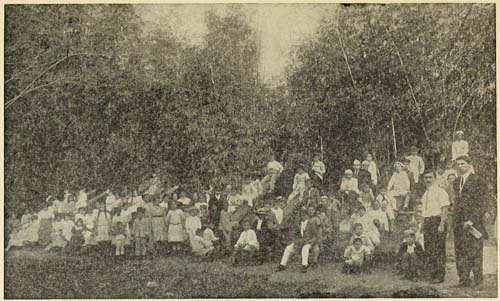
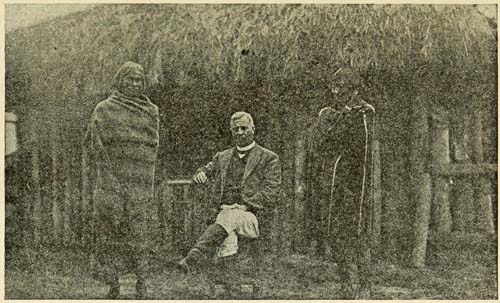
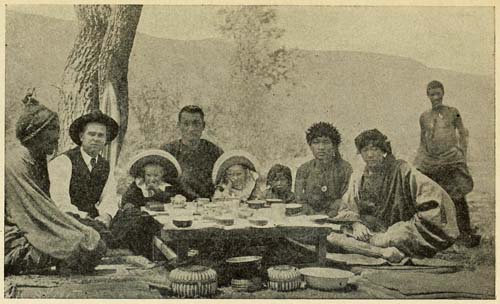
A Roadside Luncheon in Tibet
Dr. Shelton and his daughters at luncheon with a group of Tibetan friends.
Shen-si was not the only one who had determined
to reach Dr. Shelton. One day Yang
Tien-fu said to his prisoner:
"The government has sent a messenger to
me to say that my family is at the priest's
house and that if I will send you there in exchange,
my family will be given to me. I am
almost afraid to trust them, for they do not
keep their word as you do, but I am going to
send you to the priest's house with a strong
guard."
Twenty of the robbers took Dr. Shelton to
the priest's house. There Yang Tien-fu found
only his wife and mother.
"What do two women amount to?" he said
angrily. "I can buy another wife as good as
that one for a hundred dollars any time. Have
them bring me my son."
A contract was prepared promising Yang
Tien-fu that if he would release Dr. Shelton,
the Chinese government would give him pardon
for himself and his men, make him an
officer in the army, return all his family to him
and give him the arms and ammunition for
which he had asked. On the next day the contract
was to be signed by him and by the
Chinese governor.
Late at night some of the men, who had been
out watching, hurried to the chief.
"The government has you in a trap," they
said, "many troops of soldiers are stealing in
quietly to surround you and capture you."
Quickly Yang Tien-fu took both his family
and Dr. Shelton, and at midnight they slipped
out between the circles of soldiers, back to the
mountains. Again began the long, hard journeys.
Soon Yang Tien-fu saw that his prisoner
was too weak to walk or even to sit on his
mule, so he had a rough chair made for him.
For thirty-seven hours they carried him, running
as fast as they could, for the soldiers were
following. One day the chief said:
"The doctor is so sick and weak he can go
no farther. Take him to the loft of that barn
and hide him in the straw. Place four guards
with him. If he dies, hide his body where no
one will find it; if he gets well, send a messenger
to me, and I will come for him."
The men made a tunnel through the rice-straw
to the back of the loft, digging out a
space large enough for a bed for the doctor at
the end. They took a brick out of the wall to
make a small hole for a window. As they
dragged their sick prisoner into his straw
house, one of them said:
"The 'big doctor' is the same as a dead
man."
The newspapers all over the world had
printed the story of Dr. Shelton's capture by
the robbers, and day by day people in many
lands waited to hear that the governor and his
soldiers had caught Yang Tien-fu and released
Dr. Shelton. One day the American Minister
at Peking started a rescue party of several
English and Americans with troops. They sent
a message to Yang Tien-fu demanding the release
of Dr. Shelton; then they started into the
mountains to find him. When they left, Doris
and Dorothy went with them to the gate of the
city.
Meanwhile the "big doctor," almost too
weak to move, was lying on his bed of straw,
with his head by the little window.
"Thursday, Friday, Saturday, Sunday, Monday,"—he
counted the days as they went by.
An old Chinese man brought him rice, and the
rest and food made him feel so much better
that the men who were guarding him slipped
off to tell the chief he was not dead, leaving
the Chinese to guard him. Late one afternoon
the old man cried out in terror, "The soldiers
are coming!" and ran as fast as he could.
Dr. Shelton crawled to the street and called
to the Chinese runner who had so frightened
his guard. The villagers had heard the cries,
"The soldiers are coming!" and had run to
the hills. When the messenger found out that
the man who stood before him was the "big
doctor," he was almost as frightened as the
villagers.
As soon as he could get his breath, he helped
the doctor to escape. Leaning on his deliverer's
arm, Dr. Shelton crept along for a quarter
of a mile to the next village. There was no
horse on which he could ride and no chair on
which he could be carried, but eight men of
the village were persuaded to help. They
twisted ropes of wild grass and tied them about
the doctor's waist. Some men lifted, some
pushed, and some pulled on the ropes until
they reached the next village, which was fortunately
a Christian village. The people met
them with joy. They were afraid to stop long
for fear the robbers would overtake them, so
they slept for only an hour and then started on.
They found two small ponies, and at half-past
four in the morning they offered a prayer
that God would take care of the "big doctor,"
and lifted him to a pony's back. He was so
weak that two men had to hold him on. When
one pony was tired, they lifted him to the other.
Presently Dr. Shelton looked up and saw
two hundred soldiers approaching, and soon
recognized his friends. He heard English
spoken for the first time in sixty-six days, and
he could not speak for joy. One of the rescue
party had a box of crackers. He ate them at
once, because since he was captured, he had
had nothing but rice. His friends had to lend
him clothes, for his were worn out.
At the gate of Yunnanfu five hundred people
came to welcome Dr. Shelton home. First and
foremost were two little girls who ran to put
their arms round his neck and whisper, "We
prayed for you! We prayed for you! The
Lord does answer prayers, doesn't he?"
Dr. Shelton patted the two heads.
"Of course he does," he said. "That is why
I am here."
TRANSCRIBER'S NOTES:
Inconsistencies in spelling, punctuation, and hyphenation have been standardized.