CHAPTER I HOW NEWS CAME TO WARBLINGTON CASTLE
It was shortly after dawn, on the morning
of March 21, 1413, that a grizzled man-at-arms
climbed the spiral staircase in the
south-west angle of the keep of Warblington
Castle.
He was dressed in a leathern suit, much
soiled and frayed by the frequent wearing of
armour, while on his head was a close-fitting
cap, quilted and padded to ease the weight of
a steel headpiece. He was unarmed, save for
a long knife that was counterbalanced by a
horn slung from a shoulder-strap of undressed
hide.
Under his left arm he bore a flag, its folds
gathered closely to his side, as if he feared to
injure the cherished fabric by contact with the
rough stone walls of the staircase; for the flag
he had charge of was the banner of the renowned
knight, Sir Oliver Lysle, of the Castle of Warblington,
in the county of Southampton, and
of the Château of Taillemartel, in the Duchy
of Normandy.
At the one hundred and eleventh step the
man-at-arms paused, and, raising his arm, thrust
with all his might against an oaken trap-door,
sheeted on the outside with lead. With a dull
thud the door was flung backwards, and the
old soldier gained the summit of the turret,
which stood ten feet above the rest of the battlemented
keep.
Sheltering from the strong north-westerly
breeze that whistled over the machicolated
battlements, the man-at-arms gazed steadily—not
in a landward direction, where an almost
uninterrupted view extends as far as the rolling
South Downs, neither to the east, where the
tall, needle-like shaft of Chichester Cathedral
spire was gradually rearing itself heavenwards,
nor to the west, where the sea and land blended
in the dreary mud banks of Langstone Harbour—but
southwards, where, partially hidden in
wreaths of fleecy vapour, the almost landlocked
waters of Chichester Harbour met the
open expanse of the English Channel.
The sound of footsteps on the stone stairs
caused the watcher to turn his attention to the
newcomer.
"Good morning, fair sir," he exclaimed, as
a lad of about fourteen years of age climbed
actively through the trap-door.
"And to thee, Arnold Gripwell. But how
goes it? Dost see aught of the ship?"
"Nay, Master Geoffrey; this wind, which
is most unseasonable for the time o' year, hath
stirred up much mist, so that the sea cannot
be clearly discerned."
"'Tis passing strange. Sir Oliver, my father,
hath sent word that, God willing, he would
cross the seas from Harfleur on the eve of the
Feast of St. Perpetua. Already fourteen days
are spent, and yet he cometh not."
"The reason is not far to seek," replied Gripwell,
pointing towards the distant Portsdown
Hills. "So long as this wind holdeth the ship
is bound to tarry."
"But how long, think you, will it blow thus?
Thou art a man skilled in such matters."
"Nay, I cannot forecast, fair sir. For now,
when the husbandman looketh for the east wind
to break the ground, this most unwholesome
air doth hold. Mark my words, Master Geoffrey,
when it turneth we shall have another winter.
But the sun is rising. I must display my lord's
banner."
So saying, he bent the flag to the halyards,
and soon the emblem of the Lysles was fluttering
bravely in the breeze—azure, a turbot
argent, surmounted by an estoile of the last—in
other words, a silver turbot, with a silver star
above, both on a field of blue.
Geoffrey knew well the meaning of this device.
The first denoted that the Lord of Warblington
was one of the coastwise guardians of the
Channel; the star was in recognition of a
former Lysle's service under Edward I, on the
occasion of a desperate night attack upon the
Scots.
Always ready on the first summons, the
Lysles placed duty to their king as the highest
of their earthly devoirs, and it was their
proud boast that no important expedition had
crossed the Channel without the head of the
Manor of Warblington in its ranks.
Like many an English knight of that period,
Sir Oliver Lysle had interests in France. Through
his mother he inherited the seigneurie of Taillemartel
in Normandy.
France was in a deplorable condition. The
country was torn by a fierce strife betwixt the
Orleanists—or Armagnacs, as they were oft-times
termed—and the Burgundians. Every
baron and knight did as he might, trade was
paralyzed, the poor were oppressed, and from
Picardy to Provence, and from Brittany to
Dauphiné, chaos prevailed.
In his own interest Sir Oliver had frequently
to cross to France, for his turbulent neighbours,
coveting the fair fields surrounding the feudal
castle of Taillemartel, did not hesitate to
encroach upon his lands. Thus, much to the
English knight's regret, he found himself embroiled
in the affairs of a foreign country.
"There is a boat coming up the rithe," exclaimed
Geoffrey, pointing to a small, indistinct
object slowly moving against the strong tide
that ebbed through the many channels by
which Chichester Harbour is intersected.
"Methinks thou'rt right," replied the man-at-arms,
shading his eyes with his hand, for the
sun had broken through the mist and its rays
were dazzling on the water. "Yea, 'tis a craft
of sorts. Would my sight were as good as in
the time of the affray of Otterburn."
"'Tis but a fisherman," replied the lad, after
some minutes had elapsed. "Yet he roweth
as if he bore tidings."
"Ay; I wot when first I saw him that 'twas
not thy father's cog," replied Gripwell, unwilling
to admit the inferiority of his sense of vision,
although he had recently confessed it. "But,
certes, he is not one of the men of Warblington,
and since he cometh herewards methinks his
errand is no idle one," he added.
"Then let us hasten to the wharf and learn
his tidings," said Geoffrey, as he turned towards
the stairway.
With the rising of the sun the portcullis had
been drawn up and the drawbridge lowered.
So, passing the vigilant sentinel who kept watch
and ward at the gate of the outer bailey, the lad
and his companion made their way across the
mead, past the church that, by a strange
strategical blunder, stood betwixt the castle
and the sea, and at length reached the little stone
quay which, at all but the lowest tides, permitted
the approach of the largest vessels of that
period.
"'Tis Wat, of Sinah," exclaimed Geoffrey,
as the rower turned his head to make sure of
his sinuous course 'twixt the mud banks that
were already showing above the ebbing
waters.
"How now, Wat?" quoth the man-at-arms,
as the boat rubbed sides with the landing-place,
and the fisherman, well-nigh breathless with
his exertions, tossed his oars into the little craft
and scrambled up a rough wooden ladder.
"Sir Oliver!" he gasped.
"And what of him? Stand not babbling
like a child. Out with it, gossip."
"The Grâce à Dieu lies off the Poles yonder,"
continued Wat, pointing towards the invisible
sandbanks that encumbered the mouth of the
harbour. "She hath come in betimes this
morning, and even now is anchored beyond the
bar."
Geoffrey gave a cry of delight at the glad
news; but Gripwell was far from satisfied.
"And why has not the cog stood in? And
how goeth it with Sir Oliver?"
"The ebb maketh strongly," replied the
fisherman. "'Twas only with much ado that I
gained the harbour, my craft being but light.
As thou knowest, gossip, there be none to touch
her, not even at Bosham or Emsworth. And
then concerning Sir Oliver. I saw him not,
neither was I able to draw nigh to the Grâce.
It served my purpose but to come hither and
claim the guerdon that my lady hath promised
to him who brought the news of Sir Oliver's
return."
"Then get thee to the castle, Wat. As for
thy craft, it must needs take ground, since the
rithe dries within an hour. But that will pass,
I'll warrant, for thy welcome will not be a hasty
one."
Already Geoffrey had sped to bear the news
to his mother, the Lady Bertha, while the fisherman
and the man-at-arms followed, Wat inwardly
chafing at the measured stride of the
old warrior.
Sir Oliver's wife was a tall, dignified matron
of forty years; stern, almost masculine in manner,
yet devoted to her husband and son.
During Sir Oliver's frequent absences the care
and maintenance of the castle were entirely
in her hands, and, from the merest detail concerning
the domestic ordering of the numerous
household to the weighty questions appertaining
to its defence, the Lady Bertha ruled with firmness
and discretion.
Nor was she backward in maintaining her
authority. Once, and once only, did the youthful
Geoffrey take upon himself to give certain
orders to the warriors of the outer bailey.
"Geoffrey, my son," quoth his mother,
"when thou dost attain the age of sixteen it is
thy father's purpose to entrust thee with the
care of this castle during his sojournings overseas.
When that time cometh I shall willingly
give place to thee in the matter, but so long as
my lord thinketh fit to make me châtelaine
of Warblington I, and I only, must have the
ordering o' it."
The Lady Bertha was not slow to act on
hearing the good tidings that were now brought
to her. In a few minutes the castle was in a
state of bustle. The nineteen men-at-arms
donned their plates and headpieces, and stood
to their arms, ready to prove to the Lord of
Warblington that they kept good watch and
ward; the two score archers, putting on their
quilted coats and iron caps, in addition to their
everyday dress, rushed hither and thither,
gathering evergreens, heaping piles of faggots
in the centre of the courtyard, and bedecking
the gateway with the arms and pennons of
bygone days. Old Giles, the cellarer, hied him
to his subterranean retreat, there to broach
casks of the best vintages that Gascony and
Burgundy could produce, while the kitchen
staff were busy with two whole oxen.
Then from the adjacent church tower the
bells rang out a merry peal. Almost at the
first note the toilers in the fields dropped their
hoes and unyoked the horses from the ploughs.
They knew the meaning of the peal; to them
it meant, as it did on each and every occasion
that Sir Oliver returned in safety from the
troublous Duchy of Normandy, that the day
was to be given up to feasting and merrymaking.
In the thatch-roofed houses of the little hamlet
housewives left their hearths, tarrying only
to thrust a bough from their upper windows as a
sign of welcome, and trooped towards the castle
to share with their husbands the joys of their
feudal lord's homecoming.
And now from the summit of the keep a
keen-eyed sentinel espied the bluff, black bows
of the Grâce à Dieu, as, labouring slowly under
oars, she crept up the tedious Emsworth channel
with the young flood-tide.
The gunners, with port fires lighted and linstocks
ready to hand, were clustering round their
cumbersome, iron-hooped bombards, gazing the
while towards the steadily-approaching vessel.
The minstrels, with harp, pipe, and lute, foregathered
on the green within the outer bailey,
while the Lady Bertha—who, in order to show
that she held the castle, refrained from leaving
the shelter of the battlements—awaited her
husband at the barbican.
Everything was ready for Sir Oliver Lysle's
welcome home.
So intent upon the approach of the expected
vessel were the crowds that thronged the castle
that none perceived a horseman riding from the
direction of the city of Chichester. In hot
haste, he spared not spur, and, scorning to keep
to the road that led from the highway to the
castle, he urged his steed across the newly-ploughed
fields, while a bowshot in the rear a
group of mounted men-at-arms followed at a
more leisurely pace.
Skirting the moat, he gained the barbican,
then, drawing in his horse, he looked, with an
expression of mingled anger and surprise, upon
the preparations of welcome.
The newcomer was attired in a blue doublet,
amber cloak with fur trimmings, slashed trunks,
and long pointed buskins of undressed leather,
while from elbow to wrist his arms were swathed
in black cloth. That he had ridden far and fast
was evident by the exhausted state of his
steed and the numerous splashes of mud and
chalk that clung tenaciously to man and beast.
By his left side he wore a long, straight sword,
with a plain cross-hilt and a black leather scabbard,
while from the right side of his belt hung a
short dagger and a large leather wallet.
Geoffrey recognized the newcomer as the
seneschal of the Castle of Arundel. Nor was he
long in ignorance of the rider's errand, for, in
a loud voice, the officer exclaimed—
"To the Châtelaine of Warblington greeting;
but methinks 'tis neither time nor place for
expressions of gladness."
"How so, Sir Scudamour?" asked the Lady
Bertha haughtily, for she took the seneschal's
mien with disfavour.
"By this, fair dame," and, pointing to one of
the men-at-arms who had meanwhile arrived at
the barbican, he called attention to a shield-like
object the soldier was bearing. It was a hatchment,
or escutcheon of a deceased noble, and
the arms were those of King Henry IV—three
lions passant quartered with fleurs-de-lys.
Drawing a soiled parchment from his pouch
the seneschal presented it to the Lady Bertha
with a courteous bow, then, giving a meaning
look of displeasure at the preparations for Sir
Oliver's return, he wheeled his horse and galloped
away.
Slowly the châtelaine broke the seals and
drew out the missive. Silence had fallen upon
the crowd. Instinctively soldier and peasant
knew that King Henry was no more.
The men-at-arms and archers doffed their
steel caps, the peasants, bareheaded and with
mouths agape, crowded silently around the
stately figure of the Lady Bertha, as in a loud
voice she began to read the momentous news—
"To all to whom these present letters shall
come: Whereas God hath been pleased to call
unto Himself the soul of Henry, King of England,
France——"
"An empty title," muttered a voice. Geoffrey
turned; it was Gripwell who had uttered
these words. Fortunately for him the châtelaine
heard him not, and went on reading.
"——Lord of Ireland, and Suzerain of the
Kingdom of Scotland, it is hereby ordained that
on the day following his most lamented decease
his worthy son, Henry, Prince of Wales, Earl of
Cornwall and Carnarvon, and Governor of
Calais, be proclaimed King of England, France,
Lord of Ireland, and Suzerain of Scotland.
Oyez, oyez, oyez. God save King Henry the
Fifth!"
CHAPTER II THE RETURN OF THE GRÂCE À DIEU
For the nonce all thoughts of the expected
arrival of Sir Oliver Lysle were forgotten,
save by the Lady Bertha and her son.
The pennons and garlands were already being
removed, the minstrels trooped silently back to
the great hall, and the banner of the Lysles was
lowered to half-mast.
Yet, although all outward signs of merrymaking
had disappeared, the feast provided for
the tenantry was to be partaken of on the
arrival of the Grâce à Dieu.
Soldiers and peasants gathered in small
knots, eagerly discussing the events that were
likely to ensue consequent upon the late monarch's
decease.
"But Prince Henry was ever a young gallivant,"
observed Arnold Gripwell. "I' faith,
'tis no great advancement to have seen the
inside of a gaol."
"Have a care, gossip, or thine ears will
suffer for it," remonstrated a bearded master-archer.
"Boys will be boys, they say. Perchance
our King has put off all his ill-deeds."
"They do say that he hath made absolute
confession," said another. "I have it on authority
of a member of Sir Thomas Erpingham's
household that the Prince hath repaired to the
chapel of a recluse, and, laying bare to him
the misdeeds of his whole life, hath put off the
mantle of vice, and hath returned decently
adorned with the cloak of virtue."
"So be it," replied Gripwell stoutly. "The
late King, though his title to the throne were
but a hollow one, was ever a soldier and a man.
Give me a man whom I can serve and follow to
the wars, say I."
"Then perchance thy wish will be gratified,
Arnold," remarked Sampson, the master-bowman.
"Prince Henry bore himself like
a man at Homildon fight, as thou knowest.
Who knows but that ere long we shall follow
him to France to win back his own?"
"Pray Heaven it be so," returned the master-at-arms
heartily. "For my part, I'd as lief
cross the narrow seas as a common soldier.
Well I remember my grandsire's tales of how
the manhood of England crossed thither in the
time of the great Edward. Every mean archer,
who went as poor as a church mouse and did
not lay his bones on French soil, returned laden
with rich booty. Did not my grandsire purchase
the copyhold of the farm at Nutbourne
out of his ransom of a French knight?"
"But what think you, Master Sampson?"
asked an archer eagerly. "Dost think that the
new King will make war?"
"He hath by far a better opportunity than
Henry of Lancaster, the saints rest his soul,"
replied the bowman. "That base rebel, Glendower,
hath been driven from the Welsh marches,
and lies in hiding in the wilds of that leek-ridden
country. The Scots, too, are kept well in hand,
so that peace on the borders is to be depended
upon. The King hath but to raise his hand, and
from the length and breadth of the realm the
yeomen of England will flock to his banner."
Sir Oliver's retainers were not far from the
mark. Like the household of many another
knight, his men-at-arms and archers were
tolerably well versed in the affairs affecting
the kingdom's welfare. To them war was both
a trade and the means of following an honourable
profession.
Meanwhile the Grâce à Dieu had gained the
mouth of the little rithe leading up to the quay,
and was preparing to anchor.
Again the excitement rose, but in the midst
of the hum of suppressed anticipation an archer
called attention to a significant fact: Sir Oliver's
shield was not displayed from the ship's quarter.
"Heaven forfend that he be dead," exclaimed
Gripwell. "See, the Lady Bertha hath noticed
the omission."
Unable to conceal her agitation, the châtelaine,
quitting the post of honour, had crossed the
drawbridge, and, accompanied by Geoffrey,
was hastening towards the wharf, a crowd of
archers and men-at-arms following at a respectful
distance.
Already the small craft that belonged to the
manor had put off to the newly-arrived ship,
which, for want of water, could not approach
within a bowshot of the shore.
"Where is thy master, Sir Oliver, Simeon?"
asked the Lady Bertha, trying the while to
maintain her composure, as a burly, bow-legged
man stepped out of the boat and scrambled up
the steps of the wharf.
Simeon Cross was the master-shipman of the
Grâce à Dieu. For more than two-score years
had he earned his bread on the waters, being more
used to the heaving planks of a ship than to hard
ground.
Awkwardly he shuffled with his feet, scarce
daring to raise his eyes to meet the stern, expectant
look of the Châtelaine of Warblington.
"Answer me, rascal. Where is Sir Oliver?"
"Lady, I have ever been unshipshape with
my tongue; were I to talk much my words
would trip like a scowed anchor. Ere long black
would be white, and white black, and——"
"Cease thy babbling, Simeon, and answer
yea or nay. Is Sir Oliver alive and well?"
"Lady, yea and nay. Yea, since he is still
in the flesh, and nay, by reason of——"
"The saints be praised!" ejaculated the fair
questioner, reassured by the old seaman's reply.
"But stand aside, I pray you, for I perceive
that Oswald Steyning draws near. Tell me,
Oswald, how comes it that thou hast deserted
thy master? Is it meet that a squire should
return without his lord?"
"Sweet lady, I had no choice in the matter,"
replied the squire, a fair-haired youth of about
sixteen years of age. "By the express command
of Sir Oliver and of the Lord of Malevereux
I stand here this day. Sir Oliver is alive
and, I wot, in health, but, alas! a prisoner."
"A prisoner?"
"Ay, fair lady, of the Lord of Malevereux,
otherwise known as the Tyrant of Valadour,
who sends this letter by my hand."
Drawing from his pouch a sealed packet, the
squire knelt and presented it to the châtelaine.
"From Yves, Baron of Malevereux, Lord of
the High, the Middle, and the Low, to the Lady
Bertha, Châtelaine of the Castle of Warblington,
greeting:—
"Whereas, by the grace of the blessed Saint
Hilary, Sir Oliver Lysle, thy husband, hath fallen
into my hands, be it known that this is my will
and pleasure: Him will I have and hold until a
ransom of ten thousand crowns be paid for the
release of the said Sir Oliver. It is my request
that this sum be paid on or before the eve of the
Feast of the blessed Saint Silvester, failing which
Sir Oliver must suffer death."
Twice the châtelaine read the missive, then,
turning to the squire, she asked—
"Knowest aught of this letter?"
"Nay, fair lady, though I wot 'tis of cold
comfort."
"How came Sir Oliver to be taken?"
"By stealth, madame. They of Malevereux
seized him as he lay abed in a hostel on the road
'twixt Rouen and Taillemartel. Me they also
took, but the Tyrant set me free in order that I
might bear tidings to Warblington."
"And did Sir Oliver charge thee by word
of mouth?"
"Yea, 'twas thus:—'Present my humblest
respects to my dear lady, thy mistress, and say
that not a groat is to be paid as ransom for me.'
No more, no less."
"That I will bear in mind," replied the châtelaine
resolutely. "Meanwhile I must devise
some answer to this Tyrant of Malevereux.
Hast promise of safe conduct?"
"The word of the Lord of Malevereux is but
a poor bond, sweet lady. Yet, since I have his
promise, I will right willingly take the risk."
"'Tis well. Now to return to the castle.
Arnold, see to the ordering of the men-at-arms,
the archers, and the tenants. Let them have
their feast, e'en though it be a sad one. Simeon,
see to it that the Grâce à Dieu is warped up to the
quay at high tide, and take steps to set a goodly
store of provisions on board, since to France
thou must sail once more. Now, Oswald, bear
me company, for there is much on which I must
question thee."
All this time Geoffrey had been a silent yet
eager listener. Already he had grasped the
main points of the situation, and, quick to act,
he had made up his mind that the time had come
for the son of Sir Oliver Lysle to prove himself
worthy of the ancient and honourable name.
"Tell me all thou knowest concerning this
Tyrant of Malevereux, Oswald," began Lady
Bertha, as the châtelaine and the two lads gained
the comparative seclusion of the hall.
"He is the most puissant rogue in all Normandy,
ay, in the whole of France," replied
the squire. "Though I perceive he has written
in a courteous style, worthy of a knight of
Christendom, he is but a base robber and
oppressor of the poor, and a treacherous enemy
to all true gentlemen of coat armour. He hath
declared that he fears neither God, man, nor
devil, yet withal he is of a craven disposition,
and full of superstitious fears."
"It is said that on one day of the year he
throws open his Castle of Malevereux to all who
would fain partake of his hospitality?"
"That is so, sweet lady. On the Feast of
Saint Silvester—in commemoration of a deliverance
from a great peril—the Lord of Malevereux
doth hold a joust to which all men may come,
saving that they leave their arms at the gate.
Beyond that 'tis said that no man, other than
the Tyrant's retainers, hath set foot within the
castle save as a captive."
"The Feast of Saint Silvester!" exclaimed the
Lady Bertha. "On that day this base knight
would fain receive ransom for Sir Oliver."
"Might I not be permitted to go to France?"
asked Geoffrey, speaking for the first time during
the conversation. "I would desire to have
some small chance of advancement 'gainst this
villainous baron."
"Thou'rt but a lad, Geoffrey," replied his
mother. "I commend thy courage and determination;
they do thee honour, but the task
is beyond thee."
"I am almost of the same age as that most
puissant knight, Edward the Black Prince, when
he fought at Crécy, and as old as our new King
when he crossed swords with Lord Percy at
Otterburn," asserted Sir Oliver's son. "Oswald
hath followed my father Francewards these
two years. Therefore, saving your presence,
I ought to be up and doing."
"'Tis a matter that demands careful consideration,
Geoffrey, though I do perceive that thou
art not like a girl that hath to stay at home.
Even as a young hawk hath to leave the nest,
a knight's son must, sooner or later, quit the
shelter of his parents' roof. But of that more
anon. It is in my mind that the good knight,
Sir Thomas Carberry, who holds the Castle of
Portchester should hear of the mishap that hath
befallen my lord."
"Wouldst that I ride thither?" asked Geoffrey
eagerly, for the doughty knight was ever a
favourite of the lad.
"That is my desire, Geoffrey. The day is
but young, and thou canst return ere sundown.
Oswald shall bear thee company."
CHAPTER III HOW A FRIAR AND A LOLLARD MET ON THE HIGHWAY
In a few moments the lads had donned their
cloaks, girded on their swords—since none
of quality ever ventured upon the highway save
with a weapon ready to hand—and given orders
for their horses to be saddled and brought to the
gate.
"Have I to bear a letter?" asked Geoffrey,
as he came to announce his departure.
"Nay, my son; word of mouth will suffice.
Now, get thee gone, and the saints preserve
thee."
Swinging easily into the saddle, the lads
applied spur; and at a steady trot they crossed
the drawbridge and gained the open country.
It was but a distance of some seven miles
'twixt the Castles of Warblington and Portchester,
while, being part of the great southern
highway between the populous borough of
Southampton and the coast towns of Sussex,
there was generally a small number of travellers
to be met.
For a while the two lads chatted eagerly,
Geoffrey questioning his companion concerning
his adventures beyond the seas, and of the events
that led up to Sir Oliver's captivity. And as
they talked Geoffrey's resolution was rapidly
becoming stronger. Gaining confidence from
Oswald's unassuming self-reliance, he realized
that with a good heart youth is capable of
overcoming many obstacles.
At length, hard by the hamlet of Bedhampton,
the road began to ascend a spur of chalk down.
From the summit a splendid view greeted the
lads. As far as the eye could see was a flat
plain, intersected by two large harbours, while
away on the left, beyond a silver streak of sea,
rose the rolling down of the Isle of Wight.
Ahead, at a distance of over four miles, a massive
square tower proudly reared itself hard by
the head of the furthermost harbour. It was
the Castle of Portchester.
Barely had the two riders gained the foot of
the ridge when they suddenly came upon a
grey-cloaked figure bending over a heap of
rubbish by the wayside. Evidently it had been
thrown there from a neighbouring smithy, for
scraps of old iron horseshoes predominated.
"'Tis a friar," exclaimed Oswald, as the man,
hearing the sound of horses' hoofs, drew himself
up and began to amble along the chalky road.
Doffing reverentially as they passed, the two
lads cast a furtive glance at the cloaked and
hooded friar, as he fumbled beneath his garments
as if to conceal something. The man's face
was far from pleasant. Shifty eyes, sharp
pointed nose, loose lip, and flabby jowl gave him
a crafty, foxlike appearance, yet to the two
unworldly lads a friar could be nought else but a
holy member of the Church.
Ere they had ridden another quarter of a
mile something prompted the lads to look
over their shoulders, and to their surprise
they perceived that the friar had returned to
the rubbish heap.
"'Tis a strange occupation for a holy man,"
observed Oswald. "To what purpose doth he
tarry at yonder spot?"
"Nay, I know not," replied Geoffrey. "Perchance
he finds it a fitting place for meditation."
With this the subject was dismissed, and the
two riders urged their steeds to a brisker pace.
At length they arrived at the castle of Sir
Thomas Carberry, where, on being announced,
they were ushered into the knight's presence.
"Yves of Malevereux, dost say?" exclaimed
Sir Thomas. "Alack-a-day that Sir Oliver
should fall into the toils of such a caitiff. I
know the Tyrant well, having had a slight bickering
with him, not once nor twice."
"Is there indeed no means of securing my
father's release save by ransom? The payment
of ransom he hath forbidden," said Geoffrey.
"Perchance, should war ensue and an English
army again set foot on French soil, the King
might see fit to send a troop of lances and a body
of archers to rid the world of the pest. Would
that I could adventure myself on Sir Oliver's
behalf, yet I fear that affairs of the realm will
prevent my so doing. Nevertheless, I'll do my
devoirs to the Lady Bertha. Convey her my
most humble regards, and say that I will ride
over to Warblington to-morrow morn."
"I have asked my mother to give me leave
to journey to France," said Geoffrey. "Couldst
thou not throw in thy weighty word for me, Sir
Thomas?"
"Certes! How canst thou hope to overcome
the Lord of Malevereux, Geoffrey? Nevertheless,
'tis right and meet that the son of Sir
Oliver should see to his affairs at Taillemartel.
There thou couldst be of service. Say no more
now, but on the morrow I'll broach the matter."
"Sir, I crave your pardon and your opinion,"
said Oswald. "Dost think that the King will
advance his claim to the French throne?"
"Without a doubt."
"I am right glad to hear of it," replied Oswald.
"There is much advancement to be made in such
matters."
"Not without losses, hunger, and discomforts,"
added the knight, smiling at the youth's ardent
words. "Young men are apt to look upon only
the bright side of war. Such views I myself have
held, but as time runs on we elders know more
of the dark side of the picture. Nevertheless, at
the first call to arms I, amongst many, will not
be found wanting."
"What think ye of our new King?" asked
Geoffrey, more bluntly than he intended.
The knight shook his head.
"'Tis not meet that a soldier should offer
an opinion of his liege lord," he replied.
"Henry V is my King, and to me that is sufficient
reasoning for unswerving loyalty. A true
Englishman's duty is to serve loyally, be he
knight or commoner; therefore, I counsel you,
reject all reports to the belittlement of King
Harry, strive to live upright and true to those
set in authority, and all will go well."
With this advice Sir Thomas dismissed his
visitors, renewing his assurance that on the
morrow he would journey to see the Châtelaine
of Warblington in person.
"Since Sir Thomas hath promised to speak
in my favour my hopes are raised," remarked
Geoffrey. "Who knows but that ere the Feast
of St. Mark I may be upon French soil."
"Since the Lady Bertha hath charged me to
convey her reply to Malevereux we may bear one
another company," replied Oswald. "But what
have we here?"
The travellers had now reached the outskirts
of the little hamlet of Cosham. Outside
a mud-and-wattle cottage a large crowd, comprising
nearly all the inhabitants and a sprinkling
of strangers, had collected. That something
was amiss was apparent by the low murmur that
reached the lads' ears as they approached.
"If 'tis some slight affray 'tis our duty to
aid the weaker side," said Oswald, his right hand
flying to his sword-hilt. "See to it that thou
dost strike yarely should occasion arise."
Urging their horses through the fringe of the
crowd, the two youthful champions of oppressed
right came upon a scene they had not bargained
for.
Standing in the doorway was a woman, middle-aged
and comely, whose face was a study of
mingled perplexity, indignation, and fright.
In the middle of a semicircle formed by the
crowd towered a powerfully made man of commanding
and noble aspect, dressed in plain yet
rich garments of sober russet cloth tipped with
fur. Save for a short dagger he was unarmed,
a vellum-bound book hanging by a steel chain
occupying the place of a sword.
Held at arm's length by the stranger's muscular
arm was the friar whom the lads had seen
at Bedhampton that same morning. The
man's hang-dog face was convulsed with fury,
though it was evident that he was in terror
of the stranger, whose anger was as apparent
as that of his captive.
Ignoring the hurried undertone remonstrances
of a merchant, the stranger addressed the throng
in a loud voice.
"My good people," he exclaimed, "how much
longer will ye suffer yourselves to be deluded by
such cloaked and cowled rascals as this? By
what authority doth the friar claim the right to
sell pardons and absolutions for every sin that
besets us? Not by that of One above, I'll
warrant. And how can a parcel of so-called
relics possess the power of imparting nameless
virtues to the dupe who hath purchased them?
Hold up the trickster's wares," he continued,
addressing a sheepish-looking countryman.
"Nay, do not hesitate; if so be a murrain falls
upon the unbeliever, on my head be it."
Thus encouraged the peasant stooped and
picked up something from the ground.
"Hold them up," commanded the stranger
authoritatively. "Raise them high above thy
head that all may see."
The man obeyed, and, to Geoffrey's astonishment,
displayed a piece of a horseshoe and a bent
and rusted nail.
"Now, dame," continued the stranger, speaking
in a kindlier tone. "Tell me how named
your friar this fragment of horseshoe?"
"'Tis a piece of the shoe of the ass that bore
the Blessed Virgin into Egypt," quavered the
woman.
"Nay, say not ''tis', but ''twas' told me,"
corrected the stranger. "Now, once again,
whence comes this twisted clout?"
"A nail from the tree on which was crucified
the blessed St. Edmund," replied the dame.
"That savours less of the lie," quoth her interrogator,
"seeing that 'tis said that at the
town of Bury the tree still stands. Answer
me, did your friar also say 'twas the very nail
that pierced the martyred King's limbs?"
"Ay, an' it please thee," replied the woman.
"Then there I have him," exclaimed the
stranger. "How can a nail of this length pierce
a man's palm and hold him to a tree? See
for yourselves, my masters, that 'tis beyond
reason. Tell me, dame, what price did'st thou
pay for these baubles?"
"A silver groat."
"Then lest it be said that I despoiled the
Church, I will reimburse thee. Now, friends,
one more question; since when hath it been the
custom to shoe an ass with a horseshoe?"
A roar of laughter from the crowd greeted
this hit. Then with a rapid motion of his arm
the stranger flung the fragments of iron far across
an adjoining field.
"Hence," he thundered, relaxing his grasp
on the terrified friar, and with a tremendous
buffet on the ear he sent the wretched man
reeling through a lane betwixt the amazed
spectators.
"Have a care, my Lord Cobham," whispered
the merchant, plucking at the knight's sleeve.
"Affront not the Church. Already 'tis said
that my Lord Archbishop hath applied to proceed
against thee. Do not, I pray thee, give
thine enemies more cause for offence."
"I have no quarrel with the Church, but with
the Church's flagrant offences, Master Pearce.
As for my lord the Archbishop, let him do his
worst. The King, a grandson of John of Gaunt,
will see to it that justice to the Lollards be done.
Moreover, I have the honour of being a friend
of Harry Monmouth. Shall he, as King, think
fit to abandon me to mine enemies, then God's
will be done. I am not the first to suffer for
truth's sake.
"And now, friends," he continued, addressing
the crowd once more, "I trust that this slight
bickering hath been to your souls' advantage.
Try to use the wits that have been given you
for your advancement; be not led by the nose
by such as ye have just seen. Here is the lamp
that guideth your way, though I must fain admit
'tis at present but a feeble glimmer." And he
touched the Book that was hanging from his belt.
"Soon," he continued, "the day will come
when all men shall hear the Word in the vulgar
tongue, and to that set purpose hath Wycliffe
laboured and his followers are toiling still."
Thereupon the Lollard proceeded to read a
chapter from the English translation of the Bible,
and for the first time his listeners heard it read
in a simple and familiar language.
This done, my Lord Cobham went on his way,
gravely returning the lads' salutation as they,
too, proceeded on their journey.
"This meeting hath opened my eyes," observed
Oswald. "E'en though I saw yon friar
in the rubbish heap I little thought his purpose
was to trick his listeners."
"Yet though I felt admiration for the knight,
I cannot believe that his doctrine is wholly
right," replied Geoffrey. "Methinks it savours
of rebellion."
"Mark well, he said not a word against the
Church."
"That I noticed. Yet it is to be hoped that
the friar is but one of a few black sheep. Father
Hilarius is not of that style."
"Nay, a more broad-minded, upright priest
I do not wish to meet," replied Oswald. "But
concerning the Lord Cobham, is he not the same
as Sir John Oldcastle? He is a sturdy Lollard
and a friend of the King to boot."
"Methinks thou'rt right," assented Geoffrey.
"'Tis the same Oldcastle of whom my father
hath ofttimes spoken. Now reason with thyself
a space; this knight seemeth to be a right godly
man. Therefore it follows, since he is an admitted
friend of the King's, that he would not have
mentioned the matter were the King, while
Prince of Wales, the rascal—save the term—that
men would make him out to be.
"We know," went on Geoffrey, "that Judge
Gascoigne committed the Prince to prison.
That was for an offence done in the heat of
anger. Lord Cobham was angry even now,
when he buffeted the friar, but I wot he is not a
man to consort with drunkards and dissolute
persons. Mark well, also, that Sir Thomas Carberry
had not a word to say against the King:
therefore I shall believe that all their stories
concerning him are baseless.
"But come," he added, "we must hasten,
for already the sun is low in the sky."
In silence the lads proceeded on their journey.
Both were thoughtful, for the events of the day
had added another perplexity to their small store
of worldly difficulties. Thus pondering, they
returned to the Castle of Warblington, where
the châtelaine was eagerly awaiting to hear the
result of their fateful errand.
CHAPTER IV HOW GEOFFREY LYSLE CROSSED THE CHANNEL
Sir Thomas Carberry was as good as
his word. He rode over to Warblington betimes
on the following morning, where he was
welcomed by the châtelaine and her assembled
household.
Being a man of action, the knight lost no time
in dealing with the matter that had brought him
thither.
"I can well understand Sir Oliver's wishes
in this matter," he remarked. "Since he will
not have a ransom paid on his behalf, and on the
other hand the Tyrant of Malevereux doth
threaten him with death should the gold not be
forthcoming, it is certain that we are in a strait.
Thou sayest that the garrison of Taillemartel
is not strong enough to assail the baron's stronghold?
Then some other plan must be considered.
Methinks the great thing is to gain
time with this recreant Lord of Malevereux. To
that end it would be well to reply guardedly to
his letter."
"But not to promise payment of the
ransom?"
"Not in plain words. Write that ere the
Feast of Saint Silvester the demands of the Lord
of Malevereux will be met. That need be all;
thy husband's squire can deliver the message,
since he hath been promised safe conduct."
"But will the Tyrant keep to his word concerning
the good treatment of Oswald?" demurred
the Lady Bertha. "It is hardly meet
that the lad should be placed in the power of
this recreant knight."
"For my part I care but little, fair lady," said
Sir Oliver's squire. "Since my place is with
my lord—and 'twas not my doing that I was
compelled to leave him at Malevereux—I'll bear
the letter to Sir Yves in person. Should he think
fit to keep his word, well and good; otherwise
I must rest content that I am to be kept in
durance with Sir Oliver."
"Well spoken, squire," exclaimed Sir Thomas
Carberry. "See to it that thy actions are as
brave as thy speech. Now, there is yet another
point. Who holds the Castle of Taillemartel in
Sir Oliver's absence?"
The châtelaine did not reply. Instinctively
she realized the motive of the question.
"Hath my son said aught to thee concerning
his wish to go Franceward?" she asked.
"Fair lady, he hath," replied the knight.
"Moreover, 'tis right and meet that he, as Sir
Oliver's son, should hold Taillemartel in his
father's absence. Thrust aside thy feelings as a
mother, Lady Bertha, and make a sacrifice to
duty. The lad, from what I know of him—and
that is not a little—hath courage, wisdom, and
discretion beyond his years. Let him have
the ordering of Taillemartel, and I'll warrant
he'll prove a right worthy limb of the old Lysle
stock."
"And what can be done towards the actual
setting free of my husband?"
"Concerning myself, this affair could not
have happened at a more inopportune time.
Until I learn King Harry's wishes I am tied to
my Castle of Portchester; otherwise would I
right gladly take a troop of lances, add them to
the garrison of Taillemartel, and together they
would have the Castle of Malevereux about its
owner's ears in less than a week. Did Sir Oliver
ever mention the name of Sir Raoul d'Aulx,
seigneur of Maissons?"
"I cannot call the name to mind."
"This Sir Raoul is a Burgundian knight, a
right worthy gentleman of good repute. Sir
Oliver and I fought side by side with him 'gainst
the Paynims of Barbary, under the late King,
when he was but Henry of Lancaster. Now it
is in my mind to write to the Seigneur of Maissons
that he should beleaguer the Castle of
Malevereux; knowing that he hath just cause
'gainst Sir Yves, and that he hath great
regard for Sir Oliver, this request may find
favour in Sir Raoul's eyes. To that end I'll
send my squire, Richard Ratclyffe, with thy son
and Sir Oliver's squire, Oswald Steyning. When
will Geoffrey be ready for the journey?"
"The Grâce à Dieu lies in the harbour fit
to take the sea within an hour," replied the
châtelaine with a sigh, for, although she was
resigned to Sir Thomas Carberry's plan, the
thought of parting with her son seemed well-nigh
unbearable.
"Then the sooner the better, since the wind
holds fair. I'll send my squire to thee this
night. Now, bear up, fair lady, for by the
blessing of the saints, Sir Oliver will sit at
his ease in Warblington Castle ere the feast of
St. Silvester."
So saying Sir Thomas took his leave, while
the châtelaine busied herself with preparations
for her son's journey.
That night Geoffrey kept vigil in the little
church of St. Thomas à Becket, vowing to be
courageous and honourable in warfare, courteous
to women, and just towards those under
his authority, as befitting the son of a true
knight who himself aspired to the gilded spurs.
But when he prayed that he might take vengeance
upon the Lord of Malevereux, Father
Hilarius gently reproved him.
"Vengeance, my son, hath no place within
the mind of a gentleman of quality; leave
that in the hands of One above, who, if He
think fit, will grind the oppressor between
the upper and nether millstones of His wrath.
In thy dealings with thy fellow-men see to it
that justice is ever tempered with mercy."
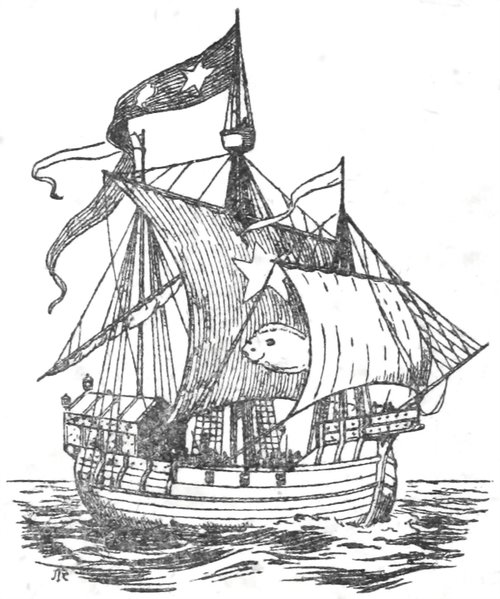
At length the eventful day dawned. At
the head of the rithe lay the Grâce à Dieu, her
huge square sail, emblazoned with the arms
of the Lysles, being loosely furled ready to be
sheeted home at the shipmaster's call.
Geoffrey and the two squires, Oswald Steyning
and Richard Ratclyffe, attended by the
stout old man-at-arms, Arnold Gripwell, and
three trusty archers, boarded the skiff that
was to take them off to the larger vessel. The
hour of parting had come and gone, and with
heavy heart Sir Oliver's son saw the crowd
of tenantry on the shore grow less and less
distinct.
But the moment the lads set foot upon the
deck of the Grâce à Dieu the bustle and excitement
of setting sail dispelled for the time their
feeling of sadness.
Old Simeon Cross, the master-shipman, was
standing by the long tiller, shouting orders at
the seamen to the accompaniment of a string
of expletives uttered in half a dozen different
tongues.
"Yarely, now, yarely with the cable! Dick,
do you attend to the vang; Tom, thou rapscallion,
haul handsomely on yonder brace.
Avast heaving there! Now she feels it!"
Before the steady north-westerly breeze the
Grâce à Dieu bore rapidly down the Emsworth
Channel; the low-lying islands of Thorney
and Hayling were quickly passed, and, after
a buffeting on the wind-swept bar, the staunch
vessel was curtseying to the long, heavy swell
of the English Channel.
Ere noon the Sussex Downs were but a low,
indistinct line of blue against the northern
sky, while the rounded hills of the Isle of Wight
were fading away on the starboard quarter.
Then, having given the helmsman the
course by means of the lodestone that did duty
for a compass, Simeon went below to rest,
since he must needs be on deck throughout the
coming night.
"The English shore is well-nigh lost to
view," remarked Oswald. "Ere morning we
ought to see the coast of France, an this wind
hold."
"Aye, an we are not molested by any of the
sea rovers that infest the Channel," added
Gripwell. "Now, young sirs, I'll wager that
old Simeon will descry the French coast ere
either of your young eyes can do so."
"I have heard it said that a shipmaster's
vision is better by far than a landsman's,"
replied Richard Ratclyffe. "Yet I call to
mind a device that my master, Sir Thomas,
purchased from a monk of Limoges. It was
but a tube of wood filled with sundry pieces
of glass, yet one could distinguish a man's
features a league away."
"By St. George, Master Ratclyffe," exclaimed
Gripwell, "thou art trying to befool us, saving
thy presence. See a man's face a league off,
forsooth! Certes, next thou'lt say that it is
possible for a person in England to clap a trumpet
to his mouth and speak to another in France.
Go to, Master Ratclyffe, Arnold Gripwell is not
to be caught by such reports."
"Yet such is the truth, Gripwell," replied
the squire.
"When I see it I'll believe it," retorted the
man-at-arms sturdily.
Ere nightfall the wind dropped, and the Grâce
à Dieu floundered sluggishly in the long rolling
swell. Under the influence of this unaccustomed
motion Richard Ratclyffe was the first
to succumb to the woeful malady of sea-sickness.
Geoffrey was soon in like case. The others,
having crossed the sea beforetimes, were more
hardened to its usages.
"Go below and lie down awhile," counselled
Arnold Gripwell. "Ere ye wake the evil will
have left you."
"I would there were some other way of
crossing to France," said Geoffrey miserably.
"'Tis part of the game, and must be borne
with a good heart," replied Gripwell. "This
is the only way, and ever will be the only way,
as far as I can see, unless men devise a means
of flying thither through the air. How think ye,
Master Ratclyffe," he added slyly, but the squire
was beyond the sting of banter.
Lulled by the motion of the vessel, Geoffrey
sank into a deep yet troubled slumber, nor did
he awake till he was aroused by the man-at-arms
shaking him by the shoulder.
"Up with ye, Master Geoffrey," he exclaimed.
"There's foul work without, and if so
be we can play our part every man jack will be
wanted."
"What's amiss?" asked the lad, sitting up.
All feelings of sea-sickness had left him; excitement
had conquered the landsman's arch-enemy.
"On deck, and thou'lt see," replied Gripwell
curtly as he hastened to rouse the other
lads.
It was a strange sight that greeted Geoffrey
Lysle as he gained the deck. Day had just
broken, and the pale grey light revealed the
presence of two ships lying a mile or so to
leeward of the Grâce à Dieu.
One, a tall wall-sided ship, was striving to
keep at bay a long, low-lying galley, from which
showers of arrows, quarrels, stones, and spears
were being hurled by the crowd of men who
thronged her low fo'c'sle and towering poop.
"What are we to do, good Master Gripwell?"
asked Simeon, the shipmaster, anxiously.
"Yonder lies the ship Brothers of Lymington.
I know her well. She is a stout merchantman,
but slow; though, by St. Peter, the Grâce à
Dieu could scarce gain a bow-shot length on
her in an hour. The galley, if mine eyes do not
deceive me, belongs to the Republic of Genoa,
and scant mercy shall we receive at her hands.
What are we to do?"
"Do?" exclaimed Gripwell in high disdain.
"Why, Simeon, trick her. If we flee we are
lost, since she can sail two yards to our one.
Art willing to leave this matter in my hands?"
"Ay, good Arnold," replied the shipmaster
nervously.
"Then, do you steer straight for yonder
ships. Ho there, Wat! Bring forth every
spear and every steel cap that is in the ship.
Thomas of Gosport, do you wind your horn
and blow a rousing blast. The rest of you,
shipmen and archers all, don steel caps and stand
fast in the waist till I give ye word."
So saying, Gripwell left the deck and went
below. Meanwhile Geoffrey and his two comrades
were struggling into their plates and steel
casques, knowing that there was hot work
afoot, yet wondering what the man-at-arms
was about.
Presently Gripwell re-appeared, bearing six
large shields of painted canvas, emblazoned
with the arms of the principal knights of Hampshire.
"Now ye be each two knights," he shouted
light-heartedly. "Sixteen years ago come
Martinmas these devices hung in the great hall
of Warblington when Sir Oliver was wed. Ever
since that day have I kept them. Whenever I
journey by water they go with me. Now, Sir
Geoffrey, take thy place on the poop with
Sir Oswald; Sir Richard, the waist is under
thy charge. I am for the fo'c'sle."
So saying the man-at-arms proceeded to hang
the shields over the ship's sides, according to
the custom when knights adventured themselves
on the high seas. Every man had donned a
steel cap, and was grasping two and sometimes
three lances, so that the rays of the rising sun
glittered upon a small forest of steel.
"Turn her aside, I pray thee, Simeon, and let
yonder rogues see our knights' shields," ordered
Gripwell, and obediently the master-shipman
thrust the helm hard over so that the Grâce à
Dieu exposed the whole of her broadside to the
two antagonists.
"Now, wind thy horn once more, Thomas,"
he continued as the ship resumed her course
straight for the Genoese galley. "Heaven help
us if they see through the trick," he added in an
undertone.
The Lymington ship, taking heart at the
prospect of a rescue, redoubled her fire of
arrows and stones, but withal the galley stuck
doggedly to her prey. Nearer and nearer came
the Grâce à Dieu, the lead-coloured water hissing
from her bluff bows as her huge sail caught the
rising breeze.
"We must fight them," quoth Oswald,
"unless they give way. If we are to die 'tis
better to fall in the heat of the fight than to
have our throats cut in cold blood, for yon
rascals give quarter to none—not even a gentleman
of coat-armour."
"Give the Lymington men a rousing cheer,
lads," shouted Gripwell. "Then stand to your
arms and fight as you have never done before.
Now, together!"
From five-and-twenty lusty throats a hoarse
shout ascended in a roar of defiance.
This was too much for the Genoese. Thinking
they had a shipload of valiant knights and their
followers to reckon with, they sheered off, the
huge sail was run up, and fifty oars splashed
in the water. Once on the move the galley
did not stop till it was a mere dot on the skyline.
"A wax candle as thick as my arm shall burn
on the altar of the Church of St. Thomas à
Becket at Warblington for this great deliverance,"
exclaimed the master-shipman fervently.
"I' faith, methought I had lost both
ship and life when the rogues held on."
"Bear up, that we may have speech with
the Brothers of Lymington," said Gripwell.
"Seeing that she sails but a trifle slower than
the Grâce à Dieu it would be fitting that both
sailed in company."
As the Grâce à Dieu drew up close alongside
the succoured merchant ship the bellowing
voice of the shipmaster of the Brothers was
heard thanking these gentle and courteous
knights for their timely aid.
"And though I be little skilled in reading
the devices of gentlemen of coat-armour,"
added a voice, "I do perceive that the shield
of my Lord Bishop of Winchester is displayed.
Bear my humble respects to his Grace, and say
that out of gratitude, I, Paul Roche, of the honourable
company of Goldsmiths of the free
borough of Southampton, do hereby promise
a bar of virgin gold to the service of the Dean
and Chapter of the See of Winchester."
"Better by far give the gold to me, Master
Roche," replied Gripwell with a hearty laugh,
and to the astonishment of the passengers and
crew of the Brothers the story of the ruse was
unfolded.
The proposal that the two ships should complete
the voyage in company was quickly accepted,
and keeping a bow-shot apart the Grâce
à Dieu and the Brothers headed for the French
coast.
Six hours later both vessels passed between
the twin towers that guarded the entrance to
the port of Harfleur, the principal harbour of
Normandy, and Geoffrey had set foot upon
French soil.
CHAPTER V HOW THE MERCHANTS TRIED CONCLUSIONS WITH LA BARRE
The three lads had little time to spend at
Harfleur. That walled town, had Geoffrey
but known, was to play an important part
in his career, but being ignorant of the future
he merely gazed at the Norman stronghold
with the curiosity common to those who find
themselves in foreign parts for the first time.
The Grâce à Dieu and the Brothers were
moored side by side in the inner harbour,
and advantage was taken of their proximity by
Master Roche and his fellow merchants to pay a
visit to the ship that had saved them from
beggary, slavery, or death.
"To Rouen is it, my masters?" exclaimed
Roche. "Since that is also my intention,
why not travel in company? It so happens
that we have hired a large boat to ascend the
river; an it please you, ye are right welcome to
a passage."
"'Twould be well to accept the offer," replied
Arnold Gripwell, turning to Geoffrey. "'Tis
said that the roads in these parts are none too
safe for travellers, howbeit they be armed.
'Twill also save the heavy disbursement that
we must otherwise make for the hire of suitable
steeds."
"Alack-a-day!" groaned Richard Ratclyffe.
"Methought I had finished with the water for
some time to come."
"Little needst thou consider that, Dick,"
replied Geoffrey. "The river is not to be
compared with the sea. Here we shall not be
troubled by rough waves."
"Be not so sure about it," remarked Gripwell,
with a roguish twinkle in his eye.
"How so?"
"Thou'lt know ere long," replied the man-at-arms
shortly.
Next morning at high-water the Grâce à Dieu
warped out into the river on her return voyage,
while the Brothers, compelled to wait for cargo
until the return of the English merchants from
Rouen, was left in the charge of her shipmaster
and crew.
Just before low tide a "bac" or ferry-boat
manned by a crew of Normans came alongside
the Brothers. This was the craft in which
Geoffrey and his comrades were to make their
sixty-mile voyage to the capital of Normandy.
The boat was about thirty feet in length,
broad of beam, and shallow draught. With the
exception of a small deck for'ard and a slightly
longer one aft, under which a low-roofed cabin
provided cramped quarters at night or in wet
weather, the boat was open. Broad thwarts or
benches for the rowers occupied the space amidships,
for oars were used except on rare occasions
when the wind was astern, and a square sail
could be set with advantage.
At the second hour of the flood the bac left
Harfleur, and under the steady, powerful strokes
of the rowers, made good progress.
Geoffrey could not help noticing the apparently
erratic manner in which the bearded
helmsman steered, frequently turning the boat
in diverse way, although the general direction
was up stream.
"'Tis well he doth so," said Gripwell in
answer to the lad's question. "Were it not for
his skill we should be hard aground on one of
the many sandbanks that lie hereabout."
At length the voyagers saw that the river
was rapidly diminishing in width, while on either
hand low-lying banks were clothed in verdure,
for the hand of the spoiler had as yet left this
part of Normandy untouched.
Still maintaining their even, tireless strokes,
the rowers stuck to their task, till the villages of
Tancarville and Quillibœuf came in sight.
"We can go no further with the tide," exclaimed
the Norman helmsman. "See, the
river is even now overcoming the flood."
"As thou wilt, Gaston," replied Master
Roche; "but, I pray thee, put us within easy
reach of a hostel, since my throat is as dry as a
limekiln."
"The du Guesclin Arms lieth but a bow-shot
from the quay at Quillibœuf," replied the
Norman. "There the cider is of the best,
and I wot Malmsey and sack are to be had,
to say nought of the wines of France."
"Then, I'll find my way to the du Guesclin
Arms" quoth Master Roche, filled with pleasurable
expectation. "Though I be a true
Englishman, and must needs hate the name
of yonder hostel, I'll not quarrel with its contents.
How say you, comrades; will you
bear me company?"
Two of the merchants signified their acceptance
of his wishes, but the three lads chose to
remain on the quay, watching the endless procession
of strange craft as they dropped down
stream.
Gaston skilfully brought the bac alongside
the little quay, and, having secured her by two
long and stout ropes, led the way to the inn,
Arnold Gripwell, Roche, his fellow merchants,
and the wearied rowers accompanying him.
Left to themselves, the three lads sat down
in the stern of the boat, discussing the unwonted
sights as the ebb gathered strength. Now a
cog, clumsily yet strongly built, drifted down,
with only an occasional dip of a heavy oar to
keep her on her course; then a galley, resplendent
with paint and gilt, bearing a member
of the household of King Charles the Sixth of
France. Then a barge, laden with a towering
cargo of hay, jostled with a frail cock-boat
crowded with Norman peasants.
All the while the turbid river swirled and
eddied, for the heavy rains had swollen the
Seine till it had burst its banks above Rouen
and had flooded miles of fair country 'twixt that
town and the city of Paris.
Presently Gripwell returned, accompanied by
the Norman helmsman and his crew. The latter
sat listlessly on their thwarts, while the man-at-arms
beguiled the lads during the hours of
waiting with stories of the past when the English
armies overran the greater part of France.
Suddenly Gaston started to his feet; a low
distant roar, like the rumble of summer thunder,
caught his well-trained ear.
"Vite, vite, mes enfants!" he shouted. "La
barre!"
Instantly the hitherto inactive rowers were
transformed into alert and energetic seamen.
The holding-ropes were cast off, the oars fell
betwixt the thole-pins and the boat, driving
her out towards the middle of the Seine. Yet,
notwithstanding the men's efforts, the craft
made no headway against the stream.
"Why thus?" asked Oswald. "The tide
is still against us, and, moreover, our friends
still tarry at the inn."
"Dost not hear the distant roar?" asked
Gripwell. "'Tis what men in these parts call
the Mascaret or La Barre, though to English ears
'bore' sounds more familiar."
Meanwhile all the other boats that were
moored to the bank began to put off into midstream,
their occupants joining in the warning
cry.
Geoffrey looked down stream, and a strange
and awe-inspiring sight met his gaze. Stretching
from bank to bank came an enormous wave,
eight or more feet in height. Its line was bent
into the form of a crescent, the two shoreward
extremities being in advance of the centre, and
breaking furiously along the shore, to the
accompaniment of an ever-increasing roar.
While the Englishmen were looking with
considerable apprehension at the progress of
the bore, fully expecting that their craft would
be engulfed in the wall of water, a shout from
the bank caused them to glance shore wards.
Master Roche and his three boon companions
had left the inn and were standing on the quay,
unable to understand the cause of their fellow
travellers' desertion.
"Come back, robbers, come back," shouted
the Southampton man. The approaching
danger was disregarded or unnoticed in his
excitement.
Then, espying a small boat hauled up the bank
out of harm's way, the angry merchants lustily
dragged it to the water's edge.
"Arrêtez, messieurs, pour l'amour de Notre
Dame," shouted the Norman helmsman, waving
his free arm frantically by way of warning.
But the thick-headed Englishmen were not
to be thwarted in their desire to regain the bac.
The light craft was launched, and the four
merchants awkwardly jumped into it. Fortunately,
there were oars in the boat, and in a
measure they were able to keep control over
the frail cockleshell. More than that they could
not do, and like a straw the boat was whisked
down stream.
The bore was within two hundred yards ere
the merchants realized their danger. Terror
seized them, and in a mad endeavour to escape
they did the worst possible thing—they rowed
desperately for the shore.
Nothing could be done to save the inexperienced
merchants from the impending disaster.
All the nerve and skill at the Norman's command
was required to attend to the safety of the
bac.
A hurried order, and the boat was turned
bows on to the approaching wave, while the
rowers bent and strained at their oars to give the
craft sufficient way to mount the watery wall.
"Hold fast!" cautioned Gripwell to the
lads.
The next instant the boat's bows were lifted
high in the air till the craft seemed to stand on
end. With a sickening shudder the bac remained
for a few seconds poised upon a quivering,
unstable pivot; then the long craft slid
down the other side of the mountainous wave
into comparatively calm water.
Anxiously Geoffrey and his comrades looked
for their fellow-travellers. The little skiff,
caught broadside on by the billow, had been
rolled over and over, and was floating keel uppermost
in the still ruffled water. Three of its
late occupants were clinging to this slender
support, while midway between the upturned
boat and the shore the head of the unfortunate
Master Roche was seen bobbing up and down.
The merchant was a good swimmer, and
breasted the stream right manfully, but it
was a question whether he would reach the
bank ere the arrival of the second wave, which
usually follows the first at a distance of about
two hundred yards.
Quickly Gaston took in the state of affairs.
The men clinging to the water-logged boat must
first be rescued, and that quickly.
Ordering his men to pull easily he steered
towards the hapless merchants. Two were
quickly hauled in, but the work of rescuing
the third, a heavily-built man, proved a harder
task.
Leaning far over the side, the Norman steersman
essayed to assist, but being jolted by
one of his excitable fellow-countrymen, he
overbalanced and fell headlong into the river.
Waterman born and bred though he was,
Gaston could not swim a stroke. Raising
his hands despairingly above his head and
uttering a yell of terror, he sank, whereupon,
without a moment's hesitation, Geoffrey unbuckled
his sword-belt and took a flying leap
after him.
But the lad had not counted the cost of his
brave act. The terrified Norman gripped him
round the neck in a vice-like grasp, while during
the one brief moment that the English lad's
head rose above the water he saw the second wave
bearing down upon them.
With irresistible fury the billow overwhelmed
both the drowning man and his would-be rescuer.
To Geoffrey it seemed as if he was buried
fathoms deep in the icy-cold water, while his
ears were well-nigh bursting under the pressure
of the wave and the bulldog grip of the half-suffocated
Norman.
Just as the lad's breath and strength were
failing his head appeared above water; at the
same time the grasp at his throat relaxed,
and he was able to take in a full, deep draught
of life-giving air. With a sudden jerk he freed
himself of the Norman's grip, and ere the man
sank Geoffrey had him by the hair.
"IT DID NOT TAKE LONG FOR THE ENGLISHMEN TO GRASP THE SITUATION."
But the coldness of the water and the effect
of his almost superhuman efforts were beginning
to tell. His strokes became feebler, his chin sank
lower in the water, yet his hold on the Norman
was not relaxed. Then, just as his strength
failed, he was dimly conscious of a babel of
English and Norman voices close above him;
eager hands grasped him by the shoulder,
and as he and Gaston were dragged into safety
he fell senseless upon the bottom of the
boat.
When Geoffrey came to himself the dreaded
bore and its attendant dangers were past.
The boat was progressing rapidly with the
now favouring flood-tide. Master Roche and
his companions, arrayed in a medley of borrowed
garments, were sheltering from the strong wind
in the little cabin, while Gaston, who had
quickly recovered from the effect of his immersion,
was at his customary post at the helm.
Oswald, Richard Ratclyffe, Gripwell, and
the English archers were gathered round the
limp body of their brave comrade, and great
was their joy when he revived.
"Thou must needs lie quiet, Master Geoffrey,"
exclaimed the old man-at-arms, as the lad
attempted to raise himself on one elbow. "We
need fear no more from the bore, for we are nigh
to Villequier, where we can find shelter and
refreshment at La Dame Dorée. Certes! What
a story for the folks at Warblington."
That night, after the bac had been safely
moored, Gaston came up to the inn where
Geoffrey was.
"Young sir," he exclaimed simply, "I thank
thee for thy deed this day. Though I fear 'tis
of little use to say it, bear in mind that if I,
Gaston le Noir, can be of service to thee at any
time, my dwelling is at La Broie, hard by the
town of Harfleur."
"'Twas but a small matter," replied Geoffrey.
"Yet should it come to pass that I have need of
thee, Gaston, I'll remember La Broie, hard by
the town of Harfleur."
CHAPTER VI THE AFFRAY BY THE RIVER
Next morning a dense fog hung over the
valley of the Seine, so that it was impossible
to see across to the opposite bank.
Nevertheless, the Englishmen were anxious
to resume the journey, and, being assured by
Gaston that he could steer the boat, even were
the fog twice as thick, they embarked once
more.
Presently the sun became visible through the
white wreathing vapour—a pale, watery-looking
disc. Then a cold westerly breeze, insufficient
to disperse the mist, sprang up, so that the
Norman, eager to save the muscles of his men,
ordered the sail to be set.
Above Villequier the windings of the river
were not sufficient to necessitate windward
work, so by merely trimming the sail as the
course was altered the boat could pursue her
onward way.
Hardly a word was spoken. The fog seemed
to affect the spirits both of the mercurial Frenchmen
and the more reticent Englishmen, and in
silence, save for an occasional order from the
steersman as the sheets required attention,
the party made rapid progress with wind and
tide.
"Yonder lies the Dos d'Ane," remarked
Gaston, pointing to a distant hill. "Close
under its shadow boats can shelter from la
barre."
"I trow, master, we have had enough of
this terrible bore," observed Roche. "Certes!
Even now I have the taste of Seine water in
my throat, in spite of a good stoup of sack."
"Not one good stoup only, gossip," corrected
one of his companions.
"As thou wilt, Thomas; but I pray three, ere
thou wouldst——"
Master Roche's words were interrupted by a
low "hist" from the steersman.
"'Tis but the cry of a bittern," remarked
Ratclyffe.
"Ma foi! If thou canst liken yonder sound
to a bird's call thou hast no right to wear
sword," retorted Gripwell, excitement outweighing
his deference. "E'en though the wind
bloweth away from us, I can make out the clash
of arms and the shouts of the combatants.
Now, am I not right?" he continued, as a lull
in the breeze enabled the Englishmen to hear
the subdued clatter of a distant encounter.
"Steer towards the bank, Gaston," exclaimed
Geoffrey. "Perchance we can be of
some slight service to those in the right."
"Certes! I care not which be in the right
or wrong," added Gripwell, for the old war-dog
had scented the battle from afar. "Give
me room for sword-play on the weaker side,
and that will suffice. How say you, Master
Roche?"
"I and my fellow merchants are men of
peace," replied Roche sturdily. "But if we can
be of service we'll follow thee."
So saying, the Southampton man dived into
the cabin, reappearing with a sheaf of swords,
which he distributed amongst his companions.
By this time the boat was nearing the bank,
and above the clash of arms and the oaths
and exclamations of pain and anger rose the
shrill shriek of a woman.
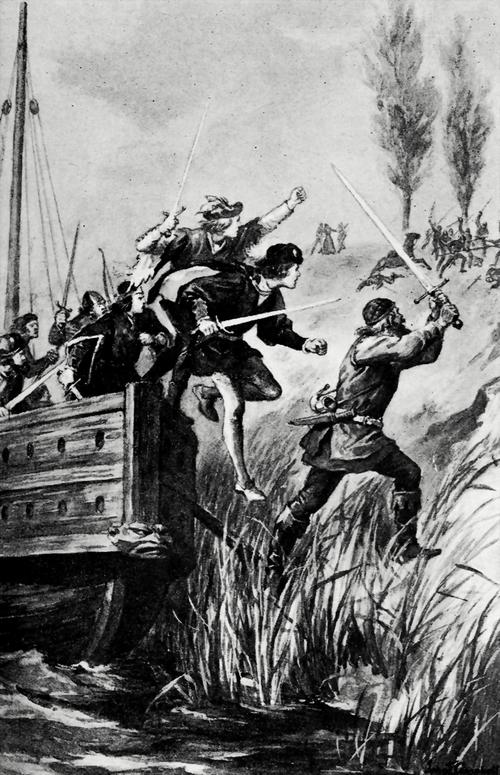
"Fall on, comrades!" shouted Gripwell, as
the bows of the craft slid gently against the rush-lined
bank, and with an agility that was surprising
for his years the man-at-arms leapt ashore
brandishing a long two-handed sword.
Geoffrey, Oswald, and Ratclyffe hastened
after him, the four merchants and the three
archers vieing with each other in their haste to
follow him to the scene of the encounter.
The fog had cleared sufficiently for Geoffrey
and his comrades to discern a confused throng
of combatants at a little distance from the bank,
where a road ran parallel with the river.
It did not take long for the Englishmen to
grasp the situation. Standing shoulder to
shoulder, with brandished spear and sword,
were six or seven men. Sheltering behind them
was a woman, but whether young or old the newcomers
could not tell, since she was in a huddled
posture, with her head covered by her coif.
Surrounding the little band swarmed a score
or more of repulsive-looking ruffians, armed
similarly to their opponents. Men had fallen
on both sides, while two horses, one dead, the
other hamstrung, added to the carnage. At a
distance of twenty paces along the road two of
the villainous rogues were holding an elderly
woman, and it was she who was giving vent
to the piercing cries that the Englishmen had
heard as they sped towards the shore.
There was no mistaking the situation. The
ladies and their armed attendants had been assailed
by a stronger and more numerous band—either
the servants of some turbulent and rascally
baron or a party of men acting for their
own profit, for armed robbers swarmed on
French soil during the troublous feud betwixt
the Orleanist and Burgundian factions.
Even the timely arrival of the Englishmen
did not have the effect of causing the assailants
to beat a hasty retreat. Instead they held
their ground, striving by a supreme effort to
beat down the slender ring of steel that surrounded
the crouching figure in the centre.
In an instant Arnold Gripwell had launched
himself into the thickest of the press. The long
two-handed sword flashed, sweeping and thrusting
with the skill and force of long usage.
Nor were the three lads backward in their
efforts. The young heir of Warblington, carried
away by the heat of the fight—even though
'twas the first time he had crossed steel in action—found
himself confronted by a tall, lithe rascal
clad in a padded leather coat and flowing gabardine,
and armed with a short, heavy sword.
Avoiding a powerful downward cut, Geoffrey
sprang lightly aside, his antagonist's blade
missing his left shoulder by a hair's breadth.
With a swift lunge the lad wounded his foe
in the neck, but was almost immediately repaid
by a cut that, falling short, gashed his
face.
Ere the man could recover himself Geoffrey's
blade sped home, and at the same time Oswald
succeeded in cutting down his opponent.
Of what happened during the next few minutes
Sir Oliver's son had but a confused knowledge;
but the rogues had suffered severely, and already
most of them who were uninjured were
seeking safety in flight.
Of the two men who guarded the elder
woman, one had taken to his heels, but the
other, pushing his captive in front of him,
stood, crossbow to shoulder, seeking to cover his
comrade's flight.
Stung to fury by his wound, Geoffrey
cast all discretion to the winds. Calling Oswald
to follow him, he dashed towards the cross-bowman,
heedless of the menacing weapon that
was aimed full at his body, though he was protected
neither by shield nor breastplate.
The woman saw the danger to which her
would-be rescuer was exposed, and, adroitly
slipping to the ground, she drew a small dagger
and plunged it to the hilt into her captor's
side. With a yell of pain the man dropped
his cross-bow, pressed his hand to his wound,
and turned to flee. But Geoffrey's blade swung
through the air, and with a shriek the robber fell
dead.
That terminated the fight. Nine of the
robbers and four of their opponents had been
slain, while four on each side had been grievously
wounded, including one of the English archers,
who was already dying.
Meanwhile Oswald had assisted the elder lady
to rise.
"By St. Denis!" she exclaimed. "To
think that my silver dagger should be sullied
by the blood of a base routier. But I am forgetting.
I have to thank thee, sir, and thy
comrades for this timely assistance. I trust thou
art a gentleman of coat armour?"
Oswald hastened to assure the haughty dame
that both he and his two friends were of noble
birth.
"The saints be praised!" was the lady's
remark. "It would ill-become the wife of
Sir Raoul d'Aulx, seigneur of Maissons, to be
beholden to bourgeois or villein."
Geoffrey felt tempted to point out that 'twas
with the aid of the merchants and the common
archers that the affair had been decided, but
the announcement of the lady's title completely
took him by surprise.
"Certes!" he exclaimed. "This is passing
strange. It is to Sir Raoul d'Aulx that my
companion here, Richard Ratclyffe, squire to Sir
Thomas Carberry, Governor of Portchester Castle,
doth bear a letter from his lord."
"Then perchance thou canst do us a further
service," replied Lady d'Aulx. "Since our
horses are done for and many of our men have
fallen, it may be possible for us to journey
to Rouen together."
"Our boat, though inconveniently crowded,
is at thy service, madame," said Roche, who
was busily engaged in completing the binding of
a slight cut on his wrist.
"Boat, quotha! I like not this mode of
travelling; yet 'tis better than nothing at all.
But, sir, thy name and rank?"
The Southampton merchant quailed beneath
the imperious glance of the haughty French
woman. Shuffling his feet uneasily, he tried
to make reply.
"My worthy friend hath ever been bashful
in the presence of beauty," explained Ratclyffe
with courtier-like quickness. "He bears the
name of Sir Paul Roche, of Lucre Castle, hard by
the town of Southampton."
"Greetings, Sir Paul," exclaimed Sir Raoul's
wife, as the pseudo-knight gallantly kissed her
hand. "But 'tis to no purpose to dally here.
Aimée, my belle, come hither; it is to these
honourable cavaliers that we owe our preservation."
Aimée d'Aulx, Sir Raoul's only daughter,
was a tall, graceful maiden of about thirteen
years of age, with dark chestnut tresses and a
wondrous clear complexion. She had now completely
recovered from her fright, and Geoffrey
especially could not help noticing her beauty.
While possessing a certain sense of dignity,
she lacked the haughty mien of her mother,
and unaffectedly she presented her hand to be
saluted by Geoffrey and his companions, including
"Sir Paul," who, having regained his composure,
seemed not a little tickled by his newly-acquired
position.
Arnold Gripwell had meanwhile given the
archers orders to dispatch the wounded robbers,
according to the custom of the Middle Ages,
when human life was cheaply esteemed in the
case of common men who were unable to pay
ransom.
"I pray thee examine yonder rogue," said
the Lady d'Aulx, pointing to the corpse of the
cross-bowman who had held her captive. "Methinks
he was the leader of the rabble, yet I trow
he is no base-born serf."
The old man-at-arms strode over to the spot
where the dead ruffian lay, and with a kick turned
the body over on its back.
"See here, Master Geoffrey," he shouted. "I'
faith, though thou wert reckless enow in rushing
in upon a levelled cross-bow, the rogue was but
playing a trick. See, here is the string still
notched, but no sign of a quarrel."
"Then he was a brave man to cover his comrade's
retreat with a boltless bow," replied the lad.
"And thou equally brave, not knowing that
thy life was saved by this man being without
a shaft," added Gripwell.
"By St. George, what have we here?" he
continued, tearing aside the dead man's cloak
and disclosing a small device upon the left
breast of his doublet. "A red axe upon a field
of murrey. Dost know this cognizance, Master
Geoffrey?"
"Nay, forsooth," replied the lad.
"Then I trust that thou wilt ever see it in
the dust. 'Tis the coat of Yves, Lord of Malevereux."
"Surely this is not the corpse of the man
who holds my father captive?"
"Nay, young sir; the Lord of Malevereux is
great in stature and inclined to stoutness.
Moreover, 'tis unreasonable to suppose that
he would lead in person a band of churlish cut-throats
such as these. Without doubt they are
of the household of Malevereux."
"Of Malevereux?" exclaimed the Lady
d'Aulx. "Then I do perceive how matters stand.
This base-born Yves knew that I was journeying
'twixt Harfleur and Rouen, and doubtless
thought to hold me to ransom. My faith, if Sir
Raoul doth not bring him to book for this, may I
never break bread again."
"'Tis to this purpose that I am sent to the
Castle of Maissons, madame," said Ratclyffe.
"So that they of Taillemartel should join forces
with the garrison of Maissons 'gainst this villainous
Yves."
"Young squire, in the name of Sir Raoul
d'Aulx I shall welcome thee and thine to Maissons,
yet methinks that this matter concerning
the combining of the two garrisons must wait,
seeing that Sir Raoul hath been called to Paris
by his Sovereign."
"When will he return, fair lady?" asked
Geoffrey anxiously.
"Nay, that I cannot say; but rest assured,
young sir, that thine anxiety concerning the
chastisement of the Lord of Malevereux is not
greater than mine."
The Englishmen and the party they had
succoured embarked upon the boat, and the
journey up stream was resumed. Ere sunset
on the following day the city of Rouen was
reached, and Gaston was dismissed with liberal
payment.
Here, after a night's rest, the travellers dispersed.
Paul Roche and his fellow merchants
addressed themselves to the disposal of their
wares; the Lady d'Aulx and her attendants,
accompanied by Richard Ratclyffe, set out on
the road to Maissons; while Geoffrey, Oswald,
and Arnold Gripwell, with the two surviving
archers, took horse and were soon speeding
on their way to Taillemartel.
CHAPTER VII HOW GEOFFREY CAME TO TAILLEMARTEL
A few leagues from the city of Rouen
Geoffrey and his companions began to
come across evidences of the fearful struggle
'twixt Burgundians and Orleanists.
Here would be seen a "Burgundian mitre"—the
scorched and blackened gables of a partially
demolished cottage; there the corpse of some
unfortunate peasant dangling from the withered
branch of a tree. Ever the air reeked of charcoal
and of the fetid odours emanating from
carcases of unburied cattle; for the marauders
ruthlessly slew every four-footed creature that
they were unable to drive off to their embattled
retreats.
Utmost caution had to be exercised by the
English travellers, since they were not strong
enough to hope to successfully repel the attacks
of any but the smaller bands of freebooters.
Twice they were compelled to take refuge in
friendly woods. Once a détour of three leagues
was necessary, owing to the approach of suspicious
parties of horsemen, so that the sun had
set ere Geoffrey arrived at the portals of his
father's Norman castle.
In the gloom the lad could distinguish the
outlines of two massive circular twin towers
connected by a battlemented wall, pierced by a
lofty gateway concealed by the raised drawbridge.
On either side of the towers the wall
ran for a distance of about fifty yards till it
joined another circular though smaller tower
forming the angle of the fortified work. Within,
the summit of a square keep was just visible
above the battlements. Barbican or outwork
there was none, but a deep moat surrounded the
castle.
"What think ye of Taillemartel?" asked
Gripwell as the cavalcade reined in their steeds
at the edge of the moat.
"'Tis a noble pile, Arnold," replied Geoffrey,
"though not so large as Warblington, I trow.
But how——"
Geoffrey's words were interrupted by a hoarse
shout from the battlements, and a sentinel demanded
the names and errand of the newcomers.
"They keep good ward," remarked Oswald,
as one of the English archers who was about
to sound a tucket thrust his trumpet behind
him.
"Ho, there! Who comes?" repeated the
sentinel.
"I would have speech with the seneschal,"
replied Gripwell.
In a few minutes torches flickered behind
the battlements, glittering on steel headpiece
and breastplate; then a voice exclaimed:
"Here am I, Bertrand de Vaux, seneschal to my
Lord Oliver Lysle. Who would have speech
with me at this unseemly hour?"
"Sir Oliver's son stands without, and would
be admitted."
"I wot not that Sir Oliver's son was coming
hither," replied the seneschal. "What proof
have I that ye are not of Malevereux, or of
Entrevilles, or of Faux?"
"A truce to thy stubbornness, Bertrand,"
shouted Oswald. "Dost recognize my voice?
I am Oswald Steyning, Sir Oliver's squire."
"A thousand pardons, monsieur. Now I
know 'tis no trick or stratagem. Nevertheless,
be it known that Sir Oliver's strict injunctions
allow neither the gate nor the sally-port to be
opened after sunset, save by virtue of his written
order."
"Doth that also apply to the drawbridge?"
asked Gripwell.
"Nay," replied the seneschal. "That I will
have lowered, but to what purpose?"
"Hast ever heard how the blessed St. Paul
left the city of Damascus? I pray thee lower
ropes from the battlements if naught else will
serve, and I'll warrant that this night we'll
slumber quietly within the walls of Taillemartel."
To this suggestion there was no verbal response,
but almost immediately the iron chains
of the drawbridge creaked and clanked as the
ponderous wooden structure fell slowly on its
hinges.
Meanwhile the two archers had tethered the
horses of the party in a meadow hard by the
moat. This done, Geoffrey and his companions
crossed the drawbridge, to find three stout,
noosed ropes dangling from the almost invisible
heights above.
Spinning round and round like a joint on a
jack, Geoffrey was drawn up, and in this somewhat
undignified manner he made his entry into
his father's Norman home.
Oswald and Gripwell followed, the ropes being
again lowered for the two archers, and soon
the travellers found themselves standing on the
battlements surrounded by the eighty men-at-arms
and archers comprising the garrison of
Taillemartel, but it was not until the letter
bearing the Lady Bertha's signature and the
seal of Warblington was produced and read
that the seneschal led the round of cheering
that greeted Sir Oliver's son.
Bertrand de Vaux was a short, broad-shouldered,
bull-necked Norman, of about forty years
of age. Muscular strength was evinced by his
frame, while his deep-set eyes and heavy
square-cut chin denoted resolution and determination
akin to obstinacy.
He was soberly attired in a close-fitting suit
of green cloth slashed with red, while a silver
belt, ornamented with the arms of the Lysles,
encircled his waist. On his head he wore a
velvet cap of maintenance ornamented by a
silver clasp, also stamped with the turbot and
the stars, while his feet were encased in untanned
leather shoes, the toes of which terminated in
long points that for convenience' sake were
turned upwards and fastened to the wearer's
calves by means of silver buckles.
"I pray you bear me company to the banqueting-hall,"
said the seneschal addressing
Geoffrey and Oswald. "I doubt not that Taillemartel
can still provide a repast fitting for Sir
Oliver's son, e'en though Sir Oliver himself be
not here to have the ordering of it."
So saying, he led the way to the hall where
the men-servants had already prepared a plentiful
repast of cold venison, pheasants, long rolls
of bread, and a copious supply of mead and
wine.
Arnold Gripwell had partaken himself to the
quarters of the sous-officiers, while the archers
had to content themselves with company of the
Norman soldiery, but their slight knowledge
of the foreign tongue was sufficient to enable
them to carry on a conversation with their new
comrades.
"Hast heard or seen aught of Sir Yves of
Malevereux?" asked Geoffrey, as they were
doing full duty towards the viands.
"Of Sir Yves nothing; of his following overmuch.
Thrice within the last fortnight have his
men appeared within sight of Taillemartel.
Yet though they did us no scath, they did not
hesitate to mock at us. Ma foi, when they
mentioned the name of Sir Oliver, and taunted
us that we were children not to stir on his behalf
'twas as much as I could do to keep my men in
hand. Yet seeing that they of Malevereux
were thrice as many, and that little or no good
was to come of adventuring ourselves 'gainst
them in the open, I kept our men within walls."
"I trust that they have done no harm to the
tenantry?"
"Only to Pierre, the wood-cutter," replied
Bertram carelessly. "Poor fool, he would not
take shelter within the castle as the rest have
done, so they slew him on his own threshold—not
before he had killed two of the villains."
"Now that is good cheer," continued the
seneschal, when Geoffrey had told him of the
proposed alliance with Sir Raoul d'Aulx. "By
St. Denis, with three hundred men-at-arms,
archers, and cross-bowmen 'gainst it, Malevereux
will assuredly fall. And then——Ah, with Sir
Oliver set free, and the plunder of two score
years within our grasp, life will be worth
living."
On the morning following the arrival of the
Englishmen at Taillemartel, Oswald Steyning
set out to deliver the letter from the Lady Bertha
to Sir Yves de Malevereux.
In spite of the young squire's forebodings,
he persevered in his determination of bearding
the Tyrant in his den. Refusing to take any
of the garrison as an escort, he bade farewell to
Geoffrey and his friends, both English and
Norman; then, trusting to chance to avoid
straggling parties of raiders (though the fact
that he bore a letter addressed to the Tyrant
might afford him safe conduct), he rode forth
from the sheltering walls of Taillemartel.
From that moment it seemed as if the earth
had opened and swallowed up the bold and
devoted squire of Sir Oliver Lysle. Day after
day passed, yet Oswald did not return. Reluctantly
Geoffrey had to admit that, unless some
misadventure had befallen his friend on the
way, Sir Yves had been guilty of a gross breach
of faith, and had made the young squire captive
in the gloomy castle of Malevereux.
For the next fifteen days following Oswald's
departure nothing of interest occurred to break
the ordinary routine observed at Taillemartel.
Occasionally parties of horsemen, bearing Sir
Yves' livery, would appear before the castle,
but they wisely forbore from approaching within
bow-shot. Nevertheless, Geoffrey had not been
idle. Under Gripwell's tutorage he studiously
practised the use of the lance, sword and mace,
or engaged in tourneys with blunted lances.
Hard knocks were given and received with good
grace, and day by day the heir of Warblington
made rapid progress in the art of war.
At length Richard Ratclyffe arrived at the
castle, his crestfallen face forewarning the garrison
of the failure of his mission. Sir Raoul had
been summoned to Paris to attend upon the
Dauphin, and for an apparently indefinite
time the Castle of Maissons was to be shorn
of its numerous soldiery, a bare thirty men-at-arms
and cross-bowmen being left to hold
the fortress during its lord's absence.
"I can only return to my master, Sir Thomas
Carberry, with assurances of Sir Raoul's condolence,"
exclaimed Ratclyffe ruefully. "That
is but cold comfort, yet 'tis better than nothing
at all. But on the other hand, Geoffrey, there
are great doings afoot. I heard, on the authority
of one of the French king's attendants,
that our King Harry hath formally presented his
claim to the throne of France. Failing an
immediate compliance he vows that he will submit
his claim to the arbitrament of the sword."
"'Tis good news," replied Geoffrey enthusiastically,
but the brow of the Norman seneschal
clouded ominously.
"France for the Frenchmen," said he. "So
long as Sir Oliver holds Taillemartel as a fief
of King Charles I am content. With Burgundian
fighting Orleanist I am likewise content to
side with the Duke of Burgundy. Should he
think fit to make alliance with your King Henry
'tis well; but failing that, how can I, Bertrand
de Vaux, stand aloof when English armies tread
on French soil?"
"Have a care, sir, lest you fall betwixt two
stools," exclaimed Ratclyffe. "'Tis said that
Burgundy favours King Henry's claim."
"If that be so, I, too, am with him; yet at
heart I am a Frenchman."
"Time will prove, good Bertrand. Meanwhile,
concerning the matter in hand; it is my purpose
to journey homewards to-morrow, Geoffrey, so if
thou hast a message to send to Warblington I
will be the bearer."
"Since so little has been done towards setting
free my father, I am at a loss what to say," replied
Geoffrey, sadly. "But this: bear my
mother my most dutiful expressions of regard,
and tell her that by the blessing of God I am in
good health. Also that I am striving to do my
devoirs as a true Lysle."
Late in the afternoon of the day following
Ratclyffe's departure, a small cavalcade was
observed to be rapidly approaching the castle.
The battlements were immediately manned,
the gates shut, and the drawbridge raised,
while speculation was rife as to the object of the
new-comers.
Without hesitation the little band rode fearlessly
up to the edge of the moat. There were
but seven, all most magnificently mounted
and accoutred, while their leader bore the
French Royal arms upon his surcoat—the silver
lilies upon an azure field. A horn was sounded,
and admittance was demanded for a herald of
King Charles of France. Upon this the drawbridge
was lowered, and the gates thrown
open.
"Welcome, Sir Jacques d'Erquai," exclaimed
the seneschal, recognizing the new arrival as a
distinguished knight of the French Court.
"What is thy pleasure?"
"I ask entertainment for me and mine this
night, Bertrand. To-morrow we hasten towards
Harfleur, for my royal master hath deigned
to favour me. In sooth, I am ambassador-extraordinary
to the King of England."
That evening Sir Jacques was the guest at
Taillemartel. During his stay he spoke but
little concerning the nature of his mission.
When, however, he had taken his departure,
Arnold Gripwell approached the English lad,
his face working with excitement.
"Yesternight I lay low and said but little,
though mine ears were as busy as a housewife's
fingers. Certes, though I understand that this
Sir Jacques d'Erquai kept a proper curb on his
tongue, his varlets lacked common discretion.
What, think ye, is the Dauphin's answer to our
Sovereign Lord's demands?"
"Surely the Dauphin will not submit
tamely?" suggested Geoffrey.
"Of a surety he will not," continued the man-at-arms.
"Not only hath he refused the king's
conditions, but he hath gone further; by the
hand of Sir Jacques he hath sent an insulting
message, together with a present."
"The message?" asked Geoffrey eagerly.
"To fully understand the message 'tis necessary
to know the nature of the present, young
sir. In short, the Dauphin has sent a box of
tennis balls with the message that King Harry
would do better to find amusement with them
rather than present a claim to the crown of
France."
"After that there can be but one issue,"
remarked Geoffrey.
"Ay—war," was Gripwell's curt response.
CHAPTER VIII OF THE AMBUSH LAID BY THE MEN OF TAILLEMARTEL
Slowly the months sped, yet towards taking
any definite steps to secure his father's
release Geoffrey could do little or nothing.
The realization of his two great hopes—the
return of Sir Raoul from the French capital, and
the expected invasion by King Henry—seemed
too uncertain. The feast of St. Silvester—a
critical time in the affairs of Sir Oliver Lysle—was
now but a few days off, and, as the rapidly
dwindling interval appreciably diminished,
the need for action on the part of his son became
more and more urgent.
Early one morning in June a horseman rode
with loose rein up to the castle with the news of
the approach of a strong body of mounted men
from Malevereux, and that the invaders' intention
was undoubtedly to sack and plunder the
village of Taillemartel, that, up to the present,
had escaped the unwelcome attentions of the
ruthless Sir Yves. Possibly its proximity to
the castle had accounted for its immunity
hitherto, but with the force at his command
on this occasion the Lord of Malevereux doubtless
thought the opportunity had come to sack
the village.
"Now is the time to gain honour and distinction,
young sir," quoth Gripwell to his charge,
as he hurried from the armoury with his harness
but partly buckled, and a sheaf of weapons under
his arm. "'Tis not for me to give orders,
but saving thy presence, I would suggest that
we take steps to thwart these rogues of Malevereux.
Though they be the stronger party
I have but little doubt that by stratagem we may
worst them."
"How so, Arnold?" asked Geoffrey.
"Thus," was the reply, and the man-at-arms
proceeded to unfold a carefully prepared plan
of action.
Geoffrey and the seneschal expressed their
unstinted admiration of Gripwell's proposal,
and without a moment's hesitation the plan was
put into execution.
Leaving but ten men to guard the castle
Geoffrey led the rest of the garrison to the
village, which lay but two bow-shots from the
walls of Taillemartel. Here the soldiers proceeded
to occupy the cottages on either side of the
only road that passed through the little village,
while outposts were placed with instructions
to hasten back to the main body without being
perceived, on the first sign of the approach of
the enemy.
Already the terrified peasants were busily
engaged in removing such of their scanty goods
and chattels that were capable of being easily
carried away, while the womenfolk and children
were streaming in a disorderly mob along the
dusty road leading to the castle.
"Bid those villeins stop, young sir," exclaimed
Gripwell, pointing with his sword towards
the mob of villagers. "They do but
hinder our work of making good the defences."
Calmly Geoffrey walked across to where the
peasants were, the seneschal accompanying him.
Like the rest of their men they were unmounted,
so that the risk of being seen by the enemy was
considerably reduced.
"Listen, men," exclaimed Sir Oliver's son in
the Norman patois, for, like most of the knights
and squires of that period, he could speak the
French tongue. "Listen, men, and if ye be
worthy of the name, I pray you desist from
this work of removing your goods. Is it not
better to have a thatch over your heads than a
few sorry remnants of your belongings without
a cottage wherein to store them? We are here,
by God's help, to protect you from the rogues of
Malevereux. Were it otherwise 'twould have
been more profitable to remain within the walls
of Taillemartel and let the village take its
chance.
"Now," he went on, "this is my pleasure;
let all those who have any regard for their own
skins and faith in the protecting arm of their
over-lord—let these stand firm and assist in
the defence of their hearths and homes. Those
who are not so disposed, let them hasten behind
the walls of Taillemartel—but, be it understood,
not a stick of their goods must be borne hence."
Of the three-score male inhabitants only four
took advantage of Geoffrey's offer to gain the
shelter of the castle, and, amid the hooting and
hissing of their fellows, and the rude jibes of
the soldiers, they slunk sheepishly away.
Those of the peasants who stood firm were
ordered to drag their wagons and ploughs
to the end of the village street nearer the castle,
and to pile them in a rough breastwork that was
practically impassable by mounted men.
Eagerly the villagers obeyed. Fired by the
ardour of their young seigneur they gained
both strength and resolution, so that in a very
short space of time the crowd of demoralized
peasants was changed into a band of determined
and comparatively disciplined men.
"Now get you gone to your houses," continued
Geoffrey, speaking according to Gripwell's
suggestions. "Arm yourselves with
scythes, flails, clubs, or any other weapon
ye may have to hand. Moreover, lay in a
supply of stones, but, on pain of severe punishment,
let no man stir or show himself until he
hears a trumpet blown."
In a wonderfully short time the village street
was almost deserted, for the men-at-arms, archers
and cross-bowmen had already taken up their
quarters within the houses. Only Geoffrey,
Gripwell, the seneschal, and a few archers
remained without. Venturing to the furthermost
end of the village they awaited the arrival
of the outposts with news of the approach of
the men of Malevereux.
They had not long to wait. Wellnigh breathless,
with his arms pressed closely to his sides,
a lightly-clad archer ran towards the village,
taking advantage of every depression in the
ground that might serve to hide him from the
foe. Close behind him ran another, and, a
bow-shot in the rear, a third. All bore the
same tidings. A body of mounted men, estimated
at nearly two hundred, and led by Sir
Yves in person, was even now within a league of
the village.
"Sir Yves, himself!" ejaculated Gripwell.
"Certes, if we cannot bring him to earth, may
I never see Warblington again. Pass the word,
Florestan," he continued, addressing an archer,
"that one cross-bowman in each house reserve
his quarrel especially for the Tyrant of Malevereux.
A crown for the man who brings him
down."
As the archer ran to communicate the order
the man-at-arms turned to Geoffrey: "Tis
time that we took cover, young sir. Be of good
heart, for I'll warrant that these wolves will
turn tail and make off faster than they came.
My place is by the side of my master's son.
But above all things take heed that not a bow
be loosed nor a stone thrown till the tucket
sounds."
Barely had the defenders retired to their
rude defences ere the followers of Sir Yves
appeared; for, deeming the village an easy
prey, they had ridden furiously upon it to plunder
and kill.
Fortunately for Gripwell's plan the cottages
standing more remote from the castle were
meaner than those in the middle of the village.
This fact was evidently known to the men of
Malevereux, for, without waiting to despoil
the poorer houses, they passed on towards
that part of the hamlet where most plunder was
likely to be obtained.
In the van, composed of mounted men-at-arms,
clad in quilted coats, breastplates and iron
caps, rode a person of quality, for he was armed
cap-à-pied in steel, and bore a shield with the
device the red axe. Previous to entering the
village he had closed his visor, so that his features
were not visible.
"Is yon knight the Tyrant Sir Yves?"
"Without a doubt," replied Gripwell in an
undertone. "But 'tis ill that such a gap divides
two companies; the van will have reached the
barricade ere the rear-guard rides fairly into the
trap."
"Who, then, is this?" continued the lad,
as a short, broad-shouldered man passed at the
head of the rear-guard.
The leader of the second company was clad
in a complete suit of chain armour, similar
to that in vogue two centuries before, but
with the addition of a steel breastplate, gorget,
tassets, and sollerets. His hands were encased
with brazen gauntlets, the backs of which were
composed of thin overlapping plates studded
with knots of steel. On his head he wore a
steel bascinet with a beaklike visor, but the
latter had been thrown back, disclosing a dark,
cruel-looking face, partially hidden by a heavy
beard and moustache.
Geoffrey repeated the question, for this
knight's device was very similar to the first's.
"It can be none other than Sir Yves' brother,
Sir Denis. I see that his shield shows that he
is his brother's cadet. But stand to it; the
time is at hand. Peter, sound a rousing tucket,
I pray thee!"
Thus ordered, one of the English archers blew
a shrill blast upon his horn, and the next moment
volleys of arrows, bolts and stones whistled
through the air. The close array of mounted
men was transformed into a shouting, panic-stricken,
struggling mob. Many fell, dead or
wounded, the plunging, terrified horses adding
to the tumult. Here and there, men braver
and cooler than their fellows stood at bay or
attempted to force their way into the houses
that sheltered their assailants.
Three cross-bowmen had made Sir Denis
their particular mark, but, doubtless carried
away by their excitement, their aim was faulty.
One bolt shattered itself against the knight's
steel breastplate, another glanced from his
helmet, while the third missed entirely.
Closing his visor, Sir Denis slipped from his
horse and, mace in hand, strode towards the
door of the nearest cottage. In vain quarrels
and stones rattled against his armour of proof,
and, like a man bearing a charmed life, he continued
his advance.
"Make good the door 'gainst him," shouted
Gripwell to the two English archers. As he
spoke a thunderous blow of the Norman's
mace burst in the upper part of the door.
Peter, the archer who had given the signal
for the onslaught, immediately delivered a
spear-thrust; but the knight, with a sweep
of his ponderous weapon, shattered the head of
the spear from the haft. Quick to take advantage,
the archer grasped the end of the mace,
and a fierce struggle ensued.
Sir Denis' mace was secured to his wrist
by a chain, so that even had he quitted his hold
the weapon would still be attached to his person,
yet he had no intention of so doing.
Swaying to and fro on either side of the partially
demolished door, archer and knight strove
for mastery. Both were powerful men, and
both equally determined to gain possession
of the mace. At one time the mailed casque
and shoulders of the Norman would be dragged
through the irregular aperture; at another
the Englishman was sore put to prevent himself
being hauled from his retreat. Nor could his
comrades give him assistance by laying hold
of the knight's weapon; all they could do
was to rain powerful, yet futile, blows upon the
armour of the struggling foeman.
Meanwhile Gripwell, after giving the archer
instructions to hold the doorway, had darted
to the inner room, where a pail of charcoal,
intended by its late owner for cooking purposes,
glowered darkly on the floor.
Seizing the portable fire with his gauntleted
hands, the man-at-arms bore it into the other
room, where, awaiting his opportunity, he
dashed its contents into the visored face of the
Norman knight.
Some of the particles of the red-hot charcoal
passed through the narrow slits in Sir Denis'
bascinet. Nearly blinded by the pain the
knight relinquished his hold on the mace
and involuntarily attempted to raise his arms
to protect his face. The sudden release of
the object of their contentions caused the
archer to reel backwards, till the strain on
the chain pulled the knight's arm towards the
doorway.
With a shout of triumph, Gripwell also
seized the mace, and archer and man-at-arms
united their efforts to pin their formidable
antagonist to the woodwork by the strain
upon the chain.
"Yield thee, Sir Knight," thundered Arnold.
"Methinks thou art a good bond for the safety
of my master, Sir Oliver."
As he spoke Sir Denis gave a powerful heave,
the chain snapped asunder, and the two Englishmen
fell heavily on the floor. The Frenchman
reeled backwards a good five paces ere he, too,
came to earth.
Unable to rise, by reason of the weight of
his armour, he lay helpless, groaning with the
effect of the red-hot embers.
"We'll have him anon," cried the man-at-arms,
struggling to his feet. "Look to yon
window."
The warning came barely in time. During
the struggle at the doorway a score of men
from Malevereux had assailed the window,
which Geoffrey, sword in hand, was defending
by the aid of two archers of the garrison of
Taillemartel and three peasants.
Already one of the latter was down, slain
by a quarrel shot at close range, while one of
the archers was severely wounded by a blow
from a "morning star."
The arrival of Gripwell and the two English
archers soon turned the scale. While the man-at-arms
dealt irresistible blows with his heavy
axe, the archers shot fast and true, and in a
short space the band of assailants seemed to
melt away.
"We hold our own everywhere," said Arnold,
leaning out of the window during the brief
respite.
The man-at-arms spoke truly. With one
exception every house had made good its defence,
and already the demoralized men of
Malevereux—those who had not been slain or
grievously wounded—were seeking safety in
flight.
At one place, almost in the centre of the
village, the noise of conflict was still to be heard.
Ordering the cross-bowmen from the houses,
Geoffrey gave instructions to form up at the
furthermost end of the village, so as to repel
the enemy should they return to the attack, and
also to cut off the retreat of any of the remaining
men of Malevereux should they attempt to
escape.
This done, Geoffrey, accompanied by Gripwell
and several archers and men-at-arms, made
his way through the corpse-encumbered
street to where the struggle was still maintained.
"We have him safe enough, fair sir," exclaimed
a bowman, pausing in the act of replenishing
his quiver with arrows that were
everywhere 'feathering the ground. "The
Tyrant is cornered in yonder house."
The Knight of the Blood-red Axe had had his
horse shot under him early in the fight. Basely
deserted by his panic-stricken followers, he
found his retreat cut off by the infuriated
defenders. For a space he kept his foes at bay,
a ring of dead and wounded men surrounding
him as he fought. Wounded in several places
till the blood oozed from the joints of his
armour, the knight made a sudden rush towards
a deserted cottage.
Here he made a stand, bringing down the
seneschal of Taillemartel by a sweeping cut with
his sword, till, borne back by weight of numbers,
he took shelter in one of the rooms.
"Leave him to me," shouted Geoffrey authoritatively,
as he forced his way 'twixt the crowd
of soldiery.
"Nay, thou'rt foolhardy," objected Gripwell,
laying a detaining hand on the shoulder of his
charge. "Let the men have their way with
the rogue; he is unworthy to be treated as a
gentleman of coat-armour."
"Forbear to hinder me; my purpose is
fixed," replied Geoffrey stoutly, and, sword in
hand, he rushed into the room where the knight
stood, back to the wall, three writhing bodies
on the floor testifying to his prowess as a
swordsman.
"Yield thee, Sir Knight," exclaimed Geoffrey.
"I promise thee quarter."
"Give quarter to those who ask it," was the
reply. "I surrender to no man."
The next instant their blades crossed. Both
combatants were equally matched. The English
lad lacked the size and weight of his antagonist;
but, with the exception of a slight
wound received earlier in the fight, Geoffrey was
comparatively fresh, while the knight had
already borne the brunt of a prolonged encounter
against enormous odds.
On his part Geoffrey strove, by means of a
succession of rapid passes, to find a joint of
his antagonist's armour; while the Frenchman,
mustering all the strength at his command,
relied mainly upon his powerful sweeping
cuts to disable his youthful and active
foe.
At length the Englishman wounded his enemy
by a lightning-like thrust that took effect 'twixt
the flexible plates of the Frenchman's gauntlet.
But Geoffrey had to pay for his advantage.
With a roar like the bellowing of a bull the
knight shortened his sword, and ere the lad
could recover his blade the steel was snapped
asunder a span's length from the hilt.
The Frenchman was not slow to take advantage
of his enemy's misfortune. Swish! came
his heavy weapon. Geoffrey's fragment of
steel could not stop the cut, though it deflected
the sword-cut, and, receiving the blade full
in his gorget, the lad was sent staggering across
the room.
The knight could not forbear from following
up his stroke. Unwisely he left his point of
vantage by the wall, and, whirling his sword,
prepared to deal a coup de grâce.
In his excitement he forgot the low beam that
ran athwart the ceiling, and ere the stroke could
be completed his sword encountered the rafter,
sinking in so deeply that he was unable to extricate
his weapon.
Already a dozen men-at-arms were about to
intervene, when Geoffrey threw himself boldly
upon his antagonist.
With a resounding crash the two mail-clad
bodies fell upon the floor, the English lad uppermost.
The point of his dagger was at the slit
of his antagonist's visor, and the knight was at
Geoffrey's mercy.
"Yield thee, Sir Knight."
This time the Frenchman thought ere he
declined the proffered condition.
"Thou art of noble blood?" he asked. "If
not, slay me."
"I am the son of Sir Oliver Lysle, whom
thou——"
"Then I surrender myself," replied the knight,
without waiting for further explanation.
Breathlessly Geoffrey leaned upon the shoulder
of one of the archers, while Gripwell
and one or two others proceeded to cut the
laces of the Frenchman's bascinet.
When at length the vanquished man was
unhelmed a cry of astonishment arose from the
onlookers.
Instead of the cruel, debased features of Sir
Yves of Malevereux the face of a young man of
about twenty years of age greeted the eyes of
the men of Taillemartel.
"Who art thou, young sir?" demanded
Geoffrey. "Methought I had captured the
Tyrant of Malevereux."
"I am Henri, son of him whom thou hast
named the Tyrant," was the reply.
CHAPTER IX CONCERNING GEOFFREY'S DESPERATE RESOLVE
"Though we have not Sir Yves in our
hands, we have not fared badly," said
Arnold Gripwell, as they hurried off to muster
the men of Taillemartel, leaving the son of Sir
Yves in the charge of a party of archers. "With
Sir Denis and this Henri as our captives we
ought to bring the Lord of Malevereux to his
senses."
"He will scarce dare to carry out his threat
now," replied Geoffrey. "No doubt he will be
willing to effect an exchange of prisoners. But
what have they done with Sir Denis?"
The man-at-arms and his charge had reached
the scene of the encounter with the brother of
Sir Yves, but the helpless steel-clad body of Sir
Denis was nowhere to be seen.
"Perchance some of our men have him in safe
keeping," observed Gripwell. "I pray thee
summon our soldiers that we may question
them on this matter."
In response to a trumpet call the garrison of
Taillemartel formed up in the village street,
wearied yet triumphant. The defence and
subsequent rout of the invaders had not been
accomplished without severe loss. Eleven men
had been killed, and over a score grievously
wounded, including Bertrand de Vaux, the
seneschal; while nearly every other man-at-arms
and archer had received some slight injury.
Of the peasants but three had been killed and
ten wounded, for they had mainly contented
themselves by hurling stones from a safe distance.
Careful inquiries failed to throw any light on
the fate of Sir Denis. Unnoticed by the defenders,
his varlet, with praiseworthy devotion,
had dragged the hapless knight from the fray,
and, assisting him to a horse, had provided him
with the means of flight.
Great was Geoffrey's disappointment at the
escape of Sir Denis, but, consoling himself with
the fact that the only son of Sir Yves was a
prisoner in his hands, he led his men back to the
Castle of Taillemartel.
Some of the bolder spirits were for setting off
in immediate pursuit of the remnants of the
invading forces, while the investment of Malevereux
was seriously discussed. But Gripwell
knew that the slender garrison of Taillemartel
was quite insufficient to hope to reduce the
formidable defences of Sir Yves' stronghold.
More prudent measures must be taken if Sir
Oliver were to regain his freedom.
Accordingly one of the prisoners was liberated
and given a letter to his master in which the
news of his son's capture was made known.
Geoffrey also expressed therein his willingness
to hand Henri over to his father should Sir
Yves set Sir Oliver and his squire Oswald at
liberty, without further delay.
Three days later a curt message was received
from the Tyrant of Malevereux.
"Do as thou wilt with my son," he wrote.
"Since he hath been fool enough to fall into
thy hands, let him shift for himself. But rest
assured concerning the oath I swore relating to
Sir Oliver, not one jot nor one tittle will I abate
in fulfilment of it."
"Here is a fine ado," quoth Gripwell. "'Tis
certain this base villain hath no more regard for
his son than for the veriest cur in his kennels."
"Perchance this Henri will offer ransom,"
suggested Geoffrey doubtfully.
"We can but try him. Methinks that with
all the treasure stored within the walls of Malevereux
'twould be passing strange if this prisoner
of ours hath not command of ten thousand
crowns."
Accordingly Geoffrey and the men-at-arms,
attended by two archers, entered the narrow
chamber in which Sir Yves' son was confined.
Henri de Valadour, the son of Sir Yves de
Malevereux, was sitting on a stone bench,
brooding over his misfortunes. He had been
shown a consideration that contrasted favourably
with his sire's treatment of Sir Oliver, but
the sullen countenance of the prisoner belied
any feelings of gratitude for his courteous though
compulsory entertainment.
"Ten thousand crowns, by my hilt!" he cried
disdainfully when the matter was mentioned.
"Ye'll do well if ye see the colour of ten thousand
sous. If it be thy will to put me to death
so be it; but I pray thee, fair sir, that it may
not be by means of a hempen rope."
"'Twould be a fine sight for the countryside
to see Henri, son of Sir Yves, dangling by his
neck from the topmost turret of Taillemartel,"
said Gripwell roughly.
"Forbear, Arnold, forbear," exclaimed Geoffrey,
speaking in English. "'Tis not meet
that a commoner should speak thus to the son
of a belted knight—e'en though his sire is
unworthy of his coat-armour."
Then turning to Henri: "Nay, we are not
murderers," he continued. "Failing the ransom
or a fair exchange of prisoners, thou must
needs remain here awhile in durance. Perchance
thy father may see fit to swerve from his purpose."
A look of gratitude flashed across the sullen
countenance of the prisoner. As a raider, captured
in an attempt to pillage the village of a
neighbouring baron, he had expected nothing
less than death, since a ransom was not to be
considered.
"Fair sir, I thank thee," he replied. "Would
that I could serve thee by saving Sir Oliver's
life; but, though it shames me to say it, neither
mercy nor justice will stand in my father's
path."
Despondently Geoffrey brooded over the
apparently insoluble situation. Here he was
within thirty miles of the castle where his
father was languishing. The slender garrison
of Taillemartel was insufficient to beleaguer the
fortress of Malevereux, though at a word every
man would gladly follow him on a forlorn hope.
Also he held the son of his arch-enemy as a
surety for his father's safety, yet that hope, too,
had failed him. Neither could he raise and
offer the stipulated ransom, seeing it was against
Sir Oliver's fixed purpose. And the eve of the
feast of St. Silvester was now within the space
of a few days.
As he ruminated over these things Geoffrey
had an inspiration. It was but a faint hope, he
told himself, yet 'twas better than nothing. He
would take advantage of the open house that Sir
Yves kept on the eve of his patron saint's day
and enter the castle in disguise. By some means
the opportunity might occur to provide Sir
Oliver with a file or a knife. With these in his
possession much might be done in the hours of
darkness 'twixt the eve and feast of St. Silvester.
Geoffrey realized that he must keep Gripwell
in ignorance of his errand—at least, till he had
placed a fair distance between him and Taillemartel;
for the old man-at-arms would never
permit his charge thus to place his head in the
lion's jaws. But the lad had counted the cost,
and was prepared to take the risk.
Ere long the plan matured into action.
Stealthily providing himself with a long rope,
the lad hid it in one of the small rooms built
in the outer wall of the castle. A suit of mean
attire was also laid by, and all that remained
to be done was to wait till darkness set in.
An hour before dawn the guards patrolling
the battlements stumbled over a knotted rope
secured to the carriage of a mangonel.
The alarm was instantly raised, and Gripwell,
on arriving on the scene, ordered a general
parade, fearing that one of the garrison had
deserted.
By the aid of a glare of torches the sub-officers
began to tell off the men of their respective
divisions, but ere that could be accomplished
the word was given that Sir Oliver's son was
missing.
Thinking that some foul attempt had been
made upon his charge, Arnold Gripwell seized
a torch and ran to the lad's apartment. It was
empty. His couch had not been slept on, but
instead a sealed letter lay upon the pillow.
With trembling fingers the man-at-arms broke
the seals and read the contents—
"Arnold Gripwell,—I have set out, with
God's blessing, to endeavour to do some small
deed of advancement. Do not, I charge thee,
attempt to follow or hinder me. Meanwhile
the ordering of Taillemartel is in thy hands.—Geoffrey."
For a while the old soldier gazed at the missive
without realizing its meaning. The lad had
gone, but whither? With bowed head and
clasped hands Gripwell knelt before the prie-dieu
till the grey dawn gained the mastery over
the shades of night, craving for Divine protection
for his errant charge.
CHAPTER X THE EVE OF ST. SILVESTER
Across the vast plain that surrounded the
gloomy Castle of Malevereux streamed a
long straggling line of people, all making towards
the open gateway of Sir Yves' feudal pile.
There were merchants from Rouen, soberly
attired and wearing long straight swords as a
protection against the perils of the roads;
peasants of both sexes, striving to overcome the
deep-rooted sense of fear in spite of the assured
immunity of goods and person for one day in the
whole year; men-at-arms and archers, unarmed
save for the short knives that hung from their
belts; and a sprinkling of knights, monks,
palmers, jongleurs, and minstrels.
Amongst Sir Yves' thus generally invited
guests limped a lad, footsore and weary, meanly
dressed in coarse gaberdine, doublet, and points.
It was Geoffrey, son of Oliver, Lord of Warblington.
Bound tightly to the inner side of the lad's
left arm were two files, while in addition to the
short dagger that hung in his belt a sharp knife
was concealed in one of his undressed leather
buskins. Geoffrey's fair curls had been ruthlessly
clipped in order to better his disguise, but
his clear-cut features belied his rôle of peasant.
Crossing the drawbridge, Geoffrey found himself
within the portals of the fortress, where the
Tyrant held his father captive, and with a
quivering sensation in his throat the lad paused
beneath the deep vaulted archway, through
which the bases of the triple portcullis shone
dully like the fangs of a savage beast.
On either side of the inner gateway stood a
strong guard of archers and men-at-arms. Each
arrival was closely scrutinized, and ere allowed
to pass was compelled to temporarily surrender
his weapons. Only in the case of knights and
gentlemen of quality was the restriction relaxed,
since they were to take part in the grand joust in
honour of Sir Yves' patron saint.
Without being challenged Geoffrey gave up
his dagger, though one of the soldiers glanced
askance at the lad's refined face. Deeply self-conscious,
he bowed his head and hastened his
footsteps till he gained the outer bailey.
Here the rectangular grassy space was surrounded
by wooden stands covered with gay-coloured
cloth, rising in tiers towards the
encircling walls. In the centre of the platform
facing the gateway was a daïs provided with a
canopy. This was for the use of Sir Yves de
Valadour and his principal guests.
As yet the stands were deserted, the assembled
company being entertained in the grass-grown
courtyard, where a profusion of broached
casks and trestled tables groaning with food
showed that on this and similar occasions Sir
Yves disbursed his liberality with an unsparing
hand.
Scorning to partake of his enemy's food,
Geoffrey stole softly betwixt the crowd of
gesticulating and chattering guests and made
his way towards the frowning walls of the keep,
that reared themselves skywards at the junction
of the battlements of the outer and inner walls.
He vaguely wondered whether those long
slit-like apertures in the base of the keep were
the windows of the dungeons, till the sound of
revelry proceeding from them told that the
lower storeys of the keep were appropriated to
the garrison. The dungeons, therefore, he
reasoned, were beneath the ground-level, yet
there was nothing to indicate their position.
Continuing his tour of investigation, Geoffrey
came to a lofty doorway communicating with
the inner bailey. Here numbers of gaily-clad
guests were streaming out, laughing and exchanging
coarse jokes with each other.
For a space the lad stood without, then glanced
wistfully in the direction of the inner ward.
Then, summoning up courage, he made his way
towards this gateway.
"Ho! stand there!" shouted a hoarse voice.
"Who art thou—some masterless rascal, I'll
declare."
Barring his progress stood a huge man-at-arms,
resting his gauntleted hands upon a
massive battle-axe.
"Methought the castle was free to all this
day," replied the lad.
"This part only to the principal guests of the
Lord of Malevereux," announced the soldier.
"Now, rascal, what would'st thou?"
"My foster-brother Pierre told me that within
I could see the dungeons."
"If thou wilt see the dungeons, take heed lest
the dungeons keep thee, vaurien," replied the
man, laughing. "Now, hence, ere I lay this
stick about thy back."
Discomfited, Geoffrey rejoined the crowd of
revellers. He felt that his plan was doomed
to failure, since the prison quarters were evidently
in a remote and strictly-guarded portion
of the castle.
Just then his quick ear caught a fragment of
the conversation between two of the guests.
"... and after the joust what happens,
gossip?"
"I know not of a certainty, but 'tis said that
Sir Yves hath promised to set the English knight
in the lists."
"What English knight?"
"I know not. 'Tis reported that he hath
been a prisoner here for some time past. But
in any case we shall see what a half-starved
Englishman can do 'gainst a gallant Frenchman."
"Who is to oppose this English knight?"
"Rumour hath it that Sir Denis himself will
sweep the rogue from his horse. Ma foi, 'twill
be a merry business. But——"
A loud blast upon a horn caused the conversation
to terminate abruptly; the guests made
a hurried scramble towards the platforms, while
a crowd of lacqueys and serving-men ran hither
and thither, removing the depleted tables and
wine-casks.
In a few minutes all signs of the feast had
vanished. Soldiers began to erect the barrier
for the spear-running, while the opposing knights
with their squires and pages took up their position
at one end of the lists.
Precisely at high noon a fanfare of trumpets
announced the entry of Sir Yves de Valadour,
Lord of Malevereux, and his chosen company.
Sir Yves was a man of about fifty years of
age, dark features, black-bearded, and with
beetling brows that, in spite of the festive season,
seemed to wear a perpetual scowl. He was
slightly over middle height, bull-necked and
inclined to obesity, while as he walked his legs
seemed too weak to support his ponderous
body. He was richly apparelled in silk trimmed
with fur, though men would have it
that underneath his slashed doublet he wore a
suit of light sword-proof mail. With the exception
of a short dagger he was unarmed, while in
his hand he carried a warder with which the
signal for the commencement or termination of
an encounter was to be given.
Amidst the plaudits of the majority of the
spectators, who louted with the utmost servility
as he passed, Sir Yves ascended the daïs, which
was raised about five feet from the ground, and
took his seat in a high-backed oak chair. On
his right sat Sir Denis, his brother, his face still
inflamed from the glowing charcoal that Gripwell
had hurled at him on the occasion of the
raid upon the village of Taillemartel.
At his left hand sat Arnaud de Convers, a
knight of almost as bad a reputation as his
host. With them were about two score ladies
and their husbands or lovers, their bright garments
adding to the picturesqueness of the
assembly.
For a space Sir Yves regarded the crowds of
spectators with a curious sneering expression,
then turning towards Arnaud de Convers he
whispered something that brought a grim smile
to their faces.
Raising his warder, the Tyrant gave the
signal for the tourney to commence, and amid
a prolonged fanfare of trumpets the contesting
knights, twelve in number, rode slowly down the
lists. With closed visors, shields on their left
arms and lances raised, the steel-clad warriors
made a brave show, taking no apparent heed
of the outburst of vociferous cheering and the
shouts of acclamation as their respective partisans
recognized the devices of their favourite
knights.
Opposite the daïs each knight reined in his
steed and saluted the Lord of Malevereux by
lowering the point of his lance, while one of the
marshals of the list read out the name and style
of the respective champions.
While this ceremony was in progress Geoffrey,
seated on a crowded bench within three spears'
length of the daïs, was taking careful stock of his
surroundings, while at the same time his mind
was actively dwelling on the conversation between
the two men that related to one who could
be none other than his father, Sir Oliver. There
could be no possible doubt that the Tyrant
meant to cause the death of the English knight,
since a man ill-fed and weakened by close confinement
could hardly be expected to do otherwise
than fall an easy victim to the powerful
and well-armed Sir Denis.
Geoffrey's reverie was interrupted by a stirring
trumpet-call, and, in spite of his fears and
anxieties, his martial instinct was aroused by
the sight that met his gaze.
From end to end of the lists the field was
empty, save for the presence of two knights
armed cap-à-pied, who, motionless as statues,
sat upon their steeds. To the right of each
horseman was the stout oaken barrier that ran
athwart the field, so that at the moment of
impact it would prevent the chargers from
coming into actual contact.
At the terminations of the barrier fences were
erected enclosing spaces reserved for the other
champions and their attendants, while booths
had been set up for the armourers and shoeing-smiths;
also, with a great significance, for the
accommodation of those who sustained injuries
in the tourney, priests and chirurgeons being in
attendance.
A tense silence fell upon the multitude,
broken by the hoarse shout of "Laissez aller!"
by Sir Yves.
Instantly the steel-clad statues were transformed
into the personification of warlike
activity. The merest touch of the sharp rowelled
spurs sufficed to set their horses into a
furious gallop, while with bodies crouched,
shields pointed, and lances in rest, the rival
knights prepared to meet the shock.
With the turf flying in pellets from the
horses' hoofs, the sharp points of their lances
scarce swerving a hair's breadth with the motion
of their chargers, the champions closed. For
a brief instant both seemed to sway in the saddle,
then recovering themselves they passed each
other and reined up at their respective ends
of the lists ere the fragments of their shattered
weapons fell to earth.
An outburst of shouts and acclamations
greeted this feat of arms, but without pausing
to recover breath the two champions wheeled
and, sword in hand, rode to continue the encounter.
Sparks flashed as steel met steel. It was
mainly cut and parry, though now and again a
lightning-like thrust was given and smartly
caught upon the shield of the opponent.
At length, from sheer exhaustion, both knights
began to relax their efforts, while the crowds,
unmindful of the presence of the Lord of Malevereux
in their excitement, shouted encouragement
and applause. Several of the spectators
on the daïs begged Sir Yves to throw down his
warder and declare the combat a drawn one,
but grimly the Tyrant refused.
"They have a private quarrel, methinks;
therefore à l'outrance, let it be."
But Sir Yves was to be disappointed. With
their shields riven asunder the knights continued
the fight, till the sword of one was broken close
to the hilt. Instantly he grasped his mace,
and, with all his energy thrown into the stroke,
dashed his opponent's weapon from his grasp.
The latter instantly seized his mace, but on
urging their steeds up to the barrier to renew
the encounter neither warrior could put forward
sufficient strength to raise his ponderous weapon.
There they sat, their eyes flashing behind their
visors in speechless rage, till at a signal from Sir
Yves their squires ran in and led them back to
their respective tents.
The next bout was betwixt two knights
armed with blunted lances. In the encounter
their weapons proved more dangerous than the
naked steel; one of the combatants caught his
opponent fairly on the gorget, while the latter's
weapon glanced harmlessly from the former's
shield. Wedged in betwixt the high-peaked
tilting saddle, the knight of the slippery lance
was bent backwards till he fell sideways from
the saddle, crippled for life.
Then two champions armed with battle-axes
took their places, the intervening barrier in this
instance being removed. Both were short,
broad-shouldered men of immense strength,
and each was actuated by a desire to advance
the claims of his lady, since a saffron-coloured
glove adorned their casques. In this encounter
it seemed as if the result would be similar to
the first, for neither gained any great advantage,
although they fought vigorously for a considerable
time.
At length one of the two champions tripped
and fell, his opponent immediately standing
over him with his miserecorde at the bars of his
visor. Once more Sir Yves' warder descended,
and the vanquished knight was assisted to his
feet by his lacqueys and taken off the field, while
the victor, proud of his achievement, and in
the knowledge that he was the richer by a suit
of brazen armour—for by the rules of the
tournament the harness of the conquered became
the property of the conqueror—stalked
slowly round the field with open visor that all
might see and acclaim him.
For the space of over three hours the tourney
continued, not without much shedding of blood,
till there remained only one who had not as yet
engaged in the contest.
Even from a distance Geoffrey felt sure that
he recognized the steel-clad figure and the
device on his shield, and a glance at the vacant
seat on Sir Yves' right hand strengthened his
conviction—'twas Sir Denis de Valadour, brother
of the Tyrant of Malevereux.
Then arose a fanfare of trumpets, and, escorted
by a body of men-at-arms, a tall, gaunt, erect
figure entered the arena. In spite of his
pale features—for weeks of confinement had
banished the bronzed hue of health—Geoffrey
could make no mistake. The new-comer was
his father, Sir Oliver Lysle.
CHAPTER XI HOW SIR OLIVER GAINED HIS FREEDOM
A roar of merriment, mingled with a few
cries of shame and pity, greeted the
English knight's reappearance in the lists. Clad
in an ill-fitting suit of chain mail with breastplate
and bascinet, the joints of which were so
rusty and stiff that considerable effort was
necessary to move them, Sir Oliver rode slowly
into the lists, his lean and decrepit steed barely
able to carry its rider.
Yet, in spite of the obvious inferiority of his
harness and the feebleness of his horse, Sir
Oliver Lysle bore himself with a knightly
demeanour that changed the roar of mirth into
the silence of shame.
"Sir, this is beyond knightly forbearance,"
expostulated Sir Conyers de Saye, one of the
champions in the previous encounters. "I
pray thee grant this knight the use of his harness
and a proper charger."
"Nay, Sir Conyers, he must abide by that
which he hath," replied Sir Yves angrily.
"I pray thee, Sir Oliver, to do me the favour
of accepting the loan of my plate armour," cried
another knight.
"And my charger," added another.
"And I do perceive that thy lance is three
spans shorter than that of thine adversary,"
exclaimed a third.
"Fair sirs, I thank ye," replied Sir Oliver.
"But concerning the harness 'tis not meet that
I should place a true knight's suit of mail in
jeopardy. This mail will suffice, since already
it is accustoming itself to my limbs. Also the
offer of a lance I beg to decline. Methinks an
English heart behind this lance will atone for
its shortness when opposed to a recreant knight
who hath not the courage to openly declare either
for Burgundy or Orleans."
Sir Denis winced within his shell of proof
mail. If the steel of the English knight were
as sharp as his tongue, his own task would not
be quite so easy as it had seemed. As for Sir
Yves, he was grinding his teeth with rage and
discomfiture.
"Nevertheless," continued Sir Oliver, "I
will deem it an honour to accept the loan of a
suitable charger from a true and gallant knight
of France."
"Nay, that shall not be," objected the Tyrant.
"Either the charger provided or none."
"Charger, forsooth!" exclaimed Sir Conyers
de Saye scornfully. "Art blind, Sir Yves,
that thou canst not tell good horseflesh from bad,
or is it a case of oculos habent et non videbunt?
Either Sir Oliver hath leave to accept the loan
of a serviceable charger or I'll shake off the dust
of this place."
"And I," "And I," shouted the other
knightly guests, who, in order to prove the
sincerity of their intentions, began to call upon
their squires and pages to follow them from the
castle.
"Let him have the horse, then," replied the
Lord of Malevereux ungraciously.
"I pray for thy success," whispered Sir
Conyers encouragingly, as Sir Oliver was assisted
into the saddle of the borrowed charger.
A tucket sounded, and Sir Denis cantered
to the other end of the lists, while the English
knight, after having given his steed a short
run to test its capabilities, drew up in anticipation
of the signal for the onset.
Unable to control his feelings during the inevitable
pause, Geoffrey started to his feet.
"St. George for England, father!" he cried
out, oblivious to all else besides the two combatants.
Men turned in astonishment to gaze at the
daring youth. Sir Denis marked the lad with
a ferocious glare. Sir Yves, engaged in conversation,
heard but the first portion of the
exclamation, while Sir Oliver caught everything
but the last word.
"Ay, young sir, St. George for England and
God's benison on my task," he replied.
The next instant the warder of the Lord of
Malevereux clattered on the floor of the daïs.
Both antagonists started at the signal. Sir
Denis urged his charger down the lists at its
utmost speed, while with sharpened lance held
firmly in rest he sought to transfix his adversary,
or at least to sweep him from the saddle. On
his part Sir Oliver rode more cautiously, keeping
a firmer hold upon the bridle than on his lance.
The spectators held their breath. Surely
the ill-armed Englishman must go down before
the impetuous rush of the burly, powerful
Frenchman? But ere their lance-points crossed
Sir Oliver pulled in his steed, dropped swiftly
forward across the animal's mane, and raised
his shield obliquely above his head, his lance
falling from his grasp as he did so.
Ere Sir Denis could lower his lance-point the
steel glided from the oblique surface of his antagonist's
shield. The next instant the Englishman's
sinewy arm was around the Frenchman's
waist, and, throwing all the power of his half-starved
frame into one mighty heave, Sir Oliver
lifted his steel-clad opponent clean out of his
tilting saddle. With a dull clang the brother
of the Tyrant fell upon the turf, helpless and
beaten by one whom he had regarded as an
easy victim to his prowess.
Already some of the squires and pages of
Sir Denis were running to their master's aid,
while others attempted to seize the bridle of his
riderless horse. But urging his steed into a
gallop, Sir Oliver ranged alongside the masterless
animal, and before the astonished crowd could
realize his action he was in the saddle but recently
occupied by Sir Denis, while his borrowed
charger was trotting back to its lawful owner.
"Seize me yon English knight," shouted Sir
Yves with an oath. "What! Why tarry?
Dost think 'tis the Prince of Darkness?" For
feelings either of surprise or repugnance towards
the man who had already shown his intention of
breaking his plighted promise restrained the
servants of the Lord of Malevereux. Not a
hand was raised to apprehend the knight who
had held his own against such fearful odds.
Sir Yves' perjurous utterance was his death
warrant. Goaded to fury by this breach of
faith, Sir Oliver spurred his horse up to the
foot of the daïs, and, mace in hand, dealt a
crashing blow at the recreant knight.
Hemmed in by the high-backed chair, the
Lord of Malevereux was unable to avoid the
stroke. With warder raised he strove to parry
the ponderous weapon, but death came to him
far more mercifully than he had brought it to
others. Sir Yves de Valadour, of the high, of
the middle, and the low, lay a corpse in the
midst of the assembly that had gathered to
witness his triumph over his captive.
Wheeling, Sir Oliver rode straight for the
gateway of the castle. Not one of the knights
stirred a hand to hinder him, though several of
the garrison of Malevereux attempted to bar
his way. Two men-at-arms went down under
his charger's hoofs, but before the portcullis
could be dropped or a cross-bowman had levelled
his cumbersome weapon the English knight
was spurring across the drawbridge, well on his
way to freedom.
CHAPTER XII IN WHICH GEOFFREY IS LAID BY THE HEELS
The courtyard of the Castle of Malevereux
presented a scene of utter confusion,
following Sir Oliver's desperate deed and successful
flight.
With one accord the spectators made towards
the gate, shouting and jostling in their haste to
leave the scene of the tragedy. Many were
the glances cast askance at the mangled heap
lying in ghastly solitude on the floor of the daïs,
for not one of the chief guests remained by the
body of the dreaded Tyrant.
Filled with a wild excitement of joy at his
father's escape, Geoffrey mingled with the surging
crowd. Now that the object of his visit
to Malevereux was accomplished, though 'twas
not his doing, the lad realized that his best plan
was to depart as unobtrusively as possible and
make his way back to Taillemartel, whither Sir
Oliver must assuredly have gone.
The lad had gained the gateway of the outer
bailey. In another moment he would have
crossed the drawbridge and shaken the dust
of Malevereux from his feet, when a heavy hand
grasped him by the shoulder.
"'Tis he, sure enough. Secure him, mes
garçons," exclaimed a deep voice, and, turning
his head, Geoffrey found that his captor was the
man-at-arms who had spoken to him at the
entrance to the inner ward.
"Sir, why thus? Methinks that all have
safe conduct here this day."
"List to him," laughed the soldier. "Doth
a peasant lad talk thus? His speech betrayeth
him."
"I myself heard him cry encouragement to the
Englishman," said another soldier.
"Ay, and he called him father," added a
third.
"Ah, is that so? Guard the lad carefully.
We must bring him before Sir Denis. Answer
me—is Sir Oliver thy sire?"
Geoffrey kept silence. He was in sore straits,
yet he resolved to bear himself right manfully.
His arrest had been carried out without attracting
attention from the outgoing throng, and
even had he appealed for aid his words would
have fallen upon deaf ears.
In the centre of a ring of steel the lad was
urged against the press of departing spectators,
and conducted to a groined room in the inner
ward, where Sir Denis was lying stripped of his
harness.
The discomfited knight was in a sorry plight,
for, in addition to the partially-healed burns
sustained at Taillemartel, he had been bruised
from head to foot by the fall from his horse.
Added to his bodily injuries, the fact that he
had been vanquished by an opponent whom he
had regarded with disdain did not improve
his temper. The iron of humiliation had eaten
into his soul.
"Parblieu! 'Tis well that ye have laid the
young viper by the heels," he exclaimed. "Did
I not hear him shout words of encouragement
to the Englishman? More than that, he called
him father."
"Ay, mon seigneur, I also heard him speak
thus," added one of Geoffrey's captors.
"Thy name and conditions, sirrah. I perceive
that thou art not of common stock.
Answer truly for thy life."
"I'll answer thee truly, though not by reason
of fear. I am Geoffrey, son of Sir Oliver Lysle."
"If thy father were worthy of the name he
would have returned to aid his son," sneered
Sir Denis.
"Without doubt he will in good time,"
replied Geoffrey boldly.
"I trust he will. Perchance he may again
be a guest under my roof. But a truce to idle
talk; search him."
Under the rough practised hands of the
soldiers the files and the dagger concealed on the
lad were discovered and promptly taken possession
of by his captors, and with coarse gibes
he was hurried from the presence of the fierce
baron.
From the room in the inner ward Geoffrey was
taken across the courtyard, where he had a
brief glimpse of the clear blue sky that was to
be a stranger to him for many a long, weary day.
Unlocking a small heavily-barred door on the
ground level of the massive keep or "donjon,"
the men-at-arms thrust the lad within. Then,
taking a lighted torch that cast a weird glare
upon the low, musty stonework of a long passage,
one of the men led the way, followed by the
captive and the rest of his guards.
At the termination of the passage a flight of
narrow stone steps communicated with another
tunnel-like way twenty feet beneath the upper
one. Here the atmosphere was even more
dank and unwholesome, while to the young
prisoner the footfalls of the men sounded like
a knell.
Still deeper in the bowels of the earth did
they descend, till Geoffrey found himself in
another tunnel-like passage roughly constructed
of stones set herring-bone fashion, rising to an
uncemented line of key-stones overhead.
Through the joints the moisture dripped incessantly,
forming slimy pools that reflected the
dull red glare of the flaming torch.
"Here's thy kennel, wolf's whelp," said a
soldier gruffly, laying a detaining hand upon the
lad's shoulder. 'Twas well he did so, otherwise
Geoffrey would have stepped blindly into a
yawning unfenced pit in the floor of the passage.
Hitherto the captive had offered no resistance,
but the sight of the horrible pit filled him with
a nameless terror. Madly he struggled with his
captors, but, in spite of his youthful strength
and energy, he was no match for the burly
ruffians that worked the will of the Lord of
Malevereux.
In a trice he was secured, a stout cord passed
through a rope girdle fashion round his waist,
and with a savage kick Geoffrey was hurled
into space. Then the cord took the strain of
his weight, and slowly he was lowered into the
loathsome den that was to be his prison.
Down and down he found himself being
dropped, till far above his head he could perceive
a narrow circle illumined by the torchlight,
then with a jerk his feet touched the floor of the
pit.
Throwing down one end of the cord and hauling
up the other, the men-at-arms removed all
means of communication with their prisoner,
and with a brutal jest and mocking laugh they
disappeared, their echoing footsteps growing
fainter and fainter till all was still.
Left to himself, Geoffrey could scarce control
the agony of his emotions. The impenetrable
darkness seemed to possess weight—it literally
crushed him with its terrors.
For a considerable while he dared not move
a foot, fearing that the uneven floor might contain
a pitfall that would assuredly compass his
destruction. There he stood, overcome with
the sense of his horrible surroundings, vaguely
wondering how long his body and mind could
exist under such appalling conditions. He
had heard of men languishing for months, nay,
years, in oubliettes and loathsome dungeons
till death came as a merciful release, but until
now he had not realized the bodily and mental
torture of the silence and darkness of a living
tomb.
At length his legs refused to support him, and
having carefully felt all around him, Geoffrey
sank down upon the moist and slimy stones that
formed the floor of the dungeon. Then he
gradually worked his way, proceeding with the
utmost caution, till his hands encountered the
jagged wall. This he followed, making several
complete circles ere he realized, by the leaving
of one of his shoes on the floor, that the place
was built in the shape of a bottle.
Then, gaining confidence, he made another
circle, taking count of the number of strides
required to bring him back to his starting-place.
Thus Geoffrey discovered that his prison was
but twenty paces round, and without angles
or doorways communicating with other parts of
the subterranean chambers.
This was one piece of information, but a most
trying question was how to measure the space
of time. Already he was unaware how long he
had been in the awesome pit; time seemed to
have ceased to exist.
After seeming hours of torturing suspense
the sound of footsteps rumbled down the tunnel-like
passage, and a gleam of light, that gave
indescribable comfort to the miserable prisoner,
began to grow brighter and brighter, till the
outlines of a man leaning over the mouth of
the pit were thrown into strong relief by the
light of a horn lantern.
"Here's thy food," announced the man
gruffly. "Cast loose the cord, I pray thee."
As he spoke he lowered a pitcher of water and
a loaf of rye bread. Geoffrey unfastened the
cord by which they were lowered, and without
another word the gaoler proceeded to pull up
the sole means of communication.
"How long am I to lie in this horrible den,
I beg of thee to tell me?" asked the lad pleadingly,
but his only answer was a gruff chuckle,
and the man hurried away.
Geoffrey consumed his sorry meal, then
sitting with his head resting on his knees, tried
his utmost to reconcile himself to his surroundings.
Fortunately, sleep came to the relief of
his bodily and mental anguish, and stretched
upon the hard floor he fell into a deep yet
dream-haunted slumber.
How long he slept he knew not. Suddenly
he awoke with a start, to find the pit illumined
by the glare of numerous torches, while men's
voices roughly shouted to him to bestir himself.
Staggering to his feet, Geoffrey found a
stout-noosed rope dangling within a few inches
of his head, and, in obedience to an order, he
passed the loop under his arm-pits. The next
instant he was lifted off his feet, and, swaying
to and fro, he was hauled to the surface.
Escorted by his captors, the lad retraced his
steps along the damp stone passage that he
had traversed long hours before, but ere the
ground level was reached the party halted
before a low iron-bound door.
"This will be thy quarters," exclaimed one
of the men, producing a heavy key that hung
with others on his girdle. "How did'st thou
like the night in my lord's guest-chamber, eh?
Have a care, therefore, and behave thyself circumspectly
in thy new abode; for, failing this,
back to yon pit thou'lt go."
So saying, the gaoler unlocked the door, that
creaked and groaned on its hinges as it opened.
"In with thee."
Geoffrey could not but obey. Indeed, he
was only too thankful to have escaped the
terrors of the oubliette. But as he stepped
across the low threshold he gave a cry of surprise,
for the glare of the torches showed him
that the prison-chamber was already occupied—and
by none other than Oswald Steyning!
The ponderous door was closed and locked,
but Geoffrey heeded it not. He had almost
forgotten his gloomy surroundings in the joy
of greeting his friend. For some considerable
time both lads were too full of excitement to
do more than wring one another's hands, but
by degrees they calmed down, and for the next
two or three hours they exchanged stories of the
events that led up to their presence in the Castle
of Malevereux.
Thus began the first of many long days of
joint captivity. The room in which the lads
were held prisoners was gloomy enough,
though it lacked the grim terrors of the pit.
It was barely ten feet in length and six in
breadth, while from floor to ceiling the height
varied from nine to five feet.
At the highest end, which was farthermost
from the door, was a square aperture communicating
with the open air, but owing to the
thickness of the walls and a sharp curve in the
opening it was impossible to see the broad daylight.
Consequently, though there was a tolerable
supply of fresh air, only a dim subdued
light filtered in through the grated aperture,
barely sufficient to penetrate the gloom of the
prison.
Beyond the daily visits of the gaoler who
brought their food and water, the lads saw no
one. Time hung heavily on their hands, though
in addition to being able to engage in conversation,
they took as much exercise as the confined
limits of the cell would permit, in order to
preserve, as far as possible, the suppleness of
their limbs and the strength of their muscles.
Notwithstanding the threat of the oubliette
that hung over their heads like the sword of
Damocles—for Oswald, too, had made acquaintance
with the loathsome dungeon—the lads
were ever on the alert to take advantage of an
opportunity to effect their escape.
So far their vigilance was ill-rewarded, for,
being without weapons or tools, they were
unable to remove the iron bars forming the
grating of the air-shaft, while tunnelling through
the walls or under the floor was equally impossible.
Nor did the gaoler take any undue
risks; for, although he entered the cell alone,
three or four armed men were always within
easy call, ready to rush to his aid at the first
summons.
One day the lads were aroused by an unwonted
stir without the castle walls. Borne faintly
to their ears came the sounds of strife, men
shouting and shrieking, weapons clashing, and
the sharp hiss of bolts and arrows.
"The castle is attacked," exclaimed Oswald.
"They are storming the battlements."
"Thou art right," replied Geoffrey. "I
trow 'tis my father and the men of Taillemartel
that are without."
"Would that we could see," continued his
companion, hauling himself up the bars of the
grating. "Certes, 'tis a fierce encounter."
"Dost hear English voices?" asked Geoffrey
anxiously.
"Nay, I cannot distinguish any such."
Long did the sound of strife continue, till at
length all was quiet, save for the exultant shouts
of the garrison. Whoever the attackers were,
it was evident that they had been repulsed, and
with the utmost dejection the lads were compelled
to admit that their hope of deliverance
had been rudely shattered.
CHAPTER XIII THE POSTERN FACED WITH POINTS OF STEEL
About three months after this event the
captives were aroused from their sleep
by the door of their prison being thrown open.
Accompanied by four men-at-arms was Sir
Denis de Valadour.
Instinctively both lads realized that something
untoward was at hand, and starting to
their feet they steeled themselves to meet the
coming ordeal with stout hearts.
"Greetings, gentles," exclaimed Sir Denis,
with a forced attempt at a smile. "Your
pardon for this intrusion, for 'tis unbetimes;
yet methinks the nature of my visit will make
amends for all things. To be brief, after due
consideration, 'tis my bounden duty to admit
that I owe ye courteous treatment."
He paused and eyed the lads narrowly,
endeavouring to note the effect of his words.
But, receiving no reply to his somewhat vague
utterances, the knight continued—
"Certes, 'tis strange how the wheel of fate is
ordered by small matters. When my brother,
Sir Yves, fell beneath thy father's hand, Master
Geoffrey, only his son stood betwixt me and the
castle and estates of Malevereux. Henri was
ever a lusty youth, and bade fair to live to a
green old age—always excepting the chance of
dying in harness. Yet, alas and alack! he must
needs attempt to swallow a carp's bone, with
the result that I am an uncle no longer."
Once more Sir Denis paused, a hypocritical
look of sorrow overspreading his saturnine
features.
"And mark ye, carp, lordly salmon, and the
roast beef ye Islanders boast so much about!
On these he was fed by thy father's bounty,
while I have given thee but craven fare. Fie on
me! Yet I will make amends. As Lord of
Malevereux—for such I now am—'tis in my
power to do so. More, 'tis my wish. Therefore
I give you both your freedom."
The youths could scarce grasp the full significance
of the word "freedom." To them the
ever-present longing for liberty had grown
fainter and fainter, till only a feeble hope was
left them. Now, with startling suddenness,
freedom awaited them.
"Sir Knight, I thank thee," exclaimed Geoffrey
when at length he found words.
"Nay, 'tis nought," replied Sir Denis. "I
trust that Malevereux will be at peace with its
neighbours. But, fair sirs, of your charity pray
for the soul of Henri de Valadour, my nephew.
By so doing my reward for the deed is assured."
"When are we permitted to leave the castle?"
asked Oswald.
"When ye list. There is no time like the
present, fair sirs. But I must needs point out
that my act of clemency is ill-regarded by a
section of the garrison, therefore 'twould be
better to depart secretly. Though the night be
dark, the way is easy. Therefore, when we have
supped I myself will conduct ye to the postern."
So saying, Sir Denis clapped his hands, and
in response to the summons a serving-man
entered the cell bearing a trencher loaded with
good cheer. After months of poor fare the
repast was doubly welcome, though in their
excitement the lads could scarce do justice to
the tempting viands.
While the meal was in progress the new Lord
of Malevereux stood leaning against the wall, the
glare of a torch held by one of the men-at-arms
throwing his features into strong relief. Was it
fancy, thought Geoffrey, that he saw a sinister
gleam in the eyes of Sir Denis?
"Are ye ready, young sirs?" asked the baron
when the lads had finished their repast. "Then
follow me; tread boldly, for there is none to
hinder ye."
Traversing three long passages, interrupted by
short flights of steps, the Lord of Malevereux
stopped before a low archway where strong bars
took the place of a solid door. Outside the
youths could see the dim outline of a stone wall,
feebly lighted by the torch of the attendant
man-at-arms, while the twinkling stars beyond
seemed to beckon the captives to the freedom
that had so long been denied them.
"Here is a cloak apiece," said Sir Denis, as a
soldier handed the garments to the lads. "These
will not come amiss, I take it, for 'tis cold without.
Now, Hubin, unlock the portal, I pray
thee."
The man-at-arms, fumbling at a bunch of
keys at his waist, at length produced the required
article, and, thrusting it into the lock,
contrived with much exertion to open the rusty
wards.
"'Tis but rarely that men pass this way,"
explained Sir Denis. "But see, yonder lies
thy path. Adieu, fair sirs."
As the twain passed under the archway the
grille was closed with a ponderous clang, but
with feelings of intense thankfulness the lads
realized that they were on the right side of the
detaining bolts and bars.
With light steps they traversed the groined
passage. Another ten paces and they would be
under the canopy of Heaven.
"Hold, Oswald!" exclaimed Geoffrey, grasping
his companion by the arm, at the same
moment dragging him backwards. "By St.
Paul! what have we here?"
Geoffrey's warning came only just in time.
Another step would have precipitated them into
a gloomy and unfathomable pitfall.
The stars had been obscured by passing clouds,
and so intense was the darkness that, although
the loom of the country was faintly discernible, the
extent of the new danger was totally concealed.
"The false knight hath betrayed us," exclaimed
Oswald. "What is to be done?"
"We cannot do better than stand where we
are till dawn," replied Geoffrey. "To proceed
is to court a speedy death; to return is to suffer
a worse fate. Perchance when 'tis light we may
find a way."
As he spoke Geoffrey looked towards the open
bars of the doorway through which they had
just passed. The torches had been extinguished,
but a low mocking laugh told the lads that
some one was listening and waiting to enjoy
their discomfiture.
"Is this the way a knight keeps his pledge?"
asked Oswald.
"Why doubt my word?" replied a deep voice
that the youths had recognized as that of Sir
Denis of Malevereux. "Did I not tell ye the
way was open? Fare ye well, then. If so be
ye will not profit by my advice, then stay and
starve. On the morrow, ay, and many succeeding
morrows, I'll watch the struggle 'twixt thy
choice of death."
Slowly the night passed. The sky, hitherto
slightly overcast, became so clouded that the
pitch-like blackness restricted the youths' field
of vision to such an extent that they could
scarce discern each other.
With the banking up of the clouds a strong
wind sprang up, increasing in violence till ere
long it blew with terrific violence.
Crouching on the stone floor against the side
of the vault-like tunnel, the lads awaited the
dawn. The wind pierced them like a knife,
and in their scanty clothing their bodies shivered
with the cold.
Occasionally they would converse in short
broken sentences, debating upon the turn of
events and the probable disclosures brought by
the dawn. Fortunately, they did not as yet
feel the pangs of hunger, thanks to their repast
ere they were taken from their prison; but the
vague threats in which Sir Denis referred to slow
starvation filled them with gloomy fears.
When at length the eastern sky began to
assume a vivid crimson hue the lads staggered
to their feet, eager to take stock of their surroundings.
Almost at their feet the floor of the passage
terminated abruptly, descending into what was
undoubtedly a part of the fosse or dry moat.
Its depth was not very considerable, being
barely twenty feet from the coping to the bottom
of the ditch, which was about ten paces
broad, with its furthermost side sloping steeply
to the normal level of the surrounding land.
But, to the lads' consternation, the whole of
the floor of the moat was studded with sharp
stakes, each about the height of a man. In
serrated rows they stood, so close that it was
impossible to essay a leap without being impaled
upon one, at least, of the spikes.
Grasping Oswald's hand, Geoffrey leant cautiously
forward and examined the wall on
either side of the postern. As far as he could
see the masonry was smooth and even, so that
there was no means of finding a foothold.
Above the archway the wall towered to a height
of thirty feet, while, from the presence of two
loopholes, through which the ends of rusty
chains still hung, it was evident that at one time
a light drawbridge crossed the moat at this
point, forming a means of communication between
the postern and the open ground. On a
level with the loopholes a row of cross-shaped
oyelets, or apertures, for discharging crossbows
commanded the approach on this side of the
Castle of Malevereux.
"We are fairly trapped," exclaimed Oswald
as they completed their examination of the moat.
"This passage is like to be our death-chamber."
"What lieth at the other end?" asked Geoffrey.
"Methought there was a wide space
betwixt the grille and the wall, though yesternight
I caught but a brief glimpse in the torchlight."
"We can but see," replied Oswald. "But
we must needs wait awhile, till the light is strong
enough to overcome the gloom of the archway."
Upon investigation the archway was found to
afford no possible means of escape, though,
owing to a slight deviation in its general direction,
an intervening curve in the masonry hid
the outer portion from the observation of a
person standing without the gate.
As for the latter, it was composed of wrought
iron with massive hinges. The upper part from
a distance of three feet from the ground was
open, but secured by the bars of the grille, the
space betwixt each bar being sufficient to enable
a man to insert his head without allowing his
body to follow.
Without the door all was quiet. The stone
passage, wrapped in sombre gloom, was deserted.
Deeming his prisoners perfectly secure, the Lord
of Malevereux had purposely neglected to post
a sentry at this gate.
"The way is clear," said Oswald. "Could
we but squeeze through yon bars, perchance we
might lie hidden in some dark recess."
"To what purpose? We should still be
within the castle."
"We cannot make our position one whit the
worse, Geoffrey. Who knows but that we may
be able to escape by some other postern? Thou
art the slighter build, though certes, we both are
as thin as a stripped distaff. Through with thee,
and I'll do my best to follow."
Geoffrey immediately essayed the difficult task,
but though he raised one arm well above his
head and kept the other close to his side, while
his comrade assisted by heaving and pushing,
his slender body was too large to pass betwixt
the narrow space in the grille. Yet not till he
was black in the face and utterly exhausted by
his struggle did Geoffrey confess himself beaten.
As the sun rose higher in the heavens the
wind died away, and by high noon the atmosphere
was in a state of extreme sultriness.
Though protected from the fierce rays by the
stonework of the arch, both lads began to feel
the torture of an agonizing thirst, which was
intensified by the tantalizing sight of a small
brook meandering through the fields at a short
distance from the castle.
Once did Sir Denis, clad in complete armour,
approach the bars of the door to gloat over his
captives, but after a few moments' stay he went
away without a word. Shortly afterwards the
lads saw him at the head of a body of mounted
men riding rapidly from the castle.
"Yon base caitiff will trouble us no more
awhile," observed Geoffrey, pointing towards
the receding troop. "Come, now, art willing
to hazard a leap?"
"Nay," replied Oswald, regarding the formidable
array of spikes with a shudder. "Cold
steel I'd face in battle as becomes an Englishman,
but, by St. George, to be skewered by a
rusty spearhead—for thus I perceive them to be—is
more than I can stomach."
"Then I will essay the leap," exclaimed Geoffrey,
stripping off his cloak and rolling it into a
ball as a protection for his hands. "If I fail
perchance my weight will thrust aside sufficient
of these spikes for thee——"
"Nay, art mad?" interrupted his companion,
laying a detaining hand upon Geoffrey's
shoulder.
"Anything but this horrible thirst."
"Methinks that will shortly be assuaged.
Mark yon cloud; observe how it draws nigh
'gainst the little wind that blows. Within half
an hour 'twill be passing strange if there be not
a thunder-storm."
Oswald was right in his surmise. Ever and
anon a dull rumble could be heard, the sound
gradually increasing in intensity, till, accompanied
by incessant flashes of lightning and
deafening rolls of thunder, a torrential rain
descended.
Eagerly the lads extended their open palms
to catch the thirst-quenching moisture, till,
feeling greatly relieved, they were glad to
retreat to the furthermost end of the archway to
escape the fury of the elements.
"Ho, ho! young sirs. What, still here?
Why are ye not well on your way to Taillemartel?"
exclaimed a gruff voice.
Both youths turned at the sound of the voice,
and at the same time a dazzling flash of lightning
played upon the steel cap and breastplate of
one of the men-at-arms. Geoffrey instantly
recognized him as the man who had stayed his
advance on the occasion of the memorable
joust-day.
"Art hungry?" continued the soldier.
Unable to resist the apparent invitation, the
lads made their way to the barred door. Without
stood the man-at-arms, with a loaf of rye
bread in his hand, held in such a manner that
the glare of a torch enabled it to be clearly
seen.
Ostentatiously the man cut off a slice with
his dagger, then replacing the weapon in a sheath
that hung at his right side, he proffered the bread
to the prisoners. Ere they could stretch out
their hands the soldier conveyed the food to his
own mouth, his body shaking with merriment
at the lads' disappointment.
Twice he repeated these tantalizing tactics,
till, realizing that 'twas no intention on the part
of the man-at-arms to provide them with food,
Geoffrey and Oswald retired a few steps from
the grille.
"What! Too tired to take thy food?"
roared the rogue. "Nay, that will not serve.
See, here is a tempting morsel."
A sudden inspiration came to Geoffrey. The
man had thrust his arm betwixt the bars in
order to still further tantalize the famished lads.
With a swift and surprising spring Geoffrey
threw himself at the door and grasped the
fellow's arm by the wrist.
"Quick, Oswald!" he exclaimed.
Oswald had mistaken his comrade's intention,
for without attempting to seize the food that
was still grasped in the man's hand, he thrust
his hand between the grille and laid hold of the
soldier's dagger.
The next instant the man had fallen a corpse
upon the floor, with his own dagger plunged into
the nape of his neck, Geoffrey still retaining his
hold of the soldier's wrist.
"One villain the less," exclaimed Oswald
triumphantly.
Fortunately, a deafening peal of thunder
had drowned the scream of the stricken man.
This storm was proving a blessing in disguise
to the two desperate youths, for the remnant
of the garrison, driven from their posts by the
tempest, had already taken shelter.
"I see a way," whispered Geoffrey earnestly.
"Here, take yon dagger and strip off the fellow's
breastplate."
Without stopping to question his companion
Oswald did as he was told, Geoffrey the while
holding the wrist of the corpse to prevent it
from falling below the grille. A few minutes
sufficed to ease the man-at-arms of his steel plate
and cap, and, retaining the dagger, the lads ran
to the edge of the moat.
"Now dost see, Oswald? I am going to leap
upon these spikes holding the breastplate in
front of me to turn the points aside. Should I,
with the blessing of Heaven and the protection
of my patron saint, succeed in my attempt,
'twill be an easy matter to clear aside a space
for thee to leap."
"'Tis possible," replied Oswald, as he broke
the captured bread and divided it between his
comrade and himself. "But why shouldst
thou take the honour and the risk of this enterprise?
Rather let me essay the leap."
Finding that Geoffrey remained obdurate, the
young squire continued—
"'Tis untoward to stand here debating this
matter, since every moment is precious. Let us
draw lots."
So saying, Oswald pulled two threads of
unequal length from his frayed doublet, and,
holding them in his hand, allowed one end of each
only to be visible.
"To me!" he exclaimed, as Geoffrey drew
the shorter thread. "Certes. If I fail I
trust my failure will be the means of thy
safety."
Grasping the breastplate in front of him so
that the hollow side would be uppermost,
Oswald boldly leapt into the moat. The steel
plate turned aside two of the spear-heads, and
in the space thus cleared the squire alighted,
though the fleshy part of his right leg was
badly lacerated by one of the still standing
spikes.
Regardless of the pain, the lad staggered to
his feet, and, grasping the shafts of the spears
nearest to him, wrenched them from their
supports. This done, Geoffrey took a careful
leap and alighted close to his companion's side,
safe and unhurt.
In fear and anxiety the two lads began to force
their way through the maze of up-pointed weapons,
expecting every moment to hear a challenge
from the towering walls behind them, or the
sharp hiss of a shaft from a vigilant bowman;
but, thanks to the blinding rain, and the storm
being at its height, the sentinels had relaxed
their customary watchfulness.
On gaining the edge of the furthermost side of
the moat the lads broke into a run, in spite of
Oswald's painful wound, for it was expedient
that the belt of level ground should be traversed
with the utmost despatch.
Without detection they reached the banks
of the little stream that they had observed from
the postern, now swollen into a foaming torrent.
Here, taking advantage of a slight dip in the
ground, they followed the course of the stream,
since Geoffrey felt certain that 'twas the same
that crossed the road 'twixt Malevereux and
Taillemartel.
For two days and nights the weary fugitives
continued their journey, subsisting on roots and
turnips, for the countryside had been swept by a
party of marauders, so that not a farm nor a
cottage had escaped destruction by fire.
Oswald's wound, also, began to cause great
anxiety, for the lack of rest and proper attention
had aggravated the injury. But in spite of the
great disadvantages under which they laboured,
the lads manfully pursued their way, till they
were rewarded by the sight of the Castle of
Taillemartel.
Encouraged by the prospect of a safe ending
of their tribulations, the fugitives quickened their
pace, till Geoffrey suddenly came to a halt.
"Do I see aright, Oswald?" he exclaimed.
"Behold the banner over the keep."
Oswald shaded his eyes and looked, and as he
did so a look of dismay passed over his face.
For in place of the mullet and the three stars of
the Lysles floated the black eagle of De Chargné—one
of the most powerful adherents to the
Orleanist cause.
CHAPTER XIV HOW ARNOLD GRIPWELL WAS FREED FROM HIS BONDS
Aghast at the disconcerting discovery
that the Castle of Taillemartel was in
hostile hands, the lads stood in dire perplexity.
The one refuge on French soil which they had
relied upon was now denied them.
"What hath befallen Sir Oliver, thy father?"
asked Oswald at length. "Surely, had he
gained the castle he would have held it against
all odds."
"I cannot say," replied Geoffrey. "But,
unless we wish to find ourselves behind iron bars
once more, it behoves us to give Taillemartel a
wide berth."
"And to go whither?"
"To the coast. Since our mission is accomplished,
and my father is no longer in the hands
of the Lord of Malevereux—though, for aught
I know, he hath again met with some misfortune—we
must needs make our way homewards.
But look! A man approaches."
"I trust he is peaceably inclined," observed
Oswald, handling the dagger he had snatched
from the luckless soldier. "Let us hide behind
yonder tree till we can make more of him."
Accordingly the lads took shelter and awaited
the stranger's approach.
"'Tis Néron de Boeuf," whispered Geoffrey,
as the new-comer drew nearer. "He was ever a
good servant of my father. Let us show ourselves
and gain tidings."
"Is he still true to his salt?" asked Oswald
cautiously.
"Without doubt. Ho, Néron! What's amiss
with Taillemartel?"
The man stood still at the sound of the lad's
voice, with amazement written in every line of
his wrinkled face. He was a short, corpulent,
middle-aged man, who had held a post in the
buttery at the castle, and, as Geoffrey had said,
had always boasted of loyalty to his master.
"Pardieu, monsieur!" he exclaimed as Geoffrey
stepped from behind the tree-trunk. "What
has happened to thee? And Monsieur Oswald
also."
"It matters little what hath befallen us,
Néron," replied Geoffrey. "Tell us who holds
Taillemartel, and where is Sir Oliver?"
"Concerning Taillemartel, the castle hath
been taken by Sir Bertrand de Chargné, though
there was but a poor defence. Only the Englishman,
Gripwell, and a few others struck blows
for Sir Oliver's cause. They say that the King
of England hath declared war 'gainst this country,
and that every Islander hath either been
thrown into prison or hath fled across the seas.
Beyond that I know little; but this I can tell
you: Sir Oliver is still a captive of the Lord of
Malevereux."
"But with mine own eyes I saw my father
fight his way out of Malevereux, Néron."
"Then the saints be praised, monsieur. But,
be that as it may, Sir Oliver hath not set foot
in Taillemartel since the evil day when he was
taken by the Tyrant."
"And Gripwell—what of him?"
"I cannot say with certainty. Some would
have it that he hath gotten clear away, after
vanquishing five of de Chargné's men-at-arms."
"I trust it may be true; but, tell me, what
befel Henri, son of Sir Yves? I was told that
he died before his trencher."
"Nay, whoever told thee that lied in his
throat. He tried to escape by rending his
sheets into strips and making a rope, but the
rope broke and he fell to his death."
"Whither goest thou, Néron?"
"To the castle, monsieur," replied the Norman
apologetically. "A man must live, e'en if
he hath to serve a new master. But, monsieur,
thou art worn and hungry, and so is thy friend."
"Ay, that we are," assented Geoffrey. "Perchance
thou canst furnish us with food, and put
us on the safest road to the coast?"
"Concerning food, if ye will bear me company
to the village of Tierny, which hath so far
escaped the freebooter, at the house of ma belle
mère ye can be accommodated. 'Tis but two
leagues distant, and it matters little when I
return to Taillemartel."
"Thanks, good Néron. Some day I hope to
repay thee."
"When Sir Oliver again comes to Taillemartel
as its master, monsieur," replied Le Boeuf
sententiously.
The Norman and the two youths bent their
steps in the direction of Tierny, the former
talking volubly the while concerning the events
of the day, in which he seemed well versed.
At the house of his wife's mother he procured
food for the fugitives, and when they had eaten
they prepared to take their leave.
"Nay, I cannot give thee directions for the
whole journey," he replied in answer to a question.
"But 'tis said that the road through
Valions, St. Barre-en-ville and Plesse will bring
thee to Harfleur, being more direct than by the
banks of the river. As it seemeth certain that
ye'll not go further than St. Barre this day, I
commend ye to one Charles Vidoe, who keeps the
Sign of the Lion. Say that ye are known to
Néron de Boeuf and your comfort is assured."
With a final adieu the Norman bade the lads
farewell, and began to retrace his footsteps
towards Taillemartel, while Geoffrey and Oswald,
still footsore, yet the better for a good meal,
resumed their long journey towards Harfleur
and England.
"This is great news, if it be true," said Oswald.
"Perchance ere we reach the coast an English
army will have set foot on French soil."
"But if so, how are we to find a ship that will
bear us across the channel?" asked Geoffrey.
"In that case we stop with the forces of our
King," replied Oswald.
"Nay, 'tis not that I mean. If war hath
broken out, and the English army hath not yet
left our shores, it will be well-nigh impossible
to get clear of French soil."
"Then we must bide our time. Meanwhile
thou and I are poor peasants bound for Harfleur,
whither our relatives have already gone. This
will be the surest way of evading awkward
questions."
Ere the lads reached Valions their plan of
action was already decided. Without incident,
and practically unnoticed, they passed through
the little village and began the last stage of
their day's journey.
For the most part of the three leagues into
St. Barre the road ran in a straight line, flanked
on either side by gaunt willows.
In the ill-tilled fields a few peasants were at
their labours, but the sight of two strangers had
the effect of making them run for their lives.
The frequent attention of freebooters had
crushed the spirit of the miserable countrymen,
and a craven fear of their fellow-men had
become the chief characteristic of the French
sons of the soil.
"This must be St. Barre," said Oswald,
pointing to a small hamlet at the foot of a hill.
"Think of the pleasure of being able to sleep
on fresh straw."
"Tis not to be lightly esteemed," replied
Geoffrey. "But let us proceed with caution,
for, unless I be mistaken, there are more people
in St. Barre than the village can hold."
It was well that the lads exercised care, for on
nearing the hamlet they found that it was in
possession of a strong body of cross-bowmen and
spearmen, wearing the arms of De Chargné upon
their surcoats.
"Not only does he hold Taillemartel, but the
countryside as well," remarked Oswald bitterly.
"We must needs sleep in the open this night,
since 'tis madness to enter the village. Alas
and alack for my bed of fresh straw!"
"Nay, it might have been worse," replied
Geoffrey encouragingly. "We might have set
our heads in a trap. But the sun sinks low;
we must cast about for a resting-place if we are
not to lie upon the open ground."
A short distance from where the lads stood a
ruined outbuilding reared itself by the roadside.
Its thatched roof had almost totally disappeared,
the gaunt rafters standing out clearly against the
red glow in the sky.
"This must needs serve," exclaimed Geoffrey,
as they arrived at the barn. "I' faith, if we
have no worse company than rats I am content."
The building consisted of only one storey,
but on the horizontal beams beneath the roof a
few planks had been left. Geoffrey contrived
with little difficulty to gain the lofty perch,
whence he assisted his comrade, who still felt
the effects of his wound, to reach the scanty
planking of the loft. Here they found that the
remnant of the thatch afforded tolerable shelter,
and wrapping themselves in their cloaks they
were soon fast asleep.
When they awoke it was broad daylight.
Although their slumber had been sound, it was
the babel of men's voices that aroused the
youths.
"I tell thee 'tis the fault of old Néron le
Boeuf," exclaimed a Norman voice. "He hath
deceived us."
"If so, he'll pay dearly for it," replied another.
"Yet why should he play us false? With
promise of a liberal reward—which of a surety
his greed would forbid him from refusing—'tis
unlikely that he would have sent us on a
false errand."
"He said that the English lads were to be at
the Sign of the Lion in yonder village?"
"Ay, that he did. Yet those of our men who
were in the village swear that no stranger passed
that way."
"Perchance the rascals themselves have
cheated us."
"In any case Le Boeuf will pay for it. But
we shall rue it too. No prisoners, no reward,
and three of the horses completely foundered.
What a greeting we shall have when we return
to the castle!"
"Thou hast forgotten that we have one
prisoner?"
"A man of mean condition. By St. Denis,
were it not for the information we may get from
him, I'd as lief pass my knife across his throat.
And, look ye, comrades, since some of our horses
are done up, 'twill be best that two of ye stay
here with the prisoner. The rest of us will push
on back to Taillemartel, whence we will send
more horses for those that tarry here."
The lads heard this conversation with bated
breath. Evidently Néron le Boeuf, the trusted
servant of Sir Oliver, was a traitor, and had not
scrupled to betray those whom he had appeared
so anxious to befriend.
Cautiously the lads looked through a crevice
in the planking of the loft, fearful lest the slightest
movement would cause the timbers to creak,
or would dislodge a portion of the mouldering
thatch.
In the barn below were six bearded men-at-arms,
clad in leather jerkins studded with iron
bosses. Each wore a long, straight-bladed sword
with a plain cross-hilt and a short knife or dagger.
Why they had entered the barn seemed a mystery,
for they had not attempted to search the
place, and, fortunately, the lads had made no
sound in their sleep that was likely to betray
their presence.
"Now, out with ye, and bring in the horses
and the prisoner," quoth a man who was evidently
the leader of the party. "And mark ye
well. While we are gone take heed that ye be
not seen by our master, for, as ye know, he
journeys to Amiens this day. Had we not been
fooled by this rascally Le Boeuf 'twould have
mattered little, but, ma foi! to be discovered in
this plight would mean a raw hide for us
all."
With this admonition four of the men went
out, and on returning brought with them two
horses and a man, his arms bound behind his
back.
To the lads' astonishment the prisoner was
none other than Arnold Gripwell.
"Now, hasten, mes camarades," continued the
leader. "Ye that remain keep a sharp eye on
this rogue. If he gives trouble pass a knife
across his throat."
"Give me a knife and a free hand, and I'll
serve any twain of ye in a manner that ye'll
have good cause to remember," growled Gripwell.
"Nay, thou rascal. Joseph and Gros Vibart
yonder have already good cause to remember
thee. Anon we'll give thee a knife, Master
Englishman, though not in the way thou
wouldst."
So saying, the Norman leader passed a thong
round Arnold's ankles—a difficult task, for the
old man-at-arms lashed out with his feet like an
untamed stallion—and at length the prisoner
was secured. Then with a parting caution
the sous-officier and three of the men rode
off.
Left to themselves, the remaining two stood
by their captive till the sound of the horses'
hoofs had died away in the distance. Then
they went out, whereupon Gripwell began
struggling to free himself of his bonds.
"Arnold! Arnold Gripwell," said Geoffrey in
a hoarse whisper, "'tis I, Geoffrey Lysle, and
Oswald too! Keep silent, and we'll be at thy
side in an instant."
"Save ye!" ejaculated the man-at-arms.
"By all the saints of Christendom, how came
ye here?"
"Hush! Here they come," cautioned the
lad. Not a moment too soon; one of the quick-eared
Normans had detected the sound of a
voice.
"What wert thou babbling about, rogue?"
he asked, throwing down a bundle of firewood
that he had collected, and administering a
vindictive kick at the helpless prisoner.
"Can only a Frenchman call upon his patron
saint?" demanded Arnold fiercely.
Apparently the explanation sufficed, for the
man said no more, but arranged the firewood
and set light to it. The thick smoke ascended
to the shattered roof, well-nigh causing the
lads to choke and gasp for breath.
Meanwhile the second Frenchman had taken
a small iron pot from his saddle bow, and had
filled it with water from a leather bottle that
hung from the saddle of his companion's horse,
but on rising and stepping back from the fire
the first man upset the utensil and spilled every
drop of the liquid.
"A curse on thy clumsiness, Gros Vibart!
Not a drain remains."
"There is water to be had from the brook——"
"Two bow-shots away. Since thou hast
caused the mischief thou canst best make
amends. Off with thee, I say."
Gros Vibart grumblingly departed, leaving
his comrade alternately reviling him and the
luckless Gripwell. Presently the Frenchman,
having exhausted his vocabulary of abuse,
came to a standstill in the centre of the barn,
almost underneath the planks on which the lads
were lying.
Cautiously Geoffrey raised himself into a
crouching posture, then unhesitatingly sprang
upon the Frenchman's shoulders. Down went
the man like a felled ox.
Without a moment's delay Geoffrey cut the
thongs that bound Gripwell's arms and legs,
and, stiff and cramped, the man-at-arms slowly
rose to his feet.
"Certes! I little wot that 'twould be by thy
aid, Master Geoffrey. But a truce to gossiping,
for the other rogue will be here soon. Not
that I had lost hope, for I meant to outwit them
both. There! Now my limbs begin to feel
themselves once more. Hand me thy dagger,
for there's more work to be done ere we leave
this place."
Meanwhile Oswald had contrived to descend
from his perch, feeling stiff and weary with the
partially-healed wound.
"Welcome, Arnold. But how say ye?
How are we to evade the swarm of men in
yonder village?"
"Time to discuss that, young sir, when we
have settled with the other rascal—him I owe
much for his scurvy treatment. My word!
He'll pay dearly for kicking a trussed and helpless
man."
Presently Gros Vibart returned, but on entering
the open door his ruddy face blanched as he
realized that the tables were turned. Yet he
was not devoid of courage, for, hurling the water-pot
full at the English man-at-arms, he
drew his sword and rushed straight at his antagonists.
With uplifted arm Gripwell parried the missile.
The next instant steel crossed—the heavy double-edged
blade of the Norman and the slender
dagger of the Englishman.
With an agility that belied his corpulent
frame Gros Vibart got in a lightning thrust that
required all Gripwell's skill to parry, but the
Norman's blade, slipping down the steel of his
foeman, caught in a deadly notch in the Englishman's
guard. A powerful turn of Arnold's
wrist sent his antagonist's weapon hurtling
across the barn; and, so quickly that the lads
could scarce follow its thrust, the dagger was
plunged to the hilt in the Frenchman's bull
throat.
"Now to work," exclaimed Gripwell breathlessly.
"Strip yon carrion while I serve this
one the like. Geoffrey, thou art tall for thine
age. That rogue's garments will suit thee most
passably. I will make shift with this one's
clothes, e'en though they be over full for my
lean frame."
"And what of Oswald?"
"He must needs go as he is. Thou and I are
to be of De Chargné's following. Master Oswald
is to be our prisoner, and we are bound for
Amiens, where De Chargné is now resting. If
that will not serve we are undone."
It did not take long to complete their preparations.
Geoffrey and Arnold donned the clothes
of the slain Normans, whose bodies were
forthwith hidden in the long grass. The horses
were led for a considerable distance; then,
finding they were useless, the Englishmen
turned them adrift.
By making a wide détour the adventurers
succeeded in giving the slip to the troops in
the village of St. Barre, and in high spirits the
three comrades in misfortune set off on the
road to Amiens.
CHAPTER XV HOW THE THREE COMRADES SEIZED THE FISHING BOAT
"Nay, there is little cause to trouble concerning
Sir Oliver," remarked the man-at-arms
in answer to Geoffrey's anxious question.
"He is safe and well cared for, though a prisoner
in the hands of—whom thinkest thou?"
"I cannot say."
"None other than Sir Raoul d'Aulx. 'Faith,
the knight could do naught else but hold Sir
Oliver captive, since 'twas by the orders of the
King of France. Yet Sir Raoul was ever a
courteous knight; and moreover, bearing in
mind that once he and Sir Oliver were comrades
in arms, and also that thou, his son, hast rendered
good service to Sir Raoul's wife and
daughter, my master's condition is not to be
deplored, save that he is under a solemn vow to
keep within the boundaries of the Castle d'Aulx,
until the termination of the war or release by
our own forces."
"Aye, we heard that war was declared, Arnold.
But why doth King Harry tarry?"
"That is his concern, young sir. 'Tis certain
that the French expect his coming, since every
available knight and common soldier is being
hastened into Normandy. What would I give
to see a troop of English lances and a few stout
companies of English bowmen."
"Who knows but that thy wish will shortly
be gratified?"
"Then it behoves us to hasten towards the
sea-coast. From Amiens we ought to be able
to reach Abbeville and seize a craft of sorts
that will bear us to Old England."
Buoyed up with hope the three comrades
pursued their way, but, as luck would have it, a
few leagues from the town of Amiens they
encountered none other than De Chargné himself.
The baron was returning from a hawking
expedition, and was attended only by a
page who carried a falcon attached to his wrist
by a silver chain.
In ignorance of the identity of the man whose
livery they wore, Geoffrey and Gripwell passed
him with heads erect and fearless glances.
"Ho, there! Insolent varlets! Why have
ye not louted to me, Bertrand de Chargné?
What manner of men have I in my service that
pay not proper respect to their lord and master?
Your names, sirrahs? And I'll warrant that
my marshal will lay his rod soundly athwart
your backs, so that another time ye will have
good cause to remember me."
Vehemently the French baron poured out
this speech, his eyes rolling in his anger.
"Have at him, Geoffrey," shouted Gripwell,
drawing his sword. "If he 'scapes us, 'twill
be our undoing."
But even in his hot anger De Chargné scented
danger.
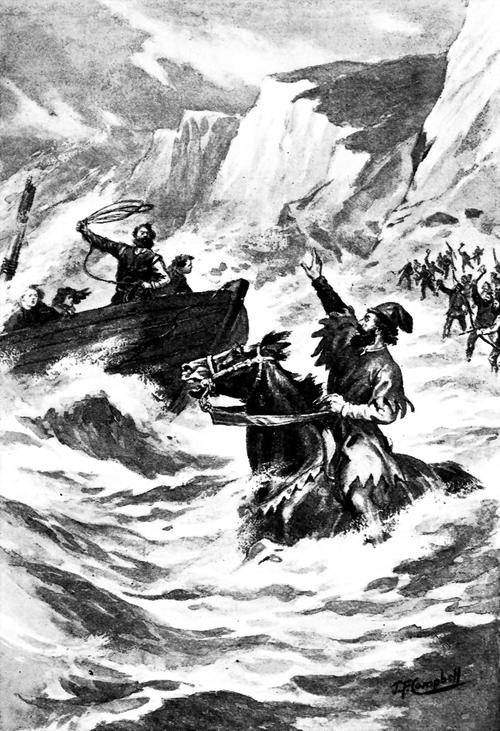
"THROW ME YON ROPE!" HE SHOUTED.
"Peste! Have we wolves in sheep's clothing?"
he exclaimed. "Ride, Michel, for thy
life."
As the page set spur to his steed the baron
did likewise, and both riders were soon clattering
down the dusty highway.
"We have seen something that few men can
boast of," said Gripwell gleefully. "We have
seen the back of a De Chargné. But we must
look to ourselves, for, by St. George, we are like
to be in a sorry plight."
Realizing that ere long the Frenchman would
raise an alarm, and that the countryside would
be scoured, the adventurers divested themselves
of their surcoats with the De Chargné device.
It was now out of the question to proceed to
Amiens, so taking a by-lane the Englishmen
set off at a rapid pace, keeping the while a sharp
look-out for any signs of pursuit.
Three days later the fugitives, footsore and
hungry, came in sight of the blue waters of the
English Channel.
"What village is that I see yonder?" asked
Gripwell, addressing a peasant who was toiling
along the road, bent double under the weight of
a huge basket filled with seaweed.
"'Tis St. Valery-en-Caux, monsieur."
"Ma foi, comrades, we are well out of our
way," remarked the man-at-arms in order to
avoid suspicion. "'Tis to Abbeville that we
would go."
"Of a surety thou speakest truly," assented
the peasant. "It lieth far along the shore,
though I have ne'er set foot in the town."
"This village will serve our purpose," quoth
Gripwell, as the peasant resumed his way.
"We must needs lie hidden till dusk; then,
unless I am much at fault, we can with ease
take possession of one of those fishing-boats I
see yonder."
"Canst manage one of these craft?" asked
Oswald anxiously.
"The wind blows fair. E'en though I be
not a seaman, I am a man of parts. By the
help of St. George I fear not that the task be
beyond me."
Encouraged by their comrade's self-reliance
the lads took heart. Even though they were
compelled to wait till night, the old soldier was
not idle.
Leaving the two youths snugly sheltered in a
field of barley Gripwell went off on a foraging
expedition, returning presently with three large
rye loaves and a bottle of wine.
"How earnest thou by them?" asked Geoffrey
in astonishment.
"Thou hadst best not to ask, Master Geoffrey,"
replied the man-at-arms with a sly wink.
"'Tis but an old trick, known to all hardened
campaigners. Food and drink we must have
at all costs, and when the goodwife hath
finished gossiping with her neighbour she can
discover her loss with as much good grace as
it pleaseth her. Certes! The miracle of the
vanishing loaves of St. Valery will be a subject of
discourse for a long time to come, I trow. But,
come now, let us eat."
When darkness set in the three comrades
waited till the last visible light was extinguished
and the village plunged into slumber. Then
cautiously they made their way to the little
quay, against which half a score of strongly-built
fishing boats and traders were fastened.
It was now just after high water, and already
a steady current was setting out of the harbour.
"This one will suit our purpose," whispered
Gripwell, pointing to a stout craft of about
thirty feet in length, that lay in the outermost
tier. "Tread softly, for the least sound will
betray us."
Without mishap Geoffrey clambered over the
deck of an intervening ship and gained the
planks of the craft Arnold had indicated. She
was of good beam, entirely open amidships,
with a deck fore and aft, under which were two
small cuddies for the accommodation of her
crew and for the stowing of gear.
"Cast off yon rope," whispered Gripwell.
"Yarely now, or we shall be left by the tide;
I can touch bottom with an oar."
Swiftly the two restraining hawsers were
unbent, and the boat began to glide stern
foremost towards the open sea.
Seizing an oar Arnold worked with powerful
yet silent strokes, till the craft's bow was turned
seaward. Twice or thrice her keel scraped
against the rocky bed of the stream, but, greatly
to the new crew's relief, the strong ebb swept
her clear, and soon the water began to deepen.
"Hist!" exclaimed Oswald. "Another boat
comes this way."
With beads of sweat standing out on his forehead
the man-at-arms peered through the
darkness. The squire was right. A huge unwieldy
craft, propelled by oars, was slowly
stemming the tide.
"Take the tiller and keep her so," exclaimed
Arnold, placing Geoffrey's hand upon the long,
wooden pole. "Say not a word."
Resuming their oars Oswald and the old soldier
urged the boat as swiftly as they were able,
exercising due caution to prevent the sound of
their blades from being heard.
"The Jean Baptiste is abroad late this night,"
shouted a gruff voice as the two craft swept past
each other at less than twenty yards' distance.
Gripwell could not trust himself to speak.
Bending over his oar he grunted something
incoherently.
"Heed him not, Simon. He hath been
drinking. Old Jacques is ever surly in his cups.
May the blessed Peter see to it that he tears his
nets on the Roches d'Ailly."
"I' faith," exclaimed Gripwell as the boats
drew beyond earshot. "'Twas a narrow escape.
Bear witness, young sirs, how the proverb
'One man's meat is another man's poison' can
be reversed. But now we are clear of the land,
and the breeze is beginning to make itself felt.
Stay where thou art at the helm, Master Geoffrey—nay,
'twill be best for thy companion
to take the tiller, seeing that he is hurt. Thereupon,
I pray thee, bear a hand with this sail."
Not without infinite trouble Geoffrey and the
man-at-arms succeeded in hoisting the heavy
yard and its huge brown sail. Then, heeling
to the steady breeze, the little craft began to
slip quickly through the water.
"That is well," ejaculated Arnold as he
relieved Oswald at the helm. "Another twelve
hours at this speed and we ought to sight the
white cliffs of England."
"How canst thou make sure of the way?"
asked Oswald, doubtful of the old soldier's skill
in seamanship.
"Mark yon pennon," replied Gripwell, pointing
to a fluttering streamer at the masthead.
"So long as that keeps ahead and the wind
holds true, all will be well. 'Tis a wide mark
from Dover to the Wight, and it matters little
at what part we touch."
Throughout the short June night the lads
remained on deck, dozing at intervals in spite
of their lengthy rest in the rye-field hard by the
village of St. Valery, yet filled with joy at the
thought that they were being borne rapidly
homewards.
At length the day dawned. Eagerly Gripwell
scanned the horizon, but to his great satisfaction
not a sail broke the sky-line. The low
white cliffs of France, too, had vanished beneath
the encircling rim of trackless sea.
In the growing light the adventurers were able
to make a thorough inspection of the stolen
craft. Anxious to husband their scanty stores,
Gripwell hoped to find some kind of provisions
on board. Accordingly he handed the helm to
Oswald, and telling Geoffrey to explore the
after cuddy, he clambered forward to investigate
the contents of the place that did duty for
the forepeak.
Placing his hands upon the coamings of the
little hatch Geoffrey lowered himself into the
dark recesses of the cuddy. Bewildered by the
sudden transition from daylight to almost pitch
darkness, he stood upon the floor, his shoulders
bent to save his head from contact with the
low deck-beams, waiting till his eyes became
accustomed to the gloom.
An unexpected lurch of the little craft caused
him to lose his balance, and the next instant he
was thrown violently against the side of the
cuddy. Struggling to regain his balance Geoffrey
thrust out his hands, and to his utter
astonishment his fingers closed upon the throat
of a human being.
Ere the lad could realize his position he was
seized in a powerful grip, and, beyond a strangled
shout from his unseen antagonist, the two
silently engaged in a desperate struggle. Interlocked
in an unyielding grip they swayed
to and fro, each adversary trying to bend the
back of his antagonist.
Attracted by the scuffling Arnold came running
aft. In his haste he had forgotten to bring
his arms, and well it was that this was the case,
for on gaining the hatchway he could only perceive
two unrecognizable struggling forms.
Cold steel would have been equally dangerous
to friend or foe. All that Gripwell could do
was to lie full length on the deck, ready with
outstretched arm to aid the English lad the
moment he could be sure of him.
In spite of the obvious disadvantage of being
attacked in unfamiliar surroundings Geoffrey
stoutly maintained his own, but the strength
and endurance of his unseen foe seemed inexhaustible.
At length the lad bethought him
of a trick taught him by one of the archers of
the garrison of the Castle of Warblington many
months agone.
Hitherto he had been striving to force his
enemy backwards, but suddenly he changed his
thrusting motion into a lift. In this he was
aided by his antagonist's own efforts to resist
the previous mode of attack, and with a mighty
heave Geoffrey raised his foe from the floor.
With a dull crash the fellow's skull struck the
deck-beams overhead, and a convulsive twitching
of his limbs followed by an unmistakable
limpness showed Geoffrey that he had stunned
his adversary.
Breathless and well-nigh exhausted the English
lad gained the deck, where he lay filling
his lungs with the pure, salt-laden air.
Meanwhile Arnold had descended the hatchway
and unceremoniously dragged the senseless
body of the mysterious occupant of the cuddy
into the light of day.
A cry of surprise burst from Geoffrey's lips;
his late antagonist was a youth of about his
own age.
"'Tis a Norman fisher-lad," exclaimed Gripwell.
"He must have been hiding ever since
we laid hands on this craft. But, what is to
be done with him?"
"He is my prisoner by the right of conquest,"
replied Geoffrey. "'Tis not in my mind
to do him further scath, for, certes, he hath held
his own as manfully as any Englishman."
Ere long the young Norman recovered his
senses, and finding that he was being kindly
treated and that he was not to be thrown overboard—a
common practice in mediæval days
when vanquished shipmen were ruthlessly jettisoned—he
became quite communicative.
He had, it appeared, stolen on board the boat
to escape the wrath of his master, whose enmity
he had roused. Overcome by sleep he had
slumbered soundly throughout the night, undisturbed,
even by the noise of the footsteps of
Gripwell and his two youthful companions, till
he felt Geoffrey's fingers at his throat.
"Have no fear," exclaimed Geoffrey kindly.
"We bear thee no ill-will. But, willy-nilly,
thou must come with us to England; then, on
my honour, I vow that thou shalt be given a
passage back to France."
"Sir, I thank thee," replied the stranger in
the patois of the Norman shore. "But, if ye
hope to reach dry land in safety, I pray ye look
to the sail. Already the wind increases, and
ere long there will be a gale."
CHAPTER XVI THE WRECK OF L'ETOILE
"A gale coming—how dost thou know
that?" demanded Gripwell anxiously.
"I have not been brought up to the sea these
last six years for nothing, monsieur," replied
the fisher-lad. "In my mind I can feel the
coming storm. Moreover, did not Père Gobin
tell old Sardeau, my patron, that 'twould be
hazardous to put to sea yesternight? But,
monsieur, since we are likely to be caught out,
we must needs meet danger with a stout heart."
"Thou art a brave youth," observed Arnold
approvingly. "What is thy name?"
"Jean," replied the other simply.
"What would'st thou have us do with the
craft?" continued the man-at-arms. Bold
and fearless as he was he recognized in the Norman
lad his superior in the shipman's art.
"We must hoist a smaller sail, monsieur.
Even now the boat is pressed over much."
As he spoke a vicious squall, the precursor
of the storm, began to thrash the water a bow-shot
astern.
Without a moment's hesitation, Jean, whose
thick skull had received a blow that would have
disabled many a man for days to come, ran
forward to the mast. Ere the hissing blast
swept down upon the craft he had let go the
halyards, bringing the heavy yard, with its
bellying sail, to within a few feet of the deck.
Fortunately Gripwell had the sense to thrust
his whole weight upon the stout tiller to keep
the vessel on her course dead before the wind.
In a few minutes the squall had passed.
Descending into the forehatch the Norman
lad soon re-appeared, bearing a small sail rolled
up under his arm. This, with Geoffrey's aid,
he bent to the yard, in place of the larger canvas,
and under easy sail the Etoile de St. Valery—for
such was the name of the stolen craft—tore
before the howling winds. Ugly, white-crested
waves reared themselves on either hand, but,
thanks to her broad beam and comparative deep
draught, the threatening breakers swept harmlessly
under her hull.
"Where are we?" asked Oswald dolefully,
for he had succumbed to the attacks of his old
enemy, and was lying well-nigh helpless against
the low bulwarks.
"St. George be my aid: I know not," replied
Gripwell. "But by yonder sun that tells close
on midday, I perceive we are holding a proper
course," he added, pointing to a faint light in the
fleeting clouds that marked the position of the
orb of day.
For the next hour or two the Etoile de St.
Valery flew before the gale, heading blindly
towards the as yet invisible shores of England.
Suddenly Geoffrey gave a warning cry, and
pointed his finger towards the boat's bow.
"I see land," he shouted, striving to make
himself heard above the roaring of the elements.
"Thou'rt right," agreed Gripwell, as an
apparently unbroken wall of glistening chalk
cliffs loomed up through the mirk. "But 'twill
be a hard task to get into safety with this sea
running. Certes, yesternight I would have
given a seven pound candle to the altar of the
church of St. Thomas à Becket at Warblington
to be able to see yon cliffs, but now I would
willingly give one of a score pounds not to see
them."
"How so?" asked Geoffrey.
"Since we know not on what part of the
coast we have lighted, and not a sheltering port
is to be seen, methinks we shall have much ado
to prevent our corpses being washed ashore."
"Can we not cast anchor?"
"'Tis impossible, monsieur," replied the
Norman lad, who had overheard Geoffrey's
question. "The stout rope that holds the
anchor would be rent asunder like a wisp of
smouldering flax. Nay, monsieur, we must
needs push on, keep the boat's stem to the waves,
and trust to be cast fairly on shore. Alas for the
Etoile de St. Valery!"
"Courage, comrades," shouted Gripwell. "I
espy a place where the cliffs dip somewhat.
We will run the craft ashore at that point.
Pull thyself together, Master Oswald. E'en
within an hour thou mayst set foot on dry land."
As the Etoile approached the shore the seas
became shorter and steeper owing to the shoaling
bottom. No longer did the stout craft rise
easily to the rollers, but labouring heavily she
took in water on all sides.
"There are men on the shore," said Geoffrey,
as a number of people armed with bows, swords
and axes, ran down the steep gorge in the cliffs.
"And a warm welcome they will give us,"
replied Gripwell gloomily. "Not a hand will
they raise save to help themselves."
The old man-at-arms spoke truly. Every
foreign ship—ay, and many a luckless English
craft as well—that had the misfortune to be
cast on shore was regarded by the lawless men
of the coastwise hamlets as a prize. In many
cases not only were their crews left to their fate,
but any unfortunate man who reached the
shore alive might be cruelly slain for the sake of
a few trifles on his person.
"Hold fast as she strikes!" shouted Gripwell.
With feet placed wide apart and body
braced to meet the shock the man-at-arms
gripped the tiller.
Then with a crash that shook the craft from
keel to masthead, the doomed vessel grounded
heavily on the shingle.
Thrice she pounded heavily, each time being
cast nearer in shore, till with her hold filled with
water, the Etoile settled firmly on a bed of sand.
Desperately her crew held on, watching the
callous spectators on shore, who, in turn, were
waiting for the wreckage to be cast at their feet.
Not a word was spoken by the shipwrecked
men; all they could do was to await the end in
whatever form it might come.
After a considerable time had passed in this
hazardous position Geoffrey fancied that the
shocks were becoming less violent. Cascades
of foam still swept over the craft, and already
portions of the hull were beginning to show
signs of breaking-up. All but the stump of the
mast and the small spread of sail had vanished,
having gone by the board soon after the first
shock.
Yes, now he was certain; the tide was falling.
Making his way along the steeply sloping
deck to where Arnold was standing Geoffrey
communicated the discovery.
"Ay, it gives us hope," shouted Gripwell in
reply. "The boat holds together. In another
half-an-hour we may essay the task."
So saying he whipped out his knife and began
to sever one of the ropes that trailed across the
deck. It was a hazardous business, since he
had to release his grasp upon the coaming of
the hatchway; but by dint of working hard
between the sweep of each succeeding breaker
he contrived to secure a goodly coil of cordage.
With this the four members of the crew were
lashed together with a distance of about twelve
feet between them.
These preparations were observed by those
on shore, for there was a decidedly hostile movement
on their part, some going so far as to string
their bows.
"Look at them," exclaimed Jean excitedly.
"They are about to kill us."
"And these are Englishmen!" added Oswald.
Hoping to pacify the clamorous throng
ashore, the man-at-arms shouted that he and his
comrades were Englishmen, but either the words
were lost in the howling of the wind and the
roar of the breakers, or the shoremen were convinced
that since the wrecked craft was of foreign
build the crew must likewise be foreigners. But,
whatever view they took of the situation, the
mob showed no signs of abating their hostility.
At this juncture a horseman appeared on the
edge of the cliffs to the right of the gorge. For
a brief space he took in the strange scene beneath
him, then, unhesitatingly, he urged his
steed down the steep declivity. Often the
intrepid rider was standing in his stirrups as
the horse slid on its haunches; more than once
a mass of chalk slipped away from under the
beast's forefeet and came crashing on to the
beach below; but the daring horseman never
ceased his downward way till he gained the
shore and tore up to the crowd of expectant
wreckers.
Although the new-comer was evidently a
man of some position he did not, at first, have
things his own way. Voices were raised in angry
protest, twice or thrice knives gleamed in the
air, but by sheer force of will the horseman
succeeded in calming the more turbulent members
of the assembly.
This done he forced his horse through the
waves, till up to the girths in water, he came
within a spear's length of the stranded craft.
"Throw me yon rope; follow me, your lives
are safe!" he shouted.
With that Gripwell heaved the line, and struggling
through the strong under-tow the four
members of the crew gained the land.
"Who are ye, and whence came ye?" demanded
their rescuer.
"We are Englishmen escaped from France,"
replied Gripwell.
"There, did I not say so?" asked the horseman
turning towards the still surging crowd.
"Fie on ye."
"But the boat is ourn by ancient rights,"
objected a bearded fisherman, whose ears were
pierced by a pair of gold earrings, probably part
of the spoil from some castaway.
"Let them have the craft by all means,"
quoth Gripwell. "I' faith, we are right glad
to see the last of her."
"Where were ye making for?" asked the
horseman.
"Firstly to the shores of England, which, by
St. George, we have made far too forcibly to
my mind. Secondly we belong to the Castle of
Warblington. Yonder stands Geoffrey Lysle,
son of the Lord of Warblington."
"Thou hast gone wide of the mark, good
shipmaster," replied the horseman with a merry
laugh. "Now ye must needs foot it for nearly
a score of leagues ere ye reach Warblington.
Ye are now at Birling Gap, midway on the shore
of Sussex. Hast money? Nay? Then here
is a groat apiece. Follow yon track and ye'll
soon strike the great highway betwixt Dover
and Southampton. The rest of the way, though
it be long, is not difficult to find."
"One moment, fair sir," quoth Geoffrey.
"To whom do we owe this right courteous treatment?"
"It matters not," was the reply, as the horseman
prepared to take his departure. "But
stay; if so be that ye have time to remember
me in your prayers, men call me Wild Dick o'
Birling."
CHAPTER XVII OF THE COMPANY AT THE SIGN OF THE BUCKLE
Glad to have come out of their difficulties
so lightly, Arnold Gripwell and the three
lads set out along the path indicated by the
kindly Dick o' Birling.
Reaching the summit of the cliff they turned
to gaze upon the scene of their shipwreck. Far
below them the crowd of wreckers and fishermen
seemed like a swarm of ants as they flocked
around the stranded hull of the Etoile, now left
high and dry, slashing with their axes at the
planks and tearing away everything they could
lay their hands on.
The sun was low in the western sky ere the
wayfarers crossed the Ouse at Seaford and
reached the little village of Bishopstone.
"Here is an inn," said Gripwell, pointing
to a long straggling building, from the upper
storey of which a broom was displayed denoting
the fact that wayfarers could find rest and
refreshment.
"Welcome to the Buckle Inn, gentles,"
shouted the host. "What might be your commands?"
"A joint of English roast beef will not be
amiss," replied Gripwell. "After that beds
with fresh straw, an it please thee."
"The Buckle is ever known for the quality
of its beds, fair sirs," replied the host with well-assumed
dignity. "I pray ye enter."
The four wayfarers promptly accepted the
invitation, and found themselves in a long
narrow room, with low, oaken rafters black
with smoke. Gathered around a fire blazing
on an open hearth were nearly a score of men,
clad in white surcoats blazoned with the cross
of St. George. Many of them had removed
their armour, and were stretching their limbs
before the comforting fire.
"Welcome, comrades," shouted a burly giant
with a thick crop of reddish hair. "Sit at your
ease and drain a tankard with honest archers.
Whence come ye?"
"From France," replied Gripwell, overjoyed
at the sight of a friendly surcoat.
A roar of laughter greeted his reply.
"From France, quotha? Nay, by my hilt, ye
are going the wrong way. 'Tis to France that all
stout-hearted men are wending their way."
"Nor will ye find me backward in that
matter," replied Arnold stoutly. "We have
but lately set foot in England and are sore in
want of news. Discuss with us, I pray thee."
"Hast not heard that King Harry hath
summoned all true Englishmen, knights, squires,
men-at-arms and bowmen to assemble at Southampton
for the taking of France? Such an
army hath never before been equalled. They
say that a chirurgeon and twelve others of his
class are to go with us for the comfort of the
sick and wounded."
"The first part of thy speech delights my
heart, comrades, but concerning the latter, one
leech in the field will, I trow, do more harm
than a score of French lances."
"Thou speakest pertly, sir stranger. Methinks
if thy comb were cut thy crowing would
be somewhat less."
"Give me a stout broadsword, archer, and I'll
warrant, old as I am, that thou wilt not clip it."
This was a direct challenge. In a moment
all was confusion, some of the company shouting
encouragement to the man-at-arms, others urging
their comrade to carry out his threat, while
the host of the Buckle besought his patrons
to have regard for the good ordering of the inn.
"The loan of thy sword, friend," said Gripwell
calmly, addressing himself to an archer
who was shouting himself hoarse on his behalf.
"Take it comrade—but stay, where have I
seen thy face before? Why, 'tis none other
than Arnold Gripwell, who clove a Scot to the
chin with his own claymore at Homildon Field."
"Then thou art Thomas Voysey, the archer
who threw the ox over his shoulder in the
market-place at York. By St. Thomas à Becket,
to think that I did not recognize an old comrade
ere this. Thy hand, Thomas; when this slight
bickering is over I'll quaff a tankard with
thee."
"Nay, I meant no offence," protested the
man who had expressed his intention of cutting
Gripwell's comb. "I have ever a regard for a
staunch veteran."
"'Tis too late to climb down, friend," replied
Gripwell resolutely. "If so be that thou art
unwilling to cross steel, let us discuss the matter
in another way. I do perceive a bundle of
stout staves in yonder corner. What sayest
thou—art willing to try a bout with cudgels?"
Clearly the aggressor was anxious to avoid
an encounter, but yielding to the clamour and
ironical jeers of his comrades, he selected a
weapon and stood on his guard.
"Have at thee," shouted the man-at-arms,
and the next instant the bout began.
With a quick succession of dull taps as the
cudgels met, both combatants warmed to their
work. Blows were smartly parried and counter-strokes
rapidly delivered. Arnold's antagonist
was younger and more heavily built, but he
lacked the endurance and coolness of the
veteran. Slowly, but surely, amid the subdued
enthusiasm of the spectators, the elder
man forced his opponent backwards, till, with
the sweat running down his face and his
breath coming in quick gasps, the archer
lost all control of himself. Whirling his heavy
cudgel he strove by a succession of powerful
strokes to break down the veteran's guard;
till, seizing a favourable opportunity, Gripwell
got home a shrewd blow on his antagonist's
forehead, following it up by a sharp cut that sent
the archer's weapon flying to the far end of the
room.
"Thou art the better man," gasped the archer,
clapping his hands to his bruised pate.
"Spoken like a sensible rogue," replied Arnold,
throwing down his cudgel. "My hand, comrade!
Thou, too, shalt share a cup with me,
though I have but a groat in my pouch, of
which one penny is for my bed. Host, a tankard
of thy best ale."
Good humour having been restored, the rest
of the evening passed in story and song, till
tired out with the crowded events of the last
few days, Geoffrey and his companions were
glad to seek repose.
On the morrow it was decided that the man-at-arms
and his comrades should travel in
company with the archers, not only for the
sake of protection on the road, but because the
sturdy and honest soldiery, hearing the condition
of Geoffrey and Oswald, insisted on
sharing their meals with the lads who had undergone
such adventurous ordeals in the land of the
Fleur de Lys.
"I cannot see why King Harry—God bless
him!—should call his army together at Southampton,"
remarked Voysey, the master-bowman,
as the company took to the road once more.
"I am a man of Rye, my comrades all hail from
ancient and loyal Cinque Ports, and seeing the
distance across the Channel is lesser than from
Southampton, it is passing strange that we
should have this long march thither, not that I
complain—'tis a soldier's duty to obey orders."
"Nevertheless, to me the plan is simple
enough," replied Gripwell. "By landing at
Harfleur—a strong place, for I know it well—and
advancing up the valley of the Seine the
King can use his army as a wedge, to split the
French kingdom asunder. Rouen and Paris,
rich cities, are likely to fall into his hands, and,
mark you, the booty that is to be had!"
"Ay," replied the bowman, reflectively. "A
man can cross to France with naught but his
clothes and his arms, and return home laden
with gold. 'Twas thus in my grandsire's time.
So now for a prosperous campaign, comrades!"
Talking thus, the long miles seemed to slip
by, and late afternoon found Geoffrey and his
comrades in the city of Chichester.
"'Tis enough for one day," observed the
leader of the detachment of the Cinque Ports
archers. "Here we will rest till the morrow."
"As thou wilt," replied Gripwell. "But since
we are within half a score miles of Warblington,
my young masters will be wanting to push on.
How sayest thou, Master Geoffrey?"
"Right gladly, Arnold."
"Then so be it. Comrades, adieu, and may
we meet ere long on French soil."
Amidst the boisterous and hearty farewells
of the archers Geoffrey and his three companions
set out on the last stage of their homeward
journey. Along the well-known highway they
sped, recognizing in every landmark an old
friend. Quickly the great West Gate of Chichester
was left behind; then the Saxon tower
of Bosham Church loomed up on their left hand,
to bear them company till the fishing hamlet of
Emsworth hove in sight. Then, joy of joys,
the grey tower of Warblington Castle, standing
out clearly against the setting sun, bade them
welcome home.
As for Geoffrey, the discomforts and perils
of his journeyings were forgotten; he regarded
them as a closed page of his life-story. He
realized that a new phase of his existence was
about to commence, and that on French soil
he would have a chance to win his spurs. But
even in the midst of his day-dreams came the
disquieting thought that, however creditably
he had borne himself in his mission, he had left
Sir Oliver still a prisoner in a foreign land.
CHAPTER XVIII SQUIRE GEOFFREY
"Welcome, Geoffrey. I bring thee
good tidings," exclaimed Oswald, slipping
from his saddle and embracing his friend
and tried comrade.
It was a month after Geoffrey's home-coming,
but during that period much had taken place.
The Lady Bertha had warmly welcomed her
son, whom she had almost given up as lost.
Concerning Sir Oliver her anxieties were greatly
relieved, since she now knew that he had effected
his escape from the clutches of the Lord of
Malevereux. Sir Raoul d'Aulx, her husband's
captor, she also realized to be an upright and
gentle knight, in whose hands Sir Oliver would
be sure of honourable treatment. The loss of
Taillemartel she regarded with equanimity,
since the fief was ever a source of anxiety and
trouble.
"Taking all things into account, Geoffrey,"
said the châtelaine, "I have much to be thankful
for. Next to thy father's life his liberty is
most to be desired, but for the nonce I must rest
content. But, another matter: since it is our
noble King's pleasure to lead an army into
France, it is the duty of his loyal subjects to
make sacrifices to that end. Had thy father
been here he would gladly have placed
himself at the head of his retainers and led
them to the rendezvous at Southampton. Since
that is impossible, and that our men and archers
must go nevertheless, 'tis fitting that, as thy
father's heir, thou should'st lead them. Now,
art willing to do so? Remember, unless thy
heart be in thy work 'tis labour in vain."
"Madame, such is my ardent desire," replied
Geoffrey, his eyes sparkling with enthusiasm.
"I expected no other answer, my son. Go,
and may the saints protect thee. Of the
nineteen men-at-arms, fifteen are to join the
King's army; of the thirty and seven archers
I purpose keeping but five. Thus the quota
provided by the Manor of Warblington will
number forty-seven men under Oswald and
thyself, too few to form an independent company.
Therefore I have asked Sir Thomas Carberry
to allow our men to muster under his banner.
If he be willing—and I have no doubt to the
contrary—his reply will be forthcoming ere
night, for Oswald hath ridden over to Portchester
this morn."
"I crave thy patience on a small yet weighty
matter, mother," exclaimed Geoffrey. "What
is thy wish concerning Jean?"
"The Norman fisher-lad whom thou hast
brought overseas? 'Twould be unseemly to
send him back to France with thee. I have
already spoken to the lad, and, by St. George,
he is no patriot. Doubtless he finds himself
well treated here, for with tears in his eyes he
besought me to keep him here at Warblington.
Therefore 'tis my purpose to place him
under the charge of Herbert the falconer, since
for a Norman peasant lad he showeth great
promise."
"On that score, then, my mind is easy," replied
Geoffrey. "And now tell me, when do
we set out for Southampton?"
"The King's orders are that the troops
assemble on the Feast of St. Christopher, the
twenty-sixth day of the present month. That
is but four days off, and it would ill-become
the retainers of Sir Oliver were they not the
foremost of the fore, since the men of Hampshire
are ever amongst the first to obey the call
to arms. Therefore, by the day after to-morrow
thou must bid me farewell."
It was at this juncture that Oswald Steyning
came to Warblington with the words, "Welcome,
Geoffrey. I bring thee good tidings."
"Ay, Oswald, I have already heard the
news. I am to serve my lord the King in the
field."
"Then thou hast but heard a moiety. Sir
Thomas Carberry sends greeting to the Lady
Bertha, and expresses his regard for the courtesy
of the Châtelaine of Warblington in entrusting
her contingent to his care. Moreover, he offers
thee, Geoffrey, the post of second squire to
attend upon his person."
"Good news! Good news indeed!" exclaimed
Geoffrey. "Thou and I, then, are to
be fellow squires as well as companions in
arms."
"Save that I am a masterless squire," added
Oswald. "I would that Sir Oliver displayed
his banner side by side with the crescent and
star of Sir Thomas Carberry."
"And Richard Ratclyffe—what of him?"
"He is first squire to Sir Thomas, and will,
of a surety, attend on him. But I saw him not,
since he hath already journeyed to Southampton
to see to the ordering of the Portchester
company's camp."
During the remainder of the day, and the
day following as well, activity reigned within
the walls of Warblington. Though every man
had been well equipped, much had to be done
ere the little band set out to throw in its lot
with the men of Portchester. Horses had to be
re-shod, swords, bills, and spearheads required
grinding and sharpening, bows had to be overhauled,
spare cords waxed, and barrels of arrows
prepared. With the men-at-arms and archers
twelve sumpter horses with their attendants
were to bear the baggage as far as the camp of
Southampton, while, by express orders from
the King, smiths were at work day and night
preparing iron tips for the stakes that were
to play so important a part in the forthcoming
campaign.
At length the time of departure drew near.
Having bade farewell to his mother, the châtelaine,
Geoffrey, now accoutred cap-à-pied in
bascinet, globular breastplate, steel gorget,
greaves and sollerets, took his place at the head
of the column, with Oswald, similarly attired,
at his right hand.
A spear's length in the rear rode Arnold Gripwell
with a grim look of expectancy on his rugged
features, as he bore the banner of the turbot
and the three stars of Warblington. A close
observer would have noticed a wavy black line
running athwart the banner from corner to
corner, signifying that the knight whose device
it was was absent or prevented from taking
personal command.
Behind Gripwell rode the fourteen men-at-arms,
wearing steel caps and quilted coats,
additionally protected by iron plates, while at
the side of each hung a two-handled heavy-bladed
sword.
The archers were on foot, each man clad in
leather jacket, over which was a white surcoat
with the cross of St. George, loose hose, and
caps of either stiff leather or wicker-work
stiffened with bars of iron. They were armed
with the world-renowned bows of English yew,
a well-filled quiver of arrows hanging from the
right-hand side of their belts, while as a supplementary
weapon every man carried a short axe
or a dagger.
In the rear were the sumpter horses and
baggage, attended by a number of the tenantry
of Warblington, who were to accompany the
troops only as far as the port of embarkation.
The first day's march was an easy one. That
night the men of Warblington joined those of
Portchester, and quickly the two companies
fraternized, since they had much in common
and little cause for dissension.
As the combined forces were about to leave
the Castle of Portchester, Sir Thomas Carberry
turned to his newly-appointed squire.
"It is in my mind," quoth he, "that I should
bestow upon the Prior of Southampton this
purse of gold for the entertainment of the poor
and needy during our absence overseas. Therefore
I pray thee take Oswald and ride across
the hill to Southwick. Thou knowest the
Priory?"
"I have heard of it only, sir."
"'Tis easy to find, though the road thither
be rough. Present my compliments to the
worthy Prior and give him this. Thence thou
canst make thy way through the villages of
Wickham and Botley and rejoin us at the camp
at Bitterne, hard by the town of Southampton.
Have I made mine orders clear?"
"Yea, Sir Thomas."
"Then set forth directly the troops have
heard mass. Perchance I shall not see thee
again until thou comest to Southampton, but
these instructions are complete. Pass the word
for the men to fall into their ranks."
A trumpet sounded loud and shrill, and ere
its long-drawn note had died away the eager
soldiers were pouring from their quarters into
the outer bailey. Then, to the accompaniment
of a series of hoarse orders shouted by their
under-officers, the men ranged themselves in
close ranks.
"Passably done," commented Sir Thomas,
as, accompanied by his squires, he walked
towards the centre of the column, where his
standard was proudly displayed. "There was
slight confusion in the ordering of the lines, but
I'll warrant another fortnight will amend all."
It was indeed a force that any knight of
Christendom might well be proud of. Two
hundred and forty men, the flower of the yeomen
of South Hamptonshire, were drawn up,
armed and accoutred for active service.
Some of these were old veterans, skilled in
the craft of war, gaunt, sinewy, and stolidly
alert; others were middle-aged men, trained
by constant practice at the butts in the use of
the deadly long-bow; while the majority were
lads upon whose unwrinkled faces the down of
manhood was beginning to assert itself.
Beyond an occasional brawl, few of the latter
had seen a blow struck in deadly earnest, though
they were eager for a chance of winning fame
against the hereditary enemy of England.
Their lack of experience on the field of battle
was all but counterbalanced by their enthusiasm,
while the stiffening of veterans was calculated
to have a good effect upon the morale of the
comparatively undisciplined archers of the company.
Having walked between the lines and carefully
inspected the men under his command, the Constable
of Portchester addressed them in a few
rousing words. Then, as the prolonged cheering
died away, a tucket sounded, and every man,
laying his bow, axe, or sword upon the greensward,
marched slowly and soberly into the
church of St. Mary, that lies within the castle
walls.
Half an hour later the rear of the long column
had trailed beneath the land-port tower on its
way to the wars, while Geoffrey and Oswald
were breasting the steep ascent of Portsdown
that lay betwixt the Castle of Portchester and
the Priory of Southampton.
CHAPTER XIX TREASON
Having carried out the Constable's instructions
relating to the Prior of Southwick,
Geoffrey and Oswald set out on their long ride
to rejoin their comrades at Southampton.
Both lads were lightly accoutred, their armour
having been sent on with the baggage train,
and in high spirits they cantered their steeds
along the stretch of grass that bordered the
narrow highway.
Presently the open country gave place to
dense masses of trees, the outlying confines
of the Forest of Bere—the hunting-ground of
kings, and the haunt of robbers and other evil-doers
to boot. Yet there was little fear of
wayfarers being molested in this part of the
forest, the outlaws devoting their attentions to
the more remote districts, where the power of
the law, as exercised by the Constable of Portchester,
lost somewhat of its terrors. Nevertheless,
the two squires rode warily, keeping a
bright look-out for a possible ambush.
"Methinks I hear men's voices," remarked
Oswald, reining in his steed and listening
intently.
"And what of it?" replied Geoffrey with a
laugh. "Is not the road free to all, and may
not a man talk if so he listeth?"
"Nay, but 'tis like the shout of a multitude."
"I can now hear it, though 'tis a long way
off."
"We must needs ride yarely, for it seemeth
as if the sound comes from the highway in front
of us. Let us therefore turn aside through this
thicket."
"Nay," replied Geoffrey stoutly. "That
shall not turn us from the highway. Should
there be a band of robbers, 'twill be better to
keep to the road than be entangled in the
thickets. Let us set spur, therefore, and put a
brave face on't, though truly I doubt that there
be danger."
Thus encouraged, Oswald increased his pace,
and, keeping side by side, the two comrades
drew near to the cause of the shouting.
It was a strange sight that met the gaze of
the squires, as they turned a slight bend in the
road.
On the right of the highway lay a broad sunlit
glade. Seated in a semi-circle were about two
score men, some of whom were yeomen and
farmers, though most were peasants and wood-cutters.
Although many furtive glances were
cast in the direction of the highway, the main
attention of the assembly was centred on the
form of a speaker, whom the lads instantly
recognized.
"Certes, 'tis my Lord Cobham!" exclaimed
Geoffrey. "We have fallen upon a nest of
Lollards."
At that instant one of the assembly happened
to catch sight of the two horsemen, and, giving
a warning shout, brought all the crowd to their
feet. Some made towards the undergrowth like
startled hares, but for the most part the Lollards
rallied round their leader.
"They will do us no scath," observed Oswald.
"Let us therefore ride past them in peace. Yet
'tis passing strange that these, forming an unlawful
assembly, should fail to set outposts.
Had we been a troop of lances bent on their
capture not a man would have escaped."
The squire's resolve to pass them by was
doomed to failure, for, seeing that they were
but two wayfarers, several of the men intercepted
them.
"Who are ye, and whence come ye?" demanded
a burly miller, his garments dusty with
the traces of his calling.
"Peaceable subjects of King Harry," replied
Geoffrey boldly. "Ye are, I perceive, of the
following known as Lollards."
"I trust that ye do not mean to betray us?
Otherwise——"
"Nay, threaten us not. We would have
speech with Sir John Oldcastle."
Blank astonishment was written on the faces
of the men who had barred the lads' way.
Several of them muttered under their breath
that they were lost men.
"So be it," replied the spokesman briefly,
and laying hold of the bridle of Geoffrey's horse,
led him to where Lord Cobham was still standing,
surrounded by the braver of his followers.
"Greetings, my Lord Cobham," exclaimed
Geoffrey, raising his velvet cap, to which salutation
Sir John Oldcastle courteously replied.
"I pray thee that thy men give us free passage."
"Who art thou, fair sir?" asked the knight.
"Canst call to mind the time thou rebukedst
the friar hard by the Castle of Portchester, my
lord?"
"Nay, is it possible that thou art the lad who
stood by?" asked Oldcastle. "Thou hast
grown somewhat, I trow."
"Tis the same; and my companion here
was also with me on that day. In truth, sir
knight, though I be a true member of the Church,
thy action I could not but admire."
"My work in that direction still remains
unfinished," remarked Lord Cobham. "Behold
me, a fugitive, thanks to the persecution of my
Lord Archbishop. The meanest of these my
followers might be the richer by the sum of a
thousand marks were they to betray me; but on
that score I have scant anxiety. My destiny is
in the hands of One above, and should it please
Him to hand me over to mine enemies, His will
be done."
"Ask them to swear secrecy concerning thee,
fair lord," said one of the Lollards.
"Nay, I ask no pledge; their way is clear."
"Friends," exclaimed Geoffrey, "I tell ye
this: concerning this meeting we two will keep
our own counsel. Nevertheless, if the question
is put straightly to us in this matter we must
reply truthfully."
"Bravely spoken, young sir," replied Oldcastle.
"It will suffice me, though I trust none
will ask thee if thou hast seen aught of me and
my following. Now farewell, and the blessing
of Heaven be with ye both."
Geoffrey was fated never to see the great
Lollard leader again. It was not, however, till two
years later, in 1417, that Oldcastle was captured
in the fastnesses of Wales after a desperate
resistance. Hailed to London, he was brought to
trial, and even his former friendship with the
King could not save him from the vindictiveness
of the ecclesiastical party, for, under circumstances
of extreme barbarity, he suffered death
by fire.
For the next five or six miles the lads conversed
on the incident they had just witnessed.
The road was practically deserted, and beyond
the sight of a peasant walking in the fields, or a
chapman ambling along with his wares, the
two squires saw nothing to attract their attention.
Late in the afternoon they arrived at the
village of Botley, where the horses had to be
fed and watered. While the beasts were being
attended to the clatter of horses' hoofs was
heard, and swinging round a bend in the road
came about a score of mounted men-at-arms,
all completely equipped, while at their head
rode a young man with a set, grave expression
on his thin yet clear-cut features.
"Greetings, fair sirs," exclaimed their leader
courteously. "Canst tell me whether accommodation
is to be had for me and mine? We
are bound for Southampton to join the King's
army, but having travelled far this day, 'tis
impossible to reach the town this night."
"We also are strangers," replied Geoffrey.
"And we, too, are for Southampton on a like
errand as thyself."
"My name is Olandyne, of Ripley, in the
county of Surrey. Perchance, young sirs, ye
will bear us company on the morrow?"
"Nay," answered Geoffrey, after he had
announced the names and qualities of Oswald
and himself. "We must needs meet my master,
Sir Thomas Carberry, this day. Yet I trust
we may meet again on French soil, even if not
before at Southampton."
While the horses were being watered the two
squires held conversation with Olandyne, who
had, at his own expense, raised a troop of a
score of men-at-arms for service with the King's
forces. At length, the men-at-arms having
found quarters in the village, Geoffrey and
Oswald resumed their way.
Hardly had they gained the hamlet of Hedge
End than the sky became overcast, and a dark,
leaden-coloured cloud began to drive rapidly
against the light westerly wind. Then, Nature's
sure warning, the air became sultry and motionless,
while even the birds ceased singing in anticipation
of the coming storm.
"'Twill thunder ere long," said Oswald.
"Ought we not to find shelter in one of these
cottages? Our velvet cloaks are but a bad
protection from the weather, and 'twould not
do to appear before Sir Thomas like two bedraggled
varlets."
"It is my mind to push on," replied Geoffrey.
"Perchance we may escape the storm. See yon
cloud bids fair to pass behind us."
"Then as thou wilt, but it behoves us not to
spare spur," replied his companion, urging his
horse into a sharp trot.
On and on they rode, Oswald casting anxious
glances at the approaching cloud, while ever and
anon the low rumbling of distant thunder was
borne to their ears. Then a few heavy drops
began to fall.
"Thou art right; we are fairly caught,"
exclaimed Geoffrey. "Were we campaigning
in France 'twould matter but little, but since
we may have to attend the Constable when he is
received in audience by the King, it behoves us
to take care of our apparel. I see a cottage
yonder; can we but gain it all will be
well."
As he spoke Oswald's horse tripped on a mole-hill,
and with a crash its rider fell to the earth.
Fortunately, the soil was soft, and with nothing
more than a shaking the young squire rose to his
feet.
"Art hurt?" asked Geoffrey anxiously, as
he leapt from his saddle.
"'Tis naught; but alas! my horse."
Oswald's exclamation called his companion's
attention to the animal. The fall had broken one
of its fore-legs, but without as much as a whinny
the poor beast stood motionless. Instinct
seemed to tell it that its days of usefulness were
numbered.
Having removed the saddle and muffled the
horse's eyes, Oswald drew his dagger, and with a
swift blow put the animal out of its misery.
"Poor Firebrand!" he exclaimed. "'Tis a
sorry ending. But let us hasten, Geoffrey; the
rain increaseth."
Together the lads made their way towards
the distant cottage, Geoffrey leading his horse,
while Oswald bore the trappings and saddlery
of his dead steed.
Suddenly a vivid flash of lightning seemed to
dart across their path, temporarily blinding them
with its intensity. Geoffrey's horse, already
rendered strangely unquiet by the tragedy which
had overtaken its companion, became mad with
terror, and, rearing on its hind legs, wrenched
the bridle from its master's hand. Then,
snorting wildly, the powerful brute galloped
madly away, leaving the two astonished squires
gazing after it in bitter dismay.
"By the Rood of Bosham, we are undone!"
exclaimed Oswald when he had recovered his
speech.
"We shall be utterly so if we tarry here,"
replied Geoffrey, as another vivid flash played
upon the rain-sodden ground. "Let us run to
yonder hovel."
"And be soaked to the skin ere we gain it?
Nay, let us rather take shelter under that oak,"
said Oswald, pointing to a large tree that stood
in a slight depression in the ground, half a bow-shot
away on their left.
The squires, ignorant of the danger they were
incurring, made their way to the spot indicated.
Here for a while they remained under the shelter
of the thick foliage while the torrential rain
descended with terrible force.
Ere long, though the tree afforded protection
from the falling rain, the surface water began
to collect in the hollow surrounding the base
of the gnarled trunk.
"Unless we want to be ankle deep in water
we must climb into the branches," said Geoffrey.
"So up with thee, and I'll throw up the saddle."
With little difficulty Oswald obtained a
secure perch on one of the massive limbs of the
oak, and having, after one or two ineffectual
attempts, succeeded in placing the saddle in his
companion's hands, Geoffrey made haste to
follow. Here, fairly well sheltered from the
wind and rain, the two squires waited and
watched the vivid flashes of lightning, to the
accompaniment of deafening peals of thunder.
For over half an hour the storm lasted, but
just as its fury was beginning to abate Oswald
called Geoffrey's attention to a horseman approaching
their place of refuge. He was completely
cloaked, while his broad-brimmed hat
was drawn well over his eyes; but since he
rode cautiously and without undue haste 'twas
apparent that his object was not to shelter
from the storm.
"Say not a word to him," cautioned Geoffrey.
"Methinks the tree is a trysting-place."
As the stranger came within the protection
of the wide-spreading branches he halted at
the edge of the newly-formed pool, secured his
steed, and looked long and steadily in the direction
of the tree-clad valley towards Winchester.
As he did so the squires saw that the lower part
of his face was that of a young man and far from
prepossessing. A perpetual sneer seemed to
linger round his slit-like mouth as he impatiently
gnawed his nether lip.
Thrice he made a wide circuit of the tree-trunk,
then, stamping his foot with ill-concealed
impatience, resumed his vigil.
Presently he was joined by two other horsemen,
one apparently a person of quality, and
the other a thick-limbed, low-browed retainer.
"Greeting, Sir Thomas Grey," exclaimed the
former of the twain who had just ridden up.
"Didst think that I had played thee false?"
"Nay, but I must confess 'twas in my mind
that if my Lord Scrope was daunted by a thunderstorm,
his words are more weighty than his
actions."
"Let that pass," replied the knight addressed
as Lord Scrope, with an attempt at sternness.
"'Tis no time for sorry jest. Hast seen aught
of Cambridge?"
"The Earl hath kept within doors at his
lodging at Winton," replied Grey. "Nor would
he trust himself in writing. Yet according to
his promise made when last we met, 'tis certain
he will abide by our proposals."
"'Tis well. Now concerning Harry of Monmouth?"
"I know of a surety that he journeys to
Waltham four days hence."
"Then he must pass——?"
"Through Stoneham and Durley."
"Of that thou art certain?"
"As certain as death."
"Nay, talk not of death," replied Lord Scrope
with a superstitious shudder. "Wilt thou
bring thy five lances to the cross-roads at Horton
Heath—thou knowest the place where the lane
opens out beyond the pine-trees?—then with
my fifteen and the Earl's score of mounted men
we can easily make an onfall upon this base
usurper."
"'Tis not to be a spear-running to find favour
in the eyes of our ladies," observed Sir Thomas
Grey. "If we can bring the wolf to earth without
scath to ourselves 'tis to be preferred.
Therefore I propose to line the hedge with cross-bowmen,
shoot down the King and as many of
his retinue as possible, and put the rest to the
sword."
"And then——?"
"The rest is easy. We must needs make our
way north as quietly as we are able. The Earl
of Cambridge will, in the ordinary course of
events, proclaim the Earl of March, and with
this puppet wearing the regal purple our future—by
the powers of darkness, what is
that?"
"What hath startled thee, Grey?"
"Methought I heard something fall from
above."
"A fine conspirator thou art, to jump at the
creaking of a bough," remarked Lord Scrope.
"Didst thou hear aught, sirrah?" he continued,
raising his voice and addressing his retainer,
who stood barely within earshot.
"Nay, my lord."
"'Tis as I thought. Now to continue our
discourse."
Meanwhile the two squires, perched upon one
of the overhanging boughs, had heard almost
every word of the diabolical plot, save when a
clap of thunder interrupted their hearing. In
his eagerness to follow the conversation
Oswald had leant forward, and in so doing his
dagger slipped from its sheath. Fortunately,
its point stuck into a branch below, and though
discovery was averted, the dull thud had reached
the ears of the younger of the two conspirators.
"We have heard enough," whispered Geoffrey,
touching his comrade on the shoulder. "Make
thy way cautiously to the other side of the tree,
creep along its lowermost branch, and when the
next peal of thunder comes drop to earth and
run for your life."
"And thou?"
"Art with thee, never fear."
Three hours later Sir Thomas Carberry, Constable
of the Castle of Portchester, was supping
in his tent in the camp at Bitterne. The non-arrival
of his squire and his companion had
caused him no little anxiety, yet, reflecting that
the storm had compelled them to take shelter,
he prepared to retire to rest.
Suddenly he heard the voice of one of the
men-at-arms on guard raised in a peremptory
challenge. The flap of the tent was thrust
aside, and two breathless, footsore, and rain-soaked
persons, whom the knight hardly recognized,
burst into his presence without so much as
"By thy leave."
"Sir," gasped Geoffrey, "we have happened
upon a plot——"
"To do me out of my night's rest?" interrupted
Sir Thomas grimly.
"Nay, sir, 'tis no jest. 'Tis a plot against
the life of the King!"
CHAPTER XX THE TRAITORS' DOOM
Early on the morning of the first day of
August Sir Thomas Carberry, accompanied
by his two squires and Oswald, waited
upon the King at his lodging in the High Street
of Southampton.
Although King Henry had been in residence
for nearly twenty days, his indomitable energy
had compelled him to take long daily journeys
to all parts of the county of Hampshire.
Thus one day he would be at Portsmouth,
inspecting the scanty defences of that as yet
infant fortress. Then at Winchester, conferring
with the city council concerning the raising of a
loan, or at Bishop's Waltham, there to attend
to some affairs that many would have regarded
as too trivial to occupy the Sovereign's precious
moments. But it was in things small as well
as great that Henry was thorough. He had
fully grasped the importance of the fact that
attention to details brought its own reward.
Early though it was, the King had already
transacted a heavy share of work ere Sir Thomas
Carberry alighted before the door of the house
that sheltered his youthful Sovereign.
At the moment of his arrival a deputation of
the Honourable Guild of Merchants was leaving
the royal presence—the senior alderman with
his gold chain of office, the seneschal, chaplain,
four echevins, and the usher, attended by the
customary number of sergeants. Their faces
bore testimony to the performance of a serious
yet successful business, for the Guild had received
the royal assent to an important charter
in consideration of the sum of twenty thousand
marks—the loyal contribution of a powerful
and wealthy community.
It was King Henry's custom to receive deputations
and persons of quality in semi-public
state. At the termination of each audience
properly accredited personages were permitted
to enter the hall where the Sovereign held his
levée, and there to await their turn according
to the order of the Ceremoniarius.
Thus when Sir Thomas had announced his
name and style to the herald he and his attendants
found themselves in the royal presence,
a barrier of cloth of gold separating the waiting
audience from the daïs and a broad intervening
space, where the greatest of the nobility and
clergy of the realm stood about their Sovereign.
Henry V was now in his twenty-eighth year,
and in the full vigour of his life. He was slightly
above middle stature, with strongly and handsomely
formed limbs. His features were oval
in shape, clear-skinned, and surmounted by a
thick crop of smooth, dark brown hair. His
lips were characteristic of firmness, his indented
chin denoted stubbornness, while sagacity and
prudence showed themselves in a straight nose
and clear, brilliant eyes, though a reddish
tinge in the latter gave promise of a stern,
almost brutal, temper when provoked to anger.
This was the commanding presence that
invited Geoffrey's attention. To those surrounding
the daïs he gave slight heed, albeit
there were Gloucester and Bedford, the King's
brothers, Exeter, his uncle, Salisbury and Warwick,
His Grace of Canterbury, the Bishops
of Winchester, Exeter, Ely, and Norwich, and a
host of the most famous knightly warriors of
the realm.
At the moment of the Constable of Portchester's
entry a young gentleman of quality
was being presented to the King, and, to the
great surprise of Geoffrey and Oswald, they
heard the name of their chance acquaintance
at Botley.
"Olandyne of Ripley, in the County of
Surrey. Greeting, Master Olandyne, what is
thy pleasure?"
"A boon, sire," exclaimed the suppliant,
falling on one knee and kissing the extended
hand of the monarch.
"Say on, young sir, though many are the
boons that we are asked to confer."
"Sire, I have raised at no small cost a troop
of twenty men-at-arms. These I respectfully
offer for service in the field." Here Olandyne
paused, unable to utter another word.
"We see not what is the nature of thy request.
To us it savours of a service most loyally rendered,"
replied the King. "Say on—what
boon dost thou ask?"
"That I may be permitted to lead them in
battle, sire."
"Thy request is most reasonable, young sir.
Since——"
"I crave your Majesty's hearing for a few
brief moments," exclaimed the Bishop of Norwich
in deep, measured tones. "It hath come
to my knowledge that this fellow was formerly
a monk of the Charterhouse, and hath broken
his vows of charity, obedience, and constancy to
the Order."
"What hast thou to say to this accusation,
young sir?"
"'Tis indeed true, sire," replied Olandyne
brokenly. "Yet the desire for a soldier's life
overcame the choice made for me of service
within the walls of an abbey. In sooth, sire,
I could not keep the vows that were forced upon
me. I——"
"Enough, young sir," thundered Henry, his
eyes blazing sternly at the trembling form of the
ex-monk, while the Duke of Exeter whispered
something in the ear of his royal nephew.
"Nay, Uncle Exeter, we are not ashamed to
speak our mind, nor are we willing to offend
Holy Mother Church. Therefore, Master Olandyne,
thy services are not required. Thou canst
withdraw from our presence, disgraced, but
free from any fear of apprehension and punishment."
Louting low to his Sovereign, Olandyne
backed slowly from the daïs, his face ashen with
mortification, confusion, and anger. Nor were
there few of the assembled company who had
compassion for the luckless man whose proffered
service had been so curtly declined and whose
visions of martial prowess were so rudely dispelled.
"Ah, our trusted and much beloved Sir John
Carberry," exclaimed the King heartily as the
Constable of Portchester advanced to the daïs,
followed by the three squires. "Well, Sir John,
how fares it with thee?"
"Sire, I am a soldier and slow of speech.
Words come not readily to the tip of my tongue.
But, sire, on a matter of deepest importance
I would speak with thee."
"Is the matter so important that it cannot
be declared in the presence of our trusty and
loyal subjects?"
"That is for thee to decide, sire. But if so
be that thou wilt desire the Earls of Gloucester
and York, the Earl Marshal, and His Grace of
Canterbury to attend thee in private, I bid so
bold as to say that my communication is no
ordinary one."
"Be it so, then," replied Henry, rising from
his oaken chair. "Fair sirs, we would your
presence in private."
"Now, Sir John," continued the King as the
doors of the ante-room were closed, "'tis no
personal matter of thine, on that I'll stake my
crown."
"Sire, saving thy presence, my Sovereign's
safety is mine honour, and mine honour I
deem a personal matter."
"Thou hast a shrewd argument, Sir John,
in spite of thy slowness of speech. Thou
hast hinted at danger to our person. Say
on."
Briefly, yet concisely, the Constable of Portchester
related the treasonable meeting of Lord
Scrope of Masham and Sir Thomas Grey under
the oak tree, while Geoffrey and Oswald felt their
hearts beat rapidly and their cheeks flush as
their part in the discovery of the fell plot was
unfolded to the royal ears.
"This is no light matter," remarked King
Harry at the conclusion of the knight's story.
"Justice must be worked upon these traitors.
Where are Cambridge, Scrope, and Grey?"
"Lord Scrope is in audience, your Majesty,"
replied the marshal. "Sir Thomas Grey was at
his lodging hard by the Bar Gate but an hour
agone. As for His Grace of Cambridge, according
to this list I find that he is still at Winchester."
"Get thee hence, Sir Marshal," said the King.
"Set a guard of archers to watch my Lord
Scrope, without giving him cause for alarm.
Send also to the caitiff Grey, and require his
presence instantly. Should he refuse, then arrest
him, otherwise let him come unsuspectingly.
As for the Earl, send a party of mounted men-at-arms
to Winchester and secure his person."
When the marshal had departed on his errand
the King turned to Sir John Carberry.
"By my halidome, thy squire and the squire
of our absent Sir Oliver Lysle have borne themselves
with credit. Harry of Monmouth is slow
to reward, yet none the less sure. Let them
prove themselves by some deed of arms in the
field, and in due course the gilded spurs of
knighthood shall be theirs."
"Now, my lords," he continued, "let us return
to the council chamber. Not a word nor a look
must be given to show that aught is amiss till
Grey is confronted with his partners in their
most abhorrent guilt."
On returning to the larger hall the King
resumed his reception, devoting his attention
to every suitor who sought a hearing, though at
intervals his glance was directed at the throng
behind the barriers, where the traitor Scrope
was a conspicuous figure.
At length Sir Thomas Grey, who had evidently
arrayed himself with haste, entered the room
in company with the marshal.
"Ah, we do perceive our right worthy Grey,"
exclaimed the King. "Forward, fair sir, we have
need of thy services on some small matter."
Unsuspectingly Sir Thomas Grey advanced
to the daïs, where he stood awaiting his Sovereign's
pleasure.
"We believe, Sir Thomas, that thou wert sent
as envoy to our cousin of France?"
"Yea, sire."
"Let me think, who were thy fellow-envoys?"
"Sir George Pakenham and Lord Scrope of
Masham, sire."
"Is Sir George present?"
The voice of the herald in waiting was heard
calling for the absent Pakenham, whom the
King knew to be on duty at the Tower of
London.
"Then, my Lord Scrope—is he, too, absent
on affairs of State?"
"I am here, sire," exclaimed the recreant earl
edging his way towards the King's presence.
If either of the two conspirators had had an
inkling of what was in the mind of their Sovereign,
neither showed it. Grave and imperturbably
dignified they stood side by side before
the daïs.
King Harry kept silence for a few moments,
then with a dangerous flash in his eyes he
exclaimed:
"Uncle Exeter, thou knowest thy duty."
"Henry, Lord Scrope of Masham, I arrest
thee for high treason. Thomas Grey, knight
of Northumberland, I arrest thee also for high
treason."
A tense silence fell upon the assembly, broken
at length by movement of the King's body-guard
of archers as they advanced to seize the two
traitors. As for Lord Scrope, he sullenly submitted
to be bound, but Grey's hand flew to his
sword-hilt. The weapon flashed dully in the
subdued light, but a soldier's hand grasped the
knight's wrist in a vice-like grip; the steel
clanked upon the oaken floor, and in a twinkling
the second traitor was secured.
The fate that befel the three conspirators is
a matter of history. Cambridge, Scrope, and
Grey were brought to a hasty trial, and condemned
on the 2nd day of August, 1415. The
same day Grey was led on foot from the Watergate
to the North Gate, and there beheaded.
On the 5th of the same month the Earl of Cambridge
walked the same route, while his meaner
partner in crime, Lord Scrope, was drawn to
the North Gate on a hurdle, where both paid
the death penalty.
The earl's body was buried in God's House,
in the town of Southampton, while the heads of
Scrope and Grey were sent to York and Newcastle
respectively, where they were exhibited
as a stern warning to those who sought to plot
against their lawful Sovereign.
On the same evening of the earl's trial Geoffrey
and Oswald were walking by the shore near the
Watergate, when their attention was drawn
to a young man vehemently bargaining with the
master of a fishing-boat.
"For forty marks I'll set thee ashore on
French soil, young sir," exclaimed the seaman
decisively. "Not a groat less."
"Then do so, for before heaven I have forsworn
the land of my birth."
Instinctively Geoffrey gripped his comrade's
arm. The voice was that of the ex-monk
Olandyne.
CHAPTER XXI HOW GEOFFREY FARED AT THE SIEGE OF HARFLEUR
It was an unwonted sight that met the eyes
of the burghers of Harfleur on the morning
of the 14th day of August, 1415. From the
Rade de Caen to the Rade de Havre the estuary
of the Seine was dotted with sails—not those of
peaceful merchantmen, but of the ships of the
English invaders.
King Harry led the van in a carrack with
purple sails, on which were embroidered the
arms of England and France. The sun glinted
on the armour and shields of the knights of his
household, while to add to the almost barbaric
splendour of the royal ship musicians blew
trumpets and clarions, with all the energy left
at their command after a stormy passage across
the Channel.
In the wake of the King's carrack, and stretching
in irregular lines far to the east and west,
lumbered the rest of the fleet of fifteen hundred
vessels, till the wide estuary seemed choked
with floating fortresses.
On the towering forecastle of the Rose of
Hampshire, Sir Thomas Carberry's own cog, a
knot of squires and men-at-arms were eagerly
scanning the walls and towers of the still distant
town of Harfleur.
"I' faith, 'tis a vast difference since the time
when we crawled in thither in the old Grâce à
Dieu," observed Gripwell.
"Ay," assented Geoffrey. "But what thinkest
thou—will the citizens of Harfleur offer resistance?"
"Not to our landing, young sir. Were they
ten times as strong they could not hold the vast
stretch of shore. But methinks all this host
will not frighten them into letting go of their
riches without a tough struggle. Mark ye the
Jumelles—those twin towers guarding the harbour?
Unless mine eyes deceive me, I perceive
the glint of steel behind the battlements."
"I heard it mentioned that five of our largest
galleys were to make a dash into the harbour,"
remarked Oswald.
"Foolish talk," ejaculated the old man-at-arms
contemptuously. "When we were last
within this part didst thou not mark two great
chains trailing from embrasures in either tower?
Ere now, I'll warrant, those chains have been
drawn up, so that no vessel can pass in or out.
Certes! Swept by stones, bolts, and arrows,
to say nought of those new-fashioned bombards,
no craft will remain afloat for five minutes.
Nay, Master Oswald, therein thou hast been misinformed,
for a leader like King Harry, for all that
he be young and daring, would not hazard a
main on such a vain enterprise."
As Gripwell had foretold, the English host
landed without opposition, at a spot barely a
league from the town of Harfleur. Altogether
the arduous task of disembarking the stores and
munitions of war occupied another three days,
at the end of which time Henry commenced a
strict blockade of the doomed town.
Nor did he merely sit down before Harfleur.
A double line of trenches and batteries at the
most salient points were constructed; bombards,
firing a thirty-pound stone shot, were
secured to their cumbersome carriages, and a
heavy fire was directed against the walls.
While this was in progress a mine was commenced
close to the northern gate of the town.
Working day and night, the sappers plied mattock
and spade so diligently that on the third
day of the siege the tunnel had all but reached
the base of one of the flanking towers of the gate.
To protect these underground toilers a strong
force of men-at-arms was stationed in the
subterranean gallery under the orders of the
Constable of Portchester, who directed his two
squires Richard Ratclyffe and Geoffrey, to take
alternate duty in the mine.
"And mark ye well," he exclaimed. "Ever
and anon ye must bid the diggers cease. Then
listen attentively. If ye hear the sound of the
Frenchmen's spades speed and bring me word,
or our labour is undone. They of the city are
not a mere rabble of townsfolk to be despised,
for both the Lord of Gaucourt and Sir Jean
d'Estrelle are past masters in the art of war.
If they have not already commenced a countermine,
may I never again break bread."
Just before midnight Geoffrey descended
the shaft leading to the tunnel. The sullen
glare of the torches threw a weird light upon
the naked backs of the diggers, the tarnished
armour of the men-at-arms, and the timber
props of the long, narrow gallery that reeked
vilely of an unwholesome smoke-laden atmosphere.
"Hast heard aught?" asked he of Ratclyffe,
who had hastened to meet him with
evident relief.
"I did but bid the men cease a short while
ago," replied the elder squire. "All is quiet
as the grave."
Left to himself, Geoffrey slowly paced the
tunnel betwixt the bottom of the shaft and
the part occupied by the guard of men-at-arms.
The heat soon became so oppressive that he
removed his bascinet, placing it on a convenient
baulk of timber, then wrapping a scarf round
his head he continued his measured pace to and
fro till he had completed twelve lengths of the
tunnel.
Then bidding the toilers desist, he placed his
ear to the damp ground and listened intently.
"Methinks Sir John will have to forswear his
bread," he exclaimed to himself, as the diggers
resumed their operations.
Thrice did the squire call a halt, but on each
occasion there were no signs or sounds of the
counter-miners' work.
At length one of the sappers called out that
he had struck stone. Making his way to the
head of the tunnel, Geoffrey saw by the aid of
a torch that the man had spoken truly. The
lowermost layer of masonry of the tower lay
exposed three feet from the floor of the tunnel.
All that now remained to be done was to
undermine the base and place explosives in
position.
"Go and carry word to Sir John," ordered
Geoffrey, addressing a man-at-arms. "Perchance
he may wish to examine the stone-work
ere the powder is brought hither."
The soldier hastened on his errand, while the
men continued to attack the hard soil with their
spades. They had succeeded in their efforts to
strike the base of the tower, and one and all
were delighted with their success.
Just as Geoffrey was on the point of bidding
the toilers desist the floor of the tunnel suddenly
collapsed, leaving a gaping hole, through which
a swarm of armed men poured with shouts of
triumph.
Ere the English men-at-arms could draw their
swords the foemen were upon them, striking
down the unarmed sappers right and left. In
the confusion most of the torches were extinguished,
and in the almost total darkness friend
gripped friend by the throat, the cries of the
wounded adding to the uproar.
With cries of "A Gaucourt!" "St Denis à
mon aide!" the French knights pressed home
the attack, while the English men-at-arms, with
cries of "St. George for England!" strove to
hold their own against the overwhelming numbers.
More torches were brought to illuminate
the ghastly scene, and by their light men fought
and died like wild beasts.
Unmindful of his unprotected head, Geoffrey
had drawn his sword at the first alarm, and had
contrived to force his way to the front. Skill
and coolness were thrown to the winds, and
striking madly at the forest of opposing spears
and swords, the squire strove to keep the foe at
bay.
Soon his fury began to tell on him; his sword-arm
was becoming nerveless under the strain,
while his shoulder was bleeding profusely from a
thrust betwixt the joints of his armour.
Still he fought on, till he heard the glad sounds
of the succouring forces that the Constable of
Portchester was bringing up with all dispatch to
the rescue. Just then a mortally wounded
man-at-arms gripped the lad's ankle. Simultaneously
a powerful Norman flung himself upon
the enfeebled and embarrassed squire, and losing
his balance, Geoffrey fell.
In the glare of the torchlight he saw the
Frenchman's arm raised to deal a coup-de-grâce,
but with an exclamation of surprise the
man checked the descending knife. A thousand
flashing lights danced before Geoffrey's eyes, and
with a groan he lost consciousness.
When the young squire came to his senses he
found himself lying on a rough pallet in a darkened
room. It was now morning. From without
came the sullen roar of artillery, mingled
with the shouts, shrieks, and cries of the combatants,
showing that the assault was being
pushed home.
By degrees Geoffrey remembered the events
of the previous night—the opening of the countermine,
the grim and terrible struggle in the
subterranean depths, and his own misfortune.
He had a vivid recollection of the arresting of
the descending knife of his adversary, but beyond
that his memory failed him. Why was he
thus spared? Where was he, and by whose
agency had he been brought hither?
But the lad's throbbing brain could not suggest
a reason. In vain he strove to collect his
thoughts, till with a groan of pain and mental
anguish he turned himself on his couch. Then
he became aware that his shoulder had been
dressed, and that a wet bandage had been tied
round his head.
Presently, worn out with utter exhaustion,
the squire fell into a troubled sleep.
When he awoke the sounds of conflict had died
away. A slight murmur in the room caused him
to turn his face towards the door. He was not
alone. Standing on the threshold was a man
dressed in a leathern jacket and close-fitting
iron cap, while above his right shoulder projected
the stirrup and part of the steel bow of an
arbalist.
In spite of his dress and equipment, Geoffrey
recognized the man; it was Gaston le Noir, the
pilot of La Broie.
"Art awake, young sir?" quoth the Norman.
"I trust thou wilt soon be thyself once
more."
"How came I here, Gaston?" asked Geoffrey.
"How camest thou here? By St. Denis,
'twas by reason of the debt I owe thee, which I
have been enabled to repay. Yet, let it be
understood that 'twas more by chance than
otherwise, for had I not seen thy face my knife
would have been plunged into thy body."
"Then thou art the man who grappled with
me, Gaston?"
"Ay," replied the pilot shortly, "I came
near to slaying thee in fair fight."
"How camest thou to be shut up in Harfleur?"
asked Geoffrey curiously.
"Young sir, I am ever a true Frenchman,
therefore 'tis my duty to bear my part in defending
the town. Moreover, thy countrymen have
burned the village of La Broie, and with it my
house; and, what is more, my boat has been
pressed into their service."
"But when the war is over and we are masters
of France thou canst return to ply thy trade as
pilot."
"The English will never be masters of France,
young sir," replied the Norman fiercely. "The
greater the danger the stronger will all true
Frenchmen stand."
"Art thou not a vassal of the Duke of Normandy,
and is not our king the Duke?"
"A duke who wars against his overlord is no
master of mine," retorted the Norman. "But
now, young sir, I must away. Wilt thou give
me thy solemn word that thou wilt remain my
prisoner, and not attempt to escape? Bear in
mind that on the occasion of the attack upon
the English mines an order was given that no
prisoners were to be taken. At great risk I bore
thee hither, and if thou wert discovered by the
governor of the town or his officers 'twould go
hard with thee and me. Come, Squire Lysle,
thy promise!"
"Nay," replied Geoffrey resolutely, "I'll
not give thee my parole. Yet rest assured,
should I fail in my attempt to break away, none
shall know from whose care I have escaped."
"Hot-headed boy!" exclaimed Gaston. "Thou
wilt undo all the good I fain would do. Nevertheless,
I'll see that thou art guarded. When I
am on the walls my man Philippe will stand
without the door. Shouldst thou attempt to
pass hence thy blood be upon thine own head."
In high dudgeon Gaston le Noir left the lad's
presence, vowing that since he had requited his
debt he would not suffer his prisoner to be a
source of danger to him. Presently he returned,
accompanied by a heavy-browed, huge-limbed
man whom Geoffrey recognized as being one of
the crew of the pilot's boat on the occasion of
his journey up the Seine to Rouen.
"Philippe, mark well," exclaimed Gaston.
"I have made a fool of myself by giving quarter
to this squire; yet thou and I must needs keep a
sharp eye on him. Therefore, should he attempt
to quit this place, do not fear to pass thy
knife across his throat."
Gaston's companion regarded the youth with a
grim stare, while Geoffrey took stock of him,
wondering whether in his weak state he could,
by any manner of chance, prove a match for the
powerful-looking seaman. Then, as the door
was closed and barred, Geoffrey fell back upon
his pallet, a prey to deep despondency.
Though he appreciated Gaston's action in
saving his life, the squire realized that the man
meant to keep his word. Then, as he dwelt
upon the situation, Geoffrey began to see the
object of the Norman's solicitude. With the fall
of the town, for fall it must, unless succour were
speedily forthcoming, the inhabitants would in
all probability be put to the sword for having
offered resistance to their feudal lord. Therefore
Gaston hoped to save his own life by proclaiming
his good deed in rescuing the squire from certain
death.
Slowly the days of captivity passed, yet the
vigilance of the youth's captors was in no wise
relaxed. On the subject of the state of the
siege they maintained a strict reticence, though
by the scanty fare supplied Geoffrey knew that
provisions were beginning to fail within the
beleaguered town.
Meanwhile the besiegers lay thick without
the walls, and slowly yet surely advanced their
trenches almost under the shadow of the battlements.
But a deadly foe had made its appearance
amongst King Henry's host. Dysentery,
caused by bad and insufficient food and the
September dampness, raged through the camp,
till three thousand men, or one-tenth of the
invaders, fell victims to the dread pestilence.
Under these circumstances the King realized
that it would be better to risk a few hundred
lives in a general onslaught than to lose his men
in the comparative inaction of an investment;
and on the eighteenth day of September preparations
for a desperate attack upon the defences
were commenced.
Eager to learn the reason for the unmistakable
bustle in the besiegers' camp, the Lord of
Gaucourt sent a spy from the town. The spy
was detected, and on being taken before King
Henry he was ordered to be hanged at sunset
before the North Gate.
Within the town famine was rampant, but,
suspecting that some of the inhabitants had
concealed a stock of provisions instead of contributing
to the common fund, Gaucourt ordered
a house-to-house search.
One of the results of the examination was that
Geoffrey was discovered in the house where Gaston
had taken up his abode. But for Philippe's
dulness of mind the young squire might have
been regarded as one of the wounded defenders
of the town, but instead the squire was seized
and carried before the Governor of Harfleur.
Closely questioned by the Lord of Gaucourt,
Geoffrey admitted that he was a squire to the
Constable of Portchester, and had been taken
prisoner at the destruction of the mine, but he
steadfastly refused to give the name of his
captor; and as Gaston had hidden himself on
the news of the apprehension of his prisoner,
and Philippe had retained sufficient sense to
pretend to be unable to throw light upon the
matter, the culprit who had broken the orders
relating to the refusal of quarter remained undiscovered.
"Away with him," thundered Gaucourt at
the conclusion of the interrogation. "To the
tower at the North Gate. Bid the men-at-arms
erect a gallows on the battlements and send
a herald to the enemy. Tell them that an
English squire is in our hands, and should they
execute our spy this squire's life shall pay
forfeit."
It was a strange sight that met Geoffrey's
gaze as he found himself on the lofty battlements
with the shadow of a rough gallows falling
athwart the shattered masonry.
Around him stood Gaucourt and the chief
men of the garrison and town, while in the
background were the men-at-arms and cross-bowmen
to whom the defence of the tower was
entrusted.
Below the outlines of the besiegers' trenches
were spread out like a gigantic map, while upon
the earthworks English archers and men-at-arms
swarmed like ants, shaking their fists and
shouting in impotent rage at the men who
were about to take vengeance upon their
prisoner.
Yet not an arrow nor a bolt was discharged
from either party, for an hour's truce had been
agreed upon, so that the French herald could
place his master's proposals for the life of the
spy before King Henry.
At a safe distance in the rear of the trenches
clustered the tents of the English host, the
largest flying the banner of the lion and leopards
quartered with the fleur-de-lys that denoted the
royal pavilion.
Massed in close columns were bodies of the
English men-at-arms, accompanied by a swarm
of lightly-clad men bearing long scaling ladders.
Amongst the banners of the knights who were
to lead the desperate attack Geoffrey recognized
the star and crescent of Sir Thomas Carberry's
company as the Hampshire men stood to their
arms, ready at the termination of the truce to
rush towards the walls to rescue or avenge their
young squire.
At length, escorted by a guard of mounted
archers, the French herald left the royal pavilion
and rode slowly towards the town. Hardly
had he reached the innermost of the triple line of
trenches when there was a commotion amidst
the tents, and, accompanied by a brilliant train
of knights, Henry himself advanced to direct
the threatened assault.
"How now, herald?" demanded the Lord of
Gaucourt as the envoy, hot and breathless,
gained the summit of the tower.
"Fair sir, the English king is not to be bent
from his purpose. He bids me say that, according
to the usages of war, he will hang our man.
Moreover, if this squire dies on the gallows, thy
life and that of a score of the bravest knights
and men of quality of this town will answer for
it—'not by the sword, but by a hempen cord,
be the blood of a Gaucourt ever so blue.' Those
were the words of the King of England."
At the threat of the rope the French knight's
cheeks blanched, for, brave though he was,
he recoiled at the thought of dying the death
of a churl. Then recovering himself, he exclaimed—
"Let not the King of England think to turn
me from my purpose. Watch yon gallows carefully;
if our spy is thrown from the ladder, then
up with yon squire. I also will remain here to
see to the ordering o' it."
Meanwhile the stormers of the English army
had advanced to within an arrow's flight of the
walls. Like a gigantic spring the attackers
clustered together in a vast coil, ready to unwind
and thrust itself against the battlements of Harfleur;
yet, though the truce was at an end, the
reopening of the hostilities seemed suspended till
the double tragedy was enacted.
Bravely Geoffrey braced himself to undergo
the final ordeal. Come the worst, he was determined
to let his enemies see how a true English
squire would die, cheered by the desperate
yet doubtless unavailing efforts of his own
countrymen to effect his rescue.
Slowly the sun sank in the west; longer grew
the shadow of the lofty towers, till it was lost in
the distance. Then as the blood-red orb disappeared
beneath the horizon the gallows on the
plain was not without its burden.
The shout of execration that rose from the
Frenchmen on the walls was drowned by the
sullen roar of rage and fury from the besiegers as
the men-at-arms seized the English squire and
raised him on their shoulders.
The fatal noose was already around his neck
when the Lord of Gaucourt spoke.
"Cast the squire loose," ordered he. "By
St. Denis, I am not a butcher. The King of
England spoke truly when he said that the spy
had placed himself beyond the pale, but this
prisoner hath not merited such a death. Take
him to the quarters in the citadel. Ho, there!
Bid our men stand fast for the honour of France,
for our enemies are upon us!"
In the midst of a guard of men-at-arms,
Geoffrey, well-nigh bewildered by the sudden
change of his fortunes, felt himself hurried
from the walls and through the narrow streets.
Even as he went he heard the air torn by the
thunderous discharge of the bombards, while
ever and anon a huge stone shot, glancing from
the battlements, would hurtle overhead and
bury itself in the midst of the crowded houses of
the town.
All that night the squire remained awake in
his place of detention, listening to the rumble
of the ordnance. Yet though the bombardment
was continuous, there were no signs of an actual
assault being delivered, and at dawn the cannonade
ceased.
Three more days passed, yet beyond a desultory
discharge of artillery hostilities seemed to be
suspended, then to the squire's inexpressible
joy he heard the steady tramp of feet and shouts
of exultation uttered by hundreds of lusty
English voices.
Ere he could realize that Harfleur had indeed
fallen, the door of his prison was thrown
open, and Sir Thomas Carberry, attended by
Oswald, Ratcliffe, Gripwell, and several of the
men-at-arms of Warblington, flocked into the
room.
Unable to utter a sound, Geoffrey grasped the
knight's hands, while his overjoyed comrades
almost overwhelmed him with anxious questions
and hearty congratulations.
Thus a second time did Geoffrey Lysle taste
the joys of freedom.
CHAPTER XXII THE MARCH OF THE FORLORN SEVEN THOUSAND
It will now be necessary to relate the final
incidents of the siege of Harfleur, after
Geoffrey had been removed from the shadow
of the gallows.
All that night a heavy cannonade was directed
against the doomed town in order to prepare
the way for the grand assault. But ere the
latter was delivered the Lord of Gaucourt sent
a herald to the King of England offering to
capitulate within three days unless the town
should be succoured before the expiration of that
term.
Incredibly inactive, the King of France made
no effort to relieve the fortress that had held
out so bravely and desperately for more than
thirty days, and on Sunday, September 22,
Gaucourt, accompanied by the principal knights
and burgesses of Harfleur, delivered up the
keys of the town.
On the following day Henry and his forces
entered Harfleur with all the pomp and magnificence
of a conqueror, but at the North Gate
he removed his casque and shoes, and with
impressive humility walked barefooted to the
principal church of the town, where the Te Deum
and Non Nobis were sung with the greatest
fervour by hundreds of battle-worn English
warriors.
Having done his spiritual duty Henry's
next care was to secure the captured town against
attacks from without, and to take steps to
husband his resources. Accordingly the captured
knights and men-at-arms were compelled
to give up their arms and armour, and allowed to
retain only those garments sufficient to cover
them. Those who were willing to give their
parole to surrender themselves at Calais at
Martinmas were dismissed. A few who declined
to give such assurances were sent to
England with the booty.
The English had, by sheer valour and perseverance,
secured the chief town and port in
Normandy; but in so doing their losses by
wounds and sickness were so great that the
primary object of the invasion—the conquest
of France—was for the time being out of the
question.
Henry had three courses open to him: he
could either remain within the walls of Harfleur
till reinforcements arrived from England, or he
could re-embark and give up the fruits of victory;
or he could adopt the desperate step of
marching along the coast to Calais, a distance of
more than one hundred and seventy miles.
Something had to be done; so, with the glorious
record of his great grandfather, Edward III,
to raise the enthusiasm of his men, Henry decided
upon the third and most dangerous
alternative.
His preparations were soon complete, for the
massing of a huge French army hastened his
actions. Five hundred and fifty men-at-arms
and twelve hundred archers were to be left at
Harfleur to hold the town at all costs; the sick
and wounded, together with the artillery and
heavy transport, were sent back to Southampton,
and with a bare seven thousand men
King Harry set out upon his desperate enterprise
on the morning of October 8.
"By St. George, 'twill be a question of no
little advancement or a glorious death," exclaimed
Sir Thomas Carberry to his squire as
from his position in the vanguard of the host he
turned and saw the orderly lines of men breasting
the hill beyond the town of Harfleur. "If
we gain our end our deed will be sung as long
as England remains a nation. Failing that,
dulce et decorum est pro pâtria mori—what
sayest thou, Geoffrey?"
"Fair lord, I am in accord with thee, though
to speak plainly I would rather return to England
victorious than lay my bones in the soil of
France. What thinkest thou of our chance, Sir
Thomas?"
"'Tis not a chance: our future lies in the
hands of One above. Yet, speaking as a man
well versed in war, our position is very little
different from that of the worthy King Edward
III before Crécy, and, certes, not worse than
before Poictiers. Mark yon line of hungry men
clad in rags and rusty armour: I'll warrant
they'll fight as blithely and as well as did their
forefathers. Times and manners change, in
sooth, but the character of the English soldier
will, I trow, ever remain the same."
Day after day the weary march was maintained,
the troops sleeping in the open at night,
in constant expectation of a sudden onfall by
the overwhelming host that was known to be
hovering in the vicinity. Yet without any serious
opposition the English Army reached the
mouth of the Somme, where Edward III had
made a successful crossing on his march to
Calais.
But the fortune that had favoured his great-grandsire
was denied the brave and headstrong
King Henry, for at Blanche-Taque, the scene of
the passage of the Somme, the French were
massed in such a strong position that it would
have been sheer madness to attempt the ford.
"By my halidome, my lords," exclaimed the
King, when he saw the enemy's strength and
unassailable position, "ere I left Harfleur I
registered a solemn vow not to retrace one step
while I wear coat-armour. If I cannot go on,
here I must abide, but since I am unwilling to
stand here and hurl defiance at these Frenchmen,
I must needs go on."
To this deliberate vow Henry scrupulously
adhered. On one occasion it is recorded that
he inadvertently rode past a house that had
been selected for his night's resting-place.
Stubbornly he refused to return, and spent the
night with his troops in the open.
It can be readily understood that a man who
rigorously kept his oath pertaining to small
matters would be even more strict in the ordering
of greater things. He now gave orders
for the little army to turn aside and march
inland, following the left bank of the swift-flowing
Somme.
This meant that the danger of his position
was increased fourfold. So long as he kept to
the coast his left flank was secured from attack,
but directly the English Army marched away
from the sea, it was liable to be completely
surrounded by the ever-growing French host.
For eight long days the English army marched
slowly up the valley of the Somme, vainly
endeavouring to find a bridge or a ford that
had been left slenderly guarded. To the
fatigues of their arduous march were added the
difficulties of obtaining provisions in a devastated
country, but encouraged by the personal
example of their Sovereign the troops maintained
their courage and self-confidence.
"Canst perceive yon castle?" asked Gripwell
of Geoffrey, pointing to the summit of a
square keep that showed itself above a distant
hill. "Tis the Castle of Maissons where the
Count, Sir Raoul d'Aulx, holds thy father captive."
"I have heard much of Maissons, but never
before have I perceived it," replied Geoffrey,
shading his eyes as he looked towards the grim
pile. "How sayest thou, Arnold? Perchance Sir
Raoul and most of his men are in the field. If I
obtain my lord's permission to take a score of
men-at-arms, 'twould be an easy matter to ride
over to Maissons and demand its surrender.
Without doubt the near presence of the English
army would frighten them into opening their
gates."
"Nay, 'tis not to be thought of, Squire Geoffrey,"
replied Gripwell. "Hath not the King
issued orders concerning stragglers and against
affairs requiring the absence of any soldiers
from the army? Think no more of it yet awhile,
for I'll warrant that if we vanquish the host
that threatens us the gates of every castle in
Normandy will be thrown open to the King."
Reluctantly the young squire had to abandon
the chance of rescuing his father, but ere long an
event occurred that kept him fully occupied for
some time to come.
"Geoffrey," exclaimed Sir Thomas Carberry,
who had just left the King's presence, "the
time hath come when we must prove our courage
and devotion. Dost mark yon mill, at the head
of the river? The red roof is to be seen above
the trees on thy left."
"Yes, sir," replied the squire. "Methinks
that foes are in force there, since the smoke of
many camp fires rises skywards."
"Nay, 'tis the fires of the wood-cutters of
Peronne. But to the point: my company
must seize yon mill at all costs, and hold the
ford above but hard by the mill till the main
body of the army can cross. See to it that the
mounted men-at-arms only are to essay this
task—of the archers we have no need. Now,
hasten, for every moment is precious."
Led by Sir Thomas Carberry in person, with
Geoffrey and Oswald and Richard Ratclyffe
riding close behind him, the eighty men-at-arms
rode steadily through the open valley towards
the ford. Then, as the company rounded an
intervening spur of ground, the mill again
appeared in sight.
Scattered in and around the rambling stone
building were several French knights, crossbowmen
and men-at-arms. Although placed
there for the express purpose of guarding the
important passage, it was not until the head
of the English column showed itself that the
defenders realized the danger. Standing in his
stirrups Sir Thomas shouted his battle-cry;
then with a roar the horsemen thundered towards
the ford.
Ere the horses could gain the water sufficient
time had elapsed to enable the crossbowmen
to wind their cumbersome weapons, and with a
dull bass hum the heavy quarrels began to speed
over and betwixt the Englishmen, some finding
a billet in the bodies of the charging horsemen
or their steeds. Now and again a horse would
sink to earth, throwing its rider headlong, while
those following had much ado to prevent themselves
from being overthrown by the still plunging
animal. Sometimes a thrown rider would
struggle to his feet and begin to stumble
blindly after his comrades, but more often the
thrown warrior would lie still and motionless,
never again to hear the shouts of his victorious
comrades in arms.
Now the head of the column was in the swift-flowing
river. The water soaked through
Geoffrey's mailed shoes and greaves, but the
squire heeded it not: his whole attention was
directed against a knot of mail-clad Frenchmen
who were urging their steeds into the stream to
contest the possession of the ford.
With a crash the sharpened lance-points met,
but owing to the retarding influence of the water
the shock was not so great as that of the tilt-yard.
Some of the less skilful riders were hurled
from their saddles to perish miserably in the
river, but the majority, casting aside their
unwieldy lances, fell upon each other with axe,
mace and sword.
Of what happened during the next few moments
Geoffrey had but a dim recollection. It
was cut, thrust, and parry, steel ringing on steel,
horses champing and neighing, wounded men
shrieking dismally till their miserable cries were
stifled by the silent yet swift-running current,
and above all the hoarse shouts of the English
men-at-arms who were not to be gainsaid in their
determination to win the ford.
At length the mêlée thinned, and the squire
found himself opposed to a knight clad in bronzed
armour, and armed with a long two-handled
sword. Wedged firmly in his high-pommelled
saddle the Frenchman had slung his shield
behind his back, and, with the reins dropped upon
his horse's mane, he was able to devote his whole
strength to the wielding of his mighty weapon.
A sweeping cut delivered at Geoffrey's head
the squire caught upon his shield, with no other
ill effect than to shear off its upper corner.
Then with lightning rapidity the cut was repeated,
this time full on the youth's right side.
The Englishman's sword barely checked the
swinging blow that all but numbed the lad's
sword-arm, while his counter-cut fell harmlessly
upon the French knight's gorget.
Realizing that the only way to avoid the
seemingly tireless cuts was to get within his
adversary's guard Geoffrey dug his spurs into
the flanks of his charger. The powerful brute
instantly responded, and the two animals were
plunging neck to neck as Geoffrey rained a hail
of ineffectual blows upon the Frenchman, who
in turn endeavoured to shorten his sword and
recover his lost advantage.
Heedlessly the two combatants were edging
down stream, till with a neigh of terror the
Frenchman's horse lost its footing. Its hind
feet had slipped over a shelf in the bed of the
river. Scraping desperately with its fore
hoofs it strove to regain a foothold. Only by
his prompt action was Geoffrey able to save
himself and his steed from a similar fate.
"Help me, I yield," shouted the knight, dropping
his sword and holding out his right hand.
In reply, Geoffrey stretched out his gauntleted
hand to grasp his vanquished foe, but ere
he could do so the struggling animal's feet
slipped from the ledge, and in an instant horse
and knight were lost to view in the depths of the
mill-stream.
By this time the ford was won. Those of the
defenders who had escaped slaughter had fled,
save a few who, taking shelter in the mill,
resisted desperately till slain to the last man.
The Constable of Portchester's company had
lost heavily. Fifteen gallant men-at-arms had
ridden to their death, while a score more had
been sorely wounded. Ratclyffe was making
light of a blow that, cracking his steel bascinet,
had grazed his forehead till he was well-nigh
blinded with blood. Neither Sir Thomas nor
his squire Geoffrey had sustained injury, though
dents in their armour bore silent testimony to
the heat of the action. But the object of the
engagement was achieved, for without further
molestation the whole of the little English army
crossed the Somme.
"Ay, my lord, they bore themselves right
manfully," replied Sir Thomas Carberry, when
the Earl of Exeter complimented him on the
gallant exploit of the company. "But here
we are across the river, and I'll warrant our
difficulties are only begun. Yet mark these
rascals of mine, they reck not the odds, so long
as there is the prospect of a fight."
"Then they'll have their desire ere long, Sir
Thomas," replied the Earl—"a fight compared
with which this gallant deed is but naught.
The fame of the English arms will ring through
Christendom ere we reach Calais."
"Amen," replied the Constable. "For 'tis
for this purpose that we are here."
CHAPTER XXIII THE EVE OF AGINCOURT
The English army had crossed the Somme at
a distance of more than sixty miles from
the ford of Blanche-Taque, where Edward III
had made his bold stroke eighty years previously.
To regain the sea by descending the right
bank of the river would mean a march that was
beyond the strength of the weary soldiers;
accordingly King Henry resolved to abandon
his original plan and march direct to Calais.
It was not until the morning of October
24, that the invaders crossed the River
Ternoise after a slight skirmish at the ford of
Blangy. On and on they toiled, soaked by the
October rain, half famished, and footsore
through hard marching; yet the indomitable
spirit that pervaded the dauntless band never
for one moment showed signs of flagging.
On crossing the Ternoise the order of march
had been reversed. The Hampshire companies,
on whom the brunt of the vanguard actions had
fallen, were ordered to fall in with the main
body, while the advance guard was entrusted to
the men of Yorkshire and Devon, under the
command of the Duke of York.
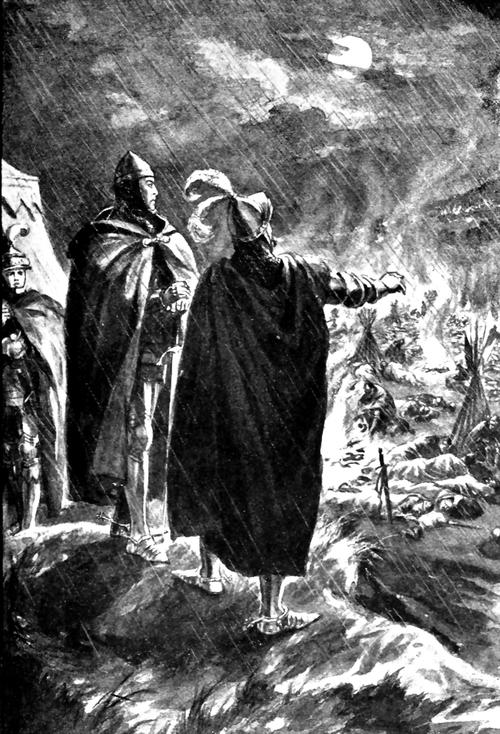
"SIRE, WERE THERE ANY WHO DWELT IN FEAR OF THE ISSUE
OF THE BATTLE, WOULD THEY SLEEP SO QUIETLY?"
Steadily Geoffrey and Oswald trudged through
the stiff clay that sorely impeded the progress
of the soldiers. The squires had divested
themselves of a portion of their armour, that
dangled from the saddle-bow of their chargers.
In common with many of the mounted men they
had temporarily given up their steeds to those of
the archers who would otherwise have fallen out
by the wayside.
Twelve miles of that tedious route had been
accomplished since the passage of the Ternoise,
when a soldier, galloping madly on a foam-flecked
horse, came thundering along the road,
a shower of mud flying from the hoofs of his
steed.
"The enemy, sir," he shouted as he passed
the leader of the Hampshire companies.
Already the vanguard was observed to be at
a standstill, while the supporting troops extending
right and left were taking up their
position on the flanks. The spirit of battle
was in the air.
Massing in close order the five thousand men
of the main body moved to the support of their
van. Cold, fatigue, hunger—all were forgotten.
It was a stirring sight that met the gaze of
Geoffrey and his comrades as they gained the
brow of a low hill overlooking the woods of
Maisoncelles. Before them lay a gently-sloping
plain, flanked on either side by dense masses of
trees, while across the open ground could be
traced the narrow lane that passed through the
village of Agincourt and joined the broader
road from Abbeville to Calais, just beyond the
cluster of thatched and mud-walled houses.
But to the observers' eyes the lane was lost to
view in the serried ranks of the mighty host
representing the chivalry and power of France.
Three bowshots off, at the very least, the enemy
stood, barring the advance of the slender English
force.
Swiftly, yet in an orderly manner, the archers
and men-at-arms of the invading army took up
their positions. The men-at-arms, barely four
thousand in number, were placed in the centre,
the bowmen being massed on either flank; but
by mutual consent, for the night was beginning
to draw on, there was no inclination to engage
in battle.
"The King's orders are that ye rest yourselves,"
announced Sir Thomas Carberry, as he
rode up to his company. "'Tis nearly certain
that the foe will not attack us this night, yet
to guard against surprise let each man sleep
in his ranks, with his arms ready at his side.
'Tis a sorry night, men, for rest, yet be assured I
and my squires will share the discomforts with
you."
"I heed not the rain, fair sir," exclaimed an
archer boldly, "though I be powerful hungry."
Good-humoured laughter from his fellows
greeted these words. Geoffrey recognized the
voice as that of one of the Warblington archers,
who in times of peace was a wild-fowler of the
marches of Thorney.
"Have no fear on that score, archer," replied
the Constable. "Already the sutlers are abroad,
and many wains of provisions are on their way
from yonder village. I do perceive, also, that
on our right flank the men are lighting fires.
Gripwell, do thou send ten men into the woods
and bring back faggots sufficient to last us the
night."
Quickly the men went on their errand, and ere
long thick columns of smoke arose from the
sodden logs, till the heat gaining the mastery,
the dull red flames began to throw out a comforting
glow. Then, with the arrival of the
victualling wains, drawn by peasants pressed
into service, the camp began to show signs of
cheerfulness, in spite of the almost continuous
downfall of icy rain. Yet the utmost order and
decorum prevailed in the English lines—a
striking contrast to the boisterous laughter and
merriment that was wafted on the winds from
around the watch fires of the French camp.
At intervals officers passed slowly along the
lines intent on seeking out their friends, whom,
perchance, they were to see and converse with
for the last time; priests and friars, too, threaded
their way amongst the soldiery, hearing confessions
and giving spiritual consolation to all
who desired their ministrations.
Thus the time passed till it was midnight.
At intervals the rain ceased, and the pale moonbeams
glittered upon the damp grass and the
waving foliage of the neighbouring woods.
Most of the English troops had fallen asleep,
slumbering fitfully under the canopy of heaven.
Others conversed in low tones, or offered up
prayers for the safety of their comrades and
themselves, and for the successful issue of the
coming struggle. Still the French camp maintained
its state of revelry, for food and wine
were in abundance, and, with every prospect of
delivering a crushing defeat upon their numerically
weaker foes, the mercurial spirits of the
Frenchmen rose high. They had forgotten
their defeats at Crécy and Poictiers; time had
erased the memory of the English longbow.
"The night drags slowly on," remarked Oswald,
drawing his saturated cloak more closely
around his shoulders. "Would that we had
something to do to bring some warmth to our
bodies."
"We'll not lack for warmth ere the sun sets
again," replied Geoffrey. "But what discord
those Frenchmen are making. Could we but let
loose a troop of lances through the camp there
would be no little advancement occasioned by
the deed. But who cometh?"
At that moment a soldier walked swiftly
along the front of the line of recumbent men.
The moonbeams glistened on his armour that a
long cloak failed entirely to conceal.
"Halt! who comes?" demanded Geoffrey,
barring the stranger's way with drawn sword.
"A friend! Why hast thou challenged me?"
replied the man in a deep voice.
"'Tis not permitted to pass without the lines,"
replied the squire. "I pray thee keep close to
the fires, lest an over-zealous archer feather thy
back with an arrow."
"Thanks for thy warning, fair sir; I will
pay heed unto. But I pray thee, who art thou,
what is thy condition?" asked the man with a
trace of authority in his speech.
"Since thou art a stranger 'tis thy place to
give thy name first," replied Geoffrey.
"And if I refuse?"
"Then 'tis my duty to bring thee before my
master, Sir Thomas Carberry," answered the
squire, at the same time beckoning to two men-at-arms
who were standing close to one of the
camp-fires.
"Nay, use not force, fair sir," replied the
cloaked man. "To thy master I can give a
good account of myself."
"I trust for thine own weal that thou canst,"
said Geoffrey as he preceded his prisoner, the
two soldiers following to prevent a possible
treacherous attack on their young squire.
Sir Thomas Carberry was at that moment
conversing with Sir Hugh Talbot of the Salisbury
company, and on the approach of the party he
turned.
"Whom hast thou here?" demanded the
Constable.
"A man whom I found without our lines,"
replied Geoffrey. "According to mine orders
to detain all who might be thus found I have
brought him hither."
"Thy squire, Sir John, is to be commended
for his action," said the stranger in an altered
tone, as he removed the cloak from his head and
shoulders, disclosing the familiar features of
Henry, King of England.
"Sire!" gasped the astonished knight.
"Thy pardon for my squire and for me——"
"Pardon for faithfully executing mine orders,
good knight? Nay, rather let us be quick to
recognize a stern devotion to duty. But how
sayest thou, Sir John? Thou art grown grey
in warfare. What thinkest thou of our chances
in the coming fight?"
"A better chance the royal Edward never
had at Crécy, sire, unless yon host have the sense
to enfold us by their superior numbers. Yet
methinks they will risk their advantage in a
frontal attack, and neglect to make use of the
cover afforded by yon woods."
"Trusted men I have already sent to make
sure of the nature of the ground on our right
flank," said the King. "For a like purpose have
I come to thee. Hast thou a trusty level-headed
man or two whom thou canst send through the
woods on our left? If so, I pray thee dispatch
them with haste, and let them bear me a full
report within an hour. But, bear in mind, none
but those who have counted the cost and are
willing to undertake the hazard are to be sent.
Thy zealous squire, there: he hath lurked in
trees before to-day, as we know full well—perchance
he may be eager to repeat his exploits.
But that is his affair. Fare thee well, Sir
Thomas.... Stay—another question: What
dost thou think of the spirits of the men under
thy command?"
In answer the Constable pointed to the lines
of slumbering men.
"Sire, were there any who dwelt in fear of
the issue of the battle, would they sleep so
quietly in the face of danger? Speaking for
our company, I can safely say that their hearts
are full of courage and devotion to thy person."
"'Tis well, Sir Thomas. Thrice happy is a
king whose people's hearts are his throne. Again,
farewell, and may Heaven look favourably upon
us this coming day."
"Geoffrey, thou hast heard his Majesty's
word?" asked Sir Thomas. "Certes, thy service
in the matter of the conspiracy at Southampton
he hath not forgotten. How sayest
thou? Art willing to undertake this enterprise?
Bethink thee; 'tis a perilous service,
and short will be thy shrift if thou art discovered."
"Fair sir, I have already counted the cost.
Give me thy leave and thy blessing, and I will
go."
"But not alone. Choose a burly comrade
and get thee away. Remember that within an
hour the King requires my report."
The squire made his way to where Gripwell
was standing, with Oswald and Ratclyffe.
"Ho, Squire Lysle!" exclaimed the man-at-arms.
"Who was yon fellow whom thou hast
carried to our master? Hast 'prisoned a
hornet? I' faith, he swaggered past us as if
he were King Harry himself."
"'Twas none other than the King," replied
Geoffrey.
"What! The King? A fine story to tell
at home—if home we ever see—how that Squire
Lysle laid hands upon his liege lord."
"Nay, let that pass," replied Geoffrey, "for
I have other work in hand. Art willing to bear
me company as far as the French camp?"
"Right willingly," replied the grey-headed
man-at-arms when the squire had explained
the nature of his errand.
"And I, too, will go with thee," exclaimed
Oswald.
"And I," added Ratclyffe.
"Nay, four are too many for a secret errand
such as this," objected Geoffrey. "Now help
me to unhelm, Oswald. My coat of mail must
also be left behind."
Swiftly the rusted armour was removed, and,
armed only with a poniard, Geoffrey set out
on his desperate errand, with Arnold Gripwell,
similarly armed, to bear him company.
In a whisper they replied to the cautious
challenge of the alert sentinel, then crossing
the bog-like ground in front of the lines, they
gained the sombre recesses of the wood.
Here the darkness was more intense than in
the open, but by degrees their eyes became
accustomed to the gloom, though at almost every
step they stumbled over the slippery moss-grown
roots that encumbered the ground in all directions.
For a distance of nearly a bow-shot the two
adventurers pursued their way, till, plucking at
his comrade's sleeve, Geoffrey came to a sudden
standstill.
For full five minutes they listened, striving
to detect above the confused noise of the French
camp the sound of some unseen foe. A sudden
rustling in the undergrowth caused the lad's
heart to beat violently, while his right hand
clutched the hilt of his dagger. Then came a
sharp squeal of pain, and a hare, with a stoat at
its throat, tore almost across the squire's feet.
Presently the twain came to a clearing,
through which wandered a little brook. Here
the ground was almost knee-deep in stiff clay,
so that both men had to hold the tops of their
shoes to prevent them being dragged off their
feet by the tenacious slime. The crossing of
the glade was a nerve-racking ordeal, since
neither knew but that an invisible foe lurked in
the thickets beyond.
Fortune favoured them, however, and unharmed
they gained the friendly shelter of the
furthermost wood.
Now they were abreast of the French outposts.
Peering through the bushes, Geoffrey could see
the mail-clad sentinels either sitting motionless
on their horses or walking slowly to and fro
to the accompaniment of a clanking and groaning
of the joints of the harness and the squelching
noise of the animals' hoofs in the mire.
The nearmost horseman was humming a
chanson of Picardy, quite oblivious of the fact
that two Englishmen were almost within a
stone's throw of him; yet, though the cordon
extended completely across the open ground,
through some inexplicable error the French had
utterly neglected to hold the woods on either
side of the valley.
Resuming their cautious movements, Geoffrey
and Gripwell skirted the second line of outposts,
where a row of fires threw its weird light upon
the crowd of soldiers, mainly engaged in drinking,
singing, and gambling, while the position
of the two daring Englishmen was rendered
doubly hazardous by the constant procession of
varlets and peasants who were engaged in cutting
wood to feed the watch-fires.
Still the French camp seemed a long way off,
though the silken tents of the nobles were now
discernible in the glare of the huge pile of burning
faggots.
"We have gone far enough," whispered the
man-at-arms.
"Nay, 'tis my purpose to press on," remarked
Geoffrey. "Stay here an thou wilt."
"That cannot be. Where thou goest I will
follow," said Gripwell doggedly.
"Then let us gather a bundle of faggots apiece,
and set out boldly towards the camp. It is in
my mind to see how these Frenchmen fare."
Struck by the audacity of the squire's proposal,
Gripwell could not but assent, so, hastily
collecting a heavy load of wood, the twain stumbled
upon a path where numbers of soldiers and
peasants were passing to and fro.
Unsuspected the Englishmen joined in the
throng, and, bending low under their burdens,
jogged steadily towards the vast city of tents.
"Ho, there, comrade!" shouted a cross-bowman.
"Bring hither that fuel; our fire
is all but out."
"Nay," replied Gripwell in good French.
"That cannot be. This wood is for my master,
the Lord of Rougemont."
This encounter showed that there was no
suspicion towards a stranger, and, encouraged
by the discovery, Geoffrey and his companion
walked boldly down the lines till they reached
a tent that the squire knew by reason of its size
and magnificence belonged to no mean personage.
Two men-at-arms stood without the door, over
which hung a shield emblazoned with a golden
oriflamme.
From within came the sounds of tankards
clashing upon oaken boards, the rattle of dice,
and mingled bursts of laughter, disappointment,
and anger.
"Methought I was to hear a council of war,"
exclaimed Geoffrey in a low voice, "but 'tis
a roystering crew."
"Perchance in their jollity we may hear some
smattering of news," replied Gripwell, and
flinging down his burden with a gesture of utter
fatigue, he seated himself upon it, with his head
resting on his arms. Geoffrey hastened to
follow his example. In the constant throng
their action seemed natural. The two guards
barely condescended to notice them, since they
were some distance from the tent, which was
that of no less a personage than Charles d'Albert,
Constable of France.
"A curse on thy luck, my Lord of Marle," exclaimed
an excited voice. "I have not cast a
main this night. I owe thee two English earls
and four knights already."
"Nay, Falconberg, 'tis five knights by my
reckoning. Without doubt these rascally Islanders
will be cheap enough ere to-morrow
even, but be that as it may, one cannot ignore
the rules of the game."
"I cannot understand the Duc de Bourbon,"
grumbled the first speaker. "Though I am
willing to admit that he has prior claim to the
person of the King of England, he will not risk
his share of the spoil. Surely my offer of twenty
thousand crowns and the Duke of York will be
sufficient inducement?"
"I am weary of casting the dice," replied
Bourbon. "Ere dawn I shall be too tired even
to ride down a single English knight."
"Peste! The battle will be over in a quarter
of an hour. Our first division is strong enough
to sweep these English off the face of the earth.
My Lord d'Alençon, the second division, which
thou hast command of, must be mounted, since
there will be no other work left than to ride down
and slay the light-footed archers. As for thy
division, my Lord Falconberg, there will be
nothing left for it to do."
"Unless it be to shout encouragement to
thy men," replied Falconberg with a laugh.
"Alas! these poor Englishmen. But let's
proceed. Who'll throw with me for my last
three knights?"
"We have learnt what is worth a bushel of
gold, Squire Geoffrey," whispered Gripwell.
"Let us away. As it is, the hour is wellnigh
spent."
Resuming their loads, the two comrades made
for the nearest fire, and, having cast the faggots
upon the smouldering embers, retraced their
footsteps towards the shelter of the woods.
On the way they fell in with a party of soldiers
in search of a load of wine that had gone astray
between the camp and the village of Agincourt,
and, imitating their staggering gait and drunken
song, they contrived to get clear of the line of
tents without being challenged. Then, taking
advantage of the narrow path through the forest,
the two comrades succeeded in slipping away unnoticed
by their maudlin companions.
"Now let us hasten," whispered Gripwell.
"Yet be cautious, for we know not whether
any enemy hath entered this part of the wood
since we came hither."
Unmolested they passed the flank of the
French advanced posts, then gaining confidence
in the fact that the English outposts were but
a bow-shot off, they increased their pace.
The trunk of a tree larger than its fellows
barred their path. Geoffrey recognized the
tree as having been the means of causing him
to stumble over one of its exposed roots on their
outward journey. This time he leapt lightly
over the obstacle, to find himself thrown violently
in contact with a human being.
The impact hurled both to the ground, while
Gripwell, unaware of what was amiss, narrowly
escaped tripping over the two struggling forms.
Noiselessly the squire and the unknown
wrestled on the ground. Geoffrey was unable
to draw his poniard, nor was his antagonist
able to use a weapon; but the English lad, even
in the midst of the desperate struggle, could not
help wondering why his foeman did not shout
for assistance. On his own part he knew that
one cry would doubtless bring the French
outposts to the spot, and the night's work would
be undone.
Whoever the stranger was, he had no lack
of strength and courage, for not until Gripwell
had contrived to distinguish the combatants
in the darkness and had wound his cloak tightly
round the fellow's head was the issue decided.
"Stand by while I plunge my knife into his
body," hissed the old man-at-arms.
"Not so," whispered Geoffrey in reply.
"'Tis but a short distance to the camp, and this
rascal may be of service. Help me carry him
thither."
With this the stranger began to writhe and
struggle again, mumbling incoherently from the
suffocating folds of Arnold's cloak. There was
no help for it; a sharp blow on the temples
from the man-at-arms' powerful fist reduced
the captive to a state of semi-insensibility.
Thereupon Gripwell bound the man's arms
with his own belt, secured his feet with the folds
of his cloak, and effectually gagged him by means
of a fir-cone held in position by Geoffrey's scarf.
This done, the squire raised the helpless prisoner
by the shoulders, and the man-at-arms took hold
of his feet, and with their heavy burden the
two comrades resumed their way till they were
greeted by the welcome sounds of the English
outposts.
"Whom hast thou there?" asked Sir
Thomas Carberry, who had been anxiously
awaiting the return of his squire.
"Some fellow who stood in our path, fair
sir," replied Geoffrey breathlessly.
By this time the prisoner had recovered his
senses, and by an unexpected thrust of his feet
sent Geoffrey staggering into the arms of the
Constable. At the same time he contrived,
bound as he was, to wrench himself out of Geoffrey's
arms, and, falling on his feet, he swayed
to and fro in helpless rage, unable, by reason of
the gag, to utter a sound.
But as the glare of the fires fell upon his
features Geoffrey found, to his discomfiture and
consternation, that his prisoner was none other
than his fellow squire, Richard Ratclyffe!
CHAPTER XXIV THE BATTLE OF AGINCOURT
"A scurvy trick hast thou played on me,"
exclaimed Ratclyffe when the amused
soldiers had released him from his bonds.
"By the Rood I'll think twice ere I venture
again into the forest to seek for thee."
"Hadst thou but spoken thou wouldst not
have been mishandled thus," replied Geoffrey,
who had by now expressed his sorrow for the
mistake.
"Spoken! Forsooth! Did I not try to
speak the moment I heard Gripwell discussing
with thee on the subject of letting out my life's
blood? But what with being wellnigh smothered
by his cloak, and——"
"Nay, say no more, squire," interrupted Sir
Thomas. "'Twas all a mistake, and beyond a
shrewd blow—of which we shall have plenty ere
long, I trow—there is little scath. Now,
Geoffrey, the nature of thy report?"
Briefly the squire told his master of what
had occurred, the nature of the ground, the
position of the French outposts, and, most
important of all, the conversation in the tent
of d'Albert relating to the plan of attack.
"By St. Paul! Thou hast entered their
camp?" exclaimed the knight. "This is almost
beyond belief. But as it is we now know
that we can occupy the woods on the Frenchmen's
flanks without let or hindrance. I'll
now to the King, but, rest assured, thou wilt
have full credit for thine enterprise. Ay, and
thy man-at-arms also," added Sir Thomas, as
his squire began to remind him that Arnold
had shared the perils of the desperate errand.
Thoroughly tired out, Geoffrey laid himself
down by one of the fires, and, heedless of the
steady rain, he was soon fast asleep.
Meanwhile, Sir Thomas Carberry had hastened
to make his report to the King. Henry had
taken little repose, for having completed his
inspection of the lines in the guise of an ordinary
officer, he retired to his tent to don all his armour
save his gold-encircled bascinet. This done he
had mass celebrated in his quarters, followed by
a general council, at which all the commanders of
divisions were ordered to attend.
"Most excellent service," exclaimed the King
when Sir Thomas had delivered his report.
"See to it, Uncle Exeter; send at least four
hundred lances to the wood on the enemy's
left flank. Half that number of archers are to
take up their position on the opposite side of the
valley. Impress upon them the utmost importance
of concealment till the word is borne
them."
Silently the troops intended for the ambush
moved towards the stations allotted them, and
ere the council was broken up, the Duke of Exeter
returned with the news that the manœuvre
had been successfully executed.
"Now, my lords, the day breaks," exclaimed
Henry. "Let us to our stations and do our
duty as becomes Englishmen. To-day, fair
lords, is the Feast of the blessed saints Crispin
and Crispian. From this day till all times will
our names be linked with them, if we acquit
ourselves nobly. Therefore let us be of good
courage, remembering that our souls and bodies
are in God's holy keeping."
With the dawn the rain ceased, and across
the sodden valley the trumpets of the little
English army rang out loud and clear as the
sun rose in a cloudless sky. Eagerly the chilled
and shivering men-at-arms and archers flocked
to take up their positions, glad that the dreary
period of inaction was over.
In the centre, under the Duke of Kent, stood
the dismounted men-at-arms, resting stolidly on
their spears and axes, while as an afterthought
a sprinkling of archers took their stand in front
of the heavy troops. On either flank were hundreds
of bowmen under Lords Beaumont and
Willoughby. In addition to their deadly longbow
and their swords and axes, each archer bore
an iron-shod stake.
Barely twenty paces in the rear of the front
rank were marshalled the reserves, composed
chiefly of spearmen, under the command of the
Earl of Exeter.
The army being drawn up in line of battle,
Henry, mounted on a white palfrey, rode slowly
between the ranks. He had now donned his
surcoat emblazoned with the lions of England
and the lilies of France, while on his head he wore
a polished steel bascinet which was encircled
by a very rich crown of gold, rendering its
wearer a conspicuous object in the field.
"Certes," exclaimed the veteran Lord Camoys
to the Constable of Portchester, as his
gaze travelled from the seemingly countless
multitude of Frenchmen to the six thousand
Englishmen standing motionless in the ranks.
"What would some of the good knights who
have remained in England give to be here?"
"What sayest thou, my lord Camoys?"
asked the King, who had overheard the knight's
remark. "Dost wish for more good Englishmen
to be here? Nay, I would not have a single
man more. If God give us the victory we know
that we owe it to His goodness. If He does not,
the fewer we are the less will be the loss to
England. But let us fight with our usual courage,
and God and the justice of our cause will
protect us."
Having completed his inspection the King
took up his position at the head of the second
line, with the Duke of Gloucester, Mowbray, the
Earl Marshal, and the Earls of Oxford and Suffolk,
while above him fluttered the Royal Standard,
leaving no doubt as to the identity of
the King of England.
Meanwhile, the French had been mustering
in dense masses across the valley, till their
three divisions, each ten files deep, seemed to
resemble a solid wall of steel, dominated by a
forest of banners. At length their preparations
were complete, but there seemed no inclination
on their part to open the battle.
Suddenly, to the surprise of the English,
three French knights, armed cap-à-pied, rode
fearlessly across the intervening plain. Some
of the archers began to bend their bows, but
were restrained by their officers.
"They bear a message," shouted Lord Camoys
to those nearest him. "Open ranks and let
them pass, but take heed that they see not the
pointed stakes."
Haughtily the three Frenchmen rode through
the gap in the front rank and reined in before
the Royal Standard, where Henry, now on foot,
awaited them.
"Sire," exclaimed the foremost knight. "I
am Jacques de Helly, Maréchal of France."
"That we do perceive," replied the King
curtly, "both by thy cognizance and by reason
of the fact that thou wert, and still ought to
be, our prisoner in England."
"'Tis on that matter that I am come," replied
de Helly. "'Tis reported that I have
broken my parole. Let it be known to all men
that 'tis false. To all or any who would gainsay
me, I hereby offer to meet them in single
combat, here betwixt the armies."
"'Tis no time for single combats," replied
Henry sternly. "Hence, lest I lose patience
with thee. Also go tell thy countrymen to
prepare for battle at once."
"Sire," exclaimed de Helly, his swarthy features
livid with anger, "I shall receive no order
from you; Charles is our liege lord; him we obey,
and for him we'll fight when the time comes."
"Away, then," replied the King. "Take
care that we are not before you," and as the
haughty Frenchmen turned and rode beyond
the English front, Henry shouted in a loud
and ringing voice, "Advance banners in the
name of God and St. George!"
Standing in his stirrups the grey-haired Sir
Thomas Erpyingham threw his warder in the
air—the signal for the advance. Instantly the
little English host was electrified into activity,
and with shouts of "St. George for Merrie England,"
the foremost division began to close upon
the seemingly overwhelming masses of the
enemy.
Still the Frenchmen showed no signs of advancing.
Something must be done to goad
them to move to meet the attack, otherwise the
handful of Englishmen would be thrown away
upon the solid phalanx of French steel.
From his position on the right of the men-at-arms
of the Hampshire division, Geoffrey saw
the Frenchmen standing in close ranks, regarding
their on-coming foe with looks of disdain. Now,
the foremost division was on the edge of the
intervening belt of bog-land. A few more steps
and the natural defence on which the king had
placed so much hope would be turned from an
advantage into a hindrance, then——
"Halt," shouted the young Duke of Kent in
a voice that was borne high above the subdued
hum of the ranks. "Archers! Loose wholly
together!"
There was very little of nervous haste on the
part of the bowmen. Even the comparatively
raw recruits were as steady as the most exacting
leader could desire. Hardly had the words of
command ceased when the air was torn by the
sharp swish of the speeding arrows, and at less
than half a bow-shot the French received the
death-dealing blast.
In the twinkling of an eye their foremost
ranks were thrown into the utmost disorder.
'Gainst the deadly cloth-yard shaft, plate armour,
leathern coat, and iron buckler alike were
useless. Knights and men-at-arms rolled on the
ground, transfixed, not once but many times,
by the goose-wing-tipped arrows.
But amongst the struggling press of Frenchmen
brave men were to be found in plenty.
Disentangling themselves from the disorderly
mass, the mounted men with lance at rest
spurred towards the archers.
"Stand fast behind your stakes," shouted the
company commander, realizing that once the
heavy cavalry came within striking distance
of the lightly armed archers the latter would be
cut to pieces and scattered like chaff.
On came the French horse, knee to knee,
plunging heavily in the thick tenacious clay,
while unceasingly the hail of arrows was maintained
till the line of stakes was faced by an
almost insurmountable barrier of dead and
dying steeds and their riders.
To add to the confusion the English archers
in ambush delivered a raking fire, till, losing
men both in the flanks and rear of their division,
besides those who perished in the charge upon
the palisades, the French began to give back.
"Forward—men-at-arms and archers!"
shouted a ringing voice that all who heard
recognized as the King's. Conspicuous by his
gold-emblazoned helmet and the royal arms
on his surcoat, Henry led the counter attack
in person.
The deadly bows were dropped or slung across
the archers' backs, and with axe, sword, spear
and mace the dismounted men-at-arms and
bowmen hurled themselves upon the swaying,
demoralized mob of their enemies.
For a while the battle resolved itself into a
series of desperate conflicts, all order being
thrown to the winds. Often the combatants
had no room to ply their weapons, the two-handed
swords of the French men-at-arms
being useless when opposed to the knives and
daggers of the English archers. So thick did
the press become that the King's brother, the
Duke of York, was crushed to death betwixt
two mailed Frenchmen.
Into the thickest of the mêlée plunged the
Constable of Portchester, with Geoffrey, Oswald
and Ratclyffe close at his heels as became their
duties; but ere long the heir of Warblington,
separated from his comrades, found himself
confronted by a tall knight whose armour bore
no device. In an instant they closed, Geoffrey's
antagonist endeavouring to hurl the squire to the
earth, while the young Englishman attempted
to deliver a poniard stroke between the joints
of the knight's armour.
As they fought an archer sprang upon the
squire's foeman, and with a mighty heave
wrenched his bascinet from his gorget, disclosing
the features of the ex-monk Olandyne. The
next instant the recreant had fallen with the
archer's knife buried in his throat.
Suddenly a shout arose, "To me, Englishmen!"
and Geoffrey perceived the Duke of
Gloucester hard pressed by four or five French
knights. Unable to make good his defence the
Duke was already wounded, yet he stubbornly
continued the unequal combat.
One of the foremost of his attackers was a
broad-shouldered knight whose surcoat had
been torn away during the earlier stages of the
conflict. His shield, too, had been lost, but
armed with a heavy battle-axe, he pressed the
Duke with demoniacal fury.
In reply to the shout for aid Geoffrey made
his way through the struggling crowds towards
the Duke, but ere he could disengage himself,
Gloucester was beaten to the earth by a mighty
sweep of the Frenchman's battle-axe.
The next instant the King himself had stepped
across his brother's prostrate body, and with
shield outstretched and ready blade he defended
the helpless Duke from the combined assault
of the French knights.
But help was at hand. Geoffrey and three
others threw themselves upon the King's assailants,
Henry directing his attention to the unknown
knight of the axe. In this he had enough
to do, for the Frenchman's weapon descended
with fearful force upon the King of England's
helmet. Luckily the blow was a glancing one,
yet it clove the golden crown on his bascinet,
and brought Henry to his knees.
But the unknown's triumph was short-lived.
Regaining his feet the King in turn sent his
antagonist reeling to the earth, while, carried
away by the heat of the battle, his three subjects
were about to slay the man who had so nearly
achieved his purpose.
"Hold, I yield! I am Alençon," exclaimed
the prostrate knight. But the offer of surrender
came too late. Ere the King could stretch
forth his hand to protect his enemy, the Duc
d'Alençon had received his death-blow.
"Nay, fair sirs," exclaimed the King breathlessly,
"I am unhurt; yet, an I were, 'tis no
time for condolences."
Henry had spoken truly, for approaching
him in a compact body were eighteen knights,
each of whom had sworn a solemn oath to kill
or take the King of England or perish in the
attempt. The Royal Standard of England
had served them as a guide only too well.
In an instant Geoffrey was swept to the earth
by the desperate rush, one of the knights who
had gone to the King's assistance was slain,
and Henry with three of his followers was left
to meet the determined attack.
Once again the King, defending himself with
courage and coolness, was beaten down upon
his knees, but others of his supporters came to
the rescue, and the eighteen Frenchmen kept
their vow—they died to a man.
Slowly Geoffrey extricated himself from the
mire and regained his feet. Beyond being
sorely bruised he was unhurt, and with the
knowledge that the King was safe he plunged
again into the press.
But already the tide of battle had turned.
Unless a surprising rally should take place on
the part of the enemy the conflict was decided.
The first division of the foe had recoiled upon
the second, and now both were assailed by the
victorious English, and the remains of both
were seeking safety in flight. As for the
third line, the fate of their comrades had struck
them with panic. On the approach of the
four hundred English lances, who had hitherto
remained in ambush with remarkable self-restraint,
they, too, fled, and the victory was
complete.
In an endeavour to find Sir Thomas Carberry,
Geoffrey made his way betwixt the piles of corpses
to where a few valiant French knights still held
out. For a while the squire searched in vain,
till he perceived seven or eight surcoated archers,
whom he recognized as being Warblington men,
standing in a semi-circle with brandished
weapons.
As Geoffrey drew near the object of their
position became apparent. Standing with his
back against a tree was a Frenchman. He was
clad in complete mail, but in spite of this he
had received more than one wound. The
plume had been shorn from his crest, his shield
was splintered, his armour cracked and dented,
and his sword, broken close to the hilt, lay at
his feet. Battle-axe in hand he stood at bay,
disdaining to receive quarter at the hands
of base archers, while his antagonists hesitated
to come within reach of the menacing weapon.
"Send a shaft through him," suggested one.
About to act upon this advice, an archer bent
his bow.
"Hold!" exclaimed Geoffrey, grasping the
man by the shoulder. Even as he did so the
arrow sped, but wide of the mark. Angrily
the archer turned about.
"Who art thou to stand betwixt an honest
Englishman and a rascally Frenchman?" he
demanded, for he failed to recognize his young
leader, whose armour was covered from helm
to solleret in mud and gore.
"Dost not know me, Hubert?"
"By Our Lady, 'tis Master Geoffrey. Thy
pardon, young sir. But this is our affair,
therefore, come not to prevent us working our
will on this thick-headed Frenchman."
"Have ye not demanded his surrender?"
"Ay," replied the men in a chorus. "And
he refuses."
"Sir Knight," exclaimed the squire earnestly.
"Wilt yield?"
"Art thou a gentleman of quality, sir?"
replied the Frenchman. "If so——"
"Nay, since we are to be done out of his
ransom let him die," interrupted the archers
sturdily.
"Fret not yourselves," exclaimed Geoffrey.
"Were he dead not a groat would ye receive.
On the other hand, if he surrender the ransom
I'll bestow upon you."
"Then we are content," replied the soldiers,
and they moved away.
"Wilt yield, sir Knight?" repeated the
squire. "I am a gentleman of coat-armour,
and will give thee every consideration befitting
a gallant and debonair gentleman of France."
"Fair sir, I yield," but as the vanquished
knight tendered the hilt of his axe he toppled and
fell heavily to the ground.
Drawing his poniard Geoffrey knelt beside
the unconscious man and deftly severed the
laces of his bascinet. Upon removing the
heavy headpiece he found to his surprise that
his captive was none other than Sir Raoul
d'Aulx, Seigneur de Maissons and the knight
who held Sir Oliver Lysle in courteous captivity.
In vain Geoffrey searched for fresh water.
In the furrows and ditches there was water in
plenty, but discoloured by the blood of friend
and foe. But to the squire's intense relief the
colour began to return to the face of Sir Raoul,
and at length he opened his eyes.
"Ho, Geoffrey, I have sought thee high and
low: methought thou hadst bitten the dust,"
exclaimed a well-known voice as Oswald Steyning
approached, his unhelmed head swathed
in a blood-stained scarf.
"I have indeed bitten the dust, Oswald,"
replied Geoffrey with a smile, "yet, thanks be
to God, I have received no hurt. But thou
bearest some token of the fray?"
"A mere cut," replied Sir Oliver's squire
lightly.
"And Sir Thomas and the rest of the company?"
"Beyond a few slight but honourable wounds
Sir Thomas is unscathed, but alas! Ratclyffe
is no more."
"Tis sad news. And Gripwell——?"
"As blithe as a maid on May Day. Certes,
he hath good cause, for but a short while ago
I saw him with mine own eyes taking two French
knights to the camp. If he see England again
never another day's work will he need to do, for
his prisoners are worth four thousand crowns
apiece."
"I pray thee lend me thine aid with this one,"
said Geoffrey, pointing to his captive. "'Tis
none other than Sir Raoul d'Aulx."
"Therein thou art fortunate," replied Oswald.
"Let us quit this field, for my stomach turns
at the sight of it."
With a squire supporting him on either side
Sir Raoul was placed on his feet and assisted
towards the rear, where the baggage and horses
had been placed under guard, and where the
captives were being taken for safety; but, ere
Geoffrey and his charge reached the fringe of
the corpse-encumbered field, a man-at-arms rode
past them in hot haste.
"Look to yourselves," he shouted. "We are
attacked in the rear. The camp is taken!"
CHAPTER XXV THE MASSACRE
The alarming news that an attack was
being made on the rear quickly spread,
and from all parts of the field knights, men-at-arms
and archers came running towards the
Royal Standard as fast as their wearied bodies
and cumbersome armour would permit.
Yet, even in the face of this new danger the
mercenary instinct of the common soldiers was
paramount. They had fought and won; rich
and noble prisoners, worth princely ransoms,
were theirs, and even the threatened attack
failed to make the archers and men-at-arms
abandon their hard-earned prizes. Thus the
King found himself surrounded by a medley
of Englishmen, intermingled with a crowd of
French knights and gentlemen who in the
confusion of the impending attack would undoubtedly
be a source of danger to their captors.
Henry was quick to act. As a general and
a soldier he resolved upon stern measures.
"My Lord Camoys," he exclaimed, "take
a thousand lances and at all costs hold the
enemy in check until the men-at-arms and
archers can be formed up. Pass the word also
that every man is to put his prisoner to death."
Unhesitatingly Lord Camoys rode to execute
his terrible orders, but to the King's anger and
surprise, sullen murmurs of protest and defiance
rose on all sides. Though realizing the gravity
of the situation, the English—knights and
common soldiers alike—were loth to take such
extreme measures. In some cases feelings of
humanity prompted them to resist their liege-lord's
orders, but, generally speaking, it was the
reluctance to put a high-born prisoner to death
that incited them to refusal. According to the
practice of the times the indiscriminate slaughter
of the common soldiers—men who could not
afford to pay ransom—was regarded as the
custom of war, but the murder of every prisoner
who was willing to pay a large sum to his captor
was in every sense abhorrent.
"By the Blessed Trinity," thundered the
King, "what is this I see? Open rebellion?
Sirs, ye will pay dearly for this anon."
And turning to one Thomas Almer, squire to
Sir John Cornwall, afterwards Baron Fanhope,
he ordered him to take three hundred archers
and execute the helpless prisoners.
"Nay, I cannot abide it," exclaimed Geoffrey
resolutely, as the shrieks of the unfortunate
Frenchmen began to ring in his ears. "E'en
if my own life has to pay forfeit this knight must
be protected."
Bidding Oswald support the tottering form
of Sir Raoul, Geoffrey made his way to where
lay the body of a slain English man-at-arms.
Quickly he stripped the corpse of its white
surcoat with the distinguishing Cross of St.
George, and returning, began to place it over
the body of his captive.
Feebly Sir Raoul tried to resist. This donning
of the hated cognisance was repugnant to his
sense of honour, but his strength was unequal to
his resolution, and with a groan he swooned away.
"We are indeed in sore straits," exclaimed
Geoffrey as he carried out his plan of disguising
the Frenchman's appearance. "If we stay
here perchance they will see through the trick;
if we go on we shall fall into the hands of our
enemies. Yet, by St. George, I'll see Sir Raoul
to safety or perish."
By dint of great exertions the two squires
dragged the mail-clad body of the helpless knight
to the shelter of a thorn-bush. Here they
waited, reluctantly compelled to witness the
horrible scene as the archers went about their
murderous business.
Presently three of the executioners, with reeking
weapons in their hands and their white
surcoats splashed with blood, approached.
"Whom hast thou here, sir squire?" demanded
one, pointing with his blade at the
unconscious Sir Raoul. "I' faith; I'll swear
yon red cross covers no English carcase."
"'Tis a wounded knight," replied Geoffrey.
"I thank thee for thy offer of assistance, but
must needs decline it."
"Hark at him! Decline, forsooth? Nay,
mine assistance is to help the rogue to Paradise,
so stand aside, squire, in the King's name, for
no man dare tell me that his harness was
fashioned in England."
"Nay, 'tis no affair of thine, archer; yet if a
gold piece or two will——"
"Offerest thou me gold?" replied the soldier
with a gruff laugh. "I'll wager I have enough
gold sewn up in my doublet to buy thee thrice
over."
"Then take care lest I slit thy doublet and
thy hide as well," replied Geoffrey, standing
on his guard. "'Tis ill that Englishmen should
shed each other's blood, yet I have sworn to
protect this man, and before Heaven I'll not
go back from my word."
"Fall on, comrades," shouted the archer.
"We'll see whether this young cockerel can
scratch as well as crow."
"Draw, Oswald; I command thee!" exclaimed
Geoffrey, and wondering at his companion's
tone, Oswald, sword in hand, took
his place at his side.
"We are but wasting time," expostulated
one of the archers. "The squire is right: why
should we fight Englishmen? Are we not
exceeding our orders?"
"What! Art afraid of two lads?" replied
his fellow. "Come on, I say, and let's settle this
business."
"Do it thyself. For my part I'll pass by.
The King can be told of this opposition
anon."
"Go, chicken-heart! What will thy friends
and kinsfolk at Ely say when they hear that
thou hast shown the white feather to two
beardless squires? Now, look to thyself,
squire."
As the archer with two of his comrades was
on the point of closing, a cry went up "In the
King's name, the slaughter of the prisoners
must cease!" The order was repeated in all
parts of the field, and in a very short space of
time the work of massacre had ceased, the
archers being, for the most part, glad to cease
their unprofitable and hateful task.
"'Tis well for thee, squire," growled Geoffrey's
antagonist, smartly thrusting his sword back
into its scabbard and turning on his heel. "But,
mark ye, the King shall hear of this."
The report of the attack upon the rear guard
had proved to be greatly exaggerated. Finding
that the camp had been left slenderly guarded
a seigneur living close to the village of Agincourt,
Isambard by name, had gathered together a
band of five hundred peasants, and falling upon
the baggage guard had put them to flight.
This done, the marauders set to work to pillage
the baggage, till they were dispersed by the
English lances.
Yet Isambard had not been unsuccessful, for
part of his spoil consisted of the King's crown
that had been made in anticipation of his coronation
in Paris, and also a diamond-hilted sword
belonging to the royal treasures.
But to counterbalance this gain 'tis said that
no less than fourteen hundred defenceless and
unarmed knights and squires of France had
been slaughtered in cold blood. No wonder,
therefore, was it that when Isambard presented
his trophies to the Duc de Burgundy that irate
prince, reproaching the seigneur as being the
cause of the massacre, ordered him to be cast
into prison.
"I fear we have not seen the end of this
affair," remarked Oswald, as the two squires
stood much disquieted by the side of their
prisoner, and the gravity of their offence began
to loom larger. "If this comes to the King's
ears we are likely to be put to death."
"I, perchance, but not thou, Oswald," replied
Geoffrey.
"How so? Did I not draw with thee?"
"Didst thou not hear me order thee to draw?
Since thou art my father's squire and I am his
representative in the field, thou art under my
orders, though heretofore I have not exercised
any authority over thee. Therefore, should it
come to pass that the matter is taken up, thou
canst—nay must—plead that 'twas by my command
that thou didst resist the King's orders."
"Thou meanest me well, Geoffrey; but
methinks 'twill not serve," replied Oswald as
the generous nature of his friend's act became
apparent to him. "However, 'tis of no use
waiting for trouble; let us find Sir Thomas
Carberry and confide in him."
Acting on this sensible advice the two squires
assisted Sir Raoul, who had again recovered
consciousness, to his feet, and having left him
in a secure place in charge of two of the Warblington
archers, who had strayed across their
path, they set out to find the Constable of
Portchester.
The field of battle was literally smothered
with corpses of men and horses; shattered
weapons lay everywhere, while in front of the
still-standing row of stakes the barrier of
slaughtered Frenchmen was piled breast-high.
Amid these horrible surroundings archers were
carelessly sauntering, withdrawing arrows that
had sunk deep in the clayey soil to replenish
their quivers, or stopping to plunder the body
of some wealthy knight. Here and there walked
small knots of soldiers searching for the corpse
of their master, or engaged in succouring their
wounded comrades, whose groans and cries of
pain rose on all sides; but most of the English
knights and squires, as well as a vast concourse
of men-at-arms, had gathered round the Royal
Standard that floated proudly over the fatal
field.
"Ah, there is Sir Thomas," exclaimed Oswald,
pointing to the star and crescent banner that
showed bravely amidst a waving forest of silken
guidons and pennons.
"Heaven be praised," exclaimed the Constable,
"that I see thee safe and sound, Geoffrey.
Methought I had lost both my squires. And
Oswald, too!"
"Fair lord, I have as yet been spared, though
Richard Ratclyffe hath fallen."
"Ay, and right bravely he fought and died;
Heaven rest his soul," added the knight gravely.
"But what hath gone amiss? I see trouble in
thine eyes."
"Sir, thou art like to lose another squire,"
replied Geoffrey.
"How so? How so?" demanded the Constable
anxiously. Then with a smile he added,
"Perchance the King hath thought fit to give
thee advancement?"
"Advancement of a kind, fair sir," replied
Geoffrey gloomily, and in a few words he related
the events concerning Sir Raoul's capture and
escape from massacre.
"By St. George! What hast thou done?"
exclaimed Sir Thomas, aghast at his squire's
temerity. "Thou hast flouted the King's
authority."
"In this matter I had no choice," replied
Geoffrey. "Deeply I regret my error, but I am
under a vow to save this French knight."
"'Twill require all my efforts to save thee
from the hangman's rope, young sir. But,
certes, I'll do my utmost. An I can but get
the King's ear when he is in a good mood, so
much the better. Above all I must have my
say ere the squire in charge of the archers can
lay his complaint. Yet think not to get off
lightly, Geoffrey. Thou hast erred and must
needs pay the penalty."
"That I know, fair sir."
"Then bear thyself like a true soldier. But
here comes the French herald. List to what he
hath to say, for 'tis of much import."
Even in his distress Geoffrey craned his neck
to see the meeting twixt the victorious king
and the representative of the conquered foe.
The French knight was magnificently harnessed
in a suit of white armour, over which
was a tabard emblazoned with the royal arms of
France. He was unarmed and unhelmed, for
he bore his casque in his right hand. Alighting
from his palfrey, he threw the reins to an attendant,
and accompanied by two pages, advanced
to where Henry stood, clad in his soiled and
dented armour, surrounded by his lords and
chief officers.
"I am Denis Mountjoye, King-at-Arms, and
a loyal servant to my master King Charles, on
whose account am I here."
"Greetings, herald," exclaimed the King
courteously. "We would fain know thy
errand."
"I crave permission to bury our dead, sire."
"First tell us, herald: to whom belongs this
victory—to us or to the King of France?"
"To you, sire."
"And yon castle—what name does it bear?"
"The Castle of Agincourt, sire."
"Then let this battle be called the battle of
Agincourt," announced the King in a loud voice.
"Herald, thy request is granted. Five hundred
peasants can see to the burial of thy master's
dead; Sir John Crofton will give thee further
directions."
As soon as Mountjoye had taken his departure
the King removed his helmet, which bore eloquent
testimony to its wearer's prowess, and in
obedience to an order, knight, squire and
common soldier followed his example. Then, led
by Henry in person, the psalm Non nobis,
Domine, was chanted by the English army in
order to acknowledge, in the midst of triumph,
the only Giver of victory.
The French losses were enormous. Ten thousand
fell on the field of battle, and of these only
fifteen hundred were common soldiers. The
Constable of France, the Counts of Nevers and
Marle, the Dukes of Brabant, Alençon and
Barre, and the Archbishop of Sens were
amongst those who laid down their life for
France; while the Dukes of Bourbon and
Orleans were amongst the prisoners.
The losses on the victorious side were proportionately
small. The Duke of York, the
Earl of Suffolk, four knights, seven squires,
and about fifteen hundred men-at-arms and
archers died in battle, or, roughly, one in every
four men engaged. Had the remnant of the
French army rallied and made another attack
in the open, the shattered English force might
never have reached Calais, but so disheartened
were the defeated troops that any attempt at a
renewal of the fray was impossible.
Deeming himself secure from further molestation
Henry withdrew his forces to the camp at
Maisoncelles, a short distance from the scene of
action, to allow his wearied men a good night's
rest ere resuming their coastward march.
The shades of evening were falling upon the
ghastly field of Agincourt as the Constable of
Portchester returned from audience with the
King. He had gone alone, thinking it wiser
to leave the two culprits in their quarters during
the fateful interview with his royal master.
During his absence Geoffrey and Oswald had
not been unmindful of their lord's comfort.
Tents there were now in abundance, for the
fugitive host had left the whole of the camp
equipment standing.
"What think ye of our condition, Arnold?"
asked Geoffrey of the old man-at-arms, pausing
in the midst of arranging Sir Thomas's couch.
"Faith! many a man has been hanged for
less," replied Gripwell, bluntly outspoken in his
sorrow. "E'en though the order was unnecessary,
as it seems, yet 'twas thy place to obey
it. Yet likely thy youth and thy previous good
service being taken into consideration, thou
mayest save thy neck. But here comes our
master. Methinks I read good tidings on his
face."
Dutifully the two squires hastened to relieve
Sir Thomas of his armour, placing wine and food
before him as he eased his wearied limbs upon
the couch. Though both lads were consumed
with anxiety they preserved a strict silence,
awaiting the news of the knight's mediation.
"By Our Lady," exclaimed the Constable,
"'tis strange that after a hard day in the
field I should have to spend a harder time in
exercising my sorry tongue on behalf of two
wrong-headed young squires. Yet fret not
thyself, Geoffrey; nor thee, Oswald. In short,
ye are pardoned for your transgression, though
at a price."
"Fair lord, I thank thee," Geoffrey exclaimed.
"Nay, wait and hear me out. Certes, when I
told the King his brow was as black as a thundercloud,
yet, on recalling thy services to him both
at Southampton and on the field when he was
beset by d'Alençon, he mused awhile.
"'Then the chief culprit was the squire
who went into the enemy's camp, and who later
helped most valiantly to beat d'Alençon to the
earth? And he would spoil himself on account
of a French knight? Well, Sir Thomas, we'll
let this pass. It was in our mind to bestow
upon him the gilded spurs of knighthood, but
now 'tis not to be thought of. As for his companion
in trouble thou sayest he acted under
compulsion? Let that also pass.'
"Then as I was about to withdraw who
should appear but Sir John Cornwall. 'Sire,
I have a plaint to lay before thee. My squire
Almer hath reported that two squires have
obstructed certain of my archers in the execution
of thy orders.'
"'Thou art too late, Sir John,' replied the
King. 'Sir Thomas, here, hath already lodged
a case 'gainst them. Yet thanks for thy zeal
in our cause.'
"Once more I was about to withdraw when
the King called me back. 'Who is this French
knight, and what hath he done that thy squire
should so stoutly befriend him?'
"'Sire,' I replied, 'he is Sir Raoul d'Aulx,
seigneur of the Chateau de Maissons, and he
holds this squire's father, Sir Oliver Lysle, in
captivity.'
"''Tis indeed strange. We would have
thought that 'twould be an eye for an eye, a
tooth for a tooth. But concerning this Castle
of Maissons—doth it not lie near this place?'
"'But a short distance from the ford at
Peronne.'
"'Then see to it, Sir Thomas. Let a troop
of lances on the morrow be sent to bring Sir
Oliver hither, for we have heard much concerning
the Lord of Warblington, and have need of
his services.' With that I thanked the King
and withdrew."
"Fair lord, then we are much beholden to
thee."
"Nay, 'twould ill become me if I failed to do
my utmost for my squires. Now to rest,
Geoffrey, for thou must be up betimes, since
it is my desire that thou shouldst ride with the
men-at-arms to Maissons."
For a space Geoffrey could not utter a word,
then with an effort he asked—
"Did I hear aright, fair sir? The King—did
he say that the gilded spurs of knighthood
were not to be thought of in my case?"
"Aye, that he did," replied the Constable
with a twinkle in his deep-set eyes. "Aye, that
he did; but beshrew me, I have forgotten to
add his own words 'for a while at least.'
So bear up, young heart, and I'll warrant that
thou'lt be Sir Geoffrey ere the King sets foot in
Paris."
CHAPTER XXVI AT THE CASTLE OF SIR RAOUL D'AULX
The morning after Agincourt dawned bright
and clear, with a keenness in the wind
that betokened the approach of winter.
Ere the camp was fully astir, for the war-worn
soldiers were thoroughly enjoying their
hard-earned rest, forty men-at-arms of Sir
John Carberry's command formed up on an
open stretch of ground in front of the Hampshire
Company's lines.
The horses, thanks to a complete day's idleness
in the rich pasture ground, were fresh and
well-fed, presenting a vast contrast to their
gaunt and stern riders, many of whom bore
traces of the ordeal they had undergone culminating
in the desperate advance upon the
disordered French lines. Yet they were one
and all filled with enthusiasm, for all of them
knew Sir Oliver as a gallant knight, while every
available man of the Warblington contingent
had volunteered for the expedition that was
to set free their beloved master.
Arnold Gripwell had barely completed his
careful inspection of the equipment of the troop,
both horse and rider, when the Constable of
Portchester, accompanied by Geoffrey and
Oswald, emerged from his tent to bid his men
Godspeed.
"Thou knowest the way?" he asked as the
squires mounted their chargers. "'Tis plain
enough, since 'tis worn by the feet of seven
thousand of our men. But take heed lest ye
fall in with any large bodies of roving Frenchmen,
e'en though they have been soundly
beaten. All being well ye should be back ere
sunrise to-morrow; but if by noon ye have not
put in an appearance I'll lead a double company
to your aid."
"'Tis well, fair lord," replied Geoffrey. "I
will do my utmost to return at dawn."
Then, without so much as a cheer or a trumpet
note the little band set out, and passing through
the lines of the sleeping camp, gained the open
country beyond.
Without molestation, for the country appeared
deserted, the men-at-arms recrossed the
Ternoise and the Somme, and an hour before
noon came in sight of the towers of Maissons.
Here Geoffrey, on Gripwell's advice, called a
halt, to rest and refresh the horses, and to give
the men a short respite ere advancing upon the
castle.
The squire had already made cautious inquiries
of his captive, Sir Raoul, concerning the
possible garrison of Maissons; but, unwilling
to inform the knight that it was proposed to
summon the castle to surrender, Geoffrey had
been unable to gather any definite information
as to its state of defence.
"They are ready to give us a right warm
welcome!" exclaimed Oswald, as in nearing the
castle the drawbridge was observed to be drawn
up, while the sun glistened upon steel caps and
spearheads over the battlements.
"Certes, they are by no means few," observed
Gripwell, shading his eyes. "It would seem
that the followers of this Sir Raoul have not
stuck to the field with their master. There
must be at least three score of them—and
behind stout walls too. By St. George, we'll
have a tough task here, squire Geoffrey."
"That is to be seen," replied Geoffrey. "Has
any man a white scarf with him? If so let him
bind it to his spear."
Two or three of the required articles were at
once forthcoming, and using one as a flag of
truce, Geoffrey rode boldly up to the edge of the
moat, a man-at-arms riding close behind him
with the emblem of parley.
"I would have speech with the representative
of Sir Raoul d'Aulx, Seigneur de Maissons,"
exclaimed Geoffrey.
"Thy message, sir," replied a woman's voice,
and to the squire's astonishment and confusion
there appeared the figure of the Lady Aimée,
daughter of the seigneur and the haughty
châtelaine whom Geoffrey had rescued on his
journey up the Seine two years previously.
She had donned a light steel corselet and cap
that failed to conceal her dark brown tresses,
and leaning upon a shield emblazoned with the
d'Aulx arms, she stood proudly and defiantly
upon the battlements of her ancestral
home.
Even though Geoffrey had raised the visor
of his helmet he felt certain that the damosel
failed to recognize him. Nor was that to be
wondered at, since the squire had altered and
matured not a little during those two years of
strenuous life and activity, while in complete
mail he looked a very different person from the
lad who in ordinary travelling attire had dared
to rush in upon a levelled crossbow to aid the
haughty Lady d'Aulx.
"In the name of the most puissant sovereign
Henry, King of England and France, I demand
surrender of the castle known as Maissons,
now in the possession of the representatives
of Sir Raoul d'Aulx."
"'Tis easy to demand, sir," replied the girl.
"Yet not easy to acquire. How dost thou
think that thou canst take this castle with more
than half a hundred defenders behind its walls.
Have a care, sir, lest the forces of King Charles,
the only King of France, do not sweep thee and
thine from off the face of the earth."
"I fear them not," replied Geoffrey. "Thou
knowest only too well that only yesterday the
French fled before our arms, leaving vast
numbers of gallant knights upon the field and
in our hands."
In spite of her coolness Aimée d'Aulx staggered
beneath the shock of the news, but
recovering herself, she replied, "A truce to
thy words, sir. An thou wilt take the castle,
advance, for 'tis a warm reception that awaits
thee and thine."
With that the girl disappeared from view,
leaving Geoffrey staring up at the battlement
where she had stood.
"Fair sir," quoth the man-at-arms who bore
the white flag. "Hast thou taken notice of
those nine steel caps showing above the
wall?"
"Nay," replied the squire shortly, for, truth
to tell, during the interview he had eyes only for
the fair Aimée d'Aulx.
"They have not moved a hair's breadth these
five minutes," continued the man. "Since 'tis
impossible for a Frenchman to remain quiet,
for curiosity must have otherwise consumed
them, I am of opinion that those head-pieces
are set up only to trick us."
"By the rood, Hubert, methinks thou shouldst
be right in this matter," exclaimed the squire
excitedly.
"And, moreover," went on the soldier imperturbably,
"didst thou not mark how yon damsel
was taken aback when thou told'st her of the
rout of yesterday?"
"Now thou speakest of it I call it to mind,"
admitted Geoffrey. "What of it?"
"This, fair sir: 'tis certain that none of this
knight's followers have gained the shelter of the
castle, otherwise the news would have been no
news. I'll warrant, could we but cross the
moat, that ten stout men-at-arms could carry
the castle by escalade."
"Thine advice is good, Hubert," said Geoffrey,
as the twain turned and rode back to their
comrades.
After a short council had been held, ten of the
men-at-arms divested themselves of their armour,
and armed only with their axes and daggers,
ran boldly towards the moat.
Here they were assailed by a shower of ill-directed
stones, while from a few of the oyelets
came an irregular discharge of arrows, shot so
feebly that for the most part they failed to pass
within a spear's length of the object of their
intended mark.
A roar of derisive laughter burst from the
lips of the seasoned veterans, as without a
moment's hesitation they plunged into the
waters of the moat. Unscathed, though the
stones churned up the water all around them,
the men swam to the opposite side, where,
taking advantage of a narrow terraced ridge of
rock at the base of the castle walls, they gained
the shelter of the raised drawbridge.
Soon a coil of rope, weighted by an axe, was
thrown deftly over one of the chains that supported
the drawbridge full thirty feet above the
ground.
"Up with thee, John o' Bosham," exclaimed
the man who had been appointed the leader of
the enterprise. "Thou wert a shipman ere
thou wert man-at-arms. And thou, too, Peter
of Gosport. Up with thee, I say."
With their axes thrust into their belts the
two soldiers swarmed up the swaying rope, and
agilely balancing themselves on the chain, they
looked about for some means to sever the stout
iron links. Being without files they soon realized
that the task was beyond them.
"Try the woodwork, John!" shouted one
of the men from below. "Yet take good heed
when thou hast done thy work."
Blithely the twain set to with their axes, and
amid a shower of splinters the chain-plate
secured to the frame of the drawbridge was cut
out, falling with a loud clang against the wall.
With that the two men-at-arms made their
way astraddle of their lofty swaying perch, and
having passed the rope through one of the links
of the still-holding chain and secured themselves
to it by their belts, they again fell to work.
"Stand clear below," exclaimed Peter, as the
woodwork creaked ominously.
The next moment the chain-plate was wrenched
from its hold, and with a crash the heavy drawbridge
fell, rebounding more than once ere it
came to rest. Then amid the cheers of their
comrades the two daring and by this time well-nigh
exhausted men slid down the rope to the
ground.
Meanwhile Geoffrey and the main body had
not been idle. At great pains they had felled a
young fir tree, and having stripped it of its
branches, bore it to the edge of the moat.
As the drawbridge fell, two score willing
hands raised the heavy battering-ram, and
recking not the shower of stones that rattled
harmlessly on their headpieces, the men-at-arms
attacked the iron-bound oaken door.
At the third blow the massive timber was burst
asunder, and with shouts of triumph the men-at-arms
swarmed into the castle, to find it
deserted save by half-a-dozen trembling serving
women incongruously wearing steel headpieces,
two decrepit men-servants, and the Lady Aimée
d'Aulx!
"Thou hast conquered, sir," exclaimed the
girl haughtily. "Accept my congratulations
on thy feat of arms—this victory over a handful
of helpless women-folk."
"Nay, fair lady," replied Geoffrey, advancing
with raised visor. "We do not make war upon
women. Rest assured, therefore, that neither
thou nor thine will suffer harm."
"Then why art thou here?"
"To carry out the orders of my royal master.
Further——"
"The saints preserve me!" exclaimed the
damsel. "Of a surety I have seen thee before?
Ay, 'tis the youth that befriended us at the
Dos d'Ane."
"Shrewdly guessed, fair lady. I am in
truth Geoffrey Lysle, squire to Sir Thomas
Carberry, and son of Sir Oliver Lysle, whom
thy father holds captive in this castle, and
whom it is my desire to set at liberty."
"Tell me, young sir," asked the girl eagerly.
"Thou didst say that our arms have suffered a
reverse? Canst say aught concerning my father,
Sir Raoul?"
"He is safe, though hurt; a prisoner. More,
he is my prisoner."
"Then thou art willing to set him at liberty
in exchange for thy sire?"
"My father I hope to regain by virtue of the
success of our arms in the taking of this castle
of Maissons. As for Sir Raoul, 'tis my purpose
to receive two thousand crowns for his ransom."
"Like the rest of these Englishmen, thou
wouldst place money before honour?" said the
girl scornfully. "No doubt it was for that
purpose alone that his life was spared?"
Geoffrey coloured at the unjust taunt. He
shrank from telling how he had rescued Sir
Raoul at the risk of his own life and honour,
and that he had demanded the ransom solely
on account of the archers, whose offers of
quarter the knight had resolutely refused.
"'Tis the usage of war on both sides, fair
lady," he replied with a dignity equal to her
own. "But of that anon. Oswald, do thou
conduct the Lady Aimée to her apartments, and
see that none of the men-at-arms venture upon
her privacy."
Then turning to an old servitor, who, by
reason of a bunch of keys hanging from his
girdle, was evidently custodian of the keep—
"Hasten thee, rascal, take me to the Lord
of Warblington's quarters—or prison, whichever
it be."
Obediently the man complied, and soon
Geoffrey was grasping his father by the hand.
His long quest had ended at last.
Sir Oliver's quarters were plainly yet comfortably
furnished, and were situated in a part
of the domestic buildings of the castle. Under
his promise not to break faith with his captor
unless ransomed or rescued, he had been allowed
almost complete freedom, being at liberty to
hunt in an adjoining forest, or to wander in or
about the castle. Punctilious towards his captor
and strictly true to his parole, the Lord of
Warblington had endured his detention with
fortitude, though his thoughts were ever speeding
towards his wife and home across the
English Channel.
For the space of nearly two hours father and
son remained in eager and joyous converse,
while the soldiers were feasting in the courtyard
of the castle, till the necessity of rejoining the
English camp became apparent.
"Art ready, Oswald?" asked Geoffrey, after
Sir Oliver had warmly greeted his faithful squire.
"All is ready," replied Oswald, "but I bear
a message from the Lady Aimée. She would
see thee in the great hall."
With mingled sensations of hope and fear
Geoffrey made his way to the girl's presence.
Seated on an oak chair, with two tiring maids
in attendance, the Lady Aimée d'Aulx awaited
the coming of her captor. She had discarded
her steel corselet, and had taken particular
care that her tresses should be rearranged, while
in place of her riding-habit she had assumed a
dark blue kirtle with hanging sleeves slashed
with murrey-coloured silk, and on her head a
high sugar-loafed cap after the fashion of the
times.
"Thy pleasure, fair lady?" exclaimed Geoffrey,
louting low before her.
"Squire Geoffrey, I must needs make amends
for my ill-natured tongue. Thy friend Oswald
hath told me concerning thy generous and
courteous treatment of my father. I crave thy
forgiveness."
Geoffrey vehemently protested that no forgiveness
was necessary, since nothing untoward
could fall from the lips of the daughter of Sir
Raoul d'Aulx. Then time passed rapidly and
unheeded, for the two were engaged in animated
conversation, regardless of the presence of the
tiring maids who had discreetly withdrawn to
one of the alcoves.
At length the squire prepared to take his
departure, for his ears had caught the warning
long-drawn blast of a trumpet in the courtyard.
"And hast thou truly forgotten what I said
concerning my father's ransom?" asked the
girl.
"Ay, truly."
"And dost thou not require that I should be
held to ransom, squire Geoffrey?"
For answer Geoffrey's steel-grey eyes looked
steadfastly into the dark glistening orbs of the
Norman maiden. Then courteously and reverently
he raised her hand to his lips.
When Geoffrey Lysle rode away from the
Castle of Maissons he took with him the heart
of the Lady Aimée d'Aulx.
True to his promise Geoffrey and his men-at-arms
regained at dawn the English camp, where
Sir Oliver received a rousing welcome, not only
from his own retainers, but from the many
knights who regarded him with the warmest
feelings of esteem.
Though the men-at-arms who had carried
out the raid on Maissons had had little rest,
there was scant time for leisure. The army
had to resume its march to Calais, where, accompanied
by a vast host of prisoners, Henry arrived
without let or hindrance.
Here, safe within the walls of that fortress, a
council was held at which it was recognized
that the only thing to be done at present was
to return to England. A rest of several days
was allowed to the hard-worked troops, during
which time most of the prisoners, save those of
higher rank, were permitted to depart upon payment
of their ransoms and the promise to take
no active part against the invaders.
Amongst the released captives was Sir Raoul
d'Aulx. The two thousand crowns received
by Geoffrey were handed over to the men to
whom the ransom had already been promised.
The French knight took farewell of Sir Oliver
and his son with the utmost good humour, for
the bonds of old comradeship betwixt the Lord
of Warblington and the Seigneur of Maissons
were too strong to be severed by the quarrels
of two nations.
At length, in the middle of November, the
King with his victorious forces recrossed the
Channel. At Dover the enthusiasm was intense,
the townsfolk rushing knee-deep into the icy
cold water to bear their national idol ashore,
while the streets were hung with bright colours
in honour of the brave.
Thence, after a few days' rest in the castle,
Henry resumed his triumphal progress to London,
attended by his nobles, knights, and soldiers,
and accompanied by his prisoners.
But Sir Oliver Lysle did not bear his sovereign
company. Since he had not taken an active
part in the campaign he was loth to share in the
welcome extended to the veterans of that perilous
march from Harfleur to Calais. So, obtaining
permission to withdraw, he returned to
Warblington Castle, whither Geoffrey and Oswald
hastened after the festivities in London
were concluded.
CHAPTER XXVII THE SIEGE OF ROUEN
Although Henry V had left the shores
of France without having concluded a
treaty with his defeated foes, hostilities were
practically suspended for a space of nearly
two years. But in 1416 the King entered into
an alliance with the Duke of Burgundy, who,
since the fatal field of Agincourt, had become
paramount in France.
With this powerful ally Henry's chances of
securing the French crown were greatly increased,
and in the month of July, 1417, he
again prepared to invade Normandy.
After two years of ease following the strenuous
life in the field, Geoffrey longed for the
opportunity of buckling on his armour and
again seeking his fortune in the land of the
Fleur de Lys, and great was his delight when
orders were received for the army to assemble
at Southampton.
As in the glorious expedition of 1415 Geoffrey
went in attendance upon Sir Thomas Carberry,
but with this difference: he was now the senior
squire, a lad of fifteen, Walter Talbot by name,
having recently been taken into the Constable
of Portchester's service as junior squire.
This time the star and mullet of the Lysles
was also in evidence, but without the waving
black line, for Sir Oliver Lysle was now present
in person to lead the men of Warblington.
With him went Oswald Steyning, and though
in separate companies the two comrades had
ample opportunities of enjoying each other's
companionship.
Arnold Gripwell, also, had joined the army
assembled at Southampton. Sinewy as of yore
the gaunt old man-at-arms looked no older
than he did on the day when he watched in vain
for his master's return in the Grâce à Dieu,
though in truth his strength was slowly failing.
On the 1st day of August, 1417, the English
army landed on the shores of Normandy, and
the march of the invaders became a veritable
pageant of martial triumph. The royal castle
of Touques fell after a short siege, and disheartened
by the success of their foes and torn
by internal dissensions, the French seemed to
have given up all hope of holding the Duchy of
Normandy. Damvilliers, Harcourt, Eu, Evreux,
opened their gates without resistance, and after
a stubborn yet ineffectual defence Caen was
taken by escalade on the last day of August.
Shortly after this success the Duke of Brittany
deserted the cause of Charles of Valois, and
swearing fealty to Henry, joined his forces to
those of the invader, with the result that the
town and castle of Falaise—so closely associated
with William the Conqueror—surrendered on
the second day of January, 1417. This was the
last of Henry's successes in that year.[1]
Spring was well advanced ere the King left
his quarters at Bayeux and marched up the left
bank of the Seine. Once again he had set himself
a formidable task—this time the taking of
Rouen, the capital of Normandy.
The city was of immense strength, occupying
a splendid natural position on the north or
right bank of the Seine. Lofty walls, powerfully
mounted with bombards and mangonels,
completely encircled the town, the battlements
being pierced by six gates on the landward side,
in addition to the two water-gates that abutted
on the spacious quays, where ships of considerable
burthen could moor after ascending the
river from the sea.
Its garrison consisted of twenty-five thousand
men trained to the use of arms, while the numbers
of the ordinary inhabitants were largely
increased by the influx of crowds of terrified
country-folk who had sought a doubtful security
behind the walls of the town.
The presence of the host of non-combatants
was a source of weakness to the besieged, since
they had to be fed and could do little service
in return, while the time of year was too early
for the rich harvest to be gathered and stored
within the town.
Having seized and garrisoned the Pont de
l'Arche, to three leagues above Rouen, the King
was able to cut off all communications betwixt
the city and Paris. He thereupon proceeded to
erect six strong forts, one opposite each of the
land-gates, connecting them by a "curtain"
or line of trenches strengthened with earthworks
and palisades.
The river, too, was obstructed both above
and below the town, by spiked booms and
sunken barges, while in addition to a fleet of
English vessels that had ascended the Seine
and kept guard below the city, a number of
large galleys were, by dint of much manual
labour, dragged overland for a distance of
nearly a league, and launched once more above
the town.
Having completed his circumvallation of
Rouen the King, unwilling to risk a general
assault, ordered a strict blockade to be maintained,
and in a very short time the besiegers
settled down to their task, their works assuming
the appearance of a town enveloping a town.
The strictest discipline was maintained: even
the wild Welsh levies and the still more untrained
Irish irregular cavalry were kept under
perfect control, the punishment of death being
inflicted upon all found guilty of plundering,
and even on those who straggled beyond the
lines.
On the other hand, every day found the
position of the besieged becoming more and
more desperate; and it was not long ere famine
began to stalk through the congested streets of
Rouen.
Thereupon the governor of the town resolved
upon a desperate and pitiless expedient. Gathering
together nearly fifteen thousand of the
non-belligerents, he ordered them to leave the
city.
As the last of the multitude issued from
beneath the battlements the gates were shut.
Thinking that they would be granted safe
conduct through the English lines the miserable
wretches advanced, forgetting their plight in
their expectations of being able to find food in
the open country beyond the entrenchments
that encircled the town.
But to their consternation Henry refused to
allow any of the refugees to pass. Probably
he thought that by so doing the Governor of
Rouen would be compelled to re-admit them,
and thus hasten the fall of the city through
famine. On the other hand the Governor
was of opinion that Henry would relent and
allow the non-combatants to pass.
Neither King nor Governor would give way,
and in consequence the fifteen thousand helpless
wretches were cooped up betwixt two fires,
subsisting on roots, and on the very scanty
supplies with which the English soldiers, at great
risk, secretly supplied them, in spite of the
King's orders.
Some succeeded in stealing through the invaders'
lines. Hundreds fell by the hands of
their own countrymen in attempting to force
their way back into the town, while, save for a
very few, the rest perished miserably of hunger.
Henry's action can only be described as
barbarous. Coupled with the massacre of
prisoners at Agincourt it forms a blot upon his
reputation, and in this case there was no such
imperative necessity—those non-combatants
could have done him no harm.
Fortunately the Hampshire Companies were
posted on the riverside, and in consequence
Geoffrey and his companions were spared the
horrors of the scenes that followed, though they
heard with feelings of shame, and compassion
of the barbarity practised upon the luckless folk.
Slowly the siege wore on. No attempt was
made to sally from the city, nor was there
any on the part of the Dauphin to relieve the
capital of Normandy, and thus the blockade,
though rigidly enforced, became so tedious and
irksome to the besiegers that they longed for
something to occur that might rouse them into
activity.
One day in September, Sir Oliver Lysle and
Sir Thomas Carberry had ridden to another part
of the English lines to confer with Sir Brocas
Scorton concerning the providing of a fresh
supply of hurdles for the entrenchments.
On this occasion neither knight saw fit to
take his squire with him, and in consequence
Geoffrey, Oswald, and young Walter Talbot,
together with five or six other squires were
holding a feast in one of the rooms of Sir Oliver's
quarters; it being the anniversary of Oswald's
birthday.
In the midst of the festivities a mounted
messenger pulled up at the door, and knocking
with the hilt of his dagger, demanded to be
shown into Sir Oliver's presence.
"He is not here," replied Oswald. "He
hath gone to the lodging of Sir Brocas Scorton."
"Then bear this letter to Sir Oliver, young
sir. Methinks thy revelries are apt to be rudely
disturbed," replied the horseman, whom Geoffrey
recognized as one of the King's own heralds.
"But I must away, since I have three cartels
to deliver within an hour."
Evidently the missive was one of the greatest
importance; and consumed with impatience
Geoffrey and Oswald made ready to ride across
to the lodgings of the brave old Yorkshire
knight, Sir Brocas Scorton.
"By St. Wilfred of Ripon, thou art most
fortunate," exclaimed Sir Brocas, as Sir Oliver
read the King's order and passed it to the other
two knights.
"To our trusty and well-beloved Oliver Lysle,
knight, Lord of the Castle of Warblington, in the
county of Southampton, and at present serving
with our forces before Rouen. Greeting.
"Whereas it hath come to our knowledge
that our rebellious subject Denis, Lord of
Malevereux, hath caused us much trouble by his
ill-conduct; it is our pleasure that thou shouldst
proceed to the before-mentioned Castle of
Malevereux with such forces as thou mayst deem
necessary and carry it by assault and hang the
said Sir Denis upon the battlements of his castle.
"(Signed) Henricus Quintus, Rex.
"Ang: et Franc."
"I' faith, 'tis plain enough," remarked Sir
Thomas Carberry. "Oliver, my right trusty
friend and companion-in-arms, I pray thee that
I may have a share in this business, though, be
it understood, I do not aspire to any honour
that might detract from thine advancement."
"I accept the offer of thy services, Thomas,"
replied Sir Oliver. "Betwixt us we can muster
eighty lances and four score and ten archers.
If we are not able to bring this recreant to boot
may I never see Warblington again. But there
is no time to be lost; the King's orders must
be obeyed with promptitude, so, Sir Brocas,
this matter concerning the hurdles must needs
stand over a while."
"May ye both be here to attend to it this
day week," answered the Yorkshire knight.
"So fare ye well."
Ere sunset the two Hampshire knights with
their squires and followers, nearly two hundred
strong, were well on their way towards the
gloomy Castle of Malevereux.
CHAPTER XXVIII THE FATE OF MALEVEREUX
Judging by the grimly exultant expressions
on the faces of the men, the expedition
was a popular one. The Warblington men were
well aware of the hardships their master and his
son had undergone at the hands of the villainous
Sir Denis, while the Portchester troops had
occasion to remember that their Constable's
squire had been treacherously detained by the
Lord of Malevereux.
There was also the inducement held out by
the presence of vast quantities of booty to be
had on the taking of the fortress; while, above
all, knight, squire, and common soldier realized
that they were carrying out a direct command
of the King.
Owing to the fact that the archers were afoot
the progress of the column was necessarily slow,
and when Sir Oliver called a halt for the night
only four leagues separated them from their
late quarters before Rouen.
The men slept in the open, wrapped in heavy
cloaks. The horses, securely tethered, were
placed in the centre of the camp, while sentinels
were posted on all sides.
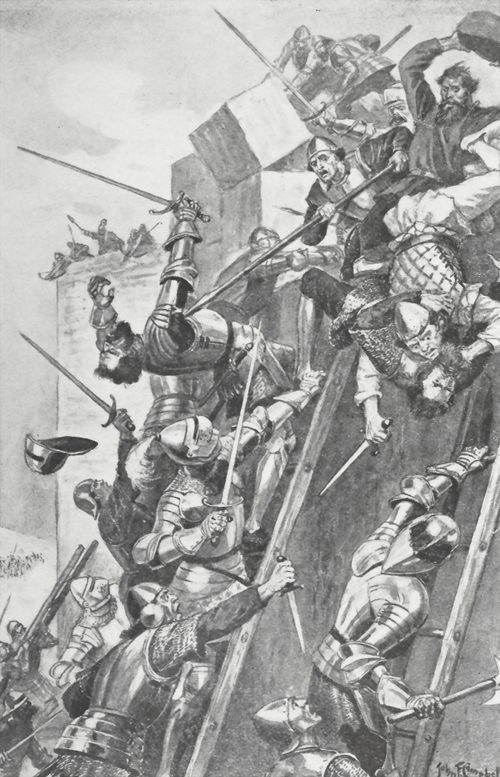
"WITH SPEAR THRUST AND SWEEP OF AXE THEY FELL UPON THE STORMERS."
Shortly after midnight the alarm was raised
that the camp was attacked, and with shouts
of "Stand to your arms!" the men-at-arms
and archers, hastily awakened, formed up
for the purpose of repelling the threatened onslaught.
Standing at his post behind his sire and
the Constable, Geoffrey could make out the
sharp thud of the hoofs of numerous horses,
while a babel of discordant sounds, shouted in a
foreign tongue, resounded on all sides of the
camp.
"Archers, make ready; let no man loose till
I give the word," shouted Sir Oliver, as, waiting
sword in hand, he strove to detect something
in the voices of his unseen antagonists that
might tell him who they were!
In spite of their rude awakening the soldiers
preserved a coolness only to be gained by constant
training in the field. Mechanically the
dismounted men-at-arms fell into line, and
dropping on one knee, drove the butts of their
long spears into the earth, while in the intervening
gaps the archers, with arrow on string,
awaited the order to let fly their deadly
shafts.
Thrice the unseen cavalry galloped completely
round the bristling circle of steel, though
at a respectful distance, as if attempting to
find a weak spot at which to deliver an attack.
"Let them keep to it," remarked Sir Oliver,
with a laugh. "Methinks their horses will be
blown ere they come within bow-shot."
"Pile on more wood, then," ordered Sir
Thomas Carberry. "Make a rousing blaze,
for 'tis in our favour, since our backs are to
the light. Then perchance we may have a
glimpse of our doughty foes."
"They shout in no French tongue, fair sir,"
exclaimed Geoffrey.
"Then, perchance, they are the German
troops whom, report saith, the Dauphin hath
hired."
"A truce to conjectures," said Sir Oliver.
"Sound a tucket—one of our camp calls—and
see what that will bring forth."
Hardly had the last notes of the trumpet
died away ere the discord ceased, save for
the clattering of a single horseman, who rode
straight for the hedge of steel, guided by the
fiercely-blazing camp-fire.
"Stand! Thy name, condition and errand,"
shouted Sir Oliver.
A rich rolling voice replied, "I am Sir Brian
of Ennisbarry, in the county of Wexford. If
ye be enemies of the King of England look to
yourselves. Further, should any knight among
you wish to ease his soul or seek some small
advancement, I am here to help him in the
furthering o'it."
"Certes, 'tis the Irish kernes," observed Sir
Oliver in an undertone; then raising his voice
he replied—
"Greetings, Sir Brian: two most unworthy
knights of Southampton give thee welcome. I
pray thee first quiet thy followers, then if it
please thee join us around the camp-fire."
Amid a babel of voices the Irish horsemen
formed a bivouac within a bow-shot of
their English companions-in-arms, and when
they had settled for the night, for they were
about to encamp just before they stumbled
across the outposts, Sir Brian, attended by
two squires, rode up to the two Hampshire
knights.
"Once again welcome, Sir Brian," exclaimed
Sir Oliver. "Though I am afeared we have
but sorry fare to offer thee."
"Sure, 'tis better than I've had these last
two days," replied the Irishman, quaffing a horn
of wine that Oswald had produced from the
baggage on his master's sumpter horse.
Sir Brian was a short, slender man of about
fifty years of age. He was clean-shaven, thus
revealing a long upper lip and a strongly-formed
cloven chin. His bluish-grey eyes were close
set, and brimming with good-humour. His
hair fell in long lank masses from beneath a
cone-shaped steel cap. His body was unprotected
by defensive armour save by a breast-plate
that terminated at his waist, and was
without gorget. From his belt dangled a long,
cross-hilted sword in a scabbard of black leather,
ornamented with Runic characters, while across
his back was slung a targe of wood covered
with undressed leather.
As for his two squires, they were unable to
speak a word of English, and since Geoffrey
and Oswald were ignorant of Irish their attempts
to entertain their visitors were limited to dumb
show.
It was a strange story that Sir Brian related
a part of. His light cavalry had been surprised
earlier in the day by the soldiers of Sir Denis,
and after a fierce engagement the former were
compelled to retreat, leaving four of their
number in the hands of the Lord of Malevereux,
by whose orders they were hanged on the
battlements of the castle.
When the Irish knight heard that Sir Oliver
was about to assault the stronghold of Sir Denis,
his excitement knew no bounds. He would,
he declared, join his men with those of the
Hampshire knights. There would be booty
enough and to spare for all, but he chiefly desired
vengeance upon the Lord of Malevereux for the
execution of his four men.
"As thou wilt, Sir Brian," quoth Sir Oliver.
"The more the merrier; but, since we start at
daybreak, thou hadst best seek repose."
When the march was resumed a strange
sight met Geoffrey's eyes. He had often heard
of the King's Irish kernes, but since they were
employed almost exclusively in scouring the
country around Rouen, he had never before
had the opportunity of seeing them.
They were for the most part only partially
clad. Many were barefooted, others boasted
of one stocking and one shoe only. They rode
barebacked upon wiry mountain horses, so
small that the riders' feet came within a few
inches of the ground.
All except their leader were quite without
armour, their offensive weapons consisting of
stout spears and long double-edged knives,
while a few carried round targes provided with
a steel spike in the place of a boss. Though they
were ill-disciplined they were excellent scouts,
while in a hand-to-hand conflict they made up
for their lack of mail by a wild impetuosity that
struck terror into the hearts of the well-accoutred
French men-at-arms.
It was late in the afternoon when the expeditionary
force came in sight of the Castle of
Malevereux. The appearance of the gloomy
pile, rendered even more forbidding by the presence
of four gibbets and their ghastly burdens
standing clearly against the sky, aroused many
burning thoughts in Geoffrey's mind.
As it was too late that day to open the assault
Sir Oliver ordered his men to rest themselves,
and having constructed hasty entrenchments
the Englishmen and their Hibernian allies lay
around the castle, so that none might leave or
enter.
The night passed without interruption, and
shortly after daybreak preparations were made
to deliver an assault upon the frowning walls.
From the neighbouring woods the besiegers
obtained timber, out of which rough ladders
were constructed, while the Irish levies, who
had tethered their horses at a safe distance from
the castle, were kept busily employed in gathering
and carrying bundles of straw and faggots to
fill the moat.
Clad in complete mail, Sir Oliver, accompanied
by his squire and a mounted man-at-arms, rode
towards the gateway, while a strong body of
archers occupied a position half a bow-shot in the
rear.
To all outward appearances the castle seemed
deserted, save by the dangling corpses of the
unfortunate Irish prisoners, but on Sir Oliver
ordering a rousing blast to be sounded, a burly
figure, whom Geoffrey recognized from a distance
as Sir Denis, appeared on the battlements, wearing
a white scarf.
"In the name of the most puissant sovereign
Henry King of England and France, I, Oliver,
knight of Warblington, summon thee, Denis de
Valadour, Lord of Malevereux, to give up the
said castle immediately and unconditionally,"
shouted the English knight.
For an answer, Sir Denis raised his right arm,
and pointed derisively at the swaying bodies
that hung from the gibbets. This action was
the signal for a sudden discharge of cross-bow
bolts from the oyelets, while a huge stone hurled
by a mangonel cunningly concealed behind a
projecting spur of masonry, flew but a few inches
above Sir Oliver's head. As for the bolts, one
glanced from Oswald's shield, another struck
the horse of the man-at-arms to the earth, but
the rest either fell short or wide.
Standing in his stirrups the Lord of Warblington
shook his fist at the treacherous and recreant
Norman, while a flight of arrows, well and truly
sped, rattled against the corslet and visor of Sir
Denis. Whether any of the missiles took effect
or not the Englishmen were unable to see, but
the knight quickly disappeared behind the
parapet.
Scorning to turn his face from the foe, Sir
Oliver, regardless of the bolts that still came
from the castle, slowly backed his horse till
out of range.
"This will be a right joyous encounter,
Thomas," he exclaimed to his companion knight,
at the same time dismounting and handing his
steed over to the care of an archer. "Is all
prepared?"
"Ay," replied Carberry. "The men are
like hounds in leash. Look also, I pray thee,
at those Irish."
"Sir Brian hath a strange following, yet,
methinks they are not lacking in courage e'en
though they may err through rashness. But
bid the archers shoot."
Under a fire so straight and true that none
of the enemy dared show himself, the Irish
kernes ran up to the dry moat and threw
down their burdens, till a swaying yet passable
causeway took the place of the raised drawbridge.
"Men-at-arms! In the name of St. George
and for Merrie England—forward!" shouted
Sir Oliver, and with one accord squires and
common soldiers ran steadily towards the walls,
keeping decorously behind the two mail-clad
knights, whose armour greatly retarded their
speed.
Mingled with the men-at-arms were several
archers, whose special duty it was to carry the
scaling ladders up to the walls, while in the
rear their comrades maintained their steady
fire.
The mass of panting, shouting, and excited
men gained the edge of the moat, and, with
swords and axes brandished above their heads,
prepared to follow Sir Oliver and Sir John across
the temporary bridge, when a cross-bowman
more daring than his fellows showed himself
for an instant above the battlements and shot
his bolt.
The next instant he toppled over the parapet,
pierced by half-a-score of arrows; but the
mischief was already done, for the quarrel
transfixed Sir Oliver's leg just above the left
genouillère, or metal knee-cap.
With a crash the knight fell to the ground,
but as two men-at-arms rushed to his assistance
he waved them off.
"To the walls," he exclaimed. "Ye can do
much service there. As for me, I will tarry here
till we gain the castle."
In spite of this momentary check the stormers
pressed forward, and scaling ladders were reared,
and, led by Sir Thomas Carberry, the men-at-arms
clambered impetuously up the swaying
and creaking timber.
Hitherto the English archers had kept the
garrison well in check, but now, fearful of
harming friend as well as foe, they desisted.
In a moment the battlements were thronged
by the desperate defenders, foremost of whom
was Sir Denis.
With spear thrust and sweep of axe they fell
upon the stormers ere the latter could gain
a footing on the walls. Many an Englishman
and Norman, clasped in a deadly embrace,
were tumbled from the battlements; to the
hoarse shouts of the combatants were added the
shrieks of the maimed and wounded, while the
steady stream of ascending men continued
without any appreciable sign of a lodgement
being obtained upon the fiercely-defended
wall.
Geoffrey, sword in hand, found himself half-way
up the creaking ladder, when a loud shout
of warning rose high above the din. The enemy
had loosened a huge mass of masonry, and
toppling it over, swept the ladders of their
human burden.
From the mingled crush of dead and wounded
the survivors contrived to extricate themselves,
and, hopelessly repulsed, began to give back,
with cries of rage and alarm.
Shaken and bruised from head to foot, but
otherwise unhurt, Geoffrey found himself lying
on the brushwood that had broken his fall.
With an effort he regained his feet, stung with
the bitterness of defeat.
"Stand!" he shouted to the wavering men-at-arms.
"Stand! E'en though we have not
yet won the day we cannot leave our comrades
here."
Encouraged by his words, and by the fact
that the English archers were again able to
deliver a death-dealing flight of arrows, the
discomfited men-at-arms stood their ground,
and began to remove the bodies of their unfortunate
comrades from the floor of the moat, and
with some semblance of order they retired to
the rear of the bowmen.
The losses in the repulse had been great.
In addition to Sir Oliver, the Constable of
Portchester had been stunned through being
hurled from the ladder, while eleven dead and
fifteen badly wounded men-at-arms testified
to the stubbornness of the defence.
"Geoffrey, my son," exclaimed Sir Oliver,
as Gripwell and another man-at-arms were
preparing to withdraw the quarrel from his leg,
"on thee has fallen the command. Thou
must needs turn this check into victory, and
that soon, otherwise 'tis better to perish to a
man than to return to our King beaten and dishonoured."
Then overcome by the anguish of his wound
the knight swooned.
The squire realized the responsibility that
had been forced upon him. Undoubtedly
he must act, and that quickly; yet he
was adverse to making another attempt
without adopting some other and better plan
of attack.
Hastily conferring with Oswald, Gripwell,
and Sir Brian, he expounded his proposals for
the renewed assault. The Irish, who had hitherto
been held in reserve, were to set fire to the
heap of faggots and straw that lay in the moat
before the gateway. Should the latter be
sufficiently charred to enable it to be splintered
with axes, the kernes were to dash through the
smouldering embers and force an entrance;
while the men-at-arms, led by Geoffrey, were
to assail the postern through which the two
squires had effected their escape on the occasion
of their captivity.
The main entrance and this portion being on
opposite sides of the castle gave the attackers
an advantage, inasmuch as the besieged would
be compelled to divide their numbers instead of
concentrating the whole of their forces in one
spot.
"Bravely thought of, young sir," exclaimed
Sir Brian. "Give my fellows but a footing
in the gateway, and they'll serve yon villains
as did the blessed St. Patrick the serpents in ould
Ireland."
"Saving thy presence, sir," quoth the master
bowman. "Our stock of arrows is but scanty.
Already many of the archers have empty
quivers."
"Then I pray thee bid them husband their
shafts," replied Geoffrey. "Without a covering
flight the escalade will assuredly be a doubly-hard
task. Art ready, Sir Brian?"
Supported by a steady discharge of arrows
a body of the Irish levies, bearing flaming
torches, rushed to the edge of the moat, and
in a few moments a crackling column of flame
ascended.
While the fire was in progress, Geoffrey,
profiting by the confusion, led his men-at-arms
to the opposite side of the castle, where,
lying in ambush in the depression formed by a
brook, they waited the signal for the combined
assault.
As soon as the fire had burned itself out, Sir
Brian placed himself at the head of his men, and
with a wild shout the Irish rushed at the charred
door. Though numbers fell as they crossed the
moat the advance was irresistible. With a
ponderous crash the timbered door was shattered,
and the ill-armed swarm of Irishmen flung
themselves upon their better accoutred yet
demoralized foes.
Meanwhile the English men-at-arms had
crossed the pike-studded moat, and, ere the
defenders were aware of the assault, fifty mail-clad
warriors had forced the wicket gate at the
end of the disused postern-gallery.
With shouts of triumph the assailants threaded
their way through the narrow tortuous passages
and emerged at the inner bailey. Here they
found themselves in the rear of the survivors
of the garrison, who were being hard pressed
by the Irish kernes.
Caught betwixt two bodies of their attackers
the Normans fought with the fury of despair,
scorning to ask the quarter that they knew
would be denied them.
Sir Denis was almost the last to fall. In spite
of his cruel and treacherous character he was no
coward in the fight, and wielding his axe with
ferocious skill and strength, he kept at bay the
circle of steel that surrounded him.
At length, mindful of Geoffrey's shouts to
take him alive, three of the men-at-arms using
a stout plank as a means of offence, brought
him to his knees. Even then the knight continued
to lay about him, till he was finally over-borne
by a rush of the infuriated Irish, who
were with the utmost difficulty prevented
from plunging their knives into his body.
"I pray thee make an end and that quickly,"
exclaimed Sir Denis dauntlessly, when, at the
end of the combat, he was brought before
Geoffrey.
"That I must do," replied the squire. "Yet
e'en though thou hast dealt foully with me and
mine, 'tis not by my will that thou must die.
By the orders of my sovereign lord—and thine,
though thou art a rebel—thou must be hanged
on thine own battlements."
"Hanged!" exclaimed Sir Denis, his face
turning an ashen grey. "Hanged! 'Tis impossible.
A knight to die a villein's death?"
"Such are mine orders," replied Geoffrey
curtly. "If there is aught on thy mind thou
mayest have an hour's respite."
The sun was sinking low in the west as the
doomed prisoner, accompanied by a strong
guard of men-at arms and archers, was led to the
battlements, where Sir Brian, Geoffrey, Oswald
and Walter Talbot were present to execute the
King's commands. Already some of the Irish
troops had removed the bodies of their comrades
from the gallows, and the rope of one was in
readiness to receive its victim.
With a firm step Sir Denis walked to the place
assigned for him, his arms bound behind his
back, and his neck bared for the fatal
noose.
"Young sir," said he, "cannot this be put
aside? I do not beg for life, yet of thy
charity, give me the axe rather than the
cord."
"Nay," replied Geoffrey shortly, for he could
not trust himself to say more. Then turning
to the archers he signed to them to proceed with
their work.
As one of the men bent to secure the knight's
ankles, Sir Denis leapt backwards, sprang on to
the parapet, and with a hoarse roar of defiance,
dropped to his death upon the rocks fifty feet
below.
CHAPTER XXIX THE GOLDEN SPURS
That night the victorious troops spent in
possession of the captured castle. Sir
Oliver and Sir Thomas Carberry were brought
within the fortress, and every possible care was
bestowed upon the disabled leaders.
Sir Oliver's wound, though not dangerous,
would prevent his taking the field for many
weeks to come, while the Constable of Portchester's
condition gave cause for great anxiety.
It was, therefore, decided to remove the two
knights and the two score and nine wounded
soldiers to the Castle of Taillemartel, that had
long since been occupied by the English invaders.
Accordingly this was done, and the helpless
men were sent thither in wains under a suitable
guard; the Castle of Malevereux was thoroughly
plundered, and afterwards given to the
flames; and the Irish kernes, each man with
a goodly bundle of loot thrown across his wiry
steed, rode off to find fresh openings for their
activity.
Mustering his scanty force, Geoffrey gave the
word to march, and with eight wagons, piled
high with booty, the column set off towards the
King's camp before Rouen, leaving a tall pillar
of smoke in their rear as a token that their
mission was accomplished, and that the accursed
pile of Malevereux would no more be a terror
to the countryside.
Without interruption the two companies
arrived at Pont de l'Arche, where Geoffrey
handed over the spoil to the custody of the
keeper of warlike stores. This done, the
march was resumed towards their quarters
on the left bank of the Seine.
At a bend in the road Geoffrey perceived a
large body of horsemen riding towards him.
Knowing not whether they were friend or foe,
since straggling parties of Frenchmen frequently
assailed the English outposts, the squire ordered
his men-at-arms to dismount and the archers
to make ready.
"Canst discern their banners?" he asked of
Oswald, who was riding at his left.
"Nay, the sun is behind them," replied Sir
Oliver's squire. "Yet, for their numbers there
is no lack of standards and banners."
As he spoke a horseman was observed to leave
his party and ride rapidly in the direction of the
Hampshire men.
"Hold!" he shouted, when he came within
hailing distance. "Who and what are ye?"
"We are of the companies of Sir Oliver Lysle
and of Sir Thomas Carberry," replied Oswald,
"and are for the camp before Rouen, having
completed some small enterprise at the Castle
of Malevereux."
"Then why are not the banners of these two
gentle knights displayed?" returned the horseman.
"But delay thine explanations: yonder
is none other than King Henry. To him thou
must needs give account of thyself."
With fast-beating heart and rising colour,
Geoffrey ordered his men to redress their ranks,
and with Oswald at his side, and Gripwell, bearing
the furled banner of Malevereux, close behind
him, the young leader rode to meet his
royal master.
The King had that morning made a circuit
of the entrenchments, and accompanied by the
Dukes of Exeter, Gloucester, and Clarence, and
a galaxy of gaily attired nobles and clerics—amongst
the latter being the warlike Cardinal
Beaufort—was on the point of returning to his
quarters when the sight of a column of armed
men marching from the direction of Malevereux
arrested his attention.
"By my halidom!" exclaimed the King.
"We would know why yon body of soldiers
should approach our lines without displaying
the banner of the knight in command. 'Tis
contrary to our express orders. Therefore, Sir
Gilbert, ride over and ask their leader why our
commands are disregarded. Bid them also
approach, so that we may see what manner of
men they are."
"From Malevereux!" exclaimed Henry on
the return of his messenger. "Then Sir Oliver
hath failed to carry out our commands? Dare
he return with defeat written broad upon his
features?"
Impatiently the King awaited the approach
of the leader of the expedition, the absence of
the knight's banner having misled him as to the
issue of the enterprise.
"Where is Sir Oliver Lysle?" he demanded.
"Sire, he hath been wounded and hath been
left at the Castle of Taillemartel, as also hath
Sir Thomas Carberry," replied Geoffrey.
"And the rebel Sir Denis of Malevereux:
hath he been hanged on the battlements of his
own castle, according to our commands?"
"Nay, Sire——"
"Then thou hast ventured to return hither
branded with the unpardonable disgrace of
defeat?"
"Sire," replied Geoffrey, pointing to the
captured standard that Arnold Gripwell had
unfurled, "Sir Denis is dead, slain by his own
act, ere we could work thy will upon him. We
were, by the grace of God, able to carry the
castle after one repulse." And in a few words
the squire gave a plain account of what had
occurred during the expedition, modestly omitting
the gallant part he had played in the final
assault.
"Thy name, squire?" demanded the King,
and Geoffrey gave it.
"By our Lady! Thou art the same that
served us right well at Southampton, and
again on the eve of our victory at Agincourt,
though at the end of that thou didst wellnigh
place thy neck in a halter. By the soul of my
father we have a good memory for such matters.
Now, return to thy company, young sir. Sir
Gilbert, bring before us the two squires whom
we perceive stand at the head of the column."
The King listened attentively to Oswald's
version of the capture of Malevereux, the squire
mentioning several details that Geoffrey had
purposely omitted, while young Talbot stoutly
praised Geoffrey's bravery in rallying the discomfited
stormers at the termination of the
first onslaught.
"Then 'tis to Squire Lysle that the credit of
the successful assault is due?" remarked Henry.
"Are we to understand that both Sir Oliver
and the Constable of Portchester were sore
hurt before the second attempt was made?
And is this the reason why their banners are not
displayed?"
"Such is the case, Sire," replied Oswald.
Once again Geoffrey was called before his
sovereign, while the men-at-arms and archers
were formed up in a double line twenty paces
from where the King and his retinue were
standing.
"Geoffrey Lysle, squire to that right worthy
knight, Sir Thomas Carberry," began the King,
"it hath been our pleasure to receive from the
hand of thy master no slight account of thy
deeds and thy devotion to duty in times past.
Moreover, under divers circumstances, we ourselves
have witnessed thy courage on the field of
battle.
"Concerning this latter we are judging by
the outward appearance, which, as we know to
our cost, is apt to be deceptive. E'en the
sweetest flower may harbour a vile worm gnawing
at its stalk unperceived; a brave coat of
mail may conceal a craven heart, a closed visor
a face graven with treachery. Yet, on the
other hand, Sir Thomas hath had ample opportunities
to study thee at the festive board, in
the camp, and in the hour of peril. Courage
alone counteth for little; yet, when consorting
with loyalty, truthfulness, and humanity, 'tis
a fitting quality for a knight.
"Thou hast found thyself in petty disgrace
ere now, young squire, yet for this we must
make due allowance withal. By our Lady, we
can call to mind divers misdeeds committed
in our youth, the which our enemies have
thought fit to make much of. Hence we can
lightly pass over thy transgressions and reward
thy good and gallant deeds in the past." Then
turning to Sir Gilbert the King asked for his
sword.
"Kneel, young sir."
With bowed head and overflowing heart
Geoffrey sank on his knee. The long-hoped-for
guerdon was his.
"Arise, Sir Geoffrey Lysle!" exclaimed the
King in a ringing voice, bringing the blade
lightly down upon the young warrior's shoulder.
Amid loud shouts of delight and redoubled
cries of "Long live the King!" Geoffrey arose,
and, with more words of good cheer and advice,
Henry re-mounted his charger, and accompanied
by his suite resumed his way to the camp.
With the passing of Geoffrey Lysle the Squire
our story draws to a close.
It remains to be said that the newly-made
knight bore himself right valiantly throughout
the long-drawn siege of Rouen and the stern
conflict before Pontoise, adding to his laurels in
a manner worthy of a man whom the King had
delighted to honour.
After the Perpetual Treaty of Troyes, Geoffrey
followed the example of his royal master, and
took unto himself a wife from the Land of the
Fleurs de Lys, the fair bride being Aimée,
daughter of the chivalrous Raoul d'Aulx.
Oft-times did Sir Geoffrey Lysle cross the
Channel under the banner of England, and, in
the dark pages of history relating to the undoing
of all that King Henry V had achieved, his
deeds, together with those of numerous warriors,
both of high and low degree, serve to show that
in the hour of defeat the spirit of the English
nation can still remain undaunted.
Oswald Steyning, too, won his spurs, by a
signal act of devoted gallantry at Verneuil.
Throughout the long-drawn contest for the
possession of the realm of France the two knights
maintained the bond of friendship cemented
in their early days, and on their retirement
from service in the field no joust or spear-running
held in the counties of Hampshire and
Sussex was considered a success unless honoured
by the presence of the veteran knights,
Sir Geoffrey Lysle and Sir Oswald Steyning.
The valiant old man-at-arms, Arnold Gripwell,
settled down to a quiet life upon his freehold
farm purchased by the hard-earned spoils of the
field of battle. But his martial instincts oft reasserted
themselves, especially when, surrounded
by an eager crowd of boys—the future guardians
of the sea-girt realm of England—he
would relate the story of how the young Squire
of Warblington won his spurs in the glorious
days of Agincourt.
Printed by Butler & Tanner, Frome and London.
Some attractive Volumes from the Catalogue of
THE PILGRIM PRESS.
SPLENDID SELECTION OF BOOKS FOR BOYS.
ROBERT LEIGHTON'S ROMANCES.
WITH NELSON IN COMMAND.
A Tale of Nelson and the Baltic. With Illustrations. Imperial
16mo, cloth boards, olivine edges, 3s. 6d.
Third Edition.
Morning Post.—"The reader obtains a good idea of Nelson's character, while the
condition of the eastern counties of England at a time when smuggling was rife and the
pressgang won men for the Navy is described with accuracy. The story itself goes with
a swing and dash which make it excellent reading, and if the young hero's promotion to
the quarter-deck is rapid, he certainly won it manfully."
Nautical Magazine.—"While the historic narrative of the Battle of the Baltic is
carefully adhered to throughout, the story lends an element of excitement and charm
which makes us forget we are reading history. The book is a splendid one for boys."
THE GREEN PAINTED SHIP.
A Romance of the Sea. With Illustrations by J. W. Charlton.
Imperial 16mo, cloth boards, olivine edges, 3s. 6d.
Second Edition.
Daily Telegraph.—"A mutiny, an abandoned ship, the discovery of a pirate's hoard
of treasure, and many exciting episodes, go to make up a story after the British boy's own
heart, and one that fully maintains its author's reputation as a writer of stirring and
exciting tales."
HURRAH FOR THE SPANISH MAIN.
A Tale of the Days of Drake. Illustrated by J. Ayton Symington.
Imp. 16mo, cloth boards, olivine edges, 3s. 6d.
Guardian.—"Boys should, and will, be grateful for an excellent story of peril and
adventure."
Methodist Recorder.—"We can hardly imagine the boy to whom its stirring pages
will not appeal."
THE OTHER FELLOW: The Mystery at Barracombe
Manor.
Illustrated by Saville Lumley. 6s.
Standard.—"There is plenty of sensation, but it is of a healthy kind, and the
detective interest is very skilfully managed. We should not be surprised if the book
were to be one of the favourites of the season."
THE HAUNTED SHIP.
A Romance of the Devon Smugglers. With Six full-page Illustrations
by H. L. Shindler. Imperial 16mo, cloth, olivine edges,
3s. 6d.
Second Edition.
St. James's Gazette.—"Everything that a boy's book ought to be, and seldom is."
Expository Times.—"From beginning to end it is exciting, and the hair's-breadth
escapes of its hero will delight all its readers."
IN THE LAND OF JU-JU.
A Tale of Boys' Adventures in Benin. With Six full-page Illustrations
by Cecil Scruby. Large imperial 16mo, cloth boards,
olivine edges, 3s. 6d.
Second Edition.
"A delightful story, which has, too, a geographical and historical value."—Daily
Telegraph.
FIGHTING FEARFUL ODDS; or, The Temptation
of Jack Rodney.
With Six full-page Illustrations by J. Ayton Symington.
Imperial 16mo, cloth boards, 3s. 6d.
"A clever story, interesting throughout, and wholesome in tone."—Record.
"Such a story as this is all too rare."—Spectator.
"There is not a dull page in the book."—Newcastle Chronicle.
UNDER THE FOEMAN'S FLAG.
A Tale of the Spanish Armada. Illustrated by Paul Hardy.
Imperial 16mo, cloth boards, 3s. 6d.
Second Edition.
"A rattling story, quite one of the best of the year."—Daily Chronicle.
"The story is told with great spirit, and is full of excitement and interest."—Standard.
IN THE GRIP OF THE CORSAIR.
An Historical Romance of the Mediterranean. With Illustrations
by Maynard Brown. Imperial 16mo, cloth boards, 3s. 6d.
Third Edition.
"It is a stirring story, and well told."—Speaker.
A GENTLEMAN ADVENTURER.
A Story of Panama, 1698. By John Bloundelle-Burton,
Author of "The Hispaniola Plate," etc. With Illustrations by
Maynard Brown. Imperial 16mo, cloth boards, 2s. 6d.;
paper covers, 6d.
Third Edition.
"Few will lay down the story without feeling that they have for a time been completely
carried away into a stirring world and into contact with vigorous passions."—Times.
IN A DEEP-WATER SHIP.
A Personal Narrative of a Year's Voyage as Apprentice in a
British Clipper Ship. By Ernest Richards. Profusely Illustrated.
Imperial 16mo, cloth, gilt top, 3s. 6d.
16 Pilgrim Street, London, E.C.