The late autumn afternoon was rapidly drawing in, closing ominously and
sullenly, as if rebelling against the approach of the winter, and the
nearer coming of the night.
Great banks of purple vapour rose in the west; and sinking towards the
earth, spread abroad in hazy wreaths, which seemed to possess, in a
fainter degree, the hues of their parent clouds above.
The air was heavy with moisture, which condensed and dripped from the
red leaves of the sycamore, the brown of the beech, and the yellow of
lime and poplar. It glistened on the rich green of the crimson-berried
hollies; it begemmed the festooning webs of the weaving spiders; and
brought with it a chilling breath which seemed to strike through one.
In that gloaming hour a man and youth toiled wearily up the steep hill
over which the main road runs before it descends into the quaint old
town of Stow Ormond; yet as they reached the summit they hastened
their steps, with the air of those who were drawing near to a welcome
resting-place.
The man was tall and refined-looking; and though a crisp, curling beard
and full moustache hid the greater part of his face, the features
visible revealed determination and strong will, and their bronzed hue
showed plainly that their owner had lived beneath warmer skies than
those of England. And yet, despite health and good looks and strength
of will, an expression of anxiety was there; and as he walked along he
appeared to be more occupied with his own thoughts than in attending to
the remarks of the lad by his side, whose questions he frequently left
unanswered.
The boy was so like the man that there could be little room for
doubting that they were father and son; a well-built, handsome youth,
with the same bronzed cheek, but with an expression on his face which
indicated the utmost disgust with his surroundings. This was his first
experience of a damp, chill autumn mist, and he did not like it in the
least.
Both the travellers were comfortably clad, though their clothes seemed
cut more for comfort than with a regard to fashion; indicating that
they certainly were not from the workshop of any fashionable tailor.
Reaching the top of the hill, the two wayfarers paused; and the man,
pointing down into the town which lay before them, said, with a sigh of
relief:
"There you are, Ralph! That is our destination for to-night; it may be
our haven for many days."
"Funny looking place," laughed the boy. "But all these English towns
are funny, after the plains and the mountains. And it is funny," he
added, "that I am an English boy, and yet am talking like that."
"Not funny, lad, seeing that you have never set foot in your native
land before. Ah me, it is not funny to me! It comes back like the
faces of old familiar friends. The scenes of childhood's happiness,
and youth's hopes and follies. All changed, and yet nothing changed;
and I myself unchanged, and yet most changed of all! Come," he went
on, "you are tired, for we have walked a long way, and have had a long
railway journey into the bargain. Unless things are altered down there,
we shall find a comfortable old inn where we can put up, Ralph—a real
old English inn. Quite different from the hotels where we have stopped.
Come on, lad!"
Changing his handbag from one cramped hand to the other, the lad obeyed
the call, and trudged forward briskly with the strong, elastic step of
buoyant youth. At first he poured out a string of questions relative
to life in English towns; but one or two being unanswered, he glanced
towards his father, and perceiving him buried in thought again, he
walked on in silence, yet keen-eyed, noting everything around.
A few scattered cottages and outlying buildings passed, the pair
were in the precincts of the town itself; and almost one of the first
houses they came to was the one the father sought—a quaint, thatched,
many-gabled old place, with commodious stabling and a great creaking
sign-post near the horse trough, giving the information to all who
cared to possess it that this was the Horse and Wheel Inn, wherein
might be found accommodation for both man and beast.
"Just the same! Nothing changed!" murmured the man as the two arrived
at the spot. "Twenty years have brought no revolution here. Come, lad!"
And he entered the old hostelry.
A bonnie waiting-maid met them; and in response to the man's query if
they could have a room she called the landlord, a portly old fellow,
with bald head fringed with grey hair, a pair of twinkling merry
eyes beneath overhanging brows, and a face wherein all the principal
features seemed to be entered into a competition as to which could look
the ruddiest.
"Have a room, sir?" said this individual, in a voice which seemed to
proceed from his boots. "Ay, that you can, sir, and all else that you
require. Here, Mary girl, show the gentleman to Number Ten! Have the
bags carried up, and serve their dinner in the private room."
"Number Ten!" said the guest, as he heard the number given. "Come on,
Ralph, I know the way!" And he led his son upstairs with the air of
one who did indeed know, much to the worthy landlord's astonishment,
who murmured to himself as he waddled off to attend to some waggoners—
"He must ha' been here before; but I don't remember his face in the
least."
"He does not recognize me," mused his guest, in his turn. "How should
he, after all those years? Poor old Simon, he has not changed much! A
little stouter, a little huskier, and more shaky; that is all. Time has
dealt gently with him!"
The meal, which was ordered and duly served, proved that the Horse
and Wheel, whatever it might do for beasts, claimed no more than its
due when it came to accommodating the beast's master, man; and the
appetites of the travellers enabled them to do ample justice to the
food, served in a room rendered all the more cheerful by the roaring
fire—a good, old-fashioned English fire—which blazed away in the
capacious fireplace.
But the meal over, the gentleman rose and donned hat and coat, turning
to his son when he had done so.
"Ralph," he said, "I am going out by myself. I have not brought you
across the ocean and to this place for nothing. I have business to do
here which may affect all your future life. What that business is, lad,
I cannot tell you just now; but you shall know of it presently. I shall
not be away long—not more than an hour or two—and you can spend the
time as you like. I do not suppose that you will find much in the shape
of literature here, beyond a copy or two of some local paper or an
agricultural magazine. They won't interest you much, so you must occupy
the time as best you can. Prospect around a bit, but don't miss your
way, or you will find it harder to pick up trails again here than you
would out yonder where we have come from."
"I shall be all right, father," the boy answered, rather pleased than
otherwise to be left alone for a little. Every lad of fourteen with any
spirit in him rather likes that kind of thing.
"Of course you will be. You cannot very well get into harm, and you are
not the boy to get into mischief. Well, good-bye, my lad, and to-morrow
if all is well, I will show you what English rural scenery is like, and
you will find it is more beautiful than it has seemed to you yet." And
with that the gentleman went out, leaving the boy alone.
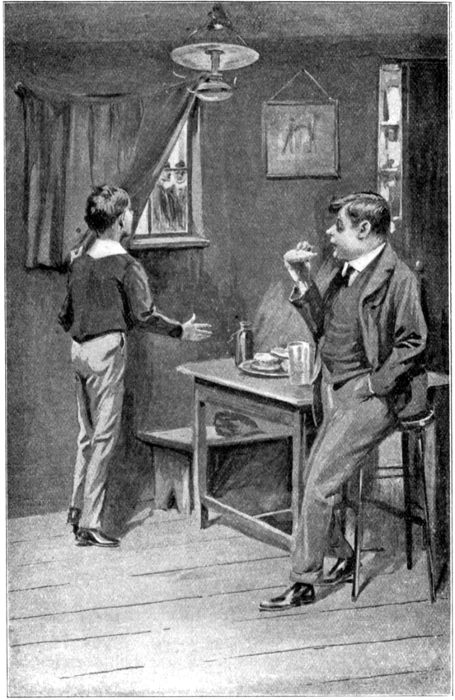
At first Ralph wandered round the rooms and examined all the funny,
old-fashioned pictures, and frowned at some old-time Dresden ornaments
of shepherds and shepherdesses in Court attire, as though he was not
quite sure whether they were intended for pagan idols or not; and then,
getting tired of this, he put on his hat and strolled down into the inn
yard, where he found more to interest him in an ostler who was busily
grooming a couple of powerful waggon horses. Ralph had never seen a
real cart-horse before, for the horses he had been accustomed to were
little, thin, wiry creatures, all sinew and bone, and spirit—horses
that could go, and would go, until they dropped, but pigmies compared
to these mighty creatures—the largest of all the species.
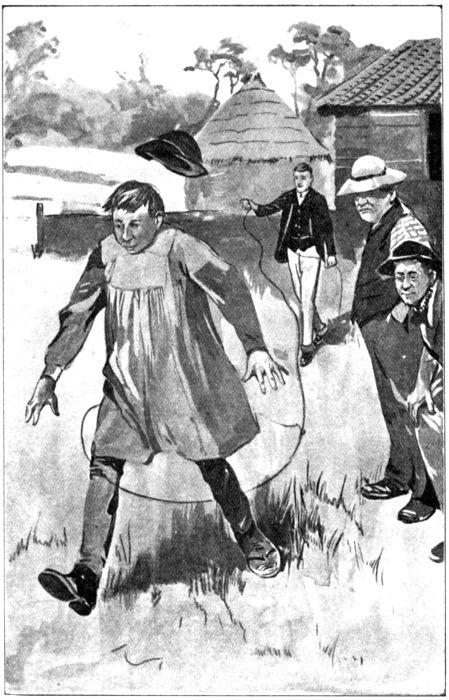
Then he picked up a long coil of rope lying near and examined it
with critical eye, which yet seemed to disapprove of its texture and
quality; and then, idly fashioning a running noose at one end, he
coiled that rope up, and sent it with a flying jerk over a post thirty
feet away.
The man stared and paused in his work.
"Ay, but ye couldn't do that again, sir," he ventured; and Ralph, with
a little flush of something like conceit, immediately repeated his
performance.
"That be main clever," said the man, and he shambled off to get "Tom"
and "Garge" and "Luke" to come and see the young gentleman's wonderful
deed.
Ralph was delighted, and he varied his work by sending the noose over
one of the men as he ran at full speed across the yard. It was nothing
to him; he had handled a rope as soon as he had handled anything, and
he wondered at the surprise the thing caused to these men.
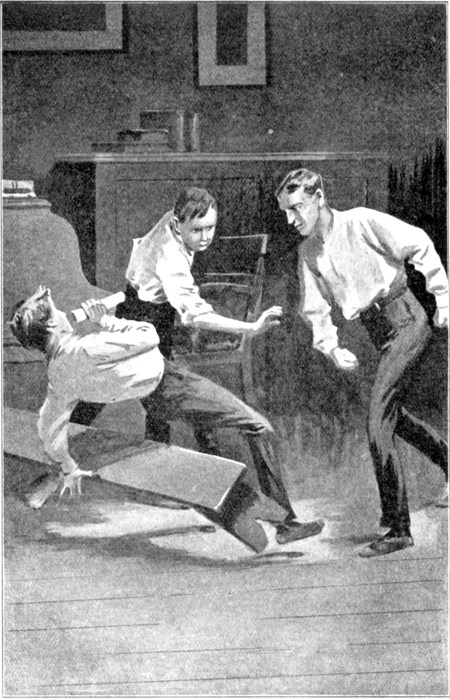
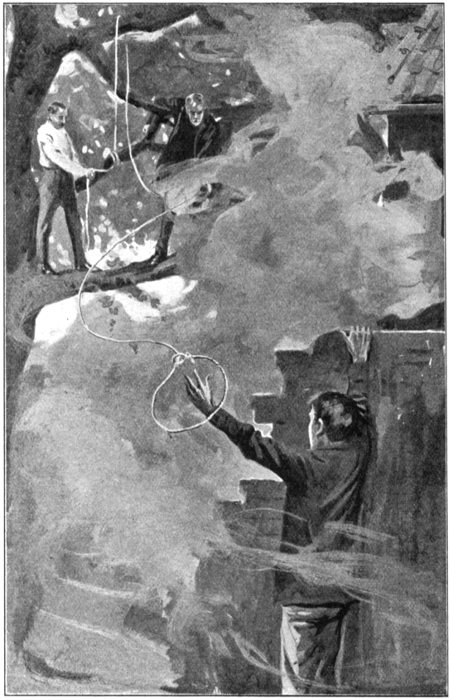
"Sending the noose over one of the men as he ran at
full speed across the yard." p. 7
A drove of cattle passed, and Ralph paused and regarded them with
interest. They were good beasts, but nothing like the troublesome
wild cattle which he had known. They seemed perfectly contented with
everything in this life.
"They are very quiet," he observed, and the man nodded.
"They be quiet enough, sir, but there be a bull in yonder paddock; ye
will see him in a minute, for they will be coming to drive him back to
his shed; and he be very savage. He ha' killed two poor chaps now, and
it be a risky job dealing with him. He be quiet enough as a rule; but
when his temper is bad, then he is bad, too—and very bad."
"I would like to see him," was the boy's answer; and almost before
the words were out of his mouth he had his wish granted; for a fierce
bellow of deep-voiced rage was heard, and rushing along, a broken
halter streaming behind, there came a magnificent black bull, while
in his rear, shouting and waving their arms in distress, ran two men,
who had evidently been engaged in bringing the monster home when he
had turned upon them, and sent them spinning this way and that ere he
darted off.
Every one in the way rushed to the nearest cover without ceremony; and
then a wild scream of terror broke on the air, and Ralph saw, directly
in the fierce creature's path, a pretty girl, seemingly but a year
younger than himself; a girl transfixed with fright, standing there,
directly in the pathway of horrible injury, if not death!
And what could he do? He who had been used to cattle was the only one
who kept his courage. Had he been in the saddle and armed with a good
stock whip the thing would have been touch and go; but he had nothing,
and he could not tackle the bull empty-handed.
Stay, there was one thing—the rope! A chance, but a slender one. Quick
as a flash he put a couple of turns round the post he had been aiming
at and gathered the noose for a cast. The bull came thundering along
the road, head down, tail out, snorting with rage and defiance. If it
kept on like that it would pass quite close to him. He put another turn
round the post. The shorter the rope the better the chance; and then,
hand and eye acting in unison, he sent the noose round his head and
made his cast. If he succeeded the bull would be over, if he failed the
girl must go down.
And succeed he did. It was to him quite an easy throw. The noose
settled fairly over those curving horns. There was a jerk, a roar of
rage and fear, and the great struggling creature was hurled forward so
violently, through the force of its flight, that it fell in a cloud of
scattered mud and stones, and lay half stunned and wholly bewildered.
Ralph, with a cry of thankfulness, ran forward, and pulled the girl
from her dangerous proximity to its mighty legs, just as a gentleman,
pale with terror, rushed from a shop near by, where he had been giving
some orders.
"Irene!" he cried. "My little Irene! Thank Heaven that you are safe!"
Then, as he saw the bull still noosed, and now in the hands of several
men, he went on—
"But who did that? Who stopped the bull in that way?" and a dozen hands
pointed to Ralph, who stood there feeling rather confused and awkward,
and wishing that he could run away. Young ladies were more terrible
things in his eyes than were angry bulls; and this young lady was
thanking him so prettily, while her father, for so the gentleman was,
kept shaking his hand, hardly able to voice his gratitude. He seemed
overcome with a sense of the good hand of Providence in the matter.
"You are staying at the inn," he said. "I must return and express my
thanks to your father. I will take my little daughter home first and
then come back. Perhaps he will be in by then. What is your name, my
dear young gentleman?"
"Ralph Rexworth," the lad answered. And the gentleman answered—
"And mine is Hubert St. Clive, and if ever I can be of service to you I
shall think nothing too much to enable me to show some return for what
you have done for me and mine this evening."
It was really a relief to Ralph when Mr. St. Clive had gone, and he was
glad to get back to his room and escape the curious and admiring crowd,
though even then he could not shut the landlord out, nor prevent the
admiration of the maid, who would come in on all sorts of pretexts just
to have a peep at him; and so the evening wore on, and the time for his
father's return drew near.
But no father came, and at last Ralph began to grow anxious. He could
not tell why, but he felt nervous. Had he been alone on the great Texan
plains, where his boyhood had been passed, he would not have cared in
the slightest; but here he was so lonely, everything was so different.
His father had been gone nearly five hours, and Ralph did not know what
to make of it.
And ten came and went, and eleven; and the landlord looked in
restlessly, for the old fellow was beginning to have uneasy suspicions
that his guest had gone off and did not mean to return again, and there
was the dinner unpaid for.
Still, he could not turn this lonely boy out, so he suggested at last
that Ralph should go to bed.
"Most like your father has been detained, sir, and he won't be back
till the morning," he suggested. "Even if he does he can ring us up. We
likes to get to bed as soon as we can after closing time, for the days
are long enough, and we do not get too much rest."
So the landlord said, and Ralph took the hint and went to his room.
Throwing himself beside his bed, he prayed as he had never prayed
before, asking his Heavenly Father to quickly send back to him his own
dear parent.
To bed, but not to sleep. What could have happened to his father? Had
he met with any accident? A thousand fears and questions presented
themselves to the boy's mind, until at last he fell into a restless
sleep, to dream that his father was calling to him for aid; and when
he awoke it was to the alarming knowledge that he was still alone—his
father had not come back.
His distress was now intensified, and old Simon, the landlord, was
very perplexed; but he was a good-hearted old fellow, and he saw that
the boy was provided with a good breakfast, reminding him that Mr. St.
Clive would be certain to be round in the morning, as he had not come
the evening before, and that then they could consult with him as to
what was best to be done.
"You have your breakfast, anyhow," he said. "No one is worth much
without their food. Mr. St. Clive is a very good gentleman, and he owes
you a lot for having saved his little daughter. I am quite sure that he
will be ready to advise you."
"But where can my father have got to?" asked Ralph, and the old man
shook his head.
"It is more than I can say, sir. Perhaps he will be back soon."
But no father came; and when Mr. St. Clive arrived, which he did soon
after breakfast was over, he was informed of Ralph's trouble, and he
looked very grave indeed.
"Run away! Nonsense, Simon?" he said to the landlord, after he had been
told. "That is absurd! If this gentleman had desired to do anything so
base as desert his son, he would never have brought him all the way to
England in order to do so. I will see the young gentleman."
"My dear lad," he greeted Ralph, when he was shown into the room where
the boy was. "I was unable to return last evening, but I understand
that it would have been no use had I done so. Your father has not come
back, I hear."
"No, sir," replied Ralph; "and I feel very troubled, for I cannot
imagine what has kept him away. He said he would only be a short time."
"You do not know where he was going, or whether he knew any one in the
locality?"
But Ralph shook his head.
"I do not know, sir. Father did not tell me anything. We have lived all
my life on the ranch in Texas, and when mother died last year father
sold the ranch and brought me to England; but he did not tell me why."
"It is strange; but still, it is foolish to make trouble. He may have
found his business take longer than he anticipated, and—well, Simon?"
"Beg pardon, Mr. St. Clive, but one of the men from Little Stow has
just come in, and he has brought me this. He says that he found it in
Stow Wood, just by the Black Mere."
And what was it that he had found? What was it that should wring a cry
of grief from Ralph Rexworth? Only a hat—broken, as from a blow, and
with an ominous red smear upon it. Only a hat; but that hat was never
bought in England. It was the hat which his father was wearing when he
left the inn the previous evening; and there it lay now upon the table,
a grim, silent explanation of why that father had not returned.