Larger versions of most illustrations may be seen by right-clicking them
and selecting an option to view them separately, or by double-tapping and/or
stretching them.
BY THE SAME AUTHOR
A PRISONER OF FRANCE, the
Memoirs, Diary, and Correspondence of
Charles Boothby, Captain Royal Engineers,
during his last Campaign. Square Crown
8vo. Cloth. Price 6s. Containing Frontispiece
Portrait of the Author, and several Pen-and-ink
Sketches.
“We cordially recommend this charming bit of autobiography.”—Daily
Chronicle.
“Should be in the hands of all young soldiers, for it is a
manual of soldierly kindness and fine humanity.”—Vanity
Fair.
A. & C. BLACK, SOHO SQUARE, LONDON.
AGENTS IN AMERICA
THE MACMILLAN COMPANY 66 Fifth Avenue, New York
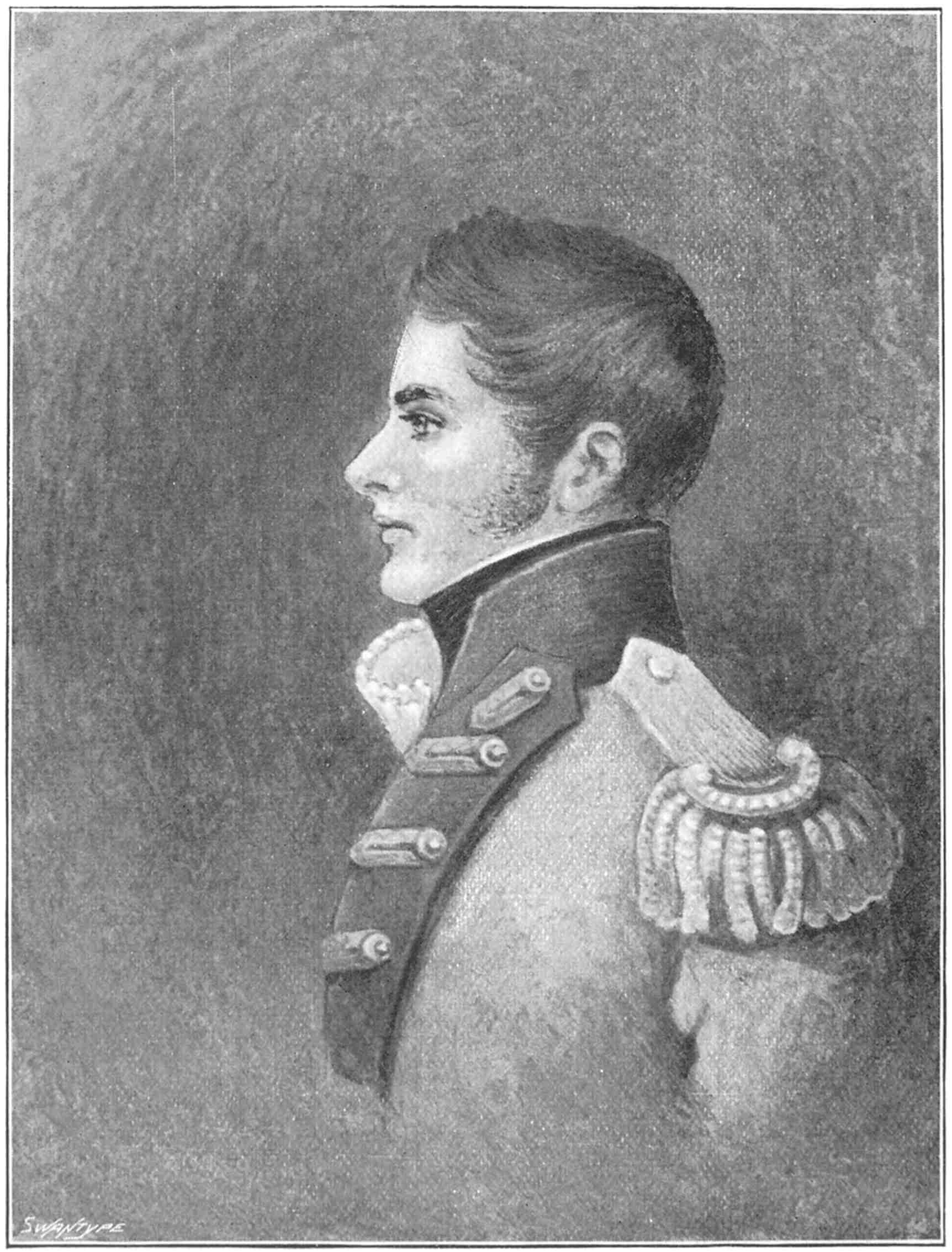
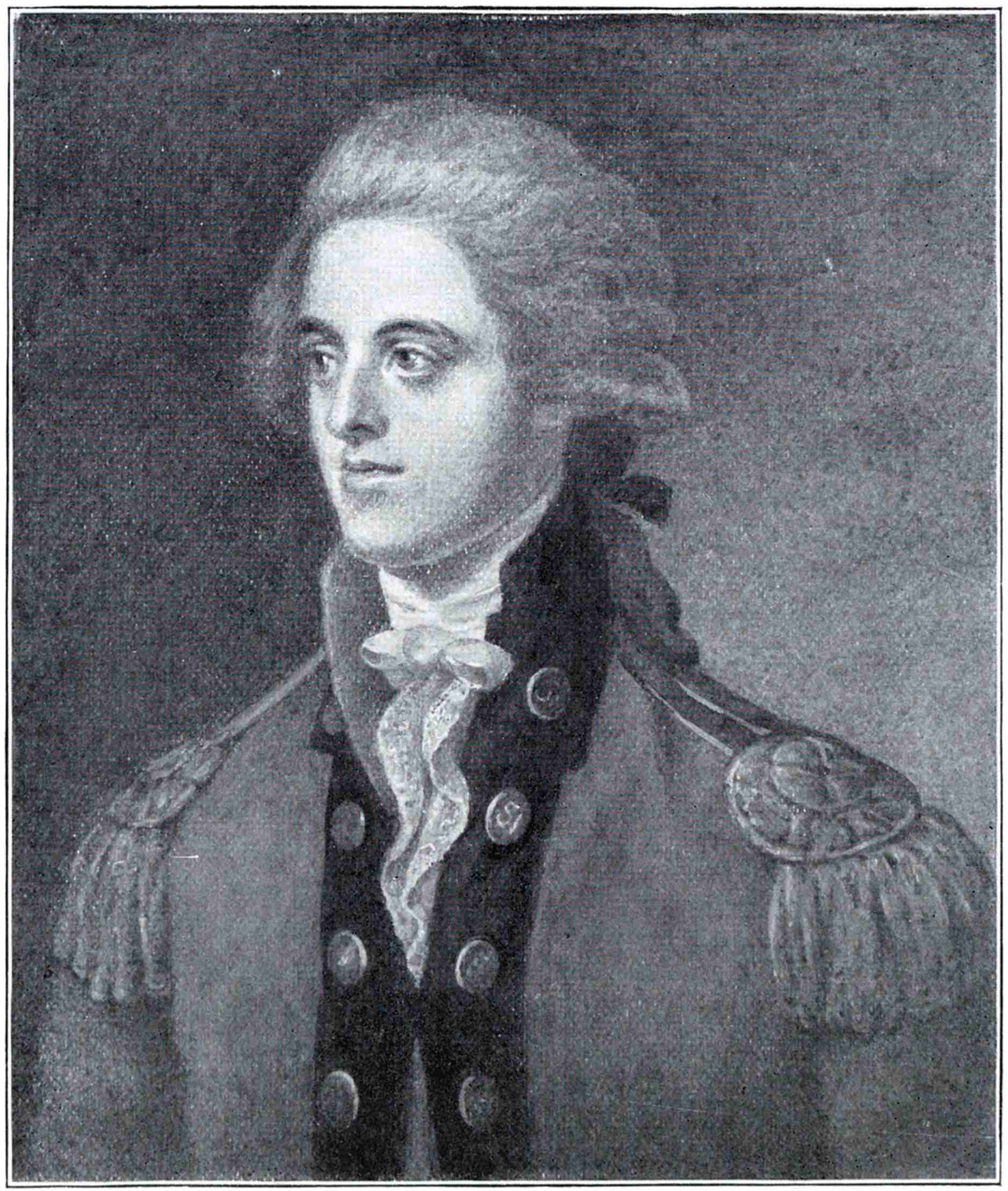
Captain Charles Boothby, R.E.
Born 1786. Died 1846.
UNDER
ENGLAND’S FLAG From 1804 to 1809
THE MEMOIRS, DIARY, AND CORRESPONDENCE
OF CHARLES BOOTHBY, CAPTAIN OF
ROYAL ENGINEERS, COMPILED BY
THE LAST SURVIVORS
OF HIS FAMILY,
M. S. B.
&
C. E. B.
SEVEN ILLUSTRATIONS WITH VARIOUS PEN-AND-INK SKETCHES FROM THE AUTHOR’S DIARY
LONDON ADAM AND CHARLES BLACK
1900
All rights reserved
· UBIQUE ·
QUO · FAS · ET · GLORIA · DUCUNT
INTRODUCTION
Why should I now write my life, or retrace the
more adventurous part of it? I have no material
to afford instruction or impart knowledge even to
the humblest class of readers.
I have been an unobservant and an unintelligent
traveller. The exclusive occupation of an arduous
profession may indeed excuse this, but cannot
obviate its sterilising consequences.
I have no new events, no unknown regions, no
wonderful discoveries to unfold. Reader, there
are a great many good reasons for not troubling
thee with a book, and thou mayest well inquire
why I have not attended to them.
The fact is, they have had considerable weight
with me, and for these fourteen or fifteen years
have served to keep my manuscripts quiet in my
desk, and they would have kept them there for
ever if, by reflection and consideration of the
times, I had not conceived a hope that their publication
might be useful to my countrymen.
Another motive I have, which I mention last,
because it is the most serious, and this is, that I
have found much of the writing and style of contemporaneous
authors calculated to undervalue
religion, to undermine it by sneers and insinuations,
and to look down upon it with compassionate
airs of superior illumination.
Hundreds who are startled, interested, and
attracted by the audacity of assaults upon religion
neither know nor care what has been the deliberate
conclusion of Newton, of Locke, of Milton, or of
Pope. Therefore, let the man who has through
life felt religion to be as a guard and shield spread
before him, becoming a more ample and secure
protection as the exigency became more pressing
and severe, let him oppose his sober experience
to that of the scoffer, whose works and words
give out that he has found some secret of happiness
in throwing religion aside as a troublesome,
childish, and unfashionable restraint.
Most indolently, most imperfectly have I
served my God, but I have never in any part of
life forgotten Him, never have ceased to love and
fear Him.
The return He has made to me it is that I
think worthy of remark.
In the depression before Him of conscious unworthiness,
He has enabled me, in spite of my
transgressions, to carry my heart serenely and
lightly in my breast.
Whether my soul has conceived her danger
from the wars of earth or the storms of ocean, the
conflict of armies or of elements, if I have had
courage, if I have had comfort, if I have had the
tranquillity and firmness of a man, I know of no
source from which I can have derived them, excepting
only the kindness of God speaking to my
soul through the promises of religion.
In sickness and in suffering, the friend and the
nurse remove every object of external disquiet,
and the faults of the strong are forgotten in the
sufferings of the sick. But what friend, or what
nurse is, or has ever been to me, so kind as the
Spirit of God.
Silently then, (removing the far more disquieting
subject of internal uneasiness), the mountain
of recollected offences, and the anxious cloud
of apprehended evils, are melted away before the
steadfast beam of Christian hope, like snow before
the sun of summer. Does it need, then, much
learning or much study to contradict the sneer of
the mocker or emancipate the spirit of his victim?
I think not, and hope that in the book now
offered to the public something like good fruit
may be found. The seed indeed is small, but
may God give the increase.
Charles Boothby (signature)
Sutterton, Lincolnshire, 1824.
NOTE
Captain Boothby’s design of publishing his journals
was never carried out in his lifetime, and now, six-and-seventy
years after he wrote the above introduction, they
are brought out for the first time in book form. Incorporated
with them are his letters to the various members
of his family, which, having been written without any
thought of reproduction, are perhaps even more vivid and
natural than the journal itself. These carry on the
narrative, and bridge over what might otherwise have
been gaps in its continuity.
CONTENTS
PAGE
Expedition to Italy and Sicily under General Sir James Craig
Captain Boothby in General Sherbrooke’s Division, and attached to the Brigades of Guards and Infantry under General Harry Campbell and General A. Campbell
UNDER ENGLAND’S FLAG — From Journal Notes — Battle of Maida — Copy of Letter from Sir John Moore to Lieutenant Boothby, R.E., Augusta: — — Letter from Lieut. Charles Boothby to Sir John Moore — Order from Headquarters — CORUNNA, 1808 — Lisbon and the Tagus — Residence in Lisbon — Departure from Lisbon — Country between Lisbon, Villa Franca, and the Tagus
That branch of the military profession to which
I was destined (the Royal Engineers) requires an
early dedication to its peculiar studies. We are
put under military discipline while we are yet boys,
and are in many respects good soldiers before we
come to be men. Hence a consequence is derived
to this service which I think is favourably felt by its
members in after life; and this is, that their companions
in arms and in the labours and dangers of
war are, for the most part, those with whom they
have shared the yoke of education, and the more
than redeeming pleasures of youthful fellowship.
Much doubt, therefore, in the selection of friends,
and much of the disappointment and injury which
so often accrue from a bad choice, are hereby
spared, since at a period when Nature seldom
permits any sustained disguise, each young mind
has furnished itself with friends, chosen, as it
were, in the castle of truth. Here it has obtained
the knowledge of which to seek and which to
shun. Thus, when at the age of seventeen or
eighteen I assumed the sword of a British officer,
the branch of service into which I entered contained
numbers of my chosen friends, whose hearts
I knew to the bottom, and who knew mine. A
character on both sides was already established
which we would have died rather than sully, and
certainly the advantages of this emulous friendship
did not terminate with the individual, but extended
to the service in which they were employed.
Of all my early friends, I never knew one who
was not eager and importunate to be placed in the
front of danger and of enterprise, or who thought
even for a moment of sparing any extent of labour,
peril, loss of liberty, or life itself in the service of
his country; and most of these, in the flower of
youth and dawn of military glory, have fallen in
battle.
After about a year spent on a home station,
in compliance with my earnest request, I was
nominated, early in 1805, to proceed with a
foreign expedition, going, no one knew whither,
under the command of Sir James Craig.
This order plunged me immediately into a new
state of existence, wherein every sort of agitation,
activity, and conflicting emotion succeeded to the
monotony of routine duty. I exulted that I was
so early to taste of foreign service, and the note
of preparation and outfit was well suited to the
stirring propensity of youth; but in the midst of
all my satisfaction and ardent hope there did lurk
a fear and a dread at the bottom of my heart of
something I had first to encounter.
My father and mother had accustomed the
hearts of their children to such unbounded tenderness
and love as is sure to draw a proportionate
return; and in spite of the commonness of such
separation, I knew better than any one else could
that the thoughts of my departure would make
that home unhappy whose happiness and peace I
prized above all other things.
I knew that my incomparable father, whatever
he might feel, had no wish to make a home soldier
of his son. I knew he would both mourn and
approve my departure. But it was a thing which
lay in my way and hung at my heart, and my
first object on arriving in London was to seek my
new commanding officer, and gain his consent to my
making a hurried journey to take leave of my friends.
The name of my new chief I had long known,
for his fine person and dark flashing eye had been
pointed out to me when a boy as belonging to the
finest officer in the service, and his manner and
conversation were all that a raw boy could hope to
find in a young man, of kindness, genius, and
experience. My heart beat with the thoughts of
serving under such a master, of being trained to
actual service under his eye, and (youthful vanity
perhaps added) of being made by him as fine and
clever a fellow as himself.
He entered at once into the feelings which
made me so desirous to make a journey home,
and the moment he could ascertain that the time
would serve, “Be off then, Boothby,” he said,
“but make all the haste you can back; and if I
have left London, lose not a moment in getting to
Portsmouth.”
Away I went. The parting scene was more
trying even than I anticipated, but “Time and
the hour run through the roughest day,” and I
was soon on my way back to London. I had seen
my father’s venerable form and manly features
shaken with childish weeping as he held me to his
breast, and though long the pang of that sight
dwelt in my mind—for I have ever since cherished
that sacred picture as one of the holiest my memory
can retain—I never shall forget the relief and
lightness I felt from having got through this sad
passage of tears and lamentations. On arriving in
London I feared that my Chief had left it, so I
hastened to that second mother who had spent
the short interval of my absence in collecting all
the various articles desirable for an officer in the
Mediterranean, to which we were supposed to be
destined.
I found her in her drawing-room, where every
sofa, cabinet, chair, and table was covered with my
clothes and linen, which hers and other kind hands
were marking. The perpetual consciousness of
doing kind and useful acts had made an angelic
smile the inseparable companion of her face, and
with that loved, that dearly-remembered smile did
she now receive me.
To all the stores she had so laboured to procure
for me she had added as her own present a complete
writing-box and dressing-case combined—a
luxury of peculiar value to me, which my own
funds would have found it difficult to compass;
but finding me uneasy lest I should be left behind
or be thought tardy by my commander, “Go,”
she said, “you shan’t wait for your baggage; we
will have it all packed up, and I will send my
butler with it to Portsmouth, that I may be sure
of its reaching you.”
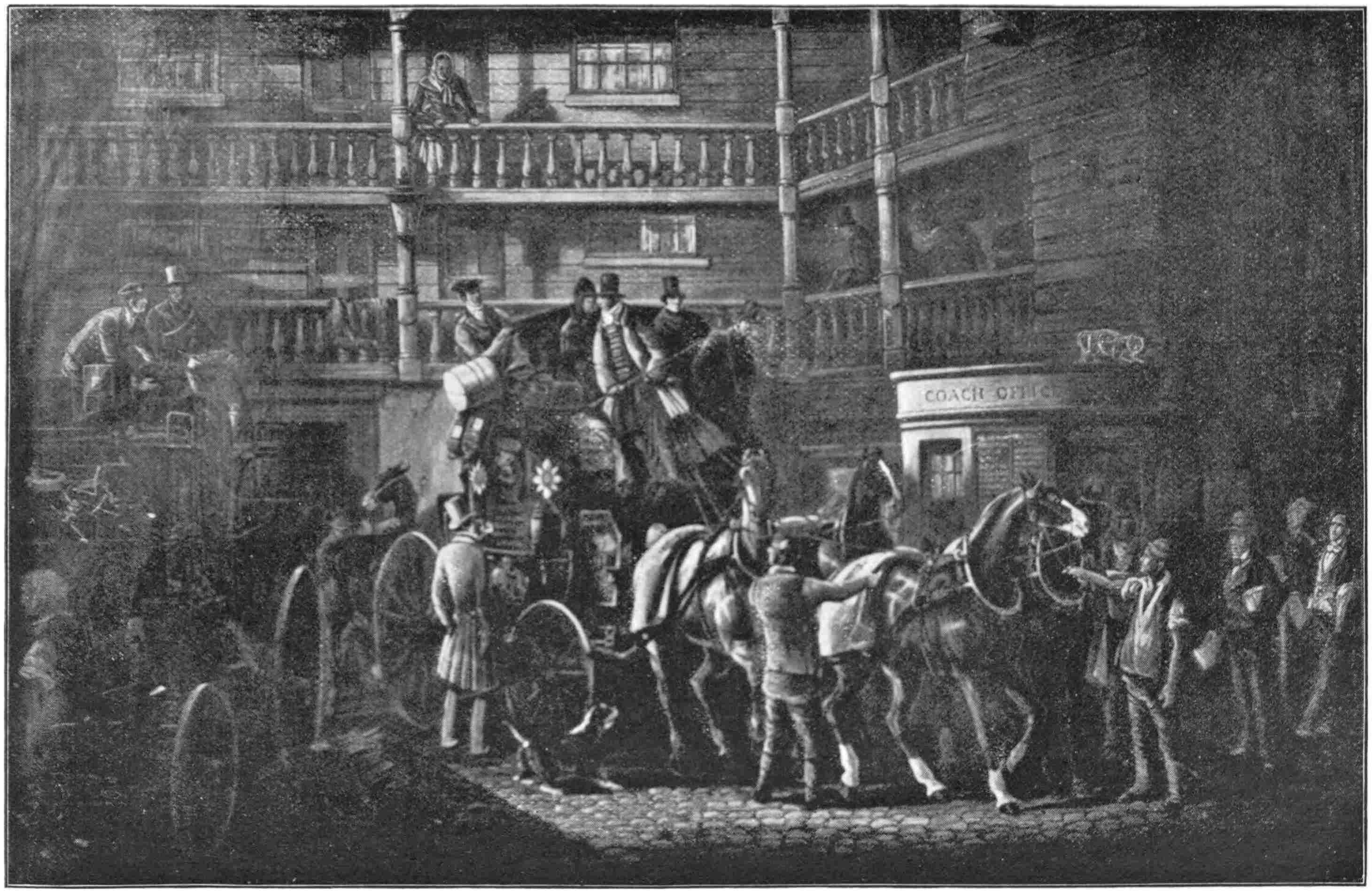
Down to Portsmouth then I went on the outside
of the Mail, in the highest health and the
ardent spirits of youth—spirits that made, I suppose,
even my body buoyant and elastic, for the
Mail overturned in the night and threw me on the
road without giving me so much as a scratch or a
bruise. It was about twenty miles from London
when we met a team of horses standing in a slant
direction on the road, the night very foggy with
misting rain, and the lamps not penetrating farther
into the mist than the rumps of the wheelers.
The coachman, to avoid the waggon, turned
suddenly out of the way and ran up the
bank. Finding the coach swaggering, I got up,
with my face to the horses, hardly daring to
suppose it possible that the Mail could overturn,
when the unwieldy monster was on one wheel,
and then down it came with a terminal bang.
During my descent I had just time to hope that I
might escape with the fracture of one or two legs,
and then found myself on my two shoulders, very
much pleased with the novelty and ease of the
journey. I got me up, and spied the monster
with his two free wheels whirling with great velocity,
but quite compact and still in the body, and
as soon as I had shaken my feathers and opened
my senses I began to think of the one female and
three males in the inside, whom I supposed to be
either dead or asleep. I ran to open the door,
when the guard, having thought of the same thing,
did it for me, and we then took out the folks one
by one, like pickled ghirkins, or anything else
preserved in a jar, by putting our hands to the
bottom. We found that the inmates were only
stupefied, though all had bruises of some kind, and
one little gentleman complained that he was nipped
in the loins by the mighty pressure of his neighbour,
who had sat upon him some time after the
door was opened, to recollect himself or to give
thanks for his escape.
The Start.
“Down to Portsmouth then I went on the outside of the Mail.”
The lady told me “she was terribly hurt indeed,”
and so, when we got to the supper place, I
gave her a kipperkin of boiled port wine with
much spice. She agreed it was very nice, and
looked more cheery, but the rest of the inside
passengers seemed to think that it would not look
well to eat after being overturned.
Not one on the outside was hurt in the least
degree, and I, being on the top of the coach, had
the farthest fly.
I had not been without my fears that on
arriving at Portsmouth I should have to hasten
on board, and perhaps sail without my baggage;
but the wind had changed, all the troops were not
yet embarked, and nobody seemed to be thinking
of anything but gaiety and amusement, or the not
unpleasant business of laying in comforts for the
voyage.
Sir James Craig and Lefebure were lodging
together, and kindly took me in till I could provide
myself better. With Lefebure I had early
acquaintance, and since entering the Army we had
been employed in neighbouring stations, and I
knew that under Sir James Craig’s command he
had come to be reckoned perhaps the best officer
of his early standing. He, I found, was to be of
our company, as well as Hoste and Lewis, two
more of my earlier friends.
Our second in command was Sir John Stuart,
whom I saw for the first time. The best and
bravest could not have chosen fitter company than
every one of these. Sir James Craig and Sir John
Stuart were of great experience and superior rank.
Sir John Stuart had served long at Gibraltar;
Sir James Craig everywhere. The rest might be
called equals, for in youth, inexperience, and rank
they were about equal, but of the whole party I
was the junior officer.
Two excellent vessels, a ship and a brig, were
appointed for our accommodation, and some of us
were allotted to the ship and some to the brig.
Each party now addressed itself to the important
task of laying in a comfortable sea stock, and the
two ships agreed, as opportunity should occur,
that they would interchange fresh meat on the
voyage.
For our part we provided several sheep and
pigs, a milch goat, and a great many ducks and
fowls, with hay and grain for their provender, a
prodigious quantity of eggs and potatoes, butter,
cheese, and lard, of pickles, sauces, spices, portable
soup, white and brown maccaroni, vermicelli, and
celery seed, with a variety of other stores, but
particularly a great stock of bottled porter, a
barrel of ale, and a pretty allowance of wine and
spirits.
The procuring and embarking of all these
various things, animate and inanimate, fell in equal
portions to Lewis and myself. It was no light
task, but neither was it bad fun. Lewis was a
pleasant, lively, and most efficient colleague; many
a voyage did we make to Spithead; many an hour
did we spend on board to see proper accommodation
prepared for our live stock, and to place
our stores out of the reach of damage or of
breakage.
The general obligation of such provisioning
makes the streets of Portsmouth like a rabbit-warren,
the scarlet purchasers popping in and out
of the shop doors incessantly in long succession.
Between two and three weeks passed over not
unpleasantly, for letters and various accidents had
extended my acquaintance amongst the staff of
the army, and tended to wear off any feeling of
strangeness.
The general impression was that Malta was our
destination in the first instance, as indeed it was
known that we were charged with despatches for
that island.
On the 18th of April 1805 we set sail—a
numerous fleet of transports under the convoy of
the Queen, a three-decker, having the Commander
of the Forces on board and his staff, and the
Dragon, a seventy-four, carrying Sir John Stuart,
the second in command, and his staff.
The army was supposed to be from 8000 to
10,000 strong, accompanied as well by four companies
of artillery, and a prodigal supply of all
warlike stores.
Portsmouth, April 17, 1805.
My dearest Father—I can only say we are all
going on board, and expect to sail to-morrow, certainly
for the Mediterranean. Don’t write any more to this
place. I am perfectly happy and comfortable. God
bless you, and my mother, and Louisa.—Ever yours,
my dearest Dad,
Chas. Boothby.
You must not expect to hear from me any more, but
I will seize every opportunity.
Began to blow hard as we made the Scilly
Isles, chops of Channel so rough, landsmen on
beam ends. In Bay of Biscay, increased to squally
gale. One entire day in cabin. Great confusion
from violence of motion. Every day afterwards
on deck.
April 26, 1805.—Delightful starlight night.
Fleet in compact body with lights astern; silence
only broken by mellowed sea noises. So happy a
time for the feast of thought, that I could not
leave deck till after midnight.
April 27.—Voyage ten days old. Wrote to
my father.
Off the Coast of Spain, Between Cape Finisterre and Ortegal, Sunday, April 27, 1805. Calm air, bright sun, and a cheerful prospect of land.
With much satisfaction, my ever dearest Father, I sit
in the boat astern and turn my pen to a usual and most
comfortable employment.
I have been so very ill in that Stygian boiling Bay of
Biscay, that I would willingly have given something to
boot with my commission for a “Burgamy pear” or a
“Brown Burer.” Nature, I thought, could not stand it!
I knew there was nothing in me to comply with those
violent requisitions! It began to blow hard just as we
made the Scilly Isles, and the winds and waves overcame
me in the murky chops of the Channel. But I will not
keep you or myself longer upon these disagreeable topics,
and so will quit them.
I do not suppose that I shall be able to send you this
until we arrive at Gibraltar, but I will add to it from
time to time.
Oh, how I long to be roving over those Spanish
mountains, and to be relieved from this constant see-saw.
The coast which we see is very romantic. We are
about eighteen miles from it, and are under strict orders
not to land at any port we may put into, without express
permission. So I think it most likely that officers will
not be allowed to go on shore at Gibraltar.
* * * * *
Tuesday, April 30. Land thirty miles distant.
Since I last sat down we have made about 100 miles.
On Sunday we were hailed by the Prince, the ship in
which are our other three comrades—Captain Lefebure
(our commandant), Nicholas, and Hoste. They told us
on board the Prince that the Toulon fleet was out, and
being too strong for Sir John Orde, he had put in to
Gibraltar, and that they expected we should put in to
Lisbon—a slender protection!!
We were more than half inclined to credit this, as we
believe that Sir John Orde has not more than five sail,
and the French might be reinforced from Ferrol.
Our convoy is, we think, very inadequate, because
the loss of this little army would be a sad damper to
England, particularly from the nature and quantity of
stores, and the six Royal Engineers attached to it!!!—only
the “Queen,” the “Dragon,” and a “Bomb.”
A breeze springing up last night had been preceded
by the appearance of a shoal of porpoises, which took a
westerly direction, and whose novel gambols and beastly
black appearances amused us much.
The Queen made signal to bring up and lay to, which
we did all the night. We supposed that she was waiting
for the Dragon, who had left us at mid-day to reconnoitre,
and we began to consider how we should like a
French prison.
This morning the Dragon returned, and we suppose
all clear, as we are now on our voyage with a smart
breeze.
We see the coast of Portugal very plain, and can distinguish
with the naked eye the buildings immediately on
the beach, and with a glass we discover further into the
country, which appears beautiful.
We have met shoals of Portuguese fishing boats, and
to-day we have been much amused with the sight of a
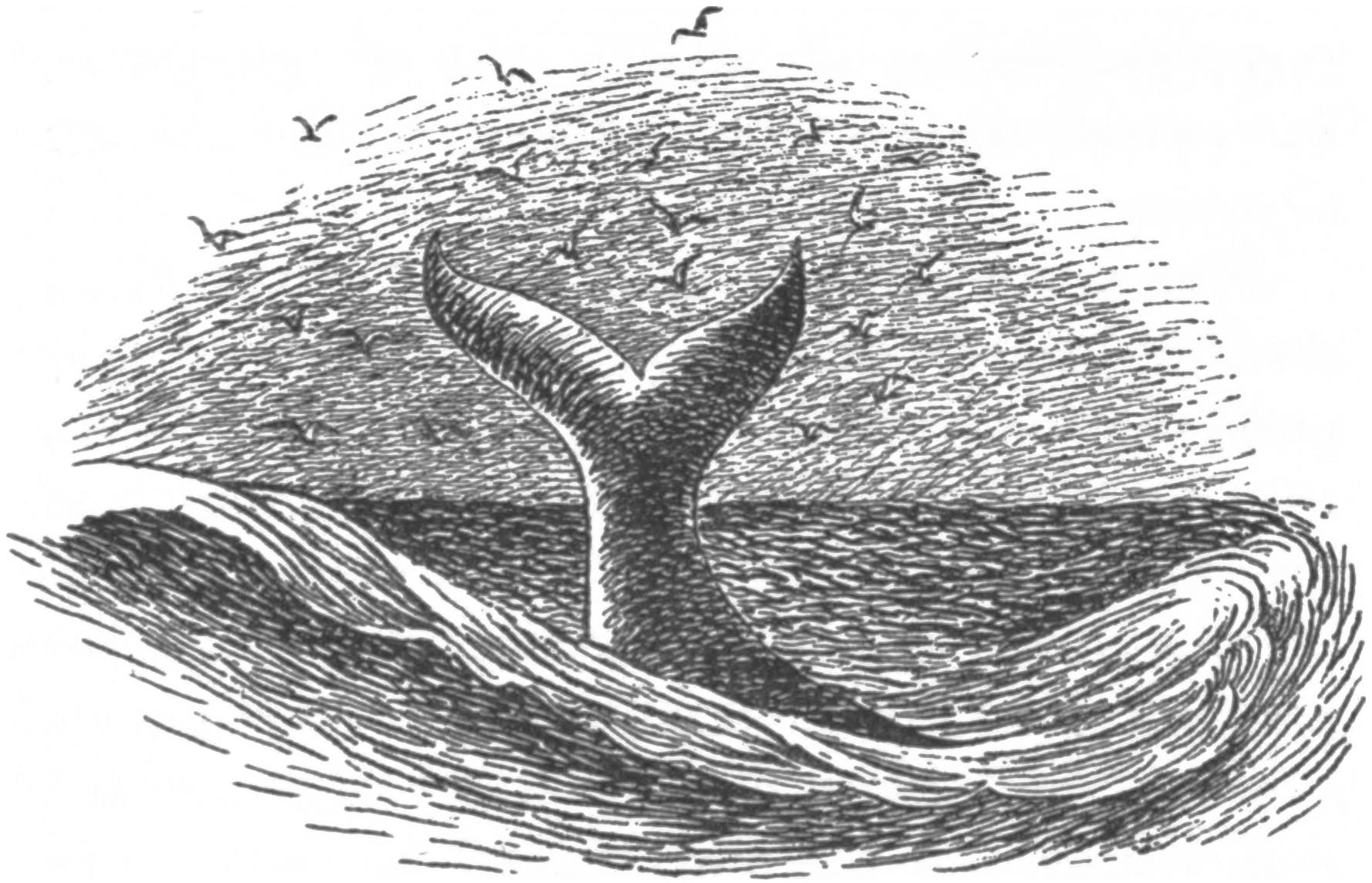
sea-monster of immense size. He frequently gave us
very good views of his grand tail, and he was attended by
a foreign suite, inhabitants of the surmounting element.
His tail was forked, and on one side he displayed a jetty
brightness, and on the other a dazzling white. He gave
us glimpses of other parts of his body, which increased
our respect for him. He was, I should think, two miles
distant, and yet we saw him perfectly distinct.
* * * * *
Off Lisbon Rock, May 5, 1805.
We have had blowing weather from the south, but I
stood it seaman-like this time. The weather now quite
calm. The Ordnance agent is on board. He confirms
late reports of the Toulon fleet of twenty-one sail being
out, and that Lord Nelson is after them, but not, as we
thought, off Cadiz, in which case we expected to put into
Lisbon. What they may do I fear! Lord Nelson has
but ten. Is he to strive with impossibilities and get
the better of them?
The Admiral sending despatches to England, I seize
the opportunity.
God for ever with his blessings surround us in one
happy circle.... Adieu. We soon shall meet again.
Charles Boothby.
May 7.—Put in to the port of Lisbon.
The orders issued to the troops are to be ready
to land at a moment’s notice with artillery and
every preparation of war in case of emergency,
but no one allowed to go on shore on any account
whatever.
Hence we conceive that some attempt from
the French fleet (said to be at Cadiz) is thought
possible; and should it approach the Tagus,
the Commander-in-Chief had determined to land
his forces and seize the batteries commanding
the river, and this, we conceived, would be
excellent fun. Meantime, however the orange
groves might tempt us with their fragrance and
their verdure, no one was allowed to land. The
Portuguese boats, though, brought us off plenty
of oranges still attached to their green branches,
which tickled the imagination to heighten their
zest, and to quench our salt-sea thirst after fruit
and freshness.
The Orpheus frigate (it is said) sends intelligence
into the Tagus that Lord Nelson blockades Cadiz
with such a force as the combined fleet dare not
encounter. Whatever the intelligence was, however,
it produced orders to sail.
We hear that General Junot blustered a good
deal at a British armament entering the Tagus,
and declared that the first man that set foot on
shore should be the signal for his departure. He
was spared the trouble, however, for this afternoon
we set sail, having received orders to be on the
alert to repel any attack from gunboats as we
approached the gut of Gibraltar. Good amusement
in drilling all hands on board to the service
of the great guns and small arms.
May 12.—A beautiful breeze brought us off
Cadiz, where we passed through great Nelson’s
fleet, lying to, and, as we imagined, blockading
the combined fleet, who had by this time got to
the West Indies. We were now at the point
where precaution was necessary.
As junior I took the first watch. A most
beautiful moonlight night showed to admiration
the coast of Barbary, terminated by Ape’s Hill,
and on the other hand the not less sublime outline
of the Spanish land.
The moon with her immeasurable column on
the waters, silvering the prominent points in the
dark grandeur of these newly seen and far-famed
shores, while the fleets in quiet approached it
with swift wings, and the keel-ploughed deep
seemed kindling with diamonds and with fire—a
sight never, never to be forgotten! Nor do
I know the price that (after experience of its
sublimity) could have bought this watch from me.
I felt sure that if any attempt were made on
us, we should distinguish ourselves, but the blessed
wind was too fair and strong, and the whole fleet
glided along in silent and unspeakable triumph,
the elements that had opposed now inviting to
accelerate our speed, the sparkling waves pursuing
but to push us forward, and the winds never
drawing breath from our full canvas, transparent
with the peerless moon. Lewis took the second
watch, and in four hours I was again to relieve
him, but before they had elapsed he came into
the cabin and told me I need not disturb myself,
as we were close under the Rock. But we had
scarcely composed ourselves before a desperate
cannonading began. Up we both jumped, and
being nearly dressed, ran on deck cursing the
gunboats. But it was only the Spanish batteries
saluting the dawn of the birthday of the Prince
of Peace!!!
However, the wonderful and beautiful Rock
would not let us leave the deck until broad daylight
had unfolded all its features. To be so first
seen, uprising like the very wall of heaven, and
tracing its giant outline upon the dark blue of
night, while mortals in their little ships are
bounding upon the liquid diamond that bathes its
foot, was fortunate, for of all the shows and sights
I have ever seen, none so transfixed me with
delight and splendid novelty as this glorious
Pinnacle of Rock. Close to it we seemed, its
peopled and fortified steep rising above us high
up into heaven, light above light moving upon
the rich darkness of his umbered face, so that to
see where his long uneven ridge ended in the sky,
the spectator’s head must hang back between
the shoulder-blades. After a short sleep, curiosity
called us early on deck, and it is impossible to
conceive a scene more busy, beautiful, and variously
attractive to an inexperienced eye than the Bay
of Gibraltar at this time presented. In the first
place, even to the most sedate mind, there is a
sort of magnificent personality in the form and
situation of the Rock fortress itself, difficult
indeed to describe, but impossible not irresistibly
to feel. There he rears himself proudly out of
the blue water into the blue sky, while all around
within the sweep of his thunder lies in uniform
subjection. Vast mountains and bold shores shut
in the horizon, but they approach not him; in
the heart of a great kingdom, in the midst of
enemies, within his own circuit he is unapproachably
supreme. The moment friendly ships come
within his shadow, the foe ceases to pursue, and
retires in acknowledgment of his power.
On the other side of the Bay, the Spanish port
and depot of Algeciras, about seven miles distant,
furnishes, in time of war, objects of continual
interest. Swarms of gunboats are assembled there,
as well as in the African fortress of Ceuta, fifteen
miles distant (other side of Gut), and in unfavourable
winds infest, damage, and sometimes
carry off the merchant vessels as their prey in the
very sight of the impregnable fortress, whose
garrison, from their parades and quarters, can
quietly behold every vicissitude of their running
contests, exhibited on a scene beautiful beyond
all description. The two fortresses, as daylight
ceases and again returns, hear each other’s warning
gun, and know that either keeps its watch,
while vessels constantly approaching from east
and west bring produce and intelligence from
every part of the world, and every ship that
arrives or passes through the Straits is subject to
the inspection of every individual. No need to
look into the arrivals—all passes under review,
and each inhabitant has a place on that high
theatre from which to contemplate the spectacle
at his own pleasure.
Thus when our friends informed us when the
combined fleet had gone up or down, and how
long after Lord Nelson had followed (viz. a
month), they told us not what they had heard,
but what each officer had seen for himself, and
had counted as the number of each fleet.
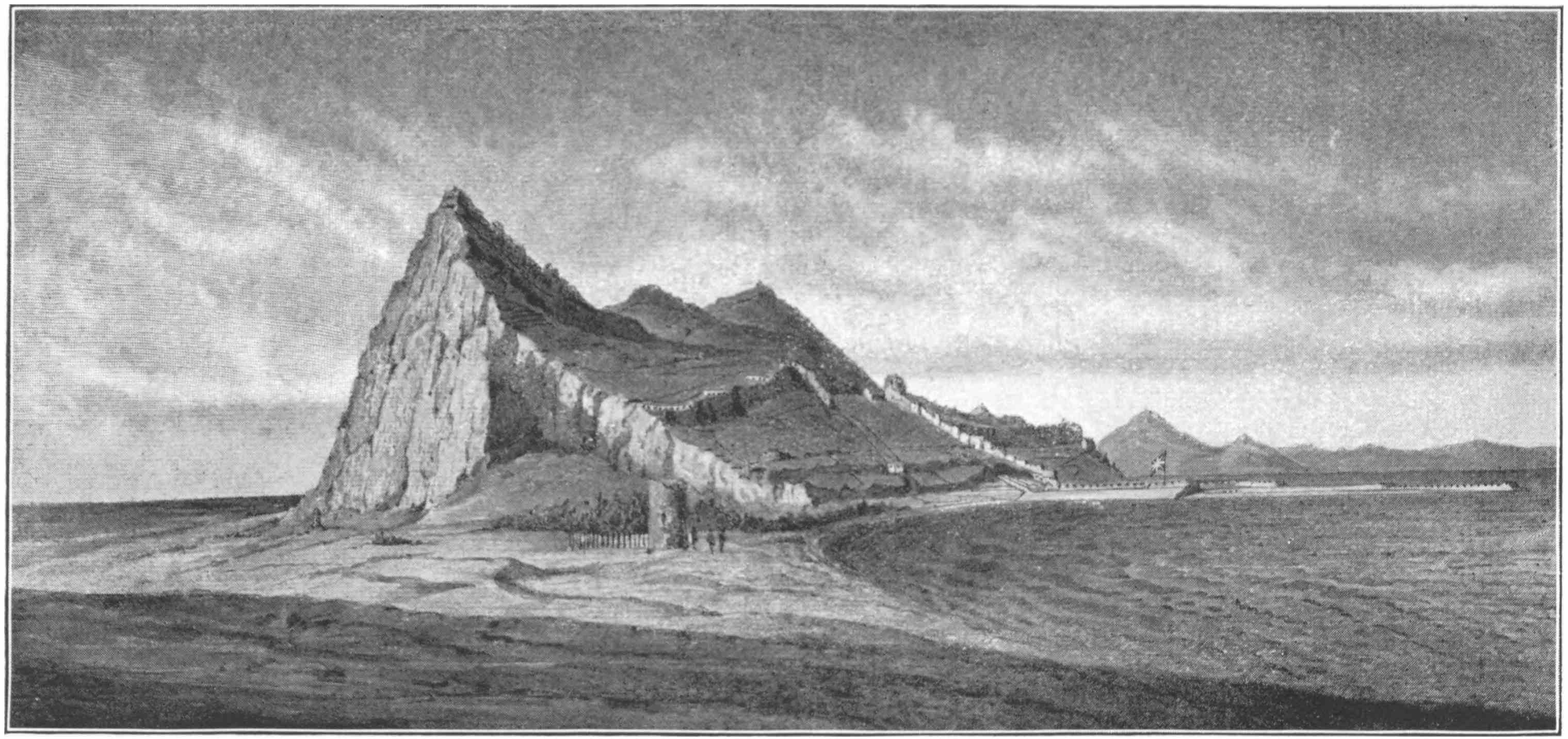
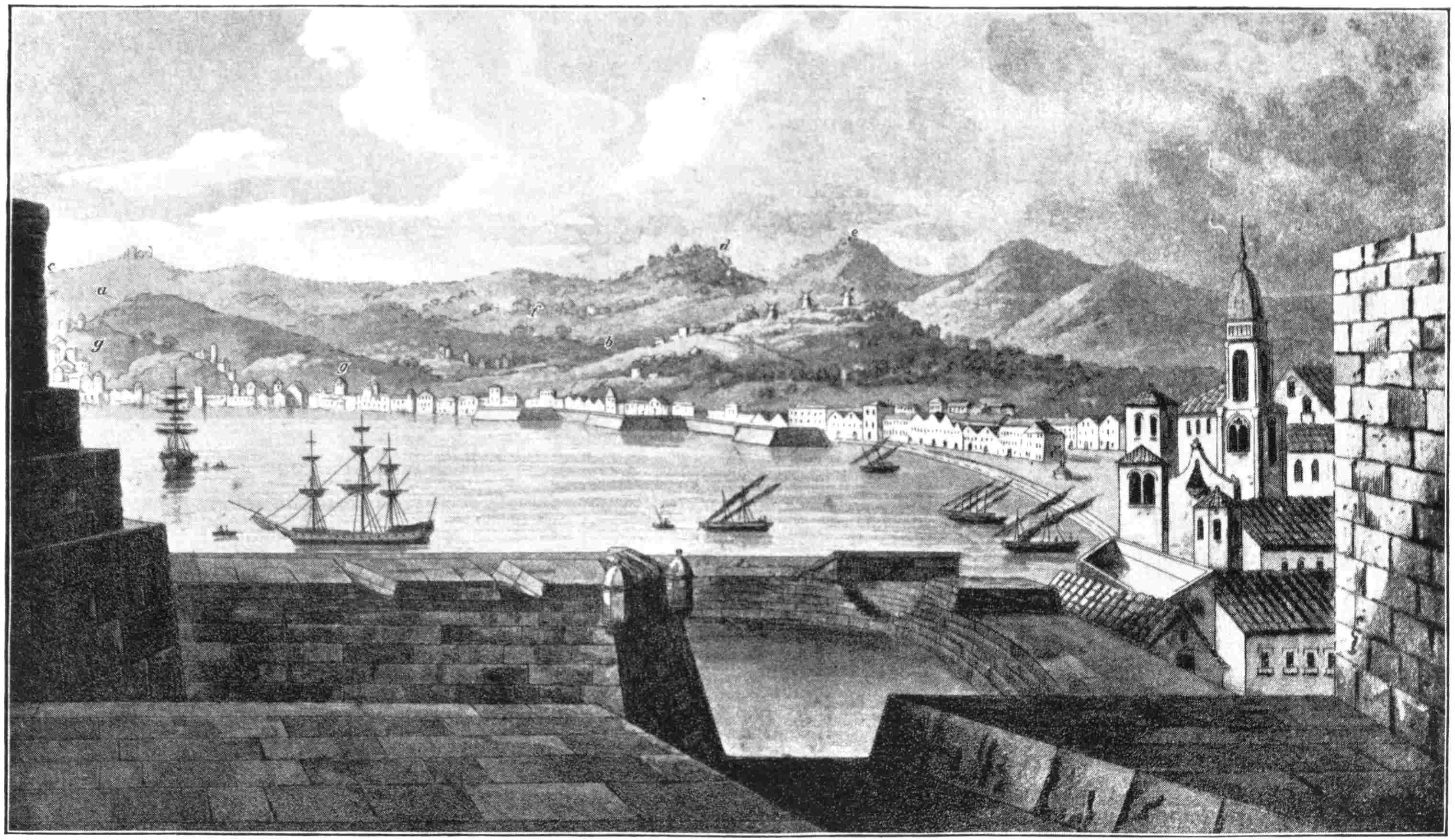
Gibraltar—North View
A sketch from Drinkwater’s “Gibraltar” (1785).
In good time some very old and early friends
come off to invite us to the shore, and, to our
inexpressible joy, leave is given us to land. We
are not, however, to sleep on shore, and receive
the most exact caution to be ready at a moment’s
notice, as the greatest expedition will be made to
proceed. My excellent little friend Archer, with
whom I had been educated, was one of those who
came alongside our ship to welcome his old friend
and playfellow and to do the honours of Gibraltar.
It was now we were made acquainted with every
point and chronicle of the Rock—where formerly
endangered, where subsequently strengthened,
whence terribly remembered by the enemy. These
were subjects involved in a labyrinth which the
practised eye of our Commandant could unravel at
a glance, and in two days he knew more thoroughly
the strength and power of this fortress than many
a brave officer resident upon it for half his life.
Some fear subsists that we shall be detained
some time at Gibraltar. We are still obliged to
sleep on board, and to use precautions in case of
attack from the gunboats. If the expedition is
broken up, some of us may be ordered to remain.
Should I like it or no?
It is a great local confinement, and often entails
spare sea diet, but there are garrison amusements,
balls, private theatricals, and the most delectable
library I ever saw for a not learned man; the apartment
splendid, the prospect beautiful, the arrangement
admirable, the decorous stillness of those who
enter most auspicious, and the terms very easy
and encouraging—a trifling half-yearly contribution
and entrance of three days’ pay conferring a
perpetual share. Bathing in extreme luxury. Also
the corps to which I belong have a most gentlemanlike
and well-regulated mess, and handsome
quarters most enviably situated. So that however
disappointed I should be in ulterior views, I determined
to think I might be worse pleased than by
being ordered to remain here. Yet I learn from
friends at headquarters that Sir James Craig by
no means expects that his army will be dispersed
or its ulterior object changed.
June 15.—In statu quo, thoroughly tired of the
place by this time, and most anxious for despatches
to send us on our way.
From this day till June 17th an alarm of
preparations amongst the gunboats of Algeciras
obliges us to remain on board, and this day it
seems we are about to sail. Exceedingly rejoiced
at those symptoms of departure, and hoping that
the fine western breeze is to take us swiftly up
the Mediterranean. No such thing. We beat
about, now the African and now the European coast,
in delicious weather, and the going quite close in
to these bold shores, so as to contemplate their
picturesque beauty, takes off much of the tedium
of shipboard. The African side in point of beauty
is not comparable to the Spanish—few tracts of
coast, indeed, could rival, none exceed it, or the
happy, brilliant accidents of night or day, of dawn
or sunset, in which we were perpetually viewing it.
The object of this cruise was to elude a meditated
attack from Algeciras, as so large and spread-out
a fleet of ships (not of war) were particularly
liable to surprise, damage, and disablement where
the enemy is always so near, the night so dark and
starlight clear, and weather so serene for sudden
operations.
June 25.—The fleet now commences its voyage,
and we observe the Lively Frigate, having Sir James
Craig on board, make all sail, and soon she vanishes
from our view.
The voyage is only memorable to me from the
unspeakable splendour of the sun’s setting and
rising, which I chanced often to contemplate transfixed
with wonder.
Towards the end of three weeks a good breeze,
which had brought us off the island of Gozo, fell
from us, and left us nearly becalmed about twenty
miles from the harbour of Valetta, giving us full
leisure to view the nature of the coast and the face
of the country.
Great was our curiosity to see the mode of
living on that brown island,1 of which fame had
spoken so much.
When in England we get into a chaise to be
driven to some place of note not seen before, we
all know there is a sort of interest and stretching
of necks as we come near to form some notion of
what it will be like. But how much greater the
interest when we get into a ship, spread our sails
to the wind and our keel to the dark blue water,
and set forth to visit some far-famed island long
heard and read of as a far-distant thing, and now
find ourselves skirting along swiftly by the very
shore that girdles in its cities and its wonders; and
the more barren, rocky, unadorned, and forbidding
the first range of the shore we approached, the more
we thirsted to see the high bastion of the capital
frowning over the bright blue deep.
July 18.—A light air rose with the morning
and wafted us into the harbour of Valetta. Here,
as at Gibraltar, some of our comrades come off to
welcome us, and though unknown at present, the
strong bond of belonging to the same service,
wearing the same coat, and hatched, as one might
say, in the same military shell, induces them to
hold out to us the ready hand of brotherhood and
friendship.
Impatient as we were to get on shore and satisfy
our curiosity, we had for the present enough to do
in remarking the grandeur of the buildings, the
spaciousness, security, and many branches of the
harbour, and, above all, the stupendous character
of the fortifications.
Valetta altogether appeared to me the most
magnificent city I had ever beheld. Everything
contributed to imbue the scene with traits fit
for some splendid picture of growing Carthage;
nothing mean or sullied, nothing to stain the clear
clean hue of every colour; the sea, the sky, the
transparent air, the chiselled stone, the native rock—all
seemed as stainless, bright, and soignée as a
Venetian painting, while the masses of shipping
of every description, whose decks displayed a
masquerade of divers costumes, brought the image
of all nations before us, the gondolas and open
boats, with gentlemen dressed as if for Court, with
powdered heads uncovered, under umbrellas of
every colour, and wearing silk coats, looking so
enviably cool as they touched from ship to ship.
All was so curious, so undeniably abroad, that we
loved to realise all the anticipations of imagination,
and might, I doubt not, have been amused during
a much longer confinement than it was our lot to
encounter.
July 19.—One day was all the trial our patience
underwent, as on the 19th we were permitted to
land and regale ourselves, like children, with touching
and turning over the forms we had been
viewing at a distance. From the point at which
we landed, to which the fine streets of the city
themselves descend, the ascent to the heart of the
city is gained by stairs of vast width and breadth,
but each giving a small and imperceptible rise.
The whole street, indeed, is a grand escalier, of
which the continuous houses of rich merchandise
on either hand form the banisters. These stairs
appear to be carved out of the native rock, and
look as if a carriage and horses might safely descend,
though I do not remember that they do.
We were now on shore, mixed up in the
quarters of our brother officers, previously established
here, and began a very pleasant kind of life,
in despite of nightly mosquitoes and daily heat
intense, reflected and reproduced from the glaring
rock on which it everywhere smote; and this
memorandum of the heat remains fixed in my
memory—the noble streets of Valetta are extremely
regular, and run in broad parallels at right
angles with each other—when the sun, therefore,
begins to decline, the streets which lie north and
south are divided by broad lines of shade and sunshine—down
the broad shade then the different
parties walk and talk and lounge, with sauntering
pace and head uncovered; but when one of the
broad crossings must be passed, exposed to the
sun’s fierce ray, you see every man put on his hat
and dart swiftly across the bright space, as if
escaping through a fire. Various commanders and
married officers helped to furnish our society. Our
new-found brethren put all their resources at our
command, and mounting us on the beautiful barb
or Arabian horses, or the scarce less beautiful
ass of Malta, “showed us all the qualities o’
the isle.”
Stationed at Gozo was Edward Ker, one of my
boyish friends, and one of our excursions was to
visit him. We were delighted to meet, and though
baked and broiled by sea and land in exploring
curiosities, whatever we saw seemed to compensate
our labour.
What pleased me most was a large steep rock,
called the Fungus Rock, because it produces a
fungus famous for its styptic power, and which
the Grand Master (of the Knights of St. John)
formerly distributed to the potentates of Europe.
Though not for the fungus did I admire the rock,
but for its stupendous eminence over a blue deep
bay that lies still and unfathomable below. You
pass from one rock to another at a terrific height
in a basket sliding on a rope; and as I hung in
the air and eyed the sapphire mirror below, I conceived
an eager thirst to plunge into the cooling
water; my companions consented to wait until I
had descended and gratified my desire. When
sporting about in this delicious bath, a good
swimmer cannot conceive how people can sink
in that salt sea, for the water seems so solid
and buoyant it requires a great effort to keep
below.
These rocks form almost such a cave as Virgil
describes with such a thrilling stillness of words:—
Est in secessu longo locus: insula portum
Efficit objectu laterum; quibus omnis ab alto
Frangitur, inque sinus scindit sese unda reductos;
Hinc atque hinc vastae rupes, geminique minantur
In caelum scopuli: quorum sub vertice late
Aequora tuta silent.—Aen. i. 163.
It was like the place—nay, perhaps it was the
place—whose inviolable stillness and stupendous
barriers Virgil so divinely describes; and whenever
those still words, “Aequora tuta silent”
recur to my memory, so does this scene.
This is “secessu longo locus.”
* * * * *
A fleet from England declared to be in the
offing was a subject of great interest at Malta.
We used to repair immediately to the leads of the
Palace, whose great height, carrying the sight
clear over every obstruction of tower, church, and
fortress, displayed the wide ocean to our view,
covered with the expected ships, their swelling
sails as white as wool, and the sea and sky more
blue and bright than all comparisons.
Pleasant and full of expectation it was to watch
them successively steering into the narrow port;
some stately and huge, plumed with the pennant of
command, displayed the broad and checkered sides
of battle; others more humble, but innumerable;
all in gallant trim and guided seamanlike.
Then eager for the mail! the image of home
imprisons the truant soul, and brings it back to its
first tenderness; the sight of the well-known but
long-suspended hand, the endearing accents which
distance has made so infrequent; that day, at
least, is sacred to home; and if the tidings have
been cheering, though the eye may glisten and the
cheek of the young soldier may flush with unwonted
tenderness, yet is his heart neither solitary
nor sad; his friends partake of some reflection of
the kindness that his soul is inwardly pouring out
to his parents and his brothers.
It is time to close the chapter on Malta, but
before leaving I wrote home to my mother.
La Valetta, Malta, August 15, 1805.
Dearest Dona Rafela—I believe this will be
brought to England by an officer who has obtained leave.
I do not know him. Nothing at all remarkable has
happened since I wrote last. We made an excursion to
the island of Gozo, which is much better-looking than
that of Malta. There is more green and romanticity,
but all prospect here is in the sublime, for you see grateful
coincidence of rock, sea, and sky, which can stretch
the mind to great capacity. But where, my dear mother,
are the flowery meads, the green pastures, the murmuring
streams that may soothe the mind into content with
itself and charity to all around? Hot stone houses, hot
brown ground—hot, hot, all hot.
“England, with all thy sullen skies, I love thee still,
my country!” Dear, dear England, dearest Edwinstowe!
What is objected to it? The cold? Why
the cold produces that very thing which gives to England
the greatest superiority over other countries—a fireside!
Now stir the fire and close the shutters fast,
And while the bubbling and loud hissing urn
Upsends a steaming column, etc., etc.
Wretched people under a burning sun, what do you
know of this? or of
The important budget ushered in,
With such heart-shaking musick, etc. etc.
I often think of my dearest father sitting in his little
summer-house by the river, and wish myself beside him.
We have no sight of futurity—Russia, Naples; beat
the French; a wound, a medal, and arm in a sling.
My health is uniform, and so are my spirits; only
sometimes I sigh for England, for Edwinstowe, and for
you. God bless you, my dearest mother.—With great
love, your most affectionate and dutiful son,
Charles Boothby.
I cannot tell what the affairs of the continent
tend to. We get no news, as the French detain
the good, and the Neapolitans the bad. It was
verging towards winter before Sir James Craig’s
expedition actually embarked. I had permission
to dine and sleep ashore the day of embarkation.
In the night I was seized with cholera—often in
that country so fatal. No assistance and no
remedy of any kind was to hand. It took its
course, and in the morning I felt weak and languid,
but, thanks to youth and great strength of constitution,
I was well.
At daylight I went on board with a feeling of
exhaustion, but no remains of disease.
In a few hours afterwards the fleet set sail, and
the weather became almost immediately murky
and unpropitious. We made our course round
the western point of the island of Sicily without
any precise knowledge of our destination. For
three weeks in that Cerulean sea did we struggle
with weather as moist and murky and with an
atmosphere as thick as ever shrouded the chops
of the British Channel. But at length the wind
moderated and inclined abaft the beam, the
sky and sea resumed their blue, and the classic
shores of Italy beautified by degrees the farthest
horizon. Soon, as evening fell, we were gliding
between the fairy isles of Ischia and Capri
with a smooth and steady course into the Bay
of Naples.
How we watched, how we strained our eyes
and wearied our arms with poising the telescope to
pry into the beauteous recesses of those approaching
shores! But now the night had fallen, and a
dark and spangled curtain threw its veil over the
beauties we were gazing at, and when we came to
an anchor it was too profoundly dark for even the
imagination to take hints from surrounding forms.
So we went to bed and wished for day—for a day
without clouds.
The next morning our dreams were realised.
Vesuvius stood close before us, solemnly breathing
upwards his pillar of smoke.
Woods, with young plantations and viny hillocks,
spread widely round him. To the right a fair
town stood on the brink of the sea, while immediately
behind it the steep mountains pushed their
wooded peaks into the sky. Far to the left, and
out of sight, or indistinctly discerned, lay Naples.
Soon a great number of Neapolitan boats came
to the fleet to sell such things as they who have
been cooped up at sea buy greedily—bread, fruit,
game, and fish. Perhaps the parley thus obtained
with these interesting foreigners, and the opportunity
to take small flights in our grammar Italian,
and to observe their dress, language, and grotesque
extravagance of sound and gesticulation, were more
acceptable to our curiosity than those dainties to
our animal appetites.
We saw distinctly some parts of the great road
to Naples, and it was quite a natural pantomime
to witness a conversation between parties on the
shore, perhaps discussing the object of our appearance
and the probability of our movements—far
too distant to overhear any sound, or see any
minor hints of countenance or gesture. English
folks, so seen at a distance, might have hardly
been distinguished from statues or from trees.
But the Italian’s body is a telegraph to the distant
observer while his tongue and countenance are
reasoning with his neighbour; now the orator,
approaching his friend closely, with face and
hands concentering towards his breast, seizes
his collar or buttons, and shakes his arguments
into his ears and mind with a gentle tremulation,
as one coaxes gooseberries into a bottle,
and again, all of a sudden, retrogrades from
him, with head and hands and arms thrown back
to mark the irreconcilable extremity of his
contradiction.
The day following, one of my brother officers
repaired to our chief’s ship, and they went on
shore together.
On his return in the evening he excited our
utmost envy, wonder, and curiosity by giving us
an account of his adventures.
In exploring the country they had come to a
vine-clad hill, whose farthest side ended in a precipitous
bank scarped away by the hand of labour;
and spread out below, proceeding out of the
bowels of the hill on which they stood, they
discovered an ancient Roman town in all its unruined
dimensions of streets and squares, theatres
and barracks, not gray with the hoar of antiquity,
but with all its plastering and painting fresh from
the hands of the workmen. The painted borders
of the dwelling-rooms, the appropriate pictures
of the ladies’ bath, the soldiers’ names engraven
rudely on the walls of their barracks, the ruts
worn by the Roman wheels, were all fresh despatched
to us from former ages.
Of this inestimable present Pliny had described
the packing up, by an eruption of Vesuvius, to
which he was witness. It was only now half
unpacked, and we might yet be at the unpacking
of the remainder.
I was ready to jump out of the ship to see
with my own eyes these incredible wonders, and
when I could go, when I stood in these streets
and called, without knocking, upon one ancient
Roman after another (though it seemed hardly
delicate to explore unbidden the private chambers,
whose painting and fresh preservation seemed to
infer an occupancy so recent) anticipation was
beggared by the trance which that reality imposed.
They show one such things in the Museum of
Portici, that the idea of imposture steals involuntarily
upon the mind, but yet imposture is out of
the question. The king is the showman, and asks
nothing for his pains, nor is there any temptation
to fabricate the commonest articles of every-day
use into the semblance of antiquity in the midst
of such a crowd of self-evident realities. Else,
when I was shown an egg with a part of the yolk
oozing from the crack, looking exactly as if boiled
and cracked yesterday, a loaf of bread burnt to a
cinder, and a quantity of grain in the same condition,
and was told that these things had been
baked by the hot ashes of Vesuvius and buried
under them for 1700 years, my belief, I must
confess, was a little shy. Yet I know not that it
is more wonderful with respect to an egg, a loaf,
and a heap of corn than with respect to the
innumerable rolls of burnt manuscript which we
found Mr. Hayter so busy in unrolling with
infinite patience and ingenuity, the characters upon
the charred papyrus being still perfectly legible.
With respect to other things, vast quantities of
tools and kitchen utensils of every description, fit
enough for modern use, also very well wrought
golden ornaments and elegant glass vessels of all
shapes—in these the interest was equally great, and
the belief more easy.
To me Herculaneum, the Museum of Portici,
and above all Pompeii, were objects of renewed
visitation and inexhaustible interest; but far beyond
all these artificial curiosities my mind was absorbed
by that unutterable wonder of Nature whose
irresistible devastations covered and formed the
country all around. Indeed the recent destructive
torrent yet bore upon its surface the shells of
houses and habitations whose inhabitants had been
expelled or destroyed.
It seems strange that after all the ruin which
this terrible mountain has wrought with subterraneous
thunder and ejected fire, the monuments
of which endure through ages to tell the people
what he has done, yet that all should be insufficient
to frighten them away from his foot,
while with smoke and fire and inward groans he
threatens them daily with still further destruction.
Nevertheless they hew the black vomit of his
entrails into building stones, and over the spot
where the house and its master were buried in a
grave of fire do they build another dwelling for
another inhabitant.
A curiosity, partaking of religious awe, led me
to its summit. I had expected a peep into the
mouth of the Inferno, a visible shaft, plumb
down into the fiery bowels of the earth, but no
mysterious, unfathomable gulf or chimney of the
infernal foundry was to be seen. Cracks, indeed,
red and white with fire, burnt a good pair of
Hoby’s boots off my feet, as they crossed the
region of the crater in every direction, and with
their sulphurous vapour nearly stifled us all.
November 20.—At this time there was in the
environs of Naples a corps of Russians, understood
to be 18,000 strong, but what the allies
might have hoped to achieve by uniting an Anglo-Russian
force of 25,000 or 30,000 men with the
native Neapolitan forces, which altogether might
pass perhaps in round numbers for an army of
50,000 or 60,000, it is no part of my present object
to retrace. The rapid progress of French victory
on the Continent would naturally make the hopes
under which the expedition left England perfectly
inapplicable to the present period. We had intended
to assume grand operations in upper Italy
in conjunction with the main armies of Austria
and Russia. But now it seemed to be the general
opinion that if the Anglo-Russian corps could
enable the Neapolitan army to protect the frontier
of its Sovereign’s dimensions, more could not be
expected.
On the 30th November (and let it be remembered
that this was two days only before the overwhelming
blow of the battle of Austerlitz) His
Neapolitan Majesty reviewed the British forces on
a plain between Castel-à-Mare and Naples. Many
Russian officers were also on the ground. The
King, the Hereditary Prince, and Prince Leopold
(then about ten years old) arrived on horseback,
the Queen in her carriage, bringing with her old
Cardinal Ruffo, who, presently descending, showed
us his red stockings. Old Ferdinand appeared in
great glee, dressed in a white uniform, with a large
cocked hat, and his hair tied in a thick queue.
“Avançons, avançons, mon Général,” he said to
Sir John Stuart, who was leading him down the
line. “Your troops are magnificent! your Army
is as fine as your Navy! Body of Bacchus, what
an imposing front!” cried the old monarch as he
rode up to the Queen.
That elegant ruin, standing up in her carriage
and addressing Sir John Stuart, cried, “C’est
superbe! magnifique! mon Général. Ce sont des
soldats dignes des Anglais, dignes de nos dieux
tutélaires.”
She was now old and hazed, but her figure was
erect and her mien princely and graceful. Her
form had not yet lost all its original brightness,
nor appeared less than a queen in ruins.
The line now broke into column, and passed
the King and Queen in reviewing order. All on
the ground, even the Russian officers, were loud
in praise of the appearance of our troops, and
certainly 3000 soldiers never formed a more complete
and warlike line. I was much amused with
the juvenile Prince Leopold, who, dressed like a
little field-marshal, and mounted on a superb little
charger, richly caparisoned, as often as the officers
saluted his Royal parent, lifted the cocked hat from
his flaxen head (displaying a queue thicker than his
father’s) with a grace the most measured and
majestic. Before the Royal party left the ground
the wintry sun approached the western wave and
blazed upon the brass plates and steely muskets of
the soldiers, which Coleridge, who dined with us
afterwards, called “a beautiful accident,” and
clothed in poetic phrase.
We were a good deal struck with the Royal
equipage. It was an old shabby carriage drawn
by six miserable horses, tied together with ropes,
very ill representing, to our English eyes, the eight
proud cream-coloured Hanoverians and the gilded
trappings which attach them to the splendid vehicle
of our own Sovereign.
December 10.—Early in December the restriction
which kept us from visiting the capital was
removed. Whether the motive had been to prevent
our collision with our Russian confederates
quartered in its environs, or whether French
employees were still to be temporised with, I
neither knew nor inquired. The army began its
march to the frontier, and we who had duties still
to perform in the neighbourhood of Naples freely
satisfied our curiosity by frequent excursions to
that interesting place.
Many paternal admonitions did we younger
ones receive from the well-versed poet Coleridge
to beware of the temptations of Naples, to beware
the
Nods and becks and wreathed smiles,
Quips and pranks and wanton wiles,
which would beckon us in every street, and chiefly
to beware of the duchesses and princesses, for,
said he, “The higher the rank the greater the
danger.” But I think a youth who has learned
to pass unharmed through the streets of London
may be trusted in any town in Europe, for all the
world is honest to the honest.
One day I went to the Theatre of St. Carlos,
and while yet in the lobby my ears were imprisoned
by a strain that seemed vocal indeed, but like no
human voice which I had ever heard, too potent
for woman, too clear and silvery for man.
On coming in sight of the stage the appearance
of the divine songster corresponded to the perplexity
of his voice—most fair and graceful to
behold, but yet neither manly nor effeminate.
This was that very Velluti, amongst the triumphs
of whose unequalled talents it is not the least that
they have prevailed upon the rugged Londoners
to acknowledge the wondrous beauty of his celestial
melody.
Before leaving Naples I saw there a great many
of the things which ought to be seen, and can say
truly that I saw them, and to be able to say this, is,
I believe, the commonest reason for going to see
them.
December 22.—We were now on the march to
Sepia, whither the army had gone to assume a
defensive position. I had procured a handsome
and excellent horse at Naples, whose round and
well-fed back exactly fitted my English caparisons,
and which soon acquired the name of
Napolitanno; never man had a gentler or a better
steed, and it redoubled the animation with which
I looked to be immediately committed in actual
service with the enemy to find myself mounted on
so comely and spirited an animal.
Active service, however, for the present was not
to be our lot, for before our duties near Naples
permitted us to reach the army on march to the
frontier, our commanding officer2 rejoined us in
haste, and set all hands at work to delineate the
position of Castel-à-Mare, and to produce so exact
a military plan of that bold promontory as would
enable him to show fully to the Commander-in-Chief
in what way it might be best occupied to
cover the embarkation of the troops in presence of
an enemy.
As one of the first objects of Napoleon after
the battle of Austerlitz was the extinction of the
Bourbon Crown of Naples and the occupation of
the kingdom, no doubt it was become necessary
for a British commander, committed upon the soil
of that kingdom, to secure a position behind him,
under cover of which he might in any event command
his embarkation.
Sir James Craig, however, subsequently resolved
(and indeed the well-known state of the Continent
left him no alternative) not to wait till his little
army came in contact with the overwhelming
legions of France, but to embark without delay.
The Royal family also resolved not to trust
themselves too near to an irritated foe, but to
transfer the Court of Ferdinand to Palermo.
The great and ready skill therefore with which
the wild and noble features of Castel-à-Mare had
been applied to the purposes of military defence,
and the zealous and unwearied pains with which
we had portrayed and mapped out the fastnesses
of these rugged mountains, were of no avail beyond
that of scientific practice, as the Anglo-Russian
army, long before the proximity of the enemy could
communicate any hurry to its operations, quietly
embarked where it had landed, and sailed for
Sicily.
December 30.—A great many horses which
had been purchased for the field equipage of the
army were left at Castel-à-Mare for want of means
of transport, and for lack of some better arrangement
they were successively turned loose into a
large enclosure belonging to the dockyard. A
scene took place among them very painful to
witness, but yet highly picturesque. They were
of both sexes, and consequently the most fierce
and disastrous contests began amongst the males,
whilst their iron heels armed them against each
other with more than natural power, and soon
these noble animals were disfigured by painful
wounds, disabled limbs, and blood.
To have shot them as was done at Corunna
would have been much more humane.
December 31.—It was evening at the very close
of the year 1805 when we set sail, and night when
we beheld the volcanic blaze of Stromboli flash
across the dark sea and disclose by fits the isles of
Lipari.
Morning unveiled to us the features of those
neighbouring shores, now narrowing more and
more the gulf into which we were sailing, until
they form that narrow and rapid sea that parts
Calabria from the Trinacrian coast.
The view of Sicily apparent at this time, though
not without beauty, is kept in complete subjection
to the rich and lofty magnificence of the Italian
shore, whose mountains, topped with cliff and
clothed with wood and vine, come steep from sky
to sea, with nought between but a border of golden
sand, interrupted here and there by peaks and
masses of rock for ever washed by the sapphire
sea.
On one of these sandy bays, and quite at the
foot of these rich and lofty mountains, lies the
little town of Scylla and its boat-covered beach,
then the main promontory flings a longer slope
towards the sea, terminating the beach of Scylla
and suddenly forming itself into the abrupt, naked,
and primeval rock on which the castle of Scylla
is erected.
This is the Scylla on which ships might run
that would too anxiously avoid the whirlpool of
Charybdis.
After passing the Faro of Messina, whereof
Scylla forms one of the confines, the Sicilian shore
assumes a bolder and richer form, till at length
the romantic seat of Messina itself rivals the
grandeur of the opposite scenery, and grafts upon
the beauties of Nature somewhat of the proud
aspect of metropolitan magnificence. I say this
while surveying Messina from the azure bosom
of her river-like sea, for her real magnificence
has passed away, and her streets of palaces stand
in ruins to this hour. But for the painter’s object
no harm is done. The rich façades of elaborate
architecture are standing entire, and their want of
substance on the other side is concealed by the
dense town behind, and the castle-crowned heights
above, tier above tier of church or convent,
each showing its firm footing upon the natural and
luxuriant earth; the whole background is finished
and filled up by mountains richly clothed with
the verdure of dwarf wood and perennial flowers,
the heavenly atmosphere ever glistening above
and over all things. Nothing on this earth, I
should say, can exceed the outward beauty of
Messina.
1806.—It must have been about the middle of
January when we entered the harbour, an immense
round basin, enclosed by a curved tongue of level
land jutting out from the line of coast like the
blade of a sickle, from which it is said the town
derives its name; the point of the sickle, terminating
when at a short distance from the main shore,
leaves only a narrow entrance into the harbour,
which is defended by a fort established on the
sickle point.
From every wind and every sea this harbour
is perfectly sheltered and secure, but as the
narrowness of its entrance makes it sometimes
operose for vessels to go in and out, the ships of
war and those which expect to be soon for sea
anchor in the road outside.
The transports were moored close to each
other, the ships of war anchored in the roadstead.
The troops were kept on board, but the officers
after a time were allowed to go on shore and
look about them.
A few days afterwards the troops were disembarked,
and we were soon established in the
Convent of St. Francisco di Paolo.
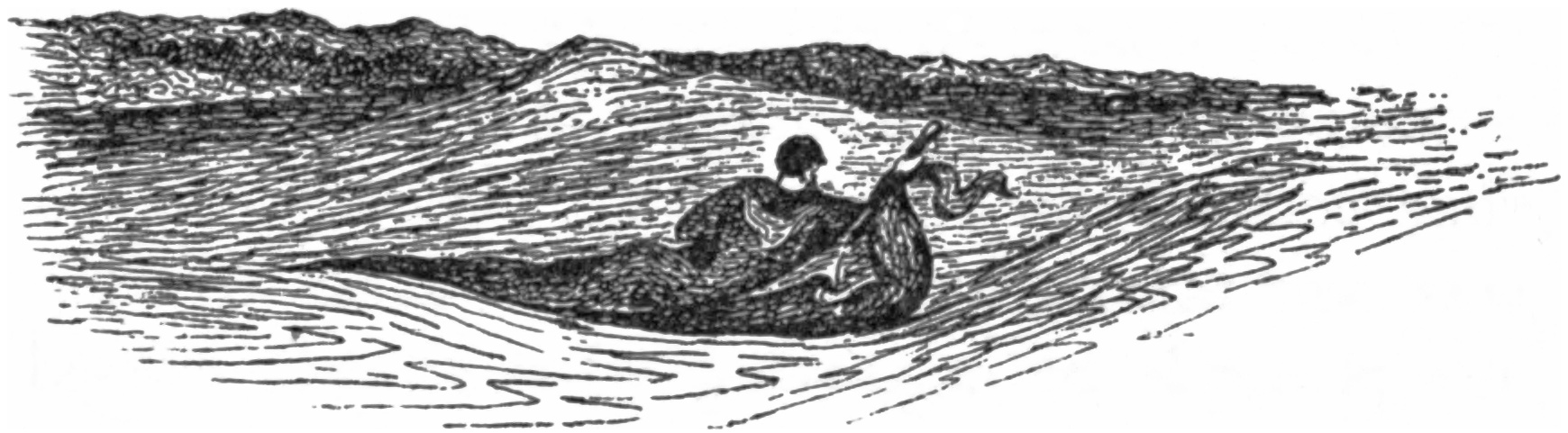
The legend which conveys the tradition of this
convent’s foundation is in various situations rudely
represented on the walls, and consists of a man sailing
across a narrow sea, with no other vessel, sail,
or mast than such as his capôte and walking-staff
would furnish. This was St. Francisco di Paolo,
who in that miraculous manner is said to have
passed over from Scylla to the spot whereon this
convent was erected. Our accommodations here
were not splendid, but such as we could enjoy
after the confinement of shipboard. The monks
were civil and obliging though poor, and the
abbot presented us with some rich Calabrian wine
that might have passed for cherry brandy.
It was now immediately the business of our
Commandant3 to place the city of Messina in a
respectable state of defence, for as it was certain
that the other side of the Straits would soon be
occupied by the legions of Napoleon, Messina,
which was to be the grand depot and headquarters
of the British army, must be placed beyond the
apprehension of surprise.
The military position of Messina is by nature
extremely defective, and though the existing defences
were not in all points the most judicious
that could have been devised, yet were they of
sufficient importance to incline our Chief to adopt
the principle of improving what already existed,
rather than that of substituting new ones. These
works at Messina, extending to forts occupying
the heights adjacent to the town, and overlooking
the eddies of Charybdis and the castle and rock
of Scylla, tended to bring me again and again, and
for hours and hours, in contact with the lovely
environs of Messina, whose charms are more
indelibly imprinted on my memory than those of
any other place in the world. We soon moved
from the convent into the town, where we occupied
a good house opposite to the quarters of the
Commander-in-Chief.
March.—This change of quarters gave me a
commodious opportunity of seeing the reception of
old King Ferdinand by his Messinese subjects. He
had come from Palermo to Melazzo by sea, and
from Melazzo (by advice of his Minister) had made
his progress on horseback, so that he arrived at
Messina miserably fatigued and covered with the
dust and soil of travel. Yet the reception he met
with from these loyal Sicilians was enough to
revive him. In the mid-tide of the dense flood of
bareheaded people, he and his horse were borne
along down the principal street; on one side was
Sir James Craig bowing in his balcony, and under
the windows the vast crowd concentered their faces
towards the King, so that in front of him they
moved backwards and behind him they moved
forwards, facing him on either side. And never in
all my life of twenty years did I behold so touching
an exhibition of the passion of loyalty.
The good-natured and kindly-mannered but
wearied and worn old man, in the midst of his
thanks and nods and brief salutations, was begging
in some degree for quarter as they thronged about
him, and while anxious to gratify their desire of
touching him by extending his hands and suffering
their pressure on his legs and knees, kept
begging they would let him move on, that he
might come to a place of rest.
Meantime they rent the air with their “Vivas,”
and ever as he passed, a new concourse of knees
was seen to bend, and picturesque and eager heads
were bowed around him, pressing devout and
reverent kisses on his legs or hands, the skirts of
his coat, or the housings of his charger.
Never shall I forget the scene. In vain they
might have talked to me of the weakness and
tyranny of his reign, or of his misrule and neglect
of these very subjects. He was their old and
lawful king, now seen for the first time in the
pressure of misfortune and in the weariness of that
journey he had made to inquire of their disposition
towards him. And this was their beautiful answer.
They received him with embraces, with loud benedictions,
with kisses and genuflexions, which plainly
told him they remembered nothing but the sacred
bond between him and them, endeared to them
the more by his age and evil fortune and his
struggle for independence.
At length, though to all appearance (and as I
was afterwards credibly informed) deeply touched
by this perhaps unexpected scene, he was glad
enough to be got into his quarters, opposite to
which a magnificent façade of a triumphal temple
had been erected for the scaffolding of fireworks
to be displayed before him.
At night forth he came bareheaded into the
balcony which fronted the street, and after saluting
the immense concourse of his shouting subjects, he
discharged a rocket, which was guided by a wire-conductor
into the centre of that gorgeous temple,
and immediately it was living all about with
quivering fire. No description can paint the succession
of glorious shapes which, amid the clear
darkness of an Italian night, animated that palace
of fire, and at length, like the finale of grand
concerts, every part became such a volcano of fiery
gems, and fountains of burning spray, and whirlpools
of dazzling stars, that I could not refrain
from joining in the shouts of ecstasy.
In honour also of the King’s arrival, the most
celebrated and costly of all their religious processions
was anticipated. This was the procession of
the Anima (or soul, as I understood) of the Virgin
Mary; but as I know nothing of its origin and
but little of its symbolical intention, I will not
attempt any description.
April 1806.—In this climate it is essential to
the expeditious progress of works to take the
earliest advantage of daylight, while the air is for
several hours cool and the sun still low and feeble.
Accordingly we had to be up and dressed before
five o’clock.
It happened one morning about this time, when
I was buckling on my sword and about to sally
forth, that the floor began to shake under my feet.
A violent rattling of doors and windows was heard
all over the house, and bits of plaister began to
shower from the ceiling. I was presently sensible
that we were experiencing the shock of an
earthquake; and as it seemed to increase in
violence and to be accompanied by violent cries of
human distress, I opened my door in some haste,
and immediately beheld some Sicilian inmates of
the house, just as they had sprung from their
slumbers, scouring along the passages and making
for the stairs. I followed, and beheld the issuing
from every room of persons of every age and sex,
who were racing down the stairs, with no thought
but of present danger, and seemingly unconscious
of the exposure of themselves and of each other.
Signor Scamporaccio, the Padrone di Casa, partaking
at first of the general terror, and having
sprung downstairs like a wild cat and secured
himself under a strong archway that issued into
the street, of which shelter he urged me to partake,
then began to grin at the preposterous figures
of his descending lodgers, and especially pointed my
attention to the unadorned dismay of a fat old lady,
a relation of his wife, whom he sportively called
“La Baronessa.” She was of immense breadth
and weight, and yet came howling downstairs full
trot. On looking into the street, the general
terror was too real and too energetic to be ludicrous.
The people fell upon their knees wherever they
happened to be, some prostrate and laying their
foreheads in the dust, some, with frantic hands and
uplifted voices, addressing heaven with the frenzied
cry of hasty deprecation.
From that posture and from that earnest importunity
no creature rose or desisted until the
earth had ceased to shake and her houses to rend
and groan.
So violent a shock had not been felt for years.
The upper part of the spire of the Madre Chiesa
was thrown down, and some other buildings
materially injured. Every ship at anchor, and
some sailing in the mid strait, felt the violence of
the shock, but happily there was no injury to
human life.
A slighter shock in the course of the day
frightened the soldiers from their work on the
heights, and still more some Sicilian overseers
from the duties of superintendence.
Looking at the ruins with which Messina is
surrounded, and knowing them to be the fruits of
a dreadful earthquake that caused the loss of
thousands of lives, it is impossible not to sympathise
with the undissembled terror of these poor
Sicilians whenever the tremulous earth reminds
them of her instability, for they conceive it to be
the angry hand of God shaking over them with
menaces of vengeance, and their cries are no less
vehement and abrupt than the cries and entreaties
of a child at the uplifted rod of a parent.
April 1806.—Sir James Craig now published a
farewell order to the army. The new Minister of
War (of Mr. Fox’s Administration) had written
most flatteringly to him, assuring him that all had
been in perfect accordance with their views, and
now that the army was in security and comfort, he
could resign the command with less regret.
He had long borne up against the pressure of
severe disease, in the honourable hope of directing
the courage of his men and witnessing their victories,
but now he was sensible that he owed it to them to
make way for a commander whose zeal might be
equal to his own, and whose activity sickness had
not impaired. He gave much praise to the quality
of the troops, whose discipline had certainly been
much advanced by his personal exertions.
The necessity of this resignation had long been
painfully obvious to the army, not by any faults of
discipline, but by the ghastly and suffering appearance
of our revered commander, who was much
respected and regretted by every branch of the
army.
Towards the end of April our Commandant
was sent to ascertain the strength of the places on
this side of the island, giving particular attention
to Augusta and Syracuse, and about four days
afterwards I was ordered to follow him.
One of my brother-officers good-naturedly lent
me a beautiful donkey he had brought from
Valetta to carry my servant and malle.
My pride at starting, mounted on the sleek
and spirited Napolitanno, and preceding Il Bruto
Domenico and the ass, was somewhat quenched
by the drenching rain in which we set forward,
and soon received another fall in the person of
Domenico, seen sprawling in the mire, and the
donkey at large.
The ass, however, was of infinitely more importance
to me than his rider, so I left Domenico
and pursued the animal myself.
After this little fracas the long-eared rebel was
more amenable, and Domenico dare only curse
him under his breath, for fear he should repeat
the somersault, so that my meditations were no
longer interrupted either by the pranks of the four-legged
or the deep execrations of the two-legged
brute. Furthermore, the day cleared, and the sea
and sky and fertile land were lighted up, and reawakened
the sanguine glance of youthful expectation
which the rain had in some degree depressed.
The road is impassable for wheels; its situation is
invariably by the seaside, with mountains on the
other hand, which sometimes barely leave room
for the road. In other places the wintry torrents
have formed, as it were, the opening jaws of a
deep and rugged ravine, called in this country
Fiumara.
Again the bold heights approach the very
border of the ocean, and sometimes a rocky promontory
obstructs the level beach, and plants a
firm broad foot in the midst of the waves. In
this case it has been necessary to pass over or to
cut through the obstruction. The rocky point of
Scaletta traverses the beach as with a wall, and
the road ascends into the gorge of the natural
rock, which rises like a watch-tower on either
side, affording such a post of observance and
defence as, if properly used, might check a mighty
army.
I proposed halting for the night at Taormina,
thirty or forty miles from Messina, and soon
viewed it in the distance, seated in the clouds on
the table of a lofty mountain between two enormous
peaks of rock, on the highest of which is a
dark old castle.
On arriving at the foot of this mountain, a
sentinel stopped me where the gate of the town is
constructed, and on finding I was an English
officer on duty, directed me to the convent of the
Capuchins.
I had permitted Domenico to take up his
quarters at a miserable hut on the beach, where
he was fortunate enough to find provender, partly
to spare the donkey the pain of carrying him and
my portmanteau up so toilsome an ascent, and
also in the hope that my baggage might gain a
little advance in the morning’s march, and thus
I began to ascend into the clouds alone, worn with
heat and travel, and oppressed with a growing
and, I fear, somewhat puerile sadness.
After a long and wearisome ascent, I had left
the brightness and interest of the world behind
me, and had entered an atmosphere which enveloped
every object in a thick gray mist.
On reaching the convent of Capuchins, a dead
man might have given me a more cheering welcome
than I received from the spiritless and hair-clothed
superior.
One of his bleak eyes looked full upon me and
into me, while the other seemed employed in
looking round me and beyond me.
On learning my object he assented with a slow
scowl of sullen indifference, and without any pause
or gesture indicating the smallest courtesy, he
briefly told one of his subordinates to show me a
vacant cell. I believe the rules of this order bind
them to wretchedness, and they extend them to
the stranger that is within their gates, for they
offered me no refreshment, and mentioned no
refectory. The cell appointed me was naked,
windowless, bedless, a bedding of straw being all
it afforded.
Never before or since have I felt the heart
within me oppressed and borne down by so dense
and palpable a gloom—unmanly, to be sure, I felt
it to be. “What ails me?” said I; “what is the
grievance? Shelter is here to-night, to-morrow
there lies the way, and food can be procured.
‘Why art thou cast down, O my soul, and why
art thou disquieted within me?’”
No answer could be given, but the questions
were not asked in vain. I began to turn my displeasure
from the monks to myself, and presently
recovered a more hardy tone of mind. I left the
convent and went into the little square of the
town. The mountain cloud had dispersed, and a
party of Sicilian loungers attracted me to the shop
of a little fruiterer, where I bespoke some dinner,
and learned with joy they could accommodate me
with a bed, which I greatly preferred to returning
to the convent.
Whilst dinner was getting ready I walked out
to look about me and to summon a cicerone to
my aid, that I might see the remarkable Roman
antiquities for which this place is famous. I then,
though very tired, placed myself in the hands of
the voluble cicerone, who took me to the large
ancient theatre, finely situated in a basin or natural
crater formed in the summit of the mountain.
A hasty view would at that moment have satisfied
me, for I was weary and wanted food, but
when I would have gone away the cicerone forcibly
detained me, and placing me in the remotest ring
of the vast auditory, proceeded leisurely to the
stage and began a long oration, ridiculous in itself,
but illustrating how well the situation was calculated
to carry the voice of the actor to the remotest
spectator. Reluctant as I was to interrupt so
remarkable and novel an exhibition as a Sicilian
peasant spouting to my solitary self in the midst of
the lonely mountains from the ruins of a Roman
stage, it lasted so long that I was compelled to
cut it short, telling him I could have fancied him
a shade of the Roman Roscius, a name he appeared
well acquainted with, and with a low bow attributed
the comparison to my excellency’s goodness.
On returning to my little hotel I found dinner
ready, after which I went to the convent stables to
see to my horse; and the bed that I made for him
not a little astonished the friar who admitted me,
and from curiosity, I suppose, observed, and to
a certain extent assisted, my operations. “Such
a bed,” he informed me, “was something too
luxurious even for a good Christian.” He said
no more, but his look added, what must it be for
a heretic’s horse.
Napolitanno, however, who was grinding his
provender with great animation, and making his
eloquent ears thank me for my present attention
to his couch, seemed to have no fault to find with
my handiwork, and to promise me a fresh horse
for to-morrow.
My bed also was clean and comfortable, and I
slept intensely, rose early, and mounting the gay
and gentle Napolitanno, descended slowly towards
the sea, through the hanging orchards and gardens
of Taormina, my mind and body equally refreshed,
and forgetful of yesterday’s depression.
On morning wings how active springs the mind,
And leaves the load of yesterday behind.
Soon after traversing the beach which extends
from the foot of Taormina, the road has to make
its way (and badly enough it makes it) over the
rugged skirts of Mount Etna, or as the natives
call it, more euphoniously, Monzebello.
These extreme skirts of the mountain consist
of various eddies and whirlpools of different dates
of lava, whose black, rough substance is scantily
covered by the slowly accumulating soil, seldom
sufficient to ensure a clothing of vegetation, the
black and naked rock forming a vivid contrast to
the brightest verdure.
The pretty town of Jaci, by its elegant and
regular structure and air of opulence, takes the
traveller by surprise after the unpromising waste
he has traversed. It seems built almost entirely of
the dark and durable material which the mountain
furnishes as a poor compensation for his wide wasting
destruction.
And now after a long and weary ride the
clustering domes and spires of Catania rise upon
our track, with a promise of splendour and magnificence
for which the pretty and prosperous Jaci was
but little preparation.
I was astonished at the grandeur of design and
costly style of building.
The principal street, of vast width, seems to
have one extremity in the ocean, and the other lost
in the ascent of the stupendous mountain, whose
fiery summit it seems to approach with an avenue
of temples and palaces.
What an effect have place and scene upon the
sensitive spirits of youth! At Taormina I felt
abandoned and cast out from the beauties of the
civilised world, whereas here in beautiful Catania
I felt as if everything were my own, and that the
sky was bright, the sea blue, the mountain awful,
and the city splendid—all for me; and in good
and grateful part did I accept of it.
No king could be happier than I, when, having
seen my horse comfortably served, I ascended
into the best parlour of the Golden Lion, and with
my eyes upon the noble buildings of the square,
sat down to a well-cooked dinner and a flask of
the rich white wine of Etna. After dinner, leaving
this fair city with regret, I pursued my journey
towards Augusta. On this side the mountain
throws a mantle of sloping woods, and becomes more
and more level and in the nature of open pasture
as it approaches the deep and rapid Giarreta, which
we pass in a ferry, and over which few Sicilians
would believe it possible to construct a bridge.4
Augusta enjoys the advantages of Mediterranean
sea and sky, but, au reste, not Hartlepool nor
Skegness are less indebted to soil or surface. The
town, though regular, is meanly built, and occupies
a peninsula fortified towards the land.
The bay, however, is of noble extent, and by
its firm anchorage and easy access affords a fine
rendezvous for large fleets employed in these seas.
Here Lord Nelson watered previous to the battle
of the Nile. I slept in the large convent of the
Augustines, close to the seaside, where the prior
and monks assured me it was their greatest pride
to have entertained the great Nelson within
their walls, of whose glory they were perfectly
enamoured.
The cheerful urbanity and comforting welcome
of these good Augustines made me forget the
Capuchins of Taormina, and I must say in all the
many convents in which I have taken up my
quarters I never experienced but that one unpleasant
reception.
The Governor of Augusta, on whom I necessarily
waited with my credentials, was very polite,
spoke of Captain Lefebure in the style sublime,
and finding I must start in the morning for Syracuse,
insisted that I should come that evening to
his conversazione.
A good many people of both sexes and the
higher officers of his garrison were assembled to
stare at the Giovane Inglese, and for an hour or
two it answered my purpose very well. I had no
objection to be looked at, but liked looking at
others still better, always taking a greater interest
in people than in lifeless things.
I slept comfortably at the convent, and was on
horseback early in the morning.
The ride to Syracuse is not particularly interesting
along the shores of the Bay of Augusta, and
after ascending the promontory which bounds the
bay to the south, the road no longer finds accommodation
by the seaside, but makes its way more
deviously over hill and dell until it approaches the
obverse side of that dilated rock which shelters
Syracuse and its harbour from the blustering north.
Upon an extended table of this ridge lie the ruins
of the ancient city of Syracuse, and as the road
ascends, the naked rock is tracked in deep ruts
by the carriages which trafficked with the ancient
Syracusans, just as ruts are deeply worn in the
more frequented streets of Pompeii.
The present town and harbour of Syracuse,
with its lovely vale stretching far into the west,
are finely seen from the heights over which you
approach it.
The peninsula on which the town stands divides
the harbour into two compartments.
The grand harbour to the south and west is
one of the most beautiful in the world. The other
is of little importance except in a military point of
view.
The fortifications, houses, and churches of Syracuse
are all formed of the beautiful stone5 of which
its great northern screen consists, and in consequence
of these vast quarries and excavations,
ancient and modern, nothing can be more abruptly
broken and scarped than the environs of this
fortress.
The land front is finely and elaborately executed
with magnificent gateways; the town is dense and
unequal; the cathedral an ancient temple (I believe
of Minerva), whose Christian front acts as
a garish mask to its ancient heathen sides.
I presently found my friend Lefebure, who
received me with joy, and after giving me some
account of his proceedings, took me to the good
old Governor. “I know not whom this Governor
takes me for,” said Lefebure, “but he really overwhelms
me with honours; his coach is always
dodging me wherever I go, and when I consent to
take a little tour into the country, he mounts
upon the box, with all the decorations of his rank
and symbols of his power, and drives me himself.
I am half dead with the variety and quantity he
makes me eat, and bewildered with the daily
company of barons and princes, baronesses and
princesses, with their dark eyes and soft accents, so
articulate and intelligible, and yet to which I dare
hardly attempt to reply.”
“Well,” I replied, “this does not sound to
me so distressing as you represent. I am glad I
am come to your relief. This noble governor
shall stuff me now with good things and drive me
in his coach, and I will now listen to the soft
accents of the dark-eyed Principessas, and expose
myself to their smiles at my blundering answers.
So have with you, Lefebure; take me to the
Governor; we shall be in time for his dinner.”
“Oh,” he rejoined, “don’t distress yourself.
We are both engaged already to dine with him
to meet a hundred people. But it will be taken
well if I present you to him first.” So away we
went. The Governor, a good, solicitous old soul,
was of course charmed with the Bravo Giovinetto,
and offered everything within and without his
power both to me and to Lefebure.
The number of the people at dinner could
only, I think, be exceeded by the number of the
dishes, and when I found the order of proceeding,
I no longer wondered at the surfeit complained
of by the temperate Lefebure, for the
Governor, having relaxed his girdle and tied a
napkin under his chin, surrounded by laughing
beauties ready to applaud every word he spoke
and every morsel he distributed, sent in succession
for every dish, and having divided it absolutely
and unsparingly into portions, it was carried
round, and if any one failed to taste, the wail and
lament of apprehended sickness was raised around
him, and some sweet princess with bewitching eyes
loaded his plate with her own fair hands.
I am not aware that English people can quite
realise the ease and good-humour and incessant
but not unpolished mirth with which this great
dinner from beginning to end was accomplished.
And but for that, I hardly believe the economy of
man would be able to dispose of such sudden and
copious supplies as were then thrown into his system.
Well it was the Governor, after dinner, took
us in his carriage to show us his points of vantage
without the town, for to walk would have been
very inconvenient!
The worthy Governor of Syracuse was not the
only person prodigal of attention and kindness to
the two English officers.
There then lived upon a beautiful farm in the
midst of the vale an English gentleman of considerable
genius and learning, whose energy of
character and acuteness of judgment, and the
application of English skill to a Sicilian soil, had
given him a very powerful ascendency over the
population within his reach. Equally a master of
the language, from the Tuscan tongue to the
dissonant jargon of the Sicilian peasant, his tall,
athletic, but not ungraceful figure, and his intelligent
and finely-featured head made him no ill
representative, among foreigners, of the personal
predominance of an Englishman.
I had met him at Valetta, where he had opened
an acquaintance with me by accusing me of some
resemblance to Lady Hamilton. He immediately
remembered the circumstance, and perhaps even
so slight a thread acted as a bond of old acquaintance.
Yet there is a stronger bond than that
which draws one to a countryman in a foreign
land.
My Anglo-Sicilian friend showed Lefebure and
me how truly he felt this by the unbounded kindness
and grateful hospitality he extended to us,
and his handsome, noble-hearted wife received
us with a smile of welcome that was redolent of
home.
Our fare was studiously English, and to our
delighted eyes appeared the effect of magic.
There was the burnished brown of the small
fillet of veal, the small smoked ham, cauliflower,
potatoes, and melted butter; the household loaf
of barm-raised bread as white as snow; the
ample slice of fresh-churned butter, not lard of
goat’s milk, but yellow butter, from the breathy
cow. And then the bubbling and loud-hissing
urn, the presiding lady, plates of real bread-and-butter,
and genuine tea, attempered with thick
cream!
No one untried in travel can imagine with
how keen a zest a robust English appetite returns
to these wholesome and ordinary provisions of his
country in lands where he has no hope of meeting
with them.
On our return to Messina we simply retraced
our steps, and met with nothing remarkable, so
I give no account of our journey of 120 miles.
* * * * *
It was about the second week in May when
Lefebure and I arrived at Messina, and on the
25th of that month our force received a valuable
acquisition by the arrival of the 78th Regiment
of Highlanders, a beautiful regiment, 900
strong, whose picturesque national dress made a
great impression upon the Sicilians, though the
women, indeed, seemed to think it due to
modesty to say the dress was very ugly. “La
Baronessa” also maintained “It was an ugly dress,
and a very curious dress, and a very curious
thing that such a dress should be approved of in
England, which she thought was a cold country.”
The arrival of this regiment gave us the more
satisfaction, as rumours were afloat that Sir John
Stuart would take advantage of his interregnum
to do some dashing thing.
A great sensation was created by the resolute
defence which the old Prince of Hesse Philipstahl
continued to make at Gaeta.
Our Gilespie had been sent to his assistance,
and was well qualified by his knowledge of the
language, his military science, and his daring constancy
of character both to assist the brave Prince
in his defence, and to give true information and
sagacious comments to the British general.
Sir Sidney Smith, the naval Commander-in-Chief,
came to Messina immediately from the scene
of action. He had brought with him a plan of
Gaeta and of the French approaches, which he
wished to have copied, and being well acquainted
with the commanding engineer, requested his
assistance for that purpose. Our Commandant
brought the plan to me to copy, and said, “When
you’ve finished the plan, Boothby, you will like
an opportunity of becoming acquainted with the
hero of Acre. You will admire him of all
things, but be sure when you see him, he will take
you to Acre.”
Accordingly I copied the plan with my best
skill and despatch, and then carried it on board.
I had to wait a considerable time. At length I
was summoned into the Admiral’s presence. He
held the plan in his hand, and good-humouredly
said, “So, sir, you are the young officer who has
had the goodness to copy this for me. Well now,
sir, just look here. They pretend to tell me that this
place is indefensible—me, who know pretty well
what determined hearts can do behind very simple
barriers—who have seen a handful of men behind
the angle of a wall bid defiance to the bravest troops
led on by the first general in the world—I mean
Mr. Bonaparte at Acre. Tally-ho! said I.”
I was really in pain lest a smile should be
detected on my features, which would have seemed
to belie my sincere admiration for the gallant spirit
in whose presence I stood, and that anxiety gave
me an air of deeper attention to the inferences of
strength and capability of Gaeta which he drew
from the defence of Acre.
And it is well known that the brave old Prince
of Hesse fully justified these inferences by the
spirit and duration of his resistance.
The gallant Sir Sidney then repaired to the
Court of Palermo, into which the defence of Gaeta
and the mountain spirit of the Calabrese were
infusing vain hopes, vain aims, and inordinate
desires.
Old Ferdinand, who had entrusted Sir John
Stuart with the defence of the east coast of Sicily
from Milazzo to Cape Passaro, now invested Sir
Sidney Smith with viceregal power by land and
sea in the territory of Naples, and the whole persuasive
power of the Court, and I suppose of the
chivalrous viceroy, was then addressed to excite
the British general to hazardous enterprise, but
probably the natural ambition of his own brave
breast was the strongest advocate.
The floating viceroy adroitly disarmed any
jealousy which his powers might have excited in
the breast of the land commander by saying,
“This appointment would have been more suitable
for you, but I made no difficulty about it,
thinking it a great object that one of us should
have it, and the whole powers of the commission
are quite as much at your disposal as if your name
had been placed in it instead of mine.”
The phrase ran, “How nicely Sir Sidney had
got himself made viceroy,” but I can easily
believe, remembering their worship of Nelson, that
it was a much easier thing for the King and Queen
to give such a commission to a renowned naval
officer, whom they might view as Nelson’s successor,
than to a British general.
Sir John Stuart, however, had too much sense
to care a straw about it. He saw here an
opportunity of glory, and however circumstances
might fail of their promise, he saw at all events a
justification of the hazard, and he was no more to
be daunted by the sense of responsibility than of
danger.
I was in great terror lest I should not be included
in this heart-stirring expedition, but I was soon
put out of suspense.
All the arrangements being complete and the
fleet ready to sail, Sir John Stuart, in order to
gain the advance of it, drove with one A.D.C.
in his barouche to the point of Faro, and then
embarked in a ship of war on the evening of the
30th of June 1806. We were watching him from
our quarters opposite when he stepped into his
barouche. Never man, I thought, seemed better
pleased with what he was about, or looked more
to personate the spirit of enterprise. A nice
military figure, he jumped gaily into his carriage,
laughing with his aide-de-camp, and nodding
kindly, drolly, and significantly to the vivaing
Messinese, who, notwithstanding the profoundest
secrecy, had a pretty good guess what he was after,
drove rapidly off.
June 30.—We then embarked when the fleet
was already getting under way.
No happiness is greater to a young soldier than
the high expectation attending an expedition of
this kind. The great things he looks forward to
are close at hand; there is no prospect of protracted
toil and uncertain pursuit, but in the full vigour
and freshness of his strength he moves quietly
and swiftly to his object on the silent waters,
expecting every moment to fall like a thunderbolt
on the astonished foe. Several hours during this
interesting night, big with expectation and imagining
the eventful future, did I walk the deck, contrasting
the present fair heaven, refreshing sea,
and noiseless vessels with the dire principles of
destruction and slaughter within them. Wistfully
I looked toward the bold outline of the Italian
shore, on which the condensing fleet was bearing
with unflagging wing, and wondered how soon the
hour of action and of glory could begin.
About midnight on the 30th June we came to
an anchor in the Bay of St. Eufemia, and an order
was immediately passed through the fleet that the
troops should land at two in the morning.
A heavy surf upon an open beach made this
operation difficult, but it was effected without loss
and without opposition. A vast plain with much
cover of brushwood extended from the beach to
the receding mountains.
It began to be believed that no enemy was near,
but upon the Light Infantry running forward a
firing commenced, which continued in a sort of
bush-fight the greater part of the morning. The
enemy consisted of about 300 Polish sharpshooters
scattered about in a very thick brushwood.
They did their duty well, retiring as we
advanced. No fox-hunters after a long frost could
appear to enjoy their sport more keenly than our
soldiers as they ran at the enemy with shouts and
cries of delight. The event of the day was some
20 of the enemy wounded, 2 officers and 100
men taken prisoners. We had only one man
wounded.
The army now took up a position on the high
ground in advance of the place of landing, one
flank upon the town of Nicastro, the other below
the village of St. Eufemia, whilst at the same time
it was thought prudent to throw up an entrenchment
on the beach, under cover of which an embarkation
might be effected, should the pressure
of superior numbers or unforeseen disasters render
a retreat to our ships desirable. Sir John Stuart
expressed surprise at the celerity with which this
service was performed.
During the whole of this long day, and part of
the next, the reports concerning the enemy were
various. One prisoner (a Gascon) answered gaily
to the question of number, “Oh, a trifle; some
27,000 or 30,000.” But towards evening on the
2nd of July it was discovered that an enemy’s
force had occupied the heights overlooking the
plains of Maida. The lights of the enemy exhibited
at night extended along a considerable front, and
a rumour prevailed that he intended battle.
On the 3rd some information was obtained of
the strength of the enemy, and it was rated so low
as between 2000 and 3000. At night the order
of march was given to commence at two o’clock,
our General being probably anxious to come to
blows before the enemy should have collected his
full strength; but whilst the order of march was
forming, an important reinforcement of several
thousand (as we have since learned) arrived in the
enemy’s lines.
If this reinforcement had not arrived, the opposing
forces would have been nearly equal. As it
was, Sir John Stuart, at daybreak on the 4th of
July, with about 4000 men, found himself in
presence of 7500 of the best troops of France.
To my eternal regret, I was not present at the
battle. My mind was in a state of curiosity and
high expectation, and when I received the order
to remain behind, though aware of its necessity
and justice, my disappointment was childish and
excessive.
An entrenchment which we had thrown up on
the beach required still to be completed, and our
Chief was very anxious to strengthen it by an
inundation, for which the mouth of a small rivulet
offered great facilities. He felt it necessary to
entrust an officer with the execution of his intentions,
and as junior officer (in that spirit of perfect
fairness with which he always treats us) he selected
me, and sent me strict orders not to leave the spot
until duly relieved. There was a high square
tower at a short distance from our entrenchment,
which was occupied by four companies of Watteville’s
regiment under Major Fischer, who had
remained to protect the point of debarkation.
By the time some sound of cannon announced
the approaching conflict of the two armies, my
inundation wanted little of completion, and my
men were well under the observance of this
tower.
From hence, therefore, with the veteran Major
Fischer, I saw the general movements of the battle,
near enough to be filled with the most terrible
interest, to see the masses descend from the
heights, tracked by smoke and fire, to see opposing
bodies approaching to collision, and by the rapidity
of motion to distinguish horse from foot, and
where approaching columns had been lost to sight,
to recognise their conflict from the sudden smoke
of the volleys. But though near enough for this,
I was too distant to pretend to give the description
of an eye-witness, not indeed being able to distinguish
one regiment from another, or indeed the
enemy from ourselves, except from the direction
in which each was moving.
What anxious moments did we pass, near
enough to see where the battle raged, but not in
what way it was decided. However, it was more
like victory than defeat, we thought, as no runaways
came to spread bad tidings, and the whole
system of sights and sounds seemed rather more
distant than more near.
At length I descried a brother-officer riding
alone towards us. I flew to meet him.
“Well, Theso, you have been fighting all
morning. What have you done? We are half
dead with anxiety.”
“Oh,” said the good-natured fellow, “would
you had been with us! Never was anything more
complete. They are all but destroyed.”
“Now, God be praised!” said I, running to
seize Theso’s hand. “God Almighty be praised!
This is grand news indeed.”
“I came to tell you,” said he, “that you need
stay no longer here. We don’t think of entrenchments
now.”
“Then I may ride to the field, where I can
better understand all you have been doing.”
So saying I mounted my horse, Theso giving
some directions as to the right track, and away I
cantered.
This might have been a scene harrowing to
the last degree, for I might have found it full of
suffering I had no power to mitigate, and have
paid dearly in agony of mind for the gratification
of a natural and overwhelming curiosity. But the
noble compassion and prompt activity of the
victors, aided by our generous sailors, had already
removed from the field, without distinction of
friend or foe, all who stood in need of the offices
of humanity.
Still it was a field of battle smoking with recent
carnage, peopled with prostrate warriors distorted
with the death agony, harnessed for battle in gay
colours, feathers, and gold, but stained and bathed
in their own life-blood, having on that gory bed
suddenly closed all the sanguine, joyous hopes of
life.
A sight so disfigured, what heart of rock could
long dry-eyed behold!
The events of the battle were in some sort told
by the mute and motionless, but sad and appalling
forms with which the ground was covered;
all indeed were still and silent, but all bore the
attitude of struggle, of fearful flight, or eager
chase.
A picture of a battle represents but one instant;
no figure can move, yet all seems stirring and
tumultuous.
So, in some sort, is the actual field of glory. The
chieftain’s hand is lifted to strike; his lips have not
closed since the shout of victory or mandate of
battle has passed through them. The passions,
too, in the midst of death remain strongly impressed
upon each warrior’s features. The daring
courage, the bitterness of anger or revenge, and
the thrilling agony of mortal pain—all speak distinctly
in the countenance of the dead.
The route of the flying enemy was thickly
tracked through the straggling course of the shallow
Amato and up the heights beyond by slaughtered
bodies of the 1st Regiment of French Light Infantry,
which had ventured to charge ours with
the bayonet. All lay in one direction, in the attitude
of headlong desperate flight.
I forget the number of this regiment buried on
the field, but a skeleton of it only could have
escaped.
Amid all the disfigurements of wounds and
scenes of human agony, nothing so powerfully
inclined my heart to pity and compassion as the
letters which lay near each unburied soldier, representing
the last remains of the affections and
softer feelings, as the body represented his warlike
powers. Many of these, in female characters, were
expressed with all the tender beauties of the French
tongue, and, with an absence of reserve taught by
the Revolution, showed by their intenseness of feeling
how bitterly living hearts were to be grieved
with the tidings of the scene before me.
No one can tell from description how wretched
is the feeling, when standing over the body of a
youthful soldier, to read in a fair female hand such
expressions as these:—
“Oh, preserve thy life! Venture not too much
for the sake of thy poor Adèle, who has never
ceased to deplore thy absence, but who will think
the first moment of thy return an ample compensation
for all her sufferings.”
Return! shall that prostrate blood-stained
figure ever return to the poor Adèle? The beauty
of youth indeed has not yet left him, but by
to-morrow the form even of humanity will be
gone! Many of the letters were from all degrees
of kindred—mother, wife, sister, daughter. It
was impossible to read unmoved.
Poor Harry Paulet was dreadfully wounded in
the thigh, and our Commandant had a beautiful
horse killed under him.
* * * * *
Having been unable to be actually present at
the battle of Maida, I write the following account
from subsequent observation and inquiry, by which
I satisfied my natural thirst to know all the events
of this memorable day.
July 4, 1806.—The position of the enemy was
at right angles with the trend of the beach, and so
distant from it as to admit of operations between
the sea and his left flank, which was weak from
the nature of the ground, an inconvenience the
enemy could not avoid from our being masters of
the water, upon which was Sir Sidney Smith with
a line-of-battle ship and three frigates. The
British marched with extended flanks and a heavy
column in the centre, the right flank covered by
the sea, the left flank exposed, so that during
the approach of the English the left flank of each
army was more particularly exposed to the operations
of the other.
General Regnier, thinking with some reason
that the impetus of assault has much influence over
the fate of battles, determined not to wait for our
attack. He descended from his position, crossing
the river Amato, which bathed its foot, and
rushed upon the daring foe that was advancing to
attack him.
It happened that the Light Infantry Corps,
under Colonel Kempt, in advance of our right,
was opposed to the Premier Regiment de L’Infanterie
Légère, one of the most distinguished regiments
in Napoleon’s service. After these two
regiments had exchanged some well-directed volleys,
the French corps rushed forward at the pas de
charge, their commander exclaiming furiously as
they advanced, “Ne tirez pas! ne tirez pas! À
la bayonnette! à la bayonnette!”6
“Steady, Light Infantry!” shouted Kempt.
“Wait for the word! Let them come close, let
them come close! Now fire! Charge bayonets!
March!”
All this passed in a moment, but duly as
ordered each deed was done. When the French
were very near they received a murderous volley
from their steadfast-hearted opponents, who then,
as one man, rushed forward to the charge. Just
as that thing, which it is said has never happened,
viz. the equal shock of opposing lines of troops,
seemed inevitable, just as the two regiments seemed
in the very act of contact, the French Light
Infantry, as one man, turned round and fled.
They were driven across the river and up the
heights, and a horrible slaughter took place of
this beautiful regiment, which was almost totally
destroyed.
Other regiments now volleyed and charged, as is
usual in battles, and the enemy’s left being totally
routed, Regnier redoubled his efforts to make an
impression with his right, but with no better
success. Neither cavalry nor infantry could make
the smallest impression in front.
The cavalry now made a rapid movement to
turn our left flank, which was unprotected; but
at this critical moment the 20th Regiment, which
had just landed, led by the gallant Colonel Ross,
advanced in such a manner, and so skilfully
availing itself of the advantages of cover which
the ground afforded, that the cavalry were compelled
to go to the right-about under a galling
fire.
The victory was now decided, the enemy flying
with the utmost precipitation. But as we had no
cavalry, he was enabled, with those regiments which
had less entirely committed themselves, to preserve
some order in his retreat.
The slaughter on the side of the enemy was
immense, indeed hardly credible when compared
to the smallness of our loss. In killed, wounded,
and taken, the French loss has been estimated at
more than 3000, while our total loss exactly
amounts to as many hundreds, our killed amounting
to 40 privates and 1 officer, while 700 Frenchmen
were buried on the field. A French general
(Compère), severely wounded, is amongst the
prisoners. He led the enemy on to the charge
with an acharnement that seemed like individual
hate, and on being taken he rode with his shattered
arm through our ranks, menacing with the action
of his other arm, and cursing and swearing with
the most voluble bitterness.
Another prisoner said, “Ma foi! they told us
the English were fish that could only fight by sea,
and knew nothing of the matter by land.”
An officer asked him “What he thought now?”
“Oh, now,” said he, “it’s quite another thing.”
Surely this must be considered a brilliant
victory when the disparity of numbers is taken
into account, and it is the more gratifying to us
because Regnier stands so high in reputation, and
also because one of these French fellows had
formerly spoken very slightingly of the talents of
our gallant little General.
After having advanced some miles in pursuit
of the enemy, our army resumed the position of
the morning.
The action began at half-past eight, and the
firing ceased at eleven on the 4th of July.
July 5.—The army after so severe an exertion
formed a sort of camp of rest about a mile from
the field of battle, and near the sea, so as to have
an easy communication with the fleet.7
Tents were established for the convenience of
the officers, and all the wounded were comfortably
accommodated on board, while whatever could
contribute to the comfort of the troops was brought
to them on shore.
After a short refreshment of this kind, the
army advanced to Maida, and there took possession
of some French stores.
Having increased its distance from the sea, all
the comforts of camp equipage were abandoned,
and we now bivouacked in the open fields, and
shared in all respects the fare of the private soldiers.
Our mess of raw meat was delivered to us in the
same proportion as theirs; our camp kettle hung
gipsy-like over a fire of sticks, and each officer’s
cloak and blanket spread upon the ground served
him for a bed and his valise for a pillow, where
he lay with his sword by his side and his spurs on
his heels, while his horse was picketed close at
hand. In the morning I went to some rivulet or
spring with shaving tackle and brush in my pocket,
and sat down beside it, to lather and brush and
scrape uncomfortably enough.
This was a fine climate and a fine season, and
that mode of lodging on the bare ground had
nothing in it really formidable to youthful strength
and spirits, but I never thought it agreeable; and
by far the worst night I spent was one in which we
had all endeavoured to be a little more comfortable
by making huts of branches of trees, and beds
of the new-cut corn. An unhandy Sicilian, who
acted as my squire of the body, had undertaken to
make “my Excellency” a superb “camera frondosa.”
Nothing could be worse. A few ill-arranged and
ill-supported branches to shade my head only, and
over these a loose thatch of wheat. I had made
my own bed of golden flax, but he assured me
this generated a malaria, and made me change it for
bearded wheat. I no sooner lay down than every
bearded ear, as if endued with life and motion,
began to work itself into my pantaloons, which for
coolness were of the dark blue Sicilian web silk,
then worn by all our officers. Soon the discomfort
this occasioned was increased by the changeful night.
My Dominico, the unhandy, had made the
mouth of my little canopy to face the seaward
wind, which now blew rudely upon me, drifting
in all insects of nocturnal wing, especially
the large, cold, chaffy locusts, with which the
country was so covered that your horse kicked
them up like dust under his feet. Awkward, ill-guided
creatures, as big as one’s thumb, that when
they got upon one did not know how to get away
again.
My under-lip, like that of all the officers, was
almost cleft in two by the effect of sun and night
air, so that to laugh or smile brought tears into
one’s eyes, and every time the wind dashed a locust
against my face I gave myself a slap on the chops
that stung my poor lip to distraction. Then it
began to rain like the deuce, and soon giving
weight to the wheat at top, the branches could
no longer support it, so down it all came, wet
bearded corn, branches and insects, all at once on
my face.
I was extremely glad when this memorable
night was over, and ere earliest dawn the signal
for awaking sounded through the leafy roofs under
which the army had that night reposed. At two
o’clock I was busy in preparing my horse for his
march, caring little now for the ill construction of
my hut or all the disasters of the night.
The enemy, who had advanced to meet us from
the south, having immediately after the battle
retreated northwards to Catanzaro, instead of
attempting to cover the country whence he came,
it was plain that he no longer thought of defending
Lower Calabria, which province with its
garrisons he thus abandoned to his victorious
adversary. Sir John Stuart was strongly minded
to pursue these extraordinary advantages, and with
his small unassisted army (for there was no indication
of a national rising) to drive the French still
further to the north, and increase the extent of his
footing in the kingdom of Naples. There was
certainly more gallantry than prudence about this
idea; for when the interests which depend on this
little army are considered, the importance of the
Island of Sicily at this moment, and our trifling
numbers for territorial occupation, there can be
no doubt that those about the General, who
prevailed with him to be satisfied with the
conquest of the province8 almost touching this
important island, with whose safety he was
entrusted, did better service by their counsels
than they could at that time have rendered by
their swords.
Of this number, I believe, was his Quartermaster-General,
a young man of great acquirement
and high military promise; and certainly not the
least influential of them was our own Commandant9
of the Royal Engineers, whose vigorous
and strong professional opinion certainly had great
influence, for the Quartermaster-General in reference
to it used these emphatic words, “It has
succeeded.” It was in conformity with the decision
produced by these counsels that the Headquarters
had moved to Monte Leone, and the General was
now disposed to content himself with placing the
province of Lower Calabria upon such a footing
of military occupation as would delay its reoccupation
even by a very superior force, and ensure
to us for a considerable time both shores of the
Straits of Messina.
Most of the ports to the southward of Monte
Leone were so inconsiderable as to surrender on
the first appearance of a military force or of a ship
of war. But the port which by its position was
by far the most important (viz. the castle,
strongly built upon the rock of Scylla) was in a
good state of defence, impregnable to assault,
fully garrisoned, and commanded by the chief
engineer of Regnier’s army; so as might have
been expected, the commandant had treated the
Admiral’s summons to surrender with contempt.
It was necessary, therefore, to march against the
place. And when the commander of the brigade
which sat down before it gave a more serious
summons, the Frenchman answered that before
he could surrender he must at least see the means
by which he could be reduced, meaning without
doubt heavy artillery, so placed as to batter him in
breach.
It became necessary therefore to attack this
castle by a regular siege, and the army on the
12th of July began its march at four o’clock in
the morning. It had not proceeded many miles
before I, being then about fifty miles distant,
received an order from my Commandant to repair
to the siege also. So I set forward alone.
The road lies over bold mountains, and is so
intricate and devious that I lost my way and
greatly lengthened my ride; but having traversed
the promontory of Tropea, the route is then more
certain and confirmed—keeping still indeed over
mountains, but having the near-sounding sea as a
general guide, sometimes showing itself through
the cleft of two mountain peaks, and sending up
the report of every gun fired on its surface multiplied
by the muffled echoes of the mountains.
After riding about fifty miles, the incessant
sound of guns advertised me of my approach to
the scene of action, and soon, by one of those
dangerous paths whereon a horse moves with difficulty,
and a stumble would precipitate both horse
and rider many hundred feet, I descended to the
small marine town of Scylla (bounded to the south
by the peninsular rock on which the besieged
castle stood), and saw on its highest tower (in spite
of its investment by sea and land) the tricolour flag
flying.
The rock on which the castle stands seems, as
it were, shoved out a considerable way into the sea
by the low and narrow isthmus which ties it to the
shore, and from this isthmus it rears itself suddenly
in the midst of the waves.
Before the castle was built this spot was probably
an inaccessible peak of naked rock; the top,
however, has been blown away to afford space
for military occupation, leaving height enough to
afford a formidable scarp of natural rock towards
the land as the basement of the artificial rampart;
towards the sea, an abrupt precipitous cliff, inaccessible
to man, descends perpendicularly into
the deep water.
The fort constructed upon the table of this
peninsular rock was, up to a certain point, admirably
adapted for security and strength. But
that abrupt and lonely precipitousness of inaccessible
circuit, which to the unlearned eye presented
so imposing a picture of invulnerable
strength, was in fact the radical defect of the
position, which made it impossible to secure it
against the means and measures of modern war.
The great strength of modern fortification consists
certainly in the glacis, or in that smoothly sloping
mound which conceals and covers the rampart to
the very chin, yet is severed from it by a deep and
impassable ditch, screening it from every injury,
even by the heaviest and most numerous ordnance,
whilst its own gradual slope is swept by a rain and
hail of cannon-balls, grape shot, and musketry,
both from its own parapet and that of the superior
rampart. But to construct this, ample space is
necessary, and consequently for a rocky peak like
Scylla, joined to the land by a narrowing isthmus,
this work, so indispensable to durable strength,
was totally unattainable.
The strength, then, of the Castle of Scylla lay
briefly in this, that its reduction required the
bringing against it of heavy artillery, capable of
beating down the rampart that fronted the land.
So much for the castle which I now beheld,
and which, surrounded with enemies by sea and
land, and cut off from all connection with any
friendly force, stood up boldly in the midst of that
sapphire sea and unfurled the three-coloured flag
of national defiance.
I shall now briefly describe the circumstances
and things by which it was at this time surrounded,
not so much on account of any historical
importance attaching to this little siege, as because
the classic associations and natural beauties of the
scene consecrate it to memory, and its local form
subjected all these operations to the eye, like some
warlike spectacle in the theatre of the gods.
If we can fancy ourselves within the castle and
looking over the isthmus in the direction of the
land, behind us and almost all round us is the sea.
On the left hand is the beach and town of Scylla.
On the right the bold and mountainous shore takes
a gradual sweep, till over a space of sea it looks
down upon our right flank. Here Sir Sidney
Smith has established a battery and hoisted the
English colours.
Immediately in front, from the base of the
isthmus, rises a steep cliff, whose brow, divided
into several distinct hills, overlooks the castle at
the distance of some five or six hundred yards.
These heights have a surface very spacious, rising
very gradually from the cliff towards the steeps
of the Superior Mountains. Farms, vineyards,
gardens, and country houses occupy and intersect
this sloping headland. But the head of each hill
or cliff looking upon the castle has been kept bare,
probably with a view to defence, though unfortunately
the same precaution had not been observed
with respect to the ground nearer the foot of the
cliff, and looking very close upon the main rampart;
for there, for marine convenience, a little
suburb had been suffered to rise, and it was behind
the mask of one of these houses that the breaching
battery was at last erected.
Beyond that vine-clad esplanade or level district
which rose very gradually from the brow of the
cliff, the heights, still clothed with cultivation,
ascended more steeply towards the summit of that
vast range of mountains, which makes this trend
of coast so bold, imperious, and pre-eminently
beautiful.
It was partly upon, and partly still above, these
steeper slopes that the besieging army bivouacked,
as the nearer ground would have made them liable
to annoyance from the guns of the castle.
All the necessary communication with the army
from Sicily and from the sea was by a rugged
mountain path formed upon the side of an awful
ravine, whose embouchure opened upon the beach
between the town and castle.
The road which this ravine afforded was not
only difficult but likely to cause frightful accidents;
for when I ascended by it the first time, to join the
besiegers’ army, I saw where a sumpter horse heavily
laden had fallen the day before with its load, and
the poor animal was still visible lying on its back
some hundred feet below.
To supply the requisites for a siege by such a
road, it may well be believed, was difficult in the
extreme, and would have been impossible but for our
all-conquering sailors, who with their tackling and
their “yo-hee-ho” hauled the guns and carriages up
the rocks at the points nearest to the ground chosen
for their position. Yet it was some days after my
arrival before operations could be commenced, and
much of those days I passed in a lofty observatory
built of branches, in so elevated a position that I
looked down upon the castle and the sea.
On one side I saw the Neapolitan gunboats, and
on the other Sir Sidney Smith’s battery, cannonading
the castle, and the castle occasionally making
a shrewd shot at the gunboats, which also, oftener
than the castle, were startled by the plunging fire
of our naval battery. On the arrival of my Commandant
all these futile operations died away.
The General and the Admiral equally relied upon
the resources of his science and the natural energy
of his powerful mind, and after some loss from
irregular experiments, no one was suffered to interfere
with his plan of operations.
He went with us to the embouchure of the
ravine to have a good view of the castle from head
to foot; and whilst he stood with his uplifted
telescope carefully examining the nature of its
defences, a cannon-ball very nearly struck him,
and covered him with sand; but he never even
lowered his telescope or remitted his attentive
speculation, and only showed that he was aware of
the fact by saying, as he continued to look through
his glass, “What asses, to fire in that way at an
individual!”
It seemed to my inexperience that this was standing
fire tolerably well—brave and invincible
Lefebure! It was as he stood just so, with his eagle
glance bent on the foe, the last to quit a ruined
fort he was ordered to evacuate, that in after years
a cannon-ball struck his breast, and severed his
brave spirit from his noble form.10
That there might be no disappointment in the
stores expected from Messina, I was desired to
cross the Faro, superintend their embarkation, and
return with them. For this purpose I took one
of the Calabrese boats which lay on the beach.
The warders of the castle seeing a British officer
put off in a boat, honoured us with a shot or two,
to the great and undissembled terror of the boatmen,
while I was doing all I could to imitate the
cool indifference of our Commandant on the preceding
day; but we soon got out of their range,
and they ceased to fire, which made me wonder
the more to see that the boatmen were going a
devious course, sometimes one way, sometimes
another. “What now,” said I, “body of Pluto!
what ails the rogues?”
“Zitto! zitto! cellenza!” they whispered, and
with their eloquent hands at once motioned me to
be quiet, and to come forward to the prow. There
on the very peak one of the men, having thrown
off his jacket and shirt, stood up, as straight as
a mast, with his flat hands pressed together on his
breast, and looking down intensely upon the sea.
Following the direction of his eyes, I perceived at
a great depth, in the bright blue sea, rowing itself
contentedly along, a turtle of a size uncommon in
these waters. With great dexterity they so managed
the boat as to follow closely the course of the
turtle; and when they had brought the prow of
the boat nearly over him, the man who stood there,
lifting his joined hands above his head, turned
himself over, and went head foremost like an arrow
into the sea.
In a moment up he came again, bearing the
dripping, gasping turtle on its back, in his two
hands, clear above the water, flapping its oary legs,
and gasping with its hawk’s beak; the man treading
the water, panting and laughing at his exploit,
and his delighted companions, as they relieved him
of his load, all applauding him at once, helping
him in, and saying, “Bravo, Signor, bravissimo!
La Maestro! da capo! et viva!”
I thought I never saw a neater bit of fishing.
A small silver coin served to make the turtle my
own, and I determined to take him back with me
to see what we could make of him.
* * * * *
But to return to Scylla. Before heavy guns
could be got up, it was thought advisable to make
such use of the Light Artillery as could destroy as
much as possible the defences or fire of the enemy.
The most anxious night I ever passed was in
erecting a breastwork for two 12-pounders within
half musket-shot of the place, as everything depended
upon its being completed before the light
should discover us to the enemy. And though I
explained to the men their danger if they should
be discovered, it did not appear to create in them
any extraordinary vigour. On the contrary, if my
back was an instant turned, I found half of them
asleep or sitting down, and it was difficult to
detect them owing to the darkness of the night.
Only by the most violent means could I extort a
tolerable portion of labour, though I knew that if
we were not covered before dawn, the spot was so
exposed that at least half the party would be
sacrificed.
By perfect silence, however, we avoided discovery
during the night, favoured by the enemy
being himself employed, as we could distinctly
hear by every move, which, at cautious intervals,
interrupted the silence of the night. The radiance
of the stars faintly delineated the features of the
gloomy horizon, and when the light of day discovered
us to the enemy, he opened upon us a very
brisk fire of musketry without intermission for
an hour and a half, which, after being partially
silenced by a howitzer, continued at intervals until
the battery was finished. We were so well covered,
and so little remained to be done on the outside,
that only one man was wounded.
Nothing could be prettier than the siege to a
person out of fire. The ruddy evenings gave the
most tranquil warmth to the scene, which was
bounded in front by the Lipari Islands, with Scylla
on the left, and the beautiful Calabrian promontory
on the right, and the only thing wrong was
that the volcano should (quite contrary to usual
practice) choose to remain in perfect repose.
When I left Scylla, the two 12-pounders
had destroyed a part of the fort which hitherto
had given us considerable annoyance, and in two
days it was expected that we should open a battery
of four 24-pounders within 150 yards of the
castle, which could not fail in a few hours to
knock it to pieces. The result was that Scylla
surrendered on the 23rd July 1806.
* * * * *
Now for myself. I was ordered to put myself
under the command of Lieut.-Colonel M’Leod,
who with his regiment (78th) was to proceed on
a reconnaissance on the eastern coast of Calabria;
and here I am, installed on board the London
transport, and probably after a month’s cruising
we shall come back and settle quietly in Messina.
“London” Transport (off Calabria), July 20, 1806.
My dearest Father—I seize the only advantage
immediately resulting from being cooped on board, viz.
the opportunity to address one’s friends leisurely and
comfortably; and as the duty on which I am now going
is not likely to be at all dangerous, I have no fears of
alarming you by giving as much account of myself as
will be comfortable to you and me.
* * * * *
H.M.S. Amphion, July 24, 1806.
My situation has been considerably amended as to
comfort since coming on board this ship, which is
commanded by the brother of my friend Hoste, R.E.,
whom I never spoke to until my arrival in the Bay of
St. Eufemia. Yet with the most gratifying attention,
he has rescued me from the miserable transport, where
I was destitute even of those comforts which usually
palliate the sufferings of a transport imprisonment, and
taken me into his own cabin, which is like most other
cabins of men-of-war—a compact assemblage of convenience
and comfort. It was besides in some ways better
that I should be here with Colonel M’Leod, who came the
moment we fell in with the frigate, which, with the
vessels and boats under the command of Captain Hoste,
is to co-operate with the troops under Colonel M’Leod.
Very important despatches were intercepted yesterday;
they were from King Joseph to General Regnier, containing
a positive order to retire to Cassano, which is
completely out of Calabria.
The King is afflicted and yet more astonished at the
conduct of the troops, which rendered nugatory the
good arrangements of General Regnier. He would
have the 1st Regiment of Light Infantry reminded
that they never before had any fear of the English,
but always made them fly before them; and the rest
of the troops—that they have, until this unfortunate
moment of panic-struck terror (for which His Majesty
is unable to account), been uniformly victorious. But
above all, they are desired to remember that they are
Frenchmen, and also to be assured that the Emperor
shall be ignorant of their conduct until some fresh
intelligence convinces H.N.M. that it is really a body
of French troops of which General Regnier has the
command.11
We are every moment receiving on board the leaders
of the Patriot Mountaineers, who are the most striking,
barbarous-looking fellows.
6th August.—I send these sheets as they are. I have
no time to revise, and add the conclusion of my expedition,
as tho’ I am at present on board the Amphion, yet
not much time will elapse before I tread the firm ground
of Messina.
The march of the enemy from Catanzaro towards
Naples was very much harassed by the frigate, which
threw her shot with admirable precision, insomuch that
the column, dispersed and flying for cover, with the
utmost precipitation, presented a favourable moment for
the Mountaineers, which, alas! they let escape them.
This system of annoyance on our part was followed
up on the enemy’s camp, north of Cotrone, from whence
they marched in the night, leaving a garrison in the
fortress which surrendered to our summons.
When we went on shore we were joyously received
by the poor oppressed inhabitants, and the nobility of the
town vied with each other in attention to us.
Being chief engineer I was attached to Captain Hoste
and Colonel M’Leod, so that my situation was as pleasant
as possible; for neither of the commanders treating me
with the least Big-wig, we carried on the war like three
jolly fellows.
A carriage waited each day at the Marina for our
coming on shore, and a good dinner was prepared for all
the officers.
The first day we dined at the house of a baron whose
family had during the stay of the French been in the
most terrible alarm, as the house was just in the range of
fire between the vessels and the fortress.
One daughter was very beautiful, and I asked her if
she was glad that the French were gone; she looked
pensive and pale, and answered “Ma quanto.”
There was something gratifying though melancholy
to me in the way these people clung to us in all their
fears—for the French being gone, their alarm as to the
depredations of the native masses was equally oppressive.
During dinner, some of the savage chiefs entered upon
business with Colonel M’Leod, and this young creature
showing evident signs of inquietude, I asked if she were
afraid? “Con voi—no,” with much softness of expression,
replied the beautiful Italian.
The British authorities, however, with very laudable
solicitude, by threats and promises ensured to the town
tranquillity, and quite calmed the fears of the inhabitants.
Yet I was shocked at some of the misery which I
saw; alas! human misery can attain a very high pitch.
Colonel M’Leod desired me to give him a report upon
Cotrona.
Now, reports are very ticklish sort of things, it being
no difficult matter to get the wrong side, and then you
are subscribed a fool in black and white to the end of
your days—and this was the first time I had been called
upon to act by myself. I obeyed orders with much
trepidation, but as I afterwards found that Colonel M’Leod,
in a despatch to Sir T. Stuart, called my paper “an able
report, the ideas in which coincide with his own,” I
am well satisfied, and indeed I have had a most pleasant
expedition.
Messina (2 hours later).
I find that General Moore has arrived. I hope I was
recommended to him.—Ever your dutiful son,
C. B.
* * * * *
Messina, August 13, 1806, and August 28.
My dearest Mother—I am just returned from a
most unexpected cruise in the Gulf of Taranto (mouth
of the Adriatic), where I was despatched at a very short
notice to reconnoitre Gallipoli and Tarentum, port towns
in the Gulf, and I this day carried in my report to
H.E. General Fox, who is a man of pleasant manners
and sensible appearance.
I was sent out in H.M.S. Wizard, a very fast-sailing
brig, Captain Palmer commander, and as he could not
take me into the harbour of Tarentum in the brig, owing
to the batteries on an island at the mouth—from which
they gave us a hint or two—he lowered his boat, and we
advanced unmolested, very near the walls of the town,
which imprudence nearly cost us our liberty. For the
enemy on the watch let us come on as far as we would,
and the moment we turned, sent out a boat full of
soldiers with a huge sail. We attempted for some time
to sail before them, but finding they gained on us very
fast, the sail was downed, and we threw ourselves upon
hard rowing for escape, which at one time neither the
captain nor myself had any hopes of; and I felt no small
degree of exultation to find myself on board H.M.S., as
I was far from wishing to be captured in so silly a
manner.
They tell us of peace, but I will not believe it. No
Minister can, no Minister dare make peace in the present
position. Nothing, in my opinion, but this island being
an acknowledged British colony, could justify our admitting
Joseph’s title to Naples, and we cannot do this
without providing for this king, and if he be provided for,
somebody else must be robbed. No, no, it won’t do.—Adieu,
my dearest mother, ever your affectionate son,
Charles.
* * * * *
September 1.
To-day I wish my dearest father much good sport,
and you a good appetite to enjoy his success.
I am ashamed, my ever dearest lady mother, to send
you so dirty a letter, but I trust you will excuse it, as
I was hurried by the idea of the vessel sailing.
Sir John Stuart carries the mail in which are these
letters. I hope the country will receive him as the
daring nature of his exploits and the fulness of his
victory warrant and demand.
* * * * *
Messina, October 10, 1806.
My dearest Father—I have seen but little of
General Moore. When I meet him he treats me in the
most agreeable way possible. I dined with him the
other day. He came very close to my heart talking of
you in a very friendly manner. Not indeed that he said
much, but when he mentioned you, he had a sort of
friendly satisfaction very agreeable. He told me I was
not such a slim fellow as you, and asked about your
shooting, etc.
I feel it a sort of comfort to have some interest with
a man who may possibly prevent my being left in holes
and corners when I should be elsewhere.
General Sherbrooke is here. I do not know him, but
hear he is a first-rate officer.
We are extremely anxious for the packet. We expect
to hear by the next arrivals what our countrymen think
of the battle of Maida.—Your dutiful and affectionate
son,
C. B.
* * * * *
Catania, Feb. 21, 1807.
My ever dearest Father—I did not remember
until I dated this letter that probably in the course of
this day I should come across your recollection. I beg
your blessing, and that of my dearest mother, and I pray
God to bless you both, that you may long be able to give
it me on the return of this day.
My change of place prevents my writing so often as
formerly, from not being in the way of opportunities.
The packet of January has arrived, and possessed us
of very late papers.
It is believed here that the French, having crossed the
Vistula, have been beaten by the Russians, and any
reverse with so large a river in their rear would be incalculable.
It is likewise believed that Buonaparte is at
Paris, endeavouring to reinforce his army, in spite of a
general ferment throughout France.
An expedition is expected to leave Sicily every hour,
generally supposed to be destined for Alexandria; but it is
difficult to conceive why we should wish to garrison
Alexandria (the Porte having defied us). As Turkey
will do for the enemy as well as Egypt in respect
to India, to seize Constantinople would seem more
desirable, for I think there is no doubt but that Napoleon
will occupy the states of his ally as far as he thinks
expedient; and thus we should anticipate Buonaparte and
preserve the passage of the Dardanelles.
If this expedition is going to Egypt, I am glad I
remain here, but if Constantinople, I shall much regret
that I was not ordered to join it. There is still, I
believe, some doubt about its going at all, but I trust our
dear old sturdy State will still be superior to the continental
commotion. She never saw the time more
calculated to try whether she be a solid fabric or no.
For in this dearth of political talents, and of all talents
(for there are no great men as yet visible), she must go
almost by herself.
I am now quartered in this most beautiful town
(Catania) upon Mount Etna, which I shall ascend when
the fine weather comes, if I am still here.
I am rather inclined to believe that the war is near its
close; but I cannot discern the end.—Ever, my dearest
father, your very affectionate and dutiful son,
Charles.
* * * * *
Augusta, May 25, 1807.
My dearest Mother—I make an effort to save this
packet, because you will perhaps be anxious about Egypt,
of which you will now learn such unpleasant intelligence.
There is at present no prospect of my going there, altho’
I expected it some days ago, for I should think that the first
advices from England will lead to the evacuation of that
precarious possession. By what I can learn, General Fox
designs to maintain Alexandria until he can receive new
instructions.
Captain Lefebure, to my great vexation, has at his
own desire been relieved from his command by Major
Bryce. He wrote me a long and very kind letter upon
the subject, and I transcribe a paragraph which occurs at
the latter end, because I know it will give old Dad
pleasure:—
“Dear Boothby, praise from me is superfluous, but I
must yield to my feelings, and give you my hearty thanks
for your unremitted, zealous, and useful professional
support since we have been on the same service.”
I am here under the command of Colonel Campbell,
who, I suppose, is one of those men than whom there
cannot be a better. I never knew him before.
Augusta is on a peninsula between Syracuse and
Catania. The party of Guards with whom I live is the
pleasantest society that can be, and I sometimes go over
to Syracuse, where I see Lord Fred Bentinck, who is
a capital fellow.
General Fox comes here to-day. He came here some
time ago, but was suddenly called to Messina by the
Egyptian despatches. Being obliged to go away early
in the morning, he desired me to walk home with him
after dinner to show him a plan of the works, in which
walk he talked a great deal about Minorca and your
family. My kindest love to all.—Ever your truly affectionate
son,
Charles.
The packet is gone, but a friend of mine goes to
England under convoy of the Intrepid, which will sail
immediately with General Fox, leaving General Moore
in chief.
Messina, August 18, 1807.
My dear Boothby—I had the pleasure of receiving
your letter of the 22nd July, on my return from Palermo,
two days ago. All I shall say at present is, that I have
a strong wish to serve and to oblige you.
I shall speak both to Major Bryce and to General
Oakes on the subject of your wishes, and when an opportunity
offers, if the situation is thought eligible for you
and can be managed, you shall have my interest.—I have
the honour to remain with great regards, very faithfully,
John Moore.
* * * * *
Augusta, Sept. 14, 1807.
My ever dearest Father—The arrival of the
packet at Malta has relieved very strong apprehensions
for her safety. If, as I hope, there are a great many
letters for me, I shall not get them until they are
delivered at Messina, and sent from thence hither. It
always happens in this manner that my answers are never
able to reach the return mail, but on this occasion I am
determined to answer by anticipation.
I can at least assure you that I am perfectly well,
which is all in the present press that I have time to do.
The heat of the summer caused an epidemic of fever,
which has now, however, almost entirely subsided. It
plagued me for about a week, since which I have been
rudely well, though the weather has been hot to a most
irksome degree, and I have been obliged to brave the sun
at the peril of no other inconvenience than the prickly
heat—if you know what that is. I have indeed been
harassed more by anxiety than labour: the former, however,
is nearly at an end now.
When I found my fever gone and my appetite returned,
and nothing left but depression of spirits and a
little languor, I puts me into a boat at night by a beautiful
moon, more lovely than the sun, and starts me for
Syracuse for the next day’s races, where I had a horse to
run, and I knew there would be jollity.
I arrived much fatigued and slept a most excellent
night, and breakfasted late next morning—no sooner
finished, than the sporting gentlemen entered, and roused
me up with a long pole, and the quicksilver mounted
directly; for these were people that I much affect.
But first of all, for fear you should suppose that there
is much extravagance in this affair, I must tell you how
it goes.
The races have been generally about once in six weeks,
subscribers pay a guinea, and each subscriber may, if he
pleases, enter a Sicilian horse. The guineas thus collected
are divided into four parts or three, according to
the number of horses, which are also arranged in classes
according to their merits. The winner of each class
gets one of the divisions of the money, and then all the
winners run for the last division. They are weighted by
handicaps.
In this manner my horse has won for me upwards of
twenty guineas. I should always subscribe whether I
had a horse or not, because the meeting is more pleasant
than anything in this horrid country, and I can afford it.
With a little care I keep my head very well above water.
Well, on the race day I was very merry, and dined
in the evening with the Jockey Club, which was entertained
by a man by everybody loved and esteemed for
his excellence of all sorts, and who was by me additionally
regarded, because we were made acquainted by a letter
from poor Gould,12 who was his first cousin. Finding
myself de buon appetito, I drank lots of champagne well
iced, and since have enjoyed robustness of health.
I do not see where will be the sense in talking to you
about what you will see in the papers. They now say
that the seven islands are all strictly blockaded; and it
appears, by a letter from our Consul at Corfu to Colonel
Campbell, that Cæsar Berthier with 1500 men had taken
possession of Corfu, and felt himself critically situated
with so small a force in case of attack from us.
I fancy Zanti and the other islands are not yet occupied
by the French. We are all in a bustle to put
the fortresses in a good state of defence, and indeed,
now the French have nothing else to do, it behoves us
to be very much on our guard if we are to keep the
island.
But I imagine that the immediate preparation was
against any attempt that might be meditated from Corfu—the
very island which now appears to have been in
equal fuss on our account.
As I have been some time resident here upon other
business, I was desired to draw up a full memoir upon the
defences of the place,13 which I set about reluctantly and
fearfully, unwilling to write myself ass, and not knowing
that it would so soon come in question.
The thing gave much anxiety and trouble, but it
seems that I have not come very wide of the mark, as I
am threatened with an order to execute most of my proposals.
This is very pleasantly terminated, as I wrote to
recommend that an older officer should be sent down
(which some would call spiritless, but we call honest); and
now I find that the Captain whom I particularly wished
to have, is ordered to come here immediately.
September 27.—Since I last wrote I have been highly
delighted with a visit to the crater of Mount Etna, which
is not only more sublimely terrific and more dreadfully
beautiful than anything else I ever beheld, but much
more than my imagination had ever pictured. I had been
so much occupied since my residence in this island, as to
be prevented from joining any of the numerous parties of
last year. Thus I began to be very apprehensive that I
might labour under the reproach of residing near two years
in Sicily without beholding one of the most stupendous
objects of nature—the greatest of volcanoes. But the
history of my ascent to Mount Etna must be suspended
sine die.
We were fortunate in finding the crater in an incessant
state of fiery eruption—tremendous indeed! It threw
out red stones very near us. The guide was alarmed.
Hereafter I may relate more at length an excursion
strongly impressed upon my mind.
An expedition is on the eve of departure from Sicily.
It will have about 7000 men, commanded by General
Moore and General Paget—the Guards and Moore’s
own regiment (52nd),—in short, the flower of the army.
I wrote to go, and was gratified to find that I was in
the arrangement. I am told that it is intended to place
me on the staff. At any rate I am delighted to go.
Nobody can guess our destination. All parts of the
world have been conjectured, England and Ireland not
excepted.
I have been very lucky never to be ill on these occasions,
and am much pleased at being remembered, though
in this out-of-the-way place, and being placed immovably
on the list.
I long to see General Moore wave his hat, and hope
we are to trim the real French—and no auxiliaries nor
Turks.
Burgoyne is Commanding Engineer, and almost all my
friends and people to whom I am attached are going,
which gives much huzza to my feelings. I should
certainly have hanged myself had I been left in this
hole after the Guards had left it, and when all my world
had gone forth. Perhaps my being on the expedition
may much expedite my return to God’s dearest blessings,
which I prize so far above all other earthly goods. It is fortunate
for a man’s piety when the objects of his gratitude
are so undeniably great as to fill his heart and make him
know how good God has been to him. I have come to
that state when I would be thought truly pious—I had
always a hankering after it,—as I find that nothing
encourages half so much the gladness of the heart or
the sublimity of the mind.
With infinite love, your truly affectionate
Charles.
October 17.—At the time the above was written
the fleet was getting under way, and was to
rendezvous at Syracuse, where it was to be joined
by the troops from Egypt, who were already at
Messina. Colonel Campbell had no idea of the
destination of the expedition. An order has since
gone out for its recall to Sicily.
“Elizabeth” Transport, Mediterranean Sea, 240 miles from Gibraltar. Foul wind, fresh. November 29, 1807. 30 days at sea.
My dearest Louisa—I know nothing more efficacious
in my present misery than writing to you, by which
for the moment I may lose the consciousness of it. Do
not be alarmed; they are only the miseries of this restless
element and stinking prison to which I allude.
On leaving Sicily some one persuaded me that our
undoubted destination was Palermo. When that was
passed, we all thought Lisbon the mark. Now we learn
by the Minstrel (which spoke the Queen about ten days
ago) that the Prince Regent of Portugal has declared
against us; and I am inclined to think that this event
may make the object of this army a secret to Sir John
Moore himself; but Brazil is the general speculation.
For my part I think our return more likely, as it appears
of increasing importance to rivet Sicily as our perpetual
colony—a measure which I am persuaded would be unattended
with difficulty in the execution, and, as far as
I can judge, filled with advantage in the end.
But leave we this to the wise, while we content ourselves
with ourselves.
I find complaints about not writing so unavailing that
I am quite puzzled how to act. I will have no letter
that can be written in a day; I will have a journal! a
compilation! Why do I see others—Colonel Campbell,
for instance—receive packet upon packet copiously filled?
Do you think that because he is a great man his friends
write to him about State affairs, which are better treated
in the papers—or Philosophy, or History perhaps? No,
no; they write to him those heaps of gossip which are
interesting only to him, but which of course delight him
a thousand times more than any other subjects. Those
incidents, dear Lou, which you think too trivial to send
two thousand miles, never considering that domestic
anecdotes so many thousand miles as they travel are so
many thousand times more valuable to a man of affections
than if sent to him a trifling distance, which you would
not scruple to do.
It surprises me the more that you, my dearest lass, are
silent, who write with such apparent facility and impress
your expressions with the graces of your nature—the
true secret to make correspondence delightful—when that
which I have long loved in yourself breathes through
your letters and gives them the air of your conversation.
I therefore recommend that you would keep a regular
journal, enough to make me an immense letter once a
month; and don’t be particular about a subject, so as you
talk about what is actually going on amongst you. If
“Molly Morley be brave to what she war,” it is very
interesting to hear so, and if you still keep your taste for
barley sugar! which I doubt not! But Brookes’ exploits
must always be productive, with his badgers and things,
and I thank you again for those anecdotes. I wrote the
lad a letter some time ago. How I long to see him!
Nobody makes me laugh half so much as he does, and I
love a hearty laugh.
But my home letters feel always so skinny between
the finger and thumb that I am always sure there cannot
be much in them, and every line I read I grudge, for fear
of coming to the end. When once I do get home what
a zest will my absence give to every blessing; for whereever
I go or whatever I see, I may say with the feeling
Goldsmith—
My heart, untravelled, fondly turns to thee,
Still wanders o’er the peaceful scenes I love,
And drags a lengthening chain at each remove.
I long incessantly to return to the bosom of that
family to which may be applied the words of a less celebrated
poet—
Nor last, tho’ noticed last by me,
Appears that happy family,
No pen can do strict justice by,
And mine should be the last to try—
Wher’ever going—there approved
And only known to be beloved.
Couch, canto ii.
This letter will probably be concluded from Gibraltar,
where I may have a better idea of my destination. At
present I am tired out with this tedious passage and
tossing about from one side of the cabin to the other.
The soup in my lap! and my fist in the pudding. Oh
dear! Oh dear! But now, please Neptune, we may have
a fair wind, and may run into Gibraltar in two or three
days. The only amusement on board ship is light reading
and making verses. It is quite impossible to bore.
Since I came on board I have read with a good deal of
attention for the first time Dryden’s Virgil and Pope’s
Homer, from which in themselves I did not derive half
so much pleasure as the conviction of Milton’s decided
superiority to both.
A man reading a translation cannot of course judge
of the language or numbers of the original, but these I
believe are not of the first consequence, and Pope is
generally esteemed a greater master of both than Milton
(though I am myself quite of a contrary opinion); but it
is in the thoughts that Milton so astonishingly surpasses,
I think, both Homer and Virgil; for surely nobody who
reads Paradise Lost, and the Iliad by Pope, can doubt
how cumbersome rhyme is to an epic poem, or how
much it relaxes the energy of the verse, or how much
grander a translation of Homer Milton could have furnished
than that for which we are so greatly obliged
to Pope. I prefer the Odyssey to the Iliad, and the
Georgics to the Æneid, for the latter is something like
a servile imitation of the Greek.
By the way, if you have never read Boswell’s Life of
Johnson, let me recommend you to a most delicious
entertainment. Although the biographer portrays himself
an inconceivable goose, I never met with anything
so interesting as his book, nor so wonderful as the conversation
and universal wisdom of Johnson, whom he
will never believe to be a coward, though it were proved
in fifty thousand courts—and this indissoluble attachment
is with me called rectitude of heart.
* * * * *
Gibraltar, December 4, 1807.
After a most unpleasant passage of thirty-six days, we
arrived here on the 1st inst. We have received no
intelligence of any sort. Sir John Moore has sailed
alone to the westward, and it is supposed that his object
is to concert what may be best, by what he may find
to have happened at Lisbon. All thoughts of South
America seem to have subsided; and if in the end we do
return, our advance and enterprise do not seem to be yet
quashed, from the orders which the General gives us.
I have been much gratified by a letter from the
mother of my friend,14 promising that the epitaph I sent
should be placed on his tomb, and professing to have
derived much comfort from my sympathy, and from the
affectionate tribute paid to her son’s memory. It has in
a manner set my heart at rest on this melancholy subject,
for there is a great mental satisfaction, if no solid sense,
in the consideration that I have performed the last sad
duty to his ashes, by establishing a little register of his
virtues and our friendship, which otherwise would have
sunk with me and those who loved him into oblivion,
the idea of which is horrible.
5th December.—The mail closes to-morrow and I
have no time to alter or peruse anything—so take it as
it is—it’s just a talk.—Yours,
Charles.
* * * * *
Isle of Wight, St. Helens, December 29, 1807.
Ever dearest Father—If you have not been prepared
for it, my arrival in England will be to you an
agreeable surprise, as in fact it is almost to me.
We had a favourable passage of thirteen days, and
came to anchor last night. When I have seen Sir John
Moore in Portsmouth and General Morse in London, I
shall be better able to fix my movements; at present
my thoughts are to stay here two or three days,
then to London, and so meet you at Sudbury before
the 9th.
Hereafter I shall probably wish to adhere to General
Moore, who has intimated a disposition entirely friendly
to me. But I cannot help hoping to spend the greater
part of the winter with you—a hope, however, too
flattering to be implicitly trusted. I heard, by means of
Colonel Campbell, the valuable intelligence that you
were all well on the 12th November. As I trust we
shall meet very soon I need not lengthen this letter,
farther than to say how much I am, my dearest Dad,
your ever most affectionate
Charles.
P.S.—There is not such an air of happiness in this
letter as my situation may be supposed to inspire. The
fact is, I fear giving myself too much up to certainty
which may possibly forerun disappointment.—Adieu.
Sudbury, March 1808.
Dear Sir—I did myself the honour to wait upon
you in London, and trust that you will allow me to say
by letter what I would have expressed in conversation.
I experienced with much regret the breaking up of
that army in which I felt so fortunately situated and
befriended by you. But I do not despair of being again
under your command, which is my first wish, and have
only to fear the being sent out of the way before anything
should occur.
As your kindness on that head, as on all others, left
me nothing to desire, I am anxious to state that my
wish to belong to an army of which you have the
command is entirely independent of any hopes I might
suffer to arise in consequence of your late disposition to
indulge my wishes and promote my advantage, and that
I shall ever esteem myself sufficiently fortunate to meet
with active practice in my own particular profession
under your auspices in any part of the world. I found
my father and family here on a visit to Lord Vernon. I
delivered your message, which gave him much pleasure,
and he is highly gratified to find himself remembered by
your kindness to me.—I have the honour to be, dear
sir, with great respect, your very obedient, obliged, and
humble servant,
Charles Boothby.
I had not long to wait before this letter was
answered by a summons to join the expedition to
Sweden, under Sir John Moore, and by the 15th
April I was in London preparing for departure.
Blenheim Hotel, Bond Street, London, April 27, 1808.
Ever dearest Dad—I feel conscious from your
letter that you have not much spirits to spare. Whatever
hurts you, goes to the quick with me also. But
God did not mean us to be perfectly happy here, and
I hope that we jog on towards the next place with as
comfortable prospects as our neighbours.
If from any want of efficiency on my part, it were
your business to prescribe my motions, you would (however
disagreeable to your affections) direct me as I am
now going. The rage that pervades the youth of blood
to go with General Moore exceeds anything I ever
heard of, and many suicides are expected in consequence
of rejected applications.
I pray God to bless you all, and me, in such a return
as lately gladdened my heart.—Your ever most affectionate
Charles.
* * * * *
Blenheim Hotel, Bond Street, London, April 29, 1808.
Ever dearest Dad—I hope it will not be a great
disappointment to you not to find me in London, as I
was peremptorily obliged to leave on the 30th.
I would have done anything to save you a disappointment.
But for myself, I should have had no pleasure in
the meeting unless you were merry, and much pain at
parting if you were sad.
Your remittance was very convenient and sufficient,
and I am not in want of anything.—Ever dearest Dad,
yours,
C.
* * * * *
Sheerness, May 6, 1808.
The ships are under way and bound for Yarmouth.
Thence I suppose to Gothenburg. Perhaps I shall see
Sir Brooke in my rambles.
* * * * *
Yarmouth, May 9, 1808.
We arrived in the roads this morning, and I have just
come on shore for an hour to get a few things that are
wanting, as a fine fair breeze is to be taken advantage of
immediately, and I hope to see Gothenburg in less than
a week. General Moore is on board the Mars, and not
an officer is to be seen on shore, as the Fleet is to sail at
three o’clock.
* * * * *
Amity Brig, May 10.
Got under way at 4 o’clock P.M. Wind blowing
towards evening with rain, and threatened a gale;
moderated again, and the moon rose in unclouded majesty.
Fine clear night. List of men-of-war of the convoy.
Mars 74, Audacious 74, Tigress 16, —— 16, and
Piercer.
* * * * *
Friday 13.—All last night hazy weather,
moderate breezes; in the morning thick fog—so
thick that not a ship in the Fleet could be discovered
except at intervals, although the voices of
the people aboard could be distinguished.
The faint form of the ships, at times in the
fog, had rather a sublime appearance. The
Commodore was on our starboard beam, which we
knew by his occasionally firing guns of guidance;
the sound was very near, but the flash could not
be perceived. About twelve o’clock he made a signal
to alter the course, and at two o’clock he made
another signal, and we had some anxiety lest a
mistake should make us lose the Fleet.
At about three o’clock, however, the fog cleared
away, and discovered the Commodore close on our
larboard-quarter, steaming the same course with
us, some thirty or forty miles from the coast of
Jutland.
These Baltic fogs are extremely unpleasant, and
lie chiefly on the shoal called Jutland Reef. The
vessel was obliged to be constantly beating drums
and ringing bells, lest some other ship should come
upon her unknowingly, from the perfect obscurity
in which we were involved.
Tuesday, May 17.—Wind blowing very fresh
and a heavy sea. At a quarter before three had
Gothenburg on the lee beam. At half-past three
pilot came on board, at four anchored near
Elfsborg Castle; experienced much pleasure from
the force of contrast—coming at once from very
rough sea-weather into harbour, and leaving the
waves in the lurch.
Aspect of Gothenburg Harbour very wild and
bleak.
Wednesday 18.—May go on shore, but not to
sleep. Mr. Hindmarsh takes us in his boat and
we land at Tod’s Quay.
After entering the gates of Gothenburg, we
went into a shop to inquire for an inn, and found
a very pretty boy translating English into Swedish.
His book was entitled Village Dialogues. He spoke
English very well, and also French and German,
and was exceedingly modest and well-behaved.
His father stood by, and contemplated the acuteness
of his son with delight, pleased to find that
he could make Englishmen understand him.
We proceed, meet a gentleman, and ask for an
inn where a dinner might be got.
“’Twas a shocking place,” he said, but told us
of an hotel. I then asked where I could hear of
foreigners who might be in Gothenburg. “Did
not know. Who did I want?” “Sir Brooke
Boothby.”15 Had seen him that morning;
showed me where he lived—“Not at home.”
Go to dine at Eryxon’s and find party of officers.
After dinner go again to call on my uncle (Sir
Brooke Boothby), whom I had not seen for nine
years. We were delighted to see each other; had
tea, walked to Tod’s Quay, embarked at nine, and
was on board at 11 P.M.
General Stewart is the kindest creature in the
world. He went the other day to ask the General
(Sir John Moore) to appoint me his aide-de-camp,
as the brigadier-generals were to be allowed them;
but General Moore’s answer was, that he intended
me for himself.
If the General has an opportunity of putting
his intentions into execution, I shall have the
situation which I wish for more than any other in
the Army. But my mind misgives me that we
shall come home without achieving or seeing
anything.
Sir Joshua Reynolds.
Penelope Boothby.
Born 1785. Died 1791.
Only Child of Sir Brooke Boothby, Bart.
My uncle has introduced me to the best society
here. We went to a ball on board the Victory the
other day, and the prettiest lady said to me in
very pretty broken English, “Wan I dance wid
you, sair, I will assure you dat I wish we dance de
whole long of de sheep”; and when the two dances
were over, she said, “Sair, I tank you; I will assure
you it is de plaisantess dance I dance to-day.”
Seeing me smile she added, “You not belief it.
Ah! it is true!” I went simpering up to
another lady and said, “What a very fine day,
ma’am, for our party.” She curtseyed, and uttered
from her throat with a smile, “Bakkelseg Morgon
Vakka Thikka Pukk,” and so I simpering replied
as if I understood her, “Yaw, yaw, Pukk,” bowed
and went away.
June 14, 1808.—Agree with Wilmot, Sandham,
and Foster to go to Trollhättan, and on Friday, 17th,
at 5 A.M. start in two gigs with two horses each,
arriving at half-past one, after a pleasant journey
of fifty-two miles, stopping an hour on the road.
The waterfall fell below my expectations, although
it be terrible to stand close beside an enormous
body of water in motion so rapid; but the view
from below is much less grand and astonishing
than I can conceive a cataract to be, nor do I
think my ideas of the tremendous much invigorated
or more defined than they were before, and
as a proof that the cataract did not fill or satisfy
the mind, I observed, that on beholding it, I ever
cast my eyes to the lofty precipice on the right,
saying to myself, “Oh, that it came tumbling
over that!” The canal was just what I expected,
and a most laudable work.
June 19.—Start for Ström at four. This road
offers to the eye of the traveller much picturesque
beauty. A great part of it lies as if through
a beautiful English park, and from the excellence
and trimness of the road and culture of the
verdure you imagine yourself in some studied
approach to a great man’s house, while the beautiful
gleams of the romantic Gotha, seen through
the trees, make you exclaim, “Happy he whose
eye is frequent on such a prospect.” The Gotha
is an exquisitely beautiful river: its waves are true
silver and azure; its banks are green, enamelled
with flowers, embossed with dwellings, and
feathered with woods; and its stately windings are
frequently caught through an irregular perspective
colonnade of the trunks of trees, while their beautiful
foliage embowers you above, and calms and
attunes your mind to the beauties of the farther
prospect. Its vessels never overpower it (I mean
as landscape), that is to say, you never think of a
crowd of masts, of coals, of bawlings, of canals,
and all the horrors of navigation.
A graceful sail now and then glides swiftly
through the trees, or dimples the silver surface,
the here-and-there cascade having eminent beauty,
deserving of notice; and the cultivated fields
enwrapping the hills.
The skirts of the vast cataracts at Trollhättan,
and indeed at Edet, are applied to the sawing of
timber; and in various parts of Sweden the sledgehammer
is raised, the borer driven, and the polisher
whirled by the same perpetual power.
Thursday, June 30.—Sir John Moore embarked
last night. Learn that he had been a prisoner at
Stockholm, and had made his escape. See General
Stewart; learn that the point in dispute between
the General and the King16 had been the attack
upon Norway, which His Majesty had stated was
impossible, but in a subsequent conversation,
being reminded of this statement, he denied it in
the most positive terms.
The General said, “Not only I, but Colonel
Murray, heard you; but if your Majesty says you
did not say so, I must have misunderstood you.”
The King accuses him of disrespect—in a rage.
Sir John, to pacify, concedes so far as to say he
will wait for further despatches, but on going home
and reflecting, finds his instructions too positive to
admit of it, and apprises the King that he must
depart from the country.
The King sends to him in the middle of the
night to say that he must not leave Stockholm
without his permission.
The General immediately despatches a messenger
to embark every part of the army, and remonstrates
upon the detention. No answer; but the
next day a repetition of prohibition arrives.
Sir John takes a drive in the curricle of the
Secretary of Legation beyond the first stage, where
he is taken up in his plain clothes by a messenger,
who, with his courier’s pass, gets along uninterrupted.
He arrived at Gothenburg on Wednesday,
29th June, and pushed off for the Victory.
Only the Admiral knew him.
Saturday, July 2.—The General desires to see
Burgoyne and me immediately, and we go on
board the Victory.
Sir John Moore informs us that the Admirals,
particularly Keats, are anxious about the little
island of Sproe in the Great Belt, upon which
during winter the French might establish themselves,
and harbour gunboats, to the annoyance of
the passage in summer.
The French had designed to possess it, and
built a barrack on it, and there is a probability
that next winter they may complete their design,
which formerly they began too late.
The Admirals desire to forestall the enemy,
and I must go to see if the nature of the island
and our means admit of such a defence being
established before the necessary departure of the
Fleet. The British have destroyed the barrack
made by the French, so that barracks, storehouses,
etc., for the troops must be established, as well as
fortifications.
Sunday, July 3.—Get up at 3 A.M.; pack. At
four pilot comes on board. Fleet gets under way.
At seven Admiral sends on board and takes me away.
Go on board the Superb. No instruments, no
colours. Apply to be sent on board the Victory to
see Sir John Moore. Sir John comes up himself
to take me to the Admiral’s breakfast. General
Stewart brings instructions; Admiral very civil.
Sail with a convoy of merchantmen and the
Etna towards the Belt. The army leaves for
England.
July 5.—Heavy foggy weather with rain; coast
of Jutland in sight.
July 6.—Came in sight of Sproe. Next morning
I go on shore with surveying implements, half
survey it, and next day complete survey. Superb
in sight. As I go on shore in the afternoon, I
receive a note from Admiral Keats to breakfast
with him, and come again on board the Superb.
Takes me altogether into the cabin. I enlarge my
scale of plan, and prepare it for the field.
Sunday, July 10.—Victory, Edgar, and Cruizer
in sight, entering the Belt. Admiral Keats takes
me a divil of a row to meet the Superb. Captain
Graves dines there, and begs the boys to go on
shore. Joey Easterbrook prefers it to the Admiral’s
dinner. Poor FitzClarence left behind. “It was
a cruel thing,” he said. After dinner ye Admiral,
Captain Graves, and myself, go on shore. Boys
shoved off ere our arrival. Admiral snuffs the
green air; walk over the ground, gather wild
spinach, return on board. The youngsters were
in dismay! The Captain’s Newfoundland dog
Tigress having run down a sheep, which had
taken refuge in the sea, they feared it would be
laid to them, but they had neatly skinned it, and
hoped their mess would benefit by it. Little
rascals! The Admiral, from prudential motives,
took particular care that they should not taste it.
Dear little Georges begged the officer on deck
to let him put me on board the Brunswick. This
began our friendship. He put me on board, I
having agreed with Admiral Keats that, as I should
finish with the island to-morrow, I should again
come on board the Superb.
Tuesday, July 12.—This day drew up my
report. Ships weigh, and anchor again.
July 19.—Desired by Sir James to travel in
plain clothes. Make necessary change. Signal
made, “Send Mr. Boothby on board the Swan
cutter immediately. Make haste.”17
Sit down in the cabin with a party of particular
friends. Georges in the chair, Lord Bury on my
right hand, little Johnny Russell over against me.
Boat ready; cutter waiting. Take an affectionate
leave of my friends, Georges, Lord Bury, and
Johnny, and part from Admiral Keats in the
kindest manner; indeed, his behaviour and friendly
conduct had quite attached me to him.
When taking leave of the wardroom officers I
am entreated below to wine, steadily refuse, but
Captain Jackson being gone with the Admiral, Mr.
Crowe, the first lieutenant, orders me to be carried
below, upon which officers, youngsters, and marines
surround me, and spite of a strenuous resistance,
carry me bodily by neck and heels into the wardroom,
where I drink adieu.
Sent on board the Admiral to receive more
despatches. Get on board the cutter; nasty odious
little thing. Pass close under the Superb’s stern.
All hands crowd the poop, and actively wave me
many farewells.
Wind foul; go to bed.
July 20.—Wind still fouler. Change our tack,
and at length conceive hopes of arriving at Ystad,
a pretty-looking town as seen from the distance;
but nothing can be more park-like and beautiful
than the shores of the Great Belt.
Get on shore about 5 P.M. Sailors take up
my baggage. Go to the inn. Mr. Lucas brings
Mr. Strom (clerk to an Ystad merchant), who
undertakes my passports, horses, etc. Asking
about Swedish travelling, it appears that robbing
or breach of trust are species of dishonesty unknown
to the Swedes. Send my baggage off at
ten, start at eleven. No moon, good horses. As
I go along, astonished to see the sea on my right
hand. “How the devil,” said I, “can this be?”
The sea, in or out of sight, must be to the left
hand. But still I saw the sea approaching even to
the edge of the road, broken by beautiful ports,
isles, and rocks. “Diable,” said I, “what call you
dat?” pointing to a fine harbour, embossed with
islands and romantic shores. The driver looked,
but returned no answer, for he saw nothing but
the white mist arising from the face of the earth.
The deception was complete. A bank on the left
of the road obstructed my view, but on the right
it commanded an extensive tract of country. The
thick, white, shining mists lying in the low grounds
gave them the exact appearance of water at that dusk
time of night, while mountains in their range sketched
out the harbours and islands which I had discovered.18
Overtake my baggage, and arrive.
July 21.—At Everslip by half-past one. Dispatch
the holker for horses. Go into a room in
the house, like an oven; no light, but merely
darkness visible; lie on a sofa; see a black many-legged
reptile glide across the wall; start up and
go out to meet my baggage.
Men impatient for payment. “What will you
have?” “For my two horses, five dollars.”
“Rascal! I will give you one and a half, which I
know to be right, and a half for yourself.” “Very
right, tanka,” said he. Baggage arrives—relieved.
Daylight now, as with a mantle, robed our
world, and bade fictitious seas and white mists yield
the deceptive mask. And now I took the reins.
Crick, crack, the horses fly,
At every click more swift they hie.
Sudden each blade of grass, each feathered
shrub, gleamed golden bright, and turning to the
east, the glorious orb above the hills exalted half
his disk.
This morn his crimson robe he chose, translucent,
That sheds its glowing tints on every mound,
And spreads its warm refulgence o’er the ground.
Arrive at Regerberg much tired, and roost.
Wait for horses; start at half-past twelve, and
arrive at Glumslouf. View beautiful—wooded
banks of Zealand, Copenhagen spires. Meet divers
Swedish nobles; they are diverted at the manner
in which I expedite the hostler. “Holker,” said
I, and he looking back, I shake a bag of halfpence
at him, and he runs like blazes.
Arrive at Helsingborg at five; much delighted
as I approach with the view of Zealand.
The Orion and Vanguard and Calypso in the
Sound, and beautiful Cronberg Castle beyond them.
Drive to Mr. Fenwick, the British Consul, and
deliver letters. He, a gentlemanlike young man,
actively obliging, procures me a room, and invites
me to his house. Covered with dust and sweat, I
plunge delightedly, and lave my limbs, then I robe
myself afresh, and freed from all my dirt, sally forth
and drink tea at the Consul’s. The boat announced,
we proceed on board the Orion, and I deliver my
despatches. As Admiral Bertie is not on board,
I reclaim them, and pursue him to the Vanguard.
Return on shore, sup with Mr. Fenwick, who
gives me a snuff-box. Go to bed at twelve.
July 22, Friday.—Get up half-past 2 A.M.,
open the window, to find a midshipman looking
for me, so I dress quick and send baggage to boat.
Admiral had said at daylight the Calypso’s
instructions should be perfectly ready. Get on
board about four—delightful brig. Captain goes
on board the Orion; no despatches yet. Fine
breeze, which would shoot us by Cronberg Castle
and the swarming gunboats, blowing to waste.
At 2 P.M. calm.
Signal made by telegraph: “Come on board;
bring the engineer.” So we go on board, and
Calypso weighs; as the breeze rises away we go;
there is no firing, and we dart along.
July 25, Monday.—Fall in with a Dutch
fishing-boat and board her, and get ten or a dozen
very large cod. Fish ourselves; catch numerous
mackerel in a light breeze—beautiful dying—green,
blue, red, and rose. Becalmed. Plumb for
cod; catch plenty, very large codfish and ling, also
a dogfish. Cabinetmaker begs the skin to finish
off his work. This evening the sun set in unusual
splendour; he sank down into a thick indigo
bank, whose edges he tinged with colours dipt in
heaven. Sky tinctured green, and all above was
yellow golden radiance, richly fretted in vapours,
which blended off to the wilder clouds in the
richest roseate glow. The sea was glassy smooth,
but heaved gently with majesty, in her borrowed
robe of gold refulgent, while in the east a perfect
bow shone in full colours, striding over heaven,
an arch superb, which the reflecting waves joined
underneath again, making the round complete:—
The horizon round was dim, sublime,
And wild, warm clouds mingled with ocean line.
Rain,—imperceptible breeze; slip through at
four knots. 140 miles from Yarmouth.
July 28, Thursday, 4 A.M.—Fair wind, going
nine miles per hour. Board a suspicious vessel
like a French privateer and find her a Greenland
schooner. Heavy rain, dirty weather, close to
Norfolk coast. Anchor for the night.
July 29, Friday, 4 A.M.—As we were getting up
anchor the fog came on very thick. And though
the wind at length relents, the envious fog still
obscures the entrance to port; as it clears away
we weigh anchor about 1 P.M., at which time I
land, having preceded in the gig with Captain
Bradby.
I wait upon Admiral Douglas, and hear that
Sir J. Moore is at Portsmouth and expected to
sail hourly. After this very fretful. Go on board
again to make distribution of bag, but return
immediately and get on shore half an hour before
the mail starts. Take my place. In the mail are
two men in coarse jackets and trousers, just escaped
from France, having broken their parole. The joy
of having escaped seemed entirely to fly away with
all compunction, if indeed they had any conscience.
They had undergone great hardships, so I smothered
the severity of my disapprobation.
July 30.—Go to the Blenheim Hotel, Bond
Street. Find that General Moore has taken care
that I shall follow him. The General invites me
to breakfast to talk of my report. See Sir R.
Milnes. Call on Mrs. Meynell.
July 31.—Breakfast with General Moore.
Office to-morrow. No tidings of baggage. Write
letters home.
Blenheim Hotel, New Bond Street, July 31, 1808.
My Louisa—First let me tell you that I am going
to-morrow to Portsmouth to join or follow Sir John
Moore, so hope not to see me just yet.
Having completed my services in the Baltic, I arrived
at Yarmouth yesterday, and hearing that Sir J. Moore
only waited for a wind, I was upon tenterhooks until in
London, so half an hour after I landed I put myself into
the mail, and arrived here at nine o’clock this morning.
“Keep moving” has been for some time my motto.
Now, my own lass, have I much to discourse with
thee about. There is my journey to Trollhättan and my
peregrinations in the Baltic, my travels again through
Sweden, all which, as I kept a circumstantial journal,
you shall be sure to have. The civility and kindness of
Admiral Keats, with whom I lived, made my stay quite
delightful. After I had been on board three days it was
necessary to transfer me to another line-of-battle ship,
and when I was going he told me he should be back in
a few days: “And then, if you please, you shall take up
your quarters with me.” This pleased me much, and
when he did return he took me into his cabin, and I was
as happy as the day was long, although very hard worked.
He is by all the Navy esteemed now the first character in
it, and all his officers, although they dislike him, absolutely
swear by him in a professional point of view, and acknowledge
that they believe a better or more tender-hearted
man does not exist, but still he is disagreeable on duty.
He, as Captain Keats, commanded the Superb in Admiral
Saumarcy’s action off Algeciras, dashed in between two
Spanish three-deckers, and, giving each a broadside, passed
clear in the smoke and engaged another ship of equal
force, which he sank. Meanwhile the two Spaniards
continued by mistake to fight each other in the smoke
until they both blew up; thus by such conduct he
destroyed three line-of-battle ships. All the great folks
send their sons under his charge, and admirably kind
and masterly he is with them. A son of the Duke
of Clarence is with him, a fine lad. I never saw such
delightful boys. The Admiral makes them write sham
letters to him every Saturday. My favourite, little
Georges, gave an account of a sea-fight. “My Lords,”
he says, “I enclose a copy of my letter to Admiral
Easterbrooke (another monkey just like himself), and in
an event of this importance I have thought it necessary
to send my first lieutenant, Hawkins (another), to whom
I refer your Lordships for any further, etc., and beg to
recommend him, etc., as an officer of distinguished merit,
etc.,” and so on.
The Admiral has a favourite little dog and a favourite
cow. “I think it very odd, Mr. Georges,” said he,
“that none of you youngsters have had the civility to
write to my dog or cow; it would do just as well to
exercise you; besides, you might take a sly fling at the
Admiral.”
So next time young Georges writes:—“Dear Madam
Cow,” begging her to bestow a little of her great bag of
milk on the youngsters—a pretty broad hint to the Admiral.
But what prattle is this! I delivered my papers
to the chief engineer this morning, the originals of which
are sent, I fancy, to Lord Castlereagh and the Admiralty.
My chief received me very graciously. I learned from
him with great joy that General Moore had applied to
Lord Chatham to have me follow him, and that his Lordship
had acceded; but as General Moore does not command
in chief, I have no staff hopes, for the present at
least.
The people in this house speak in raptures of dearest
old Dad.... Do you write by return of post, and I shall
write to-morrow, and in the meantime, my dearest Lou,
Heaven have thee in its holy keeping.
Charles.
I breakfast with my chief to-morrow, and only
wait my baggage from Yarmouth.
I think after a Spanish or Portuguese campaign
I may rest a bit, and perhaps a peace will bless the
world and fetter Buonaparte, for unfettered the
rascal cannot be left.
August 2.—Wretchedly fidgety about my
baggage. Get a letter from Bradby telling me
where to find it, as it has been delayed by the
Custom House officers.
August 4, 5 o’clockA.M.—Start on the stage for
Portsmouth, having sent my baggage on before.
“Penelope” Transport (P.S.), August 9, 1808.
Dearest Louisa—Here I am embarked, and your
letters in future had better be addressed to me with the
expedition under Sir Harry Burrard and sent to the
engineers’ office.—Ever yours,
Charles.
August 9, Tuesday.—N.E. Bustle aboard the
Penelope brig. Get on board at twelve. Get under
way.
N.W. Tossing ten at night. God send a good
passage. Forty-two sail, including the convoy.
August 10, Wednesday.—Off. St. Albans barely
in sight. Foul wind. At the old work—toss,
tack, toss, toss, tack toss, toss tack. Stercoraceous
smells under my berth; porter used to be stored
there; a chance fracture stains the straw and accounts
for it.
August 12.—A very numerous fleet under the
land, sailing up Channel. Breeze freshens. Cool
dry weather. An Italian tailor told me to-day that
the English have good pay, but that in five weeks
in London he spent all he had gained in the rest
of the year. When mirth sat in the heart and
money lay in the pocket he could not resist it, he
said; and what with dances, coaches, dresses, and
feasts, guineas flew out like dust, and he was forced
to come to sea again!
Breeze increased at about 11 P.M.; blew very
hard; short high sea; signal to veer, and sail on
starboard tack.
August 13, Saturday, 2 A.M.—A gale S.W. very
high. Suppose at daylight he will run for Plymouth.
Rendezvous signal. Plymouth Sound.
Anchor outside the Drake Islands at 8 P.M.
August 14, Sunday.—Weigh and get within the
bight. Write letters.
Plymouth Sound, “Penelope” Brig, August 14.
Sweet Sister—Encountering a S.W. gale has led us
a sad rakish life. We were glad to put in here to-night,
an operation which the thickness of the weather rendered
very bothering.
As the wind may blow contrary some time, write
to me here, directed Army under Sir H. Burrard, Plymouth,
or elsewhere.
Chickens all well, but Jack and I cannot get the
ducks to eat now; they waddle about and crack their
toes. Jack’s great delight (Jack is the cabin boy, my
only companion) is my solicitude about the ducks, and I
thought he never would have done laughing when I told
him to clean away some tar from the coop because it made
them sneeze; and when we turned them out to exercise
the other day, one tried to quack and could not, so Jack
said, “He’s speechless, sir.” We anchored at eight o’clock—sad,
sad work. Should have been half way to Lisbon.—Ever
yours,
Charles.
August 15, Monday.—French prize brought in
yesterday, a fine brig of war of eighteen guns. She
was in company with a corvette and another brig
of equal force. They gave chase to an English
twenty-gun ship, which disguised herself and
stopped her way. The brig that was taken outsailed
the other and began to engage the Englishman,
upon which the corvette and other brig
crowded sail and made off, while their more
honourable companion, after fighting thirty-five
minutes, was taken.
August 19, Friday.—Wind fresh, six knots,
smooth water. At evening a bird flying like a
duck met the ship, and lighted on the foretopsail
yard, where he began looking up and down
and all about, peering, as it were, with his long
flexible neck and long beak. When it became
dark, Antonio, a cunning, merry Italian, went aloft
to try to catch him, at which everybody cried,
“Fool!”—As he perched with his face aft, the
man got on the foreside the sail (they wondered
how the devil he managed it), and we could see
his hands glide under the yard until they laid hold
of the animal, which he brought down with him
upon deck, the enraged creature snapping at him
all the time with great dexterity.
He was very savage and the size and colour of
a large goshawk, but a much slimmer-bodied
bird; his pinions, plumage, tail, and standing
position of his body like a hawk; his head but
very slightly deviating from the bulk of his neck;
sleek appearance; his long beak hooked at the end
of the upper limb; his eyes, light blue, yet wild,
ardent, and piercing, were placed close to the sit
of the beak; his legs short and thick, of a black
colour; his feet large, long, and triangular, the
webs white, and claws at the ends of the toes.
Unfortunately and thoughtlessly Antonio’s wish
to have his wing cut was complied with, and he
would not eat.
August 20, Saturday.—At 6 P.M. land discovered
well on the larboard bow; supposed neighbourhood
of Cape Ortegal. Blowing exceeding
hard, heavy sea, eight knots. Bird won’t eat.
August 21, Sunday.—3 A.M. wind drops. Eight
o’clock thick fog; not yet weathered Cape Finisterre.
Having seen the land at no great distance,
and the strange bird refusing all food, I proposed
to liberate him, thinking that of two chances for
his life that was the least desperate, namely, his
being able to row to some land where he might
seek his food unassisted by flight. Accordingly
the string was taken from his leg and he was left
at large. After walking about a bit, he came in
sight of the water through the door of the gangway
that had been opened for him. He immediately
perched upon the edge of the vessel, looking
earnestly about as if to discover land, tried his
wings, seemed sensible of the defect, but at last
he stooped and soon reached the water.
We had endeavoured to palliate the injury by
cutting the other wing exactly in the same manner
as the first, not pinioned, merely the ends of the
feathers taken off. When he reached the water
he rowed from the ship with amazing swiftness
and began to wash himself and play with infinite
delight, plunging his head into the water, and
seeming in complete enjoyment. The ship was
stealing on about a mile and a half an hour, and
we had lost sight of the bird, when, to our great
surprise, he hove again in sight, and seemed pulling
after the ship as hard as he could. There was
a very heavy swell, and we could see him dive up
hill and down, and gain upon the ship astonishingly
fast. We still could hardly think he wished to
come on board again, until he came close alongside,
and kept close to the gangway (where he had
gone from the ship), looking up with anxiety. A
man was then let down to the water’s edge, when,
instead of pulling off, the bird came to him with
open mouth, clapping its wings, and showed the
utmost impatience to be taken up. When he
came on board he was much fatigued and his
plumage was wet. He still refused to eat, but
a little fish and water was put down his beak,
which he swallowed. He seems weak and ill, and
I fear will die before we are able to relieve him.
He is become tame, however, and has his liberty
about the deck, and he knows he may go when he
likes, which I hope comforts him. I would give
two guineas at this moment (and I have but six)
to restore him those bits of feathers of which he
was robbed; but, at any rate, he is no longer
disgusted with the nastiness of the ducks, with
whom we put him at first, in hopes they might
get acquainted and induce him to take pot-luck
with them; but he treated them with the most
scorning contempt, and seemed to think them
most filthy companions, and the devotion and
animation with which he cleansed himself from
their filth when he got into the water was quite
beautiful to see. At twelve it cleared up so as we
could see the land—Cape Finisterre. Light breeze.
Fog gone.
August 22, Monday.—This morning the strange
bird at four o’clock leapt again from the side and
pulled from the ship with a swift and steady
course until out of sight. He kept up his looks
amazingly well, and probably the fish and water
stuffed down his throat sustained him, and, as if
aware that he had exhausted himself before, he
never stayed to wash or amuse himself. Fare him
well.
August 24, Wednesday.—Fogs, foul wind, good
breeze towards evening. Land ahead. Signal
made for Mondego, and bear away accordingly.
August 25, Thursday.—A nice breeze at 12
A.M. and very clear. Sandy shore, sand hills,
north of Mondego. Lay to for three ships astern.
August 26, Friday.—Breeze blowing right out
of harbour. Very angry at the wind; expect not
to get in to-day. At half-past nine boat alongside.
Onions, pears, apples, apricots, bread. Learn
from them that the great fleet is gone to Lisbon,
and am then sure that we shall follow. Soon after
signal to steer W.S.W.
August 27.—Dead calm, fog, rain, heavy sea.
Foul breeze.
Sad work.
August 31, Wednesday.—At 5 A.M. Rock of
Lisbon in sight. Pass through Sir Harry Burrard’s
fleet on their way to England. When we come
abreast of the Rock, seven o’clock, we soon hear
from the agent that the army had made a bad
business of the landing, which took place on the
Maer, many lives being lost. It was supposed
that we were either to land in the same place,
should the wind favour, or return to Mondego.
An action had taken place, in which Sir H.
Burrard was in person. 5000 French taken, 800
British lost. The British forces said to consist of
Sir A. Wellesley’s expedition. Stand in at ten
o’clock for the Rock of Lisbon. Come in sight
of the Tagus blockading fleet, under command of
Sir Charles Cotton. Bring to, then go on the
starboard tack, and God knows when or where we
shall land. Eurydice leaves us for Halifax.
September 1.—Still tacking for Lisbon. I go
on board—the commander of the convoy, Captain
Mayne—Primrose brig sloop.
Tell him that, being astray, I was just now
particularly anxious to get to the army, as I
supposed the Engineers might possibly be actively
employed. He then told me that the game was
up, that Junot was allowed to return to France
with his troops and plunder, but that the English
had told the Russian Admiral that he must either
surrender or fight; that Sir J. M. and Sir A. W.
were raving at Sir H. D.19 and Sir H. B. on
account of the terms allowed to General Junot,
and that we should go in to-day or to-morrow.
Stand out till twelve. Wind blowing very
hard.
September 2, Friday.—Signal to anchor. Beat
up towards an anchorage near the Rock of Lisbon,
where the African and convoy had brought up last
night. At nine o’clock see a Russian flag of truce
go to the British Admiral.
Come to an anchor off Cascaes at two o’clock.
Go on shore. See Captain M’Leod of the Barfleur.
Find on inquiry that it is not known where
the army was. It had been at Mafia, but it appeared
that it was moving. The 42nd Regiment,
commanded by Colonel Stirling, had taken port
at Cascaes. The Colonel despaired of getting
important despatches to Sir Henry, so I determined
not to set out for the army until their
situation is known. Write home.
Off Cascaes, Sept. 3, 1808.
My Louisa—After the most tedious and provoking
passage we came to an anchor yesterday noon off the
fortified town named in the date, at the entrance to the
Tagus. Things are in this situation, General Junot
having lost a battle, much to the glory of Sir A.
Wellesley and his army, in which the enemy were
nearly two to one. Sir Henry Dalrymple, by terms
which at the first view appear unaccountably favourable
to the French, has induced him to capitulate, and he,
with his troops, are to be sent in our transport to Rochefort,
and the Russian fleet on the Tagus, we hear, is to
be taken to England under Russian colours, to await the
event of negotiations with the autocrat.
In pursuance of this treaty, Fort São Julião, and all
the works and places more remote from Lisbon, are
already under English colours, and it is expected that
to-day or to-morrow the embarkation of the French will
take place. Sir Harry Burrard, they say, arrived himself
just before the action commenced, having landed at
Mondego, but left Sir A. Wellesley to carry through the
plan of battle, which was fully designed. The event was
that the enemy were amazingly beaten.
Just as the French had fallen back on their entrenchments,
it is said that intelligence was brought of Sir
J. Moore having arrived with 14,000 men, which new
situation of things and proportion of armies relatively
convinced Sir Harry Burrard that the enemy must capitulate,
and although (it is said) Sir A. Wellesley did all
but kneel, saying that unless he was permitted to follow
up the glory of the day that of the army would be tarnished,
Sir H. B. persisted in putting a stop to hostilities,
and a capitulation has been finally entered into by which
the main point is carried, but in which the pride of the
army and the wishes of the Portuguese do hardly appear
to have been sufficiently considered. The enemy was at
our feet, and after very hard fighting the army had a
right to conquest, and after being ground by their
oppressors, the Portuguese should have been allowed the
natural triumph of seeing the objects of their abhorrence
humbled.
I went yesterday to Cascaes, with intent to join the
army, but the commanding officer (colonel of the 42nd)
knew not where it was, and could not forward despatches
of importance to the General. To-day I shall go to the
Fort São Julião and make a stout attempt to get to
them, but all fighting is over here. Farewell, own lass.
Charles.
September 3, Saturday.—Penelope’s boat lands
us at Fort São Julião at one o’clock. Go to
Colonel Blunt (commanding 3rd Buffs). Very
civil man. Sends his orderly with us to Ociras to
point out the road to Cintra, where the army is.
At Ociras, a mile from Fort São Julião, get animals.
Arrive at the Palace of Cintra, occupied by Sir
Henry Dalrymple. Get an excellent bed, the inn
kept by an Irishwoman. A romantic spot. The
mountains of Cintra part of the range of the Rock
of Lisbon.
September 4, Sunday.—See Squire, Lord W.
Bentinck, and Burgos. Walk with Burgos towards
English camp. Meet mules. Return with him
and ascend the mountains of Cintra. Meet General
Moore—bon! Reach the top, crowned with a
convent, continuing the very highest peak of the
Rock. Noble view from thence. Take many
angles with a righted compass. Go west over the
mountains to a reputed curiosity, which Mulcaster
calls the convent of cork. Find it lined with
cork—cork door and cork ceiling, etc., to keep
out damp. Go into refectory; drink and eat.
Table hewn out of the top of an enormous pebble,
whose bottom formed the ceiling of the church.
Find Williams and Drevil at the inn, having come
from Sir A. W.’s army. Williams and I sleep at
the inn. In the morning army to move towards
Fort São Julião.
September 6.—Dine with General Moore—bon!
Ordered to hold myself in readiness for Elvas.
September 10.—Buy two horses at 18 guineas
each. Dine with Squire. Fletcher arrives and
tells me I march at four o’clock the following day.
September 11.—Pack up till two. Row servant.
Send artificer off with baggage and start myself.
Arrive at General Moore’s quarters. Go to Lisbon
to embark the horses.
September 13.—March with regiment and arrive
at Vendas Novas, passing through uninteresting
country. Here is a palace belonging to the Prince
capable of containing 10,000 men, stables for 500
horses, adequate kitchens and water. Beastly contrived,
great staring barrack rather than palace,
and the French had torn down wainscoting and
false doors in search of treasure.
Proceed over like country until within five
miles of Montemor o Novo, when it becomes
more rich and wooded; indeed, all along the
beautiful foliage of the cork trees greatly relieved
the sandy sterility of the way.
Arrive at Montemor o Novo. Regiment
camps out. Get good billet. Wall round the
castle. Examine the position. Sup and sleep
excellently. Silver ewers and covers.
September 14.—Re-examine position. Nuns of
the castle send to say glad to see us. Breakfast—tea,
coffee, bread, butter, honey, eggs, sweetmeats,
oranges—latter sent by the nuns. The
Prioress from St. Domingo—the colour of gold.
Eat cakes and see the ravages of the French in
search of money.
Regiment marched through this morning at five
o’clock.
Start for Arrayolos, distance twelve miles.
September 15.—Arrive at Venda do Dogue,
apparently a poor farmhouse, and we found that
the farmer was a Captain. I observed that the
Captain was a sensible man, preferring to gain
bread by open honest industry to starving his
wife and family by a strained support of gentility;
and on asking whether we might not venture to
offer some sort of compensation for what we were
supplied with, my servant told me they were the
richest people in the country; that this was their
place of retirement from their palace in the city!
We had a sumptuous breakfast, with sweetmeats.
Started at twelve and reached Estremoz at four—a
walled town with a citadel. Here we find
the regiment. Get a billet on Adjutant Gaze
and find that the Spaniards are before Elvas.
Propose to Colonel R. to go forward to reconnoitre.
Regiment encamp a league beyond the
town.
September 16.—At six o’clock start for the
camp, and find I had better not go forward, as
Cockburn, who was gone to Lisbon, had brought
intelligence that the Frenchmen had required an
officer from Junot to authenticate the orders of
surrender, and a suspension had been entered into
between all parties for six days; also the fort had
made a convention with the town—one not firing,
the other not supplying or admitting the Spaniards.
Therefore he thought the appearance of an Engineer
might excite jealousy, etc.
Get permission to go on.
Bring Elvas and Fort La Lippe in view. Arrive
at the first post of cavalry in rear of the
Spanish camp. Sent from one camp to the other,
till at last, about two o’clock, we reach the Colonel’s
tent off Badajoz. We step into the tent and join
the Colonel and other officers at dinner—a most
excellent mess of rice and salt fish, in a camp kettle,
and first-rate sausages. We get on most merrily.
I give the health of Fernando Septimo. The jolly
Colonel roars. Replies the thundering tent, and
the whole camp resounds. Bon!
Conducted to the General. He doubts our
errand, and bids us wait the return of a British
officer from Badajoz. This was O’Brien, who had
been sent on before with a communication to the
fort.
We said No; if the General would not give us
permission to see the batteries, we would go to
Elvas.
The General’s aide-de-camp said that we could
not go to Elvas because of the Convention.
I asked if there was a Spanish guard over the
gates. “No.” “Then pass us through your
camp.”
An officer conducted us through the greater
part, and pointed out the road to Elvas and
left us.
We were brought up by the advanced posts,
commanded by a Colonel of Cavalry—true Spanish
face. He made some difficulty, but passed us at
length, and we arrived at half-past four at the
gates of Elvas, where we sent in for permission to
enter the town.
While we were waiting in the sun, sufficiently
vexed at our occupation, up came two Spanish
dragoons and said that by order of their Colonel
we must go back with them.
Finding that we were two armed to two, we
refused compliance with their arbitrary message;
but soon four more arrived, and intimated that
they were prepared to enforce it. I then desired
that we might wait the answer from within the
town, Bernardo damning them into compliance.
The gates at length opened, and a Portuguese
officer and guard appeared, when we were admitted
in pomp, and the poor dragoons refused a hearing.
We said we were far from wishing them to enter,
and Bernardo set up a loud laugh. We then went
to the General, who took us to the Bishop—a good
man, trembling at the critical situation of his town.
I explained what had happened, and he rather
wished our return. I said we could go there to-morrow
on our way home.
He then offered us his country house, and we
were taken to the Junta, of which the Bishop
is the head, and it was resolved there that we
should stay. The Bishop told them what I had
told him, that there was no doubt of the French
surrendering the town, because the whole French
army was in our power, and it would ruin them if
the Convention was broken. Lodge at the house
of a jolly, hospitable Major de bon Cœur.
September 17.—Start for the Spanish camp at
nine o’clock, having procured credentials from the
Judge. Visit the cavalrymen’s tent. Nothing
passes about yesterday. Rains excessively hard.
Conducted to the General; find O’Brien there.
Now well received. Get permission to see the
batteries—four 24-pounders and 6 guns,—and am
set down to a ham, the finest I ever tasted.
Return to Estremoz. I, a Christian, talk much
by the way to O’Brien, a sceptic. Agree on
poetry. Lose our way five times. Pass through
Borba, the prettiest Portuguese place yet seen.
Arrive at Estremoz, and get some dinner at
Colonel R.’s.
September 18, Sunday.—Seek for breakfast.
Find in a coffee-house a nauseous party of Portuguese
officers, who gamed and drank and smoked
and stank. The dignified commander of cavalry—a
yellow individual covered with dirt and stars—undertook
to ask for what we wanted, as he
spoke French. I told him we wanted bread,
honey, coffee, and boiled eggs. I watched his
interpretation to the women. He said these
gentlemen want “bread, honey, coffee, and eggs,
all boiled together,” to explain which he made a
motion with his hand to stir it about. The woman
looked petrified, and we roared, and the cavalier
was confounded. Swallow our breakfast. Get
another billet.
Colonel R. has a field day in the square, to
show the people how to do it, which went off
admirably.
September 19.—Colbourn returns at 5 A.M.
with a French officer, a nice little fellow with a
red face, much tired by attending Colbourn’s
rapid steps from Lisbon. We arrived at the
camp, and at the General’s found some difficulties—no
admittance to the fort without communicating
with Badajoz. A messenger was despatched,
and we said we would go to Elvas. That could
not be permitted. They begged we would remain
with the General until the return of the messenger,
which would be at six o’clock. Colbourn said
first of all, “Very well”; but upon consulting, we
agreed it would be better to go to a village about
a league off and return at six. We communicated
this to the A.D.C., who seemed much troubled,
and said his General understood we should remain,
and would be much better pleased if we did.
“But we have changed our minds.”
“Ah! but I don’t know whether the General
will permit it.”
“What! would he keep us prisoners here?”
“Oh, no.”
Upon which he ran to the General and returned
with answer, “That we must do as we pleased.”
We then went to a house about a league off,
ate some bread and fruit, and returned at 6 P.M.
to find the messenger not returned, nor post
horses from Elvas arrived.
The having the French officer with us in the
Spanish camp, where every one was ready to cut
his throat, gave us some uneasiness, for we witnessed
in the Spanish, officers and all, a hatred not
to be overcome for a moment. The Adjutant-General
came to me and whispered, “Is that an
Englishman?” “No,” said I, “French.” He
started away, and the effect it had on him immediately
called to my mind the case of a man with
hydrophobia at the sight of water. They would
offer him nothing to eat, although they saw him sinking
for want of refreshment and rest. So whatever
they gave us we offered to him before we would
touch it. Even the old cook who filled my glass
with a smiling face settled his countenance into a
solemn gloom as he transferred the mouth of the
bottle to the Frenchman’s cup.
This sort of thing made us determine to decline
the entreaty of the General and to sleep in a small
town called Bersim, in which Colbourn knew a
house where our charge would be secure.
“Et me voilà à cheval encore,” said he as we
left the camp. Our kind demeanour to him contrasted
with the Spanish scowl; our jokes, loud
laughter, and general merriment seemed to give
him the utmost confidence in our protection. He
was about seventeen years old, with a florid countenance
and slight form; a page to Napoleon and
a lieutenant in the 1st Regiment of Dragoons.
When we arrived at our house about ten o’clock
the master received us very well, and immediately
began talking of the French, asked if they were
all embarked, and hoped we would send them to
the bottom. At this the little Frenchman cocked
his ears, and bursting with laughter, asked if he
did not tell us to send ’em to the bottom. This
afforded us much amusement a great part of the
night. We put the Frenchman in the middle,
that they might have the less chance of finding
him.
September 20.—O’Brien and I, getting up,
could not perceive the head of the Frenchman, so
we removed softly the cloak to see whether it was
on all safe. Our host coming in about six, I
asked him how he did, saying, “England for
ever! no Frenchmen!” which made our little
friend laugh right heartily. The old man again
hoped we should send them to the bottom.
“Why?” said the Frenchman. “Because they are
good-for-nothing fellows,” said the host. At last
he began to suspect, by our laughter, the difference
of uniform, and the two different languages,
which he perceived we spoke among us, that all
was not right, and I being dressed in blue and
the Frenchman in green, he set us both down for
Frenchmen; and though I assured him I was
English, all the household looked at me with a
very doubting civility afterwards.
At ten o’clock we started again for the camp,
and arrived there about twelve. The answer had
arrived, and the Spanish General Galazo admitted
of our communication with the fort, but sent
thither at the same time some ridiculous proposals
of his own. We set out for the fort accompanied
by a Spanish aide-de-camp. The commander of
the fort was General Novellard. After settling our
business, the Spanish aide-de-camp proposed from
his General that the French should evacuate the
fort in twenty-four hours and lay down their arms
on the glacis.
The Frenchman, instead of reply, gave him a
most severe rowing upon the little attention paid
by the Spaniards to the laws of war. The officers,
he said, had neither probity nor honour. “If,”
said he, “you recommence the fire, I shall destroy
Elvas, while all the harm you can do to me will
be the loss of ten or fifteen Frenchmen; the harm
you do to the fort will injure your friends and
allies the English, whose possession it now is. I
had hoped that this business would have been
ended in a manner worthy of civilised soldiers,
and that all our rancour, our hatred, and our
courage would have been reserved for another
field of battle. I will have no communication
with you. If you send a flag of truce I shall fire
upon it; so you have served mine. There are
forty Spaniards (besides two, my prisoners, who
have broken their parole) offered for three
French prisoners in your hands. I have made this
offer twenty-five times unanswered! I consider
this fort is an English possession, and in the
execution of a treaty under the sanctity of the
French word we will all perish. Messieurs
Anglais, come to your fort; its guns shall protect
your approach; here you shall be lodged, but I
cannot march out my garrison until the Spaniards
have decamped, for they are not soldiers, and in
spite of all treaties, would assassinate my people in
the road.”
So spake General Novellard, a keen, cool,
sensible Frenchman with a hawk’s eye.
In reminding the Spaniards that the Convention
of Lisbon allowed them to show themselves
again on the Spanish frontier, as well as in the
drift of his whole speech, he showed a cunning
desire to set us together by the ears.
But although the Spaniards had provoked us,
and we enjoyed the whole thing, we refused even
a smile, or motion of assent or approbation.
The Spaniard was greatly agitated, and spoke
bad French. He said he had no plans.
We then went to Elvas without asking leave
of the Spaniards. Got post-horses there, O’Brien
and I leaving our own horses. While taking our
coffee we talked much with a Spanish Brigadier-General,
who complained of our Convention.
“We were sending 20,000 men (whose throats
they had fondly hoped to cut), with their arms in
their hands, upon the Spanish frontier. These
men,” he said, “had committed such enormities,
that even though a different conduct on the part
of our General had caused the erasure of Lisbon
and the death of half its population, it would have
been witnessed with shouts of joy, so long as the
French themselves were included in the crash.”
“Well, but,” said I, “we have just brought
you 10,000 Spaniards from Denmark.” He smiled
and said, “He had heard it.” “And,” I added,
“if you will let us assist you, our greatest desire
is to go with you into Spain and help you to drive
out the French, whom we long to fight again.
We honour the Spanish nation, and desire to be
friends with it for ever.” He seemed highly
pleased, and made some apology for the dress of
their army before Elvas.
I said, “It was no uncommon thing to see
soldiers all dressed alike, but when we saw a
Spanish army in the dress of peasants, it reminded
us of the glorious exertions made by the whole
body of the Spanish people, and we honoured
them ten times more.”
He seemed delighted, and said that “the
Spanish people were the noblest in the world, that
the Government had wished to clothe them, but
with one voice they replied, ‘In the dress of
peasants we have rescued our country and beat
the French in Spain; in the dress of peasants we
will utterly destroy them.’” This Spanish General
then reprobated the conduct of Galazo, who, he
said, had sent his troops before Elvas in consequence
of the Convention made by the English.
We were now ready to return to the Spanish
camp, so we called at the fort for the French officer,
and all started together.
O’Brien’s horse and the Frenchman’s soon
knocking up, the former takes him under convoy,
and Colbourn and I ride on.
This was the first of my acquaintance with
Colbourn, a sound, well-judging, good man,
having also great refinement of feeling, and I
hope to know more of him.
Colonel Ross sends Colbourn back to get some
written extracts of what the Spanish General
proposed. I sleep at the inn.
September 21.—Colbourn returns about 2 P.M.
and sets off with the French officer to Lisbon.
September 23.—Regiment marches at 4 A.M.
We start at nine, I leading my horse, Wills and
O’Brien theirs, and Bernardo the mule, because of sore
backs. Arrive at Borba, six miles, at half-past ten.
I meet a man on the road to Elvas who tells
me he is the richest person hereabouts, and
insists that we shall come to his house, and the
ladies run to us crying Viva! and embracing our
knees. We repose on a couch while breakfast
prepares, consisting of chocolate, eggs, bread,
pears, peaches, apricots, angelica, melon, biscuits
and macaroons, and a couple of boiled fowls, with
excellent wine.
Arrive at Villavicosa at two. Dine with Colonel
Ross. Immense sweetmeats sent by the nuns. A
marquis sends two bottles of pink champagne, one
of white, and one of claret, all excellent.
September 24.—Colonel Campbell, with two more
companies of the 20th Regiment, march in at 6 A. M.
September 27.—Ride with O’Brien towards
Jeramenha, where the French are pouring into
Spain. Portuguese treasure disgorging at Lisbon.
September 28.—Regiment marches at four for
Elvas. I ride through the park and overtake
the regiment before Villaboim. Ride on before it
to Elvas. Find Colonel Ross, Major Colbourn,
O’Brien, and Q.M.G. at breakfast with the
Bishop; a very chaste breakfast and quiet attendance.
Monseigneur gives us a billet upon his
provisore. The whole town in a frenzy of joy,
a many-tongued “Viva!” I go out with Colonel
Ross to meet the regiment at the gate. At the
corner of a narrow street a wild-looking Carthusian
presented himself, shouting with all his might, and
trembling with agitation, “Viva los nostras amicos
Ingleses,” which he continued to repeat incessantly,
accompanied by the most frantic and terrific
gestures.
The Bishop invited all the officers to dinner
at three o’clock. Very pleasant dinner, excellently
cooked. Sat between old Byron and Wade, and
enjoyed it much. The Bishop gave several loyal
toasts, and a filial Frenchman (come to seek a
wounded father) stood up and bowed with the
rest. He had narrowly escaped assassination two
or three times in his search.
This afternoon I went with Colbourn to see the
garrison from Santa Lucia march to La Lippe, and
we perhaps prevented some stragglers on the road
from sharing the same fate. Afterwards I go to
my provisore, an old asthmatic pastor, who understands
French, and has in his library Voltaire,
Racine, Molière, and many other interesting books,
also the Paradise Lost of Milton in Portuguese
prose. A capital house, with a charming view into
Spain, far over Badajoz.
September 29.—The next day I walk to Fort
La Lippe, and the French Engineers show me all
over the fort, one of them a modest and agreeable
sort of Frenchman, who says, “Cela coutera cher,
mais on le prendra.”
Before leaving I come across an Irish rebel, who
having been sent to Prussia and taken by the
French, now wishes to serve King George. He
had almost forgotten to speak English.
September 30.—Bishop’s conversazione in the
evening.
It appears that the Junta of Seville did not
authorise the interference of their foolish General
Galazo in the affairs of Portugal, and it has now
given him orders to join the Patriot Castanos
immediately, so in obedience the Spaniards have
decamped, and we are no longer obstructed in the
performance of our treaties.
There is something quite curdling in the fell spirit
of revenge which has taken possession of the minds
of the Portuguese. No desire of freeing their
country, no ardent patriotic zeal can now actuate
them in their thirst for blood, for their oppressors
are quelled, the game is up, and they only desire
to get out of the country; and yet if a poor way-worn
French soldier were to lie down and sleep
under a hedge, that the first Portuguese who saw
him would cut his throat and insult his corpse is
as indisputable as that an Englishman under such
circumstances would spare and protect him.
Last night as I was going into my room an old
gray-headed woman called to me, and Bernardo
(my Italian servant) interpreting, I found she
accused another female of favouring the French.
I took a stick, walked into the kitchen, and
jestingly shook it at the accused, whom, on
turning, I perceived to be a very pretty, pensive-looking
lady (for ladies here snuggle round the
only fire in the kitchen), who entered on her
defence very gently and persuasively, saying “that
she hated the French as much as any Portuguese
ought to do, but could not enter into the general
triumph the other day when the mob murdered a
solitary French officer, who possibly had not committed
the smallest fault against them; nor could
she think otherwise than with horror of those
beastly women who ran and plunged their knives
into the bleeding body.”
I laid my fingers on her arm, and then carried
them to my lips, in token of approbation, and
shook my stick at the old dame.
The Bishop gave a grand dinner two days ago
to all the officers. A French officer had come with
a flag of truce into the town to see the good man,
as his father had been well-nigh assassinated and
severely wounded, but he succeeded in getting
him under the protection of the English surgeon.
The Bishop, who is an excellent man, had him
to dinner, because he dare not trust him in the
hands of the people; and we all, by civility and
conversation, endeavoured to assure and comfort
him, which gave great umbrage to the Portuguese.
I shall now for some time be very much occupied,
as I am instructed, after examining Elvas, to
inspect the nature of the frontier towards Spain, an
occupation which is unlimited as to time.
October 5.—French march at six o’clock—1400
men.
I ride on the Estremoz road to the head of the
march, and take leave of General Novellard.
Go to the fort to hunt for plans, and find that
Wills has them.
October 12.—Ordered to Badajoz, and on to
make a reconnaissance. Write home.
Elvas, October 12, 1808.
My Louisa—I am now in much higher mind than
when I last wrote, for by far the greater part of the army
on this Peninsula has been placed under Sir John Moore’s
command, and is shortly to march into Spain, where the
glorious, virtuous enthusiasm is the admiration of all
foreigners.
We find that the Spaniards are now disposed to send
to the devil all diffidence of the English, and will be
delighted to receive us, and to profit by our assistance.
I am just ordered a good jaunt on the frontier, to the Tagus
at Alcantara, to get some local information preparatory
to the passage of the army into Spain. Afterwards I am
to join General Paget, at which I am much pleased.
No time to say more.—Yours,
Charles.
October 12.—Arrive at Badajoz, and the day
following get half a league onwards. Meet some
peasants on the road to Merida, who ask for our
passports. Show them English ones from General
Hope, and continue our way, but they pursue and
carry Bernardo and myself back to Badajoz. I
told them that an English passport was good
enough, and one fellow said that it might be in
England or Portugal, but not in Spain. I congratulate
myself that it occurred so near Badajoz.
Get a passport from D’Arcy and start again.
Six bitter long leagues to Albuquerque; thirty
miles at least of most uninteresting country.
On arriving at the town I find Colbourn, who
has been very near shot for a Frenchman several
times, and thinks I shall be also. He was going
to Salamanca to-morrow.
October 14.—Start for Salorino, scale a great
wood, and find in the midst a castle. I stop here,
and dine with the keeper of these woods and
domains regal, and he promises to give information,
and also to accompany me in finding a road
passable for carriages.
He is to take me to Cantillano, but loses his
way, and takes me across the mountains of Piedrabuena
to Herreruela over an immense plain.
A very civil good man, and a nice little wife.
He told me at parting “these were neither roads
nor times to go without an escort,” and strongly
pressed me to apply for one to the Alcalde.
We arrive at last at Herreruela, twenty-four
miles from Albuquerque. The Alcalde is a dirty
artisan.
All the town come into my room and smoke
and spit and make me show them my maps.
A miserable town, and I was glad to leave my
abominable host the next day and start for Alcantara,
the carriage road leading us by Villa del Rey
and Cartillano.
October 16.—All the people marvel at the
wonders of my toilette. My comb, my brush, my
tooth-brush and nail-brush, my shaving-brush and
soap were all as much objects of wonder to these
peasants as the comb and watch of Gulliver to the
people of Lilliput.
I start from the Cam di Cartillano at eight
o’clock, and arrive at Alcantara at half-past two.
The Tagus here flows between two great
mountains, and the bridge is about 120 feet
high.
At the house where I am billeted they are
dancing the ballora—very curious. A handsome
youth and lively girl, and another couple, then the
old gentleman joins, others singing and playing the
guitar. One pretty girl, looking half ill-natured,
half—I do not know how—bewitching, sang, and I
gazed and tried to find out her lover. As I sit
at dinner the Alcalde (Mayor), dressed excellently
with a scarlet cloak, says he is come to fetch me
to his house, sends for wine, cheese, etc., and
invites me to breakfast to-morrow. They all treat
Bernardo as a gentleman.
Visited the bridge before dinner; go down a
mountain to it, and up one from it.
October 17.—Take chocolate and biscuit with
the Alcalde (Mayor) and start for Salvatierra, pass
the bridge over Tagus and ascend the Estremadura
mountains. Go to Zarza la Mayor, a large town
on the high road to Ciudad Rodrigo, turn westward
and go to Salvatierra, a small Portuguese
village, and then on to Segura, a miserable place,
but lodged comfortably in an old priest’s house.
On the road we met a man who said, “Is that an
Englishman? I’m very glad of it. I wanted to
see the face of one, for they are fine fellows.”
Yesterday, at Alcantara, the Alcalde, hearing me
speak Italian to Bernardo, took me for an Italian.
“I am an Englishman.” “Aye, aye, your passport
tells me so. Yes, yes, English.”
I hope I shall get a good dinner, not having
eaten since eight, when I took a thimbleful of
chocolate and a biscuit. It is now six. Bernardo
bought a partridge on the road, and plucked it as
he rode along, saying it was to gain time. He
has bought another here. Both now on the fire,
besides cabbage, pork steaks, and fried eggs.
The acorns of the cork trees make this country
famous for pork. Bernardo a capital cook.
The priest pulls a partridge to pieces with his
fingers!!
October 13.—Get up at five. Arrive at Rosmaninhal
and proceed to Monforte, four leagues farther,
and a prettier place. Start before four o’clock for
Lentiseves, and the guide, as it grows dark,
declares he has lost the road, and does not know
which of the two to take. We take the right,
and are so long in finding the place that we are
sure of being wrong. Arrive at Lentiseves by
half-past six. The Judge in his hovel issues his
billet and leads us to a miserable cot. I ask for
a better house. There is none. Go with the
horses to an excellent stable, full of wheat straw,
and in the house find a good man and woman
and a blazing fire, with fried eggs and bacon and
a roast chicken. Sleep in the corn chamber.
October 19.—Leave Lentiseves and traverse
four tiresome leagues to Villa Velha, an inconsiderable
town, situated curiously on the side of
a lofty mountain, traversing in range the Tagus.
In winter it must roar through them properly, to
be sure. There is a mine near, made by a Moorish
king to get to the Queen of Portugal, where she
used to grin at him from the other side.
We go over the mountainous country about
two leagues and arrive at Niza. The Judge, an
old fool, and the people where I am quartered in
this large walled town are plaguing me a good
deal, so shut up shop.
October 20.—Start from Niza at three o’clock.
Arrive at Alpalhao, and on to Portalegre, sixteen
miles, having passed several villages in the way.
Here we meet Mr. Parr, Commissary, who tells me
that General Moore is gone towards the frontier.
General Hope still at Elvas; General Paget at
Estremoz. General Crawford commands.
Leave Portalegre, one of the best and most
beautifully situated towns of Portugal. At mid-day
overtake a native of Osamar saying his “Ave
Marias.” Pass a great wood, twelve miles wide,
and arrive at Osamar, a pretty town. Lodge in a
beastly house. A priest visits me, a gentlemanlike
man, who speaks French very well. We are now
twenty-eight miles from Elvas.
October 21.—Start from Osamar and ride three
leagues through a wood and breakfast at Sta. Olaya.
Pass through other villages and kintas and arrive
at Elvas. Go to Squire’s quarters. Get letters.
Dine at General Hope’s. Get a billet. Call at
the Bishop’s, and sit up writing till three o’clock.
Woodchafers tumble upon and bite me. Go to
bed under the table.
October 22.—Get up at seven. Write and
give in my report of roads. Dine with the
General, and ordered to-morrow to Aliseda, via
Albuquerque. Pack up.
October 24.—Start at seven on post-horses to
Campo Mayor and arrive at Albuquerque at two.
The Corregidor not at home. Go to the Secretary,
who gives me a billet; but they won’t take me in.
Another ditto; another ditto. At last I go to
Corregidor’s wife to upbraid, and she, inviting me
into the house when the Corregidor comes home, I
get him to press three beasts for me in the morning.
While at dinner I hear Bernardo frantic with
rage, and on asking what was the matter, he said,
“Bella cosa, the Governor has commanded this
man to bring his mules to-morrow
to carry sugar from
Elvas for his consumption.”
When the old deaf Corregidor
heard it he was quite raving,
danced about and stamped, his
jaws toothless with age.
The man at last said he
would not go without the
Governor’s permission. The Alcalde said he
would commit him to prison.
The fellow judged well enough, for he told the
Governor that the Alcalde had bound him in
twenty dollars penalty. “And I bind you,” said
the Governor, “in thirty and a month’s imprisonment,”
so the muleteer kept to the strongest side,
which in these warlike times was the military
Governor. This being the case, I saw that any trial
of strength between the two Governors would inevitably
keep me here until the decision, so I told
Bernardo to bring me my hat and sword. “E
dove dudate,” said he. “To the Governor’s,” said
I, “and mind that you repeat my words to him
word for word without a single addition of your
own.”
So I went to the Governor, and told him that
I understood he had pressed my beasts, and that if
I found myself impeded in the execution of my
mission I should complain direct to my General,
who would carry it to the central Junta at
Madrid.
The Governor then said that the Corregidor
had only a divided authority, and could not press
beasts without his permission. Luckily I caught
the scope of what he said, and saw that the
business was over, for Bernardo began to enter
into the argument with much spirit, and I, with a
certain amount of vehemence, desired him to
interpret and not converse, which made the immense
fat lady die a-laughing.
When I heard where the shoe pinched I said I
had nothing to do with the disputes of Governors
and Corregidors, but that these were my passports,
and I was sure that a military Governor would not
be behindhand with a civil one to facilitate the
performance of his duty to a British officer. This
had the desired effect, and the fat lady seemed
delighted.
As we went away Bernardo applauded my
moderation, and told me it was a plot of the ladies
to draw the Englishman to their house.
October 25.—Rise and find that the muleteer
had made his escape at midnight. Go to the
Governor’s. “In bed.” Send up to say “that
I will despatch a complaint to the General at
Elvas.”
“Not his fault,” he says; “the Corregidor
should have obtained his permission to impress
the beasts.” I return to my Corregidor’s house,
desire him to provide a man, and write a complaint
to the General. While writing it the Governor’s
approach is announced.
“Don Jose Gonsalaz di Madrigal.”
I attended with much interest the collision of
these two dignified bodies, and it was a fine scene.
They put their heads close together and vociferated
their claims of superiority.
The Governor was certainly wrong, and the
rage of the old Corregidor reasonable enough.
To me, however, the Governor knocked under,
and told me he would punish the man for making
off; so I did not report him, but got one horse
from the Governor and two from the Corregidor.
The wife of the latter seemed rather to fancy
me, as she begged me to return that way, and if I
knocked up the horses she would indeed be angry.
She tried to be handsome, but a complaint in her
eyes was a most formidable adversary.
Start, and in the course of the journey tell the
guide he was more stupid than his mule. “What!”
says he, “did you say I was more stupid than my
mule?” “Yes,” said I, and he turned away and
laughed as if he could not restrain it. We arrive
at four o’clock at Aliseda, six long leagues from
Albuquerque.
October 26.—Leave Aliseda for Arroyo del
Puerco, a large good-looking town. Return to
Aliseda, and then on to Zagala upon asses.
As the sun sets we get into the park of Zagala,
thinly covered with large cork trees and under-spread
with smooth pasture. Here, having the
best animal, I, given up to my own thoughts,
insensibly ran ahead of my servant and guide, but
the road turning suddenly to the right and descending
to the bed of the river, reminded me of the
imprudence of parting with my servants and
baggage, who might take another road. I therefore
pulled up in the midst of the stream, and
casting my eyes upward and around, beheld one of
the most beautiful nights that ever etherealised the
human mind. The woods were not breathed on,
all was still; the half moon rode high in heaven,
frequently passed over by the light blushing
clouds with which the sky was chequered. The
solemnity of the scene was such as is not to be
described.
I had talked some time ago with a sceptic, and
been bothered with his subtilties; how did they
now all fly before the sublime soarings of my spirit
at this moment! Does this airy transport tend to
nothing, and must this mind with such an ardent
curiosity to explore the heavens, and such a celestial
gratitude for the refinement it feels in itself, perish
with the body? Could I have made the sceptic
take my feelings as the best argument I could
offer, he had been soon converted.
A sceptic should by analogy be of a sordid
mind, but this man was intelligent.
Having passed the river, we soon began to
ascend through a thick wood to the castle of
Zagala, crowning the very summit of a rock-gnarled
mount.
When we were half up the hill my donkey
started at the appearance of an animal half as big
again as itself, which advanced with a majestic,
deliberate step, and on going close up to it I found
it was a beautiful red stag that very politely came
and kissed my hand—beautiful, elegant creature.
On arriving at the gate of the old mouldering
castle we thundered for entrance, but for some
time all was still. At length we thought we heard
the steps of some one dimly sounding through the
echoes of the castle, and ere long a hoarse voice
demanded, “Who’s there?” “An English officer
with his servant and guide.” “What do you
want?” “Shelter for the night.” The steps
were then heard to retire, and all was still. Soon
after, they were again heard approaching, and the
voice again asked, “How many are you?”
“Three.” At last the grating gate was slowly
opened, and we beheld a snug village within, and
at the end of the street a fine-looking hall door
with lamps, etc.
They took us to this house, and going upstairs
the steward of the estate of Zagala, belonging to
the Marquis of Portachio, received me with great
cordiality and politeness. I was comforted to find
a most capital house with curtains, etc., the picture
of cleanliness and convenience, but how much
more delighted when his most beautiful wife
entered the room, with long black mantilla, brilliant
rolling eyes, Roman nose, sweet mouth, jet black
hair in short graceful curls upon her neck, tall,
polite, retired, conversable. Could not take my
eyes off her during supper, and feared the administrator
would cut my throat. There was an old
priest who disputed with me concerning Popery.
Adventures romantic at first they told, as they
had just killed a large wolf, whose skin was brought
in to show us. They then took me into a nice
little ante-room with a clean-looking bed, where I
slept delightfully.
Surely no man can live more happily than my
host. This is his castle. He is alike fearless of the
wolves or thieves, for his peasants form an ample
garrison and he has plenty of arms. He lives in
modest luxury, a beautiful wife and fine children,
what would he more? The man himself was a
fine black animated Spaniard.
October 27.—Rise, and when dawn began, the
view of the mountains was grand, the rocky peaks
tossing their wild forms above the foggy clouds.
Start for Villa del Rey and soon arrive, as the
beast provided for me was a good little animal.
Go on to Campo Mayor and arrive at Elvas at
four o’clock.
Find the General, and soon discover that I have
left Squire’s map at Villa del Rey. Borrow twenty
dollars from Colonel Ross to enable me to purchase
the little horse that brought me from Villa del
Rey, and pay forty-three dollars for the same.
Army entering Spain ordered to wear red
cockades.
October 28.—Bernardo starts at seven o’clock
for Villa del Rey to retrieve Squire’s map.
Write my report upon the Aliseda road, which
I take to the General when he has dined. Confess
my sins to Squire, who laughs and receives
the mortifying news with good-natured philosophy.
October 29.—Breakfast with the General, who
starts with his suite for Badajoz at seven. I arrive
at Estremoz at eleven and General Paget in the
afternoon. I begin to fret about Bernardo.
October 30.—Sunday. Breakfast at the General’s.
No Bernardo. Write the General a copy of last
report, and after dinner, to my great satisfaction,
Bernardo is announced, for the fellow has become
extremely useful to me, and I depend on his
fidelity. On journeys, also, as I ride before and
he behind, he entertains me exceedingly with the
drollery of his anecdotes and remarks, which are
extremely acute. He has withal a very good
judgment, is unobtrusive, and can bear a rub.
Thus, though I allow him to talk and laugh, he
is not sulky when told to hold his tongue. Then
his cookery and providonata is so good and his
honesty undoubted, he is a perfect interpreter, and
up to their manners. I was glad of his return.
October 31.—To march to-morrow to Arronches;
only hear of it when I go to dinner.
Get a pair of velvet overalls.
November 1.—On arriving at Arronches, seven
leagues from Estremoz, find Major Gilmore, who
gives me soup. Sleep in the justice house. Little
Kickery20 comes on well. Buy a blanket, of, I think,
a rogue.
November 2.—Start for Albuquerque and
overtake the 95th Regiment, having first passed
the Spanish boundary and taken out the Portuguese
cockade. On arriving at Albuquerque we find
the deaf Corregidor disputing with the General’s
staff in a great rage; they receive me with smiles,
to the astonishment of the others, and insist on
my being quartered there. At least fifty officers
come in about quarters. They make no hand of
the deaf Corregidor, but I explain the matter to
the lady, and she soon arranges it, for she is, in
fact, a very good Corregidor. Find the 20th
Regiment here, and Colonel Ross quartered at the
house of my friend the Governor.
November 3.—Colonel Ross comes to induce
the old Corregidor to swear in the paymaster.
The wife achieves it, otherwise the old man would
have first inspected the regimental accounts!!
N.B.—The man who ran off with his mules
before has never returned. I am badly off here
now, for the great room that I had before is
occupied, and I am in the family.
November 4.—Start in the morning with the
20th Regiment for Aliseda. Ready at three. No
mule. Colonel Ross starts. The Corregidor in a
fury. I start at four, leave the column in the dark,
and take a doubtful road. Hear a dog bark, and
ferret out a peasant, who rights us; but soon after
we were again presque au désespoir, when a dear
dog not far off began to bark. We made for
the noise, holloaing, and at length a peasant rights
us. It now begins to rain like the devil. Lose my
way again in a great wood, but retrieve it, and
arrive at Aliseda, wet and tired, at eleven o’clock.
Regiment arrives at two, after a wet, painful march.
November 5.—Fine fair day, and after breakfast
we leave for Brozas.
November 6.—Start again at daylight in excessive
rain, and arrive at Alcantara at nine, perfectly
wet. Quartered on my old friend the Alcalde
(Mayor), who receives me with the greatest bon
cœur. The General is quartered at the Benedictine
convent, the richest order in Spain, and the Prior,
who is chaplain to Charles IV., undertook to prepare
dinner for the General, his baggage not having
arrived. So one was rather disposed to expect
something sumptuous, and at half-past four go
up to the convent to dinner; dismayed to see a
little tabletto with one glass and a pint of wine.
For dinner there was a soup made of bread, water,
beans, and salt in a flat plate, and a light leg and
shoulder of goat—execrable; silver plates, and a
few grapes after dinner.
Coming home we hear the Fandango playing
and singing. Go to the door, which is immediately
shut. Complain to the Alcalde. “Do you
wish to see it?” said he quickly. “Yes.”
“Vamos.” And away we went, and were now
highly received among the dancing peasants. I
think it exceedingly pretty, the girls seem so glorified,
dizened out in all their finest costume, and
preserving such a gravity of modest dignity, that
awes the boors into distance and respect. They,
on the contrary, with their hats on, and in all
their working dirt, dance with the fair, but never
touch them, both snapping their fingers all the
time, and raising their heads alternately with a
graceful motion. When it was over we retired to
the Alcalde’s house, and entered into conversation,
in the midst of which he was called out to quell
a disturbance in the street. I asked what it was.
“Nothing,” they said; but from the looks of the
women, who wished to detain me in the house, I
suspected some English were concerned, so I went
out, and Bernardo followed me, and, directed by
the noise to a neighbouring house, we found two
English officers—Tilford and Falls—in a small
room, bayed by about fifty Spaniards with swords
and fixed bayonets. I was going to inquire very
quietly what was the matter, and prevent mischief
as skilfully as I could, when that fool Bernardo,
like a horse taking fright on the brink of a precipice,
darted on one of the peasants, dragging him
away, and calling him all the devils in hell, and
cuffing him with all his might.
This immediately, as I foresaw, raised the fury
of this disorderly patrole to ungovernable bounds.
They heeded neither corporal nor Alcalde. They
entirely threw off all authority, and seemed prepared,
with drawn daggers and swords and fixed
bayonets, to take the most plenary revenge. I
seized Bernardo, stamped and bawled to him to be
quiet, but still the fool with his damned tongue
and violent gestures inflamed them so much,
that, losing all distinction, having seized him,
they hemmed us in, and drove us backward into
the room.
Seeing Bernardo pinioned, with a parcel of
swords clashing about and twenty bayonets ready,
I expected fully every instant to see him fall with
fifty stabs, and pushed forward to the Spaniards,
saying, “Prighonera, prighonera,” meaning that
they should take him prisoner and not kill him.
And perhaps this hint saved him, for they repeated,
“Yes, yes, prisoners; all of you prisoners.” Just
then Bernardo broke loose, and rushed to us within
the room.
Immediately, with loud shouts and execrations,
the mob from behind, pushing the mob in front,
came tumultuously and blackly towards us, their
bayonets thrusting open the door.
I entreated Falls and Tilford to be perfectly
quiet and to use no gestures nor loud words, and
told Bernardo, with an angry frown, he would be
answerable for our lives. He seemed to have
found his senses, and to see the madness of his
conduct. I then went quietly up to the first rank
(we were unarmed) and asked, “What do you
want? To murder your friends? Are we not
your friends? What do you want?”
Immediately reason seemed to strike one of
them, and he pulled off his hat and said, “Yes,
sir, we are friends, and we only want you to stay
here until the Governor settles the dispute.”
This was breath and blue sky, and I employed
the interval in conciliating them as much as possible,
and, going close among them, told them
we were friends come to help them, that we had
the same cause, etc., and how silly it was to make
ill blood owing to some foolish mistake.
Still the storm clamoured from without, and
through the windows I perceived the street full of
furious faces and glistening arms.
At length, however, the calm which I had obtained
near me gradually pervaded the others, and
we entered into quiet conversation. Still, however,
they were bitter against Bernardo, and Tilford
wished for the Grenadiers of the 20th, if he could
get them.
In the beginning of the fray our excellent little
Alcalde (Mayor) had been very active and bold, and
pushed the fellows out of the room with many a
crack; but when Bernardo put them in such a
fury, he was fairly jostled to the outside, and could
not get to us again until the calm reached him from
within.
He then settled the matter by taking Tilford,
against whom the offence was, into his own house.
Bernardo made very handsome apologies, which
were accepted with good heart, and I went home
very thankful that the thing had ended as it did, and
gave Mr. Bernardo very cogent hints respecting
the gallant fire he had so perniciously displayed.
The cause of the foolish affair was the spite of
the beastly master of the house because Tilford
had come to join Falls in his billet, and he had
lyingly persuaded the patrole that he had insulted
his wife.
November 7.—I find that last night when Bernardo
had followed me the dangerous fellow had
concealed the Alcalde’s long toledo under his
cloak, and made a thrust at one man, but the
sword luckily only passed through his coat.
The General after breakfast complains to the
assembled authorities of the town that the men are
not received with sufficient friendship, and that it
may have a bad effect on the minds of the soldiers.
The 20th Regiment marches to Zarza, and Colonel
Beckwith with the 95th marches in.
Bridge of Alcantara.
The Benedictine church is extremely fine inside;
the bare stone in Gothic arches extremely
grand. We view the bridge. Nothing can exceed
it. Its venerable air, as well as the inscription over
the triumphal arch, declare its structure of antiquity.
It was built by the Emperor Trajan, and
is about 150 feet high, stretching from mountain to
mountain. The stones are immense, and of nearly
equal size, with all the roundness of time’s rubbing.
Standing on the bed of the river and catching the
wild mountains through the enormous arches, it
appears like the Bridge of Sin and Death striding
over chaos. The piers seem to have been exceedingly
well clamped, and there is a triumphal arch
in the centre of the bridge. I should think it as
fine and perfect a Roman relique as any that exists,
and being in this country it involves a number of
inferences very interesting to the antiquary and
historian. I wish some of them could see
it. There is a striking grandeur of rude yet
elegant simplicity in this structure which must
always have rendered it most imposing; but that
very venerable air that the whole has acquired, from
each great stone being mouldered by time, until
there are wide joints between them, and the whole
inexpressible shade cast over it by a thousand years,
give it an impression on the mind (while the light
clouds dance over the top of the arch) that is not
to be described.
Alcantara, November 5, 1808.
My ever dearest Dad—The advanced division of
the Army under General Paget is now moving onwards
by the shortest route towards Burgos from the Alemtejo.
The roads along the frontier into the north of Spain by
Alcantara, Ciudad Rodrigo, etc., are so bad that all
the artillery on the south side or left bank of the Tagus
is moving on by the high road to Madrid. The rest will
go from Lisbon to Almeida, and so on.
There has been a very irksome interval between the
knowledge of our destined entry into Spain and the
commencement of the march.
The rainy season appears to have commenced, but I
devoutly hope that its effects will not be great before the
arrival of this division at Ciudad Rodrigo, from which
place I believe the roads are not liable to be broken up
by bad weather.
If we get in time upon the theatre of war, the British
Army has every reason to be sanguine. I believe there is no
man in the Army who is not confident in Sir John Moore.
He has under him as generals as fine ardent fellows as
ever breathed, and I believe his particular attached friends.
Then the troops are the best quality of British troops,
which is as much praise as can be given. So if Buonaparte
himself with 50,000 Frenchmen of his best bands
will please to oppose himself to the British corps of the
Allied Army, we can wish no more. I shall take care
that you get a line from me as often as is possible.
I rambled a good deal about this part of the country
before the division moved, and had some curious adventures.
I have been fortunate enough to get an invaluable
servant, who is an excellent cook, interpreter, and travelling
companion, of tried fidelity and diligence, and more
entertaining and conversable on the road than Sancho was
with Don Quixote in the same relations and in the same
country. I have completed my stud for forty guineas.
Two chargers and a baggage pony make my establishment,
and in these I have been so fortunate that I would
spurn sixty guineas for them, and was offered twenty-five
for one that cost me fifteen the other day. However,
by the end of the campaign I expect I shall have taken
out of them a little of their worth.
It is the greatest comfort to me to be with such a man
as General Paget. I consider myself as a part of his
suite, and shall be very proud if I gain the esteem of such
a noble man.
This morning before we set off from Brozas it was not
light, and a man was smoking a little paper cigar in the
hall. The General said he should like one of all things,
so I asked the man if he had one, and one ready made
was produced. There was some embarrassment about
which end was to be lighted, and which to be taken into
the mouth, so the man seized it very readily to show him
the way. I endeavoured to redeem it before it was, as I
should have thought, rendered unfit for service by being
in the man’s mouth, saying with impatience, “He’s
going to put it in his mouth.” “No, now let him
alone; never mind,” said the General. “He knows
nothing about that sort of thing, you know, and I’d
rather do that than offend a fellow.”
It was said in such a natural, quiet, unaffected way as
to be quite delightful.
Do let me hear often. I received a letter from dearest
Mamsey, which gave me great delight. That Mr.
Leckie is a very clever, but rather wild gentleman, who
treated me very hospitably at Syracuse. I liked him very
much. My friend Lefebure, to my great delight, is in
Spain, most creditably employed as a missionary on affairs
of very particular importance. The higher his employment
is, the more I am sure his energetic mind will do
him credit. I have had a very long communicative letter
from him. I find he has applied to Lord Chatham for
me, among a few others, to assist him in his occupation.
I shall send this to headquarters by one of General Paget’s
staff, who happens to be going, and hope that it will tell
you very soon that I am well and happy.—With greatest
love, ever, dearest Dad,
Charles.
November 8.—Start at nine o’clock for Zarza,
and arrive about two.
My host is a Spanish gentleman, very civil,
and the lady apologises for giving me a tin wash-hand
basin, as all the silver ones are buried in the
woods on account of the French.
Wait three hours for dinner, and at eight o’clock
in comes cold meat.
November 9.—Get up at half-past four to start
for Perales.
Shall be glad when we get to Ciudad Rodrigo
and emerge from this miserable part of Spain.
We pass remarkable ridges of mountains and
Moorish castles, also through great woods and
watery tracts, but no towns, houses, or human
beings. Perales six leagues from Zarza.
November 10.—Rise at four; very dark. Straw
makes a good torch. The guide of the 20th
Regiment takes them the wrong road. Error
soon discovered. Violent rain.
General starts without a guide. I return for
one, and by threats get an old postillion. The
road by the Puerte desalto de Perales goes marvellously
over the very summit of an exceeding high
mountain, excessively steep, and much injured by
great rain. Looking back, while climbing, I find
the view most extensive and well wooded, half
obscured by a heavy cloud, whose watery skirts, as
they lift, reveal more and more of the landscape;
then looking forward, I see a convent resting in a
bunch of rare trees on the bosom of the mountain.
Here was formed a vast abrupt vale, in which
better than ever before I could observe the system
of waters as they sever the mountains. Many
little runs joining, form a larger one, many of
these again join, and amass a larger course, which
forms a ravine; these ravines, falling into the
same bottom, wear a torrent, these torrents brooks,
and brooks rivers, and rivers a great river. All
this lay with the most interesting development
before the eye; but soon, ascending higher, I reached
the clouds, and could see nothing but a circle of
two yards round me, the bleak, rocky, wretched
road, with a black hill on one side, and a precipice
on the other, both lost in the impenetrable clouds,
and what one could see of them covered with the
stumps of heath, which, having been burnt, were
quite black, and this, added to the excessive cold,
made me feel as if I were travelling on the bare
outside of the world, bordered by the chaotic
beginning of things.
Soon after, without descending much, one enters
a vast oak wood, which continues even to Penaparda,
a miserable village. Wait with the postillion
at the Alcalde’s house. The General arrives an
hour afterwards. Proceed to Gainaldo, a noble
city compared to Penaparda. Get good billets,
and a happy family by a kitchen fire make me a
welcome guest. Go to bed betimes.
November 11.—Gainaldo; halt to-day. This
place is two leagues from Penaparda, six from
Perales. The happy family now sitting at dinner
before me by a good fire. Three fine brats have
a little table and a little pot of porridge apiece.
There is besides a beautiful omelet. The man and
his wife and mother at another table.
The right wing of the 20th Regiment marches
into the town. Ride my pony, restivissimo!
Sentence him to an immediate hard gallop, and
further to carry his master to Ciudad Rodrigo
to-morrow.
November 12.—Breakfast at five; start at seven,
I on my pony, which starts very docilely to-day.
The ground about this place is open and cultivated.
Slight hills and enclosures. Part of the ride put
me in mind of that part of the walk to Ollerton
where there is a sandy hollow and a steep bit of the
road. Fine morning, but the huge mountains
threaten rain, which attacks us a short league
from Ciudad Rodrigo, with sufficient spirit to
wet us through completely. On our arrival
we meet some officers of the 50th and 28th,
and Colonel Ronch conducts the General to his
quarters.
I get to a priest’s house, who makes a good
palaver; but on seeing my little dungeon-room I
sink under the weight of my afflictions. So after
taking a glass of Malaga I sally forth, and get an
excellent billet with a watchmaker. I intend to
tell the priest that I am very fond of him, but
detest his apartments.
Sir John Moore left this morning, without
baggage, for Salamanca.
November 13.—Read papers, and see a great
many old acquaintances, and on returning to the
house find Engineers’ horses at my door—Fletcher,
Burgoyne, and Mulcaster. We call on General
Paget, who asks us all to dinner.
Ciudad Rodrigo, a walled handsome town,
standing on the river Agueda, which runs beneath.
November 15.—Go on miserable beasts, with
Stewart, to Almeida, within six leagues of this
place, and arrive at dark, getting horrid dirty
billets.
November 16.—In the morning I go with
Wilmot round the hexagonal works of Almeida,
and also to Fort Conception. The angles of the
flank and the ravelin of one front blown up by
the French.
Return to Ciudad Rodrigo and desired to report
on the place.
November 17.—Get up at six and start on
“Blacky” to examine. Try to ford the river,
and fail in several attempts. At last he and I
part company; he runs home on one side, and I
on the other. Walk the rest, and write my
report.
Ordered to set out to-morrow for Salamanca.
November 18.—Start at eight, and en route get
a volunteer guide for Cuba de Sancho, who runs
amazingly fast and long. On arrival get comfortably
lodged, and start at dawn for Salamanca,
which we reach by five o’clock, being in all eleven
leagues.
Here meet Mr. Fletcher, Mulcaster, and Foster,
who tell us that the French had pushed on cavalry
to Valladolid, and also that an order has been
given to the troops at Salamanca to prepare to
march at the shortest notice.
November 20, Sunday.—Breakfast with General
Paget and write out report upon last roads.
Salamanca merits particular notice and attention.
The church magnificent, and the door of
the cathedral the richest, most superb thing I ever
saw.
November 29.—Anxiety prevails about the
Allies, and I receive orders late in the day to
accompany Colonel Offeney on an excursion.
November 30.—We start at six, and after
passing Tormerellas meet a sickly-looking man
on horseback, whom we stop. He appears a
good deal frightened, and confesses to have conducted
thirty dragoons to Pedroso. He also
delivers up certain papers—a requisition for
50,000 rations of bread and 10,000 of forage;
a paper from Besseares to the Spanish people; and
another, a bulletin from the grand army, announcing
the total defeat of Castanos, which, added to that
of Blake and La Romano, left nothing of a Spanish
army but a small corps in the rear of the enemy
under Palafax. Send this fellow with his papers
to headquarters.
Start again, and having learned that the enemy
had abandoned Pedroso, proceed thither, and find
they had left the town two hours before our
arrival. It was thought they had merely withdrawn
into a wood a mile beyond, into which it
was not deemed prudent to penetrate.
It appeared they had come for information,
asking after us; and hearing that we had 24,000
in Salamanca, they said, “It was nothing; they
had 40,000, and would soon settle us.”
December 1.—Enter the wood with some precaution,
and strike off to the left, crossing the
stagnant Guareña to some houses, and are induced
to believe that the French have gone back to
Fresno.
Strike to the right to Villa Fuente, a short
league distant. Then return to Pitiegua, and
sleep at the house of the excellent curé, having
made a hideous dinner upon nothing.
December 2.—Start for Mollorido, a mill on
the road to Valladolid, and the next day receive
intelligence that 10,000 infantry and 2000 cavalry
have marched towards Segovia.
Go again to Tarazona, and meet on the edge
of the wood the servant of the Bishop of Coimbra
on his way home from Bourdeaux. The Bishop
was one of the Portuguese grandees sent as hostages
to France, and the servant had been to visit
him. He told us that he had both seen and
spoken to Napoleon at Burgos, and that he was
now at Aranda on his way to Madrid, to which
the whole attention of the French seemed now
turned, in consequence of the defeat or rout of
Castanos.
We send this man with a dragoon to headquarters,
and proceed to Mollorido, where we
meet some people who advise us of a Don living
at Tarazona, a village half a league to the left.
Go there, and find Don Jose Mental, who had
fled from Rosseda, and here he was in his own
farmhouse. We endeavoured to make him a sort
of master intelligencer. He promised much, but
is actually no great shakes. Leaving him, we
return by the sedgy banks of the wild poolly
Guareña. I rode ahead with the guide, and whenever
we came to a pool he gave a shuddering look
thereon, and looking at me and shaking his head,
said it was a terrible place, and whoever went in
never came out again. This was his impression, as
he could not swim, and had probably never been
immersed in his life; to me it was no more than
a deep pool.
December 4, Sunday.—General Alton calls, and
we ride with him to Bahel Fuenta via Villa
Ruella.
Set out on return journey, not knowing the
road. The guide says he is sure that the wrong
road is the right one. We take the wrong, and
wander a long, long time in a heavy impenetrable
fog, not seeing three feet before us. At length
we shoot into a flock of sheep, and I, thinking
there must be a shepherd, begin to whistle as hard
as I can; and soon, to my great joy, I behold
three upright forms advancing towards me, and
make one of them put us on the right road for
Pitiegua. We had gone more than our distance,
and were still five miles off.
December 6.—Take a walk with the curate.
He asks me about my birth, parentage, and education,
and finding I had a mother, he says, “Ah,
how often does she say to herself, ‘Oh, if he should
be dead, my dear child!’” This throws me into
the blue devils.
December 7.—Yesterday General Alton intercepted
the imperial mail from Burgos to Madrid.
It was carried by a Spanish courier, and guarded
by two French officers and a French courier. The
party was attacked by about twenty peasants a few
leagues from Burgos. One French officer and the
French courier were killed. The other Frenchman
made his escape, and the Spanish courier set off
full speed for the English outposts. The mail
had many letters for Napoleon and his dukes and
nobles.
To-day we set out for Tarazona, but on
meeting some people from Cantalapiedra, they
tell us such a parcel of stuff that we determine
to go there.
We reach Cantalapiedra, five leagues off, and
ask for news. A priest, coming up, asks, “Do
they seek for news here?” “Yes.” “Oh,” he
says, “the Emperor of Russia has sent his ambassador
to Buonaparte to Madrid, to say that
unless he desists from his projects against Spain,
the Muscovite will declare against him.”
The Marquis Goraze is here in retirement. He
is the intendente of Burgos, and made his escape.
The people point to an equipage just arriving.
’Tis the Marchioness, drawn in a dung-cart, her
daughters and women preceding her on donkeys,
and the Marquis himself bringing up the rear.
After a most beautiful sunbright day and clear
night there advances suddenly from the north
(between Pedroso and Pitiegua) an overwhelming
cloud resting on the earth. I kept before it some
time, and could see far before me (though it was
night), but behind me not an inch, till at last,
meeting a man and talking with him a moment,
it got ahead, and I found myself in the thickest
pudding of a night, and was obliged to grope my
way to Pitiegua.
December 8.—Stay indoors and determine on
what to be done.
December 9–11.—Ride north, reconnoitre, make
maps and plans.
Frost and excessive cold. Get a letter from
Burgoyne,21 dated Salamanca, about my coat. He
tells me that General Hope is with them at Alba,
and that the French have attacked Madrid in
force, and are reported to be repulsed with loss.
Also that Napoleon has declared in Paris—“I am
now going at the head of 200,000 men to place
a prince of my own family on the throne of
Spain, after which I shall proceed to plant the
Imperial eagles on the walls of Lisbon.”
Napoleon has been at Aranda de Duero some
time.
December 14.—Start for headquarters, and
find that General Stewart has surprised a valuable
convoy of cotton in some town on the Douro,
taking thirty-seven prisoners, fine-looking fellows.
Colonel Murray tells me I shall find General
Paget at Toro, and that Captain Campbell is
going thither. Arrive at Toro. General Paget
not there, and I get put up at his old quarters,
and am informed that an officer had murdered his
landlord, and immediately after, there enters a man
with his head all bloody, and people screaming.
My first object was, and always is, with the
Spaniards, to make them cease their storm, and
then I can redress or excuse their wrongs and talk
reason to them. For the passion of the Spaniard
rises at the sound of his own voice; he hears it
reciting in an angry tone, and his grievances
mount to sudden fury and chide the tardy execution
of revenge. I take the man to General
Beresford.
Noises and knockings at the door all night.
December 15.—In the morning an old woman
enters and gives a most humorous description of
the night’s disturbances.
Start with Captain Bayley for Tiedra, and there
find General Paget, who had arrived with the
Reserve.
December 17.—Hard frost, march to Villalpando.
Met by the people with enthusiastic exclamations.
The Generals have a confab, Sir D. Baird
having joined.
December 18.—Sunday. I am desired to plan
the place.
December 19.—Advance to Valderas and make
a sketch. The cavalry pass the bridge, and while
on the bank, under-run by the river Cea, I was
almost blown away and benumbed by the violence
of the wind.
Sir John dines with General Paget,—and Battle
is the word!!
[The Journal here is omitted from 19th December
to 24th December, the details of the campaign being
more clearly related in the letter to his father, dated
24th December.]
My ever dearest Father—I see so many foolish
letters in the papers respecting the operations of armies
and the faults or merits of Generals, that however naturally
I might be inclined to chat with you and give you
in narrative my ideas of our movements, made and
required, I have, I believe, pretty generally refrained
from entering into the subject more than in a general
cursory manner. The enemy was in force at Saldana,
and extended to other towns on the river Carrion, which
runs from the Asturias through Leon into the Douro.
It was determined to beat him here if he would wait,
and accordingly by a mutual flank movement right and
left, a junction having been formed with Sir David Baird,
the whole army advanced towards the Carrion without
losing time, taking up at the end of each day’s march
such lines of cantonment as were the most secure that
the situation of the towns and villages would admit of,
keeping the cavalry in our front, then the Reserve, behind
which, in three divisions, was the main army, having its
flanks covered by the cavalry and flank corps of light troops.
As in the advance our patroles fell in with those of
the enemy, that superior valour of which the English
are so conscious, and which is conspicuous in all descriptions
of English warriors in their battles with the
enemy, was very strongly and repeatedly displayed by
our Hussars. Lord Paget having gained information
that 700 of the enemy’s cavalry were at Sahagun, conceived
it possible to take them by surprise. He therefore
moved at midnight with the 10th and 15th. He
divided these regiments at a suitable spot, and directing
the 10th to move direct into Sahagun, so as to arrive at
a stated time, he himself advanced by another road with
the 15th, so as to turn the town and prevent the escape
of the enemy.
This plan, wise as it was, was frustrated by a neighbouring
picquet of the enemy, having been attacked in
the first instance, perhaps not wisely, for though some
were taken, some (as might be expected at night) got
off, and put the others on the qui vive, in consequence
of which Lord Paget, advancing towards the place with
the 15th in a column of division, found the enemy
drawn up in line to receive him. He was thus with
400 opposed to 700, and according to all military rules,
in a devil of a scrape. His Lordship, however, forming
them into line, immediately led them on to the charge.
The French are said at first to have stood like a wall
and received the enemy with front give point. The
impetuosity of the charge broke them, however, and
much single-handed work ensuing, the final result was
I don’t know how many killed, and 140 taken prisoners,
besides which 2 lieutenant-colonels and 20 officers, one
of the former being nephew to Josephine and aide-de-camp
to King Joseph. The 10th came up too late to
make the result of this affair more brilliant.
Brigadier-General Stewart with the 18th, both before
and since this affair, has been in several instances proportionately
dashing and successful, and latterly 30 of the
18th attacked 100 of the enemy’s cavalry, killed 20, and
took 6 alive.
Our loss has been so trifling that I forgot to give it
due place; it does not exceed 3 killed and 6 wounded
in all—that is, seriously wounded, and these wounds have
evinced (sufficiently, I hope) that the muff Hussar cap
is no defence to the head, all the wounds being in consequence
of their non-resistance, while our fellows
hacked at the brass casques of the enemy in vain. As it
was found that the chief body of the enemy under
Marshal Soult, Duke of Dalmatia, was at Saldana,
behind the Carrion, it was resolved to cross this river at
the bridge of Carrion, five leagues distant, and to march
upon Saldana with the left flank upon the river.
Arrangements were accordingly made, in pursuance of
which the Reserve under General Paget moved from this
place at six o’clock yesterday evening, and was to take its
place with respect to the rest of the army at a given
time.
The bridge of Carrion was to be forced at daylight,
and a subsequent battle was fully expected and ardently
desired by all ranks of the army, from Sir John Moore to
the junior drummer—at least so I believe, and spite of
the severe frost and night cold, with snow upon the
ground, the spirits of the troops beat high; they enjoyed
the night march, for they thought that at last they had
caught this “Duke of Damnation,” whom they believed
they had been running after from the neighbourhood of
Lisbon. No men, they think, did ever go so fast, for
they never saw anything of them, and almost despaired
of coming up with them.
The Reserve had moved about four miles when an
officer met General Paget, and the division was marched
back to Grajal, its former cantonment. This is all I
know. I suppose the enemy was found to have bolted,
and that it will not do for us to play with them in the
middle of this continent.
I therefore think that we shall get away as soon as
we can. I think our Chief very wise, very brave, and
very disinterested.—God bless you,
Charles.
December 24, Sunday.—March to headquarters
at Mayorga. Make a sketch. A dragoon officer
of the 10th begs to be let into our billet. I cannot
say no. His horse kicks Lutgins’, who rows
me like blazes for letting the dragoon in.
December 27.—Ammunition waggons without
number, and the tag, rag, and bobtail of all the
other divisions here fall to the convoy of General
Paget, a tremendous string, which makes the Reserve
a baggage guard. He executes this with
patience, mastery, and accomplishment. Guns
being posted so as to rake the road.
We get no billets at Benavente, but Lutgins
perseveres and gets an excellent one, and Lord
Paget and Colonel V. dine with us.
December 28.—At ten o’clock Lutgins and I,
sitting at breakfast, hear a row in the streets. Ask
what is the matter. “Turn out, sir, directly!
The French are in the town.” Oh what confusion,
what screaming and hooting and running
and shoving and splashing and dashing! My
sword, spurs, and sash mislaid. Olla! Mount my
horse and ride to General Paget’s quarters. Find
him just sallying forth. He at once takes up his
ground and gets his people under arms. False
alarm. Nobody knows the cause of the row, but
the people of the house had fled in despair. Unhappy
people! Such are the miseries of war,
that the unoffending inhabitants, despoiled of the
sanctity of their homes, find every social tie jagged
to the root, and then enters cold, desponding indifference.
Ride to the bridge, where preparations are
making to destroy the same. A very wet, cold
night. I am sent with a message to Sir John
Moore, and ride back again through devilish rain
and numbing wind. A party of the enemy’s
cavalry come to reconnoitre this operation, and
exchange a few shots with our pickets. All the
people having withdrawn, the houses on the other
side the bridge and piles of timber are set on fire,
and make a most superb and interesting appearance
in spite of the inclemency of the night; the
mounting blaze, bursting through the crackling
roofs, glares sunlike upon the opposite promontories
and sub-current waters. The teeth of the
cursed saws refuse to do their duties, and hours
are spent in sawing the woodwork. I leave the
business at 5 A.M.
December 29.—Get to bed at six o’clock, wet,
cold, and shivered to death. The Reserve marches
at eight. The bridge having blown up, the enemy’s
cavalry in one part swim, and in another ford the
river, and fall in with our pickets under General
Stewart. The enemy 500, we 300. A great deal
of sharp fighting ensues, in which the enemy are
worsted, and seeing other bodies of cavalry coming
on them, disperse and re-swim the river with loss
both in drowned and killed; but the ground was
so excessively heavy that our horses were blown,
or their destruction would have been complete.
I post myself on a hill with Captain Eveleigh’s
troop of horse artillery, and see a large body of
cavalry advance towards us from a neighbouring
village. We make all dispositions to receive them
well, and they appear to design to take our cavalry
in flank, edging off towards the river. When they
come within reach, and Captain E. is just going to
give them a round shot, we find them to be the
15th Dragoons!
Ride to the river, where the enemy attempt
to form again on the other side and fire at our
videttes with their carbines; but the horse artillery
soon come up, and give them a few shrapnels,
which disperse them and send them up the hill.
Result (of the whole engagement) about twenty
on each side killed and many badly wounded,
about twenty French prisoners of the Imperial
Guards, their General, Colonel of the 2nd Imperial
Guards, and several officers.
I go on the bridge to see the effect of the explosion,
which was complete, then ride in again, and
on towards Baneza. Overtake Captain Griffiths, and
converse much with him. Get pretty well put up
with Lutgins, but the Scotch make inroads upon us.
December 30.—Cavalry arrive at Baneza. Start
for Astorga (four leagues). The town excessively
full and stinking.
On the road talk with French officers. They
say that the Spaniards never fought at all, and
that Buonaparte must have been looking at the
action yesterday from the heights on the other side
the river.
I and Gos billet together and receive orders
from headquarters. Major F. Gos and Mul.23
ordered one way, myself and Foster another.
This night tramp about the town to Q.M.G.’s
and C.G.’s, etc., and am franticated about guides.
Mr. Boothby will be pleased to proceed this night
by Castracontrigo, and endeavour to reach Sanabria to-morrow
evening, or early on the following morning.
The object is to obtain correct information of any
movements of the enemy from Benavente towards Orense,
and to transmit the same by the most expeditious and
secure route to Sir John Moore. Also to endeavour to
induce the Spanish troops now at or near Sanabria to
defend the passes as long as possible, and also to defend
the fortress of Puebla and that of Monterey, and throw
every impediment in the way of the advance of the
enemy.
A detachment of the 76th is at Monterey, which
must be ordered to retire in time to Orense, where
it will find another detachment and wait for further
orders.
Should there be any provisions at Monterey, and the
Spaniards not be disposed to defend it, they must be, if
possible, sent to any place on the road from Orense to
Villafranca for the use of the column in that line of
march, or else they must be consumed or otherwise
destroyed to prevent their falling into the hands of the
French.
Headquarters will be at Villafranca till the 3rd, and
afterwards towards Lugo.
All intelligence must be also put to the column marching
on Orense.
Guides must be procured this night, and whenever
wanted, and care taken to get intelligence whether the
enemy have pushed any parties of cavalry towards Sanabria.
Geo. Murray, Q.M.G.
Headquarters, Astorga, December 30.
December 30.—Start at twelve o’clock.
December 31, Saturday.—Very cold, leagues infernally
long (5 = 7), freezes very hard. Enter
the mountains, my horse weak and broken down.
Arrive at Castracontrigo at six o’clock, seven long
leagues.
Hunt up the Alcalde, and desire to be taken to
the curé’s house. He proposes our waiting till
daylight.
Knock up the curé. Get fire and chocolate, and
lie down at seven. Rise at ten. Breakfast and
start again at twelve. Our guides tell us we shall
not arrive at La Puebla till midnight.
This is all mountainous, and snow on the
ground. Arrive at seven. Taken to the Governor’s,
who secretly places a sentry over us, as I had not
shown him my passport.
January 1, 1809, Sunday.—Go out to speak to
the Governor. He is now very civil and frank,
and tells me his intelligence, which I forward to
headquarters.
Get a better house belonging to a man, who
tells us afterwards that he has devoured at a sitting
seventy-two eggs with their corresponding bread
and butter.
Colonel Chabot, charged with despatches, arrives.
January 2.—Colonel Douglas, A.Q.M.G., and
York and Hutchinson arrive on their way to the
army.
I despatch spies to Benavente.
January 3.—Breakfast these people, and they
start for Monterey. Go three leagues on the road
to Monbuey. Hear a lie, that the French are at
Castracontrigo.
Colonel Peacock comes in late, his party halting
a league behind at Otero.
January 4.—A Spanish ensign endeavours to
turn me out of my quarters. I turn him out
instead.
The inhabitants of Otero send to beg the
Spanish soldiers may protect them from the plunder
of Colonel P.’s stragglers. I write to Colonel P.
to apprise him of this.
Mr. Murray, Com. G., arrives.
Commissaries, officers and soldiers, mules and
devilment arrive all day. Spies return.
January 5.—Mr. Murray departs. Conceiving
my commission to be performed, I determine to
start for the army to-morrow, and the Governor
writes to Marquis Romano and encloses my
despatch to Sir John. A Colonel of Spanish
Artillery arrives with the cadets of Segovia in
charge. Poor little fellows! he is to take them
to Corunna.
Don Alonzo Gonzalis tells the people that the
English are going to embark. They do not believe
it. “What,” says he, “if the English have not so
many men as the French that follow them, would you
have the poor English stay and be destroyed?”
“God forbid.” In the evening I go to the
Governor’s, and find round the brazier many
Spanish officers, principally Artillery. They talk
of the destruction of the bridge of Benavente, and
speak theoretically of the line of least resistance, etc.,
and I am asked if we do not carry with us some
new and extraordinary machine of destruction. I
cannot make out what they mean for a long time,
so they send for the officer who had seen it.
He describes to the wondering circle a terrible
machine, in which I recognise the wheel car!
Then have we, is it true, an invention for carrying
musketry to the distance of round shot? It
was incredible. Describe shrapnel shells. A
little black fellow starts up and swears it is no
new invention. He is scouted and silenced. Take
my leave.
January 6, Friday.—Start for Villarviejo.
Freezes hard, and the ground is a sheet of ice.
As the sun gets up, however, it thaws.
Pass numerous villages, and at three leagues
encounter the first Portilia, where the road goes
over a high mountain, which is sometimes impassable,
and at this time bad and dangerous, not so
much on account of the quantity of snow, but
because the road, undermined by the run of
waters in a thaw, becomes like the worst of
rabbit warrens. And besides this, the beaten
path is so narrow that two mules meeting could
not keep it, and the one that leaves it flounders
half buried in the snow. Pass the other Portilia,
not in so bad a state, at six leagues, and reach
Villarviejo, on the other side, at seven leagues.
The general and busy run of waters, as if to their
appointed stations, calls forcibly to my mind the
description given by Milton of the assemblage of
waters at the great command to let dry land
appear.
Scenery wild and very high.
Get put up at the curé’s house, which stinks
excessively.
While cooking in the kitchen the whole family
assembled round the fire, pop on their knees as
the curé rises, and say the Rosary aloud. “Santa
Maria! Madre de Dios!” is chimed out at the
beginning of almost every prayer.
Foster and I sleep in the same room with the
curé, who blows like a whale.
January 7.—Start for Monterey. Excessive,
heavy, and continued rain. Overtake Colonel
Peacock, in charge of £130,000, about four leagues
from Verin, which is at bottom, while Monterey
is at top, almost adjoining. Converse a good deal
with him. Arrive at Verin completely drenched.
These two days’ journeys, though each called
seven leagues, are at the lowest calculation eight.
About a league from Verin we are on a hill
commanding a complete view of it and the Valdi
mountains, most beautiful and romantic, a fine
winding stream with green meads, and in the
midst villages, woods, groves, pastures, houses,
gardens—the garden of Eden.
Find Mr. Murray at Verin. Consult. He
has learned that the army was at Lugo on the
5th, on which same day the English entered
Orense. It is therefore doubtful whether or no
the English will be found there when we arrive,
the distance being ten leagues.
Get billets on an apothecary and go to bed.
Much disturbed. Knocked up. Sick and ill,
and what rest soever my illness allowed was snatched
away by voracious and innumerable jumpers that
bit me in all directions, and where they did not
bite they ran and hopped about my feverish
body.
January 8, Sunday.
Because I dare not touch them for my life,
Enticing grapes and honey were produced,
And when my parched palate prompts my hand,
My qualmish stomach sends its veto up.
Baboon-faced John projects my certain cure,
And gives me burnt bread sopped in scalding wine.
I go to the Corregidor, and there
Find Murray’s information is confirmed.
I write to Colonel Peacock, and resolve
To take the shortest road to Vigo Bay,
Passing the Minho, by a ferry boat....
Engage a mounted guide, and disfatigue
Our weary bodies with two hours’ repose.
Then, rising in the dark of night, we go
And wonder how the practised guide can find
The labyrinthine way, how he can tell
The rocks and waters manifold (from snow
Just thawed, and pushing for the lowest place)
With such sure step to evitate at night.
At last a little village we descry, and thunder
at a cottage door, but, alas! the inhabitants of this
cottage persist in a death-like silence and a dread
repose. Thus we remain, we know not where, in
a very cold night. At length the guide goes to
another house by himself, and gets a Galician with
straw torches, which are very pretty and convenient.
The road is very dreary and unpleasant, and
still three leagues to Villadita. On arriving we
get a woman to show us the way to the Corregidor’s.
It was three o’clock in the morning. Corregidor
looks out of his window and says with a loud
voice, “Alguacil.”24 The old Alguacil leads to
one and another, but we make him give us a
smart-looking house with windows to it. The
mistress makes a rail, but first the maid comes to
the balcony and says, “Good morning, gentlemen.”
“A curse, you ugly witch,” says Bernardo, “is
this a time for the compliments of the morning?”
When we get into this house it is so mouldy,
forlorn, and faded fine that, late as it is, we try
another, where we find a man in bed in every nook
and corner. Get very comfortably lodged, and
find that we are only nine leagues from Vigo.
January 9, Monday.—Get a most excellent
breakfast, and, notwithstanding my increasing
malady, I venture to swallow a quart of rich new
milk, which I have not tasted for a long time.
The people come and bother and say, “Behold
here are two dear Englishmen that don’t know
what good news we have for them. The English,
pursued by the French, have headed round at
Betanzos and driven the French before them sixteen
leagues, and orders are come to halt the
troops at Orense that were going to Vigo.”
Although I did not think this account entitled
to credit, coming from the Spaniards, who give
and take lies with greater assurance and credulity
than any other people, I thought that I might
so far trust it as to the intelligence which respected
Orense, only two and a half leagues distant; and
they said the ferry across the Minho was not
always passable.
Not feeling safe in the hands of the precarious,
headlong Spaniards, I was rather anxious to get to
a British column, as the circumstances of the
evacuation would not be much longer in spreading,
and who could tell the impression it might create.
[A break occurs here in the Journal, but we know
that Captain Boothby was now on his way to join Sir
John Moore at Corunna via Vigo Bay, and the next
tidings we hear from him occur in the letters to his
father and brother after the battle of Corunna.]
* * * * *
On Board the “Barfleur,”Jan. 18, 1809.
My ever dearest Father—I am very anxious
that you should have a line from me as soon as you will
hear of the action of the 16th, the result of which, had
it not deprived us of Sir John Moore, would have been
everything that could be wished. He was killed by a
cannon shot early in the action, which tore away his
shoulder. He, however, lived till nine o’clock, being
perfectly collected, sensible, and great to the last.
The French in attacking us had at last complied with
his most earnest wishes, and the battle had the effect
which he foresaw, that of ensuring to us an unmolested
and complete embarkation, which took place the night
of the action and yesterday, the French contenting themselves
with throwing a few shot among the shipping,
which, operating on the fears of the masters, caused two
or three transports to be lost. Otherwise it had the
beneficial effect of getting the fleet under way most
expeditiously.
The action was very obstinate and warm, and lasted
three hours. It is the first I have been in. Our loss in
killed and wounded, particularly in officers, has been
very severe, considering the number of troops exposed
to fire, which was not more than half the army.
I have no more time, as the bag is closed. God bless
you,
Charles.
* * * * *
At Sea, 1809.
My dear B.—As my daily adventures just now
would be rather disagreeable than interesting, I shall give
you some account of the latter operations in Spain. As
much as I can vouch for will be included in a relation of
my own movements.
When the army arrived at Astorga, Sir John Moore
sent me to La Puebla, the capital of Sanabria, a mountainous
district in the kingdom of Leon bordering on
Portugal. The place is in the direct but worst road from
Benavente to Orense, and as it had been determined that
a column should take a better though longer road to
Vigo, the object of my mission chiefly was to give
immediate intelligence to Sir John Moore should the
enemy show any disposition (by taking the shorter route
from Benavente or elsewhere to Orense) to cut off the
retreat of the column marching on Vigo.
I was apprised of the time when our army would reach
the different stages of its retreat, that I might judge
where to rejoin it, having executed the service for which
I was detached. Being satisfied on this head, I set out
for Orense, making long journeys and sometimes travelling
by night, the roads very bad and mountainous, rendered
almost impassable by snow, but the scenery in many
parts extremely beautiful and romantic, particularly in
the neighbourhood of Monterey, an old mountain castle
of, I believe, no military importance.
From the intelligence I procured at Verin, immediately
below it, I thought it better to avoid Orense and proceed
to Vigo by the shortest road, crossing the river Minho
(over which there is a bridge at Orense) by a ferry.
The Minho at this place is a very rapid, turbid
stream, carrying down with great velocity huge timbers
and fragments torn by the waters from the mountain
sides, or hurled from their tops by the fury of the winter
blasts. The scenery is extremely rich and beautiful,
having an inexpressible charm viewed from the stupendous
heights, immediately impending the river, over which the
road winds.
The rugged steepness of the roads greatly lengthens
the leagues, and the journeys, which one laid down from
the experience of other parts of Spain, are obliged to be
most teasingly divided in Galicia, particularly irksome to
me on account of the uncertainty there was of the light
in which our retreat would be viewed by the barbarous,
arrogant, and ignorant, though not ungenerous, Spaniards,
for few of the most enlightened would be capable of
exculpating me in any cause of anger they might imagine
against my country. Having performed a hundred miles
of this journey, I unexpectedly fell in with the column
that marched upon Vigo, and having communicated with
General Alton, I was confirmed in my determination to
proceed to Vigo, as all communication between him and
the main body of the army had for some time ceased. As
it appeared that the enemy had not got scent of this small
column, and there was not the smallest probability of anything
interesting taking place at the embarkation at
Vigo, it became a very earnest object with me to reach
Corunna, where it did not seem likely that affairs would
have so insipid a complexion. I was therefore very well
pleased to find that my friend Burgoyne had been sent to
Vigo, and was to wait there until the embarkation was
effected. At this time it was pretty confidently believed
at headquarters that I had fallen into the hands of the
enemy. This left me fully at liberty to proceed with the
transports to Corunna, and Sir Samuel Hood, whom I
had formerly known in the Baltic, was so kind as to offer
me a passage in the Barfleur. It would be needless to
describe the anxiety I felt respecting what might be the
state of affairs at Corunna, where I was sensible that the
army must have been some days. I supposed and hoped
that some natural advantages would enable them to repel
for so long a time the forces of France, but this might
not be the case, and when we arrived that beautiful army
might be no more. I got into the harbour in the
Minerva frigate on the evening of the 14th January.
I went immediately to Sir John Moore, who received me
most kindly, and notwithstanding the cruel anxiety he
must have suffered, still supported that most engaging
exterior so endearing to his friends and so prepossessing
to strangers on whom he did not think proper to frown.
I then sought out my friends and brother officers, and
was greeted by them as one risen from the dead. I, too,
felt inexpressible pleasure at getting again amongst my
companions, and in feeling satisfied by the tranquillity at
Corunna that things were not going on badly; to find my
friend Lefebure, too, one of the party, and almost reestablished
in health (for owing to excessive anxiety and
fatigue in his attendance on the army of Blake, he was
attacked and nearly carried to the grave by a fever) gave
me the highest pleasure.
He spread a mattress for me on the floor, and I slept
as undisturbed as if the French had not passed the
Pyrenees. I found that the whole effective forces of the
British occupied a position about three miles from the
walls of Corunna, which they had held since the 12th,
and where they had hutted themselves. This position in
a military point of view was very bad, for it was immediately
opposed to one of greatly superior strength and
elevation, which ground the British, being the defensive
and smaller force, could not possess, their object being to
contract the front presented to the enemy, who had the
power to attack with unlimited numbers. They were
therefore obliged to relinquish the commanding ground
to the enemy, and to make up by their superior firmness
and courage the great defects of their position.
I know not if you understand plan drawing well
enough to be assisted by a small hasty outline. The
position of the British was bad because commanded by that
of the enemy, but more especially because the right was
liable to be turned—ⴲ. The hill itself, G, was very well
against assault, because the side was very much intersected
by steep banks and fences which, defended by our troops,
could not be carried. The sketch I have given you is
on the first impression of memory, and without the wish
to be accurate, just to help you by a spilt-port-wine
drawing to the sort of thing. The fortification of
Corunna (xxx) was infinitely better than any entrenchment
thrown up occasionally. It was much improved
and strengthened by us, and though its being fatally
commanded, without bomb proof, and many other faults
and disadvantages, natural and incurred, would prevent
its pretending to withstand a regular siege, yet as a
barrier against assault for a certain time it was as good as
could be; 1500 men might stand behind it and defy
20,000. Nothing, therefore, could be better to cover the
tail of an embarkation. The outer position was maintained
that the fleet might not be molested, which it
might have been, for instance, from St. Lucia, etc., that
the first business of the embarkation might be neither
looked into nor molested, and that the tranquillity of the
town might be as long as possible preserved. And now,
after this explanation, I shall continue my narrative.
On the morning of the 15th, after breakfast, upon
hearing some popping and that the enemy were making
some demonstration, I borrowed Lefebure’s horse (having
left both my own at Vigo) and rode to the English
position.
View of the British and French Positions before Corunna, taken from the Citadel.
a b British Line.c d French Line.e Magazine blown up 14th Jan. 1809.f The village of Elvina.g g Heights occupied by the French on the morning of 17th Jan.
From an illustration in “Campaign of Lt.-Gen. Sir John Moore, K.B.” (1809).
The enemy were thrusting out their sharpshooters in
all directions, a species of warfare or battle which they
understand the best. Ours, however, were not backward,
and gave them at least shot for shot. A distant cannonade
was soon after commenced on both sides, the
French firing at our groups of officers, and indeed at
individuals, for I was honoured twice in this way,
and my friend Lefebure’s horse had a narrow escape.
They then made a parade of their force and several
movements on their heights as if they meant something,
but merely meaning, I fancy, to know if we still held our
ground and with what force. Sir John Moore was out
all day, and I followed in his suite over our whole position.
He spoke to all officers as he went along, giving cautions,
orders, and instructions, and looked wistfully at the
enemy, apparently wishing with painful eagerness for a
battle. Those who suppose these wishes were excited
by any thought of his own fame, do not know Sir John
Moore. He wrote to Sir S. Hood that he was anxious
for an engagement, because he thought it would be the
only means of securing an unmolested embarkation. The
sharpshooting and cannonading continued throughout
the day, but the number of killed and wounded on our
side was inconsiderable, and probably was no greater on
that of the enemy.
On the morning of the 16th no skirmishing was
heard from the outposts, and everything wore the face of
an understanding on the part of the enemy that it was
now their business to fight us. As long as we remained
embattled upon our position we thought it was not their
business, and feared they waited a more favourable opportunity,
which must soon be afforded them. For Sir John
Moore was determined, much as he wished to give them
a check, not to wait any longer, for every day, while it
added to their strength, brought with it the chance of a
foul wind, which could not be too much dreaded if it
lasted long enough to drive us into the town, and to give
time to the French to establish batteries on the margin
of the harbour for the destruction of the fleet.
At one o’clock I was charged with the erection of a
battery in the town and some other works on the ramparts.
At about three o’clock we heard the firing begin,
sharpshooting first, and then more general, and so much
cannonade as convinced me it must be more serious than
on the preceding day. Nothing I could say or do could
prevail upon the soldiers to lay aside the air of the last
extremity of fatigue which they had assumed. The
shovel of earth approached the top of the bank as
leisurely as the finger of a clock marches round the
dial. I was therefore a good deal struck with admiration
at their behaviour when at four o’clock an order
came for them to join their regiments, which were marching
to the field. They threw down their tools, jumped
to their arms, hallooed and frisked as boys do when loosed
from school, these poor, tattered, half-dead-looking devils.
I was no less pleased to be left at liberty. An Engineer
has no appropriate place or defined duty in an open battle,
but he is always acceptable in the field if mounted, because
he is generally a good sensible smart fellow that looks
about him, and is trustworthy in the communication and
explanations of orders.
What we generally do, therefore, is to offer our several
services as aides-de-camp to the several generals whom we
may pitch upon or fall in with; and had I been mounted
I should have gone straight to General Moore upon
finding myself at liberty. But now a horse was my first
object. The firing rather increased than slackened. I
had never been present at a general action, and I wished
painfully for a horse. Thinks I, “I’ll walk towards the
scene of things, and I may meet a horse that has lost his
master.” I went a little way and overtook a gunner with
a saddle on his back.
“What are you going to do with that?” said I.
“I am taking it to St. Lucia,” said he.
“What for?”
“It is there that all the artillery horses are.”
“Oh, ho!” A thought struck me, and I followed him.
When I arrived I went straight to an officer of gunner
drivers and explained to him my situation. The obliging
fellow instantly ordered a horse to be saddled, to my great
delight. I asked him, “What news from the field?”
“General Baird is killed,” said he. I galloped off, and
on my way up I overtook an artillery officer, who told
me General Moore was dangerously wounded. I know
not how it was, but I certainly galloped on with much
less count of personal danger. The enemy had so
placed two guns that the overshots invariably came
whizzing down the road. As they passed one another
I leaned on one side, and thought each destined for my
head.
The object of my search now was General Hope. I
spied a clump of officers standing just behind the two
lines engaged. From the situation they had taken up I
thought this group most likely to be General Hope and
his suite, so I hastened to it, and was not disappointed.
He was looking very attentively at the two uninterrupted
lines of fire though he said hardly anything, just sent an
order in a quiet way now and then, and whenever the fire
immediately before him seemed to slacken, he appeared
instinctively to potter down to some place where hotter
firing was. I was very glad to find myself so little
disturbed by the whizzing of balls. The fire was very
hot, and several men and horses of our group were struck,
but I was thinking more of the novel sight before me,
and glorying in the brave obstinacy of our people, who
after so furious and long-continued and unabated an
attack still refused to yield one inch to the column after
column, relieving each other, that assailed them.
When first indeed I reached General Hope’s party, I
looked up at a clear part of the sky and silently begged
of God that should a ball this day despatch me, He would
forgive me my sins and take me to heaven, and after that
I felt finely settled and elevated and indifferent to the
event, while the cheering and volleying of our soldiers
warmed my heart.
As it was growing dusk a roar of musketry was
volleyed on the left, followed by a roar of huzzas quite as
loud. General Hope asked, “What’s that?” “The
59th coming up fresh, sir.”
Colonel Graham came up and told him (the firing had
almost ceased) that the enemy still possessed a village
which was thought too near to us, and asked if it should
be taken. General Hope desired that some companies of
the 15th might take it, and soon after an officer came up
and announced the capture. The firing had totally
ceased. General Hope rode round the position, and then
went to Corunna to make such arrangements as might
be required. We got to the town about eight o’clock. I
rode to Sir John Moore’s quarters, and going upstairs
met Colonel Graham. He told me Sir John was lying
on his mattress dying, that he heard him groan. Perhaps
had I gone in, pressed his hand, and got a kind word
from him, it would have been a source of pleasure to me
now, but then I had no stomach for it. His shoulder
and part of his left side were carried away by cannon
shot. His great good spirit left his body at nine o’clock.
General Hope’s letter25 is as accurate and chastely
true as it is simple, elevated, and beautiful; so great
a degree of accuracy one would scarcely have expected,
or thought compatible with the elegance of the language,
the smoothness and entireness of the narrative. I advise
you, if you have forgotten it, or did not know that it was
something more than a beautiful piece of writing, to read
it again.
Our obstinate battle, the coming in of our wounded,
and the melancholy death of our chief had a very great
effect upon the feelings of the people of Corunna. “This
is for us! this is for us! Poor English, they bleed for
us!”
This sort of thing soon worked itself into a transport
of generous enthusiasm, which was both beneficial
and satisfactory to us.
At about four o’clock on the morning of the 17th, when
my companions and I got up, we found that nearly all
the army was embarked. The wind was beginning to
blow very hard, which made the embarkation very difficult,
but, thank God, it blew the right way. On the 16th
Sir John Moore had desired Fletcher, chief engineer, to
name the number of men he thought necessary to occupy
the town line, and to furnish a minute distribution of
them upon the different works.
This Fletcher did, and I went round with him and
General Beresford (who was entrusted with the forlorn
hope), that Fletcher might explain the distribution to
him.
Had the French not been so severely cowed and beaten
as they were, and had come on to the attack at dawn,
Beresford with 1500 men would have held that line while
the embarkation was completing, and probably at night
have withdrawn to the citadel, protecting that and his
own embarkation with a small portion of his force. Then
these last would have rushed to the boats in waiting,
jumped in, and trusted to the gates and ditches to keep
out the enemy until they had shoved off from the shore.
But the impressive lesson the French had received
rendered these operations unnecessary; and had not
General Hope determined by doing things with the
leisure he could command, to do them completely, the
whole fleet might have been out at sea on the 17th before
a Frenchman had ventured to show his nose.
But it was resolved to embark the sick and wounded,
to bury General Moore, and therefore to keep the 1500
men upon the line until evening.
I went with Squire (a friend of mine in the Engineers)
walking about the line, and at about seven o’clock we fell in
with General Hope, and accompanied him all over the
peninsula behind the walls of Corunna. He spoke with
much satisfaction of the result of the battle. The troops,
he said, had been withdrawn without the knowledge or
suspicion of the enemy, deceived by their remaining fires.
At about ten o’clock, I think, a few Frenchmen
appeared slinking into the houses near the walls of
Corunna, and the Spaniards, acting up to the magnitude
of their hatred to every Frenchman, banged at each
individual with a 32-pounder. They were sharpshooting
this way all day long, though at first we could not conceive
the cause of such a heavy cannonade.
General Hope asked us to breakfast with him. “Squire,
Boothby, will you come and have some chocolate?” were
not unacceptable words. I have loved and admired this
quiet, modest, superior being ever since I have known
him.
I believe the Spaniards were entirely aware of our
determination to embark, yet their enthusiastic blaze in
the good cause continued to increase. “They would
die in the ruins of their walls.” It even pervaded the
women, who all day long were seen with cartridges and
wads upon their heads for the service of the batteries.
They were jealous of our interference on the walls,
which they wished to defend themselves, so that orders
were given to our people not to appear on the walls, the
portion destined for their defence being posted behind the
ramparts, which were covered with all sorts and both
sexes of Spaniards.
Everybody commanded, everybody fired, everybody
hallooed, everybody ordered silence, everybody forbade
the fire, everybody thought musketry best, and everybody
cannon. In short, you have no notion of the loud
misrule which prevailed.
However gratifying to us the display of such a spirit
might be, or however beneficial to cover and complete
our retreat, I believe a scrupulous care was had neither
to promote nor increase it.
It was a spontaneous burst, coming up itself, and impossible
to be checked—so much unexpected by us that
arrangements were made for the last party to spike all
the guns in the place. And while we could not but
admire the honesty of their zeal, we lamented that it
might increase the calamities of the capture, but this, I
am happy to find, has not been the case.
It is said that the Governor candidly acknowledged
that he should not attempt to stand a siege in so defective
a place, but promised that as long as his walls gave protection
to an Englishman or an English ship, he would
never surrender.
The ground now in possession of the French would
enable them to cannonade the shipping which still
remained in the harbour as thick as a wood, although for
the most part filled with troops.
The General had urged this point with Sir S. Hood,
who urged it strongly to the Admiral, De Courcy. It is
said that the transports did get the order to proceed to
sea the moment they had received their complement of
troops.
If so, they, with a degree of idiotic disobedience not
unusual nor incompatible with the character of masters
of transports, took no heed.
Certain it is that we in the town were rather longing
to see a French battery open upon them, which we thought
would make them get under way with a signal and
beneficial expedition.
But the fact was that we did not despise them half
enough, nor know of what extreme cowardice and
rascality they were capable.
General Hope determined to be the last man on
shore, and desired to have some Engineers remain with
him, in which number I was. But at about two o’clock,
when the General found that no preparations were
making against our line, and that the enemy contented
himself with preparing a battery on the top of the
height overlooking the shipping, he expressed a wish
that we all should embark, as at dusk the boats would
be so much occupied that we might find it difficult to
get off.
We therefore proceeded together in search of a bit
of victuals into the inner town, induced the people to
unlock a high tavern, and sat down to a plate of cabbage
soup.
It was while thus employed that the French battery
opened upon the shipping. It consisted of two field-pieces,
which the fears of the French had situated in
such a manner as to be as little hurtful as possible.
Instead of going to the top of the hill, had they
ventured down to an old stone fort (which we had abandoned)
with their guns à fleur d’eau, they would probably
have hulled some ship or other every shot, but their
plunging fire could only touch one spot, and if that spot
were not a ship, the ball went innocuously to the bottom.
But the end which the caution of the enemy would
not permit him to attain was effectually given to him
by the cowardice of the masters of the transports.
The wind was blowing very strong, and the first shot
from the enemy was the signal for them to cut their
cables. Thus, being all adrift at once, it is only
wonderful that more did not strike upon the leeward
rocks. Seven, I believe, struck, three were got off, and
four, after being cleared, were burnt by us, and beautifully
lighted the last of the embarkation. The transports
that were got off had been previously abandoned by the
masters.
A midshipman of the Barfleur told me that on going
alongside of a transport on the rocks, the master threw
his trunk into the boat, jumped in after it, and then,
before a single soldier was out, he cried, “Shove
off, or she’ll bilge.” He was knocked backwards by a
sailor.
We got on board a man-of-war’s boat, which put me
on board the Barfleur to get something I had left there.
I was invited to go home in her, which I gladly accepted.
The embarkation being completed, General Beresford
came on board at two o’clock in the morning, and when
the fleet was collected it sailed for Old England....
After taking the trouble to write this very long letter,
my dear B., shall you be able to get through it? I beg
at any rate that you will not destroy it, as it completes
my Spanish Journal, and I have no copy of this or any
other narrative of that period of my proceedings.—Your
most affectionate brother,
Charles.
Johannes Moore
Exercitûs Britannici dux præbio occisus
On the Burial of Sir John Moore
Not a drum was heard, not a funeral note,
As his corse to the rampart we hurried;
Not a soldier discharged his farewell shot
O’er the grave where our hero was buried.
We buried him darkly at dead of the night,
The sods with our bayonets turning,
By the struggling moonbeams’ misty light
And the lantern dimly burning.
No useless coffin enclosed his breast,
Nor in sheet nor in shroud we bound him,
But he lay like a warrior taking his rest,
With his martial cloak around him.
Few and short were the prayers we said,
And we spoke not a word of sorrow,
But we steadfastly gazed on the face of the dead,
And we bitterly thought of the morrow.
Plymouth Dock, January 28, 1809.
Ever dearest Father—You will not be very sorry
to hear of my arrival in England in good health, but, on
the other hand, I have not a penny that I know of, nor a
shirt nearer than Lisbon.
I shall come up to London without delay, find out
where you are, and endeavour to spend some time amongst
you, to lay down my head, and settle my affairs.
The man I looked up to as a god, and held in the
most cordial respect and affection, after devoting his life
to the service of his country, is praised by some and
blamed by others.
I know the latter to be the ignorant, but consequently
the most talkative, and your catchpenny Generals come
forward and tell you how they could have done better.
All this makes me sick, and cools my military ardour.
For can the utmost blindness of self-love make me think
I can ever equal the virtues or military worth of Moore!
And yet, as the result of his laborious services, a doubt
comes in every man’s mind whether he would now take
upon himself that General’s reputation. When dying,
though perfectly sensible, he had great difficulty at last
to articulate. He said gently, however, that he had endeavoured
to serve his country diligently and conscientiously,
and he hoped it would be satisfied with what he
had done. His latest anxiety seemed to be for victory.
“Are they beat? Are they beat?” he repeatedly asked.
He wished to send some message to General Hope, who
had succeeded him in the command. “Hope, Hope,”
he said at intervals, but could not articulate more. His
last words were, “Tell my mother.” He could no longer
speak, and expired. Was not this the death of a hero
and a good man? God bless you.—Your Charles.
The loss of men and money in Spain, I think,
are amply compensated for by the acquisition of
military fame, but the loss of Sir John Moore at
such a time admits of no consolation.
Bath, January 28, 1809.
Dearest Mother—The press on the road, the
waters, etc., have made me travel slower, but I set off
for London to-morrow, whence you shall hear from me.
We are three Engineers here together, one of whom is
my friend Lefebure, the pleasantest and right-thinkingest
man in the world. The people here show distinction to
our rusty habits, particularly the fair sex, who advance
to converse with us, to the astonishment of the well-dressed
beaux.
I hope soon to embrace you and my Louisa, and all of
you. God bless you, dear people.
Charles.
On returning home after the glorious battle
of Corunna, which terminated Moore’s celebrated
retreat and his life together, I conceived a thorough
dislike and hatred of the military service. My
patron was dead, and as a reward for services which
I thought inestimable, his memory was reviled
by his ungrateful countrymen, and tarnished by
crafty, self-interested politicians, who, willing to
wound, but yet afraid to strike, took the most
impalpable means of offending his sacred memory.
Major Boothby, 51st Regiment.
Afterwards Sir William Boothby, Bart.
Father of Captain Charles Boothby, R.E.
All this increased the disgust which the sight
of military operations in a devoted country had
excited in my mind.
Bilious with these thoughts, I took the sweet
medicine of family endearments.
I did not expect a speedy summons to the wars,
for the only theatre which seemed to offer us a
part in the drama was just closed, and I therefore
promised myself some months of sweet repose and
enjoyment, as a change rendered most delightful
by those fatigues and dangers which entitled me to
welcome it without blushing.
The pictures which had been given me of my
family’s distress between the beginning of those
horrid accounts from Spain, and the hearing from
me after the battle of Corunna made me shudder
at the thought of renewing such frightful anxiety;
for while delighting in my father’s affection for
his children, I was always frightened at it. The
violent expression of grief or the admission of
immensurate apprehension in a female are less
impressive because more consonant to her softer
character; but when the safety of his children
was concerned, my father lost this distinction.
The masculine firmness and well-tempered equality
of his mind no longer served him, and he, my
mother, and my sister, equally giving way to their
fears for me, vainly looked to each other for support.
And what a task for my brother ... to
be obliged to laugh at their fears while smothering
his own!
Early in the month of March the whole village
circle dined at my father’s house—Milnes, Lumley,
Cleavers, etc.; happiness prevailed, and I was glad.
After dinner my brother, opening the post-bag,
drew out a large Government letter for me. My
father’s eyes followed it across the table with
infinite disquiet,26 my mother’s with dismay, and
Louisa paled a little. Under such eyes it was
necessary to command my own countenance.
I told my father calmly that it was an order for
foreign service.
Nothing could represent such an order to them
in a flattering point of view. All their fears, all
their anxieties were to be renewed, and perhaps
in the end not to be so happily relieved. I therefore
made no comments, but professed that the
future now opened to me was flattering to my
prospects, and I further added that I considered
active service in Europe as a safeguard from the
more distant and unhealthy colonies.
John Hoppner.
Rafela, Wife of Sir William Boothby, Bart.
Mother of Captain Charles Boothby, R.E.
But in fact I was but ill satisfied with the
summons, for the Austrian war was but vaguely
rumoured, and nothing but the éclat and spunk
of some dashing and prompt expedition could
make going abroad agreeable to me. My own
regrets, however, I was once again obliged to
smother, and my own tastes to kick downstairs
that I might communicate some degree of consistency
and firmness to my aching family, and in
this task my brother was my second self.
The next day the whole party met again at the
Lumleys’. It will appear strange when I say that
we were in better spirits than I wished, for in spite
of all I could say, they would not abandon the
hope that some event or other would put off the
expedition.
As the post time drew near, my father grew
grave, and I could see he dreaded a final summons;
and even as he dreaded, a large Government letter,
like the one before, was put into my hand. I dare
not look at my father. My mother, to be out of
the way, ran upstairs.
When I had glanced over it, with what alacrity
did I put into my father’s hand what I knew would
quiet his old heart and illumine his benignant
features. It was a simple counter order.
My mother and sister were not long before
dancing with joy. It was an harmonious uproar,
very delightful to see, and I joined in it with all
my heart; to rejoice when they were rejoicing was
too natural to my heart to be restrained.
The next day my brother and myself went to
spend a night at Welbeck. On returning, the
little party met us at the end of the village; they
walked slow, and were sorrowful.
The counter order was annulled, and the order
for foreign service in force.
For all that the world holds I would not retrace
the bitterness of separation.
My brother drove me to Newark, but I was
glad to get rid of him, glad when I had escaped
my whole kindred, and was left at liberty to weep
without adding to their tears.
To have the business of leave-taking over
cheered my spirits. I once more felt free, and
turned my thoughts upon my companions, those
dear companions with whom for years I had been
traversing the seas and the lands of Europe.
The passage to Lisbon was boisterous and disagreeable.
We set sail on the 17th March 1809,
sprang a leak, were run aboard of in the night, and
expected to go down, and, in short, were forced to
acknowledge that a transport is full of horror.
We landed at Lisbon on the 2nd April, and
found it generally expected that Sir John Craddock
would re-embark his army in a very few days.
The force under his command was said to amount
to 17,000, and Marshal Beresford with his Portuguese
was called 25,000.
On the other hand, Soult had taken possession
of Oporto with 13,000, or, according to some,
17,000. Victor was menacing the Alemtejo with
40,000, and another movable corps of 10,000
had shown itself in the neighbourhood of Ciudad
Rodrigo.
Taking this rumoured state of things for
granted, the re-embarkation of the army (to a
man that knew the nature of Iberian troops)
seemed at the first glance to be the most salutary
measure that could be adopted.
Lisbon, 2nd April 1809.
My dearest Lou—After a disagreeable voyage we
arrived in the Tagus to-day at two o’clock. I do not
intend this for a letter, but to take the first opportunity
to tell you of my safe arrival.
The French have taken Oporto, and we are supposed
to be in force on the frontier.
I would make a bet that I see you again before the
expiration of the summer, for they dare not stay to come
in contact with the French army, at least I think so.
Nothing ever was more dead than this town. Oh,
intolerably dead! No news here.
I shall write longer by the next opportunity.
With every best spring of the heart to you all,
Charles.
To one who enters the Tagus in a fine season
there is something inexpressibly captivating wherever
he turns his eyes.
The magnificent rock or mountain, forming a
gigantic portal to the mouth of the river, is
remarkable for the richness and variety of colour,
the grandeur of its size, and the wildness and taste
of its form.
From this feature, towards Lisbon, towns,
orange groves, forts, and palaces make every yard
a picture, and as he approaches Lisbon the size
and style of the buildings advance; the great
convents, dazzling white, the activity of the great
road, the grinning batteries, the fury of the bar,
the whirling of the current, the antique richness
and eminent shape of the Tower of Belim, and
then the splendid burst of the city, with her
thronged quays and mounting palaces, will long
prevent the visitor from perceiving that the
southern bank of the river has nothing but loftiness
to recommend it.
A traveller who has seen Messina from the
Straits immediately knows what is wanting to
Lisbon, viewed from the Tagus.
Messina presents to his view all that can be
beautiful in a superb city, embosomed in all that
is luxuriant and romantic in Nature.
At the foot of her fair hills she occupies, with
a splendid and uniform length of architecture, the
margin of the sea, and is even better seen through
the light fretwork of masts and rigging, upon which
sailors of all nations and in all costumes busily
twine their pliant forms, adding to her inanimate
beauties an interesting display of wealth and
commerce. The city is backed by hills, clothed
with the most various and luxuriant vegetation;
some are crowned by forts and covered with the
brightest verdure, which Flora has enamelled with
a lavish hand; others hang umbrageous woods or
many-coloured thickets over their wild precipices.
Upon the slopes of these hills, rising above each
other in theatric pride and architectural magnificence,
grand slashes of palace, convent, and
church are nested in this beautiful bed of vegetable
profusion.
On the other hand, the Italian mountains,
which may be called the other bank of this azure
river, display every imaginable charm to snatch his
eyes from a successful rival. “Beautiful! thrice
beautiful! incomparable Messina!” he exclaims.
“Never did mine eyes behold, nor my imagination
form, a scene whose laughing charms surpassed,
or even equalled, thine.”
After this he looks upon Lisbon, towering
upon her hills, a vast mass of splendid structures.
All is building; a house-seller’s shop, a proud
and pompous city stretching her sceptre over the
red waves of the hasty Tagus.
“Queen of the river with the golden waves,”
says the courteous traveller, “thy magnificent
appearance excites my admiration. Permit me
to tread upon thy spacious marts, to enter thy
palaces, to contemplate and wonder at thy riches.”
He pushes for the shore, where disappointment
awaits him, conducts him over all parts of the
city, serves him at dinner and prepares his bed,
reconducts him to his ship, and with him ascends
the side, from whence he will no longer delight in
those beauties which he knows to be deceptive.
The streets of Lisbon are generally good, and
many of them fine; there are no mean houses,
and the greater part are handsome and uniform in
height and size. There are but few squares, and
those are not remarkable.
The quays are very fine, and some noble streets
give upon them through magnificent gates, particularly
the Rua Aurta, or Street of the Jewellers
and Gold-workers. This street, quite straight,
broad, and handsomely built, begins at the principal
square and issues through a superb gate
upon the quay, where a colossal equestrian statue
gives it an imposing termination.
But the shops of this street, though abounding
in precious stones and precious metal, are extremely
mean and exactly alike, each containing a little
working equipage for the jeweller (at which he
sits), and the window displays a few clumsy glazed
boxes, in which his precious commodities are stored.
But as these shops, though mean, are the best,
the buyer, being pressed for the want of a commodity,
is obliged to hunt for it. The art of alluring
money from the pocket of the passenger by a rich
and astonishing display of merchandise which he
does not want, carried to its height in London,
seems in Lisbon to be totally unknown.
The private houses are, some of them, superbly
built and richly furnished, but scarcely any of
them are commodious, and there is nothing that
can be called the environs of a capital.
A public garden, which, though sheltered and
well kept, is small, formal, and uninteresting; and
one theatre, which, though formerly supplied with
the first Italian performers, would not be admired
at a provincial town in England. The equipages,
although of course diminished in number, absolutely
surprise by their barbarity; a clumsy
little body, seated upon two huge leathern straps,
enormous wheels, and two noble mules, is the
only thing to be seen in the shape of a carriage;
and from the melancholy relics of the Court, which
I had an opportunity of observing, I should doubt
if it ever exhibited any elegance or splendour.
The streets are not only (even in this burning
weather) covered with dry filth and squalid rags,
but are lined with naked beggars and disgusting
cripples, who bare and often augment their deformities
and afflictions to arouse the dormant
compassion of the rich.
But however laughable, it is really dreadful to
walk in these streets by night, for your foot slides
about in soft things, and the whizzing over head
and the splash! splash! splash! that assails your
ears make you expect to be covered with refuse
every moment, for the city is not lighted at all—a
circumstance which must have been formerly as
favourable to assassination as it is now to these
nightly discharges.
If in the night it is to the last degree shocking
to walk the streets of Lisbon, it is not very agreeable
during the day. The inequality of the ground
fatigues, the importunity of the beggars plagues,
and the filth of the streets offends you, while nothing
remarkable to the right or left diverts the peevishness
of disgust or rewards the diligence of curiosity.
There are no hotels, nor inns, at least that can
serve a decent man.
I cannot leave Lisbon without noticing the Aqueduct,
which is one of the most stupendous and striking
structures I ever beheld. It stretches right across
a deep valley, and without attempting to recollect
its dimensions or to speak accurately on the subject,
the impression it has left with me is that a
First-rate, with royals and studding-sails set, could
pass through the principal arch without touching
in any part. To stand under this arch is almost
stupefying, and the gigantic size of the whole is
well illustrated by some houses close to it.
April 1809.—As my stay is remembered with
indifference, it was not marked by any high
degree of satisfaction. Although I did not pretend
to form a deliberate opinion upon the affairs
of the Peninsula, yet my involuntary belief was
that there would be no campaign.
I considered Sir John Moore’s retreat as a lesson
likely to teach caution to the British Government,
and that they would not now venture to stake the
flower of her army on the fate of Spain against
the wishes of the nation, seeing that they could
hardly answer for having done so when the popular
voice was loud in their favour. I thought that
unless the Spaniards themselves demonstrated
that, in a military light, they could balance their
enemies, and were capable in the line of operations
of supporting their character as the main army,
(which hitherto they had plainly shown they could
not do), any further assistance of British troops
would be firmly withheld.
The character of the Commander-in-Chief at
that time confirmed me in this opinion respecting
the intentions of the Government. Because he was
not a man of known military talents, and it was
likely enough that, since the employment of
General Whitelock, Sir Henry Dalrymple, and Sir
Harry Burrard, the favourite principle with our
latter statesmen—“that experience and reputation
are not required in a fully instructed General”—had
been abandoned.
As I considered the kingdom of Portugal incapable
of defence, except by an army nearly equal
to the offensive one, so I felt assured that when the
crisis of its fate arrived, a British army that sought
to protect it would “stand alone.”
I was led to believe that so soon as a very
superior French army should have leisure to move
against Portugal, the British army would withdraw
and resign her to a fate which it could not
control.
As these ideas, however erroneous and indiscreet,
possessed my mind, in spite of the warlike breathings
of some that I conversed with, I could not
help considering my return to England as neither
improbable nor very remote, and instead, therefore,
of bracing myself for the field, I considered
how I might render the time I passed at Lisbon as
agreeable as might be, in which pursuit I expected
much assistance from some letters of recommendation
of which I was the bearer.
The letters on which I most depended were
given me by a dear friend and relation to an
Englishman of the first rank and consequence in
Lisbon, who was invested with a delegated power,
and supreme in his particular department, and as
this personage had his family at Lisbon, an introduction
to him had a very promising aspect.
My other letter, given me by a military acquaintance,
was to an Austrian Chevalier, also a
person of consequence in Lisbon, residing there
with his family.
I could not in reason expect any great things
from being the bearer of a letter from a person
with whom I had no particular intimacy, and of
which I was not the particular object, but only
mentioned as being so good as to take charge of
the letter. I carried both on the same day.
The Austrian Chevalier was laid up with the
gout. I left the letter and a card.
The Englishman was also laid up with the gout.
I left a letter for himself and another for his lady,
and with each a card, and having thus arranged
my lines I returned.
The next morning I received a note from the
Austrian, contrived with the most engaging and
elegant politeness, the substance of which was, that
the Chevalier, sensible of the honour I had done
him in bringing him a letter from his friend and
mine, trusted that I would dispense with the ceremony
of visiting, in favour of an invalid, and
allow him and his family to make an acquaintance
from which they promised themselves great
pleasure, and that, when he had made my acquaintance,
he trusted he should be able to persuade
me to give him the pleasure of my company as
much as I could, and to be a frequent inmate in
his house.
It was not long before I made a second visit,
and though the Chevalier was still in bed, yet his
daughters were so good as to receive me, and that
in so agreeable and sincere a manner, accompanied
by such an honest invitation from their father,
that, very much pleased, I was resolved it should
not be my fault if I did not reap the full advantages
of such engaging conduct.
My story with respect to the Englishman is
sooner told. The fate of my letters to him will
perhaps never be known, as he took not the
slightest notice of them or their carrier.
I was billeted in the house of an obliging
Italian in the best street, where the Commander-in-Chief,
the Engineer mess, and everything that it
was desirable to be near to, were situated.
The mess was very bad, but the mates (as is
almost always the case in the corps to which I
have the pleasure to belong) were very good and
entertaining. Burgos, Mortimer, and myself
formed an indissoluble trio, from which union I
cannot express the pride and pleasure I have
derived for several years, and which I hope will
last me through life.
Besides Burgos and Mortimer were several
interesting characters which I shall have occasion
to notice as I go along, and among others was
little Archer, a friend of my boyhood; Captain
Notpat, whom I scarcely knew; and Captain Packman,
convivial, festive, and good-natured to a
great degree, and several younger men. Our
Chief, a man of indisputable worth and bland
manners, used also to honour us with his society.
I had not dined here many days before my
little friend Archer took me into his room and
desired me to carry his defiance to Captain Notpat,
who had offended him beyond reparation.
Before I inquired into particulars I reviled my
little friend for being too warlike in this particular,
as it was not the first nor the second time that I
had known him in similar circumstances. He
defended himself as well as he could, declared
himself averse to duelling, and said he should be
very glad if the Captain would act so as to let the
affair end peaceably.
Upon this I declared myself very ready to act
in quality of mediator if the affair would admit of
adjustment, and he would promise to be ruled by
my advice, but, at the same time, I declared my
unvarying resolution not to interfere if matters
took a hostile turn.
Fully master then of my friend’s story, and
armed with full powers to treat, I knocked at the
Captain’s door. He was not gone to bed, and
seemed preparing for a field-day.
He received me involuntarily as his adversary’s
second, and ceremoniously begged me to be seated.
My friend, I found, had stated the matter very
fairly. The Captain had been provoked at table
rather by a teasing manner than any tangible
offence, and in revenge he had told my friend in
broad terms that he asserted an untruth, and that
he might consider the accusation in any light he
pleased. Now, though the Captain is a man whose
good qualities do sink his imperfections into insignificance,
yet had he some certain simplicity or
want of usage of the world unfitting his situation and
line of life, and this laid him a little open to quizzing,
a game at which my friend was not unskilled
and much too apt; but fighting is not the way to
oppose quizzing, and it appeared to me that in justice
and fairness the Captain stood as the unprovoked
assailant.
I represented with what force I could the
melancholy consequences which might ensue, and
which he must be sensible would be laid at his
door. “You acknowledge,” said I, “that you gave
an insult which you knew could not be passed over, but
which you were determined should stop the
provoking manner which my friend had for some
time pointed at you? Is this the only way in
which you can oppose the flippancy of a boy?
You have given him an insult which obliges him
to call you out, for unless you do away the insult,
I will never advise him not to do what I would do
myself; and have you turned over in your mind
what may be the state of things to-morrow evening?
The best that can happen to you, according
to my opinion of your feelings, is to receive your
adversary’s bullet; and in that case have you
reflected upon what grounds you think yourself
entitled to close the days of your parents in misery,
and to cast a lasting grief upon all your relations?
Perhaps to-morrow evening that youth against
whom you have no enmity, with whom you have
lived in friendship, and whom you know to be
worthy, will be stretched in the ghastliness of a
violent death, and weltering in the blood which
you have lightly shed. What will be your feelings
on looking at such a spectacle, the entire work
of your own hands? It will not be his fault,
for if he submits to an insult he will be despised,
and he had better die; but by sending me to you
he has opened the door to atonement, and I expect
the proof of your courage and magnanimity will be
to make it with candour, than which nothing is
more noble or more suitable to the character of a
gentleman and a man of honour.”
The Captain did my address the honour to open
his eyes, and saw that it would be infinitely better
to avoid an action. He wrote a candid note, to
which my friend returned a friendly answer.
I was thanked by both parties, and retired at
2 o’clock A.M., extremely satisfied with myself to
have gained so important and very difficult a
victory, for my dispute with the Captain was much
longer than boots it to set down.
* * * * *
On the 4th April a fleet of transports, having
on board six regiments under the orders of General
Hill, entered the Tagus, which force was landed
on the 5th, and incorporated with the army of
Portugal, and on the 6th the regiments of which it
was composed marched by different routes to join
the respective brigades to which Sir J. Craddock’s
arrangements attached them.
The arrival of this force, and still more the
rumoured appointment of Sir A. Wellesley to the
command in Portugal, turned the train of my
ideas; and soon after there followed the general
cry of “Forward,” and an intimation to us that we
had better mount ourselves as fast as possible.
Whether this bold determination were caused
by the Austrian War (which was no longer uncertain),
and extended to the liberation of Spain,
or whether it were supposed that Soult had
put himself into a cul-de-sac, and the campaign
had no further object than to destroy him, I could
not judge, because I was ignorant of the amount
of the French force actually in Spain, and also
ignorant of the nature and extent of the Spanish
forces, with which in that country we must of
necessity co-operate.
It was, however, pretty certain that knocks were
toward, and so it behoved to provide myself with
a thick doublet.
The rest of my residence in Lisbon, but a few
days, was fully taken up in buying horses and in
making travelling arrangements. I was so lucky
as to get a wee mulette worth her weight in gold,
and I called her Sukey.
When the French entered Oporto by storm,
the most important capture they made was two
British officers of engineers, Captain Goldfinch and
Lieutenant Thompson (a boy). Now Captain
Goldfinch left at Lisbon in charge of Captain
Packman a fine red-brown stallion, a horse fiery in
his gait, gentle in his curvets, soft in his manage,
swift in his courses, and no mauler of leather.
Thirty pounds was the price that had been paid
for him, at which sum he was offered to me, upon
condition that in case of the owner’s return it
should be at his option to reclaim him. I snatched
at this offer, for the horse if sold outright would
have fetched half as much more. So far, so well,
my charger and my baggager were excellent. I
now only wanted a second charger, and the devil
and Burgos advised me to buy an English mare
that was worn to the bones, but might be got into
condition and be worth double what was asked.
This was downright gambling, and I lost, as
will appear in the sequel.
In the arrangements made by the chief engineer,
Burgos and myself were attached to the right
column, consisting of a brigade of Guards under
General Harry Campbell, and a brigade of Infantry
under General A. Campbell, who in the absence of
General Sherbrooke commanded the column.
Now General Sherbrooke and General H.
Campbell were Nottinghamshire friends, and therefore
the Guards were likely to be forward; this,
added to the society of Burgos as a campaigning
chum, was the very arrangement for which I was
disposed to intrigue. It had, however, taken place
in consequence of changes in the distribution of
the army, for Burgos had gone to another division
under a former plan two days ago, but was
now to receive orders to join me as soon as
possible. Captain Notpat received sudden orders
to go to Abrantes in pursuance of an application
from the Marshal Beresford. Captain
Packman was to move with the Chief, as well as
my friend Mortimer, which, with a few others,
formed the party du génie moving with headquarters.
Now my servant’s name was Louis, and he was
an Italian. Louis, when I picked him up, looked
like a very decayed gentleman, his clothes having
the cut gentle, but the thread bare, the assortment
incongruous, and the articles ill-adapted to his shape.
His Hessian boots came above his knees, and were
partly obscured by the eaves of his nankeen pantaloons,
that had been washed so often as would
perhaps have made a Blackamoor white. The
warp and the woof of a blue spotted waistcoat
were disunited in the pockets and buttons, and his
coat was made for a much larger man. His hat
was broken in that part of the brim which meets
the hand in salutations. His hair was sandy,
lanky, long, and dishevelled. On a dirty shirt
was displayed a large brooch, the gage d’amour of
some sentimental lass, for he had that sleek,
effeminate, sodden, yet bearded visage often thought
handsome in pictures by means of regular features,
and known to be taking in reality among some of
the opposite sex. He was about thirty, had a
sepulchral voice, and seemed to have destroyed his
constitution; yet was he a wit and an accomplished
beau in his own circle, and very probably
styled “the charming Louis.”
He got me my milk and eggs of a morning
very carefully, but I saw that he was no Bernardo.
When I consulted Louis on the line of march,
he informed me with much respect that he was
unable to walk from infirmity, and seeing me
embarrassed about my mare’s sore back, he was
so active and obliging as to seek out one who was
willing to make a swap with me.
The beast offered in exchange was so rippish
that I rejected him, and endeavoured to patch the
matter by hiring a beast for Louis the next day,
which was to be his care, and so all things were
arranged for my departure.
I had taken leave of the Austrian Chevalier,
and performed all due and accustomed rights, nor
had I any regret at the thoughts of quitting this
celebrated city. I write letters home.
Lisbon, Sunday, April 9.
My dearest Mamsey—We have a report here that
Sir Arthur Wellesley is at hand. I have no expectation
of any actual service against the French, for their force
in this part of the world is so superior to ours (and will,
I am convinced, continue so) that I have no doubt of
our quitting the country as soon as they turn their
attention to us.
But if unexpectedly they should, mistaking our force,
or too confident, advance towards us with an equal front,
we shall drub them well.
When I come to you again, which I guess will be
before winter, I shall stay a long, long time. I have
been obliged to lay out an immense sum on horses, which
are immoderately dear.
I have managed so, however, as that I shall not lose
much, in case of being obliged to leave them behind.
Ask Louisa if she would like the prettiest little mulette
that ever was?
You must not expect long letters, for I am very busy.
And when one’s mind is called aside by fifty things at
once, one cannot write a gossipy letter.
I have sent B. twenty pages about Spain, and he
will send it to you, if you desire. It will complete my
journal.
I wrote to General Stewart as soon as I got here,
and have a very kind communicative letter from him in
return. He is at no great distance, and I think we may
meet ere long.
General Sherbrooke, too, I have seen, who appears
remarkably well.
I expect to quit Lisbon in a day or two.
Give my immense love to dear old Dad, etc., etc.——Yours,
my dearest Mamsey,
Charles.
April 16, 1809.—About the middle of the
month of April I left the capital of Portugal. I
was to bear-lead a party of artificers and some
mules laden with intrenching tools, and among
other désagréments Mr. Louis came to me already
thoroughly exhausted, and could not for love nor
money procure a beast.
“Then walk,” said I.
“Pardon me,” said he, “’tis wholly out of
my power.”
“Then stay behind,” returned I, chafed at his
little control over difficulties.
“’Tis what I shall be reduced to,” answered
he, with a fallen air, “if my master cannot mount
me.”
“My good fellow,” then said I in another
tone, “bring me the villain who offered me that
misery in exchange for the mare.”
He immediately went off, and soon returned.
I was busied with other matters. I was predetermined
on the exchange, which was instantly
concluded, and gave the order for the march.
My charger bounded under me with a most
curveted agility, which, added to a very martial
neigh, would have made me as proud as Marshal
Ney27 himself had it not been that the spectacle of
my other nag much dashed and diluted the spirit of
my exultation. As for Louis he will certainly go to
the devil, for there was not somehow room enough
on his back whereon to strap my writing-case, for
though it was made on purpose for a man’s back,
Louis had hung it round his neck, and resembled
a Jack that had stolen the locket of a giantess.
This embarrassed and bruised his arms, which
were both employed to tug at the first bridle he
had ever laid hands upon, so that the jade, finding
no encouragement to violate her own inclination,
would go head foremost into a doorway, the upper
part of which she found open, and being buffeted
away by the indignant housewife, she would swiftly
wheel round, to the infinite terror of Louis, and
do the same thing by some other door on the
opposite side of the street.
Waiting as I was, to see what sort of a figure
my valet cut as he went along, and being confounded
at the melancholy state of things—my
writing-case banging his breast, and the studied
awkwardness which he added to the villainy of the
beast—I felt there was but one way to save myself
from committing some egregious extravagance.
So after assailing him with a deal of bad language
and worse Italian, I galloped away, and giving a
charge respecting the Italian to my good tall
sergeant, resolved never to bestow on him another
thought, and, very happy to have escaped, I
walked my horse along the banks of the Tagus,
giving full range to that cheery meditation inspired
by youth and fine weather.
April 1809.—None of the roads leading into
the town of Lisbon announce one’s approach to a
great capital. They are universally paved, the
sides of the road overhung with vines and trees,
with awkward country houses, and now and then
a tasteless palace.
The road from Cintra to Lisbon by Ociras is
the best furnished, and more diversified by the
contrivances of wealth than any by which I have
approached that metropolis.
By the right bank of the Tagus to Santarem
nothing is at all interesting until Sacavem. The
banks of the Tagus are very tame here as to
scenery, and at Sacavem, or a little above it, fenny
islands of considerable breadth divide the river
into two main streams, which begin about thirteen
leagues from the mouth of the Tagus, and end
about seven leagues.
I have never had any opportunity of examining
the localities of this part of the river, but its banks
are not formidable.
But to return to my ride on the road to Villa
Franca, at which place I arrived in the afternoon.
The Juez de Fuéro happened to be reviewing
his lands bordering the Tagus, and was up to his
ears in vegetation. I sent to him, but in vain.
He walked from one field to another very composedly,
discussing the produce with some other
land-learned man, and as my patience began to
exhaust, Colonel Perponcher arrived on a very
fine black horse.
The Colonel is a Dutchman who had long
served the British, and when I first knew him
commanded in the island of Gozo, in which were
no other troops than a battalion of Dillon’s, which
(when we met at Villa Franca) was still in the
Mediterranean, whither he intended to proceed to
resume the command.
“Well,” said I, “how do you get on, Colonel,
with your brigade?”
“Wat brigaade? Wo tol you I av a brigaade?”
“I was told that you were appointed to the
command of two battalions of Portuguese.”
“Well, if I was? You call two battalions
brigaade? Pretty brigaade! Ha! ha! ha!”
“Why, some of our Brigadiers have no more
than two regiments under them. What do you
call a brigade?”
“Ah, that is de very thing, by——, with you.
A General is nothing, because you av General for
all the two regiments. Why, in the Austrian
service! Ha! ha! Brigaade! You call that a
brigaade?”
It was only now and then that the Colonel
committed a little agreeable foreignness in speaking
English; and as I knew him to be a gentlemanlike,
well-informed man, and believed him to
be an officer of great merit, I was not discouraged
by his crustiness, the cause of which I determined
to find out; and therefore letting the matter drop,
I told him that if, as I supposed, he wanted the
Juez de Fuéro, he must go to the river for him, as
I had endeavoured to fish him out in vain.
“What,” said I, turning to his servant, “why
don’t Sr. Juez come? Is he a Frenchman?”
Here Colonel Perponcher interrupted me with
some warmth, and advised me to be more prudent.
“These sort of things,” said he wisely, “won’t do
with them, for —— sake take care; you don’t
know what you may do.”
I could no longer forbear laughing at the
subtlety of his ill-humour, which vented itself in
this manner under the appearance of sagesse, for
he had too much discrimination not to perceive
that my question was calculated to spur the judge
to show by his alacrity in assisting Englishmen
that he was not a Frenchman, the very name of
which was plague, pestilence, and famine to a
Portuguese. The Colonel, seeing that I really could
not help laughing, began to smile himself, and
proposed that we should lodge together, to which
I readily assented. The Juez, having returned up
to the breech in wholesome soil, gave us the billet
we desired. On leaving him I observed that my
charger was dead lame.
The death of a first cousin would in numerous
instances be less distressing than the lameness of
one’s best horse at the moment that his services
are indispensable. We were conducted to a large
house with fine stables, the groom of which knew
perfectly well what ailed my horse, recommended
fomentation of hot wine mixed with hog’s lard,
honey, and cow dung, and assured me it would be
of no consequence.
I eagerly believed what he said, because if I had
not I should have been unhappy all the evening, and
if the fellow lied, to-morrow morning would be time
enough to grieve. “Sufficient for the day is the
evil thereof.” Our host was a wealthy Portuguese,
and had some guests of his own nation already in
his house, an elderly man with his son, a youth of
sixteen, very tall, good-looking, and intelligent,
also, what is extremely rare for a Portuguese, speaking
French very well.
The master of the house offered us some biscuit
and wine, which we declined. He then asked
what we would take. “Some dinner,” we replied.
“Aye,” said he, “but that can’t be ready till night.
Won’t you take something first—a bit of water
melon or some oranges?”
The idea of fooling away a lusty appetite upon
marshmallows was equally repugnant to the habits
of us both, and so we determined to wait, although
I was perfectly up to the management of our host,
which was by pulling his own ten o’clock supper a
little way back towards nine, and giving our five
o’clock dinner a most unfeeling stretch towards
the same point to make both ends meet and unite
in one meal. As I had been in this predicament
some fifty or sixty times before, I summoned my
patience and a natural capability I have for fasting,
while the Colonel saw it grow dark with a mixture
of surprise, hunger, and impatience. Poor Louis,
who really believed that it was impossible for him
to walk six tedious leagues, or twenty-four miles,
arrived completely done, for he had not only
surpassed his imagined powers, but had been
obliged to bear his part in dragging and heaving
that wretched animal that was to have carried him.
I found I had been taken in, and determined to
make the best of it, and with actual labour the
beast was pushed into the stable, where it fell to
at the manger with a beastly voracity.
One cause I found of Colonel Perponcher’s
chagrin was the absence of snuff, and this I was
fortunately able to supply, having a large box of
Prince’s Mixture in my pocket.
We sat together some time talking of the
Mediterranean, and of his brother, whom I had met
at Gothenburg, and at last he discovered the main
cause of his vexation and return to Lisbon nearly
as follows:—“You must understand that in
volunteering my services with the Portuguese
army, and in determining to meet the very
numerous and noisome vexations to which the
situation exposed me (implicating my character
with the conduct of raw recruits of strange
nations and striving to reclaim and organise a
mutinous rabble), it is natural to suppose that
however well I might wish the righteous cause in
which we are assisting these swarths, yet that I
should look also for some personal advantage as
the attendant of success.” And it was, I suppose,
“just this personal advantage” which now seemed
more than ever doubtful as time went on.
May 14, 1809.—I heard this morning that Sir
Arthur Wellesley has had an action with the
enemy.
I was differently and very disagreeably employed,
as I went up to Lamego with a British
brigade, which was to countenance Beresford and
his myrmidons. The enemy came before Lamego,
intending, I suppose, to sack and destroy, but
finding troops there, they retired. The country is
exceedingly strong, and I hoped they would not
defend it. It was not my wish to see the Portuguese
in action. Let who will take the credit of serving
with them, I will not. Accordingly I was very
glad to find that the enemy had no intention to
dispute the country, either having heard that Soult
had been beat, or intending to reinforce him.
Having passed the Douro without halting at
Lamego, we stopped at Peizo, and marched the
next morning to Amarante.
When about two leagues from our destination
it began to rain heavily as if to prepare us for the
gloomy, wretched scene that awaited us.
We were thoroughly wet through (I having no
baggage) when the beauteous Amarante burst
upon our view, the fine-looking houses promising
a comfortable rest. What was our aggravated
disgust at finding that everything was sacked,
burnt, and murdered, not a single house but was
completely reduced to its shell wall. Here the
venerable master of a mansion lay stretched on his
back amid the black ruins of his peaceful habitation,
and a ghastly wound disfigured his neck.... It
was a horrid spectacle!! But I will not go on with
the picture, it exceeds description, and swells one’s
hatred to these ruthless and wanton destroyers.
This place, garrisoned by Portuguese troops
under Sylvesan, resisted for two days the French
under Loison, (the plague of Portugal), and so
this inhuman monster thus revenged himself.
Abrantes, June 18, 1809.
My Louisa—I heard that there had been blows, and
wrote to tell you I was out of harm’s way.
Nothing can be finer than the passage of the Douro,
which in his despatches Sir A. Wellesley makes too little
of; in short, it is plain he cannot write, for he did the
same at Vimiera. However, he is dashing and able, and
if a fair game lies before him, he will not, I hope, be
able to cover the fame of his victories by clumsy
relations....
Captain Goldfinch of the Engineers, with a fine little
Scotch boy (a lieutenant), fell with Oporto into the
hands of the French, and made their escape in the late
bustle. The respect (they say) which all French who
were at Corunna bear to the memory of Moore, and to
the English in general, is quite gratifying.
They recite a dispute between a French officer and
several others, the former maintaining that the English
were victorious, the others, not.
Our advocate read General Hope’s letter,28 asking at
every sentence, “N’est-il pas vrai? N’est-il pas bien
dit?” etc., etc., and when he came to the simile of General
Wolfe’s death he made a very elegant admiration of it.
I was attached to the brigade of General Tilson, who
is my friend, and it was with the Portuguese army. We
went to Chaves, and penetrated into Galicia. I took the
place of an officer who fell ill, otherwise I belong to the
brigade of Guards under Harry Campbell, whom I like
greatly.
In addition to my mortification at being out of the
way, the first notification I had of General Paget’s arrival
was accompanied by the news of his having lost a limb, my
sorrow for which wholly defeated any attempt to rejoice
at our successes. People who did not know him talked a
vast deal about the manner in which he bore his sufferings.
I say nothing of it, because I know him to be
perfect, and know upon what he leans.... It is a comfort
to learn that the loss is not likely to affect his constitution,
as he is said to recover wonderfully fast.
Devil a bit of nobleness have I about me, my dear
Lou. I cannot bear this infernal war, that has killed
Moore and maimed Paget, disputing about a country
that—— But I won’t talk politics. If Austria, though
beaten and overrun, can entertain Buonaparte for a season,
perhaps Wellesley may do something for the Spaniards.
The French fight us very ill, whether from a want of
hatred or courage. If what had happened to Soult had
happened to an English general, he would have been disgraced
for ever, for he was shamefully surprised.
But England, although she has every right to expect
worse generals than France, is much more rigid with
them in articles of skill and judgment; for if she can by
any means attribute a disaster to the error of a general,
she is not only savage but sanguinary. And this makes
very good generals and very brave men so vastly afraid of
responsibility, that when they assume command they
appear cowardly and indecisive....
Don’t let there be a shade of melancholy in your
letters; it disquiets me vastly. Why should you be
melancholy? God is very good to us, and we must not
pine if we are not always all together as if in heaven.
Therefore write very comically about friends and
home....
Eternal blessings crown my darling Lou, and guardian
angels hover over her.
Charles.
* * * * *
Coria, July 8, 1809.
It is quite a relief, dearest Lou, to be transferred from
the filthy styes of the Portuguese to the clean houses of
the Spaniards. And as I am shaking off the dust contracted
in Portugal, so I am scraping my tongue of those
odious inarticulate sounds which compose their language,
and gargling vinegar that my throat may be capable of
touching with the true Castilian burr the energetic
language of Spain.
Alas! I have lost one of my first comforts, a new blue,
patent, silver-mounted, morocco writing-case; all my
letter-paper, pens, ink, letters, secrets, verses, etc., etc.;
also dear Lady N——’s series of useless boxes—all lost
by the rascal Pedro, Bernardo’s opposite in everything.
The devil take it, though I have lost it a week ago, I
cannot recover my temper.
Hitherto I pass my time very pleasantly. I have got
a fine young engineer to take care of, whom I row, all the
time that he does not sleep, about his vanity; not but
that I acknowledge myself to be as vain as he, but that I
defy him to have found it out, unless I had told him of it.
He is coming into very fine order.
Poor Harry Campbell has been some time unwell, but
I hope he is now throwing it off.
General Sherbrooke, to whose division I belong,
makes it very pleasant to me. I dine with him mostly,
and like him vastly. I think of him very highly as a
general. He thinks of Sir John Moore just as I do.
To-morrow we go to Plaçentia, which is much larger
than this very pretty town.
Here there is an old castle and walls inhabited by cranes,
which interest me very much, perching on the house-tops
and church steeples, and cowering over the town.
That fellow there, I at first thought was standing upon
the stalk of a weather-cock, but I found by a spy-glass
that they were his own long legs, with his great feet happy
upon the stone ball.
The air seems fresher here than in Portugal. Sweet
F. E. wrote me such a dear note in Mamsey’s letter. I
wonder how she could contrive to make it so pleasant
and yet so proper. For me, I could do no such thing.
Were I to write to her warm, kind, affectionate words,
my heart would dictate fluently enough, but I am sure
they would not pass the school of decorum.
The mistress would say, “You must scratch out there
‘dearest F.’ Lop away this ‘love’ and that ‘love’”;
and so word by word I should see my poor letter robbed
of all its graces, looking like a tobacconist’s with “Humble
servant to command” at the bottom.
What if I should not fill this sheet! It is very big,
and I have to give my letter to General Sherbrooke in a
quarter of an hour, and you see I write very close.
My poor chum has just lost a horse, which, though I
put on outward signs of condolence, I am not sorry for.
As to being bridled, he never could think of such a thing.
He would always go when he liked it, and where also. He
would look very stupid, to entice the unwary behind him;
and then, with both feet and all his might, lunge out, as
much as to say, “D—— thee, I have thee now.” In
the same manner he would most innocently pretend to
come and rub his head upon you in a dawdling, sleepy
sort of way, and then get your leg or arm in his jaws and
try as hard as he could to crack it. For these and many
other pretty accomplishments
His master loved him dearly,
And mourns him now sincerely,
While I say, “Poor thing” merely,
But feel at heart quite cheerly.
We’ll go as fast, or nearly,
Without, as with him, clearly.
Now to take my leave, and remain, as ever, your
Charles.
* * * * *
Castel Branco, July 1809.
I received dear Mamsey’s letter, by which my mind
was relieved respecting her anxiety.
The moment I heard there was fighting I wrote, but
feared you would not get my letter in time enough to be
spared that cruel suspense.
It will at least be some time before you need begin to
think of being anxious again.
The French, it is understood, are retiring very fast,
and will probably not dispute anything south of the Ebro.
A long march is before us ... we only know as far as
Placentia. I miss my poor Bernardo very much, and
would give anything to meet with him again, which I
think I may do, if we go towards Madrid.
This fine battle of the Danube has cheered us again,
perhaps ere you receive this you will know how fallaciously;
but I will hope that you are in possession of
recent victories for which we are yet to Huzza!29
APPENDIX — 1808 Expedition to Sweden Two Letters to Sir Brooke Boothby , Bart., from Captain Charles Boothby 31 — 1809 CORUNNA — Letter from Lieut.-Gen. Sir David Baird to Lord Viscount Castlereagh , Secretary of State. — Letter from Lieut.-Gen. Hope to Lieut.-Gen. Sir David Baird , containing the report after the battle of Corunna, 16th January 1809. — Last Orders given to the Army of Spain by the Great General, Sir John Moore, K.B.
Between St. Eufemia and Monte Leone, July 6, 1806.
My dearest Father—In the first place I give you
joy of a most complete victory gained by a body of
English troops over a French force very superior in
number, another proof that the extraordinary bravery of
our countrymen is not solely to be attributed to salt provisions
and sea air. This army had been reviled as
fugitive in consequence of the wise retreat of Sir J. Craig
from Naples.
General Regnier, the old calumniator of British troops,
had threatened a speedy invasion of Sicily.
It was generally believed that the Calabrians, a ferocious
race, held the French in abhorrence, and Sir J. Stuart’s
plan, as far as I have been able to make out, was to raise
the country—arm it—and then give the people a lesson
in the art of war by beating the French. It was presumed
that the effect of this would be to render the country
uninhabitable to the French, and finally to deliver the
territory from the general scourge of continental tranquillity.
Sir John left Messina on the night of the 30th of June,
in pursuance of his object, which was then unknown.
At about midnight of the 1st of July the transports
were collected in the Bay of St. Eufemia. Orders were
then given for the landing at two o’clock. It was not
expected that there was any enemy at hand, but upon the
Light Infantry running forward, a firing commenced,
which continued in bush-fighting the greater part of the
morning, the enemy consisting of about three hundred
Poles, scattered about in a very thick brushwood, they
retiring and the Light Infantry pursuing.... They ran at
the enemy like lions, and the event of the day was—about
twenty of the enemy wounded (some badly), two officers,
and about one hundred prisoners.
We had only one man wounded.
The army then took a position, one flank upon the
town of Nicastro, and the other below the village of
Eufemia. Until the 2nd, the reports concerning the
enemy were various.... On the 2nd the enemy was
discovered on the heights above the plain of Maida. He
exhibited lights at night, and it was reported that he
intended battle. In the course of the next day some information
was obtained, and the enemy then was supposed
to consist of between two and three thousand men. On
the night of the 3rd the order of march was given to
commence at two o’clock.
The enemy still continuing his lights, some time
after daylight it was suspected that he had withdrawn. His
position, however, was at right angles with the beach, and
so far from it as to admit of operations on his left flank,
which was weak from the nature of the ground. This the
enemy could not avoid, from our being masters of the
water, upon which was Sir Sidney Smith with a line-of-battle
ship and three frigates. The British marched with
their flanks in line and centre in column, the right flank
on the sea, the left exposed, so that in the approach the
corresponding flank of each force was exposed to the
operations of the other. The Frenchman, seeing his left
threatened, changed his position with admirable order,
and formed on the Englishman’s left, on which the French
cavalry charged. The 20th regiment, having just landed,
immediately advanced in support of this flank to meet the
cavalry with fixed bayonets, which forced them to retire,
the Artillery playing upon their retreat. The French
Light Infantry now charged ours, which advanced to meet
it. The two regiments were point to point, when at
this anxious moment the enemy to a man fled in the
utmost confusion, we pursuing. The slaughter of this
regiment was dreadful. Other regiments now charged
and volleyed, as is usual in battles, and, as I hope will
always be the case, the victory fell on us, the enemy flying
with the utmost precipitation, and we having no cavalry,
he escaped. The slaughter on the side of the French was
immense and almost incredible when compared to ours.
In killed, wounded, and taken, it has been estimated at
3000, while ours exactly amounts to so many hundreds.
If I were a Frenchman I would tell you what I think of
the British troops, but the modesty of an Englishman
imposes silence when the merits of his countrymen are the
subject. Fighting appears their delight, and they seek the
enemy with the ardour of sportsmen; let him, however,
drop his arms, and he is safe; let him be wounded, he is
pitied and assisted—in short, upon my honour, I think
the lion and the lamb are here most strikingly united.
I could recite several interesting anecdotes, such as
battles generally give rise to, but I am much hurried.
We only lost one officer and forty men killed. The
officer’s servant had one leg shattered and the other badly
wounded, yet his own misery he did not think of. “But
my poor master was killed,” said he. “I hope, however,
the day was ours. Well, then, I die content.”
“Here” (said a Highlander) “is this —— brute that has
been firing at me and wounded me in so many places.”
“Water! water!” cried the wretch. The Highlander
revenged himself immediately with his canteen!
A general officer was among the prisoners, severely
wounded, and the Commander-in-Chief was also severely
wounded. The French force, from returns taken, is
considered to have amounted to upwards of 7,000; ours
was 4,500, so that considering the vast superiority and
other circumstances in favour of the enemy, the victory
was as brilliant as one could wish.... An extraordinary
coincidence with respect to the armies was observed.
General Sir J. Stuart was opposed to General Regnier, a
man of acknowledged military eminence, who had called
Sir John a man of no talents. The two Light Infantries
were immediately opposed, as were two regiments of
Watteville in the different services. Our Highland
Regiment was opposed to their 42nd (to cover embarkation),
our 31st to theirs.
After having advanced some miles after the enemy
our army marched back to the position it had left in the
morning. The action began at half-past eight and the
firing ceased at 11 on the 4th of July. On the 5th the
army marched to this place near the sea, and about a mile
from the field of battle.
I am now sitting on the ground sheltered by a round
tent.... I write this on my hat. Adieu, my dearest
father.—Your ever affectionate and dutiful son,
C. Boothby.
July 6, 1806.
* * * * *
Monte Leone, July 11, 1806.
My ever dearest Mother— ... The day after I
wrote you an account of the battle we advanced some
miles beyond the field towards the Adriatic, just under
the town of Maida. The enemy had retired to Catanzaro,
and it was generally expected that we should seek another
battle before he could reinforce himself. It was judged,
however, that the coming up with him was precarious,
and the advantage of the chance of beating him still
more—not adequate to the inconvenience of harassing
the victors this burning weather, which reasoning was
probably strengthened by the risk of any junction having
been formed between two parties of the enemy’s force.
No prejudgment would have given victory to five
thousand men against eight, supposed to be the best
troops in the world, fully prepared for the enterprise
against them, having all the local advantages and local
knowledge, commanded by a General of the greatest
reputation, and particularly for manœuvring skill.
Our General went into the field under the idea that
the force he was to attack was between two and three
thousand men.
The fatal error of the French General was that,
obstinately blind to experience, he despised his enemy—an
enemy which the battles of Egypt should have taught
him to consider at least equal to himself. He had
suffered prejudice to mislead him until his slaughtered
and flying troops and the severe personal wound forced
open his eyes; but he opened them too late. In defiance
of the general principle to avoid an invading enemy until
you have involved him in a country of which he is
ignorant, and from your own knowledge are certain to
destroy him, General Regnier descended from the
advantages of his position to fight front to front in the
plain.
With the battle of the 21st of March before his eyes,
he tells his troops that those very Egyptian regiments
cannot stand the bayonet. The deluded Frenchmen
charge with confidence, and, expecting to pursue hares,
are met by lions.
The same error which has been so fatal to so many
Generals was fatal to Menon, and was deservedly still
more fatal to Regnier; for Menon could not know us,
and Regnier would not.
But I stray from the point.
After staying a day under Maida the troops marched
to Monte Leone, and there the General missed his
baggage, which did not turn up until yesterday, when
the General’s cook gave a very good account of himself.
The inhabitants of the country were to be deceived as to
the intentions of the retrograde movement, and consequently
what conversation could be gleaned from the
General’s table tended to an advance to Catanzaro. The
troops marched backwards at two in the morning, but
the baggage, with a guard of thirty men, not being
properly attended to, was not quite so alert, but marched
about an hour later towards the enemy, whose outposts
(taking this little force for our advanced guard) retired
and gave intelligence of the approach of the English
army, which, corresponding with the report of our
intentions, the enemy left Catanzaro to thirty men commanded
by a cook, and retreated with precipitation to the
borders of the Adriatic. The quick cook, smelling the rat,
squeezed himself into the General’s coat and personated
the General, until, finding himself neither attacked by
the French nor joined by the English, he could retire
without disgrace and seek the true situation of his allies.
The design of the march through Calabria was to seize
the enemy’s garrisons and stores all the way to Reggio,
which is just opposite Messina. This has already been
done, as Reggio has been taken by a party from Messina,
so that we now expect to embark from Pizzo, which lies
just before this place. But nothing you know is certain.
In taking possession of the stores we have seen innumerable
papers. One letter from Regnier30 says,
“When I have been with the English I shall come to
you. They are only 12,000. I shall very soon finish
with them.” Somewhere else he says he will take good
care that we shall not reach our shipping again. Indeed
everything betrays a most ridiculous confidence, arising
not only from the consciousness of great merit (which
was just), but from a most unreasonable contempt of an
enemy which had before shown itself superior. Every
prisoner whom I have heard speak upon the subject
acknowledges to have been deceived, and condemns the
order to charge an unbroken regiment. The French
soldiers are generally remarkably fine men.
My dearest mother, I have not written you a very
proper letter for a lady, but to make it a little more
acceptable it assures you of my perfect health and spirits
and constant love and affection to all of you. Adieu,
my dearest mother.—Your most affectionate and devoted
son,
C. B.
Quite private. Don’t speak of this.
July 1, 1808.
My dear Uncle—We are certainly bound for England.
Sir John Moore was made prisoner at Stockholm, and
escaped in disguise, having, I suppose, been previously
provided with couriers’ passes, etc.
I am now going on board the Victory to ask Sir John
if there will be any objection to your going in this ship,
and as no objection can be made, you had better, if it
suits you, put yourself afloat as soon as possible, as we
shall sail to-morrow.
If you think of any comforts for yourself on the voyage,
procure them. We have no tea.
God bless you.
You may as well make use of the boat that brought
Jack, bringing him also with you.
C. B.
To Sir Brooke Boothby, Bart., Seagerlind’s Hotel.
* * * * *
2nd July 1808.
My dear Uncle—The information I sent you yesterday
was from the Fountain head, and is indeed perfectly
true.
The General found himself, by his instructions, obliged
to return to England, but the King wished him to wait
for despatches from England. This the General declined,
upon which he received a message in the night
not to leave Stockholm without the King’s consent.
Sir John sent a messenger to embark the army and
horses immediately, and then remonstrated through the
minister. No attention was paid, until a second remonstrance
was made, when the prohibition was repeated.
Sir John then made his escape in his travelling dress.
The Secretary of Legation drove him beyond the first
stage in his curricle, and a messenger was despatched by
Mr. Thornton with orders to take him up on the road.
This is incredible, but certainly true.
I went on board the Victory yesterday. Sir J. M. was
very kind, and went himself to the Admiral to get an
order for your coming on board this ship (which I carried
through its several stages), and she is prepared to receive
you, and Mr. Christer will describe her accommodations.
If you come you will be sorry to learn that I am
not going straight to England, being ordered on board
the Superb, at the request of Admiral Keats, to reconnoitre
the little Isle of Sproe in the Belt, after which I shall
be sent to England by the first ship of war that goes.
Pray, if I do not see you this evening (for I shall not go
on board the Admiral till to-morrow), communicate this
to Edwinstowe. It is an excursion which I am delighted
to make, because it is creditable, useful, and agreeable.
I hope to see you here this evening. In the meantime
believe me ever most affectionately yours,
C. B.
Your fellow passengers are very pleasant young men—quite
young.
Major Cockburn, the General’s secretary, arrived
to-day. He reports that on Wednesday the King did
not know of Sir John’s departure, which took place on
Monday. When his Majesty does discover it, he will
not unlikely take some very strong, furious measures.
Therefore pray do not delay getting off.
Before reading the official despatches on the battle
of Corunna it is important to have some idea of the plan
adopted by the enemy, and it is with the greatest
interest we read that,32 “When Buonaparte received intelligence
that the British were moving to the Duero,”
he said, ‘Moore is the only General now fit to contend
with me; I shall advance against him in person.’
“Orders were then sent to the Duke of Dalmatia to
give way, if attacked, and to decoy the British to Burgos,
or as far eastward as possible, and at the same time to
push on a corps towards Leon, on their left flank. And
should they attempt to retreat, he was ordered to impede
this by every means in his power. The corps on the
road to Badajoz was stopt, and ordered to proceed towards
Salamanca, while he himself moved rapidly with
all disposable force to Madrid, and the Escurial, directly
to Benaventa. Neither Buonaparte nor any of his
Generals had the least doubt of surrounding the British
with between 60 and 70,000 men before they could
reach Galicia.
“Sir John Moore, as appears both by his letters and his
conduct, saw clearly the whole of this plan; he had
prepared for the danger, calculated the time, and has
acquired the glory of being the first General who has
frustrated Buonaparte.”
London Gazette Extraordinary
Downing Street, January 24, 1809.
The Honourable Captain Hope arrived late last night
with a Despatch from Lieutenant-General Sir David Baird
to Lord Viscount Castlereagh, one of His Majesty’s Principal
Secretaries of State, of which the following is a
copy:—
His Majesty’s Ship “Ville de Paris,” At Sea, January 18, 1809.
My Lord—By the much-lamented death of Lieutenant-General
Sir John Moore, who fell in action with the
Enemy on the 16th instant, it has become my duty to
acquaint your Lordship that the French33 army attacked
the British34 troops in the position they occupied in front
of Corunna at about two o’clock in the afternoon of
that day.
A severe wound, which compelled me to quit the field
a short time previous to the fall of Sir John Moore,
obliges me to refer your Lordship for the particulars of
the action, which was long and obstinately contested, to
the enclosed report of Lieutenant-General Hope, who
succeeded to the command of the army, and to whose
ability and exertions in direction of the ardent zeal and
unconquerable valour of His Majesty’s troops is to be
attributed, under Providence, the success of the day,
which terminated in the complete and entire repulse and
defeat of the Enemy at every point of attack.
The honourable Captain Gordon, my Aide-de-Camp,
will have the honour of delivering this despatch, and will
be able to give your Lordship any further information
which may be required.—I have the honour to be, etc.,
D. Baird, Lieut.-Gen.
Right Hon. Lord Viscount Castlereagh.
* * * * *
His Majesty’s Ship “Audacious,” Off Corunna, January 18, 1809.
Sir—In compliance with the desire contained in your
communication of yesterday, I avail myself of the first
moment I have been able to command to detail to you
the occurrences of the action which took place in front of
Corunna on the 16th instant.
It will be in your recollection, that about one in the
afternoon of that day the Enemy, who had in the morning
received reinforcements, and who had placed some guns
in front of the right and left of his line, was observed
to be moving troops towards his left flank, and forming
various columns of attack at that extremity of the strong
and commanding position which on the morning of the
15th he had taken in our immediate front.
This indication of his intention was immediately
succeeded by the rapid and determined attack which he
made upon your division, which occupied the right of our
position. The events which occurred during that period
of the action you are fully acquainted with. The first
effort of the Enemy was met by the Commander of the
Forces, and by yourself, at the head of the 42nd regiment
and the brigade under Major-General Lord William
Bentinck.
The village on your right became an object of
obstinate contest. I lament to say that soon after the
severe wound which deprived the army of your services,
Lieutenant-General Sir John Moore, who had just
directed the most able disposition, fell by a cannon shot.
The troops, though not unacquainted with the irreparable
loss they had sustained, were not dismayed, but by
the most determined bravery not only repelled every
attempt of the Enemy to gain ground, but actually forced
him to retire, although he had brought up fresh troops
in support of those originally engaged.
The Enemy, finding himself foiled in every attempt
to force the right of the position, endeavoured by numbers
to turn it. A judicious and well-timed movement which
was made by Major-General Paget, with the reserve,
which corps had moved out of its cantonments to support
the right of the army, by a vigorous attack
defeated this intention. The Major-General, having
pushed forward the 95th (rifle corps) and 1st battalion
52nd regiments, drove the Enemy before him; and in
his rapid and judicious advance, threatened the left of
the Enemy’s position. This circumstance, with the position
of Lieutenant-General Fraser’s division (calculated
to give still further security to the right of the line),
induced the enemy to relax his efforts in that quarter.
They were, however, more forcibly directed towards
the centre, where they were again successfully resisted by
the brigade under Major-General Manningham, forming
the left of your division, and a part of that under Major-General
Leith, forming the right of the division under
my orders. Upon the left, the Enemy at first contented
himself with an attack upon our piquets, which, however,
in general maintained their ground. Finding, however,
his efforts unavailing on the right and centre, he seemed
determined to render the attack upon the left more
serious, and had succeeded in obtaining possession of
the village through which the great road to Madrid
passes, and which was situated in front of that part of
the line.
From this post, however, he was soon expelled, with
considerable loss, by a gallant attack of some companies
of the 2nd battalion 14th regiment, under Lieutenant-Colonel
Nicholls. Before five in the evening, we had
not only successfully repelled every attack made upon
the position, but had gained ground in almost all points,
and occupied a more forward line than at the commencement
of the action, whilst the Enemy confined his operations
to a cannonade, and the fire of his light troops, with
a view to draw off his other corps. At six the firing
ceased. The different brigades were reassembled on the
ground they occupied in the morning, and the piquets
and advanced posts resumed their original stations.
Notwithstanding the decided and marked superiority
which at this moment the gallantry of the troops had
given them over an Enemy, who, from his numbers and
the commanding advantages of his position, no doubt
expected an easy victory, I did not, on reviewing all
circumstances, conceive that I should be warranted in
departing from what I knew was the fixed and previous
determination of the late Commander of the Forces, to
withdraw the army on the evening of the 16th for the
purpose of embarkation, the previous arrangements for
which had already been made by his order, and were in
fact far advanced at the commencement of the action.
The troops quitted their position about ten at night with
a degree of order that did them credit. The whole of
the artillery that remained unembarked, having been
withdrawn, the troops followed in the order prescribed,
and marched to their respective points of embarkation in
the town and neighbourhood of Corunna. The piquets
remained at their posts until five on the morning of the
17th, when they were also withdrawn with similar orders,
and without the enemy having discovered the movement.
By the unremitted exertions of Captains the Honourable
H. Curzon, Gosselin, Boys, Rainier, Serret, Hawkins,
Digby, Carden, and Mackenzie of the Royal Navy,
who, in pursuance of the orders of Rear-Admiral de
Courcy, were entrusted with the service of embarking
the army, and in consequence of the arrangements made
by Commissioner Bowen, Captains Bowen and Shepherd,
and the other agents for transports, the whole of the
army was embarked with an expedition which has seldom
been equalled. With the exception of the brigades under
Major-Generals Hill and Beresford, which were destined
to remain on shore until the movements of the enemy
should become manifest, the whole was afloat before
daylight.
The brigade of Major-General Beresford, which was
alternately to form our rearguard, occupied the land
front of the town of Corunna; that under Major-General
Hill was stationed in reserve on the promontory in rear
of the town.
The enemy pushed his light troops towards the town
soon after eight o’clock in the morning of the 17th, and
shortly after occupied the heights of St. Lucia, which
command the harbour. But, notwithstanding this circumstance
and the manifold defects of the place, there
being no apprehension that the rearguard could be forced,
and the disposition of the Spaniards appearing to be
good, the embarkation of Major-General Hill’s brigade
was commenced and completed by three in the afternoon,
Major-General Beresford, with that zeal and
ability which is so well known to yourself and the whole
army, having fully explained, to the satisfaction of the
Spanish Governor, the nature of our movement, and
having made every previous arrangement, withdrew his
corps from the land front of the town soon after dark,
and was, with all the wounded that had not been previously
moved, embarked before one this morning.
Circumstances forbid us to indulge the hope, that the
victory with which it has pleased Providence to crown
the efforts of the army, can be attended with any very
brilliant consequences to Great Britain. It is clouded
by the loss of one of her best Soldiers. It has been
achieved at the termination of a long and harassing
service. The superior numbers and advantageous position
of the Enemy, not less than the actual situation of this
army, did not admit of any advantage being reaped from
success. It must be, however, to you, to the army, and
to our Country, the sweetest reflection, that the lustre
of the British arms has been maintained amidst many
disadvantageous circumstances. The army, which had
entered Spain amidst the fairest prospects, had no sooner
completed its junction, than, owing to the multiplied
disasters that dispersed the native armies around us, it
was left to its own resources. The advance of the
British corps from the Duero afforded the best hope
that the south of Spain might be relieved; but this
generous effort to save the unfortunate people also
afforded the Enemy the opportunity of directing every
effort of his numerous troops, and concentrating all his
principal resources, for the destruction of the only
regular force in the north of Spain.
You are well aware with what diligence this system
has been pursued.
These circumstances produced the necessity of rapid
and harassing marches, which had diminished the
numbers, exhausted the strength, and impaired the equipment
of the army. Notwithstanding all these disadvantages,
and those more immediately attached to a defensive
position, which the imperious necessity of covering the
harbour of Corunna for a time had rendered indispensable
to assume, the native and undaunted valour of
British troops was never more conspicuous, and must
have exceeded what even your own experience of that
invaluable quality, so inherent in them, may have taught
you to expect. When every one that had an opportunity
seemed to vie in improving it, it is difficult for
me, in making this report, to select particular instances
for your approbation.
The corps chiefly engaged were the brigades under
Major-Generals Lord William Bentinck and Manningham
and Leith, and the brigade of Guards under Major-General
Warde.
To these officers, and the troops under their immediate
orders, the greatest praise is due.
Major-General Hill and Colonel Catlin Crauford,
with their brigades on the left of the position, ably supported
their advanced posts. The brunt of the action
fell upon the 4th, 42nd, 50th, and 81st regiments,
with parts of the brigade of Guards, and the 26th
regiment.
From Lieutenant-Colonel Murray, Quartermaster-General,
and the Officers of the General Staff, I received
the most marked assistance. I had reason to regret, that the
illness of Brigadier-General Clinton, Adjutant-General,
deprived me of his aid. I was indebted to Brigadier-General
Slade during the action, for a zealous offer of
his personal services, although the cavalry were embarked.
The greater part of the fleet having gone to sea
yesterday evening, the whole being under way, and
the corps in the embarkation necessarily much mixed on
board, it is impossible at present to lay before you a
return of our casualties. I hope the loss in numbers is
not so considerable as might have been expected. If I
was obliged to form an estimate, I should say, that I
believe it did not exceed in killed and wounded from
seven to eight hundred; that of the Enemy must remain
unknown, but many circumstances induce me to rate it
at nearly double the above number. We have some
prisoners, but I have not been able to obtain an account
of the number; it is not, however, considerable. Several
Officers of rank have fallen or been wounded, among
whom I am only at present enabled to state the names
of Lieutenant-Colonel Napier, 92nd regiment, Majors
Napier and Stanhope, 50th regiment, killed; Lieutenant-Colonel
Winch, 4th regiment, Lieutenant-Colonel Maxwell,
26th regiment, Lieutenant-Colonel Fane, 59th
regiment, Lieutenant-Colonel Griffith, Guards, Majors
Miller and Williams, 81st regiment, wounded.
To you, who are well acquainted with the excellent
qualities of Lieutenant-General Sir John Moore, I need
not expatiate on the loss the army and his Country have
sustained by his death. His fall has deprived me of a
valuable friend, to whom long experience of his worth
had sincerely attached me. But it is chiefly on public
grounds that I must lament the blow. It will be the
consolation of every one who loved or respected his
manly character, that, after conducting the army through
an arduous retreat with consummate firmness, he has
terminated a career of distinguished honour by a death
that has given the Enemy additional reason to respect the
name of a British Soldier. Like the immortal Wolfe, he
is snatched from his Country at an early period of a life
spent in her service; like Wolfe, his last moments were
gilded by the prospect of success, and cheered by the
acclamation of victory; like Wolfe also, his memory
will for ever remain sacred in that Country which he
sincerely loved, and which he had so faithfully served.
It remains for me only to express my hope, that you
will speedily be restored to the service of your Country,
and to lament the unfortunate circumstance that removed
you from your station in the field, and threw the
momentary command into far less able hands.—I have
the honour to be, etc.,
John Hope, Lieut.-Gen.
To Lieutenant-General Sir David Baird, etc., etc., etc.
Headquarters, Coruña, January 16, 1809.
G. O.—The Commander of the Forces directs that
commanding officers of regiments will as soon as possible
after they embark make themselves acquainted with what
ships the men of their regiments are embarked, both sick
and convalescents, and that they will make out the most
correct states of their respective corps; that they will
state the number of sick present, also those left at
different places, and mention at the back of the return
where the men returned on command are employed.
His Majesty has been pleased to appoint Lt.-Col.
Douglas to be Assist. Qr.-Mr.-General. Appt. to bear
date 5th Decr. 1808.
Hon. Capt. James Stanhope, 1st Guards, is appointed
extra Aide-de-Camp to the C. of the Forces.
4 The sight of our Westminster Bridge greatly astonished one of the
Sicilian servants on our return to England. “Cospetto,” he exclaimed,
“and they pretend they could not make a bridge over the Giarreta!”
15 It may interest the reader to know that the Sir Brooke Boothby here
mentioned was the father of Penelope Boothby (whose portrait by Sir Joshua
Reynolds is so well known). She was his only child, and died when six years
old, in the year 1791.
26 It was by his father’s desire that Captain Charles Boothby entered the
Army instead of preparing for Holy Orders, and this intensified the anguish
in parting with his son throughout the war, as was often stated by Captain
C. Boothby in later years.
32 Extract from the Narrative of the Campaign of the British Army in Spain
Commanded by His Excellency General Sir John Moore, K.B., etc., etc., etc.
By James Moore, Esq. Published 1809.
Square Crown 8vo. Bound in buckram.Price 6s. Printed on Light Paper, with Deckled Edges.
A PRISONER OF FRANCE
Reduced facsimile of cover design.
BEING THE REMINISCENCES OF The LateCAPTAIN
CHARLES BOOTHBY, R.E.
Containing a Frontispiece Portrait of the
Author, and several small Illustrations
from Pen-and-Ink Sketches in the
Author’s Journals.
PRESS OPINIONS.
“The book is interesting from first to last,
and the cheery personality of the gallant
writer is one of its greatest attractions.”—Times.
“We cordially recommend this charming
bit of autobiography.”—Daily News.
“The book is an extremely pleasant one to read.”—Daily Telegraph.
“Exceptionally interesting on account of the details which it supplies concerning
the manner in which he was treated.”—Glasgow Herald.
“A very vivid picture of military life in the Peninsula.”—Speaker.
“Will be read with eager interest. The story of his imprisonment and the
efforts which he put forth to obtain his liberty is full of interest.”—Scotsman.
“It is impossible to read his diary without liking a man who made so light
of trouble, and who bore himself so gallantly in captivity.”—Standard.
“The cheerfulness with which he writes throughout is singularly refreshing.”—Academy.
“‘A Prisoner of France’ should be in the hands of all young soldiers, for it
is a manual of soldierly kindness and fine humanity.”—Vanity Fair.
“When we perceive the surpassing interest of the story, and the valuable
biographical material the book contains, a great wonder arises that such a work
should have been withheld from the public for so many years.”—Birmingham
Gazette.
“The book is one of the most interesting autobiographies that have recently
appeared, and the narrative has been ably edited.”—Westminster Gazette.
A. & C. BLACK, SOHO SQUARE, LONDON.
Square Crown 8vo, containing Three Sketch Maps.Price 10s. 6d. Printed on Light Paper with Deckled Edges.
A BRITISH RIFLE MAN
Reduced facsimile of cover design.
THE JOURNALS AND CORRESPONDENCE
OF MAJOR
GEORGE SIMMONS, RIFLE
BRIGADE, DURING THE
PENINSULAR WAR AND
THE CAMPAIGN OF WATERLOO.
PRESS OPINIONS.
“Altogether this is a most attractive book,
bringing back vividly to the memory one of
the most brilliant periods of English military
history, and giving a pleasant, because
unintentional, picture of a gallant soldier and
gentleman.”—The Standard.
“It will be long invaluable as a record of
the heroism, the occasional, though exceptional,
excesses, and the wondrous endurance
of the British soldier.”—Daily Chronicle.
“This book is certainly one that all riflemen will value, and which all who
are interested in the Peninsular War will enjoy.... The author belonged to
a regiment that saw more fighting than any other in the Peninsula, and certainly
Major Simmons was a remarkable man.”—The Army and Navy Gazette.
“The journals and letters which make up this volume are welcome as contributing
contemporary records made by an observant man taking part in world-moulding
struggles.”—Glasgow Herald.
“It is a far cry now to the Peninsular War, and yet seldom have we read a
more realistic picture of certain phases of that historic struggle.”—Speaker.
“It is difficult to conceive any officer other than a staff officer who was likely
to have seen more of the fighting in Spain, Portugal, and Southern France than
an officer of the old 95th, the nucleus of the famous ‘Light Division,’ so long
and so well commanded by Craufurd.”—Pall Mall Gazette.
“A very strikingly human document.”—Academy.
“A book which should be in the library of every soldier, but which is, at
the same time, of extreme interest to the civilian. Duty rings through the pages
of what is from first to last a noble and inspiring book, the record of a noble
character.”—Daily Mail.
A. & C. BLACK, SOHO SQUARE, LONDON.
Transcriber’s Notes
Punctuation, hyphenation, and spelling were made
consistent when a predominant preference was found
in the original book; otherwise they were not changed.
Simple typographical errors were corrected; unbalanced
quotation marks were remedied when the change was
obvious, and otherwise left unbalanced.
Illustrations in this eBook have been positioned
between paragraphs and outside quotations. In versions
of this eBook that support hyperlinks, the page
references in the List of Illustrations lead to the
corresponding illustrations.
This book does not have clearly-defined chapters.
Page 215: The symbol after “liable to be turned”
is a circle containing a cross. The map to which
it refers contains a similar mark in the blank
area in the upper-middle.