DANIEL TAYLOR entered quickly without acknowledging the presence of his
inferiors and crossed to his desk by the window. He was a man above
medium height, broad of shoulder, thick through the chest and giving the
idea of one who was alert and aggressive mentally and physically. Those
in the service who had set themselves against him had been broken. His
path had been strewn with other men’s regrets; but Taylor climbed
steadily, never caring for what was below, but grasping eagerly for
power.
Naturally a man of his type must have had other qualities than mere
aggressiveness to aid him in such vigorous competition. He had commended
himself to the powers above him for snap judgment and quick action. And
although men of his temperament must inevitably make mistakes, it was
notorious that Taylor made fewer than his rivals.
Toward men like Duncan and Gibbs who were not destined to rise, men who
could be replaced without trouble, Taylor paid small heed. They did what
he told them and if they failed he never forgot. It was to the men
above him that Taylor showed what small social gifts nature had given
him. He had sworn to rise in the service and he cultivated only those
who might aid him.
After glancing over the papers arranged on his desk he called to Duncan:
“Has Miss Cartwright been here yet?”
“No, sir,” Duncan responded promptly.
His superior pushed the buzzer on his desk and then looked across at the
uncomfortable Gibbs. “Want to see me?” he snapped.
“Yes, sir,” Gibbs made answer as Peter the doorkeeper entered in answer
to Taylor’s summons.
“Then wait outside,” Taylor said, “I’ll see you in five minutes.”
“Yes, sir,” Gibbs said obediently and made his exit.
The deputy-surveyor turned toward the attendant. “Peter, let me know the
instant Miss Cartwright arrives. Don’t forget; it’s important. That’s
all.”
He dismissed Peter with a nod and then called to Duncan.
“Did Bronson of the New York Burglar Insurance Company send over some
papers to me relating to the theft of Miss Cartwright’s jewels?”
Duncan took a long envelope and laid it on his chief’s desk. “Here they
are, sir.”
Taylor looked at the documents eagerly. “By George!” he cried, when he
had looked into them, “I knew I was right. I knew there was something
queer about the way her diamonds were stolen.”
Duncan looked at him frowning. He prided himself upon his grasp of
detail and here was the Chief talking about a case he knew naught of.
“What diamonds?” he asked. “The case wasn’t in our office, was it?”
“No,” said Taylor, “this is a little outside job my friend Bronson’s
mixed up in, but it may be a help to us.” He went on reading the papers
and presently exclaimed: “It’s a frame-up. She wasn’t robbed, although
she collected from the company on a false claim.”
“But I can’t see—” the puzzled Duncan returned.
“No,” said his chief, cutting him short. “If you could, you’d have my
job. Has the Mauretania got to Quarantine yet?”
“Not yet, sir,” Duncan answered.
“Telephone Brown to notify you the minute she does. Tell him we’ve got
to know as soon as possible whether Denby declares that necklace;
everything depends on that.”
“But he may declare it,” Duncan observed sagely.
“If he does we haven’t a case,” his superior said briefly, “but I’ve a
feeling there’s not going to be a declaration.”
“I think so, too,” Duncan asserted, “and I’m holding Ford and Hammett to
search him.”
Taylor frowned and drummed on the desk with his fingers. “I don’t know
that I want him searched. Let them do nothing without my instructions.”
“But, Chief,” Duncan protested, “if he doesn’t declare the necklace and
you don’t have him searched he’ll smuggle it in.”
“I know, I know,” Taylor said impatiently, “but I’ve got to be cautious
how I go about taking liberties with a friend of Michael Harrington’s.
He has more influence than you’ve any idea of. We’ve got to be sure we
have the goods on Denby.”
Duncan looked at the other with grudging admiration. “Well, I guess it
won’t take R. J. very long to land him.”
Taylor turned on the speaker with a scowl. “What’s he got to do with
this?”
“I thought you might have interested him in it,” Duncan said meaningly.
“I don’t know anything about him,” Taylor returned.
It was like the Chief to refuse to take his underlings into his
confidence, Duncan thought, so he took his cue and changed the subject.
“Well,” he said, reverting to the proposed search of Denby, “if we don’t
go through him at the dock, what are we going to do?”
“Let him slide through easily and think he’s fooled us,” Taylor said.
“He may be pretty clever. Do you remember that man who stuck the
sapphire we were hunting for into a big rosy apple he gave to a woman in
the second cabin and then took it away from her before she had time to
eat it? We’ll see if he talks to anyone, but I think he’ll take the
pearls right down to Westbury. He’ll be off his guard when once he gets
down there.”
“Have you got one of the Harrington servants to spy for us?” Duncan
cried.
“I’ve got what will be better than that with a little luck,” Taylor said
with a smile. “Don’t you know that Miss Ethel Cartwright is going down
to Westbury this afternoon to spend the week-end with the Harringtons?”
“You don’t mean you’re going to use her?” Duncan exclaimed, incredulity
in his tone.
“It wouldn’t be a bad idea, would it, Jim?”
“It would be a peach of an idea if you could do it, but can you?”
Taylor chuckled. It was plain he had some scheme in his crafty brain
that pleased him more than a little.
“I’m going to answer that as soon as I’ve had a little confidential chat
with Miss Cartwright.”
He broke off to turn to the doorway through which Gibbs’ head protruded.
“Can I see you now, Chief?” Gibbs asked.
“What is it?” Taylor snapped.
“There’s a deaf and dumb chicken out here,” Gibbs replied anxiously.
“A what?” the other demanded.
“A girl that can’t hear or speak or write. They say she’s smuggled a
bracelet in but they’ve searched her eight times and can’t get a trace
of it, so they sent her to you.”
“They don’t expect me to make the ninth attempt, do they?” the Chief
queries.
“Why, no,” Gibbs told him, “but they thought you might hand her the
third degree.”
“Bring her in,” the autocrat commanded. When Gibbs had closed the door
Taylor turned to Duncan. “She’s probably bluffing. Put that chair here.
We’ll try the gun gag on her. There’s a revolver in my second drawer.
When I say ‘Go,’ you shoot. Got it?”
“Yes, sir,” Duncan said, anticipating a theatrical scene in which his
chief would shine as usual. Duncan always enjoyed such episodes; he felt
he shone with reflected power.
Gibbs dragged in a young girl and stood her in front of the chair to
which the Chief had beckoned. “Sit down,” Gibbs commanded. The afflicted
woman who was named, so Gibbs said, Sarah Peabody, remained standing.
“Hey, squattez-vous,” her captor commanded again in a louder voice.
Still Sarah was unmoved. Gibbs scratched his head and summoned his
linguistic attainments to his aid.
“Setzen sie,” he shouted, but Miss Peabody remained erect.
Gibbs turned away with a gesture of despairing dignity. “I’m done,” he
asserted; “that’s all the languages I know. I used to think it was a
terrible thing that women could talk, but I guess the Almighty knowed
more than I did.”
Duncan essayed more active measures. He pushed her into the seat. “Hey
you,” cried he, “sit down there.”
Gibbs watched a little apprehensively. If Sarah Peabody had been normal,
he would have pictured her as a slangy and fluent young woman with a
full-sized temper. He had dealt with such before and they invariably
defeated him in wordy combat. In duels of this sort Gibbs was slow to
get off the mark.
Taylor came toward the afflicted one and looked shrewdly into her face.
“She’s not shamming,” said he. “She’s got that stupid look they all have
when they’re deaf and dumb.” He watched her closely as he said this.
“She ain’t spoke all day,” Gibbs volunteered, “and no woman what could,
would keep from talking that long.”
“Women will do a lot for diamonds,” his chief observed.
“None of ’em ever do me for none,” Gibbs remarked placidly.
Suddenly Taylor addressed the girl roughly. “If you’re acting,” he
cried, “you’d better give it up, because I’m certain to find out, and if
I do, I’ll send you to jail.” Still the girl paid no attention but only
stared ahead blankly. “So you won’t answer, eh?” said her inquisitor.
“Going to force my hand, are you?” He raised his hand to signal Duncan
and then added: “Go.”
The loud report of the revolver, while it made Gibbs jump, had no effect
upon the young woman. Taylor shook his head wisely. “I guess she’s deaf
and dumb all right, poor girl. What’s it all about, Gibbs? What is it
you think she’s done?”
“She’s got a bracelet chuck-full of diamonds, and we can’t find it.”
“How do you know she’s got it?” the Chief asked.
“She showed it to a woman who was in the same cabin,” Gibbs returned,
“and the woman came and tipped us off.”
“Why, the dirty hussy!” cried the girl, who had previously been bereft
of hearing and speech, rising to her feet, her eyes flashing, and her
whole face denoting rage.
Gibbs looked at her, his eyes bulging with startled surprise, and then
turned his ox-like gaze upon Taylor.
“For the love of Mike!” said Gibbs at length, but Sarah Peabody cut
short any other exclamations.
“Do you know why she told about me?” the girl demanded. “She wanted to
alibi herself and make you folks thinks she was an honest God-fearing
lady that would never smuggle—and she had four times as much as I did.
Why, it was her who put me up to smuggling and taught me to be deaf and
dumb.” Sarah ground her white teeth in anger. “I’d like to meet her
again some time.”
“You shall,” Taylor cried. “When we arrest her we’ll need your evidence
to testify against her.”
“You can bet I won’t be deaf and dumb then,” Miss Peabody cried
viciously.
“Where’s the bracelet?” Taylor snapped. “Don’t waste time now.”
But the smuggler was no fool and not intimidated by his tones. “Wait a
minute,” she said craftily. “What’s going to happen to me?”
“Produce it, pay the duty, and we’ll let you go free for the tip.”
“You’re on,” said Sarah joyously. “Just take a look at the ring handle
of my parasol. I’ve painted over the stones, that’s all.”
Gibbs grabbed it from her and examined it closely. “Well, can you
approach that?” he said helplessly. “And I’ve been carrying it around
all day!”
Taylor turned from his examination of the parasol as Peter the
doorkeeper entered. “Miss Cartwright here?” he asked quickly.
“Yes, sir,” answered the man. “She’s just arrived.”
“Bring her in as soon as these get out,” Taylor said dismissing him.
“Take her away now, Gibbs,” he said, indicating the owner of the magic
parasol. “Turn her over to Shorey, he can handle her from now on.”
“All right, sir,” Gibbs said, still undecided as to why he had been
fooled.
Sarah looked at him with scorn. “I’ll be glad to have someone else on
the job. I’m sick o’ trottin’ around with a fat guy like him.”
“Say, now,” Gibbs protested in an injured manner.
But Taylor had a bigger scheme on hand and waved her away impatiently.
“Take her along, Gibbs.”
She gave Taylor an impudent little nod of farewell. “Ta-ta old Sport. I
certainly fooled you, when you had that gun shot off.”
Gibbs had grabbed her by the arm and was now pushing her toward the
door. “And I could have kept it up,” Miss Peabody asserted in a shrill
tone, “if it hadn’t made me sore, her putting over one on me like that.
And she was so blamed nice to me. But when one woman’s nice to another
she means mischief, you can bet your B. V. D.’s.”
Even Taylor smiled as she went. He had nearly met defeat but his
habitual luck had made him victor in the end. He hoped it would aid him
in a far more difficult interview which was to come.
Duncan took advantage of his good humor to ask a question.
“Do you really think you can get Miss Cartwright to help us on the Denby
case?”
He had so often seen her name in the society columns that he doubted if
his chief, clever as he was, could successfully influence her.
Taylor looked at him curiously. There was in his eyes a look that spoke
of more than a faint hope of success. Few knew better than Duncan of his
ability to make men and women his tools.
“Jim,” he said with an air of confidence, “I wouldn’t be a bit surprised
if she offered to help us.”
The door opened and Peter entered.
“Miss Ethel Cartwright,” he announced.
Taylor rose to his feet as she entered and bowed with what grace he
could as he motioned her to a chair.
Miss Cartwright was a tall, strikingly pretty woman of twenty-seven, who
looked at the deputy-surveyor with the perfect self-possession which
comes so easily to those whose families have long been of the cultured
and leisured classes. It was plain that this rather languid young lady
regarded him merely as some official whom she was bound to see regarding
a matter of business.
“Sorry if I kept you waiting, Miss Cartwright,” Taylor said briskly.
“It doesn’t matter in the least,” she returned graciously. “I’ve never
been at the Customs before. I found it quite interesting.”
“My name is Taylor,” he said, “and I’m a deputy-surveyor.”
“You wanted to see me about a ring, I think, didn’t you?”
“Yes,” he answered. “The intention evidently was to smuggle it through
the Customs.”
“Do you really think so?” she demanded, interested. “I haven’t the
faintest idea who could have sent it to me.”
“Of course you haven’t,” he said in his blandest, most reassuring
manner. It was a manner that made the listening Duncan wonder what was
to follow. His chief was always most deadly when he purred. “It’s a
mistake,” he continued, “but the record will probably shed some light on
the matter. Duncan,” he called sharply, “go and get those papers
relating to Miss Cartwright.”
His assistant looked at him blankly.
“Papers?” he repeated. “What papers, sir?”
“The papers relating to the package sent Miss Cartwright from Paris.”
There was a significance in his tone that was not lost on Duncan. Gibbs
would have argued it out, but Duncan though in the dark followed his
cue.
“Oh, those papers,” he answered. “I’ll get ’em, sir.”
When he had gone the girl turned to Taylor.
“Do you know,” she asserted, “I feel quite excited at being here and
sitting in a chair in which you probably often examine smugglers. One
reads about it constantly.”
“It’s being done all the time,” he responded, “among all sorts of
people. Now, Miss Cartwright, since we are talking of smuggling, I’d
like to have a little business chat with you if I may.”
The girl looked at him astonished. She could not conceive that a man
like the one looking at her could be serious in talking of a business
proposition.
“With me?” she demanded, and Taylor could see that the idea was not
pleasing. He resolved to abandon his usual hectoring tactics and adopt
softer modes.
“I mean it,” he asserted. “You said you’ve read about all this smuggling
and so on. Believe me, you’ve not read a thousandth part of what’s going
on all the time, despite all our efforts to check it. The difficult part
is that many of the women are so socially prominent that it isn’t easy
to detect them. They move in the sort of world you move in.” He leaned
forward and spoke impressively. “But it’s a world where neither I nor my
men could pass muster for a moment. Do you follow me?”
“I hear what you say,” she said, “but—”
He interrupted her, “Miss Cartwright, we are looking for someone who
belongs in society by right. Someone who is clever enough to provide us
with information and yet never be suspected. We want someone above
suspicion. We want someone, for instance, like you.”
That his proposition was offensive to her he could see from the faint
flush that passed over her face and the rather haughty tone that she
adopted.
“Really, Mr. Taylor,” she cried, “you probably mean well, but—”
Again he cut her short.
“Just listen a moment, Miss Cartwright,” he begged. “I have reason to
know that your family has been in financial difficulties since your
father died.” He looked at her shrewdly. “The position I hinted at could
be made very profitable. How would you like to enter the secret service
of the United States Customs?” He could see she was far from being
placated at his hint of financial reward.
“This is quite too preposterous,” she said icily. “It may possibly be
your idea of a joke, Mr. Taylor, but it is not mine.”
“I’m not joking,” he cried, “I’m in dead earnest.”
“If that’s the case,” she returned, rising, “I must ask you to get the
papers regarding the ring.”
“They’ll be here at any moment,” he answered. “I’m sorry you don’t care
to entertain my proposition, but it’s your business after all. By the
way,” he added, after a moment’s pause, “there’s another little matter
I’d like to take up with you while we’re waiting. Do you recall a George
Bronson, the claim agent of the New York Burglar Insurance Company, the
company which insured the jewels that were stolen from you?”
“I think I do,” she returned slowly, “but—”
“Well, that company has had a great deal of trouble with society women
who have got money by pawning their jewels and then putting in a claim
that they were stolen and so recovering from the company on the alleged
loss.”
The girl looked at him, frowning. “Are you trying to insinuate that—”
“Certainly not,” Taylor purred amiably. “Why, no. I’m merely explaining
that that’s what Bronson thought at first, but after investigating, he
found out how absurd the idea was.”
“Naturally,” she said coldly.
She had come into the deputy-surveyor’s office with an agreeable
curiosity regarding a present sent her from Paris. But the longer she
stayed, the less certain did she feel concerning this hard-faced man
opposite her, who had the strangest manner and made the most
extraordinary propositions. What business was it of his that her jewels
had been stolen?
“But there were some things he could not understand,” Taylor went on.
“May I ask,” she cried, “what Mr. Bronson’s inability to understand has
to do with you?”
“Simply,” said Taylor with an appearance of great frankness, “that he
happens to be a very good friend of mine and often consults me about
things that puzzle him. The theft of those jewels of yours mystified him
greatly.”
“Mystified him?” the girl retorted. “It was perfectly simple.”
“Perhaps you won’t mind telling me the circumstances of the case.”
“Really,” she returned sub-acidly, “I don’t quite understand how this
concerns the Customs.”
“It doesn’t,” he agreed readily, “I am acting only as Bronson’s friend
and if you’ll answer my questions I may be able to recover the jewels
for you.”
The girl’s face cleared. So far from acting inimically, Mr. Taylor was
actually going to help her. She smiled for the first time, and resumed
her seat.
“That will be splendid,” she exclaimed. “I did not understand. Of course
I’ll tell you everything I know.”
“The first feature that impressed Bronson,” said the deputy-surveyor,
“and me, I’m bound to add, was that the theft seemed to be an inside
job.”
“What does that mean?” Miss Cartwright queried, interested.
“That there was no evidence that a thief had broken into your home.”
“But what other explanation could there be?” she inquired. “Our family
consists of just my mother, my sister and myself, and two old servants
who have lived with us for years, so of course it wasn’t any of us.”
“Naturally not,” Taylor agreed as though this explanation had solved his
doubts. “But how did you come to discover the loss of the diamonds?”
“I didn’t discover it myself,” she told him. “I was at Bar Harbor.”
“Oh,” said Taylor with the confidential air of a family physician. “You
were away. I see! Who did find out?”
“My sister. It was she who missed them.”
“Oh, your sister missed them, did she?” he said.
He pushed the buzzer and wrote something on a slip of paper.
“So of course,” the girl continued, “it must have been some thief from
the outside.”
Taylor looked thoughtful. “I suppose you’re right,” he admitted, and
then asked quickly: “I wonder if you’d mind telephoning your sister to
come down here now?”
“Why, she came with me,” Miss Cartwright returned. “She’s outside.”
“That’s fine,” he said brightly. “It makes it easier.” He pushed the
buzzer again. “Perhaps she’ll be able to help us.”
“She’ll come if I wish,” said the elder sister, “but she knows even less
about it than I do.”
“I understand that,” Taylor said smoothly, “but she may remember a few
seemingly unimportant details that will help me where they wouldn’t seem
significant to you.”
He looked up as Peter came in. “Ask Miss Cartwright’s sister to come in
for a moment. Tell her Miss Ethel wants to talk to her.”
“Amy will tell you all she can,” the girl asserted.
“Just as you would yourself,” Taylor said confidentially. He had no
other air than of a man who is sworn to recover stolen diamonds. Ethel
Cartwright admitted she had misjudged him.
“It must be wonderful to be a detective and piece together little
unimportant facts into an important whole.”
“It is,” he answered a trifle drily; “quite wonderful.”
Amy Cartwright was brought into the deputy-surveyor’s room by Peter.
Plainly she was of a less self-reliant type than her elder sister, for
the rather startled expression her face wore was lost when she saw
Ethel. She was a pretty girl not more than eighteen and like her sister
dressed charmingly.
“You wanted me, Ethel?” she asked.
“Yes, dear,” the elder returned. “Amy, this is Mr. Taylor, who thinks he
may be able to get back my diamonds for me.”
Amy Cartwright shot a quick, almost furtive look at Taylor and then
gripped her sister’s arm. “Your diamonds!” she cried.
Taylor had missed nothing of her anxious manner. “Yes,” he said. “Your
sister has been kind enough to give me some information in reference to
the theft, and I thought you might be able to add to the facts we
already have.”
“I?” the younger girl exclaimed.
“Yes,” her sister commanded. “You must answer all Mr. Taylor’s
questions.”
“Of course,” Amy said with an effort to be cheerful.
Taylor looked at her magisterially. “How did you discover your sister’s
jewels were stolen?”
“Why,” she replied nervously, not meeting his eye, “I went to her
dressing-table one morning and they weren’t there.”
“Oh!” he exclaimed meaningly. “So they weren’t there! Then what did you
do?”
“Why, I telephoned to the company she insured them in.”
“Without consulting your sister?” he asked. His manner, although quick
and alert, was friendly. Ethel Cartwright felt he was desirous of
helping her, and if Amy seemed nervous, it was her first experience with
a man of this type. She had so little experience in relying on herself
that this trifling ordeal was magnified into a judicial
cross-examination. She determined to help Amy out.
“You must remember,” she said to Taylor, “that I was out of town.”
“Of course!” Amy exclaimed with a show of relief. “How could I consult
her when she was in Maine?”
“Were you certain she hadn’t taken her diamonds with her?” he asked.
Amy hesitated for a moment. “I think she must have told me before she
left.”
“Hm!” he ejaculated. “You think she did?”
Amy turned to her sister. “Didn’t you tell me, Ethel?”
Miss Cartwright knit her brows in thought. “Perhaps I did,” she
admitted.
“But you didn’t telegraph your sister to make sure?” Taylor queried.
“Why, no,” the girl said hesitating and seemingly confused. “No, I
didn’t.” She was now staring at her interrogator with real fear in her
eyes.
“Well, that doesn’t make any difference,” he said genially, “so long as
the jewels were stolen and not merely mislaid, does it?”
“No,” she said with a sigh of relief.
“There’s one other point,” he said, turning to the elder sister. “You
received the compensation money from the company, didn’t you?”
“Naturally,” she said tranquilly.
“Please don’t think me impertinent,” he said, “but you still have it
intact, I presume?”
“Only part,” the girl returned. “I gave half of it to my sister.”
“I rather thought you might have done that,” he purred as though his
especial hobby was discovering affection in other families, “That was a
very nice generous thing to do, Miss Cartwright. But you realize of
course that if I get your jewels back the money must be returned to the
Burglar Insurance people in full,”—he looked significantly at the
shrinking younger girl,—“from both of you.”
Amy Cartwright clasped her hands nervously. “Oh, I couldn’t do that,”
she exclaimed.
Ethel turned to her in astonishment.
“But Amy, why not?”
“I haven’t got it all now.”
“But, dear, what did you do with it?” Ethel persisted.
Taylor seemed to take a keen interest in Amy Cartwright’s financial
affairs.
“That’s quite an interesting question,” he observed judiciously. “What
did you do with your half?”
“I—I paid a lot of bills,” the girl stammered.
“Paid a lot of bills!” her sister exclaimed. “But Amy, you distinctly
told me—”
“One minute,” Taylor interrupted. “Now, Miss Amy,” he said sharply,
“what sort of bills did you pay?”
“Oh, dressmakers and hats and things,” she answered with a trace of
sullenness.
“Of course they gave you receipts?” he suggested.
“I don’t remember,” she answered.
“Oh, you don’t remember,” he said, fixing her with his cold eye. “But
you remember whom you paid the money to?”
“Of course she does,” Ethel cried, coming to her sister’s aid. She was
herself puzzled at this strange man’s attitude. “You do, don’t you,
Amy?”
“Why, yes,” the other said weakly.
“Give me the names!” Taylor demanded, and then looked angrily up to see
who had entered his office unbidden. It was James Duncan, apologetic,
but urged by powers higher than those of his chief.
“The Collector and the Secretary want to see you right away, sir,” he
announced.
“I can’t leave now,” Taylor cried angrily. And in that moment both girls
realized of what ruthless metal he was cast. Gone was the amiable
interest in family matters and the kindly wish to aid two girls in
getting back their trinkets, and there was left a strong remorseless man
who showed he had them very nearly in his power.
But Duncan dared not go back with such a message.
“I explained you were busy, Chief,” he said, “but they would have you
come down at once, as the Secretary has to go back to Washington. It’s
about that necklace. The one coming in on the Mauretania this
afternoon.”
“Oh, very well,” his superior snapped. “I shall have to ask you ladies
to excuse me for five minutes.”
“Certainly,” Ethel Cartwright returned.
At the door Taylor beckoned to Duncan and spoke in a whisper. “Get
outside in the corridor and if they try to leave, stop ’em. And I shall
want to know what they’ve been talking about. Understand?”
“Sure, Chief,” Duncan returned.
When both men had gone from the room Amy clung half-hysterically to her
strong, calm sister. “Oh, Ethel, they know, they know!”
“Know what?” Ethel asked, amazed at the change in the other.
“That man suspects,” Amy whispered. “I know he does. Did you see how he
glared at me and the way he spoke?”
“Suspects what?” Ethel asked. “Amy, what do you mean? What is there to
suspect?”
“Don’t let them take me away!” the younger sister wailed. “Oh, don’t,
don’t!”
Ethel drew back a step and looked into the trembling Amy’s tear-stained
face.
“What is this you are saying?” she asked sharply.
“Ethel, your jewels weren’t stolen.” There was a pause as if the girl
were trying to gather courage enough to confess. “I took them. I pawned
them.”
“Amy!” cried the other. “You?”
“I had to have money. I took them. A woman told me I could get it by
pretending to the company the things were stolen. She said they’d never
find it out and would pay. I tried it, and they paid.”
Miss Cartwright looked down at her, amazed, indignant, horrified.
“Do you mean to say you deliberately swindled the company?”
“I couldn’t help it, Ethel,” she declared piteously. “I didn’t think of
it in that way. I didn’t mean to. I didn’t, indeed.”
“Why, why, why? Why in God’s name did you do it? Tell me quickly, why?”
Amy could no longer meet her sister’s glance. She dropped her head.
“I lost a lot of money gambling, playing auction bridge.”
“Playing with whom?” Ethel demanded sharply.
“People you don’t know,” the younger answered evasively. “It was while
you were away. It wouldn’t have happened if you’d been home. We all
dined together at the Claremont and afterwards they simply would play
auction. I said no at first but they made me. I got excited and began to
lose, and then they said if I kept on the luck would turn, but it
didn’t, and I lost a thousand dollars.”
Ethel Cartwright needed no other explanation as a key to Taylor’s
manner. It was certain that he knew and would presently force her poor
frightened little sister into a confession. It was no time for blaming
the child or pointing out morals, but for protecting her.
“Ssh,” she whispered, “Ssh!”
“I didn’t mean to do it,” Amy reiterated. “Believe me, I didn’t.”
“Tell me what happened then?” Ethel asked in a low tone.
“I couldn’t pay, of course, and the other women said they’d have to ask
mother or you for the money and if you wouldn’t pay I should have to go
to jail. I didn’t know what to do. I nearly went out of my head, I
think. At last Philip Sloane offered to lend it me.”
The elder recoiled from her. “That man!” she cried horrified. “Oh, Amy,
and how often I have warned you against him!”
“There was nothing else to do,” her sister explained. “You were away and
I had no one to go and ask.”
“Stop a minute,” Ethel said. “If you borrowed the money and paid the
debts, why did you need to take my diamonds?”
Amy hung her head. “When he lent me the money he said I could pay it
back whenever I wanted to, in a hundred years if I liked.”
“Well?” Ethel cried anxiously. “Well?”
“But a day or so later he came to see me, mother was out, and his
manner was so different I was frightened. He—he said a girl who accepts
money from a man is never any good, and nobody will believe them no
matter what they say. I didn’t think men could be like that. He said
he’d forget about it if I went away with him. He said nobody would know
it—he could arrange all that—and he threatened all sorts of things.
Oh, everything you said about him was right.”
“Go on,” her sister commanded, in a hard staccato tone. “What then?”
“At first I thought of killing myself but I was afraid. And then I saw
your jewel-case and I pretended they were stolen. I got half the money
from the pawn-shop and the other half from you when the company settled.
It was wicked of me, Ethel, but what could I do?”
Ethel put her arm about the poor sobbing girl very tenderly.
“My poor little sister,” she whispered, “my little Amy, you did the
better thing after all. But you should have told me before, so that I
could have helped you.”
“I was afraid to,” the girl said, looking into the face above her, “I
meant to have told you next month when that money is coming from
father’s estate. I thought we could pay the company then so that I
shouldn’t feel like a thief. I’m so glad I’ve told you; it has
frightened me so!” But the grave expression on Ethel’s face alarmed her.
“Why do you look like that?” she demanded.
“It will be all right,” Ethel assured her. “But you know those dividends
have been delayed this month and neither mother nor I have any spare
money if the Burglar Insurance people want to be paid back. I daresay we
can arrange something, so don’t be frightened. And remember, this man
Taylor can’t know certainly. He only suspects, and we ought to be able
to beat him if we are very careful. I’m so glad you told me so that I
know what to do.”
“But I’m afraid of him,” Amy cried. “I shall break down and they’ll put
me in prison. Ethel, I should die if they did that.”
“I’ll save you, dear,” Ethel said comfortingly. “You know you have
always been able to believe in me, and I will save you if only you try
to control yourself.”
“Then let me go home,” Amy cried, panic-stricken by the thought of
another interview with the resourceful Taylor. “I shall break down if I
stay here.”
“That will be best,” Ethel agreed, and went quickly to the door, behind
which she found Duncan on guard.
“Sorry, miss,” he said respectfully, “but you can’t go.”
“I’m not leaving,” Ethel Cartwright explained, “I still have to talk
with Mr. Taylor, but my sister must go. She isn’t feeling very well. She
wants to go home.”
Duncan shook his head. “Neither of you can go,” he returned, as he
closed the door. Amy looked about her nervously for other means of
escape.
“You see,” she whispered, “they’re going to keep me here a prisoner!
What shall I do?”
“Leave everything to me,” Ethel commanded. “Let me do the talking. I
shall be able to think of some way out.”
“There isn’t, there isn’t!” Amy moaned.
“Stop crying,” the elder insisted. “That won’t help us. I’ve thought of
a plan. I’ll invent a story to fool him. He won’t be able to find out
whether it’s true or not, so he’ll have to let us go, and when he does,
he won’t get us back here again in a hurry.”
“Oh, Ethel, you’re wonderful!” Amy exclaimed, her face clearing. In all
her small troubles she had always gone to this beautiful, serene elder
sister, who had never yet failed her and never would, she was confident.
When Taylor entered a minute later he found the two girls looking out
of the big window across the harbor. They seemed untroubled and unafraid
and were discussing the dimensions of a big liner making her way out.
“Sorry to have had to leave you,” he said briskly, “especially as things
were getting a bit interesting.”
Ethel Cartwright looked at him coldly. It was a glance which Taylor
rightly interpreted as a warning to remember that he occupied a wholly
different sphere from that of the daughters of the late Vernon
Cartwright. But it daunted him little. The Secretary of the Treasury had
just told him that his work was evoking great interest in Washington.
And the Collector somewhat cryptically had said that Daniel Taylor might
always be relied upon to do the unexpected. For Washington and
Collectors, Taylor had little respect. Unconsciously he often
paraphrased that royal boast, “L’État c’est moi!” by admitting to his
confidants that he, Daniel Taylor, was the United States Customs.
“I quite fail to see,” Miss Cartwright observed chillingly, “what all
this rather impertinent cross-questioning of my sister has to do with—”
“You will in a minute,” he interrupted.
“Meanwhile,” she said, “I can’t wait any longer for those papers about
the ring.”
“There isn’t any ring,” he said suavely. “That was just a pretext to get
you here. I was afraid the truth wouldn’t be sufficiently luring so I
had to employ a ruse.”
She looked at him, her eyes flashing at his daring to venture on such a
deception. “You actually asked me to come here because you thought I had
swindled the company?”
“Well,” he observed genially, “we all make our little mistakes.”
“So you admit it was a mistake?” she said, hardly knowing what to make
of this changed manner.
“I’m quite sure of it,” he asserted. “You are innocent, Miss
Cartwright. How am I so sure of it? Because I happen to have the thief
already.”
“You have the thief?” Amy cried, startled out of her determination to
say nothing.
“Yes,” he told her nonchalantly, “I’ve arrested the man who robbed your
sister. Poor devil, he has a wife and children. He swears they’ll
starve, and very likely they will, but he’s guilty and to jail he goes.”
“Are you sure he’s guilty?” Amy stammered.
He leaned over his desk and looked at her surprised. “Why, yes,” he said
slowly. “Have you any reason to think different?”
“No, no!” she cried, shrinking back.
“But I have,” Ethel said calmly. “I have every reason to believe he is
innocent.”
“You have?” Taylor cried, himself perplexed at the turn things were
taking.
Amy looked at her sister, wondering what was coming next.
“I know who stole them,” Ethel went on. “It was my maid.”
“Your maid!” the deputy-surveyor cried. “Why didn’t you tell the company
that? Bronson never told me about it.”
“She didn’t disappear till after the claim was paid, you see,” Miss
Cartwright explained. “Then I got a note from her confessing, a note
written in Canada.”
“Whereabouts in Canada?” he demanded.
“I don’t recall it,” he was told.
“You don’t? Well, what was your maid’s name then? I’d like to know that,
if you can remember it for me.”
“Marie Garnier was her name.”
He took up a scribbling pad and inscribed the name on it. “Marie
Garnier,” he muttered, and pushed the buzzer. “Why didn’t you tell me
this before?”
“What was the good?” Miss Cartwright returned. “I was fond of Marie—she
was almost one of the family—and I didn’t want to brand her as a
thief. When I learned she had escaped to Canada where the law couldn’t
reach her—”
She was interrupted by Duncan’s entrance. “Yes, sir?” said he to his
chief.
Taylor handed him the leaf he had torn from the pad. “Attend to this at
once,” he ordered.
“Now, Miss Cartwright,” he remarked, “I’d like to ask why it was you
made this admission about Marie Garnier.”
“Because I do not want to see an innocent man go to prison,” she
returned promptly.
“Oh, I see. And did your sister know it, too?”
“No,” she answered quickly.
“Why hadn’t you told her?” he demanded.
“Really,” said the elder Miss Cartwright with an expression of
innocence, “I didn’t think it made any difference.”
Taylor was obviously annoyed at such a view. “Your behavior is most
extraordinary,” he commented.
“You see, I know so little about law, and insurance and things like
that,” she said apologetically. She did not desire to offend him.
“You ought at least to have known that you owed it to the company to
give them all the information in your possession,” he grumbled.
“I never thought of it in that way,” she said meditating.
“There seems a whole lot you young ladies haven’t thought of,” he said
sourly.
Miss Cartwright rose from her seat without haste. “Come, Amy,” she
commanded. “We can’t wait any longer and we are not needed.”
As they turned toward the door the telephone bell rang and Taylor stayed
them with a gesture. “Just one moment, please, Miss Cartwright.”
The girls watching him saw that the news was pleasant for he chuckled as
he hung up the receiver. Then he rose from his seat and came to where he
stood between them and the door.
“Miss Cartwright,” he cried, “when you didn’t know what town in Canada
your maid was, I felt you were lying. Now I know you were. I just had my
assistant telephone to your mother.” He pointed an accusing finger at
them. “You never had a maid named Garnier, and the last one you
had—over a year ago—was called Susan. You put the blame on a woman who
doesn’t exist, and you did it to shield the real thief.” He touched the
crouching Amy on the shoulder. “This is the real thief!”
“She isn’t, she isn’t!” Ethel cried.
But Taylor paid no attention to her. He concentrated his gaze on the
younger girl. “You swindled the company,” he affirmed.
“No, no,” she wailed, “I didn’t.”
Ethel came to her rescue. “How dare you,” she cried to Taylor, “make
such an accusation when you have no proof, nor anyone else either?”
“That’s all very well,” Taylor exclaimed, “but when we get the proof—”
“You can’t, because there isn’t any,” she asserted.
“Of course I see your game,” the man said; “you’re just trying to
protect your sister. That’s natural enough, but it will go easier with
both of you if you’ll tell the truth.”
The two girls answered him never a word. Amy was too frightened and
Ethel, her tactics unavailing, found her best defense in silence.
“So you won’t answer?” Taylor said after a pause. “Well, of course the
stuff is pawned some place. That’s what they all do. So far, Bronson has
only searched the pawn-shops in New York. He didn’t give you credit for
pawning them outside the city, but I do. Now we’ll see where your sister
did go.” He went to the telephone again. “Hello, Bill,” he said when he
had secured the number, “Go over to Bronson at the New York and get a
description of the jewels reported stolen from a Miss Ethel Cartwright.
Have all the pawn-shops searched in Trenton,”—he fastened his harsh
look on Amy Cartwright as he called out the names,—“Boston, Washington,
Providence, Baltimore, Albany, Philadelphia—”
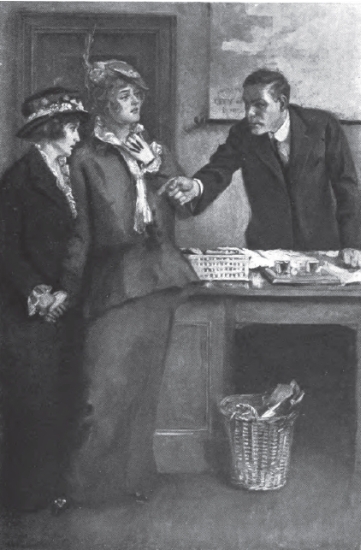
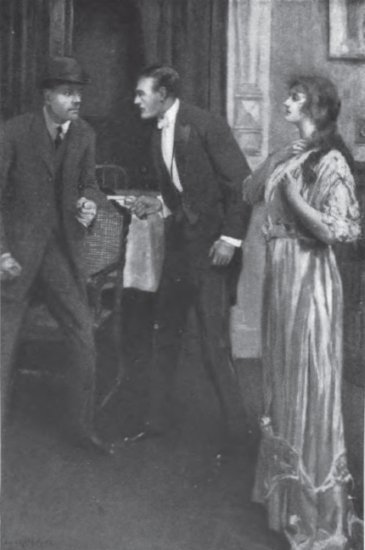
HE TURNED TO AMY. “YOUNG WOMAN, YOU’RE UNDER ARREST.”
Page 105.
As he called out the last city the girl gave a gasp of terror, and
triumph instantly lighted up her inquisitor’s grim face.
“So you pawned them in Philadelphia?” he cried.
“No, no!” she moaned.
“I did it,” Ethel Cartwright exclaimed.
“No, you didn’t,” Taylor said sharply. “You’re only trying to save her.
You can’t deceive me.” He turned to Amy, “Young woman, you’re under
arrest.”
“No, no,” the elder sister besought. “Take me. She’s only a child; don’t
spoil her life. I’ll do whatever you like; it doesn’t matter about me.
For God’s sake don’t do anything to my little sister.”
“She’s guilty,” he reminded her, “and the law says—”
“If somebody pays, what difference does it make to you or the law? Isn’t
there anything I can do?” she pleaded.
Taylor paced up and down the room for a half minute before answering,
while the two watched him in agony. To them he was one who could deliver
them over to prison if it were his whim, or spare if he inclined to
mercy.
“Surely there is some way out?” Ethel asked again.
“Yes,” he said, “there is. You can accept my proposition to enter the
secret service of the United States Customs.”
“Oh, yes, yes,” she cried, “anything!”
Taylor rubbed his hands together with satisfaction and pride in his
inimitable craft. “Now you’re talking!” he exclaimed. “Then we won’t
send the little sister to prison.”
Amy sobbed relief in her sister’s arms.
“Then you won’t tell Bronson?” Ethel asked.
“No,” he said, “I won’t tell Bronson.”
Ethel sighed, and felt almost that she would faint.
“Now I’m sorry for you two,” Taylor said more genially, “and as long as
you do what I tell you to, we’ll leave the little matter of the jewels
as between your sister and her conscience. I’ll let you know when I need
you. It may be to-night, it may be not for a month or a year, but when I
do want you—”
“I shall be ready,” the girl declared.
“Say, Chief,” Duncan said looking in at the door,—
“Get out, I’m busy,” Taylor shouted.
“I thought you’d like to know the Mauretania was coming up the bay,”
his satellite returned, slightly aggrieved at this reception.
“She is?” said the other. “Wait a minute then. Now, Miss Cartwright,
good afternoon. Remember what is at stake, your future, and your
sister’s happiness. And don’t forget that my silence depends on your not
failing me.”
Only a man of Taylor’s coarse and cruel mould could have looked at her
without remorse or compunction. He did not see a beautiful refined woman
cheerfully bearing another’s cross. He saw only a society girl, who had
matched her immature wits against his and lost, was beaten and in the
dust. There was a pathetic break in her voice as she answered him.
“I shall not fail you,” she said.
Duncan closed the door after them.
“Well?” Taylor demanded eagerly when they were alone. “Did Denby declare
the necklace?”
“No, sir,” Duncan returned promptly.
“Then I was right,” the other commented. “He’s trying to smuggle it in.
Jim, this is the biggest job we’ve ever handled.”
“Ford and Hammett are at the dock all ready to search him when I give
the word.”
Duncan was sharing in his chief’s triumph, but Taylor’s next command was
disappointing.
“Don’t give the word,” he enjoined. “There’s to be no search.”
“No search?” exclaimed the chagrined Duncan.
“No,” Taylor told him. “Just let him slide through with the ordinary
examination. Trail Denby and his party to Westbury and be sure none of
them slip the necklace to anyone on the way out there, but no fuss and
no arrests, remember. Meanwhile, get up a fake warrant for the arrest of
Miss Amy Cartwright. It may come in handy.”
“Yes, sir,” said Duncan obediently.
“And when you’ve told Ford and Hammett what they are to do, change your
clothes and make Gibbs do the same, and meet me at the Pennsylvania
Station at six o’clock.”
“Where are we going?” Duncan asked. He could see from his chief’s manner
that something important was in the wind.
“To Long Island,” he was told. “We are going to call on Miss Ethel
Cartwright.”
“Then you can use her to land Denby?” his subordinate cried excitedly.
“Use her?” the deputy-surveyor said with a grim smile. “Say, Jim, she
doesn’t know it, but she’s going to get that necklace for me to-night.”
He hurried out of the room, leaving Duncan shaking his head in
wonderment. His chief might have qualities that were not endearing, and
his manner might at times be rough, but where was there a man who rode
through obstacles with the same fine disregard as Daniel Taylor?