We read in the second chapter of Luke’s Gospel
that “it came to pass in those days that there
went out a decree from Cæsar Augustus that all
the world should be enrolled.” The common version
of the New Testament says, “taxed.” But
the revised version, following more closely the
original Greek, says, “enrolled.” It was what we
call at the present day a registration, made in order
that none should escape the subsequent taxation.
The sacred narrative continues. “All went to
enroll themselves, every one to his own city.” Dr.
James Stalker remarks:
“This does not seem a very thrilling fact with which to begin
the Christmas story; it seems, even, prosaic. But when the stern
emperor’s edict went forth there was one young woman’s heart
which thrilled with the keenest dread. That was the heart of
Mary of Nazareth, called of God to be the mother of our Lord
Jesus Christ. It meant for her a long hard journey of eighty
miles, in the winter season, over the mountains and along the
roughest paths; it meant that she must suffer pain and privation
when she was frail in body and anxious in mind, and all because
she could not escape going to Bethlehem to be enrolled. For
she and her husband Joseph were both direct descendants of
Israel’s best-beloved King, David, and must obey the law requiring
people to go back to the city from which their family had
first come and be enrolled and taxed there. So there was nothing
for her but to set out on the difficult journey, this sweet and
gentle maiden with her crown of supreme honor from God and
her burden of human anxiety and pain.”
We can imagine one subject of the conversation
between her and Joseph on the way. Their
poverty and obscurity had hidden from public
notice the fact of their lineage, so direct from
David. But all the Jews were wont to preserve
with great care everything pertaining to their
genealogies, and it was especially the case with
those whose certainty of Davidic descent gave
them ground for hoping that the Messiah would
appear in their own line. We may believe that
Joseph took with him a copy of the official family
records, those that Matthew and Luke have preserved
for us, and that he pleased himself and
Mary along the toilsome way with the thought
that now their specially honorable descent would
have to be in some measure publicly recognized.
Cæsar Augustus himself had not so good a patent
of nobility as had they. Although the dark
shadow of that monarch was about to fall, by reason
of this decree for enrollment, across the very
beginning of the holy Child’s life, they were afterward
to realize that God’s providence had been
leading them and had caused human government
to become an involuntary agent for bringing about
the fulfillment of the prophecy that the Messiah
should be born in Bethlehem.
Now who was this Cæsar Augustus, that is assumed
to have had so great authority in the whole
world that at his bidding a registration had to be
taken in every part of it? He was no less than
the first sole master of Rome’s united empire,
one of the most conspicuous figures in the history
of the human race.
He had ascended the throne as the climax of a
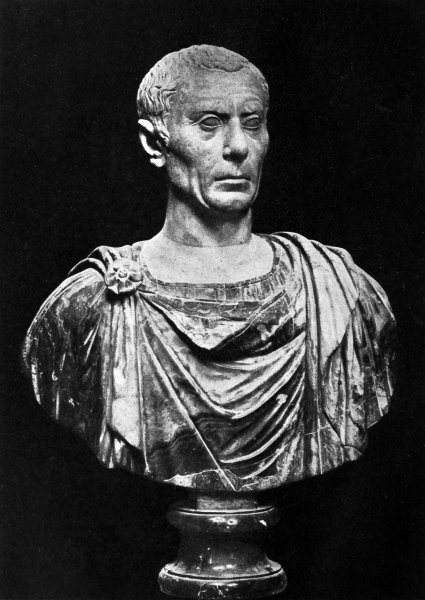
series of very startling and tragic events. Julius
Cæsar,—that man so wonderful alike for military
genius, political sagacity, and literary skill, to
whom first the Roman Senate gave the imposing
title of Imperator, and who, if he had lived longer,
would probably have become all that this title
later grew to mean,—had been assassinated by a
group of conspirators at Rome in the year 44 before
the beginning of the Christian era. These
assassins claimed that they were doing a great
service to the state by delivering it from the
schemes of so ambitious a man; but none can deny
that jealousy was among the motives that impelled
them to commit the bloody deed, which
took place in the building in the Campus Martius
where the Senate that year convened, adjoining
the Theater of Pompey, and we are told that it
was at the feet of great Pompey’s statue that
Cæsar fell. Mark Antony, who had been his colleague
in the consulship and in the control of the
army, dramatically pronounced a funeral oration
after Cæsar’s death from the rostra in the Forum
and then endeavored to make himself the successor
to Cæsar’s remarkable power and popularity.
But just then a new and strong competitor for
the military and political leadership appeared in
the person of a young man only nineteen years of
age, who is the subject of this sketch.
The name of this young man was at that time
Caius Octavius. He was the son of a Roman noble
of the same name and of his wife Atia,—who was
a niece of Julius Cæsar. They lived in a modest
home on the Palatine Hill. Caius Octavius was
also Julius Cæsar’s adopted son, and had been
chiefly educated under his provision and direction.
Moreover, Cæsar had designated him as his heir.
Caius Octavius proposed, therefore, now to become
the great dictator’s successor and avenger.
He assumed the longer name, Caius Julius Cæsar
Octavianus, and artfully secured,—first of all,—a
pledge from a large part of the army to support
and obey him. He found a great helper to his
ambitions in the most distinguished statesman of
that day, Marcus Vipsanius Agrippa. Marcus
Tullius Cicero also welcomed Octavianus to Rome,
especially as he saw in this young aspirant a
rival to Mark Antony, whom Cicero intensely
hated. Indeed, that famous orator made exciting
speeches against Mark Antony, which greatly impaired
the influence of that commander.
Soon there was civil war. Octavian, as we may
now call him, was on one side, Mark Antony on
the other. In two battles the latter was defeated.
He barely escaped with his life; and so Octavian
now attained unto the superior authority, imposing
his will upon the government and securing
his proclamation as consul on the 22d of September,
forty-three years before Christ.
Having reached this stage of success, Octavian
began to plan the securing of the humiliation of
Brutus and Cassius, who had taken part in the
assassination of Julius Cæsar, and who, with their
comrades, called themselves “liberators,” in view
of their opposition to the concentration of power
in one man. To rid himself of annoyance by them,
Octavian needed all the help he could get. He
now, therefore, took a most amazing step and one
that betrayed his utter lack (at that time) of
moral principle. He changed his attitude toward
Mark Antony, conciliated his friendship, and actually
succeeded in forming an agreement with
him and with another ambitious competitor named
Lepidus, who had also been a prominent military
officer.
These three met together for three days on a
small island in the river Rhenus, and there agreed
to be a “triumvirate,” as they called it, for the
reconstitution of the commonwealth. This triumvirate,
which was to last for five years, was a most
high-handed conspiracy,—an insult to the dignity
of the Roman senate, a violation of many previous
professions and alliances, and a tyranny over the
rights of private citizens. Three hundred senators
and two thousand knights were arbitrarily
proscribed by the three usurpers of power. The
estates of these victims were plundered and many
of them were hunted to their deaths.
Each one of the triumvirate in this arrangement
sacrificed some one of his friends to please the
others. Thus, Octavian himself outraged all feelings
of honor and justice by allowing Marcus Tullius
Cicero, whose influence and advocacy had done
great things in his behalf, to be put to death.
This was a concession to Mark Antony,—or rather,
to Mark Antony’s wife Fulvia, who, it is said, had
cherished a bitter grudge against Cicero and now
triumphantly and dramatically thrust a needle
into the once eloquent tongue of the murdered
man, when his bleeding head was exposed to view
in the Forum. It was a horrible satisfaction of
cruel spite!
The combined forces of Octavian and Antony
soon met those of Brutus and Cassius in the
famous battle of Philippi in Macedonia, a city
far away from Rome, but made more memorable
later by the imprisonment and deliverance there of
the Christian missionaries Paul and Silas. As the
result of their humiliating defeat in that battle,
both Brutus and Cassius committed suicide. This
was in November, forty-two years before Christ.
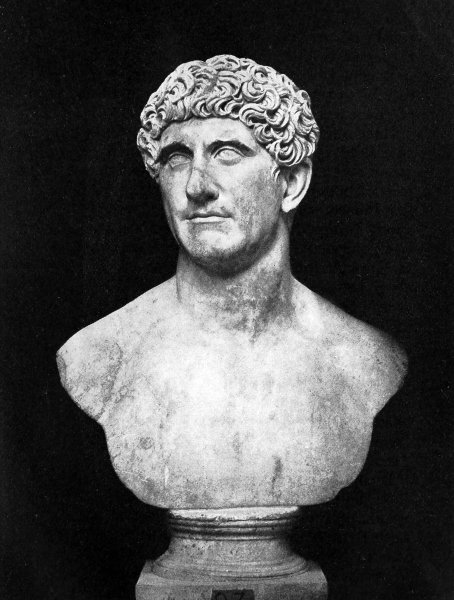
MARK ANTONY
Octavian returned to Italy to receive great honors
at Rome, and Mark Antony remained to be
the ostentatious ruler of the East. But the latter
soon became infatuated with the notorious Cleopatra,
the queen of Egypt.
This woman played a large part in the case.
She had come to Mark Antony at Tarsus in Cilicia
to win him back from the wrath he had manifested
because she had not sent aid to him and Octavian
in their war against Brutus and Cassius. She
made her appearance before him in the most sensational
manner. In the summer of the year 41
B. C. she sailed up the river Cydnus in Asia Minor,
on which the city of Tarsus, the capital of
Cilicia, was situated. She was reclining upon a
gilded couch, under a stately canopy, upon the
deck of her galley, which was propelled by silver
oars and purple sails. She was personating the
goddess Venus, attended by the Graces and fanned
by Cupids. Pipes and lutes discoursed delightful
music and the air was perfumed with sweet odors.
The Apostle Paul, when he was a youth at Tarsus,
doubtless heard related this strange incident
that had taken place in his native city two generations
before his time. Mark Antony disgracefully
became Cleopatra’s complete slave and, carried
away by her insidious allurements, he yielded to
her capricious dictation in many atrocious acts of
oppression and cruelty.
There followed a period of disagreement and
bloody conflict between Octavian and Mark Antony.
It was connected with the appropriation
of private lands in Italy in order to reward Octavian’s
soldiers. The principal event in that
short civil war was the siege and capture of the
strong hill-town of Perusia (the modern Perugia),
where an old Roman gateway still bears the name
of the Arch of Augustus. I strayed out of that
gate, I remember, on my visit to Perugia and
looked up at the massive stones that frowned upon
the modern intruder. At the period of history of
which we are speaking Mark Antony was still in
the East, but his brother, Lucius Antonius, leading
an army in his behalf, occupied this famous
old hill-town. Octavian encamped around it, and
finally subdued it by siege and famine. It was
only saved from plunder by his soldiers, after his
capture of it, because it was set on fire by one of
its own citizens, although many of these were put
to death by the relentless victor.
In order to offset the injury to his prospects
caused by this defeat of his brother and to carry
out plots which he had been making with his allies
in Italy, Mark Antony crossed the Mediterranean
sea from the East, invaded Italy, and expected to
fight with Octavian. But these plans were frustrated,
because his soldiers and those of Octavian,
having fought together at Philippi, were not enthusiastic
for any such engagement with each
other. Negotiations followed. A new treaty was
made at Brundusium on the Adriatic coast. A
new division of the world was mapped out between
the two leaders, and the treaty was supposed to
be confirmed by a notable marriage that then
took place. This was between Mark Antony,
whose wife Fulvia had died, and Octavia, the sister
of Octavian. It was celebrated with great
pomp and joy. Fond hopes were entertained on
the occasion for an era of great peace and prosperity.
The poet Virgil is thought to have celebrated
this treaty of Brundusium in his famous
Fourth Eclogue. In glowing language,—reminding
us of the metaphors, if not of the spirit of Old
Testament Messianic predictions,—he speaks of
the birth of a predestined boy who should inaugurate
a reign of peace and blessedness on earth.
Exactly what boy he meant has been a subject of
much discussion. Some Christians of the Middle
Ages in their zeal claimed that he meant Jesus,
the Christ; and, as he refers to the Sibyl of Cumæ
as having foretold the happy period, her name, in
a later age, was curiously coupled in the old Latin
hymn “Dies Iræ” with that of the psalmist David
as giving her prophetic testimony:
Teste David cum
Sibylla.1
And so, Raphael and Michaelangelo both depicted
her as a prophetess in their Christian frescoes,
now to be seen in Rome. There were so
many Jews in Rome in Virgil’s time that he may
have read the prophecy of Isaiah and may have
caught something of his imagery; but it is not
probable that in his lines he expresses anything
more than an optimistic pagan’s general hope of a
glorious prince and a brighter day.
After the festivities of his marriage with Octavia,
Antony went back to his eastern domain,
with larger projects and many promises. But it
was not long before his profligate tastes again
manifested themselves. Not even the thought of
the noble character of his new wife, Octavia, could
restrain him. He went on from one great folly
to another. Although he came back once to southern
Italy and renewed with Octavian, at Tarentum,
the terms of “the triumvirate” for another
five years, it was all in vain. The wily Cleopatra
had again established her influence over him.
Finally, at her instigation, he placed himself at
the head of an oriental fleet and army and prepared
to meet the forces of Octavian. The decisive
battle between them was fought on the sea
at Actium, northwest of Greece, on the 2d of September,
B. C. 41. Antony was completely routed.
He narrowly made his escape on the galley of
Cleopatra, which opportunely appeared upon the
scene for his rescue. Almost immediately, in the
Egyptian city of Alexandria, both he and his infamous
enchantress perished tragically by suicide.
Thus Octavian became the sole master of practically
the whole world. Great success had been
achieved by his army over the Parthians in the
far East. Herod the Great, an Idumæan, was confirmed
about this time in his authority as King of
Judea.
Jerusalem had been captured by the Roman
general Pompey, in 63 B. C., and Judea had then
become a part of the Roman province of Syria.
The Roman control of it had, however, been intermitted
until this time, when Herod entered it
and reigned triumphantly. Several other important
cities were also added to his domain. But it
was only as a subject of Rome that he had this
power. He was supported in his authority by the
army of Octavian, and was expected to obey every
beck and motion made to him by that emperor.
His administration of the affairs of that country
was vigorous and splendid, though it was characterized
by revolting cruelties. It is interesting
in this connection to remember how in early Old
Testament days Esau had sold his birthright to
Jacob, who henceforth supplanted him. There had
often, since that day, been enmity between the
children of Esau and the children of Jacob. Now,
for a time, this prince from Edom, a descendant
of Esau, sat upon the throne of Judea and reigned
over the posterity of Jacob, albeit he was overshadowed
and controlled, as we have seen, by Octavian—a
mightier potentate than himself.
It was when Herod was king at Jerusalem in
this way,—fawning upon the favor of Octavian
and fearing to incur that monarch’s displeasure,—that
Jesus Christ was born in Bethlehem.
The Messiah, whom prophets had foretold and
whom the Jews were longing for, made His advent
in the humblest way. The Prince of Peace
came as a little child into a world of awful selfishness
and cruelty and conflict. Herod must have
died not long after that event. The sufferings
of his final illness are thought to have exasperated
his anxiety and cruelty and perhaps were among
the causes which led to his ordering the slaughter,
as described by Matthew, of the few young male
infants in the village of Bethlehem, the number
not being large enough to make the Jewish historian
Josephus record the incident alongside of
Herod’s other and more extensive iniquities.
While that ruler alienated the affections of the
Jews, yet he professed to be a Jew in religion and,
with scrupulous care, rebuilt the temple at Jerusalem,
which temple continued to stand during
the ministry of Jesus and of the Apostles. After
the death of Herod there was made among his
sons a distribution of the provinces of Palestine
by the emperor Octavian. It was because of fear
of one of these sons, Archelaus, who ruled in
Judea, that Joseph and Mary, returning with the
young child from Egypt, did not go to Bethlehem,
but turned aside and went to Nazareth in Galilee.
Sextus, the son of Pompey, who had commanded
a piratical fleet on the Mediterranean, intercepting
ships bound from Alexandria to Italy, was conquered
by the forces of Octavian and was slain.
The reputed son of Julius Cæsar and Cleopatra,
Cæsarion by name, was also put to death.
Octavian was now made Imperator, and Censor
of the Empire for life. This does not mean that
all of the forms of a republic were at once destroyed,
but that the government was administered
in the spirit of an absolute monarchy.
Octavian retained the family name of Cæsar,
which was also assumed by his successors, as an
official designation, even when they belonged to
other lines of descent; just as are the modern
titles of “Kaiser” in Germany and “Czar” in
Russia, which are, indeed, derived from the Roman
name.
Octavian was a man of great ambition and had
overcome the violence and perfidy of others by
often using their own methods. He was reserved
in speech and bearing, and was somewhat simple
in his manner of living. He had a large degree
of coolness and self-control. He was shrewd, politic,
and far-seeing in adapting means to his ends.
He gathered all the lines of power into his hands
almost before the people realized that he was
doing it. We are told that he had under his direct
management “the disposal of revenues, the movements
of the army, the execution of the laws, the
administration of internal reforms and the adjustment
of foreign relations.” First the senators
then the plebians yielded to him many of their
long-cherished rights. Under his management the
famed Republic became an empire; and he was
the emperor indeed. His dominions extended
from the Atlantic to Arabia and from the islands
of Britain to the sands of Africa.
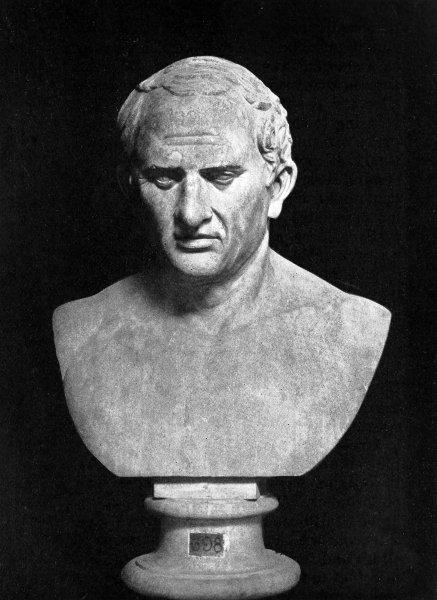
CICERO
While Rome had been conquering the world she
had been losing her liberties at home. Nothing
had really been left of liberty except its name.
But it must be admitted that, intense and stern
as Octavian was in grasping after power, he
showed wise moderation in its exercise. He reconciled
the people to the loss of their freedom by
securing to them greater material prosperity and
many exciting amusements. He expended great
sums on public roads and splendid buildings,
sewers, reservoirs, bridges, quays, parks, gardens,
and public offices in great profusion. Many of
his associates followed his example and erected
costly edifices, ornamented with columns and statues
in marble and bronze. It was his boast that
he had found Rome built of brick and would leave
it made of marble. He patronized the arts and
the sciences. He gathered around him men of
brilliant talents,—statesmen, orators, philosophers,
historians, painters, sculptors and poets.
Vipsanius Agrippa, his prime minister, Mæcenas,
Cicero, Livy, Virgil, Horace, and Ovid, besides
many lesser lights, distinguished his reign and
adorned his court. What the age of Pericles was
to Greece and that of Elizabeth was to England
the reign of this man was to the Roman empire.
In religion he was not much more than a stoic
philosopher, but he recognized the value of a religious
faith among the people and so was glad
to encourage them in the maintenance of pagan
altars and temples, many of which he built. It is
said that in the year 28 B. C. not less than eighty-two
temples were rebuilt in Rome itself. He
erected and restored the temple of Apollo upon
the Palatine, and near it he established a splendid
library. The Senate decreed that he should have
the then unique title of Augustus,—THE AUGUST
ONE. It was a title that Octavian’s successors
tried to retain, but it has become his own special
and superb designation in the pages of history, so
that we now often forget that it was really only
an adjective and not his proper name. The eighth
month in the year was called August, in his honor,
just as the seventh month had been called July,
in honor of Julius Cæsar.
Augustus, as we must now call him, was the
Cæsar for whom was named the city of Cæsarea,
which Herod the Great built on the seacoast of
Palestine, to be the political capital of that country,
and which the book of the Acts has led us to
associate later with the centurion Cornelius, in
whose house the Apostle Peter preached. It was
the home city of the Evangelist Philip and his
four daughters (Acts xxi:8, 9) and the scene of
Paul’s great speeches before the Roman governors,
Felix and his wife Drusilla, Festus, and
King Agrippa II, and his sister, Bernice. (Acts
xxiv:24; xxv:13.) Herod, as another act of obsequious
flattery, also built a marble temple to Augustus
at Paneas, at one of the sources of the
Jordan, near the base of Mount Hermon, at the
place that his son Herod Philip II, the tetrarch,
afterward rebuilt and called,—from the emperor
and himself,—Cæsarea Philippi, whither Jesus
Christ once came during his ministry, the most
northern point he ever visited, and held one of
the most significant conversations with his disciples.
My memory recalls with great pleasure the day
when a little group of tourists in Palestine (one of
which I had the privilege of being), there pitched
after a weary day’s journey their white tents,
amid desolation and fragmentary ruins, and gazed
upon the spring waters rushing, fresh and cold,
from the venerated cave under the hill. Around
this cave some architectural niches for statues are
cut into the natural rock, but the statues have
long since disappeared. Its original name of
Paneas, derived from the rustic god Pan, is now
corrupted into Baneas. A massive castle of the
crusaders frowns down from a great height, but
in the valley only wrecks of man’s ambitious
structures make a pathetic contrast with the beauties
of nature. It was in that region, probably,
on one of the foothills of Mount Hermon, that the
Transfiguration took place.
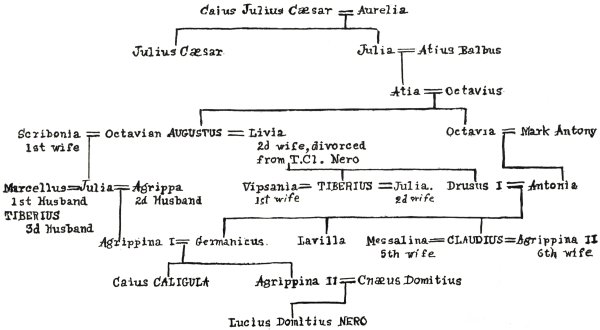
If we turn to consider the family life of the Emperor
Augustus, we learn that after one or two
betrothals in his early youth, which engagements
were not followed up, he married a lady of high
rank named Scribonia, by whom he had one child,
a daughter, named Julia. Afterward, when he
was known as Octavian, and was one of the triumvirs,
he either fell desperately in love with another
man’s wife or he was swayed by his intense
ambition at the time to ally himself with the aristocratic
families of Rome. At any rate, he divorced
Scribonia and carried off as his wife Livia
Drusilla, who was the wife of a prominent citizen,
Tiberius Claudius Nero. By him Livia had one
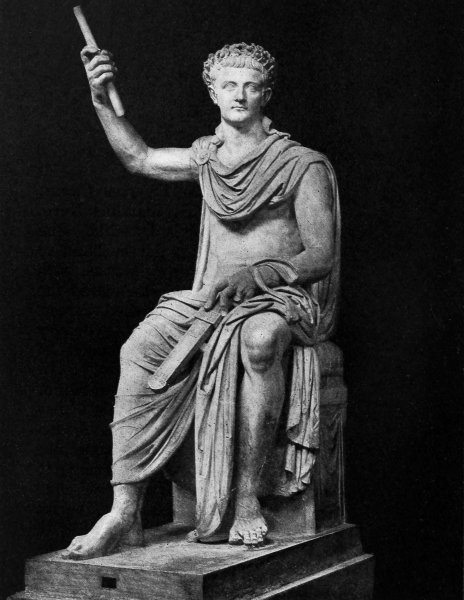
son, who afterward became the Emperor Tiberius.
She was soon to be the mother of another, the
celebrated general Drusus. So far was Tiberius
Claudius Nero from resisting her divorce from
him to marry Augustus, that, it is said, he gave
her a dowry and was present at the wedding.
Some historians, indeed, think that it was in accordance
with his own plans. He was old and
infirm. His wife was only nineteen and he may
have been glad to provide for her marriage, possibly,
with the young and rising triumvir, and
thus conciliate him to a better treatment of the
aristocratic party.
However this may have been, it illustrates the
loose Roman views of marriage in that day. It
put Livia in a strange and trying position. Her
own father had been among those aristocrats
whom the triumvirs had proscribed and hunted.
He had fought with Brutus and Cassius and had
died by his own hand after being defeated with
them by the army of Augustus at the battle of
Philippi. Two years before this marriage Livia
had fled from Italy with her husband, Tiberius
Claudius Nero, to escape the vengeance of Octavian.
Now she leaves the former to become the
wife of the latter. She had to turn away for a
time from her own son Tiberius and, three months
later, when her child Drusus was born in the home
of Augustus, this second son was sent to the house
of his father, Tiberius Claudius Nero.
Serene and practical, Livia seems to have accepted
the fate assigned her and endured all the
sacrifices it involved. A few years later, however,
when Tiberius Claudius Nero died, he appointed
Octavian,—who had then become the Emperor
Augustus,—the guardian of his sons, and Livia
received them back and cared for them with a
mother’s devoted solicitude. She seems truly to
have won the admiration if not the affection of
Augustus. He was proud of her ability, her faithfulness,
her household thrift, her wise counsel in
the affairs of state. They lived simply in their
house upon the Palatine. It was devoid either
of magnificent display or precious objects of art.
The furniture was exhibited in the second century
of our era and was wondered at for its plainness.
She superintended personally the treatment
of the wool, its distribution among the
slaves, and its weaving for family use. Augustus
never wore any togas that were otherwise made.
Their several villas at Lanuvium, Palestrina, and
Tivoli were all unpretentious. They sometimes
entertained prominent people at dinner, but only
on extraordinary occasions were there six courses
served,—usually there being but three.
On one public occasion Augustus made a long
speech in which he cited Livia as a model for
the ladies of Rome. He set forth minutely the
details of her household management,—what she
did, how she dressed, at what expense, how she
amused herself, and what amusements she deemed
suitable for a person of her position. The Romans
regarded her as the perfect type of an aristocratic
lady. She seems to have been dignified
and handsome in person, and thoughtful in spirit.
Her two sons,—Tiberius and Drusus, the stepsons
of Augustus,—were also very popular. Notwithstanding
the outrageous wrong of her compelled
divorce from her former husband, many
annoyances from her stepdaughter Julia, and the
temptations of a royal court, she maintained a
strong and self-controlled character, and, during
a married life of fifty years, kept to the last the
affection of her husband. It is reported that he
said to her at last, as he lay upon his death-bed:
“Preserve the memory of a husband who has
loved you very tenderly.”
When asked at one time how she contrived to
retain his affection, Dion Cassius tells us that she
significantly replied:
“My secret is very simple: I have made it the
study of my life to please him, and I have never
manifested any indiscreet curiosity with regard to
his public or private affairs.”
In all the life of the imperial court, not only
in the reign of Augustus but, as we shall see, in
that of her son Tiberius, the able and tactful management
of this commanding lady was an important
factor.
But, aside from his regard for Livia and in
spite of all his wealth and power and the flattery
of his subjects, Augustus was far from happy.
He had been bereaved by death of many of those
whom he esteemed and loved, such as Drusus,
Caius and Lucius Cæsar. He was often the victim
of mortification, sorrow and moroseness. His
daughter, Julia, disgraced him by her immoral
conduct. There was always incompatibility between
her and Livia. His grandsons died soon
after. He did not take much delight in the
thought of his stepson, Tiberius, as his successor,
and the marriage of Julia to Tiberius did not improve
the situation. But the jealousies and intrigues
of his court made for him constant trouble.
In his last days he made a generous will, distributing
thereby gifts to many of those who had
served him, including huge donations to the soldiers,
to the public treasury, and to the populace.
He also compiled a list of achievements by which
the empire had been benefited under his reign and
for which he had received public honors. This
memorial he intended to be cast in bronze for the
doors of the great mausoleum that he had built
in Rome for his burial place. We are indebted
for its preservation, however, to the Galatians,
who, inhabiting a province in the heart of Asia
Minor, had erected during the life of Augustus a
temple in his honor at their city of Ancyra, the
modern Angora. They obtained a copy of the
memorial and inscribed it upon the walls of the
vestibule of this temple; and there, though greatly
marred and broken, it can be read even at the
present day,—a fine record of the great monarch’s
deeds.
It was the propensity of Augustus to use the
vast riches at his disposal for the benefit of the
people. Sometimes he distributed freely corn,
wine, and oil and sometimes allowances in money.
He asserted that he spent in gifts what was equivalent
to the sum of twenty-six millions of dollars
(American money). To these many other donations
must be added; so that it has been reckoned
that his expenditure for the benefit of the people
amounted to ninety-one millions of dollars. Says
Lanciani:
“Were we not in the presence of official statistics and of state
documents, we should hardly feel inclined to believe these enormous
statements.”
Augustus died at Nola in Campania, Italy, August
19, A. D. 14, when he was nearly seventy-six
years of age. Before he died he had a long conversation
with his stepson Tiberius. On the day
of his death, when some friends entered his room,
he said to them:
“Do you think that I have acted my part well
on the stage of life? If you are satisfied, give
me your applause!”
Soon after, he expired in the arms of his wife
Livia.
“His body,” it is said, “was transported from
village to village, from city to city, along the Appian
Way by the members of each municipal council
in turn. To avoid the heat, the procession
marched only at night. At the foot of the Alban
Hills the whole Roman knighthood had come out
to meet the bearers. Thence, over the last ten
miles of the road, the progress was like a triumphal
one, till the bier was placed in the vestibule
of the Palace on the Palatine Hill. Afterwards
the body was carried to the Forum, to the space
in front of the Temple of Julius Cæsar, where
from the rostra a panegyric was read by Tiberius.
Another oration was delivered at the opposite
end of the Forum by Drusus, the adopted
son of Tiberius. Thence the senators, the high
priests, the knights, the army and a large part of
the leading citizens continued the march by the
Via Flaminia to the Ustrinum, or enclosure for
cremation. Officers and men threw on the pyre
the decorations which Augustus had awarded
them for bravery, and the torch was applied by
the captains of the legions which he had often
led to victory.”
Five days afterward Livia and the chief men of
the Equestrian order gathered up his ashes and
bore them to the Mausoleum.
During the lifetime of Augustus he had been
venerated as a god in the provinces; now he was
actually worshiped in Rome itself. Adoration
was paid to him in many private homes. He
also had a cult, sanctuaries, and a priesthood assigned
to him. Livia became the special priestess
of the new divinity.
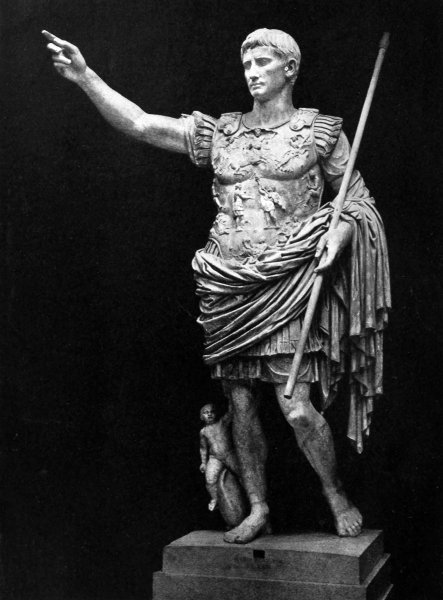
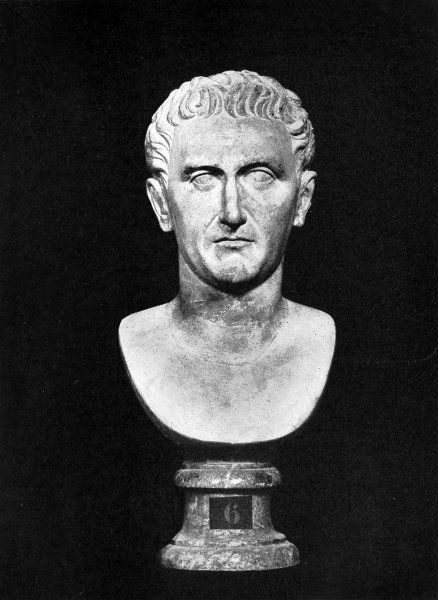
There have come down to us, in a remarkable
state of preservation, many statues, medallions,
busts, and coins, which have kept for us his face,
his form, and his bearing. In the Hall of Busts
in the Vatican Museum we have that beautiful
head which was found at Ostia, at the mouth of
the Tiber, in 1808.2 It is admired by all, and is
always spoken of as “the Young Augustus.” It
represents the future emperor with a prominent
nose, an intellectual forehead, wavy hair, a
rounded chin, and an expression both thoughtful
and amiable. What was he thinking of when the
sculptor caught his expression? Had he premonitions
of the successes and responsibilities before
him? Our knowledge of his subsequent career
illuminates for us his marble features. They
have an attractive ideality, which we can hardly
associate with one who afterward became such
a stern warrior; and we are drawn to him for the
moment with tender sympathy and exalted hopes.
Without stopping to describe other figures of
him, it is interesting to contrast this one with that
splendid full-length marble statue, also in the Vatican,
which was not discovered until 1863. It was
found buried in the ruins of the villa of his wife,
Livia, seven miles from Rome. This also bears
every mark of being a portrait from life. How
impressive that it has been hidden in the earth
for so many centuries, during which many kingdoms
have risen and fallen; and now it has been
brought forth, almost like a resurrection, and we
can stand, as it were, face to face with him! It
shows him to us in all his majesty, late in his career,
when he had become the grand master of the
world. He stands in a calm and commanding attitude,
bearing his weight on his right foot, wearing
his military breastplate, with drapery carefully
arranged around his hips and thrown over
his left arm. His left hand carries a scepter,
while his right is extended as if he were deliberately
addressing his army. The countenance
bears the stamp of much experience and of deep
seriousness, if not of anxiety. He seems to be
oppressed by the weight of empire. On his breastplate
or cuirass, which appears to be copied from
the metallic original worn by him, are seen Greek
designs, which have been compared with cameos
for the beauty and delicacy of their detail. The
central group of these embossed figures represents
a Roman general receiving some military standards
from a conquered foe. It is very probably
commemorative of the victory won by the Roman
army over the Parthians about 17 B. C., when Augustus
had deputed his stepson Tiberius to carry
on the campaign and afterward to secure in a
formal manner from Phraates, the king of the
Parthians, those bronze eagles that the Parthians
had taken away from the Roman general Crassus
and his soldiers more than thirty years before.
That defeat had been a bitter recollection to the
Romans ever since it occurred, and the restoration
of the standards was a matter of corresponding
rejoicing. They were sent to Rome, where they
were placed by Augustus in the Temple of Mars
Ultor. It seems probable that this statue was
carved soon after that time, about 17 B. C. On
the two sides of the representation, bent over in
sorrow, sit two symbolical figures, the probable
genii of two conquered nations. Near the neck
of the cuirass appears the god Cælus emerging
from the clouds, holding a scarf blown by the wind
and arching above his head, while before him
Apollo riding in his chariot reminds us of the
figures of Guido’s famous fresco of Aurora on the
ceiling of the Rospigliosi Casino in Rome.3 No
figure could better personify the conscious gravity
of universal lordship than does this stately
statue of Augustus. When first discovered some
portions of it bore traces of coloring. A little
cherub riding upon a dolphin is placed against the
right foot, supporting the work and, by contrast,
setting forth its dignity.
I have spoken of the great buildings erected in
the time of Augustus. Notwithstanding the fact
that the medieval Romans made the ancient ruins
of their city such a quarry for building material
out of which to construct their palaces, some evidences
of this emperor’s noble edifices still exist.
The Regia, or Royal House (of which now only
a few traces are found), in the Forum, had been
the residence of the rulers of the early Roman
kingdom and afterward of the leaders of the Republic;
but, as Augustus had been born upon the
Palatine and as that historic hill afforded a much
more spacious and commanding site, the people,—when
they made Augustus Imperator twenty-eight
years before Christ,—there erected for him a
splendid palace. Foundations of this building,
which are probably not yet fully excavated, are
still to be seen.
The beautiful mosaic pavements and frescoed
walls of some of the chambers of the house of
Livia his wife can also be visited on the Palatine
Hill. This is the only building of its kind in the
midst of the ruined palaces of the emperors.
Livia had received it from her first husband, the
father of Tiberius, and to it she retired after the
death of her second husband, Augustus. A flight
of six steps descends to the marble floor, which
is laid out in patterns. From this three chambers
can be entered. The paintings upon the plastered
walls of the dining-room and sitting-room are
very artistic in design and coloring. They are
among the most ancient paintings in existence.
They represent mythological scenes and characters,—Mercury,
Polyphemus, and Galatea, with
fruits, flowers, masks, and sacrificial offerings.
Some of the tints are still bright, and suggest a
homelike warmth. The triclinium or dining-room
is recognizable by an inscription.
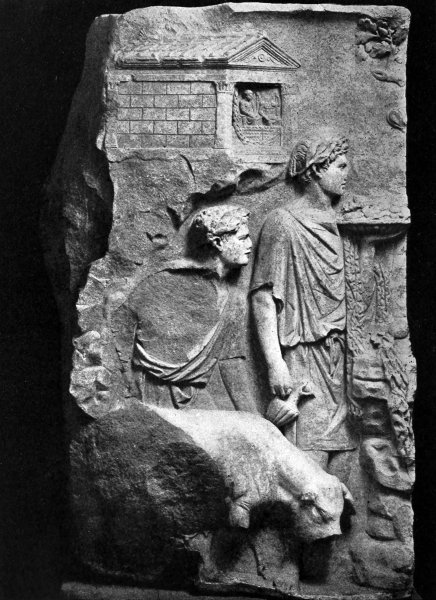
ALTAR OF PEACE
Near the Tiber we have the five columns and
other parts of the Portico of Octavia, which was
erected by Augustus and dedicated to his sister
Octavia. In the days of the republic, porticoes or
open colonnaded buildings for public resorts had
been almost a rarity; but Augustus introduced
a fashion and taste for them. In less than twenty
years the Campus Martius (now covered by modern
Rome) is said to have been full of them. They
added much to the architectural splendor of the
city. The Portico of Octavia is said to have had
three hundred columns, enclosing a court with
temples to Jupiter and Juno.
The massive architecture of what is left of the
Theatre of Marcellus, in the same region, reminds
us of Octavia’s son, to whose memory Augustus
dedicated it. Twelve arches of the outer circular
wall are now used as blacksmiths’ and other shops.
The lower story is partly sunk in the earth. Its
columns are much battered. Its arches and capitals
are also badly bruised. In the eleventh century
it was used as a fortress. Afterward a palace
was built on the mound of rubbish within it.
The historian Niebuhr, when he was the Russian
ambassador, occupied it as his home.
The temple of Mars Ultor (Avenger) is another
of the buildings of Augustus. Before the battle
of Philippi, which was such an important turning-point
in his career, he made a vow that should he
be victorious he would build a temple to Mars the
Avenger, because the assassination of his foster-father
Julius Cæsar would be avenged by such a
victory over Brutus and Cassius on that occasion.
With the fulfillment of this vow he combined the
construction of a new Forum, or public exchange,
for Rome.
These noble edifices were sometimes in later
centuries degraded to very commonplace uses.
The Portico of Octavia, for example, was for
many generations and until lately used as a fish
market. The buildings mentioned were all large
and costly constructions. As Augustus deposited
in the Temple of Mars Ultor the rescued standards
of Crassus, so for several generations victorious
generals stored away their insignia in the
same place. One of its features was a gallery of
statues of the military heroes whose victories
had enlarged the territory and glory of the empire.
The costly pavement of the Forum now lies
twenty feet below the present level of the ground.
It requires an effort of the imagination to reconstruct
the ancient scene from the old, soiled fragments.
Yet it can be done by the student of all
the surroundings; and future excavations will reveal
much more. For a people among whom the
army and war were so important, the Temple of
Mars was a center of the greatest interest. Its
beauty is described as of the highest sort. Augustus
says in his will that the Roman citizens who
fought under his orders numbered five hundred
thousand. At the time of his death one hundred
and sixty thousand Roman citizens were still serving
under the flag. The number of men-of-war
captured, burnt or sunk is stated at six hundred.
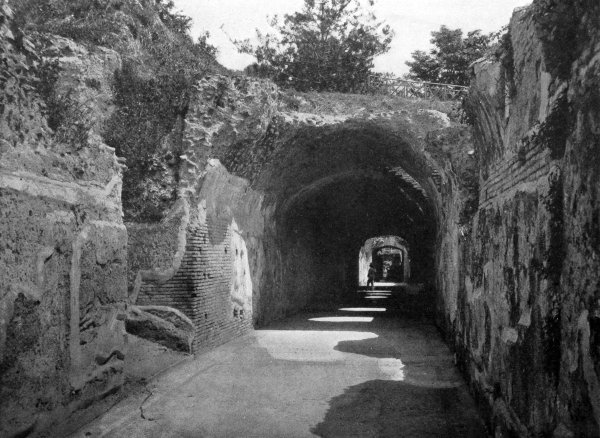
THE CRYPTOPORTICUS
But Augustus honored peace no less than war.
He thrice took the census of Rome, showing an
increase of the inhabitants from four millions
sixty-three thousand to nearly five millions. In
the inscriptions, already referred to as existing
in the ruins of the temple of Angora in Asia Minor,
he tells us that in the year 13 B. C. the Senate
ordered an altar to be built in the Campus
Martius to the divinity Pax Augusta (Augustan
Peace), upon which magistrates, priests, and vestal
virgins might offer a yearly sacrifice. In after
ages this altar became covered with rubbish and
above the rubbish was accumulated in time a cemetery
belonging to the adjoining church of San
Lorenzo in Lucina. But this cemetery, it is said,
was ten feet below the present level of the city.
In the latter part of the thirteenth century, over it
and over the altar of Peace beneath it Cardinal
Evesham built a palace, which has since passed
through various hands. In the early part of the
sixteenth century five carved panels of remarkable
beauty were brought to light from this
ground. Other pieces were found, but were carried
to various places,—even to Paris, Vienna,
and England. It was not until about the beginning
of the present century that it was proved
that they belonged to the famous Augustan Altar
of Peace. Excavations have since been made upon
the original site, sixteen feet below the street
level.
Vaulted passages have been constructed, so that
it is possible to pass along two sides of the altar’s
foundation; and at the end of one of these passages,
practically embedded in earth and rubbish,
may be seen to-day a most beautifully carved
panel showing a sacrificial procession. The altar
stood upon a platform three and one-quarter feet
high and measuring nineteen and a half by eleven
and one-half feet. It was approached by steps on
four sides. All this was placed in the midst of a
sacred area thirty-eight feet by thirty-five feet,
enclosed by marble walls elaborately carved in
relief on both sides. Among the representations
is a procession moving toward a sacrificial scene.
The figures are characterized by great dignity and
their drapery is arranged to produce a graceful
effect. Augustus himself and many of the persons
high in rank and power during his reign are
grouped as if in conversation. It is evident that
the whole structure was a most highly wrought
and artistic composition, a fitting monument to
him whose boast it was that he had secured unity
and peace throughout his empire and had caused
the gates of Janus, the god of war, to be closed
for a long time. Professor James C. Egbert, of
Columbia University, in his description of this
altar in the “Records of the Past” for 1906, to
which I am indebted, thus described two of the
panels, which are now in the Uffizzi Gallery at
Florence:
In one of these there are two family groups both marked by the
presence of husband and wife. The tall young man on the left
is Drusus, who died B. C. 9, greatly mourned by the emperor and
the people. He wears a military cloak, as he has left his command
in Rhætia to attend the dedication of the altar. His wife,
the beautiful Antonia, stands immediately before him and their
conversation is interrupted by the warning gesture of the figure
between, who calls for silence lest they mar the sanctity of the
occasion. The child at their feet is either Germanicus or the
later emperor, Claudius. The group to the right may be Tiberius
and his wife Julia, whom he, much to his disgust, was compelled
to marry after the death of her former husband, Vipsanius Agrippa.
The wife may be the sister of Antonia in the first group. Then
the husband would be Lucius Domitius Ahenobarbus, the grandfather
of Nero. Vipsanius Agrippa played a very important part
in bringing about the reign of peace and we should expect to
find him among the members of the imperial group. The central
figure in another panel has been recognized as Agrippa because
of the distinction suggested by the repose of the countenance.
Some see here a sadness of expression natural to one who has
suffered much. He is preceded by a young man who bears on his
shoulder the official ax, for Agrippa appears here as a high-priest.
The boy grasping his toga is Lucius Cæsar, his son, and
the beautiful woman on his left may be Julia, his wife, or
Vipsania Agrippina, his daughter.
To this description we may add that such graceful
and charming sculptures, with their portraits
of leading personages, could not have been unveiled
to the Roman public without awakening
great admiration.
To the period of Augustus also belongs the
foundation, at least, of the Pantheon. His prime
minister and son-in-law, Marcus Vipsanius Agrippa,
erected a temple, twenty-seven years before
Christ, at the north end of the warm baths, which
he had established here in the Campus Martius.
It was dedicated to several gods. It has often
been repaired and probably altered and enlarged
by restorations. The emperors Hadrian, Septimius
Severus, and Caracalla all contributed to its
preservation and development. In antiquity the
portico was reached by five steps, which are now
covered by the rising of the ground. Since A. D.
609 it has been consecrated as a Christian church.
Notwithstanding this, in A. D. 663 Constans II,
emperor at Constantinople, carried away to his
city the gilt-bronze tiles of the roof.
Throughout the middle ages this temple was
prized as the palladium and emblem of Rome.
The main part of the building is circular in form,—the
height and diameter of which are said to
be equal, each being one hundred and forty-two
feet,—and is composed of that concrete that the
ancient Romans knew how to make so lasting. It
is lighted by an uncovered aperture, thirty feet in
diameter, in the center of the dome, rimmed by an
elegant ancient cornice of bronze. The rich columns
of different kinds of marble and the other
decorations of the interior are most imposing, and
correspond well with the stately Corinthian portico
which forms the front of the edifice and under
which once stood colossal bronze statues of
Augustus and Agrippa.
The five front steps by which it was entered in
ancient times, are now covered by the raising of
the ground all around the building. The entrance
is still closed by the ancient massive, bronze doors.
In 1632 Pope Urban VIII, one of the Barberini
family, took away the bronze columns and ceiling
of the portico to make out of them the elaborate
pillars which support the canopy of the high altar
in St. Peter’s, and also cannon for the Castle of St.
Angelo. This occasioned the circulation of a
popular epigram of Pasquin. “What the Barbarians
did not do the Barberini did.”
The Pantheon is the noblest and best preserved
building of ancient Rome,—the only one, indeed,
having both its walls and vaulting intact, and it
is still closed by its ancient heavy bronze doors.
Lord Byron’s lines concerning it are well worth
quoting because of the conciseness of his description.
Simple, erect, severe, austere, sublime,
Shrine of all saints and temple of all gods
From Jove to Jesus, spared and blessed by time,
Looking tranquillity, while falls or nods
Arch, empire, each thing round thee, and man plods
His way through thorns to ashes! Glorious dome,
Shalt thou not last? Time’s scythe and tyrants’ rods
Shiver upon thee, sanctuary and home
Of art and piety, Pantheon, pride of Rome!
It is not strange that it was deemed the most
fitting place for the burial of the great artist,
Raphael, and for that of the King of United Italy,
Victor Emmanuel.
Of the former event the poet Rogers says:
When Raphael went,
His heavenly face the mirror of his mind,
His mind a temple for all lovely things
To flock and to inhabit—when he went,
Wrapp’d in his sable cloak, the cloak he wore,
To sleep beneath the venerable dome,
By those attended who in life had loved,
Had worship’d, following in his steps to fame,
’Twas on an April day, when Nature smiles.
All Rome was there.
Victor Emmanuel’s tomb is always covered with
wreaths, tributes by the living to his honor.
The remnants of the great mausoleum of Augustus,—in
which not only he but many of his successors
were interred,—are not now sought out by
many except students of antiquities. The last of
the emperors buried here was Nerva. Near the
river Tiber, on what was then the Campus Martius
or field of Mars, on a great platform of stone,
now beneath the ground, rose the huge circular
building of two stories, in which were the chambers
for the dead. Augustus was buried in the
central chamber, which was covered with a dome.
From this radiated fourteen smaller ones, most
of which can now be traced, though in a ruined
condition. Above these was a pyramidal mound
of earth in terraces planted with cypress trees and
surmounted with a large statue of the emperor
himself. The whole was surrounded by an attractive
park.
For centuries the monument was well known to
the people. War, earthquake and neglect have
now made its ruins one of the least conspicuous
sights in Rome, but some will ever find in them a
deep pathetic interest. After some searching I
found the entrance to them not far from the Via
Di Ripetta. Upon my application, the custodian,
who was an old woman, admitted me from a sort
of court, where I could look up at a part of the
circular exterior and where there was a fountain
at the side. An inscription tablet let into the wall
informs the visitor (in Latin) that here is the
western wall of the mausoleum of Augustus disclosed
by the removal of buildings. What seemed
to be electric wires, stretched down along the side
of the building, suggested a curious connection
between the beginning of the first century and the
beginning of the twentieth. Within the structure
I paced the corridors, gazed at the arched ceiling,
and could see out through the large windows into
the central space. In the twelfth century the
central dome was thrown down by an earthquake.
Afterward the center was used as an open-air
arena and was occupied by a popular circus until
a few years ago. At the time of my visit it was
a storehouse for the great plaster models for the
sculptures to be placed on the new monument that
was building to the memory of King Victor Emmanuel.
The Egyptian obelisks, forty-five feet
high, which stood before the entrance in the first
century, now are to be found, one of them in front
of the Quirinal Palace,—which is the royal residence,—and
the other one in the square by the
great church of Santa Maria Maggiore. Thus,
long ago rifled of its contents, the burial-place of
the celebrated master of the ancient world has
stood for centuries, broken and neglected.
Since the time I was there, however, a new
interest in it has awakened and a change has been
made. The circular interior has been cleared
out, and furnished with platform and seats. It
has become a place again of public entertainment
and is known as The Augustean. Orchestral
concerts of a high order are there performed. In
the interlude of the music the visitor can ponder
upon the march of the nineteen centuries which
have passed away since the walls around him were
erected.
Augustus had been upon the throne about
twenty-four years when Jesus was born. That holy
Child had come to share our lot and to reveal
clearly to men the knowledge of the Heavenly Father
at a time when all its political kingdoms had
thus become consolidated by force or treaty under
one name of power, when better conditions and
roads were preparing for the diffusion of Christianity,
and when men were beginning to dream
that there might be such a thing as a common loyalty
to one great sovereign. Was it too difficult
a step as yet for their minds to take from the
contemplation of a universal dominion to the doctrine
of a universal brotherhood? The quiet and
unobserved beginning of our Lord’s spiritual and
gracious mission was thus put in striking contrast
with the outward magnificence of the world’s great
conqueror, and the purely spiritual methods of the
Gospel with the noisy forces of a ponderous army.
When Augustus died Jesus was about eighteen
years old. In a time of such infrequent communication
between distant places a quiet town in
Galilee, like Nazareth, would have slight relations
with any higher authority than Herod. Yet Jesus
must have often seen in his boyhood Roman military
standards and groups of soldiers. He must
have gazed with eager interest and curiosity upon
their strong armor and shining weapons and
watched with wonder their well-ordered movements.
Roman coins must have been familiar
objects to him, with their medal and superscriptions
of the reigning monarch. He must have
often discussed with his companions the various
pieces of news that came from time to time from
the great metropolis of the Empire. The death
of the emperor in Italy, and the succession of
Tiberius to the throne, as these were announced
by couriers throughout the realm, must have
stirred in him many serious reflections and exalted
aspirations, many thrilling purposes of
righteous zeal and tender love for men. Along
with his gradual increase of knowledge as to the
wide extent of Cæsar’s magnificent empire, there
developed in his mind the sublime conception of
the Kingdom of God, his prophetic vision of its
blessed sway, and his consciousness that he himself
was to be the Messianic King.
Never will the thoughtful part of the world
finish the study of that wonderful life, the childhood
and the youth of which were among the
things that came to pass in the days of Cæsar
Augustus.