"AW, what's the difference between a
soldier and a loafer?" demanded
"Bunny" Hepburn.
"A soldier ain't a loafer, and it takes nerve
to be a soldier. It's a job for the bravest kind
of a man," retorted Jud Jeffers indignantly.
"Answer my c'nundrum," insisted Bunny.
"It ain't a decent conundrum," retorted Jud,
with dignity, for his father had served as a volunteer
soldier in the war with Spain.
"Go on, Bunny," broke in another boy in the
group, laughing. "I'll be the goat. What is
the difference between a soldier and a loafer?"
"A soldier gets paid and fed, and the other
loafer doesn't," retorted Bunny, with a broadening
grin. A moment later, when he realized
that his "joke" had failed to raise a laugh,
Bunny looked disappointed.
"Aw, go on," flared up Jud Jeffers. "You
don't know anything about a soldier."
"But my dad does," retorted Bunny positively.
"Dad says soldiers don't produce anything
for a living; that they take their pay out
of the pockets of the public, and then laugh at
the public for fools."
"And what does your father do for a living?"
demanded Jud hotly.
"He's a man who knows a lot, and he lectures,"
declared Bunny, swelling with importance.
"When my dad talks a whole lot of men
get excited and cheer him."
"Yes, and they buy him beer, too," jeered
Jud, hot with derision for the fellow who was
running down the soldiers of the United States.
"Your father does his lecturing in small, dirty
halls, where there's always a beer saloon underneath.
You talk about men being producers—and
your father goes around making anarchistic
speeches to a lot of workingmen who are down
on everything because they aren't clever enough
to earn as good wages as sober, industrious and
capable workmen earn."
"Speech, Jud!" laughingly roared another
boy in the crowd that now numbered a score of
youngsters.
"Don't you dare talk against my dad!" sputtered
Bunny, doubling his fists and trying to
look fierce.
"Then don't say anything against soldiers,"
retorted Jud indignantly. "My father was one.
I tell you, soldiers are the salt of the earth."
"Say, but they're a fine and dandy-looking
lot, anyway," spoke up Tom Andrews, as he
turned toward the post-office window in front of
which the principal actors in this scene were
standing. The place was one of the smaller
cities in New Jersey.
In the post-office window hung a many-colored
poster, headed "Recruits Wanted for the
United States Army." Soldiers of the various
arms of the service were shown, and in all the
types of uniforms worn on the different occasions.
"Oh, yes, they're a fine and dandy lot of
loafers—them soldiers!" declared Bunny Hepburn
contemptuously.
This opinion might not have gotten him into
trouble, but he emphasized his opinion by spitting
straight at the glass over the center of the
picture.
"You coward!" choked Jud.
Biff!
Jud Jeffer's fist shot out, with all the force
there is in fourteen-year-old muscle. The fist
caught Bunny Hepburn on the side of the face
and sent him sprawling.
"Good for you, Jud!" roared several of the
young boys together.
"Go for him, Jud! He's mad, and wants it,"
called Tom Andrews.
Bunny was mad, all the way through, even
before he leaped to his feet. Yet Bunny was
not especially fond of fighting, and his anger
was tempered with caution.
"You dassent do that again," he taunted,
dancing about before Jud.
"I will, if you give me the same cause," replied
Jud.
Bunny deliberately repeated his offensive act.
Then he dodged, but not fast enough. Jud Jeffer's,
his eyes ablaze with righteous indignation,
sent the troublesome one to earth again.
This time Bunny got up really full of fight.
From the opposite side of the street two fine-looking
young men of about eighteen had seen
much of what had passed.
"Let's go over and separate them, Hal," proposed
the quieter looking of the pair.
"If you like, Noll, though that young Hepburn
rascal deserves about all that he seems
likely to get."
"Jud Jeffers is too decent a young fellow to
be allowed to soil his hands on the Hepburn
kid," objected Oliver Terry quietly.
So he and Hal Overton hastened across the
street.
Bunny Hepburn was now showing a faint
daub of crimson at the lower end of his nose.
Bunny was the larger boy, but Jud by far the
braver.
"Here, better stop all of this," broke in Hal
good-naturedly, reaching out and grabbing
angry Bunny by the coat collar.
Noll rested a rather friendly though detaining
hand on Jud Jeffers's shoulder.
"Lemme at him!" roared Bunny.
"Yes! Let 'em finish it!" urged three or
four of the younger boys.
"What's it all about, anyway?" demanded
Hal Overton.
"That fellow insulted his country's uniform.
It's as bad as insulting the Flag itself!" contended
Jud hotly.
"That's right," nodded Hal Overton grimly.
"I think I saw the whole thing. You're right
to be mad about it, Jud, but this young what-is-it
is too mean for you to soil your hands on him.
Now, see here, Hepburn—right about face for
you!"
Hal's grip on the boy's coat collar tightened
as he swung Bunny about and headed him down
the street.
"Forward, quick time, march! And don't
stop, either, Hepburn, unless you want to hear
Jud pattering down the street after you."
Hal's first shove sent Bunny darting along for
a few feet. Bunny discreetly went down the
street several yards before he halted and lurched
into a doorway, from which he peered out with
a still hostile look on his face.
"Your view of the uniform, and of the old
Flag, is all right, Jud, and I'm mighty glad to
find that you have such views," Hal continued.
"But you mustn't be too severe on a fellow like
Bunny Hepburn. He simply can't rise above
his surroundings, and you know what a miserable,
egotistical, lying, slanderous fellow his
father is. Bunny's father hates the country he
lives in, and would set everybody to tearing
down the government. That's the kind of a
brainless anarchist Hepburn is, and you can't
expect his dull-witted son to know any more
than the father does. But you keep on, Jud,
always respecting the soldier and his uniform,
and the Flag that both stand behind."
"It gets on a good many of us," spoke up
Tom Andrews, "to hear Bunny always running
down the soldiers. He believes all his father
says, so he keeps telling us that we're a nation
of crooks and thieves, that the government is
the rottenest ever, and that our soldiers and
sailors are the biggest loafers of the whole
American lot."
"It's enough to disgust anybody," spoke up
Oliver Terry quietly. "But, boys, people who
talk the way the Hepburns do are never worth
fighting with. And, unless they're stung hard,
they won't fight, anyway."
"Oh, won't they?" growled Bunny, who, listening
to all this talk with a flaming face, now
retreated down the street. "Wait until I tell
dad all about this nonsense about the Flag and
the uniform!"
Hal and Noll stood for some moments gazing
at the attractive recruiting poster in the post-office
window. One by one the boys who had
gathered went off in search of other interest or
sport, until only Jud and Tom remained near
the two older boys.
"I reckon you think I was foolish, don't you,
Hal?" asked Jud, at last.
"No; not just that," replied Overton, turning,
with a smile. "No American can ever be
foolish to insist on respect for the country's
Flag and uniform."
"I simply can't stand by and hear soldiers
sneered at. My father was a soldier, you know,
even if he was only a war-time volunteer, and
didn't serve a whole year."
"When you get out of patience with fellows
like Bunny Hepburn," suggested Noll Terry,
"just you compare your father with a fellow
like Bunny's father. You know, well enough,
that your father, as a useful and valuable citizen,
is worth more than a thousand Hepburns can
ever be."
"That's right," nodded Hal, with vigor.
"And there's another man in this town that you
can compare with Bunny's father. You know
Mr. Wright? Sergeant Wright is his proper
title. He's an old, retired sergeant from the
Regular Army, who served his country fighting
Indians and Spaniards, and now he has settled
down here—a fine, upright, honest American,
middle aged, and with retired pay and savings
enough to support him as long as he lives. I
haven't met many men as fine as Sergeant
Wright."
"I know," nodded Jud, his eyes shining.
"Sergeant Wright is a fine man. Sometimes he
talks to Tom and me an hour at a time, telling
us all about the campaigns he has served in.
Say, Hal, you and Noll ought to call on him and
ask him for some of his grand old Indian stories."
"We know some of them," laughed Hal.
"Noll and I have been calling there often."
"You have?" said Jud gleefully. "Say,
ain't Sergeant Wright one of the finest men
ever? I'll bet he's been a regular up-and-down
hero himself, though he never tells us anything
about his own big deeds."
"He wears the medal of Congress," replied
Hal warmly. "A soldier who wears that
doesn't need to brag."
"Say," remarked Jud thoughtfully, "I guess
you two fellows are about as much struck with
the soldiers as I am."
"I'll tell you and Tom something—if you can
keep a secret," replied Hal Overton, after a
side glance at his chum.
"Oh, we can keep secrets all right!" protested
Tom Andrews.
"Well, then, fellows, Noll and I are going to
New York to-morrow, to try to enlist in the
Regular Army."
"You are?" gasped Jud, staring at Hal and
Noll in round-eyed delight. "Oh, say, but you
two ought to make dandy soldiers!"
"If the recruiting officer accepts us we'll do
the best that's in us," smiled Hal.
"You'll be regular heroes!" predicted Jud,
gazing at these two fortunate youngsters with
eyes wide open with approval.
"Oh, no, we can't be heroes," grimaced Noll.
"We're going to be regulars, and it's only the
volunteers who are allowed to be heroes, you
know," added Noll jocosely. "There's nothing
heroic about a regular fighting bravely. That's
his trade and his training."
"Don't you youngsters tell anyone," Hal insisted.
"Or we shall be sorry that we told you."
"What do you take us for?" demanded Jud
scornfully.
Hal and Noll had had it in mind to stroll off
by themselves, for this was likely to be their
last day in the home town for many a day to
come. But Jud and Tom were full of hero worship
of the two budding soldier boys, and walked
along with them.
"There's Tip Branders," muttered Tom suddenly.
"I don't care," retorted Jud. "He won't
dare try anything on us; and, if he does, we can
take care of him."
"What has Tip against you?" asked Hal
Overton.
"He tried to thrash me, yesterday."
"Why?"
"I guess it was because I told him what I
thought of him," admitted Jud, with a grin.
"How did that happen?"
"Well, Tom and I were down in City Hall
Park, sitting on one of the benches. Tip came
along and ordered us off the bench; said he
wanted to sit there himself. I told him he was
a loafer and told him we wouldn't get off the
bench for anybody like him."
"And then?" asked Hal.
"Why, Tip just made a dive for me, and there
was trouble in his eyes; so I reconsidered, and
made a quick get-away. So did Tom. Tip
chased us a little way, but we went so fast that
we made it too much work for him. So he
halted, but yelled after us that he'd tan us the
next time he got close enough."
Tip Branders surely deserved the epithet of
"loafer." Though only nineteen he had the
look of being past twenty-one. He was a big,
powerful fellow. Though he had not been at
school since he was fifteen, Tip had not worked
three months in the last four years. His mother,
who kept a large and prosperous boarding-house,
regarded Tip as being one of the manliest
fellows in the world. She abetted his idleness
by supplying him with too much money.
Tip dressed well, though a bit loudly, and walked
with a swagger. He was in a fair way to go
through life without becoming anything more
than a bully.
Hal Overton, on the other hand, was a quiet
though merry young man, just above medium
height, slim, though well built, brown-haired,
blue-eyed, and a capable, industrious young fellow.
The elder Overton was a clerk in a local
store. Ill-health through many years had kept
the father from prospering, and Hal, after two
years in High School, had gone to work in the
same store with his father at the age of sixteen.
Oliver Terry, too, had been at work since the
age of sixteen. Noll's father was engineer at
one of the local machine shops, so Noll had gone
into one of the lathe rooms, and was already
accounted a very fair young mechanic.
Both were only sons; and, in the case of each,
the fathers and mothers had felt sorry, indeed,
to see the young men go to work before they had
at least completed their High School courses.
By this time the fathers of both Hal and Noll
had found themselves in somewhat better circumstances.
Hal and Noll, being ambitious,
had both felt dissatisfied, of late, with their
surroundings and prospects, and both had
received parental permission to better themselves
if they could. So our two young friends,
after many talks, and especially with Sergeant
Wright, had decided to serve at least three years
in the regular army by way of preliminary training.
Unfortunately, few American youths, comparatively
speaking, are aware of the splendid
training that the United States Army offers to
a young American. The Army offers splendid
grounding for the young man who prefers to
serve but a single enlistment and then return
to civil life. But it also offers a solidly good
career to the young man who enlists and remains
with the colors until he is retired after
thirty years of continuous service.
Both Hal and Noll had looked thoroughly into
the question, and each was now convinced that
the Army offered him the best place in life.
Both boys had very definite ideas of what they
expected to accomplish by entering the Army,
as will appear presently.
Tip—even Tip Branders—had something of
an ambition in life. So far as he had done anything,
Tip had "trained" with a gang of young
hoodlums who were "useful" to the political
machine in one of the tough wards of the little
city. Tip's ultimate idea was to "get a city
job," at good pay, and do little or nothing for
the pay.
But Tip dreaded a civil service examination—knew,
in fact, that he could not pass one. In
most American cities, to-day, an honorably discharged
enlisted man from the Army or Navy
is allowed to take an appointment to a city position
without civil service examination, or else
to do so on a lower marking than would be accepted
from any other candidate for a city job.
So, curiously enough, Tip had decided to
serve in the United States Army. One term
would be enough to serve his purpose.
Tip, too, had kept his resolve a secret—even
from his mother.
As Hal and Noll, Jud and Tom strolled along
they came up with Tip Branders.
"So this is you, you little freshy!" growled
Tip, halting suddenly, and close to Jud. "Now
I'll give ye the thrashing I promised yesterday."
His big fist shot out, making a grab for young
Jeffers.
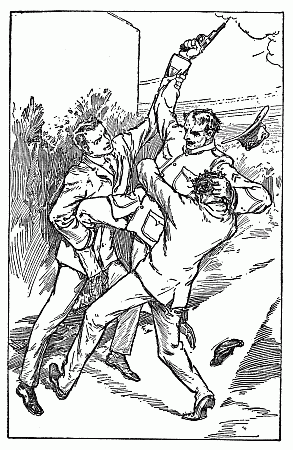
But Hal Overton caught the wrist of that
hand, and shoved it back.
"That doesn't look exactly manly in you,
Branders," remarked Hal quietly.
"Oh, it doesn't, hey?" roared Tip. "What
have you got to say about it?"
"Nothing in particular," admitted Hal pleasantly.
"Nothing, except that I'd rather see you
tackle some one nearer your own size."
"Would, hey?" roared Tip. "O. K!"
With that he swung suddenly, and so unexpectedly
that the blow caught Hal Overton unawares,
sending him to the sidewalk.
"I believe I'll take a small hand in this," murmured
Noll Terry, starting to take off his coat.
But Hal was up in a twinkling.
"Leave this to me, please, Noll," he begged,
and sailed in.
Tip Branders was waiting, with an ugly grin
on his face. He was far bigger than Hal, and
stronger, too. Yet, for the first few moments,
Tip had all he could do to ward off Hal's swift,
clever blows.
Then Tip swung around swiftly, taking the
aggressive.
It seemed like a bad mistake, for now Hal
suddenly drove in a blow that landed on Brander's
nose, drawing the blood.
"Now, I'll fix ye for that!" roared Tip, after
backing off for an instant.
Just as he was about to charge again the big
bully felt a strong grip on his collar, while a
deep, firm voice warned him:
"Don't do anything of the sort, Branders, or
I'll have to summon an officer to take you in."
Tip wheeled, to find himself looking into the
grizzled face of Chief of Police Blake. Tip
often bragged of his political "pull," but he
knew he had none with this chief.
"I got a right to smash this fellow," blustered
Tip. "He hit me."
"I'll wager you hit him first, though, or else
gave young Overton good cause for hitting
you," smiled the chief. "I know Overton, and
he's the kind of boy his neighbors can vouch for.
I don't know as much good of you. But I'll tell
you, Tip, how you can best win my good opinion.
Take a walk—a good, brisk walk—straight down
the street. And start now!"
Something in the police chief's voice told Tip
that it would be well to obey. He did so.
"Too many young fellows like him on the
street," observed Chief Blake, with a quiet
smile. "Good morning, boys."
At the next corner Hal and Noll turned.
"Oh, you're going to see Sergeant Wright?"
asked Jud.
"Yes," nodded Hal. "Our last visit to him."
"Then you won't want us along," said Jud
sensibly. "But say, we wish you barrels of luck—honest—in
the new life you're going into."
"Thank you," laughed Hal good-humoredly,
holding out his hand.
"Send me a brass button soon, one that you've
worn on your uniform blouse, will you?" begged
Jud.
"Yes," agreed Hal, "if there's nothing in the
regulations against it."
"And you, Noll? Will you do as much for
me?" begged Tom.
"Surely, on the same conditions," promised
Noll Terry.
"But we haven't succeeded in getting into the
service yet, you must remember," Hal warned
them.
"Oh, shucks!" retorted Jud. "I wish I were
as sure of anything that I want. The recruiting
officer'll be tickled to death when he sees you
two walking in on him."
"I hope you're a real, true prophet, Jud,"
replied Hal, with a wistful smile.
Neither of these two younger boys had any
idea how utterly Hal Overton had set his heart
on entering the service, nor why. The reader
will presently discover more about the surging
"why."
On one of the side streets the boys paused before
the door of a cozy, little cottage in which
lived Sergeant Wright and the wife who had
been with him nearly the whole of his time in
the service.
Ere they could ring the bell the door opened,
and Sergeant Wright, U. S. Army, retired,
stood before them, holding out his hand.
"Well, boys," was the kindly greeting of this
fine-looking, middle-aged man, "have you settled
the whole matter at home?"
"Yes," nodded Hal happily. "We go to New
York, to-morrow, to try our luck with the recruiting
officer."
"Come right in, boys, and we'll have our final
talk about the good old Army," cried the retired
sergeant heartily.
It was that same afternoon that Tip Branders
next espied Jud and Tom coming down a street.
Tip darted into a doorway, intent on lying in
wait for the pair.
As they neared his place of hiding, however,
Tip heard Jud and Tom talking of something
that changed his plan.
"What's that?" echoed Tip to himself, straining
his hearing.
"Say," breathed Tom Andrews fervently,
"wouldn't it be fine if we could go to New York
to-morrow morning, too, and see Hal and Noll
sworn into the United States Army?"
Tip held his breath, listening for more. He
heard enough to put him in possession of practically
all of the plans of Hal and Noll.
"Oho!" chuckled Tip, as he strode away from
the place later. "So that pair of boobs are going
to try for the Army. Oh, I daresay they'll
get in. But so will I—and in the same company
with them. I wouldn't have missed this for anything.
I'll be the thorn in Hal Overton's side
the little while that he'll be in the service! I've
more than to-day's business to settle with that
stuck-up dude!"
All of which will soon appear and be made
plain.
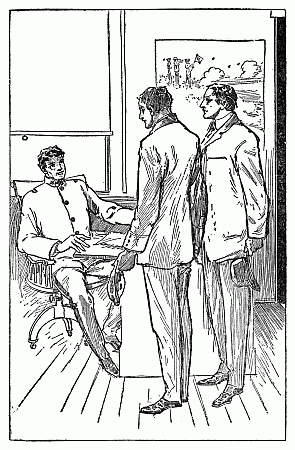 "And These Are Your Applications?"