IN at the gate down by post number one—in
other words, at the guard house—turned
an extremely large and costly-looking
seven-passenger touring car.
At the driver's post sat an undersized,
shrewd-looking little Frenchman.
Behind him, in one of the five seats of the
tonneau sat a dapper-looking young man of
medium height, with a soft, curly little
moustache and dressed in the height of masculine
fashion.
At post number one the car was halted, apparently
much to the surprise of the solitary
passenger, who leaned indolently forward and
exchanged some words with the sentry.
"Gracious!" gasped Noll. "He must be a
person of some importance, after all. There's
the sentry presenting arms."
"And there comes the corporal of the guard,
making a rifle salute," added Hal. "It must
be a new officer joining the regiment."
"That—an officer?" gasped Noll, in unfeigned
disgust. "Don't libel the good old
Army, Hal."
Of a sudden the big car shot forward again,
and came up the main road to officers' row at
a smashing clip.
Then, just as suddenly, it halted beside the
two young corporals.
"Hello, boys!" greeted the dapper, smiling
little fellow in the tonneau. "Say, I'm afraid
I'm all at sea. I've come to live with you fellows,
but I'm blessed if I haven't already forgotten
what that fellow with the gun told me
down at the porter's lodge."
"Porter's lodge? Do you mean the guard
house, sir?" Hal asked respectfully.
"Why, yes—if that's what you call it—of
course. Names don't matter much to me.
Never did. Some one over in Washington—the
secretary of something or other—sent me
over here. I'm a new lieutenant, and I believe
I'm to stay at this beastly place."
At the mention of the word "lieutenant" both
Hal and Noll came to a very formal salute.
"Now, what do you mean by that?" smiled
the new-comer affably. "Sign of some lodge
on the post? I haven't had time to get into
any of your secret societies yet, of course."
"We offered you the officer's salute, sir," explained
Corporal Hal.
"Oh, then you're officers? I guessed as
much," beamed the pleasant young stranger.
"No; we're corporals, sir," Hal informed him.
"Oh, yes; seems to me I've heard about corporals.
I'll know more about them later, I dare
say. How are you, anyway, boys?"
The stranger leaned out over the side of the
car, extending his hand to Corporal Overton,
who could not very well refuse it. Then Noll
came in for a handshake.
"Of course you understand sir, that we're
below the grade of officers," Hal continued.
"Oh, pshaw!" replied the still smiling
stranger. "Such things as that don't count.
And I've been warned that the Army is one of
the most democratic places in the world. I
haven't brought any of my 'lugs' here with
me—'pon my word I haven't. I'm Lieutenant
Algernon Ferrers. I hope all of you fellows
will soon like me well enough to call me Algy."
Though Mr. Ferrers was certainly the biggest
joke in the way of an officer that either of
the young soldiers had ever seen, it was impossible
not to like this pleasant young man.
"Jump in—won't you, boys?" invited Lieutenant
Ferrers, throwing the nearer door of the
tonneau open. "I'll be tremendously obliged
if you'll pilot me to the right place. Where
do I ring the bell? Of course I've got to give
some one here the glad hand before I can be
shown to my rooms."
Though they did so with some misgivings Hal
and Noll both stepped into the tonneau.
"Sit right down, boys," urged Lieutenant
Ferrers amiably.
"Pardon me, sir," explained Hal Overton.
"It would be a bad breach of discipline in this
regiment for any enlisted man to sit in the company
of his officers."
"Oh, you're enlisted men, eh?" queried the
new lieutenant, showing no signs whatever of
feeling taken aback. "I'm glad to say I didn't
have to enlist. My guv'nor has some good
friends at Washington, and I was appointed
from civil life."
Hal and Noll had already guessed that much
without difficulty. No officer quite like Lieutenant
Ferrers had ever been turned out at West
Point, and surely such a man had never risen
from the ranks. Now, when all the West Point
graduates have been commissioned into the
Army, and all meritorious enlisted men have
been promoted to second lieutenancies, then, if
there be any vacancies left, the President fills
these vacancies in the rank of second lieutenant,
by appointing young men from civil life.
Generally these appointments from civil life
go to the honor graduates of colleges where
military drill is conducted by an officer of the
Army detailed as instructor. But, occasionally,
there are more vacancies than these honor graduates
can or will fill—and then political influence
very often plays a part in the appointment
of some young men as lieutenants in the Army.
"Tell François where to drive, will you?"
begged Lieutenant Ferrers.
"I don't believe, sir, that Colonel North is at
his office so late in the forenoon," Corporal Hal
replied. "But I think, sir, that Captain Hale,
the regimental adjutant, will be found there."
"Does Hale assign a fellow's rooms to him?"
queried Lieutenant Ferrers innocently.
"If you are under orders to join, sir, you
will be expected to report to Colonel North, or
else to the regimental adjutant, who represents
the colonel."
"I—see," nodded the new lieutenant slowly.
"Will you do me the extreme favor to tell François
where to leave us?"
Hal leaned forward, indicating the headquarters
building.
In another moment the big car stopped before
headquarters.
"Come right on in, fellows, and introduce me,
won't you?" urged Lieutenant Ferrers.
"I—I am afraid we'd better not," replied
Hal, flushing.
"Oh, I see—you've a luncheon appointment,
or something of the sort, eh? Well, never
mind; glad to have met you. Expect to have
many a good time with you later on. Good fellows,
both of you, I'll wager."
"Come away from here, Noll," begged Hal,
as soon as Mr. Ferrers had run up the steps and
into the building. "I'm suffocating."
"I'm green," grinned Noll chokingly, "but
I'd hate to have as much ahead of me to learn
as that new officer has."
"Oh, perhaps he was joshing us," suggested
Hal.
"Do you know what I think?"
"What?"
"I think," responded Noll, struggling hard
to keep his gravity, "that Mr. Ferrers is kidding
himself worse than any one else."
In the meantime Ferrers had bounded past
an orderly and had broken into the office of
the regimental adjutant.
"Hello, old chap!" was his joyous greeting
of dignified Captain Hale.
"Sir?" demanded the regimental adjutant.
"Who the blazes are you, sir?"
"Name's Ferrers, old chap," responded the
newcomer, lightly, dropping a card down on
the adjutant's desk.
Captain Hale glanced at the card. Then a
light seemed to dawn on him.
"Oh! I think it likely you are the Lieutenant
Ferrers who has been ordered to the Thirty-fourth,"
went on Captain Hale.
"You're a wonderful guesser, old chap.
Now, where do I go to see about my rooms,
housing my servants, storing my cars, etc.?"
Captain Hale tried to hide his grim smile
as he held out his hand.
"Welcome to the Thirty-fourth, Mr. Ferrers.
And now I think I had better take you to
Colonel North. He has been expecting you."
Lieutenant Algernon Ferrers followed the
broad-backed adjutant into an inner office,
where the very young man was presented to
the grizzled-gray Colonel North. Then, as
quickly as he could, Captain Hale escaped back
to his desk in the outer office.
Colonel North looked at Mr. Ferrers with a
glance that did not convey absolute approval.
"Have you been in a train wreck, Mr. Ferrers?"
inquired the colonel.
"Oh, dear me, no. Do I look as bad as that?"
inquired the new lieutenant, with a downward
glance at his faultless attire.
"But you were due to arrive here at four
o'clock yesterday afternoon, Mr. Ferrers," continued
the colonel. "I was here at my desk,
waiting to receive you."
"I hope I didn't inconvenience you any,"
murmured Ferrers. "You see, Colonel, when
I got in at Pueblo I ran across some old friends
at the station. They insisted on my staying
over with them for half a day. I couldn't very
well get out of it, you see."
"Couldn't very well get out of it?" repeated
Colonel North distinctly and coldly. "Wouldn't
it have been enough, Mr. Ferrers, to have told
your friends that you were under orders to be
here at four o'clock yesterday?"
"Oh, I say, now," murmured Mr. Ferrers,
"I hope you're not going to raise any beastly
row about it."
"That is not language to use to your superior
officer, Mr. Ferrers!"
"Then you have my instant apology,
Colonel," protested the young man. "But, you
see, these were very important people that I
met—the Porter-Stanleys, of New York. Very
likely you have met them."
Colonel North now found it hard to repress
a tendency to laugh. But he choked it back.
"I am afraid, Mr. Ferrers, you do not realize
the seriousness of failing to obey a military order
punctually. More than that, I fear it would
take more time than I have between now and
luncheon to make it plain to you. But I assure
you that you have a great deal, a very
great deal, to learn about the strict requirements
of Army life and conduct."
"And you'll find me very keen to learn, sir,
very keen, I assure you. But, since you're good
enough to postpone telling me more about such
little matters, may I ask you, Colonel, who will
show me to my rooms? I shall need quite a
few, for, outside of two chauffeurs—I have five
auto cars you know—I have also four household
servants and a valet."
"You have—what!" gasped Colonel North.
Mr. Ferrers patiently repeated the details
concerning the number of his automobiles and
servants.
"And where are they?" demanded the regimental
commander.
"I left them over in Clowdry until I send
for them, sir."
"Mr. Ferrers, have you any idea how many
rooms an unmarried second lieutenant has?"
"A dozen or fifteen, I hope," suggested Mr.
Ferrers hopefully. "A gentleman, of course,
can't live in fewer rooms."
"Mr. Ferrers, an unmarried second lieutenant
lives in bachelor officers' quarters. He has
a parlor, bed-room and bath."
"Oh, I say now," protested poor Mr. Ferrers
earnestly, "you can't expect me to get along
in any such dog-kennel of a place."
"You'll have to, Mr. Ferrers."
"But my servants—my chauffeurs?"
"No room for them on this post."
"But I can't keep five cars running without at
least two chauffeurs. And by the way, Colonel,
what kind of a garage do you have here?"
"None whatever, Mr. Ferrers. You can keep
one small car down at the quartermaster's
stables, but that is the best you can do."
Lieutenant Algernon Ferrers, who instantly
realized that this fine-looking old colonel was
not making game of him, sat back staring, a
picture of hopeless dejection.
"I had no idea the Army was anything like
as beastly as this," he murmured disconsolately.
"If you're going to remain in the service, Mr.
Ferrers," returned the colonel, "I'm afraid you
will have to recast many of your ideas. In the
first place, you won't need servants. You'll get
your meals at the officers' mess, and all the servants
needed there are provided."
"But I must have some one to take care of
even my two poor little rooms," fidgeted Mr.
Ferrers. "I can't undertake to do that myself.
Besides, Colonel, I don't know how to do housework."
"Some of the work in your rooms you should
and must do yourself," explained Colonel North.
"Such, for example, as tidying up your quarters.
The rougher work you can have done by
a striker."
"Striker!" echoed Mr. Ferrers, a gleam of
intelligence coming into his eyes. "No, thank
you, Colonel. Strikers never work. I've heard
my guv'nor talk about strikes in his business."
"'Striker,'" explained Colonel North, "is
Army slang. Your 'striker' is a private soldier,
whom you hire at so many a dollars a month to
do the rougher work in your quarters. You
make whatever bargain you choose with the
soldier. At this post the bachelor officers usually
pay a striker eight dollars a month."
"At that price I can afford a lot of 'em," responded
Mr. Ferrers, brightening considerably.
"An unmarried officer is not allowed to have
more than one striker in this regiment," said
the colonel, whereat Ferrer's face showed his
dismay. "Nor is any soldier obliged to become
your striker. You cannot engage him unless
the soldier is wholly willing. However, a good
many men like the extra pay. You will be assigned
to A company. Direct the first sergeant
of that company to send you a man who is
willing to serve as a striker. And now, Mr.
Ferrers, as you appear to be wholly ignorant of
Army life I think I will give you a mentor."
Turning to the telephone Colonel North
called:
"Connect me with Lieutenant Prescott.
Hello, is that you, Mr. Prescott? The regimental
commander is speaking. My compliments,
Mr. Prescott, and can you come over to
headquarters? Thank you."
Ringing off the colonel turned to his very
new young lieutenant, saying:
"Mr. Prescott is a last year's graduate of the
Military Academy at West Point, and one of
the most capable younger officers I have ever
met. I can think of no man so well qualified to
coach you in the start of your new life, Mr. Ferrers.
You have some baggage with you?"
"Oh, yes, sir. Two trunks on the car."
"Then you have uniforms with you?"
"Yes."
"Say 'sir' when answering a superior officer."
"Yes, sir."
"You have your two regulation swords?"
"Yes, sir. And say!" Ferrers beamed forth,
with enthusiasm, while his eyes lit up. "The
regulation swords are not such a much, so, while
I got them, I also had four other swords made
that are a whole lot handsomer. Wait until you
see me, sir, with the beauty that Tiffany made
to my order—my own design, sir."
"Doubtless your extra swords will do very
well as ornaments in your quarters, Mr. Ferrers,"
replied the colonel, trying very hard to
keep a straight face. "But you will not appear
with any other than the regulation swords."
"Oh, I say, now——" broke forth Ferrers
anxiously, but the door opened, and Lieutenant
Dick Prescott strode in, looking the perfection
of handsome soldiery.
"You sent for me, sir?" Prescott asked, coming
to a very formal salute.
"Yes, Mr. Prescott. This young gentleman
is Lieutenant Algernon Ferrers, lately appointed
from civil life. As Mr. Ferrers will
presently be glad to admit that he knows less
than nothing about Army life, I can think of
no one better qualified than you, Mr. Prescott,
to explain to him the nature of military life."
"Thank you, Colonel," replied Prescott
gravely.
"Kindly take Mr. Ferrers over to the officers'
mess and see that he is made to feel at home
among you youngsters. And advise him, in all
necessary respects, as to what is expected of him
in this regiment."
"But my rooms, sir? My little dog-kennel?"
urged Ferrers.
"Mr. Prescott will take you to Lieutenant
Pope, the battalion quartermaster, who will assign
you to quarters. And, Mr. Prescott, make
it a point to introduce Mr. Ferrers to Major
Silsbee and also Captain Ruggles of A company,
for Mr. Ferrers is assigned to that company."
Prescott saluted smartly in leaving his
colonel. Ferrers also endeavored to salute,
and imitated badly—with the wrong hand.
As soon as the door had closed Colonel North
rose, sighed and muttered:
"With a seeming idiot like that on officers'
row I can see our old and happy life here passing."
Lieutenant Ferrers, after an infinite amount
of coaching by Mr. Prescott, turned out at afternoon
parade. Ferrers did not take his post with
his company, but stood at one side, out of the
way, watching the work with a rather bored
look.
By the time that the men were dismissed from
parade every enlisted man in barracks appeared
to have heard a lot about Lieutenant Ferrers.
Every man was either telling or listening to
some anecdote about the new young officer, and
roars of laughter rang on all sides, for Algy
Ferrers, during the brief afternoon, had managed,
in spite of Prescott, to make a whole lot
of ridiculous breaks.
"That young shave-tail won't last two weeks
in the service," predicted Corporal Hyman,
who, though he now belonged in another squad
room, was just now visiting with Sergeant Hupner's
men.
"Oh, I don't know," Noll answered thoughtfully.
"I've seen a lot of worse enlisted men
licked into shape and become good soldiers. I
don't know why the rule shouldn't work as well
with a new officer."
Corporal Hal, at this moment, was down at
the further end of the squad room, close to an
open window. Here, where he had plenty of
space for manœuvring, he was practising some
moves with the signal flag, while Sergeant
Hupner stood by criticising.
"Of all the dizzy young rookies with the waving
shirt I consider you the worst," jeered Corporal
Hyman, stepping over. "Here, I'm going
to take that thing away from you. What you
need, Overton, is rest."
Hyman made a dive for the signal flag.
Corporal Hal resisted the effort to take it away
from him, and a good-natured scuffle followed.
While it was going on Hal was forced into the
open window.
Hyman seized the staff, giving it a twist.
Then Hal started to recover it.
Thus the staff dropped and fell below, just
as young Corporal Overton sprang inward.
Instantly, however, the boy remembered that
it might drop on some one's head. He wheeled
like a flash, bending out of the window, just as
a howl floated upward.
"Hey, you idiot!" followed the howl, and the
young corporal saw Hinkey, a new recruit in
the regiment and company, take off his hat and
rub a rising lump on the top of his head.
"Look out below, there!" called Corporal
Hal.
"What else are you going to throw out at
me?" glared Private Hinkey.
For answer, Corporal Hal sprang over the
window sill, landing lightly on the ground below.
"Hinkey, I'm mighty sorry," began Overton.
"It was an accident, and——"
"An accident?" flared Hinkey sulkily. "I
suppose you expect me to believe that you
slammed that flagstaff down and hit me on the
top of the head, and that it was all an accident?"
"I certainly do expect you to believe it," replied
Corporal Hal, his face flushing.
"Well, I don't," came the ugly response, accompanied
by another scowl. "It's a lie,
and——"
"Be careful, Hinkey!" warned Corporal
Overton, his fine young face paling slightly.
"Passing the lie, you know, don't go in the
Army!"
"I don't care a hang what goes in the Army,"
snarled the private, who was a man some
twenty-eight years of age, dark of complexion
and forbidding of feature. "You've had it in
for me all along, Corporal Overton. Only yesterday
morning you scorched me at drill."
"You needed it," was the quiet reply. "And
I used no abusive language."
"Good thing you didn't," flashed Hinkey.
"And the day before——"
"Stop your whining and let me look at your
head," advised Corporal Overton. "Whew,
what a bump! Hinkey, I'm truly sor——"
"Get away from me, and never mind my
head," snapped the other.
"But man, the flesh is cut, and the bump is
already the size of a hen's egg, and growing.
You must have that attended to at hospital."
"I'll do what I please about that," retorted
Hinkey.
"No; you'll do as you're told. You will report
to First Sergeant Gray at once, and ask his
permission to report at hospital without delay."
"Perhaps you think I will," came the disagreeable
retort.
"I know you will," said Corporal Overton
more sternly, "for it's a military order and you
have no choice but to obey. And, if you think
I did that purposely——"
"I don't think, Overton. I know you did."
"Then I'll post you as to your rights in the
matter, Private Hinkey. When you report to
Sergeant Gray for hospital permission, which
you will do at once, you can also state that you
believe I assaulted you purposely. Then Sergeant
Gray will arrange for you to go to Captain
Cortland and make regular complaint
against me."
"You think I'm a fool, don't you?" jeered
Hinkey.
"On that point I decline to commit myself."
"Fine to go and complain against an officers'
pet and boot-lick," laughed Hinkey sullenly.
"No, sir! I'll go to no officer with a charge
against a favored boot-lick!"
"That's the only way in which you can get
redress."
"Is it?" demanded Private Hinkey, with a
sudden, intense scowl that made his ill-featured
face look satanic. "Well, you wait and see,
my fine young buck doughboy!"
"Don't fail to report to Sergeant Gray for
hospital permission," Corporal Hal Overton
called after the fellow. "If you do, you'll be
up against disobedience of orders."
Private Hinkey, moving away, made a derisive
gesture behind his back, but the boyish
young corporal turned on his heel, stepping off
in another direction.
"If that kid thinks he can lord it over me,"
snarled Private Hinkey under his breath, "he's
due to wake up before long."
Nevertheless Private Hinkey had already
learned enough of Army life to feel certain that
he was obliged to go to Sergeant Gray.
"Sure thing! Go over to hospital and have
that head dressed at once," ordered the first
sergeant. "How did it happen?"
"The fellow who did it said it was an accident,"
replied Hinkey, with an ugly leer.
"Then report him," urged the first sergeant
of B Company. "I can take care of the offender
if it was done on purpose."
"That's all right," snapped Private Hinkey.
"So can I."
"If Hinkey is telling the truth, then there's
the start of a nice little row in that sore head,"
thought Gray, glancing after the man headed
for hospital.
And, indeed, Sergeant Gray was wholly right.
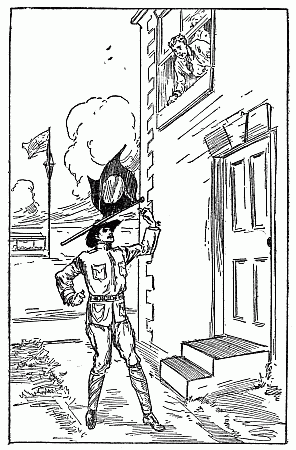 "Hey, You Idiot!" Howled Hinkey.