CONGRATULATIONS, old chum!" cried Hal Overton, striding across the room
and holding out his hand.
The two friends joined hands in a fervent clasp.
"Yes; I got my letter, and the news was satisfactory," said Noll, in a
queer, half-choking voice.
"A letter from Mr. Ad Interim?" asked Mrs. Overton, making a little
face.
"Why, that's the only sort of an appointment that a fellow can get in
summer, when there's no Senate in session, Mrs. Overton," Noll replied.
"But it's all right. The Senate never heard of either of us, and so the
Senators won't have anything against us. We'll get our commissions, all
right, soon after the next Congress convenes. Our commissions are safe
enough."
"Quite," agreed Hal. "That's what I've been trying to tell Mother."
"A new second lieutenant is only a shave-tail, at best," smiled Noll.
"What does that mean?" demanded Mrs. Overton quickly.
"I don't know," Noll replied. "It's just an Army term of derision for a
very new young officer, I guess."
"And a second lieutenant soon becomes a 'goat,'" Hal added.
"That isn't a nice word," retorted Mrs. Overton. "It's slang!"
"It's worse than slang in the Army," laughed Hal. "The army 'goat' is
the very new officer who has a lot of extra duties thrust upon him that
the older officers don't want. Those duties of the 'goat' are generally
both very trifling and very annoying."
"Then it isn't right," declared Hal's mother, with an air of conviction.
"No one ought to annoy a young man who has been smart enough to make an
officer of himself. What are a second lieutenant's duties?"
"Well," replied Noll quizzically, "for one thing he must see that every
one of his colonel's eight pairs of boots are kept polished."
"Oliver Terry!" remonstrated Mrs. Overton.
"And see to it that the grass is kept mowed on the colonel's lawn,"
added Hal.
"A new second lieutenant is expected to relieve the colonel's wife's
nurse-girl in taking care of headquarters' kids on Wednesday and
Saturday afternoons——" continued Noll.
"Also groom the colonel's horses," added Hal.
"I don't believe a word of that," declared Mrs. Overton, whereat both
very new young officers laughed heartily.
"And you're starting in badly, too," continued Hal's mother accusingly.
"I happen to know this much—that an officer must have too much honor to
stoop to telling lies. And that he's court-martialed and driven out of
the service if he does. So be careful."
Hal soon excused himself, going to his own room, leaving Noll to
entertain his mother. When Lieutenant Overton came back he was in his
flannel undress, red sash and all.
"That doesn't look so very bad, after all," declared Mrs. Overton,
viewing her erect, stalwart young son with an approval which she made no
effort to hide.
Then they talked on until at last Lieutenant Noll glanced at his watch.
"I must be going," he said, rising. "I've overstayed my leave. Mother
allowed me to leave her only long enough to run over and tell Hal the
news. I've violated my parole already."
"What time is it?" inquired Mrs. Overton.
"A quarter to six!"
"And, good gracious!" cried the little woman, jumping up from her chair.
"Hal, in a few minutes more your father will be home, and not a blessed
move has been made toward supper. There's no time to get anything ready
now. Hal, I shall have to send you around the corner to the delicatessen
shop, although I hate such ready-made meals."
"Mother," demanded Hal, with a pretense at mild astonishment, "would you
think of sending a commissioned officer in the United States Army around
on errands, with packages to bring home?"
"I—I guess that wouldn't be just right, would it?" agreed Mrs. Overton.
"Never mind, my boy. I'll run right around myself. It will take me some
time to get used to all the dignity that goes with your new position."
"You needn't bother to go, Mother," laughed Hal. "An officer who would
let his mother run errands to save his own dignity would be sure to come
to a bad end in the Army. I was only joking, of course. This is a day to
celebrate, so I propose to ask you and father to dine out this evening.
There are several good places in town."
"Which one do you prefer?" broke in Lieutenant Noll quickly.
"Ralston's," Hal replied. "There's music there, and the food and service
are fine."
"Then I'll hurry home now and bring my folks up there, too, if I can,"
proposed Noll.
"Good!" agreed Hal.
"What hour, Mrs. Overton?" asked Noll, turning to that good woman.
"Ask Hal."
"In the Army it is customary to ask the ladies, Mother," Hal explained.
"Seven o'clock, then," said Mrs. Overton.
"Seven it shall be," nodded Noll. "That is, if I don't fail in coaxing
Father and Mother out to dine."
"You won't fail," Mrs. Overton assured him. "They'll be proud enough to
go out with you to-night."
Hal's father came home soon after. For years a clerk in one of the local
stores, Mr. Overton had lately been promoted to be manager of the store.
He was a quiet, thoughtful, studious man, and would probably have gone
much higher in the world had not years of ill health interfered with his
ambitions.
"I don't need to tell you how glad I am, young man," said the elder
Overton quietly, when he had heard the afternoon's news. "Nor am I going
to offer you any parental advice. Your record in the Army, so far,
makes me feel sure that you will go on in the way you have begun, and
that your record, at any point, will have been an honorable one. And now
I must leave you and go upstairs to put on my best clothes in honor of
the distinction that has come upon my son."
Just before seven the Overtons were seated at a table in Ralston's
locally famous restaurant. Noll and his parents arrived at about the
same moment. But the news had flown ahead of the young men. Just as the
party was seating itself the orchestra crashed out into the strains of
"See, the conquering hero comes!"
"I suppose that's meant for a joke on us," grinned Lieutenant Noll, in
an undertone.
"Then try to look unconscious," returned Hal, in an equally low voice,
and immediately engaged Noll's father and mother in conversation.
There was some whispering between waiters and patrons of the place, and
presently a light sound of applause rippled out. It soon became a steady
salvo.
Still the two young lieutenants went on with their chatting. But the
leader of the orchestra had a further surprise. Giving his men only a
moment for rest, he once more waved his violin bow, and the musicians
started in with "The Star-Spangled Banner."
No soldier may ignore that splendid air; no citizen has a right to.
As the strain died out the young soldiers and their party re-seated
themselves, going on with their chat again.
A waiter dropped two menu cards on the table, then stood waiting for the
order.
"Won't the ladies select the dinner?" asked Hal.
"We'd prefer that our sons do that," smiled Mrs. Terry.
"You do it, then, Hal," directed Noll Terry. "I left my spectacles at
home."
"What about officers and their duty to tell the truth?" chided Mrs.
Terry, whose heart was full of joy and pride to-night.
"I'll amend my statement," replied Noll meekly. "I didn't bring my
spectacles with me. But Hal ought to do the ordering, anyway. He always
did. He was my ranking sergeant, and now he's my ranking lieutenant."
"We don't know that yet," objected Hal quickly. "We don't yet know
anything about the order in which we passed."
"In the meantime," hinted Mr. Overton, "the cook's fire is running low."
So Hal turned his attention to the menu card, ordering with a free
hand.
"Gracious! How many do you think there are at this table, young man?"
demanded his mother.
"There are six of us," Hal answered. "But we can take hours in which to
finish the meal, if we want to. Ralston's doesn't close until midnight."
The waiter, having received the order in silence, shuffled off without a
word.
"Nothing very magnetic about that waiter," thought Hal, his glance
following the waiter for an instant. "Somehow, his face looks familiar,
too, but I've been away from home during the very few years when every
boy turns into a young man. If I ever knew the chap I've forgotten him."
There was a rustling of silken skirts, then a resolute and very
important-looking woman paused at the table. Just behind her waited a
short, thin, rather negative-looking man.
The woman was red-faced, despite the liberal amount of powder with which
she had striven to conceal the fact. She was richly dressed, and wore a
few jewels, though not really enough of them to violate good taste. Hal
recognized her as a Mrs. Redding, who, thanks largely to her husband's
inherited wealth, had succeeded in making herself one of the leaders of
local society. Mr. Redding was known principally as "Mrs. Redding's
husband."
"Just a moment, my dear Mrs. Overton," cried Mrs. Redding cordially.
"And you, too, my dear Mrs. Terry! I am pausing only a moment to
congratulate you on the splendid news. I can well imagine how proud you
are of your sons. And I must congratulate these two very distinguished
sons, also."
Hal and Noll had risen promptly, though gravely and without haste. They
bowed their acknowledgment of the congratulations.
"And how long are you going to be with us?" asked Mrs. Redding, allowing
her gaze to wander from the face of one young officer to the other's.
"We don't know, madam," Hal replied courteously. "We are still in
ignorance as to our orders."
"I shall hope to see much of you both, and of your families," Mrs.
Redding beamed graciously. "To-morrow afternoon Mr. Redding and I, with
some of our friends, are going to motor down the river in our new
cruising boat, dining at the club-house. We should be delighted if you
would accompany us. You won't disappoint us, will you?"
Hal glanced at his mother, who offered no reply, but glanced back at her
son.
"We are very grateful for your invitation, Mrs. Redding," Lieutenant Hal
continued. "Terry and I feel that we are not in the least certain about
being able to keep any engagements that we might make, since we are both
awaiting orders from the War Department. Besides all my engagements are
in the charge and keeping of my mother."
"Then you will accept for yourself and friends, won't you, my dear Mrs.
Overton?" asked Mrs. Redding, again turning to Hal's mother.
"I—I am very much afraid that we can't go to-morrow afternoon," replied
Mrs. Overton slowly.
"Oh, well, then, we will make a later appointment," smiled Mrs. Redding
affably. "There will be plenty of time, I am sure. So glad to have seen
you this evening."
Still smiling, Mrs. Redding swept on through the restaurant with Mr.
Redding in her wake. Somehow, one instinctively felt sorry for Mr.
Redding; he looked very much like a small boat towing astern of a larger
craft.
"I am wondering very much," smiled Hal's mother. "Although we have gone
to the same church for the last fifteen years, Mrs. Redding has never
before seemed to know who I am. She is suddenly very cordial."
"That is because you now have a son who is an officer in the Army,"
interposed Noll's father. "An Army officer is supposed to be a man of
some social consequence."
"But that doesn't give me any more social consequence. I'm just the same
woman that I always was," objected Mrs. Overton sensibly.
"But at least, my dear," suggested Hal's father, "you will be visiting
your son at his post one of these days, and he may also urge you to
bring some of your women friends."
"I certainly shall," Hal agreed.
"And Mrs. Redding may feel that she would like to be one of the
invited," continued the elder Overton. "So, my dear, you see that you
will become of social consequence. Others than Mrs. Redding, who have
never even bowed to you before, will now be calling on you."
"I don't want new friends of that sort," remarked Hal's mother quietly.
"My dear, you'll have to be very agile if you expect to dodge all such
new friends," laughed Hal's father.
Since Hal had given the order the orchestra had played several numbers.
All of the little dining party were now becoming rather impatient for
dinner.
"I guess our waiter doesn't like us very well," half-grumbled Lieutenant
Hal.
"Very likely," nodded his father. "Of course you recognized the waiter."
"I can't say, sir, that I did."
"The waiter is Bunny Hepburn, more than three years older than when you
last saw him," replied Mr. Overton.
"Bunny Hepburn? The son of that anarchist who spouts about man's rights
in beer-gardens?" questioned Hal. "Hepburn the man who is always trying
to start strikes and labor riots?"
"That's the man, and Bunny is a half-worthy son of the sire, I hear,"
replied Mr. Overton.
"Here comes Bunny now," announced Mr. Terry.
Bunny appeared, setting bread and butter on the table, distributing
knives, forks and spoons at the places and filling the water glasses.
"Will you bring the first course of our dinner right along now, waiter?"
Hal asked pleasantly.
"When I can," came the half surly reply. "You'll have to wait your turn
with the other customers."
"We expect to do that," Hal agreed, without resentment. "But we've been
waiting about forty minutes now, and many others have been served who
came in since we did."
"You needn't think you're running this restaurant," sneered the waiter.
"By no means," Hal agreed. "But we are at least paying for our food, for
attendance and civility."
"You'll get all the attendance you're entitled to," grumbled the waiter.
"Don't think you own the earth. Soldiers are no good."
"A lot of people entertain that opinion," Hal answered quietly, turning
his back on the impudent waiter.
All might still have gone well, had Bunny been content to drop it there.
But, as readers of the first volume in this series, "Uncle Sam's Boys in
the Ranks," are aware, Bunny had been bred in contempt of the military
and of everything connected with it.
"You soldiers are nothing but just a lot of cheap skates," Bunny
muttered on bitterly. "You wear a uniform that is nothing but the cheap
livery of slavery to the wealthy, and march under a flag that stands for
nothing but tyranny to the poor and down-trodden of humanity."
This was almost word for word a copy from the anarchistic speeches of
Bunny's father.
Lieutenant Hal's face went white as he wheeled once more in his chair
and rose quickly.
Mrs. Overton had a momentary notion that her son was going to knock
Bunny down, and she wouldn't have blamed him if he had. But Bunny
quailed somewhat before the blazing light in the young Army officer's
eyes.
"Stand back, waiter," ordered Hal quietly. Then, looking very tall and
dignified, Lieutenant Hal stepped across the restaurant, going over to
the desk, where the proprietor stood chatting with the cashier.
"Are you being properly served?" inquired Mr. Ralston, who had learned
who this young guest was.
"Not especially. I have no personal complaint to make against the
waiter, but I shall feel greatly obliged if you can send us a different
man to wait on us."
"With pleasure," replied Mr. Ralston promptly. "But you will be doing me
a genuine service, Mr. Overton, if you will tell me in what way the
present waiter has offended you."
"He didn't offend me personally," Hal replied quietly, "but he spoke
disrespectfully of the Flag I serve, and the uniform I am proud to
wear."
"Thank you very much. Will you tell me what the waiter said?"
Hal repeated the words accurately.
"I will send you another waiter, Mr. Overton, and will see to it
personally that you are not again annoyed. I thank you for having
reported the matter to me."
Hal returned to his seat. Bunny had already vanished behind the swinging
doors at the rear. Mr. Ralston followed him out into the cook's domain.
"Peterson, I want you to wait on Mr. Overton's party," called Mr.
Ralston, whereat Bunny started slightly. "And, Peterson, I want you to
serve and attend to their wants in your best style."
"Yes, sir," replied Peterson, an older waiter.
"Chef," continued the proprietor, "you will see to it that the delayed
dinner for the Overton party is served ahead of anything else, and in
your best style. Hepburn, come here!"
Bunny approached, a defiant scowl on his sulky face.
"Hepburn, I am told that you grossly insulted the Flag and the Army
uniform."
"I didn't," retorted Bunny, "but I won't allow any of them tin-soldier
dudes to put it over me."
"Your present language sufficiently justifies the charge made against
you," replied Mr. Ralston quietly. "This restaurant is intended as a
resort for ladies and gentlemen, and all right-minded persons respect
our Army and Navy and those who serve their country."
"I'll tell you, right now, I hain't got any respect for them
tin-soldiers," retorted Bunny defiantly.
"That will be all, Hepburn. Get out of here!"
With that the proprietor turned on his heel, leaving the cook's domain.
Bunny was white with wrath. He tried to talk to some of the other
employes present, but none of them paid any attention to him.
No effort did young Hepburn make to get his street clothes until the
head waiter brought him back an envelope containing his wages.
"I'll remain here until I see you get out," remarked the head waiter
coldly.
"You may wait a long time," sneered Bunny.
"No, I won't. If you're not out of here in a hurry I'll help you through
the back door."
Not until then did Bunny Hepburn realize that he was actually
discharged.
"Get out now," ordered the head waiter, looking as if he would be glad
of an opportunity to help the discharged one through the back door.
"Oh, all right. I'll git," snarled Bunny Hepburn, thrusting on his hat
and slouching out through the door. "But I'll get even with that cheap
Army officer in short order!"
Like some other inconsequential fellows of his class, Bunny was usually
a man of his word in matters of revenge.
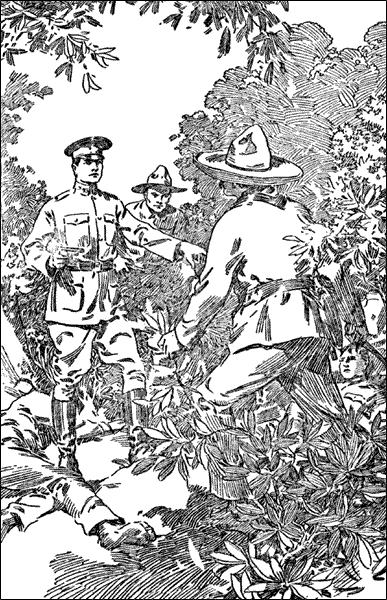 "Stop This Nonsense!"