Billy Gard was not thinking of business at all. As a healthy,
ultranormal young man, he was drowsing over his breakfast as one has a
way of doing when at peace with the world and when unaroused by any call
of the present. He had reached the rolls and coffee stage of his meal in
a spirit of detachment that took no account of the somewhat garish
flashiness of the hotel dining-room in this typical hostelry of a city
that had become noted as a maker of industrial millionaires. Then as his
glance idly trailed among the other breakfasters, it automatically
picked up an incident that flashed a light into his dormant brain and
brought it to full consciousness.
A spoon had started from a grape fruit to the mouth of the tall,
curly-haired man two tables away. Half way on its journey the hand which
held it had twitched violently and spilled most of the contents. The
brown eyes of the man stole out somewhat furtively to learn if anybody
had noticed his nervousness.
Special Agent Billy Gard now gazed at the ceiling, but his mind was
busy. It was running over the facts that it contained with relation to
Bayard Alexander, who was this morning not himself and apprehensive lest
the fact be noticed. For Alexander was of the class of men of whom it
was his business to know. He was cashier of the Second National bank and
Uncle Sam keeps a pretty close watch on such institutions when they
happen to be located in communities of feverish activity.
So the special agent recalled that the tall man with the damp curls was
a moving spirit in the city, an important instrument in its development,
a man of many philanthropies, personal friend of a United States
Senator, cashier and active head of one of the most powerful financial
institutions in the community. He was a man of very great energy, but
one who led a normal, wholesome life and who, at the age of forty-five,
seemed just coming into his stride. The bank examiner, Gard recalled,
had steadily given the Second National a clean bill of health.
Why, then, should Alexander be nervous and, granting him that
privilege, why should he fear its being noticed?
All of which was the seemingly illogical reason why Gard went to
Wheeling that very night and was not seen about the metropolis for a
week thereafter.
"I am a poor man," he told Allen, the stout bank examiner, when they met
in the West Virginia town. "Poor but honest and not trying to borrow
money. I am on my way to the city of opportunity looking for a job."
"You have come away that you might go back, as I understand it," said
Allen. "Couldn't you change your peacock raiment for a hand-me-down
without coming to Wheeling?"
"Yes, but I couldn't see you, Cherub," said Gard, "and you are to make
all things possible for me. You are to convert me from a dweller in
gilded palaces to a bank bookkeeper out of work, but with credentials.
"There is in Wheeling a bank cashier of your acquaintance," explained
the special agent, "who used to work beside a bookkeeper whose
friendship I want to cultivate. You introduce me to the cashier, he
finds out what a really good fellow I am, we become friends. He gives
me a letter of introduction to the man I want to meet. I return to the
city and thrust myself properly into the affairs of one Sloan,
bookkeeper for the Second National. The next time the corpulent examiner
comes around he gets the surprise of his life. Do you follow me?"
Billy Gard had reached the conclusion that, if there was anything wrong
with Bayard Alexander's bank the examiner was being deceived and that,
therefore, there must be a juggling of accounts. Bookkeeper Charley
Sloan of the individual ledgers occupied the post most likely to be used
for deception, and so the special agent was taking a lot of trouble to
make the right opportunity for getting friendly with Charley. That mild
little man was therefore favorably impressed when he was handed a letter
from his former associate who had gone to Wheeling and become a cashier.
The two visited so agreeably together that a friendship developed and
Gard came to live at the bookkeeper's boarding house. The two
accountants grew to spend many evenings together and naturally talked
shop.
"I had a friend," said Gard one evening, "who worked in a bank in New
Orleans. Next to him was a bookkeeper who went wrong. He was induced to
do this by a depositor who had a scheme for making them both rich. All
the depositor needed was a little money. So he proposed that he draw
checks against the bank and that the bookkeeper charge them temporarily
to other accounts. The depositor would cash the checks at other banks
and, when they came in, the teller would merely turn them over to the
bookkeeper, probably asking if there was money to meet them. In this way
a depositor who never had a thousand dollars in the bank eventually
checked out $50,000."
"There was a teller," Sloan volunteered, "who worked in a bank here who
entered the deposits in the books of the people making them and put the
money in his pocket. There was no record of it except in the pass books.
He got nearly all the money that came in for two months before he was
found out."
"There are a lot of ways in which a bookkeeper may hide the facts with
relation to a bank," continued the special agent. "It is pretty safe to
charge anything to the inactive account of an estate or an endowed
institution. These are not often looked into. The accounts balance for
the examiner. I'll bet there isn't one bank in a dozen that doesn't fool
the examiner."
"It's the easiest thing in the world," volunteered Sloan, "to take the
necessary number of leaves out of the loose-leaf ledger to
counterbalance it if the cash is short, and hide the leaves until the
examiner is gone."
"Did you ever know that to be done?" abruptly asked the special agent.
The bookkeeper colored to his temples and was noticeably confused at the
question. Then he said he had heard of its being done. The sleuth would
have sworn he had led the bookkeeper into a confession.
Nothing was more natural than that these two bank bookkeepers should
recur occasionally to the possibility of so arranging accounts that were
in questionable condition that they would be passed by the examiner.
Gard would lead to this in such a way that the bookkeeper would seem to
have begun these discussions. Then he would talk freely. He would tell
so many stories that the timid Sloan would want to relate a few in
furnishing his part of the entertainment. But Gard knew that the
bookkeeper was a man without imagination and that he could relate only
what had happened in his experience. So he was all ears when Sloan one
night gave his opinions on the subject of kiting.
"Of course," he said, "all banks have depositors who kite their checks
and thereby get hold of money which they may use for a week before they
have to make good. A depositor may turn in a check for a thousand
dollars, drawn on a New York bank where he has no money. At the same
time he sends the New York bank a check for the same amount, drawn on
you. This causes the New York bank to honor the check drawn against it.
The check drawn on you has to find its way through the clearing house
and it will be a week before it gets back. In the meantime the depositor
has had the use of a thousand dollars.
"But when it comes to real kiting," continued the bookkeeper, "it is the
banks themselves that do it. If a bank has a sudden call for $100,000
and hasn't the money, all it has to do is to send a messenger with a
check to a friendly bank around the corner. The messenger gets the whole
amount in cash. It appears as an asset of the bank. It will be two or
three days before the check will come back through the clearing house
and appear as a liability, or the friendly bank may hold it up even
longer. The banks may be swapping this sort of favors. The bank examiner
does not know of the outstanding check. He is out of town before it
appears."
Special Agent Billy Gard was again practically certain that he had here
been told a chapter out of the experience of the Second National. He
began to see his way clear to a denouement.
That same night events were transpiring of which he was to know a week
later but which as yet were held in confidence among the directors of
the Second National. They took place at a meeting of these same
directors called by a minority which was dissatisfied with certain
features of its management. Director Hinton, a sprightly and
quick-tempered little man, was the leader of the revolt. Senator
Bothdoldt was present as a supporter of the management of the bank as
represented by the suave, forceful cashier, Bayard Alexander, whose hand
sometimes shook at breakfast.
"I want to protest," Hinton began by launching directly into the heart
of the matter in hand, "against this new loan to the McGrath
Construction Company. It has been three years now that we have been
pouring out our money to these people. We have $400,000 of their paper
and I want to be shown that we can realize on it. It is time to call a
halt."
"And there are the notes of the Oldman Mercantile Company," somewhat
heatedly argued a second disaffected director. "I have been reliably
informed within the last two days that they are in danger of going to
the wall."
"And we, as directors, are responsible for the bank," said Mr. Isaacs,
who was conservative.
"I for one," said Mr. Hinton, "have reached the point where I insist on
a new management. I would like to know the sentiment of the board upon
this question."
But the cashier asked for a word of explanation. Broad-shouldered and
upstanding he rose among these heavy, sleek, bald-headed business men.
His high and intellectual brow and clear-cut features gave him a
distinction that always made an impression. But the firm mouth and the
damp curls were those of a man of physical force and determination. His
voice was alluring and convincing as he made his plea and there was now
no tremble of the hand.
He stated and called upon Senator Bothdoldt to witness that the McGrath
Construction Company had just received from the Government contracts for
the building of numerous locks in the Ohio River. He agreed with the
spirit of conservatism of the board and shared it. He had heard the
rumors with relation to the Oldman Mercantile Company and had sifted
them to their depths and had found them without basis in fact. However,
he had just called in a block of their notes. He painted a rosy picture
of the condition of the bank and the prospects of the future. He
reminded the directors that they had given him a free hand in the past
and pointed to the institution as a monument to his accomplishment. At
the termination of which speech, so convincing and so dominant was the
personality of the man, Director Hinton withdrew his protest and the
institution was left under the former guidance.
It was three days later that things began to happen. Gard had called
upon Bank Examiner Allen to come to his assistance. The two of them had
conferred the night before and settled upon a plan of campaign for
testing the stability of the affairs of the bank.
It was in accordance with this plan that the rotund and genial Allen
breakfasted in that dining-room where the special agent's suspicions had
first been aroused. Bayard Alexander was at his usual table and Allen
allowed the banker to see him although he appeared not to be aware of
it. It was also in accordance with the cards played by the men of the
Government service that Special Agent Gard, still a bit seedy in his
hand-me-down suit, was loafing on the sidewalk opposite the Second
National bank when the cashier came to work. It was a part of his plan
that he should see as much as possible of what went on in the
institution when the word was passed that the examiner was in town.
Gard was not surprised, therefore, when a messenger emerged from the
bank and hurried off down the street. He believed that the story of the
bookkeeper of the kiting bank was to be enacted before his eyes. He
followed the messenger to another bank two blocks away and there saw
him present a check. Gard crowded in on the pretense of getting a bill
changed and saw blocks of bills of large denominations being taken from
the vault. The messenger hurried back to the bank with them. It was
evident that that institution was making ready for the coming of the
examiner. It was as evident that its affairs were not as they should be
or this preparation would not be necessary.
It was a part of the program that when Sloan, the bookkeeper, came out
of the bank for lunch, Gard should be waiting for him. It was not
unusual that they thus went to their noonday meal together.
"Will you do me a favor?" asked Sloan while they were at lunch. "Take
care of this package for me. It is a large photograph, rolled, that I
have just received from home. Please be careful of it."
The special agent assumed charge of the package which looked not unlike
a roll of music. Later he found his suspicions justified for in the roll
were a number of leaves from the bank's individual ledger. Gard was
appalled at the amount of money that they represented. He carefully
photographed them and returned them that night to the bookkeeper.
No pretext was omitted for getting a look into what was transpiring in
the Second National bank on this particular day. Examiner Allen had
called in the afternoon and had carefully looked over the balances. All
appeared to be in order and no discrepancies were revealed. The bank
seemed particularly strong from the standpoint of cash on hand.
It was just at closing time that two things happened. Gard presented
himself at the Second National and asked to see the cashier. He had
become known there as an associate of Sloan's. He was looking for a
position as bookkeeper and it was for this he came. He waited.
It often happens that an individual may wander unannounced into quarters
the privacy of which are ordinarily closely guarded. Gard found the door
open that led into the corridor off of which were to be found the
offices of the officials of the bank. He walked in and wandered down the
row until he found that of the cashier. This he entered and found
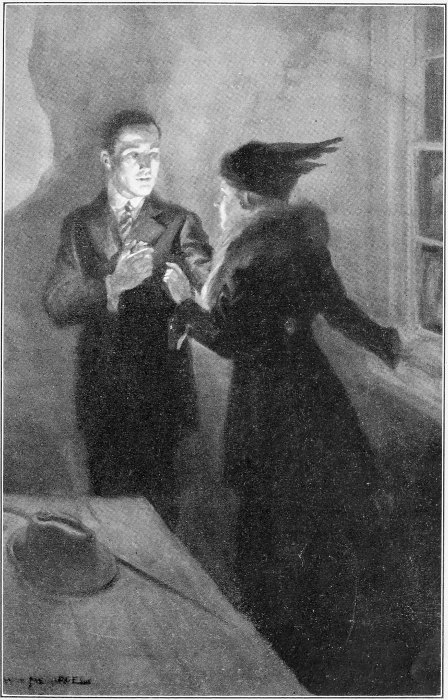
entirely empty. It was a spacious room with a big, flat-topped desk.
Across one corner of this was thrown a coat, and a hat rested upon it.
An open traveling bag stood on the table.
The special agent, by leaning on the table in the attitude of waiting,
could look into the bag. There he saw a package of what he recognized as
a well-known issue of industrial bonds which the examiner had listed as
one of the chief assets of the bank. It should have been in the bank's
vaults, instead of which it was in the cashier's traveling bag. This was
a discovery well worth consideration.
Cashier Alexander entered the room hurriedly from another part of the
bank. He was visibly startled to find some one present and demanded
bruskly what the intruder was doing there.
"I am a bookkeeper, sir," said the special agent very humbly. "Sloan is
a friend of mine and thought you might employ me."
"I can't talk to you to-night. Come around next week."
"But may I not come to-morrow?" said Gard.
"I will be out of town for three days," Alexander said finally. "I
can't talk to you until after that."
The special agent took his dismissal. He had learned that the bank
cashier was going away and that he was taking a package of the bank's
most valuable securities with him. He was going some distance for the
trip was to last three days. His destination was probably New York.
Meantime the genial examiner had rolled in upon the bank to which the
Second National had sent its messenger, at about closing time. He had
asked to see the transactions of the day. Among these was found the
record of the check that had been cashed early in the morning. It was
the personal check of Bayard Alexander and was for $125,000.
The two representatives of the Federal Government conferred hurriedly.
"And the securities," questioned Gard. "Were they intact when you were
at the bank this morning?"
"Everything was in order," replied Allen.
"The package of the industrials. What was its value?"
"About $500,000," replied the examiner.
"Alexander is leaving to-night with these securities. He may be taking
the $125,000 in cash with him. The time has come for his arrest.
Particularly must we guard those assets and prevent any unnecessary
demands upon the bank."
"He may be making a run for Canada," said Allen.
"The securities will take him to New York that he may realize upon
them," was Gard's deduction. "I am for the station and will follow him
if he takes any train. You try for his trail about town and report to me
there."
But after all it was a piece of luck that saved the day for Gard. He was
racing for the station in a taxicab when his machine was halted at a
crossing. Another taxicab pulled up beside his, waited a minute, two
minutes. He could see the driver from where that individual sat not six
feet away and just opposite his window. Presently this chauffeur bent
down to get instructions from his fare. The man in the taxicab was
talking quietly, but so near was he to the special agent that he could
be easily overheard.
"Get out of this jam," he was saying. "Cut across town to the North
side station. We have already missed the 6:15. If you head it off at the
North side it is worth a twenty-dollar bill to you."
The voice was smooth and unruffled. Yet it was dominant. It set the
driver immediately upon edge and into motion. And there was in it a
familiar note that puzzled the detective for a moment, then brought back
the interview of the afternoon. Yes, it was Bayard Alexander talking.
It was hard luck that caused a crossing policeman to let the first
automobile through and shut off the second. It was the worst sort of
luck that caused the special agent to arrive at the North side station
just as the gate was slammed and made it necessary for him to produce
credentials to get through. He was barely able to swing into the
vestibule of a sleeper as the train was getting under way. It was
particularly hazardous from the standpoint of accomplishing the end he
had in mind, for he did not even know if Alexander was aboard and faced
the danger of having ridden away on the fastest train to New York and
left his work behind him. Even if the man he was after was aboard there
was the chance that he had become aware of the chase and would take
precaution to out-wit him.
But now there was no hurry. His man was or was not on the train and the
porter told him there would be no stop for two hours. The special agent
was still a good deal of a youngster with an appreciation of the
dramatic and here was a situation that appealed to him. He wondered if
he were riding into the dusk on a wild goose chase, or if he had
cornered this fugitive master-crook, with a traveling bag containing
half a million dollars of other peoples' money. He pictured the man he
was after—the suave, confident, stealthy cashier, who had stolen his
hundreds of thousands and had, by the very force of him, compelled his
subordinates to hide his shortcomings. He wondered if this man of action
was expecting pursuit or if he was riding on in confidence of being able
to make his escape. He thought of the satchel that the cashier carried
and of his responsibility, as a Government agent, for safeguarding its
contents. It was something of an assignment for a youngster.
"And Mother used to say to me," grinned Billy to himself, "when she
sent me around the corner for a dozen eggs: 'Do be careful to bring back
the change, and for goodness' sake don't drop the bag.' I wish Mother
could see me now."
Whereupon William H. Gard of the United States Department of Justice
arose and went to the front of the train. From this point he worked
steadily back, making sure that he saw every passenger, looking each
over with sufficient scrutiny that a disguise would not have escaped
him, making sure that the man he sought was in the portion of the train
to the rear. It began to look as though he had actually boarded a train
which the fugitive had failed to catch.
Dark was just coming on. It was that hour when most of the passengers on
a train are to be found in the diner. It happened that this train was
running light and now the sleepers were practically deserted but for the
nodding porters. Through one after another of these the special agent
passed until there remained only the observation car at the end. It was
here that he would find his quarry or prove himself outwitted.
When he came into the observation car through the narrow hall that
leads to it, a lounging figure by the door drew itself taut.
Instinctively it put its hand to a traveling bag that rested on the next
chair. Then it remained still.
The special agent came direct down the car and went immediately to the
task in hand.
"You are Bayard Alexander," he said, "and my prisoner."
The cashier was, after all, surprised. He was not aware that he was
being followed. He sprang forward in his chair but met the glint of a
pistol in the hand of the special agent.
"And you? Oh, I see!" said the cashier, recovering himself. "The
bookkeeper was not a bookkeeper after all."
"I am an agent of the Department of Justice," said Gard. "You are under
arrest."
The tall figure of the cashier had risen from its chair. To the
traveling bag he clung instinctively. The situation seemed entirely in
the control of the special agent with gun drawn and the retreat cut off.
Yet, like a flash, the cashier turned the knob of the door that led out
upon the rear platform of the observation car. The gun of the special
agent spit forth a flame, but whether he had intended to bring down his
man or not he was afterward quite unable to recall.
But with a leap he was after and upon the fugitive. He suspected the
intent of the cashier to throw himself from the train, to end all in
suicide. He saw the traveling bag getting beyond his reach. It was the
last thing that would have appealed to him to stand idly by while such
incidents were taking place.
The two men grappled. A new purpose flashed into the mind of the
cashier. Here was he given an unexpected opportunity for freedom. Only
the special agent stood in his way. If he could but drop this youngster
over the rail, suicide would be unnecessary. A new purpose came into his
tall, lithe form. It was to be put to the task of fighting for its own
preservation.
And such a setting for a fight! The clamor of the train beat into the
blood of the contestants like the applause of an arena. The swish of the
platform as the express dashed through the darkness at seventy miles an
hour made the ordinary strategy of battle uncertain. Beyond the narrow
rail that skirted this platform upon which their fight was staged death
waited expectant on three sides. There were now no weapons and the
contestants went back to the primal in a tooth and fang grapple for
existence as might two frenzied bears at bay.
The cashier was the larger man and one who had always kept in condition
through gymnasium work. The special agent was lither and younger. The
larger man was determined that he would thrust the smaller over the rail
and fling him from the train. He fought his way to the edge of the
platform, forcing his antagonist farther and farther over it, hammering
him down by the sheer superiority of weight and strength.
But all the time the special agent was playing to his own advantage. He
was getting low beneath the guard of the cashier. His arms had found an
iron lock beneath his antagonist's coat and about his waist. He felt
that this hold could not be broken and that a time would come when the
strength of the larger man would wane. He could afford to wait.
It was but a swish of the train that gave him the slight advantage he
sought in taking the aggressive. It swayed the tall form of his enemy
as it towered above him a little backward. This put the spine in a
position where it could not immediately resist a strong pressure.
Already he had felt a give in the body muscles that meant the first
approach of weakness. Like a flash his head was in the tall man's chest,
all his strength was in his arms, and he was administering that
treatment known in his youth as the "Indian hug." Slowly he overcame his
antagonist, bent him back, and they came tumbling among the chairs of
the observation platform.
From the fall came a new grip to the advantage of the special agent. As
they went down he flung his legs around his antagonist, and was able to
get the wrestler's "scissors" about his waist, thus applying pressure
where there was already exhaustion and allowing his legs, which were
rested, to bear the brunt.
Thus were they locked when the brakeman came to the rear and found them.
But the battle was already near its end. For the flash of a moment the
cashier rallied and acted. In that moment his hands seized and flung
from the train the grip with its precious burden. Then he sank into
unconsciousness.
Billy Gard had ridden back to the section of the road where the
traveling bag had gone overboard, and had waited for the coming of
daylight to search for it. In the gray dawn he walked down the track and
met an Irish section man, who had already picked it up.
"I see you have found my satchel," said Gard, accosting him.
"Your satchel it may be," said the Irishman, "but you will have to be
after tellin' me what's in it by way of identification."
"Nothing much beside half a million dollars," said the special agent,
proffering the key.
The man who had found the traveling bag looked inside and, as far as
Billy Gard knows, never spoke again. He was still dumb with amazement
when the young man drove away in his automobile.