A TRIP TO KAMAKURA
It was a hot morning in midsummer. The
veranda shutters had been open all night and the
shoji had been only half closed so that tiny breezes
might creep through to cool the pink cheek of Umé
San, as she lay on the floor under a thin silk coverlet.
All night the kirigirisu had sung in his cage near
Umé's bed; and all night the mosquitoes had buzzed
and sung outside of Umé's own cage of green mosquito
netting.
At four o'clock, just as the sun peeped into the
room, Umé opened her eyes. "Oh, little kirigirisu,"
she whispered, "I like your singing much
better than that of the mosquitoes. Gladly would
I put them all in a cage in the godown."
Then she thought of her morning-glories and pattered
out into the garden to look at them.
"How lovely they are," she said, as she touched
them gently with her fingers. "This white one
makes me think of Fujiyama when it is covered
with snow; and this pink one is like the mountain
at sunrise."
As she spoke, the little girl looked across the city
roofs to where her beloved mountain, Fujiyama,
lifted its head like an inverted flower, tinged with
the pink of the rising sun.
Just then her father came out to look at the
morning-glories, too, and after the morning greetings,
Umé told him her fancy about Fujiyama.
"Your thought is a poem, little daughter," said
her father. "This very day you shall see the
mountain in all its glory. Here we can see only its
snow-capped crown, but on the way to Kamakura
there are wonderful views of our sacred Fuji."
After breakfast there were great preparations for
the journey to Kamakura. First, each one in the
family, one after the other, had to take a hot bath.
Then the best kimonos were put on, and the best
paper parasols were taken out of a long box in
the godown.
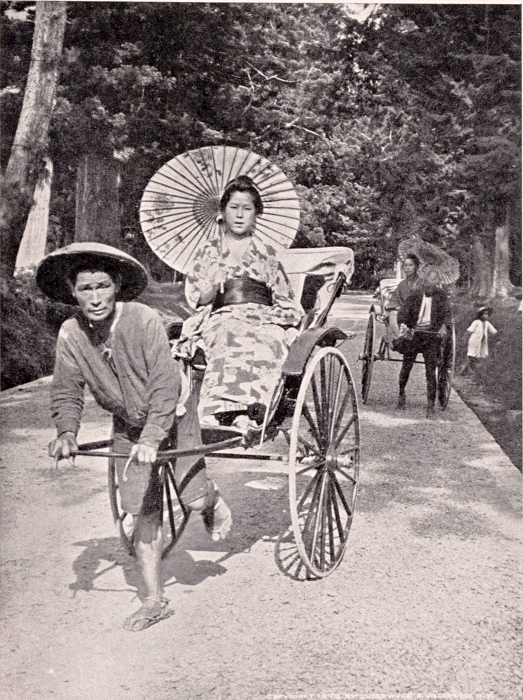
One servant ran to order the jinrikishas to take
them to the station. Another packed rice, pickled
radishes, and tiny strips of raw fish into the lunch
boxes.
Umé's mother was in every part of the house at
once, and even the grandmother seemed excited at
the thought of going to the seashore.
Umé ran across the garden to tell Tei about the
trip and bid her cousin sayonara, and Tara found
a box of his best fishhooks and tucked them into his
sleeve pocket.
"I may catch an eel," he said, "and then we can
have it fried for our dinner."
At last the whole family were in the jinrikishas
and were whirled so fast to the station that they
had to wait a long time for the train.
The children were glad to stand on the platform,
watching the throngs of people and seeing the interesting
sights. Newsboys were running everywhere
calling their papers; strangely-dressed foreigners
were hiring jinrikisha-runners to take them
over the city; a police sergeant was walking up and
down; and electric cars were bringing passengers
to the station with much ringing of bells and clanging
of gongs.
"I fear Yuki-ko will not like her first ride in a
train," said Umé, as the child hid her face in her
mother's kimono at the sight of a big engine.
"I well remember my first sight of an engine,"
said the grandmother. "When I was a little girl
there was not a railroad track in all Japan. When
the first trains ran through the country, the peasant
women thought the engines were horrible demons,
and ran screaming away from the puffing and hissing."
"I, too, remember the first engines," said the
father. "Many were the honorably strange sights
that went with them. One morning a man took off
his clogs at this admirable station and set them
with worthy care upon the platform before he entered
the train. It was his peaceful expectation to
find them waiting for him when he left the train
in Yokohama."
At that moment an engine came puffing down the
track, and soon they were all seated in one of the
open cars and gliding swiftly out of the city.
The children pointed out to each other the lotus
blossoms in the moats, the little boats in the canal
and the freight boats on the Sumida river.
The father and mother talked about the tea-farms
and the fields of rice and millet through which they
were passing. Many crows flew cawing over the
heads of men and women who were working in the
deep mud of the rice fields.
"Pretty birds!" called Baby San.
"She means the white herons," said Tara. Dozens
of the long-legged herons were stalking about in
the muddy fields near the track; and farther away,
many pieces of white paper fluttered from strings
which were stretched across the fields of rice.
Yuki San saw no difference between the birds and
the fluttering bits of white paper.
"Those small white ones scare the unworthy
crows away, little flower Sister," explained Tara;
but the baby sister shook her head and said, "No,
pretty birds!"
Umé turned the baby's head gently away from
the fluttering scarecrows. "Look at the pretty
flowers," she said.
Beautiful lotus blossoms were growing in the
muddy ditches beside the track. The baby bobbed
her head to them and begged them to stand still,
but they all hurried past the hands she held out to
them.
"The lotus is Buddha's flower," said O Ba
San. "It grows out of the dirt and slime to give
us blossoms of rare beauty. Such may be the
growth of our hearts if we choke not their good
impulses."
"It is a long way from Buddha's flower to his
mountain," said Umé, as she looked off to where
Fuji rose in the distance.
"Is it true," asked Tara, "that on the days when
we cannot see the mountain through the mist, it
is because it has gone on a visit to the gardens of
the gods?"
"That is what I always thought when I was a
child," his grandmother answered.
"And do many pilgrims every year climb the long
way up its steep sides to the top?"
"Yes, my child."
"And must I also climb to the top some day, if
I wish to please the gods?"
"Yes, unless the gods should honorably please
to take away your power to climb."
"Oh," gasped Umé, "I hope the gods will never
do that!"
She looked anxiously at her feet and said, "I
hope they will never need my feet for anything.
So unworthily short a time have I used them, that
they cannot be fit for the gods."
"Let your use of them be always in the service
of the gods, and the more honorably old they grow,
the more favor will they find in the sight of the
gods," answered her grandmother.
But Tara did not like such serious talk. "How
does the earth get back on the mountain--the earth
that the pilgrims bring down every day on their
sandals?" he asked.
"It is said that it goes back of itself by night,"
his grandmother replied, and added, "but I would
rather speak of the path of straw sandals which the
pilgrims leave behind them as they toil up the rough
sides of Fujiyama."
"Then what do they do?" asked Umé.
"They take many pairs with them, so that when
one pair is worn out they may have others."
"But I thought the pilgrims were honorably
poor," said Umé.
"Not always," said her grandmother. "And
sandals cost but an insignificant sum. A pair may
be bought for a few rin."
"Then I will go myself, some time," said Umé,
as if the only reason she had never been to the
mountain-top was because she had never known the
price of sandals.
But before they could say anything more they
were in Yokohama, where they were to leave the
train and ride in jinrikishas to Kamakura.
After they had left this city, with its busy streets,
its harbor dotted with boats and big foreign ships
riding at anchor, the road led along a bluff from
which there was a beautiful view of the bay.
It was intensely hot and the noonday sun beat
fiercely down upon them. Umé held a big paper
parasol carefully over her grandmother, and Tara
and his father waved their fans slowly back and
forth to catch the little breezes from the sea.
In the distance were green fields of rice, little
vegetable farms, tiny houses, low blue hills, and beyond
all, Fujiyama, rising majestically to the clear
blue sky.
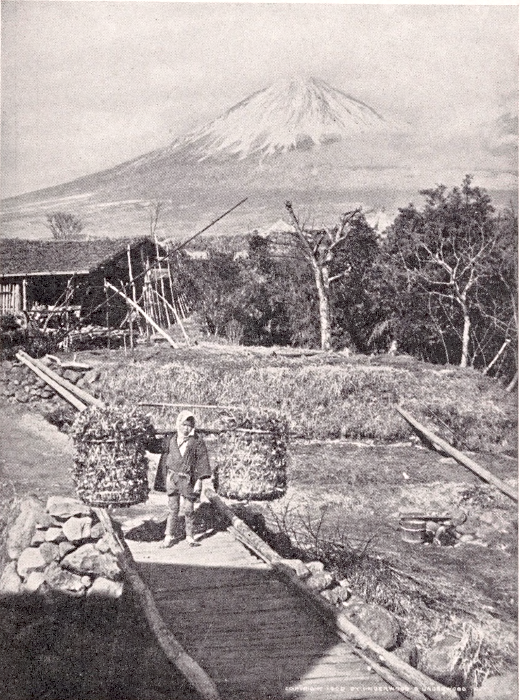
Fujiyama, the Sacred Mountain. Page 69.
As they were whirled past a little village they
heard a deep booming sound, and caught sight of an
immense drum under an open shed, which was being
beaten by two men.
"What is that?" asked Tara.
"Everywhere there has been no rain and the rice
is drying in the fields," replied his father, "so
drums are beaten and prayers are made to the gods
that it may rain."
"Water is truly desirable," said Tara. "My unworthy
throat is this moment as dry as the rice
fields."
"Not far before us is a rocky pool shaded by ancient
pines," said his father. "There pure august
water will be given."
The rocky pool was a delightful resting-place.
The stone basin was filled with water by a spring
that leaped out of the heart of the cliff. The water
overflowed the basin and formed a stream which ran
along beside the road. Many travelers were sitting
on low benches under the pines, the men smoking
and the women and children chatting merrily.
Two women were washing clothes in the brook,
and Tara and his sisters slipped off their sandals
and white tabi, tucked up their kimonos and
splashed about in the water.
The mother took the food from the lunch boxes,
spread it on dainty paper napkins and called the
children to come and eat.
"Truly thanks for this honorable food," said
Umé, when she finished her luncheon. Then, as
she looked up at the spring, she added, "The water
which comes from the cliff sings a happy little
song."
"It is like the spring of youth," said the grandmother.
"Deign honorably to tell the story of the spring
of youth," said the father, taking a pipe from his
sleeve pocket and filling its tiny bowl.
"Long ago a poor wood-cutter lived in a hut
in the forest with his old wife," said the grandmother.
"Every day the old man went out to cut
wood and the woman stayed at home weaving.
"One very hot day the old man wandered farther
than usual, looking for wood, and he suddenly
came to a little spring which he had never seen
before. The water was clear and cool and he was
very thirsty, so he knelt down and took a long
drink. It was so good that he was about to take
another--when he caught sight of his own face
in the water.
"It was not his own old face. It was the face
of a young man with black hair, smooth skin and
bright eyes. He jumped up, and discovered that he
no longer felt old. His arms were strong, his
feet were nimble and he could run like a boy. He
had found the Fountain of Youth and had been
made young again.
"First he leaped up and shouted for joy; then
he ran home faster than he had ever run before
in his life. His wife did not know him and was
frightened to see a stranger come running into the
house. When he told her the wonder she could
not at first believe him, but after a long time he
convinced her that the young man she now saw
standing before her was really her old husband.
"Of course she wished to go at once to the
spring of youth and become as young as her husband,
so he told her where to find it in the forest
and she set out, leaving him at home to wait for
her return.
"She found the spring and knelt down to drink.
The water was so cool and sweet that she drank
and drank, and then drank again.
"The husband waited a long time at home for
his wife to come back, changed into a pretty, slender
girl. But she did not come back at all, and at last
he became so anxious that he went into the forest
to find her.
"He went as far as the spring, but she was nowhere
to be seen. Just as he was about to go back
home again he heard a little cry in the grass near
the spring. Looking down he saw his wife's kimono
and a baby,--a very small baby, not more
than six months old.
"The old woman had drunk so much of the water
that she had been carried back beyond the time
of youth to that of infancy. The wood-cutter picked
the baby up in his arms, and it looked up at him
with a tiny smile. He carried it home, murmuring
to it and thinking sad thoughts."
The story was finished and the jinrikishas were
ready to take them on to Kamakura.
"I have heard so much about the wonderful
Buddha that I do not wish to see anything else in
Kamakura," said Umé, as they walked through the
grounds of the long-vanished temple.
There was no need to tell the children to walk
quietly and speak reverently before Buddha.
Umé looked up into the solemnly beautiful face,
into the half-closed eyes that seemed to watch her
through their eyelids of bronze, and knelt quietly
in prayer.
"Nothing can harm the Great Buddha," said the
father, after the prayers had been said and the offering
given to the priest. "Six hundred and fifty
years has he sat upon his throne. Once he was
sheltered by a temple, but centuries ago a tidal
wave, following an earthquake, swept away the
walls and roof and left the mighty god still seated
on his lotus-blossom throne."
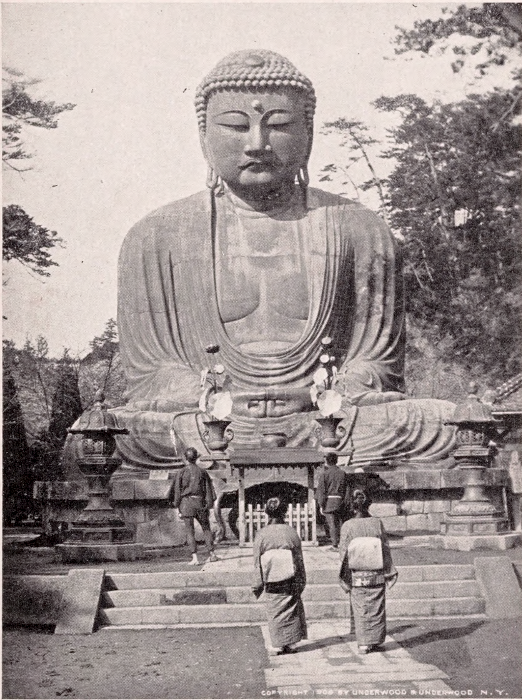
"Nothing can harm the Great Buddha." Page 73.
As they turned to walk toward the village Umé
said to her mother, "When I have heard the thunder
I have always thought it was this Great Buddha,
very angry about something. Now that I have
seen his peaceful face I know it is not so."
"No," answered her mother. "Many thousands
of girls and boys have seen Great Buddha's face as
you saw it to-day. They have grown to be men
and women, and their children have looked upon his
face, but it is always calm and peaceful."

![LITTLE PEOPLE EVERYWHERE UMÉ SAN IN JAPAN BY ETTA BLAISDELL McDONALD AND JULIA DALRYMPLE Authors of "Manuel in Mexico," "Raphael in Italy," "Kathleen in Ireland," etc. [Illustration] Illustrated BOSTON LITTLE, BROWN, AND COMPANY 1909](https://openoldbooks.sgp1.digitaloceanspaces.com/books/ume-san-in-japan-by-etta-blaisdell-mcdonald-and-julia-dalrymple/images/i_titlepage.png "LITTLE PEOPLE EVERYWHERE UMÉ SAN IN JAPAN BY ETTA BLAISDELL McDONALD AND JULIA DALRYMPLE Authors of \"Manuel in Mexico,\" \"Raphael in Italy,\" \"Kathleen in Ireland,\" etc. [Illustration] Illustrated BOSTON LITTLE, BROWN, AND COMPANY 1909")