U.S. Marines in Vietnam: The Advisory & Combat Assistance Era 1954–1964
Whole book · 28 sections
U.S. MARINES IN VIETNAM THE ADVISORY & COMBAT ASSISTANCE ERA 1954–1964
Transcriber’s Notes
Larger versions of most illustrations may be seen by right-clicking them
and selecting an option to view them separately, or by double-tapping and/or
stretching them.
References to same-page footnotes are alphameric, e.g., [1-A]. The
number is the Chapter number; the letter is the sequence within the
chapter.
References to endnotes (near the end of the book) are numeric, e.g., [1-1].
The first number is the Chapter number; the second number is the sequence
within the chapter.
HISTORY AND MUSEUMS DIVISION
HEADQUARTERS, U.S. MARINE CORPS
WASHINGTON, D.C. 1977
Library of Congress Card No. 76-600051
PCN 190 003064 00
For Sale by the Superintendent of Documents, U.S. Government Printing Office
Washington, D.C. 20402 (Buckram)
Stock Number 008-055-00094-7
Foreword
This is the first of a series of nine chronological histories being prepared by the
Marine Corps History and Museums Division to cover the entire span of Marine Corps
involvement in the Vietnam conflict. This particular volume covers a relatively
obscure chapter in U.S. Marine Corps history—the activities of Marines in Vietnam
between 1954 and 1964. The narrative traces the evolution of those activities from
a one-man advisory operation at the conclusion of the French-Indochina War in
1954 to the advisory and combat support activities of some 700 Marines at the end
of 1964. As the introductory volume for the series this account has an important
secondary objective: to establish a geographical, political, and military foundation
upon which the subsequent histories can be developed.
The author is a Marine Reservist who was a member of the History and Museums
Division from September 1972 until August 1974. Promoted to major soon after his
return to inactive duty, he is now working for the Kentucky State Government. A
native of Kentucky, he holds a Bachelor of Arts degree from Morehead State College
(1965) and a Master of Arts degree in American History from the University of Kentucky
(1972). Commissioned in 1965, Major Whitlow served as an infantry platoon
commander with the 6th Marines, an aerial observer with the 1st Marine Division in
Vietnam, and later as a platoon commander at Officer Candidate School, Quantico.
For services in the Republic of Vietnam during 1967 and 1968 he was awarded the Distinguished
Flying Cross and 26 awards of the Air Medal.
E. H. SIMMONS Brigadier General, U.S. Marine Corps (Ret.)
Director of Marine Corps History and Museums
Reviewed and Approved:
15 September 1976
Preface
U.S. Marines in Vietnam, 1954–1964 is a narrative account of the initial decade of
Marine Corps operations in South Vietnam. The monograph had two immediate
forerunners, both classified studies prepared in the middle 1960s by the former Historical
Branch, G-3 Division, Headquarters Marine Corps. Authored by Major
James M. Yingling, Captain Harvey D. Bradshaw, and Mr. Benis M. Frank, the
first of these was entitled “United States Marine Corps Activities in Vietnam, 1954–1963.”
The second, entitled “United States Marine Corps Operations in the Republic
of Vietnam, 1964,” was authored by Major Harvey D. Bradshaw. Although unpublished,
these studies served as important sources for the material contained in this
text. Otherwise, this history has been derived from official Marine Corps records, the
Oral History Collection of the History and Museums Division, the comment files of
the division, and appropriate historical works. Of particular value in its compilation
have been the command diaries of the various Marine organizations involved.
Unfortunately, few official documents relative to either the early Marine advisory
program or to the early operations of the Vietnamese Marine Corps still exist. Therefore,
that portion of the text which deals with those areas has been reconstructed
from interviews with various former Marine advisors. Even their generous assistance,
however, has not completely overcome the dearth of documentary sources.
Any reader possessing a knowledge of this period and subject is invited to submit
pertinent comments to the History and Museums Division.
This monograph has not been the product of a single individual’s labor. A comment
draft of the manuscript was reviewed by over 40 persons, most of whom were
directly associated with the described events. (A list of these contributors appears as
Appendix E.) Their remarks have been of immense value in reconstructing with
accuracy the origin, nature, and scope of the various Marine operations. The manuscript
was prepared under the editorial direction of Mr. Henry I. Shaw, Jr., Chief
Historian of the History and Museums Division. Final editing and the preparation
of the index was done by Mr. Charles R. Smith of the Historical Branch. Miss Kay P.
Sue, editorial clerk and manuscript typist for the division, performed valuable services
in typing and proof reading both the comment and final drafts. Staff Sergeant Paul A.
Lloyd and Sergeant Eric A. Clark, also members of the History and Museums
Division, were responsible for preparing all maps and charts. Unless otherwise
credited, photographs are from official Marine Corps files.
ROBERT H. WHITLOW
Captain, U.S. Marine Corps Reserve
CHAPTER 1 Background to Military Assistance The Geographic Setting—The People—Vietnam’s Recent History—Post-Geneva South Vietnam—The American Response — The Geographic Setting — The People — Vietnam’s Recent History — Post-Geneva South Vietnam — The American Response
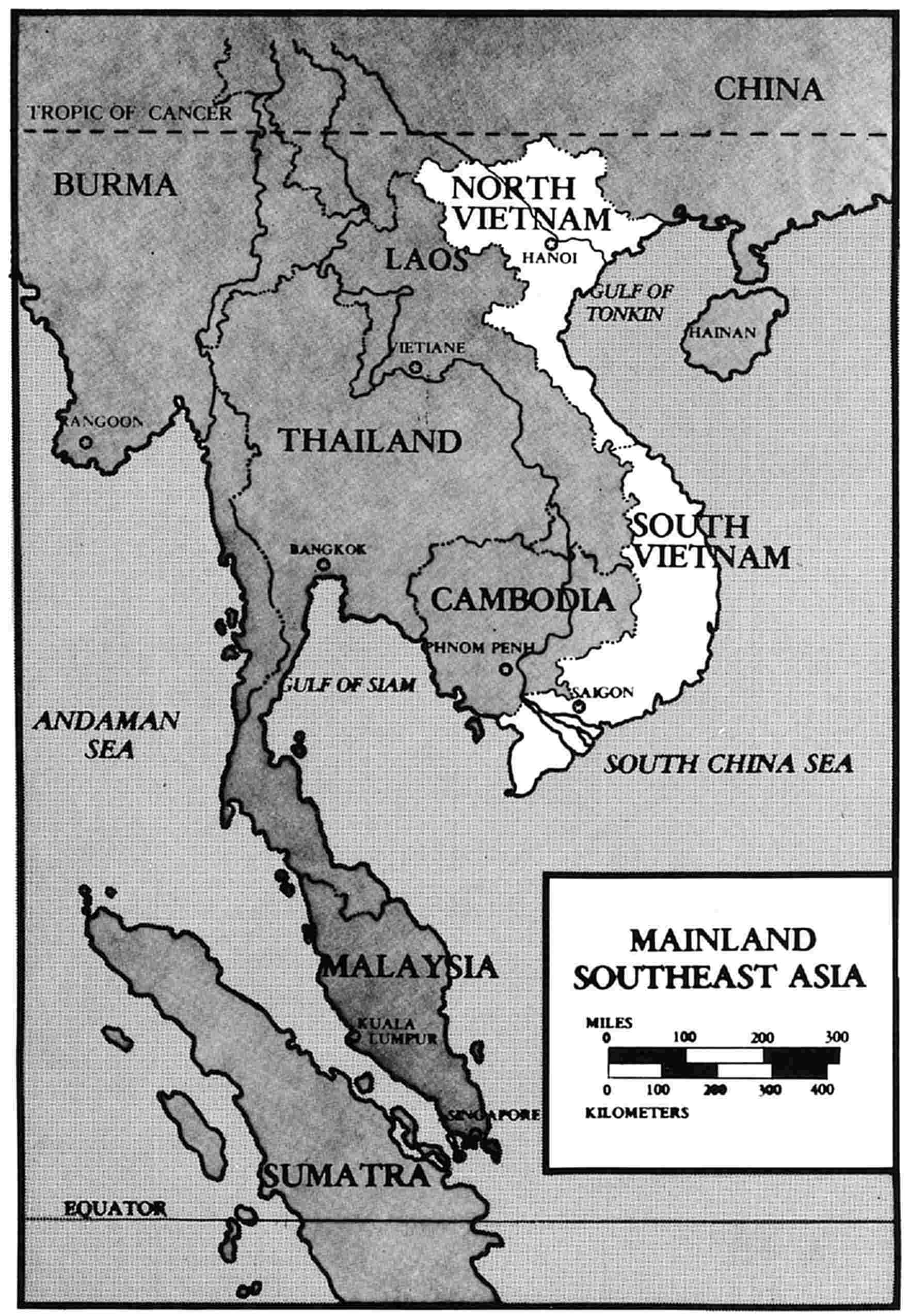
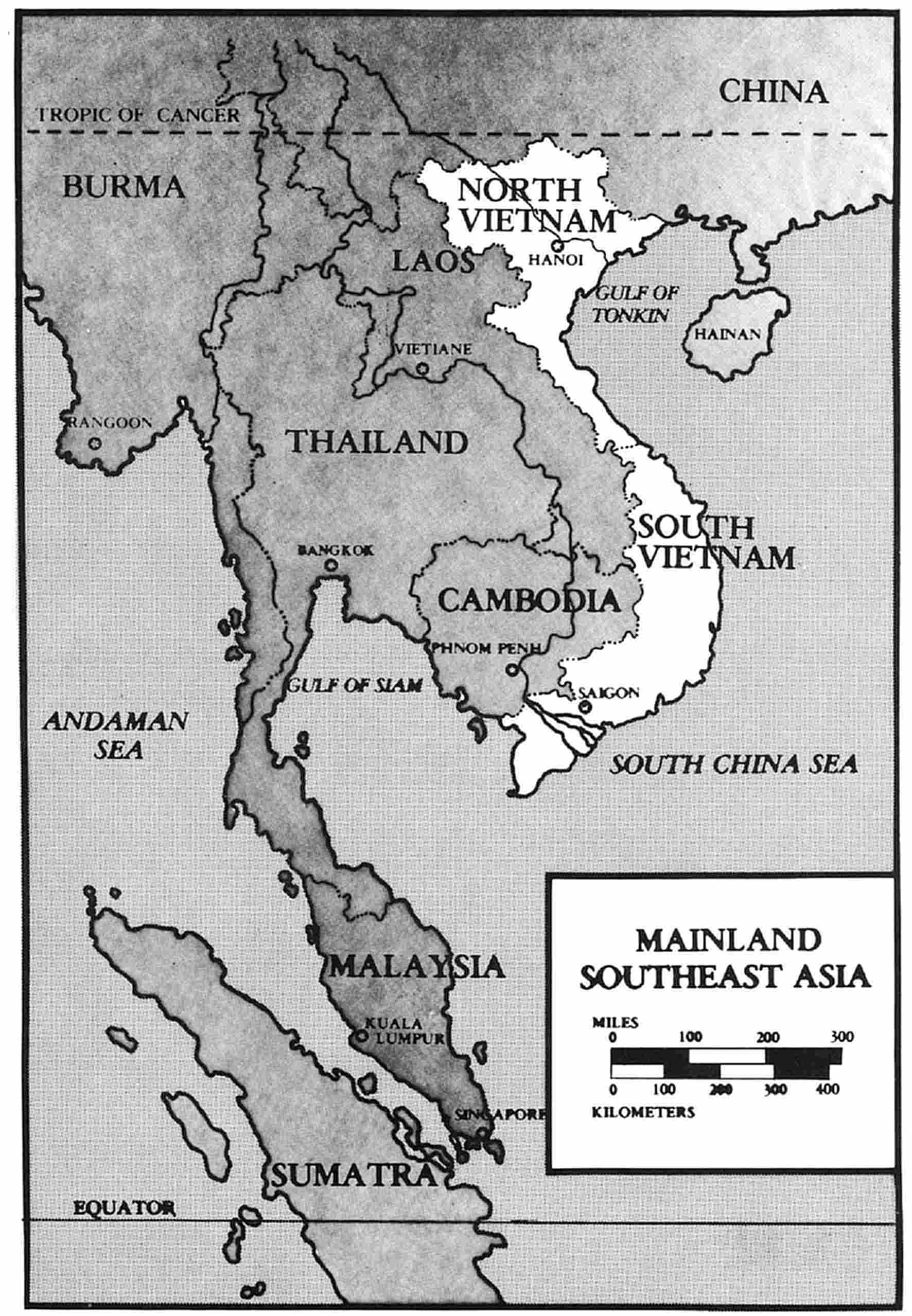
Hanging like a bulbous pendant from China’s
southern border, the Southeast Asian land mass
projects itself southward to within 100 miles of the
equator. Often referred to as the Indochinese
Peninsula, this land mass is contained by the
Andaman Sea on the west, the Gulf of Siam on the
south, and the South China Sea and the Tonkin
Gulf on the east. Along with the extensive Indonesian
island chain which lies to the immediate
south, mainland Southeast Asia dominates the key
water routes between the Pacific and the Indian
Oceans. So positioned, the Indochinese Peninsula
and the offshore islands resemble the Middle East
in that they traditionally have been recognized as a
“crossroads of commerce and history.”[1-1]
Seven sovereign states currently make up the
Indochinese Peninsula. Burma and Thailand occupy
what is roughly the western two-thirds of the entire
peninsula. To the south, the Moslem state of
Malaysia occupies the southern third of the rugged,
southward-reaching Malaysian Peninsula. East of
Thailand lies Cambodia, which possesses a relatively
abbreviated coastline on the Gulf of Siam,
and Laos, a landlocked country. The Democratic
Republic of Vietnam (North Vietnam), which
borders to the north on China, and the Republic of
Vietnam (South Vietnam) form the eastern rim of
the Indochinese Peninsula.
Vietnamese have often described the area currently
administered by the two separate Vietnamese
states as resembling “two rice baskets at the
ends of their carrying poles.”[1-2] This description
is derived from the position of extensive rice producing
river deltas at the northern and southern
extremities of the long, narrow expanse of coastline
and adjacent mountains. Vietnamese civilization
originated in the northernmost of these so-called
“rice baskets,” the Red River Delta, centuries
before the birth of Christ. Pressured at
various stages in their history by the vastly more
powerful Chinese and by increasingly crowded
conditions in the Red River Delta, the Vietnamese
gradually pushed southward down the narrow
coastal plain in search of new rice lands. Eventually
their migration displaced several rival cultures
and carried them into every arable corner of the
Mekong Delta, the more extensive river delta
located at the southern end of the proverbial
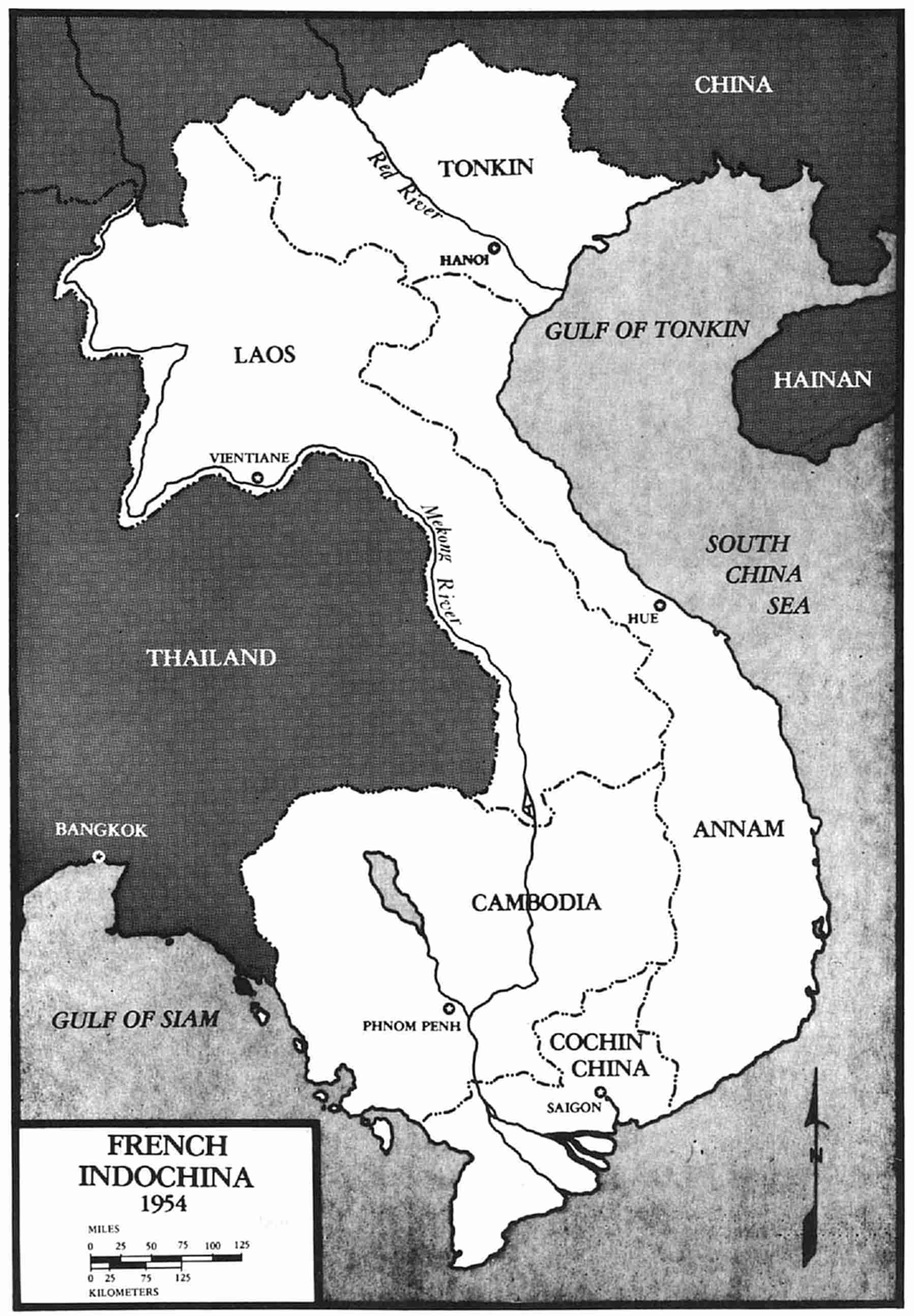
“carrying pole.” Although unified since the
eighteenth century under the Vietnamese, the area
between the Chinese border and the Gulf of Siam
came to be divided into three more or less different
regions: Tonkin, centered on the Red River Delta;
Cochinchina, centered on the Mekong Delta; and
Annam, the intervening coastal region.
MAINLAND
SOUTHEAST ASIA
FRENCH
INDOCHINA
1954
Since mid-1954 the area known collectively as
Vietnam has been divided into northern and
southern states. South Vietnam (known after 1956
as the Republic of Vietnam), where the earliest
U.S. military activities were focused, came to
include all of former Cochinchina and the southern
half of Annam. The geography of this small state,
described in general terms, is rugged and difficult.
The lengthy country shares often ill-defined jungle
boundaries with Laos and Cambodia in the west
and with the Democratic Republic of Vietnam
(DRV) to the north. Its land borders total almost
1,000 miles—600 with Cambodia, 300 with Laos,
and roughly 40 with North Vietnam. Approximately
1,500 miles of irregular coastline on the
Tonkin Gulf and the South China Sea complete
the enclosure of its 66,000-square mile area.
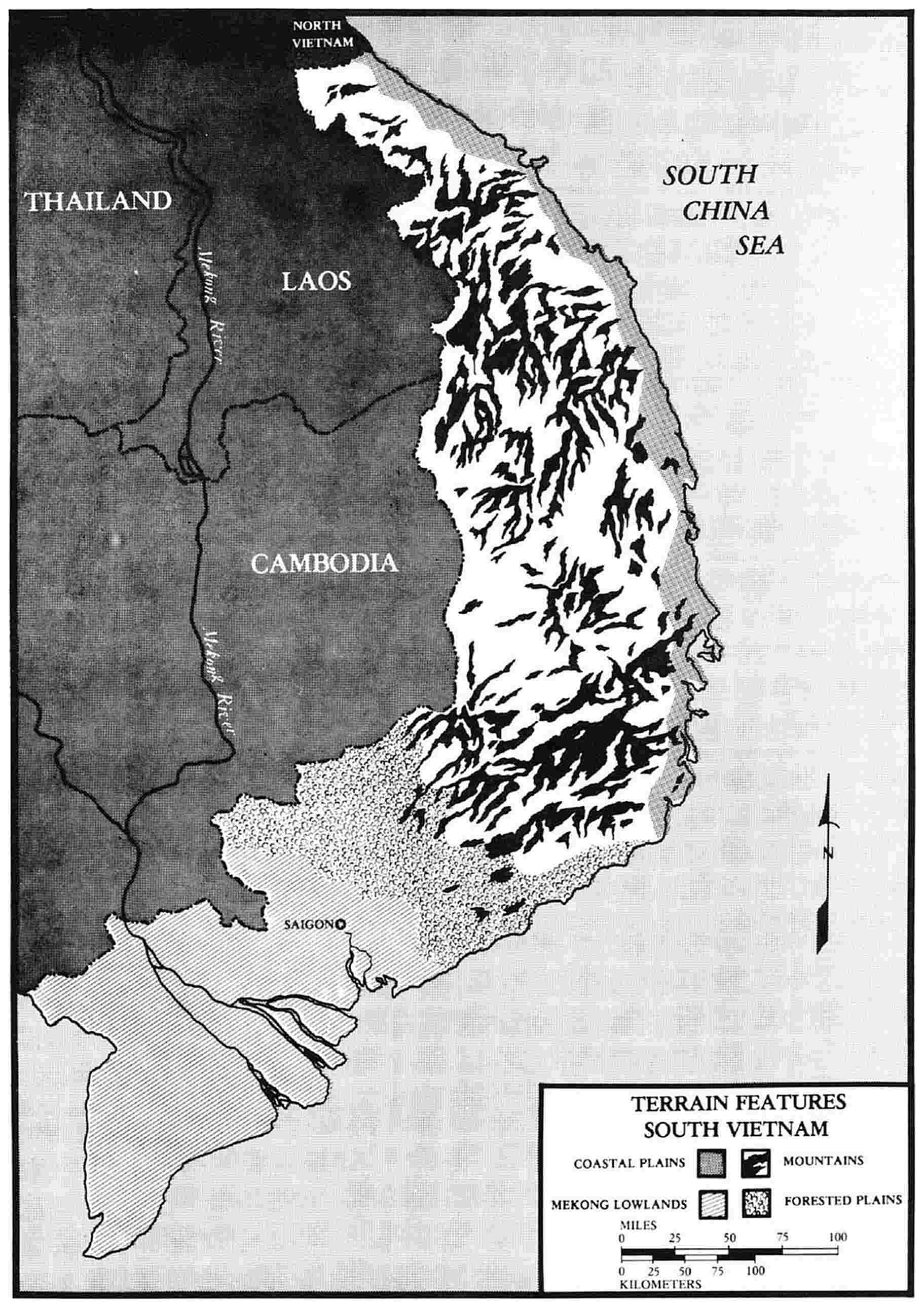
South Vietnam is divided into four relatively
distinct physiographic regions—the Mekong Delta,
the coastal plain, the Annamite Mountains, and the
forested plain. The Mekong Delta, an extensive and
fertile lowland centered on the Mekong River,
covers roughly the southern quarter of the country.
This region is essentially a marshy flat land well
suited for rice growing and is recognized as one of
Asia’s richest agricultural areas. South Vietnam’s
second physiographic region, the coastal plain, is
similar to the Mekong Delta in that it is predominantly
flat and generally well suited for rice
growing. Properly known as the coastal lowland,
this region extends from the country’s northern
border to the Mekong Delta. Its width is never
constant, being defined on the west by the rugged
Annamite Mountains—the region which dominates
the northern two thirds of South Vietnam. The
jungle-covered mountains, whose highest elevations
measure over 8,000 feet, stand in sharp contrast
to the low and flat coastal plain. The eastern
slopes of the mountains normally rise from the
lowlands at a distance of five or 10 miles from the
sea. At several points along the coast, however,
the emerald mountains crowd to the water’s edge,
dividing the coastal plain into compartments and
creating a seascape breathtaking in its beauty.
At other locations the mountain chain recedes
from the coast, allowing the lowlands to extend
inland as far as 40 miles. An extensive upland
plateau sprawls over the central portion of South
Vietnam’s mountain region.
This important subregion, known as the Central
Highlands, possesses relatively fertile soil and has
great potential for agricultural development. The
highest elevations in the Annamite chain are recorded
south of the Central Highlands. From
heights of 6,000 to 7,000 feet, the mountains dissolve
southward into the forested plain, a hilly
transition zone which forms a strip between the
Mekong lowlands and the southernmost mountains.
South Vietnam lies entirely below the Tropic of
Cancer. Its climate is best described as hot and
humid. Because the country is situated within
Southeast Asia’s twin tropical monsoon belt, it
experiences two distinct rainy seasons. The southwest
(or summer) monsoon settles over the Mekong
Delta and the southern part of the country in mid-May
and lasts until early October. In the northern
reaches, the northeast (or winter) monsoon season
begins in November and continues through most
of March. Unlike the rainy season in the south,
fog, wind, and noticeably lower temperatures
characterize the wet season in the north. While the
reversed monsoon seasons provide an abundance of
water for rice growing throughout the Mekong
Delta and most of the long coastal plain, rainfall
is not distributed uniformly. Parts of the central
coast record only about 28 inches of annual precipitation.
In contrast, other areas along the
northern coast receive as much as 126 inches of
rain during the course of a year. Even worse, a
percentage of this rainfall can be expected to occur
as a result of typhoons. The tropical storms
usually lash the Annamese coast between July and
November. Almost always they cause extensive
flooding along normally sluggish rivers which
dissect the coastal plain.
Slightly over 16 million people currently inhabit
South Vietnam. Of these, over 13 million are
ethnic Vietnamese. Primarily rice farmers and
fishermen, the Vietnamese have tended to compress
themselves into the country’s most productive
agricultural areas—the Mekong Delta and the
coastal plain. Chinese, numbering around one
million, form South Vietnam’s largest ethnic
minority. Concentrated for the most part in the
major cities, the Chinese traditionally have played
a leading role in Vietnam’s commerce. About
700,000 Montagnard tribesmen, scattered across
the upland plateau and the rugged northern mountains,
constitute South Vietnam’s second largest
minority. Some 400,000 Khmers, closely akin to
the dominant population of Cambodia, inhabit the
lowlands along the Cambodian border. Roughly
35,000 Chams, remnants of a once powerful kingdom
that blocked the southern migration of the
Vietnamese until the late 1400s, form the country’s
smallest and least influential ethnic minority. The
Chams, whose ancestors once controlled most of
the central and southern Annamese coast, are confined
to a few small villages on the central coast
near Phan Rang.
TERRAIN FEATURES
SOUTH VIETNAM
South Vietnamese adhere to a broad range of
religions. Between 70 and 80 percent of the country’s
16 million people are classified as Buddhist.
It is estimated, however, that a much smaller
percentage are actually practitioners. Roman Catholics
comprise roughly 10 percent of the total
population. Usually found in and around the country’s
urban centers, the Catholics are products of
Vietnam’s contacts with Europeans. Two so-called
politico-religious sects, the Cao Dai and the Hoa
Hao, have attracted large segments of the rural
population, particularly in the Mekong Delta.[1-A] For
the most part, the scattered Montagnard tribes
worship animal forms and have no organized
religion, although many have been converted to
Christianity.
[1-A] Founded just after World War I, the Cao Dai claims more
than one and a half million faithful in South Vietnam. The
religion incorporates elements of Taoism, Buddhism, Christianity,
Confucianism, and large doses of spiritualism. Its
clergy, headed by a “pope,” is organized in a hierarchy modelled
on that of the Roman Catholic Church. The extent of its borrowing
is suggested by the fact that adherents count the French
author Victor Hugo as one of their saints. Politically, the Cao
Dai moved sharply in the direction of nationalism during the
1940s, organized its own army, and fought sporadic actions
against the French and the subsequent French-controlled government
of Emperor Bao Dai until suppressed by the Diem government
in 1954.
Like the Cao Dai, the Hoa Hao is peculiarly Vietnamese. In
the late 1930s, a Buddhist monk named Huynh Pho So began a
“protestant” movement within the worldly, easy-going Buddhist
faith then prevalent. His followers, whose ranks grew rapidly,
called themselves Hoa Hao after the village where Phu So began
his crusade. Like the Cao Dai faithful and Catholics, they
tended to live apart in their own villages and hamlets concentrated
in the very south and west of Vietnam, primarily along the
Cambodian border. Intensely nationalistic and xenophobic,
they were under constant attack from the French, Japanese, and
Viet Minh, and by the late 1940s had recruited a large militia
which was subsequently disbanded. Today their overall membership
stands at about one million.
Fundamentally, South Vietnamese society is
rural and agrarian. Over the centuries the Vietnamese
have tended to cluster in tiny hamlets
strewn down the coastal plain and across the Mekong
Delta. Usually composed of a handful of
closely knit families whose ancestors settled the
surrounding land generations earlier, the hamlet is
South Vietnam’s basic community unit. Next
larger is the village which resembles the American
township in function in that it encompasses a
number of adjacent hamlets. The Vietnamese
people have naturally developed strong emotional
ties with their native villages. “To the Vietnamese,”
it has been said without exaggeration,
“the village is his land’s heart, mind, and soul.”[1-3]
Given the rural nature of the country it is understandable
that the inhabitants of the villages
and hamlets have retained a large degree of self-government.
“The laws of the emperor,” states an
ancient Vietnamese proverb, “are less than the
customs of the village.”[1-4]
Overlaying this rural mosaic are two intermediate
governmental echelons—the districts and
the provinces, The district, the smaller of these
political and geographic subdivisions, first appeared
in Vietnamese history following the earliest
annexation of Tonkin by the Chinese in 111 B.C. It
remained in use and was extended down the Annamese
coast and into Cochinchina by the successive
Vietnamese dynasties which came to power in the
ensuing centuries. Provinces, larger geographic
subdivisions, eventually were superimposed over
groups of contiguous districts, thus adding another
echelon between the reigning central government
and the villages. This structure remained in existence
under the French after they took control of all
Vietnam in the late 19th century. In order to make
their administration more efficient French colonial
authorities modernized the cumbersome administrative
machinery and adjusted provincial boundaries.
It is essentially this French-influenced structure
that exists in South Vietnam today. Still,
after years of use and modification, the system
seems somewhat superficial as traditional self-rule
of the villages tends to nullify the efforts of
provinces and districts to govern rural areas. Often
the central government’s influence is unable to
seep lower than the district headquarters, particularly
in more remote areas.
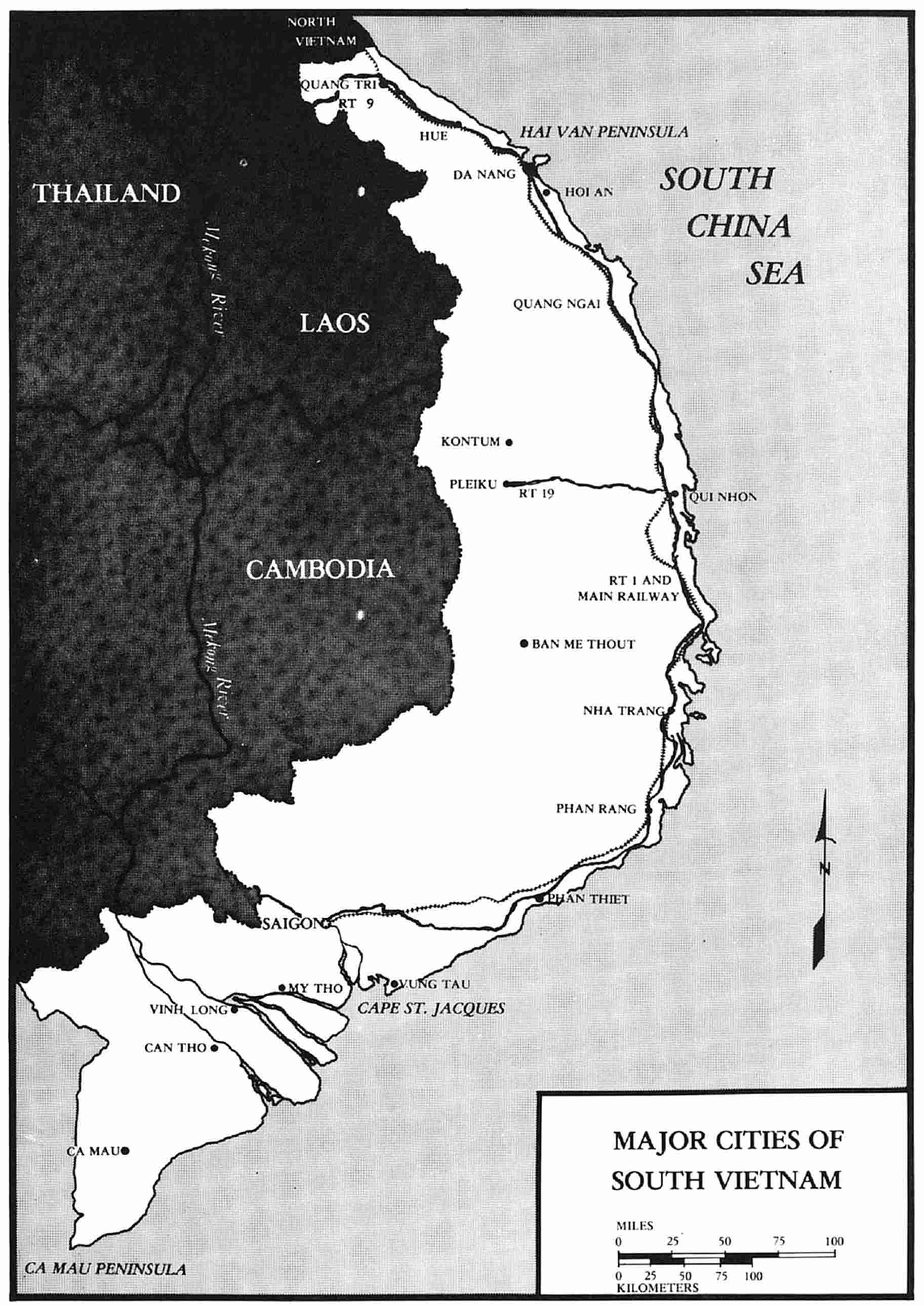
While South Vietnam is predominantly rural, it
does possess several important urban centers. As
might be expected, these are found primarily in the
densely populated Mekong Delta and along the
coastal lowland. Saigon, the nation’s capital and
largest city, presently has a population estimated
at 3.5 million. Located slightly north of the Mekong
River complex and inland from the coast, the
city dominates the country in both an economic
and political sense. Saigon has excellent port facilities
for ocean-going ships, although such traffic
must first negotiate the tangled Saigon River which
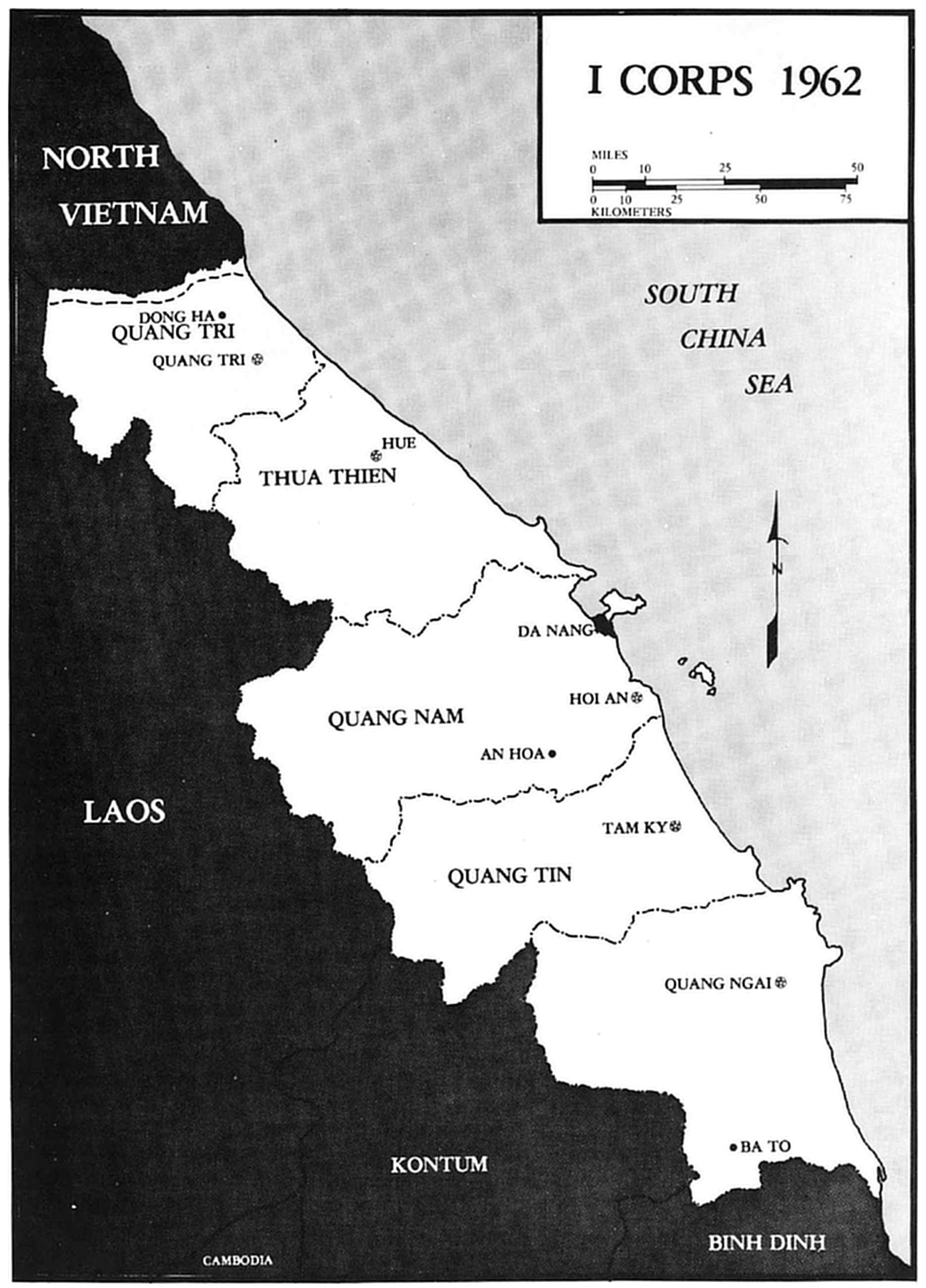
leads inland from the South China Sea. Da Nang,
located on the Annamese coast 84 miles below the
northern border, is the country’s second largest
city. With a population of roughly 500,000 and a
protected harbor, Da Nang constitutes the principal
economic center in northern South Vietnam.
The old imperial capital of Hue (population of
roughly 200,000), situated about 50 miles north of
Da Nang, historically has exerted a strong cultural
influence over the Annamese coast.[1-B] Scores of
large towns, such as Quang Tri, Hoi An, Quang
Ngai, Can Tho, and Vinh Long, extend down the
coast and across the Mekong Delta. Often these
serve as provincial capitals. A few lesser population
centers, notably Pleiku, Kontum, and Ban Me
Thuot, are situated in the Central Highlands.
[1-B] The population of most of South Vietnam’s cities and towns
has been swollen by the influx of refugees which occurred as the
Vietnam War intensified in the middle 1960s. In 1965, for example,
refugee population estimates for the three major cities
were as follows: Saigon—1.5 million; Da Nang—144,000; Hue—105,000.
Most of South Vietnam’s major towns and
cities are connected by one highway—Route 1.
Constructed by the French during the early 20th
century, Route 1 originally extended from Hanoi,
the principal city of Tonkin in northern Vietnam,
down the coast and inland to Saigon. While Route
1 and a French-built railroad which parallels it
helped unify South Vietnam’s most densely populated
areas, the country’s road network is otherwise
underdeveloped. A few tortuous roads do
twist westward from Route 1 into the mountains
to reach the remote towns there. Of these the most
noteworthy are Route 19, built to serve Pleiku in
the Central Highlands, and Route 9, which extends
westward into Laos from Dong Ha, South
Vietnam’s northernmost town. A number of roads
radiate outward from Saigon to the population
centers of the Mekong Delta. For the most part,
however, the Vietnamese people traditionally have
depended on trail networks, inland waterways,
and the sea to satisfy their transportation needs.
The location of the bulk of the population in the
watery Mekong Delta and along the seacoast has
encouraged their reliance on waterborne
transportation.
Prior to July 1954 the expanse of mainland Southeast
Asia now occupied by South Vietnam, North
Vietnam, Laos, and Cambodia belonged to France.
Together these possessions constituted French-Indochina
over which the French had exercised
political control in one form or another, with one
exception, since the last quarter of the 19th century.
The only interruption occurred following the
capitulation of France in June 1940. Exploiting
the disrupted power balance in Europe, and attracted
by the natural resources and strategic
value of the area, Japan moved into northern
French-Indochina less than four months after
France had fallen. In 1941 the Vichy French government
agreed to Japanese occupation of southern
French-Indochina. Soon Japanese forces controlled
every airfield and major port in Indochina. Under
this arrangement the Japanese permitted French
colonial authorities to maintain their administrative
responsibilities. But as the tide of war began
to turn against the Japanese, the French became
increasingly defiant. The Japanese terminated this
relationship on 9 March 1945 when, without
warning, they arrested colonial officials throughout
Indochina and brutally seized control of all
governmental functions.
Six months after the dissolution of the French
colonial apparatus in Indochina, World War II
ended. The grip which Japan had held on most of
Southeast Asia for nearly half a decade was broken
on 2 September 1945 when her foreign minister
signed the instrument of unconditional surrender
on board the battleship USS Missouri. Shortly thereafter,
in accordance with a previously reached
Allied agreement, Chinese Nationalist forces moved
into Tonkin and northern Annam to accept the
surrender of Japanese forces. South of the 16th
parallel, British units arrived from India to disarm
the defeated Japanese. A detachment of 150 men
from a small French Expeditionary Corps arrived
by air in Saigon on the 12th to assist the British,
who had included them only as a courtesy since
France was not among the powers slated to receive
the surrender of the Japanese in Indochina.
But the end of World War II and the arrival of
Allied forces did not end the struggle for control of
French-Indochina. Instead, it signalled the beginning
of a new conflict in which the contestants
were, in many respects, more formidable. One of
these, the French, moved quickly to restore their
former presence in Cochinchina and Annam. Reinforced
with additional units, they occupied most
major towns between the Mekong Delta and the
16th parallel by the end of 1945. Two months later
French negotiators secured an agreement with the
Chinese Nationalists whereby French units would
replace the Chinese occupation forces north of the
16th parallel.
MAJOR CITIES OF
SOUTH VIETNAM
Wartime developments in French-Indochina,
however, had brought about profound political
changes which eventually would doom the French
effort to re-establish political and economic influence
in the region. During World War II, Ho Chi
Minh, an avowed Communist, had transformed a
relatively feeble political party into a sizable
guerrilla organization. Known as the Viet Minh,
the Communist guerrillas had been organized,
trained, and led by Vo Nguyen Giap, a former history
teacher from Annam. During the latter stages
of the war, the United States had supplied the Viet
Minh with limited quantities of military supplies.
In return, Ho’s guerrillas had assisted downed
American pilots and occasionally had clashed with
small Japanese units. But the Viet Minh had
wasted few men on costly major actions against
the Japanese. Conserving their forces, Ho and Giap
had concentrated on organization and had managed
to extend their strength into the densely
populated Red River Delta and along the Annamese
coast. In Cochinchina, where their numbers
were considerably smaller, the Communists had
limited their activities almost entirely to organization
and recruitment. Thus, by the end of the war
Ho’s organization was able to emerge as a definite
military-political force in northern French-Indochina.
Following the Japanese surrender and before the
arrival of the Chinese Nationalist occupation forces,
the Viet Minh seized control of Hanoi, the capital
of Tonkin, and proclaimed the Democratic Republic
of Vietnam. At Ho’s direction the Viet
Minh promptly shifted from their anti-Japanese
posture and prepared to contest the French return.
Confronted with this situation in northern
Indochina, the French were forced to bargain with
the Communists. A preliminary agreement was
reached on 6 March 1946 whereby the French
agreed to recognize the newly founded but relatively
weak Democratic Republic of Vietnam as a
“free state within the French Union.” In return,
Ho’s government declared itself “ready to welcome
in friendly fashion the French Army, when in
conformance with international agreement, it
would relieve the Chinese forces” which had accepted
the Japanese surrender in Tonkin.[1-5] Shortly
after the conclusion of this agreement, French
forces began reoccupying Tonkin and northern
Annam. Within six months they controlled every
major strategic position from the Chinese border
to the Ca Mau Peninsula, Cochinchina’s southern
tip.
The uneasy peace was broken in December 1946
after Viet Minh and French negotiators failed to
reach a final agreement on actual political control
of Tonkin and Annam. When open warfare erupted,
Ho withdrew the bulk of his military forces into
mountainous sanctuaries along the Chinese border,
but left small groups of guerrillas scattered
throughout the heavily populated Red River Delta.
Reinforced with contingents from Europe and
Africa, the French Expeditionary Corps initially
managed to hold its own and, in some cases, even
extend its control. But, drawing strength from its
natural appeal to Vietnamese nationalism, the
Communist movement began gaining momentum
in the late 1940s. Gradually the war intensified
and spread into central Annam and Cochinchina.
In January 1950, the French moved to undercut
the Viet Minh’s appeal to non-Communist nationalists
by granting nominal independence to its
Indochina possessions. Under the terms of a formal
treaty, all of Vietnam (Tonkin, Annam, and Cochinchina)
was brought together under a Saigon-based
government headed by Emperor Bao Dai.
Laos and Cambodia likewise formed their own
governments, whereupon all three countries became
known as the Associated States of Indochina.
This new arrangement, however, had little
effect on the ongoing war with the Viet Minh. In
accordance with the treaties, the Associated States
became members of the French Union and agreed
to prosecute the war under French direction.
Moreover, French political dominance in the region
continued, virtually undiluted by the existence of
the Associated States.
In related developments, Mao Tse-tung’s Chinese
Communist armies seized control of mainland
China in 1949 and Communist North Korean
forces invaded the pro-Western Republic of Korea
in 1950. These events added new meaning to the
French struggle in Indochina as American policy
makers came to view the war on the Southeast
Asian mainland within the context of a larger
design to bring Asia entirely under Communist
domination. Following the invasion of South
Korea, President Truman immediately announced
his intention to step up U.S. military aid to the
French in Indochina. Congress responded quickly
by adding four billion dollars to existing military
assistance funds. Of this, $303 million was earmarked
for Korea, the Philippines, and “the general
area of China.”[1-6][1-C] Thus, the Truman Administration,
now confronted by the possibility
that Communism might engulf all of mainland
Asia, extended its containment policy to Indochina.
[1-C] The following year would see a half billion U.S. dollars
allocated to support French operations in Indochina. By 1954
that figure would climb to an even one billion dollars.
Even with rapidly increasing amounts of U.S.
material assistance, the French proved unable to
wrest the initiative from Giap’s growing armies.
Although national armies drawn from Cambodia,
Laos, and Vietnam were now fighting alongside
the French, the Expeditionary Corps was over-extended.
Moreover, the French cause was extremely
vulnerable to Communist propaganda. On
the home front, public support for the so-called
sale guerre (dirty war) eroded steadily during the
early 1950s as the Expeditionary Corps’ failures and
casualties mounted. Finally, on 7 May 1954, the
besieged 13,000-man French garrison at Dien Bien
Phu surrendered to the Viet Minh, thus shattering
what remained of French determination to prosecute
the war in Indochina. In Geneva, where Communist
and Free World diplomats had gathered to
consider a formal peace in Korea along with the
Indochina problem, French and Viet Minh representatives
signed a cease-fire agreement on 20 July
which ended the eight-year conflict.
The bilateral cease-fire agreement substantially
altered the map of the Indochinese Peninsula.
France agreed to relinquish political control
throughout the area. Laos, Cambodia, and Vietnam
all gained full independence. The most controversial
provision of the 20 July agreement divided
Vietnam at the Ben Hai River and superimposed a
demilitarized zone over the partition line. This
division, intended to facilitate the disengagement
of the opposing forces, was to be temporary pending
a reunification election scheduled for mid-1956.
In accordance with the agreement, France immediately
turned over political control of the
northern zone (Tonkin and the northern half of
Annam) to the Communist Viet Minh. Ho
promptly re-established the Democratic Republic
of Vietnam (DRV) with its capital in Hanoi.
Other provisions of the Geneva Agreement
called for the opposing armies to regroup in their
respective zones within 300 days. Following their
regroupment, the French military forces were to be
completely withdrawn from the North within
300 days and from the South by mid-1956. Civilians
living both north and south of the partition line
were to be allowed to emigrate to the opposite
zone in accordance with their political convictions.
It was anticipated that thousands of Catholics
living in Tonkin would seek refuge in the non-Communist
South. Other articles of the agreement
dealt with the creation and responsibilities of an
International Control Commission (ICC) to
supervise the cease-fire. Canadian, Indian, and Polish
delegations were to comprise this commission.
On 21 July, the day following the bilateral agreement,
Great Britain, the Soviet Union, the Peoples
Republic of China, Cambodia, and Laos joined
France and the Viet Minh in endorsing a “Final
Declaration” which sanctioned the previously
reached cease-fire agreement. The United States
refused to endorse this declaration, but issued a
statement to the effect that it would not use force to
disturb the cease-fire.
The execution of the Geneva Agreement thrust
that area of Vietnam south of the partition line
into a period of profound confusion and instability.
Even worse, the colonial period had done
little to prepare the Cochinchinese and Annamese
for the tremendous problems at hand. No real apparatus
for central government existed. Likewise,
the long colonial period left the area with few
experienced political leaders capable of establishing
and managing the required governmental
machinery. Political control passed nominally to
the French-sponsored emperor, Bao Dai, who was
living in France at the time. For all practical purposes,
leadership in the South devolved upon Bao
Dai’s recently appointed pro-Western premier,
Ngo Dinh Diem. The product of a prosperous and
well-educated Catholic family from Hue, Diem
had served the French briefly as a province chief
prior to World War II. Always a strong nationalist
but staunchly anti-Communist, he had been unable
to reconcile his anti-French attitudes with the
Viet Minh movement during the Indochina War.
As a result Diem had left his homeland in the
early 1950s to live at a Catholic seminary in the
United States. There he remained until his appointment
as premier in mid-June of 1954.
The months immediately following the Geneva
agreement found Ngo Dinh Diem struggling to
create the necessary governmental machinery in
Saigon, the capital of the southern zone. At best,
however, his hold on the feeble institutions was
tenuous. A serious confrontation was developing
between the premier and the absent Bao Dai, still
residing in France. Further complicating the
political scene was the presence of Hoa Hao and
Cao Dai armies in the provinces surrounding the
capital, and the existence in Saigon of an underworld
organization named the Binh Xuyen.[1-D] As
1955 opened the leaders of these three politically
oriented factions were pressing demands for concessions
from the new central government. Among
these were permission to maintain their private
armies, and the authority to exercise political
control over large, heavily populated areas.
[1-D] The Binh Xuyen originally operated from the swamps south
of the Chinese-dominated Cholon district of Saigon. Controlling
the vice and crime of the city, by 1954 they had gained control
of the police under circumstances that reeked of bribery. A year
later the organization was brutally crushed by Ngo Dinh Diem.
The outcome of the embryonic power struggle
in Saigon hinged largely on control of the Vietnamese
National Army (VNA). Although not
considered an efficient military organization by
even the most liberal estimates, the 210,000-man
National Army was the principal source of organized
power available to the quarreling leaders of
southern Vietnam. Originally created by the French
in 1950 to supplement their Expeditionary Corps,
the VNA had since suffered from structural deficiencies.
It actually had no organizational echelon
between the French-controlled General Staff and
the 160 separate battalions. Tied to no regiments
or divisions, the Vietnamese battalions naturally
were dependent on the French Expeditionary Corps
for operational instructions and logistical support.[1-E]
[1-E] Selected VNA battalions were sometimes task organized into
groupes mobiles (mobile groups) by the French for specific offensive
operations. But these groups, which were roughly equivalent to a
regimental combat team, were never composed entirely of VNA
battalions under a Vietnamese command group.
A dearth of qualified Vietnamese officers and a
degree of inattention on the part of the French
compounded the problems which stemmed from
the army’s structural flaw. Partially as a result of
these shortcomings the morale of the VNA had deteriorated
sharply in the waning stages of the
French-Indochina War. At the time of the cease-fire
agreement, high desertion rates were reported
in almost every Vietnamese battalion. Still, it was
evident that he who controlled the National Army
would most likely control the government in the
area south of the partition line.
The danger that the pro-Western zone might become
the victim of a sudden Communist attack
from the north, as had been the case on the Korean
Peninsula, injected another element of uncertainty
into the overall situation in southern Vietnam.
The conditions which settled over the area in the
immediate aftermath of the Geneva settlement suggested
this possibility since they were alarmingly
similar to the conditions which had prevailed in
Korea prior to the North Korean invasion of 1950.
Like Korea, Vietnam was divided both geographically
and ideologically: the North clearly within
the orbit of the Soviet Union and Communist
China, and the South under the influence of the
Western powers. As in Korea in 1950, there also
existed a very real armed threat to the weaker pro-Western
southern state. Immediately after the
Geneva cease-fire, the Viet Minh army regrouped
north of the 17th parallel and was redesignated the
People’s Army of Vietnam (PAVN). American
intelligence reported that the PAVN, which numbered
roughly 240,000 disciplined veterans, was
being reorganized and re-equipped with Soviet and
Chinese weapons in violation of the Geneva Agreement.
At the same time Western intelligence
sources estimated that the Viet Minh had intentionally
left between 5,000 and 10,000 men south
of the partition line following their withdrawal.
Also done in violation of the cease-fire agreement,
this meant that Communist guerrillas could be
expected to surface throughout the South in the
event of an outright invasion.
A related condition heightened fears that a
Korea-type invasion might occur in Vietnam. In
South Korea a military vacuum had been allowed
to form in 1949 when American units withdrew
from the area. Apparently that vacuum, coupled
with a statement by the American Secretary of
State to the effect that the U.S. defensive perimeter
in the Pacific did not include South Korea, had
encouraged Communist aggression. Now, with the
scheduled evacuation of French armies from Indochina
by mid-1956, there emerged the distinct
possibility that such a military vacuum would
recur, this time in southern Vietnam. “Vietnam,”
warned one American scholar familiar with the
region, “may very soon become either a dam
against aggression from the north or a bridge serving
the communist block to transform the countries
of the Indochinese peninsula into satellites of
China.”[1-7]
It was in the face of this uncertain situation on
the Southeast Asian mainland that the Eisenhower
administration moved to discourage renewed Communist
military activity. First, the United States
sought to create a regional international organization
to promote collective military action under
the threat of aggression. This was obtained on
8 September 1954 when eight nations—the United
States, Great Britain, France, New Zealand, Australia,
the Philippines, Pakistan, and Thailand—signed
the Manila Pact. The treaty area encompassed
by the pact included Southeast Asia, the
Southwest Pacific below 21°31′ north latitude, and
Pakistan. Two weeks later the pact was transformed
into the Southeast Asia Treaty Organization
(SEATO). In a separate protocol, the member
nations agreed that Cambodia, Laos, and the
“Free Territory under the jurisdiction of the State
of Vietnam” all resided within their defense
sphere.[1-8]
Next, after several months of hesitation, the
United States settled on a policy of comprehensive
assistance to South Vietnam, as the area south
of the 1954 partition line was already being called.
As conceived, the immediate objective of the new
American policy was to bring political stability
to South Vietnam. The longer range goal was
the creation of a bulwark to discourage renewed
Communist expansion down the Indochinese Peninsula.
In this scheme, military assistance was to
play a key role. “One of the most efficient means
of enabling the Vietnamese Government to become
strong,” explained Eisenhower’s Secretary of
State, John Foster Dulles, “is to assist it in reorganizing
the National Army and in training
that Army.”[1-9] In short, the State Department’s
position was that a stronger, more responsive
Vietnamese National Army would help Premier
Diem consolidate his political power. Later that
same force would serve as a shield behind which
South Vietnam would attempt to recover from the
ravages of the French-Indochina War and the
after effects of the Geneva Agreement.
So by early 1955 a combination of circumstances—South
Vietnam’s position adjacent to a
Communist state, the unsavory memories of the
Korean invasion, and the impending withdrawal
of the French Expeditionary Corps—had influenced
the United States to adopt a policy of military
support for Premier Diem’s struggling government.
CHAPTER 2 The Formative Years Military Assistance Advisory Group, Vietnam—Origins of U.S. Marine Assistance—Political Stabilization and Its Effects—Reorganization and Progress—Summing Up Developments — Military Assistance Advisory Group, Vietnam — Origins of U.S. Marine Assistance — Political Stabilization and Its Effects — Reorganization and Progress — Summing Up Developments
When the Geneva cease-fire went into effect in
the late summer of 1954, the machinery for implementing
the military phase of the American assistance
program for South Vietnam already existed.
President Truman had ordered the establishment
of a U.S. Military Assistance Advisory Group
(USMAAG or MAAG) in French Indochina in
mid-1950 as one of several reactions to the North
Korean invasion of the Republic of Korea. Established
to provide materiel support to the French
Expeditionary Corps, the MAAG constituted little
more than a logistical funnel through which U.S.
military aid had been poured.
Lieutenant General John M. (“Iron Mike”)
O’Daniel, U.S. Army, had been assigned to command
the MAAG in the spring of 1954. O’Daniel’s
selection for the Saigon post anticipated a more
active U.S. role in training of the Vietnamese
National Army. He had been chosen for the assignment
largely on the basis of his successful role
in creating and supervising the training programs
which had transformed the South Korean Army
into an effective fighting force during the Korean
War. Now, in the aftermath of the Geneva settlement,
he and his 342-man group began preparing
for the immense task of rebuilding South Vietnam’s
armed forces.
The entire American project to assist the South
Vietnamese in the construction of a viable state
was delayed during the fall of 1954 while the necessary
diplomatic agreements were negotiated among
American, French, and South Vietnamese officials.
President Eisenhower dispatched General J. Lawton
Collins, U.S. Army (Retired), to Saigon in
November to complete the details of the triangular
arrangements. Collins carried with him the broad
powers which would be required to expedite the
negotiations.
By mid-January 1955, the president’s special envoy
had paved the way for the transfer of responsibility
for training, equipping, and advising the
Vietnamese National Army from the French to the
USMAAG. He and General Paul Ely, the officer
appointed by the Paris government to oversee the
French withdrawal from Indochina, had initialed
a “Minute of Understanding.” In accordance with
this document, the United States agreed to provide
financial assistance to the French military in Vietnam
in exchange for two important concessions.
First, the French pledged to conduct a gradual
military withdrawal from South Vietnam in order
to prevent the development of a military vacuum
which might precipitate a North Vietnamese
invasion. Secondly, they accepted an American
plan to assist in a transition stage during which the
responsibility for rebuilding the Vietnamese military
could be transferred to the MAAG in an orderly
fashion. General Collins, in addition to engineering
the understanding with General Ely,
had advised Premier Diem to reduce his 210,000-man
military and naval forces to a level of 100,000,
a figure which the U.S. State Department felt the
United States could realistically support and
train.
The American plan to begin assisting South
Vietnam encountered further delay even after the
Ely-Collins understanding had been reached. Ely’s
government, arguing that the United States had
agreed to provide only one-third of the amount
France had requested to finance its Indochina forces,
refused to ratify the agreement. The deadlock was
finally resolved on 11 February 1955 when French
officials accepted the terms of the Ely-Collins arrangement
in a revised form.
A combined Franco-American training command,
designated the Training Relations Instruction Mission
(TRIM), became operational in Saigon the
day following the French ratification of the Ely-Collins
understanding.[2-A] Headed by Lieutenant
General O’Daniel but under the “overall authority”
of General Ely, TRIM was structured to prevent
domination by either French or Americans.
The training mission was composed of four divisions,
Army, Navy, Air Force, and National
Security, each of which was headed alternately by
either an American or a French officer. The chief of
each division had as his deputy an officer of the
opposite nationality. U.S. officers, however, headed
the divisions considered by MAAG officials as the
most important—Army and National Security.
Operating through TRIM and assisted by the
French military, the USMAAG was tasked with
implementing the U.S. Military Assistance Program
in a manner that would help shape the
Vietnamese national forces into a cohesive defense
establishment prior to the withdrawal of French
forces.
[2-A] The combined training mission originally was designated the
Allied Training Operations Mission. This designation was
changed prior to the time the mission became operational.
Only one U.S. Marine was serving with the
USMAAG in Saigon when TRIM became operational—Lieutenant
Colonel Victor J. Croizat.[2-B]
Croizat’s assignment to the U.S. advisory group
had resulted when General Lemuel C. Shepherd,
Jr., Commandant of the Marine Corps, nominated
him to fill a newly created billet as liaison officer
between the MAAG and the French High Command
during the latter stages of the Indochina
War. Largely because of his French language
fluency and his former association with many
French officers while attending their war college
in 1949, Croizat was chosen for the assignment.
[2-B] Other Marines, however, were present in Saigon at the time.
They were those assigned to the American Embassy. One officer
was serving as Assistant Naval Attache/Assistant Naval Attache
for Air, and 12 other Marines were serving as security guards.
Lieutenant Colonel Croizat, however, did not
arrive in Vietnam until 2 August 1954. By then
the cease-fire agreement had been signed at Geneva
and the need for a liaison officer with the French
High Command no longer existed. General
O’Daniel, therefore, assigned the newly arrived
Marine officer to serve on the General Commission
for Refugees which had been created by the South
Vietnamese Government immediately after the
cease-fire. In this capacity Croizat became directly
involved in the construction of refugee reception
centers and the selection and development of
resettlement areas in the South. When U.S. naval
forces began assisting in the evacuation of North
Vietnam, Lieutenant Colonel Croizat was sent
to Haiphong, the principal seaport of Tonkin.
There he headed the MAAG detachment and was
responsible for coordinating U.S. operations in the
area with those of the French and Vietnamese.
When the so-called “Passage to Freedom” concluded
in May 1955, 807,000 people, 469,000 tons
of equipment and supplies, and 23,000 vehicles
had been evacuated from Communist North
Vietnam.[2-C] It was not until February 1955 that the
Marine returned to Saigon.
[2-C] The French moved 497,000 people, 400,000 tons of equipment
and supplies, and 15,000 vehicles. The U.S. Navy moved the
balance.
During Lieutenant Colonel Croizat’s absence,
Premier Diem had acted on a long-standing proposal
to create a small Vietnamese Marine Corps. The
issue of a separate Marine force composed of
Vietnamese national troops had surfaced frequently
since the birth of the Vietnamese Navy in the
early 1950s. Although the proposal had been
heartily endorsed by a number of senior French
Navy officers, the downward spiral of the French
war effort had intervened to prevent the subject
from being advanced beyond a conceptual stage.
Largely as a result of earlier discussions with
Croizat, Premier Diem acted on the matter on
13 October when he signed a decree which included
the following articles:
ARTICLE 1. Effective 1 October 1954 there is created
within the Naval Establishment a corps of infantry
specializing in the surveillance of waterways and amphibious
operations on the coast and rivers, to be designated
as:
‘THE MARINE CORPS’
* * * * *
ARTICLE 3. The Marine Corps shall consist of various
type units suited to their functions and either already
existing in the Army or Naval forces or to be created in
accordance with the development plan for the armed
forces.[2-1]
In accordance with this decree a miscellaneous
collection of commando-type units was transferred
from the Vietnamese National Army and
Navy to the Marine Corps. Except for a naval
commando unit, which had conducted amphibious
raids along the coastal plains, these forces had
operated in the Red River Delta with the French
and Vietnamese Navy dinassauts (river assault
divisions). First employed in 1946, the dinassauts
had evolved into relatively effective naval commands
capable of landing light infantry
companies along Indochina’s tangled riverbanks.
Normally the dinassaut was composed of about a
dozen armored and armed landing craft, patrol
boats, and command vessels. An Army commando
unit, consisting of approximately 100 men, would
be attached to such naval commands for specific
operations. Thus organized, the dinassauts could
transport light infantry units into otherwise inaccessible
areas and support landings with heavy
caliber automatic weapons and mortar fire. Such
operations had been particularly successful in the
sprawling Red River Delta of Tonkin where
navigable estuaries and Viet Minh abounded.[2-D]
Later in the war, as the concept was refined, the
French created a number of Vietnamese National
Army commando units for specific service with the
dinassauts. Still attached to the Navy commands
these units were sometimes responsible for security
around the dinassaut bases when not involved in
preplanned operations. A number of these rather
elite Vietnamese units, variously designated light
support companies, river boat companies, and commandos,
were now transferred to the newly decreed
Vietnamese Marine Corps (VNMC).
[2-D] Of the dinassaut Bernard Fall wrote: “[It] may well have
been one of the few worthwhile contributions of the Indochina
war to military knowledge.” (Fall, Street Without Joy, p. 39)
A more thorough analysis of dinassaut operations is included
in Croizat, A Translation From The French Lessons of the War, pp.
348–351.
By the time Lieutenant Colonel Croizat returned
to Saigon in early 1955 these units, which totalled
approximately 2,400 officers and men, had been
evacuated from North Vietnam. Several of the
commandos had been assembled at Nha Trang on
South Vietnam’s central coast where the French
still maintained an extensive naval training facility.
There, under the supervision of a junior
French commando officer, several former commandos
had been organized into the 1st Marine
Landing Battalion (or 1st Landing Battalion).
The balance of the newly designated Marine units,
however, were scattered in small, widely separated
garrisons from Hue to the Mekong Delta.
These units included six river boat companies, five
combat support light companies, and a small training
flotilla. Diem had appointed a former Vietnamese
National Army officer, Major Le Quang
Trong, as Senior Marine Officer. But because no
formal headquarters had been created and because
no real command structure existed, Major Trong
remained relatively isolated from his far-flung Marine
infantry units.
Upon returning to Saigon, Croizat was assigned
to the MAAG’s Naval Section and subsequently to
TRIM’S Naval Division as the senior U.S. advisor
to the newly created Vietnamese Marine Corps.
In this capacity the Marine officer quickly determined
that the small Vietnamese amphibious force
was faced with several serious problems. First,
and perhaps its most critical, was that despite
Premier Diem’s decree, the Marine Corps continued
to exist essentially on an informal basis. “The
Marine Corps itself had no real identity,” its U.S.
advisor later explained. “It was a scattering of dissimilar
units extending from Hue to the Mekong
Delta area.”[2-2] The fact that its widespread units
were still dependent on the French Expeditionary
Corps for logistical support underscored the weakness
inherent in the VNMC’s initial status.
Other problems arose from the continuation of
French officers in command billets throughout the
Vietnamese naval forces. Under the Franco-American
agreement which had created TRIM, a
French Navy captain doubled as chief of the combined
training missions’ Naval Division and as
commanding officer of the Vietnamese naval
forces. This placed the French in a position to
review any proposals advanced by the U.S. Marine
advisor. Complicating the situation even further, a
French Army captain, Jean Louis Delayen, actually
commanded the 1st Landing Battalion at Nha
Trang.[2-E]
[2-E] Delayen, described by Croizat as “an exceptionally qualified
French Commando officer,” later attended the U.S. Marine
Corps Amphibious Warfare School at Quantico. (Croizat,
“Notes on The Organization,” p. 3.)
Demobilization presented another potential difficulty
for the Vietnamese Marine Corps in early
1955. Under the U.S.-Vietnamese force level
agreements, the Vietnamese naval forces were
limited to 3,000 men. The Marine Corps, which
alone totalled a disproportionate 2,400 men, had
been instructed to reduce its strength to 1,137
men and officers. With no effective centralized
command structure and so many widely separated
units, even the relatively simple task of mustering
out troops assumed the dimensions of a complex
administrative undertaking.
In short, the very existence of the Vietnamese
Marine Corps was threatened in a number of inter-related
situations. The continuation of a separate
and distinct Marine Corps hinged ultimately, of
course, on the overall reorganization of the Vietnamese
armed forces and their support structure.
Essentially it would be necessary to establish a
requirement for such an organization within South
Vietnam’s future military-naval structure. Croizat
personally sensed that this would be the pivotal
issue in determining the VNMC’s future. “There
were numerous representatives of the three military
services from each of the three countries concerned
with the fate of the Vietnamese Army, Navy, and
Air Force,” he pointed out. “But, there was no
champion from within the Vietnamese Marine
Corps since no Corps existed except on paper.”[2-3]
Thus, it was left initially to a French captain, a
Vietnamese major, and a U.S. Marine lieutenant
colonel to keep alive the idea that South Vietnam’s
defense establishment needed a separate Marine
Corps.
During early 1955 the entire South Vietnamese
government was engulfed by a crisis which threatened
to disrupt the American plans to help build
a viable anti-Communist country. The crisis
occurred not in the form of an overt North Vietnamese
attack but rather as a result of the South’s
political instability. In February the leaders of the
Hoa Hao, the Cao Dai, and the Binh Xuyen,
dissatisfied with Premier Diem’s refusal to accede
to their various demands, formed the United Front
of National Forces.
By mid-March the disaffected leaders of these
organizations felt strong enough to test the premier’s
strength. Trouble began late that month
when the Hoa Hao began undertaking guerrilla-type
activities against Diem’s National Army
units in the sect’s stronghold southwest of Saigon.
On 28 March Diem ordered a company of paratroops
to seize the Saigon Central Police Headquarters
which the French had allowed the Binh
Xuyen to control. Fighting erupted throughout
the capital the next day as Binh Xuyen units
clashed with loyal government forces. A truce was
arranged finally in the city on 31 March after three
days of intermittent but fierce fighting. That
same day the Cao Dai broke with the United
Front and accepted a government offer to integrate
some of its troops into the National Army.
An uneasy peace prevailed over South Vietnam
until 28 April when new fighting broke out. By the
middle of May, government forces had driven the
Binh Xuyen forces from Saigon, fracturing their
organization. Remnants of the bandit group,
however, escaped into the extensive Rung Sat
swamps south of the capital where they continued
fighting individually and in small groups. In the
countryside south of Saigon, 30 of Diem’s battalions,
including the 1st Landing Battalion, took
the offensive against the Hoa Hao regular and
guerrilla forces.
The national crisis, for all practical purposes,
ended in the last week of June when a Hoa Hao
leader surrendered 8,000 regulars and ordered his
followers to cease all anti-government activities.
Sporadic fighting continued, however, as Diem’s
forces sought to mop-up Hoa Hao splinter groups
fighting in the western Mekong Delta and Binh
Xuyen elements still resisting in the rugged mangrove
swamps south of the capital. In August the
Marine Landing Battalion fought a decisive action
against the remaining Hoa Hao in Kien Giang
Province about 120 miles southwest of Saigon,
destroying the rebel headquarters. Later in the
year the 1st Landing Battalion, joined by several
river boat companies, reduced one of the last
pockets of Binh Xuyen resistance in the Rung Sat.
As a result of these and similar actions being
fought simultaneously by loyal Army units, organized
resistance to Premier Diem gradually
collapsed.[2-F]
[2-F] Some sources contend that remnants of the Hoa Hao and
Cao Dai armies survived to operate alongside the Viet Cong
guerrillas who began threatening the Diem government in the
late 1950s. (Kahin and Lewis, The U.S. in Vietnam, p. 111.)
The sect crisis of 1955 proved to be the turning
point in Diem’s political fortunes. At the height
of the crisis, Emperor Bao Dai attempted to remove
Diem as premier by ordering him to France for
“consultations.” Electing to remain in Saigon and
direct his government efforts to quell the rebellion,
the premier declined Bao Dai’s summons. The
Vietnamese military forces proved loyal to the
premier, having faithfully executed Diem’s commands
throughout the emergency. Having successfully
met the armed challenge of the sects and
the Binh Xuyen and having openly repudiated
Bao Dai’s authority, Premier Diem had imposed at
least a measure of political stability on South
Vietnam.
An epilogue to the sect crisis was written on
23 October when a nationwide referendum was
held in South Vietnam to settle the issue of national
leadership. In the balloting, since criticized as
having been rigged, Premier Diem received 98.2
percent of the total vote against Bao Dai. Three
days later, on 26 October, South Vietnam’s new
president proclaimed the Republic of Vietnam
(RVN).
The Vietnamese Marine Corps benefited greatly
from Premier Diem’s successful confrontation with
his political rivals. On 1 May, in preparation for
the 1st Landing Battalion’s deployment to combat,
Major Trong had established a small Marine Corps
headquarters in Saigon. Shortly thereafter, Diem
had appointed a Vietnamese officer, Captain Bui
Pho Chi, to replace Captain Delayen as commander
of the landing battalion. The French commando
officer, who was a member of TRIM, remained
at Nha Trang as an advisor to the VNMC. Then,
on the last day of June, Diem removed the remaining
French officers from command positions
throughout South Vietnam’s naval forces. The
combined effect of these actions was to reduce
French influence throughout the nation’s naval
establishment while making the Vietnamese Marine
Corps more responsive to the central government.
The burdens of demobilization also were lightened
somewhat as a result of the sect crisis when a
new force level was approved by the United States
in mid-summer of 1955. The new agreement,
dictated in part by the requirement to integrate
portions of the sects’ armies into the national
forces, raised the force level to 150,000 men and
placed the personnel ceiling of the Vietnamese
naval forces at 4,000 men. This revision enhanced
the prospects for a corresponding increase in the
authorized strength of the VNMC.
The 1st Landing Battalion’s performance against
the sect forces in the Mekong Delta and the Rung
Sat, moreover, tempered much of the previous
opposition to a separate VNMC. Heretofore, U.S.
and Vietnamese Army officers had opposed the
existence of a Vietnamese amphibious force apart
from the National Army. Until the sect uprising,
Lieutenant Colonel Croizat had used the influence
afforded by his position as naval advisor to the
general staff to advocate the continuation of the
VNMC. But during the sect battles the Vietnamese
Marines had firmly established their value to the
new government. By displaying loyalty, discipline,
and efficiency in combat, they had spoken out in
their own behalf at a critical juncture in their
corp’s existence.
Shortly before the 1st Landing Battalion deployed
to fight the rebellious sect forces, two additional
U.S. Marine advisors—an officer and a noncommissioned
officer—arrived in South Vietnam
for duty with the MAAG. Both Marines were
assigned to TRIM. Croizat dispatched the officer,
Captain James T. Breckinridge, to Nha Trang
where he soon replaced Captain Delayen as advisor
to the 1st Landing Battalion. As State Department
policy prohibited U.S. military personnel
from participating in combat activities with indigenous
forces, Breckinridge was forced to await
the battalion’s return from the field. During its
absence he divided his time between Nha Trang
and Saigon where he assisted Colonel Croizat with
planning and logistics matters. The noncommissioned
officer, Technical Sergeant Jackson E.
Tracy, initially remained in Saigon but later
moved to Nha Trang. There, serving principally
as a small unit tactics instructor to the Vietnamese
Marines, Tracy impressed Breckinridge as a “first-rate
Marine ‘NCO’—one who could carry out the
most complex assignment with little or no supervision.”[2-4]
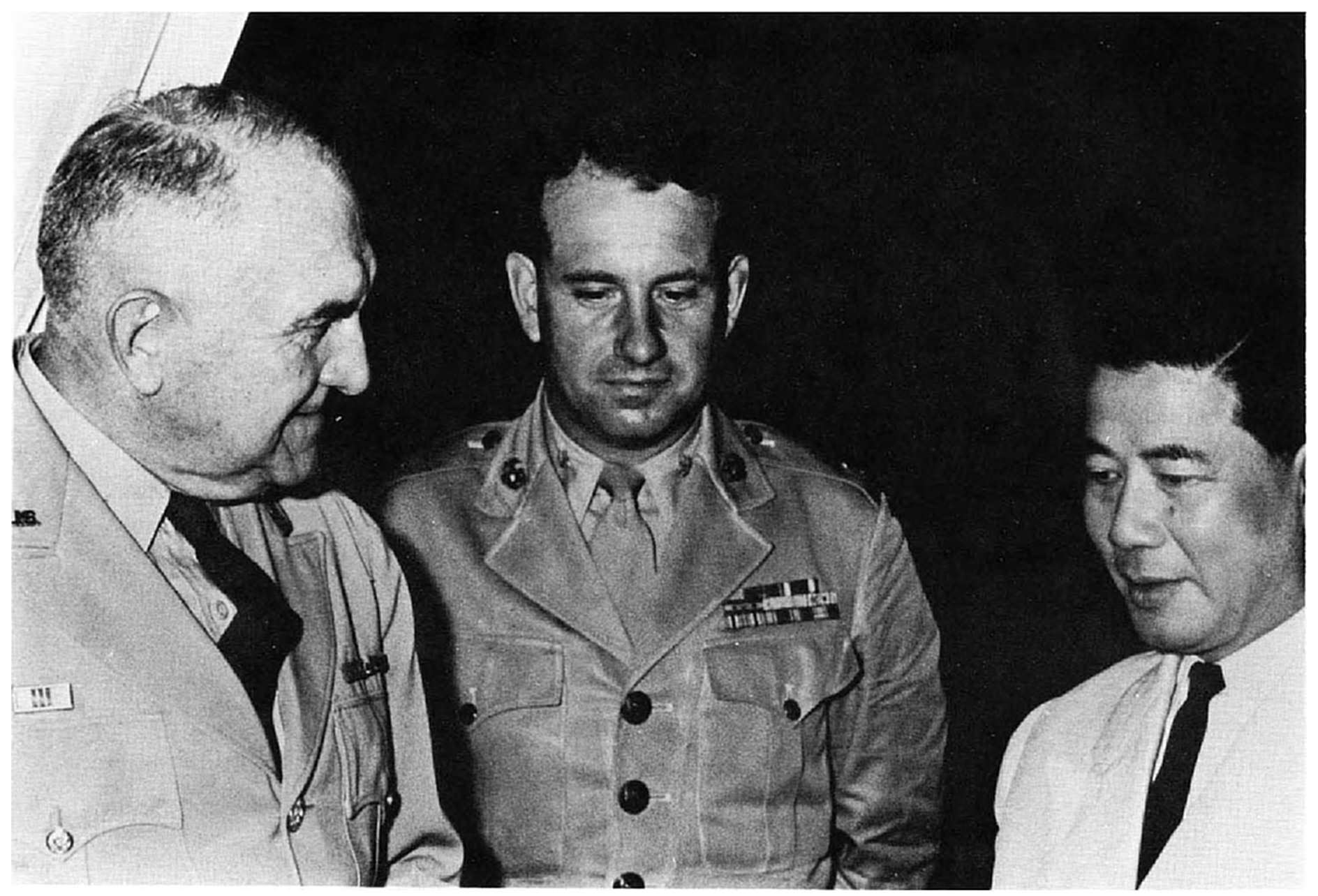
Lieutenant Colonel Victor J. Croizat, first U.S. Marine Advisor to the Vietnamese Marine Corps, translates during
discussions between Lieutenant General John “Iron Mike” O’Daniel, USA, Chief, USMAAG, Vietnam, and Premier
Ngo Dinh Diem. (Photo courtesy of Colonel Victor J. Croizat, USMC (Ret.)).
Soon after 1956 opened, President Diem appointed
a new officer to head the Vietnamese Marine Corps.
On 18 January Major Phan Van Lieu assumed command
of the VNMC, and thereby became the second
Senior Marine Officer.
The 1st Landing Battalion remained in action
against the Binh Xuyen remnants until February
1956. During this period Lieutenant Colonel Croizat
reviewed the entire organizational structure
of the Vietnamese Marine Corps. By now the size
of the service had been reduced to roughly 1,800
officers and men although it retained its original
organization of six river boat companies, five
light support companies, a landing battalion, a
training flotilla, and a small headquarters.
This organization, with so many dissimilar units
existing on one echelon, influenced Croizat to
suggest that Major Lieu restructure the service.
Assisted by Croizat, Captain Breckinridge, and
Technical Sergeant Tracy, Lieu and his small staff
spent several months developing and refining plans
for the comprehensive reorganization of the Marine
Corps. Lieu submitted this package to the
Vietnamese Joint General Staff (JGS) on 21 December
1955. The salient feature of the plan was to
create an additional landing battalion without
increasing the 1,837-man ceiling which then governed
the size of the VNMC. Significantly, the
plan contained a clause proposing that the Vietnamese
Marine Corps be expanded to regimental
size in the future.[2-5]
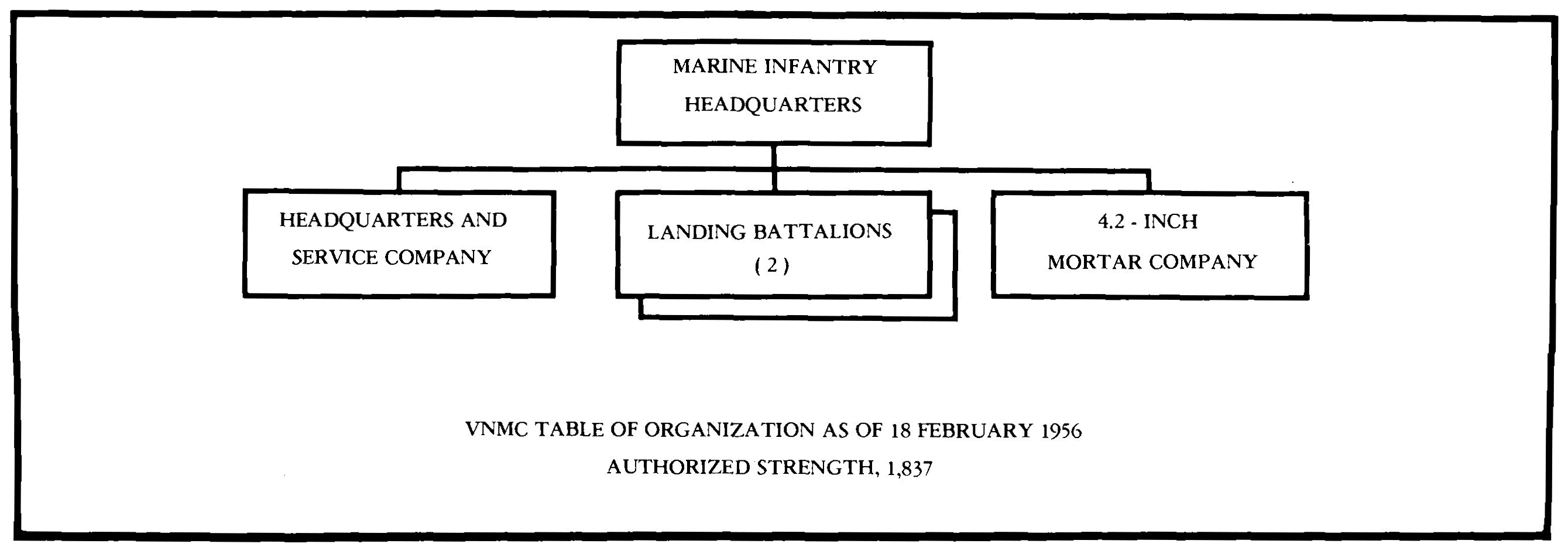
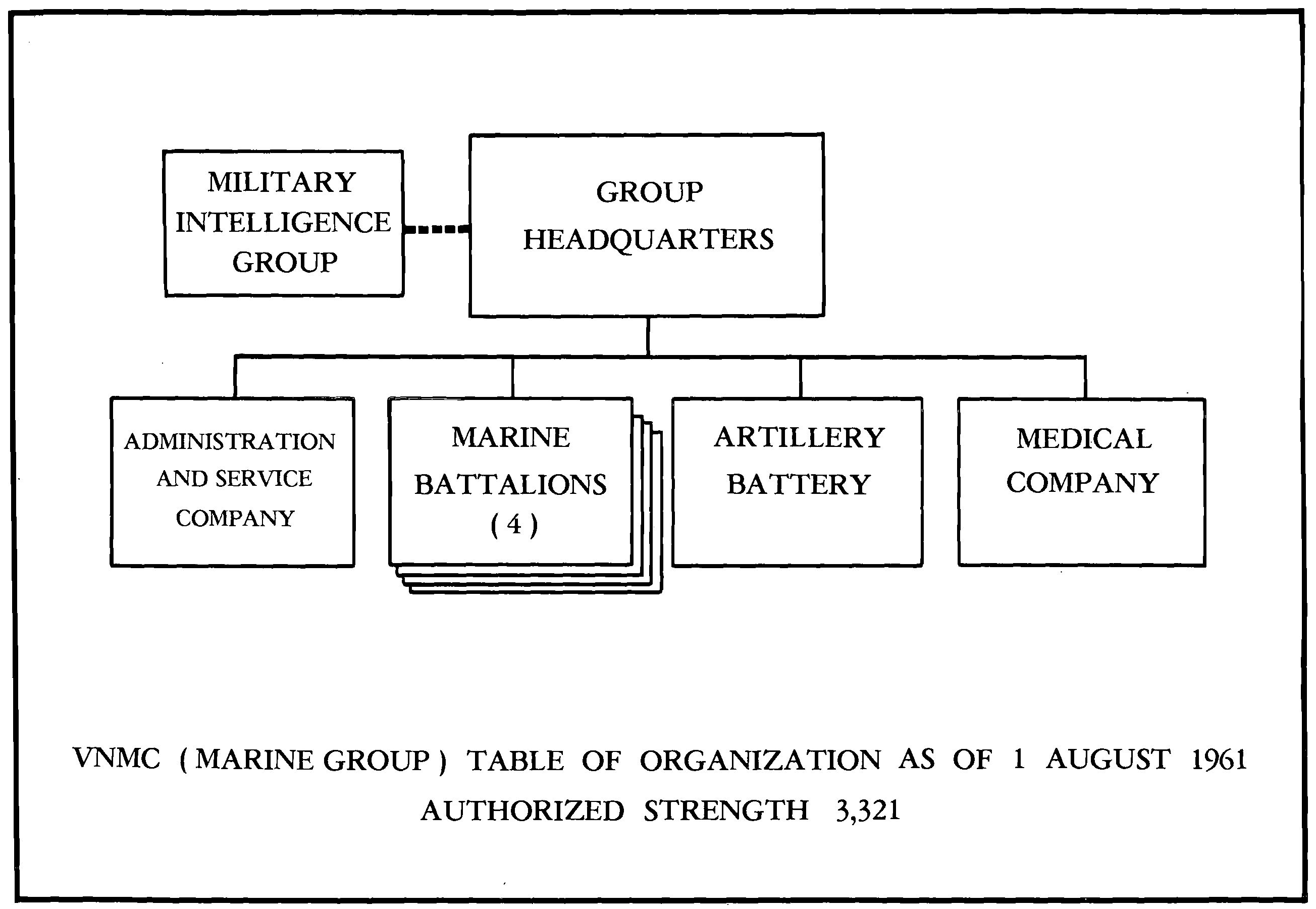
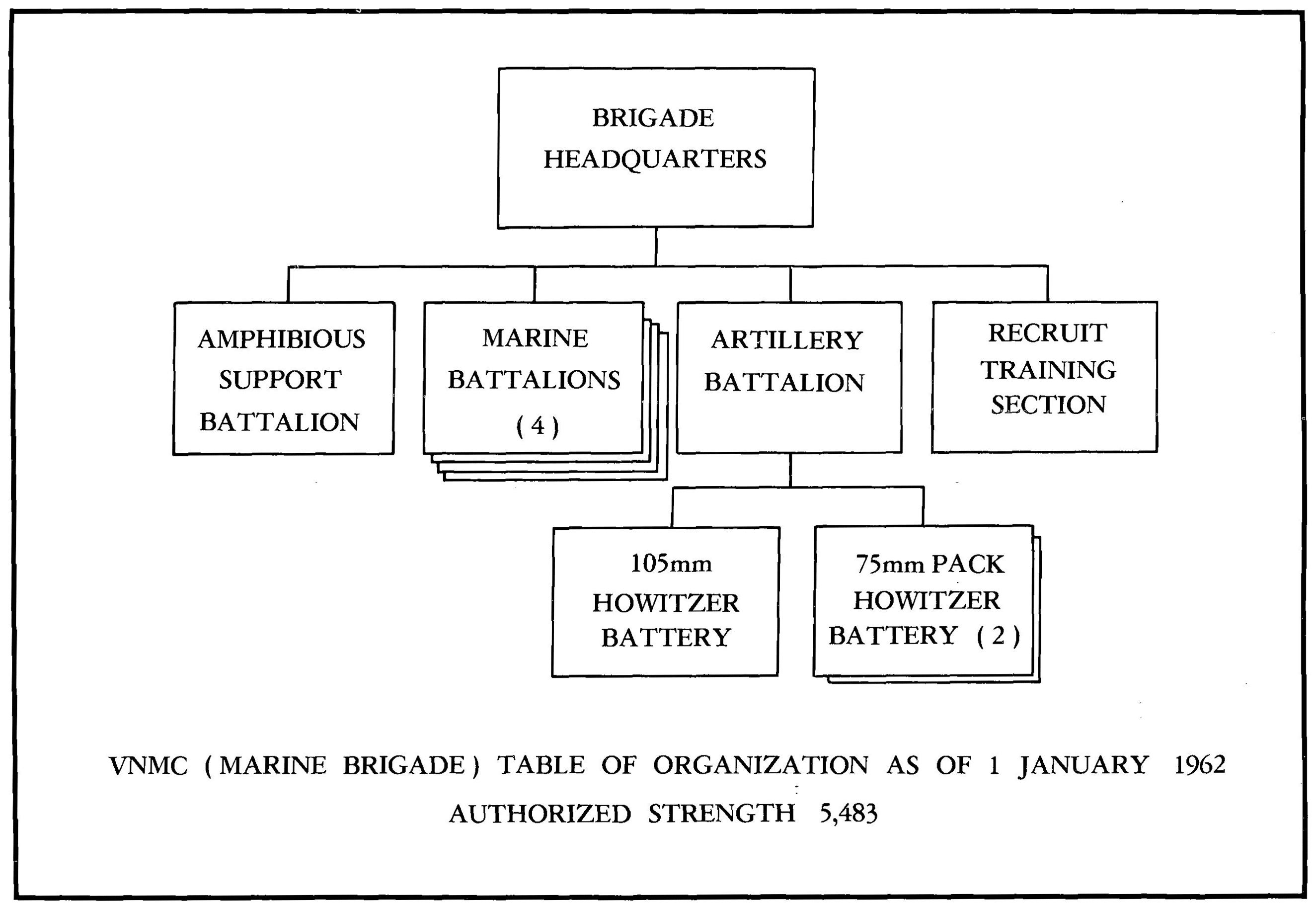
VNMC TABLE OF ORGANIZATION AS OF 18 FEBRUARY 1956
AUTHORIZED STRENGTH, 1,837
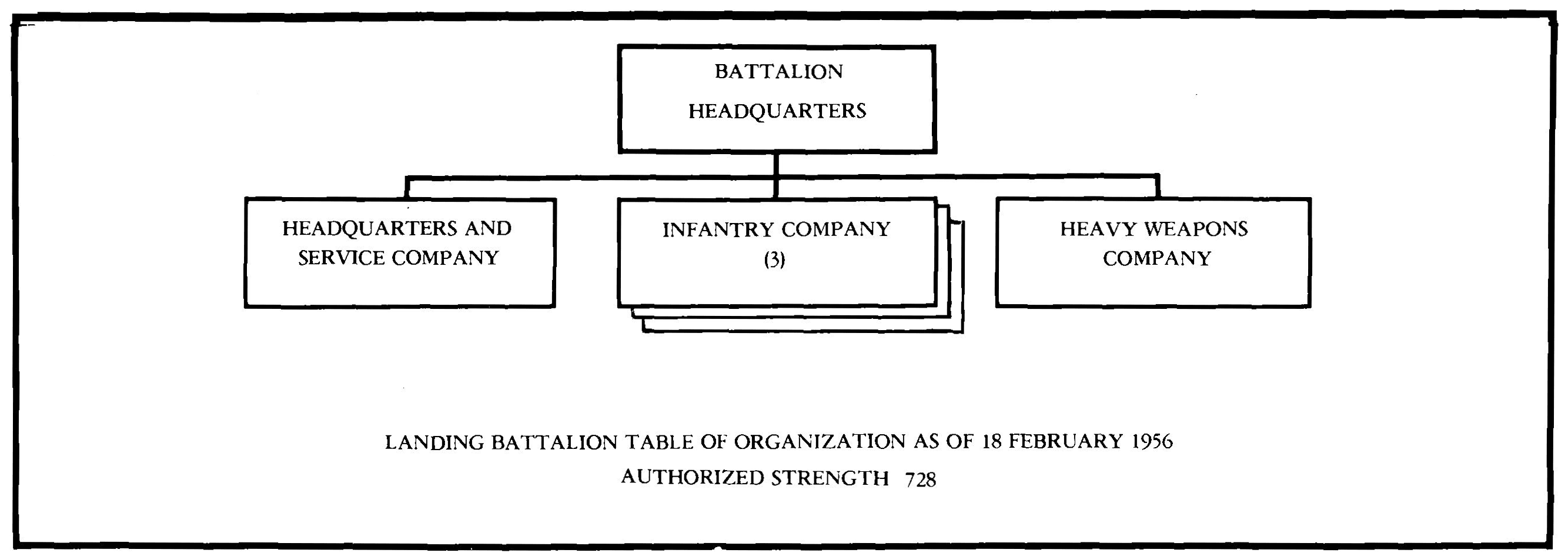
LANDING BATTALION TABLE OF ORGANIZATION AS OF 18 FEBRUARY 1956
AUTHORIZED STRENGTH 728
The Vietnamese Joint General Staff approved
the new structure, and reorganization of the
VNMC was begun when the 1st Landing Battalion
finally returned to Nha Trang in February. The
old river boat and light support companies were
disbanded and three new units—a 4.2-inch mortar
company, a headquarters and service company,
and a new landing battalion—were formed. Designated
the 2d Landing Battalion, this new unit
formed about 25 miles south of Nha Trang at
Cam Ranh Bay where the French had trained
amphibious forces during the latter stages of the
Indochina War.
As a result of the 1956 reorganization effort, the
tables of organization and tables of equipment for
the Vietnamese Marine battalions were completely
revised. Three infantry companies, a heavy
weapons company, and a headquarters and service
company now comprised a landing battalion.[2-G]
Each infantry company was organized into three
rifle platoons and a weapons platoon. In turn,
the rifle platoons each consisted of three 10-man
squads (three 3-man fire teams and a squad
leader). The individual Vietnamese Marine rifleman
was armed with the .30 caliber M-1 carbine,
a weapon formerly carried by many French and
Vietnamese commandos. It had been retained for
use within the VNMC because it was substantially
shorter and lighter than the standard U.S. infantry
weapon, the M-1 rifle, and was therefore better
suited to the small Vietnamese fighting man. The
automatic rifleman in each Vietnamese Marine
fire team carried the Browning automatic rifle
(BAR), a heavier .30 caliber automatic weapon.
The weapons platoon of the rifle company was
built around six .30 caliber light machine guns.
Within the heavy weapons company of the landing
battalions was a mortar platoon, equipped with
four 81mm mortars, and a recoilless rifle platoon.
[2-G] Whereas U.S. Marine infantry companies were designated by
letters (A, B, C, D, etc.), the Vietnamese Marine infantry companies
were given number designations.
While this reorganization was underway, Lieutenant
Colonel Croizat initiated a search for
acceptable means of expanding the Vietnamese
Marine Corps to regimental size. A staff study
produced by the Senior Marine Advisor a month
before the first phase of the reorganization effort
had begun included several important recommendations.
Croizat proposed to General O’Daniel
that authorization be granted to raise the ceiling
on the VNMC from 1,837 to 2,435 officers and
men. This, the Marine advisor pointed out, could
be accomplished without affecting the overall
ceiling on all South Vietnamese military and
naval forces. By reassigning to the Vietnamese
Marine Corps an amphibious battalion still
organized within the National Army, the 150,000-man
force level would not be altered. This would
transform the Vietnamese Marine Corps into a
three battalion regiment and would unify all South
Vietnamese amphibious forces under a single
command. Croizat’s study further recommended
that the Vietnamese Marine Corps be designated
part of the general reserve of the nation’s armed
forces and that it be controlled directly by the
Vietnamese Joint General Staff. Although no
immediate action was taken on these recommendations,
they were to serve as a blueprint for the
future expansion of the VNMC. Equally important,
they bore the seed that would eventually
make the Vietnamese Marine Corps a fully integrated
component of South Vietnam’s defense
establishment.
During the ensuing three years, several apparently
unrelated occurrences impacted either directly or
indirectly on the U.S. Marine advisory effort in
South Vietnam. The French completed their military
withdrawal from South Vietnam and dissolved
their High Command in April 1956, slightly
ahead of schedule.[2-H] In conjunction with this final
phase of the French withdrawal, the Training
Relations Instructions Mission was abolished.
Thus, it was no longer necessary for the MAAG
programs to be executed through the combined
training mission.
[2-H] A few French naval officers and noncommissioned officers
remained at Nha Trang as instructors until late May 1957.
Shortly after the departure of the last French
troops, Lieutenant Colonel Croizat ended his assignment
as Senior Marine Advisor. He was replaced
by Lieutenant Colonel William N. Wilkes,
Jr., in June 1956. A veteran of the Guadalcanal
campaign, Wilkes came to Vietnam from Washington,
D.C. where he had recently completed a
French language course. Like his predecessor, the
new Senior Marine Advisor was scheduled to serve
in Vietnam for two years.
In August, less than two months after Lieutenant
Colonel Wilkes’ arrival, President Diem appointed
a new officer to head his Marine Corps. This time
Bui Pho Chi, the captain who had commanded
the 1st Landing Battalion during the sect uprising,
was selected for the assignment. Chi’s appointment
was only temporary, however, for in October Diem
ordered Major Le Nhu Hung to assume command
of the Marine Corps. Major Hung, who became the
VNMC’s fourth Senior Officer, was to hold the
position for four years.
An attempt to abolish the Vietnamese Marine
Corps coincided with the series of changes in its
leadership and the departure of Lieutenant Colonel
Croizat. During the summer months, the Vietnamese
Minister of Defense proposed that the
VNMC be made a branch of South Vietnam’s
Army. Fortunately, the recent combat record of
the 1st Landing Battalion outweighed the minister’s
influence and the effort to disestablish the
Vietnamese Marine Corps was thwarted.
Another noteworthy incident in the record of
the early relations between the U.S. and Vietnamese
Marines occurred when the Marine noncommissioned
officer billet within the MAAG
was upgraded to an officer position. This adjustment,
which anticipated the creation of the 2d
Landing Battalion, had the effect of making a
U.S. Marine officer available to advise individual
VNMC battalions on a permanent basis. Thus
originated a plan whereby a U.S. Marine officer
would advise each Vietnamese Marine battalion—a
concept abandoned only temporarily between
1959 and 1962.
The Vietnamese Marine Corps continued as a
two-battalion regiment under the command of
Major Le Nhu Hung from mid-1956 through
1959. During this period Lieutenant Colonel
Wilkes and his successor, Lieutenant Colonel
Frank R. Wilkinson, Jr., a Marine who had
served as an aide to President Franklin D. Roosevelt,
instituted a variety of programs intended to
provide the Vietnamese Marines with a common
base of experience and training.[2-I] Perhaps the
most important of these was one implemented in
1958 whereby Vietnamese Marine officers began
attending basic and intermediate level schools
at Marine Corps Schools, Quantico. Other formal
schools for noncommissioned officers were
established by the Vietnamese Marine Corps in
South Vietnam. In an effort to build esprit de
corps among the lower ranking Vietnamese Marines,
the U.S. advisors encouraged voluntary enlistments.
They also persuaded their Vietnamese
counterparts to adopt a corps-wide marksmanship
training program similar to the one then in use
by the U.S. Marine Corps.
[2-I] See Appendix A for complete listings of VNMC Commandants
and Senior Marine Advisors to the VNMC during
the 1954–1964 period.
In conjunction with the reorganization of the
VNMC and the stress being placed upon small
unit and individual training, much of the U.S.
advisory effort during this period was devoted
to logistics. The Marine advisors soon discovered
that the Vietnamese officers, who had not been
directly concerned with supply matters under the
French, tended to ignore this important area.
“The real problem,” explained Captain Breckinridge,
“was the newness of it all. The Vietnamese
officers simply possessed no base of experience or
training in logistic matters.”[2-6] This shortcoming
dictated that the American advisors not only
design a workable logistics system but closely
supervise its operation as well. Wilkes and Wilkinson
instituted intensive schooling of supply and
maintenance personnel and emphasized the value
of command supervision to the Vietnamese leaders.
The Marine advisors, for example, taught their
counterparts that equipment shortages could often
be prevented if command attention were given to
requisitions. Still, even with constant supervision
and formal schooling, the Vietnamese Marine
Corps continued to experience problems in this
area throughout the 1950s and well into the
next decade. Breckinridge, who returned to serve
with the Vietnamese Marines again as a lieutenant
colonel in the late 1960s, recalled shortages of
such vital and common items as small arms ammunition
even then.
The years between 1955 and 1959 also saw the
Marine advisors working to overcome a potentially
more serious problem, one that also
dated from the French-Indochina War. From the
outset of their experience with the Vietnamese
Marine Corps, the Marine advisors perceived that
a strong defensive orientation seemed to pervade
every echelon of the small service. Most Americans,
including U.S. Army advisors who were encountering
similar difficulties with the Vietnamese Army,
agreed that this “defensive psychology” was a
by-product of the long subordination of the
Vietnamese National forces to the French High
Command. Indeed, a criticism frequently voiced
by USMAAG officials during the Indochina War
had been that the French tended to frustrate the
development of the Vietnamese military forces
by assigning them static security tasks rather
than offensive missions. Even though the forerunners
of the Vietnamese Marine battalions had
operated as commando units, they too had seen
extensive duty protecting dinassaut bases and
other French installations. Now this defensive
thinking was affecting the attitude of the Vietnamese
Marine toward training. Moreover, it
was threatening the American effort to transform
the service into an aggressive amphibious strike
force.
First group of Vietnamese Marine officers to attend U.S. Marine Officers Basic School, Quantico, Virginia, pose with
Lieutenant Colonel Frank R. Wilkinson, Jr. (second from right), and Captain Michael Gott (extreme right). At the
extreme left is Captain Le Nguyen Khang, a future Commandant of the Vietnamese Marine Corps. To his immediate
left is Major Le Nhu Hung, a senior officer of the VNMC. (Photo courtesy of Lieutenant Colonel Michael Gott, USMC).
By nature this particular problem defied quick,
simple solutions. The Marine advisors, therefore,
undertook to adjust the orientation of the entire
Vietnamese Marine Corps over a prolonged period
through continuous emphasis on offensive training.
The advisors consistently encouraged their Vietnamese
counterparts to develop training schedules
which stressed patrolling, ambushing, fire and
maneuver, and night movement. In this same
connection the Marine advisors translated U.S.
Marine small unit tactics manuals into French,
whereupon the same manuals were further translated
by Vietnamese Marines into Vietnamese.
This process assured that adequate training literature
was made available to the individual Marine
and his small unit leaders. The offensively oriented
training programs and the translation project
complemented one another, and combined with
continuous supervision by the U.S. advisors and
the return of young Vietnamese officers from
Quantico, gradually helped impart a more aggressive
offensive spirit to the entire Marine
Corps.
The years between 1955 and 1959 constitute perhaps
the most critical and challenging span in the
chronicle of the Vietnamese Marine Corps. Born
out of the confusion which dominated South Vietnam
in the aftermath of the Geneva Agreement,
the embryonic Marine Corps had survived against
heavy odds. Even before its scattered components
could be drawn together under a centralized command,
the Corps had been hurled into combat
against the rebellious sects. Over the course of
their commitment the Vietnamese Marines had
strengthened their own cause through demonstrations
of their fighting capability and loyalty.
In terms of the VNMC’s continued existence,
equally critical battles were being waged in Saigon
where the Senior U.S. Marine Advisor and the
Vietnamese Senior Marine Officer struggled to gain
support for the infant service. It was there, ironically,
that the destiny of the Vietnamese Marine
Corps ultimately had been decided.
On balance, the interval between 1955 and 1959
was characterized by uncertainty, transition, and
problem solving. Never sure of the Marine Corps’
future, the Senior Vietnamese Marine Officer and a
handful of U.S. Marine advisors had carried forward
their efforts to transform scattered French-inspired
river commando units into a coherent and
responsive American-style amphibious force. While
this transformation was only partially realized,
definite progress was apparent. Vietnamese officers
had replaced French commanders, and with American
guidance, had given their service a strong interim
structure. Many of the more serious problems
which had plagued the struggling organization
since its inception had been identified. With
American assistance, solutions to those problems
were being developed and tested. So, despite a
stormy beginning and a threatened early childhood,
the Vietnamese Marine Corps lived.
CHAPTER 3 Vietnamese Marines and the Communist Insurgency Origins and Early Stages of Insurgency—Insurgency and the Vietnamese Marine Corps—Ancillary Effects on Marine Pacific Commands—American Decisions at the Close of 1961 — Origins and Early Stages of Insurgency — Insurgency and the Vietnamese Marine Corps — Ancillary Effects of Marine Pacific Commands — American Decisions at the Close of 1961
South Vietnam gave every outward indication
that it had achieved a measure of overall stability
in the two-year period following President Diem’s
election in the fall of 1955. In early 1956 Diem
felt strong enough politically to announce his
government’s refusal to participate in the reunification
elections scheduled for midyear. He
based this position upon the argument that free
elections were impossible in Communist North
Vietnam. The proposed July election deadline
passed without a serious reaction by North Vietnam.
Equally encouraging was the fact that there
had been no noticeable resurgence in the armed
power of either the politico-religious sects or the
Binh Xuyen. At the same time the American-backed
South Vietnamese economy appeared to
be gaining considerable strength.
Lieutenant General Samuel T. Williams, USA, Commander,
Military Assistance Advisory Group, Vietnam.
(USA Photo SC494954).
The threat of invasion from the North had also
been tempered somewhat by 1958. The MAAG,
now headed by Lieutenant General Samuel T.
Williams, U.S. Army, a commander respected as
a tough disciplinarian, was beginning to reshape
the former Vietnamese national forces.[3-A] Renamed
the Army of the Republic of Vietnam (ARVN),
the army now consisted of four field divisions
(8,500 men each), six light divisions (5,000 men
each), 13 territorial regiments (whose strength
varied), and a parachute regiment. Although
General Williams viewed this as merely an interim
organization, it had provided the South Vietnamese
army with a unified command structure
based on sound organizational principles. The
arrival of a 350-man U.S. Temporary Equipment
Recovery Mission (TERM) in 1956, moreover,
had freed U.S. Army advisors for assignment to
each ARVN regiment. American officers were
likewise reorganizing and helping train the small
Vietnamese Navy (2,160 officers and men) and
Air Force (4,000 officers and men). The Vietnamese
Marine Corps continued to exist as a two-battalion
amphibious force within the nation’s naval
establishment. General Williams felt confident
that by 1958 South Vietnam’s regular military
establishment had been strengthened enough to
discourage North Vietnamese leaders from seriously
considering an outright invasion.[3-1]
[3-A] General Williams would head the MAAG until his retirement
in 1960.
Backing these developing regular forces, at
least on paper, were two generally feeble paramilitary
organizations—the Civil Guard (CG)
and the Village Self Defense Corps (SDC). The
larger of these, the Civil Guard, existed within the
Ministry of Interior and was funded and advised
by the U.S. Operations Mission (USOM). Its
48,000 men, therefore, were not charged against
the 150,000-man force level ceiling that regulated
the size of Diem’s regular forces. Nor were the
47,000 members of the Self Defense Corps, even
though this organization received limited amounts
of U.S. military assistance funds for payroll purposes.
In any case, serious shortcomings were
evident in both the CG and the SDC. Organized
into provincial companies directly responsible to
the various province chiefs, the Civil Guard was
entirely separate from the ARVN chain of command.
Furthermore, American civilians under
government contract had armed and trained the
CG for police-type as opposed to military missions.
The SDC, essentially a scattering of local militia
units, was even weaker, having been organized
at the village level into squads and an occasional
platoon. Although the SDC units were subordinate
to the respective village chief, the ARVN bore
the responsibility for providing them with arms
and training. More often than not the Vietnamese
Army units gave their obsolete weapons to the
SDC and showed little genuine interest in training
the small units.[3-2]
Although a measure of stability was obviously
returning to South Vietnam by 1958, one of the
country’s more serious problems remained unsolved—the
threat of subversion by Communist
Viet Minh agents who had remained south of the
17th parallel following the Geneva cease-fire.
Following the resolution of the sect crisis in 1955,
Diem turned to neutralize this potential threat.
Initially his army experienced some success with
pacification operations conducted in former Viet
Minh strongholds. While they did help extend
government control into the rural areas of several
provinces, such operations were discontinued in
1956.
Another policy initiated that same year seems to
have nullified the moderate gains produced by the
pacification campaigns. Acting both to eliminate
Viet Minh sympathizers from positions of leadership
at the local level and to extend his own grip
downward to the rural population, Diem replaced
elected village officials with appointed chiefs. The
new policy, which threatened the traditional
autonomy of the individual Vietnamese village,
was immediately unpopular.
So was another government program which
Diem implemented to undercut Communist strength
throughout the country—the Anti-Communist
Denunciation Campaign. Initiated in mid-1955 to
discredit former Viet Minh, the denunciation
campaign evolved into something of a witch hunt.
By the late 1950s large numbers of Vietnamese with
only minimal Communist connections were allegedly
being confined in political re-education
camps. Like the appointment of village leaders,
the denunciation campaign served to alienate
Vietnamese who might otherwise have supported
the central government in its struggle for control of
the rural regions.
Forced underground by the Anti-Communist
Denunciation Campaign, Viet Minh agents concentrated
on strengthening their political posture
for the proposed general election in the period
immediately following the Geneva Agreement.
When the hope of reunification by plebiscite passed
in mid-1956, the so-called “stay behinds” began
rebuilding clandestine political cells in their
former strongholds. Having retained their aptitude
for the adroit manipulation of local grievances, the
Communists gradually won support from rural
Vietnamese who saw themselves threatened by the
new government policies. In mid-1957, the Communists,
who were now being labelled “Viet
Cong” by the Diem government (a derogatory but
accurate term which, literally translated, meant
“Vietnamese Communist”) began assassinating
government officials in several of the country’s
rural provinces. Aimed at unpopular village chiefs,
rural police, district officials, and school teachers,
the Viet Cong’s assassination campaign was undertaken
to erode the government’s contacts with the
local populace and thereby enhance their own
organizational efforts.
Still faced with the possibility of a conventional
attack across the demilitarized zone, President
Diem was reluctant to commit his regular military
units to a problem which seemed to demand police-type
operations. Seeing no clear-cut threat, he
relied on the Village Self Defense Corps and the
Civil Guard to maintain order in the provinces.
Poorly led and equipped, and trained primarily in
urban police methods, the paramilitary forces
proved unable to prevent the diffuse terrorist
attacks. In the 12-month period between July 1957
and July 1958, for example, some 700 more South
Vietnamese officials reportedly died at the hands of
Communist terrorists.[3-3]
The Viet Cong terror-propaganda campaigns
continued apace throughout 1958. The occurrence
of the first attacks on U.S. facilities in Saigon and
the initiation of an anti-American propaganda
campaign near the end of that year, moreover,
indicated that the Communists were broadening the
scope of their activities. By this time, the internal
disturbances were beginning to assume the dimensions
of a concerted guerrilla movement in several
of the country’s more heavily populated regions,
including parts of the important Mekong Delta.
Near the close of 1958 President Diem finally began
ordering regular military units into the provinces
with instructions to eliminate the Viet Cong and
restore government control.
The very nature of the enemy, however, tended
to render such government operations ineffective.
Essentially, the Viet Cong derived their strength
from the clandestine political structure which
agents had established in portions of the countryside.
Interwoven into the social fabric of the hamlets
and villages, this political infrastructure, as it
later came to be called, served a dual purpose. It
was both the machinery by which the Communists
exercised control over the population and a vital
base of support for the growing guerrilla forces,
providing the Viet Cong with men, food, intelligence
information, and refuge.
As the Viet Cong guerrillas were recruited from
and lived among the local populace, outsiders
found it virtually impossible to identify them.
Their familiarity with the local terrain, their
methods of operating in small groups, and massing
for attacks mostly at night made locating them
equally difficult. Even their patience seemed to
enhance their ability to survive. Unwilling to
engage a stronger military force and realizing that
a specific government operation could not continue
indefinitely, the Viet Cong normally would melt
into their environment with the arrival of regular
units. When the operation terminated and the
regular government forces withdrew, the Communists
would re-emerge, often stronger than before.
In many cases the guerrillas could give real meaning
to their anti-government propaganda once the local
population had felt the weight of military operations
in their particular community. Operating in
this manner, the Viet Cong were able to husband
their strength while simultaneously expanding
their influence.
There was ample indication that the Communist
movement was not wholly indigenous to South
Vietnam. Indeed, evidence of increasing North
Vietnamese support for the Viet Cong was becoming
apparent near the end of the decade. In May
1959, the Central Committee of the North Vietnamese
Communist Party publicly announced its
intention “to smash” the government of Ngo Dinh
Diem.[3-4] By the summer of that year the Viet Cong
were being reinforced with men and limited quantities
of equipment infiltrated from North Vietnam.
Many of the Communist infiltrators, who at this
early stage were entering Diem’s country across the
DMZ and by sea, were southerners who had gone
North with the Viet Minh in late 1954. Trained in
political and military operations, these returnees
added substantially to the Viet Cong’s discipline
and technical capabilities.[3-B]
[3-B] A State Department publication released in 1965 placed the
number of confirmed North Vietnamese infiltrators for the years
1959 and 1960 at 1,800. It also noted that an additional 2,700
North Vietnamese were estimated to have been infiltrated during
this two-year period. The vast majority of these were thought
to have been former residents of southern Vietnam. (Department
of State, Aggression from the North, p. 33.)
So strengthened, the Communist guerrillas
reportedly were operating in battalion strength
(300– to 400-man battalions) in some areas by mid-1959.
Throughout the country they had expanded
their activities to include hit-and-run attacks on
paramilitary posts, district headquarters, hospitals,
schools, and agricultural stations. Like the assassination
campaign which was underway concurrently
in areas still controlled by the GVN, these attacks
were conceived with political considerations in
mind. By successfully raiding remote, poorly defended
facilities, the Viet Cong was able to embarrass
the central government while demonstrating
their own strength to the local population. The
raids, furthermore, produced weapons which
enabled the guerrillas to operate without total
dependence on the North.
By mid-1959 the security situation in the Republic
of Vietnam had deteriorated to the point
that much of the optimism formerly voiced by
American and South Vietnamese officials had begun
to disappear. The National Intelligence Estimate
released in Washington during August accurately
described the conditions which were settling over
South Vietnam. This paper disclosed that the
nation’s economy was beginning to falter noticeably
and that President Diem’s government was growing
increasingly unpopular. Furthermore, the estimate
warned that harassment by the Viet Cong could be
expected to intensify.[3-5]
As predicted, security conditions in South
Vietnam did grow worse in the period following
the August intelligence estimate. In the last four
months of 1959 almost 200 assassinations were
reported. In January 1960 another 96 civilians were
killed by the Communists and in the following
month the total reached 122. By the fall of 1960
the Viet Cong were strong enough to begin ambushing
regular ARVN units in several provinces.
Like their raids on fixed installations, their ambush
tactics were resulting in frequent and demoralizing
defeats for the government. Like the raids, they
were also providing weapons and ammunition for
the growing guerrilla forces.
By 1960 the government’s inability to contain
the disturbing malaise was beginning to produce
political tensions in Saigon. On 26 April a group
of 18 distinguished Vietnamese political figures,
including a number of former cabinet members,
issued a public demand for President Diem’s
resignation. Diem refused, eventually ordering the
arrest of all who signed the manifesto.
A more serious effort to bring down the central
government occurred in November when a group of
military officers led by Colonel Nguyen Chanh Thi,
the commander of a newly formed (1959) ARVN
airborne brigade, staged an abortive coup d’etat
in Saigon. Two companies of Vietnamese Marines
joined Thi’s rebellious paratroops.[3-C] But the power
struggle, which began in the early morning hours
of 11 November, ended when units loyal to President
Diem converged on the capital. Realizing
that the balance had been tipped against them, the
coup leaders fled the country and the incident was
closed. While it had failed to bring down the Diem
government, Thi’s attempted coup had revived
the possibility of efforts by military leaders to
seize control of the government and had injected
a new element of uncertainty into South Vietnam’s
already unstable internal situation.
[3-C] Vietnamese Marine participation in the abortive coup of
10 November 1960 is covered in greater detail elsewhere in this
chapter.
Two other danger signals flashed across Southeast
Asia shortly after the abortive coup. In
January 1961, Communist leaders in Hanoi announced
that the National Liberation Front (NLF)
had been founded in the South on 20 December 1960
with the stated purpose of closely uniting the
“various classes of the South Vietnamese patriotic
population in the struggle against the Americans
and Diem....”[3-6] In truth, the NLF emerged as
a fully developed Communist political organization
imported from North Vietnam for the purpose of
controlling, directing, and coordinating the insurgency
south of the 17th parallel. For American
officials, the announced establishment of the NLF
signified that Ho Chi Minh’s government had opted
for the forceful reunification of North and South.
Elsewhere in Southeast Asia, another event led
to further speculation that the war in Vietnam was
about to enter a new phase. Backed by the North
Vietnamese Army, Communist Pathet Lao forces
seized control of the southeastern portion of the
Laotian panhandle. Thus, the North Vietnamese
obtained a protected corridor along South Vietnam’s
northwestern border through which men and
materiel could be infiltrated to the South.
The establishment of the NLF and the Communist
takeover in southern Laos coincided roughly
with approval in Washington of a comprehensive
plan designed to help President Diem restore
internal order. Designated the Counter-Insurgency
Plan (CIP), this study had been ordered by President
Eisenhower in early 1960. Developed by
Lieutenant General Lionel C. McGarr, U.S. Army,
the officer who had relieved General Williams as
MAAG Chief, the completed CIP reached the
White House shortly after President John F.
Kennedy’s inauguration in January 1961. Significantly,
its arrival came at a time when the Soviet
Premier, Nikita Khrushchev, was publicly pledging
his country’s support for “wars of national
liberation.”
The plan presented for the new president’s consideration
drew clear connections between the
military and political aspects of the war in Vietnam.
It included a conditional offer of U.S. support
for a 20,000-man increase in the regular South
Vietnamese military forces and a 32,000-man increase
in the size of the Civil Guard. These military
and paramilitary increases were to be dependent
upon President Diem’s agreement to effect major
reforms in his military and political apparatus—measures
which American officials in Saigon considered
necessary for the success of any counterinsurgency
effort.
President Kennedy approved the main provisions
of the Counter-Insurgency Plan on 28 January 1961
and negotiations on the package opened with Diem
two weeks later. But the talks soon deadlocked on
the issue of political and military reforms. Meanwhile,
with the discussions in Saigon dragging on
inconclusively, the situation in the provinces
continued to worsen. A National Intelligence
Estimate released in March estimated that Viet
Cong military strength had reached 10,000 men.
Furthermore, the number of violent incidents
reported in the country had risen to 650 per month.
Even worse, it was estimated that 58 percent of
South Vietnam was under some degree of Communist
control.[3-7]
Convinced that the situation was becoming
critical and fearing that it might soon become
hopeless, President Kennedy approved a new program
of military assistance to the Diem government
on 29 April. Inspired in part by Kennedy’s desire
to increase Diem’s confidence in the new U.S.
administration, the 29 April program did not
require concrete pledges of reform from the South
Vietnamese. In its specifics, however, the new
package was similar to the CIP. It contained provisions
for supporting a 20,000 man increase in the
Republic of Vietnam Armed Forces (RVNAF)—a
move which would raise the ceiling on the South
Vietnamese regular forces from 150,000 to 170,000.
Another provision approved the use of Military
Assistance Program appropriations for the Civil
Guard and Self Defense Corps and expanded the
MAAG’s responsibility to include training and
equipping these forces. Under the 29 April plan,
the paramilitary forces were to be transferred from
Diem’s Ministry of the Interior to his Ministry of
Defense. In order to meet its increased advisory
responsibilities, authorization was given to increase
the size of the MAAG by 100 men to a strength of
785. This provision allowed the first enlargement
of the group since the introduction of the Temporary
Equipment Recovery Mission in 1956.[3-D]
[3-D] With the dissolution of TERM in the late 1950s, the International
Control Commission had granted permission for the
MAAG to maintain a strength of 685 men. When the logistics
personnel departed Vietnam, new advisor billets were created
within the MAAG’s table of organization.
General McGarr’s advisory group began implementing
President Kennedy’s 29 April program
during the summer of 1961. But the increases in the
government’s regular and paramilitary establishments
and in the size of the MAAG failed to arrest
the trend of warfare on South Vietnam’s battlefields.
The remainder of 1961 was characterized by
increasingly aggressive guerrilla operations and the
steady growth of Viet Cong military forces. In
August, for example, the ARVN reported 41 major
armed attacks on its units. The following month
brought 450 Viet Cong-initiated incidents, including
several involving multi-battalion forces of over
1,000 guerrillas. In mid-September, for example, an
estimated 1,500 Viet Cong overran Phuoc Vin, the
capital of Phuoc Thuan Province, and held the
town for an entire day before escaping unmolested
into the countryside.[3-8]
Equally alarming was the rapid rise in the
Viet Cong’s overall strength. Increasing numbers
of Communist troops were now being infiltrated
over recently opened trails through Laos. Curving
southwestward out of the North Vietnamese
panhandle, these infiltration routes enabled the
Communists to bypass the demilitarized zone
which separated the two Vietnamese states and
continue their southward movement down the
length of Laos and into Cambodia. From sanctuaries
within these countries the North Vietnamese
could easily infiltrate into South Vietnam by using
trails through the rugged mountains. Relying
primarily on these routes, over 3,750 North Vietnamese
infiltrators reportedly entered South Vietnam
during 1961. Successful recruiting in the
South served as another source of manpower for
the Viet Cong. Well propagandized, the steady
cadence of victories greatly enhanced the Viet
Cong’s prestige and thereby made recruitment less
difficult. By the end of 1961 infiltration from the
North and recruitment in the South had swollen
the Viet Cong regular military forces to an estimated
25,000 men.
At the end of 1958, when President Diem began
ordering his regular military forces into action
against the Viet Cong, the Vietnamese Marine
Corps was a two-battalion infantry force organized
within South Vietnam’s naval establishment. The
1,837-man corps was still commanded by Major
Le Nhu Hung. Hung maintained his headquarters
at the Cuu Long Navy Yard, an installation
situated on an estuary near the Saigon-Gia Dinh
boundary. Although they continued to maintain
barracks at Nha Trang and Cam Ranh Bay respectively,
the 1st and 2d Landing Battalions were now
being rotated to crude little camps near Bien Hoa,
a town located about 20 miles northeast of the
capital. Lieutenant Colonel Wilkinson, who had
replaced Lieutenant Colonel Wilkes as Senior
Marine Advisor in mid-1958, operated out of the
MAAG headquarters in Saigon but maintained an
office in the VNMC headquarters at Cuu Long.
Wilkinson’s two assistants, Captains Gary Wilder
and Dale N. Davis, lived with their battalions.
Elements of Hung’s Marine Corps were among
the first regular government units committed to the
counterguerrilla effort. The 1st Landing Battalion
was ordered into action by the Joint General Staff
in the closing weeks of 1958. After deploying from
Bien Hoa, the battalion spent nearly two months
searching for Viet Cong in a mosquito-infested
region of An Xuyen, South Vietnam’s southernmost
province. Primarily, the Vietnamese Marines
conducted company and platoon-sized patrols
through rugged mangrove swamps in search of
guerrillas. When the operation ended in late
January 1959, the Vietnamese commanders reported
that their units had killed and captured several
Communist guerrillas and political leaders. Their
troops had also reported finding a suspected
guerrilla training camp which contained small
quantities of food and some weapons. The Vietnamese
Marines suffered no casualties during their
deployment. Adhering to prevailing USMAAG
policy, the U.S. Marine advisors did not accompany
the unit into combat. Unable to observe the operation,
the American advisors could not accurately
assess the battalion’s tactical proficiency.
Lieutenant Colonel Frank R. Wilkinson, Jr., USMC,
Senior Marine Advisor. (USMC Photo A229373).
A few months after this initial operation, both
VNMC battalions were deployed against the Viet
Cong—the 1st again to An Xuyen Province and the
2d to Vinh Binh Province south of Saigon on the
seacoast. So deployed, both units came under the
operational control of the respective province
chiefs. In widely-scattered actions fought during
May, the 1st Battalion and a Civil Guard unit
claimed to have inflicted over 200 casualties on the
Viet Cong. In Vinh Binh Province, one company of
the 2d Landing Battalion reported killing 18
guerrillas and capturing over 100 more. Again, U.S.
Marine advisors were not present and therefore
could not assess the accuracy of these reports. In
any case, these were the final combat operations for
the Vietnamese Marine Corps as a two-battalion
force.
Obviously, U.S. and Vietnamese authorities in
Saigon were giving increased attention to the
growing internal threat. Still, they had yet to
initiate any sweeping changes in the orientation of
the RVNAF. Indeed, in early 1959, the entire
ARVN was in the final phase of a reorganization
program which would culminate by midyear in
the formation of seven divisions of uniform size
(10,500 men each), five territorial regiments, and
an airborne brigade (formed from the old Army
parachute regiment). Under the new organization
the seven standard divisions were to be deployed
in or near population centers throughout the
country and were to be organized under two corps
headquarters, one (I Corps) located at Da Nang, and
the other (II Corps) located at Pleiku in the Central
Highlands. A third provisional corps headquarters
had also been formed in Saigon for activation in the
event of a national emergency.[3-E]
[3-E] By 1961 the third corps headquarters would be activated and
geographic boundaries of all three corps would be delineated to
facilitate the coordination of the government’s military efforts
against the Viet Cong. These military-geographic subdivisions
were termed corps tactical zones (CTZ).
One of the MAAG’s reactions to the emerging
guerrilla threat was to urge that President Diem
transfer the Civil Guard to his Ministry of Defense.
This adjustment, General Williams pointed out,
would permit the MAAG to train and equip
the CG for a mobile counterguerrilla mission.
But it also entailed raising the 150,000-man force
level ceiling. When both the Diem government and
the U.S. Embassy objected to the proposed transfer,
the MAAG turned to another alternative: the
strengthening and use of the regular units whose
assignment to counterguerrilla operations would
not seriously disturb the country’s counterinvasion
potential. The Vietnamese Marine Corps, whose
infantry battalions had already participated in
several operations against the Viet Cong, fell into
this category of units to be bolstered for the
counterguerrilla role.
It was against this background that the VNMC
was enlarged again in mid-1959. This latest expansion
was generally accomplished in accordance
with the staff study prepared by Lieutenant Colonel
Croizat some three years earlier. On 1 June, after
both Marine battalions had returned from their
combat assignments in the Mekong Delta, a 3d
Landing Battalion was formed at a camp just
outside the Cuu Long Navy Yard. This new unit,
manned primarily by troops transferred from
amphibious elements then being phased out of the
reorganized ARVN, was built around a small
nucleus of seasoned Marine officers and noncommissioned
officers. Transferred from the 1st and 2d
Battalions, most of these Marines had seen combat
against the Viet Minh, the sects, and the Viet
Cong.
Another development saw a fourth rifle company
added to each Marine infantry battalion. In turn,
the old heavy weapons companies were abolished.
The 81mm mortars and 57mm recoilless rifles were
reorganized into platoons within the battalions’
headquarters and service companies. New weapons,
two 60mm mortars, and personnel to man them
were added to each Marine rifle company. These
adjustments raised the strength of the infantry
battalions to around 900 officers and men and
provided the Vietnamese Marine Corps with a
basic organizational structure which its infantry
battalions would retain throughout the coming
decade.[3-F]
[3-F] A side-effect of this reorganization was the modification of
the VNMC’s table of equipment. The most important change
saw the Vietnamese Marine riflemen exchange their M-1 carbines
for the heavier M-1 rifle, the weapon with which the ARVN
infantry forces were equipped.
Concurrent with the formation of the 3d Battalion
and the modification of the organizational
tables, the VNMC was formally designated the
“Marine Corps Group.” Now numbering 2,276
officers and men, the Vietnamese Marines were
formed into a group headquarters, a group headquarters
and service company, a 4.2-inch mortar
battery, and the three infantry battalions.[3-G]
[3-G] The Vietnamese Marine Group continued to be known as
the Vietnamese Marine Corps (VNMC) in spite of its formal
redesignation.
As important as the VNMC’s expansion, reorganization,
and redesignation was the dramatic
change in its role within the Vietnamese armed
forces. On 1 June the Joint General Staff directed
the Vietnamese Marine Corps and the newly formed
ARVN airborne brigade to assume the mission of
the general reserve force for the entire RVNAF. So
assigned, the Vietnamese Marine Corps became a
“force in readiness”—a service directly responsible
to the Joint General Staff for any assigned ground
warfare mission.[3-9]
VNMC (MARINE GROUP) TABLE OF ORGANIZATION AS OF 1 JUNE 1959
AUTHORIZED STRENGTH 2,276
The Vietnamese Marine battalions and elements
of the ARVN airborne brigade (also garrisoned
near Saigon) were ordered into action against the
Viet Cong with increasing frequency after being
designated the RVNAF general reserve. Usually,
the Marine battalions, like their airborne counterparts,
were assigned to operate in a particular
province for a specified time period. In such assignments
the battalion commander was directly
responsible to the province chief who, in most
cases, was a military officer. The province chiefs
sometimes utilized the Marines in conjunction with
their Civil Guard units. It was not uncommon for
the Vietnamese Marines to find themselves conducting
operations in the most rugged and inaccessible
regions of the province to which they were
assigned. In such deployments the Marine battalions
often bore the brunt of hostile action or
suffered the physical hardships associated with
living and fighting in the most adverse swamps
and jungles.
Vietnamese Marine riflemen traverse mosquito-infested swamps of the Ca Mau Peninsula on August 1961 operation.
(Photo courtesy of Lieutenant Colonel Michael J. Gott, USMC.)
In connection with their continuing campaign
to transform the Vietnamese Marine Corps into a
truly elite fighting organization, the U.S. Marine
Advisors encouraged the Vietnamese Leathernecks
to take pride in the difficult and dangerous missions
now being assigned. In a related effort intended to
generate esprit de corps throughout the service,
Lieutenant Colonel Wilkinson proposed that the
Marine Corps adopt an official emblem and a
distinctive uniform. These suggestions produced
results when a board of Vietnamese officers selected
an emblem design similar to that of the U.S.
Marines. Shortly thereafter the VNMC adopted a
light weight, black and green “tiger stripe”
camouflaged utility uniform similar to that formerly
worn in Indochina by French commando
units. Although designed and procured primarily
for use in steamy tropical jungles, the colorful
uniform came to be worn in garrison with a dark
green beret. Along with the newly adopted emblem,
which was worn as a patch over the left breast
pocket, this uniform became the distinguishing
mark of the Vietnamese Marine and his U.S.
Marine advisor. Together, the uniform and emblem
did much to set the VNMC apart from the other
South Vietnamese armed services.[3-10]
Lieutenant Colonel Wilkinson instigated another
change during this same period which did much to
improve the effectiveness of the Marine advisory
program. Since the sect rebellion of 1955 American
policy had prohibited all U.S. military personnel
from participating in combat with South Vietnamese
forces. Because the prevailing restrictions prevented
his assistants from accurately assessing the
combat capabilities of the Vietnamese Marine
battalions, Wilkinson requested that they be
allowed to accompany their units into action. After
some study, General Williams, still the MAAG
Chief, approved this request with the stipulation
that the U.S. Marines were to act strictly as non-participating
observers.[3-11] This privilege was not
extended to other MAAG personnel. Wilkinson
and his assistants, therefore, became the first
American servicemen to witness actual combat
operations against the Viet Cong. So through an
informal and relatively unknown arrangement, a
handful of Marine advisors were able to insure
that principles being stressed in training were
being applied in combat. Now operating alongside
the Vietnamese Marines in action, the advisors
were also able to obtain a better appreciation of the
terrain and enemy and a more thorough understanding
of the frustrating problems being encountered
by the VNMC units.
The first half of 1960 brought changes in both
the leadership of the Vietnamese Marine Corps and
the U.S. Marine advisory program. In May President
Diem relieved Major Hung as Senior Marine
Officer. His replacement was Major Le Nguyen
Khang, an officer who spoke fluent English and
who had been the first Vietnamese Marine graduated
from the U.S. Marine Amphibious Warfare
School at Quantico. A capable and inspiring officer
who had formerly commanded a landing battalion
in combat against the Viet Cong, Khang was to
head the VNMC for over three years. The following
month Lieutenant Colonel Clifford J. Robichaud
relieved Lieutenant Colonel Wilkinson as Senior
Marine Advisor. Like Khang, Robichaud had seen
combat previously. A former master sergeant, he
had been commissioned during World War II and
had fought as an infantry unit leader on Guadalcanal
and later in Korea. Like all U.S. Marines
assigned as advisors to the VNMC after 1960,
Robichaud was scheduled to serve only a one year
tour in South Vietnam.
Vietnamese Marine Corps Emblem.
Combat assignments against the Viet Cong
continued to dominate the VNMC’s activities
during the remainder of 1960. With Communist
forces now capable of battalion-sized operations in
some areas, the Joint General Staff began deploying
government forces to the provinces in multi-battalion
strength. By late 1960 the Vietnamese
Marines were conducting two-battalion operations
controlled by a task force headquarters. Khang,
now a lieutenant colonel, normally commanded
these Marine task forces.
It was during one such operation, in which the
1st and 2d VNMC Battalions were operating
together in the provinces south of Saigon, that
elements of the 3d Battalion became involved in
the abortive coup of November 1960. The power
struggle began in the early morning hours of the
11th while the U.S. Marine advisors were attending
an informal celebration of the Marine Corps
birthday at Lieutenant Colonel Robichaud’s quarters
in Saigon. At the appointed hour Colonel Thi’s
rebellious paratroops, accompanied by the 3d
VNMC battalion commander and two Marine
companies from Cuu Long, moved into the capital
on trucks and seized the Joint General Staff Headquarters.
The remainder of the 3d battalion, led by
the battalion executive officer, who was unaware
of his superior’s intentions, moved to the presidential
palace and established protection for Diem.
Word of the coup, meanwhile, had reached Khang
at his field headquarters in the Mekong Delta. Led
by the Senior Marine Officer, the 1st and 2d
Battalions returned to Saigon by truck convoy and
immediately joined the two Marine companies
already around the palace. For several hours the
possibility existed that Khang’s Marines might
clash with Thi’s paratroops or even with the two
rebellious Marine companies of the 3d Battalion.
But pro-Diem units soon began converging on
Saigon in such numbers that the coup collapsed.
Thi and his associates fled the country, whereupon
Diem appointed new officers to command the
insubordinate units. With loyalists in charge
throughout South Vietnam’s military and naval
services, the incident was closed. Both the airborne
brigade and the VNMC resumed their functions
as the RVNAF general reserve.[3-12]
By the summer of 1961 the USMAAG, now
headed by General McGarr, was ready to implement
the 20,000-man expansion of the RVNAF as
authorized in the package approved by President
Kennedy the previous spring. Included in this U.S.
program were plans to increase the size of the
Vietnamese Marine Corps by over 1,000 men. This
expansion got underway in July when the initial
steps were taken to form a fourth infantry battalion
and a 75mm pack-howitzer battery—additions
which were to raise the authorized strength of the
VNMC to 3,321 officers and men. The transfer of
ARVN artillerymen provided the personnel necessary
to man the pack-howitzer unit, which formed
near Thu Duc, a small town about 13 miles north
of the capital. Officers and noncommissioned
officers were drawn from the three existing VNMC
battalions to form a nucleus for the new infantry
battalion while its ranks were filled gradually by
recruitment. This 4th Battalion was organized at
Vung Tau, a coastal resort town situated on Cape
St. Jacques about 40 miles southeast of Saigon.
Lieutenant Colonel Robert E. Brown, a World
War II veteran who replaced Robichaud as Senior
Marine Advisor in August, was on hand to assist
with this latest reorganization of the VNMC.
While the new Marine units were forming the
JGS ordered the Vietnamese Navy and Marine
Corps to conduct an amphibious assault against a
suspected Communist stronghold near South Vietnam’s
southern tip. The objective area was a
portion of the U Minh Forest, an extensive inundated
region located along the western coast of
the Ca Mau Peninsula. Because it was inaccessible
by land, the forest had served as Communist base
area since the French Indochina War. The concept
of operation called for the Marines to land at
daybreak, move inland through the mangrove
swamps, and hopefully push Viet Cong elements
into ARVN units which would have established a
blocking force inland from the beach. Captains
Michael J. Gott and James S. G. Turner, two U.S.
Marine advisors, embarked on board two World
War II vintage Vietnamese Navy LCIs (landing
craft, infantry) at Saigon with the 1st and 3d
Battalions respectively.
Captain Michael J. Gott, infantry advisor to the Vietnamese Marine Corps, discusses tactical plans with Vietnamese
officers. (Photo courtesy of Lieutenant Colonel Michael J. Gott, USMC).
A series of problems arose on the morning of
the operation to delay the landing for several
hours. When the Marines finally came ashore late
in the morning they failed to locate any enemy
forces. Captain Gott, who accompanied the 1st
Battalion for the duration of the operations ashore,
later recounted the difficulties. He noted, for
instance, that no U.S. Navy advisors were embarked
on board the Vietnamese ships. As a result, the
relatively inexperienced Vietnamese sailors encountered
technical difficulties with their navigational
aids, and the ships arrived at the objective
area late. Inexperience on the part of the Vietnamese
Marines and sailors in debarkation techniques
compounded the delay. Once ashore, outdated
French maps and dense mangrove jungle combined
to retard the Marines’ progress inland, thus allowing
the Viet Cong ample time to melt away. Gott
concluded that some of the difficulties encountered
after the landing phase of the operation might
have been offset by the presence of observation
aircraft. As it was, the Marines’ visibility was
restricted throughout the operation by thick
mangrove vegetation. Thus a combination of
unforeseen factors had rendered this particular
operation ineffective.[3-13]
VNMC (MARINE GROUP) TABLE OF ORGANIZATION AS OF 1 AUGUST 1961
AUTHORIZED STRENGTH 3,321
A similar landing was repeated in the same area
the following month. Again the participating
Marine units failed to engage Viet Cong forces.
Vietnamese Navy and Marine officers complained
that there were no enemy troops in the area and
that the government’s intelligence was inaccurate.
Whatever the reason, the results of these two
unsuccessful offensives typified the problems which
plagued most South Vietnamese ground forces
throughout the country during the 1960–1961
period. The Communist guerrillas, aided by
difficult terrain, a well-developed intelligence
network, and sometimes by the local population,
could usually evade government units whenever
escape was desirable. Because the Marines normally
operated in unfamiliar areas where the Viet Cong
political apparatus was strong, their units were
particularly frustrated. In regions such as the
U Minh Forest intelligence information simply
did not flow upward from the people. Instead, in
such Communist-controlled environments, the local
Vietnamese served the Viet Cong, warning them
of strengths, locations, and movements of Marine
units.
While combat deployments such as the Ca Mau
landings highlighted the remainder of 1961, the
Marine battalions nevertheless spent the majority
of their time in non-combat assignments. During
such periods the battalions occupied their respective
base camps around Saigon and Vung Tau, awaiting
orders from the Joint General Staff. Even though
held in reserve, they frequently were called upon
to provide security detachments for vital points
such as bridges, naval facilities, and communications
installations. Most U.S. Marine advisors
tended to oppose such assignments, contending
that they detracted from the overall readiness
of the battalions and disrupted much needed
training. The utilization of the VNMC units in
static security roles also conflicted with the advisor’s
continuing efforts to convince the Vietnamese
Marine that he belonged to an elite, offensively
oriented strike force. Still, despite the protestations
of the American advisors, the JGS persisted in
dispersing VNMC detachments in and around the
capital.
Although its battalions were sometimes being
frustrated, both in their attempts to accomplish
unit training and in their attempts to fix Communist
troop formations, the VNMC’s involvement in the
war effort was forcing improvement of the service
in other areas. Frequent inspections by U.S.
advisors revealed that the Vietnamese were placing
more emphasis on the care of individual equipment
and weapons. Replacement items were being
requisitioned with more promptness and unit commanders
were beginning to show increasing concern
about the slow receipt of requested supply
items. The replacement of worn-out World War II
trucks with new vehicles removed a long-standing
source of trouble in that it greatly reduced the
time consumed in performing major mechanical
repairs on the older vehicles. Even the frequent
deployments of the VNMC battalions were helping
to improve the overall combat readiness of the
service by preparing a solid core of small unit
leaders and troops for operations against the Viet
Cong.
At the same time the intensified conflict in South
Vietnam was forcing improvement on the VNMC,
it was having a similar but less direct effect on
U.S. Marine commands in the Pacific. In early 1961
Lieutenant General Alan Shapley, the Commanding
General, Fleet Marine Force, Pacific (FMFPac),
approved a plan to assign individual Marines from
his scattered commands to temporary duty in
Vietnam. The purpose of this program, which
became known as On-The-Job Training (OJT), was
to allow Marine officers and noncommissioned
officers to obtain first-hand knowledge of the complex
nature of the conflict being waged in South
Vietnam. Beginning in May 1961 small groups of
officers and noncommissioned officers from various
FMFPac commands were sent each month to
observe the counterguerrilla techniques being
developed and employed in Vietnam. Although the
OJTs were normally “in country” for only a two-week
period, the program was gradually producing
a pool of small unit leaders somewhat acquainted
with the situation in the Republic of Vietnam by
the end of 1961.[3-H]
[3-H] The OJT program would be suspended briefly near the end
of 1962 but would be reinstituted in the first months of 1963.
Vietnamese Marines wade ashore from a Vietnamese Navy Landing Ship, initiating a search for Viet Cong on the Ca
Mau Peninsula. (Photo courtesy of Lieutenant Colonel Michael J. Gott, USMC).
The major Marine command to feel the impact
of the war in Southeast Asia during the early
1960s was the 3d Marine Division, a 20,000-man
combat-ready force headquartered on Okinawa. In
addition to its participation in the OJT program,
the 3d Marine Division began altering its conventional
amphibious orientation. Major General
Donald M. Weller, the division commander, provided
the initial impetus for this shift away from
a purely conventional posture. Weller, who in early
1961 had commanded a task force headquarters
formed in response to the deteriorating military
situation in Laos, anticipated that his command
might be committed to combat somewhere on the
Southeast Asian mainland. He therefore instructed
his staff to begin studying possible counterinsurgency
training programs which would help “turn
the entire orientation of the division toward the
type of intervention [which] we would be faced
with in Southeast Asia.”[3-14]
Vietnamese Marines advance from concealment during search operations on the Ca Mau Peninsula. (Photo courtesy of
Lieutenant Colonel Michael J. Gott, USMC).
Major General Robert E. Cushman, holder of a
Navy Cross and a future Commandant of the
Marine Corps, assumed command of the 3d Marine
Division in September 1961 before General Weller’s
objectives could be fully realized. The new commanding
general immediately convened a Counterguerrilla
Warfare Study Group to consider the
problem. This study group framed a set of recommendations
for Cushman in late 1961. His approval
of their proposals led to the creation of an Infantry
Unit Training Course and a Command and Staff
Training Course early the next year.
Conducted in Okinawa’s rugged Northern Training
Area, the infantry course prepared rifle companies
from the various infantry battalions for
participation in counterguerrilla warfare. The
instructors, graduates of either the Jungle Warfare
School in Johore, Malaya, or the new Army
Special Warfare School at Ft. Bragg, North
Carolina, placed much emphasis on the origins
and nature of guerrilla movements, small units
tactics, and night operations. The training syllabus
for this course included several live firing exercises
designed for individual Marines and fire teams.
Some of these exercises required the Marines to
negotiate “jungle lanes” equipped with pop-up
targets. The week-long infantry course culminated
with a two and one-half day field operation for
the individual infantry platoons.
The Command and Staff Training course was
somewhat less rigorous, being designed primarily
to prepare battalion staffs to support their companies
in a counterinsurgency environment. Less
than 10 hours in length, this course was based
primarily on lectures and map exercises.
At General Cushman’s direction, the division
G-3 (Operations Section) began stressing the
significance of counterinsurgency training at all
echelons of the division. Unconventional warfare
training soon became an integral part of the training
schedules at every echelon. Under this program
the various infantry battalions were required to
conduct an extended battalion-sized counterguerrilla
operation, and to report to the G-3 on the
progress of their efforts.[3-15]
The FMFPac On-The-Job Training program and
the 3d Marine Division’s new approach to training
complemented each other in several ways. Whereas
the OJT program helped create an awareness of
counterguerrilla operations among individual Marine
officers and noncommissioned officers, the
division’s training programs achieved the same
results at the staff and battalion level. At points
the two programs overlapped to the further
benefit of the 3d Marine Division. Attuned to the
nature of guerrilla warfare and the problems involved
in countering the guerrilla, the officers and
noncommissioned officers who returned from OJT
assignments in Vietnam provided assistance in
planning and supervising the division’s counterinsurgency
training programs. Short of actual
commitment to combat in a guerrilla-type environment,
it is doubtful that any other combination
of training could have better prepared the 3d
Marine Division for a future assignment in Vietnam.
The progressive erosion of the government’s
strength and the steady growth of the Viet Cong
during 1961 prompted President Kennedy to dispatch
his special military advisor, General Maxwell
D. Taylor, to Vietnam in mid-October. Taylor,
who had retired in the late 1950s after having
served as Chief of Staff of the Army, carried the
following instructions from the president:
I should like you to proceed to Saigon for the purpose of
appraising the situation in South Vietnam, particularly as
it concerns the threat to the internal security and defense
of that country and adjacent areas. After you have conferred
with the appropriate United States and South Vietnamese
authorities, including the Commander in Chief, Pacific,
I would like your views on the courses of action which our
Government might take at this juncture to avoid a further
deterioration in the situation in South Vietnam; and
eventually to contain and eliminate the threat to its
independence.[3-16]
Like other American officials who had visited
Diem’s republic during the course of the year,
General Taylor returned to Washington convinced
that South Vietnam was in grave danger. In a
report delivered to President Kennedy in November,
the general outlined his formula for salvaging
the situation. This included the broad recommendation
that the United States abandon its existing
policy of strict military advice and begin cooperating
with the Vietnamese in a form of “limited
partnership.” The American role in such a partnership,
Taylor explained, would be to provide
“working” advisors and “working” military units
to aid South Vietnam’s military forces.
General Taylor’s report offered several specific
proposals for implementing such a program.
Among these were recommendations that three
U.S. Army helicopter companies and approximately
6,000–8,000 American ground troops be
deployed quickly to the Republic of Vietnam. The
helicopter units would support the government’s
ground operations but the American ground forces
were to be used only in a defensive posture. Taylor
believed that their presence would underscore the
United States’ determination to stand by South
Vietnam. A side-effect of this display of determination
would be to stimulate the morale of the republic’s
armed forces. He added that in order to
support such a build-up, it would be necessary to
restructure and increase the size of the USMAAG.
President Kennedy’s consideration of Taylor’s
proposals resulted in a compromise decision which
cleared the way for more intense American involvement
in the Vietnam conflict. After securing Diem’s
approval in early December, Kennedy authorized
the Department of Defense to expand its advisory
and assistance programs. To enhance the effectiveness
of the advisory program, he removed some of
the official restrictions under which most U.S.
military advisors had operated since 1955. One
important change would allow all advisors to
accompany their Vietnamese units into combat. At
the same time President Kennedy decided against
ordering U.S. ground forces into the war zone;
however, he instructed the Secretary of Defense,
Robert S. McNamara, to prepare plans for such a
contingency. He also approved General Taylor’s
recommendation that American helicopter units
be sent to support the RVNAF. The arrival of the
first of these reinforcements just before 1961 ended,
signalled the beginning of a new and more dynamic
phase of American military participation in the
struggle to preserve the independence of South
Vietnam.
CHAPTER 4 An Expanding War, 1962 The War’s New Context—Creation of MACV and Marine Advisory Division—The Vietnamese Marine Corps, 1962—Some Conclusions — The War’s New Context — The Creation of MACV and Marine Advisory Division — The Vietnamese Marine Corps, 1962 — Some Conclusions
More than any previous year, 1962 was to be a
period of deepened commitment for all participants
in the continuing struggle for control of South
Vietnam. On the American side plans already set
in motion by President Kennedy’s recent decisions
promised to loosen the flow of dollars, equipment,
advisors, and combat support personnel to South
Vietnam. Administration officials envisioned that
this sharp influx of assistance would stimulate a
redoubled war effort on the part of the Diem
government.
Viet Cong strength and operational capabilities
likewise were on the upswing as 1962 opened.
U.S. and South Vietnamese sources were placing
total Viet Cong military strength at roughly
25,000 men. Backing these military forces was a
far greater number of sympathizers. American
agencies tended to divide the Communist military
forces into three rough categories according to
function and composition—main forces, local forces,
and village activists. Thought to total around
9,000 men at the beginning of the year, the main
forces constituted the pillar of Communist military
strength in the South. They were organized into
approximately 20 small (200– to 400-man) and
highly mobile battalions and a number of independent
companies. Main force units as a rule
were cadred by North Vietnamese (or returnees
trained in the North) and were capable of conducting
operations on an interprovincial scale.
(They often were referred to as interprovincial
battalions and companies. Later in the war Americans
came to call the main forces “hard core”
units.) Next in terms of operational capabilities
were the Viet Cong local forces whose aggregate
strength stood at around 8,000 part-time but well-trained
soldiers. The local forces were organized
into platoons and companies which operated
independently within their respective districts.
Finally, there were some 8,000 village activists.
Part-time guerrillas in the truest sense of the
term, the activists commonly worked in the
paddies by day and engaged in military pursuits at
night. For the most part their ranks were filled
with men considered either too young or too old
for service with organized Viet Cong military
units. Nevertheless, they played an important
role in the struggle for South Vietnam’s rural areas
by providing various forms of support for larger
Viet Cong formations. Living and working within
the rural hamlets and villages as they did, the
activists were a ready source of intelligence
information for the Viet Cong. Often they served
as porters and guides for main force units which
had been assigned to operate within their locale.
Otherwise, the activists were responsible for defending
their particular villages against the government’s
military and police forces—a defense which
normally took the form of harassment with mines
and sniper fire.[4-A]
[4-A] The three-way division was the most commonly used method
of categorizing the Communist forces. (See U.S. Army, The
Viet Cong, p. I:52.) A USMAAG document published during
this period, however, divided the Viet Cong into two somewhat
broader categories—main forces and guerrillas. Both local force
units and village activists were classified as guerrillas under this
system. (USMAAG, Vietnam, Tactics and Techniques of Counterinsurgent
Operations, p. II-5.) Other sources tended to make more
elaborate divisions. (See Pike, Viet Cong.)
After early 1962 the activities of these Viet Cong
military and paramilitary forces were carefully
coordinated with Communist political activities
on the national level by a Central Office for South
Vietnam (COSVN).[4-B] From its headquarters,
believed to have been located northeast of Saigon in
Binh Duong Province, COSVN exercised direct
control over six military regions (MRs). Designated
MR-5 through MR-9 (arranged in a north
to south pattern) with an additional Saigon-Gia
Dinh Special Zone, the Communist military regions
served essentially the same purpose as the government’s
corps tactical zones. Within these six regions
COSVN utilized a province and district structure
only slightly different from that of the Diem
government to exercise administrative and military
control. At each level within this organization a
small, disciplined Communist political committee
orchestrated the activities of its subordinate
military units with the actions of its political
apparatus.
[4-B] COSVN apparently was established in March. Prior to this
the NLF had functioned through two separate geographic headquarters—Interzone
V, responsible for roughly the northern
three-quarters of South Vietnam, and the NAMBO Interzone,
responsible for the area roughly described by the forested hills
and Mekong Delta physiographic regions.
To counter the strengthened NLF organization
and to satisfy American demands that he adopt
some form of national strategy, President Diem
launched one of the most controversial large-scale
undertakings of the war—the Strategic Hamlet
Program. Instituted on an informal basis in the
closing stages of 1961, the program became fully
operative in mid-1962. Although heralded as a new
concept, the campaign actually grew out of an
existing program whose broad objective had been
to bring improved economic and social conditions
to South Vietnam’s rural areas. Named the Agroville
Program, this effort had been in effect since
late 1959 under the direction of Ngo Dinh Nhu, the
president’s brother and principal advisor. Since its
institution, however, the program had achieved
little aside from the resettlement of many rural
families into government constructed communities.
Few meaningful reforms, either social or economic,
had been realized. During the early 1960s, moreover,
many of the Agrovilles had been victimized
by the Viet Cong, who saw the developments as
symbols of the government’s presence in contested
areas. By mid-1961, in an effort to protect the more
remote Agrovilles, authorities in several provinces
had begun fortifying the otherwise helpless population
centers.
Concurrent with this evolution of the Agrovilles
into fortified communities, Sir Robert G. K.
Thompson, the head of a newly formed British
Advisory Mission in Saigon, suggested that
President Diem consider adopting a similar scheme
with broader strategic objectives. Thompson,
who had helped implement such an effort in
Malaya in the 1950s during the struggle there
against Communist insurgents, specifically proposed
that the South Vietnamese integrate various
economic and social programs into an effective
campaign to reestablish its influence in the heavily
populated Mekong Delta. This campaign, Thompson
advised, “should lead by stages to a reorganization
of the government machinery for directing
and coordinating all action against the communists
and the production of an overall strategic operational
plan for the country as a whole....”[4-1]
Under pressure from the U.S. Embassy to develop
some sort of national strategy for countering the
insurgency, President Diem accepted the concept
of Thompson’s proposal. Shortly thereafter, Diem
named Ngo Dinh Nhu to head a campaign formally
designated the Strategic Hamlet Program. Nhu
was instructed to plan the program and to create a
combined agency that would insure its coordination
within the various government ministries. These
instructions resulted in the creation (in February)
of the Interministerial Committee for Strategic
Hamlets. A counterpart American organization,
the U.S. Interagency Committee for Province
Rehabilitation, was formed in April to provide
assistance to Nhu’s agency.
With advice from Thompson and the U.S. Embassy,
the Vietnamese formulated a program which
in theory was to evolve in several rather distinct
phases. First it would be necessary to select specific
geographic areas wherein the Strategic Hamlet
Program would be implemented. Once specific
objective areas had been established, regular military
units would initiate operations to clear those
areas of Viet Cong formations. Following the
completion of these operations RVNAF units
would resettle the inhabitants of the area in fortified
hamlets. Initially these hamlets were to be
defended by Civil Guard units while regular forces
continued screening operations in the surrounding
countryside. In the final phase, Self Defense Corps
units would assume responsibility for local security
while regular units continued to screen Viet Cong
forces from the developments. During this phase
district civil authorities would initiate economic
and social programs within the newly formed
communities in an effort to recapture the allegiance
of the local populace. Thus, in this final phase, it
was expected that the Communist political infrastructure
would be broken.
Following the pacification of a few contiguous
hamlets, the same process was to be repeated over
and over, in an expanding pattern. In this manner
Diem hoped to expand the GVN’s control progressively
outward from the initial secure hamlets
over large areas of the countryside. Ultimately the
GVN intended to construct nearly 11,000 such protected
communities in several of the country’s
most critical rural areas.
A principal shortcoming of this method of
pacification was that the success of the entire program
within a specific area depended on the successful
completion of virtually every developmental
phase in every strategic hamlet. Should the Communist
infrastructure remain intact in even one
hamlet, that hamlet could precipitate the collapse
of the entire campaign by contaminating
the surrounding communities in a geometric
progression.
Given this critical requirement that all phases be
accomplished in a deliberate and orderly manner, it
was unfortunate that Nhu initiated the program
in an uncoordinated fashion. By the first of the
year, months before the appropriate American and
South Vietnamese agencies had been formed to
guide the program, the construction of hamlets had
begun on a scale which already suggested a nationwide
campaign. Furthermore, the government
failed to test the plan in a pilot project such as
Thompson (as well as U.S. advisors) had recommended.
Instead, it launched rather extensive
campaigns simultaneously in several traditional
Communist strongholds during the spring of 1962.
Nevertheless, once formally initiated, the Strategic
Hamlet Program constituted the government’s
first real effort to implement a concerted counterinsurgency
strategy on a national scale. Regardless
of its weaknesses and its somewhat abortive start,
the program would serve as the context within
which the Diem government would wage its battle
with the Viet Cong during 1962 and most of 1963.
From this military standpoint, moreover, Diem’s
adoption of the Strategic Hamlet Program marked
somewhat of a watershed in the evolution of ground
strategy in the Vietnam war. Inherent in its
selection was the decision to opt for a “clear-and-hold”
as opposed to a “search-and-destroy”
strategy. In accordance with the dictates of the
pacification campaign, RVNAF ground forces would
focus primarily during the next two years on
operations to clear Communist military formations
from the more densely populated rural areas.
The American military build-up called for by
the Washington decisions of December 1961 was
well underway as the new year opened. Several
U.S. units introduced in the closing weeks of 1961
had already begun operations by January. These
included two U.S. Army transport helicopter
companies and a composite U.S. Air Force detachment.
Designated FARM GATE and composed
initially of 151 officers and men, the Air Force
detachment had a dual mission of training VNAF
elements and conducting attack sorties in support
of President Diem’s forces. The arrival of another
U.S. Air Force unit, a C-123 transport squadron,
another Army helicopter company, and an Army
communications organization, the 3d Radio Research
Unit, just after the first of the year raised
the number of American military personnel serving
on permanent assignment in Vietnam to over 3,000.
Assigned to the Army’s radio unit, which immediately
began operations from Pleiku in II Corps
Tactical Zone, were 42 Marines from the 1st
Radio Company, FMF. Designated Detachment A,
1st Radio Company, these were the first U.S.
Marines to participate in the ongoing build-up.
Thus far, however, the U.S. troops arriving in
Vietnam were for combat support rather than
advisory type duty. At a meeting held in Honolulu
in mid-January, Secretary of Defense McNamara
ordered the ranking American military officials
concerned with Vietnam to make substantial
increases in the number of advisors serving with
the Vietnamese armed forces.
Less than a month after the Honolulu conference,
a new U.S. command was created in Saigon to
manage the expected influx of advisors and the
intensified military assistance effort more efficiently.
On 8 February, the U.S. Military Assistance Command,
Vietnam (USMACV or MACV) supplanted
the MAAG as the senior American command in
the Republic of Vietnam. Its commander, Army
General Paul D. Harkins (ComUSMACV), assumed
direct responsibility for all U.S. military policy,
operations, and assistance to President Diem’s
government. Harkins was directly subordinate to
the Commander in Chief, Pacific, Admiral Harry
D. Felt, whose headquarters was in Hawaii.
The number of U.S. Marines assigned to MACV’s
staff indicated that they would play an important
role in its operations. In all, 21 staff billets in the
new command were allocated to the Marine Corps.
The most important of these was the chief of staff
billet. This assignment went to Major General
Richard G. Weede, a veteran who had commanded
an artillery battalion during the campaigns for
Saipan and Okinawa during World War II. Later,
in Korea, he had distinguished himself as the
commander of the 5th Marines. Weede arrived in
Saigon from Hawaii where he had commanded the
1st Marine Brigade since 1959. Other Marines
joined General Harkins’ command as Deputy Chief
of Staff, J-2 and as branch chiefs for the J-3 through
J-6 divisions. Two other positions assigned to
Marine officers were the project officer for a Joint
Operations Evaluation Group and a research and
development project officer for a Department of
Defense agency. Both of these were operationally
controlled by the newly organized Military
Assistance Command.
Major General Richard G. Weede, USMC, Chief of
Staff, U.S. Military Assistance Command, Vietnam.
(USMC Photo A150562).
Under the new U.S. command arrangement, the
old Military Assistance Advisory Group became
subordinate to General Harkins’ command. Headed
by Major General Charles J. Timmes, U.S. Army,
the MAAG was now responsible primarily for the
advisory aspect of the assistance program. To
accommodate the impending increases in the number
of advisors, the MAAG’s staff was restructured.
Under its new table of organization, Marine
officers were to serve as deputy chief of staff and
head of the plans branch of the J-3 division. Later,
in 1963, the MAAG’s table of distribution would
be modified with the effect that the chief of staff
billet would be held by a Marine colonel. The first
Marine to serve as General Timmes’ chief of staff
would be Colonel Earl E. Anderson, a much-decorated
aviator who eventually would become
the Assistant Commandant of the Marine Corps.
The reorganization of the MAAG brought about
a dramatic change in the size and scope of the U.S.
Marine advisory effort. The new table of organization
included a provision for an 18-man Marine
Advisory Division within the MAAG’s Naval
Section. The organizational charts for this division
included advisor billets for a lieutenant colonel, a
major, six captains, a gunnery sergeant, and four
staff sergeants. Administrative positions were to
make up the balance of the new organization.
As had been the case previous to this expansion,
the lieutenant colonel was to serve as the Senior
Marine Advisor to the Vietnamese Marine Corps.
The inclusion of the major’s billet was expected to
enhance the overall effectiveness of the advisory
division as he was to double as Assistant Senior
Advisor and as senior artillery advisor. The gunnery
sergeant was to assist in the artillery advisory
duties. Of the six captains, four were to be assigned
as advisors to VNMC infantry battalions while the
two others were slated to advise on engineer and
supply matters. The four logistics-trained staff
sergeants were to be assigned as assistant infantry
battalion advisors and were expected to free the
officer advisors from direct involvement in time-consuming
supply matters.
Marines required to man this enlarged advisory
unit began arriving in Vietnam as early as February.
All of the new officer advisors were graduates
of either Junior School at Marine Corps Schools,
Quantico or the U.S. Army Special Warfare
School at Fort Bragg, North Carolina. Following
their assignments, but before departing for Vietnam,
many advisors received schooling in military
assistance operations. This normally included a
five-month course of instruction in the French
language, a requirement which more and more
Marine advisors were beginning to question as a
result of the Vietnamese desire to converse in
their own language rather than French. Upon
arrival in Saigon, the Marines were given two days
of orientation briefings at MACV headquarters
before assuming their jobs in the Marine Advisory
Division.
Lieutenant Colonel Brown continued to serve as
the Senior Marine Advisor and headed the new
advisory division throughout the summer of 1962.
In October he was relieved by Lieutenant Colonel
Clarence G. Moody, Jr., a veteran who held the
Navy Cross for heroism as a company commander
during the Korean War. Having served with the
British Royal Marines following Korea, Moody
was somewhat familiar with the problems involved
in dealing with foreign military services.
Encouraged by both Brown and Moody, the U.S.
Marine advisors participated in every combat
operation undertaken by the VNMC during 1962.
Prior to planned operations they helped their
Vietnamese counterparts coordinate the more
sophisticated means of support which became
available as the American military build-up took
hold. During planning phases, for example, they
assisted with the development of detailed orders
and helped plan for employing artillery fire and air
support. If the impending operation was to be
amphibious in nature, the Marine officers coordinated
with the U.S. Navy advisors assigned to the
supporting Vietnamese Navy units, thereby insuring
that planning for embarkation had been
accomplished. On occasion the advisors were
required to coordinate helicopter support for the
VNMC units—a task sometimes complicated by
the Vietnamese Marines’ lack of experience in
heliborne operations. Unfortunately, the almost
constant combat assignments being drawn by the
handful of U.S. and VNAF helicopter units available
in Vietnam made training in such operations
impossible.
Even more difficult were the advisor’s responsibilities
after their units deployed to combat. The
U.S. Marines were experiencing the often frustrating
task of actually searching out the elusive
Viet Cong on a continuing daily basis. Additionally,
the Americans found themselves faced with
the unenviable task of advising Vietnamese officers,
who, in some cases, had been fighting Communist
guerrillas since the French-Indochina War. These
circumstances presented a unique set of challenges
for the advisors. For American officers with
relatively little actual experience in this brand of
warfare to offer tactical advice in a form acceptable
to their Vietnamese counterparts demanded a
combination of tact, patience, and subtle persuasive
powers.
The U.S. Marine advisors quickly learned that
success in this peculiar assignment depended
largely on the degree of respect they commanded
among the Vietnamese Marines. To help build this
intangible yet vital foundation of mutual understanding
and confidence, the Marine advisors
stayed with their units in combat, sharing with the
Vietnamese Marine the same foods, the same
dangers, the same discomforts, and the same
routines. The Marine advisors lived in U.S.
bachelor quarters in Saigon when their respective
battalions were in garrison. Nevertheless, they
spent much of this time at the Marine base camps,
inspecting troops and equipment and making
preparations for the battalion’s next combat
assignment. Among others, Lieutenant Colonels
Brown and Moody viewed this continuous association
with the Vietnamese Marines as the single
most essential ingredient to a successful advisory
program.
For the Vietnamese Marine Corps 1962 was
characterized by expansion, redesignation, and
continued combat operations against the Viet
Cong. On 1 January the former Vietnamese Marine
Group was redesignated the Vietnamese Marine
Brigade and was enlarged to 5,483 officers and men.
Under its new table of organization, the number of
infantry battalions remained at four but two new
battalions were added. One battery of eight 105mm
howitzers, two batteries of eight 75mm pack
howitzers, and a headquarters and service battery
comprised an artillery battalion which was created
to provide artillery fire support to the infantry
units. An amphibious support battalion of 1,038
officers and men was also formed. This unit contained
the personnel necessary to provide the entire
Marine brigade with reconnaissance, communications,
motor transport, medical, engineer, and
training support. Lieutenant Colonel Khang continued
in his position as Commandant of the
expanded and restructured Vietnamese Marine
Corps.
The infantry battalions of the Vietnamese
Marine Brigade performed a variety of combat
missions ranging from security duty around key
government installations to helicopter landings in
suspected Viet Cong redoubts during 1962. The
four infantry battalions (the 4th Battalion became
available for combat assignment at midyear) participated
in 23 combat operations which involved
404 days in the field. These operations included
12 amphibious landings and eight heliborne
assaults. With the exception of two howitzer
batteries which saw some combat, the artillery
battalion devoted the year to training. Supervised
by Major Alfred J. Croft and Gunnery Sergeant
William A. Loyko, their new Marine advisors, the
Vietnamese artillerymen learned their skills in a
number of field firing exercises conducted on ARVN
artillery ranges.
In terms of casualties the VNMC battalions
fought no major engagements with the Communists
during the year. A typical operation was
one conducted in An Xuyen, South Vietnam’s
southernmost province, early in the year. The 2d
Battalion, which was assigned to the An Xuyen
province chief for the period between 18 February
and 26 April, conducted one helicopter landing,
provided troop escorts for numerous truck convoys,
and fought several minor engagements with the
Viet Cong. Although the Vietnamese commander
reported 112 enemy killed and another 40 wounded
during the two-month assignment, the figures
contradicted those of Captain Evan L. Parker, the
Marine advisor, which placed the Viet Cong
casualties at about 40 dead and 20 wounded. This
difference, which was not uncommon, stemmed
largely from the fact that the Marine advisors
limited their reports to enemy dead and wounded
actually sighted. Still, the conflicting reports sometimes
led to tensions between the Vietnamese
commander and the Marine advisor.
In other instances the Vietnamese Marine
battalions were ordered to serve as the reserve force
for one of the three corps tactical zones. The 1st
Battalion, for example, accompanied by Captain
Bradley S. Snell, assumed the mission as II Corps
reserve on 16 May and remained in that role until
mid-September. Based at Ban Me Thuot deep in the
Central Highlands, the battalion provided security
for government installations while remaining ready
to react to enemy threats. As the corps reserve it
conducted one heliborne operation and several
search-type missions. In one of these searches the
Vietnamese Marines uncovered and destroyed a
Viet Cong small arms factory. During its assignment
in II Corps, the 1st Battalion accounted for
only four Viet Cong dead and one wounded while
suffering 16 dead and 28 wounded. These statistics
attested both to the grim effectiveness of
enemy sniper fire and mines and to the enemy’s
elusiveness.
VNMC (MARINE BRIGADE) TABLE OF ORGANIZATION AS OF 1 JANUARY 1962
AUTHORIZED STRENGTH 5,483
The newly activated 4th Battalion, advised by
Captain Don R. Christensen, entered combat for the
first time during an operation in Binh Thuan
Province in the first week in August. Supported
by Battery A (a 75mm howitzer unit) of the
artillery battalion, it joined the 43d ARVN
Infantry Regiment in an attempt to locate and
destroy Viet Cong forces operating around Phan
Thiet, the provincial capital, located on the coast
95 miles east of Saigon. Following the conclusion
of this operation on 22 August, the Marine units
reverted to the control of the Binh Thuan province
chief. In this capacity they assisted in clearing and
resettlement operations being conducted in conjunction
with the Strategic Hamlet Program.
Between 4 August and 15 October, when its assignment
in the province ended, the 4th Battalion
reported 12 Viet Cong killed and seven captured.
Vietnamese Marine casualties were one killed and
five wounded. During the assignment the Marines
resettled some 600 civilians in fortified hamlets.[4-2][4-C]
[4-C] Major Croft, the Assistant Senior Marine Advisor during
this period, later recalled that province chiefs tended to misuse
the Marine units by assigning them unproductive missions such
as static security. (Col Alfred J. Croft, Comments on 2d Draft
MS, Whitlow, “Marine Activities in Vietnam, 1954–1964,”
hereafter Croft Comments.)
Vietnamese Marines search dense jungle for Viet Cong base areas. (Photo courtesy of Lieutenant Colonel Michael J. Gott,
USMC).
In the last week of September General David M.
Shoup, Commandant of the U.S. Marine Corps,
arrived in Saigon to begin a four-day tour of South
Vietnam. Shoup, who held the Medal of Honor for
his actions as a regimental commander on Tarawa
in World War II, was recognized as one of President
Kennedy’s most trusted military advisors. Acting
in his role as a member of the Joint Chiefs of Staff,
the Commandant was scheduled to visit a number
of U.S. and South Vietnamese installations, including
several strategic hamlets.
CORPS TACTICAL ZONES
1962
After a series of briefings at MACV and MAAG
headquarters in Saigon, the Commandant and his
party journeyed by automobile to the base camp of
the 3d Vietnamese Marine Battalion at Thu Duc
on the outskirts of the capital. There, accompanied
by Lieutenant Colonels Brown and Khang, Shoup
reviewed a Vietnamese Marine honor guard and
inspected the 3d Battalion. Impressed with the
units he had seen, General Shoup commended
President Diem on the status of his Marine Brigade.
“From my observation,” he wrote from Washington,
“the Vietnamese Marine Corps is in an excellent
state of readiness from the standpoint of
equipment as well as the degree of training of its
members.” “Indeed,” he added, “your Corps of
Marines seemed to be a splendid and competent
fighting organization.”[4-3]
The Commandant was less complimentary of the
Strategic Hamlet Program. After visiting several
of the developments, he concluded that the government’s
effort to concentrate the Vietnamese civilians
into defended communities was counter-productive
to the program’s stated objective of
winning the allegiance of the rural population. As
Shoup reported to the Joint Chiefs of Staff upon his
return to Washington, the forced resettlement of
the peasants from their native hamlets and villages
into what amounted to fortified camps seemed to
be generating antagonism rather than good will.[4-4]
At the close of 1962 Vietnamese Marine commanders
reported a total of 192 Viet Cong killed,
77 wounded, and another 158 taken prisoner. U.S.
Marine advisors felt that even these moderate
figures were inflated. They estimated that only
about 98 enemy soldiers had been killed, 27 wounded,
and roughly half as many actual Viet Cong
captured as had been reported by their Vietnamese
Marine counterparts. The Vietnamese Marines also
had failed to inflict any serious damage on the
enemy’s logistic system, capturing only 16,000
rounds of small arms ammunition, 45 grenades,
31 mines, and 50 individual weapons, a printing
press, two typewriters, several motors, and an
assortment of medical supplies.[4-5]
In retrospect, 1962 bears assessment as an important
watershed in the chronicle of U.S. Marine
activities in Vietnam. As the year began only
three Marine advisors and a handful of embassy
guards were serving in the Republic. The initial
months, however, brought a dramatic expansion
of that role, both in terms of numbers and responsibilities.
By March Marines were functioning on
MAAG and MACV staffs in Saigon, in U.S. Army
communications facilities in the Central Highlands,
and throughout the provinces where Vietnamese
Marine units operated. Their contributions to the
war effort, therefore, were broad and varied, ranging
from high level planning to infantry advisory
duties. The Marine role had expanded in rough
proportion to the broad-based expansion of the
overall U.S. military assistance program. In this
connection, Marine contributions tended to be
concealed within the context of the American
assistance effort. Still, by mid-1962 it could be
said that the Marines in Vietnam were leaving
the impact of their service on virtually every stage
of the ground war.
PART II MARINE HELICOPTERS GO TO WAR
CHAPTER 5 SHUFLY at Soc Trang The Decision—Deployment to Soc Trang—Mekong Delta Combat Support Operations—Preparations and Redeployment—Accomplishments — The Decision — Deployment to Soc Trang — Mekong Delta Combat Support Operations — Preparations and Redeployment — Accomplishments
One of the most important developments in the
chronicle of U.S. Marine activities in South
Vietnam during the early 1960s occurred shortly
after the creation of MACV. In mid-April 1962, a
Marine medium helicopter squadron was deployed
to the Mekong Delta to provide support for the
Government of Vietnam forces in their battle with
the Communist guerrillas. The significance of the
squadron’s arrival went beyond the added mobility
that it afforded those Vietnamese units attempting
to hold the rice producing delta region. Coinciding
as it did with the increases in the number of Marines
serving on the MACV staff and under the MAAG,
its arrival indicated that the Marine role would
expand in direct proportion to the widening U.S.
effort to defend the Republic of Vietnam.
The decision to deploy the Marine aviation unit
to the combat zone originated in the immediate
aftermath of General Taylor’s report to President
Kennedy. On 17 January 1962, the Joint Chiefs of
Staff directed the Commander in Chief, Pacific
(CinCPac), Admiral Harry D. Felt, to prepare for
increased operations in South Vietnam. This order
implied that the Pacific command should stand
ready to deploy additional helicopter units to
Diem’s republic in the event that it became necessary
to augment the Army companies already operating
there. (By now the number of Army helicopter
companies in South Vietnam stood at three.)
CinCPac was also instructed to explore South
Vietnam’s requirements for additional helicopter
units beyond the Army companies already present.[5-1]
Shortly afterward, Admiral Felt advised the
Joint Chiefs of Staff that a valid requirement for
additional helicopter support did exist in the
Mekong Delta region of South Vietnam. He
recommended that a fourth U.S. Army light helicopter
company be deployed to the area. Included
in the admiral’s recommendation was a proposal
to support the aviation unit with a composite
maintenance, avionics, and medical group.[5-2]
Admiral Felt’s recommendations were approved
by the Secretary of Defense on 6 March. The Joint
Chiefs immediately assigned the responsibility for
providing the support package and helicopter unit
to the Army. In turn, Army authorities alerted
the 33d Transportation Light Helicopter Company
at Fort Ord, California for the move. Its departure
date was set for 18 April.[5-3]
Unknown to the officers and men of the alerted
unit, the plans for its deployment to combat
were being reconsidered at the time the orders
were received. Two days before Admiral Felt’s
recommendation reached the joint Chiefs, a proposal
to augment Army helicopter units with Marine
pilots had been advanced by General Timmes, the
MAAG chief. This proposal triggered a brief but
eventful debate within U.S. military circles. With
General Harkins’ concurrence, Timmes recommended
that nine Marine helicopter pilots be
assigned to the Army aviation units in Vietnam
for periods of 60 to 90 days. This arrangement, he
pointed out, would enable the Marine pilots to
become familiar with the nature of the combat
support operations in South Vietnam and would
provide them with transitional training in the
Army’s Piasecki-built tandem-rotored H-21 helicopter
(nicknamed the “Flying Banana”).[5-4]
Admiral Felt turned to the Commanding General,
Fleet Marine Force, Pacific (FMFPac), Lieutenant
General Alan Shapley, for his comments on the
MAAG chief’s plan. Shapley in turn instructed
Major General Carson A. Roberts, the Commanding
General, Aircraft, FMFPac to study the proposal
and to frame a set of recommendations. Roberts,
who had been selected for promotion to lieutenant
general and was scheduled to relieve Shapley as
Commanding General, FMFPac, found the prospect
of Marine aviators participating in combat support
operations in Vietnam appealing but felt that the
proposal under review had some definite disadvantages.
He pointed out that under Timmes’ plan
the Marine pilots would be flying a type of helicopter
unfamiliar to them instead of the ones they
would operate if the Marine squadrons were later
deployed to Vietnam. Furthermore, General Roberts
warned that the piecemeal assignment of his
pilots would reduce the combat readiness of the
unit from which they would be drawn.[5-5]
At Roberts’ suggestion, General Shapley offered
CinCPac a counterproposal which he believed
would benefit both the South Vietnamese government
and the Marine Corps. He suggested that a
complete Marine medium helicopter squadron from
Marine Aircraft Group 16 (MAG-16), 1st Marine
Aircraft Wing (1st MAW) and supporting elements
be moved from Okinawa to the war zone. The
Marine squadron, operating 24 HUS-1s (a single-rotor,
Sikorsky-built transport helicopter later
known as the UH-34D) would replace the Army
helicopter company at Da Nang in the northernmost
corps tactical zone, I Corps. The Army unit
would then be freed for redeployment southward
into either II or III Corps Tactical Zones.
General Shapley emphasized several advantages
which he saw in this plan. First, it would provide
additional helicopter support for the Republic of
Vietnam Armed Forces while concurrently providing
an entire Marine helicopter squadron with
an opportunity to gain first-hand experience in a
counterguerrilla environment. It would also provide
Marine Corps units with operational experience
in I Corps, the area to which they would be
committed if standing contingency plans were later
executed. Finally, Shapley explained that his
proposal offered an almost entirely self-sufficient
aviation unit which could be supported administratively
and logistically by the 1st Marine
Aircraft Wing. The unit would require only
minimal support from the Military Assistance
Command, Vietnam.[5-6]
On the same day that he had heard the Marine
commander’s proposal, Admiral Felt received a
message from Admiral John H. Sides, Commander
in Chief, Pacific Fleet, which strongly advised
that Roberts’ plan be implemented.[5-7] Admiral Felt
then solicited General Harkins’ opinion on the
matter. He reminded the MACV commander that
the proposed deployment would provide the
Marines with operational experience in an area
where they might some day be committed. The
admiral further pointed out that the location of a
Marine helicopter unit at Da Nang would enable
the Army aviation companies to move south into
one of the other corps tactical zones—a move that
would facilitate the logistical support of those
units by shortening their supply lines.[5-8]
Harkins generally concurred with Admiral Felt’s
viewpoint. He noted that the more powerful
Marine HUS helicopter (Sea Horse) could be
expected to out perform the Army’s H-21 in the
higher elevations around Da Nang. He also felt
that the Marines, with their seaborne supply
network, were better equipped to cope with the
logistics problems in the more isolated northern
reaches of South Vietnam. But he objected to the
deployment of the Marine unit to Da Nang on the
basis that the relocation of the Army’s 93d Helicopter
Company from I Corps in the immediate
future would disrupt a series of operations which
were already underway in I Corps. As an alternative,
General Harkins proposed that the Marine
helicopters be located initially at Soc Trang in the
Mekong Delta. Later, when the tempo of operations
in the northern corps tactical zone permitted, it
could exchange places with the Army unit at
Da Nang.[5-9]
One Army general raised a specific objection to
the proposal that the Marine squadron be deployed
from Okinawa. General James F. Collins, the
Commander in Chief, U.S. Army, Pacific (CinCUSArPac)
argued that the presence of the Marine
helicopters at Soc Trang would introduce yet
“another supply and maintenance feature into the
III Corps area.”[5-10] This argument was followed by
the recommendation that the Army’s 81st Light
Helicopter Company, then based in Hawaii, be
ordered to the Mekong Delta. The 81st, General
Collins contended, was already trained in troop
transportation operations in jungle terrain.
General David M. Shoup, the Marine Corps
Commandant, who approved the FMFPac plan in
concept, harbored one reservation regarding
General Roberts’ proposals. His concern stemmed
from the possibility that the Marine Corps might
be required to replace the squadron from Okinawa
with another in order to maintain the level of
operational forces available to CinCPac—an eventuality
which would upset long-range Marine
Corps deployment schedules. General Shoup indicated
that he, too, would oppose the deployment
of a Marine helicopter squadron to South Vietnam
if this proved to be the case.[5-11]
At this juncture in the debate, Admiral Felt
journeyed to Saigon to discuss the matter more
thoroughly with General Harkins. Following
consultations, the two commanders jointly communicated
their recommendations to the Joint
Chiefs of Staff on 14 March. They advised that
it would be more desirable to deploy one of the
Marine helicopter squadrons from Okinawa than
either the Army unit already on alert in California
or the one in Hawaii. This decision, Felt and
Harkins informed the Joint Chiefs, was influenced
heavily by the readiness posture of the various
units under consideration. A Marine squadron,
they pointed out, could be on station and ready
for combat operations by 15 April—three days
before the company already alerted by the Army
could depart California.[5-12]
Admiral Felt and General Harkins then dealt with
the CinCUSARPac contention that additional
supply problems would be created by the deployment
of a Marine unit to the Mekong Delta. The
Pacific commanders advised that, in their opinion,
the logistical support “can be handled relatively
easily by [the] Marines.”[5-13] They added that should
requirements for a fifth helicopter unit arise in
South Vietnam, the Army’s 81st Helicopter Company
would be selected for the assignment. It
would be replaced in Hawaii by the 33d Transportation
Light Helicopter Company from Fort
Ord. Finally, Admiral Felt and General Harkins
recommended that the Marine squadron be deployed
initially to the Mekong Delta area of III
Corps Tactical Zone (III CTZ). Later, when
operational conditions in I Corps were more
favorable, the Marines could replace the Army
helicopter unit there.
After meeting to discuss the matter, the Joint
Chiefs of Staff approved the entire package of
recommendations on 16 March. Admiral Felt
immediately ordered the Pacific Fleet to deploy
a Marine helicopter squadron to South Vietnam
and authorized direct liaison between the 1st
Marine Aircraft Wing and ComUSMACV. In turn,
Admiral Sides, the Commander of the Pacific
Fleet, notified the Commander, Seventh Fleet,
Vice Admiral William A. Schoech, of the decision
and directed him to take appropriate action.[5-14]
The Commanding General of the 1st Marine
Aircraft Wing, Major General John P. Condon, a
Michigan native who had earned a Distinguished
Flying Cross and three Legions of Merit for service
during World War II and Korea, was informed of
the impending deployment on 22 March. At the
time, Condon, his staff, and elements of his command
were participating in SEATO exercise
TULUNGAN in the Philippines. The arrival of the
orders proved timely for most of the affected units
were in close proximity to the wing commander.
As the Marine helicopter squadron and its supporting
elements were scheduled to arrive in Vietnam
just two weeks after the SEATO exercise ended,
preparations for the move were begun immediately.
General Condon quickly dispatched several officers
to Saigon to establish liaison with USMACV.
The 1st Marine Aircraft Wing fortunately
possessed a background which facilitated the rapid
preparations for the movement. Since August of the
previous year General Condon’s command regularly
had deployed a medium helicopter squadron
(HMM) and its supporting elements with the
Special Landing Force (SLF), a Marine air-ground
team embarked on board the Seventh Fleet’s
Amphibious Ready Group. Since 1961 this naval
task force had cruised Southeast Asian waters ready
to implement U.S. contingency plans. These
deployments had given the Marines of the wing a
reservoir of experience which enabled them to make
maximum use of the short period of time available
for planning.
By 30 March, the wing’s planning had progressed
to the stage that General Condon could
provide the Commander of the Seventh Fleet with
specific recommendations for the entire operation.
The general concept of the plan was that Task Unit
79.3.5, under the command of a Marine colonel,
was to be built around a Marine medium helicopter
squadron which was participating in Operation
TULUNGAN. This task unit, code named SHUFLY,
was to occupy an old Japanese-built landing
strip near Soc Trang, a small town located about
85 miles southwest of Saigon in Ba Xuyen Province.
Situated only 20 miles from the coast, Soc Trang
possessed one of the few hard surfaced runways in
the area. Condon informed the Seventh Fleet
commander of the arrangements which his liaison
officers had made during their trip to Saigon. An
ARVN infantry battalion and two 4.2-inch mortar
companies were to assume the defense of the air
strip at Soc Trang the same day that the Marines
began landing.
Major General John P. Condon, USMC, Commanding
General, 1st Marine Aircraft Wing. (USMC Photo
A420792).
The Marine general then proceeded to outline the
chain of command and method of support which he
considered best for the Marine task unit. SHUFLY,
he suggested, should be under the operational
control of ComUSMACV but should remain under
the administrative control of the 1st Marine Aircraft
Wing. Most of its logistic support, the wing
commander thought, could come through normal
Marine and Navy channels with fuels, lubricant
oils, rations, and ammunition, being the exceptions.
Rations and ammunition were to be provided
by MACV, while fuels would be supplied by
private Vietnamese distributers operating under
contracts with the U.S. government.
Next, General Condon explained to Admiral
Schoech his desires for the organization of the task
unit. He felt that SHUFLY would function best if
organized into three distinct task elements. First,
he proposed that a headquarters be formed under
the command of Colonel John F. Carey, a veteran
Marine aviator who had been awarded the Navy
Cross for heroism during the battle for Midway.
Carey was currently serving as Chief of Staff of the
1st Marine Aircraft Wing. This headquarters,
General Condon advised, should consist of eight
officers and six enlisted men. The second element of
the task unit, the wing commander continued,
would be Marine Medium Helicopter Squadron 362
(HMM-362), reinforced, under the command of
Lieutenant Colonel Archie J. Clapp. The squadron,
whose normal complement was 63 officers and 196
enlisted Marines, was to be augmented by 50
additional maintenance personnel. Its equipment
would include 24 HUS helicopters (which under
normal operating conditions could lift eight to 12
combat-loaded Vietnamese troops), three Cessna
single-engine OE-1 observation aircraft, one R4D
transport aircraft, and supplemental maintenance
equipment. Prior to its deployment, HMM-362
would exchange its helicopters for recently overhauled
aircraft in order to reduce maintenance
problems once operations in Vietnam began.
SHUFLY’s third element would be a sub unit of
Marine Air Base Squadron 16 (MABS-16). Designated
Task Element 79.3.5.2, it would be commanded
by Lieutenant Colonel William W. Eldridge.
Navy medical, dental, and chaplain personnel
would be included in the sub unit’s 193
enlisted men and 18 officers.
The wing commander intended to provide the
MABS-16 sub unit with a Tactical Airfield Fuel
Dispensing System (TAFDS) and a Marine Airfield
Traffic Control Unit (MATCU). The traffic control
unit would be equipped with Tactical Air
Navigation (TACAN) and Ground Control Approach
(GCA) systems which would enable the
helicopter squadron to conduct landings during
periods of reduced visibility.[5-15]
Colonel Carey, the task unit commander, was
to be assigned responsibility for liaison with
MACV and military authorities in III Corps, the
tactical zone which encompassed the entire Mekong
Delta and the transition zone between the delta
and the highlands. All operational planning,
security, external communications, and administrative
matters also were to fall under his cognizance.
This arrangement would allow Lieutenant Colonel
Clapp and his squadron to concentrate on daily
flight operations and aircraft maintenance. Lieutenant
Colonel Eldridge’s MABS-16 sub unit would
be responsible for all normal base support and
airfield operations.[5-16]
General Condon’s report to Admiral Schoech
concluded with a rough outline of the schedule for
the task unit’s deployment. On 9 April—only eight
days after the termination of the SEATO exercise
in the Philippines—Marine transport aircraft from
the 1st MAW, augmented by three transports from
the 3d Marine Aircraft Wing (3d MAW), would
begin airlifting the task unit headquarters and the
MABS-16 detachment from Okinawa. The Marine
general anticipated that all “housekeeping” facilities
would be in position at Soc Trang within five
days. Lieutenant Colonel Clapp’s HMM-362 would
fly into Soc Trang from the amphibious assault
ship (helicopter carrier) USS Princeton (LPH-5) on
the morning of 15 April. The proposal that the
helicopters be flown ashore satisfied a Department
of Defense requirement that conspicuous unloading
activities were to be avoided in the Saigon area.
Admiral Schoech approved the 1st MAW’s proposed
plan on 3 April and ordered Task Unit 79.3.5
to be transferred to General Harkins’ command
on 15 April. He then instructed the Commander,
Task Group 76.5 (the Amphibious Ready Group)
to provide SHUFLY with whatever supply and
administrative support it might require for the
movement. At the same time the fleet commander
ordered appropriate subordinate commanders to
provide an escort of destroyers for the USS Princeton
and an inconspicuous air cover when the LPH
arrived and began unloading HMM-362. Accordingly,
the covering aircraft were instructed not to
approach within 20 miles of South Vietnam unless
the situation around Soc Trang endangered the
Marine helicopters.[5-17]
The day following Schoech’s approval of the
Marine plan, the carrier task unit was formed to
transport HMM-362 to South Vietnam. SHUFLY
was activated simultaneously and given orders
which reflected General Condon’s planning. Colonel
Carey was instructed to establish his headquarters
at the Marine Corps Air Station, Iwakuni, Japan,
in order to prepare for the deployment. The task
unit commander was advised that he would receive
more detailed instructions relative to administration
and logistics at a later date.
Colonel Carey’s task group headquarters in Japan
had only one week in which to complete preparations
for the move to the Republic of Vietnam. His
staff’s responsibility for coordinating between units
located at Atsugi, Japan, and Futema, Okinawa,
made this task even more difficult. Carey’s officers
worked out the details of the airlift with the staff
of Marine Aerial Refueler-Transport Squadron 152
(VMGR-152), the GV-1[5-A] unit assigned to carry
the MABS-16 sub unit and the task unit headquarters
to Soc Trang.
[5-A] The GV-1 (later KC-130), a four-engine, turbo-prop
refueler-transport built by Lockheed, is the Marine refueling
version of the Air Force C-130.
The airlift portion of the movement began as
scheduled on 9 April with the MABS-16 detachment
being transported from Futema directly to
Soc Trang. At 0800 Colonel Carey and part of his
staff landed at Soc Trang in a twin-engine Douglas
R4D Skytrain. As planned, the 400-man ARVN
battalion had already established a perimeter
around the airfield. Using the R4D’s radio, the
crew provided landing instructions for the GV-1s
of VMGR-152 and VMGR-352 which began landing
and unloading their cargoes at half hour
intervals. Several key American and Vietnamese
military officers were on hand to watch the lead
elements of SHUFLY arrive. Major General
Condon, the 1st MAW commander, flew the first
GV-1 into Soc Trang but departed after the aircraft
had been unloaded. General Harkins and Brigadier
General Le Van Nghiem, the Vietnamese commander
of III Corps, also made appearances at the
airstrip to welcome Colonel Carey and his Marines.
Lieutenant Colonel Eldridge’s MABS-16 detachment
began readying the airfield for HMM-362’s
arrival shortly after the first transport aircraft had
unloaded. To serve as living spaces the Marines
raised 75 strongback tents, all with plywood decks.
They set up a water purification system and began
trucking water from the town of Soc Trang, about
two and a half miles away. Within two days, 9,000
gallons of water had been purified. Other conveniences
improved the camp’s living conditions.
A field laundry and a mess hall were set up and by
12 April, hot meals were being served to the
Marines. A post office began operations and telephones
were installed to connect living and
working areas.
By 14 April, the day before HMM-362 was
scheduled to arrive at Soc Trang, most of the
airfield facilities were ready to support flight
operations. An old hangar, which had been
constructed by the Japanese during their World
War II occupation of Indochina, had been repaired
to house some of the squadron’s aircraft and equipment.
The MABS-16 communications section was
operational and had established radio and teletype
links with MACV in Saigon and MAG-16 on
Okinawa. The TAFDS had been assembled and
filled with aviation fuel and MATCU-68, the air
traffic control unit assigned to SHUFLY, was
prepared to control flight operations.
The Amphibious Ready Group (TG 76.5)
steamed from Okinawa on 10 April with HMM-362,
its reinforcements, and HMM-261 embarked on the
USS Princeton. The task group arrived off the coast
of South Vietnam in the early morning hours of 15
April. At dawn Lieutenant Colonel Clapp, who had
seen action as a fighter pilot during the Iwo Jima
and Okinawa campaigns in World War II, led the
first flight of helicopters from the deck of the
Princeton. The operation proceeded smoothly with
aircraft from both squadrons ferrying HMM-362’s
equipment inland to the Soc Trang airstrip. Far
out at sea, jets of the Seventh Fleet orbited, ready
to provide protection to the Marine helicopters.
They were not needed, however, as the Viet Cong
made no effort to oppose the movement. By mid-afternoon
the airlift of HMM-362’s personnel and
equipment to the Soc Trang airfield had been
completed. HMM-261 returned to the Princeton
where it continued to function as the helicopter
element of the Special Landing Force.
The day after arriving at Soc Trang, Lieutenant
Colonel Clapp’s squadron, nicknamed “Archie’s
Angels,” was prepared to support the ARVN.
Since the squadron’s combat support was not required
immediately, the pilots and crews began
flying missions to familiarize themselves with their
new surroundings. They learned that their operations
were to be conducted over the vast expanse
of South Vietnam which stretched from just north
and east of Saigon to the nation’s southernmost tip,
the Ca Mau Peninsula, and from the South China
Sea westward to the Cambodian border. Their
initial flights over the Mekong Delta revealed a
predominantly flat and monotonous landscape.
Parched by the long dry season, the dusty brown
rice paddies stood in sharp contrast with the verdant
mangrove swamps which abounded near major
streams and along the coast. Numerous hamlets,
most enclosed by dense hedgerows and treelines,
were scattered across the countryside. Thousands
of canals and trails and a few crude roads completed
the rural landscape in which the Viet Cong
guerrilla thrived. Larger towns, such as Soc Trang,
Can Tho (located about 80 miles southwest of
Saigon), and My Tho (located about half way
between the capital and Can Tho) were under the
control of the Government of Vietnam.
While the pilots and crews of HMM-362 were
acquainting themselves with the geography of the
Mekong Delta, Colonel Carey and his staff met in
Saigon with U.S. and Vietnamese officers from the
MACV and III Corps headquarters. There, they
established liaison with the three ARVN divisions
subordinate to General Nhgiem’s III Corps—the
21st, the 7th, and the 5th—and discussed operational
matters. After several conferences, the final
details of the command arrangements were completed.
It was agreed that all Marine missions
would require the approval of MACV, III Corps,
and the task unit commander. This arrangement
would enable General Harkins’ command to retain
actual operational control of the Marine helicopters
even though they would be supporting III Corps
exclusively. Final approval of all mission requests
for Marine support would rest with the Joint
Operations Center (JOC) at JGS headquarters in
Saigon. Manned by U.S. Army, U.S. Air Force,
ARVN, and VNAF officers, this agency was part of
a recently instituted Tactical Air Support System,
the purpose of which was to provide positive control
over all military aircraft in South Vietnam.
To insure maximum coordination at lower echelons,
Marine liaison officers were assigned to the corps
headquarters and to the 21st ARVN Division. It
was anticipated that this division, headquartered
at Can Tho, only 35 miles northwest of Soc Trang,
would require more Marine helicopter support than
the other divisions that were operating within the
corps tactical zone.[5-B]
[5-B] I and II Corps had their own agencies within the corps headquarters
for control of air assets whereas III CTZ relied directly
on the JOC. Under this arrangement, I Corps and II Corps were
required to pass mission requests for air support on to the JOC.
Lieutenant Colonel Archie Clapp (second from left), HMM-362 squadron commander, Major General John Condon
(fourth from left), Commanding General, 1st Marine Aircraft Wing, and Colonel John Carey (extreme right), task
unit commander, confer briefly after arriving at Soc Trang. (Photo courtesy of Lieutenant Colonel James P. Kizer, USMC).
While operational planning was underway, the
MABS-16 Marines set about to improve the newly
occupied compound. Two diesel-powered generators
were put into operation and began furnishing
electrical power for the camp. The utilities section,
which maintained the generators, then began installing
electrical wiring throughout the compound.
Toilet and shower facilities were constructed
to accommodate the Marines.
Measures were also taken during this interlude
to strengthen the airfield’s defenses. Expecting that
the Viet Cong might attempt to infiltrate the
Marine position, Colonel Carey created a 40-man
security unit to protect the inner camp and flight
lines. This unit, composed of men from MABS-16
and HMM-362 and responsible to a permanent
sergeant-of-the-guard, maintained roving patrols
and security posts during hours of darkness. A
network of concertina wire, trip flares, and machine
gun emplacements provided additional protection
around the helicopters and living area. Attack
alerts were conducted periodically to coordinate
the ARVN’s outer defenses and the Marine guard
within the perimeter.
III CORPS TACTICAL ZONE
1962
Within less than two weeks after the first
Marines had arrived at Soc Trang, the camp had
been adequately prepared to support sustained
combat helicopter operations. In addition, defenses
had been established and the lines of logistical
support from MACV had been opened. Food and
water were readily available. All necessary liaison
with the Vietnamese units to be supported had
been accomplished. Pilots and crews had gained a
rudimentary knowledge of the area in which they
would fly and SHUFLY’s entire command structure
had undergone a one week “shake down” in which
it had proven sound.
Lieutenant Colonel Clapp’s squadron began combat
operations on Easter Sunday, 22 April, exactly
one week after arriving in the Republic of Vietnam.
The unit’s first combat assignment was to assist
the Army’s Saigon-based 57th Helicopter Company
in an operation code named LOCKJAW. The
American helicopters were to support the ARVN
7th Division which was headquartered at My Tho,
53 miles northeast of Soc Trang. The Marine helicopters,
which departed Soc Trang at 0900, flew 29
sorties and lifted 400 Vietnamese soldiers without
incident during the course of their first operation.
Unlike the U.S. Army helicopters already operating
in other parts of South Vietnam, the Marine
HUS-1s were not armed with machine guns during
their initial operations from Soc Trang. Prior to
their deployment, the Marine commanders had
reasoned that weapons mounted in the cargo hatch
would hinder loading and unloading during
critical periods while the helicopters were in
landing zones. Additionally, armed aircraft would
tend to present a more hostile appearance to
Vietnamese civilians, thereby providing the Viet
Cong ready-made material for their anti-American
propaganda themes. The only weapons on board the
helicopters, therefore, were the individual side
arms and two M3A1 .45 caliber submachine guns
carried by the crew members. The automatic
weapons enabled Lieutenant Colonel Clapp’s men
to return fire at short ranges and would also enhance
their survival capabilities in the event an
aircraft was forced down in unsecure territory.[5-C]
[5-C] By the summer the new light weight AR-15, the forerunner
of the M-16, would replace the M3A1 “greaseguns.”
Near the end of the year, however, the Leatherneck crews
were carrying M-14 rifles, the standard U.S. 7.62mm infantry
weapon of this period.
Once HMM-362 began combat flight operations
the tempo of activities at Soc Trang quickened.
The same day that SHUFLY helicopters participated
in the coordinated helilift from My Tho, an
HUS was called upon to evacuate an American
advisor from Vinh Long, 46 miles north of Soc
Trang. The following day the first combined operation
involving Vietnamese Marine ground forces
and U.S. Marine helicopters was conducted. A
company of Vietnamese Marines was helilifted into
a threatened government outpost south of the
town of Ca Mau, located near the southern tip of
South Vietnam, to provide security while HMM-362’s
helicopters evacuated the 57-man garrison.
On 24 April, 16 Marine helicopters supported the
21st ARVN Division in Operation NIGHTINGALE
conducted near Can Tho. In this operation 591
ARVN troops were lifted into eight landing zones
along two canals where a large group of Viet
Cong had been reported. Shortly after the first
wave of the assault force landed, a vicious small
arms fight erupted. HMM-362 suffered its first
combat damage when a helicopter was forced
down after its oil line was punctured by enemy fire.
An accompanying HUS quickly landed and retrieved
the crew. Four other helicopters proceeded
to the forward loading site, picked up a Marine
repair team and enough ARVN troops to protect
the team while it worked, and returned to the
downed aircraft. The mechanics completed their
repairs in two hours after which the crew returned
the helicopter to Soc Trang. The security force
was then lifted out of the area.
Despite the damage suffered by the Marine
aircraft, the Can Tho operation apparently achieved
some success. The Viet Cong reportedly suffered
70 dead and lost three prisoners to the South
Vietnamese while the ARVN units lost only three
killed and six wounded. The Marines of HMM-362,
moreover, had responded to a new challenge by
demonstrating that they could recover helicopters
which had been forced to land in insecure territory.
Although the principle of providing security while
accomplishing field repairs had been employed
previously by the Army helicopter companies, the
Can Tho operation of 24 April marked the first
time the Marines had been required to use the
technique.
Aerial view of Soc Trang airstrip. (Photo courtesy of Lieutenant Colonel James P. Kizer, USMC).
HMM-362 again joined the Army’s 57th Helicopter
Company for a coordinated troop lift on
25 April. This time the objective was the small
town of Chau Doc on the Bassac River near the
Cambodian border which had been raided and
burned by a force whose identity was undetermined.
Fourteen Marine helicopters transported 168 troops
from the 21st ARVN Division to the scene of the
incident while two other squadron aircraft lifted
the Deputy Commander of III Corps, the 21st
Division Commander, and the Senior U.S. Advisor
in III Corps, Colonel Daniel B. Potter, Jr., U.S.
Army, to the village. The landing was uncontested
as the marauding band had fled across the international
border into Cambodia.
The conditions which confronted HMM-362 in
the Mekong Delta during its first weeks of combat
operations encouraged the squadron’s pilots to
experiment with new tactics. One such instance
occurred in the first week of May in Ba Xuyen
Province when the province chief requested that
the Marine helicopters support his Civil Guard
company in a raid on a fortified Viet Cong village
about 12 miles southwest of Soc Trang. Because the
objective was located so near the Soc Trang airfield,
Lieutenant Colonel Clapp ordered an unusual
technique used for approaching the landing zone.
The flight would rendezvous over Soc Trang at
tree-top level and proceed to the objective with the
flight leader slightly to the rear and above the
formation. From this vantage point the flight
leader could keep the other aircraft in sight and
exercise better control over each element of the
flight. The success of the new procedure led
Lieutenant Colonel Clapp to remark later that the
technique was similar to “calling the plays from
the grandstand.”[5-18] It became another tactic available
for the squadron’s future use.
In terms of lessons learned, HMM-362’s most
significant operation during its initial month of
combat support came on 9 May. Twenty-three
helicopters and two OE-1 observation aircraft
launched from Ca Mau at 1100 for an assault on
Cai Ngai, a Viet Cong-controlled village 21 miles
to the south. At 1200 the helicopters began landing
the ARVN troops in six landing zones which had
been attacked only five minutes earlier by Vietnamese
Air Force fighter bombers. Firing broke out
even before the Vietnamese troops could jump
from the helicopters. During this clash eight of
the Marine aircraft were hit by small arms fire
and two Vietnamese troops were wounded while
still on board. One HUS, struck in the oil return
line, was forced to land a few miles from the
objective. Troops were flown in quickly to establish
a perimeter around the downed aircraft while
repairs were made. After the temporary repairs
had been completed, its crew flew the helicopter
to Ca Mau, where it remained until more extensive
work could be accomplished. The other aircraft,
including an OE-1, suffered only superficial damage
and continued to support the ARVN operation.
From this encounter with the Viet Cong, the
Marine pilots learned that air strikes conducted
just prior to a helicopter landing in the heavily
populated delta country tended to disclose the
location of the landing zone to the enemy. In this
instance the Communists had been able to reach the
landing zone in the few minutes which elapsed
between the last air strike and the arrival of the
Marine helicopters. Following this experience,
the Marines would no longer allow VNAF air
strikes on landing zones prior to operations in the
flat delta region.[5-D]
[5-D] The development of helicopter tactics and techniques in
Vietnam will be covered in detail in a separate monograph being
prepared for publication by the History and Museums Division,
Headquarters, U.S. Marine Corps.
The Americans and Vietnamese, however, soon
learned to use fixed-wing aircraft to support
helicopter operations in another manner. By mid-June,
FARM GATE T-28 Trojans (a single-engine
two-seat trainer built by North American) modified
to carry bombs, rockets, and machine guns were
flying escort missions for the Marine helicopter
squadron. This particular aircraft could fly slowly
enough to cruise with the HUS yet fast enough to
deliver an air strike en route to the objective and
then catch up with the helicopter formation. Normally
an element of two T-28s accompanied the
helicopters and were used primarily to attack
targets near the landing zone after the ARVN
troops were on the ground. The placement of an
American pilot-instructor and a Vietnamese student
in the T-28, a requirement imposed by MACV,
helped avert language problems which invariably
developed when coordinating ARVN ground operations
and U.S. air operations. The effectiveness of
the escort tactic increased as the Marine and Air
Force pilots became accustomed to planning, coordinating,
and executing the missions.
The Marines quickly learned the value of utilizing
the OE-1 in conjunction with their helicopter
operations. Three single-engine, two-man aircraft,
a detachment from Marine Observation Squadron
2 (VMO-2), proved remarkably versatile in day-to-day
operations over the delta. Primarily, they
were used in daylight visual reconnaissance, usually
to study objective areas and the approach routes
which the helicopters would later use. Sometimes
their crews were called upon to photograph proposed
landing zones for briefing purposes. Often
the aircraft’s radios were used to relay messages
between various ARVN ground units which were
operating beyond the range of their radios.
Equipped with two frequency-modulated (FM)
radios for work with ground stations and one
ultra high-frequency (UHF) radio for communicating
with other aircraft, the OE-1 was perfectly
suited for controlling helicopter landings. The
Marine aviators also found that, unlike their
helicopters, the observation aircraft did not arouse
suspicion in the area over which it flew. This
advantage was due probably to several factors.
First, the Vietnamese Air Force (VNAF) routinely
operated similar aircraft over the entire region;
secondly, the enemy could not readily determine
whether the OE-1 was on a reconnaissance mission
or merely flying from one point to another; and
finally, the small aircraft made little noise. Given
these characteristics it was no accident that the
helicopter squadron relied on the observation aircraft
more and more as the pattern of operations
unfolded.
Vietnamese infantrymen disembark from HMM-362 helicopters and move toward treeline in one of the first helicopter
assault operations attempted by a Marine unit in the Mekong Delta. (Photo courtesy of Lieutenant Colonel James P.
Kizer, USMC).
Shortly after their arrival in Vietnam, the
Marines of HMM-362 began experimenting with
one of the more imaginative techniques developed
in the early stages of the intensified U.S.-GVN
counterinsurgency effort. Marine air crews had
noticed that the enemy often managed to elude the
larger ARVN units by fleeing the operations area
in small groups. Even the smallest breach between
ARVN units seemed to allow large numbers of
guerrillas to escape into covered or heavily populated
areas where they became impossible to find.
Colonel Carey and Lieutenant Colonel Clapp
devised a plan to prevent escapes of this nature.
Their idea was to have a flight of four Marine
helicopters loaded with about 50 ARVN soldiers
circle above the contested area. This so-called
“Eagle Flight” would be on the alert for any
Viet Cong attempting to evade the ground forces.
Once the enemy was located, often by the OE-1
observation aircraft, the helicopters would land
the Vietnamese soldiers at a position where they
could block his escape. The Marine commanders
felt that the adoption of such a tactic would
increase the effectiveness of the ARVN’s helicopter
assault operations.
After several weeks of planning by HMM-362
and the affected III Corps commands, the concept
was put into practice. The Eagle Flight was first
tested in a large operation on 18 June when
HMM-362 helilifted ARVN troops into 16 different
landing zones. Heavy monsoon rains made the
enemy particularly difficult to pin down, but the
Marine pilots managed to sight 10 Viet Cong near
the main landing zone. After landing near the
enemy, the ARVN troops captured 10 Communist
soldiers and wounded one other. Shortly after this
incident another Eagle Flight made two eventful
contacts with the enemy. The Marine helicopters
landed their small force and the ARVN promptly
killed four Viet Cong and captured another.
Twenty minutes later, after reboarding the helicopters,
the South Vietnamese swept down upon a
new prey, this time capturing four prisoners.
The novel concept was employed successfully
again on 10 July. While HMM-362 aircraft lifted
968 ARVN troops into the Ca Mau area, an Eagle
Flight spotted a sampan moving northward from
the operations area. The flight leader landed the
troops nearby and the ARVN intercepted the craft.
Later that day the Marines and ARVN of the Eagle
Flight clashed twice with an estimated platoon of
Viet Cong. In the first encounter seven enemy were
killed and several weapons were captured. In the
second skirmish, the enemy suffered six dead and
lost more weapons. All four Marine helicopters,
however, were hit by small arms fire during the
two brief fights.
By the middle of July, the Eagle Flight had
become a proven combat tactic. By reducing the
enemy’s opportunity to escape when the government
forces possessed the advantage on the battlefield,
it had favorably influenced the tactical situation
when used in the Mekong Delta. Equally
important, SHUFLY’s commanders had demonstrated
their ability to adapt their technological
resources to the Viet Cong’s methods of operations.
Variants of the Eagle Flight tactic, under different
names such as Tiger Flight, Sparrow Hawk,
Pacifier, and Quick Reaction Force, would be used
by the Marines throughout the Vietnam war.
The Marines were quick to apply their technological
knowhow to other problems which were
to confront them during their early operations in
the III Corps Tactical Zone. One example was their
adaptation of the TAFDS to the problem which
arose when the helicopters were called upon to
operate far beyond their normal fuel range. HMM-362
helicopters would airlift a TAFDS unit,
complete with a 10,000 gallon fuel bladder, pumps,
and MABS-16 personnel, to the site where the
ARVN troops were to be loaded. The fuel bladders
were filled by gasoline trucks which travelled from
the nearest source of fuel. The Marine helicopters
could then use the TAFDS as a temporary base of
operations, refueling between troop pick-ups when
necessary. Thus employed, the TAFDS allowed the
operating radius of the helicopters to be extended
to support even the most distant South Vietnamese
operation.
While the Marines were learning to adapt
their technology to the guerrilla war environment,
the enemy was applying his ingenuity in attempts
to frustrate the American and South Vietnamese
helicopter operations. The Viet Cong quickly
learned to capitalize on the presence of large
crowds of civilians who sometimes gathered near
helicopter landing zones to watch the strange
aircraft. One such incident occurred in June when
Communist soldiers mingled with a crowd and
delivered fire on helicopters which were lifting
elements of the 21st ARVN Division. Two aircraft
were hit by enemy fire although the damage was
not extensive enough to force them to land. The
Marines, who refused to return fire with their
individual weapons unless the Viet Cong could be
separated from the civilian populace, found no
effective method of countering this tactic. Later in
June, the Marines of HMM-362 encountered
another tactic when they found that hundreds of
upright bamboo stakes had been prepositioned in
the intended landing zone. The perpendicular
spikes, each four or five feet high, not only prevented
the helicopters from landing but also made
it impossible to disembark the ARVN troops while
hovering. Fortunately, the abundance of landing
zones in the delta region tended to make this
particular tactic ineffective.[5-E]
[5-E] The German army had used a similar technique (upright
poles) to obstruct landing zones against U.S. paratroops at
Normandy during World War II. (Taylor, Swords and Plowshares,
p. 80.)
On 20 July, HMM-362 added a new dimension
to the counterguerrilla capabilities of the South
Vietnamese forces when it executed the first night
helicopter assault of the war. The mission, which
began at 0415 at Soc Trang, involved lifting three
waves of ARVN troops into an objective on the
Plain of Reeds, about 40 miles southwest of Ben
Tre. The ARVN force intended to encircle a suspected
Viet Cong village before dawn and then
attack it at daybreak. The Marine portion of the
airlift was completed 10 minutes before daylight
after which the Army’s 57th Helicopter Company
joined the operation. Although the night troop
lift was executed without incident, Lieutenant
Colonel Clapp attributed its success at least partially
to the near perfect conditions. The moonlight,
reflected from the flat, flooded rice paddies,
had aided the Marine pilots in the tricky
operation.[5-19]
Prior to SHUFLY’s deployment to Soc Trang,
General Roberts’ staff at FMFPac had developed a
policy for the periodic rotation of the task unit’s
Marines for which the Commandant’s approval
had been gained. The helicopter squadron would be
replaced by a similar unit after approximately
four months of operations in the combat zone.
But rather than being drawn from the 1st MAW
on Okinawa, the replacement squadron was to be
provided by the 3d Marine Aircraft Wing in
California. Officers and men serving with the
supporting headquarters and MABS-16 elements,
however, were to be replaced by Marines from
MAG-16 at approximately four-month intervals.
So as not to disrupt the operational efficiency of
the task unit, individual replacements would be
made in increments.
In accordance with this rotation policy, HMM-163,
the HUS unit scheduled to relieve HMM-362,
began arriving at Soc Trang on 23 July. Commanded
by Lieutenant Colonel Robert L. Rathbun, a
veteran fighter pilot of World War II and Korea,
the squadron continued to arrive during the last
week of July. Airlifted by GV-1s from the Marine
Corps Air Facility, Santa Ana, California, the
new squadron brought neither helicopters nor
maintenance equipment. The squadron commander
had orders to continue operations with HMM-362’s
aircraft and equipment.
Lieutenant Colonel Clapp’s squadron maintained
a steady operational pace even after the new unit’s
appearance. On 27 July, 18 of HMM-362’s helicopters
participated in an operation about 30
miles northeast of Soc Trang. The next day the
task unit commander committed 21 helicopters and
OE-1s to a 21st ARVN Division operation near
Ca Mau. The Eagle Flight was committed on four
different occasions during this operation.
Lieutenant Colonel Rathbun’s “Ridge Runners”
officially relieved “Archie’s Angels” on 1 August
after a week of orientation flying with HMM-362’s
crews. The men of the departing squadron could
reflect on their tour in South Vietnam with a
sense of satisfaction and accomplishment. Since
their arrival in mid-April, they had executed 50
combat helicopter assaults, had flown 4,439 sorties,
and had amassed 5,262 hours of combat flight time,
all in unarmed aircraft. During the course of these
missions they had made approximately 130 different
landings against Viet Cong opposition. Seventeen
of their 24 helicopters and two of the three OE-1
aircraft had received battle damage. To the credit
of the squadron’s maintenance personnel and aircrews,
HMM-362 had not lost a single aircraft
during its operations in the Republic of Vietnam.
Miraculously the squadron had suffered no casualties
while testing the Marine Corps’ vertical envelopment
concept in the guerrilla war situation.[5-20]
During their three and a half months at Soc
Trang, Lieutenant Colonel Clapp’s men had contributed
significantly to another facet of the war
effort—one usually considered unrelated to normal
combat operations. Sensing the unique links between
the political and military aspects of the
struggle in South Vietnam, Colonel Carey had
initiated a “People-to-People-Program,” the objective
of which was to assist the Government of
Vietnam in winning the allegiance of the Vietnamese
people. Within a few days after occupying
the Soc Trang airfield, Colonel Carey had ordered
the task unit’s medical facilities made available to
Vietnamese civilians requiring emergency medical
treatment. U.S. Navy doctors and corpsmen began
visiting nearby villages to hold “sick call” for the
local inhabitants. On an average visit these medical
teams would examine around 60 Vietnamese of all
ages. They would then dispense soap, vitamins, and
aspirin—commodities which some rural Vietnamese
had never seen. Gradually, the medical teams
expanded their operations until by mid-June they
were being flown by helicopter as far away as
Ca Mau.
HMM-362’s departure from Vietnam coincided
roughly with the departure of most of the Marine
task unit’s senior officers—the men who had
directed the efforts to win the “other war” for the
allegiance of the Vietnamese people. On 30 July,
Colonel Julius W. Ireland, another Marine aviator
who had seen combat in two previous wars,
relieved Colonel Carey as the task unit commander.
The new commander was one of few Marines who
had been in Vietnam previously. In April 1954 he
had landed at Da Nang (then known by its French
name, Tourane) as squadron commander of Marine
Attack Squadron 324 (VMA-324) and delivered 25
F4U/FG Corsair fighter bombers to the French who
were in desperate need of attack aircraft to support
Dien Bien Phu. Five days after Ireland assumed
command of Task Unit 79.3.5, Lieutenant Colonel
Ralph R. Davis replaced Lieutenant Colonel
Eldridge as commanding officer of the MABS-16
sub unit. On 13 August another change occurred
when the executive officer of the Marine task unit,
Lieutenant Colonel Harry C. Dees, was relieved by
Lieutenant Colonel Alton W. McCully. Except
that it left few original members of the task unit,
the departure of these Marines for new duty
stations in Okinawa, Japan, and the United States
did not affect the operations at Soc Trang. Thoroughly
briefed on their responsibilities, the new
officers would continue to direct Marine support of
the Vietnamese government on both the battlefield
and the psychological front.
HMM-163 participated in its first combat
mission as a squadron on 1 August when it joined
the Army’s 57th Helicopter Company in a coordinated
troop lift. Like their predecessors,
“Rathbun’s Ridge Runners” maintained a brisk
pace of operations during the weeks following
their initial assignment. Shortly after its first troop
lift, the squadron participated in a 2,000-man
South Vietnamese spoiling operation in An Xuyen,
South Vietnam’s southernmost province. Anticipating
a major Viet Cong offensive in the four
southern provinces, III Corps authorities moved
their headquarters to Soc Trang and established a
forward command post at Ca Mau. The Vietnamese
Air Force then positioned a composite detachment
of four AD-6 Skyraiders (single-engine, propeller-driven
attack bombers built by Douglas), two
T-28s, and a number of H-34 helicopters (the U.S.
Army, Air Force, and VNAF version of the HUS)
at Soc Trang to support the operation. Joined by
the VNAF H-34s, the Marine squadron conducted
numerous troop lifts during the week-long operation.
At the end of the action the ARVN reported
84 Viet Cong killed, another 30 captured, and the
confiscation of nearly 15,000 pounds of arms,
ammunition, and explosives. The first Marine helicopter
loss in Vietnam occurred during the operation
when a VNAF fighter careened off the runway
and damaged a parked HUS to the extent that it
could not be repaired. Marine mechanics stripped
undamaged parts from the helicopter for use as
replacements.[5-F]
[5-F] Marine helicopters lost in Vietnam during the 1962–1964
period were replaced by new ones airlifted from Okinawa by
U.S. Air Force C-124 Globemaster transports. By replacing
aircraft losses on a one-to-one basis the task unit was able to
maintain a level of 24 helicopters except for brief periods.
HMM-163 suffered its first aircraft damage as a
result of combat a few day’s later on 18 August during
a mission led by Lieutenant Colonel Rathbun.
Fourteen HUSs arrived at a prearranged pickup
point to rendezvous with an ARVN infantry force
but the Marine pilots discovered that the unit had
not appeared. One crewman then reported having
seen some ARVN troops about a half mile away
from the landing zone. At this juncture, a white
smoke signal appeared at approximately the same
location that the Marine had observed the South
Vietnamese troops. Lieutenant Colonel Rathbun
and his wingmate, assuming that the smoke
marked the actual pickup point, took off to investigate
the area. While making a low pass over
the smoke signal, the squadron commander’s
helicopter was hit several times by small arms fire
which severed the rudder control cable and punctured
the main rotor transmission. The loss of oil
required Rathbun to make a forced landing on a
nearby road. After mechanics had been flown in and
repairs had been accomplished, the helicopter was
flown to a secure area.
Marine officers visit Father Phuoc’s village. Left to right: Lieutenant Colonel Archie J. Clapp; Colonel John F. Carey;
Father Phuoc; Colonel Julius W. Ireland; Colonel Gordon Gale; Major General Richard G. Weede; French Interpreter
Gilles H. Rocheleau; and three unidentified Marine officers. (USMC Photo A420824).
An investigation of the incident later revealed
that the confusion had begun when the ARVN
unit scheduled to be helilifted became involved
in a skirmish with guerrillas less than a mile from
the pick up point. A VNAF Forward Air Controller
(FAC) in an observation aircraft had then marked
the Viet Cong position for an air strike with a
white smoke grenade rather than red smoke, as
was normally used. This was the smoke which
Lieutenant Colonel Rathbun had attempted to
identify when his aircraft was hit.
From this incident the pilots of HMM-163
learned several valuable lessons about helicopter
support in conjunction with ARVN ground
operations. First, helilifts of government forces
from the field at prearranged times required
thorough last minute coordination. Secondly,
helicopters could not be used safely on low-level
reconnaissance or identification passes. Finally,
prearranged colored smoke signals were easily
confused and when used routinely were subject to
enemy attempts at deception. Such signalling
methods were most effective when used in conjunction
with radio communications between air and
ground units.
A somewhat humorous sequel to this incident
took place later in the day when Rathbun learned
that he had been selected for promotion to colonel.
The timing of the notification prompted one
squadron wit to quip: “Lost a bird, gained a
bird.”[5-21]
“Rathbun’s Ridge Runners” continued intensive
support operations in III Corps Tactical Zone
throughout the month of August. Their daily
missions normally included both scheduled troop
lifts and unscheduled medical evacuations. During
the week of 19–25 August HMM-163 helicopters
logged slightly over 800 combat flying hours. A
squadron record for a single day was established on
24 August when 197.6 helicopter hours were flown.
Flight time for the helicopters during the entire
month totalled 2,543 hours—a new Marine Corps
record for an HUS squadron. The OE-1 aircraft
added 63 missions and 212 hours to this total.
Another statistic revealed that 21 of the squadron’s
pilots logged over 100 hours of combat flying time
during August.[5-22] This record was even more
impressive considering that flight operations were
hampered by the monsoon season which reached
its peak during August in the Mekong Delta.
In August Lieutenant Colonel Rathbun’s men
made a significant modification to their helicopters
when they began mounting M-60 machine guns
inside the cargo hatch. So as not to obstruct the
hatch during loading and unloading phases, the
squadron’s metalsmiths designed a flexible mount
which allowed the crew chiefs to swing the belt-fed,
7.62mm automatic weapon back into the
cabin when necessary. The addition of the machine
gun enabled the crew chief to protect the otherwise
defenseless helicopter during critical landing and
take off phases. Still, the Marine gunners were
restricted in their action by MACV’s “rules of
engagement” which at this time stipulated that
American servicemen could fire only after being
fired upon and then only at clearly identified
enemy. Intended to prevent offensive combat
action by U.S. military personnel operating in
Vietnam, these regulations prevented Americans
from returning fire except when the enemy was
clearly identified.[5-G] Primarily because of these
restrictions the Marines seldom employed their
M-60s in the heavily populated Mekong Delta.
[5-G] The rules of engagement applied to U.S. advisors as well as
aviation crews. Although they underwent several modifications
during the course of the war, the above definition was virtually
unaltered during the period between 1962 and 1964.
In early September General Harkins directed
that Colonel Ireland begin planning for the redeployment
of his helicopter task unit northward to
Da Nang. The shift to I Corps, which had been
the subject of much debate prior to SHUFLY’s
assignment at Soc Trang, came as no surprise.
Shortly after the task unit’s arrival in the Mekong
Delta, Colonel Carey accompanied General Condon
on a visit to the Army’s 93d Helicopter Company
at Da Nang. There they discussed details of the
relocation with Army officers. In early July
General Harkins set 1 August as the date on which
the Marine task unit and the 93d Helicopter Company
would switch locations. But personal appeals
by General Nghiem, the III Corps commander and
his senior U.S. advisor, Colonel Porter, that the
Marine helicopters be retained at Soc Trang caused
Harkins to postpone the date for the exchange
until 15 September.
In that the airlift was executed in phases, the
Marines’ movement to Da Nang was accomplished
in much the same manner as had been the task
unit’s initial move into Soc Trang. On 4 September
Colonel Ireland dispatched the task unit’s assistant
communications officer and an advance party to
Da Nang to assess the communications requirements
there and to prepare for the arrival of the
remainder of the Marines and their equipment.
Four days later Marine wiremen, message center
personnel, and radio operators began preparing a
communications center at their new home. The
next day the advance party established radio
contact with SHUFLY headquarters in order to
help coordinate the move. By 9 September MABS-16
technicians had assembled a TAFDS at the Da
Nang airfield. This facility would enable the GV-1
transports participating in the airlift to refuel for
the 460-mile return flight to Soc Trang after
unloading their cargoes at Da Nang.
While the advance party readied the facilities at
Da Nang for its unit’s arrival, combat support
operations and preparations for the move northward
continued simultaneously at Soc Trang.
During an operation on 5 September, three of
HMM-163’s helicopters were hit by several rounds
of enemy small arms fire. Although all three aircraft
returned safely to base, the Marines suffered
their first casualty to Viet Cong fire when Corporal
Billy S. Watson, a crew chief, was slightly
wounded. Troop lifts from Soc Trang continued
until 1740 on 13 September when helicopter support
operations were ended and the final preparations
for the move to Da Nang began.
On the evening of 14 September, the first of the
Marine GV-1s slated to transport the task unit
arrived at Soc Trang from Okinawa. At dawn the
next morning, the refueler-transports began shuttling
Marines and their equipment to Da Nang and
the Army’s 93d Helicopter Company to Soc Trang.
By the end of the day much of the airlift had been
completed. The crews and helicopters of Lieutenant
Colonel Rathbun’s squadron, however, did not
begin displacing northward until the 16th when
12 HUSs made the seven-hour flight to Da Nang
with three en route refueling stops. The 12 remaining
helicopters arrived at SHUFLY’s new base of
operations the next day. The move was completed
on 20 September when the last cargo carrying GV-1
landed at Da Nang.
As SHUFLY’s Marines began preparing for their
impending operations in the northern provinces
they could look with pride on their accomplishments
at Soc Trang. Since their arrival in the
Mekong Delta in April the Leathernecks had
clearly demonstrated their ability to conduct sustained
and effective helicopter operations in support
of non-English-speaking ground forces. While it
could not be said that their presence had completely
transformed the complexion of the GVN’s
struggle to control the critical Mekong Delta
region, the Marine helicopters had provided the
ARVN units operating there with a degree of
mobility they had not previously possessed. This
new-found mobility in turn had helped generate a
new offensive spirit within government units
assigned to southern III Corps. In his letter to
ComUSMACV requesting the retention of the task
unit at Soc Trang, Colonel Porter, the Senior U.S.
Advisor to the corps tactical zone, reported: “Now
they [ARVN forces] have a taste of victory and
for the first time are beginning to believe there is a
possibility of defeating the Viet Cong.”[5-23]
During the course of their operations throughout
South Vietnam’s southern provinces, the SHUFLY
Marines displayed an instinct for recognizing
and coping with the challenges of unconventional
warfare. Confronted by a war without front
lines in which an elusive, highly mobile enemy
blended readily with the local populace, the
task unit’s leaders devised new and successful
helicopter tactics. Likewise, SHUFLY’s Marine
and Navy personnel moved to prevent a possible
conflict of cultures and to discredit Communist
propaganda through the initiation of the People-to-People
Program. Although only an informal
beginning, this program would serve as a foundation
upon which the U.S. Marine Corps would
later build a doctrine defining the relationship
between Marines on duty in Vietnam and the
Vietnamese people.
Beyond the innovative thinking of its leaders,
much of SHUFLY’s success in III Corps was
produced by hard work on a sustained basis. For
this the individual Marines, particularly the
maintenance crews which often worked around the
clock in primitive surroundings to keep the
helicopters airworthy, deserved heavy credit.
Although unglamorous, their daily contributions
underwrote the success of the combat support
operations. So, functioning as a team, the task
unit’s members blended innovation, hard work, and
technical expertise with perseverance and courage
to carve out a reputation for themselves in the faraway
rice lands of the Mekong Delta.
CHAPTER 6 SHUFLY Moves North Arrival at Da Nang—I Corps Tactical Zone—Military Situation, September 1962—Initial Helicopter Operations—Marine People-to-People Program—SHUFLY Operations in I Corps — Arrival at Da Nang — I Corps Tactical Zone — Military Situation, September 1962 — Initial Helicopter Operations — Marine People-to-People Program — SHUFLY Operations in I Corps
Da Nang retained many characteristics of an old
French colonial port city when the Marines arrived
there in mid-September 1962. With its thriving
market place, its throngs of bicycles, and a noticeable
dearth of automobile traffic, the city was
certainly more Asian than European in appearance.
Still, the former French presence was evident in
the architecture of public buildings, electric and
telephone lines, paved streets, built-up waterfront,
and an airfield. Although the French influence
seemed not to have disturbed the traditional
Vietnamese culture, it had imparted a picturesque
charm to South Vietnam’s second largest city.
Virtually surrounded by the city itself, Da
Nang’s airfield was to serve as SHUFLY’s new base
of operations. Having been rebuilt as a military
base by the French following World War II, the
Da Nang facility was relatively modern. Understandably,
it differed in many ways from the crude
little airfield the Marines had left behind in the
steamy Mekong Delta. The runway, for example,
was considerably longer, having 8,000 feet of paved
surface. The Da Nang base was also busier, having
already been occupied by Vietnamese and U.S. Air
Force units. Furthermore, it served the city as a
commercial airport.
Scattered around the long north-south runway
were numerous clusters of French-built masonry
structures. A group of 50 of these yellow-walled
buildings, located about one half mile west of the
runway, had been designated as living quarters for
the newly arrived Marines. Although the actual
living spaces were somewhat crowded and in need
of much repair, the indoor toilets, showers, ceiling
fans, and fluorescent lights (none of which functioned
properly) were welcomed by the men who
had experienced the discomforts of life in Soc
Trang’s “tent city.” Once the Marines had moved
in, their compound would include a chapel,
medical and dental facilities, service clubs, a movie,
a barber shop, a laundry, and a mess hall.
While many of the problems encountered
initially by the Marines at Da Nang were similar
to those that had greeted their predecessors at Soc
Trang, there were also some new ones to be
resolved. The two most imposing of these stemmed
from the distance between the living compound and
working areas. Located along the southeast side of
the airstrip, the flight line and hangar were nearly
three miles from the Marine quarters by road.
Located still farther away, about a quarter mile
south of the hangar, were the motor pool and
communications facility. In addition to creating a
new requirement for transportation, the distances
between the various areas necessitated adjustments
in the security arrangements which had been used
at Soc Trang.
Fortunately SHUFLY’s first commander, Colonel
Carey, had foreseen the requirement for transportation
between the living area and the flight line
during his visit to the Da Nang installation in
April. The problem was solved by the purchase of
three used American school buses which were already
on hand when the Marines arrived from Soc
Trang. The security situation proved somewhat
more perplexing. Initially Colonel Ireland handled
the problem in much the same manner as it had
been at Soc Trang. A permanent sergeant-of-the-guard
was detailed to supervise a security force
composed of men from the MABS-16 sub unit and
HMM-163. Guard posts were established around
the helicopter flight line, the hangar, the TAFDS,
the motor pool-communications area, and the
billeting compound. But this arrangement, while
serving the intended purpose, was not ideal.
Frequently the Marines who served on security
watch at night were called upon to perform long
hours of work the following day. This prompted
Colonel Ireland to request that a permanent security
force be assigned to his command in order that the
overworked mechanics, cooks, carpenters, electricians,
and communicators could concentrate on
their particular jobs. The request was placed under
consideration by ComUSMACV and FMFPac
authorities but was not approved immediately.[6-A]
[6-A] General Weede explained that, because such increases could
not be made without the approval of the Department of Defense,
such requests were forwarded first to MACV Headquarters for
approval. (Weede Interview.)
A portion of the Marine Compound at Da Nang. (Official USMC Photo).
At Da Nang Colonel Ireland’s task unit was not
responsible for every facet of airfield operations as
had been the case previously at Soc Trang. The
U.S. Air Force provided radar, ground control
approach, tactical air navigation, and meteorological
services at the new installation while the Vietnamese
operated the control tower. These conveniences
allowed Ireland to make a small reduction
in the overall size of the Marine task unit. Those
MABS-16 specialists who had operated these
systems at Soc Trang were returned to their parent
organizations on Okinawa.
At the time the Marine task unit arrived in Da
Nang, I Corps Tactical Zone encompassed South
Vietnam’s five northern provinces. Quang Tri
Province, located immediately south of the demilitarized
zone (DMZ) topped this tier of political
subdivisions. Below Quang Tri Province lay
Thua Thien, followed by Quang Nam, Quang Tin
(recently created), and Quang Ngai Provinces. All
are coastal provinces and, with the exception of
Quang Ngai, extend inland from the seacoast to
the Laotian border, a distance which varies between
30 and 70 miles. Together, they occupy the
central portion of the region formerly known as
Annam and extend 225 miles to the south of the
DMZ.
I CORPS 1962
The climatic pattern in the northern provinces
is the exact reverse of that which affects the southern
portion of the nation. In I Corps the dry season
occurs in the summer months while the monsoons,
which blow from the northeast, dominate the
winter. Heavy monsoon rains accompanied by wind
and fog normally begin in October. After reaching
their peak usually in November, the monsoon rains
tend to diminish gradually until their disappearance
around mid-March.
The differences between the physical structure
of the northern provinces and the Mekong Delta
is even more striking than their reversed climatic
patterns. White beaches stretch almost unbroken
along the entire length of I Corps. Just inland and
roughly parallel to the coast south of Da Nang
lies a lightly populated strip of sand dunes and
generally unproductive soil. This strip varies in
width from one half to two miles. In the west it
dissolves into the flat, densely populated coastal
plain. Any similarity between the Mekong Delta
and the northern provinces is found in this expanse
of fertile rice-producing land where tiny rural
hamlets and slightly larger villages, each enclosed
by thick hedgerows and treelines, abound. North
of Da Nang the semi-barren coastal sands tend to
extend farther inland, and thereby reduce the
productive portion of the coastal plains.
The most distinct geographic feature of I Corps,
and one easily visible to the Marines at Da Nang,
is the chain of towering mountains which protrude
from the flat coastal plain several miles west of
the city. There is a conspicuous absence of foothills
leading to the mountains which seem to surround
Da Nang on the north and west. North of the Hai
Van Peninsula, a rugged promonotory which juts
into the South China Sea about 10 miles north of
the Marines’ new home, a zone of foothills eases
the transition from the wide coastal plain to the
rugged jungle-covered mountains.
The coastal plains of the five northern provinces
are broken by several significant streams along
which most of the region’s principal population
centers are located. Roughly 10 miles south of the
1954 partition line the Cua Viet empties into the
southern portion of the Tonkin Gulf. Both Quang
Tri City, the capital of Quang Tri Province, and
Dong Ha, South Vietnam’s northernmost population
center of any significance, are situated on the
Cua Viet and its major tributary, the Song Cam Lo.
The Song Huong (often referred to as the Perfume
River), which flows past the old imperial capital
of Hue, enters the sea at a point approximately half
way between Da Nang and the nation’s northern
boundary.[6-B] At Da Nang the Song Han (also called
the Da Nang River) flows into Da Nang Harbor
after its main tributary, the Song Cau Do, curves
through the coastal plains immediately south and
west of the city. Eighteen miles south of the
Marines’ new base of operations, the Song Cau Dai
empties into the South China Sea near Hoi An, the
capital of Quang Nam Province. The Song Cau Dai
originates about 18 miles inland at the confluence
of the Song Thu Bon and the Song Vu Gia which
twist seaward from the south and west respectively.
Together these three estuaries constitute the
most important geographic feature of the sprawling
coastal plain south of Da Nang. Another major
stream, the Song Tra Bong, flows on an eastward
course about 32 miles south of the Song Cau Dai.
Still further south is the Song Tra Khuc, a river
which dominates the wide coastal plain of Quang
Ngai Province in much the same fashion as does
the Song Cau Dai and its tributaries in the area
south of Da Nang. The provincial capital, Quang
Ngai, once a major railroad center for South
Vietnam, is situated several miles inland on the
south bank of the Song Tra Khuc. The southernmost
stream of any significance in I Corps is the
Song Ve, which angles northeastward through
central Quang Ngai Province. While none of these
waterways is navigable far beyond its mouth by
ocean-going vessels, each serves the local population
as convenient local routes of communication
as well as vital sources of irrigation water
during the long dry seasons.
[6-B] In the Vietnamese language the word “song” means stream
and normally precedes the name of rivers.
The two and a half million people who inhabited
I Corps in 1962 had developed along social and
economic lines dictated largely by the geography
and climate of their region. Rice growing, centered
on the coastal plains, dominated the economic
activities of the area. Combined, the provinces of
I Corps produced nearly half a million tons of
rice annually. Fishing, concentrated along the
coast and the major rivers, ranked as the second
most important economic pursuit. Unlike most of
South Vietnam, I Corps did possess some potential
for industrial development. A small but productive
surface coal mine was located about 25 miles
southwest of Da Nang at Nong Son along the
western bank of the Song Thu Bon. Although the
mine was operating in 1962, it had made little
discernable impact on the overall economic picture
of the region.
Aerial view of Marine helicopter flight line at Da Nang shortly after SHUFLY’s relocation to I Corps in September
1962. (Official USMC Photo).
From its new base at Da Nang, Colonel Ireland’s
task unit was responsible for directly supporting
the forces under Major General Tran Van Don’s
I Corps headquarters. The 1st and 2d ARVN
Divisions, headquartered respectively at Hue and
Da Nang, were the major tactical units at General
Don’s disposal. Occasionally elements of the 25th
ARVN Division, headquartered at Kontum in
northwestern II Corps, joined I Corps forces for
offensive operations along the southern fringe of
Quang Ngai Province. Several ARVN Ranger
battalions served as mobile reaction forces for the
corps tactical zone.[6-C] Also scattered over the northern
corps tactical zone were numerous paramilitary
units of assorted sizes. These, too, were garrisoned
primarily along the heavily populated coastal
plain.
[6-C] The ranger battalions had been organized in late 1960 from
existing ARVN forces. They were conceived as highly mobile
infantry units and were under the direct control of the CTZ
commander.
Opposing these government forces in the early
fall of 1962 were Viet Cong forces of formidable
strength. Four interprovincial battalions (main
force), four interprovincial companies, five provincial
companies, 18 district companies, and three
district platoons were known to be operating within
the boundaries of I Corps. Together, these units
totalled an estimated 4,750 men.[6-1] Added to the
presence of these known Viet Cong units was the
threat posed to I Corps by its proximity to North
Vietnam and to the so-called “Ho Chi Minh
Trails” located across the Laotian border. The
relative position of the northern provinces naturally
invited Communist infiltration. In June, for
example, the 4th Viet Cong Battalion, a main force
unit, was infiltrated into Quang Nam Province
from sanctuaries in Laos. By September MACV
intelligence estimates reported one North Vietnamese
(PAVN) infantry division, two independent
PAVN infantry regiments, and an artillery regiment
poised in areas of Laos adjacent to the I Corps
border. “These units,” the U.S. report warned,
“... could be committed anywhere in I Corps or
[the] northern part of II Corps 20 days after
starting movement.”[6-2]
While the government’s nationwide strategy
focused on clearing and holding the populated
areas, the physiographic configuration of I Corps
(as well as II Corps to the south) demanded that
offensive operations be conducted in the mountains
adjacent to the coastal plains against Viet Cong
base areas. Since the arrival of the U.S. Army
helicopter company at Da Nang early in the year,
General Don had shown an increasing tendency to
mount battalion and regimental heliborne assaults
deep into the western mountains. Capitalizing on
the mobility which the American helicopters
afforded, the ARVN command had hoped to
disrupt remote Communist base areas inside the
international border. Still, heliborne offensives
into western I Corps were often hampered by bad
weather, particularly during the monsoon season.
Another facet of the government effort to deny
the enemy unrestricted access to the mountains was
a system characterized by a network of small,
relatively isolated outposts. In late 1961, at the
urging of U.S. officials in Saigon, the Diem government
had launched a program whose ultimate
objective was similar to that of the Strategic
Hamlet Program. First, U.S. Army Special Forces
teams entered remote Montagnard villages located
in the Annamite Chain and built small fortified
camps. This accomplished, the Americans initiated
pacification activities with the hope of securing the
allegiance of the traditionally independent Montagnard
tribesmen.
By mid-1962 the Special Forces effort appeared
on its way to success. Already Montagnard tribesmen
had been organized into a number of Civilian
Irregular Defense Groups (CIDGs) throughout the
mountains of I and II Corps. Advised by Special
Forces teams, the CIDG units were monitoring infiltration
routes and harassing the Communists as
they attempted to move through the mountains.
By the summer of 1962 the distinctive little barbed
wire enclosed camps were scattered over the length
of western I Corps.
Although it played an important role in the
government’s strategy for controlling the insurgency
in the northern provinces, the outpost system
had obvious shortcomings. Roads between the
distant camps and the towns along the coastal
plain were almost nonexistent. Those that did
exist, such as Route 9, the road which extended
from Route 1 westward across Quang Tri Province
and into Laos, were vulnerable to ambush or
interdiction by guerrilla forces. Truck convoys,
furthermore, consumed time and required protection
by security forces. As a result of their relative
isolation, the CIDG camps had come to depend
heavily on aircraft as a means of resupply. While
crude runways had been constructed at many of
the outposts, they were often better suited for
helicopter operations than for fixed-wing transport
landings. The newly arrived Marine commanders
anticipated that their squadron, like the Army
helicopter company it had replaced, would be required
to devote a sizable percentage of sorties to
resupplying the far-flung outposts.
The system of helicopter coordination in I
Corps promised to be somewhat different from
that which had governed Marine operations in
the Mekong Delta. At Da Nang, an Air Support
Operations Center (ASOC) was organized within
the corps headquarters to process all requests for
aviation support. Manned by ARVN, VNAF, U.S.
Air Force, and U.S. Marine officers, the ASOC
processed mission requests from the various field
commands, passing them on to the Joint Operations
Center at JGS headquarters for final approval.
Once approved, the ASOC assigned specific missions
to the American and Vietnamese units which
supported I CTZ. This arrangement enabled the
corps headquarters to plan and coordinate all
combat support missions flown within the five
northern provinces.
MAJOR OUTPOSTS I CORPS 1962
The Vietnamese commanders in I Corps, who
had learned to value helicopter support as a result
of the Army aviation company’s eight-month
presence at Da Nang, lost no time in employing the
newly arrived Marine squadron. HMM-163 flew its
first combat operation from Da Nang on 18 September,
the day after the last flight of helicopters
arrived from Soc Trang. Fourteen HUSs lifted
troops of the 2d ARVN Division into two landing
zones in the rugged hills about 35 miles south of
Da Nang and 25 miles inland from the coast. The
scarcity of suitable landing zones in the steep hill
country and the fact that the enemy could deliver
fire on those that did exist from nearby high ground
and the surrounding jungle prompted the Marine
pilots to adjust their tactics in preparation for this
mission. After VNAF fighters bombed and strafed
the objective area, the helicopters made an unopposed
landing.
The tactic of preparing helicopter landing zones
with air strikes was continued and refined in the
ensuing weeks. The Marines began using artillery
fire in conjunction with air strikes to neutralize
enemy troops in the vicinity of the objective. The
OE-1 was well suited for assisting in the employment
of the artillery fire support. Having familiarized
themselves with the landing site during a
prior reconnaissance mission, the pilot and observer
of the OE-1 would arrive over the designated area
prior to the operation and adjust artillery fire until
the helicopters appeared. During the landing the
crew of the observation aircraft often coordinated
between the helicopters and the escorting aircraft
and were available to assist the ground units with
artillery fire missions.
The task unit’s staff borrowed another idea from
their experience in the Mekong Delta which
allowed HMM-163 to provide more efficient helicopter
support in the northern provinces. In this
case the concept of temporarily positioning the
TAFDS to support specific operations was refined
somewhat by placing the portable refueling bladders
at secure, permanent locations throughout I Corps.
Several days after arriving in I Corps, the Marines
emplaced a 10,000-gallon section of the TAFDS at
Quang Ngai, about 65 miles south of Da Nang, to
serve as a permanent refueling point for aircraft
operating in southern I Corps. Within the month,
another fuel bladder was positioned at Hue and a
third was emplaced at Tam Ky, the capital of
Quang Tin Province, which was situated on Route
1 about half way between Da Nang and Quang
Ngai. These well-chosen refueling points greatly
enhanced the squadron’s operational potential.
Used to support daily operations, they enabled the
helicopters to operate deep into the adjacent
mountain areas on resupply and medical evacuation
missions.
On 19 September, the day after their initial
combat support assignment in I Corps, the Marine
helicopter crews were called upon to conduct an
operation which they would repeat often in the
coming months. They were ordered to evacuate a
threatened government outpost from the mountains
18 miles west of Da Nang. That day the HMM-163
pilots lifted an odd cargo of troops, dependents,
personal belongings and an assortment of pigs,
cows, chickens, and ducks to a secure area on the
coastal plain.
Unfortunately, helicopter evacuations of encircled
or endangered South Vietnamese outposts
would become almost routine for Marine helicopter
squadrons assigned to Vietnam during the period
between 1962 and 1965. As the North Vietnamese
stepped up their support for the Viet Cong, the
isolated government outposts along the infiltration
routes became particularly vulnerable. The increased
number of helicopter evacuation missions
during the next three years would be grim testimony
of the trend of warfare which was unfolding
in the South. Reinforced with more and more North
Vietnamese and growing amounts of Communist
bloc and captured U.S. equipment, the Viet Cong
would press the initiative even in South Vietnam’s
most isolated areas.
The Communists operating in I Corps lost little
time in challenging the newly arrived Marine unit.
HMM-163 suffered its first battle damage while
lifting elements of the 2d ARVN Division into a
landing zone southwest of Tam Ky on 26 September.
One of 22 helicopters involved in the mission was
struck in the fuselage by small arms fire despite the
use of preparatory air and artillery strikes on the
landing zone. The day after this incident another
of the squadron’s helicopters was hit by enemy fire
while attempting to evacuate wounded ARVN
soldiers from the battlefield. On the 29th two more
aircraft were damaged by ground fire while participating
in another troop lift. One round passed
through the windshield and exited at the rear of the
cockpit, missing the copilot’s head by inches.
During the first week of October another HUS was
struck while landing at Tien Phuoc, a government
outpost about 15 miles southwest of Tam Ky. In
this incident two ARVN troops were killed and
the Marine crew chief, Lance Corporal James I.
Mansfield, was wounded before the pilot could fly
the aircraft out of the danger area. In each of the
instances the helicopters were able to return to Da
Nang where necessary repairs were made.
The most serious incident recorded during the
early operations in I Corps ironically resulted from
mechanical failure rather than Viet Cong fire. It
occurred on 6 October when a search and rescue
helicopter crashed and burned on a hillside 15 miles
southeast of Tam Ky while covering a 20-plane
helilift of 2d ARVN Division elements.[6-D] Unable to
land near the downed aircraft because of the thick
jungle, other helicopters landed troops at the base
of the hill with instructions to proceed to the crash
site on foot. When the Vietnamese soldiers reached
the downed aircraft after cutting their way through
dense vegetation, they found the copilot, crew
chief, and five other members of the task unit dead.
The pilot, First Lieutenant William T. Sinnott,
who was injured seriously, was hoisted through
the trees and evacuated by an HUS which came to
the rescue. The five Marines killed in the crash were
First Lieutenant Michael J. Tunney, Sergeant
Richard E. Hamilton, Sergeant Jerald W. Pendell,
Corporal Thomas E. Anderson, and Lance Corporal
Miguel A. Valentin. Two Navy personnel, Lieutenant
Gerald Griffin, a doctor, and Hospitalman
G. O. Norton were also dead. These were the first
deaths suffered by Marine Task Unit 79.5 since
deploying to Vietnam.[6-3]
[6-D] For larger operations the task unit commander usually
designated one HUS as a search and rescue aircraft. This helicopter
normally carried several mechanics and Navy medical
personnel and was equipped with a hoist.
An administrative measure which eventually
resulted in the extension of the length of tours for
the Marine helicopter squadron as well as all other
personnel assigned to SHUFLY was initiated in the
first week of October. Colonel Ireland dispatched
a recommendation to the Commanding General,
1st Marine Aircraft Wing proposing that the
tours for both the squadron and the individual
Marines serving with the sub unit and the task
unit headquarters be set at six months. Pointing
out that the U.S. Army helicopter company which
had occupied Da Nang previously had operated
from January to September without rotating
personnel, the task unit commander outlined the
positive features of such an adjustment. It would,
he contended, provide more continuity for administration
and operations, thereby resulting in a
more effective utilization of manpower. To underscore
his argument, Ireland emphasized the number
of man hours involved in the rotation of a helicopter
squadron. Adding his opinion that the two-month
extension of all tours would not measurably
affect the morale of the Marines at Da Nang, he
recommended that the next rotation of helicopter
squadrons be postponed until January. After being
forwarded to FMFPac for consideration, Colonel
Ireland’s proposals were approved later in the fall
and instructions were passed to all involved
commands to implement the new policy.[6-4]
Another adjustment—this one in the area of
tactics—had been made during the task unit’s
first two months at Da Nang. By November the
Eagle Flight concept had been tailored to complement
reaction force plans which already existed
in I Corps at the time of SHUFLY’s relocation.
ARVN authorities in the northern corps tactical
zone had developed a system whereby their various
infantry units were placed on alert for use as
heliborne reaction forces. Designated the Tiger
Force, the alert unit was staged at its base, ready
to react to any tactical emergency.
HMM-163 Marines executed one of their earliest
Tiger Flights on 7 November in response to a train
ambush sprung by the Viet Cong several miles
northwest of the Hai Van Peninsula. Four Marine
helicopters launched from Da Nang, made an
airborne rendezvous with two other HUSs, and
proceeded to Hoa My, four miles away, to pick up
a 52-man ARVN Tiger Force. The Marines then
helilifted the South Vietnamese into a suitable
landing zone near the ambush site. The relatively
short amount of time consumed in the reaction did
not prevent the Communist attackers from vanishing
into the surrounding jungle. Generally, however,
the tactic was more successful, particularly
when the reaction force was used to reinforce a
threatened static position or to establish hasty
blocking positions in support of ground offensive
operations that were already underway.
While the task unit encountered few major
problems during the early operations from Da
Nang, minor difficulties were commonplace. Most
often these developed during the execution phase
of combat support missions. One that particularly
concerned the Marine commanders was the tendency
of South Vietnamese units not to prepare
properly for scheduled helilifts. To the dismay of
the Leatherneck helicopter crews, ARVN activities
at the pickup points were usually characterized by
confusion. More often than not the Vietnamese unit
scheduled to be helilifted had not been organized
into heliteams prior to the arrival of the transport
aircraft. Given the fact that heliborne operations
were still somewhat of a novelty to most ARVN
small unit leaders (and to many U.S. advisors) at
this stage of the war, these circumstances were
perhaps understandable. Nevertheless, lack of prior
preparation at pickup points on the part of the
ground units often threatened to disrupt the timing
of preplanned operations.
To help remedy this situation and to insure that
their helicopters were not overloaded, the U.S.
Marines began designating one of the squadron’s
noncommissioned officers as “loadmaster.”
Equipped with a radio, the loadmaster would
arrive at the assembly area on board the first helicopter,
whereupon he would disembark and supervise
the entire loading process. This technique was
particularly valuable during operations in which
ARVN units were being helilifted from the field.
In such cases the loadmaster performed the same
function as did those who supervised the loading
process at secure assembly areas. This, of course,
required that the Leatherneck remain in the landing
zone until the last Vietnamese troops had boarded
the final helicopter. Although dangerous, this
technique enabled the Marines to eliminate many
problems which might otherwise have occurred.
By early November the monsoon season had
begun to settle over the northern portions of South
Vietnam. Unlike the summer rains in the Mekong
Delta in which Lieutenant Colonel Rathbun’s
crews had managed to set new helicopter flight
records, the winter monsoons that struck the
northern provinces seriously restricted flight operations.
Heavy fog and low clouds frequently made
it impossible to conduct air operations in the mountainous
areas; therefore, the squadron was forced
to concentrate most of its operations in the coastal
plains. In an effort to maintain his support at a
maximum level, Lieutenant Colonel Rathbun began
dispatching an OE-1 to the objective area prior
to scheduled missions in order to obtain a current
report on the local weather conditions. Despite
these efforts, the monsoon rains, which often
moved in quickly from the South China Sea, still
disrupted flight operations. A typical weather-related
incident occurred on 13 November when a
scheduled troop lift was cancelled because of heavy
fog after 200 Vietnamese Special Forces troops had
loaded onto 20 Marine helicopters for an early
morning operation.
Several unrelated changes in official designations
occurred at approximately the same time that the
monsoons began affecting operations in the northern
provinces. In November all Marine aircraft
were redesignated in accordance with a Department
of Defense order which standardized aircraft designations
throughout the U.S. armed services.
Thereafter, SHUFLY’s HUS helicopters would be
known as UH-34Ds, its OE-1s as O-1Bs, and its
R4D as a C-117. In another adjustment, the Joint
General Staff in Saigon ordered the realignment of
South Vietnam’s tactical zones. A fourth corps
tactical zone (IV CTZ), which encompassed the
entire Mekong Delta, and a Capital Military
District, which included Saigon and its environs,
were created. The composition of I Corps was
affected by the adjustments as the new alignment
shifted Quang Ngai Province into II Corps. The
Marines, however, continued to provide helicopter
support to the province, which was relatively
isolated from the remainder of II Corps.
More important than either the new aircraft
designations or the realignment of the tactical
zones were several internal changes within the
Marine task unit. On 6 November the task unit
was redesignated Marine Task Element 79.3.3.6.
That same day Lieutenant Colonel Alton W.
McCully, who had been functioning as Colonel
Ireland’s executive officer, assumed command of
the task element. Ireland returned to Okinawa
where he took command of Marine Aircraft
Group 16, which, under the new arrangement,
became responsible for both the administrative
and logistical support of SHUFLY.
The concept of the People-to-People Program,
which had been initiated with a degree of success
in the Mekong Delta, was brought to Da Nang by
Colonel Ireland and his Marines. During the fall
and early winter of 1962, as weather caused flight
operations to subside, the Marines were able to
increase the tempo of the program. SHUFLY’s
men actively supported an orphanage in Da Nang
which was maintained by an American missionary
family. On Christmas day the Marines participated
in a “Father-For-A-Day” program which
had been arranged by the task element chaplain,
Lieutenant Richard P. Vinson, U.S. Navy. Each
orphan spent the day with a Marine who had
volunteered to serve as his “father.” The Vietnamese
children were treated to dinner in the mess
hall, presented with Christmas gifts, and then
joined in singing carols with the Marines. At the
conclusion of the festivities, Chaplain Vinson
presented the director of the orphanage with a gift
in Vietnamese currency equivalent to over 800
dollars—money which the men of the task element
had donated.
In addition to their activities associated with the
orphanage, the Marine officers taught English to
a number of Vietnamese civilians. Held three
nights weekly, the classes were received enthusiastically.
Beyond the foundations of good will
which it helped shape, the People-to-People Program
enabled the Marines to acquire a better
understanding of the Vietnamese people, their
culture, and their problems.
SHUFLY’s initial helicopter support operations
in I Corps represented the beginnings of what
would become a long association of U.S. Marines
with South Vietnam’s rugged northern provinces.
Essentially these early operations were characterized
by continuity and adjustment. Since their
arrival at Da Nang in September the Marines had
extended the standard of consistent and effective
combat support operations set earlier in the flat
Mekong Delta. Necessarily, SHUFLY’s commanders
had modified the previously developed tactics
and techniques to fit the mountainous terrain and
the nature of warfare being waged in I Corps. For
the most part these adjustments had proven successful
by allowing the Marines to continue the pace of
helicopter support with a reduction of the risks
involved. That SHUFLY had suffered its first
fatalities during these initial months in I Corps
dampened but did not detract from its overall
achievements. As 1962 closed, the Marines had
begun establishing a reputation in the northern
provinces as courageous, professional fighting
men and generous allies. It was this reputation
upon which a generation of Marines would build
in the ensuing decade.
CHAPTER 7 The Laotian Crisis, 1962 Genesis of the Problem—The American Response—The Marine Corps Role—Marine Participation: A Summary — Genesis of the Problem — The American Response — The Marine Corps Role — Marine Participation: A Summary
Almost simultaneous with SHUFLY’s deployment
to Soc Trang in April 1962, U.S. Marine combat
forces were ordered to Thailand in response to
the growing crisis in Laos. Inhabited for the most
part by peaceful hill tribes, the small, landlocked
Kingdom of Laos seemed an unlikely setting for
any significant military confrontation. Even more
improbable was the possibility that a serious
international crisis could stem from what had
begun as a political rivalry among relatively
obscure princes.
To be certain, the context of what should have
been a rather meaningless political feud had been
altered substantively by North Vietnam’s drive to
extend its control over the Republic of Vietnam.
Recognizing Laos as a strategic stepping stone for
their southward thrust, the North Vietnamese,
joined by the Soviet Union, had begun providing
military aid to the Pathet Lao army of the leftist
prince, Souphanauvong, in the late 1950s. To
counter these Communist activities, the United
States had extended military assistance to the anti-Communist
government of Prince Boun Oum. In
the resultant struggle, Prince Souvanna Phouma,
who previously had proclaimed neutrality, sided
with the Pathet Lao. With the lines drawn and
the contenders now reinforced by powerful allies,
the conflict naturally escalated. Laos, like South
Vietnam, had become a pawn in the Cold War.
Administered through a small USMAAG, the
American military assistance to Boun Oum, however,
did little to slow the advances of the Pathet
Lao. Early in 1960, they had joined forces with
North Vietnamese units to seize control of the
eastern portion of the country’s long, southward
extending panhandle. In early 1961, again backed
by North Vietnamese forces, the Pathet Lao had
opened an offensive on the Plain of Jars in central
Laos. Boun Oum’s units, commanded by General
Phoumi Nosavan, proved unable to contain this
push into central Laos.
By March 1961 the situation had become critical
enough for President Kennedy to direct that
CinCPac alert U.S. military units for possible deployment.
In response, Admiral Felt activated a
task force headquarters and assigned Major General
Donald M. Weller, who was then serving as
Commanding General, 3d Marine Division, as its
commander. Designated Joint Task Force 116 in
accordance with existing CinCPac contingency
plans, Weller’s command was to consist predominantly
of Marine air and ground forces with Army
and Air Force units making up the balance.
Simultaneous with the activation of Weller’s
headquarters on Okinawa, CinCPac alerted the
scattered forces earmarked for assignment to the
joint task force.
Meanwhile, the Kennedy administration managed
to defuse the situation somewhat by securing
Soviet assistance in arranging a cease-fire in Laos.
The crisis cooled further when 14 governments,
including the Soviet Union, Communist China,
and North Vietnam, agreed to reconvene the
Geneva Conference to consider neutralization of the
Kingdom of Laos. This conference convened on
16 May 1961, and together with the shaky cease-fire,
brought a modicum of stability to Laos. With
international tensions eased, the alert of U.S.
forces in the Pacific ended. Subsequently, General
Weller’s JTF 116 headquarters was deactivated.
MAINLAND
SOUTHEAST ASIA
The negotiations in Geneva proved to be long
and tedious. In Laos, frequent fighting, usually of
a localized nature, punctuated the cease-fire almost
from the day it was effected. Finally, in the first
weeks of 1962 heavy fighting broke out anew, this
time on a general scale, and precipitated a new and
more intense crisis. For U.S. observers the situation
seemed to reach its critical point in early May when
Pathet Lao forces, backed by North Vietnamese
formations, routed a major element of Phouma’s
army from Nam Tha, a town located east of the
Mekong River in extreme northwestern Laos.
Following this action, Phoumi’s forces retreated
southwestward across the Mekong into northern
Thailand. Now in full control of the east bank of
the Mekong, the Communists appeared poised for
a drive into Thailand, a full-fledged member of
SEATO. The collapse of Phoumi’s military forces,
moreover, seriously threatened the U.S. bargaining
position at the ongoing Geneva talks.
In the face of the situation along the Laotian-Thai
border, the U.S. Joint Chiefs of Staff instructed
CinCPac to upgrade the readiness of Joint Task
Force 116 for possible deployment. Accordingly, on
10 May Admiral Felt directed Major General John
Condon, the Commanding General, 1st Marine Aircraft
Wing, to activate the joint task force headquarters,
assemble its staff, and refine its deployment
plans. The Amphibious Ready Group of the Seventh
Fleet, carrying the Special Landing Force, promptly
sailed into the Gulf of Siam.
Both to reassure Thailand of the U.S. commitment
to its defense and to discourage further Communist
advances on the Southeast Asian Peninsula, President
Kennedy ordered U.S. forces deployed to Thailand
on 15 May. Admiral Felt moved immediately
to execute this decision. In simultaneous actions
CinCPac designated Army Lieutenant General
John L. Richardson, then serving as Deputy Commander
in Chief, U.S. Army, Pacific, to replace
Major General Condon as Commander, JTF 116 and
instructed Richardson to execute CinCPac Operations
Plan 32-59, Phase II (Laos). Felt’s instructions
to the new Commander, JTF 116 were
explicit. General Richardson’s command was to
act in such a way that would leave no doubt as to
American intentions to defend Thailand. Through
these same actions JTF 116 was to exert a “precautionary
impact” on the situation in Laos.
Furthermore, the Commander, JTF 116 was directed
to position his forces in a manner so that
they could respond to any armed Communist threat
to Thailand.[7-1]
Concurrently with the order to deploy JTF 116,
CinCPac instructed the Commander, U.S. Military
Assistance Command, Vietnam, General Harkins,
to establish and assume command of a U.S. Military
Assistance Command, Thailand (USMACThai).
Thus Harkins, in a dual role as ComUSMACV
and ComUSMACThai, was to be responsible to
CinCPac for all U.S. military activities and operations
in both Thailand and South Vietnam. Once
it became operational in Thailand, JTF 116 plus
the already existing Joint U.S. Military Advisory
Assistance Group, Thailand (JUSMAAG), were to
come under Harkins’ purview. Until USMACThai
and the JTF staffs could become operational, however,
the various task force components were to
report to the Chief JUSMAAG, Thailand, Major
General J. F. Conway, U.S. Army.
One element of the joint task force was already
in Thailand when President Kennedy issued the
order to commit U.S. forces—the Army’s 1st
Brigade, 27th Infantry. At the time this infantry
brigade was participating in a SEATO exercise
near Korat, a town located about 130 miles northeast
of Bangkok in the central portion of the country.
In response to CinCPac orders it promptly
moved into bivouac at a position 40 miles west of
Korat.
Operations Plan 32-59, Phase II (Laos), called
for a U.S. Marine expeditionary brigade composed
of a regimental landing team (three reinforced
infantry battalions), a jet attack squadron, a
helicopter transport squadron, and supporting
units, to operate from Udorn, a provincial capital
located nearly 350 miles northeast of Bangkok.
Strategically situated only 35 miles south of
Vientiane, the political capital of Laos, Udorn
was the site of a 7,000-foot concrete runway. A
300-man Marine aviation support unit, Marine
Air Base Squadron 16, had actually been positioned
at this airstrip for over six months during 1961.
While at Udorn the MABS-16 Marines had provided
maintenance support for helicopters which
were assisting General Phoumi’s forces in Laos. A
Royal Thai regiment had provided security for the
base during this unit’s deployment and was still
in the area in 1962 when the decision was made to
commit JTF 116 to Thailand.
Aerial view of Udorn airstrip. (USMC Photo A182977).
Lieutenant Colonel Harvey M. Patton’s VMA-332,
an A-4C (Skyhawk) jet attack squadron,
claimed the distinction of being the first Marine
unit to arrive in Thailand in response to the 1962
Laotian crisis. The 20 single-placed Skyhawks
departed the Cubi Point Naval Air Station in the
Philippines on the morning of 18 May, were
refueled in flight by aircraft from VMA-211, another
Marine A-4 squadron, and landed at Udorn
around noon. The bulk of the Marine units began
arriving in Thailand the following day. At Bangkok
the Special Landing Force, composed of
Lieutenant Colonel Harold W. Adams’ 1,500-man
Battalion Landing Team 3/9 and Lieutenant
Colonel Fred A. Steele’s HMM-261, an HUS-1
helicopter squadron, disembarked from the ships
of the Amphibious Ready Group.[7-A] That same day
Marine GV-1 refueler-transports began airlifting
additional aviation support detachments from
Okinawa to Udorn. These included detachments
of Marine Air Control Squadrons 2 and 4 (MACS-2
and -4), Marine Air Base Squadron 12 (MABS-12),
and a Provisional Marine Aircraft Group (ProvMAG)
headquarters. Upon landing Colonel Ross
S. Mickey, the commander of the ProvMAG,
established his headquarters at the airfield and
assumed operational control of all USMC aviation
elements at Udorn. On the 18th, HMM-261’s
helicopters began arriving at the now busy airfield,
having flown from the Amphibious Ready Group
with a refueling stop at Korat. Lieutenant Colonel
Steele reported to the newly activated ProvMAG.
[7-A] A Marine battalion landing team derives its designation
from the infantry battalion around which it is built, in this
case the 3d Battalion, 9th Marines. In 1962, the BLT included
a howitzer battery, a tank platoon, an amphibious tractor
platoon, a pioneer platoon, a motor transport platoon, an anti-tank
platoon, and air and naval gunfire liaison teams.
Following the commitment of the SLF on 19 May, another
BLT and helicopter squadron from Okinawa reconstituted the
Seventh Fleet Special Landing Force.
On 19 May Brigadier General Ormand B. Simpson
arrived at Udorn with the staff and communications
personnel of the 3d Marine Expeditionary Brigade
(3d MEB) headquarters. Simpson, a Texan who
had been serving as Assistant Division Commander,
3d Marine Division, had assembled and activated
this headquarters on Okinawa shortly after
CinCPac’s activation of JTF 116. As Commanding
General, 3d MEB, Simpson was to assume command
of all Marine elements, air and ground,
deployed to Udorn. In addition to being the CG
3d MEB, General Simpson carried the designation,
Naval Component Commander, a title which
gave him responsibility for all Navy as well as
Marine forces operating at Udorn under JTF 116.
Concurrent with General Simpson’s arrival, U.S.
Air Force C-130 and C-123 transports were ferrying
Lieutenant Colonel Adams’ Battalion Landing
Team from Bangkok to Udorn. The BLT had placed
its supplies and trucks, along with HMM-261’s
heavier equipment, on rail cars for transport to
Udorn. Because the Thai flat cars were too small to
accommodate such massive vehicles, Adams ordered
his tank and amphibious tractor platoons to re-embark
on board the USS Point Defiance (LSD-31).
Once on the ground at Udorn the battalion and its
remaining reinforcements assembled alongside the
airstrip. From there the Leathernecks were transported
by Thai Army trucks some eight miles
south to Nong Ta Kai, a small town situated astride
the main service road. Adams’ battalion established
a temporary camp on some high ground just beyond
the town. With the BLT’s arrival, the initial
Marine combat forces assigned to JTF 116 were in
position. The next day, 20 May, General Simpson
assumed command of all U.S. Marine and Navy
units at Udorn and the 3d MEB, a complete air-ground
team, was in being.
Elsewhere in Thailand the U.S. military build-up
was continuing apace. A squadron of 20 U.S. Air
Force F-100 Super Sabre tactical fighter bombers
and a detachment of three refueler aircraft had
deployed to Takhli airfield from Clark Air Force
Base in the Philippines. Two USAF transport
squadrons had also begun operations from this
base. At Korat, the 1st Brigade, 27th Infantry was
being reinforced with Army units from Hawaii.
Another Army unit, a logistics support command,
was being activated near Bangkok.
To command this growing assortment of military
units, General Richardson established the
JTF 116 headquarters at Korat. Major General
Donald M. Weller, who had been serving as Deputy
Commanding General, FMFPac, since leaving the
3d Marine Division in 1961, joined Richardson’s
headquarters as chief of staff. General Weller’s
offices were located at Korat initially. Later he
relocated at Bangkok where he headed a rear
echelon responsible for coordination with the
JUSMAAG, ComUSMACThai, and the American
representatives to SEATO. While in the capital
Weller was also responsible for implementing a
logistic plan, the objective of which was to upgrade
lines of communication being used by JTF-116
elements.
It is of interest to note that Colonel Croizat, who
had been the first U.S. Marine advisor to the Vietnamese
Marine Corps, was serving at this time as
the senior U.S. military representative on the
SEATO planning staff in Bangkok. Both Weller,
who had commanded JTF 116 for a period during
early 1961, and Croizat who had served as its
chief of staff during that interval, were intimately
familiar with the JTF’s structure, capabilities, and
functions. In fact, the operations plan being executed
had been developed in large part under their
guidance.[7-2]
Marines disembark from attack transports at Bangkok, Thailand. (USMC Photo A182785).
Another facet of this particular situation was
that portions of Operations Plan 32-59 Phase II,
(Laos) were to exert a profound influence on later
U.S. Marine operations in the Republic of Vietnam.
A key provision of this particular document outlined
the command relationships which would
govern Marine and Air Force tactical air support in
the event JTF 116 actually became involved in
combat. This provision designated the Commander
JTF 116 as the “coordinating authority” responsible
for synchronizing all JTF tactical air support.
But at the same time it assigned the CG, 3d MEB,
operational control of all Marine tactical aircraft,
thereby insuring that the Marine air-ground team
would not be fractured. Later, in the mid-1960s
when American tactical jet squadrons would be
called upon to support U.S. and RVNAF ground
forces in South Vietnam, the CinCPac staff would
borrow heavily from this arrangement to define
the relationships of Marine and Air Force tactical
aviation assets.
Major General Donald M. Weller, Chief of Staff,
Joint Task Force-116. (USMC Photo A407463).
Training began almost immediately after the
Marine units were in position at Udorn and Nong
Ta Kai. Generally the MEB adhered to a training
program designed to help fulfill three requirements:
to make its presence known and thereby enhance
its credibility as a “show of force”; to acclimatize
the individual Marines to the hot, humid, tropical
climate; and finally, to familiarize the operational
elements and their commanders with the surrounding
terrain. The primary objective of this program,
of course, was to prepare the brigade for combat
should that contingency arise out of the troubled
situation in Laos. Coordinated air-ground exercises
conducted around Udorn enabled General Simpson’s
command to publicize its presence in the area while
concurrently refining its heliborne and close air
support capabilities.[7-B] In addition to air-ground
exercises, Lieutenant Colonel Adams’ infantry companies
sharpened their skills in patrolling of all
types and made frequent use of nearby Thai Army
firing ranges to maintain their weapons proficiency.
All field training was conducted in an unpopulated
area defined by the Thai government and every
precaution was taken so as not to disturb the local
population. The Marine units utilized blank ammunition
exclusively in training except for the closely
supervised live fire exercises.
[7-B] The MEB’s after action report pointed out one flaw in the
composition of the Provisional MAG. There had been no provision
made to include light observation aircraft in its organization.
As a result, aerial reconnaissance had to be accomplished
from either A-4Cs or HUS-1s, neither of which was configured
for such a mission. The A-4C, which could carry only the pilot,
and the HUS-1 proved equally unsuited for reconnaissance missions.
The 3d MEB report specifically recommended that future
composite aviation packages of this nature should include a
detachment of OEs with pilots and trained aerial observers.
Brigadier General Ormond R. Simpson and Brigadier
General John F. Dobbin confer at Udorn, Thailand.
(USMC Photo A182779).
Realizing that the ultimate success or failure of
the American commitment in Thailand might hinge
on the relationships U.S. military men established
with the Thai populace, General Simpson ordered
his command to initiate a civic action program.
The day after his arrival at Udorn, Simpson met
with local civilian officials and established the
basis for a people-to-people program similar to the
one instituted by SHUFLY Marines at Soc Trang.
Thereafter, the MEB’s goal in this area was to
foster among the Thai a favorable impression of
the individual Marine, his commanders, and his
unit. The people-to-people program which followed
was, in all respects, a concerted and integrated
effort. Officers taught conversational English
classes to interested civilians both at Udorn and at
Nong Ta Kai, while Leatherneck engineers and
Navy Seabees (who arrived near the end of May)
helped repair public buildings. Navy medical and
dental personnel attached to Colonel Mickey’s
ProvMAG and Lieutenant Colonel Adams’ BLT
joined the effort by administering almost daily to
the physical ailments of the local populace and
occasionally visiting the more remote villages by
helicopter. In an action intended to help prevent
friction between Marines and Thai townspeople,
General Simpson directed that MEB units disembark
from trucks as they approached towns, march
through the population centers at sling arms, and
re-embark aboard their trucks at the opposite end
of the town. Relying on this broad array of simple
but effective programs, the 3d MEB was able to
impress upon the civilian population that its mission
was one of assistance and good will rather
than occupation.
This crisis in Laos eased somewhat after the
U.S. joint task force established its presence in
northeastern Thailand, and Communist forces
halted their advance short of the international
border. With these two developments there was
no requirement for additional Marine infantry
battalions. Accordingly, General Simpson redesignated
his force the 3d Marine Expeditionary Unit
(3d MEU), even though other reinforcements
continued to arrive at Udorn throughout May and
most of June. Near the end of May, a 70-man
Seabee detachment from Navy Mobile Construction
Battalion 10 was airlifted to the position.
This detachment, the initial increment of a larger
Logistics Support Group (LSG), moved to Nong
Ta Kai where it helped the BLT’s pioneer platoon
complete a more permanent camp designed to
withstand the approaching monsoon season. In
mid-June, with no end to the MEU’s assignment
in sight, the remainder of the 500-man LSG
deployed from Okinawa to Udorn. Commanded
by Lieutenant Colonel Robert S. Hudson, this
group included a motor transport detachment,
a medical detachment, a supply unit, and an
engineer detachment.[7-C] These reinforcements
brought the number of Marines, Seabees, and Navy
medical and dental personnel under General
Simpson’s command to its highest level—3,426
officers and men. A final change in the composition
of the 3d MEU occurred in the final week of
June when HMM-162, an HUS-1 squadron commanded
by Lieutenant Colonel Reinhardt Leu,
replaced HMM-261 as the helicopter element.
[7-C] Lieutenant Colonel Hudson was relieved by Lieutenant
Colonel Angus J. Cronin on 22 July.
While General Simpson’s MEU was strengthening
its posture in northeastern Thailand, U.S.
officials were reporting definite progress in the
negotiations being held in Geneva and Vientiane.
Encouraged by these signs and hoping to influence
the Geneva talks even further, President Kennedy
ordered major elements of the U.S. combat forces
withdrawn from Thailand on 29 June, just four
days after HMM-162’s arrival at Udorn. In
response General Richardson directed General
Simpson to prepare for the immediate withdrawal
of the ProvMAG and one infantry company.
Two days later, on the morning of 1 July, VMA-332’s
Skyhawks launched for Cubi Point in the
Philippines. Subsequently, HMM-162’s helicopters
departed for Bangkok where they re-embarked
on board the USS Valley Forge. Okinawa-based
GV-1s airlifted one of BLT 3/9’s companies to
the Philippines while elements of the Marine air
control squadrons traveled by rail to Bangkok
for embarkation on board ships of the Seventh
Fleet. By 6 July General Simpson’s 3d MEU had
been reduced by just over 1,000 men.
At Geneva, the first weeks of July were marked
by steady progress toward a diplomatic solution
to the long-standing Laotian problem. By the 20th
it was evident that a formal agreement would soon
be forthcoming. With these encouraging developments,
General Richardson was directed to prepare
for the withdrawal of the remainder of his forces
from Thailand. In Laos, the quarreling political
factions had already agreed to participate in a
coalition government headed by Prince Souvanna
Phouma which would serve as the basis for a
neutral state. At Geneva on the 23d, the United
States, the Soviet Union, North Vietnam, South
Vietnam, Burma, Great Britain, France, Canada,
India, Communist China, Thailand, Poland, the
Kingdom of Laos, and Cambodia finally signed the
Declaration of Neutrality of Laos and an attached
protocol. In so doing the 14 signatories agreed to
recognize and respect the sovereignty, independence,
and neutrality of the Kingdom of Laos.
Under the terms of this agreement, foreign troops
were prohibited from entering or operating within
the borders of Laos. Had it been adhered to, this
provision would have denied North Vietnam the
use of the corridor down the length of eastern
Laos, altering the scope and nature of the conflict
in the Republic of Vietnam.
Marines of BLT 3/9 assemble before being airlifted to the Philippines. (USMC Photo A182883).
Following the signing of this declaration in
Geneva, CinCPac directed General Richardson to
effect the withdrawal of the remainder of his
joint task force. General Simpson’s 3d MEU began
executing these instructions on the 28th when
Marine GV-1s and Air Force C-130s began airlifting
Lieutenant Colonel Adams’ BLT 3/9 to
Okinawa. By the 31st no Marine combat units
were left at Udorn. General Simpson and his staff
departed the airfield a few days later, and shortly
thereafter the 3d Marine Expeditionary Unit was
deactivated.
The deactivation of the 3d MEU marked the end
of the first deployment of a Marine air-ground combat
team to mainland Southeast Asia. Since the
decision to commit American forces to Thailand
in mid-May, the Marine units assigned to General
Simpson had demonstrated anew the value of their
service as a force capable of supporting U.S. foreign
policy on short notice. Within the period of a few
days, the various FMFPac commands had assembled
a complete air-ground-support team, and, assisted
by the Seventh Fleet, had deployed the affected
units to a position over 1,800 miles from the nearest
major Marine base. Located far inland from the
seacoast, a Marine unit’s normal habitat, the 3d
MEU had been sustained solely by air while maintaining
its combat readiness in a difficult tropical
environment.
In so doing the Marines had shown that a substantial
American combat force could be brought
to bear quickly in the remote areas chosen by the
Communists as targets for their so-called “wars
of national liberation.” Furthermore, the MEU
by relying on a vigorous civic action program, had
established that a sizable Marine command could
maintain its combat readiness almost indefinitely
without eroding the respect of the indigenous
population. Thus, General Simpson’s Marines had
created a solid foundation of mutual respect and
confidence with the Thai people. This accomplishment
alone would prove valuable when
American military forces would be required to
return to northern Thailand later in the decade.
Against the backdrop of these accomplishments,
the 3d Marine Expeditionary Unit’s operations in
Thailand could be assessed as having extended the
tradition of the U.S. Marine Corps as an effective
instrument of American diplomacy.
PART III THE STRUGGLE CONTINUES, 1963
CHAPTER 8 The Marine Advisory Effort The Political Climate—The Advisory Division and VNMC Operations—Accomplishments — The Political Climate — The Advisory Division and VNMC Operations — Accomplishments
A sudden rupture occurred in South Vietnam’s
internal political situation during 1963 which
largely determined the course of the war as well
as the nation’s future. Following the sect uprising
of 1955–1956, the Diem government had experienced
a three-year period of relative political
tranquility. Beginning in 1959, however, political
dissent had begun to re-emerge from several influential
segments of South Vietnamese society. The
results of the August 1959 national elections, in
which pro-Diem candidates captured every seat in
the National Assembly, served to stimulate political
opposition which had lain dormant for nearly
four years. Opposition to the government mounted
steadily in the months following the elections
within military as well as political circles as some
South Vietnamese officers began privately expressing
disenchantment with Diem’s management of
the war. Then came the abortive coup in November
1960. The regime’s popularity diminished in the
wake of this crisis as Diem tightened his control
on the war-torn nation.
Another problem—religious unrest—which was
to play a key role in determining South Vietnam’s
political direction as the decade unfolded, also
emerged during this period. Buddhist leaders
throughout South Vietnam began protesting
against various policies enacted by the Catholic-controlled
government. The tensions gradually
mounted, and by early 1963 the protests were
highlighted by spectacular and highly publicized
self-immolations by Buddhist monks. Finally, in
May, the religious problem erupted into violence
when the Vietnamese police and military forces
killed 12 Buddhist demonstrators while suppressing
a religious demonstration at Hue. This action
triggered a protracted crisis of public confidence
in the Diem government which deepened as the
summer wore on. Then, on 21 August, Ngo Dinh
Nhu, the president’s closest political advisor,
ordered the national police to raid key Buddhist
pagodas throughout the nation. Following the
raids, which uncovered some weapons, Nhu
attempted to blame the attacks on several key
South Vietnamese generals. His effort to shift the
responsibility for the police raids served only to
alienate some of the nation’s most powerful military
leaders.
On 1 November, a junta of South Vietnamese
generals led by Major General Duong Van Minh
reacted to the deepening political crisis by deposing
President Diem and seizing control of the Government
of Vietnam. Both the president and his
brother were murdered by an ARVN officer the
following day. The U.S. government, which had
advance knowledge of the coup and was in contact
with the plotting generals, publically declared its
intention to remain neutral. General Harkins ordered
USMACV to cease all activities and to withdraw
its advisors from South Vietnamese units
pending the outcome of the power struggle.
The overthrow of Ngo Dinh Diem stirred fresh
hope among many Americans and South Vietnamese
that the new government could attract the
solid public support of the Vietnamese people, and
thereby wage a more effective war against the
Communists. South Vietnam’s new leaders immediately
focused their attention upon healing the
nation’s deep political divisions and securing continued
U.S. assistance for the war effort. They
pledged to respect religious freedom, to return the
government to civilian control, and to continue
the struggle against the Viet Cong. Appreciating
the interrelationship of these assurances, the
United States officially recognized the new government
on 7 November, whereupon ComUSMACV
lifted the temporary ban on military assistance.
The American hopes that the new political
climate in the Republic of Vietnam would stimulate
a more effective military effort, however,
proved to be shortlived. Confusion reminiscent of
the sect uprising in 1955 spread throughout the
government following Diem’s death. The dismissal
of more than 30 high-ranking military officers for
actively supporting the former president during the
coup typified the new regime’s campaign to realign
top personnel in all governmental agencies. Far
from enhancing the efficiency of the Vietnamese
military, the power struggle and the chaos which
prevailed in its wake dragged the war effort to its
most ineffective level since before the U.S. stepped-up
its military assistance program in early 1962. It
was on this unfortunate note that the year 1963
ended.
At the beginning of 1963, the Marine Advisory
Division, still headed by Lieutenant Colonel
Moody, consisted of eight Marine officers and 10
noncommissioned officers. In April, however, the
table of organization was adjusted slightly when
the first sergeant and four assistant infantry advisor
(noncommissioned officers) billets were eliminated.
Another small unit training advisor was added to
the organization, changing the strength of Lieutenant
Colonel Moody’s command to eight
officers and six noncommissioned officers. Men from
the 3d Marine Division continued to augment the
advisory effort and gain combat experience while
serving in Vietnam on temporary assignments.
Like the U.S. organization which advised and
assisted it, the Vietnamese Marine Corps began the
new year at the same strength that it had achieved
when it had been expanded to brigade size in early
1962. Still commanded by Lieutenant Colonel
Le Nguyen Khang, the Vietnamese Marine Brigade
continued to operate as part of the nation’s
general reserve under the direct control of the Vietnamese
Joint General Staff.
As the year opened three of the four VNMC infantry
battalions were garrisoned separately in
small, crude, self-sustaining camps around Thu
Duc on the northern outskirts of Saigon. The 4th
Battalion maintained its camp at Vung Tau on the
coast. The newly formed artillery battalion, which
became fully operational in mid-January when B
and C Batteries passed their final gunnery examinations,
was garrisoned near Thu Duc. While the
Marine units spent little time in their base camps,
being deployed almost continuously in combat,
the Joint General Staff normally kept one battalion
at Thu Duc to enable it to respond to any
emergency which might develop.
For the Vietnamese Marine Corps, 1963 was to
be highlighted by innovations in the important
areas of training and operations. Prior to Lieutenant
Colonel Moody’s arrival in Vietnam, all
Vietnamese Marine recruits had received basic
training at ARVN installations, an arrangement
tolerated but never appreciated by the U.S. Marine
advisors. Before his departure in the fall of 1963,
Moody was able to convince Khang that he should
push for the authority to establish a separate
Marine training center. In late 1963 the JGS
approved this proposal, whereupon the Vietnamese
Marine engineers, advised by Captain Robert C.
Jones, began building a small training facility at
Thu Duc. In a related action Moody set in motion
plans to have a small number of specially selected
Vietnamese Marine noncommissioned officers sent
to the Marine Corps Recruit Depot at San Diego
for training as drill instructors. Although these
plans would not come to fruition during Moody’s
assignment, the concept of a separate recruit
training center promised to permit the Vietnamese
Marine Corps to establish and maintain its own
standards for basic training.
Another change to occur in 1963, this one in
the area of tactical operations, was the reinstitution
of multi-battalion combat operations under
the control of provisional Marine Brigade headquarters.[8-A]
Although the VNMC had performed
such operations in 1960, they had been abandoned
in the ensuing years in favor of battalion-sized
deployments to the various provinces and corps
tactical zones. Moody, however, prevailed upon
Khang to alter this pattern by seeking assignments
that would enable the brigade headquarters to
exercise tactical control of its battalions.
[8-A] Such task-organized Marine forces were usually called either
provisional brigades or provisional regiments but on at least one
occasion the organization was designated a Marine Task Force.
In each case the composition was similar—two or three infantry
battalions, an artillery unit, an engineer or reconnaissance
company, and a command element.
Lieutenant General Carson A. Roberts, Commanding General, Fleet Marine Force, Pacific (right center), inspects an
honor guard of Vietnamese Marines in Saigon. With him, from left, are Lieutenant Colonel Le Nguyen Khang, Commandant
of the Vietnamese Marine Corps; Major General Richard G. Weede, Chief of Staff, Military Assistance
Command, Vietnam; and Lieutenant Colonel Clarence G. Moody, Jr., Senior USMC Advisor to the Vietnamese Marine
Corps. (Official USA Photo).
The first such operation was launched in the first
week of the new year. On 1 January a provisional
brigade headquarters, commanded by Khang and
advised by Moody, embarked on board a Vietnamese
Navy LST (landing ship, tank) at Saigon
along with the 2d VNMC battalion. The 4th
VNMC Battalion, advised by Captain Don R.
Christensen, embarked on board two Vietnamese
LSMs (landing ship, medium) at the same time.
The mission of the provisional brigade was to
conduct an amphibious landing near the tip of the
Ca Mau Peninsula and clear Viet Cong units from
a series of villages in conjunction with the Strategic
Hamlet Program. Subsequent to the clearing
operations, VNMC engineers were to construct
a fortified hamlet. The entire operation was to
extend until mid-April.
Elaborate precautions were taken not to disclose
the location of the objective area. The small
flotilla sailed beyond sight of land and remained
afloat for two days before moving into position
off Ca Mau. On 3 January the two LSMs proceeded
to the coast, moved up a river lined with thick
mangrove vegetation, and landed the 4th Battalion.
The 2d Battalion, accompanied by Captain Richard
B. Taylor, came ashore from the LST in Dong Nai
boats, small styrofoam craft specifically designed
for use in swampy terrain. The provisional brigade
headquarters remained on board the LST as the
designated operations area did not extend far
inland.
U.S. Marine-trained drill instructor with Vietnamese recruits. (USMC Photo A183561).
To their surprise the VNMC assault elements
found the first objective, a large village, completely
deserted. As Lieutenant Colonel Moody
later recalled, “They had removed everything,
even the cattle and other livestock.”[8-1] At the
second objective, a nearby village, the Marines
found definite evidence of recent Viet Cong activity
but no enemy troops. There they captured a handful
of rifles, carbines, and light mortars along with
a printed document that contained detailed excerpts
of the Marine operations plan. Quite
obviously the operation had been compromised
in Saigon during the planning stages. In any case,
this discovery explained the evacuation of the
initial objective as well as the relative dearth of
action during the remainder of the operation.
The provisional headquarters and the 4th Battalion
returned to Saigon after the initial phases of
the operation had been executed, leaving the 2d
Battalion and an engineer platoon to continue
security operations in the area and build the strategic
hamlet.[8-B] When the operation finally ended
on 11 April, the Vietnamese Marines had lost a
total of five men killed and 14 wounded. Mines
and snipers had produced most of these casualties.
The Marines accounted for 11 Viet Cong killed
and 14 wounded.
[8-B] Lieutenant Colonel Moody noted that the Vietnamese
Marines seldom were involved in the actual construction of
strategic hamlets. This task was normally left to the civil
authorities in the area who more often than not used the local
population as a labor force. (Moody Comments.)
In the closing days of April, the JGS ordered
Lieutenant Colonel Khang to form two infantry
battalions and an artillery element into a provisional
brigade for immediate assignment to II
Corps. There the Vietnamese Marines were to join
elements of the 2d and 25th ARVN Divisions for a
multi-regiment thrust into the rugged mountains
just south of the I Corps-II Corps border. Code
named BACH PHOUNG XI, this offensive was to
penetrate the Do Xa, a Viet Cong base area never
before entered by government forces. Centered in
that portion of the Annamite Mountains where
the borders of Quang Tin, Quang Ngai, and Kontum
Provinces converged, the Do Xa had been
under Communist control since the early stages of
the French-Indochina War. In this remote, inaccessible
mountainous zone the Viet Cong reportedly
had built-up extensive staging areas and training
camps. Prisoner interrogations obtained throughout
the early 1960s revealed that many North
Vietnamese soldiers entering the South’s northern
provinces had infiltrated the Do Xa before moving
into the densely populated coastal lowlands of
Quang Tin and Quang Ngai provinces. Additionally,
the area was thought to contain the Communist
military headquarters for Military Region
5 (MR-5).
After alerting his 2d and 4th Battalions, a pack
howitzer battery, a reconnaissance platoon, and a
headquarters element, Khang flew with Lieutenant
Colonel Moody to Pleiku for planning conferences
with Major General Nguyen Khanh and his II
Corps staff. The concept of BACH PHOUNG XI,
Khang and Moody learned, called for U.S. Marine
and Army helicopters to lift ARVN infantry and
artillery elements into positions which would form
a loose ring around the suspected center of the
Do Xa base area. The ARVN units would then
begin contracting this ring in stages, whereupon
the provisional Marine brigade would be helilifted
into its center, the heart of the Do Xa, to search for
Communist camps. To control the entire operation
General Khanh would establish a corps headquarters
forward at Plateau Gi, a Montagnard village
located on the southern edge of the operations
area, about 25 miles northeast of Kontum.
On 1 May, U.S. Air Force C-123 transports
airlifted Khang and the 2,000-man provisional
Marine brigade from the capital to Quang Ngai.
Both Lieutenant Colonel Moody and Major Croft,
the Assistant Senior Marine Advisor and artillery
advisor, accompanied the Marine force. The next
day an ARVN truck convoy transported the
Marines from Quang Ngai some 40 miles north to
Tam Ky, the roadside town which served as the
capital of Quang Tin Province. The 2d Battalion,
advised by Captain Taylor, dismounted from the
trucks and assembled at Tam Ky air strip while the
remainder of the convoy turned west onto a narrow
dirt road which curved through the foothills
and deep into the jungle-covered Annamite Chain.
Meanwhile, Army H-21s from Pleiku landed at
Tam Ky, loaded assault elements of the 2d Battalion,
and began helilifting them into a stream-side
landing zone some 30 miles southwest of the
provincial capital. The convoy carrying the balance
of the Marine force continued its southwest motor
march until it reached the small ARVN-held town
of Tra My. There, some 24 miles southwest of Tam
Ky, Khang established his command post in a
school house adjacent to a crude little dirt airstrip.
The 75mm pack howitzer battery, advised
by Major Croft, set up its weapons nearby while the
reconnaissance platoon and elements of the 4th
Battalion, advised by Captain Christensen, established
security. When these units were in place
U.S. Marine UH-34Ds from Da Nang lifted a
TAFDS fuel bladder and pump to the airfield.
Once the helilift of the 2d Battalion was completed,
the Army H-21s, refueling from the TAFDS
bladder, began lifting the 4th Battalion into the
2d Battalion’s landing zone, which was located
several miles south of Tra My.
With the initial movement into the operations
area accomplished and the brigade command post
functioning, the two infantry battalions began
combing a deep valley and the adjacent mountains
for Communist base camps. After several days
Khang’s Marines located one rather complete camp
but encountered no resistance upon entering the
position. Once again the occupants, probably forewarned
by the initial movement of the ARVN
units into the area, had withdrawn ahead of the
Marines. The only people found in the camp were
a North Vietnamese doctor and nurse. A subsequent
search of the bamboo huts and the underlying
tunnel complex did produce a supply cache.
The Vietnamese Marines discovered several rifles,
six typewriters, three sewing machines, a radio,
44 maps, a French artillery computing board, and
scores of flashlight batteries.
LOCATION OF DO XA
BASE AREA
ARVN and Marine operations in the area during
the next two weeks failed to locate any large Viet
Cong elements. For the most part the Marines
busied themselves by destroying a few abandoned
camps and some cultivated crops. ARVN units
operating around the Marines reported scattered
action as they engaged small groups of Viet Cong
attempting to escape from the center of the Do Xa.
BACH PHOUNG XI concluded in mid-May when
U.S. Marine UH-34Ds lifted the VNMC battalions
back to Tra My. From there the Marines returned
by convoy to Quang Ngai where they staged for
the airlift back to Saigon. The statistics for the
Marine portion of the operation revealed that only
two Viet Cong soldiers had been killed. Khang’s
force suffered 36 wounded, most as a result of
encounters with booby traps constructed from
sharpened bamboo spikes. ARVN forces fared only
slightly better, having killed barely a score of
Communists. Except for the fact that they had
demonstrated their ability to penetrate the most
difficult Viet Cong sanctuary, the two week offensive
into the Do Xa base area had little impact on
the war effort. From the standpoint of training
and experience, however, the operation was
beneficial. The Vietnamese Marines and their
advisors learned a great deal about construction of
landing zones and about directing helicopters,
fields in which they had received little previous
training.[8-C]
[8-C] An interesting sidelight to this operation was that it stimulated
somewhat of a fad in the offices at MACV and the JGS.
Military officials from Saigon who visited the brigade command
post, including General Weede, took back large water-smoothed
rocks as souvenirs of their trip to the infamous Viet Cong
stronghold. Printed on the side of these ornate stones were the
words “Do Xa, May 1963.” (Moody Comments.)
In early September Lieutenant Colonel Wesley C.
Noren, recently transferred from the 2d Marine
Division where he had served as Assistant G-3,
arrived in Saigon to replace Lieutenant Colonel
Moody as the Senior Marine Advisor to the
Vietnamese Marine Corps. Already selected for
promotion to colonel, Noren would become the
seventh Senior Marine Advisor when Moody
left Vietnam in October.
In mid-October the Vietnamese Marine commanders
formed a provisional regiment for Operation
PHI-HOA 5, which was to be conducted
in III Corps Tactical Zone.[8-D] The 1st, 3d, and
4th Battalions, supported by a composite artillery
battery and the reconnaissance company, joined
ARVN, VNAF, and Vietnamese Navy units in
a major search and clear campaign in the northwest
corner of Gia Dinh Province, only about 20 miles
southeast of Saigon. Like many other large government
military operations undertaken in 1963,
this one failed to uncover any major enemy forces.
The Communist soldiers again managed to elude
government forces. An extensive tunnel and cave
network, which the Marines systematically destroyed
with demolitions, was discovered under
the entire area. Still, the Marines managed to
kill only six Viet Cong and capture 10. Two
Vietnamese Marines were killed and 36 others
wounded before the operation terminated on 1
November.
[8-D] After the realignment of the CTZs the previous December,
III Corps included a 200-mile-long section of Vietnam which
encompassed the southern one third of the Central Highlands
and the area south to the boundary of the Capital Military
District near Saigon.
General Wallace M. Greene, Jr., Commandant of the
Marine Corps, and Lieutenant Colonel Wesley G. Noren,
Senior Marine Advisor to the Vietnamese Marine Corps,
confer with Lieutenant Colonel Nguyen Ba Lien, Commandant
of the Vietnamese Marine Corps. (USMC
Photo A420917).
The coup d’etat which toppled President Diem
from power began the same day that Operation
PHI-HOA 5 concluded. Instead of returning to
their base camps, the 1st and 4th Vietnamese
Marine Battalions, accompanied by the composite
battery, moved into the capital to participate in
the power struggle. These units actually launched
the coup by seizing key installations in the heart
of the city while the 2d VNMC Battalion blocked
the highway to Bien Hoa, thus preventing loyalist
intervention. Sporadic fighting against troops loyal
to Diem continued until the early morning of
2 November when the 4th Battalion finally stormed
and captured the presidental palace. Four Vietnamese
Marines were killed and 12 wounded during
the battles in Saigon. No U.S. Marines were involved
in the fighting as Lieutenant Colonel Noren
directed his subordinate advisors to remain in their
quarters. When the situation stabilized, the advisors
rejoined their units and resumed their normal
duties.
CORPS TACTICAL ZONES
1963–1964
Combat operations against the Communist guerrillas
resumed for the Vietnamese Marine Brigade
in the second week of November. Accompanied by
its U.S. Marine advisor, Captain James P. McWilliams,
the 3d Battalion initiated a search and clear
operation in III Corps in conjunction with the 11th
ARVN Regiment on 10 November. The next day
the Vietnamese Marines clashed sharply with a
substantial Viet Cong force west of My Tho and
suffered six killed and 21 wounded. Nineteen enemy
bodies were found on the battlefield along with
four weapons, several grenades, and some documents.
McWilliams, respected by his fellow advisors
for his candid and forthright assessments,
later recalled that such encounters were the exception
rather than the rule. “While the Vietnamese
Marines were individually good fighters and
showed tenacity in most cases against forces that
would stand and fight, this was not the nature of
the conflict,” he lamented. More often than not,
McWilliams went on to explain, the highly mobile
Viet Cong could elude the larger, more cumbersome
government units.[8-2]
On 14 November, the same day that the combined
Marine-ARVN operation in III Corps terminated,
the Vietnamese Marine command formed a provisional
regiment to control operations DAI-PHONG
28 and 29, which were to be conducted
concurrently in the same general area. Composed
of the 1st and 3d Battalions, and a 75mm pack
howitzer platoon, the Marine force searched until
21 November for Viet Cong units thought to be in
Binh Duong Province but with discouraging results.
Only one enemy was killed, two prisoners
taken, and three weapons captured at the expense
of five dead and 13 wounded Marines.
A week later the 2d Battalion, now advised
by Captain Joseph N. Smith, fought a more typical
action while participating in Operation DAI-PHONG
30. The battalion commander, Captain
Nguyen Thanh Yen, received orders for the operation
during the early morning hours of 25 November.
Shortly after daybreak nearly 550 Vietnamese
Marines boarded trucks at their camp near Thu
Duc for the trip to Bien Hoa airfield. Upon arrival,
officers from III Corps headquarters informed
Captain Yen that his battalion was to conduct a
heliborne assault against Hoi Dong Sam, a Viet
Cong-held village in western Hau Nghia Province
just west of Saigon. The purpose of the operation
was to intercept a guerrilla force which had overrun
the nearby Hiep Hoa Special Forces camp the
previous day and had taken several American
prisoners. The enemy unit was believed to be using
Hoi Dong Sam as a way station while attempting
to escape across the Cambodian border.[8-3]
The operation began at about 0800 when eight
U.S. Army H-21 “Flying Bananas” from the
145th Aviation Battalion helilifted Captain Smith,
a Vietnamese company commander, and his
90-man assault force from Bien Hoa. Eight Army
UH-1B gunships and a U.S. Air Force O-1B
Bird Dog observation aircraft escorted the transport
helicopters on the 20-minute flight to the
objective area. The gunships were put to use almost
immediately when Communist .50 caliber machine
gun fire erupted from a treeline at the eastern edge
of the village. Under the suppressive fire of the
UH-1Bs, the first wave of H-21s landed the assault
force in some partially flooded rice paddies about
700 meters east of the Viet Cong positions. The
Marine assault force quickly deployed into a
treeline on the western edge of the landing zone.
From this position the company began returning
fire with rifles and .30 caliber machine guns.
The Air Force forward air controller (FAC)
overhead in the O-1B and the Army gunships
prevented the enemy from withdrawing across
the open rice paddies which surrounded the
objective on the north, south, and west.
The distance between the assembly area at Bien
Hoa and the landing zone combined with the
scarcity of transport helicopters to slow the
progress of the helilift. The landings continued at
40-minute intervals while the UH-1B gunships
teamed with the Vietnamese Marine assault force
to suppress the enemy’s fire. The last elements
of the battalion were finally landed about two hours
after the initial assault. Largely because of the
effective suppressive fires from the air and ground,
no aircraft were hit during the helilift.
2d VNMC BATTALION ATTACK ON
HOI DONG SAM 25 NOV 1963
Once the entire battalion was on the ground, the
assault company, augmented by a pair of 60mm
mortars and two 57mm recoilless rifles, provided
a base of fire to protect the movement of its sister
companies. Captain Yen maneuvered his three
remaining rifle companies and a battalion command
group north to a position from which they could
launch an envelopment on the fortified village.
Using a treeline which bordered an irrigation
canal as cover, the force hooked westward until
it was directly north of the Viet Cong position.
Meanwhile, a FARM GATE twin-engine B-26
relieved the UH-1B gunships on station. At this
point in the action the Air Force FAC observed a
group of 30–40 enemy attempting to flee from the
northwest corner of Hoi Dong Sam. After clearing
the target with the Marine battalion, he directed
the B-26 to attack the target with its 250-pound
bombs. The aircraft made several bombing passes
and dispersed the Viet Cong. When the air strike
ended the enveloping force began its assault against
the northern edge of the village with two companies
abreast and one following in reserve several
hundred meters to the rear. Once the assault force
was in motion the base of fire displaced forward,
firing as they moved, to a small canal about 120
meters in front of the .50 caliber positions in the
treeline. The two assault companies, followed
closely by Yen, Smith, and the battalion command
group, penetrated the northern end of the village
and swept through to its southern periphery. The
commander of the company on the east (or left)
flank, deployed elements into the treeline where
the Viet Cong automatic weapons had been active.
Following a sharp but brief exchange of gunfire,
the Marines cleared the position. They found eight
enemy dead and three .50 caliber machine guns.
By noon the 2d Battalion had secured the entire
village. Captain Yen ordered his assault companies
to establish a perimeter defense and the reserve
company to begin a systematic search of the position.
His Marines uncovered a number of well-camouflaged
bunkers and fighting positions. In
a small canal just east of the village the Marines
found the mount for another heavy caliber automatic
weapon. They also discovered eight Viet
Cong suspects and detained them for questioning.
One rifle company moved to investigate the area
where the B-26 had attacked the fleeing enemy
earlier in the morning but found no evidence of
additional casualties. Following the capture of
Hoi Dong Sam, Yen’s battalion conducted patrols
for several days in search of the Viet Cong force
that had attacked the Hiep Hoa Special Forces
camp on the 25th. The enemy force, however,
eluded the Marines by gaining refuge in Cambodia.
The battalion returned to garrison at Thu Duc on
28 November.
In many ways the results of DAI-PHONG 30
pointed up the problems which frequently frustrated
GVN military forces and their American
advisors. The 2d Battalion had seized its objective
and in so doing had killed a handful of Viet Cong
and detained a number of suspects. The Marines
had captured three heavy caliber automatic weapons
and an assortment of small arms—all without
suffering a single casualty of their own. Still, it
was difficult to translate the action into victory.
The Marines, along with the other government
forces involved in the operation, had failed to
intercept the Viet Cong raiding force in its flight
toward the international boundary. Moreover,
most of the occupants of Hoi Dong Sam had made
good their escape despite the presence of observation
and attack aircraft. Like many other government
military operations undertaken during the
1961–1964 period, DAI-PHONG 30 was successful
from a statistical standpoint but did little to wrest
the tactical initiative from the guerrillas.
In the first week of December, the Vietnamese
Joint General Staff ordered VNMC units to conduct
an extended search in the jungles of western Tay
Ninh Province in III Corps. A special Marine Task
Force composed of the 1st and 3d Battalions was
helilifted into the area on 3 December to begin
Operation DAI-PHONG 31. This operation was
punctuated by two major engagements and frequent
enemy harassment. In one particularly vicious
clash, the Vietnamese Marines incurred heavy
casualties while attempting to fight out of a skillfully
executed Viet Cong ambush. When the operation
concluded on 9 December, the Vietnamese
Marines had suffered 11 men killed, 58 wounded,
and 1 captured. Nine Viet Cong bodies were
found and another Communist soldier was captured.
The enemy left four individual weapons on
the battlefield.
In mid-December, South Vietnam’s new leaders
removed Lieutenant Colonel Khang from his position
as Commandant of the Vietnamese Marine
Corps. Although he had not participated in the
November coup, Khang had been a political appointee
of President Diem and as such was viewed
as a potential threat to the new regime. After being
promoted to colonel, he was assigned to the Philippines
as the Republic of Vietnam’s Armed Forces
Attache. Lieutenant Colonel Nguyen Ba Lien, who
had been serving as Assistant Commandant and
Chief of Staff of the VNMC, was appointed as
Khang’s successor. He assumed command of the
Vietnamese Marine Corps on 16 December.
Vietnamese Marine Brigade units continued
operations against the Viet Cong following
Khang’s relief but fought no major engagements.
Near the end of December, with the nation drifting
into political uncertainty and its own top
leadership changed, the morale of the Vietnamese
Marine Corps plummeted. Lieutenant Colonel
Noren saw this unfortunate trend as a by-product
of the general political instability which was
beginning to grip the country rather than a reflection
of Lien’s leadership. Indeed, Noren thought
the new VNMC commandant to be an extraordinarily
capable officer.[8-4] In any case, as 1963 ended
the U.S. Marine advisors were reporting climbing
desertion rates in almost every battalion.
Even though 1963 closed upon a discouraging
note, the Marine Advisory Division could report
positively on its own activities. At the urging of
the Senior Marine Advisor, the Vietnamese Marine
Corps had reinstituted multi-battalion combat
operations. Steps had also been taken to cut the
VNMC’s last formal ties to the ARVN by creating
a separate Marine Corps recruit training facility.
When activated this training center was expected
to provide VNMC battalions with a stream of enlisted
men who would possess a background of
higher quality basic training.
As for personal achievements, the U.S. Marine
advisors had accompanied their units in every combat
operation during 1963 except the November
coup. No advisors had been killed in the 12-month
period and only four (two of whom were on temporary
assignment from the 3d Marine Division)
had been wounded. The first combat decorations
other than Purple Heart Medals for wounds were
also approved and awarded to the advisors during
the year. On 13 December, Captains Don Christensen
and Frank Zimolzak, former advisors to
the 4th and 3d Battalions respectively, were
awarded the Bronze Star Medals with the Combat
“V” for meritorious service. Captain Richard
Taylor, an advisor with the 2d Battalion, earned
the first Silver Star Medal during the same period
for “conspicuous gallantry” between November
1962 and October 1963. Captain Joseph N. Smith,
advisor to the 2d and 4th VNMC Battalions, earned
the second Silver Star for gallantry displayed
between October 1963 and April 1964.[8-E]
[8-E] Both Silver Star Medals were awarded during 1964.
CHAPTER 9 SHUFLY Operations Development of the Compound Continues—Combat Support Operations—The Situation in Vietnam — Development of the Compound Continues — Combat Support Operations — The Situation in Vietnam
SHUFLY, the only U.S. Marine tactical command
assigned to South Vietnam, continued its
combat support operations in the semi-isolated
northern provinces throughout 1963. Although
the size of I Corps had been reduced in late 1962
when the Vietnamese Joint General Staff shifted
Quang Ngai Province to II CTZ, the mission of
the Marine task element remained essentially
unchanged. As the new year opened Lieutenant
Colonel McCully’s command was still responsible
for providing direct helicopter support to the
forces of the five northern provinces. Likewise,
the government’s order of battle in the northern
provinces had not changed to any great degree.
The 1st ARVN Division still occupied the coastal
plains south of the DMZ in Quang Tri and Thua
Thien Provinces. Headquartered at Da Nang, the
2d ARVN Division continued to carry the main
burden of operations against the Viet Cong in
Quang Nam and Quang Tin Provinces. Operating
in Quang Ngai Province to the south of the new
I Corps-II Corps border were elements of the 25th
ARVN Division. Interspersed along the coastal
lowlands among the various regular battalions
of these three divisions were small paramilitary
garrisons. In the mountains to the west, the
scattered Special Forces outposts with their Montagnard
defenders continued their struggle for
survival while monitoring Communist infiltration.
The first month of 1963 saw three important
changes in the composition and leadership of
Marine Task Element 79.3.3.6. On 11 January,
HMM-162, a UH-34D squadron commanded by
Lieutenant Colonel Reinhardt Leu, replaced Lieutenant
Colonel Rathbun’s HMM-163 as the task
element’s helicopter unit. Five days later, on the
16th, Lieutenant Colonel George H. Linnemeier,
winner of four Distinguished Flying Crosses during
World War II and Korea, relieved Lieutenant
Colonel Davis as the MABS-16 sub unit commander.
In the last week of January Lieutenant
Colonel Harold F. Brown, a veteran aviator who
had piloted scout-dive bombers during the Second
World War, arrived at Da Nang and assumed
command of the task element from Lieutenant
Colonel McCully.
During McCully’s tour as the Commander,
Marine Task Element 79.3.3.6, the Marine compound
at Da Nang had begun to assume a quality
of permanency which had never been evident at
Soc Trang. The utilities section of the MABS-16
detachment was responsible for many of the more
noticeable improvements. By the first of the
new year they had constructed several shelters
on the west side of the runway to cover the motor
transport section’s working area. They also had
replaced the electrical system and repaired some of
the damaged plumbing in the living areas. The
task element’s special services section had begun
to provide the Da Nang Marines with entertainment
by showing nightly movies, arranging
fishing trips into Da Nang harbor, and issuing
athletic equipment.
The monsoon season, which was characterized
by cold rains, high winds, and deep mud, proved
to be a source of much irritation to the Marines
during the winter of 1962–1963. In addition to
slowing flight operations and creating almost
constant discomfort, the weather caused some
unforeseen complications. In October 1962, heavy
rainfall had combined with constant vehicle usage
to turn the road between the living area and the
flight line into a quagmire that was virtually
impassable. At the time, Colonel Ireland, then
the task unit commander, had responded by
requesting equipment from Okinawa to improve
the Marines’ only road link with their aircraft.
Wing authorities promptly complied and a road
grader was flown in by KC-130 (the new designation
for the GV-1 Hercules). Within days a 700-foot
section of the road was opened and a drainage
ditch dug along its entire length.
This measure proved to be only temporary,
however, for in January the mud again threatened
to cut the Marine vehicles off from the east side
of the airfield. Lieutenant Colonel McCully
obtained a bulldozer from Okinawa to make more
permanent repairs. With the help of this piece
of equipment, the Marines constructed a new 400-foot
section of road on an eight-inch rock base.
These repairs proved to be satisfactory and the
road caused no further problem during the remainder
of the monsoon season.
Improvements in the compound continued to be
made under the task element’s new commander,
Lieutenant Colonel Brown. In April action was
taken on an earlier request for the assignment of a
security detachment to guard the Marine area. A
reconnaissance platoon of 47 Marines from the 3d
Marine Division joined the task element, thus
freeing the men of the helicopter squadron and the
MABS-16 sub unit of the important secondary
responsibility they had held since the task unit’s
deployment to Soc Trang. The assignment of the
ground Marines was timely in that it corresponded
with a reduction by the ARVN of its forces guarding
the perimeter of the Da Nang airbase. One
Marine general later observed that with the arrival
of the infantry unit, “the air-ground team was in
being in Vietnam.”[9-1]
Other less obvious changes that contributed to
the overall efficiency of the Marine task element
also occurred during the early spring. In April, the
task element commander was able to assign a better
facility to medical and dental services. They had
been crowded into one of the small structures along
with other offices since the displacement from Soc
Trang, but now were moved into a separate building
in the living compound.
Another problem that plagued the Marines
during their entire first year at Da Nang—inadequate
water supply—was finally solved in late
1963. Originally the task unit had depended on a
shallow well from which water was pumped and
purified. The Marines nearly exhausted this source
shortly after their arrival at Da Nang late in the
dry season and their commanders were forced to
impose strict water discipline. The monsoon rains
eased the water crisis but by January production
again dropped, this time as a result of the accumulation
of heavy silt in the pumps. A Vietnamese
contractor was engaged to clean and repair the
pumping system but the problem soon recurred.
In the early spring two new shallow wells were
dug, one in the motor transport working area and
the other in the living compound. With the onset
of the dry season, however, the Marines again
were forced to conserve water. This time the shortage
became so acute that tank trucks were required
to haul some 16,000 gallons of water a day from a
nearby Air Force installation. Finally, in November,
a detachment from a Navy construction battalion
completed a well 450 feet deep and capped
it with a high pressure pump. This proved to be
the permanent solution to the long-standing water
shortage.
Over the course of the year the Marines received
several new vehicles which helped relieve the burden
on the rebuilt buses which were beginning to
falter under heavy use. Four 10-passenger, four-wheel-drive
trucks and two M-442 “Mighty
Mite” jeeps were flown in by KC-130s from Okinawa
and assigned to the task element’s motor
transport section. By summer, two of the old buses
were replaced with tactical passenger vehicles
which were better suited for transporting personnel
between the barracks and work areas. The addition
of the new vehicles also allowed the mess hall to
begin transporting hot noon meals to the men
working on the east side of the airstrip. A mess
line set up in the hangar area fed those Marines
who previously had lost time by travelling to the
living compound for noon meals.
Two changes were made in the task element’s
command structure in midyear. On 5 July Lieutenant
Colonel Earl W. Cassidy, a veteran aviator
with 20 years service, relieved Lieutenant Colonel
Linnemeier as commanding officer of the MABS-16
sub unit. Two weeks later, on the 18th, Colonel
Andre D. Gomez, a Marine who had distinguished
himself as an artillery officer during World War II
before becoming a pilot, assumed command of
Marine Task Element 79.3.3.6.
In summary, the improvements made in the
task element’s compound during the course of
1963 helped insure the successful support of sustained
combat helicopter operations. Although
overshadowed by the publicity which the actual
flight operations attracted, the continued improvement
of the Da Nang base was vital to the overall
effectiveness of the Marine combat support effort.
Marine helicopter support for government forces
in I Corps encountered a brief interruption shortly
after the new year began when HMM-163 was
replaced by a fresh UH-34D squadron. Marine
KC-130s shuttled between Okinawa and Da Nang
for several days during the second week of January
bringing the officers and men of HMM-162 to
Vietnam and returning with members of HMM-163.
The change-over of units was completed on
11 January when Lieutenant Colonel Rathbun
officially transferred his squadron’s aircraft and
maintenance equipment to the newly-arrived unit.
In the five months and ten days since they initiated
operations at Soc Trang, “Rathbun’s Ridge
Runners” had amassed an enviable combat record.
The squadron’s crews had flown a total of 10,869
hours, 15,200 sorties, and had lifted over 25,216
combat assault troops and 59,024 other passengers.
In one month alone (August) they had established
a Marine Corps record for medium helicopter
squadrons by flying 2,543 helicopter hours. These
records had not been set without risks, however.
During the course of their operations in the Mekong
Delta and in I Corps, helicopters operated
by HMM-163’s crews had been hit on 32 occasions
by Communist small arms fire.[9-2] Moreover, the
squadron had become the first Marine unit to suffer
combat casualties in the Vietnam conflict.
HMM-162, led by Lieutenant Colonel Reinhardt
Leu, the veteran Marine aviator who had
commanded the squadron during the recent deployment
to Thailand as part of the 3d MEU, began
full-fledged combat support operations the same
day that the last of Rathbun’s squadron departed
Da Nang. HMM-162’s crews, many of whom had
participated in similar operations around Udorn
the previous summer, limited their early flights
to routine resupply missions and a few medical
evacuations. Such missions enabled the squadron’s
personnel to become better acquainted with the
terrain over which they would operate during the
next six months.
The new squadron participated in its first major
combat troop lift on January 19, when a break in
the monsoon allowed the 2d ARVN Division to
execute a heliborne operation into the mountains
about 15 miles west of Da Nang. Eighteen Marine
UH-34Ds lifted 300 ARVN troops into three
separate landing zones near a suspected Communist
base area. The squadron’s pilots and crews
encountered their first Viet Cong opposition during
this troop lift. Upright bamboo stakes obstructed
one of the landing zones while at another the enemy
fired at the Marine aircraft with small arms.
Although two UH-34Ds were hit, none were
shot down and the mission was completed successfully.
A month later, on 18 February, the Marine pilots
experienced another of the hazards associated with
flight operations in Vietnam while attempting to
land troops from the 1st ARVN Division in a
clearing about 18 miles southwest of Hue. Five
helicopters sustained punctures in the bottoms
of their fuselages when they accidentally landed on
tree stumps concealed by high grass in the landing
zone. One stump caused extensive damage to an
aircraft when it ripped into its forward fuel cell.
The crew was forced to leave the UH-34D in
the field under ARVN protection overnight. The
next morning Marine mechanics were flown in
from Da Nang to repair the helicopter.
Despite several troop lifts involving a dozen
or more aircraft, heliborne assault missions did
not dominate HMM-162’s operations during the
unit’s first three months in South Vietnam. Poor
weather conditions over the northern provinces
continued to restrict flight operations generally
to resupply and medical evacuation missions.
Statistics for the first quarter of 1963, for example,
indicated that Marine helicopters conducted 6,537
logistics sorties as opposed to 1,181 tactical support
sorties.
The single most significant incident during
HMM-162’s initial three months in Vietnam took
place in the second week of March when the
squadron suffered its first aircraft losses and casualties.
These were incurred during a salvage-rescue
attempt in the mountains of northern II Corps.
The incident began on 10 March as two Marine
UH-34Ds attempted to insert a four-man American-Vietnamese
ground rescue team into the jungle
about 30 miles southwest of Quang Ngai. The
team’s assignment was to locate a U.S. Army OV-1
Mohawk (a twin-engine, turboprop, electronic reconnaissance
aircraft manufactured by Grumman)
which had crashed, and its pilot, who had parachuted
into the jungle. The exact site of the
accident had not been located but the general area
was known to be a steep jungle-covered mountain,
the elevation of which approached 5,000 feet.
While attempting to lower search personnel into
the jungle by means of a hoist, one of the helicopters
lost power and crashed. The ARVN ranger
who was on the hoist when the accident occurred
was killed but the helicopter’s crew managed to
climb from the wreckage shortly before it erupted
in flames. The copilot, Captain David N. Webster,
was severely burned in the explosion.
Other Marine UH-34Ds from Da Nang joined in
the rescue operation, refueling from the TAFDS at
Quang Ngai for the flight into the mountains. The
situation was complicated further when a second
Marine helicopter experienced a power loss and
crashed near the burned-out UH-34D hulk while
attempting to land a rescue team composed of
MABS-16 Marines. Fortunately, the aircraft did
not burn and the only injury incurred in the crash
was a sprained ankle, but the extremely steep and
densely jungled terrain kept the Marines from
reaching the site of the other downed helicopter.
Bad weather and darkness prevented further efforts
to extricate the various American and South Vietnamese
personnel from the jungle that day. During
the night Captain Webster died of injuries.
The next day, the Marines stripped a UH-34D of
some 700 pounds of equipment so as to enable it to
operate more efficiently at the extreme elevations
in the vicinity of the crash sites. After carefully
maneuvering the helicopter into a hovering position,
the pilot was able to extract the survivors
and the dead copilot from the site where the first
UH-34D had crashed and burned. The survivors
were flown to Quang Ngai. There the wounded
were treated and later evacuated by U.S. Air Force
transport to an American hospital at Nha Trang.
While these events were taking place, the Marines
from the second downed helicopter, guided by
search aircraft operating over the area, located and
recovered the injured Army Mohawk pilot. This
accomplished, the Marines hacked out a small
clearing from which they were evacuated by
another Marine helicopter.
The episode was not yet over, however, as the
crashed OV-1 and its payload of advanced electronics
equipment still had not been secured.
Finally, an ARVN ranger company, which had
joined the search, reached the remnants of the
Mohawk and established security around the site
while U.S. Army technicians were helilifted in to
examine the debris. The Marine UH-34D, which
had crashed nearby without burning and was
damaged beyond repair, was cannibalized for usable
parts and then destroyed.
On 13 March, with the search and rescue tasks
completed, Marine helicopters began shuttling
South Vietnamese rangers to Mang Buc, a nearby
government outpost. During this phase of the
mission the helicopters received fire from Viet
Cong who had moved into positions near the rangers’
perimeter. Three UH-34Ds delivered suppressive
fire on the enemy with their door-mounted
M-60 machine guns while the remaining helicopters
picked up the troops in the landing zone. This
was the first recorded instance of a Marine helicopter
providing close air support in actual combat.
Other developments occurred in the early months
of 1963 which either directly or indirectly affected
the conduct of Marine helicopter operations. One
was the improved coordination of intelligence
gathering and usage among all South Vietnamese
and American agencies within I Corps. This effort,
which was essentially a concerted drive to streamline
the collection and flow of intelligence information,
was stimulated by a series of corps-wide
intelligence seminars, the first of which was held
in early February. Of special interest to the Marine
aviators was the establishment of closer liaison
between the Marine task element, U.S. Army
Special Forces, and South Vietnamese units in the
northern corps tactical zone.
Closely related to the improvement of the overall
intelligence situation was the acquisition of
some new equipment by the SHUFLY Marines.
In March the task element received two new
model hand-held aerial cameras for use by the
crews of the O-1B observation aircraft. Later in
the month a photo lab was completed to facilitate
the rapid processing of the photographs. By the
end of the month the Marines were also being
provided with high altitude photographic coverage
of some objective areas taken by U.S. Air
Force reconnaissance jets.
The tempo of Marine helicopter operations began
to quicken in early April with the advent of sustained
periods of clear weather. On 13 April,
HMM-162 participated in a major heliborne
assault in which 435 2d ARVN Division troops
were lifted into a suspected Communist stronghold
in the mountains along the Song Thu Bon, about 30
miles south of Da Nang. As in most troop lift missions,
the Marine O-1Bs provided reconnaissance
and radio relay support. For the first time in the
war Marine transport helicopters were escorted
by helicopter gunships, the UH-1B Iroquois (a
single-engine, turbine-powered utility helicopter
built by the Bell Helicopter Company). Five
UH-1Bs from a detachment of the Army’s Da
Nang-based 68th Aviation Company, armed with
M-60 machine gun clusters and 2.75-inch rockets,
joined the VNAF fighter bombers to conduct preparatory
airstrikes on the landing zones.
The initial landing met no enemy resistance but
later in the day action in the operational area
intensified. A Marine UH-34D was hit by eight
rounds of enemy small arms fire while attempting
to evacuate wounded South Vietnamese soldiers
and U.S. Army advisors from a landing zone near
the point where the ARVN forces had been landed
that morning. With the copilot, First Lieutenant
John D. Olmen, wounded, the badly damaged
aircraft force landed in the Vietnamese position.
Two other Marine helicopters were dispatched
to the scene to pick up the Marine crew and complete
the evacuation. They managed to evacuate
Lieutenant Olmen, a wounded American advisor,
and one dead and four wounded ARVN soldiers
without incident. On a return trip to pick up more
wounded, however, one of the two UH-34Ds suffered
heavy damage from Viet Cong fire. In this
incident the crew chief, Corporal Charley M.
Campbell, was wounded in the thigh, chest, and
back by small arms fire, and the aircraft was forced
to land near the first downed helicopter. The accompanying
UH-34D landed, picked up Campbell,
and returned him to Da Nang for emergency treatment.
Repair teams were helilifted to the position
on the afternoon of the 13th, and began repairing
both helicopters. One was able to return to Da Nang
later that day but the other required extensive
repairs and could not be flown to safety until the
15th.
While HMM-162 repair crews were working
feverishly to extricate their aircraft from the
predicament along the banks of the Song Thu Bon,
another of their helicopters was shot down nearby
while supporting the same operation. This aircraft
was hit four times while approaching an
ARVN landing zone located in a small valley about
three miles south of the action in which the two
helicopters had been lost earlier. After temporary
repairs were made, its crew flew the damaged UH-34D
to Da Nang where more detailed repair work
was accomplished.
The number of combat support sorties flown
into the mountains by HMM-162’s crews rose
steadily as the weather improved. Near the end
of April, the Marines helilifted three battalions
of the 1st ARVN Division into the mountains of
Quang Tri and Thua Thien Provinces near the
Laotian border. These units were to participate
in an extended multi-regiment drive against suspected
Communist infiltration routes there. This
operation, for which Lieutenant Colonel Leu’s
squadron provided daily support after the initial
landing, taxed the durability of both the Marine
crews and their aircraft. For 90 days task element
helicopters flew into and out of hazardous landing
zones located at elevations as high as 4,500 feet.
The majority of these sorties were resupply and
medical evacuation missions with the occasional
exception being the heliborne displacement of
infantry and artillery units when distance or
terrain prohibited overland movement. Despite the
dangers inherent in helicopter operations conducted
over mountainous terrain, the squadron
incurred no aircraft or personnel losses while
supporting the offensive in western Quang Tri and
Thua Thien Provinces.
While his squadron’s support of the 1st ARVN
Division’s ongoing drive near the Laotian border
continued, Lieutenant Colonel Leu committed
21 UH-34Ds to support the offensive against the
Do Xa base area along the southern edge of I
Corps. On 27 April, Marine crews helilifted over
567 troops of the 2d ARVN Division into the
mountainous area roughly 22 miles southwest
of Tam Ky to begin Operation BACH PHUONG
XI. The squadron was less fortunate during this
operation than it was during the lengthy Quang
Tri effort. One helicopter was shot down by Viet
Cong fire which wounded the pilot, Captain
Virgil R. Hughes, in the leg. The crew and the
embarked ARVN soldiers escaped further injury
when the aircraft made a crash landing in which
it suffered extensive damage. After the crew was
rescued, a salvage team from Da Nang stripped
the helicopter of all usable parts and burned the
hulk so the Viet Cong could not make use of it.
This was the first Marine helicopter loss definitely
attributed to direct enemy action.[9-3]
Following the initial heliborne assaults into the
Do Xa area, two UH-34Ds were rotated to Tra My
from Da Nang on a daily basis. Refueling from the
TAFDS bladder, these standby aircraft were used
primarily to perform medical evacuation missions
for VNMC and ARVN units involved in BACH
PHOUNG XI. Before the operation ended in mid-May,
HMM-162’s crews had evacuated nearly 100
Marine and ARVN casualties from hazardous landing
zones scattered along the border of I and II
Corps. The task element’s O-1Bs also provided
aerial reconnaissance support for all phases of the
operation. On 19 May, the day before BACH
PHOUNG XI terminated, 12 Marine UH-34Ds
lifted the two Vietnamese Marine battalions to
the provisional brigade command post at Tra My.
This particular phase of the operation evoked favorable
comment from an anonymous U.S. Marine
pilot who noted on an unsigned debriefing form
that the heliborne withdrawal had gone smoothly
and that the Vietnamese Marines appeared “well
organized in the landing zones and at Tra My.”[9-4]
BACH PHOUNG XI ended unceremoniously the
following day when HMM-162 helilifted the
ARVN battalions from the Do Xa base area.
One trend which became increasingly apparent
as the spring of 1963 unfolded was the growing
utilization of the Army UH-1B helicopter gunships
as escorts to and from landing zones. The gunships
accompanied all Marine assault helilifts and medical
evacuations, and when available, also escorted
resupply flights in order to provide suppressive fire
around government positions while landings were
in progress. Although well suited for the escort
missions, the lightly armed UH-1Bs did not replace
the Vietnamese Air Force attack aircraft as
the principal source of preparatory air strikes
around landing zones being used for assault helilifts.
The Marines continued to rely on the more
heavily armed VNAF T-28s and A-1Hs to conduct
the so-called “prep strikes.”[9-A]
[9-A] As a result of the joint helicopter operations in I Corps, a
vigorous debate developed within the Marine Corps concerning
the value of armed helicopters. This debate and the subsequent
development, procurement, and operations of Marine helicopter
gunships will be covered in a separate historical monograph
being prepared by the History and Museums Division, Headquarters,
U.S. Marine Corps.
May was the last full month of combat support
operations for Lieutenant Colonel Leu’s squadron.
In the first week of June, transports from VMGR-152
began landing at Da Nang with the Marines
of a new UH-34D squadron. Since assuming
responsibility for helicopter support in I Corps
in mid-January, HMM-162 had compiled a solid
combat record. While under the squadron’s operations,
the UH-34D helicopters had flown 17,670
sorties for a total of 8,579 flight hours. The O-1Bs
added approximately 400 sorties and another 1,000
hours to these figures. In the month of May alone
HMM-162’s helicopters flew over 2,000 flight
hours—a number which approached the record
set by HMM-163 during the previous summer in
the Mekong Delta. Other statistics reflected the
growing intensity of the Vietnam war. Since its
deployment to Da Nang, Lieutenant Colonel Leu’s
unit had lost three helicopters—two as a result of
operations at extreme elevations and one to enemy
fire. One member of the unit had been killed and
three others wounded since the squadron entered
the combat zone.[9-5]
After a brief change-over period, the outgoing
squadron commander officially turned over his
unit’s aircraft and maintenance equipment on 8
June to Lieutenant Colonel Frank A. Shook, the
commanding officer of HMM-261. Shook, who had
flown Marine helicopters in combat during the
Korean War, committed his crews to their first
actual combat missions that same day.
A significant change took place in the coordinating
arrangements that governed U.S. helicopter
units supporting I Corps at approximately the same
time that HMM-261 initiated combat support
operations. Since its relocation at Da Nang, the
Marine task element, along with all other aviation
units in I CTZ, had received its missions from the
Air Support Operations Center located within the
corps headquarters. As the number of U.S. and
VNAF aviation organizations assigned to I Corps
grew and the total number of missions multiplied,
it became necessary to modify the system
of coordination and control. In accordance with a
ComUSMACV directive, I Corps headquarters
created an Aviation Headquarters Operations
Center (AHOC) to oversee the employment of
Marine and Army aircraft in the CTZ. The AHOC,
which was composed of a senior Army representative,
a senior Marine representative, and an
operations section, was to be directed by the
Commander, Task Element 79.3.3.6. Formally
stated, its primary mission was to “plan, direct,
and control the employment of all Army and
Marine Corps Aviation Units and aircraft operations
in direct support of I Corps.” The newly
organized AHOC was also ordered to “participate
in, and provide assistance to operational planning
and the coordination of employment of USA/USMC
Aviation with VNAF/USAF tactical air.”[9-6] The
AHOC, therefore, was formed to supplement rather
than replace the older Air Support Operations
Center, which continued to direct and control
all U.S. Air Force and VNAF operations over the
northern provinces. It was under this arrangement
that U.S. Marine and Army aviation units operated
after mid-1963.
HMM-261’s Marines began encountering systematic
Viet Cong resistance to their operations
shortly after their first combat missions in early
June. A 21-aircraft assault mission into the mountains
west of Da Nang was aborted on 6 July
when the Marine pilots discovered that the Viet
Cong had obstructed the two available landing
zones with upright stakes. While inspecting one of
the landing zones on a low pass, a helicopter was
hit in the forward fuel cell by Communist small
arms fire. The damage to the aircraft was not
serious enough to force a landing, but the pilot
of an escorting U.S. Army UH-1B was mortally
wounded while attempting to suppress the ground
fire.
Ten days after the enemy forced the cancellation
of the assault mission west of Da Nang, HMM-261
suffered its first aircraft loss in Vietnam. The crash,
which was later attributed to mechanical failure,
occurred about 37 miles southwest of Da Nang
while one of the squadron’s helicopters was on a
routine logistics mission. Six passengers, two
American advisors and four ARVN soldiers, were
injured in the accident. The squadron commander
dispatched two other UH-34Ds to the scene of the
crash to evacuate the wounded and insert a salvage
team. The badly damaged aircraft was assessed
as beyond repair and was destroyed.
In the second week of August, officers from
HMM-261 and the task element’s staff (under the
command of Colonel Gomez) met with American
and Vietnamese officers at I Corps headquarters to
plan a large-scale heliborne retrograde movement.
The planned helilift was to mark the culmination
of Operation LAM SON XII, a three-week long
offensive by several battalions of the 2d ARVN
Division against Communist infiltration routes in
Quang Nam Province along the Laotian border.
Although not encircled, the ARVN battalions had
encountered increasing Viet Cong pressure since
early August. I Corps authorities feared that unless
their units were withdrawn promptly they might
be cut off from the few landing zones that existed
in the rugged operations area.
As planned, the retrograde operation involved
helilifting some 1,300 troops with their artillery
and equipment to Thuong Duc, a government-held
town situated 30 miles southwest of Da Nang along
the Song Vu Gia. The operation plan called for
the commitment of 20 Marine helicopters, 18 of
which would participate in the actual troop lifts.
The two extra UH-34Ds would be used in the event
it became necessary either to replace helicopters
assigned to the troop lift or to conduct search and
rescue operations for downed aircraft. Three VNAF
UH-34s and two U.S. Army unarmed UH-1Bs
were designated by the I Corps headquarters to
assist HMM-261 with the helilift.
The Da Nang Air Support Operations Center
assigned a variety of other aircraft to support the
operation. These included two VNAF T-28s,
one FARM GATE B-26, and two U.S. Army
UH-1B gunships. These aircraft would share the
task of providing close air support for the troop
lift. A Marine O-1B was scheduled to perform
weather reconnaissance missions.
The entire air operation was to be coordinated
from two aircraft. An American forward air controller
in a VNAF observation plane was to direct
all air strikes while overall control for the multiservice,
bilingual effort was to come from a U.S.
Air Force U-10 Super Courier. This six-man, single
engine aircraft, which possessed an eight hour
fuel capacity and carried three radios, would serve
as an airborne air support operations center (Airborne
ASOC). It would be flown by an Air Force
pilot and would carry a Marine officer from the
task element along with U.S. and Vietnamese
representatives from the Da Nang ASOC. These
officers would be in continuous radio contact with
all aircraft in the operations area, and also with
the U.S. Air Force liaison officer to I Corps who
would be positioned with the ground troops.
The concept of the operation called for the
ARVN units to be lifted from two hazardous landing
zones over a three-day period. According to the
plan 500 ARVN soldiers were to be removed from
Landing Zone HOTEL on Thursday, 15 August.
Landing Zone HOTEL, a small clearing which
could accommodate only three UH-34Ds, was
situated along a river and was crowded between
two 1,000-foot-high ridgelines only five miles
from the Laotian border. The steep, jungle-covered
ridges generally paralleled each other less than 400
meters apart on either side of the landing zone.
Slightly west of the small clearing the ridges
joined to form a box canyon. The physical structure
of the location dictated that the transport
helicopters use the same approach and retirement
routes.
Due largely to the proximity of the high terrain
which surrounded Landing Zone HOTEL, the
ARVN adopted a Marine proposal to leave a 125-man
security force on the two ridges. This force
would provide cover for the helicopters conducting
the final troop lift during this first phase of the
retrograde movement. The 125 South Vietnamese
soldiers would move cross-country to another
landing zone to be picked up by helicopters following
the completion of the helilift from Landing
Zone HOTEL.
The second landing zone, codename ZULU, was
nearly as treacherous as the first. ZULU was completely
encircled by a rim of hills some 500 feet
higher than the floor of the landing site. In addition
to the 125-man security force from HOTEL,
the Marine, Army, and VNAF helicopters were
scheduled to lift 200 ARVN troops and two 105mm
howitzers from this landing zone on 16 and 17 August
(the second and third days of the operation).
An unexpected complication developed the
morning the operation began when the Air Force
grounded its B-26s after one of the attack bombers
crashed elsewhere in the northern portion of Vietnam
as a result of undetermined causes. Shortly
after this crash, HMM-261 was called upon to
divert a flight of helicopters to assist in search
and rescue operations for the downed B-26, thus
reducing even further the assets available to support
the heliborne retrograde.
Despite the loss of some of the air power assigned
to the operation, I Corps authorities elected to
proceed with the helilift from Landing Zone
HOTEL as planned. After the crew of a Marine
O-1B confirmed that good weather prevailed over
the operations area, the first helicopters departed
Da Nang on schedule. Less than half an hour after
take off the Marine and Vietnamese pilots began
maneuvering their aircraft between the two ridges
which dominated Landing Zone HOTEL. Twice
during the pickup the armed UH-1B escorts drew
fire from the thick jungle on one side of the approach
lanes being used by the transports. Both
times they returned fire in the direction of the
unseen enemy and forced him to silence his weapons.
The first phase of the operation was completed
without serious incident four hours after it
had begun.
The second phase of the helilift began the next
morning with the two unarmed U.S. Army UH-1Bs
making several trips to Landing Zone ZULU to
lift out the disassembled ARVN 105mm howitzers.
The Marine and VNAF transport helicopters followed
and continued to shuttle troops out of the
landing zone for three hours without encountering
enemy opposition. Then a departing flight of
UH-34Ds drew fire from a nearby ridgeline. One
of the escorting UH-1Bs immediately marked the
suspected target for the VNAF T-28s and the
attack aircraft bombed and strafed the position.
The Communist activity ceased.
After an overnight march, the covering force
from Landing Zone HOTEL arrived at Landing
Zone ZULU. Although they were not scheduled
to be removed from the field until the next day,
the schedule was adjusted and the 125 weary
ARVN soldiers were flown to the secure assembly
area on the afternoon of their arrival. This modification
reduced the amount of work which would
be required of the helicopters on the final day of
the operation.
The next phase of the helilift from ZULU on
17 August was characterized by increasing concern
for security around the landing site. The general
scheme for protecting the helicopters during this
critical stage of the exercise was to establish two
perimeters, one around the rim of high ground
which surrounded the zone and another around
the immediate landing site. The outer perimeter
would be withdrawn first, leaving the inside ring
of troops to deny the enemy direct access to the
landing zone while the force from the outer perimeter
boarded the helicopters. Once the Vietnamese
soldiers were withdrawn from the rim of hills,
the area within 300 meters of the close-in defenses
would be automatically cleared for air strikes.
Even with these precautions the helicopters
would be extremely vulnerable to any enemy
force that might rapidly occupy the high ground
above Landing Zone ZULU following the withdrawal
of the outer perimeter. Accordingly, once
the troops from the outer defenses were staged for
the helilift, the transport helicopters would be
directed by the airborne ASOC to tighten the landing
interval between aircraft from the usual five
minutes to as short a time span as possible. By
landing in such rapid succession, the dangerous
final stage of the operation could be accomplished
more quickly.
Two hours after the helilift began on Saturday
morning, the air liaison officer at ZULU reported
that the outer perimeter had been withdrawn and
that all remaining Vietnamese troops were in
positions around the landing zone. At this point
the operation, now in its most critical phase,
began to experience agonizing delays. First, a
loaded helicopter arrived at the assembly area
with a rough running engine. Fearing that the
fuel in the TAFDS had somehow become contaminated,
Lieutenant Colonel Shook instructed all
HMM-261 pilots to check their aircraft’s fuel
strainers while their passengers disembarked at
the assembly point. No evidence was found to
indicate that the fuel contained contaminants, but
the operation was slowed at the exact point where
the intensified helilift was to have begun. Another
minor delay occurred after a helicopter flying near
the landing zone reported having drawn enemy
ground fire. The approach and departure routes
were adjusted slightly so that the transport helicopters
would not fly over the area and VNAF
T-28s were directed to attack the suspected enemy
position. Shortly after the air strike ended the air
liaison officer at the landing zone reported more
enemy activity only 500 meters from his position.
This momentary crisis was resolved when the
American air liaison officer personally directed
armed UH-1Bs to neutralize the target area.
Finally, the airborne ASOC passed instructions
to proceed with the operation, whereupon HMM-261
and VNAF helicopters began spiraling down
into the landing zone. The escorting UH-1B
gunships provided continuous protection for the
transport helicopters by flying concentric but
opposite patterns around them. One after another
the transports landed, took on troops, climbed
out of the landing zone, and turned toward Thuong
Duc. Less than five minutes after the stepped-up
helilift began, the last troops were airborne. The
crew chief of the helicopter which embarked the
final ARVN heliteam then dropped a purple smoke
grenade into the empty landing zone to signal
all other aircraft that the lift was complete.
The three-day heliborne retrograde from the
Laotian border proved to be one of the most
efficient helicopter operations conducted by the
Marines in the Republic of Vietnam during the
early 1960s. Its success was due largely to detailed
planning, particularly the South Vietnamese plans
for the ground defense of both landing zones. These
plans and their subsequent execution led a grateful
Colonel Gomez, the task element commander, to
declare: “This was the first time in our experience
that a helicopter-borne withdrawal had been
treated as a retrograde operation rather than an
administrative lift. Without a sound retrograde
plan the operation might well have failed.”[9-7]
Although this observation was correct, it should
be added that the close coordination between the
airborne ASOC, the operational aircraft, and the
air liaison officer on the ground had contributed to
the successful execution of the plans. These agencies
were instrumental in coordinating the bilingual,
multiservice effort, particularly when it was beset
with difficulties in its critical final stage.
HMM-261’s combat support missions continued
at a normal rate following the completion of the
mid-August retrograde helilift. A month later, on
16 September, Lieutenant Colonel Shook’s squadron
lost its second UH-34D in a crash 25 miles west-southwest
of Hue. The helicopter, which had
developed mechanical problems while carrying
troops of a South Vietnamese assault force, was
damaged beyond repair. Its crew members and passengers
fortunately escaped injury. The aircraft
was stripped of usable parts by a salvage team from
Da Nang and burned.
Shortly after this incident, the first elements of a
new squadron began arriving at Da Nang and
HMM-261 turned to preparations for its departure.
Since early June, when it had become the fourth
Marine helicopter squadron assigned to SHUFLY,
Lieutenant Colonel Shook’s unit had accumulated
5,288 combat flying hours and 11,406 sorties in
the UH-34Ds alone. The squadron’s crews had
helilifted over 6,000 troops, nearly 1,900,000
pounds of cargo, and had accomplished over 600
medical evacuation missions.[9-8]
The new squadron, HMM-361, assumed responsibility
for helicopter support in I Corps on 2 October
after a short period of orientation flying with
the crews of the departing unit. HMM-361’s commanding
officer, Lieutenant Colonel Thomas J.
Ross, was well qualified to direct a tactical aviation
unit in a combat situation. Decorated with
five Distinguished Flying Crosses during World
War II and Korea, he was a recent graduate of the
Air Force Command and Staff College.
Barely a week after Ross’ squadron initiated
combat support operations at Da Nang, it suffered
its first aircraft and personnel losses. The incident
occurred on 8 October when two UH-34Ds crashed
almost simultaneously while on a search and rescue
mission 38 miles southwest of Da Nang. Both helicopters
burned, killing 10 men; the pilots, copilots,
the squadron’s flight surgeon, and five crewmen. A
search of the area was initiated immediately for
the downed aircraft, but darkness prevented their
discovery until the next morning. By then the Viet
Cong had surrounded both crash sites and were
waiting to ambush the search and rescue helicopters
which they knew would arrive. When the
rescue aircraft attempted to land, they met determined
enemy opposition. Colonel Gomez requested
ARVN assistance and 254 South Vietnamese troops
were lifted into nearby clearings with instructions
to dislodge the enemy force from the area around
the downed aircraft. While executing the landing,
HMM-361 helicopters were hit nine times by small
arms fire, but suffered only superficial damage. One
ARVN soldier was killed.
The following day, as the South Vietnamese
forces moved toward the downed UH-34Ds, three
Marine helicopters escorted by three armed UH-1Bs
and two VNAF T-28s lifted an inspection
team into the crash site to recover the bodies and
investigate the wreckage. Enemy automatic weapons
fire broke out while the UH-34Ds waited in
the landing zone and forced the pilots to take off
while the inspection team found cover on the
ground. After the Communist fire had been suppressed,
the helicopters returned for the stranded
Marines. Their investigation of the aircraft hulks
had been fruitful: the evidence of enemy small
arms fire in the wreckage and the relative positions
of the two helicopters led Lieutenant Colonel
Ross to conclude that the aircraft had been shot
down by the Viet Cong.[9-9] But this was not a conclusive
finding. There was room for speculation
that the two helicopters had actually collided in
midair while attempting to evade ground fire.
Ground action in the hills around the crash
sites continued. On 11 October, another Marine
helicopter was hit by Viet Cong fire while resupplying
ARVN units in the area. In this incident the
UH-34D was struck twice in the engine and once
in the wheel strut while in a landing zone about
two miles from the point where the crashes had
occurred. After assessing the damage, a maintenance
team from Da Nang determined that the
helicopter would require a new engine. Marines
from the security platoon were utilized to provide
security until 13 October when an additional
120 ARVN troops were helilifted into the area
and established a perimeter around the aircraft.
Other helicopters then delivered the new engine
and a maintenance crew to the landing zone. After
the engines were exchanged, a crew returned the
UH-34D to Da Nang.
By the time HMM-361 had removed the last
ARVN troops from the hills around the scene
of the tragic accidents, monsoon weather had
begun to restrict flight operations. The remaining
two weeks of October were characterized by a
reduced number of missions, most of which were
either resupply or medical evacuations. By the
end of October, despite numerous flight cancellations,
Lieutenant Colonel Ross’ crews had gained
the unenviable distinction of having attracted
more enemy fire during a one month period than
any previous squadron to serve with SHUFLY.
Their helicopters had been shot at on 46 different
occasions and had been hit 18 times.[9-10]
SHUFLY’s combat support operations came to a
halt in the first days of November as the reverberations
from Diem’s overthrow spread to South
Vietnam’s northern provinces. American officials
in Washington and Saigon, aware of the pitfalls
that might accompany open support of either side
in the power struggle, ordered all U.S. military
forces to cease advisory and combat support activities.
As a result of the sensitive political situation,
no U.S. aircraft left the ground on 2 November.
Two days after the new regime seized power in
Saigon, the U.S. Marine helicopters were permitted
to perform emergency medical evacuation and
emergency resupply missions. Even these flights
were to be approved beforehand by ARVN military
officers in Saigon. Four days after Diem’s
overthrow, the new leaders in Saigon eased the
political restrictions and SHUFLY’s operations
returned to near normal. One remaining limitation
stipulated that U.S. helicopters could not transport
ARVN units into population centers even though
troops could be helilifted from the cities into rural
areas.
Due to torrential monsoon rains which began
striking the Da Nang area in mid-November,
HMM-361’s combat support operations continued
at a relatively low level throughout the remainder
of the year. This trend was confirmed by the flight
totals compiled for the final two months of 1963.
In November, the squadron’s UH-34Ds flew only
145 sorties for 233 flight hours. December’s statistics,
230 helicopter sorties for 338 flight hours,
indicated a slight upswing but fell far short of the
monthly figures achieved earlier in the year. With
rain and fog frequently rendering the mountains
inaccessible by air, the preponderance of the squadron’s
missions were conducted along the coastal
plains. As 1963 ended SHUFLY’s combat support
operations were continuing at a greatly reduced
rate.
Although not yet desperate, the overall situation
in South Vietnam at the end of 1963 was far from
favorable. Mismanaged and poorly coordinated
from the outset, the Strategic Hamlet Program had
failed to fulfill even the most moderate of American
and South Vietnamese expectations. Little discernable
headway had been made toward restoring
any large segment of the populated rural areas to
government control. Meanwhile, the North Vietnamese
had disregarded the Geneva Agreement of
1962 and had continued to infiltrate troops and
material down the Laotian corridor into the South.
Although the 1963 figure of 4,200 confirmed infiltrators
was roughly 1,000 men lower than the
figure for the previous year, it was substantial
enough to force the government to deviate more and
more from its avowed strategy of clearing Viet
Cong formations from the vital populated areas.
To help meet this continuing influx of Communist
regulars, the government had committed its ground
force to operations against base areas located in the
remote hinterlands with increasing frequency.
More often than not these multi-battalion offensives,
such as the VNMC-ARVN drive into the Do
Xa base area in May, proved futile, usually resulting
in scattered and inconsequential clashes with
small groups of Viet Cong. The continuation of
such actions, of course, worked to the advantage
of the Communists as the government forces expended
time, energy, and lives without exacting
a commensurate price from the enemy.
Other disturbing trends had emerged on the
South’s battlefields during the course of the year.
Following an action fought in the Mekong Delta
during early January in which the Viet Cong
soundly defeated a multi-battalion ARVN heliborne
force, enemy main force units continued to
maintain their integrity and fought back when
confronted with helicopter assaults. This trend
was evident even in the northern provinces where
each successive assault by Marine helicopters appeared
to meet more determined resistance. Aside
from the Viet Cong’s new-found confidence in
countering heliborne offensives, another source of
concern to U.S. and Vietnamese officials was the
appearance in the South of several Viet Cong regimental
headquarters during the year. The activation
of these headquarters, which assumed control
of already operational main force battalions,
seemed to presage another phase of Communist
military escalation.
The situation throughout South Vietnam worsened
in the aftermath of the Diem coup. Subsequent
to the widespread command changes ordered by
the new government, the morale, and in turn the
effectiveness, of the Vietnamese armed forces declined
sharply. The Viet Cong moved quickly to
exploit the prevailing state of confusion by staging
a rash of attacks in the weeks after Diem’s overthrow—attacks
which worked a profound influence
on the already faltering Strategic Hamlet Program.
“The fall of the Ngo regime,” wrote one American
scholar, “was accompanied by the complete collapse
of the pacification efforts in many areas, and
vast regions that had been under government control
quickly came under the influence of the Viet
Cong.”[9-11] The nation’s new leaders therefore formally
terminated the badly damaged Strategic
Hamlet Program. Although it was soon to be
replaced with similar pacification campaigns, most
Vietnamese and American officials conceded that
much time and energy would be required to restore
momentum to the government’s efforts at securing
the allegiance of the rural population. So, by the
end of 1963 both the tempo and effectiveness of
South Vietnam’s overall war effort was at its lowest
ebb since the intensification of the U.S. military
assistance program in early 1962.
ARVN troops fan out from an HMM-361 helicopter during an assault into the mountains of I Corps. (USMC Photo
A420866).
This threatening situation was hardly consistent
with American military plans which were being
implemented at year’s end. Drawn up at Secretary
of Defense McNamara’s direction and approved
by him in the late summer of 1963, these plans
called for a phased withdrawal of 1,000 U.S.
servicemen from Vietnam by January 1964. The
phased withdrawal plan, whose ultimate objective
was to end direct American participation in the
war, envisioned a gradual scaling down of U.S.
involvement while simultaneously turning over
more military responsibility to the South Vietnamese.
Included in the initial 1,000-man reduction
was the 47-man security platoon which had guarded
the U.S. Marine task element’s compound at Da
Nang since April. For the Marines serving with the
task element, 1963 thus ended on an incongruous
note. While the Viet Cong threat appeared on the
rise, their own defenses were being reduced.
Clearly, events in Vietnam had overtaken long-range
plans already in motion.
PART IV AN EXPANDING GROUND WAR, 1964
CHAPTER 10 Marines Meet the Challenge New American Decisions—A Restructured Military Assistance Command—Changes in Marine Leadership—Redesignation and Reorganization—The Vietnamese Marine Brigade—Additional Marine Activities — New American Decisions — A Restructured Military Assistance Command — Changes in Marine Leadership — Redesignation and Reorganization — The Vietnamese Marine Brigade — Additional Marine Activities
Less than three weeks after the overthrow of
Ngo Dinh Diem, the U.S. Presidency changed hands.
On 22 November President Kennedy was assassinated
in Dallas and Vice President Lyndon B.
Johnson took the reigns of the American government.
By late November, when the new president
assumed office, the process of political and military
disintegration which had begun in South Vietnam
following the Diem coup was already well underway.
This process continued into the early weeks
of 1964 when, in late January, General Nguyen
Khanh, the newly appointed commander of I
Corps, seized power in a bloodless coup. This
second turnover in the government of South Vietnam
in less than three months had its most serious
impact on the nation’s armed forces. A new series
of command changes ensued and again the government’s
operations against the Communists suffered.
As had been the case in the closing months of 1963,
the Viet Cong continued to capitalize on the government’s
disarray by expanding its control into
previously secure areas.
By March the rapidly declining effectiveness of
the South Vietnamese military forces led the
Johnson Administration to review the earlier
decisions to withdraw American servicemen and
to cut back the military assistance program. In a
16 March memorandum to President Johnson,
Secretary of Defense McNamara warned that “the
[military] situation had unquestionably been
growing worse” in South Vietnam.[10-1] To counteract
this threatening trend, McNamara offered a
broad set of recommendations which included a
proposal to support a 50,000-man increase in the
size of the Vietnamese military and paramilitary
forces. The memorandum did not address the question
of additional American advisors who might
be needed to supervise the proposed expansion.
In any case, President Johnson approved McNamara’s
plan the following day, thus setting the
stage for increases in U.S. military assistance to
South Vietnam.[10-2]
Shortly after his most recent decision on Vietnam,
President Johnson ordered changes in his
top civilian and military representatives in Saigon.
On 22 June, General William C. Westmoreland,
U.S. Army, who had been serving since January
as Deputy Commander, USMACV, succeeded
General Harkins as ComUSMACV. One day later,
on the 23d, President Johnson announced that
General Maxwell D. Taylor would replace Henry
Cabot Lodge as U.S. Ambassador to the Republic
of Vietnam. Taylor, who had been serving since
1962 as the Chairman of the Joint Chiefs of Staff,
had been closely associated with the Vietnam
problem since his 1961 fact-finding mission. Both
he and Westmoreland were thoroughly familiar
with U.S. programs and objectives in Vietnam.
Soon after assuming his new responsibilities,
General Westmoreland requested that the Joint
Chiefs of Staff augment his command with 5,100
additional military personnel. In his opinion,
these men were needed to support and supervise
the expansion of the Vietnamese military and
paramilitary forces. Secretary McNamara met with
the Joint Chiefs on 20 July to discuss this request
for 900 more advisors and 4,200 additional support
personnel. All agreed that the deteriorating situation
in Vietnam demanded the measure and recommended
its approval. The proposal was forwarded
to President Johnson who approved it in
early August. Emphasizing the urgency of the
military situation, McNamara then ordered the
Joint Chiefs to complete the entire build-up
before 30 September. At this juncture, however,
General Westmoreland pointed out that such a
rapid influx of personnel would “overload existing
facilities [in South Vietnam]” and stated his
desire to see the build-up accomplished in a more
orderly progression over a period of several months.
After considering the general’s latest request,
the Secretary of Defense withdrew his earlier
demand for an accelerated deployment.[10-3]
The MACV staff, spring 1964. Seated at head of table are General Paul D. Harkins, USA, Commander, U.S. Military
Assistance Command, Vietnam, and his relief General William C. Westmoreland, USA. Major General Richard G.
Weede, USMC, MACV Chief of Staff, is seated to General Westmoreland’s immediate left, and Brigadier General Carl
A. Youngdale, USMC, Assistant Chief of Staff, J-2, is seated two positions to General Weede’s left. (Photo courtesy
of Major General Carl A. Youngdale, USMC (Ret.)).
While the details of the expanded U S. advisory
program were being hammered out in Washington,
the focus of the administration’s concern swung
abruptly from the battlefields of South Vietnam to
the Tonkin Gulf off the coast of North Vietnam.
In two separate incidents during the first week of
August, North Vietnamese torpedo boats attacked
U.S. Navy ships operating in international waters.[10-A]
An international crisis ensued when the United
States retaliated with limited air strikes against
North Vietnamese naval facilities. On 6 August,
the U.S. Congress unanimously passed a joint resolution
authorizing the President “to use all measures,
including the commitment of armed forces to
assist [South Vietnam] in the defense of its independence
and territorial integrity....”[10-4] President
Johnson signed the so-called Tonkin Gulf
Resolution five days after it was passed, and in so
doing, reaffirmed his pledge of full support for the
Government of Vietnam.[10-B]
[10-A] A vigorous debate has since developed concerning the actual
origins of the Tonkin Gulf incidents. It has been claimed that
the Americans precipitated the attacks by supporting aggressive
South Vietnamese naval patrols off the North Vietnamese coast.
[10-B] U.S. Marines figured prominently in the crisis which followed
the North Vietnamese attacks. A Marine expeditionary
brigade, the 9th MEB, was activated from elements of the 3d
Marine Division and 1st Marine Aircraft Wing and deployed on
board amphibious shipping to a position off Da Nang where it
was available to support U.S. contingency plans. Its commander,
Brigadier General Raymond G. Davis, and his staff attended
planning conferences in Da Nang and reconnoitered possible
landing sites near the city, but the MEB was not committed.
Instead, the organization remained in existence throughout the
remainder of 1964 and into early 1965 when, in March, two of
its battalions were landed at Da Nang. The formation and
subsequent commitment of the 9th MEB in the Republic of
Vietnam are covered in detail in the 1965 history of U.S. Marine
operations in the Republic of Vietnam.
While the tensions generated by the Tonkin Gulf
incidents never really subsided, the immediate
crisis soon passed. Thereafter the American attentions
focused once again on South Vietnam where
the political and military situation began to deteriorate
at an unprecedented rate after midyear. Ironically,
this process of accelerated decay coincided
with the initiation of a new South Vietnamese
pacification strategy designed to prevent just such
an occurrence. One aspect of the strategy was the
Chien Tang (“Struggle for Victory”) Plan. Announced
by General Khanh shortly after his rise to
power, this campaign was similar in method and
objective to the defunct Strategic Hamlet Program.
Like the earlier program, the Chien Tang Plan
envisioned the restoration of government influence
in selected rural areas through the coordination of
military and paramilitary operations with social
and economic development programs.[10-C] While the
Chien Tang campaign was better planned and far
less ambitious than the Strategic Hamlet Program,
there were definite similarities between the two.
The instrument for the social, economic, and political
developmental phase of the new effort, for
example, was the New Life Hamlet—a variation of
the planned government community. Begun in some
areas around midyear, the New Life Hamlets were
to become the symbol of the new pacification effort
in much the same manner that the fortified hamlets
had symbolized the earlier Strategic Hamlet
Program.
[10-C] Motivated at least partially by the requirement to provide
better support for the pacification strategy, the Vietnamese
government restructured its paramilitary forces in the spring
of 1964. The old Self Defense Corps was expanded dramatically
and renamed the Popular Force (PF). The Civil Guard was
reorganized and designated the Regional Force (RF). More
importantly, the RVNAF extended its control over both paramilitary
organizations for the first time since their creation.
Coincident with the Chien Tang campaign, a
similar but locally concentrated pacification effort
was instituted in the rural areas around Saigon.
Designated the Hop Tac Program, this campaign
was conceived in order to link the seven provinces
around the capital into a zone of intensive pacification
in which closely coordinated military, paramilitary,
police, and civil activities would systematically
reduce Viet Cong strength. Because of
their proximity to the area and their availability,
the Vietnamese Marine Brigade and the ARVN
Airborne Brigade were assigned primary responsibility
for military operations in support of the
Hop Tac campaign. By midyear, the Chien Tang
and Hop Tac plans emerged as the backbone of
General Khanh’s strategy to stave off further
Communist advances in critical areas of the
country.
The development of the government’s newest
pacification strategy, however, was based on the
assumption that the Viet Cong would pursue a
campaign to strengthen their control in South Vietnam’s
populated rural areas. Such was not the case.
Instead, at midyear the Communists began waging
a brand of warfare characterized by large-scale
mobile operations against government military
forces. Obviously the enemy had shifted to the
“general counter-offensive”—that phase of guerrilla
warfare designed to bring on the complete
political and military collapse of the opposition.
The new Viet Cong strategy revealed itself in
two general geographic areas during the fall
months. In Binh Dinh Province on the coast of
northern II Corps, two Viet Cong main force
regiments staged a series of particularly swift and
successful attacks which virtually eliminated the
government’s presence except in the province
capital, Qui Nhon, and a few district towns. In
a coordinated offensive the Communists increased
pressure throughout that portion of the Central
Highlands west of Binh Dinh Province, thereby
threatening to sever South Vietnam along an
axis that extended roughly between Qui Nhon
on the coast and Pleiku in the highlands. Meanwhile,
another phase of the new initiative unfolded
in III Corps where the government’s Hop
Tac campaign was just getting underway. There
the Communist offensive threatened to neutralize
the government’s concentrated pacification
campaign.
Eroded by the political side-effects of the battlefield
developments, South Vietnam’s fragile power
structure became increasingly unstable. The last
five months of 1964 brought frequent changes
in the Saigon government although General
Khanh was able to maintain a semblance of control
until December. The turmoil then climaxed
when Air Vice Marshal Nguyen Cao Ky, the
commander of the Vietnamese Air Force, engineered
a bloodless coup that forced Khanh from the
Saigon political scene.
The frequent changes of government coupled
with the stepped-up Viet Cong military pressure
throughout Vietnam produced a downward spiral
in the effectiveness of the republic’s armed forces.
By the end of the year it was becoming increasingly
doubtful that the government could stave off
total collapse even with the increased volume of
military assistance it was already receiving from
the United States. Against this backdrop of
Communist military activities, unprecedented political
instability on the part of the South Vietnamese,
and mounting combat losses, American
military involvement in Vietnam deepened.
In many respects 1964 was a year of transition for
the U.S. Military Assistance Command, Vietnam.
Not only did the command experience a change in
leadership when General Westmoreland replaced
General Harkins as ComUSMACV, but it was
thoroughly reorganized in preparation for the
more vigorous U.S. advisory program which was
expected to begin about midyear.
The major organizational change within MACV
took place on 15 May when the MAAG was
abolished and its staff integrated into that of the
senior command. In June MACV itself was restructured
under a new table of distribution. These
changes reflected the anticipated influx of advisors
and support personnel, and therefore concerned
the Army more than the other U.S. armed services.
Initially, the number of Marine billets on the
restructured Military Assistance Command staff
did not change substantially. Twenty-four Marines
(15 officers and nine enlisted) were included in the
new table of distribution. This represented a net
increase of only one over the number previously
assigned to the MAAG and MACV staffs. By the
end of September, however, Marines temporarily
assigned to the MACV staff from FMFPac commands
brought the on-board strength to 37.
Another increase occurred in the early fall when
eight more permanent Marine billets (three officers
and five enlisted) were approved.
Two key links in the Marine command chain
that joined government policy decisions in Washington
to Marine Corps operations in Vietnam
changed hands during the first 60 days of 1964.
On 1 January, General Wallace M. Greene, Jr.,
replaced General Shoup as Commandant of the
Marine Corps. Greene, known in American military
circles as a brilliant staff officer, had been
serving since 1960 as Chief of Staff of the Marine
Corps. By 1964 he had become an outspoken supporter
of South Vietnam’s struggle for independence.
As a member of the Joint Chiefs of Staff and
as a Chief of Service, his presence in administration
policies would be felt until his tour as commandant
ended on 31 January 1967.
An equally important change occurred in early
March when General Greene named Lieutenant
General Victor H. Krulak to replace General
Roberts as Commanding General, FMFPac. A 1934
graduate of the U.S. Naval Academy, Krulak had
won the Navy Cross during ground action in World
War II. He arrived in the Pacific from Washington
where he had served both Presidents Kennedy and
Johnson as special assistant for counterinsurgency
matters. Having made numerous fact-finding trips
to Vietnam in this capacity, he was intimately
familiar with the unique political-military struggle
being waged there. He also had a reputation of
being one of Washington’s most vocal advocates
of resisting Communist aggression in Southeast
Asia. A dynamic leader and a man of strong convictions,
Krulak was to exert a pervasive influence
over all Marine operations in the Pacific for nearly
half a decade.
Less obvious but of immense importance to both
the Marine Corps and to the future of U.S. military
operations in Vietnam was a change instituted
within MACV by General Westmoreland during
the early part of the year. The command’s modified
table of organization called for the establishment
of a Deputy ComUSMACV billet to be filled by an
Army general officer. The joint table of distribution
for the reorganized command specified that an
Army general would also fill the chief of staff
billet—a position which had been held by General
Weede since MACV’s creation in early 1962.
Thus, when Weede’s assignment ended in May,
Major General Richard G. Stilwell, U.S. Army,
became Westmoreland’s chief of staff while Lieutenant
General John L. Throckmorton, U.S. Army,
became Deputy ComUSMACV.[10-D] The Marine Corps,
however, did not lose its entire senior presence
on the MACV staff. Brigadier General Carl A.
Youngdale, an officer whose 30-year career included
distinguished combat tours in both World
War II and Korea, arrived 15 January for assignment
as Assistant Chief of Staff, J-2 (Intelligence).
His presence on the MACV staff would insure a
Marine voice in U.S. military planning at the
Saigon level. Still, many Marines saw their relative
strength on Westmoreland’s staff seriously reduced—a
change which seemed to mark somewhat
of a turning point in the overall management of
the military assistance effort.
[10-D] For his service as MACV chief of staff, General Weede was
awarded the Distinguished Service Medal.
The reorganization of the U.S. Military Assistance
Command, Vietnam, had little initial effect
on the Marine advisory program. With the dissolution
of the MAAG, the old Naval Section, under
which the Marine advisors had operated since 1955,
was redesignated the Naval Advisory Group,
MACV. Lieutenant Colonel Noren’s Marine Advisory
Division, whose authorized strength remained
at 11 officers and nine enlisted men through
the first half of the year, was also renamed in mid-May.
Known thereafter as the Marine Advisory
Unit, Vietnam, the organization continued to
function in much the same manner as it had under
the previous arrangements.
The last five months of the year, however, saw
some substantial changes in the composition of the
Marine Advisory Unit as the advisor build-up
recently approved by the Secretary of Defense
began. Colonel William P. Nesbit, a recent graduate
of the Naval War College in Newport, Rhode
Island, relieved Colonel Noren (promoted from
lieutenant colonel on 1 July) as the Senior Marine
Advisor on 4 September. Colonel Nesbit arrived in
time to supervise the implementation of a new
table of organization which added eight first lieutenants
and a captain to the advisory unit in
November.[10-E] The captain and one of the lieutenants
were assigned as advisor and assistant advisor
respectively to a new Vietnamese Marine infantry
battalion which was in the process of being formed.
Four other first lieutenants joined Colonel Nesbit’s
command as assistant advisors to existing infantry
battalions and one became the assistant artillery
advisor. The two remaining lieutenants were assigned
as advisors to the brigade’s motor transport
and communications companies, replacing noncommissioned
advisors. Two billets were downgraded
in rank: the engineer advisor from captain
to first lieutenant, and the artillery advisor from
major to captain.
[10-E] A number of the Marines scheduled to fill the newly created
billets did not arrive until early 1965.
In addition to phasing out three enlisted advisor
billets, these changes relieved the Assistant
Senior Marine Advisor of his artillery responsibilities.
Colonel Earl E. Anderson, who had been
serving since mid-1963 as the MAAG Chief of
Staff, was instrumental in bringing about this
particular modification. Under the old arrangement,
the Senior Marine Advisor’s presence frequently
had been required at the MAAG headquarters
in Saigon while the Vietnamese Marine
Brigade headquarters was deployed to combat.
As the Assistant Senior Marine Advisor was
likewise torn between two jobs, Anderson had
directed that he be relieved of artillery advisory
duties. Thus, Major Raymond C. Damm, an
officer who had served as Assistant Naval Attache
in Saigon between 1959 and 1961, became the
first full-time Assistant Senior Marine Advisor
after he joined Colonel Nesbit’s command in May.
When the changes were finally completed, the
restructured and redesignated Marine Advisory
Unit included permanent billets for 24 officers
and men (18 officers and six enlisted men).
Another important aspect of the overall Marine
advisory program was altered in the closing
months of 1964. Since Lieutenant Colonel Croizat’s
tour with the Vietnamese Marines in the immediate
post-Geneva period, most Marine advisors
had attended French language courses prior to
departing for service in Vietnam. As French
influence in Vietnam faded during the late 1950s,
however, the requirement for the language had
gradually diminished, particularly as French maps
were replaced by American ones. By the early
1960s this situation had prompted several Marine
advisors to recommend that instruction in French
be replaced by Vietnamese language training.
Primarily through the persistence of Colonels
Moody and Noren, the policy was revised in
1964. The arrival of the new advisors in the fall
marked the first time that Marine officers had
received formal Vietnamese language training
before beginning their tours. Colonel Nesbit, who
had the advantage of commanding advisors
trained in both languages, saw the change as
“a marked step forward,” in improving the
advisory effort.[10-5]
At the beginning of 1964, the 6,109-man Vietnamese
Marine Brigade, commanded by Lieutenant
Colonel Nguyen Ba Lien, experienced a crisis
of morale. The recent command changes that had
occurred at almost every echelon and a soaring
desertion rate combined to undermine the brigade’s
combat readiness. In February the Khanh government
recalled Colonel Le Nguyen Khang from the
Philippines, promoted him to brigadier general,
and reinstated him as commandant in an attempt
to restore the unit’s spirit. A veteran Marine who
had been instrumental in the development of the
VNMC since its inception, Khang commanded
confidence throughout the corps. Following his
return, increased attention was given to the welfare
of the individual Marine and his dependents in
order to reduce the climbing desertion rate. Under
the close supervision of the senior Vietnamese
officers and their American advisors, the morale
problem was gradually overcome.
Throughout the year the Vietnamese Marine
Brigade continued to share the role of South
Vietnam’s general reserve force with an ARVN
airborne brigade. Normally at least one Marine
battalion was held in the vicinity of Saigon, ready
to respond to tactical emergencies while others
operated nearby in support of the Hop Tac campaign.
Still, the brigade’s infantry battalions
managed to see action in every corps tactical zone
except I Corps, which was the farthest removed
from the capital.[10-F] Although sometimes combined
into regimental-sized task forces for specific operations,
the individual Marine battalions normally
were attached to either a corps, a province, or an
ARVN division for combat operations. When so
attached, the Vietnamese Marines often were
assigned to clear particularly hazardous or difficult
terrain. At times they served as a reserve force,
responding to crucial situations to either recoup
or exploit actions initiated by other government
units.
[10-F] South Vietnam’s corps boundaries were adjusted again in
late 1964. The southern boundary of I Corps was moved south
to include Quang Ngai Province. The southern border of II
Corps was also moved southward to include eight provinces
formerly encompassed by III Corps. Under the new arrangement,
III CTZ formed a narrow strip across the nation which centered
roughly on Saigon. The Capital Military District, the boundaries
of which coincided with those of Gia Dinh Province,
formed an enclave within III Corps. The southernmost tactical
zone, IV Corps, encompassed the entire Mekong Delta.
In early January, the Vietnamese Joint General
Staff assigned a Marine task force to a pacification
mission in Go Cong and Long An Provinces, located
just southeast of Saigon. Two VNMC battalions,
controlled by a task force headquarters, moved into
the operations area later in the month and remained
until mid-September when the operation was terminated.
The object of the Marine unit’s presence
was to reestablish government control over the
region through systematic small unit operations
designed to deny the enemy his usual freedom of
movement.
CORPS TACTICAL ZONES
AT THE END OF 1964
Despite the length of this particular deployment,
the Vietnamese Marines fought no major engagements.
Furthermore, they had not translated their
improved morale into an effective pacification operation.
While desertions and unauthorized absences
remained low considering the duration of this
particular assignment, Colonel Noren later recalled
several flaws in the campaign. These operations, he
remarked “were characterized by inadequate coordination
of military operations and intelligence
reporting ... too little operational activity ...
and a seeming lack of appreciation of the objectives
of pacification.”[10-6] Colonel Nesbit, who became the
Senior Marine Advisor as the operation entered its
final stages, tended to confirm this assessment.
“The capacity of the task force headquarters in
staff functioning,” he reported, “was marginal.”[10-7]
General Wallace M. Greene, Jr., Commandant of the Marine Corps, inspects an honor guard of Vietnamese Marines.
With him are Lieutenant Colonel Nguyen Ba Lien, Commandant of the Vietnamese Marine Corps, and Major General
Richard G. Weede, Chief of Staff, Military Assistance Command, Vietnam. (Official USMC Photo).
While the drive to pacify the Go Cong-Long An
areas was in progress, other Vietnamese Marine
task forces were organized to undertake different
combat assignments elsewhere in the southern portion
of Vietnam. One, composed of two battalions,
an artillery detachment, and a headquarters element,
launched a brief clearing operation northwest
of Saigon in heavily populated Tay Ninh Province
in January. A similar operation involving another
task force was conducted the next month in the
difficult mangrove swamps of An Xuyen Province
at the southern tip of the nation. In both cases the
government offensives enjoyed local success, but
failed to reduce significantly the enemy’s capabilities
and influence in the area.
Midyear 1964 found the Vietnamese Marine
commanders and their American advisors engaged
in renewed efforts to restructure and expand the
Vietnamese Marine Brigade. Accomplished for the
most part in July, the salient feature of this latest
reorganization was the creation of a new infantry
battalion. With its nucleus garrisoned at a small
base about 12 miles northwest of Saigon, the newly
organized 5th Battalion devoted the remainder of
the year and the first six months of 1965 to forming
and training its companies. It finally became combat
ready in June 1965.
VNMC (MARINE BRIGADE) TABLE OF ORGANIZATION AS OF 1 JULY 1964
AUTHORIZED STRENGTH 6,555
Aside from the addition of the new infantry
battalion, the mid-1964 reorganization produced
other noteworthy changes in the structure of the
Vietnamese Marine Corps. In the artillery battalion,
the two 75mm pack howitzer batteries
were combined into one battery of eight weapons,
while the one 105mm howitzer battery was divided
to form two new batteries of six howitzers
each. The tables of equipment were revised to
reflect these adjustments. Another significant
change occurred in the area of training. The
Training Company was deleted from the Amphibious
Support Battalion and a separate recruit
training center was created at Thu Duc near
Saigon. Tactical planning and control was also
improved when the Brigade Headquarters was
reduced in size and two smaller Task Force Headquarters
(Task Force A and Task Force B) were
formed.
Following the mid-1964 reorganization, the
Vietnamese Marines performed combat missions
not unlike those they had been assigned prior
to July. One exception was that the brigade no
longer found itself tasked with actual pacification
phases of operations. Instead, the Marine battalions
concentrated on clearing operations around
Saigon in conjunction with the Hop Tac campaign.
Additionally, the various battalions were called
upon occasionally during this period to provide
security for key government installations located
in Saigon and Vung Tau—assignments which
gave the infantry units much needed respites
from field duty.
By the end of the year the Vietnamese Marine
Corps had been improved in several areas. In the
motor transport field two new pieces of equipment
were put into full-time operation—a high pressure
steam cleaner and an M-108 wrecker. Progress
also was made in upgrading the entire communications
capability of the brigade when the table
of equipment was revised in accordance with the
modified table of organization. The new tables
provided for modern test and repair equipment
and eliminated obsolete and impractical items.
Other unrealized improvements were still in their
formative stages as the year closed. In the field
of supply, for example, the brigade supply officer,
with assistance from his American advisor, was
drawing up plans which would give the Vietnamese
Marines a more responsive and more manageable
system.
While the technically oriented programs were
being developed and implemented, intensified
training programs were preparing more and better
trained Vietnamese Marines for their responsibilities.
Established in July, the Marine Training
Center at Thu Duc had graduated 1,464 recruits
before the end of the year. These recruits, moreover,
were trained by Vietnamese noncommissioned
officers who had recently completed the drill
instructor course at Marine Corps Recruit Depot,
San Diego. For the first time since its inception,
the VNMC was benefiting from a flow of recruits
trained by Vietnamese Marines at a separate
Marine training facility.
Other programs likewise were helping prepare
Vietnamese officers and noncommissioned officers
to command and manage their growing service.
A total of 718 officers and noncommissioned
officers attended various training courses in South
Vietnam during the year while 42 more officers
attended formal schools in the United States during
the same period. Another 52 small unit leaders
participated in on-the-job training programs with
U.S. Marine units on Okinawa between January
and December.[10-8]
Unfortunately, these developments were overshadowed
by a military disaster which befell the
4th VNMC Battalion on the last day of the year.
The Marine unit had been serving since early
December as the reserve force for III Corps Tactical
Zone. On the 27th an estimated Viet Cong battalion
overran the small pro-government town of Binh
Gia located in Phuoc Thy Province roughly 35
miles east of Saigon. III Corps officials reacted
by dispatching the 4th Battalion and an ARVN
Ranger battalion to the area. The 4th Battalion,
accompanied by two U.S. Marine advisors and
three OJT observers from the 3d Marine Division,
was ordered to recapture the town. It proceeded
to do so on the 30th, encountering no enemy
opposition. Later in the day, while the Marines
were developing defensive positions around the
town, a spotter aircraft sighted a large Viet Cong
force approximately two miles to the west and
called for air strikes. A U.S. Army helicopter
gunship was shot down and its crew killed while
attacking the target.
Against the advice of his senior U.S. Marine
Advisor, Captain Franklin P. Eller, the 4th Battalion
commander ordered one of his companies to
secure the crash site and recover the bodies of the
dead crewmen. Accompanied by Eller, First Lieutenant
James P. Kelliher, and Staff Sergeant Clifford
J. Beaver, two of the 3d Division OJTs, the
company moved west from Binh Gia on the
morning of the 31st to carry out the mission. After
reaching the crash site, the Marine unit was ambushed
by a large Viet Cong force using 82mm
mortars, 57mm recoilless rifles, and .50 caliber
machine guns. Unable to maneuver because of the
intense fire, the company radioed for assistance and
began withdrawing from the ambush site in small
groups.
Marine Captain Franklin P. Eller, advisor to the 4th Vietnamese Marine Battalion, coordinates with other American-advised
units operating nearby. (USMC Photo A183570).
The battalion commander, accompanied by the
assistant Marine advisor, First Lieutenant Philip
O. Brady and the other OJTs, responded to the
call for assistance by leading the remaining three
companies from their positions at Binh Gia. Just
outside the town they met Captain Eller, who had
been wounded in the face, along with Lieutenant
Kelliher and the remnants of the hard-hit company.
Eller and the survivors of the morning ambush
returned to Binh Gia while the remainder of the
battalion pushed westward in an attempt to locate
the enemy force. Later in the morning, the Marine
column was surprised while moving through an
abandoned rubber plantation by a Communist
force of between 1,200 and 1,800 men.
No artillery was available to support the beleaguered
battalion. Vietnamese Air Force A-1
Skyraiders, however, were able to deliver close
air strikes for about 45 minutes. U.S. Army helicopter
gunships replaced the Skyraiders on station,
but their rocket and machine gun fire proved too
light to dislodge the enemy from his positions
under the dense vegetation. By late afternoon,
29 of the 4th Battalion’s 35 officers, including the
battalion commander, were dead. In desperation,
the Americans organized the surviving Vietnamese
Marines into small groups some of which
managed to slip past the Viet Cong and find their
way back to Binh Gia.
The Vietnamese Marines had suffered their most
decisive defeat of the war. Their losses were extremely
high: 112 killed, 71 wounded, and 13
missing out of a 326-man battalion. Equipment
losses included 142 weapons and over a dozen
radios. Additionally, all four of the U.S. Marines
who had participated in the disastrous action had
been wounded. Both Captain Eller and Lieutenant
Brady were later awarded the Silver Star Medal
for their roles in the battle.[10-G] Captain Donald G.
Cook, one of the OJT observers from the 3d Marine
Division, was missing in action at the close of
the battle.[10-H]
[10-G] Personal decorations for heroism were awarded more frequently
to Marine advisors through 1964. Earlier in the year
(16 February), a Marine captain, Donald E. Koelper, an advisor
to the 4th Vietnamese Marine Battalion earned a Navy Cross,
the nation’s second highest award for heroism. Koelper was
decorated for warning the occupants of a crowded American
theater in Saigon to take cover just prior to the detonation of a
Viet Cong terrorist bomb. The Marine was killed by a Viet
Cong satchel charge. But his sacrifice limited the number of
casualties to three killed and 51 wounded.
[10-H] It was later learned that Captain Cook had been wounded
and captured by the Viet Cong. Cook reportedly died in captivity
in 1967.
The ranger battalion operating nearby suffered a
similar fate, incurring nearly 400 casualties in another
violent ambush. Thus, within a 24-hour
period two elite government battalions had been
shattered. Only later was it learned that the Marines
and rangers had clashed with two main force regiments
of the 9th Viet Cong Division—the first
Communist division to become operational in
South Vietnam.
As a result of the disastrous engagement at
Binh Gia, the 4th Vietnamese Marine Battalion
was rendered ineffective as a fighting force for a
period of three months. This loss created two
immediate problems for General Khang and his
American advisors. It reduced the brigade’s available
infantry strength by approximately 25 percent
and placed an added burden on the recruit training
center which was already laboring to provide
enough new troops to fill the 5th Battalion. For
the Vietnamese Marine Corps, 1964 ended on a
discouraging note.
Marine Captain Donald E. Koelper, advisor to the 4th
Vietnamese Marine Battalion, was posthumously
awarded the first Navy Cross for action in Vietnam.
(USMC Photo A411741).
U.S. Marine participation in the Vietnam War
during 1964 was not limited to the activities of
the advisory division and the helicopter task
element. Various other Marine units and detachments
made significant, although less publicized,
contributions to the war effort throughout the
year. One of these was the Marine security detachment
which continued to protect the U.S. Embassy
in Saigon. Twice during the year the growing
political unrest and the increasing threat of
Communist terrorist attacks prompted the expansion
of the security detachment, first in April and
again in October. By the end of the year the
detachment’s strength stood at 30 Marines—a
figure which made it the second largest such unit
in the world. Only the Marine detachment in
Paris, with 37 officers and men, was larger. And
nowhere was an embassy guard assignment more
dangerous than in Vietnam where terrorist attacks
were apt to occur at anytime.
Other groups of Marines performed an assortment
of missions in support of the Government
of Vietnam during the course of the year. The
Detachment, 1st Composite Radio Company, for
example, continued its duties at the U.S. Army
Communications installation in Pleiku. A handful
of these Marines also served at a newly opened
U.S. Army communications station at Phu Bai
some eight miles southeast of Hue. The strength
of the Detachment, 1st Composite Radio Company,
however, was reduced from 42 officers and men to
only 16 by the end of December.
The spring of 1964 saw a new, substantially
larger Marine communications detachment introduced
into the northern provinces of South
Vietnam. Unlike its predecessors at Pleiku and
Phu Bai, this unit was composed exclusively of
Marines and included an infantry element for
security purposes. Designated the Signal Engineering
Survey Unit, the radio detachment consisted
of three officers and 27 enlisted men drawn from
the 1st Radio Company, FMFPac, and from
Headquarters Marine Corps. This element, commanded
by Major Alfred M. Gray, Jr. arrived at
Da Nang on 20 May along with a 76-man infantry
detachment from Company G, 2d Battalion, 3d
Marines. The infantry element, reinforced with an
81mm mortar section (two mortars), was commanded
by First Lieutenant Raymond J. Otlowski.
Major Gray assumed overall command of the
composite force which was designated Marine
Detachment, Advisory Team One. Advisory Team
One became the first actual Marine ground unit
to conduct independent operations in the Republic
of Vietnam.
U.S. Air Force C-123 transports airlifted the
bulk of the newly formed unit to the Civilian
Irregular Defense Group (CIDG) camp at Khe
Sanh in northwestern Quang Tri Province in the
closing days of May. Two officers and five enlisted
communicators remained behind at Da Nang and
a four-man team positioned itself in the U.S. Army
compound at Phu Bai to provide radio support for
the main body. At Khe Sanh, Advisory Team One
initially concentrated on building a solid supply
base prior to undertaking actual communications
operations. ARVN truck convoys brought the
preponderance of its supplies from Quang Tri over
Route 9, the old colonial road that snaked through
the Annamite Mountains into Laos. While Major
Gray and his men proceeded with this task,
Marine UH-34Ds from Da Nang helilifted an
ARVN infantry company onto Tiger Tooth
Mountain (Dong Voi Mep), a jungle-covered
mountain located eight miles north of the CIDG
Camp. With an elevation of 5,500 feet, Tiger Tooth
Mountain is the highest terrain feature in northern
I Corps. On 13 June U.S. Army UH-1B helicopters
lifted Major Gray, nine enlisted men, and several
thousand pounds of equipment into a tiny landing
zone which the South Vietnamese troops had
hacked out near the top of the rugged mountain.
The ARVN soldiers, who had established a rough
perimeter around a peak slightly below the mountain’s
highest point, were on hand to greet the
small group of Americans. After the initial helilift,
however, bad weather in the form of dense clouds
intervened to delay the remainder of the movement
for an entire week. SHUFLY helicopters finally
completed the mission on 21 June. When the
helilift concluded 73 Marines and roughly 100
Vietnamese troops were strung around and across
a 5,000-foot peak just south of Tiger Tooth’s
highest elevation. Another 81 Leathernecks remained
at Khe Sanh to provide a pool from which
fresh security forces and radiomen could be drawn
when needed.
MACV orders explicitly prohibited the Marines
on Tiger Tooth Mountain from patrolling or
engaging in any other activity which could have
been construed as offensive in nature. As a result
of this restriction, Major Gray’s men were confined
to defensive positions around the crude little
landing zone and the tents which housed the
radio equipment. Even so, life on the mountain
was extremely rigorous. The clouds which frequently
enshrouded the mountain top left the
Marines, their clothing, weapons, and equipment
constantly damp. High winds heightened
their discomfort. The local weather conditions
also made food and water deliveries to the position
hazardous and irregular. Marine UH-34Ds prepositioned
at Khe Sanh brought C rations and
water cans whenever the clouds revealed Tiger
Tooth’s higher elevations. Often, however, the
weather did not break for days. Normally the
men were limited to two canteens of water daily—a
restriction which made bathing and shaving impossible.
Because of the harsh living conditions
on the mountain, fresh security forces and radio
men were rotated from Khe Sanh at two week intervals,
weather permitting.
MARINE DETACHMENT
ADVISORY TEAM ONE
OPERATIONS IN I CTZ
MAY-AUGUST 1964
Advisory Team One operated in the extreme
northwestern corner of the republic without
incident until the second week of July. Then
a severe storm struck its mountaintop base,
blowing away tents and antennae, collapsing
fighting positions, and generally disrupting operations.
Several nights later, on the 17th, a Viet
Cong force of undetermined size probed the Marine
sector of the perimeter. An intense exchange of
small arms and automatic weapons fire ensued for
nearly two hours. Although the Marines suffered
no casualties and could find no dead or wounded
Viet Cong the next day, it was apparent that their
location had been compromised.
Amid reports of increasing Communist activity
throughout the area, MACV authorities in Saigon
promptly ordered Major Gray to withdraw his
force from Tiger Tooth Mountain. Fortunately
good weather permitted Marine helicopters from
Da Nang to helilift the men and their equipment
from the mountain to Khe Sanh the day after the
firefight. On the 22d, Air Force C-123 transports
airlifted the entire Marine detachment to Da
Nang. There Gray and his Marines crowded into
the old French compound occupied by the helicopter
task element. Although cramped, the
SHUFLY facilities provided welcome relief for
the men who had endured the rigors of Tiger
Tooth Mountain and Khe Sanh for nearly two
months.
While at Da Nang, Major Gray detached a small
group of radiomen to Monkey Mountain, a rocky,
jungle-covered peninsula that jutted into the
South China Sea just northeast of the city. There
in relative comfort and safety, the technicians
conducted equipment tests for two weeks. Several
changes in the leadership and composition of the
advisory team took place during this interval.
Captain Raymond A. Becker, a communications
officer from the 1st Radio Company, FMFPac,
relieved Major Gray as the commander of the unit
on 13 August. Soon thereafter a reinforced infantry
company, Company K, 3d Battalion, 3d Marines,
commanded by Captain William R. Irwin, replaced
Lieutenant Otlowski and the Company G Marines
as the advisory team’s security element.
Under Captain Becker’s command, Advisory
Team One redeployed, this time to Dong Bach Ma,
a 3,500-foot mountain located roughly 25 miles
west-northwest of Da Nang. An abandoned
French resort, still untouched by the war, sprawled
across the higher elevations of Bach Ma and a
hard surface road curved up its steep northern face
from Route 1. Using this road ARVN trucks
moved Captain Irwin and the infantry element to
the newly selected site in advance of the radio
personnel. Once atop the mountain, Irwin had his
men establish a perimeter around an abandoned
monastery. This accomplished, Marines cleared a
small helicopter landing zone near the old but well-preserved
religious building which was to serve
as their base of operations. On 19 August Marine
helicopters lifted Captain Becker, his communicators,
and some 4,000 pounds of equipment to
the site from Da Nang.
Advisory Team One, relying heavily on Marine
helicopters for logistical support, operated without
incident from the quaint old monastery until the
second week of September. The composite unit
completed its operations at Bach Ma on the 10th
whereupon it returned to Da Nang. Within days
the detachment was disbanded without fanfare.
The radio experts returned to their parent commands
in Hawaii and Washington while Company
K was airlifted to Okinawa where it rejoined the
3d Battalion, 3d Marines. The quiet dissolution
of the Marine Detachment, Advisory Team One,
ended the first brief and little publicized chapter
of Marine ground unit operations in the Republic
of Vietnam.
In October an element of the 3d Reconnaissance
Battalion, 3d Marine Division, operating from
ships of the Seventh Fleet, conducted an extensive
survey of Cam Ranh Bay in southern II Corps.
The purpose of its survey was to determine the
feasibility of establishing a naval facility. Marine
counterintelligence teams from FMFPac also were
temporarily assigned to MACV for 30-day periods
throughout the year. These officers and noncommissioned
officers normally augmented the U.S.
Army 704th Counterintelligence Unit during their
stay in Vietnam. Another group of Marines to
employ their skills in the counterinsurgency
environment was a small Special Operations Group
of six officers and 21 enlisted men. These Marines
conducted operations under the auspices of MACV.
A more permanent influx of Marines into the
war-torn republic occurred in the last quarter
of the year. In response to the intensified advisory
effort ordered by Secretary McNamara in July,
General Greene, the new Marine Commandant,
assured the Chairman of the Joint Chiefs of Staff
that the Marines could be expected to carry their
share of the increased burden. Shortly thereafter,
the Marine Corps was directed to provide 60
officers and noncommissioned officers to serve as
advisors with ARVN units in I Corps Tactical
Zone. These orders, later described by Major
Damm, the Assistant Senior Marine Advisor to
the VNMC as “very short fused ones,” were
executed without delay.[10-9] The 3d Marine Division
was given short notice to select suitable personnel
and to transfer them immediately to ComUSMACV.
In response to these instructions, the Okinawa-based
command quickly formed four advisory
teams, each composed of four men—a captain,
a first lieutenant, a gunnery sergeant, and a corporal
(who was to serve as the team’s radio operator).
Accompanied by Major John W. Walker, the
first increment of Marine advisors was airlifted to
Da Nang by KC-130 in mid-September.
Upon reporting to the I Corps Senior U.S.
Advisor, Colonel Howard B. St. Clair, U.S.
Army, the four teams were broken up, the Marines
being assigned individually to battalions of the
1st and 2d ARVN Divisions. Major Walker
joined the I Corps advisory staff in Da Nang as
assistant operations officer. The balance of the 60
new Marine advisors were formed into teams on
Okinawa and airlifted to Da Nang in the ensuing
weeks. By December the advisors, who had
initially been drawn from the 3d Marine Division,
were being replaced gradually by officers and
noncommissioned officers just beginning their
normal 12-month overseas tours.
Two additional permanent Marine advisor
billets were also approved in the closing weeks of
1964. These were created within the Naval Advisory
Group to assist the Vietnamese Navy in
controlling one of South Vietnam’s most troublesome
areas—the Rung Sat Special Zone (RSSZ).
Located southeast of Saigon on both sides of the
Long Tao River, the main ship channel to the
capital, the Rung Sat was a vast, difficult-to-penetrate,
mangrove swamp. Due largely to its
relative inaccessibility, the area had been developed
by the Viet Cong into a key base for
supporting their operations in the surrounding
provinces. More significantly, by early 1964 the
Communist-held Rung Sat posed a serious threat
to commercial ships bound for Saigon. For this
reason the responsibility for pacifying the area was
turned over to the Vietnamese Navy in April.
Initially one Marine major, Edward J. Bronars,
was assigned to assist and advise the Vietnamese
Navy in its attempts to secure the Rung Sat. In
November, however, the RSSZ advisory staff was
reorganized to include one Marine captain and one
sergeant. Although they did not arrive for duty
until early the following year, the newly approved
billets created the third distinct group of
Marine ground advisors assigned to the Republic
of Vietnam.[10-10]
The OJT program continued in effect for junior
Marine officers and staff noncommissioned officers
throughout 1964. Near the end of the year the
program was broadened somewhat to include
members of Hawaii-based Marine commands. Each
month 10 Leathernecks arrived at Da Nang to
begin their 30-day assignments. At SHUFLY headquarters
the visitors were briefed as a group before
being attached individually to specific South Vietnamese
units for the duration of their stay in
Vietnam. Normally, the officers and staff noncommissioned
officers joined a unit already being advised
by a U.S. Marine. When possible, the OJT
was assigned to a unit which could benefit from
his particular military and technical skills. Still,
the on-the-job-trainee was not always considered
an asset. “In honesty,” one permanent advisor to
the Vietnamese Marine Corps conceded, “OJTs
were a mixed blessing—they provided some help
but they also were an added responsibility for the
VNMC commander who was charged with their
safety.” “Some OJTs,” he added, “received misperceptions
of the capability of the Viet Cong
since their knowledge/experience was limited to
the events occurring during their brief 30-day
tour.”[10-11] Nevertheless, a significant number of
Marine small unit leaders were able to gain some
degree of first-hand experience in counter guerrilla
warfare under the provisions on the OJT
program.[10-I]
[10-I] The 3d Marine Division’s OJT program did not end until
after elements of the division landed at Da Nang in March 1965.
The Marine Advisory Unit experimented successfully with
another form of augmentation in the first days of 1965. When
the Vietnamese Marines deployed to the Binh Gia area with a
provisional brigade in early January, Colonel Nesbit, who was
still serving as Senior Marine Advisor, requested additional
personnel to assist and advise at the staff level. FMFPac responded
by temporarily detaching eight officers and 11 enlisted men to
the advisory division. MACV provided two more Marine officers
and seven additional enlisted men, all of whom remained attached
to the Marine Advisory Unit for the duration of the operation.
The temporarily assigned Marines returned to their parent
organizations when the operation terminated. This is covered
in more detail in the 1965 account of U.S. Marine activities in
Vietnam.
A similar but shorter term program for field
grade officers and colonels, the Job Related Orientation
(JRO) Program, also took hold during the
early months of 1964. Instituted in the last half
of the previous year, the JRO program provided for
a small number of staff officers from the various
FMFPac commands to visit U.S. Headquarters
in Vietnam and Thailand for an eight-day period.
Small groups of these officers arrived at Da Nang
from Okinawa and, like the OJTs, were briefed by
the helicopter task element commander and his
staff. Later they were afforded an orientation flight
over the northern provinces. Next, the visiting
officers were flown to Saigon where they received
more briefings at MACV headquarters. In the
capital, where they were hosted by the Senior
Marine Advisor, they visited Vietnamese Marine
units and discussed tactics and problem areas with
the advisors. After four days in the Republic of
Vietnam the Marines travelled on to Bangkok
where they spent the balance of their visit. Upon
the conclusion of these JRO trips, each officer was
required to submit a detailed written report to the
Commanding General, FMFPac. In turn, extracts
of these reports were forwarded to the Commandant
of the Marine Corps in Washington.
Generally these reports addressed tactical, operational,
logistics, and intelligence matters. But a
number of the Marine officers used the reporting
system to articulate their opinions relative to the
overall direction of the war. Colonel Warren P.
Baker, a member of the 3d Marine Division staff
who visited Vietnam in March, pointed out that
field advisors and MACV staff members differed
sharply in their personal assessments of progress
being made. The field advisors, Baker observed,
demonstrated far less optimism than did the staff
members. Furthermore, he reported that unless the
people of South Vietnam could be won over to the
government, the Viet Cong’s success could be
expected to continue.[10-12] Another officer, Lieutenant
Colonel Harry E. Dickinson, summarized his
conclusions with an even more emphatic warning:
The commitment of sizeable U.S. combat units should
not be effected except to protect the seat of government.
While local success might be achieved in certain areas, it
is extremely doubtful whether any lasting degree of success
would entail in the northern and western sections. As combat
units were increased, the forces of Vietnam would do less
and less with the inevitable conflict of overall command. The
end result would be the ringing of the country with combat
units but no solution for the internal conflict. I strongly
disagree that any two or three divisions could achieve real
victory as has been stated in the press.[10-13]
Through candid reporting of this nature, Marine
commanders from Okinawa to Washington were
kept abreast of the complex and difficult problems
being generated by the war in Southeast Asia.
CHAPTER 11 Spring and Summer Fighting The Monsoons—The Weather Breaks—Sure Wind 202—Operations Elsewhere in I Corps—Changing the Watch — The Monsoons — The Weather Breaks — Sure Wind 202 — Operations Elsewhere in I Corps — Changing the Watch
Commanded by Colonel Andre D. Gomez, the
strength of the Marine task element at Da Nang
stood at 450 officers and men as 1964 opened.
Lieutenant Colonel Ross’ HMM-361 continued
its assignment as the task element’s helicopter
squadron while Lieutenant Colonel Cassidy’s
204-man MABS-16 sub unit retained responsibility
for maintaining and operating the support facilities.
Shortly after New Year’s Day, ComUSMACV
advised Colonel Gomez that the entire Marine
task element would be withdrawn from the
Republic of Vietnam during the first half of 1964.
This decision was one of CinCPac’s continuing
responses to the Defense Department plans for
reducing the level of direct American military
involvement in Vietnam. Additionally, Gomez
was informed that the task element would be
called upon to initiate a training program designed
to prepare Vietnamese Air Force pilots and mechanics
to operate and maintain the UH-34Ds.
This program was scheduled to culminate with the
takeover of the 24 Marine helicopters by a new
VNAF squadron on 30 June, and the subsequent
departure of the entire task element for Okinawa
where it would rejoin MAG-16, its parent
organization.[11-1]
The new year broke with Marine flight operations
at Da Nang still proceeding at a reduced
rate due to the heavy monsoon weather. As had
been the case at the close of 1963, medical evacuation
and resupply missions continued to constitute
the major source of work for HMM-361’s crews.
The first Marine helicopter loss during 1964 occurred
during one such mission on 3 January when
an aircraft was shot down while attempting to
perform a medical evacuation about 30 miles due
west of Da Nang. Hit at least six times on its
descent toward the landing zone, the UH-34D
crashed into the jungle. Its crew miraculously
escaped injury and was rescued by another Marine
helicopter. The aircraft, damaged beyond repair,
was intentionally destroyed by U.S. Special
Forces personnel. This was only the second Marine
helicopter loss definitely attributed to Communist
fire since SHUFLY’s arrival at Soc Trang
nearly two years earlier.
In the second week of January the weather over
the mountains west to Da Nang broke long enough
for Lieutenant Colonel Ross’ squadron to accomplish
a critical trooplift. On short notice the
Marines were ordered to remove a 200-man CIDG
force from the hills about 30 miles west-southwest
of Da Nang. Accompanied by a U.S. Army advisor,
the South Vietnamese unit had been conducting
a reconnaissance in force about eight miles west
of its camp at An Diem.[11-A] Under cover of the
monsoon clouds, which limited effective U.S. or
VNAF air support, Viet Cong elements of undetermined
strength had closed in on the government
force, threatening to isolate and destroy it before
the weather lifted.
The immediate nature of this particular mission
left little time for detailed planning and briefing.
I Corps headquarters could only advise the Marines
of such vital information as the unit’s radio call
sign, radio frequency, size, and location. To
familiarize himself with the terrain in the vicinity
of the pickup site, Lieutenant Colonel Ross first
made a reconnaissance flight to the area in an
O-1B. His reconnaissance revealed the landing
zone to be “a precarious hill top knob exposed to
a 360° field of fire,” Ross later recalled.[11-2]
The reconnaissance accomplished, the squadron
commander returned to Da Nang, exchanged the
O-1B for a UH-34D, and led a flight of 14 helicopters
to the pickup point. In accordance with the
squadron’s standing operating procedure, Ross,
the flight leader, was to land first, drop off a loadmaster,
and lift out the first Vietnamese heliteam.
Upon approaching the hilltop, however, the lead
helicopter was forced away by heavy small arms
fire which punctured the aft section of the aircraft’s
fuselage, wounding the loadmaster.
The second aircraft, following at close interval,
was also hit. Lieutenant Colonel Ross then ordered
the entire formation into a holding pattern out of
small arms range while he attempted to persuade
the American advisor to move the Vietnamese
unit overland a short distance to a less exposed
landing zone beside a stream. This the U.S. advisor
was reluctant to do. “I was convinced,”
Ross concluded, “that his real concern was the
shattered morale of his ARVN troops and doubts
about being able to get them moving to the alternate
site.”[11-3] After some delay the Vietnamese unit
finally moved to the new landing zone, whereupon
the Marines completed the troop lift. Still, the
helicopters were exposed to unnecessary risks.
Understandably concerned with problems of
this nature which tended to plague all but the
larger preplanned operations, Lieutenant Colonel
Ross questioned the “ability of the advisors to
make operational decisions based upon considerations
beyond their own tactical problems.”[11-4]
In this particular case the selection of the exposed
hilltop landing zone tended to substantiate the
Marine commander’s complaints.
Loadmaster directs a helicopter into a recently cleared landing zone. (USMC Photo A329576).
During the second week of January, General
Greene, the newly appointed Commandant of the
Marine Corps, visited the Marine installation at
Da Nang. The Commandant conducted an inspection
of the compound and was briefed on operations
by Colonel Gomez and his staff. After presenting
combat decorations to several members of the task
element, Greene departed for Hawaii where he was
to visit the FMFPac headquarters.
The Commandant summed up his impressions of
the Marine helicopter task element in testimony
before the House Committee on Armed Services
several weeks after his return to Washington. “I
was assured by General Harkins and his officers—and
by the officers of the supported Vietnamese
units—that this squadron has performed its supporting
mission in an outstanding manner,” related
Greene. “Everything that I observed,” he added,
“certainly attested to the high morale and effectiveness
of this unit.”[11-5][11-A]
[11-A] A more frequent visitor to the Marine helicopter task element
was Colonel Anderson, the MAAG Chief of Staff. An experienced
aviator, Colonel Anderson had commanded a Marine bomber
squadron (VMB-443) in the latter stages of World War II. While
serving as the MAAG Chief of Staff during 1963 and 1964,
Anderson participated in a number of combat missions as a pilot
with the various squadrons assigned to SHUFLY.
Late January and early February saw the normal
rotation of several of the task element’s key
personnel as well as its helicopter squadron. On 14
January, Colonel Robert A. Merchant, an officer
with a diverse military background, assumed
command of SHUFLY. Merchant had commanded
an artillery battalion on Okinawa in World War
II, a Marine attack squadron in Korea, and had
served on the joint staff of the Specified Commander
for the Middle East in Beirut during the 1958
Lebanon Operation. More recently he had graduated
from the Industrial College of the Armed
Forces. Having flown with the task element’s
squadron while on temporary duty in Vietnam the
previous October and since his arrival in early
January, Merchant was thoroughly familiar with
SHUFLY’s operations.
Command of the MABS-16 sub unit changed
hands two weeks later when Lieutenant Colonel
Samuel G. Beal relieved Lieutenant Colonel
Cassidy. Beal, also a veteran of World War II and
Korea, came from the 4th Marines in Hawaii where
he had served as that unit’s air liaison officer.
Lieutenant Colonel Ross’ HMM-361 ended its
tour at Da Nang on 1 February. The squadron’s
arrival in I Corps unfortunately had coincided with
the arrival of the early monsoon rains. The unit’s
flight statistics had suffered also from the interruption
caused by the political infighting which had
deposed President Diem. As a result, its operations
never reached the sustained tempo which had
characterized the records of the Marine helicopter
squadrons previously assigned to SHUFLY. Lieutenant
Colonel Ross’ UH-34Ds totalled 4,236
combat flight hours and just under 7,000 combat
sorties—figures which, considering the conditions
surrounding their accumulation, compared favorably
with the number of combat flight hours
(7,249) and sorties (11,900) averaged by the four
previous UH-34D squadrons to serve in Vietnam.[11-6]
HMM-364, commanded by Lieutenant Colonel
John H. La Voy, a pilot who had flown his first
combat helicopter missions during the Korean
War, initiated support operations from Da Nang
on 1 February. Under the existing plans to deactivate
the Marine task element, La Voy’s
squadron was scheduled to be the last Marine
helicopter unit to operate in South Vietnam.
As such, HMM-364’s pilots and maintenance
crews were to launch the training program that
would prepare the Vietnamese Air Force personnel
to take over the Marine helicopters upon the task
element’s departure from Da Nang.
On 4 February the first class of eight Vietnamese
pilots began a 50-hour package of flight instruction
under the supervision of Lieutenant Colonel La
Voy’s pilots. Included in the course of instruction
were operational missions, night and instrument
flying, formation work, and landing practice. Each
student was already a qualified copilot with at
least 25 flight hours in VNAF UH-34s—a factor
which allowed the training to be conducted concurrently
with normal operations. This was accomplished
by having the Vietnamese trainees
fly as copilots with a Marine pilot on operational
flights. In addition to being an effective training
method this system had two other advantages.
First, it enabled the Vietnamese students to acquire
a first-hand knowledge of the helicopter tactics
most commonly used in the northern provinces.
Secondly, it allowed Lieutenant Colonel La Voy’s
squadron to concentrate on its primary mission of
providing combat support for the ground forces
in I Corps.
Another vital aspect of the training program
involved preparing Vietnamese ground personnel
to keep the squadron operational. This demanded
extensive training of mechanics, crew chiefs,
engineering, supply, operations, and ordnance
personnel. “This additional duty,” Lieutenant
Colonel La Voy explained, “was a tremendous
burden on all departments of my squadron, whose
primary job was to keep aircraft in commission
and to conduct combat operations.” The language
barrier understandably threatened the success of
the overall training effort. In La Voy’s opinion,
however, “the eagerness of the students to learn
and the wealth of practical experience and varied
demonstrations” combined to help reduce problems
imposed by the language difference.[11-7]
The progress of the program proved the concepts
sound. The first small group of student pilots was
graduated on 9 March despite numerous flight
cancellations due to bad weather during the
training period. Subsequent classes of VNAF
pilots continued to train with the Marine helicopter
task element throughout 1964. Eventually, a more
advanced training program would have the
Vietnamese pilots flying sections of two and four
helicopters as integral elements of larger Marine
helicopter operations.
Although heavy monsoon clouds lingered over
I Corps throughout most of the month of March,
brief periods of good weather sometimes allowed
heliborne incursions into the mountainous areas.
One such period began on the 5th and lasted long
enough for Marine, Army, and VNAF helicopters
to lift a 54-man ARVN patrol from An Diem to a
landing zone near the Laotian border. During the
operation one escorting U.S. Army UH-1B gunship
accidentally struck a tree and was forced to land
in a nearby jungle clearing. Two Marine helicopters
quickly rescued the crew and weapons of the
downed UH-1B, but drew automatic weapons fire
in the process. That afternoon 15 Marine helicopters
and two armed UH-1Bs returned to the
crash site with 64 ARVN troops who established
a perimeter around the damaged helicopter after
being landed. A maintenance team then landed and
repaired the aircraft which subsequently was flown
back to Da Nang.
Lieutenant Colonel La Voy’s crews undertook
to correct several problems which they identified
during these initial combat operations. One was
the need for machine gun fire to protect the port
(left) side of the transport helicopters as they
approached contested landing zones. To fill this
requirement the squadron’s metalsmiths designed
and fabricated a flexible mount for an additional
M-60 machine gun. This new mount was designed
to allow the machine gun to be swung out a portside
window from the cabin. Placed on each of
HMM-364’s 24 helicopters, this modification
ultimately added a gunner to each crew and enabled
the Marines to deliver fire to either or both
sides of the aircraft during the critical landing
phase of helilifts.[11-8]
La Voy personally instituted another change
which made the coordination of trooplifts more
effective. Prior to HMM-364’s arrival in Vietnam,
different Marines had served as loadmasters for
each heliborne operation. While this system of
rotating the loadmaster assignment had stood the
test of numerous operations since its inception in
late 1962, La Voy believed that it could be improved.
Accordingly, he assigned one pilot and
two crew chiefs permanent additional responsibilities
as loadmasters. Thereafter, this three-man
team was responsible for coordinating loading and
unloading activities at pickup points and landing
zones for all troop lifts. Thus, through a relatively
minor adjustment, the Marines helped insure the
closer coordination of their helicopter operations
with ARVN ground forces.[11-9]
In early March hostile incidents around the Da
Nang air base increased dramatically. The incidents
usually took the form of sniper fire from the village
situated just across the perimeter fence from the
living compound. The primary target of the enemy
snipers seemed to be the task element’s electrical
generators whose high noise level prevented
sentries from determining the firing position.
Tensions heightened on the night of the 15th when
a terrorist hurled a gasoline-filled bottle into the
doorway of the staff noncommissioned officers
quarters. The crude bomb fortunately failed to
ignite. Several days later, however, a Marine in
the compound was wounded by sniper fire from
beyond the perimeter wire.
These latest incidents led Colonel Merchant to
request that the security platoon from the 3d
Marine Division be redeployed to help protect the
base camp and flight line. This request was approved
by ComUSMACV and CGFMFPac without
delay. On 24 March a 53-man platoon from the
1st Battalion, 9th Marines arrived at Da Nang on a
Marine KC-130 and assumed responsibility for
security around the Marine compound and flight
line. Attached to the MABS-16 sub unit, the
infantry platoon freed Colonel Merchant’s aviation
personnel to devote full time to their primary
mission—providing helicopter support to I Corps.
Like its predecessor which had been withdrawn
only three months earlier, the new infantry unit
would assist with rescue operations in insecure
areas and on occasion would be called upon to
provide security around TAFDS bladders during
helicopter operations in more remote areas.
South Vietnamese troops unload ammunition from a UH-34D while a Marine loadmaster, braced against wheel and
wheel strut, exchanges information with the Leatherneck pilot. (USMC Photo A329570).
The same day that the platoon from the 3d
Marine Division arrived at Da Nang, a task element
Marine was involved in an act of heroism which
later earned him the Bronze Star Medal. While
escorting Marine helicopters on a resupply mission
about five miles west-northwest of Tam Ky, a
U.S. Army UH-1B gunship from Da Nang was
hit by Viet Cong fire and crashed in flames. Marine
Lance Corporal Walter L. Rupp, a volunteer
machine gunner on board the Army gunship,
acted rapidly to help secure the area despite
having suffered injuries in the crash. Manning
an M-60 machine gun, Rupp delivered fire on the
approaching enemy while the pilot, copilot, and
three other passengers were pulled from the
wreckage. All six American personnel, including
the injured Marine, were evacuated safely to Da
Nang, and then flown to the U.S. Army Field
Hospital at Nha Trang for more extensive medical
attention.
Much of I Corps began experiencing improved
weather conditions during the first days of April.
Relying on helicopter support, the ARVN resumed
its offensives into the rugged mountainous regions.
On the 6th a combined Allied helicopter flight
lifted 42 ARVN soldiers from Tam Ky to a landing
zone about 18 miles directly west of Quang Ngai.
An Army UH-1B was shot down by Communist
fire during the operation. Shortly after the crash,
one of HMM-364’s helicopters landed to rescue
the crew and strip the weapons from the downed
aircraft. Marine mechanics then helped Army
aviation technicians disassemble the UH-1B whereupon
it was suspended beneath an Army UH-37
(a twin-engine, piston-powered, heavy helicopter
manufactured by Sikorsky) in a specially designed
sling and helilifted back to Da Nang for repairs.
Lieutenant Colonel La Voy’s squadron suffered
its first combat aircraft loss on 14 April. The
incident occurred after one of HMM-364’s helicopters
was hit in the engine by Viet Cong fire
while attempting to evacuate wounded Vietnamese
infantrymen from a hillside landing zone
about 40 miles west of Da Nang near the Laotian
border. Struck while taking off, the UH-34D
plunged 150 feet down the steep hillside and
crashed through the jungle into a stream bed.
One Marine manning an M-60 machine gun suffered
a broken leg in the crash. The other crew members
and passengers, however, were able to carry him
up the hill to the ARVN landing zone. Heavy
thunder showers prevented rescue for two hours,
but the weather finally broke and the men were
helilifted to Da Nang. The aircraft was destroyed
the next day.
Four days after this incident, HMM-364 committed
all available aircraft to a battalion-size
heliborne assault into rugged northwestern Thua
Thien Province. The ARVN’s objective was a
mountainous area on the northern rim of the
A Shau Valley, a 30-mile-long, two-mile-wide
trough whose location adjacent to the Laotian
border invited Communist infiltration. Although
enemy activity would eventually force the government
to abandon its string of outposts in the valley,
the issue of control of the area was still unresolved
in early 1964.
Colonel Merchant, as commander of the Aviation
Headquarters Operations Center for I Corps,
assigned 20 Marine UH-34Ds, four VNAF UH-34s,
five U.S. Army UH-1B gunships, and three Marine
O-1Bs to the operation which the ARVN code
named LAM SON 115. Additionally, 14 VNAF
T-28s, four A-1H Skyraiders, and two observation
aircraft were assigned by the Joint General Staff to
provide support for the helicopter assault. The
operation was to be controlled by Colonel Merchant
as the Tactical Air Commander Airborne (TACA)
from a U.S. Air Force U-10, whose radios would
permit the commander and his staff to communicate
with every aircraft participating in the effort. (The
Marine helicopters had UHF and VHF communications,
while the Marine observation aircraft used
UHF and FM. The Army UH-1Bs had UHF; the
VNAF transport helicopters also relied upon UHF
radios.)
In addition to Merchant, the airborne control
staff from the ASOC included Lieutenant Colonel
William Montgomery, USAF, and a Vietnamese
officer. The Vietnamese representative was to
assist in clearing close air strikes with ARVN
ground forces and also was to help resolve any
language problems which developed.
The one-day operation began early on 18 April
with Marine and VNAF transport helicopters
lifting 200 South Vietnamese soldiers from an
outpost in the northwestern portion of the A Shau
Valley into a rugged landing zone approximately
six miles further north. Later the same morning
300 more Vietnamese troops were helilifted from a
government outpost in the central portion of the
valley to a second landing zone situated six miles
north of the 200-man unit which had been flown
in earlier. HMM-364’s helicopters averaged almost
8 hours per aircraft while flying 160 total hours
in support of LAM SON 115. Only one Marine
UH-34D and one VNAF helicopter were hit by
enemy fire during the execution of the well-planned
and efficiently coordinated operation. No aircraft
were lost.
Often the daily support flights proved more
hazardous then the large assault operations whose
details were planned in advance. An incident
that occurred on 21 April while a UH-34D was
evacuating a wounded South Vietnamese soldier
from the mountains 15 miles west of Tam Ky
confirmed the dangers inherent in such daily
operations. In an effort to lure the evacuation
helicopter within range of their weapons, the
Communists ignited a yellow smoke grenade in
a clearing close by the actual landing zone. The
pilot alertly identified the correct landing zone,
thereby foiling the enemy ruse.
MAJOR MARINE HELICOPTER
OPERATIONS FIRST HALF 1964
HMM-364 loadmaster directs loaded UH-34D into a hilltop landing zone during operations in I Corps. (USMC Photo
A329571).
Several days later, Lieutenant Colonel La Voy’s
Marines encountered an equally clever Viet Cong
tactic while performing another evacuation mission,
this time in support of a U.S. Special Forces
patrol 20 miles west of Thuong Duc. Army UH-1B
gunships made several low-level reconnaissance
passes over the pickup site while the UH-34D
pilot prepared to hoist the casualties through the
dense jungle. When the gunship crews reported
no enemy activity, the Marine pilot maneuvered
his aircraft into a hovering position above the
invisible patrol. At this juncture, well-concealed
Viet Cong began firing automatic weapons at the
hovering helicopter and forced it to seek safety
away from the pickup area. The escorting gunships
then wheeled in from above, returning the Viet
Cong’s fire with rockets and machine guns. The
enemy promptly ceased firing, whereupon the
Marine helicopter again maneuvered into position
above the patrol. Again the enemy challenged
the aircraft with fire, this time striking it in the
rear portion of the fuselage. Although no serious
damage was done, the evacuation helicopter was
again forced away from the patrol’s position.
The UH-1Bs once more placed suppressive fire
on the enemy position, finally allowing a second
Marine helicopter to hoist the wounded man
through the trees. A new burst of enemy fire,
however, interrupted a subsequent effort to retrieve
the body of a dead patrol member. An
HMM-364 helicopter returned to the area the
following day and completed the evacuation.
Although neither resulted in U.S. or VNAF
aircraft losses, the incidents of 21 and 24 April
confirmed that the Viet Cong was devising new
methods with which to counter the Allies’ helicopters.
His use of false smoke signals and his
persistent refusal to compromise his position by
firing on the faster, more heavily armed U.S.
gunships represented crude but effective additions
to his expanding repertoire of counter-helicopter
tactics. Although unappreciated by the Leatherneck
crews, the enemy’s most recent flurry of
actions had no lasting effect on the overall pattern
of helicopter operations.
In late April Colonel Merchant’s Marines joined
with VNAF and U.S. Army elements to launch
what would be the costliest and most viciously
opposed heliborne assault attempted in South
Vietnam during the 1962–1965 period. On the 26th,
Merchant, Lieutenant Colonel La Voy, and
Lieutenant Colonel George Brigham, the task
element operations officer, flew to Quang Ngai and
Pleiku to participate in the final stages of planning
for a multi-battalion heliborne offensive into the
Do Xa area, the mountainous Viet Cong stronghold
located along the northern border of II
Corps. At Quang Ngai officials from the II
Corps headquarters had already completed the
general plans for Operation SURE WIND 202
(Vietnamese code name: QUYET THANG 202),
the size of which demanded the use of all transport
helicopters available in both I and II Corps. The
Marine representatives learned that HMM-364’s
role in the upcoming operation would be to helilift
a 420-man South Vietnamese battalion from the
Quang Ngai airfield to Landing Zone BRAVO,
an objective located about 30 miles due west of the
pickup point. Simultaneous with this assault, a
U.S. Army helicopter company based at Pleiku
was scheduled to transport two ARVN battalions
(960 troops) from Gi Lang, an outpost located 24
miles west-southwest of Quang Ngai, to a second
landing zone about eight miles west-southwest
of Landing Zone BRAVO. The operation was to
begin on the morning of 27 April, with the first
assault waves scheduled to land at 0930.
Due to the distance between the mountainous
landing zones and because two different helicopter
units would be conducting the respective trooplifts,
the operation plan treated the two assaults
as separate operations. A U.S. Air Force U-10 aircraft
had been assigned to carry Colonel Merchant,
the TACA, and other ASOC representatives who
would coordinate the helilift into Landing Zone
BRAVO. Twenty Vietnamese A-1H Skyraiders
had been assigned to provide tactical air support
for the Marine portion of the operation. Twelve
of these attack aircraft were scheduled to conduct
preparatory strikes on and around the landing
zones, four were to orbit above the area after the
helicopter landing began, and the remaining four
were to be positioned on airstrip alert at Da Nang.
Five Army UH-1B gunships were assigned to
escort the Marine UH-34Ds to and from the landing
zone.
The preparatory air strikes around Landing Zone
BRAVO began as the first ARVN heliteams boarded
the 19 Marine and two VNAF helicopters at
Quang Ngai. Following the VNAF’s air strikes,
the escorting Army gunships swept in for a prelanding
reconnaissance of the zone. They were
met by fire from Viet Cong .50 and .30 caliber
machine guns. The gunships countered with repeated
rocket and machine gun attacks on those
enemy positions that could be located but were
unable to silence the Communist weapons. Meanwhile,
the loaded Marine and VNAF helicopters
cleared Quang Ngai and were closing on the
objective. After the UH-1Bs expended their
entire ordnance load and most of their fuel in
attempts to neutralize enemy fire, Colonel Merchant
ordered all helicopters, transports and gunships
alike, back to Quang Ngai to rearm and refuel.
With the transports and gunships enroute to
Quang Ngai, the ASOC summoned the on-call
VNAF A-1Hs to attack the Viet Cong positions.
During ensuing strikes one Skyraider was
damaged severely by .50 caliber machine gun fire.
The Vietnamese pilot turned his smoking aircraft
eastward in an unsuccessful effort to nurse it to
the Quang Ngai airstrip. The attack bomber
crashed less than one mile from the west end of
the small airstrip.
The A-1H air strikes on and around Landing
Zone BRAVO continued until 1225. Shortly after
the strikes ceased Colonel Merchant ordered the
first wave of transport helicopters to land the
ARVN assault force. Escorting UH-1Bs were still
drawing fire as the first flight of three UH-34Ds
approached the contested landing zone. This time,
however, the Marine and VNAF pilots were not
deterred. The first UH-34Ds touched down at 1230
with their machine gunners pouring streams of
orange tracers into the surrounding jungle. Despite
the high volume of suppressive fire, several helicopters
in the first wave sustained hits from Viet
Cong automatic weapons. One, damaged critically,
crashed in the landing zone. Its crew members, all
of whom escaped injury, were picked up by another
Marine helicopter, piloted by Major John R.
Braddon, which had been designated as the search
and rescue aircraft for the operation. Another
UH-34D with battle damage proceeded to the
outpost from which the Army helicopter missions
were originating and made an emergency landing.
A formation of Marine UH-34Ds lift South Vietnamese troops into mountains southwest of Da Nang. (USMC Photo
A329574).
The second assault wave was delayed while
VNAF Skyraiders renewed their efforts to dislodge
the enemy from his positions around the embattled
landing zone. The helilift resumed at 1355 in the
face of reduced but stubborn Communist resistance.
During this phase of the troop lift, one VNAF and
several Marine helicopters were hit by enemy .50
caliber fire. The Vietnamese aircraft, which lost
its tail rotor controls, spun sharply while trying
to take off and crashed near the center of the zone.
Its crew members escaped injury and were picked
up by Major Braddon’s rescue helicopter.[11-B]
[11-B] For his role in the two successful rescue attempts, Braddon
was awarded the Silver Star Medal.
After this incident, as the South Vietnamese
soldiers began fanning out from the landing zone
and forcing the Communist gunners to withdraw
deeper into the jungle, the landing proceeded
somewhat faster. The fourth and final assault lift
of the day was executed at 1730, after which 357
of the 420 ARVN troops had been transported into
Landing Zone BRAVO. During the first day of the
operation, 15 of the 19 participating Marine
UH-34Ds were hit. Only 11 Marine and VNAF
helicopters originally assigned to support the
operation remained airworthy.
At the loadmaster’s direction, a Marine UH-34D waits
in a crude landing zone as an unidentified U.S. advisor
and two Vietnamese soldiers unload supplies. Other
ARVN troops provide security. (USMC Photo A329572).
The heliborne assault portion of SURE WIND
202 was completed the next morning. Fourteen
UH-34Ds from HMM-364, several of which had
been repaired during the night, and four Army
UH-1Bs lifted the remainder of the South Vietnamese
battalion into the landing zone. By then
the intensity of the enemy action in the surrounding
hills had diminished greatly. Only one Marine
helicopter was hit and it suffered only minor
damage. Upon finishing their tasks, HMM-364’s
aircraft proceeded to Gi Lang, the outpost from
which the Army helicopter company was operating,
to help it complete its portion of the assault
lift.
Aircraft losses for the operation continued to
accumulate on the second day when a Marine
UH-34D was caught in the rotor wash of other
landing helicopters and crashed while approaching
the runway at Quang Ngai. The aircraft plummeted
into an irrigation canal adjacent to the airstrip,
rolled over onto its side, and completely submerged.
The crewmen managed to climb to safety
but the helicopter was a total loss.
On 29 April, three UH-34Ds flew a maintenance-inspection
team and a Marine security squad
from Da Nang into Landing Zone BRAVO to
assess the damage suffered by the two helicopters
which had been shot down on the first day of SURE
WIND 202. The inspection team found that four
bullets had struck the Marine aircraft. The VNAF
aircraft, on the other hand, was riddled by nearly
30 bullets, including a .50 caliber round that had
severed the tail rotor control cable. The inspection
team concluded that both helicopters were damaged
beyond repair and proceeded to destroy them
where they had fallen.
Originally, MACV and II Corps planners had
anticipated that the Marine helicopters would
not be required to support SURE WIND 202
beyond the initial assault. It soon became apparent,
however, that the daily helicopter requirements
for the operation would exceed the
aviation assets available in II Corps. The American
command in Saigon, therefore, directed Colonel
Merchant’s task element to continue providing
support for the duration of the offensive. Accordingly,
the task element commander assigned a
liaison officer to the 2d ARVN Division headquarters.
This officer was tasked with coordinating
daily aircraft requirements. When SURE
WIND 202 finally ended on 25 May, HMM-364’s
crews had contributed 983 sorties and 800 flight
hours to the South Vietnamese effort in northwestern
II Corps.[11-10]
While some of HMM-364’s crews continued
flying support missions from Quang Ngai, others
conducted a critical operation in western I Corps.
The mission, which already had been delayed five
days because of the Marines’ extensive commitment
during the early stages of SURE WIND 202, was
executed on 30 April. It involved 17 Marine
UH-34Ds, four Army UH-1Bs (two transports
and two gunships), two Marine O-1Bs, two VNAF
Skyraiders, and one South Vietnamese observation
aircraft. Their assignment was to evacuate a
78-man ARVN patrol which had been under
frequent enemy fire for six days in the rugged
jungle about 42 miles west of Da Nang. The
transport helicopters encountered almost continuous
small arms fire during the landing and
subsequent evacuation. One Marine helicopter
carrying a crew of four Marines and five ARVN
passengers was shot down while climbing away
from the contested landing zone. The pilot made
a forced landing in a nearby clearing and the nine
men were evacuated under fire by other UH-34Ds.
Despite the hazardous nature of the mission, the
entire South Vietnamese patrol was removed to
the safety of Nam Dong, a well-defended Special
Forces camp located in a valley 34 miles west of
Da Nang.
Acts of heroism were commonplace during the
30 April evacuation. One Marine copilot assumed
control of his severely damaged helicopter and
flew it to Nam Dong after the pilot and crew chief
had been wounded. Staff Sergeant John C. Thompson,
who served as one of the loadmasters for the
operation, was later awarded the Navy Cross for
his role in the action. Having arrived in the landing
zone aboard the first transport helicopter, the
Marine noncommissioned officer exposed himself
to Viet Cong fire almost continuously while
supervising the loading of each aircraft. After the
last five South Vietnamese troops had boarded the
final helicopter, Thompson shouted to its pilot
that he would remain on the ground to provide
covering fire while the aircraft took off. But the
pilot ordered Staff Sergeant Thompson on board and
then succeeded in maneuvering the heavily loaded
UH-34D out of the empty landing zone.
By late May it had become apparent to U.S.
military authorities in South Vietnam that the
demand for American transport helicopters in I
Corps would continue beyond the 30 June date
which had been set earlier for SHUFLY’s departure.
General Westmoreland, therefore, proposed to the
Commander in Chief, Pacific, that the Marine unit
be retained at Da Nang indefinitely. He further
recommended that HMM-364 turn over its helicopters
and maintenance equipment to the Vietnamese
Air Force on 30 June as scheduled, and
that the unit be replaced by another Marine
UH-34D squadron. These recommendations were
forwarded to the Joint Chiefs of Staff who approved
them on 10 June. In response, the Marine
Corps began immediate preparations to deploy a
new, fully equipped, medium helicopter squadron
to Da Nang.
HMM-364 began its final month in Vietnam by
supporting another heliborne assault into II Corps.
This time the Marines teamed with the U.S.
Army’s 52d Aviation Battalion to lift an ARVN
battalion from Dak To, a town situated in western
Kontum Province, to an objective in the Do Xa base
area. To support the operation, which was code
named SURE WIND 303, Lieutenant Colonel La
Voy’s crews positioned a TAFDS fuel bladder at the
Dak To airstrip on 1 June. Two days later, 15 Marine
UH-34Ds contributed 180 sorties to the assault
phase of the new government operation. No battle
damage was recorded by Marine aircraft during
this latest incursion into northern II Corps.
The Marine task element’s responsibilities were
expanded slightly in the first week of June when
MACV directed Colonel Merchant to provide
search and rescue (SAR) support for U.S. aerial
reconnaissance operations which had begun over
Laos and North Vietnam. After 7 June at least two
UH-34Ds (one section) were positioned together
either at Quang Tri or at Khe Sanh, ready to
conduct SAR missions for downed American and
VNAF pilots. While based at Khe Sanh the helicopters
were also used to support Advisory Team
One on Tiger Tooth Mountain. At Quang Tri the
SAR helicopters operated from a clearing adjacent
to a local soccer field. Years later, Marine pilots
who had stood the SAR duty there would recall
the incongruous sight of small Vietnamese boys
playfully pursuing their soccer games alongside
parked combat aircraft and a TAFDS bladder.
In addition to normal support operations,
HMM-364’s pilots devoted much of the second
week of June to a search for Privates First Class
Fred T. Schrenkengost and Robert L. Greer, two
MABS-16 Marines who had disappeared from the
Da Nang compound on 7 June. Intelligence reports
indicated that both men had been captured by
Communist guerrillas about five miles south of the
airfield while sight-seeing on rented motor bikes.
The aerial search produced no signs of the missing
enlisted men but reliable Vietnamese sources
reported that the Viet Cong had displayed them
in several villages. The task element commander
finally called off the fruitless search on 15 June, a
full week after it had begun. Ground efforts by the
South Vietnamese to locate the men continued but
were also futile. The two Marines were never
found.[11-C]
[11-C] The status of PFC Fred T. Schrenkengost was changed from
missing in action to killed in action, body not recovered, on
23 July 1974. The status of PFC Robert L. Greer was likewise
changed on 14 November 1975.
While the aerial search south of Da Nang was
in its final stages, HMM-364 suffered its last
aircraft loss in Vietnam when a helicopter crashed
while carrying supplies from Khe Sanh to Major
Gray’s Advisory Team One on Tiger Tooth Mountain.
The accident occurred on 13 June when a
UH-34D was caught in severe down drafts while
attempting to land in the small landing zone near
the top of the jagged 5,000-foot-high peak. The
crew and passengers luckily escaped injury and
were rescued but the aircraft was damaged too
extensively to be repaired. Marines stripped the
UH-34D of radios and machine guns and then
burned the hulk.
On 16 June, three days after the crash on Tiger
Tooth Mountain, Lieutenant Colonel La Voy’s
unit ceased its operations and began preparations
for turning over its helicopters and equipment to
the Vietnamese Air Force. The Marines spent
three days removing the automatic stabilization
equipment (the helicopter’s equivalent of an
automatic pilot) and the USMC identification
from the 24 UH-34Ds. While HMM-364’s men
accomplished the necessary last-minute preparations,
pilots from a new Marine medium helicopter
squadron, HMM-162, began flying their
UH-34Ds ashore from the LPH-8, USS Valley
Forge. Commanded by Lieutenant Colonel Oliver
W. Curtis, an Oklahoman who held four Distinguished
Flying Crosses for air actions fought
during World War II and Korea, HMM-162 was
the first Marine squadron since Lieutenant Colonel
Clapp’s to deploy to Vietnam with its complement
of aircraft and maintenance equipment. With
HMM-162’s arrival, elements of Lieutenant
Colonel La Voy’s unit began departing for Okinawa
on board refueler-transport aircraft from VMGR-152.
Also on board one of the KC-130s bound for
Okinawa was Lieutenant Colonel Beal, who
relinquished command of the MABS-16 sub unit to
Major Marion R. Green on the last day of June.
The newly commissioned VNAF 217th Squadron
informally accepted the aircraft from HMM-364
on 19 June. Formal acceptance occurred 10 days
later with Major General Paul J. Fontana, the
commanding general of the 1st Marine Aircraft
Wing, attending a ceremony presided over by the
I Corps commanding general. Following the
exchange of equipment, the Vietnamese officials
presented various orders of the Cross of Valor,
their nation’s second highest decoration, to Marine
pilots who had distinguished themselves during
Operation SURE WIND 202. Vice Air Marshal
Nguyen Cao Ky, commanding general of the Vietnamese
Air Force, then presented Vietnamese
pilot wings to Colonel Merchant, Lieutenant
Colonel La Voy, and to each Marine instructor-pilot
who had participated in the helicopter pilot
training program. HMM-364’s tour in South
Vietnam ended officially on 30 June when the last
of its members boarded KC-130’s bound for
Okinawa. Since initiating combat flight operations
in February, the squadron’s helicopters had logged
2,665 combat sorties and 2,365 combat hours.
Another statistic underscored the intensity of the
actions in which the unit had participated. Well
over half of the squadron’s 24 helicopters had been
damaged by enemy fire during its five-month
deployment in Vietnam.[11-11]
CHAPTER 12 Fall and Winter Operations Dry Weather Fighting—Monsoon and Flood Relief Operations—Changes and Improvements—Action as the Year Ends — Dry Weather Fighting — Monsoon and Flood Relief Operations — Changes and Improvements — Action as the Year Ends
The military situation in I Corps remained
essentially unchanged as HMM-162 began its
assignment with SHUFLY. Hot, dry weather,
with its promise of near perfect flying conditions
and spirited fighting, continued over the mountainous
northern provinces.
After a series of orientation briefings and familiarization
flights, Lieutenant Colonel Curtis’ squadron
initiated support operations in the closing
days of June. HMM-162’s first real taste of action
came on the last day of the month when six UH-34Ds,
escorted by two armed U.S. Army UH-1Bs,
attempted to resupply ARVN troops operating in
the hills nine miles west of Tam Ky. While trying
to locate a Communist position which was firing
on the resupply aircraft, one of the gunships was
hit and crashed in flames. Two transport helicopters
landed immediately to rescue the crew.
The Marines pulled three of the four injured men
from the wreckage before being driven away from
the scene by approaching guerrillas. During takeoff,
one UH-34D was struck by ground fire but was
able to continue its flight to Da Nang. The wounded
copilot of the downed Army aircraft died while enroute
to the dispensary, but the injured pilot
survived and later was evacuated to the Nha
Trang Field Hospital. The heat from the still-smoldering
aircraft hulk prevented a second attempt
to extricate the body of the fourth soldier
later in the day. It was finally recovered on 1 July.
The squadron’s first critical troop lift came
within days of its initial action when the task
element was called upon to helilift urgently needed
reinforcements to the Nam Dong CIDG camp
which had come under heavy Communist attack.
Situated in south central Thua Thien Province
at a point where two prominent mountain valleys
converge, Nam Dong held special strategic appeal
to both sides engaged in the struggle for South
Vietnam. It sat astride natural infiltration routes
from Laos into the lowlands around Da Nang and
Phu Bai and also protected some 5,000 Montagnard
tribesmen who occupied a string of villages along
the valley floor. The camp and the villages were
defended by only a handful of U.S. Special Forces
personnel and three CIDG companies, none of
which could muster more than 90 men. Its status
as a thorn in the enemy’s side, its relative isolation,
and its proximity to Communist base areas along
the Laotian border, combined to make the outpost
a particularly lucrative target for the Viet Cong.
Nam Dong’s hour of crisis came shortly after
midnight on 7 July when the Communists launched
a large-scale ground assault against the barbed
wire-enclosed main camp. Shortly after 0400, with
his position holding out against heavy mortar and
machine gun fire, Captain Roger H. Donlon, the
Special Forces officer in charge, radioed for assistance.
Two hours later, six Marine helicopters,
loaded with U.S. Special Forces and South Vietnamese
personnel, launched from Da Nang for the
beleaguered little fortress. Colonel Merchant, flying
an O-1B, led the transport helicopters to the
objective area while two U.S. Army UH-1B gunships
provided escort. Meanwhile, two other
HMM-162 helicopters launched for An Diem carrying
U.S. Special Forces officers with instructions to
assemble a company-sized reaction force for commitment
to Nam Dong.
Intense enemy mortar and ground fire at Nam
Dong initially prevented the six UH-34Ds from
landing the reinforcements, whereupon Colonel
Merchant and the flight returned to Da Nang
for fuel. At the airfield the task element commander
briefed VNAF A-1H Skyraider pilots and
the crew of a Marine O-1B on the battlefield
situation. He took off again at 0910, this time to
act as TACA in an Air Force U-10. Meanwhile, a
U.S. Army CV-2 Caribou (a twin-engine, fixed-wing
light transport) had managed to airdrop
small arms ammunition to Donlon and the embattled
defenders. Following this emergency resupply,
air strikes were conducted on the hills to
the south and west of the outpost, causing enemy
ground fire to diminish somewhat. At 0945, a
flight of 18 Marine helicopters, led by Lieutenant
Colonel Curtis and escorted by four UH-1B gunships
and two VNAF Skyraiders, began landing
a 93-man relief force which had been collected
earlier from Da Nang and An Diem. Evacuation
of the dead and wounded began immediately.
At 1545, a flight of 10 UH-34Ds lifted 9,500
pounds of ammunition, medical supplies, radios,
and miscellaneous equipment to Nam Dong. Six
passengers, five wounded Vietnamese, and eight
more bodies were evacuated to Da Nang on the
return trip. By then, the battle was finished. Two
Americans, one Australian advisor, and 55 South
Vietnamese had been killed. Captain Donlon, who
earned the first Medal of Honor awarded for action
in Vietnam, and 64 other defenders had been
wounded. The Viet Cong, who had failed to
eliminate the Nam Dong outpost, left 62 bodies on
the battlefield.[12-A]
[12-A] For a more detailed account of the battle for Nam Dong,
see Donlon, Outpost of Freedom.
Four days after the battle for Nam Dong, Colonel
Merchant’s tour in Vietnam ended. He returned to
Okinawa to assume command of Marine Aircraft
Group 16 whereupon Colonel Hardy (“Tex”) Hay,
a 1940 graduate of Texas A&M, assumed command
of Task Element 79.3.3.6.[12-B]
[12-B] For his role as Task Element Commander, ARVN I Corps
Aviation Headquarters Commander, and Senior U.S. Aviation
Advisor to I Corps, Colonel Merchant was later awarded the
Legion of Merit with Combat “V.” He was also decorated with
two Vietnamese Crosses of Valor—one for SURE WIND 202
and the other for the relief of Nam Dong.
Normal flight operations continued during the
remainder of July with no major heliborne assaults
conducted and no Marine aircraft lost. These
operations, however, did not lack excitement.
Supporting the Marine and ARVN forces on Tiger
Tooth Mountain proved extremely hazardous as
the HMM-162 crews soon came to realize. On
11 July, for example, the mountain nearly claimed
one of their helicopters when a UH-34D lost
power as a result of the extreme altitude while
delivering supplies to Advisory Team One. As the
aircraft plummeted into the hillside landing zone,
its tail pylon struck the vegetation around the
edge of the tiny clearing causing some structural
damage. Fortunately, the damage was such that the
crewmen were able to make emergency repairs
while Major Gray’s men provided security around
the aircraft. This accomplished, the crew returned
their damaged helicopter to Khe Sanh without
further incident.
Daily operations continued to produce action
for the newly arrived squadron as July wore on.
On the 15th a UH-34D was hit by Viet Cong fire
while performing a routine resupply mission south
of Da Nang. Again, damage was only minor and the
aircraft continued its mission. Support for Tiger
Tooth Mountain dominated SHUFLY’s operations
on the 18th after MACV officials ordered Major
Gray’s Advisory Team One withdrawn to safety.
Colonel Hay directed HMM-162 to commit all
available aircraft in order to complete the withdrawal
as rapidly as possible. Good weather and
flying expertise helped the helicopter crews transport
the entire Marine force (92 men) and over
21,000 pounds of equipment to Khe Sanh before
nightfall on the 19th.
In a simultaneous but unrelated development,
HMM-162 was called upon to detach four helicopters
to Udorn, Thailand, for temporary duty.
These aircraft and crews were assigned to assist
with search and rescue operations in support of
ongoing U.S. aerial reconnaissance efforts in that
area.
In early August, the heightened international
tensions which accompanied the Gulf of Tonkin
crisis prompted General Westmoreland to order all
American military installations throughout South
Vietnam to brace for possible enemy attacks.
Colonel Hay responded to ComUSMACV’s instructions
by placing his Marines on high alert
status for several weeks. The precautions were
relaxed gradually as the crisis eased and the
likelihood of a sudden Communist attack
diminished.
The pattern of helicopter operations in the
northern provinces throughout the remainder of
the summer differed little from that which had
emerged earlier in the dry season. Medical evacuation
and resupply sorties continued to constitute
the majority of the task element’s support missions.
Generally, medical evacuation missions, many of
which were executed while Viet Cong and South
Vietnamese forces were engaged in combat, provided
the major source of action for Lieutenant
Colonel Curtis’ squadron during this period. On
6 August, for example, a UH-34D was hit by enemy
fire while its crew was evacuating ARVN casualties
from a landing zone along the Song Tra Bon.
Two days later, a second Marine helicopter was hit
during an attempt to evacuate dead and wounded
from the mountains about eight miles west of
Tam Ky. The following day, on 9 August, another
HMM-162 UH-34D drew fire while evacuating a
wounded U.S. advisor from a village on the coastal
plain 12 miles southeast of Tam Ky. In all three
incidents the aircraft received only minor damage
and were able to return safely to Da Nang.
Although the medical evacuation missions
generally attracted more Viet Cong attention,
many resupply flights also proved hazardous.
Small landing zones, high elevations, and bad
weather often made even the most routine missions
difficult. HMM-162 lost a helicopter as a result
of a combination of two of these adverse conditions—extreme
elevation and a small landing zone—on
30 August. While resupplying a mountain-top
outpost five miles southwest of Nam Dong, the
UH-34D struck a tree at the edge of a tiny clearing
and crashed. The crew members were uninjured,
but the extent of the aircraft’s damage was too
great to permit repair. It was stripped of radios,
machine guns, machine gun mounts, and other
usable parts before being destroyed.
In mid-August the Marines also lost their first
observation aircraft since deploying to Vietnam
in 1962 when an O-1B crashed after experiencing
mechanical failure. The incident occurred on the
15th while the pilot and observer were conducting
a reconnaissance of the northwestern corner of
Quang Ngai Province. Bad weather delayed rescue
attempts for over an hour, but the two injured
crewmen were finally recovered by helicopter and
flown to the Da Nang dispensary for treatment.
The pilot’s injuries were severe enough that he
was evacuated to the U.S. field hospital at Nha
Trang.
The last major heliborne assault conducted in
extreme western I Corps during 1964 was initiated
in the first week of September. Eighteen Marine
UH-34Ds, four Army UH-1Bs, six VNAF Skyraiders,
two Marine O-1Bs, and two U.S. Air Force
liaison aircraft were assigned to support a 2d
ARVN Division heliborne offensive against Communist
infiltration routes in remote southwestern
Quang Nam Province. The operation, code named
CHINH BIEN, began on the morning of 4 September
when 15 HMM-162 helicopters (the other
three UH-34Ds participating in the operation were
serving as search and rescue aircraft) lifted the
first wave of South Vietnamese soldiers from Kham
Duc, a government-controlled town located 12
miles from the Laotian border in northwestern
Quang Tin Province. Their objective was a landing
zone situated 24 miles northwest of the assembly
area in Quang Nam Province and only three miles
from the Laotian border. No enemy resistance was
encountered and the initial assault helilifts were
completed shortly after noon. Support for CHINH
BIEN continued the next morning. When the
helilifts were finally completed shortly before
1000, Marine UH-34Ds had flown 265 sorties for
180.2 flight hours in another effort to place ARVN
ground forces in remote areas of I Corps.
Adverse weather began influencing SHUFLY’s
operations a few days after CHINH BIEN ended.
On 14 September all flights were cancelled by rain
and high winds from Typhoon Violet, a severe
tropical storm. All aircraft remained grounded
until late afternoon of the next day when HMM-162
helicopters conducted an emergency evacuation
of storm victims from Tam Ky which had been
hard hit by Violet. The typhoon caused some
minor damage to SHUFLY’s facilities when
electrical power was lost for a few hours. By the
morning of the 16th, power was restored and all
Marine operations returned to normal.
Within a week, however, a more severe weather
disturbance—Typhoon Tilda—struck the coast
near Da Nang. On the morning of 21 September, in
the face of the approaching storm, Colonel Hay
ordered Lieutenant Colonel Curtis to displace his
squadron to Nha Trang in central II Corps.
Later in the day, the unit’s entire complement of
aircraft departed Da Nang on the 325-mile flight
to safety. The task element’s C-117D found refuge
at Saigon. HMM-162 remained at Nha Trang
until the 23d when it returned to I Corps.
Marine helicopters enroute to an objective overfly the coastal plain south of Da Nang. (Official USMC Photo).
Typhoon Tilda caused considerably more damage
to the Marine base of operations than had her
immediate forerunner. Most of the permanent
structures in the compound showed signs of water
damage and the electrical power was lost for an
entire week, except at the waterpoint and the mess
hall where a concerted repair effort restored power
promptly. Teletype communications circuits were
closed for a full week as a result of damage, and the
radio link with the 1st MAW was broken for
nearly two hours.
While the Marines of the MABS-16 sub unit
concerned themselves with cleaning up the debris
and repairing their damaged facilities, HMM-162’s
crews resumed combat support operations.
On the afternoon of their return from Nha Trang,
a flight of UH-34Ds delivered 19 passengers and
4,000 pounds of cargo to Tien Phuoc, a government-controlled
town located seven miles west of Tam
Ky. The next day Major General Paul J. Fontana,
who as commanding general of the 1st Marine
Aircraft Wing was responsible for the administrative
and logistical support of the task element,
arrived at Da Nang for a one day visit to assess
the damage and to confer with Colonel Hay.
Flood relief missions and clean up activities
combined with normal flight operations to consume
the remainder of September.
Two changes were made in the composition of
the Marine task element in late September and
early October. On 29 September, the security force
from the 1st Battalion, 9th Marines rotated back
to its parent unit on Okinawa. It was replaced by
a 78-man element from Company E, 2d Battalion,
9th Marines the same day. Led by Second Lieutenant
Anthony A. Monroe, the newly arrived
Marines would provide protection for the aviation
unit until late November.
The second alteration occurred about a week
later when HMM-162 was relieved on-station by
the officers and men of a fresh squadron. The
rotation of helicopter units was completed on
8 October when Lieutenant Colonel Curtis officially
signed over the aircraft and maintenance equipment
to the new squadron’s commanding officer. In a
three month deployment to the war zone HMM-162’s
helicopters had conducted approximately
6,600 sorties for a total of slightly over 4,400
flight hours. Many of these sorties had been
missions of mercy flown in the wake of the typhoons
which had ravaged Vietnam’s northern
provinces. During three months of sustained
combat support activities, the squadron had lost
two UH-34Ds and one O-1B in operational
accidents.[12-1]
The newly arrived squadron, HMM-365, was
commanded by Lieutenant Colonel Joseph Koler,
Jr., an experienced Marine officer who had begun
his career shortly after World War II as an infantry
platoon leader with the 1st Marine Division in
China. Under his leadership the squadron began
performing resupply missions the same day that
the last of HMM-162’s personnel departed Da
Nang. On their first day of operations, Koler’s
crews airlifted over 25,000 pounds of cargo to
various outposts around Da Nang. The following
day a flight of 12 HMM-365 helicopters provided
transportation for ARVN troops who were being
rotated between Kham Duc and A Roe, an isolated
outpost in southwestern Quang Nam Province
less than seven miles from the Laotian border.
On 11 October the newly arrived Marine pilots
and crews tasted their first actual combat when
eight UH-34Ds drew Viet Cong fire while landing
a 112-man Vietnamese unit in the hills 10 miles
west-southwest of Tam Ky.
The day after its crews had witnessed their
first ground fire, Koler’s squadron lost its first
aircraft in Vietnam. The incident occurred in
western Quang Nam Province while a UH-34D
was attempting to take off from a South Vietnamese
landing zone located high in the mountains.
The crash, in which the pilot was slightly injured,
resulted from a loss of power due to the high
altitude. After the crew was evacuated, a maintenance
team salvaged the usable parts and destroyed
the aircraft.
In mid-October Colonel Hay summarized the
situation in I Corps for his superiors at the 1st
Marine Aircraft Wing. The task element commander
was particularly concerned about a new
phase of Viet Cong activity which he saw developing
in the coastal lowlands of the northern
provinces. Although there were few visible signs
of either combat or enemy movement to confirm
the trend, intelligence sources indicated that Viet
Cong main force battalions in I Corps had increased
in number from nine to 11 in the past several
months. During this same period, the number of
local force Viet Cong companies in the area had
jumped by 50 percent to a total of 17. These growth
patterns, Colonel Hay noted, enabled the Communists
to tighten their grip on the civilian populace.
Likewise, they were responsible for increased
enemy harassment of lines of communications in
I Corps and posed a particular threat to Da Nang.[12-2]
Colonel Hay’s tour as task element commander
ended on 17 October. After a brief change of
command ceremony during which he expressed
his appreciation to his subordinates for their
assistance, Hay departed for Okinawa to assume
command of MAG-16. His replacement at Da
Nang, Colonel John H. King, Jr., an officer who
had seen his first action as a fighter pilot during
World War II, was well prepared to direct the task
element’s operations. A recent graduate of the
National War College, King had commanded the
first operational Marine transport helicopter unit,
Marine Helicopter Squadron 161, during the
Korean War.
HMM-365’s operations continued throughout
the remainder of October with only a few significant
actions reported. One of these was an abortive
medical evacuation mission attempted on 26
October during which the squadron suffered its
first combat casualties. The incident, in which
both the copilot and crew chief were wounded by
Viet Cong small arms fire, occurred while the
helicopter was approaching a poorly protected
landing zone 10 miles southwest of Tam Ky. The
pilot managed to return the damaged helicopter
to Tam Ky and land safely, whereupon the seriously
wounded copilot was evacuated to Nha
Trang and the crew chief was administered first
aid.
In early November, at the height of the monsoon
season, Typhoon Iris struck the Annamese coast.
The tropical storm, whose full force was felt on
4 November, was followed by nearly a week of
continuous rain, wind, and fog. The conditions
caused flight operations to be suspended except
for emergency medical evacuations. When the
operations resumed on the 10th, the Marine Corps
birthday, the Leatherneck crews concentrated
on rescuing Vietnamese civilians from the inundated
coastal plains. Between 1700 and 1900 on
their first day of the flood relief operation, Lieutenant
Colonel Koler’s Marines rescued 144 flood
victims. These rescues, many of which were
accomplished by hoisting the Vietnamese from
precarious positions in trees or on roof tops were
complicated by sporadic Viet Cong harassing
fire. Many of the stranded civilians were evacuated
to the Da Nang airfield. Following emergency
medical treatment administered by Navy doctors
and hospitalmen, the civilians were given shelter
in the task unit hangar. Lieutenant Robert P.
Heim, the Navy chaplain assigned to SHUFLY
at the time, later praised the Marines who shared
their birthday cake with the homeless Vietnamese
that night.[12-3] The next day, although poor visibility
continued to hamper flights, the Marines helilifted
1,136 more flood victims to safety. Again the
guerrillas harassed the rescue attempts with small
arms fire, this time hitting three of the participating
aircraft.
The humanitarian operation continued until
16 November, when another typhoon—Kate—threatened
to make matters even worse. The
weather on the storm’s periphery forced the cancellation
of many Marine flights but the center of
the disturbance passed about 200 miles south of
Da Nang. The flooding which resulted from the
two back-to-back storms, however, demanded a
rescue effort beyond the capabilities of the Marine
and VNAF helicopter units located in I Corps.
Accordingly, the Special Landing Force (SLF) of
the U.S. Seventh Fleet joined the operations on 17
November. Lieutenant Colonel Curtis’ HMM-162,
the helicopter element of the SLF, returned to its
former operations area and spent six days rescuing
flood victims. The Marines evacuated the most
seriously injured to the USS Princeton where they
received emergency treatment before being returned
to civilian hospitals. When the SLF departed
Vietnamese waters on 23 November, HMM-162’s
helicopters had flown over 600 hours and completed
1,020 sorties in support of the disaster
relief operations. Unfortunately, one UH-34D
was lost at sea in an operational accident on 21
November while participating in these operations.
Two crewmen, Corporal Richard D. Slack, Jr.
and Lance Corporal David Nipper, died in the
crash.[12-4]
With the SLF’s departure, the Marine task element
and the VNAF 217th Squadron reassumed
the full burden of rescue operations until they
were finally terminated on 10 December. During
this period HMM-365 was forced to divide its
flights judiciously between combat support and
missions of mercy.[12-C]
[12-C] The magnitude of the damage inflicted upon the inhabitants
of Quang Nam, Quang Ngai, and Quang Tin Provinces by the
November storms is borne out by the following statistics. In
these three provinces over 50,600 houses were destroyed while
4,870 civilians were reported either dead or missing. Another
12,240 Vietnamese were forced to seek refuge at government
centers in the wake of the flood. (CTU 79.3.5 ComdD, 17Oct64–14Jan65.)
While some of Lieutenant Colonel Koler’s men
were employed in evacuating the flood-stricken
Vietnamese, others were modifying three of the
squadron’s helicopters to carry a new weapons
system which had been developed specifically for
use on the UH-34D. The TK-1, an externally
mounted combination of M-60 machine guns and
2.75-inch rocket launchers, was first used on 19
November in support of a Tiger Flight mission
conducted just south of the Song Thu Bon about
17 miles from Da Nang. Two armed UH-34Ds
expended 90 rockets and 500 rounds of 7.62mm
ammunition on enemy positions during prelanding
strikes. The effectiveness of the new system could
not be determined after this particular strike, but
an estimated 10–15 Viet Cong were killed in a
similar action by the armed UH-34Ds the next
day. The transport aircraft armed with the TK-1
would continue to escort troop carrying helicopters
regularly throughout the remainder of the
year. At best, however, the TK-1 was of only
marginal value. The inherent limitations of the
UH-34D, which possessed neither the maneuverability
nor the speed to conduct truly effective
attacks, reduced the overall value of the system.
Because of these limitations the Marines seldom
relied solely on the UH-34D for fire suppression
during assault missions. The system would eventually
be phased out in 1965 with the arrival of
Marine jet attack squadrons in Vietnam.
MAJOR MARINE HELICOPTER
OPERATIONS SECOND HALF 1964
Two improvements, one in the physical facilities
available to the task element and the other in the
size and composition of its security detachment,
were made shortly after the Marines began using
the UH-34Ds in the gunship role. On 25 November,
HMM-365 moved its aircraft and maintenance
equipment across the airfield into a newly constructed
hangar just west of the strip. The second
change took place the next day when the security
force from the 2d Battalion, 9th Marines was
replaced by Company L, 3d Battalion, 9th Marines,
reinforced with engineers, 81mm mortar teams,
and counter-mortar radar personnel. This adjustment
came in response to the reports of the growing
Viet Cong threat to Da Nang. Designated the
Security Detachment, Marine Unit Vietnam, the
255-man organization was under the command of
Major William F. Alsop, the battalion’s executive
officer. Captain John Sheridan, the company
commander, retained tactical control of the
infantry unit.
Although responsibility for the overall defense
of the Da Nang airstrip still resided with the
ARVN, the enlarged security detachment greatly
strengthened the Marine defenses within the
installation. Major Alsop divided his reinforced
rifle company into two groups—one to protect
the living compound and the other to defend the
flight line and the new hangar. Around the living
compound the engineers constructed a complex of
machine gun positions, mortar pits, and ammunition
bunkers. A barricade was also erected at a
gate near the Marine compound which previously
had been open and manned only by Vietnamese
sentries. Strong defensive positions were also constructed
around the task element’s new hangar
and flight line. This network included fox holes,
barbed wire, and cleared fields of fire. As an added
precaution, Company L maintained a reaction force
at the living compound. This force was prepared
to board trucks and rush to reinforce the critical
defenses around the aircraft and maintenance
facilities in the event of an enemy ground attack.[12-5]
Despite the stronger defenses and the presence
of the larger Marine infantry force, several security-related
problems were still unsolved. One which
remained outside of Colonel King’s influence was
the laxity of the ARVN sentries around the outer
perimeter who sometimes allowed Vietnamese
civilians to wander into the installation. Another
was that a small village close to the Marine
compound, but outside the perimeter fence, still
harbored an occasional sniper. The task element
commander had lodged repeated complaints about
both situations with the appropriate South
Vietnamese authorities but no action had been
taken to eliminate them. In spite of these minor
sources of irritation, the recent changes in its
defenses greatly enhanced the task element’s
ability to protect itself against Communist ground
attacks.
While Company L was developing defensive
positions at the airbase, HMM-365’s crews continued
to provide support for both flood relief
and military operations throughout I Corps. On
7 December, 17 Marine helicopters and eight
Army UH-1B transports were called upon to help
trap a Viet Cong force known to be hiding in a
village less than five miles west of Da Nang. Code
named DA NANG SIX, the operation began at
daybreak when the American helicopters lifted
240 men of the 11th ARVN Ranger Battalion into
the objective area. Two UH-1B gunships teamed
with two armed UH-34Ds to suppress ground fire
that erupted as the first wave of transport aircraft
began their approach to the landing zone. One
Army gunship sustained minor damage when hit
three times during the exchange of fire. After the
enemy had been silenced, the landing proceeded
without incident and the Vietnamese rangers
quickly secured their objective. In the process,
nine Viet Cong were killed and four others captured
along with nine rifles and one automatic
weapon. Successful though it was, the action on
the outskirts of Da Nang confirmed previous reports
that the Communists were tightening their
grip on Quang Nam Province.[12-6]
Another indication of the enemy’s growing
strength in I Corps came only two days later when
a large Viet Cong force overran an ARVN outpost
four and a half miles southwest of Tam Ky. I
Corps Headquarters quickly drew up plans for a
multi-company search of the area even though the
Communists had withdrawn from the badly
damaged government position shortly after their
final assault. At 0845, 18 Marine UH-34Ds (three
armed) and four Army UH-1Bs (two armed)
helilifted a 208-man Tiger Force from Da Nang to
Tam Ky where it had orders to stage with other
units for the operation. While the U.S. helicopters
were in the process of transporting the Vietnamese
troops to Tam Ky, an aerial observer sighted a
large formation of Viet Cong moving southwest
from the scene of the previous night’s battle. The
observer immediately brought air strikes and artillery
fire to bear on the enemy, blocking his escape.
Firepower contained the enemy throughout the
morning while the infantry units at Tam Ky
prepared to exploit the situation with a heliborne
assault. The helilift was launched at 1345. Enroute
to a landing zone, located six miles southwest
of Tam Ky, the helicopter formation passed over the
smoldering ruins of the ARVN outpost where
ammunition stockpiles were still exploding. Once
at the objective, the armed helicopters began delivering
suppressive fire into the surrounding hedge
rows and treelines as the troop carrying aircraft
approached the landing zone. Still, after nearly
six hours of air and artillery strikes, the Communist
force was able to oppose the landing with
intense small arms fire. No helicopters were hit
during the landing, however, and the assault force
managed to secure the landing zone. This accomplished,
two companies from the 11th ARVN
Ranger Battalion were helilifted into the position
without incident. After the final troop lifts, the
Marine transport helicopters began evacuating
casualties from the outpost where eight Vietnamese
soldiers and one American advisor had
died and 20 ARVN and an Australian advisor had
been wounded. The government’s response to the
enemy-initiated action, including air and artillery
strikes, accounted for 70 Viet Cong killed and 39
weapons captured. While reflecting a moderate
success, these statistics were little compensation
for the knowledge that the Communists could
destroy a well-fortified position within five miles
of a provincial capital.[12-7]
Weather caused many Marine flights to be
delayed and some to be cancelled during the closing
month of 1964. But the interruptions were not
frequent enough to prevent the task element
from fulfilling its support commitments. The
only type of support operation actually curtailed
due to the monsoons was the preplanned heliborne
assault into the mountains. Brief periods of favorable
weather usually enabled the Marine crews to
accomplish resupply and medical evacuation missions
even into the most remote areas of I Corps, although
delays of such flights were not uncommon.
Lieutenant Colonel Koler’s HMM-365 was past
the midpoint of its assignment in Vietnam as 1964
drew to a close. Through 31 December the unit’s
helicopters had already flown over 6,700 sorties
for a total of nearly 4,700 hours of flight time.
Since its arrival in early October, Koler’s squadron
had distinguished itself not only by providing
support to military units throughout I Corps but
by its extensive participation in the flood relief
operations of November and December. During
the 30-day period after 10 November, HMM-365
had contributed a substantial percentage of its
flights to the prolonged effort to rescue and evacuate
Vietnamese civilians from flooded areas.[12-8]
FMFPac changed the designation of the task
element on the final day of 1964. From that date
until mid-March of the following year the Marine
helicopter squadron and its supporting elements
in Vietnam would be known officially as Task
Unit 79.3.5, Marine Unit Vietnam. This change,
however, did not alter the existing command relationships.
ComUSMACV continued to exercise
operational control over the Marine task unit
while the Commanding General, 1st Marine Aircraft
Wing retained responsibility for its administrative
and logistic support.
CHAPTER 13 Prelude to Escalation
The close of 1964 marked the end of a full decade
of American political, economic, and military
advice and assistance to South Vietnam. That
10-year period saw a fragile state born and begin
its struggle for survival only to have its existence
threatened by a new brand of Communist aggression—the
“war of national liberation.” It
also saw the U.S. commitment to Vietnam’s
defense deepen in almost direct proportion to the
increasing threat. Despite growing amounts of
American aid and advice, there was little doubt
that South Vietnam stood near the brink of destruction
at the hands of the Viet Cong and their
North Vietnamese allies as 1964 ended.
In many respects, the disaster which befell the
Vietnamese Marines and ARVN Rangers at Binh
Gia on the final day of 1964 marked a critical
turning point in the war being waged in South
Vietnam. General Westmoreland feared that the
battle heralded “the beginning of the classic and
final ‘mobile’ phase of the war.” “To the South
Vietnamese government,” he reported, “it meant
the beginning of an intensive military challenge
which the Vietnamese government could not
meet within its own resources.”[13-1] Brigadier
General Carl Youngdale, Westmoreland’s assistant
chief of staff for intelligence and the ranking
Marine assigned to Vietnam, assessed the meaning
of the battle in equally distressing terms. “Binh
Gia,” he explained, “was just part of the whole
thing. All the reserve—the strategic reserve—was
fixed: the airborne and the four Marine battalions
had all been committed. There was absolutely
no strategic reserve left.”[13-2] So, as 1964 ended, hope
was fading rapidly among American military
officials in Saigon that the ground war for South
Vietnam could continue for long without more
vigorous participation of the United States.
Pressures other than those produced by military
events in the South were also working to move the
United States toward direct military intervention
against the Communists in Indochina. Although
sustained open warfare had not occurred as a
result of the Tonkin Gulf crisis of early August,
tensions continued to mount between North
Vietnam and the United States throughout the
autumn. On 1 November, just after the cessation
of the U.S. air strikes which followed the Tonkin
Gulf incidents, Viet Cong mortar squads attacked
American facilities at the Bien Hoa airbase near
Saigon. Four American servicemen were killed,
five B-57 medium bombers destroyed, and eight
others heavily damaged in the raid.
President Johnson’s reaction to the Bien Hoa
attack was to initiate a month-long review of
U.S. policy regarding North Vietnam. In early
December that review culminated in the adoption
of a two-phased plan to discourage further North
Vietnamese support of the Viet Cong by expanding
the air war. Phase I, approved for implementation
in December, called for stepped-up air operations
against the vital Communist infiltration routes in
Laos, and for the intensification of covert operations
against North Vietnam. Approved “in principle,”
Phase II involved “a continuous program
of progressively more serious air strikes” against
North Vietnam. The implementation of Phase II,
it was agreed, would depend on future enemy
actions.[13-3] As if to indicate that Communist policy
makers had settled on a parallel course of escalation,
Viet Cong terrorists bombed a U.S. officers’
quarters in Saigon on Christmas Eve, killing two
Americans and wounding over 50 others.[13-A]
[13-A] Among the wounded was Major Damm, the Assistant
Senior Marine Advisor.
The new year, 1965, would open against this
portentous combination of intensified U.S. air
activities over Laos, a worsening military situation
on South Vietnam’s battlefields, and the existence
of the Phase II contingency plans. It was this
situation which would spawn a new series of
events as the first months of 1965 unfolded—events
which would determine the direction of American
and North Vietnamese military involvement in
the war for South Vietnam. In January, MACV
intelligence would learn that two new North
Vietnamese Army regiments, the 32d and the 101st,
had infiltrated the South and had initiated combat
operations. Intelligence sources would also report
the existence of another NVA regiment in the
first stages of formation in Quang Tri Province.
When added to a unit of similar size which had
appeared in Kontum Province (II Corps Tactical
Zone) in the final weeks of 1964, the new arrivals
would raise to four the number of North Vietnamese
regiments known to be operating on
South Vietnamese soil.[13-4]
The pace of escalation would quicken in early
February. The Viet Cong would attack a U.S.
installation at Pleiku in the Central Highlands on
the 7th. Eight Americans would die in this incident,
over 100 would be wounded, and a score of
aircraft would be either destroyed or damaged.
President Johnson would react quickly to the
Pleiku attack by ordering a series of reprisal air
strikes under the code name FLAMING DART.
Recognizing the possibility of surprise North
Vietnamese air strikes against U.S. installations
in Vietnam, Johnson would also order a Marine
light antiaircraft missile (LAAM) battalion to
Da Nang, the American base located closest to
Communist airfields. Armed with Hawk missiles,
the Marines would protect the growing Da Nang
airbase from which many of the FLAMING
DART raids were to originate.
American reaction to the Communists’ escalation
would not be limited to the bombing of North
Vietnam. Washington also would authorize the
use of U.S. jet attack aircraft to engage targets in
the south. On 19 February, U.S. Air Force B-57s
would conduct the first jet strikes flown by Americans
in support of Government of Vietnam ground
units. Less than one week later, on the 24th, Air
Force jets would strike again, this time to break
up a Communist ambush in the Central Highlands
with a massive series of tactical air sorties.[13-5]
While the events of February would serve to
focus world opinion more sharply on the intensifying
conflict already raging over Southeast
Asia, March would prove the decisive month in
terms of the commitment of American combat
power to the war in Vietnam. On 2 March, the
President would order the FLAMING DART
raids replaced by Operation ROLLING THUNDER—a
sustained air campaign against the
Democratic Republic of Vietnam designed to
escalate gradually in response to continued Communist
military activities in South Vietnam.
ROLLING THUNDER would constitute a transition
from the earlier reprisal type raids to a continuing
air campaign based upon strategic
considerations.
Within a week after the first ROLLING THUNDER
strikes over the North, the ground war in
South Vietnam would also shift toward deeper
and more active American involvement. On 7
March, the 9th Marine Expeditionary Brigade—the
force which had been poised in the South
China Sea since the Tonkin Gulf crisis of the
previous August—would finally land at Da Nang
to provide protection for the air base. Although
the Pentagon would announce their mission as
purely defensive, the Marines would become the
first actual American ground combat battalions
on hand for use in Vietnam. With that commitment,
the stage would be set for a new and more
dramatic phase of what was already becoming
known as the “Second Indochina War.”
Notes — PART I THE WATERSHED — Chapter 1 Background to Military Assistance — Chapter 2 The Formative Years — Chapter 3 Vietnamese Marines and the Communist Insurgency — Chapter 4 An Expanding War, 1962 — PART II MARINE HELICOPTERS GO TO WAR — Chapter 5 SHUFLY at Soc Trang — Chapter 6 SHUFLY Moves North — Chapter 7 The Laotian Crisis, 1962 — PART III THE STRUGGLE CONTINUES, 1963 — Chapter 8 The Marine Advisory Effort — Chapter 9 SHUFLY Operations — PART IV AN EXPANDING GROUND WAR, 1964 — Chapter 10 Marines Meet the Challenge — Chapter 11 Spring and Summer Fighting — Chapter 12 Fall and Winter Operations — Chapter 13 Prelude to Escalation
Unless otherwise noted the material in this chapter is derived
from: Department of Defense, United States-Vietnam Relations,
1945–1947, 12 books (Washington: GPO, 1971), hereafter Pentagon
Papers; The Senator Gravel Edition, Pentagon Papers: The Defense
Department History of Decision Making On Vietnam, 4 vols. (Boston:
Beacon press, n.d.), hereafter Gravel Edition, Pentagon Papers;
Foreign Area Studies Division, American University, Area Handbook
for South Vietnam (Washington: GPO, 1967), hereafter
American University, Area Handbook; Chester L. Cooper, et al.,
The American Experience With Pacification in Vietnam, 3 vols.
(Washington, D.C.: Institute For Defense Analysis, 1972),
hereafter Cooper, et al., The American Experience With Pacification;
Joseph Buttinger, The Smaller Dragon: A Political History of Vietnam
(New York: Praeger, 1958), hereafter Buttinger, The Smaller
Dragon; Bernard Fall, Two Viet-Nams: A Political and Military
Analysis (New York: Praeger, 1967, 2d rev. ed.), hereafter Fall,
Two Viet-Nams; D. G. E. Hall, A History of South-East Asia (New
York: St. Martin’s Press, 1966), hereafter Hall, A History of South-East
Asia; Frances FitzGerald, Fire In The Lake: The Vietnamese and
the Americans In Vietnam (Boston: Little, Brown and Company,
1972), hereafter FitzGerald, Fire In The Lake; Ellen J. Hammer,
The Struggle for Indochina (Stanford, Cal.: Stanford University
Press, 1954), hereafter Hammer, The Struggle for Indochina; Douglas
Pike, Viet Cong: The Organization and Techniques of The National
Liberation Front (Cambridge, Mass.: M.I.T. Press, 1966), hereafter
Pike, Viet Cong.
[1-1] Hanson W. Baldwin, Strategy for Tomorrow (New York:
Harper & Row, Publishers, 1970), p. 261.
[1-5] Col Victor J. Croizat, USMC (Ret.), A Translation From
The French Lessons of The War In Indochina, v. II (Santa Monica,
Cal.: Rand Corporation, 1967), p. 12, hereafter Croizat, A
Translation From the French Lessons.
[1-6] Dean Acheson, Present At The Creation: My Years in The State
Department (New York: W. W. Norton & Company, Inc., 1969),
p. 673.
[1-8] B. S. N. Murti, Vietnam Divided (New York, 1954), p. 49.
[1-9] Letter, SecState to SecDef, 18Aug54 as quoted in “U.S.
Training of the Vietnamese National Army 1954–1959,” Pentagon
Papers, bk. 2, sec. IV.A.4, p. 3.
Unless otherwise noted, the material in this chapter is derived
from: MajGen Edward G. Lansdale, USAF (Ret.), In the Midst
of Wars: An American’s Mission To Southeast Asia (New York:
Harper & Row, 1972), hereafter Lansdale, In the Midst of Wars;
George McTurnam Kahin and John W. Lewis, The United States
in Vietnam (New York: Dell Publishing Co., Inc., 1967), hereafter
Kahin and Lewis, The U.S. In Vietnam; Joseph Buttinger,
Vietnam: A Dragon Embattled, 2 vols (New York: Praeger, 1967),
Vol. II, Vietnam at War, hereafter Buttinger, Vietnam: A Dragon
Embattled, v. II; Robert Scigliano, South Vietnam: Nation Under
Stress (Boston: Houghton Mifflin, 1963), hereafter Scigliano,
South Vietnam: Nation Under Stress; Fall, Two Viet-Nams; Pike,
Viet Cong; Gravel Edition, Pentagon Papers, vs. I & II; Vietnam
Histories Comment File, Hist&MusDiv, HQMC, hereafter Vietnam
Comment File; U.S. Marine Activities in RVN, 1954–1964
Project Interview Folder Hist&MusDiv, HQMC, hereafter
1954–1964 Project Interview Folder.
Origins of U.S. Marine Assistance
Unless otherwise noted, the material in this section is derived
from: Bernard B. Fall, Street Without Joy: Indochina At War,
1946–1954, (Harrisburg, Pa.: The Stackpole Company, 1961),
hereafter Fall, Street Without Joy; Col Victor J. Croizat, USMC
(Ret.), “Vietnamese Naval Forces: Origin of the Species,”
USNI Proceedings, v. 99, no. 2 (Feb73), pp. 48–58, hereafter
Croizat, “Vietnamese Naval Forces”; Col Victor J. Croizat,
USMC (Ret.), intvw by Hist&MusDiv, HQMC, dtd 10–11
Feb70 (OralHistColl, Hist&MusDiv, HQMC), hereafter Croizat
Interview; Col Victor J. Croizat, USMC (Ret.), Comments and supporting
materials on Draft MS, Jack Shulimson, “U.S. Marines in
Vietnam,” pt. 1 (Vietnam Comment File), hereafter Croizat
Comments and Supporting Materials; Col Victor J. Croizat, USMC
(Ret.), Comments on Draft MS, Capt Robert Whitlow, “U.S.
Marine Activities in Vietnam, 1954–1964” (Vietnam Comment
File), hereafter Croizat Comments On Whitlow MS; Col James T.
Breckinridge, USMC, Comments on Draft MS, Capt Robert
Whitlow, “U.S. Marine Activities In Vietnam, 1954–1964”
(Vietnam Comment File), hereafter Breckinridge Comments;
MajGen William B. Fulton, USA (Ret.), Riverine Operations
(Washington, D.C.: Department of The Army, 1973), hereafter
Fulton, Riverine Operations; Croizat, A Translation From The
French Lessons.
[2-1] Col Victor J. Croizat, USMC (Ret.), “Notes on The Organization
of the Vietnamese Marine Corps,” p. 3 (Croizat Comments
and Materials), hereafter Croizat, “Notes on The Organization.”
Unless otherwise noted, the material in this section is derived
from: Buttinger, Vietnam; A Dragon Embattled, v. II; Gravel
Edition, Pentagon Papers, v. I; Fall, Two Viet-nams; Robert Shaplen,
The Lost Revolution (New York: Harper, 1965); Kahin and Lewis,
The U.S. In Vietnam; Lansdale, In The Midst of Wars.
[2-4] Col John T. Breckinridge, telephone conversation with
Capt Robert Whitlow, dtd 21 Feb 74, subj: Early Experiences
with the VN Marine Corps (Addenda to Breckinridge Comments,
Vietnam Comments File), hereafter Breckinridge Conversation.
Unless otherwise noted, the material in this chapter is derived
from: Department of State, Aggression From The North; The
Record of North Viet-Nam’s Campaign to Conquer South Viet-Nam
(Washington: GPO, 1965), hereafter Department of State,
Aggression From The North; Buttinger, Vietnam: A Dragon Embattled,
v. II; Fall, Two Viet-Nams; FitzGerald, Fire In The Lake;
Kahin and Lewis, The U.S. In Vietnam; Pike, Viet Cong.
[3-7] Gravel Edition, Pentagon Papers, v. II, p. 36.
[3-8] HistBr, G-3, HQMC, “General Chronology of Events in
Vietnam, 1945–1964,” p. 41.
Insurgency and the Vietnamese Marine Corps
Unless otherwise noted the material in this section is derived
from: SMA to CMC, ltr dtd 22 March 1973, Subj: Vietnamese
Marine Corps/Marine Advisory Unit Historical Summary,
1954–1973, hereafter VNMC/MAU HistSum, 22Mar73; Maj
James Yingling, Capt Harvey D. Bradshaw, and Mr. Benis M.
Frank, “United States Marine Corps Activities in Vietnam
1954–1963,” MS (HistDiv, HQMC, 1963), hereafter Yingling,
et al., “USMC Activities 1954–1963”; Col Frank R. Wilkinson,
USMC (Ret.), intvw by Hist&MusDiv, HQMC, dtd 14Jul74
(Oral HistColl, Hist&MusDiv, HQMC), hereafter Wilkinson
Interview; LtCol Robert E. Brown, Comments on Draft MS, Capt
Robert Whitlow, “U.S. Marine Activities in Vietnam, 1954–1964”
(Vietnam Comment File), hereafter, R. E. Brown Comments;
Col Raymond C. Damm, Comments on Draft MS, Capt
Robert Whitlow, “U.S. Marine Activities in Vietnam, 1954–1964”
(Vietnam Comment File) hereafter Damm Comments; LtCol
Michael J. Gott, Comments on Draft MS, Capt Robert Whitlow,
“U.S. Marine Activities in Vietnam, 1954–1964” (Vietnam Comment
File) hereafter Gott Comments; Col Gary L. Wilder, Comments
on Draft MS, Capt Robert Whitlow, “Marine Activities in
Vietnam, 1954–1964” (Vietnam Comment File), hereafter
Wilder Comments.
Unless otherwise noted, the material in this section is derived
from: Maj T. C. Edwards, “3d MarDiv Counterguerrilla Training:
A Readiness Report,” Marine Corps Gazette, v. 47, no. 5
(May 1963), pp. 45–48, hereafter Edwards, “Counterguerrilla
Training”; MajGen Donald M. Weller, USMC (Ret.), Comments
on Draft MS, Capt Robert Whitlow, “U.S. Marine Activities
in Vietnam, 1954–1964” (Vietnam Comment File), hereafter
Weller Comments; MajGen Donald M. Weller, USMC (Ret.),
intvw by Hist&MusDiv, HQMC, dtd (OralHistColl, Hist&MusDiv,
HQMC), hereafter Weller Interview; MajGen Donald M.
Weller, USMC (Ret.), Intvw with Captain Robert Whitlow, dtd
26Sep73, Subj: 3d MarDiv Training Program (1954–1964 Project
Interview Folder), hereafter Weller Interview on Training Programs.
[3-15] Edwards, “Counterguerrilla Training,” p. 46.
American Decisions at the Close of 1961
Unless otherwise noted, the material in this section is derived
from: Gravel Edition, Pentagon Papers, v. II; “The Fall Decisions,”
Pentagon Papers, bk. 2, sec. IV.B, ch. V and VI; Arthur
M. Schlesinger, Jr., A Thousand Days (Boston: Houghton
Mifflin Company, 1965), hereafter Schlesinger, A Thousand
Days; Maxwell D. Taylor, Swords and Plowshares (New York:
W. W. Norton & Company, Inc., 1972), hereafter Taylor, Swords
and Plowshares; Chester L. Cooper, The Lost Crusade: America In
Vietnam (New York: Dodd, Mead & Company, 1970), hereafter
Cooper, The Lost Crusade; Gen. William C. Westmoreland and
Adm U. S. G. Sharp, Report On The War In Vietnam (Washington:
GPO 1969), hereafter Westmoreland and Sharp, Report On The
War.
Unless otherwise noted, the material in this chapter is derived
from: William A. Nighswonger, Rural Pacification in Vietnam
1962–1965 (Washington: Advanced Research Projects Agency,
1966), hereafter Nighswonger, Rural Pacification, 1962–65;
USMAAG, Vietnam, “Tactics and Techniques of Counterinsurgent
Operations” (Saigon, RVN: USMAAG, 1961), hereafter,
USMAAG Vietnam, “Tactics and Techniques of Counterinsurgent
Opns”; Hdqts, U.S. Army, The Viet Cong (Ft. Bragg,
N.C.: 1965) hereafter, U.S. Army, Viet Cong; Cooper, et al., The
American Experience With Pacification; Gravel Edition, Pentagon
Papers, v. II; “The Strategic Hamlet Program, 1961–63,” Pentagon
Papers, bk. 3, sec. IV.B.2; Fall, Two Viet-Nams.
[4-1] As quoted in the Gravel Edition, Pentagon Papers, v. II,
p. 140.
Creation of MACV and Marine Advisory Division
Unless otherwise noted, the material in this section is derived
from: Senior Marine Advisor letter to CMC, dtd 24Jan64, hereafter
SMA ltr to CMC, 24Jan64; CinCPac Command History,
1962; MACV Command History, 1962; Marine Corps Command
Center, Items of Significant Interest, Jan-Feb62, hereafter MCC
Items; LtGen Richard G. Weede, Intvw by Hist&MusDiv, HQMC
dtd 23Jul73 (OralHistColl, Hist&MusDiv, HQMC), hereafter
Weede Interview.
The Vietnamese Marine Corps, 1962
Unless otherwise noted, the material in this section is derived
from: SMA ltr to CMC, 24Jan64; Capt Don R. Christensen, “A
Special Gazette Report: Dateline ... Vietnam,” Marine Corps
Gazette, v. 47, no. 9 (Sep63), p. 5, hereafter Christensen, “Dateline”;
Gen David M. Shoup, SE Asia Trip Folder, Sep62, hereafter
Shoup SEA Trip Folder; LtCol Harold F. Brown, Comments
on Draft MS, Capt Robert Whitlow, “U.S. Marine Activities in
Vietnam, 1954–1964” (Vietnam Comment File), hereafter
H. F. Brown Comments.
Unless otherwise noted, the material in this chapter is derived
from: HQMC Msg File; Vietnam Comment File MCC Items;
CinCPac Command History, 1962; LtGen Keith B. McCutcheon,
“Marine Aviation In Vietnam, 1962–1970,” Naval Review, v. 10
(1971), hereafter McCutcheon, “Marine Aviation.”
[5-1] JCS to CinCPac, 17Jan62, 1212Z (HQMC Msg File).
[5-2] CinCPac to JCS, 28Feb62, 0217Z (HQMC Msg File).
[5-3] JCS to CinCPac, 6Mar62, 1838Z (HQMC Msg File). DA to
CinCPac and CinCUSARPac, 2Mar63 (HQMC Msg File).
[5-4] ChMAAG, VN to CinCPac, 26Feb62, 0945Z (HQMC Msg
File).
[5-5] CGFMPac to CinCPac, 28Feb62, 0113Z (HQMC Msg File).
[5-14] CinCPac to CinCPacFlt and ComUSMACV, 21Mar62,
0412Z (HQMC Msg File); CinCPacFlt to ComSeventhFlt,
21Mar62, 2048Z (HQMC Msg File).
Deployment to Soc Trang
Unless otherwise noted, the material in this section is derived
from: Commander Task Unit 79.3.5 ComdDiary, 31Jul–5Nov62,
hereafter CTU 79.3.5 CmdD, 31Jul-Nov62; CG 1st MAW,
SHUFLY, OpSums, Apr-Sep62; CG, 1st MAW, Ltr of Instruction,
SHUFLY, dtd 12Nov62, hereafter CG, 1st MAW LOI;
LtCol Archie J. Clapp, “SHU-FLY Diary,” USNI Proceedings, v.
89, no. 10 (Oct63), hereafter Clapp, “SHU-FLY Diary”; Cdr
Withers M. Moore, Chaplain Corps, USN, Navy Chaplains in
Vietnam, 1954–1964 (Washington: Department of Navy, 1968),
hereafter Moore, Navy Chaplains; Capt Robert B. Asprey, “Saga
At Soc Trang: Marines In Viet-Nam,” Marine Corps Gazette, v.
46, no. 12 (Dec62), pp. 2–3, hereafter Asprey, “Saga At Soc
Trang”; VAdm Edwin B. Hooper, USN (Ret.), Intvw by Capt
Robert Whitlow, dtd 15Apr74 (1954–64 Project Interview
Folder), hereafter Hooper Interview.
[5-17] ComSeventhFlt to CTF 76 and CTG 79.3, 3Apr62 (HQMC
Msg File).
Mekong Delta Combat Support Operations
Unless otherwise noted, the material in this section is derived
from: Marine Corps Operational Analysis Group, Study No. 1,
dtd 12Mar63, “Characteristics of U.S. Marine Helicopter Operations
in the Mekong Delta,” hereafter MCOAG Study No. 1;
LtCol Robert L. Rathbun, Comments on Yingling, et al., “USMC
Activities 1954–1963,” (Vietnam Comment File), hereafter
Rathbun Comments on Yingling MS; Richard Tregaskis, Vietnam
Diary (New York: Popular Library, 1963), hereafter Tregaskis,
Vietnam Diary; Clapp, “SHU-FLY Diary”; CTU 79.3.5 ComdD,
31Jul–5Nov62; CG, 1stMAW SHUFLY OpSums, Apr-Sep62.
[5-23] C of S memo 007A20763, as quoted in Yingling, et al.,
“USMC Activities, 1954–1963,” p. 153.
Unless otherwise noted, the material in this chapter is derived
from: Col Julius W. Ireland, Comments on Draft MS, Capt
Robert Whitlow, “U.S. Marine Activities in Vietnam, 1954–1964”
(Vietnam Comment File), hereafter Ireland Comments;
McCutcheon, “Marine Aviation”; Weede Interview; Rathbun
Comments on Yingling MS.
I Corps Tactical Zone
Unless otherwise noted, the material in this section is derived
from: BGen Edwin H. Simmons, “Marine Corps Operations in
Vietnam, 1965–1966,” Naval Review, 1968, hereafter Simmons,
“Marine Corps Operations in RVN, 65–66”; McCutcheon,
“Marine Aviation”; Fall, Street Without Joy; Nighswonger,
Rural Pacification, 1962–65.
Military Situation, September 1962
Unless otherwise noted, the material in this section is derived
from: Col Francis J. Kelly, USA, U.S. Army Special Forces 1961–1971
(Washington, D.C.: Department of the Army, 1973), hereafter
Kelly, U.S. Army Special Forces; MACV J-2 ltr to CTU
79.3.5, dtd 11Oct62, Subj: Intelligence Estimate, Period Oct62–Feb63
(Encl D-17 to CTU 79.3.5 ComdD), hereafter MACV
Intell Est, 11Oct62.
[6-4] CTU 79.3.5 ltr to CG 1st MAW, dtd 4Oct62, Subj: Rotation
of Task Unit Personnel to South Vietnam (encl D-15, CTU
79.3.5 ComdD, 6Apr–5Nov62).
Unless otherwise noted, the material in this chapter is derived
from: 3d Marine Expeditionary Unit Special Report, 16May–7Aug
1962, hereafter 3d MEU Special Report; CinCPac Operations
Plan 32-59 Phase II (Laos), hereafter OpPlan 32-59; Weller
Interview; Croizat Interview; MCC Items, May, Jun, Jul62;
Schlesinger, A Thousand Days; Cooper, The Lost Crusade; Paul F.
Langer and Joseph J. Zasloff, North Vietnam and The Pathet Lao:
Partners in The Struggle For Laos (Cambridge, Mass.: Harvard
University Press, 1970), hereafter Langer and Zasloff, North
Vietnam and The Pathet Lao; LtGen Ormond R. Simpson, USMC
(Ret.) Comments on 2d Draft MS, Whitlow, “U.S. Marine
Activities In Vietnam, 1954–1963,” (Vietnam Comment File),
hereafter Simpson Comments; Foster Rhea Dulles, American Policy
Toward Communist China: The Historical Record (New York:
Thomas Y. Crowell Company, 1972), hereafter Dulles, American
Policy Toward Communist China; Taylor, Swords and Plowshares.
Unless otherwise noted, the material in this chapter is derived
from: FitzGerald, Fire In The Lake; “The Overthrow of Ngo
Dinh Diem, May-November, 1963,” Pentagon Papers, bk. 3,
sec. IV.B.5; Gravel Edition, Pentagon Papers, v. III; Shaplen,
The Lost Revolution; Kahin and Lewis, The U.S. In Vietnam.
The Advisory Division and VNMC Operations
Unless otherwise noted the material in this section is derived
from: Senior Marine Advisor, MACV, Monthly Historical
Summaries, 1963–1965, hereafter SMA, MACV HistSums; Col
Wesley C. Noren, Comments on Draft MS, Maj Harvey
Bradshaw, “U.S. Marine Corps Operations in RVN, 1964”
(Vietnam Comment File), hereafter Noren Comments on Bradshaw
MS; Col Wesley C. Noren, Comments on Draft MS, Capt Robert
Whitlow, “U.S. Marine Activities in Vietnam, 1954–1964”.
(Vietnam Comment File), hereafter Noren Comments on Whitlow
MS; Col Clarence G. Moody, Comments on Draft MS, Capt
Robert Whitlow, “U.S. Marine Activities In Vietnam, 1954–1964”
(Vietnam Comment File), hereafter Moody Comments;
LtCol James P. McWilliams, Comments on Draft MS, Capt
Robert Whitlow, “U.S. Marine Activities In Vietnam, 1954–1964”
(Vietnam Comment File), hereafter McWilliams Comments;
LtCol Joseph N. Smith, Comments on Draft MS, Capt Robert
Whitlow, “U.S. Marine Activities In Vietnam, 1954–1964”
(Vietnam Comment File), hereafter Smith Comments; LtCol
Joseph N. Smith intvw by Capt Robert Whitlow (1954–1964
Project Interview Folder), hereafter Smith Interview; Col Edwin
F. Black, USA, and Lt R. P. W. Murphy, USNR, “The South
Vietnamese Navy,” USNI Proceedings, v. 90, no. 1 (Jan64)
pp. 52–62, hereafter, Black and Murphy, “The South Vietnamese
Navy”; Maj Alfred J. Croft, “A Special Gazette Report:
Dateline, Vietnam,” Marine Corps Gazette v. 47, n. 10 (Oct63),
p. 18, hereafter Croft, “Dateline, Vietnam”; Christenson,
“Dateline”; Capt. James P. McWilliams, “Pacify and Hold,”
Marine Corps Gazette, v. 49, no. 2 (Feb65), p. 56, hereafter
McWilliams, Pacify and Hold.
Unless otherwise noted, the material in this chapter is derived
from: CTE 79.3.3.6 ComdD, 6Nov62–31Oct63; CTE 79.3.3.6
ComdD, 31Oct63–14Jan64; Col Thomas J. Ross, Comments on
Draft MS, Bradshaw, “U.S. Marine Corps Operations in RVN,
1964,” (Vietnam Comment File), hereafter Ross Comments on
Bradshaw MS.
Unless otherwise noted, the material in this section is derived
from: CTE 79.3.3.6 ComdD, 6Nov62–31Oct63; CTE 79.3.3.6
ComdD, 31Oct63–14Jan64; CTE 79.3.3.6 After Action Reports,
26Apr–20May63, hereafter CTE 79.3.3.6 AAR; McCutcheon,
“Marine Aviation”; MajGen Paul J. Fontana, Comments on
Draft MS, Capt Robert Whitlow, “U.S. Marine Activities In
Vietnam, 1954–1964,” (Vietnam Comment File), hereafter
Fontana Comments; Col Thomas J. Ross, Comments on Draft MS,
Capt Robert Whitlow, “U.S. Marine Activities In Vietnam,
1954–1964” (Vietnam Comment File), hereafter Ross Comments
On Whitlow MS; Ross Comments On Bradshaw MS; H. F. Brown
Comments.
Unless otherwise noted the material in this chapter is derived
from: Gravel Edition, Pentagon Papers, v. II; Nighswonger,
Rural Pacification, 1962–65; Fall, Two Viet-Nams; Cooper, The
Lost Crusade; Department of State, Aggression from the North.
Unless otherwise noted, the material in this chapter is derived
from: MajGen Carl A. Youngdale, USMC (Ret.) intvw by Hist&MusDiv,
HQMC, dtd 24Jul73 (OralHistColl, Hist&MusDiv,
HQMC), hereafter Youngdale Interview; MajGen Carl A. Youngdale,
USMC (Ret.), Comments on Draft MS, Capt Robert Whitlow
“U.S. Marine Activities in Vietnam, 1954–64” (Vietnam
Comment File), hereafter, Youngdale Comments; Westmoreland and
Sharp, Report On The War; Cooper, et al., The American Experience
With Pacification, 1962–65; “Military Pressures Against North
Vietnam, July-Oct 1964,” Pentagon Papers, bk. 4, sec. IV.C.2;
Gravel Edition, Pentagon Papers, v. III; CinCPac Command
History, 1964, hereafter CinCPac ComdHist, 64; U.S. Military
Assistance Command, Vietnam, Command History, 1964, hereafter
MACV ComdHist, 64; Nighswonger, Rural Pacification,
1962–65.
[10-1] Gravel Edition, Pentagon Papers, v. III, p. 501.
[10-4] “Military Pressures Against North Vietnam, Jul-Oct 1964,”
Pentagon Papers, bk. 4, sec. IV.C.2(b), p. 42.
Redesignation and Reorganization
Unless otherwise noted, the material in this section is derived
from: Senior Marine Advisor, MACV, After Action Reports,
1964–65, hereafter SMA, MACV, AARs 64-65; Col William P.
Nesbit, USMC (Ret.), Comments on Draft MS, Capt Robert
Whitlow, “U.S. Marine Activities In Vietnam, 1954–1964”
(Vietnam Comment File), hereafter Nesbit Comments On Whitlow
MS; Col William P. Nesbit, USMC (Ret.), Comments on Draft
MS, Maj Harvey Bradshaw, “U.S. Marine Corps Operations In
RVN, 1964” (Vietnam Comment File), hereafter Nesbit Comments
on Bradshaw MS; Noren Comments on Whitlow MS; Noren
Comments on Bradshaw MS; James C. Pickerell, “Marine Advisor:
Vietnam,” Marine Corps Gazette, v. 48, n. 4 (Apr64), hereafter
Pickerall, “Marine Advisor”; Damm Comments.
Unless otherwise noted, the material in this section is derived
from: LtCol Raymond Becker, intvw with Capt Robert Whitlow,
dtd 25Jan74 (1954–64 Project Interview Folder), hereafter
Becker Interview; Capt Charles H. Gallina, Intvw with Capt
Robert Whitlow, dtd 29Jan74 (1954–64 Project Interview
Folder), hereafter Gallina Interview; Director of Intelligence,
HQMC, to Director, History and Museums Division, dtd
31Jan74, Subj: Summary of U.S. Marine Corps Operations at
Tiger Tooth Mountain and Dong Bach Ma in 1964, hereafter
“Summary of USMC Opns at Tiger Tooth Mountain”; Col
Raymond C. Damm intvw with Captain Robert H. Whitlow,
dtd 19Jul73 (1954–64 Project Interview Folder), hereafter Damm
Interview; NAVG, MACV, HistRevw, 64-65; CTE 79.3.3.6
ComdD, 1Nov63–16Oct64.
[10-12] Col Warren P. Baker, ltr to CG, 3dMarDiv, dtd 3Apr64,
Subj: Job Related Orientation Report.
[10-13] CG, FMFPac ltr to CMC 18Mar64, Subj: SVN Observations.
Unless otherwise noted, the material in this chapter is derived
from: CTE 79.3.3.6 ComdD, 1Nov63–16Oct64; Col Andre
Gomez, Comments on Draft MS, Capt Robert Whitlow, “U.S.
Marine Activities in Vietnam 1954–64” (Vietnam Comment
File), hereafter Gomez Comments; Col Robert A. Merchant,
Comments on Draft MS, Capt Robert Whitlow, “U.S. Marine
Activities In Vietnam, 1954–1964” (Vietnam Comment File),
hereafter Merchant Comments; Col John H. La Voy, Comments
on Draft MS, Capt Robert Whitlow, “U.S. Marine Activities
In Vietnam, 1954–1964” (Vietnam Comment File), hereafter
La Voy Comments; Ross Comments on Whitlow MS; LtGen Herman
Nickerson, USMC (Ret.), Comments on Draft MS, Capt Robert
Whitlow, “U.S. Marine Activities In Vietnam, 1954–1964”
(Vietnam Comment File), hereafter Nickerson Comments.
Unless otherwise noted, the material in this chapter is derived
from: CTE 79.3.3.6 ComdD, 1Nov63–16Oct64; CTU 79.3.5
ComdD, 17Oct64–14Jan65; 1st MAW OpSums, 9Jul64–7Oct64;
CinCPac CmdHist 64; Fontana Comments; BGen Joseph Koler,
USMC, Comments on Draft MS, Capt Robert Whitlow, “U.S.
Marine Activities In Vietnam, 1954–1964” (Vietnam Comment
File), hereafter Koler Comments; Col Hardy Hay, Comments on
Draft MS, Capt Robert Whitlow, “U.S. Marine Activities In
Vietnam, 1954–1964” (Vietnam Comment File), hereafter Hay
Comments; Becker Comments; Merchant Comments; Nickerson Comments;
Capt Roger H. Donlon, USA, Outpost of Freedom (New
York: McGraw-Hill, 1965), hereafter Donlon, Outpost of Freedom;
Moore, Navy Chaplains.
[14-A] SHUFLY was designated Task Unit 79.3.5 from 15 April 1962 until 6 November 1962; Task Element 79.3.3.6 from 6 November
1962 through 31 December 1964.
Appendix B Awards and Decorations, Vietnam, through 1964 [14-B]
[14-D] First Navy Distinguished Service Medal awarded for Vietnam.
[14-E] First Silver Star Medal awarded to a Marine for Vietnam.
[14-F] First Legions of Merit awarded to USMC personnel for Vietnam.
[14-G] First Legions of Merit awarded to USMC personnel for Vietnam.
[14-H] First Distinguished Flying Crosses approved for USMC personnel in Vietnam.
[14-I] First Distinguished Flying Crosses approved for USMC personnel in Vietnam.
[14-J] One of the first two Bronze Star Medals (approved the same date) for USMC personnel in Vietnam.
[14-K] One of the first two Bronze Star Medals (approved the same date) for USMC personnel in Vietnam.
Appendix C Glossary of Acronyms
AHOC
Aviation Headquarters Operations Center
ARVN
Army of The Republic of Vietnam
ASOC
Air Support Operation Center
BLT
Battalion Landing Team
CG
Civil Guard
ChMAAG
Chief, Military Assistance Advisory Group
CIDG
Civil Irregular Defense Group
CinCPac
Commander in Chief, Pacific
CIP
Counter Insurgency Plan
ComUSMACV
Commander, U.S. Military Assistance Command, Vietnam
COSVN
Central Office for South Vietnam
CTZ
Corps Tactical Zone
DMZ
Demilitarized Zone
DRV
Democratic Republic of Vietnam (North Vietnam)
FAC
Forward Air Controller
FEC
French Expeditionary Corps
FMFPac
Fleet Marine Force, Pacific
GCA
Ground Controlled Approach (system)
GVN
Government of Vietnam (South Vietnam)
HMM
Marine Medium Helicopter Squadron
ICC
International Control Commission
JCS
Joint Chiefs of Staff
JGS
Joint General Staff (Vietnamese)
JRO
Job Related Orientation (Program)
JTF
Joint Task Force
LSG
Logistics Support Group
MABS
Marine Air Base Squadron
MAG
Marine Aircraft Group
MATCU
Marine Airfield Traffic Control Unit
MAW
Marine Aircraft Wing
MEB
Marine Expeditionary Brigade
MEU
Marine Expeditionary Unit
MR
Military Region
NLF
National Liberation Front
OJT
On-The-Job Training (Program)
PAVN
Peoples Army of Vietnam
PF
Popular Forces
RF
Regional Forces
RLT
Regimental Landing Team
RSSZ
Rung Sat Special Zone
RVN
Republic of Vietnam (South Vietnam)
RVNAF
Republic of Vietnam Armed Forces
SAR
Search and Rescue
SDC
Self Defense Corps
SEATO
Southeast Asia Treaty Organization
SLF
Special Landing Force
TACAN
Tactical Air Navigation (system)
TAFDS
Tactical Airfield Fuel Dispensing System
TERM
Temporary Equipment Recovery Mission
TRIM
Training Relations Instruction Mission
USMAAG (MAAG)
U.S. Military Assistance Advisory Group
USMACThai
U.S. Military Assistance Command, Thailand
USOM
U.S. Operations Mission
VC
Viet Cong
VMGR
Marine Aerial Refueler Transport Squadron
VNA
Vietnamese National Army
VNAF
Vietnamese Air Force
VNMC
Vietnamese Marine Corps
Appendix D Chronology
1954
7 May—French garrison at Dien Bien Phu surrenders to Viet
Minh.
16 Jun—Ngo Dinh Diem named premier of Vietnam by French-sponsored
emperor, Bao Dai.
20 Jul—French and Viet Minh representatives sign Geneva
cease-fire. Vietnam is divided into northern and southern
zones pending reunification elections to be held in 1956.
2 Aug—LtCol Victor J. Croizat, USMC, arrives in South Vietnam
for duty with USMAAG.
8 Sep—Manila Pact signed by U.S. and seven other nations.
Within weeks (Sep 1954) the Manila Pact is transformed
into the Southeast Asia Treaty Organization (SEATO).
13 Oct—Premier Diem decrees the establishment of a 1,137-man
Marine Corps (VNMC).
1955
Feb—LtCol Croizat becomes first advisor to VNMC.
Apr—Sect rebellion threatens to topple the Diem government.
Marine Landing Battalion deploys to the Mekong Delta.
31 May—Diem names Major Le Quang Trong as Senior Marine
Officer of VNMC.
Sep—Two USMC advisors, a captain and a technical sergeant,
are assigned to the USMAAG, Vietnam, for duty with the
VNMC.
23 Oct—Premier Diem receives 98 percent of South Vietnamese
vote during a national referendum in which he was opposed
by Bao Dai.
26 Oct—Ngo Dinh Diem proclaims the Republic of Vietnam
and becomes the republic’s first president.
1956
18 Jan—Diem appoints Major Phan Van Lieu as Senior Officer of
VNMC.
Feb—Marine Landing Battalion returns to garrison at Nha
Trang. VNMC reorganized into two landing battalions, a
4.2-inch mortar company, and a small headquarters.
Jun—LtCol William N. Wilkes, Jr., replaces LtCol Croizat as
Senior Marine Advisor to VNMC.
Jul—Election deadline for reunification of northern and southern
zones passes without serious incident.
Aug—Diem appoints Captain Bui Pho Chi as Senior Officer of
VNMC.
Oct—Diem appoints Major Le Nhu Hung as Senior Officer of
VNMC.
Nov—LtGen Samuel T. Williams, USA, relieves LtGen John
O’Daniel as Chief USMAAG, Vietnam.
1958
Jun—LtCol Frank R. Wilkinson, Jr., relieves LtCol Wilkes as
Senior Marine Advisor to VNMC.
1959
May—1st VNMC Landing Battalion conducts operations against
Viet Cong in An Xuyen Province while 2d Landing Battalion
conducts similar operation against Communist guerrillas
in Vinh Binh Province.
1 Jun—The VNMC is expanded to a Marine Corps Group of
2,276 officers and men. A 3d Landing Battalion is formed
and the battalions are reorganized into four infantry companies.
1960
Jun—LtCol Clifford J. Robichaud, Jr., relieves LtCol Wilkinson
as Senior Marine Advisor to VNMC.
Sep—LtGen Lionel C. McGarr, USA, relieves LtGen Williams
as Chief USMAAG, Vietnam.
11 Nov—An abortive attempt by ARVN paratroops and two
Marine companies to overthrow the Diem Government.
20 Dec—The Communist “National Front for Liberation of
South Vietnam” was formed.
1961
May—On The Job Training (OJT) program for USMC junior
officers and staff noncommissioned officers is initiated.
Thereafter, 20 Marines per month enter Vietnam to observe
operations.
16 May—A 14 nation conference on the deteriorating Laotian
situation convenes at Geneva.
Jul—VNMC again reorganized and expanded. The addition of a
fourth infantry battalion and a 75mm pack howitzer battery
raises the strength of the VNMC to 3,321.
Aug—LtCol Robert E. Brown relieves LtCol Robichaud as
Senior Marine Advisor to VNMC.
Aug—VNMC battalion conducts operations in the inundated
U Minh Forest region of the Ca Mau Peninsula.
Nov—General Maxwell D. Taylor, USA (ret.), President
Kennedy’s special military advisor, visits South Vietnam on
fact-finding mission.
11 Dec—The first direct support contingent of U.S. military
forces arrives in Vietnam—400 Army Troops and two
helicopter companies.
Dec—USMAAG approves plan for new 18-man Marine Advisory
Division.
1962
1 Jan—VNMC expanded to 6,109 officers and men, and redesignated
the Vietnamese Marine Brigade. A new amphibious
support battalion is formed.
3 Jan—First element of USAF transport aircraft arrive in South
Vietnam to support government forces.
Jan—Detachment A, 1st Radio Company, FMF arrives in
Vietnam for duty with Army communications unit.
20 Jan—CinCPac authorizes all MAAG advisors to accompany
their Vietnamese units into combat.
3 Feb—President Diem issues decree formalizing initiation of
the Strategic Hamlet Program.
8 Feb—U.S. Military Assistance Command, Vietnam (USMACV)
activated in Saigon with General Paul D. Harkins as commander.
MajGen Richard G. Weede, USMC, becomes
MACV’s first chief of staff.
7 Feb—Vietnamese Air Force fighters bomb and strafe the
Presidential Palace in Saigon but fail to injure President
Diem.
9 Apr—The leading elements of Marine Task Unit 79.3.5
(SHUFLY), commanded by Col John F. Carey, arrive at
Soc Trang, Republic of Vietnam.
15 Apr—HMM-362 (Reinforced), a Marine medium transport
helicopter squadron, arrives at Soc Trang to begin operations
in support of government forces.
22 Apr—HMM-362 helicopters fly their first combat support
missions in Vietnam.
9 May—Eight Marine helicopters hit by small arms fire during
landing on Ca Mau Peninsula.
18 May—The 3d Marine Expeditionary Unit (3d MEU) began
moving into position at Udorn, Thailand, in response to
the deteriorating situation in Laos. The 3d MEU was part
of Joint Task Force 116, organized for use in the mounting
crisis.
20 May—BGen Ormond R. Simpson assumes command of 3d
MEU.
18 Jun—Eagle Flight first employed in combat by Marine
helicopters operating from Soc Trang.
25 Jun—HMM-162 replaces HMM-261 at Udorn as 3d MEW
(MEB) helicopter element.
1 Jul—First Marine Combat units withdraw from Udorn,
Thailand, as a display of good faith.
23 Jul—An agreement guaranteeing the neutrality of Laos is
signed by the U.S., the Soviet Union, Communist China,
North Vietnam, and 10 other nations at Geneva.
30 Jul—Col Julius W. Ireland relieves Col Carey as SHUFLY
commander.
31 Jul—Last Marine combat units withdrawn from Udorn,
Thailand.
1 Aug—HMM-163 replaces HMM-362 as operational squadron
assigned to SHUFLY.
Aug—First machine guns mounted on Marine helicopters
operating in Vietnam.
4 Sep—Initial SHUFLY elements begin displacing to Da Nang
in I Corps Tactical Zone.
18 Sep—HMM-163 conducts first combat operations in I Corps.
20 Sep—All SHUFLY elements are in place at Da Nang.
Oct—LtCol Clarence G. Moody relieves LtCol Brown as Senior
Marine Advisor to VNMC.
6 Oct—Five Marines and two U.S. Navy personnel killed in
HUS crash near Tam Ky.
7 Nov—HMM-163 executes first tiger flight reaction force
mission in I Corps.
Nov—All Marine Corps aircraft redesignated.
6 Nov—Marine Task Unit (SHUFLY) redesignated Task Element
79.3.3.6.
6 Nov—LtCol Alton W. McCully assumes command of SHUFLY.
Dec—Vietnamese Joint General Staff realigns South Vietnam’s
Corps Tactical Zones, creating a fourth CTZ and a Capital
Military District.
1963
11 Jan—HMM-162 replaces HMM-163 as SHUFLY’s operational
squadron.
19 Jan—HMM-162 conducts its first combat troop lift in Vietnam.
10–13 Mar—HMM-162 helicopters participate in search and
rescue attempts for U.S. Army OV-1 Mohawk and crew.
Two Marine helicopters crash in high mountains of northern
II Corps.
13 Apr—Marine transport helicopters conduct first operation
with U.S. Army UH-1B armed helicopters.
Apr—Organization of Marine Advisory Division modified
slightly.
1 May—Provisional Marine Brigade joins ARVN forces for
operation in Do Xa base area.
8 Jun—HMM-261 replaces HMM-162 as SHUFLY’s operational
squadron.
15–16 Aug—HMM-261 helilifts 2d ARVN Division units from
field to culminate operation LAM SON XII.
21 Aug—Vietnamese National Police raid Buddhist pagodas
throughout South Vietnam.
Sep—LtCol Wesley C. Noren relieves LtCol Moody as Senior
Marine Advisor to VNMC.
2 Oct—HMM-361 replaces HMM-261 as SHUFLY’s operational
squadron.
Oct—Provisional Marine Regiment conducts operation PHI-HOA
5 in Gia Dinh Province.
1 Nov—Diem government overthrown by coup of military
leaders. Diem and brother Ngo Dinh Nhu assassinated.
14 Nov—Provisional Marine Regiment launches Operation
DAI-PHONG 28 and 29 in III Corps Tactical Zone.
25 Nov—2d VNMC Battalion participates in Operation DAI-PHONG
30.
16 Dec—LtCol Khang relieved as Commandant of Vietnamese
Marine Corps. Replaced by LtCol Nguyen Ba Lien.
1964
1 Jan—General Wallace M. Greene, Jr., relieves General David
Shoup as Commandant of U.S. Marine Corps.
Jan—General Greene visits Vietnam.
15 Jan—BGen Carl A. Youngdale, USMC, becomes MACV
Assistant Chief of Staff for Intelligence (J-2).
1 Feb—HMM-364 replaces HMM-361 as SHUFLY’s operational
squadron.
Feb—Col Khang recalled from Philippines and relieves LtCol
Lien as Commandant of VNMC.
Mar—LtGen Victor H. Krulak relieves LtGen Carson A. Roberts
as Commanding General, FMFPac.
27 Apr—HMM-364 participates in Operation SURE WIND 202
in northern II Corps.
May—MajGen Weede, USMC, relieved as MACV Chief of Staff.
15 May—USMAAG abolished. Marine Advisory Division renamed
Marine Advisory Unit and placed under Naval
Advisory Group, MACV.
20 May—Marine Advisory Team One arrives at Da Nang.
7 Jun—Two Marines from SHUFLY compound reported missing
south of Da Nang.
13 Jun—Advisory Team One moves to Tiger Tooth Mountain
in northwestern I Corps.
19 Jun—HMM-364 turn over helicopters and maintenance
equipment to VNAF 217th Squadron.
21 Jun—HMM-162 replaces HMM-364 as SHUFLY’s operational
squadron.
Jul—Vietnamese Marine Recruit Training Center opens at Thu
Due. VNMC expanded with the creation of a fifth infantry
battalion.
7 Jul—HMM-162 participates in relief of Nam Dong Special
Forces Camp.
2–5 Aug—North Vietnamese patrol boats and U.S. ships clash
in Tonkin Gulf.
6 Aug—U.S. Congress passes Tonkin Gulf resolution.
11 Aug—President Johnson signs the so-called Tonkin Gulf
Resolution.
19 Aug—Advisory Team One moves to Bach Ma and continues
operations.
4 Sep—Col William P. Nesbit replaces Col Noren as Senior
Marine Advisor to VNMC.
13 Sep—Advisory Team One dissolved, departs Vietnam.
14 Sep—SHUFLY aircraft flown to safety in face of severe
tropical storm.
Sep—Marine Advisory Unit reorganized and expanded.
8 Oct HMM-365 replaces HMM-364 as SHUFLY’s operational
squadron.
Oct—Marine reconnaissance element conducts survey of Cam
Ranh Bay in southern II Corps.
31 Dec—Viet Cong terrorist bomb American BOQ in Saigon.
31 Dec—4th VNMC Battalion defeated at Binh Gia in III Corps.
Punctuation, hyphenation, and spelling were made
consistent when a predominant preference was found
in the original book; otherwise they were not changed.
Simple typographical errors were corrected; unbalanced
quotation marks were remedied when the change was
obvious, and otherwise left unbalanced.
Illustrations in this eBook have been positioned
between paragraphs and outside quotations.
The original book uses bottom-of-page footnotes and
end-of-volume endnotes. In this ebook, the footnotes
have been moved directly below the paragraphs that
reference them, and their symbols have been replaced
by letters, so as to be unique within the eBook,
while retaining the original physical sequence.
The endnotes remain in their original positions,
and their numbers have been modified to be unique
within the eBook. The modifications are intended to allow
successful hyper-linking in HTML and ereaders that
support such links.
The modified footnote numbering uses chapter
numbers and sequences within those chapters. The
bottom-of-page sequences are alphabetic, while
the endnote sequences retain their original
numeric values.
In the original book, several footnotes were
referenced multiple times. In this eBook, those
footnotes have been duplicated and assigned new,
unique letters, so that the references lead to
separate footnotes. This is intended to facilitate
back-linking from the footnotes to their
references.
The index was not checked for proper alphabetization
or correct page references.