Foreword
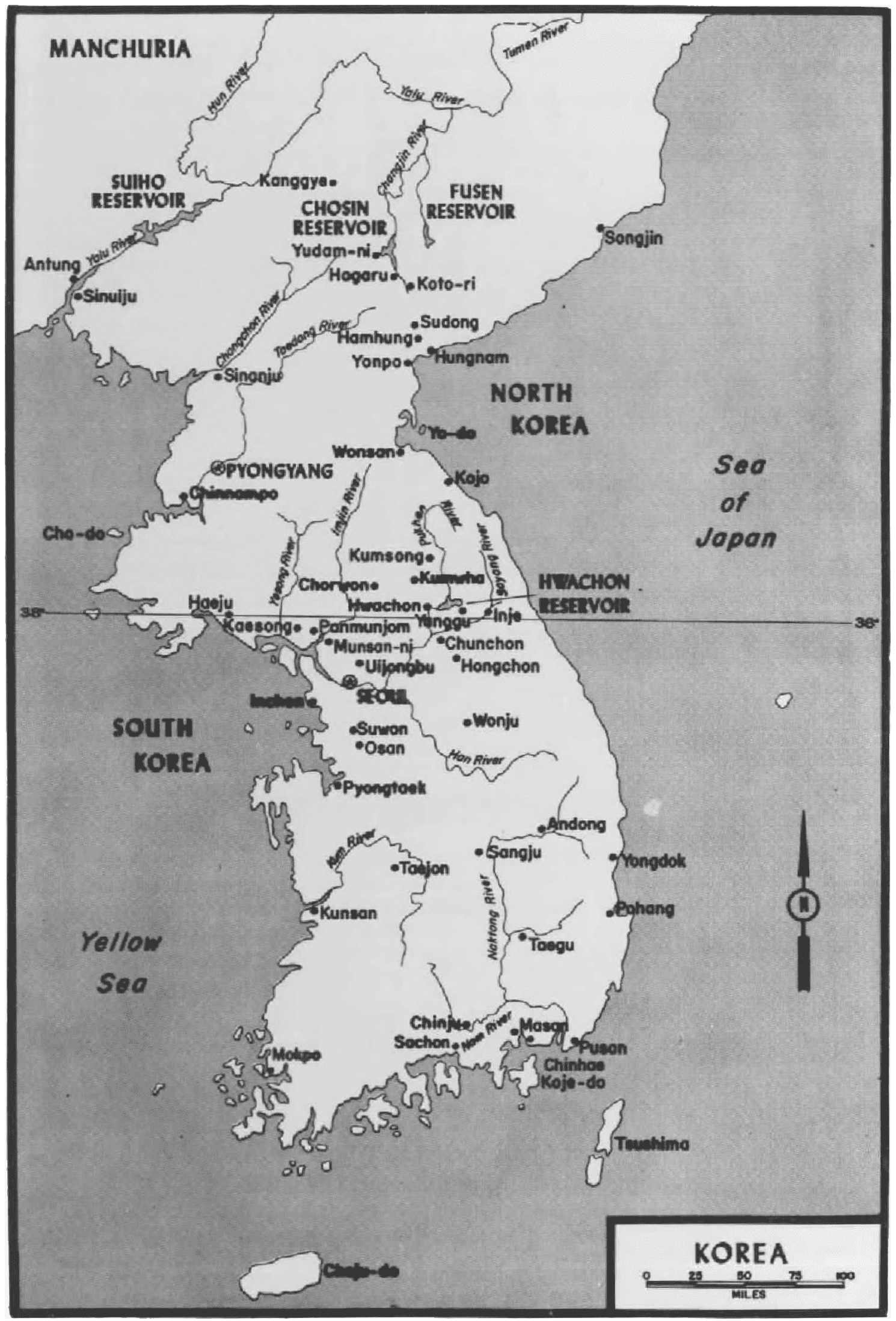
Mention the Korean War and almost immediately it evokes
the memory of Marines at Pusan, Inchon, Chosin Reservoir,
or the Punchbowl. Americans everywhere remember the Marine
Corps’ combat readiness, courage, and military skills that were
largely responsible for the success of these early operations in
1950–1951. Not as dramatic or well-known are the important accomplishments
of the Marines during the latter part of the Korean
War.
In March 1952 the 1st Marine Division redeployed from the East-Central
front to West Korea. This new sector, nearly 35 miles in
length, anchored the far western end of I Corps and was one of
the most critical of the entire Eighth Army line. Here the Marines
blocked the enemy’s goal of penetrating to Seoul, the South Korean
capital. Northwest of the Marine Main Line of Resistance, less than
five miles distant, lay Panmunjom, site of the sporadic truce negotiations.
Defense of their strategic area exposed the Marines to continuous
and deadly Communist probes and limited objective attacks. These
bitter and costly contests for key outposts bore such names as Bunker
Hill, the Hook, the Nevadas (Carson-Reno-Vegas), and Boulder
City. For the ground Marines, supported by 1st Marine Aircraft
Wing squadrons, the fighting continued until the last day of the
war, 27 July 1953.
The Korean War marked the first real test of Free World solidarity
in the face of Communist force. In repulsing this attempted
Communist aggression, the United Nations, led by the United States,
served notice that it would not hesitate to aid those nations whose
freedom and independence were under attack.
As events have subsequently proven, holding the line against
Communist encroachment is a battle whose end is not yet in sight.
Enemy aggression may explode brazenly upon the world scene, with
an overt act of invasion, as it did in Korea in June 1950, or it may
take the form of a murderous guerrilla war as it has more recently,
for over a decade, in Vietnam.
Whatever guise the enemy of the United States chooses or wherever
he draws his battleline, he will find the Marines with their age-old
answer. Today, as in the Korean era, Marine Corps readiness and
professionalism are prepared to apply the cutting edge against any
threat to American security.
L. F. Chapman, Jr.
General, U.S. Marine Corps,
Commandant of the Marine Corps
Reviewed and approved: 12 May 1971.
Preface
This is the concluding volume of a five-part series dealing with
operations of United States Marines in Korea between 2 August
1950 and 27 July 1953. Volume V provides a definitive account of
operations of the 1st Marine Division and the 1st Marine Aircraft
Wing during 1952–1953, the final phase of the Korean War. At this
time the division operated under Eighth U.S. Army in Korea (EUSAK)
control in the far western sector of I Corps, while Marine aviators
and squadrons functioned as a component of the Fifth Air Force
(FAF).
The period covered by this history begins in March 1952, when
the Marine division moved west to occupy positions defending the
approaches to Seoul, the South Korean capital. As it had for most of
the war the 1st Marine Aircraft Wing, operating under FAF, flew
close support missions not only for the Marines but for as many as
19 other Allied frontline divisions. Included in the narrative is a
detailed account of Marine POWs, a discussion of the new defense
mission of Marine units in the immediate postwar period, and an
evaluation of Marine Corps contributions to the Korean War.
Marines, both ground and aviation, comprised an integral part of
the United Nations Command in Korea. Since this is primarily a
Marine Corps history, actions of the U.S. Army, Navy, and Air Force
are presented only in sufficient detail to place Marine operations in
their proper perspective.
Official Marine Corps combat records form the basis for the book.
This primary source material has been further supplemented by comments
and interviews from key participants in the action described.
More than 180 persons reviewed the draft chapters. Their technical
knowledge and advice have been invaluable. Although the full details
of these comments could not be used in the text, this material has
been placed in Marine Corps archives for possible use by future
historians.
The manuscript of this volume was prepared during the tenure
of Colonel Frank C. Caldwell, Director of Marine Corps History,
Historical Division, Headquarters Marine Corps. Production was accomplished
under the direction of Mr. Henry I. Shaw, Jr., Deputy
Director and Chief Historian, who also outlined the volume. Preliminary
drafts were written by the late Lynn Montross, prime author
of this series, and Major Hubard D. Kuokka. Major James M.
Yingling researched and wrote chapters 1–6 and compiled the
Command and Staff List. Lieutenant Colonel Pat Meid researched
and wrote chapters 7–12, prepared appendices, processed photographs
and maps, and did the final editing of the book.
Historical Division staff members, past or present, who freely lent
suggestions or provided information include Lieutenant Colonel John
J. Cahill, Captain Charles B. Collins, Mr. Ralph W. Donnelly, Mr.
Benis M. Frank, Mr. George W. Garand, Mr. Rowland P. Gill,
Captain Robert J. Kane, Major Jack K. Ringler, and Major Lloyd E.
Tatem. Warrant Officer Dennis Egan was Administrative Officer
during the final stages of preparation and production of this book.
The many exacting administrative duties involved in processing the
volume from first draft manuscripts through the final printed form,
including the formidable task of indexing the book, were handled
expertly and cheerfully by Miss Kay P. Sue. Mrs. Frances J. Rubright
also furnished gracious and speedy assistance in obtaining the tomes
of official Marine Corps records. The maps were prepared by
Sergeants Kenneth W. White and Ernest L. Wilson. Official Department
of Defense photographs illustrate the book.
A major contribution to the history was made by the Office of the
Chief of Military History, Department of the Army; the Naval
History Division, Department of the Navy; and the Office of Air
Force History, Department of the Air Force. Military history offices
of England, Canada, and South Korea provided additional details
that add to the accuracy and interest of this concluding volume of
the Korean series.
F. C. Caldwell
Colonel, U.S. Marine Corps (Retired)
Director of Marine Corps History
CHAPTER I Operations in West Korea Begin — From Cairo to JAMESTOWN 1 — The Marines’ Home in Western Korea 16 — Organization of the 1st Marine Division Area 18 — The 1st Marine Aircraft Wing 30 — The Enemy 39 — Initial CCF Attack 42 — Subsequent CCF Attacks 44 — Strengthening the Line 49 — Marine Air Operations 52 — Supporting the Division and the Wing 59 — Different Area, Different Problem 68
From Cairo to JAMESTOWN—The Marines’ Home in West
Korea—Organization of the 1st Marine Division Area—The
1st Marine Aircraft Wing—The Enemy—Initial CCF Attack—Subsequent
CCF Attacks—Strengthening the Line—Marine
Air Operations—Supporting the Division and the Wing—Different
Area, Different Problem
During the latter part of March 1952, the 1st Marine
Division, a component of the U.S. Eighth Army in Korea
(EUSAK), pulled out of its positions astride the Soyang River in
east-central Korea and moved to the far western part of the country
in the I Corps sector. There the Marines took over the EUSAK left
flank, guarding the most likely enemy approaches to the South
Korean capital city, Seoul, and improving the ground defense in
their sector to comply with the strict requirements which the division
commander, Major General John T. Selden, had set down. Except
for a brief period in reserve, the Marine division would remain in
the Korean front lines until a cease-fire agreement in July 1953
ended active hostilities.
The division CG, Major General Selden,2 had assumed command
of the 25,000-man 1st Marine Division two months earlier, on 11
January, from Major General Gerald C. Thomas while the Marines
were still in the eastern X Corps sector. The new Marine commander
was a 37-year veteran of Marine Corps service, having enlisted as a
private in 1915, serving shortly thereafter in Haiti. During World
War I he was commissioned a second lieutenant, in 1918, while on
convoy duty. Between the two world wars, his overseas service had
included a second assignment to Haiti, two China tours, and sea
duty. When the United States entered World War II, Lieutenant
Colonel Selden was an intelligence officer aboard the carrier Lexington.
Later in the war Colonel Selden led the 5th Marines in the New
Britain fighting and was Chief of Staff of the 1st Marine Division
in the Peleliu campaign. He was promoted to brigadier general in
1948 and received his second star in 1951, prior to his combat assignment
in Korea.
American concern in the 1950s for South Korea’s struggle to preserve
its independence stemmed from a World War II agreement between
the United States, the United Kingdom, and China. In December
1943, the three powers had signed the Cairo Declaration and
bound themselves to ensure the freedom of the Korean people, then
under the yoke of the Japanese Empire. At the Potsdam Conference,
held on the outskirts of Berlin, Germany in July 1945, the United
States, China,3 and Britain renewed their Cairo promise.
When the Soviet Union agreed to join forces against Japan, on 8
August, the USSR also became a party to the Cairo Declaration.
According to terms of the Japanese capitulation on 11 August, the
Soviets were to accept surrender of the defeated forces north of the
38th Parallel in Korea. South of that line, the commander of the
American occupation forces would receive the surrender. The Russians
wasted no time and on 12 August had their troops in northern
Korea. American combat units, deployed throughout the Pacific, did
not enter Korea until 8 September. Then they found the Soviet
soldiers so firmly established they even refused to permit U.S. occupation
officials from the south to cross over into the Russian sector.
A December conference in Moscow led to a Russo-American commission
to work out the postwar problems of Korean independence.
Meeting for the first time in March 1946, the commission was
short-lived. Its failure, due to lack of Russian cooperation, paved
the way for politico-military factions within the country that set up
two separate Koreas. In the north the Communists, under Kim Il
Sung, and in the south the Korean nationalists, led by Dr. Syngman
Rhee, organized independent governments early in 1947. In May of
that year, a second joint commission failed to unify the country. As
a result the Korean problem was presented to the United Nations
(UN). This postwar international agency was no more successful
in resolving the differences between the disputing factions. It did,
however, recognize the Rhee government in December 1948 as the
representative one of the two dissident groups.
In June 1950, the North Koreans attempted to force unification of
Korea under Communist control by crossing the 38th Parallel with
seven infantry divisions heavily supported by artillery and tanks. Acting
on a resolution presented by the United States, the United Nations
responded by declaring the North Korean action a “breach
of the peace” and called upon its members to assist the South Koreans
in ousting the invaders. Many free countries around the globe
offered their aid. In the United States, President Harry S. Truman
authorized the use of U.S. air and naval units and, shortly thereafter,
ground forces to evict the aggressors and restore the status
quo. Under the command of General of the Army Douglas MacArthur,
then Far East Commander, U.S. Eighth Army occupation
troops in Japan embarked to South Korea.
The first combat unit sent from America to Korea was a Marine
air-ground team, the 1st Provisional Marine Brigade, formed at Camp
Pendleton, California on 7 July 1950, under Brigadier General Edward
A. Craig. The same day the UN Security Council passed a resolution
creating the United Nations Command (UNC) which was to
exercise operational control over the international military forces
rallying to the defense of South Korea. The Council asked the
United States to appoint a commander of the UN forces; on the 8th,
President Truman named his Far East Commander, General MacArthur,
as Commander in Chief, United Nations Command (CinCUNC).
In Korea the Marines soon became known as the firemen of the
Pusan Perimeter, for they were shifted from one trouble spot to the
next all along the defensive ring around Pusan, the last United Nations
stronghold in southeastern Korea during the early days of the
fighting. A bold tactical stroke planned for mid-September was designed
to relieve enemy pressure on Pusan and weaken the strength
of the North Korean People’s Army (NKPA). As envisioned by
General MacArthur, an amphibious landing at Inchon on the west
coast, far to the enemy rear, would threaten the entire North Korean
position south of the 38th Parallel. To help effect this coup, the UN
Commander directed that the Marine brigade be pulled out of the
Pusan area to take part in the landing at Inchon.
MacArthur’s assault force consisted of the 1st Marine Division,
less one of its three regiments,4 but including the 1st Korean Marine
Corps (KMC) Regiment. Marine ground and aviation units were to
assist in retaking Seoul, the South Korean capital, and to cut the
supply line sustaining the NKPA divisions.
On 15 September, Marines stormed ashore on three Inchon
beaches. Despite difficulties inherent in effecting a landing there,5 it
was an outstandingly successful amphibious assault. The 1st and 5th
Marines, with 1st Marine Aircraft Wing (1st MAW) assault squadrons
providing close air support, quickly captured the port city of
Inchon, Ascom City6 to the east, and Kimpo Airfield. Advancing
eastward the Marines approached the Han River that separates
Kimpo Peninsula from the Korean mainland. Crossing this obstacle
in amphibian vehicles, 1st Division Marines converged on Seoul
from three directions. By 27 September, the Marines had captured
the South Korean government complex and, together with the U.S.
Army 7th Infantry Division, had severed the enemy’s main supply
route (MSR) to Pusan. In heavy, close fighting near the city, other
United Nations troops pursued and cut off major units of the NKPA.
Ordered back to East Korea, the Marine division re-embarked at
Inchon in October and made an administrative landing at Wonsan
on the North Korean coast 75 miles above the 38th Parallel. As part
of the U.S. X Corps, the 1st Marine Division was to move the 5th
and 7th Marines (Reinforced) to the vicinity of the Chosin Reservoir,
from where they were to continue the advance northward toward
the North Korean-Manchurian border. The 1st Marines and
support troops were to remain in the Wonsan area.
While the bulk of the division moved northward, an unforeseen
development was in the making that was to change materially the
military situation in Korea overnight. Aware that the North Koreans
were on the brink of military disaster, Communist China had decided
to enter the fighting. Nine Chinese divisions had been dispatched
into the area with the specific mission of destroying the 1st
Marine Division.7 Without prior warning, on the night of 27 November,
hordes of Chinese Communist Forces (CCF, or “Chinese
People’s Volunteers” as they called themselves) assaulted the unsuspecting
Marines and nearly succeeding in trapping the two Marine
regiments. The enemy’s failure to do so was due to the military
discipline and courage displayed by able-bodied and wounded Marines
alike, as well as effective support furnished by Marine aviation.
Under conditions of great hardship, the division fought its way out
over 78 miles of frozen ground from Chosin to the port of Hungnam,
where transports stood by to evacuate the weary men and the
equipment they had salvaged.
This Chinese offensive had wrested victory from the grasp of
General MacArthur just as the successful completion of the campaign
seemed assured. In the west, the bulk of the Eighth Army
paced its withdrawal with that of the X Corps. The UNC established
a major line of defense across the country generally following the
38th Parallel. On Christmas Day, massed Chinese forces crossed
the parallel, and within a week the UN positions were bearing the
full brunt of the enemy assault. Driving southward, the Communists
recaptured Seoul, but by mid-February 1951 the advance had been
slowed down, the result of determined Eighth Army stands from a
series of successive defensive lines.8
Following its evacuation from Hungnam, the 1st Marine Division
early in 1951 underwent a brief period of rehabilitation and training
in the vicinity of Masan, west of Pusan. From there, the division
moved northeast to an area beyond Pohang on the east coast. Under
operational control of Eighth Army, the Marines, with the 1st Korean
Marine Corps Regiment attached for most of the period, protected
75 miles of a vital supply route from attack by bands of
guerrillas. In addition, the Marines conducted patrols to locate, trap,
and destroy the enemy. The Pohang guerrilla hunt also provided
valuable training for several thousand recently arrived Marine division
replacements.
In mid-February the 1st Marine Division was assigned to the U.S.
IX Corps, then operating in east-central Korea near Wonju. Initially
without the KMCs,9 the Marine division helped push the corps line
across the 38th Parallel into North Korea. On 22 April, the Chinese
unleashed a gigantic offensive, which again forced UN troops back
into South Korea. By the end of the month, however, the Allies had
halted the 40-mile-wide enemy spring offensive.
Once again, in May, the Marine division was assigned to the U.S.
X Corps, east of the IX Corps sector. Shortly thereafter the Communists
launched another major offensive. Heavy casualties inflicted
by UNC forces slowed this new enemy drive. Marine, Army, and
Korean troops not only repelled the Chinese onslaught but immediately
launched a counteroffensive, routing the enemy back into
North Korea until the rough, mountainous terrain and stiffening
resistance conspired to slow the Allied advance.
In addition to these combat difficulties, the Marine division began
to encounter increasing trouble in obtaining what it considered
sufficient and timely close air support (CAS). Most attack and
fighter aircraft of the 1st MAW, commanded by Major General
Field Harris10 and operating since the Chosin Reservoir days under
Fifth Air Force (FAF), had been employed primarily in a program
of interdicting North Korean supply routes. Due to this diversion
of Marine air from its primary CAS mission, both the division and
wing suffered—the latter by its pilots’ limited experience in performing
precision CAS sorties. Despite the difficulties, the Marine division
drove northward reaching, by 20 June, a grotesque scooped-out
terrain feature on the east-central front appropriately dubbed the
Punchbowl.
Eighth Army advances into North Korea had caused the enemy
to reappraise his military situation. On 23 June, the Russian delegate
to the United Nations, Jacob Malik, hinted that the Korean differences
might be settled at the conference table. Subsequently, United
Nations Command and Communist leaders agreed that truce negotiations
would begin on 7 July at Kaesong, located in West Korea
immediately south of the 38th Parallel, but under Communist control.
The Communists broke off the talks on 22 August. Without
offering any credible evidence, they declared that UNC aircraft
had violated the neutrality zone surrounding the conference area.11
Military and political observers then realized that the enemy’s overture
to peace negotiations had served its intended purpose of permitting
him to slow his retreat, regroup his forces, and prepare his
ground defenses for a new determined stand.
The lull in military offensive activity during the mid-1951 truce
talks presaged the kind of warfare that would soon typify the final
phase of the Korean conflict. Before the fighting settled into positional
trench warfare reminiscent of World War I, the Marines
participated in the final UN offensive. In a bitter struggle, the division
hacked its way northward through, over, and around the Punchbowl,
and in September 1951 occupied a series of commanding terrain
positions that became part of the MINNESOTA Line, the Eighth
Army main defensive line. Beginning on the 20th of that month, it
became the primary mission of frontline units to organize, construct,
and defend positions they held on MINNESOTA. To show good faith
at the peace table, the UNC outlawed large-scale attacks against
the enemy. Intent upon not appearing the aggressor and determined
to keep the door open for future truce negotiations, the United
Nations Command in late 1951 decreed a new military policy of
limited offensives and an aggressive defense of its line. This change
in Allied strategy, due to politico-military considerations, from a
moving battle situation to stabilized warfare would affect both the
tactics and future of the Korean War.
Even as Allied major tactical offensive operations and the era
of fire and maneuver in Korea was passing into oblivion, several
innovations were coming into use. One was the Marine Corps employment
of helicopters. First used for evacuation of casualties from
Pusan in August 1950, the versatile aircraft had also been adopted
by the Marine brigade commander, General Craig, as an airborne
jeep. On 13 September 1951, Marines made a significant contribution
to the military profession when they introduced helicopters
for large-scale resupply combat operations. This mission was followed
one week later by the first use of helicopters for a combat
zone troop lift. These revolutionary air tactics were contemporary
with two new Marine Corps developments in ground equipment—body
armor and insulated combat boots, which underwent extensive
combat testing that summer and fall. The latter were to be especially
welcomed for field use during the 1951–1952 winter.
Along the MINNESOTA Line, neither the freezing cold of a Korean
winter nor blazing summer heat altered the daily routine. Ground
defense operations consisted of dispatching patrols and raiding
parties, laying ambushes, and improving the physical defenses. The
enemy seemed reluctant to engage UN forces, and on one occasion
to draw him into the open, EUSAK ordered Operation CLAM-UP across
the entire UN front, beginning 10 February. Under cover of darkness,
reserve battalions moved forward; then, during daylight, they pulled
back, simulating a withdrawal of the main defenses. At the same
time, frontline troops had explicit orders not to fire or even show
themselves.12
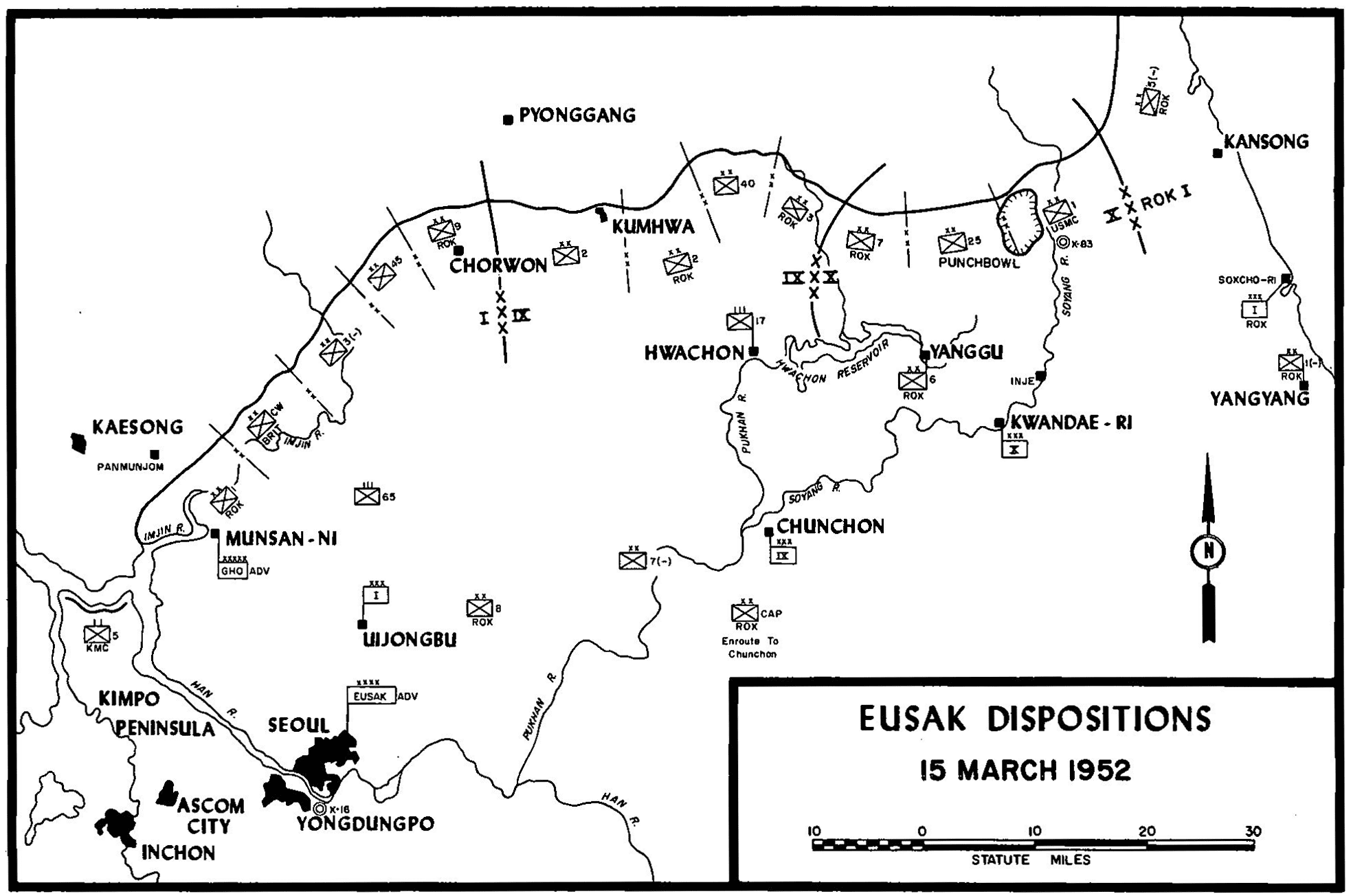
MAP 1 K. WHITE
EUSAK DISPOSITIONS
15 MARCH 1952
It was hoped that the rearward movement of units from the front
line and the subsequent inactivity there would cause the enemy to
come out of his trenches to investigate the apparent large-scale
withdrawal of UNC troops. Then Marine and other EUSAK troops
could open fire and inflict maximum casualties from covered positions.
On the fifth day of the operation, CLAM-UP was ended. The
North Koreans were lured out of their defenses, but not in the
numbers expected. CLAM-UP was the last action in the X Corps
sector for the 1st Marine Division, which would begin its cross-country
relocation the following month. (See Map 1.)
Code-named Operation MIXMASTER, the transfer of the 1st Marine
Division began on 17 March when major infantry units began to
move out of their eastern X Corps positions, after their relief on line
by the 8th Republic of Korea (ROK) Division. Regiments of the
Marine division relocated in the following order: the 1st KMCs,
1st, 7th, and 5th Marines. The division’s artillery regiment, the 11th
Marines, made the shift by battalions at two-day intervals. In the
motor march to West Korea, Marine units traveled approximately
140 miles over narrow, mountainous, and frequently mud-clogged
primitive roads. Day and night, division transport augmented by a
motor transport battalion attached from Fleet Marine Force, Pacific
(FMFPac) and one company from the 1st Combat Service Group
(CSG) rolled through rain, snow, sleet, and occasional good
weather.
Marines employed 5,800 truck and DUKW (amphibious truck)
loads to move most of the division personnel, gear, and supplies.
Sixty-three flatbed trailers, 83 railroad cars, 14 landing ships, 2 transport
aircraft, the vehicles of 4 Army truck companies, as well as
hundreds of smaller jeep trailers and jeeps were utilized. The
division estimated that these carriers moved about 50,000 tons
of equipment and vehicles,13 with some of the support units making
as many as a dozen round trips. The MIXMASTER move was made
primarily by truck and by ship14 or rail for units with heavy
vehicles.
Impressive as these figures are, they almost pall in significance
compared with the meticulous planning and precision logistics
required by the week-long move. It was made, without mishap, over
main routes that supplied nearly a dozen other divisions on the
EUSAK line and thus had to be executed so as not to interfere with
combat support. Although the transfer of the 1st Marine Division
from the eastern to western front was the longest transplacement of
any EUSAK division, MIXMASTER was a complicated tactical maneuver
that involved realignment of UNC divisions across the entire Korean
front. Some 200,000 men and their combat equipment had to be
relocated as part of a master plan to strengthen the Allied front
and deploy more troops on line.
Upon its arrival in West Korea, the 1st Marine Division was
under orders to relieve the 1st ROK Division and take over a sector
at the extreme left of the Eighth Army line, under I Corps control,
where the weaknesses of Kimpo Peninsula defenses had been of
considerable concern to EUSAK and its commander, General James
A. Van Fleet. As division units reached their new sector, they moved
to locations pre-selected in accordance with their assigned mission.
First Marine unit into the I Corps main defensive position, the
JAMESTOWN Line, was the 1st KMC Regiment attached to the division,
with its organic artillery battalion. The KMCs, as well as 1/11,
began to move into their new positions on 18 March. At 1400 on
20 March, the Korean Marines completed the relief of the 15th
Republic of Korea Regiment in the left sector of the MLR (main
line of resistance). Next into the division line, occupying the right
regimental sector adjacent to the 1st Commonwealth Division, was
Colonel Sidney S. Wade’s 1st Marines with three battalions forward
and 2/5 attached as the regimental reserve. Relief of the 1st ROK
Division was completed on the night of 24–25 March. At 0400 on
25 March the Commanding General, 1st Marine Division assumed
responsibility for the defense of 32 miles of the JAMESTOWN Line.
That same date the remainder of the Marine artillery battalions also
relocated in their new positions.
As the division took over its new I Corps mission on 25 March,
the Marine commander had one regiment of the 1st ROK Division
attached as division reserve while his 5th Marines was still in the
east. Operational plans originally had called for the 5th Marines,
less a battalion, to locate in the Kimpo Peninsula area where it was
anticipated Marine reserve units would be able to conduct extensive
amphibious training. So overextended was the assigned battlefront
position that General Selden realized this regiment would also be
needed to man the line. He quickly alerted the 5th Marines commanding
officer, Colonel Thomas A. Culhane, Jr., to deploy his
regiment, then en route to western Korea, to take over a section of
the JAMESTOWN front line instead of assuming reserve positions at
Kimpo as originally assigned. General Selden believed that putting
another regiment on the main line was essential to carrying out the
division’s mission, to aggressively defend JAMESTOWN Line, not
merely to delay a Communist advance.
Only a few hours after the 5th Marines had begun its trans-Korea
move, helicopters picked up Colonel Culhane, his battalion commanders,
and key regimental staff officers and flew them to the
relocated division command post (CP) in the west. Here, on 26
March, the regimental commander officially received the change in
the 5th Marines mission. Following this briefing, 5th Marines officers
reconnoitered the newly assigned area15 while awaiting the arrival of
their units. When the regiment arrived on the 28th, plans had been
completed for it to relieve a part of the thinly-held 1st Marines line.
On 29 March, the 5th Marines took over the center regimental sector
while the 1st Marines, on the right regimental flank, compressed its
ranks for a more solid defense.
Frontline units, from the west, were the 1st KMCs, the 5th, and
1st Marines. To the rear, the 7th Marines, designated as division
reserve, together with organic and attached units of the division, had
established an extensive support and supply area. As a temporary
measure, a battalion of the division reserve, 2/7, was detached for
defense of the Kimpo Peninsula pending a reorganization of forces
in this area. Major logistical facilities were the division airhead,
located at K-16 airfield, just southwest of Seoul, and the railhead
at Munsan-ni, 25 miles northwest of the capital city and about five
miles to the rear of the division sector at its nearest point. Forward
of the 1st Marine Division line, outposts were established to enhance
the division’s security. In the rear area the support facilities, secondary
defense lines, and unit command posts kept pace with development
of defensive installations on the MLR. Throughout the 1st
Marine Division sector outpost security, field fortifications, and the
ground defense net were thorough and intended to deny the enemy
access to Seoul.
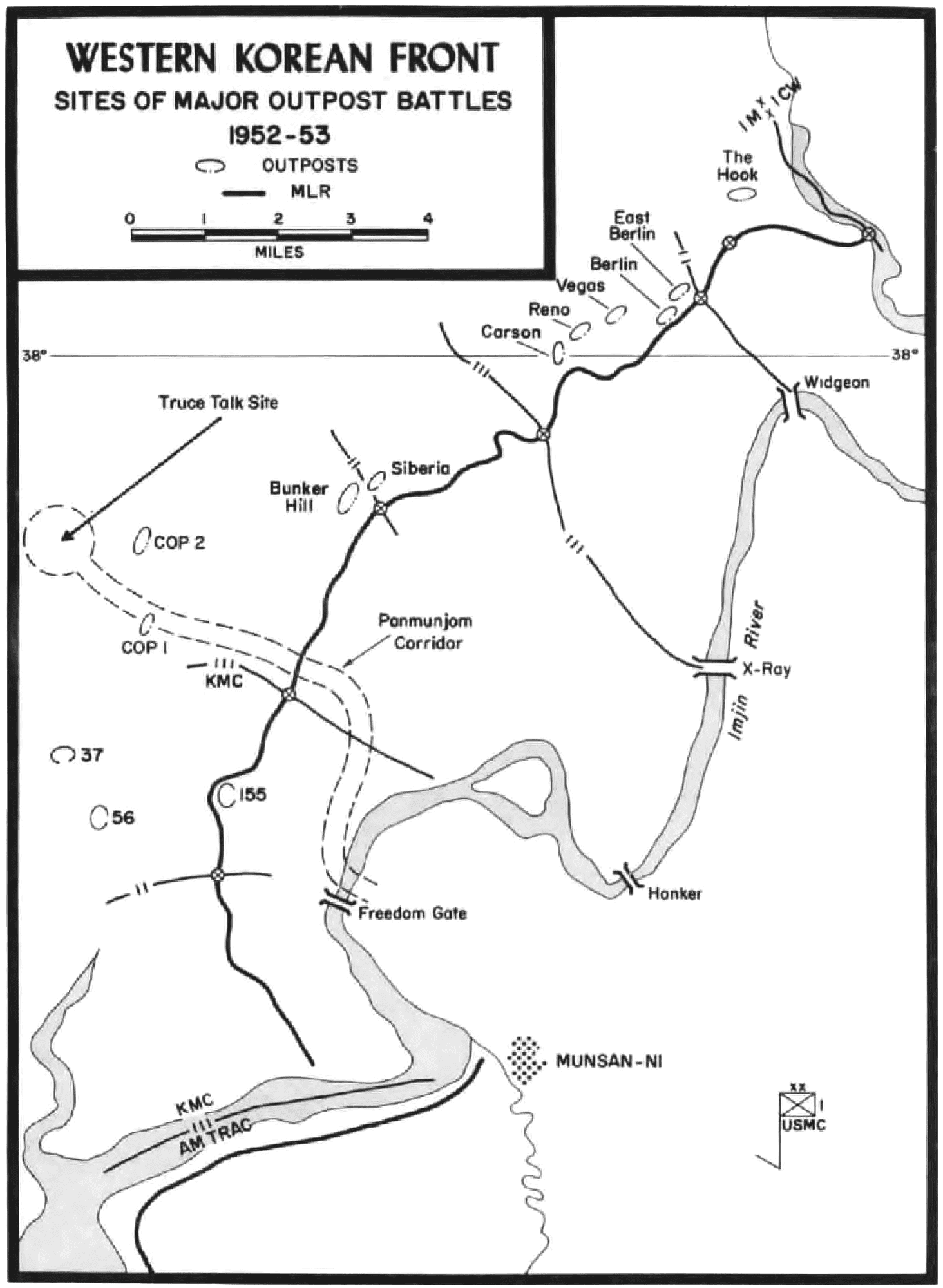
In western Korea, the home of the 1st Marine Division lay in a
particularly significant area. (See Map 2.) Within the Marine
boundaries ran the route that invaders through the ages had used
in their drive south to Seoul. It was the 1st Marine Division’s
mission to block any such future attempts. One of the reasons for
moving the Marines to the west17 was that the terrain there had to
be held at all costs; land in the east, mountainous and less valuable,
could better be sacrificed if a partial withdrawal in Korea became
necessary. At the end of March 1952, the division main line of
resistance stretched across difficult terrain for more than 30 miles,
from Kimpo to the British Commonwealth sector on the east, a
frontage far in excess of the textbook concept.
Although Seoul was not actually within the area of Marine Corps
responsibility, the capital city was only 33 air miles south of the
right limiting point of the division MLR and 26 miles southeast of
the left. The port of Inchon lay but 19 air miles south of the western
end of the division sector. Kaesong, the original site of the truce
negotiations, was 13 miles northwest of the nearest part of the 1st
Marine Division frontline while Panmunjom was less than 5 miles
away and within the area of Marine forward outpost security. From
the far northeastern end of the JAMESTOWN Line, which roughly paralleled
the Imjin River, distances were correspondingly lengthened:
Inchon, thus being 39 miles southwest and Kaesong, about 17 miles
west.
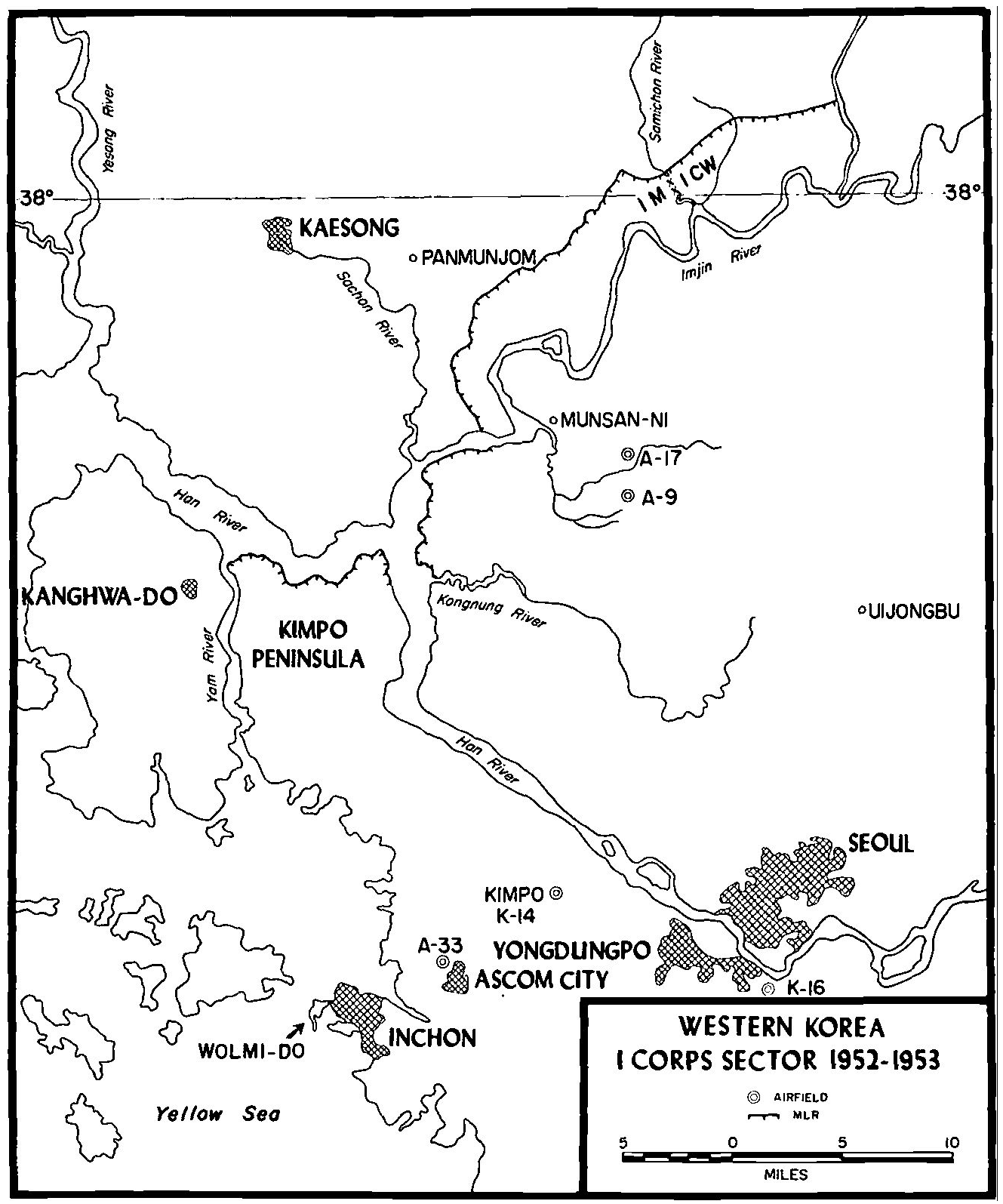
MAP 2 K. WHITE
WESTERN KOREA
I CORPS SECTOR 1952–1953
The area to which the Marines had moved was situated in the
western coastal lowlands and highlands area of northwestern South
Korea. On the left flank, the division MLR hooked around the
northwest tip of the Kimpo Peninsula, moved east across the high
ground overlooking the Han River, and bent around the northeast
cap of the peninsula. At a point opposite the mouth of the Kongnung
River, the MLR traversed the Han to the mainland, proceeding
north alongside that river to its confluence with the Imjin. Crossing
north over the Imjin, JAMESTOWN followed the high ground on
the east bank of the Sachon River for nearly two miles to where
the river valley widened. There the MLR turned abruptly to the
northeast and generally pursued that direction to the end of the
Marine sector, meandering frequently, however, to take advantage
of key terrain. Approximately 2½ miles west of the 1st Commonwealth
Division boundary, the JAMESTOWN Line intersected the 38th
Parallel near the tiny village of Madam-ni.
Within the Marine division sector to the north of Seoul lay the
junction of two major rivers, the Imjin and the Han, and a portion
of the broad fertile valley fed by the latter. Flowing into the division
area from the east, the Imjin River snaked its way southwestward
to the rear of JAMESTOWN. At the northeastern tip of the Kimpo
Peninsula, the Imjin joined the Han. The latter there changed its
course from south to west, flowed past Kimpo and neighboring
Kanghwa-do Island, and emptied eventually into the Yellow Sea.
At the far western end of the division sector the Yom River formed
a natural boundary, separating Kanghwa and Kimpo, as it ran into
the Han River and south to the Yellow Sea. To the east, the
Sachon River streamed into the Imjin, while the Kongnung emptied
into the Han where the MLR crossed from the mainland to Kimpo.
In addition, two north-south oriented rivers flanked enemy positions
opposite the Marines and emptied into major rivers in the
Marine sector. Northwest of Kimpo, the Yesong River ran south
to the Han; far to the northeast, just beyond the March 1952
division right boundary, the Samichon River flowed into the Imjin.
Although the rivers in the Marine division were navigable, they
were little used for supply or transportation. The railroads, too,
were considered secondary ways, for there was but one line, which
ran north out of Seoul to Munsan-ni and then continued towards
Kaesong. Below the division railhead, located at Munsan-ni, a spur
cut off to Ascom City. Roads, the chief means of surface transport,
were numerous but lacked sufficient width and durability for supporting
heavy military traffic. Within the sector occupied by the
Marines, the main route generally paralleled the railroad. Most of
the existing roads south of JAMESTOWN eventually found their way
to the logistic center at Munsan-ni. Immediately across the Imjin,
the road net was more dense but not of any better construction.
From the logistical point of view, the Imjin River was a critical
factor. Spanning it and connecting the division forward and rear
support areas in March 1952 were only three bridges, which were
vulnerable to river flooding conditions and possible enemy attack.
Besides intersecting the Marine sector, the Imjin formed a barrier
to the rear of much of the division MLR, thereby increasing the
difficulty of normal defense and resupply operations.
When the Marines moved to the west, the winter was just ending.
It had begun in November and was characterized by frequent light
snowfalls but otherwise generally clear skies. Snow and wind
storms seldom occurred in western Korea. From November to March
the mean daily minimum Fahrenheit readings ranged from 15° to 30°
above zero. The mean daily maximums during the summer were
between the upper 70s and mid-80s. Extensive cloud cover, fog, and
heavy rains were frequent during the summer season. Hot weather
periods were also characterized by occasional severe winds. Spring
and fall were moderate transitional seasons.
Steep-sided hills and mountains, which sloped abruptly into
narrow valleys pierced by many of the rivers and larger streams,
predominated the terrain in the I Corps sector where the Marines
located. The most rugged terrain was to the rear of the JAMESTOWN
Line; six miles northeast of the Munsan-ni railhead was a 1,948-foot
mountain, far higher than any other elevation on the Marine
or Chinese MLR but lower than the rear area peaks supporting the
Communist defenses. Ground cover in the division sector consisted
of grass, scrub brush, and, occasionally, small trees. Rice fields
crowded the valley floors. Mud flats were prevalent in many areas
immediately adjacent to the larger rivers which intersected the
division territory or virtually paralleled the east and western boundaries
of the Marine sector.
The transfer from the Punchbowl in the east to western Korea
thus resulted in a distinct change of scene for the Marines, who
went from a rugged mountainous area to comparatively level terrain.
Instead of facing a line held by predominantly North Korean
forces the division was now confronted by the Chinese Communists.
The Marines also went from a front that had been characterized by
lively patrol action to one that in March 1952 was relatively dormant.
With the arrival of the 1st Marine Division, this critical I
Corps sector would witness sharply renewed activity and become
a focal point of action in the UNC line.
“To defend” were the key words in the 1st Marine Division mission—“to
organize, occupy, and actively defend its sector of Line
JAMESTOWN”—in West Korea. General Selden’s force to prevent
enemy penetration of JAMESTOWN numbered 1,364 Marine officers,
24,846 enlisted Marines, 1,100 naval personnel, and 4,400 Koreans
of the attached 1st KMC Regiment. The division also had operational
control of several I Corps reinforcing artillery units in its
sector. On 31 March, another major infantry unit, the Kimpo
Provisional Regiment (KPR) was organized. The division then
assumed responsibility for the Kimpo Peninsula defense on the west
flank with this Marine-Korean force.
A major reason for transfer of the 1st Marine Division to the
west, it will be remembered, had been the weakness of the Kimpo
defense. Several units, the 5th KMC Battalion, the Marine 1st
Armored Amphibian Battalion, and the 13th ROK Security Battalion
(less one company), had been charged with the protection of the
peninsula. Their operations, although coordinated by I Corps, were
conducted independently. The fixed nature of the Kimpo defenses
provided for neither a reserve maneuver element to help repel any
enemy action that might develop nor a single commander to coordinate
the operations of the defending units.
These weaknesses become more critical in consideration of the
type of facilities at Kimpo and their proximity to the South Korean
Capital. Seoul lay just east of the base of Kimpo Peninsula, separated
from it only by the Han River. Located on Kimpo was the
key port of Inchon and two other vital installations, the logistical
complex at Ascom City and the Kimpo Airfield (K-14). All of
these facilities were indispensable to the United Nations Command.
To improve the security of Kimpo and provide a cohesive, integrated
defense line, CG, 1st Marine Division formed the independent
commands into the Kimpo Provisional Regiment. Colonel
Edward M. Staab, Jr., was named the first KPR commander. His
small headquarters functioned in a tactical capacity only without
major administrative duties. The detachments that comprised the
KPR upon its formation were:
Headquarters and Service Company, with regimental and company
headquarters and a communication platoon;
1st Armored Amphibian Battalion, as supporting artillery;
5th KMC Battalion;
13th ROK Security Battalion (-);
One battalion from the reserve regiment of the 1st Marine
Division (2/7), as the maneuver element;
Company A, 1st Amphibian Tractor Battalion;
Company B, 1st Shore Party Battalion, as engineers;
Company D, 1st Medical Battalion;
Reconnaissance Company (-), 1st Marine Division;
Detachment, Air and Naval Gunfire Liaison Company (ANGLICO),
1st Signal Battalion;
Detachment, 181st Counterintelligence Corps Unit, USA;
Detachment, 61st Engineer Searchlight Company, USA; and the
163rd Military Intelligence Service Detachment, USA.
The Kimpo Regiment, in addition to maintaining security of the
division left flank, was assigned the mission to “protect supporting
and communication installations in that sector against airborne or
ground attack.”19 Within the division, both the artillery regiment and
the motor transport battalion were to be prepared to support tactical
operations of Colonel Staab’s organization.
For defense purposes, the KPR commander divided the peninsula
into three sectors. The northern one was manned by the KMC
battalion, which occupied commanding terrain and organized the
area for defense. The southern part was defended by the ROK Army
battalion, charged specifically with protection of the Kimpo Airfield
and containment of any attempted enemy attack from the north.
Both forces provided for the security of supply and communication
installations within their areas. The western sector, held by the
amphibian tractor company, less two platoons, had the mission of
screening traffic along the east bank of the Yom River, that flanked
the western part of the peninsula. Providing flexibility to the defense
plan was the maneuver unit, the battalion assigned from the 1st
Marine Division reserve.
The unit adjacent to the KPR20 in the division line in late March
was the 1st Korean Marine Corps Regiment, which had been the
first division unit to deploy along JAMESTOWN. The KMC Regiment,
command by Colonel Kim Dong Ha,21 had assumed responsibility
for its portion of JAMESTOWN at 0400 on 20 March with orders to
organize and defend its sector. The regiment placed two battalions,
the 3d and 1st, on the MLR and the 2d in the rear. Holding down
the regimental right of the sector was the 1st Battalion, which had
shared its eastern boundary with that of Colonel Wade’s 1st Marines
until 29 March when the 5th Marines was emplaced on the MLR
between the 1st KMC and 1st Marines.
The 1st Marines regimental right boundary, which on the MLR
was 1,100 yards north of the 38th Parallel, separated the 1st Marine
Division area from the western end of the 1st Commonwealth Division,
then held by the 25th Canadian Infantry Brigade. In late March,
Colonel Wade’s 2/1 (Lieutenant Colonel Thell H. Fisher) and
3/1 (Lieutenant Colonel Spencer H. Pratt) manned the frontline
positions while 1/1 (Lieutenant Colonel John H. Papurca), less
Company A, was in reserve. The regiment was committed to the defense
of its part of the division area and improvement of its ground
positions. In the division center sector Colonel Culhane’s 1/5
(Lieutenant Colonel Franklin B. Nihart) and 3/5 (Lieutenant
Colonel William S. McLaughlin) manned the left and right battalion
MLR positions, with 2/5 (Lieutenant Colonel William H.
Cushing) in reserve. The latter unit was to be prepared either to
relieve the MLR battalions or for use as a counterattack force.
It did not take the Marines long to discover the existence of serious
flaws in the area defense which made it questionable whether the
Allied line here could have successfully withstood an enemy attack.
While his Marine units were effecting their relief of JAMESTOWN,
Colonel Wade noted that “field fortifications were practically nonexistent
in some sections.”22 General Selden later pointed out that
“populated villages existed between opposing lines. Farmers were
cultivating their fields in full view of both forces. Traffic across the
river was brisk.”23 A member of the division staff reported that there
was “even a school operating in one area ahead of the Marine
lines.”24 In addition to these indications of sector weakness, there
was still another. Although the ROK division had placed three
regiments in the line, when the two Marine regiments relieved them
there were then more men on JAMESTOWN due to the greater personnel
strength of a Marine regiment. Nevertheless, the division
commander was still appalled at the width of the defense sector
assigned to so few Marines.
At division level, the reserve mission was filled by Colonel Russell
E. Honsowetz’, 7th Marines, minus 2/7 (Lieutenant Colonel Noel
C. Gregory), which on 30 March became the maneuver force for the
Kimpo Regiment. As the division reserve, the regiment was to be
prepared to assume at any time either a defensive or offensive mission
of any of the frontline regiments. In addition, the reserve
regiment was to draw up counterattack plans, protect the division
rear, improve secondary line defenses, and conduct training, including
tank-infantry coordination, for units in reserve. The 7th Marines,
with 3/7 (Lieutenant Colonel Houston Stiff) on the left and 1/7
(Lieutenant Colonel George W. E. Daughtry) on the right, was
emplaced in the vicinity of the secondary defense lines, WYOMING
and KANSAS, to the rear of the 5th and 1st Marines.
Another regiment located in the rear area was the 11th Marines.
Its artillery battalions had begun displacement on 17 March and
completed their move by 25 March. Early on the 26th, the 11th
Marines resumed support of the 1st Marine Division. While the
Marine artillery had been en route, U.S. Army artillery from I Corps
supported the division. With the arrival on the 29th of the administrative
rear echelon, the Marine artillery regiment was fully positioned
in the west.
For Colonel Frederick P. Henderson, who became the division
artillery commander on 27 March, operational problems in western
Korea differed somewhat from those experienced in the east by his
predecessor, Colonel Bruce T. Hemphill. The most critical difficulty,
however, was the same situation that confronted General Selden—the
vast amount of ground to be covered and defended, and the
insufficient number of units to accomplish this mission. To the
artillery, the wide division front resulted in spreading the available
fire support dangerously thin. Placement of 11th Marines units to
best support the MLR regiments created wide gaps between each
artillery battalion, caused communication and resupply difficulties,
prevented a maximum massing of fires, and made redeployment
difficult.25
In making use of all available fire support, the artillery regiment
had to guard not only against the duplication of effort in planning
or delivery of fires, but also against firing in the Panmunjom peace
corridor restricted areas, located near the sector held by the Marine
division’s center regiment. Moreover, the artillerymen had to maintain
a flexibility sufficient to place the weight of available fire support
on call into any zone of action.
Other difficulties were more directly associated with the nature of
the sector rather than with its broad expanse. The positioning of the
division in the west, although close to the coast, put the Marines
beyond the range of protective naval gunfire. The sparse and inadequate
road net further aggravated the tactical and logistical problems
caused by wide separation of units. Finally, the cannoneers had
exceptionally heavy demands placed on them due to the restricted
amount of close air support allocated to frontline troops under
operational procedures employed by Fifth Air Force. This command
had jurisdiction over the entire Korean air defense system, including
Marine squadrons.
Manning the main line of resistance also frequently presented
perplexing situations to the infantry. There had been little time for
a thorough reconnaissance and selection of positions by any of the
frontline regiments. When the 1st Marines moved into its assigned
position on the MLR, the troops soon discovered many minefields,
“some marked, some poorly marked, and some not marked at all.”26
Uncharted mines caused the regiment to suffer “some casualties the
first night of our move and more the second and third days.”27 As
it was to turn out, during the first weeks in the I Corps sector, mines
of all types caused 50 percent of total Marine casualties.
A heavy drain on the limited manpower of Marine infantry regiments
defending JAMESTOWN was caused by the need to occupy an
additional position, an outpost line of resistance (OPLR). This
defensive line to the front of the Marine MLR provided additional
security against the enemy, but decreased the strength of the regimental
reserve battalion, which furnished the OPLR troops. The
outposts manned by the Marines consisted of a series of strongpoints
built largely around commanding terrain features that screened the
1st Marine Division area. The OPLR across the division front was,
on the average, about 2,500 yards forward of the MLR. (See Map 3.)
To the rear of the main line were two secondary defensive lines,
WYOMING and KANSAS. Both had been established before the
Marines arrived and both required considerable work, primarily
construction of bunkers and weapons emplacements, to meet General
Selden’s strict requirement for a strong defensive sector. Work in
improving the lines, exercises in rapid battalion tactical deployment
by helicopter, and actual manning of the lines were among the
many tasks assigned to the division reserve regiment.
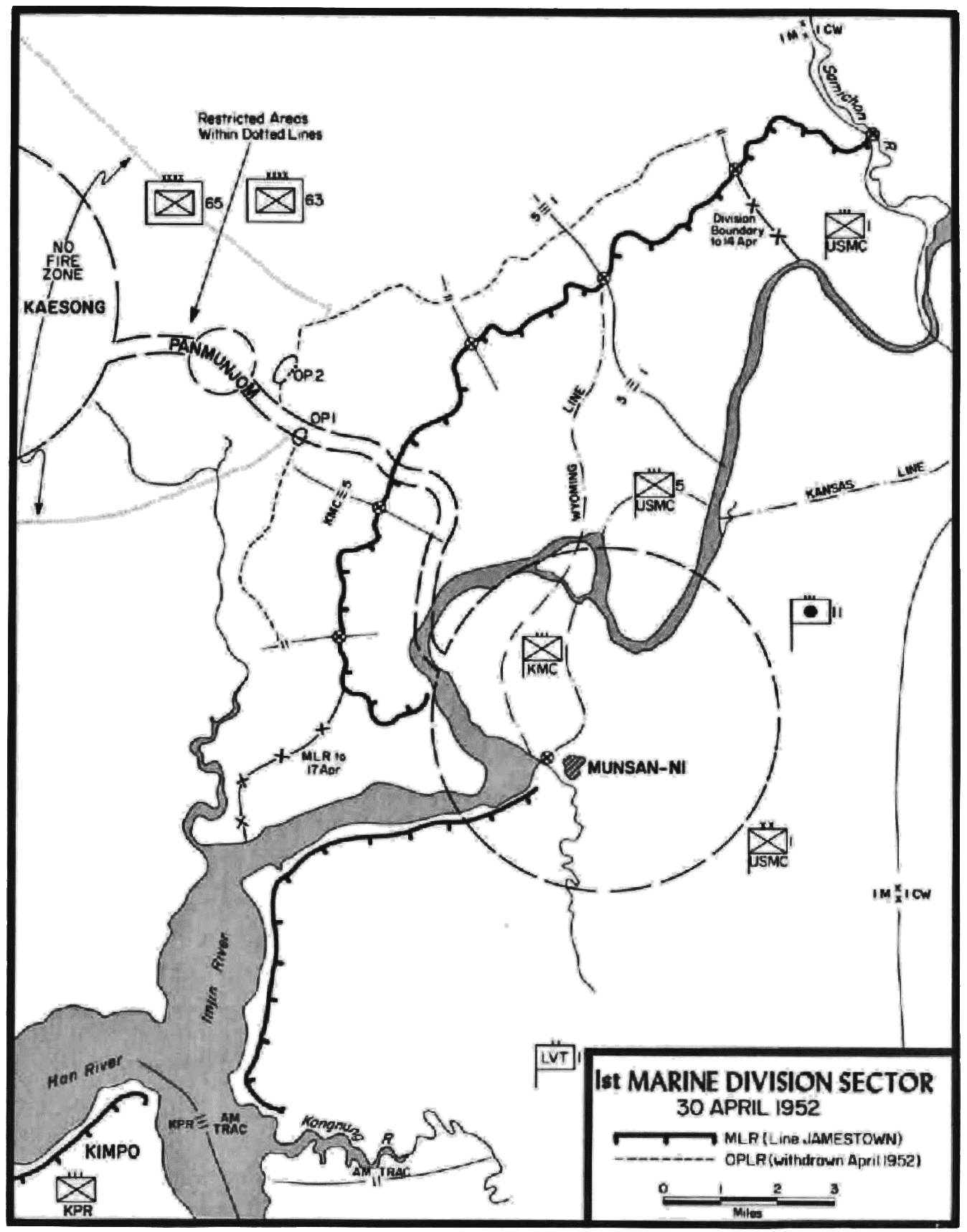
MAP 3 K. White
1st MARINE DIVISION SECTOR
30 APRIL 1952
Rear and frontline units alike found that new regulations affected
combat operations with the enemy in West Korea. These restrictions
were a result of the truce talks that had taken place first at Kaesong
and, later, at Panmunjom. In line with agreements reached in
October 1951:
Panmunjom was designated as the center of a circular neutral zone of a
1,000 yard radius, and a three mile radius around Munsan and Kaesong was
also neutralized, as well as two hundred meters on either side of the
Kaesong-Munsan road.28
To prevent the occurrence of any hostile act within this sanctuary,
Lieutenant General John W. O’Daniel, I Corps commander, ordered
that an additional area, forward of the OPLR, be set aside. This
megaphone-shaped zone “could not be fired into, out of, or over.”29
It was adjacent to the OPLR in the division center regimental sector,
near its left boundary, and took a generally northwest course.
Marines reported that the Communists knew of this restricted zone
and frequently used it for assembly areas and artillery emplacements.
When the 1st Marine Division moved to western Korea in March
1952, the two 1st Marine Aircraft Wing units that had been in
direct support of the ground Marines also relocated. Marine Observation
Squadron 6 (VMO-6) and Marine Helicopter Transport
Squadron 161 (HMR-161) completed their displacements by 24
March from their eastern airfield (X-83) to sites in the vicinity of
the new division CP. HMR-161, headed by Colonel Keith B. McCutcheon,
set up headquarters at A-17,31 on a hillside 3½ miles
southeast of Munsan-ni, the division railhead, “using a couple of
rice paddies as our L. Z. (Landing Zone).”32 The squadron rear
echelon, including the machine shops, was maintained at A-33, near
Ascom City. About 2½ miles south of the helicopter forward site
was an old landing strip, A-9, which Lieutenant Colonel William T.
Herring’s observation squadron used as home field for its fixed and
rotary wing aircraft. (For location of 1st MAW units see Map 4.) In
West Korea, VMO-6 and HMR-161 continued to provide air transport
for tactical and logistical missions. Both squadrons were under
operational control of the division, but administered by the wing.
Commanding General of the 1st MAW, since 27 July 1951,
was Major General Christian F. Schilt,33 a Marine airman who had
brought to Korea a vast amount of experience as a flying officer.
Entering the Marine Corps in June 1917, he had served as an enlisted
man with the 1st Marine Aeronautical Company in the Azores during
World War I. Commissioned in 1919, he served in a variety of
training and overseas naval air assignments. As a first lieutenant in
Nicaragua, he had been awarded the Medal of Honor in 1928 for
his bravery and “almost superhuman skill” in flying out Marines
wounded at Quilali.34 During World War II, General Schilt had
served as 1st MAW Assistant Chief of Staff, at Guadalcanal, was
later CO of Marine Aircraft Group 11, and participated in the consolidation
of the Southern Solomons and air defense of Peleliu and
Okinawa.
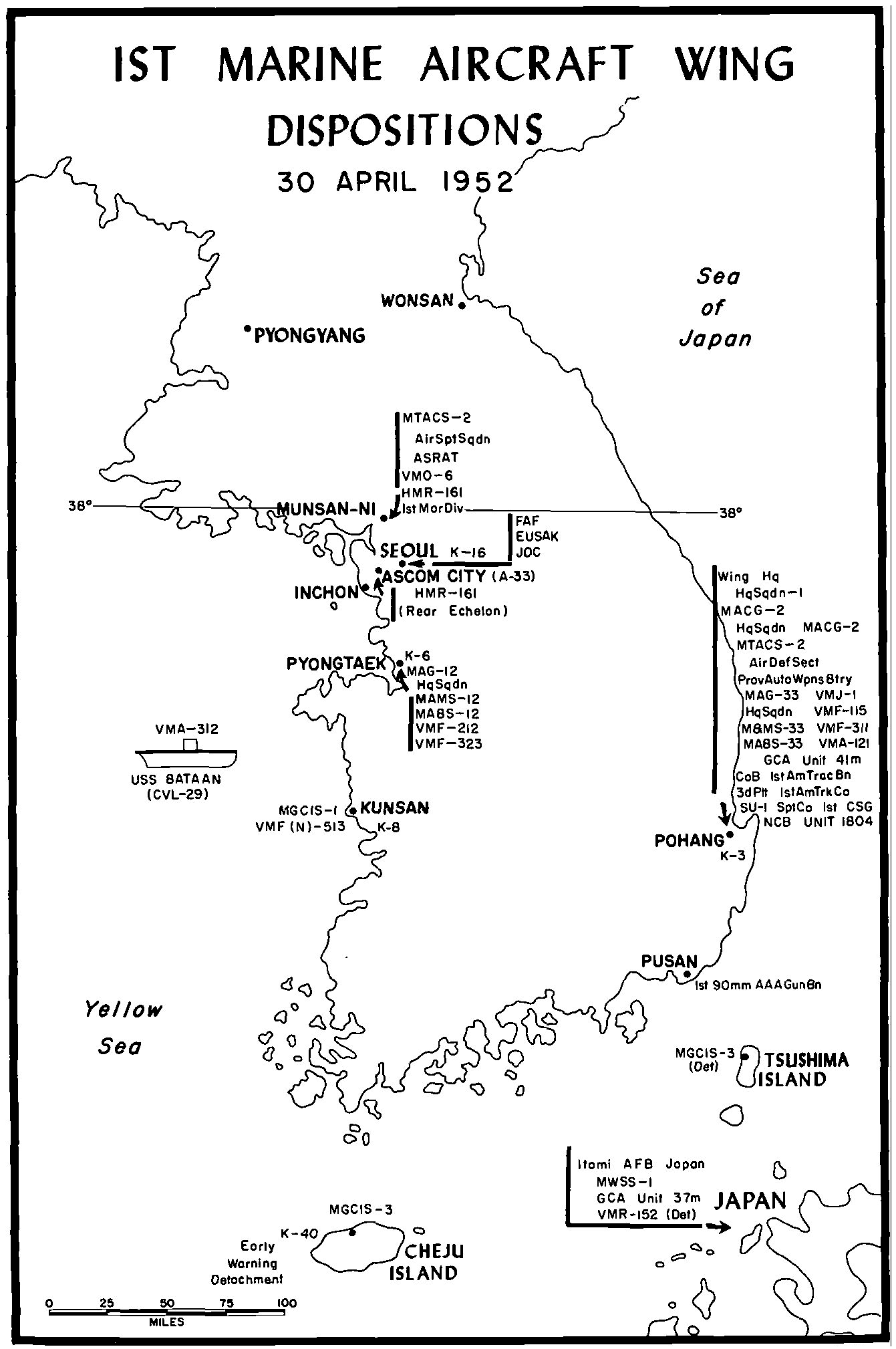
MAP 4 E. WILSON
1ST MARINE AIRCRAFT WING DISPOSITIONS
30 APRIL 1952
As in past months, the majority of General Schilt’s Marine aircraft
in Korea during March 1952 continued to be under operational
control of Fifth Air Force. In turn, FAF was the largest
subordinate command of Far East Air Forces (FEAF), headquartered
at Tokyo. The latter was the U.S. Air Force component of the Far
East Command and encompassed all USAF installations in the Far
East. The FAF-EUSAK Joint Operations Center (JOC) at Seoul coordinated
and controlled all Allied air operations in Korea. Marine
fighter and attack squadrons were employed by FAF to:
Maintain air superiority.
Furnish close support for ground units.
Provide escort [for attack aircraft].
Conduct day and night reconnaissance and fulfill requests.
Effect the complete interdiction of North Korean and Chinese Communist
forces and other military targets that have an immediate effect upon the
current tactical situation.35
Squadrons carrying out these assignments were attached to Marine
Aircraft Groups (MAGs) 12 and 33. Commanded by Colonel
Luther S. Moore, MAG-12 and its two day attack squadrons
(VMF-212 and VMF-323) in March 1952 was still located in
eastern Korea (K-18, Kangnung). The Marine night-fighters of
VMF(N)-513 were also here as part of the MAG-12 group.
Farther removed from the immediate battlefront was Colonel Martin
A. Severson’s MAG-33, located at K-3 (Pohang), with its two
powerful jet fighter squadrons (VMFs-115 and -311) and an
attack squadron (VMA-121). A new MAG-33 unit was Marine
Photographic Squadron 1 (VMJ-1), just formed in February 1952
and commanded by Major Robert R. Read.
In addition to its land-based squadrons, one 1st MAW unit was
assigned to Commander, West Coast Blockading and Patrol Group,
designated Commander, Task Group 95.1 (CTG 95.1). He in turn
assigned this Marine unit to Commander, Task Element 95.11 (CTE
95.11), whose ships comprised the West Coast Carrier Element.
Marine Attack Squadron 312 (VMA-312) was at this time assigned
to CTE 95.11. In late March squadron aircraft were based on the
escort carrier USS Bairoko but transferred on 21 April to the light
carrier Bataan.36 Operating normally with a complement of 21
F4U-4 propeller-driven Corsair aircraft, VMA-312 had the following
missions:
To conduct armed air reconnaissance of the West Coast of Korea from
the United Nations front lines northward to latitude 39°/15´ N.
Attack enemy shipping and destroy mines.
Maintain surveillance of enemy airfields in the Haeju-Chinnampo
region.37
Provide air spot services to naval units on request.
Provide close air support and armed air reconnaissance services as requested
by Joint Operations Center, Korea (JOC KOREA).
Conduct air strikes against coastal and inland targets of opportunity at
discretion.
Be prepared to provide combat air patrol to friendly naval forces operating
off the West Coast of Korea.
Render SAR [search and rescue] assistance.
Because they were under operational control of Fifth Air Force,
1st MAW flying squadrons, except those assigned to CTG 95.1 and
1st Marine Division control, did not change their dispositions in
March. Plans were under way at this time, however, to relocate one
of the aircraft groups, MAG-12, to the west.
On 30 March the ground element of the night-fighters redeployed
from its east coast home field to K-8 (Kunsan), on the west coast,
105 miles south of Seoul. Lieutenant Colonel John R. Burnett’s VMF
(N)-513 completed this relocation by 11 April without loss of a
single day of flight operations. On 20 April the rest of MAG-12,38
newly commanded since the first of the month by Colonel Elmer T.
Dorsey, moved to K-6 (Pyongtaek), located 30 miles directly south
of the South Korean capital.
Marine aircraft support units were also located at K-3 and at
Itami Air Force Base, on Honshu, Japan. Under direct 1st MAW
control were four ground-type logistical support units with MAG-33,
a Provisional Automatic Weapons Battery from Marine Air Control
Group 2 (MACG-2), and most of wing headquarters. This last
unit, commanded by Colonel Frederick R. Payne, Jr., included the
1st 90mm AAA Gun Battalion (based at Pusan and led by Colonel
Max C. Chapman), and a detachment of Marine Transport Squadron
152 (VMR-152), which had seven Douglas four-engine R5D
transports. This element and the wing service squadron were based
at Itami.
Marines, and others flying in western Korea, found themselves
restricted much as Marines on the ground were. One limitation
resulted from a FAF-EUSAK agreement in November 1951 limiting
the number of daily close air support sorties across the entire Eighth
Army line. This policy had restricted air activity along the 155-mile
Korean front to 96 sorties per day. The curtailment seriously
interfered with the Marine type of close air support teamwork
evolved during World War II, and its execution had an adverse
effect on Marine ground operations as well. A second restriction,
also detrimental to Marine division and wing efficiency, was the
prohibitive cushion Fifth Air Force had placed around the United
Nations peace corridor area north of the Marine MLR. This buffer
no-fly, no-fire zone which had been added to prevent violation of
the UN sanctuary by stray hits did not apply, of course, to the
Communists.
Directly beyond the 1st Marine Division sector, to the west and
north, were two first-rate units of the Chinese Communist Forces,
the 65th and 63d CCF Armies. Together, they totaled approximately
49,800 troops in late March 1952. Opposite the west and center of
the Marine division front was the 65th CCF Army, with elements
of the 193d Division across from the KPR and the 194th Division
holding positions opposing the KMC regiment. Across from the
Marine line in the center was the 195th Division of the 65th CCF
Army, which had placed two regiments forward. North of the division
right sector lay the 188th Division, 63d CCF Army, also with
two regiments forward. The estimated 15 infantry battalions facing
the Marine division were supported by 10 organic artillery battalions,
numbering 106 guns, and varying in caliber from 75 to 155mm.40
In addition, intelligence reported that the 1st CCF Armored Division
and an unidentified airborne brigade were located near enough
to aid enemy operations.
Chinese infantry units were not only solidly entrenched across their
front line opposite the Marine division but were also in depth. Their
successive defensive lines, protected by minefields, wire, and other
obstacles, were supported by artillery and had been, as a result of
activities in recent months, supplied sufficiently to conduct continuous
operations. Not only were enemy ground units well-supplied, but
their CCF soldiers were well disciplined and well led. Their morale
was officially evaluated as ranging from good to excellent. In all, the
CCF was a determined adversary of considerable ability, with their
greatest strength being in plentiful combat manpower.
Air opposition to Marine pilots in Korea was of unknown quantity
and only on occasion did the caliber of enemy pilots approach
that of the Americans. Pilots reported that their Chinese counterparts
generally lacked overall combat proficiency, but that at times
their “aggressiveness, sheer weight of numbers, and utter disregard
for losses have counterbalanced any apparent deficiencies.”41 The
Communists had built their offensive potential around the Russian
MIG-15 jet fighter-interceptor. Use of this aircraft for ground support
or ground attack was believed to be in the training stage only.
The Chinese had also based their air defense on the same MIG
plus various types of ground antiaircraft (AA) weapons, particularly
the mobile 37mm automatic weapons and machine guns that
protected their main supply routes. In use of these ground AA weapons,
enemy forces north of the 38th Parallel had become most proficient.
Their defense system against UNC planes had been steadily
built up and improved since stabilization of the battle lines in 1951,
and by March 1952 was reaching a formidable state.
As the more favorable weather for ground combat approached
toward the end of March, the CCF was well prepared to continue
and expand its operations. Enemy soldiers were considered able to
defend their sector easily with infantry and support units. Division
intelligence also reported that Chinese ground troops had the capability
for launching limited objective attacks to improve their observation
of Marine MLR rear areas.
Whether by intent or default, the Chinese infantry occupying the
enemy forward positions did not interfere with the Marine relief.
With assumption of sector responsibility by the division early on
25 March, the initial enemy contact came from Chinese supporting
weapons. Later that day the two division frontline regiments, the
1st and 5th Marines, received 189 mortar and artillery shells in
their sectors which wounded 10 Marines. One man in the 1st Marines
was killed by sniper fire on 25 March; in the same regiment, another
Marine was fatally wounded the following day. Forward of the
lines, the day after the division took over, there was no ground
action by either side.
During the rest of the month, the tempo of activities on both sides
increased. Marines began regular patrol actions to probe and ambush
the enemy. Division artillery increased its number of observed missions
by the end of the month. By this time the CCF had also begun
to probe the lines of the Marine regimental sectors. In these ground
actions to reconnoiter and test division defenses, the Chinese became
increasingly bold, with the most activity on 28 March. Between 25–31
March, the first week on JAMESTOWN, some 100 Chinese engaged
in 5 different probing actions. Most of these were against the 1st
KMC Regiment on the left flank of the division MLR.
It was no wonder that the Chinese concentrated their effort against
the Korean Marines, for they held the area containing Freedom
Gate, the best of the three bridges spanning the Imjin. Both of the
other two, X-Ray and Widgeon, were further east in the division
sector. If the enemy could exploit a weak point in the KMC lines,
he could attack in strength, capture the bridge, and turn the division
left flank, after which he would have a direct route to Seoul.43
Without the bridge in the KMC sector, the division would be hard
pressed, even with helicopter lift, to maneuver or maintain the regiments
north of the Imjin.
On 1 April, at about 2130, the CCF began pounding the frontline
companies in the KMC area with an artillery preparation. A
half hour later, the enemy attacked an outpost and the main line.
First to engage the Chinese were the OPLR troops of the KMC 1st
Company; 1st Battalion, on the regimental right. There, a Chinese
company forced an opening between friendly outposts and reached
a point about 200 yards short of the MLR and just north of a
road leading to the main bridge over the Imjin. While this attack
was in progress, another CCF company hit the outpost line further
south. This attack, less successful, ended far short of the MLR and
about a half-mile south of the bridge road. Both enemy companies
withdrew at about 2345.
To the left of the 1st Battalion, the 3d was receiving the brunt
of this initial CCF attack. The 9th, 11th, and 10th Companies
(deployed in that order from west to east, in the left battalion sector),
had been engaged by the same preliminary 30-minute shelling.
At 2200, when four CCF squads attacked the two companies on the
left, an enemy company hit the left end of the 10th Company, occupied
by the 2d Platoon. About midnight the South Koreans, under
fire from both flanks and under heavy frontal assault, were forced
to withdraw. In the rear, the company commander pulled the 1st
Platoon from the line, ordered the 3d to extend left to cover both
sectors, and led a counterattack with the 1st Platoon and elements
of the 2d. Positions were quickly restored by the KMC action.
Soon after it had hurled the Chinese back across the OPLR, the
1st Battalion was subjected to a second attack. An enemy unit, estimated
to be a company, engaged a 1st Company platoon briefly.
When the KMCs returned heavy defensive fires, the Communists
pulled back but struck again at 0300. After a 20-minute fire fight,
the Chinese company retreated.
This action on 1–2 April cost the attackers 2 killed, 34 estimated
killed, and 10 estimated wounded. For the KMC, casualties were 2
killed, 10 wounded. To all 1st Division Marines, the successful
defense by the 1st KMC regimental Marines was heartening. It had
preserved not only the division western flank but also the vital link
over the Imjin.
Following his attempted assault against the KMC regiment, the
enemy opposite the 1st Marine Division reverted to a passive defense.
Except for a probe late on 2 April of the far eastern line held by
Lieutenant Colonel Pratt’s 3/1 and two patrols that scouted MLR
positions in the western Korean Marine area that same date, Communist
offensive measures consisted largely of artillery and mortar
fire. Chinese line units appeared to concentrate on improving their
dugouts and trench systems. Marines reported frequent sightings of
enemy groups working in and around their forward trenches.
Marine division troops, too, were busy fortifying their defensive
positions. On the Kimpo Peninsula they dug gun emplacements and
erected camp facilities for the newly activated Kimpo Provisional
Regiment. North of the Han, mine clearance and construction of
trenchworks and fortifications was the order of the day for most
Marines. Other Marines patrolled forward of the lines as a major
aspect of the division’s continuous active defense. During daylight
hours, MLR regiments dispatched reconnaissance and combat patrols
and sent out snipers, armed with telescope-equipped M-1 rifles.
Division tanks firing from temporary gun slots on the main line
and artillery batteries emplaced in rear area dugouts hammered
away at enemy positions and disposed of his patrols. At night, harassing
and interdicting (H&I) artillery fires and infantry raids continued
to keep the Communists off-balance.
A combat raid on 5 April typified the extensive Marine division
night activities forward of the line. Conducted by three platoons,
less a squad, of the KMC 10th Company, the raiding party had the
mission of capturing prisoners. Departing the MLR at 2300, the
Korean Marines worked their way over the low ground and then
crossed the Sachon River. Immediately thereafter the raid leader,
who was the 10th Company commander (First Lieutenant No Won
Keun) dispatched two squad-sized ambushes along the patrol route.
The raiders then continued northwest toward their objective, an area
near the village of Tonggang-ni, a half mile beyond the river. When
about 50 yards from its objective, the patrol ran into tactical wire
and an enemy sentry, who alerted his unit by rifle fire. The KMC
raiders opened up and called in pre-planned mortar and artillery
support. The CCF defenders replied immediately with rifles and
machine gun fire.
To complete the maneuver, the patrol leader positioned his machine
guns to fire on the Communist flanks and directed one platoon
to prepare for a frontal assault on the defenders. At 0148, the 1st
Platoon attacked from the right. A minute later the 2d Platoon
charged headlong at the defenders. Hand-to-hand fighting followed
until the Chinese broke contact and disappeared into bunkers within
the trenchline. From inside, the CCF soldiers continued the battle,
firing through gun revetments and wounding several KMC pursuers
in the legs. After 30 minutes had passed, the South Korean assault
troops observed enemy reinforcements moving in from the northwest.
At 0230, the Marine patrol withdrew under the cover of artillery,
reaching its battalion MLR at 0400. The raiders brought back
seven civilians found in the area and several Russian-made carbines.
At the cost of 2 killed and 18 wounded, the KMCs inflicted casualties
totaling 12 counted killed and 25 estimated wounded.
Other division patrols similarly took into custody civilians living
between the MLR and OPLR. It was also the job of these patrols
to destroy buildings that the enemy had used. On the night of 5
April, 5th Marines patrols apprehended 34 civilians, and a wounded
enemy soldier. The day before, a patrol from 2/1 had also captured
a Chinese soldier.
On 12 and 13 April, the enemy stepped up his ground actions.
He launched two probes against the 5th Marines occupying the center
regimental sector. Both attempts were beaten back. The 1st Marines
on the extreme right flank encountered little hostile activity,
but in the western KMC sector, Chinese shelling increased noticeably.
The following day the artillery picked up again, accompanied by
several infantry probes directed against the two KMC frontline battalions.
To the right, the Chinese also tested 5th Marines lines
again. On the far right, in the area held by the 1st Marines, an air
alert was sounded from 0410 to 0726, but no enemy aircraft
appeared. By mid-month, the Chinese were dispatching fewer infantry
probes but firing a greater number of artillery and mortar shells
toward the division line. The enemy even sent 25 rounds to Kimpo,
where a total of only 4 had fallen during the first two weeks in April.
Ushering in the second half of April was another Communist
attack, this one on 15–16 April and to be the last that month against
the central part of the Marine Division sector. This attempt to
breach the Marine lines was directed against Company E of 2/5,
manning an outpost position on the OPLR. The rest of the battalion
was now holding the left sector of the center regimental front, having
assumed its new mission on line three days earlier in relief of
1/5, which reverted to the role of regimental reserve. Northwest of
the 5th Marines MLR, the Company E commander, Captain Charles
C. Matthews, had placed a reinforced rifle platoon. His Marines had
occupied several dug-in positions near the top of a 400-foot hill,
known as Outpost 3 (OP 3). (See Map 5.) The platoon had been
improving this outpost area and fortifications so that the bunkers
could be employed for living and fighting.45 During the afternoon
and again at dusk on 15 April the Communists had shelled this location.
One Marine was wounded in the second firing.
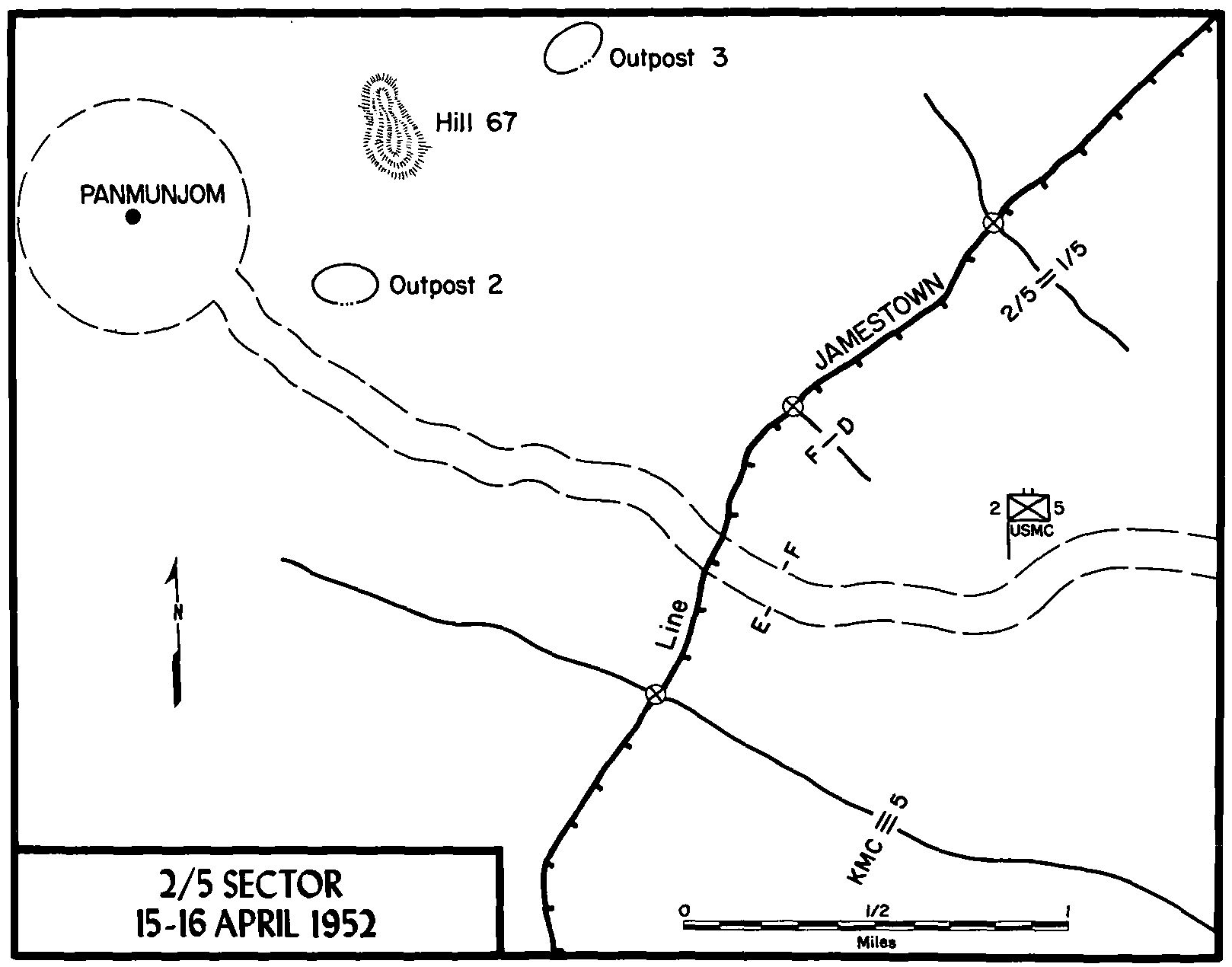
MAP 5 K. WHITE
2/5 SECTOR
15–16 APRIL 1952
At 2330 on 15 April, Company E reported that a green flare cluster
had just burst over Hill 67, approximately 1,900 yards southwest of
OP 3 and just beyond the OPLR. This signal triggered a 20-minute
heavy enemy preparation of 76mm artillery and 120mm mortars on
the friendly outpost and its supporting mortar position. Ten minutes
before midnight, another green flare exploded over the same height,
and the shelling stopped. After five minutes the signal reappeared.
Immediately thereafter, the Chinese shifted their artillery and mortar
fire to an area west of the OP 3 mortar site and north of a Company
F observation post. At the same time, the enemy attacked Outpost
3.
Initially, the Chinese struck the Marine defenses in a frontal assault,
but as the fighting progressed enemy forces quickly enveloped the
outpost and charged it simultaneously from three sides. The vastly
outnumbered Marine defenders withdrew into a tight perimeter at
the southeastern corner of the outpost where their defending firepower
prevented the enemy from seizing the position. Within 15
minutes the enemy had surrounded the Marines and severed the outpost
communications, but could not take the outpost. The CCF soldiers
then pulled back and let their artillery soften OP 3 while they
regrouped for another assault. The Chinese soon stormed the outpost
a second time, but were again unsuccessful. Moreover, they lost three
of their men who were captured by the tenacious 2/5 defenders.
The fighting continued until 0315, reaching a hand-to-hand clash
at one stage. In addition to mortar and artillery fire, the enemy
employed small arms, automatic weapons, hand and stick-type grenades,
bangalore torpedoes, and 57mm recoilless rifles. During the
attack, patrols were sent out from the MLR and OP 2, to the west,
to reestablish contact and help with casualty evacuation.
Well to the rear of the outpost and unknown to its occupants,
intelligence personnel intercepted a Chinese message ordering the
Communists to withdraw. Immediately, friendly artillery fired on all
known escape routes available to the attackers. Despite this interdicting
fire, the enemy soldiers managed to withdraw without further
loss. Their unsuccessful thrust against the 2/5 OPLR cost the Chinese
25 known killed, 25 estimated killed, 45 known wounded, and 3
prisoners. Marine casualties were 6 killed, 5 missing, and 25 wounded
and evacuated.46
Why the Chinese had selected OP 3 for their mid-April attack is
not known. Several theories, however, have been advanced by those
involved in the action. Colonel Culhane, the regimental commander,
believed that the enemy incursion “was the direct result of the aggressive
patrols that frequently used the outpost as a point of departure....”47
Brigadier General Merrill B. Twining, the assistant division
commander since 22 March, declared that the position was too large
for a reinforced platoon to hold.48 Perhaps the Chinese had harbored
the same thoughts before the night of 15–16 April.
Just before its OPLR was withdrawn in favor of an observation
line, the 1st Korean Regiment was struck by the Chinese in the area
immediately north of the 1–2 April clash. Beginning at 0100 on 17
April, the enemy placed a 15-minute preparatory fire on the left flank
of the 3d Battalion, occupying the regimental right sector. The CCF
then probed friendly lines in and around the area pounded during
the preliminary fires. Three separate attacks took place before 0400,
when the Communists withdrew. In these probes, the Chinese made
free use of automatic weapons; the enemy’s well-coordinated action
attested to their training and discipline. Confirmed casualties were
36 CCF and 2 Koreans killed. The KMCs suffered 5 wounded and
estimated that 70 Chinese had been wounded. Although the South
Koreans frequently called down artillery support during the attack,
most of the casualties inflicted on the enemy were from rifle and
machine gun fire. The 17 April probe was to mark the last major
infantry action for the 1st Marine Division during its second month
on JAMESTOWN.
Throughout the month a total of 5,000 rounds of artillery fire and
3,786 rounds of mortar fire fell in the division sector. On 2 April
the greatest volume for any single day was received: 3,000 artillery
and 118 mortar rounds. An average day’s incoming, during April,
was approximately 167 artillery and 125 mortar rounds.
Even before the Communists had launched their mid-April attacks
against JAMESTOWN, the 1st Marine Division had implemented plans
to strengthen its line in western Korea. Besides the digging, timbering,
and sandbagging to accomplish a major improvement of the
physical defenses, General Selden required Marine infantry regiments
to conduct an aggressive defense of their sector of responsibility.
He ordered MLR units to employ snipers all along JAMESTOWN
and to dispatch daily patrols forward of the line to ambush,
raid, kill, or capture Chinese and their positions. The division commander
further directed that supporting arms such as artillery, tank,
and air, when available, be used to destroy hostile defenses, harass
the enemy, and break up his assemblies as well as to protect Marine
positions.
As a result of an I Corps directive, the 1st Marine Division
assumed responsibility for an additional 6,800 yards of front on
14 April from the 1st Commonwealth Division sector to the right
of the division. In preparation, the 5th Marines had taken over the
western end of the 1st Marines sector, held by 2/1, two days earlier.
On the 14th the 1st Marines, newly commanded by Colonel Walter
N. Flournoy,50 extended its line eastward to assume new limiting
points and part of the MLR in the western part of the Canadian
Brigade sector. Relief of the Commonwealth unit was completed
without any difficulty or enemy interference. This additional yardage,
plus the Kimpo Peninsula front, now stretched the Marine division
MLR to 35½ miles.
As a result, General Selden found it necessary to withdraw the
division general outpost line in order to build up his main line of
resistance. On 17 April, the 1st KMC Regiment reduced its OPLR
to an OPLO (outpost line of observation) and the left battalion
pulled its MLR back to more defensible ground. The Marine division
center and right regiments withdrew their outpost lines on 23 and
24 April. Both regiments then established forward outposts and listening
posts which, in many cases, utilized former OPLR positions.
Many of these posts were manned during daylight hours only.
Abandonment of the forward OPLR added strength to the main
line, but it also meant that frontline battalions had to commit all
their companies on line, thus losing their reserve. To prevent Chinese
occupation of desirable terrain features on the former OPLR, the division
dispatched combat and reconnaissance patrols forward of its
line. In the KMC sector, the only Marine area favorable for tank
operations forward of JAMESTOWN, tank-infantry patrols were periodically
employed.
To the west of the KMC sector, the Marine 1st Amphibian Tractor
Battalion (Lieutenant Colonel Michiel Dobervich) was assigned
a section of the KANSAS Line to defend, beginning 16 April. Reinforced
by attachment of the Division Reconnaissance Company (Major
Ephraim Kirby-Smith) that same day, Lieutenant Colonel Dobervich
employed Company C (two platoons), the headquarters LVT
platoon, and the reconnaissance unit to man 30 defensive positions
from the Han River eastward to the KMC western boundary.51
Two other measures to strengthen his sector of JAMESTOWN were
utilized by the Marine division commander. On 18 April, he asked
General O’Daniel to reconsider the no-fire zone recently established
by the corps commander. General Selden, who had received reports
of Chinese use of the sanctuary located within Marine Corps territory—for
firing positions and assembly areas primarily—recommended,
after I Corps had refused him permission to fire into the haven, a
redrawing of the O’Daniel line to coincide more closely with the
boundaries established by the UN. Approval along the lines submitted
by the division was given by I Corps that same day. The second
measure employed by General Selden was use of an additional
defensive line, WYOMING FORWARD. This position, closely paralleling
JAMESTOWN in the KMC and 5th Marines sectors, added depth to
the sector defenses.
A unique rescue and recovery operation also came into existence
about this time. On 19 April the division ordered the 5th Marines,
occupying the center regimental sector, to organize a tank-infantry
force for rescue of the United Nations Truce Team, should such
action become necessary. The regimental plan, published on 22 April,
utilized a reinforced rifle company-tank company organization directly
supported by organic 5th Marines 4.2-inch mortars and 1/11.
The Everready Rescue Force, from the regimental reserve, occupied
the high ground (OP 2) east of and dominating Panmunjom.
In addition to setting forth organizational details of the task unit,
the 5th Marines Operational Plan 6-52 specified the method of
operation for the rescue force. Taking advantage of the peace corridor
in the western end of the center sector, a Forward Covering
Force would speed tank-riding infantry to the high ground one-half
mile beyond the objective, Panmunjon. Following would be the Pick-Up
Force, from the 1st Tank Battalion Headquarters Platoon, which
would retrieve the principal UN delegates and take them quickly
to the assembly area two miles to the rear of the MLR. A Rear
Covering Force, composed of a tank-infantry element, would follow
the Pick-Up force both on its way towards the objective and on the
return trip. Withdrawal of both covering forces was regulated by a
series of phase lines.
Even though the Marine air-ground team had been shorn of much
of its tactical aviation, what remained was well utilized. Helicopter
troop operations had become commonplace by the end of April 1952.
That month there were three exercises to further evaluate tactical
concepts of helicopter employment. Operation PRONTO, conducted on
5 April, was the first major troop lift in the new I Corps sector. In
this maneuver approximately 670 troops of 2/7 and 10,000 pounds
of rations were transported by helicopter and truck from the
Munsan-ni vicinity across the Han River to the Kimpo Peninsula.
Here the reserve battalion served as a counterattack force in a hypothetical
enemy landing. Due to the necessity for avoiding the neutrality
zone in the Munsan area, round-trip flights averaged about
57 miles.
The exercise combined the shortest notice and longest distance of
any large-scale helicopter troop movement conducted by HMR-161.
It pointed to the fact that a helicopter unit could successfully lift a
troop organization virtually as an “on call” tactical tool and without
the benefit of previous liaison.
Operation LEAPFROG, on 18–19 April, transported one KMC battalion
across the Han to the peninsula and lifted out another the following
day. The purpose of this test was to determine the feasibility
of a replacement movement conducted over water, with “consideration
given to the language barrier existing between the troops and
the transporting facility.”53 The six-mile round trip was the shortest
troop haul yet made by the transport chopper squadron. Consequently,
it took the 12 HRS-1 single-engine Sikorsky aircraft only
3 hours and 26 minutes to complete the exchange of the 1,702
KMC troops.
Colonel McCutcheon’s HMR-161 pilots found that their helicopters
could carry six combat-equipped Korean Marines instead of
five American Marines, due to the smaller size and weight of the
average Korean. Since the U.S. and KMC Marine battalions were
the same size, the larger load factor for the Korean Marines enabled
their unit to be moved faster. In LEAPFROG the language difference
proved to be no handicap, since there were sufficient interpreters on
hand and the troops were cooperative. Helicopter pilots could use
landing sites close together because the terrain was open and the
area of operations beyond the reach of Chinese artillery.
Close on the heels of LEAPFROG came a third airlift. Operation
CIRCUS, conducted on 23 April, provided for the air deployment of
the 7th Marines reserve regiment, minus two battalions, across the
Imjin to landing sites just to the rear of the secondary defensive
line, WYOMING FORWARD. Ten helicopters carried 1,185 Marines
over the river barrier to blocking positions in 90 minutes. The CIRCUS
exercise illustrated that a minimum distance should be maintained
between loading and unloading sites for a safe and efficient transport
operation. It also pointed up that “consideration must be given
to the number of aircraft assigned to each traffic pattern during
short hops over a river.”54 This successful maneuver came three
days before all HRS-1 aircraft were grounded due to a defect in
the tail rotors. By mid-May the problem had been corrected and
the aircraft returned to flying status.
During April, Lieutenant Colonel Herring’s VMO-6 employed its
11 single-engine OE-1 observation planes for a total of 508 fixed-wing
combat flights. More than half of these, 275, were for artillery
spotting; of the remainder, 166 were flown for reconnaissance and
67 represented photo, weather, liaison, and area check-out maneuvers.
Combat flights by the squadron helicopters55 during the month were
110 liaison, 45 reconnaissance, and 93 evacuations. Of the total 756
combat flights performed by both fixed-wing and rotary craft, 511
were over enemy territory.
During that same month, Marine squadrons operating under the
Fifth Air Force put a total of 2,708 planes into the air despite restrictive
or prohibitive weather on 20 days. Continuing its emphasis on
attacking the North Korean transportation system, the Air Force
command dispatched 1,397 Marine planes on interdiction missions.
Marine-piloted close air support sorties flown to assist the 1st Marine
Division numbered only 56 throughout April; those piloted by Marines
for 16 other UN divisions totaled 547.
Not all the air sortie records were made by land-based Marine
squadrons. On 18 April, VMA-312, the CTE 95.11 squadron provided
by the 1st Marine Aircraft Wing, flew 80 sorties, a Korean
record for a carrier-based squadron to that date and twice the daily
average for the initial six months of 1952.
By 20 April the three tactical squadrons of MAG-12—VMF(N)-513,
VMF-212, and VMF-323—had completed their relocations on
the Korean west coast. Two days later, combined MAG-12 attack
and -33 jet aircraft participated in what was a Fifth Air Force
one-day combat record: 1,049 sorties.
One MAG-33 unit, the newly-formed Marine Photographic Squadron
1, was already flying a large number of aerial reconnaissance
missions directed by Fifth Air Force. It provided almost one-third of
the daylight photo effort required by FAF with but one-quarter of
the aircraft.56 VMJ-1’s complement of a dozen 550 mph McDonnell
twin-jet Banshee F2H-2P aircraft mounted three cameras and were
capable both of high altitude work and good speed. Introduction
of this single-seat jet was considered the “first important development
in aerial photography in the Korean War,”57 since the Banshee
could outproduce any photo plane in Korea.
The month of April also marked change of command ceremonies
for the 1st Marine Aircraft Wing. On 11 April at K-3, General
Schilt turned over wing responsibility to Brigadier General Clayton
C. Jerome. Among the numerous civilian and military dignitaries
attending the ceremony at the Pohang 1st MAW headquarters were
the Honorable John J. Muccio, U.S. Ambassador to Korea; Air Force
Lieutenant Generals Otto P. Weyland and Frank F. Everest, commanders
of FEAF and FAF respectively; and the Marine division CG,
Major General Selden.
The new wing commander, General Jerome, like his predecessor,
had a distinguished flight career. A 1922 graduate of the Naval
Academy, he had served in various foreign and U.S. aviation billets
and was a veteran of five World War II campaigns. In 1943 Colonel
Jerome was operations officer for Commander, Aircraft, Solomon
Islands. Later he was named Chief of Staff, Commander, Aircraft,
Northern Solomons and Commander, Aircraft and Island Commander,
Emirau, in the northern Solomons. Before returning to the
States, Colonel Jerome had participated in the recapture of the
Philippines, commanding MAG-32 and directing all Marine air support
in the Luzon fighting. Brigadier General Jerome became Director
of Aviation and Assistant Commandant of the Marine Corps for
Air in September 1950 and served in this capacity until taking command
of the 1st Marine Aircraft Wing in Korea.58
During the command ceremonies the outgoing 1st MAW commander,
General Schilt, was presented the Distinguished Service
Medal for his outstanding leadership of the wing. The award was
made by Lieutenant General Weyland. Shortly before his Korean
tour ended, General Schilt had also received from ROK President
Syngman Rhee the Order of Military Merit Taiguk, for his contribution
to the military defense of South Korea.
Because of the command relationships existing in Korea, with all
ground units under operational control of CG, EUSAK, the majority
of the logistical support to the Marines was handled by the Army.
Eighth Army, 2d Logistical Command (2d LogCom) provided for
resupply of items used commonly by both Marine and Army personnel;
the Marine Corps (Commanding General, FMFPac) furnished
those supplies and equipment used by Marine units only.
When the division moved to the west, the 1st Shore Party Battalion
opened a rear service area at Ascom City. Here the division established
and maintained Class II (organizational equipment) and IV
(special equipment) dumps for its units, as well as Class I (rations)
and III (petroleum products) facilities for both the Kimpo regiment
and the service units stationed at Ascom. Class I shipments were
forwarded to the Munsan-ni railhead and stored there. Fuels and
lubricants and Class V items (ordnance) were received from the U.S.
Army. A forward ammunition supply point (ASP) was located north
of the Imjin to assure a steady flow of ammunition to frontline combat
units in the event that either an enemy attack or emergency
flooding conditions of the river prevented use of the bridges. For the
same reason a truck company was positioned near this supply point
each night.
Reinforcing the division logistic effort was the 1st Combat Service
Group. Commanded by Colonel Russell N. Jordahl, the 1st CSG in
late April had nearly 1,400 Marines and Navy medical personnel
stationed at various points between Japan and Korea. At Kobe, Japan,
the Support Company processed Marine drafts arriving and departing
Korea. At Masan, the Supply Company, 1st CSG, requisitioned
for the division those Class II and IV items peculiar to the Marine
Corps needs and forwarded them upon request. Heavy maintenance
of all technical equipment was performed by the Maintenance Company.
Supporting the 1st Motor Transport Battalion operation was
the Motor Transport Company, 1st CSG. Most of the group, including
Headquarters Company, was based at Masan.60 Splinter detachments
from the group also operated transport facilities at other
locations in Korea.
In western Korea, good rail transport into Munsan-ni and an adequate
but not all-weather road system improved the division’s logistical
situation. Greater storage facilities also existed in the JAMESTOWN
rear supply areas than in the X Corps sector just vacated by the
Marines. Division motor equipment did not suffer any appreciable
damage due to the rigors of the MIXMASTER transplacement. Vehicle
maintenance also presented a favorable outlook, due to the expected
decreased use during the period of positional warfare. On the other
hand, an unduly large number of tanks developed engine troubles
in March, which were traced back to defective oil cooling fans. This
condition was corrected in April and May by installation of new
fan assemblies.
Guns of the 1st Tank Battalion immediately began to render
valuable support to Marine frontline regiments with the division’s
new assignment in the west. Companies A, B, and C were placed
in direct support of the three forward infantry regiments. Company
D drew the reserve mission, which included tank-infantry training
with the 7th Marines and preparation for reinforcing division artillery
fires. Tank companies were used almost daily in the forward
sectors for destruction by direct fire of the Chinese MLR fortifications.
For such missions the M-46 tanks, equipped with high-velocity
90mm guns, lumbered forward from secure assembly areas to the
rear of JAMESTOWN to temporary firing positions on the line.
After pouring direct fire on preselected targets and completion of
the fire mission, the armored vehicles then returned to the rear. Less
frequently, a five-vehicle tank platoon accompanied a reinforced
rifle platoon and conducted daylight reconnaissance missions of forward
areas to engage the Chinese and to gain intelligence about
enemy positions and terrain. During April six such tank-infantry patrols,
all in the KMC regimental area, failed to establish direct contact
with the enemy but did draw mortar and artillery fire.
Marine artillery, which had been receiving its share of attention
from Communist field guns,61 was faced by problems in two other
respects. Although the enemy held only four more artillery weapons
than did the Marines, General Seiden still lacked the ability to mass
artillery fires to the same degree as did the Chinese.62 This limitation
stemmed directly from the wide physical separation of 11th
Marines batteries and the frontline infantry regiments being supported.
A second problem, the loss of qualified forward observers—reserve
officers due to return to the States for release from active
service—forced the 11th Marines to begin a school to train infantry
officers for this function. To make the course realistic, all firing was
done at live targets.63
In April 1952, the 11th Marines organization had three light
105mm howitzer battalions (54 guns), one medium 155mm howitzer
battalion (12 guns), the KMC 105mm howitzer battalion (18
pieces), and a 4.5-inch rocket battery (6 launchers). Attached to the
1st Marine Division and located in its sector were one battalion and
one battery of the I Corps field artillery. The mission of the Marine
artillery regiment was to provide accurate and timely fires in support
of both the MLR and OPLR defenses, until withdrawal of the
latter late in April. Batteries of the 11th Marines also fired on
known and suspected Chinese gun emplacements and on targets
of opportunity. The regiment also provided intelligence on enemy
artillery.
Throughout April, Colonel Henderson’s units continued to improve
their tactical and administrative areas, concentrating on field fortifications,
wire communications, and road trafficability. In the last category,
the artillery dozers and dump trucks not only did nearly all of
this work for the 11th Marines but also provided “a fair amount
of ‘direct support’ bulldozing to the infantry regiments and occasionally
loaned dozers and operators to the engineers.”64
Within a Marine aircraft wing, personnel and equipment for logistic
support are purposely limited to carrying out the wing primary
mission—providing air support during an amphibious operation. The
wing T/O (Table of Organization) provides a streamlined organization
with light, transportable organic equipment. Additional logistical
support personnel and equipment are not included since this
would result in (1) a duplication of support effort between the wing
and landing force and (2) a great increase in wing transport shipping
requirements. When the wing moves ashore, organic units render
support necessary for operations on the airfield only. Responsibility
for activities beyond this basic mission—airfield construction, maintenance
of runways, and movement of supplies to the airfield—must
come from more senior commands. Usually such assistance is obtained
by attaching elements of a naval construction battalion and
other logistical support units.
In April 1952, Naval Construction Battalion Unit 1804 assisted in
the construction and maintenance received by MAG-33 at K-3. Here
at the port of Pohang, a detachment from the 1st Combat Service
Group controlled the movement of fuels, oils, lubricants, and ordnance
to wing dumps. Amphibian tractors (LVTs) of Company B,
1st Amphibian Tractor Battalion, provided most of the transportation
required for these supplies excepting ordnance. Assistance
in the form of amphibious trucks (DUKWs) was furnished by a
platoon from the 1st Amphibian Truck Company. When required,
Marines of these two companies manhandled the supplies.
Logistical support for the Marine wing was governed by the same
general procedures that applied to the division; 1st MAW supply
requirements beyond its augmented capability became the responsibility
of Eighth Army (2d LogCom) which furnished items common
to both Marine and Army units. If this EUSAK agency did not stock
the requisitioned item, it provided a substitute. Responsibility for
resupply of aviation items rested with the U.S. Navy. Commander,
Naval Forces, Far East (ComNavFE) replaced unserviceable aviation
technical equipment such as aircraft parts and special maintenance
tools. Commander, Service Force, Pacific (ComServPac)
replenished aviation ordnance. Responsibility for supplying items
peculiar to the Marine Corps rested with CG, FMFPac.
The repair and maintenance of 1st MAW equipment posed far less
of a problem than the construction and upkeep of airfields. Major
repair work on aircraft was satisfactorily performed in Japan by the
wing support squadron at Itami, and by the U.S. Navy Fleet Air
Service Squadron 11 (FASRon-11), located at the Naval Air Station,
Atsugi. The establishment in Japan of the wing heavy maintenance
facility depended, in part, upon its proximity to the wing flying
squadrons. Other considerations were the availability to the wing
commander of adequate air transport for continuous resupply of both
routine and emergency items and reliable communications between
the users and the maintenance unit. Because these conditions favoring
removal of the heavy maintenance facility from the immediate combat
area existed throughout Korean hostilities, it was possible for the
maintenance units to operate successfully in Japan away from the
combat zone.
Air base construction and maintenance of airfield runways and
taxiways had plagued wing operations since the early days of the
Korean War. During the first winter these problems had appeared
repeatedly at those installations where Marine air was either not
properly supported or insufficiently augmented by the operational
commander. Shortly after MAG-33 had moved to K-3 in early 1951,
the wing commander requested emergency repairs for the runway
and a permanent solution to the airfield maintenance difficulties.
Assistance was made available, but it was insufficient. The repair
force had to be augmented by Marines pulled away from their own
vital jobs and by native laborers. Later, in the spring of 1952, when
the Air Force assigned some of its engineers to assist, the maintenance
problem almost disappeared.
Motor transport within the wing was a continuing source of
logistical problems. Vehicles for handling the heavier aviation ordnance
were unsatisfactory because their configuration, of World War
II vintage, did not permit them to service the newer aircraft. Other
trucks lacked engine power or rigidity to withstand sustained use
under primitive airfield conditions. World War II vehicles that had
been preserved and placed in open storage required reconditioning
before their use in Korea. Mechanics’ general and special tools had
a high replacement rate throughout the entire period of wing operations
in Korea.
Aircraft fuel handling in April 1952 followed outmoded World
War II methods. For K-3, amphibian vehicles received drummed fuel
from ships and landed it at the beach. There MAG-33 personnel
transferred the gasoline to 1,200-gallon fuel trucks, which then moved
it to the airfield servicing area, where other Marines transferred it
again, this time to 3,200-gallon stationary refuelers for dispensing
into the aircraft. Although this method became highly developed, it
was extremely slow and wasteful of manpower and vehicles in comparison
to the tank farm system, which was soon to reach K-3.
Two areas of logistics continued to remain almost trouble free for
division and wing Marines. Medical problems existed but were not
extensive. During a five-day period in late March, Marine Air Control
Group 2 experienced 13 cases of scarlet fever but no fatalities. That
same month, the Pacific Fleet Medical Officer noted that MAG-12
sick bays were in excellent condition and that medical “personnel
have shown great ingenuity in fabricating various items of medical
equipment from scrap metal and lumber.”65
Evacuation of casualties and the utilization of air vehicles for
transport of passengers and cargo proved to be the second asset in
logistical operations. The Itami-based detachment of VMR-152
moved 7,757 personnel from the division and wing and 738.7 tons
of cargo during April 1952. In addition, the R5D craft hauled a total
of 325.2 tons of U.S. mail that month for the two Marine organizations.
Speedy removal of patients to better equipped facilities in the
rear by VMO-6 and HMR-161 helicopters was a giant step forward
in life-saving techniques. VMO-6 usually provided this service, but
early in April, Colonel McCutcheon’s squadron was assigned emergency
medical evacuation duties to augment the observation squadron.66
Pilots flew these evacuation missions with almost total disregard
for adverse weather or darkness, and without radar control or adequate
instrumentation for all-weather operations.67
An additional responsibility the 1st Marine Division inherited when
it moved to western Korea was control of civilians within the division
boundary. In eastern Korea, all nonmilitary personnel had been evacuated
from the vicinity of the MINNESOTA Line in the division sector;
they had not been removed from the JAMESTOWN area. Prior to the
arrival of the division in the west, the STAYBACK Line, averaging
seven miles to the rear of the Imjin River and running in a generally
northeast-southwest direction, had been established to limit the movement
of civilian personnel in the forward areas. The Marines soon
found that their predecessors must have been lax, however, in requiring
that Korean civilians remain behind STAYBACK. What seemed
equally unsuitable to the division was the poor military-civilian
relationship that had apparently existed for some time.
To correct the situation, General Selden cautioned his units to
avoid unnecessary damage or destruction to the civilian economy. He
directed his commanding officers to keep unauthorized Koreans away
from Marine installations. Military police set up check points and
instituted roving patrols to enforce division controls. Civil violators
were turned over to Korean authorities or held for investigation
before release. Civilians who lived in the forward areas were removed
to the rear. They were prevented from going beyond STAYBACK until
August 1952, when a controlled passage system was instituted.
CHAPTER II Defending the Line — UN Command Activities 69 — Defense of West and East Coast Korean Islands 71 — Marine Air Operations 80 — Spring 1952 on JAMESTOWN 115 — End of the Second Year of War 133 — A Long Fourth of July 139 — Changes in the Lineup 145 — Replacement and Rotation 146 — Logistical Operations, Summer 1952 153
UN Command Activities—Defense of West and East Coast
Korean Islands—Marine Air Operations—Spring 1952 on
JAMESTOWN—End of the Second Year of War—A Long Fourth
of July—Changes in the Lineup—Replacement and Rotation—Logistical
Operations, Summer 1952
Movement of the 1st Marine Division to the west was part of
an Eighth Army master plan to strengthen UN defenses and
at the same time to enable South Korean forces to assume increased
responsibility in the defense of their homeland. The tactical realignment
in the spring of 1952 put more South Korean infantry units on
the main line of resistance and buttressed the fighting front with five
corps sectors instead of four. In the far west, the I Corps positions
were newly manned (left to right) by the 1st Marine, 1st Commonwealth,
1st ROK, and the U.S. 45th Infantry Divisions. Next in line
was IX Corps, whose left boundary General Van Fleet70 had shifted
further west, which now had a divisional line up of the ROK 9th on
the left, the U.S. 7th in the center, and the U.S. 40th on the right.
To fill in the central part of the EUSAK front where the change of
IX Corps boundary had created a gap in the line, the UN commander
inserted the ROK II Corps with three divisions (ROK 6th, ROK
Capital, and ROK 3d) forward. Immediately to the right of this
new ROK corps sector, the X Corps continued in approximately its
same position on the east-central front. Its ROK 7th and U.S. 25th
Divisions remained on line, while the ROK 8th had advanced to the
former sector of the Marine division in the wild Punchbowl country.
At the far right of the UN line, the ROK I Corps front was held by
the ROK 11th Division at the X Corps boundary and the ROK 5th
along the Sea of Japan. By 1 May 1952, nine Republic of Korea
divisions had been emplaced on the UNC main defense line, three
more than had been there in mid-March.
Throughout Korea in March and April there had been a general
stagnation of offensive action on both sides because of fog, rain, and
mud. In May, however, the Chinese launched no less than 30 probing
attacks against the ROK 1st Division in the I Corps sector, without
gaining any significant advantage. To the right, the enemy and the
U.S. 45th Division traded blows in several patrol actions. In June,
major EUSAK combat action was still centered in the 45th’s sector,
but the following month was marked by sharp battlefront clashes in
nearly all Eighth Army division areas. For a two-week period in
July and August, heavy seasonal rains limited both ground and air
action. With the return of normal weather, heavy fighting again
broke out, this time concentrated in the I Corps sector. This action
did not abate until late August, when the onset of the heaviest rains
of the season again drastically reduced military operations.
Communist ground activity in the spring of 1952 was marked by
increased artillery support which resulted in telling damage to UN
infantry and artillery positions. Thus, during May, the enemy expended
approximately 102,000 artillery and mortar rounds against
the Allied front, roughly 12 times the number fired the previous July,
just prior to the period of stabilized battlelines in Korea. The artillery
buildup was accompanied by a sharp decrease in hostile air support
activities. While the Chinese had flown 3,700 jet sorties during the
first month of 1952, by June the monthly total had dropped to 308.
As part of the balanced military forces, Allied air and sea units
continued their active defense in support of UN ground units. Beginning
in late May, Fifth Air Force shifted the emphasis of its
destructive effort from interdiction of communication routes to the
bombing of selected industrial targets. Naval air was committed to
support the FAF programs. At sea, ships steamed almost at will to
sustain the U.S. lifeline. Underscoring the complete UN control of
Korean waters, large naval vessels offshore fired their big guns in
support of ground troops. Off both the west and east coasts, Task
Force (TF) 95 maintained its blockade of North Korean ports and
reduced the extent of water travel that enemy craft could safely
undertake. This same naval force was responsible for the Allied
defense of islands located off the east and west coasts of Korea.
Just off the northwest Korean mainland a string of islands extends
from the mouth of the Yalu River down around the peninsula to
Pusan in the southeast. Most of these islands are tiny and are located
south of the 38th Parallel. Only a few lie off the east coast, and these
are clustered primarily in the North Korean harbor of Wonsan. By
early 1951, UN forces exercised control over most of the Korean
islands. Their tactical importance is shown from their diverse use as
sites for UN Command intelligence activities, USAF radar installations,
locations for the emergency landing strips used by Allied
planes, bases for U.S. search and rescue operations, and as springboards
for possible thrusts into enemy rear areas.72
Another reason for holding some of the islands had come to light
during truce negotiations in December 1951. At that time, in an
attempt to expedite the successful conclusion of the truce meetings,
UN representatives had offered the Communists all the islands north
of the 38th Parallel. Brushing aside the tactical value of the proposal,
the enemy boasted that he could capture the islands at any
time. In November 1951 the Communists had, in fact, seized two
western islands near the mouth of the Yalu. The 1,000 defending
guerrillas there—former North Koreans working for the UNC—had
been unable to stem the assault. The UN Command promptly
reviewed the island situation and on 6 January 1952 gave TF 95,
the United Nations Blockading and Escort Force, responsibility for
both overall defense and local ground defense for the 11 coastal
islands north of the 38th Parallel and the 4 islands immediately south
of this boundary. Two subordinate blockade task groups, one in the
west and another in the east, were responsible for the defense of
these islands.
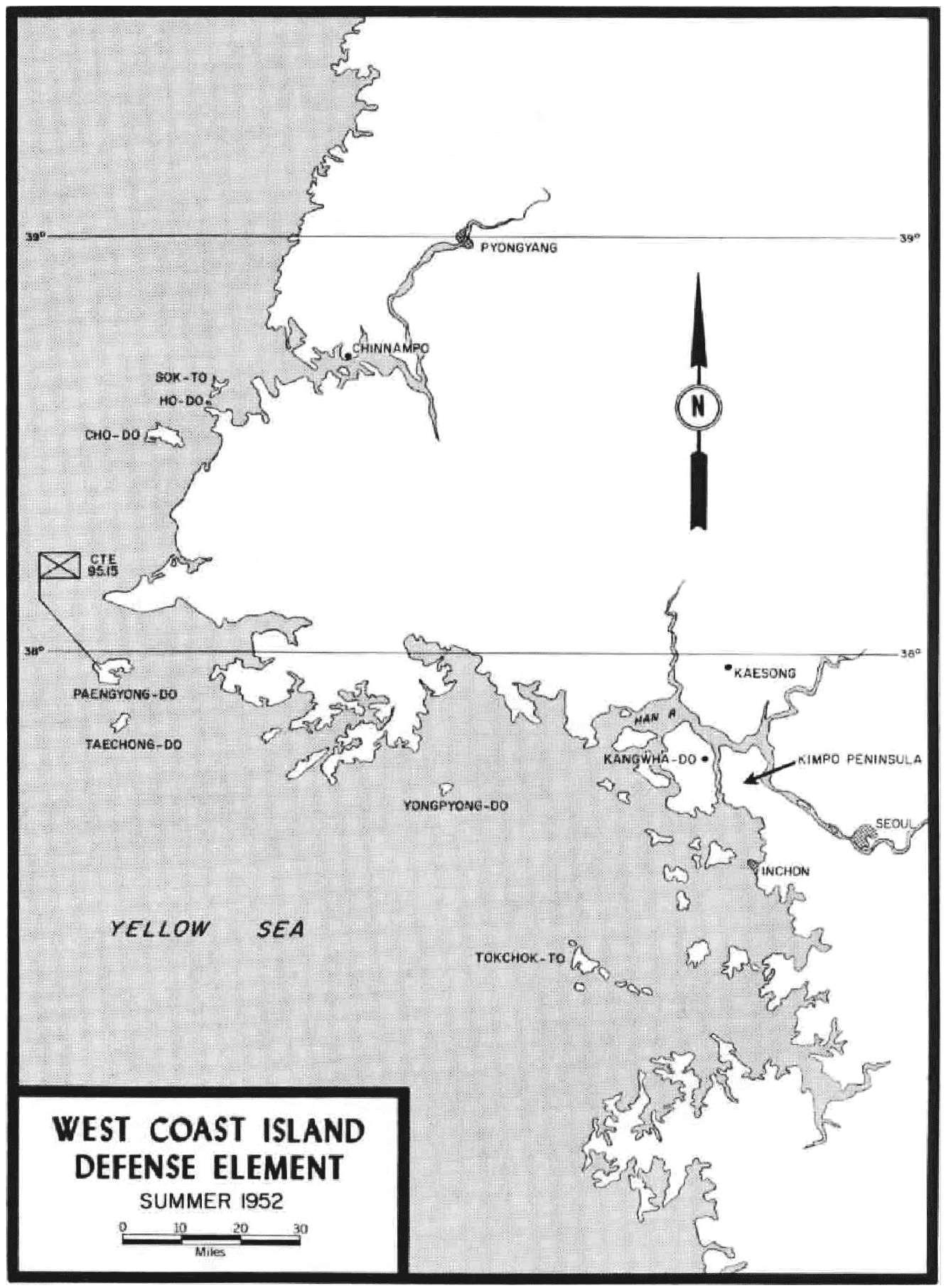
MAP 6 K. White
WEST COAST ISLAND DEFENSE ELEMENT
SUMMER 1952
In the west, Task Group (TG) 95.1 was charged with the defense
of six islands. (See Map 6.) Two of these, Sok-to and Cho-do, lie
between the 38th and 39th Parallels; the four remaining islands,
Paengyong-do, Taechong-do, Yongpyong-do, and Tokchok-to, are
above the 37th Parallel. In the east, TG 95.2 was responsible for
keeping nine islands north of the 38th Parallel in friendly hands. Situated
in Wonsan harbor are Mo-do, Sin-do, So-do, Tae-do, Hwangto-do,
Ung-do, and Yo-do, the largest. (See Map 7.) Another island,
Yang-do, actually a two-island group further north in the area of
the 41 st Parallel, is 18 miles northeast of the coastal city of Songjin.
The southernmost island, tiny Nan-do, is below Wonsan and the
39th Parallel and lies 10 miles northeast of Kojo, another coastal city.
Ground defense of the islands had been, at best, a haphazard
arrangement before TF 95 took over the responsibility. Many of the
islands, especially those inhabited by friendly guerrillas, had neither
plans for a proper defense nor commanders experienced in organizing
resistance to enemy attack. Soon after the two islands near the
mouth of the Yalu were taken, ROK Marines were rushed to those
islands considered most strategic for South Korean defense. Late in
1951, U.S. Marines had been assigned to the area in an advisory
capacity. By early 1952, Marine Corps detachments were in command
of the island defense activities for both task groups. Korean Marines
provided a majority of the actual defending forces.
Although the 1st Marine Division initially had supplied the officers
and men for the island security missions, in January 1952 FMFPac
took on direct responsibility for furnishing personnel and providing
for their administrative and logistical support through the 1st Provisional
Casual Company, FMFPac. Located at Otsu, Japan, the
company was the administrative headquarters for seriously wounded
Marine division and wing personnel recuperating in service hospitals
in Japan. Recovered patients who volunteered for duty with the
offshore commands provided the bulk of the Marines used in this
defense. Major responsibilities were to plan, organize, and conduct
the defense of these islands off the Korean west and east coasts.
A task element under each task group was created for this purpose.
With its headquarters at Paengyang-do, Task Element (TE) 95.15,
the West Coast Island Defense Element (WCIDE), was organized
early in January 1952. The following month, the initial complement
of U.S. Marines arrived. Colonel William K. Davenport, Jr., element
commander, assigned his 5 officers and 29 enlisted men to the 4 most
critical islands and to his staff. Those islands garrisoned were Cho-do
and Sok-to, north of the Parallel and both within range of enemy
mainland guns, and Paengyang-do and Yongpyong-do, to the south.
Taechong-do, near the command island, and Tokchok-to, southwest
of Inchon, were both considered secure and not provided with U.S.
Marine commanders. At each of the four occupied islands, Marines
reconnoitered the terrain, drew up plans for preparation of defensive
positions, organized and trained the troops available, and began the
laborious task of constructing the defense. Protection against long-range
hostile artillery fire was emphasized for the northern Sok-to
and Cho-do garrisons.
Off the other long coast of Korea, TE 95.23, the East Coast Island
Defense Element (ECIDE), commanded until early May 1952 by
Colonel Frank M. Reinecke, had an almost entirely different situation.
Eight of the nine islands in the vicinity of Wonsan Harbor or
north of Songjin that ECIDE was responsible for were within range
of Communist shore batteries and thus frequently fired upon. Even
before the January 1952 decision, the U.S. Navy had been charged
with the security of these east coast islands north of the 38th Parallel.
For these reasons ECIDE defenses had to maintain a greater state
of readiness and were more advanced than in the west. Fire support
ships and land based U.S. Marine naval gunfire spotting teams from
1st ANGLICO (Air and Naval Gunfire Liaison Company), FMF,
which also provided forward air controllers for the KMC regiment,
stood by at all times to silence unfriendly artillery fire emanating
from the mainland. The Marines had also trained Korean Marines
to handle the spotting missions.
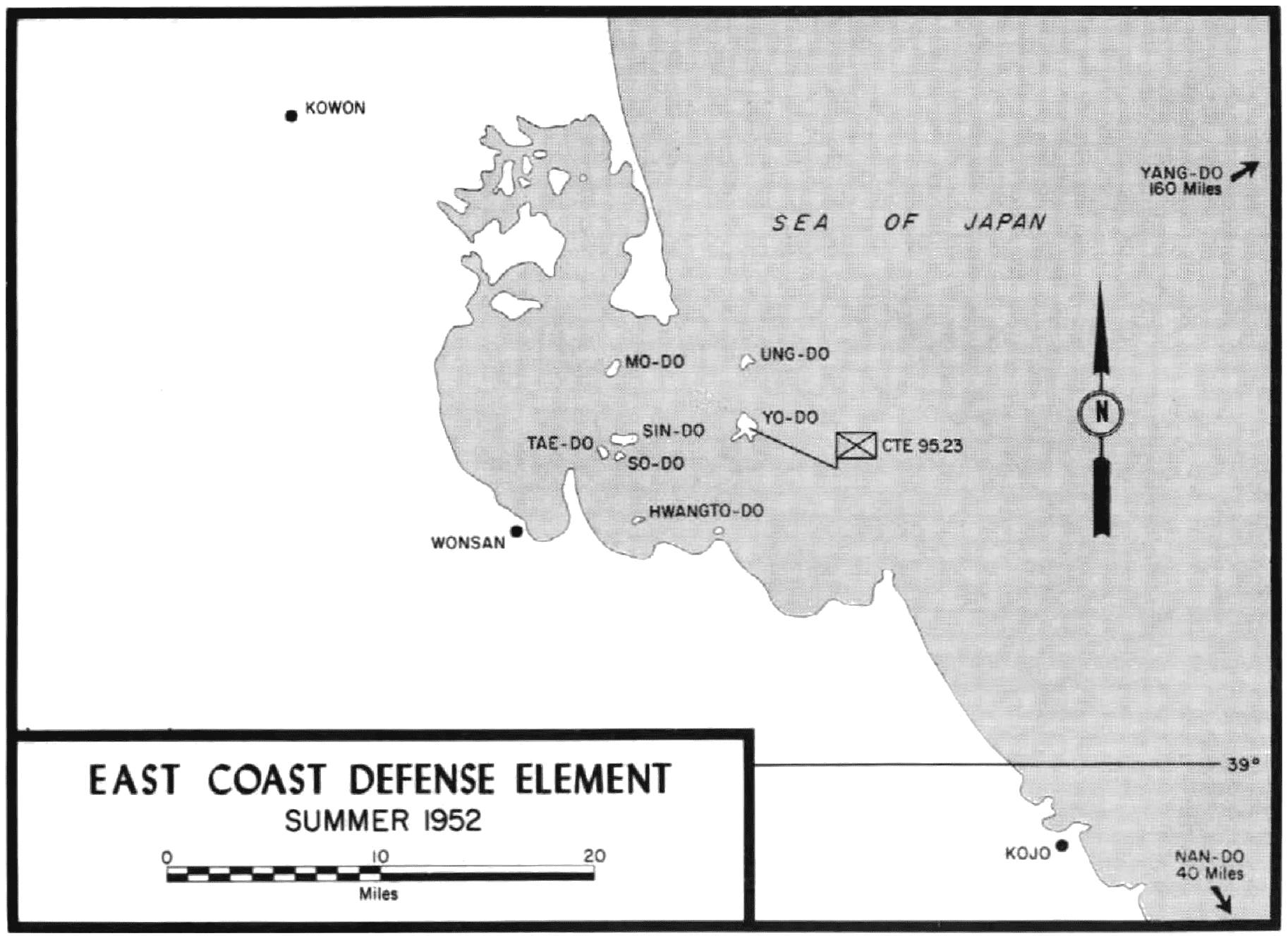
MAP 7 K. WHITE
EAST COAST DEFENSE ELEMENT
SUMMER 1952
A number of events of major interest occurred during those first
difficult weeks following organization of the two offshore island
commands. On 19 and 20 February, elements of two North Korean
infantry battalions launched an unsuccessful assault against the two
Yang-do islands. The combined “action of the island garrison and
UN surface forces”73 repulsed the enemy attempt, which had been
planned to gain intelligence and kill as many of the defenders as
possible.74 On the heels of this action, with the first enemy effort to
take an east coast island, came an unexpected bonus in the form of
a defector. Brigadier General Lee Il, NKPA, came ashore on 21
February at Tae-do “in a stolen sampan with a briefcase full of top
secret papers, a head full of top secret plans, and a strong desire
to make himself useful.”75 He was rushed immediately to Eighth
Army intelligence officers.
The next day command personnel of the west coast TE 95.15 were
treated to a surprise, though not so pleasant as the unforeseen defection
of the NKPA general. Rear Admiral George C. Dyer, Commander
Task Force (CTF) 95, and his staff were engaged in an
inspection of the WCIDE islands. While the party was looking over
the antiaircraft defenses at Paengyong-do:
... an aircraft of VMA-312 made a pass at the CP, followed closely
by a second plane. The second aircraft made a message drop and accidentally
released a 500-pound bomb, which landed from 75–100 feet west of
the CP, shattering all windows and blowing all the doors off their hinges.
Personnel harbored within the CP were thrown to the floor by the concussion,
a few sustaining minor cuts and bruises, but no fatalities were
incurred.... Commanding Officer, USS Bairoko [the carrier to which
VMA-312 was assigned], sent a note of apology to CTE 95.15 and later
followed up with material to repair the CP.76
In March, CTG 95.1 directed the occupation of Ho-do, barely
more than a speck of dirt 4,000 yards south of Sok-to and within
400 yards of the Communist mainland. Despite Colonel Davenport’s
objection that the proposed action was beyond the defensive mission
of his command and that the proximity of Ho-do to the enemy shore
made the island untenable,77 the task group commander would not
rescind the directive. After a detailed reconnaissance by First Lieutenant
Wallace E. Jobusch, Colonel Davenport ordered a reinforced
Korean Marine Corps platoon to occupy the island. This order was
carried out, but during the night of 25–26 March the platoon lost its
newly gained objective to a well-coordinated enemy amphibious attack.
Not a single Korean Marine survivor could be accounted for
at daylight. On 2 April, however, after the enemy force had departed
Ho-do, six of the platoon turned up on Sok-to. They had
survived by hiding out at Ho-do. None of the others were ever seen
again. After the island was overrun, it was not reoccupied by Allied
forces.
After this latest offensive action in the west, the Communists
made no further attempts to seize any of the islands. U.S. and ROK
Marines enjoyed a period of relative freedom from enemy harassment,
except for frequent shore battery shelling directed against the
east coast islands. For WCIDE command members the quiet island
duty was interrupted only occasionally by hostile artillery fire although
rumors of imminent enemy landings abounded. On 13 October, however,
the enemy bombed Cho-do in the first air attack made against
an island garrison since the U.S. Marines had been assigned the
west coast island command responsibility. No casualties resulted from
this raid. The lull in enemy activity that then ensued enabled island
personnel to devote increased efforts towards improvement of their
defenses.
Marines instructed, drilled, and conducted tactical exercises for the
island forces. Island commanders supervised the construction and
improvement of gun pits and other defense installations. At the
ECIDE command island, Yo-do, a 2,700-foot airstrip (Briscoe Field)
for emergency landings and intelligence flights had been completed
by June. Since much of the labor was performed by Koreans, the
language barrier sometimes created difficulties. In all these activities
the Marines found that they were hampered but not unduly burdened
by this problem.
One condition, however, did handicap operations of the island
Marines. This was the supply situation which was prevented from
becoming desperate only because the Marines were able to borrow
and obtain necessities from other service activities. The inability of
the island Marines to draw needed supplies from the responsible
U.S. Army agency developed as a result of the slowness of the
Marines in approving the task element tables of equipment (T/E),78
and from insistence of the supplying activity that it would deal only
with those units that had approved tables of equipment. The urgency
of the situation was alleviated in May when weekly supply flights
were begun by the 1st MAW. Even when surface ships did arrive with
provisions, Marines frequently discovered that items which had been
invoiced were missing.79 Consumables, especially, had a high rate of
disappearance.
Close air support of ground troops remained an almost forgotten
mission of Fifth Air Force tactical aircraft. When planes were allotted
for close support, both their customary late arrival over the target
area and pilot inefficiency left Marine ground commanders less than
satisfied.81 The particular concern of General Jerome, the new 1st
MAW commander, was the continuing limited opportunity for his
Marines to execute their normal primary mission—close air support
of frontline troops. Although FAF assigned Marine pilots to support
the 1st Marine Division whenever possible, the infrequent number
of close air support missions performed under the existing sortie
limit was beginning to detract from the quality of delivery. General
Jerome set out to remedy this unfavorable situation.
Working with General Selden, the Marine wing commander prevailed
upon the Air Force to permit close air support training of
wing pilots and of forward air controllers with the Marine division.
On 19 May, CG, FAF lifted the close air support restriction that he
had imposed in front of General Selden’s MLR. By agreement between
the FAF and the two Marine commanders, Fifth Air Force
would permit the scheduling of 12 close air support sorties daily for
a one-month period, MAG-12 was given this training mission, to
begin on 21 May.82
The objective of the CAS program, in addition to providing
operational training and practice for Marine ground officers, air controllers,
and pilots, was to inflict maximum casualties on Chinese
troops and to increase the destruction and damage to their positions.
Before assigning a pilot to the actual training flights, MAG-12 sent
him on a tour of the front lines to become better familiarized with
the topography, the restricted (“no-fly”) areas, and probable enemy
targets. Air strikes requested by the division went directly to MAG-12.
Initially, a limitation of 12 sorties per day was established, but on
17 July—the program having already been extended beyond its
original 30-day limit—a new ceiling of 20 daily sorties went into
effect. The division was also allowed additional flights above this
prescribed daily sortie number when air support was needed to repel
a large-scale enemy attack or to assist in a major Marine ground
assault.
Almost as soon as the Marines began to derive the benefit of the
training program, the flights were terminated by FAF. On 3 August
1952, following a complaint by CG, Eighth Army that Marines were
getting a disproportionate share of the close air support sorties, the
Fifth Air Force notified General Jerome that the special program
would end the next day. General Selden was instructed to request
air support “in the same manner as other divisions on the Army
front.”83 Despite the abrupt termination of the training program,
the division had derived substantial benefits from the 12 weeks of
Marine-type close air support. “Air attacks were the most useful
weapon for dealing with enemy dug-in on the reverse slopes,”84
according to an official analysis. One regimental commander reported
that the 1,000-pound bombs were effective in destroying enemy
bunkers and further noted that the strikes had produced good results
in the “destruction or damaging of enemy artillery and mortar
pieces.”85 Another senior officer commented that air overhead kept
the Communists “buttoned up,” which permitted Marines greater
freedom of movement for tactical and logistical operations.86
A second type of Marine close air support aided the mission of
Marine infantrymen in western Korea during the summer of 1952.
This was controlled radar bombing, which permitted delivery of
aviation ordnance at night or under other conditions of limited or
poor visibility. The Air Force had introduced the concept into Korea
in January 1951, had tested and evaluated it in combat, and shortly
thereafter had put it to good use against the Communist spring
offensives that year. Based on a concept oriented towards deep support
of troops in extended land campaigns, the Air Force system
made use of 20-ton vans to house its ground components.87
The Marine equipment, on the other hand, was more mobile since
it was to be employed close to friendly lines. Referred to as the
MPQ-14,88 the Marine radar bombing system was designed so that
the largest piece could be put into a one-ton trailer. Major ground
items were a generator power supply, a tracking radar, and a computer;
the last essential component, an automatic bombing control,
was mounted in the aircraft.
Developed and hand built after World War II by Marines under
Major Marion C. Dalby at the Naval Air Materiel Test Center,
Point Mugu, California, the MPQ-14 was first used in Korea in
September 1951. Initially, considerable mechanical difficulty was
experienced with radar bombing, which affected the accuracy of the
bombs, but later the system became sufficiently reliable to permit
bomb drops within one mile of friendly lines. Subsequent use confirmed
the tactical precision of the MPQ-14. By the middle of summer
1952, the Marines had obtained Fifth Air Force permission to use
radar bombing, controlled by a forward observer on the ground, in
a close support role.
Before this policy change took place another one, at a still higher
command level, had occurred. On 23 June, FAF planes struck at
eight North Korean hydroelectric plants in the central and northwestern
part of the country. The attack represented a departure from
the intense interdiction of enemy lines of communication (Operation
STRANGLE) which, since May 1951, had characterized FAF support
operations. The shift came about after a Far East Air Forces study
on the effectiveness of the interdiction campaign had concluded, in
part, that the program had been indecisive.89
For more than a year preceding the 23 June attack, the Fifth Air
Force had concentrated its ground support efforts on the disruption
of Communist communication lines so that the enemy would be
unable “to contain a determined offensive ... or to mount a sustained
offensive himself.”90 During the lifetime of the doctrine, no
major offensive had been launched by the enemy, and on this fact
was based the claim for success of the interdiction program.
Opponents, however, pointed out that despite this maximum FAF
air effort, the Communists had built up their strength, including
support areas immediately to the rear of their front lines and
resupply installations. As the recent UN commander, General
Matthew B. Ridgway,91 told members of the Senate Committee on
Armed Services on 21 May 1952, the same month that FAF had
begun to shift its air effort away from interdiction, “I think that the
hostile forces opposing the Eighth Army ... have a substantially
greater offensive potential than at any time in the past....”92
A number of factors contributed to the reduced emphasis on the
interdiction strategy. Three, however, appear to have most influenced
the inauguration of Operation PRESSURE, the name given the new
policy of concentrating aerial attacks on major industrial targets
considered of greatest value to the North Korean economy. Mounting
FAF aircraft losses due to enemy flak (fire from ground-based
antiaircraft weapons) and an insufficient number of replacements
helped shape the new program. By April 1952 FEAF had received
“only 131 replacement aircraft of the types engaged in rail interdiction
against the 243 it had lost and the 290 major-damaged aircraft
on interdiction sorties.”93 These heavy losses had resulted from
the increasing accuracy of Communist antiaircraft ground weapons,
a capability Air Force planners had failed to consider sufficiently.94
Although significant, this loss factor was not the final consideration
in executing PRESSURE attacks against the power plants. More
directly responsible were two other recent developments. These were
the decision of the new UN commander, General Mark W. Clark, to
take forceful action to bring the Communists around to an armistice
agreement and a top-level Defense Department change of policy that
had removed a major North Korean hydroelectric facility from the
restricted bombing list. This was the Suiho plant, fourth largest in
the world. Adjacent to the Yalu River, about 75 miles northeast of
its mouth, Suiho supplied approximately 25 percent of the electrical
power used in nearby northeast China.95
Results of the PRESSURE strikes, carried on from 23–27 June,
were highly successful. Marine, Navy, and Air Force planes flew
1,654 attack and escort sorties in these raids. Of the 13 target plants
attacked during this period, 11 were put out of commission and 2
others were presumably destroyed. North Korea was almost blacked
out for two weeks. Chinese and Russian experts were rushed to North
Korea to lend a hand in restoration. The hydroelectric strikes marked
the first time that Marine, Navy, and Air Force pilots had flown
a combined mission in Korea. The 23 June strike, moreover, was of
particular significance to 1st MAW since it was also the first time
that MAGs-12 and -33 were assigned group strikes at specific
adjacent targets at the same time.
Led by Colonel Robert E. Galer, the new MAG-12 commander
since 25 May, group pilots struck and leveled the single power complex,
Chosin 3, in the 23–24 June runs. Colonel John P. Condon,
who had taken over MAG-33 on 24 May, put 43 jets from VMFs-311
and -115 into the air during the two-day mission. The first time
that its F9Fs had ever been massed for a strike of this type, the
MAG-33 jets similarly destroyed the Chosin 4 plant, 11 miles
northwest of Hamhung.
Although the jets carried a smaller payload than the Corsairs and
ADs of MAG-12 (approximately 37 gross tons to more than 150
tons), the extremely precise bombing record made by the Grumman
Panther jet pilots forever put to rest the doubts about jet accuracy
that had been held by some in 1st MAW. As the group commander
later recalled, “The capability of jet strike aircraft for extremely
accurate bombing, an item of open discussion prior to this time, was
never questioned in the 1st Marine Aircraft Wing after this mission.”96
Another gratifying result was that flight personnel on all of
the 150 Marine aircraft returned safely. In fact, of the total 1,645
FAF sorties, only 2 aircraft were downed; rescue aircraft successfully
picked up these two pilots, both U.S. Navy officers.
It was the high probability of being rescued, if forced to abandon
their aircraft, that not only eased the minds of pilots on missions
north of the 38th Parallel but also permitted the fliers a greater
degree of success. As the MAG-12 commander, Colonel Galer, who
was shortly to escape imminent capture by the enemy, later declared,
“I do know that every pilot flying in this theatre should have the
highest possible morale with the knowledge that so many are ready
and willing to risk so much to get them.”97
A Medal of Honor holder from World War II, Colonel Galer
was leading a flight of 31 aircraft on 5 August. His objective was
the supply area and tungsten mines in the mountainous northeastern
part of North Korea, just below the 39th Parallel and 35 miles
southwest of Wonsan. After several hits had killed his engine, the
MAG-12 commander, preparing to parachute, climbed out over the
side of his plane, but found that he had one foot stuck inside the
cockpit, probably on the shoulder straps or the loop of the belt. He
then pulled himself partially back towards the cockpit, freed his
foot with a vigorous kick, cleared the plane, and headed in spread-eagle
fashion towards the ground. Almost immediately the plane,
falling in a nose dive, caught the descending pilot on the shoulder
and pulled him into a spin. Colonel Galer recovered in time, however,
to pull the ripcord and thus ease his impact onto enemy terrain.
He landed within ten feet of his crashed AU.98
“Immediately upon getting free of the chute, I ran as rapidly
as possible, staying low, down through a corn field.”99 At the end
of the field, the Marine aviator paused momentarily to survey the
terrain for an escape route. Spotting a dry stream bed nearby,
Colonel Galer dashed toward it and quickly but cautiously moved
up it some 100 yards. Then he halted to put into operation a small
survivor radio to report his position. The message was received by
the rescue air patrol orbiting overhead which relayed the information
to pickup aircraft. The patrol advised the downed pilot that a rescue
helicopter had already departed for the crash area.
Before breaking radio contact, Colonel Galer told the air patrol
his planned movements in order to facilitate pickup. He then quickly
left the area which was located too near the crashed aircraft for
a rescue attempt. Evading detection by enemy soldiers and curious
teenagers moving towards the wreckage, the Marine worked his way
to higher ground, keeping the air patrol advised of his changing
position. By 1845, a search of the area was underway. Of the events
that followed: Colonel Galer wrote:
At 1908 I heard the helicopter go down the next valley and saw it
disappear. I called, told them to make a 180-degree turn since I was in
the valley to the southwest and on the north slope. I did not get an
answer but soon the helicopter came through a saddle in the ridge....
I immediately let the red smoke (day flare) go, and came out of the bushes
... calling the helicopter on the radio also. They apparently saw me immediately
and came over and hovered. The mechanic leaned out and swung
the hoisting sling back and forth.... Finally, I grabbed it and got in ...
and the pilot took off.... The mechanic pulled me up and into the helicopter
as we crossed the valley.100
The colonel was not yet out of the woods. The trip to a rescue
ship at Wonsan was marked by intermittent bursts of enemy antiaircraft
fire. On one occasion the chopper was hit hard enough to
spin it completely around. As the rescue craft neared the coast
patches of fog added to the hazards of night flying. About this time
the warning light indicating low fuel supply came on but “the pilot
gambled on making the sea at the risk of having to autorotate
through the overcast into the mountains.”101 It was a correct decision.
The fuel lasted until the helicopter landed on the rescue vessel. It
was then 2100.
Quite naturally the episode brought forth high praise for the
rescue system, and particularly for those individuals whose skills,
initiative, and courage made downed crew rescues of this type possible.
But Colonel Galer also saw some weaknesses. He pointed out
that rescue helicopter pilots should be kept up to date on changing
enemy flak positions. The Marine group commander also stressed
the need for rescue helicopters to establish and maintain a minimum
safe fuel level which would depend largely upon the position of the
downed aircraft. One final suggestion, not about the system but the
aircraft itself, was that fixed-wing aircraft have ejection-type seats.
Remembering his own difficulties, the MAG-12 commander further
cautioned pilots to be certain they were free of all straps and cords
before bailing out.
In addition to attack missions by tactical aircraft and rescue work
by its helicopters, the Marine wing was also responsible for providing
antiaircraft defense. It was not until July 1951, 13 months
after the NKPA invasion of South Korea, that a formal air defense
had been established for the country. Fifth Air Force was given the
command responsibility of coordinating the aerial defense net for
South Korea and its adjacent sea frontiers. In mid-November 1951,
the FAF commander had revised the defensive system, dividing his
area into a northern and southern sector, at a point exactly halfway
between the 36th and 37th Parallels.
FAF commanded the northern air defense sector while the southern
sector became the responsibility of CG, 1st MAW. In turn, these
two sectors were further divided into subsectors. Each of these,
through a tactical air direction center (TADC), maintained radar
surveillance of its assigned area and performed plotting and identification
functions. Each subsector was charged with being “directly
responsible for sector air defense.”102
Although the 1st MAW commander had been designated as the
Air Defense Commander, Southern Sector, Korea, he was not actually
given the means to carry out this responsibility. He still did not
have command over his tactical squadrons, nor could he exercise
control over operations of his tactical air coordination center
(TACC) or TADC.103 Moreover, his southern sector could not
originate practice air warning messages. The wing commander had
to obtain permission from JOC before he could begin practice intercepts
for training his radar intercept controllers.
Several other deficiencies existed in the air defense system that
the 1st Marine Aircraft Wing had inherited. There were no ground
antiaircraft weapons at the Marine fields until a .50 caliber automatic
weapons battery was detached from the 1st 90mm Antiaircraft
Artillery Battalion, FMF, early in 1952 and sent to K-3, the home
field of MAG-33. Other inadequacies were deficient equipment—a
search radar limited to 30 miles out and 20,000 feet up—and lack
of an interceptor aircraft capable of rising to meet the faster swept-wing
jets the enemy was employing. Airfields housing Marine air
groups did not have revetments for either aircraft parking areas or
ordnance dumps.
Not all of these weaknesses were acquired with assumption of
the air defense mission. There had been a general lack of concern
about air defense throughout South Korea. This attitude had resulted
from the air supremacy which the Fifth Air Force had quickly
established. Camouflage was seldom practiced. Dispersal of aircraft,
supply dumps, and servicing facilities was employed only rarely.
In fact, at K-6, there was not sufficient land to properly scatter
installations and aircraft.
Defense of the southern sector was commanded from K-3
(Pohang), the site of the TACC (Major Fred A. Steel). Marine
Ground Control Intercept Squadron 1 (MGCIS-1) was set up
on the west coast at K-8 and MGCIS-3 (Lieutenant Colonel Owen
M. Hines), on the east coast, near Pohang. Each of these intercept
units had an early warning detachment operating off the mainland.
Antiaircraft artillery was provided by the 90mm AAA battalion,
which was controlled, however, by EUSAK. The 1st MAW commander
specified a ready alert status for two aircraft during daylight
hours. Just before sunrise and sunset, four planes were put on strip
alert. Aircraft for night alert were provided by VMF(N)-513 until
April, when the requirement was withdrawn. By 30 June 1952, 1st
MAW air defense operations had destroyed a total of five enemy
planes. The F7F night fighters flown by VMF(N)-513, moreover,
had frequently been scrambled to intercept hostile night intruders
that had penetrated into the Seoul area, or northern sector.
This low kill rate did little to atone for the steadily increasing
number of Marine aircraft lost to enemy flak. Although the number
of friendly planes destroyed or damaged in air-to-air combat during
the latter half of Korean hostilities diminished sharply compared
to the early period, losses due to ground fire were reaching alarming
proportions in early and mid-1952. In May 1952 Navy and Marine
air losses to enemy action were twice the total for April, and the
June figure was even higher. By June, the Communists had massed
more than half of their antiaircraft artillery along communication
routes that FAF struck nearly every day.
Remedial action was soon taken. Stress on flak evasion was emphasized
in pilot briefings and debriefings. The MAG-33 intelligence
section came up with a program that attempted to reduce losses by
a detailed analysis of flak information. The originator of this system,
First Lieutenant Kenneth S. Foley, based his method on:
... photo interpretation of an up-to-date flak map, scale 1:50,000, and
an intelligent utilization of flak reports disseminated by the 67th Tactical
Reconnaissance Squadron of the 5th Air Force. Frequent briefings were
given to each squadron on the enemy AA capabilities. Elaborate overlays
were drawn up and displayed. Target maps, clearly showing AA positions
and flak clocks [danger areas], were given to flight leaders to aid them in
evading known AA guns in their target area. Through flak analysis, the
safest route to the target area was determined and an actual attack and retirement
route was suggested. These recommendations appeared in a flak
summary presented at each combat briefing.104
Other measures attempted to reduce mounting losses of personnel
and aircraft. In all Marine air units, evasion and escape tactics were
stressed. In addition to the FAF de-emphasis on interdiction of
communication routes that had come about, in part, due to heavy
aircraft losses, Fifth Air Force decreed that beginning 3 June, “with
the exception of the AD and F4U aircraft [1st MAW types] only
one run will be made for each type of external ordnance carried and
no strafing runs will be made.”105 CTF 77 ordered that in all attack
runs, aircraft would pull out by the 3,000-foot altitude level. The
Marines, combining their air and ground efforts, came up with a
positive program of their own. It was to become the first known
instance of Marine ground in support of Marine air.
Although the originator of the idea cannot be positively identified,
the time that artillery flak suppression firing was first employed can
be traced back to late 1951, when the division was still in East
Korea.106 It was not until June 1952, however, that a published procedure
for conducting flak suppression firing appeared in Marine
division records. That same month another type of flak suppression,
this by an aircraft, was utilized by the 1st Marines, commanded at
the time by Colonel Walter N. Flournoy. The procedure called for
the FAC [forward air controller] to relay gun positions to friendly
strike planes which temporarily diverted their attack to silence the
located gun. Although the method “worked with good results,”107
it was not destined to become the system adopted by the Marines.
The more frequently used flak suppression called for artillery to
fire on hostile gun positions that could impede the success of a
friendly close air support strike. Several Marine officers appear to
have had a major role in the development and employment of this
technique. Among them were Brigadier General Frank H. Lamson-Scribner,
Assistant Commanding General, 1st MAW; Colonel
Henderson, the 11th Marines commander; and Lieutenant Colonel
Gerald T. Armitage, 3/1 commander.
The 1st Marines battalion commander explained how the system
operated in late spring 1952:
I was in an outpost watching an air strike. I asked Captain Shoden
[John C., the battalion forward air controller] to work out some idea
of flak suppression. Shoden, G-2, and others worked two or three weeks
to complete the first plot of antiaircraft positions. My idea was to have a
plane start a run and then pull up before finishing the dive. The enemy
antiaircraft gunners could not tell that the pilot was pulling out at an
extremely high level. The batteries would fire and Marine observers would
plot their positions from their fires. Then, the Marine artillery would lay
a heavy barrage on these positions.108
While observing an air strike from the Marine division sector,
General Lamson-Scribner noted that prior to the strike there had
been no preparatory firing on enemy antiaircraft artillery positions.
After the strike he discussed this matter with General Selden, who
“directed me to discuss with his chief of staff what I had observed
and my suggestions that division firepower for ‘flak suppression’ be
coordinated with air strikes.”109 The upshot of this was that the
division chief of staff suggested that the 11th Marines regimental
commander and his staff members develop an SOP110 for using
artillery flak suppression fires in support of close air support strikes.
It was believed that proper utilization of these fires would reduce
aircraft losses and further increase the opportunity for a successful
close air support mission by destruction of enemy antiaircraft
weapons.111
On 30 June 1952, the 11th Marines published the SOP. Since the
objective was to prevent enemy fire from interfering with friendly
strike planes, the key to the entire procedure was the precise coordination
of artillery fire with the delivery of aircraft ordnance. As
Colonel Henderson described the system:
When the infantry regiment received word of an air strike, the air liaison
officer plotted on the map ... the target of the strike, the orbit point, the
direction of approach, and the altitude ... and direction of pullout. Then
the artillery liaison officer, by looking at the map, could determine which
of the Chinese positions could bring effective fire on the strike aircraft.
The artillery battalion had prearranged code names and numbers for every
antiaircraft position. All the artillery liaison officer had to do was pick
up the phone and tell the F.D.C. [fire direction center] ‘flak suppression’
and read off what targets he wanted covered.
These fires were then delivered on the request of a forward observer
who was with the forward air controller.... When there was a forward
air controller up in the front lines controlling the strike, we would put a
forward observer with him. When the planes were ... ready to go, the
F.O. [forward observer] got the word ‘Batteries laid and loaded,’ and he
would tell them to fire. The minute the FO would get the word, ‘On the
way,’ the forward air controller would tell the planes to start their run.
As a result, we had cases where the planes were in their bombing run
within 30 seconds after the flak suppression was fired, which meant that
they were in on the target while the positions were still neutralized. The
question of control and split second timing is of exceeding importance
because the aircraft are going 300 to 400 miles an hour....112
Early in the program the MAG-12 commander reported that
although the flak suppression procedure was not flawless, it was
proving “very capable and workable.”113 An indication of the success
of 1st Marine Division pioneering efforts in flak suppression is seen
in the fact that shortly after it was put into operation “there was
a steady stream of visitors to the 11th Marines CP to find out what
[it was] and how we were doing it and to get copies of our SOP.”114
The procedure was eventually adopted by other Eighth Army units.
Marine air losses from hostile ground fire during CAS strikes
immediately began to drop from the June peak and never again
reached this level. In 124 close support sorties flown by 1st MAW
on 13 August, not one plane was shot down and only four received
minor damage from enemy flak. Although there were some complaints
as to execution of the flak suppression program these would
be corrected, in the main, by a revised procedure which the 11th
Marines would undertake in the winter of 1952.
Earlier in the year the Marines had revised their estimate of enemy
capabilities after the lengthening of the division MLR by I Corps
and the subsequent heavy enemy attack. The re-evaluation placed
the most likely course of Chinese action as defending their present
positions with the 21 infantry battalions assigned and also cautioned
that the Communists could mount a limited objective attack at any
time of their choosing. Division intelligence estimated that the
Chinese could muster up to “57 infantry battalions supported by 12
artillery battalions and 40 tanks and/or self-propelled guns” for a
thrust into the Marine sector.116
The enemy, however, showed little disposition for any concerted
ground attack during the remainder of April. But before the month
ended, Marines, in conjunction with other I Corps divisions, had
deluged the enemy with artillery and tank fire in Operation CLOBBER.
The purpose of this shoot was to inflict maximum casualties and
damage by employment of the element of tactical surprise. The
reinforced 11th Marines, augmented for this occasion by Company
D, 1st Tank Battalion and nine of the battalion’s 105mm howitzer
and flame tanks, blasted Chinese CPs, bivouac areas, artillery and
mortar positions, and observation posts. Marine frontline regiments
joined in with their organic mortars. Since most of the firing took
place at night when results were unobserved, no estimate could be
made as to the effect of the operation on the enemy.
A new Marine artillery tactic about this time was the counter-counterbattery
program instituted by the 11th Marines. The regiment
had developed this technique to counter superior enemy artillery
strength. This situation, as well as the fact that I Corps artillery
available to the division was considered inadequate for counterbattery
support, led the Marine division to adopt the new program
in May 1952. One provision required a battery in each battalion
to select counter-counterbattery positions and occupy them for 24
consecutive hours each week. Another proviso of the program was
the selection by each battalion of 10 roving gun positions that were
to be occupied by a single weapon rotated to each place at least
once weekly. By these tactics, the artillery regiment hoped not only
to mislead the Chinese in their estimate of the strength and location
of Marine artillery but also to dilute enemy counterbattery intelligence
by causing him to fire into areas just vacated by friendly guns.
“The effectiveness of the program was demonstrated on numerous
occasions when the enemy fired counterbattery into unoccupied
positions.”117 An added advantage was that of providing deeper
supporting fires on target areas.118
Still another concept regarding the employment of artillery developed
during the early days of the JAMESTOWN defense. The 11th
Marines had advised the infantry regiments that it could effectively
fire on enemy troops attacking friendly positions if the Marines had
overhead cover. The idea was to use variable time (VT) fuzes119
with the standard high explosive (HE) shells. Artillery battalions
supporting the frontline regiments registered on positions occupied
frequently by patrols going forward from JAMESTOWN.
According to the recollections of veteran artillery and infantrymen
in the division, the first occasion that pre-planned artillery fire was
placed on friendly positions occurred in May 1952.120 The episode
involved a 2/7 platoon patrol that late on 18 May was ordered to
return to the MLR from an outpost on the former OPLR. Operating
forward of the center regimental sector,121 the platoon commander,
Second Lieutenant Theodore H. Watson, directed that two of the
three Marine squads return to the MLR. The remaining unit, surrounded
by about 50 Chinese, engaged them in a brisk fire fight.
When the artillery fired to seal off the enemy and box-in the
defensive position failed to discourage the hostile force, Lieutenant
Watson ordered his men into the shelter of two nearby bunkers. He
then requested the artillery to place VT directly over his positions.122
The volleys of overhead fire and effective Marine small arms fire
then forced the enemy to call off his assault. Although the exact
number of Chinese casualties could not be determined, the new
fire technique fully accomplished its purpose—repelling the enemy
force.
Initiating the infantry action in May was the 1st KMC Regiment,
holding the division left flank, with its 2d and 1st Battalions on
line. At dusk on 3 May a platoon-size raiding party, under Second
Lieutenant Kim Young Ha, left an outpost forward of the 1st
Battalion line on a prisoner-taking mission and headed for the
objective, Hill 34, adjacent to the rail line to Kaesong and about a
half-mile west of the Sachon River. When the platoon was within
approximately 1,000 yards of its goal, a support squad was detached
near a trail and stream juncture to ambush any enemy attempting to
attack the raiders from the rear.123 The remainder of the platoon,
two assault squads, then continued towards the objective, moving
cautiously and halting for an hour because of the bright moonlight.
After midnight the moon disappeared behind the clouds, and
the Koreans again emerged. They advanced towards a village immediately
south of the objective. After searching a few houses and not
finding any enemy, the KMCs started on the last leg to Hill 34.
As soon as the objective came into view the raiders deployed for the
assault. At 0410 the two squads of Korean Marines charged the
knoll, immediately drawing heavy Chinese small arms fire. When
the raiders continued their assault, the enemy retreated to his trenchworks
and bunkers where he continued to fire on the KMCs. Since it
now appeared to the patrol leader that the probability of taking a
prisoner was unlikely, he prepared to return to friendly lines. He
first arranged for artillery to cover the withdrawal of the patrol,
and then broke off the 18-minute fire fight, taking his only casualty,
a wounded rifleman, with him. The KMCs counted 12 enemy dead.
No prisoners were taken. In the preliminary action, the support
squad had also suffered three killed and seven wounded.
As the KMC raiders were making their way back to the MLR,
a combat patrol from 1/5, the reserve battalion of the 5th Marines,
prepared to move out. This patrol was one of many dispatched by
the battalion during the first week of May in accordance with its
mission of patrolling in front of the OPLR, between the MLR and
the OPLR, and throughout the regimental sector. On this occasion,
the patrol was to occupy the high ground south of former Outpost
3, which had become the focal point of activity in the center sector.124
When used as a base of fire, this ground provided a position from
which automatic weapons could readily cover enemy lines or tie in
with adjacent friendly defenses. In addition, the 1/5 patrol was
to drop off friendly snipers to cover the former OPLR position, to
maintain surveillance, and to ascertain to what extent the Chinese
were developing the outpost. The task went to a Company A platoon,
which the unit commander, First Lieutenant Ernest S. Lee, reinforced
with light and heavy machine guns.
At sunup the Marines crossed line JAMESTOWN and before 0900
had reached the high ground they were to occupy. Here the patrol
leader set up his base of fire, then pushed on with the rest of his
men to the outpost, receiving occasional mortar fire before reaching
the old position. While organizing his men at the objective, Lieutenant
Lee received word by radio that the Chinese were preparing to
attack. Almost immediately, intense shelling struck the forward slope
of the hill. A Marine aerial observer (AO) detected 60–70 Chinese
advancing from the next hill, some 800 yards to the front of the
Marines. The AO also reported that the enemy was firing mortars
towards OP 3.
Shortly thereafter the Chinese fire ceased. Moments before it
lifted, the patrol received a second warning that an enemy attack
was imminent. Even as this message was being received, about 30
Chinese rushed the patrol. The Marines immediately took the hostile
assault force under fire, killing 14 CCF with well-placed small arms
fire. Overhead, four 1947-vintage Marine Corsair fighters (F4U-4Bs)
struck at troublesome mortar positions previously located by
the AO. At 1330 another aerial strike against Chinese mortars and
enemy positions on the hill north of OP 3 was executed. These two
air missions were credited with destroying six mortars, damaging two
others, and wrecking seven personnel bunkers. During the second
strike the 1/5 patrol began its withdrawal.
On two occasions during the patrol’s return to its base the enemy
attempted to ambush it. Each time the attempt was thwarted, once
by the patrol itself and the second time, with the help of friendly
artillery. On the way back several loud explosions suddenly halted
the patrol. Investigation revealed that the Marines, carrying their
casualties of one dead and four wounded, had inadvertently stumbled
onto a path not cleared of mines. Two members of the stretcher
bearer detail were killed and three others wounded by the AP (anti-personnel)
mines that had not been charted on friendly maps by the
Marines’ predecessors in the defense sector. A mine clearance team
promptly disposed of the danger. With the aid of fires from a 2/5
patrol on the nose of a nearby hill, the 1/5 platoon was able to
break contact. After pulling back several hundred yards, the patrol
reached a forward medical aid station where jeeps picked up the
more seriously wounded and took them to helicopters, which completed
the evacuation. Patrol members reported 27 known enemy
dead, including one that had been propelled into the air by a direct
hit from an artillery round.
The next major Marine ground action soon involved the same
Company A platoon, but this time as part of a larger force. Colonel
Culhane, the regimental commander, directed his 1st Battalion to
launch a new raid on the Outpost 3 area in an attempt to oust the
Chinese and thereby deny the enemy use of the critical terrain.
Inflicting casualties and capturing prisoners were additional tasks
assigned. On 8 May Lieutenant Colonel Nihart issued Operation
Order 12-52, calling for 1/5 to seize a series of three intermediate
objectives (S, V and X) en route to OP 3 (Y). (See Map 8.) The
combat patrol, reinforced by regimental elements, less Company B,
was to be prepared to move north of OP 3 to occupy the next hill
mass (Z), if necessary.
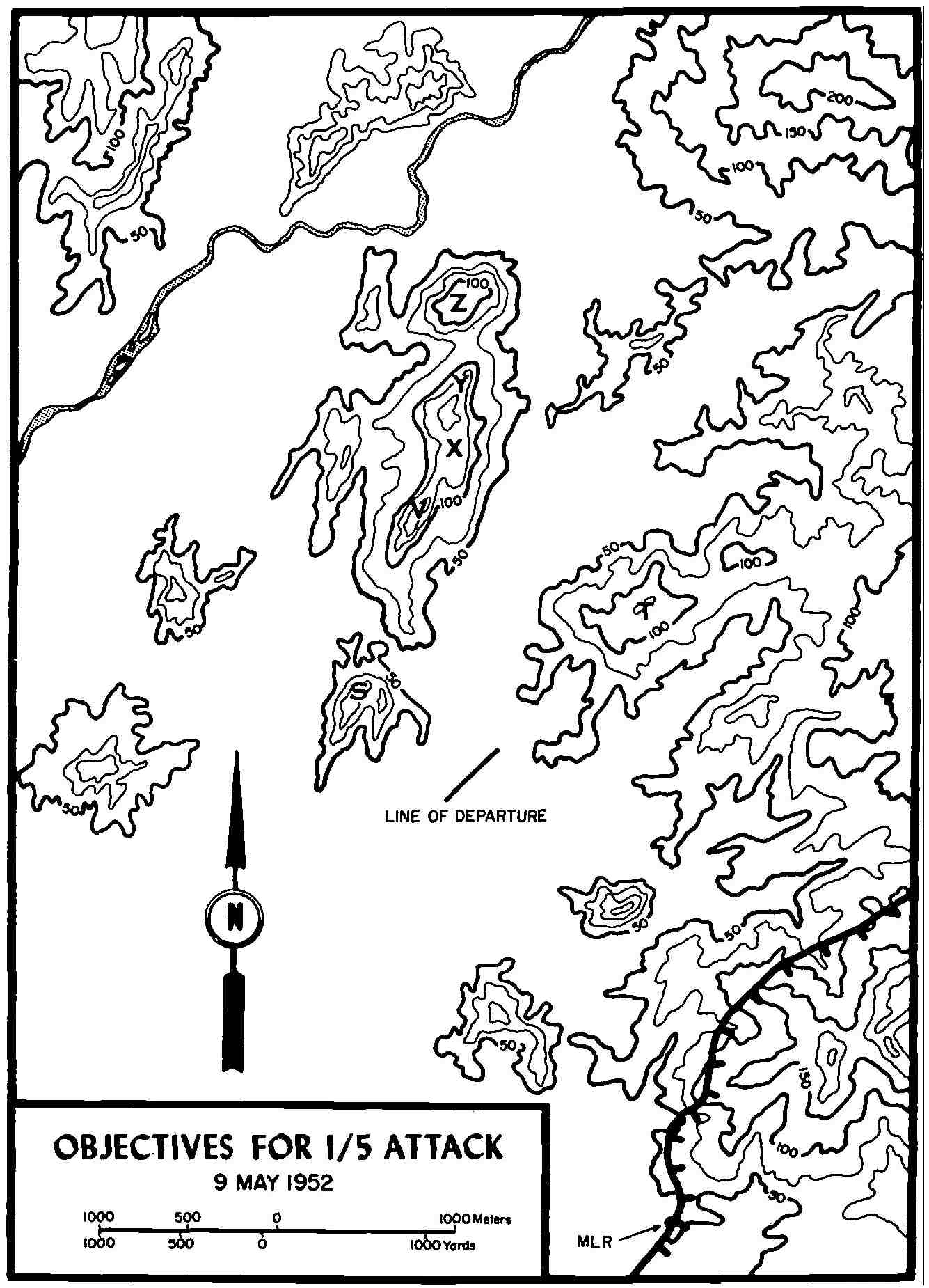
MAP 8 K. White
OBJECTIVES FOR 1/5 ATTACK
9 MAY 1952
Operational plans called for Lieutenant Lee’s Company A to do
most of the leg work as the assault unit. Captain Leland Graham’s
Company C, the diversionary force, was to make a feint against Hill
67, an enemy position southwest of OP 3, and to neutralize it by
fire. Weapons Company, under First Lieutenant Ross L. Tipps, in
support of the Company A force, was to set up a base of fire at a
designated position (T), southeast of OP 3. Artillery support was
to be furnished by 1/11, 4/11, and the attached 4.5-inch Rocket
Battery. A section of regimental 4.2-inch mortars was also assigned.
One platoon of Company B tanks was to assist the assault force by
firing both on designated positions and targets of opportunity. Close
air support flights were to be on station at two periods during the
9 May daylight operation.
In the early morning hours, under cover of darkness, all units
moved into position. At 0430 the 1st Platoon of Company A crossed
the line of departure heading for Objective S, a small ridge south
and west of OP 3. The 2d Platoon followed and moved out on the
right, while the 3d Platoon covered the rear. This hill, lightly
defended, was quickly overrun by the Marines. The 1st Platoon then
turned northeast towards the four peaks (designated as V, X, Y, and
Z), its main objectives. These four positions were all situated at
approximately the same elevation, 450 feet. A distance of some
1,300 yards separated the first and fourth hills in the north-south
ridgeline.
As the 1/5 platoon neared Objective V, friendly rockets lashed the
crest of the hill, which was held by a reinforced enemy platoon in
mutually supporting fighting holes. Assisted by this fire, Marine
two-man teams with rifles and grenades assaulted the fighting holes
occupied by the Chinese. As the Marines proceeded to clear the
objective, half of the Chinese were forced to retreat to safer ground.
Marines estimated that 15 enemy were killed and a like number
wounded. By this time, three hours after setting out on the raid, the
platoon had seized one prisoner and sustained five wounded.
While reorganizing for the attack against Objectives X and Y,
the 5th Marines patrol came under a heavy artillery and mortar
barrage that killed one Marine and wounded three others. As the
main body of the assault force advanced towards Objective X to
support the attack, the lead elements of the company headed for
OP 3. Throughout this maneuver, the company remained under
heavy artillery fire.
Proceeding along the eastern slope of the ridgeline to assault
knobs X and Y, the platoon had a good view of the effectiveness of
their friendly supporting artillery fire. In fact, the combined rocket,
howitzer, mortar, tank, and machine gun fire threw up so much
dust that at times it restricted the vision of the Marine assault team.
As platoon members neared the summit of Objective X they encountered
a heavy stream of defending fire. A strong counterattack
from the front and left flank assailed the 1st Platoon, but the
Marines repulsed the enemy with accurate small arms fire, killing
six CCF. Infiltrators then attempted to envelop the Marine platoon
and isolate it from the rest of the Company A assault force. Successive
waves of Chinese, employing a wedge formation, tried to overrun
the main body of the assault force. In repulsing this latest
counterattack, Company A killed 12 and wounded 5 enemy.
Quickly sizing up the situation, the company commander ordered
the 1st Platoon to rejoin the rest of the assault force. As the platoon
began to pull back at 1435 the Chinese blanketed the route with a
heavy barrage, firing “over four hundred rounds in a five minute
period.”125 This intense shelling took the lives of three Marines,
wounded a number of others, and halted the assault force just short
of its final goal. Even though the Chinese had been driven from the
three intermediate objectives, the devastating enemy mortar and
artillery fire made the Marine position untenable. A third of the
platoon moved back to Objective V; the rest worked their way along
a route east of that objective. While the rest of Company A and
Weapons Company elements occupied Hill T, the diversionary force,
Company C, reinforced by other Weapons Company personnel, had
remained at a strongpoint not far from Objective S. All supporting
ground weapons assisted in the withdrawal. In addition to lending
direct fire support, Marine tanks brought forward emergency supplies
and evacuated casualties. By 1730, the assault force had
returned to friendly lines, followed shortly by the rest of the
battalion.
Although the battalion failed to seize and hold all of its objectives,
that part of the mission calling for inflicting casualties and taking
prisoners had been successfully executed.126 Marines counted 35
enemy dead, 53 wounded, and 1 POW, and estimated that an additional
70 CCF had been killed and 105 wounded. Seven Marines were
killed and 66 wounded in the action described by some observers as
“the largest offensive effort the 1st Marine Division [has] made
since last September.”127 The battalion fire support was well controlled
and coordinated from an observation post on the MLR. Five
air strikes, including one MPQ-14 mission, were credited with
destroying three artillery pieces and an equal number of mortars,
damaging two other mortars, and demolishing six personnel
bunkers.
As the regiment noted, the earlier withdrawal of the OPLR had
“altered to a considerable extent the tactics employed in this area.
This is especially apparent in the number of patrol contacts close to
the MLR and displayed the eagerness of the enemy to move in on
any ground not held by friendly forces.”128 At the same time the
increased number of troops made available for the MLR defense
considerably strengthened the JAMESTOWN Line itself. Sector responsibility
changed on 11 May. Colonel Russell E. Honsowetz’ 7th
Marines relieved the 5th Marines in the center regimental sector,
with 2/7 and 1/7 occupying the left and right battalion positions,
respectively.
When it took over the peace corridor sector the 7th Marines also
assumed the responsibility for emergency rescue of the Allied truce
delegates at Panmunjom.129 The regiment advanced a mile nearer the
objective when it moved the pick-up force’s assembly area to within
400 yards of the line of departure. The 7th Marines also replaced
the tanks in the force with M-39 personnel carriers, a U.S. Army-developed
tracked vehicle similar in appearance to the Marine
amphibian tractor. Another vehicle the 7th Marines retained in its
task force was a medium tank equipped with additional radios. This
armored communication and control vehicle was used as a radio
relay station on the MLR to assist in liaison between moving
infantry and tank units. Marine riflemen dubbed this command tank
the porcupine, to describe the effect of many bristling antennas
sticking out from its top. While the Marine division right sector,
occupied by the 1st Marines, remained relatively quiet during the
spring months on JAMESTOWN, the 7th Marines in the center
MLR would shortly be involved in the division’s major ground
action in late May.
As part of the active defense of its JAMESTOWN line, Lieutenant
Colonel Daughtry, commanding 1/7, issued a directive on 26 May
intended to deny to the enemy key terrain remaining on the old
OPLR. Operation Plan 16-52 called for an attack to seize two
parcels of high ground to the regiment’s right front. At the same
time, the battalion was to neutralize two Chinese positions west of
the main objectives, Hill 104 (Objective 1) and the Tumae-ri Ridge
(Objective 2), approximately a half-mile further north. The designated
attack force, Captain Earl W. Thompson’s Company A, was
heavily reinforced. While Company A pursued its mission to the
right, a Company C reinforced platoon under Second Lieutenant
Howard L. Siers would conduct a feint on a pair of enemy positions
to the left. Support for the operation would come from 2/11, two
tank platoons, and from air, which was to be on call.
H-Hour was set for 0300 on 28 May. Attack and diversionary
forces on schedule crossed the line of departure, a half-mile north
of the MLR. Captain Thompson’s main force advanced nearly to the
base of Hill 104 before the Chinese, in estimated reinforced platoon
strength, began to counterattack. The fight came to an abrupt end
when Second Lieutenant John J. Donahue led his platoon to the
top with bayonets fixed.130 As the Marines dug in they came under
heavy mortar and artillery fire from CCF strongholds to the north.
On the left, meanwhile, Lieutenant Siers had received orders to seize
the closer of his two objectives, former OPLR 5, instead of merely
placing suppressive fire on it.
Moving forward from its base of fire, the platoon soon established
contact with the enemy. At 0554 the platoon began its attack on
the objective. Despite the close-in, hand-to-hand fighting, when it
became apparent the assault could not be stopped the enemy gave
way to Marine persistence in seizing the hill. By 0700 the Company
C, 7th Marines platoon had secured its objectives and begun preparations
for defense of the positions as well as continued support
of the main attack force. Heavy casualties, however, forced Lieutenant
Colonel Daughtry to recall the platoon and it returned to
the lines by 0930.
Up on Hill 104, Company A, 1/7 faced practically the same
situation. Taking Objective 1 had been costly and the advance
through withering enemy fire was adding to the casualties. A reinforcing
platoon was sent from the MLR to help the company disengage
and return to friendly lines. Contact with the enemy was
broken shortly after noon. With the aid of air and artillery, the
company was able to make its way to the MLR by 1405.
Advancing only as far as it did, the attack, like the one earlier
that month, failed to take all the designated objectives. Casualties
to the 1/7 Marines were placed at 9 killed131 and 107 wounded.
Most of the latter were evacuated for further treatment. Forty-five
of the enemy were counted dead and three wounded. Marines
estimated another 40 enemy killed and 40 more wounded.132 The
action resulted in a casualty toll that was the highest to date for
any Marine company in western Korea. All three Company A rifle
platoon leaders—Second Lieutenants Donahue, Jules E. Gerding,
and Kenneth A. Seal—were wounded. This battle also became the
occasion for another unwelcomed record—4,053 rounds of enemy
incoming, during a 24-hour period.
Following this late May offensive, a brief period of relative calm
settled over the MLR. Marine and Chinese units continued the active
defense of their respective sectors, with generally only a limited
number of contacts. Fire fights between Marine patrols and CCF
defenders lasted only a short time and usually ended when artillery
fire caused the patrol to pull back. Even though this state of affairs
remained essentially unchanged through June, several other events
that month would affect Marine defense of the westernmost sector
in I Corps.
A second realignment of the Marine-Commonwealth boundary
along Line JAMESTOWN was made on 1 June. Part of the rear of the
MLR was moved eastward to enable the Marine division to assume
full responsibility for a key ridgetop. Prior to this date the hill mass
had been divided along its crest, a factor that made it a potential
trouble spot for both divisions. On 23 and 24 June, the 7th Marines
MLR battalions relocated their positions towards the enemy along
JAMESTOWN. This readjustment of the line varied from 1,300 yards
in the center of the regimental sector to 400 yards near its right.
The additional terrain strengthened the division front by placing
the center regiment on improved and more defensible ground.
A week before this MLR change took place, there had been a
shift in occupants in its far right sector. Colonel Culhane’s 5th
Marines replaced the 1st on line, which then went into division
reserve. Manning the MLR were 2/5 on the left and 1/5 to the
right.
In early June the recently appointed UN commander, General
Clark, made his first visit to the 1st Marine Division front. During
his briefing, General Selden reviewed the unusual combat difficulties
confronting his Marines. In addition to the unfavorable terrain, the
division commander noted the special operational restrictions caused
by proximity to the truce talk site. Presence of a large number of
uncharted minefields created another obstacle. Herculean efforts were
required of the Marines to simultaneously man and construct defenses
over 35 miles of JAMESTOWN. Adding to Marine problems were
the facts that ground units were not receiving sufficient close air
support and the capabilities of the Chinese were constantly increasing.
Chinese order of battle (OOB) information was fed into the
division intelligence network by higher commands, I Corps and
EUSAK, and adjacent units, but a large part of the data about Communist
forces was produced by the division itself. Frontline units
in contact with the enemy, by observation of his activities, supplied
the bulk of intelligence about enemy defense tactics, employment
of weapons, and combat characteristics. Supporting Marine division
units, particularly artillery and armor, fed more facts into the system,
mostly through identification of the caliber of enemy shells fired
at the Marines. As a result of its missions forward of the line and
actions in defense of it, the division reconnaissance company also
contributed to the intelligence network. Individual Marines, performing
as tactical air observers and artillery air observers, as well as the
VMO and HMR pilots, were other important sources readily available
to the 1st Marine Division.
G-2 directed the division intelligence effort, including processing
of raw material and supplying of updated reports to 1st Division
units. The G-2 section also maintained OOB and target identification
data on Chinese units and their commanders. Members of the
G-2 staff also assisted in interrogation of prisoners of war (POWs),
screened the civilians apprehended in unauthorized areas, debriefed
Marines exposed to enemy intelligence, and conducted inspections
of division internal security. In areas where the 1st Marine Division
had only a limited intelligence capability it turned to EUSAK for
assistance.
Eighth Army teams augmented the division counterintelligence
efforts and provided most of the translation service. In addition,
three radio intercept units furnished information to the Marines.
The critical importance of this service had been proven during
several combat patrols in May when additional information was
instantly radioed to a friendly unit under fire.
Other intelligence activities were less beneficial to the Marines.
These operations were conducted by Tactical Liaison Officers
(TLOs, friendly Koreans trained by U.S. intelligence teams), and
members of a Higher Intelligence Detachment (HID), a Korean
unit assigned from EUSAK. Both the TLO and HID proved of
limited value to the division, due to the generally poor educational
background of the agents, their inadequate training, and frequent
failure to return from assignments behind enemy lines. Some
Marines believed the basic fault in these operatives lay in “an
exaggerated opinion of their importance.”134
Several division intelligence Marines, in conjunction with training
and shore party personnel, took part in an informational activity of
a different type. These Marines reconnoitered several friendly islands
off western Korea to determine their suitability for division landing
exercises. The second one inspected, Tokchok-to, 30 miles southwest
of Inchon, was selected. By early June planning had progressed to
the point where a program had been developed for bimonthly
battalion landing team exercises. The KPR maneuver force, appropriately
reinforced, was designated as a participating unit. Landings
were to employ boat teams, amphibian tractors, and helicopters. The
entire program was designed to provide refresher training for
Marines in carrying out their primary mission of amphibious assault.
By the end of June, 3/5 and 3/1, in turn, had captured Tokchok-to.
Other training concentrated more on the task at hand. Division
units in reserve rehearsed tactics for offensive and defensive warfare.
Most ground units conducted extensive schooling in both mine
and booby trap detection and clearance. Recognizing that patrolling
was an important part of a Marine’s life on the MLR, the division
included in its Noncommissioned Officers’ (NCO) Leadership
School a thorough indoctrination in patrolling tactics.135 More than
50 percent of the training at all levels was at night. In addition,
an extensive orientation was conducted for newly arrived combat
replacements, who could not be committed to action for 72 hours
after joining the division.
A week after the division’s June replacements landed at Inchon,
General Selden’s headquarters received a directive that would
affect a number of these new Marines. On 10 June CG, EUSAK
ordered his corps commanders to make continuous efforts to secure
the identification and changes in the enemy order of battle. Two
days later I Corps followed the Eighth Army order with a letter
of instruction which called for each I Corps division to “prepare
plans for launching swift, vigorous, and violent large-scale raids to
capture prisoners, to gain intelligence, to destroy enemy positions
and material and/or strong limited objective attacks to improve
and strengthen Line JAMESTOWN.”136 Large scale was defined as an
“attacking force limited to battalion or regimental (brigade) size
with appropriate armor and artillery support.”137 Divisions were
required to submit detailed proposals for future action by 21 June.
Marine division plans for limited objective attacks during July by
units of the 7th Marines and KMCs were subsequently prepared and
forwarded to I Corps.
One operation conducted north of the 2/5 left battalion sector
early on 22 June was not, however, in response to this enemy identification
mission. Late the previous day, Company G had sent out
a 16-man ambush. Before the Marines reached their destination, a
small enemy force, itself lying in wait, began to pour a heavy volume
of fire on the Marines. At this point the patrol was ordered to pull
back. One group of 10 made it back to the MLR; the remaining
Marines headed for a nearby combat outpost in friendly hands.
Reports to the company revealed one Marine not accounted for.
The outpost commander was directed to search the area for the
missing Marine. This reconnaissance by a fire team failed, but a
reinforced squad sent out later brought back the body of the Marine
who had been killed by Chinese artillery.
While this rescue effort was in progress, another similar action
was under way. Not long after its arrival on the MLR, Company
E, 2/5 had spotted in the No-Man’s-Land between the two main
defensive lines a figure that appeared to be the body of a
Marine. Since one man had been reported missing from an earlier
1st Marines patrol, recovery of the body, which had been propped
up against a mound of dirt in the open, was undertaken. A special
Company E patrol left the main line shortly before dawn on the
22d and reached the recovery area at daybreak. After artillery had
laid down smoke, the patrol moved in, quickly recovered the body,
and set out for friendly territory. Before the Marines had advanced
very far on their return trip, the Chinese interdicted their route
with heavy mortar fire, which killed one member of the patrol and
wounded another. When the 5th Marines patrol returned to
JAMESTOWN shortly after 0700, it carried not only the body it had
recovered but also that of the Marine who had been killed on the
recovery mission.
By the end of June, major command changes had taken place
within the 1st Marine Division as well as in several other UNC
components. On 13 June, Brigadier General Robert O. Bare took
over the second spot from Brigadier General Twining. Both ADCs
were graduates of the Naval Academy and both were native mid-Westerners
(General Bare—Iowa, General Twining—Wisconsin).
Before joining the 1st Marine Division in Korea General Bare had
served at Camp Pendleton, California where most recently he had
been commanding general of the Training and Replacement Command.
His World War II experience included participation in
both European and Pacific campaigns. He was the Staff Officer,
Plans, in the U.S. Naval Section for the Allied naval group that
planned the amphibious assault at Normandy, France. Later he
served in the Peleliu and Okinawa campaigns and, with the ending
of hostilities, had participated in the surrender and repatriation of
the Japanese in north China.
The outgoing ADC, General Twining, was being reassigned to the
Office of the Commandant, HQMC. For his outstanding service as
assistant division commander from March through May 1952, he
received a Gold Star in lieu of his second Legion of Merit with
Combat “V.”
Other high-level changes in command that had also recently
taken place had included the UNC commander himself, General
Ridgway, who had been succeeded in mid-May by General Clark.
Major General Glenn O. Barcus, USAF, had assumed command
of Fifth Air Force, replacing Lieutenant General Everest on 30
May. On 4 June, Vice Admiral Robert P. Briscoe had been named
the new Commander, Naval Forces Far East to succeed Vice Admiral
C. Turner Joy who had held the position since August 1949. And
in I Corps, Major General Paul W. Kendall, USA, took over as
corps commander on 29 June from Lieutenant General O’Daniel.
The end of the second year of the Korean fighting and the
beginning of the third was observed by the Chinese with an attack
against the 2d Battalion, 5th Marines, manning JAMESTOWN positions
to the left of the regimental sector. Commanded at that time
by Lieutenant Colonel Thomas J. Cross, 2/5 was new on line,
having relieved 2/1 during the night of 15–16 June.
Late in the afternoon of 24 June, the enemy began registering his
mortars and artillery on MLR company positions of 2/5 and a
portion of the rear area occupied by the battalion 81mm mortars.
Chinese incoming, sometimes intense, sometimes sporadic, continued
until shortly after 2130. By this time the CCF were moving down
their trenches toward a key outpost, Yoke, known also as Hill 159,
which was still occupied on daytime basis by the Marines and lay
north of the Company F Sector (Captain Harold C. Fuson). Moments
later, the 34 men temporarily outposting Yoke saw the Chinese
and opened with small arms fire, but the Marine positions were
quickly enveloped by the Chinese. The Americans occupying the
forward slopes of Yoke suffered many casualties from the intense
fires supporting the enemy rush.
While the initial attack was in progress, the Chinese were able
to position and fire machine guns from behind the outpost and in
trenches on the forward slopes. Communist mortars interdicted the
Marine supply routes to make normal withdrawal and reinforcement
measures difficult. The Marines moved into bunkers, called down pre-planned
fires, and continued the defense. Although the Chinese had
overrun Yoke, they could not evict the Marines. At about 0300, the
enemy withdrew. When the 2/5 troops followed to reoccupy the forward
slopes of Yoke, the enemy renewed his attack and struck again.
As before, the Marines took to bunkers and called in defensive artillery
fires. These boxing fires fell around the outpost perimeter until
first light when the attackers withdrew for the second time.
Four other outposts in the battalion area were involved in the
anniversary attack, but the action around Yoke was by far the heaviest.
It resulted in 10 Marines of 2/5 killed and 36 wounded. At
Yoke alone, 9 were killed and 23 wounded. Enemy dead were 12
known and 50 estimated killed. Chinese wounded were estimated
at 100. At one point during the attack on Yoke, the outpost commander
reported that the enemy were wearing gas masks and using
tear-gas grenades. Investigation revealed that the Chinese had carried
and even worn the masks, but that they had employed white phosphorus
grenades rather than tear gas. This was the first instance
Marine division personnel had ever encountered of CCF soldiers
carrying gas masks in an attack and it was “believed part of the
enemy’s hate campaign to impress their troops with the possible use
by the UN Forces of CBR (Chemical, Biological and Radiological)
warfare.”138
This violent eruption of enemy activity on the night of 24 June was
followed by a brief period of greatly reduced ground action. Late on
the 29th, however, the battlefront lull was broken when the 1st
KMC Regiment sent out a raiding party to capture Chinese soldiers
and their weapons and equipment, to inflict casualties, and to destroy
positions. Second Lieutenant Kwak Sang In had his reinforced platoon
from the 3d Company, 1st Battalion, equipped with rifles, carbines,
machine guns, flamethrowers, and explosives. Target for the
attack was an enemy outpost four miles south of Panmunjom that
overlooked the Sachon River.
The patrol followed the general pattern of previous raids. It made
use of supporting elements positioned on high ground in front of the
objective. In this action the patrol struck from the rear, using artillery
fire for both the assault and the withdrawal. Another similarity
existed in that the results were nearly the same—no prisoners taken
but fewer casualties to the attackers. One difference from earlier
operations was that this patrol employed flamethrowers and TNT
for destroying bunkers and inflicting casualties. Both weapons were
credited in the killing of 12 and the wounding of 6 Chinese, in
destroying 1 mortar and 7 bunkers, and in burning 3 other bunkers
and numerous automatic weapons and rifles. Because of the heavy
weight of a loaded flamethrower and the small size of the Korean
Marines carrying these weapons, the flamethrower operators were
fairly well exhausted by the end of the patrol.
The approach of the American Fourth of July holiday marking
an earlier struggle for freedom was appropriately accompanied by
ground action initiated by all of the mainland MLR regiments. In
the KMC area, a 3 July raiding party struck at forward enemy positions
before dawn, killing nine Chinese. In the center regimental
sector Colonel Thomas C. Moore’s140 7th Marines were also engaged
in an active sector defense. In the left battalion spot 3/7, which had
replaced 2/7 on line, dispatched raids on each of the first three
nights of the month. Its Company G patrol on the night of 2–3 July
was to be involved in one of the most costly small unit actions in the
western Korea tour of duty for the Marine division.
Operational plans called for the platoon night raid on the 2d to
be followed by a dawn attack the next morning. In both actions, the
prisoner-taking aspect of the mission was considered a primary one.
The early part of the operation was uneventful. One platoon moved
forward toward the objective, Hill 159 (Yoke), 1,200 yards beyond
combat outpost (COP) White, to the regimental left, without making
contact with the enemy. The platoon then established a base of fire
on favorable terrain from which the attack by the second platoon
could be supported.
The second platoon passed through the forward position of the
first shortly before 0630 and moved out into enemy terrain. It advanced
less than 300 yards before its progress was halted by a Chinese
force of battalion strength occupying the objective, Hill 159.
Heavy enemy rifle and machine gun fire, hand grenades, mortar and
artillery deluged the advancing Marines. Many of them quickly
became casualties, but the operation continued, due in part to the
determination and initiative of the NCOs. One of these was Staff
Sergeant William E. Shuck, Jr., in charge of a machine gun squad.
When the leader of one of the rifle squads became a casualty, Sergeant
Shuck assumed command of that squad in addition to his own.
Although wounded, he organized the two units and led them against
the objective. Nearing the summit of the hill, the sergeant was hit a
second time. Still he refused evacuation, remaining well forward in
the lines to direct his assault force.
It was not until he had received orders to break contact with the
enemy that the sergeant pulled back from the attack. During the
withdrawal he looked after the other Marine casualties, making certain
that all dead and wounded had been evacuated from the zone
of action. While directing the last of the evacuation, Sergeant Shuck
was struck by a sniper’s bullet and killed by this third hit.141 He was
one of four Marines killed in the engagement. Forty others were
wounded. Although no Chinese were captured, Marines estimated the
enemy suffered losses of 50 killed and an additional 150 wounded.
To the east of the 7th Marines, the 5th Marines in the right MLR
sector ordered a company-size patrol, also on the night of 2–3 July.
Company A, 1/5 was directed to attack successively three outposts
in the vicinity of the village of Samichon along the river bearing
the same name and two miles beyond the point where the MLR
crossed the river. After the reinforced company had taken the first
two objectives, which were unoccupied, it received orders from division
to return to the battalion area. Despite the fact the patrol had
ventured far beyond the Marine lines, it did not come into contact
with any Chinese forces.
A 2/5 combat patrol leaving the MLR just after dawn was successful
in inflicting casualties on the enemy, taking prisoners, and
destroying enemy field fortifications. The patrol made good progress
until a Marine inadvertently set off an enemy mine. This mishap
gave away the patrol’s location and prompted reprisal by the
Chinese. A one-hour fire fight followed. Then the patrol called in
smoke and returned under its cover to JAMESTOWN. Marine casualties
were 1 killed and 11 wounded. The second 2/5 patrol that
same date was a successful ambush completed 10 minutes before
midnight. In the brief clash that developed, Marine ambushers
killed 6 enemy and wounded 8 more. The Marine force suffered no
casualties.
The ambush patrol returned 15 minutes after midnight on 4 July.
Even at that early hour division artillerymen had already initiated an
appropriate ceremony to mark the Fourth. On 2 July, I Corps had
directed the massing of fires on 4 July on the most remunerative
targets in each division area. All objectives in the corps sector were
to be attacked simultaneously at specified times for a one-minute
period by employing a firing technique known as time on target
(TOT).142 Normal daily fires were also to be carried out. Designated
as Operation FIRECRACKER, the shoot expended 3,202 rounds in the
division sector. Light and medium battalions of the 11th Marines,
plus its 4.5-inch Rocket Battery destroyed some enemy trenches,
bunkers, mortar and artillery positions, and damaged others. The
division reported that the special fires on 4 July had also resulted
in 44 known CCF casualties, including 21 dead, and 12 more who
were estimated to have been injured.
More casualties, however, resulted from the issuing of another I
Corps directive, this one dealing with the conduct of raids to seize
prisoners, obtain information about the enemy, and to destroy his
positions, supplies, and equipment. Back in June, the EUSAK commander
had first stressed to his corps commanders the increased
importance of combat raids to obtain additional intelligence during
this period of stabilized conflict.
Although General Selden had submitted two division plans, he
strongly believed that smaller patrols could accomplish the objective
with fewer casualties and loss of life.143 In particular, the division
commander pointed out to I Corps that adequate defense of the
35-mile-long Marine division front did not permit the withdrawal
of a sizable force for patrol missions without endangering the security
of the entire Corps sector. The attack order was issued, however,
on 3 July for the first large-scale raid to be conducted prior to 7 July.
The code name BUCKSHOT 2B was assigned for this particular raid.
As soon as he received the date of execution for the proposed
operation, the Marine division commander advised I Corps that designation
of 7 July as the cut-off date for the raid precluded proper
rehearsal of attack plans. The operation would also conflict with
rotation to the States of 2,651 Marines, whose replacements would
not be available until 11 July. Corps turned a deaf ear; division then
ordered a battalion-size attack for the night of 6–7 July.
Before dusk on 6 July, Lieutenant Colonel Daughtry’s reinforced
1st Battalion, 7th Marines moved into position—on the left, a tank-infantry
force, A/1/7 (still under Captain Thompson), to create a
diversion; in the center, the main assault force, Company C (Captain
Robert A. Owens); and on the right, a reinforced platoon from
Company B (Captain Lyle S. Whitmore, Jr.) to support the attack
by fire from positions close to the objective, Yoke. Earlier, three
reinforced squads from Captain Thompson’s unit had occupied combat
outposts in the area of operations to deny the use of key terrain
to the enemy and to provide additional fire support in the attack.
At 2200, Captain Owens’ Company C crossed the line of departure
and set its course for Yoke, three-quarters of a mile northeast. Five
minutes later the Company B support unit moved out to occupy the
intermediate objective, COP Green, one-half mile southeast of Yoke.
As it took up positions on COP Green, Captain Whitmore’s Company
B platoon discovered that no Chinese were in its vicinity; in
fact, the platoon was not to encounter any enemy forces during
BUCKSHOT.
Even though Company B failed to engage any Chinese, the
remainder of the battalion encountered more than its share. About
450 yards southwest of the objective the Company C attack force
was hit by an enemy ambush, which cut off Captain Owens’ lead
element. Although the Chinese directed strong efforts at halting the
Marine advance, they were unsuccessful in this attempt. The Marines
pressed the attack and seized Yoke 20 minutes after midnight.
On the left, the diversionary attack unit, Company A supported by
the five tanks of the 2d Platoon, Company D, 1st Tank Battalion,
and by a section of flame tanks from the armored battalion headquarters,
began its mission at 2355. In three-quarters of an hour,
the tank-infantry unit reached its objective, the first high ground
southwest of Yoke. Tanks turned their 90mm guns on known Chinese
positions on the hill to the north. During the next hour, the big
guns of the M-46 medium tanks sent 49 rounds into enemy emplacements.
The Marine tanks ceased fire at 0113 when Captain Thompson
was alerted to assist Company C. He left one rifle platoon with
the tanks.
Over on the high ground to the north and east, the attack force
was under heavy fire from Communist mortars and artillery and was
also receiving a number of enemy small-unit probes. At 0200, Company
A made contact with Company C. Captain Thompson found
the main force somewhat disorganized as a result of the wounding
of the company commander, Captain Owens, the loss of several key
officers and NCOs, and the effects of the lead element of Company
C being ambushed and cut off. After being briefed on the situation
by Captain Owens and conducting a reconnaissance, Captain Thompson
recommended to the battalion commander that the entire force
be recalled before daylight. At 0310 the two companies at Yoke
began to disengage, returning to the MLR by 0636 on the 7th,
without further casualties.
The one platoon of Company A and seven tanks of the diversion
unit were still in their forward positions on the left and had prepared
to resume firing. At dawn the M-46s relaid their guns on
targets that had become visible. Tank gunners destroyed two observation
posts and three machine gun positions and damaged many
feet of trenchlines. At one point in the firing, the tank platoon
commander, Second Lieutenant Terry K. Donk, using a power scope,
observed “... two officers in forest green uniforms without equipment.
They were definitely giving orders to machine gunners and
infantry.”144 These 2 were among the 19 counted casualties (10
wounded) that the tankers inflicted during BUCKSHOT.
With the return at 0645 of the tank-infantry diversion force, the
special operation for obtaining prisoners and information ended.
No Chinese had been captured and no data gleaned from Communist
casualties, listed as the 19 reported by the tankers and an estimated
20 more wounded or killed. Marine casualties from the operation
were out of proportion to the results achieved—12 dead, 85
wounded, and 5 missing. It had been a high price to pay for a venture
of this type, particularly when the primary objectives went unaccomplished.
During the entire 4–7 July period, 22 Marines had lost their lives
in combat operations. Division reported that 268 Marines had been
wounded during the long Fourth of July. These figures were the
highest since September 1951 when large scale attacks by UN forces
had first been abolished in line with the new tactic of positional
warfare that would be waged until the truce talks resulted in an
armistice.
Division casualties were considerably higher during the first week
in July than they were for the rest of the month. Once the pace of
combat slowed, following the initial flurry of activity, the front again
settled down to the patrol, raid, and ambush routine that had marked
the static period of the Korean fighting. In accordance with the
orders previously issued by higher authority the division placed continued
emphasis on gathering all information it could about the
enemy, his dispositions, and tactics. To assist in this effort, General
Selden in July removed his reconnaissance company from defense
of its small sector of JAMESTOWN and directed the unit to conduct
training for its primary mission, obtaining intelligence about the
enemy. Its place on the MLR was assumed by the two amphibian
tractor companies then on line.
Another change of lineup took place on 14 July. At this time a
battalion from the 15th Regiment, U.S. 3d Infantry Division took
over the role of the maneuver element in the Kimpo Provisional
Regiment, then held by 1/1, thereby releasing that battalion to its
parent unit. With this change, the 1st Marine Division had a full
regiment in reserve for the first time since its arrival in western
Korea. A later shift in units occurred on 26 July when the 7th
and 1st Marines traded places and missions. At that time the MLR,
from west to east, was manned by the KPR, 1st AmTrac Bn, KMC,
1st Marines, and 5th Marines.
Opposing them in mid-July were an estimated 27 infantry battalions,
whose primary missions were to defend the sectors assigned.
The division credited these units with the capability of launching
limited objective attacks at any time or of taking part in a major
attack with a force of up to 57 infantry and 16 artillery battalions,
augmented by 40 tanks or self-propelled guns. It was estimated also
that the enemy could cross the Han in battalion strength in the vicinity
of the northern shore of Kimpo Peninsula at any time and that
Communist aircraft could attack anywhere in the division sector.
Enemy forces identified at the end of July, from west to east, were
the 193d, 195th, and 194th Divisions of the 65th CCF Army; the
189th Division of the 63d CCF Army; and the 118th Division, 40th
CCF Army, which had recently moved from a position opposite the
Commonwealth and U.S. 3d Infantry Divisions. Infantry strength of
the Communists was established at 28,328.
Marine infantry strength at the end of July 1952 was little more
than half of the Chinese total. The division personnel strength was
maintained by the monthly replacement and rotation program of
Marines to fill vacancies created by the return of Marine combat
personnel to CONUS (Continental United States) and combat losses.
In the second quarter of 1952, the division rotated 433 officers and
6,280 enlisted men from Korea. In exchange, 506 officers and 7,359
enlisted men arrived from the States in replacement drafts. A new
arrival could expect to stay with the division about 10½ months.
In the late spring of 1952 many of the division’s new replacements
were “dental cripples”—Marines requiring dental treatment,
even emergency care in some cases.147 General Selden directed that
contact teams be formed to meet the replacement drafts in Japan.
During the last leg of the trip to Korea dental personnel screened
the new combat Marines on shipboard. By the time the division area
had been reached, the dentists knew what remedial work would be
required by incoming troops. At the end of the summer the problem
was well under control.
Even though the 1st Marine Division in July continued to be
somewhat in excess of its authorized strength in total personnel, it
had certain imbalances and was in rather short supply of certain
ranks and specialists. While the normal tour for most infantry
officers ranged from 9 to 12 months, an excess of company grade
officers, particularly lieutenants, had resulted in a reduction of the
Korean tour for them to just six months. This brief period of duty
plus an intra-division rotation policy that caused a mass shifting of
duty assignments every three-to-five months tended to reduce unit
combat efficiency. On the other hand the change of assignments
had a favorable effect in that it broadened the experience of individual
Marines. Beginning in the summer of 1952, however, the
division modified this policy to reduce its number of intra-division
transfers.
Personnel shortages existed in both the artillery and tank MOSs
(Military Occupational Speciality). Mass rotation of reservist company
grade artillery officers had necessitated the transfer of infantry
officers to the 11th Marines for training and reassignment within
the regiment. During the time when the supply of artillery officers
was limited, however, the quality of support rendered remained
high.148 The other major shortage in the division was that of qualified
crewmen—both drivers and gunners—for the M-46 tanks.
Neither tank driving nor gunnery for the M-46 was taught in the
tank crewmen’s course conducted at Camp Pendleton, California.
General Selden requested of Lieutenant General Franklin A. Hart
(CG, FMFPac) that “tank crewmen be thoroughly trained prior to
leaving the U.S.”149
Fundamental to the tank problem was a shortage of the M-46
itself. At the training facility, Training and Replacement Command,
Camp Pendleton, M-46 engines had been available for maintenance
instruction but no tanks for the training of gunners and drivers.150
General Hart pointed out this deficiency to the Commandant, General
Lemuel C. Shepherd, Jr. On 13 August the Commandant
directed the transfer of five tanks to the training installation from
the 7th Tank Battalion,151 also located at Camp Pendleton. At the
same time General Shepherd ordered an increase in the school quota
for tank crewmen. The first graduates would not reach the division
in Korea, however, until the November draft.
The presence of not fully trained personnel in a combat zone was
not limited to the division. In the summer and fall of 1952, a large
number of volunteer reservists, both pilots and enlisted replacements
with little experience since the end of World War II, joined the
1st MAW. It had not been possible for the Stateside training and
tactical squadrons, themselves short of personnel and aircraft, to
qualify all pilots as combat ready. It fell upon the wing in Korea,
therefore, to take the needed corrective action. The more experienced
1st MAW pilots, after completing their combat missions, flew instructional
flights to help prepare the rusty fliers. Some reserve pilots,
away from regular daily flying since 1945, found the adjustment
too difficult and turned in their wings. MACG-2 operated “Pohang
U,” a training course for forward air controllers. In practically every
squadron, there were shortages of electronics personnel. Jet squadrons
found mechanics hard to come by. There were never enough motor
transport replacements. For unqualified enlisted Marines, squadrons
operated on-the-job training programs.
To maintain a reasonable degree of unit proficiency, the wing
limited the monthly turnover of pilots to 25 percent. Like the division,
the wing employed split tours between an officer’s primary
duty and staff work to broaden his experience. In some cases the
amount of time required by administrative work as compared to a
pilot’s actual flying time reduced his proficiency in the air. In June,
Task Force 95 reported that the proportionately large number of
take-off and landing accidents on the carrier Bataan was caused by
the rapid turnover of pilots and their need for frequent carrier qualification.152
A Marine pilot joining the wing could expect his assignment to
last for 6 to 9 months. Personnel in a nonflight status had longer
tours of 10 months to a year. Wing replacements were made on an
individual basis, although there were plans that by mid-1953 a new
policy of at least partial squadron replacement would be in effect.
That 1st MAW squadrons were able to operate effectively on an
individual replacement system was attributable to the peculiarity of
combat conditions in Korea. Absence of real enemy aerial opposition
permitted the use of basic, parade-type flight formations and non-tactical
approaches and attacks. An unusually high-level of experienced
pilots in each of the two wing groups helped in the establishment
of training programs and operational doctrine. The FAF limitation
of four aircraft per flight eliminated the problem of large-scale,
precombat squadron training as well as the difficulty of controlling
and coordinating a large number of planes in a strike.
Logistical support of the division and wing remained largely unchanged
through July. Several modifications did take place, however,
and these were:
(1) The change of responsibility for logistical support of
ground-based units in Korea from Commanding General, 2d
Logistical Command to the Commanding General, Korean Communication
Zone (CG, KComZ).
(2) The opening of a pipeline system for resupply of aviation
fuel at K-3, beginning in May.
(3) The beginning of increased support for airbase maintenance
at those airfields housing Marine squadrons.
Resupply of common items used by both Marine and Army units
was still being hampered by the Marines’ limited knowledge of the
Army supply system in effect and by their inability to obtain the
catalogues, orders, and directives essential for requisitioning.
Two logistical operations, both of an engineering nature, took
place between May and July 1952 in western Korea. One was Operation
TIMBER, undertaken to provide lumber required to complete the
bunker construction on the JAMESTOWN, WYOMING, and KANSAS
lines. The division had estimated that three million linear feet of
4 x 8-inch timbers would be needed. Since lumber in this amount
was not available through supply channels or standing timber in the
division sector, Corps assigned the Marines a wooded area 50 miles
to the east in the U.S. 45th Infantry Division sector. On 12 May a
reinforced engineer platoon, under Second Lieutenant Roger E.
Galliher, a truck platoon, and 500 Korean Service Corps (KSC)
laborers,154 began the cutting, processing, and hauling of timbers
which were then trucked to the railhead. Between 500 and 1,000
logs were cut daily. When the operation ended in July a total of
35,194 sections of timber had been cut. This was still not enough
lumber to complete the required construction. Eighth Army then
made up the difference, mostly with 12 x 12-inch timbers 30 feet
long; these the Marine engineers cut to 4 x 8s for standard bunker
construction.155
Operation AMAZON, published by I Corps on 12 June, ordered
that bridging preparations be made for the approaching summer
flood season. The previous August at the Honker Bridge, the one
nearest the railhead, the Imjin had crested some 27 feet above normal.
One reason for the precautionary efforts taken to insure bridge
security during the flood season was the potential damage the Chinese
could cause. Since they controlled the upriver area of the Imjin,
before it entered the division sector, they could introduce floatable
debris or explosives into the swift running flood waters. Another
major concern was the logistical problem that would be faced by
forward MLR units in event the bridges became impassable and the
enormous strain that would thus be placed on helicopter resupply
operations.
The I Corps directive specified that its divisions maintain a transport
capability that would enable medium tanks to pass safely over
bridges spanning the major rivers in their I Corps sector. The order
also called for the removal of debris that could cause damage to
bridges. Removal of those bridges vulnerable to flood conditions
and the erection of emergency river spans were also to take place on
corps order.
To carry out the I Corps operational order, General Seiden put
the division’s own AMAZON plan into effect on 1 July. On this date
Companies A, B, and D of Lieutenant Colonel Harry D. Clarke’s
1st Engineer Battalion began extensive preparations for debris
removal from the four bridge sites in the division sector. Even
before this, Marine engineers and shore party personnel had been
trained at special schools to handle U.S. Army equipment provided
for the AMAZON operation.156
Beginning 1 June, division engineers began blasting away at objects
that flood waters could loosen and carry into the bridge supports.
Bridge approaches were improved and their supports strengthened.
Each company had a detail living at the bridge site for which it was
responsible. With the advent of heavy rains, these Marines were to
operate 24-hour boat patrols to keep the river free of debris. The
engineers were also to maintain a round-the-clock debris watch at
the four division bridges—Freedom Gate, or the Munsan-ni Railroad
Bridge in the left regimental sector; Honker and X-Ray in the
center; and finally, Widgeon, very close to the Commonwealth
boundary.
Heavy rains began on 27 July and continued until the 30th. On the
first day the decking of Widgeon Bridge was completely submerged
and Honker was removed to prevent its being carried away. Precipitation
increased on 28 July and reached its peak on 29 July when
3.66 inches of rainfall were recorded. By the 30th, the rains had subsided
but not before the overflowing Imjin had collapsed the X-Ray
bridge. During the height of the four flood days, engineers fought
the rains, flooding waters, and floating debris. The major effort took
place downstream to save the Freedom Gate Bridge.
Assigned personnel removed debris from the bridge supports,
guided large, dangerous pieces away with poles, while upriver the
boat teams blasted still larger sections into manageable chunks that
would pass between the bridge supports. These engineer efforts, in
addition to regular repair and maintenance of the large road net, constituted
the major ground activity in the 1st Marine Division sector
in late July. August would bring more rains and emergency demands
on the engineers, but the critical ground activity at that time would
be directed against the Communists in the area around Bunker Hill.
CHAPTER III The Battle of Bunker Hill — The Participants and the Battlefield 157 — Preliminary Action on Siberia 176 — The Attack on Bunker Hill 178 — Consolidating the Defense of Bunker Hill 182 — Company B Returns to Bunker Hill 187 — Supporting Arms at Bunker Hill 189 — In Retrospect 196
The Participants and the Battlefield—Preliminary Action on
Siberia—The Attack on Bunker Hill—Consolidating the Defense
of Bunker Hill—Company B Returns to Bunker Hill—Supporting
Arms at Bunker Hill—In Retrospect
The torrential rains that had fallen just before the end of July
continued to affect ground operations into early August. Contacts
between opposing forces were few and brief, and casualties
remained correspondingly low. On 1 August, General Selden assigned
the reserve regiment, the 7th Marines, the task of developing the
secondary defense line, KANSAS, at the extreme right of the division
sector. The 5th Marines, manning this regimental area and originally
responsible for the construction, had been unable to reach the second
line because bridging across the Imjin to the rear of the sector was
washed out. By 3 July the division put a ferry service into operation
at the site of the inoperable Honker Bridge for the purpose of feeding
ammunition to combat units north of the Imjin. The critical
resupply problem began to ease the next day when the waters overflowing
the Widgeon Bridge further upstream receded sufficiently
to permit restoration of normal vehicular crossings there.
Traffic in the air had, quite naturally, been less affected by the
heavy rains and by the flooded, mucky terrain that was slowing
ground movement throughout the entire division area. Flight operations
during the first week of August produced a daily sortie rate
that would approximate the monthly average. In fact, the month of
August was to become the record one for 1st MAW attack and
fighter pilots during 1952, with a total of 5,869 sorties flown.
While the air people in August were maintaining a good weather
pace against the enemy following the July downpours, the Communist
ground troops apparently found the going too difficult to mount
any sustained attack. The enemy merely continued his active defense,
with an average of two contacts daily, while busily engaged in
advancing his OPLR by creeping tactics. Even the usually assiduous
Chinese artillery was strangely quiet. With respect to the enemy’s
excellent artillery capability, the 1st Marine Division in July learned
that the Chinese had introduced a 132mm Russian rocket in their
combat operations. The presence of this truck-mounted launcher,
the Katusha, which could fire 16 rockets simultaneously, was indicated
by a POW who had been informed by “his platoon leader that
there were two Katusha regiments in the CCF.”158 In addition to this
new enemy weapon, the Marine division reported the same month
that positive sightings had been made of self-propelled guns emplaced
well forward, and that there was an “indication that these
guns were being used to fire direct fire missions from frontline
revetments.”159
Communist forward positions were gradually encroaching on
JAMESTOWN. Since April 1952 the division had noted every month
that the enemy was continuing to extend his trenches in the direction
of the Marine MLR. The Chinese technique was to occupy key,
high terrain at night, prepare the ground during darkness by digging
trenches and constructing bunkers, and then vacate the area
before daybreak. After nightly repetitions of this process had produced
a tenable position, the enemy moved in and occupied it. By
means of these creeping tactics, the Chinese hoped to acquire the
dominating terrain necessary for controlling access to Seoul. The ultimate
goal of the Communist forces was believed to be the 750-foot-high
Paekhak Hill,160 the Marine high ground position also known
as Hill 229, just over a mile east of the road leading to Panmunjom
and Kaesong.
During the four months that the 1st Marine Division’s mission had
been to conduct an aggressive defense of the EUSAK left flank,
Marines had become familiar with a number of Chinese small unit
infantry tactics. Shortly after assignment of the division to western
Korea, General Twining, the ADC, had observed that the Chinese
first made a diversionary frontal assault while the main force maneuvered
around UNC defenders to attack from the rear. Almost invariably
the Chinese employed this envelopment technique. Occasionally
the enemy also used more passive measures, such as attempting to
demoralize Marines in the front lines and subvert their allegiance
by English language propaganda broadcasts. These attempts represented
wasted effort. Not one Marine was swayed.
In some cases the Chinese were imaginative in changing their tactics
or improvising new ones. This tendency had been noted as early
as May by a 5th Marines battalion commander, Lieutenant Colonel
Nihart, after 1/5 had engaged the enemy in a limited, objective
attack:
... when friendlies marked targets with WP [white phosphorus], the
enemy would immediately drop rounds of WP between the target and
friendly troops to conceal the target and to confuse friendly FOs [artillery
forward observers]; the enemy tried very hard to take prisoners (rather
than shoot a friendly, they would often attempt to knock him out with a
concussion type grenade); counterattacks were made in waves of four to
seven men deployed in a formation somewhat similar to the Marine Corps
wedge; snipers were deployed in holes that were mutually supporting;
concerted efforts were made to knock out automatic weapons; ... for
close-in fighting, the enemy used PPSH [Soviet-made 7.62mm submachine
gun] guns and grenades rather than bayonets; the enemy attacked behind
well coordinated mortar fire; some enemy snipers were observed to have
bushes tied to their backs....161
On occasion 1st Division Marines found evidence that the enemy
had infiltrated their lines. It appeared the most likely spot for line-crossers
to make their way into the Marine rear area was from the
far bank of the Imjin between the Sachon and Han Rivers where the
enemy MLR was only a short distance from the sector held by the
1st Amphibian Tractor Battalion. Two enemy agents “armed with
pistols of German manufacture, six hand grenades, and one set of
field glasses”162 had been apprehended here by a Marine reconnaissance
company patrol. The prisoners had stated they were “part of a
force of one thousand men who were infiltrating to form a guerrilla
force somewhere in South Korea.”163 Six days later, after a brief fire
fight between a small group of Chinese and a Marine outpost in the
center of the division sector, the defenders discovered that two of the
three enemy dead wore under their own clothing various articles of
Marine uniforms. Neither of the Chinese had identification or any
papers whatsoever. It was believed that both were enemy agents and
that the attack on the outpost was a diversion “for the express purpose
of detracting attention from infiltrators.”164
Even though enemy tactics and attempts to penetrate Marine positions
demonstrated a good deal of soldierly skills, his conduct of
defensive operations was nothing short of masterful. This was especially
true of Chinese construction of underground earthworks. It
appeared that the Chinese had no single pattern for this type of field
fortification. Like the Japanese in World War II, the Chinese Communists
were experts in organizing the ground thoroughly and in
utilizing a seemingly inexhaustible supply of manpower to hollow
out tunnels, air-raid shelters, living quarters, storage spaces, and
mess halls. Americans described the Chinese as industrious diggers,165
who excavated quickly and deeply for protection against UN bombardments.
From numerous reports of ground clashes in the 1st
Marine Division sector and from observations made by Marine pilots,
it became known that the enemy was quick to seek cover whenever
he was exposed to sustained artillery bombardment or air attack.
What was not known, however, was the extent of these subterranean
shelters. One Chinese account, allegedly written by a reconnaissance
staff officer named Li Yo-Yang, described the protection of
a CCF shelter to a recently captured UN prisoner as they were under
Allied artillery bombardment. While shells exploded all around
the position the enemy boasted: “There’s no danger of being killed
on a position fortified by the Chinese People’s Volunteers.... Don’t
you know it’s impossible for your shells to penetrate our air-raid
shelters?”166 An American report on enemy field fortifications estimated
that the amount of earth cover in Chinese air-raid shelters
was as high as 20 feet, and in frontline defensive positions, up to
33 feet.167
Marine defensive installations carved out of the ground were not
so extensive as those of the enemy opposing JAMESTOWN. “In spite
of orders, instructions, and inspections many bunkers were only half
dug in, then built up above the ground with sandbags,” observed
one Marine battalion commander.168 Back in April, just after the
Marine division had settled in the west, its 1st Engineer Battalion,
using U.S. Army drawings, had published bunker construction plans.
Express instructions to frontline units were to “construct bunkers to
provide simultaneously living and fighting space. Overhead cover
on all bunkers will be such as to withstand direct hit from 105mm
and to allow friendly VT fire over position.”169
Some officers felt it was, perhaps, the work-during-light, patrol-at-night
routine that resulted in the shallow draft Marine bunkers.
Others suggested that the relatively limited defensive training
received by the more offensive-minded Marines created a natural
apathy to digging elaborate fighting positions.
It took a hole 12 feet square and 7 feet deep to house the Army,
Lincoln-logs-type bunker the Marines first used in the spring of
1952. The fortification, using tree trunks up to eight inches in diameter,
had a cover of seven to eight feet. This consisted of four feet
of logs, and three-to-four more feet of rocks, sandbags, and earth
fill. By the summer of 1952, the division developed its own style
of bunker, a prefabricated timber structure designed to fit into a hole
eight feet square and somewhat less than seven feet deep. This size
fortification could accommodate a .50 caliber machine gun, crew
members, or several riflemen. Provision was also made for the inclusion
of a sleeping shelf in the rear of the bunker. Its construction
required no saws, hammers, or nails, only shovels to excavate. The
major drawback to erection of the prefab was the difficulty in manhandling
the heavy roofing timbers, 11 feet long, 12 inches wide,
and 4 inches thick. On top of this was placed a two-foot layer of
sandbags, tarpaper covering, and a four feet high layer of earth
that completed the structure and partly camouflaged it.
Battlefield construction was carried out by the infantry regiments
to the limit of unit capabilities. The division engineers, one company
per frontline regiment, augmented at times by shore party
units, supplied the technical know-how and engineering materials
and equipment. These combat support troops processed the lumber
for bunker construction and built fortifications for forward medical
treatment and one bunker for observation of battle action by civilian
and military dignitaries, irreverently called VIPs (Very Important
Persons), who frequently visited the division. Engineers also erected
some of the barbed wire barriers in the forward areas and, when
necessary, cleared firing lanes for weapons housed in bunkers.
The processing of timbers for easier and faster bunker-construction
had begun on 28 July, but this was hardly in time for the most difficult
fighting the division had faced thus far in western Korea. Given
the name Bunker Hill,170 this battle would take place in the center
sector of the division line manned since 27 July by Colonel Walter
F. Layer’s 1st Marines.171 On that date Lieutenant Colonel Armitage’s
battalion, 3/1, took over from the 3d Battalion, 7th Marines on the
left, and 2/1 (Lieutenant Colonel Roy J. Batterton, Jr.) relieved the
2d Battalion of the 7th Marines on the right.172
Across No-Man’s-Land, units of two Chinese divisions faced the
3,603 men of the 1st Marines. From west to east opposite the Marine
regiment’s frontline battalions were elements of the 580th Regiment,
194th Division, 65th CCF Army and of both the 352d and 354th
Regiments, 118th Division, 40th CCF Army. The 352d Regiment held
most of the area on which the battle would be fought.173 Enemy combat
efficiency was rated as excellent and his forward units were well-supplied.
The Chinese conducted an active defense, using limited
objective attacks, numerous small-size probes, and creeping tactics
to extend their OPLR line. Communist soldiers offered well-coordinated
and tenacious resistance to Marine patrols, raids, and attacks.
Within enemy lines a 775-foot elevation, known as Taedok-san, was
situated directly north of the Marine division center and commanded
the entire Bunker Hill area.
On JAMESTOWN, the dominating height was Hill 201, 660 feet
high174 and immediately to the rear of the MLR in the left battalion
sector. Southwest of this elevation was the Marine stronghold, Hill
229, just 23 feet lower than Taedok, and believed by the Marines to
have been the objective of the August battle. Directly north of Hill
201 was Hill 122, adjacent to the enemy OPLR, and called Bunker
Hill by the Marines. It was shortly to become the scene of bitter fighting.
The crest of Hill 122 was about 350 yards long. At a distance
of about 700 yards, it generally paralleled the northeast-southwest
direction of JAMESTOWN in the left of the 2/1 sector and adjoining
3/1 sector.
Southwest of Bunker and a little more than 200 yards from the
Marine MLR was Hill 124. This Hill 124–122 axis, for tactical purposes,
was known as the Bunker Ridge. The ridgeline, roughly
“cashew” in shape almost anchored back into the MLR on the
forward slopes of Hill 229. To the northeast of Bunker Hill and separated
from it by a wide saddle175 was another enemy position, Hill
120. (See Map 9, for outposts and key hill positions in the 1st Marines
center regimental area in early August.)
Approximately one mile east of Hill 124 was Hill 56A, or Samoa,
the right flank limit of the immediate battlefield. It guarded the
best avenue of approach into the Bunker Hill area, the Changdan
Road. Another Marine position west of Samoa was Hill 58A, or
Siberia, a sentinel overlooking a long draw running down the east
sides of Hills 122 and 120. Both Samoa and Siberia were outposted
by squads. Another 1st Marines squad occupied Hill 52, on the other
side of Changdan Road and not quite a half-mile east of Samoa. The
entire battlefield was cut up by numerous gullies and draws, most
of which paralleled Bunker Hill.
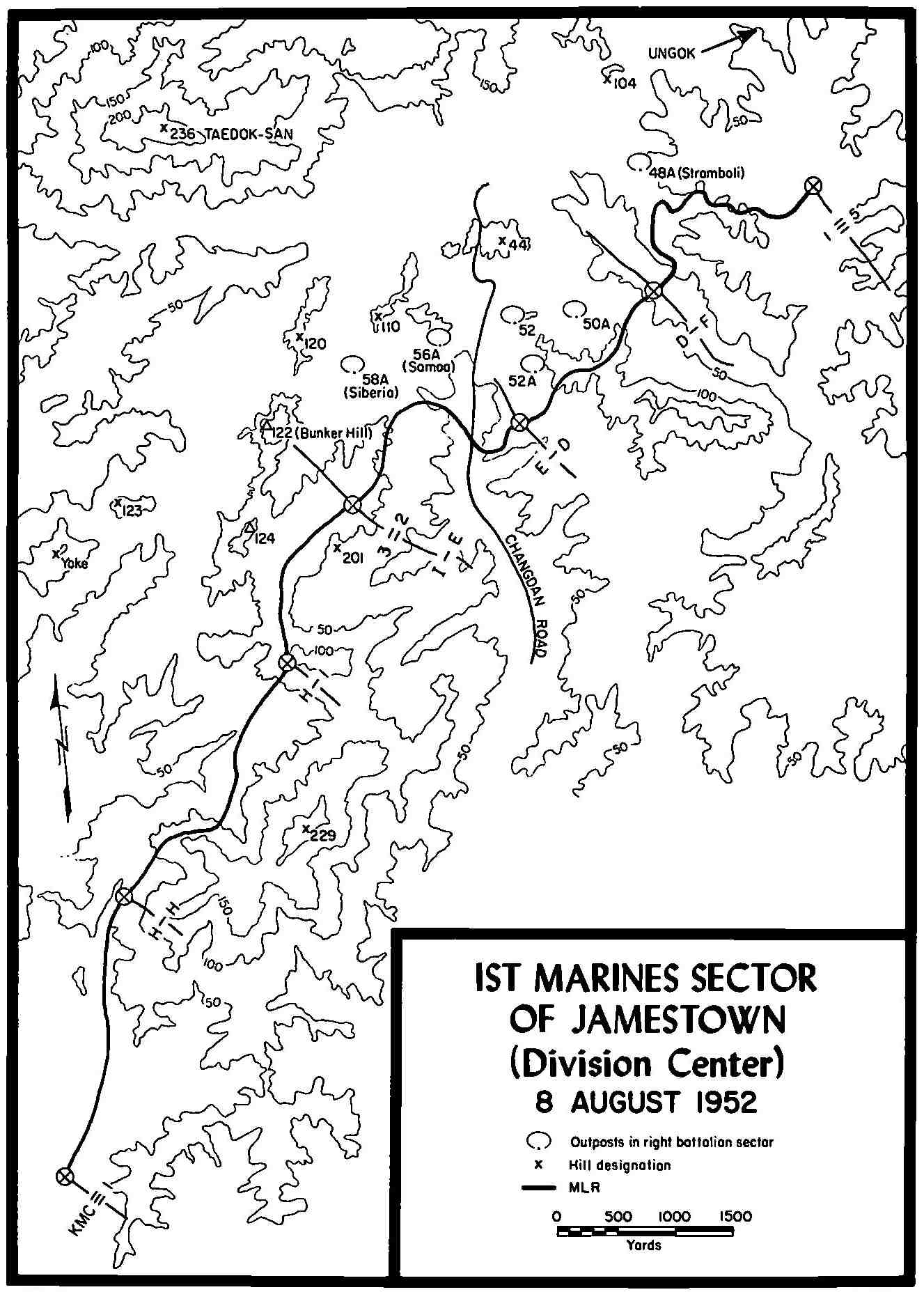
MAP 9 K. White
1ST MARINES SECTOR
OF JAMESTOWN
(Division Center)
8 AUGUST 1952
The first round in the battle of Bunker Hill began as the fight for
Siberia, Hill 58A. Just slightly more than a quarter of a mile from
JAMESTOWN, this squad-size outpost, the most western in the right
battalion sector, had been occupied in June when the division moved
its MLR forward. Since Siberia was located halfway between the
Marine MLR and the Communist OPLR, the Marine seizure of
Siberia prevented the Chinese from holding terrain suitable for employing
60mm mortars against Marine frontline troops.177 Strong
enemy outposts on Hills 120 to the north and 110 to the northeast
constantly threatened the squad on 58A. From these two forward
positions, Chinese troops early on 9 August 1952 streamed down to
Siberia, launching in the process the Bunker Hill battle.
Just before 0100 an estimated four enemy squads fell upon Hill
58A, outposted by Company E Marines. Using assorted infantry
weapons, the raiding party forced the outnumbered Siberia occupants
to withdraw. By 0145 the outpost Marines returned to the MLR. At
this time the JAMESTOWN sector south of the outpost, also held by
Captain Jesse F. Thorpe’s Company E, was under attack by approximately
50 Chinese.
After breaking up the enemy assault by well placed friendly mortar
fire, the Marines enjoyed a brief respite from Chinese pressure
and formulated plans to recapture Siberia. It was decided that a
reinforced Company E platoon would counterattack to regain the
outpost. At 0355, the 11th Marines fired a five-minute preparation
against the objective. On schedule, the platoon crossed JAMESTOWN
at 0400 and in the darkness headed towards the outpost. Advancing
carefully to avoid detection as long as possible, the Marines reached
the area near the base of the hill by 0525. Heavy enemy artillery
and mortar fire again forced the Marines to withdraw, and the platoon
returned to its company CP at 0545. So far, the 58A action
had resulted in the wounding of 32 Marines and the killing of
another.
It became evident that more preparation, by Marine air and artillery,
would be required for the recapture of Siberia. At 0650, four
Marine F9F jet fighters worked the hill over with napalm and 500-pound
bombs. Three hours later, a flight of Air Force F-80 “Shooting
Star” jets dropped eight 1,000-pound bombs on the same target.
With the aerial attack complete, Marine artillery opened fire. Five
minutes later another Marine reinforced platoon launched a second
ground attack. This was made by a unit from Company A (Captain
Robert W. Judson) of the regimental reserve battalion, supported
by a Company E platoon. Again the Marines advanced to the open
sector south of the hill before the enemy reacted. As before, the
Chinese response was a devastating barrage from their supporting
weapons. The stubborn Marine assault against Siberia brought down
the full weight of Chinese firepower—rifle, machine gun, and hand
grenades—but the attack force would not be beaten off. At 1103
the Siberia hill again belonged to the Marines. Quickly the Company
A platoon began to organize a defense to repulse the Chinese
counterattack, which was certain to come.
In anticipation of a prompt and violent retaliation by the Chinese,
and to help the speedily improvised defense efforts, the 2/1 battalion
commander, Lieutenant Colonel Batterton, had sent forward the
supporting platoon from Company E. This reinforcing unit reached
Siberia within seven minutes after the Marine attackers had gained
possession of the objective. The new arrivals scarcely had time to
dig in before a hail of mortar and artillery shells forced all the
Marines to seek cover in a defiladed position on the southern side
of the slope. From here, the 2/1 force directed counter mortar and
artillery fire onto the top and far side of Siberia and unleashed their
own assault weapons against the Chinese soldiers pressing for possession
of Siberia. By midafternoon, with heavy enemy counterfire
on the position and their casualties reaching nearly 75 percent, the
Marines were forced to withdraw and return to their own lines.
The hill had changed hands twice and the enemy had employed
5,000 rounds of artillery in the contested ownership.
Badly mauled by two actions against Hill 58A, Company E came
off the lines to reorganize, exchanging positions with Company A,
of Lieutenant Colonel Louis N. King’s 1st Battalion. About this
time Company C, less one platoon, had moved from the 1/1 rear
area forward to an assembly point behind 2/1 in preparation for a
night counterattack to retake the now battle-scarred outpost. Without
the customary artillery preparation, the attacking force at 2245
crossed the MLR at a point directly south of the former outpost
Samoa, which had been abandoned earlier when Siberia fell. Working
their way northwest towards Siberia, the Company C Marines,
commanded by Captain Casimir C. Ksycewski, cautiously approached
the assault line. Reaching it at 0105 on 10 August the force deployed
immediately and rushed the objective.
At about this time the Chinese defenders opened fire but could
not halt the assaulting Marines. The struggle to regain the Siberia
objective was fierce; some of the Chinese refused to yield and fought
to their death. Most, however, held their defense positions only briefly
before retiring to the refuge offered by the reverse slope of the hill.
Gaining the crest of Hill 58A at 0116, the Company C commander
ordered a platoon to the other side of the objective to dispatch
remaining elements of the enemy force. The resulting fire fight
lasted nearly four hours. At daybreak, however, the enemy, in estimated
company strength, strenuously renewed his counterfire and,
for a third time, forced the 1st Marines to retire from the disputed
hill and return to the main line.
Later that day, at the regimental CP, Colonel Layer called a staff
conference to decide on the best course of action. Successive Marine
withdrawals had been caused by the intense enemy shelling. The key
to its effectiveness was the observation provided the Chinese from
Hills 122 and 110. Heavy enemy fire had also caused most of the
casualties, 17 killed and 243 wounded, in 1st Marine ranks. It was
decided to shift the battle area to better restrict this enemy capability
not only to observe Marine troop movements but also to call down
accurate fire on friendly attacking units. Bunker Hill, an enemy outpost
west of Siberia, was selected. In the eyes of 1st Marines tacticians,
possession of Hill 122 instead of Hill 58A presented three
major advantages:
Hill 122 offered excellent observation into the rear of enemy
outposts;
Possession of Hill 122 would greatly strengthen the MLR in the
regimental sector, effectively neutralize Siberia, provide dominating
terrain that was more defensible than 58A; and
Bunker offered an excellent opportunity for an attack employing
the element of surprise against the enemy.
To help preserve this tactical surprise, the plan for the Bunker Hill
attack included a diversionary attack against Siberia. Making this
secondary effort would be a reinforced rifle platoon and a composite
unit of gun and flame tanks. For the main attack, Lieutenant Colonel
Batterton’s 2d Battalion would employ a reinforced rifle company
with supporting artillery and armor, if needed. The operation was
to be conducted at night, to further ensure the opportunity for tactical
surprise. For the same reason, the attack was not to be preceded
by artillery preparation on either objective. To the right of the 1st
Marines, however, Colonel Culhane’s 5th Marines would support
the diversion by artillery and tank fire placed on enemy strongpoints
in the Ungok area, about 1¼ miles northeast of Siberia. During
daylight, air, artillery, and tanks attacked targets on both 122 and
58A. Priority of effort in the 1st Marines area went to units preparing
for the Siberia-Bunker offensive.
At dusk on 11 August, 1,000 yards behind the MLR in the western
sector of the 2/1 line, the eight Company C tanks that were to
provide much of the diversionary effort at Hill 58A moved out of
their assembly area. Leading the column east of the MSR, Changdan
Road, were four M-46 mediums, mounting 90mm guns. They were
followed by an equal number of flame vehicles. Each M-46 was
specially equipped with an 18-inch fighting light, actually a searchlight
with a shutter over the lens, to be used for battlefield illumination.
The flame vehicles, World War II M4A3E8 mediums, mounted
a 105mm howitzer in addition to the flame tube. As the tanks
reached the Changdan Road, they turned north, crossed the MLR,
and proceeded to preselected positions. (See Map 10.)
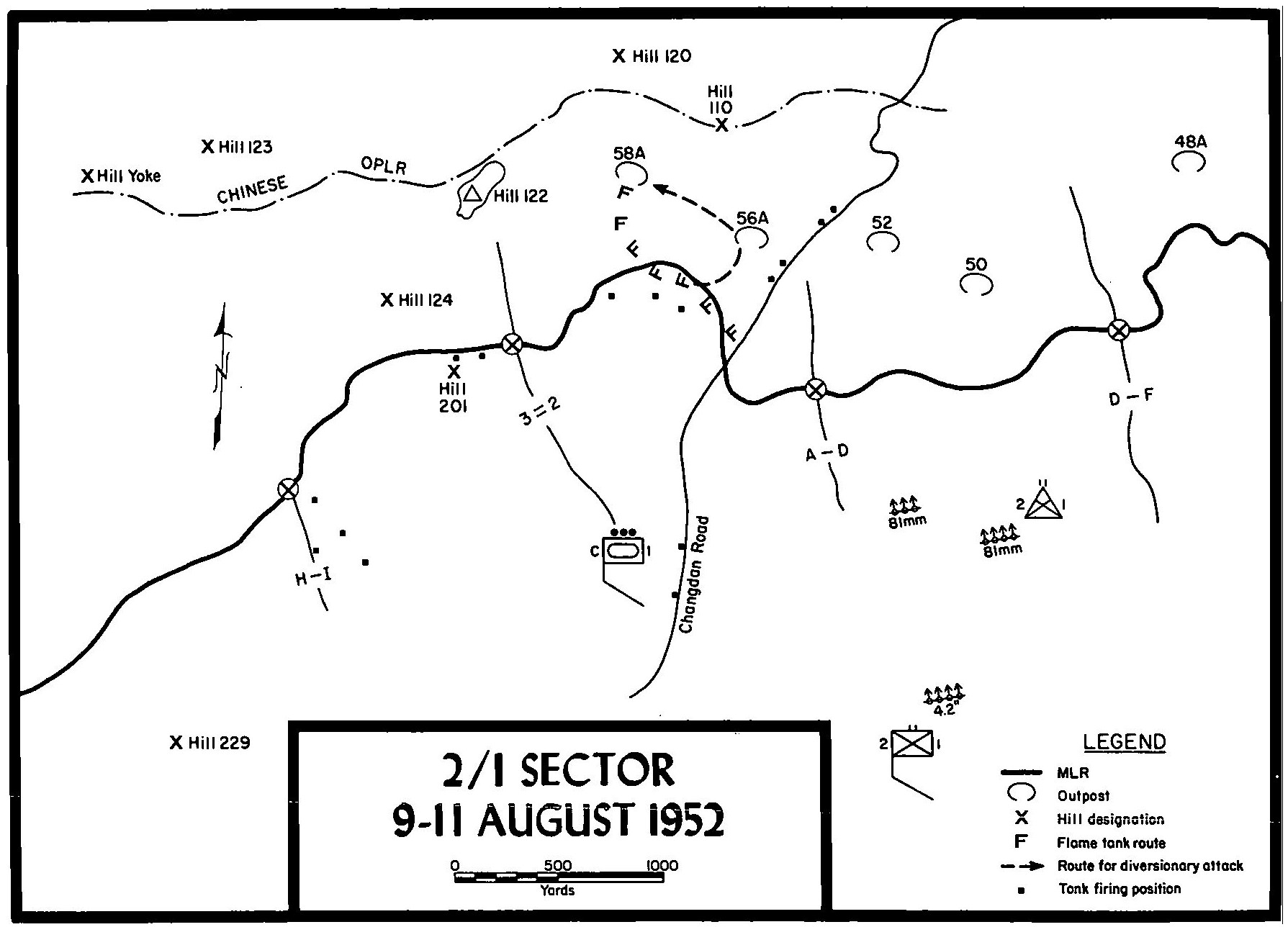
MAP 10 K. WHITE
2/1 SECTOR
9–11 AUGUST 1952
When the M-46 gun tanks were in position to fire on Siberia and
its flanks, their powerful 90s opened up on the objective. At this
time, 2110, the first section of flames (two tanks) made its way
along the stream bed between the MLR and Hill 56A (Samoa).
Lighting their way with very short bursts of flame, the two tanks
advanced in this manner to the base of Hill 58A. There the vehicles
paused momentarily, then began to move up the near slope, using
longer spurts of flame to sear the ground and sparse vegetation to
the crest of the position. The gun tanks, in the meantime, had shifted
their fire from Siberia northeast to neutralize Hill 110. When the
flame vehicles reached the top of Siberia, they lumbered down the
far slope, firing then in shorter bursts and sweeping the area with
machine guns to discourage any enemy infantry interference.
With some fuel reserved to light their way on the return trip,
the flame section reversed its course from the far side of the objective,
mounted the crest, and clanked back to the Changdan Road.
When the first section had returned, the second departed, completing
its mission in much the same manner. Tank personnel of both groups
observed that the enemy artillery and mortar fire was medium to
heavy on Siberia. Some rifle fire was also received. Gun tanks, firing
from Changdan Road east of Siberia, experienced less fire from the
Chinese.
Although the flame vehicles had completed their mission and were
on their way home, the M-46s remained on position in support of
the 3d Platoon, Company D which, at 2230, was advancing from
the MLR to complete the infantry part of the diversion. Staying out
of the low ground that the tanks had used, the platoon swept over
Hill 56A at 2255 and immediately struck out for the further objective,
Hill 58A. Gun tanks firing their 90s on the Chinese OPLR on
Hill 110 and on Siberia illuminated the target area with their fighting
lights, the shutter of which the tankers flicked open and closed
during each five-second interval that the light remained on.
Less than an hour after crossing JAMESTOWN, the platoon from
Captain George W. Campbell’s Company D reported the capture
of Siberia. The enemy quickly made his presence felt at the objective;
a half hour before midnight, he assaulted the hill in reinforced
platoon strength. Ten minutes later the Chinese withdrew and the
Company D Marines, in accordance with their battle plan, did
likewise. At about the same time the 5th Marines, having completed
its part in the diversion, also secured from the operation.
Ten minutes after the diversionary infantry had cleared Samoa
while enroute to Siberia, the main attack force, Company B, which
had come under operational control of 2/1 at 1800, crossed the
MLR, the line of departure. Moving at a fast pace to preserve the
element of anticipated surprise, the attack force, commanded by
Captain Sereno S. Scranton, Jr., soon deployed two squads of the
lead platoon against the near side of the hill. By 2318 on 11 August
the squads were moving up Bunker Hill and, 10 minutes later, one
platoon had gained the top of the objective and one was at the base
of the hill, both moving northward along the forward slope. As the
advancing units neared the end of their sweep forward, they began
to come under small amounts of rifle fire from the front and left
flank of the position.179 The Company B platoons continued to advance,
returning well-placed small arms fire.
Soon the intensity of Chinese small arms fire increased; at the
same time enemy mortars and artillery opened up on the company.
Marines attempting to assault the top of Hill 122 also came under
a hail of hand grenades hurled by the staunch Chinese defenders.
After a brief but vicious fight at point-blank range, the Chinese
gave ground on the eastern side, heading uphill. Several Marines
pursued the fleeing enemy to the summit, then joined the rest of the
assault units of Company B in organizing a defense. By 0300, 12
August the battle had quieted down and for a short while all firing
ceased. Then, as the Marines began to dig in, a bypassed pocket of
enemy resistance came to life. Two fire teams in the 1st Platoon took
these Chinese Communists under fire.
Even as the fighting continued, Marines and KSC personnel
were hauling fortification materials towards Bunker to consolidate
the precarious foothold. For a while, enemy mortars unleashed a
heavy fire against the newly won position, but by 0230 Company B
was able to report that enemy shelling had stopped and that the
objective was in friendly hands. A new fire fight broke out at 0345
between a small force of enemy soldiers occupying a draw forward
of Bunker Hill and Marines nearby. The exchange of fire continued
for nearly two hours, but short of harassing the Marines on Bunker
Hill the enemy did not launch a counterattack. Dawn on 12 August
revealed that thus far in the Bunker Hill fighting 1 Marine of Company
B had been killed and 22 were wounded. The earlier diversionary
attack on Siberia had resulted in only one Marine casualty,
the wounding of the platoon commander, Second Lieutenant James
W. Dion.
Personnel losses were kept to a minimum by the well-organized
medical support and the efficient service of medical and evacuation
personnel. A forward aid station was established in the vicinity of
the Company E CP. Casualties that were not ambulatory arrived
at this two-bunker installation usually by hand litter, other wounded
men were transported in armored personnel carriers, U.S. Army
tracked vehicles similar in appearance to the Marine LVT, that had
accompanied the diversionary unit and were part of the Panmunjom
rescue force stationed in the area of COP 2 on the 3/1 left flank.
Wounded Marines were examined immediately. Minor injury cases
were treated and discharged; more seriously injured personnel were
given emergency treatment and evacuated. Movement to the rear
was accomplished by ambulance jeeps. Helicopters, landing only
30 yards from the station, flew out the critically wounded. A sandbag-protected
squad tent was used to house casualties waiting to be
examined. This emergency aid station closed down on 13 August,
when action in the right battalion sector diminished.
Even though the remainder of the morning of 12 August was
practically free of any retaliatory attempts by the Chinese against
Bunker Hill, the Marines occupying the new position were not
idle, for they anticipated an immediate and severe reaction for capturing
the hill. Quickly, but methodically, the company dug in. At
noon, regiment passed to 3/1180 the responsibility for Bunker Hill
and operational control of Company B. Consolidation of Hill 122
continued until about 1500, when the Marines were forced to put
down their entrenching tools and grab their rifles instead. The
Chinese had suddenly launched an intense mortar and artillery attack
against the hill. Defending Marines expected to see enemy soldiers
start up the western slopes at any minute.
Actually, more than an hour elapsed before the Communists
initiated their first main ground attack to regain Bunker. By that
time, heavy casualties from the continued shelling had forced Company
B to pull back from the ridge and take up positions on the
reverse (eastern) slope of Bunker Hill. At this point, with reduced
Company B forces and with no radio communication between Captain
Scranton’s unit and 3/1, Lieutenant Colonel Armitage sent
I/3/1,181 under Captain Howard J. Connolly, forward from the
MLR. Shortly before 1600, a force of more than 350 Chinese lunged
out of the low ground of Hill 123, west of Bunker, to attack defensive
positions along the ridge between Hills 124–122. Striking in
rapid succession first the west side and then the northern end of the
Company B position to find a weak spot in the defense, the enemy
counterattack finally concentrated on the southwestern part of the
hill.
An intense exchange of fire raged here until 1715, when the
defending fire of Company B plus the added weight of the Company
I reinforcements combined to stall the enemy advance. Having failed
to gain their objective, the Communists abruptly broke off their
artillery and mortar fire and ordered their infantry to withdraw.
They pulled back only to the far side of the hill, however. By 1740
the enemy was occupying his new post on the northern slope, while
the Marines continued to hold their positions on the reverse slope of
Bunker Ridge. Enemy supporting fires had lifted and a lull ensued
in the fighting.
Even before the Chinese had made their coordinated attack against
Hill 122 in the midafternoon of the 12th, the 1st Marines had
implemented a plan of action to assure that the critical position
would remain in Marine hands. In addition to the movement of
Company I/3/1 to reinforce Bunker Hill and of Company I/3/7 as
its relief on the MLR, a precautionary displacement was also made
of the 3/1 reconnaissance platoon to Hill 124 to tie in that terrain
feature with both Bunker and JAMESTOWN and thus consolidate
the defense north of the MLR and west of Bunker. (See Map 11.)
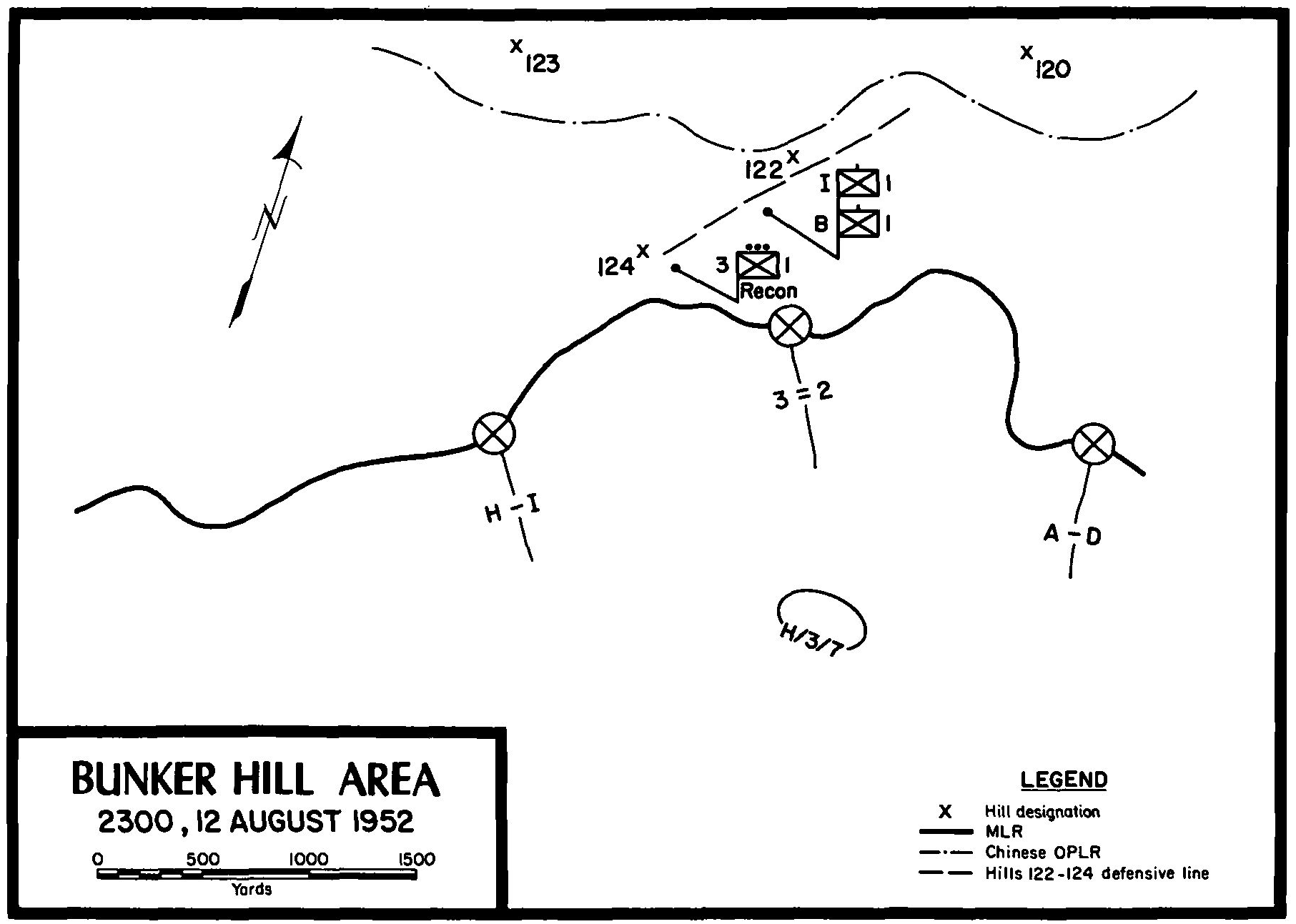
MAP 11 K. WHITE
BUNKER HILL AREA
2300, 12 AUGUST 1952
Other activities behind the line aimed at making the Marine
position on the newly seized hill more tenable. As one step in this
direction, General Selden shifted most of his reserve into the zone
of action. Before the end of the day remaining units of 3/7 were
placed under operational control of 3/1, and 2/7 was attached to
Colonel Layer’s reserve. The 7th Marines was directed to place its
4.2-inch mortars on call to the 1st Marines. Priority of artillery
support went to the Bunker Hill regiment. Within the 1st Marines,
the regimental commander moved two provisional platoons (118
Marines) of the reserve 1st Battalion to the 3d Battalion sector. All
81mm mortars in 1/1 were sent to the left battalion. The fire plan
also called for employment of all the 60mm mortars that could bear
on the crest of 124–122, with 81mm and artillery box-me-in barrage
fires on the ridge and flanks.
Machine guns from the MLR were assigned missions on the crest
of Bunker Ridge and 4.5-inch ripples were planned on the deep
enemy approaches. Gun and flame tanks were to protect the right
flank of Hill 122 where the steep draw between Bunker and the MLR
offered the most dangerous approach into Bunker Hill. Supplies and
fortification materials, meanwhile, were being carried forward and
casualties taken to the rear by the relief party. Although 3/1 initially
reported that the Bunker Hill fighting had resulted in 58 killed or
wounded Marines, a later battalion count showed this number to be
34—5 killed and 29 wounded.
Most of the casualties had been caused by hostile shelling.
Although the Hill 122 reverse slope afforded some cover from the
Chinese artillery and mortars, the positions on the crest did not offer
any protection, so Marines continued their trenchworks and other
defensive preparations at a rapid pace and supporting fires were
registered by 1900. The approach of night was certain to bring
renewed Communist attempts to capture Bunker Hill.
At 2000, Lieutenant Colonel Armitage reported to division that
his force on Hill 122 occupied the entire reverse slope and that the
Marine of I/3/1 and B/1/1 were digging in and consolidating
their scant defenses. Enemy shells were still falling on both Bunker
and Hill 124. Company commanders forward of the MLR estimated
that as many as 400 Chinese occupied the ridge on the other side
of the slope from the Marines. Since the crest of the long Hill 124–122
ridgeline was fairly level, the gentle incline of the Bunker rear
slope permitted defending Marine units excellent fields of fire to the
ridge crest, a major consideration in the 3/1 battalion commander’s
decision to adopt a rear slope defense. Moreover, the top of the
ridge could be swept with direct fire from the MLR as well as supporting
weapons from the two nearest companies on JAMESTOWN.
Opposing Marine and Chinese forces were thus lined up for a continuation
of the battle for Bunker Hill.
It appeared that the Chinese wished to attempt a diversionary
tactic of their own. To draw attention away from Hill 122 they
engaged a Marine outpost east of Bunker and a KMC ambush far
to the left before attacking Bunker again. In the KMC sector,
shortly after 2300, an enemy infantry platoon walked into a trap
near the eastern edge of the Sachon and 500 yards south of the
Munsan-ni-Kaesong rail line. The brief fire fight lasted only 10
minutes before the Chinese broke contact.
Perhaps the ambush was incidental to the forthcoming attack
against the Bunker complex, but this same reasoning cannot be
applied to the Communist-inspired action which broke out shortly
at Hill 48A, Stromboli, another friendly outpost far to the east of
Hill 122. Near the right limiting point of Colonel Layer’s 1st
Marines and the 5th Marines boundary, Stromboli was another
Marine fire-team-by-day, squad-by-night position. It occupied a small
rise 250 yards forward of the MLR and commanded the immediate
sector in all directions. The entire MLR in the regimental right was
dominated by the enemy-held Hill 104, a half-mile north of 48A.
Communist infantry opened the attack without benefit of any
supporting arms preparation and rushed to seize Hill 48A early on
the morning of 13 August, a few minutes after midnight. Defending
Marines immediately responded with small arms and automatic
weapons fire. By the time the outpost commander had informed
battalion of the attack by radio, the far right sector of the 1st
Marines line, held by Captain Clarence G. Moody, Jr.’s Company
F, had also come under attack. Firing rifles and submachine guns and
hurling hand grenades as they assaulted the main position, the
Chinese attempted to penetrate the JAMESTOWN defenses. In spite
of the enemy’s concerted efforts, the Marine line remained staunch.
At Stromboli, the Communists met with no greater success,
although they did cause enough casualties to warrant the dispatch
of a Company F reinforcing squad. When this unit left the MLR,
at 0106 on 13 August, the Marine line was still under a heavy
attack not only from Chinese infantry but from hostile artillery and
mortars as well. Out at Hill 48A the outpost remained in comparative
quiet until the approach of the reinforcing party. As the
Company F squad neared the base of the hill, Chinese infantry that
earlier had been assaulting the Marine MLR turned their rifle and
machine gun fire from positions on the JAMESTOWN side of the
outpost. A heavy rain of devastating mortar fire engulfed the reinforcing
Marines. On order, they broke off the approach march and
returned to the company rear area.
On the main line, meanwhile, Company F positions were still
being bombarded by Chinese artillery and assaulted by their infantry.
Casualties along the entire line forced Lieutenant Colonel Batterton
to order his 1st Provisional Platoon, Headquarters and Service Company,
2/1, to the Company F command post. After the clutch unit
departed the battalion area, at 0210, and approached Captain
Moody’s CP, enemy fires immediately intensified. A violent fight
erupted to the left of the Company F sector, but the Marines there
held. The Chinese then tried to punch holes in other parts of the
company line, moving eastward along JAMESTOWN. Each failure
to breach the line seemed to signal a decrease in the intensity of
Chinese shelling.
This easing of Communist pressure against the main line enabled
the Company F commander to put into operation a new attempt at
the reinforcement and rescue of Stromboli. After the initial enemy
assault in the early hours of 13 August had ended in failure, the
Chinese made repeated attempts to capture the outpost. At one
time it appeared that a company of Chinese had overrun the hill.
Later, however, the Stromboli stronghold radioed that the enemy
force, subsequently identified as only a platoon, had encircled the
Marine position. To relieve enemy pressure at Hill 48A, Captain
Moody employed a rifle platoon which set out for the outpost at
0325.
Simultaneously, as if their intelligence had advance knowledge of
the 1st Marines recovery plan, the Chinese stepped up the tempo of
their attack at Stromboli. A fresh assault by the enemy was stymied
by Marine superiority in hand-to-hand combat. Thereafter, close-in
defensive fires continued to ring the outpost and to discourage future
assaults. The approach of the second Marine rescue party eliminated
much of the pressure that Communist foot soldiers had maintained
around the hill position. After a 90-minute exchange of fire with
the enemy, the friendly platoon penetrated the encirclement and
rushed to the besieged outpost at the hill crest. At this point the
Chinese disengaged and withdrew towards the north.
After their diversion against Stromboli had approached the
proportions of a full-scale attack, with the enemy having reinforced
from platoon to company size, the Chinese then initiated their main
thrust, an attempt to retake Bunker. Captain Connolly (I/3/1) had
reported that shortly before 0100 Communist mortar fire had begun
falling on his positions on the southern slope of Bunker Hill. Simultaneously,
Chinese artillery stepped up the rate of its barrage fires
as did the assaulting close-in enemy infantry. Captain Connolly
then requested the 11th Marines to place box-me-in fires around the
Marine company positions on Hill 122. Artillery furnished these
defensive fires almost immediately.
Shortly after 0130, the Marines in the center and right of the
I/3/1 position observed a large number of Chinese, deployed into
a skirmish line, headed directly for their part of the hill. The attack
was accompanied by intense machine gun and rifle fire. It was
countered by an equally heavy reply from Marines on Bunker. For
nearly four hours the battle raged at Hill 122. Unsuccessful enemy
frontal assaults were followed by attempts to dislodge the defenders
from the rear. In their continuing thrust against the hill, the Chinese
were repulsed by Marine coordinated support fires—tank, rocket,
artillery, and mortar.
By firing on known or suspected assembly areas and Chinese
infantry units advancing up the draws towards Hill 122, these
Marine supporting weapons helped to preserve the status quo at
Bunker. Repeated box-me-ins were also fired by the 11th Marines
during the early-morning Communist attacks on 13 August. Exploding
friendly mortar shells increased the effectiveness of the hill
defense; nine rocket ripples183 fired by the artillery regiment further
supported Marines at the critical terrain position. Tanks unleashed
their deadly fire on nearby enemy outposts to neutralize them; their
90mm guns, aided by the battlefield illumination from tank fighting
lights, helped eliminate Chinese foot soldiers attempting to envelop
Marine positions on Bunker.
It was in this direction that an enemy force, estimated at reinforced
battalion strength, headed during the early morning fighting
on Hill 122. At 0330, the struggle for possession of the height had
reached the climax. For an hour the issue remained in doubt. Then,
as the Chinese small arms fire decreased, the tempo of the enemy’s
artillery shelling increased. This, the division correctly deduced,
announced the beginning of a temporary Communist withdrawal
from Bunker Hill.
Although the immediate danger of the enemy onslaught had ended
for the time being, Marines to the rear of the JAMESTOWN Line
stepped up their defensive preparations. Division, regimental, and
battalion operational plans were put into effect to prevent a Chinese
victory. The seriousness of the situation on the 1st Marines right flank
at Stromboli early on 13 August had resulted in the movement of one
company of 5th Marines into blocking positions behind the MLR
near the left regimental boundary. To the south of Bunker Hill,
relief and replacement units from the division reserve, ordered into
action late the previous day, maneuvered into position to strengthen
the regimental front. One of these relief units, G/3/7, under
command of Captain William M. Vanzuyen, had just deployed from
its assembly area to pass through the ranks of an MLR company
and take over the Bunker Hill positions. The Marines’ situation on
Hill 122 had deteriorated so rapidly, however, that the 3/1 commander
rushed two reinforced squads forward from I/3/7, the
nearest MLR unit.
The Company G reinforcement unit jumped off from JAMESTOWN
and arrived at Bunker shortly after sunup, where it reinforced
Captain Connolly’s positions during the height of the battle for
possession of Hill 122. Not long after, the Chinese initiated their
withdrawal under cover of increased artillery and mortar barrages.
As they left, the Communists policed the battlefield in their typically
thorough manner. A Marine platoon that swept the northern slope
of Bunker failed to find any enemy bodies in this area so recently
abandoned by the Chinese, but did take under fire and kill seven
enemy that had remained on Hill 122.
Before I/3/1 had sent one of its platoons to reconnoiter the far
side of Bunker Hill, Lieutenant Colonel Armitage ordered H/3/7,
under Captain John G. Demas, forward to relieve friendly forces at
the contested height. The exchange of units was completed before
noon of the 13th. By late afternoon, except for Company H, all
2d and 3d Battalions, 7th Marines units that had moved up to
reinforce the 1st Marines were on their way back to the regimental
reserve area. At this time the 1st Marines CO, Colonel Layer,
reported to General Selden that the Bunker Hill action during 12–13
August had resulted in 24 Marines killed and 214 wounded. On the
right, in the 2d Battalion sector, an additional 40 Marines were
listed as casualties, including 7 killed in the Stromboli defense.
Chinese known dead numbered 210, plus an estimated 470 killed and
625 wounded.184 Artillery and aerial observers reported that between
1500 on the 12th and 0600 the following morning an estimated
5,000 to 10,000 rounds of enemy fire had fallen on 1st Marines
positions, the “heaviest incoming fires received by the Division since
coming into the present sector.”185
The number of casualties from the Bunker Hill action was to
increase further that same day with a renewed attack on the outpost.
Before the Chinese again engaged Hill 122, however, they made a
diversionary attack on the western flank at the extreme left of the
3/1 sector. At dusk on 13 August, the enemy shelled the Company
G Marines at COP 2, the critical height overlooking the Panmunjom
peace corridor. The shelling caused several casualties and lasted 90
minutes. Towards the end, Communist infantrymen moved forward
and fired on the outpost. At about the same time, Company H
personnel emplaced on the MLR to the rear of COP 2 began to
receive artillery rounds in preassault proportions.
A ground attack in this western end of the 3/1 sector did not
materialize, however. Instead, the Chinese resumed their attack on
Bunker Hill. Since their temporary withdrawal early on the 13th,
the CCF had repeatedly sent mortar and artillery barrages against
the bastion to harass its new occupants. On occasion these well-aimed
mortar rounds found their mark. Mortars interdicting a trail
used for resupply of the Hill 122 defenders did inflict some casualties
on two groups rushing emergency supplies forward from the
MLR.
At 2100, while continuing his shelling of the left end of the 3/1
sector, the enemy lifted his preparation on Hill 122 to permit a
CCF reinforced company to make a new assault there on the Marine
defenders. Captain Demas called for box-me-ins to seal off his
positions and illumination shells to help locate the enemy force.
Utilizing the draw to the east of Hill 58A, the Chinese proceeded
west to Bunker where they pitted one platoon against the center of
the Company H, 3/7 line and another against the right flank.
Defensive fires momentarily held off the intruders, although some
were able to break through to the Marines’ fighting positions.
Those enemy troops who penetrated the Marine defenses were
quickly eliminated by grenades and small arms fire. Unable to
weaken the Marine defenses any further and by now sustaining sizable
casualties from unrelenting Marine artillery and mortar concentrations,
the Communists withdrew at 2215. Marine defenders
estimated they had killed 175 enemy during this latest encounter;
a firm count of 20 bodies were found on the shell-torn slopes. Company
H casualties, all from enemy mortar and artillery fire, were 7
killed and 21 wounded.186 Enemy incoming was again heavy during
this period, with a reported 3,000 rounds falling in the sector.
In the 3d Battalion sector, Marine and KSC stretcher bearers
brought casualties to the I/3/1 CP, several hundred yards to the
rear of the front line. At the command post, the critically wounded
were airlifted by helicopter to the rear. Less seriously wounded
casualties were placed in jeep ambulances and carried to the battalion
forward aid station, about two miles away. Here a team of doctors
and corpsmen examined and treated patients, discharged a few,
but prepared most for further evacuation. At the 1st Marines forward
aid station, patients were reexamined and their wounds
redressed when required; discharge or further evacuation was also
accomplished. Most of the Marines brought to this forward facility
had become exhausted from vigorous activity in the high temperature
and humidity which characterized the South Korean summer. The
regimental aid station treated these heat cases and then released
them to their units.
Division intelligence subsequently reported that the 2100 attack on
13 August had been made by an enemy battalion with a reinforced
company in assault. This same unit again sent a small band of
Chinese soldiers against Hill 122 at 0225 the following morning. This
clash was to be the briefest of all offensives for control of Bunker
Hill during the 11–17 August period. Prior to launching this four-minute
fire fight, an enemy machine gun at Siberia had attempted
to harass the Marines at Bunker Hill. In retaliation, Marine tanks
illuminated this enemy weapon with their searchlights and immediately
took it under fire with their 90mm guns, knocking it out of
action. At the same time, enemy artillery attempted to shell friendly
tanks. During this brief fire exchange, one tanker was wounded
slightly and the lens of one fighting light was splintered by fragments
from enemy shells bursting around the tanks. The inconsequential
probe was made, Marines believed, not so much to seriously
challenge Marines holding Hill 122 as it was to retrieve CCF dead
and wounded from the major attack a few hours earlier that night.
Anticipating that a much heavier ground attack was close at hand,
the 1st Marines ordered a reinforcement of the Bunker Hill position.
Even before the heavy action on the 13th, this machinery had been
set in motion. To this end, the 3d Battalion was to reinforce the
Bunker defense by sending a 1/1 platoon to the hill and the 2d
Battalion was instructed to return Company A (minus this platoon)
to the reserve battalion. At 0415 on the 14th, Company E/2/1, led
since 10 August by Captain Stanley T. Moak, took over from
A/1/1 the responsibility for the 2d Battalion’s MLR “Siberia sector,”
adjacent to the Bunker Hill area held by the 3d Battalion. The Company
A reinforcing platoon arrived at Hill 122 just before dusk,
preceding another CCF company attack by only a few hours.
At midnight the 1st Marines front was suspiciously quiet for a
few minutes. Forward on Hill 122, there was no apparent enemy
activity. Captain Demas sent out a two fire-team patrol from Bunker
to reconnoiter northwest of Bunker towards the Chinese lines.
Shortly after the eight Marines returned with a negative report of
contact with the enemy, the regiment received a report about the
outbreak of a small arms clash between defenders on the left flank
of Bunker and an enemy unit farther west. At 0118 on 15 August
what had initially appeared to be a minor contest suddenly erupted
into a heated fire fight all along the 124–122 Bunker Ridge complex.
At the request of Captain Dumas, Marine artillery fired protective
boxes around the Bunker positions. This defensive maneuver held
the attackers in check.
At this moment, Chinese infantrymen in the draw running alongside
the 124–122–120 ridge system were massed for an assault
on Bunker from the northeast. The plan might have been successful
had not a fighting light from a tank on the main line intercepted
the Communists in this state of their preparations. In a matter of
moments, friendly artillery, mortar, and tank fire struck the Chinese
and scattered the formation.
After discovering he could not successfully pull a sneak attack,
the enemy reverted to his usual procedure, employing a preassault
bombardment prior to his infantry assault. This preparation began
at 0206; it reached the rate of approximately 100 rounds of 82 and
122mm mortar shells per minute. While supporting weapons
pounded the Marines, the Chinese assault commander reorganized
his attack force that the Marine shelling had scattered. Communist
infantry then moved forward and fired on the Bunker Marines, who
replied with rifles and machine guns and box-me-in fires. Unable to
penetrate this protective mask around the positions, the Chinese
gradually decreased their small arms and artillery fire until, at 0315,
the rate of exploding shells at Hill 122 had dropped to only four
or five per minute. Soon thereafter the small arms fire slacked off
entirely and by 0400 even the mortars had stopped. Across the entire
1st Marines front, all was quiet again.
During the Company H defense of the hill, enemy losses, caused
mostly by friendly artillery and mortar fire, were placed at 350,
including 40 counted dead. Captain Demas’ Marines suffered 35
casualties, of whom 7 were killed. En route to the MLR after relief
by B/3/1, the company suffered four more casualties, including two
KIAs, all the victims of Chinese mortars.
It was not long before these weapons inflicted casualties on Company
B, which had six of its men wounded even before the H/3/7
unit had reached JAMESTOWN. Another Marine at Bunker was
wounded by enemy mortars later that morning. At 1640 the Communists
again probed Bunker Hill, this time in company strength.
Striking in daylight during a thunderstorm and without any preparatory
fires, the Chinese attackers failed to achieve any tactical surprise.
The defenders fired both infantry and supporting weapons; some
threw grenades at the few Communists who did manage to get close
to the fighting positions. At 1750, the Chinese withdrew, this time
leaving 35 of their dead in the attack area. Four Marines had been
wounded; five others suffering from battle fatigue were later
evacuated.
Exactly when the enemy would strike next at Bunker Hill was not
known by the Marines. Most believed that the Communists would
return but only speculated as to when. Although the battalion felt
that “the enemy was not expected to attack again for some time,”188
events were to prove otherwise. In any case, the battalion was prepared,
having an adequate force on Bunker and sufficient local
reserves to absorb an attack up to the strength of any received so far.
Division supporting arms were readily available for commitment at
critical points.
The Chinese soon put an end to the conjecture about the next
attack. At 0040, 16 August, an enemy force, later estimated as a
battalion, came out of positions to the west and north of Hill 122.
Supported by mortars at first, and later on by artillery, the battalion
sent one company against the Marine outpost. Several attacking elements
were able to penetrate the defensive fires. These Chinese
reached the crest of the hill and began using their rifles, automatic
weapons, and hand grenades against the defenders. Captain Scranton
called for reinforcements. A platoon from I/3/7 was dispatched
promptly from the 3/1 sector. The reinforcements departed JAMESTOWN
just as the fire fight on Bunker began to subside. By 0315, the
enemy had begun his withdrawal, and another reinforcing element,
I/3/1, had moved forward, this time from regiment to Lieutenant
Colonel Armitage’s CP.
About two hours later a brief fire fight flared up in the Company
B sector. No ground assault was made on Marine positions. The
enemy force, of undetermined strength, never closed with the
Marines and within 10 minutes, the firing stopped. No casualties to
the Marines resulted during this exchange. The earlier clash had
resulted in the death of 3 Marines and the wounding of 27. Enemy
losses were estimated at 40 killed and 30 wounded.
Before it came off the hill, Company B was engaged by enemy
fire three more times. At 1945, Chinese mortars (82mm) wounded
two Marines. Later, heavier mortars placed 20 rounds on Hill 122,
but these caused no casualties. There were some losses, however,
early on the morning of the 17th when C/1/1 was relieving the
Bunker defenders. Captain Scranton’s Marines sustained five more
wounded from automatic weapons, five during the relief.
The second relief of Company B on Bunker brought to a close
the battle that had been waged for possession of the vital hill complex.
During the Hill 122 tours of Company C and other 1st Marines
units that followed in August, seven more ground actions tested the
Bunker Hill defenses. Only one of them, during the night of 25–26
August, was of significant size. This attack also failed to dislodge
the Marines from the hill.
It was quite natural that the flurry of ground activity during the
battle of Bunker Hill created a need for increased participation from
Marine supporting arms. The magnitude of infantry action during
the contest for Hill 122 resulted in a monthly record to date in 1952
for the amount of air support received as well as the volume of both
artillery and tank fires supporting the division. During this critical
9–16 August period, the 11th Marines played a part in every ground
action except the feint attack on Siberia and the seizure of Bunker
Hill, both of which were purposely executed without an artillery
preparation. Medium tanks fired day and night missions during
most of the infantry action. Close air support at times amounted to a
strike every 20 minutes.
During the ground action around Bunker, Siberia, and Stromboli,
the division received close air support in amounts unparalleled for
JAMESTOWN Marines to that time. Marine and U.S. Air Force pilots
flew a total of 458 missions (including 27 ground controlled MPQ-14
radar bombing attacks) during five of the most critical days,
9–13 August. On two of them, the 1st Marine Division received
priority of close air support along the whole EUSAK front. Fifth Air
Force assigned 1st MAW aircraft to Marine requests for close air
support as long as Marine aircraft were available.
The initial air strike by Marines in the Bunker fighting was on
9 August in support of counterattack plans for Siberia. MAG-33
provided a morning and evening flight of four F9F jet fighters to
destroy enemy forces and defensive works on 58A (Siberia).
USAF fighter-bombers attacked Siberia and other outposts nearby
and enemy artillery positions supporting the Chinese forward line.
On the next day, air operations, concentrating on Siberia, were
stepped up considerably against enemy outposts. Thirty-five aircraft
in nine missions attacked 58A with bombs, rockets, and napalm.
These strikes were carried out by MAG-12 and U.S. Air Force pilots
at irregular intervals during daylight hours. Air controllers reported
good results. Other aircraft hit known mortar locations capable of
supporting the Chinese. During the morning, Marine Attack Squadron
121 (Lieutenant Colonel Philip “L” Crawford) bombed and
burned Bunker Hill. Just before sunset, F-80 and -84 jets of the
U.S. Air Force dropped 15 tons of bombs on mortar positions and
troops on and around Hill 120. Four F-80s also participated with
eight Marine AD-2 propeller-driven attack aircraft in the morning
attack on Bunker.
Air activity in support of the 1st Marines continued unabated on
11 August. Before the diversionary ground attack just after dusk
that day, Marine and Fifth Air Force fliers repeated the treatment
that Hills 58A and 122 had received the previous day. During daylight,
supporting weapons positions were hit by FAF fighter planes.
At night, MAG-12 air attacks guided by the MPQ-14 radar bombing
system destroyed hostile artillery and mortars. Also during the dark,
the medium bombers of the FEAF Bomber Command struck deeper
in the rear at heavy weapons locations.
These Air Force bombers conducted four more controlled-bombing
attacks against Chinese artillery during the early hours of 12 August,
when Company B was consolidating its positions and hastily organizing
the defense of Bunker Hill. After daylight and until dusk,
MAGs-12 and -33 and USAF squadrons provided four-plane flights
to strike troop assembly areas, supporting weapons positions, and
observation posts close to Hill 122. In late afternoon, Marine pilots
in four F9F Panther jets and three ADs bombed and burned the
enemy side of Bunker Hill during the shelling and subsequent
ground attack against the Marines on the eastern slope.
Marines flew, on 13 August, all of the daylight close air support
missions in support of the actions on both Bunker in the center and
Stromboli in the right of the 1st Marines sector. On 13 August, a
total of 94 aircraft were committed over the regimental sector to
conduct strikes in support of ground operations. Enemy Hill 104,
commanding the 2/1 outpost on 48A (Stromboli), received four
attacks. Fighter bombers (F4U propeller-driven Corsairs) carrying
napalm, rockets, and 1,000-pound bombs, raided the hill mass at 0535.
The other strikes against this key terrain-feature were made by attack
and fighter aircraft during the afternoon. Other targets on the regimental
right were weapons positions beyond Hill 104 and an enemy
outpost one thousand yards west of Stromboli.
Most of the air support received by the 1st Marines on the 13th
was directed against targets that were participating—or that were
capable of taking part—in the battle on Bunker Hill. Against the
enemy on the height itself, the Marines directed only three strikes,
and these came late in the morning. A majority of the air attacks
were dispatched against observation and command posts and the
firing positions of both automatic and large caliber weapons. Chinese
artillery and mortar fire had inflicted more casualties and punishment
on the Marines than the enemy infantry assaults. As a consequence,
the main effort of the close air support strikes was directed against
these hostile supporting weapons.
After dark on the 13th, VMF(N)-513 commanded by Colonel
Peter D. Lambrecht,190 took up the air offensive against the heavy
firing positions in the rear of the enemy line. The squadron conducted
four attacks with its night fighters. Two of its attacks were
made just before sunrise.
During the remainder of the battle of Bunker Hill, the ground
fighting subsided and the requirement for close air support abated
accordingly. On the 14th, only four daylight strikes were flown in
the 1st Marines area. These, all by Marine squadrons, were against
active artillery and mortars in the defilade of Hill 120 and others to
the west on the far slope of Hill 123, and Chinese outpost positions,
west of 48A, which had been pestering the Stromboli garrison.
There were no flights after dark on the 14th, but on the following
night, two MPQ missions were flown by VMF(N)-513. Each was
a single plane flight against a reported artillery location. This was
the final night air action in the battle for Bunker Hill. Daylight
missions in support of Hill 122 defense after the sharp decrease of
attacks on the 14th numbered only seven attacks, each by four planes.
These, flown by Marines, continued to emphasize the destruction of
enemy artillery.
Marine artillery continued its support of ground troops and air
strikes. Cannoneers of the 11th Marines fired 21 flak suppression
missions during the five days beginning on 11 August. This type of
close coordination between Marine supporting arms further reduced
combat losses of aircraft providing CAS to the division. The Marine
artillerymen had played a vital part in the defense of the besieged
outposts. Lieutenant Colonel Armitage credited the box-me-in fires
with an important role in thwarting each enemy attack on Bunker.191
In the 24-hour period beginning at 1800 on 12 August, Marine
artillery directly supporting the 1st Marines fired 10,652 rounds.
Most of the ammunition was expended in support of the Bunker
Hill defense; some was used in behalf of the Marines outposting
Stromboli during the Communists’ early morning diversion that day.
On the 9th, the direct support battalion, 3/11 (Lieutenant Colonel
Charles O. Rogers), had fired about one-fourth of the 12–13 August
total. Many of the shells that first day of the Bunker battle were
preparatory to counterattacks for regaining Siberia.
When the retaking of Hill 58A was discarded in favor of the
surprise attack on 122, the amount of artillery support was reduced,
during the 1st Marines infantry preparations on the 10th and 11th,
in keeping with the fire support plan. Upon seizure of Bunker,
Lieutenant Colonel Rogers’ business immediately picked up and
quickly reached a crescendo the following day, when the 10,652
shells fired became a Marine one-day battalion record for western
Korea until the last stages of fighting in 1953. Other Marine artillery
battalions fired reinforcing missions during the critical period as
did the 4.5-inch Rocket Battery which fired a large number of
on-call ripples. The regimental commander later recalled that “during
some of the crises every gun that could bear on Bunker in the 11th
Marines and reinforcing units was shooting there.”192
After a sharp drop on the 14th, the artillery support gradually
decreased in proportion to the amount and strength of the enemy’s
action against Hill 122. By 20 August, 3/11 was firing only 244
rounds a day. Only on the 26th, during a serious Chinese attempt
to retake Bunker, did the number of artillery rounds match the
intensity of the fire support rendered during the earlier part of the
month.
It was not only the quantity of 11th Marines support that the
infantry called for during the battle of Bunker Hill; quality was
equally important. A majority of the more than 28,000 rounds that
3/11 fired during the eight days of Bunker Hill fell around the
besieged outposts. Many rounds were fired in defense of MLR
positions. In both of these types of protective fires, extreme accuracy
and precision were required due to the proximity of enemy and
friendly lines in order to prevent any “short” rounds from falling
among Marine positions. Lieutenant Colonel Armitage recalled that
during the height of the battle on the night of 12 August, “we did
have a bad scare ... when Captain Connolly reported that friendly
mortar fire was falling short.”193 The battalion immediately ceased
fire with its 60mms, 81mms, and 4.2s and each piece was checked;
the culprit was quickly located and within 5–10 minutes 3/1 resumed
fire.
During the August battle, artillery in general support of the
entire division and I Corps artillery reinforcing the fires of
Colonel Henderson’s regiment, stepped up their efforts to destroy
the distant and more difficult targets, including mortars and artillery.
These continued to be the main cause of Marine casualties. Some of
the labors of the 11th Marines gun crews did silence enemy heavy
weapons, but personnel losses from enemy shellings still mounted,
especially in the infantry units. To assist in the location and destruction
of the enemy artillery, aerial observers spent considerable time
in spotting and fixing Chinese weapons positions.
Besides these counterbattery efforts, the 11th Marines employed
other artillery means to provide the additional support the 1st Marine
Division requested during Bunker Hill. Two of these were the
counter-counterbattery and the countermortar programs, the former
being a passive defense-deception program to minimize Chinese
counterbattery fires against 11th Marines weapons. Nearly every day
C Battery, 17th Field Artillery Battalion, fired special request
missions.194 Another type of fire, flak suppression, aided the cause
of close air support pilots delivering ordnance against those Chinese
positions taking Bunker Hill and Stromboli under fire. At night,
illumination shells helped outpost and frontline Marines in locating
groups of enemy massing for assault on Hill 122.
Mortars (4.2-inch) of the 1st Marines contributed heavily to the
defense of the outposts. Operations reached a peak on 12–13 August
when, in a 24-hour period, Captain Carl H. Benson’s mortar company
fired 5,952 rounds—4,084 high explosive and 1,868 illuminating.
In addition to their defensive fires, these hard-hitting weapons
attacked Chinese mortars, automatic weapons, defensive positions,
and troop formations with deadly accuracy.
No less precise and lethal were the fires of Captain Gene M.
McCain’s gun tanks (Company C, 1st Tank Battalion), and the
battalion flame tanks. Three of the latter had fired their 105s in
support of the KMC on the morning of the 9th before the vehicles
received orders to move east to join Company C temporarily. On
the next day, 90s fired on enemy bunkers, observation posts, and
trenches in the vicinity of Siberia and Stromboli. During 11 August,
two gun tanks blasted at targets immediately beyond Siberia and
others to the west of that outpost.
Towards the end of the 11th, the critical part of Bunker battle
began for the tankers also. Those elements of Lieutenant Colonel
John I. Williamson’s battalion supporting the diversion and the
subsequent main attack pulled into positions south of Hill 122 on
the MLR and to the right in the Company F sector. It was not until
the next day that the tanks operating with the 1st Marines reached
a peak in gun support for the Bunker fight. Beginning with the
defense of Hill 122 from 1600 that day, and for the next 26 hours,
the tankers placed 817 shells on targets effecting the Chinese capability
of capturing Bunker and Stromboli. In addition to the heavy
ammunition, the Company C tanks, augmented by the 1st Marines
antitank platoon and five tanks from the division tank reserve, fired
32,000 rounds of .30 caliber machine gun ammunition.
Except on the 11th, most of the tank firing in the fight for Bunker
Hill through 14 August was accomplished during the hours of darkness.
On the latter date, the cannons and machine guns of the
mediums blasted directly at Chinese outposts opposite Colonel
Layer’s regiment. The number of rounds that day fell off considerably
from the high on the 13th; on the 15th the tanks in the 1st Marines
area did not fire at all. Heavy rain that had accompanied the late
afternoon thundershower that day made movement forward to firing
positions impractical. By the next day, however, the ground was
solid enough to permit some maneuvering by the tracked vehicles.
They fired 52 rounds of 90mm shells and 14,750 machine gun
rounds at automatic weapons positions and bunkers on the western
slope of Hill 122. This marked the final tank mission in support
of the 1st Marines in the battle for Bunker Hill.
During the early part of the August fighting, tanks of the division
were able to get the first real test of a technique of night support,195
and at the same time experiment with a towing device to permit
retrieval of disabled vehicles under fire without getting outside
the tank. The use of the lights to support both the diversionary
force and the defense of Hill 122 showed the value of these instruments.
Lieutenant Colonel Williamson recommended that tanks be
employed in pairs, one to spot and adjust fire and the other to fire.
With respect to the towing device, he considered the new piece of
equipment an improvement over the manual hook-up method, but
noted that the device limited tank maneuverability and had a tendency
when bouncing up and down over rough terrain to dig into the
ground, impeding the forward progress of the vehicle.
Whether the sacrifice of Siberia in favor of the seizure of Bunker
justified the outcome can be determined, in part, by looking back
to the division commander’s reasons for this decision. He had cited
three advantages in seizing and occupying Hill 122 instead of 58A.
One, tactical surprise achieved by an attack on the former, was an
unqualified success. That Bunker Hill would provide more defensible
terrain and at the same time add strength to the main line
were two sound judgments that the test of time would bear out. The
third point, that observation into the enemy’s outpost line would
be increased from the higher hill, also proved to be correct.
Only the inability to neutralize Hill 58A effectively from Bunker
cast any doubt on the considerations. At night the enemy could
occupy Siberia both for firing positions and flank security to attack
friendly forces moving down the corridor east of Hill 122. Action
to counter these two enemy actions came mainly from MLR forces.
One measure of the results of the Bunker Hill fighting is seen in
the price paid. Chinese losses were estimated by the 1st Marine
Division at approximately 3,200, including more than 400 known
dead. Marine casualties in the action were 48 killed and 313 seriously
wounded. Several hundred additional wounded were treated at 1st
Marines medical facilities and returned to duty shortly thereafter.
To replace combat losses in the infantry regiment, General Selden
on 12 August directed that rear area service and support units
fill the vacancies. Two hundred Marines, nearly all of them volunteers,
were provided to Colonel Layer by the 14th. To offset other
losses within the division, its commander similarly had requested
on 12 August that the Commandant, General Lemuel C. Shepherd,
Jr., authorize an air-lifting of 500 enlisted Marine infantrymen to
the 1st Marine Division as soon as possible. Pointing out that
mounting battle casualties had reduced the effective strength of the
division, General Selden also urged that each of the next two
monthly replacement drafts scheduled for the division be increased by
500 more enlisted men. After some debate at the next senior administrative
headquarters,197 the request was granted by General Shepherd,
and the emergency replacements were made available from the 3d
Marine Division at Camp Pendleton, California. The initial replacement
of 500 Marines arrived on 21 August.
More men to replace divisional combat losses might have been
required had not the medical support been such an efficient operation.
After the battle, the regimental surgeon, Lieutenant Robert E.
Murto, called for a review of the medical facilities in effect during
the Bunker, Siberia, and Stromboli fighting. In attendance were the
battalion doctors and the division surgeon, Captain Lawrence E.
Bach. Participants discussed both the major difficulties and routine
procedures involved in medical care of the wounded. Problem areas
were the high incidence of heat exhaustion, ground transportation of
the wounded, enemy artillery fire that interfered with helicopter
evacuations, and the need for increased medical support under battle
conditions.
Regarding the last category, the surgeons noted that medical
supplies during the heavy fighting of 9–16 August were never at a
dangerously low level. The only shortage that had developed was in
stretchers, due to the normal delay in transfer of stretchers from
medical stations along the evacuation route to the company forward
medical facilities. To help combat the Chinese artillery problem,
medical officers had placed aid stations on the reverse slopes of hills.
There was no available or known solution to hastening and easing
the movement of battlefield casualties over the ground. The armored
personnel carrier offered some protection from ground fire and a
ride less painful than one in a truck, but the wheeled vehicles
remained the most widely used.
There was little that could be done about the number of heat
exhaustion cases. High temperature and humidity, vigorous activity,
and the wearing of the armored vest (and to some degree, the steel
helmet), combined to produce the casualties. All the surgeons
agreed that regardless of the number of heat casualties, the wearing
of these two items must continue. Regimental doctors credited the
armored vest with saving the lives of 17 Marines. Several other
Marines, they noted, had received only slight head wounds from
bullets that had spent most of their velocity penetrating the steel
helmet.
Helicopter evacuation saved the lives of other Marines. The doctors
credited the flying skills and bravery of the evacuation pilots for
these rescues. Immediate response to day and night calls was instrumental
in the recovery of numerous Marines. Rear Admiral Lamont
Pugh, Surgeon General of the U.S. Navy, commented upon the value
of the helicopter and on other reasons for success of medical support.
After a Far East inspection trip, which included a visit to the 1st
Marine Division during the battle of Bunker Hill, Admiral Pugh
expressed the following opinion:
... [I] attributed the new low record “2% mortality” of those men
wounded in action to the bullet resistant vest, to skillful frontline surgery
with availability of whole blood, the utilization of helicopters for casualty
evacuation direct to hospital ships and rear area hospitals, and the efficient
manner in which the Hospital Corpsmen of the Navy fulfilled their mission
with the Marines.198
In another logistical area, the performance was not quite as satisfactory,
for the level of supply of one important item—illuminating
shells—fell dangerously low during the Bunker fighting. On 16
August, 3/1 reported early in the morning that “artillery illumination
was exhausted and 81mm mortar illumination was fast
diminishing.”199 To replace the shell-produced light, the regiment
used a flare plane.200
Ammunition supply appeared to be no problem to the Chinese.
The rate and frequency of mortar and artillery fire proved that the
enemy had a vast store of these shells. During the heavy fighting,
the division observed that the enemy expended approximately
17,000 mortar and artillery rounds in the 11–16 August period of
the battle. It was noted for the first time that the Chinese used
mortars primarily in support of limited attacks.
About the enemy’s reliance on mortars and the technique of their
employment, the 1st Marine Division reported:
This was particularly true of his 60 and 82mm mortars, which are
easily displaced forward and shifted to alternate positions. These light
mortars were difficult to locate by our observers mainly because of the
small size and limited development of their positions, and the fact that they
are moved frequently. A large number of enemy mortars were fired from
bunkers deep in the ground with only a narrow aperture at the top through
which to fire. There were some instances, during the Battle of Bunker Hill,
when the enemy brought his 60mm mortars out from cover on the forward
slope and set them up in the open near the crest of the ridge. After
delivering several rounds, the mortars would then displace quickly back
to a covered position. During August, mortar fire averaged between 50
and 60 percent of the total incoming received by the 1st Marine Division.201
Further information about the Chinese was also derived at this
time, although not always directly associated with the battle.
Deserters picked up in the left sectors of the 1st and 5th Marines
on 12 and 13 August and papers taken from enemy dead on the
13th confirmed earlier-reported dispositions of Chinese units. One
prisoner, from the artillery regiment of the 118th Division, the unit
facing the major part of the 1st Marines line, indicated that another
artillery regiment had been assigned to support his division. If
true, this extra unit would account for both the increased Chinese
fires in the Bunker area and the additional artillery emplacements that
photo planes had spotted in the 118th Division sector. Infantry units
of this division, the Marines observed, introduced no new techniques
or equipment during the battle. Prior intelligence had provided the
1st Marines with typical enemy ground attack tactics. Neither the
Chinese envelopment of Siberia, Stromboli, and Bunker nor the
diversion against Hill 48A before the main attack on Hill 122 represented
a departure from normal CCF practice.
Nor was the earlier Marine diversion new, but unlike the Chinese
attempt, the 1st Marines tactic was successful. Just before the
maneuver, the division pulled off another strategem, described by
General Selden in a letter to General Shepherd:
I worked a ruse that morning which proved to be very profitable.
Throughout the Eighth Army front, it had been routine to put on a strike,
this to be followed by smoke, then a good artillery barrage, with troops
following for the assault. This was done with the exception that there were
no troops. The enemy, thinking that there were troops, opened up with
everything. The only damage inflicted was on their own forces.... While
they were firing on their own troops, we again opened fire with our artillery,
just to help the situation along.202
One technique the Marines employed in the Bunker Hill battle was
defense of the reverse (protected) side of the hill. Although counter
to the usual American military practice, the reverse slope defense
was required by the intense artillery and mortar fire massed upon
the front slope defenders. As the 3/1 battalion commander later
commented:
It’s true, we suffered from the heavy incoming—but had we had to work
replacements, casualties, and supplies all the way up to the (forward)
military crest of Bunker—the losses would have been prohibitive. With
the weight of the incoming and our inability to get greater infantry mass
onto the battlefield at one time, a conventional defense would have been far
more costly ... [after] the damage done to Baker Company in the
[12 August] afternoon attack ... had we not gone into a reverse slope
defense, we could not [have held] with the strength at hand.203
On the other hand, a tactical weakness of the reverse slope defense,
that “plagued us until the end of the battle,”204 was the fact that the
1st Marines initial gain was not more fully exploited. As the
battalion commander explained:
To be successful, in a reverse slope defense, the defender must immediately
counterattack, retake and reoccupy the forward slope of the
position as soon as enemy pressure diminishes. Because of the incoming
and primarily because of our overextension in regiment, we ... [employed]
piecemeal commitment ... and fed units into the battle by company, where
we should have employed our entire battalion in counterattacks to punish
the withdrawing force and restore the forward slope. To the very end,
lack of decisive strength prevented this. We stayed on the reverse slope
all the way, except for brief forays to the forward slope.205
Some officers felt, in retrospect, that a more feasible solution
during the August battle might have been to move all three
battalions on line—3/1, 1/1, and 2/1, with the reserve battalion
(1/1) deployed on a narrow front. This would have provided
decisive strength on Bunker and the MLR behind it to give greater
depth counterattack capability, and better control at the point where
needed.206 Departure from standard doctrine by employment of the
reverse slope defense furthered the existing controversy as to the best
method of ground organization in the division sector. But it was to
be some months before a change would be effected.207
Tank, artillery, air, and ground Marines participating in the
battle of Bunker Hill gave up one outpost but took another, one
that added strength not only to the outpost defense but also to the
main line. A well thought-out plan and its skillful execution permitted
Marines to take the critical terrain quickly without crippling
casualties. Defense of the position on Hill 122 was complicated not
so much by the Chinese infantry action but by the intensive mortar
and artillery shelling. The Marines’ capability to defend was
enhanced by close coordination among artillery, air, and tank units.
Chinese casualties, by estimate, were 500 percent more than the
losses actually suffered by the Marines. The battle of Bunker Hill
resulted in the first major Marine action and victory in West Korea.
It ushered in two straight months of hard fighting, the most difficult
ones yet for Marines on the western front.
CHAPTER IV Outpost Fighting Expanded — From the Center Sector to the Right 208 — Early September Outpost Clashes 213 — Korean COPS Hit Again 220 — More Enemy Assaults in Late September 224 — Chinese Intensify Their Outpost Attacks 225 — More PRESSURE , More CAS, More Accomplishments 232 — Rockets, Resupply, and Radios 248
From the Center Sector to the Right—Early September Outpost
Clashes—Korean COPs Hit Again—More Enemy Assaults
in Late September—Chinese Intensify Their Outpost Attacks—More
PRESSURE, More CAS, More Accomplishments—Rockets,
Resupply, and Radios
Following the progressively faltering Chinese attacks against
Bunker Hill in mid-August, the 1st Marines in the center MLR
sector witnessed a period of decreased enemy activity. By sunup on
the 17th, Captain Ksycewski’s Company C, from Lieutenant Colonel
King’s 1st Battalion had relieved B/1/1, marking the second complete
tour of duty at Hill 122 for Company B that month. In two
days on the shell-torn crest, Company C received only a single enemy
probe and only a few rounds of artillery and mortar fire. In the early
morning hours of the 19th, D/2/1 assumed responsibility for Bunker
and Hill 124. These new occupants of the disputed property almost
immediately were subjected to larger and more frequent Chinese
probes as well as increased fire from CCF supporting weapons.
Enemy ground action was directed against the Marine flank, especially
the right. Four Chinese infantrymen attempted to infiltrate this
corner of the Bunker Hill defenses just before sunrise on 23 August.
One even made his way to the top of Hill 122 where he fired downhill
at several Marine defenders, wounding one. A moment later this lone
Chinese’s reconnaissance efforts was rewarded by a fatal hit from
a Marine sniper’s rifle.
Captain Moody’s Company F next took over the two-hill complex.
That night, the 24th, the Chinese shelled the two hills and probed
their defenses but again showed no inclination to press an attack. On
the following night, however, the Chinese became more aggressive.
At dusk, two squads charged the right flank of Bunker Hill, threw
hand grenades, and fired their submachine guns briefly at the Marines.
The enemy then retired, but about an hour afterwards, a force estimated
at two-company strength assaulted the outpost defenses from
the center to the right. At the same time, enemy shells began exploding
around these Marine positions. Captain Moody called for
artillery and tank fire on the attackers. Pushing forward, the Communist
infantrymen forced a small opening in the defense perimeter;
by this time, a standby platoon on the MLR was moving forward to
strengthen the Bunker garrison. Upon arrival of the Marine reinforcements,
at midnight, the Chinese soldiers withdrew. Simultaneously,
the incoming artillery and mortar fire diminished, and in less than a
half hour all firing had ceased.
After the enemy had pulled back, Company F sent its platoon out
to reoccupy a forward listening position temporarily abandoned during
the second attack. Chinese soldiers immediately contested this
advance and, after a local fire fight, caused the Marines to retire
once more. That action ended the significant Bunker Hill action in
August. In the spirited infantry fighting and artillery dueling during
the night of 25–26 August, Marines suffered 65 casualties, including
8 killed. The Chinese losses were estimated at 100 killed and 170
wounded. Supporting arms fire had contributed largely to the high
casualty figures on both sides.
During August, whenever a lull had occurred in Colonel Layer’s
1st Marines embattled sector, it almost invariably signaled a step-up
of Chinese action elsewhere along the 1st Marine Division MLR.
When frustrated in their attacks against the positions held by the
1st Marines, the enemy invariably turned his attention to the right
of the line, manned since June by the 5th Marines. During August
the Chinese seized three outposts forward of the 2/5209 right battalion
line, which it had been the Marine practice to man during daylight
hours only. The trio, forming a diagonal line southwest to northeast,
in front of the battalion sector were Elmer, Hilda, and Irene.
After dusk on 6 August the enemy had advanced to COP Elmer,
on the far southwest end, and by skillful coordination of their
infantry and supporting fires denied the position to the Marines
approaching to reoccupy the outpost early the next morning. An hour
before midnight on 11 August, another 2/5 patrol had attempted to
temporarily occupy Hilda, in the center, during the diversionary fires
supporting the Bunker Hill attack. As the Marines neared the outpost,
however, they discovered the Chinese had already occupied it. Enemy
mortar and artillery fire drove the patrol back to its own lines.
A similar situation occurred at dawn on 17 August, when the
Marine outpost detail moved forward to occupy Irene during daylight
hours and found the Chinese already on the position. Enemy troops
fired at the Marines, pinning them down.210 Although two rescue units
were dispatched to support the Marines, CCF fire interdicted their
route of approach. When it became evident the second reinforcement
party could not reach its objective, the outpost detail was ordered to
pull back to the MLR. The Chinese continued to occupy Irene, the
last outpost lost in August, for the remainder of the 2/5 tour on line.
For the remainder of August the Chinese were apparently content
to hold what they had gained without immediately seeking additional
positions. As a result, operations along the front were mostly limited
to patrol action. Chinese infantry units, usually no larger than a
squad, regularly fired on Marine patrols, engaging them for a short
period from afar, and then quickly breaking off the contact. Seldom
was this small unit action supported by artillery or mortars.
On two occasions late in the month, however, the Chinese showed
more spirit. Both encounters took place during the early evening
hours of 22 August when Chinese patrols came upon two different
Company F ambushes operating forward of the 2/5 sector. Heavy
casualties were suffered by both sides.
The next day a brief but heavy period of rainfall began with nine
inches recorded between 23–25 August. Although the flooding conditions
in the division sector were not so extensive as the July rains,
they curtailed ground activity considerably and air action to a lesser
degree. Division roads were badly damaged but not trenches and
bunkers, strengthened as a result of the experience with the July
floods. High waters made the ferry inoperable at the Honker Bridge
site and also washed out Widgeon Bridge, where the Imjin crested
to 42.5 feet. If the sudden flash floods wreaked havoc with some
of the Marine division installations, the Chinese were the recipients
of similar disfavors; intelligence indicated that damage to the CCF
frontline positions was even more severe than to the JAMESTOWN
defenses.211
The end of August saw the relief of General Selden as Commanding
General, 1st Marine Division. He was succeeded on the
29th by Major General Edwin A. Pollock. A brief ceremony at division
headquarters, attended by senior officers of EUSAK and KMC,
marked the event. Earlier that month, in recognition of his services
to the Korean defense, President of the Republic of Korea, Syngman
Rhee, had awarded General Selden the Order of Military Merit,
Taiguk, the highest Korean award.
The new division commander, General Pollock212 had commanded
the 2d Marine Division at Camp Lejeune, North Carolina just prior
to his Korean tour. He had more than 30 years of military experience.
During World War II, he had participated in no fewer than
five major campaigns in the Pacific, including the first at Guadalcanal,
where he earned a Navy Cross, and one of the war’s most costly
battles, Iwo Jima. Following the war, he had served at Marine Corps
Schools, Quantico, in command and staff assignments, and later at
Headquarters Marine Corps where in July 1949, he had received
his first star.
The new division commander shortly received a first-hand demonstration
of the ferocity and persistence of the Chinese Communists
opposite his division. On 4 September, the enemy suddenly stepped
up his activities which had recently been limited to sporadic probes
and occasional artillery fire against Bunker Hill. At 2030 that date
Captain Moak, E/2/1, commanding officer at the Bunker outpost,
reported that an artillery preparation was falling on his positions.
Ten minutes later he radioed 3/1214 that an enemy platoon was vigorously
probing his right flank. When Company E Marines returned
a heavy volume of small arms fire, the enemy retired.
This Chinese withdrawal was only temporary, for the initial probe
proved the forerunner of more serious activity. Again at 0100 on
5 September a heavy deluge of Chinese mortar and artillery began
raining on Hill 122. The intense preparation had apparently convinced
the Chinese attacking force that they had eliminated
resistance at the Marine outpost, for their soldiers walked upright
toward Marine positions, without bothering to make any attempts at
concealment. After discovering that a stout defense was still being
maintained at Bunker, the Chinese again withdrew and reorganized.
When they resumed the attack, the Chinese used considerably
greater caution. This time, in addition to small arms, automatic
weapons fire, and a hail of grenades, their assault was supported
by artillery and mortars. The results of this concerted effort were
not too rewarding, however. Assaults on the center of Hill 122 were
repulsed and attempts to crack the left perimeter of Company E’s
defenses were even more speedily beaten back. A number of Chinese
attempting to outflank the E/2/1 defenders inadvertently strayed
too far to the right of the outpost and found themselves advancing
against the MLR south of Hill 122.
When JAMESTOWN forces engaged these wanderers by fire, the
latter quickly realized their mistake and wheeled left for a hasty
retreat. They immediately came under fire of their own troops,
some of whom had meanwhile penetrated 60 yards into the extreme
right of the Bunker positions. At this point, Captain Moak’s Company
E launched a counterattack and restored its positions on the
right. This action forced a general withdrawal of the Chinese force,
which the Marines estimated at battalion strength. Lieutenant
Colonel Sidney J. Altman215 subsequently advised division headquarters
that his men had killed 30 enemy soldiers and estimated that as
many as 305 were probably wounded. This high rate of casualties
was attributed, in part, to the enemy’s mistaken sense of direction,
their direct walking approach which had made them easy standing
targets, and to the box-me-in artillery fires supporting the defenders.
Marine losses were 12 killed and 40 wounded, caused mostly by
Chinese mortars and artillery.
Although the left battalion area was the center of attention in the
1st Marines line early on 5 September, the far right sector was not
entirely neglected either. Five minutes after their initial attack on
Bunker, other Chinese units also lunged at the Hill 48A outpost,
Stromboli. An estimated reinforced platoon, supported by three
active machine guns on Hill 104, 850 yards to the north, employed
submachine guns, rifles, and grenades in their attack. This battle
lasted for nearly two hours, until the Chinese soldiers withdrew at
0240. There were no Marine losses. No tally or estimate was made
on the number of enemy KIA or WIA. It was presumed that some
of the Communists did become casualties since the three machine
guns that had been chattering away to support the attacker’s ground
action suddenly went silent after Marines called down mortar and
artillery fire on the Hill 104 positions.
The probes of 1st Marines positions at Bunker Hill and, to a
lesser degree, at Stromboli were repeated in the 5th Marines right
regimental sector. At almost exactly the same time Colonel Eustace
R. Smoak’s regiment216 was struck at five of its forward outposts. In
the case of OP Gary, on the right, the enemy merely shelled the
position for 40 minutes. Against the four other outposts, known as
Allen, Bruce, Clarence, and Felix, the Chinese employed both fire and
assault troops. (See Map 12.) At Felix the action had begun at
0130, a half hour later than at the adjacent outposts. The difference
was probably due to a C/1/5 ambush217 which had engaged an
enemy force operating between Donald and Felix. After a brief five
minute fire fight the Marines broke off the action, pulling back to
Felix. The other three outposts, clustered to the left of the 3/5
sector, received the brunt of the enemy thrust which lasted for
an hour and 20 minutes before the Communists withdrew.
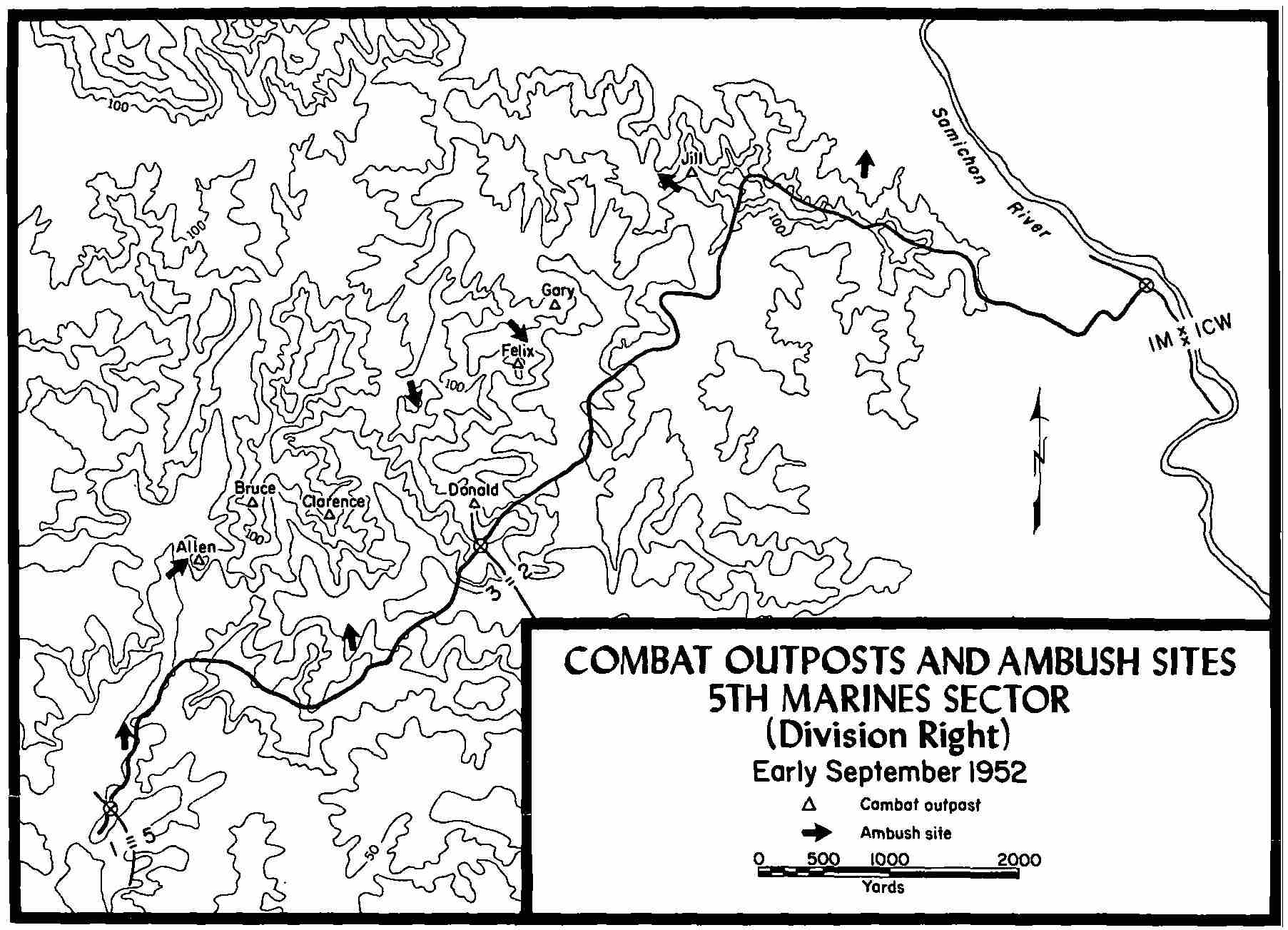
MAP 12 K. WHITE
COMBAT OUTPOSTS AND AMBUSH SITES
5TH MARINES SECTOR
(Division Right)
Early September 1952
Employing a squad against both Allen and Clarence, and sending
a reinforced company against Bruce, the enemy alternately assaulted
and shelled the positions until 0420, after which the Communist units
policed the battlefield for casualties and withdrew to the north.
Although there was no official estimate of enemy losses, one
Marine at outpost Bruce was credited with inflicting approximately
200 casualties by fire from two machine guns, a carbine, and
grenades. He was Private First Class Alford L. McLaughlin, of
I/3/5, who was later to receive the Medal of Honor for “conspicuous
gallantry and intrepidity.” Another Marine from the same
company was posthumously awarded the medal. Private First Class
Fernando L. Garcia, although gravely wounded, had thrown himself
on a hostile grenade to save the life of his platoon sergeant during
the Chinese rush to take OP Bruce.
At daybreak the I/3/5 defenders at Bruce, commanded by Captain
Edward Y. Holt, Jr., were confronted by an almost unbelievable
scene of destruction. All of the bunkers on the forward side of the
hill had been destroyed by Chinese mortar and artillery; on the
reverse slope, only two had escaped ruination. Marine losses were
32 dead and wounded.218 To restore the position the 3/5 commander,
Lieutenant Colonel Oscar T. Jensen, Jr., directed replacements forward
immediately. Carrying emergency supplies, including building
materials, the relief element reached Bruce about 1000. Evacuation
of casualties was the first task and at 1045 the relieved detail was
on its way back to the MLR. Later that day a supply party reached
the outpost, having been temporarily delayed by Chinese interdicting
fire.
Reinforcement of Bruce and the repair of its defenses were considerably
slowed by the continuous rain of enemy projectiles during
daylight. Marine and USAF pilots bombed and napalmed enemy
bunkers and troops north of JAMESTOWN in the 5th Marines sector.
Ten air strikes were executed in support of the 5th Marines that day.
Early on 6 September, 10 minutes after midnight, long-range
machine gun fire, buttressed by artillery and mortars, hit outpost
Bruce. After 35 minutes the firing subsided, but again at 0305 the
outpost experienced a heavy rate of incoming. At about this time, the
Communist soldiers massed for an assault on the battered position.
Marine defenders called down the artillery box, and the Chinese
dispersed.
That evening, at 1915, the outpost commander reported that the
Chinese had again resumed a steady shelling of the position. The
bombardment continued for an hour. After these heavy preparatory
fires, a wave of enemy infantry began scrambling up the sides of
Bruce. At the same time, outpost Allen to the left came under long-range
fire from enemy strongholds to the west and north. After the
Chinese made their initial rush against Bruce, a second and third
attack fared no better. Each was met and repulsed by the 5th Marines.
After the third abortive attack, a period of deathly stillness
descended upon the contested hill. Occasionally, an enemy mortar
round found its mark among the scattered, splintered bunker timbers
and the caved-in trenches, which connected the sandbag and lumber
positions. At 0145 on the 7th, the Chinese interrupted the uneasy
peace that had settled upon Bruce with a brief, heavy preparatory fire.
Exactly an hour later, an estimated two Chinese companies
advanced up the forward slopes, using demolitions to destroy any
friendly bunkers their artillery and mortar had not earlier completely
wrecked. By the time this newest assault had raged for 30
minutes, nearly every 3/5 defender had become a casualty. Still the
Marines refused to give ground, dealing first with the forward
slope assault by the Chinese and later with those who attempted
to envelop the Marines on the reverse side. On the MLR Marines
first observed enemy flares falling between outpost Bruce and Line
JAMESTOWN. Soon thereafter the Chinese policed the battlefield. By
0400 the Communists retired, and the fight for this key outpost had
ended in failure.
During the 51-hour siege of Outpost Bruce, 19 Marines had been
killed and 38 wounded. At the adjacent 5th Marines outposts, additional
losses were 5 killed and 32 wounded. More than 200 enemy
dead were counted. During the last eight hours of the vicious,
close-in fighting at Bruce, it was estimated that another 200 Chinese
had been wounded.
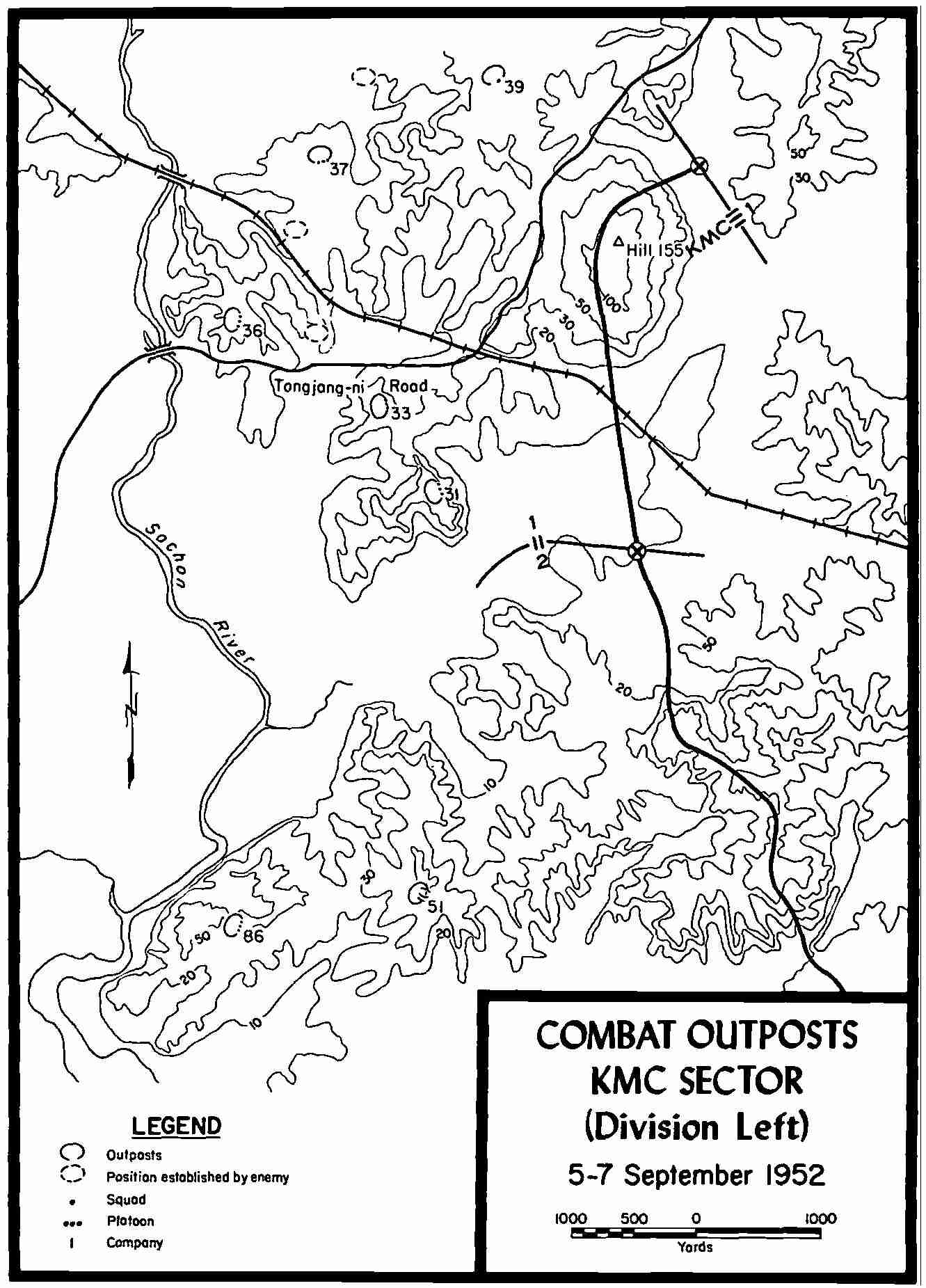
MAP 13 K. White
COMBAT OUTPOSTS
KMC SECTOR
(Division Left)
5–7 September 1952
The Korean Marines, holding down the western flank of the three
mainland regimental sectors in the 1st Marine Division line, also
received a share of the enemy’s attention. At dusk on 5 September,
Chinese barrages began to smash Outpost 37,219 the first of a trio of
positions that would merit hostile attention for the next 22 hours.
Throughout the following day the Chinese continued their mortar
and artillery fire against Outposts 37 and 36, and the regimental
observation post located on Hill 155 (also called Hill 167) to the
rear of the MLR. (See Map 13.) The heaviest enemy fire was
directed against OP 36, a small rise in the low land terrain midway
between the Sachon River, on the west and the Munsan-ni-Kaesong
rail line, 600 yards to the east.
At 1605 a 50-round barrage struck OP 36. After this harassing
fire there was a lull until 1810 when Chinese artillery and mortars
again resumed a steady pounding of the three positions. One hour
later enemy soldiers hit both outposts. Twice the attacking company
assaulted OP 37 but neither effort represented, in the view of the
defenders, a serious attempt at capture. Less than a mile south at
OP 36, however, the enemy motive appeared to be quite different.
Crossing the Sachon just north of the Freedom Gate Bridge (also
known as the highway bridge), the Communist infantry moved to
assault positions on the west, north, and northeast sides of the outpost.
At 1910, the Chinese began their first rush. It was repulsed, as
was a second one. Another artillery barrage, joined this time by tank
fire, preceded the third attempt. At this point communications went
out at the besieged outpost. At 2150, a squad leader from OP 36
reached the 10th Company CP to report that his position had fallen.
In 30 minutes a communications link was reestablished with the
outpost. The defending Koreans reported that although enemy troops
had overrun much of the hill, they had subsequently withdrawn,
apparently because their losses had been so heavy.
Casualties and damage were severe. The Korean regiment estimated
that 110 enemy had been killed or wounded. An early morning
KMC reconnaissance patrol counted 33 dead Chinese in the
vicinity of OP 36. The attacking force had also left behind much
equipment, including more than 100 grenades and several automatic
weapons. No papers were found on the dead Communist soldiers,
but many propaganda leaflets had been dropped around the outpost.
Korean Marine losses at OP 36 were nine killed and seven wounded.
At OP 37 there were four casualties; at the regimental CP, one
Korean and two U.S. Marines had been killed by enemy artillery.
Chinese incoming, estimated at 2,500 rounds during the two actions,
had also caused major damage to part of the OP 36 defenses, but
inflicted less harm to the other two positions. Repairs were begun
before daylight.
After the stepped-up enemy ground activity in early September, both
Chinese and Marine frontline units resumed their earlier pattern of
combat patrols, probes, and ambushes. Possession of Bunker Hill
remained the immediate objective of the enemy and his activities in
the middle of the Marine line were directed to this goal. Once again
on 9 September a marauding Chinese platoon, employing grenades
and submachine guns, sounded out the Bunker defenses, now manned
by G/3/1 (Captain William F. Whitbeck, Jr.). After a tentative
investigation, the enemy withdrew. That same day, expanded patrol
and raiding activities were undertaken by Marine line battalions.
These sharply increased offensive measures resulted, in part, from
the Communist interest, as evinced during the summer truce negotiations,
in certain forward positions held by UNC units. On 7 September,
the CG, I Corps had alerted his division commanders to
the fact that the enemy “may attempt to seize and hold certain key
terrain features ... over which there was extensive disagreement
during [the 1952 summer truce] negotiations for the present line of
demarcation.”221 Since much of the critical land was in his sector,
Major General Kendall further warned his division commanders “to
take the necessary action within your means to hold all terrain now
occupied by your divisions.”222 Critical terrain features in the 1st
Marine Division area of responsibility were Bunker Hill and the
height on which COP Bruce had been established (Hill 148), in
the center and right regimental sectors respectively.
Two days later, General Pollock amplified this directive by underscoring
the necessity for holding these two positions, plus eight more
he considered vital for sound tactical defense. These additional positions,
from west to east, were Hills 86 and 37 in the KMC sector;
Hills 56 and 48A in the center sector; and the outposts then known
as Allen, Clarence, Felix, and Jill, all the responsibility of the right
regiment.223
Although the eastern part of the division main line thus contained
at this time more key hills than any other Marine sector, much of
the increase in Marine patrol and ambush activity took place in
No-Man’s-Land forward of the middle frontline regiment. Of the
two JAMESTOWN sectors manned by U.S. Marines, the one in the
center of the division area offered better ground for infantry
operations.
On the divisional western flank, the Korean Marines conducted
frequent infantry-tank patrols during the second and third weeks of
September, but the enemy opposite the KMCs initiated little ground
activity. Instead, the Chinese relied upon their supporting weapons
to provide the contact. For a seven-day period ending 19 September,
a total of 2,375 enemy rounds had fallen in that regimental sector,
an average of 339 per day. Nearly a third had been in the vicinity
of Hill 36.
Before sunrise on the 19th, a Chinese infantry company had
crossed the Sachon in the vicinity of the railroad bridge. Once on the
east side, the enemy soldiers concealed themselves in caves and holes,
remaining there until dusk. Then, when they came out of hiding, the
Communists held a briefing and organized themselves into three
attack groups. As these advance infantry elements approached their
objective, OP 36, other reinforcing units were prepared to seize
OP 37, to the east, and OPs 33 and 31, to the south. Artillery and
mortar preparation supported these diversionary attacks.
The main assault was accompanied by even heavier shelling. As
the three assault units reached the bottom of the hill at OP 36,
artillery, mortars, and tanks had fired more than 400 rounds.
Approaching from the north, east, and west, the Chinese scrambled
up the hill, gaining control of the wrecked defenses by 2000.
Sporadic exchanges of fire lasted until nearly midnight. At 0115 the
Korean Marines attempted to retake the hill. The counterattack was
cut short, however, upon discovery of another enemy unit moving
towards the outpost and then only one-half mile away. Three hours
later the enemy came back in strength when a CCF platoon successfully
overthrew the outpost at 0520. This new assault occurred
without any warning and was so swiftly executed that a number of
the KMC defenders found themselves encircled and trapped at their
posts. Most managed to escape, but several were captured and later
evacuated when the Chinese removed their own battle casualties.
Another attempt to regain the outpost was made by the Koreans
at 1400, following artillery preparation and two air strikes. Three
Marine attack squadrons, VMAs-323, -121, and -212 blasted the
Chinese on the front slope of OP 36. The contour of the far side
of the hill had provided the enemy a defiladed position and safety
from 1st Marine Division organic weapons. But the MAG-12 air
sorties, destroying many CCF automatic weapons and mortars and
breaking up a company strongpoint, helped the Koreans counterattack
and overrun the dazed defenders. Two KMC platoons, supported
by artillery, mortar, and tank fire, then carried the OP after
overcoming token Chinese resistance. After the enemy vacated OP 36,
he still continued to remain in the low area to the northwest, close
to the east side of the Sachon River. No serious attempt was made
by the enemy to occupy the position for the rest of the month.
The 20-hour clash for control of OP 36 was believed to have
developed from the Chinese ambition to occupy the position and
thereby eliminate the harassing fires from Hill 36 that had struck
CCF mainline troops. The 19–20 September attempts to wrest the
outpost from Korean control resulted in an estimated 150 Chinese
casualties, including 20 counted dead. KMC losses were placed at
16 killed, 47 wounded, and 6 missing.
On the day that the second September battle for OP 36 had ended,
the Commandant of the Marine Corps had also just concluded his
three-day visit and inspection of General Pollock’s troops. Visiting
every battalion in the division, General Shepherd was impressed by
the morale and proficiency of the Marines, including the attached
1st KMC Regiment. During his visit to Korea, the Marine Corps
Commandant was also presented the Order of Military Merit, Taiguk,
by President Rhee. General Shepherd ended his Korean battlefront
visit after a two-day inspection of 1st Marine Aircraft Wing units
commanded by Major General Jerome (he had received his second
star on 6 August).
Even though the enemy had concentrated his strongest infantry attack
in late September against the Korean Marines, his most frequent
probes were launched against center regimental positions held by
Colonel Layer’s 1st Marines. Here the enemy was more consistent
in conducting his defense. Chinese troops doggedly held on to the
northern slopes of several Marine outposts, notably Hills 124 and
122. In this center regimental sector, the enemy initiated several
attacks, the most significant of these occurring on the 20th.
This action against the left sector manned by 2/1 centered about
Hill 124, where Lieutenant Colonel Batterton’s battalion had established
a 24-hour, squad-size outpost three days earlier. At 0345,
Marines on Hill 124 observed two green flares fired from a hill about
1,100 yards to their front. At the same time the men of 2/1 observed
numerous figures moving about downhill from their own position.
It soon became evident that four enemy groups were converging on
Hill 124 and preparing to assault the Marine defenses which shortly
came under fire from enemy submachine guns and rifles. The main
probe was a frontal assault against Batterton’s men; it was made by
about 20 Chinese and lasted only five minutes. Afterwards, all four
assault groups withdrew but continued firing intermittently at the
Marine squad. Nearly every Marine on the hill suffered wounds,
most of these minor. Enemy losses for the action were placed at 22.
In this same sector Marines in late September attacked the northern
slope of Hill 122, where the enemy still maintained a foothold. The
proximity of Marine defenses at Bunker Hill to enemy positions,
separated in some places by as little as 30 yards, was the cause of
frequent contact and clashes. Marines raided the enemy side of
Bunker, using demolitions and portable flamethrowers to destroy
trenches and bunkers, and their occupants. Tanks and artillery
assisted in these brief offensive actions, usually undertaken at night.
Flares were used frequently to aid in identifying and striking targets
and in assessing the results.
It became routine during the last days of September for the Chinese
to probe the Marine defenses at the Hills 124–122 axis. There did not
appear to be a serious or determined assault to take either outpost,
however. The Marines considered the infantry probes as just another
form of harassment, although perhaps more personal and direct
than the Chinese shelling, which inflicted daily losses. On the division
right, Colonel Moore’s 7th Marines, which had moved into this
sector on 7 September, found enemy activities about the same. Artillery
rounds caused the greatest number of casualties, although these
attacks were not particularly spirited. Many enemy contacts occurred
during the Marine combat patrols that largely characterized frontline
operations at the end of September.
With the beginning of October, the 1st Marine Division became
aware of certain changes that were occurring to its front. In the
center sector, for the first time in two weeks there was no significant
enemy ground activity, yet across the entire Marine front there
was a build-up of enemy shelling. Part of the increased bombardment
was directed at Hill 86 in the KMC sector, one of the positions
recently cited as integral to the defense line in this area. Beginning
at 2000 on 1 October, the Chinese broadcast a warning that they
would knock down the outpost bunkers there unless the Korean
Marines surrendered. When the KMCs manning the position did not,
of course, surrender in reaction to this blatant propaganda tactic,
the Chinese began showering Hill 86 with artillery rounds. During
the next 20 hours, 145 rounds fell on and around the outpost. This
incident marked the first time that the Chinese mainline forces had
carried out an announced threat.
This type of operational tactic—first to warn, then to carry out
the threat—was not, however, the reason for the increased Chinese
shelling. Rather, as it turned out, the enemy was about to embark
on a series of limited objective attacks against the division flanks,
starting first with major outposts guarding the most critical terrain
on the MLR. The artillery and mortar fire of the 1st had been but an
initial step. At 1830 on 2 October, Communist direct fire weapons
opened up from an area 2,800 yards northwest of OP 36, lashing all
the KMC outposts within range. A tank platoon, dispatched to counter
the fire, returned at 1915 without having located the hostile emplacements.
Shortly after the tanks returned, an extremely heavy artillery
barrage again fell upon all of the KMC regimental outposts. Ten
minutes later, seemingly on the signal of one red and one green
flare, the enemy guns lifted their preparatory fires to permit an
infantry attack. The ground action simultaneously struck OPs 37,
36, and 86, the forward positions closest to the Sachon River.
At OP 37, the defending Korean Marine platoon fought valiantly
for more than an hour against the assault of two enemy platoons,
each of which required a company-size reinforcement before the
Korean Marines were finally ousted. Although temporarily dislodged,
they reorganized at the base of the position for a counterattack. Two
counterattacks were made the next day, the second one carrying the
Koreans to the top of the hill. Fierce enemy mortar and artillery
shelling forced them to seek the shelter of the reverse slope before
again renewing their assault. On 4–5 October, the outpost changed
hands four times. At 1340 on the latter date, a heavy enemy artillery
and ground attack compelled the KMCs to abandon their ravaged
outpost; this withdrawal ended friendly control of OP 37 for the
rest of the month.
Nearby OP 36 was also lost. In the course of the night the Korean
Marines on OP 36 turned back two Communist assaults, but fell
under the weight of the third. By sunup on 3 October, the exhausted
Korean Marines were forced to give ground; the Chinese immediately
occupied OP 36 and held it.
One more KMC outpost was to fall during the first week. OP 86
guarded the southwestern two-thirds of the regimental sector and
frequently was the target of artillery shelling and ground attacks.
This position was also the most distant from the main line and the
closest to the Sachon River.
The heaviest Communist attack on 2 October was against the
KMC platoons defending Hill 86. Nearly a battalion of Chinese
took part in this action, finally overpowering the outpost just before
midnight. The defenders withdrew south to the bottom of the
hill, where they were comparatively safe from enemy fire. Resting,
receiving reinforcements, and regrouping during the early morning
hours of the 3d, the Korean Marine force observed friendly artillery
and air pound the outpost preparatory to their counterattack. It was
made at 1015 and succeeded, after two hours fighting, in routing
the Chinese from the outpost.
While the enemy was counteracting the ground loss with artillery
and mortars, Marine air flushed out the Chinese, who had retreated
only a short distance from the outpost. From atop the hill, Korean
Marines witnessed many of the enemy hurriedly leaving the area
under attack. This scattering of the enemy force prevented the
Chinese from launching an immediate counterattack for control of
OP 86 and gave the Korean Marines additional time in which to prepare
their defenses. At 2200 on 6 October, an enemy force of undetermined
size assaulted the position and wrested it from the Koreans
before the end of the day. Early the next morning a KMC counterattack
was successful, but at 0640 the Koreans were again compelled
to withdraw, due to devastating blows from Chinese artillery. Loss
of the third key outpost during the first week of October, ended for
a time the flare-up of outpost fighting in the left regimental sector
of the division front.
The middle part of the MLR, held in early October by the 1st
Marines, received the least enemy attention in this period. Although
frequent contacts were made with the enemy during the first part
of the month, no outposts were lost. Most of the action was minor,
i.e., patrol engagements and Communist probes centered around
Bunker Hill and Hill 124. Late on 5 October, a combat patrol from
H/3/1 became involved in the most important ground action in
Colonel Layer’s area during early October. These Marines were
surprised by a larger Chinese force lying in wait. The ambushers
held their fire until the Marine combat patrol had cleared a small
hilltop. At 2230, after a 20-minute fire fight, the patrol withdrew
to the reverse slope of the rise, called in 81mm mortar fire, then
broke contact, and returned to the MLR. There were 4 Marine casualties,
and by count, 13 dead Chinese.
By far the greatest number of personal losses at this time occurred
in the right area held by the 7th Marines, where the Chinese began
a series of limited objective attacks against outposts guarding the
division right flank. These offensives to obtain critical terrain in this
sector, and others manned by the 1st Marine Division, would continue
intermittently right up to the brink of the cease-fire, in July 1953.
In early October, Colonel Moore’s troops manned nine permanent
combat outposts. (See Map 14.) Seven of these had been taken over
when the regiment relieved the 5th Marines in September. Two
additional ones—Frisco and Verdun—had been established by the 7th
Marines on the 14th and 26th, respectively. Of these nine forward
positions, the Communists chose to concentrate on four, which formed
a diagonal line roughly paralleling the center sector of the MLR at
an average distance of about 450 yards. This quartet—Detroit, Frisco,
Seattle, and Warsaw—together with Verdun,226 at the 1st Commonwealth
boundary, comprised the easternmost permanent outposts of
the division. The first four positions were, on the average, slightly
lower in elevation than the COPs in the regimental area to the west.
The frontline contest began with little forewarning other than a
slight increase in enemy artillery and machine gun fire against Frisco
and a light probe against Detroit. At 1836 on 2 October, the Communists
launched a heavy artillery and mortar barrage against Seattle
and Warsaw, and that part of the MLR nearest Seattle. Exactly one
hour later, the preparation on the outposts lifted, permitting the
enemy attack force to strike. Not less than a company assaulted the
reinforced platoon on Warsaw, while a squad moved against the
Seattle defenders. Warsaw fell in about 45 minutes,227 Seattle held
out five minutes longer.
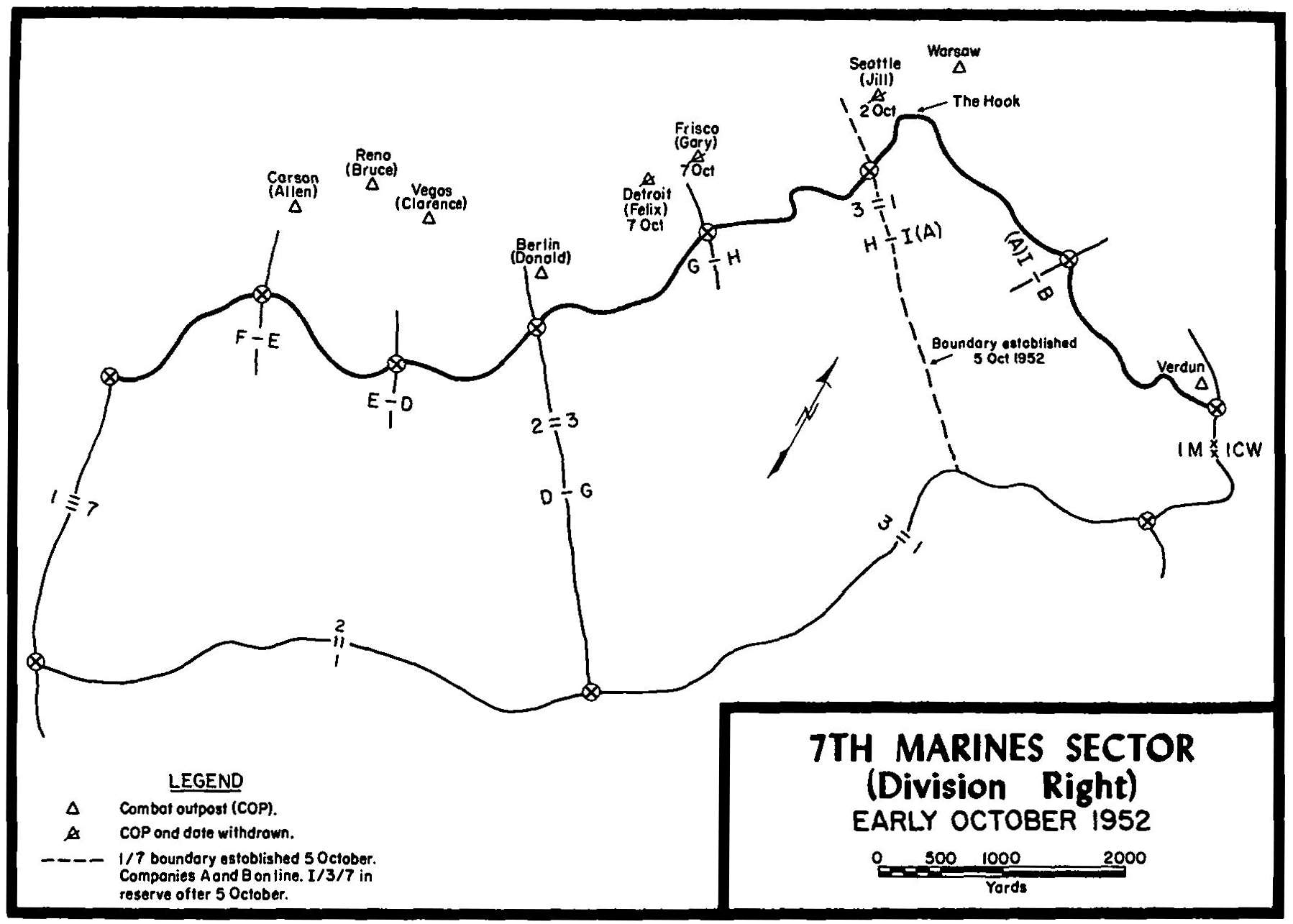
MAP 14 K. WHITE
7TH MARINES SECTOR
(Division Right)
EARLY OCTOBER 1952
Immediately, plans for the recapture of both were made. At 2047,
Captain John H. Thomas dispatched a platoon from his company,
I/3/7, from the MLR to counterattack Warsaw. The platoon quickly
took the position, for the enemy had withdrawn. At Seattle, the result
was different. On 3 October, two squads from Company I departed
JAMESTOWN at 0340, but came under enemy artillery fire en route
to the objective. The squads worked their way forward nevertheless,
but were unable to take the outpost. Captain Thomas then recalled
the force, which reached JAMESTOWN at dawn. Later that day, just
before dusk, air and artillery placed a smoke screen on Seattle while
two squads advanced toward the outpost. When the counterattack
met stiff resistance, a squad-size reinforcement228 was sent from
the MLR. Together the three units attempted to retake the position,
but were forced to pull back because of heavy casualties. As the
infantry again regrouped, Lieutenant Colonel Bert Davis, Jr.’s 2/11
fired preparatory barrages on the Chinese occupying Seattle. At 2225
the Marines assaulted the outpost again; as before, overpowering
Chinese artillery and grenades inflicted such high casualties that the
counterattackers were compelled to withdraw.
By this time, action at the two outposts had resulted in 101 Marine
casualties, including 13 killed. By sundown on 3 October, the regiment
had been forced off the two COPs and had been able to retake
only one of them. Against Warsaw, the one that the Marines had
recaptured, the Chinese immediately launched a counterattack. At
0145 on 4 October a platoon struck the position. This time the
Warsaw garrison held, inflicting losses on the CCF and receiving
none. The Chinese made an unsuccessful attempt against Frisco at
2300 on 5 October, when a squad attempted to drive the Marines
from the outpost.
The enemy’s repeated attacks and apparent determination to seize
commanding terrain, plus the heavy casualties suffered by 3/7, led
the 7th Marines to reinforce its MLR at 1200 on 5 October. At this
time the right battalion sector then held by 3/7, was split into two
sectors and the regimental reserve, 1/7 (Lieutenant Colonel Leo J.
Dulacki) took over the far right of the 3/7 line, assuming responsibility
for Warsaw and Verdun.229 The 7th Marines thus had all
three of its battalions on line with the regimental front manned, from
the left, by 2/7, 3/7, and 1/7.
During the next 30 hours, the Communists launched a series of
strong probing actions against the regimental outposts of the 7th
Marines. Although the numerical strength used in these widespread
limited objective attacks did not exceed that employed in previous
large-scale outpost offensives, the scope of the operation on 6 and 7
October and the well-coordinated attacks indicated careful and
detailed planning. Each move against the five outposts and two MLR
positions attacked was preceded by unusually close attention to
artillery and mortar preparation. This was to a degree unprecedented
even when measured against those massive concentrations that had
characterized Communist operations since the Chinese intervention
in the war late in 1950.
Prior to the Communist general attack, the Marines made another
attempt to retake Seattle. Leaving JAMESTOWN at 0600 on 6 October,
a C/1/7 reinforced platoon was halted by solid resistance in the
form of exploding artillery and mortar rounds. The forces returned
to the MLR, reorganized, and jumped off again. At 0815, a two-squad
reinforcement was dispatched from the main line. Meanwhile,
the enemy, estimated at platoon reinforced strength, doubled his
garrison, using troops from his outpost line. By 0900, a heavy fire
fight was in progress, supported by artillery and mortars on both
sides. Marines called on air in support of the attack, but the combined
air and infantry action was unable to penetrate enemy defenses.
Finally, at 1100, after five hours of close heavy fighting, the Marines
broke contact and retired, bringing with them 12 dead and 44
wounded. Estimates of enemy losses totaled 71.
That evening, at dusk, artillery and mortar fire began falling on
outpost positions across the entire regimental front and at two locations
on the MLR. At the same time an estimated Chinese reinforced
battalion in a coordinated effort advanced toward the Marine line
and at 1930 assaulted the seven positions that had just been under
artillery preparation. By midnight an estimated 4,300 rounds of
artillery fire and 104 rounds of counterbattery fire had fallen on
Marine positions. In the regimental left manned by 2/7 (Lieutenant
Colonel Caputo) the attacks appeared to be more of a diversion—merely
probes by small units, which showed little inclination to press
the attack. Carson, the most western COP held by the regiment,
reported that the enemy soldiers withdrew at 2050. Two hours
later Reno, the next outpost to the east, radioed to the MLR that the
Chinese had just ceased their attacks at that forward post. A total
of 12 Marines were wounded in these two actions.
On the far right, in Lieutenant Colonel Dulacki’s sector, a reinforced
CCF platoon poured over the Warsaw defenses at 1930.
Immediately the outpost Marines called for the friendly artillery
box. As these protective fires were being delivered all communication
at the outpost was severed by hostile fire. Enemy artillery continued
at a heavy rate. By 2000, however, communication was reestablished
between the COP and MLR. The first message from the besieged
outpost was a request for more artillery. With additional fire support
and continued stiff outpost resistance, the Chinese at 2055 relinquished
their quest to regain Warsaw.
The enemy’s most determined assaults on the night of 6–7 October
were made upon a pair of outposts, Detroit and Frisco, manned by
the middle battalion, 3/7 (Lieutenant Colonel Gerald F. Russell).
Two JAMESTOWN areas in this sector were also attacked, but only
briefly. The assault against the outposts was executed by a Chinese
battalion which sent one company against Detroit and another
against Frisco, east of Detroit. Both outposts were manned by two
squads of Marines.
At Detroit, the Company G Marines reported that the initial attack
made at 1940 on 6 October by a Chinese company had been rebuffed.
The enemy did succeed, however, in advancing to the outpost trenchline.
Strong defensive fires prevented him from exploiting this initial
gain by occupying any of the bunkers, and the attackers were forced
to pull back. After regrouping, the Chinese returned at 2100 and
again were able to secure a foothold at the main trench.
Marine artillery assisted the outpost defenders in repulsing this
new attack, but not before Chinese interdictory fires had disrupted
all communications between the COP and its MLR support company.
Some Chinese had also moved south in the vicinity of the MLR,
but these attacks were neither persistent nor heavily supported. At
2115 the last of the enemy intruders had withdrawn from the MLR.
At about this same time, 3/7 heard Detroit request overhead VT
fires, but shortly after this the battalion again lost contact with the
outpost.
Two squads were then sent out to reinforce the position. They
were stopped, however, by heavy Chinese artillery barrages. At the
outpost, Marine artillery fires had forced the Chinese to retreat, but
at 0015 the enemy reappeared at the trenchline. The artillery regiment
once again applied the overhead fire remedy, but with less
success—the Chinese, neither retreating nor advancing, took cover
in the trenches. During the long night, attempts to reestablish communications
with Detroit had proved fruitless, although battalion
radio operators reported that they had heard Chinese language
coming over one of the Marine radio nets used by the COP. A six-man
reconnaissance detail was sent forward to investigate. It returned
at 0355 with the information that Detroit was now held by the
enemy. Two wounded Marines had escaped; the rest of the Detroit
garrison had fallen to the enemy. At 0630 the Marines withdrew
after heavy fighting that had lasted more than 10 hours.
During the earlier part of the night, while the battle for outpost
control raged at Detroit, reinforcements had also been dispatched
to Frisco to help stabilize the situation at this adjacent Company
H/3/7 outpost. Like Detroit, it had been attacked by a Chinese
company, beginning about 2000. An hour and a half later some of
the enemy had made their way into the trenchline, but were repulsed
with the help of friendly artillery VT. Shortly after midnight the
enemy again probed Frisco and reached the trenchline. At 0115,
two squads jumped off from JAMESTOWN, but a rain of Chinese
artillery interrupted their progress. Throughout the early morning
hours of 7 October, Company H and I units were sent out from
the MLR to buttress the Frisco defense and stem the enemy attack.
At 0510, a reinforced platoon from the reserve company was sent
to renew the counterattack. It was this Company I unit that finally
restored control of the COP to the Marines.230 Another reinforcing
platoon arrived at the outpost just as the Marines there had evicted
the remaining Chinese assault forces. At 0715, 7 October, Frisco
was declared secure.
Its precarious position, however, demanded either an investment
of more outpost troops to retain possession of it or else its abandonment,
in conjunction with other measures to neutralize loss of the
position. At 1804 that day the latter course was instituted. The 7th
Marines reported that the enemy had suffered an estimated 200 KIA
and unknown WIA as a result of the bitterly contested outpost
attacks on 6–7 October. Marine casualties were listed as 10 killed,
22 missing, 105 wounded and evacuated, and 23 not-seriously
wounded.
In all, during the first week in October, the 1st Marine Division
gave up six outposts, or forward positions, that had been sited on
some of the commanding ground in the Marine area. On the division
left, COPs 37, 36, and 86 were the ones most removed from the
Korean MLR and thus easily susceptible to being overrun by the
enemy at will and to his early reinforcement.231 The division theorized
that near winter and the subsequent freezing of the Sachon would
facilitate the movement of Chinese troops and supplies across the
river to new positions. The enemy was now able to operate patrols
east of the river without interference. At the opposite side of the
division MLR, on its right flank, Detroit, Frisco, and Seattle had
been lost. By gaining this string of outposts, the enemy was better
able to exert pressure against other Marine positions forward of the
line and the critical ground on JAMESTOWN.
To counter this threat, General Pollock strengthened the outposts
close to the MLR and increased his patrolling requirements. It was
decided that in some cases the mission of the COP—that of providing
early warning of impending attack and slowing it down—could be
accomplished as effectively by using patrols and listening posts at
night.
By these activities, the Marines hoped to minimize the Chinese
gains and prevent the launching of new attacks against either division
COPs or JAMESTOWN. The serious situation on the outposts was
compounded by existing political considerations, which prevented the
Marines from initiating any real offensive campaigns. Moreover, any
hill taken was invariably backed up by a still higher one, controlled
by the enemy. The key factor was not so much holding an individual
outpost as it was to insure that the enemy was unable to penetrate
the JAMESTOWN line.
Some of the enemy ground pressure against the outposts in September
and October had been relieved by the increase in the number of air
strikes received by the 1st Marine Division. De-emphasis of the Air
Force interdiction strategy in favor of striking the enemy wherever
(and whenever) it hurt him most had made available more aircraft
for close support of ground operations.233 The UN commander,
General Clark, who had given the green light to the shift in USAF
policy and targets, followed the giant hydroelectric strike in June
with a mass attack the next month on 30 military targets located near
the North Korean Capital. During a year’s freedom from air attack
(July 1951-July 1952) Pyongyang had become not only the major
logistics center for combat equipment and personnel but also the
focal point for command and control of Communist ground and air
defense efforts.
Designated Operation PRESSURE PUMP, the 11 July strike against
Pyongyang called for three separate attacks during daylight and a
fourth at night. This extended time over the target would give enemy
fighters more than ample time to take to the skies in defense of the
Capital. Because Pyongyang “was defended by 48 guns and more
than 100 automatic weapons, making it one of the worst ‘flak traps’
in Korea,”234 there was considerable hazard in the operation. Added
danger to the pilots resulted from the decision to forewarn the North
Korean civilian population of the air assault. General Clark explained
the reason for dropping warning leaflets prior to the attack
on Pyongyang:
The objective was in part humanitarian and in part practical. We had
to hit Pyongyang because the Communists had made it a major military
headquarters and stockpile area. We wanted to warn the people away from
danger areas. By warning them away we disrupted their daily lives and
made it difficult for the Communists to maintain any kind of schedules in
their work in the city.235
Results indicated that both the destructive and the psychological
aspects of the mission were successful. American, British, and ROK
planes completely destroyed 3 of the 30 military targets attacked.
Of the rest, only two escaped major damage:
According to ... reports, the North Korean Ministry of Industry’s
underground offices were destroyed and a direct hit on another shelter was
said to have killed 400 to 500 Communist officials. Off the air for two
days, Radio Pyongyang finally announced that the ‘brutal’ strikes had
destroyed 1,500 buildings and had inflicted 7,000 casualties.236
Of the far-reaching effect of the leaflets, the UN commander later
wrote:
The warning leaflets, coupled with the bombing, hurt North Korean
civilian morale badly. The very audacity of the United Nations in warning
the Communists where bombers would strike hurt morale because it emphasized
to the North Koreans just how complete was UN mastery of
the air. Contrarily, it made them see even more clearly that the Communists
were ineffectual in their efforts to ward off our air blows....
As a result of the warnings, the bombings, the failure of the Communists
to provide protection, and the refusal of the Communists to permit evacuation
of the clearly defined target areas, civilian resentment was channeled
away from the UNC bombers and towards the Communist rulers.237
The record set by the 1,254 sorties flown in this 11 July operation
was to last only seven weeks. On 29 August, 1,403 sorties were employed
in a new strike against the Capital. The massed raids against
military targets in Pyongyang, known as the “All United Nations Air
Effort” turned out to be the largest one-day air assault during the
entire three years of the Korean War. Again attacking at four-hour
intervals three times during daylight, Allied aircraft blasted a list of
targets that “read like a guide to public offices in Pyongyang and
included such points of interest as the Ministry of Rail Transportation,
the Munitions Bureau, Radio Pyongyang, plus many factories,
warehouses, and troop billets.”238 Of the 45 military targets in the
city, 31 received moderate-to-severe damage according to post-strike
photographs.
Substitution of the previous interdiction strategy by PRESSURE attacks
brought increased close air support to frontline troops. As a
result of this expanded number of CAS sorties, wing pilots and
ground forward air controllers greatly increased their operational
proficiency.239 The Marines were still not satisfied with the close support
picture, however, and neither were a number of U.S. Army commanders.
Some of the latter regarded General Clark as the champion
of more extensive close air support missions for frontline units, but
he quickly dispelled this view. Instead, he cautioned these supporters
of Marine-type close air support to accept the existing procedures,
which were derived from the “vast reservoir of experience ... [representing]
the composite view of senior members of the Armed Forces
[with] the longest and most responsible experience in close support
during World War II.”240 At the same time the UN commander, on
11 August 1952, had advised his force commanders to study the factors
affecting the close air support situation in Korea and comment
on certain UNC proposals for improving the CAS system.
In the close air support picture for the Marines, October was a
bright month. In the outpost battles of early October, the 1st MAW
put 319 sorties in the air during both day and night to strike, strafe,
bomb, and burn enemy positions and troops facing General Pollock’s
division. A new level of achievement had been reached during the
Bunker Hill battle in August. That month nearly 1,000 aircraft, predominantly
Marine, loosed ordnance at targets on and near the
Chinese MLR and OPLR.
During the first six months of Marine ground operations in defense
of JAMESTOWN, wing squadrons and pilots had made major contributions
to the U.S. air effort in Korea. On 7 June 1952, First Lieutenant
John W. Andre, VMF(N)-513, piloting a World War II
model Corsair on a night armed reconnaissance mission over the west
coast of North Korea, shot down an enemy piston-driven Yak fighter.
It was the first time that a Russian-built plane of that model had been
knocked out of the skies at night by another plane. This aircraft was
also the fifth kill for the lieutenant, making him the first Marine
nightfighter ace in Korea.241
Nearly three months after that record, another one emerged: the
first Marine to down an enemy jet with a propeller-driven aircraft.
Late on the afternoon of 10 September, Captain Jesse G. Folmar and
First Lieutenant Willie L. Daniels, both of VMA-312, had taken
off from the Sicily to attack an enemy troop concentration reported
to be south of Chinnampo, on the west coast just below the 39th
Parallel. Shortly after reaching the vicinity of the target, the Marine
Corsairs were jumped by a pair of MIG-15s. Two more Russian-made
jets tore into the fight. During a fast exchange of cannon and
machine gun fire, the Marine captain was able to score lethal hits on
one of the MIGs. When four more of them picked up the chase, the
vastly outnumbered Marines broke for home, heading westward in a
diving turn.
Captain Folmar’s return to the Sicily was delayed almost immediately:
I had just started picking up good diving speed when I saw balls of
tracer ammo passing on my left and at the same instant felt a severe explosion
in my left wing ... I saw that the left aileron and four feet of my
left wing were gone.242
This damage caused the plane to rapidly go out of control. While
still able to maneuver, the Marine aviator headed for the sea and as
he neared it, bailed out of his Corsair and parachuted into the ocean.
A rescue plane out of Cho-do picked him up and returned the captain,
who had sustained a slight shoulder injury, to the carrier. Lieutenant
Daniels, who had alerted the rescue force, circled his descending
flight leader until he hit the water. After ascertaining that
the waterborne flier’s condition was satisfactory, the lieutenant turned
his plane towards the Sicily. In a short while he was safely home.
In late September, Major Alexander J. Gillis, VMF-311, assigned
earlier that summer to the Air Force’s 335th Fighter-Interceptor
Squadron, 4th Fighter Group, as an exchange pilot.243 distinguished
himself by becoming not only the first naval aviator to destroy three
enemy aircraft in Korea but also the second one to get a multiple
killing in a single day.244 Flying in a four-plane Sabrejet formation
near the vicinity of the mouth of the Yalu on 28 September, Major
Gillis led another plane after two MIG-15s. By superior pilot technique
and aggressive tactics, he forced one of the enemy to crash
during a low altitude chase. Later on during the sortie, the Marine
initiated an attack on a solo MIG, closing on it and scoring hits that
caused the plane to become uncontrollable and the pilot to eject.
Major Gillis also had to eject from his F-86 after it became disabled
by the MIG. The incident had occurred on the Marine aviator’s 50th
combat mission with the Air Force. He spent nearly four hours in
the Yellow Sea before a rescue helicopter picked him up.
Another feat, this one a study in determination and perseverance,
had occurred early in the summer. On 22 July, the VMJ-1 commander,
Lieutenant Colonel Vernon O. Ullman, had taken to the
air for a photo mission over North Korea in the vicinity of Sinanju,
located near the Yellow Sea 40 miles above Pyongyang. During the
first of seven scheduled flights, he encountered heavy flak but nevertheless
completed his first mapping run in the area. Further, the
Marine flier decided that the antiaircraft menace was not going to
force him to abandon the remaining part of his task. He continued.
On the second of his seven runs, some 40 enemy jets (MIG-15s)
appeared on the scene. These were dissuaded from close-in interference,
however, by the photo escort of 24 USAF single-engine
Sabrejet fighters. Thereafter, the Russian-made aircraft disappeared;
Lieutenant Colonel Ullman continued, despite the intense, accurate
enemy antiaircraft fire, until he concluded his mission.
The type of determination displayed by Lieutenant Colonel Ullman
helped Marine tactical squadrons achieve some kind of distinction
nearly every month from late spring to the fall of 1952. In May,
VMF-323 (“the Death Rattlers”), then commanded by Major
William A. Weir, established a squadron one-month record for
number of combat sorties, 1,160, and total combat hours, 2,362.7.
A high percentage of aircraft availability, 95.6, helped make this
mark possible. On 1 June, VMA-312 received the congratulations
of CTF 95 for its “outstanding performance under difficult conditions”
during the spring months. During this period the squadron,
based on board the USS Bataan, had been particularly hampered by
excessive turnover of key squadron officers and flight leaders. This
continual squadron rotation resulted in considerable variation in
pilot indoctrination and need for field carrier landing qualification,
due to the “close tolerances in pilot skill required by carrier operations.”245
Despite these difficulties, VMA-312 had scored an impressive
80-sortie mission, flown by 24 aircraft, on 18 April.
Additional recognition of professional excellence was conferred
upon Marine squadrons in July. On the 17th, the senior advisor to
the ROK I Corps expressed the gratitude of the corps commander
for the magnificent support the 1st MAW pilots had provided during
the second week of the month. All four attack squadrons in MAG-12
and both fighter units in MAG-33 had taken part in these CAS
missions. A week later, eight planes from Lieutenant Colonel Henry
S. Miller’s VMA-323, (which, along with Lieutenant Colonel
Graham H. Benson’s VMA-212, had been redesignated from fighter
to attack squadrons the previous month), completed an unusually
successful interdiction mission at Hago.
Located 25 miles northwest of Kaesong, the village reportedly was
the site of heavy troop concentrations, active mortar positions, and
antitank weapons. Leaving K-6 at 1725, the eight Marine VMA-323
pilots were soon over the target. Comprising the Death Rattler’s
flight were Majors John M. Dufford, Raymond C. Holben, William
H. Irvin, Jr., and Curtis E. Knudson; Captain John Church, Jr.; First
Lieutenant William A. Poe, Jr.; and Second Lieutenants Stuart L.
Spurlock and James S. Thompson. At 1810 their attacks were
launched, using 1,000-pound bombs, napalm, rockets, and 20mm ammunition.
The strike was over almost as soon as it had started, and
when the Marines departed, not one building remained in useful
condition. But it was not until several days later that the final results
of the strike were known. Intelligence sources reported that the raid
had caught the enemy troops at the evening meal; more than 500 had
been killed by the Corsairs, aptly called “Whistling Death” by the
Japanese in World War II.
For the remainder of the summer and into the fall Marine groups
and squadrons continued their record-breaking and efficient support
of ground troops and naval forces. With four squadrons (two day,
one night-fighter, and one photo), MAG-33 sent 141 sorties against
the enemy on 6 August. This one-day group record occurred just
before the departure of Colonel Condon, who turned over the reins
of the organization to Colonel Herbert H. Williamson on the 11th,
and then took command of MAG-12.
Shortly before Colonel Condon relinquished command, he was
particularly pleased by the success of a four-plane strike by VMF-311
(Major William J. Sims) in support of the U.S. 25th Infantry Division
commanded by Brigadier General Samuel T. Williams. Major
Johnnie C. Vance, Jr., strike leader, was accompanied in this flight
by Captain George R. Brier and Second Lieutenants Charles E.
Pangburn and Whitlock N. Sharpe. Up until this time the infantry
had been particularly harassed by several enemy frontline fortifications
and supporting artillery. The four pilots destroyed three bunkers
and two heavy guns and also caved in approximately 50 feet of
trenchline on the 7 August strike. Upon learning of the success of
the Marine pilots and the conditions under which the attacks were
carried out—dangerous terrain and constant ground fire directed
towards the planes—the general dispatched a letter, commending the
“skill, courage, and determination displayed by these pilots....”246
Another congratulatory message was received in September, this
one from General Pollock for the excellent support given by MAG-12
on the 20th. With three attack squadrons participating, Colonel
Condon’s group had neutralized Chinese weapons and troops at
OP 36 to help prevent a takeover of the Korean position. The pilots
reported well over 100 Chinese casualties. Lieutenant Colonel Kenneth
R. Chamberlain’s VMA-323 contributed most of the 23 Marine
sorties. The other attacking squadrons were VMA-121 (Lieutenant
Colonel Wayne M. Cargill, who 10 days earlier had relieved Lieutenant
Colonel Crawford), and VMA-212, commanded by Lieutenant
Colonel Maurice W. Fletcher.
September was a month of mixed fortunes in the air war over
Korea. The successful CAS strikes of the 20th followed only a few
days after another high point set on 14 September, when Lieutenant
Colonel Cargill’s attack squadron flew its 5,000th combat sortie since
arrival in the Korean theater in October 1951. Then on 15 September,
General Jerome commissioned a new kind of unit in the wing,
Marine Composite Squadron 1 (VMC-1), whose mission was to
provide electronic counter-measures (ECM) for UN aircraft. Lieutenant
Colonel Lawrence F. Fox headed the squadron, the only one
in the naval service with an ECM primary mission in Korea.
Three days after the commissioning, a strange incident transpired.
North of the UN line and at an altitude of 9,500 feet, a F-84
Thunderjet fighter, with U.S. Air Force markings and insignia, attacked
a propeller-driven Air Force trainer. The slower plane immediately
began defensive maneuvering, flying in tight circles. After
making five turns, the trainer pilot saw the supposedly friendly jet
fly off.
It was believed that such a paradoxical occurrence was due to
the substantial number of F-84 losses and the enemy’s ability to
piece together and fly an aircraft of that model. A few similar
episodes—attacks by apparently friendly aircraft on UN planes—had
previously taken place. In each case, the impostor was a model of
U.S. aircraft that had suffered particularly heavy losses.
Another incident in September had dire consequences. On the
10th, MAG-33 dispatched 22 fighter aircraft from VMF-115 (Lieutenant
Colonel Royce W. Coln) to attack reported troop concentrations
near Sariwon, 35 miles directly south of Pyongyang. The F9F
Panther jets had completed the strike and were returning to their
K-3 base when they were diverted to land at K-2, Taegu, where the
weather was better. Fog had suddenly swept over the field at K-3,
reducing visibility to zero. Sixteen Panthers landed safely at K-2,
45 miles southwest of the Marine field at Pohang. The remaining
six, piloted by Majors Raymond E. Demers and Donald F. Givens,
First Lieutenant Alvin R. Bourgeois, and by Second Lieutenants John
W. Hill, Jr., Carl R. Lafleur, and Richard L. Roth, flying in formation
in poor weather, crashed into the side of a 3,000-foot mountain
while descending.247 They would have required only an additional
600 feet of altitude to clear the summit.
Losses of Marine pilots and aircraft had been of growing concern
to the wing command. The initial success of the flak suppression fires
had eliminated the one successful Communist source of air defense,
accurate antiaircraft firing. One result was that noncombat accidents
for a while during the summer became the principal cause of pilot
and plane attrition. To help reduce these operational accidents as
well as the combat losses, the two Marine air groups instituted
squadron training programs and also directed the adoption of several
new corrective procedures. In MAG-12, for example, a study of
results from the FAF policy that limited bombing runs to one for
interdiction and two for CAS targets revealed a sharp reduction in
hits from flak. Tactical squadron commanders in MAG-12 drew up
a syllabus during September to test proposed defensive tactics for
their propeller aircraft to employ against enemy jets. The carrier
squadron, VMA-312, began that same month the additional practice
of field carrier landing qualification at K-6 for new pilots before
permitting them to operate from the carriers.
In spite of these efforts, pilot losses spiralled alarmingly in
October. For the rest of 1952, the monthly totals remained near that
month’s level. On the other hand, aircraft losses during October
dropped sharply to 10 from the September total of 22. This lower
figure was not to be exceeded until May 1953. These remedial procedures
were considered at least partially responsible for the substantial
decrease in aircraft losses.
In another area, a mid-October landing at Kojo, on the east coast
immediately south of the 39th Parallel, did not work out as planned.
The amphibious operation was in reality a feint intended to draw
troops away from frontline positions and expose them to naval air
and gunfire as they rushed in reinforcements. The enemy failed to
rise to the bait, and actually only a few Communist troops were
sighted. VMA-312 provided armed reconnaissance, tactical air operation,
and naval gunfire spotting during the feint. Although they
made little enemy contact, the Marine “Checkerboard” pilots operating
off the Sicily gained much experience in landings and take-offs
under the adverse conditions of rough seas and high winds.
Through October 1952, operational control of Korean based Marine
fighter and attack squadrons was still vested in commanders other
than General Jerome. Tactical squadrons continued to be directed by
the FAF or Navy in their missions; the observation and helicopter
squadrons were under operational control of the 1st Marine Division
and utilized, as before, at its discretion.
HMR-161, commanded since 8 August by Lieutenant Colonel
John F. Carey, continued its primary mission of evaluating rotary
wing aircraft and their methods of employment. One tactical innovation,
movement of elements of the 4.5-inch Rocket Battery, was
undertaken during August soon after the Bunker Hill battle. With
ground-fired rockets, the problem of a tell-tale cloud of dust and
brilliant flash of the rockets after each salvo had always plagued
the artillerymen. This seldom went unnoticed by the enemy, who
often showered the marked area with counterbattery fire. On 19 and
20 August, in Operation RIPPLE, HMR-161 and the rocket battery
proved that these two units could successfully shoot and scoot to a
new location and fire effectively again without drawing an enemy
reprisal. This Marine Corps innovation in air mobility—the first
displacement of field artillery under combat conditions—offered a
major time-saving advantage. Whereas previously it took approximately
a half-hour for rocket launchers to move from their bivouac
area to firing position,249 deployment by helicopter could be made in
a matter of minutes, a time factor that could be critical in event of
an enemy attempted breakthrough.
The operation demonstrated that helicopters not only could transport
rocket crews with weapons and ammunition to firing areas far
more rapidly than conventional wheeled vehicles, but that the rotary
craft could airlift these weapons into places inaccessible by road.
The nature of the mountainous terrain proved advantageous in that
hills and valleys provided defiladed areas for loading and firing
the weapons as well as protected routes for helicopter movements.
An observation made by pilots for operations in other types of
environment, not offering as much cover and concealment, was that
the shiny blue paint on their birds would make detection easy in
most surroundings and that camouflage paint would lessen the risk
from enemy AA.
Transport helicopters of HMR-161 continued to augment those of
VMO-6 in casualty evacuation and ferrying Marines and other frontline
troops. The observation squadron maintained its policy and outstanding
record of emergency flights of the wounded under any
weather conditions except dense fog (electronic navigational aids
still were not available). In August, various mechanical failures developed
among the newly received HO5S-1 Sikorsky helicopters.
These three-place observation aircraft were underpowered but superior
in many flight characteristics to the HTL-4 helicopters then in
the squadron. Mechanical difficulties with the newer aircraft increased
until it became necessary to ground them late in October until replacement
parts became available in the supply system.
Employment of transport helicopters for logistical support continued
to be a principal use of such rotary wing aircraft as the end
of 1952 approached. Tests earlier in the year had proved the theory
that this versatile aircraft could resupply a battalion manning the
MLR. The next step was to determine if the logistical support for
an entire combat regiment could be accomplished by helicopter.
Operation HAYLIFT, conducted during 22–26 September, the last of
five operations that month for HMR-161, was to test and evaluate
helicopter resupply of Colonel Moore’s 7th Marines. Plans called for
delivering all Class I, III, and V items and such Class II and IV
items as could be accommodated. Two loading and four unloading
sites were prescribed. All but extremely valuable cargo, such as mail,
was to be carried externally in slings or wire baskets.
HAYLIFT did show that at least for a short period of time—five
days—a helicopter squadron, utilizing 40 percent of its aircraft,
could sustain a MLR regiment. Following the general procedures
employed previously with the battalion, HMR-161 found that no
great changes were necessary for resupply of the regiment. Two
recommendations emerged from an evaluation of HAYLIFT. One
stressed the need for establishment of an operations center manned
by representatives of each unit participating in the exercise. The
second called for development of a more flexible loading system,
one that would permit rapid weight increases or decreases of 50
pound increments, as the situation demanded. Such a method would
make possible a more efficient payload for each lift.250
Transport on a larger scale in the 1st MAW was accomplished by
General Jerome’s few transport aircraft reinforced by the eight
R5Ds from the VMR-152 detachment. In June, the passenger-carrying
operations reached the peak for the entire Korean War; that month,
17,490 troops and military-associated civilians utilized the reinforced
wing transport aircraft. June 1952 was also the second busiest month
in freight transportation (7,397,824 pounds, nearly double the figure
for June 1951).
Squadrons that were unable to better their performance records
in some cases could trace their trouble to the inability to get all of
their planes off the ground. Several models were subject to spare
parts shortages.251 New aircraft, the F3D-2s and the AU-1s received
in June by VMF(N)-513 and VMA-212, respectively, had preceded
an adequate stocking of normal replacements for worn out or defective
parts. The night fighter squadron was handicapped also by
introduction into the supply system of inadequate radio tubes, which
burned out rapidly. The most critical shortage, however, was parts
for starter units of jet engines. This deficiency was not corrected
until summer. One problem never quite eliminated was the confusion
of supply orders intended for the helicopters in HMR-161 and
VMO-6. It was believed that the close resemblance of Sikorsky HRS
and HO5S part numbers and nomenclatures had caused the improperly-marked
requisitions and mix-up.
The 1st Marine Division logistical situation during the summer
and fall of 1952 was generally excellent. General Pollock’s units
did not suffer from the shortage of spare parts experienced by the
1st MAW whose aircraft sometimes had to be grounded because of
a missing spare part. U.S. Army support in the replacement of
worn-out Marine vehicles for new Army ones proved satisfactory.
No major problems arose in engineer support. Medical evacuation
and treatment and the level of supplies in the five companies of the
1st Medical Battalion remained excellent.
There were two significant changes in the logistical support provided
the Marine division early in the fall. One dealt with employment
of the division’s 1st and 7th Motor Transport Battalions,
located in the rear support areas. Beginning in September, the companies
were placed in direct support of the four infantry regiments,
with liaison by Lieutenant Colonel Kenneth E. Martin, division motor
transport officer. It was believed this decentralization would have
the following advantages:
1. Decreased vehicle mileage and therefore less driver fatigue
and prolonged vehicle life.
2. Increased dispersal as a safeguard against loss of wheeled
vehicle support in event of an unexpected and successful enemy
attack.
The other change was a shift in the emphasis of support rendered
by the Korean Service Corps. During October, each of the three
frontline regiments received 300 more laborers, raising the total to
800. Rear area units paid for the increase, since the KSCs were detached
from support units and sent forward to the MLR.
Logistical support from the 1st Signal Battalion left little to be
desired. Commanded by Lieutenant Colonel John E. Morris252 when
the Marines moved to western Korea, the signalmen helped establish
and maintain an extensive communications net, with 5,200 miles of
wire within the division and several vital links to adjacent and higher
commands.253 Wiremen worked around the clock to lay and maintain
the telephone lines, which suffered considerable damage from the
artillery and mortar barrages. When possible, the signalmen raised
the wires off the ground. The battalion set in more than 1,400 telephone
poles. After the system had been installed and was working
efficiently, the July floods washed away part of the major communications.
By improvising and by setting up emergency equipment, the
battalion was able to maintain the flow of communications traffic at
a satisfactory level. Replacement items were provided by the U.S.
Army on a reimbursable basis in accordance with existing directives.
In September it became apparent that the signal equipment used
to maintain division communications was no longer equal to the
demands placed upon it. The extensive ground area plus the number
and size of reinforcing units had not only put a heavy burden on
radio, telephone, and teletype equipment but also caused the depletion
of reserve stocks. With the spare equipment in use, there was
no pool to draw upon when units turned in defective equipment for
repair. Neither were there available replacements for materiel destroyed
by enemy action. Items most urgently needed were flown in
from the States. Other critical parts came from Army sources in
Japan and Korea. By the end of October, the communication resupply
had returned to a more normal condition.
Before the month ended a different type of critical situation was
to confront the division. It appeared that the enemy’s success in
seizing a half-dozen outposts earlier in October had only whetted
his appetite for more. Chinese eyes were turned towards positions
that held still more potential value than the stepping-stones just
acquired. The extreme right battalion in the division front held by
the 7th Marines was the focal point of the new effort.
CHAPTER V The Hook — Before the Battle 254 — Preparations for Attack and Defense 260 — Attack on the Hook 277 — Reno Demonstration 280 — Counterattack 281 — Overview 288
Before the Battle—Preparations for Attack and Defense—Attack
on the Hook—Reno Demonstration—Counterattack—Overview
After the heavy fighting in early October, there was a change
in the 1st Marine Division dispositions. On the 12th, the 5th
Marines relieved the 1st in the center sector and the latter regiment
went into reserve. For the next two weeks the lull that prevailed
across the regimental front was in sharp contrast to the intense
fighting there earlier in the month. On the division left, the Korean
Marines, not engaged in any sizable Communist action, conducted
frequent tank-infantry reconnaissance patrols and ambushes forward
of their MLR. In the center of the division line the 5th Marines, too,
found their Chinese opponent seemingly reluctant to pursue any
combat offensives, though his harassment of the Bunker Hill area
represented the strongest action against the Marine division at this
time. The 7th Marines, holding down the right sector, similarly encountered
the enemy for only brief periods, these contacts during
patrol actions lasting no more than 15 to 30 minutes.
Upon its relief from the MLR, the 1st Marines took over the
division rear area. There the regiment continued the improvement of
the secondary defensive lines, conducted extensive training, and dispatched
numerous security patrols throughout the regimental area.
These routine reserve roles were in addition to the primary mission
of augmenting units on the Marine MLR in order to counterattack
and defeat any attempted penetration of JAMESTOWN in the division
area. As part of its counterattack mission, the divisional reserve regiment
was to be prepared for employment anywhere in the I Corps
sector to block an enemy advance.
On the division right, the 7th Marines remained on position in
defense of JAMESTOWN. Following the bitter outpost contests on
6 October, Colonel Moore continued to retain all three battalions
on line: 2/7 on the left, 3/7 in the center, and 1/7 on the right.
The regimental commander had found it necessary to commit his
three battalions on line due to the vastly overextended six-mile
front, the rugged terrain, and the very real possibility of a major
Communist attack anywhere along the MLR. With all battalions
forward, Colonel Moore was left with a very small reserve, one
company from 3/7. This battalion had to use as its reserve what
had become known as “clutch platoons”—units composed of cooks,
bakers, clerks, motor transport, and other Marine headquarters personnel.
These local reserves, and even the reserve company from 3/7,
could be employed only with the regimental commander’s approval.
Line JAMESTOWN, in the 7th Marines area, meandered from the
vicinity of the burned-out village of Toryom, on the left, to the Hook
salient in the right battalion sector and from there southeast to the
Samichon River, the boundary with the 1st Commonwealth Division.
From the left battalion sector to the right, the terrain gradually
grew more rugged until the hills finally spilled over into the Samichon
Valley. To the rear of the MLR, the ground was less jagged;
forward of the line, the hills were more precipitous in character.
The steepest heights were in the right battalion sector. Highest
terrain feature along Colonel Moore’s MLR was Hill 146, located
not far from the Hook. Throughout the 7th Marines sector rice
paddies covered the narrow valley floors between the hills. Vegetation
was sparse. A series of dirt roads and trails served the regimental
area.
Combat outposts varied greatly as to their distance from JAMESTOWN.
Farthest from the line were the three in the left battalion
sector, manned by Lieutenant Colonel Caputo’s 2/7. This trio,
Carson, Reno, and Vegas, were approximately 1,000 yards forward
of the MLR. Berlin and East Berlin (a new outpost established on
13 October) were the forward positions in the center line outposted
by Lieutenant Colonel Charles D. Barrett’s255 Marines. To the right
Lieutenant Colonel Dulacki’s 1/7 sector held three—COPs Ronson,
Warsaw, and Verdun, the latter near the Commonwealth border.
Ronson was the outpost nearest to the Hook, a major defensive
position of the regiment. The importance of this part of the MLR,
in the extreme eastern sector, lay not in its strength but rather in its
weakness. Jutting as it did towards the Communist lines, the salient
formed a J-shaped bulge in the main line, which not only gave the
Hook its nickname but also established the vulnerability of the
position. Its susceptibility to capture derived both from violation
of a defensive axiom that the “MLR should not have sharp angles
and salients”256 and to the fact that the ridgeline on which the Hook
was located continued northwest into Communist-held territory.
Seattle, which the Chinese had seized on 2 October, lay only about
500 yards northwest of the Hook.
In spite of its vulnerability, the Hook could not be abandoned.
There was no other terrain feature held by the Marines that could
command the critical Samichon Valley, a major avenue of approach
from the northeast directly to Seoul. The salient also dominated
the entire nearby area of the Imjin River to the south. Possession
of the Hook and adjoining ridge would give the Communists observation
of a substantial portion of the Marine rear areas beyond the
Imjin, as well as the vital river crossings. In the opinion of Major
General M. M. Austin-Roberts-West, whose 1st Commonwealth
Division was soon to take over the Hook sector, had the salient
been lost, “a withdrawal of 4,000 yards would have been necessary.”257
At the beginning of October, this vital area had been protected
by COPs Seattle and Warsaw. When the former was overrun, it
became necessary to establish a new position. This was directed by
Lieutenant Colonel Dulacki, and on 16 October Ronson was established
200 yards southeast of Seattle and 275 yards west of the
Hook. About 600 yards northeast of the salient the remaining
position, COP Warsaw, commanded the lowlands to the east and the
narrow, east-west oriented valley of a Samichon tributary immediately
to the front.
Opposite the three MLR battalions of the 7th Marines were the
356th and 357th Regiments of the 119th Division, 40th CCF Army.
In addition to these infantry units, numbering close to 7,000, an
estimated 10 battalions (120 guns) of Chinese artillery258 were facing
Colonel Moore’s regiment. Personnel strength of the American unit
consisted of 3,844 Marines, 11 medical officers and 133 corpsmen,
3 U.S. Army communicators, and 764 Koreans (746 KSCs and 18
interpreters).
During the summer and early fall, the 7th Marines had amassed
considerable information about the enemy, including Chinese
strength and composition of forces and many of their combat characteristics.
Encroachment on Marine ground positions by steadily
creeping the CCF trenchline forward continued to be the enemy’s
major ground-gaining tactic. In fact, the Chinese units facing the
Marine division concentrated their digging during the fall of 1952
in the sector north of the 7th Marines MLR. (See Map 15.) Other
intelligence, however, seemed open to question. For example, there
was the reported frontline presence of women among the 90 Chinese
who had engaged a 2/1 patrol on 5 October as well as the sighting
in the KMC sector on the 17th of enemy “super soldiers” far taller
than the ordinary Chinese. Many in the division found it difficult
to believe the statements of enemy prisoners. During interrogation
they invariably maintained that the mission of Chinese Communist
Forces in Korea was a “defensive” one.
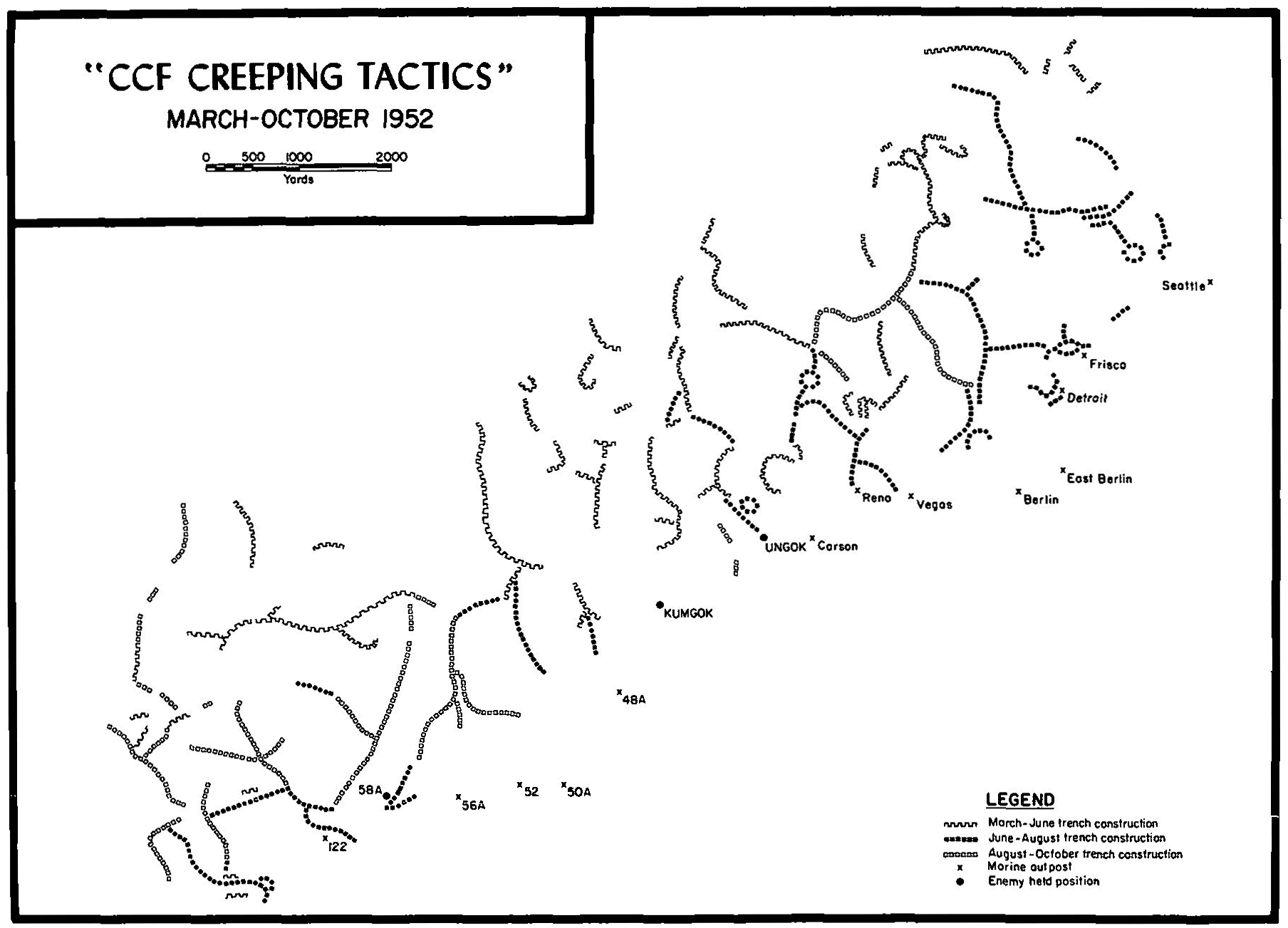
MAP 15 K. WHITE
“CCF CREEPING TACTICS”
MARCH-OCTOBER 1952
The static battle situation encouraged the use of psychological
warfare. In attempting to influence the minds of their opponents
and weaken morale, the Chinese depended upon loudspeakers to
carry their propaganda barrage across No-Man’s-Land. Enemy employment
of this technique was especially heavy during October. To
Marines, for example, Chinese directed pleas of “Go home and have
peace,” “Surrender, we treat POWs well,” “Leave Korea,” “Marines,
come and get your buddies’ bodies,” and the like, often to the
accompaniment of music. On occasion, Chinese patrols left propaganda
pamphlets behind them in the KMC sector. Infrequently, the
enemy displayed signs along patrol routes urging Marines to surrender.
Most of the Chinese psychological efforts were directed
against the Korean Marines.
In enemy employment of artillery, Marine frontline units and
division intelligence had become well aware of the vast improvements
the Communists had made in recent months. Aided by a
plentiful supply of ammunition, enemy guns and howitzers, including
the heavy 152mm weapon, frequently delivered concentrated fires
on critical positions in the division area. Marines felt the effects of
how well the Chinese had learned to mass their fires against a single
target for maximum destructive power. From the Marines, moreover,
the enemy had picked up the artillery box tactic, employing it for
the first time in their sector opposite Colonel Moore’s regiment
during the early October outpost battles.
During those same clashes, the 11th Marines had observed how
the Chinese displaced some of their batteries well forward for more
effective artillery support of their attacking infantry. One enemy
artillery innovation had been noted the previous month by a Marine
AO; on 19 September a Chinese artillery piece was detected firing in
the open. Previous observations had indicated that the Chinese
generally used wooded areas or extensive bunker-type positions to
conceal their supporting weapons.
By the middle of October, 62.5 percent of the Chinese artillery
opposing General Pollock’s division was located in positions north
of the 7th Marines. The importance the enemy put on the principle
of massed artillery fire and the improvement of their ammunition
supply can be seen in a remark attributed to a Chinese division
commander:
The enemy had organized an attack of two-battalion strength on our
first-line platoon. As the enemy were getting into their assembly area I
directed several volleys of rapid fire against them with a total expenditure
of about 120 rounds. That very evening the army commander rang me up
and said disapprovingly, ‘You’ve expended a bit too much ammunition
today!’ It seemed as though the army commander had detected precisely
what was in my mind. There was an instant change in his voice as he
said: ‘Oh, comrade, it really could not be accounted as waste, but you must
know we are short of supplies.’
Scarcely two years had passed but the situation was completely altered.
In the present we had emplaced 120 guns to each kilometre of front line
so that in a rapid-fire bombardment of 25 minutes more than 20,000
rounds of ammunition could be hurled against the enemy positions. If the
fire used in supporting attacks and in repulsing enemy counterattacks were
taken into account the total would reach 70,000 rounds.259
Exaggerated as the numbers of guns and rounds may be, the basic
massing technique was in line with U.S. intelligence estimates at the
time. The remark also pointed to the importance the Chinese had
learned to place on employment of artillery, a shift in emphasis
that Colonel Moore’s regiment was soon to experience in unprecedented
volume.
Before the Hook battle erupted, the defensive fires that the 7th
Marines could draw upon were not overpowering in terms of numbers
of units available. Only one battalion, Lieutenant Colonel Bert
Davis’ 2/11, was in direct support of Colonel Moore’s regiment.
In this mission, the 2/11 fires were reinforced by those of 1/11
(Lieutenant Colonel David S. Randall). In addition to these organic
units, the batteries of the 623d Field Artillery Battalion (155mm
howitzers) and one platoon of C Battery, 17th Field Artillery
Battalion (8-inch self-propelled howitzers) were readily available
to the 7th Marines. In all, 38 light, medium, and heavy pieces
constituted the artillery support of the right sector.261 General support
was available from Lieutenant Colonel Raymond D. Wright’s 4/11
and from the 4.2-inch Rocket Battery (Captain Donald G. Frier).
The 159th Field Artillery Battalion (155mm howitzers) and B
Battery, 204th Field Artillery Battalion (155mm guns), like the other
Army units positioned in the Marine Division sector, reinforced the
fires of division artillery. Fire support from 1st Commonwealth
Division weapons within range of the Hook area could also be
depended upon.
Although the Army artillery units satisfied the heavy punch
requirement of the 11th Marines, commanded since 21 September
by Colonel Harry N. Shea, there was one basic element the regiment
lacked. This missing ingredient was a sufficient amount of ammunition
for the howitzers. Defense of outposts and mainline positions
along the EUSAK front in early and mid-October 1952 consumed a
great deal of this type of ammunition. This heavy expenditure was
brought to the attention of the corps commanders by Eighth Army.
General Van Fleet pointed out that ammunition consumption rates
for both the 105mm and 155mm howitzers during these two critical
weeks in October not only exceeded the expenditures of the massive
Communist spring offensive in 1951 but also the UN counterstroke
that followed.262
To help remedy the situation, the EUSAK commander urged “continuous
command supervision to insure the maximum return for all
ammunition expended.”263 The general made it plain that he was
not changing his policy of exacting a heavy toll whenever the
enemy began an attack. This course had been followed by the 1st
Marine Division, but the Marines’ ability to both restrict the
enemy’s creeping tactics and simultaneously fight a siege-type war
was noticeably impeded.264
As the end of October approached, the shortage of ammunition
was becoming a subject of increased concern to the frontline Marine
units. Daily allowances established for the last 11 days of the month
were 20 rounds of 105mm high explosive (HE) and 4.3 rounds of
155mm high explosive for each tube.265 With such small quantities
to fire and further restricted by an equally critical shortage of both
hand grenades and 81mm mortar rounds, Colonel Moore was almost
powerless to spike the Chinese preparations for assault of the
Hook.266 Artillery fires were reserved for only the most urgent situations
or for large bodies of troops. It was one observer’s opinion that
the “enemy could show himself almost at will without receiving
fire, and that it was impossible either to harass or neutralize his
continual fortification activity, let alone embark upon systematic
destructive fires of the kind he was carrying out.”267
As a means of compensating for the shortage of 81mm mortar
and 105mm howitzer ammunition, the Marines reverted to a former
method of using machine guns. This technique, employed during the
trench warfare days of World War I but seldom thereafter, was
considered a useful expedient to discourage enemy defensive creeping
tactics as well as to deter his preparations for objective attacks.
The system required emplacing heavy machine guns both on and to
the rear of the MLR to fire into areas that troops used for assembly
or as check points. If the target was visible to the machine gunner,
he could take it under direct fire. At night, when the enemy operated
under cover of darkness, the machine guns fired into zones which
had already been registered in the daytime. Colonel Moore directed
his units on 23 October to resort to this expedient.
A 1st Marine Division daily intelligence report covering the 24-hour
period beginning at 1800 on 24 October noted that there was
“a marked increase in enemy artillery and mortar fire with an
estimated twelve hundred rounds falling in the CT 1010 area of the
7th Marines sector.”268 According to the division PIR there was also
an increased number of enemy troops observed that same day in
locations west and northwest of the Hook. Most of the fire was
directed against the Hook area of the MLR and on the two sentinels,
Ronson and Warsaw. Efforts by Marines and some 250 KSCs to
repair the damaged or destroyed bunkers, trenches, communications
lines, and tactical wire, during brief periods of relief from the
artillery deluges, were wiped out again by subsequent shellings.
It would not be correct to say that 1/7 remained entirely passive
at this time. Battalion weapons replied, though in faint voices barely
audible in the din created by Chinese firing. Regimental mortars
chimed in and so did 2/11, which fired 416 rounds in the 24 hours
ending at 1800 on the 24th. For that same period, tanks expended
137 rounds at active weapon positions firing on the Hook. One air
strike was directed against the enemy opposing the Hook battalion.
This attack by a quartet of Marine F9Fs from VMF-311 (Lieutenant
Colonel Arthur H. Adams) bombed and napalmed a troublesome
group of Chinese entrenched on the enemy MLR 750 yards east of
the Hook.
During the next 48 hours, the enemy continued his preparations
for an attack, concentrating his artillery fire on the Hook area.
Colonel Moore’s battalions received approximately 2,850 artillery
and mortar rounds, most of which rained down on 1/7 to the right.
There, the heavy and continuous fire slowed Marine efforts to restore
their wrecked bunkers and trenches. Late on the 25th there was
some relief from the artillery bombardment, but by that time many
of the prophets on the line and in the rear area were uncertain only
as to the precise time of the unexpected Chinese attack.
Colonel Clarence A. Barninger, the division intelligence officer,
had himself alerted General Pollock to the implications of “the
intensification and character of enemy fires”269 being received in the
1/7 sector. The intelligence evaluation was not based only on recent
events. A detailed study of Chinese capabilities and possible courses
of action had just been completed by the G-2 and his staff. In its
discussion of the early October outpost attacks in the division right,
the report concluded that Chinese interests lay in gaining the “terrain
dominating the Samichon Valley....”270
Since 5 October when 1/7 had been moved into the line as the
regiment’s third MLR battalion, the enemy had begun a regular
shelling of 1/7 positions adjacent to the Hook. Incoming rounds
had increased almost daily. “Troops, vehicles, and tanks moving
in daylight even behind the MLR almost invariably brought down
enemy artillery or mortars upon them. It was apparent that the
enemy was making preparation for a large scale assault in this
portion of the MLR,”271 the battalion commander, Lieutenant Colonel
Dulacki, later recalled. Matters took an even more ominous turn
about 23 October when the Chinese “began a deliberate, deadly
accurate precision fire aimed at destruction of the major fortifications
in the Hook’s system of dug-in defense.”272 As the tempo of this
fire stepped up daily, the destruction of the battalion’s carefully
prepared defenses exceeded the Marines’ ability to repair the damage.
The artillery build-up was believed preparatory to an attempt
to either seize or breach the MLR.
In late October, Lieutenant Colonel Dulacki had two companies
on the MLR to protect this important area. On the 23d, Captain
Frederick C. McLaughlin’s Company A was assigned the left part
of the battalion sector, which included the Hook. A squad outposted
Ronson and a reinforced platoon was stationed at Warsaw. At 0200
on the 26th, Company C (Captain Paul B. Byrum) departed the
battalion reserve area to take over responsibility as the left MLR
company. Relief of Company A was completed at 0410.273 Holding
down the right flank of the main line during this time was Company
B (Captain Dexter E. Evans). This area was larger but somewhat
less rugged than the western part of the 1/7 sector.
In the two days immediately preceding the Chinese attack of 26
October, 1/7 received a limited amount of support intended to
harass the enemy and throw him off balance, if possible. Tanks fired
their 90s at bunkers, caves, trenches, and direct fire weapons in the
enemy sector. On the 25th, Company A of the 1st Tank Battalion
blasted away 54 times at these targets; on the next day, Captain
Clyde W. Hunter’s gunners more than tripled their previous day’s
output, firing 173 high explosive shells. Artillery, in the meantime,
stepped up its rate of fire on the 25th, when Lieutenant Colonel
Davis’ 2/11 fired 575 rounds, followed by 506 more the next day.
The division general support battalion, 4/11, fired a total of 195
rounds on these two days.274 Nearly half were to assist the 7th
Marines. On both days the regiment received the benefit of 4.5-inch
rocket ripples.
Air support just prior to the attack was increased slightly, but
only two strikes were flown for the Hook battalion. At 1535 on the
25th, two Corsair fighters and a pair of AUs, the attack version of
the Corsair, dive-bombed a section of Chinese trench that housed
a number of weapons bothersome to the Marines nearby.275 The
four VMA-323 aircraft claimed destruction of 40 yards of trench
and damage to 35 yards more. The target was 1,000 yards southwest
of the Hook. Next morning the squadron sent three of its famed
fighters against bunker positions on a hill 900 yards west of the
1/7 salient. This mission had been prebriefed to attack enemy
artillery positions opposite the KMC line. Instead, the flight was
diverted to take on the bunkers, which represented, at that time,
more of a menace to the division. The attack destroyed one bunker,
damaged another, and produced an estimated seven casualties.
Hidden nearby the area of this air strike in the early morning
hours of 26 October was the Chinese infantry unit which later that
same day would attack the Hook. Before daybreak the 3d Battalion,
357th Regiment, had moved from an area nearly two miles west
of the Hook. The forward elements, two companies, with two day’s
rations for each man, halted about a mile from their objective.
There the Chinese remained throughout most of the 26th, carefully
concealing themselves from observation by friendly forces.276 While
the enemy troops were lying low, their mortars and artillery began
the final preparatory fires.
On the morning of 26 October, Chinese artillery and mortar fire
striking the MLR slackened a bit but was still sufficiently heavy in
the vicinity of the Hook to prevent visitors in the area any direct
observation from the salient. During his inspection of Hook defenses
that morning, Lieutenant Colonel Dulacki was knocked to the ground
by the concussion of an enemy artillery round exploding nearby.278
In the afternoon, enemy shelling continued at a steady pace, but
towards the end of the day intense mixed artillery and mortar fire
increased to preattack proportions. Dusk brought no relief from the
enemy’s supporting weapons.
Out at the flanking positions, Ronson and Warsaw, there was
little change in the intensity of the enemy shelling for the remainder
of the afternoon. Bunkers and trenches were caved in, just as they
were on the Hook279 from the preparatory fires that had been building
up over a period of days. (For a sketch of the Hook battle area on
26 October, see Map 16.) Enemy shelling had also produced a number
of casualties. Marines at Ronson were the first to experience the
enemy’s ground assault. At 1810 the outpost reported an increased
rate of mortar and artillery rounds exploding on the position. Two
groups of enemy soldiers were seen moving towards the outpost, one
from the east and the other from the west. Ronson Marines took
these advancing soldiers under fire immediately.
Initially, the radio messages from Ronson reported that the attacking
force was a company, but a later estimate of approximately 50
Chinese appeared to be more nearly correct. Communist infantry
made their way through the defensive artillery barrages requested
by the COP garrison and into the rifle and machine gun fire of the
Marines. By 1838 the enemy had overrun the squad of Marines and
was in possession of Ronson. No one had escaped from the outpost.
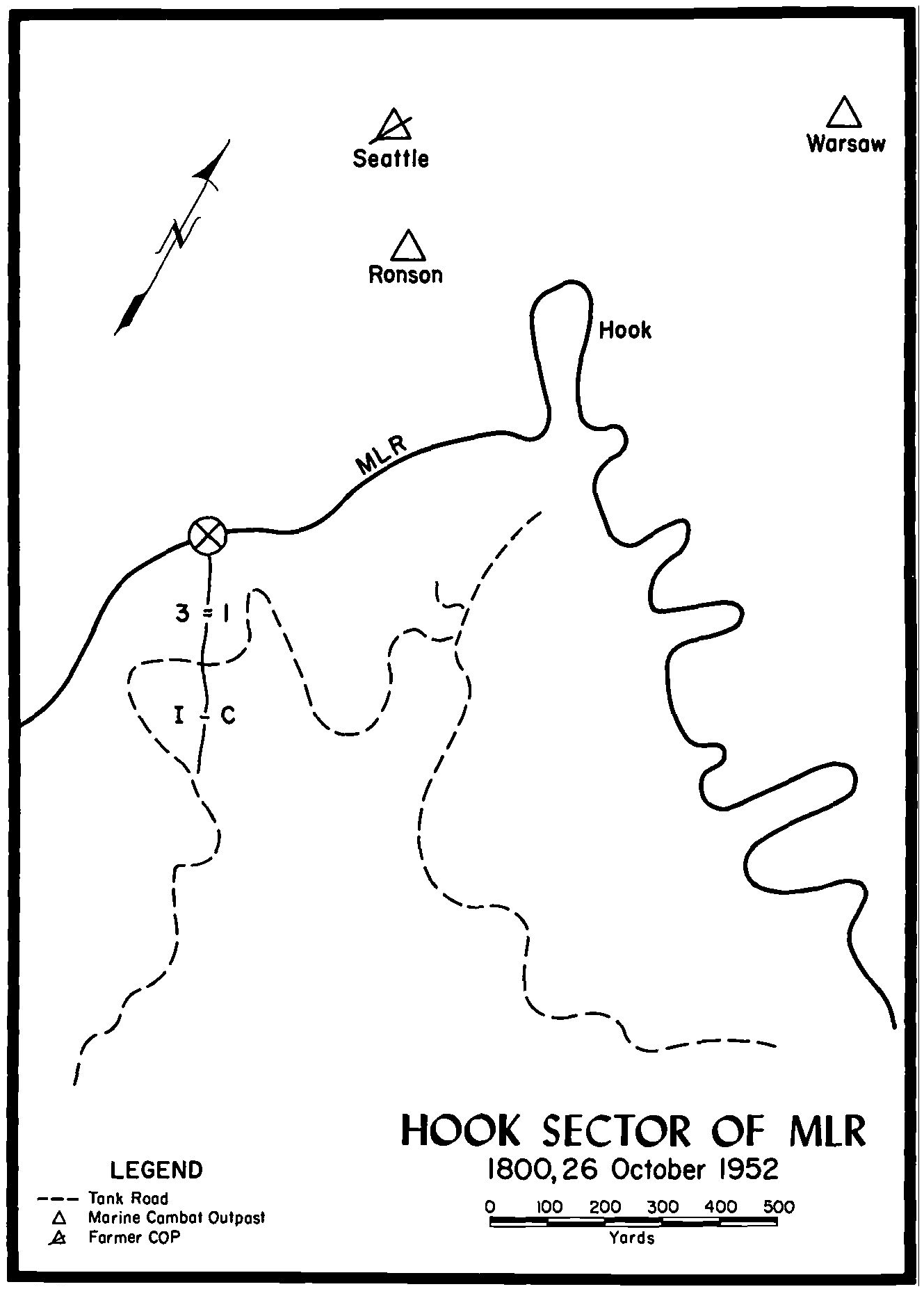
MAP 16 K. White
HOOK SECTOR OF MLR
1800, 26 October 1952
At this time, 800 yards northeast, the 9th Company, 357th
Battalion was working its way towards Warsaw. Striking at the
COP from both east and west, the enemy company was momentarily
halted by extremely heavy Marine mortar and artillery fire. By 1820,
the platoon at Warsaw had requested the protective box around its
position; this fire the 11th Marines delivered promptly. Still the
Chinese continued to besiege the position and Company A defending
Marines, under outpost commander Second Lieutenant John Babson,
Jr., were locked in a hand-to-hand struggle. As a platoon was being
readied to reinforce Warsaw the outpost reported, at 1907, that
enemy soldiers had reached the Marine bunkers and that the
defenders were using bayonets, pistols, hand grenades, and both
ends of their rifles to repel the Communist invaders.
Three minutes later came the word, “We’re being overrun.” With
this message all communication from the outpost temporarily ceased,
but at 1944, Lieutenant Colonel Dulacki’s CP heard Warsaw report
heavy fighting still in progress there. The outpost first stated that
enemy soldiers were on top of the bunkers; then called for “VT on
own position” which the 11th Marines furnished.
The seriousness of the situation was immediately apparent at
higher commands. One outpost had been lost; a second was in
jeopardy. At about this time, a veritable avalanche of enemy artillery
and mortar fire began to blanket the Hook. Colonel Moore released
Captain McLaughlin’s company to 1/7. The 7th Marines commander
also ordered regimental ammunition supplies be allotted to Lieutenant
Colonel Dulacki’s area. Shortly after that, division lifted
ammunition restrictions on 1/7.
To counter the impending ground attack, at 1859 Lieutenant Colonel
Dulacki ordered Captain McLaughlin’s Company A forward to
reinforce the Hook sector and to assist Company C in containing
the enemy attack. One platoon, the 1st, departed immediately for
the MLR. As the remainder of the company prepared to move out,
the enemy struck in estimated battalion strength. By 1938 some of
the CCF infantry had advanced to the main trenches immediately
south of the Hook. Within a few minutes, a second wave of Communist
soldiers, following closely the preparatory barrages, hit
JAMESTOWN just east of the 1/7 salient and frontally at the Hook
itself. It appeared that the Communists had come to stay, for many
cargo carriers—Chinese with construction materials for bunkers
and trenches—accompanied the attacking infantry.
Fire fights raged during the early phase of the struggle, with
continuous support furnished the assault troops by Chinese artillery
and mortars. The momentum of the enemy’s three-pronged attack,
aided by heavy rear area fire support, enabled the Chinese to overrun
the trenches and push on along the crest of the ridge, its slope near
the spine, and across the segments formed by the spurs that jutted
south from the crest. Marine defenders pulled back while a small
rear guard covered their movement with fire. Along the MLR, about
400 yards south of the Hook, the Chinese had slipped around the
flanks of the COP and at 2030 forced a penetration in the C/1/7
line. Second Lieutenant John W. Meikle (1st Platoon, Company C)
organized the Marines into a perimeter defense adjacent to the
MLR. At 2130, remaining elements of the company formed another
defense blocking area 550 yards east of the Hook near the crest of
the ridge.
Between these two positions small groups of Marines continued
the heavy close fight to repulse the enemy while inching their way
forward to tie-in with the rest of the unit. (See Map 17 for penetration
limits during the Hook battle.) To the northeast, the platoon
at Warsaw had not been heard from since 1945, and at 2330,
Colonel Moore reluctantly declared the outpost to be in enemy hands.
At the time the loss of Warsaw was announced, counter-measures
designed to halt the enemy assault were in various stages of preparation
or completion. The initial reinforcing element sent forward
to strengthen the main line had linked up with Lieutenant Meikle’s
1st Platoon, Company C, in the perimeter near the 3d Battalion
boundary. The remainder of Company A was en route to the crest
of the east-west ridge to thwart what appeared to be the main
enemy drive. Colonel Moore had released his meager reserve, H/3/7,
at 0300 on the 27th, and General Pollock had ordered one of the
division reserve battalions, 3/1, to the 7th Marines area, although
still retaining operational control of the unit.
As the forward battalion of the division reserve, 3/1 (Lieutenant
Colonel Altman) had prepared counterattack plans for critical locations
in the division sector and had previously made a reconnaissance
of the Hook area. The battalion immediately displaced from
its bivouac site north of the Imjin (Camp Rose) to an assembly area
behind the 7th Marines on the MLR.
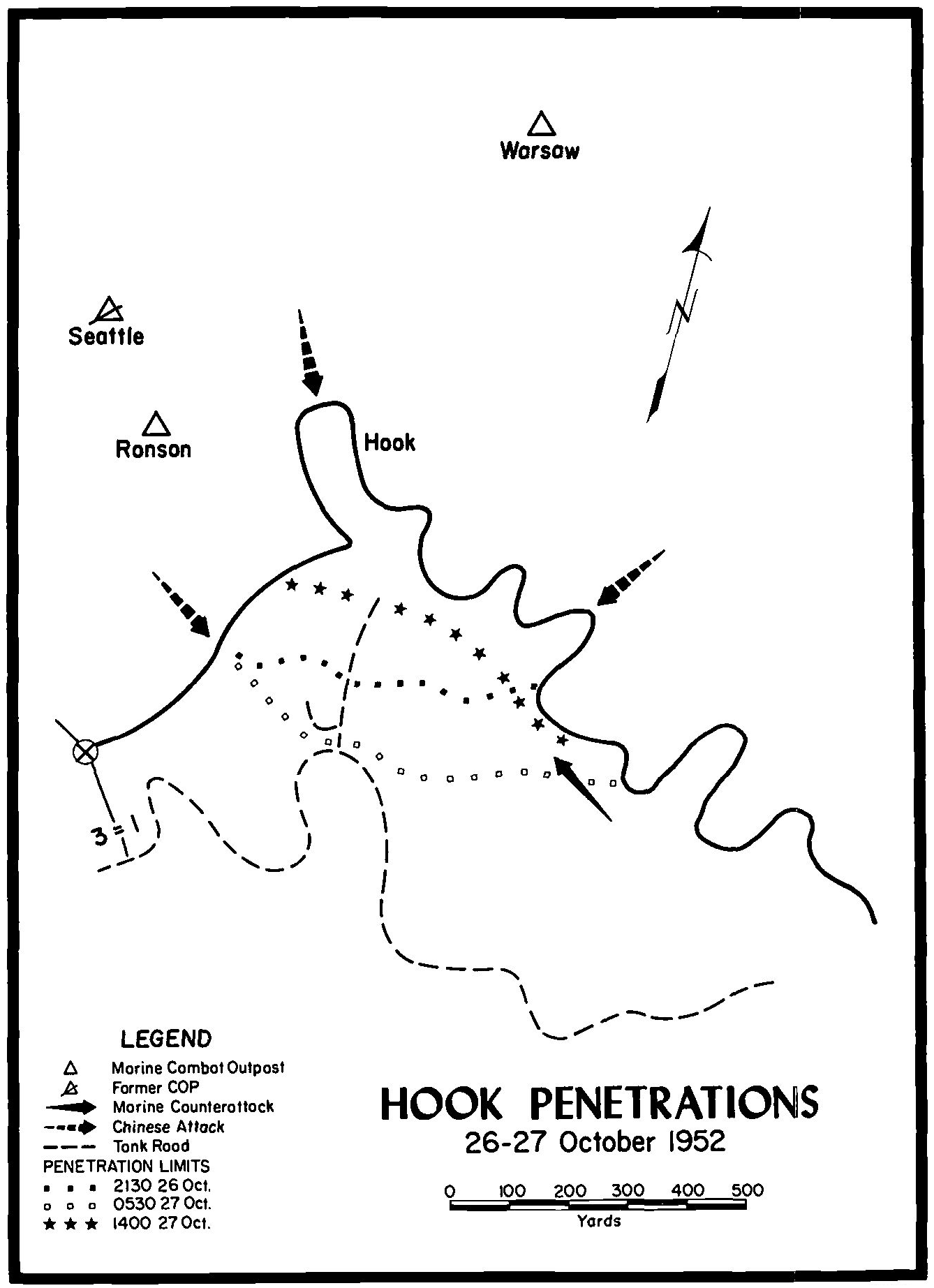
MAP 17 K. White
HOOK PENETRATIONS
26–27 October 1952
All possible support for 1/7 was made available, since the critical
situation resulting from the major enemy assault automatically suspended
previous restrictions on use of artillery and mortar allowances.
At Warsaw, 2/11 blanketed the position with a continuous
barrage in order to limit the enemy’s ability to effectively hold and
consolidate the captured COP. Lieutenant Colonel Davis’ cannoneers
also blasted enemy formations in response to fire missions from
forward observers. Artillery rounds fell on Chinese outposts supporting
the attack, on approach routes to the battleground, on assembly
areas, and on known and suspected Chinese artillery locations.
Marine aviation and tanks were employed as part of the plan to
first limit the penetration made by the enemy before the counterattack
to expel him. A section of tanks had been firing since 1930
against the enemy main line; a second section joined the direct fire
assault a half hour later. At 2113, one F7F, with 1,300 pounds of
bombs, hit a portion of the enemy’s MSR. At 2306, another twin-engine
Grumman Tigercat blasted the same area, about three-quarters
of a mile west of the Hook. These initial one-plane strikes
in support of the defense of the salient were flown by Captain Leon
C. Cheek, Jr. and Major Laurel M. Mickelson, respectively, of
VMF(N)-513.
At 0030 on the 27th, Major Mickelson, returning from his MPQ
attack, touched his Tigercat down at K-8 (Kunsan). At the very
moment that the plane set down on the Kunsan runway, the Chinese
launched another assault against the 7th Marines, the second in less
than six hours. This later action, in Lieutenant Colonel Caputo’s
2/7 sector, nearly two miles west of the Hook, was not a surprise
move either. In fact, an attack against the Carson-Reno-Vegas area
had been anticipated for some time, and it was this state of preparedness
that throttled the enemy’s attempt to seize an outpost here.
Division intelligence had accumulated considerable evidence that
the Chinese buildup in late October was intended to ultimately clear
the way to the 2/7 outposts rather than those of 1/7 in the eastern
Hook area. A majority of the Marine supporting arms effort immediately
prior to 1800 on the 26th had gone to the left battalion of
Colonel Moore’s regiment. Aware of the interest the enemy had
shown in the outposts earlier in the month, the battalion commander
had strengthened the defense of this key area. One measure, increasing
the size of the ambush force maintained at night near Reno from
a squad to a platoon, was to pay handsome dividends before October
was over.
Just after dark on the 26th, a reinforced platoon from Captain
James R. Flores’ Company E departed the MLR on a combat patrol
and ambush mission. After reaching its assigned area, about 300
yards short of the hill that housed COP Reno, the ambush platoon
disappeared into camouflaged dug-in positions and waited. At midnight,
the Marines were alerted by faint noises to the front. There,
elements of two Chinese companies, which had stealthily maneuvered
into the ambush area, were organizing for a sneak assault by
an envelopment on Reno from the rear. (See Map 18.) The waiting
platoon apprised the outpost of the enemy’s presence in the area;
then when it appeared that the Chinese were about to launch their
assault, the ambushers opened fire.
As the surprised Chinese turned to take on the hidden ambush
platoon, the two defending squads at Reno began firing. It took 10
minutes before the Chinese were sufficiently recovered to organize
a withdrawal. At 0040, enemy elements quickly began to pull back
towards the north. The outpost had been spared a major action, but
its occupants were to be again engaged by the Chinese before
daybreak.
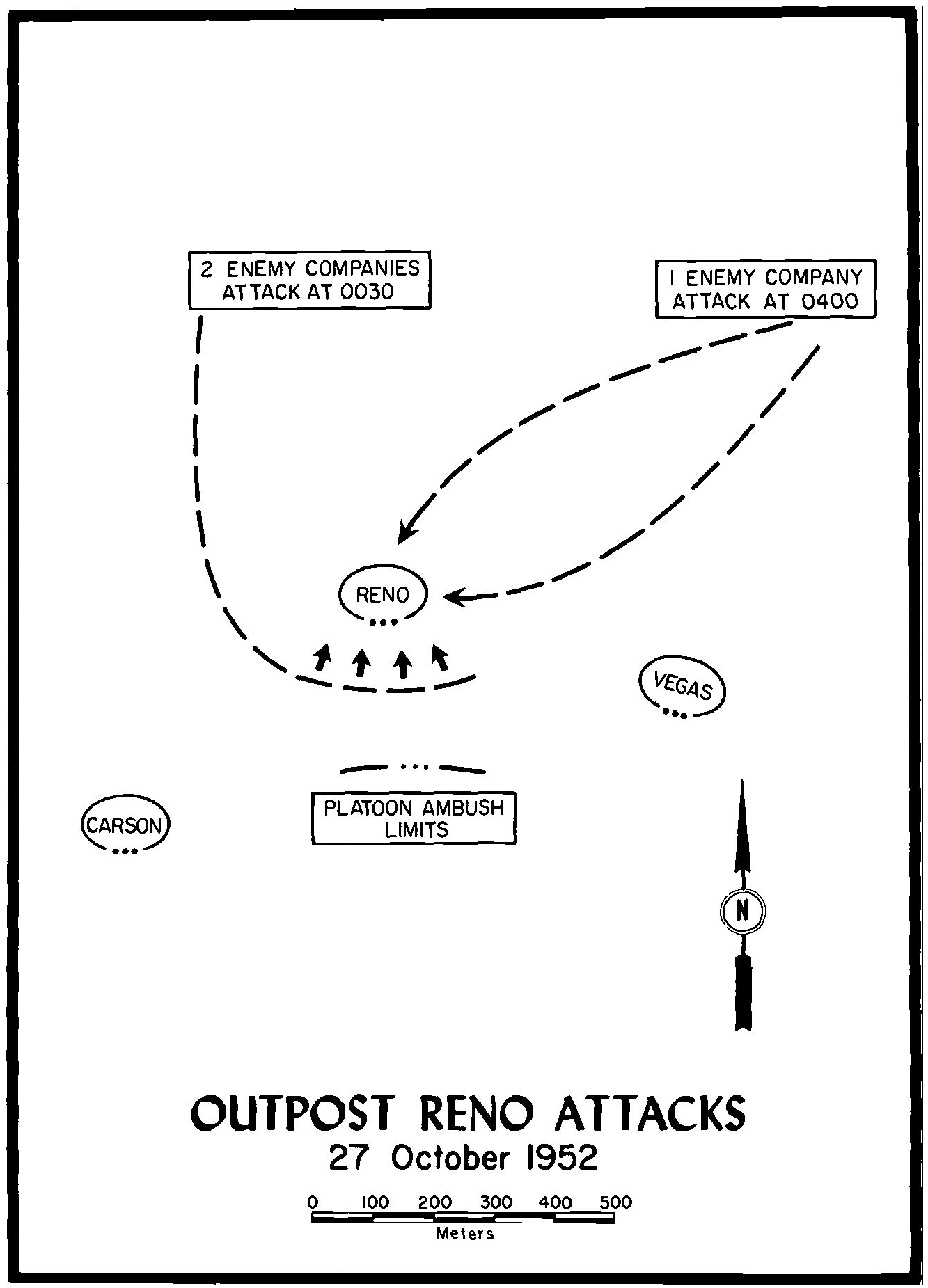
MAP 18 K. White
OUTPOST RENO ATTACKS
27 October 1952
At 0400, one platoon from a third CCF company, approaching
from an enemy hill to the northeast, hit Reno. The attack was conducted
in a fashion not previously experienced by the 1st Marine
Division in West Korea—platoons echeloned in depth, assaulting
in successive waves. The first unit to reach Reno was composed of
grenade throwers and supporting riflemen. This advance element
was followed immediately by the rest of the platoon, infantry armed
with submachine guns and rifles. Marines on Reno were not troubled
by the initial platoon assault, but the second one made some inroads
before the defenders’ fires forced the enemy to pull back. A third
two-phased attack succeeded, however, in cracking the defenses at
the northeast section of the position. The outpost commander then
ordered his Marines into the bunkers and called for overhead
artillery fire. Caught in the open, the Chinese were forced to withdraw
at 0440 and did not return.
After the Marines in Lieutenant Colonel Caputo’s 2/7 sector had
dealt with the demonstration force, the action shifted back to the
Hook. Early on the morning of the 27th, Captain McLaughlin’s
unit, sent to the Hook-Hill 146 crest to block the penetration of the
MLR, had established contact with Captain Byrum’s Company C,
passed through its lines, and pressed on to the Hook. Suddenly,
enemy small arms and machine guns opened up on lead elements
of Company A. Artillery and mortar fire then began to hit the company.
The Marines continued their advance and made some progress
in arresting the Chinese thrust at the ridge. Shortly thereafter the
enemy called in heavy supporting fires, forcing Company A to halt
its attack temporarily. When the company commander ordered his
men to resume the advance, overwhelming enemy fire again slowed
the movement. McLaughlin then ordered his men to hold and dig in.
When report of the Company A situation reached the regimental
CP, Colonel Moore ordered into action his last reserve unit, Captain
Bernard B. Belant’s Company H.282 He was directed to report to 1/7,
then to pass through the depleted ranks of Company A, and take
up the attack downridge towards the salient. At 0340 the regiment
attached H/3/7 to 1/7 for operational control; at 0505 the company
arrived at the 1st Battalion CP. Forty minutes later, Company H
reached Captain McLaughlin’s area, where it regrouped and then
deployed toward the ridgeline for the counterattack.
When Captain Belant led his Marines towards the Hook to oust
the Chinese, the enemy drive had reached the point of its deepest
penetration. By this time the Chinese had seized control of slightly
more than a mile of the meandering MLR. Most of the captured
main defense line extended from the Hook east along the ridge
towards Hill 146. (One-third of the Communist advance was from
the Hook southwest, in the direction of the 3d Battalion boundary.)
Between 0545 and 0800, H/3/7 worked its way towards the Hook-Hill
146 crest. After two hours the company was at the ridgeline,
and at 0800 Captain Belant was ready to move forward towards the
salient, a straight-line distance of about a half-mile. On the hour,
the push downridge started. After having advanced about 200 yards,
the H/3/7 Marines were assailed by small arms fire and the rain
of heavy caliber rounds supporting the enemy’s thrust. Captain
Belant signalled his Marines to attack.
Immediately, Second Lieutenant George H. O’Brien, Jr. leaped
up from his position and shouted for his platoon to follow. On the
run, he zigzagged across the exposed ridge and continued down the
front slope towards the main trench. Before reaching this objective,
the platoon commander was knocked to the ground by the impact of
a single bullet. Scrambling quickly to his feet he motioned for his
men to follow and took off on the run for the enemy-occupied
trenchline. Again he stopped, this time to assist an injured Marine.
As he neared the trenchline, Lieutenant O’Brien started to throw
a hand grenade into the enemy-occupied bunkers, but was stopped
by the Chinese. With his carbine, the officer methodically eliminated
this resistance, then hurled the grenades. Overcoming this position,
the Texas Marine and his platoon advanced towards the Hook, but
the enemy, now partly recovered, was able to slow and ultimately
stop the counterattack. A profusion of artillery and mortar fire was
primarily responsible for halting the advance, which had carried
Company H very close to the Hook bunkers.
Spurred on by the leadership of Lieutenant O’Brien, who later
received the Medal of Honor,283 the company was able to execute
a limited advance. Despite the heavy artillery and mortar fire, the
company drove a wedge into the Communist position, thereby
retaking the initiative from the enemy. Company H also took three
prisoners in the southeast end of the Hook before being forced by
a deadly enemy mortar and artillery barrage to withdraw upridge.
The attack by Company H had been well supported from the
air. At 0840, a flight of four ADs from Lieutenant Colonel Cargill’s
VMA-121 assaulted the former Marine COP Seattle, where enemy
reinforcements were being funneled through on the way to the Hook.
Bombs and napalm took a heavy toll of the troops, bunkers, and
weapons pouring fire on the counterattacking Marines. One hour
later, a division (four planes) from VMA-323 struck another
trouble spot, a former Marine outpost known as Irene (later, Rome).
Aircraft of Lieutenant Colonel Chamberlain’s squadron hit this
objective with three tons of bombs and more than 4,000 pounds of
burning napalm. Thirty minutes later, another foursome, these from
VMA-212, (Lieutenant Colonel Charles E. Dobson, Jr.),284 delivered
bombs, napalm, and 20mm shells on enemy soldiers moving on the
MSR towards JAMESTOWN.
While these three squadrons were bombing enemy strongpoints
and other targets of opportunity, division artillery and tanks continued
their destructive fire missions. Between 0930 and 1300, two
tanks from Company A, 1st Tank Battalion, blasted away at Chinese
bunkers and trenches, at an enemy 76mm gun on Seattle, and at
positions southwest of the Hook. Artillery—2/11, 4/11, and the
rocket battery—contributed the weight of its support. The 11th
Marines, in an effort to stop the heavy hostile shelling of the Hook
sector, fired 60 counterbattery missions on Chinese gun emplacements
during the first 24 hours of the attack.
In the early afternoon of the 27th, 1st MAW attack squadrons
continued their bombing and strafing of enemy troops engaged in
the assault against the Hook. Before sundown, 30 aircraft had taken
part in 8 additional strikes in support of Marine counterattacks along
the ridge. The number of aircraft involved in close air support sorties
for the Hook was approximately half the number received by the
division all day. Of the 72 aircraft flying CAS strikes during the first
24 hours of the Hook action, 67 were Marine planes, all from
MAG-12.
As in the morning’s close air support flights, Lieutenant Colonel
Cargill’s ADs provided the bulk of air support for ground action
that afternoon. Striking first a command post southeast of the 1/7
salient, at 1410, VMA-121 came back a half-hour later with four
more Skyraiders against CCF troops pressing to envelop the right
flank of the counterattack force. At 1635, two squadron aircraft flew
in quickly in response to a sighting of troops moving forward in the
Samichon tributary 1,000 yards north of the Hook. Twenty minutes
after this successful attack, four more Skyraiders attacked bunkers
opposite the left flank of Lieutenant Colonel Dulacki’s sector. The
final daylight strike for 1/7 was again made by four ADs from
-121. These planes took under attack a target that had been
bombarded just 25 minutes earlier by Corsairs from VMA-323.
Another Marine attack squadron, VMA-212, participated in the
Hook support that afternoon. At 1344, a four-plane flight assaulted
troops moving through Frisco to reinforce the Chinese drive on the
Hook. Two of the planes dropped three 1,000-pound bombs and two
250-pounders on the enemy soldiers. The other pair of attack Corsairs
released six 780-pound napalm tanks over the position. It was estimated
that 25 Chinese casualties resulted from this air attack. Wrapping
up the VMA-212 CAS for the Hook sector on the 27th was
a strike, at 1440, on camouflaged positions and another at 1520
against caves and bunkers. Each of these air assaults took place about
950 yards from the Hook. The earlier one was a napalm attack from
50 feet above the ground. One of the six tanks would not release
and three did not ignite. Four caves were destroyed and one bunker
was damaged in the latter strikes.
Between the morning and afternoon air strikes, the ground commanders
put together the final plans for recapture and defense of the
Hook. When General Pollock had released I/3/1 to the regiment
during an inspection trip to the 1/7 area that morning, the company
was already en route to the ridge to make the counterattack. The
ground commanders agreed that after I/3/1 regained the salient,
H/3/1 would take over the right sector of 1/7 and the relieved
company, B/1/7, would then occupy both the critical MLR sector
and Warsaw. Lieutenant Colonel Dulacki’s scheme to recapture the
positions and ground lost on 26 October was a continuation of the
attack from atop the ridge directly towards the objective. It was to
be a hard-nosed, frontal assault, but the only maneuver deemed
advisable.
Clearing the Company C command post about noon, the lead
elements of Captain Murray V. Harlan, Jr.’s Company I, the 1st
Platoon, continued its route to the ridge. After the 40 Marines had
gained the crest, they quickly reoriented themselves to the new
direction, and at 1350, led the I/3/1 assault. Artillery preparation by
the 11th Marines had preceded the crossing of the line of departure,
and these supporting fires were partially responsible for the substantial
initial advance made by the counterattacking Marines. But
Chinese artillery was not idle at this time either, and the volume of
enemy fire matched that of the Marines. The I/3/1 movement forward
was also slowed by Communist soldiers, estimated at about a
company, who fired from protected positions along the perimeter of
the Hook.
Inch by inch the company crawled forward. The vicious Chinese
supporting barrages were exacting many casualties among Captain
Harlan’s troops,285 yet they crept on, and ultimately reached the
artillery forward observer bunker atop the ridge but 150 yards short
of the Hook trenches. At this time, 1635, the enemy supporting fires
were directed not only on the advancing Marines and the MLR
defenses but extended as far back as the regimental CP.286 Chinese
soldiers still clung to some of the Hook positions and trenches of the
MLR just below the crest on the northern sides. Marines closest to
the Hook could see the virtual ruination caused by enemy artillery
and mortar shells to the trench system within the salient.
Nearing their objective, elements of Company I pressed on with
even more determination. By 1700 a few had made it to the shell-torn
ditches, where they sought momentary refuge to reorganize.
Several more joined, and together they reconnoitered the trenches
and bunkers for enemy soldiers. Just then the Communists reacted
with an even heavier supporting arms assault, which forced these few
Marines to pull back with their platoon to the reverse slope of the
ridge. To the right, about 250 yards away, the main body of Company
I Marines occupied the reverse side of the hill, riding out the
onslaught of artillery and mortar rounds while they waited for a
lull before making the final dash to recapture the lost area of
JAMESTOWN.
While Captain Harlan’s company was exposed to this extremely
heavy enemy artillery fire, another unit, B/1/7, was on the move
from Lieutenant Colonel Dulacki’s command post to the ridge to
strike what was intended as a lethal blow to the Communist invaders.
At 1932, Company B began its march forward. By midnight, the 1st
Platoon was nearing its assault position close to the left flank of
Company I of 3/1. Simultaneously, the 3d Platoon closed in on its
jump-off point. The going was extremely difficult, complicated by a
moonless night and the many shell craters that pockmarked the
terrain. But at 0019, 28 October, the platoons mounted their assault,
firing their rifles and machine guns, and hurling grenades to silence
enemy automatic weapons and to reach dug-in Communist soldiers
occupying the trenchline.
The Marine charge was met by a burst of small arms fire and a
shower of grenades. Weapons supporting the Chinese defense were
still very active. After a standoff of 90 minutes the Marines pulled
back, calling on their mortars and artillery to lay precise fire concentrations
on the trouble spots. The weapons also fired on enemy
approach routes through Ronson and Warsaw. After this preparation,
Company B again made an assault against the enemy, at 0340. This
advance was contested vigorously by the Chinese, but their resistance
this time was not lasting. Quickly B/1/7 Marines deployed throughout
the entire area, and by 0600 the Hook was again in Marine
hands.
Before the victors could permit themselves the luxury of a breathing
spell, there were a number of critical tasks that demanded
immediate attention. Defense of the MLR had to be quickly and
securely shored up for a possible enemy counterattack. The newly
rewon area had to be searched for Marines, both casualties and
holdouts, and for Chinese diehards or wounded. The company had
to be reorganized. In addition to these missions, there were two
others, regaining Ronson and Warsaw. As it turned out, the duties
were discharged nearly at the same time. COPs Ronson and Warsaw
were reoccupied by the 7th Marines at 0630 and 0845, respectively,
on 28 October.
In organizing the recaptured position, the Marines were hampered
to some extent by a dense ground fog. Nevertheless, work still went
ahead on these necessary tasks. Most of the Hook area was held
by Company B; the western part of the 1/7 line, south of the Hook,
was still manned by the platoon from Company A and one from
Company C. The 1st Platoon of Company B quickly searched the
retaken area of the MLR (except the caved in parts of the trenchline
and bunkers, which were investigated later), but found no enemy
soldiers. During the day, as Company B expanded its responsibility
along the Marine main line, the platoons from A/1/7 and C/1/7
were relieved to rejoin their companies.287 Supplies began to move
in, once the permanency of the defense had been established.
In evaluating the battle for the Hook, it would appear that the
Chinese assault against Reno was merely a demonstration or feint.
By making a sizable effort near the primary objective after the attack
there was well under way, the Communists expected not to obscure
the real target but rather to cause the Marines to hesitate in moving
higher echelon reserves to influence the action at the Hook. It was
to the credit of the ambush force that the Chinese ruse was
unsuccessful.
Including losses from the Reno ambush, Marines estimated that
the Chinese actions against that outpost cost the enemy 38 killed
and 51 wounded. The COP defenders and the platoon that had
surprised the enemy counted 22 dead Communist soldiers during
and after the Reno action. Together with the Hook casualties,
confirmed at 274 killed and 73 wounded and estimated at 494 killed
and 370 wounded,289 the figure represented more than a third of an
enemy battalion permanently lost in addition to about a battalion
and a half put out of action temporarily. Distributed among the
number of battalions that participated in the two actions, the total
number of casualties lost some impact. What remains significant,
however, are the cost and results—369 counted and 953 estimated
casualties for not one inch of ground.
Marine losses in the Hook battle were 70 killed, 386 wounded
(286 evacuated), and 39 missing, of whom 27 were later definitely
known to have been captured. This was the second highest number
of Marines taken prisoner in any single action during the Korean
fighting.290 Such a large number was attributed to the tactics of the
Chinese infantry, which followed the preparatory barrages so closely—at
times even advancing into the rolling barrages—that the enemy
was able to surprise and capture a considerable number of Marine
outpost defenders. Nearly all of the 27 were captured in the enemy’s
first rushes against the two outposts and MLR. In the diversion on
Reno, an additional 9 Marines were killed and 49 wounded (29
evacuated).
Perhaps as significant as any result of the Hook fighting is the
amount of supporting fires the Chinese provided their infantry.
Calculations of total incoming ran from 15,500 to 34,000 rounds
during the 36-hour engagement. The 1st Marine Division reported
conservatively that the enemy expended between 15,500–16,000 artillery
and mortar rounds; estimates by supporting arms units put the
total at the higher level. In any event, the 12,500 rounds the 7th
Marines received during the first 24 hours represented the heaviest
bombardment any Marine regiment had been subjected to up to that
time. Moreover, it had now become clearly evident that the enemy
could stockpile a plentiful supply of ammunition, despite attempts
of UN aircraft to interfere with the enemy’s flow of supplies to the
frontline.291
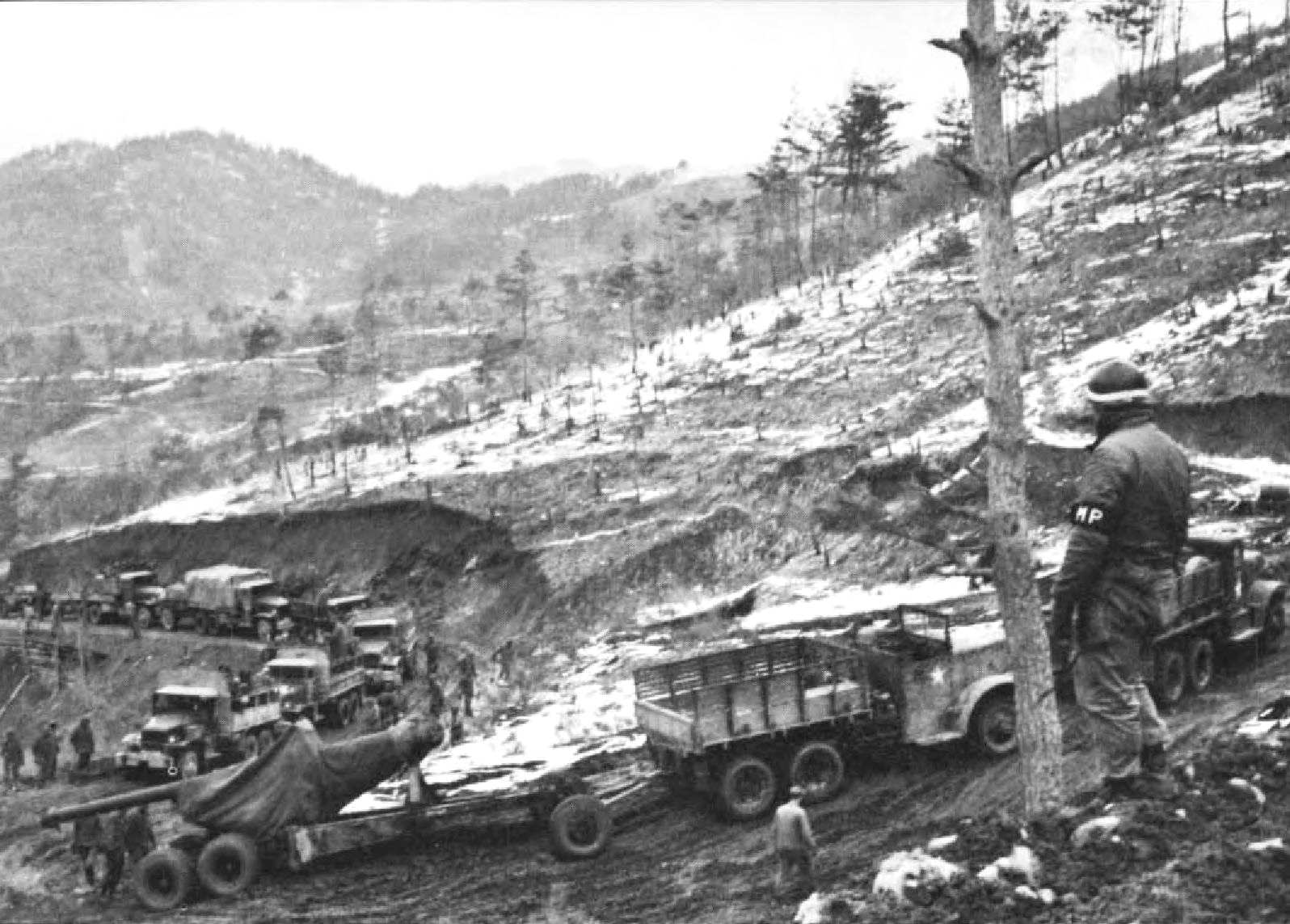
DOD Photo A 160346
Marine Division Redeploys to West Korea—5th Marines units en
route to new sector in April 1952 are slowed by muddy roads and spring
thaws. Below, Korean washwomen labor at daily tasks while 1st Tank
Battalion convoy moves up to new fighting area.
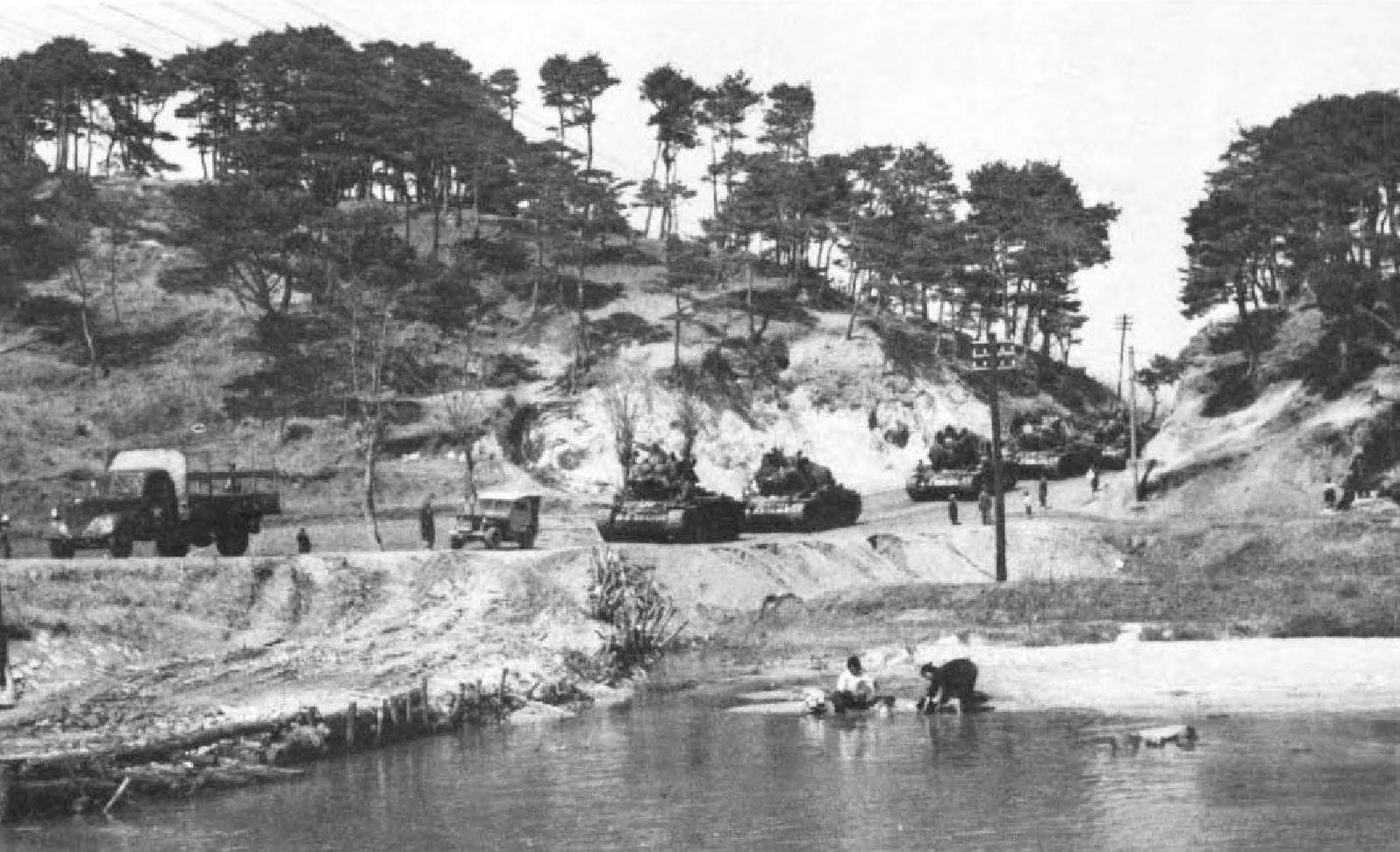
DOD Photo A 160984
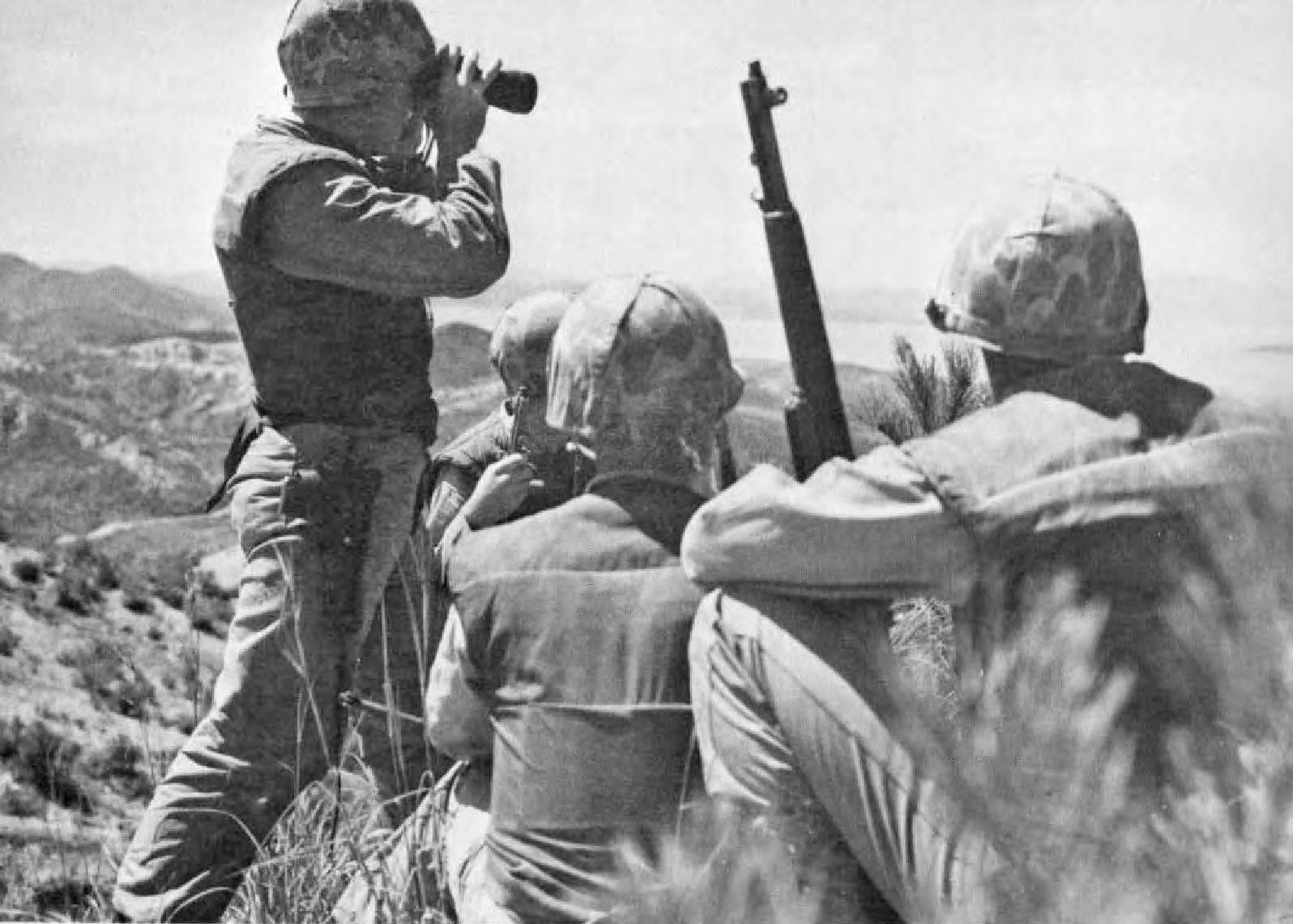
DOD Photo A 164524
Surveillance of the Enemy—Men of the Reconnaissance Company, 1st
MarDiv, scan CCF positions across the Imjin River. Below, Marines
empty 75mm shell cases from armored amphibian after a shoot-out on
Independence Day, 1952.
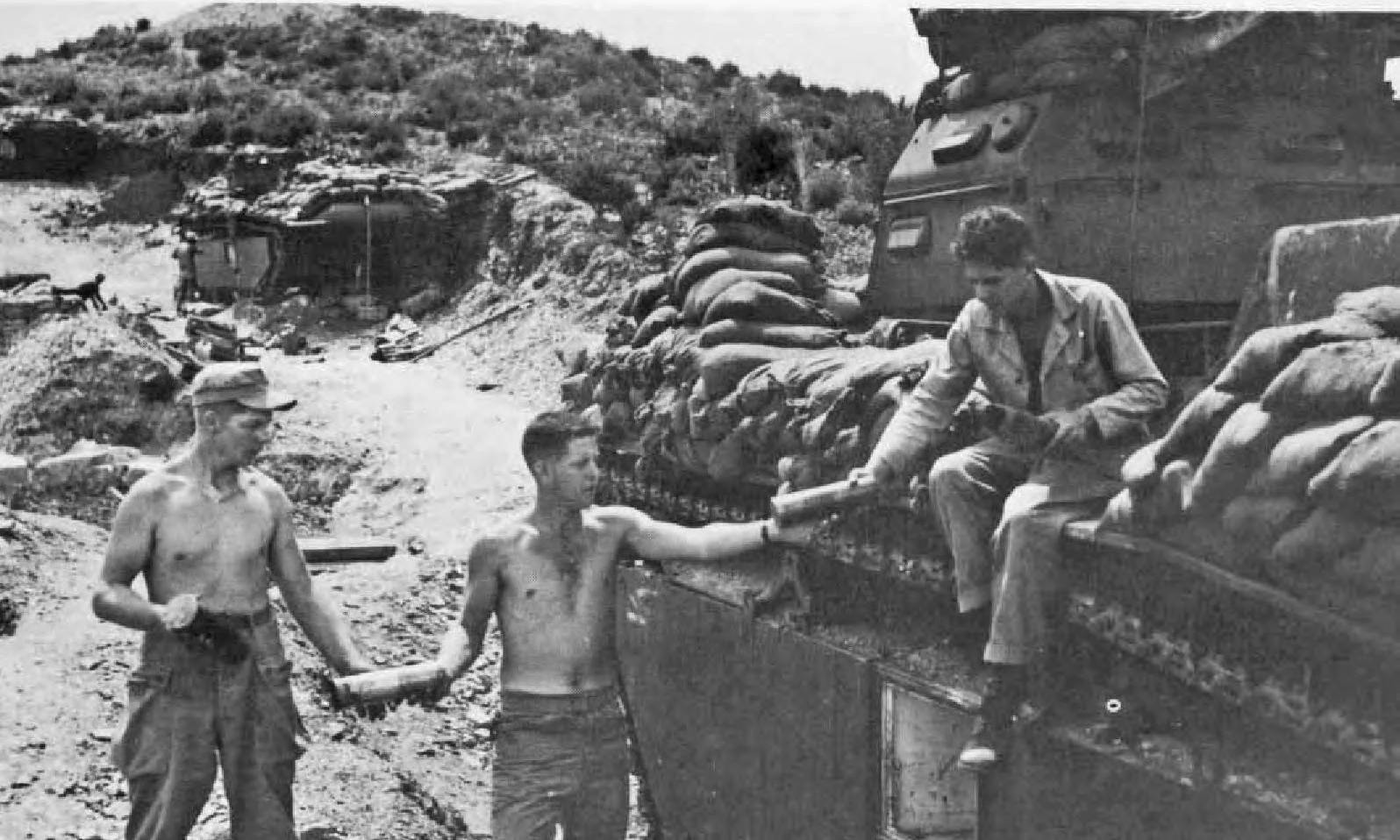
DOD Photo A 162962
DOD Photo A 173690
Scene of See-Saw Fighting—View of enemy-held outpost Yoke as seen
from Marine trenches. Below, clothing and equipment packed in a
“survival bomb” dropped to Marine pilots awaiting rescue. Pilots of
VMJ-1 are briefed on the day’s mission over North Korea.
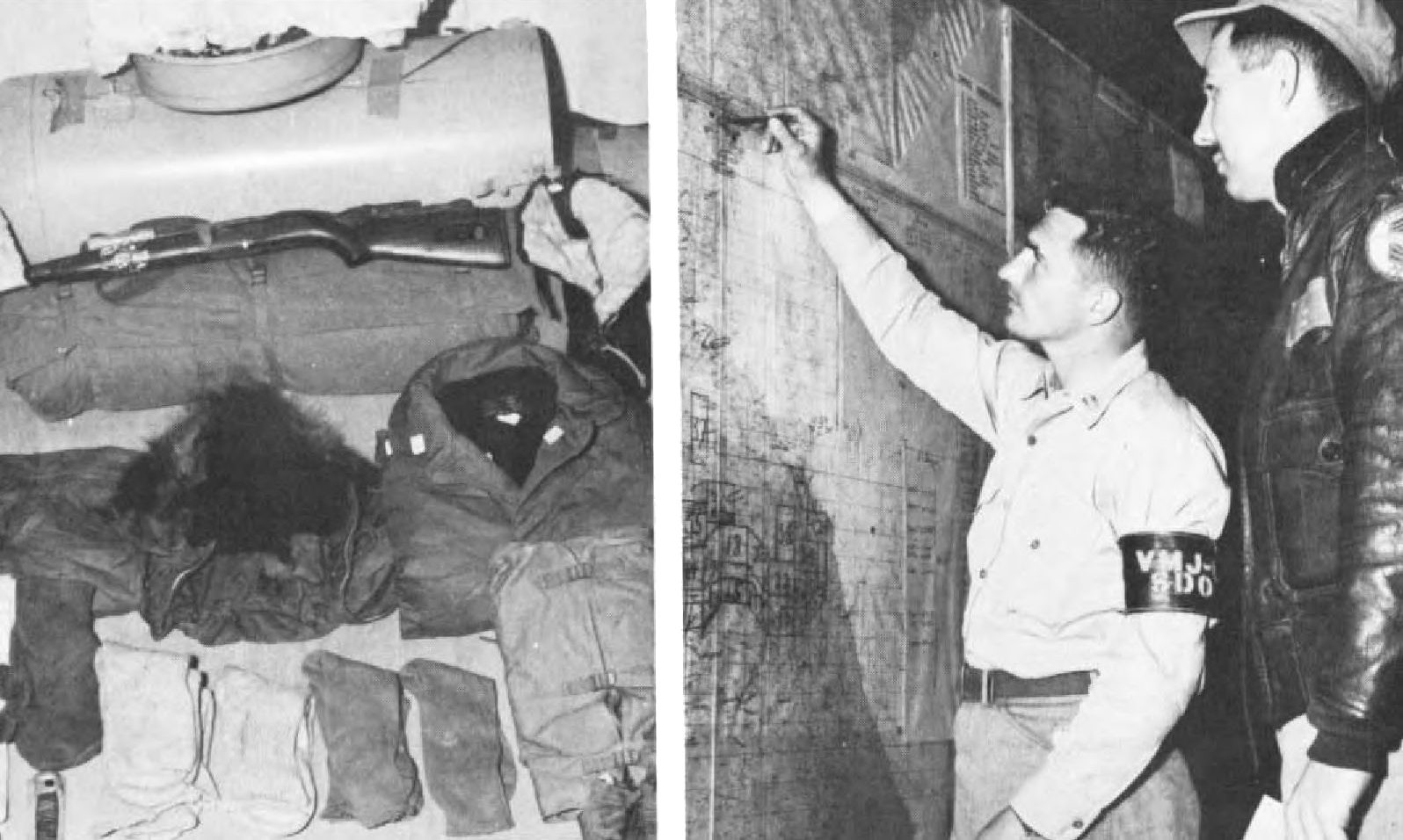
DOD Photo A 134927 DOD Photo A 134103
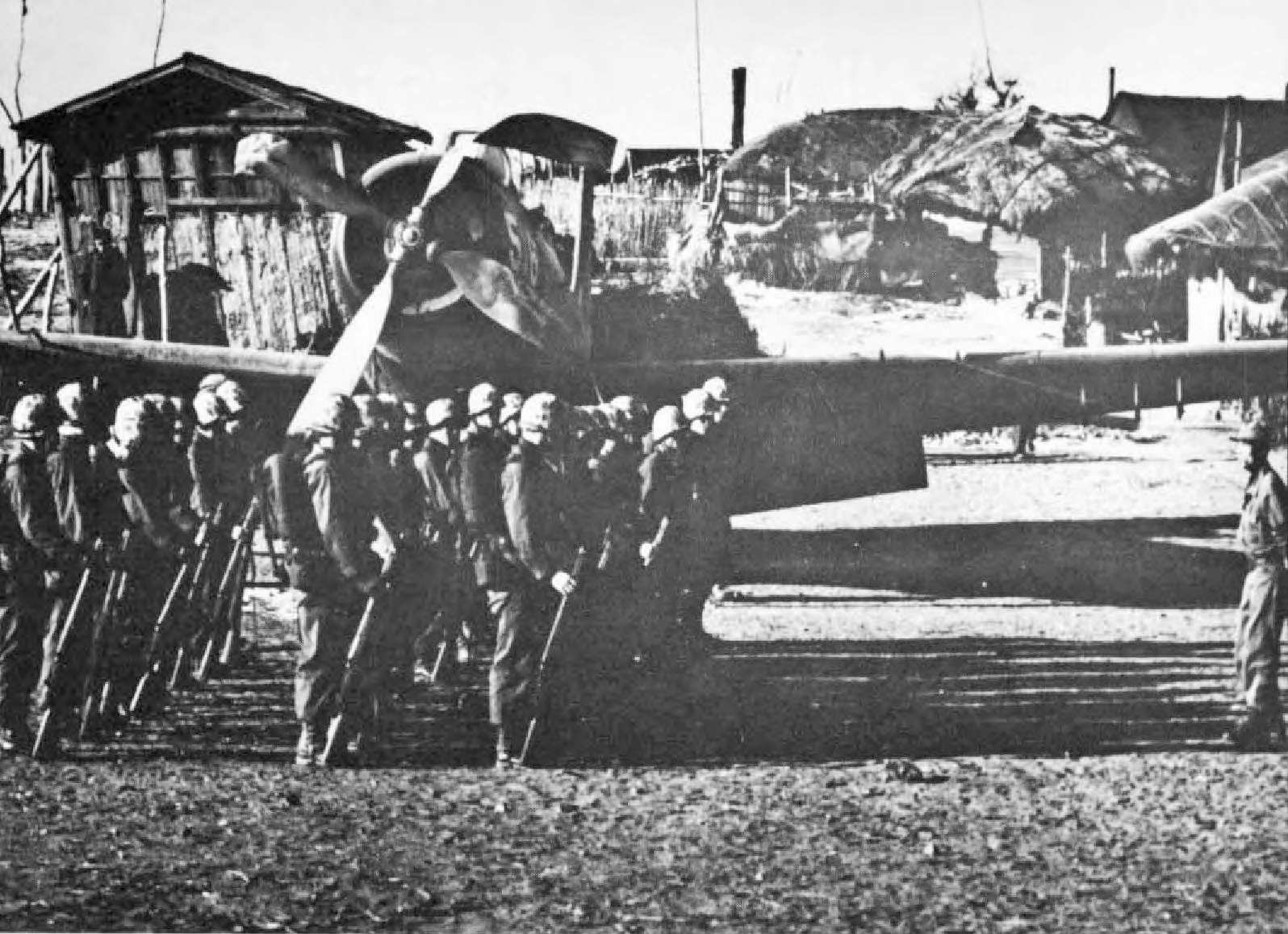
Official USN Photo
Island Marines—Korean Marine platoon undergoes instruction at
Yo-do, ECIDE. Damaged AD-4 had crash landed at Briscoe Field
nearby and was awaiting salvage. Below, Marine tank-infantry unit in
stand-by position during truce sessions at Panmunjom.
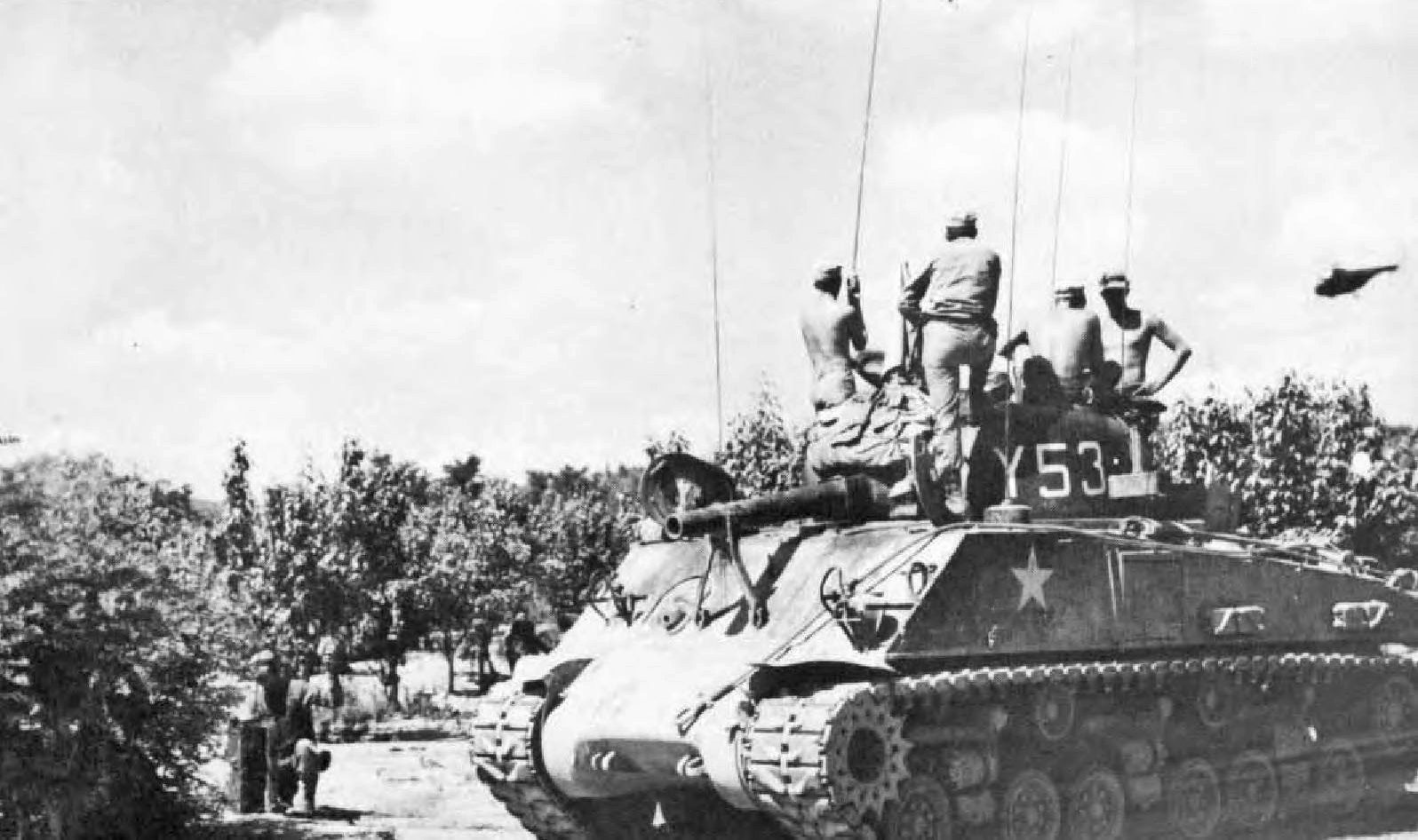
DOD Photo A 162782
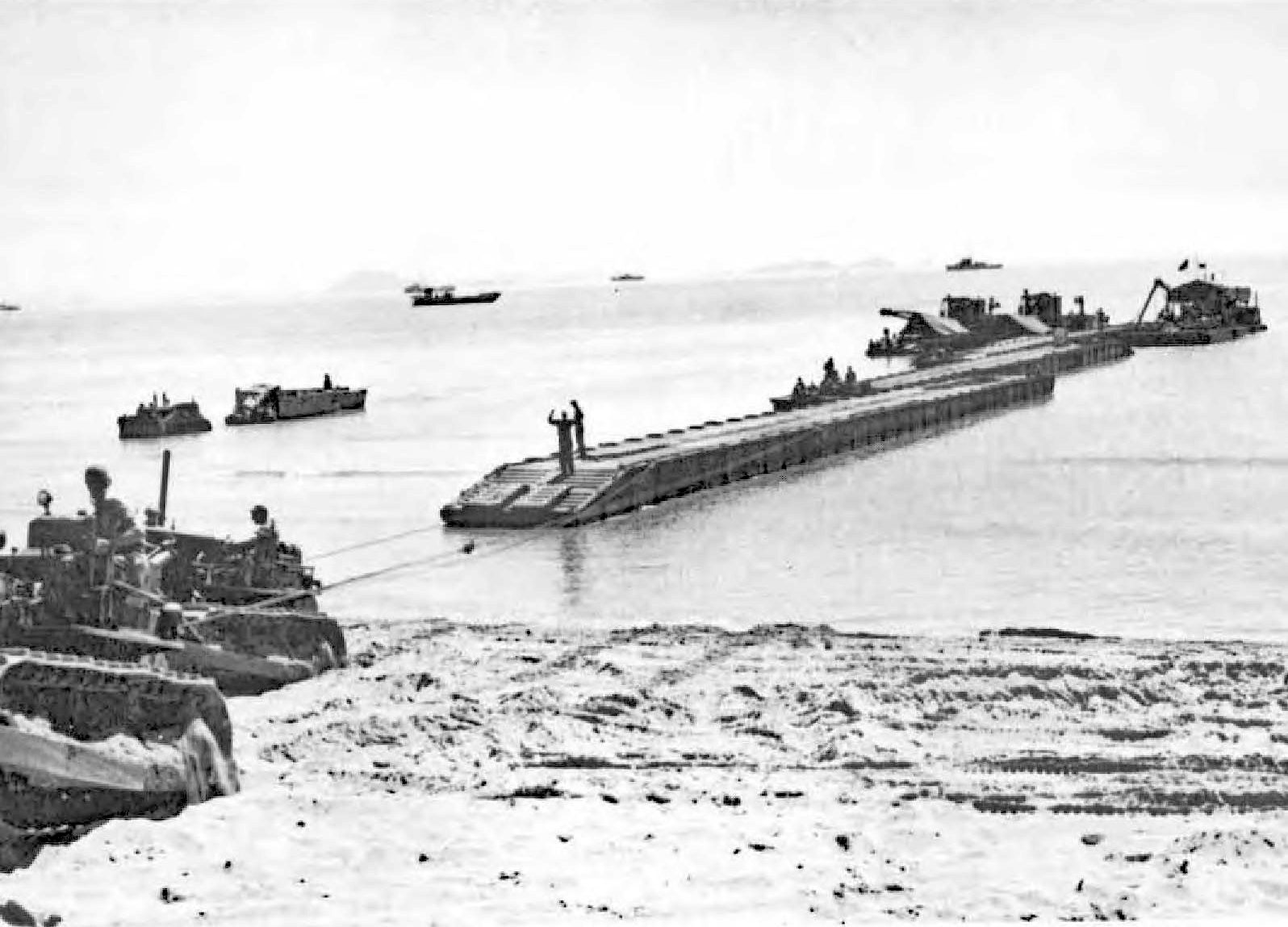
DOD Photo A 162952
Amphibious Exercise—Caterpillars of 1st Shore Party Battalion pull
floating dock ashore during 1st Marines training at Tokchok-to. Below,
HMR-161 choppers airlift 1st 4.5-inch Rocket Battery to new firing
positions during August 1952 maneuver.
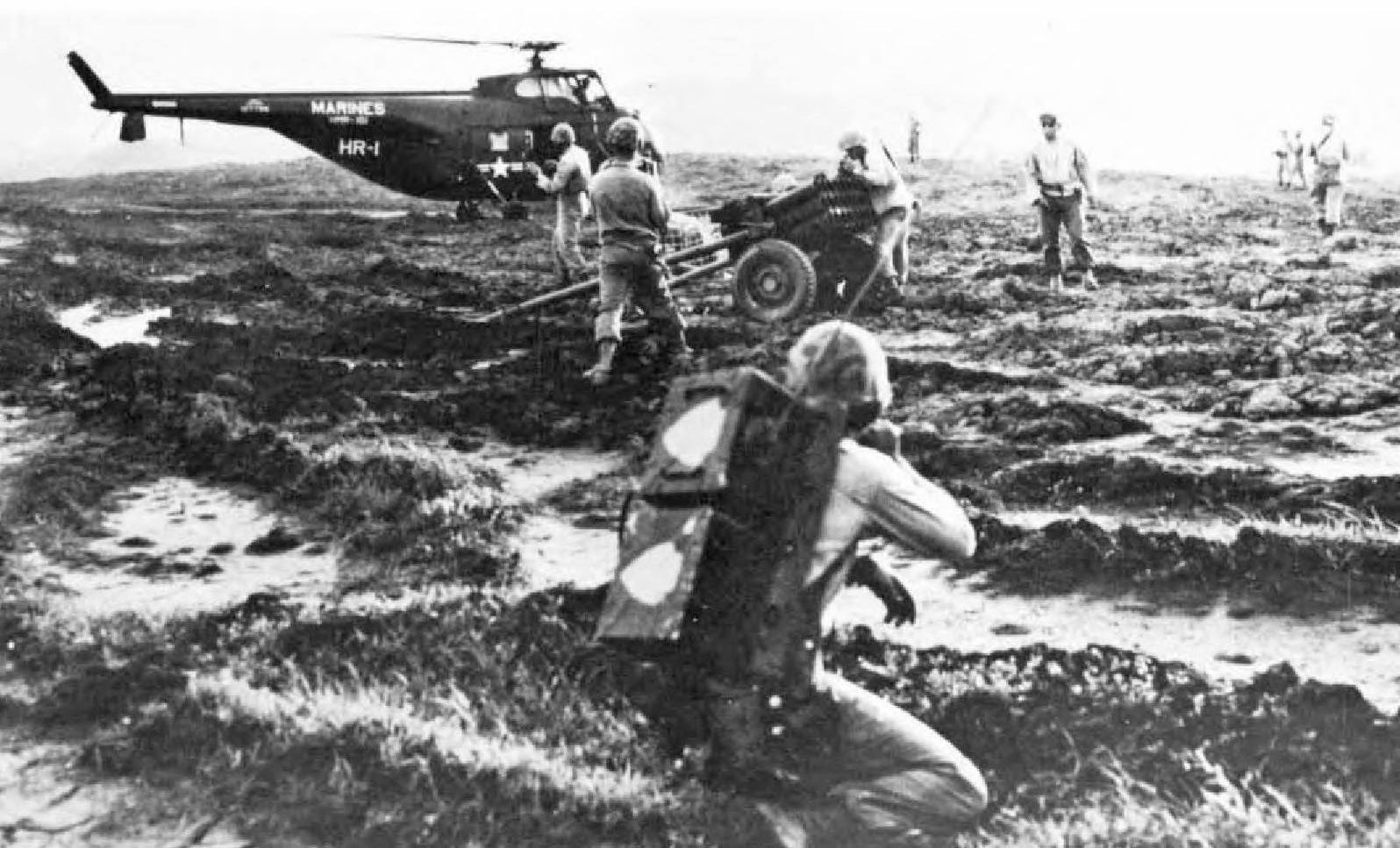
DOD Photo A 163906
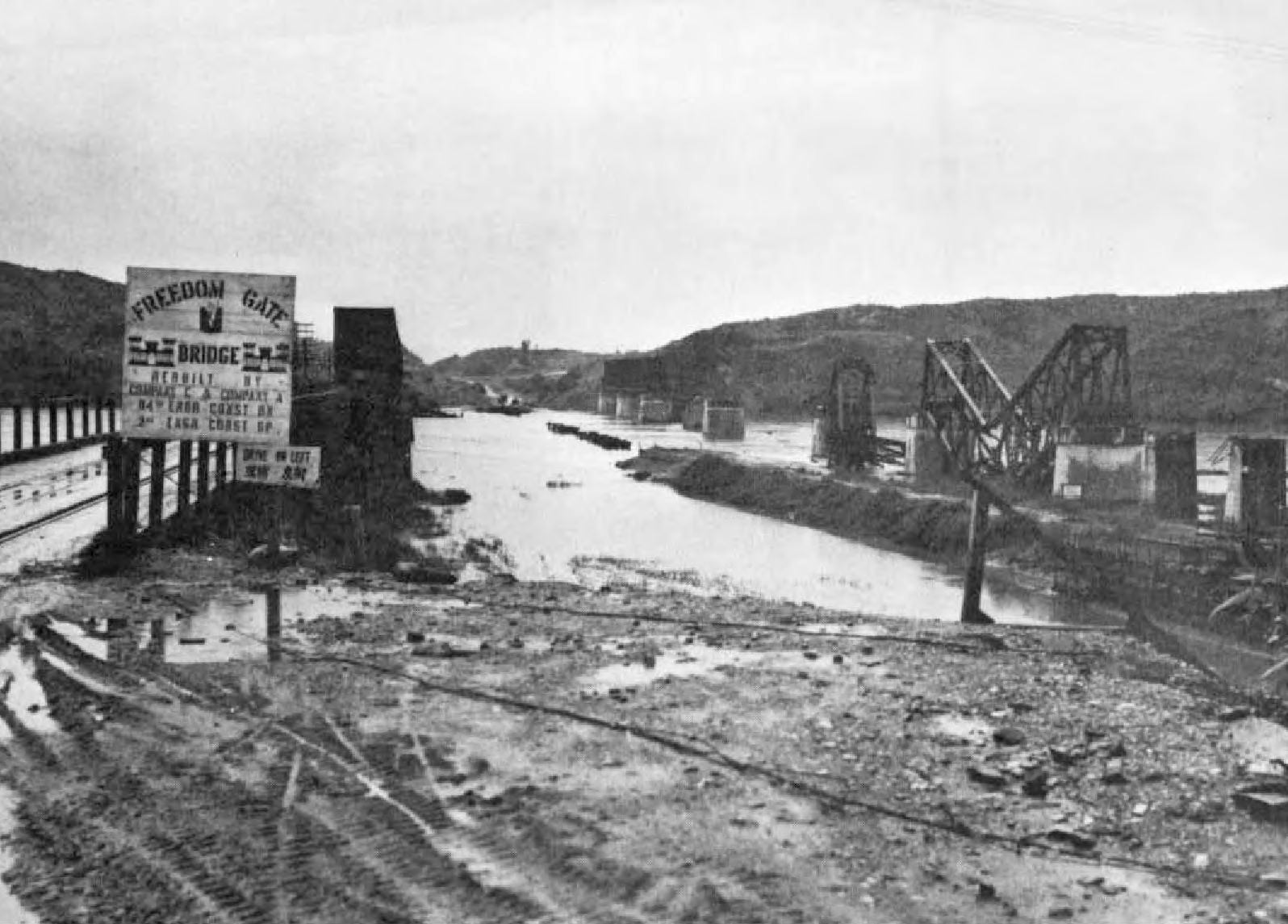
DOD Photo A 16448
Main Logistic Link to the Front—View of the Freedom Gate Bridge
from eastern shore of Imjin. This bridge was the only one left standing
after August 1952 floods. Below, the FDC bunker of 1st Battalion, 11th
Marines CP. From this nerve center, fire missions are relayed to the batteries
by radio.
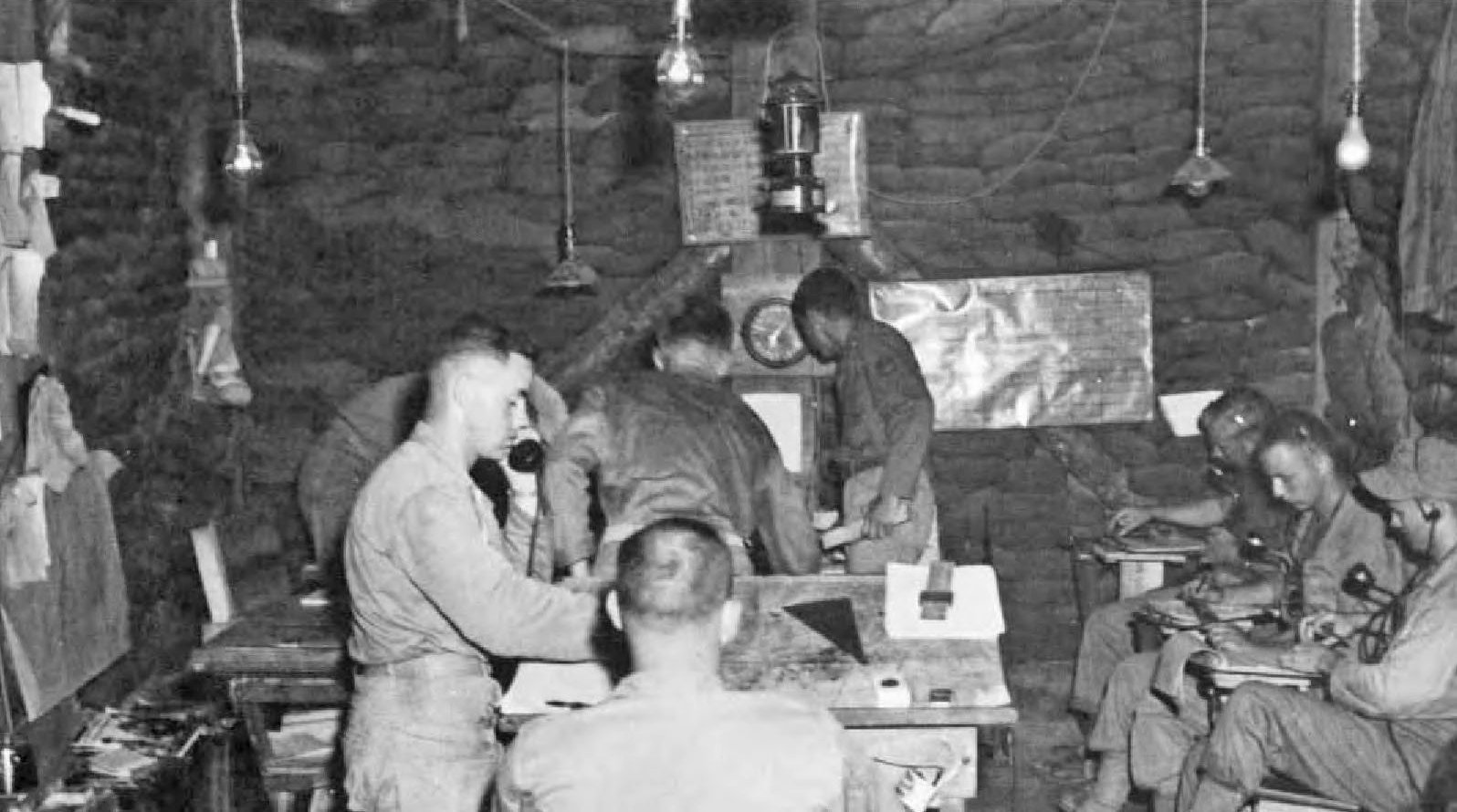
DOD Photo A 163812
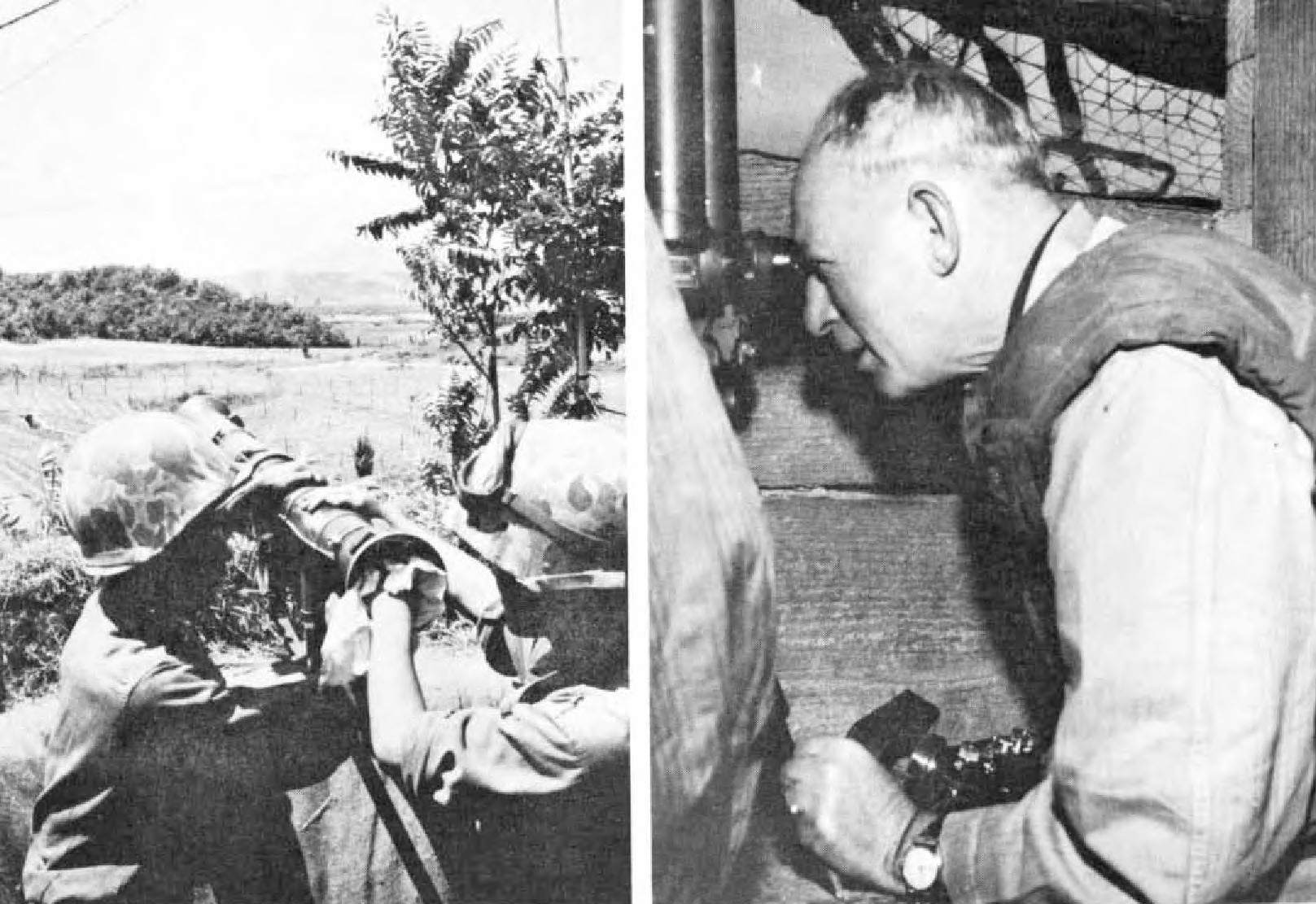
DOD Photo A 162984 DOD Photo A 165569
On Guard at Critical Site—Korean Marines clean their 3.5-inch
bazooka at blocking position near Hill 155. Gen Lemuel C. Shepherd,
Jr., CMC, observes fire placed on CCF position during frontline visit to
1st MarDiv. Below, AU Corsair of Deathrattler Squadron ready for
action.
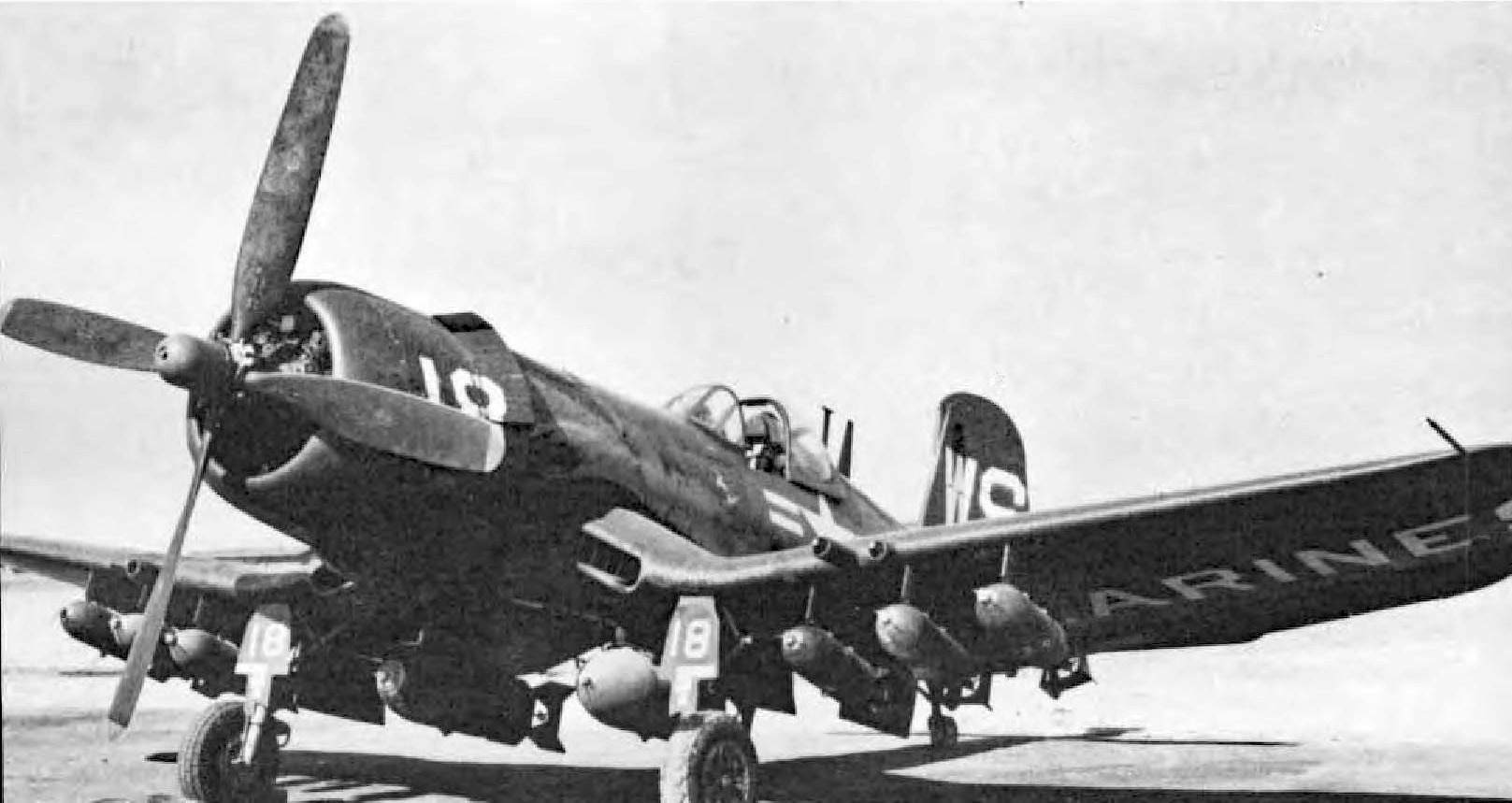
DOD Photo A 349270
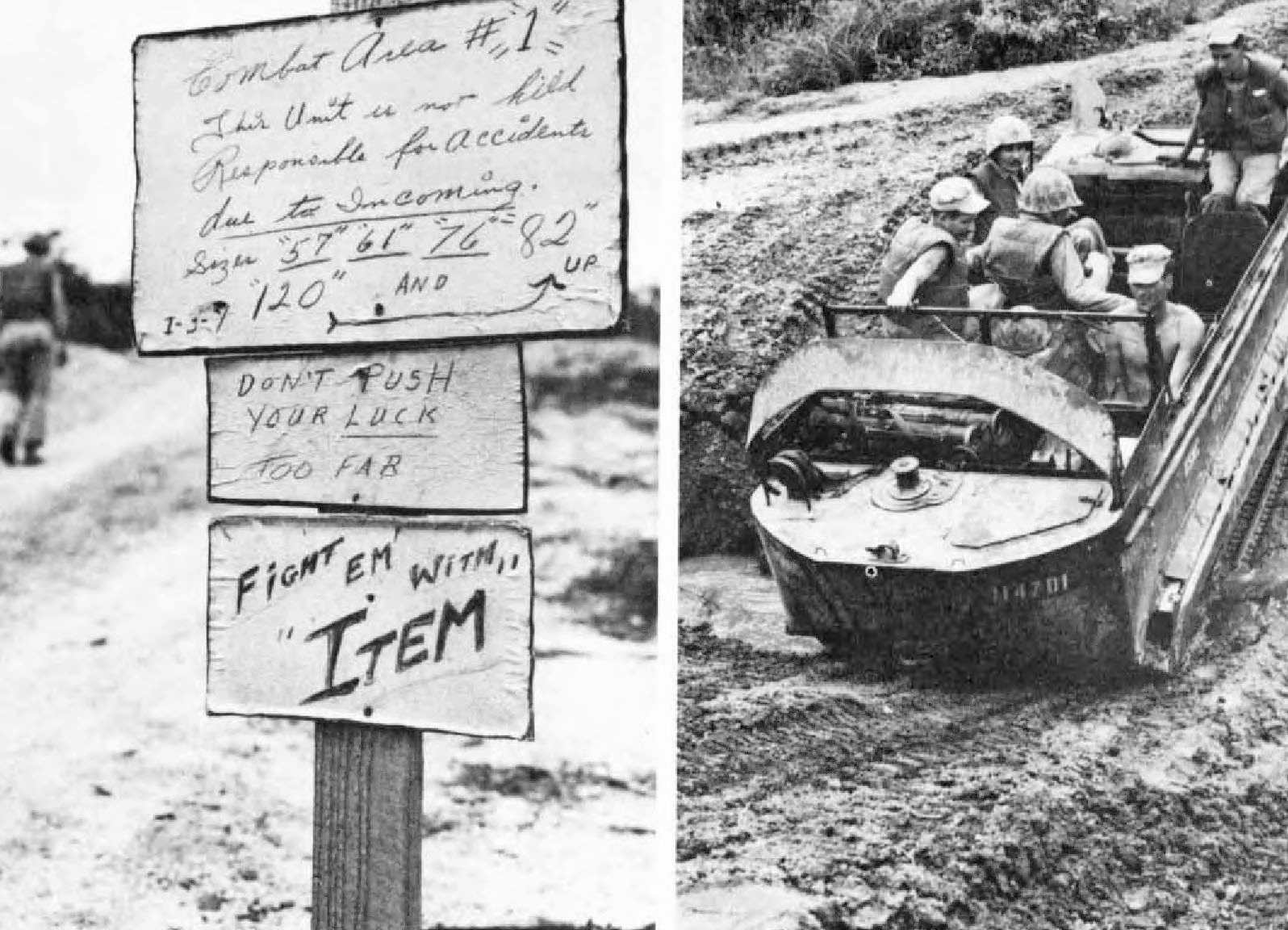
DOD Photo A 164153 DOD Photo A 164151
Battle Humor—Marine replacements moving up to front at Bunker Hill
get friendly warning of occupational hazards. The versatile “Weasel”
hauls ammo and supplies to the MLR. Below, Marine OP reports on
Chinese dispositions during August 1952 battle.
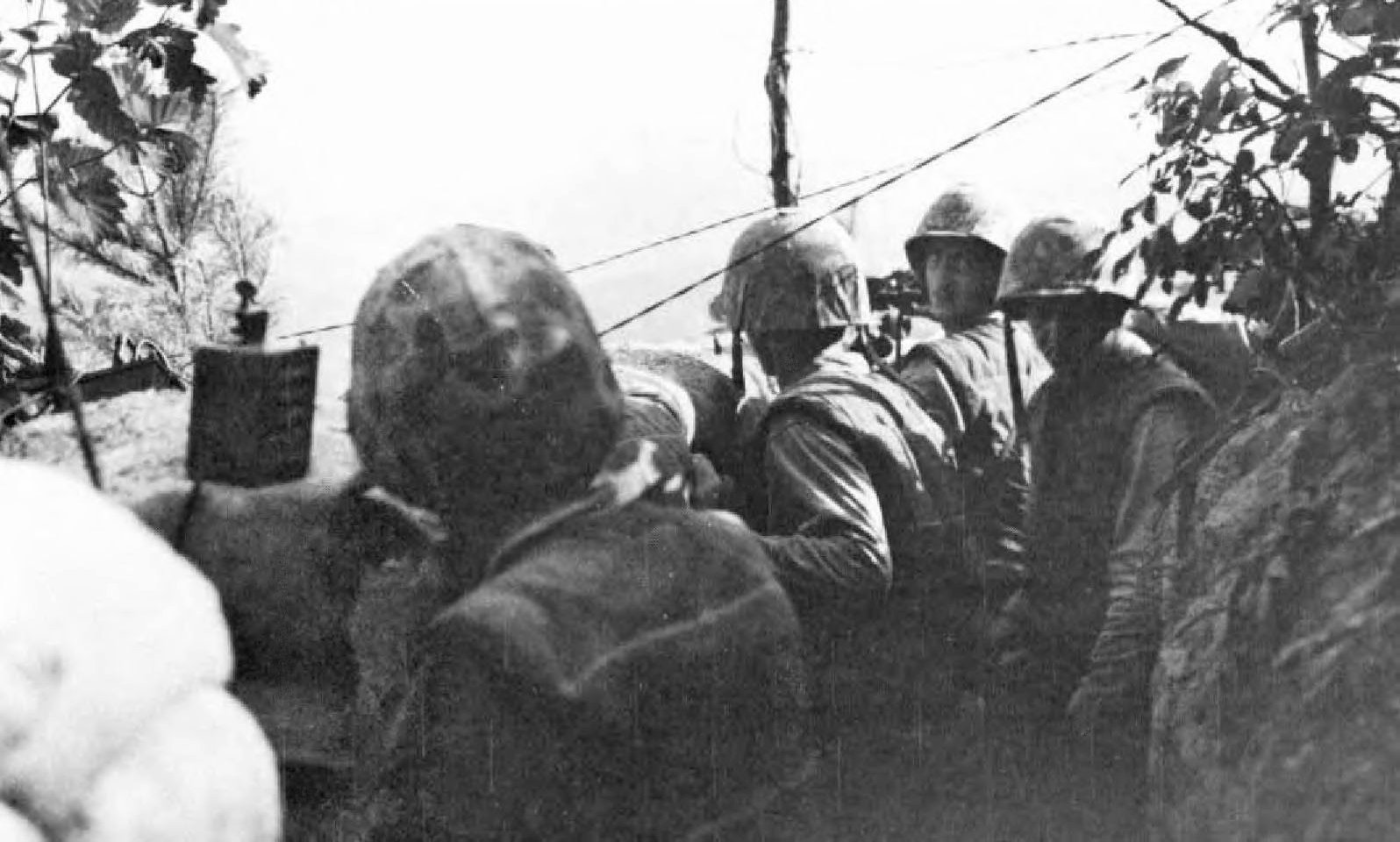
DOD Photo A 165141
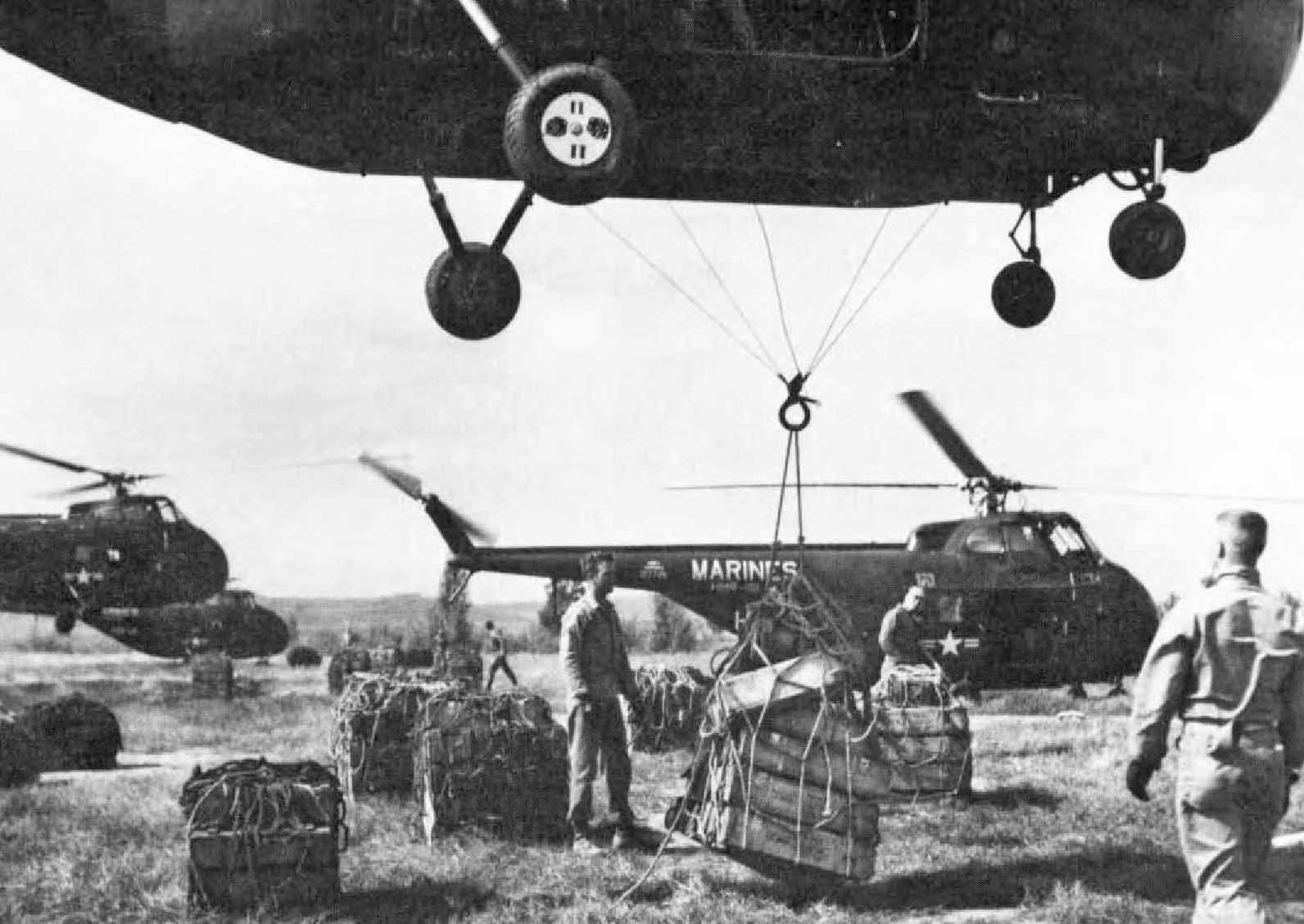
DOD Photo A 166041
Operation Haylift—Cargo lift from 1st Air Delivery Platoon area to
MLR sector occupied by 7th Marines. Cargo net slung under copter
body greatly increased airlift capability. Below, BGen Robert O. Bare,
ADC, inspects pre-fabricated bunker at Marine outpost.
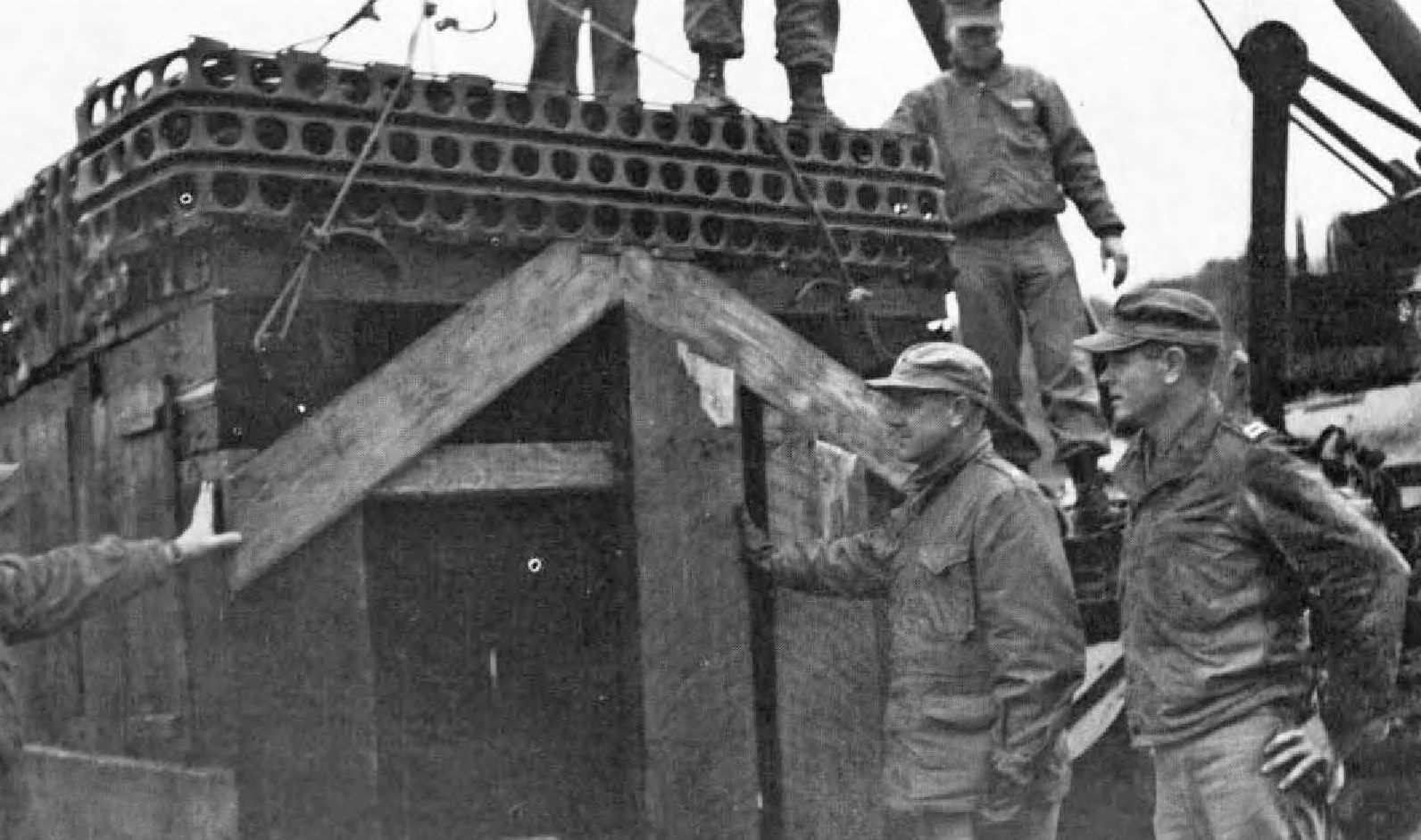
DOD Photo A 167201
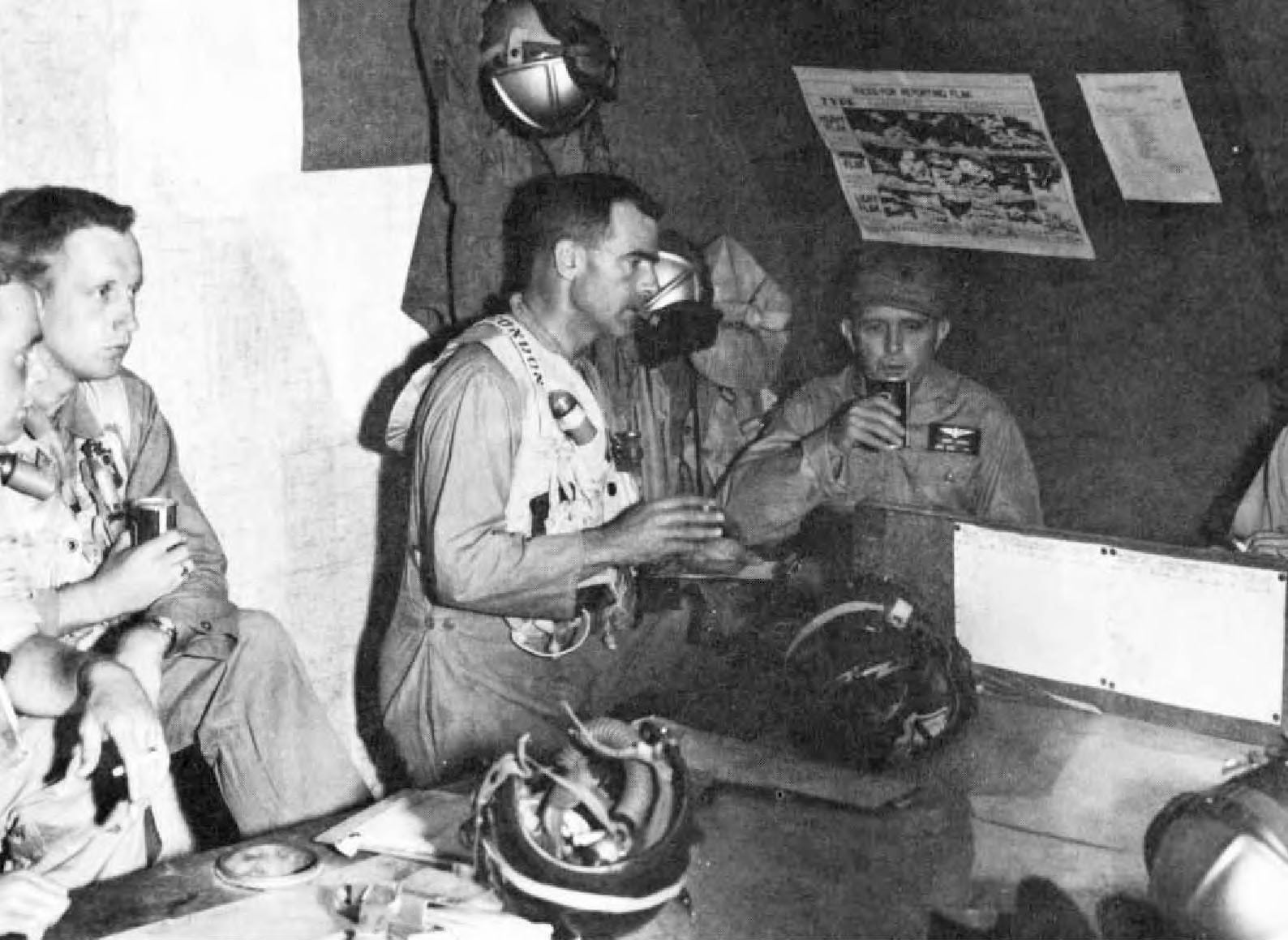
DOD Photo A 133865
Debriefing—Marine pilots of MAG-33 report to BGen Clayton C.
Jerome, 1st MAW CG, upon return from June 1952 air strike, biggest
to date. Below, aerial shot of 1stMarDiv CP at Yong-ri, as viewed
from mess hall, looking north.
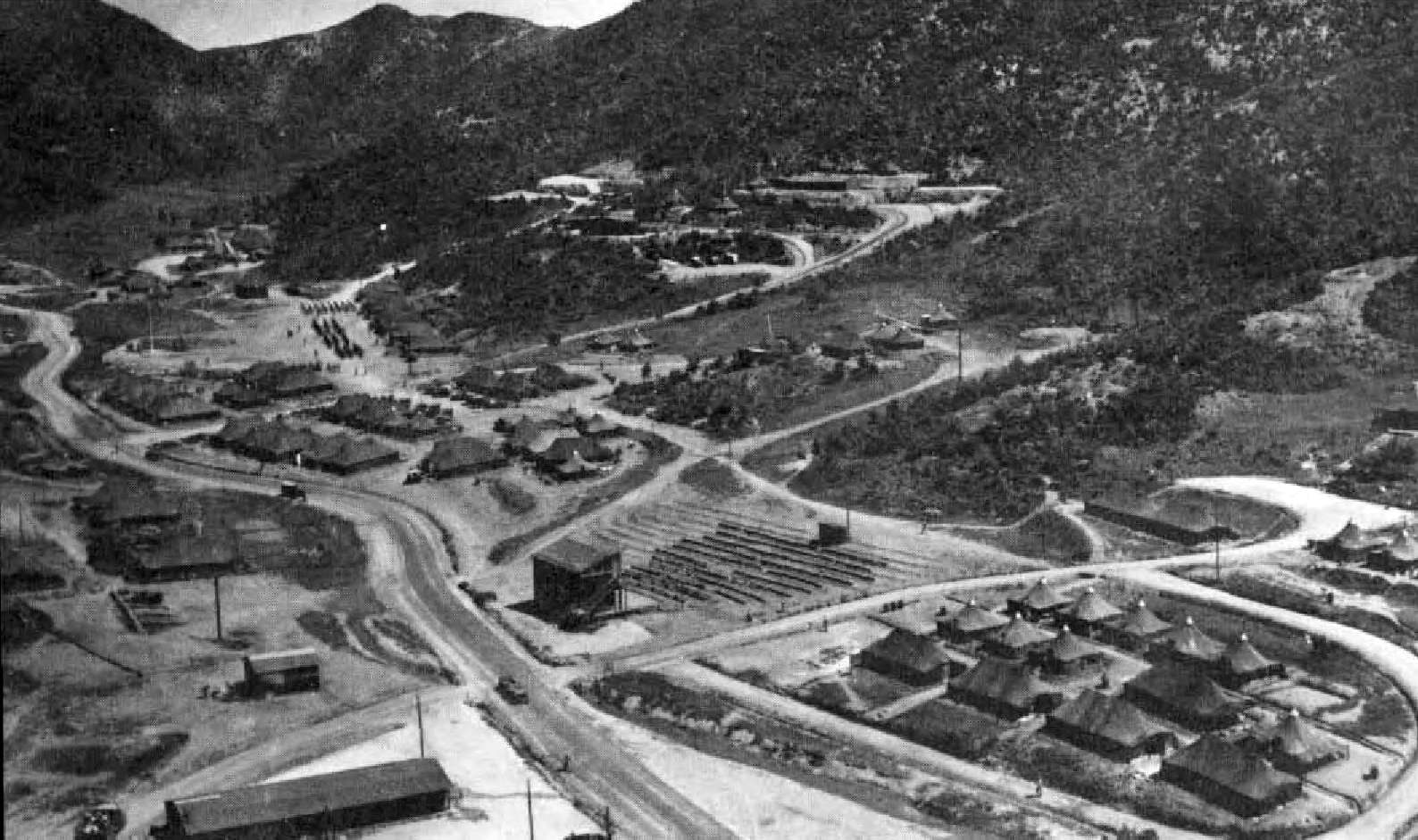
DOD Photo A 164363
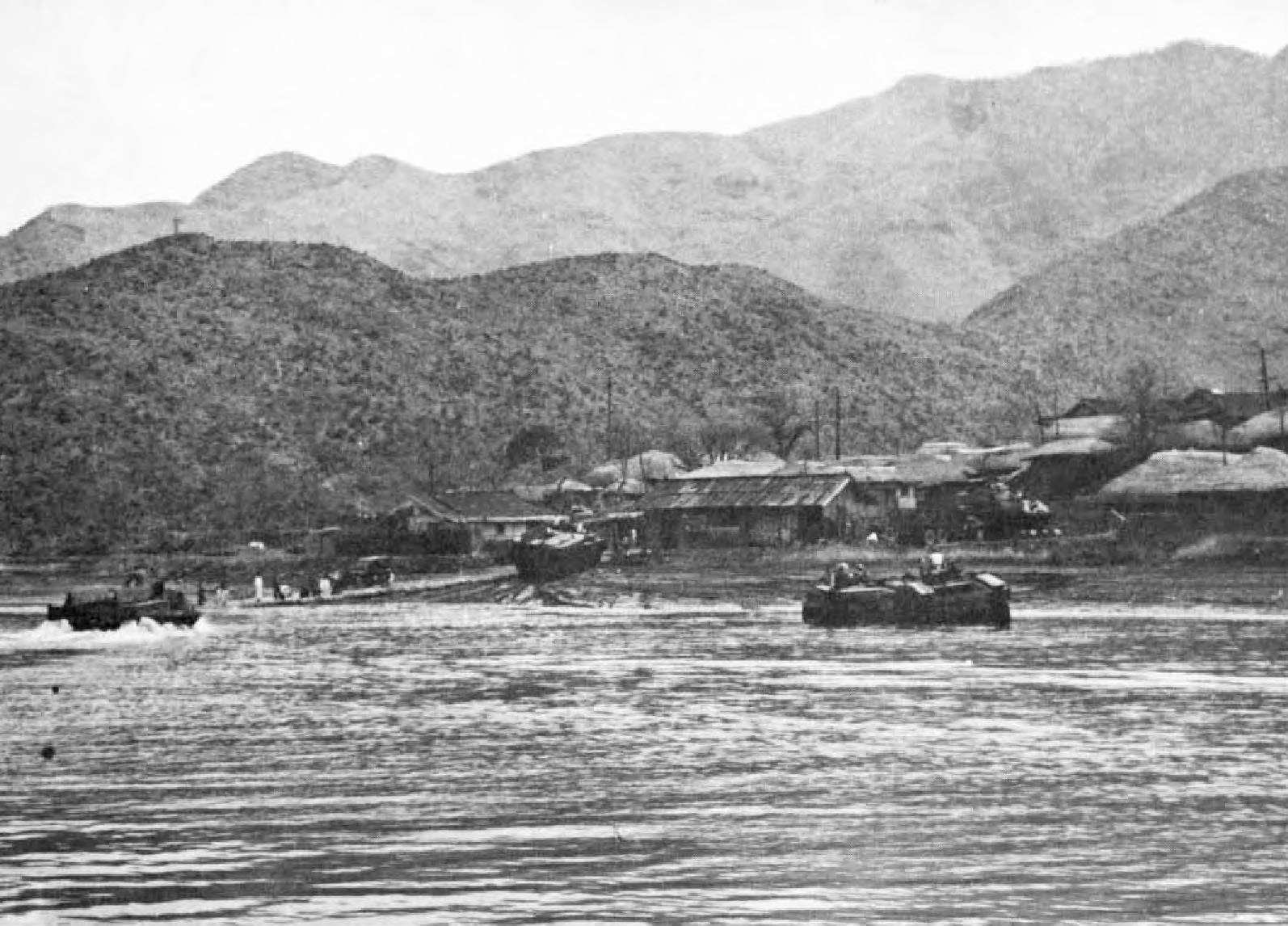
DOD Photo A 162261
River Patrol—Amtracs of the 1st Amphibian Tractor Battalion, Kimpo
Provisional Regiment, on the Imjin River. Below, F7F Tigercat of
1st MAW, carrying napalm bomb, approaches target.
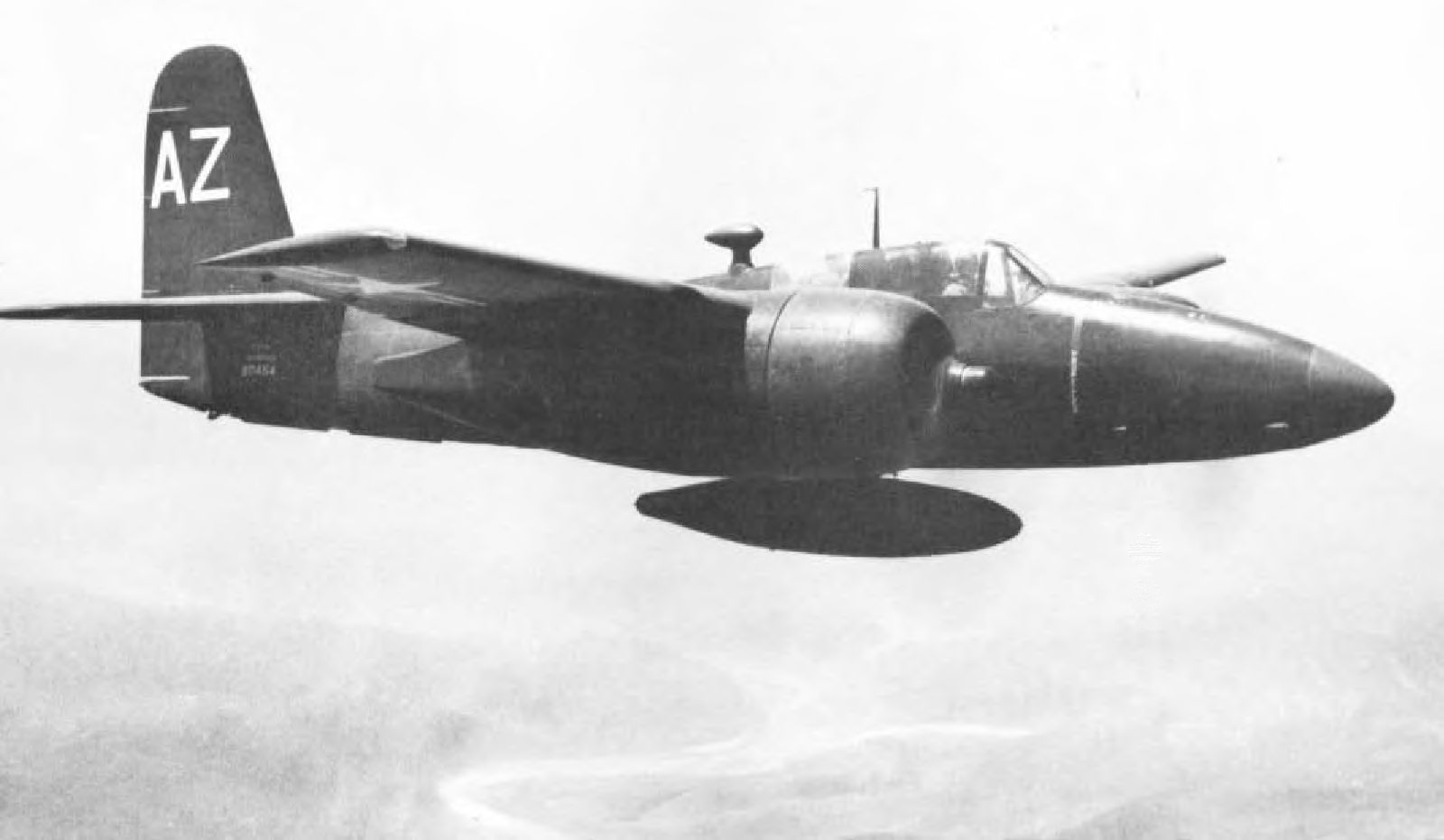
DOD Photo A 133537
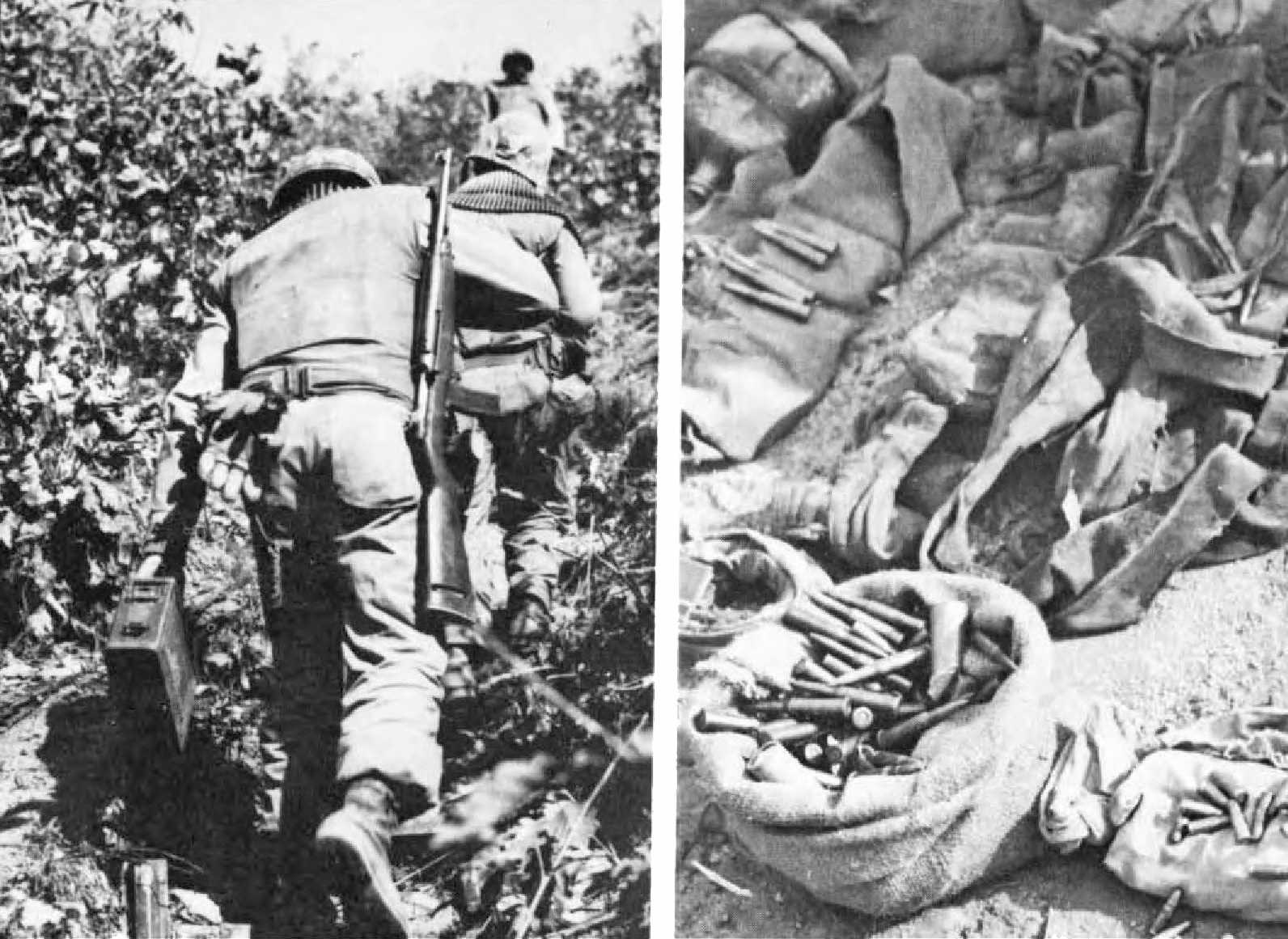
DOD Photo A 166423 DOD Photo A 167466
Support for Battle of the Hook—Marines heading for embattled Hook
carry machine gun ammunition. Note bandoliers. Captured CCF equipment
taken in October 1952 battle included prima cord, cartridges,
Soviet hand grenades. Below, VMO-6 helicopter returning from front
lines lands at Field #19.
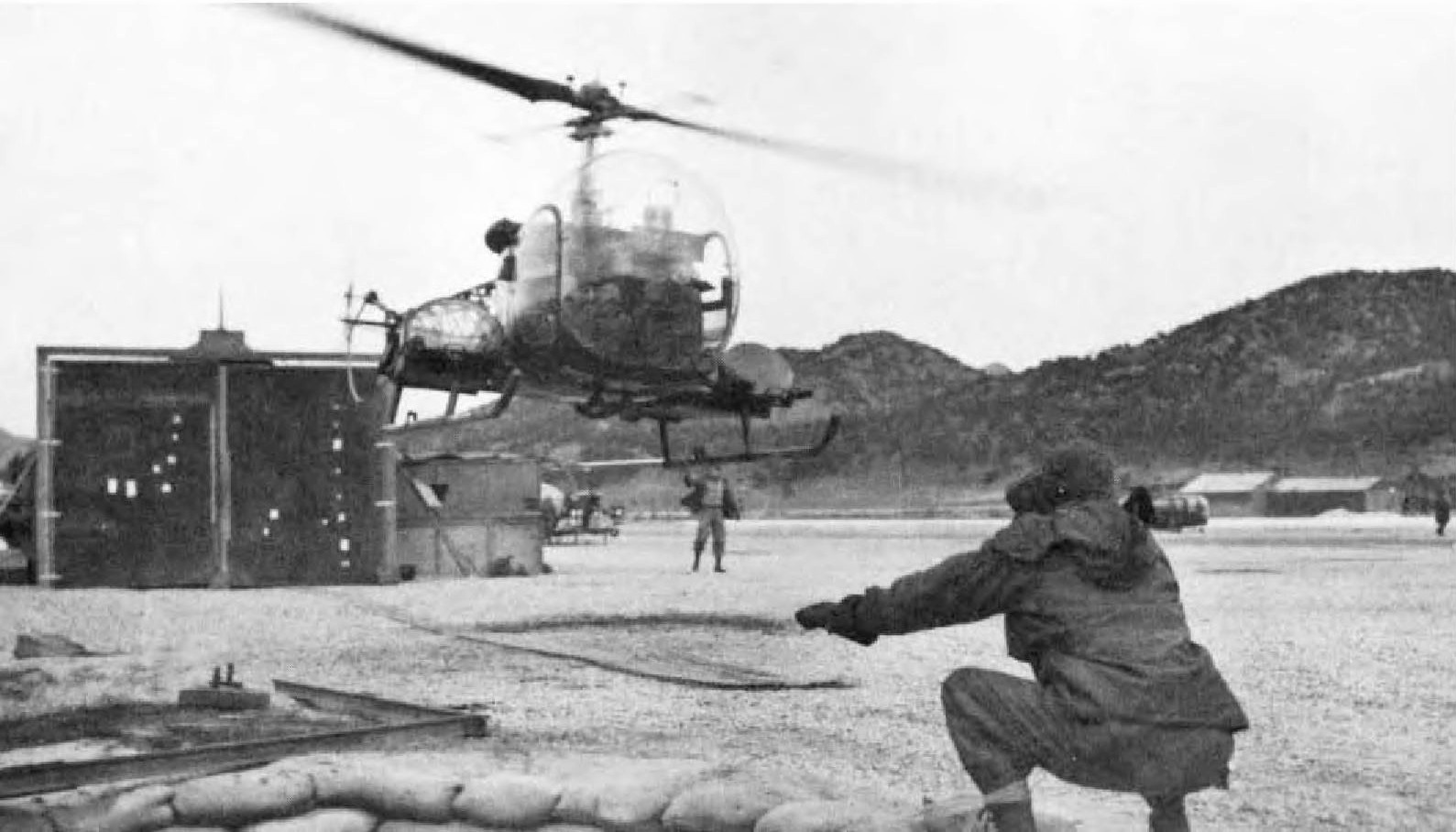
DOD Photo A 346322
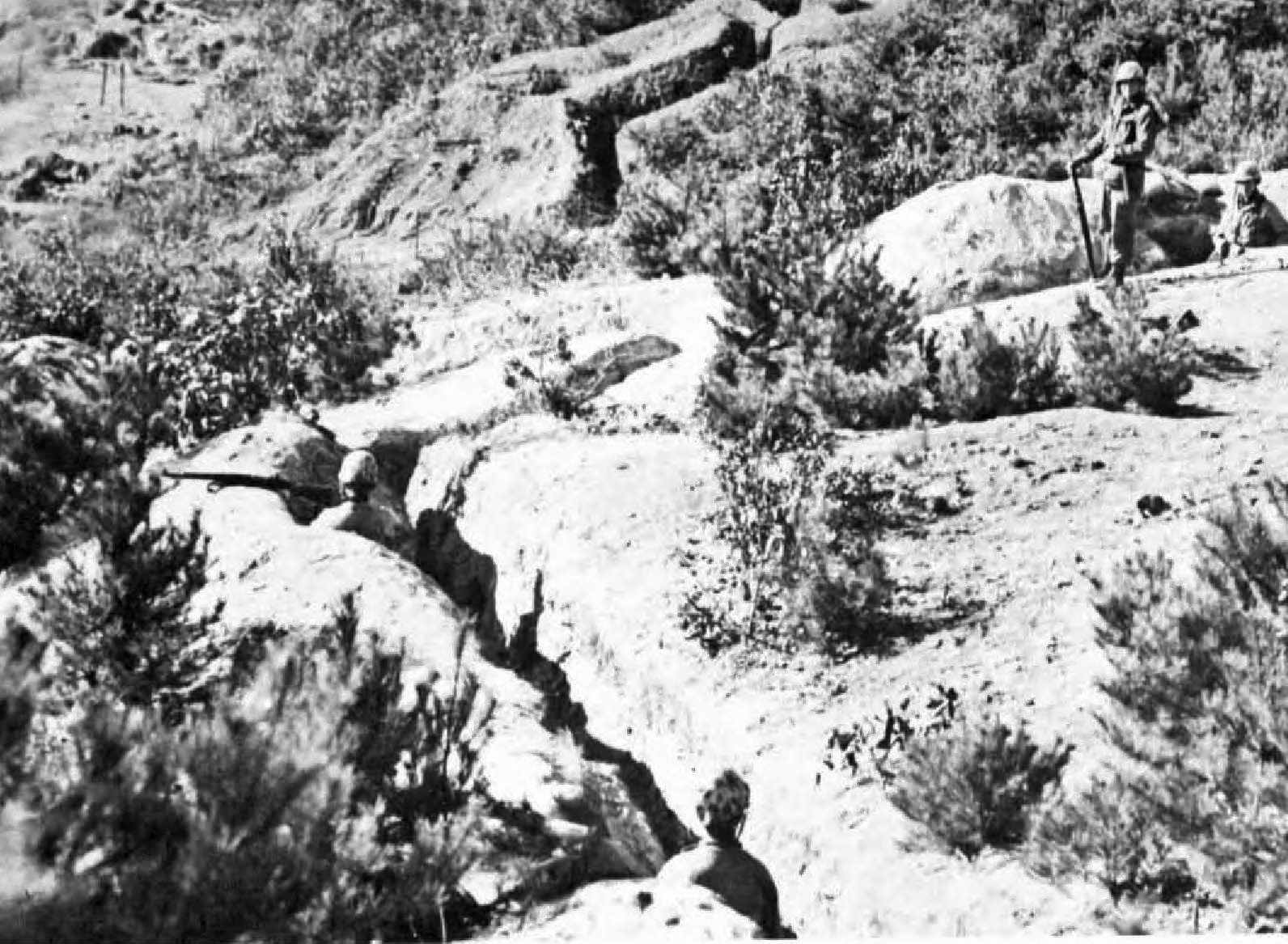
DOD Photo A 168980
KANSAS Line—This recently completed secondary line is occupied by
1/7 while in reserve in late 1952. Below, tactical problems are reviewed
(from left) by MajGen Edwin A. Pollock, CG, 1st MarDiv; LtGen
Paul A. Kendall, I Corps Commander; and Col Russell E. Honsowetz,
AC/S, G-3, 1st MarDiv.
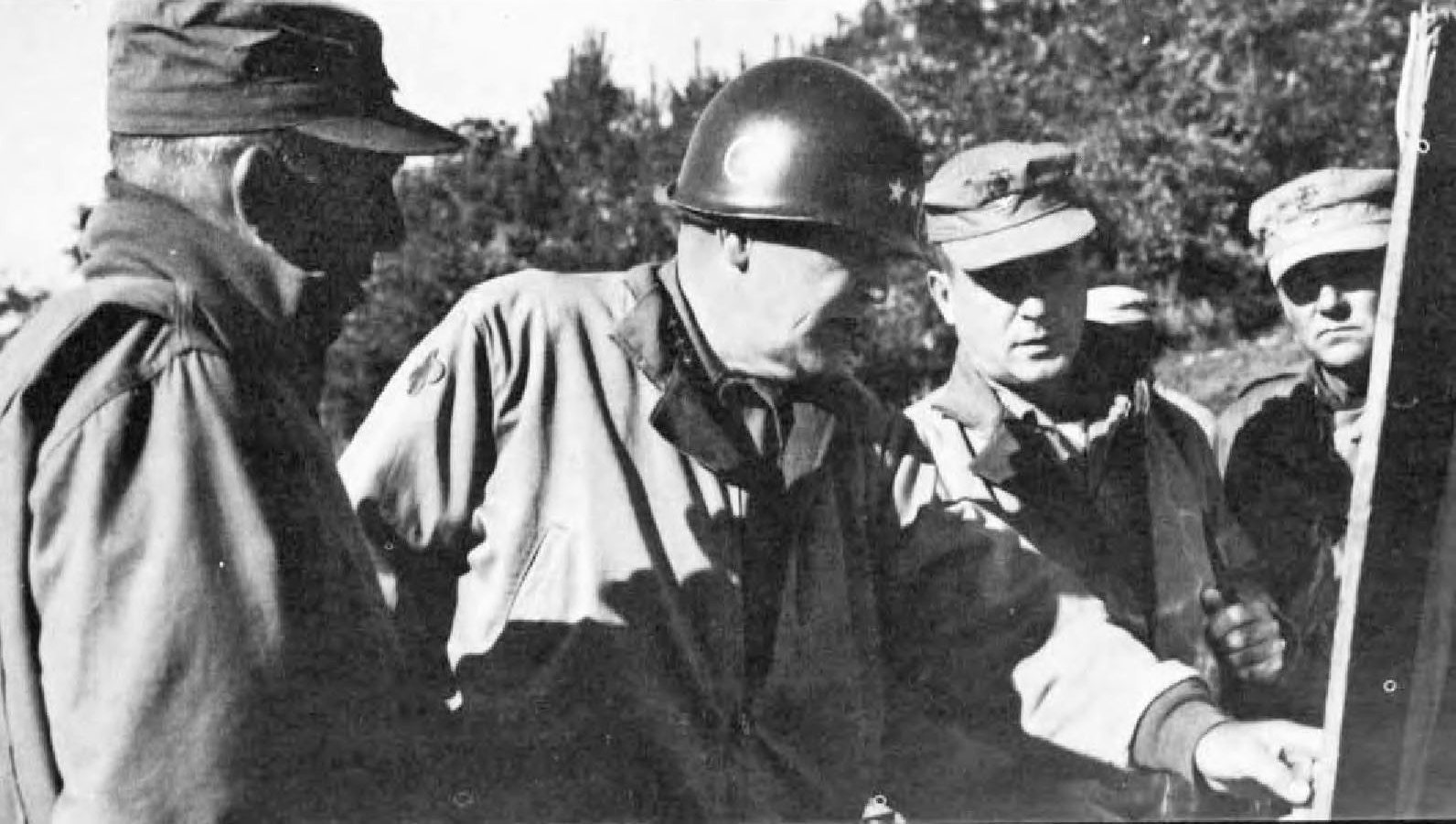
DOD Photo A 165743
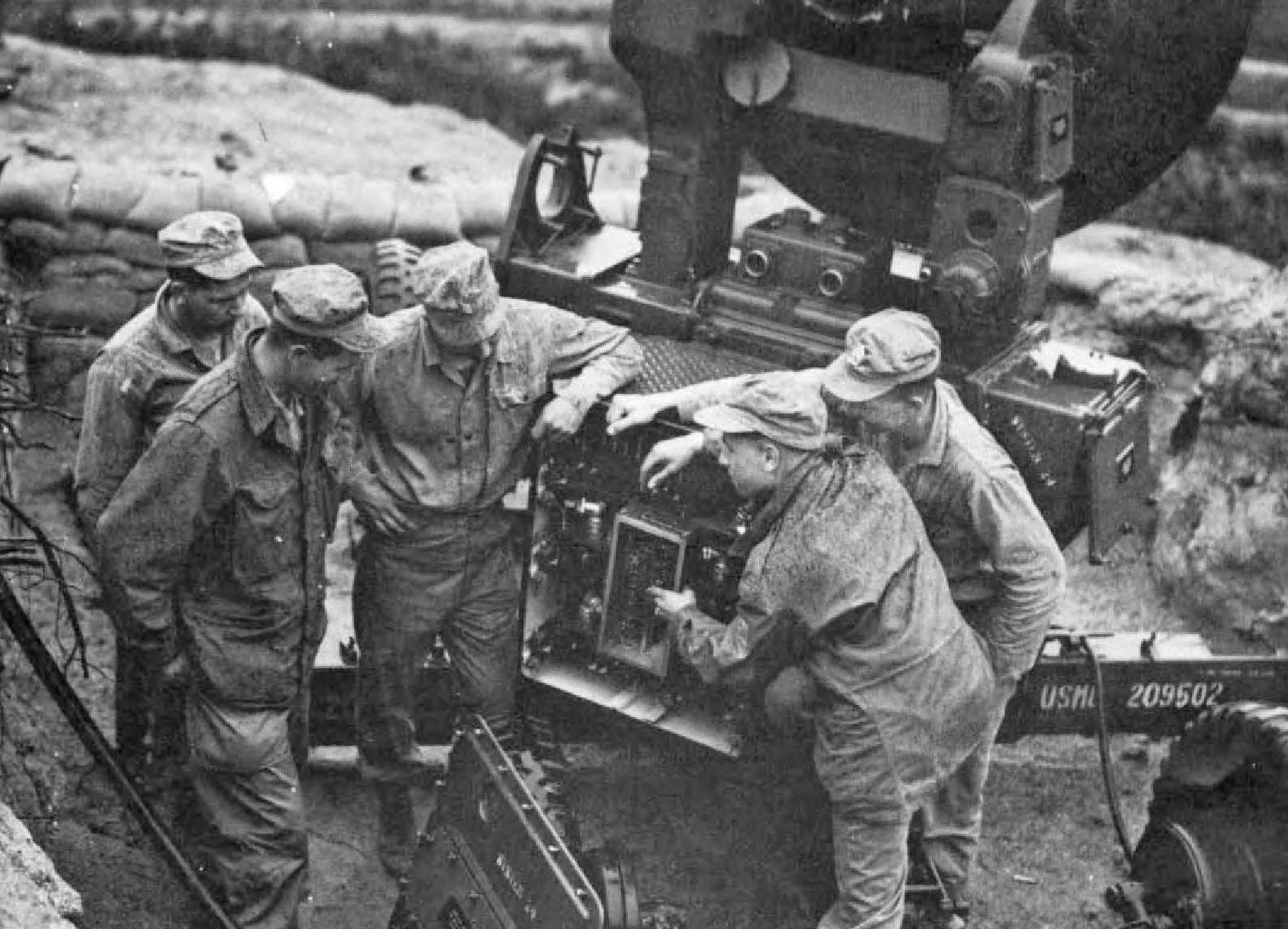
DOD Photo A 171273
Combat Surveillance—Marine counter mortar radar crew receives
instruction on adjustment of electronic equipment. Below, regimental
inspection of KMC troops by Col Kim Suk Bom, CO, 1st Regiment.
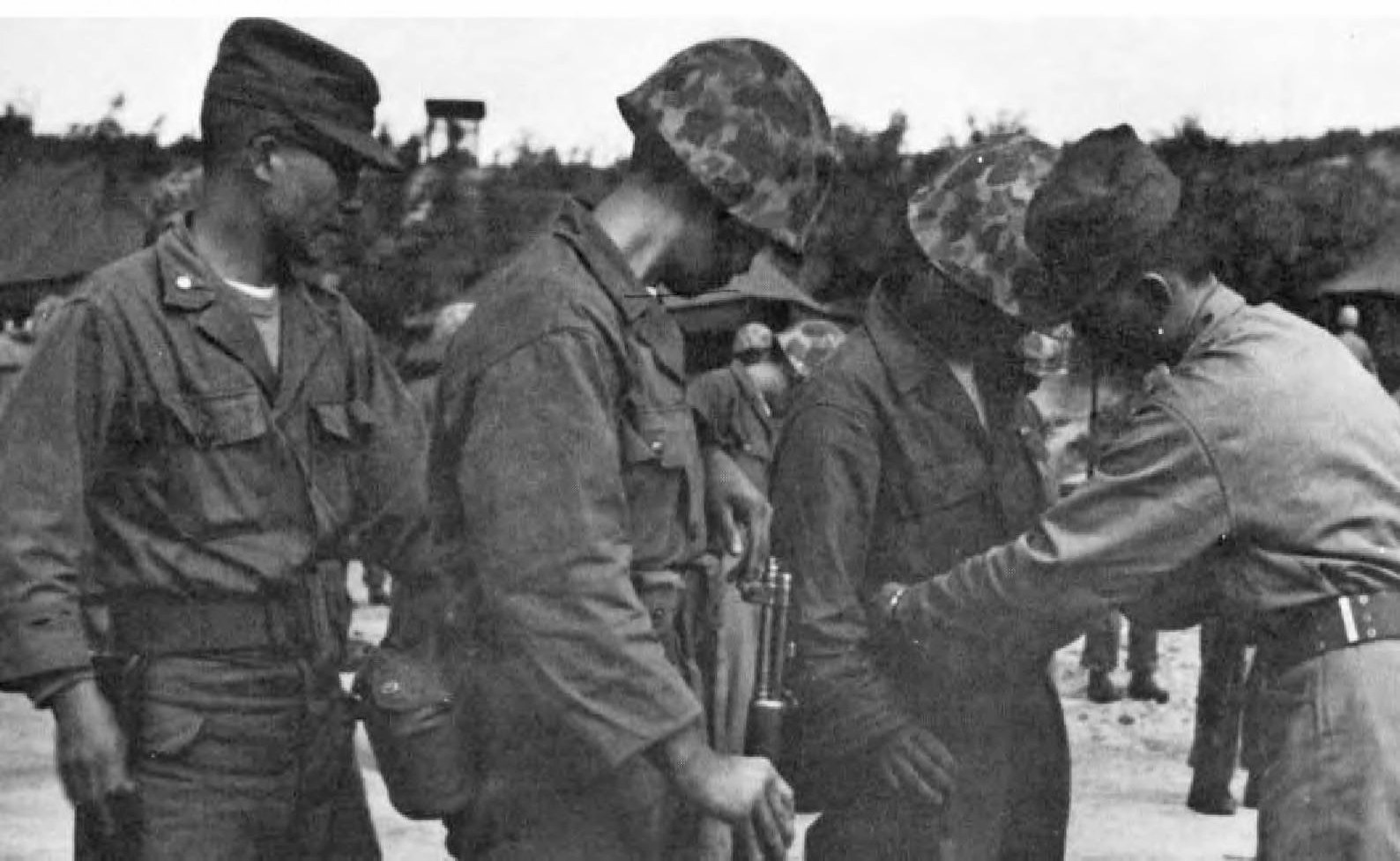
DOD Photo A 165936
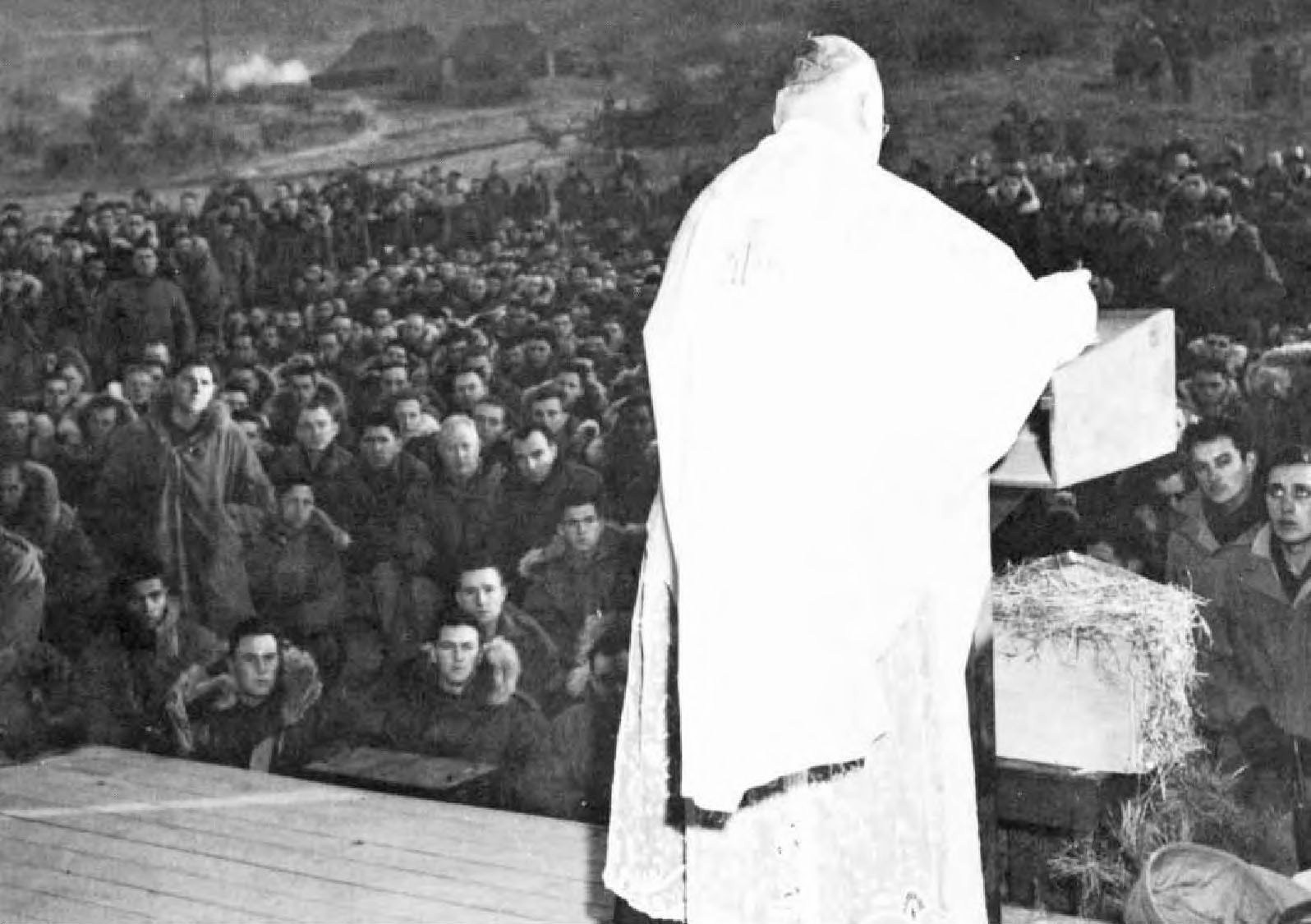
DOD Photo A 168468
Combat Interlude—Cardinal Spellman celebrates Christmas Mass before
2,500 bareheaded Marines in December 1952. Below, the Black
Watch Pipe and Drum Corps honors Marines during their 177th
Anniversary celebration, November 1952.
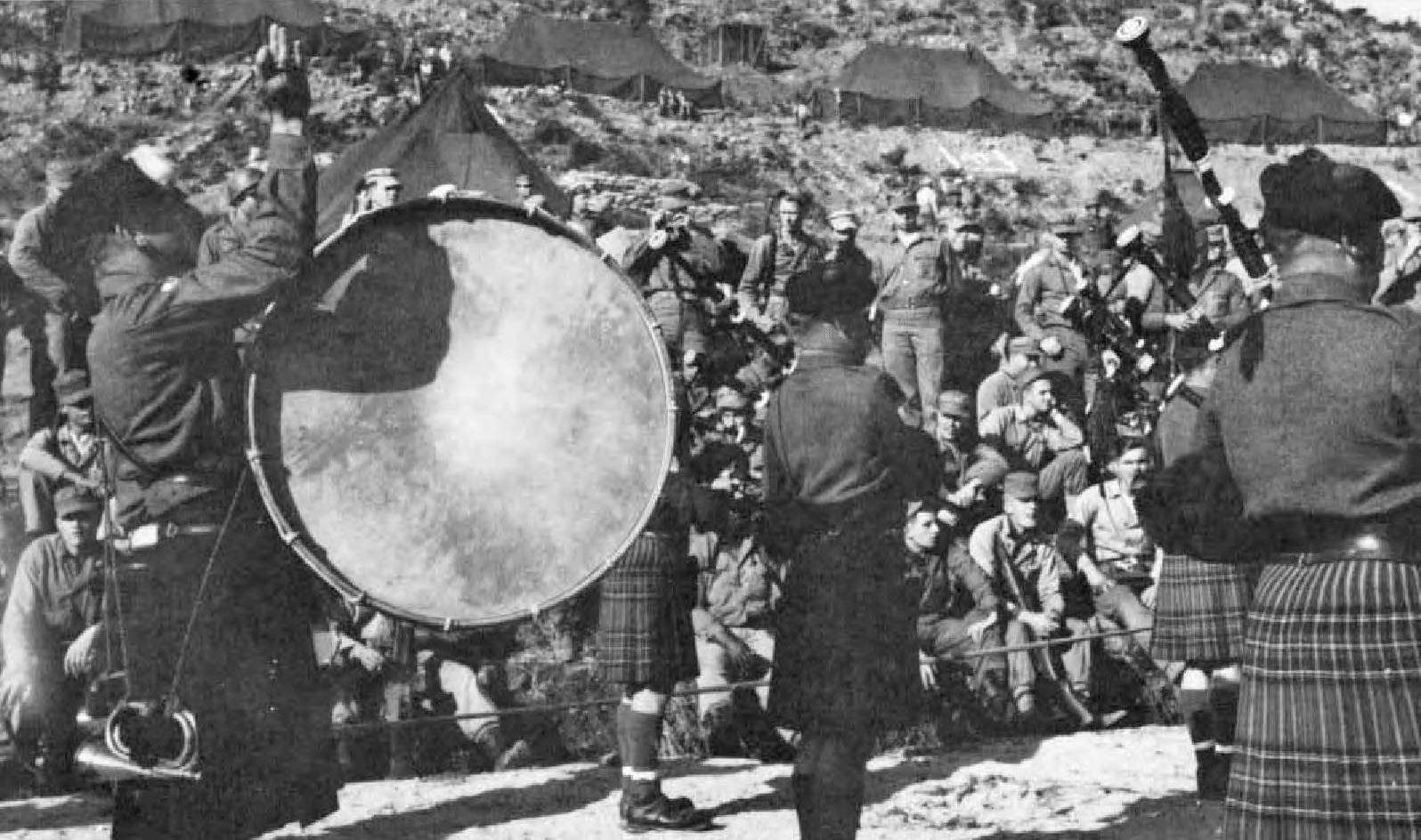
DOD Photo A 166804
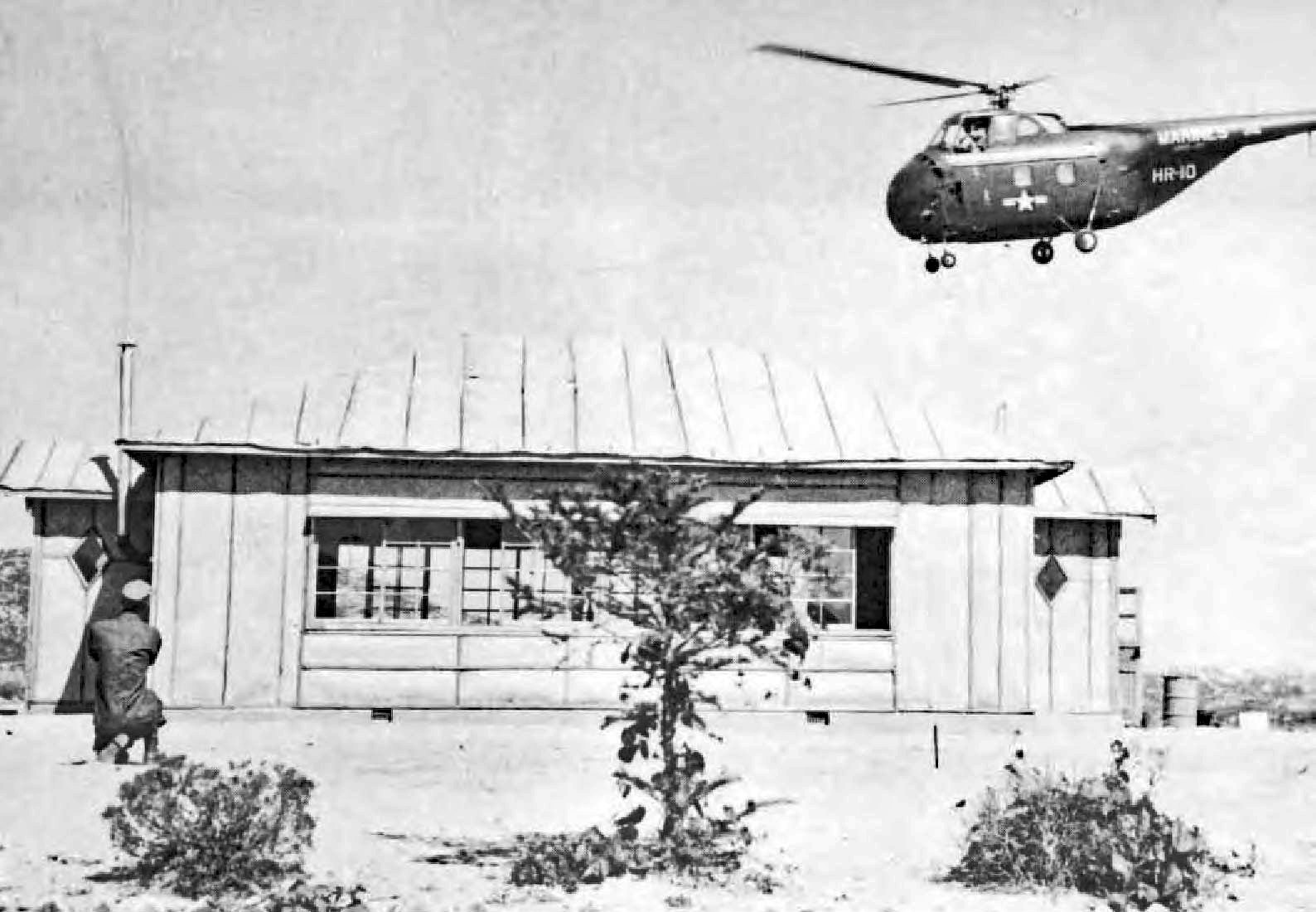
USN Photo 447570
Truce Talks Resumed—Marine helicopter approaches truce site at
Panmunjom as negotiations reopen in October 1952. Below, Master
Sergeant Theodore H. Hughes, 1st MAW, presents 900,000 won
(equivalent to $150,000) to Bishop Mousset, of Little Flower’s
Orphanage in Pohang. Money was donated by MAG 33 Staff NCO
Club.
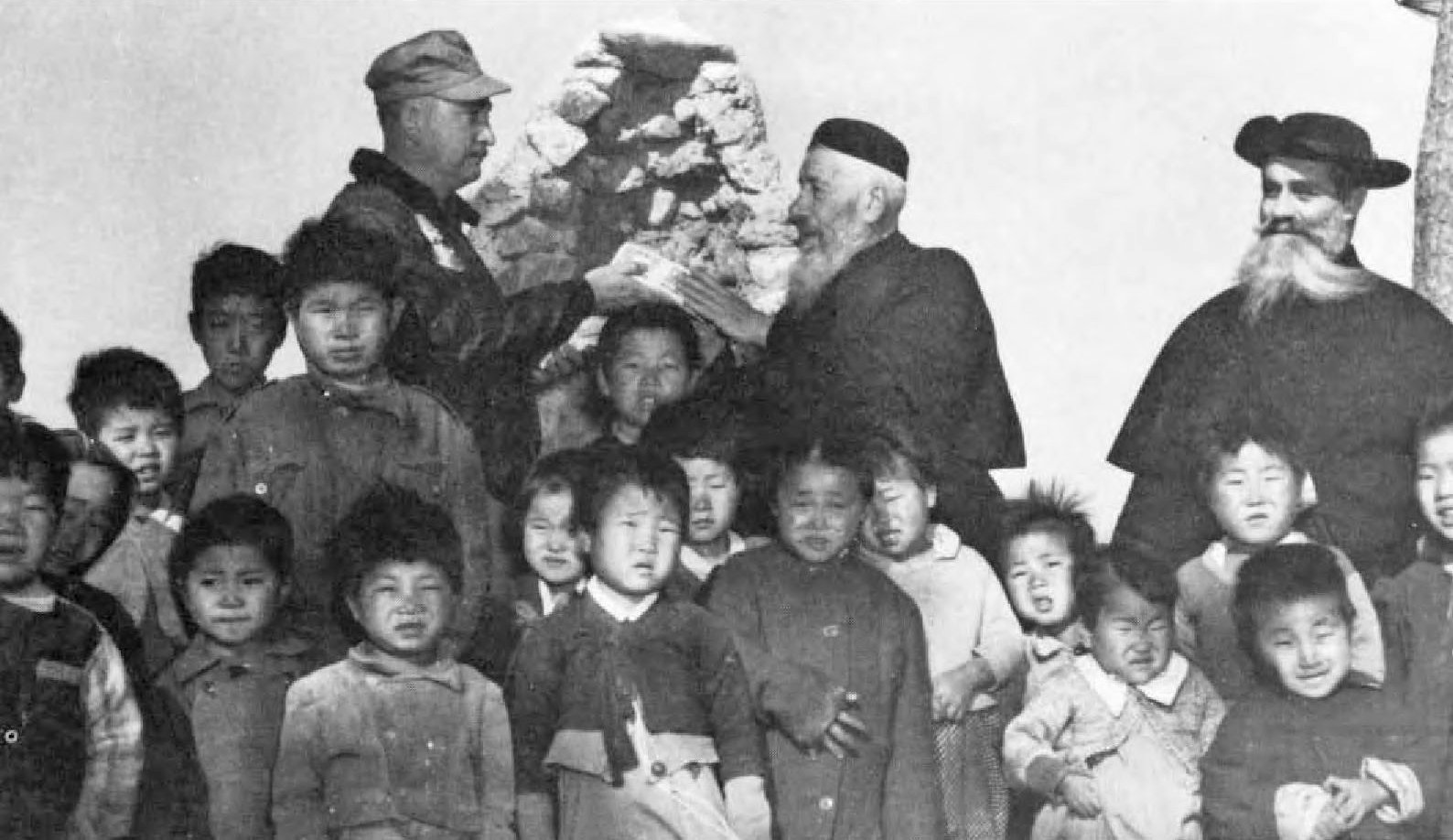
DOD Photo A 132432
With regard to combat tactics, the attacks during 26–27 October
confirmed earlier reports that extremely heavy use of preparatory
barrages by the enemy signalled an imminent infantry attack on the
area. Defensive concentrations of apparently unlimited quantity
typified Communist artillery support for their attacking forces. Meticulous
policing of the battlefield, an established Chinese practice,
was also apparent during the Hook battle. In order to prevent identification
of his combat units, the enemy also took pains to ensure that
assault troops remove all papers and unit insignia before going
forward of their own lines.
Two other previously reported tactics were corroborated during
the late October battle for the Hook. One was the presence of cargo
carriers with the attacking force. These soldiers, estimated by the
division to comprise as high as 75 percent of the total number of
Chinese troops committed, carried shovels, lumber, extra rations,
medical aid equipment, and stocks of ammunition. One Marine
evacuated from a bunker reported on a method of bunker searching
by the Chinese. “English speaking Chinese were yelling into bunkers
for Marines to ‘Come out and surrender.’ When there was no evidence
of surrender, the Chinese would use bangalore torpedoes and
satchel charges to destroy and seal bunkers.”292
In one respect the enemy deviated from his usual tactics. During
the battle for the Hook Marines who took prisoners made the
discovery that the Chinese employed close-up relief forces. Prior to
an offensive action, the enemy positioned a reserve just to the rear
of the assault unit. After the attack had started, and at the appropriate
time, the commander would signal the fresh force forward to
take over the mission of the old unit. In this manner, the enemy
hoped to sustain his drive or to retain a newly-won position.
Though the foresight appeared appropriate, the result was not
always what had been anticipated. In the earlier part of the month,
during a fight in another I Corps sector, the Communists had rushed
a reserve force forward to consolidate the defense of an outpost
immediately after its capture. In the Hook fighting, a fresh unit,
which had been placed immediately to the rear of the assault troops,
was ordered forward to keep the attack alive. Both attempts failed.
Marines attributed this lack of success to the Communists’ apparent
inability to organize or reorganize quickly, a difficulty which was
believed to have resulted from the scarcity of officers in forward
areas.293
Discussing the defense of the Hook area, Lieutenant Colonel
Dulacki commented shortly after the battle ended:
The Chinese seemed to gain their greatest tactical advantage during action
on “The Hook” by assaulting friendly positions directly under their own
artillery and mortar barrages. The effects on defending Marines were two-fold:
heavy incoming either physically trapped them in their bunkers, or
the Chinese, having overrun our positions through their own barrages,
took the defenders by surprise as they left their bunkers to man their fighting
holes. It is therefore considered imperative that in future instances of
heavy enemy supporting fires, all Marines physically occupy an individual
shelter from which their fighting positions are readily accessible.
Marines gained a false sense of security by taking cover, in groups,
inside bunkers. In some cases, groups of three or four Marines were
killed when a bunker caved in on top of them. Had they been spread
out along the trenchline, but under individual cover, it is believed that
far fewer casualties would have resulted, and also the position would
have been better prepared for defense. The false sense of security gained
by being with comrades inside a bunker must be overcome.294
Another factor bothered the 1/7 commander. He directed unit
leaders to exercise closer control over the care and cleaning of
weapons under their custody. During the Hook fighting, the malfunctioning
of weapons due to improper cleaning and loss of some
rifles “in the excitement to gain cover” caused the Marines to take
casualties that might otherwise have been prevented.
These same deficiencies were also observed by General Pollock,
and he ordered their immediate correction. Lieutenant General Hart,
CG FMFPac, whose inspection of the division coincided with the
Hook battle and who saw the trenches after they had been leveled,
noted that shallow trenches and bunkers built above the ground did
not offer sufficient protection from intensive enemy shelling. He
directed that more emphasis be placed on the digging of field fortifications
and bunkers.295
In considering not only how the fight was conducted but why, one
has only to go back to the first part of October and recall the
situation that existed along the 1st Marine Division line. During the
hotly contested outpost battles early in the month, the Chinese had
attempted to outflank the division by seizing key terrain in the left
and right sectors. Where the enemy had been unsuccessful, he
returned later in the month for another major assault. On the night
of the 26th the endeavor was in the division right. A new blow
against the left was not far off.
CHAPTER VI Positional Warfare — A Successful Korean Defense 296 — Six Months on the UNC Line 302 — Events on the Diplomatic Front 306 — The Marine Commands During the Third Winter 311 — 1st MAW Operations 1952–1953 316 — Behind the Lines 327 — The Quiet Sectors 331 — Changes in the Concept of Ground Defense 337 — Before the Nevadas Battle 341
A Successful Korean Defense—Six Months on the UNC Line—Events
on the Diplomatic Front—The Marine Commands
During the Third Winter—1st MAW Operations 1952–1953
Behind the Lines—The Quiet Sectors—Changes in the Concept
of Ground Defense—Before the Nevadas Battle
In both the early and late October outpost battles the Chinese
had attempted to seize critical terrain on the flanks of the 1st
Marine Division. Although the majority of these attacks failed, the
enemy had acquired six outposts early in the month—three in the
western Korean Marine Corps sector and three north of the right
regimental line. On the last day of October, two hours before midnight,
the CCF again struck the Marine left flank. This time their
efforts were directed against four outposts that screened Hill 155,
the most prominent terrain feature in the entire KMC regimental
zone. The fighting that developed was brief but very sharp and
would be the most costly of all KMC clashes during this third winter
of the war.
The latest enemy attack came as no real surprise to Korean
Marines of the 5th Battalion, occupying COPs 39, 33, and 31 in the
northern regimental sector, or 2d Battalion personnel at COP 51 in
the southern (western) half of the MLR. (Map 19.) The four
outposts assisted in defense of the MLR (particularly Hill 155 just
inside the MLR), afforded observation of CCF approach routes,
and served as a base for friendly raids and offensive operations.
Hill 155 overlooked both the wide Sachon Valley and Chinese
frontline positions to the west. This critical Korean hill also commanded
a view of the Panmunjom peace corridor, Freedom Gate
Bridge, and the Marine division area east of Line JAMESTOWN
in the KMC sector. Hill 155 had further tactical importance in that it
protected the left flank of Paekhak Hill, the key ground in the entire
34-mile expanse of JAMESTOWN within 1st Marine Division territory.
Actually, the probability of a determined enemy attack against
the four outposts had been anticipated since early October following
CCF seizure of three positions (former COPs 37, 36, and 86) in their
strike against the KMC regimental OPLR. The enemy had then
proceeded to organize an OPLR of his own with the two northern
outposts, COPs 37 and 36, and informally occupied another position
to the south and one toward the north in the vicinity of COP 39.
“With this OPLR once firmly organized, the enemy will have an
excellent jump-off point towards our OPs 39 and 33, his next
probable objectives,” KMC officers reasoned.297
Sporadic probes throughout the month in the COP 39 and 33 areas
indicated continued enemy interest in the positions. COP 51, to the
south, was considered another likely target because of its location
immediately east of COP 86, previously annexed by the CCF.
Prior to attacking the four outposts on 31 October, the Chinese
had signaled their intentions by sharply stepping up artillery and
tank fire against the sector. During the 24-hour period ending 1800
on 30 October, a total of 1,881 rounds crashed on KMC positions,
most of these against the two northern outposts, COPs 39 and 33.
Nearly 1,500 rounds fell the next day. More than 50 sightings of
enemy troops and weapons in the forward area were also reported.
By contrast, during the previous week less than 15 observations of
enemy activity had been made daily and, on the average, only about
200–340 rounds of fire had fallen in the entire sector. Despite this
comparatively moderate rate of hostile fire, at least one Korean
Marine was killed and three wounded in late October from well-placed
Chinese mortar or artillery rounds striking the outposts.
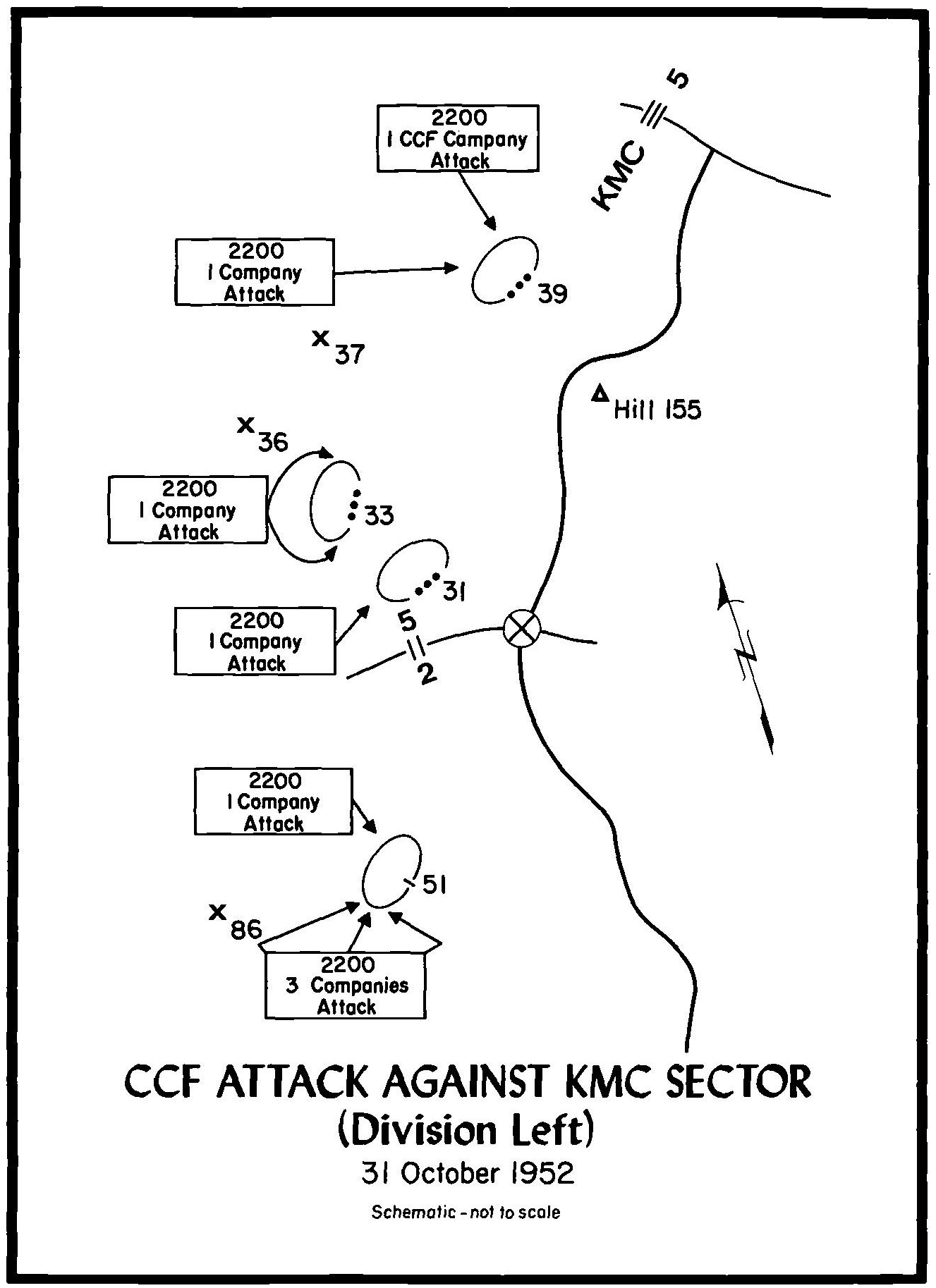
MAP 19 K. White
CCF ATTACK AGAINST KMC SECTOR
(Division Left)
31 October 1952
After the two days of heavy shelling, the regiment warned in its
daily report issued only two hours before the full-scale attack began:
The enemy has made a consistent two-day effort to destroy friendly
outpost positions. Last night, at 1830, two enemy companies were observed
in an apparent attempt to attack OPs 39 and 33. Artillery fire broke up
the attempt, but continued enemy artillery today indicates further attack is
probable tonight. If enemy artillery preparation is indicative, a simultaneous
attack against outposts 39, 51, 33, and 31 can be considered probable....298
These earlier observations and predictions as to the enemy’s action
were shortly confirmed when the CCF launched its new ground
attack.
Beginning at 2200,299 the enemy delivered an intensive eight-minute
76mm and 122mm artillery preparation against the four outposts.
Chinese assault forces from four different infantry regiments then
launched a simultaneous attack on the positions. Moving in from the
north, west, and south, two CCF companies (3d Company, 1st
Battalion, 581st Regiment and 2d Company, 1st Battalion, 582d
Regiment) virtually enveloped the northern outpost, COP 39. Two
more CCF companies (unidentified) lunged against the two central
outposts, COPs 33 and 31, a company at each position.300 The southern
and most-heavily defended post, COP 51, where a company of
Korean Marines was on duty, was assailed by four Chinese companies
(4th Company, 2d Battalion, 584th Regiment; 4th and 6th
Companies, 2d Battalion, 585th Regiment; and 1st Company, 1st
Battalion, 585th Regiment). Even though the enemy exerted his
strongest pressure against COP 51, the position held and the Chinese
broke off the attack there earlier than at the other outposts.
At COP 31 a heavy fire fight raged until 0155, when the defending
KMC platoon halted the Chinese and forced them to make a
partial withdrawal. To the northwest, at COP 33, the enemy encountered
less resistance from the two squads manning the outpost. The
Chinese achieved some success in penetrating the defenses and
occupied several positions. After heavy close fighting and friendly
artillery support, the Koreans expelled the invaders at 0515.
The enemy’s efforts appeared to have been most successful, temporarily,
at COP 39, the northern post and one nearest to Hill 155.
Although the Chinese wrested some ground from the KMC platoon,
artillery fires continued to punish the enemy and by 0410 had forced
him to pull back. A small hostile force returned at 0600 but after
a 15-minute exchange of small arms it left, this time for good. At
about this same time the last of the Chinese had also withdrawn from
the two central outposts, 33 and 31.
In terms of sheer numbers, the enemy’s strongest effort was made
against COP 51. This was the most isolated of the Korean positions
and, at 2,625 yards, the one farthest from the MLR. Ironically, in
the week preceding the attack COP 51 was least harassed by hostile
artillery although it had received 20 rounds of 90mm. tank fire, more
than any other position. On the 31st, elements of three companies
struck the southwestern trenches and defenses, while a fourth
attempted to break through from the north. As it turned out the
action here was the least intense of the outpost clashes. After initial
heavy fighting the Chinese seemed reluctant to press the assault even
though they vastly outnumbered the Korean company deployed at
the outpost. In the early morning hours the enemy broke contact
and by 0330 had withdrawn from COP 51.
During the night approximately 2,500 rounds of CCF artillery
and mortar fire lashed the positions. Korean Marines, aided by
friendly artillery, repelled the assault and inflicted heavy casualties
on the enemy. Supporting fires included more than 1,200 rounds of
HE shells from the KMC 4.2-inch Mortar Company. Chinese casualties
were listed as 295 known killed, 461 estimated wounded, and
9 POWs. Korean Marine losses were 50 killed, 86 wounded, and 18
missing.301 By first light the Korean outposts had thrown back the
enemy’s latest well-coordinated attack. This ended the last significant
action of October in the 1st Marine Division sector.
The KMC Regiment’s battle in late October marked the end of
two months of heavy fighting in the division sector. October had
witnessed the most intense combat in more than a year. As the
third Korean winter approached outpost clashes and small unit
actions along the rest of the UNC frontline began to slacken. During
November and December, neither side appeared eager to pursue the
offensive. Chinese aggressiveness declined noticeably.
Despite other action initiated by the enemy, the I Corps sector
remained the chief Communist target. On 19 November, the British
1st Commonwealth Division successfully withstood what was initially
a company-size attempt to capture the Hook. In sharp fighting
between 1900 and 0430, Black Watch and reinforcing Canadian
units repulsed a determined battalion-strength CCF assault, killing
more than 100 Chinese.303 Marine and I Corps artillery units fired
almost continuously throughout the night in support of the Hook
defenders. Fighting flared again, briefly, in December in the I Corps
sector when Chinese soldiers attempted to overrun outposts on the
Imjin River line, but were thrown back by the ROK 1st Division.
The enemy then tried to seize key terrain forward of the U.S. 2nd
Division, but was again halted.
Elsewhere before the end of the year, the CCF captured one outpost
in the IX Corps area, to the right of I Corps, but suffered a
telling defeat at the hands of the Ethiopian battalion during an
attempt to crack this sector of the U.S. 7th Division line. After a
brief fire fight the Chinese were forced to withdraw, leaving 131
CCF dead in the Ethiopian positions. North Korean efforts to seize
critical ground in the X and ROK I Corps sectors, at the far eastern
end of the EUSAK line, was similarly broken up by the U.S. 40th and
ROK 5th Divisions.
By the end of 1952 General Van Fleet had not only revitalized
his defenses with recent rotation of frontline units but had also
strengthened his line by inserting another division in the critical and
long-troublesome Chorwon-Kumhwa sector of IX Corps, on the
I Corps right flank. With these changes by late December there were
16 EUSAK divisions on line—11 Korean, 3 U.S. Army, 1 Marine, and
1 British Commonwealth—plus 4 divisions in reserve (1 Korean and
3 U.S. Army). Nearly 75 percent of the UNC line had been entrusted
to Republic of Korea units. Their performance was a tribute to
growing ROK military proficiency and justified the EUSAK decision
to assign to ROK troops a greater role in the Allied ground defense.
The slow pace of infantry action during the last two months of
1952 continued into the new year. Raids by small UNC units highlighted
the limited combat during January and February. During
the following month the battlefront tempo accelerated, due in part
to expanded patrol activities. A number of sharp clashes in
No-Man’s-Land resulted in several Communist setbacks but led the
enemy to make an increased use of ambushes. These traps initially
caught the UNC troops by surprise, inflicting heavy casualties on
them. But by far the most severe fighting of the new year resulted
when the Chinese renewed their fierce outpost and main line of
resistance attacks in March.
Again, the western I Corps sector was the major combat area as
enemy pressure mounted along the front. This was believed due, in
part, to the “growing Chinese sensitivity to the I Corps raids”304 as
well as an attempt by the CCF to regain the initiative as they began
to send out larger forces to probe and assault UNC positions. On
17 March, the Chinese launched a battalion-size attack against Hill
355 (Little Gibraltar). This MLR position was defended by elements
of the U.S. 2d Infantry Division, on line immediately east of the
Marine division, in the sector customarily occupied by the 1st Commonwealth
Division. (The Army unit had relieved the British division
on 30 January.) A second large-scale assault on the hill that
month was also turned back.
On 23 March, a Chinese Communist regiment attempted to capture
three outposts manned by the U.S. 7th Division, at the far right of the
I Corps line. Hills 225 (Pork Chop Hill) and 191 held. The enemy’s
main effort was against Hill 266 (Old Baldy), defended by units of
the division’s Colombian battalion. One attack carried the position,
despite company strength reinforcements of the original defenders.
Two strong UN counterattacks the next day to retake the outpost
failed, and the Chinese retained the crest of Old Baldy. Although
the CCF had gained their objective in Hill 266, the battles on
the three hillocks had cost the enemy 750 casualties, according to
7th Division records.
In one respect, the nature and extent of ground operations affected
the type of air activity over North and South Korea during the winter
of 1952–1953. Introduction of PRESSURE strategy, which had
embodied the policy of the Far East Air Forces since mid-1952,
brought more aircraft in close support of Eighth Army ground troops,
a change that pleased the corps commanders. When the heavy
outpost fighting throughout October diminished to only occasional
skirmishes in November, there was temporarily a decreased need for
large numbers of CAS sorties. As a result more planes became available
for PRESSURE attacks. These strikes at first appeared to be
reverting to the previous STRANGLE strategy since railroads were
often the targets. But interdiction of the transportation system was
only part of the PRESSURE aerial concept which also called for striking
enemy production, repair, and storage facilities. The Allied strategy
in conducting its air offensive remained the same: to make the bombing
hurt the Communists so that they would end their deliberate
delaying tactics in the truce sessions and join the UNC in effecting
a Korean settlement.
During the winter FEAF maintained a steady air pressure against
the Communists. Major raids were made from time to time, but the
number of strategic targets was gradually disappearing due to
repeated UNC air attacks. Further, much of the enemy logistical net
had gone so deeply underground during the prolonged stalemate
that UN bombing and rocket attacks were having only a limited
destructive effect. The U.S. B-29s, which had carried the fight to
the enemy since the first week of the Korean conflict, found their
last worthwhile objectives in stockpiles hidden in North Korean
towns and villages. For the Fifth Air Force fighters there was
little opportunity to increase their skill in air-to-air combat, since
the Communist fliers continued to take evasive action and avoid
“dogfights.”
Naval aviation contributed importantly to UNC air operations
from September 1952 to March 1953. On the first day of this period,
three carriers staged the largest all-Navy Korean air strike to date,
which simultaneously attacked an oil refinery at Aoji and other
targets in the northeastern corner of Korea. Less than two weeks
later, two carriers launched another assault in the same part of the
country. The significance of these September strikes stemmed from
the almost complete lack of enemy response. Apparently the Communists
in this area had felt secure and protected, their territory
being next to the Chinese border. In fact, their location close to the
sanctuary had ruled out bombings proposed earlier. Strikes in this
part of Korea were particularly suited to carrier planes of the Seventh
Fleet, whose mobile airfields brought the targets within easy striking
range along approaches that would not violate the Manchurian
haven.
Perhaps the greatest naval contribution to the air war were the
Cherokee strikes, so named after the commander of the Seventh
Fleet, Vice Admiral Joseph J. Clark, because of his Indian ancestry.
This new type of deep air support attack, which came into use in
October 1952, employed the maxim of mass delivery of ordnance.
Usually, targets were immediately behind the enemy MLR but beyond
the range of friendly artillery. In May 1952, when the rail interdiction
program was being phased out and Admiral Clark’s pilots
were faced with a decreasing number of prime industrial targets,
the fleet commander had theorized that he could most effectually
damage the enemy by bombing supply dumps, artillery positions, and
reserve forces immediately to the rear of the Chinese MLR. As
the admiral reasoned, the enemy could not fight the kind of war
he was waging “and still have all his forces, supplies, and equipment
underground. Some of his stocks of supplies had to be above ground,
out of sight and out of range of our artillery.”305
Eighth Army welcomed the increased support that would result
from the strikes, but FEAF expressed concern about the lack of top-level
coordination. Admiral Clark had proposed that a EUSAK corps
commander be allowed to authorize the attacks, which employed
24 to 36 aircraft. The Fifth Air Force initially maintained that it
should control Cherokee strikes, just as it did the CAS missions.
The matter was finally resolved in November.
Following a high-level conference it was decided that attacks
inside the bombline would be subjected to FAF coordination and that
a minimal amount of tactical control would be exercised by the
corps commander. Eighth Army gave a big assist to the Navy by
moving the bombline to within 3,000 meters (nearly two miles) of
the outpost line. A line was also drawn approximately 25 miles
beyond the bombline, separating the area of “general support” from
“interdiction.” Thereafter, the Cherokee strikes were effectively
conducted against enemy installations outside the 3,000-meter line
but within 20,000 meters of the ground front. General Clark,
CinCUNC, had high praise for the strikes, which the Seventh Fleet
employed until the end of the war.
Surface ships of the fleet were in much the same static warfare
situation as the ground and air components of the United Nations
Command. Aside from the Kojo demonstration in mid-October, the
fleet had little diversification in its daily routine other than to maintain
the siege around Wonsan. This operation had started in mid-February
1951 and had grown from the original plan to seize certain
strategically-placed islands on both coasts into an attempt to isolate
the entire port and city of Wonsan. Each day Allied minesweepers
cleared the harbor; at night the enemy sampan fleet resowed the
fields. Daily, usually during mine-clearing operations, ships of Task
Force 95 fired on batteries in the mountains beyond the city and at
other military targets in and around Wonsan. From time to time
heavy units of the Seventh Fleet bombarded the area to keep the
enemy off-balance and to partially deter the solid buildup of Communist
arms and defenses just north of the 39th Parallel.
For many of the UNC military personnel, the stalemated combat
situation in Korea had become a depressing, no-win daily routine by
the end of 1952. Back in the States, the Korean War was not only
unpopular and ill-supported, but the slow progress of the conflict
had also dulled public interest. In the course of the Presidential
election campaign the question of Korea had become increasingly
a matter of widespread national concern. Two weeks before election
day the Republican candidate, former General of the Army Dwight
D. Eisenhower,307 had vowed to bring the Korean fighting to an end.
As a first step toward accomplishing this he had pledged, if elected,
to visit the battlefront.
Some had labeled Eisenhower’s statement, “I will go to Korea”
as a mere pre-election gesture. The general intended to act on this
pledge and, following his election, began a four-day visit to Korea
on 2 December 1952. Part of the President-elect’s brief tour in
Korea was spent at General Pollock’s command post. Here, on
3 December, the Marine ground chief briefed his future Commander
in Chief on current Marine division operations. Generals Clark, Van
Fleet, and Kendall accompanied Eisenhower and his party. This
included General of the Army Omar Bradley, Chairman of the Joint
Chiefs of Staff, as well as Charles E. Wilson and Herbert Brownell,
Jr., the new designates for Secretary of Defense and Attorney General,
respectively.
Though General Eisenhower’s promise to visit Korea personally
to see the situation first-hand and his subsequent election had
renewed American hopes for an early peace in Korea, negotiations
there had been deadlocked since 1951 on the exchange of prisoners.
Disagreement on this issue thus became the major obstacle which was
not overcome until the truce was signed nearly 20 months later. The
Communists insisted on repatriation to their native land of all NKPA
and CCF prisoners held by the United Nations Command. More
than 60,000 of the 132,000 enemy captives held by the UNC in
South Korean POW camps did not wish to return to Communism,
a fact which had been borne out by a UN survey.
To draw attention from this unpopular position the Communists,
through the civil and military links existing in the POW camps, had
staged a series of riots in the spring of 1952. The worst, at Koje
Island (just off the coast of Pusan) lasted six days, largely because
the Communist prisoners planned for, and successfully carried out,
the capture of the UN camp commander. His release, on 12 May,
was effected only after the new commander signed, under duress, a
statement which the Communists immediately exploited in an effort
to discredit the validity of the prisoner survey.
The propaganda gains had enabled the Communists to occupy a
commanding position at the truce talks. In the meantime, the UN
had offered several plans until, on 28 April, Admiral Joy presented
“what we called our final package proposal.”308 By instituting the
tactic of calling a recess whenever the Communists had nothing constructive
to offer, a recommendation of Admiral Joy’s, the UN regained
the advantage of the conference table. The talks continued but
with no appreciable progress. On 8 October 1952, after continued
Communist intransigence, Brigadier General William K. Harrison,
who had become the senior UN delegate in late May, took the initiative
in recessing the truce talks. This unexpected action, which caught
the enemy off-guard, followed three separate proposals made by Harrison
for ending the POW controversy. All had been promptly rejected
by the Communist delegation. As General Harrison had informed
one of its spokesmen, the North Korean General Nam Il:
We are not terminating the armistice negotiations, we are merely recessing
them. We are willing to meet with you at any time that you are ready
to accept one of our proposals or to make a constructive proposal of your
own, in writing, which could lead to an honorable armistice ... Since you
have offered nothing constructive, we stand in recess.309
After October, while the truce negotiations were in a period of
indefinite recess, liaison officers at Panmunjom kept the channels of
communication open between the Communist and UNC sides. Several
developments along other diplomatic lines about this time were
to prove more fruitful and lead the way to solution of the POW
dispute and, in fact, to the end of the war.
In mid-November, an attempt was made to end the prisoner
exchange impasse through a resolution introduced by India at the
United Nations session. The compromise measure recognized the
United States position, namely, that force should not be used in
returning prisoners to their homeland. This principle was to become
known as the concept of voluntary repatriation.
To reconcile the widely conflicting Communist and UNC views
on handling of prisoners, the Indian proposal suggested that a
repatriation commission be established. This body was to be composed
of representatives of two Communist and two Allied nations.
It would function within a designated demilitarized zone in Korea
through which all prisoners would be received and processed. Each
prisoner was to be given a choice of being returned to his homeland
or not. Both sides would have the opportunity of explaining to reluctant
nationals “their rights” of repatriation. If these persuasive
efforts failed and a man still chose not to return to his country, he
would then be referred to a special political conference established
by the armistice agreement.
Should this four-member repatriation commission still not agree
on settlement of the nonrepatriates, a final determination was then to
be made by an official named by the commission or UN General
Assembly. Many UNC nations favored the Indian proposal. U.S.
official reaction was frankly skeptical and critical, well aware that the
many vague aspects of the proposal could easily be exploited by
the Communists to the disadvantage of the individual POW. Despite
the promise of a good many headaches in its implementation, the
UN adopted the compromise Indian resolution in December 1952
by a vote of 54 to 5.
Later that same month the Executive Committee of the League
of Red Cross Societies, meeting in Geneva, adopted another feature
of the Indian resolution proposing an exchange of sick and wounded
POWs in advance of a truce. As General Clark observed, “It was
hardly an auspicious omen for an armistice, yet it was the action
which set in motion a chain of events which finally resulted in
cease-fire.”310
On another front, State Department officials advised the Joint
Chiefs of Staff that a resolution similar to that of the Red Cross
would probably be introduced when the UN reconvened on 24 February.
Following a JCS suggestion that a “feeler” proposition be first
made to the Communists, General Clark wrote the NKPA and CCF
leaders on 22 February. His letter was addressed to North Korean
Premier Kim Il Sung and General Peng Teh-huai, the CCF military
commander. Delivered through the Panmunjom liaison officers, it
requested the immediate exchange of sick and wounded POWs. As
both diplomatic and military leaders doubtfully awaited the results,
a totally unexpected and far-reaching event, the death of the Russian
leader, Premier Joseph Stalin, jolted the Communist world. Its repercussions
soon extended to the truce tent at Panmunjom and decisively
affected the progress of negotiations there.
Although renewed negotiations to bring the war to a close were
under way with the enemy in late 1952 and early 1953, action on
the battlefield continued the tedious routine of the war. An exception
to the general lethargy across the front occurred on 22 November in
the right regimental sector. A predawn raid was conducted by the
1st Marines, which had advanced to the front upon relief of the
7th Marines after their battle of the Hook. With the left and
right battalion sectors manned by 1/1 and 3/1, respectively, Lieutenant
Colonel Charles E. Warren’s 2/1, in regimental reserve, had
been ordered to provide a company to raid Chinese positions across
from COPs Reno and Vegas. Drawing the assignment was Company
D (Captain Jay V. Poage).
Code-named WAKEUP, the raid was conducted in a manner typical
of many earlier forays against Chinese strongpoints. Its results, too,
in most respects were similar to the outcome of previous raids.
Artillery preparation of the objective area was accomplished, the
infantry assaults were somewhat short of the targets due to heavy
CCF defensive fires, and the prisoner-taking part of the mission
was unfulfilled. Counterbalancing this, and what made the raid of
value to the regiment, was the information gained about enemy
defenses and Chinese reaction to the raid. It was one of the rare
occasions during which the CCF did not employ artillery fire while
their positions were under attack, using instead mortars and automatic
weapons against Marine assault forces.
Raids such as WAKEUP, patrols, and ambushes became the pattern
of action in late November and in December. Earlier in November
some changes in the MLR dispositions had taken place. On 3 November,
at 2345, the 1st Battalion of the Black Watch, 29th Infantry
Brigade, 1st Commonwealth Division, had relieved 1/7 of the Hook
sector responsibility, ending Marine occupation of that part of JAMESTOWN.312
And, on 16 November, the 7th Marines itself had been
replaced in line by the 1st Marines. In between these changes of command
on the frontlines, Generals Pollock and Jerome had received
many congratulations and well wishes from combat commands and
from government officials in the States. The occasion was the 177th
birthday of the Marine Corps. Both of these senior commanders
passed on to their Marines not only the Commandant’s Anniversary
message but also the congratulations of the UNC commander,
General Clark.
Though the Commonwealth division had taken over the Hook area
from the infantry Marines, the division’s participation in defense of
the British sector had not completely ended. On 18–19 November,
the 11th Marines expended more than 2,000 rounds to repel Chinese
attacks on the Hook. This firing by the artillery regiment helped to
repay the British for their “cooperation and outstanding artillery and
tank support during the engagements of 26–28 October....”313 And
as the Commonwealth division commander, Major General M. M.
Austin-Roberts-West, had himself reported to General Pollock the
day following the Hook attack, “All hands on the Hook much appreciated
the prompt and effective support given last night. Grateful if
you would pass on their thanks to all concerned.”314
Throughout December 1952 and January 1953, the lull in ground
fighting continued. Mass Cherokee strikes by Admiral Clark’s Navy
and Marine fliers had begun for the Marine division on 17 December,
when the bombline was moved in nearer to the MLR for expanded
operations. In noncombat activities, later that month Francis Cardinal
Spellman, Archbishop of New York and Vicar for Catholic Chaplains
of the Armed Forces, conducted a Christmas Mass at the
division CP. On the 31st, His Eminence visited the 1st MAW at
K-3 (Pohang). There he delivered an address to about 1,000
Marines, shook hands with nearly all of them, and later heard confessions
for many. Another special guest, not long afterward, was
Episcopal Bishop Austin Pardue, of the Pittsburgh Diocese, who
held Holy Communion at the division chapel.
The passing of 1952 and the arrival of the new year was not
marked by any special observance on the battlefield. For that matter
there was, it seemed, no change to note; the Marines, like the rest
of the Eighth Army troops, maintained much the same regular,
reduced, wintertime schedule. Activity of Marine infantry units consisted
of aggressive patrolling and raids, and improvement of the
secondary defenses of Lines WYOMING and KANSAS. Units in division
reserve, during January, also participated in MARLEX (Marine
Landing Exercise) operations.
No major ground action had taken place in December, although
Marine patrols, on a half dozen occasions, had engaged as many as
50 enemy for brief clashes and fire fights. January was a different
story, however. On 8 January, a 7th Marines raiding party, reinforced
by air, artillery, and tank support, skirmished with 85 Chinese
in the Hill 134 area not far from COP 2, overlooking Panmunjom.
Ten days later, the 1st and 7th Marines, together with the artillery
regiment, took part in Operation BIMBO. This was another attempt,
by combined infantry-artillery-tank-air action, to create the impression
that CCF objective areas were under attack.
BIMBO began with heavy preparatory fires by the 11th Marines,
including the 155mm projectiles hurled by 4/11, that inflicted early
damage to CCF personnel and materiel. At 0630, on 18 January,
frontline battalions of the two participating infantry regiments
opened fire; reserve battalions assisted with indirect machine gun
fire. Armored vehicles added to the effect of the ruse by shelling
Chinese emplacements from prepared MLR positions. Marine attack
planes streaked in to unload flaming napalm. In response to the
BIMBO mock attack, the Chinese directed mortar fire into suspected
Marine avenues of approach and assembly areas. Forward observers
on JAMESTOWN could detect some enemy troop movement. (Marine
artillery took these formations under intensive fire), but as in similar
feint operations in the past, the enemy again failed to pick up the
bait. The operation lasted approximately an hour and a half.
During the winter months, a number of command changes had
occurred in the Marines’ combat organizations in Korea. In the 1st
Marine Aircraft Wing, the rotation of commanders began at the very
top when, on 8 January, General Jerome handed over the wing colors
to Major General Vernon E. Megee. During a ceremony at wing
headquarters that day, Air Force Generals Weyland and Barcus paid
tribute to General Jerome’s “exceptionally meritorious service” as
1st MAW CG since April 1952 by presenting him with the Distinguished
Service Medal.
The incoming wing commander, General Megee, had been a
Marine flyer for 20 years, having received his wings in 1932. His
Marine Corps career began more than a decade earlier, with enlistment
in 1919. Commissioned in 1922, he served in infantry, artillery,
and expeditionary billets before undergoing pilot training in 1931.
Following school, staff, and command assignments, Major Megee
was named advisor to the Peruvian Minister of Aviation from 1940–1943.
During World War II, Colonel Megee was sent overseas as
3d MAW Chief of Staff in early 1944. As Commander, Control Unit
One, he participated in the Iwo Jima campaign, earning the Legion
of Merit. Later, at Okinawa, he commanded all Marine Corps Landing
Force Air Support Control Units. After promotion to brigadier
general in 1949, General Megee was named Chief of Staff, FMFLant.
Receiving his second star in 1951, he served as Commanding General
at Cherry Point, El Toro, and Air FMFPac prior to his assignment
in Korea.315
Within the wing and the division, every one of the top commands
experienced changes of commanding officers in late 1952 and
early 1953:
1st Marines—Colonel Hewitt D. Adams took over from Colonel
Layer on 21 November;
5th Marines—Colonel Lewis W. Walt relieved Colonel Smoak
on 10 December;
7th Marines—Colonel Loren E. Haffner took command from
Colonel Moore on 5 November;
11th Marines—Colonel James E. Mills vice Colonel Sea on 22
February;
MACG-2—Colonel Kenneth D. Kerby relieved Colonel Jack R.
Cram on 16 February;
MAG-12—Colonel George S. Bowman, Jr. vice Colonel Condon
on 13 January;
MAG-33—Colonel Louis B. Robertshaw succeeded Colonel
Herbert Williamson on 22 October.
The heavy ground fighting across the Eighth Army front in October
1952 had drawn heavily upon units of the 1st MAW. That month
Marine pilots logged their greatest number of sorties—3,897—since
June 1951.317 As a result of the intense infantry action in the 1st
Marine Division sector another air record was established—365
casualty evacuations by HMR-161 during October. This was a peak
number to that time for the helicopter transport squadron for which
med evac was a secondary mission. These “mercy missions” were
not limited only to wounded Marine infantrymen or downed aviators.
Whenever and wherever immediate air rescue was needed, the
choppers were sent. In July 1952, HMR-161 evacuated “650 Army
and Air Force troops as well as 150 Koreans”318 from a flooded
river island. On the night of 18 January 1953, a helicopter retrieved
five Marines from an uncharted minefield after one of the group
had accidentally stepped on a mine. On 13 March, HMR-161 sent
three helicopters aloft in an attempt to save five men from the 1st
Amphibian Tractor Battalion who had become trapped in mud near
the edge of the Imjin, and later that month the squadron dispatched
a chopper to rescue a hunter marooned in the middle of the Han
River.
Almost obscured in the magnificent record of the mercy missions,
especially the hazardous casualty evacuations by the VMO-6 pilots,
were the problems encountered by the observation and helicopter
squadrons. Under operational control of the division and administrative
control of the wing, the squadrons found themselves exposed
to overlapping command authority which sometimes resulted in
conflicting directives from higher headquarters. Some squadron
personnel felt that establishment of a helicopter group under the
1st MAW might have solved many of the organizational problems,
but such a unit was never established in Korea, partly because only
one helicopter squadron (plus half of the observation squadron)
existed.
Another organizational difficulty beset VMO-6. With two types of
aircraft and two unrelated missions (med evac for the HTL and
HO5S copters; observation and artillery spotting for its little OYs
and, later, OE-1s), the squadron found supply and maintenance
problems doubled and operational control of its rotary and fixed
wing sections extremely complex. Attachment of the VMO-6
choppers (for evacuation, administrative, and liaison missions) to
HMR-161 was suggested as a possible solution to these difficulties,
but was never done.
Other problem areas became apparent during the winter of 1952–1953.
Accompanying the freezing weather were difficulties in
starting and, for a brief time, in flying the helicopters. In order to
overcome the engine starting problem on emergency evacuation
missions, HMR-161 preheated its number one standby aircraft every
two hours during the extreme cold. Dilution of engine oil with
gasoline and use of warming huts (the latter, a scarcity) were also
employed to cut down cold weather starting time.
Not related to freezing Korean temperatures were two additional
problems, one navigational and the other mechanical. In January,
the helicopter squadron put into use a jeep-mounted homing device
for operations in reduced visibility. It proved unsatisfactory due to
interference from other radio transmitters in the area, a difficulty
never resolved during the rest of the war. The mechanical problem
lay with the rotary winged aircraft in HMR-161. On 27 March, all
of its HRS-2 choppers with more than 200 hours on the main rotor
blades were grounded. Discovery in the States that minute .002-inch
cuts on the blade surface had occurred during fabrication resulted
in the grounding. New blades were promptly flown to Korea from
both Japan and the United States, and the squadron again became
fully operational on 2 April.
Evaluation of transport helicopter techniques continued during
the period despite ever-present minor difficulties. At least one
new HMR-161 tactical maneuver was scheduled each month to
evaluate existing procedures and determine full operational capabilities
of the aircraft. During these landing exercises both the infantry
and helicopter commanders and their staffs had the opportunity
to further develop vertical envelopment techniques that would soon
be the new trademark of U.S. Marine Corps operations.
Most of the time HMR-161 operations drew more attention than
those of VMO-6, but pilots in the latter unit had a host of division
Marines who could attest to the skills and critical role performed by
helicopter fliers in the composite observation squadron. VMO-6 had
pioneered the night casualty evacuation service, and during the active
fighting in Korea, had flown out more than 1,000 Marines from
frontline medical facilities to better-equipped ones in the rear areas.
These flights were made in all kinds of weather and without the
benefit of adequate instrumentation or a homing device. No other
Eighth Army helicopter unit made regularly scheduled night frontline
evacuations.319
The courage of these VMO-6 pilots was recalled nearly 15 years
later by a former executive officer of the 1st Marines:
The flying of the evacuation helicopters from the jury-rigged and inadequate
landing sites was nothing short of miraculous. I’ve always contended
those pilots of the observation squadron received far less credit than they
deserved. They used to fly at night, to frontline landing strips, where I
had difficulty walking without barking my shins.320
During the latter part of 1952 and the first months of 1953, 1st
Marine Aircraft Wing command relationships underwent a significant
change. On 26 January 1953, General Megee forwarded a
memorandum request to General Barcus. The paper outlined specific
recommendations for restoring 1st MAW tactical elements to wing
operational control, even though the Marine wing would continue as
a tactical component of Fifth Air Force. In the proposal, CG, 1st
MAW pointed out (as had his predecessors) that the existing command
structure, in effect, completely bypassed the Marine wing
commander. It had prevented him from exercising normal tactical
command functions, even though he was fully responsible for the
performance of his air groups and squadrons to FEAF/FAF orders.
The 1st MAW commander’s proposal was intended to counter previous
Air Force objections and demonstrate that more normal command
relations would “enhance, rather than reduce [1st MAW]
operational efficiency and effectiveness.”321
At the same time, having been informally advised in an earlier
conversation that CG, FAF would approve at least some of the requests
made, General Megee implemented changes in his G-2 and
G-3 staff sections. This reorganization was aimed at carrying out the
increased functions which would result from approval of the request.
Operational control of Marine tactical squadrons by FAF since 1951
had “relegated 1st MAW to the status of an administrative headquarters,
forcing its G-2 and G-3 sections partially to atrophy.”322
To effect the changes in command relationships and establish the
wing on an operational basis, the G-2 and G-3 sections were expanded.
By the nature of their organization these were not capable
of either targeting or tactical planning. In the intelligence section,
a Target Information Sub-section was established to compile data on
the mission targets (and accompanying photographs) received from
FAF and to evaluate the desired objectives.
Upon receipt of this information, the G-3 planning group accomplished
the target solution, prepared general tactics for conducting
the strike, (number of planes, amount and kind of ordnance, approach
routes to be used) and provided post-strike target evaluation.
The chiefs of these sections jointly presented the completed information
to the wing commander each afternoon. He selected the targets
and forwarded via teletype and air courier to the wing G-3 representative
at FAF headquarters a report of intended operations, providing
a lead time of 36–48 hours.
As soon as the OP INTENT (Operations Intentions Report) was
on its way to General Barcus for approval, the 1st MAW intelligence
section began to prepare the target dossiers (including photographs,
flak analysis, and related identification information) on each of the
approved targets. The compiled dossiers were then sent to the appropriate
tactical squadron. At this point, still perhaps a half-day
before issuance of the FAF orders, the squadrons received two major
advantages over the previous system:
(1) Adequate photo intelligence employed for the first time
since FAF had assumed operational control of 1st MAW; and
(2) A substantial lead time advantage for proper briefing of
pilots and arming of aircraft.
After the strike, and usually within an hour, Marine planes photographed
the targets for damage assessment. These photos were annotated
and an assessment report prepared. This information was
then presented by the G-2 and G-3 to the wing commander. Immediately
thereafter, prints of the photographs were distributed to the
appropriate tactical units, thus making post-strike photography more
freely available on a regular basis to the participating tactical units.
In a letter dated 18 February, General Barcus approved most of
the 1st MAW commander’s specific requests, but retained full control
over General Megee’s squadrons used in close air support. This was
due to the fact that EUSAK-FAF joint policy required CAS mission
requests to be approved by JOC, in accordance with daily Eighth
Army priorities, which allocated the aircraft for each request. Returned
to operational control of the Marine wing were planes used
on interdiction, armed reconnaissance and general support activities—the
planes on strikes beyond the bombline, the photo, and all-weather
(night) squadrons. FAF also retained control over assignment of
missions to VMC-1, the electronics unit.
Although some of the Marine wing tactical squadrons thus newly
enjoyed the advantages of flying under their own commander’s wings,
1st MAW headquarters staff members had to pay for these benefits.
An increased work load swamped the G-2 section, where 7 photo
interpreters were kept busy 16 hours a day, 7 days a week. Marine
personnel processed and reviewed an average of 100,000 prints per
month and these were “only those from that portion of the VMJ-1
effort devoted to 1st MAW operations.”323 Expansion of 1st MAW
headquarters to set up a tactical planning capability pointed to a
deficiency in the wing organization T/O, a weakness that existed
during the rest of the war.
While General Barcus earlier had General Megee’s recommendations
under study, a radio news broadcast back in the States momentarily
resulted in poor publicity for the Marine Corps. On 1 February
a nationally syndicated columnist reported instances in which friendly
troops had been bombed and strafed by U.S. aircraft. Marine Corps
planes were the most careless, the broadcaster alleged, basing his
statement on incomplete information. The news story had developed
from an unfortunate publicity release issued by FEAF dealing with
a MAG-33 incident. The phrasing implied that Marine aviators were
“guilty of gross carelessness resulting in casualties among their own
ground troops.”324
Actually, of the 63 incidents in which friendly casualties had resulted
from aircraft flown by FAF units between January and October
1952, 1st MAW pilots were responsible for 18, or 28.5 percent of
the total number of incidents and majority of casualties. What was
left unsaid, however, in the unfavorable publicity was that with approximately
14.5 percent of the aircraft represented in FEAF, Marine
fliers had been accomplishing monthly totals of between 30 to 40
percent of all Eighth Army CAS missions. They also performed
virtually all of the very close air support jobs (50 to 100 yards out
from the MLR) which further reduced the comparative percentage
of Marine “carelessness.”
It was true, of course, that on rare occasions freak accidents did
kill and injure UN troops, despite the continual training of pilots
and controllers in strike procedures and target identification. The
position taken by the two senior Marine commanders in Korea was
that although any CAS incident involving friendly troops was highly
regrettable, it was in the same category as “short” mortar and artillery
rounds and just as unavoidable.
Target identification, low visibility flying conditions, and ballistic
computations made the task of precision close air support an enormous
one. If anything, it was almost a wonder that more accidents
did not happen. Despite the similarity of Korean geography, an unending
panorama of almost identical hilltops, ridges, and streams,
the pilot had to release ordnance at the proper altitude and speed,
and in a balanced (trim) flight. While conducting his dive the pilot’s
view could be blocked by cloud formations and his attention distracted
by antiaircraft fire which required evasive action. Even when
the ordnance had been properly released, prevailing wind conditions
could affect the flight path of the bombs. This, in addition to human
error and mechanical factors, such as the occasional malfunctioning
of parts, also affected the accuracy of bombing.
Throughout the November 1952-March 1953 period, 1st MAW
squadrons continued to provide the bulk of close air sorties to the
1st Marine Division, in keeping with General Barcus’ policy stated
earlier in 1952. Between November and January there had been a
lull in the heavy ground fighting that had prevailed in October and
little need to request air strikes. When enemy forces opposing the
division began to grow more active in February, however, the requirement
for air support to 1st MarDiv greatly increased. During
this month 1st MAW aviators reached an all-time high in the percentage
of their total CAS sorties devoted to the division—two of
every three wing close support sorties went to General Pollock’s
infantry regiments.
On the critical issue of close air support, the Marine division had
become better satisfied by the end of 1952 with the quantity of air
support received from FAF. A continuing difficulty, however, was
the delayed response to requests for immediate CAS. For the wing,
several other conditions existed which bothered General Megee. One
was that the VMA-312 carrier-based squadron was not utilized to
any great extent in execution of CAS missions. This detrimental
condition saddled the wing commander with an “unqualified” squadron.
It also prevented pilots from practicing a highly developed skill
they were responsible for maintaining, although later in the war this
condition was gradually alleviated. Two other difficulties—centralized
control of CAS mission assignments by JOC and the prevailing
differences between the Marine and Air Force/Army CAS communications
systems and request procedures—were never rectified.325
One long-standing difficulty, though not a CAS matter, had been
solved early in the winter. Following a series of mechanical troubles
with the F3D-2 aircraft in VMF(N)-513 and prolonged delay in
receipt of blast tube extensions for its 20mm guns, the squadron
finally became fully operational on 1 November with its complement
of 12 of the new jet Skyknight aircraft. Almost as soon as the
F3D-2s were ready for night work, FEAF had put them to escorting
B-29s on bombing runs over North Korea. With the F3D escort and
changes in B-29 tactics, bomber losses, which had been severe, decreased
sharply. Enemy attackers became fewer and fewer so that
by February, air-to-air opposition was encountered only infrequently.
Instead of sending up groups of night fighters at the escorted B-29s,
the enemy would fly a single jet across the bomber formation. If a
Skyknight followed, one or two MIG-15s, well to the rear and
higher than the decoy, would attempt to gun down the Skyknight
in its pursuit. But because of the F3D tail warning radar, the Marine
radar operator could detect the enemy plane in its approach for the
kill before it got within effective firing range.
Lieutenant Colonel Hutchinson’s VMF(N)-513 pilots soon established
an enviable record for Marine aviation, netting by 31 January
five enemy jets without loss of a single F3D. In addition to the jets,
the squadron downed a piston engine plane and scored a probable
destruct on another. During its first three months of operations with
the Douglas Skyknights—the first Navy-Marine jet night-fighter to
arrive in the Korean combat theater—the squadron earned two night-kill
records. It also quickly proved the design theory and proposed
tactics for the Skyknights that enemy aircraft could be located, intercepted,
and destroyed purely by electronic means.
While on a night combat air patrol in the vicinity of Sinuiju airfield
early on 3 November, Master Sergeant H. C. Hoglind picked
up a contact on his intercept radar, which a ground radar station
had passed on to him, and notified the pilot, Major William T.
Stratton, Jr. After losing and reestablishing radar contact, Major
Stratton made a visual sighting of a jet exhaust straight ahead. When
he had been cleared to proceed, the Flying Nightmare’s pilot sent
three bursts of 20mm into the other plane, identified as a YAK-15.
Three explosions followed and the aircraft plunged towards the airfield
directly below. This marked the first time that an enemy jet
had been destroyed at night by use of airborne intercept radar equipment
in a jet fighter.
Five days later the team of Captain Oliver R. Davis and Warrant
Officer Dramus F. Fessler bagged the first MIG-15 for the squadron.
Captain Davis expended only 20 rounds of 20mm cannon fire in his
aerial victory, which took place northwest of Pyongyang near the
Yellow Sea.
The next two months brought new distinction to Marines in -513.
Shortly after dark on 10 December, First Lieutenant Joseph A.
Corvi had departed on a night combat patrol mission. About 35
miles northwest of Chinnampo, his radar operator, Master Sergeant
D. R. George, picked up a target on his scope. Since the “bogey”
(an unidentified aircraft, believed to be hostile) was three miles
distant, the pilot quickly closed on the contact and shot it down.
Almost immediately another blip appeared on the radar screen.
Lieutenant Corvi turned to the new attack and began approaching
it, but because of the slower speed of the enemy plane the Marine
pilot was able to fire only one short burst before overtaking it. An
instant before passing the enemy aircraft, Lieutenant Corvi saw it
disappear from the radar screen, but neither member of the Flying
Nightmares crew had made a visual sighting with the plane itself,
listed as a probable kill. What these two Marines had accomplished
with their earlier encounter was the first attempt to destroy an enemy
aircraft without use of a visual sighting by means of lock-on radar
gear.
All-weather squadron crews continued to demonstrate the F3D-2
capability for destruction of hostile aircraft by electronic intercept
during January. The first MIG-15 downed was by Major Elswin P.
(Jack) Dunn and Master Sergeant Lawrence J. Fortin, his radar
operator. On 28 January Captain James R. Weaver and Master
Sergeant Robert P. Becker destroyed another of the Russian fighter-interceptors
in an aerial duel. The final kill came on the 31st
when the new squadron commander, Lieutenant Colonel Robert F.
Conley (who had taken over VMF(N)-513 on the 20th) accompanied
by Master Sergeant James M. Scott bagged the Marine fighter
pilots’ 12th MIG of the war.
While VMF(N)-513 wrote several records in the sky, other
MAG-33 and -12 squadrons also made their contribution during
the winter of 1952–1953. In MAG-12, a highly successful noontime
strike was launched on 16 November by 21 attack planes from
VMAs-121 and -212 against a hydroelectric plant 25 miles southeast
of Wonsan. For this exploit the group received the plaudits of
the Fifth Air Force CG, General Barcus. Lieutenant Colonel John
B. Maas, Jr.’s VMF-115 (he had succeeded Lieutenant Colonel Coin
as CO on 29 September) helped all Marines celebrate their 177th
birthday by sending 22 Panthers against enemy troops and supply
shelters. On these strikes each MAG-33 aircraft was armed with
760 rounds of 20mm and 4 napalm tanks (500 pounds each), the
first time that 4 tanks that large had been dropped from a fighter-bomber.
This was part of the 98 sorties flown by 1st MAW against
21 enemy targets on the 10 November anniversary date. During
December 1952, the frequency of combat flights by VMF-115 enabled
the squadron to surpass its old (August 1951) monthly sortie record.
The Panther jet fliers set this new mark of 726 effective sorties in the
last 31 days of the year.
More honors came to wing pilots in the new year. On 8 January,
three MAG-12 squadrons flew more than 28 combat sorties. Some,
in support of the 1st Marine Division near the Panmunjom corridor,
by VMAs-121, -212, and -323, produced outstanding results, earning
the praise of General Pollock. Among the participating pilots was
Lieutenant Colonel Barnett Robinson (VMA-212), who a week
earlier had taken command of the squadron from Lieutenant Colonel
Dobson.
Between 9–14 January, MAG-33 participated in a USAF-USMC
joint operation to strike the rail system at Sinanju, 45 miles north
of the enemy capital, and at Yongmi-dong, to the northwest across
both the Chongchon and Taedong Rivers. During the six-day Operation
PARALYSIS, Marine and Air Force jet squadrons flew flak suppression
and interdiction missions, knocking out ground-based air
defense weapons and damaging and destroying bridges, rails, and
rolling stock. At night FEAF Bomber Command, with Flying Nightmare
escorts, worked over the communications net, including repair
facilities; during daylight, the fighter-bombers attacked marshalling
yards near Sinanju, where railroad cars were stacked up awaiting
repair of the river bridges. Bomb assessments and intelligence reports
showed that two major rail lines were inoperative for 16 days and
that, as General Barcus had predicted, the Chinese “hurriedly increased
their antiaircraft defenses in the Chongchon estuary and shot
down seven fighter-bombers.”326
Following this operation, Colonel Robertshaw’s jets from VMFs-115
and -311 achieved extremely effective close air support in strikes
flown 24 January in the I Corps area. About a month later, with an
F9F as an airborne command post and with Lieutenant Colonel Walt
Bartosh on his wing, the MAG-33 commander directed the operations
of 208 USAF and Marine aircraft on another mass strike. The
two-day mission was flown on 18–19 February against the North
Korean tank and infantry school southwest of Pyongyang. More than
240 buildings were destroyed in 379 sorties. The attack was one of
the largest all-jet fighter-bomber strikes of the war. Colonel Robertshaw
thereby became the first Marine to lead such a large joint air-strike
force from a CP aloft. And the next month, on 8 March, the
Group CO flew the first Marine jet night MPQ mission, dropping
six 250-pound bombs from an F9F-2 Panther on an enemy ammunition
dump.
The Marine aviation command, like the division, found that its
commitment to a large-scale land campaign in Korea considerably
increased its requirements for nonorganic support, compared with
normal amphibious combat operations. The wing fell heir to more
of the permanent problems because its organization was less suited
to the heavy support requirements of prolonged combat. Whereas
the 1st Marine Division received adequate support through the
FMFPac Service Command, the wing did not since the service command
had been tailored more for support of ground organizations.
Moreover, the command relations established in Korea underscored
this situation, with the 1st Combat Service Group placed under CG,
1st Marine Division. The wing received emergency logistical support
from VMR (Marine transport squadron) units. This was not an
adequate substitute for the various ground support agencies essential
for employment of the wing’s full combat potential.
Major problems pertaining to service and support functions of
1st MAW units resulted from the use of amphibious Tables of
Organization throughout the period of prolonged land combat without
making a T/O adjustment for the actual combat mission being
performed. What the wing had recommended to solve its longstanding
support and supply problems was either to strengthen its
organic logistical structure or to increase it by the attachment of
appropriate units. It was emphasized that “prolonged Wing operations
under Air Force control with logistical support derived from
four different services, each at the end of its supply pipeline, brought
clearly into focus the requirement for centralized control and monitoring
of Wing requisitions and supplies.”328
A step toward expanding the amphibious T/O of the wing was
made in 1953 with the request from CG, 1st MAW to CG, FMFPac
for a detachment of the 1st Combat Service Group to provide electronics
logistical support. It was further recommended that the
electronics section be made organic to the wing to meet its need for
this type of service unit.
Unlike the division, existing T/Os made it impossible for the wing
to consolidate and control resupply requests from subordinate units
and then to monitor the requisitions until parts or supplies were
received by the users. This lack of a central wing supply agency
had, for some time, impaired the effective, sustained performance of
1st MAW ground electronics equipment in Korea. CG, FMFPac
concurred with the proposal. He requested an increase in the wing
T/O of four additional electronics supply personnel to be attached
to the wing for this purpose. The basic problem of establishment
of a combat service group tailored to fully meet 1st MAW needs in
the field remained unresolved, however.
Supply problems in the division were less complicated. On 11
November 1952, General Pollock submitted a letter to the theater
commander requesting approval of a special list of equipment in
excess of certain Tables of Organization and Equipment within the
division. The requirements of the Marine land war mission in Korea
dictated the need for additional equipment, primarily crew-served
weapons and automatic rifles. Approval was given on 19 January
1953 by CG, AFFE (Army Forces, Far East). All equipment received
through this program was to be returned upon the departure of the
Marine division from Korea.
During the cold months that ended in March 1953, the division
continued its evaluation of experimental clothing and equipment.
Items of winter wear generally proved to be highly satisfactory. The
thermal boot, in particular, gave excellent service. On the other hand,
the leather combat boot did not fully measure up to expectations.
Most of its deficiencies were caused by the rapid wearing of the
composition sole. One clothing item, the armored vest, had undergone
further testing. In November, delivery of the vests to the
division had been completed, including 400 sets of the new lower
torso armor. Recent issue of this additional type of body armor
appeared highly effective in reducing combat casualties; its extended
coverage also raised morale.
Though their ability to halt successfully a Chinese bullet or
exploding shell was being improved on, thanks to armored wear,
the Marines’ opportunity to keep the enemy from division outposts
or MLR areas was still being hampered by occasional ammunition
shortages. From time to time during the winter months there was
some relief from the grenade and howitzer firing restrictions that
had been in effect before the Hook fighting. The cutback on use of
81mm mortar shells continued, however, as the supply level of these
projectiles remained dangerously low.
A new shortage, this one in fuel, developed during the winter.
In January 1953 it became necessary to reduce the distribution of
gasoline for motor vehicles to .829 gallons per man per day, a drop
of 17 percent from the previous month’s allocation. Diesel fuel was
cut back to 1.41 gallons, or 7 percent less than the December ration.
By February, however, the crisis had passed and vehicles returned
to a less restricted operating schedule. No extreme hardship had
been experienced by the Marines during the fuel drought. It
was considered that “prolonged operation under such restrictions
would result in a marked decrease in efficiency since many essential
activities may be temporarily postponed, although not entirely
eliminated.”329
The month of February also witnessed the largest helicopter supply
lift in Korea, HAYLIFT I, the previous September, had tested the feasibility
of transporting Class I, III, and V supplies to a frontline
infantry regiment for five consecutive days. HMR-161 and the 7th
Marines had turned out an excellent test performance of the rotary
craft in this logistical operation. It then became the task for the
infantry and helicopters to run a resupply operation for two frontline
regiments for a five-day period. HAYLIFT II, conducted 23–27 February,
was the code name for this test.
Both the planning and execution of the February operation
followed the general pattern of HAYLIFT I, but on a much larger
scale. As in September, division ordnance and service battalions
moved the supplies to helicopter loading zones near Lieutenant
Colonel Carey’s HMR-161 air strip. It had been estimated that 130
tons each day would have to be lifted to supply the two MLR
regiments, the 7th and 5th Marines. On the first day, this figure was
exceeded by 30 tons. A request by A/1/5 on 24 February for support
during an emergency operation necessitated additional ammunition330
and helicopters to be diverted from those resupplying the 7th
Marines. By the third day, a backlog of supplies had accumulated
in the loading areas. In order to eliminate this buildup and to
replace ammunition expended that morning by 1/5, HMR-161 on
25 February transported 200 tons in a single day, thereby establishing
a new record. This represented 392 lifts made in 138.4 hours
flying time. Maximum time for unloading a chopper was 54 seconds;
the minimum, 28 seconds.
The last two days of HAYLIFT II, although less eventful, contributed
to a resupply tonnage record five times greater than that
set by HAYLIFT I. On the last day, when fog grounded their aircraft
for a second time during the morning, Marines were again reminded
of an operational limitation of the helicopters. In the end, though,
the accomplishments far out-weighed this shortcoming. During the
five days, a total of 1,612,406 pounds of supplies had been lifted to
the two frontline regiments. Not one crewman or helicopter was
lost. The operation contributed significantly to the February record
for the greatest number of combat hours (765), total hours
(1,275.5), combat flights (575), and total flights (1,183) flown
by HMR-161 for any one-month period during the Korean fighting.
For the rest of the war, the February 1953 gross lift of 2,018,120
pounds would also rank as the largest amount transported by HMR-161
for a single month.
Two frontline units in the division MLR seldom became involved
in setting records or bitter contests with the enemy, even though
they carried out important roles in the sector defense. These were
the Kimpo Provisional Regiment and 1st Amphibian Tractor
Battalion, both located on the left flank of the Marine line. The
Kimpo Provisional Regiment had been organized as a component
of the 1st Marine Division a week after its arrival in the west,
specifically for defending that vital sector at the extreme left of the
UNC line. The next month the 1st Amphibian Tractor Battalion
had been assigned part of Line KANSAS between the KPR and KMC
sectors.
Because it was set apart from the Korean mainland on the north
and east by the Han River,332 Kimpo Peninsula afforded little opportunity
for its occupants to engage the enemy directly in infantry
clashes. Artillery thus became the normal medium for carrying on
the limited hostilities as they existed in this sector between the
Communists and UNC opponents. Hostile forces opposing the KPR
were deployed in company-sized strongpoints across the river, occupying
numerous fortified heights on the north bank of the Han
estuary. Enemy strength333 was estimated to be 7 infantry companies,
supported by 7 artillery batteries and 40 mortar positions. Sporadic
mortar and artillery rounds fell in the sector, with little harm.
Occasionally, enemy counterbattery fire caused minor damage to the
LVTs of the command. During 1952, the first year of the existence
of the Kimpo regiment, 15 June had stood as the record day for the
number of enemy artillery rounds received. Between 1900–2100 a
total of 588 shells had fallen in the sector.
As part of its normal defense mission, personnel of the regiment
spent a large part of their time controlling civilians and regulating
traffic, especially water travel. Certain counterintelligence problems
confronted the Kimpo Provisional Regiment. A large civilian population,
numbering nearly 80,000 natives, lived within the regimental
sector. Local restrictions set by the National Police on Kimpo (who
cooperated with the KPR in security matters) included the STAYBACK
LINE to the north of the peninsula. As a rule, no civilians other than
those with daytime farming permits, were allowed beyond this
line. Numerous regulations were also issued to control boat traffic.
Surrounded by rivers on three sides, there was ample opportunity
for enemy agents or line crossers to infiltrate the defense line, despite
continuous screening by friendly outposts and waterborne patrols.
Two months after the “heavy” June shelling came the August
floods, which were more destructive than the artillery had been.
The rest of the summer and fall followed a fairly regular, uneventful
pattern with customary defense duties, rotation of frontline
units, and training exercises. Among the latter were four helicopter
demonstrations in October and a five-hour communication CPX
(Command Post Exercise) the following month.
One episode toward the end of the year created a temporary stir
in the daily routine. In late November, two Communist espionage
agents and their North Korean guides were apprehended on the
west bank of the Han, almost directly east of the Kimpo Airfield.
They had crossed the Imjin-Han Rivers by boat, using this normal
infiltration route to penetrate the Marine defense net. The agents
were seized by National Police on 22 November and their North
Korean guides two days later. It was unusual for agents and guides
to be captured so closely together. Normal defense measures of the
peninsula had assigned separate northern, western, and southern
sector units for protection against possible amphibious or overland
attacks or—far more likely—enemy infiltration.
The following month four more “roving” two-man outposts were
established in the western coastal area of the southern sector.
Manned from sunset to 30 minutes after sunrise daily by either KPR
military personnel or National Police, the outposts occupied different
positions each night. They were responsible for checking for proper
identification and enforcing the rigid 2100–0500 curfew hours.
Another unusual occurrence took place the last four nights of
December when a single-engine light aircraft dropped propaganda
leaflets in Colonel Harvey C. Tschirgi’s334 sector.
Commanded by Lieutenant Colonel Dobervich, the 1st Amphibian
Tractor Battalion (minus Company A at KPR, and Company B at
Pohang), reinforced by the Division Reconnaissance Company, had
manned positions on the KANSAS line since April 1952. By the end
of May, the battalion had inserted an additional unit, a provisional
company,335 in the KANSAS secondary defense line. In July, the amtrac
company relieved the reconnaissance company on line, the latter
then becoming part of Headquarters Battalion, 1st Marine Division.
All amphibian tractor battalion units assigned to ground defense
missions received special refresher training in infantry operations,
including the employment of forward observers.
During the first summer in the west, the mainland-based amphibian
organization continued its KANSAS defense mission. The battalion
also instituted a training program for patrolling the Han River by
tractor. (Company A, attached to the KPR, had conducted waterborne
patrols of the Yom since June. The unit also manned outposts
along that river.) Headquarters and Service Company assisted the
U.S. Army in laying a signal cable across the river during August,
the same month Lieutenant Colonel Dobervich relinquished unit
command to Lieutenant Colonel Edwin B. Wheeler. In late August
the battalion sent 58 of its members to help augment 1st Marines
ranks, thinned by the fierce Bunker Hill fighting.
Through the end of 1952, the 1st Amphibian Tractor Battalion
continued its KANSAS mission. Although the sector had witnessed
relatively little action for some months, several incidents about
this time varied the generally quiet daily routine. In October, Company
B (Major Charles W. Fitzmaurice) sent out an amphibious
patrol to capture prisoners (Operation CAT WHISKER). The plan was
to cross the Han in a rubber boat and set up an ambush after reaching
the enemy shore, but a storm-angered river, with a strong tide
boosted by heavy winds, prevented landing of the boat. Two months
later, another snare—this one set by the enemy—was partially
successful. Several hours after dark on 1 December, the jeep assigned
to the battalion commander, Major George S. Saussy, Jr.,336 was being
driven on the MSR by Private First Class Billy J. Webb, its operator
and only occupant.
Suddenly shots rang out from the side of the road. Within a few
seconds, 23 bullets from a Russian-made submachine gun had
struck the jeep; the driver, astonishingly, received only a knee
wound. No trace of the ambushers could be found by the friendly
patrol dispatched to investigate the incident. An activity of an
entirely different nature that same month was the assignment of
battalion LVTs to break up the heavily encrusted ice that had
formed around and endangered supports of three bridges in the I
Corps area. A rash of minor incidents involving would-be, but unsuccessful,
enemy infiltrators also took place during the winter
months in the amtrac sector. In November, three agents attempted
to cross the Imjin on their way to the division area, but were
engaged by a battalion patrol. After a brief fire fight, friendly
artillery was called down on the retreating boat and it was believed
destroyed. Enemy agents on foot were engaged by National Police
or Marine listening posts again in January and March and deterred
from their espionage missions.
Commitment to an infantry role in the KANSAS line, meanwhile,
had permitted little time for operation of the battalion tractors. In
December, construction began on a storage park for those LVTs not
in use. By placing the non-operating tracked vehicles in a single area,
the battalion could handle routine maintenance with just a few men.
This facility, located at Ascom City, was completed early in 1953.
By March, a total of 34 tractors had been placed there in caretaker
status. Implicit in this economy measure was the requirement that
all stowed tractors could revert to combat status, if necessary, on a
48-hour alert.
During the winter months of 1952–1953, the 1st Marine Division
modified the organization of its tactical defense, although it retained
the basic concept of the combat outpost system as the backbone
of MLR defense.338 Development of much of the KANSAS line and
parts of the Marine MLR during this period reflected several new
ideas on how the ground defense could be better organized. Recent
experience during Communist attacks had shown that defensive
emplacements and positions could be dug deeper and below ground
to withstand massed enemy fires. Contrary to traditional concepts, it
had also been found that centering the defense on the military
crest339 of a hill was not always the best procedure. Emplacement of
machine guns downslope or in low firing positions to cover draws
or flat ground was not entirely suitable to the Korean terrain, enemy,
or nature of positional warfare.
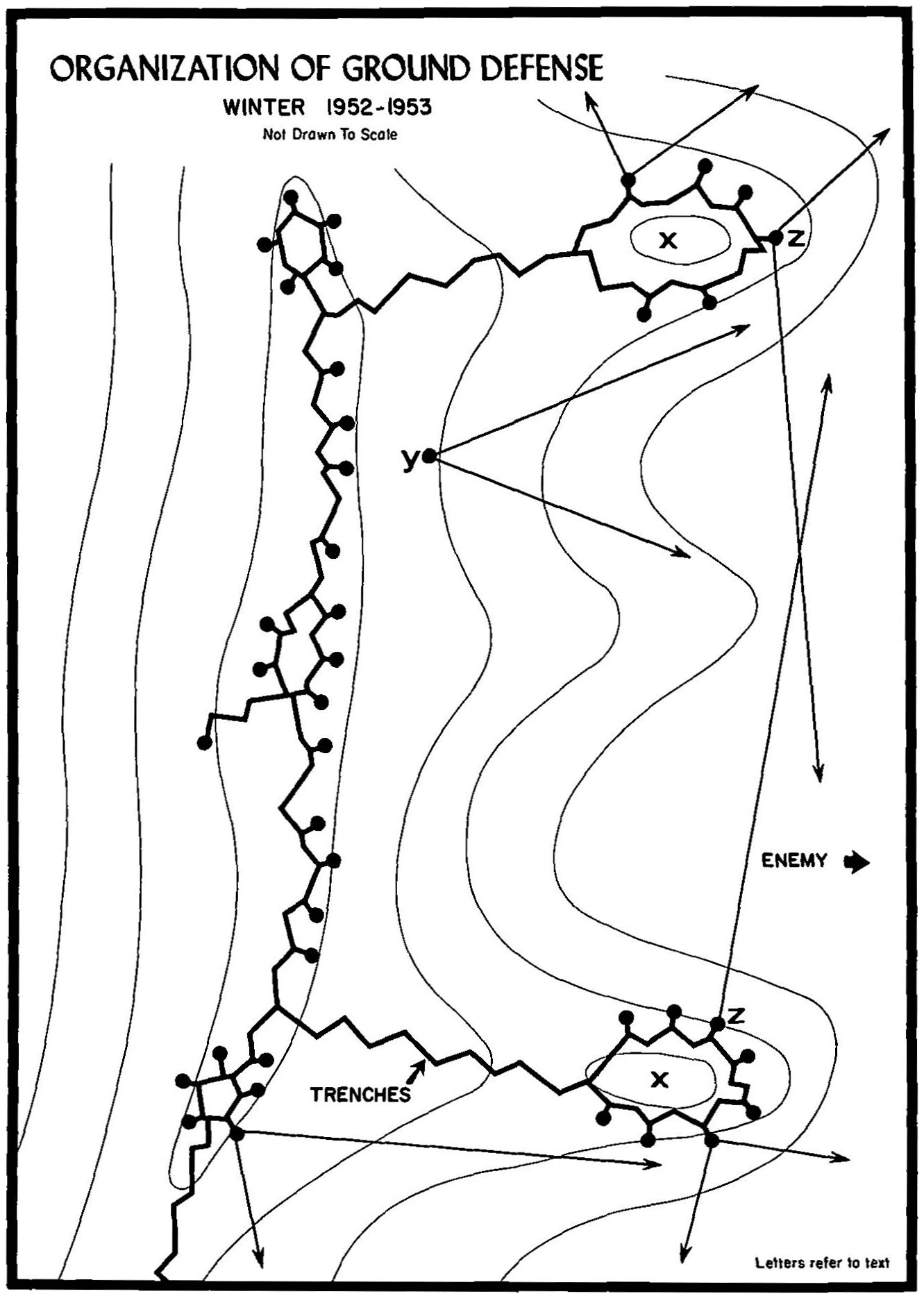
MAP DIAGRAM 20 K. White
ORGANIZATION OF GROUND DEFENSE
WINTER 1952–1953
Altered defense concepts, beginning in October, took the following
form:
(1) The trace of defensive positions followed the topographical
crest (A) rather than military crest (B) of key terrain features.
(Map diagrams 20 and 21 illustrate these changes.)
(2) Fighting positions and emplacements were dug a short
distance downslope (C) from the topographical crest.
(3) Trenches on the topographical crest permitted easier, faster,
and more protected access to fighting positions from the reverse
slope and support area (D).
(4) Positions on the topographical crest were less vulnerable
to enemy artillery because it was more difficult for the enemy to
adjust his fire on these positions than on trenches dug along the
military crest. Many shells simply passed over the top (E) of the
hill.
(5) Certain hills and noses were selected and organized so that
trenches and gun emplacements, encircling the crest, would form
mutually supporting positions (X).
(6) Machine guns were moved from the draws (Y) to hilltops
and noses (Z) where better long-range observation and fields of
fire existed.
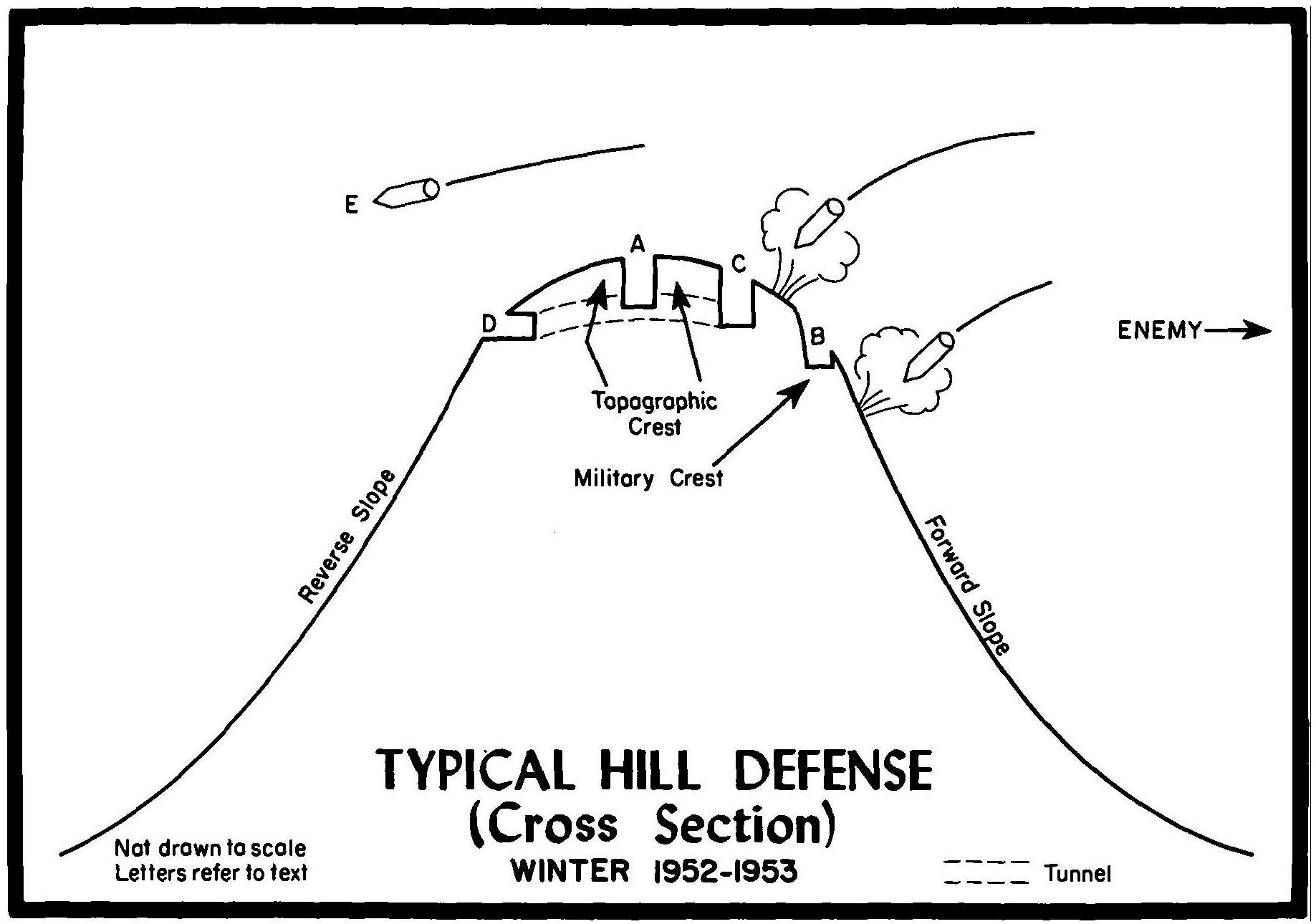
MAP DIAGRAM 21 K. WHITE
TYPICAL HILL DEFENSE
(Cross Section)
WINTER 1952–1953
Another change in the improvement of field fortifications came
into use during the winter months. A different type of barbed wire
obstacle, called “Canadian,” “random,” or “double-apron” wire,
began to find favor with Marine infantrymen. Canadian wire consisted
of two parallel rows of three-strand barbed wire fencing,
erected about three feet apart. The void was filled in with additional
barbed wire, placed at random, but connected to the parallel fences.340
The new type barbed wire appeared more effective for several reasons.
Besides being simple and fast to emplace, Canadian wire merely
became more entangled by artillery shelling, which quickly ripped
apart the standard double-apron barbed wire previously used in COP
slope defenses.
As the Marine division continued to revamp and strengthen its
primary defenses, a change of pace on the battlefront was gradually
being felt. Only a few major raids had taken place during November,
December, and January, and these involved no transfer of real
estate. Casualties had been light. Artillery rounds, both incoming
and outgoing, had dropped substantially. By February, however, it
became apparent that the period of winter inactivity was nearing
an end.
Taking the initiative in the renewed action was the 5th Marines,
occupants of the right regimental sector since 25 January. The next
month the regiment conducted three successful daytime raids against
fortified enemy positions. Targets for the initial action, on 3 February,
were two consistently troublesome hills, 31 and 31A in the
Ungok Hill mass, north of the left battalion sector.
Since all battalions of the 5th Marines were to be involved either
directly or indirectly in Operation CLAMBAKE, the initial planning
and actual execution of the raid was to be carried out by the
regimental commander, Colonel Walt. Clambake required especially
thorough coordination of the heavy fire support since it was to
be launched with a tank-artillery feint against several CCF positions
(Hill 104, Kumgok, and Red Hill) generally west of the Ungok
objective area. The two target hills were to be assaulted by reinforced
platoons from Company A (Captain Don H. Blanchard) of the
reserve battalion, 1/5, commanded by Lieutenant Colonel Jonas M.
Platt, who was responsible for the later planning stages of the raid.
It was anticipated that intensive air and artillery preparation on the
feint objectives and movement of gun and flame tanks during the
diversion would gain the element of surprise for the assault platoons.
Thus the Marines hoped to take prisoners, the main purpose of the
raid, and to kill enemy troops and destroy their defenses.
During the five weeks of preparation, every aspect of the maneuver
was thoroughly reviewed and rehearsed. All participating units
took part in the planning conferences. Routes were reconnoitered,
mines cleared, and fire concentrations plotted and registered. MAG-12
pilots studied the target areas from the nearby Marine MLR.
Six rehearsals, including practice in casualty evacuation, uncovered
potential problem areas. Final rehearsal was held 1 February, with
artillery and air preparation made against the feint objectives. Four
close air support strikes were conducted that day and the next as
part of the plan to divert enemy attention from the CLAMBAKE
destruction mission.
Shortly after first light on 3 February, three platoons of tanks
rumbled across the MLR to assault the feint area. A heavy “false”
artillery preparation by 1/11 was also placed on the three western
enemy hills as well as direct fire from gun and flame tanks. The
two Marine assault forces, one against each hill, moved out armed
with flamethrowers, 3.5-inch rockets, machine guns, grenades, satchel
charges, bangalore torpedoes, and automatic weapons. Enemy forces
occupying the positions made three separate counterattack attempts,
which were blunted by Marine supporting arms. During the infantry
attack, friendly air hovered on station and artillery fired continuous
counterbattery and countermortar fire.
With the exception of the change of withdrawal route of one of
the assault teams, the 5th Marines reported that the operation was
carried out according to plan. Company A tanks had swung left
across the frozen rice paddies to provide left flank security for the
infantry and to interdict trenchlines that connected with the Ungok
objective. Intense enemy fire lashed the armored vehicles as they
approached Kumgok and Red Hill as well as those supporting tanks
that remained on the MLR.342 Air, artillery, infantry, and tanks produced
an estimated 390 Chinese casualties (including 90 known
KIA) in addition to damaged or destroyed trenchlines, tunnels,
caves, bunkers, and weapons of the enemy. Marine losses were 14
killed and 91 wounded. One flame tank was lost.
As in the case of the 1st Marines WAKEUP raid in November
1952, CLAMBAKE was important not so much in accomplishing its
primary mission (actually, no POWs were taken) as in lessons
learned. One of these was to reemphasize the fact that thorough
preparation helped to ensure smooth coordination of infantry and
supporting arms. In his report of the operation, Lieutenant Colonel
Platt wrote, “minute planning to the last detail along with carefully
executed rehearsals are basic to success in actions of this type.”343
He further noted that “confidence and enthusiasm stimulated by the
rehearsals are assets which cannot be overlooked.”344 The battalion
commander also commented on the importance of planning for both
troop withdrawal and maintaining a flexible schedule of fires by
supporting arms. Air,345 artillery, and tanks all employed fire plans
that could be readily adjusted to meet the changing tactical situation.
On the ground, flame was found to be the best weapon for
neutralizing the well-fortified CCF caves. From Company A, 1st
Tank Battalion (Captain Hunter) came information about Chinese
3.5-inch rocket launcher teams used in antitank defense. Several of
these tank-killer teams had run down the trenchline holding small
bushes in front of them. The enemy then boldly advanced through
a hail of bullets to within 15–20 yards of the Marine tank before
opening fire with their rockets. Short bursts of flame from headquarters
tanks soon caused even the most intrepid to beat a hurried
retreat.
Concluding his after-action report of CLAMBAKE, the regimental
commander, Colonel Walt, observed:
In addition to inflicting large numbers of casualties and destruction upon
the enemy, the operation served a secondary purpose, none the less important.
It provided excellent training and experience for the various infantry
and supporting arms staffs involved, helping to develop them into a
smoothly functioning infantry-air-artillery-tank team.346
Shortly before the end of the month, the 5th Marines made
another major assault. As in the earlier CLAMBAKE, this raid was
again in two-reinforced-platoon size and made during the early daylight
hours of 25 February. This time the objective was a single
height, Hill 15 (Detroit), two miles east of the CLAMBAKE objective.
Lieutenant Colonel Oscar F. Peatross’347 2/5, manning the extreme
right sector of the division, gave the assignment to Company F, then
under Captain Harold D. Kurth, Jr. Planning for Operation
CHARLIE, a standard-type kill, capture, and destroy raid, was carried
out in much the same detailed manner as the earlier 1/5 raid.
Charlie differed somewhat in concept in that the 2/5 operational
plan attempted to gain surprise by launching the attack during the
BMNT348 period as well as in use of smoke to screen enemy observation.
Supporting arms preparatory fires had been carefully plotted,
including the precision destruction aerial bombing that had proved
so effective in the CLAMBAKE assault. In actual execution of CHARLIE,
however, bad weather prevented the use of almost all the planned
pre-D-Day and D-Day air strikes. Upon reaching the Detroit objective
area assault Marines “found the majority of enemy installations
were relatively undamaged, even though subjected to heavy bombardment
by other supporting arms.”349 Artillery preparatory fires
had been employed successfully to isolate the battle area and
howitzer and tank missions supported the raid.350
Between the time of CLAMBAKE and CHARLIE a series of Marine
and enemy small units actions erupted which were soon to become
a way of life for the MLR combatants. By sporadic outpost attacks
and increasing their use of artillery, the Chinese were beginning to
demonstrate a more aggressive attitude than in recent months. On
the night of 12–13 February, a CCF platoon supported by mortars
and artillery probed COP Hedy (Hill 124), in the right battalion
of the center regimental sector, held by Lieutenant Colonel Barrett’s
3/7. On the next night, it was the Korean Marines who turned
aggressor. Two of their platoons raided Hill 240, on the west bank
of the Sachon, nearly three miles north of the mouth of the river.
The following night, a 7th Marines patrol moving into ambush
positions was itself stalked by a large CCF patrol. When reinforcements,
including armored vehicles, moved out from the MLR to
support the Marines, the Chinese hastily withdrew.
Three more contacts were made before the end of the month
along the division front. On 19 February CCF soldiers, in two-platoon
strength, engaged KMC sentries forward of COP 33,
located about a mile east of the action the previous week. After the
initial exchange of small arms fire, the Koreans moved back to the
outpost and called down supporting fires on the Chinese. Artillery
and mortars tore into the attackers causing numerous casualties and
forcing the enemy to withdraw. On the morning of 22 February, a
raiding party from the 5th Marines assaulted a smaller enemy force
at Hill 35A, approximately 1,300 yards southwest of the Ungok
hills. In this second raid staged by the 5th Marines that month,
assault troops (H/3/5) used flamethrowers in the early stages of
the action to help clear enemy trenches of hostile grenade throwers.
Late the next night a 7th Marines unit, consisting of a reinforced
platoon and four M-46 tanks, set out to raid Yoke, located near the
peace corridor five miles north of Freedom Bridge. The assault
against that position never came off. At 2137 as the B/1/7 platoon
moved into preliminary positions on Hill 90, north of the ultimate
objective, a Chinese company ambushed the patrol from three sides.
When the Marines closed with the enemy in hand-to-hand fighting,
a support platoon was sent from the MLR. After an intense 30
minute fire fight, the CCF began withdrawing at 0138. Enemy losses
were listed as 45 counted KIA, 33 estimated KIA, and 35 estimated
WIA. As a result of the assault, orders for the 7th Marines raid on
Yoke were cancelled. Marine casualties numbered 5 killed, 22
wounded.
Whereas February was characterized by a marked increase in
ground contacts between Marines and their CCF adversaries, during
the first part of March the Chinese again assumed an inactive posture.
Marine patrols reported few contacts. Except for a KMC raid on 3
March, little action that could be considered a sizable engagement
took place until after midmonth. On the 16th there was a brief
skirmish involving a 5th Marines combat patrol near Reno and a
short fire fight between Carson defenders and an enemy squad. The
next night a Chinese platoon, waiting near Vegas for a Marine
patrol to pass by, was itself put to flight by the patrol.
Two encounters with the CCF on 19 March marked the heaviest
action yet of the month. Early that morning, a predawn raid was
staged by B/1/5 (Captain Theodore J. Mildner) at Hill 31A, one
of the Ungok twin objectives in CLAMBAKE the previous month. The
March ITEM raid employed 111 Marines. One platoon was to make
the assault and the second platoon to support the operation and
assist in casualty evacuation. Following a series of nearly a dozen
air strikes on the objective and artillery preparation, Captain
Mildner’s two assault platoons jumped off from the MLR check
point at 0518. As usually happened in such operations, the preliminary
fire drove the Chinese to reverse slope defenses. No enemy
POWs were taken and at 0700 the Marine units disengaged, due
to casualties sustained from enemy shelling and machine gun fire.351
Earlier that same date, two attacks had been made simultaneously
by the enemy on outposts in the center regimental sector, where the
1st Marines had relieved the 7th on 10 March. At 0105 one CCF
company struck in the vicinity of Hedy while a second lunged at
Esther, about 1½ miles east. When a G/3/1 reconnaissance patrol
operating forward of COP Esther observed enemy movement, the
Marines pulled back to the outpost, alerting it to the impending
attack. After a heavy incoming artillery barrage, the enemy assaulted
the outpost, but when a three-hour effort failed to carry the position,
the attackers withdrew. By that time the Chinese company which had
hit COP Hedy had also broken off the attack.
Actually the fight in Captain Carl R. Gray’s Company H sector, to
the rear of Hedy, was mainly at the MLR, for the Chinese indulged
in merely a brief fire fight at the latter outpost, bypassing it in favor
of a crack at JAMESTOWN. The main line of resistance failed to
yield to the enemy thrust, which was supported by 2,400 rounds of
mortar and artillery fire along the MLR and outposts.
After being thwarted by Hedy-Esther defenses, the enemy shifted
his efforts westward to the 1st KMC area. The Korean regiment
received the brunt of the enemy’s minor infantry probes immediately
preceding the Nevada Cities battle. Late on 25 March a series of
skirmishes broke out in the 1st Marines sector between one-or-two
platoon size Chinese infantry forces and Marine outpost defenders.
Following a quiet daylight spell on the 26th, the Chinese resumed
the offensive with a probe at COP Dagmar. This coincided with
what developed into a massive regimental assault unleashed against
Carson, Reno, and Vegas, outposts in the 5th Marines sector, to the
right. There Colonel Walt’s regiment would shortly be the target
of the bloodiest Chinese attack to date on the 1st Marine Division
in West Korea.
CHAPTER VII Vegas — The Nevada Cities 352 — Supporting Arms 360 — Defense Organization on the Outposts 361 — The Chinese Assault of 26 March 364 — Reinforcements Dispatched 368 — Massed Counterattack the Next Day 372 — Push to the Summit 375 — Other Communist Probes 379 — Three CCF Attempts for the Outpost 380 — Vegas Consolidation Begins 381 — Aftermath 384
The Nevada Cities—Supporting Arms—Defense Organization
at the Outposts—Chinese Attack on 26 March—Reinforcements
Dispatched—Massed Counterattack the Next Day—Push
to the Summit—Other Communist Probes—Three CCF
Attempts for the Outpost—Vegas Consolidation Begins—Aftermath
As the third winter of war in Korea began to draw to an inconclusive
end in late March 1953, some 28,000 Marines of the
1st Division stationed on the western front suspected that coming
weeks would bring a change of pace. Consider just the matter of
basic logistics. Rising temperatures, tons of melting snow, and the
thawing of the Imjin River, located north of the rear Marine support
and reserve areas, would turn vital road nets into quagmires to tax
the patience and ingenuity of men and machinery alike.
With the arrival of another spring in Korea there was strong likelihood
that the Chinese Communists facing the Marines across a
33-mile front of jagged peaks and steep draws would launch a new
offensive. This would enable them to regain the initiative and end
the stalemate that had existed since October when they were rebuffed
in the battle for the Hook.
Winning new dominating hill or ridge positions adjacent to the
Marine MLR, in that uneasy No-Mans-Land buffer zone between the
CCF and UN lines, would be both militarily and psychologically
advantageous to the Communists. Any new yardage or victory, no
matter how small, could be exploited as leverage against the “Wall
Street capitalists” when truce talks resumed at the Panmunjom
bargaining table. Further, dominant terrain seized by the CCF would
remain in Communist hands when the truce went into effect. Although
wise to the tactics of the Chinese,353 UN intelligence had not anticipated
the extent or intensity of the surprise CCF attack that opened
up at 1900 on 26 March when the Communists sent battalions of
700 to 800 men against Marine outposts of 50 men.
The late March attack centered primarily on a trio of peaks where
Marines had dug in three of their key outposts—Carson, Reno, and
Vegas. Rechristened from earlier, more prosaic names of Allen,
Bruce, and Clarence, respectively, the Nevada Cities hill complex
was located approximately 1,500 yards north of the MLR fronting
the 5th Marines right sector. The trio was the province of 1/5, which
manned the western (left) part of the regimental area. Ultimately,
however, reverberations ran through nearly 10,000 yards of division
front, from the two Berlin outposts, 1,000 yards east of Vegas, to
COP Hedy, midpoint in the 1st Marines center sector. Continuous
attacks and counterattacks for possession of the key Vegas outpost
raged unabated for five days. The action escalated into the bloodiest
fighting to date in western Korea, resulted in loss of a major outpost,
and the killing or wounding of nearly 1,000 Marines. It was
a partial success for the enemy, but he paid a high price for the
real estate: casualties amounting to more than twice the Marine
losses, including 800 known killed and a regiment that was decimated
by the Marine defenders.
The three Nevada outposts lay just below the 38th Parallel,
approximately 10 miles northeast of Panmunjom and the same distance
north of the Marine railhead at Munsan-ni. Possession of the
area would give the Communists improved observation of I Corps
MLR positions to the west. Indeed, the enemy had cast covetous eyes
(an ambition translated into action through his well-known creeping
tactics) on the semi-circular net of outposts since the preceding
summer.
Mindful of this, the I Corps commanding general back in September
had stressed the importance of holding key terrain features
that could be of major tactical value to the enemy. This included
Bunker Hill and COP Reno, both considered likely targets for
renewed enemy aggression in the future. Particularly, the enemy
had indicated he wanted to annex Reno. The object of increasing
hostile attacks since July 1952, Reno was the closest of the three
Nevadas to CCF lines and tied in geographically with two of the
enemy’s high ground positions—Hill 190, to the northeast, and Hill
101, overlooking the site of the destroyed village of Ungok. (See
Map 22.)
Reno’s companion outpost on the right, Vegas, at 175 meters, was
the highest of the three while Carson, on the left flank, was nearest
JAMESTOWN and also assisted in defense of Reno and Vegas. Each
of the three outposts was manned by a rifle platoon (40 Marines
plus two Navy hospital corpsmen), heavily reinforced with weapons
company personnel. A small hill between Reno and Vegas,
known as the Reno Block, further supported the Nevada Cities complex
and at night was defended by a reinforced squad.
Since they commanded the historic Korean invasion route to Seoul,
30 air miles south, the strategic importance of the Nevada outposts
had been one of the reasons for transfer of the Marines from
East Korea to the West, in 1952. Both Reno and Vegas, moreover,
overlooked Chinese rear area supply routes. This was a matter of
special concern to the enemy at this time since he had recently
doubled his stockpiling efforts and wanted to prevent UNC intelligence
from learning about the build-up. Possession of the Nevada
hills would enable the Chinese to harass the Marines at even closer
range and—hopefully—to conduct new thrusts at the MLR which
would ultimately weaken the UNC position.
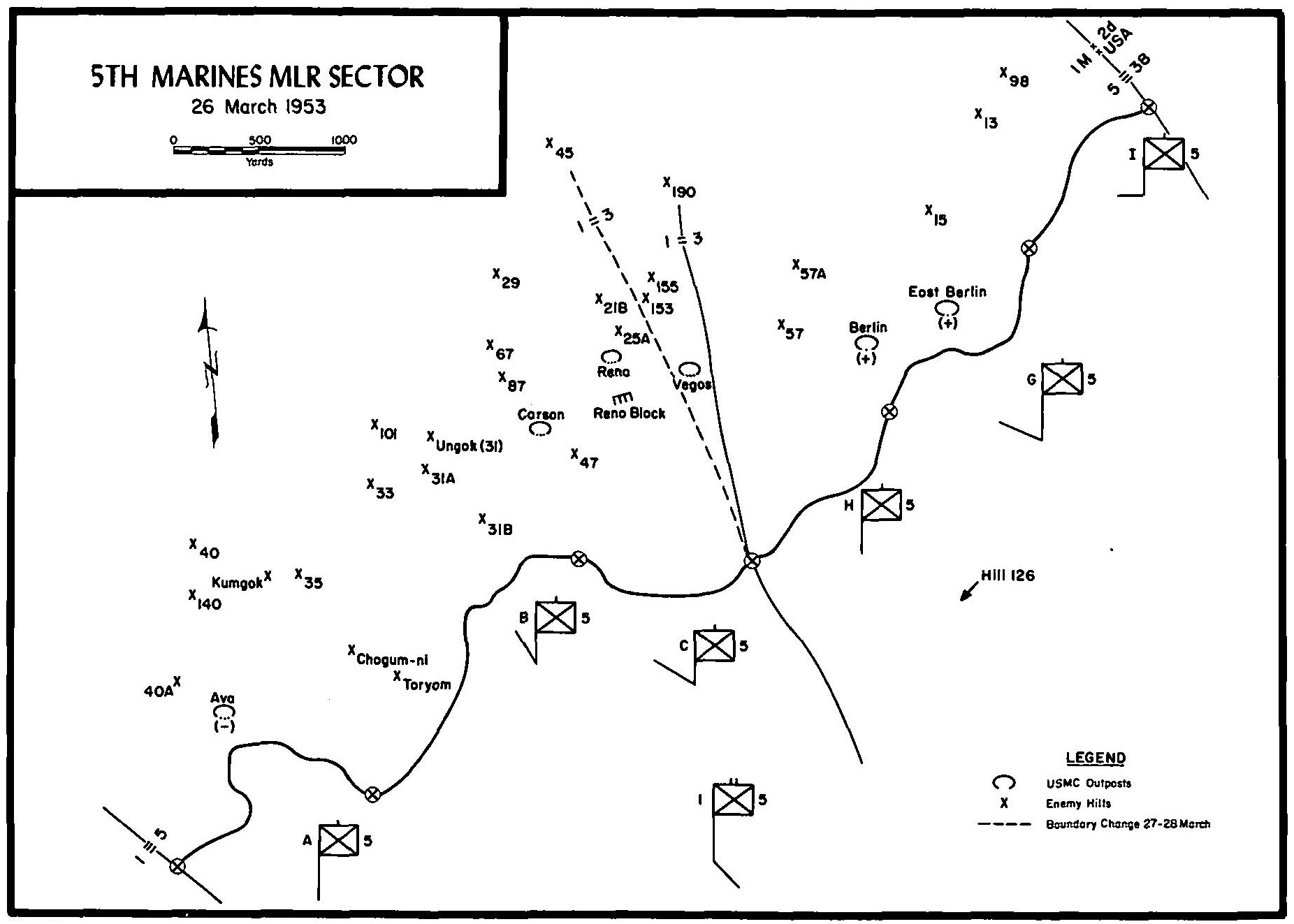
MAP 22 K. WHITE
5TH MARINES MLR SECTOR
26 March 1953
In mid- and late March, the units forward in the 1st Marine
Division sector of the main defense line, JAMESTOWN, remained
much as they had been in recent months. Left to right, the defending
components were the Kimpo Provisional Regiment, 1st Amphibian
Tractor Battalion, 1st Korean Marine Corps Regimental Combat
Team (1st KMC/RCT),354 1st Marines, and 5th Marines. One
change had occurred when the 1st Marines relieved the 7th in the
center sector earlier in the month. The latter was now in division
reserve in the Camp Rose rear area. Before long, this regiment was
to see more offensive action in a hotly contested, five-day period
than it had during its entire recent tour on line. Overall, the 1st
Marine Division continued as one of the four infantry divisions in
the I Corps sector of EUSAK355 and, in fact, the month itself marked
exactly one year since the Marines had arrived on the western front.
Occupying the far eastern end of the division sector, the 5th
Marines, under command of Colonel Walt,356 had been assigned to
the MLR since late January. The regiment manned six miles of the
JAMESTOWN front. It was flanked on the left by the 1st Marines
while to the right its neighbor was the 38th Regiment, 2d Infantry
Division, U.S. Army.
Since 20 February, the western part of the 5th regimental sector
had been held by Lieutenant Colonel Platt’s 1/5, with Companies A,
B, and C on line, from left to right. The battalion area held four
outposts. COP Ava was tucked down near the boundary between
the 1st and 5th Regiments, while the Nevada, or Three Cities, triangle
screened the central part of the latter regimental sector. A
Company A squad357 outposted Ava, some 325 yards forward of the
main line. Personnel of Company C were stationed on Carson and
Reno. Vegas had a unique command situation. Due to its proximity
to the boundary between 1/5 and 3/5, Vegas came under operational
control of the former battalion while personnel charged
with its defense belonged to Company H of 3/5.
The right flank of the regimental sector was the responsibility of
3/5, which had moved to the front on 23 March, under Lieutenant
Colonel Robert J. Oddy. Companies H, G, and I were forward, in
that order from the west, with George personnel on duty at the two
reinforced squad size outposts, Berlin and East Berlin. In regimental
reserve was Lieutenant Colonel James H. Finch’s 2/5.
Westward along JAMESTOWN from Colonel Walt’s 5th Marines
was the center regimental sector, held by the 1st Marines commanded
by Colonel Adams. (See Map 23.) The extreme western part of the
regimental line came to a juncture with KMC territory just as it
looped around the critical Panmunjom peace corridor. This left
battalion sector was manned by Lieutenant Colonel George A. Gililland’s
2/1. Companies E, D, B from 1/1,358 and F were forward, outposting
COPs 1, 2, Marilyn, Kate, and Ingrid. To the right 3/1,
commanded by Lieutenant Colonel Ernest G. Atkin, defended Hedy,
Bunker, Ginger, Esther, Dagmar, and Corinne, with Companies H,
G, and I on line. Occupying the area adjacent to the secondary defense
installations, WYOMING and the western part of the KANSAS
line, was Lieutenant Colonel Frederick R. Findtner’s reserve 1/1.
And located to the rear of the 1st and 5th Regiments was the 7th
Marines (Colonel Haffner), in reserve,359 and the division rear support
units, also south of the Imjin.
In support of the three infantry regiments were the artillerymen,
guns, and howitzers of Colonel Mills’ 11th Marines. Two of its three
light battalions, 1/11 and 3/11, provided 105mm direct fires to the
5th and 1st Marines, respectively. The general support battalion
was 2/11, prepared to reinforce the fires of 1/11. The regimental
medium battalion, 4/11, was in general support of the division, as
was the 1st 4.5-inch Rocket Battery. To the southwest of the division
sector, the 75mm guns of the 1st KMC Artillery Battalion, also
attached to the 11th Marines, were in direct support of the 1st
KMC/RCT. Newly formed the preceding month, the 1st Provisional
Antiaircraft Artillery-Automatic Weapons Platoon had the
mission of defending two of the Imjin River Bridges—Freedom and
Spoonbill—in the division sector.
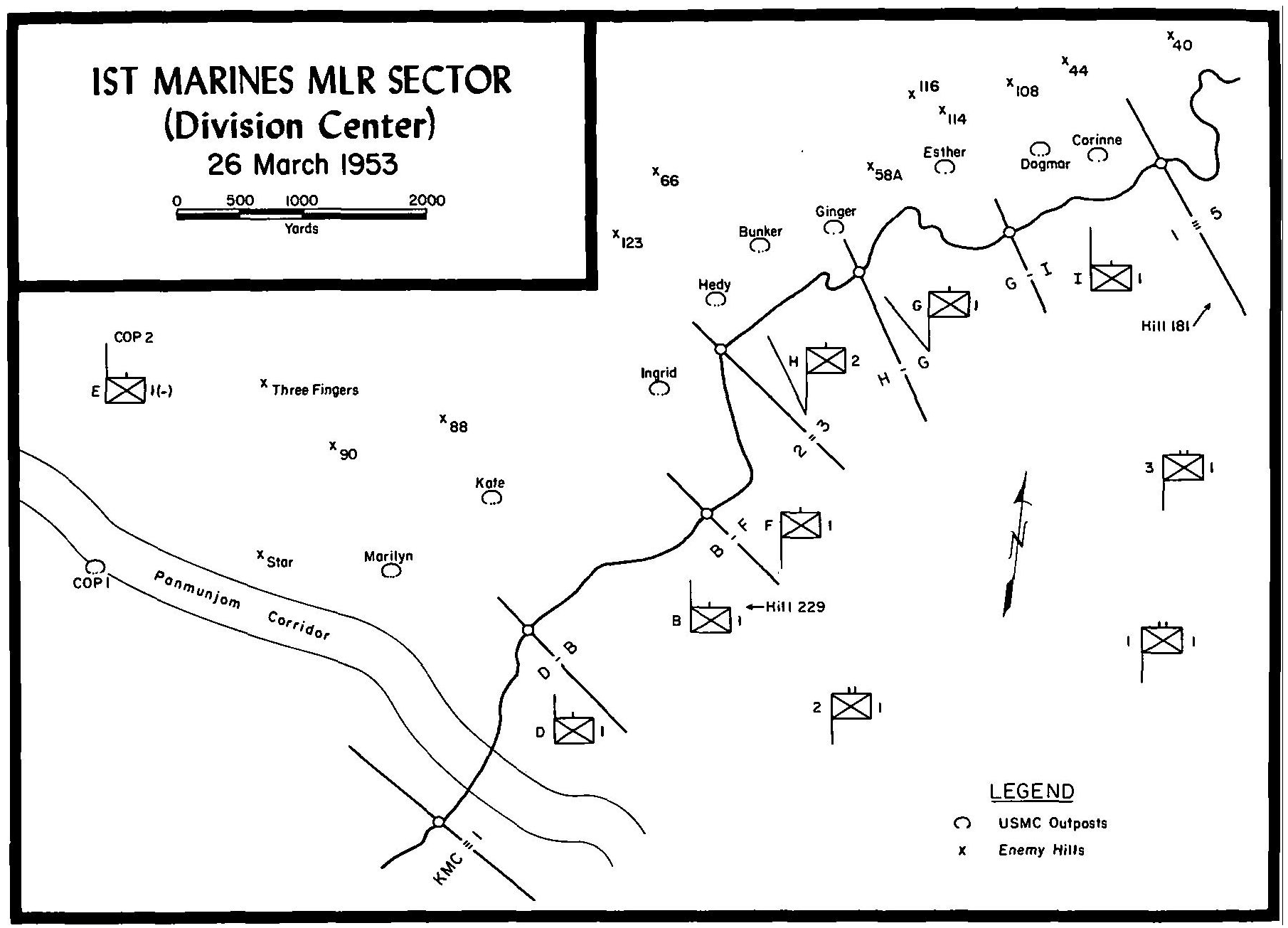
MAP 23 K. WHITE
1ST MARINES MLR SECTOR
(Division Center)
26 March 1953
In addition to organic and attached units of the 11th, four I Corps
artillery components, located within division territory, further reinforced
11th Marines capabilities. The 623d Field Artillery Battalion,
with batteries in the 5th and 7th Marines sectors, like 4/11 consisted
of 155mm howitzers. Three heavy artillery units were also
available for counterbattery missions. These 8-inch howitzers belonged
to Battery C of the 17th Field Artillery, Battery B of the
204th Field Artillery, and the 158th Field Artillery Battalion. These
Army units were assigned to general support of I Corps, reinforcing
Marine fires on call, and were under operational control of the 159th
Field Artillery Battalion Group.
Active armored support for the division’s ground troops during
March was provided by three of the four companies from the 1st
Tank Battalion. Company A’s M-46s, flame tanks, and retrievers,
well forward in the right sector, were in direct support of the 5th
Marines; Company D tanks were assigned to the 1st Marines. Company
B functioned as the forward reserve unit, ready to move into
firing positions on the MLR if the tactical situation called for it. The
rear reserve unit, Company C, conducted refresher training and performed
equipment checks on the rest of the battalion tanks. The
battalion commander, since May 1952, was Lieutenant Colonel John
I. Williamson.
The 1st Marine Aircraft Wing, with a personnel strength of 6,400,
was located throughout Korea. Wing headquarters, Marine Air
Control Group 2, and Marine Air Group 33, with its F9F day jet
fighters and the VMJ-1 photo reconnaissance squadron operated
from K-3, Pohang. VMF(N)-513, with all weather jet fighters,
flew out of K-8, Kunsan, on the west coast, 105 miles below Seoul.
MAG-12 and its squadrons of attack ADs and Corsairs was relatively
near the 1st Marine Division sector, at K-6, Pyongtaek, 30
miles southeast of Inchon. Marine Wing Service Squadron 1, with
its heavy maintenance capability, remained at Itami, Japan.
Tactical control had been altered radically the previous month
when the Fifth Air Force had relinquished its command of Marine
pilots and planes and they returned to operational control of the 1st
Marine Aircraft Wing for the first time since the early days of the
war. Direction of the helicopters in HMR-161 and VMO-6 used in
transport and reconnaissance missions had for some time been closer
to home; both squadrons were under 1st Marine Division operational
control. HMR-161 was based at A-17, in the vicinity of the 1st
Marine Division command post. VMO-6, a composite unit consisting
of single-engine OE-1 observation planes and a copter section
of the HTL-4 and the new larger HO5S-1 craft, was located at A-9,
three miles south of division headquarters. The squadron provided
regularly scheduled helicopter evacuation of night frontline combat-casualties,
artillery spotting flights, and airborne control of air strikes.
Both squadrons performed routine liaison and reconnaissance, administrative,
and resupply flights.
Carson (Hill 27), furthest west of the three Nevada Cities was, at
820 yards, also nearest the Marine main line of resistance. It overlooked
enemy terrain to the northwest and dominated an important
approach from that same direction—the Seoul road. Organized as
a perimeter defense position, Carson security was oriented toward
two major Chinese strongpoints. These were the twin-peaked Ungok
Hill mass (31-31A), approximately 650 yards west of the Seoul
road which lay between Ungok and Carson, and Hill 67 (Arrowhead),
an equal distance due northwest. Other critical features in
the immediate Carson vicinity included, on the right, the west finger
of Reno; the ridgeline south from Reno to a point known as “Ambush
Alley,” in the vicinity of enemy Hill 47; and the ridgeline
approaches by the two listening posts—Fox finger and George finger.
(See Map 24.)
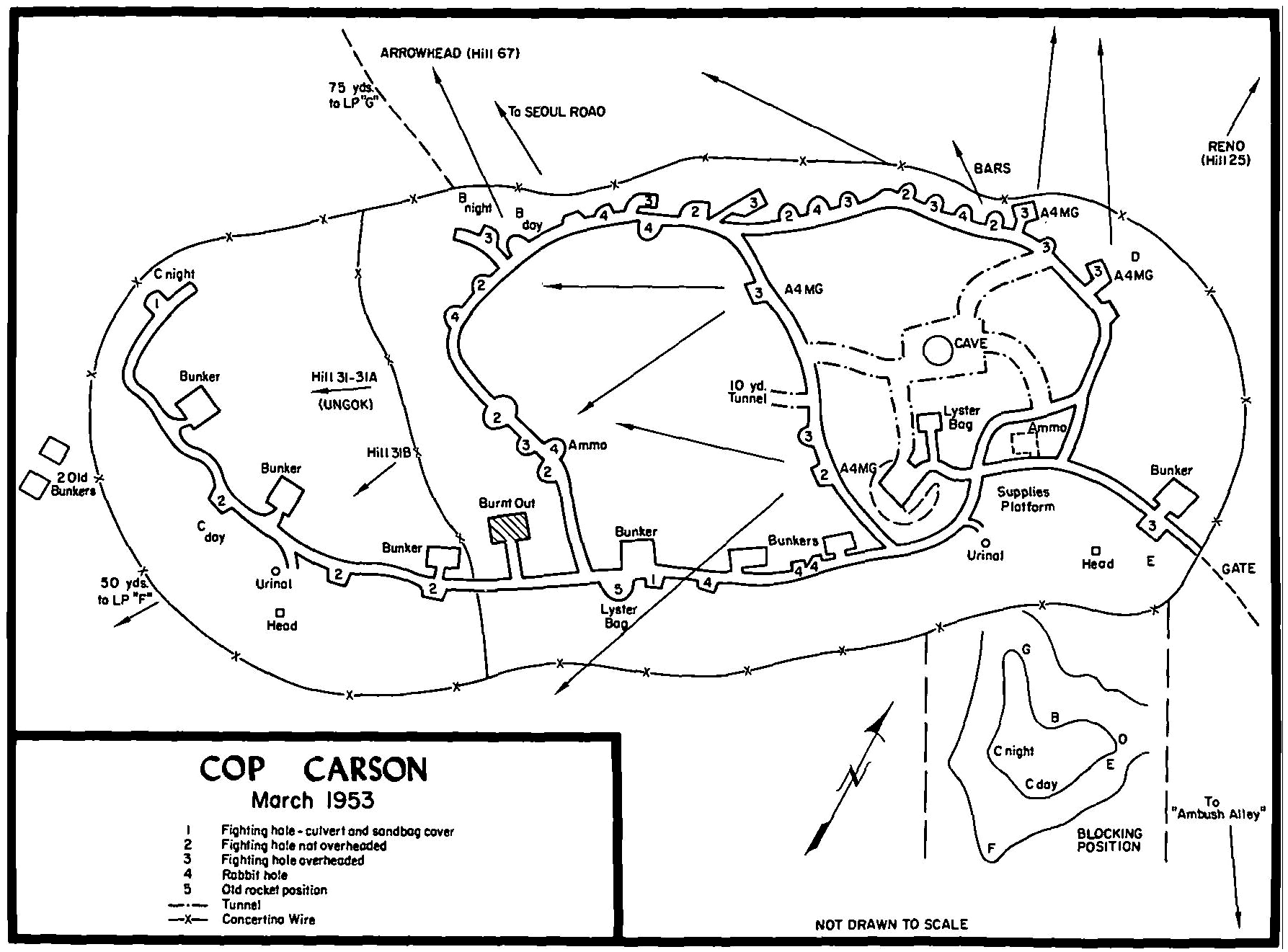
MAP 24 K. WHITE
COP CARSON
March 1953
Little cover or concealment existed, other than that offered by the
trenchline and a cave used as living quarters. Four weapons positions—light
machine guns and Browning automatic rifles—covered
main enemy avenues of approach. These and two listening posts
were each manned by two men after 1800 and throughout the night.
Of Carson’s customary strength of 38 (1 officer and 37 enlisted), 28
stood watch and worked on fortifications at night. A six-man security
team was on duty during the day. All posts connected by land
line to battalion headquarters, where a 24-hour phone watch was
maintained. Sound power phones and radios also provided communication
with the company CP.
Nearly 350 yards of trenchline encircled the outpost. Most was in
good condition, five or more feet deep and two feet wide. The main
trench on the reverse slope was in spots shallow, only three to five
feet, and a new trench was being dug. Fields of fire for small arms
protection were considered good, although some of the 28 fighting
holes were overly close to culvert and sandbag overheading, which
prevented complete fire coverage of forward slopes. Adequate fire
support could be given along the southern slope of the west finger
extending from COP Reno, which was also mutually supporting
with that of the Reno Block. Forward observer teams for the 60mm
and 81mm mortars provided observation for supporting arms. The
arsenal of weapons at Carson included 4 A-4 light machine guns, 2
flamethrowers, 2 3.5-inch rocket launchers, 9 Browning automatic
rifles, 36 M-1 rifles, 2 carbines, 2 pistols, and 4 grenade launchers.
Some 450 yards northeast, COP Reno (Hill 25) was dug in on a
ridgeline that fronted enemy Hill 25A (also known as Hill 150),
immediately north. Approximately 1,600 yards away from the MLR,
Reno was the central of the three outposts and also the one most distant
from Marine lines. West to east, critical terrain consisted of five
enemy positions—Hills 31, 67, 25A, 190, and 153—and friendly
companion outpost Vegas, on the right flank. (See Map 25.)
Two main trenches led into the outpost, a reverse slope fortification.
The forward trench, perpendicular to the ridgeline fronting
the position, was approximately 20 yards long and 8 feet deep. The
second, to the rear and about the same length, traversed the outpost
in an east-west direction. Approaching from the entrance, or “Gate”
of the MLR, the two trenches joined on the left, forming a 90 degree
angle. A cave, located in the arc between the trenches, provided
overcrowded living quarters where personnel slept either on
the dirt floor or atop sandbags, since there were no bunkers at Reno.
Ammunition supplies, as well as the corpsman’s first aid facilities,
were cached in the cave.
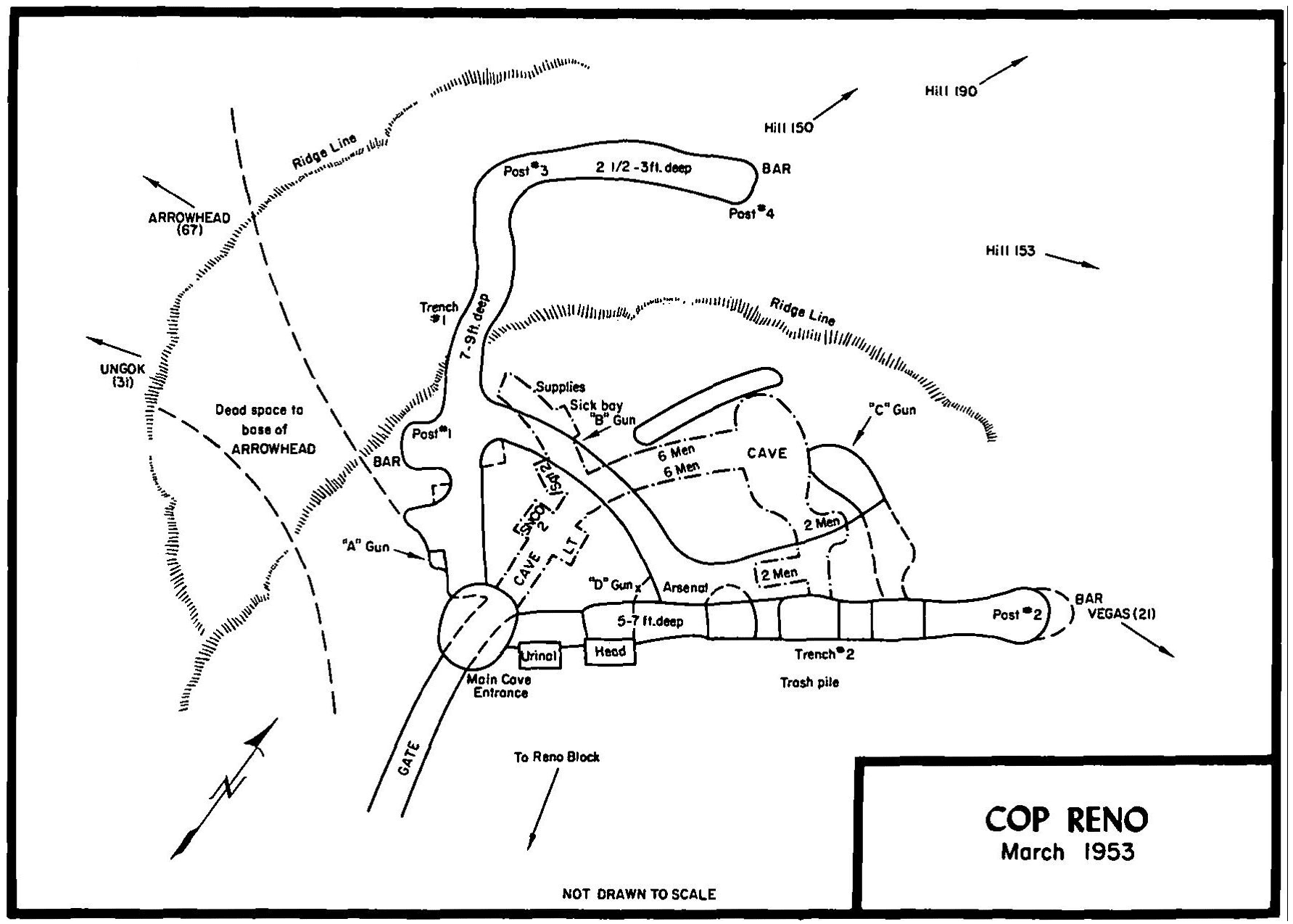
MAP 25 K. WHITE
COP RENO
March 1953
A major blocking position, some 100 yards south, and to the rear
of Reno itself was covered by troops posted in the trenchline. Left
of the forward trench, protective wire was placed across the topographical
crest. This left finger had good observation to Ungok and
Arrowhead but also served as an approach to Carson. Most likely
enemy approach, however, was considered to be the ridgeline from
Hill 150, on the north. The Seoul road, rear trenchline, and valley
to the right were alternate approaches. Twenty-four hour security at
Reno included an automatic rifleman at the Gate, at Post 1, on the
forward trench, and Post 2, which was at the extreme right of the
rear trench. Ten machine gunners were also detailed as night watch
on the guns. During the daytime they were responsible for maintenance
of ammunition and weapons which consisted of 18 M-1
rifles, 6 BARs, 5 A-4 LMGs, 2 flamethrowers, 1 carbine, and 7 pistols.
The biggest defense problem at Reno stemmed from restricted
fields of fire. Able gun, for instance, covered the rear of the topographical
crest and Hills 31 and 67, on the left. But dead space
masked its effectiveness practically from the base of Hill 67 to the
gun itself. The Baker gun, protecting the reverse slope, had a lateral
firing range of from 10 to 30 feet. Charlie gun maintained an unlimited
sector of fire, approximately 180 degrees, and Dog gun covered
the rear. As there were no prepared machine gun positions,
they were fired from the parapet protecting both the fighting holes
and firing positions in the trenchline. Two fighting holes were manned
by BARs and two were used as machine gun posts.
Customarily 40 to 43 men were on duty at COP Reno. In fact
this number had been viewed dubiously as being “far too many to
man defensive positions at any one time,” by the commanding officer
of the 1/5 Weapons Company during a survey earlier in the
month, noting that “about 20 could adequately defend the position.”362
A six-man force was detailed as a permanent working party
for the improvement of fortifications. Sound power phones linked all
positions and field phones connected the forward observer with gun
positions. Overall, for proper defense, Reno depended heavily upon
support fires from Carson and Vegas, on its right flank. Morale was
considered “very good to excellent” with Reno personnel being relieved
every 8 to 10 days.
Vegas (Hill 21), the highest of the three outposts, was located
approximately 1,310 yards in front of the MLR. Observation of the
surrounding terrain from the east slope of enemy Hill 190 on the
north, clockwise to the ridge south of Reno had been pronounced
“excellent” on an inspection trip made earlier the day the outposts
were attacked. From north to south this observation included in its
180-degree sweep, enemy hill mass 57 to the right, friendly outpost
Berlin, the MLR, key Marine defense highpoints, Hills 229 and 181
in the 1st Marines rear sector, and intervening terrain. (See Map 26.)
The north-south ridge leading to COP Reno masked the view
from Vegas on the west. To the north full observation was partially
limited by outpost Reno itself and enemy Hills 150, 153, and 190.
The latter was particularly strategic for two reasons. First, it shielded
a major assembly area. And, although the Chinese had observation
of the entire right battalion MLR from Hill 190 on the north, Vegas
prevented enemy close-in view of Marine rear areas. It also dominated
the approach to a major Marine observation point, Hill 126,
to the rear of the front lines in the western part of the 3/5 sector.
Organized as a perimeter defense, Vegas was surrounded by 250
yards of trenchline. The forward, or north trench, averaged four
feet in depth but deepened to about eight feet as it progressed to
the rear. The most solidly constructed part was the western portion.
A center communication trench was in good condition between the
rear and topographical crest. From this point to the forward trench
its depth decreased to about four feet. The trench leading back to the
MLR, about five feet deep and two wide, was in good condition. A
total of 13 fighting holes had been constructed.
Outpost troops, numbering approximately 40, consisted of six fire
teams, heavy weapons and machine gunners, two 81mm mortar crews
and two artillery observers, one corpsman, and a wireman at night.
Strength was reduced during the day, with replacements to make up
the normal complement arriving on position early each evening.
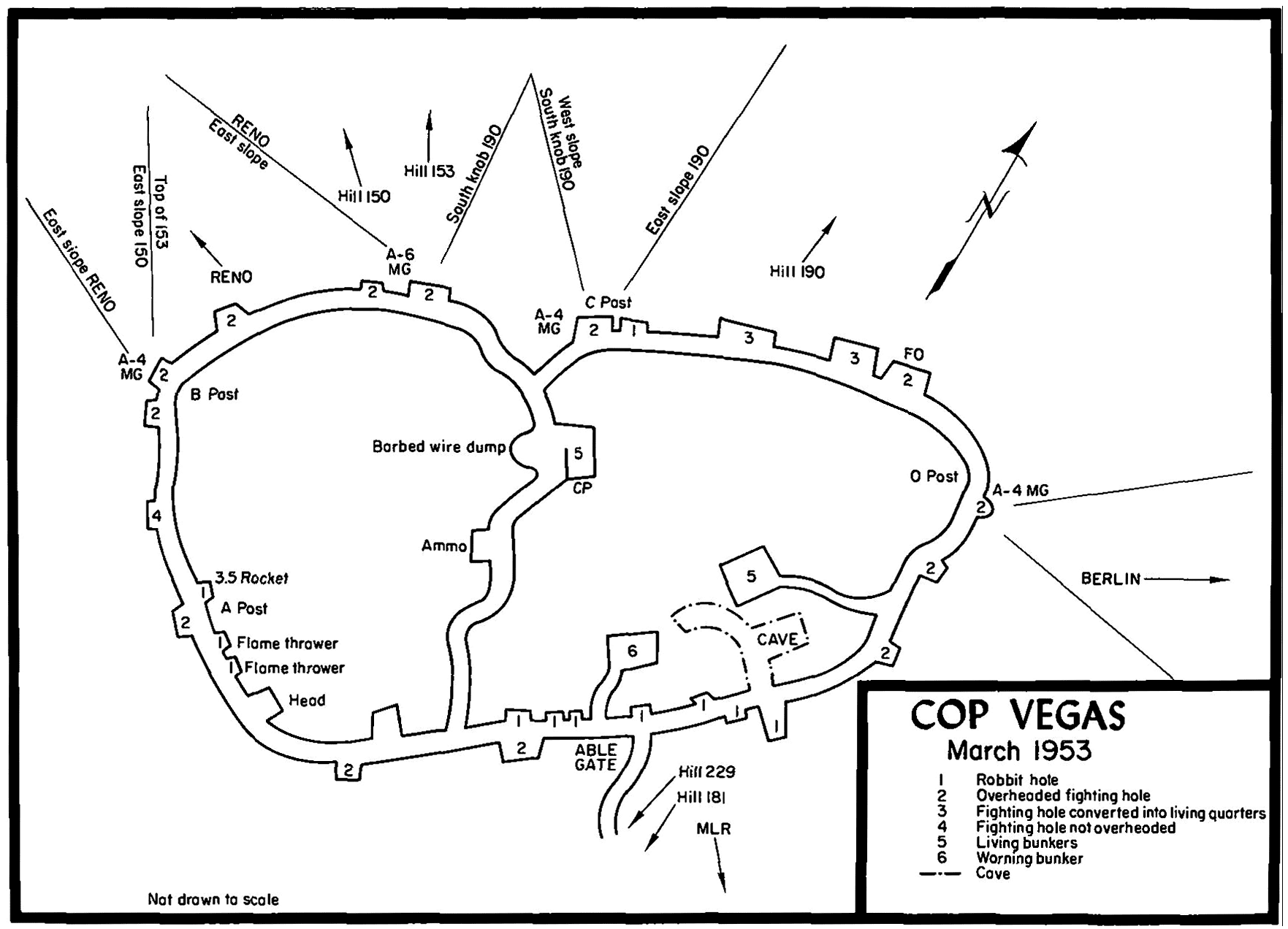
MAP 26 K. WHITE
COP VEGAS
March 1953
Major approaches to Vegas included the large draws to the west
and north of the outpost, the ridgeline to the COP from Hill 153 to
the northwest, and the rear trenchline. Several ancillary trenchlines
to the east tended to reinforce this latter approach. A hindrance to
the enemy, however, was the slope leading into the draw west of the
outpost. For security purposes, the perimeter was divided into three
sectors, each manned by two fire teams augmented by heavy weapons
personnel. The outpost detachment stood nighttime posts on a 50
percent basis and remained within the several living bunkers or other
shelters during daylight hours because of heavy shelling and sniper
fire. Incessant enemy pressure at the exposed outpost made it expedient
to rotate infantry Marines at Vegas every three days and observers,
at the end of four or five days.
Weapons on position included two flamethrowers, one 3.5-inch
bazooka, four machine guns, three pistols, and other small arms.
Fields of fire at Vegas, rated fair to good, were generally restricted
due to the proximity of overheading. Most of the light machine guns
had plunging fields of fire except for the approach along the ridgeline
from Hill 153, covered by grazing fire. A fighting hole to the
left of Able Gate, which overlooked the trenchline leading to the
MLR, was manned during the day. No other sentries or listening
posts were in effect. Nine sound power phones were operative. Three
were located in the CP bunker (connecting to C/1/5, G/3/5, and
the CP net); one, each, at the four main posts, the rear Able Gate,
and the cave.
Other than periodic work being done by 10 Korean Service Corps
personnel in clearing out the trenches, no construction was in process
at Vegas. KSCs, lugging their traditional A-frames and guided
by Marines, also ran a nightly “supply train” to Vegas as they did
to Carson and Reno. Sufficient personnel manned the outpost for
adequate defense, although an inspecting officer opined that the “one
3.5 rocket launcher on position did not appear to be necessary for
defense of this type position.”363
Until the final days of March, the CCF units opposite the 5th Marines
had shown little aggressiveness. Regimental reports had officially
cited Chinese actions as having been “extremely limited” other than
their expected resistance to patrols and the Marine ITEM raid staged
earlier in the month by the 1/5 two-platoon unit on Hill 31A, part
of the Ungok complex. The enemy posture had, in fact, been described
as one “reluctant to meet our patrols except in their positions.”365
A regimental patrol policy early in March established as SOP a
minimum of four reconnaissance and two combat patrols in each
MLR battalion sector daily. Nevertheless, 3/5 had reported no contact
with the enemy for the three-day period prior to the attack
which was launched at 1900 on 26 March. Since the middle of the
month, 1/5 had conducted nearly a dozen night combat patrols and
ambushes in one- and two-squad strength to test the enemy in the
Carson-Reno-Vegas area. Terminology of the operation orders read
that the Marines were to make contact, capture prisoners, and deny
the ground to the enemy, an injunction that—in view of events
shortly to transpire—was to turn out more prophetic than anticipated.
That last Thursday in March 1953 was clear, almost unseasonably
warm. Just after darkness had settled down over the Korean
ridges, gullies, MLR, outposts, and rice paddies, the enemy suddenly
made his presence known. Up until that time it had been an average
day of activity, and there had been no especially ominous overtones
to the start of the night.
Suddenly, at 1900, small arms and machine gun fire cracked from
enemy strongholds on Hills 44, 40, 35, and 33, and tore into the
left and center part of the 1/5 sector. Almost immediately, a heavy
mortar and artillery preparation of 15 minutes duration exploded
all along the 5th Marines MLR. A Chinese rifle platoon and half a
dozen machine guns on Hill 140, about 500 yards west of Kumgok,
directed additional fire on the sector.
At the same time 5th Marines outposts Carson and Reno, each
manned by a reinforced rifle platoon from C/1/5, came under attack
from Chinese mortars and 76mm artillery. Approximately
1,200 mortar rounds struck COP Carson by 1920. As men of D/2/5,
some of whom had been detailed to Carson earlier that night for an
ambush, reported, “one round per second from Chinese 60mm and
82mm landed in or around [our] position during the first 20 minutes
of the engagement. Thereafter, one round was received every
40 seconds until about 2200.”366 Interdiction fires also raked Marine
rear areas and supply routes. Counterbattery fire struck Marine direct
support artillery positions in the 5th’s regimental sector while heavy
shelling of the MLR and its battalion CPs shattered wire communication
between those installations and their advance outposts.
Within ten minutes, Vegas, furthest east of the four OPs in 1/5
territory, became the object of serious enemy attention. Outposts
Berlin and East Berlin, meanwhile, still further east in the 3/5
sector proper were also engaged by fire from hostile small arms and
mortars from Chinese occupying Hills 15 (Detroit), 13 (Frisco),
and 98 to the northeast. As the coordinated fire attack raged throughout
the 5th Marines regimental front, preparatory fire and diversionary
probes hit the 1st Marines sector. Outposts Hedy, Bunker, Esther,
and Dagmar, in the center regimental area, were struck by small
arms, mortars, and artillery shells a few minutes before 1900. Platoon
and squad strength limited attacks were conducted against
Dagmar, Hedy, and Esther, and enemy units were sighted moving in
front of the KMC, further west along the MLR.
At precisely 1910, a force of 3,500 Chinese from the 358th Regiment,
120th Division, 46th CCF Army began to swarm down from
Ungok, Arrowhead, Hill 25A, and Hill 190 and launched a massive
assault in regimental strength against the 5th Marines sector. (Map 27.)
Elements of six companies from three battalions converged on
the area from three directions. Two enemy platoons of the 1st Company,
1st Battalion from Ungok struck Carson while one infantry
company each, initially, began a direct assault on Reno and Vegas.
Units from the 3d Company, 1st Battalion, from Arrowhead and
Hill 29, crossed the Seoul road to hit Reno in a direct frontal
assault. Elements of the 7th Company, 3d Battalion moved down
from Hill 190, a mile north, to encircle the left flank of Reno and
thus strike from the rear of the Marine position. Other Chinese
soldiers of the 8th Company, 3d Battalion, supported by the 9th
Company, moved some 500 yards south of their ridgeline positions
on Hill 25A and 155 immediately north of Vegas to attack the outpost
head-on.
Another enemy unit, the 2d Company, 1st Battalion, swept south
from Hill 57A and made diversionary probes of the two most remote
outposts of the entire 1st Marine Division line, Berlin and East Berlin
in the 3d Battalion sector. These two smaller positions, each manned
by a reinforced squad-size detachment from G/3/5, were to be successful
in driving off the enemy’s less determined efforts there with
a rain of small arms, mortar, and artillery fires.
As the enemy regiment advanced toward its objectives in a coordinated
three-pronged attack, Marine artillery fired protective boxes
and VT on the outposts and routes of approach from the west, north,
and east. Defending infantry also called down organic 60mm and
81mm mortar barrages. Actually, prior to the Chinese onslaught at
1900, 1/11, the direct support battalion (Lieutenant Colonel Olin
W. Jones, Jr.) for the 5th Marines, began a registration and had
laid its howitzer fires on the active area. The artillery regiment had
also set up conference calls linking its four organic battalions and
supporting Army units. The fire plan for the 11th Marines provided
for its three light battalions (1/11, 2/11, and 3/11) to cover enemy
approaches and assembly areas, deliver protective boxing and VT
fires requested by the outposts, and furnish countermortar missions
called in by forward observers. Medium battalions (4/11 and the
623d Field Artillery) were to reinforce defensive fires and destroy
hostile mortars and artillery emplacements. Heavy 8-inch howitzer
support (Battery C, 17th FA Battalion and Battery A, of the 204th)
would silence enemy counterbattery weapons.
As it happened on the night of the 26th, Marine tanks, in addition
to artillery, were also registered before the time of the actual attack.
Eleven of Captain Hunter’s Company A tanks had earlier rumbled
into firing position on the MLR to provide mechanized support for
an infantry raid scheduled at dawn the next morning.
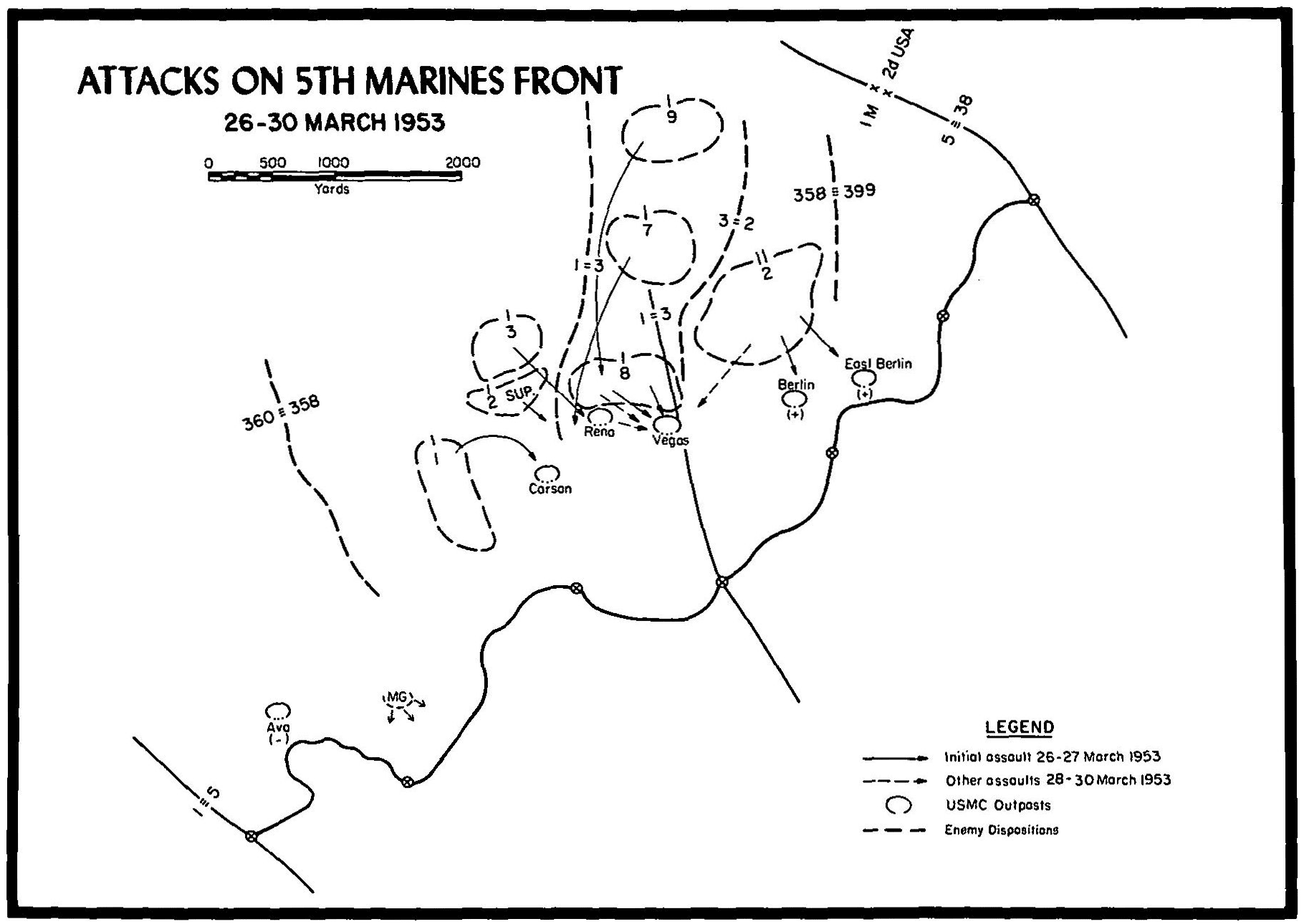
MAP 27 K. WHITE
ATTACKS ON 5TH MARINES FRONT
26–30 MARCH 1953
Despite this immediate response of Marine fire support, the Chinese
invaders outnumbered the platoons holding the outposts by a 20 to
1 ratio. The sheer weight of numbers was the decisive factor. By
1935 the enemy had penetrated the lower trenches of both Carson and
Reno. An hour after the onset of the attack, at 2000, the Marines
were throwing back Chinese forces with bayonets, knives, rifles, and
bare fists in the close, heavy fighting at Carson. There, where 54
men had been on duty at the time of initial attack, the outpost was
successfully holding off the Communists. Four reinforcing squads
quickly dispatched by battalion were designed to further strengthen
the position. At 2000, just when D/1/5 and C/1/5 relief squads
were leaving for the outpost, the Chinese unexpectedly began to
release their grip on Carson as they concentrated on the two more
isolated COPs, Reno and Vegas, that were further from the MLR.
No other attempt was made by the enemy to occupy Carson that
night or the next day. Barrage fires gradually ceased as the enemy
began to withdraw about 2135. Sporadic bursts of his 60mm and
82mm mortars and 76mm guns, however, continued to rock the position
until midnight.
Developments at Reno and Vegas, by 2000, were vastly more ominous.
At Reno, two companies of CCF soldiers thrust into the position
from a frontal and flank attack. Within a half hour they made their
way into the trench defenses. Although VT fires placed on the outposts
and WP flare shells outlined the enemy for the gunners, Chinese
in overpowering numbers continued to batter the Marine post. Due
to the lack of fighting trenches, bunkers, and to limited fields of fire,
Reno defenders fell back on a cave defense within a half hour of
the assault.367
A message received at 2030, requesting more VT rounds and reinforcements,
indicated that the enemy had sealed all entrances to the
cave and that the men were suffering from lack of air. Of the 40
Company C Marines on the outpost at the time of attack an hour and
a half earlier, only 7 were then reported still able to fight. More
illumination to enable friendly machine guns and rockets to chop up
the enemy was furnished by artillery and a flare plane that arrived
on station at 2205. Two Marine tanks, in position behind Reno, were
alerted and put their 90mm fires to good use on the enemy and his
weapons emplacements.
Meanwhile, at Vegas, the situation was also deteriorating. More
than a hundred Chinese had moved up under the perimeter of exploding
shells and Marine defensive fires into the lower trenches by
1950, less than an hour after the enemy’s first volley. Ten minutes
later, the Marines were forced to give way to the overwhelming number
of enemy soldiers which began to swarm over the outpost.
In addition to the sudden force and onslaught of the enemy, communication
difficulties also plagued Marine detachments on the
outposts, particularly at Vegas. Enemy mortar and artillery, aimed at
the mainline CPs, had wrecked the ground lines. As early as 1940,
communications between the 1st Battalion CP and Vegas went dead
and continued to be broken despite repeated attempts to reestablish
contact. Carson and Reno also had wire troubles about this time, but
radio contact was shortly established. For the most part, operational
reports and orders during the night and early morning hours were
sent over company and battalion tactical nets. The intensity of the
Chinese fire was not restricted just to forward positions; the 1/5 CP,
a mile south of the MLR, at one point received up to 100 rounds per
minute.
While the Marines on the outposts were trying to drive off the
enemy, reinforcements back at the MLR and in the reserve ranks
quickly saddled up. A F/2/5 advance platoon dispatched to Reno
at 2015 by way of the Reno Block was ambushed near Hill 47 an
hour later by two enemy squads which had moved south to cut off
Marine reinforcements. After a fire exchange, the platoon made its
way to the blocking position. Another relief unit, from Company C,
1st Battalion, that jumped off for Reno 15 minutes later had poorer
luck. The men had scarcely gone a half mile before being shelled.
After briefly taking cover the Marines moved out again, only to draw
fire from the enemy at Hill 47. Advancing for a third time, the Company
C two-squad unit was again halted by fire from two hostile
platoons. By this time 10 Marines had been wounded and evacuated.
A D/2/5 reinforcement platoon ordered to Vegas, at 2129, encountered
strong opposition in the Block vicinity, but it threw back
the enemy in hand-to-hand fighting and prevented him from gaining
fire supremacy at the position. Leading units of F/2/5, meanwhile,
had been ordered to operational control of 1/5 to augment the earlier
Company C platoon at the Block and then move north with them to
Reno. After being issued ammunition and hand grenades at the Company
C supply point, the “F” 1st Platoon left the MLR at 2227, with
the 2d Platoon filing out in column 400 yards behind them. Under a
constant rain of 76mm artillery and 82mm and 122mm mortar shells—and
with casualties for one platoon reaching as high as 70 percent
within minutes—the F/2/5 men fought their way into the trenches
at the Block. Here they joined the depleted ranks of Company C
which had established a base of fire. Despite the incessant barrage
of Chinese incoming that continued to inflict heavy casualties, the
Marines maintained their precarious grip on the Block and cleared
out large numbers of Chinese attempting to infiltrate the trenches
and approaches from the north and south to the Marine position.
While the Reno and Vegas relief units were pinned down at the
Block, the situation at the outposts remained critical. Throughout
the night new waves of Communist soldiers poured out from their
positions behind Chogum-ni, Hills 31 and 31D. When a company of
enemy troops were observed at 2100 massing near Chogum-ni for a
new assault, it was quickly disposed of by Marine artillery and Company
A tankers. At Reno where the immediate situation was the most
grim, a message at 2145 reported the enemy still in the trenches, trying
to dig down into the cave while the Marines were attempting to work
their way out by hand. The final report from Reno received late that
night, about 2300, was weak and could not be understood.
At Vegas, meanwhile, communications failure continued to complicate
defensive measures at the outpost. Because of this, on the
order of regimental commander, Colonel Walt, operational control
had been transferred, at 2119, from 1/5 to 3/5. Three minutes
before midnight all contact with Vegas was lost. As with Reno,
reinforcements sent out with the mission of buttressing the Vegas
detachment had been delayed. When it became evident that the Company
D platoon had been pinned down at the Block, a platoon from
E/2/5 jumped off at 2323 for the Vegas position.
Shored up to reinforced company strength, the composite unit at
the Block had prepared to move on for the ultimate relief of C/1/5
forces at Reno. Chinese firepower and troops continued to lash the
position, however. There seemed to be no limit to the number of
reserve troops the enemy could throw into the attack. At 2157, two
Chinese platoons had hit the Block. Twenty minutes later, another
two platoons struck. By 2300, the Marines had repulsed three attacks,
numbering more than 200 troops, amid a continuing withering avalanche
of bullets and shells. Shortly before midnight, a full enemy
company had deployed south from Reno to the Block, but had been
largely cut down by friendly 90mm tank fire and VT rounds from
1/11. Reinforced and reorganized, the Marines again prepared for
a counterpunch on Reno.
By midnight on the 26th, after five blistering hours of battle—to
develop into five days of intense conflict and continuing counterattacks—the
early efforts of the enemy were partly successful. Two
of the Nevada Hill outposts had fallen, and Marine attempts to
strengthen them were initially being thwarted by Chinese troops that
had overflowed the Block and southward toward the MLR. COP
Carson was holding. But the enemy was in control of Reno and Vegas
and was using the Reno position to mass troops and firepower to
further brace his continuing assault on Vegas.
Initially, the 5th Marines had expected to launch an immediate
counterattack to regain Reno. In the early hours of the 27th, however,
it became apparent this plan would have to be revised. Reinforcing
elements from the 5th Marines, composed largely of F/2/5,
had been unable to mount out effectively from the Block for Reno.
At 0144, the commanding officer of Company F, Captain Ralph L.
Walz, reported he had one platoon left. Between then and 0220
his diminishing unit had rallied for attack three times. It had successively
engaged the enemy in fire fights, one of 30 minutes’ duration,
evacuated its wounded, regrouped, and then had come under
heavy incoming again. Countermortar fire had been requested and
delivered on active enemy positions at Arrowhead, Hills 29, 45, and
21B, some 500 yards northwest of Vegas.
But as the Marines girded their defending platoon at the Block to
company-plus size, the Chinese had done likewise, throwing in continuous
rounds of new mortar attacks and additional troops. When,
at 0246, another hostile company was seen spreading south from
Reno toward the Block, the 1st Battalion directed artillery fires on
the enemy and ordered its troops to disengage and return to the MLR.
By 0300, early efforts to retake Reno were suspended. Relief forces
from Companies F and C were on their way back to the battalion
area. Ground action had ceased.
During these early attempts to rescue Reno and its defenders on
the night of 26–27 March, Marine elements had struggled for more
than four hours trying to get to Reno, but the enemy had completely
surrounded it. At Reno itself, the Marine in command of the outpost
when the Chinese struck, Second Lieutenant Rufus A. Seymour,
machine gun platoon commander of C/1/5, had been taken prisoner
along with several of his men. Of the Marines originally on duty
there, all but five had been killed. Casualties of the Reno reinforcing
units were later estimated by the regimental commander as being “as
high as 35 percent, with many dead.”369
A 21-year-old Navy hospital corpsman from Alexandria, Virginia,370
attached to a Company C relief platoon from 1/5, helped save many
Marine lives that night in the Reno Block area. He was Hospitalman
Francis C. Hammond, who lost his own life but was awarded posthumously
the nation’s highest honor for bravery under fire. For more
than four exhausting hours the young hospitalman helped others to
safety, even though he had been struck early in the fighting and was
hobbling around with a leg injury. When his unit was ordered to
withdraw from its attack against a strongly fortified CCF position,
Hammond skillfully directed the evacuation of wounded Marines and
remained behind to assist other corpsmen. Shell fragments from a
mortar blast struck him, this time, fatally.
The Vegas reinforcing units, in those dark early hours of the 27th,
had come closer to their objective. Shortly after midnight two platoons,
composed of elements from D/2/5 and C/1/5, had reached
a point 400 yards from the outpost, in the vicinity of the entrance
to the communication trench. When the enemy threw in powerful
new assault forces at Vegas, F/2/7, a company from the regimental
reserve, came under operational control of 3/5 and moved out from
the MLR to reinforce the position. By 0300 the first relief platoon,
despite heavy and continuing Chinese barrages, got to within 200
yards of the outpost. At this time, however, it was found that the
enemy was in control of Vegas as well as Reno. Marines from D/2/5,
C/1/5, E/2/5, and F/2/7 relief forces, on order, began to pull back
to the MLR at 0417. Initial attempts to regain control of the two
outposts were temporarily halted, and instead it was decided to launch
a coordinated daylight attack.
At about the same time, 0430, the boundary between 1/5 and 3/5
was moved 250 yards westward to give 3/5 total responsibility for
Vegas, although operational control had been transferred seven hours
earlier the previous night.
Enemy casualties for the eight hours of action were heavy. An
estimated 600 Chinese had been wounded and killed. Marine losses
were also heavy. In the action First Lieutenant Kenneth E. Taft, Jr.,
Officer-in-Charge at Vegas, was killed and, as it was later learned,
some of his H/3/5 defenders had been captured by the Chinese. By
midnight the two line battalions, 3/5 and 1/5, had reported a total
of nearly 150 casualties,371 and this figure did not include those
wounded or killed from the relief platoons and companies being
shuttled into action from the 2/5 reserve battalion. One platoon from
E/2/5 had arrived at the Company C supply point about 0210 and,
together with a provisional unit from Headquarters and Service Company,
1/5, began to evacuate casualties in front of the MLR. By
0325, a total of 56 wounded had passed through the C/1/5 aid
station and a cryptic entry in the G-3 journal noted that “more who
are able are going back to assist in evacuation of casualties.”
Similar recovery efforts were being made at the same time in the
3d Battalion. Two alternate routes for evacuation were in effect.
From a checkpoint located just south of the MLR in the H/3/5
sector, casualties were taken to the Company H supply point and
thence to the battalion aid station, or else to the KSC camp from
which they were evacuated to the 1st Battalion aid station. VMO-6
and HMR-161 helicopters flew out the critically-injured to USS
Haven and Consolation hospital ships at Inchon Harbor and transported
blood from supply points to Medical Companies A, E, and C
forward stations. Excepting the original personnel killed or missing
at Reno and Vegas, 1st Battalion forces from Companies C and F
dispatched to Reno had returned to the MLR by 0445. Vegas units,
ordered to disengage later than the Reno reinforcements, were back
by 0530.
Diversionary probes by the Chinese during the night of the 26th
at the 3/5 right flank outposts Berlin and East Berlin, as well as in
the 1st Marines sector, had been beaten back by the Marines. Following
the preassault fire at 1900, a CCF company had sent two platoons
against Berlin and one against satellite East Berlin, both manned
by Company G. These reinforced squad outposts, both only about 325
yards forward of the MLR, had stymied the enemy’s attempts. Boxing
fires and VT on approach routes had forced the Chinese to retreat
at 2115. Ten minutes later Company G reported that communication,
which had temporarily gone out, had been restored. One squad dispatched
by the 3d Battalion to Berlin and a second, to East Berlin
an hour later, further buttressed the companion positions.
Action in the 1st Marines center regimental sector had also been
relatively brief. Immediately after the 1900 mortar and artillery
preparation, the Chinese in company strength attempted to penetrate
outposts Hedy, Bunker, Esther, and Dagmar. Shelling had been
heaviest at Dagmar and, shortly after 1900, two squads of Chinese
began to assault the outpost with automatic weapons and satchel
charges. Machine guns positioned on enemy Hills 44, 114, and 116
and small arms fire from Hill 108 supported the attack. The enemy
was hurled back at all places except Dagmar where approximately
25 Chinese breached the wire entanglement.
Two hours of intense, close fighting in the trenches followed as
the 27 defending Marines, directed by outpost commander Second
Lieutenant Benjamin H. Murray of I/3/1, strongly resisted the
invaders. More than 300 rounds of mortar and artillery fire supported
the action. A counterattack from the MLR led by the I/3/1 executive
officer, Second Lieutenant John J. Peeler, restored the position, and
at 2120 the CCF finally withdrew. Less determined efforts had been
made by the enemy at Esther and Bunker. By 2200 the Chinese had
departed from the scene there, too. Altogether, the 1st Marines sector
skirmishes had cost the CCF 10 killed, 20 estimated killed, and 17
estimated wounded to Marine casualties of 4 killed and 16 wounded.
While the 5th Marines reorganized during the morning hours of the
27th for a new attack to recapture the lost outposts, General Pollock
ordered mortars, tanks, and artillery, including rockets, to neutralize
the Reno and Vegas areas and enemy approaches.
From the time of the 1900 attack the preceding evening until the
temporary break in fighting eight hours later, at 0300, early estimates
indicated 5,000 rounds of enemy mixed fire had been received in the
“Wild” sector (code name for the 5th Marines, and appropriate it
was for this late-March period). And this did not include the vast
number of shells that had fallen on the three Nevada COPs. During
the same period 1/11, in direct support of the 5th, reported it had
delivered some 4,209 rounds on the enemy. Throughout the early
hours, two battalions from the 11th Marines continued to pound
away at Reno and Vegas with neutralizing fires to soften enemy
positions, deter his resupply efforts, and silence those mortars and
batteries that were troubling the Marines.
By 0330 observation planes from VMO-6 had made 28 flights
behind enemy lines which enabled artillery spotters to direct nearly
60 fire missions on CCF active artillery, mortars, and self-propelled
guns. From nightfall on the 26th through 0600 the following morning
a total of 10,222 rounds of all calibers had been fired by Marine
cannoneers supporting the 1st Division in its ground battles from
Berlin to Hedy.
Revised intelligence reports from the 5th Marines S-2, Major
Murray O. Roe, meanwhile, indicated that between 1900 on the 26th
and 0400 the next day the Chinese had sent 14,000 rounds of mixed
mortar and artillery crashing into Marine positions. It was also
determined that a reinforced regiment had initially hit the Carson,
Reno, and Vegas posts.
Early on the 27th, at 0345 as the 5th Marines prepared for the
counterattack, the division reserve, 2/7 (Lieutenant Colonel Alexander
D. Cereghino), was placed under operational control of the
5th Marines. (Previously put on alert the battalion had moved into an
assembly area behind 1/5 shortly after midnight, and its F/2/7
had taken part in the predawn relief attempt.) During the early
morning hours a section of Skyknights, from Lieutenant Colonel
Conley’s night fighter squadron, VMF(N)-513, had made radar
controlled bombing runs to strike CCF artillery positions in the
Hill 190 area and enemy troops at Hill 98. Precisely at 0650,
friendly Panthers from VMF-115 began arriving on station to help
the neutralizing artillery fire on Reno and Vegas. Originally, a dawn
ground attack had been envisioned for Reno, but that was delayed
to wait for air support.
A tentative H-Hour was set for 0900 with a dual jump-off for
both Reno and Vegas. At 0930 the attacks still had not begun due to
communication difficulties. While division Marines were waiting to
get off the ground, 1st MAW pilots were enjoying a busy morning.
By 0930, six four-plane air strikes had been completed by VMF-115
(Lieutenant Colonel Stoddard G. Cortelyou) and -311 (Lieutenant
Colonel Francis K. Coss) plus sorties by Air Force Thunderjets.
Tankers from Company A had also gotten in a few licks when two
groups of Chinese were seen carrying logs for bunker support into
Reno; one group was wiped out, the other got by.
Shortly after 1100, friendly artillery batteries began delivering
smoke on Hills 57A and 190, two enemy high points of observation.
The fire plan was modified to eliminate an early 10-minute preparation
on objective areas. (Basically, the artillery plan for counterattack
was that employed in the 19 March Operation ITEM raid on Ungok,
because of the proximity of Ungok to the Vegas hills. This plan
consisted of massed fires on the objective, with countermortar and
counterbattery fires on known artillery positions. To this prearranged
plan were added those new mortar and counterbattery targets located
by air observers during the night of 26–27 March.) This time, the
preparatory fires were to be on call, as was the 90mm fire support
from the tankers. A further change was made when it was decided
to limit the assault to Vegas and not retake Reno but rather neutralize
it by fire.
While artillery, air, mortars, and tanks pounded the objective,
assault elements of D/2/5 from the regimental reserve, under Captain
John B. Melvin, prepared for jump-off. At 1120 the company crossed
the line of departure in the 3/5 sector of the MLR and immediately
came under heavy fires from enemy infantry and artillery units.
Within a half hour after leaving the battalion front for Vegas, Dog
Company had been pinned down by Chinese 76mm artillery, had
picked itself up, and been stopped again by a plastering of 60mm and
82mm shells falling everywhere in its advance. By 1210 only nine
men were left in Captain Melvin’s 1st Platoon to carry on the fight.
The Marine unit continued to claw its way through the rain-swollen
rice paddies and up the muddy slopes leading from the MLR to
within 200 yards of the outpost. In 10 minutes, heavy incoming
began to take its inevitable toll and enemy reinforcements were
flowing towards Vegas from the CCF assembly point on Hill 153.
Between noon and 1300, four enemy groups of varying size had
pushed south from Hill 153 to Vegas. At this time still another
group, of company size, moved in with its automatic weapons and
mortars. Within the next 15 minutes, a reinforced CCF platoon made
its way from the Reno trench to Vegas while still another large unit
attempted to reinforce from Hill 21B. As enemy incoming swept the
slopes and approaches to Vegas, Marine artillery and tank guns fired
counterbattery missions to silence the Chinese weapons. In the skies,
VMA-121 ADs and the sleek jet fighters from MAG-33 squadrons
VMF-115 and -311 continued to pinpoint their target coordinates
for destruction of enemy mortars, trenches, personnel bunkers, and
troops.
Back at the battalion CP two more companies were being readied
to continue the Vegas assault. The Provisional Company of 2/5,
commanded by Captain Floyd G. Hudson, moved out at 1215. Close
on its heels, E/2/5 left the Company H checkpoint in the 3/5 sector
for the zone of action. At 1305 the counterattack for Vegas was
raging in earnest, with Company D riflemen on the lower slopes,
chewing into the enemy with their grenades, BARs, M-1s, and
carbines. Two hours after the original jump off time, four Marines
crawled out of the trenches at Vegas and by 1322 were going over
the top, despite incoming that “literally rained on the troops.” Assault
commander Melvin recalled:
It was so intense at times that you couldn’t move forward or backward.
The Chinese 60mm mortars began to bother us about as much as firecrackers.
It was the 120mm mortars and 122mm artillery that hurt the most.
The noise was deafening. They would start walking the mortars toward
us from every direction possible. You could only hope that the next round
wouldn’t be on target.373
Meanwhile, Company E, 5th Marines, under Captain Herbert M.
Lorence, had moved up from the rear and, at 1440, was ordered to
pass through Company D ranks, evacuate casualties, continue the
attack, and secure the crest of Vegas. Although Captain Lorence’s
men succeeded in moving into Company D positions, the deluge of
Chinese mortar and artillery was so heavy that Company E was
unable to advance beyond this point. At 1530, a new Marine company,
F/2/7 (Captain Ralph F. Estey), was dispatched from the
MLR to buttress the assault. By this time elements of D/2/5 had
reached the right finger of Vegas but were again pinned down by
intensive enemy artillery and mortars.
Within the first hour after leaving the battalion line, the Company
F Marines nearly reached the advanced positions of 2/5, and Company
D, which had been in the vanguard since 1100, returned to the
regimental CP. During the next hour, however, heavy shelling slowed
the Marine advance. At 1730, as Company F prepared to make its
first major assault, a deluge of 60mm and 82mm mortar shells, 76mm
and 122mm bursts, and machine gun bullets rained on the troops.
As the men crawled forward slowly, planes from VMA-323 which
had arrived on scene two hours earlier, continued to smoke the
enemy’s posts on Hills 190 and 139. Captain Hunter’s tanks also
moved into their MLR positions to zero in their 90mm rifles on the
CCF stronghold at the Vegas northern crest.
By 1800, Company F was continuing the Marine counterattack to
regain Vegas and was approximately 400 yards from the outpost
summit. Combining with Company E Marines, for a total strength of
three platoons in position, Captain Estey was able to retake part
of the objective. After an intense 90-minute fire fight and hand-to-hand
fighting in the lower trenches, E/2/7 advanced to the right
of the outpost where at 1930 it began to consolidate. In the next
half hour, two platoons of Company F moved out from the right
finger of Vegas to within 50 yards of the peak, before being forced
back by Chinese machine gun fire and mortars lobbed from the Able
(left) gate on Vegas. The enemy company occupying the outpost
resisted the attacking Marines with mortars, grenades, and small arms
fire. In addition, the CCF employed firing positions at Reno for their
machine guns, heavy mortars, and artillery supporting the Vegas
defense and periodically reinforced their troops from the newly
captured Reno outpost.
It was a busy night for Marines and corpsmen alike. One, whose
split-second improvisations in the blazing zone of action were in the
best Hippocratic tradition, was Hospital Corpsman Third Class
William R. Charette. Attached to F/2/7, he was assisting a Marine
when an enemy grenade landed but a few feet away. Charette immediately
threw himself on the injured man, taking the full shock of the
missile with his own body. Since the force of the blast had ripped
away his helmet and medical aid kit, he tore off his clothing to make
bandages. Another time, while attending a seriously wounded Marine
whose armored vest had been blown off, the hospitalman removed
his own to place around the injured man. Without armored vest or
helmet, Charette continued to accompany his platoon in the assault.
As a Marine observer, Staff Sergeant Robert S. Steigerwald, commented,
“HM3 Charette was everyplace seemingly at the same time,
performing inexhaustibly.”374
Throughout the night the enemy counterattacked but was unsuccessful
in driving the Marines off the outpost. Between 1830 and
midnight, F/2/7 repulsed three enemy onslaughts and engaged in
sporadic fire fights. Although pushed back from the summit, Company
F Marines set up a perimeter defense at the base of Vegas where the
troops dug in for the rest of the night. Their opposite numbers, from
1st MAW, were also on the scene. As follow-up to the day’s unremitting
air bombardment of enemy installations, night fighters of
VMF(N)-513 and MAG-12 Corsairs from VMAs-212 and -323
made nine MPQ strikes between 1830 and 0115 unleashing 24½ tons
of explosives on CCF hill defenses and supply strongpoints.
Gradually, heavy incoming on Vegas began to lift, and from midnight
through the early hours of the following morning most of the
enemy’s artillery and mortar fires switched from Vegas to the Marine
companies on the MLR. Intermittent small arms fire still cracked and
punctuated the night from enemy positions on Hills 57A, Detroit,
and Frisco, to the northeast of Vegas.
Although the composite two-platoon unit of Marines from F/2/7
and E/2/5 had partially won Vegas back in 10 hours of savage
fighting on 27 March, after earlier groundwork by D/2/5, it was a
precarious hold. Marines had attained the lower slopes but the Chinese
still clung to the northern crest. As it turned out, three separate
company-sized assaults were going to be needed to dislodge the enemy.
The initial Marine action on the 28th began at 0335 when 105mm
and 155mm howitzers of the 1st, 2d, and 4th Battalions, 11th Marines,
belched forth their streams of fire at the pocket of enemy troops on
the northern slopes preparatory to the forthcoming Marine infantry
assault. This 2,326-round pounding was aimed at Chinese assembly
areas and weapon emplacements, with much of the preparation zeroed
in on active mortars.
Within a half hour the weary men of F/2/7, who had spent a
wakeful night in the lower Vegas trenches, moved to within hand
grenade range of the objective in their first attempt to gain the
summit. An intense shower of small arms and mortar fire, however,
forced them to pull back to the south slopes. While Captain
Estey’s troops reorganized for the next assault, air strikes joined the
big guns, mortars, and tanks in battering the enemy’s position on
the outpost and supply routes thereto. Shortly after sunup, a lone AU
from VMA-213, followed a half hour later by a VMA-323 Corsair,
arrived on station. They laid a smoke screen three miles across the
front between Arrowhead and the far eastern Marine-U.S. Army
boundary to assist four early-morning air strikes. Soon afterwards,
eight ADs from Lieutenant Colonel John E. Hughes’ VMA-121 were
in the skies to support the Vegas attack in the opening round of
aerial activity that would see day-long bombing and strafing runs by
five 1st MAW squadrons.
A new Marine assault at 0600 was repulsed and Company F pulled
back to a defilade position 375 yards south of Vegas and regrouped.
Again friendly planes from VMA-121 and -323, tanks, artillery, and
mortars plastered the enemy in a new series of preparatory fires, beginning
at 0920; and again Captain Estey’s F/2/7 men jumped off
in attack. By 1015 the Marines had made their way across the height
to within 15 yards of the trench line on the left finger of Vegas.
There they came under continuous small arms and grenade bursts
from the crest and battled the Chinese in an intense 22-minute fire
fight.
It was during this onslaught by Company F for the crest of Vegas
that Sergeant Daniel P. Matthews so defiantly routed the enemy to
save the life of a wounded comrade that his action gave renewed
spirit to those witnessing it. A squad leader of F/2/7, Matthews was
in the thick of a counterpunch against solidly dug-in hill defenses
that had repelled six previous assaults by Marine forces. The 21-year-old
California Marine was coolly leading his men in the attack
when the squad suddenly was pinned down by a hostile machine
gun located on the Vegas crest. When he saw that its grazing fire
prevented a corpsman from removing to safety a wounded Marine
who had fallen in full range of the weapon, Matthews acted instinctively.
Quickly working his way around to the base of the enemy machine
gun position, he leaped onto the rock fortification that surrounded it.
Taking the enemy by surprise, he charged the emplacement with his
own rifle. Severely wounded within moments, the Marine continued
his assault, killed two of the enemy, dispatched a third, and silenced
the weapon. By this action, Sergeant Matthews enabled his comrades
on the ground to evacuate the injured Marine, although Matthews
died before aid could reach him.376
Back at battalion, E/2/5, with D/2/7 in column behind it, had
moved out to relieve Captain Estey’s redoubtable F/2/7 forces. By
noon, Captain Lorence’s Company E had completed passage of lines
through Company F. The latter unit, now numbering 43 effectives
after its six assaults on 27–28 March to regain the Vegas high ground,
returned to base camp.
Heavy air attacks, meanwhile, were assisting the artillery in blasting
out Communist defenses of the Vegas area. Between 0950 and
1300, seven four-plane strikes by pilots of Colonel Bowman’s MAG-12
had swept the outpost area and hill lairs of the enemy at 57A, the
east slope of Reno, Tumae-ri (40D), 190, and resupply points.
Within one 23-minute period alone, 28 tons of bombs were laid
squarely on the Vegas position. Supported by air, mortars, and artillery,
Company E was 400 yards from the objective, and, by 1245, forward
elements had moved up to within 150 yards of the crest. As Marine
supporting fires lifted from Vegas to enemy assembly areas on Hills
150, 153, and 190, E/2/5 launched its final assault at 1301. Although
small arms, bursts of mortar and enemy artillery fire traced their
every move, the Marines’ hard-hitting attack brought them to the top
of Vegas where they literally dug the Chinese out of their defenses.
At 1307, the Marines had secured their position and recaptured
the Vegas outpost. At approximately the same time the Marine reinforcing
unit, D/2/7, was ordered to return to MLR, since the
objective had been gained. The Marine in charge of the E/2/5 platoon
that retook Vegas was Staff Sergeant John J. Williams, who had
taken over the 1st Platoon after its leader, Second Lieutenant Edgar
R. Franz, had been wounded and evacuated. Almost immediately after
securing Vegas at 1320, the Chinese launched a counterattack and
Company E came under a renewed barrage of incessant artillery and
mortar shells, exploding at the rate of one round per second in the
Marines’ newly gained trenches.
Marine firepower from the tankers’ 90mm rifles and the protective
fire curtain placed around the outpost by the artillery batteries, however,
deterred this heavy enemy effort. For the next hour Captain
Lorence’s men continued with mopping up chores. Gradually and
fitfully the Chinese resistance began to slacken. By 1401 definite
control of Vegas was established, except for the topographical crest
at the northernmost point. Resupply and consolidation of the outpost
began at once, with Vegas under 3/5 administration and Major
Benjamin G. Lee, operations officer of 2/5, in command.
Two prisoners had been taken during the day’s action, one by
E/2/5 during its afternoon assault and the other by F/2/7 early
in the day. The soldier seized by a fire team from Company E was
a 21-year-old wounded litter bearer attached to the attacking force,
3rd Battalion, 358th Regiment. He told 5th Marines interrogators
that for the preceding three months the mission of the 358th Regiment
(a component of the 40th CCF Army, under operational control
of the 46th CCF Army) had been to prepare to occupy the Vegas and
Reno outposts before the expected UN spring offensive could be
launched. The two key installations overlooked CCF supply routes.
Furthermore, occupation of these two hills, the Chinese believed,
would serve as a valuable tactical example to the 46th Army, whose
ranks at this time were composed of nearly 65 percent recruits. The
POW also reported that prior to the CCF attack on Reno and Vegas,
men of his regiment had practiced throwing hand grenades every
day for the past two weeks. No political classes had been held during
this period as practical proficiency, apparently, took priority over
theoretical indoctrination.
The other Chinese prisoner, captured by Company F at 0610, was
a grenadier with the 9th Company, 3d Battalion, 358th Regiment.
Prior to the attack, his unit had occupied reverse slope positions on
Hills 25A and 155 as reinforcements for the 8th Company. Each
CCF battalion, he revealed, “held a front of approximately 1,000
meters, utilizing one company on line with two in support.”377 This
remark interested interrogators since it contradicted the normal pattern
of enemy employment. According to the grenadier, the mission
of the 3d Battalion had been to attack Vegas, while the 1st Battalion
(to the west of the 3d on the Chinese MLR) was to secure Reno.
Hill 190.5, an enemy strongpoint, had several antiaircraft machine
guns on its reverse slope, he declared, and was the location as well
of the forward CP of the 3d Battalion, 358th Regiment.
For the next five hours, from 1440 to 1930, the Marines dug in
on the crest and slopes of Vegas, buttressing their positions for the
new Chinese attack sure to come. A muster of the rag-tag group left
from the day’s 10 hours of fighting revealed a total strength of only
five squads—58 effectives from E/2/5 and 8 from F/2/7. Uppermost
in the minds of all the men, regardless of their diminished
numbers, was the ironclad conviction that “we intend to stay.”378
Their leader, Major Lee, was no less determined. At 42, he was a
Marine veteran of 19 years, a former sergeant major from World
War II and holder of the Silver Star and Purple Heart for service at
Guadalcanal. Now he had volunteered for this hazardous duty of
holding together segments of the Vegas enclave until the Marines
could once again possess the entire hilltop outpost. Under his direction
the troops promptly began to prepare individual fighting holes
in the best possible tactical positions and to emplace their weapons.
Personnel from Captain Lorence’s E/2/5 held the hard-won Vegas
crest, while 150 men from F/2/5 committed later in the afternoon
strengthened the rear trenches.
Air bombardment, prior to the 28th, had not been employed extensively
against Vegas itself. The goal had been to recapture the
outpost and drive the Communists out without unnecessarily destroying
its defenses. Chinese tenacity in exploiting the Marine weapons
positions at COP 21, while augmenting them, had made it apparent
that the Vegas defense network would have to be reduced to retake
the position. Altogether, during the day 33 missions (more than 100
CAS sorties) were flown by AUs, ADs, F4Us, and F9Fs of the 1st
Marine Air Wing to support division ground action in regaining the
advance outpost. All morning long, powerful attack planes from three
MAG-12 squadrons had winged in from nearby K-6. Pilots from
VMA-121, VMA-212 (Lieutenant Colonel Louis R. Smunk), and
VMA-323 (Lieutenant Colonel William M. Frash) had flown the
bombing runs.
In the early afternoon they were joined by the speedy, stable
Panther jets from VMF-115 and VMF-311, of MAG-33 (Colonel
Robertshaw), based further away at K-3. Between 1300 and 1800,
a series of three four-plane F9F assaults were launched north of the
Marine MLR by VMF-311, while another strike was made further
east in support of the Army 2d Infantry Division’s Old Baldy operations.
These planes, together with two divisions from VMF-115,
dumped a total of 23 tons of bombs and 3,100 rounds of 20mm
shells on CCF trenches, bunkers, mortars, and caves at Vegas, Reno,
and Hill 25A. Additionally, VMF-115 Panthers flew four single-sortie
daytime MPQ missions north of the bombline to damage and
destroy enemy resupply points.
Although the Chinese made it plain that their main interest was in
the Vegas outpost area, spotty probes also took place in Colonel
Adams’ 1st Marines sector. On the 27th, at about 2310, two enemy
squads milled around the wire defense at outpost Kate, but Marine
small arms, BARs, and mortars routed them after a 15-minute fire
fight. At midnight, a CCF reinforced platoon reconnoitered Dagmar
and Esther, for the second successive night, supported by small arms
and automatic weapons fire from Chinese Hills 114 and 44. The
enemy platoon started to rush the forward slope at Dagmar, but
Company I defenders pulled back to the reverse side and directed
VT-fuzed shells on the enemy.
Following this barrage the Marines reoccupied their position, with
the help of MLR machine guns, mortars, and artillery from the 3/11
direct support battalion. (Now commanded by Lieutenant Colonel
Alfred L. Owens, who had succeeded Lieutenant Colonel Pregnall on
25 March.) The enemy reinforced with a second platoon, as did the
Marines. After intense close-in fighting in the Dagmar trenches for
two hours, the Chinese withdrew. An enemy squad also engaged
Bunker and Hedy; but again, 3/11 VT-fuzed concentrations and the
organic outpost defenses sent him off handily. Enemy casualties for
the evening’s activity were 15 dead, 25 more estimated killed, and
23 estimated wounded.
The following night the Chinese briefly harassed outpost Hedy,
using as cover an abandoned Marine tank just east of the outpost,
as well as the MLR to the rear of COP Bunker. Marine bullets and
mortar shells dictated a quick retreat, however. Several minor contacts
with the enemy had also been made during the two-day period in the
1st KMC sector. The most menacing were heavy enemy sightings on
the 27th of some 200 Chinese in the area west of the old outposts
36 and 37, but no major action developed.
As darkness blanketed No-Man’s-Land on the night of the 28th,
ground fighting flared up anew at 1955. The Chinese had begun
another one of their nightly rituals, the first of three counterattacks
to win back the disputed territory from the Marines. Vegas reported
heavy incoming, including not only the usual assortment of mortar
and artillery fires but direct 3.5-inch rocket hits. Enemy troops,
estimated at nearly a battalion, began approaching from Reno. By
way of answer two Marine light artillery battalions, 1/11 and 2/11,
together with the medium 155mm howitzers of 4/11 and the Army
623d Field Artillery, lashed a 4,670-round barrage to interdict the
approaching enemy. Ripples from the 1st 4.5-inch Rocket Battery
reinforced the howitzers in thwarting this initial enemy assault. On
the right flank of the outpost an intense 20-minute fire fight broke
out at 2023, but the Vegas defenders beat back the intruders. For
an hour the enemy, supported by heavy mortar and artillery fires
from Reno and his own positions at Vegas, tried unsuccessfully to
force the Marines to withdraw.
Carson, which had been relatively undisturbed for the past two
days, also came under attack at this time from automatic weapons
and mortars directed on its north slope by the enemy holed up behind
Hills 67 and 31. For the rest of the night an enemy company prowled
around the area, but the defense at Carson, plus artillery and mortar
fire support from JAMESTOWN, sent the Chinese off in the early
morning hours with their ambitions thwarted.
At Vegas, meanwhile, outpost commander Major Lee at 2130
radioed battalion headquarters that he was preparing for a new
enemy counterattack. It was not long in coming. Less than an hour
later, the Chinese were again storming from Hill 153, and Marine
boxing fires picked off the advancing enemy. At 2230 Major Lee’s
riflemen, deployed about 25 yards from the peak, were holding
Vegas, surrounded by Chinese on the southern face of the position.
For a brief period the enemy took the high ground but then gave it
up under pressure from the defending Marines. Close by, another
sharp fire fight erupted; then subsided for about an hour. At 2300
a new onslaught of Chinese reinforcements made the third major
attempt of the evening to recapture the Vegas position. Two enemy
companies descended. Within a half hour another massive fire fight
had broken out, and the battle was raging across the shell-scarred
hilltop. Major Lee reported to G-3 heavy enemy sightings of at
least 200 Chinese on the top slopes challenging Marine possession
of the Vegas crest and attempting to smoke their positions. At
0045, hostile forces had surrounded the outpost and seized part of the
Vegas height, but 11th Marines fires walled off the enemy and prevented
penetration. Flare planes circling overhead lighted the target
and cannoneers of both sides concentrated on the crest. The heaviest
Marine shoot of the night-long artillery duel, a 6,108-round barrage,
rained down on enemy troops and trenches shortly before midnight.
Altogether, during the night of 28–29 March, two battalions of
Chinese troops had made three separate, unsuccessful ventures to
retake the Vegas crest, but were thrown back by Marine mortar,
artillery, and tank fires. At 0130, following a heavy 37-minute artillery
and mortar concentration, the enemy began to withdraw, but
not before venting his displeasure with a resounding blast of small
arms and bazooka fire from the Reno hill. In their departure, the
Chinese were given an assist by Company E, 7th Marines, which had
broken through the enemy encirclement of Vegas in the early morning
hours to join E/2/5 and F/2/5 defending forces and help drive the
invaders off all but the northern tip of the hill. Now under Captain
Thomas P. Connolly, E/2/7 ascended the high ground, passing
through F/2/5 ranks in preparation for the ultimate relief of E/2/5.
For the next two hours the 11th Marines battalions, together with
the 1st 4.5-inch Rocket Battery, sealed off the outpost and blistered
enemy fortifications at Reno with a total of 4,225 rounds. Air observers
on station fired 10 missions between midnight and 0430.
Twenty minutes later, the artillerymen unleashed still another preparation
to dislodge the unyielding CCF dug in at the Vegas topographical
crest. Heavier fires from the 155mm howitzers of 4/11 and the 623d
Field Artillery Battalions followed on more than two dozen active
mortar and artillery targets.
A new assault by Marine infantrymen (E/2/7, E/2/5, and F/2/5)
at 0450 recaptured the critical northern segment of the outpost.
Elation over this encouraging turn of events was dampened, however,
by loss of several Marine leaders in the early morning foray. Shortly
before 0500, Major Lee and Captain Walz were killed instantly by
a 120mm mortar round during an intensive enemy shelling. Another
Marine casualty early on the 29th was First Lieutenant John S. Gray.
A forward observer from C/1/11, he was mortally wounded by an
enemy mortar blast when he left his foxhole to crawl closer to the
Vegas peak and thus better direct artillery fires on the enemy. At the
time of his death, Lieutenant Gray was reported to have been at
Vegas longer than any other officer.
Only a few surviving enemy were seen when Marines of F/2/5 and
E/2/7 moved out to consolidate the position after daybreak. This
task was completed without contact by 0830. In the meantime, the
Vegas defense was reorganized with two reinforced platoons on the
main portion and a third occupying the high ground. A smoke haze
placed around the outpost screened the work of the Marines. Individual
foxholes were dug and automatic weapons emplaced. Major
Joseph S. Buntin, executive officer of 3/5, had taken over as the new
outpost commander. Corpsmen and replacement weapons—machine
guns, mortars, BARs, rockets—had arrived. The morning supply train
brought KSC personnel and Marines with engineering tools to begin
work on trenches, fighting holes, weapons dugouts, and bunker
fortifications.
By noon, excavation work on the shell-pocked trench system was
well under way, with all of it dug waist deep and the majority as
deep as a man’s shoulder. Daylight hours between 1000 and 1600
on the 29th were relatively quiet with only light ground activity.
Rainy weather that turned road nets and fighting trenches into boot-high
muck and giant mud holes further slowed the action. Artillerymen
completed countermortar and smoke missions, and in the skies
air observers directed fire throughout the day on 19 enemy resupply
and target points until dusk when rain and light snow forced them to
return to base.
At 1850, the Chinese launched what in some respects was a carbon
copy action of the night of the 26th. Once again there was sudden
heavy incoming and then shortly after dusk the CCF struck in a new
three-pronged attack to overrun Vegas. This time three companies
of Chinese approached both flanks of the outpost from their positions
on Reno and Hill 153. In addition to his infantry weapons, the enemy
was supported by heavy mortars and artillery. But the Marines’ mortars,
illuminating shells, and big guns replied immediately. Ten minutes
after the enemy’s latest incursion, a massed counterfire from five
artillery battalions joined in the heaviest single barrage of the entire
Vegas defense action. This massed fire of 6,404 rounds blasted the
Chinese assault battalion and sent it reeling back with heavy losses.
Two rocket ripples also tore into the Chinese troops.
In addition to the medium and heavy firing batteries, two heavy
mortar units, Companies A and C of the 461st Infantry Battalion,
had that day gone into position in the 5th Marines sector in general
support of 1/11. Other fires came from the 8-inch howitzer unit,
Battery C, 424th Field Artillery Battalion, also newly assigned to the
17th Field Artillery Battalion that day in general support of the
1st Marine Division.
Although another enemy attack was quickly repulsed at 2045 in a
brisk, savage fight, shortly before midnight the Chinese reappeared,
moving up from behind the right finger of Hill 153. This was believed
to be an attempt to recover their casualties, but Marine artillery,
mortars, and rocket bursts sent them fleeing within ten minutes. Still
the enemy obstinately refused to give up his goal of retaking the high
ground at COP 21. In the early morning hours of the 30th, he again
returned to hit the outpost in his second battalion-strength attack
within six hours. Again he struck from Reno and Hill 153, and again
he attempted to cut off the outpost Marines by encircling the position.
Heavy pounding by artillery, mortar, and boxing fires snuffed out
the enemy’s attack and by 0215 the Chinese had left the Vegas
domain—this time, it was to prove, for good. Their casualties for this
latest attempt had been 78 counted killed, 123 more estimated killed,
and 174 estimated wounded.
With sunup, the Marines at the battered outpost again repaired
the damage of the night’s visits from the Chinese and continued work
to improve their trenches and gun emplacements. Clearing weather
enabled air observers and pilots to follow a full flight schedule.
VMA-212 and VMA-323 were again over the Vegas skies during
the morning hours and shortly before noon a joint mission by eight
AU’s, a division from each squadron, dumped nearly 10 tons of bombs
on enemy trenches, mortars, bunkers, and troops at Hill 25A across
from Reno to discourage Chinese rebuilding efforts. Both flew afternoon
sorties to destroy strongholds at Hill 21B, at Reno, now in
possession of the enemy, and to make smoke screen runs. Early in
the day, Company F of 2/5 came up from the 2/5 CP to fill in on the
MLR and Berlin outposts for Company G from 3/5. Later in the
afternoon, G/3/5 relieved E/2/7 on Vegas and Major George E.
Kelly, S-3 of 2d Battalion, 7th Marines, succeeded Major Buntin as
the new outpost commander.
Two comments, casually made at the time, perhaps typify the grim
staying power of the Marines who defended Vegas. As Corporal
George C. Demars, Company F platoon guide, 5th Marines, observed,
“The guys were like rabbits digging in. The fill-ins [reinforcements]
gotten by the Company during the reorganization, jumped right in.
We didn’t know half the people on the fire teams, but everybody
worked together.”382 Second Lieutenant Irvin B. Maizlish, assigned as
a rifle platoon commander of F/2/5 on the 25th, the day before the
fighting broke out, and who had the dubious distinction of being one
of the few officers of those originally attached to the company not
wounded or killed, recalled: “I checked the men digging in at
Vegas ... I’ve never seen men work so hard ... I even heard some
of them singing the Marine Corps Hymn as they were digging....”383
The last direct confrontation with the enemy at Vegas had occurred
that morning, about 1100, when five Chinese unconcernedly walked
up to the outpost, apparently to surrender. Then, suddenly, they began
throwing grenades and firing their automatic weapons. The little
delegation was promptly dispatched by two Marine fire teams. Three
CCF soldiers were killed and two taken prisoners, one of whom later
died.
As darkness fell on the 30th, Marine artillery fired heavy harassing
and interdiction missions and regimental TOTs on enemy supply
routes and assembly areas. Although the shoot was dual-purposed,
both to prevent another Chinese attempt at retaking Vegas and to
foil a possible diversionary probe elsewhere in the division sector,
neither situation developed. For the fourth consecutive night, giant
searchlights from the Army’s 2d Platoon, 61st Field Artillery Battery
illuminated the battlefield to spotlight the enemy withdrawal routes.
Two of the quadruple .50 caliber machine gun mounts from the
1st Provisional AAA-AW Battery were also displaced to MLR positions
in anticipation of trouble, but the CCF had apparently had
enough of a thoroughly bloodied nose from the Marine fighters and
decided to call it quits.
By daybreak, the Vegas sentry forces could report that things had
been relatively quiet—the first time in five interminably long nights—and
Companies D and E, 5th Marines, which had been watchdogging
it at the outpost moved back to the MLR. At 0800, the 2d Battalion,
7th Marines, reverted to parent control, and by noon, reliefs were
under way not only for Vegas but for Corinne, Dagmar, Hedy, and
Bunker in the 1st Marines sector. A 5th Marines body recovery detail,
meanwhile, had moved out to search the draws.
If ground action was light on the 31st, supporting arms activity
was a different story, starting with seven MPQ drops on enemy
artillery positions and ammunition caves in the early hours of darkness.
Between 0650 and 1900, 23 air strikes were flown in the Vegas-Reno
area by VMA-121 ADs and AUs of -212 and -323, MAG-12
squadrons, as well as three quartets of Air Force Thunderjets dispatched
by Fifth Air Force. Artillery fired a total of 800 rounds on
156 enemy concentrations, again with 4.2-inch mortars from the 461st
Infantry Battalion reinforcing 1/11 fires on hostile mortars, ammunition
dumps, and supply points. If the outgoing was aimed at discouraging
Communist plans for new acquisitions, their incoming had
dropped to a new low in comparison with the heightened activity of
the past five days. A total of 699 rounds was reported in the division
sector, most of it falling in 5th Marines territory.
Recapture and defense of the Vegas outpost was one of the intense,
contained struggles which came to characterize the latter part of the
Korean War. The action developed into a five-day siege involving
over 4,000 ground and air Marines and was the most bloody action
that Marines on the western front had yet engaged in. Its cost can be
seen, in part, by the casualties sustained by the 1st Marine Division.
The infantry strength of two battalions was required to retake Outpost
Vegas and defend it against successive Chinese counterattacks. A
total of 520 Marine replacements were received during the operation.
Marine casualties totaled 1,015, or 116 killed, 441 wounded/evacuated,
360 wounded/not evacuated, and 98 missing, of which 19 were
known to be prisoners. Losses for the critical five-day period represented
70 percent of division casualties for the entire month—1,488
killed, wounded, and missing (not including 128 in the KMC sector).
Enemy casualties were listed conservatively as 2,221. This represented
536 counted killed, 654 estimated killed, 174 counted wounded,
853 estimated wounded, and 4 prisoners. The Marines, moreover, in
the five days of furious fighting had knocked out the 358th CCF
Regiment, numbering between 3,000 and 3,500 men, and destroyed
its effectiveness as a unit.
Throughout the Vegas operation, the 1st Marine Air Wing had
flown 218 combat missions against the Nevada Cities hills (63 percent
of the entire month’s total 346 CAS missions), bombing and strafing
enemy weapons positions, bunkers, ammunition dumps, trenches, and
troops. On the 27th and 28th, while heavy fighting raged in both the
Marine and 7th Army Division sectors, Marine Air Group 33 pilots
flew 75 sorties—resulting in their highest daily sortie rate and air
hours since December 1952. The March 28th date was a noteworthy
one for MAG-12, too. It established a new record for combat sorties
and bomb tonnage unloaded on the enemy in a single day; the group
executed 129 sorties and dropped 207.64 tons of bombs and napalm.
Although restricted on two days by weather conditions, close air
support was effectively used throughout the Vegas Cities operation.
A total of 81 four-aircraft flights dropped approximately 426 tons of
explosives in CAS missions. Smoke and flare planes—despite a shortage
of both flare planes and flares385—were employed throughout the
period as were the rotary aircraft of the two helicopter squadrons,
the latter for casualty evacuation operations.
Tanks, provided by the Company A direct support tank company,
were used day and night, firing from nine positions along the MLR.
Their effective use to mark air targets was of particular importance
in connection with their support role, while the tank light also helped
to provide illumination of the objective area in hours of darkness.
Approximately 7,000 rounds of 90mm tank ammunition were fired.
During these five tense days the enemy deluged Marine positions
with 45,000 rounds of artillery, mortar, and mixed fire. Indicative of
the savage pounding the Vegas area took is the fact that incoming
Chinese artillery for the full two-week period from 1–15 March
totaled only 3,289 rounds. Marine efforts to defend, counterattack,
secure, and hold the Vegas outpost against repeated Chinese assaults
were “marked by maximum use of and coordination with various supporting
arms and organic weapons.”386 Three light artillery battalions,
two medium battalions, two 8-inch batteries, one 4.5-inch rocket battery,
and two companies of 4.2-inch mortars fired a combined total of
104,864 rounds between 27–31 March; the 11th Marines and its
heavy Army reinforcing elements, in support of 5th and 7th Marines
units, executed 332 counterbattery and 666 countermortar missions.
Of the total number fired, 132 were air observed.
The artillery shelling was the hottest during a 24-hour period ending
at 1600 on 28–29 March. During this time 35,809 rounds were
fired (33,041 from the four Marine battalions). This even surpassed
the previous record of 34,881 rounds fired during a one-day period in
the Bunker Hill defense of August 1952. A new one-day battalion
total for West Korean fighting was also set on the 28th; 1/11 fired
11,079 rounds, exceeding the record of 10,652 set by 3/11 during the
Bunker Hill fighting.
Marines at a rear area supply point achieved another record. In a
24-hour period, during the heavy fighting on 28–29 March, 130 men
handled 2,841 tons of ammunition. Second Lieutenant Donald E.
Spangler, an ammunition platoon commander with the 1st Ordnance
Battalion, who had but 13 hours’ sleep in the entire five days of
fighting, proudly noted that his unit had “more than doubled the
tonnage that the U.S. Army says a man can handle in 14 hours.”387
As for the men on the front line, besides the Medal of Honor
winners, 10 Marines were awarded the Navy Cross, the nation’s
second highest combat award. Nine citations were for the Vegas
action and one for the 1st Marines defense of Dagmar, in staving
off an enemy penetration on the night of the 26th.
Battlefront tactics employed by the CCF in its assault of the Vegas
Cities outposts were largely consistent with their previous strategy.
As in the past, the enemy launched simultaneous attacks against
several Marine positions in attempt to fragment defensive artillery
firepower. Characteristically, the enemy preceded his thrust with heavy
preassault concentrations of artillery and mortar fire. He also took
advantage of the twin ploys of surprise and overwhelming strength,
with wave after wave of Chinese rolling over the objective. Innovative
techniques consisted of scaling ladders, fashioned from lightweight
but sturdy bamboo, which were used to traverse Marine wire defenses,
and of having an artillery liaison officer attached to infantry squads
to better direct supporting fires during the attack. Analysis of Chinese
firepower tactics indicated deliberate counterbattery efforts by the
CCF, although this employment of artillery was secondary to its
support of ground troops.
Actually, the Chinese attack on the forward Marine outposts the
night of the 26th appeared to have been part of an overall reinvigorated
spring assault. Opening gun of this offense had been fired three
nights earlier, on the 23d, when they swept over an Army hill defense
at Old Baldy, 25 miles northeast of the Marine Vegas Hills. Despite
heavy Allied gunfire and bombing by Air Force and Marine planes
under Fifth Air Force flight orders, the Chinese had clung to the hill,
burrowed deeply, and resisted all efforts to be dislodged. After three
days of fighting, U.S. 7th Division troops had abandoned the Old
Baldy hill at dawn on the 26th. The CCF, apparently emboldened
by this success, that same night had launched a series of probes at
nine UN outposts on the Korean far western front in an attempt to
further extend their frontline acquisitions.
Following the loss of Reno, a new outpost, Elko, was established
on Hill 47, southeast of Carson and 765 yards from the MLR, to
prevent the enemy from using the Hill 47 position as an attack and
patrol route to the MLR. In addition to this new platoon-strength
outpost, the Marines substantially shored up Vegas from its former
platoon garrison to a detachment consisting of 2 officers and 133
enlisted men.
Headlines had told Americans at home and the free peoples around
the world the story of the “Nevada Cities” in Korea and the Marines’
five-day stand there to prevent loss of critical UNC territory. The
event that marked an official “well done” to the Marines themselves
was a message from the Commandant, General Shepherd, who on
30 March sent the following dispatch to General Pollock, CG, 1st
Marine Division:
Have followed the reports of intensive combat in the First Marine
Division sector during the past week with greatest sense of pride and
confidence. The stubborn and heroic defense of Vegas, Reno, and Carson
Hills coupled with the superb offensive spirit which characterized the
several counterattacks are a source of reassurance and satisfaction to your
fellow Marines everywhere. On their behalf please accept for yourself
and pass on to every officer and man of your command my sincere congratulations
on a task accomplished in true Marine Corps fashion.388
In turn, General Pollock congratulated the 1st Marine Aircraft
Wing of General Megee and its six participating squadrons (VMAs-121,
-212, -323, VMFs-115, -311, and VMF(N)-513). Citing the
close air support missions of the Marine flyers during the operation,
General Pollock noted that the air strikes of the 28th were “particularly
well executed and contributed materially to the success of the
1st Marine Division in retaking and holding the objective.”389
Plaudits had also come to the 1st Marine Division from the Korean
Minister of Defense, Pai Yung Shin,390 the day immediately preceding
the Vegas attack. On 25 March, the Korean Presidential Unit Citation
streamer,391 for action from 26 October 1950 to 15 February 1953, had
been placed on the division colors in ceremonies at the division command
post, attended by the Korean Defense Minister; Vice Admiral
Woon Il Sohn, Chief of Korean Naval Operations; Major General
Hyan Zoon Shin, Commandant of the Korean Marine Corps; General
Pollock, division commander, and his troops. The event marked the
fourth Korean PUC awarded to Marine units since the beginning
of the war.
A directive at the end of the month put the 7th Marines on the
alert to move into 5th Marines positions in the right regimental
sector. This was to be accomplished on 4–5 April when, after 68 days
on line, the 5th Marines moved south to Camp Rose to become the
division reserve regiment. The prospect of a new stage in the off-and-on
truce negotiations had also come late in the month. On 28 March,
the Communists informed the UN of their willingness to discuss the
Allied proposal for return of sick and wounded prisoners. This exchange
had originally been suggested by the UN more than a year
earlier, in December 1951. Notification of the new Chinese intentions
came, ironically, on a day when the Vegas outpost fighting was at
its height.
As the month closed on the Vegas chapter, Marines on line and in
the reserve companies who had just sweated through the bloodiest
exchange of the war on the I Corps front to date added their own
epitaph. With a touch of ungallantry that can be understood, they
called the disputed crest of Vegas “the highest damn beachhead in
Korea.”
CHAPTER VIII Marking Time (April-June 1953) — The Peace Talks Resume 392 — Operation LITTLE SWITCH 398 — Interval Before the Marines Go Off the Line 403 — The May Relief 408 — Heavy May-June Fighting 427 — Developments in Marine Air 439 — Other Marine Defense Activities 466 — The Division is Ordered Back to the Front 480
The Peace Talks Resume—Operation LITTLE SWITCH—Interval
Before the Marines Go Off the Line—The May Relief—Training
While in Reserve and Division Change of Command—Heavy
May-June Fighting—Developments in Marine Air—Other
Marine Defense Activities—The Division Is Ordered
Back to the Front
It was April 1953, but it wasn’t an April Fool’s mirage. On 6
April, representatives of the United Nations Command and the
Communist delegation sat down at the Panmunjom truce tents to
resume the peace talks that had been stalemated six months—since
October 1952. If there was a word that could be said to reflect the
attitude of American officials and private citizens alike—for that
matter, the atmosphere at Panmunjom itself—it was one of caution—not
real optimism, not an unbridled hopefulness, but a wearied
caution born of the mountains of words, gulfs of free-flowing
dialogue and diatribe, and then ultimate plateaus of intransigence
that had marked negotiations with Communist leaders since the original
truce discussions had begun in July 1951.
Diplomatic maneuverings had been underway since the end of
1952 for the exchange of sick and wounded prisoners of both sides.
This was considered a first step towards ending the prisoner of war
dispute and achieving an ultimate truce. A resolution introduced in
mid-November by India at the United Nations session dealing with
settlement of nonrepatriate prisoners had been adopted in early
December. Later that month the Red Cross international conference
had officially gone on record favoring the exchange of sick and
wounded prisoners in advance of a truce. A letter written on 22
February by the UNC commander, General Clark, calling for the
immediate exchange of ailing prisoners had been delivered to the
NKPA and CCF leaders.
Initially, the Communist answer was an oppressive silence that
lasted for more than a month. During this time the Communist
hierarchy had been stunned by the death, on 5 March, of Premier
Stalin. Then, on 28 March, in a letter that reached General Clark
at Tokyo in the middle of the night, came an unexpected response
from the two Communist spokesmen. They not only agreed unconditionally
to an exchange of the sick and injured prisoners but
further proposed that “the delegates for armistice negotiations of
both sides immediately resume the negotiations at Panmunjom.”393
This favorable development astonished not only the United Nations
Commander but the rest of the Free World as well. Several
steps were quickly put in motion. The UN Commander’s reply to
the Kim-Peng offer was expressed in such a way that resumption of
full negotiations was not tied in as a condition for the preliminary
exchange of ailing POWs. President Eisenhower, commenting on the
new Communist proposals at his 2 April press conference, stated he
thought the country should “now take at face value every offer made
to us until it is proved unworthy of our confidence.”394 He also further
enjoined major military commanders and subordinates to avoid anything
that might be contrary to this view when they made public
remarks or issued press releases.
In Korea, the Munsan-ni Provisional Command was established
on 5 April under the Commanding General, Eighth Army, in the
vicinity of the 1st Marine Division railhead at Munsan-ni. The command
was to prepare for the many housekeeping details involved
in the receiving and orderly processing of all UNC prisoners. The
anticipated exchange itself was dubbed Operation LITTLE SWITCH.
Two Army officers, one Marine Corps, and one ROKA representative
were designed to direct the administrative machinery of the provisional
command. Heading the organization was Colonel Raymond
W. Beggs, USA.
The Marine representative, Colonel Wallace M. Nelson, was named
commanding officer of the United Nations Personnel and Medical
Processing Unit. His responsibility was not limited to the obvious
medical aspects of the exchange, but extended to other details involving
clothing issue, personnel, security, chaplains, food, communication,
motor transport, engineering, and the operation of unit
headquarters. Among those matters to which the Munsan-ni command
directed its immediate attention was the setting up of a temporary
facility for Communist prisoners currently held in UNC camps at
Koje, Cheju, and Yongcho Islands and a hospital near Pusan. Arrangements
were also made for in interpreter pool, debriefing teams,
and press center facilities.
As the new week began on Monday, 6 April, and the world looked
to Panmunjom for the next set of signals in the war, a new stage
developed in the truce negotiations. Within five days after the talks
had begun, both sides agreed to return the disabled prisoners in
their custody. Final papers for the preliminary exchange were signed
at noon on 11 April by Rear Admiral John C. Daniel, USN, for the
United Nations Command, and Major General Lee Sang Cho, of
the Communist delegation. The week-long transfer of sick and
wounded POWs was scheduled to begin 20 April, at Panmunjom.
The Communists announced they intended to release 600 sick
and wounded UNC prisoners (450 Korean, 150 non-Korean), a
figure which Admiral Daniel called “incredibly small.”395 For its part,
the UNC indicated that it planned to free nearly ten times that
number of North Korean and Chinese POWs. Communist and
Allied representatives also agreed that truce talks would be resumed
at Panmunjom, once the prisoner exchange was completed.
Security precautions went into effect at both Panmunjom396 and the
entire Munsan-ni area, 10 miles southeast, on the first day of the
prisoner talks. All facilities at both Panmunjom and Munsan-ni were
placed off limits to Eighth Army personnel not directly involved
in the operations. Regulations were strictly enforced. Even before
the negotiations opened at Panmunjom, actual construction work
for LITTLE SWITCH was well under way by Marine engineers. “Operation
RAINBOW,” as the building of the facilities for the POW
exchange was called, began 5 April.
In a little over a day—actually 31 working hours—a task force of
less than 100 Marine construction personnel had erected the entire
Freedom Village POW recovery station at Munsan-ni. The special
work detachment was composed of men from Company A, 1st Shore
Party Battalion, under Major Charles E. Gocke, and attached to the
engineer battalion; utility personnel from Headquarters and Service
Companies; and a Company D platoon, 1st Engineer Battalion.397
Early Sunday morning the Marines moved their giant bulldozers,
earth movers, pans, and other heavy duty equipment into Munsan-ni.
Ground leveling started at 0800 and work continued around the
clock until 0100 Monday. After a five-hour break the men dug in
again at 0600 and worked uninterruptedly until 2000 that night.
Furniture, tentage, and strongbacking stored at the 1st Engineer
Battalion command post, meanwhile, had been transported and
emplaced. When it was all done the Freedom Village complex, like
ancient Gaul, had been divided into three parts. The command area
comprised receiving lines, processing and press tents, and related
facilities for United Nations troops. Adjacent to this was the 45th
Mobile Army Surgical Hospital tent, completely wood-decked,
equipped for mass examinations and emergency treatment. Across
the road from the UN site proper was the area reserved for returning
South Korean prisoners, who would form the bulk of the
repatriates.
Altogether the three camp areas represented some 35,100 square
feet of hospital tentage, 84 squad tents, and 5 wall tents. Gravel to
surface three miles of standard combat road, plus two miles of
electrical wiring, was hauled and installed. More than 100 signs,
painted in Korean and English, were erected, as well as the large
one that stretched clear across the road at the Freedom Village
entrance. Six welcome signs were raised above the UN and ROK
processing tents, while another mammoth Korean-English sign was
installed at the Panmunjom exchange site.
Special areas for ambulance parking; helicopter landing strips;
five 50-foot flagpoles; graded access roads and foot paths; sanitation
facilities; and storage areas for food, blankets, and medical supplies
were also constructed. And timing was important. It had been anticipated
that the prisoner exchange might take place on short notice.
For this reason 1st Marine Division work and processing teams had
conducted their rehearsals so that they could complete all duties
within 36 hours after first receiving the “go ahead” signal for the
switch.
Nine days after the truce talks were temporarily suspended, 11 April,
Operation LITTLE SWITCH (code-named Little Swap) began the
morning of Monday, 20 April. By the time it ended on 26 April, a
total of 6,670 North Korean and Chinese Communist prisoners had
been returned by the UNC. The enemy released 684 captives,399 of
whom 149 were Americans. Among them were 15 Marines, 3 Navy
corpsmen who had been attached to the 1st Marine Division, and a
Navy aviator. The first day Allied prisoners—walking, some
hobbling along on crutches, and others carried on litters—were
delivered in two groups. The initial 50 men reached Panmunjom at
0825, and the second group, two hours later. The first Marine freed
was Private Alberto Pizarro-Baez, H/3/7, a Puerto Rican, who had
been captured at Frisco in the early October 1952 outpost clashes.
Later that day, another POW taken in the same action, Private
Louis A. Pumphrey, was also released.
Early moments of the exchange were tense as UNC sick and
wounded captives were shipped in a long line of CCF ambulances
from Kaesong, five miles northwest of Panmunjom, down the neutral
corridor past enemy lines to the exchange point. Despite the fact
that all official papers and agreements had been concluded more
than a week earlier, no one was absolutely sure until the last
moment that the prisoner exchange would actually take place. The
mechanics of the transfer operation itself, as it turned out, went off
practically without hitch. One minor unsavory incident had occurred
when 50 North Korean prisoners in UNC custody en route from
Pusan to Panmunjom, had dumped their mess kits into garbage
cans, noisily complaining about breakfast.
There was also a long taut moment of uneasy silence when the
first Communist ambulance pulled up in front of the Panmunjom
receiving center. An American MP, who in the excitement had
gotten his orders confused, forgot to tell the enemy driver where
to turn. The ambulance almost went past the center. A UN officer
raced out to the road and motioned to the driver, who backed around
and pulled into the parking lot.
One of the first things the liberated POWs saw was the big sign
“Welcome Gate to Freedom” raised the preceding night over the
Panmunjom receiving tents. Here they could get a cup of coffee and
momentarily relax before starting the long one-and-a-half hour
ambulance trip south to Freedom Village. The returnees were outfitted
in blue Communist greatcoats, utilities, caps, and tennis shoes.
Some of the men were bearded; some wore thin smiles; some had
half-hidden tears in their eyes. Primarily, there was a subdued and
businesslike air to the day’s proceedings, however, with a marked
absence of levity. Admiral Daniel, whose UNC liaison group had
negotiated the exchange, in commenting on the smoothness of the
first day’s operation observed: “It’s been a tremendous emotional
experience for us all. Not much was said between us here, but we are
all very happy.”400
From Panmunjom all Allied prisoners were taken to Freedom
Village at Munsan where they received a medical check, and the
more seriously wounded were flown to a field hospital near Seoul.
The first American prisoner to reach Freedom Village was an Army
litter patient, Private First Class Robert C. Stell, a Negro. Helicoptered
in from Panmunjom at 1007, he was treated “like a 5-star
general by all hands, including General Clark, UN commander.”401
By noon the routine, agreed upon in the earlier exchange talks, was
moving along evenly and would be in effect throughout the week-long
exchange. The Communist quota was 100 prisoners freed
daily, in two groups of 50 each, while the Allies returned 500.
Thirty Americans were among the 100 UNC men released that
first day.
Upon their arrival at Freedom Village the Marine POWs, all of
whom had been wounded prior to being captured, were greeted by
representatives of the 1st Marine Division. In addition to General
Clark, other ranking officials on hand included Lieutenant General
Maxwell D. Taylor, new EUSAK commander, Major General Pollock,
1st Marine Division CG, Brigadier General Joseph C. Burger, in
one of his first public duties since assuming the post of assistant
division commander on 1 April, and Dr. Otto Lehner, head of the
International Red Cross inspection teams.
Each Marine prisoner was met by a 1st Division escort who gave
him physical assistance, if necessary, as well as a much-prized
possession—a new utility cap with its Marine Corps emblem. Recovered
personnel received a medical examination. Waiting helicopters
stood by to transport seriously sick or wounded Marines to the
hospital ships Haven and Consolation riding at anchor in the Inchon
harbor. Chaplains chatted as informally or seriously as a returnee
desired. Newspapers and magazines gave the ex-prisoners their first
opportunity in months to read unslanted news. And a full set of
utility uniforms, tailored on the spot for proper fit, were quickly
donned by Marines happy to discard their prison blues.
Although returnees received their initial medical processing at
Freedom Village, no intelligence processing was attempted in Korea.
Within 24 hours after their exchange, returned personnel were flown
to K-16 (Seoul) and from there to Haneda Air Force Base at
Tokyo. Upon arrival at the Tokyo Army Hospital Annex, a more
detailed medical exam was conducted, including a psychiatric interview
by officials from the newly formed Special Liaison Group of
Commander, Naval Forces, Far East. Lieutenant Colonel Regan
Fuller, USMC, was designated by ComNavFE as OIC of the detailed
briefing of all returned personnel at Tokyo. Other Marine officers
participating in the debriefings included Lieutenant Colonel Thell H.
Fisher and Major James D. Swinson, of FMFPac headquarters; Major
Jack M. Daly, representing the 1st Marine Division; and Captain
Richard V. Rich, of the 1st Marine Air Wing.
Each Marine returnee was interviewed by a two-man debriefing
team that consisted of a Marine and a Navy officer, the latter usually
a counterintelligence expert. The three-phase interrogation averaged
9–12 hours and covered personal data, counterintelligence, and a
detailed military questionnaire. The latter, particularly, sought information
about UN personnel still held captive by the enemy. Since all
of the 15 Marine POWs had been captured relatively recently
(either in the October outpost contests or the Vegas battle the
previous month), the information they had about the enemy was of
limited intelligence value. From debriefing reports of Marine
returnees, many of whom brought address books with them, it was
learned that at least 115 more USMC and Navy prisoners were alive
and still held in POW camps.
Upon completion of counterintelligence processing, returned personnel
were available for press interviews. Long-distance telephone
calls to parents or other family members were arranged by the Red
Cross. Summer service uniforms and campaign ribbons were issued,
pay provided, and administrative records updated by representatives
dispatched by Colonel John F. Dunlap, Commanding Officer, Marine
Barracks, Yokosuka.
All of the 19 Marine and Navy POWs had been released by 25
April. After final processing and clearance for return to the U.S. the
men were flown home, via Hawaii, in three groups that departed
28 April, 30 April, and 4 May. Each was accompanied by a Marine
Corps officer. Members of the first contingent of POWs arrived at
Travis Air Force Base, California, on 29 April, thereby completing
their 7,000-mile journey from Communist prison camps. Another
small group of POWs considered possible security risks were
airlifted directly from Japan to Valley Forge Hospital, near
Philadelphia, for further interviewing. No Marines were among
them. With the initial prisoner exchange completed, staffs of the
major Far East commands began to prepare for the final return of
all POWs. Operation BIG SWITCH would take place after the ceasefire
that, hopefully, was not too far away.
On the day that Operation LITTLE SWITCH ended, 26 April,
plenary truce talks resumed at Panmunjom. The stormy issue of
repatriation of prisoners, which had already prolonged the war by
more than a year, was still the one major problem preventing final
agreement. There was indication, however, that the Communists
appeared to be softening on their rigid insistence of forced repatriation.
And, on 7 May, the Communists accepted the UN proposal that
nonrepatriate prisoners be kept in neutral custody within Korea
(rather than being removed to a foreign neutral nation) and offered
an eight-point armistice plan. With modifications, this ultimately
became the basis for the armistice. While discussions and disagreements
continued on this proposal, another real problem developed
from a totally different source.
Since early in April rumblings had been heard, through the polite
ambassadorial circuits, that Syngman Rhee, the aging South Korean
president, was dissatisfied with major truce issues. In particular, he
was disturbed over the possibility that Korea would not become
reunited politically. Further, Rhee gave indication that he might take
some kind of action on his own. The Korean leader had advised
President Eisenhower that if any armistice was signed that permitted
Chinese Communist troops to remain south of the Yalu, with his
country divided, he would withdraw ROK military forces from the
UN command. Since South Korean troops, backed by American
specialized units, presently manned the bulk of the UNC front line,
Rhee’s threat to remove them from General Clark’s command
presented harrowing possibilities.
Meanwhile, on 13 May, General Harrison, senior UN representative
at Panmunjom, made a counterproposal to the Communist plan.
This incorporated three measures aimed at reconciling differences in
the long-controversial repatriation issue.402 Arguments flew back and
forth at Panmunjom, with a temporary recess called in the talks;
but on 4 June the Communists accepted this UN final offer. The
dispute of 18 months’ duration had ended and the Allied principle
of voluntary repatriation had won out in the end. About the only
homework left for the negotiating teams was to map out final details
of the Demilitarized Zone.
President Rhee now even more violently denounced the projected
armistice plan. He declared that he and the Koreans would fight
on alone, if necessary. South Korean delegates boycotted the Panmunjom
truce meetings, and Rhee began a campaign to block the
cease-fire. Final agreement on the POW issue was reached 8 June.
It provided that the NNRC offer a “civilian status” to former POWs
who did not exercise their right of repatriation within four months
after being taken into custody by the commission. Those POWs who
desired asylum would be set free. The South Korean National
Assembly unanimously rejected the truce terms the following day.
Revision of the truce line, to correspond to current battle positions,
and other concluding details of the truce were being settled by 17
June. On 18 June, chaos suddenly replaced progress. Acting on
orders from Rhee, during early morning hours ROK guards at the
South Korean prisons released approximately 27,000 North Korean
anti-Communist POW inmates (the majority of the large group of
NKPA who did not wish to be repatriated). They quickly escaped
and became absorbed into the civilian populace of South Korea.
Immediately the Communists charged the Americans with complicity
and demanded to know whether the United Nations Command was
able to control its South Korean ally or not.
For the next two weeks the American ambassadorial and military
team tried to restore some measure of international good grace and
hope to the crisis. Daily talks (and pressure) took place with Rhee,
as well as with the Communist negotiators, to set the course back on
track again in the direction of a final truce agreement. At the end
of June, UNC Commander Clark was authorized by Washington to
work out a way in which it would be possible to sign the tenuous
armistice—without the Koreans, if necessary.
Shortly after the heavy Vegas fighting in late March, Colonel
Funk’s 7th Marines, which had been in reserve, exchanged positions
with the 5th Marines. The new line regiment assumed responsibility
for the critical, action-prone right sector of the MLR on 4–5 April.
In the center part of JAMESTOWN, the 1st Marines of Colonel Adams
continued to man the MLR and its 12 outposts, including the strategic
COP-2 tucked down by the Panmunjom peace corridor. With
the resumption of truce talks on 6 April, this position had again
taken on renewed importance with its tank-infantry covering force
of 5 armored vehicles and 245 Marines on call at all times.
After its relief from the MLR in early April the 5th Marines, as
the new division reserve unit, assumed the regular missions of serving
as a counterforce for Marines in the I Corps sector, if required;
maintenance of the secondary KANSAS line; and a rigorous training
program. On 10 April, the 3d Battalion moved out to the KANSAS
position for a two-day field exercise. By midmonth, spring thaws
and heavy rains had so weakened the trench and bunker fortifications
of KANSAS that an all-out effort was temporarily diverted from
refresher training to reconstruction. The 2d Battalion, meanwhile,
under Operation Plan 24-53, pursued an intensive five-day shore-based
training program, 7–11 April, in preparation for its coming
amphibious exercise, MARLEX XX. On the 13th, BLT 2/5 under
Lieutenant Colonel Finch, with armored amphibian, tank, amtrac, and
1/11 detachments, proceeded to the landing area, Tokchok-to, one
of the WCIDE command offshore islands southwest of Inchon.
Battalion assault companies hit the southern Tokchok-to beaches on
D-Day, 15 April, according to schedule, although high winds and
rough seas subsequently modified the exercise.404
Not long afterward a training exercise involving UNC personnel
got underway when the 5th405 and 1st Marines, together with the
artillerymen, combined with the Army, ROK, and Commonwealth
Division on 20 April for a four-day I Corps command post exercise
(CPX) EVEREADY GEORGE, not far from Seoul.
Along the division front the war was still a daily survival contest,
despite the promising outlook at Panmunjom. The most ambitious
attempt by the Chinese during the month took place over a three-day
period in the right regimental sector, not long after the 7th
Marines had moved to the MLR. On 9 April, following a heavy
two-hour ballistic downpour of 2,000 rounds of enemy mortar and
artillery, a reinforced company of about 300 Chinese soldiers
launched a strong probe against Carson at 0345. Attacking in two
echelons, the enemy approached from the direction of Arrowhead
on the north and the Reno ridgeline. In an hour’s time, the enemy
had reached the Marine trenches and protective wire, at some places,
and was being unceremoniously repulsed by the 1/7 detachment at
Carson. For an hour and a half a heavy fire fight raged at the outpost
while intruders and defenders battled at point-blank range to settle
the dispute.
A reinforcement platoon, from 4/2/7, dispatched from the MLR
at 0530, made it as far as the newly established Marine outpost at
Elko, about 400 yards southeast of Carson, before being held up by
a heavy shower of mortar rounds, and small arms fire. Tankers from
the Company A direct element406 plus a section (two tanks) from the
regiment’s armored platoon leveled their lethal 90mm fires to
discourage the enemy, as did the defender’s barrage of 60mm, 81mm,
and 4.2-inch mortars.
Two rocket ripples and 22 defensive fire concentrations unleashed
by 2/11, also in direct support of Lieutenant Colonel Henry C.
Lawrence Jr.’s 1st Battalion, plus additional reinforcing fires by
batteries of 1/11 and 4/11 drove off the enemy at 0700. As a security
measure, a company from the regimental reserve (E/2/7) was
assigned to Carson to buttress the position and assist in reorganizing
the outpost defense. The enemy’s activity had cost him 60 known
dead. Additional casualties were estimated to be 90 killed and 70
wounded. Marine losses numbered 14 killed, 4 missing, 44 wounded/evacuated,
and 22 non-seriously wounded. Meanwhile, beginning at
0715, Marine prop-driven attack AUs from VMAs-212 and -323
and ADs from VMA-121 were aloft over prime Chinese targets to
perform CAS missions and MPQ drops.
Between the morning’s first strike and midafternoon the three
MAG-12 squadrons completed 43 sorties and blasted enemy hills and
weapons positions north of Carson with a total of 67½ tons of
bombs. Later that night three Chinese platoons, operating in small
units, reappeared in the Carson-Elko-Vegas vicinity to recover casualties.
Although they reached an unoccupied caved-in bunker 50 feet
from Carson, the enemy’s nocturnal activity only cost him more
casualties from the COP’s defense fires: 15 known dead, 15 estimated
killed, 7 known wounded, and 27 estimated wounded.
The following day, Panther jets from Marine Fighter Squadrons
311 and 115 contributed to the further destruction of hostile emplacements,
but the enemy himself was nowhere to be seen. Again that
night, ground-controlled radar bombing runs were made by VMA-121
and VMF(N)-513 to help keep the enemy off balance. In the early-morning
hours of the 11th, however, a band of 30 grenade-slinging
Chinese renewed the assault on 7th Marines positions by attacking
the reverse slope of Elko. This ambition was deterred by outpost
organic weapons and box-me-in fires. After a brief fire fight the
CCF withdrew, and the two MAG-33 squadrons later that morning
returned to station for CAS strikes against CCF trouble spots. Another
raid on Carson began at 2115 that night when 70 Chinese
moved out from Ungok to the west ridge of the Marine position.
Ten minutes later, Marine 81mm and 4.2-inch mortars, artillery,
machine guns, and tanks forced them back with approximately 20
CCF killed and wounded to show for their efforts.
A brief repeat action occurred the following night when two squads
of Chinese reappeared at Elko, but they were dispatched by Marine
infantry, artillery, and armor direct fires following a 15-minute
spirited exchange. During the night of the 12th407 Chinese probes and
harassing efforts diminished. Other than a few spotty, abortive
skirmishes in the KMC sector, this pattern of reduced enemy effort
would continue for the next several weeks, until after the change of
the Marine line in early May. As the peace talks at Panmunjom were
beginning to show some progress, enemy psychological warfare efforts
in the KMC, 1st, and 7th regimental sectors became more zealous, an
indication of the Chinese attempt to increase their propaganda offensive.
This included not only loudspeaker broadcasts and propaganda
leaflet fired in mortar shells but a more unusual tactic, on 6 April,
of enemy messages dropped over the COP Vegas area by airplane.
Little ground action took place in the division sector throughout
the rest of the month. During the last three days of April, as the
operational period for the Marines drew to an end, both infantry and
artillery units noticed an unusual lull across the front. Marine patrols
made few contacts, and there was a sharp decrease in the heavy
enemy sightings of midmonth. Chinese incoming, in fact, during the
latter part of the month decreased markedly, with a total of 873
rounds compared to the 4,149 tallied during the 1–15 April period.
An average of 58.2 rounds daily made it, in fact, the quietest period
in the Marine division sector since the holiday calm of late December
when only 84.2 rounds had fallen the last 10 days of the month.
By late April, plans had moved into high gear for relief of the 1st
Marine Division by the 25th U.S. Infantry Division and transfer of
the Marines to U.S. I Corps reserve at Camp Casey. Although the
Marine division had been in active defense positions for 20 months
(first in the eastern X Corps and, for the past year, on the western
front), some observers noted that there was a reluctance to turn over
their presently occupied positions and that the Marines were coming
out “under protest from commanders who wanted the Division to
remain on the line.”409
For its part, the 25th Division, commanded by Major General
Samuel T. Williams, was to shift over to the I Corps far west coastal
area from its own neighboring IX Corps sector on the right. Marine
association with the Army division went back to the early days of
the war.410 In August 1950, when the Korean Conflict was then only
a few weeks old, the 25th Division, with the 1st Provisional Marine
Brigade and the Army’s RCT-5, had spearheaded the first UN
counteroffensive on the far southern front, in the Sachon-Chinju area.
Now fresh from its own recent period in reserve411 the 25th Division,
including its attached Turkish Brigade, was to take over the 33-mile
1st Marine Division line, effective 5 May. Marine armor and artillery,
however, would remain in support of the 25th Division and transfer
to I Corps control.
Another change at this time affected the designation of the United
Nations MLR. Called Line JAMESTOWN in the I Corps sector (and
variously in other parts of the EUSAK front as MISSOURI, DULUTH,
MINNESOTA, and CAT), the Allied front was redesignated simply as
“main line of resistance,” beginning 28 April, and was to be so known
in all future orders and communications throughout the entire Eighth
Army. A further modification dropped the reference “in Korea” from
the acronym EUSAK, the title becoming “Eighth U.S. Army.”
In the Marine sector, the last few days of April were a study in
contrasts. While Marine frontline infantrymen and cannoneers were
having a comparatively peaceful interlude during this period of
minimal CCF activity, division engineers were the proverbial colony
of beavers. Following up their rigorous schedule in early April of
building Freedom Village from scratch within 36 hours, engineer
personnel moved out from the division sector late that month to
begin construction of the rear area camps that would shortly be
occupied by the Marines while in I Corps reserve.
Located approximately 15 miles east of the Marine MLR, the
Camp Casey reserve complex consisted of three major areas. They
were: the central one, Casey, which gave its name to the entire installation
and would house the new division CP and 5th Marines;
Indianhead, to the north, where the 7th Marines, 1st KMC Regiment,
Division Reconnaissance Company, machine gun and NCO schools
were to be established; and Britannia, to the south, assigned to the
1st Marines. Motor transport, engineer, and medical units in support
of the respective regiments were to locate nearby.
On 27 April, the day after resumption of truce talks at Panmunjom,
Company A engineers began the work of clearing the camp site,
erecting prefabricated buildings, and pioneering roads in the 7th
Marines northern area. Two days later the 1st KMC Engineer Company
was also detailed to Indianhead for work on the 1st KMC
Regimental camp. Company C engineers and Company A, 1st Shore
Party Battalion, attached to the Engineer Battalion, meanwhile
moved into the Casey sector to ready the relocated Division CP and
the 5th Marines camp.
Tactical relief of the 1st Marine Division officially began 1 May.
By the time it was over, four days later, more than 2,370 truckloads
of Marine personnel and equipment had been used in the transfer
to Camp Casey. Described another way: if placed bumper to bumper
in a continuous convoy, this would have extended more than six
miles, the length of the MLR held by a Marine regiment in any major
defense sector. As a preliminary step in the relief, on 29 April the
division assumed operational control of several incoming Army
artillery units (the 8th, 64th, 69th, and 90th Field Artillery Battalions,
and the 21st Antiaircraft Automatic Weapons Battalion)
plus elements of the Turkish command, including the TAFC Field
Artillery Battalion. By midafternoon, the first of the Army infantry
relief personnel had also arrived in the division sector, when elements
of the three battalions of the 35th Infantry Regiment had reported
in to respective 1st Marines412 host units, preparatory to assuming
responsibility for the center sector of the Marine line.
On 1 May the 5th Marines, then in reserve at Camp Rose, took
over responsibility for the 14th Infantry Regiment, designated as
the Army maneuver unit. Later that day, when Colonel Tschirgi’s
regiment closed its headquarters and moved out by motor march
to Casey, control of the Army unit transferred to the division. The
same day, the 1st KMC/RCT artillery battalion—which, like the
11th Marines units, was to remain on line although KMC infantry
personnel were to move to I Corps reserve—came under control of
I Corps; two days later an Army armored unit, the 89th Tank Battalion,
rolled into position in the KMC rear support area and came
under division command.
The 7th Marines right regimental sector, with its critical Nevada
Cities and two Berlin positions, became the new home for the
Turkish battalions of Brigadier General Sirri Acar in a four-day
phased operation, beginning 0115 on 3 May. Actual bulk displacement
of the first Marine MLR units and their respective outposts got
underway on this date, when responsibility for the 7th Marines left
battalion sector transferred from 2/7413 to the 1st Battalion, TAFC,
and the 7th Marines battalion began displacing to Indianhead. On the
same day the division opened its advance command post at Camp
Casey.
The first Marine sector to complete the relief was the 1st Amphibian
Tractor Battalion, to the south of the Munsan-ni railhead; at
midnight on 4 May, with the assumption of sector responsibility by
the Army Task Force Track, it moved to the logistical complex at
Ascom City where it opened its new CP. Throughout the BMNT
hours of 4 and 5 May, Marine positions were transferred to the
incoming organic and/or attached units of the U.S. Army 25th Division.
Relief of three of the major sectors in the Marine division line
was thus well under way by the early hours of the 5th. Final relief
and its elaborate phasing operations were completed that morning.
On the left flank, the 1st KMC was relieved at 1030 by the incoming
U.S. Army 27th Infantry;414 30 minutes later, the 1st Marines was
replaced in the line by the Army 35th Infantry; and on the right, the
7th Marines sector was taken over by the TAFC. (See Map 28.)
Sharply at 1120 on 5 May,415 the U.S. Army 25th Division assumed
responsibility for defense of the MLR in what had been the 1st
Marine Division sector for more than 13 months. At the same time all
25th Infantry Division units under operational direction of the
division also reverted to parent control. In addition to the Kimpo
Regiment, several small Korean Service Corps and medical units
retained in the sector also came under Army command.
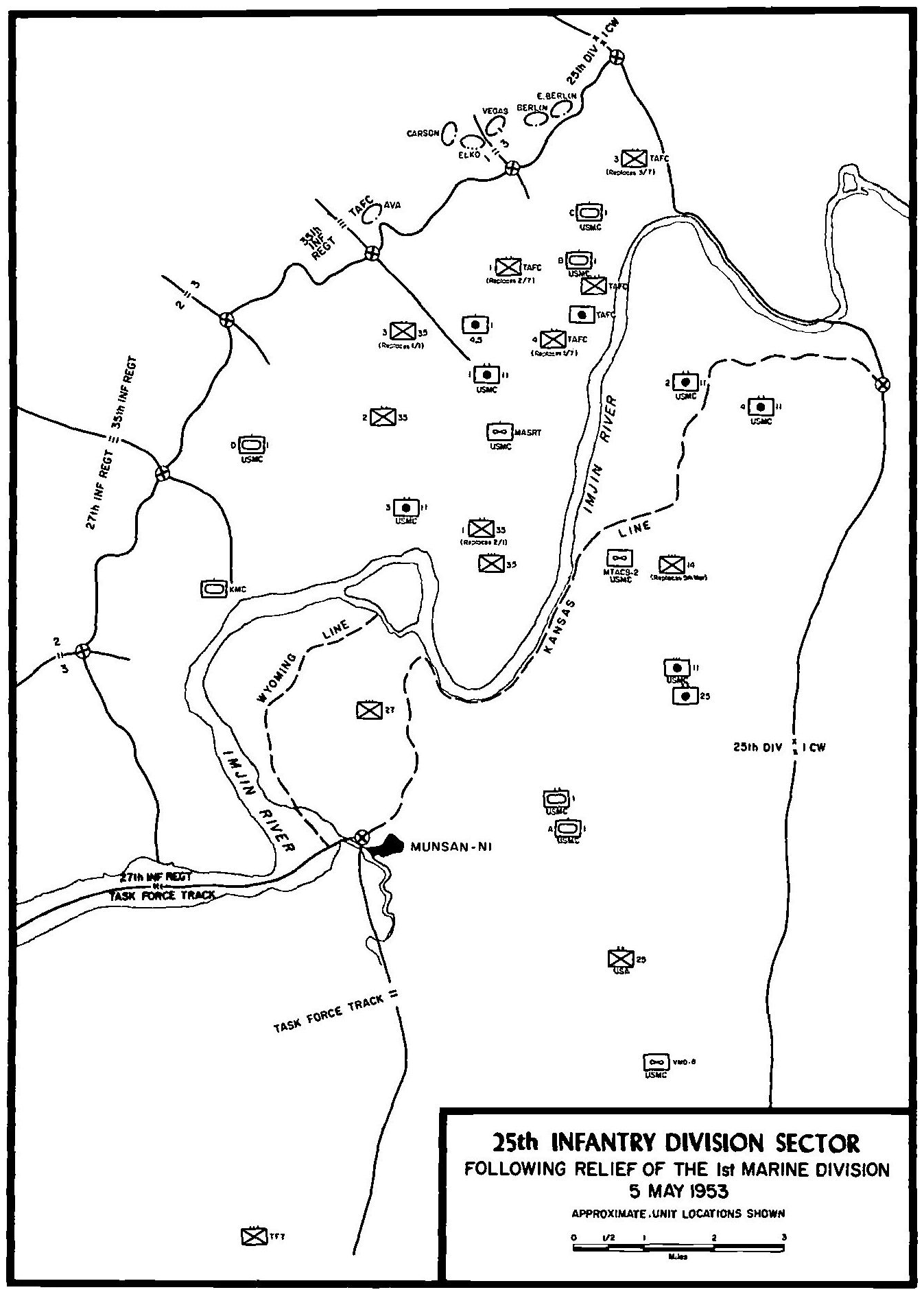
MAP 28 K. White
25th INFANTRY DIVISION SECTOR
FOLLOWING RELIEF OF THE 1st MARINE DIVISION
5 MAY 1953
I Corps Operation Orders No. 31 and 32 had directed that the
11th Marines remain on line in the sector attached to I Corps Artillery,
with a general support mission of reinforcing the fires of the
25th Division artillery, and a secondary task of coordinating counterbattery
support. The medium battalion, 4/11, and the 1st 4.5-inch
Rocket Battery, furnished general support for I Corps. Regimental
and battalion CPs, as well as the rocket battery, continued to occupy
their same locations. A change affected the KMC artillery battalion,
however; when transferred to I Corps artillery control it displaced
from the Marine sector, with a new general support role of reinforcing
the I Corps line.
Also on 5 May, at 1130, the 1st Tank Battalion416 passed to 25th
Division control. Two companies, C and B, were assigned to the
TAFC (which had no armored units) in the left and right battalion
areas, respectively. Company D vehicles came under command of the
35th Infantry Regiment, in the center sector; while A, the remaining
company, was designated as the single reserve unit. This was a modification
of the Marine system of maintaining two tank companies in
reserve, one a short distance behind the MLR and the other, at the
armored battalion CP near Munsan-ni. A change in tactics also took
place when the Marine tanks came under Army operational control.
It had been the Marine practice to retain the tanks at the company
CP from where they moved to prepared firing slots at the request of
the supported infantry unit.
When the 1st Tank Battalion was attached to the 25th Division,
the armored vehicles were shifted to firing slots near the MLR where
they occupied semifixed positions.417 Armored personnel carriers
(APCs) were assigned by the Army to Company B and used by
both B and C as resupply vehicles to haul food, water, fuel, and
ammunition to the tanks on line. Also as part of the relief, control
of the KMC tank company was transferred from the Marine 1st
Tank Battalion to I Corps, although the company still continued in
its same location in the old KMC sector.
Also remaining in their same positions were MASRT-1 (Marine
Air Support Radar Team One), in support of the 25th Infantry
Division, MTACS-2 (Marine Tactical Air Control Squadron Two),
and VMO-6. The mobile air support section of the observation
squadron, however, had moved with the 1st Marine Division to the
new Casey area for participation in the coming MARLEX operations
scheduled during the reserve training period.
Thus with the relief completed, components of the old Marine
division front, from left to right, were: the Kimpo Provisional
Regiment; Task Force Track; the 27th Infantry Regiment; 35th
Infantry Regiment in the center sector, including its armor and heavy
mortar company and 2d and 3d Battalions forward, replacing the 1st
Marines 3d and 1st Battalions; and in the right sector, the Turkish
Brigade 4.2-inch mortar company and its 1st and 3d Battalions
initially located418 in the MLR positions vacated by the 2d and 3d
Battalions, 7th Marines.
In addition to the 1st Marine Division railhead and truckhead at
Munsan-ni and Ascom City, a subsidiary railhead/truckhead was
opened at Tongduchon-ni, two miles southwest of the new division
CP at Casey. No change was made in the airhead at K-16. Effective
with the 5 May change, remaining elements of the division CP staff
at Yongji-ri joined the advance elements at Casey. As the Marines
moved off the front lines they received “well-done” messages from
the Commandant, General Shepherd, and the U.S. Pacific Fleet Commander
in Chief, Admiral Arthur W. Radford, as well as the new
I Corps Commander, Lieutenant General Bruce C. Clarke419 who
cited the “excellence of the planning, coordination and cooperation
which enabled the operation of the past few days to be successfully
accomplished.”420
Training While in Reserve and Division
Change of Command421
While the division was in reserve, its tactical mission consisted of
preparation for commitment on I Corps order as a counterattack
force in any of the four division sectors of I Corps. Division Operation
Plan 7-53 implemented this I Corps Plan “RESTORE” and set
forth the designated blocking positions in the 25th Army, Commonwealth,
1st ROK, and 7th Army Division sectors in event of threatened
or actual enemy penetration of the MLR.
The 1st Marine Division’s Training Order 8-53, issued on 6 May,
the day after the relief was officially effected, outlined the training
to be accomplished during the eight-week reserve period, 10 May-5
July. Following a few days’ interval devoted to camp construction
and improvement of facilities, an active training program commenced.
Its objective was the continued improvement of amphibious
and ground offensive combat potential of all personnel. Three major
regimental combat team MARLEXES were scheduled.422 The training
syllabus called for a four-phased progressive schooling from individual
to battalion and regimental level conducted in all phases of
offensive, defensive, and amphibious warfare. Weaponry familiarization,
small unit tactics, and combined unit training, with tank-infantry
deployment and integration of helicopters at company-level
exercises, were emphasized, culminating in a week-long field
maneuver.
Lectures were to be kept to a minimum, with at least 50 percent
of the tactical training conducted at night. Specialty training in
intelligence, signal communications, antitank and mortar, machine
gun, mine warfare, and staff NCO schools was also prescribed.
Numerous command post exercises were programmed to obtain a
high standard of efficiency in both battalion and regimental-level
staff functioning. It was the first time the division had been in
reserve since a brief two-week period in late July-August of 1951.
A brisk 40–44 hour week, plus organized athletics, insured that the
training period was to be fully utilized.
No time was lost getting under way. At a staff conference with
battalion commanders on 11 May, General Pollock, division CG,
stressed the importance of using the time they were in reserve for
enhancing division combat-readiness. Even as he spoke, his 5th
Marines had the day before boarded ships at Inchon and were en
route to the Yongjong-ni landing area for MARLEX I. Since the 5th
Marines, in division reserve, had been the first of the regiments to
displace and on 1 May had turned its sector over to the incoming
14th Infantry Regiment, it got the jump on training during the
reserve period. Regimental Operation Plan 12-53, of 28 April, had
outlined requirements for the 5th Marines RCT LEX 1; from 2–9
May the regiment had participated in a week of intensive amphibious
training, including reduced and normal distance CPX dry runs for
the coming MARLEX.
With ships from CTE 90.85,423 and air defense by VMFs-311 and
-115, Colonel Tschirgi’s RCT-5 made the D-Day landing on 13
May with its two assault BLTs securing the objective. An unexpectedly
shallow beach gradient and difficulties encountered in
unloading vehicles from the causeway resulted in less than a 100
percent performance rating. These were deficiencies that might have
been prevented had not the customary rehearsal been cancelled the
previous day when a heavy fog obscured the landing beaches.
Besides regimental antitank and 4.2-inch mortar units, participating
support elements included Company D, 1st Tank Battalion; Company
A, 1st Armored Amphibian Battalion; Company C, 1st
Engineer Battalion; 1/11; and helicopters from HMR-161 and
VMO-6.
Meanwhile, on 15 May, command post and subordinate units from
the 1st, 5th (less RCT-5 currently deployed in MARLEX I), and 7th
Marines and support elements took part in a one-day division CPX
at Camp Casey stressing mobility, security and operational procedures.
Another CPX on 22–23 May by 11th Marines and engineer
personnel emphasized dispersion, camouflage, and message handling
under simulated combat conditions. Units of the three infantry
regiments plus the KMCs training with the 7th Marines at Indianhead
combined in a CPX-FEX (command post-firing exercise) on
26–27 May. Realism bowed to current ordnance supply economics in
that ammunition was carried for individual weapons, but it would
“not be loaded except on specific orders from an officer.”424
The CPX-FEX was held as a trial exercise for an Eighth Army
CPX scheduled later in the month, which was postponed indefinitely
on 29 May because of the critical battlefront situation and continuing
enemy attacks across the EUSAK front. Extensive preparations
were also underway for MARLEX II, with RCT-7, from 2–10 June;
and concluding MARLEX III, scheduled 14–23 June, with RCT-1.
Armor and advance regimental elements had left for the Ascom
City-Inchon staging area by 1 June, preparatory for departure to
the Yongjong-ni beaches on the Korean west coast in the vicinity of
Kunsan. The troop list included approximately 250 officers and 4,450
enlisted from Colonel Funk’s 7th Marines and support units, including
USN and KMC. Infantry personnel from the regiment’s three
battalions formed the three assault teams plus a reserve battalion
composed of 475 Korean Marines designated as BLT 5/KMC.
Regimental support units included Company C, 1st Engineer Battalion;
Company D, 1st Medical Battalion; Company C, 1st Shore
Party Battalion; Company B, 1st Armored Amphibian Battalion,
and various motor transport, amphibian truck, military police, and
helicopter detachments.
R-Day on 5 June went off per schedule. Despite intelligence
estimates which cheerily predicted that only “nine days of rain can
be expected during the month of June”,425 RCT-7 drew one out of
the barrel with its D-Day landing, 6 June. This took place during
heavy rains and decreased visibility which threw the boat waves off
phase by minutes and required more than the allotted time for
HMR-161 troop and cargo lifts.
Use of a 144-foot-long M-2 steel treadway pontoon bridge loaned
by the Army, emplaced from the end of the causeway to the beach
high water mark, was considered highly successful. It solved unloading
problems encountered in the earlier MARLEX, in that all heavy equipment
and vehicles were landed on the designated beaches. Further
experimentation with this novel employment of the M-2 was recommended
to test the coupling system of bridge and causeway during
periods of heavy surf. On the minus side, shore party officers noted
that night transfer operations had been hindered because of the lack
of running lights on the amtracs.
On 9 June, as RCT-7 was on the way back from its amphibious
exercise, a directive from ComNavFE (Vice Admiral Robert P.
Briscoe) notified the division of cancellation of the forthcoming RCT
MARLEX III. All available shipping was being held on 24-hour readiness
for the expected final repatriation of POWs (Operation BIG
SWITCH). All afloat training exercises by Marine, Army, and Navy
units between 6 June and 15 October were to be cancelled.
The division was host to ranking I Corps, Eighth Army, Korean,
and 1st Commonwealth officials when a special helicopter assault
demonstration was staged 11–12 June at Camp Casey. Two rocket
launcher sections, 14 HMR-161 copters, and 2/5 infantrymen were
deployed to show the diverse combat capabilities of the aerial workhorse.
While in I Corps reserve, the division was also host—and
winner—of the I Corps Pistol Matches. And 3/11, which the previous
month had taken the Army Training Test 6-2 (a) Modified,
was notified the battalion had scored 92.91 percent and received
congratulations from the CGs, I Corps Artillery and Eighth Army.
A change of command within the 1st Marine Division took place
on 15 June with the arrival of Major General Randolph McC. Pate.
The retiring CG, General Pollock, was presented the Distinguished
Service Medal by the I Corps commander, General Clarke, for his
“outstanding success in the defense of Carson, Vegas, and Elko.”
The previous month, General Pollock had received the Korean Order
of Military Merit, Taiguk for his active part in the formation, development,
and training of the Korean Marine Corps. Attending the
change of command ceremonies were General Megee, CG 1st MAW,
General Schilt, CG AirFMFPac, and other Marine, I Corps, Commonwealth,
and Korean senior officers.
The new 1st Marine Division CG was coming to his Korean post
from Camp Lejeune, N. C. where (like General Pollock before him)
he had most recently commanded the 2d Marine Division. Commissioned
originally in the Marine Corps Reserve in 1921, General
Pate was to later rise to four-star rank. Prior to World War II,
he had seen expeditionary service in Santo Domingo, in 1923–1924,
and in China from 1927–1929, and also served in Hawaii. For his
outstanding service and skill in complicated staff duties, first at
Guadalcanal, and later during amphibious operations at Peleliu,
Iwo Jima, and Okinawa, General Pate had been awarded the Legion
of Merit and a Gold Star in lieu of a second Legion of Merit.
After the war, he had served two tours as head of the Division
Reserve, in 1946 and 1951. Other assignments included Director of
the Marine Corps Educational Center at Quantico and Deputy
Director of Logistic Plans in the Office of the Joint Chiefs of Staff.426
After the early May change of lines, the Chinese lost little time
in testing the new UNC defenses. Shortly after 0200 on 15 May, the
CCF directed a two-battalion probe on the Carson-Elko-Vegas trio
and the Berlin-East Berlin outposts newly held by the Turkish
brigade. Supported by heavy concentrations of mortar and artillery,
one battalion of enemy soldiers moved against each of the two major
defense complexes. Marine Company C tanks, occupying the firing
slots that night, accounted for heavy enemy losses in the action,
estimated at 200 CCF killed and 100 wounded. Assisting the TAFC
Field Artillery Battalion in throwing back the attack were 1/11,
2/11, and 4/11 which sent 3,640 rounds into the sharp four-hour
engagement.
The TAFC defense was further reinforced later that day with 21
air strikes against hostile personnel and weapons positions north of
the Turkish sector. Adding their weight to the clash, 3/11 and the
rocket battery also brought their guns into action, for a combined
5,526 Marine rounds428 dispatched against the enemy.
It was not until 25 May, after the UNC had made its final offer
at the truce talks, however, that CCF artillery really began to open
up on the Nevada complex. The increased activity by hostile pieces,
during the 25–27 May period, was duly noted by the artillery
Marines who laconically reported, “Operations followed the recent
pattern: enemy shelling of the Turkish Brigade increased during
the afternoon; no contacts were reported.”429
This latter situation changed abruptly on 28 May. Beginning at
1800, major elements of the Chinese 120th Division launched simultaneous
attacks over 17,500 yards of I Corps front that stretched
from COP-2 eastward to that consistent trouble-spot, the Nevada
Cities, on to the Berlins, and finally the Hook area in the adjacent
Commonwealth Division sector. Supported by heavy artillery fires,
one CCF battalion moved in towards Carson and Elko. Another
battalion,430 under cover of smoke, attacked central COP Vegas, while
a third struck Berlin and East Berlin on the right flank. Three hours
after the initial attack, defenders at Carson and Elko were engaged
in hand-to-hand combat with the Chinese.
By midnight the men of the 35th Infantry had beaten back the
attack at COP-2. The Turks, likewise, were still in possession of
the two Berlin (platoon-strength) outposts, but Commonwealth
forces were involved in a pitched battle at Ronson and Warsaw. The
situation was even grimmer at this time in the Nevada Cities area
outposted by the TAFC. Although the Turkish troops continued to
hold Vegas, where 140 men were dug in, Carson (two-platoon size)
had fallen and Elko (platoon-strength) was heavily besieged.
Shortly thereafter, the 25th Division ordered that the TAFC withdraw
from the latter position to its own MLR. The diversionary
attack against Berlin-East Berlin had been broken off and the twin
positions were secured.
During the first six hours of the attack, the night of 28–29 May,
Colonel Mills’ 11th Marines, now under I Corps command, had sent
9,500 rounds crashing into Chinese strongpoints, while Marine air
observers directed eight missions against active enemy artillery positions.
Ripples from the 1st 4.5-inch Rocket Battery, transferred to the
Commonwealth sector to support the Hook defense, were fired on
CCF troop activity there. Another curtain of flame engulfed the
Carson intruders. When the fighting started, 15 Marine tanks were
positioned in the Turkish sector. Company B and C vehicles, under
Captains James M. Sherwood and Robert J. Post, relentlessly
pounded the approaching CCF columns, while Company D was put
on a 30-minute standby. As the action developed, additional tanks
were committed until 33 were on line at one time or another.431
When savage Chinese pummeling of the 25th Division outposts
continued the following day, Colonel Nelson’s 1st Marines was transferred
at 1315 to operational control of I Corps. The regiment’s
three infantry battalions, antitank, and heavy mortar companies
promptly moved out from their Britannia headquarters and within
two hours had relocated at 25th Division bivouac areas south of the
KANSAS line in readiness for counterattack orders. The 1st Marine
Division Reconnaissance Company was similarly ordered to 25th
Division control to relieve a 14th Infantry Regiment reserve company
in position along the east bank Imjin River defenses.
Overhead, close air support runs were being conducted by pilots
of Marine Attack Squadrons 212, 121, and 323. A series of seven
4-plane strikes hit repeatedly from noon on those Chinese troops,
hardware, and resupply areas north of the 25th Division line. The
aerial assault continued late into the night with MPQ missions
executed by VMA-121 and VMF-311.
During the 29th, control of the Vegas outposts—where 1st Division
Marines had fought and died exactly two months earlier—changed
hands several times between the indomitable Turkish defenders
and the persistent Chinese. By dark, the CCF had wrested the
northern crest from the TAFC which still held the southeastern face
of the position. In the 24-hour period from 1800 on the 28th through
the 29th, the 11th Marines had expended 41,523 rounds in 531
missions. At one point in the action Chinese counterbattery fire scored
a direct hit on Turkish gun emplacements, knocking six howitzers
out of action from the explosions of charges already loaded. As
a result 2/11, under its new battalion commander, Major Max
Berueffy, Jr., took over the direct support mission of the TAFC
Brigade. Marine artillery spotters on station from 0450 to midnight
directed 42 fire missions on CCF guns, while the rocket battery unleashed
20 ripples against troop activity, one of which caused 50
WIAs. Although an Allied counterattack early in the day had
restored Elko to friendly control, the enemy refused to be dislodged
from Carson.
I Corps had previously regarded the defensive positions of the
Nevada complex as “critical,” with the TAFC having been “instructed
to hold them against all enemy attacks.”432 By midday on
the 29th, however, the I Corps commander, General Clarke, and
25th Division CG, General Williams, had apparently had a change
of mind. The Vegas strength was down to some 40 Turks. Altogether
more than 150 men under the 25th command had been killed and
another 245 wounded in defense of Nevada positions. It appeared
that the Chinese, constantly reinforcing with fresh battalions despite
estimated losses of 3,000, intended to retain the offensive until the
outposts were taken.
With Carson and Vegas both occupied by the enemy, the Elko
position became untenable without the support of its sister outposts.
Six times the CCF had crossed over from Carson to Elko to try to
retake the latter position, but had been thus far deterred by Allied
firepower. Accordingly, at 2300, the 25th Division ordered its reserve
14th Regiment, earlier committed to the Elko-Carson counterattack,
to withdraw from Elko and the Turks to pull back from Vegas to
the MLR. By daybreak the withdrawal was completed and 25th Division
and Turkish troops had regrouped on the MLR.
The Army reported that more than 117,000 rounds of artillery
and 67 close air support missions had buttressed the UNC ground
effort. Official estimates indicated that in the three-day action the
Chinese had fired 65,000 rounds of artillery and mortar, “up to this
point an unprecedented volume in the Korean War.”433 The Marine
artillery contribution from its four active battalions during this
28–30 May period totaled 56,280 rounds in 835 missions.
During the three-day siege, 15 to 33 Marine tanks poured their
lethal 90mm projectiles on the enemy from MLR firing slots. At
times the action was so heavy that the tanks were refueled on line.
As they ran out of ammunition and fuel, “armored utility vehicles
of the battalion, with a basic load of ammunition aboard, maneuvered
beside the tanks in position and rearmed them on the spot,”434
to permit virtual uninterrupted tank firing. One Marine was killed in
the action the first night. Although 4,162 rounds of Chinese fire
fell near the tank positions, no damage to materiel was reported.
For their part the M-46s and flames were responsible for 721 enemy
deaths, an estimated 137 more killed, 141 wounded, and an estimated
1,200 injured.
During the second day of action, nearly 20 missions were flown
by Corsairs and Skyraiders of the three Marine attack squadrons
and the jet fighters of VMF-311 and -115. Altogether throughout
28–30 May, Marine aircraft had flown no less than 119 sorties for
the inflamed sectors of the U.S. Army 25th Division and adjacent
British 1st Commonwealth Division. Of these, 99 were in support
of the sagging Carson-Elko-Vegas-Berlins line.
Ground action ceased the following day as rain drenched the
battlefield, although the 11th Marines reported sightings of more
than 200 Chinese soldiers, most of them on the three recently lost
outposts. Benched while the fierce battle was going on, the 1st
Marines remained under operational control of I Corps as a possible
contingency force from 29 May to 5 June. On the latter date, following
the Eighth Army decision not to retake the Carson-Elko-Vegas
outposts, the regiment reverted to Marine control and returned to
Camp Britannia. The previous day the Communists had agreed on
all major points of the UNC final offer and it appeared that a ceasefire
was close at hand.
Diplomats and military leaders both felt this latest Chinese
assault was to show a strong military hand and win dominating
terrain features along the MLR. Thus the enemy would be able to
improve his defensive posture when final battlelines were adjusted
at the truce. It was not believed that the CCF effort was an attempt
to expand their operations into a general offensive. In any event, the
Nevada positions were downgraded from their previous designation
as major outposts. I Corps also decreed no further effort would be
made to retake them and that a “revaluation of the terrain in view
of the destruction of the defensive work indicates these hills are
not presently essential to defense of the sector.”435
If things were now relatively quiet along the battlefront of the
I Corps coastal sector, the situation had begun to heat up in the
central part of the UNC defense line. On 10 June, following a CCF
realignment of troops and supply buildup that had not gone unnoticed
by Eighth Army intelligence officials, elements of the CCF
60th and 68th Armies struck the ROK II Corps area, on the east-central
front. (See Map 29.) Advancing south along both sides of
the Pukhan River with two divisions, the Chinese struck at the
ROK II defense line which originally had bulged out to form a
salient in the Kumsong vicinity. Within six days the ROK line had
been forced back 4,000 yards. In subsequent assaults the enemy made
new penetrations further west in the ROK II MLR. Although the
main Communist thrust was directed against the ROK II Corps,
secondary attacks were also made in the X Corps sector east of
ROK II, in the Punchbowl area manned by the ROK 20th Division.
It was the heaviest, all-out drive since the CCF spring offensive of
April-May 1951, when the UNC had been pushed south approximately
30 miles across the entire Korean front.
By 18 June, the CCF assaults started to settle down. During the
nine days of flaming action, ROK units had suffered some 7,300
casualties to enemy losses of 6,600. Boundaries had been redrawn and
three ROK divisions had been redeployed in counterattacks to plug
holes in the line that the Chinese had punched open. Nearly 15,000
yards of ROK front had been pushed 4,000 yards south and several
hill positions east of the Pukhan had been lost.
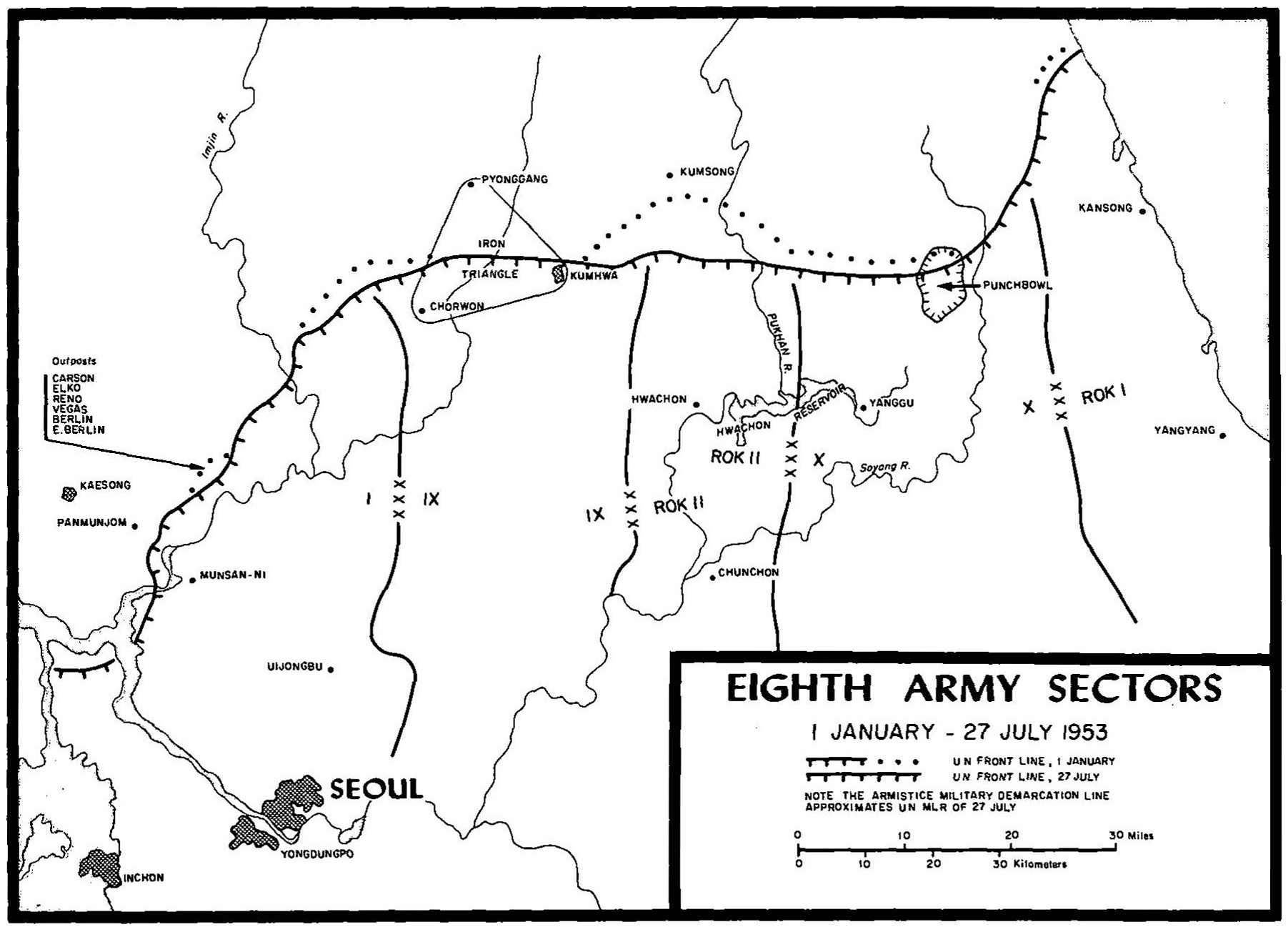
MAP 29 K. WHITE
EIGHTH ARMY SECTORS
1 JANUARY-27 JULY 1953
The brief respite ended 24 June when the CCF again directed
heavy blows against the ROK troops, ignoring other UN forces in
the Eighth Army line. It was generally considered a retaliatory move
for the 18 June mass release of anti-Communist prisoners by South
Korean President Rhee. This time the major target of the renewed
Chinese offensive was the ROK 9th Division, in the IX Corps sector
immediately west of the ROK II Corps. On 25 June the 1st ROK
Division on the eastern flank of I Corps, to the right of the 1st
Commonwealth Division, was pounded by another Chinese division.
Significantly, the date was the third anniversary of the invasion of
South Korea.436 The 7th Marines, training in I Corps reserve, was put
on standby status. The regiment was removed the following day
when the 1st KMC/RCT (minus its 3d Battalion) was instead placed
in readiness,437 and subsequently moved out from its Indianhead area
to be committed as a relief force in the left sector of the 1st ROK
line.
By the 26th, the persistent Chinese probes of the 1st ROK sector
had resulted in several forward outposts being overrun. To help
stem the action the Marine 1st 4.5-inch Rocket Battery was displaced
on I Corps Artillery order from its regular position (in the right
regimental sector) 20 miles east to support the hard-pressed ROK
division. On at least two occasions the battery placed ripples between
ROK positions only 600 yards apart and it was felt that these
“continued requests for fire close to friendly troops attested to the
gunnery of the unit.”438 Between that date and the 30th, the rocket
battery remained in the ROK sector, firing a total of 25 ripples. For
the 25th Infantry Division sector, however, the front continued undisturbed
throughout the entire month of June.
While the division was in I Corps reserve during the greater part
of the April-June period, the 6,800-man 1st Marine Aircraft Wing
continued its missions as an operational component of Fifth Air
Force. For the Marine air arm it was a time of a major tactical
innovation, a number of new air records set, and rapid personnel
changes in the squadrons.
Shortly before the Marine division went off the line, a new method
of close air support at night was introduced. This employed the use
of two or more ground controlled 24-inch searchlights located on
prominent terrain features along the MLR in the 7th Marines left
battalion sector where the missions were to be flown. Enemy-held
reverse slopes—in some cases less than 500 yards from Marine positions—were
thereby pinpointed by the powerful intersecting searchlight
beams. These long pencil-shaped beams created an excellent
artificial horizon and enabled pilots to make bombing or strafing
runs with a high degree of accuracy even on the blackest of nights.
Manned by ANGLICO personnel, the lights were employed either
for target location or illumination (both shadow and direct). A
tactical airborne observer in an OE light liaison plane of VMO-6
directed the searchlight teams and controlled the missions.
A week of experimentation and trial runs to perfect the night
close air support (NCAS) was conducted by several VMF(N)-513
pilots under direction of Colonel Jack R. Cram. Formerly CO of
Marine Air Control Group Two at K-3, he had extended his tour in
Korea to complete work on the new program. On 12 April, the first
night of operations, Major Charles L. Schroeder and Second Lieutenant
Thomas F. St. Denis flew two night support missions in F7F
Tigercats. Although employed only a few weeks prior to the division
going into reserve on 5 May, the new system rated an enthusiastic
response from both pilots and ground commanders, all the way up
to the division CG. As the latter reported to the Commandant
following the first week of night close support missions, “results ...
exceeded all expectations.”440
Between 12 April and 5 May, the night fighter squadron conducted
58 NCAS sorties in the division right sector employing this
new control system with excellent results.441 The procedure was a
marked success and made it possible to provide continuous 24-hour-a-day
close support to Marine infantry units. It was considered a
supplement to, not a replacement for the MPQ (radar controlled
bombing) missions of MASRT-1. Plans called for F9F aircraft to
be integrated into the program, since the F7F Tigercats were being
replaced by jets. Allied psychological warfare teams on 17 April
introduced a different theme in their broadcasts to the enemy: that
of the dangers to the CCF from the new searchlight marking of
targets. As a Marine training bulletin noted: “It is believed that this
method of attack by aircraft is particularly demoralizing to the
enemy because he is unable to anticipate where the strike will hit,
and therefore has no means of defending himself against it.”442
Another tactical improvement about this same time dealt with
artillery flak suppression in support of close support aircraft. Two
refinements made in the procedure in the late spring of 1953 involved
firing of HE rounds during the actual run of planes over
the target. Basically, the plan consisted of releasing a TOT or VT
concentration on the most lucrative enemy antiaircraft positions
within a 2,500-yard circle around the strike area. A continuous rain
of HE-fuzed projectiles was placed on these targets for a three-minute
period, during which Marine planes made their runs.
Favorable results were achieved in that new system tended to
keep enemy antiaircraft gunners off-balance for a longer period of
time and thus decreased the danger to friendly attacking aircraft.
On the other hand, pilots quickly noted that this became an “unimaginative
employment of an unvarying flak suppression schedule
which Communist AA gunners soon caught onto and turned to their
own advantage.”443
With respect to squadron hardware, Marine combat potential
increased substantially during the spring months with the phasing
out of F7Fs in Night Fighter Squadron 513 and introduction of
the new F3D-2 twin-jet Skyknight intruder. By late May the Allocation
of 24 of these jet night fighters had been augmented by 4
more jets from the carrier USS Lake Champlain and the squadron
“assumed its primary night-fighter mission for the first time in the
Korean War.”444 While the sturdy, dependable Tigercats445 made
their final contribution to the United Nations air effort early in May
with the experimental NCAS program, the new Skyknights continued
the squadron’s unique assignment inaugurated in late 1952
as night escort to Air Force B-29 bombers on their strike missions.
Not a single B-29 was lost to enemy interceptors after 29 January
1953. The capabilities of the skilled Marine night-fighters were noted
in a “well done” message received by the CO, VMF(N)-513 in
April from the Air Force.446
Organizational changes within the wing included the arrival, on
29 May, of a new MAG-12 unit to replace the “Checkerboard”
squadron. VMA-332 (Lieutenant Colonel John B. Berteling) was
slated to operate on board the USS Bairoko (CVE-115) for the F4U
carrier-based squadron VMA-312447 due for return to CONUS. Veteran
of 33 months of combat while attached to the wing as West
Coast (CTE 95.1.1) aerial reconnaissance and blockade squadron,
VMA-312 (Lieutenant Colonel Winston E. Jewson) was officially
relieved 10 June. The change, moreover, was the first phase of a new
personnel policy, carrier unit rotation, that was expected to implement
a unit rotation program for land-based squadrons. It was
anticipated that the new unit rotation program would eliminate inherent
weakness of the individual pilot rotation system and thus
increase the combat effectiveness of the wing.448
During the period other organizational changes included transfer
of administrative control of VMF(N)-513 on 15 May from MAG-33
to MAG-12.449 The squadron, with its new twin-engined jet
fighters, moved from K-8 (Kunsan) further up the coast to the
MAG-12 complex at K-6 (Pyongtaek), upon completion of the
new 8,000-foot concrete runway there. This phased redeployment of
nightfighter personnel and equipment began in late May and was
concluded on 6 June without any interim reduction of combat commitments.
Replacement of the squadron F7F-3Ns with F3D-2s was
also completed in early June.
Late that month, plans were underway for two additional changes:
the Marine photographic squadron, VMJ-1, was due to be separated
administratively and operationally from MAG-33 on 1 July and
revert to 1st MAW; and Marine Wing Service Squadron One
(MWSS-1) was to be deactivated, effective 1 July.
The change of command relationships between CG, FAF and CG,
1st MAW earlier in the year450 which had restored operational control
of certain designated Marine air units to the wing commander,
increased the efficiency of 1st MAW operations. Despite the fact
that VMJ-1 at times contributed nearly 40 percent to the total FAF
input of all daylight combat photographs,451 aerial intelligence (both
pre- and post-strike photos) supplied to wing and group headquarters
was considered inadequate. As a MAG-33 intelligence
officer commented with some exasperation as late in the war as May
1953:
The Section continued to experience difficulty in obtaining 1:50,000
scale overlays of friendly MLR and OP positions. These overlays are
important for making up target maps for close support missions, but they
are continually held up for long periods by higher echelons, and, if received
here at all, are then often too old to be considered reliable.452
Similarly, at the individual squadron level, the carrier unit VMA-312
shortly before its relief, reported: “The one limitation on squadron
activities continued to be photo coverage of the strikes. With
limited facilities available, the squadron has no clear cut pictures of
strike results.”453 Return of VMJ-1 to operational control of General
Megee ultimately “gave the Wing adequate photo-intelligence for
the first time since commencement of combat operations in Korea.”454
Indoctrination of new replacement personnel within the 1st Marine
Aircraft Wing took a swift upturn during the spring period. Pilots
who had completed 100 combat missions were transferred to staff
duty elsewhere in the wing in Korea or rotated Stateside. The
average squadron personnel strength ran to 88 percent of T/O for
enlisted; and officer strength, considerably less, frequently dipped
as low as 61 percent. Under the 100-missions policy, it was a time
of rapid turnover of unit commanders, too, as witnessed from the
following squadron diary entries:
VMA-212—Lieutenant Colonel James R. Wallace assumed command
from Major Edward C. Kicklighter, effective 19 June; the latter had been
squadron ExO and acting CO in interim period following 30 April departure
of former CO, Lieutenant Colonel Smunk;
VMA-323—Lieutenant Colonel Clarence H. Moore vice Lieutenant
Colonel Frash, on 11 April; and Major Robert C. Woten succeeding
Lieutenant Colonel Moore on 27 June;
VMA-121—Major Richard L. Braun vice Lieutenant Colonel Hughes,
on 21 April;
VMF(N)-513—Lieutenant Colonel Ross S. Mickey vice Lieutenant
Colonel Conley, on 6 May; in June, Lieutenant Colonel Robert L. Conrad,
acting CO, named CO for Lieutenant Colonel Mickey, hospitalized for
injuries received in a May aircraft accident;
VMJ-1—Lieutenant Colonel Leslie T. Bryan, Jr. vice Lieutenant Colonel
William M. Ritchey, on 15 May;
VMF-311—Lieutenant Colonel Arthur M. Moran vice Lieutenant Colonel
Coss, on 21 April; Lieutenant Colonel Bernard McShane vice Lieutenant
Colonel Moran, on 1 June;
VMF-115—Lieutenant Colonel Lynn H. Stewart vice Lieutenant Colonel
Warren, 5 June.
With respect to CAS activities, excellent weather in April—only
a single day of restricted flying—brought the 1st MAW air
tally that month for its land-based squadrons to 3,850 effective
combat sorties (440 more by VMA-312) and 7,052.8 combat hours.
This was a substantial increase over the preceding months. Not surprisingly,
the average daily sortie rate for the month was correspondingly
high: 128.3. Of 1,319 CAS sorties the largest proportion, 579
and 424 (43.9 percent, 32.1 percent), were for Marine and ROK
operations, respectively.
The outstanding day of the month was 17 April. During the 24-hour
reporting period, 262 sorties were completed by MAGs-33 and -12
pilots,455 who expended a combined total of 228.3 tons of bombs and
28,385 rounds of 20mm ammunition. For the two MAG-33 fighter
bomber squadrons, it represented maximum effort day. Preparation
had been made a week earlier to devise the targeting and best all-round
flight schedules for ordnance and line sections. Objective areas
for the mass attack were picked by the wing G-3 target selection
branch and approved by the EUSAK-Fifth Air Force JOC. It was
decided that “flights of eight aircraft staggered throughout the day
would offer the best efficiency in expediting reloading and refueling
with not more than sixteen aircraft inactive on the flight line at one
time.”456 Throughout the day, from 0410 to 2030, VMFs-311 and
-115 continuously pounded designated targets in support of the U.S.
7th and 3d Infantry Divisions.457 Commented MAG-33:
Hitting an all-time high in the annals of memorable days, this, the
seventeenth of April not only further proved MAG-33’s ability to cripple
the enemy’s already diminishing strength but it also allowed VMF-115
to set records in total airborne sorties launched in a single day plus a
record total ordnance carried and expended in one day by jet type aircraft.458
VMF-115 alone, with 30 pilots and 23 aircraft, had flown 114
sorties and delivered 120 tons of bombs on North Korean targets.
A sample of the intensity of this maximum day was a series of three
early-morning interdiction strikes led by three VMF-115 pilots that
launched the effort. Led by Lieutenant Colonel Joe L. Warren, Major
Samuel J. Mantel, Jr., and Major John F. Bolt, the 23 attacking Panther
jets lashed the objective with 22.35 tons of ordnance and 4,630
rounds of 20mm ammunition. The three missions destroyed half of
the buildings and inflamed 95 percent of the target area in the enemy
supply concentration point T’ongch’on on the Korean east coast.
By contrast, wing operations in May were considerably hampered
by the bad weather peculiar to this time of the year in Korea. Restricted
flying conditions were recorded for 18 days of the month. A
total of 153 CAS sorties were flown for the Marine division before
its 5 May relief from the front lines. Of the wing’s 3,359 sorties459
during the month, 1,405 were for close support to forward units
beating back Communist encroachment efforts. The allocation of
CAS sorties was 412 for U.S. infantry divisions (including 211 for
the 25th Division occupying the customary Marine sector); 153
for the 1st Commonwealth Division at the Hook which the Communists
assaulted on 27–28 May as part of their overall thrust against
western I Corps defenses; 412 sorties for ROK units; and 63, miscellaneous.
Heaviest action for Marine aviators took place towards
the end of the month to thwart enemy blows in the I Corps sector
where Army and Turkish units were attempting to repulse the Chinese.
The renewed effort of the Chinese Communists against UNC
ground forces in late May continued sporadically the following month.
A number of new records were set by Marines flying CAS assignments
under the Fifth Air Force. During the intense mid-June attacks
on the ROK II Corps area and adjacent X Corps sector, MAGs-12
and -33 pilots chalked up some busy days. Between 10–17 June,
Marine, Navy, and Air Force aircraft had flown 8,359 effective sorties,
the bulk of this massive FAF effort to buttress the crumbling
ROK defense. Of this number, Marine sorties totaled 1,156, or nearly
14 percent. (Combat sorties for the 1st MAW throughout June
came to 3,276 despite 23 days of marginal to nonoperational weather.)
Marine pilots scored as high as 48 percent of a single day’s
interdiction strikes made by FAF. This occurred 15 June when the
1st MAW flew a record-breaking 283 sorties, followed by another
peak 227 sorties the next day.
Actually, when the ground situation in the ROK II Corps front
began to deteriorate on 12 June, the new Fifth Air Force commander,
Lieutenant General Samuel E. Anderson, “waived the [3,000 foot]
minimum-altitude restrictions on his fighter-bombers and ordered his
wings to give all-out support to the Eighth Army.”460 The Seventh
Fleet commander, Admiral Clark, likewise kept his carriers on line
for seven days and ordered its naval pilots to “team with Marine
and Fifth Air Force airmen for a close-support effort exceeding anything
up to that time.”461 When the ROK II Corps defenses cracked
open on 15 June, temporary clearing weather “allowed General
Anderson and Admiral Clark to hit the Reds with everything they
had. FEAF planes flew a total of 2,143 sorties of all kinds for the
largest single day’s effort of the war.”462
Commenting on this heavy action period, 14–17 June, a dispatch
to General Megee from the new FAF commander, who had succeeded
General Barcus the previous month, noted:
The figures are now in. From 2000, 14 Jun 53, to 0001, 17 Jun 53,
Fifth Air Force units flew a total of 3,941 combat sorties. The cost was
9 pilots lost, 11 aircraft lost, 11 aircraft major damage, 42 aircraft minor
damage. The results: 1 enemy offensive stopped cold. I very deeply appreciate
the splendid efforts of all members of the 5th AF at all levels. Only a
concerted team effort made the foregoing possible.463
This came, incidentally, only five days after receipt by the 1st Marine
Aircraft Wing of the Korean Presidential Unit Citation.464 The award
cited the wing’s “outstanding and superior performance of duty”
between 27 February 1951 and 11 June 1953. During this period
Marine fliers executed more than 80,000 combat sorties for UNC
divisions.
The fighter-bombers of MAG-33 and the MAG-12 attack planes
saw heavy action during 24–30 June when the Chinese again concentrated
their attention on ROK divisions in the UNC line. Peak operational
day was 30 June. Marine squadrons alone executed 301 sorties,
including 28 percent of the CAS and 24 percent of total FAF interdiction
missions. It was also an outstanding day for MAG-12 which
“outdid itself by flying 217 combat sorties against enemy forces. The
30th of this month saw MAG-12 establish a new ordnance record
when an all-time high of 340 tons of bombs and napalm were dropped
on North Korea.”465 Contributing heavily to this accomplishment
was Marine Attack Squadron 121. It unleashed 156 tons of ordnance,
a squadron record. It was believed this also established an all-time
record for tonnage expended on the enemy by a Marine single-engine
propeller squadron.
Like their counterparts on the Korean mainland, the Marines, naval
gunfire teams, and ROK security troops comprising the West Coast
and East Coast Island Defense Commands felt the alternating pressure
build-up and slow-down that typified the closing months of the
war. At both installations the defense had been recently strengthened,
more or less by way of response to a CINCPacFleet intelligence
evaluation in December 1952. This alerted the isolated island forces
to the possibility of a renewed Communist attempt to recapture their
positions. The Allied east coast defense structure at Wonsan, right
at the enemy’s own front door just above the 39th Parallel, was considered
particularly vulnerable.
As in the preceding months, the mission of the west coast island
group remained unchanged—namely, the occupation, defense, and
control of its six island components. These, it will be remembered,
were: Sok-to, Cho-do, Paengyong-do (command headquarters),
Yongpyong-do, and the two lesser islands at Taechong-do and
Tokchok-to.467 Formal designation of the island commands was modified
on 1 January 1953. At this time the West Coast and East Coast
Island Defense Elements (TE 95.15 and TE 95.23) were redesignated
as Task Units (TU 95.1.3 and TU 95.2.3) respectively. Korean
Marines, who represented the bulk of these task units, were provided
from the 2d KMC Regiment, the island security force. This
unit constituted the main defense for the important U.S. Marine-controlled
islands off the Korean west and east coasts.
Approximately 17 Marine officers and 100 enlisted men were
assigned to the western coastal complex, with two battalions of
Korean Marines fleshing out the garrison defense. The primary
mission of this island group was to serve as offshore bases for UNC
intelligence activities, including encouragement of friendly guerrilla
operations conducted by anti-Communist North Korean personnel.
Artillery based on the Marine-controlled islands provided both defensive
fires and counterbattery missions against enemy guns sited
on the nearby mainland.
The secondary mission of WCIDU, that of training Korean troops
in infantry and weapons firing exercises, continued to be hampered
somewhat by faulty communication. As one officer observed, the
training program to qualify selected KMCs for naval gunfire duties
“met with only modest success, due primarily to the language barrier
and lack of communications equipment in the Korean Marine Corps.
Personnel who had received this training did prove to be extremely
helpful in accompanying raiding parties on the mainland in that
they were able to call for and adjust fires.”468
Enemy pressure against the West Coast Islands, both from Communist
shore guns and bombing, had increased during the fall and
winter of 1952. Cho-do, shaped roughly like a giant downward-plunging
fish, as previously noted had been bombed in October for
the first time in the history of the command. This new trend was
repeated for the next two months. By way of response, two 90mm
guns were transferred to Cho-do from Kanghwa-do (a more peaceful
guerrilla-controlled island northwest of Inchon) for use there
as counterbattery fire against aggressive mainland batteries. The
islands of Sok-to and Paengyong-do had likewise been bombed during
this period, although no damage or serious casualties resulted. In
December, enemy shore guns fired 752 rounds against Task Force 95
(United Nations Blockading and Escort Force) ships charged with
responsibility for the island defense, in contrast to the 156 rounds
of the preceding month.
Intelligence in December from “Leopard,” the friendly Korean
guerrilla unit at Paengyong-do, also reported the presence of junks,
rubber boats, and a nearby enemy artillery battalion off Chinnampo,
believed to be in readiness to attack the island. A captured POW,
moreover, on 22 December reported that elements of the 23d NKPA
Brigade located on the mainland across from Sok-to would attempt
to seize the island group before the end of the year. The next day,
shortly after dusk, when a concentration of 200 rounds469 of 76mm
suddenly fell on Sok-to, and another 125 rounds struck neighboring
Cho-do, it looked as if it might be the beginning of trouble. Naval
gunfire (NGF) spotters on the islands directed the fire from UNC
patrol boats cruising the Yellow Sea. This counterbattery fire quickly
silenced the enemy guns. Again, at the end of the month, West
Coast islands were alerted for an invasion, but it never materialized.
A matter of continuing concern to the command during the fall
and winter months was the North Korean refugee problem. So
serious was the situation, in fact, that it had warranted a directive
from the TF 95 commander (Rear Admiral John E. Gingrich). In
the early fall, a large number of refugees had filtered into the West
Coast Islands, raising serious doubts as to their feeding and ultimate
survival during the Korean winter. Through the United Nations
Civil Assistance Command, a tentative date of September had been
set for evacuating these North Korean refugees to South Korea. By
November the question of their relocation was still not settled,
although the feeding problem had been eased somewhat by two
LST-resupply loads of emergency rations and grain by CTF 90.
Activities followed a fairly consistent pattern during early 1953,
with harassing fire striking the islands from the North Korean shore
batteries and sporadic bomb and propaganda drops. Periodically
USAF pilots who had strayed off course, planes from the nearby
British carriers HMS Glory or Ocean, or Marine fliers from USS
Badoeng Strait or Bataan made emergency landings on the beach
airstrips at Paengyong-do for engine repairs or refueling. Logistical
support continued to be a problem, due to the peculiarities of the
joint ordering system through the Army. In January the western
islands had unfilled requisitions dated from as early as February
1952. Official unit reports also noted the difficulty of obtaining
medical supplies either promptly or in full.
In April, with the hot-cold cease-fire talks again taking one of their
spasmodic upswings, WCIDU commander, Colonel Harry N. Shea,
conferred with American and British naval officials regarding
CTG 95.1’s (Royal Navy Commander, West Coast Blockading and
Patrol Group) Operation PANDORA. This called for the evacuation
of Sok-to and Cho-do, the two WCIDU islands north of the 38th
Parallel, at the time of the armistice.
Increased naval gunfire and artillery missions against active enemy
mainland targets, caves, and observation posts gave the two new
90mm guns delivered to the Sok-to garrison the month before and
the pair already at Cho-do, as well as their gun crews, some unscheduled
practice. Marine garrison personnel at the two islands
and nearby patrol ships were busy 25 days of the month knocking
out or neutralizing Communist mainside batteries. Late that month,
the battleship USS New Jersey stationed off the east coast, sailed
around the Korean peninsula to add its 16-inch guns to the bombardment.
Enemy shelling of the two western islands increased in June,
with 1,815 rounds expended in response by the two Marine gun
sections.
During June, as it appeared the end of the war was in sight, the
first phase of PANDORA got underway with the evacuation by CTF
95 of approximately 19,425 partisans, their families, and refugees
from Sok-to and Cho-do to islands south of the 38th Parallel. A
new WCIDU commander, Colonel Alexander B. Swenceski, had also
arrived by this time, since the average tour of duty was but a brief
four months at both island commands.
Across the Korean peninsula, the east coast Allied offshore island
defense centered on a cluster of islands in Wonsan Harbor. Situated
more than 100 miles north of the battleline, these strategically-placed
islands comprised the northernmost UN-held territory in
Korea. The East Coast Island Defense Command numbered approximately
35 Marines, 1,270 Korean Marines, and 15 Naval personnel.
Headquarters for TU 95.2.3 was Yo-do, the largest installation,
which was garrisoned by approximately 300 Korean Marines and a
limited detachment of USMC and USN personnel. Smaller defense
forces were located on the other islands under ECIDU command.470
In addition, an improvised NGF spotting team was also stationed at
the three forward islands (Mo-do, Tae-do, and Hwangto-do). Mission
of the ECIDU was a defensive one: to hold the islands as a
base for covert intelligence activities. The island defense system
existed for the purpose of “containing and destroying any enemy
forces who escape detection or who press home an attack in the face
of Navy attempts at their destruction.”471
Individual island commanders were responsible for the defense
of their small parcels of seaborne real estate, control of both defensive
and offensive NGF missions in the area, and evaluation of
intelligence regarding enemy troop locations, the movement of supplies
north, or new emplacements of hostile guns. Fire support for
the ECIDU islands, exposed to the enemy shore batteries above the
39th Parallel, was available from Task Force 95, which maintained
a task, group of ships off both the east and west coasts. Aircraft and
ships of Task Force 77 (Seventh Fleet Striking Force), operating
off the East Korean coastline, were also on call. In December, for
instance, the Corsairs of TF 77 had resumed their rail-bridge interdiction.
All-out attacks on railroad and highway bridges, as well
as bombing runs on the 90-mile stretch of east coast railroad from
Hungnam to Songjin, were undertaken to cut off supplies being
moved north for Communist industrial use.
February marked the second anniversary of the siege of Wonsan
by the UNC, the longest blockade of a port in recent U.S. history.
Some naval authorities by this time argued that the venture had
become one of doubtful merit which “should never have been
undertaken, but its long history made it difficult to abandon without
apparent admission of defeat.”472 In any event, the month also signaled
increasing attention paid by hostile shore batteries to the little
island enclave. For seven consecutive days, 9–15 February, the harbor
islands were targets for enemy mixed artillery and mortar shells.
Minor materiel damage and casualties were sustained at Yo-do during
a Valentine’s Day bombardment, 14 February.
Altogether, the enemy harassed the harbor islands for 16 days
during the month, expending 316 rounds, compared with 11 days
in January. Hostile fire, not limited to the Wonsan Harbor islands,
was also directed against friendly ships USS DeHaven and USS
Moore. These provided counterbattery fire and were, in turn, fired
upon, the nearest shells landing only 400 yards from the two vessels.
This attack, also on 14 February, was described as an “unusually
determined and precise”473 effort. The enemy, moreover, did not
appear to take his usual precautions with respect to disclosing his
positions. The fact that a Communist shore battery would cease fire
when subjected to friendly counterbattery, with other positions then
immediately taking up the delivery, “indicated some sort of central
control for the first time.”474 The I Corps, NKPA artillery units across
from the Wonsan Island command revealed the “heavy, effective
artillery capability of enemy batteries which encircle Wonsan
Harbor.”475
Unseasonably good weather the latter part of February improved the
transportation and supply situation. With the bitter cold and wind
subsiding, maintenance crews could repair the ravages of the past
several months. Craft, up to LCVP size, were hoisted in on a large
pontoon for repair. For most of December and January, “this small,
physically remote Marine Corps command,”476 as the ECIDU commander,
Lieutenant Colonel Robert D. Heinl, Jr. himself described
it, had been snowbound. Winds howled in excess of 40 knots, and
temperatures dropped to 10° below at night. Personnel at the command
island, Yo-do, subsisted on C rations for eight days. With
boating operations suspended because of the high winds, it was not
possible to send supplies or water to Hwangto-do which for several
days relied solely on melted snow.
The prolonged foul weather, moreover, interrupted all classified
radio communications between the ECIDU and the outside world.
Crypto guard for the Wonsan islands was maintained by elements
of the East Coast TG 95. Coded and decoded security radio messages
had to be picked up by patrol boat which could not reach the islands
during extreme conditions of icy seas and heavy snows.
As with the men on the front line, the Communists stepped up
their pressure and gunfire against the island command Marines during
March. The record477 524 rounds which fell on the ECIDU islands
in March doubled the following month when the command received
1,050 rounds from active mainland batteries. In April the persistent
NKPA artillerymen kept up a continuing bombardment of the eastern
coastal UNC islands, missing only three days of the entire month,
that caused nine casualties when a direct hit was made on the Tae-do
CP bunker. It was the highest rate of incoming since UN occupation
of the islands. Another April record was enemy mine laying, which
increased sharply in both the WCIDU and ECIDU command areas.
A total of 37 mines were sighted, the highest number since August
1952. Communist shore gunners, in addition to harassment of the
island themselves, fired 2,091 rounds against TF 95 ships, another
all-time high.
With respect to personnel, the situation had improved markedly.
An increase in ECIDU command strength authorized by CG,
FMFPac in March provided for an additional 9 Marine officers, 38
enlisted Marines, and 6 Navy personnel. These were exclusive of the
current detachments of 1st ANGLICO shore party and naval maintenance
personnel, and represented nearly a 40 percent strength
increase.478 Not long afterward the new ECIDU commander, Lieutenant
Colonel Hoyt U. Bookhart, Jr., arrived to succeed Lieutenant
Colonel Heinl, who had held the position since the preceding
November.
As with the WCIDU force, by late spring it appeared that the days
of UNC control and occupation of the east coast islands were numbered.
In view of the imminent armistice, a CinCFE directive of
11 June called for the evacuation of all civilians, supplies, and equipment
“in excess of immediate needs.”479 This was a preliminary step
towards full evacuation of the islands once the armistice agreement
was reached. Accordingly, on 11 June, as evacuation of the friendly
west coast partisans got under way, villagers from Yo-do, the largest
and ECIDU headquarters site, and the far northern island of Yang-do
were similarly moved south. The evacuation was completed by mid-June.
A rash of political activity in June markedly affected the tenor of
military operations in Korea. Intensified Communist aggression broke
out north of ROK sectors in the Eighth Army line, largely as a
reaction to President Rhee’s unprecedented action on 18 June of
freeing, with the help of ROK guards, approximately 25,000 North
Korean anti-Communist prisoners at POW camps in the south. Other
anti-Communist POWs at Camp No. 10, near Ascom City, staged
violent break-out attempts at that same time and Company A, 1st
Amphibian Tractor Battalion passed to operational control of the
camp commanding officer there to help prevent a repetition of any
such incidents in the future. Following a recess of truce talks, pending
a clarification of the status of the current military-diplomatic
agreements, key delegates held crisis meetings at Panmunjom and
Tokyo to get the beleaguered talks back on track.
Despite the furor, signing of the armistice agreement was expected
shortly. As a result, the Munsan-ni Provisional Command was reorganized
with the 1st Marine Division assigned the responsibility
of reactivating the United Nations Personnel and Medical Processing
Unit for the anticipated post-truce exchange of prisoners of war.
This was to be conducted along lines similar to that for Operation
LITTLE SWITCH, the initial limited exchange. The Division Inspector
was named processing unit commander and functional sections
(S-1, S-2, S-3, S-4, interpreters, messing, medical, engineer) were
also activated. As the division training tour in I Corps reserve drew
to a close, a number of regimental CPXs were held during June.
And the 5th Marines drew a new assignment: training in riot control.
Following civilian demonstrations that had erupted in various populated
areas of Eighth Army, including the I Corps sector, the regiment
was ordered “to be prepared to move in battalion size increments,
to be employed as army service area reserve in suppression
of civil disturbances anywhere in army service area.”481
While the Marine infantry regiments concluded their training
period, the 1st Tank Battalion, Kimpo Provisional Regiment, and
Division Reconnaissance Company remained under operational control
of the frontline U.S. 25th Infantry Division. Marine artillerymen
likewise continued under orders of CG, I Corps Artillery, in the
forward area, reinforcing division artillery fires. Tentative plans were
underway for movement of the 1st Marine Division back to its
former position on the MLR in early July. After the signing of the
cease-fire, the division would comply with provisions of the truce
agreement by closing out its former MLR and withdrawing to designated
positions two kilometers south of the former defensive
positions.
CHAPTER IX Heavy Fighting Before the Armistice — Relief of the 25th Division 482 — Initial Attacks on Outposts Berlin and East Berlin 485 — Enemy and Marine Probes, 11–18 July 495 — Marine Air Operations 501 — Fall of the Berlins 506 — Renewal of Heavy Fighting, 24–26 July 517 — The Last Day of the War 529
Relief of the 25th Division—Initial Attacks on Outposts Berlin
and East Berlin—Enemy Probes, 11–18 July—Marine Air Operations—Fall
of the Berlins—Renewal of Heavy Fighting,
24–26 July—Last Day of the War
For the first week of July the 1st Marine Division continued
its mission as I Corps Reserve and its two-month period of intensive
combat training that had begun on 5 May. Planning got under
way on 1 July, however, for return of the division to its former sector
of the MLR, as the western anchor of I Corps, in relief of the 25th
Infantry Division.
Marine infantry components were directed by I Corps to effect
the transfer of operational control during the night of 7–8 July.
Tank and artillery units—already in the division sector throughout
the reserve period—were to make whatever minor relocations were
necessary at suitable times thereafter. Division Operation Plan 10-53
ordered the 7th Marines to reassume its responsibility for the right
regimental sector of the MLR, eastward to the 1st Commonwealth
boundary. The 5th Marines, which had been in reserve at the time of
the May relief of lines, was assigned to the center sector of the MLR,
while the 1st Marines was designated as divisional reserve.
Relief of the 25th Infantry Division by Marine units got underway
on 6 July when the first incoming elements of Colonel Funk’s 7th
Marines moved up to the right regimental sector manned jointly by
the U.S. 14th Infantry Regiment and the Turkish Armed Forces
Command. Advance personnel reported into the left sector, to be
taken over by the Marine 1st Battalion, and at 1400 the 3d Battalion
relieved the TAFC reserve battalion in the rear area.
Two platoons from the Marine regiment’s 4.2-inch Mortar Company,
meanwhile, also began their phased relief of the Turkish Heavy
Mortar Company. The incoming mortar crews had some unexpected
early target practice. As the men took up their active MLR firing
positions in the right battalion sector, they were promptly forced to
put their tubes into action to silence a troublesome machine gun,
enemy mortars, and hostile troops behind the Jersey Ridge to the
north and Reno and Elko on the west. That evening the 2d Battalion
opened its new command post in the eastern sector, occupied by two
TAFC battalions.
Sharply at 0455 on 7 July, the 7th Marines assumed responsibility
for the right regimental sector and came under operational control
of the 25th Division. Shortly after noon that day, forward units of
1/7 reached the 25th Division sector after a three hour motor march
from Camp Indianhead, through driving rains in their second day
without letup. At the battalion sector, 1/7 joined the advance echelon
of 40 men who had arrived the previous day and took over its MLR
positions from the 14th Infantry. Additional 7th Marines units reporting
in throughout the day and assuming new locations were the
weapons, mortar, and antitank companies.
The first of Colonel Tschirgi’s 5th Marines returned to their center
regimental sector before dawn that same day to begin their relief of
the Army 35th Infantry Regiment. At 0300 the 3d Battalion assumed
responsibility for the eastern half of the MLR. By late afternoon,
antitank personnel and the 2d Battalion were in line, the latter taking
over the western battalion sector at 1716. In the rear regimental area,
early elements of Colonel Nelson’s 1st Marines, locating just south
of the Imjin River, had begun to arrive by 1300. The regiment
would assume ground security for the Spoonbill and Libby (formerly
X-Ray) bridges in the sector as well as MASRT #1.
No one needed to remind the 1st Marine Division that the territory
it was moving back into was not the same—with respect to
defense posts in the right regimental sector—that it had left two
months earlier. Three of its six outposts there (Carson, Elko, Vegas)
had fallen to the enemy in the late-May battle, despite the formidable
resistance of the defending Turks. Outpost Ava remained at the
far western end of the line, with the Berlin-East Berlin complex in
the right battalion area. Some 6,750 yards of intervening MLR—more
than four miles—lay in between, bereft of any protective outposts
to screen and alert the defending line companies to sudden
enemy assaults. The Marines were thus returning to a main line
of resistance considerably weakened in its right regimental sector.
As the 1st Division CG, General Pate, observed:
Vegas [had] dominated the enemy approaches to Berlin from the north
and northwest and therefore made Berlin relatively secure. Berlin, in turn,
dominated the enemy approaches from the north and northwest to East
Berlin and made East Berlin relatively secure. The loss of Outpost Vegas
to the CCF placed Berlin and East Berlin in very precarious positions and
negated their being supported by ground fire except from the MLR.483
Ground support fire from the MLR, moreover, tended to be only
moderately successful in supporting the outposts because of the
nature of the terrain. A major Communist stronghold, Hill 190, lay
northeast of the Carson-Elko-Vegas complex. Since Berlin (COP 19)
and East Berlin (COP 19-A) were sited on extensions of this same
hill mass, the enemy could make sudden “ridgeline” attacks against
the Berlins. With buffer outpost Vegas now lost, the likelihood of
CCF success in such attacks was “immeasurably increased.”484
It did not take the Chinese long to exploit this situation. At about
2100 on 7 July, while the relief of lines was in progress, the two
Berlin outposts and newly-located MLR companies of Lieutenant
Colonel Cereghino’s 2d Battalion (from the left: D, F, and E), were
greeted by a heavy volume of Chinese mortar and artillery fire. The
barrage continued unremittingly, followed by waves of a reinforced
Chinese battalion that swept over the two platoon-sized outposts,
from the direction of Vegas. By 2345 defending Marines at both
outposts were engaged in hand-to-hand combat with the enemy,
identified as elements of the 407th Regiment, 136th Division, 46th
CCF Army.
Berlin, manned at the time by TAFC486 and Marine personnel, was
unexpectedly strengthened by a Company F reinforced squad that
had been dispatched on an earlier ambush patrol in the vicinity of
the outpost. At East Berlin, however, the overwhelming hordes of
Chinese soldiers advanced to the trenchline of the steep forward
slope and quickly locked with the Marines at point-blank range.
Despite the coordination of MLR machine gun, 60mm, 81mm, and
4.2-inch mortar, and artillery fires from 2/11487 and 4/11, the enemy
overran the outpost at 2355 after heavy, close fighting. Chinese
mortar and artillery barrages, by midnight, had continuously disrupted
the Marine communications net at East Berlin, and by 0130
radio relay was also out at Berlin proper.
A provisional platoon from Headquarters and Service Company
of 2/7 was quickly ordered to reinforce the main line against any
attempted breakthrough by the Chinese. This was a distinct possibility
since the Berlins were only 325 yards from the MLR, nearer than
most outposts. Men from Companies H and I of the rear reserve
3d Battalion (since 26 May commanded by Lieutenant Colonel Paul
M. Jones) were also placed under operational control of 2/7 and
ordered to forward assembly areas in readiness for a thrust against
the enemy at East Berlin.
At 0355 a Company F squad jumped off for the initial counterattack.
This was made at 0415, without artillery preparation, in an
attempt to gain surprise for the assault. It was thrown back. A
second Company F unit, by 0440, was on its way to reinforce the
first but got caught by 25 rounds of incoming, with 15 men wounded.
It continued on, however, but an hour later the Marines were
ordered to disengage so that the artillerymen could place TOT fire
on the area preparatory to a fresh attempt to dislodge the enemy
soldiers.
During the early morning hours of 8 July, large numbers of
Chinese were seen at their new Vegas and Reno strongholds. Marines
of the 1st 4.5-inch Rocket Battery blanketed hostile troops there and
at the Berlin outposts with four ripples. On another occasion, a time-on-target
mission launched by the 2/11 direct support battalion,
landed in the midst of an enemy company assembled on Vegas.
Friendly firepower by this time consisted of all four battalions of the
11th Marines, as well as seven Army and Turkish artillery battalions
still emplaced in the area during the relief period and thus under
tactical control of 25th Division Artillery.
Throughout 7–8 July, 11 Marine tanks from Company B placed
800 shells on enemy installations and troops. In the characteristic
pattern, use of Marine armor heightened unfriendly response. The
tanks drew in return 2,000 rounds of Chinese mortar and artillery
on their own positions, but without any serious damage. Elements
of the Army 14th Infantry Regiment Tank Company, still in the area,
also opened up with some additional shells and bullets.
Despite the Chinese attack, the relief of lines continued during
the night. In the center MLR sector, the 5th Marines had taken over
regimental responsibility at 2130, with 3/11 becoming its direct
supporting unit. And in the western half of the 7th Marines line—about
the only undisturbed part of the regimental sector—1/7 had
routinely completed is battalion relief at 0335 on 8 July.
At 0630 it was confirmed that East Berlin, an extension of the
ridge on which Berlin was located, was under enemy control. Better
news at first light was that Berlin,488 500 yards west, had repulsed the
enemy, a fact not definitely known earlier due to communication
failure. At this time, G-3 reported that 18 effectives were holding
Berlin, and 2/7 assigned an 18-man reinforced squad to buttress the
defense. It was not considered feasible to send a larger reinforcement
“since the Berlin area [could] accommodate only a small garrison.”489
Meanwhile, another 7th Marines counterforce was being organized
for a massed assault to retake East Berlin. At 1000, under cover of
a thundering 1,600-round mortar and artillery preparation by Marine
and TAFC gunners, a reinforced two-platoon unit from Companies
George and How, launched the attack. The unlucky H/3/7 platoon,
in the lead, got caught between well-aimed Chinese shells and the
Marines’ own protective wire. In less than 15 minutes the platoon
had been reduced to 20 effectives, with Company G passing through
its ranks to continue the attack. By 1123 the Marines were in a violent
fire fight and grenade duel in the main trenchline at East Berlin.
Tank guns, meanwhile, blasted away at Chinese troops, bunkers,
active weapons, and trenches. On call they placed their fire “only
a few yards in front of the friendly attacking infantry and moved
this fire forward as the foot troops advanced.”490 Heavy countermortar
and artillery rounds were also hitting their mark on forward, top,
and reverse slopes of East Berlin to soften the Chinese defenses.
A few minutes later the 3d Battalion men had formed for the
assault. During the heavy hand-to-hand fighting of the next hour
the Marines “literally threw some of the Chinese down the reverse
slope.”491 Gaining the crest of the hill, the Marines by force and fire
dispatched the enemy intruders. At 1233 they were again in possession
of East Berlin. With just 20 men left in fighting condition at the
outpost, a reinforcing platoon from I/3/7 was dispatched to buttress
the assault force.
North of the 7th Marines sector four F9F Panthers, led by the
commanding officer of VMF-311, Lieutenant Colonel Bernard
McShane, found their way through the rainy skies that had restricted
aerial support efforts nearly everywhere. In a noon MPQ mission,
the quartet delivered five tons of ordnance on Chinese reinforcement
troops and bunkers.
Promptly at 1300—a half hour after retaking the outpost—the
7th Marines effected the relief of the last Turkish elements at Berlin
and occupied the twin defense positions. And by 1500 on 8 July,
the 1st Marine Division assumed operational control of the entire
division sector from the Army 25th Infantry Division. Relief of
individual units would continue, however, through several more
days. At the same time, the mission of the 11th Marines, since 5
July under a new regimental commander, Colonel Manly L. Curry,
changed from general support of U.S. I Corps, reinforcing the fires of
the 25th Division Artillery, to direct support of the Marine Division.
The 1st Tank Battalion similarly took over its regular direct support
role. Other units under temporary Army jurisdiction, such as the
Kimpo Provisional Regiment and Division Reconnaissance Company,
reverted to Marine control.
During the rest of the day, gunners of the 11th Marines continued
their fire missions despite reduced visibility that hindered surveillance
by the OY spotting planes and forward observers. Only 42 Chinese
were sighted during the daytime, although shortly before dusk a
CCF group reportedly heading toward the Berlins area southwest
from Frisco was taken under fire. Estimates of enemy incoming
throughout the 7–8 July action from 17-odd battalions of Chinese
artillery dug in across the division sector was placed at 19,000 rounds
of all types. Marine and Army-controlled battalions, for their part,
pounded Chinese strongholds with a total of 20,178 rounds.
That night Colonel Funk authorized a 3d Battalion platoon to
bolster the MLR. Five tanks were also ordered to locate in the Hill
126 area, the Marine high-ground terrain feature to the rear of the
frontlines. This foresight was well rewarded. During the late evening
hours strange motor noises “sounding like a convoy pulling in and
then back out again”492 floated over the Korean hills and the tanks
immediately swept suspected hostile installations with their 90mm
guns. Later that night of 8–9 July, the Chinese suddenly renewed
their probing efforts at the battered Marine outposts. Moving in from
Vegas, an estimated reinforced enemy company attacked Berlin at
0104, then brushed on to East Berlin. An intense fire fight ensued
off and on for nearly two hours at the two posts. Marine 81mm
and 4.2-inch mortars, plus artillery illumination, boxing fires, and
tanks blunted the assaults. At 0315 the enemy broke contact and
action quieted down at both locations.
Throughout the rest of the day, eight Company C493 armored
vehicles assisted the infantrymen in consolidation of positions. A
total of 25 rounds of shells and 19,140 rounds of .30 and .50 caliber
machine gun bullets were expended on CCF strongpoints and troops
during a 24-hour firing period that ended at 1700.
Because of the casualties at Berlin, an H/3/7 reinforcement squad
was sent to augment the Marine force there. Losses suffered by the
7th Marines for the two successive nights were 9 killed, 12 missing,494
126 wounded and evacuated, and 14 with minor wounds. The cost
to the CCF was 30 known dead, and an estimated 200 killed and
400 wounded.
With the Marines back on line, VMO-6 and HMR-161 which
were under division operational control again resumed normal combat
routine. Returning on 8 July to their forward airstrip in the
center regimental sector, VMO-6 helicopters made eight frontline
helicopter evacuations. Observation planes that same day conducted
four artillery spotting missions behind enemy lines. HMR-161,
assuming normal operations on 10 July, resupplied Marine division
outposts with 1,200 pounds of rations, water, and gear as part of its
25.3 hours flight time this first day back in full service.
After the flare-up on the Berlin front, there was relatively little
action for the next 10 days. Marines continued the relief of the last
of the outgoing 25th Division units. When this was completed on
13 July, 1st Marine Division units, including the 1st KMC/RCT496 and
1st Amphibian Tractor Battalion, were all back in their accustomed
sectors. They thus rejoined the 1st Tank Battalion, 11th Marines,
Kimpo Regiment, and Division Reconnaissance Company which had
remained on line throughout the period. The July relief was one
that could hardly be characterized as routine. Interfering elements
had included not only the Chinese but torrential summer rains. These
had continued virtually nonstop from 5–8 July causing bridge and
road washouts, rerouting of supply trucks, and juggling of manifests
at a time when the regiments were using an average of 90
transport vehicles daily.
Forward of the MLR the regular nightly patrols probed enemy
territory, often with no contact. On at least three occasions division
intelligence reported entire 24-hour periods during which the elusive
Chinese could not be sighted anywhere in No-Man’s-Land by friendly
patrols operating north of the Marine division front.
More rain,497 continual haze, and ground fog for 6 of the 10
days between 9–18 July not only reduced the activity of air observers
and Marine pilots, but apparently inspired the ground-digging
Chinese to pursue—at least across from the division sector of I Corps—a
more mole-like existence than ever. Enemy troop sightings during
the daytime decreased from as many as 310 CCF to a new low of 14.
Incoming, for one 24-hour period, totaled no more than 48 rounds of
Chinese artillery and 228 of mortar fire that struck Marine positions,
causing only slight damage.
The same could not be said for their mines. One 7th Marines
reconnaissance patrol located a new minefield staked out with Soviet
antipersonnel mines (POMZ-2) of an unfamiliar type with both pull
and tension fuses. It appeared that mines which had lain dormant
during the winter months had suddenly come to life with the warm
weather, or else been recently re-laid. Nearly a dozen were uncovered
by 5th and 7th Marines patrols, soon after their return to the front,
and sometimes the discovery came too late. Probably the worst day
was 12 July when four Marines were killed and eight wounded as
a result of accidentally detonating mines.
At the same time, in the 5th Marines sector near the vicinity of
truce corridor COP-2, the persistent voice of the Dragon Lady taunted
Marines with such lackluster gambits as “Surrender now! What is
your girl doing back home?” in the stepped-up pace of its midnight
propaganda broadcasts.
The regular nightly patrols checked in and out, performing their
mission routinely. Even during this last month of the war, when word
of the final truce agreement was expected daily, fire fights ensued.
On 12 July, a 5th Marines 13-man reconnaissance patrol clashed
briefly north of COP Esther, while a 7th Marines platoon-size
combat patrol brushed with a Chinese squad west of Elko in an
18-minute fire fight. The same night the 11th Marines reported
increased enemy sightings of 318 CCF soldiers—the most seen since
the Berlin probe of 7–8 July. No follow-up was made. The Chinese
were busy with major offensives elsewhere along the UNC front,
devoting their primary efforts to ROK divisions on the central and
eastern sectors of the Eighth Army line. Apparently they fully
intended to demonstrate to the South Koreans that continuation
of the war would be a costly business.498
Along the Marine front, three patrol contacts took place on the
night of 16–17 July. Two of them were grim reminders that despite
the promising look (and sound) of the peace talks, for those men
lost the toll of the war was as final and unremitting as it had been
at any time during the past three years of combat. The first was a
routine maneuver for a 5th Marines 13-man combat patrol that, at
2252, engaged an enemy squad just north of outpost Hedy. After
an eight-minute fire fight the enemy withdrew, with two Chinese
soldiers counted dead and one wounded and no friendly casualties.
Not so lucky was a 2/5 reconnaissance patrol. At midnight, its 15
members encountered a band of 30 to 40 Chinese, deployed in a
V-shaped ambush in the Hill 90 area, an enemy stronghold two miles
east of Panmunjom. The Marines set up a base of fire, beating off the
enemy with their rifles, BARs, mortars, and bare fists. Reinforcements
and artillery fires were called in. The first relief unit was
intercepted by vicious mortar shelling which wounded the entire detail.
A second relief squad, also taken under mortar fire, continued
the action in an intense fire contest that lasted nearly two hours. In
the meantime, the direct support artillery battalion, 3/11, reinforced
by 1/11, showered 280 rounds of countermortar on Chinese long-range
machine guns and mortars barking from the surrounding hills.
During the engagement the Chinese made several attempts to capture
prisoners. When the enemy finally began to withdraw, CCF
casualties were 10 known dead, an estimated 9 more dead, and 3
wounded. Seven Marines were found to be missing after the Chinese
broke contact. A 5th Marines platoon that extensively screened the
battalion front during the hours of darkness on the 17th returned
at 2210 with six bodies.
The third encounter took place not long after midnight in the
7th Marines territory. This brief skirmish was also to have an unpleasant
aftermath and, inadvertently, fulfill the psywar broadcast
of the previous day that had warned Marines “not to go on patrols
or be killed.” As it was leaving the Ava Gate (250 yards northwest
of the outpost proper) at 0045, a 30-man combat patrol from Company
A was challenged on three sides by 40–50 CCF employing
small arms, automatic weapons, grenades, and mortars. After a 15-minute
fire exchange, during which the patrol lost communications
with its MLR company, the enemy withdrew. Six CCF had been
counted dead, and 12 more estimated killed or wounded.
Upon returning to the outpost, a muster of the men engaged
in the action showed four Marines were missing. A rescue squad
recovered three bodies. When, several hours later, daylight hampered
movements of the search party, 2/11 laid down a smoke screen to
isolate the sector. Between 0050 and 0455, its gunners also directed
529 rounds of close support and countermortar fire on Chinese troops
and active weapons in the area. The recovery unit continued to sweep
the area for the last missing man until 0545 when it was decided
that the search would have to be terminated with negative results.
Marine casualties from the encounter were 3 killed, 1 missing, 19
wounded (evacuated), and 2 nonseriously wounded.
The following day patrol activity and enemy contacts quieted
down. Action shifted to the 1st KMC/RCT sector. Here, during the
late hours of the 18th, four Korean combat patrols brushed quickly
and briefly with Chinese squad and platoon units in light skirmishes
of but a few minutes duration. The Korean Marines killed 2 of
the enemy and estimated they accounted for 16 more.499
The only activity in the Marine right regimental sector occurred
when a 7th Marines 36-man combat patrol, on prowl the night of
17–18 July, advanced at 0112 as far as hand-grenade range of the
Chinese trenchline at Ungok. Undetected by the enemy, a patrol
member fired a white phosphorus rifle grenade squarely at the CCF
machine gun that was harassing the friendly MLR. The Marines
then engaged 15 Chinese defending the position in a brief 20-minute
skirmish. Although two men were wounded,500 the Company C patrol
members in a somewhat roguish gesture as they left also planted
a Marine Corps recruiting sign at their FPOA (Farthest Point of
Advance), facing the enemy.
If the monsoon rains of July hung like a shroud over the infantryman,
they were an even more serious impediment to air operations
of MAGs-12 and -33. There were 24 days of restricted flying when
the weather at home base or target area was recorded as marginal
to non-operational. On 12 full days air operations were cancelled
entirely. Precipitation for July rose to 7.38 inches, with 22 days of
rain recorded throughout the month. The generally unfavorable
weather conditions not only limited the normal support missions
flown by 1st MAW but delayed the arrival of VMA-251502 en route
from Japan to relieve VMA-323.
During July the wing’s nearly 300 aircraft (250 operational, 43
assigned to pool status in Korea) flew 2,688 combat sorties503 and
5,183.1 combat hours. The bulk of the sorties, 1,497, were CAS
operations flown for 19 different UNC divisions. Nearly 900 supported
the 12 ROK divisions involved in the heavy fighting on the
central UNC sector. Approximately 250 of the CAS sorties were
for the 1st Marine Division, with more than 200 being day or night
MPQ drops and the rest, daytime CAS runs. No night close support
missions were conducted.
When nearly a week of inclement weather finally lifted, Colonel
Arthur R. Stacy’s504 MAG-33 pilots based at Pohang welcomed a
brisk change in the tempo of operations. In seven MPQ strikes on
11 July, they hurled 13 tons of ordnance on Chinese fortifications
north of the 7th Marines sector. It was the wing’s first active day
in support missions for the 1st Marine Division, newly back on the
line.
During the interim period of 9–18 July, between the two Berlin
outpost attacks, F9F jet fighters from MAG-13 again carried out
approximately 35 MPQ missions for the division. (MAG-12 attack
planes, during this time, were assigned to the flaming central Allied
line.) Nearly 20 of these were on a single day, 14 July, when
VMFs-311 and -115 Panther jets roared over enemy country from
morning to sundown unleashing 25 tons north of the Marine troubled
right regimental sector and 9 more tons on hostile emplacements
near the western end of the division line.
In middle and late July, however, the majority of missions by
Marine fliers bolstered UNC operations in the central part of the
Allied front where a major enemy counterthrust erupted. The peak
operational day for MAG-33 pilots during this period occurred 17
July when 40 interdiction and MPQ missions (136 combat sorties)
were executed for Army and ROK divisions. The corresponding
record day for Colonel Carney’s MAG-12 aviators was 19 July
when 162 combat sorties were flown on heavy destruction missions
to support UNC action.
Marine exchange pilot Major John F. Bolt, of VMF-115, chalked
up a record of a different kind on 11 July. Attached to the Fifth
Air Force 51st Fighter-Interceptor Group, he shot down his fifth
and sixth MIG-15 (the previous four having been bagged since
16 May) to become the first Marine jet ace in history. Major Bolt
was leading a four-plane F-86 flight in the attack on four MIGs east
of Sinuiju and required only 1,200 rounds of ammunition and five
minutes to destroy the two enemy jet fighters. Bolt thereby became
the 37th jet ace of the Korean War.
Earlier in the month, Navy Lieutenant Guy P. Bordelon won a
Silver Star medal and gold star in lieu of a second Silver Star.
Attending the K-6 ceremonies were General Megee and Admiral
Clark, 1st Wing and Seventh Fleet commanders. Bordelon, flying
with the Marine Corsair night fighters, had downed four of the
harassing “Bedcheck Charlie” planes. A member of VC-3 attached
to MAG-12, Lieutenant Bordelon on 17 July made his fifth night
kill and was subsequently awarded the Navy Cross.
On the minus side, the 1st Marine Air Wing this last month of
the war suffered a higher rate of personnel losses on combat flights
than in any month since June 1952.505 Captain Lote Thistlethwaite
and Staff Sergeant W. H. Westbrook, of VMF(N)-513, were killed
in an air patrol flight on 4 July. (Two nights earlier, the same
squadron had lost a Navy pilot and crewman on temporary duty with
the night-fighters when their F3D-2 similarly failed to return to
Pyongtaek.) Another MAG-12 casualty was Captain Carl F. Barlow,
of VMA-212, killed 13 July on a prebriefed CAS mission when he
crashed while flying instruments.
On 17 July, Captain Robert I. Nordell, VMF-311, flying his
third mission that day, and wingman First Lieutenant Frank L.
Keck, Jr. were hit by intense automatic weapons fire while on an
interdiction flight. Their planes reportedly went down, at 2000, over
the Sea of Japan. After a four-day air and surface search conducted
by JOC, they were declared missing and subsequently reclassified
killed in action. Another MAG-33 pilot listed KIA was Major
Thomas M. Sellers, VMF-115, on exchange duty with the Air Force,
shot down 20 July in a dogfight after he had scored two MIG-15s.
Two days earlier a VMO-6 pilot, First Lieutenant Charles Marino,
and his artillery spotter, First Lieutenant William A. Frease, flying
a flak suppression mission, were struck by enemy fire and crashed
with their ship in the 5th Marines center regimental sector.
Despite their preoccupation with other corps sectors on the central
front of the Eighth Army line, the Chinese had not forgotten about
the Berlin complex held by the Marines. On the night of 19–20
July,507 the enemy lunged against the two Marine outposts in reinforced
battalion strength to renew his attack launched 12 days earlier.
Beginning at 2200, heavy Chinese mortar and artillery fire struck
the two COPs and supporting MLR positions of the 3d Battalion,
which had advanced to the front on 13 July in relief of 2/7.508 In the
center regimental sector, 5th Marines outposts Ingrid and Dagmar,
and the line companies were also engaged by small arms, mortar,
and artillery fires. An attempted probe at Dagmar was repulsed,
aided by 3/11.
Concentrating their main assault efforts on the Berlins, however,
the Chinese forces swarmed up the slopes of the outposts at 2230,
with more troops moving in from enemy positions on Jersey, Detroit,
and Hill 139, some 700 yards north of Berlin. The Chinese struck
first at East Berlin, where 37 Marines were on duty, and then at
Berlin, held by 44 men. Both positions were manned by First
Lieutenant Kenneth E. Turner’s Company I personnel and employed
the maximum-size defenses which could be effectively utilized on
these terrain features.
By 2300 hostile forces were halfway up Berlin. Continuous volumes
of small arms and machine gun fire poured from the defending
MLR companies. Defensive boxes were fired by 60mm, 81mm, and
4.2-inch mortars. Eight Company C tanks augmented the close-in
fires, with their lethal direct-fire 90mm guns tearing into Chinese
troops and weapons. Within two hours after the initial thrust, the
11th Marines had fired 20 counterbattery and 31 countermortar
missions. Artillerymen from 2/11 and 1/11 had expended 1,750
rounds. In addition, 4/11 had unleashed 124 of its 155mm medium
projectiles. More countermortar fire came from the TAFC Field
Artillery Battalion. Despite the heavy fire support, by midnight the
situation was in doubt and at 0146 the twin outposts were officially
declared under enemy control. Nearly 3,000 rounds of incoming
were estimated to have fallen on division positions by that time, most
of it in the 7th Marines sector.
During the early morning hours of the 20th, Marine tank guns
and continuous shelling by six509 artillery battalions wreaked havoc on
Chinese hardware, reinforcing personnel, supply points, and fortifications.
Reserve units from 2/7 were placed on 30-minute standby,
with Companies D, E, and F already under 3/7 operational control.
Battalion Operation Order 20-53, issued at 0400 by Lieutenant
Colonel Jones, called for Easy and Dog to launch a two-company
counterattack at 0730 to restore Berlin and East Berlin respectively.
Incoming, meanwhile, continued heavy on the MLR; at 0520, Company
I, located to the rear of the contested outposts, reported receiving
one round per second.
The Marine assault was cancelled by I Corps a half hour before
it was scheduled to take place. A decision subsequently rendered
from I Corps directed that the positions not be retaken.510
Since the outposts were not to be recaptured,511 efforts that day were
devoted to making the two hills as untenable as possible for their
new occupants. Heavy destruction missions by air, armor, and artillery
blasted CCF defenses throughout the day. Air observers were on
station from 0830 until after dark, with nine CAS missions conducted
by MAG-12 pilots from VMA-121 and -212. The day’s series of air
strikes on the Berlin-East Berlin positions (and Vegas weapons emplacements)
began at 1145 when a division of ADs from Lieutenant
Colonel Harold B. Penne’s512 -121 hurled nine and a half tons of
ordnance on enemy bunkers and trenches at East Berlin.
The artillery was having an active day, too. Six firing battalions
had sent more than 3,600 rounds crashing against the enemy by
nightfall. The 1st 4.5-inch rocketeers also contributed four ripples
to the melee. Heavy fire missions were requested and delivered by
the Army 159th Field Artillery Battalion (240mm howitzers) and
17th Field Artillery Battalion (8-inch howitzers) using 11th Marines
airborne spotters. The precision fire on enemy positions, which the
air spotters reported to be “the most effective missions they had conducted
in Korea”513 continued for several hours. By 1945 the big guns
had demolished the bunkers and all but 15 yards of trenchline at East
Berlin. For their part the Chinese had fired an estimated 4,900 rounds
of mortar and artillery against the 3d Battalion right hand sector in
the 24-hour period ending at 1800 on the 20th.
Armored vehicles, meanwhile, during 19–20 July had expended
200 rounds of HE and WP shells and 6,170 machine gun rounds.514
Tank searchlights had also effectively illuminated enemy positions
on the East Berlin hill. The tankers’ performance record included:
20 Chinese bunkers and 2 57mm recoilless rifles destroyed; an estimated
30 enemy soldiers killed; a dozen more firing apertures, caves,
and trenchworks substantially damaged.
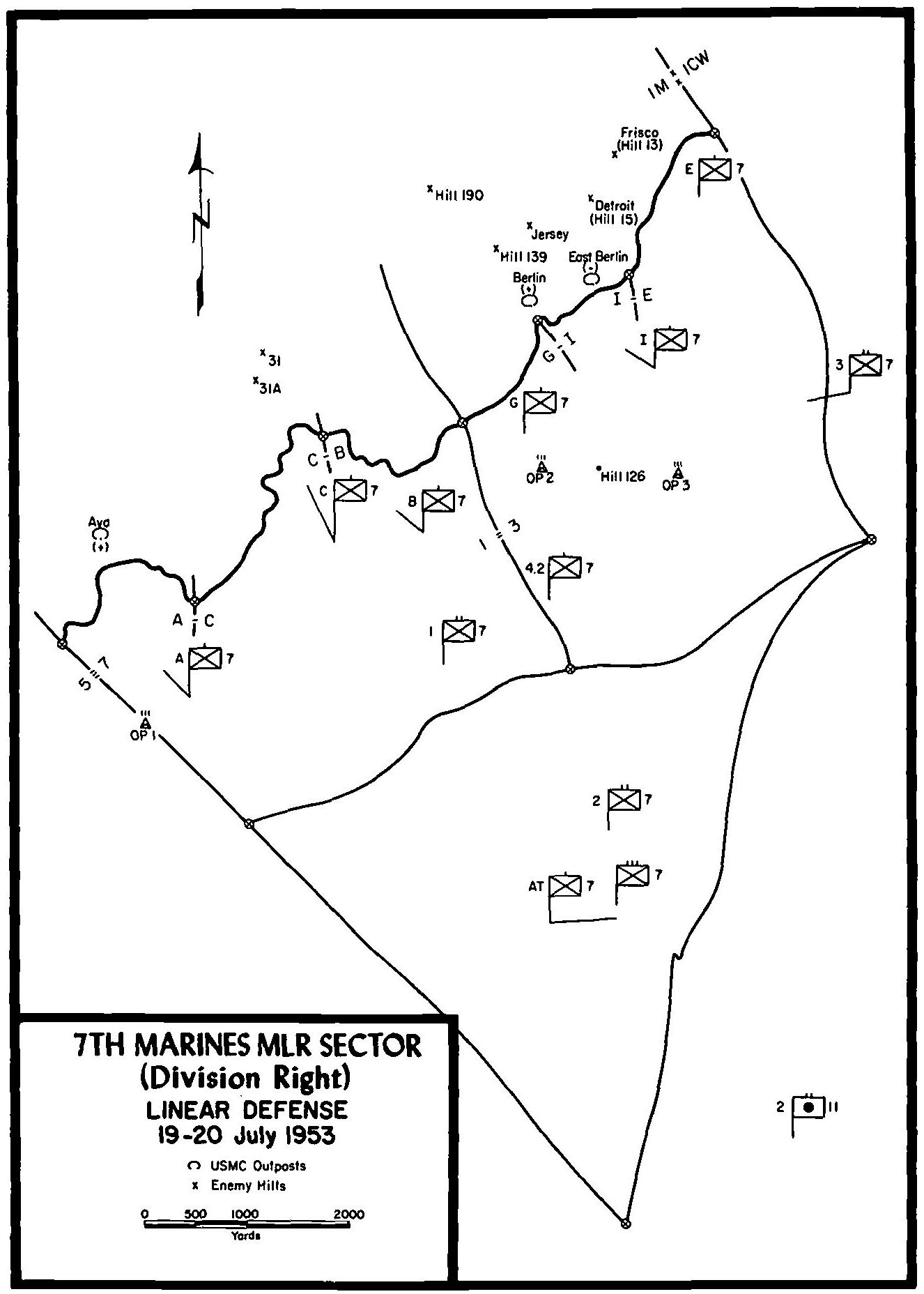
MAP 30 K. White
7TH MARINES MLR SECTOR
(Division Right)
LINEAR DEFENSE
19–20 July 1953
Between noon and the last flight of the day, when a trio of AUs
from Lieutenant Colonel Wallace’s VMA-212 attacked a northern
enemy mortar and automatic weapons site, 35 aircraft had repeatedly
streaked over the Berlin territory and adjacent Chinese strongpoints.
Strikes by VMA-121 at 1145, 1320, 1525, 1625, 1700, 1750; and
VMA-212 at 1413, 1849, and 1930 had released a combined total of
69½ tons of bombs and 6,500 rounds of 20mm ammunition on hostile
locations.
The Chinese casualty toll during this renewed flareup in the fighting
on 19–20 July was conservatively placed by 3/7 at 75 killed and
300 wounded. It was further believed that “the enemy battalion was
so weakened and disorganized by the attacks that it was necessary for
the CCF to commit another battalion to hold the area captured.”515
Regimental reports indicated that 6 Marines had been killed, 56
listed missing,516 86 wounded and evacuated, and 32 not seriously
wounded.
As a result of the critical tactical situation and number of casualties
suffered during the Berlins operation, the 7th Marines regimental
commander requested that units of the division reserve be placed
under his control to help check any further aggressive moves of the
enemy. For it now appeared that the Chinese might continue their
thrust and attempt to seize Hill 119 (directly south of Berlin and
East Berlin) in order to be in position to deny part of the Imjin
River to UNC forces after signing of the armistice.
While the lost outposts were being neutralized on the morning of
the 20th, the CO of the incoming 1st Marines, Colonel Nelson, also
ordered an immediate reorganization and strengthening of the MLR.
This employed the defense in depth concept, used by the British
Commonwealth Division in the sector adjacent to the Marines on the
east. The wide front defense concept was fully developed with one
company occupying a portion of the MLR to the rear of the Berlin
complex, known as Hill 119 or more informally, Boulder City. Three
companies organized the high ground to the right rear of the MLR
east to Hill 111, the limiting point on the boundary between the
Marine and Commonwealth divisions. Three more companies fortified
the Hill 126 area to the rear and left of Berlin to its juncture
with the western battalion sector held by Lieutenant Colonel Harry
A. Hadd’s 1/7. (See Maps 30 and 31.)
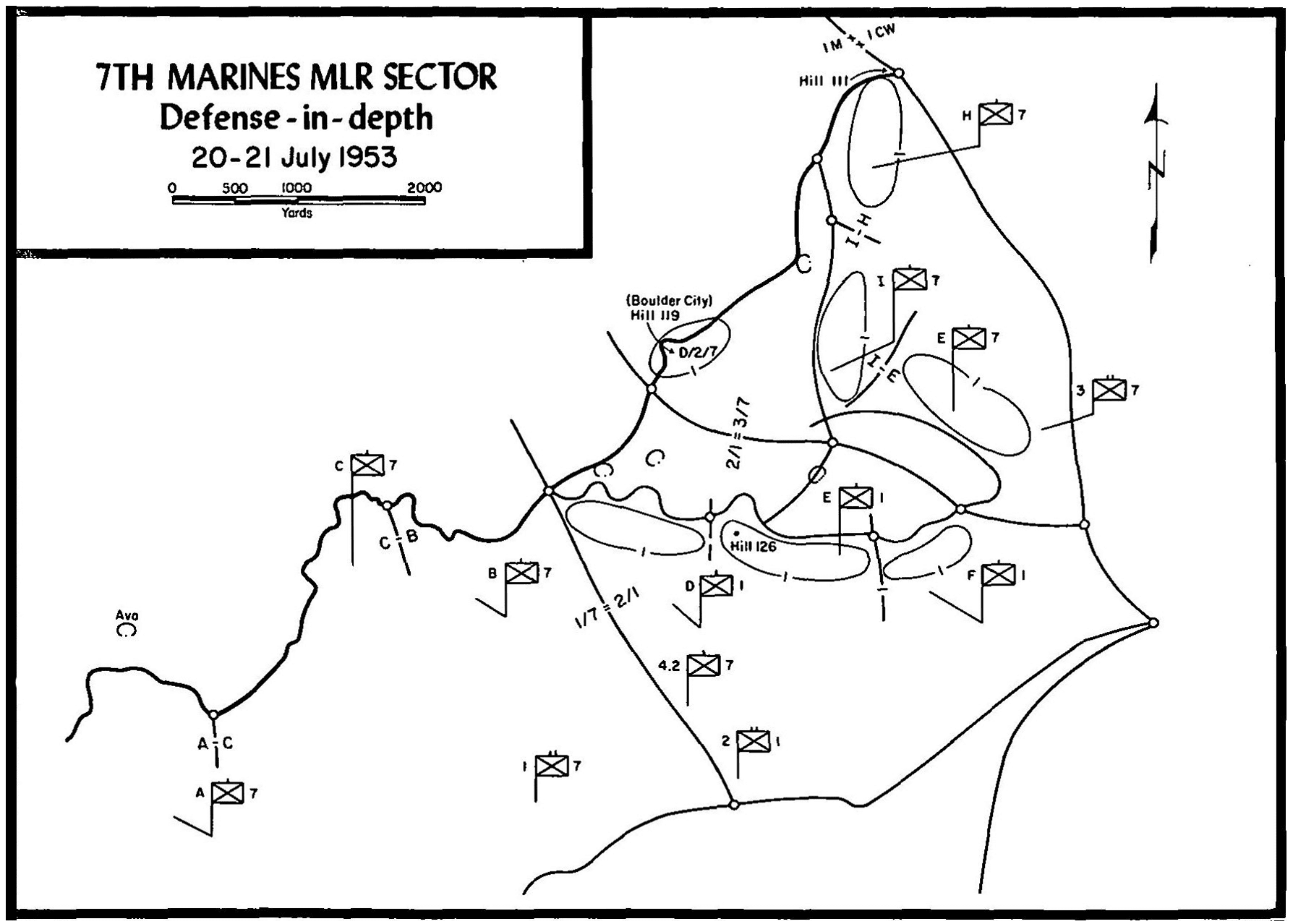
MAP 31 K. WHITE
7TH MARINES MLR SECTOR
Defense-in-depth
20–21 July 1953
The afternoon of the 20th, 2/1 (Lieutenant Colonel Frank A.
Long) was transferred to 7th Marines control and positioned in the
center of the regimental MLR, as the first step in the scheduled relief
of the 7th, due off the line on 26 July. For the next three days the
regiment continued to develop the sector defense to the rear of the
MLR. Elements of the regimental reserve, 2/7, were employed to
reinforce the 3/7 sector. Initially, on 20–21 July, F/2/7, under operational
command of 3/7, was assigned the mission of reinforcing Hill
119. Later a 2/1 platoon was also ordered to strengthen the position.
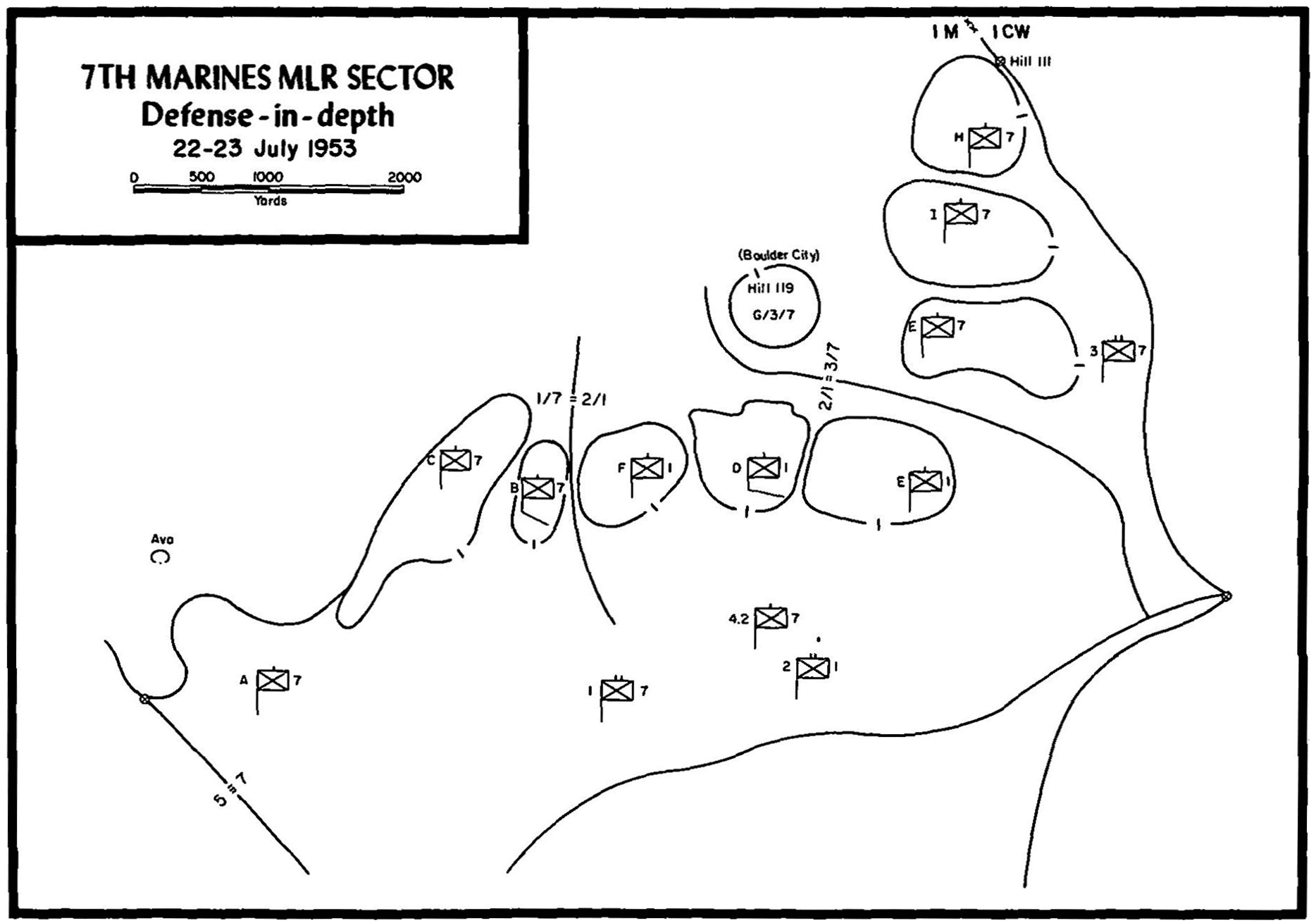
MAP 32 K. WHITE
7TH MARINES MLR SECTOR
Defense-in-depth
22–23 July 1953
Incoming 1st Marines platoons and companies from the 2d and
3d (Lieutenant Colonel Roy D. Miller) Battalions augmented the
forces at the two critical Hill 119 and 111 locations. As it turned out,
1st Marines personnel returning to the front from division reserve
were to see the last of the war’s heavy fighting in the course of their
relief of the 7th Marines. Ultimately, the regimental forward defense,
instead of being divided into two battalion sectors as before, now consisted
of three—a left, center, and right sector. By 23 July the depth
reorganization had been completed and these sectors were manned
by 1/7, 2/1, and 3/7. (See Map 32.)
Sightings of enemy troops for the next few days were light. A large
scale attack expected on the 21st by the 5th Marines at Hedy and
Dagmar failed to materialize. Instead, a token force of a dozen Chinese
dressed in burlap bags made a limited appearance at Hedy before
departing, minus three of its party, due to Marine sharp-shooting
skills. In the skies, MAG-33 fliers from VMF-115 and -311
had been transferred by Fifth Air Force from exclusive missions for
the central and eastern UNC front (the IX, ROK II, and X Corps
sectors) to join VMA-121 in MPQ flights supporting the 1st Marine
Division. During the 21–23 July period, despite layers of thick stratus
clouds and rain that turned off and on periodically like a water
spigot, more than 15 radar missions were executed by the three
squadrons.518 They unleashed a gross 33-ton bomb load on CCF mortar
and 76mm gun positions, supply areas, CPs, bunkers, and trenches.
The lull in ground fighting lasted until late on the 24th. Then, at
1930, a heavy preparation of 60mm, 82mm, and 120mm mortars
combined with 76mm and 122mm artillery shells began to rain down
on Boulder City. Men of G/3/1, under command of First Lieutenant
Oral R. Swigart, Jr., were deployed at that time in a perimeter defense
of the position having that morning completed the relief of
G/3/7.
Enemy troops were reported massing for an assault. One regiment
located by forward observers behind Hill 139, some 700 yards northwest
of Berlin, was taken under fire at 1940 by artillery and rocket
ripple. At 2030, following their usual pattern of laying down a
heavy mortar and artillery barrage, the CCF began to probe the MLR
at Hills 119 and 111 in the Marine right battalion sector. They hit
first at Hill 111, the far right anchor of the division line, currently
held by 7th Marines personnel. Then the CCF moved westward to
Hill 119. Their choice of time for the attack once again coincided
with the relief of 7th Marines units by the 1st Marines.519 When the
assault began, H/3/1 was moving up to relieve H/3/7 at the easternmost
point of the line in the Hill 111 vicinity, and Company I was
preparing to relieve I/3/7, to its left.
The Communist troops temporarily penetrated Hill 111 positions.
At Boulder City, where the main force of the CCF two-battalion unit
had struck, they occupied a portion of the trenchline. Attempting to
exploit this gain, the Chinese repeatedly assaulted the Berlin Gate,
on the left flank of Company G’s position and the East Berlin Gate,
to its right. Marine units of the two regiments posted at the two
citadel hills were heavily supported by MLR mortar, artillery, and
tank fires. No artillery spotter or CAS flights were flown through
the night, once again due to weather conditions.
By 2120, the bulk of Chinese soldiers had begun to withdraw from
Hill 111, this attack apparently being a diversionary effort. But the
enemy’s main thrust continued against the central Hill 119 position.
Here the close, heavy fighting raged on through the morning hours,
with enemy troops steadily reinforcing from the Jersey Ridge and
East Berlin, by way of the Berlin Gate, the best avenue of approach
to forward positions of Hill 119. At approximately 2100, the Chinese
hurled a second attack against Hill 119 in the strength of two
companies, supported by intense mortar and artillery fire. An hour
later hand-to-hand combat had developed all along the 700 yards of
the forward trenches. Company G men of the 1st Marines were down
to half their original number, ammunition was running low, and
evacuation of casualties was slowed by the fact that two of the eight
corpsmen had been killed and most of the rest were themselves
casualties.
By midnight, the front, left, and right flanks of the perimeter had
been pushed back to the reverse slope of the hill and a 1st Marines
participant commented “... only a never-say-die resistance was keeping
the enemy from seizing the remainder of the position.”520 At 0015,
the thinning ranks of G/3/1 Marines (now down to 25 percent
effectives) were cheered by the news that Company I men were about
to reinforce their position. This latter unit itself suffered 35 casualties
while moving into the rear area, when the Chinese intercepted
a coded message and shifted a substantial amount of their mortar
and artillery fires to the rear approaches of Hill 119.
In response to the enemy bombardment, Marine artillery fires
crashed against the Chinese continuously from 2100 to midnight.
Four ripples were launched in support of the Hill 119 defenders. In
one of the regiment’s most intense counterbattery shoots on record,
the 11th Marines in three hours had fired 157 missions. By 2400, an
estimated 6,000 to 8,000 hostile rounds had fallen in the division
sector.
Meanwhile, the Chinese were also attempting to punch holes in the
5th regimental sector. In a second-step operation, rather than striking
simultaneously as was customary, the enemy at 2115 had jabbed at
outposts Esther and Dagmar in the right battalion of the 5th Marines.
The reinforced Chinese company from the 408th Regiment quickly
began to concentrate its attention on Esther, outposted by Company
H Marines. During the heavy fighting both Marines and Chinese
reinforced. By early morning, the enemy had seized part of the front
trenchline, but the Marines controlled the rear trenches and reorganized
the defense under rifle platoon commander, Second Lieutenant
William H. Bates. The Chinese unsuccessfully attempted to isolate
the position by heavy shelling and patrolled vigorously between
Esther and the MLR.
Marines replied with flamethrowers and heavy supporting fires
from the MLR, including machine guns, 81mm and 4.2-inch mortar
boxes. Three tanks—a section from the regimental antitank platoon
and one from Company A—neutralized enemy targets with 153
rounds to assist the 3d and 2d Battalions. The 3/11 gunners supporting
the 5th Marines also hurled 3,886 rounds against the Chinese in
breaking up the attack. After several hours of strong resistance, the
Chinese loosened their grip, and at 0640 on the 25th, Esther was
reported secured.
By this time an enemy battalion had been committed piecemeal at
the position. The action had developed into the heaviest encounter
of the month in the 5th Marines sector. During that night of 24–25
July, more than 4,000 artillery and mortar rounds fell in the outpost
vicinity; total incoming for the regimental sector throughout July was
recorded at 8,413 rounds. Twelve Marines lost their lives in the
battle, with 35 wounded and evacuated, and 63 suffering minor injuries.
A total of 85 CCF were counted dead, 110 more estimated
killed, and an estimated 250 wounded.
Back at the Berlin Complex area of the 7th Marines where the
major action centered, intense shelling, fire fights, and close hand-to-hand
combat continued through the early morning of the 25th. Chinese
infiltrators had broken through a substantial part of the trenchwork
on the forward slope of Boulder City. For a while they temporarily
occupied the rocky, shrub-grown hill crest as well.
A swift-moving counterattack launched at 0130 by 1st Marines from
Companies G and I, led by Captain Louis J. Sartor, of I/3/1, began
to restore the proper balance to the situation. At 0330 the MLR had
been reestablished and the Marines had the controlling hand. By 0530
the Hill 119 area was secured, with four new platoons from Companies
E of the 7th and 1st Marines aiding the defense. Scattered
groups of Chinese still clung to the forward slopes, and others vainly
tried to reinforce by the Berlin-to-Hill 119 left flank trenchline.
Direct fire from the four M-46s on position at Boulder City521 had
helped disperse hostile troop concentrations. The tanks had also
played a major communication role. Although surrounded by enemy
forces during the peak of the fighting, two of the armored vehicles
were still able to radio timely tactical information to higher echelons.
This Company C quartet, plus another vehicle from the 7th Marines
antitank unit, between the time of the enemy assault to 0600 when
it stabilized, had pumped 109 HE, 8 marking shells, and 20,750 .30
caliber machine gun bullets into opposition forces.522 Five tanks from
the 1st Marines AT company located to the west of the Berlin
site meted out further punishment to enemy soldiers, gun pits, and
trenches.
Sporadic fighting and heavy incoming (at the rate of 60–70 rounds
per minute for 10 minutes duration) also rained down on eastern
Hill 111 in the early hours of the 25th. Assault teams with flamethrowers
and 3.5-inch rocket launchers completed the job of clearing
the enemy out of Marine bunkers.
Altogether the Communists had committed 3,000 troops across
the Marine division front during the night of 24–25 July. Between
2200 and 0400, a total of 23,725 rounds had been fired by the 11th
Marines and 10 battalions under its operational control in the division
sector. This included batteries from the 25th Division Artillery,
I Corps Artillery, and 1st Commonwealth Division Artillery.523 The
artillery outgoing represented 7,057 rounds to assist the 5th Marines
at outpost Esther and 16,668 in defense of Boulder City.
On the morning of 25 July, the Chinese at 0820 again assaulted
Hill 119 in company strength. Marine mortar and artillery fire repulsed
the attack, with heavy enemy losses. See-saw action continued
for most of the rest of the day on the position. No major infantry
attempt was made at Hill 111. Intense hostile shelling was reported
here at 1100, however, when the 3d Battalion, 7th Marines, still in
operational control of the area, began receiving 125 to 150 rounds
per minute. The last of the Chinese marauders were forced off the
forward slope at Boulder City at 1335. For some welcomed hours
both Marine positions remained quiet. A conservative estimate by
3/7 of the toll for the enemy’s efforts were 75 CCF killed and 425
wounded.
Air support that morning was provided by 32 of the sleek, hard-hitting
F9Fs from VMF-115 and -311. Working in tandem over
Chinese terrain directly north of the right regimental sector, the two
squadrons, between 0616 and 1036, flew nine MPQ missions. In the
aerial assault, they bombarded the enemy with more than 32 tons of
explosives.
Twelve Marine tanks had a workout, expending 480 HE and
33 WP shells and 21,300 rounds of machine gun ammunition in
direct fire missions. The traditional inequity of battlefront luck was
plainly demonstrated between a section (two) of armored vehicles
near the Hill 111 company CP and a trio located at Boulder City.
It was practically a standoff for the former. Together they were able
to fire only 71 high explosive shells, drawing a return of 1,000 rounds
of CCF 60mm mortar and 122mm cannon shells. Blazing guns of the
three tanks in the Hill 119 area, meanwhile, during the 24-hour
firing period had sent 158 HE, 10 WP, and 17,295 bullets to destroy
hostile weapons and installations and received but 120 mortar and
another 120 rounds of artillery fire.
The 11th Marines were also busy as heavy firing continued on
Chinese policing parties and those enemy batteries actively shelling
MLR positions. By late afternoon, 13,500 rounds of Chinese mortar
and artillery had crashed against the 7th Marines right sector—the
highest rate of incoming for any 24-hour period during the entire
Berlin action. For its part, the regiment and its medium and heavy
support units completed 216 counterbattery missions and sent 36,794
rounds of outgoing into Chinese defenses between 2200 on 24 July
and 1600 on the 25th.
Meanwhile, during 25 July, Colonel Nelson’s men continued with
their relief of the 7th Marines. At 1100 Major Robert D. Thurston,
S-3 of 3/1, assumed command of Hill 119 and reorganized the
embattled Company G and Company I personnel, 1st Marines. That
night, at 1940, E/2/1 and F/2/7 effected the relief of the composite
George-Item men. At the eastern Hill 111 Company H, 1st Marines
had assisted Company H, 7th Marines during the day in clearing
the trenchworks of the enemy; then at 1815, the 1st Marines unit
completed its relief of H/3/7 and took over responsibility for the
MLR right company sector. Not long after, beginning at 2130, 1st
and 7th Marines at the critical Hill 119 complex were attacked by
two enemy companies. MLR fire support plus artillery and tank guns
lashed at the enemy and he withdrew. Between 0130 and 0300 the
Chinese again probed Hills 111 and 119, gaining small parts of the
trenchline before being driven out by superior Marine firepower.
Marine casualties were 19 killed and 125 wounded. The CCF had
suffered 30 known dead, an estimated 84 killed, and 310 estimated
wounded.
With dawn on the 26th came the first real quiet the battlefield
had known for two days. Small enemy groups tried to reinforce by
way of the Berlin trenchline, only to be stopped by Marine riflemen
and machine gunners. Hostile incoming continued spasmodically.
At 1330 the 1st Marines assumed operational control of the right
regimental sector, as scheduled, and of the remaining 7th Marines
units still in the area.524 By this time Marine casualties since 24 July
numbered 43 killed and 316 wounded.
That night the Communists, knowing the armistice was near and
that time was running out for seizing the Boulder City objective,
made their final attempts at the strongpoint. Again they attacked at
2130. Defending 1st Marines were now under Captain Esmond E.
Harper, CO of E/2/1, who had assumed command when Major
Thurston was seriously wounded and evacuated. They fought off the
Chinese platoon-size drive when the enemy advanced from Berlin
to the wire at Hill 119. Shortly after midnight another Chinese
platoon returned to Hill 119 in the last skirmish for the territory,
but Marine small arms and artillery handily sent it home. At 0045,
a CCF platoon nosed about the Hill 111 area for an hour and twenty
minutes. Again the Marines discouraged these last faltering enemy
efforts. Action at both hills ceased and what was to become the concluding
ground action for the 1st Marine Division in Korea had
ended.
Despite impressive tenacity and determination, the Chinese Communist
attacks throughout most of July on the two Berlin outposts
and Hills 119 and 111 achieved no real gain. Their repetitive assaults
on strongly-defended Boulder City up until the last day of the
war was an attempt to place the Marines (and the United Nations
Command) in as unfavorable a position as possible when the armistice
agreement was signed. While talking at Panmunjom, the Communists
pressed hungrily on the battlefront for as much critical
terrain as they could get under their control before the final ceasefire
line was established.
Had the enemy succeeded in his assaults on the two hill defenses
after his earlier seizure of the Berlins, under terms of the agreement
UNC forces would have been forced to withdraw southward to a
point where they no longer had free access to all of the Imjin River.
If the Chinese had taken Boulder City this would have also provided
the CCF a major high ground position (Hill 126) with direct observation
into Marine rear areas and important supply routes.
From the standpoint of casualties, the last month of the Korean
War was a costly one, with 181 infantry Marines killed in action
and total losses of 1,611 men.525 This was the highest rate for any
month during 1953. It was second only to the October 1952 outpost
battles526 for any month during the year the 1st Marine Division defended
the line in West Korea. The closing days of the war produced
the last action for which Marines were awarded the Navy
Cross. These Marines were Second Lieutenant Bates, H/3/5; First
Lieutenant Swigart, G/3/1; Second Lieutenant Theodore J. Lutz, Jr.,
H/3/1; and Sergeant Robert J. Raymond, F/2/7, who was mortally
wounded.
The 7th and 1st Marines, as the two regiments involved during
July in the Berlin sector defense, sustained high monthly losses: 804
and 594, respectively. Forty-eight men from the 7th Marines and
70 from the 1st Marines were killed in action. In contrast, the 5th
Marines which witnessed little frontline action during the month
(except for a sharp one-night clash at Outpost Esther), suffered
total monthly casualties of 150 men, of whom 26 lost their lives.
Chinese losses were also high: 405 counted killed, 761 estimated
killed, 1,988 estimated wounded, 1 prisoner, or 3,155 for the month
of July.
In their unsuccessful attempts to dislodge the Marines from their
MLR positions the Chinese had pounded the right regimental flank
with approximately 22,200 artillery and mortar shells during the
last 24–27 July battle. In reply, 11th Marines gunners and supporting
units had expended a total of 64,187 rounds against CCF strongpoints.
The enemy’s increased counterbattery capabilities in July,
noted by division intelligence, also received particular attention from
the artillerymen. A record number of 345 counterbattery missions
were conducted during the period by Marine and Army cannoneers.
More than 46,000 rounds of outgoing had been fired by the
Chinese in their repeated attempts of 7–9, 19–20, and 24–27 July
to seize the Berlin posts and key MLR terrain. Operations during
this final month, as the 2/11 commander was to point out later, on
numerous occasions had verified the wisdom of leaving “direct support
artillery battalions in place during frequent changes of frontline
infantry units.”527
Armored support throughout the 24–27 July period consisted of
more than 30 tanks (Company C, AT Company elements of the 1st
and 7th Marines, a section of flames, and Company D platoon) on
line or in reserve. Marine tankers used a record 1,287 shells and
54,845 bullets against the CCF, while drawing 4,845 rounds of
enemy mixed mortar and artillery.
The enemy’s attack on Marine MLR positions, beginning 24 July,
constituted the major action in the I Corps sector the final 10 days
of the war. During this period the Chinese probed I Corps positions
25 times (8 in the Marine, 5 in the 1st Commonwealth, 6 in the 1st
ROK, and 6 in the 7th Infantry Division sectors).
In other parts of the Eighth Army line, the last large-scale action
had broken out east of the Marine sector beginning 13 July when
major elements of six Chinese Communist divisions penetrated a
ROK unit to the right of the IX Corps. As the division’s right and
center fell back, units withdrew into the zones of the IX and ROK
II Corps on the east. General Taylor directed that a new MLR be
established south of the Kumsong River, and a counterattack 17–20
July by three II Corps divisions attained this objective.
Since the armistice agreement was imminent, no attempt was made
to restore the original line. The Chinese had achieved temporary
success528 but at heavy cost. Eighth Army officials estimated that CCF
casualties in July reached 72,000 men, with more than 25,000 of
these dead. The enemy had lost the equivalent of seven divisions
of the five Chinese armies committed in attacks upon the II and IX
Corps sectors.
Representatives of the Communist Forces and the United Nations
Command signed the armistice agreement that marked the end of
the Korean War in Panmunjom at 1000 on Monday, 27 July 1953.
The cease-fire, ending two years of often fruitless and hostile truce
negotiations, became effective at 2200 that night. After three years,
one month, and two days the so-called police action in Korea had
come to a halt.
Actually, final agreement on the armistice had been expected since
late June. By mid-July it was considered imminent, even though the
CCF during these waning days of the war had launched several
major counteroffensives against ROK troops defending the central
part of the Eighth Army line as well as the Marines in the western
I Corps sector.
With the final resolution of hostilities at 1000, a flash message
went out immediately to the 26,000 Marines of General Pate’s
division directing that there be “no celebration firing related in any
way to the advent of the armistice.”530 Fraternization or communication
with the enemy was expressly forbidden. Personnel were
reminded that firing of all weapons was to be “restricted to the
minimum justified by the tactical situation.”531 No defensive firing
was to take place after 2145 unless the Marines were actually
attacked by enemy infantry. Each frontline company was authorized
to fire one white star cluster at 2200, signalling the cease fire.
The signing of the armistice agreement on 27 July thus ended 36
months of war for the Marines in Korea. On that date, the 1st
Marine Division initiated plans for its withdrawal to defensive
positions south of the Imjin River. One regiment, the 5th Marines,
was left north of the river to man the general outpost line across
the entire division front. A transition was made at this time from
the customary wide-front linear defense to a defense in depth, similar
to that employed in the July Boulder City battle.
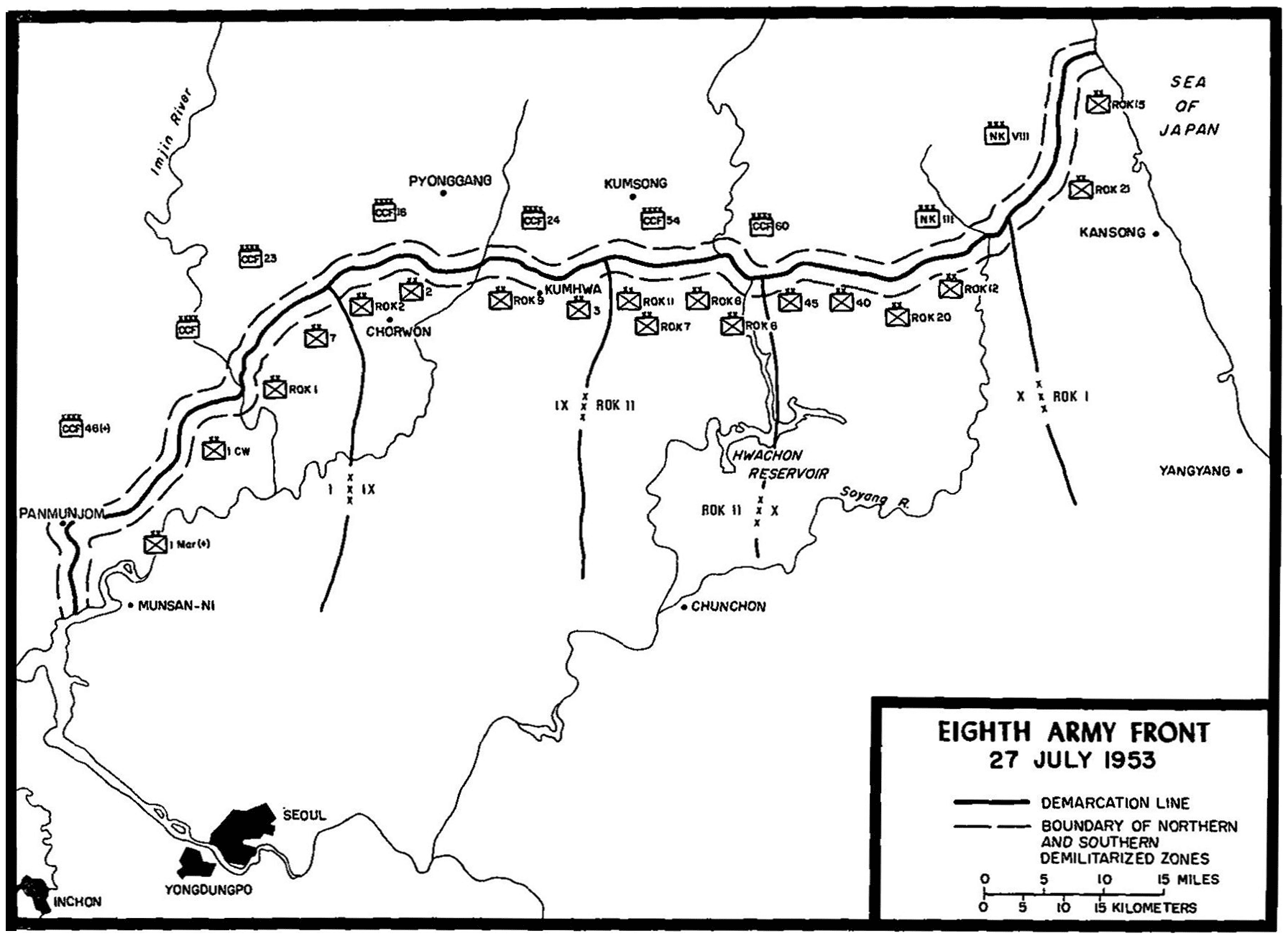
MAP 33 K. WHITE
EIGHTH ARMY FRONT
27 JULY 1953
Briefly, the armistice agreement decreed that both UNC and
Communist forces:
Cease fire 12 hours (at 2200, 27 July) after signing of agreement;
Withdraw all military forces, supplies, and equipment from the
demilitarized zone (2,000 yards from line of contact) within 72
hours after effective time of ceasefire;
Locate and list all fortifications and minefields in the DMZ
within 72 hours, to be dismantled during a subsequent salvage
period;
Replace combat personnel and supplies on a one-for-one basis,
to prevent any build-up; and
Begin repatriation of all POWs, with exchange to be completed
within two months.
The 1st Marine Division began that afternoon to close out its
existing MLR532 and withdraw to its designated post-armistice main
battle position located two kilometers to the south, in the vicinity of
the KANSAS Line. This tactical withdrawal was to be completed no
later than 2200 on 30 July.
By early afternoon the three infantry regiments had been ordered
to furnish mine teams to mark, remove, and clear minefields. For
units of the 1st and 7th Marines deployed at the Boulder Hill Outpost—quiet
only since 0300 that morning—the cease-fire news
understandably carried a “let’s see” reaction as the men “waited
cautiously throughout the day in their fortifications for the White
Star Cluster which would signify the end ...”533 Convincing the men
at shell-pocked Boulder City that a cease-fire was to take place within
a few hours would have been a difficult task that day, however, even
for the Commandant.
The Marine infantrymen who had been the target of the last
heavy Communist attacks of the war might well have had a special
sense of realism about the end of hostilities. Between the skirmish
with Chinese attacking units in the early hours of the 27th and mine
accidents, a total of 46 Marines had been wounded and removed
from duty that last day of the war and 2 others declared missing
in action.
For the more free-wheeling artillerymen of the 11th Marines, that
final day was one of fairly normal operations. During the day, 40
counterbattery missions had been fired, the majority in reply to
Communist batteries that came alive at dusk.534 A total of 102
countermortar missions were also completed, bringing the total outgoing
that last month to 75,910 rounds. Action of the regiment
continued until 2135, just ten minutes before the preliminary cease-fire
which preceded the official cease-fire at 2200.
For the 7,035 Marine officers and men on duty with General
Megee’s 1st Marine Aircraft Wing, the day was also an active one.
That final day of the war Corsairs, Skyraiders, and Pantherjets from
the wing mounted 222 sorties and blasted the enemy with 354 tons
of high explosives along the front. Banshees from VMJ-1 flew 15
reconnaissance sorties during the day for priority photographs of
enemy airfields and railroads. Last Marine jet pilot in action was
Captain William I. Armagost of VMF-311. He smashed a Communist
supply point with four 500-pounders, at 1835, declaring his
flight felt “just like the last winning play of a football game.”535
The wing closed out its share of the Korean War 35 minutes
before the cease-fire. A VMA-251 aviator, Captain William J.
Foster, Jr., dropped three 2,000-pound bombs at 2125 in support of
UN troops. The distinction of flying this final Marine mission over
the bombline had gone, fittingly, to the wing’s newly-arrived “Black
Patch” squadron. At sea, U.S. and British warships ended the 17-month
naval siege by shelling Wonsan for the last time, and at 2200
the ships in the harbor turned on their lights. In compliance with
the terms of the armistice, full evacuation of the WCIDU and
ECIDU islands north of the 38th Parallel started at 2200. Island
defense forces off both coasts at this time began a systematic destruction
of their fortifications as they prepared to move south.
As early as 2100 Marine line units reported seeing Chinese
soldiers forward of their own positions, policing their areas. An
hour later large groups of enemy were observed along the division
sector. Some “waved lighted candles, flashlights, and banners while
others removed their dead and wounded, and apparently looked for
souvenirs.”536 A few attempts were made by the Chinese to fraternize.
One group approached a Marine listening post and asked for water
and wanted to talk. Others hung up gift bags at the base of outpost
Ava and shouted, “How are you? Come on over and let’s have a
party,” while the Marines stared at them in silence.537 The last hostile
incoming in the 1st Marine Division sector was reported at 2152
when five rounds of 82mm mortar landed on a Korean outpost,
COP Camel.
Marines on line that night warily scanned the darkness in front
of their trenches. Slowly at first, then with increasing rapidity the
white star cluster shells began to burst over positions all along the
line. Thousands of flares illuminated the sky and craggy hills along
the 155-mile front, from the Yellow Sea to Sea of Japan. The war
in Korea was over. Of the men from the one Marine Division and
air wing committed in Korea during the three-year conflict, 4,262 had
been killed in battle. An additional 26,038 Marines were wounded.
No fewer than 42 Marines would receive the Nation’s highest combat
decoration, the Medal of Honor, for outstanding valor—26 of them
posthumously.
CHAPTER X Return of the Prisoners of War — Operation BIG SWITCH 538 — Circumstances of Capture 562 — The Communist POW Camps 578 — CCF “Lenient Policy” and Indoctrination Attempts 592 — The Germ Warfare Issue 603 — Problems and Performance of Marine POWs 607 — Marine Escape Attempts 623 — Evaluation and Aftermath 630
Operation BIG SWITCH—Circumstances of Capture—The Communist
POW Camps—CCF “Lenient Policy” and Indoctrination
Attempts—The Germ Warfare Issue—Problems and Performance
of Marine POWs—Marine Escape Attempts—Evaluation
and Aftermath
Between August 1950, the month that the first Marine was taken
prisoner and July 1953, when 18 Marine infantrymen were captured
in final rushes by the CCF, a total of 221 U.S. Marines became
POWs.539 The majority of them—nearly 90 percent—ultimately returned.
After the conclusion of hostilities, Marine POWs were among
the UNC fighting men returned in Operation BIG SWITCH.
The new mission of the 1st Marine Division, with the cease-fire,
called for organization of the Post Armistice Battle Positions and
establishment of a No-Pass Line approximately 200 yards south of
the Demilitarized Zone boundary. In addition to maintaining a
defensive readiness posture for full-scale operations if hostilities
resumed, the Marine division was charged with control of the
Munsan-ni area and assisting in repatriation of prisoners of war.
Obviously, since the Panmunjom release point for receiving the
POWs was located in the Marine zone of action, the division—as in
the earlier LITTLE SWITCH prisoner exchange—would play a major
part in the final repatriation.
With the armistice and ending of the war expected almost daily,
the Munsan-ni Provisional Command was activated and reorganized
in June. Once again, the 1st Marine Division was responsible for the
United Nations Personnel and Medical Processing Unit, organized
along lines similar to those used during the preliminary exchange.
The division inspector, Colonel Albert F. Metze, was designated
Processing Unit Commander. Sections under his direction were
staffed by Marine and naval personnel. The normal command structure
was reinforced by special engineer, medical, interpreter, food
service, chaplain, security, signal, supply, and motor transport teams.
Planning for the project, like all military operations, was thorough
and continuous.
As in April, the Munsan-ni Provisional Command assumed responsibility
for handling the UN repatriation at Panmunjom as well as
supervision of the receiving and processing of ROKA personnel.
Brigadier General Ralph M. Osborne, USA, was placed in charge
of the command, with headquarters at the United Nations Base
Camp. The RCT landing exercise for the 1st Marines, scheduled
in July, was cancelled because of shipping commitments for Operation
BIG SWITCH, as the Navy Amphibious Force readied itself for
the repatriation of prisoners. By the end of July, the 1st Marine
Division was supporting “approximately 42,400 troops with Class
I [rations] and 48,600 with Class III [petroleum products] due to
the influx of units and personnel participating in Operation BIG
SWITCH.”540
Several days before the exchange, however, it became evident that
the old site of the Gate to Freedom used in the April exchange
would have to be abandoned. It was found inadequate to handle
the larger number of returning prisoners—approximately 400 daily—to
be processed in the new month-long operation. The new site,
Freedom Village, near Munsan-ni contained an old Army warehouse
which was renovated by the 1st Division engineers and transformed
into the 11th Evacuation Hospital where the UN Medical and
Processing Unit was located. Members of the division Military
Police Company provided security for the exchange area. Marines
from practically every unit of the division were assigned duties at
the United Nations Processing Center. As General Clark, UNC
Commander later recalled:
Preparations for Big Switch were necessarily elaborate. At Munsan we
had a huge warehouse stocked high with clothing, blankets, medical equipment
and other supplies for the returning POWs. At Freedom Village
nearby we had a complete hospital unit ready. It was one of the Mobile
Army Surgical Hospitals (MASH) which had done such magnificent
work close to the front through most of the war.541
On 5 August, the first day of BIG SWITCH, Colonel Metze took a
final look around the processing center. Readiness of this camp was
his responsibility. If anyone had real understanding of a prisoner’s
relieved and yet shaken reaction to new freedom it was this Marine
Colonel. Chosen by the United Nations Command to build and direct
the enlarged Freedom Village, Colonel Metze himself had been a
prisoner of war in World War II. He knew from personal experience
how men should be treated and what should be done for them
early in their new freedom. For many, this was after nearly three
long years in Communist prison camps. That morning, as described
by an observer:
Members of his [Colonel Metze’s] command stood by their cubicles,
awaiting the first signal. The 129 enlisted Marines, corpsmen, doctors and
other UN personnel had held a dress rehearsal only the day before. Everything
was ready.542
Fifteen miles northwest another group of Marines assigned to
the Provisional Command Receipt and Control section waited almost
in the shadow of the famous “peace pagoda” at Panmunjom. UNC
receiving teams, each headed by a Marine Corps major, “watched
the road to the north for the first sign of a dust cloud which would
herald the approach of the Communist convoy.”543 The United
Nations POWs had been assembled at Kaesong and held there in
several groups, preparatory to the return. The exchange agreement
had specified that the repatriation would begin at 0900. Precisely
at 0855 the Communist convoy, led by three Russian-made jeeps,
each carrying one CCF and two NKPA officers, moved out from the
Communist side of the peace corridor. Trucks and ambulances
followed the jeeps.
As they approached the exchange site, “a Marine officer bellowed
the familiar naval command, ‘Marines, man your stations!’”544 Rosters
of the UNC prisoners in the trucks and ambulances were then presented
to the Marine team captains who checked the lists. As they
called the names, “thin, wan, but smiling men shuffled from the
trucks to the medical tents.”545
Official receipt of the POWs at Panmunjom was by the Munsan-ni
Provisional Command Receipt and Control Officer, assisted by 35
officers and enlisted men from the 1st Marine Division. After their
screening by medical officers, UN returnees not in need of immediate
medical aid were transferred by ambulance to Freedom Village at
Munsan-ni for further processing. Helicopter priority went to litter
patients too weak to travel by ambulance. POWs requiring prompt
treatment were loaded aboard the HMR-161 carriers and flown to
the 11th Evacuation Hospital at Freedom Village.
Seriously injured men were transferred directly to the Inchon
hospital ships for embarkation to the United States, or were air-evacuated
to Japan. South Korean repatriates were processed and
went their way to freedom through nearby Liberty Village, the
ROK counterpart of Freedom Village. A huge map was used to
check progress of the POW convoys en route from Panmunjom to
Freedom Village. The departure of ambulances and helicopters
from Panmunjom was radioed ahead to Freedom Village, where
medical personnel and vehicles lined the landing mat.
At Munsan-ni, the newly-freed men received a more thorough
physical exam and the rest of their processing. Here they were again
screened by medical officers to determine their physical condition.
Able-bodied POWs were escorted to the personnel data section
where necessary administrative details were recorded and their military
records brought up to date. Those medically cleared were available
for press interviews. New clothing issue, individually tailored,
probably as much as anything emphasized to a prisoner that his
particular Korean War was over. And nearly all of them found
news546 awaiting them in letters from home. When all basic details
were completed, returnees went into the recreation and refreshment
section. Commonplace iced tea, coffee, ice cream (the favorite),
milk, sandwiches, cigarettes, and the latest periodicals were luxuries.
In their weakened condition, the POWs could be served only light
fare; the big steaks would come later.
The first Marine and fifth man in the processing line on the
initial day, 5 August, was Private First Class Alfred P. Graham,
Jr., of H/3/5. Although too weak to enter the press room, the 21-year-old
repatriate told newsmen later in Tokyo of being fed a
diet of cracked corn during his prison camp stay and of being forced
to carry firewood 11 miles each day. The second Marine returned
that day, and the 34th man to enter Freedom Village, was Sergeant
Robert J. Coffee, of the 1st Signal Battalion. Captured in November
1950, he had been wounded just before being taken prisoner and
had received little medical treatment. Like other returnees, Coffee
stated that the treatment had been very poor while he was in the
hands of the North Koreans but that it had improved somewhat
after he was turned over to the Chinese.
Third and last Marine to come through the line was Private First
Class Pedron E. Aviles, previously with the Reconnaissance Company
of Headquarters Battalion. Knocked unconscious with a rifle butt
while battling the enemy on a patrol on 7 December 1952, he regained
consciousness to find himself a prisoner of the CCF.
On the second day, three more USMC infantrymen traveled that
final road to freedom. They were Private First Class Francis E.
Kohus, Jr., of A/1/7; Corporal Gethern Kennedy, Jr., I/3/1; and
Private First Class Bernard R. Hollinger, H/3/5. Like the preceding
three, their stories bore a similar pattern: usually they had been
captured only after having been wounded or clubbed unconscious.
As with other UNC prisoners being released daily, they told of the
physical cruelty of their North Korean captors and the mental strain
under the Chinese. Observers noted that many of the men released
this second day were in much poorer physical condition than the
initial returnees. In fact, one ROK prisoner was found to have died
in an ambulance while en route to Liberty Village.
Mostly the repatriates asked questions about their old outfits: “Do
you know if any of the other guys on the outpost got back off the
hill?” and “Did we finally take the damn thing?” “Where’s the
24th Division now?”547
Technical Sergeant Richard E. Arnold was one of the two Marine
combat correspondents at Freedom Village during BIG SWITCH. He
described his impressions of the returning men—in some cases, coming
home after 30 months’ confinement in North Korean POW
camps, and others, as little as 30 days:
All are relieved and some a little afraid ... It’s their first hour of
freedom, and most tell you that they can still hardly believe it’s true.
Some are visibly shaken, some are confused—and all are overwhelmed at
the thought of being free men once again.548
As in prison life everywhere, the POWs told of the hated stool
pigeons, the so-called “progressives.” These were the captives who
accepted (or appeared to accept) the Communist teachings and who,
in turn, were treated better than the “reactionary” prisoners who
resisted the enemy “forced feeding” indoctrination. Continued the
Marine correspondent:
They don’t talk much. When they do, it’s ... mainly of progressives
and reactionaries—the two social groups of prisoner life under the rule
of Communism, the poor chow and medical care, and of the desire to fight
Communism again.
When you ask, they tell you of atrocities committed during the early
years of the war with a bitterness of men who have helplessly watched
their friends and buddies die. Of forced marches, the bitter cold, and the
endless political lectures they were forced to attend.549
One of the last—possibly the last—Marine captured by the
Chinese was Private First Class Richard D. Johnson, of G/3/1.
The 20-year-old machine gunner had been in the final battle of the
war, the Boulder City defense, and was taken 25 July, just two days
before the signing of the truce. Private First Class Johnson was
returned the 19th day of the exchange. Another Marine seized in
that same action was Private First Class Leonard E. Steege, H/3/7.
As he entered the gate, he momentarily shook up Corporal James
E. Maddell, a military policeman on duty at Freedom Village.
Maddell said the last time he saw Steege was during the fighting
for the outpost. “He was a dead Marine then,” Maddel said, “but
I guess it was just a case of mistaken identity.”550
Captain Jesse V. Booker of Headquarters Squadron 1, the first
Marine POW of the war, who had been captured on 7 August 1950,
was also one of the earliest MAW personnel released. Booker and
First Lieutenant Richard Bell, VMF-311, were returned to UNC
jurisdiction on 27 August, the first Marine aviators to be sent back.
In addition to the regular issue of Marine utilities, gold naval
aviator’s wings, donated by 1st MAW fliers, were pinned on the
chests of returning pilots by Wing General Megee and Division
General Pate. Also welcoming Marine returnees at Freedom Village
were Brigadier General Verne J. McCaul, the new Assistant Wing
Commander; General Burger, ADC; and Colonel Metze, who also
“found time during the busy days to greet and talk with every
Marine and Navy Corpsman who passed through.”551 Among those
dignitaries552 present for the occasion were General Taylor, EUSAK
CG; General Clarke, I Corps Commander; Secretary of the Army,
Robert T. Stevens; and various U.S. senators.
During August enlisted POWs were recovered in large numbers.
Officers, generally, did not arrive at Kaesong—the first step to
Panmunjom—until about 21 August. After that date they were
gradually returned to friendly control.
Even as late as 26 August there was considerable concern over
the fate of hundreds of Allied officers not yet repatriated. Some early
returning officers told of colonels, majors and captains who had been
sentenced up to ten years for forming “reactionary groups” in camp.
One field grade officer had been sentenced to a long prison term on
the eve of the armistice.553 A similar thing nearly happened to
Captain John P. Flynn, VMF(N)-513, long a thorn in the side
of his Communist captors. Like a number of UNC airmen falsely
charged with waging germ warfare, he vigorously denounced these
allegations. “Even as late as the end of August the Marine was
threatened with nonrepatriation, and his experience formed the
basis for an episode in the novel A Ride to Panmunjom.”554
Between 5 August-6 September, 3,597 U.S. servicemen were
returned during Operation BIG SWITCH, including 129 ground and
28 air Marines. This 157 figure represents a total of 42 officers and
115 enlisted repatriated during this second and final POW exchange.
Of the 27 Naval personnel freed, at least 6 were hospital corpsmen
serving with the 1st Marine Division when they were taken. Counting
the 157 Marines released in Operation BIG SWITCH and the 15
wounded POWs sent back in April, a total of 172 division and
wing Marines were returned in the two POW exchanges.
Although the switch took place over a five-week period, 38
Marines, or 24 percent, were not released until late in the proceedings,
in September. As one author noted, “It was Communist policy
to hold the ‘reactionaries’ ... to the last.”555
Two of the best-known Marine “reactionaries” who had openly
defied their Communist jailers during their entire period of captivity,
were then-Lieutenant Colonel William G. Thrash, a VMA-121
pilot, and then-Major John N. McLaughlin, taken POW in
November 1950. McLaughlin was released on 1 September and Thrash
on 5 September in a group of 275 Americans returned, the largest
number for any single day’s transfer since the exchange began. The
most famous U.S. prisoner held by the Communists was Major
General William F. Dean. Formerly commander of the U.S. Army
24th Division, he had been captured in August 1950 after the fall
of Taejon.
Ever since Operation BIG SWITCH got under way, every returnee
had been asked if he had seen or heard of General Dean. None had.
Many UN officers felt—uneasily—that he would probably be the
last officer to be sent back. In fact, he emerged from imprisonment
on 4 September “to be greeted with cheers at Freedom Village.”556
Major Walter R. Harris and the most senior Marine captured
during the war, Colonel Frank H. Schwable, later to be the central
figure in a Court of Inquiry, were among the last nine Marines
returned on 6 September, the final day of the switch. And so, one
by one, the last 160 American POWs passed through Panmunjom.
All were men marked by the enemy as “war criminals.”
One Army sergeant, who freely admitted he could “never adequately
describe how he felt when he knew he was going home”557
recalled those final moments as a newly-freed prisoner:
At 1100 his truck pulled up at Panmunjom, the last convoy of American
POWs to be exchanged. A huge, moustached Marine master sergeant walked
up beside the truck, called out: “I will call out your last name. You will
answer with your first name, middle initial, and Army serial number ...”
“Schlichter!”
Schlichter [Charles B., Sgt.], barked out his response, and stepped down.
“Sergeant,” the big Marine said gravely, “glad to have you home.”
“Fella, you don’t know how glad I am,” Schlichter said.558
In the preliminary prisoner exchange, the week-long “LITTLE
SWITCH” in April 1953, all of the returned Marine personnel were
men who had been wounded at the time of their capture. They were
recently-captured POWs, deliberately segregated by the enemy from
early captives. All of these home-coming Marines had been captured
since May 1952. Generally speaking, they had all been fairly well-treated.
During Operation BIG SWITCH, by contrast, 41 Marines were
repatriated who had spent nearly three years as Communist prisoners
of war. The majority of USMC returnees in this second exchange,
however—a total of 91—had been captured relatively recently, in
1952 and 1953, and 25 had been held since 1951.
Throughout Operation BIG SWITCH, the Allied Command transferred
a total of 75,799 prisoners (70,159 NKPA and 5,640 CCF)
seeking repatriation. The Communist returned 12,757 POWs. In
addition to the 3,597 Americans, this total represented 1,312 other
UNC troops (including 947 Britons, 228 Turks, and small numbers
of Filipinos, Australians, and Canadians) and 7,848 South Koreans.
The BIG SWITCH exchange went relatively smoothly, marred for
a while only by the unruly behavior of some Communist diehard
POWs. In a manner reminiscent of their earlier camp riots, the
Communist POWs put on a blatant propaganda show for the benefit
of world newsreel cameras. As the train carrying CCF and North
Korean prisoners moved into the Panmunjom exchange point, enemy
POWs noisily shouted Communist slogans, defiantly waved Communist
flags, and hurled insults at UN forces. Some POWs stripped
off their [U.S. provided] uniforms, “tossing them contemptuously to
the ground.”559 Others spat in the faces of U.S. supervising officers,
threw their shoes at jeep windshields, and sang in Korean and
Chinese “We will return in the Fall.”560
Marine division and wing elements were designated responsible
for the security of nonrepatriated enemy POWs. By terms of the
armistice agreement, these were held by UNC custodial forces from
India. In commenting on the airlift operations, performed largely
by HMR-161, the UNC Commander noted:
We had to go to great lengths to live up to our pledge to Syngman Rhee
that no Indian troops would set foot on South Korean soil. Therefore,
we set up an airlift operation which carried more than six thousand Indians
from the decks of our carriers off Inchon by helicopter to the Demilitarized
Zone. It was a major undertaking which just about wore out our helicopter
fleet in Korea.561
One of the recommendations made by military officials after the
April LITTLE SWITCH exchange was that all interrogation of returning
POWs be done either in America or on board ship en route home,
rather than in Tokyo. This system was followed and worked out
well. The POWs boarded ships at Inchon, following their clearance
at Freedom Village. Interrogation teams, in most cases, completed
this major part of their repatriation processing before docking at
San Francisco. Two weeks of recuperation, good food and rest
aboard ship enabled many POWs to arrive home in far better shape
for reunion with their families than they had been in when received
initially at Panmunjom.
As in LITTLE SWITCH, Marine and Navy personnel were processed
by members of the Intelligence Department of Commander, Naval
Forces Far East, augmented by officers from other Marine staffs.
Marine officers who conducted the shipboard interrogations again
included Lieutenant Colonel Fisher, ComNavFE liaison officer, as
well as Lieutenant Colonel William A. Wood, Major Stewart C.
Barber, and First Lieutenant Robert A. Whalen. All returning
POWs were queried in depth by counterintelligence personnel about
enemy treatment and atrocities, questionable acts committed by that
small proportion of our own men whose conduct was reprehensible,
and routine military matters. A security dossier was prepared on each
prisoner, and all data about him went into his file case. The LITTLE
SWITCH reports had indicated earlier—and this was subsequently
confirmed—that some U.S. servicemen were definitely marked for
further detailed questioning and scrutiny.
As the Commandant, General Shepherd, was to testify later during
an investigation, “the prisoner of war question had never been a
major problem [in the Marine Corps] due to the extremely limited
number of Marines taken prisoner.”563 As one returnee at BIG SWITCH
bluntly put it: “You fought until they reached you with a bullet
or a rifle butt—that was the end.”564
Of the 221 U.S. Marines captured during the Korean War, more
than half—121—were seized after 20 September 1951. For the
Marine Corps this date marked the time when “warfare of position
replaced a warfare of movement throughout the remaining 22
months of the conflict in Korea.”565 Both in the X Corps sector in
eastern Korea where the 1st Marine Division was located at that
time, as well as later on the Korean western front, the Marine Corps
was denied its traditional aggressive fighting role. The Marines
(along with the rest of the UNC forces) ceased offensive operations,
were reduced to making limited attacks, and were under order from
higher echelons to “firm up the existing line and to patrol vigorously
forward of it.”566
The mission of the Marine division thereby evolved into “an
aggressive defense of their sector of responsibility” as records duly
phrased it. On a larger scale, the nature of the Korean War, from
about November 1951 on, reverted to that of July and August,567
characterized primarily by minor patrol clashes and small unit struggles
for key outpost positions. This became the pattern for the
remainder of the war. It changed only when the decreed mission
of an “active defense of its sector” by a UNC unit became this in fact.
Normal defense then escalated into sharp, vigorous fighting to
retain friendly key ground positions being attacked by the enemy.
One American writer, in a discussion of the British defense in depth
concept (adopted by the Marine Corps late in the war), went so
far as to blame heavy Marine casualties in Korea on EUSAK’s outpost
system.568
Approximately half of the 100 Marines taken prisoner by September
1951—43—had fallen into enemy hands during the last two
days of November 1950. They had been part of the ill-fated Task
Force Drysdale,569 a composite Royal Marine-USMC-Army convoy
that was ambushed by the Chinese en route to the Chosin Reservoir.
These facts are relevant to a better understanding of the Commandant’s
statement that, traditionally, few Marines become prisoners
of war.
Overall, the survival rate for Marines taken captive during the
Korean War was 87.8 percent. Even for the worst year, 1950, when
NKPA treatment was more ruthless and brutal than the CCF (and
in any event, for those men longest-held), the Marine survival rate
was 75 percent. Marine Corps statistics show that of 221 Marines
captured, 194 (43 officers, 151 enlisted) returned, and 27 or 12.2
percent died.570 Only a few Marines were afflicted with “give-up-itis,”
the malady that struck countless POWs and took a heavy toll of
lives. Included among these 194 returnees were the 172 men from
the two POW exchanges, as previously noted; plus a group of 18
Marines captured in 1950 who escaped and rejoined USMC units
in May 1951; two enlisted men who escaped less than a week after
being taken; and two others released by the enemy after less than
a month’s captivity.
In a pure statistical oddity, the survival percentage for both
Marine officers and enlisted (as well as the overall return rate)
turned out to be the same: 87 percent.
Without going into an analysis here of the possible relevant factors,
it is interesting to note that 62 percent of all U.S. captured
military personnel returned after the Korean War and that roughly
38 percent died while imprisoned.571 During World War II, the death
rate for U.S. prisoners held by the Axis powers was approximately
11 percent.
Circumstances accounting for the capture of Marines during the
Korean War were, as in every war, an occupational hazard. In most
cases, prisoners were taken in one of two situations. One occurred
when overwhelming numbers of hostile forces suddenly surrounded
and overran a small outpost, and either killed or captured a high
proportion of its defenders. The second resulted from the well-known
increasing accuracy of CCF antiaircraft fire. Halfway through
the war it began to take its toll of 1st MAW pilots with similarly
predictable results: either death or capture. Simple mischance and
the human error of confused directions caused at least two ground
Marines to blunder into enemy territory.572
A brief review of the Korean War, chronologically, illustrates
how some of the men of the 1st Marine Division wound up as
prisoners. In the first week of August 1950, leading elements of the
1st Provisional Marine Brigade and the 1st MAW air squadrons
arrived in Korea. Soon thereafter the Marine Corps was in the thick
of these early-moving offensives: at the Pusan Perimeter; the September
Inchon-Seoul amphibious landings; Fox Hill at Toktong
Pass, Yudam-ni, the Task Force Drysdale operation, all in November;
and the October-December Chosin Reservoir campaign, including
the two-day movement from Hagaru to Koto-ri in early
December. Marine infantry, military police, tankers, motor transport
personnel, and artillerymen were listed MIA in these operations.
Altogether, 79 Marines were captured during the first year. November
1950, when 58 Marines were lost to the enemy, would rank
as the most costly month of the entire war in terms of Marines
seized in combat. The first air POW, Captain Booker, was shot down
7 August while flying a reconnaissance mission from the USS Valley
Forge. (This was the same date that infantrymen of the Marine
Provisional Brigade saw their initial heavy fighting in what was then
considered only a “police action.”) Captain Booker was to remain
the only Marine pilot in enemy hands until April 1951.
One ground Marine captured during the hectic days of August
1950 escaped before ever becoming listed as a casualty. Although
Private First Class Richard E. Barnett thus does not technically
qualify as a POW statistic, he still holds the distinction of being
both one of the first Marine captives and one of the few to escape.573
Few Marines were taken during 1951. Of the 31 seized throughout
the entire year, 13 were from the division and 18 from the wing.
The Marines were engaged in antiguerrilla activities until late
February when a general advance was ordered by U.S. IX and X
Corps to deny positions to the enemy. The 1st Marine Division was
committed near Wonju, as part of the IX Corps. A second offensive,
Operation RIPPER, was launched in March, and for the next six
weeks small inroads were made against CCF forces. Relieved in the
Hongchon area the next month by elements of the U.S. 2d and 7th
Divisions, the Marines continued to operate as part of the IX Corps.
Their mission was to secure objectives north of the 38th Parallel.
On 21 April the 1st Marine Division launched its attack, on IX
Corps order, encountering moderate to heavy resistance. Throughout
the first half of 1951, only five Marine infantrymen were captured.
Truce negotiations, as earlier noted, began at Kaesong on 10
July 1951 and ground fighting slowed. When the Communists broke
off the truce sessions in late August General Van Fleet, then EUSAK
commander, ordered an offensive by the X Corps to seize the entire
Punchbowl. Along with other X Corps divisions, the Marines attacked
on 31 August. They secured initial objectives, and then moved north
to the Soyang River to seize additional designated objectives. Following
the bitter action in the Punchbowl area, the Marines were involved
in consolidating and improving their defenses.
As the battle lines became comparatively stabilized in 1951, the
enemy began to develop his AA defenses to peak efficiency. Marine
pilots engaged in CAS, observation, interdiction, and armed reconnaissance
missions began to encounter accurate and intense ground
fire.574 Aircraft losses increased, and with them, the number of USMC
aviators who fell into enemy hands. More than half of the Marine
POWs taken during the year—18 of 31—were on 1st MAW station
lists. Captive airmen represented VMF-323, VMF(N)-513, Hedron
MAG-33 (Headquarters Squadron 33), VMO-6, VMF-312, VMF-311,
and VMA-121.
The year 1952, like 1950, saw a large number of Marines taken
into hostile custody—a total of 70. As the year began, CCF and
UNC ground forces had settled down to a bunker warfare system
often compared to the trench warfare of World War I. Air activity
remained much as it had the preceding year. Air losses decreased,
however, with only 11 pilots becoming POWs, in contrast to the
59 infantry Marines captured. In March, the 1st Marine Division
moved from the X Corps zone of action on the east-central front
to the I Corps western coastal flank. Here the Marines encountered
“steadily increasing aggressiveness as the enemy launched larger
and more frequent attacks against outpost positions.”575 Probes, patrol
actions, and aggressive defense of the MLR and its outposts took
their toll.
Enemy pressure reached its height in October, when 41 Marine
infantrymen were seized, the second highest number taken in any
month during the war. In the COPs Detroit and Frisco defense
of 6–7 October, the 7th Marines listed 22 MIA, of whom 13 became
POWs, practically all of them being wounded prior to capture. On
26 October, the Communists lunged at 7th Marines COPs Ronson
and Warsaw, adjacent to the main battle position, the Hook. In the
ensuing action, 27 Marines were “marched, carried, or dragged off
the hill and taken into the Chinese lines.”576 Surprisingly, all 27 were
recovered alive in the prisoner exchanges the following year.
Of the 11 Marine airmen who became statistics on a POW list in
1952, 4 were shot down in an ill-fated 10-day period beginning 6
May. Again, all-too-accurate hostile AA fire was the villain. In
similar incidents during the year, two Marines engaged in “good
Samaritan” aerial activities became POWs for their efforts. In
February, First Lieutenant Kenneth W. Henry, an AO assigned
to the Marine detachment aboard the light cruiser USS Manchester,
and Lieutenant Edwin C. Moore, USN, whirled off in the cruiser’s
HO3S to attempt rescue of a downed Navy fighter pilot, Ensign
Marvin Broomhead. In the bright early afternoon, as Henry was
maneuvering the helicopter sling, their ship suddenly crashed—apparently
from enemy machine gun fire intended for a combat air
patrol operating in the vicinity. Two of the three men—Broomhead
and Henry—were injured, but managed to drag themselves to a
hidden position and waited to be rescued. Instead, they were discovered
shortly before midnight by a Chinese patrol.
A similar mishap occurred on 16 May to First Lieutenant Duke
Williams, Jr., of VMF-212. Searching for a crashed pilot, his plane
was struck by AA and he managed to jump. His parachute blossomed
down into the midst of 15 waiting Koreans who had gathered
to take him prisoner.
During the last seven months of hostilities in Korea, from January-July
1953, 41 Marines were captured. These included a VMO-6
pilot and air observer in the little OE-1 spotting planes shot down
in two separate incidents, plus 39 ground Marines trapped in the
vicious outpost struggles of March and July. Except for two Marines
who died, the rest were freed a few months after their capture
during Operation BIG SWITCH.
Summarizing it another way, of the 221 Marines captured during
the three-year conflict:
— 49 were officers and 172 enlisted;
— 190 were ground personnel and 31 aviators;
— of the 190 ground troops, 19 were officers and 171 enlisted;
— of the 31 aviators, 30 were officer pilots and 1 was enlisted.
The 7th Marines, which was the unit on line at the time of several
major CCF attacks, had the highest number of POWs in the division.
A total of 70 men, or 59.3 percent577 of the 118 infantry Marines
taken, were from the 7th. The record during this 1950–1953 period
for the others is as follows: 1st Marines, 15 POWs; 5th Marines,
33; and the division artillery regiment, the 11th Marines, 14. Six
pilots from Marine Fighter Squadron 312 found themselves unwilling
guests in North Korea. Four other units—VMO-6, VMF-323,
VMF-311, and VMF(N)-513—each had five members who served
out the rest of the war as POWs.
The Communist POW camp system, under Chinese direction, began
in late December 1950. Marines captured in November and December,
along with U.S. Army troops, British Commandos, and other
Allied personnel, were forced-marched north to Kanggye, not far
from the Manchurian border.579 In the bitter cold, while winter
howled through North Korea, the column of prisoners limped its
way to its final destination, arriving the day after Christmas. Several
of the group, including Marines, perished during the four-day march—victims
of malnutrition, untreated combat wounds, pneumonia, the
stinging, freezing wind, and subzero temperatures. Usually, “the
Communists moved them [the prisoners] by night, because they
feared the United Nations air power which ... ranged over the
whole of North Korea.”580
During the first three months of 1951, a network of POW camps
was developed along the southern shores of the Yalu River. Occupants
of the forlorn villages were evacuated, and newly captured
UNC prisoners moved in. The main camp operation at this time
was in the Kanggye area. This was a temporary indoctrination
center established in October 1950 before the development of regular
POW camps. (For various CCF camp locations, see Map 34.) Ultimately
a group of a half dozen or so permanent camps were
developed northeast of Sinuiju, along a 75-mile stretch of the Yalu.
By early 1951, Major McLaughlin, a captured Marine staff officer
previously attached to X Corps, was senior officer among the
Kanggye prisoners which included a heterogeneous collection of
U.S. 7th Division soldiers, U.S. Marines, 18 Royal Marine Commandos,
and Navy hospitalmen. UN personnel were scattered
throughout several farmhouses, with no attempt made to segregate
the enlisted and officers. The Chinese designated prisoner squads of
8–12 men, depending on the size of the room to which they were
assigned. CCF-appointed squad leaders were those prisoners who
appeared more cooperative.
In direct opposition to orders, Major McLaughlin set about establishing
communication between the small scattered POW groups,
despite ever-present surveillance. He tried to achieve effective control
of the POWs so that a united front of resistance against the
enemy could be maintained. At mass indoctrination meetings, held
regularly every few days, the Marine officer issued instructions to
enlisted personnel through five Marine noncommissioned officers. As
one ex-prisoner recalled, the “cold, smoke-filled barn was the locale
for wide-spread exchange of information between the many little
groups.”581 Daily routine at Kanggye stressed study and political
indoctrination. Squad leaders were responsible for lectures and discussions
on assigned topics in Marxian dialectical materialism. The
curriculum was more intense than most college courses. On the
other hand, physical treatment of inmates—except for chronic malnutrition
and grossly inadequate medical care—at Kanggye was less
brutal than at most of the other prisoner compounds.
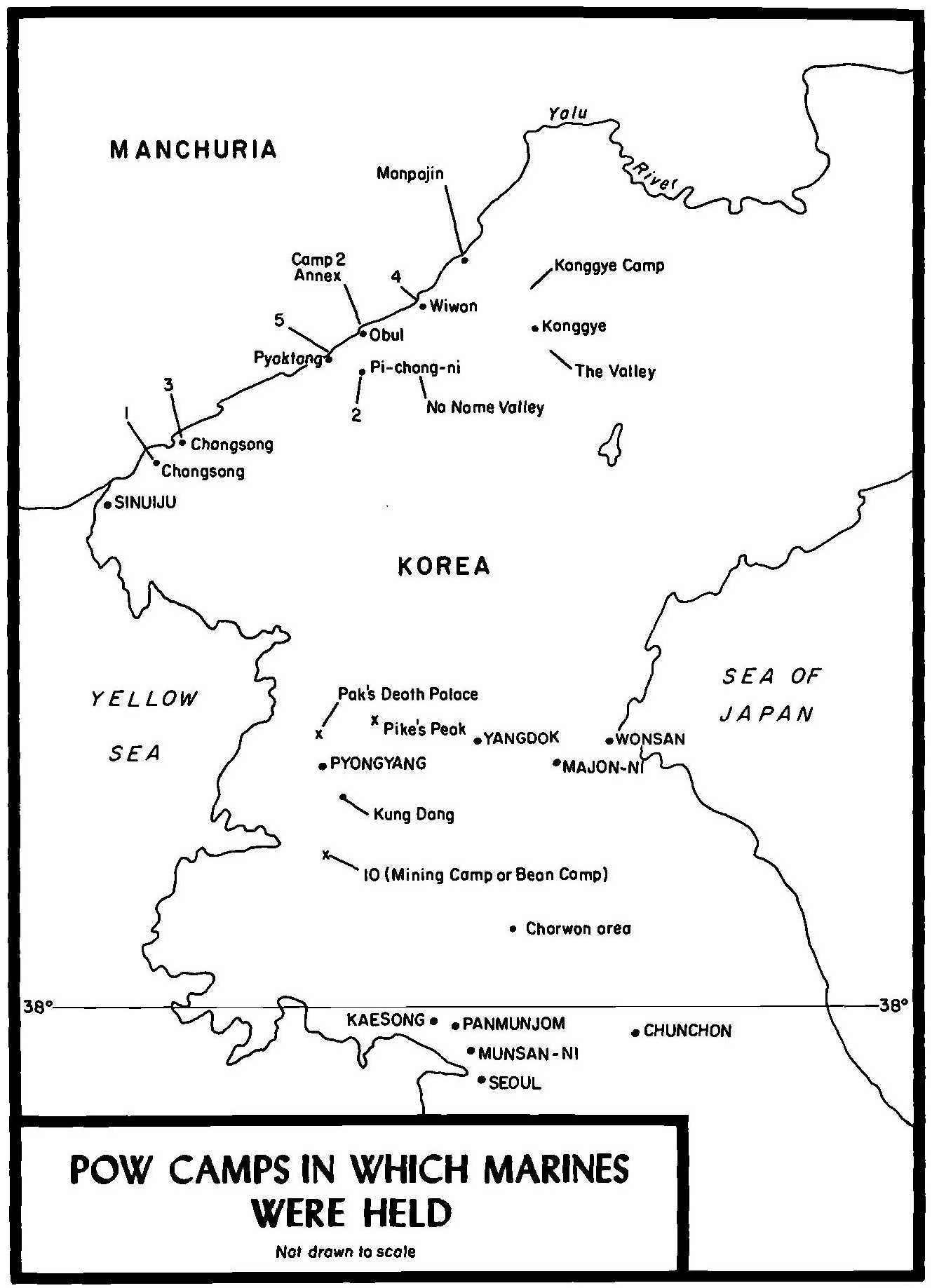
MAP 34 K. White
POW CAMPS IN WHICH MARINES WERE HELD
Interrogations went hand-in-hand with indoctrination. Prisoners
were grilled regularly on order of battle, close air support, naval
gunfire methods, UN aircraft, weapons, unit locations, and other
tactical information. The Chinese were even more interested in the
life histories and biographical data of their captives. POWs were
required to answer “economic questionnaires” and at frequent intervals
compelled to write elaborate self-criticisms of their political
attitudes and class backgrounds. The CCF were satisfied only when
prisoners—whose original truthful answers had been rejected—revised
their own family status and income statistics downward.
POWs, being interrogated, often found the Chinese arguing with
them over such far-away matters as the prisoner’s parents or his own
family annual income and social level.
In March 1951, after an indoctrination period of about eight
weeks, the Kanggye POWs were transferred, and the camp itself
was later abandoned. The officers were relocated at Camp 5, Pyoktong,
while the majority continued the march westward to the
newly opened Camp 1, at Chongsong.
Despite its numerical designation as Camp 5, the Pyoktong compound
had been organized two months earlier and was the first of
the permanent CCF centers. It became the headquarters of the entire
prison-camp system. Approximately 2,000 UNC prisoners were
interned here by the early part of the year. They were housed in
native huts. New inmates arrived regularly from temporary collection
centers in the south, where they had been held for months.
Sometimes they were marched to the Yalu during the Korean winter
while still wearing their summer fatigues. Pyoktong offered little
chance for escape. The compound, situated on a barren peninsula
that jutted out into the Yalu Reservoir, was so secure that the
Communists did not even surround it with barbed wire or employ
searchlights. It was hemmed in on three sides by fast water currents,
while the one exit from the peninsula was closely guarded.
Conditions were far more severe here than at Kanggye. A starvation
diet and complete lack of medical care quickly had their
inevitable effect. Pneumonia, dysentery, and malnutrition were rampant.
The basic diet of boiled corn or millet resulted in associated
deficiency diseases, such as beriberi and pellagra. Between 20 and 30
prisoners died daily. Many experts, nonetheless, felt that “if the
Chinese during the winter of 1950–51 killed their prisoners by
deliberate neglect, the North Koreans who had handled the captives
before they became primarily a Chinese responsibility killed them
by calculated brutality.”582
Although now junior to some Army and Air Force officers, Major
McLaughlin was elected by his fellow officer-prisoners to represent
them. Recognized by the Chinese as a staunch non-cooperative and
dedicated trouble-maker, the enemy concentrated their pressure on
the Marine officer—and he was subjected to intimidation, maltreatment,
and threats of death.
As they had at Kanggye, the CCF attempted to organize progressive
groups to write peace appeals, propaganda leaflets, and
articles condemning the United States for the war. Typically, progressive
POWs (usually weaker, less resilient members) who went
along with the Communist propaganda conditioning, received better
rations and treatment. Rugged resisters, on the other hand, could
dependably expect to stand a considerable amount of solitary confinement,
usually in an unspeakably foul, vermin-infested “hole.”
Here a POW was forced to remain in a debilitating, crouched position
usually 56 hours or more. Throughout the war a good many
Marines were to know this particular enemy treatment. One Marine
artilleryman, Second Lieutenant Roland L. McDaniel, tied to a
Korean POW in the hole for 10 days, emerged with pneumonia
and tuberculosis.
In addition to the POW compounds at Pyoktong and Chongsong,
other sites where Marines were held were Camp 3, at Changsong
(nearby and with a nearly identical name to Camp 1), primarily
for enlisted personnel, and at “The Valley.” This was a temporary
medical processing center in the Kanggye area. Marine inmates here
were often confined to a pig pen. Largely because of the filthy conditions
of this camp, the death rate quickly earned the Valley the
opprobrious name of Death Valley.
Another cluster of POW camps was located further south. These
were primarily run by the North Koreans, and were transit camps
where prisoners were collected and interrogated before being moved
north by truck or on foot to the permanent establishments. Among
them were collection centers at Kung Dong and Chorwon, and Camp
10, south of the North Korean Capital Pyongyang. The latter was
also known variously as the Mining Camp, the Gold Mine, or Bean
Camp—this due to its prevailing diet. At this southernmost Communist
camp, POWs were required to dig coal in the nearby mine
shafts. Loads of coal were then hauled in small hand carts over icy
roads to the camp, a task made more difficult by the prisoners’
skimpy mealtime fare.
The most notorious of all the camps, however, was Pak’s Palace,583
the interrogation center near Pyongyang. POWs also called it Pak’s
Death Palace for its chief interrogator, a sadistic North Korean
officer, Major Pak. Captain Martelli, a F4U fighter pilot from VMF-323
shot down in April 1951, was the first Marine processed through
Pak’s, where POWs were continuously threatened and beaten with
little or no provocation. Another Marine aviator, Captain Gerald
Fink, VMF-312, upon being asked during interrogation here why
he had come to Korea won a sentence of several days solitary confinement
in the hole for his forthright answer: “to kill Communists.”
Second Lieutenant Carl R. Lindquist, also of VMF-312, was the
only one of 18 Marine officers captured in 1951 not processed
through Pak’s before being sent north.
Gradually the Chinese developed the policy of segregating officer
and enlisted personnel. Commenting on this procedure, one British
observer offered the following:
By this means the lower ranks were deprived of their leaders and for a
short time this had a depressing, and generally bad, effect. It was not long,
however, before the natural leaders among the rank and file asserted themselves.
The standard of leadership naturally varied in different compounds;
but in all there was some organization and in some it was highly efficient.
It was ... the policy of the Chinese ... to discourage the emergence
of thrustful leaders.... Consequently, clandestine rather than open leadership
was usual.584
By midyear, noncommissioned officers were also separated from
the enlisted men, in an attempt to better control prisoners. In
October of 1951 another one of the Yalu River Camps was set up.
This was Camp 2, at Pi-chong-ni, which thereafter served as the
main officers camp. The next month a POW column of nearly 50
men, including 6 Marines, left Kung Dong for these northern camps
on a death march that covered 225 miles in two weeks. During the
excruciating march, prisoners had been forced to strip naked and
wade across the Chongsong River, a procedure which caused several
deaths and cases of frostbite. One British participant, however,
recalled that the “Marines banded together during the terrible march,
and the Royal Marines were drawn close to the U.S. Marines.”585
In December 1951 the Communist and UNC forces exchanged
lists of captured personnel. The list of 3,198 American POWs
(total UNC: 11,559) revealed that 61 Marines were in enemy hands.
Nine others, captured late in the year, were still in temporary collection
points and thus not listed. Although Marines represented only
a small portion of the total POWs, they were present in most of the
nearly dozen regular camps or collection points then in existence.
In any event the 1951 POW list586 gave a picture of the growing
Communist camp system.
As 1951 was drawing to an end, the Camp 2 commandant, a
fanatical Communist named Ding, ordered UNC prisoners to prepare
and send a New Year’s greeting to the commander of the CCF,
General Peng Teh-huai. Senior UN officer, Lieutenant Colonel
Gerald Brown, USAF, was determined that the prisoners would not
sign the spurious holiday message. Major McLaughlin voluntarily
organized Marine resistance, and senior officers of other nationality
groups followed suit. No greetings were sent. As usually happened,
an informer reported the organized resistance and furnished names
of the reactionary leaders. The following month, the six ranking
officers were sentenced to solitary confinement, ranging from three
to six months, for their “subversive activities.”
The episode marked the first really organized resistance to the
Chinese. “Although the principals were subjected to months of
solitary confinement, coercion, torture, and very limited rations during
the bitterly cold months of early 1952, their joint effort laid the
foundation for comparatively effective resistance within Camp 2
during the remainder of the war.”587
In January 1952, Major McLaughlin and the other five officers
were removed to begin their long tours of solitary confinement.
Although the remaining Marine officers at Pi-chong-ni had “formed
a tightly knit group and consulted among themselves on every major
issue,”588 the atmosphere within the camp itself became highly
charged and strained. Suspicion of informers and opportunists was
rampant. The officers at Camp 2 were generally agreed that Marine
Lieutenant Colonel Thrash, who arrived in June, was largely responsible
for restoring discipline. He issued an all-inclusive order
about camp behavior for all personnel which read, in part:
Study of Communist propaganda would not be countenanced. If study
was forced on them, POWs were to offer passive resistance and no
arguments.
If prisoners were subject to trial or punishment they were to involve
no one but themselves.
There would be no letters written using any titles or return address
which might prove beneficial to the Communists for propaganda value.589
Expectedly, it was not long before Lieutenant Colonel Thrash’s
efforts to influence and organize his fellow officers outraged CCF
officials. In September he was removed from the compound, charged
with “Criminal Acts and Hostile Attitude against the Chinese
People’s Volunteers.” The Marine airman spent the next eight
months in solitary. Here he was subjected to constant interrogation,
harassment, and duress. On one occasion he was bound, severely
beaten, and thrown outside half naked in sub-zero weather. Shock
of the severe temperature rendered him unconscious, and he nearly
died. Throughout his eight-month ordeal there were demands that
he cooperate with the “lenient” Chinese upon his return to the
compound.
During 1952, the Communists developed the system of keeping
newly-captured Marines (and other UNC troops) apart from those
taken prior to January 1952 who had suffered more brutal treatment.
Beginning in August, noncommissioned officers were also segregated.
They were removed from Chongsong (Camp 1) and taken further
north along the Yalu to the “Sergeants Camp” (Camp 4) at Wiwon.
Although a few Marines had been interned at the Camp 2 Annex,
at Obul, from late 1951 on, they were not sent there in any sizable
number until mid-1952.
Adjacent to a steeply-walled valley, the Obul camp was also
known as “No Name Valley.” Although the inmates of the annex
were aware of other POWs in the main compound and throughout
the valley, they were under heavy guard to prevent contact between
the groups. An Air Force officer, the senior member, and Major
Harris, the ranking Marine, went about organizing the prisoners in
a military manner. In order to exchange information, notes were
hidden under rocks at common bathing points or latrines. Messages
were baked in bread by POWs on kitchen detail, and songs were
loudly sung to convey information. Hospitalized POWs, meanwhile,
were held at the Pyoktong (Camp 5) hospital or, in the southern
sector, at a second hospital a few miles north of Pyongyang. Other
locations where prisoners were confined in 1952 were “Pike’s Peak,”
also in the same general southern area, and the Manpo Camp on
the Yalu.
For POWs incarcerated behind the bamboo curtain, 1952 marked
several other developments. It was the year that American airmen
began to receive special grilling and threats from their Communist
captors. This was in connection with the germ warfare hoax, to be
discussed later. It was also the year that Marine POWs at Pi-chong-ni
(Camp 2) observed their own traditional 10 November Marine
Corps birthday ceremony. Eggs, sugar, and flour were stolen for a
cake surreptitiously baked and suitably decorated with the Marine
Corps globe and anchor. Another group accomplished the task of
bootlegging rice wine. When the special date arrived, the Marine
officers toasted the President, Commandant, and Marine Corps and
spiritedly sang the National Anthem and Marine Corps hymn. One
of the invited guests, Quartermaster Sergeant James Day of the
Royal Marines, later recalled the reaction of other prisoners:
Firstly some were apprehensive in case of trouble with the Chinese, and
its always consequent rash of gaol [jail] victims. Some thought it a little
childish, and not worth the trouble of interrupting the daily routine of
the place. And I feel that quite a lot were rather envious that the small
band of USMC should be able to get together and do this sort of thing
quite seriously, quite sincerely, and with no thought of any consequence.590
This same month the Chinese staged a “Prisoner of War Command
Olympics” at Pyoktong. Although most Marines opposed the
idea of participation in the event, because of its inevitable propaganda
exploitation by the CCF, the decision rendered by the senior
UN officer was that POW athletes would be represented. Much
improved quality food was served for the occasion, Communist
photographers were everywhere, and a CCF propaganda brochure
(with articles written by POW turncoats) was later distributed in
Geneva purportedly to show the healthy recreational activities available
to UNC prisoners. An Air force pilot, in describing the performance
of Major McLaughlin, noted that “his skill as an athlete helped restore
the prestige of the officers torn down by the enemy’s propaganda.”591
More important, he defied the guards by deliberately circulating
among the enlisted men (often younger, impressionable, less mature
individuals) to point out lies in enemy propaganda tactics designed
to slander the U.S. government and its leaders. The Marine officer
also collected names of American POWs held in isolated places who
it was suspected the enemy might attempt to hold as hostages at the
end of the war—possibly as a bargaining tool for the granting of a
seat to Red China in the UN.
During the last year of the war although a number of prisoners
were still being captured in some of the most savage attacks unleashed
by the enemy, the lot of the average POW had improved. More
attention was being paid to the former pitiful medical care. The men
were more warmly clad, even though still huddled into filthy, crowded
huts. And the monotonous poor chow had improved. Most POWs,
although carefully kept from learning developments of the outside
world, naturally suspected that some reason lay behind the changes.
And so there was: the Communists had no desire to repatriate skeletonized
prisoners.
As early in the war as July 1951, the CCF was seeking propaganda
benefits out of its so-called “lenient” policy toward captured United
Nations personnel. Basically, this could be described as “calculated
leniency in return for cooperation, harassment in return for neutrality,
and brutality in return for resistance.”593 Others have characterized
the CCF psychological techniques of indoctrination as monotonous
and single-minded “repetition, harassment and humiliation.”594
In some respects, it is true that the Chinese treatment of prisoners
appeared to be more humane than that of the North Koreans. The
latter freely used physical cruelty and torture, to the point of being
barbaric.595 Sometimes it appeared that Allied POWs did not receive
any harsher treatment from the CCF than did local civilian prisoners.
Whereas the NKPA regularly resorted to physical brutality, the
Chinese “introduced a more insidious form of cruelty.”596 Although
they used physical violence less often, it was usually more purposeful
and combined with deliberate mental pressure. CCF officials announced
that treatment of captives would be “fair and lenient,” but
that wrongdoers would be publicly punished. Usually this CCF punishment
took the form of less drastic methods—solitary confinement,
prolonged interrogation, and a reduced diet. Even under this decreed
lenient policy, however, no relief parcels were delivered to POWs,
nor were any neutral observers ever allowed to inspect the prison
camps.
In any event, the Chinese were considerably more effective than
the NKPA in their intelligence activities. Often their skilled interrogators
were officers who spoke excellent English. Occasionally, they
had even attended such U.S. schools as the University of Chicago
and had considerable insight into American psychology, customs,
and values—even slang. Interrogation sessions usually employed recording
devices and sometimes were further equipped with one-way
mirrors. One Marine, subjected to frequent interrogation, was kept
awake by the Chinese who slapped his face and blew smoke in his
eyes.
From early 1951 to the end of the war UNC prisoners were subjected
to a systematic attempt at mass conversion to Communism.
This intensive indoctrination effort—like the riots of Communist
prisoners in Allied POW camps and the CCF germ warfare fabrications—was
designed to gain a propaganda advantage. From highest-ranking
officer to lowly private, no one was immune to this thought-reform
process. General Dean, prize Communist captive, who was
subject to three years of intense Marxist-Leninist indoctrination, upon
his release commented wryly, “I’m an authority now on the history of
the Communist Party and much of its doctrine.”597
English-speaking POWs, both American and British, particularly
became the target for Communist thought-control conditioning. Many
experts have discussed glowingly the superb example and iron discipline—both
on the battlefield and in POW camp—displayed by the
Turkish soldiers. This is true, and their outstanding performance is
to their credit as a national group. The fact remains, however, that
the Turks were long-term professional soldiers. Usually they were
left alone by the Communists who neither spoke their language nor
needed them for propaganda purposes. As a rule all non-American
troops of the United Nations received better treatment than American
and British personnel.
The basic tenet of the Communist party line was that this aggressive
war against the peace-loving people of Korea had been caused
by American imperialists seeking additional foreign markets. All
UNC soldiers were, therefore, by simple definition war criminals
who deserved no better treatment than death. But as most UN soldiers
were misguided and misled by their capitalist rulers they would
“not be shot if they admitted their mistakes and showed themselves
to be progressive”598 by becoming properly indoctrinated.
Often, the thought-reform processing started long before prisoners
reached their permanent camps, while they were under initial interrogation
in the transit collection center. Captain Samuel J. Davies,
Anglican Chaplain of the British Gloucestershire Regiment,599 noted
that lecture subjects presented to his officer group at one North
Korean temporary collection center included:
- Corruption of the UN by the American warmongers;
- The Chinese Peoples’ right to Formosa;
- The Stockholm Peace Appeal;
- Progress in Peoples’ China;
- Churchill, tool of the Truman-MacArthur-Dulles Fascist clique;
- The Soviet Union heads the World Peace Camp.600
Systematically the enemy ground away at theory and practice of
Communism, with its superiority to American democracy. From emphasis
on the Korean War as imperialist aggression, the programmed
thinking then dealt with shortcomings of western countries (particularly
Southern lynchings, poor treatment of Negroes, and colonialism)
to the idyllic socialism in people’s democracies where “everyone
is equal.” “Together with the emotional pressures involved, this dramatic
presentation of Marxism-Leninism to prisoners who often not
only failed to comprehend why they had fought in Korea, but even
the rudiments of democracy itself, was bound to have some sort of
effect.”601
Compulsory lectures and discussions often went on until 2200. Together
with the unceasing indoctrination efforts, the CCF attempted
to maintain complete control over every aspect of POW life. Each
camp was divided into POW companies (ranging from 60 to 300
men), platoons, and squads. Squad leaders, appointed by the Chinese,
reported regularly to authorities the opinions of men in their group.
“Converted” progressives were responsible for much of the internal
policing. Every prisoner with reactionary tendencies was isolated. The
varied pressures of hunger, fear, constant threats of torture, coercion,
nonrepatriation, anxiety, and guilt602 were used to break him down.
In an attempt to convert the Marines and other prisoners to their
own beliefs, the Communists prohibited the use of the term “prisoner
of war.” Instead they used the phrase “newly liberated friends”
and insisted the POWs do likewise. They also denounced religion
as a superstition and device for controlling people’s minds. Curiously,
POWs were often permitted to retain whatever religious articles
they had on them when captured, so that Bibles, rosaries, etc.,
were available for squad groups that sought to hold informal religious
discussions and readings. Such religious expression was, of
course, strictly forbidden. It might be noted here that Marines, as a
group, did not appear to be any more or less interested in religious
services than other POWs.
By mid-1952 the compulsory lectures were considered a failure,
and the emphasis shifted to “voluntary” study groups led by progressives.
More insidious methods of indoctrination were being used—books,
papers, and articles written by camp progressives. Personal
interrogation and indoctrination had proved it could have a more
powerful effect than attempts at mass conversion. Then, too, the
Chinese had by this time perfected another propaganda tool that admirably
suited their purposes. It was to have even still more effective,
far reaching results.
Besides their routine interrogations and indoctrinations, by 1952 the
Communists had found a new angle to exploit. This was to have
strong repercussions on the treatment of some captured personnel.
And, ultimately, it was to affect American public reaction to the
entire Korean War and to shake the nation’s confidence in some of its
fighting men who became POWs.
The germ warfare issue developed from an incident in January
1952 when the Communists shot down a U.S. Air Force B-26 bomber.
Several months later, in May, the enemy propaganda campaign
moved into high gear when the navigator and pilot both purportedly
confessed that they took part in a raid in which germ bombs were
dropped on North Korean towns. After the CCF successfully extracted
false confessions from the two USAF officers, the enemy exposed
both prisoners to a select group of Oriental medical specialists
and newspapermen. The two Americans apparently performed according
to plan, and a relentless flood of Communist propaganda
was unleashed on the world.
While the allegation of bacteriological warfare was not new in the
Korean War, it was not until 1952 that the Chinese successfully exploited
it. After suffering their first reverses in Korea in September
1950, the Communists charged that Americans were waging germ
warfare. Even after they regained the tactical initiative in late 1950
they continued their campaign of vilification. In early 1951, while the
UNC battled epidemics of smallpox, typhus, and amoebic dysentery
prevalent among the civil population and within the POW camps,
the CCF branded medical efforts to curb the diseases as experiments
in germ warfare. A formal complaint was made by the CCF to the
United Nations in May 1951; thereafter, the germ warfare charges
lay dormant for the rest of the year.
The effect of the two airmen’s “confessions” in 1952 was far-reaching.
From that time until the end of hostilities “captured
aviators of all services were subjected to a degree of pressure and
coercion previously unknown by prisoners of war. Prior to the turn
of the year aviation and ground personnel received relatively the
same treatment in Communists’ hands. After January 1952, aviators
were singled out for a special brand of treatment designed to wring
bacteriological warfare confessions from them.”604 North Korean
officials joined the CCF spokesmen in loudly denouncing American
bacteriological attacks. As the campaign gained momentum, an
elaborate, cleverly-concocted “War Crimes Exhibit” was set up in
Peiping in May. Similar displays were later on view at the UNC
officers’ camp at Pi-chong-ni, including hand-written and sound-recorded
confessions by the two American pilots, as well as a convincing
array of photos depicting the lethal “bomb containers.”
All the while air personnel were being put under acute stress to
confess alleged war crimes. Captured Marine aviation personnel encountered
this new subject in their interrogations. Lieutenant Henry,
captured in February, was asked about germ warfare. Major Judson
C. Richardson, of VMF(N)-513, during interrogations at Pak’s was
told he would never leave Korea when he denied that the U.S. was
waging bacteriological warfare. Master Sergeant John T. Cain,
VMO-6, a well-known Marine enlisted pilot whose plane was shot
down in July 1952, was questioned, confined to the hole, and taken
before a firing squad when he refused to acknowledge American
participation. Captain Flynn was also subjected to intensive and
brutal interrogation by North Korean and Chinese Communist Air
Force personnel who sought a confession. Others were to meet
similar pressure and be questioned until their nerves shrieked.
On 8 July 1952, the first of a chain of events occurred that was to
link the Marine Corps with the spurious bacteriological warfare propaganda.
Colonel Frank H. Schwable, 1st MAW Chief of Staff and
Major Roy H. Bley, wing ordnance officer, were struck by Communist
ground fire while making a reconnaissance flight. The enemy had
little difficulty in compiling Colonel Schwable’s biography. Although
he repeatedly maintained he had just arrived in Korea and had not
yet received an assignment, he was in uniform with insignia and full
personal identification. A Department of Defense press release issued
two days later gave considerable data, correctly identifying him as
the Marine Wing Chief of Staff. The Chinese knew they had a prize.
Two weeks after his capture, the colonel was taken to an interrogation
center where he remained in solitary confinement until
December. He quickly became aware of CCF intentions to utilize
him for their propaganda mill. He was interrogated relentlessly,
badgered, accused of being a war criminal, fed a near-starvation diet,
denied proper latrine privileges, refused medical and dental attention,
and subjected to extremes of temperature. Ultimately the discomfort,
almost constant diarrhea, extreme pain from being forced
to sit in unnatural positions, fatigue, and naked threats wore him
down. At the same time he was also convinced that had he continued
to resist Communist demands for a confession the enemy would
have affixed his forged signature to a document to achieve their ends.
He later commented:
In making my most difficult decision to seek the only way out, my
primary consideration was that I would be of greater value to my country
in exposing this hideous means of slanderous propaganda than I would
be by sacrificing my life through non-submission or remaining a prisoner of
the Chinese Communists for life, a matter over which they left me no
doubt.605
General Dean, held in solitary confinement for much of his three
years’ captivity, stated the greatest problem facing a prisoner of
war is “maintaining his judgment—he has no one on whom he can
try out his ideas before turning them into decisions.”606 Possibly
this was also Colonel Schwable’s problem. Many drafts of his confession
were made before the Chinese were satisfied that specific
details reinforced the information earlier obtained in other prisoners’
false statements. The confession that finally evolved in December
cleverly combined factual order of battle data and technical terminology
to create a most convincing lie. It was more sophisticated than
efforts of earlier captives and was, unquestionably, damaging.
Problems faced by Marine and other UNC prisoners ranged from the
fundamentals of sheer survival to more abstract questions involving
honor and duty that have less sharply defined interpretations. Was
it, for instance, a prisoner’s duty to overtly resist the enemy at all
costs and on all possible occasions? Or was an attitude of passive
resistance that created less hostility and attention better in the long
run? Were such passive techniques liable to render a POW unable
to continue making fine distinctions in his conduct and behavior so
that he unwittingly went over the line to become a collaborator with
the enemy? What about a ranking POW’s responsibility of leadership?
In a practical, day-in, day-out way, every prisoner had to decide
for himself as to how actively or passively he would resist the
enemy. In a number of cases Marine (and other Allied) POWs
gave deliberately false or misleading information in response to
threats, coercion, or maltreatment. Three Marines at Pak’s regularly
held counsel “to determine their courses of action and to coordinate
their false stories.”608 Captain Fink’s list of ships, all sunk in World
Wars I and II, was similar to the story told by an Air Force officer
of the new B-108 bomber (three B-36s).
Not infrequently a POW faced threats of death, reduced rations,
still worse medical care, solitary, or physical beatings and torture
if he failed to make some response to questions. Major Richardson
finally wrote untruthful answers to five questions about the Navy,
although his NKPA interrogators told him his lies were detected.
Master Sergeant Cain authored a fanciful report about the Fleet
Logistic Wing, an organization about which he knew nothing, not
too surprisingly since it did not exist. He later admitted, however,
that he felt he’d “made a mistake at that time [his first interrogation]
by lying about inconsequential things.”609
Expressed in simplistic terms, a spirit of cohesion and of group
identity seemed to be the key factor in—to use a bromide that is
particularly apt here—separating the men from the boys. Even when
avowed reactionary leaders were removed to serve one of their many
solitary tours, there seems little doubt that their example served to
instill a spirit of resistance (either open or underground) in fellow
POWs. This was particularly true when the leadership gap was
filled by the next senior man and the chain of command remained
unbroken.
Prisoners who were able to rise above their own personal situation
(i.e., to adjust, without giving in) and to assist others seemed, unquestionably,
to have gained greater resiliency and determination.
Whether this is a cause-or-effect reaction, however, might be a grey
area difficult to pinpoint precisely. In any event, glimpses of Marines
from behind the barbed wire indicated that steadfastness under
pressure, ingenuity, and outstanding leadership earned them the
respect of fellow prisoners as well as a place in Marine Corps
history.
Even in a situation as inhospitable and hazardous as a POW camp,
it is not surprising that characteristic behavior and certain distinctive
personality traits tend to show through, no matter what. Captain
Fink, captured early in the war, endured unspeakable humiliations
at the hands of the North Koreans. Although he felt his morale was
at its lowest point at this time, and was not sure he could go on, he
was later responsible for providing a high degree of civility for
POWs confined to Camp 2. His most notable artistic and mechanical
achievement was probably the construction of an artificial leg610 for
USAF Major Thomas D. Harrison. This prosthetic was so expertly
fashioned that its owner could play volley ball using his new
limb! Fink also built stethoscopes for POW doctors, using resonant
wood and tubing stolen from Chinese trucks. After a discussion
with other POWs on the need for a religious symbol in camp, the
resourceful Marine made a 22-inch crucifix, christened “Christ in
Barbed Wire.”611 His efforts on behalf of religion earned him a
10-day sentence in the hole.
Captain Arthur Wagner, VMF(N)-513, spent an unusually long
six-month tour at Pak’s during 1951. For new captives headed in that
direction, the word via USMC grapevine was that he “could be
trusted.”612 Captain Wagner counselled other prisoners at Pak’s,
helped chop wood, draw water, cook, ease the burden of sick POWs,
and resisted the Communists at every turn.
Another member of the same squadron, Captain Flynn, had completed
59 combat missions against the enemy in North Korea before
being shot down in May 1952.613 While captive, the veteran Marine
fighter pilot withstood intense interrogation, influenced others to
suppress CCF-inspired talks made by progressives, and strengthened
morale by planning a group escape. He was sentenced to 20 years
imprisonment by a mock court. Throughout it all, according to
Master Sergeant Cain, the POWs “owed much to Flynn who kept
them amused.”614 First Lieutenant Robert J. Gillette’s “reactionary”
attitude resulted in his being placed in the hole on several occasions.
Once, at No Name Valley, he managed to scribble a novel on toilet
paper which subsequently provided some light moments for fellow
prisoners. And First Lieutenant Felix L. Ferranto, 1st. Signal Battalion,
spent more than two years of his 33 months’ imprisonment
in solitary confinement or isolated with small units of “non-cooperative”
POWs. The CCF pronounced him a “hopeless capitalist, an
organizer with an ‘unsincere attitude.’”615
The type of amiable accommodation that could sometimes be
made, without compromising one’s standards, was once successfully
demonstrated by Captain Jack E. Perry, VMF-311 briefing officer.
On a bombing run his F9F fuel tank was hit, and he parachuted
down. Seized almost immediately by the Chinese, his captors
“showed him bomb holes from numerous strikes in the area, and
they pointed out several wounded soldiers. Then, as he describes it,
‘They laughed like hell.’ Although Captain Perry failed to see
anything funny, he laughed along with them.’”616
Three Marines captured during the Korean War had suffered
a similar fate in World War II. Ironically, Staff Sergeant Charles
L. Harrison, of the Military Police Company; Warrant Officer Felix
J. McCool, of 1st Service Battalion; and Master Sergeant Frederick
J. Stumpges, Headquarters Company, were all captured in the same
29 November 1950 action. Comparisons of treatment by the Communists
and Japanese were inevitable. A survivor of the Bataan
Death March, Stumpges felt that although the Japanese confinement
was more difficult physically, imprisonment in North Korea
was a far worse mental ordeal. “They [the Communists] were
around all the time and you could never speak your mind.”617
The other two Marines similarly thought that the Japanese were
more brutal but had more character. Harrison, captured at Wake
Island, said he admired them because “they really believed in their
cause and were loyal to it.”618 The Chinese, on the other hand, he
characterized as employing “false friendship and deceit.”619 McCool,
who had spent 70 hours in a slimy, lice-infested hole for refusing to
confess to a phony charge of rape and pillage, knew that he “hated
the Chinese Communists far more than he had hated the Japanese.”620
Master Sergeant Cain had distinguished himself by flying little
OE reconnaissance planes 184 hours and had 76 combat missions
in one month. Just before his capture, Cain had paid for six months’
education for nine Korean youngsters who lived near his air base.
Because of his graying hair and lack of rank insignia, Sergeant
Cain was mistaken for a senior officer. In fact, the Chinese insisted
that he was Lieutenant Colonel Cain, CO of VMF-121. His equal
amount of insistence that he was not a Marine officer, plus his
refusal to reveal any significant information, made him a particular
nuisance to the CCF. He was subjected to intensive interrogation
sessions, confined to the hole, and stood at attention for periods of
five to eight hours. Describing the occasion on which he thought
it was all over, Sergeant Cain related that he:
... was taken to a hillside, blindfolded, and placed in front of a
firing squad. He heard rifle bolts click. The commander of the firing squad
asked if he was ready to tell all.621
When the Marine sergeant replied that he was not going to talk,
the Chinese returned him to solitary confinement. Eventually, after
questioning him for 84 days, the CCF gave up trying to indoctrinate
him in the ways of Communism. Major Harris, senior officer of the
Obul complex, freely acknowledged that Sergeant Cain “assumed
more than his share of duties and responsibilities and set an example
for all to follow.”622
As the Korean War came to a close, assessments were being made
of America’s role in it. Operation BIG SWITCH swung into high gear
and national attention focused on the returning POWs and their
experiences in Communist camps. The widely-accepted statement
was that no prisoners had escaped. Even more discrediting was the
prevailing belief that, “worse, not a single American attempted to
escape from captivity.”624 These reported facts are not borne out by
the actual record.
In May 1951, a group of 18 Marines and a U.S. Army interpreter
found their way back to American control through a combination
of fortuitous events and quick thinking. All of the Marines had
been captured several months earlier, in the 28 November-11 December
period, the majority on the night of 29–30 November. There
were peculiar circumstances connected with their escape. In early
April, a group of nearly 60 UNC prisoners had been brought south
by the enemy from the Majon-ni area. Presumably they were to
perform working details in the rear of Communist front lines.
While a larger number of prisoners, both Army and Marine,
were marched westward to Pyoktong, First Lieutenant Frank E.
Cold and a group of 17 enlisted were sent further south to the
general Chorwon area, not far from the 38th Parallel. In the meantime
the Chinese launched their spring counteroffensive on 22 April.
It appears that, subsequently, the Marines and Army interpreter,
Corporal Saburo “Sam” Shimamura, who had been attached to the
1st Marine Division, were told they would be taken to the area
in which the Marine division was operating and released there.
The group was then trucked southeast to Chunchon, just below
the Parallel, under guard, and marched toward the vicinity of the
front lines. On 24 May, while in proximity to the main battle area,
an artillery preparation suddenly registered nearby. The CCF guards
fled, while the prisoners ran in the opposite direction, heading for
high ground where they successfully eluded the guards. For the
rest of that day and night the escapees quietly watched Communist
troops retreat past them. The next day, 25 May, the Marines fashioned
make-shift air panels from wallpaper they stripped from a
ruined Korean house in the area. They spelled out “POWS—19
RESCUE.” Their signal attracted the attention of an Army observation
pilot who radioed their position to an Army reconnaissance
unit.
Three Army tanks were dispatched and escorted the ex-prisoners
to safety. They entered friendly lines in the vicinity of Chunchon,
“the first and only group of prisoners to experience Communist indoctrination
and to reach freedom after a prolonged period of
internment.”625 Two members of the unit626 were of special interest.
One man was 56-year-old Master Sergeant Gust H. Dunis, who had
barely survived the brutal, frozen death march to Kanggye in late
December. The other was Staff Sergeant Charles L. Harrison, previously
introduced as a unique two-time prisoner of war.
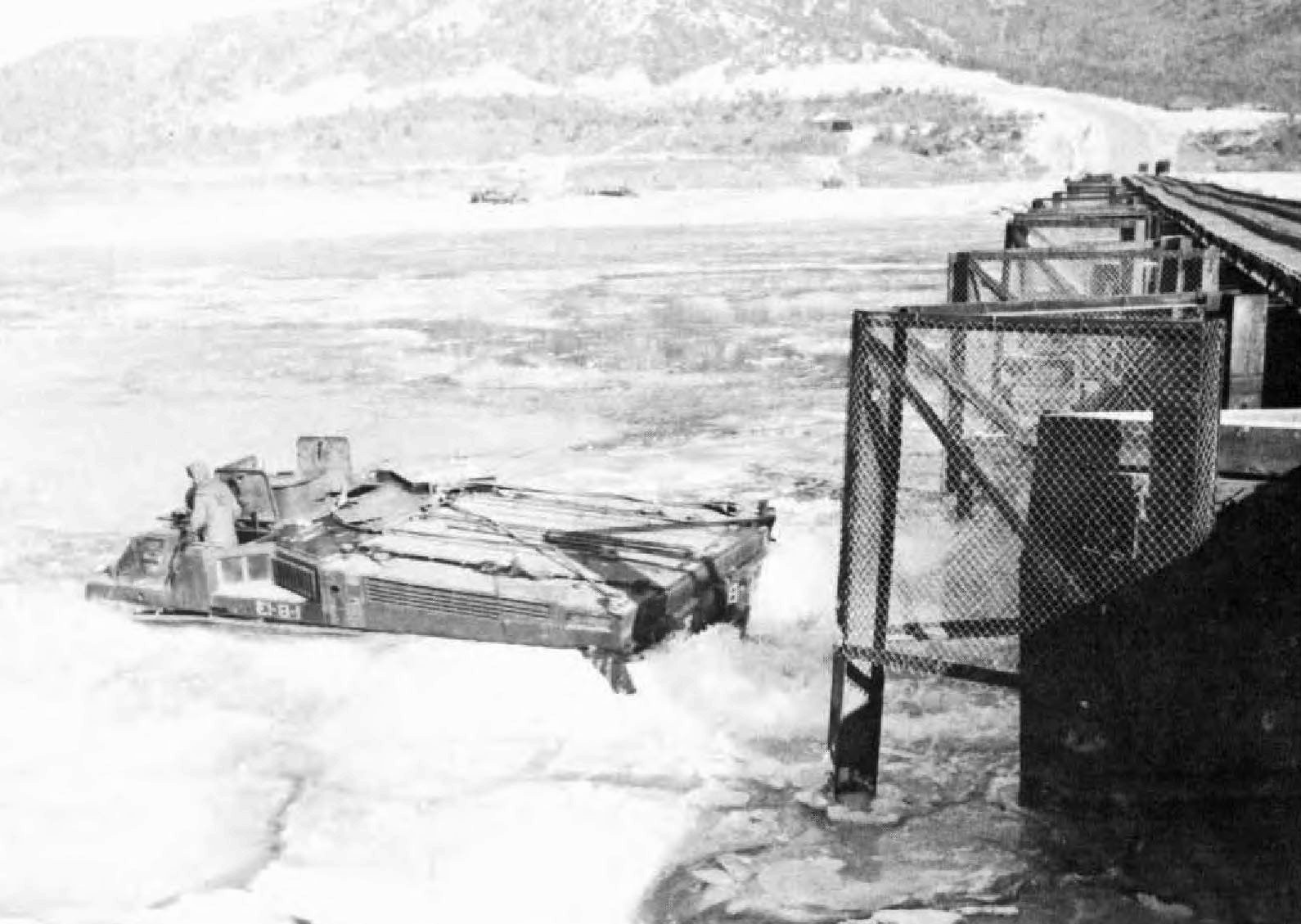
DOD Photo A 169702
Ice-Breaker at Work—Amphibian tractor of 1st Amphibian Tractor
Battalion destroys thick-crusted ice to prevent its backing up against
Spoonbill Bridge. Below, the 1st Engineer Battalion maintenance shop
in operation at Ascom City.
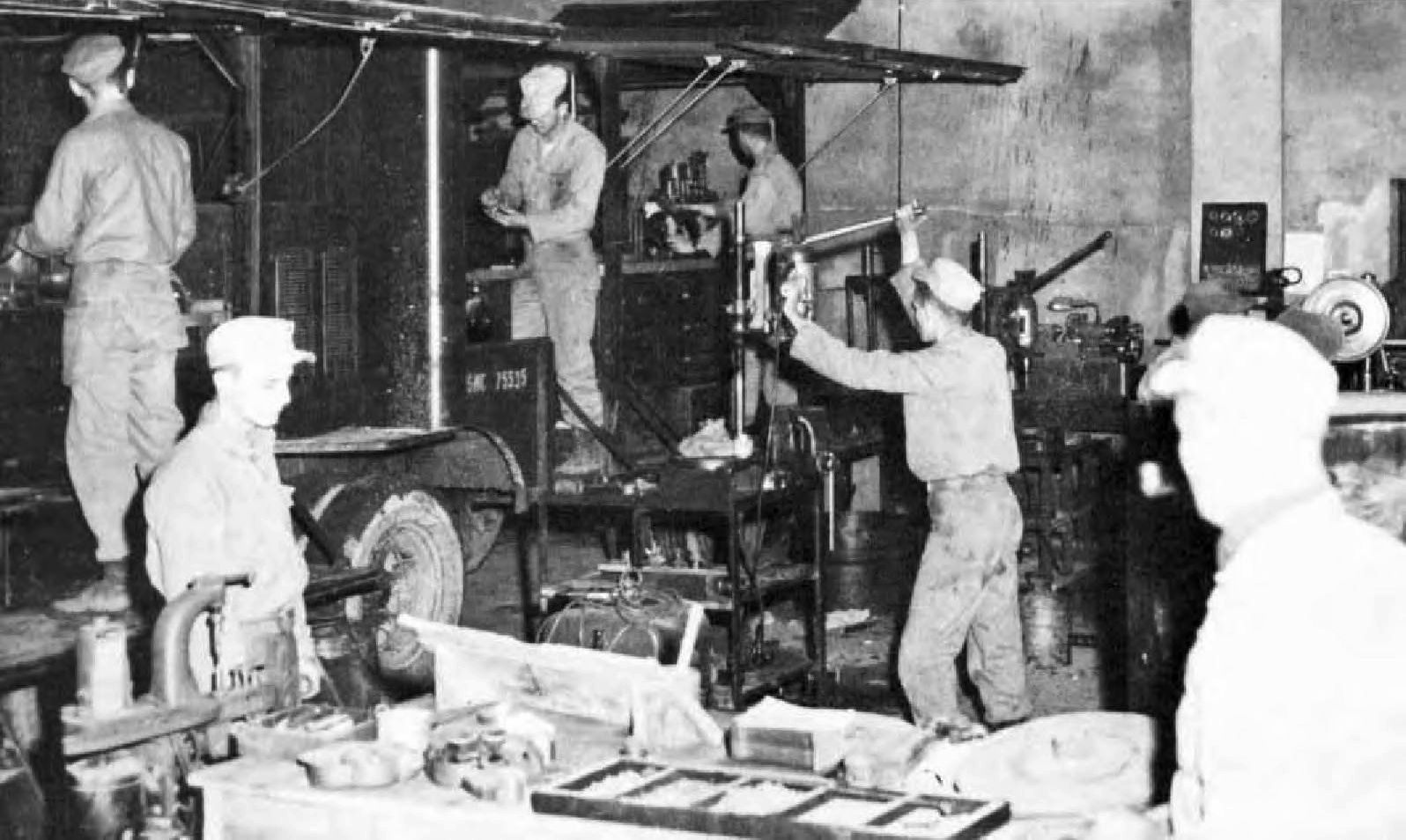
DOD Photo A 168178
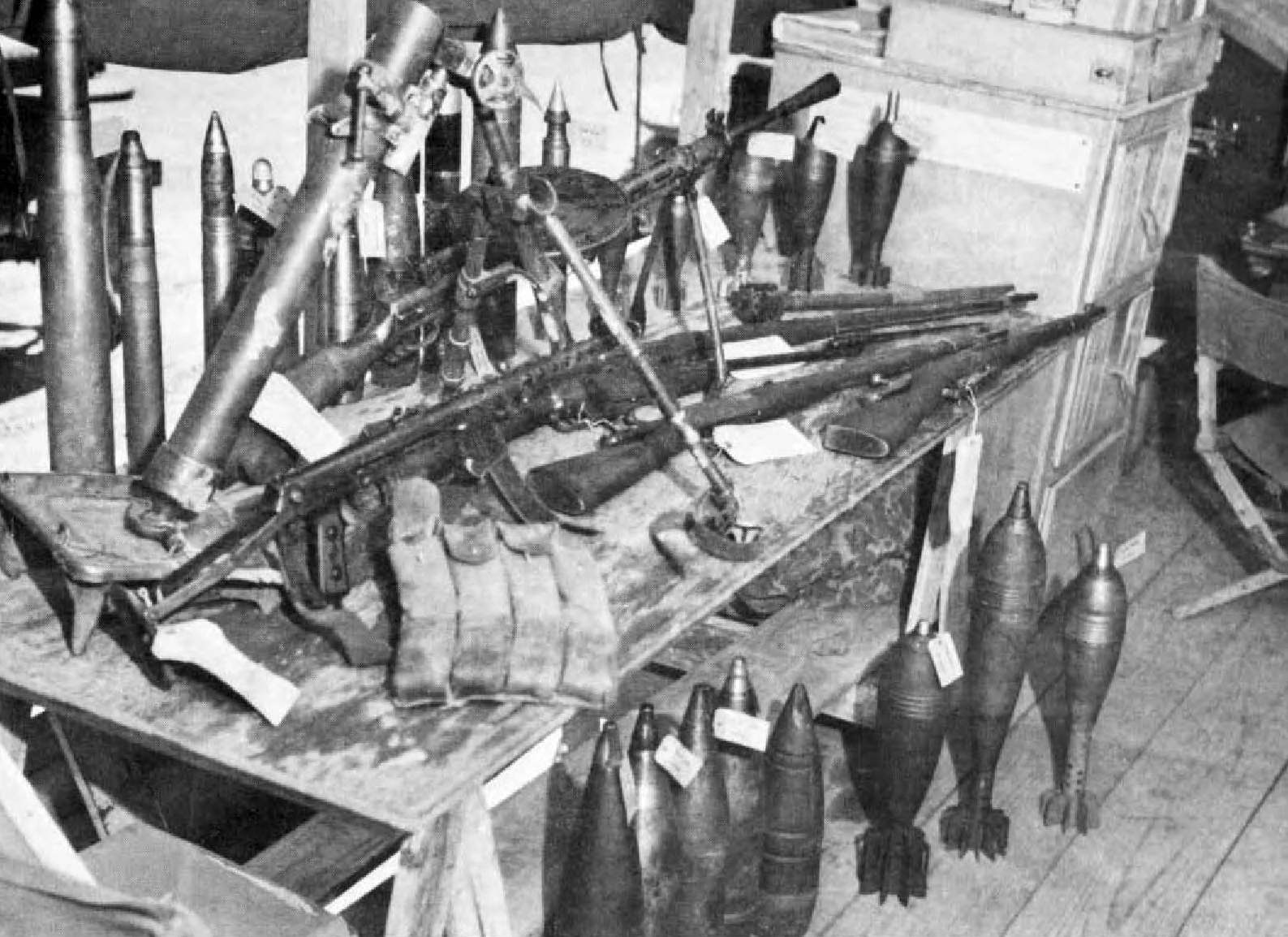
DOD Photo A 16373
Captured Enemy Weapons—Various types of mortar and artillery
shells, machine guns, rifles, and a 60mm mortar are displayed at 1st
Marine Division CP. Below, F9F Pantherjet fighter taxies down runway
for takeoff.
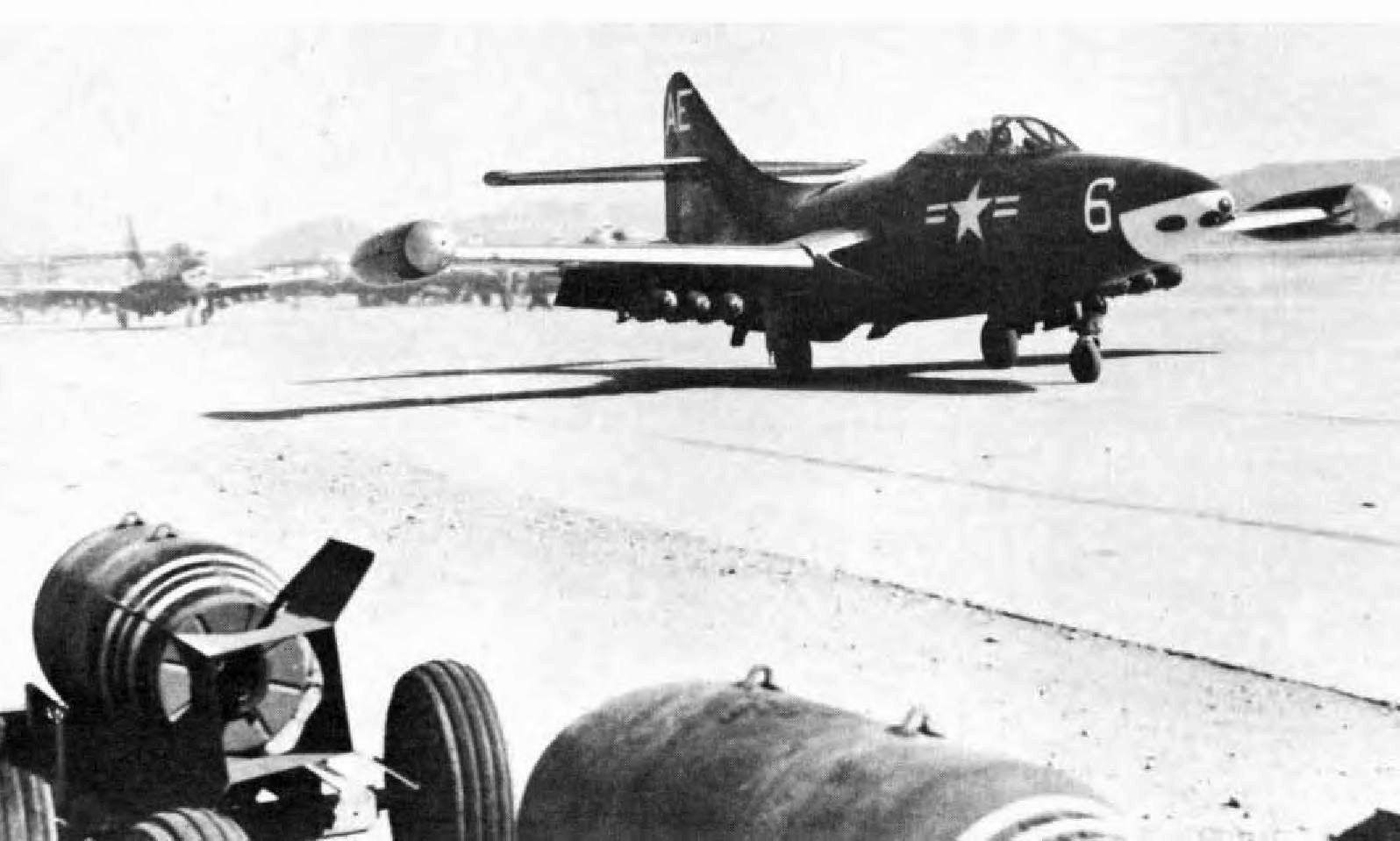
DOD Photo A 346720
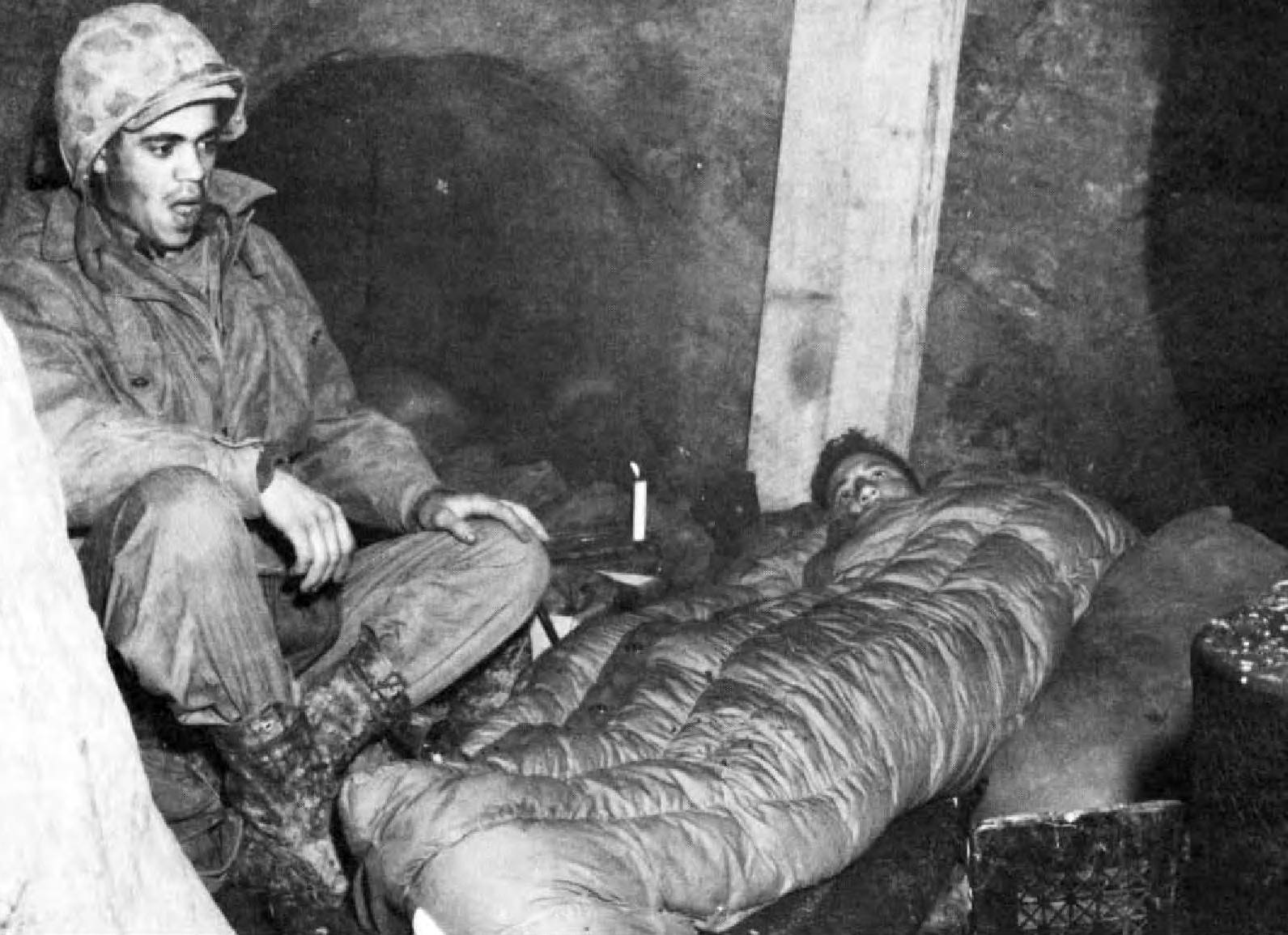
DOD Photo A 170084
Outpost Defense—Inside view of one of the many sleeping caves, which
shelter two to four men, on Marine outpost Carson. Below, COP Dagmar
under artillery bombardment preceding enemy diversionary ground
attack on 26 March 1953.
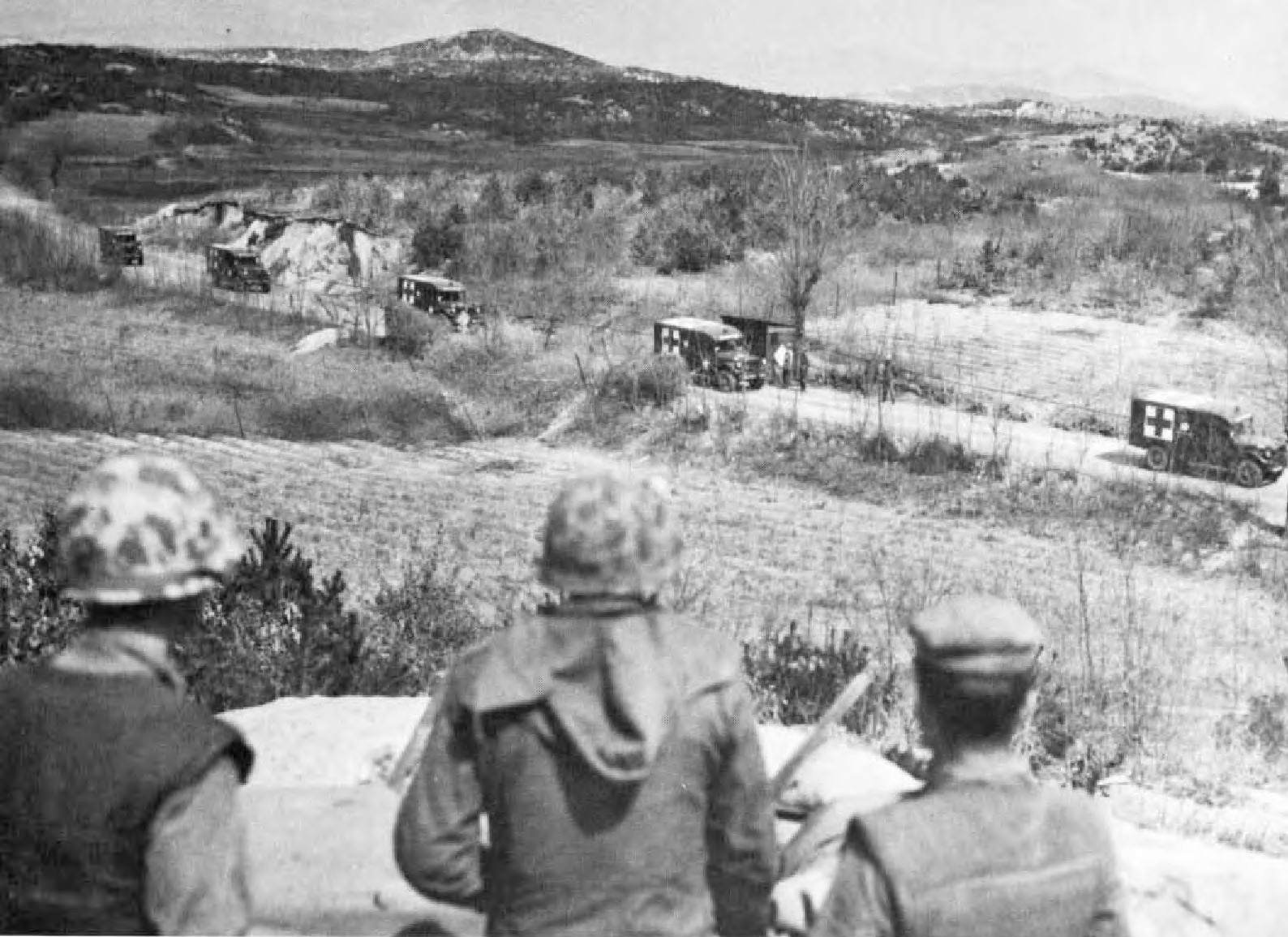
DOD Photo A 17096
POW Exchange—Frontline Marines watch Army convoy bringing first
UN prisoners to Freedom Village in Operation LITTLE SWITCH. Below,
NKPA and CCF delegation upon adjournment of first day’s truce talks,
April 1953.
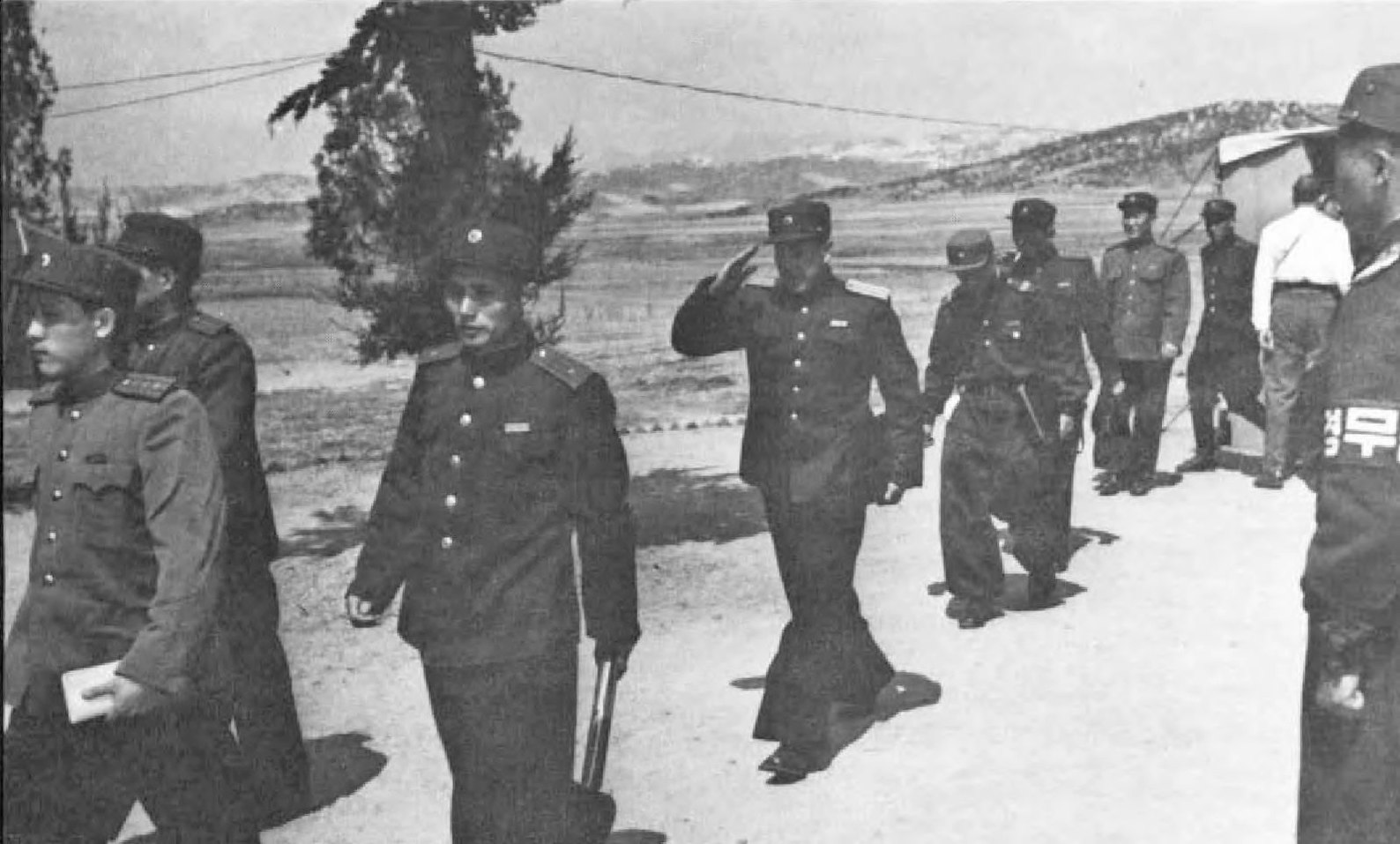
DOD Photo A 170778
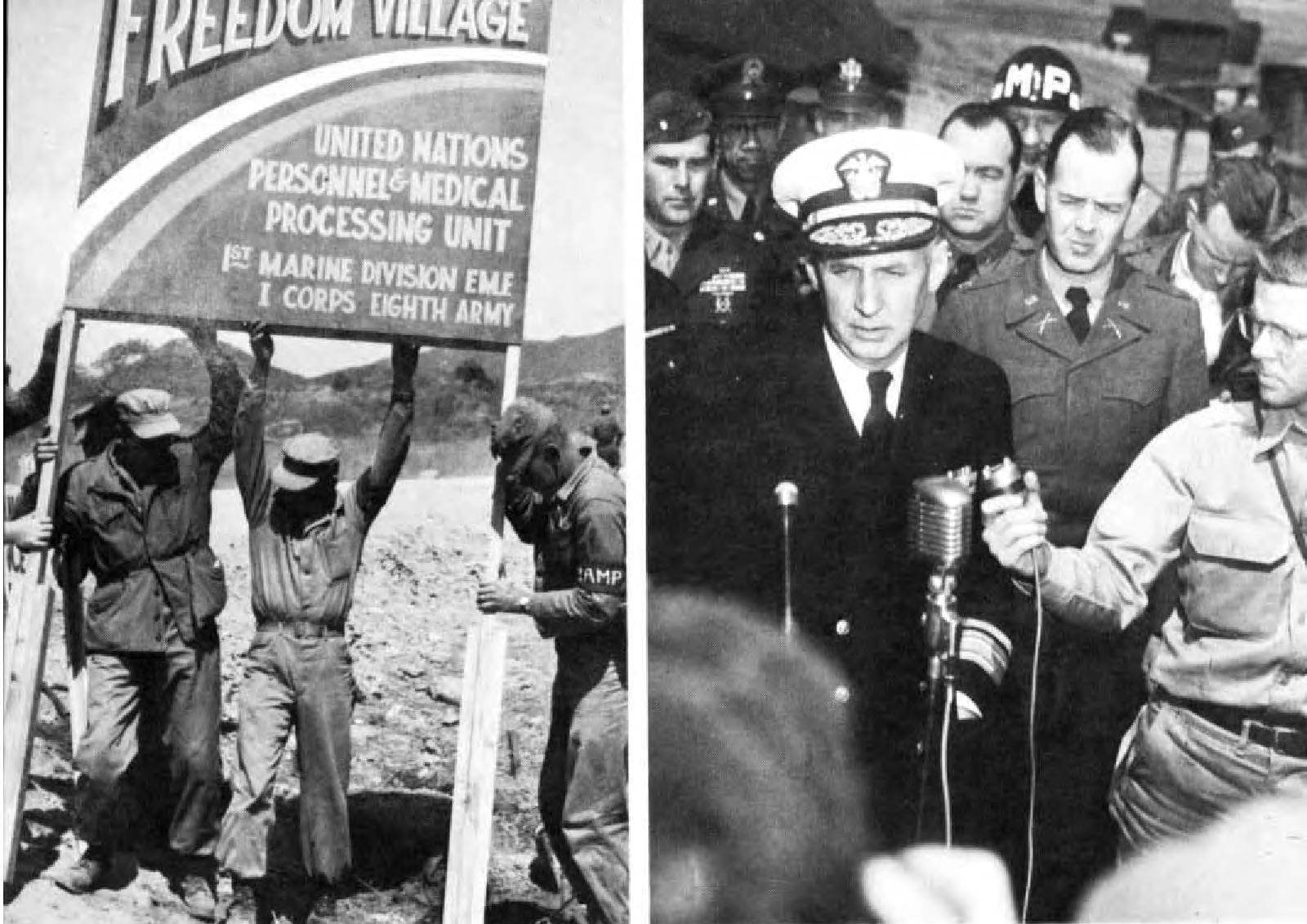
DOD Photo A 170795 DOD Photo A 170766
Freedom Village—Marines of 1st Engineer Battalion raise welcoming
sign at entrance to camp. Rear Admiral John C. Daniel, USN, senior
delegate at truce talks, reports progress at press conference. Below,
KSC workers and Marine reroll barbed wire for use at the front.
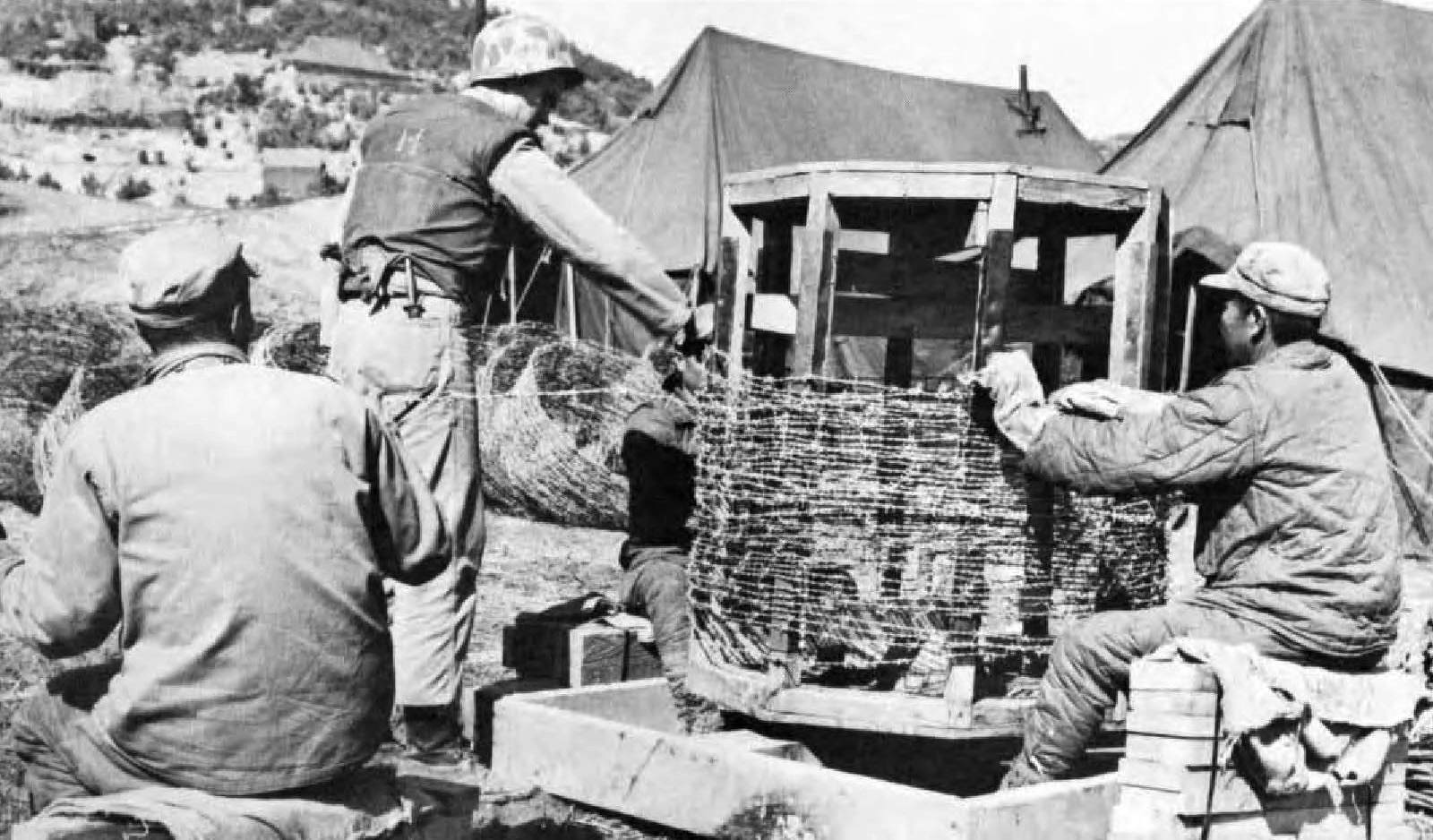
DOD Photo A 170106
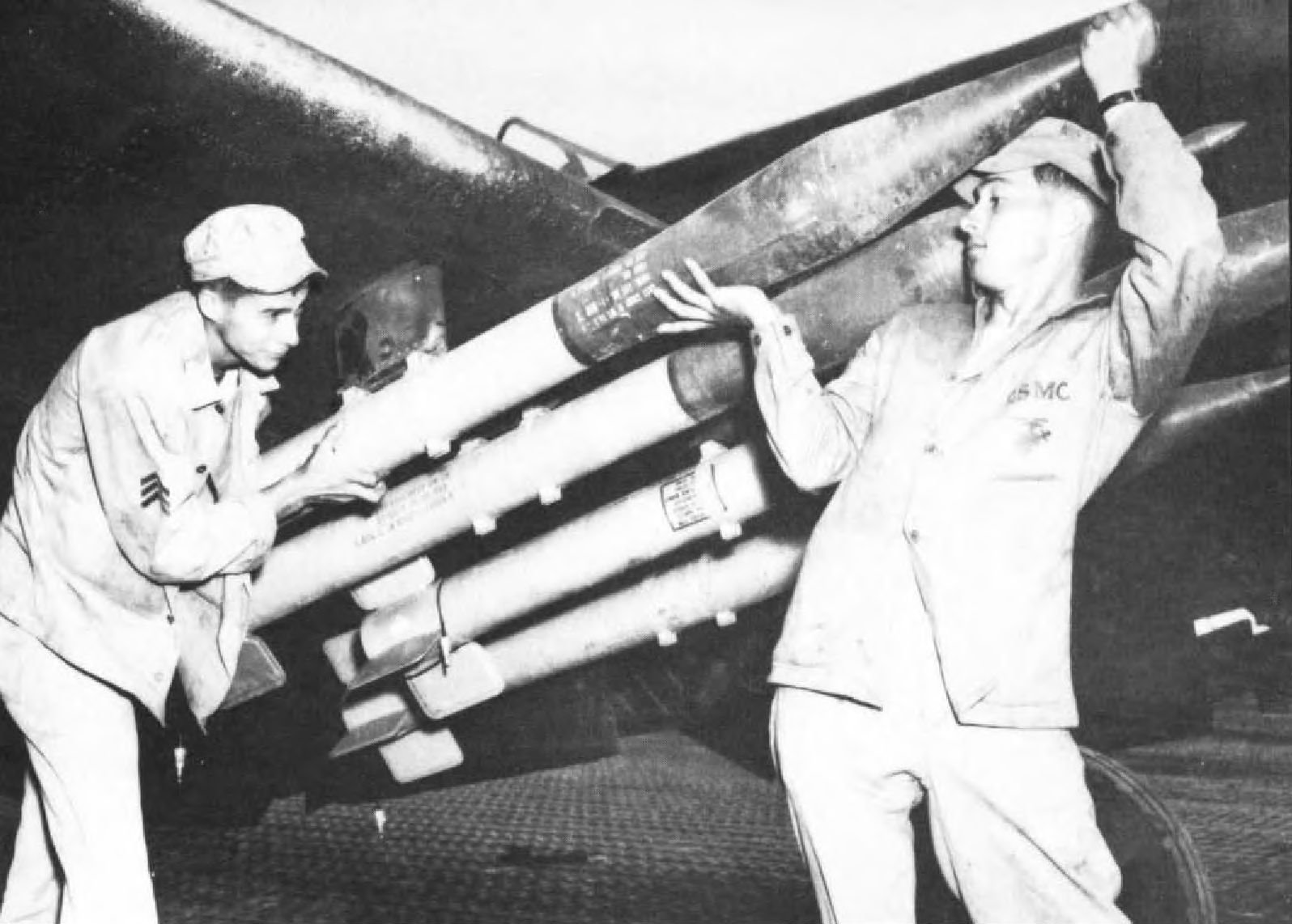
DOD Photo A 13392
Ready to Strike—Ground crew loads rockets on “Devilcat” Corsair in
preparation for day’s mission. Below, protective screen of M-46 dozer
of 1st Tank Battalion is designed to explode 3.5-inch rockets before they
hit armored vehicle. The wire fence turns with the turret.
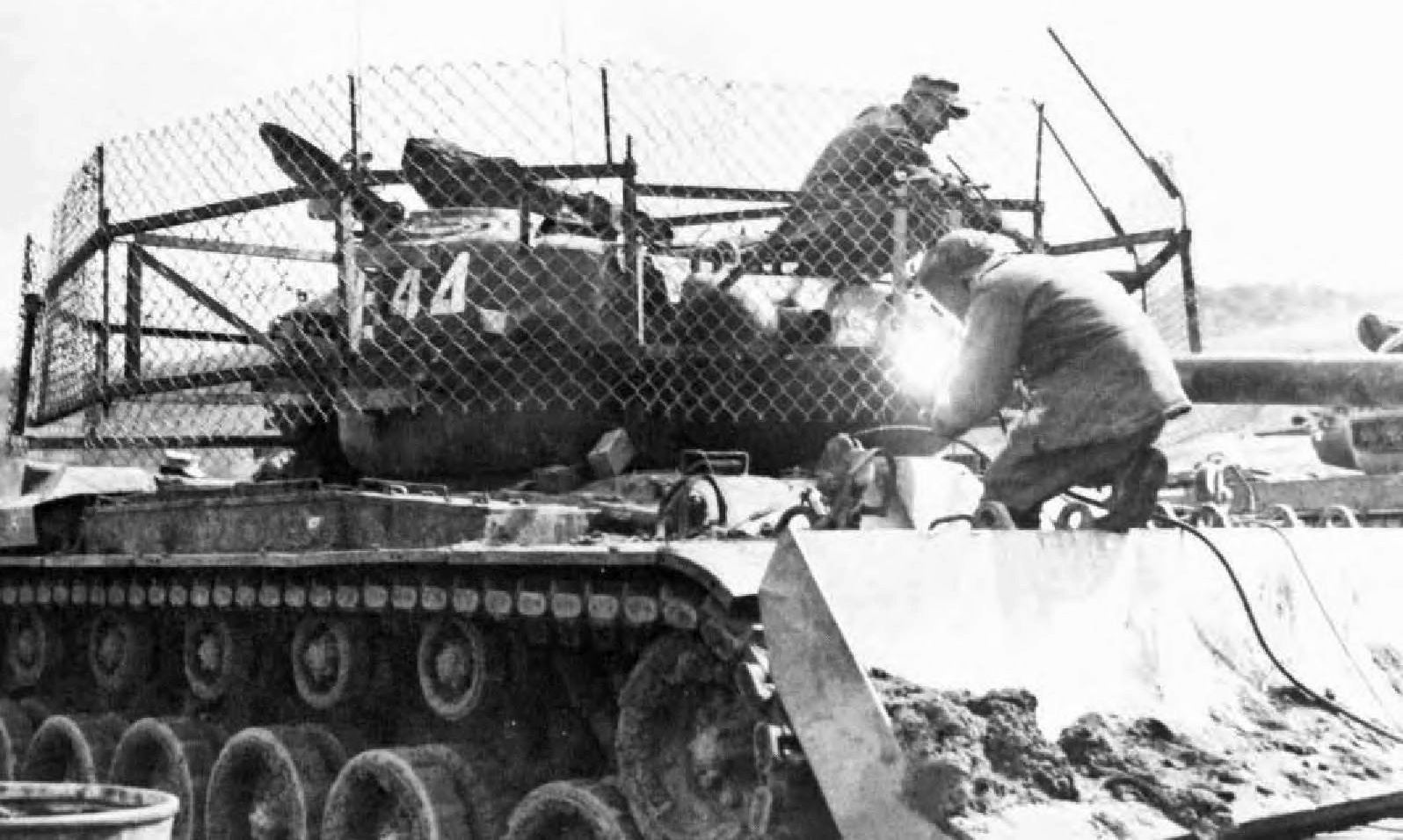
DOD Photo A 170228
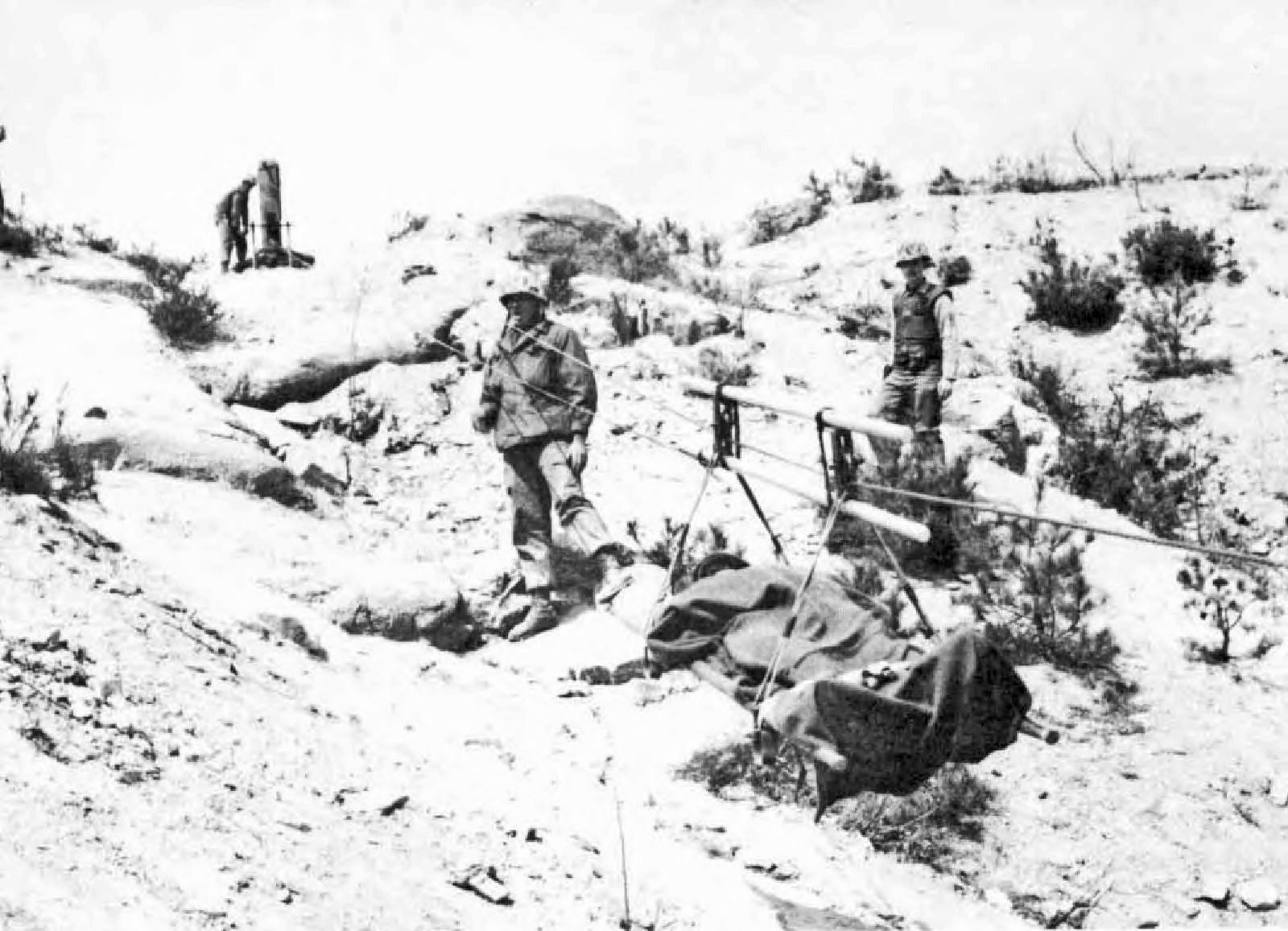
DOD Photo A 171000
Evacuation from MLR—Improvised trolley rigged up by 2d Battalion,
1st Marines, safely transfers Marine casualty. Below, front view of first
aid bunker, built on reverse slope, by 1st Engineer Battalion personnel.
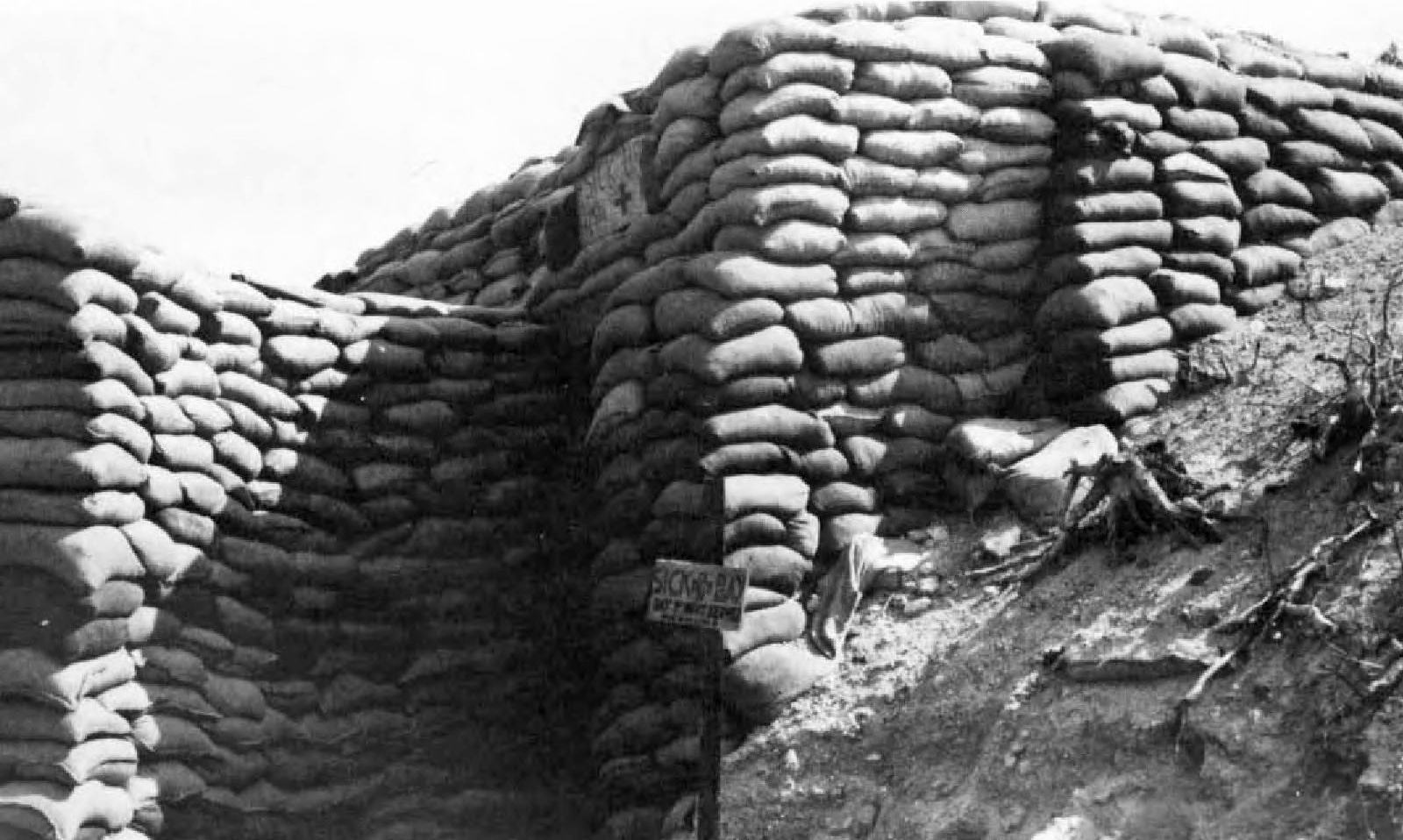
DOD Photo A 171077
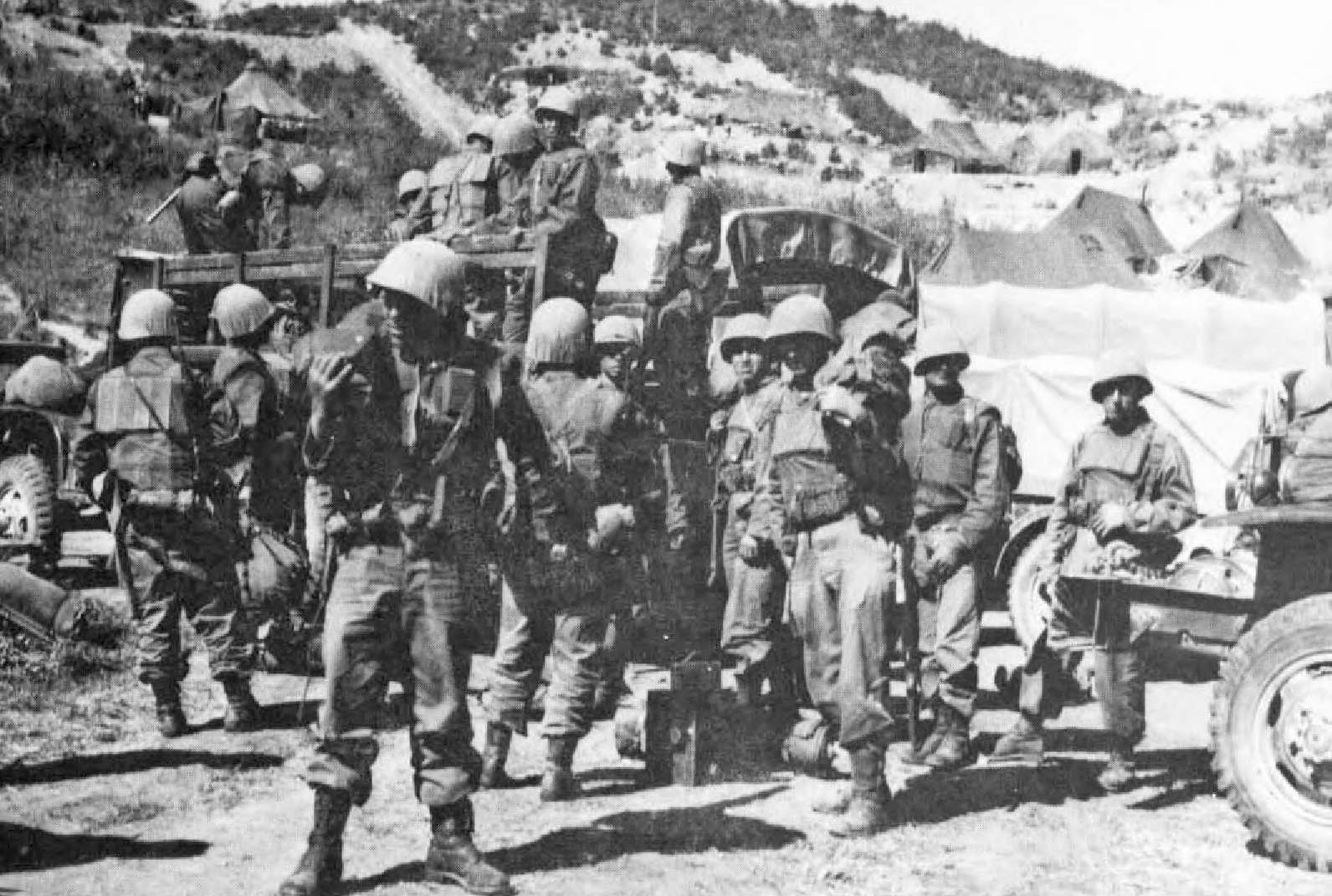
DOD Photo A 171351
Marine Relief—Advance party of the Turkish 3d Battalion arrives at
3/7 CP to reconnoiter its new sector preparatory to relief of 1st Marine
Division, May 1953. Below, mine damage absorbed by thermo boot.
Its sturdy construction saved limb of wounded Marine. Navy corpsman
displays armored jacket worn by infantryman who survived blast of 5
lbs. of TNT accidentally exploded at close range.
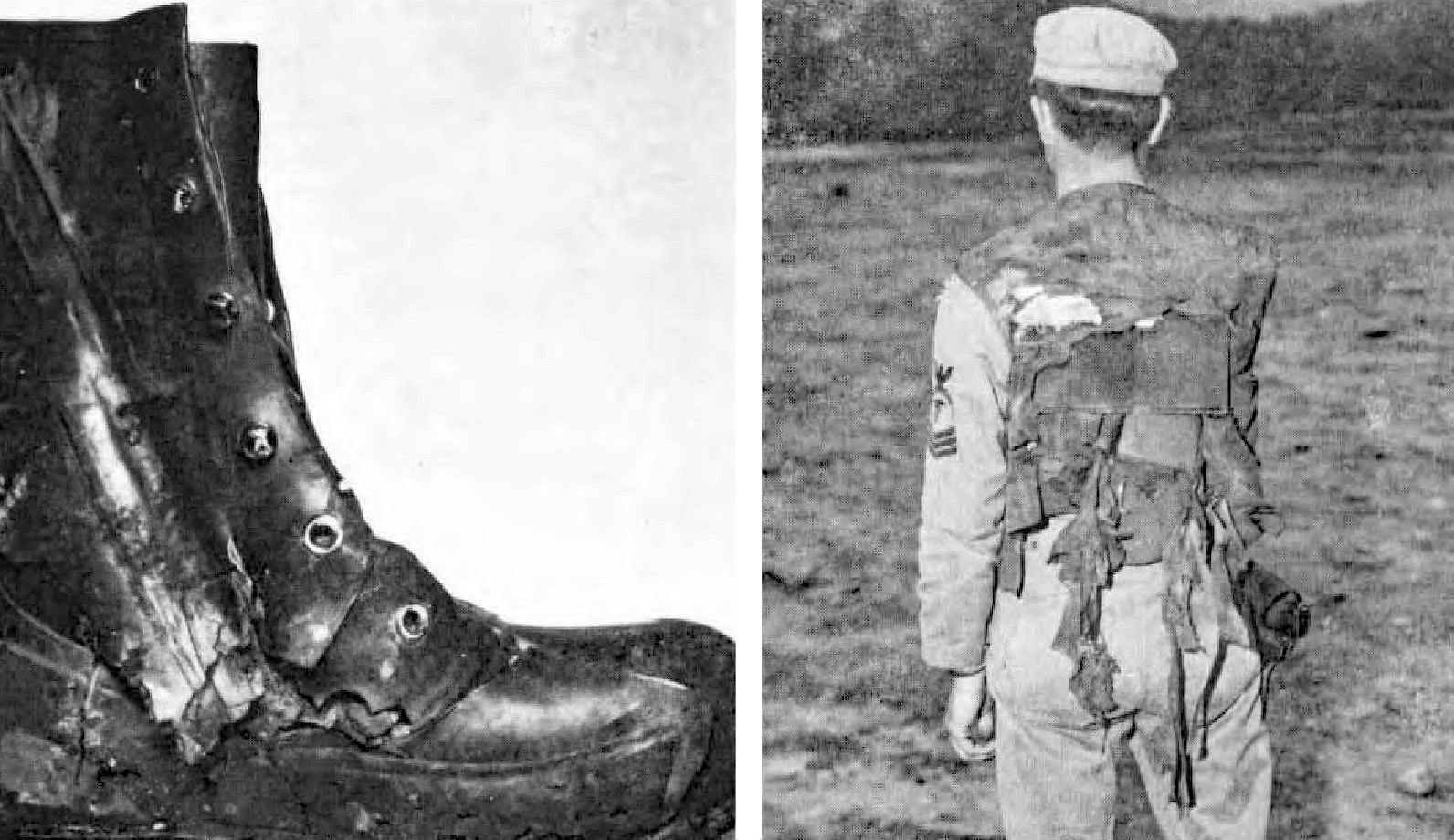
DOD Photo A 172596 DOD Photo A 16050
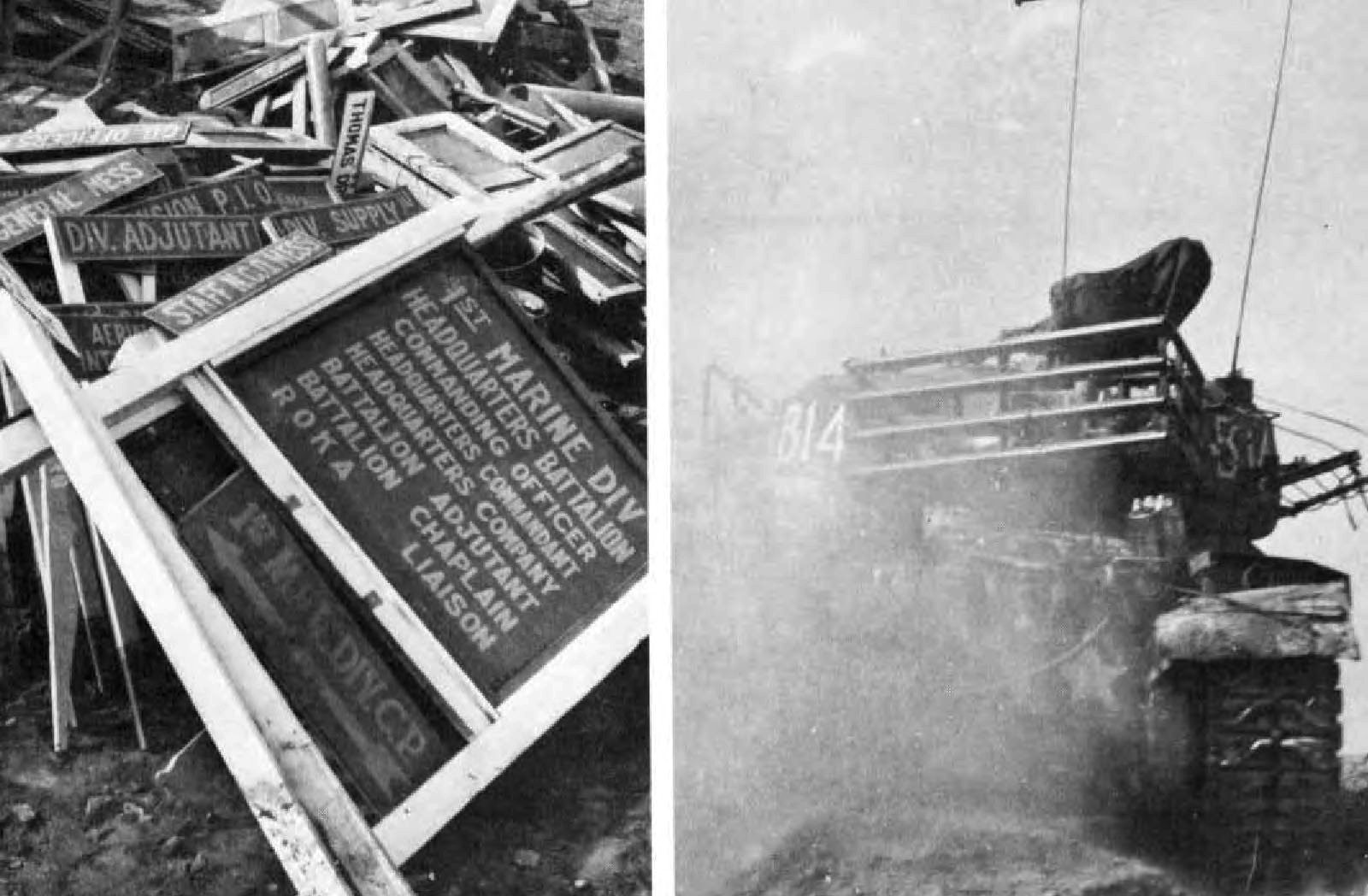
DOD Photo A 171293 DOD Photo A 173207
Street Signs—Markers for the new Marine division CP at Camp Casey
await completion of road work. Casey is command post of 1st MarDiv
while in I Corps reserve. Marine tank fires in support of Turkish
Brigade during May attack. Below, 5th Marines slog through flooded
area on way back from day’s training.
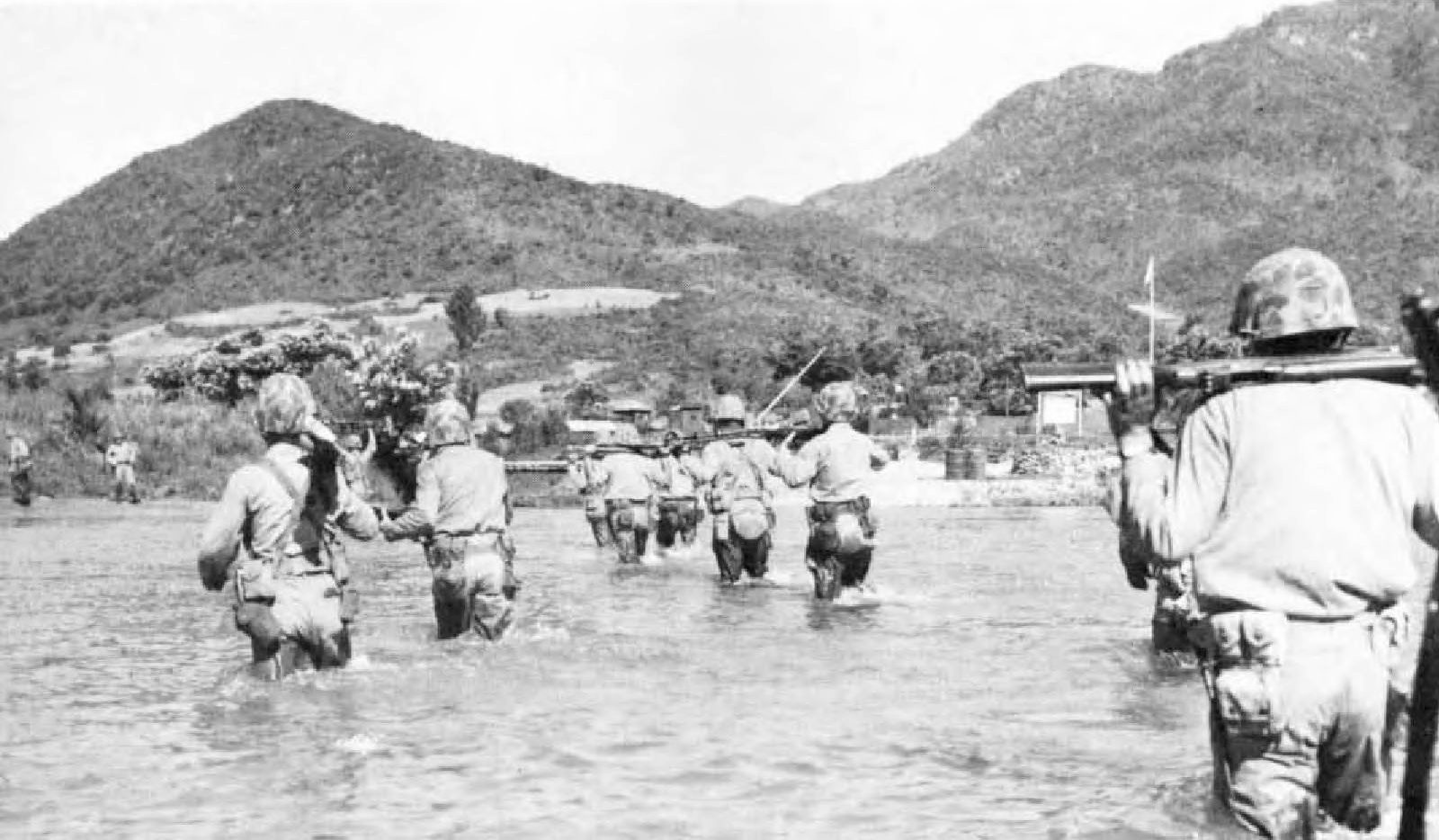
DOD Photo A 173233
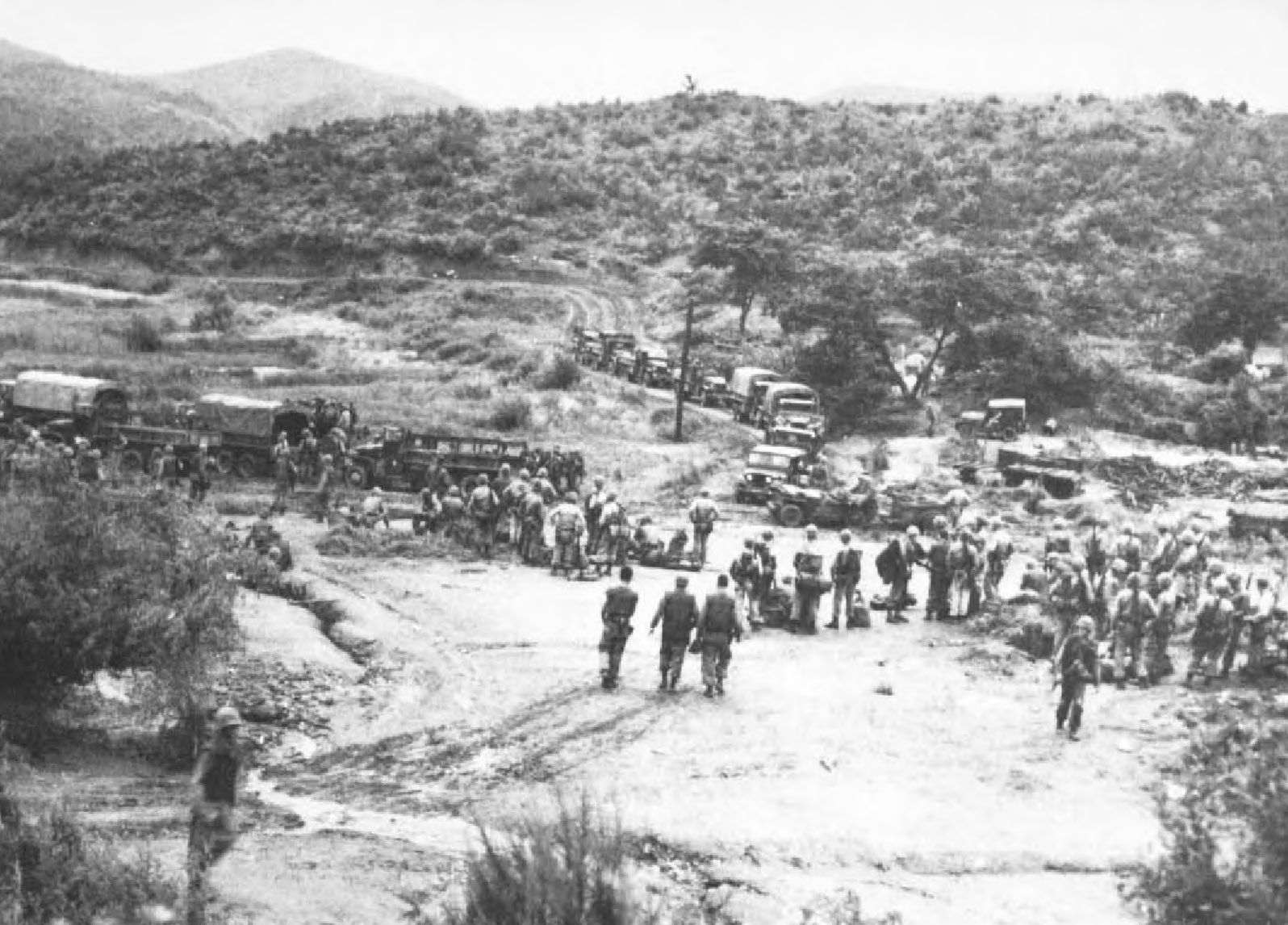
DOD Photo A 173914
Defense of Boulder City—Men of 1st and 7th Marines receive supplies
during CCF assaults in July 1953 against Boulder City. Below, aerial
view of pock-marked terrain in front of Boulder City as seen from
HMR-161 helicopter.
DOD Photo A 173886
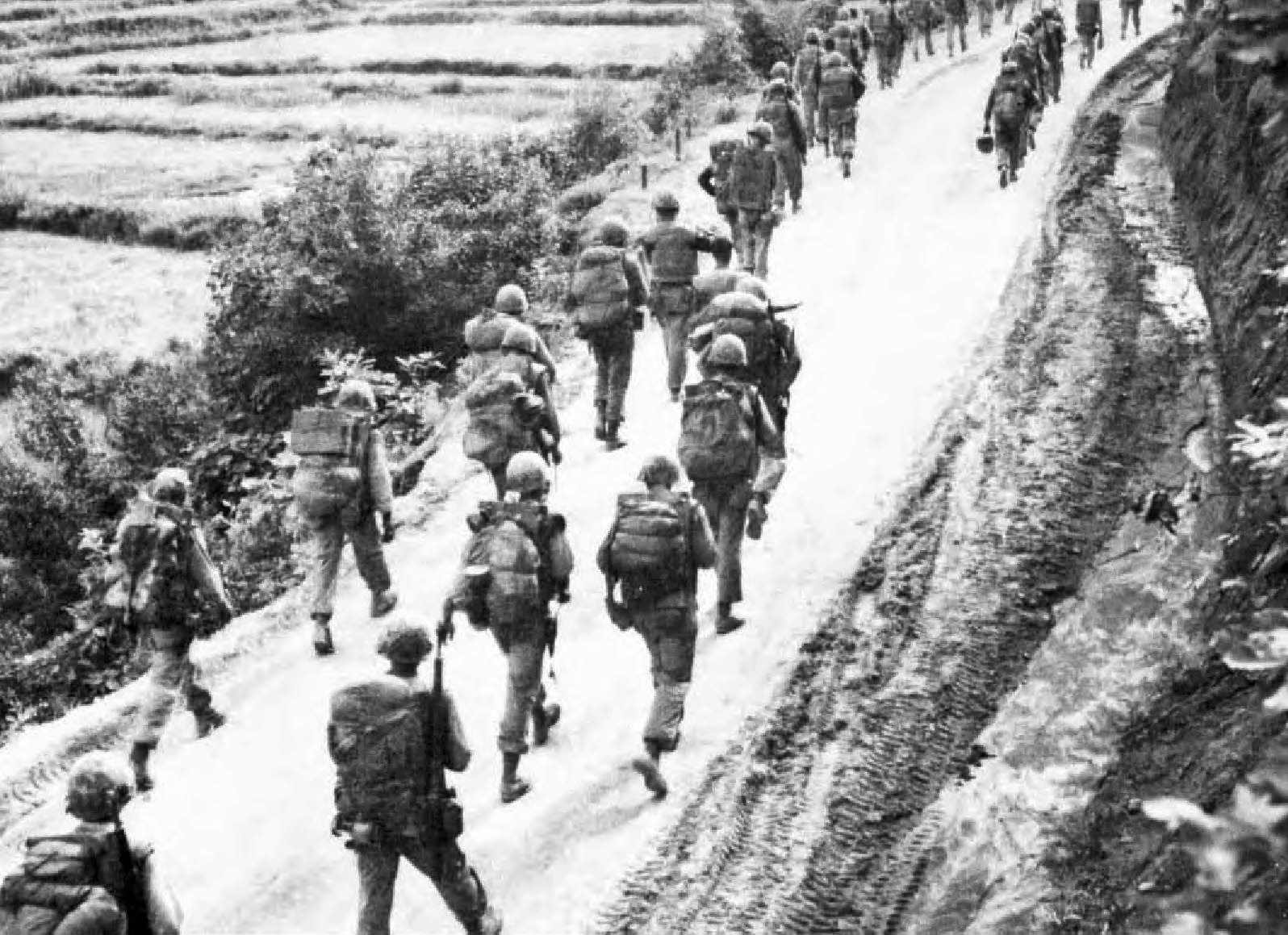
DOD Photo A 174359
Cease-fire—1st Marines move off MLR on 28 July, following cease-fire
order. How Company marches to Camp Lee from position at the front.
Below, contemplative Marine surveys trench line being filled in in accordance
with armistice agreement.
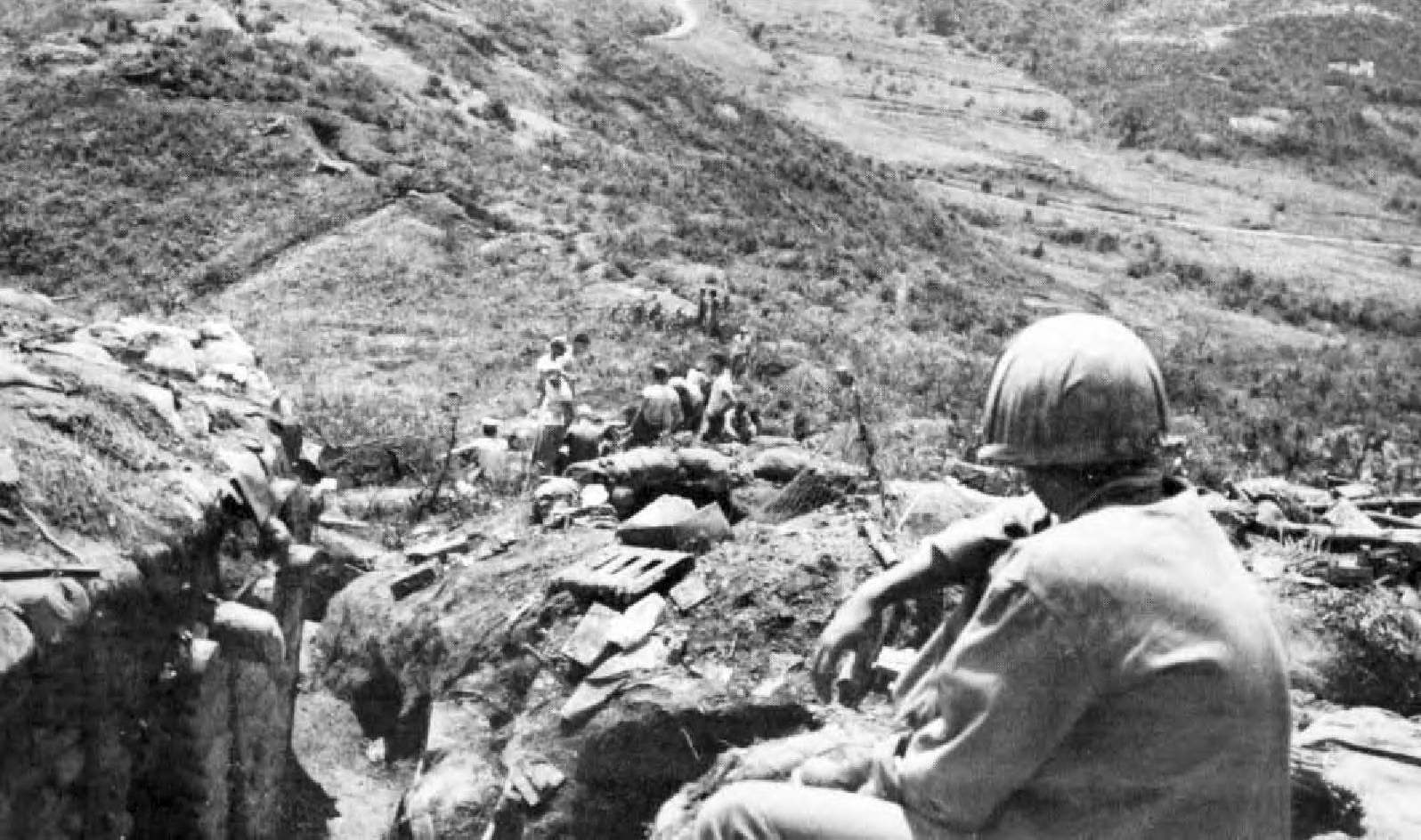
DOD Photo A 173720
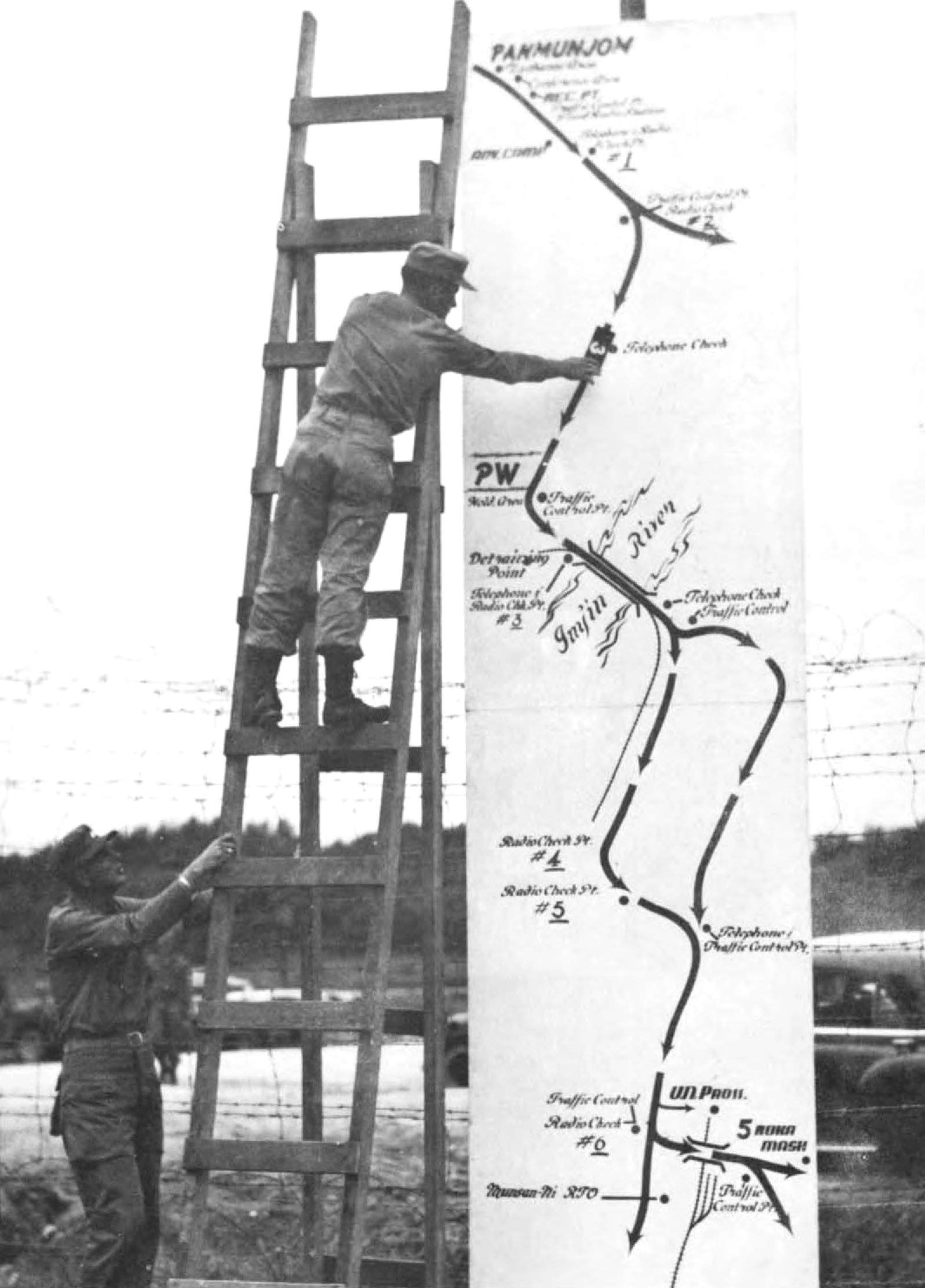
DOD Photo A 174381
Operation BIG SWITCH—Road map of route taken by repatriated UN
prisoners of war as convoy reaches radio check points. Progress of convoy
is immediately relayed to Freedom Village and entered on map.
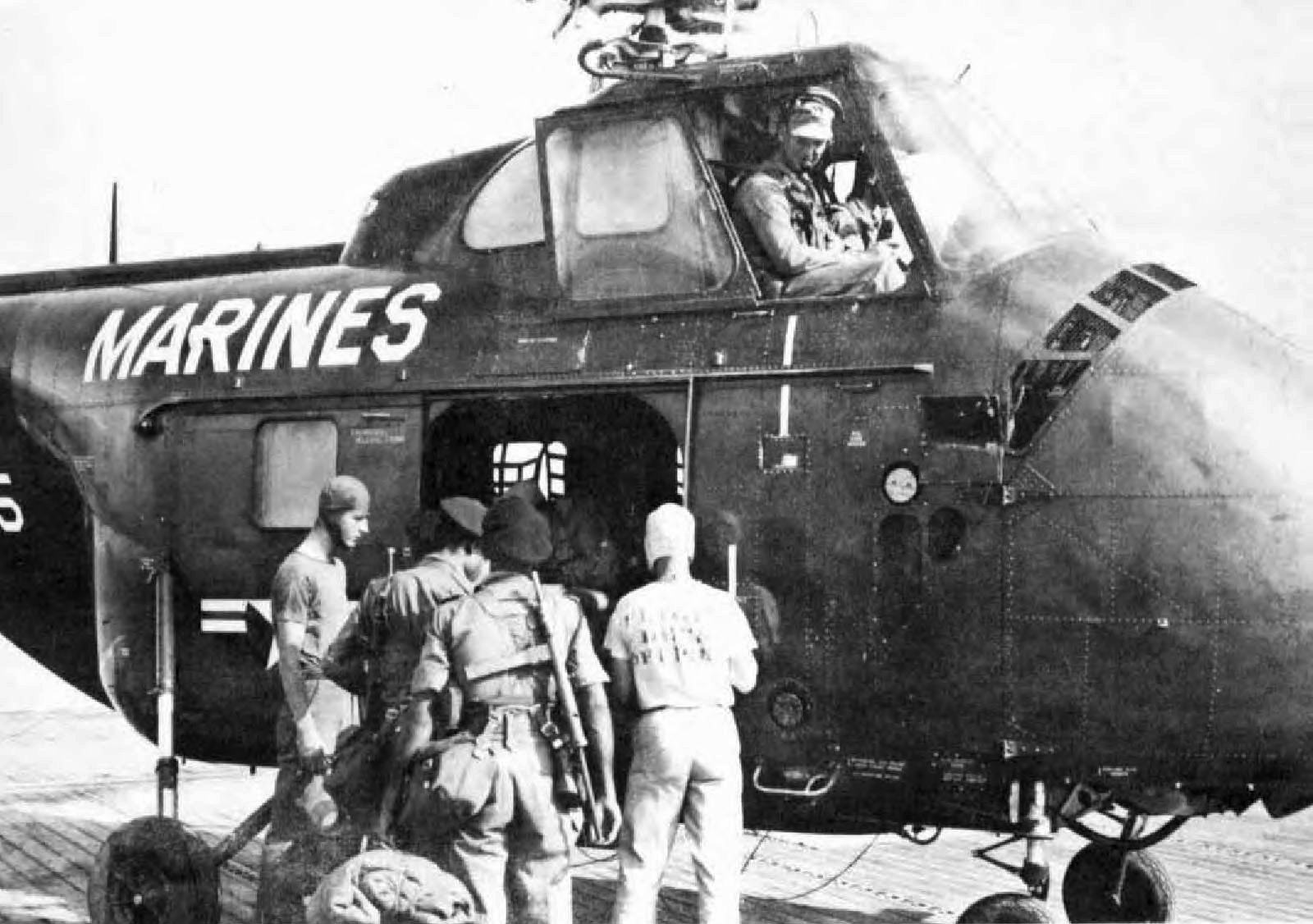
DOD Photo A 174586
UN Custodial Forces—Indian troops board Marine helicopter on deck
of USS Point Cruz. They are then flown to the buffer zone to guard
CCF and NKPA nonrepatriated POWs. Below, LtCol William G.
Thrash receives naval aviator wings upon his release at Freedom Village
from MajGen Vernon E. Megee, CG, 1st MAW.
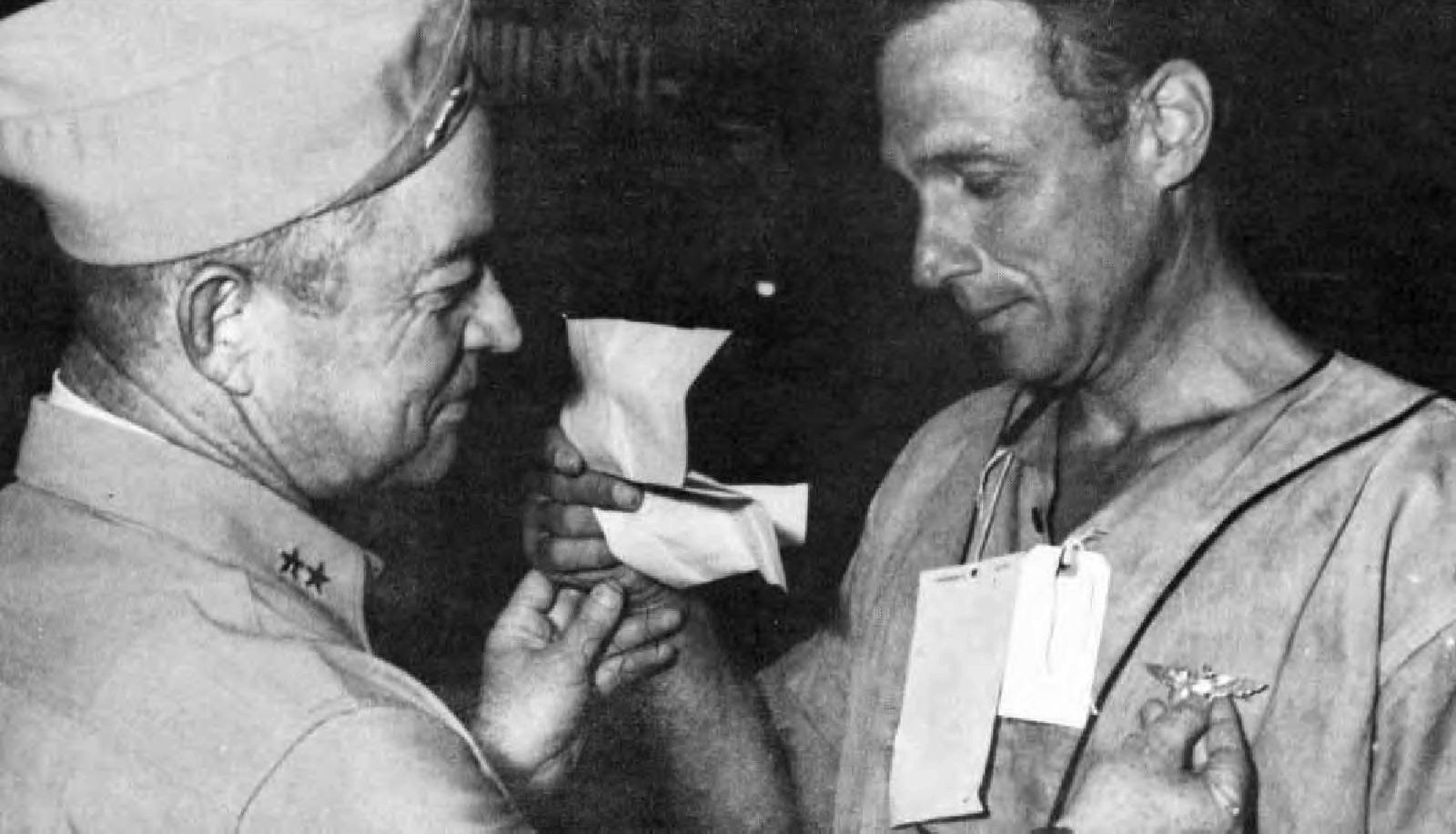
DOD Photo A 349140
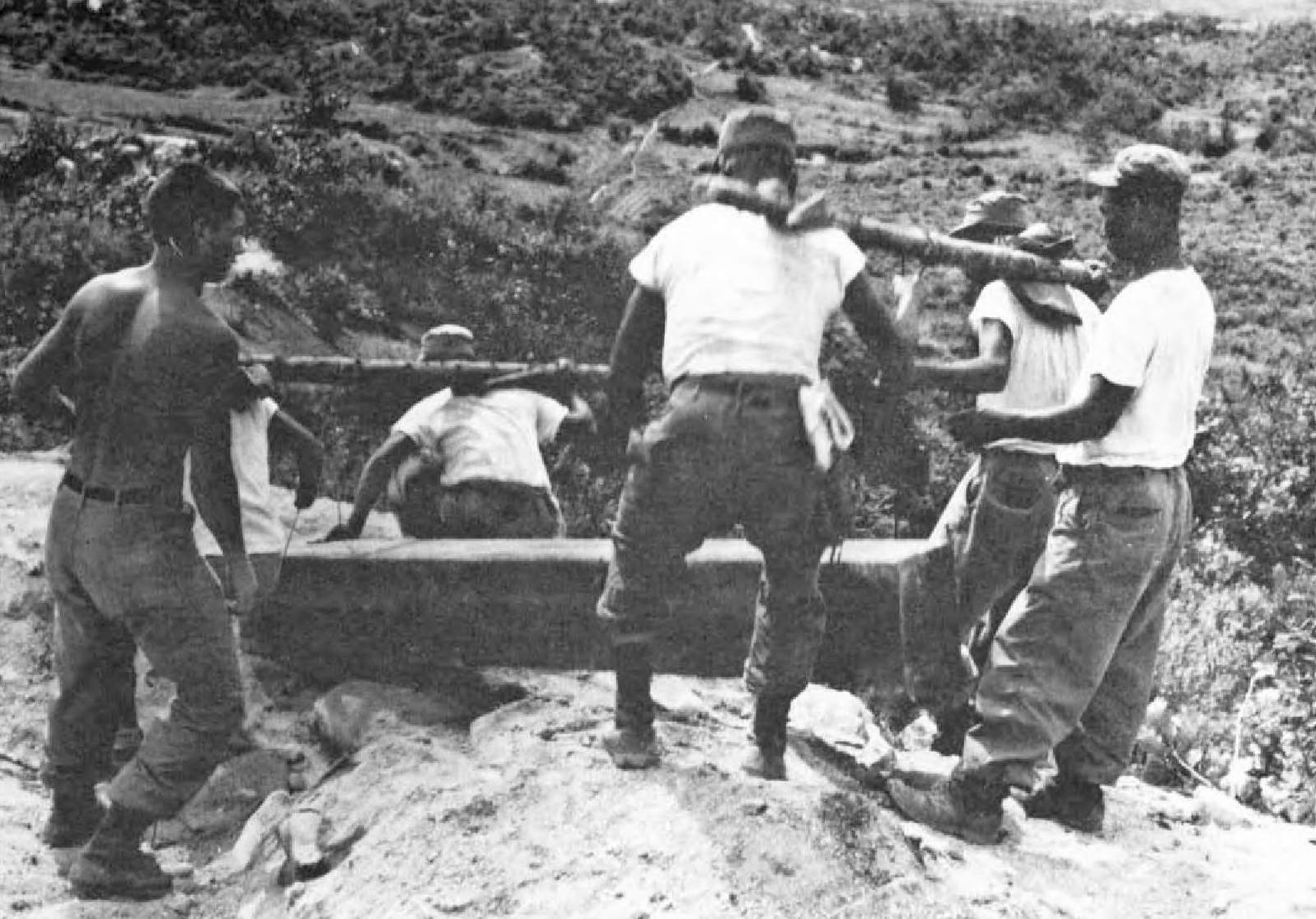
DOD Photo A 173860
Dismantling the MLR—KSCs, under Marine supervision, load and
carry lumber from torn-down bunkers to new sector. Below, guard
shack at entrance to 1/1 CP show results of flood waters, August 1952.
Road approach to Spoonbill Bridge completely submerged by annual
summer rains, in July 1953.
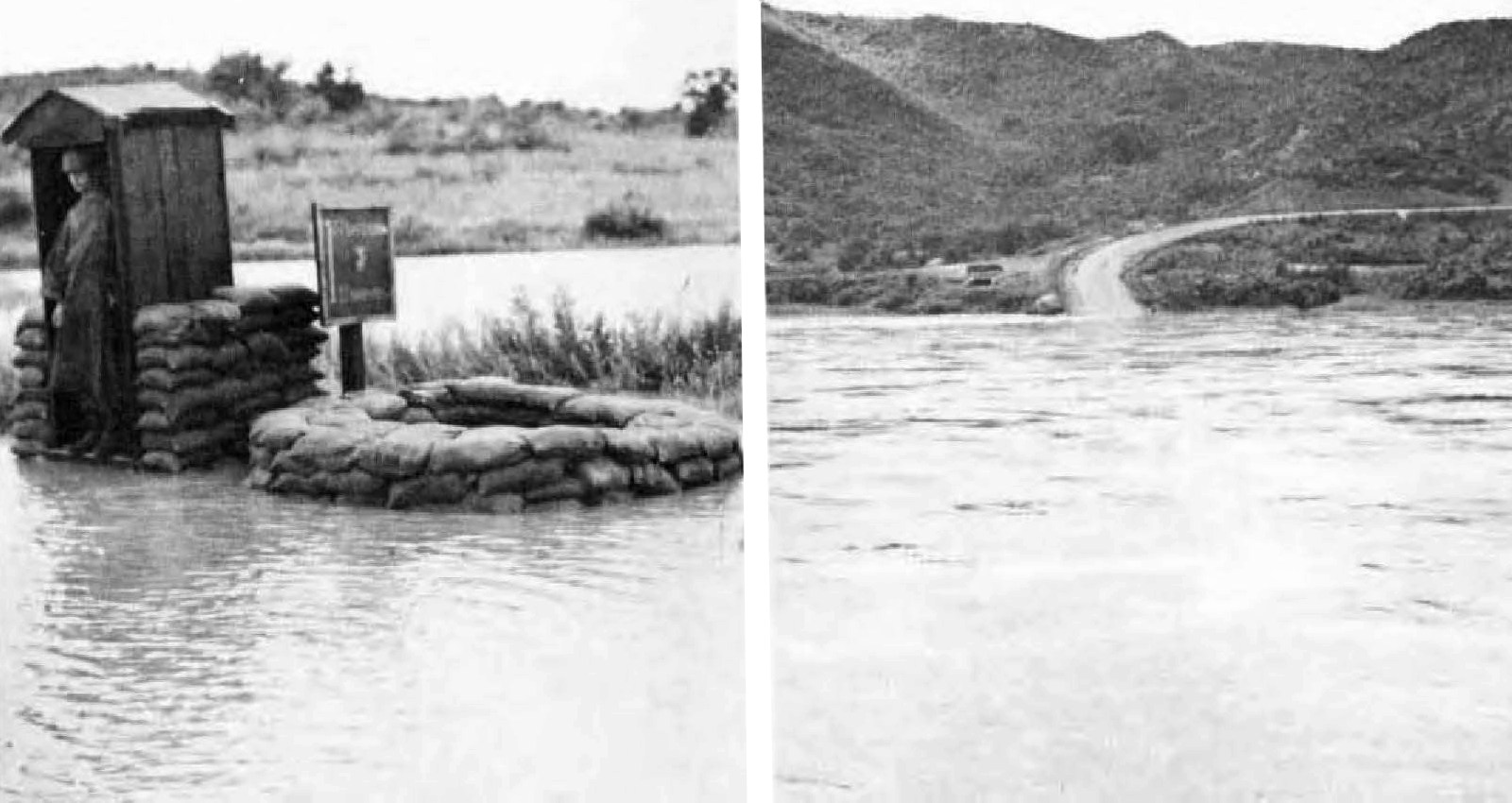
DOD Photo A 164548 DOD Photo A 173282
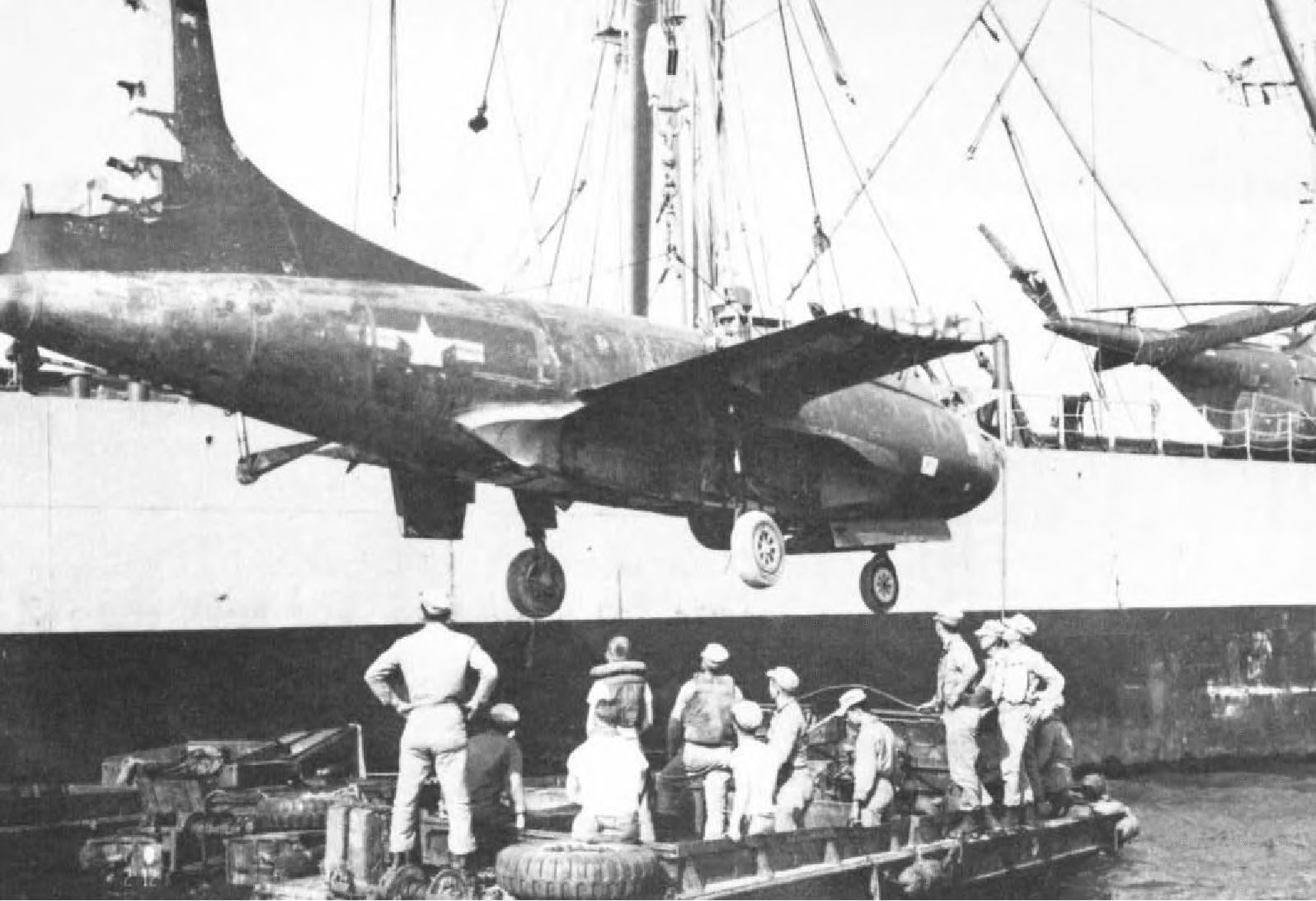
DOD Photo A 349563
Shore-to-Ship Operation—F3D is hauled aboard ship after being ferried
by four DUKWs, as 1st MAW redeploys from Korea to Japan in June
1956. Below, 1st Marine Division in Korea functions as security force.
Marine DMZ policemen inspect enemy positions, February 1955.
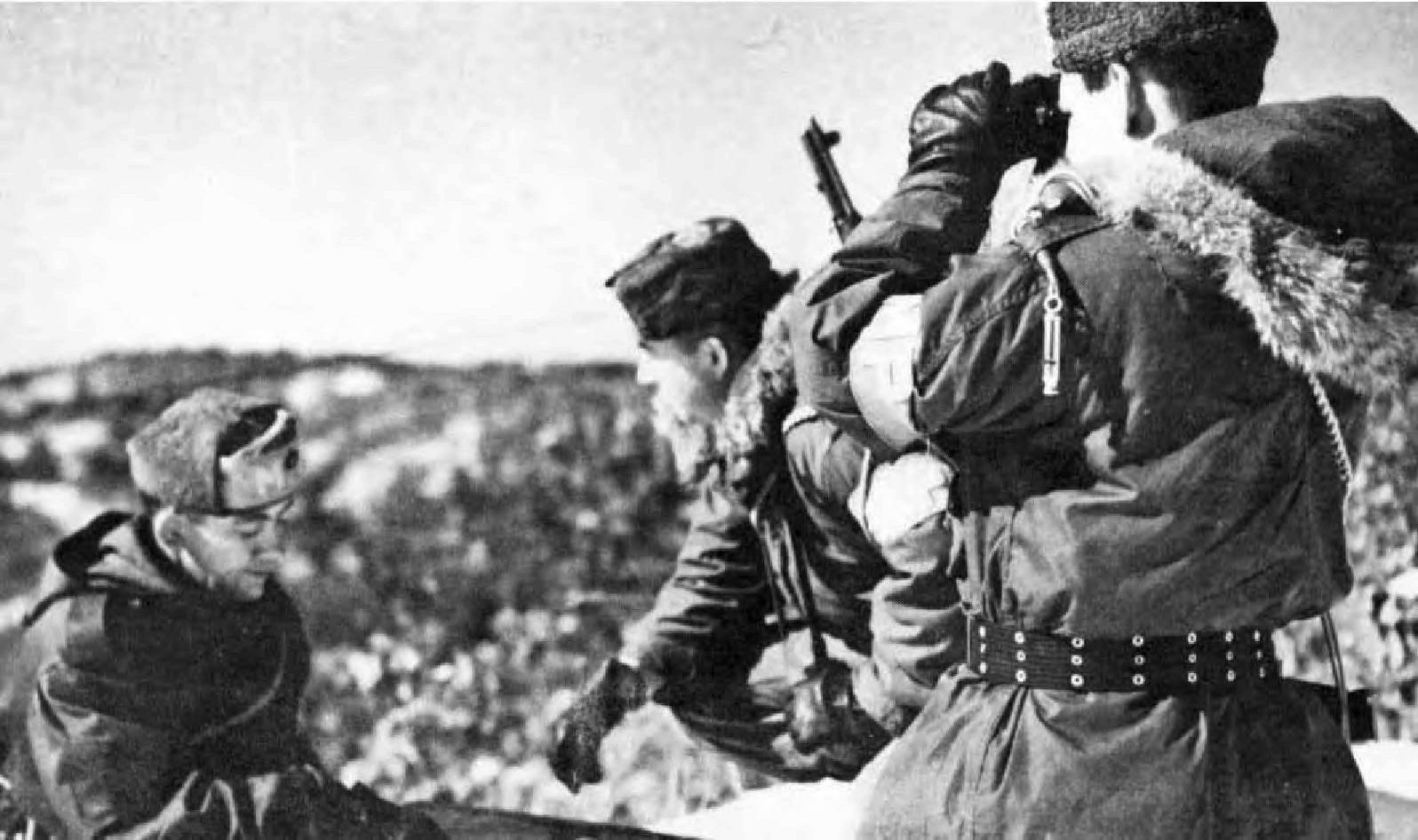
DOD Photo A 366097
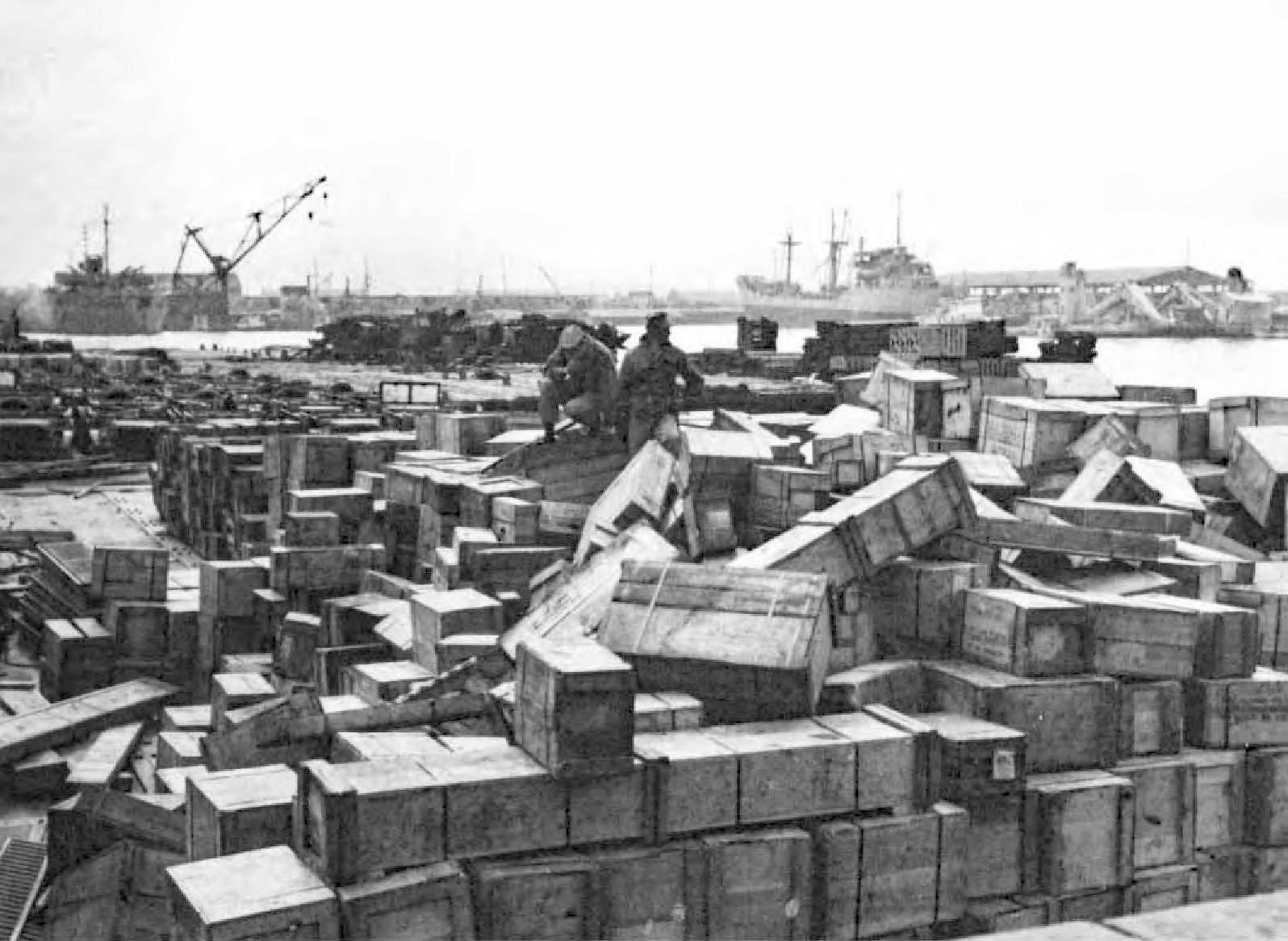
DOD Photo A 366210
Mission Completed—1st Marine Division equipment and records at
dockside prior to loading for division’s return to the States. Below,
1st Marines march across Freedom Gate Bridge on their way to Ascom
City and thence home to U.S., March 1955.
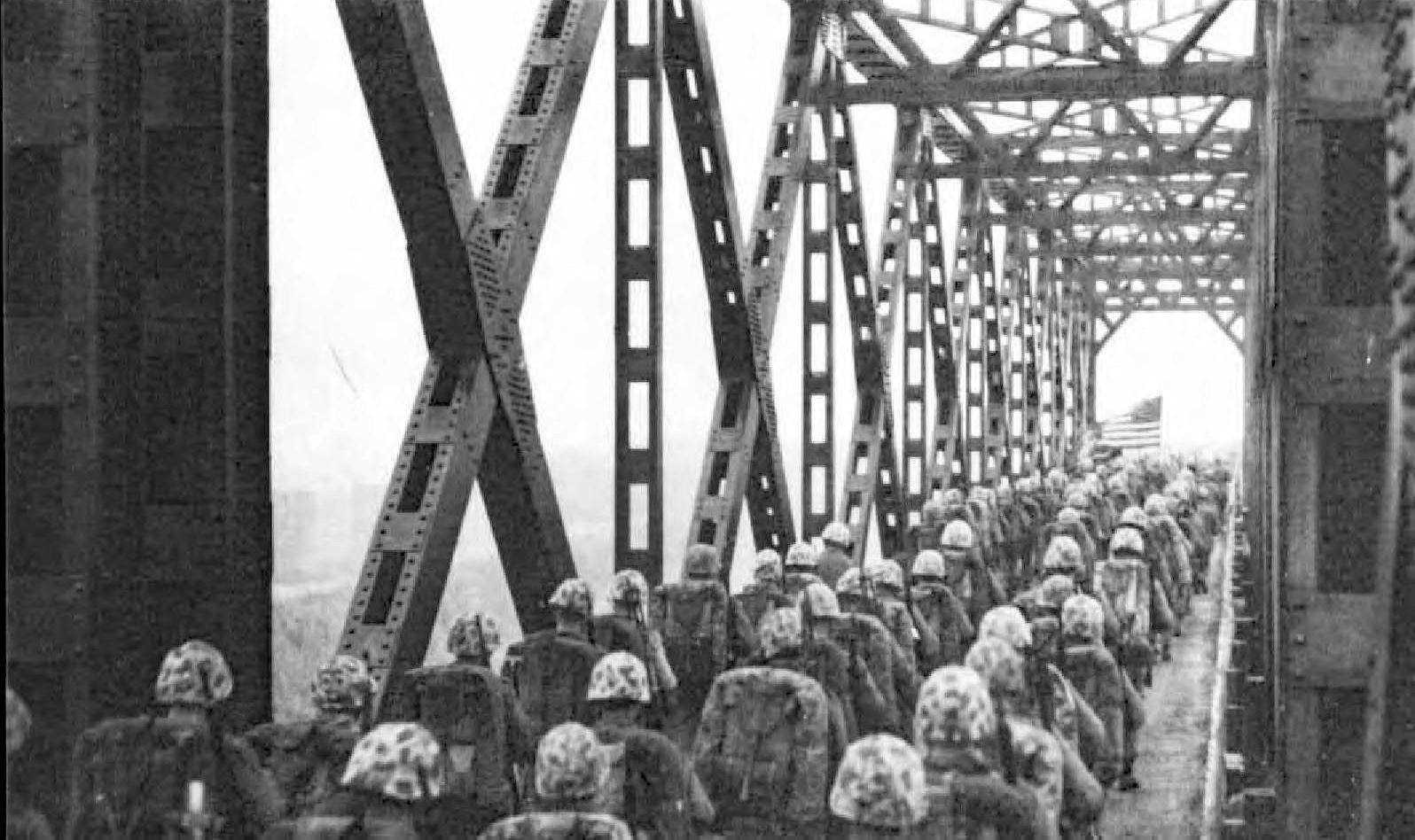
DOD Photo A 366127
An additional four enlisted Marines returned to military control
after a brief period of capture. Corporal William S. Blair, B/1/7,
and PFC Bernard W. Insco, D/2/11, were taken prisoner on 24
April 1951 while the 1st Marine Division was operating as a component
of IX Corps. Although originally sent north to a POW
camp, both were released on 12 May by the enemy after less than
a month’s captivity. Another pair of lucky Marines were PFC
Richard R. Grindle and Corporal Harold J. Kidd, both of B/1/7.
Seized on 11 May in patrol actions, they were the only Marines
captured in ground fighting that month, and escaped to return to
the division four days later.
At least six escape attempts are known to have been made by
Marine POWs, and another elaborate plan late in the war was
foiled before it got under way. The incidents follow:
#1. In the early winter months of 1951, Sergeant Donald M.
Griffith, F/2/5, became increasingly upset by the filth, steady
attrition of POWs, and semi-starvation diet at The Valley. He
vowed to escape. Late one night he pretended to go to the latrine
and finding the guard asleep, instead hurried down the path leading
out of the valley. He walked until dawn, then found a hut
where he hid among a pile of rice bags for some much-needed
sleep. Later, he knocked at a hut, asking for food. While he ate,
however, his genial host’s son was out contacting a military patrol
which even then was on Griffith’s trail.
A group of Communist soldiers closed in to recapture him. As
early punishment, Griffith’s shoe pacs were taken from him and
he was forced to walk back to the Valley in his threadbare ski
socks. Returned to the camp, the Marine sergeant was beaten across
the face. He was also directed to walk up a nearby hill and for
three successive times a rifle bullet tearing by his head barely
missed him. Later he learned that plans of his escape were leaked
to the CCF by an informer, thus triggering an early search.
#2. In May 1951, Captain Bryon H. Beswick, VMF-323, was
a member of a large POW column being marched north. Although
still suffering severe burns on his face, hands, and leg incurred
while bailing out of his plane that had caught fire, Beswick and
four others attempted to outwit their guards while on the march.
All the would-be escapees were placed in solitary confinement.
#3. Shortly after his capture in July 1951, PFC Alfred P.
Graham, Jr., H/3/5, was interned temporarily at what appeared
to be a divisional headquarters. One afternoon when the guards
seemed slack, Graham and another Marine sneaked off. Ultimately
they approached a farmhouse to get food and there stumbled into
a half dozen Koreans who took them into custody. The two
Marines were beaten with a submachine gun and their hands were
bound behind their back with communications wire. On their
forced reappearance at the original site of escape, a Korean officer
beat and interrogated them for three days.
#4. A short-lived escape attempt at Pak’s Palace, not long after
his capture in October 1951, had earned Lieutenant Gillette a
solitary confinement tour. Arriving at Officers’ camp in Pi-chong-ni
the following spring, the former VMF(N)-513 squadron member
and a South African air force pilot laid plans for a mutual escape.
Gillette deliberately set himself on a course of reduced rations to
prepare himself for the coming feat. When the two men made
their break, they were shot at but managed to safely clear the
camp.
The first night out the other pilot so badly injured himself in
a fall that Gillette had to leave him and go on alone. Although
the apparent escape route lay to the west, nearer the coast, the
Marine chose to go east across rugged mountains that offered little
in the way of cover, concealment, or food. His unorthodox planning
nearly paid off. “Whereas most escapees were recaptured
within hours, or at best within days, Lieutenant Gillette was free
for several weeks before the Communists found him halfway
across Korea.”627 One Royal Marine described the attempt as “the
finest and most determined one he knew of.”628
#5. In July 1952, three Marine officers were involved in an
abortive escape attempt at Camp 2. They were Lieutenant Colonel
Thrash, Major McLaughlin, and Second Lieutenant Richard L. Sill,
1st 90mm AAA Gun Battalion. When detected outside of camp
they were able to get back inside the compound, but the Chinese
did identify Lieutenant Still. His escape attempt earned him a
three-month sentence in the hole from which he later “emerged
unbothered and steeled against the Communists.”629
#6. Captain Martelli escaped from the Camp 2 compound in
September 1952. Retaken 10 days later, he was put in the same
hole for two months. On release from the confinement, he was
visibly upset by the experience, but quickly recovered. As a matter
of interest, Martelli, like the other men whose exploits are recounted
here, returned home in Operation BIG SWITCH.
#7. In the spring of 1953 a group of 30 officers, including two
British Marines, at Camp 2 organized classes in mathematics,
physics, and survival lectures. Conferences on escape and evasion
techniques were held and the men formed escape groups. The
teams drew straws to pick priorities for escape, and each one
presented its plan to a senior body for approval. On 1 July, with
support of the other teams, the first group went over the fence
surrounding their house. Their freedom was brief, however, and
the camp guard doubled. When rumors of armistice began circulating,
further escape plans were cancelled. Clandestine prisoner
escape committees—although unsuccessful in terms of actual results
achieved—had existed at various camps. Second Lieutenant
Rowland M. Murphy had been a member of such an organization
at Obul. Major McLaughlin had assumed similar responsibilities
at Camp 5, in 1951, and later at Camp 2 served on the secret
all-UNC prisoners escape committee and senior officers’ organization
within Camp 2. In early 1953 Major Harris became senior
officer at the Camp 2 Annex. He organized Spanish classes as a
facade for having a regular meeting place to announce policy and
issue orders. Maps of North Korea were prepared for use in
escape attempts and counter-Chinese political indoctrination was
disseminated.
The Camp 2 officers performed another useful service. As rumor
leaked out of the impending truce, they drafted a policy guide on
POW behavior that was secretly circulated to other camps. UNC
prisoners were directed to refrain from any appearance of fraternizing
with the enemy, or acts of exuberance or violence. Specifically,
they were reminded not to show any great enthusiasm upon
their release, to prevent the Communist cameras on the scene from
recording this as another propaganda victory.
With but a few exceptions, circumstances indicated that capture
of most Marines was unavoidable. Theoretically, it can be argued
that several seized in bunkers might have avoided captivity had they
been occupying fighting-holes instead. On the other hand, they might
just as readily have become statistics on a KIA list, instead, by falling
victim to preparatory fire that preceded the enemy’s main assault.
As Marine historian, then-Major, MacDonald has noted:
A shadow fell over American POWs in the aftermath of the Korean
War. Courts-martial and other official inquiries revealed that a small segment
of the Americans captured by the Communists had been guilty of
behavior ranging from questionable to treasonable.631
Both the Secretary of Defense Advisory Committee on Prisoners
of War and the United States Congress, which investigated the
entire POW issue, returned favorable verdicts for Marine POW
conduct. The U.S. Senate report summarized its findings:
The United States Marine Corps, the Turkish troops, and the Colombians
as groups, did not succumb to the pressures exerted upon them by the
Communists and did not cooperate or collaborate with the enemy. For
this they deserve greatest admiration and credit.632
In commenting on prisoner attitudes and activities that seemed to
account for those men who became “survival types”, an Army
psychiatrist, Major William F. Mayer, observed:
The Marines were a statistically significant group from the standpoint
of size, something over two hundred; the only thing I can say about them
is that more of them survived than we. I think this is a function of discipline
and morale and esprit; and the attitude in the Marine Corps I expressed
a little while ago, that if something happens to me, these jokers will take
care of me.633
In the nature of self-judgment, Sergeant Griffith referred to “that
certain ‘something’ that seems to weld men together prevailed more
among the Marine POWs than it did with the other captured UN
Troops.”634 The Marine with probably more experience as a POW
than anyone else, Sergeant Harrison, noted that “without USMC
training I would never have lived through several tight spots. I am
not talking strictly about physical training as I am mental conditioning.
It is something that causes you to think ... about what the
other guy will think or how it [your action] might affect or endanger
them.”635
A senior Air Force officer, Lieutenant Colonel Gerald Brown, who
headed POW units at Camp 2 and 5 between his tours of solitary
confinement, declared:
I was extremely proud of the conduct of U.S. Marine Corps personnel
with whom I came in contact during my period of confinement. Their
esprit de corps was perhaps the highest of any branch of the Armed Forces
of the United States during this period.636
And Navy Chief Duane Thorin, a former inmate of the Camp 2
annex, who later inspired the character of the helicopter pilot in
James A. Michener’s The Bridges of Toko-ri, pointed out:
The Navy and Marine Corps POWs were generally excellent. The
Marines who left something to be desired were more than compensated
for by the majority of them.637
Another view was offered by a prominent neurologist and consultant
to the Secretary of Defense Advisory Committee, Dr. Harold
G. Wolff. After investigating the performance of American POWs
in Korea, Dr. Wolff concluded they had not “behaved much differently
from other men in other armies and places” but that Americans
had been made to appear much worse “by the enemy’s propaganda
devices and our own initial ineptitude in countering the Communist
propaganda.”638
As a postscript to the POW story, five Marines received awards,
on 11 January 1954, for their exceptionally meritorious conduct
while serving as prisoners of the Communists in Korea. They were:
Lieutenant Colonel Thrash—awarded a Gold Star in lieu of a
second Legion of Merit;
Major McLaughlin—awarded the Legion of Merit;
Major Harris—also awarded the Legion of Merit;
Captain Flynn—awarded the Navy and Marine Corps Medal;
and
Master Sergeant Cain—awarded a Letter of Commendation with
Ribbon.
On the negative side, one enlisted Marine was disciplined for his
cooperation with the enemy in writing a pro-Communist magazine
article. A Court of Inquiry, convened in March 1954, did not recommend
a court-martial for the 45-year-old pilot, Colonel Schwable.
After a month-long review of circumstances involved in the case,
the court opined that he had resisted Communist pressure and
torture “to the limit of his ability before giving in.”639 Its final
judgment was that Schwable—a Naval Academy graduate, veteran
of 20 years’ military service, and distinguished WW II night-fighter
pilot and squadron CO—not be subjected to disciplinary action. At
the same time the court held that his future usefulness as a Marine
officer was “seriously impaired” by his conduct as a war prisoner.
On a larger scale, 192 Americans were found guilty of misconduct
against fellow prisoners or various degrees of collaboration with
the enemy. None of these was a Marine. In comparison with some
22,000 Communists who refused repatriation, 21 U.S. and 1 British
prisoner succumbed to CCF brainwashing tactics. Twelve of the
Americans have since returned to the U.S., apparently disenchanted
with the Communist version of “people’s democracy” after getting
a closer look at it.
Investigations later showed that “only a handful of the POWs
in Korea were able to maintain absolute silence under military interrogation.
Nearly all of the American prisoners went beyond the
[Geneva Convention] ‘absolute’, name, rank, serial number, and
date of birth restriction.”640 Although giving false or misleading
information was a common occurrence in POW camps, such testimony
was usually quickly detected. American military authorities,
drawing up a revised Code of Conduct (1955) subsequently recommended
against making untruthful statements. Further, even though
several Marines seemed to have suffered none the worse for giving
false information, in at least one case a prisoner’s own situation
was weakened by enemy detection of his lie and increasing pressure
was brought against him.
It was found too, that in every group of prisoners there were
always gradations of those more cooperative with the enemy
(“progressives”) and those who offered open or passive resistance
(“reactionaries”). One Korean War analyst, in seeking the final
explanation of what POW tactics succeeded best against a dedicated
enemy, cited the Turkish “chain of command that was never broken”
and which helped to mold them together. He noted the “permissive”
culture and background of Americans where freedom of choice
and individual decisions are basic tenets. Despite the effect of military
indoctrination and discipline, this concept of individualism and
freedom appeared to be so strongly engrained that unless there was
a corresponding emphasis on responsibility and strong beliefs it
tended to weaken a man when his action and values were put to a
prolonged test—as in the POW compound. The analyst concluded:
Only an extremely cohesive group, with tight leadership and great
spiritual strengths, coupled with inner toughness and concern for one
another, could have survived the shocks visited upon their minds and bodies....
They [the Turks] remained united against the enemy, and they
survived.641
This judgement, to a large degree, tells the Marine POW story.
CHAPTER XI While Guns Cool — The Postwar Transition 642 — Control of the DMZ and the Military Police Company 667 — Organization of New Defense Positions 675 — Postwar Employment of Marine Units in FECOM 680
The Postwar Transition—Control of the DMZ and the Military
Police Company—Organization of New Defense Positions—Postwar
Employment of Marine Units in FECOM
Terms of the Armistice Agreement required EUSAK components,
including the 1st Marine Division, to carry out a number of
major tasks in the months following the end of active hostilities.
As stipulated by the cease-fire, UNC troops all along the front
withdrew to a new main battle position (MBP) south of the main
line of resistance. A military demarcation line (MDL) was established
between enemy and friendly positions, corresponding to the
end-of-war battle lines. Each side pulled back 2,000 yards from this
MDL, with the combined 4,000-yard buffer strip on both sides being
known as the demilitarized zone.(DMZ).
A continuous double-strand barbed wire fence, known as the
No-Pass Fence, or No-Pass Line, was erected 200 yards below the
southern boundary of the DMZ by infantry units manning the MLR
at the time of the cease-fire. Appropriate marking signs, in Chinese,
Korean, and English, were placed at regular intervals along the
fence, prohibiting unauthorized entry into the Demilitarized Zone.
Strict requirements by I Corps enjoined that the “fence on the
southern boundary of the DMZ must present a continuous unbroken
line except for gates and where it crosses large streams.”643 Beginning
late on 27 July 1953, the 1st Marine Division’s modified mission became
that of withdrawal to and organization of the post-armistice
MBP, establishment of the No-Pass Line, and defense of the new
position in readiness for any possible resumption of hostilities by
the enemy.
Division officers, from commanding general to platoon leader
level, repeatedly emphasized that the armistice agreement was only
a cessation of active fighting. As such, it could be violated by the
enemy at any time. The armistice was not a peace, but had simply
paved the way for a political conference. As the UNC commander,
General Mark W. Clark, had stated, the 27 July document was
merely “a military agreement between opposing commanders to cease
fire and to permit the opposing sides to arrive at a peaceful solution
of the conflict.”644 Since many felt the cease-fire might be only temporary
and not necessarily a permanent peace, all hands showed an
attitude of skepticism and watchful waiting. There was little disposition
or time for celebration. The response of many men to the
complete lack of noise across the front was one of simple restlessness
and expectancy.
From the 7th Marines just engaged in the vicious Boulder City
battle, the reaction
... was one of disbelief and caution. Extensive movements of the
enemy during the night of 27 July only bolstered the feeling of wariness
and suspicion. Only after dawn broke on 28 July, without any shots being
fired, did the realism [reality] of the truce become apparent, followed by
a wide-spread sensation of relief.645
A 5th Marines representative noted:
The fact that negotiations had been going on for some time with numerous
false alarms dulled the edge for most people, and a prior announcement
that the agreement would be signed took most of the steam away
from the actual culmination of the fighting ... in effect [the cease-fire]
meant “we’re giving you ten dollars but don’t spend it for we might
take it back.”646
The view expressed by a Korean regimental commander was that:
Many of the officers and men were relieved to see the fighting cease;
others, particularly among the officers, would rather have seen the fighting
continue until the country could be united. However, the officers and men
accepted the cease-fire as a military order and acted accordingly.647
Division MLR units on 27 July had been the 1st KMC, the 5th
Marines, and 1st Marines in the left, center, and right regimental
sectors, respectively. With the pullback of the division to new defensive
positions, the 5th Marines—the infantry regiment that had not
been heavily engaged in recent combat—was assigned the mission
of defending the forward general outpost (GOP) line across the
division front. In addition, the 5th Marines, or Northern Regiment
as it came to be called since it was the only one remaining north
of the Imjin River, was also charged with police duties and security
of the UNC part of the DMZ located in the division sector.
Marine regiments, battalions, and companies began withdrawing
from the DMZ to move to their new MBP early on the morning of
28 July, less than 24 hours after the signing of the Korean armistice.
To some extent, the relocation of units was facilitated by the fact
that the forward part of the division sector had been defended by
the three MLR regiments. Since the lateral boundaries, initially,
would remain the same, the three 5th Marines battalions were to
occupy positions held by the three line regiments. Orders called for
2/5 to occupy the left regimental sector previously held by the 1st
Korean Marine Corps Regimental Combat Team; 1/5 to man the
5th Marines center sector; and 3/5 to assume the right regimental
sector.
Whereas 5th Marines battalions were directed to occupy their new
positions by D+84 hours (or 2200, 30 July), other units in some
cases were not required to pull out of their respective positions until
positions by D+108 hours (2000, 1 August). This was done to insure
that no portion of the division front was left unmanned during this
very critical period. It did, however, force small units to make two
moves and “in one instance, a battalion and a regimental headquarters
were occupying the same area.”648 Because of the need to
move almost immediately, only a hasty physical reconnaissance was
made. Small unit leaders were not always familiar with the area and
this gave rise, in some instances, to confusion about exact unit
boundaries. This resulted in a later relocation of several units.
For the first 72 hours after the armistice, Marines were engaged
in a maximum effort to tear down installations, salvage fortification
materials, and physically move out of the Demilitarized Zone. Infantry
units were responsible for this destruction and salvage work
within assigned sectors, with 1st Engineer Battalion assistance and
supervision, as available. For the nearly 50 Marine infantry companies
and attached KMC units, the order of priorities for those first
three days generally appears to have been:
(1) Recovery of ordnance and removal to company supply dumps;
(2) Removal of all combat equipment to supply dumps; and
(3) Destruction of field fortifications and salvage of all bunker
timbers and other building materials from the old MLR sector.
Specifications of the initial armistice agreement, as originally
drawn up in August 1952, had called for a complete withdrawal of
all military personnel, supplies, and equipment from the DMZ
within 72 hours after the cease-fire. Destruction of all fortifications
within the DMZ likewise was to be accomplished within this 72-hour
deadline. It subsequently became evident, however, that it would
be impossible to complete the entire job of dismantling and salvaging
MLR fortifications within a three-day period. In mid-June 1953,
CinCUNC had advised major commands that Communist and UNC
negotiators had agreed to extend the original 72 hours to an additional
45-day period, or until 13 September.649
Division order 1MARD-OP-11-53, issued at 1600 on 27 July,
clearly stated that all “removable materials”650 would be taken out
of the DMZ within the immediate 72-hour period following the
effective date of the armistice (2200, 27 July). The end-of-war
order further directed that division personnel would “locate and list
all valuable materials which should be salvaged but cannot be
moved during this prescribed time ... an additional period of 45
days, after the initial 72-hour period, will be used to complete salvage
operations within the Demilitarized Zone under the supervision
of the Military Armistice Commission....”651
From top to lower echelons, however, a breakdown in communications
seems to have taken place in the maze of post-truce orders.
At the pick and shovel level, initial instructions were sometimes
to the effect of:
Salvage everything possible in the 72 hours we have to get out of here.
If unable to salvage; then destroy.... No word was passed that there
would be a period following the truce in which we could conduct a thorough
salvage operation. Had this information been available, a more systematic
process could have been devised....652
One regiment commented “that early directives from higher
authorities did not clearly establish the relative priority for salvage
operations.”653 More specifically, 1/7 related:
Periodically, messages would be received stressing certain items of salvage
as critical. This required revision of working schedules and shifting of
men to other jobs ... if all salvageable material had been designated
as critical at the commencement of salvage operations, the work could have
been completed more expeditiously....654
A 5th Marines observer commented on the confusion in these
words:
It is evident, however, that in dissemination to some of the lower
echelons, pertinent information was either ignored or improperly passed
... some Company Commanders were under the impression that the entire
job of dismantling and salvaging was to be completed in 72 hours. The
result of this misconception was that in some areas bunkers were filled
in with earth and then later had to be evacuated [excavated] in order
to salvage the materials.655
Initial salvage operations were conducted from 28–30 July.
Trenchlines were filled in; tank slots dozed under; bunkers torn
down and usable timbers carried to salvage collecting points.
Beginning on 28 July, 1st Marines line units on the division right
flank came under operational control of the 5th Marines, with their
new mission being to “man an outpost line on the most formidable
ground south of the southern boundary of the newly planned Demilitarized
Zone in the MLR regimental sector.”656 Movement to the
new outpost positions was under way by 29 July.
As the Marine units moved south to establish their new outpost
positions in previously undeveloped areas, the limited engineering
equipment available for simultaneously dismantling bunkers and
constructing new camps tended to slow the latter job. Personnel of
1/1, which had utilized 124 vehicles for the transfer, were among
those housed in widely scattered areas for several days during the
moving and setting up of new camps. Torrential rains, of several
days’ duration, which had engulfed the division’s transport operations
on so many occasions in the past, caused the new campsites to
turn into a muddy quagmire. Men of 2/5, during part of the relocation
period, lived in shelter tents until regular tentage became
available.
A short moratorium on salvage activities took place between 31
July-3 August while the details for entry into the DMZ were being
settled. Marine division salvage efforts encompassed an area extending
from the MLR to the sector rear, in the vicinity of the KANSAS
Line, as far as the Imjin River. Work in the areas south of the
DMZ did not begin, in most cases, until after 13 September, and
fortifications of secondary defense lines were left in place.
All salvage materials removed from the DMZ were placed in
battalion and regimental dumps where they would be readily available
for use in building the new battle positions. Recovery of
ammunition was accomplished in some sectors early on the 28th.
At the far right flank of the division line, the scene of the Marines’
final action in the Korean War, salvage efforts took on an additional
task. Most of the first day was allotted to recovery of the dead at
Hills 119 and 111 and the removal of their bodies to rear areas.
Although the enemy had policed in front of Marine lines on the
night of 27–28 July, at first light the CCF indicated the desire to
recover their dead from Marine positions. Enemy parties were thus
permitted to temporarily enter 3/1 lines to retrieve these bodies.
This procedure provoked some consternation and renewed vigilance
by Marine personnel upon “seeing the enemy moving around within
a stone’s throw of our front lines so soon after his determined
attacks.”657
As soon as the Marines’ own corresponding unhappy task was
completed, ammunition was removed to supply dumps, a laborious
task not finished in the 1st Marines sector until noon on 29 July.
The fierce fighting that had started after dark on 24 July and lasted
until the morning of the ceasefire also accounted for the large
amount of salvageable items found in the area including M-1 rifles,
helmets, armored vests, and quantities of blood serum. All ordnance,
equipment, and building materials were separated into stockpiles
of good or nonrepairable items. Ammunition in excess of a one-half a
basic JAMESTOWN fire unit (a unit of fire is the amount of ammunition
a weapon will use in a day of combat), was placed in company
and battalion dumps for collection by regimental ordnance teams.
On occasion, salvage of friendly ammunition was made more
difficult because COP stockpiles struck by enemy mortar fire contained
both damaged and live, usable ammunition mixed together.
Although 1st Engineer Battalion ordnance disposal teams covered
the positions thoroughly, unexploded mortar and artillery rounds
were often unearthed by Marines filling in the old trenches, knocking
down bunkers, or recovering wire. Anti-personnel mines forward
of the protective wire prevented full salvage operations in
some cases.
Three Marine combat outposts required special attention. These
were Bunker Hill and Esther, in the central part of the MLR, and
Ava, in the right sector. Although occupied by Marines at the time
of the cease-fire, the COPs fell north of the MDL and thus became
inaccessible for salvage after the initial 72-hour period. The positions
were reduced and materials salvaged in the allotted time.
During the first night, Marines of 3/5 (originally the right battalion,
center sector) removed more than 11 truckloads of ammunition.
Outposts Hedy and Bunker offered a particular problem due
to the distance from the MLR and nearest road. As described by
some veterans of 24-hour work crews, the trail to Bunker was “particularly
tortuous and made the packing of first the ammunition and
later the fortification materials a physical ordeal.”658
At Hedy the extreme proximity of CCF and Marine lines posed
an additional difficulty. On the afternoon of the 28th, an interval
of 20 yards separated the two; by the following day the enemy had
completed his work in the area and was never again that close.
Operations here were also somewhat delayed “by an influx of visitors:
newspapermen and newsreel cameramen all interested in the
great numbers of enemy visible to our front engaged in the same
tasks that we were.”659
Dismantling bunkers was the single biggest problem of the entire
salvage program. This operation began at dawn on the 28th and
was not completed until the second week of September. Ultimately,
more than 500 bunkers were reclaimed from MLR materials and
installed in the new division position. Most of the bunkers were
built of 12x12 timbers, buried deep in the ground, fastened together
with 10- to 16-inch spikes. Infantry organic tools and equipment
were inadequate to dismember bunkers so constructed. Crowbars,
picks, shovels, pinch bars, and sledge hammers were all in short
supply. Engineer equipment and other tools were not stockpiled in
sufficient quantity to buttress a demolition program of such
magnitude.
In places where the terrain permitted operation of bulldozers, their
use drastically shortened the time spent uncovering bunkers. Where
these had been emplaced on reverse slope positions of steep hills,
however, the timbers had to be removed by hand. The latter was the
generally prevailing situation.
Not surprisingly, throughout the demolition program “basic
equipment was usually the Marine himself and his ingenuity.”660
Effective on-the-spot, problem-solving was seen in the many “jury-rigged”
levers or prybars fashioned from timbers and crowbars from
scrap steel. The “Korean Sling Method,” with heavy rope and carrying
poles, was often used to move heavy timbers. Trucks equipped
with winches and wreckers were effective for this purpose. Dozer
tanks were also used, but only after having their guns removed as
required by the armistice agreement. Division engineers experimented
at some length with three different ways to pull apart the
larger 12x20 bunkers, in which the cross beams were secured to
columns with two-feet spikes. The least technical approach which
involved “winching the bunkers out of their positions and bouncing
them down a steep slope until they broke apart proved the most
successful and the quickest method.”661
Besides the lack of engineering tools, limited motor transport
facilities and manpower shortages also created difficulties. Heavy
commitments across the front, with virtually every division unit
displacing to a new location, resulted in a shortage of trucks that
slowed both salvage and logistics operations. Assignment of personnel
to around-the-clock shifts during the critical initial 72-hour
period and use of lighting trailers produced maximum results from
the available equipment. Company G, 3/5 reported that its men
were allowed “ten minute breaks every hour and, because of the
heat, they were given from 1200 to 1500 hours for sleep and
worked all through the darkness.”662 During this three-day period
alone, the 1st Tank Battalion transported 275 tons of ammunition
and fortification material, or a total of 111 loads in 2½-ton trucks.
At this time, the restrictive provisions of the truce agreement led
to a problem involving the use of heavy engineer vehicles. After 3
August, it was difficult to bring into the DMZ any hauling or
motorized gear that could be construed as “combat equipment.” The
2½-ton trucks, however, continued to be employed for much of the
motor transport operations.
By 0930 on 1 August, the 1st Marine Division had completed its
withdrawal and manned the new MBP south of the DMZ. The
5th Marines continued its mission as the northern outpost regiment.
South of the Imjin, the 7th Marines occupied the right regimental
sector; the 1st KMC moved into the center of the MBP; and the
1st Marines became the division reserve.
Between 3 August-13 September, each rifle company sent daily
working parties into the DMZ to excavate those sectors occupied
by Marine units on 27 July. Depending on available transportation,
the size of the working parties varied from 25 to 100 men. These
shortages were alleviated, to some extent, by KSC (Korean Service
Corps) personnel.663 The heavy-duty, “pure drudgery without glamour,”
monotonous tasks performed in tropical weather, 103 degree-plus
temperatures and high humidity, caused one Marine infantryman
to comment ruefully:
Close officer supervision proved to be absolutely necessary due to the
nature of the work, which made the maintenance of interest and enthusiasm
in the average individual, very difficult.664
In another 5th Marines unit the motivation gap was partially
solved by “use of a graph posted on the bulletin board showing the
money value of materials salvaged each day, with the exhortation
to better the previous day’s total.”665
Throughout the month of August and until 13 September, destruction
of MLR positions and removal of materials took place concurrently
with organization of defensive positions in the new sector.
After the initial three-day period and its top priority of physical
withdrawal of troops from the DMZ, division tactical requirements
called for completion of the MBP as rapidly as possible. This now
became the first priority. New company perimeter defense sites,
battalion blocking positions, coordinated fire plans in event of attack,
counterattack orders, and evacuation routes were mapped out. Construction
began immediately. By 5 August, the new battalion camps
had begun to take form and work on the blocking positions was in
progress. Marine units, like other UNC forces, had to be prepared
at all times for any act of enemy aggression. Whether the Communists
would continue to respect the cease-fire agreement or not
remained an open question.
Stockpiling, meanwhile, had been accomplished at company, battalion,
and regimental dumps. All materials were stacked by size
to facilitate reissue during construction of new positions. As much
as 90 percent of the materials salvaged were usable in the new
fortification. Although a certain amount of inter-battalion exchange
took place, battalion stocks—with the exception of sandbags—were
usually adequate to provide sufficient fortification materials for the
rebuilding. For 5th Marines units that had the least distance to
relocate, timbers moved from the old MLR in the morning were
sometimes emplaced in the new defensive positions by late afternoon.
Helicopters, as well as trucks, were used extensively to move
stockpiles from company and battalion areas to rear regimental
supply dumps.
Division MLR supplies salvaged by the 5th Marines represented:
| T/E material |
12 |
tons |
| Signal equipment (wire) |
2,000 |
miles |
| Engineer items |
| barbed wire |
2,850 |
rolls |
| concertina |
340 |
rolls |
| pickets, 6-foot |
11,000 |
| pickets, 3-foot |
8,000 |
| sandbags |
339,000 |
| timbers (from 3×8 to 12×12) |
150,000 |
linear feet |
| Total tonnage |
2,000 |
short tons |
The 2nd Battalion, 5th Marines estimated that wire rolls, sandbags,
timbers, and other materiel “recovered by this battalion and assisting
units was valued at approximately $150,000.”666
By early September, the 1st Marine Division work priority once
again had reverted from camp construction to salvage operations.
It had become apparent that another maximum effort period would
be necessary if all salvageable materials were to be removed from
the DMZ no later than the 13 September deadline reaffirmed by
I Corps on 2 September. During this last phase of salvage work,
participating battalions again came under operational control of the
5th Marines. Elements of the 1st and 11th Marines, neither of which
at that time had a sector of responsibility for salvage, as well as
KMC troops, augmented the organic units. One battalion alone, 1/1,
detailed 400 men in work parties. At 2130, on 13 September, the
division completed its salvage mission in the Demilitarized Zone,
thus meeting the specified time limit. Under terms of the armistice
agreement, after 13 September all personnel were prohibited from
entering the Korean Demilitarized Zone. The only exceptions were
members of the DMZ police companies of the Allied and Communist
sides and other persons specifically authorized passage by the Military
Armistice Commission (MAC).
Since the late July signing of the armistice, one of the missions of the
5th Marines GOP regiment had been the marking, control of entry,
and policing of the DMZ. At the time the No-Pass Fence was constructed,
roadblocks, called “crossing stations” were located at each
route leading into the DMZ. Initially, 21 crossing stations were opened
across the regimental front. When it later became apparent that not
all of these security points would be needed, some were closed and
the roads barricaded. Each crossing station was manned by a minimum
of two sentries who insured that no weapons were carried into the
DMZ. Along the fence itself, signs printed in three languages prohibited
unauthorized entry into the southern boundary of the DMZ. On
roads and trails approaching the southern boundary fence, additional
signs placed 200 yards from the fence warned of the proximity to this
southern end of the military zone. Air panels and engineer tape also
marked the DMZ.
After 31 July, entry into the DMZ was limited to those persons
holding a valid pass, issued under the auspices of the Military Armistice
Commission. Authority was also delegated to CG, U.S. I Corps
to issue passes for the I Corps sector. With salvage operations requiring
a large number of passes, authority was further delegated
to the CO, 5th Marines, to issue permits for the regimental sector,
good only for unarmed668 working parties engaged in salvage operations.
The regimental S-2 established a pass control center, and anyone
desiring to enter the DMZ made application through that office.
Each pass contained the bearer’s name, rank, service number, organization,
number of personnel and vehicles in the working party, and
reason for entry.
Security procedures also required that a log book of all zone entries
and exits be kept by crossing station guards. This information was
ultimately telephoned or radioed to higher echelons. At battalion and
regimental levels a master log or “status board” indicated the number
of people, vehicles, passes, and pass identification numbers present
in the DMZ at all times. As the salvage program reached its height
in August and early September, just the “issuance and recording
of passes and the checking of the working parties into the zone became
a major operation.”669 Between 4 August-13 September, a total
of 3,523 vehicle passes and an unknown number of personnel permits
were issued. With the ending of salvage operations on 13 September,
the Marine regiment no longer issued DMZ passes, although I Corps
continued to authorize MAC personnel entry permits.
A stipulation set by the armistice agreement was that both the
Communist and UNC sides police their respective sections of the DMZ
with “civil police,” not to exceed 1,000 in the zone at any one time
across the entire front. With further allocation of police personnel
to army and I Corps units, the number of 1st Marine Division police
on duty within the DMZ at any one time was originally set at 50.
Since no civilian police were available to either side, requirements
were modified so that a specially designated military unit, in lieu of
civil police, could be employed and the original quota enlarged if
this became feasible.
Due to the delicate political aspect of the DMZ as well as the
non-repatriated POWs in the custody of Indian forces, security measures
were of utmost importance. The Marine division activated a
new unit, the 1st Provisional Demilitarized Zone Police Company at
0800 on 4 September. The new unit, charged with maintaining security
throughout the 1st Marine Division sector, became operational
three days later. Commanding officer was Captain Samuel G. Goich,
formerly of F/2/7. Each regiment from the division furnished 25
enlisted men and 1 officer to form the company, including standby
personnel. On 21 September, the DMZ Police Company was attached
to the 5th Marines. Police Company personnel were required to
have had at least three months’ Korean service, a General Classification
Test score of at least 95, a minimum height of 5 feet 10 inches,
and were “selected for physical stature and mental capacity required
in coping with the delicate situation existing within the Demilitarized
Zone.”670 The average DMZ company member was said to know
“map-reading on an officer level, first aid, radio, and understand the
fine print of the cease-fire agreement like a striped-trouser diplomat.”671
The mission of the Marine provisional police company as set up
by the truce agreement was to furnish military police escort for special
personnel visiting the DMZ and to apprehend truce violators
or enemy line crossers. Visitors who rated a military escort were
members of MAC, Joint Observer Teams, Neutral Nations Supervisory
Commission personnel,672 NNSC inspection teams or agency
assistants, or other VIPs authorized to enter the UN half by the
Military Armistice Commission.
Six Marine DMZ military policemen, each armed with a .45 caliber
pistol and M-1 rifle, accompanied UN joint observer teams to the
demarcation line, midpoint between enemy and friendly boundaries,
but did not cross the MDL. I Corps orders directed that military
police were to be “responsible for the safety of the United Nations
members of the team and, when meetings are held south of the
demarcation line, they will be responsible for the safety of the CCF
members of the team as well.”673
Major tasks performed by the 104-man company operating within
the 2,000-yard wide, 28-mile-long zone were:
To maintain surveillance over civilians within the UN half of
the DMZ;
To apprehend and deliver to the Division Provost Marshal any
line crossers encountered who did not possess an authorized pass,
regardless of the direction from which such persons entered the
DMZ; and
To provide check points on known routes through the zone and
observation posts, especially during the hours of reduced visibility,
and telephone all suspicious incidents to Regimental S-2.
DMZ Police Company personnel operated in motorized patrol
teams and traveled the entire division sector in radio or cargo jeeps.
One platoon was kept on a standby basis at camp to serve as a mobile
reserve in the event of an emergency. The roving patrols submitted
reports of all incidents, which were then compiled in a company
report. A copy was submitted to the S-2, the Northern Regiment, and
1st Marine Division G-2.
UNC security measures at all times were strict and uncompromising
in the Korean DMZ buffer zone. This included the salvage period,
the BIG SWITCH prisoner exchange that took place within the division
sector at Freedom Village from 5 August-6 September, and the
lengthy nonrepatriate POW settlement that extended through January
1954. In places where the military demarcation line was not marked
on the ground or clearly recognizable, the conservative ruling was to
stay at least 500 yards south of its estimated location. This applied
both to body recovery and salvage operations. The No-Fly line was
scrupulously verified.
Alleged violations charged by the CCF/NKPA were checked out
with the Marine ground observation posts set up in August to record
all movements of fixed-wing (reconnaissance) and rotary aircraft in
the area. Helicopters were allowed to fly in the DMZ but no closer
than the 500 yard limit from the MDL. Helicopters operating forward
of CPs of 5th Marines units having sector responsibility were
required to obtain clearance from the ground unit concerned for each
flight. Medical evacuation copters, generally, were exempted from
this restriction and authorized a standing clearance.
Commitments for the DMZ Police Company increased substantially
with arrival of the nonrepatriated POWs at their camp in the DMZ
corridor west of the 2d Battalion, 5th Marines area. The Communist
“explainers,” as well as Polish and Czech members of the neutral
Nations Commission, had to be escorted while in the UN half of the
DMZ. This required that a 24-hour checkpoint and escort cadre be
established in the zone. As the number of enemy sightings, a daily
occurrence in the DMZ, continued to increase, the size of the police
patrols increased correspondingly. A typical example was related by a
member of the police company:
It was common practice of the Communists to have a group of their
men, supposedly their DMZ Police, walk up to the Military Demarcation
Line and either stand close to it or step across. When one of our patrols
approached in superior numbers to attempt to apprehend them, the
Communists would immediately reinforce with more men. This made it
necessary to have our patrols at sufficient strength that they could protect
themselves from being kidnapped.674
As these requirements for security increased, the original complement
of approximately 5 officers and 99 men became inadequate to
patrol the DMZ. By late October the T/O strength of the 1st Provisional
Demilitarized Zone Police Company had been increased to
6 officers and 314 men. Authorization for the number of police
personnel on duty in the DMZ had similarly been augmented from
50 to 175.
During the September salvage operations, five Marines in the DMZ
were taken into custody by the Chinese Communists. Charged with
being in unauthorized territory and violating terms of the armistice
agreement, they were later returned to United Nations jurisdiction.
Upon withdrawal from the demilitarized zone and organization of
the MBP, the Eighth Army established its plan for defense on a wide
front. This was based on the organization of strongpoints disposed
in depth, with planned counterattacks by mobile reserves.
As it had during active hostilities, the 1st Marine Division in the
post-armistice period continued as one of the four UNC divisions
manning the general outpost and MBP in the U.S. I Corps sector.
Immediately east of the division was its long-time neighbor, the
1st Commonwealth Division. Still further east in I Corps were the
1st ROK and U.S. 7th Infantry Divisions.
Since 1 August, the Marine division had continued to outpost the
most favorable terrain in its sector below the southern boundary of
the DMZ. The division manned the No-Pass Line and prepared its
defenses to resume full scale military operations, if necessary. The
Munsan-ni Provisional Command, composed of the Marine-Navy-Army
personnel responsible for implementing the final prisoner
exchange, was also headquartered in the 1st Marine Division sector.
The strongpoint organization of the division’s main battle position
was accomplished by the deployment of the 5th Marines at the general
outpost line of resistance (or OPLR, a term and concept not in use
since April 1952). The outpost defense concept embodied a number
of forward positions, lightly held in actual numbers of men but
strongly defended in numbers of automatic weapons and firepower.
(This capability was possible due to the excess number of automatic
weapons on hand, above normal T/E allowances, which previously
had been required by MLR defenses.) In the organization of the
positions, emphasis was placed on construction of bunkered observation
posts, the emplacement of automatic weapons with flanking
fires, and clearing of fields of fire for these weapons.
Basically, the general concept of OPLR defense was to establish
mutually supporting defensive positions across the front, as well as
to develop additional defense in depth positions whose strength
increased from front to rear. The positions thus formed successive
defense lines, from the southern DMZ boundary—the new Marine
division front—south to the KANSAS Line, the Main Battle Position.
(These defense lines were the old secondary defensive lines of
WYOMING, KANSAS, and KANSAS SWITCH.) The KMC, 1st Marines,
7th Marines, and other units located in the KANSAS vicinity engaged
in bunker construction and trench improvement. Battalion fire plans
coordinated the organic, attached, and supporting weapons. Construction
of the new positions and development of the KANSAS Line
would be a continuing process throughout the rest of the year.
The 1st Marines received the assignment of developing the blocking
positions, most of these battalion-sized strongpoints. As in the past,
division support units continued to be located in the old rear supply
areas south of the Imjin. In early August the division had stationed
the 7th Marines in the right sector; the 1st KMC in the center; and
the 1st Marines, to the south of the KMC sector. The 11th Marines,
to the rear of the 7th Marines, had displaced its artillery, relaid, and
was prepared to fire in support of the general outpost and MBP.
(Map 35.) Additional artillery battalions included I Corps and
army units. Essentially these were the positions held until early
October when, during a period of political unrest resulting from the
prisoner exchange, the 1st Marines relieved the 1st KMC/RCT in
the center sector (which held the southern approaches to Freedom
Bridge and the nonrepatriate war compound). The Korean unit
then relocated to blocking positions and assumed the mission of
reserve regiment.
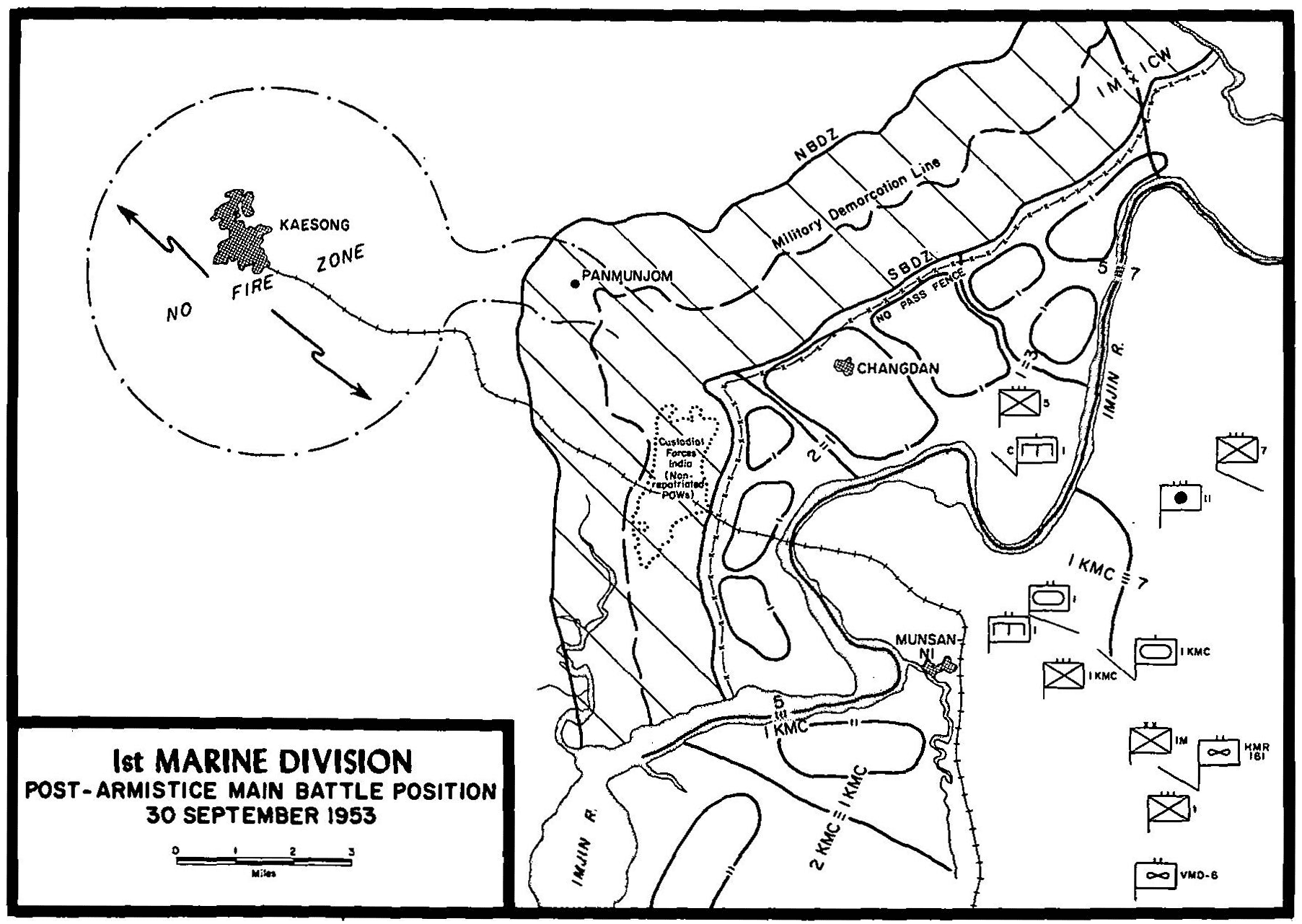
MAP 35 K. WHITE
E. WILSON
1st MARINE DIVISION
POST-ARMISTICE MAIN BATTLE POSITION
30 SEPTEMBER 1953
Marine support units—motor transport, tank, service, medical,
aerial liaison (VMO/HMR)—were in the same general rear area,
as was the headquarters of the U.S. 25th Infantry Division. The
Marine Division CP continued to be located at Yongji-ri, although
construction of a new site further south at Chormyon was due to be
completed by engineer personnel on 1 October. The division railhead
and truckhead remained, respectively, at Munsan-ni and Ascom City.
To the left of the KMC sector was the 1st Amphibian Tractor Battalion.
Still further west, separated from other units by the Han
River, was the Kimpo Provisional Regiment, in its former wartime
sector.
As the division OPLR regiment, the 5th Marines held a line
36,000 yards in length—about 21 miles—roughly corresponding to
the front manned by three regiments during the war. The OPLR
sector included the entire area in the divisional zone of responsibility
north of the Imjin. Boundaries of the 5th Marines territory were the
southern DMZ truce line on the west and north, the Samichon River
to the east, and that major water barrier, the curving Imjin River,
to the rear.
After establishment of the DMZ, the division occupied unfavorable
low ground poorly suited to the defense and inferior to that held
by the enemy—continuing the same situation that had existed during
the period of stabilized combat operations in West Korea. Almost
without exception the southern boundary of the DMZ prohibited the
Marines from moving onto the commanding terrain, as the No-Pass
Line was behind or along the reverse slopes of the high ground. On
the other hand, in most cases the CCF had the advantage of having
forward slope positions as well as the crests plus most of the commanding
terrain in the area.
Communist territory in the northern DMZ sector included the former
strongholds of Yoke, Bunker Hill, Carson, Reno, Vegas, Berlin,
East Berlin and Warsaw. Within the Marine division postwar area
were the Panmunjom Corridor and outposts Marilyn, Kate, the
Boulder City hills, and the Hook. Much of the terrain between the
major hill positions along the 5th Marines regimental front and the
Imjin River consisted of low-rolling hills rising abruptly out of the
rice paddies.
Construction of new positions and the defense system of the 5th
Marines was based on several assumptions about enemy capabilities,
made by G-2 and the new regimental CO, Colonel Rathvon McC.
Tompkins, who had assumed command on 2 August. These were:
that in the event of resumption of hostilities by the CCF the enemy
would use his jet fighters and bombers in support of operations;
that he would continue to have numerical superiority in artillery;
and that the northern outpost regiment would have no reinforcement
or surface resupply from units south of the Imjin.
The defense plan for the forward part of the 5th Marines sector
in event of a resumption of hostilities called for furnishing patrols
equipped with radios and FO teams to occupy Hills 155, 229, and
181. (Hill 155 was directly south of the DMZ in the 2/5 left
battalion sector; Hills 229 and 181 were, respectively, just inside and
just outside the southern boundary of the truce line in the center
1/5 sector.) From these three elevations the patrols would then have
the mission of bringing down artillery fire on enemy concentrations
and relaying communications about the situation to the friendly main
attack force. Other critical hill masses in the OPLR regimental sector
were Hill 126 (in the 3/5 eastern battalion sector, just inside the
Marine side of the DMZ) and Hill 163, in the Hook area. The latter
hill was not as suitable for defense since it was located south of the
military demarcation line and was thus less accessible.
These hill masses so completely dominated the major enemy
approaches through the division sector to the Imjin, the lower river
crossing sites and bridges, that their occupation by Marine personnel
was considered essential in the event of any attack. Hill 229, adjacent
to the Chan-dang corridor and part of the 229-181 axis, was considered
the most critical terrain feature in the entire northern section.
Key areas to the rear of the 5th Marines’ sector were the two
operating bridges (Freedom in 2/5 territory and Libby on the 3/5
right) and the two interior crossing sites (Honker and Spoonbill).
All provided access to the Imjin and division support units deployed
on the south side of the river. In the event of threatened hostile
attack, the Northern Regiment was under orders to destroy the
bridges to prevent their use by the enemy on any attempted advance
to the rear.
Strong perimeter defenses, called “Bridgehead Positions” were
to be built by 5th Marines’ battalions. Two were to protect the two
bridges and a third, to include both ferry sites. Between the forward
defended localities and the rear bridgehead positions, alternate and
secondary sites were organized to create mutually supporting defenses
in depth. The bridgeheads were a combination of linear and strongpoint
defense, capable of withstanding severe pressure.
Organization of the defensive positions in the 5th Marine sector
was complicated both by peculiarities of the terrain and political
restrictions due to proximity of the DMZ. In addition to the regiment’s
excess frontage, the demilitarized zone immediately to the
front precluded use of either aerial or motorized reconnaissance for
early warning. Security measures for the OPLR were less than ideal.
Neither proper patrols nor a covering force in front of the OPLR
was possible; the best that could be done was to maintain patrols
along the friendly side of the No-Pass Line.
As the regimental left battalion pointed out: “Location of the
DMZ and the No-Pass Line made the trace of the OPLR follow an
artificial and arbitrary line rather than that of the best terrain.”676
The most critical terrain feature in the sector, Hill 155, was located
just outside the southern boundary of the DMZ. Although its possession
was essential to successful defense of the OPLR and the
bridgehead defense positions being developed to the interior and
rear of the battalion sector, Hill 155 could not be occupied because
of the armistice agreement. The solution to the problem was simply
to occupy the best ground adjacent to the No-Pass Line.
Placement of automatic weapons was a factor of great importance
in organizing the defensive positions. In order to accomplish the
mission of an OPLR, weapons had to be situated to bring the enemy
under fire at maximum ranges. Accordingly, machine guns and other
weapons were placed on high ground well to the front. Some Marines
commented that:
Many individuals having the MLR concept in mind insisted that weapons
should be located forward on low ground to provide grazing fire. A period
of education was required. For the same reason, it was necessary to place
81mm mortar and 4.2-inch mortar positions further forward than they
would normally be in support of the MLR.677
The problem of establishing depth to the defensive positions was
never solved to the satisfaction of everyone. This was due primarily
to the extended front which necessitated using more units for support
elements than would normally be done. This situation was partly
alleviated by establishing some unit defensive sectors further to the
rear in the company areas.
Another difficulty was the inadequate allocation of ammunition:
one-half JAMESTOWN load on position, and another half-load available
at the regimental dump. The JAMESTOWN load unit had been
developed for use in a stabilized defense situation where automatic
weapons were aimed as the enemy came in close proximity to the
MLR. On the other hand, OPLR machine guns and weapons were
required to open up at maximum ranges and might well be fired for
extended periods of time. It was calculated that A4 machine guns
firing at medium rate (75 rpm) would expend the one-half JAMESTOWN
load in 22 minutes, while an A1 machine gun at medium rate
(125 rpm) would exhaust the same load in 13 minutes. A partial
improvement was obtained by moving the ammunition loads from
regimental to battalion dumps although the basic problem of limited
allocation—shared also by rear infantry regiments—continued to
exist.
An unique situation that had confronted the 2d Battalion and at
times the adjoining 1st Battalion stemmed from the large numbers
of Army engineer personnel building the nonrepatriate POW camp
in the DMZ immediately west of the 2/5 sector. During August and
the first part of September, the area in front of 2/5 had been used
as a base camp for 5,000–7,000 construction personnel. Although
their area was crowded with these additional units, the Marine battalions
could not exercise any control over them. The Marines were
still responsible for security of the sector, however. Presence of as
many as 22,000 nonrepatriate CCF and NKPA prisoners as well as the
Indian custodial forces further complicated the matter. It was noted
that:
At the same time the Army engineers were building the camp, the
prisoners were situated in the middle of the 2/5 area and the MSR to
Panmunjom led completely across the battalion position into the 1/5 sector
[and thence] into the DMZ. Upon completion of the camp, the engineers
withdrew from the area but as they withdrew the 5,500 troops of the
Custodial Forces India were brought in to guard the nonrepatriate prisoners.
With the arrival of the prisoners, the number of personnel in the regiment’s
sector of responsibility rose to 28,000–30,000. Thus, the problem of having
a GOP mission and at the same time having never less than 5,000 and as
many as 30,000 friendly, neutral, and/or prisoner personnel in front of
our most forward defended localities was always present.678
Camp construction and development of the new positions south
of the river continued at a furious pace from August through early
October. Since the new camp sites were in civilian populated areas,
“it was necessary to secure real estate clearance before they could be
occupied or improved.”679 After clearance was obtained on 29 July,
division engineers immediately began work on five separate camps.
These camp building activities and reconnaissance of assigned blocking
positions continued until 10 August. At this time, construction
began on the major blocking positions, so organized and developed
as to be self-sustaining for several days. Whether squad, platoon, or
company, all positions were organized using a perimeter type defense
and were mutually supporting laterally and in depth. Connecting
trenches, bunkers, ammunition holes, and tank slots were also built.
By early October, construction of the blocking positions was completed
by the 1st Marines despite the fierce summer heat, the numerous
rock formations in the area that were difficult to dig out with
limited tools and demolitions, and the shortage of personnel due to
units participating in the new series of division MARLEX exercises,
resumed in October. Within three months, the Marine division had
thus largely completed building of a solid defense in its new main
battle position. The importance of maintaining combat readiness for
any renewed hostility on the part of the enemy demanded continuing
vigilance at all times.
Defense specifications throughout the 5th Marines northern general
outpost sector called for some 1,560 individual fighting positions,
400 automatic weapons sites, 8 bunkered infantry OPs, 30 bunkered
CPs, 15,400 yards of trenchlines, and 70,000 yards of protective and
tactical wire. In construction of the MBP, all bunkers were so blended
and camouflaged with the natural terrain that they were almost impossible
to be seen.
To the division rear, the location of recoilless rifle positions, FDC
bunkers, and tank slots in the blocking positions and bridgeheads
was the major priority. In the antimechanized defense plan, tanks
covered likely avenues of approach into the general outpost area
and also overlooked critical river crossing sites. Wherever possible
old firing positions which had been previously prepared to support
the secondary lines WYOMING and KANSAS were utilized. By the end
of the year, 204 tank firing positions had been emplaced throughout
the Marine division sector.
Three rehearsals for the occupation of the main battle position
were held by the 1st Marine Division in September. All division
units, both combat and service, participated in these exercises. Tactical
units were required to occupy the MBP and be fully prepared for
combat on four hours’ notice; service units were to provide additional
local security required for the elimination of enemy infiltrators or
guerrilla agents. Divisional and I Corps test exercises indicated that
three hours were necessary to man the MBP during daylight and
approximately three and one half hours at night.
The 1st Marine Aircraft Wing Post-Armistice Plan, as part of Fifth
Air Force operations, was effective at 2200, on 27 July. Its purpose,
basically, was to insure that wing elements carried out provisions of
the armistice and yet continued to maintain a high level of combat
readiness in the uneasy truce period.
Two major operational restrictions had been imposed on the UNC
air force by the armistice. The first was establishment of the “No-Fly
Line” south of the Allied southern boundary of the DMZ. Any
flight beyond that point had to be authorized by JOC and a barrier
patrol was maintained by FAF to apprehend any violators of the
truce provisions. The 1st MAW contribution to this aerial security
team was night patrols performed by F3D-2s from VMF(N)-513
and radar-configured AD aircraft from VMC-1 (later, by the new
VMA-251 squadron).
The second post-truce restriction, which affected wing logistic
movements, limited the entry and departure of all Korean air traffic
to five airfields. These aerial ports were K-2, K-8, K-9, K-14, and
K-18. (K-16 was later added.) Neither K-3, the east coast home
field of MAG-33 nor K-6, located just inland from the west coast
and the site of MAG-12 operations, was included. All Marine traffic
landed either at K-9 or K-2 for inventory, a procedure which subsequently
developed into a bottleneck, and caused supply delays due
to the substantial reduction in payload made to accommodate the
necessary extra fuel due to greater overland distances between airfields.
When the CG, 1st MAW requested that K-3 be made a port
of entry to avoid the difficulties involved in use of the two FAF
fields, ComNavFE disapproved the request with the following
rationale:
ComNavFE feels that to ask for designation of K-3 as an additional
port of entry would be politically inadvisable. It would provide the
Communists with a basis for a propaganda claim that the United Nations
were attempting to further delay an armistice agreement. Should the Communists
propose an additional port of entry for their side, COMNAVFE
states the UN Military Armistice Commission will offer designation of
K-3 as a quid pro quo.681
Removal from Korea to Japan of operational combat aircraft for
routine maintenance runs and their return thus had to be made
through the same port of exit and reentry. Inspections were conducted
by the USAF combat aircraft control officer at the port.
The post-truce 1st MAW mission, in part, comprised the
following:
... to maintain assigned forces in a state of combat readiness, provide
for security of assigned forces, areas, and installations; observe the conditions
of the Armistice Agreement; support other elements of the United
Nations Command as required; be prepared to counter any attempt on the
part of the enemy to resume active hostilities; continue current missions
other than combat; insure that 1st MAW personnel and combat material
are not increased beyond the level present at the instant of the effective
time of the Armistice Agreement; submit reports on 1st MAW personnel
and controlled items of Wing equipment entering or leaving Korea; be
prepared to disperse air units within or from Korea as necessary to provide
maximum security during an Armistice....682
The strict interpretation of replacing combat aircraft, armored
vehicles, weapons, and ammunition that were destroyed, worn out,
or used up during the period of armistice was, of course, due to the
sensitive political considerations. It was felt that replacement of
combat equipment by UNC forces:
... would result in the Communists adopting the same liberal interpretation
which is undesirable since it will lessen the control of combat
material in North Korea and could permit them to replace phenomenal
unauthorized quantities of material damaged, destroyed, worn out or used
up prior to the effective date of the Armistice Agreement.683
In August, postwar procedures were mapped out for 1st MAW
personnel, as part of the overall quota limitations prescribed by
FECOM (Far East Command) through FEAF and FAF echelons. A
1st MAW headquarters section, designated as 1st MAW, rear
echelon, was established at Itami AFB, Japan, two hours’ flight from
Korea. All incoming or outgoing aviation personnel on permanent
change of station orders were to report to the rear echelon, 1st
MAW. Announcement of Marine Corps plans to initiate future postwar
rotation on a stretch-out basis (for both air and ground personnel)
was also made in August. Preliminary plans called for
changing the current 11-month combat tour in Korea to 14 months
by March 1954, and possibly 16-month tours by July 1954, if extension
of Korean service proved necessary. As with division personnel,
monthly cumulative arrivals were not to exceed the number of departing
aviation Marines. The quota set by FEAF for 1st MAW rotation
for the month of August was 600, compared to the Marine division
quota of 3,000 for ground personnel.
With the 1st Marine Division engaged for an unknown length of
time in its postwar mission as an occupation force and 1st MAW
units continuing to operate under FAF in Korea, new Marine ground
and air units were assigned to the Far East theater shortly after the
conclusion of Korean hostilities. On 23 July, the 3d Marine Division,
together with supporting air units, was readied for deployment from
Camp Pendleton to Japan the following month. On 13 August the
division CP was opened afloat and units proceeded to Japan between
16–30 August. The mission of this division and the two major air
units, MAGs-11 and -16, was to maintain a high state of readiness
in the Far East Command and to assist in the air defense of Japan.
As explained by the Commandant, their redeployment was accomplished
“in order to provide the amphibious capability which is an
important element of national strategy in that predominantly maritime
theater.”684
The new Marine units thus joined in the Pacific, the 1st Provisional
Marine Air-Ground Task Force685 that had been activated
in Kaneohe, Hawaii in January of 1953. Commanded by Brigadier
General James P. Risely, it was to include a headquarters company,
reinforced regiment, and reinforced aircraft group. The special task
force was designated as a hard-hitting, air-ground team that could
respond immediately as a force-in-readiness to any emergency in the
Pacific area.
Commanded by Major General Robert H. Pepper, the 21,100-man
3d Marine Division was called the “Three-Dimensional Division,”
in reference to its training in airborne, amphibious, and atomic warfare.
Within six months, its components were to stretch from Kobe to
Tokyo, with division headquarters and the 9th Marines at Gifu, the
4th Marines at Nara, and other units at Otsu.
New Marine air units, which included Marine Transport Squadron
253 and Marine Observation Squadron 2, as well as MAGs-11 and
-16, all came under 1st MAW operational control. Commanded by
Colonel John D. Harshberger, the all-jet MAG-11, formerly based at
Edenton, N.C., arrived at NAS Atsugi on 10 September. It comprised
three F9F squadrons, VMFs-222, -224, and -314. Also at
Atsugi, the Marine Corps aerial gateway to Japan, was the new
transport squadron, VMR-253, commanded by Lieutenant Colonel
Carl J. Fleps, which reported in to CG, 1st MAW, on 16 August.
Following numerous FMFPac requests for additional air transport
capability, the Commandant had authorized transfer of the squadron
from El Toro to assist the veteran wartime carrier VMR-152 in the
enormous postwar airlift program.
Flying new R4Q Fairchild Packets, which could carry 42 troops,
the squadron from August to May 1954 logged more than 5,000,000
passenger miles in transporting Marine replacements for the 1st
and 3d Marine Divisions. Additional air capability was provided
by Marine Helicopter Transport Group 16 (at Hanshin AFB)
under Colonel Harold J. Mitchener, with its two HRS-2 (HMR-162,
HMR-163) and service squadrons (MAMs-16, MABS-16) and
VMO-2, commanded by Major William G. MacLean (based at
Itami). Both units reported to 1st MAW and FECOM on 13 August.
Major command changes within the 1st MAW that month were:
Brigadier General Verne J. McCaul, vice Brigadier General Alexander
W. Kreiser, Jr. as ACG, 1st MAW, effective 16 August; and
Colonel William F. Hausman, vice Colonel Carney, CO, MAG-12,
on 8 August. (The new MAG-33 CO, Colonel Smith, had succeeded
Colonel Stacy in late July.)
In the immediate post-armistice period, extensive training programs
were instituted by MAGs-12 and -33 to maintain high operational
efficiency. Marine aircraft remained on JOC alert as required
by the Fifth Air Force and flew training missions scheduled by 1st
MAW and FAF. These consisted of practice strikes against heavily-defended
targets, practice CAS for Eighth Army units, GCI (ground
control intercept) flights under MGCIS-3 control, and bombing practice
using the Naktong Bombing Range. Other training sorties were
scheduled in reconnaissance navigation, weather penetration, determining
fuel bingos,686 target location and identification, air defense
patrolling, and coordination of tactical procedures in the target area.
The training schedules provided a well-balanced indoctrination program
for new squadron flight leaders, pilots, radar operators, and
other crew members arriving in Korea on the postwar personnel
drafts.
A new work day schedule of 0700–1500 implemented in August
made more time available for athletics, swimming, studying,
and R&R (Rest & Recreation). That same month the MAG-12
softball team won the Fifth Air Force “All Korea” softball championship.
Following this achievement, the team left for Japan to
compete in the FAF “Far East” softball tournament which included
teams from all the major Pacific bases. Subsequently, the K-6 players
“disguised in Air Force uniforms, went onward and upward to become
FEAF champions in September.”687 MAG-33 pilots, meanwhile,
participated in Operation SPYGLASS, a FAF training exercise in August
and Operation BACK DOOR, the following month. Both emphasized
interception flying and work with GCI squadrons. As “aggressors,”
the Pohang-based airmen made simulated attacks on South Korean
targets “defended” by Air Force and other land-based Marine units.
In October, MAG-33 pilots flew CAS missions for the 1st Marine
Division training problem, MARLEX IV, a battalion landing exercise
staged by 1/7 on Tokchok-to Island. Beginning that month a new
procedure was inaugurated by MAG-33 and the recently-arrived
MAG-11. Every week, four MAG-11 pilots came to Korea for a
week of orientation flying with a MAG-33 squadron to gain a better
picture of typical flying conditions in the Korean theater.
Early in 1955 the 1st Marine Division, which had been in the
Korean front lines almost continuously since September 1950, returned
to Camp Pendleton. Redeployment by echelons began in
February. By June, all units had returned to CONUS. The transfer
from Korean occupation duty was effected in order that the division’s
“valuable capability as a highly trained amphibious force in readiness
may be fully realized.”688 Now under Major General Merrill B.
Twining,689 the division had been a part of Eighth Army occupying
postwar defense positions in Korea until its relief on 17–18 March
1955 by the U.S. 24th Infantry Division.
In addition to its official mission in the Eighth Army line, the
1st Marine Division had conducted an active small-unit amphibious
training program during its postwar Korea duty. All but two of its
infantry battalions had carried out assault landings on Tokchok-to,
off the Korean west coast south of Inchon, prior to its departure
for the United States. The 3d Marine Division had also conducted an
active training program, with numerous small-unit exercises and
regimental landings staged at Iwo Jima and Okinawa as part of its
continuous readiness conditioning.
For Marine air personnel, their official departure from Korea
following the 1st MAW wartime assignment there, came the next
year. Beginning in June 1956, initial units of the Marine aircraft
wing were withdrawn from Korea and relocated at NAS Iwakuni,
Japan. Plans called for the wing, then under Brigadier General
Samuel S. Jack690 and occupying bases in both Korea and Japan, to
be permanently headquartered at Iwakuni and revert to CinCPacFlt
control. The wing remained on station in the Far East as a component
of postwar United States defense strength in that area.
The prewar Fifth Air Force and Eighth U.S. Army commands,
under which Marine Corps air and ground units had functioned during
the Korean War, were permanently deployed in the Far East as
operative military echelons. EUSAK-FAF transferred from its wartime
JOC location at Seoul to Osan-ni in January 1954 and in September
of that year relocated to Nagoya, Japan. Eighth Army headquarters
remained at Seoul.
CHAPTER XII Korean Reflection — Air 700 — Helicopter 709 — FMF and Readiness Posture 719 — Problems Peculiar to the Korean War 732 — Korean Lessons 764
Marine Corps Role and Contributions to the Korean War:
Ground, Air, Helicopter—FMF and Readiness Posture—Problems
Peculiar to the Korean War—Korean Lessons
Marine Corps Role and Contribution
to the Korean War: Ground691
Ground operations of the 1st Marine Division during the Korean
War can be divided into six periods. These are the Pusan
Perimeter defense (August-September 1950), Inchon-Seoul assault
(September-October 1950), the Chosin Reservoir campaign (October-December
1950), East-Central Korea (January 1951-March
1952), West Korea (March 1952-July 1953), and the post-armistice
period (July 1953-February 1955).
Marine Corps traditional concepts of readiness and fast, effective
deployment were never better illustrated than in the hectic weeks
following 25 June 1950. The NKPA invasion of South Korea came at
a time when U.S. military forces were in the final stages of a cutback
to peacetime size. Ships and planes were being “mothballed”; personnel
of all the Armed Services were being reduced in number to the
lowest possible effective manpower levels.
From the peak of its six-division, five-wing wartime strength of
475,600 in 1944–1945, the Marine Corps at the outbreak of the
Korean emergency had only two skeletal divisions and two air wings.
There were but 74,279 Marines on active duty, 97 percent of the
Marine Corps authorized strength. Although a ceiling of 100,000
had been established for the Corps by law, it was a period of tight
purse strings for all defense components. Fiscal austerity in the post-World
War II period had whittled Corps numbers from 85,000 in
FY 1947 to what was projected at 67,000 by the end of FY 1950.
This critically reduced strength found the normal Marine triangular
infantry organization cut back to two companies per battalion, two
battalions per regiment, and two regiments per division. The 1st
Marine Division, at Camp Pendleton, and 2d Marine Division, at
Camp Lejeune, were structured along the regular peacetime T/O
of 10,232 USMC/USN vice the wartime minimum T/O of 22,355.
No Marine units of any size were located in the Far East.
Despite its lean numbers in late June 1950, the Marine Corps once
again would be in the forefront of American military response to
the Communist aggression 6,000 miles across the Pacific. As hard-pressed
South Korean forces and understrength U.S. occupation
troops from Japan attempted to halt the Communist invaders, General
of the Army Douglas MacArthur, on 2 July, requested the JCS to
send immediately a Marine RCT with supporting air to the Far East.
On 7 July, the 1st Provisional Marine Brigade was formed at Camp
Pendleton from units of the 1st Division. Major components of the
brigade—a balanced force of ground, service, and aviation elements—were
the 5th Marines and MAG-33. Five days later, the 6,534-man
brigade had mounted out from San Diego to answer the CinCFE
plea for Marines to help turn the Communist tide engulfing Korea.
The brigade buttressed the faltering UNC defense in the Pusan
Perimeter. Employed as a mobile reserve it helped prevent three enemy
breakthroughs—at Chinju and the two Naktong River battles. On
7 August, a month after its activation, the brigade launched an attack
toward Chinju. The Marine brigade was the first unit sent from
CONUS to see combat in what was then considered a short-term
police action. Later, in leading the way to destruction of an enemy
bridgehead at the Naktong, the Marine brigade gave the defending
Eighth Army its first victory against the NKPA in the Korean conflict.
Even before the brigade had been dispatched to the Far East, as
the Korean situation continued to deteriorate, MacArthur had requested
the JCS to expand the brigade to a full war-strength division.
Between 10–21 July MacArthur, now CinCUNC, had made three
separate requests for a Marine division. This persistence was reinforced
by his growing determination to conduct a tactical amphibious
operation to the rear of the overextended NKPA lines and thereby
seize the initiative from the enemy.
In the States, meanwhile, authorization was received to bring the
badly understrength 1st and 2d Marine Divisions up to full 22,000-man
war levels. By stripping posts and stations, reassignment and
rerouting of units, and callup of additional reserve personnel, major
elements of the 1st Marine Division were on their way to Korea by
mid-August. Timing was critical in order to meet the projected
D-Day target date of 15 September.
Pulled out of the Pusan line on 12 September, the brigade was
absorbed by the newly arrived 1st Marine Division in preparation
for the coming Inchon invasion. As the brigade commander, Lieutenant
General Edward A. Craig, USMC, later reminisced:
Although the 1st Provisional Brigade and the 1st MarDiv had never
actually trained or worked together, they still combined and executed a
successful landing. To me, this simply emphasized the fine training and
techniques laid down for amphibious landings by the Marines.692
Organized as a unit less than four months, the brigade left behind
it a reputation for mobility, effectiveness, and rapid deployment in
the face of national emergency. Although Marine air and ground
forces had operated together since 1919 in Haiti, formation of the
1st Provisional Marine Brigade “marked the first time that the air
and ground elements, task organized under a single commander, had
engaged in combat.”693
In the brilliant Inchon landing of 15 September 1950, Major General
Oliver P. Smith’s 1st Division Marines led the X Corps attack
in the first major counterstroke by United Nations forces on Communist-held
territory. This maneuver was closely timed against
enormous odds of personnel, logistics, and hydrography (tidal
fluctuations of 31 feet) which made 15 September the only suitable
assault date until mid-October. When outlined in earlier planning
sessions by General MacArthur, the mammoth difficulties of the operation
had been so unsettling that the designated Attack Force Commander
for the landing, Rear Admiral James H. Doyle, expressed
the view that “the best I can say is that Inchon is not impossible.”694
Despite all the difficulties, the landing at Inchon and recapture
of Seoul, the South Korean Capital, and its adjacent Kimpo airfield
by the Marines was a stunning tactical blow by the UNC that broke
the backbone of the North Korean People’s Army 1950 offensive.
The 1st Marine Division, in its successfully executed amphibious
landing, had offered UNC forces an opportunity to defeat the enemy
decisively before a Siberian-like Korean winter set in. Accomplished
under the most adverse weather and geographic conditions, the
assault proved anew the decisive power of amphibious forces employed
at a critical time and place. This capability and readiness of
the Marine Corps had totally reversed the military situation, and a
battered enemy was on the run. The subsequent routing of the
NKPA divisions in the Inchon-Seoul campaign by X Corps and the
Eighth U.S. Army forces would have led to an early UN victory had
not the Chinese Communists intervened to support their Korean
counterparts. The operation had validated Far East Commander
General MacArthur’s early premise that:
... air and naval action alone could not be decisive, and that nothing
short of the intervention of U.S. ground forces could give any assurance
of stopping the Communists and of later regaining the lost ground.695
The Inchon operation, moreover, had been planned in record time—approximately
20 days. This was one of the shortest periods ever
allotted to a major amphibious assault, involving the planning,
assembly of shipping, and mounting out of a combined force of
29,000 Marines and support personnel.
With the Inchon-Seoul operation ended, the 1st Marine Division
(including the 7th Marines which had reached Inchon in time for
the liberation of Seoul) reembarked on 12 October for deployment
to the east coast of Korea. A new military operation was envisioned
north of the 38th Parallel against Pyongyang, the North Korean
Capital. As part of the drive, X Corps was to make an amphibious
envelopment on the east coast, in the area of the enemy-held port
of Wonsan. From here X Corps would advance westward toward
Pyongyang, to link up with Eighth Army troops and trap NKPA forces
withdrawing from the south.
While the Marines were en route to the objective, word was
received that ROK troops had overrun Wonsan and were pushing
north. The revised X Corps plan of operation called for a three-pronged
attack towards the Yalu. The Marine division would advance
on the left, the U.S. Army 7th Division in the center, and 1st ROK
Division on the right flank. This drive to the north and subsequent
action at the Chosin Reservoir would rank as one of the most rigorous
campaigns in the entire history of the Marine Corps.
Fighting as part of EUSAK, by this time fanned out throughout
North Korea, the 1st Marine Division did not meet the expected
NKPA resistance. Instead, large-scale Chinese Communist Forces had
entered the war. As X Corps swept north toward the Yalu River
in November 1950, the Marines became the first United States troops
to defeat the Chinese Communists in battle. At Sudong, after four
days of savage fighting, the Marine RCT-7 so badly crippled major
elements of the 124th CCF Division that it was never again committed
as an organic unit.
When the Chinese forces struck in full force at the Chosin Reservoir,
X Corps units were forced back. Elements of a nine-division
assault force, the CCF 9th Army Group, which had been sent into
Korea with the specific mission of annihilating the 1st Marine Division,
began to attack. On 27 November, the Chinese directed a
massive frontal assault against 5th and 7th Marines positions at
Yudam-ni, west of the reservoir. Another CCF division, moving up
from the south, cut the MSR held by the 1st Marines so that the
division at Yudam-ni, west of the reservoir, was completely encircled
by Communist forces. Many experts considered the 1st Marine Division
as lost. Others thought the only way to save it was to airlift it
out, leaving its equipment behind. Instead, the Marines seized the
initiative at Yudam-ni and cut a path through CCF units blocking
a route to Hagaru. The division battled its way out in 20-degree-below-zero
weather 78 miles over icy, winding mountain roads from
the reservoir to the Hamhung-Hungnam area where, on 15 December,
it redeployed to South Korea.
Integrated ground and air action enabled the 10,000 Marines and
attached 4,000 Army-Royal Marine troops to break out of the entrapment
and move south. During 13 tortuous days the Marines had withstood
hostile strength representing elements of six to eight CCF divisions.
The major result, from the military view, was that the Marine
division properly evacuated its dead and wounded, brought out all
operable equipment, and completed the retrograde movement with
tactical integrity.
Not only had the Chinese (with a total of 60,000 men in assault
or reserve) failed to accomplish their mission, destruction of the
division, but the Marine defenders had dealt a savage blow to the
enemy in return. POW debriefings later revealed that assault units
of the CCF 9th Army Group had been rendered so militarily ineffective
that nearly three months were required for its replacement,
re-equipment, and reorganization.
Early in 1951, the 1st Marine Division was reassigned to IX Corps
for Operation KILLER, a limited offensive ordered by the EUSAK
Commander, General Matthew B. Ridgway. In Operation RIPPER,
in March, the division led another IX Corps advance as it drove
toward the 38th Parallel on the east-central front. When the Chinese
struck back with their spring offensive on 22 April, the Marines were
transferred to operational control of X Corps and counterattacked
to restore the UNC defensive position in the far eastern sector. During
May and June, the 1st Marine Division continued to punish the
enemy in the Punchbowl area of eastern Korea, driving the CCF
back to Yanggu and the Soyang River corridor.
Activity all along the UNC front came to an uncertain halt in July
1951 when Allied and Communist negotiators met at Kaesong for
truce talks initiated by the enemy. In August the MLR flared into
action again, and the Marine Division was engaged in new counterthrusts
in the Punchbowl area. Fighting during the next three weeks
involved the division in some of its hardest offensive operations in
Korea. It also developed that this would be the last offensive for the
Marines. In November 1951, as a result of the truce talks and possibility
of ending hostilities, General Ridgway, now UNC Commander,
ordered the Eighth Army to cease offensive operations and begin an
active defense of the front.
The war of fire and movement had turned into one of positional
warfare, a defensive posture by UN forces that would continue for
the last 21 months of the three-year conflict. Throughout the winter
of 1951–1952, the Marines conducted vigorous patrol activities in
their sector of X Corps. Although it was a lackluster period of trench
warfare for the average infantryman, major tactical innovations were
being pioneered by the division with its use of the transport helicopter
for logistical and resupply missions.
In March 1952, the 1st Marine Division was transferred from the
eastern X Corps line 140 miles west to strengthen the far end of the
Eighth Army MLR in the I Corps sector. The division was relocated
in the path of the enemy’s invasion route to Seoul, where weak
defenses in the Kimpo coastal area had threatened the security of
the UNC front. Here the division’s four infantry regiments (including
the 1st Korean Marine Corps RCT) held nearly 35 miles of front
line in the critical Panmunjom-Munsan area. The demilitarized route
for the United Nations negotiators led through the Marine lines. It
was the most active sector of the UN front for the next 16 months.
This key position guarded the best routes of advance from North
Korea to Seoul and indicated the high regard in which General
James A. Van Fleet, EUSAK commander, held the Marines.
West Korean terrain was rugged, hilly, and friendly to the CCF
who had the advantage of high ground positions as well as considerably
more manpower. Although cast in an unaccustomed defensive
warfare role, rather than a true attack mission, the Marines repelled
an almost continuous series of enemy probes. While truce talks went
on at nearby Panmunjom, fighting as furious as at any time earlier
in the war flared up intermittently as the CCF tried to gain additional
terrain for bargaining purposes. During 1952–1953, the Marine
division beat off determined CCF limited objective attacks on Bunker
Hill, the Hook, Vegas, and Boulder City outposts up until—literally—the
final day of the war, 27 July 1953.
In reviewing Marine actions during this period, the Secretary of
the Navy commented:
Marines in Korea have established an enviable record of success in carrying
out their assigned missions. The First Marine Division began its third
year in Korea holding an active sector of the United Nations front guarding
the enemy’s invasion route to Seoul. It was frequently subjected to fanatical
Chinese attacks supported by intensive artillery fire. Some of the heaviest
fighting during the year took place along the front held by this Division.
Enemy attacks were well coordinated and numerically strong. Continued
patrol activity to keep the enemy off balance frequently resulted in bitter
hand-to-hand fighting with numerous casualties on both sides.696
This type of prolonged static warfare gave little real satisfaction
to Marines accustomed to waging a war of movement and a more
tangible “mission accomplished.” The year of positional warfare in
western Korea was costly, too. Total U.S. casualties in the Korean
War numbered approximately 137,000 men killed, missing, or
wounded. The Marine Corps toll was 30,544. Of this number, 4,262
were KIA, an additional 244 were listed as non-battle deaths, and
26,038 were wounded. During this last part of the war, Marine
casualties (both ground and air) totaled 13,087, plus an additional
2,529 for the attached 1st KMC/RCT. Astonishingly, 1,586 Marines
or 39.6 percent697 of the infantry Marines killed in the entire war
were victims of the “static,” outpost warfare in the west. Another
11,244 were listed WIA during this period—representing 43.9 percent
of the total number of ground Marines wounded during the
three years of conflict.
* * * * *
Conditions varied widely during the 1950–1952 and 1952–1953
periods of the war. The enemy’s improved capability in artillery
during the latter period of positional warfare largely accounts for
the high casualty rate at this time. It has been noted that:
Prior to February 1952, with a warfare of mobility prevailing, the enemy
was inferior in artillery, the causative agent of most personnel losses.
Afterwards, during the outpost warfare of western Korea, the front remained
more or less static, and the Chinese Reds had as much artillery
support as the Marines.698
It might be valid to question the use of Marine Corps specialists
in amphibious warfare in an Army-type conventional land war. The
protracted land campaign that characterized the latter stages of the
Korean conflict actually was waged for the majority of the war period—from
September 1951 to July 1953, or nearly two years. In terms
of economy of manpower it could be considered an inefficient,
though not ineffective use of Marines. On the other hand, the history
of warfare down through the ages makes it repeatedly clear that a
nation fights the pitched battle against its opponent with the arsenal
of weapons and personnel at hand.
As an Eighth U.S. Army component (attached variously to the
X, IX, and I Corps), the 1st Marine Division (one of nearly 20
divisions representing U.S. Army, British Commonwealth, and ROK
troops) performed its assigned mission—to repulse and punish the
enemy. It contributed heavily to maintaining the integrity of the
EUSAK front and was considered one of the two crack EUSAK divisions—the
other being the Marines’ neighbor to the right, the British
Commonwealth Division. With the attached KMCs, the 1st Marine
Division, moreover, was also the biggest and strongest division in
EUSAK.
Most importantly, fast deployment of the Marine division had
made possible the brilliant tactical maneuver at Inchon. Many military
experts, following World War II, had envisioned future conflicts
only in terms of atomic warfare and massive strategic air assaults.
Even the Chairman of the Joint Chiefs of Staff “had predicted publicly,
hardly six months before, that the world would never again
see a large-scale amphibious landing.”699 In contradiction to new
atomic-age tactics, however, the United Nations commander in September
1950 had turned the tide of the battle by his use of a
conventional maneuver—envelopment by amphibious assault. The
performance of the Marine Corps was thus responsible, in part, for
changing post-Korean War military doctrine from total reliance on
new tactics and weaponry to a more balanced concept that combined
both sophisticated innovations and viable, established procedures.
Although unemployed in its primary amphibious role after late
1950, the 1st Marine Division had originally been positioned on the
eastern front because of this capability. It was the UN commander’s
desire to have EUSAK’s only amphibious trained and equipped division
near the coast in the event that an amphibious maneuver was
required for offensive or defensive purposes. Again, in the division’s
1952 move to the western coastal front in the Kimpo area, this fighting
capability was a major consideration.
To a large extent, U.S. forces in Korea fought the early part of
the Korean War with weapons from the preceding war—only five
years removed. Three tactical innovations employed by the Marine
Corps during the Korean War were highly successful and largely
adopted by the other services. These were the thermal boot, individual
body armor, and the helicopter. All were first combat tested in
1951.
Frostbite casualties during the first winter in Korea resulting from
inadequate footwear made it necessary to provide combat troops
with specially insulated footgear. The new thermal boot virtually
eliminated frostbite for both Marine infantrymen and aviators.
Armored utility jackets had been developed toward the end of World
War II but were not actually battle tested. The Marine Corps had
renewed the experimentation in 1947. First combat use of the plastic,
light-weight body armor was made in July 1951 by Marines while
fighting in the Punchbowl and Inje areas of X Corps. Improvements
were made to the prototypes and by the following summer the Marine
Corps, following a request made by the Army Quartermaster General,
furnished some 4,000 vests to frontline Army troops. By 1953
the 1st Marine Division had received its authorized quota of 24,000
vests and new lower torso body armor had also been put into
production.
Medical experts reported that the effectiveness of enemy low-velocity
missile weapons striking a man wearing body armor was
reduced from 30–80 percent. Chest and abdominal wounds decreased
from 90–95 percent after issuance of the armored vests. Overall
battle casualties were estimated to have been cut by 30 percent. By
the time of the cease-fire, the protection offered by the Marine body
armor had been extended to some 93,000 Marine and Army wearers.
Hardly anywhere could the U.S. taxpayer or fighting man have found
a better buy for the money: mass production had reduced the per
unit cost of the Marine armored vest to just $37.50.
On 3 August 1950, eight VMF-214 Corsairs led by squadron executive
officer, Major Robert P. Keller, catapulted from the deck of the
USS Sicily to launch the first Marine air strikes in the Korean action.
From then until 27 July 1953, units of the 1st Marine Aircraft Wing
flew 127,496 combat sorties in the Korean War, considerably in
excess of the 80,000-odd sorties for all Marine aviation during World
War II. Of this Korean number nearly a third, more than 39,500,
represented the Marine Corps close air support specialty, even though
1st MAW pilots were heavily engaged in other assignments from
Fifth Air Force. These included interdiction, general support, air
defense patrols, air rescue operations, photo and armed reconnaissance,
and related tasks to insure Allied air superiority.
With the outbreak of Korean hostilities, Stateside Marine air units
were alerted for combat duty by 5 July. At Major General Field
Harris’ 1st MAW headquarters, El Toro, MAG-33 elements were
quickly readied for deployment to Japanese bases and thence to
Korea. Commanded by Brigadier General Thomas J. Cushman,
MAG-33 comprised Headquarters and Service Squadron 33, fighter
squadrons VMF-214 and -323, an echelon of nightfighters from
VMF(N)-513, two radar units (Marine Ground Control Intercept
Squadron 1 and Marine Tactical Air Control Squadron 2), plus the
observation squadron, VMO-6. Forward elements were quickly on
their way, arriving in Japan on 19 July, while the rear echelon
reached the Korean Theater on 31 July. Twenty R5Ds from Marine
Transport Squadrons 152 and 352 were already providing logistical
support for Pacific lift operations.
After practicing some last minute carrier landing approaches, the
fighter pilots got into combat almost at once. Following -214 into
the war, VMF-323 started operations on 6 August, flying from USS
Badoeng Strait in support of the Pusan ground defenders. When the
brigade mounted out on 7 August on its drive to Chinju, the two
MAG-33 carrier squadrons were there with their 5-inch HVARs,
napalm, 100- to 500-pound bombs, and 20mm cannon. VMF(N)-513
began its regularly-scheduled night tours over the Korean
perimeter that same date, lashing at enemy supply and transportation
centers in the Sachon-Chinju area of southern Korea. VMO-6 had
already started evacuating casualties from the Pusan area three days
earlier.
Many Army ground commanders witnessed the Marine system
of close air support for the first time during the Pusan fighting. After
the second Naktong battle, when air strikes had silenced enemy
guns and 300 troops near Obong-ni, the commander of the 23rd
Regiment to the right of the brigade wrote General Ridgway in
Washington:
Infantry and artillery is a good team, but only by adding adequate and
efficient air support can we succeed without devastating losses ... The
Marines on our left were a sight to behold. Not only was their equipment
superior or equal to ours, but they had squadrons of air in direct support.
They used it like artillery. It was, ‘Hey, Joe, this is Smitty, knock the left
of that ridge in from Item Company.’ They had it day and night.701
And while Marine, Army, and Navy staffs were completing plans
for the forthcoming Inchon assault, MAG-33’s little aerial Photo
Unit (part of Headquarters Squadron) took a series of reconnaissance
photographs of the landing beaches in preparation for the
closely coordinated maneuver.
During Inchon-Seoul operations, MAG-33 was joined by three
MAG-12 fighter squadrons: VMF-212, VMF-312, and VMF(N)-542.
After the capture of Kimpo airfield, 212’s “Devilcats” and
542’s nightfighters transferred from Itami to Kimpo. Flying out of
2d MAW headquarters, Cherry Point, N.C., on 18 August, the
Devilcats had climaxed a hurried dash halfway around the world
to get into action. The squadron flew its first combat mission from
Kimpo a month after its departure from the East Coast. While the
MAG-12 land-based squadrons and the carrier pilots functioned
as the division’s flying artillery, MGCIS-1 set up a radar warning
system and MTACS-2 established a Tactical Air Direction Center
to direct all aircraft in the X Corps zone of action.
With the conclusion of the Inchon operation on 8 October, VMF-312
and VMF(N)-542 remained at Kimpo. Other Marine squadrons
(VMF-212, VMF(N)-513, VMO-6, HqSq-12, and carrier-based
VMF-323) shifted to the Korean east coast in readiness for the
Wonsan landing and subsequent deployment north of the Marine
infantry regiments. Wing elements began arriving at the port city’s
airfield on 13 October. Division Marines, meanwhile, on board ship
in the Wonsan harbor while more than 3,000 expertly laid Communist
mines were being removed, did not land until 26 October.
For the men who fought the vertical war in Korea, it was “one of
the rare times in the air-ground association, the 1st MAW had
landed ahead of the 1st Marine Division. The aviators didn’t miss
putting up a big sign-board “Welcome, 1st Division!”702
As 30 CCF divisions slammed into UNC forces all across the
fighting front in late November to change the nature of ground
operations (and the future of the war), so did the onset of the
first Korean winter test 1st MAW aerial skills and ingenuity. Low
hanging ceilings, icing conditions, and three-inch snows on the carrier
decks were common operating hazards. For the shore-based pilots,
the bad weather often caused changed flight plans as they were
forced to land at alternate fields or on Navy carriers. Nonetheless,
Marine RD4s flew up to the southern tip of the Chosin Reservoir,
at Hagaru, to air-drop ammunition and supplies and evacuate casualties
from the entrapment. Logistical support to this tiny frozen
makeshift air strip was also provided by Air Force C-47s and
C-119s. Later on, during the first step of the grinding movement
south, Air Force pilots paradropped a sectionalized steel bridge
vitally needed at Koto-ri to replace a destroyed span over a chasm.
Beginning with the load-out for Wonsan in early October, the
1st MAW was placed under operational control of the Seoul-based
Fifth Air Force.703 Echelons of FAF air command and control initially
slowed operational orders anywhere from 4 to 36 hours. Simplified
interservice communications and command liaison between 1st MAW
and FAF helped improve the situation. With a verbal agreement,
on 1 December, for CG, 1st MAW to receive full control over X
Corps area aircraft, problems eased substantially. To a large degree
the close coordination of Marine aviation and ground forces during
the Chosin campaign was due to the use of flexible, simplified, and
fast battle-tested Marine Corps-Navy CAS techniques and to having
increased the number of pilot FACs from one to two per battalion.
The Marine movement south from Hagaru was protected by one
of the greatest concentrations of aircraft during the entire war.
Twenty-four CAS aircraft covered the breakout column, while attack
planes assaulted enemy forces in adjacent ridge approaches. Marine
planes on station at Yonpo (south of the Hamhung-Hungnam axis)
and carrier-based VMF-323 flew some 130 sorties daily. Another
100 attack sorties were flown daily by Navy carrier-based planes,
while FAF flew interdiction missions beyond the bombline. Marine
Panther jets of VMF-311, operating with the Air Force from the
Pusan area, got into the action at Yonpo. It was also at this time
that an airborne TADC (tactical air direction center) was first improvised
when the radio jeeps moving south with the column had
communication failures. For six days, a VMR-152 R5D transport
orbited 2,000 to 4,000 feet above the Marine units to control air
support between Hagaru and Chinhung-ni as a flying radio nerve
center.
From late November to early December, as the division battled
its way from Chosin to Hamhung, Marine, Navy, and Air Force aircraft
evacuated more than 5,000 Marine, Army, and ROK casualties.
And during the most critical period, the little OY spotter planes and
HO3S-1 helicopters from VMO-6 provided the only physical contact
between units separated by enemy action. Marine tactical squadrons
in these three early major offensives of the war, from 3 August
to 14 December, flew 7,822 sorties, 5,305 of them CAS for the
battered UNC ground units.
From 1951–1953, 1st MAW pilots and planes came under direct
control of FAF. They alternated between principal missions of interdiction
raids to harass and destroy Communist supply lines north
of the battlefront, general support sorties outside the bombline, and
CAS flights to support infantry forces threatened by enemy penetration.
Typical of FAF focus on massive aerial assaults were the
following assignments that Marine flyers participated in:
In January 1951 (prior to Operation KILLER), the 1st MAW
undertook a series of interdiction raids against the Communist
supply net located in the Korean waist between the 38th and 39th
Parallels, to disrupt the CCF transport-truck system.
On 9 May 1951, 75 1st MAW Corsairs and Panther jets were
part of the 300-plane raid staged by FAF against Communist airfields
at Sinuiju, on the Korean side of the Yalu.
Operation STRANGLE, a major Fifth Air Force all-out interdiction
effort to cripple the enemy supply life line, was undertaken 20 May.
When the Chinese Communist spring offensive broke shortly thereafter,
MAG-12 Corsairs and -33 Panther jets delivered maximum
support to the MLR regiments, the 1st and 7th Marines. When the
truce talks began in Kaesong, in July 1951, 1st MAW planes and
the radar searches of MACG-2 stood guard. Batteries of the Marine
1st 90mm AAA Gun Battalion, attached to the wing, were also
alerted to keep under surveillance the approaches to key military
ports.
New tactical developments pioneered by 1st MAW during the
Korean War advanced the UNC air effort and added to the 1st
MAW reputation for versatility. Several major steps forward were
taken toward Marine aviation’s primary goal of providing real
operational 24-hour CAS, regardless of foul weather conditions.
The new MPQ-14 radar-controlled bombing equipment, developed
between 1946 and 1950, was employed by MASRT-1, as a device
to control night fighter sorties of a general support nature flown
by day attack aircraft. By means of height-finding and directional
radars, it enabled a pilot to leave his base, drop a bomb load on
target, and return to home field without ever having seen the ground.
It offered major practical improvement in blind bombing methods.
MPQ was limited, however, in its use in sudden, moving battle
situations because of some of its sophisticated, hand-built ABC
components. A real tactical breakthrough in night CAS came in April
1953 when VMF(N)-513 and the VMO-6 spotter planes evolved
the new searchlight beam control system which made possible 24-hour
coverage for 1st Marine Division ground units.
In other innovations, it will be remembered that the Air Force
in late 1952 had requested escort by VMF(N)-513’s new two-place
jet-intruder F3D Skyknights on Air Force B-29 night bombing
missions. During a four-month period from 1952–1953, the Marine
night fighters downed one enemy plane or more a month while
escorting the B-29s. Once the F3Ds began their night escort role,
Air Force bomber losses became negligible.
A unique capability of the long-range, jet-intruder night-fighter
was that the F3D carried a radar operator who replaced the ground
controller, thereby extending air-defense radar range to the aircraft.
It could thus operate independently and effectively at great distance
from its base. Without GCI (ground control intercept) aid,
VMF(N)-513 direct escort to bombers at night was so successful
that the squadron’s planes were used as exclusive escort of the
Bomber Command B-29s. In November 1952, the Marine squadron’s
two night kills were the first ever recorded by airborne intercept
radar-equipped jet fighters. At the end of the war, Skyknights and
-513 pilots (flying F3Ds as well as the earlier F7Fs) had destroyed
more enemy aircraft than any other Marine or Navy day or night
fighter plane. Tactics employed by VMF(N)-513 were original in
concept and required a high-level of training and individual pilot-AIO
(airborne intercept operator) proficiency. It was noted that:
The enthusiasm with which this Marine aid to the Air Force has been
received by FEAF Bomber Command indicates that VMF(N)-513 had
successfully adapted its equipment and personnel to a mission usually associated
with Air Force operations, making an important contribution to
interservice cooperation, but even more important, to tactical progress in
the night escort of bomber formations.704
An operation somewhat in reverse of the nightfighters was that
of VMJ-1, the Marine photographic squadron, which had its own
Air Force escort. Formerly the Wing Photo Unit, VMJ-1 was commissioned
in February 1952 and flew a total of 5,025 combat flights.
Under FAF operational control until late in the war, the squadron’s
550-mph F2H-2P twin-jet Banshees flew unarmed deep into enemy
country—even as far as the MIG-guarded Yalu—photographing
positions, airfields, power plants, and other targets. An escort plane
flew cover while the photo ship took pictures. Photo missions to the
Suiho Reservoir were rated so important that “24 Air Force F-86 jets
flew an umbrella.”705 Introduction of the squadron’s jet Banshee early
in 1952 was a major step in improved aerial photography. The
Banshee was the superior photographic aircraft in the combat theater,
because of its new advanced-design view finder and operating range.
Coverage from VMJ-1’s gross wartime output of 793,012 feet of
processed prints was equal to a continuous photographic strip six
and half times around the earth at the equator. The Marine photo
squadron contributed a third to the entire UN photo reconnaissance
effort and at times flew as much as 50 percent of all FAF intelligence
missions.
Throughout the war the four attack squadrons of MAG-12
(VMAs-212, -251, -121; and -332 at the end of the war) had
dumped seemingly endless bomb loads on CCF installations, while
MAG-33’s two jet-fighter squadrons (VMF-115 and -311) had
provided the Marine exchange pilots who scoured the lower side
of the Yalu with the Air Force F-86s on fighter sweeps.
During Korea the Marine CVE/CVL squadrons (VMAs-214,
-233, -312, and -251) flew more than 25,000 sorties, experimenting
with improved techniques for carrier landings. The carrier qualification
program of Marine air units, a regular part of their training,
also proved its value in combat. In the earliest days of the war,
VMF-214 and -323706 had operated from two CVEs based off the
south coast of Korea, thereby providing close support to the brigade
and other Eighth Army elements at a time when all shore-based
aircraft were forced to operate from Japan.
In other tactical refinements, the 1st MAW had employed an
airborne tactical air control center in combat for the first time. In
July 1952, when the static ground situation led to a build-up of
enemy flak along the front lines that interfered with effective CAS
delivery, the 11th Marines had instituted a flak suppression program
in front of the division sector. Later that year, CG Eighth Army had
ordered a similar program used by all other Eighth Army commands.
By December, apparently because of lack of success with their own
methods, EUSAK had adopted the system developed by the Marine
artillery regiment. The antiaircraft program, together with a reduction
in the number of runs per aircraft per mission,707 had measurably
decreased casualties for CAS missions conducted within artillery
range. During 1952–1953 this loss rate for pilots and planes had
dropped by a third, with no corresponding reduction in the sortie
rate.
Stabilized warfare and enemy AA build-up had also led to an
increasing use of enemy radars. Passive electronics countermeasures
(ECM) were instituted by FAF. This program was enhanced in
September 1952 by the commissioning of VMC-1 (Marine Composite
Squadron 1), administratively assigned to MACG-2. The squadron
possessed the only Fifth Air Force ECM capability to locate enemy
radars and was the primary source of ECM intercept equipment in
FAF squadrons for early warning and radar control monitoring.
Throughout the duration of hostilities, VMC-1 remained the only
Navy-Marine unit in the Korean theater with ECM as its prime
function.
For its combat action, the 1st Marine Aircraft Wing was awarded
two Korean Presidential Unit Citations and the Army Distinguished
Unit Citation for the Wonsan operation. Wing pilots were responsible
for downing 35 enemy planes, including the first night kill made
by a United Nations aircraft. Participation of the 1st MAW in the
war could also be measured in a different way. On the inevitable
red side of the ledger: 258 air Marines had been killed (including
65 MIA and presumed dead) and 174 WIA. A total of 436 aircraft
were also lost in combat or operational accidents.
From the command level, Korean operations marked the first time
the 1st Marine Aircraft Wing had functioned for an extended period
as a component in a broad, unified command structure such as FAF.
Despite the weak links initially inherent in such a situation, the
command structure did work. Marine-Navy and Air Force-Army
differing aerial doctrines and tactics of close tactical air support,
however, were never fully reconciled. The Marine wing made a
notable contribution in providing really effective close, speedy tactical
support during the sudden fluid battle situation that erupted in
mid-July 1953. Simplified Marine TACP control, request procedures,
and fast radio net system enabled 1st MAW pilots to reach the
target area quickly. During this final month of the war—and indicative
of the enormous amount of coordination involved in the FAF
administrative apparatus—1st MAW planes flew 1,500 CAS sorties
for the 19 different EUSAK frontline divisions.
CG, 1st MAW noted in General Order No. 153 issued the last
day of the war, that “the Wing’s association with the Eighth Army,
the Fifth Air Force and the Seventh U.S. Fleet in combined operations
had been a professionally broadening experience—teaching
tolerance, teamwork, and flexibility of operations.”708
Besides the FAF interdiction work and support missions for frontline
units, new 1st MAW tactics and equipment had diversified the
wing’s skills and capabilities in its primary role of providing CAS
for Marine ground units. Of new tactical air support developments
in the Korean action none had a more revolutionary effect than
those created by the helicopter—which dramatically reshaped battlefield
logistics and pointed the way to a new era in Marine Corps
air-ground teamwork.
A promising newcomer on the Marine aviation scene was the helicopter,
whose tactical employment in Korea was to far exceed all
expectations. A few helicopters had been used experimentally in the
European and Pacific theaters toward the end of World War II, too
late to evaluate their performance. But it was the Marine Corps,
beginning in 1947, that had pioneered the development of combat
techniques utilizing the rotor-driven aircraft as a means of enhancing
its capability for the amphibious assault. When the Korean incident
erupted in June 1950, the Marine Corps was in a position to assign
four HO3S-1 Sikorsky two-place helicopters and flight personnel
from its Quantico test unit, HMX-1, together with fixed-wing planes
and pilots to form the brigade observation squadron, VMO-6. These
Marines had the distinction of being the first helicopter pilots of any
U.S. service to be formed into a unit for overseas duty.
Further, the Marine Corps also had 31 months’ experience with
the strange looking, pot-bellied, ungainly aircraft in diverse battlefield
tasks. These included casualty evacuation, reconnaissance, wire-laying,
liaison, and administrative missions. But promising test exercises
at Quantico and Camp Lejeune were hardly enough. The real
test would come at the front. There, the helicopter’s military value
would reflect and “depend to a large extent on how well the Marine
Corps had worked out combat doctrines and techniques where none
had existed before.”710
Landing with the brigade in August 1950, the choppers performed
invaluable service from the earliest days of Pusan, Inchon, Seoul,
and the Reservoir. During the most critical phase of the Chosin
operation, the helicopters provided the only liaison between isolated
commands. Wire-laying by air was first employed by VMO-6 during
the second battle of the Naktong River, in September 1950. The
ground had changed hands several times and control was uncertain.
Using makeshift communication rigs, VMO-6 pilots unreeled telephone
wire at a mile a minute. This method of putting telephone
lines across Korean mountains became routine through the rest of
the war, and Marine choppers strung miles of lines in rain and wind
with the enemy blasting away at them. Wire was laid over terrain
in a matter of hours where it would have taken men on foot weeks—if
it could have been done.
Perhaps the greatest innovation of VMO-6, however, was its
night casualty evacuation techniques first employed at Pusan. Darting
in and out at treetop level around the Korean mountains, the light,
easily maneuverable craft could land on a tiny patch of earth to
evacuate injured men or bring in supplies. Once, during the early
part of the war, when the aeronautical pioneer Igor Sikorsky was
asked how his revolutionary vehicles were performing in combat,
Mr. Sikorsky, bowing from the waist in his Old World manner,
replied:
Thank you. Our things go very well in Korea. The helicopter has
already saved the lives of several thousands of our boys in Korea and the
score is still mounting.711
With the advent of the helicopter, as little as 43 minutes elapsed
between the time a Marine was hit and the time he was on board the
USS Repose or other hospital ships. Later on when the Marine transport
copters arrived in Korea, HMR-161 pilots felt a new record
had been set when only 30 minutes712 intervened between the time a
frontline Marine was hit and delivered to a hospital facility 17 miles
from the zone of action. The Consolation had been outfitted with a
helicopter loading platform in July 1951, and eventually all hospital
ships had such landing platforms. In Korea the flying ambulances
could make the trip from rear area aid station to ship in five minutes
and unload the wounded and clear the deck in 45 seconds flat.
Throughout the war nearly 10,000 wounded Marines were evacuated
by helicopter; more than 1,000 such missions were carried out
at night. Records indicate that VMO-6 flew out 7,067 casualties and
that another 2,748 medical evacuations were made by HMR-161,
for which the task ranked as a secondary mission. Although these
humanitarian gains were important, major tactical innovations made
by the helicopter were even more significant.
In the fall of 1951, HMR-161 successfully executed the first
combat troop resupply mission in history. At this time while the
division was deployed in the jagged razorback-ridge Punchbowl
area, “a glimpse of future warfare was provided when Marine helicopter
lifts on a company scale led to the lift of an entire battalion
and its organic equipment.”713 Arriving in Korea on 31 August, the
squadron had a complement of 15 new 10-place HRS-1 transport
vehicles, with cruising speed of 60–85 knots. Developed specifically
to meet Marine Corps combat requirements, the HRS marked a new
era in Marine airborne support to ground troops. Both VMO-6 and
HMR-161 came under operational control of the division. (With
1st Division and Wing headquarters separated geographically by
more than 200 miles, it was particularly expedient to have the two
squadrons under division control.)
The first step toward using the rotor-blade aircraft in the mission
most closely related to the USMC basic helicopter concept—that of
transporting troops and supplies by vertical envelopment—was accomplished
13 September 1951. In Operation WINDMILL I, HRS
choppers carried out the first Marine mass helicopter combat resupply
operation in history. A lift of one day’s supplies was made to 2/1
in the Soyang River vicinity. A total of 28 flights were executed in
overall time of 2½ hours (a total flight time of 14.1 hours) to transport
18,848 pounds of gear and 74 Marines a distance of seven miles.
HMR-161 first applied the Corps’ new concept of vertical envelopment
on 21 September when, despite heavy fog, it transported 224
fully equipped Marines and 17,772 pounds of cargo from the reserve
area to the MLR. This was the first helicopter lift of a combat unit in
history. Company-size troop lifts inevitably led to more complicated
battalion-size transfers. In the 11 November Operation SWITCH,
HMR-161 effected the relief of a frontline battalion, involving the
lift of nearly 2,000 troops. Twelve of the 3½-ton aircraft made 262
flights in overall time of 10 hours (95.6 hours flight time).
The tactical and logistical possibilities of the multi-purpose rotor
craft attracted considerable attention. So impressed, in fact, were
Eighth Army officers by the mobility and utility displayed by Marine
helicopters that in November 1951 General Ridgway had asked the
Army to provide four Army helicopter transport battalions, each
with 280 helicopters. Korea, Ridgway said, had “conclusively demonstrated
that the Army vitally needed helicopters,”714 and he recommended
that the typical field army of the future have 10 helicopter
transportation battalions.
Ridgway was thereby renewing requests for helicopters made in
the early days of the war by both the Army (through General MacArthur)
and the Air Force (by General Barcus). But the UNC
Commander’s enthusiasm, although understandable, turned out to be
the undoing for substantial Army use of the rotary-blade aircraft
in Korea. The scale of operations715 envisioned by Ridgway unwittingly
led to a “jurisdictional controversy”716 about possible duplication
of aerial functions not reconciled by the two services until a
year later. Although both services had helicopters in limited use,
“hostilities were in their last stages before either the Army or the
Air Force began to receive the cargo helicopters which they had put
on order in 1950 and 1951.”717
A successful three-day Army regimental supply exercise in May
1953 and a combat maneuver the following month in which the
choppers formed an air bridge to a heavily attacked, isolated ROK
unit caused General Taylor, then CG, EUSAK, to observe: “The cargo
helicopter, employed in mass, can extend the tactical mobility of the
Army far beyond its normal capability.” He strongly recommended
that the Army make “ample provisions for the full exploitation of
the helicopter in the future.”718
Pioneering developments by the Marine Corps had, of course,
continued meanwhile. Logistical operations had grown increasingly
complex and diversified. In Operation HAYLIFT II, 23–27 February
1953, Marine helicopters set an all time cargo-carrying record when
they lifted 1,612,306 pounds of cargo to completely supply two
JAMESTOWN regiments with daily requirements for the five-day period.
This represented a total of 1,633 lifts and 583.4 flying hours for the
operation. The record day’s lift was 200 tons, whereas plans had
called for lifting a maximum 130 tons per day. Experience gained
during the operation indicated that similar tactical maneuvers in
warmer weather would be even more successful when troop fuel oil
requirements were reduced.
Other Marine innovations by HMR-161 included supplying ammunition
from the rear area ASP to the MLR and redeployment of
1st 4.5-inch Rocket Battery personnel and guns from one firing area
to another. And although VMO-6 executed most of the mercy missions,
the transport squadron performed an unusual assignment in
July 1952. Flood conditions throughout Korea brought an urgent
request from the Army for use of HMR-161. On 30 July, the Marine
squadron evacuated 1,172 Army troops from their positions in the
Chunchon area where they had been trapped by the heavy rains.
With a new tactical exercise held nearly every month, HMR-161
operations that once had rated world-wide headlines were now practically
routine. VTOL-style battalion troop lifts were no longer
novel and regimental resupply operations were becoming almost
standard practice. In both relocation of units and logistical support,
combat helicopters had provided high mobility and reasonable speed.
They had introduced a new infantry technique of “hit and run” tactics.
The transport helicopter squadron had proved most effective
when employed in major tactical movements and not when used
piecemeal on minor missions. Marine Corps wartime use of the new
aerial vehicle had clearly proven that helicopters had become a necessary
and integral component of the modern-day balanced military
force.
The flexibility and readiness capability inherent in the Marine Corps
FMF structure was a strong undergirding factor in its swift response
to the Korean crisis. As noted, in June 1950 the Marine Corps had
74,279 officers and men on active duty. Its Fleet Marine Force,
consisting of FMFPac and FMFLant, numbered 27,656. The 11,853
personnel of FMFPac included 7,779 men in General Smith’s 1st
Marine Division at Camp Pendleton and 3,733 in General Harris’
1st Marine Aircraft Wing at El Toro. On the East Coast, FMFLant
numbered 15,803 with approximately 8,973 Marines in the 2d
Division at Camp Lejeune and 5,297 air personnel attached to the
2d Wing at Cherry Point.
Outbreak of Korean hostilities thus presented the Marine Corps
with the tasks of organizing and deploying for combat first a brigade
and then a full war-strength reinforced division, each with supporting
aviation elements. Despite the low strength to which FMFPac
had shrunk due to stringent national defense economy measures,
the heavy demands placed upon it were met. Both missions were
accomplished quickly and effectively. In fact, “few achievements in
the long history of the Marine Corps can equal what was achieved
in the 11 weeks which elapsed between the outbreak of the Korean
War and the amphibious assault of the 1st Marine Division at
Inchon.”720
As early as 2 July, CinCFE MacArthur had requested that a
Marine RCT-air unit be dispatched to the Far East. On 7 July the
1st Provisional Marine Brigade was activated; on 12–14 July it embarked.
With departure of the brigade, personnel shortages within
the 1st Division and 1st Wing became acute. The division was reduced
to 3,459, less than a RCT; and the wing to 2,300. Meanwhile,
as the increasing demand had continued for a Marine Division
deployed to Korea, it became equally apparent that if the Marine
Corps were to fulfill this requirement of deploying a full-strength
division to Korea,721 its reservists would have to be called up to
alleviate these shortages.
Manpower potential of the Marine Corps Reserve was 128,959,
nearly twice that of the regular establishment. In June 1950, the
Organized Marine Corps Reserve (Ground) numbered 1,879 officers
and 31,648 enlisted personnel being trained in 138 OMCR units of
battalion size or less. Membership of the ground reserve was approximately
76 percent of its authorized strength. At the same time
the Organized Reserve (Aviation) consisted of 30 fighter and 12
ground control intercept squadrons attached to the Marine Air
Reserve Training Command organized at Glenview, Ill. in 1946.
These MARTCOM squadrons numbered 1,588 officers and 4,753 enlisted,
or approximately 95 percent of authorized strength. In addition
to nearly 40,000 members of the OMCR, the Marine Volunteer (nondrill,
nonpay status) Reserve carried approximately 90,000 on its
rolls.
A warning notice went out on 19 July from the Commandant,
General Cates, to District Directors that the OMCR would shortly
be ordered to active duty; later that same day mobilization of the
Reserve was authorized by President Truman, with Congressional
sanction. On 20 July, the first 22 ground units, with nearly 5,000
men, were ordered to active duty on a schedule that took into account
the unit’s state of readiness, proximity to its initial duty station, and
facilities there for handling the personnel overload.
Less than a month after hostilities began in Korea, key infantry,
artillery, and engineer units of the OMCR had been ordered to
extended active duty. On 31 July, West Coast ground reserve units
from Los Angeles, San Francisco, Oakland, and Phoenix were the
first to report in to Camp Pendleton for augmentation into the 1st
Marine Division. The following day their opposite numbers from
the East Coast units arrived at Camp Lejeune. By 11 September, all
of the organized ground units had reported for duty and the OMCR
(Ground) had ceased to exist.
While the organized ground reserve was being mobilized, the first
of the 42 MARTCOM fighter and intercept squadrons began arriving
at El Toro. Personnel of six reserve VMF and three MGCI squadrons
were ordered to duty on 23 July as replacements in the 1st MAW
which had furnished units and men for the MAG-33 component of
the brigade.
Commenting on the success with which the Marine Corps achieved
this expansion, the Secretary of Defense was to note later:
The speed with which this mobilization was effected was an important
factor in the rapid buildup of the First Marine Division, the first units of
which sailed for the Far East in July 1950.722
As late as 20 July, the Joint Chiefs of Staff had informed MacArthur
that a Marine division could not be sent before November
or even December. Finally, on 25 July, the CinCUNC’s third request
for the division was approved. It would, however, be a division minus
one RCT, and the Joint Chiefs were “adamant in their decision
that MacArthur must wait until autumn or even winter for his third
RCT.”723
The JCS also directed on 25 July that the Marine Corps build its
division (less one RCT) to full war strength. The date of 10–15
August was set for its departure to the Far East. Among the many
steps taken in the mobilization schedule, the JCS directed that the
Camp Lejeune-based 2d Marine Division be expanded immediately
to war strength.
Fleshing out personnel—against short-fuzed manpower and time
factors—for the 1st Marine Division and Wing, due to embark in
mid-August, a month after the brigade had left, was a round-the-clock
operation for all hands. Between 25 July-5 August, the Marine
Corps provided personnel for the expanded Division/Wing by:
transfer of FMFLant-selected, 2d Division/Wing air and ground
units, of 6,800 men, to FMFPac;
transfer of 3,600 regular Marines from 105 posts and stations
throughout the U.S.;
mobilization of 2,900 from early OMCR ground and air units;
and utilization of two replacement drafts, number 900, intended
for the 1st Provisional Marine Brigade.
Expansion of the 1st Marine Division was in two phases, bringing
the division (less one RCT) up to war strength and then organizing
its third reinforced infantry regiment, the 7th Marines. With the
cadre of 3,459 men in the division after the brigade left and the
influx of regulars and reservists, the 1st Division embarked for
Korea between 10 and 24 August. It had reached wartime strength
(less one RCT) on 15 August, just 27 days after beginning its
buildup from a peacetime T/O. As it had approached war strength,
the Division CG, General Smith, was directed by CMC ltr of 4
August to activate a third RCT and prepare it for departure to
Korea no later than 1 September.
While mounting out, the division transferred approximately 1,000
of its rear echelon to be used in the buildup of the 7th Marines. The
6th Marines of the 2d Division provided the base for building this
new regiment. (Approximately 800 Marines of 3/6 were reassigned
from Mediterranean duty and ordered to the Far East, via the Suez
Canal, to join the 7th Marines upon its arrival there.) By drawing
men from widely scattered sources, it was possible to activate the
7th Marines on 17 August. Departure of this regiment on 1 September
was thus far in advance of the late fall or winter target date
originally set by the JCS.
With all OMCR ground units called up and absorbed into the
1st and 2d Divisions, and air squadrons being mobilized on a slower
schedule (due to less-urgent combat needs for air personnel in the
early war stage), the Marine Corps dealt with its remaining body
of reserve strength. Bulk orders went out beginning 15 August to
the Volunteer Reserve, and by the end of the year 58,480 men and
women in this category were on active duty. More than 80 percent
of the volunteer reservists on Marine Corps rolls served during the
Korean War.
Attesting to the impact of events in Korea is the fact that “following
the epic withdrawal of the 1st Division from the Chosin Reservoir,
the number of new enlistments into the active Volunteer Reserve
jumped from 877 in December to 3,477 in January.”724
Complete mobilization of the organized ground reserve had been
accomplished in just 53 days, from 20 July to 11 September. A previous
estimate had shown an expected 80 percent availability of
ground reserve on M-Day; the actual mobilization figure was 90
percent. Of 33,528 OMCR ordered to active duty, a total of 30,183
(1,550 officers/28,633 enlisted) reported. Marine aviation also expanded
rapidly. By January 1951, 32 organized reserve air units
(20 of the 30 existing VMFs and all 12 MGCIs) had been activated
and by October of that year all of the reserve squadrons had been
called to active duty. Of the 6,341 organized air reservists, 5,240
received orders; 4,893, or 93.4 percent, reported in. In contrast to
the ground reserve, air units had been recalled on a staggered or
partial mobilization schedule, a matter which was later to receive
Congressional attention (and ultimately to set a new trend) when
the Nation’s entire Korean War mobilization procedures were reviewed
and subsequently revised.
Of the Marines participating in the Inchon invasion, 17 percent
were reservists. By June 1951 the proportion of reservists in Marine
Corps units in Korea had increased to nearly 50 percent. Between
July 1950 and June 1953, approximately 122,000 reservists, both
recruits and veterans, saw active duty with the Marine Corps.
Throughout the war the Marine Corps effected approximately 34
replacement drafts and another 31 rotation drafts. Ground Marines
served an average tour of 13 months overseas (although actual time
attached to the division was about 10½ months). The collapse of
North Korean forces after the Inchon-Seoul operation and the unopposed
landing at Wonsan had pointed to an early end of the
Korean conflict. Massive Chinese intervention in November 1950,
however, changed the prospect of a short war to a long one and
made it necessary to implement a rotation and release policy. By
March 1951, HQMC had worked out a preliminary phaseout program
for reserve personnel (based on the various categories and
length of service prior to recall) which was put into effect in June
1951.
During 1952 and up until July 1953, approximately 500 officers
and 15,500 enlisted men joined the 1st Marine Division in Korea
every six months. Individual monthly replacement drafts generally
ranged from 1,900 to 2,500, depending on the combat situation and
other personnel needs within the Marine Corps. Monthly rotation
drafts of Marines assigned to the States or other duty stations from
Korea were usually somewhat smaller than their corresponding incoming
numbers. Ranks and MOS of replacement personnel to the
end of the war, however, did not always meet the needs of the
division. Specialty training conducted by the 1st Marine Division in
Korea helped remedy most of the worst deficiencies.
During the latter half of 1952 and throughout 1953, tours for
Marine pilots/combat air crews averaged 9 months, and for aviation
ground officer/enlisted personnel, 12 months. Following a detailed
HQMC study of the advantages of tactical unit as opposed to individual
pilot rotation, a new squadron replacement policy was instituted.
This procedure assured standard precombat training of all
pilots725 and development of a team spirit prior to the squadron’s
arrival in the combat theater. Previously this had not been possible
with the continuing turnover of 1st MAW personnel under the
individual release system. Despite plans during 1952–1953 for replacement
and rotation of squadrons as an entity, this did not
come about until late in the war when carrier squadron VMA-312
was replaced by VMA-332 in June 1953. With the end of hostilities,
tours were extended to approximately 14 months for both aviation
and ground Marines.
Buildup of Marine Corps personnel during the Korean War from
the June 1950 base of 74,279 is seen in the following strength
figures:
| June 1951 |
192,620 Marines on active duty |
| June 1952 |
231,967 Marines on active duty |
| June 1953 |
249,219 Marines on active duty |
Altogether, an estimated 424,000 Marines served during the
period of hostilities. The war also witnessed a sizable increase in the
number of Negro Marines on active duty. This figure grew from
2 officers/1,965 enlisted in 1950 to 19 officers/14,468 enlisted by
1953. Marine officials commented on their fine combat performance,
including that of many outstanding NCOs. In line with the changing
climate of events and legislation,726 the Korean War marked the first
time that Negro personnel were fully integrated into the military
services, in contrast to the segregated units before and during World
War II.
Peak strength of the Marine Corps during the Korean emergency
occurred on 30 September 1953, when 261,343 were on duty. At
the end of the war, 33,107 Marines (26,072 division, 7,035 wing)
were stationed in Korea. The time of peak deployed strength in Korea
during 1950–1953 appears to have been April 1953, when Marines
of the 1st Division/Wing numbered 35,306.727
While the Korean War was still in progress, Congress passed new
legislation to remedy certain shortcomings that had become apparent
during the emergency, particularly the Nation’s recent experience
with partial mobilization. These new laws affected the size of the
FMF structure of the Marine Corps, its active-duty strength, and its
reserve component.
Public Law 416, enacted 28 June 1952, represented several major
advances for the Marine Corps. It authorized an increase of Marine
Corps strength to a minimum of three combat divisions and three
wings; raised the ceiling of regular active-duty personnel to 400,000
(except for normal expansion in a national emergency or war); and
provided for the Commandant to sit as co-equal member of the
Joint Chiefs of Staff728 on matters of direct concern to the Marine
Corps. In reaffirming the role of Marine Corps in the seizure and
defense of advanced naval bases, as well as land operations incident
to naval campaigns, the law also cited the corollary Marine Corps
mission of “performing such other duties as the President may
direct.” Commenting on Public Law 416, the Commandant observed:
“Our views are considered. Our interests are protected. The entire
Marine Corps has benefited greatly by these gains.”729 General Shepherd
further noted that the new legislation “expresses clearly the
intent that the Marine Corps shall be maintained as a ready fighting
force prepared to move promptly in time of peace or war to areas
of trouble. It recognizes that in the future there may be a series of
continuing international crises—each short of all-out war, but each
requiring our nation ... to move shock forces into action on the
shortest of notice.”730
The two new laws affecting the future training and composition
of the Marine Corps and other services were: (1) the Universal
Military Training and Service Act (UMT&S), as amended, approved
19 June 1951; and (2) the Armed Forces Reserve Act of 1952
(Public Law 476), approved 9 July 1952. Basically, the two laws
sought to establish a sounder mobilization base and were complementary
in nature. The Armed Forces Reserve Act of 1952 implemented
a new mobilization concept: either a partial or total callup
of the Nation’s reserve forces. In the past, the M-Day target had
been geared to a total war only. A limited war, resulting in a partial,
Korean-type mobilization, had not been envisioned. The 1952 act
thereby provided greater flexibility for dealing with both contingencies
and also consolidated much of the existing legislation affecting
reserve forces.
Members of the reserve were newly designated by different categories
of M-Day priority: ready, standby, and retired reserve. These
varying degrees of availability for callup reflected training status
(OMCR/volunteer), length of prior service, and related factors
(i.e., men with the least service were designated for first callup, or
the “Ready” category.) Previously, they were all equally subject for
recall in an emergency, regardless of prior service.
The 1952 act and its new provisions thereby distinguished between
a future national emergency and an all-out war. Theoretically, at
least, a national emergency could be proclaimed by the President,
calling for a partial mobilization, as in Korea. A declaration of war
by Congress, as in World War II, would call for total mobilization.
Thus the Marine Corps Reserve was newly earmarked for either a
partial or total mobilization.
Under UMT&S, a military service obligation of eight years was
established for all young men under age 26 entering the armed forces
(whether by enlistment, draft, appointment, or reserve) after 19
June 1951. The act also authorized drafting of male citizens for two-year
active duty periods. This new system of eight-year obligors provided
the post-Korean MCR with a stable body of personnel who had
received their basic training but still had a reserve obligation.
Also as a result of the Korean mobilization, the Organized Marine
Corps Reserve troop list was modified in order to provide a manpower
pool for additional elements of the regular establishment.
Supply, service, and security units were added to provide more of an
FMF type of augmentation than that furnished by reserve units in
the past. Reestablishment of the OMCR began in October 1951, when
the first group of recalled reservists were released from Korean duty.
Plans called for a larger reserve and more comprehensive training.
Ground units were to be increased from 138 to approximately 255,
with the air squadrons to number 42. The Volunteer Reserve was
similarly to be strengthened by stricter requirements for participation.
Traditionally the mission of the Marine Corps Reserve, since 1916,
had been defined as “providing trained personnel for integration
into the Marine Corps in time of national emergency.” The strengthened
MCR program as a result of Korea and the new laws led to a
more serious reappraisal of its role. In looking to its post-Korea
future, the Marine Corps planned a revitalized training program
that would now “assist in extending the ‘force-in-readiness’ concept
to the Marine Corps Reserve.”731 More than ever before, the Marine
Corps sought to make its reserve a mirror-image of the regular
establishment.
The undeclared war of Communist China against United Nations
forces resulted in major changes in high-level policy and strategy
that affected military tactics for the rest of the war. In an attempt
to prevent escalation of Korean hostilities into an all-out nuclear
war, the decision was made that U.N. forces, both ground and air,
would not strike enemy bases in Chinese territory. After the beginning
of truce negotiations in July 1951, the mission of Allied ground
forces was changed from initiating offensive operations to one of
maintaining an active defense of the MLR across Korea. The basic
strategy became one of containment and prevention of any further
enemy gains south of the 38th Parallel. It involved attempting to
inflict maximum losses on the enemy while attempting to minimize
those of the UNC. Militarily, these restrictions removed the possibility
of winning a decisive victory. For the next two years, fighting
seesawed back and forth across the parallel.
Static and defensive warfare thus characterized the greater part
of the Korean War. During this period, the Marine division performed
a land war mission similar to other Eighth Army components
while Marine aviation squadrons flew under control of Fifth Air
Force. Both the 1st Marine Division and 1st Marine Aircraft Wing
faced tactical restrictions that resulted from the strategic policies
governing the overall role of EUSAK and FAF. Problem areas arose
from the limited nature of this particular war. These involved not
only the shift in the UNC strategy from an offensive posture to a
defensive (“active defense”) concept, but also from the paralyzing
effect of the protracted truce negotiations on battlefield tactics.
For nearly two years (16 months in West Korea and 5 months
earlier while in IX Corps on the East-Central front), the Marine
division assumed an unaccustomed defensive role. Such a sustained,
basically non-win position was hardly morale-building to the average
Marine unable to see personally any yardage gained, any progress
made in his particular war. Not surprisingly, such a passive battle
assignment did result in a temporary loss of amphibious skills on
the part of both individual Marines and the division. End-of-war
evaluations noted that “long and indecisive defensive situations such
as existed in Korea do little to foster the offensive spirit so long
traditional with the Marine Corps and certainly tend to detract from
the immediate amphibious readiness required of a Marine Division.”733
Prior to its tour of duty as I Corps reserve in mid-1953, the 1st
Marine Division had noted that it would “require intensive training
and reequipping for a period of at least 60 days” upon release from
active combat in order to “reach a desirable standard of amphibious
readiness.”734 Rigorous MARLEX and RCT exercises initiated in June
1952 after the division had moved to the western coastal sector off
the Yellow Sea and expanded during its I Corps reserve period, were
important steps in rectifying this skill attrition. This was, of course,
in addition to the continuous training schedule in offensive and
defensive warfare maintained by the division for the battalions and
regiment periodically in regular reserve status.
Outpost warfare in West Korea was characterized by overextended
MLR frontage. The more than 60,000 yards held by the division
while in the I Corps sector resulted in a thinly-held line which
invited penetration and encirclement. “Normal” frontage for an
infantry division in defense with two regiments on line was considered
by U.S. Army doctrine to be 8–9,000 yards. Even with four
MLR regiments (two Marine, 1st KMC/RCT, and KPR) and the
1st Amphibian Tractor Battalion on line (the third Marine regiment
in reserve with a counterattack mission), this was a very lengthy
sector. It was further complicated by the Han River obstacle on the
left flank and the Imjin River to the rear of the sector that separated
Marine frontline troops from rear support and reserve units.
Infantry battalions thus occupied “extremely wide fronts, as a rule
3,500 to 5,000 yards,” while individual rifle companies were assigned
anywhere from “1,200 to 1,700 yards of the MLR to occupy and
defend.”735 Prior to the battle of the Hook in October 1952, one of
the major engagements on the western front, the 7th Marines at the
far right end of the division sector had emplaced all three battalions
on line, rather than the customary procedure of two on line and the
third in reserve. There was little other choice, for the regimental
sector exceeded 10,000 yards, “more properly the frontage for a
division rather than a regiment.”736
During a 100 percent watch, at least theoretically, a Marine could
be spaced at intervals about every 10 to 15 yards along the MLR.
A night 50 percent watch—with personnel of rifle platoons assigned
to COPs, listening posts, combat patrols, repair of fortifications, and
the KSC nightly supply trains—not infrequently spread personnel
to a point where the MLR was dangerously thin, often with 50 yards
between men.737 Such an over-wide lineal deployment dissipated
defensive strength and made mutually supporting fires difficult.
Division artillery, too, was thinly positioned across the wide sector,
making it difficult to execute counterbattery missions. This led to
development of the innovative counter-counterbattery program (or
“roving guns”) devised by the 11th Marines in May 1952 to deliberately
mislead the CCF as to the strength and location of divisional
artillery; the situation resulted as well in the reinforcement of the
four Marine artillery battalions by heavier I Corps 155mm and 8-inch
howitzers. The static situation in the prolonged land campaign also
led to the growth of large, semi-permanent type camps which somewhat
hampered traditional Marine mobility. Organizations had additional
personnel and equipment above T/O and T/E because of the
peculiar defense requirements of the sustained battle situation.
The lack of depth in the defense did not provide for receiving the
shock of a determined enemy attack, particularly since the normal
OPLR had been withdrawn to strengthen the overextended MLR
in April 1952, shortly after the division’s arrival in West Korea.
Ultimately, as we have seen, this main line of resistance concept
was modified and rather than a long thin trenchline the Marine
division employed a defense-in-depth concept using a series of strongpoints,
as in Boulder City and the organization of the postwar main
battle position. In contrast to the Marine situation (and that of most
other divisions in the EUSAK line), the CCF confronting the 1st
Marine Division beyond No-Man’s-Land deployed their forces in
great depth, boasted unlimited manpower, and employed an elastic
type of defense on mutually supporting key terrain features. The
enemy had also developed an artillery capability that was numerically
superior to ours. And they held high ground positions that overlooked
virtually the entire Marine front.
As in World War II, Korean operations provided another instance
in which various military services and components were coordinated
by joint commands: EUSAK for the ground defense and FAF for air.
These massive operational command structures accomplished the
desired goals. On lower level echelons, however, some policies tended
to be so restrictive that they precluded normal combat initiative and
aggressiveness. The net result was thus to allow the enemy to maintain
the tactical initiative while, in effect, hampering UNC counter-defense
measures.
New directives issued by I Corps in late 1952, for example,
changed the corps policy of large-scale raids for prisoners, previously
encouraged in the spring of 1952, which affected infantry raids and
patrol activities for the rest of the war. Plans for all raids, company
size or larger, required both I Corps and EUSAK approval, and were
to be submitted 10 days prior to planned execution. Complete patrol
plans for even platoon-size operations had to be submitted at least
24 hours in advance. Although the reason for the new policy
stemmed from a desire to minimize casualties during the prolonged
stalemate, negative effects of such a lead-time factor were quickly
apparent. Battalion or regimental commanders frequently were unable
to capitalize on targets of opportunity that developed or changes
in local conditions, such as weather or troop deployment, to gain
maximum effectiveness from the operation.
Directives covering offensive maneuvers that could be taken on
local initiative were so restrictive that “any independent action below
the level of the Division Commander became practically nonexistent.”738
Similarly, counterattack plans to retake previously considered
major COPs were countermanded, on several occasions, by corps
or army higher echelons shortly before jump-off time with the reason
given that the action was not worth the cost of further UNC
casualties or possible jeopardy to the fragile peace negotiations.
Allied offensive capability was further restricted by various EUSAK
and I Corps orders issued during the protracted period of truce talks.
Many directives had as their well-intentioned rationale the desire
not to upset the precarious balance in UNC-Communist negotiations
by providing the enemy further opportunities for exploitative propaganda
victories. The actual record shows, however, that the Communists
were never at a loss to conjure up and capitalize on fabricated
“events” that suited their purpose—whether charging UNC
aircraft had violated the Kaesong neutrality strip, that American
fliers were engaging in germ warfare, or deliberately instigating
POW camp disruptions and breakouts.
Neutrality restrictions739 on supporting arms within the entire
Kaesong-Panmunjom-Munsan-ni area further complicated the UNC
tactical situation and hampered both offensive and defensive operations
of the 1st Marine Division. This was particularly true of the
center Marine regimental sector which was bisected by the Panmunjom
corridor and the no-fire lines. The truce talk neutral zone restrictions
prevented the Marines in this area from massing their artillery
fires on a desirable scale and also, at times, interfered with proper
CAS delivery forward of the MLR. The numerous and sometimes
conflicting “no-fly, no-fire” restricting lines stemmed from original
agreements made between UNC and Communist representatives in
1951. Subsequently, however, the prohibitions against firing any type
of weapon in the area were modified from time to time and added
to by FAF, EUSAK, and I Corps, “each time adding to the frustration
of the local commanders.”740
The double-standard effect of the neutrality restrictions became
readily apparent, however. The CCF artfully used this area, by means
of his tactics of “creeping” toward the Allied MLR, as a supply and
reserve buildup location. The enemy emplaced artillery, assembled
troops, and even used the neutral territory for equipment buildups,
including tanks, in the Kaesong vicinity.741 Thus the restrictive lines
gave the enemy an opportunity to maneuver within an approximate
12 square-mile area, all within effective artillery range and outside
of the Kaesong-Panmunjom restricted territory, but UNC units were
powerless to take any action.
Intelligence operations, during the latter stages of the war, were
not considered optimum—for either the division or wing. While dug
in on the western end of I Corps, the Marine information effort had
been “seriously hampered by the lack of prisoners of war.”742 Only
94 CCF had been captured by the division during the period, compared
with more than 2,000 prisoners taken earlier on the East-Central
front.743 This deficiency was attributed to the “static defensive
situation, the reluctance of the Chinese to surrender and the heavy
volume of fire placed on our reconnaissance patrols.”744
In the air, photo reconnaissance results were not rated entirely
satisfactory as a source of current information by either air or ground
Marines. The command channels in effect designated the Air Force
as responsible agent for control and coordination of all photo missions
in Korea. Requests for photographic missions thus were relayed
on to FAF and flown by its Reconnaissance Wing or the Marines’
own VMJ-1 squadron. The system produced relatively good vertical
coverage with photos available in about 10 days. Special requests
for immediate coverage on areas of local importance, however, customarily
were either not flown or “delayed to the point where they
were of no value”745 because the tactical situation had been changed.
Delays were due to the shortage of photographic aircraft throughout
FAF and the limited provision in T/Os for photo interpretation.
Intelligence of air-strike targets (particularly post-strike) was consistently
mediocre. Oblique photos of frontline positions took an
average of three-four days to be processed and sometimes longer. As
an expedient, aerial observers began to shoot their own vertical and
oblique photos with hand-held cameras slung over the side of a
VMO-6 plane.
Probably the most serious problem of all, from the Marine Corps
point of view, was that during much of the Korean War Marine
air-ground components, trained to work as a team, were to a large
extent precluded from operating together. The separate missions of
the wing and division reflected, on a smaller scale, the divergent
UNC air and ground doctrine and tactics. After the early moving
battles, Korean hostilities had settled down to a protracted land war
in which ground and air tactical commands did not operate jointly
and were never coordinated to deal a truly devastating blow to the
enemy. Since the Korean War was a limited one most of the fighting
was confined to the stabilized front across Korea. Both air and naval
forces were viewed largely as supporting arms for the ground
operation.
Due to political-military considerations, UNC tactical air power
had been, in effect, handcuffed so that its use would not appear
“overly aggressive” and threaten an enlargement of the Korean
hostilities into a nuclear armageddon of World War III.746 Since the
earliest days of the war, a strict embargo had been placed on any
bombing of Chinese rear supply areas or industrial complexes although
it was obvious that much of the enemy’s logistical strength
lay beyond the Manchurian border.
Air efforts were concentrated largely on nuisance or harassing
raids within North Korea and close air support efforts of various
types, rather than a systematic destruction of the enemy’s primary
supply installation’s. Some ranking officers had informally interpreted
official Washington policy as “Don’t employ airpower so that the
enemy will get mad and won’t sign the armistice.”747 Indeed, it was
not until after the Communists had rejected what the UNC called
its “final truce package,” in April 1952, that it was decided to exert
greater pressure against the Communists. The list of approved aerial
targets was then enlarged to include North Korean hydroelectric
power facilities, previously exempted from air attack.
From late 1950 until early 1953, Marine air squadrons were assigned
directly by FAF, with CG, 1st MAW, having virtually no
tactical control over his own units. Marine Corps aerial doctrine
traditionally employed close air support of ground operations as the
primary role of its air arm. FEAF and FAF, however, in their interpretation
of employment of tactical air power directed FAF maximum
efforts toward interdiction missions, sometimes even to the
expense of immediate CAS needs.748 As Far East Air Forces stated
late in 1951, “when required, close air support of United Nations
Army forces may take precedence over other FEAF programs.”749
Interdiction, general support, and close support missions were the
normal order of priorities flown by FEAF-FAF.
Operation STRANGLE, the 10-month, all-out, air interdiction campaign
during 1951–1952 originally had as its objective the destruction
of the North Korean road-rail network. The interdiction program
had been defined at first as a move to “paralyze enemy transportation
in the zone between the railheads at the 39th Parallel and the front
lines.”750 and later somewhat more conservatively as a measure to so
“disrupt the enemy’s lines of communication ... that he will be
unable to contain a determined offensive by friendly forces ... or
to mount a sustained offensive himself.”751
Despite more than 87,552 interdiction sorties flown during the
period, CinCFE daily intelligence summaries showed that aerial
harassment of the CCF had not hindered their defensive efforts.
Instead, by the summer of 1952 the enemy had “actually doubled
in troop strength, reinforced their artillery strength to equal that of
the UN forces, developed a tremendous AA capability, and established
the capability for launching a general offensive.”752 With
UNC air and sea superiority, the Chinese Communists had still succeeded
in keeping their main supply route open. Rail track cuts were
being repaired in as little as 36 hours. And the CCF was employing
more fire power than ever: in May 1952, some 102,000 rounds fell
against UNC positions compared to only 8,000 the previous July.
Even the retiring UNC Supreme Commander, General Ridgway,
admitted before Congressional representatives in 1952 that the
enemy had greater offensive potential than ever before, and the Commander,
Seventh Fleet, Vice Admiral Joseph J. Clark, declared flatly:
“The interdiction program was a failure ... It did not interdict.”753
USAF spokesmen felt it had attained its limited purpose but
opined: “Seen abstractly, the United Nations railway-interdiction
campaign was defensive and preventive rather than offensive and
positive.”754 In early 1952, CG, FAF, General Everest, recognizing
that his pilots “had been so long engaged in interdiction attacks that
they were losing their skills in close support”755 inaugurated a new
system. Beginning in March all fighter-bomber squadrons were to be
rotated on weekly close-support missions.
Actually, the skies had begun to clear for Marine aviation operational
difficulties by the latter half of 1952. A better understanding
had developed between both high-level officials and the working
day-to-day liaison operations at JOC CG, 1st MAW had “established
his position so firmly he was able to guide establishment of the
policies which governed his operations merely by expressing his
desires to CG 5th AF.”756 The battle for Bunker Hill in August 1952
had marked excellent cooperation between Eighth Army and FAF,
with the 1st Marine Division receiving air priority for two days. In
any event, matters were substantially improved from late 1951-early
1952 when, during a 12-month period, 1st MAW CAS sorties for
1st MarDiv had plummeted to the incredibly low figure of 1,956757
or 15.8 percent of the wing’s total 12,372 CAS sorties during FY
1952 (1Jul51–30Jun52).
Commenting on this unhappy period for both air and infantry
Marines, Lieutenant General Richard C. Mangrum, USMC (Retired),
who was CO, MAG-12 during part of the STRANGLE operations,
said “for the rest of 1951 and well into 1952 the major effort
of my Group and of MAG-33 was devoted to cutting the rail lines
in North Korea. Without success, of course. Little by little we were
able to increase the percentages of effort devoted to close support
of the troops.”758 And by the last six months of the war the bulk of
all CAS missions received by the division were flown by 1st MAW
aircraft, in contrast to earlier periods when a third or half of the
division’s sorties were Marine-flown. As the last Korean War Wing
CG noted, despite basic differences between Army-Air Force and
Marine Corps-Navy concept and tactics, ultimately “the commanders
of the Fifth Air Force in actual daily practice decentralized control
to a marked degree.”759
Throughout the war, however, a lack of standardized terms and
differences in request procedures continued to exist. (This was resolved
by using Marine control procedures when flying for the
division, and Army-Air Force procedures when scrambled on flights
for other divisions.) Whereas EUSAK-FAF considered strikes inside
the bombline760 as “close air support” and those outside it as “general
support,” the Marine CAS concept was one of support in close proximity
to frontlines (ranging from 50 to 500 yards out) that affects
the fire and maneuver of those ground units. In the hands of Marine
FACs, Marine planes employed on close support strikes had a definite
influence on the MLR tactical situation.
Then, too, the Marine system of maintaining aircraft “on air
alert” resulted in CAS requests being filled in 5 to 15 minutes. Air
support requests screened in the regular manner by Eighth Army and
FAF at the JOC level resulted in a delivery of ordnance to the
target in a minimum of 30 minutes and delays sometimes of nearly
four hours.761 During fluid situations, when the division required more
than 40 sorties per day, the “on station” system proved more tactically
effective than the FAF pre-planned “on call” procedure.
Operational differences between the Marine-Navy and Army-Air
Force type of CAS in a critical ground situation were never more
apparent than in a major CCF last-ditch effort when the enemy
slammed against ROK defenses in the Kumsong area. An end-of-war
report noted:
CCF penetration of the II ROK Corps sector, in July, 1953, brought
clearly into focus the ineffectiveness of the Air Force-Army close air
support (CAS) system during periods of fluid operations. CCF eruption
through the II ROK Corps MLR and deep into friendly territory eliminated,
as effective or practical, the complete reliance by 5th AF on pre-planned
CAS strikes (using aircraft from the ground-alert pool), against fleeting
targets or targets of an immediate nature. These types of targets are considered
normal during a fluid situation.
The inadequacy of communications for rapid transmission of air support
requests in the CAS system employed in Korea, the impossibility of
only four TACP’s per division (U.S. and ROK Army) to keep up with
frontline battalion battle actions in order to control CAS strikes, and the
over-centralization of control of CAS request approvals and CAS aircraft
allocation were all clearly demonstrated during that period of fluid ground
operations in July.762
Despite the accommodation reached during the Korean War, many
of these fundamental differences in doctrine and employment of air
support to ground troops in combat persisted until recent years.763
As military history has shown countless times in the past, wars
are fought under the prevailing difficulties of the time. There never
was a war waged under ideal conditions. A reflection on operational
problems of the Korean period is predicated on the thought that a
review of them—and the solutions effected where possible—may
help avoid their repetition in a conflict of the future.
In the early phase of the Korean War, the 1st Marine Division
deployment was in a moving battle situation similar to numerous
engagements it had fought in the past 175 years. Most of the
“lessons” learned from the enemy, the tactical situation itself, and
the terrain in Korea are derived largely from the later outpost warfare
stage when the Marines were employed in a stabilized and
sustained defensive situation similar to that facing other Allied units
across the entire Eighth Army front. Tactics of defense on a wide
front, construction of permanent type field fortifications, and organization
of the battle position in difficult terrain was a new experience
to Marines. This period of limited objective attacks and battles of
attrition highlighted the importance of small unit tactics and demonstrated
some modified concepts regarding employment of supporting
arms.
During the period of outpost warfare, the 1st Marine Division
was never confronted by a general enemy offensive or combined
infantry-armor-artillery-air assault. The nature of the conflict was one
of limited objective attacks, with strong and sometimes sustained
probes. Typically, these were two-battalion assaults against a platoon-size
outpost.
Time after time, as UNC defending troops learned, the CCF
characteristic pattern of attack was repetitive and almost predictable.
After dark, heavy preparatory fires deluged an isolated advance outpost.
Crude, but effective, improvised demolitions often reduced COP
fortifications765 so that the enemy could assail the position. Waves of
attacking Chinese then overwhelmed the greatly outnumbered defenders.
Almost invariably the initial attack made on the front of
the position was a feint; the real attack would be made by troops
that had enveloped the position and moved to the rear. Enemy
ambush forces were also located to the rear of the outpost, between
the COP and MLR, at normal reinforcement routes to prevent both
a pullback by the defenders to the MLR and to stop reinforcements
from reaching the outpost.
Effective defensive fire plans for the COPs covered all likely
enemy approaches and assembly areas, as well as close-in boxing
fires of the COP on all sides. Marine defense positions were sited
for all-round defense, with special attention paid to covering the
rear approaches at night. This tactic of rear envelopment also applied
on a smaller scale to patrols. Invariably the CCF maneuvered
to the flanks and rear of a friendly patrol in an attempt to encircle
it. The CCF skillfully employed both the terrain and troops and
regularly attacked from more than one direction.
Experience with Communist combat techniques forced UNC
leaders to reevaluate their own night-fighting tactics. The Chinese
had a marked superiority in night operations. Every major attack
on Marine outposts during the last year of the war was made at
night. When they were not directly assaulting a friendly site, the
CCF advanced their own ground positions by digging and their well-known
creeping tactics. This enabled them to establish an OP line
within small arms and mortar range of Marine COPs and the MLR.
The battle for Bunker Hill came about as a result of this enemy
tactic. Organization in early 1952 of COP-2A, adjacent to the
Panmunjom corridor, was in direct rebuttal to this same tactic. By
such indirect methods, the Chinese were further able to extend their
already favorable high ground positions which gave them observation
over practically all of the Marine front line. Defensively the
enemy used the cover of darkness equally well: mountain roads were
aswarm with trucks and supply movements, which UNC night-fighters
and bombers slowed with only moderate success.
Skilled, rapid construction of field fortifications and excellent
camouflage discipline by the enemy were also object lessons. Entrances
to tunnels and caves, as well as the bunkers themselves were
so carefully disguised by fresh branches, weeds, logs, and other
natural foliage that they were rarely visible either by air observer
or aerial photographs. Active weapons positions were also effectively
camouflaged. Often 60mm and 82mm mortars were housed in
bunkers and fired through a narrow opening at the top. If moved
out temporarily to an open slope, they were quickly returned to the
bunker to avoid detection. The Chinese elaborate underground system
of trenchworks and radial tunnels between forward and rear
bunkers was sometimes as much as 35 yards long. Underground
bunkers and tunnels often had 20 feet or more of protective dirt
cover and offered security from anything except a direct aerial hit.
Destruction of the enemy’s trenches, bunkers, and cave network by
medium and heavy artillery was only partially successful. Napalm
was generally ineffective due to the lack of combustible materials
in CCF ground defenses. The well-prepared, deeply dug fortifications
were virtually impervious to anything less than air assaults
with heavy ordnance (1,000-pound bombs and over) which were
required to destroy CCF reverse slope positions.
A well dug-in secondary line was located four to eight miles to
the rear of the Chinese MLR. Intelligence indicated that an attack to
infiltrate CCF defenses would “require the penetration of a fortified
area to a minimum depth of 10 miles.”766 Some Korean War analysts
maintained that behind their front line the Chinese had entrenched
the ridges to an average depth of 14 miles and that the enemy “could
have fallen back upon successive prepared positions for all that distance.”767
Although the trench warfare period of the Korean War
was often likened to World War I, the Chinese defensive works
were estimated to have “ten times the depth of any belt of entrenchments
in World War I.”768 Some areas had even been engineered for
defense against nuclear attack. Caves, tunnels, and particularly reverse
slope positions also showed CCF skill in the selection and
organization of terrain features.
Both the nature of the ground fighting and weather in Korea
quickly indicated that our bunker construction needed to be improved.
Siting them lower into the ground, so that the outline of the
bunkers would not make them such ready targets, and reinforcing
them to withstand a 105mm direct hit were steps in this direction.
Use of sandbags (of which there was a continuing shortage) for
both bunkers and trenches proved to be almost as much a problem
as a solution. Bunkers above ground shored up with sandbags frequently
collapsed in times of heavy rains or Korean spring thawing
conditions.
Outpost warfare also proved that the average bunker often became
a deathtrap when used defensively. This was due to the enemy
proclivity for sealing entrances with their satchel charges, as occurred
in the Vegas Cities battle. It became evident that large living-fighting
bunkers could easily turn into traps in which many men could
become casualties simultaneously, and from which few could fight.
Despite their exposed nature, fighting holes were often safer. Some
Korean combat officers were of the opinion that rather than our six-
to eight-man bunkers, smaller two-man fighting units would be
obviously faster to build, more effective, and safer since they would
present a smaller target.
A 1st Marine Division training bulletin issued near the end of the
war stated categorically:
As a rule no bunker or cave should be large enough to accommodate more
than four men. If the cave is bombardment proof, there is another greater
danger that the men will fail to man their fighting positions quickly enough
after the enemy fire lifts or ceases.769
UNC reconnaissance and security activities also showed need for
improvement. Night raids, patrol operations, and ambushes were
conducted continuously to maintain contact with the enemy, keep
him off balance, and obtain intelligence. This type of mobile, small-unit
action repeatedly indicated an urgent need for more basic training
in night combat operations at the squad and platoon level. The
frequent breakdown of communications in night fighting, whether
it involved a small patrol or besieged outpost, was particularly critical.
Some regimental commanders noted the failure to employ properly
organic small arms in combat action during darkness before
requesting heavier supporting fires. It was felt that the practice of
calling for mortar or artillery fire to the exclusion of using small
arms was a dangerous practice which was being overused and that
“even in the defense the spirit of the offensive must be maintained.”770
Meticulous planning was vital for effective fire plans, alternate
avenues of approach, and evacuation. Detailed rehearsals of raids
were essential.
Night operations proved it was necessary to have a combat patrol
sufficiently large to allow for both the accomplishment of the mission
and evacuation of casualties. In evaluating the Korean experience,
Marine officers pointed to the difficulties of operating effectively on
“pitch black nights when a man could barely see his own hand in
front of him or when the most prominent terrain feature could not
be silhouetted.”771 Some commanders declared that such circumstances
often lead to patrols accidentally walking into minefields—their
own, as well as the enemy’s.
In their security measures, CCF strict policing of the battlefield
after either a small raid or major assault was well known to every
Marine infantryman as part of the Chinese elaborate precautions to
preserve order of battle identity. CCF counterintelligence efforts were
equally scrupulous. Despite extensive precautions to keep the relief of
the Marines by the 25th Infantry Division secret in May 1953, enemy
psychological warfare loudspeakers predicted the relief date one
week in advance. Later they broadcast a change in date that was
equally accurate. Two heavy enemy probes made in July while individual
battalion reliefs were in process also demonstrated the
Chinese acuity in intelligence activities.
The necessity for UNC commanders to avoid a fixed pattern in
operations was insufficiently recognized. A battle diary found on a
CCF soldier killed in early 1953, had observed about the Americans:
Two days before an enemy relief they clamor in their trenches, and at the
same time heavily bombard our positions.
For small scale attacks, the enemy sends out a small group of men crawling
on their hands and knees; however, in large scale attacks, they intensely
bombard our positions.
An enemy artillery bombardment following air reconnaissance indicates
that the enemy will probably launch a ground attack within a short period.772
As the CG, 1st Marine Division further commented about overuse
of established procedures:
The same tactics and techniques should not be followed in every raid.
The pattern should be altered to the extent that the tactics and techniques
employed will not indicate the objective to the enemy. The time selected for
raids should vary to permit the conduct of both daylight and night raids.
Employment of supporting arms including the delivery of smoke must be
varied to prevent indication of the objective.773
Enemy ability to locate listening posts and take them under direct
fire or mortar attack also dictated the need for frequent change in
location.
Regarding the use of supporting arms, the Korean terrain itself
dictated a need for modification of traditional practices of employing
both direct and indirect fire weapons in order to achieve maximum
effectiveness. Standard Marine Corps use of both crew-served infantry
weapons and artillery centered around the concept of interlocking
and mutually reinforcing bands of fire. Neither the frontage
nor terrain in Korea was what could be termed “normal.” Battalion
frontages were often more than twice the accepted maximum. The
terrain consisted of steep main ridge lines with many steep finger
ridges leading off both sides. Such contours require twice as many
machine guns for adequate defense against enemy attacks if employed
in positions affording the usual interlocking grazing fire.
For both infantry weapons on the forward COPs and MLR, and
supporting artillery batteries, the combination of “stretching unit
fronts and unstretchable ranges”774 of the weapons caused them to
lose a considerable amount of their mutual support capability, as
one artillery regimental commander commented about the experience
of the 1st Marine Division in Korea. As a result, a compromise was
often effected whereby machine guns were emplaced on the high
ground of the ridge line, with their individual sectors of fire extended
to 180 degrees. Although the guns were no longer mutually
supporting, the numerous finger ridges could be better covered by
fire to prevent the enemy from gaining a foothold on them prior to
assault on the main ridge line.
As previously noted, the Marine division also modified its concept
about occupying the military crest, rather than the topographical
crest, of forward slopes.775 In view of CCF tactics, forward slope
positions offered the advantage of observation and superior fields
of fire and assisted in bringing fire on the enemy in those areas and
approaches masked from the view of reverse slope positions.
Under conditions of stabilized defensive lines in Korea, the great
offensive power of Marine tanks was somewhat limited. They were
used extensively as direct fire weapons and supplemented the artillery
regiment by firing deep H&I (harassing and interdiction) missions.
In West Korea, it proved expedient to have friendly tanks positioned
in defiladed assembly areas where they were on call and
ready to move into MLR firing slots on short notice. They often
provided close fire support to Marine patrols and outpost defense
actions, sometimes being called in for fire missions before the direct
support artillery.
Since tanks under enemy observation invariably drew retaliatory
fire, they usually remained in firing positions on the MLR only long
enough to complete their fire mission. Deployment of several M-46s
in mutually supporting MLR positions, however, tended to reduce
the volume of hostile fire. When operating forward of the MLR,
it was important that the armored vehicles be protected by infantry
from enemy tank-killer teams. Often the Marine artillery observer’s
knowledge of the terrain and familiarity with objective targets upon
which the tank could be effectively used was thus relayed to the
tanker, particularly when such targets were themselves obscured to the
tank gunner. In registering the target, however, the adjustment
system used by the gunner differed from that of the artillery FOs.
It was recommended that use of tank guns and lights be made part
of the regular COP fire plan.
The Korean experience demonstrated in particular the need for
better rehearsed tank-infantry patrols. It also showed the need for a
reliable tank-mounted searchlight with a range up to 2,000 yards.
Smoke and muzzle blast of the 90mm gun often reduced the effectiveness
of the tank searchlight. When two tanks were employed
as a team (one spotting targets and adjusting fire with the light,
while the other zeroed in on the illuminated targets), the searchlight
was markedly more effective.
Outpost warfare, which was predominantly night fighting, was
thus characterized by patrolling and ambushes, artillery dueling, and
sharp battles for contested terrain that would offer improved observation.
In this stand-off period of positional warfare, ground defenses
were developed to the point where “both sides were incomparably
stronger than they had been in actual [moving] battle.”776
Lessons from Korea dealt not only with modified battle tactics,
but involved an evaluation of enemy performance and capabilities,
as well as certain strategic considerations which had so markedly
affected the course of the war. UNC forces in Korea faced an adversary
who had vast resources of manpower and, accordingly, was
wholly indifferent to the cost of victory in terms of personnel and
time. In fact, the enemy believed that mass was the key to victory.
In many instances Chinese commanders did not launch an offensive
unless their attack force had a three-to-one superiority over the defending
friendly unit.
Combat effectiveness of the CCF was evaluated as good to excellent.
Chinese officers demonstrated good combat leadership. They
were well schooled in both offensive and defensive military tactics.
Some units had been trained for amphibious operations. During the
long period of positional warfare, the CCF had built up their military
capability (troops, artillery, AA guns) and resupplied their
forward units. Maintaining a steady flow of supplies had been an
earlier weakness of the CCF logistics system. During the last six
months of the war Chinese stockpiles were adequate for 35 days of
offensive operations; the enemy was capable of supporting a major
offensive for a 17–24 day period.
By contrast, the North Korean soldier was considerably less effective.
The larger number of NKPA prisoners taken and their greater
desertion rate indicated poorer discipline and lower morale. NKPA
units were rated from poor to good. After 1951, NKPA forces decreased
in importance while the CCF assumed a greater role in the
combat effort as well as in the truce negotiations.
Chinese weapons and equipment were characterized by a lack of
standardization due to the absence of a central system of production
or ordnance supply. Their weapons included a wide assortment of
foreign manufacture—Japanese, U.S., German, Czechoslovakian,
Soviet, and Chinese design. Because of a shortage of small arms,
usually not more than a third of the personnel in their combat units
were individually armed. Despite this fact the CCF soldier was convinced
he was good and had “proved himself to be a formidable
opponent in combat.”777
Individually and as units, the CCF exhibited the traditional
Oriental characteristics of extreme patience, passivity, and determination.
Some authorities went so far as to declare that the Chinese
ability to:
... remain quiet for a long period and to patrol stealthily are the main
reasons for the success of his engagements. The enemy’s successes which
have resulted from his patience and stealth show that our troops need
more training in the same technique.778
The enemy’s tenacious determination to hold key terrain, regardless
of the costs of lives, was well known. Another evaluation
concluded:
The Chinese [is] well and courageously led at the small unit level.
He is thoroughly disciplined. He is an industrious digger. His conduct of
the defense is accomplished in spite of UN superiority in the air, his inferior
communications equipment and his hodgepodge of weapons and
equipment.779
Battlefront lightweightness and mobility, particularly in Korean
winter operations, was another important object lesson from the
enemy. Marine cold weather clothing, including thermal boot and
body armor which had saved so many lives, was of excellent design
and quality. Despite this, some authorities felt that during the
Korean War the Marine was “placed at a disadvantage when he met
the CCF soldier,”780 because of bulky cold-weather clothing that
hindered freedom of movement. The weight of some of the Marine
infantryman’s weapons, such as the 16½ lb. BAR (plus magazines)
and the 9½ lb. M-1 rifle, was felt to contribute further to this lack
of mobility. In contrast, “the CCF soldier dressed in his quilted
uniform and armed with a ‘burp’ [submachine] gun, moved freely
and quietly over the roughest of terrain, thereby gaining a not inconsiderable
advantage over his heavily burdened adversary.”781
This superior mobility led to the related advantage of tactical
surprise. Since CCF units were unencumbered by heavy weapons they
could readily use primitive routes of approach in the darkness. Their
movements through disputed terrain were typically so furtive that
often there was no preliminary warning until the CCF were virtually
within grenade-throwing distance of friendly patrols or installations.
The enemy practice of hiding by day and moving by night also concealed
their presence from UN air reconnaissance.
One observer of the Korean scene, both in the early battles of
1950 and again in 1953, has compared the CCF development of
military skills during this period, as follows:
In 1950, the Red Chinese were a crude lot, given more to pell-mell
attacks and diehard stands than to deception and protection. But they
stayed and they learned as they went along. When they entered the war,
apart from their exceptional skill and persistence with the machine gun,
they were not accurate users of hand weapons ... by 1953, few of the old
signs remained. They had become as tenacious and as earth-seeking as
ants, and in that lay a great part of their success. Two and one-half years
of war in Korea were a bonanza for Communist China. On that training
ground her armies became as skilled as any in the world in the techniques
of hitting, evading and surviving.782
The most telling characteristic of the Chinese Communist soldier,
who essentially was a guerrilla fighter, may thus be his ready capacity
to learn from experience, particularly the fine art of deception.
As important as any of the lessons from the battlefield was the
experience of dealing with the Communists at the truce table. Cease-fire
talks dragged on interminably over a period of 2 years and 17
days. Some 158 meetings were held, with more than 18 million
words recorded, most of these dealing with the prisoner exchange
that had been the major stumbling block since early 1952. During
the two years of the truce talks, from July 1951-July 1953, an additional
56,000 Americans had been killed or wounded, bringing total
U.S. combat losses to more than 136,000.783 (U.S. forces suffered
some 80,000 casualties in the first year of the war.) And in the end,
the final solution to the POW problem was substantially that first
proposed by the UNC in April 1952.
Commenting on the Communist strategem that opened the truce
talks in July 1951, U.S. government officials observed at the time the
negotiations began:
The suggestion was received with caution since the free people of the
world have learned that Communist words and Communist intent seldom
coincide. Regardless, our leaders initiated action for preliminary ceasefire
talks with the hope that the Communists were acting in good faith.784
Despite this early realistic appraisal of the enemy, the degree to
which the Communists were to employ truce negotiations as simply
an extension of the battlefield was not immediately evident.
A key factor is involved here. The proverbial Chinese quality of
passivity and seemingly endless patience, both on the individual and
national level, was fully utilized to their advantage. In contrast, the
Western people, particularly Americans, are characteristically impatient
to complete a task once it is started. As Admiral C. Turner
Joy, USN, who initially headed the UNC delegation to the Korean
Armistice Conference, commented, “We are a people who like to
get things done.... The Communist negotiating method recognizes
and seeks to gain advantage by aggravating our American tendency
to impatience through the imposition of endless delays.”785 The
American attitude is to feel that a deadlocked issue should be resolved
by mutual concessions, which puts the enemy on favorable
ground in employing his delaying tactics. The Communist view is
that by deliberately slowing the progress toward completion of the
armistice the position of their opponent will gradually be undermined.
Thus, Communists regard any concession made by their
opponents as a sign of weakness. Whereas Westerners often feel
that to accept part of a negotiating proposal will encourage the
Communists to respond in kind, such an action is apt to lead to an
even more unyielding position on their part.
* * * * *
The armistice effort in Korea also taught the following lessons:
Never weaken your pressure when the enemy sues for [an] armistice.
Increase it.
Armistice conferences should be brief ... to allow ... talks to become
protracted is to indicate weakness on your part. This encourages your
Communist opponents.
The site at which armistice talks are held should be outside the area
of conflict.
Never concede anything to the Communists for nothing, merely to make
progress.786
Possibly no one had more first-hand experience in negotiating
with the enemy in the Korean War than Colonel James C. Murray,
the Marine Corps staff officer who was involved in the truce talks
from 8 July 1951 to 27 July 1953. In these two years he served as
liaison officer between the delegations of the two sides and participated
actively in meetings. On three different occasions he negotiated
the truce line which was to separate UNC and Communist
forces. In July 1953, as Senior Liaison Officer, he was in charge of
the UNC staff group that determined the final line of demarcation.
He has noted that Communist rationalizations readily disregard
whatever facts or logic which do not fit their purpose, no matter
how inconsistent.
While customarily ignoring all restrictions of the Geneva Convention
in dealing with prisoners, for example, when it was expedient
to their interests the Communists would then argue for an incredibly
narrow interpretation of the Convention’s provisions. Declared Colonel
Murray: “Having come to the conference table only because they
were near defeat, the Communists were prepared from the very first
to make the most of the negotiations to create ... a ‘climate of
victory’.”787 This accounts for their concern with even the smallest
detail of “stage setting,” for maintaining “face,” and for practical
advantages from negotiating conditions, such as the physical setting
of the truce talk site.
* * * * *
As the Marine officer further observed:
A fundamental objective of the Communists in respect to the truce was
the appearance of the Communist victory in Korea.... An armistice,
no less than war, could be looked upon only as a means to an end ...
to this end they negotiate patiently and skillfully ... temporary inconveniences
must be borne for ... the attainment of long-range political objectives.788
Certainly, the close interaction between Communist military operations
and truce negotiations, a key factor since 1951, was particularly
apparent during April-July 1953 as the war drew to an end.
In addition to Communist China which had emerged stronger and
with considerably more prestige from the war, the other Asian nation
to have undergone marked military growth was the Republic of
Korea. In June 1950, the ROK army had numbered approximately
98,000 inadequately trained troops, armed chiefly with hand-carried
weapons such as rifles and carbines, ill-prepared to hold back a determined
enemy attack. The ROK army was little more than a constabulary
force organized by KMAG (Korean Military Advisory
Group) for internal police duty. Only 65,000 men had actually
received unit combat training. ROK armed forces during the three
years of the war had increased six-fold and by July 1953 totaled
nearly 600,000 men.
Training and equipment had steadily improved the ROK battle
efficiency which, in the 1950–1951 period, had been handicapped by
lack of heavy tanks, mortars, artillery, antitank mines and shells,
and other heavy weapons. By the spring of 1951 the ROK army was
being transformed into an effective fighting force, due largely to the
determination of General Van Fleet, then EUSAK commander. In
1952 the ROK army had been enlarged to 12 divisions and the
ROK Marine forces had been similarly expanded. Gradual augmentation
resulted in a total of 16 ROK divisions, most of these with
organic artillery; by July 1953 ROK troops had assumed responsibility
for the majority of the UN line.
Marine Corps experience with its ROK counterpart had been
instructive and generally encouraging.789 Organized in 1949 by the
Republic of Korea with assistance from KMAG, the 1st Korean
Marine Corps Regiment had taken part in antiguerrilla operations
until the NKPA invasion. With the outbreak of hostilities, the KMCs
engaged in UN delaying actions in southwest Korea until September
1950 when the Korean regiment of nearly 3,000 men was attached
to the 5th Marines as part of the Inchon assault force. Later the
KMCs were involved in defense of Wonsan and the Hamhung-Hungnam
beachhead as well as the Pohang patrol. After serving as
a maneuver element with the ROK forces in early 1951, the 1st KMC
Regiment was attached permanently to the 1st Marine Division in
March of that year, participating in the Hwachon Reservoir fighting
and performing valuable service in the interrogation of POWs.
The KMCs modeled themselves after U.S. Marines, particularly
emulating the traditional offensive Marine esprit de corps and overriding
goal to “close with the enemy and seize the objective” regardless
of strong resistance. The combat courage and determination of the
KMCs was cited by CG, 1st Marine Division, on several occasions.
During the 1952–1953 period, the KMC/RCT provided the
Marine division with nearly a quarter of its combat strength and
became the fourth regiment of the division. The ROK Marine Corps
also consisted of the 2d KMC Regiment, which furnished personnel
for the WCIDU/ECIDU island security forces, and the 5th KMC
Battalion, attached to the Marine division in 1952. Classes in infantry
tactics for KMC officer and enlisted personnel were conducted
at the Korean Marine Corps Training Center at Chinhae. This was
patterned after U.S. Marine Corps recruit and officers’ basic schools,
under supervision of USMC staff personnel. Coupled with an offensive
spirit and desire to attain U.S. Marine Corps standards and
combat performance, the Korean Marines largely overcame early
major problems resulting from the language barrier, translation of
U.S. basic training materials, and the insufficient number of qualified
and experienced Korean military instructors. One early recruit class
possibly established a record for brevity in training when its members,
after only a few weeks, were ordered to participate in the
Inchon assault which was the Korean Marines’ first specialized
amphibious operation.
Many of the hard lessons of Korea—as well as some of its unique
problems—resulted from the fact that this was America’s first major
experience in a modern, undeclared, and limited war. Accustomed to
the tradition of hard-hitting, all-out war and decisive victory, both
the fighting man at the front and Nation tended to view the conflict
as well as its ultimate accomplishments as inconclusive.790
Most importantly, immediate collective security action by the
UNC had prevented another small country from being subdued by
direct, armed aggression. And the Communists had failed to attain
their objective: the forced unification of Korea, not as a free nation
but as a Russian satellite, as was North Korea. The balance sheet
for UNC military intervention showed that 22 nations (including
the ROK) had provided assistance, either personnel or materiel in
defense of South Korea. Many of these countries had supplied token
units of battalion-size or less and several had furnished noncombat
medical facilities. Despite the fact these detachments from other
Allied countries totalled “only 44,000 men they were disproportionately
valuable in emphasizing the collective, coalition nature of
the Korean war effort.”791 Major losses, however, had been borne
by ROK and American troops.
UNC casualties numbered 996,937 killed, wounded, and missing.
U.S. losses were 136,937, of which 33,629 represented battle deaths
and 103,308 wounded in action. A measure of the role that ground
forces played in Korea “may be judged from the fact that, of the
total United States battle casualties for the entire conflict, the Army
and Marines accounted for 97 percent.”792 Casualties of other UNC
countries, exclusive of the U.S. and ROK, totaled approximately
17,000 although no other Allied nation lost as many as 1,000 dead.
ROK casualties were listed at 850,000. Communist losses were estimated
at 1,420,000 (CCF: 900,000 killed and wounded; NKPA:
520,000 killed and wounded).
For the Republic of South Korea, the end of the war in some
respects represented a status quo ante bellum. Korea still remained
politically partitioned and geographically divided. Whereas the 38th
Parallel had been the territorial boundary prior to the Communist
attack of 25 June 1950, the cease-fire line dividing North and South
Korea in 1953 was the point of contact between ground forces at
the time the armistice was signed. This demarcation line, however,
“represented a stronger defense than the 38th Parallel as it possessed
a geographical basis all along its approximately 155-mile
length.”793 The new boundary ran above the KANSAS Line, the commanding
ground north of the 38th Parallel.
Possibly the single, most important lesson to be drawn from the
Korean War is that many of our nation’s military assumptions—and
resulting tactical decisions—tended to be based on a lack of
appreciation of enemy capabilities. In many instances intelligence
evaluations focused on “probable intentions of the enemy rather
than on his capabilities.”794
While America put great military value and reliance on its massive
destructive air power, for example, we were confronted by an
enemy who practically never employed his own air capability, but
instead moved freely at night and hid by day and was thus little
deterred by our aerial harassment. And while our own battle summaries
regularly cited kill ratios of 1 USMC to 3.75 CCF and substantial
Communist losses,795 we seemed to ignore an enemy mind
that thought in terms of numerical superiority and was little concerned
about the high human cost of holding key terrain or annexing
a desired position. In the last month of the war alone, Eighth Army
estimated that CCF casualties numbered 72,000, with more than
25,000 killed.
In both battlefield tactics and high-level strategy, the Korean War
revealed a strong tendency on the part of the UNC to predict enemy
action by values and ideology largely reflecting our own. Whether
because of wishful thinking, basic mistakes in judgment, or international
naiveté, the 1950–1953 experience repeatedly indicated a
need on the part of Allied nations for considerably more hard-headed
realism in dealing with a Communist adversary. The original
UNC military objective of halting Communist aggression in Korea
had been successfully accomplished, without enlarging the conflict
into a nuclear war. At the same time, Korea had also provided a
sobering lesson. It demonstrated how, in a limited war, overriding
political considerations may permit the enemy to operate from a
privileged sanctuary and allow him to seize and, in many respects,
retain the initiative.
The Korean War had made America more aware of the threat of
world Communism and had resulted in the strengthening of our
national defense commitments in the Far East as well as in Europe.
It had also validated the concept of a balanced defense force. In
contrast to the emphasis on air capability and atomic power that had
dominated the strategic thinking in the post-World War II era, the
Korean hostilities pointed to the requirement for a balanced, diversified
military force of sufficient strength and readiness to cope effectively
and on short notice with any emergency. Korea had underscored
how severe peacetime budgetary cut-backs had led to unpreparedness.
The Korean experience had also shown the need for
flexibility in mobilization planning. Previously, this had been projected
for an all-out, general war, based on America’s role in World
War II. The Nation’s post-Korean policy thus sought, for the first
time, a military strategy that would effectively deter either a major
war or local aggression.
Korean hostilities illustrated another important lesson. South
Korea had been attacked by an act of direct aggression, in flagrant
violation of the Cairo Declaration and U.N. Charter. It was apparent
that, despite the defense treaties and mutual aid pacts which the
United States had signed during and after World War II, “any
number of alliances, if not supported by strong military preparedness,
would never restrain aggression.”796 It had taken the Korean
War to drive home the harsh reality that military preparedness,
possession of superior power, and the willingness to use that power
were the only deterrent to enemy aggression throughout the world.
The Korean War also caused the Communists to modify their
strategy from one of overt aggression to more insidious means of
gaining their political and economic objectives. As the Marine Corps
Commandant, General Shepherd, warned: “Their tactic is to use war
by proxy, war by satellite, war by threat and subversion.”797 And,
although it was not fully apparent at the time, the Korean attack
“was to prove to be one of the first in a series of ‘wars of liberation’”798
that the world would be witness to.
In the final analysis, the Korean War evolved into a prolonged
battle of position and attrition in which the Communists, operating
close to their base of supply, were fought to a standstill by United
Nations forces under unfavorable conditions of climate and logistics.
In countering the enemy threat in Korea, the American units committed
there initially suffered from the effects of peacetime apathy
that had followed the rapid demobilization following World War
II. As the Korean War, originally visualized as a “police action” of
brief duration, ground on into a major effort spanning a period of
three years and one month, loud voices were raised on the home
front to protest the expenditure of lives and materiel in a venture
that was not always clearly understood by all Americans.
Among the U.S. forces committed on this far flung battlefront,
it was once again the Marine Corps component that stood out in its
sacrifice, military skills, and devotion to duty. When rushed into
the battle during the first desperate weeks and months of the war,
the quickly-augmented Marine units helped to restore stability to
the shattered EUSAK front line. During the daringly conceived and
executed operation at Inchon, Marines accomplished this incredibly
complex amphibious operation with their customary spirit and precision.
Never was their courage and tenacity more conspicuous than
during those bitter days of the Chosin Reservoir campaign following
the Chinese Communist intervention.
In the static, or positional, warfare that marked the final operations
in Korea, the 1st Marine Division and 1st Marine Aircraft
Wing executed their respective missions with professional skill and
dispatch, regardless of tactical problems and the dreary monotony
that characterized a large part of the Korean War. U.S. Marines had
seen combat throughout much of the Korean peninsula. The fighting
had taken them from Pusan to Inchon and Seoul, to the Chosin, to
Inje and the Hwachon Reservoir in the Punchbowl area, and finally,
in 1952–1953, to the critical 35-mile front in West Korea near
Panmunjom. In Korea, as in past wars, Marines demonstrated the
versatility, aggressiveness, and readiness which has always been a
tradition of the Corps.
Marine courage and combat performance went far toward removing
the image of Western softness and decadence which the Communists
had so mistakenly construed in their own minds. It is a
record of which all Americans and the Free World can be proud.
APPENDIX G Unit Citations 803
Presidental Unit Citation
The President of the Republic of Korea takes profound pleasure
in citing
for outstanding and superior performance of duty during the
period 26 October 1950 to 27 July 1953804
The First United States Marine Division (Reinforced)
for the award of
Presidental Unit Citation
Landing at Wonsan on 26 October 1950 the First United States Marine
Division (Reinforced) advanced to Yudam-ni where they engaged the Chinese
Communist Forces. The heroic and courageous fighting of the First United
States Marine Division (Reinforced), which was outnumbered but never outfought
by the Chinese Communist Forces; coupled with its fight against the
terrible winter weather in this return to Hungnam, has added another glorious
page to the brilliant history of the United States Marines. After regrouping
and retraining, the First United States Marine Division (Reinforced) rejoined
the United Nations Forces and began the attack to the north which drove the
aggressors relentlessly before them. The enemy spring offensive during April
1951 which threatened to nullify the recent United Nations gains was successfully
repulsed by the First Marine Division (Reinforced) and when other
Republic of Korea Forces were heavily pressed and fighting for survival the
timely offensive by this Division gave heart to the peoples of Korea. In March
1952 the First Marine Division (Reinforced) assumed responsibility of defending
the western flank of the Eighth Army. In carrying out the responsibilities
of this assignment the Marines won everlasting glory at Bunker Hill. Continuing
active operations against the Communist enemy until the Armistice, the
First Marine Division (Reinforced) inflicted heavy losses upon the aggressors
and successfully repulsed their assaults upon strong point Vegas and Reno
during March 1953, and during July 1953, just prior to the signing of the
Armistice, again threw back the enemy in several days of severe fighting at
strong points Berlin and East Berlin. Although suffering heavy losses during
these engagements the First Marine Division (Reinforced) was at all times
successful in maintaining the integrity of the United Nations’ positions within
their assigned sector. The First United States Marine Division (Reinforced),
by its unparalleled fighting courage and steadfast devotion to duty, has won
the undying affection and gratitude of the Korean people. During its entire
campaign the First United States Marine Division (Reinforced) remained true
to its motto of “Semper Fidelis”. In keeping faith with the highest traditions
of its own country the First United States Marine Division (Reinforced)
kindled new hope in the breasts of all free men and women in the Republic
of Korea. This Citation carries with it the right to wear the Presidential Unit
Citation Ribbon by each individual member of the First United States Marine
Division (Reinforced) who served in Korea during the stated period.
/S/ Syngman Rhee
President
Presidential Unit Citation
The President of the Republic of Korea takes profound pleasure
in citing
for outstanding and superior performance of duty
The First Marine Aircraft Wing
United States Marine Corps
The First Marine Aircraft Wing has distinguished itself in support of
United Nations Forces in Korea from 27 February 1951 to 11 June 1953.
During this period, Marine Aircraft flew over 80,000 combat sorties braving
intense opposition to strike enemy fortifications, weapons and logistical installations
throughout North Korea. These extensive combat operations, often
conducted in hazardous weather, have provided United Nations’ ground forces
with unparalleled close air support and have inflicted heavy casualties and
tremendous damage on enemy forces. Flying from forward Korean bases and
from naval aircraft carriers, Marine aircraft have continually harassed enemy
communication and transportation systems, successfully curtailing the resupply
of hostile front line troops. The exceptional achievements of the officers and
men of the First Marine Aircraft Wing have materially assisted the Republic
of Korea in its fight for freedom. Their outstanding performance of duty
reflects great credit upon themselves and is in accord with the highest traditions
of military service.
The citation carries with it the right to wear the Presidential Unit Citation
Ribbon by each individual member of the First Marine Aircraft Wing who
served in Korea during the stated period.
/S/ Syngman Rhee
President
Presidental Unit Citation
The President of the Republic of Korea
takes pleasure in citing
The United States Marine Corps Advisory Component
United States Naval Advisory Group
for outstanding service to the people of Korea and for aid in the development
of the Korean Marine Corps during the period February 1953 to 27 July 1954.
While attached to the Republic of Korea Marine Corps the United States
Marine Advisory Component performed commendable service by giving valuable
advice and guidance thus enabling the Korean Marine Corps to attain a
ready status for any emergency.
By their initiative and constant attention the officers and men have contributed
materially to the effective operation of all offices and departments of
the Korean Marine Corps. Their thorough knowledge of techniques and military
matters has helped in the practical routine training and in the fitting of
the Korean Marine Corps for effective combat duty.
By exemplary conduct and indomitable spirit the United States Marine Corps
Advisory Component has left a permanent imprint on the Korean Marine
Corps which will assist in the accomplishment of the missions assigned to it
in the future.
The outstanding service of the officers and men of the United States Marine
Corps Advisory Component is in the best tradition of the United States Naval
Service and this Presidential Unit Citation is given in recognition of their
significant contribution to the welfare of the Republic of Korea.
/S/ Syngman Rhee
President
THE SECRETARY OF THE NAVY
Washington
The Secretary of the Navy takes pleasure in commending the
First Marine Division, Reinforced
for service as set forth in the following CITATION:
“For exceptionally meritorious service during operations against enemy
aggressor forces in Korea from 11 August 1952 to 5 May 1953 and from 7 to
27 July 1953. During these periods the First Marine Division, Reinforced,
maintained the integrity of over thirty-five miles of defense line in Panmunjom
Truce Area against the constant aggressions of the enemy. During
the time the Division was in the lines, it was under fire and attack by a
resolute, well-equipped and fanatical hostile force. The Division maintained
an raiding defense and constantly kept the enemy off balance by continuously
patrolling, probing and raiding enemy positions, accompanied by the
full weight of artillery and air support. Commencing in August 1952, and
frequently thereafter, during the months of October 1952, March 1953, and
July 1953, the enemy launched a series of large scale attacks to capture certain
terrain features critical to the defense of friendly lines. The outposts and main
defensive positions called Bunker Hill, The Hook, Reno, Carson, Vegas,
Berlin and East Berlin, along with certain smaller outposts, gave title to battles
of unsurpassed ferocity in which the full effort of the Marine Division was
required to hurl back the attackers at heavy cost to both the Division and the
enemy. That the lines in the Division sector remained firm and unbreached
at the cessation of hostilities on 27 July 1953 gave eloquent tribute to the
resourcefulness, courage, professional acumen and stamina of the members of
the First Marine Division, Reinforced. Their inspiring and unyielding devotion
to the fulfillment of their vital mission reflects the highest credit upon
themselves and the United States Naval Service.”
All personnel attached to and serving with the First Marine Division,
Reinforced, during the periods 11 August 1952 to 5 May 1953 and 7 to 27
July 1953, or any part thereof, are hereby authorized to wear the Navy Unit
Commendation Ribbon. This includes all organic units of the Division and
the following reinforcing units:
Fleet Marine Force Units and Detachments: 1st 4.5 Rocket Battery;
1st Combat Service Group; 1st Amphibian Tractor Battalion; 7th Motor
Transport Battalion; 1st Armored Amphibian Battalion; 1st Amphibian Truck
Company; Team #1, 1st Provisional Historical Platoon; 1st Fumigation and
Bath Platoon; 1st Air Delivery Platoon; Radio Relay Team, 1st Signal
Operations Company; Detachment, 1st Explosive Ordnance Disposal Company;
2nd Platoon, Auto Field Maintenance Company; 1st Provisional Truck
Company; Detachment, 1st Air Naval Gunfire Liaison Company.
United States Army Units: (For such periods not included in Army Unit
Awards) 1st Bn, 32nd Regt, 7th Inf Div; 7th Inf Div; 74th Truck Co.; 513th
Truck Co; 3rd Plt, 86th Engr Searchlight Co (passed to operational control
of 11th Marines); 558th Trans Truck Co (Amphibious, was attached to 7th
MT Bn, FMF); 196th Field Arty Bn; 92nd Army Engr Searchlight Plt;
181st CIC Det USA; 163rd MIS Det USA (Unit redesignated 1 Sep 1952
to MIS Plt); TLO Det USA; UNMACK Civil Affairs Team USA; 61st Engr
Co; 159th Field Arty Bn (155 Howitzer); 623rd Field Arty Bn; 17th Field
Arty Bn “C” Btry; 204th Field Arty Bn “B” Btry; 84th Engr Construction
Bn; 1st Bn, 15th US Inf Regt; 1st Bn, 65th US Inf Regt; 1st Bn, 9th Regt,
2nd US Div (attached to KPR); Recon Co, 7th US Inf Div; 461st Inf Bn;
Heavy Mortars, 7th Inf Div; 204th Field Arty Bn “A” Btry; 69th Field Arty
Bn; 64th Field Arty Bn; 8th Field Arty Bn; 90th Field Arty Bn; 21st
AAA-AW Bn; 89th Tank Bn; 441st CIC Det, USA; Prov Bn, USA (Dets
31st and 32nd RCTS); Co D, 10th Engr (C) Bn, USA; Tank Co, 31st Inf,
USA; Hqr Co, 31st Inf, USA; 2nd Bn, 31st Inf, USA (less Co E); 185th
Engr (C) Bn, USA (less Co A); Co B, 1st Bn, 31st Inf, USA.
Charles S. Thomas
Secretary of the Navy
THE SECRETARY OF THE NAVY
Washington
The Secretary of the Navy takes pleasure in commending the
First Marine Aircraft Wing, Reinforced
for service as set forth in the following CITATION:
“For exceptionally meritorious service during operations against enemy
aggressor forces in Korea from 1 August 1952 to 27 July 1953. Flying more
than 45,000 combat sorties against determined opposition during this period,
the First Marine Aircraft Wing, Reinforced, struck repeatedly and effectively
at enemy troops, fortifications, logistical installations and lines of communication
throughout North Korea. These extensive combat operations provided
friendly ground forces with decisive close air support during such battles as
Bunker Hill, The Hook, Reno, Carson, Vegas, Berlin and East Berlin, and
inflicted heavy casualties and tremendous damage upon the enemy. Operating
from naval aircraft carriers and from forward Korean bases, Marine aircraft
continually harassed enemy communication and transportation systems, curtailing
the movement of hostile troops to the front lines, and provided the air
defense of South Korea. The notable record achieved by the First Marine
Aircraft Wing, Reinforced, is an eloquent tribute to the resourcefulness,
courage and stamina of all her gallant officers and men. Their inspiring and
unyielding devotion to duty in the fulfillment of these vital tasks reflect the
highest credit upon themselves and the United States Naval Service.”
All personnel attached to and serving with the First Marine Aircraft Wing,
Reinforced, during the above period, or any part thereof, are hereby authorized
to wear the Navy Unit Commendation Ribbon. This includes all
organic units and the following reinforcing units: Construction Battalion
Maintenance Unit 1; 1st 90mm Anti-Aircraft Artillery Gun Battalion; and
Ground Control Approach Unit 41M.
Charles S. Thomas
Secretary of the Navy
EXTRACT
General Orders No. 16 Department of the Army
Washington 25, D.C., 3 March 1954
Distinguished Unit Citation—Citation of Unit—Section 1
1—Distinguished Unit Citation.—As authorized by Executive Order
9396 (sec. I, WD Bul, 22, 1943), superseding Executive Order 9075 (sec.
III, WD Bul 11, 1942), the following unit is cited under AR 220-315 in the
name of the President of the United States as public evidence of deserved
honor and distinction. The citation reads as follows:
1. The Third Turkish Brigade, Turkish Armed Forces Command, and the
following attached units: The Turkish Liaison Detachment, 8215th Army
Unit; Company B, 1st Marine Tank Battalion, 1st Marine Division; and
Company C, 1st Marine Tank Battalion, 1st Marine Division, are cited for
outstanding performance of duty and extraordinary heroism in action against
the enemy near Munsan-ni, Korea, during the period 28 to 29 May 1953. On
the night of 28 May, an assault, supported by a heavy barrage, was launched
by a powerful enemy force, determined to wrest outposts “Elko,” “Carson,”
and “Vegas” from friendly hands. The valiant troops occupying these positions
were soon surrounded and hand-to-hand combat ensued. With great
tenacity and courage, the friendly troops fought on until, with only three of
them still standing on outpost “Carson,” the first position fell. Despite the
tremendous number of casualties they had suffered, the foe intensified the
attack on the two remaining terrain features, rushing repeatedly up the slopes
only to be hurled back by the gallant defenders. Friendly reinforcements
arrived together with concentrated artillery support. All fire power was
brought to bear on the charging enemy, as the defending troops fought desperately
to hold. The foe came on in seemingly endless numbers and friendly
tanks moved into highly vulnerable positions to fire at close range. Friendly
casualties were heavy, but the toll of enemy dead was enormous. The determined
foe paid apparently no attention to their thousands of casualties and
appeared prepared to sacrifice thousands more to gain their objectives. Realizing
that these friendly outposts could not hope to stand in the face of the
endless waves of hostile troops, the friendly command ordered the outpost
defenders to withdraw to the main line of resistance. The extraordinary
heroism, singleness of purpose, and magnificent fighting spirit exhibited by
the members of the Third Turkish Brigade, Turkish Armed Forces Command,
and attached units throughout this crucial battle, resulted in the frustration
of enemy plans to breach the main line of resistance, thus reflecting the
greatest credit on themselves and the military profession.
By order of the Secretary of the Army:
Official:
Wm. E. Bergin
Major General, USA
The Adjutant General
M. B. Ridgway
General, United States Army
Chief of Staff
THE SECRETARY OF THE NAVY
Washington
The President of the United States takes pleasure in presenting the Presidential
Unit Citation to
Marine Observation Squadron Six
for service as set forth in the following CITATION:
“For extraordinary heroism in action against enemy aggressor forces in
Korea from August 1950 to 27 July 1953. Pioneering in the development of
frontline helicopter evacuation of casualties, Marine Observation Squadron
Six skillfully carried out unprecedented low-altitude evacuation flights during
all hours of the day and night over rugged mountainous terrain in the face of
enemy fire and extremely adverse weather, thereby saving untold lives and
lessening the suffering of wounded marines. In addition, this valiant squadron
completed thousands of day and night artillery spotting, reconnaissance and
tactical air control missions, contributing materially to the extensive damage
inflicted upon enemy positions, supply lines and troop concentrations. The
splendid record achieved by Marine Observation Squadron Six attests to the
courage, determination and esprit de corps of the officers and men of this
unit and was in keeping with the highest traditions of the United States
Naval Service.”
For the President,
Charles S. Thomas
Secretary of the Navy
APPENDIX H Armistice Agreement Volume I — TEXT OF AGREEMENT — Preamble — Article I Military Demarcation Line and Demilitarized Zone — Article II Concrete Arrangements for Cease-Fire And Armistice — Article III Arrangements Relating to Prisoners of War — Article IV Recommendation to the Governments Concerned on Both Sides — Article V Miscellaneous — ANNEX Terms of Reference for Neutral Nations Repatriation Commission — II Custody of Prisoners of War — III Explanation — IV Disposition of Prisoners of War — V Red Cross Visitation — VI Press Coverage — VII Logistical Support for Prisoners of War — VIII Logistical Support for the Neutral Nations Repatriation Commission — IX Publication — X Movement — XI Procedural Matters
Agreement between the Commander in Chief, United Nations Command,
on the one hand, and the Supreme Commander of the Korean People’s Army
and the Commander of the Chinese People’s Volunteers, on the other hand,
concerning a military armistice in Korea.
The undersigned, the Commander-in-Chief, United Nations Command, on
the one hand, and the Supreme Commander of the Korean People’s Army and
the Commander of the Chinese People’s Volunteers, on the other hand, in the
interest of stopping the Korean conflict, with its great toll of suffering and
bloodshed on both sides, and with the objective of establishing an armistice
which will insure a complete cessation of hostilities and of all acts of armed
force in Korea until a final peaceful settlement is achieved, do individually,
collectively, and mutually agree to accept and to be bound and governed by the
conditions and terms of armistice set forth in the following Articles and Paragraphs,
which said conditions and terms are intended to be purely military in
character and to pertain solely to the belligerents in Korea.
1. A Military Demarcation Line shall be fixed and both sides shall withdraw
two (2) kilometers from this line so as to establish a Demilitarized Zone
between the opposing forces. A Demilitarized Zone shall be established as a
buffer zone to prevent the occurrence of incidents which might lead to a
resumption of hostilities.
2. The Military Demarcation Line is located as indicated on the attached
map.
3. The Demilitarized Zone is defined by a northern and a southern boundary
as indicated on the attached map.
4. The Military Demarcation Line shall be plainly marked as directed by
the Military Armistice Commission hereinafter established. The Commanders
of the opposing sides shall have suitable markers erected along the boundary
between the Demilitarized Zone and their respective areas. The Military
Armistice Commission shall supervise the erection of all markers placed along
the Military Demarcation Line and along the boundaries of the Demilitarized
Zone.
5. The waters of the Han River Estuary shall be open to civil shipping of
both sides wherever one bank is controlled by one side and the other bank is
controlled by the other side. The Military Armistice Commission shall prescribe
rules for the shipping in that part of the Han River Estuary indicated
on the attached map. Civil shipping of each side shall have unrestricted access
to the land under the military control of that side.
6. Neither side shall execute any hostile act within, from, or against the
Demilitarized Zone.
7. No person, military or civilian, shall be permitted to cross the Military
Demarcation Line unless specifically authorized to do so by the Military
Armistice Commission.
8. No person, military or civilian, in the Demilitarized Zone shall be permitted
to enter the territory under the military control of either side unless
specifically authorized to do so by the Commander into whose territory entry
is sought.
9. No person, military or civilian shall be permitted to enter the Demilitarized
Zone except persons concerned with the conduct of civil administration
and relief and persons specifically authorized to enter by the Military Armistice
Commission.
10. Civil administration and relief in that part of the Demilitarized Zone
which is south of the Military Demarcation Line shall be the responsibility
of the Commander-in-Chief, United Nations Command; and civil administration
and relief in that part of the Demilitarized Zone which is north of the
Military Demarcation Line shall be the joint responsibility of the Supreme
Commander of the Korean People’s Army and the Commander of the Chinese
People’s Volunteers. The number of persons, military or civilian, from each
side who are permitted to enter the Demilitarized Zone for the conduct of
civil administration and relief shall be as determined by the respective Commanders,
but in no case shall the total number authorized by either side exceed
one thousand (1,000) persons at any one time. The number of civil police and
the arms to be carried by them shall be as prescribed by the Military Armistice
Commission. Other personnel shall not carry arms unless specifically authorized
to do so by the Military Armistice Commission.
11. Nothing contained in this Article shall be construed to prevent the
complete freedom of movement to, from, and within the Demilitarized Zone
by the Military Armistice Commission, its assistants, its Joint Observer Teams
with their assistants, the Neutral Nations Supervisory Commission hereinafter
established, its assistants, its Neutral Nations Inspection Teams with their
assistants, and of any other persons, materials, and equipment specifically
authorized to enter the Demilitarized Zone by the Military Armistice Commission.
Convenience of movement shall be permitted through the territory
under the military control of either side over any route necessary to move
between points within the Demilitarized Zone where such points are not
connected by roads lying completely within the Demilitarized Zone.
A. General
12. The Commanders of the opposing sides shall order and enforce a
complete cessation of all hostilities in Korea by all armed forces under their
control, including all units and personnel of the ground, naval, and air forces,
effective twelve (12) hours after this Armistice Agreement is signed. (See
Paragraph 63 hereof for effective date and hour of the remaining provisions
of this Armistice Agreement.)
13. In order to insure the stability of the Military Armistice so as to
facilitate the attainment of a peaceful settlement through the holding by both
sides of a political conference of a higher level, the Commanders of the
opposing sides shall:
a. Within seventy-two (72) hours after this Armistice becomes effective,
withdraw all of their military forces, supplies, and equipment from the Demilitarized
Zone except as otherwise provided herein. All demolitions, minefields,
wire entanglements, and other hazards to the safe movement of personnel
of the Military Armistice Commission or its Joint Observer Teams,
known to exist within the Demilitarized Zone after the withdrawal of military
forces therefrom, together with lanes known to be free of all hazards, shall
be reported to the Military Armistice Commission by the Commander of the
side whose forces emplaced such hazards. Subsequently, additional safe lanes
shall be cleared; and eventually, within forty-five (45) days after the termination
of the seventy-two (72) hour period, all such hazards shall be removed
from the Demilitarized Zone as directed by and under the supervision of the
Military Armistice Commission. At the termination of the seventy-two (72)
hour period, except for unarmed troops authorized a forty-five (45) day
period to complete salvage operations under Military Armistice Commission
supervision, such units of a police nature as may be specifically requested by
the Military Armistice Commission and agreed to by the Commanders of the
opposing sides, and personnel authorized under Paragraphs 10 and 11 hereof,
no personnel of either side shall be permitted to enter the Demilitarized Zone.
b. Within ten (10) days after this Armistice Agreement becomes effective,
withdraw all of their military forces, supplies and equipment from the
rear and the coastal islands and waters of Korea of the other side. If such
military forces are not withdrawn within the stated time limit, and there is no
mutually agreed and valid reason for the delay, the other side shall have the
right to take any action which it deems necessary for the maintenance of
security and order. The term “coastal islands,” as used above, refers to those
islands which, though occupied by one side at the time when this Armistice
Agreement becomes effective, were controlled by the other side on 24 June
1950; provided, however, that all the islands lying to the north and west of
the provincial boundary line between HWANGHAE-DO and KYONGGI-DO
shall be under the military control of the Supreme Commander of the Korean
People’s Army and the Commander of the Chinese People’s Volunteers
except the island groups of PAENGYONG-DO (37°58´N, 124°40´E),
TAECHONG-DO (37°50´N, 124°42´E), SOCHONG-DO (37°46´N,
124°46´E), YONPYONG-DO (37°38´N, 125°40´E), and U-DO (37°36´N,
125°58´E), which shall remain under the military control of the Commander-in-Chief,
United Nations Command. All the islands on the west coast of
Korea lying south of the above-mentioned boundary line shall remain under
the military control of the Commander-in-Chief, United Nations Command.
c. Cease the introduction into Korea of reinforcing military personnel;
provided, however, that the rotation of units and personnel, the arrival in Korea
of personnel on a temporary duty basis, and the return to Korea of personnel
after short periods of leave or temporary duty outside of Korea shall be permitted
within the scope prescribed below. “Rotation” is defined as the replacement
of units or personnel by other units or personnel who are commencing
a tour of duty in Korea. Rotation personnel shall be introduced into and evacuated
from Korea only through the ports of entry enumerated in Paragraph 43
hereof. Rotation shall be conducted on a man-for-man basis; provided, however,
that no more than thirty-five thousand (35,000) persons in the military
service shall be admitted into Korea by either side in any calendar month
under the rotation policy. No military personnel of either side shall be introduced
into Korea if the introduction of such personnel will cause the aggregate
of the military personnel of that side admitted into Korea since the effective
date of this Armistice Agreement to exceed the cumulative total of the military
personnel of that side who have departed from Korea since that date.
Reports concerning arrivals in and departures from Korea of military personnel
shall be made daily to the Military Armistice Commission and the Neutral
Nations Supervisory Commission, such reports shall include places of arrival
and departure and the number of persons arriving at or departing from each
such place. The Neutral Nations Supervisory Commission, through its Neutral
Nations Inspection Teams, shall conduct supervision and inspection of the
rotation of units and personnel authorized above, at the ports of entry enumerated
in Paragraph 43 hereof.
d. Cease the introduction into Korea of reinforcing combat aircraft,
armored vehicles, weapons, and ammunition; provided, however, that combat
aircraft, armored vehicles, weapons, and ammunition which are destroyed,
damaged, worn out, or used up during the period of the armistice may be
replaced on the basis of piece-for-piece of the same effectiveness and the same
type. Such combat aircraft, armored vehicles, weapons, and ammunition shall
be introduced into Korea only through the ports of entry enumerated in
Paragraph 43 hereof. In order to justify the requirement for combat aircraft,
armored vehicles, weapons, and ammunition to be introduced into Korea for
replacement purposes, reports concerning every incoming shipment of these
items shall be made to the Military Armistice Commission and the Neutral
Nations Supervisory Commission; such reports shall include statements regarding
the disposition of the items being replaced. Items to be replaced which are
removed from Korea shall be removed only through the ports of entry enumerated
in Paragraph 43 hereof. The Neutral Nations Supervisory Commission,
through its Neutral Nations Inspection Teams shall conduct supervision and
inspection of the replacement of combat aircraft, armored vehicles, weapons,
and ammunition authorized above, at the ports of entry enumerated in Paragraph
43 hereof.
e. Insure that personnel of their respective commands who violate any
of the provisions of this Armistice Agreement are adequately punished.
f. In those cases where places of burial are a matter of record and graves
are actually found to exist, permit graves registration personnel of the other
side to enter, within a definite time limit after this Armistice Agreement becomes
effective, the territory of Korea under their Military control, for the
purpose of proceeding to such graves to recover and evacuate the bodies of
the deceased military personnel of that side, including deceased prisoners of
war. The specific procedures and the time limit for the performance of the
above task shall be determined by the Military Armistice Commission. The
Commanders of the opposing sides shall furnish to the other side all available
information pertaining to the places of burial of the deceased military personnel
of the other side.
g. Afford full protection and all possible assistance and cooperation to
the Military Armistice Commission, its Joint Observer Teams, the Neutral
Nations Supervisory Commission, and its Neutral Nations Inspection Teams,
in the carrying out of their functions and responsibilities hereinafter assigned;
and accord to the Neutral Nations Supervisory Commission, and to its Neutral
Nations Inspection Teams, full convenience of movement between the headquarters
of the Neutral Nations Supervisory Commission and the ports of entry
enumerated in Paragraph 43 hereof over main lines of communication agreed
upon by both sides, and between the headquarters of the Neutral Nations
Supervisory Commission and the places where violations of this Armistice
Agreement have been reported to have occurred. In order to prevent unnecessary
delays, the use of alternate routes and means of transportation will be
permitted whenever the main lines of communication are closed or impassable.
h. Provide such logistic support, including communications and transportation
facilities, as may be required by the Military Armistice Commission
and the Neutral Nations Supervisory Commission and their Teams.
i. Each construct, operate, and maintain a suitable airfield in their respective
ports of the Demilitarized Zone in the vicinity of the headquarters of the
Military Armistice Commission, for such uses as the Commission may
determine.
j. Insure that all members and other personnel of the Neutral Nations
Supervisory Commission and of the Neutral Nations Repatriation Commission
hereinafter established shall enjoy the freedom and facilities necessary for the
proper exercise of their function, including privileges, treatment, and immunities
equivalent to those ordinarily enjoyed by accredited diplomatic personnel
under international usage.
14. This Armistice Agreement shall apply to all opposing ground forces
under the military control of either side, which ground forces shall respect the
Demilitarized Zone and the area of Korea under the military control of the
opposing side.
15. This Armistice Agreement shall apply to all opposing naval forces,
which naval forces shall respect the waters contiguous to the Demilitarized
Zone and to the land area of Korea under the military control of the opposing
side, and shall not engage in blockade of any kind of Korea.
16. This Armistice Agreement shall apply to all opposing air forces, which
air forces shall respect the air space over the Demilitarized Zone and over the
area of Korea under the military control of the opposing side, and over the
waters contiguous to both.
17. Responsibility for compliance with and enforcement of the terms and
provisions of this Armistice Agreement is that of the signatories hereto and
their successors in command. The Commanders of the opposing sides shall
establish within their respective commands all measures and procedures necessary
to insure complete compliance with all of the provisions hereof by all elements
of their commands. They shall actively cooperate with one another and
with the Military Armistice Commission and the Neutral Nations Supervisory
Commission in requiring observance of both the letter and the spirit of all of
the provisions of this Armistice Agreement.
18. The costs of the operations of the Military Armistice Commission and
of the Neutral Nations Supervisory Commission and of their Teams shall be
shared equally by the two opposing sides.
B. Military Armistice Commission
1. Composition
19. A Military Armistice Commission is hereby established.
20. The Military Armistice Commission shall be composed of ten (10)
senior officers, five (5) of whom shall be appointed by the Commander-in-Chief,
United Nations Command, and five (5) of whom shall be appointed
jointly by the Supreme Commander of the Korean People’s Army and the
Commander of the Chinese People’s Volunteers. Of the ten members, three
(3) from each side shall be of general or flag rank. The two (2) remaining
members on each side may be major generals, brigadier generals, colonels, or
their equivalents.
21. Members of the Military Armistice Commission shall be permitted to
use staff assistants as required.
22. The Military Armistice Commission shall be provided with the necessary
administrative personnel to establish a Secretariat charged with assisting
the Commission by performing record-keeping, secretarial, interpreting, and
such other functions as the Commission may assign to it. Each side shall appoint
to the Secretariat a Secretary and an Assistant Secretary and such clerical
and specialized personnel as required by the Secretariat. Records shall be kept
in English, Korean, and Chinese, all of which shall be equally authentic.
23. a. The Military Armistice Commission shall be initially provided with
and assisted by ten (10) Joint Observer Teams, which number may be reduced
by agreement of the senior members of both sides on the Military
Armistice Commission.
b. Each Joint Observer Team shall be composed of not less than four
(4) nor more than six (6) officers of field grade, half of whom shall be appointed
by the Commander-in-Chief, United Nations Command, and half of
whom shall be appointed jointly by the Supreme Commander of the Korean
People’s Army and the Commander of the Chinese People’s Volunteers. Additional
personnel such as drivers, clerks, and interpreters shall be furnished
by each side as required for the functioning of the Joint Observer Teams.
2. Functions and Authority
24. The general mission of the Military Armistice Commission shall be to
supervise the implementation of this Armistice Agreement and to settle
through negotiations any violations of this Armistice Agreement.
25. The Military Armistice Commission shall:
a. Locate its headquarters in the vicinity of PANMUNJOM (37°57´29´´
N, 126°40´00´´ E). The Military Armistice Commission may relocate its headquarters
at another point within the Demilitarized Zone by agreement of the
senior members of both sides on the Commission.
b. Operate as a joint organization without a chairman.
c. Adopt such rules of procedure as it may, from time to time, deem
necessary.
d. Supervise the carrying out of the provisions of this Armistice Agreement
pertaining to the Demilitarized Zone and to the Han River Estuary.
e. Direct the operations of the Joint Observer Teams.
f. Settle through negotiations any violations of this Armistice Agreement.
g. Transmit immediately to the Commanders of the opposing sides all
reports of investigations of violations of this Armistice Agreement and all
other reports and records of proceedings received from the Neutral Nations
Supervisory Commission.
h. Give general supervision and direction to the Committee for Repatriation
of Prisoners of War and the Committee for Assisting the Return of
Displaced Civilians, hereinafter established.
i. Act as an intermediary in transmitting communications between the
Commanders of the opposing sides; provided however, that the foregoing
shall not be construed to preclude the Commanders of both sides from communicating
with each other by any other means which they may desire to
employ.
j. Provide credentials and distinctive insignia for its staff and its Joint
Observer Teams, and a distinctive marking for all vehicles, aircraft, and vessels,
used in the performance of its mission.
26. The mission of the Joint Observer Teams shall be to assist the Military
Armistice Commission in supervising the carrying out of the provisions of this
Armistice Agreement to the Demilitarized Zone and to the Han River Estuary.
27. The Military Armistice Commission, or the senior member of either
side thereof, is authorized to dispatch Joint Observer Teams to investigate
violations of this Armistice Agreement reported to have occurred in the Demilitarized
Zone or in the Han River Estuary; provided, however, that not
more than one half of the Joint Observer Teams which have not been dispatched
by the Military Armistice Commission may be dispatched at any one
time by the senior member of either side on the Commission.
28. The Military Armistice Commission, or the senior member of either
side thereof, is authorized to request the Neutral Nations Supervisory Commission
to conduct special observations and inspections at places outside the
Demilitarized Zone where violations of this Armistice Agreement have been
reported to have occurred.
29. When the Military Armistice Commission determines that a violation
of this Armistice Agreement has occurred, it shall immediately report such
violation to the Commanders of the opposing sides.
30. When the Military Armistice Commission determines that a violation
of this Armistice Agreement has been corrected to its satisfaction, it shall so
report to the Commanders of the opposing sides.
3. General
31. The Military Armistice Commission shall meet daily. Recesses of not
to exceed seven (7) days may be agreed upon by the senior members of both
sides; provided, that such recesses may be terminated on twenty-four (24)
hour notice by the senior member of either side.
32. Copies of the record of the proceedings of all meetings of the Military
Armistice Commission shall be forwarded to the Commanders of the opposing
sides as soon as possible after each meeting.
33. The Joint Observer Teams shall make periodic reports to the Military
Armistice Commission as required by the Commission and, in addition, shall
make such special reports as may be deemed necessary by them, or as may be
required by the Commission.
34. The Military Armistice Commission shall maintain duplicate files of
the reports and records of proceedings required by this Armistice Agreement.
The Commission is authorized to maintain duplicate files of such other reports,
records, etc., as may be necessary in the conduct of its business. Upon eventual
dissolution of the Commission, one set of the above files shall be turned
over to each side.
35. The Military Armistice Commission may make recommendations to the
Commanders of the opposing sides with respect to amendments or additions
to this Armistice Agreement. Such recommended changes should generally be
those designed to insure a more effective armistice.
C. Neutral Nations Supervisory Commission
1. Composition
36. A Neutral Nations Supervisory Commission is hereby established.
37. The Neutral Nations Supervisory Commission shall be composed of
four (4) senior officers, two (2) of whom shall be appointed by neutral
nations nominated by the Commander-in-Chief, United Nations Command,
namely, SWEDEN and SWITZERLAND, and two (2) of whom shall be
appointed by neutral nations nominated jointly by the Supreme Commander of
the Korean People’s Army and the Commander of the Chinese People’s Volunteers,
namely, POLAND and CZECHOSLOVAKIA. The term “neutral
nations” as herein used is defined as those nations whose combatant forces
have not participated in the hostilities in Korea. Members appointed to the
Commission may be from the armed forces of the appointing nations. Each
member shall designate an alternate member to attend those meetings which
for any reason the principal member is unable to attend. Such alternate members
shall be of the same nationality as their principals. The Neutral Nations
Supervisory Commission may take action whenever the number of members
present from the neutral nations nominated by one side is equal to the number
of members present from the neutral nations nominated by the other side.
38. Members of the Neutral Nations Supervisory Commission shall be
permitted to use staff assistants furnished by the neutral nations as required.
These staff assistants may be appointed as alternate members of the
Commission.
39. The neutral nations shall be requested to furnish the Neutral Nations
Supervisory Commission with the necessary administrative personnel to establish
a Secretariat charged with assisting the Commission by performing necessary
record-keeping, secretarial, interpreting, and such other functions as the
Commission may assign to it.
40. a. The Neutral Nations Supervisory Commission shall be initially
provided with, and assisted by, twenty (20) Neutral Nations Inspection
Teams, which number may be reduced by agreement of the senior members of
both sides on the Military Armistice Commission. The Neutral Nations Inspection
Teams shall be responsible to, shall report to, and shall be subject
to the direction of, the Neutral Nations Supervisory Commission only.
b. Each Neutral Nations Inspection Team shall be composed of not less
than four (4) officers, preferably of field grade, half of whom shall be from
the neutral nations nominated by the Commander-in-Chief, United Nations
Command, and half of whom shall be from the neutral nations nominated
jointly by the Supreme Commander of the Korean People’s Army and the
Commander of the Chinese People’s Volunteers. Members appointed to the
Neutral Nations Inspection Teams may be from the armed forces of the
appointing nations. In order to facilitate the functioning of the Teams, sub-teams
composed of not less than two (2) members, one of whom shall be
from a neutral nation nominated by the Commander-in-Chief, United Nations
Command, and one of whom shall be from a neutral nation nominated by the
Supreme Commander of the Korean People’s Army and the Commander of
the Chinese People’s Volunteers, may be formed as circumstances require.
Additional personnel such as drivers, clerks, interpreters, and communications
personnel, and such equipment as may be required by the Teams to perform
their missions, shall be furnished by the Commander of each side, as required,
in the Demilitarized Zone and in the territory under his military control. The
Neutral Nations Supervisory Commission may provide itself and the Neutral
Nations Inspection Teams with such of the above personnel and equipment
of its own as it may desire; provided, however, that such personnel shall be
personnel of the same neutral nations of which the Neutral Nations Supervisory
Commission is composed.
2. Functions and Authority
41. The mission of the Neutral Nations Supervisory Commission shall be
to carry out the functions of supervision, observation, inspection, and investigation,
as stipulated in Subparagraphs 13c and 13d and Paragraph 28 hereof,
and to report the results of such supervision, observation, inspection, and
investigation to the Military Armistice Commission.
42. The Neutral Nations Supervisory Commission shall:
a. Locate its headquarters in proximity to the headquarters of the Military
Armistice Commission.
b. Adopt such rules of procedure as it may, from time to time, deem
necessary.
c. Conduct, through its members and its Neutral Nations Inspection
Teams, the supervision and inspection provided for in Sub-paragraphs 13c
and 13d of this Armistice Agreement at the ports of entry enumerated in
Paragraph 43 hereof, and the special observations and inspections provided
for in Paragraph 28 hereof at those places where violations of this Armistice
Agreement have been reported to have occurred. The inspection of combat aircraft,
armored vehicles, weapons, and ammunition by the Neutral Nations
Inspection Teams shall be such as to enable them to properly insure that reinforcing
combat aircraft, armored vehicles, weapons, and ammunition are not
being introduced into Korea; but this shall not be construed as authorizing
inspections or examinations of any secret designs or characteristics of any
combat aircraft, armored vehicle, weapon, or ammunition.
d. Direct and supervise the operations of the Neutral Nations Inspection
Teams.
e. Station five (5) Neutral Nations Inspection Teams at the ports of
entry enumerated in Paragraph 43 hereof located in the territory under the
military control of the Commander-in-Chief, United Nations Command; and
five (5) Neutral Nations Inspection Teams at the ports of entry enumerated
in Paragraph 43 hereof located in the territory under the military control of
the Supreme Commander of the Korean People’s Army and the Commander
of the Chinese People’s Volunteers; and establish initially ten (10) mobile
neutral Nations Inspection Teams in reserve, stationed in the general vicinity
of the headquarters of the Neutral Nations Supervisory Commission, which
number may be reduced by agreement of the senior members of both sides
on the Military Armistice Commission. Not more than half of the mobile
Neutral Nations Inspection Teams shall be dispatched at any one time in
accordance with requests of the senior member of either side on the Military
Armistice Commission.
f. Subject to the provisions of the preceding Sub-paragraph, conduct
without delay investigations of reported violations of this Armistice Agreement,
including such investigations of reported violations of this Armistice
Agreement as may be requested by the Military Armistice Commission or by
the senior member of either-side on the Commission.
g. Provide credentials and distinctive insignia for its staff and its Neutral
Nations Inspection Teams, and a distinctive marking for all vehicles, aircraft,
and vessels, used in the performance of its mission.
43. Neutral Nations Inspection Teams shall be stationed at the following
ports of entry:
Territory under the military control of
the United Nations command
| INCHON |
(37°28´N, 126°38´E) |
| TAEGU |
(35°52´N, 128°36´E) |
| PUSAN |
(35°06´N, 129°02´E) |
| KANGNUNG |
(37°45´N, 128°54´E) |
| KUNSAN |
(35°59´N, 126°43´E) |
Territory under the military control of
the Korean People’s Army and the
Chinese People’s Volunteers
| SINUIJU |
(40°´N, 124°24´E) |
| CHONGJIN |
(41°46´N, 129°49´E) |
| HUNGNAM |
(39°50´N, 127°37´E) |
| MANPO |
(41°09´N, 126°18´E) |
| SINANJU |
(39°36´N, 125°36´E) |
These Neutral Nations Inspection Teams shall be accorded full convenience
of movement within the areas and over the routes of communication set forth
on the attached map.
3. General
44. The Neutral Nations Supervisory Commission shall meet daily. Recesses
of not to exceed seven (7) days may be agreed upon by the members
of the Neutral Nations Supervisory Commission; provided, that such recesses
may be terminated on twenty-four (24) hour notice by any member.
45. Copies of the record of the proceedings of all meetings of the Neutral
Nations Supervisory Commission shall be forwarded to the Military Armistice
Commission as soon as possible after each meeting. Records shall be kept in
English, Korean, and Chinese.
46. The Neutral Nations Inspection Teams shall make periodic reports
concerning the results of their supervision, observations, inspections, and
investigations to the Neutral Nations Supervisory Commission as required by
the Commission and, in addition, shall make such special reports as may be
deemed necessary by them, or may be required by the Commission. Reports
shall be submitted by a Team as a whole, but may also be submitted by one
or more individual members thereof; provided, that the reports submitted by
one or more individual members thereof shall be considered as informational
only.
47. Copies of the reports made by the Neutral Nations Inspection Teams
shall be forwarded to the Military Armistice Commission by the Neutral
Nations Supervisory Commission without delay and in the language in which
received. They shall not be delayed by the process of translation or evaluation.
The Neutral Nations Supervisory Commission shall evaluate such reports at
the earliest practicable time and shall forward their findings to the Military
Armistice Commission as a matter of priority. The Military Armistice Commission
shall not take final action with regard to any such report until the evaluation
thereof has been received from the Neutral Nations Supervisory Commission.
Members of the Neutral Nations Supervisory Commission and of its
Teams shall be subject to appearance before the Military Armistice Commission,
at the request of the senior member of either side on the Military
Armistice Commission, for clarification of any report submitted.
48. The Neutral Nations Supervisory Commission shall maintain duplicate
files of the reports and records of proceedings required by this Armistice
Agreement. The Commission is authorized to maintain duplicate files of such
other reports, records, etc., as may be necessary in the conduct of its business.
Upon eventual dissolution of the Commission, one set of the above files shall
be turned over to each side.
49. The Neutral Supervisory Commission may make recommendations to
the Military Armistice Commission with respect to amendments or additions
to this Armistice Agreement. Such recommended changes should generally be
those designed to insure a more effective armistice.
50. The Neutral Nations Supervisory Commission, or any member thereof,
shall be authorized to communicate with any member of the Military Armistice
Commission.
51. The release and repatriation of all prisoners of war held in the custody
of each side at the time this Armistice Agreement becomes effective shall be
effected in conformity with the following provisions agreed upon by both
sides prior to the signing of this Armistice Agreement.
a. Within sixty (60) days after this Armistice Agreement becomes effective,
each side shall, without offering any hindrance, directly repatriate and
hand over in groups all those prisoners of war in its custody who insist on
repatriation to the side to which they belonged at the time of capture. Repatriation
shall be accomplished in accordance with the related provisions of
this Article. In order to expedite the repatriation process of such personnel,
each side shall, prior to the signing of the Armistice Agreement, exchange the
total numbers, by nationalities, of personnel to be directly repatriated. Each
group of prisoners of war delivered to the other side shall be accompanied by
rosters, prepared by nationality, to include name, rank (if any) and internment
or military serial number.
b. Each side shall release all those remaining prisoners of war, who are
not directly repatriated, from its military control and from its custody and
hand them over to the Neutral Nations Repatriation Commission for disposition
in accordance with the provisions in the Annex hereto: “Terms of Reference
for Neutral Nations Repatriation Commission.”
c. So that there may be no misunderstanding owing to the equal use of
three languages, the act of delivery of a prisoner of war by one side to the
other side shall, for the purposes of this Armistice Agreement, be called
“repatriation” in English, “song hwan” in Korean, and “ch’ien fan” in
Chinese, notwithstanding the nationality or place of residence of such prisoner
of war.
52. Each side insures that it will not employ in acts of war in the Korean
conflict any prisoner of war released and repatriated incident to the coming
into effect of this Armistice Agreement.
53. All the sick and injured prisoners of war who insist upon repatriation
shall be repatriated with priority. Insofar as possible, there shall be captured
medical personnel repatriated concurrently with the sick and injured prisoners
of war, so as to provide medical care and attendance en route.
54. The repatriation of all the prisoners of war required by Sub-paragraph
51a hereof shall be completed within a time limit of sixty (60) days after
this Armistice Agreement becomes effective. Within this time limit each side
undertakes to complete the repatriation of the above-mentioned prisoners of war
in its custody at the earliest practicable time.
55. PANMUNJOM is designated as the place where prisoners of war will
be delivered and received by both sides. Additional place(s) of delivery and
reception of prisoners of war in the Demilitarized Zone may be designated,
if necessary, by the Committee for Repatriation of Prisoners of War.
56. a. A Committee for Repatriation of Prisoners of War is hereby established.
It shall be composed of six (6) officers of field grade, three (3) of
whom shall be appointed by the Commander-in-Chief, United Nations Command,
and three (3) of whom shall be appointed jointly by the Supreme
Commander of the Korean People’s Army and the Commander of the Chinese
People’s Volunteers. This Committee shall, under the general supervision and
direction of the Military Armistice Commission, be responsible for coordinating
the specific plans of both sides for the repatriation of prisoners of war
and for supervising the execution by both sides of all of the provisions of this
Armistice Agreement relating to the repatriation of prisoners of war. It shall
be the duty of this Committee to coordinate the timing of the arrival of prisoners
of war at the place(s) of delivery and reception of prisoners of war
from the prisoner of war camps of both sides; to make, when necessary, such
special arrangements as may be required with regard to the transportation
and welfare of sick and injured prisoners of war; to coordinate the work of
the joint Red Cross teams, established in Paragraph 57 hereof, in assisting
in the repatriation of prisoners of war; to supervise the implementation of the
arrangements for the actual repatriation or prisoners of war stipulated in
Paragraphs 53 and 54 hereof; to select, when necessary, additional place(s)
of delivery and reception of prisoners of war, and to carry out such other
related functions as are required for the repatriation of prisoners of war.
b. When unable to reach agreement on any matter relating to its responsibilities,
the Committee for Repatriation of Prisoners of War shall immediately
refer such matter to the Military Armistice Commission for decision. The
Commission for Repatriation of Prisoners of War shall maintain its headquarters
in proximity to the headquarters of the Military Armistice Commission.
c. The Committee for Repatriation of Prisoners of War shall be dissolved
by the Military Armistice Commission upon completion of the program
of repatriation of prisoners of war.
57. a. Immediately after this Armistice Agreement becomes effective, joint
Red Cross teams composed of representatives of the national Red Cross Societies
of the countries contributing forces to the United Nations Command
on the one hand, and representatives of the Red Cross Society of the Democratic
People’s Republic of Korea and representatives of the Red Cross Society
of the People’s Republic of China on the other hand, shall be established. The
joint Red Cross teams shall assist in the execution by both sides of those provisions
of this Armistice Agreement relating to the repatriation of all the
prisoners of war specified in Sub-paragraph 51a hereof, who insist upon
repatriation, by the performance of such humanitarian services as are necessary
and desirable for the welfare of the prisoners of war. To accomplish this
task, the joint Red Cross teams shall provide assistance in the delivering and
receiving of prisoners of war by both sides at the place(s) of delivery and
reception of prisoners of war, and shall visit the prisoner of war camps of
both sides to comfort the prisoners of war and to bring in and distribute
gift articles for the comfort and welfare of the prisoners of war. The joint
Red Cross teams may provide services to prisoners of war while en route from
prisoner of war camps to the place(s) of delivery and reception of prisoners
of war.
b. The Joint Red Cross teams shall be organized as set forth below:
(1) One team shall be composed of twenty (20) members, namely,
ten (10) representatives from the national Red Cross Societies of each side,
to assist in the delivering and receiving of prisoners of war by both sides at
the place(s) of delivery and reception of prisoners of war. The chairmanship
of this team shall alternate daily between representatives from the Red Cross
Societies of the two sides. The work and services of this team shall be coordinated
by the Committee for Repatriation of Prisoners of War.
(2) One team shall be composed of sixty (60) members, namely,
thirty (30) representatives from the national Red Cross Societies of each side,
to visit the prisoners of war camps under the administration of the Korean
People’s Army and the Chinese People’s Volunteers. This team may provide
services to prisoners of war while en route from the prisoner of war camps
to the place(s) of delivery and reception of prisoners of war. A representative
of the Red Cross Society of the Democratic People’s Republic of Korea or of
the Red Cross Society of the People’s Republic of China shall serve as chairman
of this team.
(3) One team shall be composed of sixty (60) members, namely,
thirty (30) representatives from the national Red Cross Societies of each side,
to visit the prisoner of war camps under the administration of the United
Nations Command. This team may provide services to prisoners of war while
en route from the prisoner of war camps to the place(s) of delivery and reception
of prisoners of war. A representative of a Red Cross Society of a nation
contributing forces to the United Nations Command shall serve as chairman
of this team.
(4) In order to facilitate the functioning of each joint Red Cross
team, sub-teams composed of not less than two (2) members from the team,
with an equal number of representatives from each side, may be formed as
circumstances require.
(5) Additional personnel such as drivers, clerks, and interpreters,
and such equipment as may be required by the joint Red Cross teams to perform
their missions, shall be furnished by the Commander of each side to the
team operating in the territory under his military control.
(6) Whenever jointly agreed upon by the representatives of both
sides or any joint Red Cross team, the size of such team may be increased or
decreased, subject to confirmation by the Committee for Repatriation of Prisoners
of War.
c. The Commander of each side shall cooperate fully with the joint Red
Cross teams in the performance of their functions, and undertakes to insure
the security of the personnel of the joint Red Cross team in the area under his
military control. The Commander of each side shall provide such logistic,
administrative, and communications facilities as may be required by the team
operating in the territory under his military control.
d. The joint Red Cross teams shall be dissolved upon completion of the
program of repatriation of all the prisoners of war specified in Sub-paragraph
51a hereof, who insist upon repatriation.
58. a. The Commander of each side shall furnish to the Commander of
the other side as soon as practicable, but not later than ten (10) days after
this Armistice Agreement becomes effective, the following information concerning
prisoners of war:
(1) Complete data pertaining to the prisoners of war who escaped
since the effective date of the data last exchanged.
(2) Insofar as practicable, information regarding name, nationality,
rank, and other identification data, date and cause of death, and place of burial,
of those prisoners of war who died while in his custody.
b. If any prisoners of war escape or die after the effective date of the
supplementary information specified above, the detaining side shall furnish
to the other side, through the Committee for Repatriation of Prisoners of War,
the data pertaining thereto in accordance with the provisions of Sub-paragraph
58a hereof. Such data shall be furnished at ten-day intervals until the completion
of the program of delivery and reception of prisoners of war.
c. Any escaped prisoner of war who returns to the custody of the detaining
side after the completion of the program of delivery and reception
of prisoners of war shall be delivered to the Military Armistice Commission
for disposition.
59. a. All civilians who, at the time this Armistice Agreement becomes
effective, are in territory under the military control of the Commander-in-Chief,
United Nations Command, and who, on 24 June 1950, resided north of the
Military Demarcation Line established in this Armistice Agreement shall, if
they desire to return home, be permitted and assisted by the Commander-in-Chief,
United Nations Command, to return to the area north of the Military
Demarcation Line; and all civilians, who, at the time this Armistice Agreement
becomes effective, are in territory under the military control of the
Supreme Commander of the Korean People’s Army and the Commander of the
Chinese People’s Volunteers, and who, on 24 June 1950, resided south of the
Military Demarcation Line established in this Armistice Agreement shall, if
they desire to return home, be permitted and assisted by the Supreme Commander
of the Korean People’s Army and the Commander of the Chinese
People’s Volunteers to return to the area south of the Military Demarcation
Line. The Commander of each side shall be responsible for publicizing widely
throughout territory under his military control the contents of the provisions
of this Sub-paragraph, and for calling upon the appropriate civil authorities
to give necessary guidance and assistance to all such civilians who desire to
return home.
b. All civilians of foreign nationality who, at the time this Armistice
Agreement becomes effective, are in territory under the military control of
the Supreme Commander of the Korean People’s Army and the Commander
of the Chinese People’s Volunteers shall, if they desire to proceed to territory
under the military control of the Commander-in-Chief, United Nations Command,
be permitted and assisted to do so; all civilians of foreign nationality
who, at the time this Armistice Agreement becomes effective, are in territory
under the military control of the Commander-in-Chief, United Nations Command,
shall, if they desire to proceed to territory under the military control
of the Supreme Commander of the Korean People’s Army and the Commander
of the Chinese People’s Volunteers, be permitted and assisted to do
so. The Commander of each side shall be responsible for publicizing widely
throughout the territory under his military control the contents of the provisions
of this Sub-paragraph, and for calling upon the appropriate civil
authorities to give necessary guidance and assistance to all such civilians of
foreign nationality who desire to proceed to territory under the military control
of the Commander of the other side.
c. Measures to assist in the return of civilians provided for in Sub-paragraph
59a hereof and the movement of civilians provided for in Sub-paragraph
59b hereof shall be commenced by both sides as soon as possible
after this Armistice Agreement becomes effective.
d. (1) A Committee for Assisting the Return of Displaced Civilians is
hereby established. It shall be composed of four (4) officers of field grade,
two (2) of whom shall be appointed by the Commander-in-Chief, United
Nations Command, and two (2) of whom shall be appointed jointly by the
Supreme Commander of the Korean People’s Army and the Commander of the
Chinese People’s Volunteers. This Committee shall, under the general supervision
and direction of the Military Armistice Commission, be responsible for
coordinating the specific plans of both sides for assistance to the return of the
above-mentioned civilians, and for supervising the execution of both sides of
all of the provisions of this Armistice Agreement relating to the return of the
above-mentioned civilians. It shall be the duty of this Committee to make
necessary arrangements, including those of transportation, for expediting and
coordinating the movement of the above-mentioned civilians; to select the
crossing point(s) through which the above-mentioned civilians will cross the
Military Demarcation Line; to arrange for security at the crossing points; and
to carry out such other functions as are required to accomplish the return of the
above-mentioned civilians.
(2) When unable to reach agreement on any matter relating to its
responsibilities, the Committee for Assisting the Return of Displaced Civilians
shall immediately refer such matter to the Military Armistice Commission
for decision. The Committee for Assisting the Return of Displaced Civilians
shall maintain its headquarters in proximity to the headquarters of the Military
Armistice Commission.
(3) The Committee for Assisting the Return of Displaced Civilians
shall be dissolved by the Military Armistice Commission upon fulfillment of
its mission.
60. In order to insure the peaceful settlement of the Korean question, the
military Commanders of both sides hereby recommend to the governments of
the countries concerned on both sides that, within three (3) months after the
Armistice Agreement is signed and becomes effective, a political conference
of a higher level of both sides be held by representatives appointed respectively
to settle through negotiation the questions of the withdrawal of all foreign
forces from Korea, the peaceful settlement of the Korean question, etc.
61. Amendments and additions to this Armistice Agreement must be
mutually agreed to by the Commanders of the opposing sides.
62. The Articles and Paragraphs of this Armistice Agreement shall remain
in effect until expressly superseded either by mutually acceptable amendments
and additions or by provision in an appropriate agreement for a peaceful
settlement at a political level between both sides.
63. All of the provisions of this Armistice Agreement, other than Paragraph
12, shall become effective at 2200 hours on 27 July 1953.
Done at Panmunjom, Korea, at 1000 hours on the 27th day of July 1953,
in English, Korean, and Chinese, all texts being equally authentic.
Kim Il Sung
Marshall, Democratic People’s Republic of Korea
Supreme Commander, Korean People’s Army
Peng Teh-Huai
Commander, Chinese People’s Volunteers
Mark W. Clark
General, United States Army
Commander-in-Chief United Nations Command
PRESENT
Nam Il
General, Korean People’s Army
Senior Delegate,
Delegation of the Korean People’s Army and the Chinese People’s Volunteers
William K. Harrison, Jr.
Lieutenant General,
United States Army
Senior Delegate,
United Nations Command Delegation
(See Sub-paragraph 51b)
1. In order to ensure that all prisoners of war have the opportunity to
exercise their right to be repatriated following an armistice, Sweden, Switzerland,
Poland, Czechoslovakia and India shall each be requested by both sides
to appoint a member to a Neutral Nations Repatriation Commission which
shall be established to take custody in Korea of those prisoners of war who,
while in the custody of the detaining powers, have not exercised their right
to be repatriated. The Neutral Nations Repatriation Commission shall establish
its headquarters within the Demilitarized Zone in the vicinity of Panmunjom,
and shall station subordinate bodies of the same composition as the Neutral
Nations Repatriation Commission at those locations at which the Repatriation
Commission assumes custody of prisoners of war. Representatives of both
sides shall be permitted to observe the operations of the Repatriation Commission
and its subordinate bodies to include explanations and interviews.
2. Sufficient armed forces and any other operating personnel required to
assist the Neutral Nations Repatriation Commission in carrying out its functions
and responsibilities shall be provided exclusively by India, whose representative
shall be the umpire in accordance with the provisions of Article 132
of the Geneva Convention and shall also be chairman and executive agent of
the Neutral Nations Repatriation Commission. Representatives from each of
the other four powers shall be allowed staff assistants in equal number not to
exceed fifty (50) each. When any of the representatives of the neutral nations
is absent for some reason, that representative shall designate an alternate
representative of his own nationality to exercise his functions and authority.
The arms of all personnel provided for in this Paragraph shall be limited to
military police type small arms.
3. No force or threat of force shall be used against the prisoners of war
specified in Paragraph 1 above to prevent or effect their repatriation, and no
violence to their persons or affront to their dignity or self-respect shall be permitted
in any manner for any purpose whatsoever (but see Paragraph 7 below).
This duty is enjoined on and entrusted to the Neutral Nations Repatriation
Commission. This Commission shall ensure that prisoners of war
shall at all times be treated humanely in accordance with the specific provisions
of the Geneva Convention, and with the general spirit of that
Convention.
4. All prisoners of war who have not exercised their right of repatriation
following the effective date of the Armistice Agreement shall be released
from the military control and from the custody of the detaining side as soon
as practicable, and, in all cases, within sixty (60) days subsequent to the
effective date of the Armistice Agreement to the Neutral Nations Repatriation
Commission at locations in Korea to be designated by the detaining side.
5. At the time the Neutral Nations Repatriation Commission assumes
control of the prisoner of war installations, the military forces of the detaining
side shall be withdrawn therefrom, so that the locations specified in the
preceding Paragraph shall be taken over completely by the armed forces of
India.
6. Notwithstanding the provisions of Paragraph 5 above, the detaining
side shall have the responsibility for maintaining and ensuring security and
order in the areas around the locations where the prisoners of war are in
custody and for preventing and restraining any armed forces (including irregular
armed forces) in the area under its control from any acts of disturbance
and intrusion against the locations where the prisoners of war are in custody.
7. Notwithstanding the provisions of Paragraph 3 above, nothing in this
agreement shall be construed as derogating from the authority of the Neutral
Nations Repatriation Commission to exercise its legitimate functions and
responsibilities for the control of the prisoners of war under its temporary
jurisdiction.
8. The Neutral Nations Repatriation Commission, after having received
and taken into custody all those prisoners of war who have not exercised their
right to be repatriated, shall immediately make arrangements so that within
ninety (90) days after the Neutral Nations Repatriation Commission takes
over the custody, the nations to which the prisoners of war belong shall have
freedom and facilities to send representatives to locations where such prisoners
of war are in custody to explain to all the prisoners of war depending upon
these nations their rights and to inform them of any matters relating to their
return to their homelands, particularly of their full freedom to return home
to lead a peaceful life, under the following provisions:
a. The number of such explaining representatives shall not exceed seven
(7) per thousand prisoners of war held in custody by the Neutral Nations
Repatriation Commission; and the minimum authorized shall not be less than
a total of five (5);
b. The hours during which the explaining representatives shall have
access to the prisoners shall be as determined by the Neutral Repatriation
Commission, and generally in accord with Article 53 of the Geneva Convention
Relative to the Treatment of Prisoners of War;
c. All explanations and interviews shall be conducted in the presence of
a representative of each member nation of the Neutral Nations Repatriation
Commission and a representative from the detaining side;
d. Additional provisions governing the explanation work shall be prescribed
by the Neutral Repatriation Commission, and will be designed
to employ the principles enumerated in Paragraph 3 above and in this
Paragraph;
e. The explaining representatives, while engaging in their work, shall be
allowed to bring with them necessary facilities and personnel for wireless
communications. The number of communications personnel shall be limited
to one team per location at which explaining representatives are in residence,
except in the event all prisoners of war are concentrated in one location, in
which case, two (2) teams shall be permitted. Each team shall consist of not
more than six (6) communications personnel.
9. Prisoners of war in its custody shall have freedom and facilities to make
representations and communications to the Neutral Nations Repatriation Commission
and to representatives and subordinate bodies of the Neutral Nations
Repatriation Commission and to inform them of their desires on any matter
concerning the prisoners of war themselves, in accordance with arrangements
made for the purpose by the Neutral Nations Repatriation Commission.
10. Any prisoner of war who, while in the custody of the Neutral Nations
Repatriation Commission, decides to exercise the right of repatriation,
shall make an application requesting repatriation to a body consisting of a
representative of each member nation of the Neutral Nations Repatriation
Commission. Once such an application is made, it shall be considered immediately
by majority vote the validity of such application. Once such an application
is made to and validated by the Commission or one of its subordinate
bodies, the prisoner of war concerned shall immediately be transferred to and
accommodated in the tents set up for those who are ready to be repatriated.
Thereafter, he shall, while still in the custody of the Neutral Nations Repatriation
Commission, be delivered forthwith to the prisoner of war exchange
point at Panmunjom for repatriation under the procedure prescribed in the
Armistice Agreement.
11. At the expiration of ninety (90) days after the transfer of custody of
the prisoners of war to the Neutral Nations Repatriation Commission, access
of representatives to captured personnel as provided for in Paragraph 8 above,
shall terminate, and the question of disposition of the prisoners of war who
have not exercised their right to be repatriated shall be submitted to the Political
Conference recommended to be convened in Paragraph 60, Draft Armistice
Agreement, which shall endeavor to settle this question within thirty (30)
days, during which period the Neutral Nations Repatriation Commission shall
continue to retain custody of those prisoners of war. The Neutral Nations
Repatriation Commission shall declare the relief from the prisoners of war
status to civilian status of any prisoners of war who have not exercised their
right to be repatriated and for whom no other disposition has been agreed to
by the Political Conference within one hundred and twenty (120) days after
the Neutral Nations Repatriation Commission has assumed their custody.
Thereafter, according to the application of each individual, and those who
choose to go to neutral nations shall be assisted by the Neutral Nations Repatriation
Commission and the Red Cross Society of India. This operation shall
be completed within thirty (30) days, and upon its completion, the Neutral
Nations Repatriation Commission shall immediately cease its functions and
declare its dissolution. After the dissolution of the Neutral Nations Repatriation
Commission, whenever and wherever any of those above-mentioned civilians
who have been relieved from the prisoner of war status desire to return
to their fatherlands, the authorities of the localities where they are shall be
responsible for assisting them in returning to their fatherlands.
12. Essential Red Cross service for prisoners of war in custody of the
Neutral Nations Repatriation Commission shall be provided by India in accordance
with regulations issued by the Neutral Nations Repatriation
Commission.
13. The Neutral Nations Repatriation Commission shall insure freedom of
the press and other news media in observing the entire operation as enumerated
herein, in accordance with procedures to be established by the Neutral
Nations Repatriation Commission.
14. Each side shall provide logistical support for the prisoners of war in
the area under its military control, delivering required support to the Neutral
Nations Repatriation Commission at an agreed delivery point in the vicinity of
each prisoner of war installation.
15. The cost of repatriating prisoners to the exchange point at Panmunjom
shall be borne by the detaining side and the cost from the exchange point by
the side on which said prisoners depend in accordance with Article 118 of
the Geneva Convention.
16. The Red Cross Society of India shall be responsible for providing such
general service personnel in the prisoner of war installations as required by
the Neutral Nations Repatriation Commission.
17. The Neutral Nations Repatriation Commission shall provide medical
support for the prisoners of war as may be practicable. The detaining side
shall provide medical support as practicable upon the request of the Neutral
Nations Repatriation Commission and specifically for those cases requiring
extensive treatment or hospitalization. The Neutral Nations Repatriation Commission
shall maintain custody of prisoners of war during such hospitalization.
The detaining side shall facilitate such custody. Upon completion of treatment,
prisoners of war shall be returned to a prisoners of war installation as specified
in Paragraph 4 above.
18. The Neutral Nations Repatriation Commission is entitled to obtain
from both sides such legitimate assistance as it may require in carrying out its
duties and tasks, but both sides shall not under any name and in any form
interfere or exert influence.
19. Each side shall be responsible for providing logistical support for the
personnel of the Neutral Nations Repatriation Commission stationed in the
area under its military control, and both sides shall contribute on an equal
basis to such support within the Demilitarized Zone. The precise arrangements
shall be subject to determination between the Neutral Nations Repatriation
Commission and the detaining side in each case.
20. Each of the detaining sides shall be responsible for protecting the explaining
representatives from the other side while in transit over lines of
communication within its area, as set forth in Paragraph 23 for the Neutral
Nations Repatriation Commission, to a place of residence and while in residence
in the vicinity of but not within each of the locations where the prisoners
of war are in custody. The Neutral Nations Repatriation Commission shall be
responsible for the security of such representatives within the actual limits of
the locations where the prisoners of war are in custody.
21. Each of the detaining sides shall provide transportation, housing,
communication, and other agreed logistical support to the explaining representatives
of the other side while they are in the area under its military control.
Such services shall be provided on a reimbursable basis.
22. After the Armistice Agreement becomes effective, the terms of this
agreement shall be made known to all prisoners of war who, while in the
custody of the detaining side, have not exercised their right to be repatriated.
23. The movement of the personnel of the Neutral Nations Repatriation
Commission and repatriated prisoners of war shall be over lines of communication,
as determined by the command(s) of the opposing side and the Neutral
Nations Repatriation Commission. A map showing these lines of communication
shall be furnished the command of the opposing side and the Neutral
Nations Repatriation Commission. Movement of such personnel, except within
locations as designated in Paragraph 4 above, shall be under the control of,
and escorted by, personnel of the side in whose area the travel is being undertaken;
however, such movement shall not be subject to any obstruction and
coercion.
24. The interpretation of this agreement shall rest with the Neutral Nations
Repatriation Commission. The Neutral Repatriation Commission, and/or
any subordinate bodies to which functions are designed or assigned by the
Neutral Nations Repatriation Commission, shall operate on the basis of majority
vote.
25. The Neutral Nations Repatriation Commission shall submit a weekly
report to the opposing Commanders on the status of prisoners of war in its
custody, indicating the numbers repatriated and remaining at the end of each
week.
26. When this agreement has been acceded to by both sides and by the five
powers named herein, it shall become effective upon the date the Armistice
becomes effective.
Done at Panmunjom, Korea, at 1400 hours on the 8th day of June 1953,
in English, Korean, and Chinese, all texts being equally authentic.
Nam Il
General, Korean People’s Army
Senior Delegate,
Delegation of the Korean People’s Army and the Chinese People’s Volunteers
William K. Harrison, Jr.
Lieutenant General, United States Army
Senior Delegate,
United Nations Command Delegation