Preface
This is the third in a series of five volumes dealing with the operations
of the United States Marine Corps in Korea during the
period 2 August 1950 to 27 July 1953. Volume III presents in detail
the operations of the 1st Marine Division and 1st Marine Aircraft
Wing as a part of X Corps, USA, in the Chosin Reservoir campaign.
The time covered in this book extends from the administrative
landing at Wonsan on 26 October 1950 to the Hungnam evacuation
which ended on Christmas Eve. The record would not be complete,
however, without reference to preceding high-level strategic decisions
in Washington and Tokyo which placed the Marines in northeast
Korea and governed their employment.
Credit is due the U. S. Army and Navy for support on land and
sea, and the U. S. Navy and Air Force for support in the air. But
since this is primarily a Marine Corps history, the activities of other
services are described here only in sufficient detail to show Marine
operations in their proper perspective.
The ideal of the authors has been to relate the epic of the Chosin
Reservoir breakout from the viewpoint of the man in the foxhole as
well as the senior officer at the command post. Grateful acknowledgment
is made to the 142 Marine officers and men who gave so generously
of their time by contributing 338 narratives, letters, and
interviews. In many instances this material was so detailed that some
could not be used, because of space limitations. But all will go into
the permanent Marine archives for the benefit of future historians.
Thanks are also extended to the Army, Navy, and Air Force, as
well as Marine officers, who offered valuable comments and criticisms
after reading the preliminary drafts of chapters. Without this assistance
no accurate and detailed account could have been written.
The maps contained in this volume, as in the previous ones, have
been prepared by the Reproduction Section, Marine Corps Schools,
Quantico, Virginia. The advice of officers of the Current History
Branch of the Office of the Chief of Military History, Department of
the Army, has also been of aid in the preparation of these pages.
E. W. Snedeker
Major General, U. S. Marine Corps,
Assistant Chief of Staff, G-3.
CHAPTER I Problems Of Victory — Decision to Cross the 38th Parallel — Surrender Message to NKPA Forces — MacArthur’s Strategy of Celerity — Logistical Problems of Advance — Naval Missions Prescribed — X Corps Relieved at Seoul — Joint Planning for Wonsan Landing
Decision to Cross the 38th Parallel—Surrender Message to
NKPA Forces—MacArthur’s Strategy of Celerity—Logistical
Problems of Advance—Naval Missions Prescribed—X Corps
Relieved at Seoul—Joint Planning for Wonsan Landing
It is a lesson of history that questions of how to use a victory can
be as difficult as problems of how to win one. This truism was
brought home forcibly to the attention of the United Nations (UN)
heads, both political and military, during the last week of September
1950. Already, with the fighting still in progress, it had become evident
that the UN armies were crushing the forces of Communism in
Korea, as represented by the remnants of the North Korean People’s
Army (NKPA).
Only a month before, such a result would have seemed a faint and
unrealistic hope. Late in August the hard-pressed Eighth U. S. Army
in Korea (EUSAK) was defending that southeast corner of the peninsula
known as the Pusan Perimeter.
“Nothing fails like success,” runs a cynical French proverb, and
the truth of this adage was demonstrated militarily when the dangerously
over-extended NKPA forces paid the penalty of their tenuous
supply line on 15 September 1950. That was the date of the X Corps
amphibious assault at Inchon, with the 1st Marine Division as landing
force spearheading the advance on Seoul.
X Corps was the strategic anvil of a combined operation as the
Eighth Army jumped off next day to hammer its way out of the Pusan
Perimeter and pound northward toward Seoul. When elements of the
two UN forces met just south of the Republic of Korea (ROK)
capital on 26 September, the routed NKPA remnants were left only
the hope of escaping northward across the 38th parallel.1
The bold strategic plan leading up to this victory—one of the most
decisive ever won by U. S. land, sea and air forces—was largely the
concept of General of the Army Douglas MacArthur, USA, who was
Commander in Chief of the United Nations Command (CinCUNC)
as well as U. S. Commander in Chief in the Far East (CinCFE). It
was singularly appropriate, therefore, that he should have returned
the political control of the battle-scarred ROK capital to President
Syngman Rhee on 29 September. Marine officers who witnessed the
ceremony have never forgotten the moving spectacle of the American
general and the fiery Korean patriot, both past their 70th birthdays,
as they stood together under the shell-shattered skylight of the Government
Palace.2
“Where do we go from here?” would hardly have been an oversimplified
summary of the questions confronting UN leaders when it became
apparent that the NKPA forces were defeated. In order to
appraise the situation, it is necessary to take a glance at preceding
events.
As early as 19 July, the dynamic ROK leader had made it plain
that he did not propose to accept the pre-invasion status quo. He
served notice that his forces would unify Korea by driving to the
Manchurian border. Since the Communists had violated the 38th Parallel,
the aged Rhee declared, this imaginary demarcation between
North and South no longer existed. He pointed out that the sole
purpose of the line in the first place had been to divide Soviet and
American occupation zones after World War II, in order to facilitate
the Japanese surrender and pave the way for a democratic Korean
government.
In May 1948, such a government had come about in South Korea
by popular elections, sponsored and supervised by the UN. These
elections had been scheduled for all Korea but were prohibited by
the Russians in their zone. The Communists not only ignored the
National Assembly in Seoul, but also arranged their own version of a
governing body in Pyongyang two months later. The so-called North
Korean People’s Republic thus became another of the Communist
puppet states set up by the USSR.
That the United Nations did not recognize the North Korean state
in no way altered its very real status as a politico-military fact. For
obvious reasons, then, all UN decisions relating to the Communist
state had to take into account the possibility of reactions by Soviet
Russia and Red China, which shared Korea’s northern boundary.
At the outbreak of the conflict on 25 June 1950, the UN Security
Council had, by a vote of 9-0, called for an immediate end to the
fighting and the withdrawal of all NKPA forces to the 38th Parallel.3
This appeal having gone unheeded, the Council on 27 June recommended
“... that the Members of the United Nations furnish such
assistance to the Republic of Korea as may be necessary to repel the
armed attack and to restore international peace and security in the
area.”4 It was the latter authorization, supplemented by another resolution
on 7 July, that led to military commitments by the United
States and to the appointment of General MacArthur as over-all UN
Commander.
These early UN actions constituted adequate guidance in Korea
until the Inchon landing and EUSAK’s counteroffensive turned the tide.
With the NKPA in full retreat, however, and UN Forces rapidly
approaching the 38th Parallel, the situation demanded re-evaluation,
including supplemental instructions to the military commander. The
question arose as to whether the North Koreans should be allowed
sanctuary beyond the parallel, possibly enabling them to reorganize
for new aggression. It will be recalled that Syngman Rhee had already
expressed his thoughts forcibly in this connection on 19 July;
and the ROK Army translated thoughts into action on 1 October by
crossing the border.
The UN, in its 7 July resolution, having authorized the United
States to form a unified military force and appoint a supreme commander
in Korea, it fell upon the Administration of President Harry
S. Truman to translate this dictum into workaday reality. Aiding the5
Chief Executive and his Cabinet in this delicate task with its far-reaching
implications were the Joint U. S. Chiefs of Staff (JCS). The
Army member, General J. Lawton Collins, also functioned as Executive
Agent of JCS for the United Nations Command in Korea, thus
keeping intact the usual chain of command from the Army Chief of
Staff to General MacArthur, who now served both the U. S. and UN.5
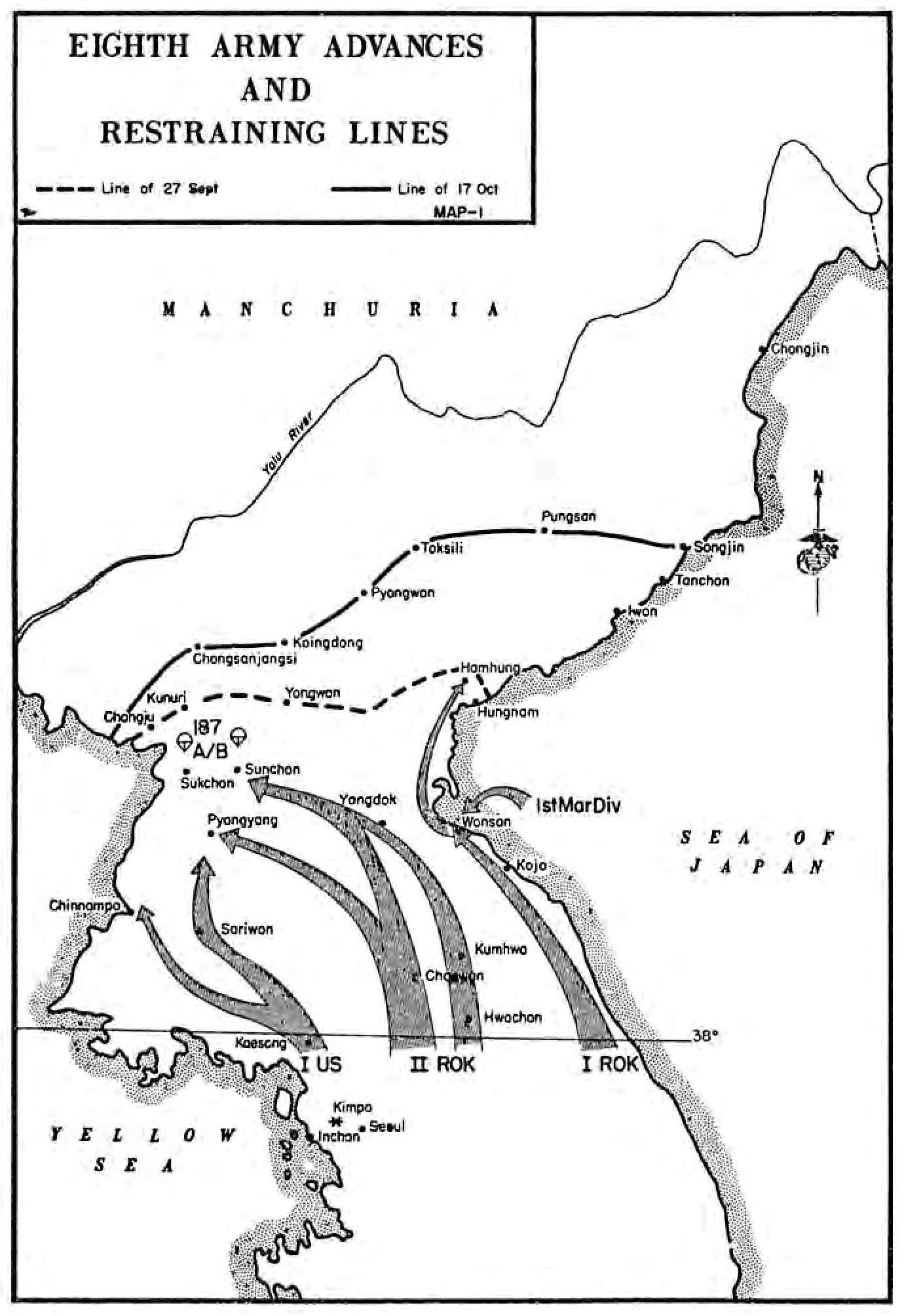
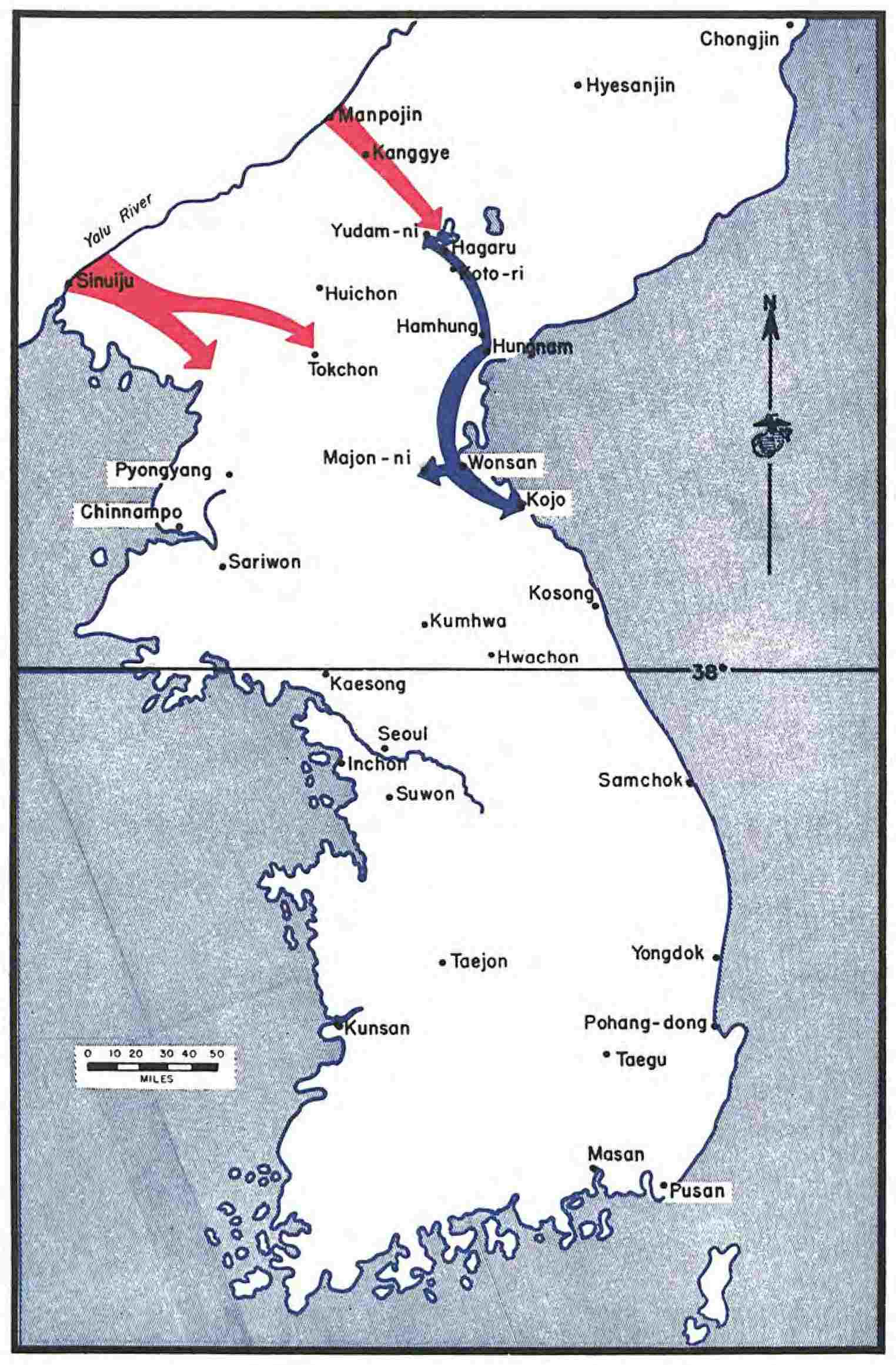
EIGHTH ARMY ADVANCES
AND
RESTRAINING LINES
MAP-1
Late in August, two of the Joint Chiefs, General Collins and Admiral
Forrest P. Sherman, USN, had flown to Japan to discuss the
forthcoming Inchon landing with General MacArthur. In the course
of the talks, it was agreed that CinCUNC’s objective should be the
destruction of the North Korean forces, and that ground operations
should be extended beyond the 38th Parallel to achieve this goal.
The agreement took the form of a recommendation, placed before
Secretary of Defense Louis Johnson on 7 September.6
A week later, JCS informed MacArthur that President Truman had
approved certain “conclusions” relating to the Korean conflict, but
that these were not yet to be construed as final decisions. Among
other things, the Chief Executive accepted the reasoning that UN
Forces had a legal basis for engaging the NKPA north of the Parallel.
MacArthur would plan operations accordingly, JCS directed, but
would carry them out only after being granted explicit permission.7
The historic authorization, based on recommendations of the National
Security Council to President Truman, reached General Headquarters
(GHQ), Tokyo, in a message dispatched by JCS on 27
September:
Your military objective is the destruction of the North Korean Armed
Forces. In attaining this objective you are authorized to conduct military
operations, including amphibious and airborne landings or ground operations
north of the 38th Parallel in Korea, provided that at the time of such operations
there has been no entry into North Korea by major Soviet or Chinese
Communist Forces, no announcement of intended entry, nor a threat to
counter our operations militarily in North Korea....
The lengthy message abounded in paragraphs of caution, reflecting
the desire of both the UN and the United States to avoid a general
war. Not discounting the possibility of intervention by Russia or Red
China, JCS carefully outlined MacArthur’s courses of action for several
theoretical situations. Moreover, he was informed that certain
broad restrictions applied regardless of developments:
... under no circumstances, however, will your forces cross the Manchurian
or USSR borders of Korea and, as a matter of policy, no non-Korean
Ground Forces will be used in the northeast provinces bordering the Soviet
Union or in the area along the Manchurian border. Furthermore, support of
your operations north or south of the 38th parallel will not include Air or
Naval action against Manchuria or against USSR territory....8
Thus MacArthur had the green light, although the signal was
shaded by various qualifications. On 29 September, the new Secretary
of Defense, George C. Marshall, told him in a message, “... We
want you to feel unhampered tactically and strategically to proceed
north of 38th parallel....”9
Meanwhile, a step was taken by the U. S. Government on 27 September
in the hope that hostilities might end without much further
loss or risk for either side. By dispatch, JCS authorized MacArthur to
announce, at his discretion, a suggested surrender message to the
NKPA.10 Framed by the U. S. State Department, the message was
broadcast on 1 October and went as follows:
To: The Commander-in-chief, North Korean Forces. The early and total
defeat and complete destruction of your Armed Forces and war making
potential is now inevitable. In order that the decision of the United Nations
may be carried out with a minimum of further loss of life and destruction of
property, I, as the United Nations Commander-in-Chief, call upon you and
the forces under your command, in whatever part of Korea situated, forthwith
to lay down your arms and cease hostilities under such military supervision
as I may direct and I call upon you at once to liberate all United
Nations prisoners of war and civilian internees under your control and to
make adequate provision for their protection, care, maintenance, and immediate
transportation to such places as I indicate.
North Korean forces, including prisoners of war in the hands of the
United Nations Command, will continue to be given the care indicated by
civilized custom and practice and permitted to return to their homes as soon
as practicable.
I shall anticipate your early decision upon this opportunity to avoid the
further useless shedding of blood and destruction of property.11
The surrender broadcast evoked no direct reply from Kim Il Sung,
Premier of North Korea and Commander in Chief of the NKPA.
Instead, the reaction of the Communist bloc came ominously from
another quarter. Two days after MacArthur’s proclamation, Red
China’s Foreign Minister Chou En-Lai informed K. M. Panikkar, the
Indian Ambassador in Peiping, that China would intervene in the
event UN forces crossed the 38th Parallel. He added, however, that
such action would not be forthcoming if only ROK troops entered
North Korea.12
It will be recalled that the JCS authorization of 27 September permitted
operations north of the Parallel “... provided that at the time
of such operations there has been no entry into North Korea by
major Soviet or Chinese Communist Forces, no announcement of intended
entry, nor a threat to counter our operations militarily in
North Korea....”13 In view of the last two provisos, MacArthur’s
plans for crossing the border could conceivably have been cancelled
after Chou’s announcement. But optimism over the course of the war
ran high among the United Nations at this time, and CinCUNC shortly
received supplemental authority from both the UN and JCS—the one
establishing legal grounds for an incursion into North Korea, the
other reaffirming military concurrence at the summit. In a resolution
adopted on 7 October, the United Nations directed that
All appropriate steps be taken to ensure conditions of stability throughout
Korea and all constituent acts be taken ... for the establishment of a
unified, independent and democratic Government in the Sovereign State of
Korea....14
Since the enemy had ignored his surrender ultimatum, MacArthur
could attend to the UN objectives only by occupying North Korea
militarily and imposing his will. JCS, therefore, on 9 October amplified
its early instructions to the Commander in Chief as follows:
Hereafter, in the event of open or covert employment anywhere in Korea
of major Chinese Communist units, without prior announcement, you should
continue the action as long as, in your judgment, action by forces now under
your control offers a reasonable chance of success. In any case you will obtain
authorization from Washington prior to taking any military actions against
objectives in Chinese territory.15
Anticipating his authority for crossing the 38th Parallel, CinCUNC on
26 September had directed his Joint Special Plans and Operations
Group (JSPOG) to develop a plan for operations north of the border.
He stipulated that Eighth Army should make the main effort in either
the west or the east, and that however this was resolved, there should
be an amphibious envelopment on the opposite coast—at Chinnampo,
Wonsan, or elsewhere.16 Despite recommendations of key staff members,
MacArthur did not place X Corps under EUSAK command for
the forthcoming campaign but retained General Almond’s unit as a
separate tactical entity under GHQ.17
JSPOG, headed by Brigadier General Edwin K. Wright, MacArthur’s
G-3, rapidly fitted an earlier staff study into the framework
of CinCUNC’s directive. And the following day, 27 September, a
proposed Operation Plan (OpnPlan) 9-50 was laid before the commander
in chief.18 This detailed scheme of action evolved from two
basic assumptions: (1) that the bulk of the NKPA had already been
destroyed; and (2) that neither the USSR nor Red China would
intervene, covertly or openly.
Eighth Army, according to plan, would attack across the 38th
Parallel, directing its main effort in the west, along the axis Kaesong-Sariwon-Pyongyang
(see Map 1). JSPOG designated the latter city—capital
of the People’s Democratic Republic of Korea—as final
objective of the first phase. Further, it recommended that EUSAK’s
drive begin in mid-October, to be followed within a week by a
X Corps amphibious landing at Wonsan on the east coast. After
establishing a beachhead, Almond’s force would attack 125 road miles
westward through the Pyongyang-Wonsan corridor and link up with
General Walker’s army, thereby trapping North Korean elements
falling back from the south.19
JSPOG suggested that both commands should then advance north
to the line Chongju-Kunuri-Yongwon-Hamhung-Hungnam, ranging
roughly from 50 to 100 miles below the Manchurian border.
Only ROK elements would proceed beyond the restraining line, in
keeping with the spirit and letter of the 27 September dispatch from
JCS.20
Major General Doyle O. Hickey, acting as CinCUNC’s chief of staff
during General Almond’s tour in the field, approved the JSPOG draft
of 28 September. It thereby became OpnPlan 9-50 officially. MacArthur
forwarded a summary to JCS the same day, closing his message
with this reassurance:
There is no indication at present of entry into North Korea by major Soviet
or Chinese Communist Forces.21
Within three days, he received word from the Joint Chiefs that
they approved his plan.22 On 2 October it became the official operation
order for the attack.23
On 29 September, the day before he received the JCS endorsement of
his plan, General MacArthur arrived in Seoul to officiate at the ceremony
restoring control of South Korea to the legal ROK government.
During the visit, he met with the principals named in the Task Organization
of OpnPlan 9-50:
| Eighth U. S. Army |
LtGen Walton H. Walker, USA |
| Naval Forces Far East |
VAdm C. Turner Joy, USN |
| Far East Air Forces (FEAF) |
LtGen George E. Stratemeyer, USAF |
| X Corps |
MajGen Edward M. Almond, USA |
Missing from the top-level conference, Major General Walter L.
Weible, USA, of the Japan Logistical Command, probably was already
aware of things to come.24
MacArthur outlined his concept of operations in North Korea to
those present. He set 20 October as D-Day for the Wonsan amphibious
assault by the 1st Marine Division, which, with all X Corps Troops,
would embark for the operation from Inchon. The 7th Infantry Division,
also a part of X Corps, would motor 200 miles to Pusan and
there load out for an administrative landing behind the Marines.25
Initial overland routing of the 7th Division was made necessary by
problems arising out of Inchon’s limited port facilities. General MacArthur
gave EUSAK the logistic responsibility for all UN Forces in
Korea, including X Corps. To carry out this charge, General Walker
could rely on only two harbors, Pusan and Inchon. There were no
other ports in South Korea capable of supporting large-scale military
operations. Meeting the tight Wonsan schedule would require that X
Corps have immediate priority over the whole of Inchon’s capacity,
even with the 7th Division being shunted off on Pusan. And it still
remained for Walker to mount and sustain Eighth Army’s general
offensive before the Wonsan landing!
In the light of logistical considerations, then, Wonsan had more
than mere tactical significance as the objective of X Corps. Its seizure
would open up the principal east-coast port of Korea, together with
vital new road and rail junctions. But while MacArthur had decided
on an amphibious assault by a separate tactical unit as the proper stroke,
there existed a school of dissenters among his closest advisers. Generals
Hickey and Wright had recommended that X Corps be incorporated
into EUSAK at the close of the Inchon-Seoul Operation. Major
General George L. Eberle, MacArthur’s G-4, held that supplying X
Corps in North Korea would be simpler if that unit were a part of
Eighth Army. And General Almond himself, while hardly a dissenter,
had expected his corps to be placed under General Walker’s command
after the Seoul fighting.26
Logistical problems were magnified by the tight embarkation schedule
laid out for the amphibious force. In submitting its proposed plan for
North Korean operations to General MacArthur on 27 September,
JSPOG had listed the following “bare minimum time requirements:”
| For assembling assault shipping |
6 days |
| For planning |
4 days |
| For loading |
6 days |
| For sailing to Wonsan |
4 days |
Thus it was estimated that the 1st Marine Division could assault
Wonsan 10 days after receiving the order to load out of Inchon, provided
that shipping had already been assembled and planning accomplished
concurrently.27
Following CinCUNC’s meeting in the capitol building on the 29th,
General Almond called a conference of division commanders and staff
members at his X Corps Headquarters in Ascom City, near Inchon.
MacArthur’s strategy was outlined to the assembled officers, so that
planning could commence on the division level. Almond set 15 October
as D-Day for the Wonsan landing. He based this target date on the
assumption that Eighth Army would pass through and relieve X Corps
on 3 October, the date on which the necessary shipping was to begin
arriving at Inchon.28
On 29 September, the 1st Marine Division was still committed tactically
above Seoul, two regiments blocking and one attacking. If the13
first vessels began arriving at Inchon on 3 October, the assault shipping
would not be completely assembled until the 8th, according to the
JSPOG estimate. Four days would be required to get to the objective,
leaving two days, instead of the planned six, for outloading the landing
force. Neither Major General Oliver P. Smith, Commanding General
(CG) 1stMarDiv, nor his staff regarded this as a realistic
schedule.29
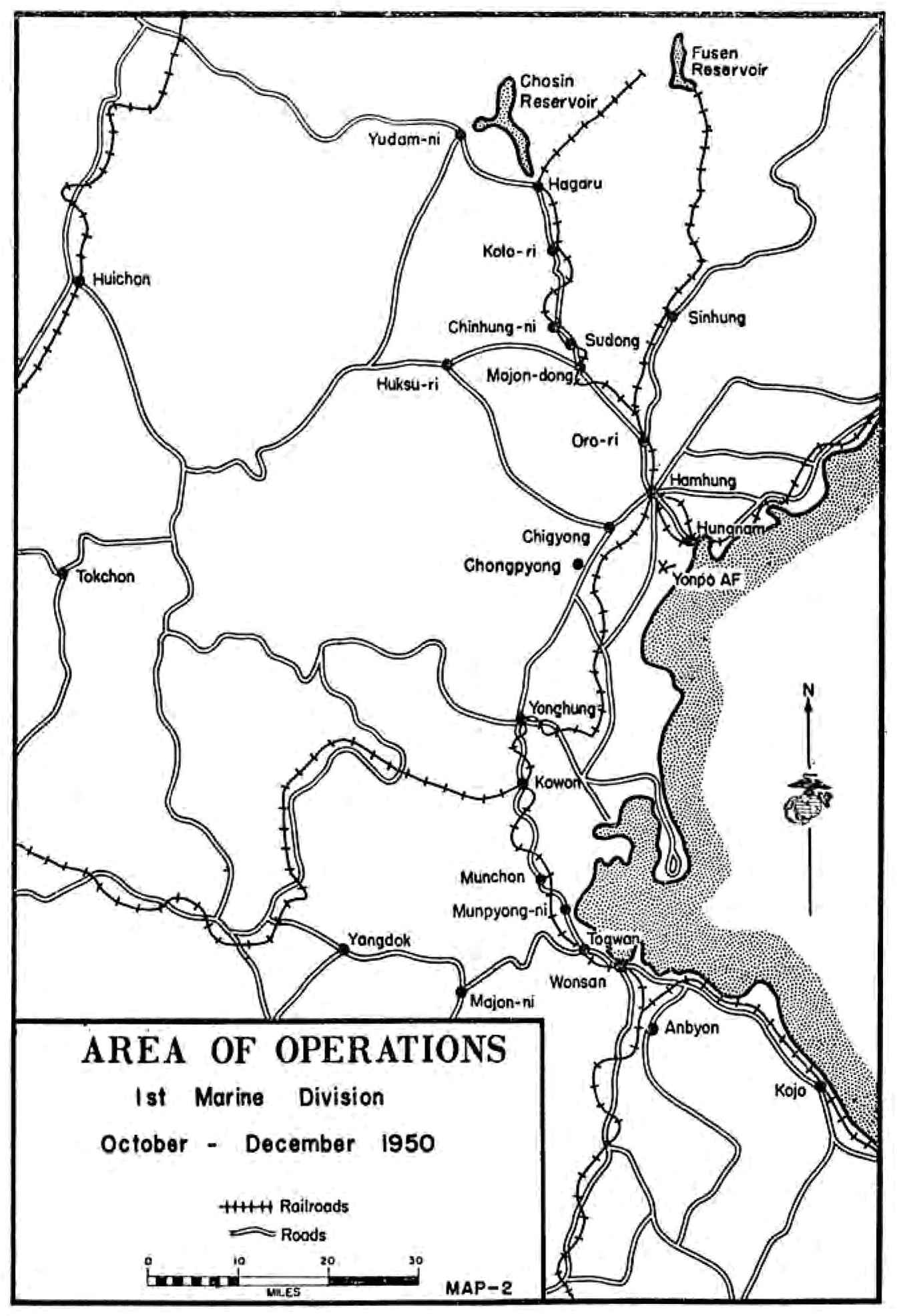
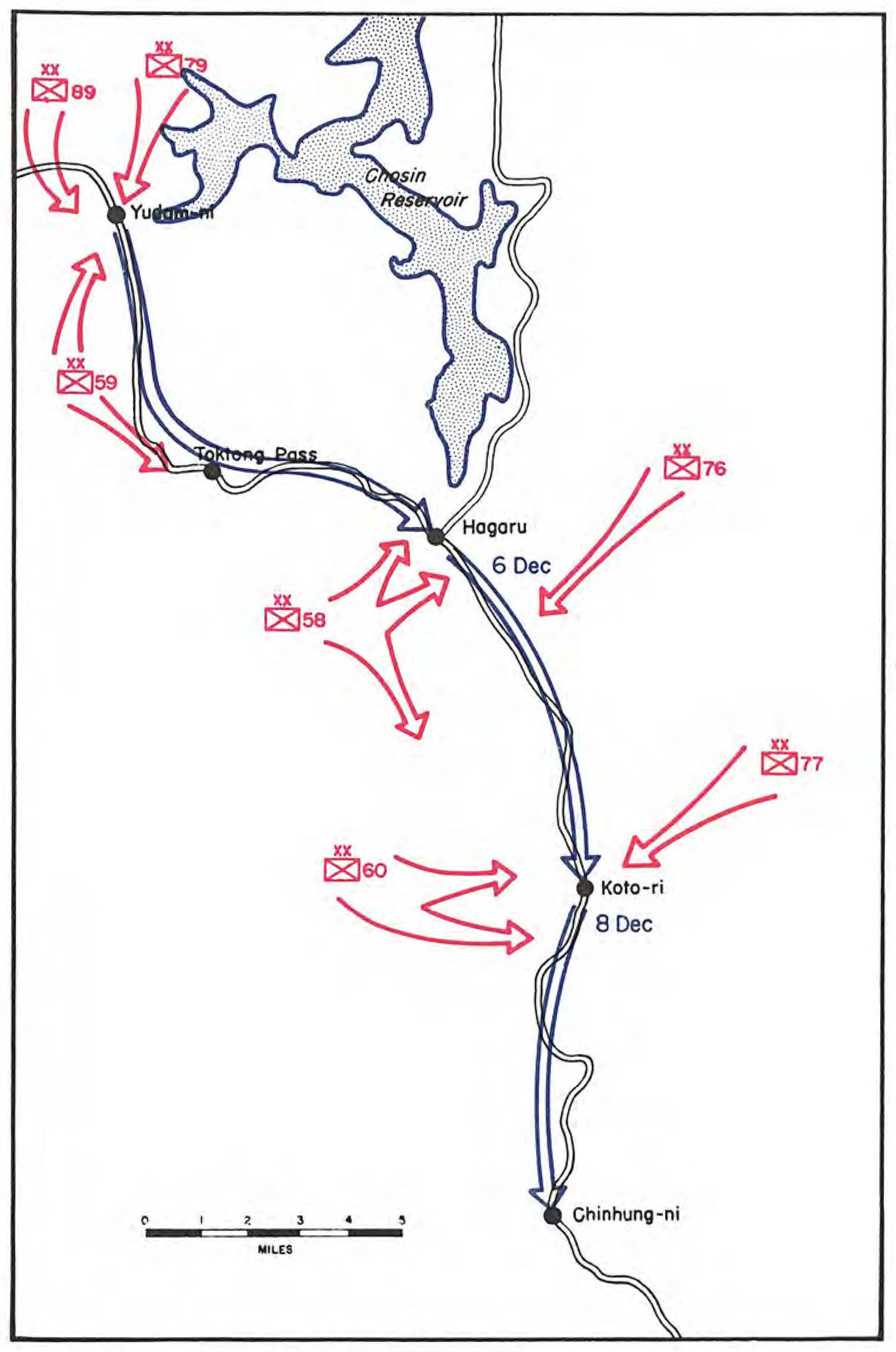
AREA OF OPERATIONS
1st Marine Division
October-December 1950
MAP-2
The Marine officers came away from the conference without knowledge
of the types and numbers of ships that would be made available
to the division. And since they had no maps of the objective area and
no intelligence data whatever, it was manifestly impossible to lay
firm plans along either administrative or tactical lines.30
Vice Admiral Joy, Commander Naval Forces Far East (ComNavFE),
issued his instructions on 1 October in connection with the forthcoming
operations. To Vice Admiral Arthur D. Struble’s Joint Task Force 7
(JTF-7), which had carried out the Inchon attack, he gave these
missions:
1. To maintain a naval blockade of Korea’s East coast south of Chongjin.
2. To furnish naval gunfire and air support to Eighth Army as directed.
3. To conduct pre-D-Day naval operations for the Wonsan landing as required.
4. To load and transport X Corps to Wonsan, providing cover and support en route.
5. To seize by amphibious assault, occupy, and defend a beachhead in the Wonsan area on D-Day.
6. To provide naval gunfire, air, and initial logistical support to X Corps at Wonsan until relieved.31
Admiral Joy’s directive also warned: “The strong probability exists
that the ports and possible landing beaches under control of the North
Koreans have been recently mined. The sighting of new mines floating
in the area indicates that mines are being seeded along the coast.”32
The related events, decisions, and plans of September 1950 had unfolded
with startling rapidity. Before the scattered UN forces could
shift from one phase of operations to another, a transitional gap developed
during the early days of October. Orders might flow forth in
abundance, but not until MacArthur’s land, sea and air forces wound
up one campaign could they begin another. Thus, from the standpoint
of Marine operations, the first week of October is more a story
of the Inchon-Seoul action than of preparations for the Wonsan
landing.
On 2 October, when Eighth Army commenced the relief of X Corps,
General Almond ordered the 7th Infantry Division to begin displacing
to Pusan by motor and rail.33 There was as yet no such respite for
the 1st Marine Division, which on the same day lost 16 killed in action
(KIA) and 81 wounded (WIA). Practically all of the casualties
were taken by the 7th Regiment, then approaching Uijongbu on the
heels of the enemy.34
Despite the limited planning data in the hands of the 1st Marine
Division, General Smith’s staff put a cautious foot forward on 3 October.35
Word of the pending Wonsan operation went out by message
to all subordinate units, with a tentative task organization indicating
the formation of three Regimental Combat Teams (RCTs).
The 1st and 7th Marines were earmarked to launch the amphibious
attack. Each would plan on the basis of employing two battalions in
the assault. These battalions were to embark on LSTs and hit the
beach in LVTs. All tactical units were to combat-load out of Inchon.
And although still uninformed as to available shipping, the Marine
planners named likely embarkation groups and listed tentative arrangements
for loading tanks and amphibious vehicles.36
The following day saw the publication of X Corps OpnO 4, specifying
subordinate unit missions. The 7th Infantry Division, together
with the 92d and 96th Field Artillery (FA) Battalions, was instructed
to mount out of Pusan and to land at Wonsan on order (see Map 2).
These tasks were assigned to the 1st Marine Division:
1. Report immediately to the Attack Force Commander (Commander, Amphibious
Group One) of the Seventh Fleet as the landing force for the
Wonsan attack.
2. Seize and secure X Corps base of operations at Wonsan, protect the
Wonsan Airfield, and continue such operations ashore as assigned.
3. Furnish logistic support for all forces ashore until relieved by Corps
Shore Party.37
As Almond’s order went out for distribution on 4 October, EUSAK’s
1st Cavalry Division, bound for Kaesong, passed through the 5th
Marines northwest of Seoul. Simultaneously, the II ROK Corps began
assembling along the road to Uijongbu, captured by the 7th Marines
the previous day.38
After 20 days in the line, the weary battalions of the 5th Marines
retired on 5 October across the Han River to an assembly area at Inchon.
They were followed on the 6th by the 1st Regiment, and on the next
day by the 7th Marines. The withdrawal of the latter unit completed
the relief of X Corps, and General Almond’s command officially reverted
to GHQ Reserve.39
October 7th also marked the displacement of the 1st Marine Division
command post (CP) to Inchon, where planning and reality had finally
merged to the extent that preparations for Wonsan could begin in
earnest. Two days earlier, Vice Admiral Struble had re-created JTF-7
out of his Seventh Fleet; and by publication of his OpnO 16-50 on
the same date, 5 October, he set in motion the operational elements
involved in the projected amphibious envelopment. His new task organization,
almost identical to that which had carried out the Inchon
Operation with historic dispatch, was as follows:
| TF 95 (Advance Force) |
RAdm Allen E. Smith |
| TG 95.2 (Covering & Support) |
RAdm Charles C. Hartman |
| TG 95.6 (Minesweeping) |
Capt Richard T. Spofford |
| TF 90 (Attack Force) |
RAdm James H. Doyle |
| TF 79 (Logistical Support Force) |
Capt Bernard L. Austin |
| TF 77 (Fast Carrier Force) |
RAdm Edward C. Ewen |
| TG 96.8 (Escort Carrier Group) |
RAdm Richard W. Ruble |
| TG 96.2 (Patrol & Reconnaissance) |
RAdm George R. Henderson |
| TG 70.1 (Flagship Group) |
Capt Irving T. Duke |
Struble, who had directed the Inchon assault from the bridge of the
USS Rochester, would now fly his flag in the recently arrived USS
Missouri, the sole American battleship in commission at this early stage
of the Korean war.40
The Seventh Fleet directive of 5 October dispatched both the Fast Carrier
and the Patrol and Reconnaissance Forces of JTF-7 on the usual
search and attack missions preliminary to an amphibious assault. Task
Force 77, consisting of the carriers Boxer, Leyte, Philippine Sea and
Valley Forge, escorted by a light cruiser and 24 destroyers, was under
orders to direct 50 per cent of the preparatory air effort against the
local defenses of Wonsan. Simultaneously, the Advance Force, with
its cruisers, destroyers and mine sweeping units, would close in to shell
the target and wrest control of the offshore waters from the enemy.41
Topographic and hydrographic studies made available to the Attack
and Landing Forces showed Wonsan to be a far more accessible target
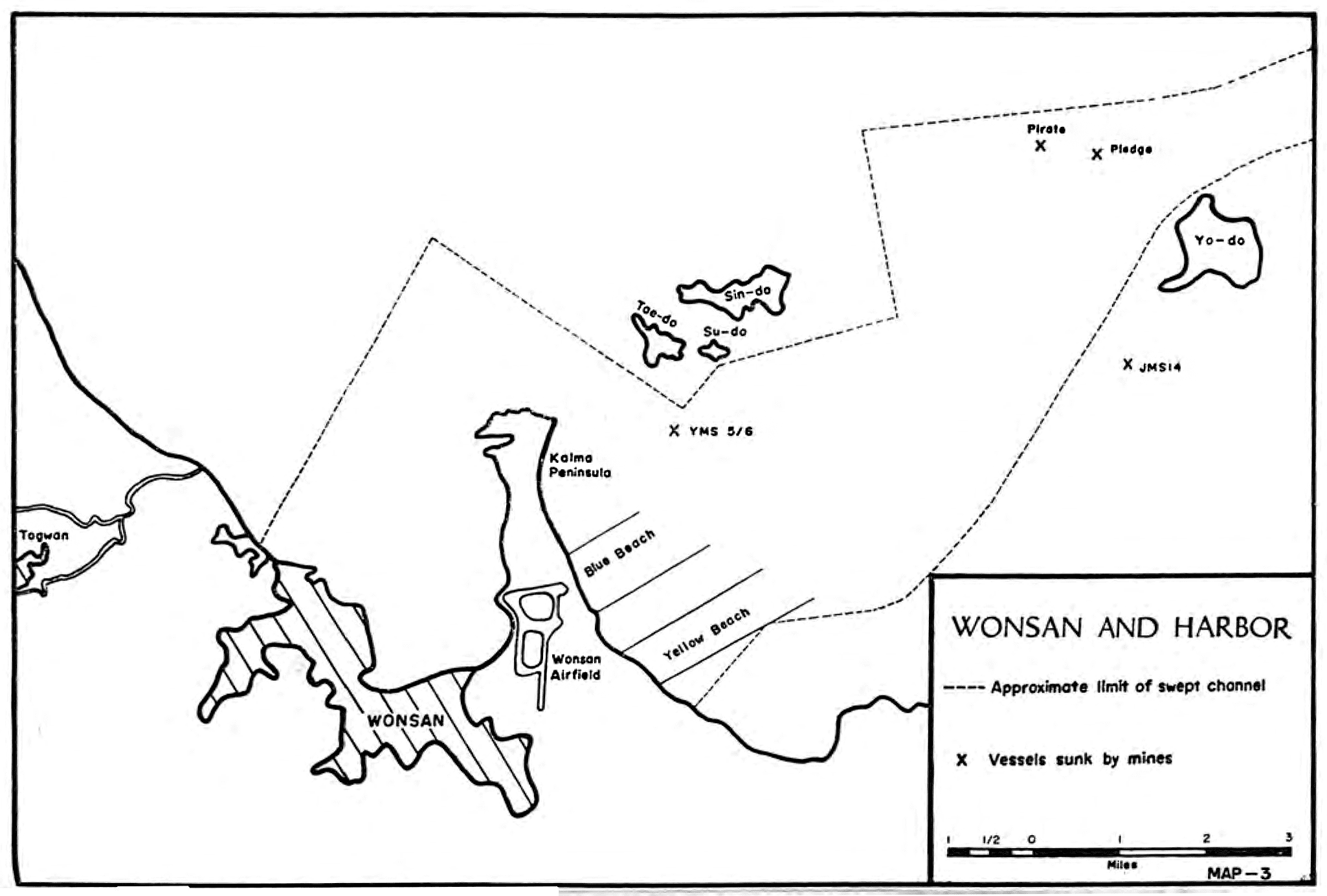
than Inchon (see Map 3). Nestling in the southwestern corner of
Yonghung Bay, 80 miles above the 38th Parallel, the seaport offers
one of the best natural harbors in Korea. A vast anchorage lies sheltered
in the lee of Kalma Peninsula which, finger-like, juts northward from
a bend in the coastline. Tides range from seven to 14 inches, fog is
rare, and currents are weak. Docks can accommodate vessels drawing
from 12 to 25 feet, and depths in the bay run from 10 fathoms in the
outer anchorage to 15 feet just offshore.42
Beaches around Wonsan are of moderate gradient, and the floor at
water’s edge consists of hard-packed sand. Though slightly wet landings
might be expected, amphibious craft could easily negotiate any
of the several desirable approaches. The coastal plain, ranging from
100 yards to two miles in depth, provides an acceptable lodgment area,
but the seaward wall of the Taebaek mountain range renders inland
egress difficult from the military standpoint.
In 1940, the population of Wonsan included 69,115 Koreans and
10,205 Japanese, the latter subsequently being repatriated to their homeland
after World War II. Under the Japanese program of industrialization,
the city had become Korea’s petroleum refining center. The construction
of port facilities, railways, and roads kept pace with the
appearance of cracking plants, supporting industries, and huge storage
areas.
Two airfields served the locale in 1950. One of these, situated on
the coast about five miles north of the seaport, was of minor importance.
The other, known as Wonsan Airfield, on Kalma Peninsula across the
harbor, ranked high as a military prize. Spacious and accessible, it was
an excellent base from which to project air coverage over all of Korea
and the Sea of Japan. The Japanese first developed the field as an air
adjunct to the naval base at Wonsan; but after World War II, a North
Korean aviation unit moved in and used it until July 1950. Thereafter,
with the skies dominated by the UN air arm, Wonsan Airfield temporarily
lost all military significance. Its vacant runways, barracks, and
dispersal areas were given only passing attention in the UN strategic
bombing pattern, although the nearby industrial complex was
demolished.
In addition to being situated on an excellent harbor, Wonsan is the
eastern terminus of the Seoul-Wonsan corridor, the best of the few
natural routes across the mountainous nation. This 115-mile road and
rail passageway, once considered as a possible overland approach for
X Corps, separates the northern and southern divisions of the Taebaek
range, which rises precipitously from Korea’s east coast to heights of
5000 feet. Railroads and highways, primitive by western standards,
also trace the seaward base of the Taebaek Mountains to connect Wonsan
with Hamhung in the north and Pusan far to the south. Still another
road and railway leads to Pyongyang, 100 miles across the narrow
neck of the peninsula in the western piedmont.
The climate along Korea’s northeast coast is comparable to that of
the lower Great Lakes region in the United States. Mean summer temperatures
range between 80 and 88 degrees, although highs of 103
degrees have been recorded. Winter readings drop as low as -7
degrees, but the season is usually temperate with winds of low velocity.
Despite light snowfalls and moderate icing, the period from October
through March is best suited to military operations, for the heavy rains
of spring and summer create difficulties on the gravel-topped roads.
Although members of Admiral Doyle’s Amphibious Group One
(PhibGruOne) staff met with planners of the 1st Marine Division at
Inchon early in October, it soon became apparent that the projected
D-Day of 15 October could not be realized. Maps and intelligence data
necessary for planning did not reach the Attack Force-Landing Force
team until 6 October. The relief of X Corps by EUSAK was completed,
not on 3 October as General Almond had anticipated, but on the 7th.
Moreover, the first transport vessels to reach Inchon ran behind schedule,
and they had not been pre-loaded with a ten-day level of Class I,
II, and V supplies, as was promised. Planning and outloading consequently
started late and from scratch, with the result that D-Day
“... was moved progressively back to a tentative date of 20 October.”43
CHAPTER II The Wonsan Landing — ROK Army Captures Wonsan — Marine Loading and Embarkation — Two Weeks of Mine Sweeping — Operation Yo-Yo — Marine Air First at Objective — MacArthur Orders Advance to Border — Landing of 1st Marine Division
ROK Army Captures Wonsan—Marine Loading and Embarkation—Two
Weeks of Mine Sweeping—Operation Yo-Yo—Marine
Air First at Objective—MacArthur Orders Advance to
Border—Landing of 1st Marine Division
On 6 October 1950, after the arrival of the initial assault shipping
at Inchon, General Smith ordered the 1st Marine Division to
commence embarkation on the 8th. Similar instructions were issued
by X Corps the following day.44 Thus, the first troops and equipment
were to be loaded even before the G-2 Section of the Landing Force
could begin evaluating the enemy situation at the objective, since it was
not until 8 October that the intelligence planners received X Corps’
OpnO 4, published four days earlier. Summing up the outlook at the
time, G-2 later reported:
Inasmuch as subordinate units of the Division were scheduled to embark
aboard ship some time prior to 15 October 1950, it was immediately obvious
that preliminary intelligence planning, with its attendant problems of collection,
processing, and distribution of information, and the procurement
and distribution of graphic aids, would be both limited and sketchy.... Fortunately
... the section [G-2] had been previously alerted on the projected
operation, and while elements of the Division were yet engaged with the
enemy at Uijongbu, had requested reproductions of some 100 copies of
pertinent extracts of the JANIS (75) of Korea. Thus it was ... that subordinate
units would not be wholly unprepared for the coming operation.45
General Smith’s OpnO 16-50, published on 10 October, climaxed
the accelerated planning at Inchon. Worked out jointly by the staffs of
PhibGruOne and the 1st Marine Division, this directive covered
the Wonsan attack in detail and pinpointed subordinate unit
responsibilities.
Kalma Peninsula was chosen as the point of assault, with two beaches,
YELLOW and BLUE, marked off on the eastern shore. Ten high-ground
objectives described the semicircular arc of the beachhead, which focused
on Wonsan and fanned out as far as five miles inland. The 1st
and 7th Marines were to hit YELLOW and BLUE Beaches, respectively
and drive inland to their assigned objectives. The 5th, upon being
ordered ashore, would assemble west of Wonsan, prepared for further
operations. Two battalions of the 11th Marines were to land on call
in direct support of the assault units, and the remainder of the artillery
would initially function in general support.
Other subordinate units drew the usual assignments. The Reconnaissance
Company, after landing on order, was to screen the Division’s
left flank by occupying specified objectives. Attached to the 1st and
7th Regiments respectively, the 5th and 3d Korean Marine Corps
(KMC) Battalions would also go ashore on call.46
At 0815, 10 October, coincidentally with the publication of 1stMarDiv
OpnO 16-50, troops of I ROK Corps, advancing rapidly up the east
coast of Korea, entered Wonsan. By evening of the next day, the ROK
3d and Capital Divisions were mopping up minor resistance in the
city and guarding the airfield on Kalma Peninsula.47
Overland seizure of the 1st Marine Division’s amphibious objective
did not come as a surprise either at GHQ in Tokyo or at General Smith’s
CP aboard the Mount McKinley in Inchon Harbor. General MacArthur
had, in fact, prepared for this eventuality by considering an
alternate assault landing at Hungnam, another major seaport, about
50 air miles north of Wonsan. On 8 October, therefore, the JSPOG
completed a modified version of CinCFE OpnPlan 9-50. Eighth Army’s
mission—the capture of Pyongyang—remained unchanged in this draft,
but X Corps would now land “... in the vicinity of Hungnam in order
to cut the lines of communications north of Wonsan and envelop the
North Korean forces in that area.”
Although the choice of a new objective seemed logical on the basis
of the ROK Army’s accomplishment, certain logistical obstacles at
once loomed in the path of the alternate plan. Not unaware of the
most imposing of these, JSPOG commented:
The harbor at Wonsan cannot accommodate at docks the large vessels
lifting the 7th Division. Since most of the amphibious type boats are carried
on ships lifting the 1st Marine Division, the plans for off-loading the 7th
Division will have to be revised.48
But the plans for off-loading the 7th Division could not be revised.
If the Army unit was to land within a reasonable length of time, it
would have to go in on the heels of the 1st Marine Division, using the
same landing craft. If the ship-to-shore movement took place at Hungnam,
the 7th Division would be ill-disposed for beginning its overland
drive to Pyongyang as planned; for it would have to backtrack by land
almost all the way to Wonsan. On the other hand, if the Army division
landed at Wonsan while the Marines assaulted Hungnam, the Navy
would be handicapped not only by the lack of landing craft but also
by the problem of sweeping mines from both harbors simultaneously.
From the standpoint of Admiral Joy in Japan and Admiral Doyle in
Korea, there was insufficient time for planning a new tactical deployment
of X Corps at this late date. And the time-space handicap would
be compounded by serious shortages of mine sweepers and intelligence
information. Joy was unsuccessful on 8 October in his first attempt
to dissuade MacArthur from the new idea. On the 9th, unofficial word
of the pending change reached General Smith at Inchon, just as his
staff wound up work on the draft for the Wonsan assault. ComNavFE
persisted in his arguments with the commander in chief, however, with
the final result that on 10 October the original plan for landing the
whole X Corps at Wonsan was ordered into effect.49 Coming events
were to uphold the Navy viewpoint; for while the Wonsan landing
itself was delayed several days by enemy mines, it was 15 November
before the first ships safely entered the harbor at Hungnam.50
On 11 October, the day after he opened his CP on the Mount McKinley,
General Smith learned that the Hungnam plan had been dropped. The
1st Marine Division continued loading out in accordance with X Corps
OpnO 4, even though its objective had already been captured.51
During the period 4–10 October, Admiral Doyle had assembled at
Inchon an assortment of Navy amphibious vessels, ships of the Military
Sea Transport Service (MSTS), and Japanese-manned LSTs (SCAJAP).52
With the arrival of Transport Squadron One on 8 October, the
total shipping assigned to the landing force consisted of one AGC, eight
APAs, two APs, 10 AKAs, five LSDs, 36 LSTs, three LSUs, one LSM,
and six commercial cargo vessels (“Victory” and C-2 types).53
Loading a reinforced division, several thousand Corps troops and
thousands of tons of supplies and equipment proved to be an aggravating
job under the circumstances. Pressure on the attack and landing
forces for an early D-Day only magnified the shortcomings of Inchon
as a port. Limited facilities and unusual tide conditions held dock
activity to a series of feverish bursts. Moreover, many ships not part
of the amphibious force had to be accommodated since they were
delivering vital materiel. The assigned shipping itself was inadequate,
according to the Division G-4 and “considerable quantities” of vehicles
had to be left behind. Much of the trucking that could be taken was
temporarily diverted to help transport the 7th Infantry Division to
Pusan; and although unavailable for port operations when needed, it
returned at the last minute to disrupt outloading of the Shore Party’s
heavy beach equipment.54 Out of conditions and developments such
as these grew the necessity for postponing D-Day from 15 October,
the date initially set by General Almond, to the 20th.
For purposes of expediting embarkation and economizing on shipping
space, X Corps directed the 1st Marine Division to out-load with
less than the usual amount of supplies carried by a landing force.55
Resupply shipping would be so scheduled as to deliver adequate stocks
of Class I, II, III, and IV consumables “... prior to the time they
would be needed,” even though when “they would be needed” was
anybody’s guess at this stage of the war.56
In anticipation of a rapid advance to the west (which did not materialize),
Division G-4 not only assigned 16 pre-loaded trucks and
trailers to each RCT, but also earmarked three truck companies and
16 more trailers as a mobile logistical reserve. These supply trains
would stay on the heels of the attacking regiments in order to maintain
ammunition dumps as far forward as possible in a fast-moving
situation.57
On 8 October, ComNavFE directed Admiral Doyle and General
Smith to effect his OpnPlan 113-50.58 Coincidentally, the first contingents
of the 5th Marines boarded the Bayfield (1/5), George Clymer
(2/5), and Bexar (3/5). Three days later, on the 11th, Lieutenant
Colonel Raymond L. Murray, commander of the reserve regiment,
opened his CP in the Bayfield, and his unit completed embarkation.59
Although reserve and administrative elements of the 1st and 7th
Marines loaded earlier, the four assault battalions of these regiments
could not begin embarkation until 13 October, owing to the fact that
the LSTs had been used for shuttle service around Inchon Harbor.
General Smith opened his CP in the Mount McKinley at 1200 on the
11th.60 The last of the landing ships were loaded by high tide on the
morning of the 15th, and later that day all of them sailed for the
objective. By evening of the 16th, most of the transports were on the
way, but the Mount McKinley and Bayfield did not depart until the
next day.61
Broken down into seven embarkation groups, the landing force and
X Corps troops leaving Inchon comprised a grand total of 1902 officers
and 28,287 men. Of this number, 1461 officers and 23,938 men were
on the rolls of the 1st Marine Division, the breakdown being as follows:
| Marine officers |
1119 |
| Marine enlisted |
20,597 |
| Navy officers |
153 |
| Navy enlisted |
1002 |
| U. S. Army & KMC officers attached |
189 |
| U. S. Army & KMC enlisted attached |
233962 |
Even in the last stages of loading and during the actual departure,
new orders had continued to flow out of higher headquarters. It will
be recalled that General Smith issued his OpnO 16-50 for the Wonsan
assault on 10 October. An alternate plan, to be executed on signal,
went out to subordinate units the same day, providing for an administrative
landing by the Division on RED Beach, north of Wonsan,
instead of Kalma Peninsula.63
As a result of discussions during a X Corps staff conference on
13 October, a party headed by General Almond flew to Wonsan the
next day.64 The purpose of his visit was to reconnoiter the objective
and to explain his latest operational directive to the I ROK Corps commander,
who would come under his control.65 This new order, published
on the 14th, called for an administrative landing by X Corps
and a rapid advance westward along the Wonsan—Pyongyang axis to
a juncture with EUSAK. Assigned to the 1st Marine Division was an
objective northeast of Pyongyang, the Red capital.66
It was this tactical scheme, then, that prevailed as the Marines departed
Inchon from 15 to 17 October and the 7th Infantry Division
prepared to embark from Pusan. General Smith, of course, placed
into effect his alternate order for a landing on RED Beach.67 While there
may be a note of humor in the fact that on 15 October ComPhibGruOne
issued his OpnO 16-50 for the “assault landing” at Wonsan, it must
be remembered that the ship-to-shore movement would remain essentially
the same from the Navy’s standpoint, regardless of the swift
march of events ashore.
Mine sweeping for the Wonsan landing commenced on 8 October,
when Task Group 95.6, commanded by Captain Spofford, began assembling
for the mission of clearing a path ahead of the 250-ship
armada bringing the 1st Marine Division and other units of X Corps.
It had been known for a month that the waters of the east coast were
dangerous for navigation. The first mine was discovered off Chinnampo
on the west coast on 7 September, and four days later Admiral Joy
ordered the United Nations Blocking and Escort Force to stay on the
safe side of the 100-fathom line along the east coast. But it was not
until 26 and 28 September that more definite information was acquired
the hard way when the U. S. destroyer Brush and the ROK mine sweeper
YMS 905 were damaged by east coast mines.68
On the 28th ComNavFE issued his OpnO 17-50 covering operations
of mine sweepers in Korean waters. The herculean task awaiting the
12 available American vessels of this type may be judged by the fact
that more than a hundred had been employed off Okinawa in World
War II.
Although the exact date remained unknown, it was a safe assumption
that North Korean mining activities, beginning in late July or early
August, were speeded by the Inchon landing, which aroused the enemy
to the peril of further amphibious operations. Russian instructors had
trained Korean Reds at Wonsan and Chinnampo in the employment of
Soviet-manufactured mines. Sampans, junks, and wooden coastal
barges were used to sow a field of about 2000 in the harbor and
approaches to Wonsan.69
Captain Spofford’s TG 95.6 commenced its sweep off Wonsan on
10 October after a sortie from Sasebo. Unfortunately, the three large
fleet sweepers, Pledge, Pirate, and Incredible, were not well adapted to
the shallow sweeping necessary at Wonsan. More dependence could
be placed in the seven small wooden-hulled U. S. motor mine sweepers
Redhead, Mocking Bird, Osprey, Chatterer, Merganser, Kite, and Partridge,
which were rugged even though low-powered. Spofford’s two
big high-speed sweepers, Doyle and Endicott, had their limitations for
this type of operation; and the nine Japanese and three ROK sweepers
lacked some of the essential gear.70
The U. S. destroyers Collett, Swenson, Maddox, and Thomas were
in the Wonsan area as well as the cruiser Rochester. On the 9th the
Rochester’s helicopter sighted 61 mines in a reconnaissance, and the next
day the observer found them too numerous to count. In spite of these
grim indications, rapid progress the first day led to predictions of a
brief operation. By late afternoon a 3000-yard channel had been
cleared from the 100-fathom curve to the 30-fathom line. But hopes
were dashed at this point by the discovery of five additional lines of
mines.71
On 12 and 13 October the naval guns of TG 95.2 bombarded Tanchon
and Songjin on the northeast coast. While the USS Missouri
treated the marshaling yards of Tanchon to 163 16″ rounds, the cruisers
Helena, Worcester, and Ceylon fired at bridges, shore batteries, and
tunnels in the Chongjin area.72
Spofford tried to save time on the morning of the 12th by counter-mining
as 39 planes from the carriers Leyte Gulf and Philippine Sea
dropped 50 tons of bombs. It was found, however, that even the explosion
of a 1000-pound bomb would not set off nearby mines by concussion.73
According to Admiral Struble, “The results of this operation
simply bore out our experience in World War II, but were tried out
on the long chance that they might be effective in the current situation.”74
The 12th was a black day for the sweeping squadron. For the steel
sweepers Pledge and Pirate both were blown up by mines that afternoon
and sank with a total of 13 killed and 87 wounded. Rescue of
the survivors was handicapped by fire from enemy shore batteries.75
While the blast of a half-ton bomb had not been powerful enough,
Spofford reasoned that depth charges might start a chain reaction in
which mines would detonate mines. But a precision drop by naval
planes met with no success, and there was nothing left but a return to
the slow, weary, and dangerous work of methodical sweeping.76
The flying boats, Mariners and Sunderlands, were called upon to
assist by conducting systematic aerial searches for moored and drifting
mines, which they destroyed by .50 caliber machine-gun fire. Soon an
effective new technique was developed as the seaplanes carried overlays
of Hydrographic Office charts to be marked with the locations of all
mines sighted. These charts were dropped to the sweepers and were
of considerable assistance in pinpointing literally hundreds of mines.77
On the 18th one of the Japanese sweepers, the JMS-14, hit a mine
and went down. In spite of this loss, the end seemed in sight. No
attempt was being made to clear all the mines; but with a lane swept
into the harbor, it remained only to check the immediate area of the
landing beaches. So hopeful did the outlook appear that it was more
disillusioning when the ROK YMS 516 disintegrated on 19 October
after a terrific explosion in the supposedly cleared lane. Thus was TG
95.6 rudely introduced to the fact that the sweepers had to deal with
magnetic mines in addition to the other types. The mechanism could
be set to allow as many as 12 ships to pass over the mine before it
exploded. This meant, of course, that the sweepers must make at least
13 passes over any given area before it could be considered safe.78
The Mount McKinley having arrived off Wonsan that same day,
Admiral Doyle and General Almond, with six members of the X Corps
staff, went by boat to the battleship Missouri for a conference with
Admiral Struble. CJTF-7 asserted that he would not authorize the
administrative landing until the magnetic mines were cleared from
the shipping lane—a task which he estimated would take three more
days. This announcement led to General Almond’s decision to fly
ashore in the Missouri’s helicopter on the 20th and establish his CP
in Wonsan.79 So rapidly had the situation changed, it was hard to
remember that this date had once been set as D-Day when the Marine
landing force would fight for a beachhead.
Shortly after 1700 on the afternoon of 19 October, a rumor swept
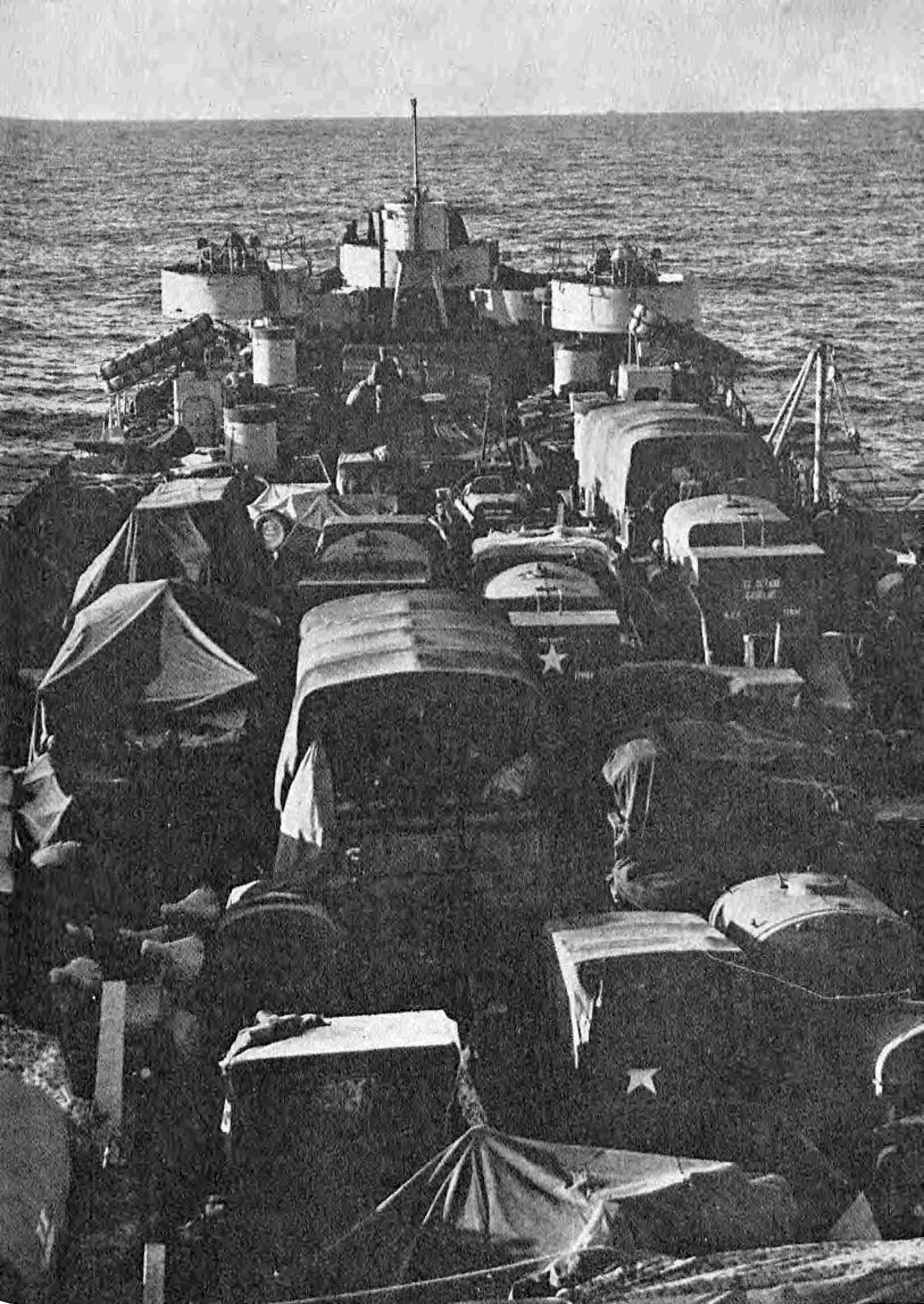
through the 250 ships of the Tractor and Transport Groups. “War’s
over!” shouted the excited Marines. “They’re taking us back to Pusan
for embarkation to the States.”
Rumor seemed to have the support of fact on this occasion, for
compass readings left no doubt that the armada had indeed executed a
maritime “about face” to head southward. What the men on the transports
did not know was that the reversal of direction had been ordered
for purely military reasons as a result of the conference that day on
the Missouri.
It was puzzling enough to the troops the following morning when
the ships resumed their original course. But this was nothing as compared
to their bewilderment late that afternoon as the Tractor and
Transport Groups turned southward again.
Every twelve hours, in accordance with the directive of CJTF-7, the
fleet was to reverse course, steaming back and forth off the eastern
coast of Korea until the last of the magnetic mines could be cleared
from the lane in preparation for an administrative landing at Wonsan.80
Marines have always been ready with a derisive phrase, and “Operation
Yo-Yo” was coined to express their disgust with this interlude of
concentrated monotony. Never did time die a harder death, and never
did the grumblers have so much to grouse about. Letters to wives and
sweethearts took on more bulk daily, and paper-backed murder mysteries
were worn to tatters by bored readers.
On the 22d, at CJTF-7’s regular daily meeting, Admirals Struble and
Doyle conferred in the destroyer Rowan with Admiral Smith and Captain
Spofford. It was agreed that the sweeping could not be completed
until the 24th or 25th, which meant that Operation Yo-Yo might last
a week.81
The situation had its serious aspects on LSTs and transports which
were not prepared for a voyage around Korea taking nearly as long
as a crossing of the Pacific. Food supplies ran low as gastro-enteritis and
dysentery swept through the crowded transports in spite of strict medical
precautions. The MSTS transport Marine Phoenix alone had a sick list
of 750 during the epidemic. A case of smallpox was discovered on the
Bayfield, and all crewmen as well as passengers were vaccinated that
same day.82
On the 23d, as the Mount McKinley proceeded into the inner harbor
at Wonsan, there could be no doubt that the final mine sweeping would
be completed by the 25th. Operation Yo-Yo came to an end, therefore,
when Admiral Doyle directed the amphibious fleet to arrive on the
25th, prepared for an administrative landing. The order of entry called
for the Transport Group to take the lead, followed by the vessels of
the Tractor Group.83
On the morning of the 25th, Admirals Struble and Doyle held a
final conference with General Almond and Captain Spofford. By this
time they had decided to land the Marines over YELLOW and BLUE
Beaches on Kalma Peninsula, as originally conceived in 1stMarDiv
OpnO 16-50. The inner harbor of Wonsan would remain closed until
completely clear of mines, and then it would be developed as a supply
base.84
The sense of frustration which oppressed the Marine ground forces
during Operation Yo-Yo would have been increased if they had realized
that the air maintenance crews had beaten them to Wonsan by a margin
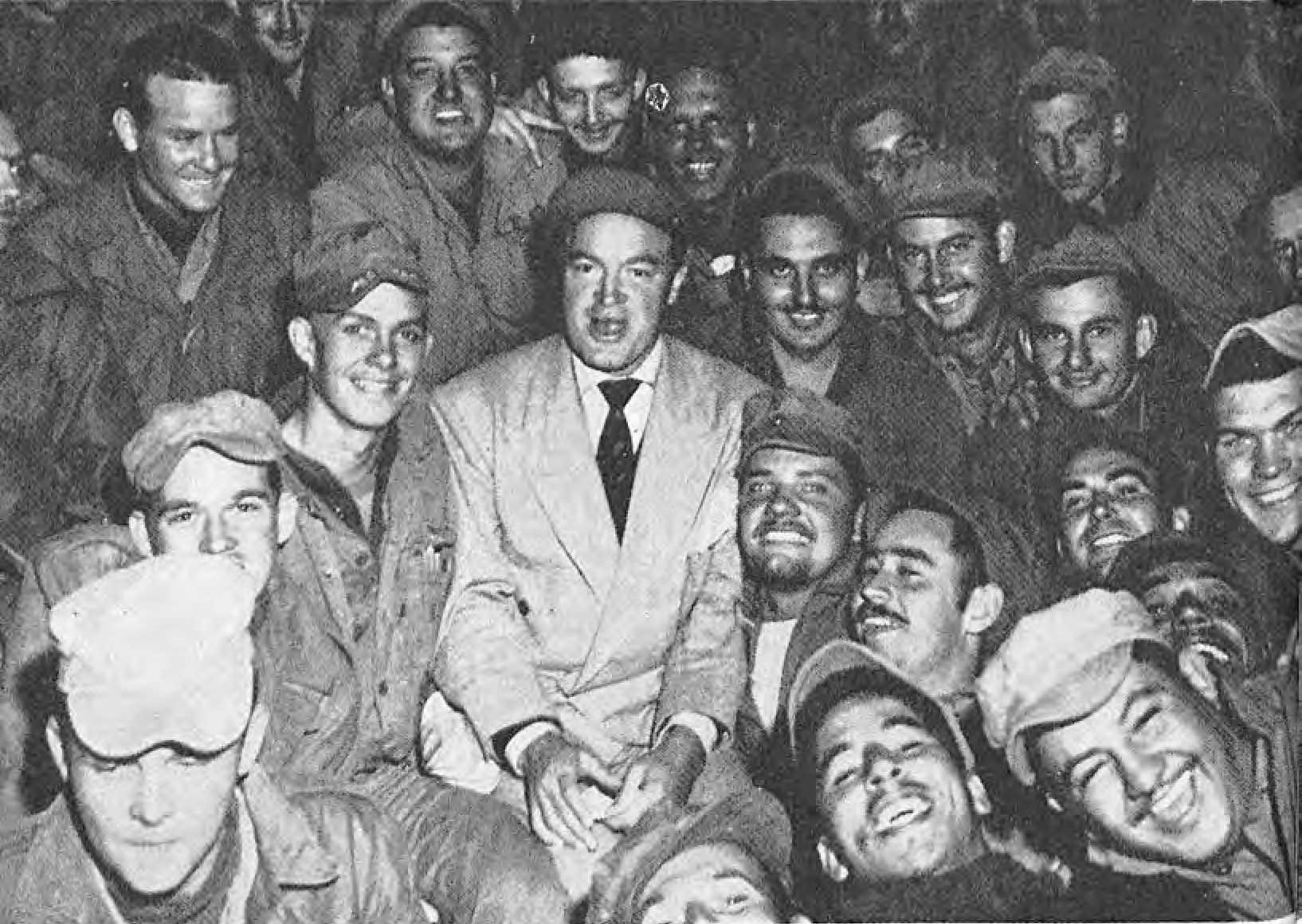
of twelve days. Even more humiliating to the landing force troops,
Bob Hope and Marilyn Maxwell were flown to the objective area. On
the evening of the 24th they put on a USO show spiced with quips at
the expense of the disgruntled Leathernecks in the transports.
Planning for Marine air operations in northeast Korea had been
modified from day to day to keep pace with the rapidly changing strategic
situation. On 11 October, when ROK forces secured Wonsan,
preparations for air support of an assault landing were abandoned.
Two days later Major General Field Harris, CG 1st Marine Aircraft
Wing and Tactical Air Command X Corps (TAC X Corps), flew to
Wonsan. After inspecting the airfield he decided to begin operations
without delay.85
These developments, of course, were accompanied by amendments
to the original plan which had assigned Marine Fighter Squadrons
(VMFs)-214 and -323 the air support role in the naval task force,
with Marine Aircraft Group (MAG)-12 to be landed as soon as the
field at Wonsan was secured.
In response to changing conditions, VMF-312 aircraft flew from
Kimpo to Wonsan on the 14th, and R5Ds lifted 210 personnel of the
advance echelons of Headquarters Squadron (Hedron)-12, Service
Squadron (SMS)-12, and Marine All-Weather Fighter Squadron
(VMF(N))-513. Two LSTs sailed from Kobe with equipment of
MAG-12, and Combat Cargo Command aircraft of Far East Air Force
began flying in aviation gasoline. Bombs and rockets were flown to
Wonsan by the planes of VMF(N)-513.86
On the 16th, VMFs-214 and -323 departed Sasebo for station off
Wonsan in the CVE’s Sicily and Badoeng Strait. From the following
day until the 27th these two fighter squadrons were to provide air
cover for the mine sweeping operations off Wonsan and the ensuing
1st Marine Division administrative landing.87
TAC X Corps OpnO 2-50, issued on 15 October, had contemplated
the opening of the port at Wonsan and arrival of the surface echelon
within three days. Until then the two squadrons at Wonsan airfield
were to be dependent on airlift for all supplies.
The unforeseen ten-day delay in clearing a lane through the mine
field made it difficult to maintain flight operations. Fuel was pumped
by hand from 55-gallon drums which had been rolled along the ground
about a mile from the dump to the flight line. Muscle also had to
substitute for machinery in ordnance sections which had only one jeep
and eight bomb trailers for moving ammunition.88
Despite such difficulties, air operations from the new field were
speeded up when General Almond landed to establish the X Corps CP
at Wonsan on the 20th, after taking control of I ROK Corps. Armed
reconnaissance sorties were flown regularly and attacks made on retreating
bodies of NKPA troops. On the 24th a VMF-312 flight surprised
a column of about 800 Korean Reds near Kojo, 39 miles southeast
of Wonsan, and scattered it with heavy losses.
There were administrative as well as operational problems to be
solved. If an assault landing had been carried out at Wonsan, the
provision for air support would have been planned in a manner similar
to that of Inchon. But the change to an administrative landing caused
the 1st MAW to be placed under the control of the Far East Air Forces.
This was in accordance with a CinCFE directive to the effect that when
both FEAF and Naval air were assigned missions in Korea, coordination
control would be exercised by CG FEAF. He had in turn delegated that
control north of the 38th parallel, including close-support operations
of carrier-borne planes, to CG Fifth Air Force.
An effort was made at first by MAG-12 officers to comply with Fifth
AF procedures, which required the schedule for any given day’s strikes
to be submitted to that headquarters by 1800 the previous day. Obviously,
the distance separating X Corps in Wonsan from Fifth Air
Force Headquarters in Seoul made it virtually impossible to get clearance
in time. This issue was speedily settled by a conference in which
Major General Earle E. Partridge, USAF, CG Fifth Air Force, gave
General Harris oral permission to plan and execute supporting missions
for X Corps in northeast Korea while awaiting clearance from the
Fifth AF.
His decision was made on the basis of a liberal interpretation of the
authority of CG 1st MAW to take action “in emergencies.” In practice,
the arrangement worked out smoothly during this preliminary
period, and on 12 November CG Fifth Air Force confirmed his oral
agreement with a written directive.
Direction of air operations in support of X Corps was exercised by
MAG-12 for the 1st MAW from 15 October to 9 November. Night
operations did not begin until late in October for lack of runway lights
at Wonsan, so that VMF(N)-513 flew daytime missions along with
VMF-312. The two carrier-based squadrons conducted flights in a
similar manner. Aircraft reported at designated times to specified
Tactical Air Control Parties (TACPs) for operations directed by a daily
Fifth AF order, some of them in response to previously submitted requests
of ground units for air support.
Major Vincent J. Gottschalk’s Marine Observation Squadron
(VMO)-6 was under the operational control of the 1st Marine Division,
though it was under the administrative direction of MAG-12.
Two helicopter pilots, Captain Wallace D. Blatt and First Lieutenant
Chester C. Ward, flew from Kimpo to Wonsan on 23 October. The
rest of the squadron had proceeded by LST. A flight echelon of helicopters,
commanded by Captain Victor A. Armstrong, VMO-6 executive
officer, remained temporarily at Kimpo at the request of the
Fifth Air Force to evacuate casualties of the 187th Airborne RCT in
the Sukchon area.89
From all that has gone before, it might be expected that UN strategy
and tactics, after frequent modification, had finally been decided upon
by mid-October 1950. This was not the case, and a brief recapitulation
of events in western and central Korea is now necessary in order
to set the scene for the sweeping changes that followed.
General Walker’s Eighth Army, as mentioned earlier, had deployed
along the 38th Parallel after relieving X Corps above Seoul on 7 October.
Two days later, armored elements of the 1st Cavalry Division
crossed the boundary to spearhead the U. S. I Corps drive on Sariwon
and Pyongyang. The former city was secured on 17 October with the
help of the 27th Commonwealth Brigade, while the 24th Infantry
Division moved up the west coast on the left of the Kaesong-Sariwon-Pyongyang
axis.90 The 1st Cavalry Division continued the attack toward
Pyongyang on the 18th, entering the Red capital with the 1st
ROK Division the next day. Pyongyang was secured on 21 October,
and elements of the 1st Cavalry Division also occupied the undefended
port city of Chinnampo, 35 miles to the southwest.91
A vertical envelopment on 20 October had come as a dramatic supplement
to the attack on Pyongyang. The 187th Airborne RCT parachuted
successfully into the Sukchon-Sunchon area, about 30 miles north
of the city, thereby cutting the two principal NKPA escape routes to
Manchuria. After watching the drop from his plane, General MacArthur
stopped off at Pyongyang and declared that the surprise stroke
had closed the trap on the enemy. At his Tokyo headquarters the next
day, he predicted that the war would end shortly.92
In mountainous central Korea on the right flank of I US Corps, the
6th ROK Division had been leading the rapid advance of South Korean
forces under EUSAK. With Hwachon captured on 8 October, the division
went on to take the vital hubs of Chorwon on the 10th and Kumwha
on the 11th. It made contact with ROK Capitol Division elements
from Wonsan the following day. During the next 24 hours, the 6th
Division advanced 20 miles, and the 7th and 8th ROK Divisions fanned
out to exploit the deepening penetration. On 14 October the 6th closed
on Yangdok, about midway between Wonsan and Pyongyang.93
Thereafter the ROK forces in the center of the peninsula began veering
northwest, so that by 22 October, the day after Pyongyang fell to
I Corps, the vanguard 6th Division was bearing down on Kunu-ri,94
about 45 air miles to the north of the capital.
From the foregoing, it is obvious that a trans-peninsular drive by
X Corps was no longer necessary after mid-October. In fact, both in
Washington and in Tokyo the attitude prevailed that the Korean war
was nearing an end. President Truman had deemed a meeting of minds
appropriate at this time, and he flew to Wake Island for a conference
with General MacArthur on 15 October.95
Various aspects of American policy in the Far East were discussed
at the meeting, but the Korean situation ranked high on the agenda.
When asked by President Truman about the chances of Russian or
Chinese interference in the war, General MacArthur replied, “Very
little.” His conclusion agreed with that held by many in high government
circles, although officials in both Washington and Tokyo realized
that the possibility of Communist intervention could not be dismissed
entirely.
MacArthur stated that about 300,000 Chinese troops were stationed
in Manchuria, of whom from 100,000 to 125,000 had been deployed
along the Yalu River boundary with Korea. He estimated that only
50,000 to 60,000 of these troops could get across the river. If they attempted
to move on Pyongyang, he said, they would be “slaughtered,”
owing to the proximity of UN air bases.
The commander in chief added that Russia had no troops immediately
available for a thrust into the peninsula. It would take six weeks
for a Soviet division to assemble at the border, and by that time winter
would have set in. And while Russia had a fairly good air force in
Siberia and Manchuria, tactical support of Chinese ground troops would
be difficult to control. “I believe Russian air would bomb the Chinese
as often as they would bomb us,” MacArthur remarked.96
Part of the conference dealt with the rehabilitation of Korea and
the eventual departure of UN troops after the fighting had ceased.
MacArthur expressed his belief that organized resistance would end
by Thanksgiving (23 November). He hoped to withdraw EUSAK to
Japan by Christmas, leaving X Corps, reconstituted with the 2d and
3d U. S. Infantry Divisions and other UN detachments, as a security
force until peace and order were fully restored. All present seemed to
agree that elections should be held early to achieve stability in the
re-united country, and that the ROK Army must be made tough enough
to deter the Chinese Communists from any aggressive moves.
The conference ended on a note of general optimism. President
Truman pinned a Distinguished Service Medal on the commander in
chief (his fifth), and the latter boarded his plane and departed shortly
after the meeting.
Once back in Tokyo, MacArthur issued on 17 October a new order
that would become effective if Pyongyang fell before X Corps landed
at Wonsan (as was the case four days later). This draft established
parallel zones of action for EUSAK and X Corps in North Korea, with
the Taebaek Range as the dividing line. The restraining line for UN
Forces was advanced as much as 60 miles to a lateral drawn through
Chongsanjangsi-Koingdong-Pyongwon-Toksil-li-Pungsan-Songjin (see
Map 1). ROK Forces, of course, would still drive all the way to the
borders of Manchuria and the USSR.97
On 24 October, just as the 1st Marine Division was preparing to
land at Wonsan, General MacArthur did away with the restraining
line altogether. The original restriction on the advance of UN elements,
he told his subordinate commanders, was based on the possibility
of enemy capitulation. Since there appeared to be no prospect of
a formal surrender, he now authorized Generals Walker and Almond
to use whatever of their ground forces were necessary to secure all of
North Korea. And he enjoined them “... to drive forward with all
speed and with full utilization of all their force.”98
The commander in chief received a message from JCS the next day,
telling him that they considered his new order “not in consonance”
with their 27 September authorization, which had stipulated a policy
of using only ROK ground forces in the provinces bordering Russia
and Manchuria. The matter had caused some concern in Washington,
the Joint Chiefs said, and they wanted to know MacArthur’s reasons
for making the decision.99
In reply they were informed that the commander in chief’s decision
was a “matter of military necessity,” since the ROK Army lacked both
the strength and the seasoned commanders required for securing North
Korea. MacArthur added that the 27 September authorization had
“... merely enunciated the [restraining line] provision as a matter of
policy,” and had admitted the possibility of JCS instructions being
modified in accordance with developments. He stated further that he
possessed the authority to so modify from Secretary of Defense Marshall
himself, who had told him “... to feel unhampered tactically
and strategically....” Assuring the Joint Chiefs that he understood
the reasons for their apprehension, he warned that “... tactical hazards
might even result from other action than that which I have directed.”100
And there the matter rested.
It was at a X Corps staff meeting on 18 October that General Almond
disclosed MacArthur’s plan for parallel zones of action and the new
Chongsanjansi-Songjin restraining line in North Korea. Upon establishing
his CP at Wonsan two days later, he accordingly assumed command
of all UN and ROK forces north of the 39° 10′ parallel and east of the
Taebaek Range.101
By this time the ROK Capitol Division was occupying Hamhung,
Hungnam, and nearby Yonpo Airfield, all of which had been captured
on 17 October during the swift drive northward.102 The ROK 3d Division
had one regiment at Wonsan, another at Kojo, and the third en
route to Hamhung.103
On the 21st, General Almond requested CJTF-7 to land one battalion
of Marines at Kojo immediately, for the purpose of relieving the ROK
regiment defending that locale. He contended that Navy LSTs could
beach there safely, since SCAJAP ships had already done so. Learning of
the proposed landing, Admiral Doyle argued against it and Admiral
Struble forbade it on the ground that the military requirement did not
justify the risk incident to negotiating unswept waters. Thus the landing
was called off, although the Marines had not heard the last of
Kojo.104
On 22 October, General Smith issued a new plan based on the proposed
X Corps deployment as far north as the Chongsanjangsi-Songjin
line. The 1st Marine Division would now occupy the southern part of
the extended corps zone, with each regiment responsible for the security
of its assigned sector.105 But again planning went for naught when, two
days later, General Almond received MacArthur’s order to disregard
the restraining line and use whatever forces necessary to drive rapidly
to the Manchurian and Soviet borders. On 25 October, therefore, X
Corps directed the 1st Marine Division to concentrate one RCT in the
Hamhung area and to relieve elements of the I ROK Corps at the
Chosin and Fusen Reservoirs. South Korean troops had already begun
their advance on these vital power centers, some 50 to 60 air miles
north of Hamhung.106
It was also on the 25th that the 1st Marine Division finally began
its administrative landing at Wonsan—as anticlimactic a landing as
Marines have ever made. Five LSTs loaded with Engineer, Shore Party,
and Combat Service Group elements beached on Kalma Peninsula in
the evening. Since the approaches had not been declared clear until
late afternoon, the main ship-to-shore movement was delayed until the
next day. Thus, 26 October actually became D-Day—or “Doyle Day,”
as it was referred to by an impatient General Almond.107
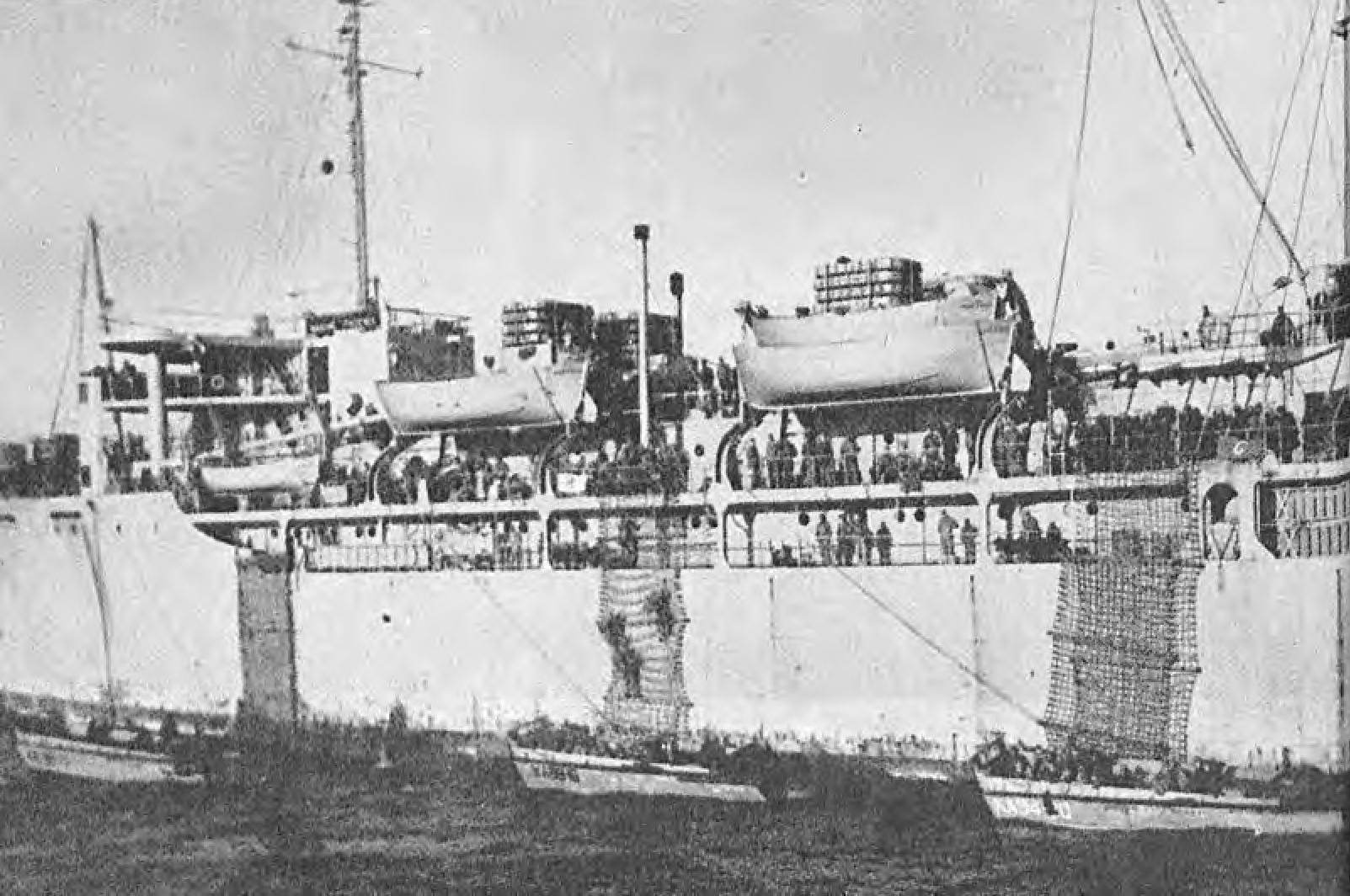
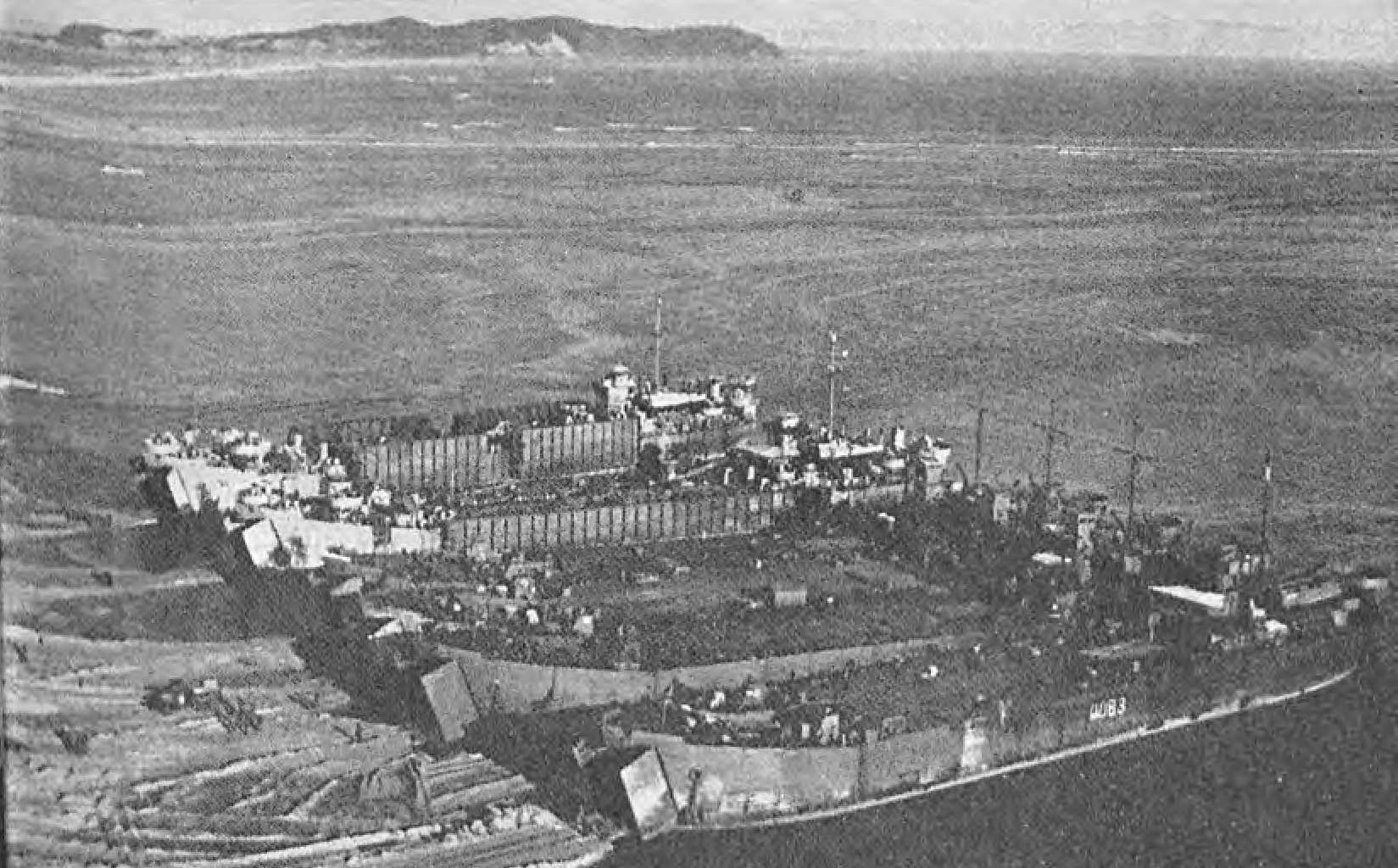
At first light on the 26th, landing craft clustered around the transport
vessels in the swept channel as troops spilled down debarkation
nets. The first of 39 scheduled waves were shortly on the way, with
amphibious craft of every description churning the water.108 LSUs
began disgorging armor of the 1st Tank Battalion at 0730, and the big
machines, fitted with deep-water fording adapters, thrashed through
the surf and onto the loose sand.109 Simultaneously, swarms of vehicles
of the 1st Amphibian Tractor Battalion crawled ashore shuttling troops
and cargo.110
At 0900, LSTs landed the 1st and 3d Battalions of the 1st Marines
on YELLOW Beach, while Colonel Lewis B. Puller’s regimental headquarters
splashed ashore out of landing craft dispatched from the
Noble. The reserve battalion, 2/1, remained on board ship until the
28th. By 1700, the 3d Battalion was in position for the night and the
1st was well on the way to Kojo for a special mission. In the midst
of the landing, Colonel Puller received a message from General Smith
congratulating him on his being selected for promotion to brigadier
general.111
Troops of the 7th Marines marched ashore on BLUE Beach without
incident, and the assembled battalions moved to assigned areas north
of Wonsan. At 1300, Colonel Homer L. Litzenberg opened his regimental
CP at St. Benedict’s Abbey, which had been gutted by the retreating
Communists.112
Advance parties of the 5th Marines began landing over both beaches
at 0800. Priority was given to unloading the reserve unit’s cargo, and
the majority of troops remained on board transports for the night.
Most of the regiment debarked the next day and assembled about three
miles northwest of Wonsan, where Lieutenant Colonel Murray established
his CP at 1800.113
Only the 2d Battalion and several reconnaissance parties of the
11th Marines landed on the 26th. The remainder of the artillery regiment
went ashore the next day and bivouacked at the coastal town of
Munpyong-ni, five miles above Wonsan. Colonel James H. Brower, the
regimental commander, detached 2/11 to the 1st Marines at 1715 on
27 October, but the other battalions “... remained in a mobile state
awaiting further orders.”114
The Wonsan landing, though tactically insignificant at the moment,
was a major logistical undertaking to such units as the 1st Engineer
Battalion (Lieutenant Colonel John H. Partridge), the 1st Shore Party
Battalion (Lieutenant Colonel Henry P. Crowe), and the 1st Combat
Service Group (Colonel John H. Cook, Jr.).
Representatives from these and other support and service units had
flown to the objective area several days before the Division’s arrival.
After completing an inspection of Wonsan, the Shore Party detachment
employed 500 North Korean POWs and 210 civilians to improve
landing sites and beach exits. This work continued 24 hours a day for
nine days, until the vanguard LSTs grated ashore on Kalma Peninsula
in the evening of 25 October.115 At this point, Shore Party Group C
(Major George A. Smith) assumed responsibility for YELLOW Beach
in the north, and Group B (Major Henry Brzezinski) took over BLUE
Beach.
With the arrival of the first waves of LSTs, LSUs, LVTs, and landing
craft in the morning, there began a routine of unremitting toil that
would abate only after all of X Corps had landed weeks later. Because
of the shallow offshore gradient, many amphibious craft could not
reach the beach with their heavy cargoes, and the Shore Party troops
had to construct ramps which projected 30 feet into the water.
These improvised piers were made of rice bags filled with sand, with the
result that their maintenance required considerable effort in men and
heavy equipment. A pontoon causeway constructed on 27 October
lessened the difficulties connected with getting troops ashore, but other
problems persisted.
One of these had to do with a sandbar that stretched across the boat
lanes about 50 yards from the coast. Heavier craft frequently grounded
here, and while some could be towed ashore by tractor dozers (TD-18s)
and LVTs, others had to be unloaded in the water by cranes operating
off the ramps and from barges.
Once men and supplies finally reached dry land, there was the difficulty
of transporting them inland over the loose sand and around the
sprawling dunes of the peninsular beaches. Trucks and trailers often
bogged down to such depths that they had to be uprooted and towed by
LVTs or dozers. This tied up the overworked tracked vehicles when
they were badly needed elsewhere.
The Combat Service Group established its Class I, III, and V dumps
according to plan on 26 October, but Class II and IV supplies arrived
on the beach “... in a completely mixed condition,” owing to the
haste of the outloading at Inchon. From D-Day onward, from 1500
to 2000 Korean civilians were hired daily to help segregate and issue
supplies.
Upon the completion of mine sweeping in the inner harbor, the
intact port facilities of Wonsan became operative on 2 November.
During the next nine days, the Combat Service Group dispatched by
rail to Hamhung 3900 tons of ammunition alone. On 9 November,
the group was attached to X Corps for operational control, thereafter
assuming specific responsibility for such varied tasks as: operation of
all port facilities; unloading all X Corps elements; transporting all
equipment and supplies to inland dumps and supply points; casualty
evacuation; maintenance of an airhead at Wonsan Airfield; providing
local security; traffic control in the port and its environs; and providing
field maintenance for all units in the Wonsan area.
The magnitude of the logistical operation can be imagined from a
survey of statistics mentioned in Shore Party reports. By 31 October,
when the 1st Marine Division’s landing was completed, a total of 24
cargo vessels, 36 LSTs, and one LSM had been unloaded. Bulk cargo
in the order of 18,402 tons had moved across the beaches along with
30,189 personnel and 4731 vehicles. During the same period, 2534
troops were outloaded with 70 vehicles and 4323 POWs. And in
November, as the MAG-12 elements and the rest of X Corps poured
ashore, the total of ships handled soared to 76 cargo and 52 LSTs,
adding 30,928 personnel, 51,270 tons of supplies, and 7113 vehicles
to the short-lived build-up in Northeast Korea.
CHAPTER III First Blood At Kojo — 1/1 Sent to Kojo — Marine Positions in Kojo Area — The All-Night Fight of Baker Company — 2/1 Ordered to Kojo — Security Provided for Wonsan Area — Marines Relieved at Kojo
1/1 Sent to Kojo—Marine Positions in Kojo Area—The All-Night
Fight of Baker Company—2/1 Ordered to Kojo—Security
Provided for Wonsan Area—Marines Relieved at Kojo
It was perhaps inevitable after the NKPA collapse that an end-of-the-war
atmosphere should prevail. This attitude was found in the
CP as well as the foxhole. General MacArthur, while witnessing the
Eighth Army paratroop landings north of the captured enemy capital,
was quoted by the newspapers as saying:
The war is very definitely coming to an end shortly. With the closing of
that trap there should be an end to organized resistance.116
As another straw in the wind, General Smith had received a dispatch
from ComNavFE on 21 October which stated that on the conclusion
of hostilities it was his intention to recommend to CinCFE that the 1st
Marine Division be returned to the United States, less an RCT to be
stationed in Japan.117
On the 24th the Marine commander learned that X Corps had received
a document, for planning purposes only, providing that the
Corps commander would become commander of the occupation forces.
These were to consist of a single American division, probably the 3d
Infantry Division, while the remainder of the Eighth Army returned
to Japan.118
Such indications seemed less reassuring after an incident which occurred
at Wonsan on the evening of D-day. Two Marines, gathering
firewood on the beach, had been blown to pieces by a booby trap. They
were the only casualties from enemy action in the Wonsan landing.119
As early as 24 October the Marine division CP aboard the Mount
McKinley had been advised of an ancillary mission. Immediately following
the landing one battalion was to be sent 39 miles south of Wonsan
to the small seaport of Kojo. There it was to protect a supply
dump of the ROK I Corps.120
X Corps issued OI 13 on the 25th but General Smith did not receive
his copy until two days later. Corps orders now assigned the Marine
division a zone of action more than 300 road miles from north to south
and 50 road miles in width. The missions prescribed for the Marines
were those of an occupation rather than a fighting force:
(1) To land on beaches in the vicinity of Wonsan.
(2) To relieve all elements of I ROK Corps in Kojo and zone.
(3) To protect the Wonsan-Kojo-Majon-ni area, employing not less than
one RCT, and patrolling all roads to the west in zone.
(4) To advance rapidly in zone to the Korean northern border.
(5) To be prepared to land one Battalion Landing Team (BLT) in the
Chongjin area rapidly on order.
(6) To assist the 101st Engineer Group (C) (ROK) in the repair of the
Yonghung-Hamhung railroad, employing not less than one engineer
company.121
The 1st Marine Division in turn assigned these tasks to the following
units in OpnO 18-50, issued at 0800 on the 28th but communicated
orally to most of the designated commanding officers during the preceding
48 hours:
(1) RCT-1 to relieve elements of I ROK Corps in Wonsan-Kojo-Majon-ni
zone, establish necessary road blocks to prevent movement into the
area, patrol roads, and destroy enemy in zone. RCT-1 to maintain
one reinforced battalion at Kojo until further orders.
(2) RCT-7 to relieve elements of I ROK Corps along the Hamhung-Chosin
Reservoir road, advance rapidly to the northern tip of the reservoir
and Changjin, prepared for further advance to the northern border
of Korea, and to destroy enemy in zone.
(3) RCT-5 to move to an assigned zone behind RCT-7, relieve elements
of I ROK Corps in the vicinity of Fusen Reservoir, establish necessary
road blocks to prevent movement into the area, patrol the roads and
destroy the enemy.
(4) BLT1/5 to be activated on order. Upon activation to report to the designated
commander for operational control and landing in the vicinity
of Chongjin.
(5) The 11th Marines, reinforced and less detachments, from an assembly
area in the vicinity of Hamhung, to be prepared for operating in the
zone of any RCT.122
Two of the objectives mentioned in these orders, Chongjin and the
northern border of Korea, were more than 300 road miles north of
Wonsan. With the exception of the main coastal route, most of the
roads in the 1st Marine Division zone were mere mountain trails, unfit
for tanks or heavy vehicles.
OpnO 18-50 was modified the next day to provide for attaching the
1st Battalion, KMC Regiment, to the 5th Marines, and the 5th KMC
Battalion to the 1st Marines. The security of the Munchon and Yonghung
areas (13 and 32 miles north of Wonsan respectively) was assigned
for the time being to the 5th Marines, reinforced by Company
A of the 1st Tank Battalion.
On the 27th General Smith moved from the Mount McKinley at
1000 to the new Division CP, a mile north of Wonsan. An old
Russian barracks, it was too small and badly in need of repairs. The
building occupied by the 1st Marine Air Wing was in even worse shape,
but carpenters were soon busy at boarding up windows and doors
blown out by bombs.123
A holiday spirit prevailed among the men of the 1st Battalion, 1st
Marines, as they entrained on the morning of 26 October 1950 at a railhead
near the Wonsan airfield. Physical activity was a treat after the
monotony and confinement of Operation Yo-Yo, and 1/1 had been
selected for the Kojo mission. Immediately after the landing on YELLOW
Beach at 0900 that morning, preparations were made for departure by
rail of the rifle companies at noon. Supplies and reinforcing units were
scheduled to follow on the 27th on a second train and a convoy consisting
of 1/1 and Motor Transport Battalion vehicles; Battery F, 2d
Battalion, 11th Marines; 1st Platoon, Company C, 1st Engineer Battalion;
and a detachment of Company D, 1st Medical Battalion.124
At 1330 a wheezing Korean engine manned by a Korean crew pulled
out of Wonsan with the rifle companies riding in gondola cars. It was
a bright blue day, with a hint of frost in the air; and not a sign of enemy
resistance appeared along the 39-mile route, though several tunnels
might have been utilized for a guerrilla attack.
Upon their arrival late that afternoon, Kojo proved to be the most
attractive town the men had seen in Korea—an almost undamaged small
seaport flanked by the white beaches and sparkling blue waters of the
bay.
There remained for the Marines the task of relieving ROK units
and protecting an area consisting of a coastal plain about 5000 yards
in diameter which stretched from the bay to a semicircle of hills ranging
from 150 to 600 feet in height (see Map 4). The ROK officers
assured the battalion commander, Lieutenant Colonel Jack Hawkins,
that his men would find their duty at Kojo a tame assignment. They
admitted that small bands of escaping NKPA soldiers had sometimes
raided the villages for rice, but added that ROK patrols had scoured
the hills without meeting any organized resistance.
The night passed uneventfully for the battalion in a perimeter northwest
of Kojo while the ROKs occupied outposts along the southern
fringe of the coast plain. In the morning the Marines found the rice
paddies glazed with the first ice of the autumn. After completing the
relief of the 2d Battalion of the 22d ROK Regiment at 1200, they
watched with amusement that afternoon as the Koreans crowded into
the gondola cars with their women, children, dogs, and chickens for
the ride back to Wonsan. When it seemed that the train could not
hold another human being, a ROK officer barked out an order and
everyone squeezed farther back with audible sighs and grunts. At last,
as a grand climax, the officer shouted a final command and the entire
trainload of Koreans sat down simultaneously, like collapsing
dominoes.
It was an ironical circumstance that the ROKs on the overcrowded
train took with them the remnants of the supply dump that 1/1 was
assigned to guard. However important this dump may have been in its
heyday, it had apparently been consumed by the ROKs to the point48
where only a few drums of fuel oil remained along with other odds
and ends.
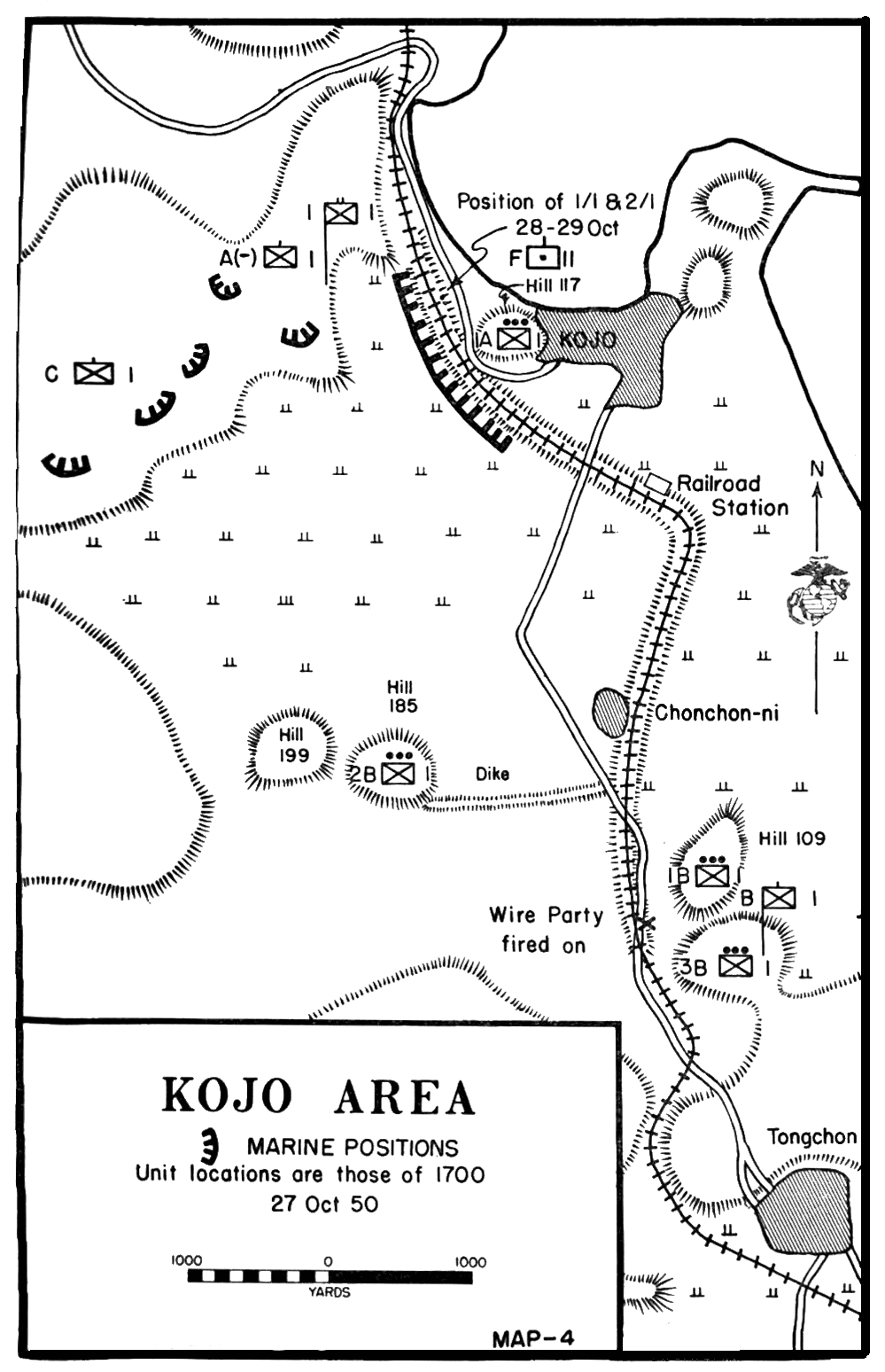
KOJO AREA
Unit locations are those of 1700
27 Oct 50
MAP-4
That afternoon the train and truck convoys arrived without incident,
bringing supplies and all reinforcing units except the artillery. And
though the Marines at Kojo did not neglect security precautions, they
had seen nothing during their first 24 hours to hint that an organized
enemy was about to launch a surprise attack.
Lieutenant Colonel Hawkins faced a problem in selecting positions for
his battalion.
Mindful of my mission—to protect the supply dump until removed—I had
to dispose the battalion in a way designated to accomplish this end [he commented].
The supply dump was located at the railroad station in the flat
ground south of Kojo—a point difficult to defend, since it was on low ground
and could be approached by the enemy from any direction. I considered the
most likely direction of enemy approach to be from the south along the
coastal road or through the valley leading toward Kojo from the southwest.
Therefore, I decided to place Company B in outpost positions to cover these
approaches.... The remainder of the battalion would be deployed on the
hill massif west of Kojo, prepared to defend the area or counterattack if
necessary to prevent loss of the supplies at the railroad station. I did not
consider this disposition ideal by any means from the standpoint of defensive
strength, but it appeared to be the best possible disposition in the complex
terrain to protect the supply dump.... Also, I did not have reason to expect
an organized attack by large enemy forces. In the event such a contingency
should occur, it was planned that Company B, the outpost, would withdraw
to the main battle position.125
Captain Wesley B. Noren’s Baker Company positions were about
two miles south and southwest of Kojo across an expanse of rice paddies.
From east to west the company held three isolated points of high
ground:
1st Platoon (First Lieutenant George S. Belli), reinforced by one
section of light machine guns and one 3.2″ rocket launcher squad, on
the east slope of Hill 109;
3d Platoon (Master Sergeant Matthew D. Monk) and Company
Headquarters, reinforced by one section of heavy machine guns, one
section of light machine guns, a 75mm recoilless rifle, one squad of
3.5″ rocket launchers and a flame thrower, on high ground to the west
and south of the 1st Platoon;
2d Platoon (First Lieutenant George G. Chambers), reinforced by
one section of 81mm mortars, one section of light machine guns, a
75mm recoilless rifle and one squad of 3.2″ rocket launchers, on Hill
185.
The remainder of 1/1 occupied positions west of Kojo. Captain
Robert P. Wray’s Charlie Company held a continuous line of foxholes
in the hills that rose from the rice paddies a mile and a half north of
Baker Company’s positions. From west to east were First Lieutenant
Francis B. Conlon’s 2d Platoon, First Lieutenant William A. Craven’s
1st and Second Lieutenant Henry A. Commiskey’s 3d. About 250 yards
to the east were two platoons of Captain Robert H. Barrow’s Able
Company. On the slopes north of Barrow stood Colonel Hawkins’ CP
and the tubes of First Lieutenant Edward E. Kaufer’s 4.2″ Mortar
Platoon. Captain Barrow’s third platoon occupied the topographical
crest of Hill 117.126
While the Marines organized their positions during the afternoon
of 27 October, a column of refugees “almost as long as the eye could
see” appeared in the valley southwest of Kojo headed for the seaport.
Colonel Hawkins estimated that there were 2000 to 3000 people in
the column. Since he did not have the time to examine all the refugees
before darkness, Hawkins had them herded into the peninsula northeast
of Kojo for the night.127
After a quiet afternoon on the 27th, the first hint of enemy opposition
came at 1600 when a wire team was fired upon in the vicinity of Hill
185. Two hours later a truck and a jeep borrowed from the S-3, Major
David W. Bridges, received fire from the high ground west of Hill 109.
Both were abandoned after the truck broke down, and a Baker Company
patrol had a brief fire fight at 1900 when it recovered the vehicles.128
These first indications of Red Korean activity in the Kojo area were
attributed to the forays of guerrilla bands. Not until after the battle did
the Marines learn from POW interrogations that the enemy consisted
of an estimated 1000 to 1200 men of the 10th Regiment, 5th NKPA
Division. This regiment, commanded by Colonel Cho Il Kwon, former
director of the Communist Party at Wonsan, was believed to have its
CP in the large village of Tongchon, about two miles south of the
Baker Company outposts. Other units of the NKPA division, which
was credited with a total strength of 7000 to 8000 men, occupied areas
farther to the south.129
After the Red Korean collapse, the 2d, 5th, and 10th NKPA Divisions
had maintained their organization, though much depleted in
strength by casualties. Withdrawing to the Wonsan area, they kept to
the secondary roads and raided the villages for food. It is a tribute to
Communist discipline that the outfits had not lost their cohesion at a
time when their cause seemed to be collapsing. But the 5th NKPA
Division was one of the units made up almost entirely of Koreans who
had served in the Chinese Civil War, and its officers were fanatically
dedicated to Communist principles.130
Only well trained and led troops could have launched the attacks
which hit both ends of the Baker Company’s chain of outposts simultaneously
about 2200, after the first few hours of darkness had passed
in comparative quiet punctuated by occasional shots. Normal security
measures were taken on a cold night with a 50 per cent watch—one
rifleman remaining on the alert in the two-man foxholes while the other
burrowed for warmth into a partially closed sleeping bag. The 81mm
and 60mm mortars were registered on the hills just beyond the 2d and
3d platoons.131
These two units came under attack shortly before First Lieutenant
Carlon’s position at the extreme west of Charlie Company’s line was
assailed. In each instance the enemy infiltrated within grenade throwing
distance before his presence was detected. Past contacts with
American soldiers had given the Red Koreans some knowledge of the
language, and for purposes of deception the NKPA assault troops
shouted phrases in broken English:
“Come this way!... Don’t shoot! We’re friends.”132
The surprise was devastating, particularly in the Baker Company zone.
On the eastern slope of Hill 109 the 1st Platoon had no inkling until
men yelled warnings from the foxholes just as the enemy grenades
exploded and Red Koreans in estimated strength of two platoons overran
the position. Seven Marines were killed before they could get
out of their sleeping bags, and others lost contact in the darkness.
The 3d Platoon and Company CP were attacked from three points
to the south and southeast. Marine 60mm mortars fired within 50
yards of the front line while the 81s laid down a barrage directly forward
of the position. After a brief and bitter struggle, Communists
believed to number three platoons were repulsed.
In the Charlie Company zone, Lieutenant Carlon’s position was
hardest hit. The North Koreans closed within ten feet before they
were noticed. During the confused fighting which followed, the enemy
won a brief foothold. An estimated 20 Marines were cut off but got
back safely the next morning.
After recovering from the initial surprise the Charlie Company outposts
repulsed all further attacks. Wray’s men lost 6 killed and 16
wounded during the night’s encounters but could count 92 Korean
bodies the next morning.
At 2215 the 3d Platoon of Baker Company had a second attack at
the same points as the first one. The Red Koreans appeared to Captain
Noren to be exceptionally well disciplined and controlled in spite
of heavy casualties inflicted on them by combination of mortar, machine-gun
and small-arms fire, and grenades.133
The plight of Belli’s platoon was first made known when 2/B on Hill
185 received a message to the effect that 1/B had withdrawn from Hill
109 with 30 men missing. The retirement was made possible by the
brave stand of Sergeant Clayton Roberts, who covered the movement
with a light machine gun until he was surrounded and killed.
The 3d Platoon beat off another attack meanwhile as the enemy
closed in from the left rear as well as the front. With machine-gun
fire coming from both directions, Noren informed the battalion CP
at 2350 that his position was untenable and asked permission to withdraw.
His request being granted, he directed Lieutenant Chambers to
pull back from Hill 185, covering the withdrawal of 3/B with 81mm
fire.
The intersection of the dike and railway track was designated as the
meeting place for the three Baker Company platoons. Noren covered
the rear of the 3/B withdrawal while his executive officer, First Lieutenant
Chester B. Farmer, took charge of the point. Opposite Hill 109
they encountered Staff Sergeant Robert Fisher and five men whom
Belli had directed to remain at the dike and pick up stragglers while the
rest of 1/B continued to pull back.
Fisher reported that the attack on Hill 109 had been conducted with
skill and discipline. Whistles and red and green flares were used for
signaling by Communists who cut off a listening post and overran a
squad on the right flank. The assault force numbered 160, according
to POW testimony.
The methodical, position-by-position withdrawal of the three Baker
Company platoons was conducted so skilfully that remarkably few
casualties resulted. Noren lost all contact for a short time when enemy
fire severed the antenna on his last operative SCR-300. At about 0215
Chambers’ platoon was last to reach the meeting place, having beaten
off several attacks during its withdrawal from Hill 185. With another
large-scale enemy assault threatening, Noren organized a 360° defense
on both sides of the railway track just south of the village of Chonchon-ni.
One Marine was killed and six wounded by enemy fire received from
the west as well as east.
Fox Battery of the 11th Marines had arrived in the Kojo area about
midnight and set up its guns on the beach northeast of the town at
about 0200.134 Baker Company had no radio in operation, however,
until parts of two damaged SCR-300’s were combined into one to restore
communication. Contact was made with the 4.2″ mortars, which
registered about 0300, directed by Captain Noren, and broke up the
NKPA attack. The 81mm mortars made it hot for the enemy in Chonchon-ni,
and at 0330 the Communists apparently disengaged to withdraw
east of the railway track and northward toward Kojo. Marine
artillery had registered by 0400, but all was quiet in the area the rest
of the night.
Although a few NKPA mortar shells were received, enemy equipment
appeared to be limited for the most part to automatic weapons, small
arms, and grenades. There were indications that Korean civilians had
been used in several instances as human shields for an attacking force.135
The NKPA withdrawal to Kojo led to the Marine speculation that
the Communists meant to make enforced recruits of some of the hapless
residents allotted a refuge in the peninsula north of the town.
As it proved, they were not harmed by the NKPA troops. The last enemy
effort, just before dawn, was an attack in platoon strength on Second
Lieutenant John J. Swords’ Able Company platoon by Reds who had
infiltrated through Kojo. A brief fight ensued on Hill 117 as the
Marines beat off the assault at the cost of one man killed and two
wounded.
Baker Company elements had meanwhile resumed their withdrawal
along the railway track north of Chonchon. All was quiet at first light
when Noren began the task of evacuating his wounded in ponchos
through rice paddies which were knee-deep in mud and water under
a thin skin of ice. Marines came out from the Able Company positions
to lend a hand.
The evacuation had nearly been completed when about 200 enemy
troops suddenly moved out from Kojo in a westerly direction across
the rice paddies. Whether they meant to interfere with the evacuation
or merely to escape was never made clear. For the Marines of Able
and Baker Companies as well as the gunners of Fox Battery opened up
in broad daylight and found lucrative targets. An estimated 75 Communists
were killed and wounded before the rest scurried out of range
into the hills west of the coastal plain.
Some contact was maintained with the enemy until 1000 by elements
of Charlie Company, then the action was gradually broken off as the
planes of VMF(N)-513 came in low with close support.136 Although
the strikes by air were largely uncontrolled because of poor radio communications
between the Forward Air Controller (FAC) and the planes,
they were very helpful to the Marines on the ground.137
The radio message bringing the first news of the Kojo fight was sent
by 1/1 at 0418 on the 28th. Owing to transmission difficulty, it was
picked up by the 7th Marines, relayed to the 1st Marines at 0700, and
telephoned to the 1st Marine Division.138 It stated briefly that the battalion
had been under attack since 1700 by an estimated 1000 enemy
and had suffered a large number of casualties. Helicopters were requested
for air evacuation and an LSTH for water evacuation of the
wounded. Air support was required, the message continued, adding
that the destroyer in direct support of the battalion had not yet arrived
on station.
At 0830 an officer from 1/1 reported in to 1st Marines CP with a
further account. He reported a platoon of B Company cut off and
estimated 150 casualties.139
A third report from 1/1 reached the CP of the 1st Marine Division
as an intercepted radio message at 1238 on the 28th while General
Almond was conferring with General Smith. Sent from Kojo at 1000,
the message said:
Received determined attack from South North and West from sunset to
sunrise by large enemy force. Estimated from 1000 to 1200. One company
still heavily engaged. Civilian reports indicate possibility 3000 enemy this
immediate area. Have suffered 9 KIA, 39 WIA, 34 MIA [Missing in Action]
probably dead. Two positions overrun during night. If this position is to be
held a regiment is required. Enemy now to South North and West of us
but believe road to North is still open. Harbor is in our hands and ROK
LST has been here. Shall we hold here or withdraw to North? ROK supply
dump ... removed. Request immediate instructions. Send all available helicopters
for wounded. Suggest send instructions by both radio and helicopters.140
The Corps and Division commanders agreed immediately that Kojo
should be held, since a large-scale NKPA attack appeared to be in the
making. Another factor in this decision was the ROK supply dump.
Nobody at the Division CP seemed to know as yet that it had been
removed, but General Smith directed his G-3 to issue the necessary
orders to send Colonel Puller, CO of the 1st Marines, and a battalion
of reinforcements to Kojo. Within five minutes Colonel Alpha L.
Bowser, 1stMarDiv G-3, telephoned Corps to request that a train be
assembled on the Wonsan siding immediately for a battalion lift.141
Brigadier General Edward A. Craig, ADC of the 1st Marine Division,
was on his way to a conference at the 1st Marines CP when he
met General Almond and Colonel Puller, and the three compared notes
from their jeeps. Craig informed them that action toward the providing
of transportation had already been initiated by Division. A request
had later been made for a second destroyer to provide gunfire support
(the first having already arrived) and an LSTH for casualty evacuation.
Another LST had been requested for the purpose of sending tanks to
Kojo, since the road and bridges would not bear the weight of armor.
The possibility of a major engagement taking place at Kojo seemed
to be confirmed by two later reports 1/1 sent at 1415 and 1840. The
first relayed prisoner of war statements to the effect that an estimated
7000 men of the NKPA 5th Division were located at Tongchon.142 The
second, a radio message, read:
Reinforcement train has not arrived as of 1800. NK prisoners revealed
large enemy force plans attack over position tonight. Recommend LVTs with
LSTs stand by at daylight in case of emergency evacuation necessary. In view
of large numbers of troops facing us as previously reported and face enemy
on all sides except seaward, consider situation critical. Request higher authority
visit.143
By that time Colonel Puller and the troops were on the way. Making
up a train and loading it with a reinforced battalion and extra supplies
in three and a half hours had been something of an administrative feat,
particularly when the battalion was just coming off landing craft. Yet
Lieutenant Colonel Allan Sutter’s 2/1 and the Regimental Command
Group pulled out for Kojo at 1630 and a second train followed two
hours later.144
Upon arrival at 2230, CO 1stMar learned that there had been no
major enemy contact since 1000. Lieutenant Colonel Hawkins had contracted
his unit that afternoon to his main position along the high
ground forming a semicircle around Hill 117. The 2d Battalion and
supporting arms having tied in with the 1st for the night, Colonel
Puller concluded that no further cause for alarm existed. And since
the battery positions at Kojo were limited, he radioed General Smith
that more artillery would not be needed.145
Seventeen Marines previously listed as MIA by 1/1 had returned unhurt
to their units on the 28th after being cut off during the confusion
of the night’s fighting. Marine air had all but obliterated Tongchon
that afternoon while the U. S. destroyers Hank and English were bombarding
Kojo.
The request for water as well as air evacuation of serious casualties
had resulted in immediate action. Within an hour after receiving the
message, CTF-90 had the transport Wantuck on the way with a surgical
team, and VMO-6 sent five helicopters which flew 17 wounded men
to a hospital ship at Wonsan on the 29th.146
Ten tanks of Company C, 1st Tank Battalion, were loaded in LST
883 at Wonsan on the 28th, but the ship was delayed by running
aground. Upon arrival at Kojo the next day, it again became necessary
for the LST to be pulled off the bar by a tug. By this time the military
situation was so well in hand that the tanks were taken back to Wonsan
without being unloaded.147
Responsibility for the security of the Wonsan area having been assigned
to the 1st Marines, something of an administrative problem was created
on the 28th by the order sending 2/1 to reinforce 1/1 at Kojo. For
the 3d Battalion of the regiment had departed that same day to relieve
a ROK unit at Majon-ni, 28 miles west of Wonsan. Since this left no
troops to patrol roads in the Wonsan area and maintain blocking positions
at Anbyon, the 2d Battalion, 5th Marines, and 5th KMC Battalion
were attached to the 1st Marines for those missions.
Also available to the 1st Marines for such security duties as guarding
the Wonsan airfield and harbor area were the 1st Shore Party Battalion,
1st Amphibian Tractor Battalion, and Company B of the 1st Armored
Amphibian Tractor Battalion.148
By the morning of the 29th, moreover, it had already become apparent
that one or both of the battalions in the Kojo area could soon be
spared. When General Craig arrived by helicopter, he found the situation
well in hand.149
About 60 percent of the seaport had been destroyed by air strikes and
the guns of the destroyers when a patrol consisting of Dog and Fox
Companies combed the ruins on the morning of the 29th without finding
any evidences of enemy occupation. Meanwhile an Easy Company
patrol ranged to the west of the coastal plain with equally negative
results.150
Captain George B. Farish of VMO-6 was making a reconnaissance
flight when he discerned the word HELP spelled out in rice straw
near a straw-stack a mile northeast of Tongchon. A Marine crawled
out from concealment, and the pilot landed his helicopter to pick up
PFC William H. Meister, who had been hiding since losing touch with
his unit during the enemy night attack on Hill 109. This was the first
of four such rescues completed by Farish that day.151
On the afternoon of the 29th, Captain Noren led a patrol along the
railway track south of Kojo and retraced the route of his fighting withdrawal
in the darkness. In the vicinity of Hill 109, where Lieutenant
Belli’s platoon had been surprised, he found 12 Marine bodies. None
had been despoiled by the enemy of arms or equipment.
Pushing farther south, Noren encountered sniper fire from the ruins
of Tongchon, destroyed by Marine air, and called for more strikes.
The Corsairs flushed out a group of 20 enemy troops, 16 of whom
were cut down by the machine guns of the Baker Company patrol.152
By the 29th, when General Almond made a trip of inspection to
Kojo, it was possible to revise the original Marine casualty list as the
MIA casualties were reduced. The final count was 23 KIA, 47 WIA
and four MIA.153
Twenty-four wounded Marines were evacuated to Wonsan that day
by APD. LST 883, when it returned to Wonsan with the tanks, took
the bodies of 19 Marines and 17 prisoners.
Enemy losses, in addition to 83 POW, were estimated at 250 KIA
and an unknown number of WIA on the basis of more than 165 bodies
found by Marine patrols. Curiously enough, the Communists had
shown little interest in the equipment which fell into their hands, and
two Marine 75mm recoilless rifles, rendered inoperative, were recovered
with their carts and ammunition in the vicinity of Chonchon-ni. Almost
all abandoned equipment was found in usable condition.154
Each of the Marine rifle companies set up outposts in front of its zone.
Morning and afternoon patrolling, with air on station, went on during
the last two days of October with negative results. Harassing and interdiction
fires were also continued until 1/1 departed.
LST 973 arrived off Kojo at 1430, 31 October, and disembarked the
5th Battalion of the KMC Regiment. Lieutenant Colonel Hawkins’
battalion, accompanied by Colonel Puller, left Kojo at 0700 the next
morning on the return trip of the LST. The ship docked at Wonsan
at 1230 on 2 November. That afternoon 1/1 relieved elements of the
1st Tank Battalion at the road block near Katsuma, four miles southeast
of Wonsan.
Lieutenant General Lemuel C. Shepherd, Jr., CG FMFPac, who was
acting in an informal capacity as amphibious adviser to General MacArthur,
inspected 2/1 at Kojo by helicopter on 31 October. Having
arrived at Wonsan that day with Colonel Victor H. Krulak, his G-3,
he conferred at X Corps Headquarters with Admiral Struble and Generals
Almond and Smith.155
Among the other subjects of discussion was the news that Chinese
Communist Forces (CCF) prisoners had been taken in the area north
of Hamhung by ROK units which were soon to be relieved by the 7th
Marines. Several clashes with organized Chinese forces during the last
days of October had also been reported by elements of the 1st Cavalry
Division of the Eighth Army in western Korea.
The 7th Marines had been given the mission of spearheading the
Marine advance to the northern border of Korea as directed in Corps
orders. After parkas and other cold weather clothing had been issued
from the beach dumps at Wonsan, the regiment completed the movement
to Hamhung by motor convoy from 29 to 31 October. By this
time the Corps drive to the Yalu was shifting into second gear, with the
I ROK Corps far in advance along the coastal highway. Two U. S.
Army units were soon to be involved. The 7th Infantry Division,
which landed at Iwon from 29 October to 8 November, had Corps
orders to push on toward the border; and it was planned that the 3d
Infantry Division, due to land its first units on the 8th at Wonsan,
would relieve 1st Marines units south of Hamhung.156
Corps orders of 2 November called for 2/1 to return to Wonsan
immediately. The southern boundary of X Corps was to be moved 70
miles farther south, effective on the departure of the battalion from
Kojo. In order to cover the new zone, the KMC regiment had already
been detached from the 1st Marine Division and given responsibility
for the Corps zone south of the 39th Parallel. The relief of the 2d
Battalion of the 5th Marines was completed by KMC elements that
same day at Anbyon, eight miles southeast of Wonsan, thus freeing
that unit for a motor lift northward to rejoin its regiment.157
Lieutenant Colonel Sutter’s 2/1 and the artillery battery departed
Kojo the following day. A small train and a truck convoy sent from
Wonsan were used chiefly for the transport of supplies, and most of
the troops traveled by shanks’ mare. The column was on the way
when the report came that the rail line had been blown up at Anbyon
by guerrillas. The battalion halted there and set up a perimeter for
the night which included both the train and truck convoys. At 0730
in the morning the convoys moved out again for Wonsan. Delayed
slightly by another rail break, Sutter completed the movement at noon.158
The track-blowing incident gave evidence that the Marines must
deal with a third type of enemy. In addition to the NKPA remnants,
and the forces of Red China, it now appeared that account must be
taken of thousands of uprooted Koreans prowling in small bands for
food and loot—the flotsam of a cruel civil war. Called guerrillas by
courtesy, they were actually outlaws and banditti, loyal to no cause.
And by virtue of their very furtiveness, they were capable of doing a
great deal of mischief to organized forces.
CHAPTER IV Majon-ni and Ambush Alley — Marine Units Tied In for Defense — Political Aspects of Mission — Roads Patrolled by Rifle Companies — Air Drop of Supplies Requested — First Attack on Perimeter — KMC Battalion Sent to Majon-ni — Movement of 1st Marines to Chigyong
Marine Units Tied in for Defense—Political Aspects of Mission—Roads
Patrolled by Rifle Companies—Air Drop of Supplies
Requested—First Attack on Perimeter—KMC Battalion Sent to
Majon-ni—Movement of 1st Marines to Chigyong
From a distance the Y-shaped mountain valley, encircled by peaks
and crossed by two swift, clear streams, might have been taken for
a scene in the Alps. This impression was borne out by the village of
Majon-ni, which nestled close to the earth, as seen from afar, with the
tranquil and untroubled air of a Swiss hamlet.
On closer inspection, however, such first impressions could only
prove to be illusory. The most prominent building in the Korean village
was a new schoolhouse with the onion-shaped dome of Russian
architecture. An incongruous and pretentious structure for such a small
peasant community, it had been erected not so much for the instruction
of children as the indoctrination of adults in Communist principles.
Majon-ni, in short, had been for five years a hotbed of forced culture
in the doctrines of the Communist puppet state set up in northern
Korea after World War II by the occupation forces of Soviet Russia.
And it was here that the 3d Battalion of the 1st Marines arrived on
28 October 1950. Relief of elements of the 26th ROK Regiment at
1600 enabled those troops to return to Wonsan in the vehicles which
had brought 3/1.159
The Marines had been assigned the mission of “setting up a defensive
position at Majon-ni, destroying enemy forces, and denying them the
use of this road net.” In addition, the unit was “to patrol roads to the
north, south, and west, and keep the road open between Majon-ni and
Wonsan.”160
This last directive was soon modified by oral instructions relieving
the battalion from the responsibility of keeping open the Wonsan-Majon-ni
road. The reason for the change was apparent when the
troops of 3/1 covered the 28-mile route by motor lift in two echelons
on the afternoon of the 28th. After leaving the seaport and alluvial
plain, the shelf-like road twists precariously through a 3000-foot pass.
This stretch abounds in hairpin turns and deep gorges which are ideal
for setting a tactical trap, and the route was soon to be known to the
troops as Ambush Alley. Although traversable by tanks, it offered too
much danger from roadblocks and landslides to permit the dispatch
of the iron elephants.161
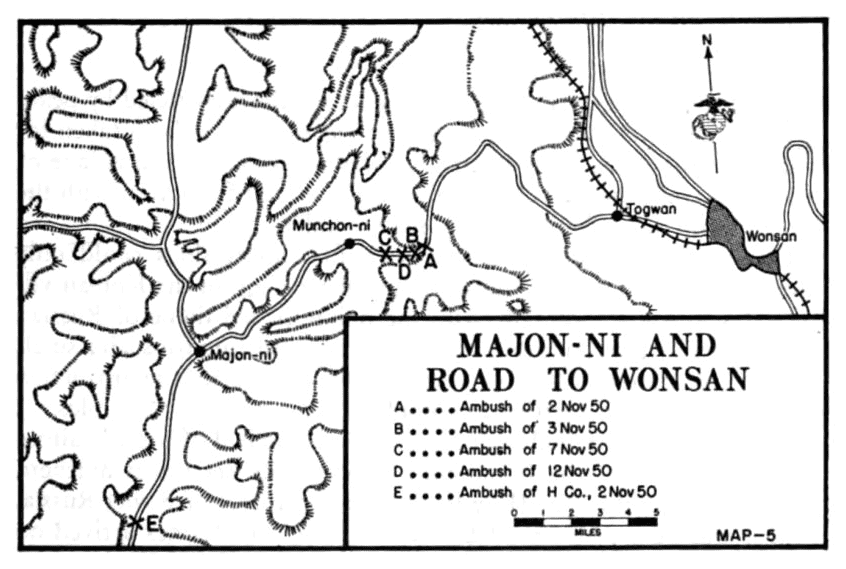
MAJON-NI AND
ROAD TO WONSAN
A Ambush of 2 Nov 50
B Ambush of 3 Nov 50
C Ambush of 7 Nov 50
D Ambush of 12 Nov 50
E Ambush of H Co., 2 Nov 50
The strategic importance of the Majon-ni area derived from its position
at the headwaters of the river Imjin and the junction of roads leading
east to Wonsan, south to Seoul, and west to Pyongyang. They
were being traveled extensively at this time by NKPA troops escaping
northward in civilian clothes after the collapse of the Red Korean military
effort.
It was natural that the 1st Marine Division, with a zone of more
than 15,000 square miles to control, should be ordered to occupy such
an important road junction and potential assembly area as Majon-ni.162
Thus the Marines of Lieutenant Colonel Thomas L. Ridge’s reinforced
battalion were sent as a blocking and screening force.
In addition to H&S, Weapons, and the three rifle companies, the task
organization consisted on 28 October of Battery D of the 2d Battalion,
11th Marines, the 3d Platoon of Company C, 1st Engineer Battalion,
and detachments from ANGLICO, 1st Signal Battalion; Company D, 1st
Medical Battalion; and H&S Company, 1st Marines.163
The battalion commander and his S-3, Major Joseph D. Trompeter,
decided after a survey of the terrain that the commanding ground was
too far from the village and too rugged for company outposts. The
logical solution seemed to be a battalion perimeter combined with daytime
company OPs and vigorous patrolling of the three main roads.
In order to tie in all units of a perimeter 3770 yards in circumference,
it was necessary to create provisional platoons of such H&S, artillery
and engineer troops as could be spared from their regular duties. Even
so, the defense was spread thin in places.
The schoolhouse was the obvious place for the battalion CP. Communication
within the perimeter was by telephone, with wires laid from
the CP to artillery and mortar positions as well as company and platoon
CPs. Radio communication was established with the regiment and the
division but due to the terrain remained irregular at best.
First Lieutenant Leroy M. Duffy and his engineers were assigned the
task of constructing on OY strip on the east side of the perimeter which
was completed on 2 November. A parallel cliff made it necessary to
land planes at a dangerous angle, but no better site could be had in
this steep-sided valley.
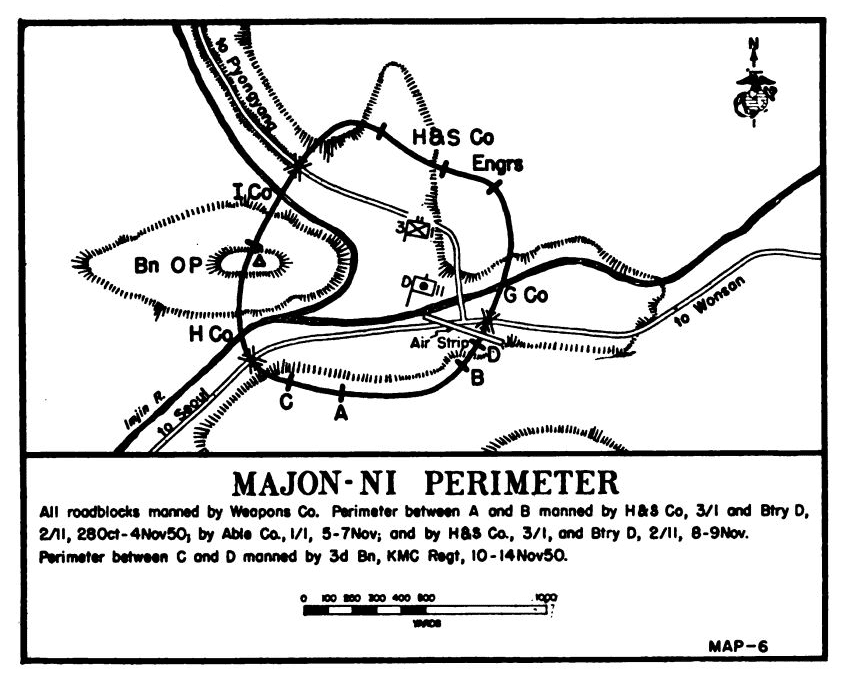
All roadblocks manned by Weapons Co. Perimeter between A and B manned by H&S Co, 3/1 and Btry D,
2/11, 28 Oct-4 Nov 50, by Able Co., 1/1, 5–7 Nov; and by H&S Co., 3/1, and Btry D, 2/11, 8–9 Nov.
Perimeter between C and D manned by 3d Bn, KMC Regt, 10–14 Nov 50.
Topography also limited Captain Andrew J. Strohmenger’s cannoneers,
who were almost literally “firing out of a barrel.” Close-in support
was out of the question in the bowl-like valley ringed with peaks,
but the six howitzers were emplaced so that they could be swung to
fire on any avenue of approach, especially toward the three roads leading
into Majon-ni.164
No difficulty was found in deciding on a water point, for tests established
the purity of the water from both branches of the Imjin flowing
through the perimeter. Lieutenant Duffy explained that he added chlorine
only because the Marines were accustomed to the flavor.
The Marine mission had its political as well as military side. Major
Edwin H. Simmons, CO of Weapons Company, was given the responsibility
for defending the three road blocks of the perimeter with
Weapons Company personnel. At each of them he stationed a heavy
machine gun section and a 3.5″ rocket launcher section. These barriers
were also ports of entry where all Korean transients were searched for
weapons. When a group of 20 to 30 accumulated, they were escorted
under guard to the prison stockade, just across the road from the battalion
CP.165
There they were “processed” by the Civil Affairs Section, consisting
of 12 Marine enlisted men under the command of First Lieutenant
Donald M. Holmes and Master Sergeant Marian M. Stocks, known
facetiously as the mayor and sheriff respectively of Majon-ni. Their
decisions were based largely on the findings of the 181st Counter Intelligence
Corps (CIC) team and the battalion S-2, Second Lieutenant
Frederick W. Hopkins. The CIC specialists proved to be indispensable
by contributing daily intelligence based on civilian as well as POW
interrogations.
As might be supposed, the question of whether a transient was an
escaping NKPA soldier or a harmless peasant might have perplexed
Solomon himself. But the Marines came up with a simple off-the-cuff
solution. Time did not permit a lengthy screening, and each Korean
was given a brief examination with the aid of interpreters. If his head
was still close-cropped in the NKPA manner, if his neck showed a tanned
V-line recently left by a uniform, if his feet bore the tell-tale callouses
left by military footgear—if he could not pass these three tests, the
transient was sent to the prison stockade as a fugitive Red Korean
soldier. Now that Chinese Communist troops had been encountered
both on the X Corps and Eighth Army fronts, it was all the more
important that battlewise NKPA elements should be prevented from
joining their new allies if Red China intervened.
Some of the prisoners were admittedly NKPA veterans, weary of the
war and ready to give up voluntarily. Manifestations of this spirit
caused Lieutenant Colonel Ridge to send a radio request for an air drop
of surrender leaflets.
The first full day’s operations, on 29 October, resulted in 24 prisoners
being taken. But this was a trickle as compared to the torrent which
would follow until an average daily rate of 82 was maintained during
the 17 days of the operations.
Each of the rifle companies was given the mission of sending out daily
motorized or foot patrols while manning, as required, company OPs.
The three roads were assigned as follows:
George Company (Captain Carl L. Sitter), the road to Wonsan;
How Company (Captain Clarence E. Corley, Jr.) the road to Seoul;
Item Company (First Lieutenant Joseph R. Fisher), the road to Pyongyang.166
All patrols reported negative results throughout the first four days.
Nevertheless, a system of artillery and 81mm mortar harassing and
interdiction fires on suspected Red Korean assembly areas was put into
effect. Major Simmons was designated the Supporting Arms Coordinator
(SAC), and OYs were used for artillery spotting and to call air
strikes when planes were on station.167
The battalion commander emphasized to his officers the necessity
for maintaining as good relations with the inhabitants as security would
permit. Strict troop discipline was to be maintained at all times, and
the villagers were allowed their own mayor and council along with
such laws or customs as did not conflict with the Marine mission.168
A policy of justice and fairness had its reward when the inhabitants
warned the CIC team of an impending attack by organized NKPA troops.
POW interrogations and reports by civilians identified the enemy
unit as the 15th NKPA Division, including the 45th, 48th, and 50th
regiments, commanded by Major General Pak Sun Chol. Following
the NKPA collapse, the division had been able to maintain its organization
while infiltrating northward from the Pusan Perimeter and
raiding the villages for food. The mission was reported to be the occupation
and control of the upper Imjin valley as a base for guerrilla
operations, with the Majon-ni road junction being designated one of
the main objectives.169
Enemy numbers were said to reach a total of 11,000. But that figure,
like most Oriental estimates of numbers, had to be taken with the
traditional grain of salt.
At any rate, the Marines had no further doubt on the morning of
2 November that they were opposed by a resolute enemy skilled at
guerrilla tactics. Second Lieutenant Harvey A. Goss’ platoon of How
Company, reinforced with 81mm mortars, light machine guns, an artillery
forward observer (FO) team and a FAC, was ambushed in a
deep gorge five miles south of Majon-ni while conducting a motorized
patrol. The Marines, raked by rifle and automatic small-arms fire
from an unseen enemy hidden along the heights on both sides, got off
only the message, “We’ve been hit, send help, send help” before the
radio was hit.170
Effective deployment in the narrow road was prevented by stalled
vehicles. Casualties were mounting when Second Lieutenant Kenneth
A. Bott and PFC Donald O. Hoffstetter ran the gauntlet of fire in a
jeep. They reached Majon-ni unhurt although one tire of the jeep
had been shot.
The 3/1 CP was delayed in summoning air because of the difficulties
in radio transmission.171 This break in communications alarmed Major
Simmons, acting as SAC. He persuaded the pilot of an OY to fly him
over the scene of the ambush. From his point of vantage Simmons
had a good view of the deployment of Captain Corley’s remaining two
rifle platoons, riding artillery trucks and reinforced with heavy machine
guns and 81mm mortars, which had been sent out from Majon-ni to
extricate the patrol. The 81mm mortars were set up just off the road
and began pounding the North Korean cliffside positions. PFC Jack
Golden, a one-man task force, climbed with a 94-pound heavy machine
gun to a height where he could fire down on the Communists. Marine
Corsairs came on station, somewhat tardily because of the poor radio
communication, and the remnants of the enemy disappeared into the
hills.
Lieutenant Robert J. Fleischaker, (MC) USN, the battalion medical
officer, and his assistants cared for the less critical Marine casualties.
One man died during the night but most of the others were evacuated
during the next day in three helicopter flights—much to the astonishment
of the natives. Fleischaker and his assistants also treated Korean
civilians on occasion, and the saving of a village boy’s life by an
emergency appendectomy did much to gain the good will of the
community.172
Radio communication between Majon-ni and Wonsan was so uncertain,
because of the intervening hill mass, that it was possible to get through
for only a few hours at night. The surest means of communication was
a written message carried by helicopter or OY pilots, who had to insure
delivery to regiment after landing at the Wonsan airfield.173
The supply problem had already begun to pinch before the first
week ended. A convoy came through from Wonsan without molestation
on 29 October, but it was the last for a week. On 1 November,
just to play safe, Lieutenant Colonel Ridge requested a practice air
drop which went off satisfactorily. His judgment was upheld on the
morning of the How Company ambush when a 3/1 supply convoy was
attacked seven miles west of Wonsan (see Map 5) and forced to turn
back.
First Lieutenant James D. Beeler commanded the George Company
rifle platoon escorting the column of supply vehicles which was under
the charge of Second Lieutenant James L. Crutchfield of H&S Company.
The third truck in line, loaded with diesel fuel and C-3 composition,174
burst into flames after running into a hail of enemy rifle and automatic
weapons bullets. Meanwhile the first two trucks continued until they
came to a roadblock created by blowing a crater. Turning around under
intense fire, they got back to the point of original ambush just as the
other vehicles were trying to reverse direction; and in the confusion
two trucks went off the narrow road, making a total of three lost.
A flight of three VMF-312 Corsairs led by Lieutenant Colonel J.
Frank Cole dispersed an enemy force estimated at 200 to 300 men.
The convoy was extricated and brought back to Wonsan after the 1st
Marines sent out a task force consisting of four tanks, a tank dozer
and six trucks filled with infantry. Personnel losses in the ambush were
nine men killed and 15 wounded.175
Ridge now had to call for an air drop in earnest. Gasoline, rations,
grenades and artillery, mortar and machine gun ammunition to a total
of more than 21 tons were packaged at the Wonsan airfield on 2 November
by Captain Hersel D. C. Blasingame’s 1st Air Delivery Platoon.
Four hours after the receipt of the message, the Air Force C-47s released
152 parachutes over the Majon-ni perimeter. This was one of
the 141 replenishment missions of the Air Delivery Platoon in November,
amounting to 864 man-hours of flying time and 377 tons of supplies
dropped.176
Less than the usual amount of breakage resulted, but Colonel Puller
considered it so necessary to push a truck convoy through to Majon-ni
that he assigned a rifle company as guards. This mission fell to Captain
Barrow’s Able Company, reinforced by one platoon of Captain Lester G.
Harmon’s Company C engineers, Technical Sergeant Shelly Wiggins’
section of 81mm mortars, and Second Lieutenant Harold L. Coffman’s
section of 75mm recoilless rifles. Thirty-four supply vehicles were in
the column which left Wonsan at 1430 on 4 November.177
The late hour of departure was a handicap; and though an OY
flew reconnaissance, the convoy had no FAC. A TACP jeep well back
in the column could communicate with the OY, which relayed the message
to the two VMF-312 Corsairs on station.
Barrow reasoned that because so many of the enemy roadblocks required
engineer equipment, it would be advisable for Harmon’s vehicles
to lead, followed by First Lieutenant William A. McClelland’s
infantry platoon. This scheme promised well when four undefended
crater roadblocks were encountered and speedily filled in by the engineers.
The fifth, however, was the scene of an ambush by Red
Koreans occupying the steep heights on both sides of the narrow, winding
road.
The engineers soon had a hot fire fight on their hands. Taking cover
behind the vehicles, they gave a good account of themselves. But the
stalled trucks delayed the infantry platoon coming to their aid; and
lack of a FAC resulted in less effective close air support than the
Corsairs usually rendered. Thus, with the early November dusk approaching,
Captain Barrow decided on a return to Wonsan.
By a near-miracle the trucks turned about safely on the narrow shelf
that passed for a road. As the enemy long-range fire increased, Barrow
ordered lights out when the column commenced its eight-mile return
trip. In the darkness a truck loaded with 20 Marines missed a hairpin
turn and plunged over the edge. Fortunately, the accident happened
at one of the few spots where the vehicle could land on a wooded
shoulder instead of hurtling through space to the rocky valley floor
several hundred feet below. It was found that nothing worse than
broken bones and concussion had resulted after a human chain brought
the injured men back up to the road.
Lights were turned on and the convoy got back without further
trouble. Barrow reported to his regimental commander at Togwon
that his losses amounted to eight men wounded and 16 injured in addition
to five vehicles destroyed.
Colonel Puller assured him that his failure had been due to an unavoidably
late start and lack of a FAC rather than faulty judgment.
The following morning, after departing Wonsan at 0830, the air
controller was not needed. Barrow had put into effect a new tactical
plan based on the premise that the guerrillas of Ambush Alley would
be waiting as usual for the sound of approaching trucks. He prepared
a surprise, therefore, by directing his infantry platoons to take turns
at leading the column on foot, keeping a thousand yards or more in
advance of the vehicles.
The scheme worked to perfection as Second Lieutenant Donald R.
Jones’ platoon rounded a bend near the scene of yesterday’s ambush
and surprised about 70 guerrillas as they were eating. The ambushers
had in effect been ambushed. The Marines opened up with everything
they had, and only a few of the Reds escaped with their lives. There
was no further trouble after the convoy got under way again, arriving at
Majon-ni early in the afternoon of 5 November without a single casualty.
Losses of 51 killed and three prisoners were inflicted on the enemy.
The supplies were no less welcome than the Marines who brought them,
for the CIC team had warned of an attack on Majon-ni at 0100 the
following night. Colonel Puller placed Able Company under the
operational control of 3/1 for the defense, and the commanding officer
assigned the three rifle platoons and their reinforcing elements a sector
between How and George Companies on the perimeter.
This addition to his strength made it possible for Lieutenant Colonel
Ridge to send out his executive officer, Major Reginald R. Myers, in
command of a motorized patrol large enough to cope with a reported
enemy build-up of 2000 to 3000 men about six miles northwest of
Majon-ni on the Pyongyang road. Intelligence received by Corps indicated
that this force was assembling in an old mining area, and a 3/1
reconnaissance in force was ordered.
The Marine task force, consisting of George and Item Companies,
plus elements of Weapons Company, was supported by artillery from
Majon-ni. Nothing more formidable was encountered than a few
guerrillas firing at long-range, but Myers brought back 81 willing
prisoners.178
That night at 0130, trip flares and exploding booby traps were the
prelude to the first NKPA probing attacks on the perimeter. The enemy
was half an hour late, but otherwise the assault developed pretty much
as the CIC team had predicted, even to the identification of elements of
the 45th Regiment of the 15th NKPA Division. The assailants showed
no disposition to close, and the assault turned into a desultory fire fight.
At 0500, with a fog reducing visibility almost to zero, the enemy could
be heard but not seen in his assault on the battalion OP. This position
was located on the How Company front and manned by wiremen and
artillery and mortar FO teams. When their ammunition ran out, these
Marines were forced to withdraw; but Captain Thomas E. McCarthy,
Second Lieutenants Charles Mattox and Charles R. Stiles with an assortment
of H&S Company personnel recaptured the position the moment
that the fog lifted. The enemy withdrew into the hills after the
Corsairs came on station, and the action ended at 0730 with
two wounded Marines representing the casualty list of 3/1 in the
engagement.179
Able Company returned to Wonsan that morning with 619 of the
prisoners who had been accumulating at Majon-ni until the stockade was
almost overflowing with Korean humanity. Captain Barrow packed the
captives into open trucks covered with tarpaulins. This precaution was
taken in order not to advertise the nature of the cargo while passing
through Ambush Alley, since it might be embarrassing if the guerrillas
attempted to liberate prisoners who outnumbered their keepers three
to one.
Simultaneously with the return of Able Company, Colonel Puller
ordered his 2d Battalion (-) to proceed via the Majon-ni road
to Munchon-ni. Lieutenant Colonel Sutter’s mission was similar to that
of Lieutenant Colonel Ridge at Majon-ni: to block enemy movement
along the trails leading north and to screen civilians. The hamlet of
Munchon-ni squatted near the top of the highest pass along Ambush
Alley. Trucks could be supplied for only one reinforced rifle company—Easy—which
departed Wonsan at 0830.
Four miles short of the objective, the motorized column entered a
horseshoe bend large enough to contain all the vehicles. On the left
of the road was a sheer drop, and on the right rose cliffs 200 feet in
height. The last truck had just entered the bend when the first was
stopped by a landslide roadblock. As the column ground to a halt the
enemy opened up with rifles and automatic weapons from well camouflaged
positions in the high ground at the far end of the horseshoe.180
The Marines scrambled out of the trucks and returned the fire. But
it was necessary to attack in order to dislodge the enemy, and during
the advance Easy Company took a total of 46 casualties—8 KIA and
38 WIA—in addition to six wounded truck drivers. Five of the seven
officers were wounded, including the company commander, Captain
Charles D. Frederick.
It was estimated that the roadblock had been defended by about 200
Red Koreans, who left 61 counted dead behind them and probably
removed at least as many wounded. Fifty cases of 120mm mortar ammunition
were destroyed by the Marines and 300 cases of small arms
cartridges.
At 1615 Sutter and the remainder of the 2/1 force arrived on the
scene from Wonsan just as Able Company and its prisoners appeared
from the opposite direction. Helicopters having already evacuated the
Easy Company’s critical casualties, Able Company brought the lightly
wounded and prisoners to Wonsan without further enemy interference.
Sutters’ force proceeded to Munchon-ni as originally planned.
At Majon-ni an OP manned by two squads of Lieutenant Ronald A.
Mason’s 2d Platoon of How Company was threatened with encirclement
on the 8th when a Red Korean force gradually built up to an
estimated 250 men worked around to the rear. The other two platoons
of the company, reinforced with heavy machine guns and an Item Company
platoon, were sent out from the perimeter. Artillery and mortars
helped to scatter the enemy in confusion with estimated 40 per cent
losses. Marine casualties were one man killed and ten wounded.181
On 10 November, reflecting the concern of CO 1st Marines over
enemy activity in the Majon-ni area, the 3d KMC Battalion arrived
as reinforcements together with a convoy of supplies. CO 3/1 assigned
the unit to the sector in the perimeter recently vacated by Able
Company of 1/1.182
The celebration of the 175th birthday of the U. S. Marine Corps
was not neglected at Majon-ni. Somehow the cooks managed to bake
a prodigious cake, with thinly spread jam serving as frosting, and all
hands were rotated a few at a time to their company CPs to receive
a slice.183
That afternoon an OY of VMO-6 spotted an estimated 300 enemy
troops about four miles west of Majon-ni. Under direction of the
aerial observers, Captain Strohmenger’s howitzers broke up this
concentration.184
The CIC team warned that another attack on the perimeter by the
45th NKPA Regiment would take place on the night of 11–12 November.
As a prelude, General Pak made an effort to terrorize inhabitants
who had kept the team informed of his plans and movements. Some
of the villagers took his threats seriously enough to prepare for a
hurried leavetaking, but the Civil Affairs section reassured them and
put a curfew into effect.185
After such a menacing build-up, the second attack on the perimeter
fizzled out like a damp firecracker. A few probing jabs, beginning at
0130, were followed by a weak main assault on the KMC front
which was easily repulsed. The enemy tried again to overrun the
OP but gave up the attempt after stumbling into a field of “Bouncing
Betty” mines. At 0600 the last action of the Majon-ni operation came
to an end as the Communists withdrew. Friendly losses were two men
killed and six wounded.186
This was the final appearance of the 15th NKPA Division, which
apparently abandoned Majon-ni as an objective and transferred its guerrilla
operations southward along the Imjin valley. The relief of the
Marines and KMCs on position began the next afternoon as elements
of the 1st Battalion, 15th Infantry, U. S. 3d Infantry Division, arrived
to take over the perimeter.
The Army column, including 34 Marine supply vehicles, had moved
out from Wonsan at 1030 the day before. Although 2/1 (less Dog
Company) had maintained its blocking positions at Munchon-ni, the
convoy was stopped a few miles beyond the Marine outposts by a
wrecked bridge and three large craters. Guerrillas poured in small-arms
fire from the high ground which resulted in two soldiers being killed
and four wounded. Two Marine trucks and a jeep were destroyed.
Extensive repairs to the road being needed, Lieutenant Colonel Robert
M. Blanchard, the commanding officer of 1/15, formed a defensive
perimeter for the night. The column reached Majon-ni without further
incident at 1530 on the 13th.187
Following relief by the Army unit, the Marine battalion departed at
1015 on the 14th by truck for the Wonsan area. A total of 1395
prisoners had been taken during the 17 days of Majon-ni—a large proportion
of them voluntary—and more than 4000 Korean transients
screened. Enemy battle casualties were estimated at 525 killed and
an unknown number wounded.188
Losses of the Marine battalion numbered 65—16 KIA, 4 DOW and
45 WIA. Non-battle casualties were remarkably low, owing to strict
enforcement of sanitary and health regulations.189
The vulnerability of a tenuous MSR must also be taken into account,
and casualties of nine killed and 81 wounded or injured were incurred
by Marines escorting supply convoys through Ambush Alley.
From the 1st Marines in the Wonsan area to the 7th Marines leading
the northward advance, a distance of more than 130 road miles separated
the elements of the 1st Marine Division. But the arrival of
more U. S. Army units made possible a first step toward concentration.
On 29 October the 17th RCT of the 7th Infantry Division had begun
landing at Iwon (see Map 2), about 60 air miles northeast of
Hungnam. Other units and reinforcing elements followed until all
had completed unloading by 8 November—a total of 28,995 troops,
5924 vehicles, and 30,016 short tons of cargo.190
Transports had been sent by CTF-90 on 31 October to Moji, Japan,
for the first units of the 3d Infantry Division. The 65th RCT landed
at Wonsan on 5 November, but it was not until the 18th that the last
elements arrived.191 All four of the major units of X Corps—the two
Army divisions as well as the 1st Marine Division and I ROK Corps—were
then in the zone of operations, even though dispersed over a
wide area.
The commanding generals of both Army units were “old China
hands.” Major General Robert H. Soule, CG 3d Infantry Division, had
been U. S. military attaché in Nationalist China during the last months
of the civil war. During this same period Major General David G.
Barr, CG 7th Infantry Division, was senior officer of the United States
Military Advisory Group in China.192
On 31 October, by order of ComNavFE, JTF-7 had been dissolved
and the TG 95.2 Support and Covering Group passed to the operational
control of CTF-90, Admiral Doyle. As the center of gravity of X
Corps gradually shifted to the north, General Almond moved his advanced
CP from Wonsan to Hamhung on 2 November and the remainder
of his headquarters on the 10th. He was joined four days
later by Admiral Doyle and his staff as the Mount McKinley anchored
off Hungnam.193
The 1st Marine Division CP had displaced from Wonsan to Hungnam
on 4 November as the 5th and 7th Marines carried out assignments
in the north. This movement included 2/5, which had been under the
operational control of the 1st Marines for patrolling missions in the
Wonsan area. Not until a week later was General Smith able to plan
the northward advance of Colonel Puller’s regiment. On the 12th, X
Corps OpnO 6 directed the 3d Infantry Division to relieve elements
of the 1st Marines. The mission of the Army division was to protect
the left flank of X Corps and prepare for an advance to the west.194
For a time it had appeared that 1/1, which had the responsibility
for security in the Wonsan area after its return from Kojo, might be
sent to Chongjin, 220 air miles northeast of Wonsan, in accordance
with X Corps OI-13 of 25 October. This battalion was designated
for the mission in 1stMarDiv OpnO 10-50, issued on 5 November,
but four days later X Corps cancelled this requirement.195
Before departing the Wonsan area, Puller’s headquarters had another
false alarm. Small craft sighted by air on 8 November, and two
mysterious explosions, led to the report that 500 to 1000 enemy boats
were attempting an amphibious landing ten miles north of Wonsan.
An armored patrol of Company C, 1st Tank Battalion, was sent to
investigate but reported no contact.196
X Corps directed that upon the relief of the Marines by the 3d
Infantry Division, the 3d and 5th KMC Battalions, which had been
under the operational control of RCT-1, would then be attached to
the Army unit.197
After lack of transport imposed a delay of two days, 1/1 initiated
the northward movement of RCT-1 by rail and closed Chigyong, eight
miles southwest of Hamhung, by 1820, 14 November. A motor convoy
followed.198
Relief of 2/1(-), which had been holding screening and blocking
positions on Ambush Alley, was completed on the 15th by the 3d
Battalion of the 15th Infantry. Other Army elements relieved Dog
Company in the rear area near Wonsan. On the 16th 2/1 moved by rail
to Chigyong, followed by 3/1 and the last elements of RCT-1 the
next day.199
Thus the 1st Marine Division achieved a relative and temporary
degree of concentration. The farthest distance between components
had been reduced from 130 to less than 60 miles by the middle of
November, but a new dispersion of units was already in progress.
CHAPTER V Red China to the Rescue — Chinese in X Corps Zone — Introducing the New Enemy — Communist Victory in Civil War — Organization of the CCF — The Chinese Peasant as a Soldier — CCF Arms and Equipment — China’s “Hate America” Campaign — CCF Strategy and Tactics
Chinese in X Corps Zone—Introducing the New Enemy—Communist
Victory in Civil War—Organization of the CCF—The
Chinese Peasant as a Soldier—CCF Arms and Equipment—Red
China’s “Hate America” Campaign—CCF Strategy and
Tactics
Up to this time the 1st Marine Division had virtually been waging
two separate wars. In the southern zone, as was related in
the last two chapters, blocking and screening operations were conducted
by RCT-1 against NKPA remnants. RCT-7, with RCT-5 in
reserve, had meanwhile been confronted in the north by some of the
first Chinese Communist troops to enter the Korean conflict.
In order to trace the movements of these two Marine regiments, it
will be necessary to go back over chronological ground previously covered.
Division OpnO 18-50, issued on 28 October to implement X
Corps OI-13 and supplementary telephone orders received from Corps,
assigned RCT-7 the mission of proceeding from Wonsan to Hamhung,
prepared for an advance to the Manchurian border 135 miles to the
north. RCT-5 was assigned a zone behind RCT-7 (see end-paper
maps).
Plans for the northward advance brought up the vital problem of
providing security for the 78-mile main supply route (MSR) and the
parallel railway stretching along the coast from Wonsan to Hamhung.
Division orders of the 28th assigned RCT-5 (less 2/5), temporarily
under the operational control of RCT-1, the responsibility for the
security of the Munchon and Yonghung areas, 16 and 57 miles north
of Wonsan respectively. Company A, 1st Tank Battalion, attached
to RCT-5, had orders to establish blocking positions on three main
roads joining the MSR from the west.200
RCT-7, after being partially issued cold weather clothing at Wonsan,
moved by road and rail to the Hamhung area during the last three
days of October. The 1st Motor Transport Battalion and Division
Reconnaissance Company were attached along with other reinforcing
units, since this regiment had been designated to lead the advance of
the 1st Marine Division to the Manchurian border.201
RCT-5 completed a motor march meanwhile from its assembly area
near Wonsan to assigned positions along the Wonsan-Hamhung MSR.
General Almond’s OI-15 (30 October) had directed the dispatch of
two Marine RCTs to the Hamhung area, which meant that Lieutenant
Colonel Murray’s regiment was to follow RCT-7. On the 31st General
Smith ordered him to advance a battalion to Chigyong, eight miles
southwest of Hamhung. Murray selected his 1st Battalion and directed
that one of its companies be detached to relieve an RCT-7 company
guarding the Advance Supply Point at Yonpo Airfield, five miles southwest
of Hungnam.202
Two additional Marine units were assigned to assembly areas along
the MSR. The 1st Tank Battalion (less Company C, attached to the
1st Marines) moved up to Munchon and regained its Company A.
Since the landing of the 11th Marines (less the battalions attached to
RCTs) the artillery regiment (-) had occupied positions at Munpyong-ni,
five miles northwest of Wonsan.203
When four days passed without enemy contacts along the MSR,
General Almond decided to expedite the movement of RCT-5 to the
Hamhung area. In a conference with General Smith on 2 November,
he outlined a plan for using patrols instead of blocking positions.
Under this system RCT-1, with elements of the 1st Tank Battalion,
would be made responsible for MSR security as far north as Munchon.
The 54-mile stretch between Munchon and Chigyong would be assigned
to the Special Operations Company, USA, and Korean agents,
both under Corps control. As soon as these arrangements could be
put into effect, RCT-5 would be free to advance to Hamhung. That
same day, 2 November, the 2d Battalion was released from operational
control of RCT-1 and moved to Hamhung.204
Ironically, the 2d was also the date of the first guerrilla raid on the
MSR. A patrol from the 1st Tank Battalion was sent by Division to the
aid of the Special Operations Company, which had reported an attack
west of Munchon resulting in a wound casualty and loss of equipment.
The Marines drove the guerrillas back into the hills.205
Red Korean guerrilla activities were overshadowed by confirmation of
reports that organized CCF units had appeared in the X Corps zone
as well as on the Eighth Army front. After crossing the Yalu, they
had secretly infiltrated through the mountains, marching by night and
hiding by day from air observation. Their numbers and intentions remained
a mystery at this date, but late in October the 8th U. S. Cavalry
Regiment and the 6th ROK Division were surprised by Chinese in
northwest Korea and badly mauled.206
First-hand evidence of CCF penetrations in northeast Korea was
obtained by three Marine officers of RCT-7. Shortly after arrival in the
Hamhung area, the regimental commander sent out reconnoitering
parties in preparation for the northward advance of 1 November. The
1/7 patrol on 31 October consisted of a fire team in three jeeps led by
Captain Myron E. Wilcox and First Lieutenants William G. Graeber
and John B. Wilson. As a result of their visit to the CP of the 26th
ROK Regiment of the 3d ROK Division, which RCT-7 was scheduled
to relieve near Sudong (see Map 7) on 2 November, the Marine
officers reported to their regimental headquarters that they had seen
one Chinese prisoner.207
As a matter of fact, the ROK regiment took 16 Chinese prisoners
in all. They were identified as belonging to two regiments of the 124th
CCF Division, one of the three divisions of the 42d CCF Army. This
force had crossed the Yalu about 16 October, according to POW testimony,
and moved southward without being observed into the Chosin
Reservoir area during the following ten days.208
Not only was Colonel Litzenberg aware that he would be facing
Chinese adversaries in this area; he also suspected that they had infiltrated
toward his left rear. He sent a patrol consisting of 20 men
and five jeeps of Recon Company as far as Chigyong on the 31st without
making any enemy contacts. The following morning CO RCT-7
ordered Recon Company in 21 jeeps to conduct a reconnaissance to
the Huksu-ri area, approximately 45 miles northwest of Hamhung.
After bypassing a blown bridge, First Lieutenant Ralph B. Crossman’s
force dug in for the night 4500 yards short of its objective. Shots were
exchanged several times that night and early the following morning
with North Korean guerrillas in company strength, but the patrol returned
with a negative report as far as Chinese forces were concerned.209
News was received on 1 November of the heavy losses taken by the
1st Cavalry Division at the hands of the Chinese in northwest Korea.
There was no change, however, in Corps orders calling for the advance
of Litzenberg’s regiment to the border. Koto-ri, 23 road miles
north of Majon-dong, was the first objective. The right flank of the
Eighth Army was about 60 air miles southwest of Majon-dong, so that
RCT-7 must advance without protection for its left flank except for
Division Recon Company, which was to be relieved as soon as possible
by RCT-1.
“Under these circumstances,” commented General Smith at a later
date, “there was no alternative except to continue forward in the hope
that the Eighth Army situation would right itself and that we would
succeed in our efforts to close up the entire 1st Marine Division behind
RCT-7.”210
Here it is hardly a digression to pause for a brief survey of the organization,
tactics and aims of the new enemy who was about to prolong
the Korean conflict by intervening on behalf of the beaten NKPA. The
powerful, ever-ready military instrument which the Chinese Reds knew
as the People’s Liberation Army (PLA) had been forged and tempered
in the fires of civil strife. It came into being in the late summer of
1927 during the abortive Nanchang rebellion. Following their defeat,
the Communists found a refuge in Kiangsi Province of south China
and gained strength as disaffected Kuomintang units came over to their
side.211
The infant PLA managed with difficulty to survive the first four
“bandit suppression campaigns” waged by Chiang Kai-shek. When
he launched his fifth in 1933, the Chinese Reds planned the celebrated
“Long March” which has become one of their most cherished traditions.
Breaking out of Chiang’s encirclement in October, 1934, they took a
circuitous, 6000-mile route to avoid Nationalist armies. Of the 90,000
who started, only 20,000 were left a year later when the PLA
reached Yenan in Shensi Province.212
This destination in northwest China gave the Communists a refuge
with Mongolia and Soviet Russia at their backs. There Mao Tse-tung
and his colleagues alternately fought and negotiated with the Government.
Finally, in 1941, the Communists and Nationalists agreed
to cease fighting one another in order to make common cause against
the Japanese invaders.
The Communists took advantage of their membership in the People’s
Political Council—a Nationalist-sponsored organization which theoretically
united all factions in China against the Japanese—to continue
their “boring-from-within” tactics. Chiang’s estimate of his troublesome
allies was summed up in a quotation attributed to him in 1941:
You think it is important that I have kept the Japanese from expanding....
I tell you it is more important that I have kept the Communists from spreading.
The Japanese are a disease of the skin; the Communists are a disease of
the heart.213
In late 1945, with the Japanese no longer a menace, the grapple for
mastery began anew. Chiang Kai-shek held the material and moral
advantage as a result of the arms and other assistance supplied by
the United States.
The Nationalists controlled all the important centers of population
and industry and the major lines of communication. The Communists,
with their backs to the wall, eagerly accepted the United States proposal
for a cease fire in January 1946. General George C. Marshall, as personal
representative of President Truman, flew out to Nanking in
December, 1945, and tried for 12 months to arrange a workable compromise
between two irreconcilable ideologies. Meanwhile, the Reds
retrained and reequipped their forces with the vast supply of weapons
which had fallen into their hands as a result of the collapse of the
Japanese Army in Manchuria in August, 1945. By the spring of 1947,
they were ready again for war. They denounced the truce and recommenced
military operations. From that time the balance of power
swung steadily in their favor.214
Although the PLA had seized the initiative, the Government still
had an army of about 2,700,000 men facing 1,150,000 Reds, according
to estimates of American military advisers in China. But Chiang was
committed to a positional warfare; his forces were dangerously over-extended,
and for reasons of prestige and political considerations he
hesitated to withdraw from areas of dubious military value. Mao’s
hard and realistic strategy took full advantage of these lapses. As a
result the Communists won the upper hand in Manchuria and Shantung
and by the end of the year had massed large forces in central
China.
Early in 1948, the year of decision, the PLA recaptured Yenan along
with thousands of Government troops. But the most crushing Communist
victory of all came with the surrender of Tsinan, the capital of
Shantung, and its garrison of 85,000 to 100,000 Nationalists.
In his summary of Nationalist reverses, Major General David G.
Barr, senior officer of the United States Military Advisory Group in
China, reported to the Department of the Army on 16 November 1948:
No battle has been lost since my arrival due to lack of ammunition and
equipment. Their [the Chinese Nationalists’] military debacles in my opinion
can all be attributed to the world’s worst leadership and many other morale
destroying factors that lead to a complete loss of will to fight.215
By the early spring of 1949 the military collapse of the Nationalists
had gone so far that the enemy controlled the major centers of population
and the railroads from Manchuria south to the Yangtze Valley.
Nanking, Hangkow, and Shanghai were soon to fall into the hands of
Communists whose military strength increased every day as they captured
Nationalist arms and were joined by Nationalist deserters. Perhaps
the best summary of the Chinese Civil War was put in a few
words by Dean Acheson, the U. S. Secretary of State:
The Nationalist armies did not have to be defeated; they disintegrated.216
In addition to the aid extended during World War II, Washington
had authorized grants and credits to Nationalist China amounting to
two billion dollars since V-J Day. Nor was American assistance confined
to arms and monetary grants. From 1945–1947 the occupation of
certain key cities in North China, e. g., Tientsin, Peiping, Tsingtao217
etc., by sizeable U. S. Marine forces held those bases secure for the
Nationalist government and permitted the release of appreciable numbers
of Chiang’s soldiers for offensive operations, who would otherwise
have been tied up in garrison type duty.218
The Marines, upon their withdrawal, were directed to turn over vast
stores of weapons and munitions to the Chinese Nationalists. In addition,
the Nationalists were “sold” large quantities of military and
civilian war surplus property, with a total procurement cost of more
than a billion dollars, for a bargain price of 232 million.219
Although the victorious army continued to be called the People’s Liberation
Army by the Chinese Reds themselves, it was known as the
Chinese Communist Forces by commentators of Western nations. At
the head of the new police state were the 72 regular and alternate
members of the Central Committee, or Politburo. Formed at the Seventh
Party Congress in 1945, this body consisted for the most part of
Mao’s close associates—leaders identified with the revolutionary movement
from the beginning.
From top to bottom of the Chinese state, the usual Communist dualism
of high political and military rank prevailed. The highest governing
body, the People’s Revolutionary Military Council, consisted of
leaders holding both positions. After they determined policies, the
execution was left to the General Headquarters of the army.220
This organization comprised a general staff section, a rear Services
section and a general political bureau. Largest CCF administrative unit
was the field army, which reported directly to Headquarters. Composed
of two or more army groups, the field army had a small headquarters
of its own.
The army group, as the largest unit encountered by UN forces, was
comparable to an army in the American military system. CCF army
groups in Korea consisted of two to four armies with an average total
strength of 60,000–120,000 troops. Equivalent to an American corps
was the CCF army, an organization including three infantry divisions
and an artillery regiment. Thus the average strength of a CCF army
was about 30,000 men.
The CCF infantry division, with a paper strength of 10,000 men,
averaged from 7,000 to 8,500 men in Korea, according to various estimates.
Triangular in organization, it included three infantry regiments
and an artillery battalion.
Divisional units consisted of reconnaissance and engineer companies
of about 100 men, a 150-man transport company, a 100-man guard company,
and a 60-man communications company. Transport companies
had only draft animals and carts, since little motor transport was organic
to a CCF division at that time.
The CCF infantry regiment, averaging about 2,200 men in the field,
broke down into the following units: three infantry battalions; an
artillery battery of four to six guns; a mortar and bazooka company;
a guard company; a transportation company; a medical unit with attached
stretcher personnel (often composed of impressed civilians)
and a combined reconnaissance and signal company.
The CCF infantry battalion, with an authorized strength of 852 men
and an actual strength of perhaps 700, consisted of a mortar and machine
gun or heavy weapons company, a signal squad, a medical squad
and a small battalion headquarters in addition to the three rifle companies
of about 170 men each. Each of the latter was composed of a
headquarters platoon, a 60mm mortar platoon and three rifle platoons.
The CCF artillery battalion, organic to every division, must be considered
theoretical rather than actual as far as Korean operations of
1950 are concerned. As a rule, only a few horse-drawn or pack howitzers
were brought into action by an infantry division depending chiefly
on mortars.
Perhaps the most distinctive feature of the CCF, from the viewpoint of
a Western observer, was the lack of any official provision for the honorable
discharge of a soldier. Once he became a cog in the CCF military
machine, a man remained in the ranks until he was killed, captured,
became a deserter, or was incapacitated for active service by reason of
wounds, disease or old age.
Theoretically depending on a “volunteer” system, the recruiting
officers of the CCF knew how to apply political or economic pressure
so that a man found it prudent to become a soldier. After putting on
a uniform, he was vigorously indoctrinated in political as well as military
subjects.
Both self-criticism and criticism of comrades were encouraged at
platoon meetings held for that purpose. Every recruit was subjected to
a course of psychological mass coercion known to the Chinese as hsi-nao
and to the non-Communist world as “brain-washing.” Spying on comrades
and reporting political or military deviations was a soldier’s
duty.221
Inured to hardships from birth, the peasant in the ranks did not
find that the military service demanded many unwonted privations.
He was used to cold and hunger, and he could make long daily marches
on a diet which the American soldier would have regarded as both insufficient
and monotonous. It would appear, however, that some of the
Western legends about Oriental stoicism and contempt for death were
a little far-fetched. At any rate, the CCF had to deal with the problem
of straggling from the battlefield; and U. S. Marines in Korea could
attest that on occasion the Chinese soldier showed evidences of fear
and low morale. Nor was he as much of a fanatic as might have been
expected, considering the extent of his political indoctrination.
Although the CCF departed in most respects from the Chinese military
past, the policy of organizing units along ethnic lines was retained.
Men from the same village were formed into a company; companies
from the same area into battalions; and battalions from the same province
into regiments or divisions. Replacements were drawn from the
localities where the unit was originally recruited.222
On the other hand, the Chinese Reds broke with both Nationalist
and Communist tradition in their policy of avoiding a permanent rank
system. Officers (in Korea denoted by red piping on their sleeves)
were divided into company, field, and general groups. The company
commander and political officer held about equal authority in an infantry
unit, and the only NCOs mentioned in CCF field reports are
sergeants and squad leaders.223
The CCF depended on a wide assortment of weapons, so that it was
not uncommon to find several different kinds of rifles of varying calibers
in the same regiment. Japanese arms acquired after the surrender of
1945; Russian arms furnished by the Soviets; and American, German,
Czech, British, and Canadian arms taken from the Chinese Nationalists—these
were some of the diverse sources. And it is a tribute to the
adaptability of the Chinese Reds that they managed to utilize such
military hand-me-downs without disastrous confusion.
Paper work was at a minimum in a force which kept few records and
numbered a great many illiterates. As for logistics, each soldier was
given a four-day food supply in the winter of 1950–1951 when he
crossed the Yalu—usually rice, millet or soy beans carried in his pack.
Afterwards, food was to be procured locally by extortion or confiscation,
though the Communists were fond of using such euphemisms as
“purchase” or “donation” to denote those processes.224
The CCF soldiers who fought in Korea during the winter of 1950–1951
wore a two-piece, reversible mustard-yellow and white uniform
of quilted cotton and a heavy cotton cap with fur-lined ear flaps. Issued
to the troops just before crossing the Yalu, the quilted cotton blouse
and trousers were worn over the standard summer uniform and any
other layers of clothing the soldier may have acquired.
The first CCF units in action had canvas shoes with crepe rubber
soles. Later arrivals were issued a half-leather shoe or even a full
leather boot. Chinese footwear was of poor quality and few of the
troops wore gloves in cold weather. The consequence was a high rate
of frostbitten hands and feet.225
The CCF soldier usually carried a shawl-like blanket in addition to
the small pack containing his food as well as personal belongings.
These were few and simple, for it could never be said that the Chinese
Reds pampered their soldiers.
It was essentially an Asiatic guerrilla army which came to the rescue of
beaten Red Korea in the autumn of 1950. CCF strategic aims had
been summed up years before by Mao Tse-tung himself:
We are against guerilla-ism of the Red Army, yet we must admit its guerrilla
character. We are opposed to protracted campaigns and a strategy of quick
decision while we believe in a strategy of protracted war and campaigns of
quick decision. As we are opposed to fixed operational fronts and positional
warfare, we believe in unfixed operational fronts and a war of maneuvers.
We are against simply routing the enemy, and believe in a war of annihilation.
We are against two-fistism in strategic directions and believe in one-fistism.
We are against the institution of a big rear and believe in a small rear. We
are against absolute centralized command and believe in a relatively centralized
command.226
Mao was held in such reverence as a veteran Chinese Communist
leader that long passages of his writings were committed to memory.
His strategic ideas, therefore, deserve more than passing consideration.
In the first place, his concept of war itself differed from that of Western
nations.
“There are only two kinds of war in history, revolutionary and
counter-revolutionary,” he wrote. “We support the former and oppose
the latter. Only a revolutionary war is holy.”227
From the Western viewpoint, Mao’s followers had fought four different
wars in close succession—against the Chinese Nationalists from
1927 to 1936; against the Japanese from 1937 to 1945; against the
Nationalists in a second war from 1946 to 1949; and against the United
Nations, beginning in 1950. But Mao and his colleagues saw this period
as one prolonged war in which revolutionists were pitted against counter-revolutionary
adversaries. The fact that the conflict had lasted for
a generation did not disturb Communist leaders who envisioned a continual
state of war “to save mankind and China from destruction.”
“The greatest and most ruthless counter-revolutionary war is pressing
on us,” continued Mao. “If we do not hoist the banner of revolutionary
war, a greater part of the human race will face extinction.”228
Early in December, 1949, following Red China’s victory over the
Nationalists, Mao arrived in Moscow for a series of talks with Stalin
which lasted until 4 March 1950. The decisions reached in these conferences
are not known, but it was probably no coincidence that the
Communist puppet state in North Korea violated the world’s peace
a few months later. It is perhaps also significant that the head of the
Soviet Military Mission in Tokyo, Lieutenant General Kuzma Derevyanko,
was absent from Tokyo during the same period and reported
in Moscow.229
It was the Year of the Tiger in the Chinese calendar, and a “Resist
America, Aid Korea” movement was launched in Red China when the
United States came to the aid of the Republic of Korea. Every dictatorship
must have some object of mass hatred, and Mao found the
United States ideal for the purpose. A “Hate America” campaign was
inaugurated after the CCF intervention, with the following serving as
an example of anti-American propaganda:
This [the United States] is the paradise of gangsters, swindlers, rascals,
special agents, fascist germs, speculators, debauchers, and all the dregs of mankind.
This is the world’s manufactory and source of such crimes as reaction,
darkness, cruelty, decadence, corruption, debauchery, oppression of man by
man, and cannibalism. This is the exhibition ground of all the crimes which
can possibly be committed by mankind. This is a living hell, ten times, one
hundred times, one thousand times worse than can possibly be depicted by
the most sanguinary of writers. Here the criminal phenomena that issue
forth defy the imagination of human brains. Conscientious persons can only
wonder how the spiritual civilization of mankind can be depraved to such
an extent.230
Communist doctrine held that the people must be incited by such
propaganda to a constant high pitch of emotional intensity for the
sacrifices demanded by total war. The prevalence of illiteracy made it
necessary to depend largely on street-corner loud speakers blaring forth
radio harangues. Realistic broadcasts of the torture and execution of
political deviates were also heard at times, and such spectacles were
exhibited for the edification of the public.231
CCF strategy was so rudimentary at first that its basic tenets could be
summed up in a 16-word principle adopted by the Central Committee:
Enemy advancing, we retreat; enemy entrenched, we harass; enemy exhausted,
we attack; enemy retreating, we pursue.232
But as time went on, other principles were added. Mao favored a
planned defensive-offensive as the only valid strategy against superior
enemy numbers. He made it plain, however, that any withdrawal was
to be merely temporary as the preliminary to advancing and striking
at the first advantageous opportunity. And he reiterated that annihilation
of the enemy must always be the final goal of strategy.233
It was in the field of tactics that the essentially guerrilla character
of the CCF was most fully revealed. Since Communist dialectics insisted
that there was a correct (Marxist) and an incorrect (“petty bourgeois”
or “opportunist” or “reactionary”) way of doing everything,
CCF tactics were reduced to principles whenever possible.
A generation of warfare against material odds had established a pattern
of attack which proved effective against armies possessing an advantage
in arms and equipment. One Marine officer has aptly defined
a Chinese attack as “assembly on the objective.”234 The coolie in the
CCF ranks had no superior in the world at making long approach
marches by night and hiding by day, with as many as fifty men sharing
a hut or cave and subsisting on a few handfuls of rice apiece. Night
attacks were so much the rule that any exception came as a surprise.
The advancing columns took such natural routes as draws or stream
beds, deploying as soon as they met resistance. Combat groups then
peeled off from the tactical columns, one at a time, and closed with
rifles, submachine guns, and grenades.
Once engaged and under fire, the attackers hit the ground. Rising at
any lull, they came on until engaged again; but when fully committed,
they did not relinquish the attack even when riddled with casualties.
Other Chinese came forward to take their places, and the build-up
continued until a penetration was made, usually on the front of one
or two platoons. After consolidating the ground, the combat troops
then crept or wriggled forward against the open flank of the next
platoon position. Each step of the assault was executed with practiced
stealth and boldness, and the results of several such penetrations on a
battalion front could be devastating.235
The pattern of attack was varied somewhat to suit different occasions.
As an example of an action in which the CCF used mortars, the following
is quoted from a Marine field report:
Five to nine men [CCF] patrols were sent out forward of the main body
in an attempt to locate or establish [our] front lines and flanks. After these
patrols had withdrawn or been beaten off, white phosphorus mortar shells
were dropped about the area in an attempt to inflict casualties. By closely
watching the area for movement in removing these casualties, they attempted
to establish the location of our front lines. After establishing what they
believed were the front lines, white phosphorous shells were dropped in the
lines and used as markers. While this was taking place, the assault troops
crawled forward to distances as close as possible to the front lines ... [and]
attacked at a given signal. The signal in this particular instance was three
blasts of a police whistle. The attacking troops then rose and in a perfect
skirmish formation rushed the front line.236
It might be added that this attack resulted in a CCF penetration on a
platoon front. Friendly lines were restored only by dawn counterattacks.
The ambush was a favorite resort of Chinese commanders. Whatever
the form of attack, the object was usually fractionalization of an
opposing force, so that the segments could be beaten in detail by a
local superiority in numbers.
CCF attacking forces ranged as a rule from a platoon to a company
in size, being continually built up as casualties thinned the ranks. Reports
by newspaper correspondents of “hordes” and “human sea”
assaults were so unrealistic as to inspire a derisive Marine comment:
“How many hordes are there in a Chinese platoon?”
After giving CCF tactics due credit for their merits, some serious
weaknesses were also apparent. The primitive logistical system put
such restrictions on ammunition supplies, particularly artillery and mortar
shells, that a Chinese battalion sometimes had to be pulled back to
wait for replenishments if the first night’s attack failed. At best the
infantry received little help from supporting arms.237
POW interrogations revealed that in many instances each soldier
was issued 80 rounds of small arms ammunition upon crossing the
Yalu. This was his total supply. The artillery and mortars were so
limited that they must reserve their fire for the front line while passing
up lucrative targets in the rear areas. Some attempts were made to
bring reserve stocks up to forward supply dumps about 30 miles behind
the front, but not much could be accomplished with animal and human
transport.
A primitive communications system also accounted for CCF shortcomings.
The radio net extended only down to the regimental level,
and telephones only to battalions or occasionally companies. Below the
battalion, communication depended on runners or such signaling devices
as bugles, whistles, flares, and flashlights.238
The consequence was a tactical rigidity which at times was fatal.
Apparently CCF commanding officers had little or no option below
the battalion level. A battalion once committed to the attack often
kept on as long as its ammunition lasted, even if events indicated that
it was beating out its brains against the strongest part of the opposing
line. The result in many such instances was tactical suicide.
After these defects are taken into full account, however, the Chinese
soldier and the Korean terrain made a formidable combination. Ironically,
Americans fighting the first war of the new Atomic Age were
encountering conditions reminiscent of the border warfare waged by
their pioneer forefathers against the Indians. These aborigines, too,
were outweighed in terms of weapons and equipment. But from time
immemorial the night has always been the ally of the primitive fighter,
and surprise his best weapon. Thus the Americans in Korea, like their
ancestors on the Western plains, could never be sure when the darkness
would erupt into flame as stealthy foes seemed to spring from the very
earth.
CHAPTER VI The Battle of Sudong — The MSR from Hungnam to Yudam-ni — ROKs Relieved by 7th Marines — CCF Counterattack at Sudong — Two Marine Battalions Cut Off — End of NKPA Tank Regiment — The Fight for How Hill — Disappearance of CCF Remnants — Koto-ri Occupied by 7th Marines
The MSR from Hungnam to Yudam-ni—ROKs Relieved by
7th Marines—CCF Counterattack at Sudong—Two Marine Battalions
Cut Off—End of NKPA Tank Regiment—The Fight
for How Hill—Disappearance of CCF Remnants—Koto-ri Occupied
by 7th Marines
The coastal plain of the Songchon estuary is one of the most
spacious flatlands in all North Korea. Its 100 square miles divide
into two irrigation districts, which regulate cultivation in a virtual sea
of rice paddies. The Songchon River, swollen by tributaries in its
descent from the northern hinterland, nourishes this agricultural complex
before flowing into the Sea of Japan.
Flanking the mouth of the waterway are the port city of Hungnam
to the north and the town of Yonpo, with its modern airfield, to the
south. Eight miles upstream lies Hamhung, an important transportation
center with a population of approximately 85,000 Koreans and
Japanese in 1940.
Hamhung straddles the main railroad connecting Wonsan and Sonjin
as it follows the coastal route to the border of Soviet Russia. A narrow-gauge
line (2′ 6″) stems from Hungnam and passes through
Hamhung before penetrating into the mountainous heart of North
Korea. Parallel to this railroad is the only highway that could be
utilized by the transport of the 1st Marine Division for its advance to
the north.
Soon the eyes of the world would be fixed on maps of the narrow,
winding 78-mile stretch of dirt and gravel road leading from the supply
port of Hungnam to the forlorn village of Yudam-ni at the western
tip of the Chosin Reservoir. Distances in road miles between points
along the route are as follows:
| Hungnam to Hamhung |
8 |
| Hamhung to Oro-ri |
8 |
| Oro-ri to Majon-dong |
14 |
| Majon-dong to Sudong |
7 |
| Sudong to Chinhung-ni |
6 |
| Chinhung-ni to Koto-ri |
10 |
| Koto-ri to Hagaru |
11 |
| Hagaru to Yudam-ni |
14 |
| |
78 |
The first half of the distance—the 43 miles from Hungnam to Chinhung-ni—is
traversed by a two-lane road passing through comparatively
level terrain. Rolling country is encountered north of Majon-dong,
but it is at Chinhung-ni that the road makes its abrupt climb into a
tumbled region of mile-high peaks. There are few straight or level
stretches all the rest of the 35 miles to Yudam-ni, but the route from
Chinhung-ni to Koto-ri is the most difficult.
Funchilin Pass, comprising eight of these ten miles, represents an
ascent of 2500 feet for a straining jeep or truck. The road is merely
a twisting, one-way shelf, with a cliff on one side and a chasm on the
other.
About two miles south of Koto-ri the trail reaches a rugged plateau
region. There it rejoins the railway along the Changjin River, though
the narrow-gauge line was operative only from Hamhung to Chinhung-ni.
Hagaru, at the southern tip of the Chosin Reservoir, with highways
branching off on both sides of that body of water, was an important
communications center before the war. And even though many buildings
had been flattened by bombing, the town was still impressive as
compared to such wretched mountain hamlets as Koto-ri and Chinhung-ri.
The road from Hagaru to Yudam-ni climbs from the tableland at the
foot of the Chosin Reservoir and winds its way up to 4000-foot Toktong
Pass. Descending through gloomy gorges, it finally reaches a
broad valley leading to Yudam-ni, where roads branch off to the north,
west, and south from a western arm of the Reservoir.
This was the 78-mile main supply route that would soon be claiming98
its page in history. In only a few weeks it would be known to
thousands of Marines as the MSR, as if there never had been another.
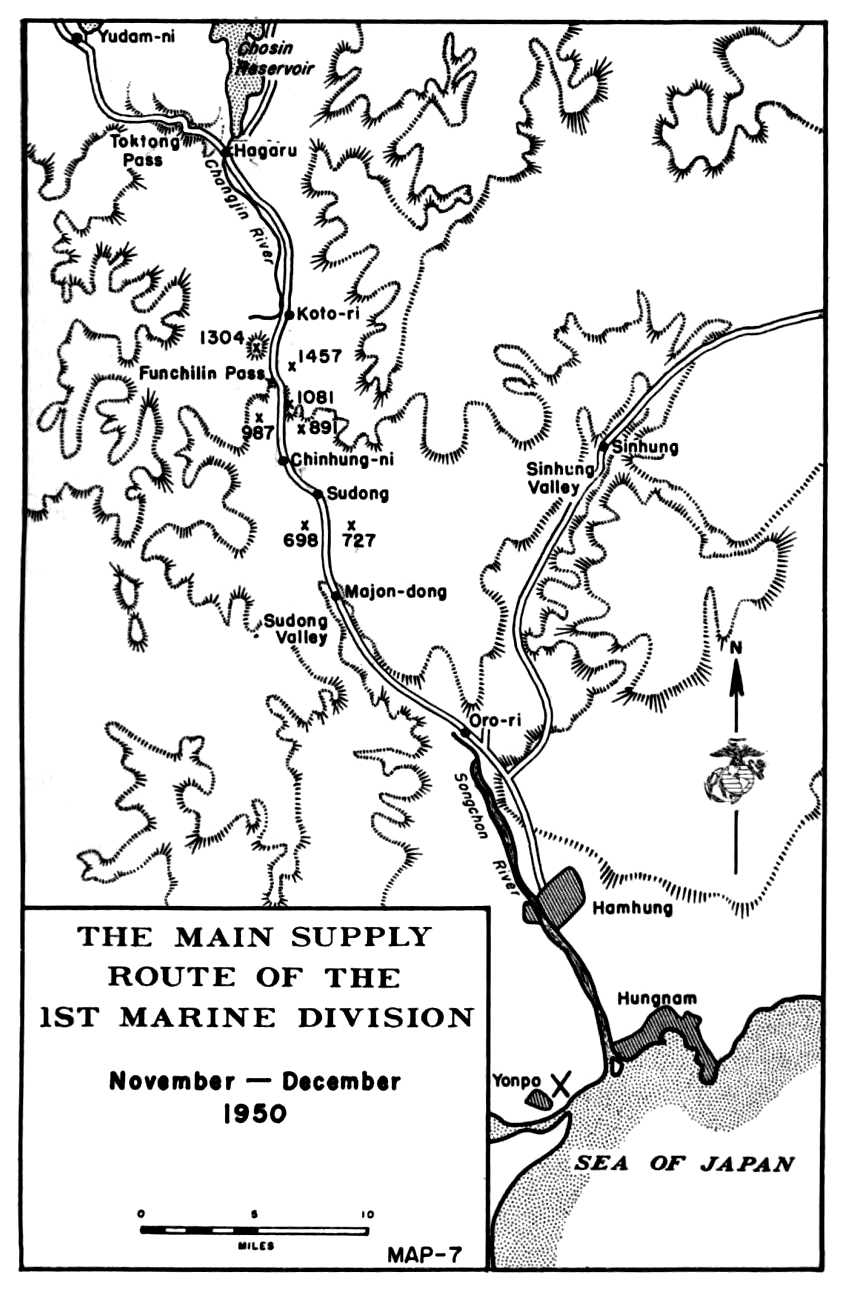
THE MAIN SUPPLY
ROUTE OF THE
1ST MARINE DIVISION
November-December
1950
MAP-7
Officers and NCOs of the 7th Marines, which was fated to be the
first United States unit to defeat the Chinese Communists in battle,
were given a verbal preview of the MSR and the part it might play in
their future. This was as the result of a flight of inspection made by
Major Henry J. Woessner on 30 October, following a briefing at the
X Corps CP in Wonsan. The S-3 of the 7th Marines was fortunate
enough to arrive just in time to hear the briefing given General Barr by
General Almond. Pointing to the map, the X Corps commander indicated
that the 7th Infantry Division would push northward to Hyesanjin
on the Yalu. Meanwhile the Marines were to head for the border
by way of Chinhung-ni, Koto-ri and Hagaru while the 3d Infantry
Division took over responsibility for the rear area.
“When we have cleared all this out,” concluded General Almond,
pointing again to the map, “the ROKs will take over, and we will pull
our divisions out of Korea.”239
At the X Corps CP, Woessner met a U. S. Army liaison officer just
returned from the 26th ROK Regiment with a report of that unit’s
encounter with Chinese Communists. The ROKs had been north of
Sudong when they collided with the new enemy and were pushed back,
after taking 16 prisoners.
Colonel Edward H. Forney, ranking Marine officer on the X Corps
staff, arranged for Major Woessner to make a reconnaissance flight over
the Hamhung-Hagaru route in an Air Force T-6. The S-3 saw no sign
of enemy troop movements all the way to the northern end of the
Chosin Reservoir, but he did not fail to note the formidable character
of the terrain through which the new MSR passed.
When he returned that evening with his report, Colonel Litzenberg
called a meeting of officers and NCOs at the regimental CP. In an
informal talk, he told them that they might soon be taking part in the
opening engagement of World War III.
“We can expect to meet Chinese Communist troops,” he concluded,
“and it is important that we win the first battle. The results of that
action will reverberate around the world, and we want to make sure
that the outcome has an adverse effect in Moscow as well as Peiping.”240
On 1 November the 7th Marines trucked out of Hamhung to an assembly
area midway between Oro-ri and Majon-dong. Moving into
position behind the 26th ROK Regiment without incident, Colonel
Litzenberg ordered a reconnaissance which took Lieutenant Colonel
Raymond G. Davis’ 1st Battalion about four miles northward to the
South Korean positions above Majon-dong. Late that afternoon the
regiment secured for the night in a tight perimeter.241
Attached to the regiment were the 3d Battalion, 11th Marines (Major
Francis F. Parry); Division Reconnaissance Company (First Lieutenant
Ralph B. Crossman); Company D, 1st Engineer Battalion (Captain
Byron C. Turner); 1st Motor Transport Battalion (Lieutenant Colonel
Olin L. Beall); Company E, 1st Medical Battalion (Lieutenant Commander
Charles K. Holloway); and detachments from the 1st Signal
Battalion, 1st Service Battalion, and Division Military Police Company.242
Intelligence based on the questioning of the 16 prisoners taken by
the ROKs had revealed that they had been attacked by elements of the
370th Regiment of the 124th CCF Division. Along with the 125th
and 126th, the other two divisions of the 42d CCF Army, the 124th
had crossed the Yalu during the period 14–20 October. After marching
southeast via Kanggye and Changjin, the unit deployed for the
defense of the Chosin Reservoir power complex while the 126th pushed
eastward to the Fusen Reservoir and the 125th protected the right
flank of the 42d CCF Army.243
X Corps G-2 officers concluded that these CCF forces were “probably
flank security” for the enemy’s 4th Army Group across the peninsula
in the EUSAK zone.244 The G-2 section of the 1st Marine Division
arrived at this interpretation:
The capture by the 26th ROK Regt. of 16 POWs identified as being members
of the 124th CCF Division ... would seem to indicate that the CCF
has decided to intervene in the Korean War. It would indicate, also, that
this reinforcement is being effected by unit rather than by piecemeal replacement
from volunteer cadres. However, until more definite information is
obtained it must be presumed that the CCF has not yet decided on full scale
intervention.245
Division intelligence officers concluded their analysis with the comment,
“The advantage to be gained by all-out intervention, at a time
when the NK forces are on the verge of complete collapse, is not
readily apparent.”246
There was little activity in the valley on 31 October and 1 November.
The ROKs, upon learning that they would be relieved shortly by the
7th Marines, withdrew from advance positions near Sudong to a valley
junction about four miles south of that town. Here, at 0600 on 2 November,
they were hit by an enemy “counterattack” which, since it was
of about two-platoon strength and of only 30 minutes duration,
amounted really to a CCF combat patrol action.247
Shortly after this clash, Lieutenant Colonel Raymond G. Davis’ 1st
Battalion, 7th Marines, moved out of the regimental assembly area and
marched toward the ROK lines at Majon-dong in route column. Major
Webb D. Sawyer’s 2d Battalion followed at an interval of 500 yards,
while overhead the Corsairs of VMF-312 orbited on station for reconnaissance
and close air support missions.248
The passage of lines proceeded smoothly and quietly, save for the
drone of aircraft as they probed the reaches of the valley. It was over
by 1030. Thereafter, progress to the front was slow and watchful. Led
by Company A, under Captain David W. Banks, the 1st Battalion took
ineffectual long-range CCF fire with only a few casualties. Batteries G
and H of 3/11 displaced forward during the morning, and at noon
Battery I opened up with the first of 26 missions fired by the artillery
battalion that day.
Though second in the tactical column, 2/7 was responsible for high
ground on both sides of the MSR, dominated on the left by Hill 698.
Company D ascended the eastern slopes early in the afternoon to relieve
a ROK unit that apparently had been unable to hold the crest. When
the South Koreans saw the Marines approaching, they promptly abandoned102
their position about midway up the slope and headed for the
rear.
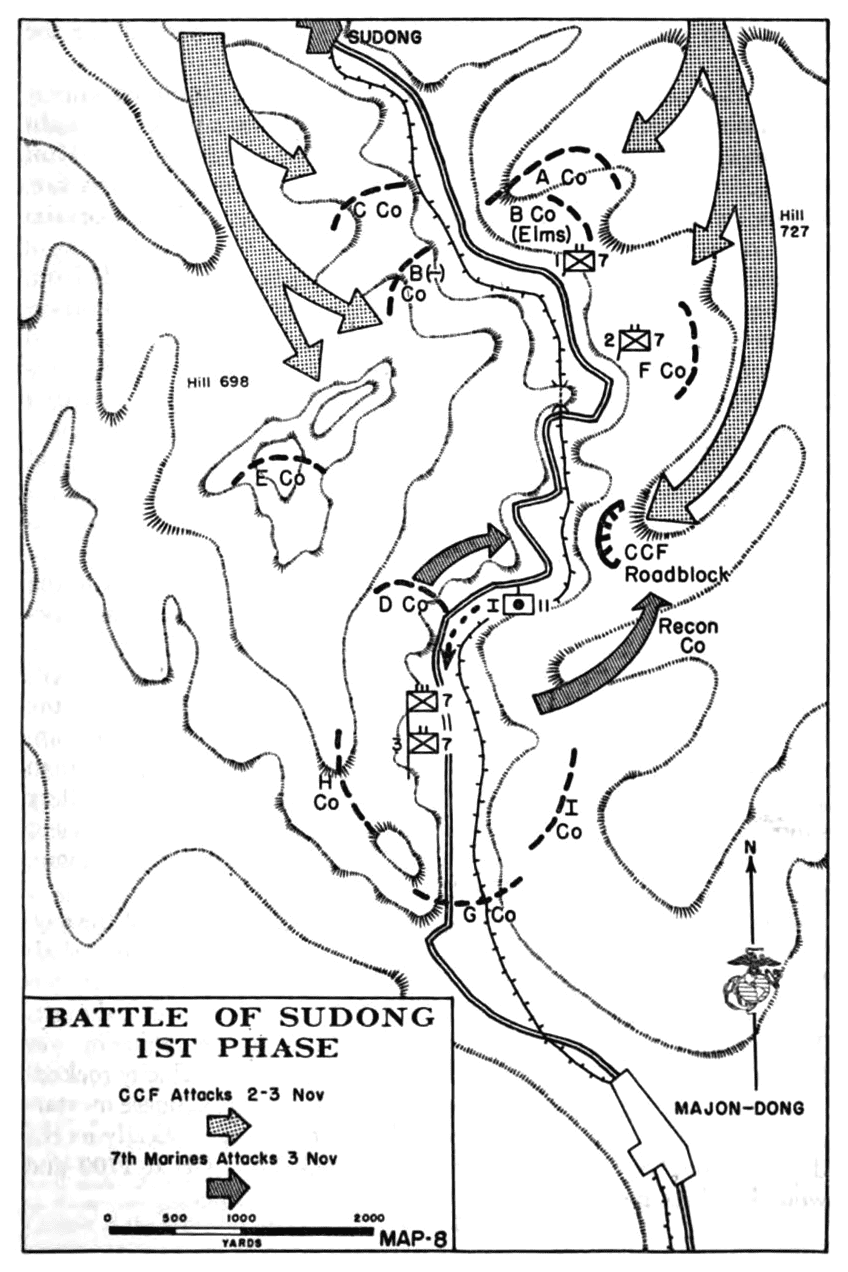
BATTLE OF SUDONG
1ST PHASE
MAP-8
Dog Company continued up the exposed hillside. Scattered enemy
shots from the top of the ridge gradually merged into a pattern of light
resistance as the Marines climbed higher. Captain Milton A. Hull
ordered his troops to halt, deployed his machine guns for return fire,
and radioed for an air strike. Within a few minutes a flight of Corsairs
swept down and worked over the ridgeline.
Hull’s only assault route traversed a barren area about 50 yards from
the crest. His two assault platoons, fully exposed to the enemy’s observation,
inched upward by fire and movement, taking casualties, and
finally reached the top. Their foothold on the ridgeline did not discourage
the Red Chinese, who continued to pour fire from skillfully
camouflaged positions. To prevent continued attrition among his now
exhausted troops (by this time they had climbed some 1600 vertical
feet from ground level over an average gradient of 25 per cent), Hull
recalled the two platoons to the eastern slopes and radioed for supporting
fire.
This fire was not forthcoming. Company D held a line near the
summit until about 2200 when Easy Company passed through to occupy
a small plateau about 150 yards below the crest for the night.
Meanwhile, down in the valley, Litzenberg’s “walking perimeter”
completed a 1300-yard advance by 1630. Owing to the nature of the
terrain, with the attendant 360-degree vulnerability, the regimental commander
stipulated that the 7th Marines’ column extend not less than
4000 (the minimum distance which would allow for close-in artillery
support) nor more than 6000 yards in length. This allowed sufficient
depth for over-all protection, with no loss of mutual support among
the three infantry battalions.
Enemy resistance had flared up now and then in the course of the day,
but Marine supporting arms so ruled the valley that no serious challenge
by the Chinese developed. VMF-312 flew 12 close support missions
in the Sudong area, and VMF(N)-513 assisted with several more.
The whole precipitous skyline on either side of the regiment was
blasted with 500-pound bombs, 20mm shells, and high-velocity rockets.
By way of reply to the heavy shelling and bombing, Chinese mortars
and at least one small artillery piece began to fire sporadically as the
day wore on. A 120mm mortar round struck 1/7’s CP at 1700 and
wounded three men.
Although the unit commanders of the 7th Marines anticipated more
fighting with the new enemy, they probably did not suspect what the
night held in store when the regiment dug in at dusk on 2 November.
They did not know that the 371st Regiment, 124th CCF Division, was
massed to the north and west, nor that the 370th Regiment occupied
high ground east of the MSR in strength—both units within easy striking
distance of Litzenberg’s perimeter. The 372d Regiment, in reserve,
stood poised in its hidden encampment several miles to the rear.249
Leading elements of the 7th Marines deployed defensively less than
a mile south of Sudong (see Map 8). To the right of the MSR, Able
Company’s 3d, 2d, and 1st Platoons, in that order, formed a line which
extended across Hill 532 and part way up a spur of massive Hill 727,
then bent rearward sharply to refuse the east flank. Emplaced along
the road in anti-mechanized defense was the company’s 3.5-inch rocket
squad. The 60mm mortar section and company CP set up in the low
ground behind the spur, but Captain Banks himself decided to spend the
night in an OP with his rifle platoons.
Lieutenant Colonel Davis of 1/7 deployed Charlie Company (-)
across the MSR from Able, on the northeast slopes of Hill 698.250 To
the rear, headquarters and one platoon of Company B dug in on an
arm of the same hill, while the other two platoons went into position on
the lower reaches of Hill 727 behind Company A. One platoon of
Charlie Company, Davis’ CP and the battalion 81mm mortars were
located in low ground behind Able Company and the elements of
Baker on the right of the road.
South of 1/7 lay Major Sawyer’s 2d Battalion with Company D at the
foot of Hill 698, E on its crest and slopes, and F spread along the steep
incline of 727. Sawyer’s CP and elements of the 7th Marines’ Antitank
and 4.2-inch Mortar Companies were situated in a shallow meadow
along the road beneath the Fox Company positions. Several hundred
yards to the rear, south of a sharp bend in the road, Major Maurice E.
Roach’s 3d Battalion deployed in what was in effect a second perimeter
protecting the regimental train, 3/11, and Litzenberg’s CP on the valley
floor. Tieing in at the MSR, Companies H and I occupied ridges on
the left and right of the road respectively, while G (-) arched through
the low ground as the southernmost element of the regiment. Colonel
Litzenberg was concerned about the valley which joined the Sudong
Valley below Oro-ri lest it contain Chinese. He had Major Roach make
a helicopter reconnaissance during the afternoon. Roach sighted nothing.251
Except for the occasional thump of an incoming mortar round, night
settled on the valley and the Marine perimeter with deceptive quiet.
Deceptive, since at Sudong two CCF battalions were poised to smash at
the 7th Marines with a well-coordinated double envelopment.
At 2300, Davis’ 1st Battalion reported itself under attack from the
right flank, the enemy apparently descending the higher slopes of Hill
727. This announcement was somewhat premature, as the Marines of
Company A were merely experiencing the infiltration and probing that
precede almost every Communist assault. At 2400, 2/7 reported two
enemy battalions on the left flank.252 During the first hour of 3 November,
sobering messages were received from Litzenberg’s northernmost
units. What had begun at 2300 as a staccato of small-arms fire swelled
in volume by imperceptible degrees until Hills 698 and 727 were engulfed
in a ceaseless din. And by 0100 the 1st and 2d Battalions of the
7th Marines bent under the weight of a full-scale attack on both flanks.
Avoiding the obvious approach through the corridor leading south
from Sudong, the commander of the 371st CCF Regiment had dispatched
a battalion along each of the ridgelines bordering the valley.
Bursting flares and bugle calls signaled when the two assault units
came abreast of the Marine positions on the lower reaches of Hills 727
and 698. Then, treading swiftly and silently in their rubber sneakers,
the Chinese infantrymen swept down obliquely and struck Able and
Fox Companies on the east and Baker on the west. Charlie on the
slopes of Hill 698 was undisturbed. Where the Chinese met resistance,
they slugged it out at close range with grenades and submachine guns.
Where they found gaps, they poured through and raced to the low
ground. To the Marines, the specific CCF objectives were not readily
apparent in those hectic hours before dawn, for the enemy seemed to
be everywhere.253
Shortly after the battle was joined high on the hillsides, Marines at
Able Company’s CP heard the clanking sounds of a tracked vehicle on
the MSR to the north. When the machine passed the rocket section at
the roadblock without incident, they dropped their guards momentarily,
believing it to be a friendly bulldozer. The big vehicle rumbled into the
CP and stopped, one headlight glaring at exposed mortar crews and
headquarters personnel.
“Tank!” shouted Staff Sergeant Donald T. Jones, section chief of
Able Company’s 60mm mortars.
It was a Russian T-34, one of the five remaining to the 344th North
Korean Tank Regiment, supporting the 124th CCF Division. The
troops at the roadblock had been caught napping.
A burst of machine-gun fire from the tank sent the lightly armed
Marines scurrying for cover. The armored vehicle quickly withdrew to
the road and drove farther south, into 1/7s’ CP. After a short, inquisitive
pause, it rumbled toward the 1st Battalion’s 81mm mortar positions.
The Russian 85mm rifle flashed four times in the darkness, but the
shells screamed harmlessly over the mortars and detonated in the high
ground beyond.
Rocket launchers of Charlie Company and the recoilless rifles of
7th Marines Antitank Company opened up from positions around
1/7’s headquarters. At least one 75mm round struck home, and the
belt of sandbags around the T-34’s turret began to burn. The tank
swung back onto the MSR and headed north. Approaching Able Company’s
roadblock, through which it had entered the Marine position,
it took a hit from the 3.5-inch rocket section. In reply, one 85mm shell
at pistol range all but wiped out the Marine antitank crew. The enemy
vehicle, trailing flame and sparks, clanked around a bend in the road
and disappeared.
Not long after this astounding foray, the fighting on Hills 698 and
727 spread down to the MSR. The 1st and 2d Platoons of Company A,
pressed now from three directions and suffering heavy casualties, retracted
to the 3d Platoon positions at the tip of the spur. Some of the
men were cut off and forced back on the Baker Company elements east
of the MSR. Ultimately, one of the two Company B platoons in this
area was driven down to the low ground, and the other forced to fall
back. Later they counterattacked and recovered their foxholes.
West of the MSR, the remainder of Company B fought off assaults
on its left flank and rear by Chinese who had skirted around Charlie
Company’s advance positions.254 Lieutenant Colonel Davis sent the battalion
reserve, Lieutenant Graeber’s 2d Platoon of Baker, to reinforce
the hard pressed left platoon. Attempting to lead his men across the
MSR, Graeber found the route effectively blocked by the enemy in the
river bed.
Descending now from both sides of the road, enemy infantrymen
swarmed over the valley floor. They overran most of the 7th Marines
4.2-inch Mortar Company and captured one of its tubes. They seriously
threatened the 1st and 2d Battalion CPs and the AT Company in the
same general idea. High on the slopes in 2/7’s zone, Companies E and
F were beset by small bands of infiltrators. And though these two
companies held their ground, the Reds found their flanks, slipped behind
them, and entrenched at the key road bend separating 2/7 from
3/7 to the south. The principal Marine unit at the sharp curve in the
MSR was Battery I, whose position in the low ground became increasingly
precarious as the night wore on.
Dawn of 3 November revealed a confused and alarming situation in
the valley south of Sudong. Enemy troops shared the low ground with
Marine elements between the 1st and 2d Battalion CPs, and they had
blown out a section of the MSR in this locale.255 The 2d Battalion’s
commander later remarked, “When daylight came, we found that we
were in a dickens of a mess. The rifle companies were well up in the
hills, and the Chinese were occupying the terrain between the CP and
the companies.”256
Between 2/7 and 3/7, a company of Reds had dug in on a finger of
high ground overlooking the road bend and Battery I from the east.
Scattered Chinese forces roamed Hills 698 and 727 almost at will. On
the latter height, elements of the 371st CCF Regiment had been reinforced
by a battalion of the 370th, so that pressure against the right
flank of 1/7 and 2/7 continued long after daybreak.257
With his lead battalions thrown back on the defensive, Colonel Litzenberg
relied on overwhelming superiority in supporting arms to tip
the scales on 3 November and regain the initiative. While the regimental
4.2-inch mortars fired, howitzers of Batteries G and H thundered
almost ceaselessly the whole night long from positions within 3/7’s
perimeter. Battery I, after being extricated from the enemy dominated
road bend at 1100 with the help of a platoon of G Company, added
its metal to the bombardment. In the course of the day, the 18 field
pieces of the battalion fired a total of 1431 rounds in 49 missions.258
VMF-312 provided constant air cover after first light. Its planes not
only scourged enemy assault troops left exposed on the ridges, but also
searched out and attacked CCF artillery positions and vehicles. This
squadron alone flew 18 close support missions on 3 November, the
alternating flights being led by Major Daniel H. Davis, Captain Harry
G. C. Henneberger, Captain George E. McClane, and First Lieutenant
Shelby M. Forrest.259 VMF(N)-513 dispatched a flight of night fighters
to Sudong at 0910 under Major Robert L. Cochran. After raking enemy
troops with 1500 rounds from their 20mm cannon, Cochran and his
three pilots unloaded three general purpose and fragmentation bombs
along with 15 high-velocity rockets.260
As much supporting fire fell within the 7th Regiment’s perimeter as
outside. Since the crack of dawn it had been the principal mission of
the advance Marine elements to eject scores of Chinese troops, individuals
and small bands, who were scattered along the hillsides and
valley floor within the zones of the 1st and 2d Battalions. While accomplishing
this task, the Marines established a tactical principle for
coming weeks: that to nullify Chinese night tactics, regardless of large-scale
penetrations and infiltration, defending units had only to maintain
position until daybreak. With observation restored, Marine firepower
invariably would melt down the Chinese mass to impotency.
This was the case on 3 November, although the melting down process
was a savage, all-day affair. With the help of air, artillery, and mortars,
the 1st Battalion cleared the low ground by midmorning and restored
its right flank later in the day. The Chinese in the valley were
crushed, the main group being annihilated by the heavy machine guns
of Weapons Company as they attempted to march northward along
the railroad in column at daylight. Counted enemy dead in 1/7’s zone
alone amounted to 662.261
The main effort in the 2d Battalion’s zone was aimed at the CCF
concentration on the spur of Hill 727 overlooking the bend in the
MSR. Owing to this barrier, Litzenberg had to call for an airdrop of
supplies to sustain his leading elements on 3 November.262 Major Sawyer
ordered Company D, on the base of Hill 698 to the south of the roadblock,
to move up the valley, cross the river, and clean out the spur at
Hill 727. Finding the low ground blocked by heavy fire, Captain Hull
circled to the left along the incline of Hill 698, intending to come
abreast of the Chinese strong point before striking at it across the
MSR.263
Meanwhile, Captain Walter D. Phillips’ Easy Company, perched on
the side of Hill 698, struggled to secure the peak of that hill mass. A
rush by First Lieutenant John Yancey’s 2d Platoon at about 0800 secured
a small plateau about 50 yards below the crest against the opposition
of one Chinese soldier. First Lieutenant Robert T. Bey’s 3d
Platoon then passed through and frontally assaulted the peak only to
be thrown back by what Bey calls “the most concentrated grenade barrage
this writer has had the dubious distinction to witness.” Following
an air strike at about 1400 Easy Company secured the crest with its
40 Chinese dead.264
With all of the rifle companies involved in fire fights or security
missions, Litzenberg resorted to supporting arms and headquarters
troops to knock out the roadblock. From his regimental CP he dispatched
First Lieutenant Earl R. Delong, Executive Officer of the AT
Company, with a reserve 75mm recoilless rifle and a makeshift crew.
Delong moved into position opposite the strong point at a range of
500 yards, while air and artillery hammered the enemy positions.265
Simultaneously, the Division Reconnaissance Company ascended the
high ground east of the MSR in the vicinity of Litzenberg’s headquarters,
then advanced northward along the ridge to envelop the roadblock.
This unit, just returned from an active, overnight patrol to
Huksu-ri, moved into a hillside position and took the rear of the
Chinese under fire across an intervening gulley.266
Delong’s 75 had begun firing high explosive and white phosphorus
into the enemy’s front; and Company D, after cleaning up the scattered
resistance on the slopes of Hill 698, closed on the roadblock under
cover of two air strikes and prepared to assault. The Chinese, obviously
shaken by the pounding of supporting arms, had commenced a withdrawal
into the hills east of the roadbend when Hull’s men began their
assault. From Recon Company’s positions, Lieutenant Crossman called
for air and artillery to catch the retreating Reds in the open. But the
request was turned down because Dog Company troops were already
filtering through the objective area. By 1810 the roadblock was eliminated,
although Dog Company had to withstand two counterattacks
before its hold on the spur was secure. The Chinese had left behind
28 dead, strewn among the boulders and recesses of a natural redoubt.267
The main enemy encroachments having been smashed, the 7th Marines’
MSR was again clear for traffic, save for long-range harassment
by an occasional CCF rifleman hidden in the hills. At dusk, trucks
streamed northward from the regimental CP to deliver supplies to the
1st and 2d Battalions and to evacuate about 100 battle casualties from
those units. The wounded were rushed to the Division Hospital and
the 121st Army Evacuation Hospital in Hungnam.268
The coming of darkness on 3 November marked the finish of the first
phase. Litzenberg’s perimeter remained essentially the same as on the
previous day, the only changes being Company D’s occupation of the
high ground east of the road bend, Recon Company’s assumption of
local security at the regimental CP, and 3/11’s tighter concentration
within the zone of 3/7. What few light contacts occurred during the
night were decided quickly by Marine artillery and mortars.269
Later intelligence evaluations proved that these contacts could have
involved only CCF patrols or stragglers, for it was in this same period
that the 370th and 371st CCF Regiments withdrew some three miles
from Sudong to a defense line established by elements of the 372d
Regiment north of Chinhung-ni. The two assault units had paid a
high price for failure during the 2–4 November fighting. The 371st
Regiment lost the equivalent of five companies out of its 1st and 3d
Battalions, with the total dead estimated at 793. And the 3d Battalion,
370th Regiment, was reduced by the destruction of two companies.270
It was a wobbly 124th CCF Division, then, that dug in with heavy
machine guns and mortars on two massive hills, 987 and 891, flanking
the MSR about two miles north of Chinhung-ni. The depleted 344th
NKPA Tank Regiment could not avail itself of such defensible terrain,
for until Marine engineers widened the tortuous cliff road through
Funchilin Pass it would not accommodate armor.271
Apparently the Chinese Communists had left their North Korean
comrades of the 344th to fend for themselves. The NKPA unit had
already dwindled considerably from its original organization of three
armored and three infantry companies. On 2 November it comprised
only five T-34s and their crews. One of these machines, after being
damaged during the single-handed raid on the 7th Marines’ perimeter
that night, was abandoned the next day. The NKPA crews put the
remaining four vehicles into camouflaged positions next to the MSR at
Chinhung-ni, where they waited resignedly at a tactical dead-end.272
Colonel Litzenberg was aware of the probability of further resistance
along the road, since on 3 November Marine air had reported approximately
300 enemy trucks—in groups of 15 or 20—on the move south
of the Chosin Reservoir.273 At dawn of 4 November, after a night of
relative calm around the old perimeter, he ordered his subordinates to
conduct vigorous patrolling preparatory to continuing the advance.274
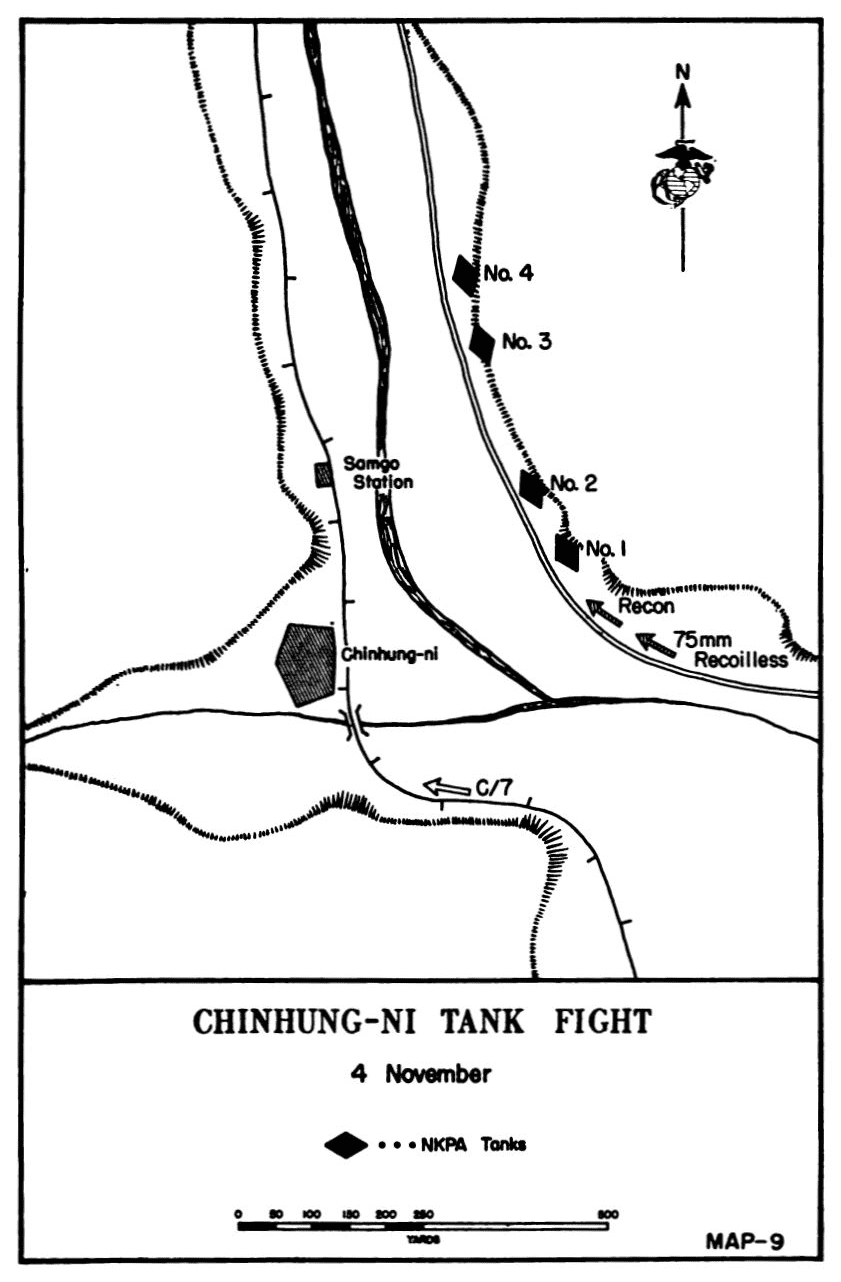
CHINHUNG-NI TANK FIGHT
4 November
MAP-9
Troops of 1/7 moved forward in the early light and scouted the
valley as far north as the edge of Sudong. They met no opposition and
returned to the perimeter. Litzenberg then formed the 7th Marines in
column, with the Reconnaissance Company in the lead, followed by
1/7 and 3/7 in that order. He left the 2d Battalion in position on Hills
698 and 727 to protect the regimental flanks.275
Recon Company moved out in jeeps at 0800, First Lieutenant Ernest
C. Hargett’s 1st Platoon in the point. Entering Sudong a short time
later, the vanguard rounded a bend in the middle of town and surprised
a group of CCF soldiers. In a 30-minute fight, Hargett’s men killed
three and captured about 20. The 2d and 3d Platoons of the Reconnaissance
Company meanwhile inspected the high ground above Sudong
without opposition.
Lieutenant Crossman reorganized his company in column on the road
and set out for Chinhung-ni with Second Lieutenant Donald W. Sharon’s
2d Platoon in the lead. About the same time, 1000, the 1st Battalion
moved out of the 7th Marines’ perimeter south of Sudong and traced
Crossman’s route through the low ground.
At Chinhung-ni the highway runs along the east side of the river
while the railroad traces the west side. The narrow-gauge track enters
the village over a bridge spanning a branch stream. Just beyond is
Samgo station, which served as a railhead for the cable-car system of
Funchilin Pass. As the Reconnaissance Company approached Chinhung-ni
on 4 November, a small group of Chinese soldiers milled around the
train cars and buildings of Samgo Station. They probably had some
tactical connection with the four T-34 tanks camouflaged opposite
them across the river and road; but the two forces seemed oblivious not
only of each other but also of the Marines bearing down on them.
Lieutenant Sharon’s platoon advanced rapidly from Sudong at 1400,
followed closely by the rest of the Reconnaissance Company and a
section of 75mm recoilless rifles. About 2000 yards south of Chinhung-ni
they halted on sighting fresh tank tracks but quickly moved
out again on orders of Lieutenant Colonel Davis. At the highway entrance
to Chinhung-ni, Sharon’s troops unknowingly passed the first
T-34, hidden on the right of the road. Coming abreast of the second
Communist tank, which also remained undetected for the moment, the
Marines spotted the Chinese soldiers across the river at Samgo Station
and opened fire.
The CCF infantrymen scattered under the hail of small-arms fire
and many of them were cut down. This was fortunate for Company C
of 1/7, which was marching along the railroad tracks and just then
nearing the bridge south of the station, where it could have been taken
under enfilade fire by the enemy soldiers and tanks.
It was during the exchange with the Chinese that Sharon and his
men spotted the second North Korean tank under a pile of brush on the
right of the road. The platoon leader, accompanied by Staff Sergeant
Richard B. Twohey and Corporal Joseph E. McDermott, climbed upon
the dormant vehicle. Suddenly the periscope began to revolve. McDermott
smashed the glass and Twohey dropped in a grenade. With
Sharon they jumped to the ground just as the grenade exploded inside
the machine.
The tank engine roared and the vehicle lurched toward the three
Marines. Twohey jumped on it again and dropped another grenade
down the periscope. After the dull thump of the second explosion, the
T-34 stopped dead and began smoking.
By this time Staff Sergeant William L. Vick’s 75mm recoilless gun
section and 3.5-inch rocket crews of Company C had moved up. Together
they gave the coup de grace to the damaged T-34. Simultaneously,
Sharon’s men saw a thatched hut farther down the road disintegrate
as tank number three emerged, its 85mm rifle swinging menacingly
toward the valley crowded with Marines and vehicles. First
Lieutenant Raymond J. Elledge fired his 75s from their carts, and
Company C’s rocket launchers opened up. The T-34 took hits but
rumbled on. Seconds earlier, First Lieutenant Dan C. Holland, Forward
Air Controller for 1/7, had radioed overhead Corsairs for assistance.
One of the gull-winged planes plummetted out of formation
and unleashed a pair of five-inch rockets. They were direct hits. The
T-34 blew up and died on the road.276
Sharon and his men moved forward cautiously. While passing the
blazing hulk, they spotted enemy tank Number Four, camouflaged
against a hillside just ahead. At almost the same moment, Marines
passing Chinhung-ni stumbled upon docile tank Number One in the
midst of their formation. Recoilless rifles and rocket launchers blasted
the machine, and its crew climbed out and surrendered. Sharon then
led the antitank crews through the river bed toward the fourth T-34.
The Communist tankmen, entrenched on the slope behind their empty
vehicle, gave up without a fight. The tank itself was knocked out by
3.5-inch rockets and 75mm shells; and the 344th NKPA Tank Regiment
ceased to exist.
After the destruction of enemy armor, Colonel Litzenberg began deploying
the 7th Marines in perimeter around the valley junction at
Chinhung-ni. The advance had netted about 6000 yards by midafternoon,
and the remaining daylight was needed to bring all elements
forward and consolidate the newly won ground.277
Aware that the Chinese were at the top of Funchilin Pass but not that
he was directly under their guns, the regimental commander at 1600
ordered Reconnaissance Company to patrol some 2000 yards into Funchilin
Pass and outpost the southern tip of Hill 891. The high ground
selected for the outpost coincided with the eastern half of the Chinese
forward line, and it would later be remembered as “How Hill” in
honor of Company H of 3/7.278
As 1/7 dug in on the heights flanking Chinhung-ni, Recon Company,
with Second Lieutenant Charles R. Puckett’s 3d Platoon leading, advanced
in motorized column about a mile into the pass. At this point,
Hill 987 looms up on the west and the highway veers sharply to the
east for approximately 1000 yards. After a hairpin turn, the road
climbs on a parallel line almost to its starting point, then resumes its
northerly course, clinging to the rocky wall of Hill 891 which rises
abruptly from the chasm that separates it from Hill 987.
Puckett’s platoon had approached the road bend warily, for a sizeable
enemy group had been spotted earlier near the base of Hill 987 across
the gorge. At 1630 the first two jeeps of the column eased around the
curve and immediately came under fire from Hill 987 to the left, 891
to the front, and from a CCF patrol to the right, on the road itself.279
For 45 minutes Puckett and his men were pinned to the road and hillside,116
and only darkness and a strike by Marine air finally enabled the
whole column to withdraw to the 7th Marines’ lines. The clash cost
Recon two killed and five wounded, and heavy machine-gun fire had
destroyed the two lead jeeps.280
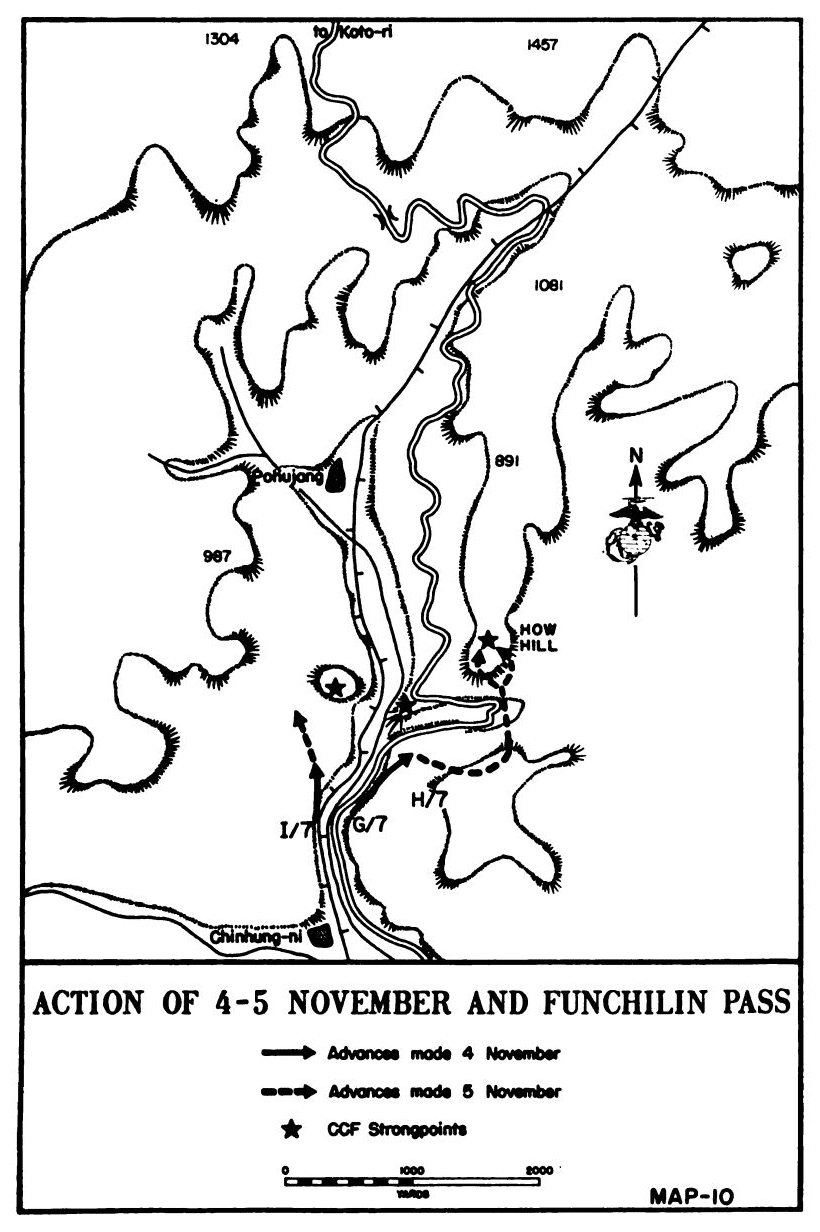
ACTION OF 4–5 NOVEMBER AND FUNCHILIN PASS
MAP-10
During the relatively quiet night of 4–5 November, Colonel Litzenberg
issued his order for the next day’s advance. The 1st Battalion was
to hold the flanks at Chinhung-ni while 3/7, followed at a distance of
500–1000 yards by 2/7, passed through and attacked into Funchilin
Pass. Major Parry’s 3/11 and the 4.2 Mortar Company were to support
the infantry by high-angle fire from positions south of Sudong.281 Resistance
could be expected, for even as the 7th Marines peacefully sat
out the hours of darkness, the night fighters of VMF(N)-513 were
bombing and strafing enemy convoys around the southern tip of the
Chosin Reservoir.282
At 0700 Lieutenant Hargett’s 1st Platoon of Recon Company departed
Chinhung-ni along the MSR to patrol on the right flank. Reaching
the hairpin curve, the platoon was pinned down by enemy fire at
exactly the same place where Puckett’s unit had come to grief. VMF-312
and 3/11 promptly went into action, and Hargett ultimately withdrew
his patrol under the shield of their supporting fire. Marine casualties
were four wounded.283
Major Roach’s 3d Battalion moved out for the attack at 0800, passing
through the high-ground positions of 1/7 on either side of Chinhung-ni.
Company I advanced toward Hill 987 and G toward 891 (see Map 10).
Both units were hit hard by small-arms and machine-gun fire as they
came abreast of the road bend; and for the remainder of the day, the
“advance was negligible.”284
From 1000 onward, the second phase of the battle roared to a climax
as a duel between supporting arms. In 26 missions during 5 November,
the batteries of 3/11 threw 943 shells into the enemy positions. The
Chinese answered with counterbattery fire from their 122mm mortars,
but toward the end of the day these weapons were silenced by Marine
howitzer barrages. A forward observer with Company G reported an
enemy ammunition dump destroyed. This information was later verified
by a POW who mentioned the following additional losses in CCF
mortars: 10 crewmen killed and 17 wounded, one mortar destroyed, two
mortars put out of action, and the dispersal of “most of the remaining
personnel.”
VMF-312 flew 37 sorties in 90 hours of close support combat on the
5th. Between Chinhung-ni and the Chosin Reservoir, 21 enemy trucks
were destroyed. Pilots reported that “the surrounding ridges were filled
with enemy troops” and that their strikes against these Chinese were
“extremely effective.” Led by Major Cochran and Captain Otis W. S.
Corman, flights from VMF(N)-513 blasted troops, buildings, supply
vehicles, and gun emplacements scattered from Koto-ri at the top of
Funchilin Pass to Hagaru at the reservoir. General Smith, during a
helicopter visit to Litzenberg’s CP, remarked that a “considerable number
of planes ... really worked the place over.”285
On the ground, the fight ended at dusk with the Chinese retaining
their firm grip on these well camouflaged positions studding Hills 891
and 987 despite heavy losses.286 Marine casualties were light, for it was
the tortuous terrain in conjunction with enemy bullets, not enemy fire
alone, that obstructed the attackers. Since General Smith earlier in the
day had named Koto-ri as the 7th Marines’ immediate objective, Colonel
Litzenberg ordered the 3d Battalion to resume the advance at 0800 the
next morning.
The night of 5–6 November witnessed only minor contacts around
the regimental perimeter. Some 200 Korean laborers accounted for most
of the activity during darkness as they carried supplies to forward
Marine positions and evacuated casualties to the rear.
Major Roach’s plan for 6 November called for How Company, supported
by the fire of George, to envelop the southeast slope of Hill
891 while Item continued its attack on Hill 987. At about 0800 First
Lieutenant Howard H. Harris led How Company out of its reserve
position. It took him until nearly 1500 to traverse the rugged landscape
and get into position. Meanwhile, Item Company under First Lieutenant
William E. Johnson had beaten off one counterattack and edged
about 300 yards closer to Hill 987, with its most effective opposition
coming from bunkers on a spur overlooking the MSR.
Captain Thomas E. Cooney had been wounded twice the previous
day while leading Company G against the trenches and foxholes on
the southern tip of Hill 891. Except for a feint by one platoon along
the MSR into the hairpin turn, his company spent the day in a long-range
fight with the Chinese defenders.
Lieutenant Harris led his men over the high ground behind G into
positions to the east. Cooney’s experience showed that the only possible
approach to Hill 891 was to flank it from the southeast. Although the
fresh company arrived sometime after 1400, its attack was held up
until about 1600 to await air. Following a strike by two Corsairs, the
howitzers of 3/11 and the regimental 4.2 mortars began pounding the
Chinese positions.
How Company jumped off at about 1615. Two assault platoons, led
by Second Lieutenants Robert D. Reem and Minard P. Newton, descended
into the intervening gulley at the tip of the hairpin curve.
During a quick reorganization in the low ground, machine guns were
posted to cover the ascent. Then the platoons started up towards the
enemy-held summit through companion draws, Harris accompanying
Newton’s outfit on the left.
The powdery soil of the steep slope made climbing difficult and
exhausting. About a hundred yards up, Newton’s platoon began receiving
light fire, followed a few yards farther by a hail of grenades
and machine gun slugs. The Marines inched forward and were stopped
by the Chinese fire. On the right, meanwhile, Reed climbed against no
opposition, so it appeared that the envelopment was working. Unexpectedly,
the two draws converged near the top of the hill, with the
result that the platoons met.
Lieutenant Harris revised his plans by directing Newton, with his
left squad supporting by BAR fire, to lead Reem to the top of the hill.
Once there, Newton was to swing right and Reem left to envelop the
Chinese positions. Newton worked a squad up onto a nose extending
out from the summit. The Chinese replied with a renewed barrage of
grenades and counterattacked Newton’s left. Sergeant Charlie Foster,
seeing apparent victory turning into defeat, lunged forward to break up
the attack. He reached the top and died but the men behind him
repulsed the Reds.
During the close fighting on the left, Lieutenant Reem had gathered
his squad leaders for instructions preparatory to the final assault on
the right. An enemy grenade fell into the midst of the group, and
Reem was killed as he smothered the explosion with his body. Staff
Sergeant Anthony J. Ricardi took over the platoon.
At about 1800 Harris radioed Roach that his troops were exhausted.
Although it was already dusk, he was bringing up his reserve platoon,
he said, for the Chinese still held the crest in strength. Company H
had taken only eight casualties, but ammunition was low and the approaching
darkness prevented the dispatching of more fresh troops. The
battalion commander relayed the report to Colonel Litzenberg, who
immediately ordered the company to disengage and withdraw. The
fighting descent under cover of a 4.2 mortar and artillery bombardment
brought Company H back within the lines of 3/7 by 2000 with its six
wounded and the body of Lieutenant Reem.
Darkness on the night of 6 November descended like a cloak over the
124th CCF Division. In the morning the Chinese had vanished. The
3d Battalion, 7th Marines, encountered no opposition whatever as it
occupied the southern tips of Hills 891 and 987.287
The mysterious disappearance of this unit, following the equally
strange withdrawal of the Chinese Reds who made the first CCF contacts
in the EUSAK zone, aroused no end of speculation. Officers of the 7th
Marines believed that enemy losses had been heavy enough for a disabling
effect. This opinion was confirmed the following year when a
Marine Corps Board visited Korea for a special analytical study of
Marine operations of 1950, based on all Army and Marine records
available at that time as well as interviews and interrogations. The
Board concluded that “the 124th CCF Division was estimated to have
been rendered militarily noneffective.”288
Following the enemy’s disappearance on the night of 6–7 November,
the 7th Marines occupied the southern reaches of Hills 891 and 987
while reconnoitering to the top of 891. The rest of the day and all
the next was devoted to consolidating positions along the MSR and
sending out patrols in a vain search for the vanished 124th CCF Division.289
On 8 November, General Almond visited the 7th Marines. Upon
hearing of the valor of Captain Cooney at “How Hill,” he awarded
that officer the Silver Star medal on the spot. There being neither pendant
nor citation available, the Corps Commander pinned a slip of
paper to Cooney’s jacket in the brief ceremony. Scrawled on the fragment
was the inscription, “Silver Star Medal for Gallantry in Action—Almond.”290
While the 7th Marines advanced astride the MSR, a volunteer patrol
of fifteen men, led by First Lieutenant William F. Goggin of 2/7, traced
a lonely, circuitous route in the mountains to the west. Having left
Chinhung-ni at 1200 on 8 November, the scouting party covered some
25 miles through perpendicular wilds during the following 26 hours.
This journey brought it to the Chosin Reservoir plateau at a point just
southwest of Koto-ri.
Lieutenant Goggin, his slight wound the only scar of the patrol’s
single clash with Chinese, radioed Colonel Litzenberg that Koto-ri was
clear of enemy. He then led his party southward, and in the evening
of the 9th, returned through the lines of 3/7.291
The Marines had been told that big game animals were hunted before
the war in the mountains of northeast Korea. But not until the otherwise
calm night of 9–10 November did a four-legged enemy invade
the positions of RCT-7. Near the cable-car trestle, midway through
Funchilin Pass, an unfriendly bear, no doubt a Russian bear, paid a
nocturnal visit to the 1st Platoon of George Company. An unnamed
Marine PFC, awakened in his sleeping bag, swore afterwards that the
animal was wearing a hammer and sickle emblem. However this may
be, the intruder was routed by his startled yell and disappeared into
the night.292
At 0830 on 10 November—the Marine Corps Birthday—the 1st Battalion
passed through the 3d and emerged from Funchilin Pass onto
the open plateau. Koto-ri (designated as Objective One) was occupied
without opposition an hour and a half later. Litzenberg halted his
column and drew up a perimeter around the mountain village.
Upon reaching the Koto-ri plateau the 7th Marines was first to meet
a new enemy who would take a heavier toll in casualties than the
Chinese. This was General Winter, who has won many a historic campaign.
When the first cold blasts struck, “our men were not conditioned
for it,” commented Litzenberg. “The doctors reported numerous
cases where the men came down to the sickbay suffering from what
appeared to be shock. Some of them would come in crying; some of
them were extremely nervous; and the doctors said it was simply the
sudden shock of the terrific cold when they were not ready for it.”293
The Marines recovered quickly after “thawing out,” and platoon
warming tents, heated by camp stoves burning fuel oil, were set up at
Koto-ri. Buckets of steaming water were provided for the warming
of “C” rations.
Hot weather, however uncomfortable it may be, is fighting weather as
compared to sub-zero cold which seems to numb the spirit as well as
flesh. Cold weather clothing is a handicap to movement and the use
of firearms; and some weapons, particularly the carbine, are not dependable
at low temperatures. It was probably as well for morale that
the Marines at Koto-ri could not foresee that this was only the beginning
of a prolonged operation in sub-zero weather without a parallel
in the nation’s history.294
Until 13 November, when the 7th Marines advanced toward Hagaru,
patrols from Koto-ri repeatedly sighted bands of Chinese in the distance.
Except for a fight on 11 November in which C Company claimed to
have inflicted 40 casualties on the enemy and lost four killed and four
wounded, there was little action. With a little pressure on the ground
or from the air, the enemy vanished, and thus the uneasy calm continued.295
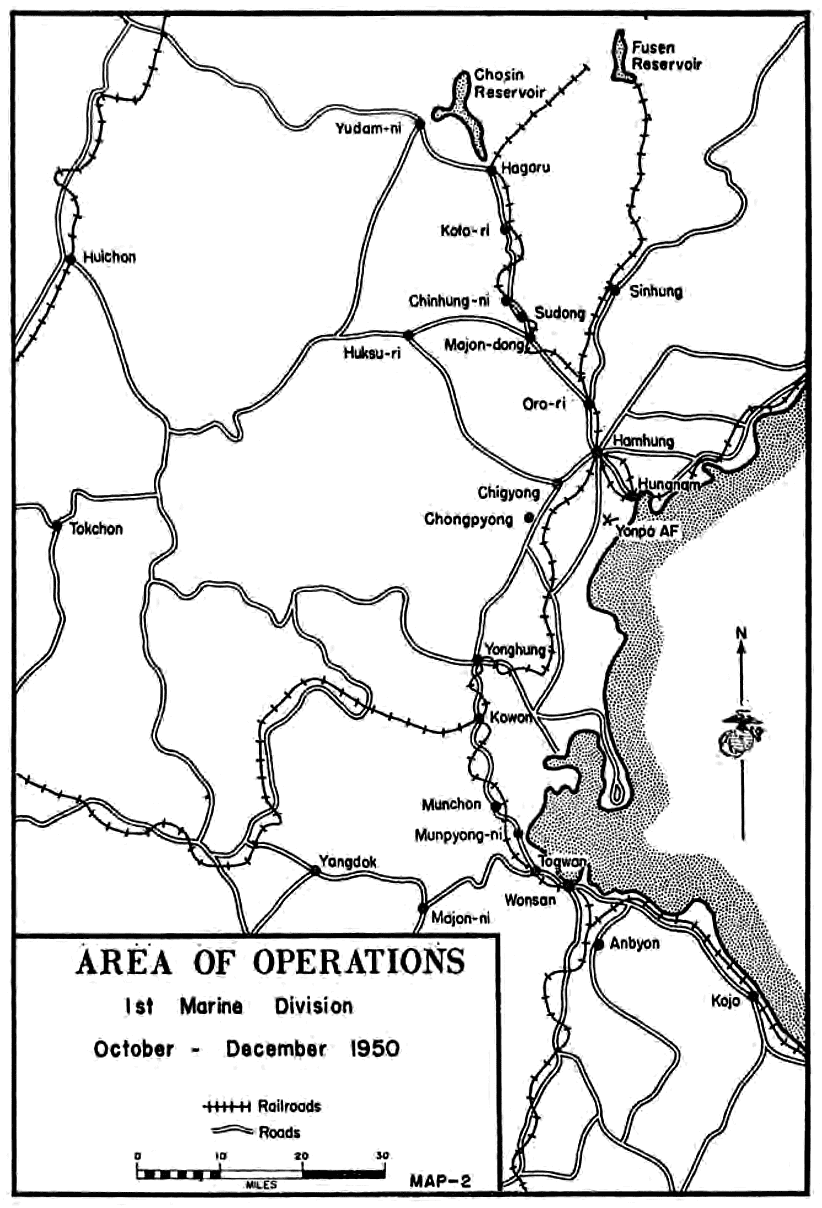
AREA OF OPERATIONS
1st Marine Division
October-December 1950
MAP-2
While the 7th Regiment had been fighting, marching, and climbing
toward the Chosin Reservoir in early November, the 5th Marines peacefully
combed the approaches to the Fusen Reservoir to the east. After
detaching 1/5 to Division control on 4 November and stationing 3/5
near Oro-ri, Lieutenant Colonel Murray sent the 2d Battalion into the
Sinhung Valley to relieve the 18th ROK Regiment. The relief took
place at 1145 on the 4th, and Lieutenant Colonel Harold S. Roise
deployed 2/5 around a valley junction five miles north and 15 miles
east of the then embattled 7th Marines.296
Roise’s mission was twofold: to block the Sinhung corridor while
determining the strength and disposition of the enemy, if any; and to
check certain northerly routes shown on maps as possibly leading to
either the Fusen or Chosin Reservoirs, or both. Reconnaissance patrols
in squad strength and combat patrols of reinforced platoons and company
size fanned out in a broad arc during 5–9 November. They determined
that no usable route led to either reservoir from the south, but
that the highway continuing northeast from the town of Sinhung, leading
to the 7th Infantry Division’s zone and the Manchurian border,
would carry military traffic. From 7 November, Roise’s troops made
daily contact with Army patrols coming down the highway, but no
units tried to penetrate the apparent screen of enemy defenses close to
the Fusen Reservoir.297
Major Merlin R. Olson, 1/5’s Executive Officer, led Companies A
and B on 7 November in a reconnaissance in force to Huksu-ri, that
annoying road junction west of Oro-ri. On the 8th Olson’s force had a
running fight with North Koreans before being recalled while still
short of his objective. Olson’s recall resulted from reports of 2000
North Koreans moving towards the MSR.298
On 8 November, Company D (Reinf) made an overnight trek deep
into a branch valley northwest of Sinhung, reaching a point about 10
miles due east of Koto-ri. One CCF soldier was captured while asleep
in a house. He said he belonged to the 126th Division and that Red
China would commit a total of 24 divisions against the UN forces in
Korea.299
On 9 November, Colonel Murray received orders to concentrate his
regiment along the MSR leading to the Chosin Reservoir. During the
next two days he deployed the 1st and 3d Battalions at Majon-dong and
Chinhung-ni respectively. The ambush of a Charlie Company patrol
on the 10th delayed the departure of 1/5 from the Chigyong area. The
patrol had to be rescued by a battalion attack the next day before the
force could move to Majon-dong.300 On the 13th while operating out
of Majon-dong a 1/5 patrol ran into 50–150 enemy who inflicted 7 KIA
and 3 WIA before withdrawing.301
The 2d Battalion moved out of the Sinhung Valley on 13 and 14
November to relieve the 7th Marines of the responsibility for defending
Koto-ri and thus free Colonel Litzenberg’s regiment for the advance to
Hagaru and the north. Lieutenant Colonel Roise’s battalion had completed
its mission without firing more than a few shots and with a
total prisoner bag of 12 North Koreans and one Chinese.302
Although the new enemy had seemingly evaporated from the path
of the 1st Marine Division, there was good reason to believe that he
was not forsaking his aggressive designs in North Korea. For in addition
to the ominous but questionable predictions of Chinese POWs, eyewitness
accounts of pilots of VMF(N)-542 provided G-2 officers with
information of the gravest portent in early November. The Marine airmen
made nightly strikes from the 1st to the 9th against Sinuiju at the
mouth of the Yalu, and they repeatedly reported a steady stream of
trucks moving into northwest Korea from Antung, Manchuria. Time
after time they blasted Sinuiju with bombs, rockets, and 20mm shells,
and though parts of the city were continuously aflame, it still seethed
with activity. They described southward bound traffic as “heavy,” “very
heavy,” and even “tremendous,” and at least one convoy was reported
to be “gigantic.”303
CHAPTER VII Advance To The Chosin Reservoir — Attacks on Wonsan-Hungnam MSR — Appraisals of the New Enemy — The Turning Point of 15 November — Changes in X Corps Mission — Marine Preparations for Trouble — Supplies Trucked to Hagaru — Confidence of UN Command — Marine Concentration on MSR
Attacks on Wonsan-Hungnam MSR—Appraisals of the New
Enemy—The Turning Point of 15 November—Changes in X
Corps Mission—Marine Preparations for Trouble—Supplies
Trucked to Hagaru—Confidence of UN Command—Marine
Concentration on MSR
On 4 November, while RCT-7 was at the height of its fight with
the Chinese, the Division CP displaced from Wonsan to Hungnam.
General Craig, the ADC, who inspected the area on the 2d,
recommended the abandoned Engineering College on the western outskirts
as the best location. During his visit he was shown a knoll outside
the city where the bodies of some 200 Korean civilians were laid out in a
perfect row. All had been victims of the retreating NKPA forces.304
A location in Hamhung would have been preferred, but available sites
were already taken by X Corps. General Smith flew to Hungnam by
helicopter and opened the new CP at 1100 on the morning of the 4th.
That evening a train carrying 160 officers and men of Headquarters
Battalion and the Division staff arrived at 2130 from Wonsan. En
route it had been fired on by guerrillas but no casualties resulted.305
A perimeter defense, consisting of two outposts and eight machine-gun
positions, was set up to command all likely approaches to the new
CP. Defensive wiring and trip flares were installed, with the gun positions
and outposts being connected by telephone.
During these proceedings everyone was blissfully unaware of the
existence of 250 tons of NKPA high explosive, stored only 600 yards
from the CP in three connecting caves. Undiscovered for a week, this
enemy cache was believed capable of demolishing the command post. A
16-man security detachment was placed on guard until the explosive
could be removed and detonated.306
Protection of the Wonsan-Hungnam MSR took on added importance
as the 1st Marine Division speeded up its move to the north. This
responsibility, it may be recalled, was shared by Division and Corps on
3 November in accordance with a decision by General Almond. The
1st Marines and elements of the 1st Tank Battalion maintained security
from Wonsan 15 miles northward to Munchon, while the 1st Battalion
of the 5th Marines was responsible from Hamhung southward to Chigyong.
This left the 54-mile stretch between Chigyong and Munchon
without any protection except the patrols of the Korean CIC agents
and the Special Operations Company, USA, both under Corps control.
On 4 November this company reported that large numbers of North
Koreans were moving into the area to the west. That same afternoon
Corps notified Division that a group of mounted guerrillas had fired
on railway police in the yards at Kowon, 15 miles north of Munchon.307
On 6 November, immediately after landing at Wonsan, the 65th RCT
of the 3d Infantry Division (less one battalion, placed temporarily
under 1st Marine Division control for the Majon-ni operation) was
ordered by Corps to relieve elements of the 96th Field Artillery Battalion,
USA, which had been recently sent to Yonghung. The Army RCT
was assigned a mission of protecting the Yonghung-Kowon area and
patrolling to the west (see map on Page 122).308
The Wonsan-Hamhung rail line took on special importance after the
announcement that water transportation would be delayed until enemy
mines were cleared from the harbor at Hungnam. This made it necessary
for the 1st Marine Division to send daily supply trains from Wonsan.309
The first two completed the run without incident, but after departing
Wonsan at dusk on the 6th the third train was halted at Kowon
by the destruction of rails ahead. North Korean guerrillas attacked
the train, guarded by a lieutenant and 38 men from Company C of the
1st Amphibian Tractor Battalion.310
The detachment was taken by surprise in the darkness by foes firing
from both sides of the track. When the Marines attempted to reverse
the train, the enemy wounded the engineer and put a hole in the boiler
with grenades. In the darkness the guard became separated into two
groups, the smaller of which was surrounded in a car. The guerrillas
fired through the wooden sides, forcing the Marines to the floor, and
threw grenades through the windows until all ten men were killed or
wounded, only two of them surviving.
The remaining 29 men of the guard made a stand on an embankment
about 200 yards from the track. Six Marines were wounded in the
ensuing fire fight. The train guard broke off the action and withdrew
to the area of the Army artillery battalion.
An empty train from Hamhung, guarded by a platoon from Company
A of the Amtracs, was halted at 1700 on the afternoon of 6 November
by railway officials at Yonghung. Reports of guerrilla activity in the
area had proved to be only too well founded when elements of the 96th
Field Artillery Battalion were attacked early that morning. Their perimeter
south of the town was breached with losses to the Army unit
of equipment and ammunition.
The 2d Battalion of the 65th RCT, which arrived at Yonghung late
that afternoon, had its baptism of fire within a few hours. Guerrillas
in estimated strength of 500 to 800 attacked at 0300 on the 7th, inflicting
casualties of six killed and 14 wounded. Troops of the 96th Field
Artillery Battalion also came under attack, as did elements of the 4th
Signal Battalion, USA. Company D of the 1st Tank Battalion sent a
Marine tank and “Weasel” (M-29) to evacuate the wounded with the
assistance of the Amtrac platoon guarding the empty train at Yonghung.311
At 1400 that afternoon the empty train resumed its run to Wonsan.
Only two miles had been covered when the locomotive and six cars were
derailed by a split rail and wrecked just south of Yonghung. Personnel
losses amounted to one man killed and 14 injured.312
At almost exactly this same hour the fourth supply train was stopped
south of Kowon by a blown section of track. The guard proceeded on
foot to investigate and encountered the depressing spectacle of the third
supply train, abandoned by the enemy after being plundered. One
ammunition car was still burning and in another riddled car the bodies
of the trapped Marines were found. So extensive was the damage to
tracks and switches that rail service could not be resumed until
9 November.313
The Corps commander summoned General Smith to Wonsan that
morning for a conference on measures for the security of the rail line.
It was decided that only daytime runs would be made thereafter, with
the train guard increased from 38 to 50 men. The 65th RCT, the 26th
ROK Regiment and a battery of the 96th Field Artillery Battalion were
placed under the temporary control of the 1st Marine Division with a
mission of guarding bridges and other key points.314
General Smith worked out a plan for the ROK regiment to drive the
guerrillas southward from the Chigyong area toward the 65th RCT at
Yonghung. As it proved, elements of both units were given Corps commitments
which prevented this maneuver from being put into effect.
They remained only a few days under nominal Division control, being
used for a variety of security missions along the Wonsan-Hamhung
MSR.315
By 9 November, when the Division supply trains resumed their
runs, 95 loaded cars had accumulated at Wonsan. The 1st Combat
Service Group continued to route supplies northward from the railhead
at the Wonsan airfield. Corps orders required troops to ride in open
gondola cars.316
It is understandable that an atmosphere of uncertainty should have
enveloped military decisions of this period. With the Joint Chiefs of
Staff and the UN command groping their way through a fog of war,
division commanders in Korea could not be expected to see very far
ahead.
Disconcerting as it had been to have the Chinese appear in the first
place, it was even more disturbing to have them break off contact and
vanish so inexplicably. Nevertheless, General MacArthur and his staff
had a fairly accurate idea of CCF numbers at this time. On 2 November
the UN command estimated that 16,500 Chinese Communist soldiers
had crossed the Yalu and 450,000 CCF regulars were in Manchuria.
Three days later, Major General Charles A. Willoughby’s intelligence
summary warned that the Chinese had the potential to start a large-scale
counteroffensive.317
General MacArthur, reporting to the United Nations for the first half
of November, stated that 12 CCF divisions had been identified in
Korea, indicating a total of perhaps 100,000 troops. Nine of these
units had appeared on the Eighth Army front and three in the X Corps
zone north of Hamhung.
“At the same time,” the report continued, “United Nations aerial
reconnaissance disclosed heavy troop movements near the border, in
Manchuria, and into Korea.”318
Quite as important as the new enemy’s numbers was the question of
his intentions. Did the CCF divisions consist merely of so-called volunteers
making a demonstration to encourage the beaten NKPA remnants?
Or were the Chinese contemplating an all-out military intervention?
President Truman asked JCS on 4 November to obtain from General
MacArthur an estimate of the situation.319 The general’s reply stated
that it was “impossible to authoritatively appraise the actualities of
Chinese Communist intervention in North Korea.” He recommended
“... that a final appraisement should await a more complete accumulation
of military facts.”320
During the next three days the issue of bombing bridges across the
Yalu posed a question that has remained a controversial subject ever
since. General MacArthur was granted permission, after being at first
refused, but cautioned “that extreme care be taken to avoid violation
[of] Manchurian territory and airspace.”321
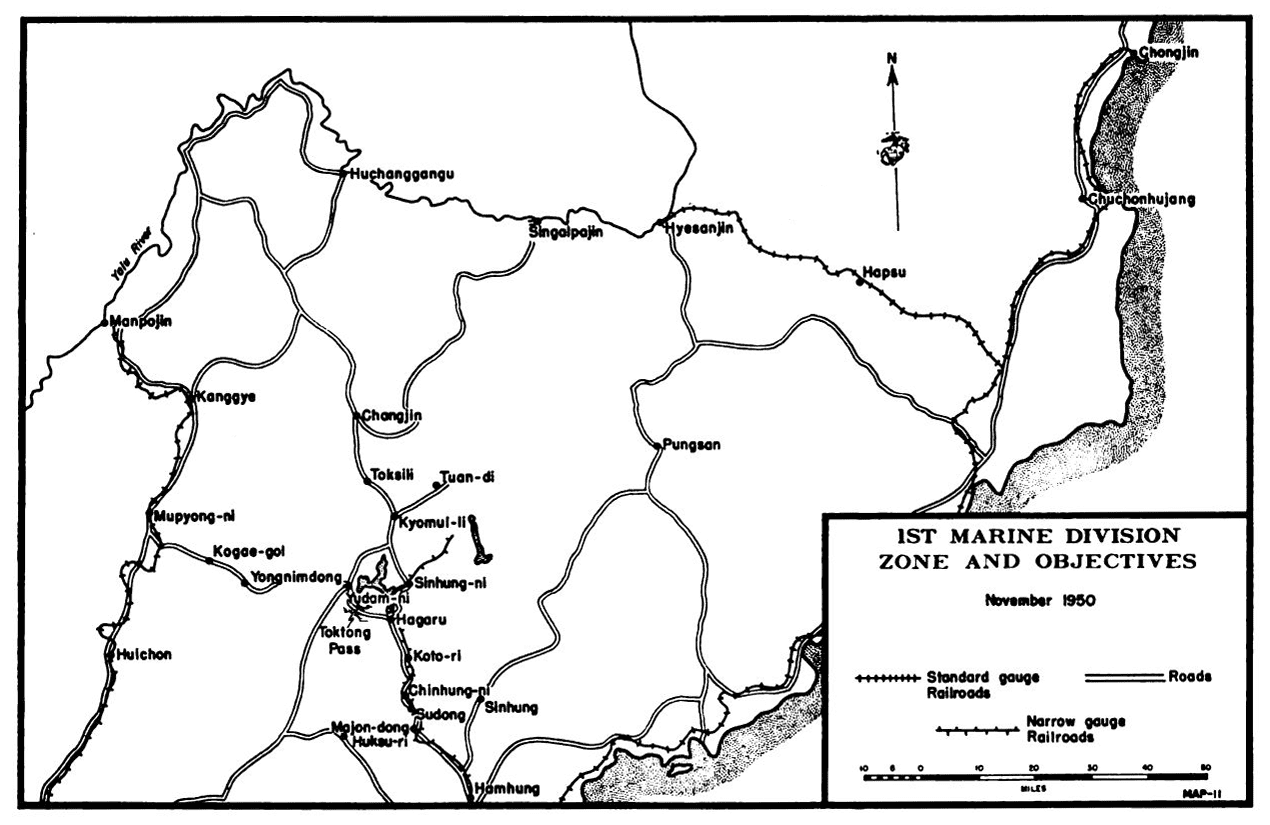
1ST MARINE DIVISION
ZONE AND OBJECTIVES
November 1950
MAP-11
In two messages of 7 November, the UN commander confirmed his
original appraisal to the effect that the Chinese were not making a
full-scale intervention. But he conceded that reinforcements might enable
the new enemy to stop the UN advance or even throw it into
reverse. He planned a resumption of the initiative, he said, in order
to take “accurate measure ... of enemy strength.” And he repeated
that the restriction of his bombing operations provided “a complete
sanctuary for hostile air immediately upon their crossing of the Manchuria-North
Korean border.” This factor, he warned, could “assume
decisive proportions....”322
On this same date, with the wary phase of UN strategy at its height,
General Almond flew to Hungnam to confer with General Smith. The
X Corps commander still wore another hat as General MacArthur’s
chief of staff; and though he could not function actively in this position,
he kept in close touch with strategic aims at Tokyo. Thus the cautious
spirit of the UN commander’s messages of 7 November was reflected in
Almond’s changed viewpoint. Where he had previously urged haste in
the X Corps drive to the border, he was now disposed to put on the
brakes and carry out that mission with less scattering of forces.
The prospect of a winter campaign was discussed, and the Marine
general recommended that only enough territory be held for the security
of Hamhung, Hungnam and Wonsan. Almond believed that Hagaru
should also be included, but he agreed that a greater degree of concentration
was advisable.323
As day after day passed without further CCF contacts of importance,
however, operations again took on the character of an occupation rather
than a drive which might end in a collision with a powerful new
enemy.
X Corps OpnO 6, issued at 2400 on 11 November, called for an
advance to the border by I ROK Corps on the right, the 7th Infantry
Division in the center and the 1st Marine Division on the left. The 3d
Infantry Division, with the 26th ROK Regiment attached, was to have
the responsibility for the Wonsan-Yonghung area after relieving elements
of the 1st Marine Division; the Marines were directed to take
blocking positions at Huksu-ri and Yudam-ni. In the Corps rear, the
1st KMC Regiment (-) had a zone to the south and west of Kojo.
The Marine zone on the Yalu, about 40 miles in width, was approached
and bounded by two roads branching off from the Changjin
area. One of them ended at Huchanggangu and the other at Singalpajin.
From that point the zone of the 7th Infantry Division extended
east to Hyesanjin (where the border turns north at a right angle) and
thence again eastward to the Hapsu area. I ROK Corps was to operate
from the line Hapsu-Chuchonhujang and drive northward along the
coast with Chongjin as an objective.324
Such a dispersion of forces, depending for supplies on poor secondary
roads through wild mountain regions, could hardly have been contemplated
if large-scale CCF opposition were expected. As a further indication
of renewed confidence, General MacArthur asked informally and
indirectly that X Corps do everything possible to assist the Eighth Army
in its drive to the Yalu. This request was conveyed in a personal letter
of 11 November from General Wright, G-3 of FECOM, to the Corps
commander.325
The date of General Almond’s reply, the 15th, is worthy of recognition
as a turning point. For it was also the occasion of messages from the
UN commander-in-chief and the commanding general of the 1st Marine
Division which had an effect on strategy. Indeed, the entire course
of the Chosin Reservoir campaign was channeled into new directions
as a result of the concepts advanced in these three communications of
15 November 1950.
Obviously the gap of 80 miles separating the Eighth Army from X
Corps would have to be reduced before much help could be given by
the latter. General Almond replied to General Wright in a letter proposing
that X Corps attack to the west of the Chosin Reservoir while
also continuing to advance northward in zone to complete its original
mission.
That same day, while the letter was en route to Tokyo, General MacArthur
came to a far-reaching decision. In a radio message he directed
the X Corps commander to develop, as an alternative to OpnO 6, a plan
for reorienting his attack to the west on reaching Changjin in order to
cut the Chinese MSR, as represented by the Manpojin-Kanggye-Huichon
road and rail line.
This was the first indicated change in mission, according to the X
Corps command report, since CinCFE’s directive late in October calling
for a drive to the border. The amendment “was made necessary,”
the report continued, “by the enemy build-up in front of the Eighth
Army and the fact that the enemy action had halted the first attempt
... to advance Eighth Army to the border. An estimate of the Eighth
Army situation ... fixed the relative combat power as 100,000 UN to
100,000 enemy with UN forces having air superiority and superior
artillery support.... The enemy was given an offensive capacity
which he could implement with an estimated reserve of 140,000 CCF
troops north of the Yalu River. In view of the enemy’s offensive
capacity, Eighth Army adopted a conservative plan to make a general
advance with the main effort in the center generally parallel to the
enemy MSR (Huichon-Kanggye). This course of action was designed
to meet any course of action which might be adopted by the enemy.
To assist the Eighth Army advance, X Corps was to initiate a main
attack to the West from the Chosin Reservoir area, cutting the enemy
MSR at Mupyong-ni, and advance in a northwesterly direction to the
Yalu River line at Manpojin.”326
By a coincidence it was also on Wednesday, 15 November, that
General Smith wrote a letter which foreshadowed future military
events. Addressed to General Clifton B. Cates, Commandant of the
Marine Corps, this communication made it plain that the 1st Marine
Division commander and his staff did not share in the renewed optimism
as to the course of the UN war effort. Not only did the
Marines accept the possibility of imminent and formidable CCF intervention,
but they were making preparations to meet it.
So far our MSR north of Hamhung has not been molested, but there is
evidence that this situation will not continue....
Someone in high authority will have to make up his mind as to what is
our goal. My mission is still to advance to the border. The Eighth Army, 80
miles to the southwest, will not attack until the 20th. Manifestly, we should
not push on without regard to the Eighth Army. We would simply get
further out on a limb. If the Eighth Army push does not go, then the decision
will have to be made as to what to do next. I believe a winter campaign
in the mountains of North Korea is too much to ask of the American soldier
or marine, and I doubt the feasibility of supplying troops in this area during
the winter or providing for the evacuation of sick and wounded.
The letter mentioned such preparations as the work done by Marine
engineers to strengthen the Hamhung-Hagaru road for tanks and heavy
vehicles. Plans had been approved, added General Smith, for an airstrip
at Hagaru capable of landing cargo planes for resupply and casualty
evacuation.
He emphasized that he did not mean to be pessimistic. “Our people
are doing a creditable job,” he said; “their spirit is fine, and they will
continue to do a fine job.” But in conclusion he reiterated his doubts
about his “wide open left flank” and his concern over “the prospect
of stringing out a Marine division along a single mountain road for
120 air miles from Hamhung to the border.”327
General Smith had no more than finished dictating his letter when
two Navy officers called at the CP—Rear Admiral Albert K. Morehouse,
chief of staff to Admiral Joy, and Captain Norman W. Sears, chief of
staff to Admiral Doyle. Both were old acquaintances of the Marine
general, who had led the assault landing force on Peleliu in 1944 while
Sears commanded an LST group. Smith felt that he could speak frankly,
therefore, and expressed his concern over the aspects of the strategic
situation he had discussed in the letter.328
CinCFE had requested in his message of the 1st that the plan for reorienting
the X Corps attack be submitted to him as an alternative to
OpnO 6. General Almond put his staff to work on the 16th, and that
same day Draft No. 1, of OpnO Plan 8 was completed. This was a
concept of an attack on Kanggye by means of a drive westward from
Changjin.329
Almond disapproved the first draft on the grounds that the MSR of the
Corps element making the effort would be too far extended. He requested
the preparation of a new plan based on the concept of an advance
farther south on the Hagaru-Mupyong-ni axis and west of the
zone of the 1st Marine Division. The X Corps commander also directed:
(1) That the Hamhung-Hagaru road be developed as a Corps MSR with
intensive effort on the part of Corps troops, including Corps engineers;
(2) That an RCT of the 7th Division be assigned the mission of seizing
Changjin in order to protect the right flank of the 1st Marine Division.
The Corps commander considered that Changjin and Mupyong-ni
were too widely separated as objectives to be assigned to a single division,
not to mention the difficult terrain. His staff worked for four days
on Draft No. 2 of OpnO Plan 8 before submitting it to him. He accepted
it with several modifications and directed that the third draft
be taken to Tokyo by Lieutenant Colonel John H. Chiles, the Corps
G-3, for presentation to GHQ.
General Smith, for his part, lost no time in putting into effect his
preparations for trouble in the shape of a formidable CCF attack. The
completion of mine clearance at Hungnam had opened that port on
15 November, thus easing the transportation situation. That same day
the 7th Marines occupied Hagaru, being greeted by a temperature of
four degrees below zero which threatened an early and bleak winter.
Only four days previously, X Corps OpnO No. 6 had directed the 1st
Marine Division to take up blocking positions to the west, at Huksu-ri
and Yudam-ni, while continuing the northward advance to the Yalu.
This meant a further dispersion at a time when Smith hoped to reduce
the 163 road miles separating his infantry battalions.
In order to carry out the Corps directives, Division OpnO 21-50 of 13
November assigned the following tasks:
RCT-1—to seize Huksu-ri;
RCT-7—to seize Hagaru, and, on order, to seize Yudam-ni;
RCT-5—to protect the MSR from positions at Majon-dong, Chinhung-ni
and Koto-ri, while preparing to pass through RCT-7 in the
Hagaru area and advance to Changjin (approximately 40 miles
northward);
Division Reconnaissance Company—to screen the Division right flank by
operating in the Soyang-ni-Sinhung valley to the east Division
boundary.330
In connection with the mission of RCT-7, the words “on order”
deserve special notice. For the commanding officer was directed by
Smith’s oral instructions to take up blocking positions at Toktong Pass,
about halfway between Hagaru and Yudam-ni, until additional units
of the Division could be moved up to the Hagaru area. In other words,
the Division commander believed that the possibilities of large-scale
CCF intervention were such as to justify caution in the drive to
Yudam-ni.331
Not only would the concentration of the Marine units ease General
Smith’s concern over the tactical situation; it would also greatly simplify
the administrative load. Colonel Bowser has commented, “Division
was faced with the problem of handling a division scattered from
Wonsan and Majon-ni in the south to the heavy engagement of the 7th
Mar in the north. Add to this the problem of guerrilla bandits between
Wonsan and Hungnam/Hamhung as well as a completely unknown
situation to the West, and you have a task of considerable magnitude
for any division staff.”332
RCT-1 was delayed several days by lack of railway facilities in its
move 70 miles northward to Chigyong after being relieved in the Wonsan
area by the 3d Infantry Division.333 But most of the other Marine
units had been pulled up—a battalion or even a company at a time—as
far as the Hungnam area. Along the new MSR north of Hamhung,
the column of advance on 15 November consisted of these units:
Hagaru—RCT-7;
Koto-ri—2d Battalion, RCT-5;
Chinhung-ni—3d Battalion, RCT-5; Battery K, 4th Battalion, 11th Marines;
Detachment 1st Ordnance Battalion; Detachment 1st Service Battalion;
1st and 2nd Platoons, Company A, 1st Engineer Battalion; Company B
(less 3d Platoon), 1st Engineer Battalion;
Majon-dong—1st Battalion RCT-5; Company D, 1st Tank Battalion.
The Division command and staff took a dim view of the possibility
of completing “the race to the Yalu” before winter. It was already
too late, if sub-zero temperatures were any indication; and preparations
must now be made for tactical and logistical support of a midwinter
campaign in the mountains. Among the most essential provisions were
the selection of a forward base, the construction of airstrips along the
MSR, and the strengthening of the road to make it fit for tanks and
heavy vehicles.
Hagaru, at the foot of the Chosin Reservoir, had been recommended
by General Craig as the best location for a forward base when he
visited here on the 15th. The commanding generals of the Division
and Wing arrived for a tour of inspection the next day. General Harris
made the trip at the express request of General Almond, who believed
that a strip long enough to land R4Ds was necessary to insure resupply
and casualty evacuation in a midwinter emergency. One of the few
comparatively flat pieces of real estate in northeast Korea was found
just south of the town. The black loam promised to make a hard
surface in freezing weather, so that the prevailing arctic temperatures
offered at least one consolation.334
An OY strip had been completed on 13 November at Koto-ri, but
heavier engineer equipment was needed at Hagaru. Before it could
be brought forward, the road from Chinhung-ni to Koto-ri required
strengthening and widening. This task had already been assigned to
Lieutenant Colonel Partridge, commanding the 1st Engineer Battalion.
After a survey by jeep, he decided to begin operations at the highest
point of the one-way dirt road.
“By working down,” he explained, “we could first of all provide for
what we considered to be a dangerous accumulation of snow, and the
problem of land slides.... The work on the road involved a good bit
of drainage in order to insure that the melting snows from day to day
during the sunlight hours would not filter across and destroy the road
bed. It involved demolitions and drilling and a good deal of dozer
and grader work.”335
Enough progress had been made by 18 November so that armor
could be sent forward to support RCT-7. Only the day before, the 1st
Tank Battalion had begun functioning with its Headquarters and Service
Companies at Soyang-ni, eight miles northwest of Hamhung. The
road between Chinhung-ni and Koto-ri was still impassable for M-26
(Pershing) tanks until the engineers could widen some of the turns.
But Lieutenant Colonel Harry T. Milne, the battalion commander, organized
a provisional tank platoon consisting of two M4A3 (Sherman)
tanks from Headquarters Company and four dozer tanks from Company
D at Majon-dong. They proceeded without incident on the 18th to
Hagaru, operating as a gun platoon.336
Opening the mountain road to heavy traffic made it possible on the
18th to begin work on the Hagaru airstrip. Five large dozers with
pans of eight cubic yards capacity arrived at the site the next day, and
Company D of the 1st Engineer Battalion tackled the job of hacking
out a runway from ground frozen as hard as granite. Plans called for a
cut of 90,000 cubic yards and a fill of 60,000 for a 3200-foot runway.
The rub was that engineering field manuals prescribed a runway of
3600 feet for R4Ds or C-47s at sea level, plus an additional 1000 feet
for each 1000 feet of altitude. And since Hagaru was about 4000 feet
above sea level, it could only be hoped that pilots were right in estimating
that a strip of 3000 to 4500 feet might do in a pinch.337
The 19th also dated the establishment of the Supply Regulating Station
at Hagaru for the purpose of building up stockpiles. Prior to this
time, the 1st Service and 1st Ordnance Battalions had been in charge of
division dumps at Hamhung. Supplies arrived by rail after being
unloaded from the ships at Wonsan by the 1st Shore Party Battalion
and the 1st Combat Service Group.
The completion of mine clearance made it possible to order the latter
organization to Hungnam by sea to operate in-transit depots for X
Corps. Practically all Division supplies were soon being received by
sea at this port, where the 1st Combat Service Group separated the
incoming cargo into proper classifications and forwarded it to the
dumps at Hamhung. Port operation was the responsibility of the 2d
Engineer Special Brigade, USA. After the project got into full swing,
from 2000 to 2500 Korean laborers were employed at Hungnam and
as many as 6000 tons of cargo unloaded in 24 hours.338
A limited amount of rolling stock was available for the narrow-gauge
railway from Hungnam to Chinhung-ni. But it was up to the Marines
to put the line back into operation, for the X Corps Railway Transportation
Section already had its hands full with the Wonsan-Hamhung
route. The 1st Service Battalion was authorized to make the attempt,
and enough Korean crews were rounded up to operate the trains. Chinhung-ni
thus became the railhead for supplies tracked the rest of the
way to Hagaru.339
Preparations were also made for large-scale casualty evacuation to
the Division hospital at Hungnam. H&S, A and B Companies of the
1st Medical Battalion remained there to set up the Division hospital
while D, C and E Companies were attached to RCTs 1, 5 and 7 respectively.
As the Division center of gravity shifted northward, medical
officers foresaw the need of a hospital-type facility at Hagaru in addition
to the clearing stations contemplated at Koto-ri and Chinhung-ni.
Plans were approved, therefore, for Companies C and E to pool their
resources at Hagaru and establish a medical supply dump. Additional
surgical teams were to be flown to Hagaru in an emergency by Companies
A and B from the hospital at Hungnam.
Meanwhile the hospital ship Consolation, commanded by Captain
John W. McElroy, USNR, prepared to move from Wonsan to Hungnam.
There the Division hospital had been enlarged to 400 beds, and
an additional 100 to 150 were planned for the new annex at Hamhung.
In order to speed up casualty evacuation, several heated railway cars
were equipped for that purpose on the 35-mile narrow-gauge line from
Chinhung-ni.340
Provisions for the advance of RCT-5 east of the Chosin Reservoir were
included in Division OpnO 22-50, issued at 0800 on 17 November.
As a preliminary, RCT-7 was given a two-fold mission: (1) to protect
the Division left flank between Hagaru and Yudam-ni with a minimum
of a battalion; and (2) to relieve elements of RCT-5 and protect the
MSR in zone from positions in the vicinity of Hagaru, Koto-ri and
Chinhung-ni.
RCT-5 was assigned these missions: (1) to pass a minimum of a
battalion through RCT-7 at Hagaru; (2) to move up the east side of
the Chosin Reservoir and seize Sinhung-ni, about 7 miles northeast of
Hagaru; and (3), on order, to seize the road junction at Kyolmul-ni,
some 20 miles north of Hagaru.
Division Reconnaissance Company was to screen the left flank of the
MSR in the vicinity of Majon-dong, and the 11th Marines to maintain its
4th Battalion in that area prepared for employment in the north on
order.
OpnO 22-50 directed the Supply Regulating Detachment (1) to
establish a truckhead at Hagaru after taking over and consolidating the
dumps of RCT-7; (2) to control traffic between Koto-ri and Chinhung-ni;
and (3) to support RCTs 5 and 7, with priority to RCT-5. The
following supply levels were fixed:
Classes I and III, five days;
Class V, 1 Unit of fire;
Classes II and IV, as required for all troops operating to the north and west
of Koto-ri.341
Although the advance westward to Huksu-ri remained the mission
of RCT-1, the shortage of rail and motor transport slowed the movement
from Wonsan to Chigyong. The last elements had not arrived on
the 18th when Corps asked and received the consent of Division to the
employment of the 26th ROK Regiment for the attack on Huksu-ri, with
the understanding that the objective would be turned over to RCT-1 at
a later date. On the morning of the 19th the ROK unit left Chigyong
to execute its mission.342
Two days later RCT-1 was relieved of this responsibility when Corps
verbally notified Division that Huksu-ri had been placed within the
modified boundary of the 3d Infantry Division. This was confirmed
the next day by X Corps OI 17, which also directed the Division to
establish blocking positions at Yudam-ni.343
Up to this time General Smith had not been able to make much progress
toward Yudam-ni without dispersing his units to an extent which
he regarded as imprudent. But with the availability of RCT-1 to occupy
positions on the MSR behind the other two infantry regiments, he
could now push ahead.
As an added factor, the 1st Marine Division had just acquired a new
unit. Early in November Admiral Joy had inquired if General Smith
could use the 41st Independent Commando, Royal Marines. This
British unit of 14 officers and 221 enlisted men, commanded by Lieutenant
Colonel Douglas B. Drysdale, and attached to ComNavFE in
Japan, had requested service with the U. S. Marines. Smith replied that
he would be glad to have these fine troops. Highly trained in reconnaissance,
they could operate with the Division Reconnaissance Company
in protecting the flank of the Marine advance. The British Marines
arrived at Hungnam on the 20th and reported to the 1st Marine
Division.344
Division OpnO 23-50, issued at 0800 on the 23d, directed the Commandos
to locate and destroy enemy forces on the left flank, ranging
as far as 13 miles west of Koto-ri. It was hoped that the British unit
and the Division Reconnaissance Company might flush out CCF troops
beyond the reach of routine infantry patrols. Other tasks assigned to
elements of the Division were as follows:
RCT-7—to seize Yudam-ni and maintain one battalion in that position;
RCT-5—to seize Kyolmul-li (20 miles north of Hagaru) and be prepared
to seize Toksil-li (10 miles northwest of Kyolmul-li) and Tuan-di
(15 miles northeast of Kyolmul-li) on order;
RCT-1—to relieve elements of RCT-7 in the vicinity of Hagaru and Koto-ri
and protect the Division MSR from positions in the vicinity of
Hagaru, Koto-ri and Chinhung-ni;
1st Tank Battalion (less detachments)—to protect the MSR from positions
in the vicinity of Majon-dong and Soyang-ni;
1st Engineer Battalion—to support Division operations with priority to the
maintenance of the MSR and construction of the airfield at Hagaru.
OpnO 23-50 also provided that the Supply Regulating Station Detachment
continue operation of the truckhead at Hagaru and stock supplies
at the following levels: Classes I and III, 8 days; Classes II and
IV, as required; and Class V, one and one-third U/F for all troops
operating to the north and west of Chinhung-ni.345
The trucking facilities of the Division had been strained to the limit
ever since the Wonsan landing. Shortly afterwards the bulk of the
7th Motor transport Battalion was taken under the operational control
of X Corps, and it became necessary to attach the 1st Motor Transport
Battalion to RCT-7. On 19 November, however, the 1st MT (less
detachments) had passed to the control of the 1st Supply Regulating
Detachment at Hagaru. There the truckers not only built up the stockpile
of supplies but rendered the best support that units of the division
had known so far along the MSR.346
General MacArthur did not appear to be shaken by EUSAK G-2 reports
during the third week of November which called attention to a
formidable CCF build-up on both sides of the Yalu. On the contrary, a
UN order of the 20th, giving directions for the conduct of troops at
the border, indicated that an occupation rather than a fight was
expected:
Elements of minimum size only will be advanced to the immediate vicinity
of the geographical boundary of Korea. No troops or vehicles will go beyond
the boundary between Korea and Manchuria, or between Korea and the
USSR, nor will fire be exchanged with, or air strikes be requested on forces
north of the northern boundary of Korea. Rigid control of troop movements
in vicinity of northern boundary will be exercised. Damage, destruction or
disruption of service of power plants will be avoided. No personnel, military
or civilian, will be permitted to enter or leave Korea via the Manchurian or
USSR border. Commanders will insure that the sanctity of the international
border is meticulously preserved.347
The italicized sentence emphasizes an assumption which had made
converts in high State Department as well as Defense circles in Washington.
The Chinese, according to this conjecture, were concerned
chiefly with defending their Manchurian frontier and guarding the
power complexes along the Yalu. As evidence, it was pointed out that
early in November the Sinuiju radio described the CCF troops crossing
the river as a “volunteer corps” for the protection of the hydro-electric
plants along the Yalu serving Mukden, Dairen and Port Arthur. Proceeding
from this premise, it was a logical conclusion that if no provocation
were given these forces, a large-scale fight might be avoided.348
General MacArthur, after receiving a qualified permission to bomb
the Yalu bridges, had enjoined UN airmen not to violate territory or
air space on the other side of the river. This meant that the bomber
crews must take much greater risks, since their restricted axes of approach
and flight paths were known to enemy antiaircraft gunners in advance.
Moreover, CCF jet fighters could attack and retire to the
sanctuary of Manchuria when hard-pressed.349
Despite these handicaps, Air Force and Navy bombers knocked out
four of the twelve international bridges and damaged most of the
others. These efforts doubtless imposed delays, but troops and supplies
continued to cross throughout November.350 After arrival in North
Korea, they seemed to vanish into that void of mystery which had
swallowed up Chinese Communist troops ever since they broke off
contact.
Students of history may have recalled at this time that one of the
most significant engagements of modern history was known as the
Battle of the Yalu. From a tactical viewpoint, to be sure, the clash of
30 April 1904 was not a great affair. The Japanese army, after disembarking
at Chemulpo (Inchon) and marching up the Korean peninsula,
numbered five times the Russian force which opposed the crossing
of the Yalu at Uiji, just east of Sinuiju. A Japanese victory was doubtless
to be expected, yet a new page of history had opened. For the first
time in modern chronicles, an Asiatic army had successfully challenged
a European army with the weapons and tactics of the Machine Age.
Now, nearly half a century later, history was repeating itself as another
Asiatic army crossed the Yalu with unknown capabilities and
intentions. If the Chinese Communists were merely sending a force to
guard the hydro-electric complexes and frontier, hopes of peace by
Christmas might be realized. But if the invaders were secretly massing
for an all-out counter-offensive, a great new war might soon be flaming
up from the ashes of the old.
Little fault can be found with current G-2 estimates of CCF numbers,
which hold up surprisingly well even when viewed with the wisdom
of hindsight. Quite as much depended on interpretations of CCF intentions
by the UN command, and there can be no doubt that an end-of-the-war
atmosphere prevailed on the eve of the Eighth Army offensive of
24 November.
Thanksgiving Day, which fell on the 23d, was celebrated both in
Korea and the United States in a spirit of rejoicing over a victorious
peace which seemed almost within grasp. It was a tribute to American
bounty as well as organizational genius that the troops in Korea were
served a dinner which would have done credit to a first-rate Stateside
restaurant. The menu, as proposed by X Corps to component units,
included shrimp cocktail, stuffed olives, roast young tom turkey with
cranberry sauce, candied sweet potatoes, fruit salad, fruit cake, mince
pie and coffee.351
As an item of good news for this Thanksgiving, it was learned the
day before that the 17th Regiment of the 7th Infantry Division had
reached the Yalu at Hyesanjin. Not a single Chinese soldier had been
encountered by troops who had troubles enough with sub-zero temperatures
and mountain roads.352
Since the first week of November, in fact, there had been no clashes
of any importance with the invaders from Red China. On the 24th,
as usual, the front was quiet everywhere except for minor patrol contacts.
Yet this was the D-day of the great Eighth Army offensive, and
the stirring communique of the commander-in-chief was read to all
troops in Korea. It was a message in the bold spirit of Inchon, and no
one could doubt the confidence of the UN command after hearing these
words:
The United Nations massive compression envelopment in North Korea
against the new Red Armies operating there is now approaching its decisive
effort. The isolating component of the pincer, our air forces of all types,
have for the past three weeks, in a sustained attack of model coordination
and effectiveness, successfully interdicted enemy lines of support from the
north so that further reinforcement therefrom has been sharply curtailed and
essential supplies markedly limited. The eastern sector of the pincer, with
noteworthy and effective naval support, has now reached commanding enveloping
position, cutting in two the northern reaches of the enemy’s geographical
potential. This morning the western sector of the pincer moves forward
in general assault in an effort to complete the compression and close the vise.
If successful, this should for all practical purposes end the war, restore peace
and unity to Korea, enable the prompt withdrawal of United Nations military
forces, and permit the complete assumption by the Korean people and
nation of full sovereignty and international equality. It is that for which
we fight.353
/s/ DOUGLAS MacARTHUR,
General of the Army,
United States Army,
Commander-in-Chief.
Eighth Army troops found it something of an anticlimax, after this
message, to jump off without meeting any large-scale opposition. General
MacArthur, who flew to the front for the occasion, watched from
his plane as the UN columns moved out unmolested, as if conducting a
motor march.
“The Army offensive began, as scheduled, at 1000 hours on 24
November,” said the EUSAK report. “Since for some time there had
been little contact with enemy forces the advance of EUSAK elements
was in the nature of a meeting engagement, with little or no resistance
in the initial stage. Across the Eighth Army front as a whole, advances
were made from 4000 to 16,000 yards.”354
On this same day Lieutenant Colonel Chiles presented X Corps OpnPlan
8, Draft 3, at Tokyo. It was approved at UNC Headquarters with only
one modification—the shifting of the proposed boundary between X
Corps and Eighth Army farther to the south in the zone of the 1st
Marine Division.
This plan was the basis of X Corps OpnO 7. Issued on the 25th, it
provided for a reorientation of the X Corps attack to provide more
assistance for Eighth Army. H-hour was to be 0800 on the 27th, and
the principal units of X Corps were assigned these tasks:
1st Marine Division—to seize Mupyong-ni and advance to the Yalu;
7th Infantry Division—(1) to attack from east side of Chosin Reservoir
and advance to Yalu in zone; (2) to secure Pungsan area, coordinating with
1 ROK Corps;
1 ROK Corps—to advance from Hapsu and Chongjin areas, destroying
enemy in zone to north boundary of Korea;
3rd Infantry Division—(1) to gain and maintain contact with the right
flank of Eighth Army in zone; (2) to protect the left flank of X Corps;
(3) to support the 1st Marine Division on X Corps order; (4) to protect
harbor and airfield at Wonsan; (5) to destroy enemy guerrillas in zone.355
A Corps warning order, issued on the evening of the 24th, was
supplemented by a briefing session at Corps Headquarters at 1000 the
next morning. General Smith learned that his division was to be the
northern arm of the pincers in the “massive compression envelopment”
while the 7th Infantry Division took over the previous Marine mission
of advancing east of the Chosin Reservoir to the Yalu.356
The new Marine boundary cut across Korea to the north of Eighth
Army. From Yudam-ni the Marine route of advance led to Mupyong-ni
55 miles to the west. This objective was about halfway between Huichon
in the south and Kanggye in the north (see map, Page 130). From the
latter, which was believed to be the assembly area of the NKPA remnants,
a good road led about 40 miles north to Manpojin on the Yalu.
In accordance with Corps OpnO 7, the rear boundary of the 1st
Marine Division had been moved north to a line just south of Hagaru.
The 3d Infantry Division had the responsibility for the area south
of Hagaru, but this unit had so many other commitments that it could
assign few troops to the task. General Smith was granted permission,
therefore, to retain garrisons at Koto-ri and Chinhung-ni. This left
the 3d Infantry Division responsible for the protection of the MSR
from Sudong southward to Hamhung.357
Corps OpnO 7, in short, provided for a wide envelopment to be
spearheaded by the 1st Marine Division on 27 November. The other
arm of the pincers, of course, was to be the Eighth Army; but on the
evening of the 25th came the disturbing news that its right wing, the
II ROK Corps, had been hurled back by a surprise CCF counterstroke.
This reverse took place in the vicinity of Tokchon, about 70 air miles
southwest of Yudam-ni.358
EUSAK intelligence reports, as it proved, were not far off the mark
in estimating enemy strength on the Eighth Army front at 149,741
troops at this time.359 During the past few days, however, estimates of
probable enemy courses of action had been so reassuring as to justify
the confidence of CinCFE’s communique on D-day. Even the setback of
the 25th was not regarded as alarming.
“With the possible exception of the relatively vague situation on the
east flank,” said the next day’s G-2 report, “the enemy reaction to the
EUSAK attack has been one of active defense with local counterattacks
in strength.” The enemy’s probable course of action was believed to
be “an active defense in depth along present lines employing strong
local counterattacks in conjunction with continued guerrilla activities
with bypassed units; limited air activity; and further reinforcement by
CCF or USSR forces.”360
On the X Corps front the reorientation of the attack to the west gave
General Smith a long-sought opportunity to collect his dispersed units
and achieve a relative degree of concentration. The release of RCT-1
from its Huksu-ri mission made it possible to bring that infantry
regiment up behind the other two. This move in turn enabled RCT-5
to advance east of the Chosin Reservoir and RCT-7 to push on to
Yudam-ni.
Progress might have been more rapid for all units if adequate transportation
had been available for RCT-1 in the Chigyong area. Only
by using vehicles of the 11th Marines was it possible to move 1/1 to
Chinhung-ni, where it relieved the 3d Battalion of the 5th Marines on
23 November. During the next two days the 2d Battalion and RCT-1
Headquarters relieved 2/5 at Koto-ri. After the return of the vehicles,
3/1 (less Company G, left behind for lack of trucks) was lifted to
Hagaru on the 26th to relieve the 2d Battalion, 7th Marines.361
All three battalions of RCT-5 were operating east of the Chosin
Reservoir by 24 November. Until supply levels were built up at Hagaru,
however, General Smith kept a careful check on the advance in this
quarter. The farthest penetration took place on the 25th when a platoon-size
patrol of 3/5, reinforced by two tanks, drove nearly to the northern
end of the Reservoir. Scattered enemy groups were flushed out and an
abandoned 75mm gun destroyed after a pursuit resulting in five Chinese
killed and one captured. This was one of the few encounters in an
area combed by patrols from all three battalions, and no signs of large-scale
enemy activity were reported by Lieutenant Colonel Robert D.
Taplett, CO of 3/5, after a helicopter reconnaissance.362
Meanwhile RCT-7 began its move to Yudam-ni. This objective had
first been mentioned as early as 11 November in X Corps OpnO 6. But
until RCT-1 could be brought up to the MSR, the Division Commander
limited the advance to the vicinity of Toktong Pass. There an estimated
150 to 200 enemy resisted with machine-gun fire but were scattered
with the aid of air strikes and artillery support.
On the 23d, in accordance with Division OpnO 23-50, the 1st Battalion
led the advance of RCT-7. During the next two days Lieutenant
Colonel Davis’s reinforced battalion methodically cleared booby-trapped
but undefended road blocks and scattered small groups of enemy along
the route. The men of 1/7 belatedly celebrated Thanksgiving on the
24th with a full, hot turkey dinner—their last full meal for 17 days—and
seized battered Yudam-ni the next day against negligible resistance.363
The 3d Battalion, regimental headquarters, and 3/11 (-) followed.
Marine operations east of the Chosin Reservoir came to an end at
1200 on the 25th with the relief of RCT-5 by the 1st Battalion, 32d
Infantry, 7th Infantry Division. Corps orders called for this unit to
remain under operational control of the 1st Marine Division until the
assumption of command in the area by the CO, 31st Infantry. All elements
of RCT-5 were to be relieved by the following noon for the mission
of advancing to Yudam-ni and then passing through RCT-7 to
lead the attack toward Mupyong-ni.364
This was in accordance with Division OpnO 24-50, issued at 0800
on the 26th to implement the provisions of Corps OpnO 7. The jump-off
was to be at 0800 on 27 November, with the first objective the road
junction at Yongnim-dong (27 road miles west of Yudam-ni), in
preparation for further advance on order to the high ground about one
mile south of Kogae-gol and 35 miles west of Yudam-ni. Other provisions
of OpnO 24-50 were as follows:
RCT-7—to seize and secure Yudam-ni without delay, and when passed
through by RCT-5, to protect the Division MSR from Sinhung-ni
(7 miles west of Hagaru) to Yudam-ni;
RCT-5—to pass through RCT-7 west of Yudam-ni by 0800, 27 November,
advance to the west and seize first objective, prepared for further
advance;
RCT-1—in Division reserve, to occupy positions in the vicinity of Chinhung-ni,
Koto-ri and Hagaru for the protection of the MSR;
11th Marines—less detachments, to provide general support from positions in
the vicinity of Yudam-ni;
41st Commando—reinforced, to move to Yudam-ni prepared for operations
to the southwest to protect Division left flank;
Reconnaissance Company—to move to Yudam-ni and reconnoiter to the
north in co-ordination with operations of RCT-7.365
Operation Yo-Yo—Back and forth, changing course at twelve-hour intervals,
the ships bearing the Marines and their gear mark time during
mine clearance operations at Wonsan.
Wonsan Arrivals—Above, Bob Hope entertaining Marine airmen who
were first to reach the seaport; and, below, Marine infantry disembarking
from cargo nets of Marine Phoenix into the LCVPs.
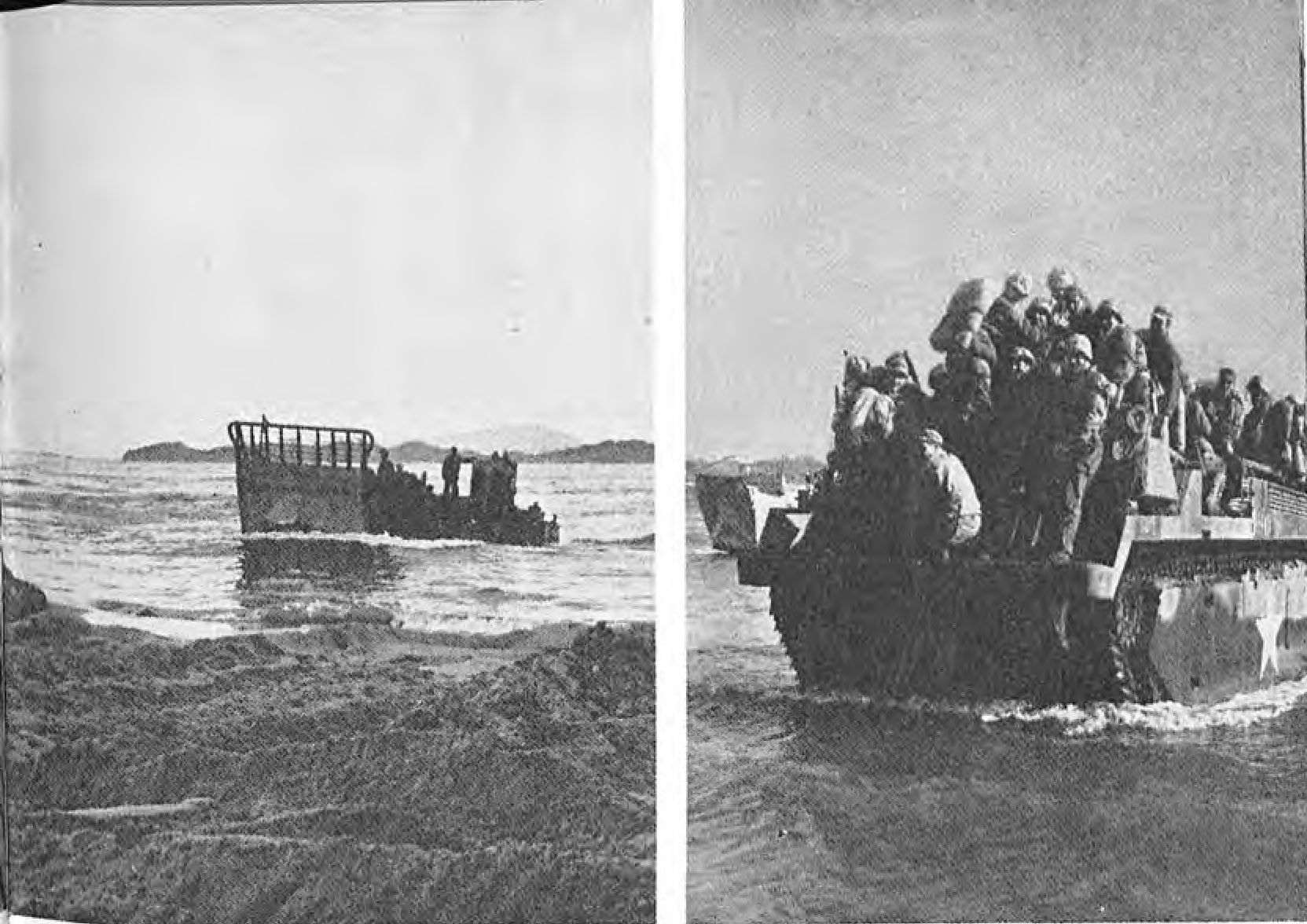
USN Photo 421319 USN Photo 421362
Administrative Landing—Above, an LCM and a troop-laden amtrac
in Wonsan harbor; and, below, LSTs drawn up abreast to land the thousands
of tons of supplies required by a division.
Wonsan Scenes—Above, a camouflaged hangar on Wonsan airfield;
below, Marine infantry in railway station awaiting transportation shortly
after their debarkation.
First Action in Northeast Korea—Two views of Marine infantry mopping
up guerrillas after surprise counterattack in Kojo area by NKPA
troops escaping to join Chinese Reds.
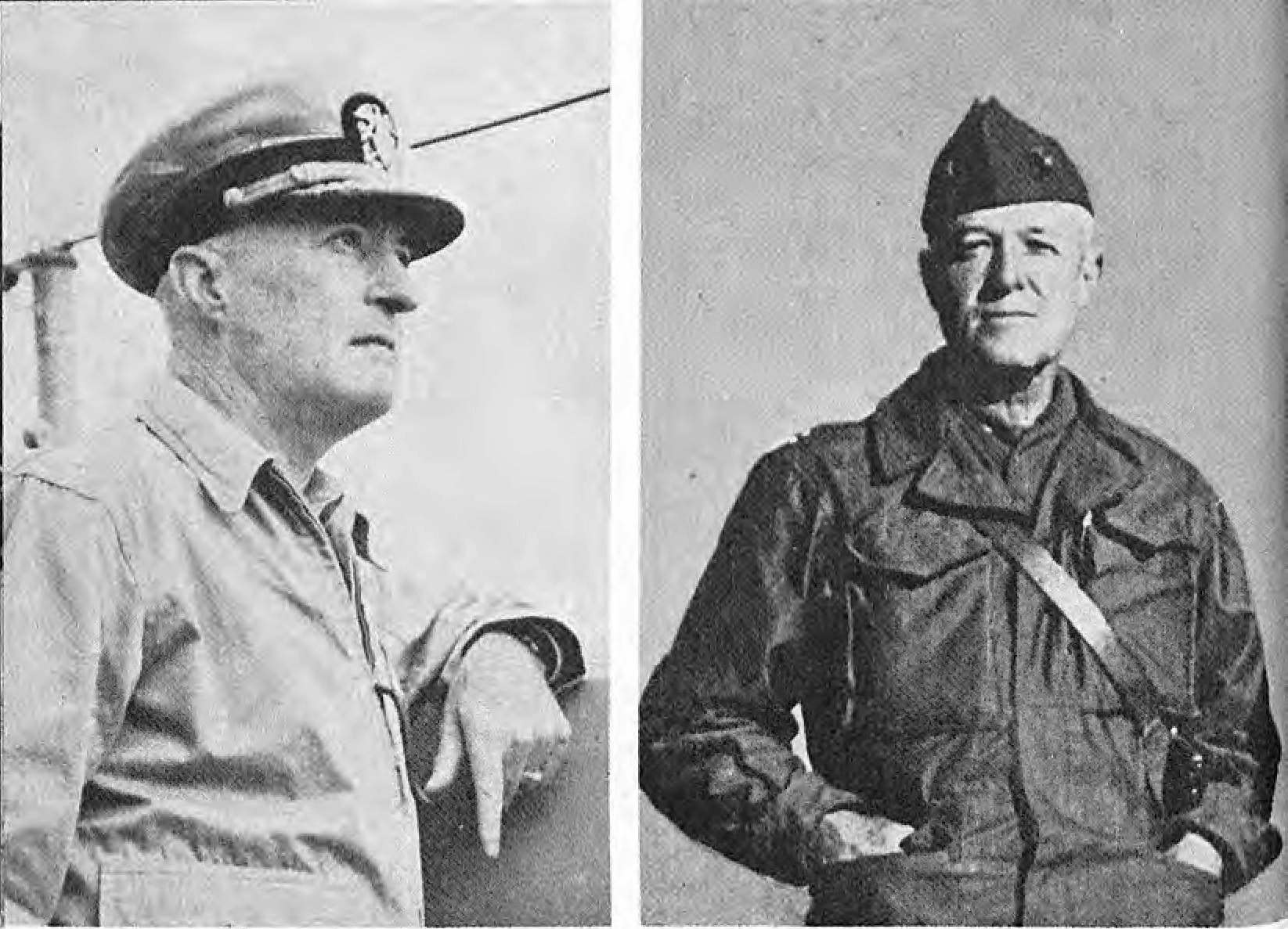
USN Photo 423189 Photo courtesy LtGen E. A. Craig
On the Planning Level—Above, RAdm J. H. Doyle, CTF-90, and
BrigGen E. A. Craig, ADC of 1st Marine Division; below, V/Adm
A. D. Struble, Cdr JTF-7, and MajGen E. M. Almond, CG X Corps,
in the USS Missouri.
Command Conference—Above, left to right, MajGen W. J. Wallace,
USMC; LtGen L. C. Shepherd, Jr., USMC; MajGen O. P. Smith,
USMC; MajGen E. A. Almond, USA; and MajGen Field Harris,
USMC; below, 1st Marine Division CP at Hungnam.
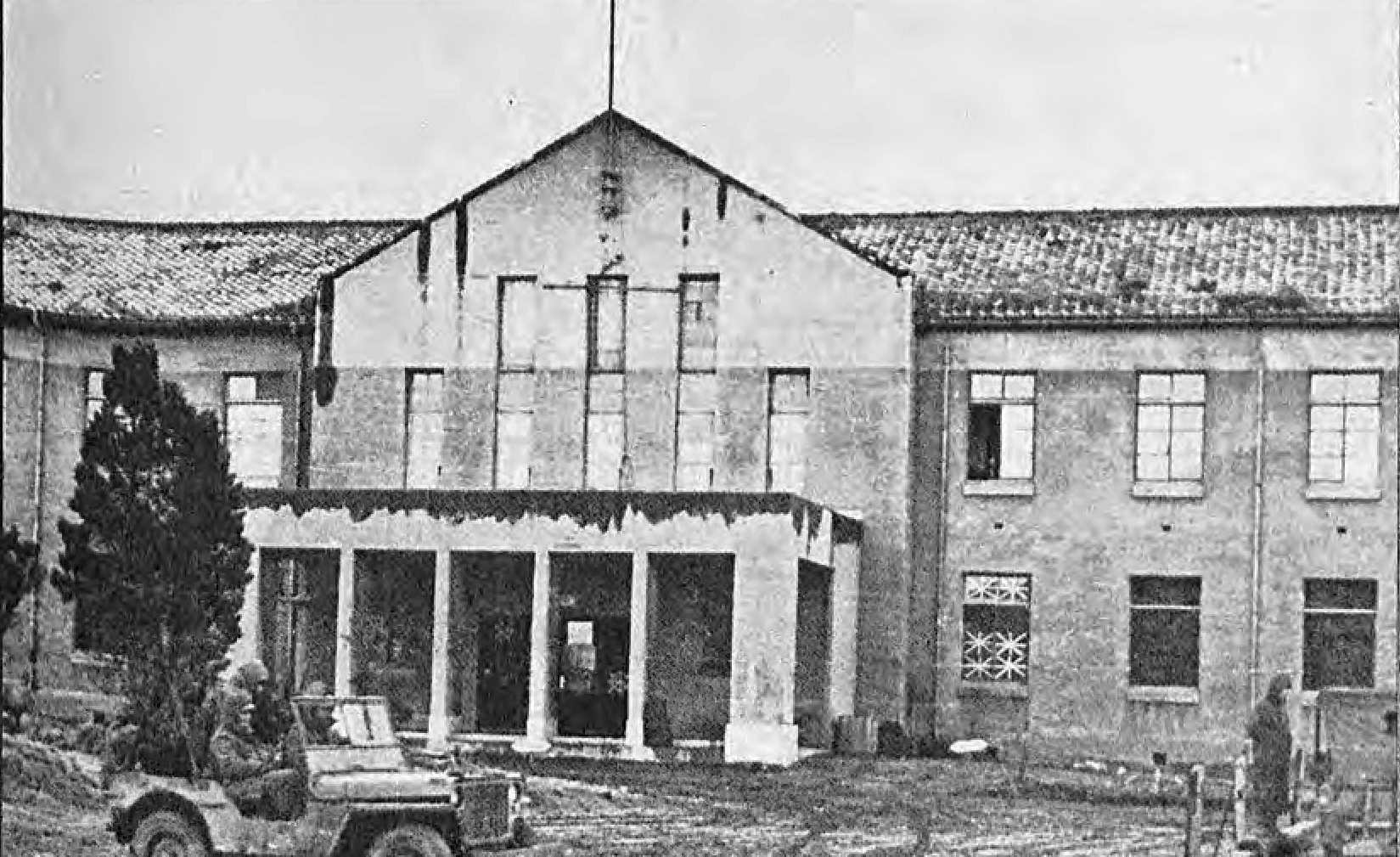
Photo courtesy LtGen E. A. Craig
First Chinese Resistance—Above, infantry of 7th Marines setting up
mortar during initial encounter with Chinese in northeast Korea; and,
below, enemy tank killed by Marine fire.
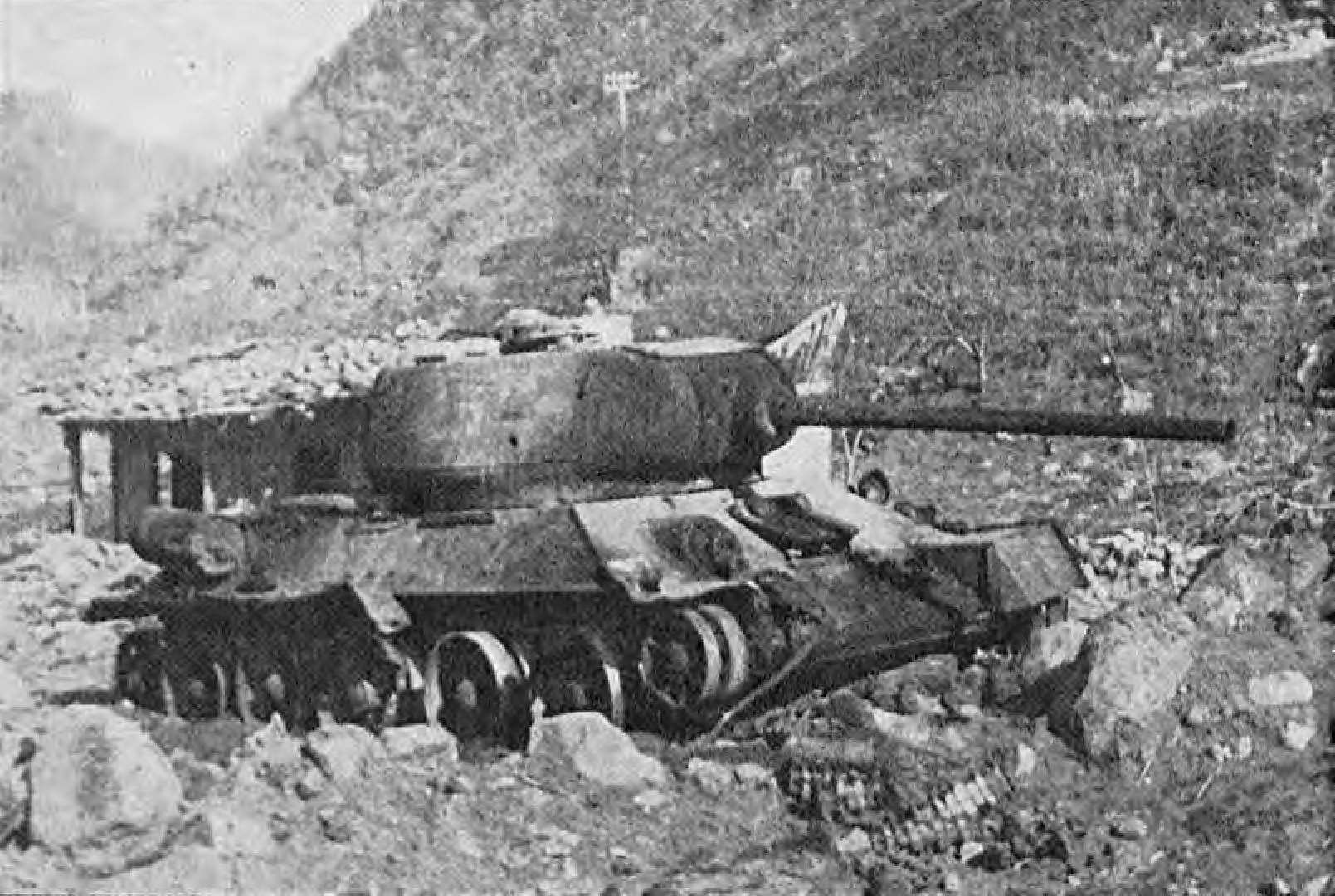
Photo courtesy Maj R. B. Crossman
Advance of RCT-7—Above, artillery emplacement of Battery G, 11th
Marines, on 3 November 1950; and, below, supplies transported over
railroad from Wonsan to Hamhung.
As Seen from the Air—Above, “Frozen Chosin” and the rugged terrain
of the Reservoir area; and, below, an aerial view of the MSR winding
its precarious way through Funchilin Pass—“a cliff on one side and a
chasm on the other.”
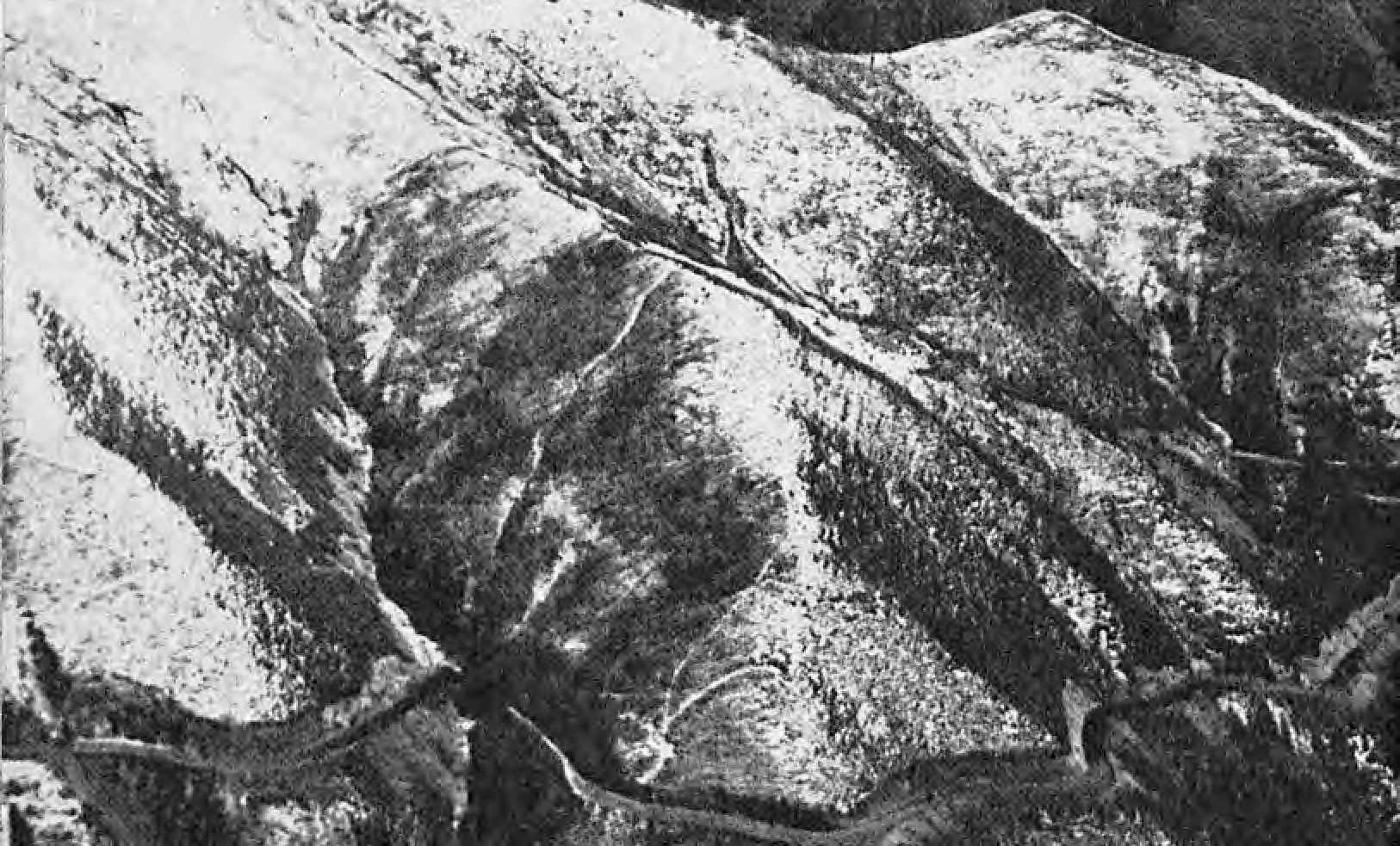
Photo courtesy LtGen E. A. Craig
As Seen by the Infantry—Here are two views of the sort of terrain encountered
by the infantry of the 1st Marine Division; sometimes it was
as difficult to complete an approach march as to dislodge the enemy
after arrival.
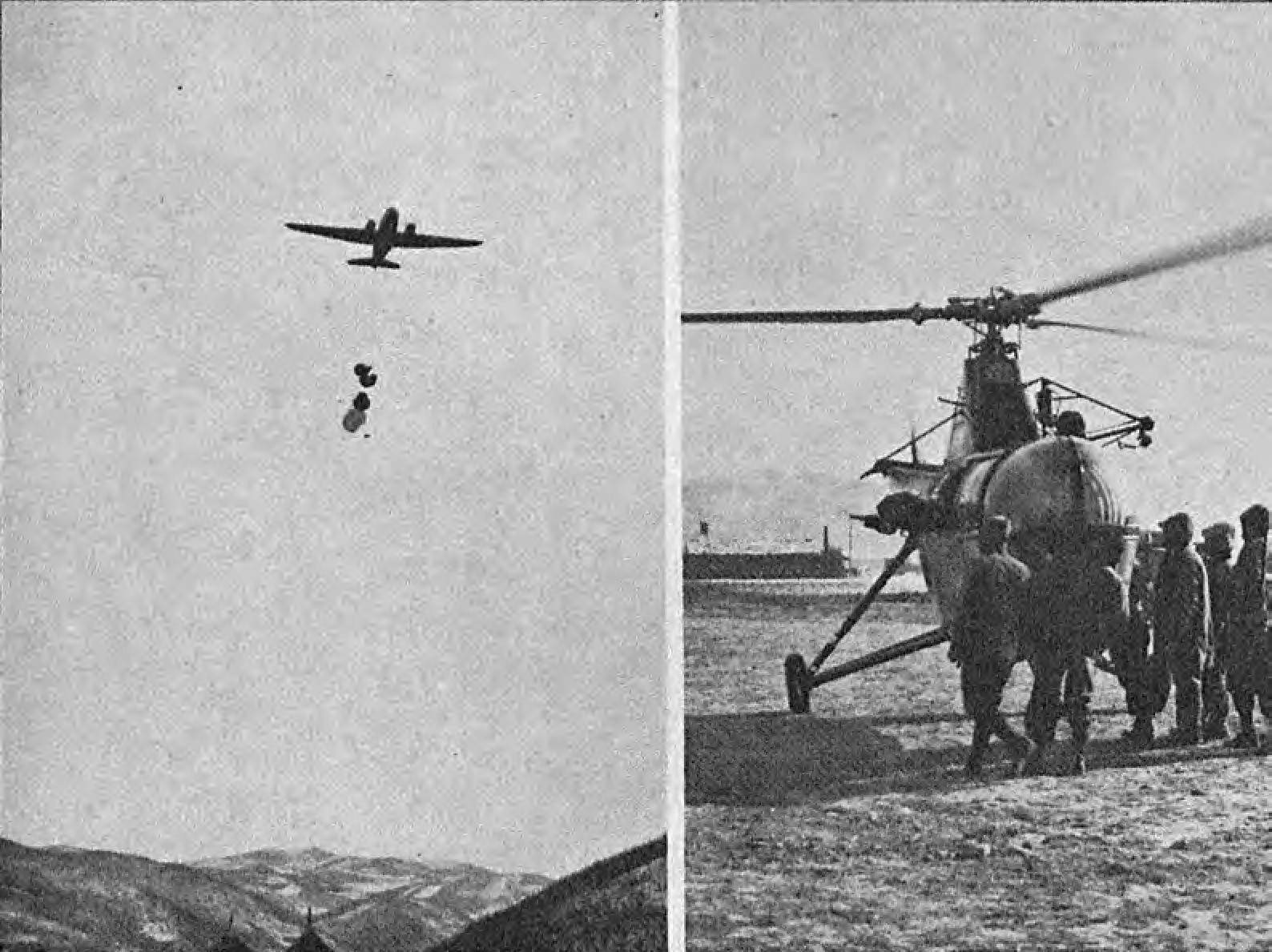
USMC Photo A 4841 USMC Photo A 4912
Air Supply and Evacuation—Above, an air drop of supplies and helicopter
evacuation of casualties at Yudam-ni; below, parachute-rigged
cases of ammunition in an Air Force C-47.
Preparations for Yudam-ni Breakout—Above, Marines selecting gear
for breakout from Yudam-ni to Hagaru; and, below, the first stages
of the three-day fighting advance.
Chinese Communist POWs—Above, these CCF prisoners don’t seem unhappy
about their captivity; below, a Chinese officer being interrogated
with the aid of an interpreter.
Marines on the March—These two pictures give some idea of the exhaustion
of Marines, many of them walking wounded, as they huddle
by the roadside during halts of the Yudam-ni breakout.
Covered by Artillery—Above, a 105mm howitzer fires to the rear as the
infantry fights its way forward from Yudam-ni; below, a quarter of a
mile per hour was considered good progress.
General Smith, flying by helicopter from Hungnam to Yudam-ni on
the morning of the 26th, could survey the MSR below him and reflect
with satisfaction that it was now easier to count the Marine outfits
south of Chinhung-ni than those to the north. These included the 1st
Tank Battalion with the exception of the provisional platoon at Hagaru
and the 2d Platoon of Company D at Chinhung-ni. Transportation had
not yet been provided for the 41st Commando, but the new unit was
scheduled to move up in convoy on the 28th with Headquarters Battalion
when the Division CP displaced from Hungnam to Hagaru.
By that time only service units and a few platoons of tanks and engineers
would be left in the rear area.
At Hagaru the C-47 airstrip was taking shape as the dozers hacked
away at the frozen earth night and day, working under flood lights in
the darkness. Companies C and E of the 1st Medical Battalion had set
up clearing stations and built up dumps of medical supplies. Troop
units at Hagaru and Yudam-ni had two days’ supplies of rations and
fuel, but only a unit of fire was stockpiled at Hagaru in addition to the
half unit carried by the troops.
Marine motor columns were winding along the narrow, twisting
mountain road from Hagaru to Yudam-ni in preparation for the attack
in the morning. Upon arrival at Lieutenant Colonel Davis’s 1/7 CP,
General Smith learned to his discomfort that the hovering ability of a
rotary-wing aircraft is curtailed at high altitudes. The helicopter
dropped like a stone the last ten feet, but fortunately no injury resulted
to passenger, pilot or machine.366
On the 26th intelligence arrived at Hamhung from the 7th Marines,
reporting capture of three soldiers from the 60th CCF Division. They
asserted that the 58th, 59th, and 60th Divisions of the 20th CCF Army
had reached the Yudam-ni area on the 20th. According to these enlisted
men, Chinese strategy envisioned a move south and southeast from
Yudam-ni to cut the MSR after two Marine regiments passed.367
X Corps had received similar reports of Chinese movement southeast
from Yudam-ni as well as air reports of enemy activity north and northeast
of the Chosin Reservoir. Six Chinese divisions had now been identified
in northeast Korea but both Corps and Division intelligence estimates
of probable enemy action continued to be optimistic. Although
Chinese attacks on the division’s MSR or along the Huichon-Huksu-ri-Hamhung
axis were not ruled out, G-2 officers seemed to consider a
continued westward withdrawal more likely.368
Division planning went ahead on the assumption of commander and
staff that the enemy would be met in strength in the mountainous country
west of Yudam-ni. This was the basis for the decision to pass the
relatively fresh 5th Marines through the 7th for the attack westward.369
It was a cold, clear Sunday afternoon when General Smith returned
to Hungnam. From his helicopter he could see for several miles on
either side, and no signs of enemy activity were discerned in the snow-clad
hills. After his arrival at the Division CP, however, the Marine
general was informed that the situation had gone from bad to worse in
west Korea. The II ROK Corps on the right flank had disintegrated
on the 26th under a second day’s heavy blows, thus exposing the 2d
Infantry Division and Turkish Brigade to flank attack. In short, the
Eighth Army offensive had been brought to a standstill before the
Marines could jump off in the morning as the other arm of the United
Nations envelopment.
CHAPTER VIII Crisis at Yudam-ni — Marine Attack on 27 November — Marine Dispositions Before CCF Attack — The Battle of Northwest Ridge — Chinese Seize Hill 1403 — Fighting at 3/5’s CP — The Battle of North Ridge
Marine Attack on 27 November—Marine Disposition Before
CCF Attack—The Battle of Northwest Ridge—Chinese Seize
Hill 1403—Fighting at 3/5’s CP—The Battle of North Ridge
The 2d battalion, vanguard of the 5th Marines, completed its
move from the east coast of the Chosin Reservoir to Yudam-ni
during the afternoon and evening of 26 November. After deploying
his command south of the village, Lieutenant Colonel Roise and his S-3,
Major Theodore F. Spiker, made a reconnaissance in preparation for
the next day’s attack.370
Yudam-ni lies in the center of a broad valley surrounded by five great
ridges, named in relation to their direction from the village: North,
Northwest, Southwest, South, and Southeast. Beginning at the rim of
the valley, each of these ridges extends several thousand yards and includes
many peaks, spurs, and draws, certain of which took on special
significance as the crisis at Yudam-ni unfolded.
A finger of the Chosin Reservoir reaches toward Yudam-ni in the
valley between North and Southeast Ridges. The other four corridors
radiating from the valley are highway routes. Lieutenant Colonel Roise
surveyed the westerly road, which leaves Yudam-ni between Northwest
and Southwest Ridges. His assigned objective encompassed distant
spurs of these heights, bordering the road about a mile and a half
west of the village.371
The 7th Marines (-) was disposed in perimeter around Yudam-ni on
terminal hills of four of the five ridges: D and E Companies (attached
to 1/7) on North Ridge, 3/7 on Southwest, and 1/7 on South and
Southeast.372 Since the high ground occupied by 3/7 overlooked the
route of attack and Roise’s objective, Colonel Litzenberg373 later in the
day specified a new destination for 2/5, a pass ten miles west of Yudam-ni.
It was a big order, but Litzenberg’s troops would support the 5th
Marines’ outfit by making limited advances along the skylines of Northwest
and Southwest Ridges. With this protection on his flanks initially,
Roise could concentrate more strength for the drive through the low
ground.374
Nightfall of 26 November was accompanied by an abrupt temperature
drop to zero degrees Fahrenheit. The north wind screamed across
the frozen reservoir and lashed the Marines on the valley floor and
hillsides around Yudam-ni. At 2200, a group of half-frozen company
commanders gathered within the flapping walls of Roise’s blackout tent
to receive their orders. The attack was to start at 0800 the next morning,
with 2/5 passing through the 7th Marines in a column of companies.
Recoilless rifles and 4.2-inch mortars of the 5th Marines would support
the advance, along with First Lieutenant Wayne E. Richards’ 2d
Platoon of Able Company Engineers. Two Corsairs of VMF-312 and
a spotter plane from VMO-6 were to provide aerial reconnaissance and
close air support.375
In other wind-blown tents, 7th Regiment officers learned of their missions
as assigned by Colonel Litzenberg. The 3d Battalion would
move farther along the crest of Southwest Ridge on 27 November and
also seize the terminal peak, Hill 1403, of Northwest Ridge across the
MSR, in order to support 2/5’s attack more effectively. Dog and Easy
Companies were to patrol North Ridge and the west coast of the
Reservoir, while 1/7 scouted both South and Southeast Ridges and154
their adjoining corridors. Particular attention would be paid to the
valley running southward between these hill masses, for therein lay
the vital road to Hagaru.376
The Yudam-ni perimeter was quiet throughout the long, frigid night
of 26–27 November. At dawn the basin and hillsides came alive with
parka-clad figures stamping and clapping life back into leaden limbs.
Gradually they began to cluster around small fires to thaw out the
morning rations and their weapons.
Companies G and H of 3/7 jumped off in the attack at 0815, the
former to extend the foothold on Southwest Ridge, the latter to seize
Hill 1403, terminal height of Northwest Ridge. Led by Captain Leroy
M. Cooke, How Company advanced unopposed and secured its objective
by midmorning.377 Captain Cooney’s Company G moved rapidly
1200 yards along the crest of Southwest Ridge and occupied a commanding
peak, Hill 1426, at 0845 without meeting opposition. But
when Cooney resumed the advance, his troops almost immediately came
under fire from enemy positions on another peak 500 yards away.378
During 3/7’s operations on the high ground the 2d Battalion, 5th
Marines, had marched out of Yudam-ni and launched the main attack
along the road. Company F, under Captain Uel D. Peters, led 2/5 as
it passed beneath the steep walls of Southwest and Northwest Ridges.
The first objective was a long spur of the latter height, 500 yards across
a draw from the 7th Marines on Hill 1403. Approaching the mouth
of the draw on the right of the road, Fox Company was hit by long-range
small-arms fire from enemy emplacements on the objective. About
the same time, 0935, a message from the VMO-6 spotter plane told of
CCF positions all across the front. Captain Peters held up momentarily
to appraise the situation, and engineers moving behind his outfit began
to clear the first of nine unmanned enemy roadblocks that obstructed
the MSR.
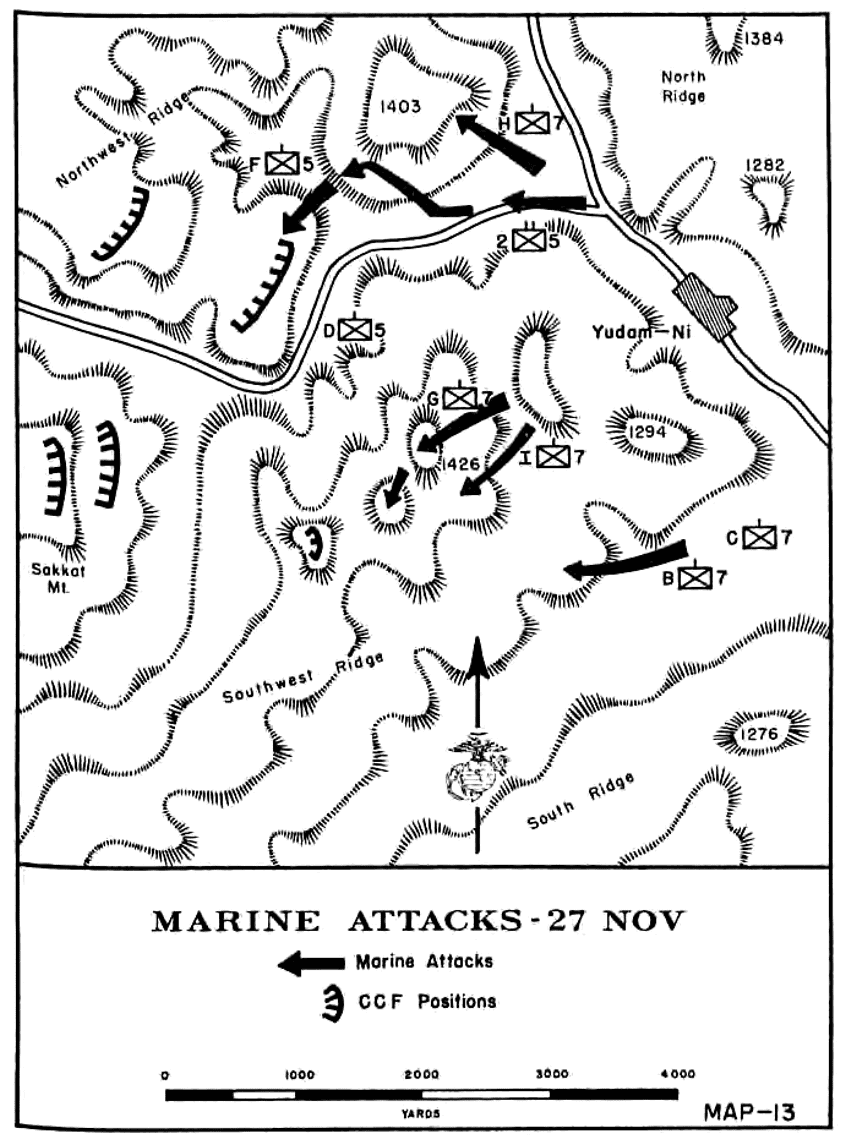
MARINE ATTACKS - 27 NOV
MAP-13
According to plan, Company F ascended part way up the slopes of
Hill 1403 and then advanced across the front of the 7th Marines to
the head of the long draw that set off the Communist-held spur. Simultaneously,
4.2-inch and 81mm mortar crews positioned their weapons
along the road to support this envelopment. The flatlands south of
Yudam-ni trembled as the 105mm howitzers of Lieutenant Colonel
Harvey A. Feehan’s 1st Battalion, 11th Marines, opened up at 1015
with a 15-minute preparation.379
While Company F moved overland to strike at the left (north)
flank of the CCF position, Captain Samuel S. Smith’s Dog Company
edged forward along the MSR to the mouth of the draw. Like the
earlier unit, it was met by a hail of bullets. The regimental 4.2-inch
mortars opened fire on the crest of the spur, and recoilless rifles slammed
75mm shells into bunkers just now sighted on the forward slopes.
At 1115, after ground supporting arms had partially neutralized the
CCF positions, Corsairs of VMF-312 blasted the objective with rockets
and bombs.
In the wake of the air strike, First Lieutenant Gerald J. McLaughlin
led Fox Company’s 1st Platoon against the enemy’s north flank, the
rest of the company supporting the assault by fire from Hill 1403.
Most of the Chinese defenders fled to the west, and McLaughlin’s
troops cleared the northern half of the spur by 1300, capturing three
Red soldiers. The 2d Platoon, commanded by Second Lieutenant Donald
J. Krabbe, then passed through to secure the southern half, overlooking
the road. Although the attackers encountered only negligible
local resistance, they were slowed by heavy machine-gun fire sweeping
in from a peak 1000 yards farther west.
During Company F’s action on the high ground, Dog Company filed
around the road bend at the south end of the spur and moved toward a
valley junction a few hundred yards away. This fork is dominated by
Sakkat Mountain to the west; and the Chinese, in order to block the
Marine advance, had dug tiers of entrenchments on the eastern slopes
of the massive height. Frontal fire from these positions converged on
Company D’s column. Faced by such formidable resistance and terrain
Lieutenant Colonel Roise discontinued the attack. At 1430 he ordered
Fox Company to set up on Northwest Ridge for the night, and Dog
to deploy defensively across the MSR on a spur of Southwest Ridge.
On the crest of the latter, the 3d Battalion, 7th Marines, had found
progress increasingly costly during the afternoon of 27 November.
The peak beyond Hill 1426 was occupied by Company G at 1500,380
bringing that unit on line with Dog Company of 2/5 in the low ground
to the north. Like the 5th Marines’ outfit, Company G was now confronted
with the broad crescent of CCF fortifications buttressed by the
defensive complex on Sakkat Mountain. Machine-gun barrages drove
the 7th Marines’ unit off the hilltop, and Company I of 3/7 rushed forward
from the high ground overlooking Yudam-ni to add its firepower
in support. Baker Company of 1/7, on patrol in the valley between
Southwest and South Ridges, ascended into the bullet-swept zone at
1230 to help out. When it became heavily engaged, elements of Company
C were ordered forward from the Yudam-ni vicinity as reinforcement.
Thus parts of three battalions, 2/5, 3/7, and 1/7, felt the storm
of steel and lead on Southwest Ridge throughout the afternoon.
While fighting raged in an arc from south to west on the 27th, another
danger area was discovered to the north and northeast, completing
a vast semicircle of known CCF concentrations in proximity to
Yudam-ni. A patrol from Company D of 2/7, moving over North
Ridge along the west coast of the reservoir, ran into heavy machine-gun
and mortar fire about 4000 yards from the village. Marine air struck
at the entrenchments of an estimated enemy company, and at 1645 the
patrol withdrew with several casualties to Company D’s lines on the
southern tip of North Ridge.
At dusk on the 27th a general calm settled over Yudam-ni, broken
only occasionally by scattered exchanges of small-arms fire. The main
Marine attack had netted about 1500 yards, placing 2/5 on the objective
originally assigned by the regimental commander, Lieutenant Colonel
Murray. That the Chinese did not allow this battalion to advance three
more miles, to its new objective and into hopeless entrapment, seems
inconsistent in view of the CCF plans for the night of 27–28 November.
The auxiliary attack by 3/7 won 1200 more yards of the crest of Southwest
Ridge, and the occupation of Hill 1403 by How Company of that
battalion represented a gain of about 2000.
In a few hours, the Marines would give thanks that their successes
on 27 November had been modest ones.
The units of Yudam-ni will be listed counter-clockwise, beginning with
those on North Ridge, according to the positions they occupied around
the perimeter on the night of 27–28 November. North Ridge, bounded
on the east by the reservoir and on the west by the valley separating
Northwest Ridge, lay closest to the village and was therefore of immediate
tactical importance. Facing this hill mass from Yudam-ni, one
sees four distinct terminal heights: Hill 1167 on the right, Hills 1240
and 1282 in the center, and the giant spur of Hill 1384 on the left.
Companies D and E of the 7th Marines, occupied Hills 1240 and 1282
respectively. Since the combined front of these two units was a mile
wide, they concentrated on their assigned hilltops and relied on periodic
patrols to span the gaping, 500-yard saddle between. Although both
flanks of each company dangled “in the air,” they were backed by two-thirds
of the 5th Marine Regiment in the valley of Yudam-ni.381
The 3d Battalion, 5th Marines, had arrived from the east coast of
the Chosin Reservoir at noon on the 27th, while the attacks to the west
were in full progress. Lieutenant Colonel Taplett placed his unit in
an assembly area at the base of North Ridge, beneath the large, unoccupied
spur leading to Hill 1384. The 1st Battalion, 5th Marines, did
not complete its move to Yudam-ni from the east side of the reservoir
until after dark. Lieutenant Colonel John W. Stevens, II, secured for
the night in the valley below Hills 1282 and 1240; and with Taplett’s
nearby command, 1/5 thus comprised a formidable reserve behind the
thin high-ground defenses of Companies D and E of 2/7.
To the left of North Ridge, going round the clock, Company H of
3/7 dug in on the crest of Hill 1403, terminal height of Northwest
Ridge. Farther to the left, in the broad draw through which Company
F had earlier enveloped the CCF-held spur, Company E of 2/5 took
up strong blocking positions. The latter unit was not tied in with
the 7th Marines’ troops on Hill 1403, there being a steep and rugged
gap of about 200 yards on the intervening hillside. Easy Company’s
line extended up the left side of the draw and connected with Fox’s
on the northern tip of the newly won spur. Company F manned the
remainder of that finger of high ground, its left flank overlooking the
road separating Southwest Ridge.
As mentioned before, Company D, 2d Battalion, 5th Marines, occupied
a finger of Southwest Ridge jutting out toward the road and
directly opposite Fox Company’s spur. To the left, but beyond physical
contact, Companies G and I of the 3d Battalion, 7th Marines, defended
the topographical crest of Southwest Ridge. As an example of altitudes
and distances involved around the perimeter, the latter company,
perched atop Hill 1426 (meters), sat 1200 feet above the valley floor
at Yudam-ni382 and at a lineal distance of a mile and a half from the
village. To its left rear, 2000 yards away on the same hill mass, Company
A of 1/7 defended a terminal peak, Hill 1294, overlooking the
broad valley separating South Ridge. A platoon of Company C, 1/7,
was deployed on the valley floor to block that avenue into Marine artillery
positions.
South Ridge, capped by a conical peak jutting 1600 feet skyward,
points at Yudam-ni and the reservoir like a great arrowhead. Company
B of 1/7, after returning from the active patrol mentioned earlier, entrenched
on the tip, Hill 1276, to cover the deep gorge between South
and Southeast Ridges. In this narrow ribbon of low ground, the MSR
from Yudam-ni travels southward four miles before turning abruptly
east into Toktong Pass. Company C of 1/7, less one platoon, occupied
a spur of Southeast Ridge near the sharp turn—three miles from the
Valley of Yudam-ni and five from the village itself.
Even farther out on a tactical limb was Fox Company of 2/7, which
had departed Hagaru at noon on 27 November383 to take up hilltop positions
in the center of Toktong Pass. Its mission, like that of Company
C, was to guard the vulnerable MSR between Hagaru and Yudam-ni.
But it was seven miles from the friendly perimeter at Hagaru on the
one side and over two mountainous miles from Company C on the
other. Fox Company, numerically and geographically, appeared to be
fair game for some CCF regiment on the prowl—although appearances
are sometimes deceiving.
This, then, was the disposition of the 5th and 7th Marines in the
evening of 27 November: a total of ten understrength rifle companies
of both regiments on the high ground around Yudam-ni; two battalions
of the 5th in the valley near the village; and two rifle companies,
Charlie and Fox, of the 7th in isolated positions along the 14-mile
route to Hagaru.
The regimental command posts of Colonel Litzenberg and Lieutenant
Colonel Murray were located at Yudam-ni along with the usual headquarters
elements, except for the Antitank Company of the 7th Marines,
at Hagaru. Also at Hagaru were Lieutenant Colonel Randolph S. D.
Lockwood’s headquarters of 2/7,384 and Weapons Company (-) of that
battalion. For this reason, Companies D and E, on Hills 1240 and 1282
at Yudam-ni, came under temporary control of 1/7.
Despite the lack of tanks,385 the Yudam-ni perimeter encompassed
an impressive array of Marine supporting arms. The 1st and 4th Battalions,
together with Batteries G and I of the 3d, represented almost
three-fourths of the fire power of the 11th Regiment. The 48 howitzers—thirty
105mm and eighteen 155mm—were emplaced in the expansive
flats generally south of the village, in the direction of South and Southeast
Ridges. In position to the north were the 75mm recoilless rifles
of the 5th Marines and the 4.2-inch mortar companies of both infantry
regiments.
The Yudam-ni lines bristled with enough firepower to give any commander
confidence, but the supply situation was not reassuring. Although
Captain Robert A. Morehead and a detachment from the 1st
Service Battalion arrived during the 27th to begin establishment of a
division dump, the supply level was low. The dumps of the 5th and
7th Marines contained about 3 days’ rations, 3 days’ POL, and 2 U/F
of small arms ammunition in addition to amounts in the hands of the
troops. Very little artillery ammunition was available beyond that held
by the firing batteries. During the 27th Colonel Litzenberg sent his
S-4, Major Maurice E. Roach, to Hagaru to arrange for the dispatching
of about five truckloads each of rations, POL, and ammunition. They
arrived late on the evening of the same day—the last supplies to get
through from Hagaru. That same evening Lieutenant Colonel Beall,
commanding officer of the 1st Motor Transport Battalion, led all the
organic vehicles (except 40-50) of the 5th and 7th Marines back to
Hagaru with the intent of returning them the following day loaded.
The Chinese, who had already invested the road, for some reason permitted
the trucks to pass. Beall reached Hagaru without incident. The
trucks were never able to return.386
At 1830, two hours after the looming mass of Sakkat Mountain had
blotted out the sun on 27 November, Yudam-ni was pitch black. The
temperature dropped to 20 degrees below zero.387
On Northwest Ridge the infantrymen of 3/7 and 2/5 slowly grew
numb from the penetrating cold. Trigger fingers, though heavily
gloved, ached against the brittle steel of weapons, and parka hoods became
encrusted with frozen moisture. In the cumbersome shoe-pacs,
perspiration-soaked feet gradually became transformed into lumps of
biting pain.
When men are immobilized for hours in such temperatures, no
amount of clothing will keep them warm. Yet, even more disturbing to
the Marines on the Yudam-ni perimeter was the effect of the weather
on carbines and BARs. These weapons froze to such a degree that
they became unreliable or, in some cases, completely unserviceable.
The M-1 rifle and Browning machine guns showed stubborn streaks
but retained their effectiveness, provided they had been cared for
properly.
While the Marines sat in their holes and cursed the frigid night,
the quiet hills around them came alive with thousands of Red Chinese
on the march. Unseen and unheard, the endless columns of quilted
green wound through valleys and over mountain trails leading toward
the southern tips of North and Northwest Ridges. These were the
assault battalions of the 79th and 89th CCF Divisions. With seven
other divisions they comprised Red China’s 9th Army Group led by
Sung Shin-lun, one of the best field commanders in the CCF. Lin Pao,
commanding the 3d Field Army, had dispatched Sung’s army group
to northeast Korea specifically to destroy the 1st Marine Division. The
knockout blow, aimed at the northwest arc of the Yudam-ni perimeter,
amounted to a massive frontal assault. Another CCF division, the
59th, had completed a wide envelopment to the south, driving in toward
South Ridge and Toktong Pass to cut the MSR between Hagaru and
Yudam-ni.388
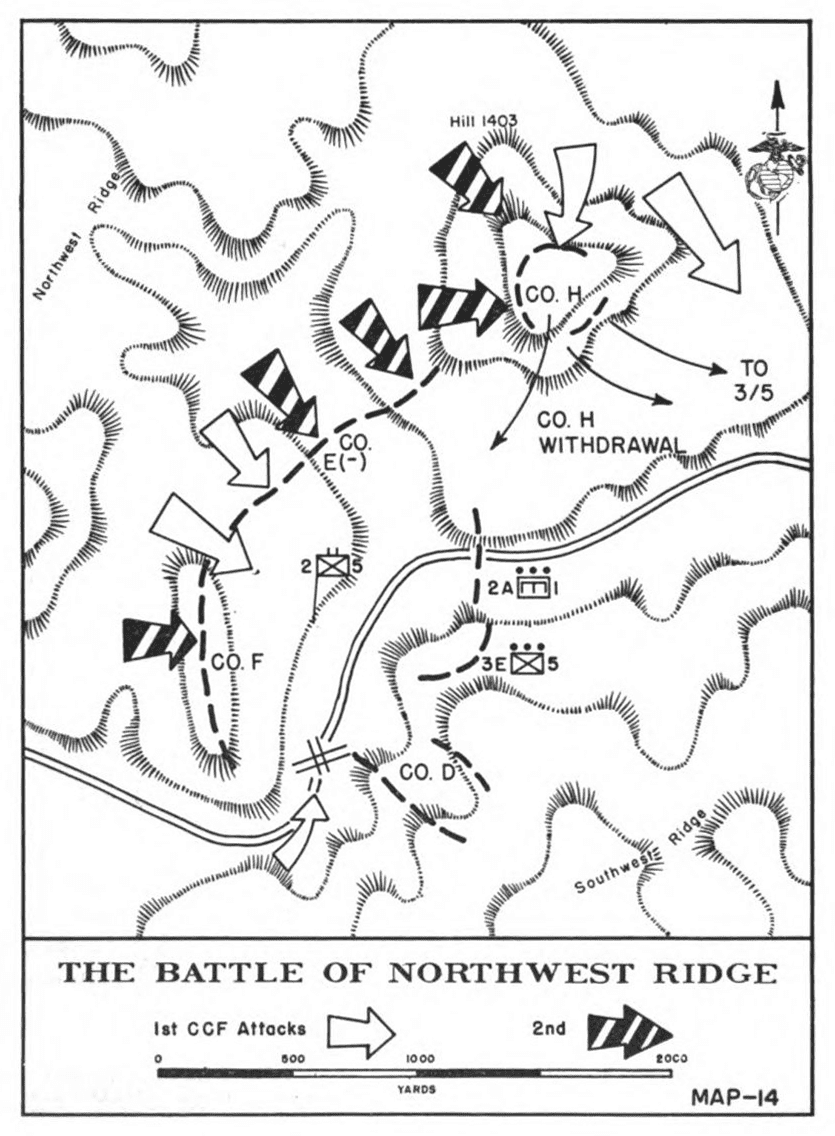
THE BATTLE OF NORTHWEST RIDGE
MAP-14
This was the main effort of the CCF in northeast Korea: three divisions
against two regiments of Marines. And in addition to the advantage
of mass, the Reds held the trump cards of mobility and surprise.
They enjoyed superior mobility because they were unencumbered
by heavy weapons and hence could use primitive routes of approach
in the darkness. They had the advantage of surprise because their
practice of marching by night and hiding by day had concealed their
approach to a large degree from UN air observation. To offset these
odds, the outnumbered Marines would have to rely on superior firepower,
command of the air, and another weapon called esprit.
By 2100, Northwest Ridge was crawling with Chinese only a few hundred
yards from the positions of Companies E and F, 5th Marines, and
Company H, 7th Marines. The enemy troops, padding silently in their
rubber sneakers, had as yet given no hint of their presence. To divert
attention, the Red commander sent a patrol against 2/5’s roadblock on
the MSR between Northwest and Southwest Ridges. Troops of Company
D, 5th Marines, exchanged grenades with the Chinese and killed
two of them. The remainder they quickly dispersed with mortar fire.
Simultaneously with the thrust at the roadblock, small enemy teams
probed Fox Company’s line on the spur of Northwest Ridge, vanishing
into the night after each light contact. These disturbances in the center
of 2/5’s zone enabled CCF infiltrators and grenadiers on the northern
tip of the spur to crawl undetected within a few yards of the limiting
point between Company F and Company E on the right. Bugle calls
cut through the darkness, and the grenadiers began heaving their missiles
while the submachine gunners opened up. The din of this first
attempt to unnerve the defenders lasted several minutes. Then came a
sustained mortar bombardment of Marine front lines. While the shells
rained down, the Chinese opened fire with crew-served automatic
weapons emplaced all across Northwest Ridge.
At 2125 the mortar eruptions began to walk toward the Marine rear.
Whistles screeched, enemy machine guns fell silent, and the first Chinese
assault waves hurled themselves against the juncture of Companies
E and F. The enemy attacked on an extremely narrow front in order
to maintain control. His troops advanced in column within grenade
range, then deployed abruptly into skirmish lines that flailed the Marine
positions ceaselessly and without regard to losses.
The machine guns and rifles of Companies E and F piled the attackers
in grotesque heaps up and down the front, but the pressure of human
tonnage was unremitting. Ultimately, the Reds broke through on the
northern tip of the spur, where the two units were joined. They poured
troops into the gap, and as they attempted to roll back the newly exposed
flanks, they overran part of Fox Company’s right wing platoon. Captain
Samuel Jaskilka, commanding Easy Company in the draw, dispatched a
light machine-gun section and a squad from his 3d Platoon (deployed
in the rear) to reinforce his 1st Platoon at the edge of the breakthrough.
The latter unit, under Second Lieutenant Jade L. Nolan, held
firm and bent back its left to prevent encroachment on the rear. Staff
Sergeant Russell J. Borgomainero, of the 1st Platoon, deployed the
reinforcements to contain the penetration, while 2/5’s 81mm mortars
laid barrages on the salient.
At 2215, as the attack against Companies E and F was reaching its
height, Lieutenant Colonel Roise ordered H&S Company of 2/5 to
deploy for the immediate defense of his command post. The Chinese,
blocked in their attempts to get behind Easy Company, continued to
stab at the rear of Fox. If their envelopment succeeded, they could
swarm over the headquarters and supporting arms positions of the 2d
Battalion.
Roise’s precaution proved unnecessary. As fast as the Red commander
sent troops into the salient, they were cut down by mortar, machine-gun,
and rifle fire. The few who did worm their way into Marine supporting
positions died in individual combat. At 2230, on the right of Company
E’s front, the 2d Platoon turned its machine guns on a native hut 200
yards up the draw and set it ablaze. The brilliant illumination exposed
all CCF troops in the narrow corridor and on the adjoining slopes; and
the Marines commenced a turkey shoot that ended at 2400 with the
virtual annihilation of the main enemy force.
The Chinese maintained their grip on the northern tip of the spur,
however, and fought off patrols from Easy Company trying to re-establish
contact with Fox. Since the gap remained, leaving the enemy in
position to fire on the Marine rear, Roise shifted the reserve platoon of
Company D to Fox Company’s side of the salient. This redeployment,
in conjunction with Company E’s earlier action on the other side, converted
the penetration area into a gantlet for the Chinese. Already
weakened by casualties numbering in the hundreds, the Red commander
apparently wrote off the salient as a net loss, for he never used it again.
At 2135, just as the first assault waves were pounding 2/5’s front,
the vanguard of another enemy force began to feel out the lines of
Company H, 3/7, on Hill 1403 to the north. Captain Cooke’s three
platoons were deployed in an arc from the road to the peak of the hill
to protect the line of communication to the valley of Yudam-ni. Out of
physical contact with all friendly elements, How Company was assailable
from every direction, as the Chinese quickly discovered.389
Following a half hour of lightning probes, the enemy launched a
strong attack against First Lieutenant Elmer A. Krieg’s platoon on the
right front. Communications with Cooke’s CP went out almost immediately,
and in the space of a few minutes the Marine right flank collapsed
under the weight of CCF numbers. Krieg shifted his remaining
men to the left and joined Second Lieutenant Paul E. Denny’s platoon.
At the company CP on the reverse slope, Captain Cooke and his forward
observers radioed for all available supporting arms. The prompt
barrages by artillery and mortars in the valley stopped the Communists
on the right half of the summit and enabled Cooke to reorganize his
forward platoons. As the supporting fires lifted, he personally led an
assault to restore the right flank. But the CCF machine guns and grenades
smashed the counterattack, and Cooke was cut down at the head
of his men.
Second Lieutenant James M. Mitchell, executive officer, temporarily
took command of Company H. When word of Cooke’s death reached
3/7’s CP, Lieutenant Colonel William F. Harris390 dispatched Lieutenant
Harris (no relation), recently returned to duty after illness, to take
over the beleaguered unit.
The younger Harris, who had been out of action since shortly after
the “How Hill” battle in early November, safely ascended the enemy-infested
slopes of Hill 1403 in the darkness. About midnight he reached
How Company’s positions and found all of Cooke’s officers wounded
but one, Lieutenant Newton. The platoons of Krieg and Denny were
badly depleted, but Harris moved Newton’s platoon from the left
flank to the right. Newton’s men regained enough ground in a counterattack
to cement the company’s position.
After these first attacks against 2/5 and H/7 over the two-mile
breadth of Northwest Ridge, the Chinese remained generally inactive
for a period of about two hours. They had paid heavily for minor gains—so
heavily that fresh battalions were called from reserve to stamp out
the Marine resistance on the tip of the ridge. And at 0300, several
hundred CCF riflemen, grenadiers, and submachine gunners commenced
the second general assault, striking at 2/5 and Company H simultaneously.
In the low ground at the center of the two-mile front, Jaskilka’s Easy
Company threw a curtain of machine-gun fire across the draw in the
path of 300 Chinese advancing frontally. The first enemy ranks marched
into the fire lanes and were mowed down like rows of grain. The CCF
soldiers in subsequent formations apparently viewed the grisly, corpse-strewn
corridor with misgivings, for they stopped several hundred yards
up the narrow valley and took cover. Thereafter, the main fighting in
Company E’s zone involved long-range exchanges of machine-gun and
mortar fire, although clashes at close quarters occasionally flared up
on the flanks.
Approximately 200 Communist troops had concentrated meanwhile
against Fox Company on the spur to the left, where the ground afforded
more cover and space for maneuver. Stumbling over a carpet of their
own dead, the Reds thrust repeatedly at the center of the Marine line.
They inflicted many casualties on the defenders and ultimately overran
two machine-gun positions. But this was the sum total of their success;
and fighting on the north half of the spur, at the edge of the gap between
Companies E and F, continued sporadically for the rest of the
night with neither side gaining any appreciable advantage.
On the right of the 2d Battalion, the second CCF onslaught had struck
the front and both flanks of Company H on Hill 1403. Human cannon
fodder of Red China was hurled against the Marine positions for a full
hour, but Lieutenant Harris’ command held. H Company’s roadblock,
commanded by Sergeant Vick, decisively beat off a Chinese attack in the
valley; and at 0400 Lieutenant Colonel Harris ordered the hard pressed
company to pull back toward the rear of Easy Company, 2/5. Two
hours later How Company completed its fighting withdrawal.
The loss of Hill 1403 posed a grave threat to the whole defensive
network around the village. Not only were the Chinese now ideally
situated to strike at the rear of 2/5 and sever it from the two regiments,
but in sufficient strength they could attack the rear and flanks of the
Marine units on North and Southwest Ridges. Moreover, at dawn, they
would be looking down the throats of some 2000 Marines on the valley
floor.
The partially successful assault on Northwest Ridge involved two
regiments, the 266th and 267th, of the 89th CCF Division. Operating
abreast of this force, the 79th Division had meanwhile advanced over
the rugged spine of North Ridge toward the two isolated companies of
the 2d Battalion, 7th Marines, occupying terminal Hills 1282 and
1240 of that huge land mass. Elements of the 79th Division’s three
regiments were in the fore, and each regiment was apparently disposed
in a column of battalions. Facing south toward the Marine positions
on North Ridge, the CCF order of battle, with probable objectives assigned,
was as follows:
| 237th Regt |
235th Regt |
236th Regt |
| Hill 1384 |
Hill 1240 |
Hill 1167 |
| (Unoccupied) |
(D/7) |
(Unoccupied) |
For reasons unknown, the commander of the 235th Regiment did
not include Hill 1282 in his plan for seizing the high ground above
Yudam-ni. He ordered his 1st Battalion to take only Hill 1240, and
the commanding officer of that unit in turn assigned the mission to his
1st and Special Duty Companies. After these two outfits had seized
the objective, the 2d and 3d Companies would pass through and, in
conjunction with other CCF forces in the locale, “... annihilate the
enemy at Yudam-ni.”391
Approaching the terminal high ground in darkness, the 1st Battalion,
235th Regiment, veered off its course and mistakenly ascended a spur
toward Hill 1282. The 3d Battalion, 236th Regiment, keeping contact
as it advanced on the left, participated in the error and wound up at
the foot of Hill 1240. Thus confronted with this precipitous mass
instead of low, gently sloping Hill 1167, the 3d Battalion floundered
for several hours and did not take part in the first attack against the
Marine perimeter. It did, however, send out the usual screen of
infiltrators.
At 2200, submachine gunners and grenadiers of the 1st and Special
Duty Companies, 1/235, commenced the preliminaries against Company
E, 7th Marines on Hill 1282, believing they were engaging a
Marine platoon on Hill 1240. The harassing force was driven off after
failing to disrupt the Marine defenses. Almost two hours later, at
2345, Company D of 2/7 reported enemy infiltration on Hill 1240 a
thousand yards to the east. Both Marine companies cancelled the
patrols scheduled for the long saddle connecting their positions and
went on a 100% alert.
Captain Phillips, commanding Easy Company, had arranged two
platoons in perimeter around the summit of Hill 1282, and the third
he had deployed to the right rear, on a spur that dipped toward Yudam-ni.
At midnight, after a period of silence across the company front,
the initial CCF assault wave slammed into the northeastern arc of the
perimeter, manned by First Lieutenant Yancey’s platoon. Marine firepower
blunted this frontal attack, and the Reds tried to slip around the
east side of the hilltop. They ran head-on into First Lieutenant Bey’s
platoon entrenched on the spur and were thrown back.
Resorting to grinding tactics, the Chinese repeatedly assaulted Company
E’s position from midnight to 0200. Whistles and bugles blared
over the reaches of North Ridge, and the charging squads of infantry
met death stoically, to the tune of weird Oriental chants. When one
formation was cut to pieces by machine-gun fire and grenades, another
rose out of the night to take its place. By 0200, as the first attack began
to taper off, the northeastern slopes of Hill 1282 lay buried under a
mat of human wreckage. An hour later, the 1st and Special Duty Companies
of the 1st Battalion, 235th CCF Regiment, had ceased to exist,
having lost nearly every man of their combined total of over 200.
Company E’s casualties had been heavy, but the Marines still held
Hill 1282.
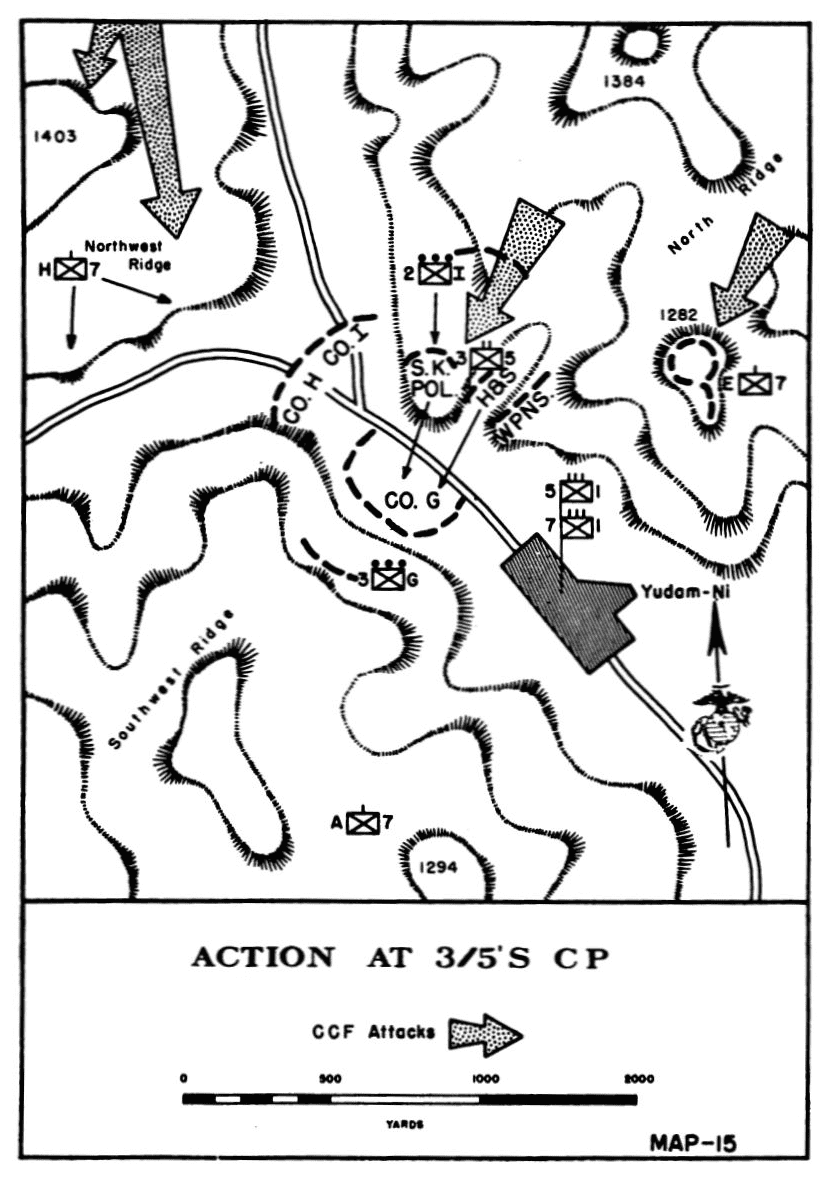
ACTION AT 3/5’S CP
MAP-15
On Hill 1240, a thousand yards to the east, infiltrators of the 3d Battalion,
236th CCF Regiment, probed Dog Company’s perimeter while
Easy was under attack. By 0030, some of the harassing parties had side-slipped
through the saddle separating Hill 1282 and opened fire on
the 5th and 7th Regimental headquarters in Yudam-ni.
The sniping from the slopes of North Ridge did not surprise the
Marines in the valley, for they had long been preparing for a possible
threat from that direction. Early in the evening, Lieutenant Colonel
Taplett had re-deployed 3/5 from an assembly area just north of the
village to a broad tactical perimeter in the same locale. Companies H
and I, the latter on the right, he positioned facing Northwest Ridge—specifically
Hill 1403. Two platoons of Company G held blocking
positions near the base of Southwest Ridge, and the third manned an
outpost on the slopes of that high ground. At the bottom of North
Ridge, in the draw between Hill 1282 and the spur of 1384, Taplett
established his CP with H&S and Weapons Companies providing
local security.
When 3/5’s commander learned that the spur of Hill 1384 was
unoccupied, he dispatched a platoon of Company I to an outpost
position 500 yards up the slope. About 300 yards behind the Item
Company unit, on a portion of the spur directly above the battalion CP,
a platoon of South Korean police deployed with two heavy machine
guns.
At 2045, fifteen minutes before any other unit on the Yudam-ni
reported a contact, the outpost platoon of Item Company began receiving
fire from above. This harassment, probably involving advance
elements of the 237th CCF Regiment, continued sporadically for several
hours, throughout the period of the first Communist attacks against
other fronts.
In the valley at 2120, a few men of How Company, 7th Marines,
entered 3/5’s positions barefooted and partially clothed. Taplett, personally
noting the time of their arrival, questioned them in the battalion
aid station, and they told how their 60mm mortar position on Hill 1403
had been seized by the Chinese.392
The battalion commander returned to his CP, and after listening to
the far-off din of the initial Communist attacks, placed his perimeter
on a 100% alert at 0115. Half an hour later, the Item Company platoon
on the spur of Hill 1384 reported an increase in enemy fire coming
from above. A message from H/7 next warned that CCF troops were
moving around Hill 1403 to cut the MSR. Company I observed activity
in that quarter shortly afterwards, and at 0218 opened fire on an enemy
platoon, which promptly retracted.
A few minutes later, a company—possibly two companies—of Chinese
swept down the spur of Hill 1384, overran the Item Company
platoon outpost, and continued on towards the police platoon. The
South Koreans, after inflicting heavy casualties on the Reds with their
two machine guns, vacated the high ground. Enemy troops then spread
out along the crest and poured plunging fire into H&S and Weapons
Companies defending the draw.
Weapons Company, on the far side of the depression, held its ground,
but H&S, directly under the gun, shortly fell back across the MSR.
Taplett’s CP was left in a no man’s land, with enemy bullets raining
down out of the night and Marine fire whistling back from across the
draw and road. Upon learning of the withdrawal, the battalion commander
elected to remain in the tent in order to keep telephone contact
with his rifle companies, which were as yet uninvolved. He did not
consider the situation too serious, and it seemed as though the police
platoon’s machine guns had taken the sting out of the enemy assault.
Except for a few individuals, the Chinese did not descend from the
spur. Nor did they direct much fire at Taplett’s blackout tent, which
they probably took to be unoccupied. Inside, the battalion commander
studied his maps, received reports and issued instructions over the field
phone while his S-3, Major Thomas A. Durham, sat nearby with pistol
drawn. Major John J. Canney, the executive officer, left the CP to
retrieve H&S Company and was killed as he approached the MSR.
Private First Class Louis W. Swinson, radio operator, whose instrument
had proved unreliable in the severe cold, took position outside the tent
and covered the approaches with his rifle. This unique situation—a
battalion commander under fire in an exposed position while his rifle
companies lay peacefully entrenched several hundred yards away—lasted
for over an hour.
At approximately 0300, when Taplett, Durham, and Swinson began
their lonely vigil, the 79th CCF Division launched another assault on
North Ridge (see Map 16).393 As a result of the enemy’s first attack,
and in anticipation of the second, Colonel Murray earlier had moved
elements of the 1st Battalion, 5th Marines, into position behind 3/5.
Second Lieutenant Nicholas M. Trapnell’s 1st Platoon of Company A
left the battalion assembly area in the valley at 0100 and started up the
steep incline of Hill 1282. Climbing the icy slopes by day was difficult
enough, but darkness and a minus-20-degree temperature made it a
gruelling and perilous ordeal. Trapnell’s outfit did not reach the crest
until after 0300, when the CCF assault was at the height of its fury
and Company E was facing imminent annihilation. The Able Company
unit moved into position with Lieutenant Bey’s platoon on the spur
jutting back from the peak. As yet, the full force of the Chinese drive
had not spread to this area.
The Red commander of the 1st Battalion, 235th Regiment, used his
3d Company for the second attack against the cap of Hill 1282. With
the few survivors of the 1st and Special Duty Companies attached, the
fresh unit probably numbered about 125 troops. In squads of eight to
ten, the Chinese struck again and again at the perimeter on the summit,
and the two depleted platoons of Easy Company dwindled to a mere
handful of tired, desperate Marines. First Lieutenant Robert E. Snyder’s
3d Platoon of A/5, having been sent up from the valley shortly
after Trapnell’s outfit, arrived as reinforcements. Snyder did not have
contact with Bey and Trapnell, whose platoons were still intact, so he
integrated his men with the remnants of the two platoons on the peak.
Both sides suffered crippling losses during the close fighting on
Hill 1282. The Reds finally drove a wedge between the Marine defenders
on the summit and the platoons of Bey and Trapnell on the spur.
According to Bey:
It soon became obvious that a penetration had been made to our left. The
positions atop the hill and the Command Post area were brightly illuminated
by flares and other explosions. By this time [approximately 0400] nothing
but Chinese could be heard on the telephone in the command post and my
Platoon Sergeant, Staff Sergeant Daniel M. Murphy, requested permission
to take what men we could spare in an attempt to close the gap between the
left flank of the platoon and the rest of the company. I told him to go ahead
and do what he could.394
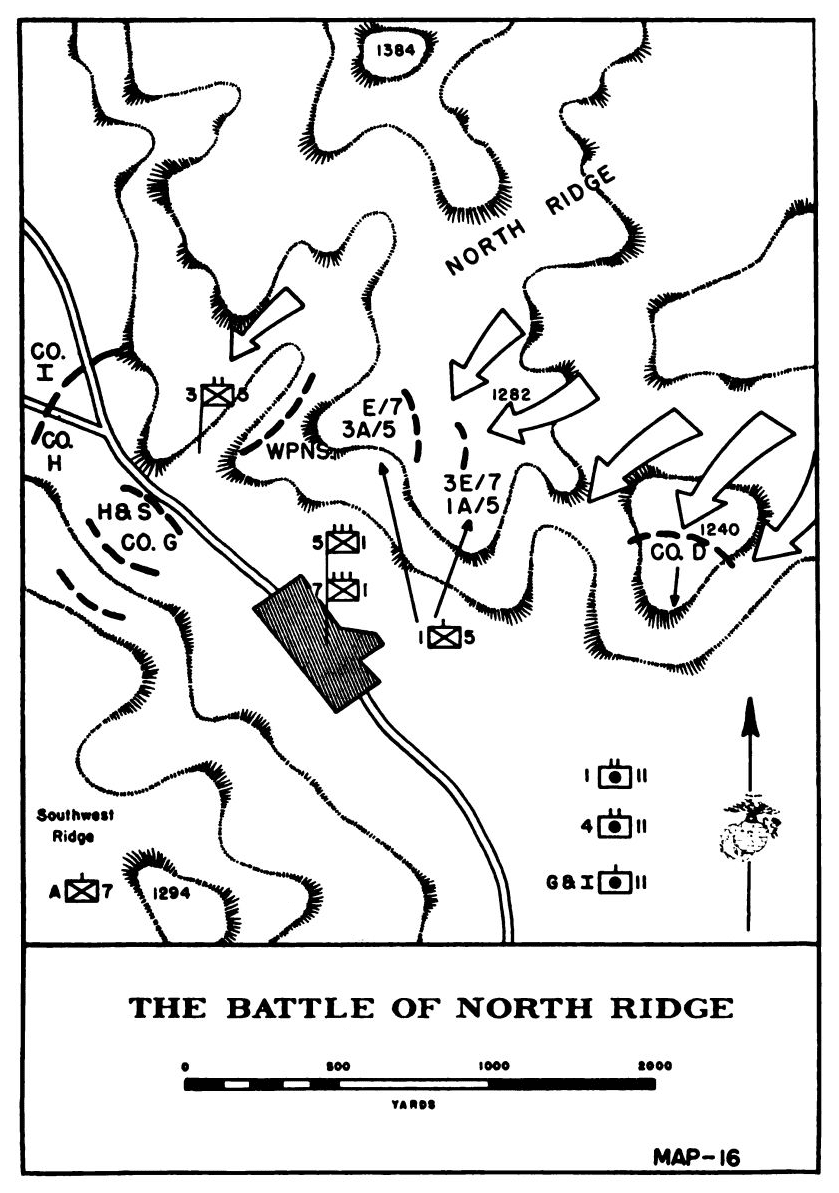
THE BATTLE OF NORTH RIDGE
MAP-16
Meanwhile, the center and rear of Easy Company’s perimeter was
reduced to the chaos of a last stand. Yancey, already wounded, was hit
again as he tried to reorganize the few Marine survivors on the peak.
First Lieutenant Leonard M. Clements, the other platoon leader, fell
wounded as did First Lieutenant William J. Schreier of the mortar
section and Lieutenant Snyder. Captain Phillips, hurling grenades in
the midst of the melee, was killed. His executive officer, First Lieutenant
Raymond O. Ball, took command of Company E, shouting out
encouragement as he lay immobilized by two wounds. He was hit
several more times before he lapsed into unconsciousness and died
after reaching the aid station. Lieutenant Snyder took command.
By 0500, CCF infantrymen of the 3d Company, 1/235, occupied the
summit of Hill 1282, still believing it to be Hill 1240. The remnants
of the platoons of Yancey, Clements, and Snyder had been driven to
the reverse slope in the west, while the units of Trapnell and Bey clung
to the crest of the southeastern spur, overlooking Yudam-ni. Up to
this point, Chinese casualties on Hill 1282 probably numbered about
250, with Marine losses approximating 150. Easy Company had been
reduced to the effective strength of a rifle platoon (split in two), and
the pair of A/5 platoons paid with upwards of 40 killed and wounded
during the brief time on the battle line; only six effectives remained of
Snyder’s platoon.
The danger from enemy-held Hill 1282 was compounded by the
success of the 3d Battalion, 236th Regiment on Hill 1240 to the east.
At about 0105 the Chinese who had previously been content only to
make probing attacks on Captain Hull’s Dog Company shifted to a
full-scale assault. Sergeant Othmar J. Reller’s platoon, holding the
northwest portion of the company perimeter, beat off three attacks
before being overrun at about 0230. First Lieutenant Richard C. Webber,
the machine gun platoon leader, attempted to plug the gap with
the available reinforcements but was prevented by a fire fight outside
the Company CP. First Lieutenant Edward M. Seeburger’s platoon
holding the perimeter on the right (east) was under too heavy an
attack to extend to the left and tie in with Webber. The Chinese overran
Hull’s CP at about 0300, and he ordered Seeburger and First Lieutenant
Anthony J. Sota, commanding the rear platoon, to reorganize
at the foot of Hill 1240.
Captain Hull, wounded, his command cut to the size of a few squads,
rallied his troops on the hillside and led a counterattack against the
crest. The surprised Chinese recoiled and the Marines won a small
foothold. Then the enemy smashed back from the front, right flank,
and right rear. Hull was wounded again but continued in action as
his hasty perimeter diminished to the proportions of a squad position.
With the approach of dawn, he had only 16 men left who could fight.
The enemy was on the higher ground to his front, on both flanks, and
on the slopes in his rear.
CHAPTER IX Fox Hill — Encirclement of Company C of RCT-7 — Fox Company at Toktong Pass — Marine Counterattacks on North Ridge — Deadlock on Hill 1240 — The Fight for Northwest Ridge — Second Night’s Attacks on Fox Hill — Not Enough Tents for Casualties — The Turning Point of 30 November
Encirclement of Company C of RCT-7—Fox Company at Toktong
Pass—Marine Counterattacks on North Ridge—Deadlock
on Hill 1240—The Fight for Northwest Ridge—Second Night’s
Attacks on Fox Hill—Not Enough Tents for Casualties—The
Turning Point of 30 November
Of the Marine artillery units at Yudam-ni, those most directly
imperiled by CCF gains on North Ridge were Major Parry’s 3d
Battalion and Battery K of the 4th. The latter, under First Lieutenant
Robert C. Messman, lay beneath the southeastern spur of Hill 1282,
having gone into position at 2100 on 27 November. Rearward of King
Battery, 3/11 was positioned below the steep slopes of Hill 1240
where its 105s had fired in direct support of the 7th Marines on 26
and 27 November (see Map 12).395
The 1st Battalion, 11th Marines, which had arrived at Yudam-ni
early on the 27th to support the 5th Regiment, was emplaced in the
valley between the tips of South and Southwest Ridges. Major William
McReynolds, commanding the 4th Battalion, reached the perimeter
with his outfit later. He had two batteries in action by 1900 and all
three by 2300 on the low ground separating South and Southeast
Ridges. Battery K, firing under the direction of 1/11 pending the
arrival of the parent unit, then reverted to McReynolds’ control,
although it did not displace rearward to 4/11’s positions until the next
day.
The TD-14 bulldozers of the 11th Marines had proved to be no
match for the eight-inch frostline around the Reservoir, with the result
that all batteries and security positions sat fully exposed on the concrete-like
flatlands. Incoming mortar fire harassed the artillerymen throughout
the day of 27 November, and after dark CCF flat trajectory weapons
stepped up the tempo of bombardment. Marine casualties in the valley
were light, however, for the enemy gunners seemed unable to group
their erratic pot shots into effective barrages.396
It was the imminent threat of Communist infantry attack from North
Ridge that weighed down on the artillerymen of the 11th Regiment
during the predawn hours of 28 November. Since the beginning of the
CCF onslaught, they had been firing their howitzers almost ceaselessly
in a 180-degree arc, and ammunition stocks were fast dwindling to a
critical level. Their gun flashes providing brilliant targets for enemy
infiltrators, they could reasonably expect a full-scale assault in the
event of the dislodgment of Easy and Dog Companies from Hills 1282
and 1240. The effect of countermoves by Colonels Litzenberg and
Murray would not be known until after dawn, and meanwhile the
Marine gunners kept on firing their howitzers while the black outline
of North Ridge loomed ever more menacing.
While the 79th and 89th CCF Divisions pounded the northwest arc of
the Yudam-ni perimeter during the night of 27–28 November, the
59th completed its wide end-sweep to the southeast and moved against
the 14-mile stretch of road to Hagaru. At the moment the Communist
effort in that quarter could be considered a secondary attack, but if
ever a target fulfilled all the qualifications of a prime objective, it was
this critical link in the MSR—the very lifeline to most of the 1st Marine
Division’s infantry and artillery strength.
During the 27th Captain Wilcox’s Baker Company of the 7th Marines
patrolled along South Ridge. As darkness fell, it was heavily
engaged and incumbered with a number of litter casualties. With the
permission of the regimental commander, Lieutenant Colonel Davis
led Captain John F. Morris’s Charlie Company (-) down the MSR to
positions across the road from Hill 1419. Aided by Charlie Company,
Baker was then able to withdraw and return to Yudam-ni with Davis
while Morris and his reduced company took up positions on Hill 1419.397
He deployed his two rifle platoons and 60mm mortar section in a
crescent on the lower slopes of the eastern spur, facing the distant crest.
At 0230, five hours after Yudam-ni came under attack, a CCF force
descended from the high ground and struck the right flank.398
After overrunning part of First Lieutenant Jack A. Chabek’s platoon
and inflicting heavy casualties, the Reds lashed out at the left flank
of the crescent-shaped defense. Here Staff Sergeant Earle J. Payne’s
platoon, less one squad in an outpost on higher ground, bent under
the weight of the attack and was soon in danger of being driven out of
position. Captain Morris reinforced the platoons on each flank with
men from his headquarters and the mortar section. The reshuffling
was accomplished in the nick of time and just barely tipped the scales
in favor of the defenders. A seesaw battle raged until after dawn on
the 28th when, with the help of artillery fire from Yudam-ni, the Marines
drove the Chinese back into the hills.
Although the critical pressure eased at daybreak, Company C remained
pinned down by enemy fire coming from every direction, including
the crest of Hill 1419 directly above. The Chinese were in absolute
control of the MSR to the south, toward Toktong Pass, and to the north,
in the direction of Yudam-ni. Morris had taken about 40 casualties—a
dangerously high proportion, since he had only two of his three rifle
platoons. His radio had been knocked out by enemy bullets, and the
60mm mortar section was left with but a few rounds of ammunition.
For want of communication, he could get no help from the Marine
Corsairs on station overhead.
The outpost squad from Payne’s platoon could not be contacted in
its position on the higher slopes of Hill 1419. Corporal Curtis J.
Kiesling, who volunteered to search for the lost unit, was killed by
CCF machine-gun fire as he attempted to scale the rugged incline.
Other men of Company C repeatedly exposed themselves in order to
drag wounded comrades to the relative safety of a draw leading down
to the MSR.
Surrounded and outnumbered, Morris had no alternative but to await
help from Yudam-ni. He contracted his perimeter on the hillside east
of the road, and from this tiny tactical island, for the rest of the morning,
his men watched Communist troops jockey for position around a
360-degree circle.
Where Morris had taken a reduced infantry company into its lonely
assignment on the MSR, Captain William E. Barber went into position
at Toktong Pass on the 27th with a heavily reinforced outfit.399 His Fox
Company of 2/7, augmented by heavy machine gun and 81mm mortar
sections of Weapons Company, numbered 240 officers and men. At
the midway point of the pass, Barber chose an isolated hill just north
of the MSR for his company perimeter. He placed the 3d Platoon (First
Lieutenant Robert C. McCarthy) on the summit, facing generally north,
with the 1st (First Lieutenant John M. Dunne) on the right and the
2d (First Lieutenant Elmer G. Peterson) on the left. The 3d Platoon
formed a hilltop perimeter with two squads forward and the third in
reserve to the rear. Tied in on each flank, the 1st and 2d Platoons
stretched down the respective hillsides and bent back toward the MSR.
These two were connected on the reverse slope by company headquarters
and the rocket squad. Just below, at the base of the hill next to
the road, were Barber’s CP together with the 81mm and 60mm mortar
sections. All machine guns, including the heavies from Weapons Company,
were emplaced with the rifle platoons.
During the first half of the night of 27–28 November, Toktong Pass
rumbled with the reverberations of truck convoys—the final serials of
1/5 and 4/11 outbound for Yudam-ni and Lieutenant Colonel Beall’s
empty trucks inbound for Hagaru. It was after 2000 before the last
trucks climbed to the summit, then nosed downhill, whining and roaring
through the night as they made the twisting descent. Chinese Communists
had already launched their first attacks against Southwest Ridge
at Yudam-ni, but Fox Company’s perimeter remained quiet, even during
the first hour of 28 November.
It was actually too quiet at 0115 when Lieutenant McCarthy inspected
the 3d Platoon positions atop Fox Hill, now glittering in the light of
a full moon. Finding his men numbed by the severe cold, he called
together his squad leaders and admonished them to be more alert.
A short time later, during his next inspection, McCarthy heard the
proper challenges ring out at every point.
There was no lack of watchfulness at 0230. For it was then that
Chinese in estimated company strength lunged out of the night and
assaulted the north, west, and south arcs of Company F’s perimeter.
On the summit, the two forward squads of McCarthy’s platoon were
overwhelmed almost immediately, losing 15 killed and nine wounded
out of a total of 35 men. Three others would later be listed as missing.
The eight uninjured fell back to the reserve squad’s position on the
military crest to the rear, and the enemy took over the topographical
peak.
Fighting with small arms and grenades also raged on the hillside to
the left, where the Chinese attempted to drive a wedge between the
2d and 3d Platoons. Repeated assaults were hurled back with grievous
losses to the Reds, and they apparently threw in fresh units in their
bid for a critical penetration. That they failed was due largely to the
valor of three Marines who made a determined stand at the vital junction:
PFC Robert F. Benson and Private Hector A. Cafferatta of the
2d Platoon, and PFC Gerald J. Smith, a fire team leader of the 3d.
These men, assisted by the members of Smith’s team, are credited with
annihilating two enemy platoons.
While the enemy had undoubtedly planned the attack on the two
rifle platoons with typical precision, it seems that he literally stumbled
into the rear of Fox Company’s position. Corporal Donald R. Thornton,
member of a rocket launcher crew, reported that a group of Chinese
walking along the MSR suddenly found themselves at the edge of
Barber’s CP and the mortar positions. The Communist soldiers recovered
from the surprise and closed in aggressively, forcing the company
commander and the mortar crews to ascend the hill to a protective line
of trees. An embankment where the MSR cut through the base of the
hill prevented pursuit by the Chinese. When they tried to climb over it
they were cut down by small-arms fire; when they hid behind it they
were riddled by grenades that the Marines rolled downhill; when they
finally gave up and tried to flee, they were shot as they ran into the open.
On the right (east) side of the perimeter, the 1st Platoon was
engaged only on the flanks, near the summit where it tied in with the
3d and down the slope where it joined the headquarters troops and
mortar crews defending the rear.
Fighting around the 270° arc of the perimeter continued until after
daybreak. Despite losses of 20 dead and 54 wounded, Fox Company
was in complete control of the situation. Lieutenant McCarthy described
the breaking-off action as follows:
By 0630, 28 November, the Chinese had received so many casualties that
the attack could no longer be considered organized. Few Chinese remained
alive near the company perimeter. Individual Chinese continued to crawl up
and throw grenades. A Marine would make a one-man assault on these individuals,
shooting or bayoneting them. The attack could be considered over,
although three Marines ... were hit by rifle fire at 0730. We received small
arms fire intermittently during the day, but no attack.
McCarthy estimated that enemy dead in front of the 2d and 3d
Platoons numbered 350, while yet another 100 littered the 1st Platoon’s
zone and the area at the base of the hill along the MSR.400
As Companies C and F of the 7th Marines were fighting on the MSR
in the hours just before dawn of 28 November, the first of a series of
Marine counterattacks commenced at Yudam-ni. It was essential to the
very survival of the 5th and 7th Regiments that the Chinese be driven
back, or at least checked, on the high ground surrounding the village.
Lieutenant Colonel Taplett, operating his CP in the no man’s land
at the base of North Ridge, ordered Company G of 3/5 to counterattack
the spur of Hill 1384 at about 0300.401 The platoon of George
Company outposting Southwest Ridge was left in position, but the
other two platoons, under Second Lieutenants John J. Cahill and Dana
B. Cashion, moved out abreast shortly after 0300. Driving northward
aggressively, they crossed the MSR, “liberated” Taplett’s CP, and
cleared the draw in which Weapons Company of 3/5 was still entrenched.
Troops of H&S Company followed the attackers and reoccupied
their old positions in the gulley.
Cahill and Cashion, displaying remarkable cohesion on unfamiliar
ground in the darkness, led the way up Hill 1384. Their men advanced
swiftly behind a shield of marching fire and routed the few402 Chinese
on the spur. The position earlier vacated by the police platoon was
recaptured, and the Marines saw numerous enemy dead in front of the
South Korean machine gun emplacements. About 500 yards beyond
the battalion CP the two platoons halted until daylight. The seven men
who had formed the Item Company outpost on Hill 1384 arrived
shortly afterwards and were integrated into Cashion’s platoon.
He continued the attack soon after daybreak, with Cahill’s platoon
giving fire support. Cashion and his men plunged into enemy territory
along the ridge line leading northward to the topographical crest of
Hill 1384, about 1000 yards distant. They had reached the final slopes
when Taplett received the radio message, almost incredible to him,
that the two platoons were nearing the peak of Hill 1384. He directed
them to discontinue the attack and withdraw to the top of the spur.
There they were to establish a defense line overlooking Yudam-ni until
receiving further orders. The spirited drive led by the two young officers
had taken considerable pressure off the Marine units in the valley west
of the village. One immediate effect was that approximately 80 officers
and men of How Company, 7th Marines, were able to retire into 3/5’s
perimeter from the slopes of Hill 1403 on Northwest Ridge.
To the east of 3/5, a second successful counterattack by the 5th
Marines brought stability to yet another critical point. Company C of
1/5 had deployed shortly after midnight to back up 3/5, in the event
of a breakthrough in the valley. Owing to the adverse developments
on Hills 1282 and 1240, however, it was later placed under operational
control of the 7th Marines. One platoon left for Hill 1240 in the middle
of the night to reinforce D/7, and the remainder of the company, led
by Captain Jack R. Jones, ascended 1282 to assist E/7 and the two
platoons of A/5 earlier committed.403
Charlie Company moved up a draw with Jones and his executive
officer, First Lieutenant Loren R. Smith, in the van of the column, followed
by the 1st and 2d Platoons and the 60mm mortar section. Light
machine-gun sections were attached to the rifle platoons. The climb
took almost two hours in the predawn darkness, the company frequently
halting while Jones questioned wounded men descending from
the top. Numb from cold, shock, and loss of blood, they could give no
intelligible picture of a situation described as grim and confused.
At approximately 0430, the head of the column came under heavy
fire from above as it reached a point just below the military crest, about
100 yards from the summit of 1282. Here, Jones found Staff Sergeant
Murphy from E/7’s 3d Platoon which, along with Trapnell’s, was out
of sight on the spur to the right. Also out of sight but far to the left
were Snyder’s platoon of A/5 and a handful of men of Easy Company.
While CCF grenades and small-arms fire rained down, Murphy explained
that E/7’s main position had been overrun and that he was
attempting to form a holding line in the center with some 20 survivors
of the summit battle.
Jones quickly deployed his two platoons for the attack, the 2d under
Second Lieutenant Byron L. Magness on the right, the 1st under Second
Lieutenant Max A. Merrit on the left. Murphy’s small contingent joined
the formation. Second Lieutenant Robert H. Corbet set up his 60mm
mortar section to support the advance, then took a place in the assault
line. Down in the valley the 81mm mortars of 1/5 opened up with a
preparatory barrage. Artillery could not fire because of the short distance
between friendly and enemy lines, and the first flight of Corsairs
was not yet on station.
The frontal attack against the 3d Company, 1st Battalion, 235th CCF
Regiment began shortly after daybreak. Jones personally led the Marine
skirmishers against more than 50 enemy soldiers armed with machine
guns and grenades. His troops moved upward through a hail of fire and
overran the Communists after a savage clash that included hand-to-hand
fighting. The Marines then deployed with the just-arrived 2d
Platoon of Able Company bridging the gap between Jones and Trapnell
in time to thwart the advance of enemy reinforcements.
According to enemy reports, only six or seven men survived the 3d
Company’s defeat. One of them happened to be the company political
officer, who conveniently had retired from the battle line during the
crucial stage of the struggle. At 1/235’s CP, a few hundred yards to
the rear, he was given a platoon of the 2d Company “in order to evacuate
the wounded and to safeguard the occupied position on Hill
1282....” The fresh unit ascended the northern slopes of the height
while Jones’ company was battling its way up from the south. By the
time the Red soldiers of the 2d Company neared the summit, they were
confronted from above by the muzzles of Marine rifles and machine
guns. The whole story unfolds in CCF records as follows:
As soon as the 1st Platoon [2d Company] advanced to the 3d Company’s
position its assistant company commander came up with the platoon. At that
time, the enemy [C/5] counterattacked very violently. Accordingly, the
assistant company commander ordered the 1st Platoon to strike the enemy
immediately and determinedly. Before the 1st Platoon’s troops had been
deployed, Lee Feng Hsi, the Platoon Leader, shouted: “Charge!” So both
the 1st and 2d Squads pressed forward in swarms side by side. When they
were within a little more than ten meters of the top of the hill they suffered
casualties from enemy hand grenades and short-range fire. Consequently,
they were absolutely unable to advance any farther. At that time, the assistant
company commander and the majority of the platoon and squad leaders were
either killed or wounded.
While the 1st and 2d Squads were encountering the enemy’s counterattack,
the 3d Squad also deployed and joined them in an effort to drive the enemy
to the back of the hill. As a result, more than half of the 3d Squad were
either killed or wounded. When the second assistant platoon leader attempted
to reorganize, his troops suffered again from enemy flanking fire and hand
grenades. Thus, after having fought for no more than ten minutes, the entire
platoon lost its attacking strength and was forced to retreat somewhat to be
able to defend firmly the place it held.
Meanwhile, according to Chinese accounts, Tsung Hui Tzu, commander
of the 2d Company, had arrived at the CP of 1/235 with his
2d Platoon at 0620. Noting that his 1st Platoon was in trouble, he
said to the leader of the 2d, “There are some enemy soldiers on the hill
[1282] in front of us; attack forward determinedly.”
The 2d Platoon jumped off immediately with two squads abreast
and one trailing. Within 30 meters of the crest, the Reds attempted to
rush Charlie Company’s position behind a barrage of hand grenades.
The assault failed. On the right the assistant platoon leader fell at
the head of the 4th squad, which was reduced to three survivors. Tsung,
the company commander, rushed forward and led the 6th squad on the
left. He was wounded and the squad cut to pieces. Incredibly, the
platoon leader ordered the three remaining men of the 4th squad to
assault the summit again. They tried and only one of them came back.
The 5th squad, advancing out of reserve, had no sooner begun to
deploy than it lost all of its NCOs. “As it mixed with the 4th and 6th
squads to attack, they suffered casualties again from enemy flanking
fire and hand grenades from the top of the hill. Therefore, the entire
platoon lost its combat strength, with only seven men being left alive.”
Not only was the commanding officer of 1/235 down to his last company,
but that company was down to its last platoon. Forever hovering
in the rear, the 2d Company’s political officer, Liu Sheng Hsi, ordered
the platoon to “continue the attack.” The assault began with two squads
forward, led by the platoon leader and his assistant. They charged
uphill into the teeth of Charlie Company’s position. Like all the others,
they were ground into the mat of corpses on the blood-soaked snow.
To complete the suicide of the 1st Battalion, 235th Regiment, the
reserve squad of this last platoon was committed. A few minutes later,
“... there were only six men left.”
The 2d Company paid for its failure with 94 of the original 116
officers and men. This loss, added to those of the 1st, 3d, and Special
Duty Companies, would place 1/235’s casualties on Hill 1282 at
approximately 400, including practically all the company commanders,
platoon leaders, and NCOs. It can be assumed that nearly all of the
wounded succumbed, since evacuation was well nigh impossible with
Marines in control of the summit for the next 24 hours.
Marine losses were not light. Able and Charlie Companies of 1/5
together suffered 15 KIA and 67 WIA. Easy Company of 2/7, according
to best estimates, made its stand at a cost of about 120 killed and
wounded.
At daybreak of 20 November, several of Easy Company’s casualties still
lay in their foxholes on the forward slopes of Hill 1282. To recover
them was an undertaking of great risk, even after the defeat of 1/235;
for CCF survivors continued to fire at the summit from positions on
the lower slopes. Captain Jones directed the evacuation and repeatedly
ran forward of his lines to rescue half-frozen Marines who were immobilized
by wounds.404
Headquarters personnel of 1/5 spent the whole morning removing
casualties from 1282 and carrying them to the battalion and regimental
aid stations, which soon were filled to overflowing. In the meantime,
Able Company joined Charlie on the crest and assimilated the depleted
platoons of Trapnell and Snyder. A new defensive line was drawn
across the vital peak with C/5 in the center, A/5 on the right, and
E/7, now under the command of Lieutenant Bey, on the left. By midmorning,
despite the continued exchange of fire with CCF troops on
the slopes, there was no doubt that the Marines would hold the hill.405
This was not the case 1000 yards to the right, where daybreak had
found the shattered remnants of D/7 clinging to a toehold on Hill 1240
and beset from every direction by troops of the 3d Battalion, 236th
CCF Regiment.406 The 3d Platoon of C/5, which had been dispatched
from the valley at 0400 to help, was delayed by darkness and terrain.
Second Lieutenant Harold L. Dawe’s small relief force became hotly
engaged on the lower slopes, far short of Dog Company’s position,
but made a fighting ascent after dawn.
Initially Dawe missed contact with the beleagured outfit, but afterwards
the two forces cleared the Chinese from 1240. From his position
on the northeastern spur of the hill he could see the enemy massing
on the reverse slopes of 1240 and 1282. Communications were out and
he could not call for fire. At about 1100 the Reds counterattacked with
an estimated two or more battalions and forced Dawe to withdraw
about 150 yards. There his depleted platoon and the 16 remaining men
of Dog Company held under heavy mortar fire until relieved by B/5
at 1700. The price of a stalemate on Hill 1240 was to Dawe about
half of his platoon, and to Hull practically his whole company.
To the left of North Ridge, dawn of 28 November revealed a tactical
paradox on the looming massif of Northwest Ridge. Both Marines and
Red Chinese occupied the terminal high ground, and it was difficult
to determine which had emerged victorious from the all-night battle.
How Company, 7th Marines, had withdrawn from Hill 1403, and from
this commanding peak soldiers of the 89th CCF Division could observe
and enfilade the whole of Yudam-ni valley. In addition to the 80 officers
and men of How Company who had pulled back to the lines of
3/5 during the early morning, another group found its way to the rear
of Easy Company, 2/5, as mentioned earlier.407
The appearance of the latter contingent at 0430 was a cause of consternation
to Lieutenant Colonel Roise. His rifle companies had thrown
back repeated CCF attacks along the draw and spur on the left of the
7th Marines’ outfit, but the loss of 1403 now offset his victory and
gravely imperiled his line of communications to the rest of the 5th
Marines at Yudam-ni, a mile to the rear. Nevertheless, 2/5 continued
to hold. At 0600 Company E counterattacked and drove the Chinese
from the northern tip of the spur which they had occupied during the
night. Fox Company, its right flank now restored and in contact with
Easy, lashed out at 0800 and recaptured the two machine guns overrun
by the enemy four hours earlier. Fifteen CCF soldiers who had
found their way into the rear of Company F some time in the night were
destroyed. Easy Company, after its successful counterattack on the
spur, drove off a large Communist force attempting to move against
its right flank.408
Incredibly, 2/5’s losses for the night-long fight were 7 KIA, 25 WIA,
and 60 weather casualties. Chinese dead piled across the front of
Easy and Fox Companies numbered 500, according to a rough count.409
There was no estimate made by How Company, 7th Marines, of enemy
losses on Hill 1403.
At 0145 on the 28th, Roise had received Murray’s order to continue
the attack to the west after daybreak, so that 3/5 could move forward,
deploy, and add its weight to the X Corps offensive. Events during the
night altered Murray’s plans, of course, and at 0545 the regimental
commander alerted Roise to the probability of withdrawing 2/5 to
Southwest Ridge later in the morning. The battalion commander, not
realizing the extent of the crisis at Yudam-ni, thought a mistake had
been made when he checked the map coordinates mentioned in the
message. Despite the fact that his whole front was engaged at the
time, he was prepared to continue the westward drive, and he questioned
regimental headquarters about the “error” which would take
his battalion rearward. Needless to say, the correctness of the map
coordinates was quickly confirmed.410
Lieutenant Colonel Murray visited Colonel Litzenberg at dawn on
the 28th, while elements of the 5th Marines were counterattacking the
Chinese forces on North and Northwest Ridges. They agreed that the
enemy had appeared in sufficient strength to warrant a switch to the
defensive by both regiments, and Murray cancelled the scheduled westward
attack by his 2d and 3d Battalions. At 1100 he ordered 2/5 to
pull back to Southwest Ridge, tying in on the left with 3/7 on the same
hill mass, and on the right with 3/5, whose line extended from the
valley northwest of Yudam-ni to the crest of North Ridge.411
Orders officially halting the northwestward advance and directing
the 5th Marines to coordinate positions with the 7th Marines were sent
by General Smith at 1650.412 Twenty-three minutes earlier he had ordered
the 7th Marines to attack to the south and reopen the MSR to Hagaru.413
To coordinate better the defense of the new perimeter, Murray
moved his CP from the northwestern edge of Yudam-ni to the center
of the village, where the 7th Marines’ headquarters was located. He
spent most of his time thereafter with Litzenberg, while Lieutenant
Colonel Joseph L. Stewart, his executive officer, ran the 5th Regiment
command post.414 Through constant contact and a policy of close cooperation
in all matters, the two regimental commanders and their staffs
came up with joint plans for the defense of Yudam-ni and the ultimate
breakout to Hagaru.
The first of these plans had to do with the realignment of forces at
Yudam-ni and the rescue of Charlie and Fox Companies, 7th Marines.
Early in the afternoon of 28 November, 2/5 began withdrawing from
Northwest Ridge a company at a time, with Company E providing
covering fire as rear guard. The battalion’s displacement to Southwest
Ridge was completed by 2000 against CCF resistance consisting only
of harassing fires.415
Directly across the valley of Yudam-ni, Company I of 3/5 relieved
the elements of 1/5 on Hill 1282 of North Ridge in late afternoon.
George and How Companies of 3/5 deployed in the low ground to
protect the corridor approaches to Yudam-ni from the northwest.
Lieutenant Colonel Stevens, keeping the bulk of 1/5 in reserve, dispatched
Company B at 1400 to relieve the battered handful of Marines
on Hill 1240.
While this reshuffling took place on the 28th, Colonel Litzenberg
listened anxiously to the grim reports from his 1st Battalion, which
had set out in the morning to retrieve both Charlie and Fox Companies
from their encircled positions on the MSR leading to Hagaru.416 Able
Company led off for the relief force at 1015, entering the gorge between
South and Southeast Ridges. Five hours of fighting, marching, and
climbing took it to a point about three miles from the Yudam-ni
perimeter and one mile short of Company C’s position. Here, while
moving through the high ground east of the MSR, the vanguard met
heavy resistance and was stopped cold.
Lieutenant Colonel Davis, who was following with the remainder
of the 1st Battalion, committed Company B to a flanking movement
west of the road. Air and 81mm mortars supported the auxiliary attack
and routed the Chinese. Both companies advanced to high-ground
positions abreast of Charlie Company’s perimeter, then bent toward the
MSR to provide a protective crescent between the beleaguered outfit
and the enemy-infested ground to the south.
By now it was dark. Fox Company, according to plan, was supposed
to have fought its way from Toktong Pass. Owing to the burden of
casualties and the ring of Chinese around its distant hilltop, it was
not able to do so. Litzenberg, concerned lest 1/7 be similarly trapped
in the gorge, recalled Davis to Yudam-ni. The relief force returned
at 2110 with Charlie Company and its 46 wounded.
Fox Company, with 54 wounded on its hands, spent an active day at
the top of Toktong Pass.417 After the Chinese attacks subsided in the
morning, Barber’s men collected ammunition and weapons from Marine
casualties and Communist dead. Included among enemy arms
were several of the familiar U. S. Thompson submachine guns and
Model 1903 Springfield rifles.
At 1030 a flight of Australian F-51s (Mustangs) blasted CCF positions
around Toktong Pass, particularly a rocky promontory several
hundred yards to the north on Hill 1653, which the enemy already had
transformed into a redoubt. Within the Marine perimeter, the wounded
were placed in two tents on a sheltered hillside where Navy corpsmen
attended them constantly. According to Lieutenant McCarthy’s account,
the medics, “by candlelight ... changed the bandages, slipped men in
and out of sleeping bags, warmed C-rations for the men, and melted
the morphine syrettes in their mouths before the injections. Because
the plasma was frozen the corpsmen had to watch men die for the
lack of it.”
During late morning and the afternoon, Barber sent out patrols to
screen the areas immediately beyond his lines. The scouting parties
met only sniper fire, but other evidence of enemy activity indicated that
Fox Hill was completely surrounded. An appeal for resupply by air
was answered later in the day when Marine R5Ds dropped medical
kits and ammunition at the base of the hill. At a cost of two wounded,
the precious supplies were recovered before sundown.
Fox Company’s perimeter for the night of 28–29 November was the
same as before, except that the ranks were noticeably thinner. Nevertheless,
a feeling of confidence pervaded the men on the hilltop; they
believed implicitly that they could hold. They believed it despite the
fact that strong relief columns from both Yudam-ni and Hagaru had
been unable to break through to them.
All was quiet on Fox Hill until 0215, when CCF mortar rounds
killed one Marine and wounded two others in the 3d Platoon, now
reduced to some 20 able-bodied men. About 40 Chinese made a penetration
in this area after a series of probing attacks all along the line.
One Marine crew turned its light machine gun about and brought it
to bear on the bunched-up attackers with deadly effect. A gap in the
lines on both flanks caused the platoon to pull back about 20 yards.
At sunrise, however, Staff Sergeant John D. Audas led a counterattack
which regained the lost ground at a cost of only two wounded.
The second night’s fighting cost Fox Company a total of five killed
and 29 wounded. Both Captain Barber and Lieutenant McCarthy suffered
leg wounds, but continued in action after receiving first aid.
The company commander directed that the open ground on Fox Hill
be marked with colored parachutes from the previous day’s air drops.
This provision resulted in accurate drops and easy recoveries when
Marine transport planes arrived at 1030 on the 29th with ammunition
and supplies. Shortly afterwards First Lieutenant Floyd J. Englehardt
of VMO-6 landed with batteries for the SCR-300 and 619 radios.
Although his helicopter was damaged by hits from long-distance Chinese
fire, he managed to take off safely.
Air drops that afternoon by C-119s of the Combat Cargo Command
missed the marked zone at times, and much of the mortar ammunition
landed about 500 yards to the west of the perimeter. Lieutenant Peterson,
already twice wounded, led Marines who recovered some of the
rounds but were pinned down by CCF fire and got back, one at a time,
with difficulty. At dusk, under cover of fire from How Battery, another
detail recovered the ammunition without enemy interference.
The night of 28–29 November passed with only minor activity in the
Yudam-ni area for the infantry of RCT-5; but the regimental surgeon,
Lieutenant Commander Chester M. Lessenden (MC) USN, had his
hands full. During the fighting of the previous night the joint aid
station had been west of Yudam-ni. Tents sheltering the wounded
were riddled by enemy small-arms fire from the North Ridge battle,
and on the morning of the 28th the aid station displaced to a safer
location southwest of Yudam-ni. The seriously wounded filled the few
tents initially available, and the others were protected from freezing
by being placed outdoors, side by side, and covered by tarpaulins while
lying on straw. Primitive as this hospitalization was, DOW cases were
no more than might have been expected under better conditions.418
The crowding in the aid stations was much relieved on 30 November
by the erection of sufficient tentage by 4/11 to provide shelter for
approximately 500 casualties.
“Everything was frozen,” said Lessenden later in an interview with
Keyes Beech, a press correspondent. “Plasma froze and the bottles
broke. We couldn’t use plasma because it wouldn’t go into solution
and the tubes would clog up with particles. We couldn’t change dressings
because we had to work with gloves on to keep our hands from
freezing.
“We couldn’t cut a man’s clothes off to get at a wound because he
would freeze to death. Actually a man was often better off if we left
him alone. Did you ever try to stuff a wounded man into a sleeping
bag?”419
The joint defense plan for the night of 28–29 November provided
for RCT-5 to take the responsibility for the west and north sectors,
while RCT-7 was to defend to the east, south and southwest. Enemy
mortar fire was received during the night in both regimental zones,
but there were few infantry contacts. This lack of activity could only
be interpreted as a temporary lull while the enemy regrouped for
further efforts.
As for the next attempt to relieve Fox Company and open the MSR
to Hagaru, the joint planners at Yudam-ni decided on the night of the
28th that all troops of the two regiments now in line were needed for
defense. There were actually no men to spare for a relief column,
and yet Division had ordered the effort to be made. The solution
seemed to be a composite battalion consisting of perimeter reserve
units. In order to replace these troops, personnel were to be assigned
from headquarters units and artillery batteries. This was the genesis
of the Composite Battalion, consisting of elements from Able Company
of 1/5, Baker Company of 1/7 and George Company of 3/7,
reinforced by a 75mm recoilless section and two 81mm mortar sections
from RCT-7 battalions. These troops were directed to assemble at
the 1/7 CP on the morning of the 29th, with Major Warren Morris,
executive officer of 3/7, in command.420
At 0800 the striking force moved out southward with the dual mission
of relieving Captain Barber and opening up the MSR all the way
to Hagaru. After an advance of 300 yards, heavy machine-gun fire
hit the column from both sides of the road. Groups of Chinese could
be plainly seen on the ridges, affording remunerative targets for the
81mm mortars and 75 recoilless guns. Forward air controllers soon
had the Corsairs overhead to lead the way. At a point about 4500
yards south of Yudam-ni, however, Marine planes dropped two messages
warning that the enemy was entrenched in formidable force
along the high ground on both sides of the MSR.
Similar messages were delivered by the aircraft to the regimental CP
at Yudam-ni. They caused Colonel Litzenberg to modify the orders
of the Composite Battalion and direct that it relieve Fox Company
and return to Yudam-ni before dark.
By this time Morris’ troops had become engaged with large numbers
of Chinese who were being constantly reinforced by groups moving
into the area along draws masked from friendly ground observation.
Litzenberg was informed on a basis of air observation that Morris was
in danger of being surrounded, and at 1315 he sent an urgent message
directing the force to return to Yudam-ni. Contact was broken off
immediately with the aid of air and artillery cover and the Composite
Battalion withdrew without further incident.
The Yudam-ni area had a relatively quiet night on 29–30 November.
But even though there was little fighting, the continued sub-zero cold
imposed a strain on the men when at least a fifty per cent alert must
be maintained at all times. This was the third virtually sleepless night
for troops who had not had a warm meal since the Thanksgiving feast.
“Seldom has the human frame been so savagely punished and continued
to function,” wrote Keyes Beech. “Many men discovered reserves
of strength they never knew they possessed. Some survived and
fought on will power alone.”421
Certainly there was no lack of will power on Fox Hill as Captain
Barber called his platoon leaders together at about 1700 on 29 November
and told them not to expect any immediate relief. Chinese attacks,
he warned, might be heavier than ever this third night, but they would
be beaten off as usual.
The area was quiet until about 0200 on the 30th, when an Oriental
voice called out of the darkness in English, “Fox Company, you are
surrounded. I am a lieutenant from the 11th Marines. The Chinese
will give you warm clothes and good treatment. Surrender now!”422
The Marines replied with 81mm illumination shells which revealed
targets for the machine guns as the Chinese advanced across the valley
from the south.
Thanks to the afternoon’s air drops, Fox Hill had enough mortar
ammunition and hand grenades for the first time, and good use was
made of both. An estimated three CCF companies were cut to pieces
at a cost of a single Marine wounded.
At sunrise, as the Corsairs roared over, all tension vanished on Fox
Hill. For it was generally agreed that if the Chinese couldn’t take the
position in three nights, they would never make the grade.
The troops in the Yudam-ni area also felt that the enemy had shot
his bolt without achieving anything more than a few local gains at a
terrible cost in killed and wounded. It was recognized that some hard
fighting lay ahead, but the morning of the 30th was a moral turning
point both in the foxhole and the CP.
It was evident even on the platoon level at Yudam-ni that big events
were in the wind. Marine enlisted men are traditionally shrewd at
sizing up a tactical situation, and they sensed that a change was at
hand. For three days and nights they had been on the defensive, fighting
for their lives, and now the word was passed from one man to
another that the Marines were about to snatch the initiative.
The regimental commanders and staff officers had a worry lifted
from their minds when a helicopter brought the news that Hagaru
had passed a quiet night after repulsing large enemy forces in a dusk-to-dawn
battle the night before. It would have added enormously to
the task of the Yudam-ni troops, of course, if the Chinese had seized
that forward base with its air strip and stockpiles of supplies. Thus it
was heartening to learn that a single reinforced Marine infantry battalion
and an assortment of service troops had beaten off the attacks
of large elements of a Chinese division at Hagaru. The following two
chapters will be devoted to an account of that critical battle and its
aftermath before returning to Yudam-ni.
CHAPTER X Hagaru’s Night of Fire — Four-Mile Perimeter Required — Attempts to Clear MSR — Intelligence as to CCF Capabilities — Positions of Marine Units — CCF Attack from the Southwest — East Hill Lost to Enemy — The Volcano of Supporting Fires — Marine Attacks on East Hill
Four-Mile Perimeter Required—Attempts to Clear MSR—Intelligence
as to CCF Capabilities—Positions of Marine Units—CCF
Attacks from the Southwest—East Hill Lost to Enemy—The
Volcano of Supporting Fires—Marine Attacks on East
Hill
The importance of Hagaru in the Marine scheme of things was
starkly obvious after the Chinese cut the MSR. Hagaru, with its supply
dumps, hospital facilities and partly finished C-47 airstrip, was the
one base offering the 1st Marine Division a reasonable hope of uniting
its separated elements. Hagaru had to be held at all costs, yet only a
reinforced infantry battalion (less one rifle company and a third of
its Weapons Company) and two batteries of artillery were available
for the main burden of the defense.
Owing to transportation shortages, the 3d Battalion of the 1st Marines
did not arrive at Hagaru until after dusk on 26 November. Even
so, it had been necessary to leave George Company and a platoon of
Weapons Company behind at Chigyong for lack of vehicles.423
The parka-clad Marines, climbing down stiffly from the trucks, had
their first sight of a panorama which reminded one officer of old photographs
of a gold-rush mining camp in the Klondike. Tents, huts, and
supply dumps were scattered in a seemingly haphazard fashion about a
frozen plain crossed by a frozen river and bordered on three sides by
low hills rising to steep heights on the eastern outskirts. Although
many of the buildings had survived the bombings, the battered town
at the foot of the ice-locked Chosin Reservoir was not a spectacle calculated
to raise the spirits of newcomers.
It was too late to relieve 2/7(-) that evening. Lieutenant Colonels
Ridge and Lockwood agreed that Fox Company, 7th Marines, and
Weapons Company (-) of 2/7 would occupy positions jointly with
3/1. The hours of darkness passed quietly and relief was completed
the next day. Fox Company then moved to its new positions near
Toktong Pass.
On the morning of 27 November, of course, an all-out enemy attack
was still in the realm of speculation. But it was evident to Lieutenant
Colonel Ridge, CO of 3/1, that one to two infantry regiments and
supporting arms would be required for an adequate defense of Hagaru.
With only a battalion (-) at his disposal, he realized that he must
make the best possible use of the ground. For the purposes of a survey,
he sent his S-3, Major Trompeter, on a walking reconnaissance with
Major Simmons, CO of Weapons Company and 3/1 Supporting Arms
Coordinator.
After a circuit of the natural amphitheater, the two officers agreed
that even to hold the reverse slopes would require a perimeter of more
than four miles in circumference (see Map 17). The personnel resources
of 3/1 would thus be stretched to an average of one man for
nearly seven yards of front. This meant that the commanding officer
must take his choice between being weak everywhere or strong in a
few sectors to the neglect of others. In either event, some areas along
the perimeter would probably have to be defended by supporting fires
alone.424
“Under the circumstances,” commented General Smith, “and considering
the mission assigned to the 1st Marine Division, an infantry component
of one battalion was all that could be spared for the defense
of Hagaru. This battalion was very adequately supported by air, and
had sufficient artillery and tanks for its purposes.”425
The terrain gave the enemy two major covered avenues of approach
for troop movements. One was the hill mass east of Hagaru, the other
a draw leading into the southwest side of the town, where the new200
airstrip was being constructed. Nor could the possibility of a surprise
attack from some other quarter be dismissed entirely, since CCF observers
would be able to watch Marine preparations from the surrounding
hills in daylight hours.
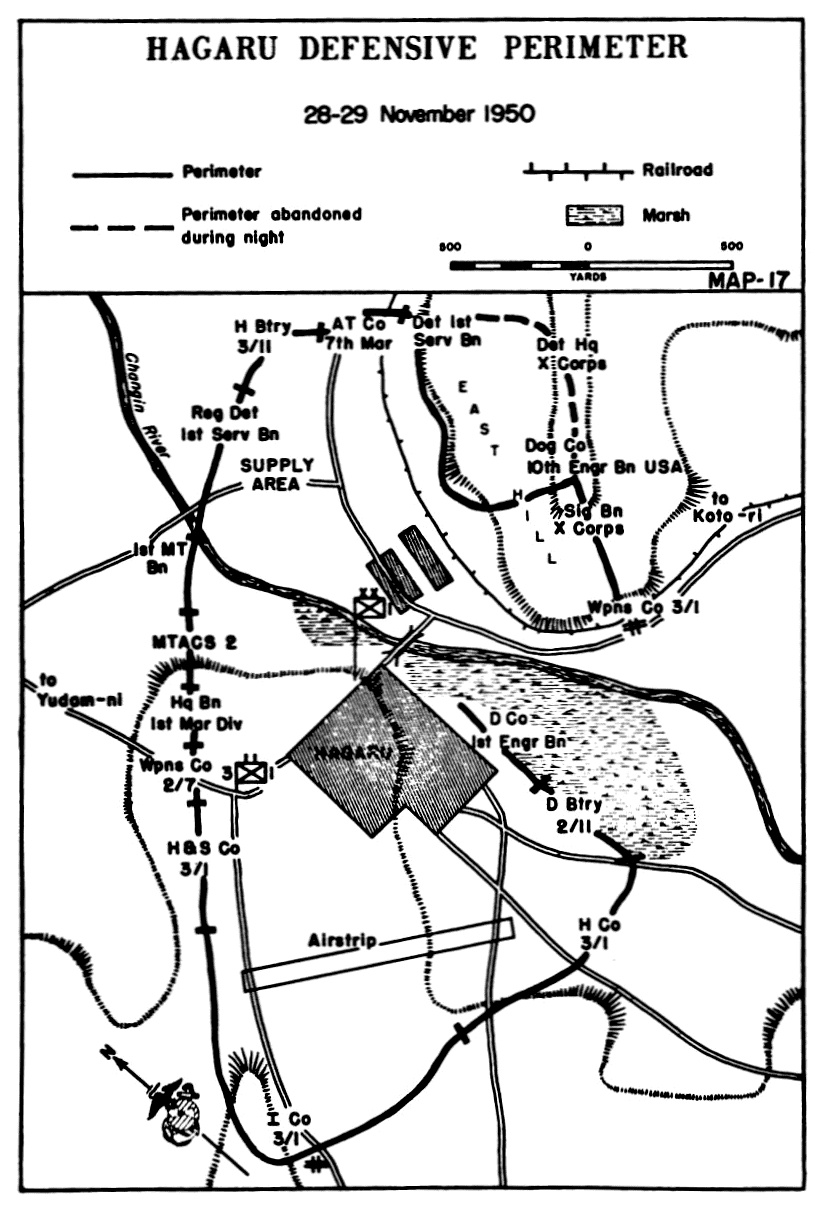
HAGARU DEFENSIVE PERIMETER
28–29 November 1950
MAP-17
Lieutenant Colonel Ridge decided that final troop dispositions must
depend not only on terrain but equally on intelligence as to enemy
capabilities. Until he had more information, the units of 3/1 were
to remain in the areas formerly occupied by 2/7.
The Battalion CP had been set up in a pyramidal tent at the angle of
the road to Yudam-ni. Most of the day on the 27th was given over to
improving positions. At the southwest end of the perimeter, First
Lieutenant Fisher’s Item Company took over from Captain Barber’s
Fox Company, the only rifle company of 2/7 remaining at Hagaru.
On the strength of preliminary S-2 reports, Ridge instructed the
commanders of his two rifle companies to improve their sectors, which
included the entire south and southwest curve of the perimeter. All
the Division Headquarters troops except one motor convoy had reached
Hagaru by the 27th, and it was due to leave Hungnam the next morning.
The new Division CP was located in the northeast quarter of town,
near the long concrete bridge over the frozen Changjin River. Rows
of heated tents surrounded a Japanese type frame house repaired for
the occupancy of General Smith, who was expected by helicopter in
the morning. Already functioning at the CP were elements of the General
Staff Sections and Headquarters Company.426
The busiest Marines at Hagaru on the 27th were the men of the 1st
Engineer Battalion. While a Company B platoon built tent decks for
the Division CP, detachments of Company A were at work on the
maintenance of the MSR in the area, and Company D had the job of
hacking out the new airstrip. Apparently the latter project had its
“sidewalk contractors” even in sub-zero weather, for this comment
found its way into the company report:
Dozer work [was] pleasing to the eye of those who wanted activity but contributed
little to the overall earth-moving problem of 90,000 cubic
yards of cut and 60,000 cubic yards of fill.427
Motor graders and scrapers with a 5.8 cubic yard capacity had been
moved up from Hamhung. So difficult did it prove to get a bite of the
frozen earth that steel teeth were welded to the blades. When the pan
was filled, however, the earth froze to the cutting edges until it could
be removed only by means of a jack hammer.
The strip was about one-fourth completed on the 27th, according to
minimum estimates of the length required. Work went on that night
as usual under the flood lights.428 Not until the small hours of the morning
did the first reports reach Hagaru of the CCF attacks on Yudam-ni
and Fox Hill.
Some remnants of 2/7 were still at Hagaru, for lack of transportation,
when Lieutenant Colonel Lockwood, commanding officer of the
battalion, received a dispatch from Colonel Litzenberg directing him
to proceed to Toktong Pass and assist Fox Company. At 0530 he
requested the “loan” of a rifle company of 3/1 to reinforce elements
of Weapons Company (-), 2/7. Lieutenant Colonel Ridge could
spare only a platoon from How Company, and at 0830 the attempt
was cancelled. An hour later Weapons Company and three tanks from
the 2d Platoon of Company D, 1st Tank Battalion, made another effort.
They pushed half-way to the objective, only to be turned back by heavy
Chinese small-arms and mortar fire from the high ground on both
sides of the road. Supporting fires from 3/1 helped the column to
break off contact and return to Hagaru at 1500.429
No better success attended a reinforced platoon of How Company,
3/1, accompanied by three Company D tanks, when it set out on the
road to Koto-ri. On the outskirts of Hagaru, within sight of Captain
Corley’s CP, the men were forced to climb down from their vehicles
and engage in a hot fire fight. They estimated the enemy force at
about 50, but an OY pilot dropped a message warning that some 300
Chinese were moving up on the flanks of the patrol. The Marines managed
to disengage at 1530, with the aid of mortar and artillery fires
from Hagaru, and returned to the perimeter with losses of one killed
and five wounded.430
A similar patrol from Item Company, 3/1, struck off to the southwest
of the perimeter in the direction of Hungmun-ni. Late in the
morning of the 28th, this reinforced platoon encountered an estimated
150 enemy and called for artillery and mortar fires. After dispersing
this CCF group, the patrol routed a second enemy detachment an hour
later after a brief fire fight.431
Any lingering doubts as to the extent of the Chinese attack on the
MSR were dispelled by reports from the OY and HO3S-1 pilots of
VMO-6. They disclosed that defended enemy road blocks had cut off
Yudam-ni, Fox Hill, Hagaru, and Koto-ri from any physical contact
with one another. The advance units of the 1st Marine Division had
been sliced into four isolated segments as CCF columns penetrated
as far south as the Chinhung-ni area.432
There was no question at all in the minds of Lieutenant Colonel Ridge
and his officers as to whether the Chinese would attack at Hagaru. As
early as the morning of the 27th, the problem had simply been one
of when, where, and in what strength. It was up to the S-2 Section
to provide the answers, and upon their correctness would depend the
fate of Hagaru, perhaps even of the 1st Marine Division.
Second Lieutenant Richard E. Carey, the S-2, was a newcomer to the
battalion staff, recently transferred from a George Company infantry
platoon. His group consisted of an assistant intelligence chief, Staff
Sergeant Saverio P. Gallo, an interpreter, and four scout observers.433
There were also two CIC agents assigned to 3/1 by Division G-2.
At Hagaru, as at Majon-ni, the Marines had won respect at the
outset by allowing the Korean residents all privileges of self-government
which could be reconciled with military security. The police
department and town officials had been permitted to continue functioning.
They in turn briefed the population as to restricted areas and
security regulations, particularly curfew. Korean civilians entering
Hagaru through Marine road blocks were searched before being taken
to the police station where they were questioned by an interrogation
team from the S-2 Section.
Hagaru’s resemblance to a gold-rush mining camp was heightened
on the 27th by a tremendous influx both of troops and Koreans from
outlying districts. A large truck convoy from Headquarters Battalion
arrived to set up the new Division CP, and detachments from various
Marine or Army service units entered in a seemingly endless stream.
The Korean refugees had much the same story to tell; most of them
came from areas to the north and west of Hagaru, and they had been
evicted from their homes by large numbers of CCF troops.
Carey instructed his CIC agents to converse with incoming Koreans
and learn everything possible about the enemy situation. Again, as at
Majon-ni, people who had been thoroughly indoctrinated with Communism
were found “highly co-operative.” As untrained observers,
however, their estimates of CCF numbers and equipment could not be
taken too literally. Since their statements agreed that the enemy was
in close proximity, Carey decided to take the risk of sending his two
CIC agents on the dangerous mission of establishing direct contact.
They were enjoined to make a circuit of the perimeter, mingling whenever
possible with the Chinese and determining the areas of heaviest
concentration.
The results went beyond Carey’s fondest expectations. Not only did
his agents return safely from their long hike over the hills, but they
brought back vital information. Well led and equipped Chinese Communist
units had been encountered to the south and west of Hagaru.
And since Marine air also reported unusual activity in this area, it was
a reasonable assumption that the enemy was concentrated there approximately
in division strength.
This answered the questions as to “how many” and “where.” There
remained the problem as to “when” the attack might be expected, and
again on the 28th Carey sent out his CIC agents to make direct contact.
“I expected little or no information,” he recollected, “but apparently
these men had a way with them. Upon reporting back, they told me
that they had talked freely with enemy troops, including several officers
who boasted that they would occupy Hagaru on the night of 28
November.”
Major enemy units were reported to be five miles from the perimeter.
Dusk was at approximately 1800, with complete darkness setting in
shortly afterwards. Adding the estimate of three and a half hours for
Chinese movements to the line of departure, the S-2 Section calculated
that the enemy could attack as early as 2130 on the night of the 28th
from the south and west in division strength.434
These intelligence estimates were accepted by Lieutenant Colonel Ridge
as the basis for his planning and troop dispositions. As the main bastion
of defense, the tied-in sectors of How and Item Companies were extended
to include the south and southwest sides of the perimeter—nearly
one-third of the entire circumference—in a continuous line 2300
yards in length, or more than a mile and a quarter. Each platoon front
thus averaged about 380 yards, which meant that supporting arms must
make up for lack of numbers.435
East Hill, considered the second most likely point of enemy attack,
was to be assigned to George Company on arrival. Captain Sitter’s
outfit had orders to depart the Chigyong area on the morning of the
28th, so that it could be expected at Hagaru before dark.
The southeast quarter of the perimeter, between East Hill and the
left flank of How Company, was to be held by the following units:
(1) Weapons Company (less detachments reinforcing the rifle companies
and its 81mm mortars emplaced near the battalion CP) manning
a road block on the route to Koto-ri and defending the south nose
of East Hill; (2) Dog Company, 1st Engineer Battalion (less men at
work on the airstrip), occupying the ground south of the concrete
bridge; and (3) Dog Battery, 2d Battalion, 11th Marines, which had
the mission of covering 75 per cent of the perimeter with observed
indirect fire and 25 per cent with direct fire.
These dispositions left a gap between Weapons Company and the
engineer and artillery units on the west bank of the Changjin River.
But this stretch of frozen marshland was so well covered by fire that
an enemy attack here would have been welcomed.
The first reports of the CCF onslaughts at Yudam-ni and Fox Hill,
as interpreted by Lieutenant Colonel Ridge, “clearly indicated that no
time was to be lost at buttoning up the Hagaru perimeter.” He called
on Colonel Bowser, the Division G-3, on the morning of the 28th and
recommended that an overall defense commander be designated with
operational control over all local units. Ridge also requested that
George Company and the 41st Commando be expedited in their movement
to Hagaru.
Before a decision could be reached, General Smith arrived by helicopter
and opened the Division CP at 1100. A Marine rear echelon
had remained at Hungnam to cope with supply requirements. Colonel
Francis A. McAlister, the G-4, left in command, accomplished during
the forthcoming campaign what General Smith termed “a magnificent
job” in rendering logistical support.436
The CP at Hagaru had been open only half an hour when General
Almond arrived in a VMO-6 helicopter to confer with the Division
commander. Departing at 1255, he visited the 31st Infantry troops who
had been hard hit the night before by CCF attacks east of the Chosin
Reservoir. On his return to Hamhung, the Corps commander was
informed that CinCFE had directed him to fly immediately to Tokyo
for a conference. There he learned that the Eighth Army was in full
retreat, with some units taking heavy losses both in personnel and
equipment. Generals Almond, Walker, Hickey, Willoughby, Whitney,
and Wright took turns at briefing the commander in chief during a
meeting which lasted from midnight to 0130.437
At Hagaru it was becoming more apparent hourly to Ridge that his
prospects of employing Captain Sitter’s company on East Hill were
growing dim. As he learned later, the unit had left Chigyong that
morning in the trucks of Company B, 7th Motor Transport Battalion,
commanded by Captain Clovis M. Jones. Sitter was met at Koto-ri
by Lieutenant Colonel Robert W. Rickert, executive officer of RCT-1,
and directed to report to the regimental S-3, Major Robert E. Lorigan.
Efforts to open up the road to Hagaru had failed, he was told, and it
would be necessary for George Company to remain overnight at
Koto-ri.438
The probability of such an outcome had already been accepted by
Ridge on the basis of the resistance met on the road to Koto-ri by his
How Company patrol. With this development added to his worries,
he received a telephone call at 1500 from Colonel Bowser, informing
him that he had been named defense commander at Hagaru by General
Smith.439
Just ten minutes later a single CCF shell, assumed to be of 76mm
caliber, exploded in the Battalion CP area and fatally wounded Captain
Paul E. Storaasli, the S-4. The perimeter was so cluttered with tents
and dumps that artillery fire at random could hardly have been wasted;
but the enemy gun remained silent the rest of the day, doubtless to
avert Marine counter-battery reprisals.
Only three hours of daylight remained when the newly designated
defense commander summoned unit commanders to an initial conference.
It was not made clear just what troops had been placed under
his operational control. “A primary reason,” commented Ridge, “was
that no one knew what units were there, this being compounded by
the numerous small elements such as detachments, advance parties,
etc., of which many were Corps and ROK units. Hence, the Battalion
S-1 and his assistants were a combination of town criers and census
takers. We did, however, get most of the commanders of major units
(if such they could be called) to the initial conference, but the process
of locating and identifying smaller units was thereafter a continuous
process which we really never accurately completed.”440
The larger outfits could be summoned to the conference by telephone
but it was necessary to send out runners in other instances. With George
Company not available, the question of defending East Hill loomed
large. Ridge decided against all proposals that one of the two rifle
companies be used for that purpose. On the strength of the S-2
report, he preferred to concentrate as much strength as possible against
an attack from the southwest. This meant taking his chances on East
Hill with such service troops as he could scrape up, and it was plain
that a strong CCF effort in this quarter would have to be met in large
part by fire power from supporting arms.
The two main detachments selected for East Hill (excluding the
south nose) were from Dog Company of the 10th Engineer (C) Battalion,
USA, and elements of X corps Headquarters. Since the mission
called for control of mortar and artillery fires as well as tactical leadership,
two officers of Weapons Company, 3/1, were assigned—Captain
John C. Shelnutt to the Army engineer company, and First Lieutenant
John L. Burke, Jr., to the Headquarters troops. Each was to be accompanied
by a Marine radio (SCR 300) operator.
Smaller detachments were later sent to East Hill from two other
service units—the 1st Service Battalion, 1st Marine Division, and the
4th Signal Battalion of X Corps.
The Antitank Company of the 7th Marines defended the area to
the north of East Hill. Next came How Battery, 3d Battalion, 11th
Marines, which had the primary mission of supporting Fox Company,
2/7, on the hill near Toktong Pass. But by moving gun trails the cannoneers
could with some difficulty fire on the 270° arc of the perimeter
stretching from the right flank of Item Company around to the north
nose of East Hill.
Between the sectors held by How Battery, 3/11, and Item Company,
3/1, were troops of five Marine units: Regulating Detachment,
1st Service Battalion; 1st Motor Transport Battalion; Marine Tactical
Air Control Squadron 2 (MTACS-2); Division Headquarters Battalion;
and H&S Company 3/1. The only other unit in this quarter was
Weapons Company (-), 2/7, which held the road block on the route
to Yudam-ni.
At the conference it was decided that since Lieutenant Colonel
Charles L. Banks’ Regulating Detachment had taken the lead in organizing
the Supply Area on the north side of Hagaru, the arc of the
perimeter east of the river and west of East Hill was to be made into a
secondary defense zone. Banks thus became in effect a sub-sector commander.
The only infantry troops in the Supply Area being detachments
of 2/7 units, it was also agreed that tactical decisions concerning
the zone should be discussed with the two ranking battalion officers—Lieutenant
Colonel Lockwood, the commander, and Major Sawyer,
the executive.441
These matters having been settled, the conference broke up shortly
after 1700 and the various commanders hastened back to their outfits
to make last-minute preparations for the night’s attack. A strange hush
had fallen over the perimeter, broken only by the occasional crackle of
small-arms fire, and the damp air felt like snow.
How and Item Companies were ready. All platoon positions were well
dug in, though the earth was frozen to a depth of six to ten inches.
The men of Item Company used their heads as well as hands after
Lieutenant Fisher managed to obtain a thousand sandbags and several
bags of C3. This explosive was utilized in ration cans to make improvised
shape charges which blasted a hole through the frozen crust of
snow and earth. Then it became a simple matter to enlarge the hole
and place the loose dirt in sandbags to form a parapet.442 This ingenious
system resulted in de luxe foxholes and mortar emplacements attaining
to the dignity of field fortifications.
Both company fronts bristled with concertinas, trip flares, booby
traps, and five-gallon cans of gasoline rigged with thermite bombs for
illumination. Three probable routes of enemy attack channeled the low
hills to the southwest—a main draw leading to the junction between
the two company sectors, and a lesser draw providing an approach to
each. The ground in front of the junction had been mined, and two
tanks from the Provisional Platoon were stationed in this quarter.
Detachments from Weapons Company also reinforced both rifle companies.
Thus the six platoons faced the enemy in the following order:
| ITEM COMPANY |
HOW COMPANY |
| Lt Fisher |
Capt Corley |
| Lt Degerne |
Lt Hall |
Lt Needham |
Lt Barrett |
Lt Endsley |
Lt Mason |
| 1st |
3d |
2d |
1st |
3d |
2d |
Beginning at 1700, hot food was served to all hands in rotation.
A fifty per cent alert went into effect after dark as the men were sent
back on regular schedule for coffee and a smoke in warming tents
located as close to the front as possible. The first snowflakes fluttered
down about 1950, muffling the clank of the dozers at work as usual
under the floodlights on the airstrip behind the How Company’s sector.
Just before 2130, the expected time of CCF attack, both company commanders
ordered a hundred per cent alert, but the enemy did not show
up on schedule. It was just over an hour later when three red flares
and three blasts on a police whistle signaled the beginning of the attack.
Soon trip flares and exploding booby traps revealed the approach of
probing patrols composed of five to ten men.
A few minutes later, white phosphorus mortar shells scorched the
Marine front line with accurate aim. The main CCF attack followed
shortly afterwards, with both company sectors being hit by assault
waves closing in to grenade-throwing distance.
The enemy in turn was staggered by the full power of Marine supporting
arms. Snowflakes reduced an already low visibility, but fields of
fire had been carefully charted and artillery and mortar concentrations
skillfully registered in. Still, the Communists kept on coming in spite
of frightful losses. Second Lieutenant Wayne L. Hall, commanding
the 3d Platoon in the center of Item Company, was jumped by three
Chinese whom he killed with a .45 caliber automatic pistol after his
carbine jammed. The third foe pitched forward into Hall’s foxhole.
On the left flank, tied in with How Company, First Lieutenant Robert
C. Needham’s 2d Platoon sustained most of the attack on Item Company.
The fire of Second Lieutenant James J. Boley’s 60mm mortars
and Second Lieutenant John H. Miller’s light machine guns was concentrated
in this area. It seemed impossible that enemy burp guns
could miss such a target as Lieutenant Fisher, six feet two inches in
height and weighing 235 pounds. But he continued to pass up and
down the line, pausing at each foxhole for a few words of encouragement.
By midnight the enemy pressure on Needham’s and Hall’s lines
had slackened, and on the right flank Second Lieutenant Mayhlon L.
Degernes’ 1st Platoon received only light attacks.
This was also the case on the left flank of How Company, where
Second Lieutenant Ronald A. Mason’s 2d Platoon saw little action as
compared to the other two. A front of some 800 yards in the center
of the 2300-yard Marine line, including two platoon positions and
parts of two others, bore the brunt of the CCF assault on How and
Item Companies.
Captain Corley had just visited his center platoon when the first
attacks hit How Company. Second Lieutenant Wendell C. Endsley was
killed while the company commander was on his way to Second Lieutenant
Roscoe L. Barrett’s 1st Platoon, on the right, which soon had its
left flank heavily engaged.
Never was CCF skill at night attacks displayed more effectively.
Barrett concluded that the Chinese actually rolled down the slope into
the How Company lines, so that they seemed to emerge from the very
earth. The 3d Platoon, already thinned by accurate CCF white phosphorus
mortar fire, was now further reduced in strength by grenades
and burp gun bursts. About this time the company wire net went out
and Corley could keep in touch with his platoons only by runners. The
battalion telephone line also being cut, he reported his situation by
radio to the Battalion CP.
Two wiremen were killed while trying to repair the line. The Chinese
continued to come on in waves, each preceded by concentrations of
light and heavy mortar fire on the right and center of the How Company
position. About 0030 the enemy broke through in the 3d Platoon area
and penetrated as far back as the Company CP. A scene of pandemonium
ensued, the sound of Chinese trumpets and whistles adding to the
confusion as it became difficult to tell friend from foe. “Tracers were
so thick,” recalled Sergeant Keith E. Davis, “that they lighted up the
darkness like a Christmas tree.”443
Corley and five enlisted men operated as a supporting fire team while
First Lieutenant Harrison F. Betts rounded up as many men as he
could find and tried to plug the gap in the 3d Platoon line. This outnumbered
group was swept aside as the next wave of CCF attack carried
to the rear of How Company and threatened the engineers at work
under the floodlights.
A few Chinese actually broke through and fired at the Marines
operating the dozers. Second Lieutenant Robert L. McFarland, the
equipment officer, led a group of Dog Company engineers who counterattacked
and cleared the airstrip at the cost of a few casualties. Then
the men resumed work under the floodlights.444
The Battalion reserve, if such it could be called, consisted of any
service troops who could be hastily gathered to meet the emergency.
Shortly before midnight Ridge sent a platoon-strength group of X Corps
signalmen and engineers under First Lieutenant Grady P. Mitchell to
the aid of How Company. Mitchell was killed upon arrival and First
Lieutenant Horace L. Johnson, Jr., deployed the reinforcements in a
shallow ditch as a company reserve.
About midnight the fight had reached such a pitch of intensity that
no spot in the perimeter was safe. The Company C medical clearing
station, only a few hundred yards to the rear of Item Company, was
repeatedly hit by machine gun bullets whipping through the wooden
walls as surgeons operated on the wounded. The Division CP also
took hits, and a bullet which penetrated General Smith’s quarters produced
unusual sound effects when it ricocheted off pots and pans in
the galley.445
The Chinese seemed to be everywhere in the How Company zone.
Shortly after midnight they surrounded the CP, portable galley and
provision tent. “It is my personal opinion,” commented Captain Corley,
“that if the enemy had decided to effect a major breakthrough at this
time, he would have experienced practically no difficulty. However,
he seemed content to wander in and around the 3d Platoon, galley and
hut areas.”446
The Chinese, in short, demonstrated that they knew better how to
create a penetration than to exploit one. Once inside the How Company
lines, they disintegrated into looting groups or purposeless tactical
fragments. Clothing appealed most to the plunderers, and a wounded
Marine in the 3d Platoon area saved his life by pretending to be dead
while Communists stripped him of his parka.
About 0030 the Battalion CP advised Corley by radio that more reinforcements
were on the way. Lieutenant Johnson met the contingent,
comprising about 50 service troops, and guided them into the company
area, where they were deployed as an added reserve to defend the
airstrip.
Item Company was still having it hot and heavy but continued to
beat off all CCF assaults. Elements of Weapons Company, manning
the south road block, came under attack at 0115. Apparently a small
enemy column had lost direction and blundered into a field of fire
covered by heavy machine guns. The hurricane of Marine fire caught
the Communists before they deployed and the result was virtual annihilation.
Half an hour later, with the situation improving in the How Company
zone, the Battalion CP had its first alarming reports of reverses on213
East Hill. The terrain itself had offered difficulties to men scrambling
up the steep, icy slopes with heavy burdens of ammunition. These
detachments of service troops, moreover, included a large proportion
of newly recruited ROKs who had little training and understood no
English.
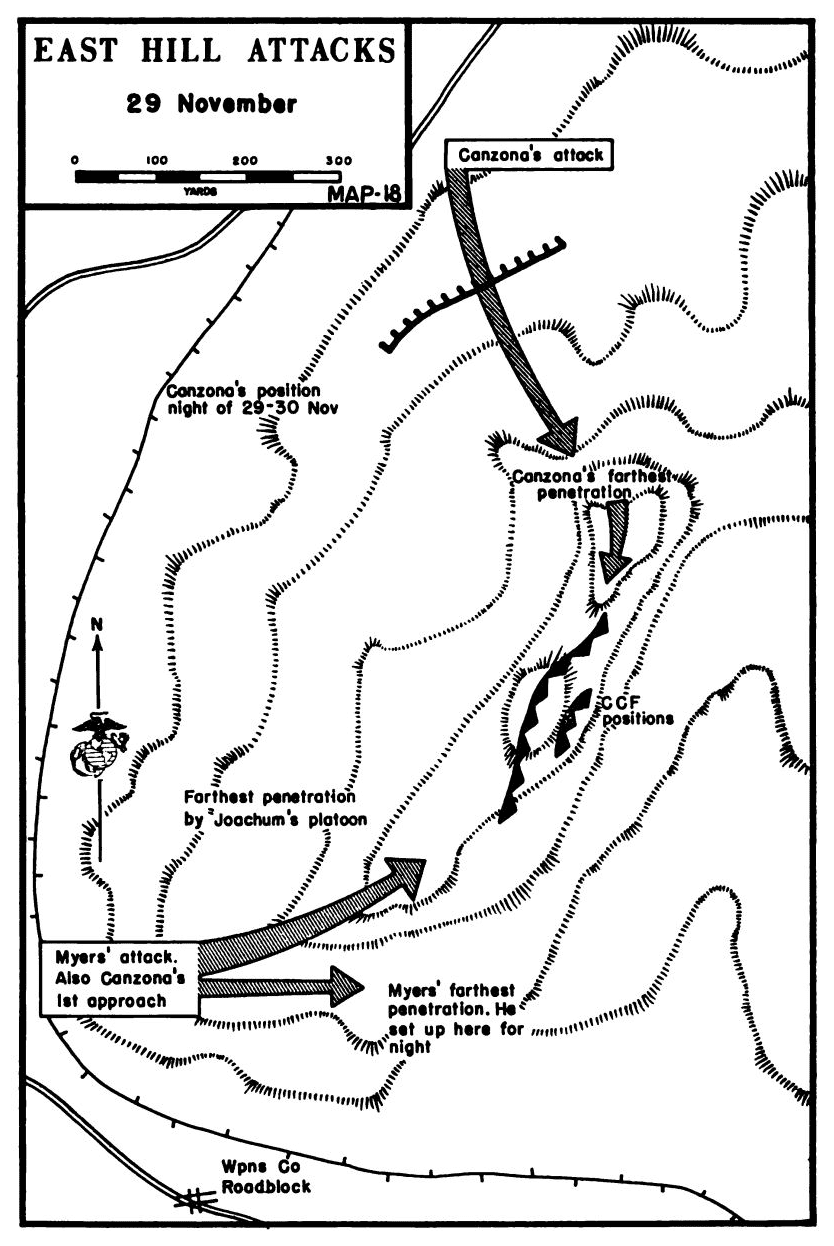
EAST HILL ATTACKS
29 November
MAP-18
The largest of the East Hill units, Company D of the 10th Engineer
Combat Battalion, commanded by Captain Philip A. Kulbes, USA, was
composed of 77 American enlisted men and 90 ROKs. Combat equipment
(in addition to individual weapons) consisted of four .50 caliber
machine guns, five light .30 caliber machine guns, and six 3.5 rocket
launchers.447
The Army engineers had arrived at Hagaru at 1200 on the 28th,
shortly before the enemy cut the MSR. After being assigned to the
East Hill sector during the afternoon, the company used the few remaining
hours of daylight to move vehicles and gear back to an equipment
park in the perimeter. It was 2030 before the four platoons got into
position on East Hill after an exhausting climb in the darkness with
heavy loads of ammunition. Some use was made of existing holes, but
most of the men were not dug in when the Chinese attacked.
On the left the collapse of a ROK platoon attached to X Corps
Headquarters led rapidly to confusion everywhere on East Hill. Captain
Shelnutt, the Marine officer assigned to the Army engineers, found
that he could not close the gap by extending the line to the left. Nor
did the men, particularly the ROKs, have the training to side-slip to
the left under fire and beat off flank attacks. The consequence was a
general withdrawal on East Hill, attended in some instances by demoralization.
Shelnutt was killed as the four engineer platoons fell back
some 250 yards in “a tight knot,” according to Lieutenant Norman R.
Rosen, USA, commander of the 3d Platoon.
This was the situation as reported by the Marine radio operator,
PFC Bruno Podolak, who voluntarily remained as an observer at his
post, now behind enemy lines. At 0230 a telephone call to Colonel
Bowser from the 3/1 CP was recorded in the message blank as follows:
“How Company still catching hell and are about ready to launch
counterattack to restore line. About an hour ago, enemy appeared on
East Hill. A group of enemy sneaked up to a bunch of Banks’ men
and hand-grenaded hell out of them and took position. Sending executive
officer over to see if we can get some fire on that area. Should be
able to restore the line but liable to be costly. Reserve practically nil.
Do have a backstop behind the break in How lines on this side of
airstrip, composed of engineers and other odds and ends.”448
At 0400 there was little to prevent the enemy from making a complete
breakthrough on East Hill and attacking the Division CP and
the supply dumps. A friendly foothold had been retained on reverse
slopes of the southern nose, but the northern part was held only by
artillery fires. Along the road at the bottom of East Hill a thin line of
service troops with several tanks and machine guns formed a weak
barrier.
All indications point to the fact that the Chinese themselves were
not in sufficient strength to follow up their success. Their attack on
East Hill was apparently a secondary and diversionary effort in support
of the main assault on the sectors held by How and Item Companies.
At any rate, the enemy contented himself with holding the high ground
he had won.
Some of the defenders of East Hill had fought with bravery which
is the more admirable because of their lack of combat training. Battle
is a business for specialists, and Lieutenant Rosen relates that the Army
engineers “had a great deal of difficulty with our weapons because they
were cold and fired sluggishly. We had gone into action so unexpectedly
that it had not occurred to us to clean the oil off our weapons.”
As an example of the difficulties imposed by the language barrier, the
officers were given to understand by the ROKs that they had no more
ammunition. “Weeks later,” commented Rosen, “we found that most
of them had not fired their ammunition this night, but continued to
carry it.”449
In view of such circumstances, the service troops put up a creditable
if losing fight in the darkness on East Hill. The 77 Americans of the
Army engineer company suffered losses of 10 KIA, 25 WIA, and nine
MIA; and of the 90 ROKs, about 50 were killed, wounded, or missing,
chiefly the latter.450
As usual, the men in the thick of the fight saw only what happened in
their immediate area. The scene as a whole was witnessed by a young
Marine officer of Company A, 1st Engineer Battalion, on duty at a
sawmill two miles north of Hagaru. From the high ground he could
look south down into the perimeter, and the awesome spectacle of a
night battle made him think of a volcano in eruption. Gun flashes
stabbing the darkness were fused into a great ring of living flame, and
the thousands of explosions blended into one steady, low-pitched roar.451
Seldom in Marine history have supporting arms played as vital a
part as during this night at Hagaru. It is possible that a disaster was
averted on East Hill when the Marines of Captain Benjamin S. Read’s
How Battery shifted trails and plugged the hole in the line with howitzer
fires alone. Lieutenant Colonel Banks and Major Walter T. Warren,
commanding the antitank company of the 7th Marines, acted as
observers. Reporting by telephone to the gun pits, they directed the
sweating gunners so accurately that an enemy attack would have come
up against a curtain of fire.452
Captain Strohmenger’s Dog Battery had been attached to 3/1 so
long that a high degree of co-ordination existed. His 105s fired about
1200 rounds that night, and POW interrogations disclosed that enemy
concentrations in rear areas were repeatedly broken up.
When CCF guns replied, shortly before midnight, there was danger
of a fuel or ammunition dump being hit and starting a chain reaction of
detonations in the crowded perimeter. Strohmenger ordered five of
his howitzers to cease fire while he moved the sixth out about 150 yards
to act as a decoy. Its flashes drew fire from the enemy, as he had hoped,
revealing the positions of the Chinese artillery. Dog Battery officers
set up two aiming circles and calculated the range and deflection. Then
the command was given for all six Marine howitzers to open up. The
enemy guns were silenced for the night. A later survey established that
two CCF 76mm guns had been destroyed and two others removed.453
The 60mm mortars of the two rifle companies fired a total of more
than 3200 rounds; and on both fronts the heavy machine guns of
Weapons Company added tremendously to the fire power. Illuminating
shells being scarce, two Korean houses on the Item Company’s front
were set ablaze by orders of Lieutenant Fisher. The flames seemed to
attract CCF soldiers like moths, and the machine guns of the two tanks
stationed here reaped a deadly harvest. Curiously enough, the Chinese
apparently did not realize what excellent targets they made when
silhouetted against the burning buildings.
By 0400 it was evident that the enemy’s main effort had failed. No
further attacks of any consequence were sustained by the two rifle companies.
It remained only to dispose of the unwelcome CCF visitors
sealed off in the How Company zone, and at 0420 Captain Corley
rounded up men for a counterattack.
“It will be just as dark for them as for us,” he told his NCOs.
Second Lieutenant Edward W. Snelling was directed to fire all his
remaining 60mm mortar ammunition in support. Corley and Betts
led the service troops sent as reinforcements while Johnson advanced
on the left. A bitter fight of extermination ensued, and by 0630 the
MLR had been restored. How Company, which sustained the heaviest
losses of any Marine unit that night, had a total of 16 men killed and
39 wounded, not including attached units.454
After it was all over, the stillness had a strange impact on ears
attuned the whole night long to the thump of mortars and clatter of
machine guns. The harsh gray light of dawn revealed the unforgettable
spectacle of hundreds of Chinese dead heaped up in front of the two
Marine rifle companies.455 Shrouds of new white snow covered many
of them, and crimson trails showed where the wounded had made their
way to the rear.
But even though the enemy’s main attack had failed, his secondary
effort on East Hill represented a grave threat to perimeter security.
At 0530 Ridge decided to counterattack, and Major Reginald R. Myers
volunteered to lead an assault column composed of all reserves who
could be scraped together for the attempt.
It was broad daylight before the Battalion executive officer moved
out with an assortment of Marine, Army, and ROK service troops, some
of them stragglers from the night’s withdrawals from East Hill (see
Map 18). Their total strength compared to that of an infantry company.
About 55 separate units were represented at Hagaru, many by
splinter groups, so that most of Myers’ men were strangers to one
another as well as to their officers and NCOs.
The largest Marine group was the platoon led by First Lieutenant
Robert E. Jochums, assistant operations officer of the 1st Engineer Battalion.
Clerks, typists, and truck drivers were included along with
Company D engineers. Armed with carbines or M-1s and two grenades
apiece, the men carried all the small arms ammunition they
could manage. Few had had recent combat experience and the platoon
commander knew only one of them personally—a company clerk whom
he made his runner.
It was typical of the informality attending this operation that a
Marine NCO with a small group attached themselves to Jochums, giving
him a total of about 45. They had an exhausting, 45-minute climb
up the hill to the line of departure, where Myers directed them to attack
on the left of his main force.
The early morning fog enshrouded East Hill and Myers’ attack had
to wait until it cleared. The jump-off line lay along a steep slope with
little or no cover. From the outset the advancing troops were exposed
to scattered small-arms fire as well as grenades which needed only to
be rolled downhill. New snow covering the old icy crust made for
treacherous footing, so that the heavily laden men took painful falls.
Myers’ little task force can scarcely be considered a tactical organization.
His close air support was excellent; but both artillery and mortar
support were lacking. Jochums did not notice any weapons save small
arms and grenades.
“Our plane assaults were very effective, especially the napalm attacks,”
he commented on the basis of a personal log kept at the time.
“During these strikes, either live or dry runs, the enemy troops in the
line of fire would often rise and run from their positions to those in
the rear.”456
Marine air came on station at 0930 as VMF-312 planes peeled off
to hit the enemy with napalm and bombs. The squadron flew 31 sorties
that day at Hagaru, nearly all in the East Hill area. Enemy small-arms
fire crippled one aircraft; but the pilot, First Lieutenant Harry W.
Colmery, escaped serious injuries by making a successful crash landing
within the perimeter.457
All accounts agree that the ground forces met more serious opposition
from the terrain at times than from the enemy. So cut up into
ridges and ravines was this great hill mass that the troops seldom knew
whether they were advancing in defilade or exposing themselves to the
fire of hidden adversaries. Thus the attack became a lethal game of
hide-and-seek in which a step to the right or left might make the difference
between life and death. On the other hand, when the Corsairs
provided shooting gallery targets by flushing out opponents, only a
few men could get into effective firing position along the narrow,
restricted ridges before the Communists scuttled safely to new cover.
It took most of the energies of the attackers to keep on toiling upward,
gasping for breath, clutching at bushes for support, and sweating
at every pore in spite of the cold. At noon, after snail-like progress,
the force was still far short of the main ridge recognized as the dividing
line between friendly forces and the enemy. By this time more than half
of Myers’ composite company had melted away as a result of casualties
and exhaustion. Jochums saw no more than 15 wounded men in the
attacking force during the day. He noted about the same number of
dead Chinese. As for enemy strength, he estimated that the total may
have amounted to a company or slightly more.
It was his conviction that “three well organized platoons could have
pressed the assault without serious consequences and seized the immediate
highest objective. What was behind that I am unable to say, but
I feel that taking this high ground would have solved the problem.”458
Most of the friendly casualties were caused by the grenades and
grazing machine-gun fire of concealed opponents who had the law of
gravity fighting on their side. Jochums was painfully wounded in the
foot but continued with his platoon. “The age-old problem of leadership
in such an operation,” he concluded, “may be compared to moving
a piece of string—pulling it forward will get you farther than pushing.”
Enemy small-arms fire increased in volume when Myers’ remnants,
estimated at 75 men, reached the military crest of the decisive ridge.
There the groups in the center and on the right were halted by the Chinese
holding the topographical crest and reverse slope. On the left
Jochums’ men managed to push on to an outlying spur before being
stopped by CCF fire from a ridge to the northeast. Jochums’ position
was still short of the commanding high ground, yet it was destined to be
the point of farthest penetration on East Hill.
Myers ordered his men to take what cover they could find and draw
up a defensive line “short of the topographical crest” while awaiting a
supporting attack.459 This was to be carried out by elements of Captain
George W. King’s Able Company of the 1st Engineer Battalion, which
had been stationed at a sawmill two miles north of Hagaru to repair a
blown bridge. These troops reached the perimeter without incident at
noon and proceeded immediately to the assault.
First Lieutenant Nicholas A. Canzona’s 1st Platoon led the column.
Orders were to ascend the southwestern slope of East Hill, pass through
Myers’ force and clear the ridge line. But after completing an exhausting
climb to the military crest, the engineer officer was directed to
retrace his steps to the foot. There Captain King informed him that a
new attack had been ordered on the opposite flank, from a starting
point about 1000 yards to the northeast.
Moving to the indicated route of approach, Canzona began his second
ascent with two squads in line, pushing up a spur and a draw which
became almost perpendicular as it neared the topographical crest. Only
his skeleton platoon of about 20 men was involved. There were neither
radios nor supporting arms, and a light machine gun was the sole
weapon in addition to small arms and grenades.
Upon reaching the military crest, the engineers were pinned down
by CCF machine-gun fire along a trail a few feet wide, with nearly
vertical sides. Only Canzona, Staff Sergeant Stanley B. McPhersen and
PFC Eugene B. Schlegel had room for “deployment,” and they found
the platoon’s one machine gun inoperative after it was laboriously
passed up from the rear. Schlegel was wounded and rolled downhill
like a log, unconscious from loss of blood.
Another machine gun, sent up from the foot, enabled the platoon
to hold its own even though it could not advance. Canzona put in a
request by runner for mortar support, but only two 81mm rounds
were delivered after a long delay. It was late afternoon when he walked
downhill to consult King, who had just been ordered to withdraw Company
A to a reverse slope position. Canzona returned to his men and
pulled them back about half-way down the slope while McPherson
covered the retirement with machine-gun fire. The winter sun was
sinking when the weary engineers set up a night defense, and at that
moment the howitzers of How Battery cut loose with point-detonation
and proximity bursts which hit the Chinese positions with deadly
accuracy.
Canzona estimated the enemy strength in his zone at no more than a
platoon, which might have been dislodged with the aid of artillery or
even mortar fire.460
About 500 yards south of the engineers, Major Myers held a defensive
position with his remaining force of about two platoons. The Battalion
CP had reason to believe that the outposts on East Hill would be
relieved shortly by George Company, with the 41st Commando in
perimeter reserve. Both had departed Koto-ri that morning in a strong
convoy which also included an Army infantry company, four platoons
of Marine tanks, and the last serial of Division Headquarters Battalion.
It was still touch and go at Hagaru at dusk on the 29th, but the
defenders could take satisfaction in having weathered the enemy’s first
onslaught. General Smith, courteous and imperturbable as always,
visited the Battalion CP to commend Ridge and his officers for the
night’s work. Two rifle companies had inflicted a bloody repulse on
several times their own numbers, and the counterattacking forces on
East Hill had at least hung on by their eyelashes.
In the final issue, a bob-tailed rifle battalion, two artillery batteries
and an assortment of service troops had stood off a CCF division identified
as the 58th and composed of the 172d, 173d, and 174th Infantry
Regiments reinforced with organic mortars and some horse-drawn
artillery. Chinese prisoners reported that the 172d, taking the principal
part in the attacks on How and Item Companies, had suffered 90 per
cent casualties. Elements of the 173d were believed to have figured to
a lesser extent, with the 174th being kept in reserve.461
This was the situation in the early darkness of 29 November, when
the disturbing news reached Hagaru that George Company and the
Commandos were being heavily attacked on the road from Koto-ri and
had requested permission to turn back.
CHAPTER XI Task Force Drysdale — CCF Attacks on 2/1 at Koto-ri — Convoy Reinforced by Marine Tanks — The Fight in Hell Fire Valley — Attack of George Company on East Hill — High Level Command Conference — CCF Attacks of 1 December at Hagaru — Rescue of U. S. Army Wounded — First Landings on Hagaru Airstrip
CCF Attacks on 2/1 at Koto-ri—Convoy Reinforced by Marine
Tanks—The Fight in Hell Fire Valley—Attack of George Company
on East Hill—High Level Command Conference—CCF
Attacks of 1 December at Hagaru—Rescue of U. S. Army
Wounded—First Landings on Hagaru Airstrip
Before the Chinese struck at Yudam-ni, they had penetrated 35
miles farther south along the MSR. At Chinhung-ni, on the
night of 26 November, the Marines of the 1st Battalion, RCT-1,
exchanged shots in the darkness with several elusive enemy groups
making “light probing attacks.”
Lieutenant Colonel Donald M. Schmuck, the new battalion commander,
had set up a defensive perimeter upon arrival with his three
rifle companies reinforced by 4.2-inch mortar and 75mm recoilless rifle
platoons.462 The identity of the enemy on the night of the 26th was not
suspected, and patrols the next day made no contacts. At 1900 on the
27th, however, another light attack on the perimeter was repulsed.
During the next two days, patrol actions definitely established that
Chinese in estimated battalion strength were in a mountain valley to
the west, hiding in houses by day and probing by night apparently in
preparation for a determined attack.
Schmuck decided to strike first. On the 29th, a Baker Company
reconnaissance patrol searched out the enemy positions, and the next
day the battalion commander led an attacking force composed of Captain
Barrow’s Able Company and part of Captain Noren’s Baker Company,
reinforced by 81mm and 4.2-inch mortars under the direction of
Major William L. Bates, Jr., commanding the Weapons Company.
While First Lieutenant Howard A. Blancheri’s Fox Battery of 2/11
laid down supporting fires, the infantry “ran the Chinese right out of
the country,” according to Major Bates’ account. “We burned all the
houses they had been living in and brought the civilians back with us.
We had no more difficulty with the Chinese from that valley.”
The Communists were found to be warmly clothed in new padded
cotton uniforms and armed with American weapons presumably captured
from the Nationalists. An estimated 56 were killed by the ground
forces before the Corsairs of VMF-312 took up a relentless pursuit
which lasted until the enemy remnants scattered into hiding. Some of
the Chinese were mounted on shaggy Mongolian ponies.463
During this same period, Lieutenant Colonel Sutter’s 2d Battalion of
RCT-1 had several hard-fought encounters with the new enemy. After
arriving at Koto-ri on the 24th, he set up a perimeter defense facing
west, north, and east which included a 4.2-inch Mortar Platoon as well
as Easy Battery of 2/11, commanded by Captain John C. McClelland,
Jr. Some commanding ground was left unoccupied, but Sutter believed
that a tight perimeter offered advantages over widely separated blocking
positions. In addition to 2/1, the regimental CP and H&S Company,
the AT Company (-), the 4.2 Mortar Company (-), Company D
of the 1st Medical Battalion and the 2d Battalion of the 11th Marines
(less Batteries D and F) were at Koto-ri.
The perimeter, second in importance only to Hagaru as a base, was
to be jammed during the next few days with hundreds of Marine and
Army troops held up by CCF roadblocks to the north. On 27 November,
the enemy made his presence known. A motorized patrol of platoon
strength from Captain Jack A. Smith’s Easy Company, supported by a
section of tanks, engaged in a fire fight with about 25 Chinese in the
hills west of Koto-ri. Two wounded CCF soldiers were left behind by
the dispersed enemy. At this point the patrol proceeded on foot until
it was stopped by the fire of an estimated 200 Communists dug in along224
ridge lines. At 1600 the Marines returned to the perimeter with two
men wounded.
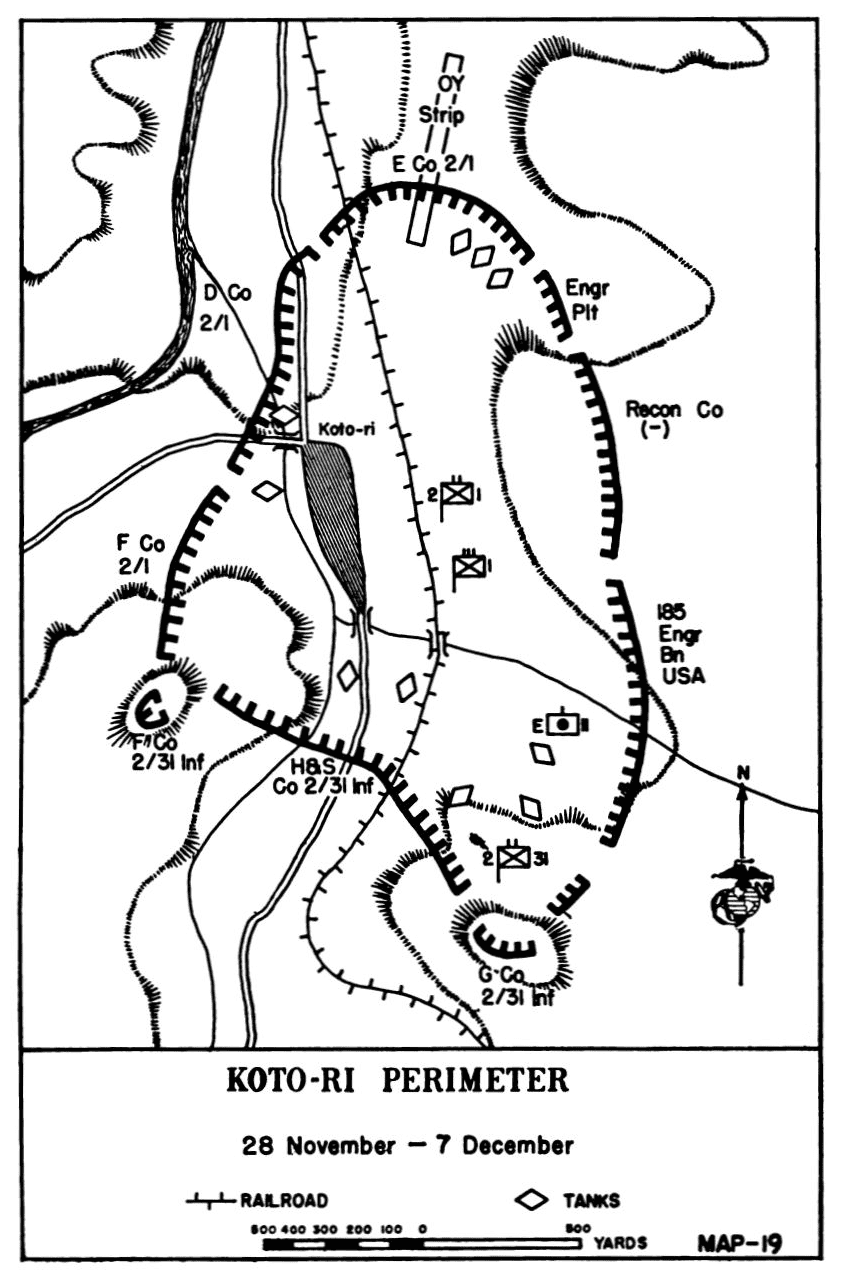
KOTO-RI PERIMETER
28 November – 7 December
MAP-19
Enemy losses were reported as eight killed and 15 wounded in addition
to the two prisoners. Upon being questioned, these Chinese asserted
that they belonged to a Chinese division assembling to the west of
Koto-ri with a headquarters in a mine shaft.464
There could be no doubt the next day that the enemy had swarmed
into the area in fairly large numbers. A Marine outpost on a hill northeast
of the perimeter received heavy small-arms fire at 0845 and was
reinforced by a platoon from Easy Company. Finally these troops had
to be withdrawn and an air strike called on the hill to evict the enemy.
At 1058 General Smith ordered Colonel Puller to push a force up
the MSR to make contact with the tank patrol being sent south from
Hagaru and to clear the MSR.465 Groups of Chinese, sighted during the
day to the north, west and east, were taken under artillery fire by Captain
McClelland’s battery. Reconnaissance planes landing at the Koto-ri
OY strip reported CCF roadblocks on the way to Hagaru; and at 1330
Captain Gildo S. Codispoti, the S-3, dispatched Captain Welby W.
Cronk’s Dog Company in vehicles with orders to open up the route.
Following in Dog Company’s wake came the last serial of Division
Headquarters troops, on its way to Hagaru.466
Less than a mile north of the perimeter, the convoy ran into a storm
of rifle and automatic weapons fire from Chinese entrenched along the
high ground on both sides of the road. The Marines of Dog Company
piled out of their vehicles and deployed for a hot fire fight, supported
from Koto-ri by 81mm mortars of Captain William A. Kerr’s Weapons
Company. Two platoons swung around to clear the enemy from the
ridge. The other platoon and the Headquarters troops advanced along
the road.
At 1615 a platoon from Captain Goodwin C. Groff’s Fox Company
was ordered out to assist in evacuating casualties. But as the afternoon
wore on, it grew apparent that the Chinese were in greater strength
than had been anticipated, and all troops were directed to return to
Koto-ri at 1735. They did so under cover of strikes by the Corsairs of
VMF-312.
Marine losses numbered four KIA or DOW and 34 WIA. Enemy
casualties were estimated at 154 killed and 83 wounded in addition to
three prisoners taken from a unit identified as the 179th Regiment of
the 60th CCF Division. Captured Chinese weapons included 130 rifles,
25 machine guns, and two cases of grenades.
That evening George Company of 3/1, 41st Commando, Royal
Marines, and Baker Company of the 31st Infantry, 7th Infantry Division,
arrived at Koto-ri on their way to Hagaru (see Map 20). Colonel
Puller and his S-3, Major Lorigan, organized the newcomers into a
task force under the command of Lieutenant Colonel Drysdale, CO of
the British unit, with orders to fight its way to Hagaru the following
day.
Luckily the enemy did not elect to attack the overcrowded perimeter
on the night of the 28th. Every warming tent was packed to capacity,
and a CCF mortar round could hardly have landed anywhere without
doing a good deal of damage.
After a quiet night the Chinese began the new day by digging emplacements
in the hills to the west under harassing fire from F Company.
The howitzers of Easy Battery and the mortars of 2/1 provided supporting
fires for Task Force Drysdale when it moved out at 0945 followed
by a convoy of Division Headquarters troops. A platoon of
Easy Company, 2/1, went along with corpsmen and ambulances to
assist in evacuating any early wounded back to Koto-ri. Stubborn CCF
resistance resulted in casualties from the outset, and it was 1600 before
the Easy Company escort platoon got back to the perimeter.
The Chinese, keeping the perimeter under observation all day, evidently
concluded that the northern rim, defended by Easy Company,
offered the best opportunity for a penetration. Marine air strikes were
called on the Chinese swarming over the near-by high ground during
the last minutes of daylight, but enemy mortar rounds hit Easy Company
at 1745. They were followed by bugle calls and whistle signals
as the CCF infantry attacked from the high ground to the northeast.
The assault force was estimated at company strength, with the remainder
of a battalion in reserve. Unfortunately for the Chinese, they
had made their intentions clear all day with unusual activity in the surrounding
hills, and Easy Company was not surprised. Major Clarence
J. Mabry, the 2/1 executive officer, could be heard above the machine
guns as he shouted encouragement to Marines who poured it into the
advancing Communists. They came on with such persistence that 17
managed to penetrate within the lines, apparently to attack the warming
tents.467 All were killed. In addition, about 150 CCF bodies lay in front
of the sector when the enemy withdrew at 1855, after suffering a complete
repulse.
It was conjectured that the Chinese had interpreted the return of the
Easy Company platoon late that afternoon as an indication that a gap
in the line needed to be hastily plugged. But the supposed weak spot
did not materialize, and at 1935 the enemy signed off for the night after
pumping four final mortar rounds in the vicinity of the Battalion CP
without doing any harm. Losses of 2/1 for the day were six KIA and
18 WIA, total CCF casualties being estimated at 175 killed and 200
wounded. Ten heavy machine guns, seven LMGs, 12 Thompson submachine
guns, 76 rifles, four pistols, and 500 grenades were captured.
That was all at Koto-ri, where Recon Company arrived during
the day to add its weight to the defense. But during intervals of silence
the sound of heavy and continuous firing to the north gave proof that
Task Force Drysdale was in trouble.
Lieutenant Colonel Drysdale’s plan of attack had called for his British
Marines to lead out at 0930 and seize the first hill mass to the east of
the road. Captain Sitter’s George Company of 3/1 was to follow and
pass through to attack Hill 1236, with Baker Company of the 31st Infantry
in reserve. LtCol Sutter, assisted by his staff, had the responsibility
for planning and coordinating preparatory artillery and mortar
fires from Koto-ri and attaching an air liaison officer to the task force.468
The first hill was taken without meeting serious resistance, but Sitter
came up against well entrenched CCF troops when he attacked Hill
1236, about a mile and a half north of Koto-ri. It was nip and tuck
until Master Sergeant Rocco A. Zullo fired his 3.5 rocket launcher at a228
range of 200 yards. Several rounds brought the Chinese out of their
holes and the Marines took possession of the hill.
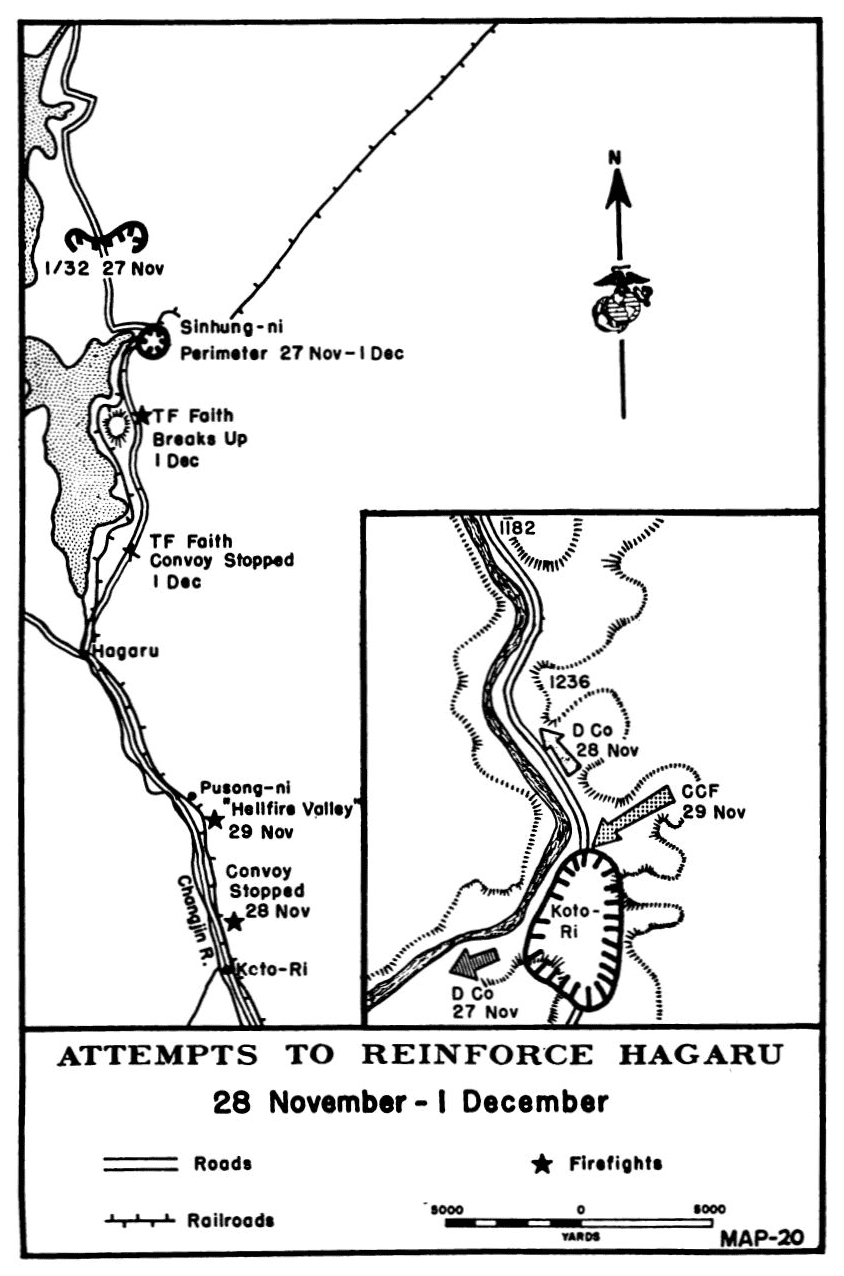
ATTEMPTS TO REINFORCE HAGARU
28 November-1 December
MAP-20
The Commandos and George Company moved up about a mile
astride of the road toward the third objective, Hill 1182. There the
enemy resisted strenuously with well-placed mortar as well as machine-gun
fire from strong positions on the high ground. The impetus of the
attack had been stopped when Sitter received orders from the task force
commander to break off action, withdraw to the road, and await new
instructions.
Drysdale had received a message from RCT-1 at 1130 advising him
that the armor of Company D (less 2d platoon), 1st Tank Battalion,
would be available to him at 1300. He decided to wait, therefore, and
re-form the column before continuing the advance.
The two platoons of Company D tanks, reinforced by the tank
platoon of the AT Company, RCT-5, reached Koto-ri at noon after
moving out that morning from Majon-dong. Company B, 1st Tank
Battalion, departed Tongjong-ni, just south of Majon-dong, but did
not arrive at Koto-ri until 1500. The 2d Platoon being attached to
Sutter’s battalion, the remainder of the company was directed to bring
up the rear of the Task Force Drysdale, which by that time had renewed
its attack. Thus the convoy was made up of the following components,
including the elements which joined in the late afternoon of 29 November:
| Unit |
Estimated
Strength |
Estimated
vehicles |
Estimated
Tanks |
| 41 Ind. Commando, RM |
235 |
|
|
| Co. G, 3/1 |
205 |
|
|
| Co. B, 31st Infantry, USA |
190 |
22 |
|
| Det. Div. Hq. Bn. |
62 |
17 |
|
| Det. 1st Sig. Bn. |
8 |
4 |
|
| Det. 7th MT Bn.469 |
12 |
22 |
|
| Det. Serv. Co., 1st Tank Bn. |
18 |
31 |
|
| Co. B(-), 1st Tank Bn. |
86 |
23 |
12 |
| Co. D(-), 1st Tank Bn. |
77 |
22 |
12 |
| Tank Plat., AT Co., RCT-5 |
29 |
|
5 |
| Total |
922 |
141 |
29 |
At 1350 the head of the column had resumed the advance, with the
order of march as shown below:
| D/TKs & AT/5 |
— |
G/1 |
— |
41 Cmdo |
— |
B/31 |
— |
HqBn |
— |
B/TKs |
| 17 tks |
|
22 veh |
|
31 veh |
|
22 veh |
|
66 veh |
|
12 tks |
Shortly after moving out, Sitter’s men were hit by heavy small-arms
fire from houses on the right of the road. The company commander
went forward and requested the tanks to open up with their 90mm guns,
and the Chinese flushed out of the houses were destroyed by machine-gun
fire.
Progress was slow because of the necessity of further halts while the
tanks blasted out pockets of CCF resistance. Enemy mortar as well as
small-arms fire was encountered, and a round scored a direct hit on
one of the trucks carrying personnel of 3d Platoon of George Company,
wounding every man in the vehicle.
Further delays resulted while the tanks made their way over roadblocks
or around craters. For the three infantry companies, the advance
consisted of brief periods of movement alternated with interludes
in which the troops scrambled out of the trucks to engage in fire fights.
Finally, about 1615, the column ground to a complete halt about four
miles north of Koto-ri. At that time the tanks of Company B were just
leaving the 2/1 perimeter to join the convoy.
Drysdale and Sitter were informed by the tank officers that they thought
the armor could get through, but that further movement for the trucks
was inadvisable in view of road conditions and increasing enemy resistance.
The task force commander requested a decision from Division
Headquarters as to whether he should resume an advance which threatened
to prove costly. It was a difficult choice for General Smith to make,
but in view of the urgent necessity for reinforcements at Hagaru he
directed Drysdale to continue.470
The tanks had to refuel, so that more time was lost. CCF fire was only
moderate during this delay, thanks to the air strikes of VMF-321 planes
directed by Captain Norman Vining. When the column stopped, the
vehicles had pulled off into a dry stream bed. Upon resuming the advance,
unit integrity was lost and infantry elements mingled with
headquarters troops.
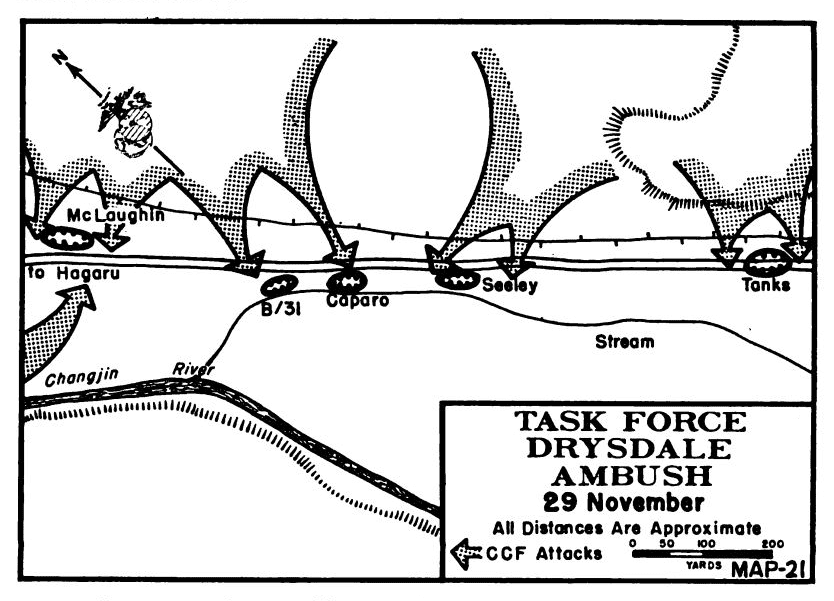
TASK FORCE
DRYSDALE
AMBUSH
29 November
MAP-21
Not far south of the halfway point to Hagaru, increased enemy fire
caused an abrupt halt in a long valley. The high ground rose sharply
on the right of the road, while on the left a frozen creek wound through
a plain several hundred yards wide, bordered by the Changjin River
and wooded hills. This was Hell Fire Valley—a name applied by Drysdale—and
it was to be the scene of an all-night fight by half the men
of the convoy (see Map 21).
Such a possibility was far from their thoughts when they piled out
of the trucks once more, as they had done repeatedly all day, to return
the enemy’s fire. It did not even seem significant when an enemy mortar
shell set one of the trucks in flames at the far end of the valley, thus
creating a roadblock and splitting the column. The enemy took advantage
of the opportunity to pour in small-arms and mortar fire which
pinned down the troops taking cover behind vehicles or in the roadside
ditches and prevented removal of the damaged truck. During this interlude
the head of the column, consisting of Dog/Tanks, George Company,
nearly three-fourths of the 41st Commando and a few Army infantrymen,
continued the advance, with Drysdale in command, in obedience
to orders to proceed to Hagaru at all costs. Left behind in Hell
Fire Valley were 61 Commandos, most of Company B, 31st Infantry,
and practically all the Division Headquarters and Service troops.
Lieutenant Colonel Arthur A. Chidester, assistant Division G-4 and
senior officer caught south of the roadblock, ordered the barred vehicles
to turn around and attempt a return to Koto-ri. Before his orders could
be carried out, a Chinese attack severed the convoy about 200 yards
to the north of him. Other enemy attacks cut the road south of the
stalled convoy, both Chidester and Major James K. Eagan being
wounded and captured.
Shallow ditches on either side of the road and the unused narrow-gauge
railway were utilized by the isolated troops as protection from
the fire of the Chinese occupying the high ground rising abruptly at the
right. The valley was about a mile long, covered with a frozen crust
of snow; and far from affording much cover, it offered the enemy a
convenient approach to the rear by way of the wide plain and frozen
river.
The Chinese fire was not heavy at first. But when darkness put an
end to Marine air strikes, the enemy became increasingly bolder.
Even so, there was no attempt for several hours to close within grenade-throwing
distance. During this interlude the defenders had time to
recover from their confusion and take defensive positions.
As nearly as the scene can be reconstructed from confused and contradictory
accounts, one large and three small perimeters were strung
out over a distance of perhaps 1200 yards from north to south. Toward
the north, near the outskirts of the village of Pusong-ni, was the largest
perimeter. It contained the troops caught north of the second fracture
of the column and was led by Major John N. McLaughlin.471 His hodge-podge
of 130 to 140 men included Captain Charles Peckham and part
of his B Company, 31st Infantry; Warrant Officer Lloyd V. Dirst and
a group of Marine MPs; some Commandos, Associated Press photographer
Frank Noel, and assorted Marine service and headquarters
troops.
The three smaller perimeters appear to have resulted from the
splintering of a larger group originally containing nearly all the men
caught south of the second cut in the convoy. Major Henry J. Seeley,
Division motor transport officer, attempted to form a perimeter with
these men but was frustrated by Chinese attacks which forced the men
to fall back in small groups. About 300 yards south of McLaughlin’s
perimeter the remnants of two Army platoons crouched in a drainage
ditch. Apparently several Marines, including CWO Dee R. Yancey,
were with them. Some 30 yards farther down the ditch were Captain
Michael J. Capraro, the Division PIO, First Lieutenant John A. Buck,
General Craig’s aide, and about 15 headquarters troops. A few other
Marines clustered around Major Seeley, perhaps a hundred yards south
of Capraro’s group.472
There was some hope at first that the tanks of Baker Company, 1st
Tank Battalion, would come to the rescue. But the Marine armor ran
into heavy opposition near Hills 1236 and 1182 along the road cleared
only a few hours before by Task Force Drysdale.
When attacking a convoy, the Chinese usually strove to split the
motorized column into segments suitable for tactical mastication. That
is what happened to Baker Company. The tanks and trucks nearest to
Koto-ri got back without much trouble at 2110 after the enemy cut
the column into three groups. The middle group, comprising most of
the service trucks, was hit hardest. Lieutenant Colonel Harvey S. Walseth,
the Division G-1, was wounded as this group finally fought back
to Koto-ri at 0230 after heavy losses in trucks. This left the tank
platoon which had proceeded farthest; and it formed a tight perimeter
for the night about half a mile south of Seeley’s position, boxed in by
friendly artillery fires from Koto-ri. At dawn the tanks returned to
Koto-ri without further enemy interference.
No knowledge of these events reached the beleaguered troops in
Hell Fire Valley. They continued to hope that the tanks might arrive
to the aid of men who had no weapons larger than a single 75mm
recoilless in addition to rifles, carbines, and grenades. There were also
a few 60mm mortars but no ammunition for them.
Fortunately, no determined Chinese attacks were received up to
midnight. Looting the trucks proved more alluring than fighting to the
Asiatics, and their officers contented themselves with keeping the perimeters
pinned down and enveloped on three sides.
Not until the early hours of 30 November did the Communists resort
to probing attacks by small groups armed with grenades. The
headquarters and service troops gave a good account of themselves in
the fire fight. Signalmen, clerks, cooks, truck drivers, military policemen—the
Marines of Hell Fire Valley included a good many veterans of
World War II, and they proved as steady as the tough combat-trained
Commandos. Once again the value of the Marine Corps insistence on
good basic training showed itself.
Major McLaughlin sent reconnaissance parties south in an unsuccessful
attempt to link up with the other perimeters. He decided, therefore,
to remain in his positions and fight off the Chinese until air
could come on station at dawn. The wounded were placed in the deepest
of the three ditches and Army medics gave first aid.
As the night wore on, McLaughlin’s situation became increasingly
grave. By 0200 his men were out of grenades. An Army crew performed
valiantly with the 75mm recoilless, firing at enemy mortar flashes
until all the soldiers were killed or wounded and the gun put out of action.
Twice McLaughlin’s men drove the Chinese from their mortars
only to have them return.
Some of the Commandos managed to slip out of the perimeter in an
effort to reach Koto-ri and summon assistance. But an attempt by Noel
and two men to run the gantlet in a jeep between 0200 and 0300 ended
in their capture before they proceeded a hundred yards.
At about 0430 the Chinese sent their prisoners to the perimeter with
a surrender demand. McLaughlin, accompanied by a Commando, went
out to parley through an interpreter in the hope of stalling until help
arrived, or at least until some of the men escaped.
“Initially I demanded a CCF surrender!” he recalls. “But it made
little impression.”
The Marine officer stalled until the Chinese threatened to overrun
the perimeter with an all-out attack. They gave him ten minutes to
discuss the capitulation with his officers. McLaughlin went from one
to another of the approximately 40 able bodied men he had left. Some
had no rifle ammunition at all and none had more than eight rounds.
For the sake of his wounded, he consented to surrender on condition
that the serious cases be evacuated. The Chinese agreed and the fight
in Hell Fire Valley ended.
McLaughlin succeeded in killing enough time so that more men were
given the opportunity to slip away while the enemy relaxed his vigilance
during the prolonged negotiations. Largest of these groups was composed
of the survivors of the three small perimeters. Capraro and Buck,
both of whom were slightly wounded, managed to unite with the Army
infantrymen just north of them and nine Commandos, who joined them
at about 0200. An hour and a half later they linked up with the Marines
under Seeley, who led the combined group in a withdrawal to the
high ground across the river. Outdistancing their CCF pursuers, after
shooting down several, they made it safely to Koto-ri.
Other groups, including three more Commandos and 71 Army infantrymen,
also contrived to straggle back to the 2/1 perimeter.
Although the Chinese did not keep their word as to evacuation of
the wounded, they did not interfere with the removal of the more
critical cases to a Korean house. When the enemy retired to the hills
for the day, an opportunity was found to evacuate these casualties to
Koto-ri.473
An accurate breakdown of the Task Force Drysdale casualties will
probably never be made, but the following estimate is not far from
the mark:
| Unit |
KIA
and
WIA |
WIA |
Total
Battle
Casualties |
Vehicles
LostA |
| 41st Commando |
18 |
43 |
61 |
|
| Co. G, 3/1 |
8 |
40 |
48 |
|
| Co. B, 1/31 |
100 |
19 |
119 |
22 |
| Div. Hq. Bn. |
25 |
25 |
50 |
18 |
| 1st Sig. Bn. |
4 |
2 |
6 |
|
| 7th MT Bn. |
2 |
3 |
5 |
4 |
| Serv. Co., 1st Tank Bn |
5 |
6 |
11 |
30 |
| Co. B(-), 1st Tank Bn |
0 |
12 |
12 |
|
| Co. D(-), 1st Tank Bn |
0 |
8 |
8 |
1 |
| Plat, AT Co., RCT-5 |
0 |
1 |
1 |
|
| Total |
162 |
159 |
321 |
75 |
“The casualties of Task Force Drysdale were heavy,” commented
General Smith, “but by its partial success the Task Force made a significant
contribution to the holding of Hagaru which was vital to the
Division. To the slender infantry garrison of Hagaru were added a
tank company of about 100 men and some 300 seasoned infantrymen.
The approximately 300 troops which returned to Koto-ri participated
thereafter in the defense of that perimeter.”474
The head of the Task Force Drysdale column, with the Company D
tanks leading George Company and the Commandos, was not aware
at dusk on the 29th that the convoy had been cut behind them. There
had been previous gaps during the stops and starts caused by enemy
fire, and it was supposed at first that the thin-skinned vehicles would
catch up with the vanguard.
Progress was fairly good, despite intermittent fire from the high
ground on the right of the road, until the tanks reached a point about
2200 yards from Hagaru. There the column was stopped by concentrated
CCF mortar and small-arms fire. One of the tanks was so damaged
by a satchel charge that it had to be abandoned, and several
vehicles were set afire. After Drysdale was wounded the command
passed to Sitter, who formed his force into a perimeter until the repulse
of the Chinese permitted the march to be resumed.475
Several pyramidal tents just outside the Hagaru perimeter were
assumed to be occupied by friendly troops until enemy in the vicinity
destroyed two George Company trucks and caused several casualties.
Later it was learned that the tents had been originally occupied by
troops of the 10th Engineer Battalion and abandoned when the Chinese
attacked on the 28th.
At 1915, Captain Sitter reported to Lieutenant Colonel Ridge, who
directed that George Company and the 41st Commando spend the night
in perimeter reserve. After their all-day fight, the men of the column
could scarcely believe their eyes when they saw the Marine engineers
at work on the airstrip under the floodlights.
Contrary to expectations, the hours of darkness on 29–30 November
passed in comparative quiet at Hagaru except for CCF harassing fires.
It was not a coincidence that the enemy kept his distance. Attacks
on the East Hill and Item and How Company positions of 3/1 actually
had been planned and partly executed by troops of the 58th CCF Division,
according to POW testimony. They were broken up by Marine
air attacks and supporting fires which hit the assembly areas.
The effectiveness of these fires owed a good deal to the intelligence
brought back to Lieutenant Carey, the Battalion S-2, by CIC agents
who circulated among Chinese troops on 27 and 28 November. The
Battalion S-2 had a work table at the CP beside Major Simmons, the
SAC, who directed six sorties of the night hecklers of VMF(N)-542.
He guided the planes through the darkness to their targets with a fiery
arrow as converging machine-gun tracer bullets crossed over suspected
CCF assembly areas.
The 81mm mortars of Weapons Company, 3/1, fired about 1100
rounds during the night, and the corresponding unit of 2/7 made a
noteworthy contribution. The following day, according to Carey, Chinese
prisoners reported that “most of the units employed around Hagaru
were very badly hit.”476
A few white phosphorus mortar rounds fell in the lines of How and
Item Companies, and a CCF green flare caused an alert for an attack
which never materialized. In the early morning hours of the 30th an
enemy concentration appeared to be taking place on the Item Company
front, but intensive 60mm mortar fire put an end to the threat.
At 0800, the battalion commander ordered George Company to retake
East Hill while the Commandos remained in reserve. Sitter’s plan
called for his 1st and 2d platoons, commanded by Second Lieutenants
Frederick W. Hopkins and John W. Jaeger respectively, to pass through
Myers’ group, then make a sharp left turn and attack on either side of
the ridge. First Lieutenant Carl E. Dennis’ 3d Platoon and two platoons
of Able Company engineers were to follow in reserve.
Slow progress caused the George Company commander to modify the238
plan by giving his 3d platoon and the two engineer platoons the mission
of enveloping the CCF right flank (see Map 22). Lieutenant
Dennis led the attack, with First Lieutenant Ernest P. Skelt’s and Lieutenant
Canzona’s engineer platoons following.
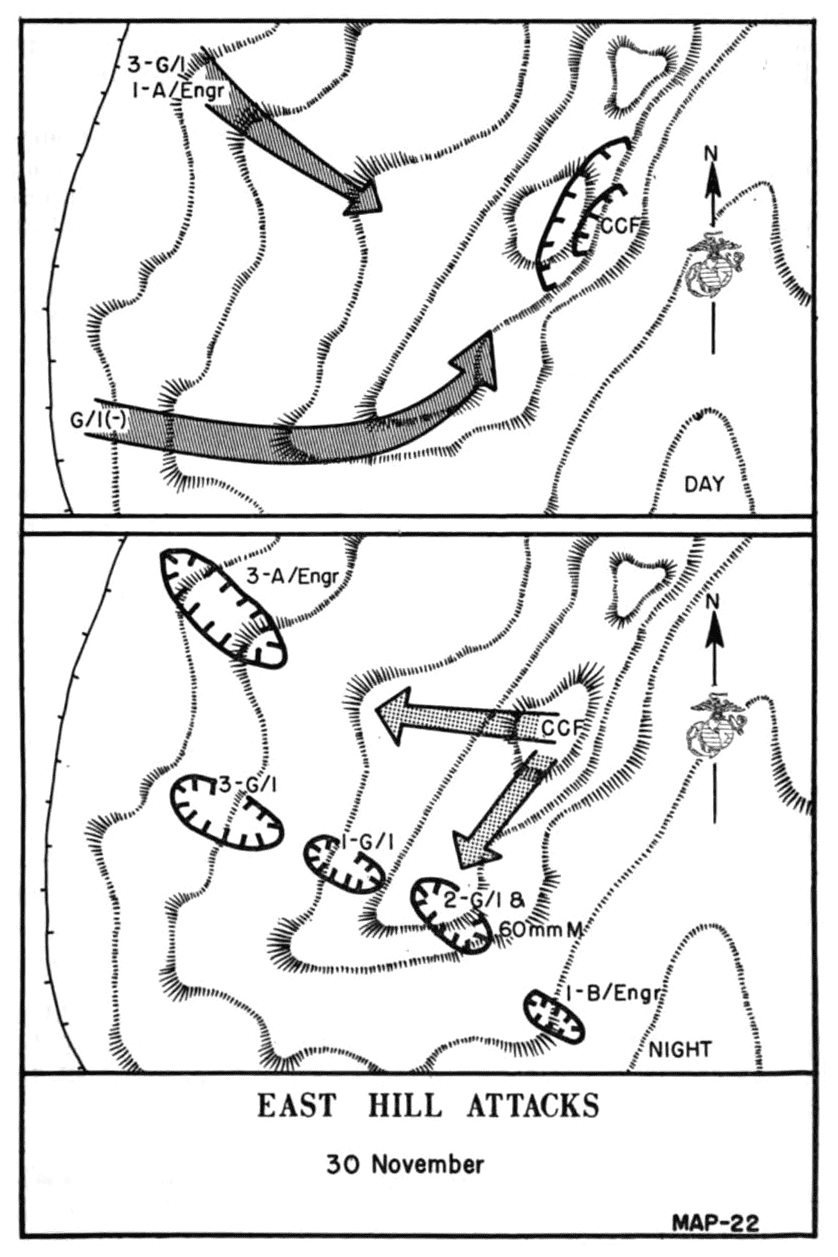
EAST HILL ATTACKS
30 November
MAP-22
Neither of the George Company attacks was successful. The trampling
of hundreds of feet over the snow had made the footing more
treacherous than ever; and once again the combination of difficult terrain
and long-range Chinese fire accounted for failure to retake East
Hill. Sitter’s request to set up defense positions on the ground previously
occupied by Myers was granted. Meanwhile Dennis’ platoon
and the engineers were directed to withdraw to the foot of the hill,
so that the Corsairs could work the CCF positions over with rockets
and bombs.
Although the Marines at Hagaru had little to do with the higher levels
of strategy, it was evident that the continued retreat of the Eighth
Army in west Korea must ultimately affect the destinies of X Corps.
Of more immediate concern was the deteriorating situation of the three
battalions (two infantry and one artillery) of the 7th Infantry Division
east of the Chosin Reservoir. Brigadier General Henry I. Hodes,
assistant division commander, informed General Smith at noon on the
29th that the Army troops had suffered approximately 400 casualties
while falling back toward Hagaru and were unable to fight their way
out to safety. At 2027 that night, all troops in the Chosin Reservoir
area, including the three Army battalions, were placed under the operational
control of the Marine commander by X Corps. The 1st Marine
Division was directed to “redeploy one RCT without delay from Yudam-ni
area to Hagaru area, gain contact with elements of the 7th Inf
Div E of Chosin Reservoir; co-ordinate all forces in and N of Hagaru
in a perimeter defense based on Hagaru; open and secure Hagaru-Koto-ri
MSR.”477
On the afternoon of the 30th a command conference was held at
Hagaru in the Division CP. Generals Almond, Smith, Barr, and Hodes
were informed at the briefing session that a disaster threatened the
three Army battalions.478
Almond was also much concerned about the attacks on the Marine
MSR. He had been given a firsthand account that morning by the
senior Marine officer on the X Corps staff, Colonel Edward H. Forney,
who had just returned from Koto-ri.479
At the Hagaru conference the X Corps commander announced that
he had abandoned any idea of consolidating positions in the Chosin
Reservoir area. Stressing the necessity for speed in falling back toward
Hamhung, he promised Smith resupply by air after authorizing him to
burn or destroy all equipment which would delay his withdrawal to
the seacoast.
The Marine general replied that his movements must be governed by
his ability to evacuate his wounded. He would have to fight his way
out, he added, and could not afford to discard equipment; it was his
intention, therefore, to bring out the bulk of it.480
Almond directed Smith and Barr to draw up a plan and time schedule
for extricating the Army battalions east of the Reservoir. Those two
generals agreed, however, that not much could be done until the Yudam-ni
Marines arrived at Hagaru, and the conference ended on an inconclusive
note. That same afternoon X Corps OpnO 8-50 was received.
It defined the Corps mission as “maintaining contact with the enemy
to the maximum capability consistent with cohesive action, oriented to
the Hamhung-Hungnam base of operation.”481
The decision to concentrate X Corps forces in that area meant the
evacuation of Wonsan. General Harris lost no time in directing MAG-12
to move from Wonsan Airfield to Yonpo. Hedron-12 and the
three combat squadrons began shifting personnel and equipment at
once. Transfer of the aircraft was completed on 1 December. In many
instances the planes took off on combat missions from Wonsan and
landed at Yonpo, so that the ground forces were not deprived of air
support.482
High level naval commanders were already preparing for an evacuation
of northeast Korea if matters came to the worst. Admiral Joy
foresaw as early as the 28th that if the retreat of the battered Eighth
Army continued, X Corps would have to choose between falling back
and being outflanked. In view of the time needed to collect the enormous
quantities of shipping required, he warned Admiral Doyle on that date
that a large-scale redeployment operation might be necessary. Doyle in
turn directed his staff to commence planning for redeployment either
by an administrative outloading or by a fighting withdrawal.483
During the early hours of darkness on 30 November, it appeared that
Hagaru might have a second quiet night. Three bugle calls were
heard by Item Company at 2015, and the enemy sent up a green flare an
hour later. But no unusual CCF activity was reported until 2330, when
small patrols began probing for weak spots in the Item Company lines.
The enemy could scarcely have chosen a less rewarding area for
such research. As usual, Lieutenant Fisher had built up an elaborate
system of concertinas, trip flares, and booby traps; and his sandbagged
foxholes and weapon emplacements afforded his men maximum protection.
At midnight, when the enemy came on in strength, each successive
assault wave shattered against the terrific fire power which a
Marine rifle company, aided by artillery, tanks, 81mm mortars, and
heavy machine guns, could concentrate.
Several times the enemy’s momentum carried him to the Item Company
foxholes but no Communists lived to exploit their advantage. On
one of these occasions Sergeant Charles V. Davidson, having expended
his ammunition, proved that cold steel still has its uses by bayoneting the
last of his attackers.484
Again, as on the night of the 28th, the enemy had chosen to launch
his major attack against Marine strength, though his daytime observation
must have disclosed the preparations for a hot reception in the Item
Company sector. An estimated 500 to 750 Chinese were killed on this
front at a cost to Fisher’s men of two KIA and 10 WIA.485
The Chinese also repeated themselves by carrying out another attack
on East Hill which ended in a second costly stalemate. The western
slope up to the military crest was held by the following units from
right to left: First Lieutenant Ermine L. Meeker’s 1st Platoon of Baker
Company engineers; the 2d, 1st, and 3d Platoons of George Company;
and Lieutenant Skelt’s 3d Platoon of Able Company Engineers. To the
left of Skelt, near the foot of the hill, were Lieutenant Canzona’s 1st
Platoon of Able engineers; two tanks of the AT Company, 2/7; and
elements of Lieutenant Colonel Banks’ 1st Service Battalion.486
The action began shortly before midnight with one of those comedy
situations which develop on the grimmest occasions. The sign or password
was “Abraham” and the countersign “Lincoln,” but two Company
A engineers on a listening post did not pause for the customary
exchange. Having been jumped by what their startled eyes took to be a
Chinese regiment, they sprinted downhill yelling, “Abraham Lincoln!
Abraham Lincoln!” as they slid into Skelt’s lines with the enemy close
behind.
His engineers had no leisure for a laugh. Within a few seconds they
were mixing it in a wild melee with Communists who seemed literally
to drop on them from above. Meanwhile, George Company was hard
hit by well aimed mortar fire which threatened to wipe out Lieutenant
Hopkins’ 1st Platoon. The ensuing double-headed CCF attack bent
back the left flank of George Company, with both the 1st and 3d
Platoons giving ground.
On the left Skelt’s platoon was pushed down to the foot of the
hill by superior enemy numbers after exactly half of his 28 men were
killed or wounded. Here the fight continued with Banks’ service troops
lending a hand until the Chinese were exterminated.
This penetration was a hollow triumph for the enemy. No friendly
forces being left in the center, the How Battery howitzers walked shells
up and down the western slope. Mortars and machine guns chimed in,
and Lieutenant Canzona’s platoon was in position to direct the fire
of the two tanks of AT Company 2/7.
The scene became bright as day after an enemy artillery shell set 50
drums of gasoline ablaze in a Supply Area dump. Like an enormous
torch, the flames illuminated the battle so vividly that General Smith
looked on from the doorway of his CP, some 1200 yards away. Several
bullets pierced the roof and walls during the night.
Again, as in the fight of 28–29 November, Marine fire power blocked
the gap on the central and northwest slopes of East Hill. Marine and
Army service troops took a part in the fighting which is the more
creditable considering that they were ordered out in the middle of the
night, placed in a provisional unit with strange troops, and marched
off into the darkness to attack or defend at some critical point.
Lieutenant Meeker’s engineer platoon, on the right of George Company,
had a long-drawn fire fight but got off with losses of one man
killed and three wounded. At 0100 the CCF pressure on Sitter’s troops
was so heavy that Lieutenant Carey, former commander of the 1st
Platoon, was taken from his S-2 duties to lead a group of reinforcements
which he described as “all available hands from the CP or any
other units in Hagaru who could spare personnel.” Carrying as much
ammunition as possible, he arrived at the George Company CP to find
Sitter still commanding in spite of his wound. Scarcely a full squad
was left of Carey’s old outfit when he helped to restore the lines.
It was necessary for Ridge to send a further reinforcement consisting
of British Marines of the 41st Commando before George Company’s
left flank was secured. A counterattack at daybreak regained lost
ground, and the situation was well under control when air came on
station at 0900.
Thus ended another night of confusion and frustration for both
sides on East Hill. While the Chinese attack had been better organized
and in larger force than the effort of the 29th, it was too little and too
late for decisive results in spite of heavy losses. On the other hand,
George Company and its reinforcing elements had suffered an estimated
60 men killed and wounded.
Although the Marines of Hagaru could not have suspected it on the
morning of 1 December, the enemy had, for the time being, shot his
bolt. His first two large-scale attacks, as POW interrogations were
to confirm, had used up not only the personnel of a division but most
of the limited supplies of ammunition available. Thus it is probable
that the following estimates of CCF casualties, as published in the 3/1
report, for the period of 28 November to 5 December, were nearer to
accuracy than most such summaries:
(1) 58th CCF Division: Estimated casualties of 3300 for the 172d Regiment;
1750 each for the 173d and 174th Regiments.
(2) 59th CCF Division: Estimated 1750 casualties for the 176th Regiment.
No other units identified.
The known Chinese dead in the two night battles amounted to at
least 1500; and if it may be assumed that three or four times that
number were wounded, the total casualties would have crippled an
enemy infantry division of 7500 to 10,000 men, plus an additional
regiment. Considering the primitive state of CCF supply and medical
service, moreover, it is likely that hundreds died of wounds and privations
behind their own lines.
The losses of 3/1 at Hagaru were given as 33 KIA, 10 DOW, 2 MIA,
and 270 WIA—a total of 315 battle casualties, nearly all of which
were incurred from 28 November to 1 December.487 There are no
over-all casualty figures for Marine or Army service troops, but it is
probable that their total losses exceeded those of 3/1.
Casualties estimated as high as 75 per cent were suffered by the three
U. S. Army battalions east of the Reservoir. At 2200 on the night of
1 December, the first survivors, most of them walking wounded, reached
the Marine lines north of Hagaru with tales of frightful losses suffered
in the five days of continual fighting since the first CCF attack
on the night of 27–28 November.
Following this action Colonel Allan D. MacLean, commanding the
31st Infantry, had set up a perimeter near Sinhung-ni with the 3d Battalion
of his regiment and the 1st Battalion of the 57th Field Artillery.
Along the shore farther to the north, Lieutenant Colonel Don C. Faith,
USA, held a separate perimeter with the 1st Battalion, 32d Infantry
(see Map 20).488
Both positions were hard hit by the Chinese on the night of 27–28
November and isolated from each other. During the next 24 hours they
beat off CCF attacks with the support of Marine and FEAF planes, and
Faith fought his way through to a junction with the Sinhung-ni force.
When the senior officer was killed, Faith took command of all three
battalions. Immobilized by nearly 500 casualties, he remained in the
Sinhung-ni perimeter, where he was supplied by air. On the 29th General
Hodes sent a relief force in company strength from 31st Infantry
units in the area just north of Hagaru. These troops, supported by
several Army tanks, were hurled back by superior CCF numbers with
the loss of two tanks and heavy personnel casualties.
On 1 December, fearing that he would be overwhelmed in his Sinhung-ni
perimeter, Faith attempted to break through to Hagaru. After
destroying the howitzers and all but the most essential equipment, the
convoy with its hundreds of wounded moved out under the constant
cover of Marine close air support, controlled by Captain Edward P.
Stamford, USMC.489
Progress was slow and exhausting, with frequent stops for fire fights.
There were many instances of individual bravery in the face of adversity,
but losses of officers and NCOs gradually deprived the units of leadership.
As an added handicap, a large proportion of the troops were
ROKs who understood no English.
The task force came near to a breakout. At dusk it was only four and
a half miles from Hagaru when Faith fell mortally wounded and the
units shattered into leaderless groups.490 Soon the column had ceased to
exist as a military force. A tragic disintegration set in as wounded and
frostbitten men made their way over the ice of the Reservoir in wretched
little bands drawn together by a common misery rather than discipline.
By a miracle the first stragglers to reach Hagaru got through the
mine fields and trip flares without harm. Before dawn a total of about
670 survivors of Task Force Faith had been taken into the warming
tents of Hagaru.
Lieutenant Colonel Beall, commanding officer of the 1st Motor Transport
Battalion, made a personal search in the morning for other survivors.
Finding more than his jeep could carry, he organized a task force
of trucks, jeeps, and sleds. The only CCF opposition to the Marines
came in the form of long-distance sniping which grew so troublesome
late in the afternoon that the truckers set up a machine gun section on
the ice for protection. Far from hindering the escape of the Army
wounded, the Chinese actually assisted in some instances, thus adding
to the difficulty of understanding the Oriental mentality.491
Of the 319 soldiers rescued by Beall on 2 December, nearly all were
wounded or frostbitten. Some were found wandering about in aimless
circles on the ice, in a state of shock.
A company-size task force of Army troops from Hagaru, supported
by tanks, moved out that day to bring in any organized units of the
three shattered battalions which might have been left behind. Known
as Task Force Anderson after Lieutenant Colonel Berry K. Anderson,
senior Army officer at Hagaru, the column met heavy CCF opposition
and was recalled when it became evident that only stragglers remained.492
Beall and his men kept up their rescue work until the last of an estimated
1050 survivors of the original 2500 troops had been saved. A
Marine reconnaissance patrol counted more than 300 dead in the abandoned
trucks of the Task Force Faith convoy, and there were apparently
hundreds of MIA. The 385 able-bodied soldiers who reached Hagaru
were organized into a provisional battalion and provided with Marine
equipment.493
Casualty evacuation had become such a problem by 1 December that
Captain Eugene R. Hering, (MC) USN, the Division surgeon, called
at General Smith’s CP that morning. He reported that some 600 casualties
at Hagaru were putting a severe strain on the limited facilities
of C and E Companies of the 1st Medical Battalion. It was further
estimated that 500 casualties would be brought in by the Yudam-ni
units and 400 from the three Army battalions east of the Reservoir.494
Although both figures were to prove far too low, they seemed alarmingly
high at a time when only the most critical casualties could be
evacuated by helicopter or OY. Flying in extreme cold and landing at
high altitudes where the aircraft has less than normal lift, the pilots
of Major Gottschalk’s VMO-6 saved scores of lives. From 27 November
to 1 December, when the transports took over, 152 casualties were
evacuated by the OYs and helicopters—109 from Yudam-ni, 36 from
Hagaru, and seven from Koto-ri.495
Altogether, 220 evacuation flights and 11 rescue missions were completed
during the entire Reservoir campaign by a squadron which on
1 November included 25 officers, 95 enlisted men, eight OY-2 and two
L5G observation planes and nine HO3S-1 Sikorsky helicopters. First
Lieutenant Robert A. Longstaff was killed by enemy small-arms fire
near Toktong Pass while on an evacuation flight, and both Captain
Farish and Lieutenant Englehardt had their helicopters so badly riddled
by CCF bullets that the machines were laid up for repairs.496
Two surgical teams from Hungnam had been flown to Hagaru by
helicopter, but the evacuation problem remained so urgent on 1 December
that the command of the 1st Marine Division authorized a trial
landing on the new airstrip. Only 40 per cent completed at this time,
the runway was 2900 feet long and 50 feet wide, with a 2 per cent grade
to the north.
It was a tense moment, at 1430 that afternoon, when the knots of
parka-clad Marine spectators watched the wheels of the first FEAF C-47
hit the frozen, snow-covered strip. The big two-motored aircraft
bounced and lurched its way over the rough surface, but the landing
was a success. An even more nerve-racking test ensued half an hour
later when the pilot took off with 24 casualties. It seemed for a breath-snatching
instant that the run wouldn’t be long enough for the machine
to become airborne, but at last the tail lifted and the wings got enough
“bite” to clear the hills to the south.
Three more planes landed that afternoon, taking off with about 60
more casualties. The last arrival, heavily loaded with ammunition, collapsed
its landing gear on the bumpy strip and had to be destroyed and
abandoned.497
At the other end of the evacuation chain, clearing stations had been
established by X Corps at Yonpo Airfield to receive and distribute casualties.
A 30-day evacuation policy was maintained, and the casualties
to remain in the area went to the 1st Marine Division Hospital in Hungnam,
the Army 121st Evacuation Hospital in Hamhung, and the USS
Consolation in Hungnam harbor. Casualties requiring more than 30
days of hospitalization were flown from Yonpo to Japan, though a few
critical cases were evacuated directly from Hagaru to Japan.498
It was planned for incoming transports at Hagaru to fly both supplies
and troop replacements. Meanwhile, on 1 December, the 1st Marine
Division had its first C-119 air drop from Japan. Known as “Baldwins,”
these drops consisted of a prearranged quantity of small arms
ammunition, weapons, water, rations, and medical supplies, though the
amounts could be modified as desired.499
Air drops, however, did not have the capability of supplying an RCT
in combat, let alone a division. At this time the Combat Cargo Command,
FEAF, estimated its delivery capabilities at only 70 tons per day;
and even though in practice this total was stepped up to 100, it fell
five short of the requirements of an RCT. Fortunately, the foresight of
the Division commander and staff had enabled the Supply Regulating
Detachment to build up a level of six days’ rations and two units of
fire at Hagaru.500 This backlog, plus such quantities as could be delivered
by Baldwin drops, promised to see the Division through the
emergency.
Infantrymen are seldom given to self-effacement, but at nightfall on
1 December only an ungrateful gravel-cruncher could have failed to
pay a silent tribute to the other services as well as to the supporting
arms of the Marine Corps. Navy medics, FEAF airmen, Army service
units—they had all helped to make it possible for the Marines to plan
a breakout. Yet it is likely that the 1st Engineer Battalion came first
in the affections of wounded men being loaded in the C-47s for evacuation.
In just twelve days and nights the engineers of Company D had
hacked this airstrip out of the frozen earth. Marine infantrymen could
never forget the two critical nights of battle when they looked back
over their shoulders from combat areas at the heartening spectacle of
the dozers puffing and huffing under the floodlights. In a pinch Lieutenant
Colonel Partridge’s specialists had doubled as riflemen, too, and
several platoons were riddled with casualties. Thanks in large part to
the engineers, the Hagaru base was no longer isolated on 1 December.
And though the enemy did not yet realize it, he had lost the initiative on
this eventful Friday. The Marines at Yudam-ni were coming out, and
they were coming out fighting with their casualties and equipment.
CHAPTER XII Breakout From Yudam-ni — Joint Planning for Breakout — The Fight for Hills 1419 and 1542 — March of 1/7 Over the Mountains — Attack of 3/5 on 1–2 December — The Ridgerunners of Toktong Pass — CCF Attacks on Hills 1276 and 1542 — Advance of Darkhorse on 2–3 December — Entry into Hagaru Perimeter
Joint Planning for Breakout—The Fight for Hills 1419 and
1542—March of 1/7 Over the Mountains—Attack of 3/5 on
1–2 December—The Ridgerunners of Toktong Pass—CCF Attacks
on Hills 1276 and 1542—Advance of Darkhorse on 2–3
December—Entry into Hagaru Perimeter
The first steps toward regaining the initiative were taken by the
Marine command as early as 29 November. Upon being informed
that the composite battalion had failed to open up the MSR south of
Yudam-ni, General Smith concluded that it was a task for a regiment.
At 1545 that afternoon he issued the following orders to RCTs 5 and 7:
RCT-5 assume responsibility protection Yudam-ni area adjusting present
dispositions accordingly. RCT-7 conduct operations clear MSR to Hagaru
without delay employing entire regiment.501
That same evening the Division CP received X Corps OI 19, providing
that an RCT be redeployed from the Yudam-ni area to Hagaru.502
No further directives from Division were necessary to implement this
instruction, since it had been anticipated in General Smith’s orders.
Upon receipt, the two Yudam-ni regimental commanders began joint
planning for measures to be taken. The unusual command situation at
Yudam-ni, in the absence of the assistant division commander, was
explained by Colonel Litzenberg:
The 5th and 7th Marines were each acting under separate orders from the
Division. The Division would issue orders to one regiment with information
to the other, so that Division retained the control; and, of course, the 4th
Battalion, 11th Marines, in general support of both regiments, was not actually
under the control of either of us. Lieutenant Colonel Murray ... operated
in very close coordination with me, sometimes at his own command
post and sometimes at mine. We called in [Major] McReynolds, the commander
of 4/11, discussed the situation with him, and thereafter Lieutenant
Colonel Murray and I issued orders jointly as necessary.... This command
arrangement functioned very well. There was never any particular disagreement.503
For purposes of planning the supporting fires for the breakout, an
artillery groupment was formed and Lieutenant Colonel Feehan given
the responsibility of coordination. It was further agreed that no air
drops of 155mm ammunition would be requested because of the greater
number of 105mm rounds which could be received with fewer difficulties.504
The problems of the two RCTs, commented General Smith, could not
be separated. “The only feasible thing for them to do was pool their
resources.... The assignment of command to the senior regimental
commander was considered but rejected in favor of cooperation.”505
At 0600 on the 30th, the two RCTs issued their Joint OpnO 1-50,
which called for the regroupment of the Yudam-ni forces in a new position
south of the village and astride the MSR as a first step toward a
breakout.506 Thus in effect the two RCTs and supporting troops would
be exchanging an east-and-west perimeter for one pointing from north
to south along the road to Hagaru. Not only was the terrain south of
the village more defensible, but a smaller perimeter would serve the
purpose.
Lieutenant Colonel Winecoff, Assistant G-3 of the Division, flew to
Yudam-ni on the 30th to observe and report on the situation. He was
given a copy of Joint OpnO 1-50 for delivery to General Smith on his
return to Hagaru.507
That same afternoon, during a conference with General Almond at
Hagaru, the Marine commander received X Corps OpnO 8, directing
him to operate against the enemy in zone, withdrawing elements north
and northwest of Hagaru to that area while securing the Sudong-Hagaru
MSR. And at 1920 that evening, Division issued the following dispatch
orders to RCTs 5 and 7:
Expedite execution of Joint OpnO 1-50 and combined movement RCT-5
and RCT-7 to Hagaru prepared for further withdrawal south. Destroy any
supplies and equipment which must be abandoned during this withdrawal.508
As a prerequisite, a good deal of reorganization had to be effected at
Yudam-ni. In order to provide a force to hold the shoulders of the
high ground through which RCT-7 would advance, it was decided to
put together another composite battalion.
The new unit consisted of George Company, 3/7, Able Company,
1/5, and the remnants of Dog and Easy Companies, 2/7, combined into
a provisional company under Captain Robert J. Polson; a section of 81s
each from 2/7 and 3/7’s Weapons Companies; and a communications
detachment from 3/7. Major Maurice E. Roach, regimental S-4 placed
in command, realized that such a jury-rigged outfit might be subject to
morale problems. Noting that one of the men had made a neckerchief
out of a torn green parachute, he seized upon the idea as a means of
appealing to unit pride. Soon all the men were sporting green neckerchiefs,
and Roach gave the new unit added distinction by christening
it the Damnation Battalion after adopting “Damnation” as the code
word.509
Beginning in the early morning hours of the 30th, regroupment was
the chief activity at Yudam-ni. Enemy opposition during the night took
the form of scattered small-arms fire varied with minor probing attacks.
This comparative lull lasted until 0710, when Item Company of 3/5
beat off an enemy assault on Hill 1282 (North Ridge) with the support
of Marine air strikes and 81mm mortar fire. In the same area George
Company had a brisk fire fight from 1315 to dusk.
The plan of the regroupment envisioned a gradual withdrawal from
the north and west of Yudam-ni by RCT-5 for the purpose of relieving
units of RCT-7 and enabling them to extend the perimeter southward
from the village (see Map 23). It fell to 2/5 to execute the most difficult253
maneuver of the day. Roise’s battalion held a line stretching from
Hill 1426 on Southwest Ridge along the high ground to 3/5’s positions
on Hill 1282. After disengaging with the help of Marine air and artillery,
2/5 gave up Hill 1426 and pulled back nearly a mile, relieving
elements of 3/7 on the left. Roise’s new line included Hill 1294 on
Southwest Ridge, overlooking the MSR, and extended northeast to Hill
1282 as before. Meanwhile 1/5 continued to hold a defensive line from
Hill 1240 eastward to Hill 1167.
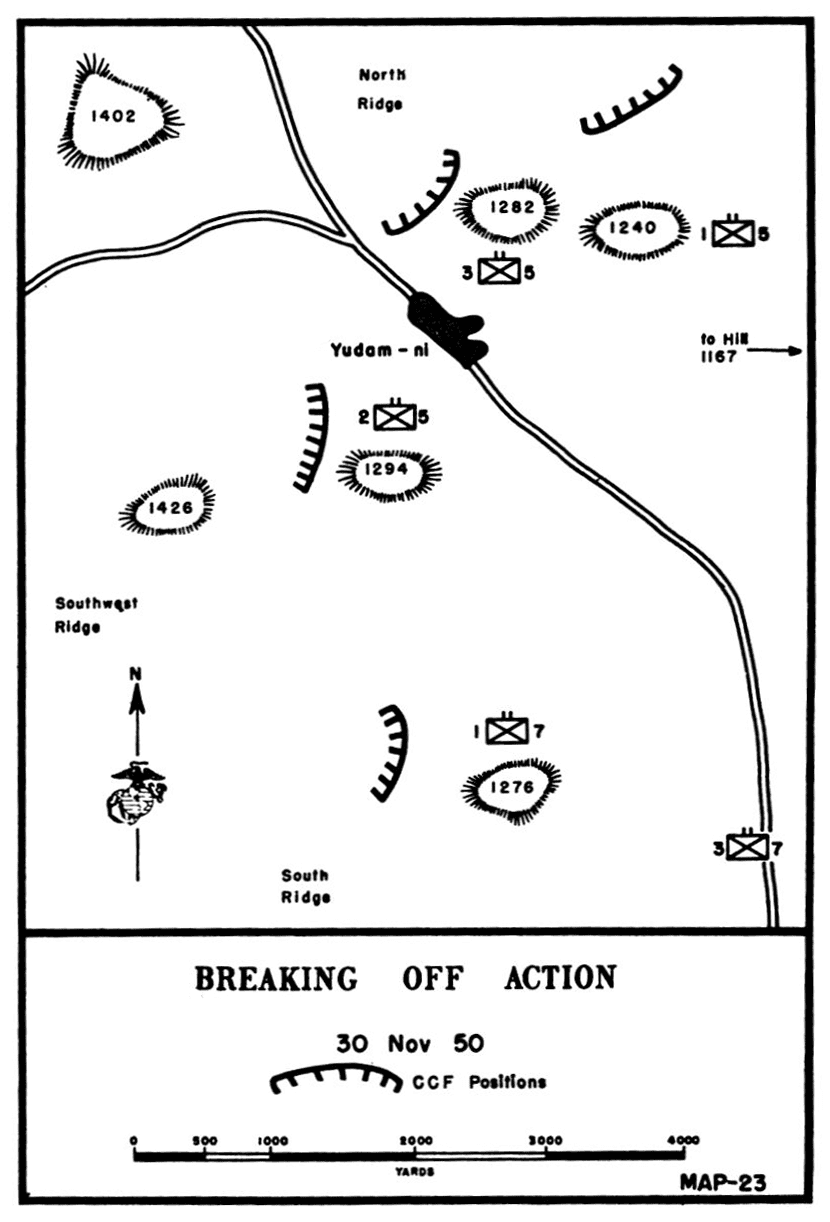
BREAKING OFF ACTION
30 Nov 50
MAP-23
These movements freed 3/7 to re-deploy to new positions astride
the MSR about 4000 yards south of Yudam-ni. In this same general
area, 1/7 continued to block the valley to the southwest while holding
Hill 1276, of South Ridge, about 2500 yards south of the village.
“The question of whether we should make these movements during
daylight or at night was a difficult one,” said Colonel Litzenberg. “We
finally decided to make the movements in daylight when we could
have advantage of observation for air cover and artillery. The movement,
piecemeal by battalion, was successfully executed.”510
The enemy took surprisingly little advantage of the readjustment.
Movements were completed in an orderly and methodical manner as
the units drew rations and ammunition for the breakout. Preparations
were made for the destruction of all equipment which could not be
carried out, and air drops of ammunition and other supplies were
received.
As a solution for the problem of casualty evacuation, General Smith
had suggested the construction of an OY strip. A start was made at 0900
on the 30th by the TD-18 dozers of Major McReynolds’ artillery battalion,
but the area came under enemy fire the next day and the nearly
completed strip could be used only twice.511
The plan, as finally agreed upon, called for a combination of the two
solutions. Since it was essential to relieve hard-pressed Fox Company
and secure vital Toktong Pass prior to the arrival of the main column,
one force would advance across country. And since it would have
been physically impossible to carry the wounded over the mountains,
the main body would fight its way along the road to Toktong Pass.512
The over-all plan for the Yudam-ni breakout, after being flown to
Hagaru by helicopter for General Smith’s approval, was incorporated
into Joint OpnO 2-50. This directive, later modified by fragmentary
orders, was issued in the morning of 1 December 1950.
It meant dispensing with the vehicles and heavy equipment of the
cross-country force. Only the barest military necessities could be taken
by men loaded down with ammunition while struggling through snow-drifts.
The unit selected for the attempt was the 1st Battalion, 7th Marines,
commanded by Lieutenant Colonel Davis. The plan of maneuver called
for him to strike off across the mountain tops under cover of darkness
on the night of 1 December. As the other units moved out astride the
MSR from Yudam-ni to Hagaru, 3/5 was to be the advance guard.
Lieutenant Colonel Taplett’s battalion had the mission of passing
through 3/7 to seize the commanding ground on both sides of the road
and lead the way for the rest of the Yudam-ni troops. Thus the attacks
of 1/7 and 3/5 would converge in the general area of Fox Hill and
Toktong Pass.
The point of the advance was to be the only Marine tank to reach
Yudam-ni while the MSR was still open. It was left stranded after the
recall of the crew to Hagaru; but Staff Sergeant Russell A. Munsell
and another crewman were flown up from Hagaru by helicopter at
Colonel Litzenberg’s request. They were to man Tank D-23 when it
moved out with the point. Plans also called for a battery of 3/11 to
advance near the head of the column, so that it could go into position
near Sinhung-ni and provide covering fires for the rearguard while
other artillery units displaced.
The 4th Battalion of the 11th Marines had orders to fire most of
its 155mm ammunition before departure. All the men who could be
spared from this unit were formed into nine provisional infantry platoons.
Two were assigned to reinforce the 7th Marines and three to
the 5th Marines; four were retained under Major McReynold’s command
to protect the flanks of the vehicle train. It was further prescribed
that the guns of 4/11 were to bring up the rear of the convoy, so that
the road would not be blocked in the event of any of its vehicles becoming
immobilized.
Only drivers and seriously wounded men were permitted to ride the
trucks in the middle of the column along with critical equipment and
supplies. Since all additional space in the vehicles would doubtless be
needed for casualties incurred in the breakout as well as Fox Company
casualties, it was decided not to bring out the dead from Yudam-ni. A
field burial was conducted by chaplains for 85 officers and men.513
All available Marine aircraft were to be on station. Moreover, carrier
planes of TF 77 had been released from other missions by the
Fifth AF to reinforce the aircraft of the 1st MAW in direct support of
the Yudam-ni troops.
The transition from planning to execution began on the morning of
1 December. Only the 1st and 3d Battalions of RCT-5 were left to
the north of Yudam-ni, and pulling them out was to prove equivalent
to letting loose of the tiger’s tail.
The 3d Battalion began its withdrawal at 0800, followed 90 minutes
later by the 1st. The initial phases of the maneuver were carried out
without great difficulty. The first major problem came when 3/5’s last
unit, George Company, pulled down from Hill 1282 (see Map 24).
There the Marines had been in such close contact with the enemy that
grenades were the main weapon of both sides. The problem of preventing
the Chinese from swarming over the top of the ridge at the
critical moment and pursuing the Marines down the slope was solved
by First Lieutenant Daniel Greene, the FAC, with a dummy run by close
supporting aircraft. While the first pass of the Corsairs kept the Communists
down, Captain Chester R. Hermanson commenced his withdrawal.
As soon as his men moved out at a safe distance he signalled
to the FAC, who called for live runs of Marine air in coordination with
the fires directed by the artillery liaison officer, First Lieutenant Henry257
G. Ammer. First Lieutenant Arthur E. House’s 81mm mortar platoon
also rendered skillful support during the withdrawal.514
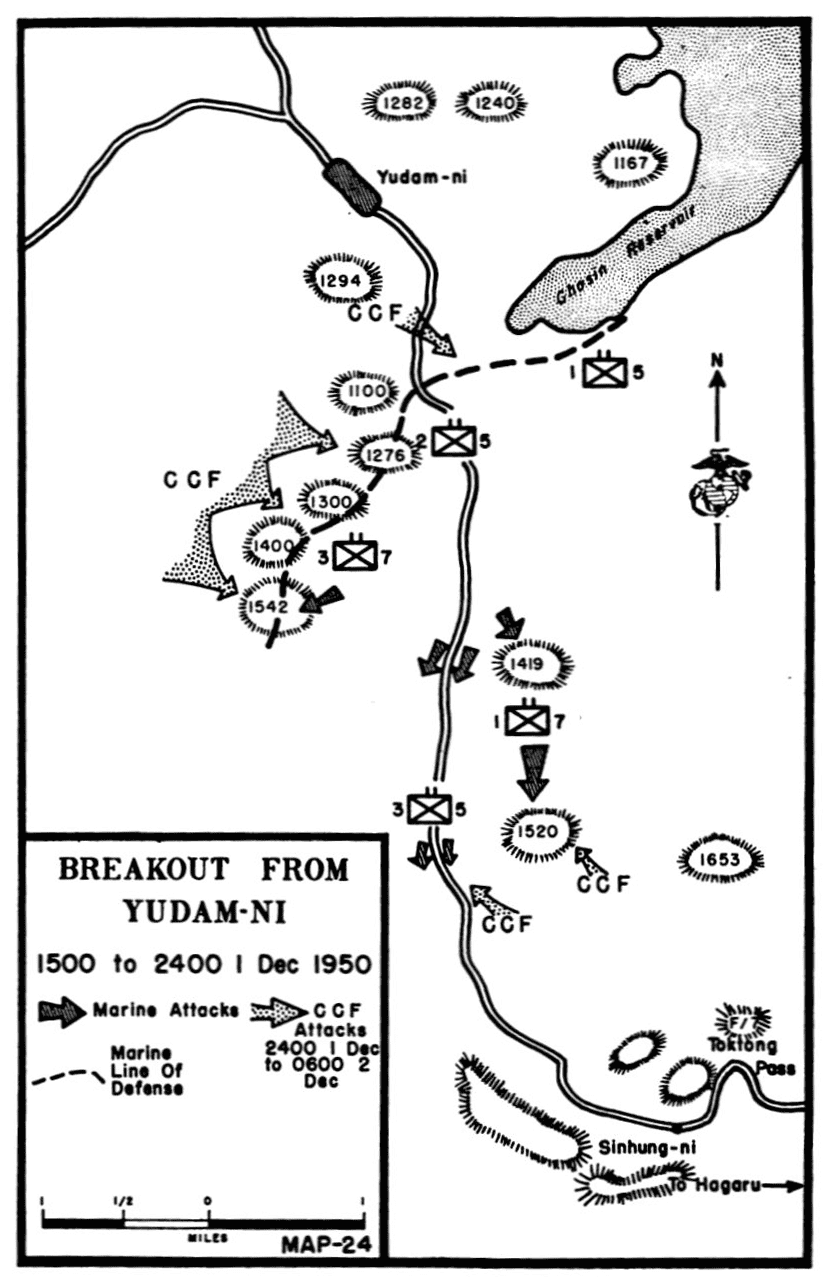
BREAKOUT FROM
YUDAM-NI
1500 to 2400 1 Dec 1950
MAP-24
The ancient ruse was so successful that George Company disengaged
without a single casualty. Ammunition left behind by the rifle platoons
was detonated just as the rockets, bombs, and napalm of the Corsairs
hit the Chinese, followed by artillery and mortar shells. Hill 1282
seemed to erupt in one tremendous explosion. While Captain Hermanson’s
men crossed the bridge south of the burning town, an engineer
demolitions crew waited to destroy the span.
The rear guard unit for the withdrawal of the two battalions was
First Lieutenant John R. Hancock’s Baker Company of 1/5. He felt
that his best chance would be to “sneak off” Hill 1240. Accordingly
he requested that no supporting fires be furnished Baker Company,
except at his request. Making very effective use of his light machine guns
to cover his withdrawal with a spray of fire, Hancock disengaged without
a casualty.
The next stage of the regroupment was carried out in preparation for
the attacks of 3/5 and 1/7. In order to clear the way on both sides
of the MSR, 3/7 (minus How Company) moved out at 0900 on 1 December
to attack Hill 1542 while How Company went up against Hill
1419.
Joint OpnO 1-50 was modified meanwhile by verbal instructions
directing 2/5, instead of 3/5, to relieve 1/7 on Hill 1276, thus freeing
Colonel Davis’ battalion for its assigned mission. The 1st Battalion of
RCT-5 took positions stretching from Hill 1100 on the west side of
the MSR to the low ground southeast of the arm of the Reservoir. This
meant that after 3/7 (-) seized Hill 1542, three Marine infantry battalions
would occupy a defensive line about three and a half miles in
length, stretching diagonally northeast from that position to the arm of
the Reservoir, with Hill 1276 as its central bastion.515
Shortly before dusk Lieutenant Colonel Taplett’s 3/5 arrived in position
to pass through Lieutenant Colonel Harris’ 3/7. The two battalion
commanders agreed that 3/5 would execute the movement even though
3/7 had not yet secured its objectives, and 3/5 attacked astride the
MSR at 1500.516
Harris’ battalion had been having it hot and heavy all day on Hills
1419 and 1542 after jumping off at 0900. These objectives were too far
apart for a mutually supported attack and the Chinese defended the
difficult terrain with tenacity.
Item Company, reinforced by artillerymen and headquarters troops,
made slow progress west of the road against the Chinese dug in on
Hill 1542. At 1700 George Company moved into position on the left.
Both companies attempted an assault but the 3/7 report states, “Each
attack by ‘I’ Co and ‘G’ Co never reached full momentum before it was
broken up.” One platoon of Item Company reached the military crest
before being repulsed. When night fell, the Marines were still on the
eastern slopes of 1542.517
On Hill 1419, about 1000 yards east of the road, How Company of
3/7 met stiff opposition from Chinese dug in along four finger ridges
as well as the main spur leading to the topographical crest. It became
evident that How Company alone could not seize the hill and about
noon Able Company of Davis’ battalion joined the attack, on How’s
left.
The heavy undergrowth gave concealment to the enemy, though it
also offered footholds to the Marines scrambling up the steep and icy
slopes. Air strikes were laid down just ahead of them, blasting the
Chinese with bombs, rockets, and 20mm fire. Artillery support, however,
was limited by the relative blindness of the forward observer in
the brush, but mortars succeeded in knocking out several enemy positions.
How Company’s attack had come to a standstill because of
casualties which included Lieutenant Harris. First Lieutenant Eugenous
M. Hovatter’s Able Company regained the momentum, thanks to the
efforts of First Lieutenant Leslie C. Williams’ 1st Platoon. Aided by
How and by Baker, which was committed late in the afternoon, Able
Company secured Hill 1419 about 1930. Thus the jump-off point for
the 1/7 advance across the mountain tops had been seized.
After setting up hasty defenses, Davis directed that all dead and
wounded be evacuated to 3/5’s aid station on the road. How Company
was attached to his battalion by order of Colonel Litzenberg, since all
units had been thinned by casualties. Then the battalion tail was pulled
up the mountain and the last physical tie broken with other Marine units
in the Yudam-ni area.518
The Marines had seized the initiative, never again to relinquish it
during the Chosin Reservoir campaign.
Planning at the battalion level was done by Davis, his executive officer,
Major Raymond V. Fridrich, and his S-3, Major Thomas B. Tighe. It
was decided to take only two of the 81mm mortars and six heavy machine
guns. They were to be manned with double crews, so that enough
ammunition could be carried to keep them in action.
Pack-set radios (AN/GRC-9) were to provide positive communications
in case the portable sets (SCR-300) would not reach to the
Yudam-ni perimeter. The artillery liaison officer was to carry a pack
set (SCR-610) to insure artillery communication.519
All personnel not sick or wounded were to participate, leaving behind
enough walking wounded or frostbite cases to drive the vehicles
and move the gear left behind with the regimental train. Extra litters
were to be taken, each serving initially to carry additional mortar and
machine gun ammunition; and all men were to carry sleeping bags not
only for the protection of the wounded but also to save their own lives
if the column should be cut off in the mountains for several days. Every
man was to start the march with an extra bandolier of small arms ammunition,
and personnel of the reserve company and headquarters
group were to carry an extra round of 81mm mortar ammunition up
the first mountain for replenishment of supplies depleted at that point.
After driving the enemy from the topographical crest of Hill 1419,
the four companies were not permitted a breathing spell. Davis feared
the effects of the extreme (16 degrees below zero) cold on troops
drenched with sweat from clawing their way up the mountain. He
pressed the reorganization with all possible speed, therefore, after no
enemy contacts were reported by patrols ranging to the southeast. And
at 2100 on the night of 1 December the column set out in this order:
| Baker Company |
First Lieutenant Kurcaba |
| 1/7 Command Group |
Lieutenant Colonel Davis |
| Able Company |
First Lieutenant Hovatter |
| Charlie Company |
Captain Morris |
| Headquarters Group |
Major Fridrich |
| How Company |
Second Lieutenant Newton |
The night was dark but a few stars showed over the horizon in the
general direction to be taken. They served as a guide, with a prominent
rock mass being designated the first objective.
The snow-covered peaks all looked alike in the darkness, and the
guide stars were lost to sight when the column descended into valleys.
Repeated compass orientations of the map examined by flashlight
under a poncho never checked out. The artillery was called upon to
place white phosphorus on designated hills, but the splash of these
rounds could seldom be located.
The point was slowed by the necessity of breaking trail in snow that
had drifted knee-deep in places. After a path had been beaten, the
icy footing became treacherous for the heavily burdened Marines. Some
painful falls were taken on the downhill slopes by men who had to
climb the finger ridges on hands and knees.
Apparently the enemy had been caught by complete surprise, for the
Marines had the desolate area to themselves. A more immediate danger
was loss of direction, and the head of the column veered off to the
southwest while crossing the second valley. A drift in this direction
would eventually take the battalion toward the enemy-held road to
Hagaru (see Map 25), which had been scheduled by the Marine artillery
for harassing and interdiction fires.
Radio failures kept Kurcaba, at the point, from receiving messages
sent in warning. An attempt was made to communicate by word of
mouth, but the shouts from behind often did not penetrate to ears protected
from the cold by parka hoods. At last the loss of direction became
so alarming that Davis himself hurried forward with his radio
operator and runner. In the darkness he lost touch with them and
floundered on alone, panting and stumbling.
It took such effort to overtake the point that he did not make it until
the men were scrambling up the next steep ridge. There the westward
drift was corrected just in time, for the battalion was running into its
first CCF opposition.
The column had been heading up Hill 1520, the eastern and western
slopes of which were held by the enemy. An increasing volume of
small-arms fire was received as Davis gave his company commanders
orders to reorganize units in preparation for attack. Exhausted though
the men were, they summoned a burst of energy and advanced in two
assault columns supported by 81mm mortars and heavy machine guns.
Now the exertion of carrying extra ammunition paid dividends as
Baker and Charlie Companies closed in on a CCF position held in estimated
platoon strength. Some of the Chinese were surprised while
asleep or numbed with the cold, and the Marines destroyed the enemy
force at a cost of only a few men wounded.
The attack cleared the enemy from the eastern slope of Hill 1520,
but distant small-arms fire was received from ridges across the valley
to the east. Davis called a halt for reorganization, since the troops had
obviously reached the limit of their endurance. Suddenly they began
collapsing in the snow—“like dominoes,” as the commanding officer
later described the alarming spectacle. And there the men lay, oblivious
to the cold, heedless of the Chinese bullets ricocheting off the rocks.
A strange scene ensued in the dim starlight as company officers and
NCOs shook and cuffed the prostrate Marines into wakefulness. The
officers could sympathize even while demanding renewed efforts, for
the sub-zero cold seemed to numb the mind as well as body.
Davis had even requested his company commanders to check every
order he gave, just to make sure his own weary brain was functioning
accurately. At 0300 he decided to allow the men a rest—the first in
20 hours of continuous fighting or marching under a double burden.
As a preliminary, the battalion commander insisted that the perimeter
be buttoned up and small patrols organized within companies to insure
a 25 per cent alert. Then the pack radio was set up to establish the
night’s first contact with the regimental CP, and the men took turns at
sleeping as an eerie silence fell over the wasteland of ice and stone.
Returning to the Yudam-ni area, it may be recalled that Lieutenant
Colonel Taplett’s 3/5 had passed through 3/7 at 1500 on 1 December
with a mission of attacking astride the MSR to lead the way for the
main column. Tank D-23, a How Company platoon and a platoon of
Able Company engineers set the pace, followed by the rest of How
Company and the other two rifle companies. After an advance of 1400
yards the battalion column was stopped by heavy CCF fire from both
sides. How and Item Companies fanned out west and east of the road
and a longdrawn firefight ensued before the Marines cleared the enemy
from their flanks at 1930.520
Artillery support for the breakout was provided by 1/11 and 3/11
(minus Battery H). The plan called for 1/11 to take the main responsibility
for furnishing supporting fires at the outset while 3/11 displaced
as soon as possible to the vicinity of Sinhung-ni, whence the last
lap of the march to Hagaru could be effectively covered. The 1st Battalion
would then join the vehicle column and move with it to Hagaru.521
Taplett gave 3/5 a brief rest after securing his first objectives—the
high ground on both sides of the road just opposite the northern spurs
of Hill 1520. Then he ordered a renewal of the attack shortly before
midnight. How Company on the right met only moderate opposition,
but was held up by the inability of Item Company to make headway
against Chinese dug in along the western slope of Hill 1520. Neither
1/7 nor 3/5 had any idea at the moment that they were simultaneously
engaged on opposite sides of the same great land mass, though separated
by enemy groups as well as terrain of fantastic difficulties. So
rugged was this mile-high mountain that the two Marine outfits might
as well have been in different worlds as far as mutual support was concerned.
Item Company stirred up such a hornet’s nest on the western slope
that Captain Harold O. Schrier was granted permission by the battalion
commander to return to his jump-off position, so that he could better
defend the MSR. There he was attacked by Chinese who alternated
infantry attacks with mortar bombardments. Radio communication
failed and runners sent from the battalion CP to Item Company lost
their way. Thus the company was isolated during an all-night defensive
fight. Second Lieutenant Willard S. Peterson took over the command
after Schrier received a second wound.
Taplett had ordered his reserve company, George, and his attached
engineers into defensive positions to the rear of Item Company. The
engineers on the right flank were also hit by the Chinese and had several
wounded, including the platoon commander, First Lieutenant
Wayne E. Richards, before repulsing the attack.
Counted CCF dead in the Item Company area totaled 342 at daybreak
on the 2d, but the Marines had paid a heavy price in casualties.
Less than 20 able-bodied men were left when George Company passed
through to renew the attack on Hill 1520. For that matter, both George
and How Companies were reduced to two-platoon strength. Taplett
requested reinforcement by an additional company, and was assigned
the so-called Dog-Easy composite company made up of the remnants of
2/7. This outfit moved directly down the road between George and
How Companies.522
It took George Company until 1200 to secure the western slope of
Hill 1520. The composite company ran into difficulties meanwhile at a
point on the MSR where the Chinese had blown a bridge over a deep
stream bed and set up a roadblock defended by machine guns. While
George Company attacked down a long spur above the enemy, Dog-Easy
Company maneuvered in defilade to outflank him. Lieutenant
Greene, the FAC, directed the F4Us on target and the ground forces
were treated to a daring exhibition of close support by Corsairs which
barely cleared the ridge after pulling out of their runs. The roadblock
was speedily wiped out, but the vehicle column had to wait until the
engineers could construct a bypass. Then the advance of 3/5 was resumed,
with George and How Companies attacking on opposite sides
of the MSR, and the composite company astride the road, following
the tank and engineer platoons.
All the rest of their lives the survivors of the two spearhead Marine battalions
would take pride in nicknames earned during the breakout from
Yudam-ni. For Taplett’s outfit it was “Darkhorse,” after the radio call
sign of the battalion, while Davis’ men felt that they had a right to be
known as the “Ridgerunners of Toktong Pass.”
At daybreak on 2 December, 1/7 corrected its westward drift of the
previous night and attacked toward Hill 1653, a mountain only about
a mile and a half north of Fox Hill. Davis’ men got the better of several
firefights at long range with CF groups on ridges to the east, but the
terrain gave them more effective opposition than the enemy.523
The radios of 1/7 could not contact Marine planes when they came
on station, and relays through tactical channels proved ineffective.
Moreover, all efforts to reach Fox Company by radio had failed. This
situation worried the battalion commander, who realized that he was
approaching within range of friendly 81mm mortar fire from Fox Hill.
The ancient moral weapon of surprise stood Davis and his men in
good stead, however, as the column encountered little opposition on
the western slope of Hill 1653. How Company, bringing up the rear
with the wounded men, came under an attack which threatened for a
moment to endanger the casualties. But after the litters were carried forward,
Newton managed to keep the Chinese at a respectful distance
without aid from the other companies.
Charlie Company was given the mission of seizing a spur covering
the advance of Able and Baker companies east from Hill 1520 to Hill
1653. The command group had just passed Morris on this position
when the radio operator shouted to Davis:
“Fox Six on the radio, sir.”
Captain Barber’s offer to send out a patrol to guide 1/7 to his position
was declined, but Fox Company did control the strike by planes
of VMF-312 which covered the attack of Kurcaba’s company on the
final objective—a ridge about 400 yards north of Fox Hill. Aided
by the air attack and supporting 81mm mortar fires, Baker Company
seized the position and Able Company the northern portion of Hill
1653. It was 1125 on the morning of 2 December 1950 when the first
men of Baker Company reached Fox Company’s lines.
Able Company held its position on Hill 1653 until the rest of the
battalion was on Fox Hill. After grounding their packs, men from the
forward companies went back to help carry the 22 wounded men into
the perimeter. While supervising this task, the regimental surgeon,
Lieutenant Peter A. Arioli, (MC) USN, was instantly killed by a Chinese
sniper’s bullet. There were no other death casualties, though two
men had to be placed in improvised strait jackets after cracking mentally
and physically under the strain. Both died before evacuation was possible.
The first objective had been reached, but there was to be no rest
until Toktong Pass was secured. Baker Company paused on Fox Hill
only long enough for Kurcaba’s men to eat a hasty meal of air-dropped
rations. Then they moved out to seize the high ground commanding
the vital terrain feature at a point where the road describes a loop from
north to south. Able Company followed shortly afterwards and the
two outfits set up a single perimeter for the night while the rest of the
battalion manned perimeters on the high ground east of Fox Hill.
Barber’s men remained in their positions.
Five days and nights of battle had left Fox Company with 118
casualties—26 KIA, 3 MIA, and 89 WIA. Six of the seven officers were
wounded, and practically all the unwounded men suffered from frostbite
and digestive ills.
While the two spearhead battalions advanced, the Marine elements in
the rear could not complain of being neglected by the enemy. All three
infantry battalions were kept busy with CCF attacks which persisted
from midnight until long after daybreak (see Map 24).
Lieutenant Colonel Roise’s 2/5, which had been designated as rearguard,
was hit on Hill 1276 in the early morning hours of 2 December.
Under cover of rifle and machine-gun fire, the Chinese advanced on the
Fox Company positions with their “inverted wedge” assault formation.
Testimony as to its effectiveness is found in the 2/5 report:
The [Chinese] ... used fire and movement to excellent advantage. They
would direct a frontal attack against our positions while other elements of
their attacking force moved in closer to “F” Company flanks in an attempt
at a double envelopment. Then in turn the forces on both flanks would
attack while the forces directly to our front would move closer to our position.
In this, the enemy, by diverting our attention in the above manner, were able
to maneuver their forces to within hand grenade range of our positions.
One Fox platoon, assailed from three sides, was forced to withdraw
at 0110 and consolidate with the rest of the company. At 0200 the
FAC requested an air strike from two night fighters on station. The
aircraft were directed on the target by 60mm mortar white phosphorus
bursts and conducted effective strafing and rocket runs within 200 yards
of the Marine front line. In all, five aircraft of VMF(N)-542 were
employed with excellent results during the night.
At 0230 Roise directed Fox Company to retake the left-flank hill
from which the platoon had been driven. Two attempts were made
before daybreak with the support of 4.2-inch mortar fire, but enemy
machine guns stopped the assault. At 0730 an air strike was requested.
After strafing and rocket runs, Fox Company fought its way to the
crest, only to find the position untenable because of machine-gun fire
from the reverse slope. At 1000 the Corsairs blasted the enemy for
25 minutes with napalm and 500-pound bombs, and CCF troops were
observed vacating the objective area. It was nearly time for the battalion
to displace as the rearguard, however, and the enemy was left in possession
of a scarred and scorched piece of real estate.
Both Dog and Easy Companies received probing attacks which the
Chinese did not attempt to push home. At daybreak some of them
broke and ran along the Dog Company front, throwing away their
weapons as they scattered in disorder. Marine fire pursued the retreating
Communists and cut down many of them. Captain Arthur D. Challacombe’s
provisional company of artillerymen on Dog Company’s
right counted over 50 dead in front of its positions.524
On the eastern flank 1/5 came under attack about 2100 by 75–100
Chinese who crossed the arm of the reservoir on ice. Mortar and artillery
fire drove them back at 0100 with heavy losses, but attempts at
infiltration continued throughout the night. In the morning 51 CCF
dead were counted in front of one Charlie Company machine gun, and
total enemy KIA were estimated at 200.525
At the other end of the Marine line, a CCF attack hit 3/7 (-) on
Hill 1542. The assault force, according to the enemy report, consisted
of Sung-Wei-shan’s 9th Company, 3d Battalion, 235th Regiment, the
5th Company of 2/235, and apparently two other companies of 3/235.
All were units of the 79th CCF Division, and their mission was “to
annihilate the defending enemy before daylight.”526
George and Item Companies of 3/7, following their repulse from
the upper reaches of Hill 1542, had formed a defensive perimeter on
the eastern slope. As reinforcements the depleted units were assigned
a composite outfit known as Jig Company and consisting of about 100
cannoneers, headquarters troops, and any other elements which could
be hastily put together. First Lieutenant Alfred I. Thomas, of Item
Company, was placed in command of men who were for the most part
strangers to him as well as to one another.
Sung led the 9th Company’s attacking column. Although the Chinese
account states that his men were advancing from the northwest
toward the topographical crest of Hill 1542, they actually held the
summit. Their attack was downhill, though some climbing of spurs
and finger ridges may have been necessary. After reconnoitering to a
point within 25 yards of the Marines, the Chinese jumped off at 0430
with the support of fires from battalion weapons. Relying on the
“inverted wedge,” the attackers bored in alternately right and left
while seeking an opportunity for a knockout blow. The 2d Platoon on
the Chinese left took a severe mauling, losing its commander and
almost half of its men. The other two platoons had heavy casualties
but succeeded in routing the jury-rigged Jig Company. Since it was a
composite outfit not yet 24 hours old, there is no record of either its
operations or losses. Apparently, however, a majority of the men straggled
back to their original units. Lieutenant Thomas, who had commanded
ably under difficult circumstances, rejoined First Lieutenant
William E. Johnson’s Item Company with such men as he had left.
The Marines gave ground slowly under Chinese pressure until daybreak,
when they held positions abreast of George Company, which
had not been heavily engaged.
The two companies were reduced to a total of fewer than 200 men.
After being reinforced by H&S Company personnel, they formed a
defensive line in an arc stretching from the MSR about 1100 yards
and taking in the eastern slopes of Hill 1542.527
Apparently the Communists, like military forces everywhere, did
not err on the light side when estimating the casualties of opponents.
The Marine losses for the night were listed in the CCF report as “killed,
altogether 100 enemy troops.” This figure, indicating total casualties
of several hundred, is manifestly too high. Owing to the loss of 7th
Marines records, the statistics for Item Company are not available,
but it does not appear that more than 30 to 40 men were killed or
wounded.
Several CCF daylight attacks in platoon strength were received between
Hills 1542 and 1276 during the morning hours of 2 December. All
Marine units in this area were in process of disengaging, so that the
emphasis was placed on breaking off action rather than attempting to
defend ground soon to be evacuated.
The vehicle train in the rear made slow progress during the afternoon
of 2 December. Infantry strength was not sufficient to occupy
all the commanding terrain during the passage of the motor column,
and CCF groups infiltrated back into areas vacated by Marine riflemen.
Effective air support reduced most of these efforts to harassing attacks,
but Marine vehicle drivers were singled out for special attention, making
it necessary to find replacements among near-by troops.
To 1/5 fell the mission of furnishing close-in flank protection on
the left. Marine air and artillery supported infantry attacks clearing
the flanks and the column jolted on with frequent halts. The night
passed without incident except for a CCF attack on 3/11. George Battery
gunners had to employ direct fire to repulse the Communists, and
a 105mm howitzer was lost as well as several vehicles.
Darkhorse, leading the way, was meanwhile fighting for nearly every
foot of the road during the advance of 2 December. George Company
on the left went up against Hill 1520 while Dog-Easy moved astride
the MSR. By noon George had secured its objective. Dog-Easy advanced
against moderate resistance to a point about 300 yards beyond
Hill 1520 where a demolished bridge had spanned a rock ravine as
the road turns from south to east. Here Chinese automatic weapons fire
halted the column until a strike by 12 Corsairs cleared the enemy from
the ravine. On the right Captain Harold B. Williamson’s How Company
was to have joined in the attack, moving through the high ground
south of the bend in the road. A Chinese strongpoint delayed its
advance and How was pinned down by heavy enemy fire while attempting
to cross a stream bed halfway to its objective. The last air strike
of the day freed Captain Williamson’s unit, which secured its objective
after dark. During the last minutes of daylight, the engineer platoon,
now commanded by Technical Sergeant Edwin L. Knox, constructed a
bypass around the blasted bridge. About 1900 the first vehicles followed
the tank across.
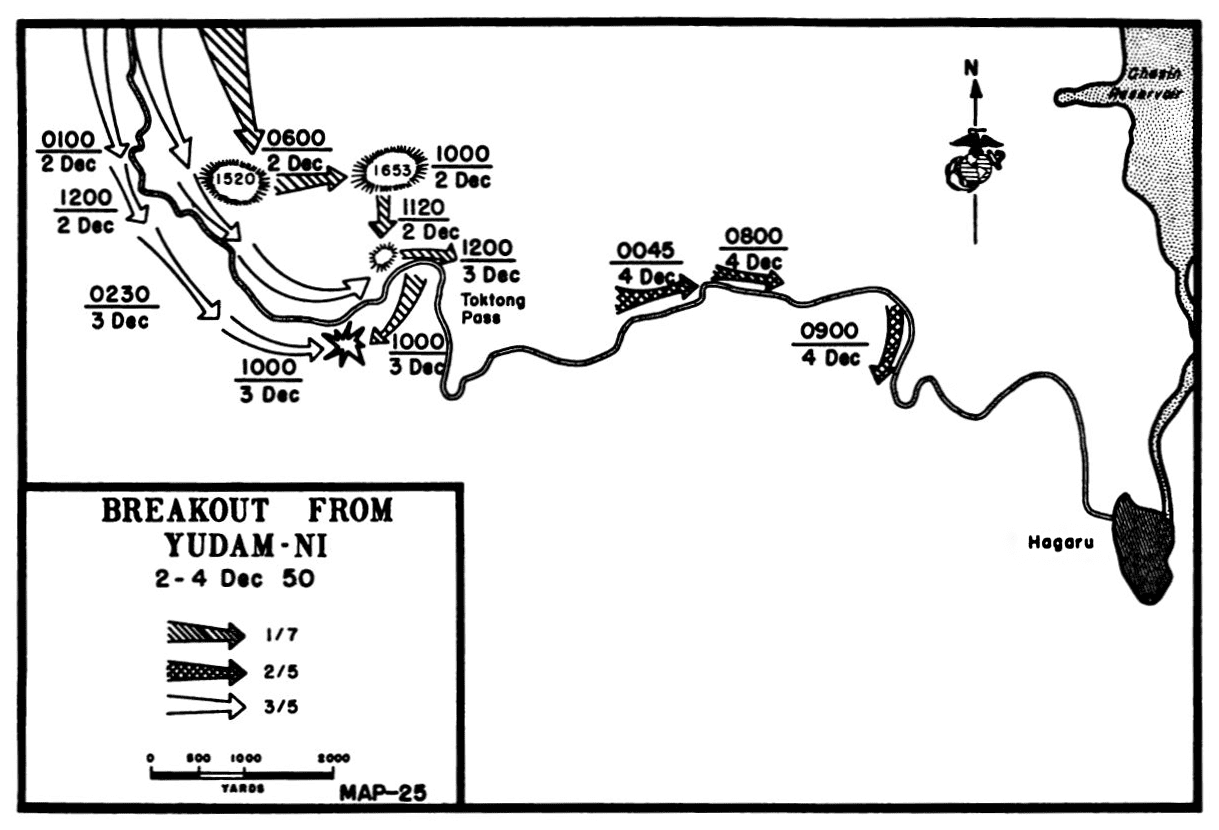
BREAKOUT FROM
YUDAM-NI
2–4 Dec 50
MAP-25
Taplett’s battalion continued its slow progress with George and How270
Companies clearing the high ground on opposite sides of the road while
Dog-Easy moved astride the MSR. At about 0200 on the 3d the
advance came to a halt 1000 yards short of Fox Hill. Dog-Easy, which
had suffered heavy casualties, particularly among its key NCOs, had
reached the limit of exhaustion, and 3/5 secured for the rest of the
night. Not until daylight did How Company discover that it had halted
300 yards short of its final objective, the hill mass southwest of Fox Hill.
At dawn on 3 December the ground was covered with six inches of
new snow, hiding the scars of war and giving a deceptively peaceful
appearance to the Korean hills as the Marine column got under way
again with Sergeant Knox’s engineers at the point, just behind Sergeant
Munsell’s lone tank. Alternately serving as engineers and riflemen,
this platoon came through with 17 able-bodied men left out of the 48
who started.
Dog-Easy Company having been rendered ineffective by its casualties,
Taplett moved George Company down from the left flank to advance
astride the road. First Lieutenant Charles D. Mize took over the reorganized
outfit, assisted by Second Lieutenant August L. Camaratta.
The two riddled Dog-Easy platoons were combined with George Company
under the command of Second Lieutenant John J. Cahill and
Technical Sergeant Don Faber.
Cahill had the distinction of leading the platoon which fought the
first action of Marine ground forces in the Korean conflict. But it
hardly seemed possible on this sub-zero December morning that the
encounter had taken place barely four months before, or that the temperature
that August day had been 102° in the non-existent shade.
Korea was a land of extremes.
Darkhorse was not far from a junction with the Ridgerunners. The
night of 2–3 December had passed quietly in Toktong Pass, where the
five companies occupied separate perimeters. The Marines on Fox
Hill lighted warming fires in the hope of tempting the enemy to reveal
his positions. The Chinese obliged by firing from two near-by ridges.
One CCF group was dug in along a southern spur of the hill held by
Able and Baker Companies, and the other occupied a ridge extending
eastward beyond Toktong Pass in the direction of Hagaru.
Simultaneous attacks in opposite directions were launched by 1/7.
Davis led Morris’ and Newton’s companies against the CCF force barring
the way to Hagaru. Tighe moved out with Kurcaba’s and Hovatter’s
companies meanwhile against a larger CCF force on high ground
south of the big bend in the road. This stroke took the Chinese by
surprise. As they fell back in disorder, the Communists did not realize
that they were blundering into the path of the oncoming Marines of
Williamson’s How/5, attacking south of the MSR. Colonel Litzenberg,
who had been informed by radio, turned to Lieutenant Colonel Murray
and said, “Ray, notify your Third Battalion commander that the Chinese
are running southwest into his arms!”528
Taplett was unaware that Tighe’s attack was forcing about a battalion
of Chinese into his lap. He had spotted the Chinese in strength
on the high ground south of the road when day broke. Attempts to lay
artillery on the Chinese having failed because of the range from
Hagaru, the 3/5 commander called for an air strike. The overcast
lifted just as the Corsairs came on station. They hit the demoralized
Communists with napalm and rockets while the 81mm mortars and
heavy machine guns of the two converging Marine forces opened up
with everything they had. Probably the greatest slaughter of the
Yudam-ni breakout ended at 1030 with the CCF battalion “completely
eliminated,” as the 3/5 report phrased it, and How Company in possession
of the CCF positions.
At 1300 on 3 December, after Davis had cleared the enemy from the
ridge northeast of Toktong Pass, the basic maneuver of the breakout
was completed by the junction of 3/5 and 1/7. Several more fights
awaited Taplett’s men on the way to Hagaru, but at Toktong Pass they
had fulfilled their mission. That the victory had not been gained without
paying a price in casualties is indicated by the following daily
returns of effective strength in the three rifle companies:
| Unit |
1 Dec. |
2 Dec. |
3 Dec. |
4 Dec. |
| George Company |
114 |
96 |
84 |
80 |
| How Company |
180 |
167 |
131 |
73 |
| Item Company |
143 |
41 |
41 |
41 |
| Total |
437 |
304 |
256 |
194 |
This is a total of 243 battle and non-battle casualties as compared to
the 144 suffered by the same units during the CCF attacks of 27 to 30
November.
When the truck column with its wounded men reached Toktong Pass,
it halted to receive the casualties of 1/7, 3/5, and Fox Company of 2/7.
Lieutenant Commander John H. Craven, chaplain of the 7th Marines,
helped to assist the litter cases into vehicles. Since there was not room
for all, the walking wounded had to make room for helpless men. They
complied with a courage which will never be forgotten by those who
saw them struggling painfully toward Hagaru alongside the truck
column.529
When the tank leading the 3/5 column reached Toktong Pass it
halted only long enough for Colonels Taplett and Davis to confer.
D-23 then moved out and the four companies of 1/7 came down from
their hillside positions and fell in behind.
Stevens’ 1/5, having leap-frogged 3/5, followed next on the way
to blocking positions farther east on the MSR. Taplett remained in
Toktong Pass until after midnight, acting as radio relay between
Colonels Litzenberg and Murray, by now in Hagaru, and 2/5 in the
rear. At about midnight the 3/5 commander sent G and H Companies
into the vehicle column to furnish security for the artillery, and an
hour later the remainder of the battalion joined the column. Roise’s
2/5, which had passed through 3/7 came next, followed by Harris’
rear guard.
Interspersed among the infantry were elements of artillery and
service troops with their vehicles, and the column became more scrambled
after each halt.530 Two observation planes of VMO-6 circled overhead
to give warning of enemy concentrations. Marine planes were on
station continuously during daylight hours, strafing and rocketing to
the front and along both flanks. A total of 145 sorties, most of them
in close air support of troops advancing along the Hagaru-Yudam-ni
MSR, were flown on 3 December by the following units:531
| Squadron |
Sorties |
| VMF-214 |
36 |
| VMF-323 |
28 |
| VMF-212 |
27 |
| VMF-312 |
34 |
| VMF(N)-513 |
7 |
| VMF(N)-542 |
13 |
| |
145 |
At the other end of the route the Royal Marine Commandos, reinforced
by a platoon of tanks, were sent out from Hagaru at 1630 on
3 December, to drive the Chinese from the road leading into that
perimeter.
Thanks to excellent air support, 1/7 met no opposition save harassing
attacks. One of Davis’s flanking patrols reported the flushing out of
a few Chinese so exhausted by cold and hardships that they had abandoned
their weapons and holed up together for warmth. If these
Marines had been in a mood for such reflections, they might have
recalled that the American press of late had been bemoaning the supposed
decline of the nation’s young manhood. UN reverses in the
summer of 1950 had led editorial writers to conclude that our troops
had neither the legs for long marches nor the backs for the bearing of
military burdens. Mechanization had gone so far, they lamented, that
we had become the servants rather than the masters of our own wheeled
and tracked vehicles.
The Marines of Davis’ battalion might have taken a grim satisfaction,
therefore, in encountering Chinese peasants, inured all their lives
to privations, whose will to fight had been broken by the hardships of
the past week. These Marines had not known a full night’s sleep during
that week. They had subsisted on a diet of crackers varied with canned
rations thawed by body heat. They had been under continuous nervous
pressure as well as physical strain, and yet they were able to summon
one last burst of pride when the point neared the Hagaru perimeter at
1900 on 3 December 1950. Several hundred yards from the entrance
a halt was called while the men closed up into a compact column.532
Then they came in marching, their shoulders thrown back and their
shoepacs beating a firm tread on the frozen road.
The Marines at the head of the column were followed by the walking
wounded and the vehicles loaded with more serious cases, some of
whom had been strapped to the hoods. All casualties were given medical
care and the remaining troops taken into warming tents for hot
coffee. Many of them appeared dazed and uncomprehending at first.
Others wandered about aimlessly with blank faces. But there were few
who had suffered any psychological disturbances that could not be
cleared up with a good night’s sleep and some hot food.
Troops of 4/11 and 3/5 were due to arrive next at Hagaru while
1/5 and 2/5 echeloned companies forward along the MSR to provide
flank protection. Not all the Chinese had lost aggressiveness, but the
column had little difficulty until 0200 on 4 December. Then it came
to an abrupt halt when prime movers of eight 155mm howitzers ran out
of diesel fuel. As far back as Sinhung-ni 150 gallons had been requested
but none had been delivered.533 While the troops ahead, including
G and H of 3/5, continued on towards Hagaru, unaware of the break,
a bad situation developed around the stalled guns.
Following the halting of the convoy Major Angus J. Cronin, in charge
of 4/11’s vehicle column, and his handful of truck drivers and cannoneers
drove off a platoon of Chinese. These Marines were soon joined
by Lieutenant Colonel Feehan’s 1/11 and Able Company of 1/5. By
the time Lieutenant Colonel Taplett arrived, the 155s had been moved
off the road by Captain O. R. Lodge of 4/11, who continued in spite of
a wound until more severely wounded in the head.
Roise and Stevens arrived shortly afterwards and the three battalion
commanders drew up a hasty plan. While 3/5 built up a base of fire
a platoon of Easy Company, 2/5, would move through the ridge north
of the road to knock out the Chinese strong point. Up to this time there
had been few and minor instances of panic during the breakout from
Yudam-ni. But some confusion resulted when the enemy took advantage
of the delay to blow a small bridge ahead and increase his rate of
fire. Thus a new roadblock awaited after the howitzers were removed,
and two truck drivers were killed while the engineers repaired the
break. Other drivers bypassed the bridge and made a dash for safety
by crossing the little stream on the ice.
A comparatively few men, giving way to panic, were endangering
the entire column. Behind one of the fleeing trucks an angry warrant
officer pounded in pursuit, shouting some of the most sulphurous profanity
that Lieutenant Colonel Taplett had ever heard.534 This was
CWO Allen Carlson of Baker Battery, 1/11. He disappeared around
a bend in the road, only to return a moment later with a chastened
driver towing a 105mm howitzer. Carlson hastily recruited a crew and
set up the piece beside the road for point-blank fire at the enemy position
while Taplett directed the fire of a 75mm recoilless rifle.
A Charlie Battery howitzer and a 1/5 heavy machine gun added
their contribution as a platoon of Easy Company, 2/5, attacked under
cover of air strikes. The Chinese position was overrun at 0830 at an
estimated cost to the enemy of 150 dead. Two other attacks were
launched by infantry units of Roise’s battalion on the high ground to
the left before the MSR was cleared.
When the 155mm howitzers were pushed off the road, it had been
assumed that they would be retrieved. Only 1000 yards farther down
the MSR was a cache of air-dropped diesel fuel, but efforts to bring
back replenishments were frustrated by enemy fire. Attempts at recovery
by the British Marines failed later that day, and orders were given
for the destruction by air of the eight stalled howitzers plus a ninth
which had previously been abandoned after skidding off the road. This
was the largest loss of weapons in the Yudam-ni breakout.
At 1400 on 4 December the last elements of the rearguard, 3/7,
entered the perimeter and the four-day operation passed into history.
Some 1500 casualties were brought to Hagaru, a third of them being
in the non-battle category, chiefly frostbite cases. It had taken the
head of the column about 59 hours to cover the 14 miles, and the rear
units 79 hours.
“Under the circumstances of its execution,” commented General
Smith, “the breakout was remarkably well conducted. Since centralized
control of the widespread elements was a difficult task, particularly
with a joint command, unit commanders were required to exercise a
high degree of initiative.... The spirit and discipline of the men under
the most adverse conditions of weather and terrain was another highly
important factor contributing to the success of the operation and also
reflecting the quality of the leadership being exercised.”535
This Was Hagaru—Two views of the Marine forward base at the foot
of the Chosin Reservoir, with East Hill in the background; here the
troops reorganized for the final breakout.
Patrol Actions—Task forces, ranging in size from a squad to a battalion,
sometimes supported by tanks as well as air and artillery, were employed
for specific missions during the breakout.
Before and After Taking—Two views, only a few seconds apart, of the
effective close air support given Marine infantry; the plane is hidden
by the dense cloud of black smoke.
The Hagaru Airstrip—Above, walking wounded awaiting evacuation
in an Air Force C-47 which flew in artillery ammunition; below, casualties
leave their rifles behind but will take out much-needed parachutes
shown in the foreground.
Helicopter and Ambulance Evacuation—Above, the helicopters of
VMO-6 flew out casualties from areas which otherwise could not have
been reached; below, ambulances had their moments, too, as this bullet-riddled
specimen shows.
Breakout from Hagaru—Above, crippled vehicles are simply pushed
off the road; below, at every halt the weary gravel-crunchers sink exhausted
into the snow.
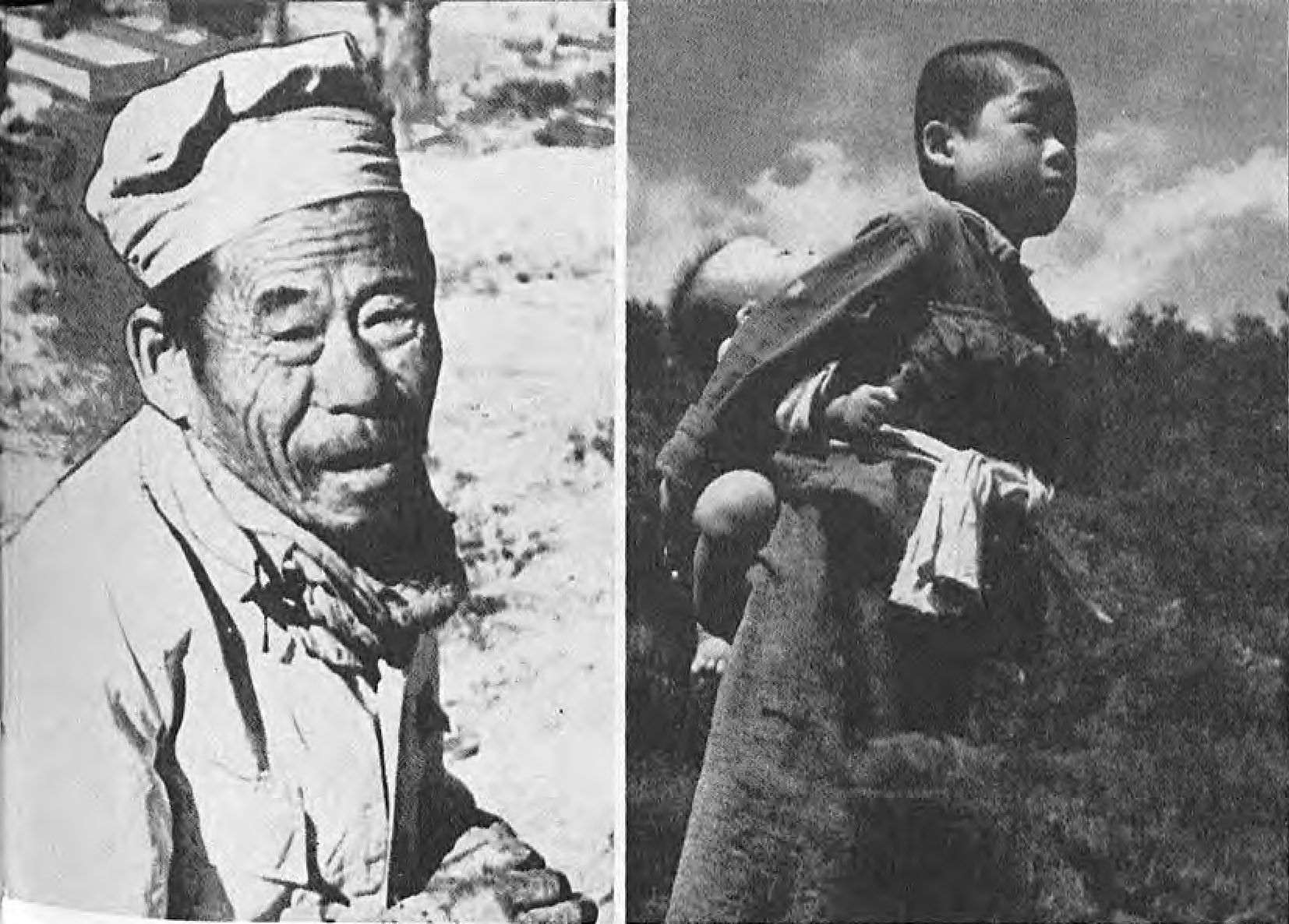
Photos courtesy LtGen E. A. Craig and Capt R. W. Crook
Victims of Communist Aggression—Three views of the Korean refugees,
ranging from infants to patriarchs, who followed the Marine
column all the way to Hungnam.
Magnificent Air Support—Above, crewmen check rockets of a Corsair
fighter-bomber; and, below, one of the old Grumman TBMs resurrected
for casualty evacuation from Koto-ri.
Fighting in the Heavyweight Division—Above, Marine tanks awaiting
withdrawal from Koto-ri; below, Army self-propelled 155mm howitzers
firing from the Chinhung-ni area.
Through the Swirling Flakes—The march southward from Koto-ri begins
in a snowstorm as a Marine infantry battalion attacks northward
from Chinhung-ni to open up the MSR.
The Endless Column of March—Two more views of the column, the
first elements of which reached Chinhung-ni before the last troops
departed Koto-ri, ten miles to the rear.
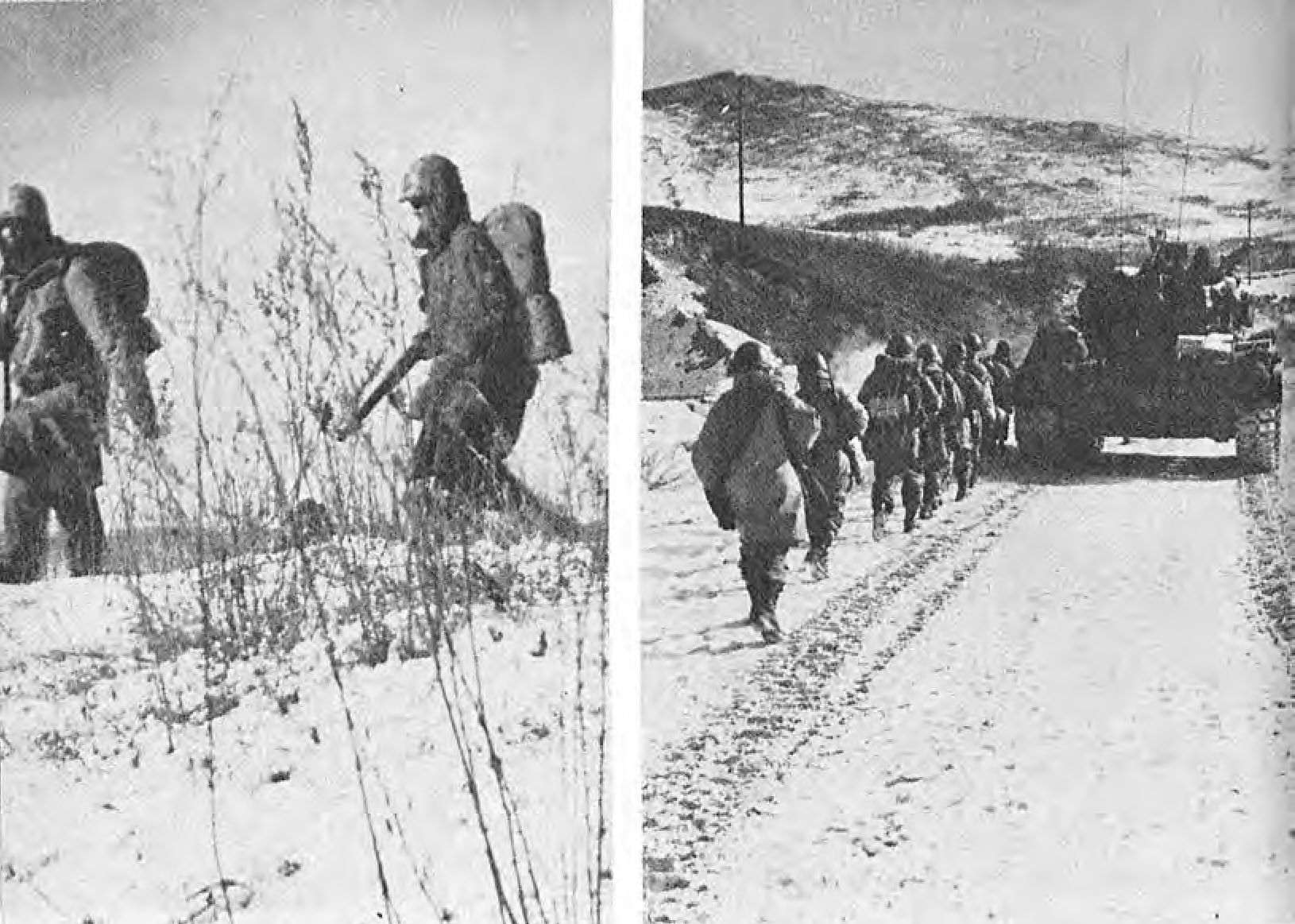
USMC Photo A 5466 USMC Photo A 5444
Clearing the Flanks—Tanks and infantry work together to clear the
flanks of enemy combat groups which watched for every opportunity
to attack from the high ground.
A job for the Engineers—Above, this gap had to be spanned if the
vehicles were to be brought out from Koto-ri; below, infantry crossing
over air-dropped Treadway bridge.
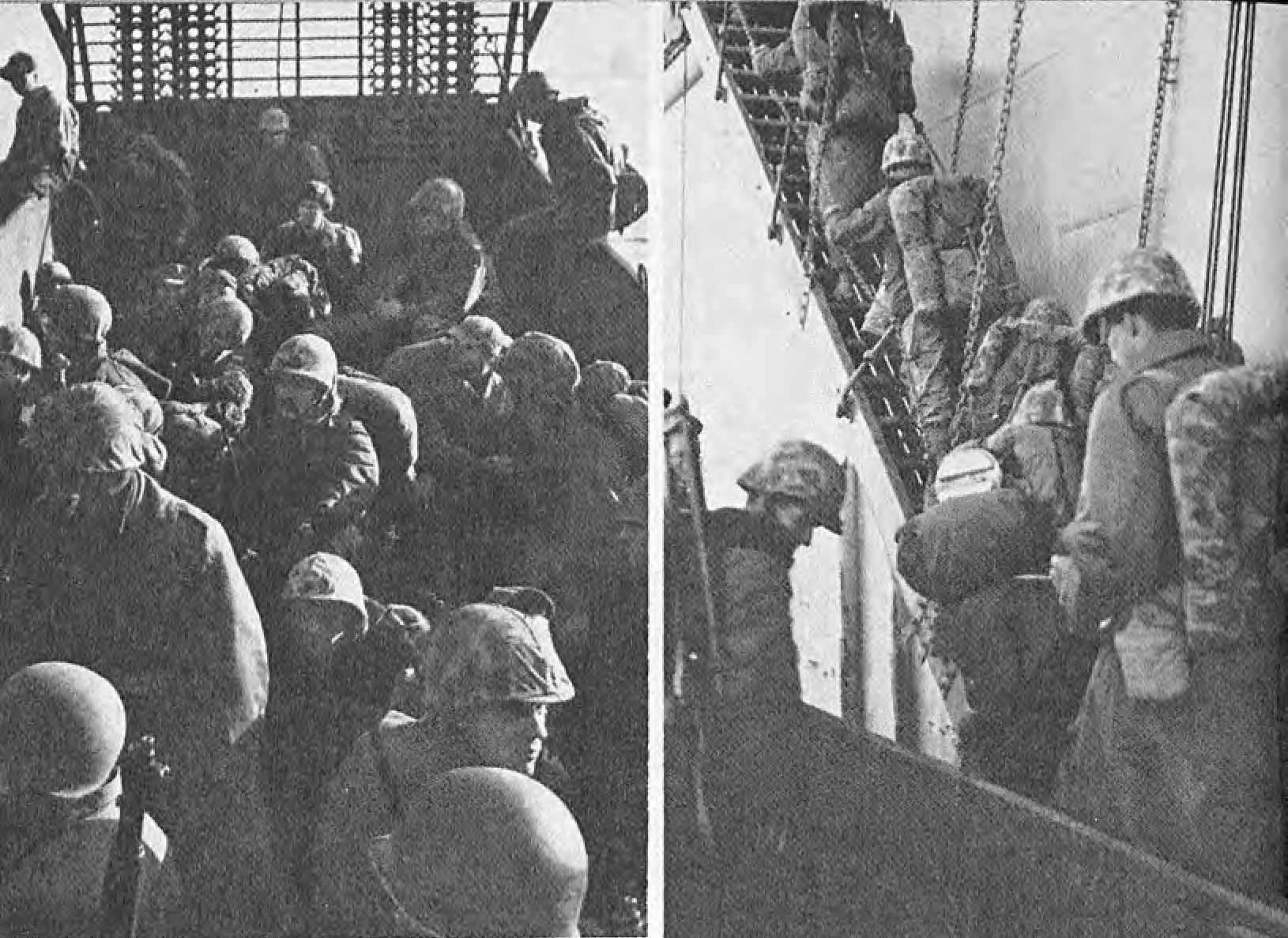
USN Photo 424506 USN Photo 424527
The Hungnam Redeployment—Above, two views of Marines who were
first X Corps troops to embark; below, a glimpse of the thousands of
tons of equipment to be loaded.
Waterfront Panoramas—Above, these two LSTs were among the last
to be loaded; below, the final demolitions scene, with the USS Begor
(APD 127) shown in the foreground.
The Honored Dead—On the day of his departure from Hungnam the
commanding general of the 1st Marine Division visits the cemetery for
a last silent tribute to the dead.
CHAPTER XIII Regroupment at Hagaru — 4312 Casualties Evacuated by Air — 537 Replacements Flown to Hagaru — Air Drops of Ammunition — Planning for Breakout to Koto-ri — 3/1 Relieved by RCT-5 at Hagaru — East Hill Retaken from Chinese — Attack of RCT-7 to the South — Advance of the Division Trains
4312 Casualties Evacuated by Air—537 Replacements Flown to
Hagaru—Air Drops of Ammunition—Planning for Breakout to
Koto-ri—3/1 Relieved by RCT-5 at Hagaru—East Hill Retaken
from Chinese—Attack of RCT-7 to the South—Advance
of the Division Trains
The marines at Hagaru would have been astonished to learn how
much anxiety over their “encirclement” was being currently felt
in the United States. It had been a rude shock for Americans who
believed that the troops in Korea would be “home by Christmas” to
realize that the unexpected Chinese intervention had created virtually
a new war. This war, moreover, was apparently going against the UN
forces. On Thanksgiving Day the victory over Communist aggression
had seemed almost complete, yet only a week later the headlines announced
major reverses. The Eighth Army was in full retreat, and an
entire Marine division was said to be “trapped.”
So disturbing were the reports from Korea, newspaper readers and
radio listeners could scarcely have imagined the mood of confidence
prevailing at Hagaru after the arrival of the troops from Yudam-ni.
Even prior to that event, few Marines had any doubts as to the ability
of the Division to fight its way out to the seacoast.
The Hagaru perimeter presented a scene of bustling activity during
the first days of December. Trucks and jeeps bounced along the bumpy
roads in such numbers as to create a traffic problem. Twin-engined
planes roared in and out of the snow-covered airstrip at frequent intervals
throughout the daylight hours. Overhead the “Flying Boxcars”
spilled a rainbow profusion of red, blue, yellow, green and orange
parachutes to drift earthward with heavy loads of rations, gasoline and
ammunition.
The busy panorama even had its humorous aspects. Parka-clad
Marines displaying a five-day growth of beard went about with their
cheeks bulging from an accumulation of Tootsie Rolls—a caramel confection
much esteemed by Stateside youngsters for its long-lasting
qualities. The Post Exchange Section had originally brought merchandise
into Hagaru on the assumption that it would be established as a
base. No space in vehicles was available for its removal and the commanding
general directed that the entire remaining stock, $13,547.80
worth, chiefly candies and cookies, should be issued gratuitously to the
troops.536 Tootsie Rolls proved to be a prime favorite with men who
would have scorned them in civilian life. Not only were they more
tasty than half-frozen “C” rations, but they resulted in no intestinal
disorders. Moreover, they were useful as temporary repairs for leaking
radiators.
There was nothing during the daytime to indicate the presence of
CCF troops near Hagaru. Even in hours of darkness the enemy was
quiet throughout the first five nights of December. Apparently the
Chinese were powerless to renew the attack until reinforcements and
replenishments of supplies and ammunition reached the area.
Evacuation of the wounded was the chief problem on 2 December,
when it became evident that previous estimates of losses at Yudam-ni
and among the Army troops east of the Reservoir were far too low.
A total of 914 casualties were flown out by the C-47s and R4Ds that
day and more than 700 on the 3d. Captain Hering and his assistants
had assumed that the Air Force evacuation officer was screening the
casualties until he informed them that this was not his responsibility.
The Division surgeon then set a Spartan standard. He passed personally
on all controversial cases and approved for evacuation only
those in as bad shape as Lieutenant Commander Lessenden, the 5th
Marines surgeon who had refused to be flown out and continued on
duty after both feet were painfully frozen. Apparently it was not too
severe a test for men who could stand the pain, since Lessenden suffered
no permanent injuries.537
Captain Hering had to use his medical authority in several instances
to overcome the objections of Yudam-ni casualties who declined evacuation,
though in obvious need of hospitalization.538
The liaison airstrip at Koto-ri had been of little use, since it was
outside the perimeter and exposed to enemy fire. But the completion
of a new strip on the 2d made it possible to evacuate about 47 casualties
that day from the 2/1 perimeter.539
More than 1400 casualties remained at Hagaru on the morning of
5 December. They were all flown out before nightfall, making a total
of 4312 men (3150 Marines, 1137 Army personnel and 25 Royal Marines)
evacuated from Hagaru by air in the first five days of December,
according to Marine figures.540 X Corps estimated a total of 4207 for
the same period.541
R4Ds of the 1st MAW, flying under Wing operational control, were
represented in the flights to and from Hagaru as well as the C-47s of
the Combat Cargo Command, FEAF.542 The large-scale casualty evacuation
was completed without losing a man, even though the aircraft
landing on the rough strip careened precariously as they bounced along
the frozen runway. Only two planes could be accommodated simultaneously
at first, but Marine engineers widened the 2900-foot strip
until six planes could be parked at a time.
A four-engine Navy R5D made a successful landing with stretchers
flown in from Japan. After taking off with a load of wounded, the
pilot barely cleared the surrounding hills, and it was decided to risk
no further evacuations with such large aircraft. Two crash landings
marred operations on the field. An incoming Marine R4D, heavily
loaded with artillery ammunition, wiped out its landing gear on the
rough surface and was abandoned after its load had been put to good
use by the gunners. A second accident involved an Air Force C-47 which
lost power on the take off and came down just outside the Marine lines
without injury to its load of casualties. Troops from the perimeter were
rushed out immediately to rescue its occupants but the plane had to be
destroyed.543
Not until long later were final official casualty reports rendered for
the period of the Yudam-ni regroupment and breakout. Regimental
figures are not available, and the totals included the losses suffered by
the troops at Hagaru during the night of 30 November-1 December.
Following are the figures for the 1st Marine Division as a whole
throughout this five-day period:
| |
KIA |
DOW |
MIA |
WIA |
Total
Battle |
Non-
BattleB |
| 30 Nov |
27 |
6 |
6 |
183 |
222 |
102 |
| 1 Dec |
27 |
14 |
6 |
111 |
158 |
134 |
| 2 Dec |
55 |
2 |
33 |
231 |
321 |
180 |
| 3 Dec |
16 |
1 |
6 |
194 |
217 |
196 |
| 4 Dec |
10 |
6 |
4 |
202 |
222 |
582 |
| Totals |
135 |
29 |
55 |
921 |
1140 |
1194 |
At 1359, on 3 December, X Corps issued OI 22, directing the 1st Marine
Division to withdraw all elements to Hamhung area via the Hagaru-Hamhung
axis as rapidly as evacuation of wounded and other preparations
would permit.544 General Almond flew to Hagaru that same day
for a conference with General Smith. Nothing further was said about
destruction of equipment. At that very time, in fact, various critical
items were being salvaged and flown out from Hagaru when space on
planes was available.
Surplus weapons had accumulated as a result of casualties and the
Marine general wished to avoid the destruction of any material that
could be removed by air without interfering with casualty evacuation.
It was particularly necessary to salvage and fly out the parachutes and
packages used for air drops, since a critical shortage of these had been
reported from Japan. Before leaving Hagaru, the Division also planned
to evacuate large quantities of stoves, tents, typewriters, rifles, machine
guns and damaged 4.2″ mortars.545
Space in empty planes landing at Hagaru was utilized not only for
bringing in equipment and medical supplies, but also replacements.
Since the Wonsan landing some hundreds of Marines, most of them
wounded in the Inchon-Seoul operation, had returned from hospitals
in Japan. These men, upon reporting at Hungnam, were temporarily
assigned to the Headquarters Battalion, since the Division had no
provision in its T/O for a replacement organization. Ordinarily they
would have been returned to their units, but enemy action made this
procedure impossible until the completion of the airstrip.
During the first five days of December, therefore, 537 replacements
were flown to Hagaru, fit for duty and equipped with cold-weather
clothing. Those destined for the 1st Marines were assigned to the 3d
Battalion for perimeter defense, and personnel for the 5th and 7th
Marines joined those units after their arrival at Hagaru.
Major General William H. Tunner, USAF, the chief of the Combat
Cargo Command, expressed astonishment during his visit of 5 December
on learning about these replacements. He had come to offer his
C-47s for troop evacuation after the casualties were flown out, but
General Smith explained that all able-bodied men would be needed
for the breakout.
Visitors and press correspondents arrived daily at Hagaru in the empty
C-47s and R4Ds. Among them was Miss Marguerite Higgins, reporter
for the New York Herald-Tribune. General Smith ruled that for her
own protection, considering the possibility of enemy attack, she must
leave the perimeter before nightfall.
French and British publications were represented as well as most of
the larger American dailies and wire services. At one of the press conferences
the question arose as to the proper name of the Marine operation.
A British correspondent had intended to refer to it as a “retreat”
or “retirement,” but General Smith held that there could be no retreat
when there was no rear. Since the Division was surrounded, he maintained,
the word “retreat” was not a correct term for the coming breakout
to the coast.546
General Smith and Lieutenant Colonel Murray were interviewed for
television by Charles de Soria, who also “shot” Marines on infantry
duty and casualties awaiting evacuation. These pictures and recordings
were later shown in the United States under the title Gethsemane.
The correspondents were astonished to find the Hagaru perimeter
so lacking in enemy activity. This quiet was shattered at 2010 on 5
December when two B-26s bombed and strafed the area. Marine night
fighters were absent on a search mission, but one was recalled to offer
protection against further efforts of the sort. A possible explanation
was advanced by First Lieutenant Harry S. Wilson, of VMF(N)-542,
who reported that he had received orders by radio to attack Hagaru.
It was his conviction that Chinese use of captured radio equipment
accounted for the B-26 attack.547
The interlude of CCF inactivity gave the 1st Marine Division an
opportunity to build up a stock of air-dropped ammunition and supplies.
Poor communications had prevented the obtaining of advance information
as to the requirements of the Yudam-ni troops, and their needs
had to be estimated by the assistant G-4.
It was planned that units moving out from Hagaru would take only
enough supplies for the advance to Koto-ri. Materiel would be air-dropped
there to support the next stage of the breakout.
The C-119s of the Combat Cargo Command were called upon to fly
in the largest part of the total of the 372.7 tons requested for air delivery
at Hagaru. C-47s and R4Ds were available for some items, particularly
of a fragile nature; and specially packaged small drops to meet
specific needs could be made by planes of the 1st Marine Aircraft Wing.
Officers and men of the Headquarters Battalion at Hagaru were
ordered to assist the 1st Regulating Detachment in the operation of
the Hagaru airhead. Army service troops were also assigned to the
task, and dumps were set up adjacent to the drop zone for the direct
issuing of supplies. The major items requested were artillery, mortar
and small arms ammunition, hand grenades, gasoline and diesel oil,
rations, and communication wire.548
There is no record of the amounts actually received. Pilots sometimes
missed the drop zone so far that the containers were “captured” by the
enemy or landed in areas where recovery was not feasible because of
enemy fire. In other instances, the supplies fell near the positions of
front-line units which issued them on the spot without any formalities
of bookkeeping.
Breakage rates were high, due to the frozen ground. About 70 per
cent of the POL products and 70 to 80 per cent of the rations were
recovered in usable condition. Of the artillery ammunition delivered
to the drop zone, 40 per cent was badly damaged and only 25 per cent
ever reached the gun positions. About 45 per cent of the small arms
ammunition was recovered and usable. A hundred per cent of the
requested mortar ammunition and 90 per cent of the 81mm rounds
were put into the air over the drop zone, though the damage rate was
nearly as high as that of the artillery shells.549
In spite of the seemingly low percentages of receipts as compared to
requests, it was considered that the Hagaru air drops had been successful
on the whole. “Without the extra ammunition,” commented General
Smith, “many more of the friendly troops would have been killed....
There can be no doubt that the supplies received by this method
proved to be the margin necessary to sustain adequately the operations
of the division during this period.”550
The need of the Yudam-ni troops for recuperation was so urgent that
6 December was set as the D-day of the attack from Hagaru to Koto-ri.
On the recommendation of his staff, General Smith decided that the
need of the troops for rest and regroupment outweighed the advantages
of a speedy advance, even though the enemy would be allowed more
time to get his forces into position along the MSR.
Another factor influencing this decision was the thinning of the command
group and staff sections of the Division. It will be recalled that
General Craig, the Assistant Division Commander, had recently been
returned on emergency leave to the United States. Colonel Walseth
(G-1) was wounded on 30 November, while Lieutenant Colonel Chidester,
had been MIA since that date. Colonel McAlister (G-4) had
been directed to remain at Hungnam to co-ordinate logistic functions.
A serious handicap to planning was the shortage of staff personnel.
This was due in part to the casualties suffered by the last convoy of
Headquarters troops to move up from Hungnam. Moreover, the office
force had been depleted by calls for reinforcements to defend the
perimeter.
By dint of working round the clock, however, planning for the breakout
to Koto-ri was completed on schedule. OpnO 25-50, issued at 0800
on 5 December, provided for an advance of the 1st Marine Division
at first light the following morning on the Koto-ri-Chinhung-ni-Majon-dong
axis to close the Hamhung area. The principal subordinate units
were assigned these tasks:
(a) RCT-5 (3/1 attached) to relieve all elements on perimeter defense in
the Hagaru area by 1200, 5 December; to cover the movement of
RCT-7 out of Hagaru to the south; to follow RCT-7 to the south on
the Hagaru-ri-Koto-ri-Chinhung-ni axis; to protect the Division rear
from Hagaru to Koto-ri; and to follow RCT-7 from Koto-ri to the
Hamhung area as Division reserve.
(b) RCT-7 to advance south at first light on 6 December on the Hagaru-Koto-ri-Chinhung-ni
axis to close the Hamhung area.
(c) RCT-1 (-) to continue to hold Koto-ri and Chanhung-ni, protecting
the approach and passage of the remainder of the Division through
Koto-ri; and to protect the Division rear from Koto-ri to the Hamhung
area.551
All personnel except drivers, relief drivers, radio operators, casualties
and men specially designated by RCT commanders, were to march on
foot alongside motor serials to provide close-in security. It was directed
that vehicles breaking down should be pushed to the side of the road
and destroyed if not operative by the time the column passed. During
halts a perimeter defense of motor serials was to be established.
Nine control points were designated by map references to be used for
reporting progress of the advance or directing air drops. Demolitions to
clear obstacles from the front and to create them to the rear were planned
by the Division Engineer Officer.
Division AdminO 20-50, which accompanied OpnO 25-50, prescribed
that the troops were to take enough “C” rations for two days,
equally distributed between individual and organic transportation. Selected
items of “B” rations were to be loaded on organic vehicles, and
the following provision was made for ammunition:
On individual, up to 1 U/F per individual weapon; on vehicle, minimum
1 U/F, then proportionate share per RCT until dumps depleted or transportation
capacity exceeded.
Helicopter evacuation was indicated for emergency cases. Other
casualties were to be placed in sleeping bags and evacuated in vehicles
of the column.
Two Division trains were set up by AdminO 20-50. Lieutenant
Colonel Banks commanded Train No. 1, under RCT-7; and No. 2,
under RCT-5, was in charge of Lieutenant Colonel Milne. Each motor
serial in the trains was to have a commander who maintained radio
communication with the train commander.
Truck transportation not being available for all supplies and equipment
at Hagaru, a Division destruction plan was issued on 4 December,
making unit commanders responsible for disposing of all excess supplies
and equipment within their own areas. “Commanding officer 1st
Regulating Detachment is responsible for destruction all classes supplies
and equipment remaining in dumps,” the order continued. “Unit
commanders and CO 1st Regulating Detachment report types and
amounts of supplies and equipment to this headquarters (G-4) prior
to destruction. Permission to use fuel and ammunition for destruction
purposes must be obtained from this headquarters (G-4).”
General Smith held conferences on 4 and 5 December of senior unit
commanders. During the afternoon of the 4th General Almond arrived
by plane and was briefed on the plan for the breakout. In a brief
ceremony at the Division CP he presented the Distinguished Service
Cross to General Smith, Colonel Litzenberg and Lieutenant Colonels
Murray and Beall.
The night of 5–6 December was the fifth in a row to pass without
enemy activity at Hagaru. But if Division G-2 summaries were to be
credited, it was the calm before the storm. For the Chinese were believed
to be assembling troops and supplies both at Hagaru and along
the MSR to Koto-ri. Up to this time seven CCF divisions, the 58th,
59th, 60th, 76th, 79th, 80th and 89th, had been identified through POW
interrogations. But there were evidences that the 77th and 78th were
also within striking distance.552
At 1200 on 5 December the 5th Marines relieved 3/1 of the responsibility
for the defense of the Hagaru area. Division elements other
than infantry were withdrawn from the front line, leaving Lieutenant
Colonel Murray’s three battalions, with 3/1 attached, disposed around
the perimeter as follows:
1/5—From the Yudam-ni road around the north of Hagaru and astride the
Changjin Valley to a point at the base of the ridge about 1,000 yards
east of the bridge over the Changjin River.
2/5—In position on western slopes of East Hill.
3/5—From the south nose of East Hill west across the river to link up with
3/1 south of the airstrip.
3/1—South and southwest of airstrip in sector formerly held by How and
Item Companies of 3/1.553
Not only were the CCF positions on East Hill a threat to Hagaru;
they also dominated the road leading south to Koto-ri. Thus the plan
for the breakout called for simultaneous attacks to be launched at first
light on the 6th—RCT-5 to regain the enemy-held portion of East Hill,
and RCT-7 to lead the advance of the Division motor column toward
Koto-ri.
A plan for air support, prepared by the command and staff of the
1st MAW, was brought to Hagaru by Brigadier General Thomas J.
Cushman, Assistant Wing Commander, on 5 December. Aircraft were
to be on station at 0700 to furnish close support for the attack on East
Hill. Along the MSR to Koto-ri an umbrella of 24 close support aircraft
was to cover the head, rear and flanks of the breakout column
while search and attack planes scoured the ridges flanking the road
and approaches leading into it. Support was also to be furnished after
dark by the night hecklers. All strikes within three miles of either side
of the MSR were to be controlled by the ground forces while the planes
were free to hit any targets beyond.
The concentration of aircraft covering the advance south from Hagaru
was one of the greatest of the whole war. Marine planes at Yonpo
would, of course, continue approximately 100 daily sorties to which
VMF-323 would add 30 more from the Badoeng Strait. The Navy’s
fast carriers, Leyte, Valley Forge, Philippine Sea, and Princeton were
to abandon temporarily their deep support or interdiction operations
and contribute about 100 or more attack sorties daily. The Fifth Air
Force was to add more power with additional U. S. and Australian
fighter-bombers as well as medium and heavy bomber interdiction beyond
the bomb line. To augment the carrier support for the X Corps
consolidation and possible redeployment by sea, VMF-212 had departed
Yonpo on 4 December and was re-equipping in Itami for return
to battle aboard the newly arrived USS Bataan. The Sicily was also
heading for the area to take back aboard the Corsairs of VMF-214 on
7 December.554
Continuous artillery support, both for RCT-5 and RCT-7, was
planned by the 11th Marines. Two batteries of the 3d Battalion and
one of the 4th were to move out at the head of the RCT-7 train, the
two from 3/11 to occupy initial positions halfway to Koto-ri to support
the attack southward to that objective, and the 4/11 battery to take
position in Koto-ri and provide general support northward in combination
with the battery of 2/11 attached to that perimeter. The remaining
batteries of the 3d and 4th Battalions would provide initial support
from Hagaru southward until ordered to move out.
The three batteries of 1/11, with D/11 attached, were to support
the operations of RCT-5 in a similar manner. Two batteries would
move out at the head of the regimental train to positions halfway to
Koto-ri, the remaining two would fire to the south in support of withdrawing
units and then displace when the first two were in position.555
Throughout the night of 5–6 December, the darkness was stabbed
by flashes as the artillery at Hagaru fired concentrations to saturate
the area along the Hagaru-Koto-ri axis. In order to prevent cratering of
the road the 155’s fired VT rounds. A secondary purpose of this bombardment
was to expend profitably the surplus of ammunition which
could not be brought out.556
At daybreak on the 6th the Division Headquarters broke camp. General
Smith had decided to fly the command group to Koto-ri in advance
of the troops, so that planning could begin immediately for the breakout
from Koto-ri southward. General Barr visited during the morning
and was informed that the 7th Infantry Division casualties who had
reached Hagaru had been flown out. The remaining 490 able-bodied
men (including 385 survivors of Task Force Faith) had been provided
with Marine equipment and organized into a provisional battalion under
the command of Lieutenant Colonel Anderson, USA. This battalion
was attached to the 7th Marines and sometimes referred to as 31/7.
Throughout the morning General Smith kept in close touch with the
progress of RCT-7 toward Koto-ri. At 1400 a reassuring message was
received from Colonel Litzenberg, and the commanding general took
off from Hagaru by helicopter. Ten minutes later he and his aide, Captain
Martin J. Sexton, landed at Koto-ri. The other members of the
command group, following by OY and helicopter, set up in a large
tent at Koto-ri and started planning for the next stage.557
Meanwhile, at Hagaru, Lieutenant Colonel Murray had designated his
2d Battalion for the assault on East Hill. At 0700 on 6 December, as
the 4.2″ mortars began their planned preparation, the 7th Marines had
already initiated the breakout to Koto-ri. When Marine planes arrived
on station at 0725, a shortage of napalm tanks limited the air attack
to bombing, rocket and strafing runs. These had little apparent effect on
the objective. Further air strikes were directed by the FAC, First Lieutenant
Manning T. Jeter, Jr., who was severely wounded while standing
on the crest to direct the Corsairs to the target. Captain David G. Johnson,
the air liaison officer, took his place. A total of 76 planes participated
in the day’s air attacks.
At 0900 Captain Smith’s Dog Company moved out to the assault
(see Map 26) with First Lieutenant George A. Sorenson’s 3d Platoon
in the lead, followed by the 2d and 1st Platoons in that order.558 Attacking
to the northward, Sorensen was pinned down by fire from Objective
A before he had covered 50 yards. This was the enemy’s main forward290
position on East Hill, which he had held against Marine attacks ever
since seizing it in the early morning hours of 29 November. First
Lieutenant John R. Hinds replaced Sorensen, after that officer was
wounded. While he engaged the enemy frontally, First Lieutenant
George C. McNaughton’s 2d Platoon poured in flanking fires and First
Lieutenant Richard M. Johnson’s 1st Platoon executed a flanking movement.
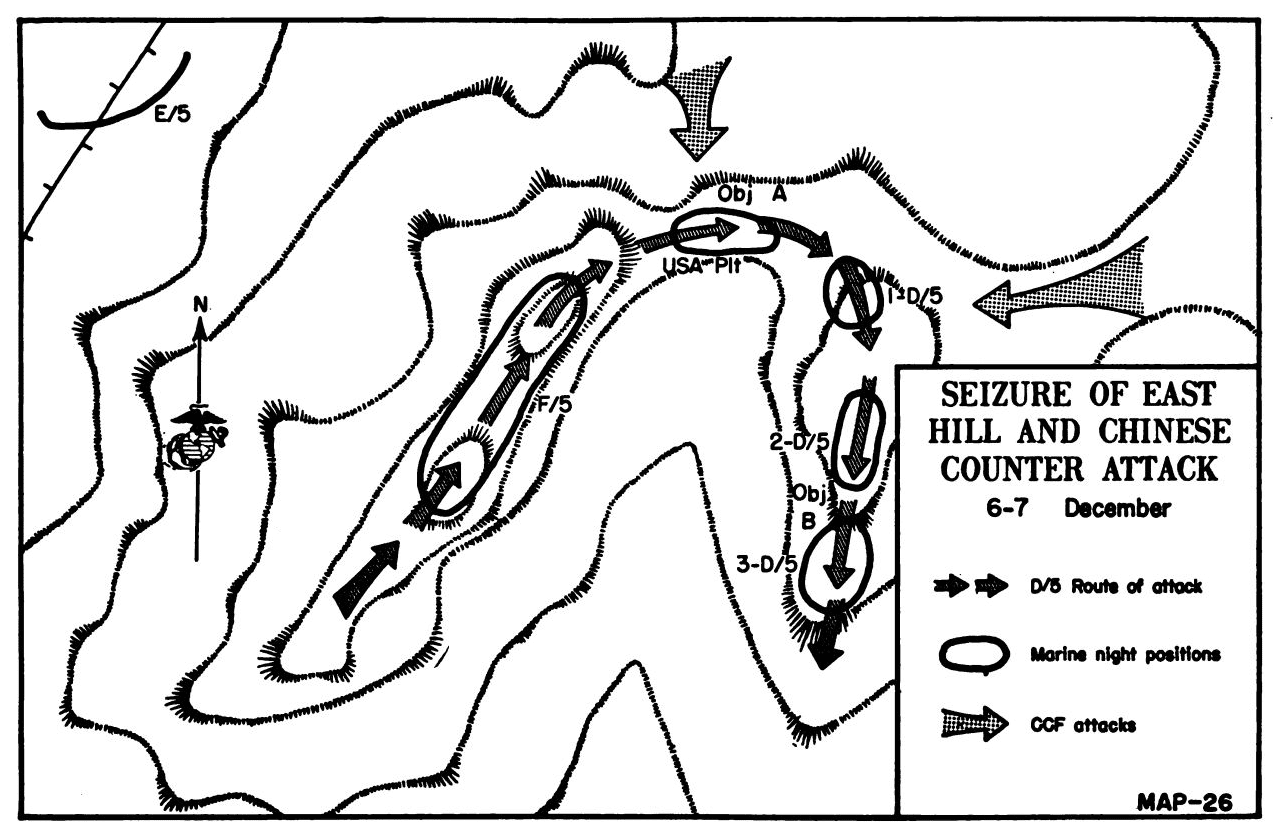
SEIZURE OF EAST
HILL AND CHINESE
COUNTER ATTACK
6–7 December
MAP-26
Chinese resistance suddenly collapsed about 1100. Thus it seemed
almost an anticlimax that East Hill, after holding out against the
Marines more than a week, should have been retaken at a cost of one
man killed and three wounded. About 30 CCF dead were found.
As events were to prove, however, this was but the first round in a
hard-fought 22-hour battle for the hill mass. The next phase began at
1130, when Roise ordered Captain Peters’ Fox Company to relieve
Smith so that Dog Company could resume the attack against Objective
B, a ridge about 500 yards to the southeast. The lower slopes of this
position were now being cleared by 2/7.
After a 10-minute artillery preparation, the three platoons of Dog
Company jumped off at 1250. The Chinese put up a stubborn resistance
and it took until 1430 to seize the new objective. Marine casualties were
moderate, however, and Captain Smith set up three platoon positions
along the ridge running to the south whence he could control the road
leading out of Hagaru.
Late in the day the enemy appeared to be massing for a counterattack
in the saddle between the two objectives. Johnson called an air
strike and all Dog and Fox Company troops within range opened up
with everything they had as McNaughton led a patrol against the
Chinese in the saddle. Caught between the infantry fires and the rocket
and strafing runs of the Corsairs, the CCF survivors surrendered en
masse to McNaughton and his platoon. About 220 prisoners were taken
to set a record for the 1st Marine Division in the Reservoir campaign.559
At the request of Captain Smith, the saddle between the two Marine
companies was occupied by reinforcements consisting of an officer and
11 men from the regimental AT Company and an officer and 32 men
from the 4th Signal Battalion, USA. Shortly after dark the enemy
launched a vigorous counterattack. Tanks and 81mm mortars fired in
support of Marines who made good use of 2.36″ white phosphorus
rockets at close range.
Although the Chinese endured frightful casualties, they returned
again and again to the attack until midnight. It was evident that they
considered this a fight to a finish for East Hill, and at 0205 they renewed
the assault against all three companies of the 2d Battalion as well as
Charlie Company of the 1st Battalion.
The struggle during the next three hours was considered the most
spectacular if not the most fiercely contested battle of the entire Reservoir
campaign even by veterans of the Yudam-ni actions. Never before
had they seen the Chinese come on in such numbers or return to the
attack with such persistence. The darkness was crisscrossed with a
fiery pattern of tracer bullets at one moment, and next the uncanny
radiance of an illumination shell would reveal Chinese columns shuffling
in at a trot, only to go down in heaps as they deployed. Marine tanks,
artillery, mortars, rockets and machine guns reaped a deadly harvest,
and still the enemy kept on coming with a dogged fatalism which
commanded the respect of the Marines. Looking like round little
gnomes in their padded cotton uniforms, groups of Chinese contrived
at times to approach within grenade-throwing distance before being
cut down.
The fight was not entirely one-sided. The Marines took a pounding
from CCF mortars and machine guns, and by 0300 Dog Company was
hard-pressed in its three extended positions pointed like a pistol at the
heart of the enemy’s assembly areas. Both McNaughton and the executive
officer, First Lieutenant James H. Honeycutt, were wounded but
remained in action.
This was the second time in three months that Dog Company had
spearheaded a Marine attack on a desperately defended hill complex.
Northwest of Seoul in September, only 26 able-bodied men had survived
to break the back of North Korean resistance. The company commander,
First Lieutenant H. J. Smith, had died a hero’s death at the
moment of victory, and First Lieutenant Karle F. Seydel was the unit’s
only unwounded officer.
Now another Smith commanded Dog Company, and Seydel was killed
as enemy pressure from front and flank threatened to overwhelm the
three riddled platoons. Casualties of 13 KIA and 50 WIA were taken in
the battle for East Hill as Dog Company and the provisional platoons
fell back fighting to the former Objective A and tied in with Fox
Company.
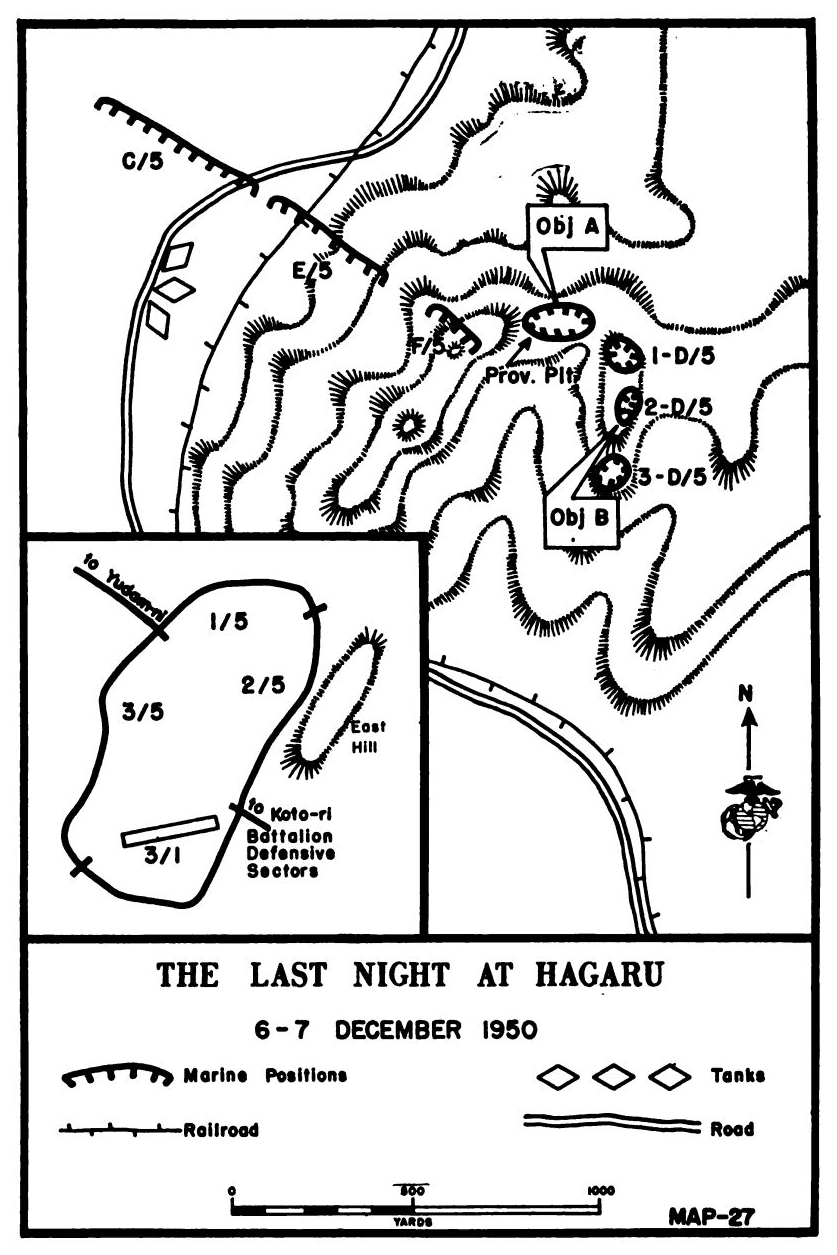
THE LAST NIGHT AT HAGARU
6–7 DECEMBER 1950
MAP-27
Along the low ground at the northern end of East Hill the Chinese293
were beaten off with ruinous losses by Jaskilka’s Easy Company of 2/5,
Jones’ Charlie Company of 1/5 and three Army tanks (see Map 27).
Enemy troops had to cross a comparatively level expanse which provided
a lucrative field of fire for Marine supporting arms. Heaps of
CCF dead, many of them charred by white phosphorus bursts, were
piled up in front of the Marine positions.
Next, the Chinese hit Captain James B. Heater’s Able Company of
1/5, still farther to the left, and overran several squad positions. One
platoon was forced to withdraw to the rise on which the Division CP
had previously been located. The lines were restored at 0546 with the
help of Lieutenant Hancock and his Baker Company, which had been
in reserve. Altogether the 1st Battalion had suffered casualties of ten
killed and 43 wounded, while the counted CCF slain numbered 260
in front of Charlie Company and 200 in the area of Able Company.
George Company of 3/1 also beat off a Chinese attack on the south of
the perimeter. With the coming of daylight these Marines found that
they had one of the Chinese withdrawal routes under their guns. Mortar
and rifle fire annihilated one group of about 60 enemy and another
group of 15 Reds surrendered.560
The new day revealed a scene of slaughter which surpassed anything
the Marines had seen since the fight for the approaches of Seoul in
September. Estimates of CCF dead in front of the 2d Battalion positions
on and around East Hill ran as high as 800, and certain it is that the
enemy had suffered a major defeat.
When Marine air came on station, the Chinese as usual scattered for
cover. About 0200 Murray ordered 3/5, which had not been in contact
with the enemy during the night, to displace to the south at the head
of Division Train No. 2, followed by 1/5 and Ridge’s battalion of the
1st Marines. This meant that Roise’s men with a platoon of tanks and
the engineers in charge of demolitions would be the last troops out of
Hagaru.
During the 22-hour battle on East Hill the 7th Marines had been attacking
toward Koto-ri (see Map 28). On the eve of the breakout the
gaps in the infantry ranks were partially filled with 300 artillerymen
from the 11th Marines, bringing Litzenberg’s strength up to about 2200
men. 7th Mar OpnO 14-50 called for the advance to be initiated at
first light on 6 December as follows:
1st Battalion—to move out at 0430 to clear the ground to the right of the
river;
2d Battalion—supported by tanks, to attack as advanced guard along the
MSR;
Provisional Battalion (31/7)—to clear the ground to the left of the
MSR;561
3d Battalion—to bring up the rear of the regimental train, with George
Company disposed along both flanks as security for the vehicles.562
Daybreak revealed a peculiar silvery fog covering the Hagaru area.563
The 1st Battalion, with Charlie Company in assault, had as its first
objective the high ground southeast of Tonae-ri. No resistance was
encountered, though 24 Chinese were surprised asleep in their positions
near the objective and 17 of them killed.
The 2d Platoon of Dog Company, 1st Tank Battalion, was attached to
2/7 when the advance guard jumped off at 0630 from the road block
south of Hagaru. Almost immediately the column ran into trouble.
Upon clearing the road block the lead dozer-tank took three hits from
a 3.5 bazooka. Within twenty minutes the column came under heavy
fire from CCF positions on the high ground on the left. Fox Company,
in the lead, was allowed to pass before the enemy opened up on the
Battalion Command Group, Dog-Easy Company and Weapons Company.
The fog prevented air support initially. When it lifted, First
Lieutenant John G. Theros, FAC of 2/7, brought in Marine aircraft and
81mm fire on the CCF position.564 It took a coordinated attack by the
two infantry companies and the tanks, however, before the resistance
could be put down and the advance resumed at 1200. Two and a half
hours later the upper reaches of this hill were cleared by D/5.
After 2/7 and air smothered the initial Chinese resistance, Fox Company
and the platoon of Dog/Tanks advanced down the road. About296
4000 yards south of Hagaru they met the next resistance. Although
the Chinese positions were in plain sight of 1/7, neither 2/7 nor air
could spot them. Colonel Litzenberg and Lieutenant Colonel Lockwood
attempted to co-ordinate mortar fires from 2/7 with observation from
1/7, but were unsuccessful because of poor radio communications. Following
an erratic artillery barrage and some good shooting by the
tanks, Fox Company cleared the enemy position about 1500, aided by a
Dog-Easy flanking attack and the Provisional Battalion. In order to
assist 2/7, Baker Company of 1/7 came down from the ridge west of
the river to act as right flank guard.
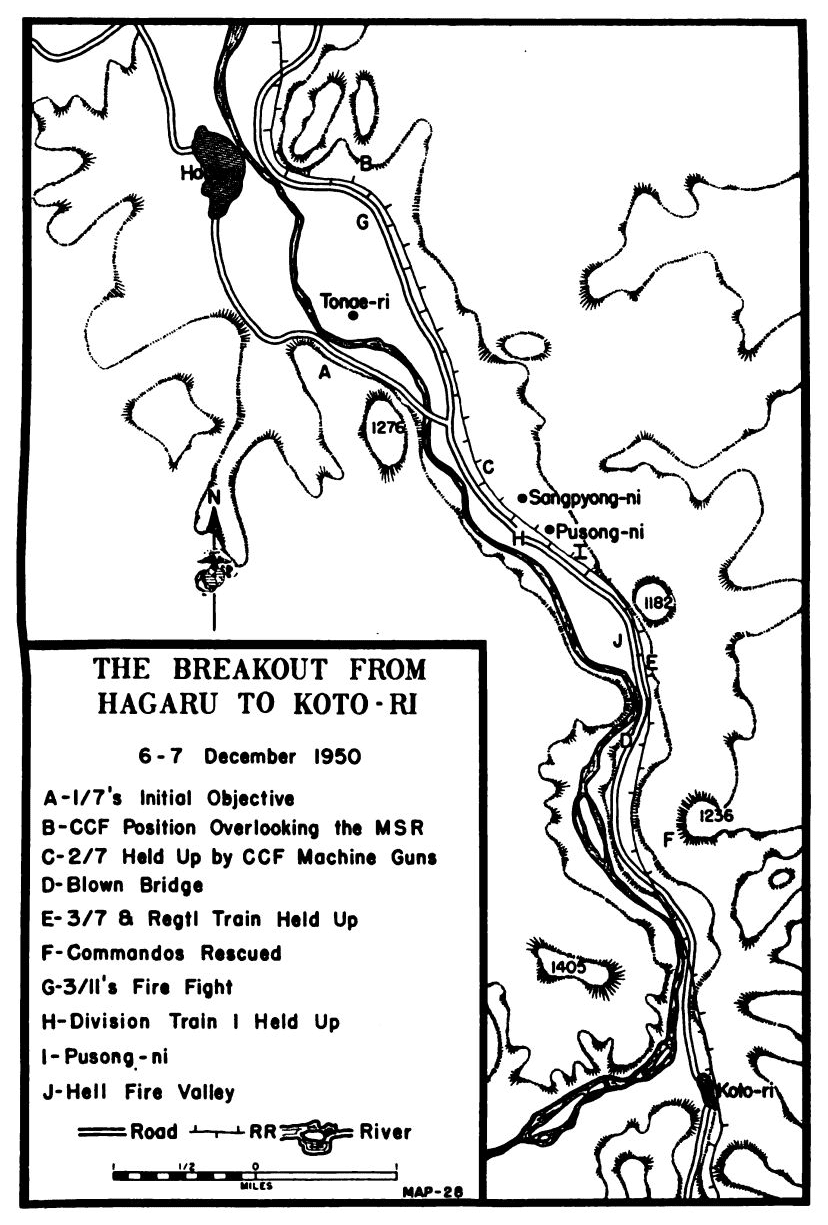
THE BREAKOUT FROM
HAGARU TO KOTO-RI
6–7 December 1950
A—1/7’s Initial Objective
B—CCF Position Overlooking the MSR
C—2/7 Held Up by CCF Machine Guns
D—Blown Bridge
E—3/7 B Regtl Train Held Up
F—Commandos Rescued
G—3/11’s Fire Fight
H—Division Train 1 Held Up
I—Pusong-ni
J—Hell Fire Valley
MAP-28
Meanwhile 1/7 continued to push ahead methodically to the right
of the MSR as the three rifle companies leapfrogged one another. Enemy
contact was continual but no serious opposition developed during the
daytime hours. On the left flank the Provisional Battalion had several
fire fights, while the advance was uneventful for the 3d Battalion following
in the rear of the regimental train.
About 5000 yards had been covered by dusk. Enemy resistance stiffened
after dark, as had been anticipated. The planners had realized
that the movement could have been made in daylight hours with fewer
losses in personnel and equipment. But intelligence of the expected
arrival of CCF reinforcements influenced the decision to continue the
march throughout the night even at the cost of increased opposition.
By noon long lines of Chinese could be seen along the sky Line to the
east of the road moving towards the MSR. Air attacked these reinforcements
but could not stop their movement, as later events proved.
About 8000 yards south of Hagaru, in Hell Fire Valley, a Chinese
machine gun on the left stopped the 2d Battalion at 2200. The column
was held up until midnight before Army tank fire knocked out the
enemy gun. After covering 1200 more yards a blown bridge caused
another halt while Dog Company engineers made repairs. Movement
was resumed at 0200 when a second blown bridge resulted in a delay
of an hour and a half before it could be bypassed.
Dawn brought a significant innovation in air support. Circling above
the 11-mile column inching toward Koto-ri was an airborne Tactical
Air Direction Center (TADC) installed in an R5D of VMR-152 and
operated by Major Harlen E. Hood and his communicators from
MTACS-2. Major Christian C. Lee, Commanding Officer of MTACS-2,
had made arrangements when he realized that with his radios packed
in trucks and jeeps he could not control close air support effectively.
Only the addition of one radio to those standard in the aircraft was
necessary to provide basic communications, but when being readied for
the predawn takeoff the mission faced failure because an engine
wouldn’t start. Minus a refueler truck, the crew chief, Technical
Sergeant H. C. Stuart, had worked all night to pour 2400 gallons of gas
into the craft by hand. Now, in the bitter cold of dawn, he set about to
overhaul the starting motor. Two hours later Major John N. Swartley
was piloting the plane over the MSR.565
No trouble was encountered by 2/7 along the last few miles of the
route and the battalion was first to arrive at Koto-ri. Meanwhile, the
3d Battalion had been assigned the additional mission of replacing the
Provisional Battalion as protection for the left flank as well as rear of
the 7th Marines train. A brief fire fight developed at about 2100 as the
Chinese closed to hand-grenade range. Lieutenant Colonel Harris deployed
George and Item Companies around the vehicles and drove the
enemy back to a respectful distance. Between 0200 and 0430, Item
Company of 3/7 and a platoon of tanks were sent back up the road to
clear out a troublesome Chinese position near Hell Fire Valley.
About 0200, during a halt for bridge repairs, the 7th Marines train
was hit by enemy fire. The regimental command group suffered most.
Captain Donald R. France and First Lieutenant Clarence E. McGuinness
were killed and Lieutenant Colonel Frederick W. Dowsett was
wounded. While Lieutenant (jg) Robert G. Medemeyer, (MC), USN,
gave first aid, Chaplain (Lieutenant (jg)) Cornelius J. Griffin entered
an ambulance to console a dying Marine. CCF machine gun bullets
shattered his jaw and killed Sergeant Matthew Caruso at his side. Lieutenant
Colonel Harris and Major Roach supervised the deployment of
How Company troops to beat off the attack.
About 0530 Lieutenant Colonel Harris disappeared. A search was
made for him to no avail and he was listed as a MIA. It was later determined
that he had been killed.
The 1st Battalion of RCT-7, after a relatively uneventful march over
the high ground west of the river, moved down the slope to join the
regimental column. Major Warren Morris assumed command of the
3d Battalion, which reached Koto-ri about 0700. At about 1100, after
a brief rest, the men were ordered together with Lockwood’s troops to
move back up along the MSR to the north and set up blocking between
Koto-ri and Hill 1182 to keep the road open for other units of the
Division.566 While carrying out this mission, the 2d Battalion helped
to bring in 22 British Marines who had been stranded ever since the
Task Force Drysdale fight on the night of 29–30 November. Their
plight was not known until 4 December, when an OY pilot saw the
letters H-E-L-P stamped out in the snow and air-dropped food and
medical supplies.
By 1700 on 7 December all elements of RCT-7 were in the perimeter
at Koto-ri. Division Train No. 1 was due next, and the planners had
hoped that the rifle battalions would clear the way for the vehicles.
As it proved, however, the Chinese closed in behind RCT-7 and attacked
the flanks of the convoy, with the result that the service troops actually
saw more action than the infantrymen.
One of the causes may be traced to the fact that Division Train No. 1
had to wait at Hagaru until 1600 on the 6th before RCT-7 made enough
progress toward Koto-ri to warrant putting the convoy on the road.
About 2000 yards south of Hagaru elements of the 3d Battalion, 11th
Marines, were hit in the early darkness by CCF mortar and small-arms
fire. The gunners of George and How Batteries deployed as infantrymen
and repulsed the enemy at the cost of a few casualties.
Upon resuming the march, a second fire fight took place after 1500
more yards had been covered. Several vehicles, set afire by Chinese
mortar shells, blocked the road and brought the convoy to a halt. At
daybreak the enemy swarmed to the attack in formidable numbers. It
was nip and tuck as all pieces of How Battery and three howitzers of
George Battery were emplaced between the trucks of the 1st MT Battalion.
There was no opportunity to dig in the trails of guns employing time
fire with fuses cut for ranges of 40 to 500 yards. But the Chinese were
stopped cold by two hours of continuous fire after approaching within
40 yards. All but about 50 of an estimated 500 to 800 enemy were
killed or wounded before the remainder fled, according to the estimate
of the gunners.567
The convoy of the Division Headquarters Company also had to fight
its way. Small arms ammunition had been distributed throughout the
column, and light machine guns were mounted on top of truck loads.
All able-bodied men with the exception of drivers and radio operators
walked in single file on either side of the vehicles carrying the wounded.
Progress was slow, with many halts caused by CCF fire. At 0130
several trucks were set aflame by enemy mortar shells and 2.36 rockets.
Headquarters troops deployed in roadside ditches while two machine
guns manned by bandsmen kept the Chinese at a distance. At 0200
the clouds cleared enough to permit strikes by night hecklers of VMF
(N)-513. They stopped the Chinese until just before daylight, when a
company-size group penetrated within 30 yards of the convoy. During
this fight First Lieutenant Charles H. Sullivan, who measured six feet
four and weighed 240 pounds, emptied his carbine at advancing Chinese.
Then he hurled it like a javelin to drive the bayonet into the chest of an
opponent at 15 feet.
Under the coaching of the MTACS commander, Major Lee, two more
night fighters—Major Albert L. Clark and First Lieutenant Truman
Clark—pinned the Chinese down with strafing runs as close as 30 yards
from the Marine ground troops. At dawn Major Percy F. Avant, Jr.,
and his four-plane division from VMF-312 dumped about four tons of
explosives and napalm on Chinese who broke and ran for cover. The fire
fight had cost Headquarters Battalion 6 KIA and 14 WIA.568
The MP Company, just forward of Headquarters Company, had
the problem of guarding about 160 Chinese prisoners. Captives unable
to walk had been left behind at Hagaru, where Lieutenant Colonel
Murray directed that the wounded be given shelter and provided with
food and fuel by the departing Marines. The prisoners escorted by
the MPs were lying in the middle of the road during the attack when
the enemy seemed to concentrate his fire on them while shouting in
Chinese. A scene of pandemonium ensued as some of the able-bodied
prisoners attempted to make a break. Now the Marines as well as the
enemy fired into them and 137 were killed in the wild melee.
When the convoy got under way again, two Communists were captured
and 15 killed after being flushed out of houses in the village of
Pusong-ni. At daybreak a halt was called in Hell Fire Valley for the
purpose of identifying bodies of MPs and Headquarters troops, killed
in the Task Force Drysdale battle, which were to be picked up later.
Attempts to start the looted and abandoned vehicles met with no success
and the convoy continued the movement to Koto-ri without incident,
arriving about 1000 on the 7th.
At this hour the last Marine troops had not yet left Hagaru, so that
the column as a whole extended the entire 11 miles of the route. Division
Train No. 2 had formed up during the afternoon of the 6th, but
was unable to start until after dark. At midnight the train had moved
only a short distance out of Hagaru. Lieutenant Colonel Milne requested
infantry support and 3/5 was given the mission of advancing
at the head of the column, along with the 5th Marines regimental train,
to eliminate enemy resistance.569 Taplett had only two companies, one
of which proceeded astride the road while the other echeloned to the
left rear. The late start proved to be a blessing, since Division Train
No. 2 completed most of its movement by daylight under an umbrella
of Marine air and met only light and scattered resistance. The head
of the column reached Koto-ri at 1700, and at 2300 all of the major
Division units were in the perimeter except 2/5, the rear guard.570
Both 1/5 and 3/1 had formed up in Hagaru on the morning of the
7th and moved out as rapidly as traffic would permit, which was slow
indeed. They were accompanied by the 41st Commando, which had
earned the esteem of all U. S. Marines by valor in combat. British
imperturbability was at its best when Lieutenant Colonel Drysdale held
an inspection shortly before departing Hagaru. Disdainful of the scattered
shots which were still being heard, the officers moved up and down
the rigid lines, and men whose gear was not in the best possible shape
were reprimanded.
By 1000 nobody was left in the battered town except Roise’s battalion,
First Lieutenant Vaughan R. Stuart’s tank platoon and elements of
Able Company, 1st Engineer Battalion, commanded by Captain William
R. Gould. This unit and CWO Willie S. Harrison’s Explosive Ordnance
Section of Headquarters Company engineers were attached to
the 5th Marines for the mission of the demolitions at Hagaru.571
Gould had formed five demolitions teams, each composed of an officer
and four to six men. On the evening of 6 December they began
preparations for burning stockpiles of surplus clothing and equipment
along with the buildings of the Hagaru train yard. There was also
the duty of placing charges in the dumps of mortar and artillery ammunition
which could not be transported to Hagaru.
One of the main problems was the disposal of a small mountain of
frozen surplus rations. A team of engineers spent hours on the 6th
at the task of smashing cans and crates of food with a bulldozer and
saturating the dump with fuel oil.
The Able Company engineers came under the operational control of
the 2d Battalion after the other units of the 5th Marines departed.
Demolitions were to await the order of Lieutenant Colonel Roise on the
morning of the 7th. Hagaru was full of combustibles, however, and
fires of mysterious origin sent up dense clouds of smoke before the
engineers touched off the oil-soaked food supplies and the buildings of
the train yard.
As the Marines of 2/5 pulled back toward the southern tip of East
Hill, smoke blotted out the surrounding area so that enemy movements
could not be detected. Worse yet, premature explosions sent up fountains
of debris just as the engineers were setting up their fuses for a
20-minute delay. Detonations shook the earth on all sides. Rockets
sliced through the air, shells shattered into vicious fragments, and large
chunks of real estate rained down everywhere. Roise was understandably
furious, since his troops were endangered during their withdrawal.
By a miracle they came off East Hill without any casualties, and the
engineers were the last Marines left in Hagaru. Soon the entire base
seemed to be erupting like a volcano. Visibility was reduced to zero
when the engineers pulled out, after setting a last tremendous charge
to blow the bridge.
So compelling was the lure of loot that small groups of Chinese came
down from the high ground toward the man-made hell of flame and
explosions. Between clouds of smoke they could be seen picking over
the debris, and the Marine tanks cranked off a few rounds at targets
of opportunity.
It is not likely that any of Roise’s weary troops paused for a last
sentimental look over their shoulders at the dying Korean town. Hagaru
was not exactly a pleasure resort, and yet hundreds of Marines and
soldiers owed their lives to the fact that this forward base had enabled
the Division to evacuate all casualties and fly in replacements while
regrouping for the breakout to the seacoast.
If it had not been for the forethought of the Division and Wing
commanders, with the concurrence of General Almond, there would
have been no R4D airstrip, no stockpiles of ammunition, rations and
medical supplies. And though the Marines might conceivably have
fought their way out of the CCF encirclement without a Hagaru, it
would have been at the cost of abandoning much equipment and suffering
much higher casualties.
Only a few weeks before, this Korean town had been merely an unknown
dot on the map. But on 7 December 1950 the name was familiar
to newspaper readers and radio listeners all over the United States as
they anxiously awaited tidings of the breakout. Already it had become
a name to be remembered in U. S. Marine annals along with such historical
landmarks as Belleau Wood, Guadalcanal, Peleliu and Iwo Jima.
Prospects of a warm meal and a night’s sleep meant more than history
to Roise’s troops when the column moved out at last shortly after noon,
with the engineers bringing up the rear to blow bridges along the route.
A pitiful horde of Korean refugees followed the troops—thousands of
men, women and children with such personal belongings as they could
carry. Efforts on the part of the engineers to warn the refugees of impending
demolitions were futile. Although these North Koreans had
enjoyed for five years the “blessings” of Communist government, the
prospect of being left behind to the tender mercies of the Chinese Communists
was so terrifying that they took appalling risks. Knowing that
a bridge was about to blow up at any instant, they swarmed across in a
blind panic of flight. Never did war seem more harsh or its victims
more pathetic.572
The rear guard had less air and artillery support than any of the
preceding troops, yet CCF opposition was confined to scattered small-arms
fire all the way to Hell Fire Valley. There the enemy lobbed over
a few mortar shells during a long halt at dusk, but the rest of the
advance was uneventful. Gould’s engineers took chances repeatedly of
being cut off when they fell behind to burn abandoned vehicles or blow
bridges. On several occasions a small group found itself entirely isolated
as the infantry and even the refugees pushed on ahead. Luckily
the engineers made it without any casualties, and by midnight the last
troops of the 1st Marine Division had entered the perimeter at Koto-ri.
Thus the first stage of the Division breakout came to a close. In proportion
to total numbers, the service troops of Division Train No. 1
had taken the heaviest losses—six killed and 12 wounded for the Division
Headquarters Company; one killed and 16 wounded for the Military
Police Company; four killed and 28 wounded for the 1st Motor
Transport Battalion; one killed and 27 wounded for the 1st Ordnance
Battalion; and three killed and 34 wounded for the 3d Battalion of the
11th Marines. Battle casualties for the entire 1st Marine Division, including
those of the East Hill battle, were as follows:
| Dates |
KIA |
DOW |
MIA |
WIA |
Totals |
| 6 Dec |
32 |
4 |
7 |
218 |
261 |
| 7 Dec |
51 |
16 |
0 |
288 |
355 |
| Totals |
83 |
20 |
7 |
506 |
616573 |
About 38 hours were required for the movement of some 10,000
troops and more than 1,000 vehicles. The new arrivals filled the perimeter
at Koto-ri to the bursting point, but there was to be no pause
at this point. Division OpnO 26-50, issued at 1815 on the 7th, before
the last troops had arrived, provided for the advance to be resumed
from Koto-ri at first light the following morning.
CHAPTER XIV Onward from Koto-ri — Assembly of Division at Koto-ri — Activation of Task Force Dog — Air Drop of Bridge Sections — Division Planning for Attack — Battle of 1/1 in the Snowstorm — Advance of RCT-7 and RCT-5 — Marine Operations of 9 and 10 December — Completion of Division Breakout
Assembly of Division at Koto-ri—Activation of Task Force Dog—Air
Drop of Bridge Sections—Division Planning for Attack—Battle
of 1/1 in the Snowstorm—Advance of RCT-7 and
RCT-5—Marine Operations of 9 and 10 December—Completion
of Division Breakout
The progress of the 1st Marine Division breakout depended in no
small degree on the reliable communications provided by the division
radio relay linking up Hagaru, Koto-ri, Chinhung-ni, and Hungnam.
At 1440 on 6 December the vehicles of the Hagaru relay terminal
joined Division Train No. 1, whereupon the station at Koto-ri became
in turn the terminal.574
This station was located on the highest point of ground just south
of the Koto-ri perimeter. And though it was outside the defense area,
the Chinese did not bother it until the Marines were breaking camp.
Then the opposition consisted only of harassing small-arms fires instead
of the attack which might have been expected.575
In fact, the enemy did not launch another large-scale assault on Koto-ri
after his costly repulse on the night of 28–29 November. Although
the perimeter was surrounded throughout the first six days of December,
incipient CCF attacks were broken up in the enemy’s assembly
areas. Excellent observation as well as casualty evacuation was provided
by the OYs taking off from the Koto-ri airstrip. They were the
eyes of an impressive array of Marine fire power—tanks, 4.2-inch, and
81mm mortars as well as aircraft and Captain McClelland’s Easy Battery
of 2/11.
“The artillery 105’s and the mortars did a grand job,” commented
Major Bartley. “They were always available, shifted their fires quickly
and accurately, and serviced their pieces amazingly well in the cold
weather.”576
As a further asset, the Koto-ri perimeter was defended by adequate
numbers in comparison to Hagaru during the first critical week of CCF
attacks. On 30 November, when Baker Company of the 1st Tank
Battalion returned to Koto-ri after the Task Force Drysdale battle, three
platoons of tanks were added to the Dog Company platoon already attached
to 2/1. The next day Colonel Puller’s RCT-1 (-) was further
strengthened by the arrival of the 2d Battalion of the 31st Infantry,
7th Infantry Division, the last unit to reach Koto-ri from the south.
These Army troops had been ordered to Hagaru, but owing to the
changing situation they were directed by X Corps on 1 December to
remain at Koto-ri. Under the operational control of Colonel Puller,
2/31 took over a sector at the southern end of the perimeter.
Sporadic CCF small-arms fire was received on each of the first six
days of December, and enemy troop movements were observed at all
points of the compass. On several occasions a few mortar shells were
lobbed into the perimeter. Not a single Marine casualty was suffered
during the period,577 though CCF losses were estimated at 646 killed
and 322 wounded.
Daily air drops were required to keep the perimeter supplied with
ammunition, rations, and other essentials. Captain Norman Vining, the
Battalion FAC, who had once been a carrier landing signal officer,
guided planes to satisfactory drop zones with makeshift paddles. One
day a case of .30 caliber cartridges broke free from its chute and
hurtled through the top of Lieutenant Colonel Sutter’s tent during a
conference. Narrowly missing several officers, it hit the straw at their
feet and bounced high into the air before landing on a crate used as a
table.
Koto-ri being second only to Hagaru as an advance base, Colonel Puller
at times had responsibilities which are usually shouldered by an ADC.
On 29 November he had been the organizer of Task Force Drysdale,
and on 6 December it became his task to make ready for the reception
of the 10,000 troops from Hagaru.
Although the Koto-ri perimeter was already overcrowded, Puller
directed that hot food and warming tents be provided for all Hagaru
troops upon arrival. More than 14,000 men would then be organized
for the next stage of the breakout. Strength estimates were as follows:578
| Marine garrison at Koto-ri |
2,640 |
| U. S. Army units at Koto-ri |
1,535 |
| Royal Marine Commandos at Koto-ri |
25 |
| Marines arriving from Hagaru |
9,046 |
| U. S. Army troops arriving from Hagaru |
818 |
| Royal Marine Commandos arriving from Hagaru |
125 |
| ROK police attached to RCT-5 |
40 |
| |
14,229 |
Puller dealt with the problem of casualty evacuation at Koto-ri by
ordering that the OY strip be lengthened so that larger aircraft could
land. The engineers of Charlie Company started the job on 6 December,
and progress speeded up as the Dog Company engineers arrived next
day from Hagaru with their heavy equipment.
The strip had been widened by 40 feet and extended by 300 on 7
December when the first TBM landed. These planes had been borrowed
from the Navy and 1stMAW administrative flight lines and
assigned to VMO-6. They could fly out several litter patients and as
many as nine ambulatory cases. Captain Alfred F. McCaleb, Jr., of
VMO-6 and First Lieutenant Truman Clark of VMF(N)-513, evacuated
a total of 103 casualties. The carrier landing training of the
Marines stood them in good stead as Captain Malcolm G. Moncrief, Jr.,
a qualified landing signal officer of VMF-312, directed the TBMs to
their landings at Koto-ri with paddles.579
The clearing station established at Koto-ri by Company D of the 1st
Medical Battalion (Lieutenant Commander Gustave T. Anderson
(MC), USN had a normal bed capacity of only 60 but somehow continued
to handle a total of 832 cases, including non-battle casualties.
The Company D medics were assisted during their last few days at
Koto-ri by Captain Hering, the Division surgeon, and Commander
Howard A. Johnson (MC), USN, the CO of the 1st Medical Battalion.
Captain Richard S. Silvis (MC), USN, surgeon of the 2d Marine Division,
on temporary duty in Korea as an observer, also took an active
part.580
Surgical assistance was welcomed by the Company D medics, since
operations at Koto-ri were performed under the most difficult conditions.
Only tents being available for patients, the hundreds of casualties
brought from Hagaru added to the necessity for speedy evacuation.
About 200 cases were flown out on the 7th by TBMs and liaison aircraft.
By the following morning the engineers had lengthened the OY strip
to 1750 feet, but a heavy snowfall put an end to nearly all air activity.
In spite of the risks involved, one Air Force C-47 did get through to
Koto-ri, where it could be heard but not seen while circling blindly
about the perimeter. By a miracle the plane landed safely and took off
with 19 casualties. The following day saw air evacuation of casualties
in full swing, with about 225 being flown out to clear the hospital tents
of all serious cases.581
A large tent in the middle of the perimeter served both as office and
sleeping quarters for General Smith and his staff. Planning was immediately
resumed after they arrived at Koto-ri on the afternoon of
6 December. Before leaving Hagaru it had been recognized that the
enemy might be saving his main effort for the mountainous ten-mile
stretch from Koto-ri to Chinhung-ni. In such terrain a mere CCF platoon
could do a great deal of mischief, and the planners agreed that
it would be necessary for 1/1 to attack northward from Chinhung-ni
and clear the road. This meant that the battalion must be relieved by
an Army unit, and a request was made verbally to General Almond.582
X Corps had received orders on 1 December for the 3d Infantry Division
to assemble in the Wonsan area prepared for further operations,
possibly to join the Eighth Army in west Korea. Although General
Almond initiated execution of the order immediately, he sent the highest
ranking Marine officer on his staff, Colonel Forney, and the Corps G-2,
Lieutenant Colonel William W. Quinn, to Tokyo to explain the implications
of the withdrawal of this Army division from northeast Korea.
Following a conference with General Hickey, GHQ Chief of Staff, the
Division was released back to X Corps on the 3d, and General Almond
ordered it to return to the Hamhung area to protect this vital port area
and to assist the breakout of the 1st Marine Division by relieving 1/1
at Chinhung-ni.583
At 2115 on 6 December the 1st Marine Division requested by dispatch
that the relief be completed the next day in order to free 1/1 for the
attack to the north. The relief column, designated Task Force Dog and
commanded by Brigadier General Armistead D. Mead, ADC of the 3d
Infantry Division, consisted of the 3d Battalion, 7th Infantry, the 92d
Armored Field Artillery Battalion, plus detachments of engineers,
signalmen, and antiaircraft troops. Brushing aside some Chinese roadblocks,
it arrived at Chinhung-ni on the afternoon of the 7th and
relieved 1/1 immediately.584
Another problem which the 1st Marine Division planners had faced at
Hagaru called for an engineering solution. As early as 4 December
the commanding general was notified that a critical bridge three and a
half miles south of Koto-ri (see Map 29) had been blown by the enemy
for the third time. At this point water from the Chosin Reservoir was
discharged from a tunnel into four penstocks, or large steel pipes, which
descended sharply down the mountainside to the turbines of the power
plant in the valley below. Where the pipes crossed the road, they were
covered on the uphill side by a concrete gatehouse, without a floor. On
the downhill side was the one-way bridge over the penstocks which the
enemy had thrice destroyed. Between the cliff and the sheer drop down
the mountainside there was no possibility of a bypass. Thus the gap
of 16 feet (24 feet, counting the abutments) must be spanned if the
Division was to bring out its vehicles, tanks and guns.585
Following the destruction of the original concrete bridge, the enemy311
had blown a temporary wooden structure and an M-2 steel treadway
span installed by Army engineers. No prefabricated bridging was available
at Hagaru, and time did not permit the construction of a timber
trestle bridge. The possibility of Bailey bridge sections was considered
but rejected for technical reasons. Finally, after a detailed study of the
break from the air on 6 December, Lieutenant Colonel Partridge estimated
that four sections of an M-2 steel treadway bridge would be required.
Prospects did not appear bright when a bridge section was
badly damaged on the 6th after being test-dropped at Yonpo by an
Air Force C-119. Nevertheless, it was decided to go ahead the next
day with the drop at Koto-ri.586
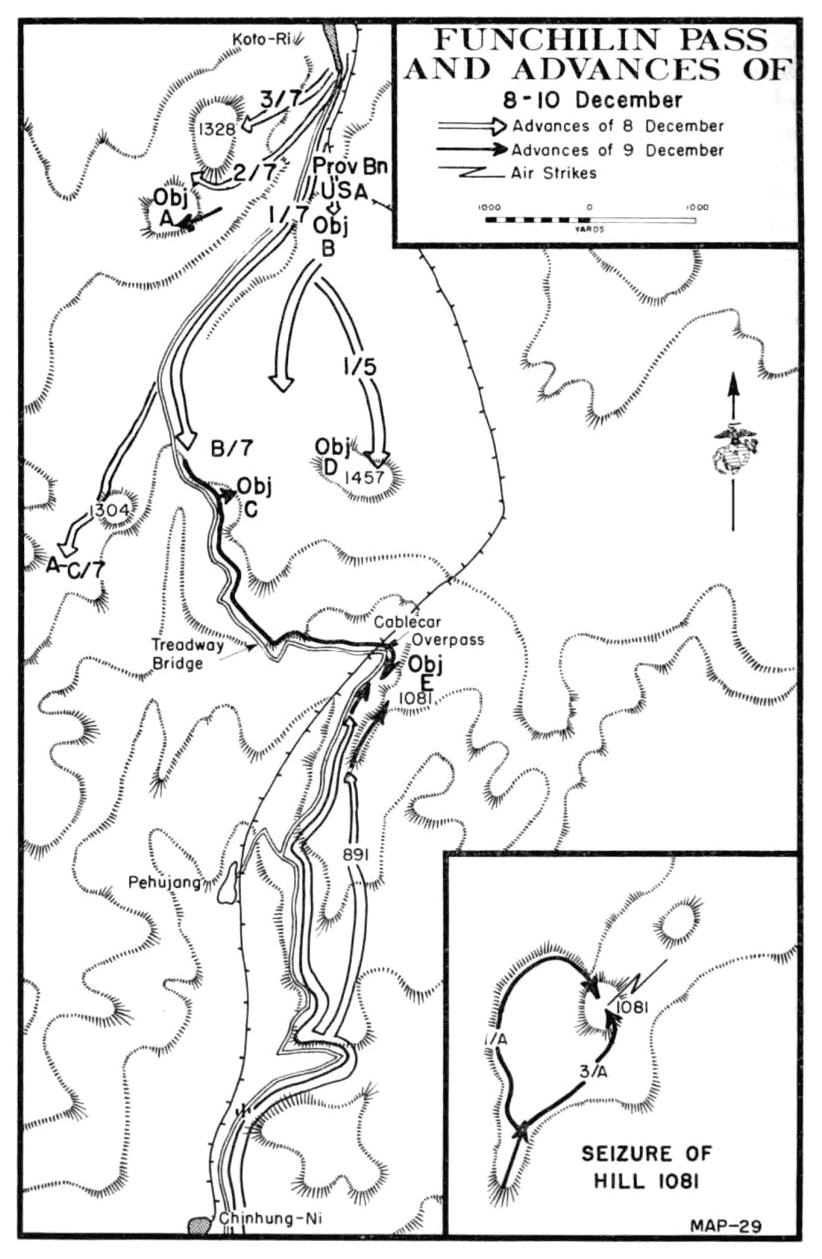
FUNCHILIN PASS
AND ADVANCES OF
8–10 December
SEIZURE OF
HILL 1081
MAP-29
There were four U. S. Army treadway bridge (Brockway) trucks at
Koto-ri, two of which were operative. After conferring with First
Lieutenant George A. Babe of the 1st Engineer Battalion and Colonel
Hugh D. McGaw of the 185th Engineer (C) Battalion, USA, Partridge
decided to request a drop of eight sections in order to have a 100%
margin of safety in case of damage.
After analyzing the causes of the unsuccessful test drop, Captain
Blasingame of the Air Delivery Platoon had larger parachutes flown
to Yonpo from Japan, accompanied by Captain Cecil W. Hospelhorn,
USA, and a special crew of Army parachute riggers. Blasingame and
a hundred-man work detail from the 1st Amphibian Tractor Battalion
worked all night at Yonpo to make ready for the drop next day by
eight C-119s of the Air Force.
At 0930 on 7 December three of the 2500-pound bridge sections
were dropped inside the Koto-ri perimeter and recovered by the Brockway
trucks. The remaining five sections were delivered by noon, one
of them falling into the hands of the Chinese and one being damaged.
Plywood center sections were also dropped so that the bridge could
accommodate any type of Marine wheel or tracked vehicle. Thus the
tanks could cross on the metal spans only, while the trucks could manage
with one wheel on the metal span and the other on the plywood
center.587
All the necessary equipment having been assembled at Koto-ri by the
late afternoon of the 7th, the next problem was to transport it three and
a half miles to the bridge site. Colonel Bowser, the Division G-3,
directed the engineers to coordinate their movements with the progress
made by RCT-7 the following morning. Lieutenant Colonel Partridge
attended a briefing conducted by Colonel Litzenberg on the eve of the
assault, and it was agreed that the trucks with the bridge section would
accompany the regimental train. First Lieutenant Ewald D. Vom Orde’s
First Platoon of Company D engineers was designated as the escort.
First Lieutenant Charles C. Ward’s engineers led the 7th Marines
trains. Both platoons were assigned the task of installing the bridge
sections.
On the assumption that the gap over the penstocks would be successfully
spanned, the 1st Marine Division issued OpnO 26-50 at 1850 on
7 December. Although the last operation order had specified the Hamhung
area as the objective, it was found necessary at Koto-ri to give
more explicit instructions for the advance to the southward.
The plan was simple. Recognizing the sharp cleft of Funchilin Pass
as the most difficult defile of the entire breakout, General Smith ordered
the seizure of the heights overlooking the pass from the north end of
Hill 1081, dominating the road through the pass. In its details the
plan shaped up as follows:
(1) RCT-7 (reinforced with the Provisional Army battalion) to attack
south from Koto-ri at 0800 on 8 December and seize Objectives A and B—the
first being the southern extension of Hill 1328, about 2500 yards southwest
of Koto-ri, and the other the second nose due south of Koto-ri.
(2) RCT-5 to attack and seize Objective D (Hill 1457, two and a half
miles south of Koto-ri) while RCT-7 continued its attack and seized Objective
C (a nose dominating the MSR two and three-fourths miles south of
Koto-ri).
(3) At 0800, as RCT-7 jumped off at Koto-ri, the 1st Battalion of RCT-1
was to attack from Chinhung-ni and seize Objective E (Hill 1081, three
miles to the north).
(4) RCT-1 (less the 1st Battalion but reinforced by 2/31) was to protect
Koto-ri until the Division and regimental trains cleared, whereupon it
was to relieve RCTs 5 and 7 on Objectives A, B, C and D.
(5) Upon relief by RCT-1, RCTs 5 and 7 were to proceed south along
the MSR to the Hamhung area.
(6) RCT-1 was to follow RCT-5 and protect the Division rear.588
Artillery plans provided for one battery of 2/11 and one of 3/11 to
answer the calls of RCT-7 for supporting fires. The other batteries of
3/11 were to move south with the motor column while two batteries
of 1/11 supported RCT-5. The remaining battery of 3/11 was attached
to 2/11 with a mission of moving south to Chinhung-ni and
taking a position from which to support the withdrawal of RCT-1 as
rearguard. Easy Battery of 2/11, left behind at Koto-ri, was laid to fire
to the north and west, while Fox Battery of 2/11 and the 92d Armored
Field Artillery Battalion at Chinhung-ni supported the attack of 1/1
on Hill 1081.
The plan of the 1stMAW for air support was essentially the same
as the one which proved so effective during the advance from Hagaru
to Koto-ri.
An object lesson of that movement had been the personnel and equipment
losses suffered by the Division trains as a consequence of a late
start. The planners were determined not to repeat this mistake. As a
further precautionary measure, General Smith directed that the tanks
form the last elements of the motor column.589 Thus in the event of a
breakdown on the twisting, single-lane road, it would not be necessary
to abandon all the vehicles behind a crippled tank.
As for the enemy situation, G-2 summaries indicated that early in
December the CCF 26th Corps, consisting of the 76th, 77th and 78th
Divisions, reinforced by the 94th Division of the 32d Corps, had moved
down from the north and taken positions on the east side of the MSR
between Hagaru and Koto-ri. There they relieved the 60th Division,
which moved into the area south of Koto-ri. The 76th and 77th Divisions
occupied positions along the MSR in the Koto-ri area, while the
78th and 94th Divisions were apparently held in reserve. Elements of
the 89th Division, operating from the mountainous area southwest of
Koto-ri, conducted harassing operations against the MSR in the vicinity
of Chinhung-ni as well as Koto-ri.
The 60th CCF Division held prepared positions on the high ground
south of Koto-ri commanding Funchilin Pass and the MSR leading to
Chinhung-ni. That these positions included Hill 1081, the dominating
terrain feature, was revealed by prisoners taken in the vicinity by patrols
of the 1st Battalion, 1st Marines, prior to 8 December.
Division plans had not called for the swirling snowstorm which reduced
visibility to 50 feet and precluded air support at first light on
8 December. In spite of weather conditions, the assault battalions of
RCT-7 moved out from Koto-ri on schedule after 1/1 attacked northward
from Chinhung-ni.
The planners had realized that the success of the movement to Chinhung-ni
would depend to a large extent on the seizure of Objective E—Hill
1081. On 2 December Lieutenant Colonel Schmuck had led a
reconnaissance patrol into Funchilin Pass as far north as this position.
Sighting large numbers of Chinese on both sides of the road, he called
for artillery fires with good effect. This reconnaissance did much to
establish Hill 1081 as the key terrain feature.
Although 1/1 had patrolled aggressively, the battalion had engaged
in no large-scale actions so far in the Reservoir campaign. The men
were fresh, well-rested and spoiling for a fight when they moved out
at 0200 on 8 December from an assembly area south of Chinhung-ni
after being relieved by Task Force Dog.
Schmuck’s battle plan provided for the three companies to advance
in column along the MSR in the predawn darkness. Since orders were
to attack at 0800, a start at 0200 was considered necessary in order to
make the six-mile approach march.
Captain Wray’s Charlie Company, in the lead, was to take Objective
1, the southwestern nose of Hill 1081, and hold it while the other two
companies passed through to carry out their missions. Captain Barrow’s
Able Company was to attack east of the MSR and fight its way
to the summit of Hill 1081; and Captain Noren’s Baker Company to
advance to the left flank, along the slopes between Barrow and the
MSR.590
The combination of snow and darkness reduced visibility almost to
zero as 1/1 set out along the slippery MSR five hours before daybreak.
All heavy equipment had been sent to the rear from Chinhung-ni, and
the only vehicles were two ambulances and a radio jeep.
In the snow-muffled silence of the night the men took on protective
coloring as feathery flakes clung to their parkas. Objective 1 was seized
shortly after dawn, following a difficult approach march against negligible
resistance. The battalion commander prepared for the next
phase by bringing up 81mm mortars and an attached platoon of 4.2s and
emplacing those weapons in Wray’s position. He also directed that
the five attached Army self-propelled quad-.50 caliber and twin 40mm
guns of B Company 50th AAA (AW) Bn be moved to a little rise
off to the left of the road in the vicinity of the village of Pehujang.
From this position they covered the MSR as far as the bridge over the
penstocks.
At 1000 the main attack was set in motion. Baker Company advanced
along the wooded western slope of Hill 1081 as Barrow attacked up the
hogback ridge leading to the summit. The snowstorm fought on the
side of the Marines by hiding their movements from the Chinese occupying
the high ground east of the MSR around the great horseshoe
bend where the road passed under the cable car line.
Noren’s men saw hundreds of enemy footprints but met only scattered
opposition until they came to the first CCF roadblock on their
left flank. There they were stopped by two machine guns, but a Marine
patrol worked around on the uphill side and routed the Communists
with a machine gun and 60mm mortar attack.
In the absence of air and artillery support, the 4.2s and 81mm mortars
emplaced in the Charlie Company position were called upon whenever
visibility permitted. Surprise was Noren’s best resource, however,
when Baker Company came up against the CCF bunker complex on the
western slope of Hill 1081. The enemy had so little warning that the
Marines found a kettle of rice cooking in the largest bunker, an elaborate
log and sandbag structure which had evidently been a CCF command
post. The entire complex was taken after a brief but savage fight in
which all defenders were killed or routed. Schmuck set up his CP in a
captured bunker, where he and his officers soon discovered that several
regiments of Chinese lice had not yet surrendered.
Only enough daylight was left for the sending out of patrols, whereupon
Noren secured for the night. His losses amounted to three killed
and six wounded.
Barrow’s men had no physical contact with Baker Company while
clawing their way upward along an icy ridge line too narrow for deployment.
A sudden break in the snow afforded the Able Company
commander a glimpse of a CCF stronghold on a knob between him and
his objective, the topographical crest of Hill 1081. The drifting flakes
cut off the view before he could direct mortar fire, but Barrow decided
to attack without this support and rely upon surprise. Advancing in
column along the steep and narrow approach, he sent Lieutenant Jones
with two squads of the 2d Platoon to execute a wide enveloping
movement on the left. Lieutenant McClelland’s 1st Platoon had a
similar mission on the right. Barrow himself led Staff Sergeant William
Roach’s 3d Platoon in a front attack.
It took more than an hour for the two flanking forces to get into
position. Not until they had worked well around the Chinese bunker
complex did Barrow give the signal for attack. Perhaps because silence
had been enforced during the stealthy advance, the assault troops yelled
like Indians as they closed in on the foe. Out of the snowstorm Barrow’s
men “erupted with maximum violence,” and the enemy was too
stunned to put up much of a fight. The only effective resistance came
from a single CCF machine gun which caused most of the Marine
casualties before Corporal Joseph Leeds and his fire team knocked it
out, killing nine Communists in the process.
More than 60 enemy bodies were counted after the Marines cleaned
out the bunkers and shot down fleeing Chinese. Barrow’s losses were
10 men killed and 11 wounded.
By this time it was apparent that the Chinese had held an integrated
system of bunkers and strong points extending to the summit of Hill
1081. The battalion had been strictly on its own all day, all contact
with the infantry of Task Force Dog having ended with the relief.
When communications permitted, however, 1/1 could count on the
excellent direct support of the 92d Armored Field Artillery Battalion,
USA, commanded by Lieutenant Colonel Leon F. Lavoie. The Army
cannoneers had set up near Fox Battery of 2/11, using the fire control
data of this Marine artillery unit.
The night was clear, promising air and artillery support in the morning,
as Able Company consolidated in the captured CCF positions.
Although the battalion aid station was only 700 yards away, the terrain
was so difficult that litter bearers took several hours to struggle
down with the Marine wounded. About midnight the Chinese interrupted
with an attack in estimated platoon strength, but Barrow’s men
drove them off with CCF losses of 18 killed.
The rest of the night passed quietly, and Baker Company had no
disturbance on the high ground overlooking the MSR.
While these events were taking place, the attack to the south from
Koto-ri also fell short of the day’s objectives. Colonel Litzenberg’s plan
called for two of his four battalions (the fourth being the Provisional
Battalion of Army troops) to clear the high ground on either side of the
road so that a third battalion could advance astride the MSR, followed
by the reserve battalion and regimental train.
Major Morris, commanding 3/7, had been assigned the task of attacking
on the right at 0800 and seizing Objective A, the southernmost
of the cluster of hills known collectively as Hill 1328. He made such
slow progress against CCF and small-arms fire that at 1100 Colonel
Litzenberg suggested the commitments of 3/7’s reserve company. “All
three companies,” replied Morris, “are up there—fifty men from
George, fifty men from How, thirty men from Item. That’s it!”591
Early in the afternoon of 8 December, Litzenberg committed his reserve,
2/7, to assist 3/7. Lockwood’s battalion was on the road south
of 3/7 and attacked west in an attempt to get in the rear of the enemy
holding up 3/7. Easy and Fox Companies attacked abreast and by
1800 the two battalions had joined on the northeastern slopes of the
objective. In view of the approaching darkness, however, the attack
was postponed until morning, and the troops consolidated for the night
short of the objective, which was seized the following morning.
Litzenberg’s plan for the seizure of the heights overlooking the
northern entrance to Funchilin Pass provided for the Army Provisional
Battalion to take Objective B. The soldiers jumped off at 0800, on
the left of the MSR, supported by two tanks of the 5th Marines AT
Company. By 0900 the battalion had secured its objective without
meeting any resistance. Litzenberg then ordered a further advance of
800 yards to the northwestern tip of Hill 1457. At 1330 the Army
troops secured their second objective, still without resistance and tied
in with 1/5 for the night.592
Lieutenant Colonel Davis having become regimental executive officer
after Dowsett was wounded, Major Sawyer took over command of
1/7. His plan called for the battalion to advance about 2000 yards down
the road and wait for 3/7 to come up on his right flank. Then the two
battalions would move along together.
The 1st Battalion jumped off at 0800 and reached its phase line
without opposition. First Lieutenant Bobbie B. Bradley’s platoon advanced
down the road to gain contact with the Chinese while the remainder
of the battalion halted. When 2/7 began its attack in support
of 3/7, Sawyer’s battalion moved out. Bradley’s patrol having run into
opposition from the northern reaches of Hill 1304, Companies A and
C moved west of the MSR in a double envelopment of the enemy position.
Company B continued the advance towards Objective C, meeting
a heavy cross fire from Chinese to their front and on Hill 1304. Lieutenant
Kurcaba was killed and Lieutenants Chew Een Lee and Joseph R.
Owen wounded. First Lieutenant William W. Taylor took command
and managed to clear the enemy from his front just before dusk.
Able and Charlie Companies faced less resistance in overrunning
the foxholes and two bunkers on Hill 1304. With dusk falling, Sawyer
did not attempt a further advance. Able and Charlie Companies dug
in on Hill 1304 while Baker set up a perimeter slightly short of Objective
C. The first serials of the truck convoy had moved closely on
the heels of 1/7 and had to be backed up to a level area near Objective
A. There they formed a perimeter reinforced with H&S and Weapons
Companies of 1/7.593
Division OpnO 26-50 had directed Lieutenant Colonel Murray’s
RCT-5 to await orders before attacking Objective D. It was nearly
noon on the 8th before the 1st Battalion, in assault, was directed to
move out from Koto-ri.
Lieutenant Colonel Stevens followed the MSR for a mile, then sent
two companies out to the left to occupy the objective, Hill 1457. Baker
Company seized the intervening high ground and set up to cover the
attack of Charlie Company up the slopes of the ridge leading to the
objective. Charlie Company fell in with a patrol from the Army Provisional
Battalion attached to the RCT-7, and the two combined forces
to drive the enemy off the high ground about 1550. A weak Chinese
counterattack was easily repulsed, and at 1700 as darkness fell Baker
and Charlie Companies tied in with the Army troops while Able Company
formed its own perimeter overlooking the MSR. In reserve, the
41st Commando moved into the high ground behind 1/5 to guard
against infiltration.594
The day’s story would not be complete without reference to the Treadway
bridge train, which moved out about 1400 on the 8th in the trace
of 1/7. Instructions were to install the sections at the first opportunity,
but the site had not been secured as darkness approached. A few Chinese
mortar rounds falling in the vicinity of the vulnerable Brockway
trucks influenced a decision to return them closer to Koto-ri.595
Summing up the attacks of 8 December, weather and terrain had done
more than the enemy to prevent all assault units of the 1st Marine Division
from securing their assigned objectives. Casualties had not been
heavy, however, and for the most part the troops were in a position
for a renewal of their efforts in the morning.
As for the Koto-ri perimeter, the 8th had passed with only scattered
small-arms fire being received by the 2d and 3d Battalions of the 1st
Marines, in Division reserve. All day the Dog Company roadblock,
on the route to Hagaru, was like a dam holding back the human torrent
of Korean refugees. From this throng rose a low-pitched wail of misery
as homeless men, women, and children huddled without shelter in the
snowstorm of the 8th. It was a distressing spectacle to the Marines in
the perimeter, yet the refugees could not be admitted because of the
probability that Chinese soldiers had infiltrated among them, watching
for an opportunity to use hidden weapons. There was little the Marines
could offer by way of succor except medical care in some instances.
Two women gave birth during the bitterly cold night of the 8th with the
assistance of Navy medics. In the morning the crowd of refugees,
swollen by new arrivals, waited with the patience of the humble to
follow the Marine rear guard to the seacoast.596
White is the color of mourning in Korea, and snowflakes drifted down
gently over the common grave in which 117 Marines, soldiers, and
Royal Marine Commandos were buried on the 8th at Koto-ri. Lack of
time had prevented the digging of individual graves in the frozen soil.597
Although the necessity of conducting a mass burial was regretted, all
available space in planes and vehicles was needed for the evacuation of
casualties.
New snow sparkled in the sunlight as the day of 9 December dawned
bright, clear, and cold. A brief reconnaissance convinced Captain
Noren that in the early darkness of the previous evening he had stopped
one ridge short of his objective—the northwest slopes of Hill 1081,
covering the approach to the cable underpass. Baker Company of 1/1
moved forward without CCF interference to the position.
Captain Barrow had his men test-fire their weapons before mounting
the final assault on the dominating knob of the hill. This proved to be a
wise precaution, since many of the mechanisms had frozen. After thawing
them out, Able Company attacked in column with the 1st Platoon
in the lead. Although the assault troops had the benefit of excellent
air, artillery, and mortar support, they came under intense small-arms
fire from Communists occupying camouflaged log and sandbag bunkers.
McClelland’s men were hard hit but his left flank squad worked its way
forward in brief rushes to positions within 200 yards of Objective E,
the topographical crest of Hill 1081. At this point Staff Sergeant Ernest
J. Umbaugh organized a squad grenade attack which wiped out the
first CCF bunker.
A stretch of about 175 yards, swept bare in places by the icy wind,
now lay between the Marines and the final knob. Barrow perceived that
this deadly CCF field of fire could be skirted by troops working their
way around a shelf jutting from the military crest. Under cover of fire
from his 60mm mortars and a strike by four Corsairs, he brought up
his 2d and 3d platoons. While McClelland profited by the cover of
scrub trees to come up behind the objective, Jones built up a base of
fire to cover the direct assault of Roach’s platoon as it stormed up the
crest. McClelland had to contend with the enemy’s last-ditch stand
in two log bunkers which the 1st platoon knocked out by tossing grenades
through the embrasures. The Communists resisted to the last gasp,
but at 1500 the Marines were in undisputed possession of Hill 1081.
Sergeant Umbaugh paid with his life at the moment of victory, and
Barrow had only 111 able-bodied men left of the 223 he had led out
from Chinghung-ni. But the Marines had won the decisive battle of
the advance from Koto-ri; they held the key height dominating Funchilin
Pass, though 530 counted enemy dead testified to the desperation
of the CCF defense.
Able Company had the most spectacular part, but the victory owed to
the united efforts of all three rifle companies and supporting arms.
While Barrow held the crest of the hill, Noren pushed farther along the
cable car track, meeting stubborn resistance from scattered enemy
groups.598
The collapse of CCF resistance on Hill 1081 had a beneficial effect
on the Marine advance from Koto-ri. RCT-7 continued its attack on
the morning of the 9th with effective air and artillery support. Lieutenant
Hovatter’s Able Company of 1/7 seized the remainder of Hill
1304 while Lieutenant Taylor’s Baker Company moved south to Objective
C. The Army Provisional Battalion occupied the high ground
between Objectives C and D.
These movements were carried out against ineffectual enemy resistance
or none at all. Whenever a few Communists dared to raise their
heads along the MSR, the airborne TADC in the R5D had the communications
equipment to control aircraft on station and to direct their
employment in response to ground force units.
The 1st Battalion of RCT-5 maintained its positions on Objective D
(Hill 1457) all day. At Koto-ri the other two battalions and regimental
headquarters made preparations to move out the following day.
As a preliminary to the withdrawal of RCT-1 (-) from Koto-ri, the
3d Battalion was relieved in its positions along the perimeter by the
41st Commando. Lieutenant Colonel Ridge’s men then moved out to
relieve 3/7 on Objective A and occupy Objective B. The 2d Battalion
of RCT-7 (less a company with the regimental train) outposted the
MSR between Objectives A and C at about 1630.599
Captain Morris’ Charlie Company and a platoon of Baker Company,
1/7, moved down the MSR and secured the bridge site after a short
fight. While Charlie Company outposted the area, the Baker platoon
crossed behind the broken bridge and suddenly found about 50 Chinese
in foxholes. “They were so badly frozen,” reported Sawyer, “that
the men simply lifted them from the holes and sat them on the road
where Marines from Charlie Company took them over.”600 Late in the
afternoon a patrol from 1/7 attempted to make contact with 1/1 by
moving down the MSR. Chinese fire forced the men off the road and
they scrambled across the defile below the overpass and into 1/1’s
lines.601
Lieutenant Colonel Partridge arrived with Weapons Company, 1/7,
and the bridge sections followed in the Brockway truck. Even the enemy
lent a hand when Communist prisoners were put to work as laborers.
After the abutments were constructed, a Brockway truck laid the treadways
and plywood panels in position so that both trucks and tanks
could cross.
At about 1530, three hours after the start, the bridge was in place.
Partridge drove his jeep to the top of the pass to inform Lieutenant
Colonel Banks, Commanding Division Train No. 1, that he could begin
the descent.
Sawyer’s troops had not been idle that afternoon and a total of about
60 CCF prisoners were taken during attacks to drive the enemy back
from the bridge site. At about 1700 Partridge returned, and an hour
later the first elements of the Division trains began to cross. Only a
few vehicles had reached the other side when a disastrous accident
threatened to undo everything that had been accomplished. A tractor
towing an earth-moving pan broke through the plywood center panel,
rendering it useless. And with the treadways spaced as they were, the
way was closed to wheeled vehicles.
A first ray of hope glimmered when an expert tractor driver, Technical
Sergeant Wilfred H. Prosser, managed to back the machine off the
wrecked bridge. Then Partridge did some mental calculations and
came up with the answer that a total width of 136 inches would result
if the treadways were placed as far apart as possible. This would
allow a very slight margin at both extremes—two inches to spare for the
M-26s on the treadways; and barely half an inch for the jeeps using
the 45-inch interval between the metal lips on the inboard edges of
the treadways.
Thanks to skillful handling of the bulldozers the treadways were soon
respaced. And in the early darkness Partridge’s solution paid off when
the first jeep crossed, its tires scraping both edges. Thus the convoy got
under way again as an engineer detachment guided vehicles across with
flashlights while Sawyer’s troops kept the enemy at a distance.602
Advance reports of the bridge drop had brought press representatives
flocking to Koto-ri in casualty evacuation planes. David Duncan, of
Life, a former Marine, took realistic photographs of the troops which
attracted nation-wide attention. Keyes Beech sent out daily reports
while making notes for a book about his adventures in Korea. Miss
Marguerite Higgins, who refused to be outdone by male colleagues,
was twice requested to leave Koto-ri before nightfall by Marine officers
who respected her pluck as a reporter but felt that the perimeter was
no place for a woman in the event of an enemy attack.
Hundreds of words were written about the bridge drop. Some of
these accounts were so dramatized as to give Stateside newspaper readers
the impression that the span had been parachuted to earth in one piece,
settling down neatly over the abutments. Headlines reported the progress
of the 1st Marine Division every day, and front-page maps made
every American household familiar with the names of such obscure
Korean mountain hamlets at Koto-ri and Chinhung-ni.
General Shepherd and Colonel Frederick P. Henderson flew up to
the perimeter on the 9th for a conference with General Smith. Before
their departure they were informed that all remaining casualties at
Koto-ri would be evacuated that day.603
All night long on 9–10 December an endless stream of troops and
vehicles poured across the span that was doubtless the world’s most
famous bridge for the moment. “The sensation throughout that night,”
recalled Lieutenant Colonel Partridge in retrospect, “was extremely
eerie. There seemed to be a glow over everything. There was no illumination
and yet you seemed to see quite well; there was artillery
fire, and the sound of many artillery pieces being discharged; there was
the crunching of the many feet and many vehicles on the crisp snow.
There were many North Korean refugees on one side of the column and
Marines walking on the other side. Every once in a while, there would
be a baby wailing. There were cattle on the road. Everything added
to the general sensation of relief, or expected relief, and was about as
eerie as anything I’ve ever experienced in my life.”604
Advancing jerkily by stops and starts, the column met no serious opposition
from Chinese who appeared to be numbed by cold and defeat.
Prisoners taken that night brought the total up to more than a hundred
during the movement from Koto-ri to Chinhung-ni. Some of them
were suffering from gangrene, the result of neglected frozen limbs, and
others showed the effects of prolonged malnutrition. These captives
testified that CCF losses from both battle and non-battle casualties had
been crippling.
At 0245 on the morning of the 10th the leading elements of the 1st
Battalion, RCT-7, began to arrive at Chinhung-ni. A traffic regulating
post had been set up at that point the day before by Colonel Edward W.
Snedeker, Division Deputy Chief of Staff, for the purpose of controlling
the movement of Marine units to the south.605
The remaining elements of RCT-7 were strung out from Objective C
to the cableway crossing of the MSR. Traffic moved without a hitch
until 0400, when two trucks bogged down in a U-shaped bypass across
a partially frozen stream about 2000 yards beyond the treadway bridge.
Major Frederick Simpson, commanding the 1st Divisional Train, had the
vehicles pushed off to one side while the engineers built up the road.
After a delay of three hours the column got under way again, with the
first vehicles reaching Chinhung-ni at 0830. Ultimately both Division
trains got through without a fight, thanks to avoiding the delays which
had caused so much trouble during the advance from Hagaru to Koto-ri.606
Following the trains, the 7th Marines moved through the Pass. Lieutenant
Colonel Lockwood’s 2/7 (less Company E, guarding the regimental
train) led the way for the regimental command group, the
Provisional Army Battalion, 3/7 and the 3d Battalion of the 11th
Marines.607
During the early morning hours of the 10th George Company of 3/1
beat off an attack on Objective A by an enemy force estimated at 350
men. This was the only noteworthy instance of CCF activity otherwise
limited to scattered shots, and it was believed that the Communists
were side-slipping southward, parallel with the MSR. Confirmation of
that assumption came at 1200, when Able Company of 1/1 sighted Chinese
marching in platoon and company columns through the valley only
about 1000 yards east of Hill 1081. Almost simultaneously other dense
CCF columns crossed the field of fire of the attached Army self-propelled
AAA guns while pouring around an adjacent slope. Lieutenant Colonel
Schmuck called immediately for air strikes and artillery fires. Able
Company hit the enemy with 4.2″ and 81mm mortar rounds, and the
Army teams cut loose with .50 cal. and 40mm bursts. The slaughter
continued for an hour as the Chinese kept on moving southward with
that fatalism which never failed to astonish the Marines.
Baker Company of 1/1 launched an assault with close air support at
1300 on a CCF strong point adjacent to the railroad and north of the
battalion’s positions overlooking the MSR. Noren’s men found 3.5″
rocket launchers their most effective weapon when clearing the Communists
from heavily timbered and sandbagged bunkers. Excellent
close air support was received, though two Marine KIA casualties resulted
from an error by Navy planes.608
All day the seemingly endless column of vehicles and troops wound
southward along the twisting mountain road. At 1030 General Smith
and key members of his staff displaced from Koto-ri and proceeded by
C-47 and helicopter to the rear CP of the Division at Hungnam. By
1800 both Division trains, all elements of RCT-7 and the 1st, 3d, and
4th Battalions of the 11th Marines had closed Chinhung-ni. There the
infantrymen entrucked for Hungnam.609
The 5th Marines column followed the 7th, with 3/5 leading the way
and 2/5 close behind. Just south of Objective A a brief fire fight was
necessary to silence a CCF machine gun, whereupon the movement continued
without further incident until the two battalions reached Chinhung-ni
at dusk. The 1st Battalion was not relieved by 2/1 until 1800
and did not close Chinhung-ni until the early morning hours of the
11th.610
The withdrawal of RCT-1 (-) and attached units from Koto-ri commenced
on the afternoon of the 10th. The 3d Battalion, it will be
recalled, had relieved RCT-7 units the day before on Objectives A, B
and C, and the 1st Battalion occupied Objective E. The regimental
plan called for 1/1 to hold the Hill 1081 area and protect the MSR
until the other units of the regiment passed through, whereupon
Schmuck’s battalion was to pull out with the tanks at the end of the
column as the rear guard.
The movement from the Koto-ri perimeter commenced at 1500 when
H&S Company of RCT-1 departed. The 2d Battalion (-) of the 11th
Marines fell in behind, followed in order by a detachment of the 185th
(C) Engineers, USA, the 2d Battalion of the 31st Infantry, USA, the
2d Battalion of RCT-1, the Division Reconnaissance Company and
Lieutenant Colonel Milne’s tank column, consisting of Companies B
and D of the 1st Tank Battalion, the Tank Company of the 31st Infantry,
USA, and the Tank Platoon of the 5th Marines AT Company.611
As the last elements left Koto-ri the 92d FA Battalion at Chinhung-ni
began laying heavy concentrations on the evacuated base. Only
scattered shots were received by the tail of the column from Chinese
troops mingling with the Korean refugees. Several small enemy groups
on the flanks of the column were taken under fire and dispersed.612 But
with 3/1 guarding Objectives A, B and C, no serious opposition developed
during the first stage of the withdrawal.
At dusk on 10 December all indications made it appear that the movement
of the 1st Marine Division southward would be completed according
to plan with only minor losses of personnel and equipment. Following
the seizure of Hill 1081, casualties had been comparatively light
and enemy resistance ineffectual. Then, between midnight and 0100
on 11 December, two reverses occurred in areas the Marines supposed
to be safe.
The MSR south of Chinhung-ni was under the protection of troops
of the 3d Infantry Division—Task Force Dog at Chinhung-ni, and two
battalions of the 65th Infantry in the vicinity of Sudong and Majon-dong.
It was manifestly impossible, of course, for the Army troops to
guard every yard of the road, for the rugged terrain offered many potential
ambush sites.613 Guerrilla activity had been reported near Sudong,
but the division trains and the 5th and 7th Marines had passed through
without incident.
On the afternoon of the 10th, Korean civilians warned of an impending
attack by Chinese soldiers who had infiltrated into this village. As
previously indicated, Colonel Snedeker had arrived at Chinhung-ni the
previous afternoon. At his suggestion Task Force Dog sent out an
infantry patrol which returned with a report of no enemy activity.
At dusk an attack on the traffic turnaround outside Sudong caused
Snedeker to halt all traffic at Chinhung-ni until the MSR was cleared.
After a fire fight in the darkness, elements of the 65th Infantry reported
at dusk that the enemy roadblock had been cleared, and the Marine
column resumed its movement southward.614
During the next few hours Colonel Snedeker’s worst problem was
lack of transport. The Division had requested that the maximum number
of trucks, ambulances and narrow-gauge freight cars be collected
at Majon-dong, the new railhead. Only about 150 trucks were actually
made available, however, 110 of them being from Division service units
in the Hungnam area.
In spite of this shortage, the flow of traffic was being maintained
when an explosion of CCF activity brought every thing to a stop at
Sudong shortly after midnight. Mountain defiles had usually been the
scene of enemy ambushes, but this time the Chinese swarmed out from
behind houses in the village with grenades and burp guns. Several
truck drivers of the RCT-1 regimental train were killed by the first
shots and their vehicles set on fire. In the flickering light a confused
fight ensued as trucks to the rear stopped. The Marines of the RCT-1
train resisted as best they could, but leadership was lacking until Lieutenant
Colonel John U. D. Page, USA, and Marine PFC Marvin L.
Wasson teamed up as a two-man task force which routed a group of
about 20 Chinese at the head of the vehicle column. The valiant Army
artillery officer paid with his life, and Wasson received two wounds
from a grenade explosion. Pausing only for first aid, he got back into
the fight as another Army officer, Lieutenant Colonel Waldon C.
Winston, commanding the 52d Transportation Truck Battalion, USA,
directed a counterattack by Marine and Army service troops. Harry
Smith, a United Press correspondent, also had a part in the action.
Wasson called for a machine gun to cover him while he fired three
white phosphorus rounds from a 75mm recoilless at a house serving
the enemy as a stronghold. It burst into flames and the survivors who
ran out were cut down by machine-gun fire. The Marine PFC, a jeep
driver who was dubbed “The Spirit of ’76” by Winston, then volunteered
to help push trucks of exploding ammunition off the road.
Winston gradually brought order out of chaos, but it was daybreak
before the MSR was cleared so that the column could start moving
again. The RCT-1 regimental train had suffered casualties of eight
killed and 21 wounded, while equipment losses consisted of nine trucks
and an armored personnel carrier.
Lack of infantry protection was a factor in another reverse which
occurred at the tail of the Division column. General Smith’s final orders
for withdrawal provided that the tanks were to come out behind the
1st Marines’ train with the infantry of that regiment bringing up the
rear.615 Thus a breakdown in the armored column would not block the
road for wheeled vehicles, yet the tanks would have protection against
close-in attack.
The 1st Marines prepared detailed plans for the leapfrogging of
battalions during the final withdrawal phase. In effect these called for
2/1 to relieve 1/5 on Objective D and remain there until relieved in
turn by 2/31. The Army battalion would hold until 3/1 passed
through, then follow Ridge’s battalion down the MSR. After 2/1, 3/1
and 2/31 had passed through Lieutenant Colonel Schmuck’s positions
around Hill 1081, 1/1 would follow as rear guard.616
The first departure from plan occurred when Lieutenant Colonel
Sutter discovered, after starting up Hill 1457, that Objective D was
so far from the road and so steep that most of the night would be
required merely for the battalion to make the climb. No enemy having
been sighted, he asked permission to return to the road and continue
along the MSR. This request was granted by Colonel Puller and 2/1
resumed the march, followed by 2/11(-), 2/31 and H&S Company
of RCT-1 in that order. Lieutenant Colonel Ridge’s 3/1, which remained
on Objectives A, B and C until 2100, fell in at the end of the
regimental column.617
About midnight, after waiting for 3/1 to move down the pass,
the tank column began its descent with only Recon Company as protection.
Lieutenant Hargett’s platoon of 28 men guarded the last ten
tanks and the other two platoons screened the middle and head of the
column.618 Behind the last machine, approaching as close as they dared,
were the thousands of refugees. CCF soldiers had mingled with them,
watching for an opportunity to strike, and Hargett had the task of
keeping the Koreans at a respectful distance.
Progress was slow as the 40 tanks inched around the icy curves with
lights on and dismounted crewmen acting as guides. Shortly before
0100 the ninth machine from the rear had a brake freeze which brought
the tail of the column to a halt for 45 minutes. The rest of the tanks
clanked on ahead, leaving the last nine stranded along the MSR southwest
of Hill 1457 and about 2000 yards from the treadway bridge. The
enemy took advantage of the delay when five CCF soldiers emerged in
file from among the refugees as a voice in English called that they
wished to surrender.619
Hargett went to meet them cautiously, covered by Corporal George
A. J. Amyotte’s BAR. Suddenly the leading Chinese stepped aside to
reveal the other four producing hidden burp guns and grenades. Hargett
pulled the trigger of his carbine but it failed him in the sub-zero
cold. The former all-Marine football star then hurled himself at the
enemy group, swinging his carbine. He crushed a Chinese skull like
an eggshell, but a grenade explosion wounded him as the ambush
developed into an attack from the high ground on the flank as well
as the rear.
Before the remaining four Chinese could do Hargett any further
harm, Amyotte shot them down, one by one. The fight turned into a
wild melee in which friend could hardly be distinguished from foe.
Hargett’s platoon slowly fell back until the last tank was lost to the
enemy along with its crew. The men in the next to last tank had buttoned
up and could not be aroused to their danger by banging on the
hull with rifle butts. While making the effort Hargett was stunned
by an enemy explosive charge which blew PFC Robert D. DeMott over
the sheer drop at the side of the road, leaving him unconscious on a
ledge. The other men of his platoon believed that he had been killed
and continued their withdrawal, only to find the next seven tanks
abandoned with their hatches open.
Amyotte, wearing body armor, was covering the retirement, firing
from prone, when a CCF grenade exploded after landing squarely on
his back. The Chinese must have suspected black magic when he
went on cooly picking off opponents as if nothing had happened.620
It was a precarious situation for Hargett and his remaining 24 men.
But they fought their way out without further casualties, and meanwhile
tank crewmen had succeeded in freeing the brake of the lead tank
and driving two tanks down the road. One of them was brought out
by Corporal C. P. Lett, who had never driven before. “I’m going to get
this tank out of here even if I get killed doing it!” he told Hargett. By
sheer determination, coupled with luck, he maneuvered around the
obstacles ahead and down the icy road to safety.
Captain Gould and his demolitions crew of engineers had been
waiting for hours to blow the treadway bridge after the last elements
of the Division crossed. With the passage of the two tanks and
Hargett’s platoon, it was believed that all Marines who could be extricated
were safely over the span. On this assumption, which later proved
to be erroneous, CWO Willie Harrison set off the demolition charges.
The losses of the Recon platoon were three men MIA (two of them
later changed to KIA) and 12 wounded. Crews of the two rear tanks
were missing and presumed dead.621 Hargett’s losses would have been
more severe except for the fact that some of his men were wearing
Marine body armor made of light-weight plastics.
To another man of Hargett’s platoon went the distinction of being
the last Marine out at the finish of the Chosin Reservoir breakout. When
durable PFC DeMott recovered consciousness, after being blown over
the brink by the CCF pack charge explosion, he found himself precariously
perched on a ledge overhanging the chasm. Slightly wounded,
he managed to climb back on the road, where he encountered only
Korean refugees. Upon hearing a tremendous detonation he realized
that the bridge had been blown. He remembered, however, that pedestrians
could cross through the gatehouse above the penstocks, and he
came down the mountain with the refugees to Chinhung-ni. There he
was given a welcome befitting one who has cheated death of a sure
thing.
The remaining tanks made it safely to Chinhung-ni without benefit
of infantry protection other than what was afforded by Recon Company.622
Lieutenant Colonel Schmuck did not receive a copy of 1stMar
OpnO 16-50, he explained, his only information being a Frag O designating
1/1 as rear guard and “a hasty, 30-second conference” with
Colonel Puller when the 1st Marine command group passed through.
“I was informed,” he added, “that the tanks were in the rear of the
1st Marines, that 2d Bn, 31st Infantry was bringing up the rear, and
that as soon as that unit passed, I would employ my battalion as rear
guard.... No mention at all was made of the Reconnaissance Company.
In order to check off the units that passed endlessly through my lines,
I established a check point at the incline railway overpass and kept a
close record of movement.”
A great deal of intermingling of units was observed by the 1/1 commander.
At 0300, after sighting the lights of the tanks, he gave orders
for Able Company to commence the withdrawal, in order “to consolidate
my battalion for the rear guard action prior to daybreak.... When
the first tanks reached my position, I was first startled to find no 2/31
accompanying them and then flabbergasted to discover that the Recon
Company was somewhere out there ‘screening’ the movement. This
canceled my carefully laid covering plan.”623
No further trouble resulted for the tanks and Recon Company.
Ahead of them the infantry units continued the movement southward
from Chinhung-ni chiefly by marching because of the shortage of trucks.
Lieutenant Colonel Sutter’s men proved that footslogging is not a lost
art by covering the 22 miles from Koto-ri to Majon-dong in a 20-hour
hike with packs, heavy parkas, individual weapons and sleeping bags.624
Battle casualties of the division for the final stage, the attack from
Koto-ri southward, were as follows:
| Date |
KIA |
DOW |
MIA |
WIA |
Totals625 |
| 8 Dec |
29 |
8 |
4 |
127 |
168 |
| 9 Dec |
6 |
7 |
1 |
46 |
60 |
| 10 Dec |
7 |
5 |
8 |
45 |
65 |
| 11 Dec |
9 |
4 |
3 |
38 |
54 |
| Totals |
51 |
24 |
16 |
256 |
347 |
At 1300 on 11 December the last elements of the Division cleared
Chinhung-ni. Majon-dong had been left behind at 1730 without audible
regrets; and by 2100 all units, with the exception of the tanks, had
reached assigned assembly areas in the Hamhung-Hungnam area. The
armored column arrived at the LST staging area of Hungnam half an
hour before midnight, thus bringing to an end the breakout of the
1st Marine Division.626
CHAPTER XV The Hungnam Redeployment — Marines Billeted in Hungnam Area — Embarkation of 1st Marine Division — The Last Ten Days at Hungnam — Marines Arrive at New Assembly Area — Contributions of Marine Aviation — Losses Sustained by the Enemy — Results of the Reservoir Campaign
Marines Billeted in Hungnam Area—Embarkation of 1st Marine
Division—The Last Ten Days at Hungnam—Marines
Arrive at New Assembly Area—Contributions of Marine Aviation—Losses
Sustained by the Enemy—Results of the Reservoir
Campaign
“Wave and look happy!” These were the first words to greet
some of the weary, unshaven Marines upon arrival in the
Hamhung-Hungnam area. They grinned obligingly in response to the
press photographers snapping pictures of the motor column from the
roadside. They were happy indeed to be back in a world of hot meals
and hot baths. They were happy to be alive.
Marines and attached Army troops found it astonishing as well as
flattering to learn that such expressions as “epic” and “saga” and
“miracle of deliverance” were being applied to the breakout in American
newspapers. The press correspondents in turn were astonished to
learn that never for a moment had the men doubted that they would
slug their way out to the seacoast.
“The running fight of the Marines and two battalions of the Army’s
7th Infantry Division from Hagaru to Hamhung—40 miles by air but
60 miles over the icy, twisting mountainous road—was a battle unparalleled
in U. S. military history,” commented Time. “It had some aspects
of Bataan, some of Anzio, some of Dunkirk, some of Valley Forge,
some of the ‘Retreat of the 10,000’ (401–400 B. C.) as described in
Xenophon’s Anabasis.”
Not until the Marines had fought their way as far as Chinhung-ni,
the weekly newsmagazine continued, did there appear to be much hope
that they would come out as an organized force. Then “for the first
time it looked as if most of the 20,000 [Marines] would get through.”627
By reading contemporary press accounts it is possible to recapture
the mood of the American public upon realization of the disaster which
had overtaken the Eighth Army. “It was defeat—the worst defeat the
United States ever suffered,” reported Time in the issue of 11 December
1950. “The Nation received the fearful news from Korea with a strange-seeming
calmness—the kind of confused, fearful, half-believing matter-of-factness
with which many a man has reacted upon learning that
he has cancer or tuberculosis. The news of Pearl Harbor, nine years
ago to the month, had pealed out like a fire bell. But the numbing
facts of the defeat in Korea seeped into the national consciousness
slowly out of a jumble of headlines, bulletins, and communiques; days
passed before its enormity finally became plain.”628
Newsweek called it “America’s worst military licking since Pearl
Harbor. Perhaps it might become the worst military disaster in American
history. Barring a military or diplomatic miracle, the approximately
two-thirds of the U. S. Army that had been thrown into Korea might
have to be evacuated in a new Dunkerque to save them from being lost
in a new Bataan.”629
The situation in west Korea was depressing enough. But at least the
Eighth Army had a line of retreat left open. It was with apprehension
that the American public stared at front-page maps showing the “entrapment”
of the 1st Marine Division and attached U. S. Army units
and British Marines by Chinese forces. Press releases from Korea did
not encourage much expectation that the encircled troops could save
themselves from destruction by any means other than surrender. In
either event the result would be a military catastrophe without a parallel
in the Nation’s history.
The first gleam of hope was inspired by the news that the Marines
had seized the initiative at Yudam-ni and cut a path through Chinese
blocking the route to Hagaru. Then came the thrilling reports of the
air drops of supplies at Hagaru and the mass evacuation of casualties by
air. Much of the humiliation felt by newspaper readers was wiped
clean by pride as General Smith’s troops fought through to Koto-ri and
Chinhung-ni in sub-zero cold. The air drop of the bridge sections was
a dramatic climax to the realization that what had been a hope was
now a fact—the Chosin Reservoir troops had saved themselves and
inflicted a major defeat on the Chinese Communists in the doing. Testimony
of POWs had left no doubt that the mission of the three CCF
corps was the annihilation of the surrounded United States forces, but
the result had been enemy losses which did not fall far short of annihilation
of the CCF units themselves.
It was in a spirit of prayerful thanksgiving, therefore, that Americans
read about the column of grimy, parka-clad men which came out of the
mountains of northeast Korea on 11 December 1950. They had come
out fighting and they had brought their wounded and most of their
equipment out with them.
As late as 9 December it had been General Smith’s understanding
that the 1st Marine Division would occupy a defensive sector south and
southwest of Hungnam. Then Colonel McAllister at Hungnam was
notified by X Corps that plans for the defense of the Hungnam area
had been changed, so that the Marines were to embark immediately for
redeployment by water to South Korea. General Smith was informed
on the 10th, and so promptly was the new plan put into effect that the
first Marine units were already loading out before the last elements of
the Division arrived at Hungnam.630
No changes were necessary in the plans for the reception of Marine
units in the Hungnam area worked out by Colonel Snedeker and Colonel
McAllister on orders of General Smith. On 8 December, Snedeker
had issued detailed instructions which designated defensive sectors for
RCT-1 at Chigyong and for RCT-5 and RCT-7 in the vicinity of
Yonpo Airfield. The 1st Amphibian Tractor Battalion was charged
with making such preparations to receive the returning troops as putting
up tents, installing stoves, erecting heads and equipping galleys.631
The Navy, as usual, was ready. On 15 November, it may be recalled,
General Smith had candidly expressed his misgivings about the strategic
outlook to Admiral Morehouse and Captain Sears. Morehouse was
chief of staff to Admiral Joy, ComNavFE, and Sears served in a like
capacity under Admiral Doyle, CTF-90. This frank discussion had
not fallen upon deaf ears; and on the 28th, only a few hours after the
first CCF attacks at Yudam-ni, ComNavFE alerted CTF-90 as to the
possible need for a redeployment operation by sea. The following day
Joy advised that events in the Chosin Reservoir area made it desirable
for ships of TF-90 to be on six hours’ notice either in Korean waters
or at Sasebo, Japan.632
CTF-90 commenced planning immediately for either an administrative
or emergency outloading. His OpnO 19-50, issued on the 28th
for planning purposes, provided for half of the amphibious force to
conduct redeployment operations on the east coast under Doyle as
ComPhibGruOne, while the other half had a similar mission on the
west coast under Admiral Thackrey, ComPhibGruThree.
At this time ComPhibGruThree and most of the amphibious units
were in Japanese ports for upkeep and replenishment. All were directed
by Admiral Joy on the 29th to proceed to Sasebo.
ComPhibGruOne had just completed the opening of Hungnam as
a major resupply port and was preparing to withdraw to Japan with
the remaining amphibious force. On 30 November, however, the
deteriorating situation of ground forces in Korea made it necessary for
all units of TF-90 to be in Korean waters. The emergency appeared
to be more critical on the west coast, and two-thirds of the smaller
amphibious ships were allotted to the Inchon area while the transports
were divided equally between Inchon and Hungnam.
The first week of December was devoted to planning and preparing
for a redeployment of X Corps by sea which appeared more likely
every day. Mine sweeping operations were resumed at Hungnam to
enlarge the swept anchorage area and provide swept channels for gunfire
support ships.
X Corps OpnO 9-50, issued on 5 December, provided for the defense
of the Hungnam area by setting up a perimeter with a final defense line
about seven miles in radius. Pie-shaped sectors of fairly equal area,
converging on the harbor, were assigned to the following major units
from east to west—1st ROK Corps (less one division at Songjin),
7th Infantry Division, 3d Infantry Division (with the 1st KMC Regiment(-)),
and the 1st Marine Division. The Marine sector included
Yonpo Airfield.
On 8 December a conference held on board the Mount McKinley by
ComNavFE and CTF-90 was attended by Vice Admiral Struble,
Com7thFlt, Rear Admiral John M. Higgins, ComCruDivFive, and
Lieutenant General Shepherd, CG FMFPac.
General Shepherd was present as “Representative of Commander
Naval Forces, Far East, on matters relating to the Marine Corps and
for consultation and advice in connection with the contemplated amphibious
operation now being planned.”633
General Almond was directed on the 9th to redeploy to South Korea
and to report to the commanding general of the Eighth Army after
assembling in the Ulsan-Pusan-Masan area. He was to release the
1st ROK Corps as soon as possible to the ROK Army in the Samchok
area. An assembly area in the vicinity of Masan, widely separated from
the other units of X Corps, was specified for the 1st Marine Division.
CTF-90 was assigned the following missions:
(1) Provide water lift for and conduct redeployment operations of UN
forces in Korea as directed;
(2) Control all air and naval gunfire support in designated embarkation
areas;
(3) Protect shipping en route to debarkation ports;
(4) Be responsible for naval blockade and gunfire support of friendly
units East Coast of Korea, including Pusan;
(5) Be prepared to conduct small-scale redeployment operations, including
ROK forces and UN prisoners of war;
(6) Coordinate withdrawal operations with CG X Corps and other commands
as appropriate;
(7) Support and cover redeployment operations in the Hungnam or other
designated Korean embarkation area.
No such large-scale sea lift of combined Army, Navy, Air Force, and
Marine elements, not to mention the ROK units, had been attempted
since Okinawa. The time was so short, moreover, that action could not
wait on detailed planning and organization. In any event the job had
to be done.
An enormous fleet of shipping must be assembled from every available
source in the Far East. More than 100,000 troops must be embarked,
and it was estimated at first that 25,000 Korean refugees must
be evacuated, though this figure had to be nearly quadrupled. Mountains
of supplies and thousands of vehicles must be outloaded from a
comparatively small port. While these activities were in progress, the
perimeter must be protected with naval gunfire and aircraft against an
enemy credited by X Corps G-2 estimates with the capabilities of
launching an attack of six to eight depleted divisions against the
Hamhung-Hungnam area.
It was aptly dubbed “an amphibious landing in reverse,” since the
plan called for the methodical shrinking of the perimeter, under cover
of air strikes and naval gunfire, until the last platoon of the ground
forces had embarked. Then would come the grand finale of the demolitions.
The Wonsan evacuation was instructive as a rehearsal for the Hungnam
redeployment. From 2 to 10 December, Lieutenant Colonel Crowe’s
1st Shore Party Battalion had charge of the outloading while sharing
the defense of the harbor with a battalion from the 3d Infantry Division
and two KMC battalions. Another Marine outfit, Company A of
the 1st Amphibian Truck Battalion, speeded up the operation by making
hundreds of round trips between docks and ships with DUKWs.634
Air cover and naval gunfire from supporting ships of TE-90.21
was so effective that Wonsan had no enemy interference worth mentioning.
Covering missions continued to be fired until the last friendly
troops withdrew, and operations were completed without the necessity
of destroying UN supplies and equipment. Altogether, 3834 troops,
7009 Korean civilians, 1146 vehicles, and 10,013 bulk tons of cargo
had been outloaded when the operation was completed on 10 December.
One detachment of Shore Party troops sailed for Pusan with the
DUKWs in preparation for unloading the 1st Marine Division upon
its arrival at that port.
The Hungnam evacuation plan, as outlined in X Corps OpnO 10-50,
issued on 11 December, provided for the immediate embarkation of
the 1st Marine Division and the 3d ROK Division. A smaller perimeter
than the original concept was to be defended meanwhile by the 7th
and 3d Infantry Divisions, with the latter having the final responsibility.
Major units were to withdraw gradually by side-slipping until only
reinforced platoons remained as covering forces holding strong points.
Plans called for naval gunfire and air support to be stepped up as the
perimeter contracted.
CTF-90 assumed control of all naval functions on 10 December
after approving loading plans made at a conference of Navy officers
and representatives of X Corps. Colonel Forney, Deputy Chief of
Staff, X Corps, was appointed Corps evacuation control officer with
responsibility for the operation of the Hungnam port and was assigned
a small staff. Major Richard W. Shutts, of General Shepherd’s party,
was placed in charge of the Operations Section. Two more former
TTUPac Marines on the X Corps staff were assigned sections—Major
Charles P. Weiland, the Loading Section; and Major Jack R. Munday,
the Navy Liaison Section. Lieutenant Colonel Harry E. Moisell, USA,
headed the Movement Section, and Captain William C. Cool, USA,
the Rations Section.
Lieutenant Colonel Charles E. Warren served as Colonel Forney’s
executive officer until he was incapacitated by pneumonia and relieved
by Lieutenant Colonel Crowe.
The 2d Engineer Special Brigade, USA, was responsible for operation
of the dock facilities, traffic control in the dock areas, and for
furnishing Japanese stevedores, winch operators, cargo handling equipment,
and dunnage. A reinforced company from the 1st Shore Party
Battalion worked the LST and small craft beaches while controlling
the lighterage for ships loading in the stream.
It was decided on 11 December that 1st Marine Division staging to
assembly areas should commence immediately. Loading had to be
expedited so that ships could be used for a second and even third turn-around.
Embarkation Order 3-50, issued by the Division on the 11th,
assigned vehicle and cargo assembly areas to units, and an embarkation
control office was set up in the dock area.
As compensation for the cramped confines of the Hungnam harbor,
the tidal range was less than a foot as compared to the maximum of
31 feet at Inchon. And though the docks had space for only seven
ships, Major Weiland planned to double-berth four additional ships
and load them from the outboard side. In addition, 11 LSTs could be
handled simultaneously—seven at GREEN Beach One, and the others at
GREEN Beach Two.
Marine units awaiting shipping remained on a standby basis, ready
to begin loading at once upon assignment of space by the embarkation
officer. The Division rear CP at Hungnam had become the only CP
with General Smith’s arrival; and on the 11th General Craig, the ADC,
returned from emergency leave.
General MacArthur flew to Yonpo Airfield on the 11th for a brief
conference with General Almond and approved the X Corps plan.
A date of 27 December was set for Corps units to pass under the control
of the Eighth Army in South Korea.
The outloading of the 1st Marine Division was making good progress
on the 12th when General Smith visited the docks on a tour of
inspection. That evening he and General Shepherd attended a dinner
at the Corps CP in honor of General Almond’s 58th birthday. The
Army was represented by Major Generals Barr, Soule, and Clark L.
Ruffner, X Corps Chief of Staff.
By the following day the 5th and 7th Marines were ready to sail.
Embarkation officers loaded their ships by sight, planning as they went
along. Not knowing in advance what type of ship might be assigned,
they found that carefully calculated stowage diagrams were out of the
question. Under these circumstances, amphibious training and experience
were invaluable.
Space in the tent city established by X Corps to the rear of the LST
beaches had been made available to Marine units awaiting embarkation.
Most of them, however, moved directly from their bivouac areas
to the beach.
While the Marines were outloading, the two Army divisions defending
the perimeter had only minor patrol actions. Their artillery supplied
most of the interdiction fires at the outset, with naval gunfire
giving the deep support. Vigorous air support by Navy, Air Force,
and Marine planes also did much to discourage any hostile intentions
the enemy may have had.
MGCIS-1, the ground control intercept squadron at Yonpo, stopped
directing the high altitude fighters on 11 December and passed over to
the USS Mount McKinley the task of keeping the perimeter clear of
any enemy planes. Over-all control of air still remained ashore with
MTACS-2.
At 1500 on the 13th General Smith went aboard the USS Bayfield
and opened the Division CP. As his last duty on shore, he attended
memorial services held by the Division at the Hungnam Cemetery.
While the commanding general paid his tribute to the honored dead,
Chinese POWs were making preparations for the interment of the last
bodies brought down from Chinhung-ni.
The Marine loading was completed on the 14th. At a conference
that day with CTF-90 on board the Mount McKinley, General Smith
inquired as to the possibility of having the ships carrying the Marines
unload at Masan instead of Pusan, thus saving a 40-mile movement by
truck. Admiral Doyle pointed out that this procedure was not feasible
because of the lack of lighterage facilities at Masan. The additional
turn-around time, moreover, would have delayed the evacuation of
remaining Corps units.
The 14th was also the day when Marine air strikes from Yonpo
ended with the departure of the last of the Wing’s land-based fighters
for Japan. Shortly after midnight the Air Defense Section of MTACS-2
passed control of all air in the Hungnam area to the Navy’s Tactical
Air Control Squadron One of TF-90 aboard the USS Mount McKinley.
The Marine squadron then set up a standby TACC aboard an LST until
the final withdrawal on 24 December.
At 1030 on 15 December, as the Bayfield sailed, the curtain went
down on one of the most memorable campaigns in the 175-year history
of the Marine Corps. A total of 22,215 Marines had embarked in shipping
consisting of an APA, an AKA, 3 APs, 13 LSTs, 3 LSDs, and 7
commercial cargo ships.
The Yonpo airlift continued, however, until 17 December when the
field was closed and a temporary airstrip nearer the harbor was made
available to twin-engine R4D’s for the final phase of the air evacuation.
The only Marine units left in Hungnam were a reinforced Shore Party
company, an ANGLICO group and one and a half companies (88 LVTs)
of the 1st Amphibian Tractor Battalion. They passed under the operational
control of X Corps to assist in the outloading of Army units.
Also, Colonel Boeker C. Batterton, commanding MAG-12, had moved
to Hungnam for the final evacuation of his air group from Yonpo and
to arrange for loading its heavy equipment and remaining personnel
aboard SS Towanda Victory. Then on 18 December he flew his command
post to Itami.635
With ten days remaining for the embarkation of the two Army divisions,
the problem of Korean refugees threatened to disrupt the schedule.
But CTF-90 contrived somehow to find the shipping, and the
homeless Koreans were willing to put up with any hardships to escape
from Communist domination. It became standard practice to embark
at least 5000 on an LST, not counting children in arms, and no less than
12,000 human sardines found standing room on one commercial cargo
ship.636
The most fragile link in the complex chain of operations was represented
by the two 390-ton diesel electric tugs. No others were available,
nor were spare parts to be had, yet both tugs had clocked more than
5000 running hours since the last overhaul. Thus it seemed almost a
miracle that neither broke down for more than three hours in all, and
repairs were made with materials at hand.
On the 18th, when the last ROKs sailed for Samchok, the 7th Infantry
Division was in the midst of its outloading. By 20 December all
troops of this unit had embarked, according to schedule. Responsibility
for the defense of Hungnam then passed to Admiral Doyle as General
Almond and his staff joined CTF-90 on board the flagship Mount
McKinley. General Soule’s 3d Division now manned the shore defenses
alone.637
When the perimeter contracted to the immediate vicinity of Hungnam,
following the evacuation of Hamhung and Yonpo Airfield, two
cruisers, seven destroyers, and three rocket-firing craft covered the entire
front from their assigned positions in mine-swept lanes. A total of
nearly 34,000 shells and 12,800 rockets was fired by these support
ships, with the battleship Missouri contributing 162 16-inch rounds at
the finish of the bombardment. About 800 more 8-inch shells and
12,800 more 5-inch shells were expended at Hungnam than during
the naval gunfire preparation for the Inchon landing.
Seven embarkation sites were employed (see Map 30). From left to
right they were designated as PINK Beach, BLUE Beach, GREEN One and
Two Beaches, and YELLOW One, Two, and Three Beaches. The 7th
RCT, holding the left sector, was to embark from PINK Beach. BLUE
and GREEN One Beaches were assigned to the 65th RCT in the center,
while the 15th RCT had GREEN Two and the three YELLOW Beaches.
H-hour had been set at 1100 on the 24th, and seven LSTs were
beached at 0800 to receive 3d Infantry Division troops. Soon the three
regiments were reduced to as many battalions which acted as covering
forces while the other troops fell back to assigned beaches. All withdrawals
were conducted methodically along specified routes by units
using marking panels. Then the battalions themselves pulled out,
leaving only seven reinforced platoons manning strong points. The
Hungnam redeployment came to an end when these platoons boarded
an LST after a search for stragglers. Air and naval gunfire support
had made it an uneventful finish except for the accidental explosion of
an ammunition dump on PINK Beach, resulting in two men killed and
21 wounded.
All beaches were clear by 1436 on Sunday afternoon, the 24th, with
Able and Baker Companies of the Amtrac Battalion sticking it out to
the end. Marines of these units provided fires to cover the flanks of
the last withdrawals and manned 37 LVTs evacuating Army troops
from PINK Beach. With the exception of three LVTs lost in the ammunition
dump explosion on that beach, all LVTs and LVT(A)s were
safely reembarked on LSDs at the finish of the operation.638
Remarkably few supplies had to be left behind for lack of shipping
space. Among them were 400 tons of frozen dynamite and 500 thousand-pound
bombs. They added to the tumult of an awe-inspiring
demolitions scene. The entire Hungnam waterfront seemed to be blown
sky-high in one volcanic eruption of flame, smoke, and rubble which
left a huge black mushroom cloud hovering over the ruins.
The chill, misty dawn of Christmas Day found the Mount McKinley
about to sail for Ulsan with CTF-90 and Generals Almond and345
Shepherd after an eminently successful operation. It had been pretty
much the Navy’s show, in the absence of enemy interference, and the
final statistics were staggering—105,000 military personnel, 91,000
Korean refugees, 17,500 vehicles, and 350,000 measurement tons of
cargo loaded out in 193 shiploads by 109 ships.
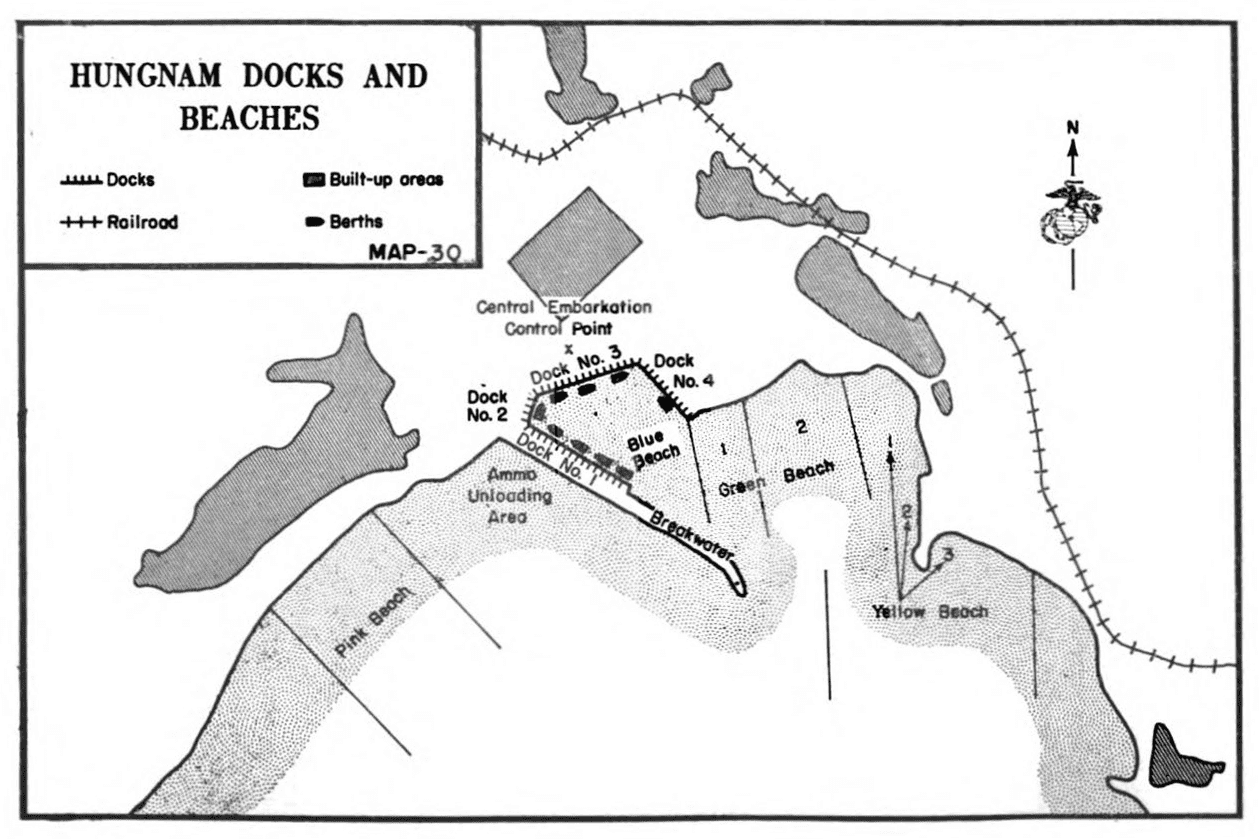
HUNGNAM DOCKS AND
BEACHES
MAP-30
“With naval, air and surface units effectively isolating the beachhead,
we were able to take our time and get everything out,” commented
Admiral Joy on 26 December. “Admiral Doyle has turned in
another brilliant performance. We never, never contemplated a Dunkirk—not
even faintly.”639
While the remaining X Corps units completed outloading at Hungnam,
the Marines were landing at Pusan and proceeding by motor march to
their new assembly area in the vicinity of Masan. General Craig, the
ADC, had gone ahead with the advance party from Hungnam and
made arrangements for the reception of the Division.640
News from the front in West Korea was not encouraging as the
Eighth Army planned further withdrawals, for G-2 reports indicated
that the advancing Chinese were about to launch a great new offensive
shortly. Despite the persistent rumors that all Korea might be evacuated
by UN forces, General MacArthur insisted in his special communique
of 26 December that operations “were skilfully conducted without
loss of cohesion and with all units remaining intact....
In its broad implications I consider that these operations, initiated on
24 November and carried through to this [Hungnam] redeployment, have
served a very significant purpose—possibly in general result the most significant
and fortunate of any conducted during the course of the Korean campaign.
The might of a major military nation was suddenly and without warning
thrown against this relatively small United Nations Command but without
attaining a decision.
Due to intervening circumstances beyond our power to control or even
detect, we did not achieve the United Nations objective.
But at a casualty cost less than that experienced in a comparable period of
defensive fighting on the Pusan perimeter, we exposed before too late secret
political and military decisions of enormous scope and threw off balance
enemy preparations aimed at surreptitiously massing the power capable of
destroying our forces with one mighty extended blow.”641
Questions as to the proper evaluation of the Eighth Army withdrawal
turned into a controversy during coming months with political as well
as military implications. Press representatives, military critics and soldiers
of other nations, while crediting MacArthur with a great victory
at Inchon, were for the most part of the opinion that the Eighth Army
withdrawal of November and December was a costly reverse.642
Marine officers in Korea had no first-hand knowledge of EUSAK operations.
It was obvious, however, that an Eighth Army retirement south
of the 38th Parallel had made it desirable if not actually necessary for
X Corps to withdraw from northeast Korea, even though General
Almond held that a Hamhung-Hungnam perimeter could be defended
throughout the winter.
The close coordination of aviation with the ground forces in the Chosin
campaign was due in large measure to the assignment of additional
pilots to the 1st Marine Division as forward air controllers. They had
been plucked from 1st Marine Aircraft Wing squadrons barely in time
to join their battalions before embarking at Inchon. Increasing the
number of FACs to two per battalion did much to bring air support
down to the company level when needed.643
Air units frequently had to rely upon charts with place names, grid
coordinates, and scales different from those in the hands of the ground
troops. Here the Marine system of the man on the ground talking the
pilot onto the target by reference to visual land marks paid off.
Cloudy, stormy weather was common. Three night fighter pilots
were lost because of icing, disorientation, and insufficient radio aids to
navigation. Two VMF-212 land-based pilots saved themselves from
destruction only by landing on the Badoeng Strait with their last drops
of gas.
With the approach of winter and cold weather, aircraft on the landing
strips had to be run up every two hours at night to keep the oil
warm enough for early morning takeoffs. Ordnance efficiency dropped.
Planes skidded on icy runways. Once, after a six inch snow, 80 men
and ten trucks worked all night to clear and sand a 150-foot strip down
the runway at Yonpo.644
As early as mid-November it once took hours of scraping and chipping
on the Badoeng Strait to clear three inches of glazed ice and snow
off the decks, catapults, arresting wires, and barriers. Planes which
stood the night on the flight deck had to be taken below to the hangar
deck to thaw out. On another occasion VMF-214 had to cancel all
flight operations because 68-knot winds, heavy seas, and freezing temperatures
covered the Sicily’s flight deck and aircraft with a persistent
coat of ice.
One pilot of VMF-323 had to return shortly after takeoff because
water vapor froze in his oil breather tube in flight. With the back pressure
throwing oil all over his windshield and billowing black vapor and
smoke out of his cowl, he landed only to have the front of his Corsair
burst into flames when the escaped oil dripped on the hot exhaust
stacks. Quick work by the deck crews extinguished the fire.
A hazard as great as being shot down was a crash landing or bail-out
at sea, where the water was cold enough to kill a man in 20 minutes.
Survival clothing and equipment was so bulky that pilots could barely
get into their cockpits.
Maintenance and servicing problems ashore, complicated by dirt,
dust, and the scarcity of parts, kept mechanics working to the point of
exhaustion. Insufficient trucks forced the ground crews to refuel and
arm planes by hand, often from rusting fuel drums. Two destructive
crashes, one fatal, were attributed to accumulated water in gasoline.
Aboard ship until mid-November, VMF-214 was able to keep 91 per
cent of its planes operative. When suddenly deployed ashore to Wonsan,
its aircraft availability dropped to 82 per cent and at Yonpo to
67 per cent. Once back at sea again in December, it jumped up to
90 per cent.
Basic difference in close air support doctrine between the Navy and
Marines and Air Force were resolved by close and friendly liaison
between the 1st Marine Aircraft Wing and the Fifth Air Force commands;
by a Marine aviator attached to the Joint Eighth Army-Fifth
Air Force Operations Center at Seoul; and by indoctrination of non-Marine
units of the X Corps in the Marine-Navy style of close air
support. Difficulties in inter-service communications slowed Fifth Air
Force operations orders to carrier squadrons, both Navy and Marine.
Messages were routed via FEAF and ComNavFe in Tokyo and arrived
hours late. Ashore, even MAG-12 during the first two weeks at Wonsan
received its Fifth Air Force mission orders six to 36 hours late.
A direct radio teletype between 1st MAW and 5thAF headquarters
alleviated the situation. And when the CG 1st MAW received full
control of the air over the X Corps area on 1 December, these problems
were eased.
Actual control of air support for the scattered ground units demonstrated
close cooperation between the Navy and Marine Corps. This
was evident from the time the Navy’s Tactical Air Control Squadron
One on the USS Mount McKinley passed control to the Air Defense
Section of MTACS-2 at Hamhung to the time that control returned to
the ship in the Hungnam evacuation.
When the Marines had control, the ship stood by as an emergency
TACC and acted as a radar reporting station for MTACS-2. When control
was passed back afloat, the Air Defense Section of MTACS-2 stood
by as a standby TACC aboard an LST until the last man was pulled off
the beach. Furthermore, three officers from MGCIS-1 went aboard
Mount McKinley to help out as Air Defense controllers. They were
experienced. All through the Wonsan-Chosin campaign, the MGCIS
had directed the defensive fighter patrols, circling Wonsan and Yonpo,
to check all unidentified aircraft before the latter got close enough
to do any damage, MGCIS-1 also steered lost planes to base in bad
weather, occasionally vectored them into the GCA radar-controlled
landing pattern, and even assisted MTACCS-2 in directing air support
planes to FACs.645
Tactical air support in the X Corps zone was directed to the ground
units by the Air Support Section of MTACS-2. From 26 October to 11
December, 3703 sorties in 1053 missions were controlled by the TACPs
of Marine, Army, and ROK units. Close air support missions accounted
for 599 of the total (468 for 1st Marine Division, 8 for 3d Infantry
Division, 56 for 7th Infantry Division, and 67 for ROKs). The remaining
454 missions were search and attack.646
When FAC communications failed from valley to valley, aircraft
became radio relays and controllers. This was highlighted by the
airborne TADC, orbiting over the road from Hagaru.
Approximately half of the Marine air missions were in support of
non-Marine ground units. The ROK and the U. S. Army units were
not as well supplied with experienced FACs as the 1st Marine Division.
In these areas four Air Force “Mosquitos” (AT-6 “Texan” training
planes) were assigned to X Corps to assist in the control of air support.647
When shore-based Marine air support was about to cease with the
closing of Yonpo air field, VMF-214 and VMF-212 quickly moved
their operations aboard carrier; and during the final phases of the Hungnam
evacuation, almost half of the Marine tactical air strength was
operating from carrier bases. VMF-214 flew back aboard Sicily on 7
December without missing a mission and VMF-212, which had moved
to Itami on 4 December to draw and test a new complement of carrier
Corsairs, was aboard the USS Bataan eight days later. When the month
ended, still another squadron, VMF-312, was polishing up its carrier
landing technique for seaborne duty.648
The outcome of the Hagaru withdrawal owed much to air-dropped
supplies and to casualty evacuations by General Tunner’s Combat
Cargo Command (CCC). Assisting Combat Cargo in Marine support
were the Wing’s R4D twin engine transports and TBM World War II
type torpedo bombers, both of which were flown largely by the field-desk
pilots on the Wing and Group staffs. Most of the Marines’ share
of the heavy airlifting, however, was done by the four engine R5D
transports of Colonel Dean C. Roberts’ VMR-152. Early in October
this squadron had been temporarily shifted from the trans-Pacific airlift
of the Navy’s Fleet Logistics Air Wing to support the Marines in the
Wonsan campaign. In Korea its operations were controlled by the
Combat Cargo Command, which committed an average of five Marine
R5D’s a day into the CCC airlift. In such missions these transports
supported all UN units from Pyongyang to Yonpo and points north.
Marine transports not committed by the CCC for general UN support
in Korea were available for Wing use. From 1 November until
Christmas, VMR-152 safely carried five million pounds of supplies
to the front and evacuated more than 4000 casualties.649
The Chosin Reservoir campaign opened two new chapters in Marine
aviation history. The first was the use of the airborne TADC to control
the air support of the division column between Hagaru and Chinhung-ni.
The second was the appearance of VMF-311, the first Marine jet
squadron to fly in combat. Beginning on 10 December the newly
arrived squadron flew interdiction missions for four days from Yonpo.
Then it moved to Pusan to operate for the remainder of the month
with 5th Air Force jets streaking up the long peninsula to cover the
withdrawal of the Eighth Army.650
Appreciation for the assistance given by Marine aviation to Marine
ground forces was expressed in a letter of 20 December from General
Smith to General Harris, the Commanding General of the 1st Marine
Air Wing. The Division Commander said:
Without your support our task would have been infinitely more difficult
and more costly. During the long reaches of the night and in the snow storms
many a Marine prayed for the coming of day or clearing weather when he
knew he would again hear the welcome roar of your planes as they dealt out
destruction to the enemy. Even the presence of a night heckler was reassuring.
Never in its history has Marine Aviation given more convincing proof of
its indispensable value to the ground Marines. A bond of understanding
has been established that will never be broken.651
The story of air support in the Chosin Reservoir campaign would not
be complete without a summary of the results of VMO-6. Marines took
a proprietary interest in Major Gottschalk’s squadron, which had put
into effect the helicopter techniques worked out at Quantico by the
experimental squadron, HMX-1. Some of these techniques were having
their first test in combat, for the development of rotary-wing
aircraft in 1950 was at a pioneer stage comparable to that of fixed-wing
aircraft in the first year of World War I. On 28 October, VMO-6 had
a strength of 25 officers, 95 enlisted men, ten light fixed-wing aircraft
(eight OY-2s, two L5Gs) and nine HO3S-1 helicopters. From that
date until 15 December the squadron made 1544 flights for a total of
1624.8 hours. The principal missions were as follows:
Reconnaissance—OYs, 393; helicopters, 64; Transportation—OYs, 130;
helicopters, 421; Evacuation—OYs, 29; helicopters, 191; Liaison—OYs, 35;
helicopters, 90; Artillery spot—OYs, 39; helicopters, 0; Utility—OYs, 26;
helicopters, 60; Rescue—OYs, 0; helicopters, 11.652
But statistics can give no idea of the most significant achievement
of VMO-6 in the Reservoir campaign. For during the most critical
period the only physical contact between units separated by enemy
action was provided by the OYs and helicopters. The importance of
this contribution can hardly be overestimated.
Marine losses in northeast Korea, as reported to the Secretary of the
Navy, included a total of 4418 battle casualties from 26 October to 15
December 1950—604 KIA, 114 DOW, 192 MIA, and 3508 WIA. The
7313 non-battle casualties consisted largely of minor frostbite and
indigestion cases who were soon restored to active duty.653 Eight Marine
pilots were KIA or died of wounds, four were MIA, and three were
wounded. General Smith estimated that a third of the non-battle casualties
were returned to duty during the operation.654
Enemy losses for the same period were estimated at a total of 37,500—15,000
killed and 7500 wounded by Marine ground forces, plus
10,000 killed and 5000 wounded by Marine air. Not much reliance
can be placed in such figures as a rule, but fortunately we have enemy
testimony as to heavy losses sustained by the Chinese Communists.
This evidence goes far toward explaining why they did not interfere
with the Hungnam redeployment.
Contrary to expectations, Chinese military critiques have been candid
in admitting failures and unsparing in self-criticism. Among captured
documents are summaries of the operations of the three CCF armies
encountered by the Marines in the Chosin Reservoir area. These major
units, representing at least 11 and probably 12 divisions, were as follows:
20th CCF Army—58th, 59th, and 60th Divisions, with the 89th Division
of the 30th Army attached;
26th CCF Army—76th, 77th, and 78th Division, with probably the 94th
Division of 32d Army attached;
27th CCF Army—79th, 80th, and 81st Divisions, with the 70th Division
of 24th Army attached.655
All three armies were major units of the 9th Army Group of the
3d CCF Field Army. In mid-October the leading elements of the 4th
CCF Field Army had crossed the Yalu to oppose the U. S. Eighth Army.
The operations of X Corps in northeast Korea being considered a threat
to the left flank, the 42d Army was detached with a mission of providing
flank protection, pending relief by units of the 3d CCF Field Army.
Three divisions, the 124th, 125th, and 126th were represented. While
the last hovered on the left flank of the 4th Field Army, the 124th was
hard hit near Sudong during the first week of November by RCT-7
of the 1st Marine Division.
In order to cover the withdrawal of the remnants, the 125th Division
moved south of Hagaru from the Fusen Reservoir area. Both CCF
divisions then fell back to Yudam-ni, where they were relieved by units
of the 20th Army, 3d Field Army. This ended the operations of the 4th
Field Army in northeast Korea.
Shortly after the appearance of the 20th Army in the Yudam-ni area,
the 27th Army moved into positions north of the Chosin Reservoir.
Thus the enemy had available eight divisions for the attacks of 27–28
November on the Marines in the Yudam-ni area and the three 7th
Infantry Division battalions east of the Chosin Reservoir. If it may be
assumed that these CCF divisions averaged 7500 men each, or three-fourths
of full strength, the enemy had a total of 60,000 men in assault
or reserve.
The Chinese, as we know, failed to accomplish their basic mission,
which prisoners agreed was the destruction of the 1st Marine Division.
In every instance the efforts of the first night were the most formidable,
with enemy effectiveness declining sharply after a second or third
attack. The explanation seems to be that the 12 divisions were sent
into northeast Korea with supplies which would have been sufficient
only if the first attempts had succeeded. The following comment by
the 26th Army supports this conclusion:
A shortage of transportation and escort personnel makes it impossible to
accomplish the mission of supplying the troops. As a result, our soldiers
frequently starve. From now on, the organization of our rear service units
should be improved.656
The troops were hungry. They ate cold food, and some had only a few
potatoes in two days. They were unable to maintain the physical strength
for combat; the wounded personnel could not be evacuated.... The fire
power of our entire army was basically inadequate. When we used our guns
there were no shells and sometimes the shells were duds.
The enemy’s tactical rigidity and tendency to repeat costly errors are
charged by the 20th Army to inferior communications:
Our signal communication was not up to standard. For example, it took
more than two days to receive instructions from higher level units. Rapid
changes of the enemy’s situation and the slow motion of our signal communication
caused us to lose our opportunities in combat and made the instructions
of the high level units ineffective....
We succeeded in the separation and encirclement of the enemy, but we
failed to annihilate the enemy one by one. The units failed to carry out the
orders of the higher echelon. For example, the failure to annihilate the
enemy at Yut’an-ni [Yudam-ni] made it impossible to annihilate the enemy
at Hakalwu-ri [Hagaru]. The higher level units’ refusal of the lower level
units’ suggestion of rapidly starting the combat and exterminating the enemy
one by one gave the enemy a chance to break out from the encirclement.
One of the most striking instances of the tactical inflexibility which
stultified Chinese efforts was found at Hagaru. With only a depleted
Marine Infantry battalion and service troops available to defend a
perimeter four miles in circumference, the enemy needed mere daylight
observation to ascertain and avoid the most strongly defended positions.
Yet these were just the positions chosen for the attack, not only on the
first night but also the second occasion 48 hours later.
“The [CCF] tactics were mechanical,” commented the 27th Army.
“We underestimated the enemy so we distributed the strength, and
consequently the higher echelons were overdispersed while the lower
echelon units were overconcentrated. During one movement, the distance
between the three leading divisions was very long, while the
formations of the battalions, companies, and units of lower levels were
too close, and the troops were unable to deploy. Furthermore, reconnaissance
was not conducted strictly; we walked into the enemy fire net
and suffered heavy casualties.”
Summing up the reasons why the Marines at Yudam-ni were not
“exterminated promptly,” the 27th Army concludes that it was “because
our troops encountered unfavorable conditions during the missions
and the troops suffered too many casualties.” This would seem to be
another way of saying that the Chinese failed to destroy the 1st Marine
Division because they themselves were nearly destroyed in the attempt.
At any rate, evidence from the enemy documents points overwhelmingly
to crippling losses both from Marine fire power and non-battle casualties
chargeable to lack of equipment and supplies.
The 20th Army had a hundred deaths from tetanus caused by improper
care of wounds. Hundreds of other soldiers were incapacitated
by typhus or ailments of malnutrition and indigestion.
More than 90 per cent of the 26th Army suffered from frostbite.
The 27th Army complained of 10,000 non-combat casualties alone out
of a strength of four divisions:
The troops did not have enough food, they did not have enough houses to
live in, they could not stand the bitter cold, which was the reason for the
excessive non-combat reduction in personnel (more than 10 thousand persons),
the weapons were not used effectively. When the fighters bivouacked
in snow-covered ground during combat, their feet, socks, and hands were
frozen together in one ice ball; they could not unscrew the caps on the hand
grenades; the fuses would not ignite; the hands were not supple; the mortar
tubes shrank on account of the cold; 70 per cent of the shells failed to detonate;
skin from the hands was stuck on the shells and the mortar tubes.
Testimony as to the effects of Marine fire power is also given by
the 26th Army:
The coordination between the enemy infantry, tanks, artillery, and airplanes
is surprisingly close. Besides using heavy weapons for the depth, the
enemy carries with him automatic light firearms which, coordinated with
rockets, launchers, and recoilless guns are disposed at the front line. The
characteristic of their employment is to stay quietly under cover and open
fire suddenly when we come to between 70 and 100 meters from them,
making it difficult for our troops to deploy and thus inflicting casualties
upon us.
The 20th and 27th Armies appear to have been bled white by the
losses of the first week. Early in December, units of the 26th Army
appeared on the east side of the MSR between Hagaru and Koto-ri, and
this unit furnished most of the opposition from 6 to 11 December.
Seven divisions in all were identified by the 1st Marine Division; and
since the taking of prisoners was not a matter of top priority with men
fighting for existence, it is likely that other CCF units were encountered.
The CCF 9th Army Group, according to a prisoner questioned on
7 December, included a total of 12 divisions. This POW gave the
following statement:
Missions of the four (4) armies in 9th Group are to annihilate the 1st
Division which is considered to be the best division in the U. S. After
annihilating the 1st Marine Division they are to move south and take Hamhung.657
As to the reason why the Chinese took no advantage of the Hungnam
redeployment, there seems little doubt that the 9th Army Group was
too riddled by battle and non-battle casualties to make the effort. This
is not a matter of opinion. Following the Hungnam redeployment, as
the U. S. Eighth Army braced itself to meet a new CCF offensive, UN
and FECOM G-2 officers were naturally concerned as to whether the
remaining 9th Army Group troops in northeast Korea would be available
to strengthen the CCF 4th Field Army. It was estimated that only
two weeks would be required to move these troops to West Korea,
where they had the capability of reinforcing the CCF attack against
the Eighth Army.
Efforts to locate the 9th Army Group were unavailing for nearly
three months. Then a prisoner from the 77th Division of the 26th
Army was captured by U. S. Eighth Army troops on 18 March 1951.
During the following week POW interrogations established that three
divisions of the 26th Army were in contact with Eighth Army units
northeast of Seoul.
“The only conclusion to be drawn,” comments the Marine Corps
Board Study, “based on information collected by 1stMarDiv and X
Corps, and that by UN and FEC, is that all corps of 9th Army Group
had been rendered militarily ineffective in the Chosin Reservoir operation
and required a considerable period of time for replacement, re-equipment,
and reorganization.”658
Thus it appears that the Marines not only saved themselves in the
Chosin Reservoir fights; they also saved U. S. Eighth Army from being
assailed by reinforcements from northeast Korea in the CCF offensive
which exploded on the last night of 1950.
There could be no doubt, after taking into account the CCF mission,
that the 9th Army Group, 3d Field Army, had sustained a reverse in
northeast Korea which amounted to a disaster. On the other hand, it
might have been asked whether a retrograde movement such as the
Marine breakout, even though aggressively and successfully executed,
could be termed a victory.
This question involves issues too complex for a clearcut positive
answer, but it would be hard to improve upon the analysis of results in
the Marine Corps Board Study:
Although the operations of this phase constitute a withdrawal, despite the
fact that CG 1stMarDiv characterized them as “an attack in a new direction,”
the withdrawal was executed in the face of overwhelming odds and conducted
in such a manner that, contrary to the usual withdrawal, some very
important tactical results were achieved. These may be summarized as
follows:
1. Extricated 1stMarDiv from a trap sprung by overwhelming enemy
ground forces by skilful employment of integrated ground and air action
which enabled the Division to come through with all operable equipment,
with wounded properly evacuated and with tactical integrity.
2. Outfought and outlasted at least seven CCF divisions under conditions
of terrain and weather chosen by the enemy and reputedly to his liking.
Although frostbite took a heavy toll of the Division it hit CCF units far
harder, perhaps decisively.
3. In the process of accomplishing “2” above, rendered militarily non-effective
a large part of 9th CCF Army Group. Those units not contacted
by 1stMarDiv were fixed in the Chosin Reservoir area for possible employment
against the Division and consequently suffered from the ravages of
sub-zero cold and heavy air attacks.
4. As a direct result of “3” above, enabled X Corps to evacuate Hungnam
without enemy interference and, consequently, as a combat effective unit with
all personnel and serviceable equipment. Pressure on X Corps by 9th CCF
Army Group during the seaward evacuation of the Corps, a most difficult
operation, would undoubtedly have altered the result.659
Improvisations in tactics were now and then made necessary by
unusual conditions of terrain, weather or enemy action. But on the
whole the Marines saved themselves in the Reservoir campaign by the
application of sound military tactics. In the doing they demonstrated
repeatedly that the rear makes as good a front as any other for the
militarily skilled and stout-hearted, and that a unit is not beaten merely
because it is surrounded by a more numerous enemy.
Inevitably the Marine campaign has been compared to that classic of
all military breakouts—the march of the immortal Ten Thousand
which is the subject of Xenophon’s Anabasis. Stranded in the hostile
Persian Empire in the year 401 B. C., these Greek mercenaries cut their
way to safety through Asiatic hordes. The following description of the
tactics used by Xenophon and his lieutenant Cherisophus to overcome
road blocks in mountain country will have a familiar ring to Marine
veterans of the Reservoir:
The enemy, by keeping up a continuous battle and occupying in advance
every narrow place, obstructed passage after passage. Accordingly, whenever
the van was obstructed, Xenophon, from behind, made a dash up the hills
and broke the barricade, and freed the vanguard by endeavoring to get above
the obstructing enemy. Whenever the rear was the point attacked, Cherisophus,
in the same way, made a detour, and by endeavoring to mount higher
than the barricaders, freed the passage for the rear rank; and in this way,
turn and turn about, they rescued each other, and paid unflinching attention
to their mutual needs.660
Spears and arrows have been superseded by bazookas and machine
guns, but the basic infantry tactics of the Reservoir breakout were essentially
those which served Xenophon and the Ten Thousand more than
33 centuries ago. Organization, combat, training, spirit, and discipline
enabled the Marines, like the Hellenes before them, to overcome
numerical odds and fight their way over Asiatic mountain roads to the
sea.
The over-all strategic effects of the Reservoir campaign, as summarized
by the Marine Corps Board Study, were as follows:
1. Played a prominent part ... in enabling X Corps, a considerable segment
of the total UN forces in Korea, to be withdrawn from Hungnam as a
combat effective force available for employment with the Eighth Army in
South Korea at a time when that Army was retreating and was in critical
need of a reinforcement.
2. Were largely responsible for preventing reinforcement of CCF forces
on Eighth Army front by 12 divisions during a period when such reinforcement
might have meant to Eighth Army the difference between maintaining
a foothold in Korea or forced evacuation therefrom, by being instrumental in
rendering 9th CCF Army Group, a force of three corps of four divisions
each, militarily noneffective for a minimum period of three months.
That the breakout of the 1st Marine Division had affected American
political and military policy at the highest levels was the assertion of an
editorial in Time. Referring to what it termed the “Great Debate,” in
December 1950, as to whether American forces should be withdrawn
from Korea, the news-magazine commented:
When the Marines fought their way down to Hungnam through the
“unconquerable Chinese hordes,” and embarked for Pusan with their equipment,
their wounded, and their prisoners, the war in Asia took on a different
look. The news stories, pictures and newsreels of the Hungnam action contributed
more to forming U. S. policy than all the words in the “Great
Debate.” The nation—and the revitalized Eighth Army—now knows that
U. S. fighting men will stay in Korea until a better place and a better opportunity
is found to punish Communist aggression.661
General Douglas MacArthur as CINCUNC, in his 11th report of
operations of UN forces in Korea, submitted the following to the
United Nations Organization regarding the Chosin Reservoir operation:
In this epic action, the Marine Division and attached elements of the 7th
Infantry Division marched and fought over 60 miles in bitter cold along a
narrow, tortuous, ice-covered road against opposition of from six to eight
Chinese Communist Force divisions which suffered staggering losses. Success
was due in no small part to the unprecedented extent and effectiveness of air
support. The basic element, however, was the high quality of soldierly
courage displayed by the personnel of the ground units who maintained their
integrity in the face of continuous attacks by numerically superior forces,
consistently held their positions until their wounded had been evacuated, and
doggedly refused to abandon supplies and equipment to the enemy.
United Nations Air Forces threw the bulk of their effort into close support
of ground forces cutting their way through overwhelming numbers of Chinese
Communists. The toll of the enemy taken by the United Nations aircraft
contributed in large measure to the successful move of our forces from the
Chosin Reservoir to the Hamhung area despite the tremendous odds against
them. Air support provided by the United States Marine Air Force and Naval
Aircraft in this beleaguered area, described as magnificent by the ground
force commanders, represented one of the greatest concentrations of tactical
air operations in history.662
Rear Admiral James H. Doyle attributed the successful evacuation
at Hungnam in large measure to the Marine breakout. Writing to
General Smith several months later, he asserted that he had “filled in
what has been a neglected page in the story of the Hungnam redeployment.
It is simply this: that the destruction of enemy forces wrought
by the First Marine Division on the march down the hill was a major
factor in the successful withdrawal; and that the destruction was so
complete the enemy was unable to exert serious pressure at any time on
the shrinking perimeter. To my mind, as I told you at Hungnam, the
performance of the First Marine Division on that march constitutes
one of the most glorious chapters in Marine Corps history.”663
Letters of commendation were received by the 1st Marine Division
from General Cates, CMC, General Shepherd, Admiral Joy, General
Collins, Chief of Staff, USA, General Almond, and many other high-ranking
military leaders. But for depth of feeling, for sincerity and
emotion, there was no message which appealed more to the officers and
men of the Division than the concluding paragraph of this tribute
from the commanding general who had guided their destinies with
unswerving courage and who had come out with them, Major General
Oliver P. Smith:
The performance of officers and men in this operation was magnificent.
Rarely have all hands in a division participated so intimately in the combat
phases of an operation. Every Marine can be justly proud of his participation.
In Korea, Tokyo and Washington there is full appreciation of the remarkable
feat of the division. With the knowledge of the determination, professional
competence, heroism, devotion to duty, and self-sacrifice displayed by officers
and men of this division, my feeling is one of humble pride. No division
commander has ever been privileged to command a finer body of men.664