Units of North Korean Army—NKPA Command and Leadership—The
NKPA Infantry Division—NKPA Air and Armor—NKPA
Officer Procurement and Conscription—The NKPA Order
of Battle
It was an army of veterans that broke the world’s peace in Korea.
There were thousands of veterans of the Chinese civil war and Manchurian
guerrilla operations. There were even a few scarred warriors who
had served with the Soviet forces in such World War II operations as
the defense of Stalingrad.
Practically all the commissioned and noncommissioned officers were
battle-hardened, and a majority of the rank and file had seen action. The
origins of this army were deeply rooted in Asiatic soil. During World
War II an endless stream of Koreans escaped from Japanese bondage
and found a refuge in Soviet or Chinese territory. Some of them took to
banditry, others were absorbed into the Soviet or Red Chinese armed
forces. These refugees dreamed of a united and independent homeland;
and at Yenan, China, the Chinese Communists encouraged this movement
as early as 1939 by supplying arms to a force known as the Korean
Volunteer Army. During the first month alone the KVA attracted 3,000
recruits, and at the end of the war an advance column marched back to
Korea under a leader named Kim Mu Chong.21
Although the heads of the KVA had been thoroughly impregnated
with Communist doctrine at Yenan, they were coldly received by General
Chistyakov and the Russian occupation forces. It was a Soviet puppet
state that the Kremlin wished to see established in Korea, not a Red-tinted
independent Korean government. Communist right-thinking did
not save Kim Mu Chong and his KVA troops from the humiliation of
being stopped at the frontier in September 1945 and disarmed.
The Russian commander piously justified his decision on grounds of
upholding international law. But he offered to return the confiscated
arms if the Korean Reds would retrace their steps and join the CCF
fight against the Nationalists. He promised that after the struggle had
been won, the KVA would be welcomed back to Korea.22
Accepting these terms, Kim Mu Chong marched into Manchuria to
aid the Chinese Reds. His force numbered nearly 20,000 the following
spring, but the KVA lost its identity when the men were mingled with
Chinese and Mongolians in the CCF Northeast Democratic United
Army. Most of the officers and NCO’s of the former KVA were organized
into teams to recruit and train Korean volunteers both in Manchuria
and Korea. As combined military instructors and political commissars,
they created an integrated Communist force out of such oddly
assorted material as peasants, guerrillas and bandits. Used first as security
troops and later welded into a regular army structure, these thousands of
Korean Reds undoubtedly had the principal part in “liberating” Manchuria
from the Chinese Nationalists.
Meanwhile, the Russian occupation forces did not neglect the conversion
of North Korea into a satellite state. One of the first steps was
the establishment of a military academy at Pyongyang in the autumn of
1945. Founded ostensibly for the training of police, it had as its primary
purpose the instruction of army officers. Graduates of the first and second
classes became teachers when branches of the academy were set up
at Nanam, Sinuiju and Hamhung. These offshoots, known as the Peace
Preservation Officers’ Schools, turned out the cadres which were later
activated as the 1st, 2d and 3d Divisions of the new North Korean army.
For more than 2 years, however, the fiction was maintained that graduates
were to patrol rural areas, protect railroads and guard the frontier.
Not until 8 February 1948 did the “North Korean People’s Army” come
into official being with the activation of the 1st, 2d and 3d Infantry
Divisions. At that time there were some 30,000 troops and 170,000
trainees in North Korea, according to later United States Army intelligence
estimates.23
The 4th Infantry Division was formed in 1948 from trainees plus a
veteran regiment transferred from the 2d Division. Two new infantry
divisions, the 5th and 6th, were organized the following year when
Korean veterans of the 164th and 166th CCF Divisions returned as units
with their arms and equipment.24
It is probable that the leaders of the North Korean state were committed
early in 1950 to the invasion of the Republic of Korea. At any
rate, the training and organization of new units was accelerated during
the spring months. From February to June nine new divisions were activated—the
7th, 8th, 9th, 12th, 13th, 14th, and 15th Infantry Divisions,
10th Mechanized Infantry Division and 105th Armored Division.25
Two factors combined to hasten the NKPA aggression. It had undoubtedly
become evident to the Kremlin in 1949 that the Republic of
Korea could never be brought into the Communist fold by propaganda,
subversion, incitation of disorders or any other means short of a victorious
civil war. Moreover, a successful war of invasion was equally desirable
as a cure for political discontent at home. Not only was the
Agrarian Reform resented everywhere in North Korea, but taxes had
gone up as high as 60 percent of the crops to maintain the top-heavy
military structure and pay for tanks, planes, howitzers and other arms
supplied by the Soviet Union.
Although most of the heavy industries of Korea were located north
of the 38th Parallel, they included no arms plants with the exception of
a small factory capable of turning out submachineguns and ammunition.
North Korea was also able to produce 80 percent of its own POL
products for military purposes and some of the army uniforms. Other
supplies, all the way from the Tokarev semiautomatic pistol (adapted
from the U. S. .45 Colt) to the T-34 tank, were imported from the
U. S. S. R.26
Most of the weapons were old models of recent manufacture. The
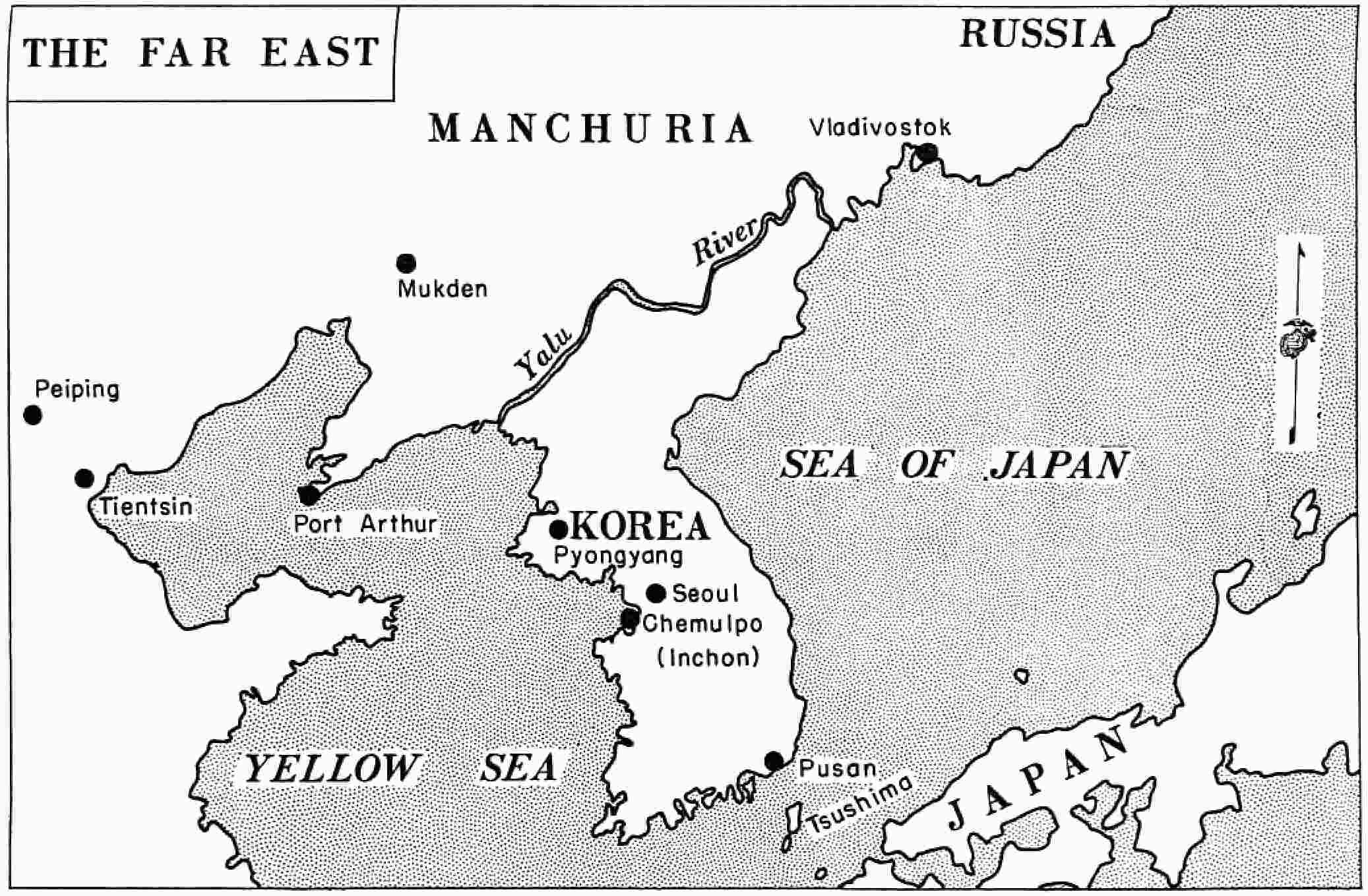
heaviest load came by rail from Siberia through Manchuria via Antung
and crossed the Yalu into Korea at Sinuiju. As many as three freight
trains a day rumbled over the bridge between those cities and continued
along the west coast to Pyongyang. Supplies were also received from
Vladivostok by water to Chongjin or by the east coast rail line to
Wonsan.27
It must also be remembered that thousands of Korean veterans of the
Chinese civil war returned with their arms and equipment, including
American-manufactured weapons surrendered by the Nationalists. The
NKPA was second only to the Soviet Army itself in the spring of 1950
as the best armed and equipped military force of its size in the Far East.
The U. S. S. R. did not limit its aid to arms. Lieutenant General
Vasilev and a group of Soviet military instructors arrived at Pyongyang
in 1949 to train NKPA staff and line officers for offensive warfare. About
3,000 promising NKPA candidates were sent to Soviet schools that year
for courses in such specialties as artillery, air and tank tactics.
Of the original 14 NKPA divisions, the first 6 were composed largely
of well trained troops. The 12th Division, like the 5th and 6th, consisted
of Korean veterans of the Chinese civil war. Constabulary troops
made up the 8th and 9th, while the 7th, 13th, 14th, and 15th Infantry
Divisions and the 10th Mechanized Infantry Division were formed of
conscripted trainees for the most part.28
The picture grows confused in the spring of 1950, with 8 new divisions
being organized in 5 months. Many of the recently drafted men
received only the most sketchy training; and some of the older units
were weakened by drawing off well trained men to stiffen the new outfits.
All accounts agree, however, that the NKPA leaders anticipated an
effort of only a few days, ending with the destruction of the ROK army.
This was not an unreasonable assumption, since a swarm of NKPA spies
had brought back accurate reports of unpreparedness. Not only was the
Republic of Korea weak militarily, but a bad economic situation had
been made worse by increased population due to immigration.
Altogether, Pyongyang could put nearly 100,000 fairly well-trained
and armed troops in the field, with about half of that number in reserve
as replacements, occupation troops or constabulary. But the problem of
man power did not worry Communists who were not squeamish about
violations of international law. For the aggressors planned to make war
nourish war by conscripting both soldiers and laborers in invaded
regions of the Republic of Korea. It was an old Asiatic custom.
With few exceptions, the North Korean war leaders proved to be willing
and able instruments of policies formulated in Moscow. Kim Il
Sung, the prime minister and commander in chief, was an imposter
named Kim Sung Chu who made a bid for popular support by taking
the name of a dead Korean resistance hero. As a youth he had fled from
Korea and joined the Communist party in Manchuria. There he distinguished
himself in guerrilla operations against the Japanese. In 1938,
after rising to the stature of a corps commander, he met military reverses
and found a refuge in Soviet territory. Legend has it that he attended
a Soviet military academy and took part in the battle of Stalingrad.
However this may be, he returned to Korea in August 1945 as a
35-year-old captain in the Soviet army of occupation.29
South Korean descriptions of Kim Il Sung as an uneducated ruffian
were doubtless prejudiced, but certainly he was a ruthless guerrilla leader
who showed an uncommon aptitude for politics. His rise in the new
North Korean state was spectacular, for in September 1948 he became
the first prime minister. The following year he went to Moscow for conferences
at the Kremlin, and nine days after the outbreak of civil war in
Korea he was appointed commander in chief of the invading army while
retaining his position as prime minister.
In contrast to this rough diamond, Marshal Choe Yong Gun cut a
reserved and dignified figure as deputy commander in chief and minister
of national defense. Born in Hongchon, Korea, at the turn of the century,
he had the equivalent of a high school education. In 1925 he went
to China and is believed to have attended the Whampoa Military
Academy at Nanking and the Yenan Military School. At Yenan, after
being converted to communism, he became a political instructor and
later served in the 8th Route Army. Choe was commander of the Korean
Volunteer Army in 1941 and fought against the Japanese in Manchuria.
Returning to Korea in 1945, he commanded the Cadre Training Center
until 1948, when he was named the first commander in chief.
Even Choe’s enemies in South Korea credited him with a high order
of intellectual capacity and moral courage. Despite his Communist party
membership, he opposed the invasion of the Republic of Korea. He was
cool, moreover, toward Lieutenant General Vasilev and the other Soviet
advisers who reached Pyongyang in 1949 to prepare the Korean armed
forces for an offensive war. This attitude probably explains why he was
sidetracked in March 1950, when Vasilev took charge of the combat
training and re-equipment program. Although Choe was not on good
terms with Kim Il Sung at this time, he was regarded as a superior strategist
and administrator. And after being bypassed temporarily, he continued
to be respected as a leader by the North Korean army and
peasantry.
Nam Il stood out as the most cosmopolitan and polished of the
North Korean war leaders. Born in 1911, he was Kim Il Sung’s schoolmate
in Manchuria and the two remained lifelong friends. As a young
man, Nam Il made his way across the U. S. S. R. to Smolensk and attended
college and a military academy. He entered the Soviet army at
the outbreak of World War II and is said to have participated along with
Kim Il Sung in the Stalingrad defense.
Both of them returned to Korea with the rank of captain in the Soviet
army of occupation, and both entered upon successful Communist
political careers. In 1948 Nam Il was elected to the Supreme People’s
Council and became vice-minister of education in charge of military instruction.
The most Russianized of the North Korean leaders, he took
pains to cultivate the good will of the Soviet advisers. Speaking English,
Russian, and Chinese as well as Korean, he held an advantage over his
North Korean rivals in such contacts. He also made a better appearance,
being tall for an Oriental and always well turned out in a meticulously
pressed uniform and gleaming boots.
A major general without an active field command at the outbreak of
war, he was rapidly advanced to the rank of lieutenant general and chief
of staff. His stern demeanor, while seated stiffly in his black Chrysler
driven by a uniformed chauffeur, soon became one of the most impressive
sights of Pyongyang. But his talents remained more political than
military, and he never won the respect which the army accorded to Choe
Yong Gun.
Among the corps commanders, there was none more able than Lieutenant
General Kim Ung. About 40 years old at the outbreak of war, he
had graduated from the Kumchon Commercial School in Korea and the
Whampoa Military Academy in China. As an officer of the 8th Route
Army, he won a reputation for daring in 1939 by tossing hand grenades
into a conference of Japanese generals at Peiping and escaping after inflicting
numerous casualties. Returning to Korea in 1946, he started as
a regimental commander and made a relatively slow rise because of his
CCF background. But after lining up with the Soviet faction in the
army, he was promoted to the command of the 1st Division in 1948 and
of I Corps during the invasion.
The rapid ascent of Lieutenant General Yu Kyong Su to the command
of III Corps would indicate that promotion was sometimes due to
political influence. A graduate of a Red Army tank school in 1938 at the
age of 33, Yu served throughout World War II as a company grade
officer in a Soviet tank unit. After his return to Korea, he married Kim Il
Sung’s sister and shot up from the command of an NK tank regiment
in 1948 to the rank of corps commander late in 1950. During the first
few weeks of the invasion, he was awarded the highest NKPA decoration,
the “Hero of the Korean Democratic People’s Republic,” with a
concurrent award, the “Order of the National Flag, 1st Class.”
On the other hand, the career of former Lieutenant General Kim Mu
Chong, ex-commander of II Corps and ex-chief of artillery, was blasted
by the opposition of Kim Il Sung and Nam Il. A CCF veteran, Mu had
served under Mao Tse-tung on the “Long March” as one of 30 Koreans
to survive the ordeal. He commanded a Chinese artillery brigade and
was rated the best CCF artilleryman. In 1945 he came back to Korea and
conducted a speaking tour stressing the desirability of cooperating with
Red China and omitting any reference to the Soviet Union. This lapse
explains his failure in North Korean politics, but in deference to his
high military reputation he was given command of II Corps in June
1950. The poor showing made by his units on the central front was
ascribed by Mu to the fact that Kim Il Sung picked him for missions
which could not succeed. Although he did not lack for support in the
army, Mu was relieved of his command and other positions in the late
summer of 1950. Expulsion from the North Korean Labor Party followed
after Kim Il Sung denounced him in a speech for disobedience of orders.
Mu’s downfall was only one chapter in the bitter struggle for power
waged by two opposing tactical schools in the North Korean army from
1948 to 1950. Veterans of CCF campaigns against the Japanese and
Chinese Nationalists upheld a system of large-scale guerrilla warfare
refined into a military science. Approach marches under cover of darkness,
infiltrations, probing night attacks—these were the basic tactics
employed by Mao Tse Tung’s forces for the conquest of China. Although
mobility was the keynote, a rigid tactical system allowed little latitude
of decision to officers below the regimental level. School solutions were
provided for every military problem that could be foreseen, and many of
the North Korean officers had graduated from the CCF military
academy at Yenan.
Another group of officers advocated the tactics learned at Soviet military
schools and in Soviet campaigns of World War II. This system, of
course, made the CCF tactics seem primitive in comparison. For the
Russians placed much more dependence in armor and artillery as preparation
for infantry envelopments. Such tactics called for more supplies
and ammunition than could have been provided by the elementary CCF
logistics.
The CCF veterans seemed to have the upper hand in the North
Korean army early in 1948. But a survey of NKPA officers’ careers
during the next 2 years indicates that their opponents triumphed. Thus,
at the onset of civil war, most of the key positions in the army were
filled by men who had hitched their wagons to the red star of Moscow,
both militarily and politically.
This does not mean that CCF tactics had been put aside entirely. On
the contrary, these methods had evolved out of military poverty and
were admirably adapted to an Asiatic peasant army. The North Korean
forces, being compelled to import arms, were never able to afford
enough planes, tanks, and artillery to make the best of the Soviet system.
And it was inevitable that heavy losses of such equipment in
combat would cause a reversion to CCF tactics.
No child ever bore a more striking likeness to its parent than did the
NKPA to the Soviet organization of World War II.
The army as a whole came under the overall control of General Headquarters
at Pyongyang, which planned and directed the invasion of ROK
territory. As the troops advanced, a Front Headquarters was set up to
control corps operations. This organization of Soviet origin was the
highest tactical echelon of command. Normally including three or four
corps of several divisions each, it resembled an army group in military
establishments of other nations. Front Headquarters had only a wartime
mission and could be disbanded in time of peace.30
Next to the corps in the chain of command was the infantry division,
the basic tactical formation, modeled after that of the Red Army in
World War II. Of triangular design, numbering some 11,000 men, it
was reported by POW’s to consist of a headquarters, three rifle regiments,
an artillery regiment, a signal battalion, an antitank battalion, a
training battalion, a reconnaissance troop, and such division rear services
as medical, veterinary, transport, and supply units.31
Division Headquarters, with about 120 men, included the commander,
a major general, and officers of the division and special staff. Closely associated
with the CG, and possessing almost as much power and responsibility,
was the division political deputy, usually a senior colonel, who
supervised politico-military activities and reported any deviations from
doctrine. This was a peculiarly Communistic institution, of course, and
it was the duty of the deputy to see that officers and men of the division
remained well indoctrinated.
The NKPA rifle regiment, with a T/O strength of about 2,500 men,
consisted of 3 rifle battalions and supporting artillery. Each of these
battalions, numbering some 650 officers and men, included 3 rifle companies,
a heavy machinegun company, a mortar company, an antitank
gun platoon and an antitank rifle platoon in addition to signal, medical,
and supply platoons.
An NKPA rifle company, which had a T/O strength of about 150
men, was made up of a headquarters, 3 rifle platoons and a heavy machinegun
section. The rifle platoon had 4 squads and a T/O strength of
45 men. Squad weapons were said to include a light machinegun, a submachinegun
and Soviet M1891/30 rifles. Two hand grenades were
carried by each rifleman.
An army patterned after the Soviet system was certain to emphasize
artillery, and the NKPA artillery reserve at the outset of the invasion
consisted of 3 regiments—1 attached to GHQ, and 1 to each of the 2
corps operating at that time. But shortages of equipment and logistical
problems made it necessary in actual combat for the NKPA to concentrate
most of its artillery potential within the rifle division.
The organic artillery support of each division included a regiment
with a T/O total of approximately 1,000 men. Two 76-mm. gun battalions,
a 122-mm. howitzer battalion and a headquarters company numbered
some 250 men each. A battalion consisted of 3 firing batteries with
12 artillery pieces each, and personnel carried M1938 carbines.
There was also a self-propelled artillery battalion made up of 3 gun
companies, a signal platoon and a rear services section with a total of 16
SU-76 pieces. A lieutenant colonel commanded this unit, which had a
T/O strength of 110 officers and men.
The other major components of the NKPA infantry division were as
follows:
Signal Battalion.—a wire company, radio company and headquarters
company, making a total of 260 officers and men.
Antitank Battalion.—about 190 officers and men in three 45-mm.
antitank companies and an antitank rifle company.
Engineer Battalion.—T/O of 250 officers and men carrying M1944
rifles and equipped with picks, shovels, axes, saws and mine detectors.
Training Battalion.—About 500 officers and men charged with
the responsibility of training NCO’s for the division.
Reconnaissance Company.—an estimated strength of 4 officers and
90 enlisted men equipped with 80 submachineguns, 20 Tokarev pistols,
4 telescopes and 5 pairs of binoculars.
Rear Services.—a medical battalion, a transport company, a veterinary
unit and a supply section. Of the 200 personnel in the medical battalion,
about 60 were women, according to POW testimony. The
transport company, with some 70 men, was composed of 50 2½-ton
trucks, 6 or 7 motorcycles and 10 horse-drawn wagons.32
The NKPA infantry division, in short, was a faithful copy of the
World War II Soviet model. But it must be remembered that the foregoing
T/O and T/E statistics represented the ideal more often than the
reality. Owing to the speeding up of preparations in anticipation of an
easy victory, many NKPA units lacked their full quotas of men and
equipment at the outset of the invasion.
POW interrogations revealed that NKPA military aviation evolved
from the North Korean Aviation Society, founded in 1945 at the Sinuiju
Airfield by Colonel Lee Hwal, a Korean who had served in the Japanese
air force. The organization consisted at first of about 70 students
and 17 pilots who were veterans of Japanese air operations. Equipment
included a few aircraft of Japanese manufacture and several gliders.33
In 1946 the Society was required to transfer its aircraft and trained
personnel to the Aviation Section of the Pyongyang Military Academy.
Soviet-trained Korean officers were placed in positions of responsibility
under the command of Colonel Wang Yun, a former captain in the
Soviet air force who replaced Lee Hwal.
The Aviation Section numbered about 100 officers, 250 enlisted men
and 500 students by November 1948. Estimates of aircraft are contradictory,
but one source reported 7 Japanese trainers, 6 Japanese fighters
and a Japanese twin-engine transport. Shortly afterwards the first Soviet
aircraft were received, and the NKPA Air Force was created from the
Aviation Section and moved to the Pyongyang air base.
The final phase of development came in January 1950 with the expansion
of the air regiment into a division under the command of
Wang Yun, promoted to major general. Strength of the unit in April
1950 was estimated at about 1,675 officers and men, including 364
officers, 76 pilots, 875 enlisted men, and 360 cadets. The receipt of more
Soviet planes at this time brought the number of aircraft up to 178, including
78 YAK-7B fighters, 30 PO-2 primary and YAK-18 advanced
trainers, and 70 Il-10 ground attack bombers.
Captured documents indicate that the aviation training program was
speeded up along with other NKPA activities during the last few
months before the invasion. In June 1950 each pilot was required to fly
40 training missions and attend 40 hours of lectures. As preparations for
the invasion neared completion, a forward displacement of tactical aircraft
was put into effect.34
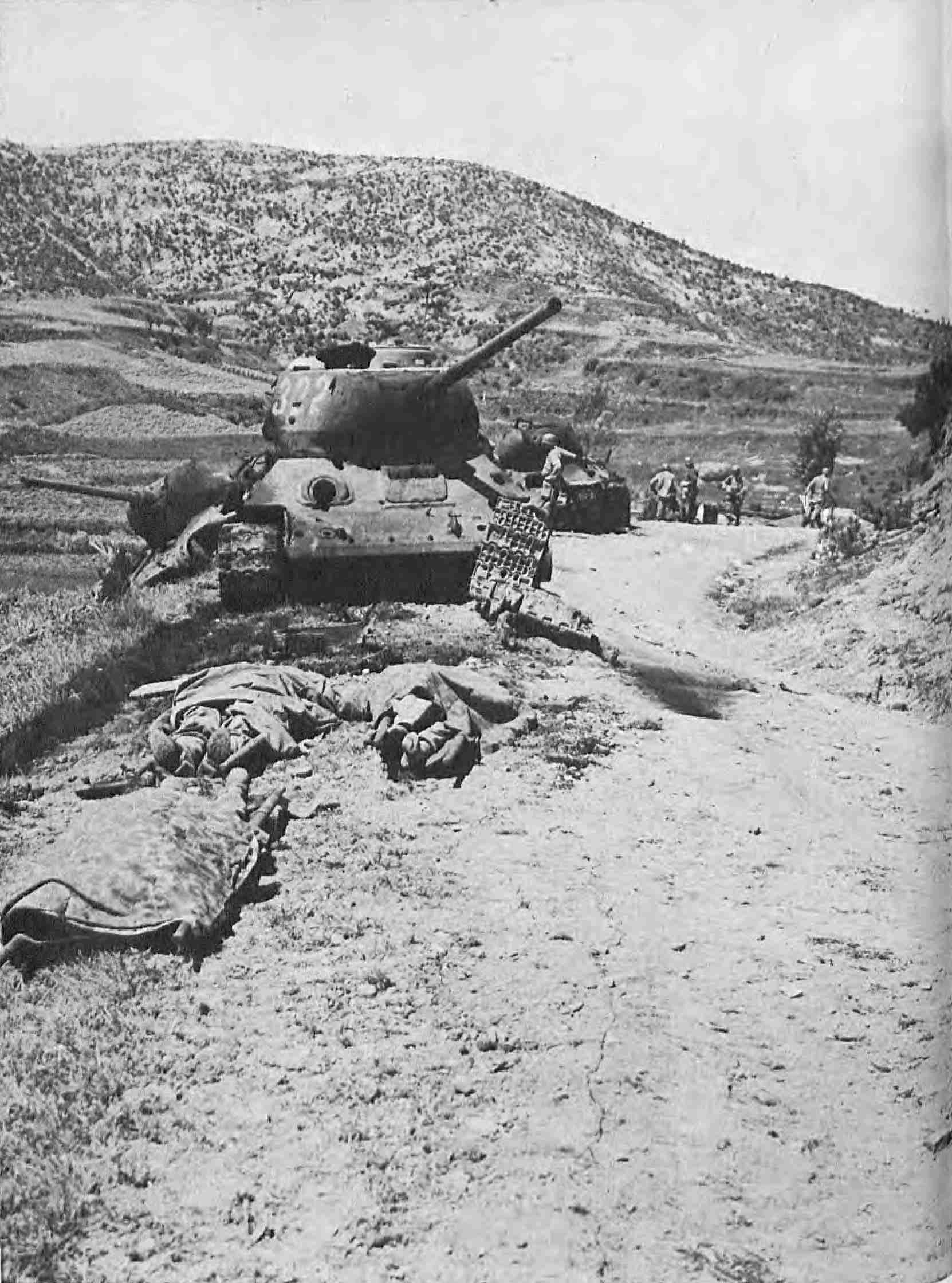
The North Korean armored division, a copy of its Soviet counterpart,
had only about half of the overall strength. Thus the NKPA 105th
Armored Division, comprising some 6,000 officers and men, included 3
medium tank regiments, the 107th, 109th, and 203d, with 40 tanks each.
Organic supporting units were the 206th Mechanized Infantry Regiment
and the 308th Armored Battalion equipped with self-propelled 76-mm.
guns. POW reports also mentioned reconnaissance, engineer, signal,
ordnance and medical battalions and a mixed unit identified as the 849th
Antitank Regiment, attached to the division after the invasion started.35
All reports indicate that the division was split in combat, with each
tank regiment being assigned to an infantry division. Even the training
of the regiments had been conducted separately, and there is no evidence
of prewar maneuvers on the division level.
Each tank regiment had an estimated T/O strength of about 600
officers and men. The three medium tank battalions were supported by
a regimental submachinegun company, a supply and maintenance company
and a headquarters section in addition to engineer, signal, reconnaissance,
and medical platoons. Forty T-34/85 medium tanks were divided
into 13 for each battalion and 1 for the headquarters section, which
also rated a CAZ/67 jeep.
Responsibility for the indoctrination of the regiment rested with a
political section headed by a lieutenant colonel. As assistants he had 2
officers and 3 sergeants.
An NKPA tank battalion included a headquarters section and three
25-man companies. A company contained three platoons, each of which
was assigned a medium tank. The standard crew consisted of the commander,
usually a senior lieutenant, the driver and assistant driver, the
gunner in charge of the 85-mm. rifle, and the assistant gunner operating
the 7.62-mm. machinegun. The usual ammunition load was 55 85-mm.
shells and 2,000 rounds of machinegun ammunition.
Not much was known about the 206th Mechanized infantry Regiment,
but it was believed to consist of three motorized infantry battalions,
a 76-mm. howitzer battalion, a 45-mm. antitank battalion, a
120-mm. mortar battalion, a signal company, and an NCO training
company.36
Officer procurement problems were solved in large part by the fact that
thousands of North Koreans had seen combat service with the CCF
forces. Many of these veterans were qualified as junior officers or NCO’s
without further training. Remaining vacancies for company-grade officers
were filled by officer candidate schools or the commissioning of
qualified NCO’s.
The West Point of the NKPA, located at Pyongyang, turned out an
estimated 4,000 junior officers from the time of its activation in 1946 to
the beginning of the invasion. Courses normally ranged in length from
6 to 10 months, but were abbreviated to 3 months during the autumn
of 1949 in anticipation of the invasion. After hostilities began, the need
for replacement officers became so urgent that one entire class at the
Pyongyang academy was commissioned wholesale on 10 July 1950 and
sent to the front after 20 days of instruction.37
Three Soviet officers, a colonel and two lieutenant colonels, reportedly
acted as advisers to a faculty composed of NKPA majors. The five departments
of the Academy were devoted to infantry, artillery, engineering,
signaling, and quartermasters’ duties.
A second military academy at Pyongyang specialized in subjects which
Communists termed “cultural.” So much importance was attached to
political indoctrination that graduates of this school were commissioned
as senior lieutenants and given unusual authority in their units. Although
a 2-year Russian language course was offered, most of the candidates
took the standard 9-month term.
Branches of the Pyongyang military academy were established as
officer candidate schools in Hamhung, Chinnampo, Chorwon, Mesanjin,
Kaechon and Kanggye. Applicants were required to have an acceptable
political background and a 6-year minimum of schooling, though the
last was sometimes waived.
A command and staff school at Pyongyang offered advanced tactical
and administrative courses at the battalion and regimental level to
selected officers. At the other extreme, NCO schools were located at
Sadong, Sinuiju, Sinchon and Nanam. Tactical instruction was given at
the platoon and squad level with emphasis on weapons courses. NCO
training was accelerated in preparation for hostilities, and 4,000 veterans
of CCF service in Manchuria completed 2-month courses at the Sadong
school alone in the spring of 1950.
Technical training in aircraft, artillery, tank and engineering specialties
was offered in schools for junior officers as well as enlisted men. But it
appears that most of the officers above the company level received their
instruction in Soviet schools.38
Conscription, according to POW accounts, was introduced as early as
1948. In the rural districts each myon (a political subdivision smaller
than a county but comprising several villages) was given its quota of
recruits to be furnished between the ages of 18 and 35. The village chiefs
then assembled all the men in this age group and made their decisions
on an arbitrary basis. Selectees had little or no hope of appeal, but were
assured that provision would be made for their families during the 3-year
term of service.39
The system was much the same in North Korean cities, which were
divided into sections for conscription purposes. Sometimes the leaders in
urban areas called for volunteers. If the response was lacking in enthusiasm,
men were singled out and requested to “volunteer.” This method
was invariably successful, since a man who refused could be deprived of
employment.
The conscription program was speeded up along with other preparations
as invasion plans neared completion. About 12,000 men were
inducted from March through May 1950 and given 6 weeks of basic
training at such camps as the No. 2 People’s Training Center at Sinuiju.
In some communities the men eligible for military service were
requested to attend a meeting. Upon arrival, they were taken in trucks
to a training center and compelled to enlist.
Harsh as such methods might seem, they were gentle as compared to
the forced conscription of ROK civilians after the invasion got underway.
Both men and women in captured cities were crowded into school
buildings, given political indoctrination and forced to learn Communist
songs. After a week of this curriculum, the men were inducted both as
combat recruits and laborers. And though the women were told that
their service would be limited to duty as nurses or clerks, some of them
were coerced into carrying out reconnaissance or espionage missions.40
The transition from a cold war to a shooting war in Korea should not
have surprised anyone familiar with the events of the past 2 years. For
several hours, indeed, there was a reasonable doubt on the historic
morning of 25 June 1950 whether an undeclared war had begun or
merely another large-scale NKPA raid across the frontier.
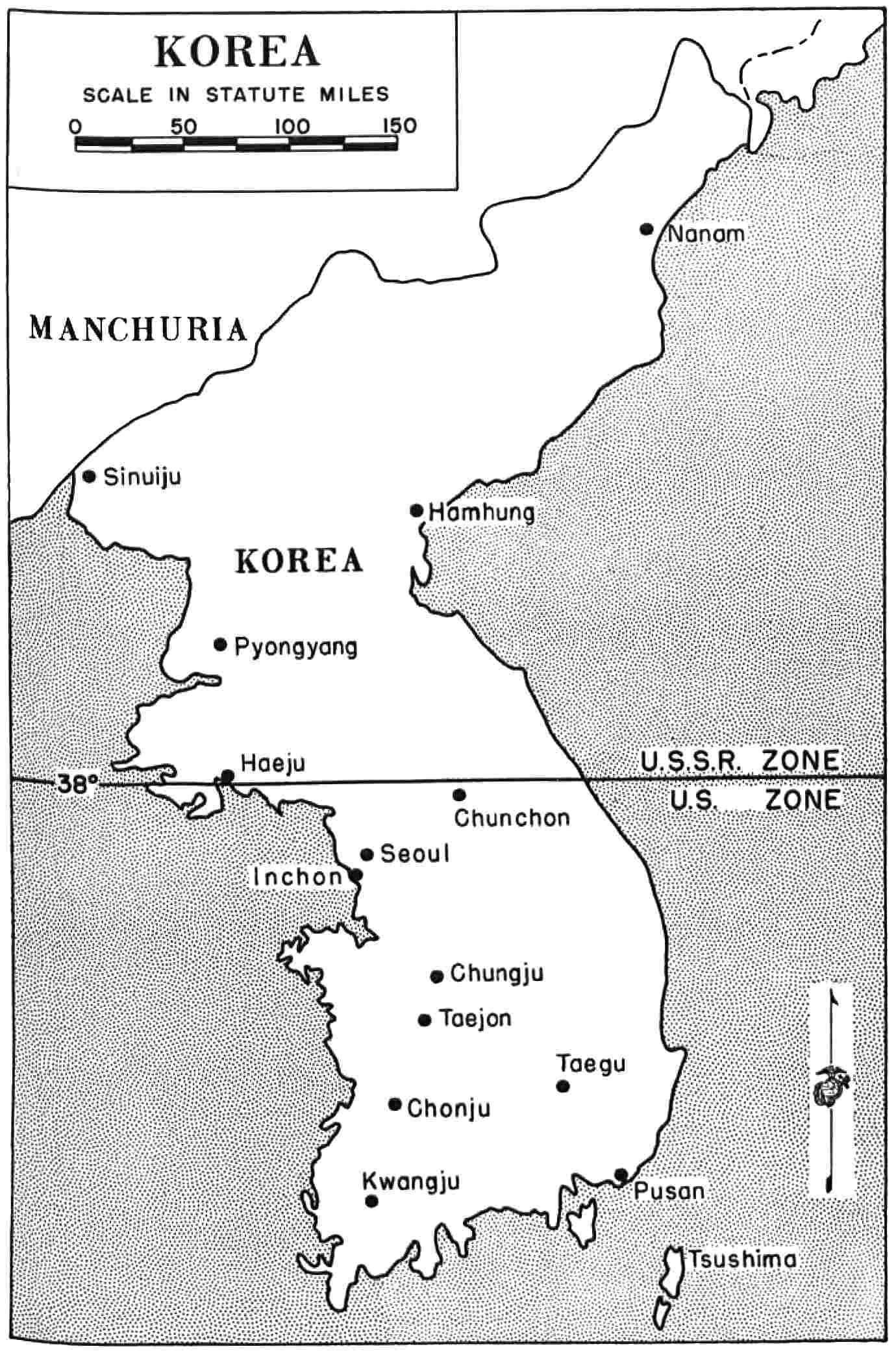
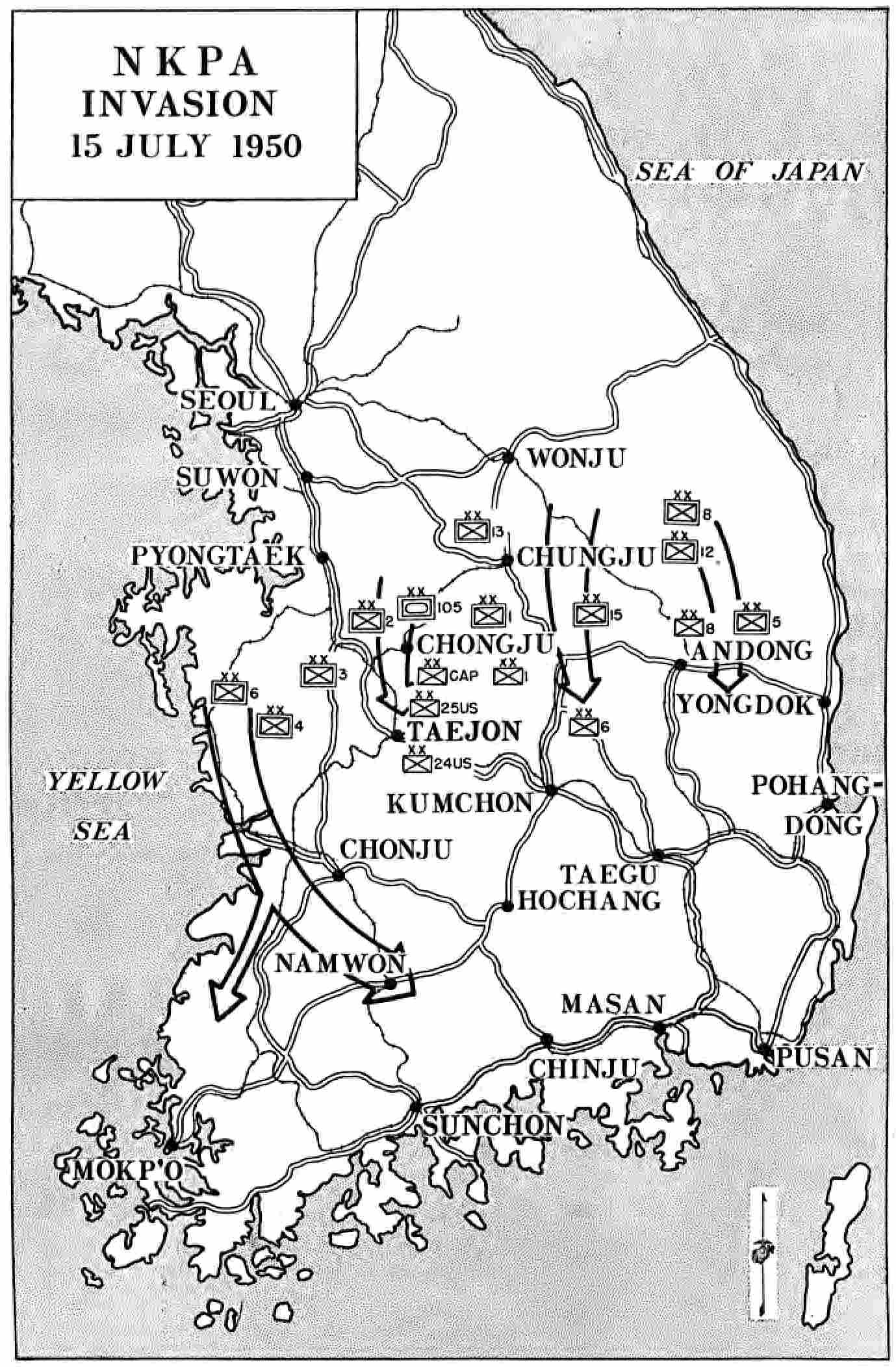
But this time it was the real thing. Commencing at 0400, 7 infantry
divisions and an armored division swept across the 38th Parallel, with
2 infantry divisions in reserve. From right to left, the NKPA order of
battle was as follows:
The 6th Infantry Division along the west coast, sealing off the Ongjin
Peninsula and moving on Kaesong; the 1st Infantry Division advancing
on Kaesong and Seoul; the 4th and 3d Infantry Divisions and 105th
Armored Division attacking in west-central Korea and converging on
Seoul; the 2d and 15th Infantry Divisions driving toward the Hwachon-Chunchon
axis in east-central Korea; and the 5th Infantry Division taking
the route along the east coast. Following close behind were the two
reserve infantry divisions, the 13th and 15th.41
There was no question as to the outcome in the minds of observers
who knew the composition of the ROK army. The very name was misleading,
for it might more accurately have been described as a large
constabulary in process of being converted into an army. Given another
year of training and added arms and equipment, the Republic of Korea
would perhaps have built up an adequate defense establishment. But the
enemy took good care to strike while this development was still at the
blueprint stage.
In June 1949, at the conclusion of the occupation, the United States
forces turned over arms and equipment to the value of about
$110,000,000. These supplies included 100,000 small arms (rifles, pistols
and machineguns) and 50,000,000 rounds of ammunition; more than
4,900 vehicles of all types; about 2,000 2.36″ rocket launchers and 40,000
rounds of ammunition; and a large number of 105-mm. howitzers,
37-mm. and 57-mm. antitank guns, and 60-mm. and 81-mm. mortars,
together with 700,000 rounds of ammunition for those weapons. Twenty
training planes (L4 and L5 types) were transferred as well as 79 light
naval craft suitable for patrolling the coast.42
It is noteworthy that this list was limited to light arms for a constabulary
of about 50,000 men. Tanks, military aircraft and medium or heavy
artillery were significantly lacking.
At the request of the ROK government, a Korean Military Advisory
Group remained in South Korea after the conclusion of the American
occupation. Composed of 500 United States Army officers and enlisted
men, the KMAG took on the task of directing the training of a ROK
constabulary. The group was under the control of Ambassador Muccio,
since General MacArthur’s responsibility for the defense had ended
along with the occupation.43
After the NKPA invasion, the United States was severely criticized in
some quarters for failing to provide the Republic of Korea with arms
and training equal to those of the enemy. American reluctance was due
in some measure to indiscreet declarations by that fiery old Korean patriot,
Syngman Rhee. The ROK president, 74 years old at the outbreak
of civil war, did not shrink from advocating the unification of Korea by
armed force. On 20 February 1949 he predicted that his troops “could
defeat North Korea within 2 weeks” if the U. S. S. R. did not interfere.
Eight months later, on 7 October, his confidence had increased to the
point where he was “sure that we could take Pyongyang in 3 days.”44
Such remarks placed the United States in an uncomfortable position.
If aid to the Republic of Korea were to include tanks, military aircraft
and training for offensive warfare, Americans would be open to the
charge of inciting civil strife. Communist propagandists would scream
that accusation in any event, of course, but there would be grounds for
the suspicion of other members of the United Nations. Ambassador
Muccio made sure, therefore, that United States assistance did not extend
beyond the legitimate needs of ROK frontier defense and internal
security.
The triangular ROK infantry division was modeled after the United
States unit but numbered about 9,500 troops. Eight divisions and a regiment
had been organized and partially trained by June 1950. They were
the 1st, 2d, 3d, 5th, 6th, 7th, 8th, and Capital Divisions and the 17th
Regiment.45 Only 4 of these divisions, the 1st, 2d, 6th, and 7th, had
their full complement of 3 regiments. All the others had 2 except the
5th, which had 2 and a battalion.46
ROK military strength was estimated at 98,808 troops by the KMAG
in June 1950. About 65,000 of them had been given unit training for
combat. They were fairly proficient in the employment of small arms
and mortars, but their instruction had not included defense against tanks.
Command and staff work were still at a rudimentary stage, and both
officers and NCO’s needed seasoning.
The ROK Army of June 1950 had made good progress, in short,
when it is considered that most of its components had been activated
within the past year. But it was no match for the Red Korean columns
which attacked at dawn on 25 June 1950. The ROK order of battle, if
such it could be called, consisted of a regiment and four infantry divisions
ranged from left to right across the peninsula—the 17th Regiment
and the 1st, 7th, 6th, and 8th Divisions. The remaining divisions were
dispersed for purposes of internal security: the Capital at Seoul; the 2d
at Chongju and Taejon; the 3d at Taegu; and the 5th at Kwangju.
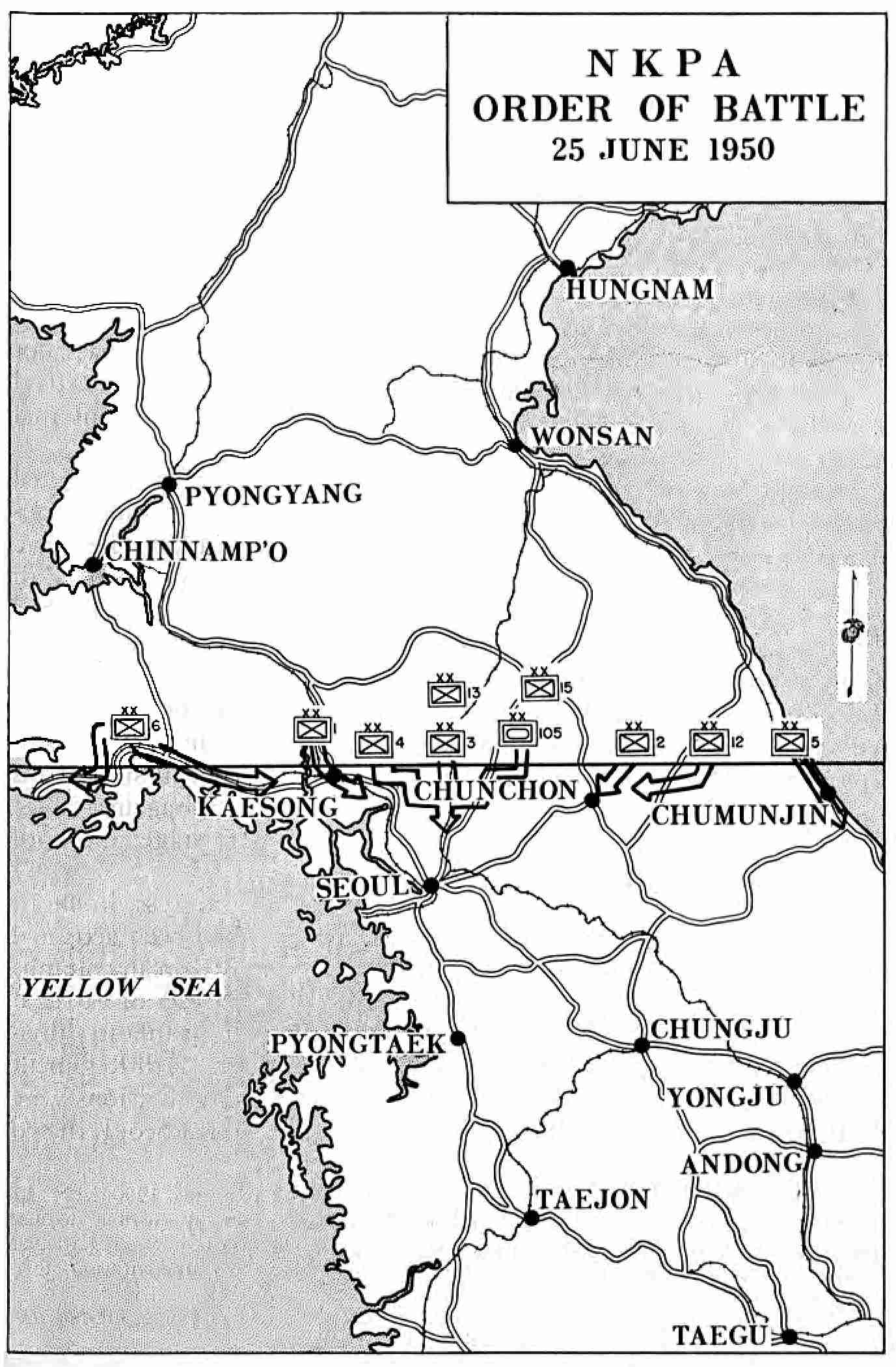
NKPA
ORDER OF BATTLE
25 JUNE 1950
The ROK frontier forces were not well disposed for defense in
depth. Taken by surprise, they put up an ineffectual resistance despite
brave fights here and there against odds. On other occasions the sight
of an enemy tank or armored car was enough to scatter ROK riflemen,
and the progress of the invading columns resembled an occupation
rather than an attack.
Before sundown on the day of invasion it appeared that NKPA leaders
had not erred in allowing a timetable of 10 days for overrunning the
Republic of Korea. The question now was whether the conflict could
be confined to that Asiatic peninsula. Communist aggressions were no
novelty, to be sure, either in Asia or Europe. But in the past there had
always been some show of peaceable intentions, however hypocritical,
or some shadow of legality. This was the first time that a Soviet puppet
nation had been permitted to go as far as open warfare. Matters had
come to a showdown, and it could only be interpreted as a challenge
issued by Communism to the free nations of the world.