Preface
This is the fourth in a series of five volumes dealing with the
operations of United States Marines in Korea during the period
2 August 1950 to 27 July 1953. Volume IV presents in detail the
operations of the 1st Marine Division and 1st Marine Aircraft Wing,
the former while operating under Eighth Army control and also as
part of IX Corps and X Corps, USA, and the latter while controlled
by the Fifth Air Force.
The period covered in this volume begins in the latter part of
December 1950, when the Division rested in the Masan “bean patch,”
and continues through the guerrilla hunt, the Punchbowl fighting,
and all other operations during 1951. The account ends when the
Marines move to positions in the west during March 1952.
Marines did not fight this war alone; they were a part of the huge
Eighth United States Army in Korea. But since this is primarily a
Marine history, the actions of the U. S. Army, Navy, and Air Force
are presented only sufficiently to place Marine operations in their
proper perspective.
Many participants in the fighting during this period have generously
contributed to the book by granting interviews, answering inquiries,
and commenting on first draft manuscripts. Their assistance was
invaluable. Although it was not possible to use all the plethora of
detailed comments and information received, the material will go
into Marine Corps archives for possible use and benefit of future
historians.
The manuscript of this volume was prepared during the tenure of
Colonel Charles W. Harrison, Major Gerald Fink, and Colonel
William M. Miller as successive Heads of the Historical Branch. Production
was accomplished under the direction of Colonel Thomas G.
Roe. Major William T. Hickman wrote some of the preliminary drafts
and did much valuable research and map sketching. Dr. K. Jack Bauer
and Mrs. Elizabeth Tierney assisted the authors in research, and Mr.
Truman R. Strobridge assisted in proofreading and preparing the
index.
To the Army, Navy, and Air Force officers, as well as Marine
officers and NCOs, who submitted valuable comments and criticisms
of preliminary drafts, thanks are also extended. These suggestions
added to the accuracy and details of the text. Additional assistance
was rendered by personnel of the Office of the Chief of Military History,
Department of the Army; the Division of Naval History, Department
of the Navy; and the Historical Division, Department of the
Air Force.
The exacting administrative duties involved in processing the volume
from first draft manuscripts through the final printed form were
ably managed by Miss Kay P. Sue. All manuscript typing was done
expertly by Mrs. Miriam R. Smallwood.
The maps contained in this volume were prepared by the Reproduction
Section, Marine Corps Schools, Quantico, Virginia, and the
Historical Branch, Headquarters Marine Corps. Official Department
of Defense photographs were used.
The Marine Corps mourns the passing of the prime author of this
series and other admirable works of Marine Corps and military history.
Lynn Montross, after a lengthy illness, died on 28 January 1961.
H. W. Buse, Jr.
Brigadier General, U. S. Marine Corps,
Assistant Chief of Staff, G-3.
CHAPTER I Interlude at Masan — Return to the Bean Patch — 1st Marine Division in EUSAK Reserve — General Ridgway New EUSAK Commander — Ridgway’s Declaration of Faith — Marine Personnel and Equipment Shortages — Marine Air Squadrons in Action — The Air Force System of Control — X Corps Conference at Kyongju
Return to the Bean Patch—1st Marine Division in EUSAK
Reserve—General Ridgway New EUSAK Commander—Ridgway’s
Declaration of Faith—Marine Personnel and
Equipment Shortages—Marine Air Squadrons in Action—The
Air Force System of Control—X Corps Conference
at Kyongju
A new chapter in Korean operations began for the 1st Marine
Division at 1800 on 16 December 1950 with the opening of the
CP at Masan. By the following afternoon all units of the Division
had arrived from Hungnam with the exception of VMO-6 and small
groups of such specialists as the amphibian tractor troops left behind
to assist with the redeployment of remaining X Corps elements to
south Korea.
The 1st Marine Division and 1st Marine Aircraft Wing were
separated for the first time since the Inchon landing. VMF-311, the
new Panther jet squadron, was flying from K-9, an Air Force field
near Pusan. Operating together as an all-Marine carrier group taking
part in the Hungnam redeployment were the three Corsair squadrons:
VMF-212 on the CVL (light carrier) Bataan; VMF-214 on the
CVE Sicily; and VMF-323 on the CVE Badoeng Strait. The two
Japan-based night fighter squadrons, VMF(N)-542 and VMF(N)-513,
flying from Itazuke, patrolled the skies between Japan and Korea.
VMO-6, the observation squadron, consisting of helicopters and
OY fixed-wing planes, was attached to various ships of the Seventh
Fleet for rescue missions when pilots were forced into the sea. A
detachment of Marine Ground Control Intercept Squadron-1
(MGCIS-1) and the entire Air Defense Section of Marine Tactical
Air Control Squadron-2 (MTACS-2) were also attached to the
warships. They assisted in the control of hundreds of planes that
flew over the Hungnam beachhead daily in support of the final stages
of the X Corps evacuation.
The three Marine Corsair squadrons on the Sicily, Badoeng Strait,
and Bataan represented the entire air strength of Escort Carrier Task
Group (TG) 96.8, commanded by Rear Admiral Richard N. Ruble.
Each squadron came directly under the operational command of
the ship on which it had embarked. Supply, engineering, ordnance,
billeting, and messing were of course provided through naval channels.
The only relationship of the squadrons to their parent organization,
MAG-33, derived from the administration of personnel and
the storage of equipment at Itami.
Masan, the new Division assembly area, was located about 27 air
miles and 40 road miles west of Pusan on the Bay of Masan, which
indents the southern coast of the peninsula (Map 1). In order to
prepare for the arrival of the Division, Brigadier General Edward A.
Craig, the assistant division commander (ADC), had flown from
Hungnam with the advance party on 12 December to make necessary
arrangements.
The small seaport, which skirts the bay for about two and a half
miles, was untouched by the war as compared to the ravaged towns
of northeast Korea. It had a protected anchorage, dock facilities, and
good rail and road communications. There was an air strip at
Chinhae, a few miles to the southeast.
Some sort of cycle seemed to have been completed by veterans of the
5th Marines when they found themselves back again in the familiar
surroundings of the Bean Patch on the northern outskirts of Masan.
This large, cultivated field is entitled to capital letters because of
its historical distinction as bivouac area of the 1st Provisional Marine
Brigade after the battle of the Naktong in August 1950. Barely
four months had passed since that hard fight, but a great deal more
history had been made during the combats of the Inchon-Seoul and
Chosin Reservoir operations.
There was room enough in the Bean Patch for all three infantry
regiments. Headquarters, the 11th Marines, the 1st Signal, 1st Tank,
1st Amtrac, 1st Ordnance, and 1st Motor Transport Battalions were
located on the southern outskirts of town along with the 41 Independent
Commando, Royal Marines. The 1st Combat Service Group,
the MP Company, and the 1st Service, 1st Shore Party, and 1st
Engineer Battalions occupied the dock area of Masan proper. A large
building in the center of town housed the Division hospital, and the
7th Motor Transport Battalion was assigned to the Changwon area,
four miles to the northeast.1
Peaceful as the surroundings may have seemed to troops who had
just completed the 13-day running fight of the Chosin Reservoir
Breakout, the Chidi San mountain mass some 50 miles northwest of
Masan had been for many years the hideout of Korean bandits and
outlaws. The Japanese had never been able to clear them out, and
the Republic of Korea had met with no better success. After the
outbreak of civil war, they made some pretense of aiding the Communist
cause but were actually preying upon the ROK army and
police for arms, food, clothing, and other loot. Operating in prowling
bands as large as 50 or 60 men, the guerrillas were well armed with
rifles, machine guns, and at times even mortars.
In order to assure the safety both of its own bivouac areas and the
vital port of Masan, Division promptly initiated measures to maintain
surveillance over a broad belt of countryside which described an arc
from Chinju, some 40 miles west of Masan, around to Changwon
(Map 1). The infantry and artillery regiments and the Division
Reconnaissance Company were all assigned subsectors of this security
belt. Daily motor patrols of not less than platoon strength
were to be conducted in each subsector for the purpose of gaining
information about the roads and the guerrillas as well as discouraging
their activities.2 As it proved, however, no hostile contacts were made
by the Marines during the entire Masan interlude. The guerrillas
preferred to restrict their attention to the local police and civilian
population.
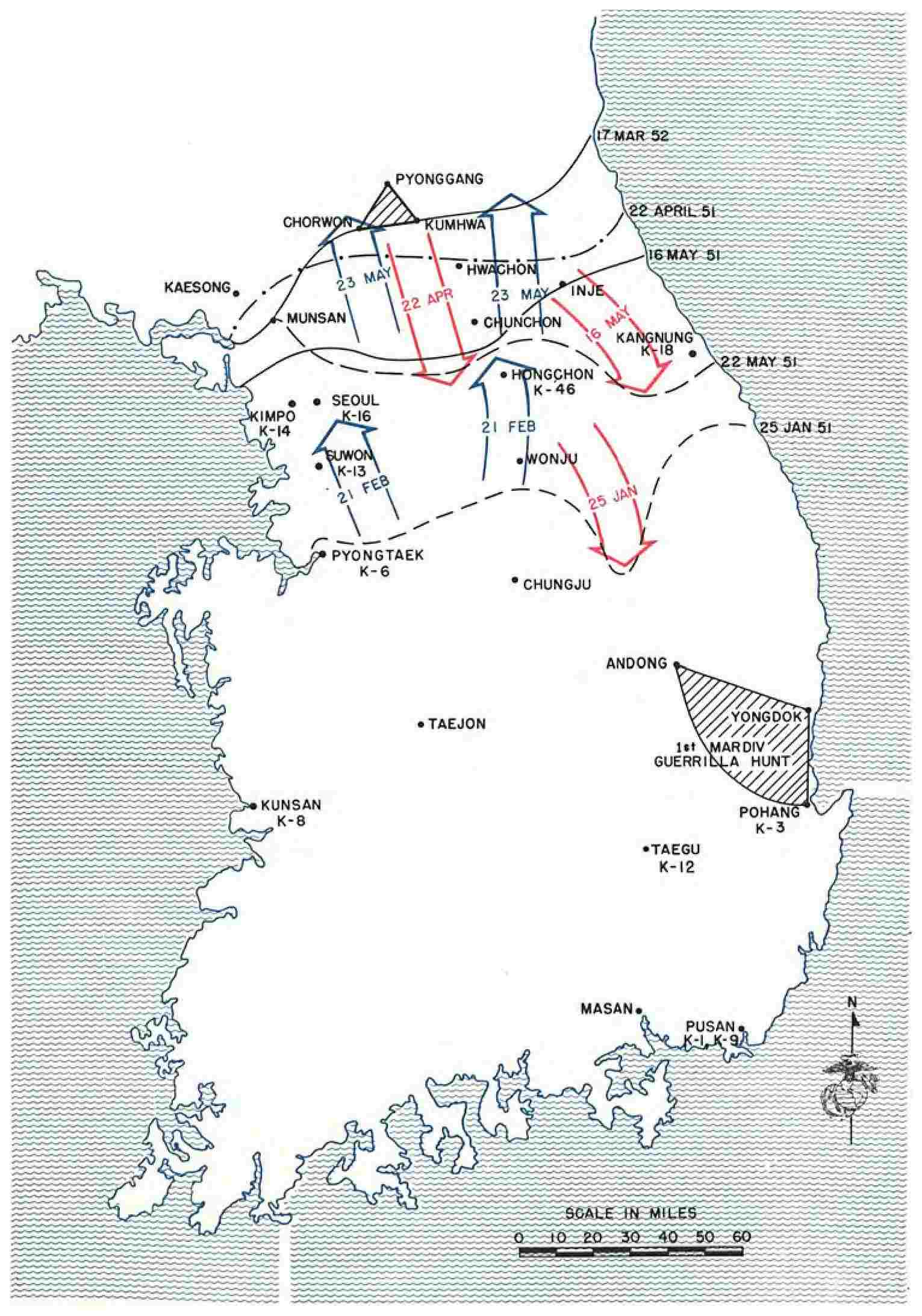
At 2240 on the 18th a dispatch from Major General Edward M.
Almond, USA, commanding general of X Corps, informed the 1st
Marine Division that it had passed to the operational control of the
Eighth Army.3
Major General Oliver P. Smith reported in one of his first dispatches
to EUSAK that the Marines had received fresh rations on only
three days since landing in Korea. The Division commander invited
attention to the importance of building up the physical condition of
men who had lost weight during the Chosin Reservoir operation.
An information copy went to Commander Naval Forces, Far East,
(ComNavFE), who reacted promptly by ordering a refrigeration ship
to Masan with 50,000 rations of turkey. The G-4 of EUSAK also
responded with fresh rations from time to time until the Marines, in
the words of General Smith, “had turkey coming out of their ears.”4
Games of softball and touch football became popular in the crisp,
invigorating weather as the men rapidly recuperated from fatigue and
nervous tension. A series of shows was put on by troupes of U.S.
Army and Korean entertainers, and the U.S. Navy sent Christmas
trees and decorations.
The first Christmas in Korea was observed with a memorable
display of holiday spirit by men who had cause to be thankful. A
choir from the 5th Marines serenaded Division Headquarters with
carols on Christmas Eve, and all the next day the commanding general
and ADC held open house for staff officers and unit commanders.5
The United States as a whole rejoiced over the news that the last
of 105,000 X Corps troops had embarked from Hungnam on 24 December
without a single life being lost as a result of enemy action.
President Truman spoke for the Nation when he sent this message to
General MacArthur:
Wish to express my personal thanks to you, Admiral Joy, General Almond,
and all your brave men for the effective operations at Hungnam. This saving
of our men in this isolated beachhead is the best Christmas present I have
ever had.
Photographers and press correspondents flocked to Masan during
the holiday season for pictures and interviews about various aspects
of the Chosin Reservoir campaign. Among them was Captain John
Ford, USNR, a successful motion picture director who had been
recalled to active duty to make a documentary film depicting the role
of the Navy and Marine Corps in Korea. He used scenes in the
Masan area for background material.
General Smith was informed that a motion picture company intended
to produce a feature film entitled “Retreat, Hell,” based on a
remark attributed to him, “Retreat, Hell, we are just attacking in a
different direction!” When asked if these actually were his words,
the Division commander had a diplomatic answer. He said that he had
pointed out to correspondents at Hagaru that the drive to Hamhung
was not a typical withdrawal or retreat, and thus “the statement
attributed to me described my thinking, that of my staff and unit
commanders, and my situation.”
During the Masan interlude Colonel S. L. A. Marshall, USAR,
arrived as a representative of the Operations Research Office of Johns
Hopkins University, which had been employed on military research
projects by the Far East Command. Marshall, a well-known military
analyst who had written several books about World War II operations,
based his studies on personal interviews with scores of participants.
The researcher was given a free hand at Masan. Aided by a
stenographer, he interviewed officers and men from privates to commanding
general. The resulting thousands of words went into a
classified report entitled, “CCF in the Attack (Part II), A Study
Based on the Operations of the 1stMarDiv in the Koto-ri, Hagaru-ri,
Yudam-ni area, 20 November-10 December 1950.”
Shortly after arrival at Masan, General Smith called a conference of
unit commanders and emphasized that their task was to re-equip,
resupply, repair and rehabilitate. Officers and men of replacement
drafts were to be integrated and given unit training as soon as possible.
Both veterans and newcomers were soon training in regimental areas
assigned by Colonel Alpha L. Bowser, the Division G-3, who arranged
for a 200-yard rifle range and a mortar range.
On 23 December came the news that Lieutenant General Walton H.
Walker, the Eighth Army commander, had been killed in a jeep
accident. His successor, Lieutenant General Matthew B. Ridgway,
USA, had commanded the U.S. XVIII Airborne Corps in Europe
during the final operations of World War II. Commencing his flight
from Washington on the 24th, he landed at Tokyo just before midnight
on Christmas day.6
The new commander’s task was made more difficult by the fact that
the Korean conflict, at the end of its first six months, had become
probably the most unpopular military venture of American history,
both at the front and in the United States. From a mere “police
action” at first, the struggle soon developed into a major effort in
which the national pride suffered humiliations as a consequence of
military unpreparedness. Far from building up the morale of the
troops, letters and newspapers from home too often contributed to
the doubts of men who asked themselves these questions:
“Why are we here? And what are we fighting for?”
Some of the answers were scarcely reassuring. It was insinuated,
for instance, that Americans were fighting “to make South Korean
real estate safe for South Koreans.”
“I must say in all frankness,” commented General Ridgway in his
memoirs, “that the spirit of the Eighth Army as I found it on my
arrival gave me deep concern. There was a definite air of nervousness,
of gloomy foreboding, of uncertainty, a spirit of apprehension as to
what the future held. There was much ‘looking over the shoulder’
as the soldiers say.”7
These criticisms were not applicable to the 1st Marine Division.
“Our men were in high spirits and busily engaged in getting ready to
fight again,” commented Brigadier General Edward A. Craig, ADC.
“In my travels around the various units of the Division, and in talking
to the men, I never even once noticed any air of nervousness or apprehension....
When General Ridgway visited the Division at Masan
he made a tour of the entire camp area and observed training and
general arrangements. He stated that he was quite satisfied with the
1st Marine Division and its quick comeback after the Chosin
fighting.”8
General Ridgway learned soon after his arrival that the Eighth
Army staff had prepared a plan for a phased withdrawal to Pusan
in case of necessity. He called immediately for a plan of attack.
Prospects of putting it into effect were not bright at the moment, but
at least it served to announce his intentions.
Rumors were rife at this time that a general withdrawal from Korea,
in virtual acknowledgment of defeat, was contemplated. In a letter
of 1957, General Douglas MacArthur wrote an emphatic denial:
“I have no means of knowing whether such action may have been
seriously considered in Washington; but, for my own part, I never
contemplated such a withdrawal and made no plans to that effect.”9
The front hugged the 38th Parallel during the last week of
December as the Eighth Army held a defensive line along the Munsan-Chunchon-Yangyang
axis (Map 2). Three U.S. divisions were in a
combat zone occupied largely by ROK units. The 24th and 25th
Divisions both reduced a third in strength by casualties, remained
in contact with the enemy in west Korea while the 1st Cavalry Division,
also depleted in numbers, occupied blocking positions to the
rear. Personnel and equipment losses suffered by the 2d Division
during the CCF counteroffensive of late November had rendered it
noneffective as a tactical unit until it could be reinforced and re-equipped,
and the 3d and 7th Infantry Divisions had just landed in
the Pusan-Ulsan area after the Hungnam redeployment.10
On 27 December 1950 the commanding general began a three-day
tour of Eighth Army units at the front. He talked to hundreds of
soldiers ranging from privates to unit commanders. There was nothing
the matter with the Eighth Army, he assured them, that confidence
wouldn’t cure. “I told them their soldier forbears would turn over
in their graves if they heard some of the stories I had heard about
the behavior of some of our troop leaders in combat. The job of a
commander was to be up where the crisis of action was taking place.
In time of battle, I wanted division commanders to be up with their
forward battalions, and I wanted corps commanders up with the
regiment that was in the hottest action. If they had paper work to do,
they could do it at night. By day their place was up there where the
shooting was going on.”
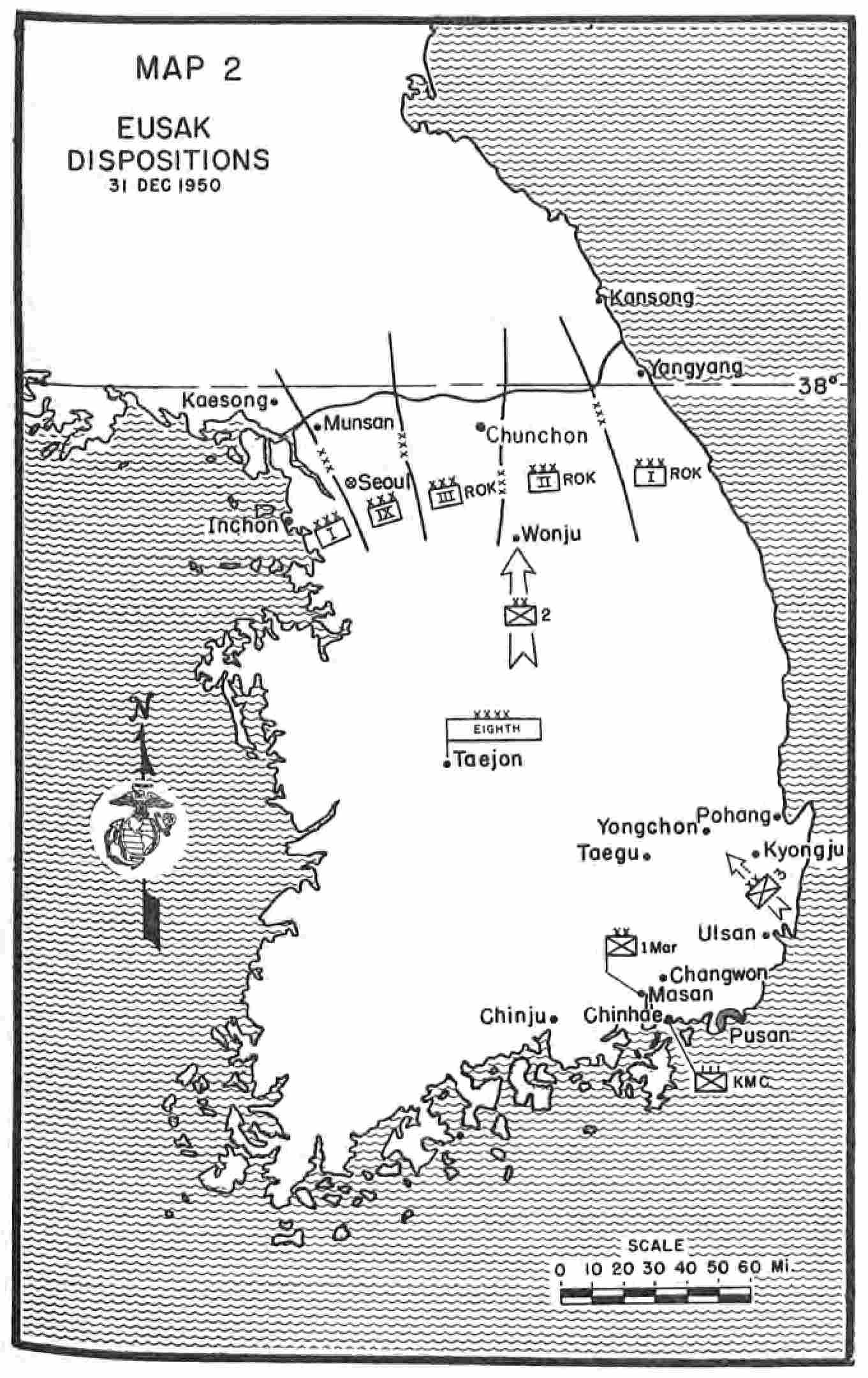
MAP 2
EUSAK
DISPOSITIONS
31 DEC 1950
It could never have been said that this professional soldier, the
son of a Regular Army colonel, had failed to set an example in his
own career. As the commander of an airborne division, he had jumped
along with his men in Normandy.
Seldom seen in Korea without a grenade attached to his harness,
Ridgway insisted that it was not a gesture of showmanship. In mobile
warfare a man might be surprised by the enemy when he least expected
it, he said, and a grenade was useful for blasting one’s way out of
a tight spot.
After completing his tour of the combat area, the commanding general
concluded that one thing was still lacking. Soldiers of the Eighth
Army hadn’t as yet been given an adequate answer to the questions,
“Why are we here?” and “What are we fighting for?” In the belief
that the men were entitled to an answer from their commanding
general, he sat down in his room and wrote this declaration of faith:
To me the issues are clear. It is not a question of this or that Korean town
or village. Real estate is here, incidental....
The real issues are whether the power of Western civilization, as God has
permitted it to flower in our own beloved lands, shall defy and defeat
Communism; whether the rule of men who shoot their prisoners, enslave
their citizens and deride the dignity of man, shall displace the rule of those
to whom the individual and individual rights are sacred; whether we are
to survive with God’s hand to guide and lead us, or to perish in the dead
existence of a Godless world.
If these be true, and to me they are, beyond any possibility of challenge,
then this has long since ceased to be a fight for freedom for our Korean allies
alone and for their national survival. It has become, and it continues to be, a
fight for our own freedom, for our own survival, in an honorable, independent
national existence....11
The deep conviction of this declaration could not be doubted. But
Ridgway did not confine himself to moral leadership; he also insisted
on a return to sound tactical principles. Upon learning that some of
the infantry commanders in combat sectors had no knowledge of the
enemy’s strength or whereabouts, he ordered that aggressive patrolling
be resumed at once. He directed further that every unit make a
resolute effort to provide a hot reception for the Red Chinese patrols
which had met too little opposition while prodding every night for
soft spots along the thinly held 135-mile United Nations line.12
In his talks with officers and men, the new commander told them
that too many weapons and vehicles had fallen into the hands of
the enemy during the withdrawals in west Korea. He made it plain
that in the future any man abandoning equipment without good cause
would be court-martialed.
Not only did Ridgway stress the increased use of firepower; he
requested in one of his first messages to the Pentagon that 10 additional
battalions of artillery be sent to Korea. These guns were to
provide the tactical punch when he found an opportunity to take the
offensive.
Meanwhile, he had the problem of putting up a defense against a
Chinese Communist offensive expected within a week. On his first day
as Eighth Army commander he sent a request to President Syngman
Rhee, of the Republic of Korea, for 30,000 native laborers to dig
field fortifications. The energetic, 71-year-old Korean patriot provided
the first 10,000 at dawn the following morning and the others
during the next two days. Armed with picks and shovels, this army of
toilers created two broad belts of defense, one to the north and one
south of the river Han. The purpose of the first was to stop the
enemy if American firepower could compensate for lack of numbers,
and the second was a final line to be held resolutely.
Although the Marine ground forces found themselves in the unusual
situation of being 200 miles behind the front, they could be sure that
this respite wouldn’t last. Every effort was being pushed to restore
the Division to combat efficiency by a command and staff acutely
aware of shortages of men and equipment. The effective strength on
29 December 1950 was 1,304 officers and 20,696 men, including 182
attached U.S. Army troops and 143 Royal Marine Commandos. This
total also included 28 officers and 1,615 men who had arrived in a
replacement draft of 17 December, and 4 officers and 365 men in a
draft of three days later.13
Authorized Division strength was 1,438 officers and 24,504 men,
indicating a shortage of 134 officers and 3,808 men. Most of the
deficiencies were in the infantry and artillery units—29 officers and
2,951 men in the three infantry regiments, and 38 officers and 538 men
in the artillery.
Division G-1 had been informed by the FMFPac representative in
Japan that about 5,000 casualties were hospitalized there, and an
unknown number had been evacuated to the United States because
of overcrowding of hospitals in Japan. Such factors made it difficult
to predict how many would return to the Division, but G-1 estimated
from 500 to 1,000 in January.
The situation in regard to Division equipment might be summed
up by saying that on 23 December there was a serious shortage of
practically all essential items with the single exception of M-1 rifles.
Upon arrival at Masan, units had been required to submit stock status
reports. These lists were forwarded on 23 December to the Commanding
General, Eighth Army, with a notification that requisitions had
been submitted to the 2d Logistical Command, USA, in Pusan. It was
requested that deliveries of supplies and equipment be speeded up, so
that the Division could soon be restored to its former combat efficiency.
A comparison of the totals of selected items on 23 and 31
December as listed on the following page shows that considerable
progress was made during those eight days.
The 2d Logistical Command in Pusan, commanded by Brigadier
General Crump Garvin, USA, deserved much of the credit for the
week’s restoration of Marine equipment. Progress passed all expectations,
considering that General Garvin was supplying other Eighth
Army units which had lost equipment during their withdrawal.14
There still existed on 29 December a requirement for clothing and
individual equipment, and the spare parts problem remained acute.
Ironically, the fact that the 1st Marine Division had brought most of
its motor transport out from the Chosin Reservoir was a handicap at
Masan. Eighth Army units which had lost their vehicles were given
priority for receiving new ones. This meant that the Marines must
make the best of war-worn trucks.
Items of
equipment |
T/E
allowance |
Shortages
23 Dec 50 |
Shortages
31 Dec 50 |
| Bags, sleeping |
23,000 |
3,585 |
0 |
| Machine gun, Browning, Cal. 30, M1919A4 |
1,398 |
338 |
0 |
| BAR, 30 cal. |
904 |
441 |
0 |
| Carbine, 30 cal., M2 |
11,084 |
2,075 |
0 |
| Launcher, rocket, 3.5″, M20 |
396 |
105 |
0 |
| Howitzer, 105mm |
54 |
8 |
0 |
| Howitzer, 155mm |
18 |
9 |
0 |
| Glasses, field, 7×50 |
1,740 |
1,305 |
1,006 |
| Tank, Med., M4A3, dozer, 105 mm |
12 |
7 |
7 |
| Tank, med., M-26, 90mm |
85 |
16 |
12 |
| Truck, 1/4 T., 4×4 |
641 |
105 |
58 |
| Truck, 1½ T., 6×6, cargo |
54 |
3 |
0 |
| Truck, 2½ T., 6×6, cargo |
737 |
124 |
33 |
| Radio set, SCR 536 |
474 |
211 |
211 |
| Radio set, SCR 619 |
137 |
74 |
49 |
| Telephone, EE8 |
1,162 |
58 |
58 |
While the ground forces trained in the Masan area, the Corsair
squadrons and the jet squadron flew combat missions. Support of
the Hungnam redeployment had top priority until 24 December, when
the last of the 105,000 troops were evacuated by Rear Admiral
James H. Doyle’s Task Force 90. Such totals as 91,000 Korean
refugees, 17,500 vehicles, and 350,000 measurement tons of cargo
were also recorded by the U.S. Navy’s largest operation of the
Korean conflict.15
No serious trouble was experienced from enemy action during the
two weeks of the redeployment, although G-2 reports warned that
several Chinese divisions were believed to be in the general area.
Air strikes and naval gunfire shared the credit for this result. Nearly
34,000 shells and 12,800 rockets were fired by the support ships,
and UN planes were on station or carrying out missions every moment
that weather permitted. Marine fighters of VMF-212, VMF-214,
and VMF-323, flying from carriers after the closing of Yonpo Airfield,
made a noteworthy contribution to the success of the Hungnam
redeployment.16
VMF-212, commanded by Lieutenant Colonel Richard W. Wyczawski,
was assigned the task of gathering the helicopters of VMO-6
from various ships of the Seventh Fleet and returning them to the
operational control of the 1st Marine Division at Masan. There the
OYs of the observation squadron were waiting after an overland flight,
and Major Vincent J. Gottschalk’s unit was complete.
With the Hungnam redeployment ended, the Navy offered to
make its primary carrier-borne air effort in support of the Eighth
Army. There was no single over-all commander of Navy and Air
Force aviation in Korea (other than General MacArthur himself) and
the two services were working under a system of mutual agreement
and coordination.17
The Far East Air Forces (FEAF), under Lieutenant General
George E. Stratemeyer, was the senior Air Force command in the Far
East, on the same level as ComNavFE, Vice Admiral C. Turner Joy.
The largest FEAF subordinate command was the Fifth Air Force,
commanded by Major General Earle E. Partridge, with headquarters
at Taegu, alongside that of the Eighth Army.
Strictly speaking, land-based Marine air had been under Fifth Air
Force operational control throughout the Chosin Reservoir operation.
Actually a verbal agreement between General Partridge and Major
General Field Harris, commanding the 1st Marine Aircraft Wing
(MAW), had given the Marines a good deal of latitude in making
decisions relative to close air support. This was often the salvation
of Marine units during the breakout, when every minute counted.
Later, during the Hungnam redeployment, control of Marine aircraft
became the responsibility of Admiral Doyle. His control agency was
Tactical Air Control Squadron-1 (TacRon-1) in his flagship, the
Mount McKinley. TacRon-1 kept in close touch not only with the
3d infantry Division, USA, defending the shrinking perimeter, but
also with the Eighth Army and Fifth Air Force.18
During the last days of 1950 the four Marine air squadrons were
kept busy. VMF-212 on the Bataan was attached to TF-77. The
coastline of east Korea was its hunting grounds for such missions as
knocking out warehouses, bridges, and railway tunnels between the
38th and 39th parallels.
Along the west coast, VMF-214 on the Sicily and VMF-323 on
the Badoeng Strait were commanded respectively by Major William
M. Lundin and Major Arnold A. Lund. These squadrons were part of
Task Group-95.1 under Vice Admiral Sir William G. Andrews, RN.
The Marine aviators found themselves in an organization made up
of Royal Commonwealth naval forces and of French, Thai, and
ROK units. TG-95.1 had the responsibility for patrolling the western
coastline to prohibit enemy movement by water in military junks and
by vehicle along the littoral.19
VMF-311, the jet squadron commanded by Lieutenant Colonel
Neil R. MacIntyre, remained the only land-based Marine air unit in
Korea. The Fifth Air Force had made space for it on crowded K-9,
seven air miles northeast of Pusan, when General Harris expressed
a desire to keep his jets in Korea for possible defense against Red
air attacks (Map 3).
MacIntyre exercised his prerogative as squadron commander to fly
the unit’s first combat mission on 17 December. He was not, however,
the first Marine aviator to pilot a jet in combat. That distinction went
to Captain Leslie E. Brown on 9 September 1950. Assigned to the
Fifth Air Force’s 8th Fighter-Bomber Squadron as an exchange pilot,
he made the first of several routine flights with an F-80 Shooting Star.
On 20 December, 17 officers and 51 enlisted men arrived at K-9
to boost VMF-311’s total to 27 officer pilots and 95 enlisted men.
Under Fifth Air Force control, they were employed to attack suspected
CCF troop shelters, entrenchments, and gun positions on the eve of
the expected enemy offensive. Missions of the jet planes averaged
12 a day at the end of the month.
It was seldom realized in the middle of the twentieth century that
for the first time since the Middle Ages, a single human being represented
in his person a decisive tactical unit. Just as the mailed knight
on his barded charger had ruled the battlefields of the medieval world,
so did the pilot of a modern aircraft have the power to put an enemy
battalion to flight with napalm, or to knock out an enemy stronghold
with a 500-pound bomb.
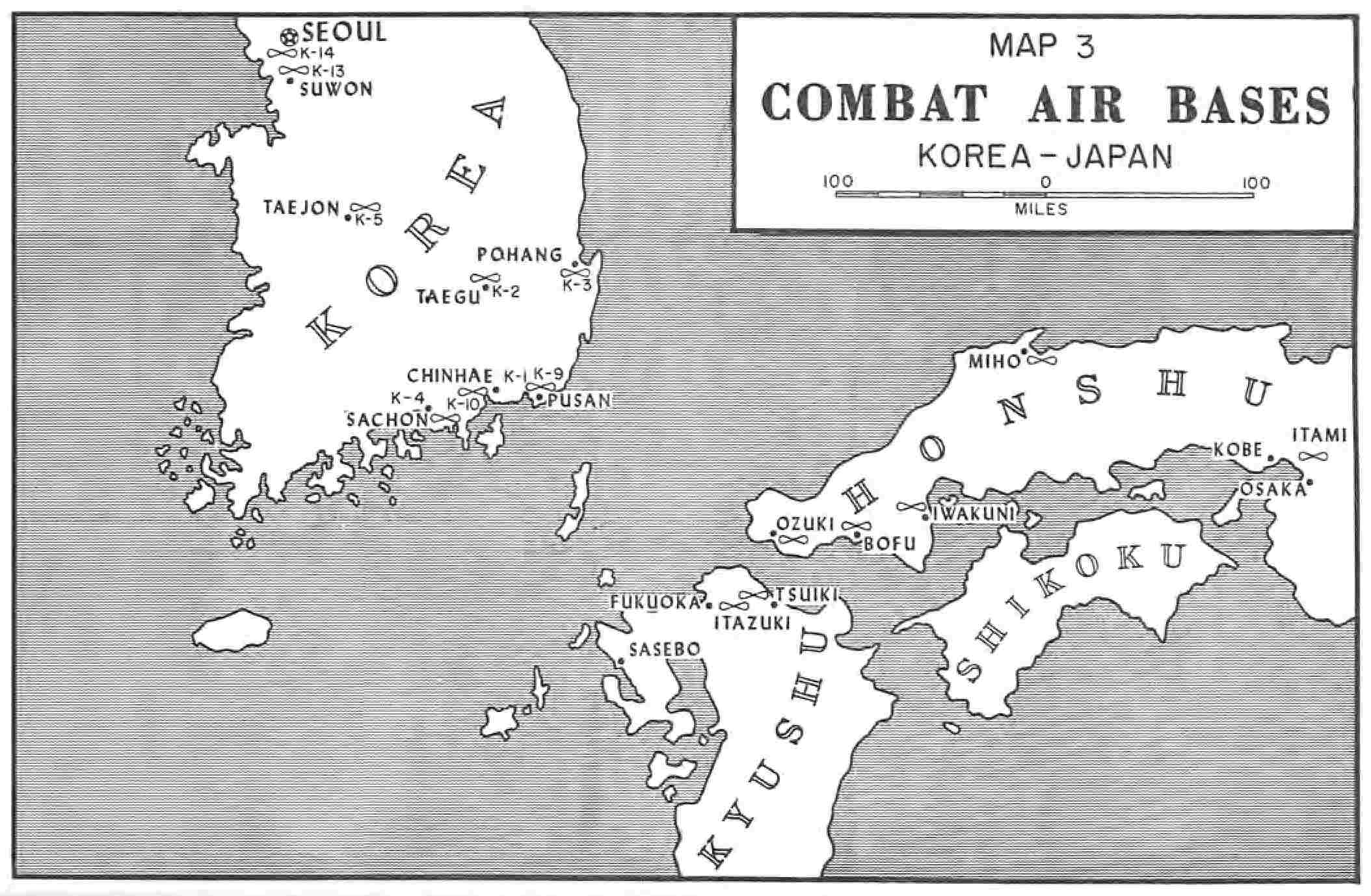
MAP 3
COMBAT AIR BASES
KOREA-JAPAN
A great deal depended, of course, on how the lightning of this
human thunderbolt was controlled. The Marine Corps and the Air
Force had different ideas on the subject. At the foundation of the
Marine system was the concept that the needs of the ground forces
came first, and control of air support should be exercised by the troops
being supported. In each Marine infantry battalion a tactical air
control party (TACP) included two aviators—one to be employed as a
forward air controller (FAC) at the front, and the other as an air
liaison officer in the battalion supporting arms center (SAC).20
In an emergency both could quickly be assigned to companies or
even platoons to “talk” air strikes down on the enemy. The normal
chain of command was bypassed in favor of direct radio from the
TACP to the cognizant air control agency that had the authority to
cross-check the request for possible conflict with other operations and
to channel fighter-bombers to the attack.
Intermediate commands kept themselves informed of the over-all
air picture and controlled the employment of aviation by their own
subordinates as they listened in on these requests. They indicated
approval by remaining silent, and disapproval by transmitting a
countermand.
The hub of the Air Force system was the Tactical Air Control
Center (TACC) of the Fifth Air Force-EUSAK Joint Operations Center
(JOC), known by the code name MELLOW. An aviator coming on
duty called up MELLOW and received his instructions from JOC.
FACs were assigned to U.S. Army and British units down to corps,
division, and regimental levels, and to ROK corps and divisions.
Further assignment to smaller front line units was possible but entailed
a good deal of time and advance planning. And even the most urgent
requests had to be channeled through division and regimental levels
to JOC for approval.
If a Marine FAC wasn’t able to control an air strike visually because
of terrain conditions, he called for a “tactical air coordinator, airborne”
(TACA) to locate the target from the air and direct planes to the
attack. The Fifth Air Force also used special airborne coordinators.
Known as “Mosquitoes,” they flew low-winged, two-seater North
American training planes, designated T-6s by the Air Force and
SNJs by the Navy.
This plan was capable under favorable circumstances of providing
the Fifth Air Force-EUSAK tactical air control system with a mobile
and flexible means of directing air power at the front. Its chief weakness,
according to Marine doctrine, lay in the separation of air power
from ground force control. The Air Force claimed the advantage of
projecting tactical air power deep into enemy territory; but as the
Marines saw it, this was deep or interdictory support, and not to be
compared to genuine close air support.
The command and staff of the 1st Marine Division could only speculate
during this interim period as to what the near future might hold
for them. Rumors had been circulated, during the first week at Masan,
that the Division would be employed as rearguard to cover an Eighth
Army withdrawal from Korea, with Pusan serving as the port of
debarkation. And while plans cannot be made on a basis of rumor,
General Smith and Colonel Bowser went so far as to discuss the
possibility seriously. At last, on 24 December, a more definite prospect
loomed when the EUSAK staff requested the Division to furnish logistical
data for a move by rail and truck to Wonju, some 130 miles north
of Masan.
It was not known whether an actual move was contemplated or the
intention was merely to have available a plan for future use if the
occasion warranted. General Smith sent the data but added a strong
recommendation to the effect that any commitment of the Division be
postponed until it was re-equipped and strengthened by replacements.21
At this time the Marine general received a copy of a map prepared
by the Eighth Army staff which showed the phase lines of a 200-mile
withdrawal from the combat zone to the Pusan port of debarkation.
No enlightenment as to the employment of the Division was forthcoming
until 27 December 1950, however, when a EUSAK dispatch
directed that the Marines be detached from Eighth Army reserve and
reassigned to the operational control of X Corps.22
A message of the 28th requested General Smith to attend a conference
at the X Corps CP at Kyongju (about 60 air miles northeast
of Masan) on the 30th. He was directed to bring several members
of his staff with him and to assign a liaison officer to X Corps.23
Two VMO-6 helicopters flew him to Kyongju along with his G-3,
Colonel Bowser, and his aide, Captain Martin J. Sexton. Tossed by
high winds, they landed just in time to meet General Ridgway, who
gave a talk emphasizing the necessity for reconnaissance and maintaining
contact with the enemy.
The new plan for X Corps employment, as modified after discussion
with the Eighth Army commander, called for the recently reorganized
2d Infantry Division to be placed under operational control of General
Almond. It was to move out at once to the Wonju front, followed
by the 3d and 7th Infantry Divisions. The 1st Marine Division was
to stage to Pohangdong (Map 3) on the east coast, some 65 miles
north of Pusan, with a view to being eventually employed on this
same front.24
“Certainly no one could accuse General Almond, the X Corps
commander, of defeatism,” was a tribute paid by General Smith. On
the contrary, the Marine general had sometimes differed with him on
the grounds that he was aggressive to the point of giving too little
weight to logistical considerations and time and space factors.
It was realized at the conference that administrative decisions must
depend to a large extent on the outcome of the impending enemy
offensive. G-2 officers of the Eighth Army, forewarned by prisoner
interrogations, were not surprised when the blow fell shortly before
midnight on the last night of the year.
In spite of Air Force bombings of roads and suspected supply
dumps, the Chinese Reds had been able to mount a great new offensive
only three weeks after the old one ended. Attacking in the bitter cold
of New Year’s Eve, they made penetrations during the first few hours
in ROK-held sectors of the central and eastern fronts. By daybreak
it became evident that Seoul was a major objective, with the UN
situation deteriorating rapidly.
CHAPTER II The CCF January Offensive — UN Forces Give Ground — Further Eighth Army Withdrawals — Marine Aircraft in the Battle — 1st Marine Division Assigned Mission — Replacements by Air and Sea — The Move to Japanese Airfields — Red China’s “Hate America” Campaign — A Tactical Formula for Victory
UN Forces Give Ground—Further Eighth Army Withdrawals—Marine
Aircraft in the Battle—1st Marine Division
Assigned Mission—Replacements by Air and Sea—The
Move to Japanese Airfields—Red China’s “Hate
America” Campaign—A Tactical Formula for Victory
On the last day of 1950 the 1st Marine Division was alerted for
two missions within an hour. At 1425 it was detached from
X Corps, after only four days, and once more assigned to the operational
control of the Eighth Army. The Marines were directed to resume
their former mission of training, reorganizing, and replacing
equipment so that they could be employed either to block enemy penetrations
along the Ulchin-Yongju-Yechon axis (Map 4), or to take
over a sector along the main line of resistance (MLR).
Forty minutes later another EUSAK dispatch alerted the Division to
move to the Pohang-Andong area, where it would be in position to
block any CCF penetration. This warning order came as no surprise,
since X Corps had already contemplated such employment for General
Smith’s troops. In fact, General Craig and Deputy Chief of Staff
Colonel Edward W. Snedeker had left Masan that very morning to
select assembly areas and command posts.25
At a conference of G-3 and G-4 officers held at Masan on New
Year’s Day, it was recommended that the administrative headquarters
remain in its present location when the rest of the Division moved up
to Pohang. Although this headquarters had accompanied the Division
CP in the past, it was believed that gains in mobility would result if
the large number of clerical personnel and their increasing bulk of
documents were left behind.26 In view of the changing situation at the
front, there was less danger of losing valuable records if the headquarters
continued to function at Masan, maintaining contact with the
forward CP by means of daily courier planes. The plan was approved
by the Division commander and worked out to general satisfaction.
Decisions were made during the first few days of 1951 in an atmosphere
of suspense and strain as adverse reports came from the firing
line. General Ridgway had assumed correctly, on the basis of prisoner
interrogations, that the main Chinese effort would be channeled down
the historical invasion corridor north of Seoul. He made his dispositions
accordingly, and the Eighth Army order of battle on 31 December
1950 (Map 2) was as follows:
U.S. I Corps—Turkish Brigade, U.S. 25th Division, ROK 1st Division,
from left to right northwest of Seoul. In Corps reserve, British
29th Brigade.
U.S. IX Corps—ROK 6th Division, U.S. 24th Division, from left
to right north of Seoul. In Corps reserve, British Commonwealth
27th Brigade, U.S. 1st Cavalry Division.
ROK III Corps—ROK 2d, 5th, and 8th Divisions, from left to right
on central front. In Corps reserve, ROK 7th Division.
ROK II Corps—ROK 3d Division, on east-central front.
ROK I Corps—ROK 9th and Capital Divisions, from left to right
on eastern front.
The U.S. X Corps, comprising the newly reorganized U.S. 2d
Infantry Division at Wonju and the 7th Infantry Division in the
Chungju area, had been given a mission of bolstering the ROK-held
line in central and east Korea and blocking enemy penetrations to
the rear.
In Eighth Army reserve was the 187th Airborne RCT, with Thailand
Battalion attached, in the Suwon area. Also under EUSAK operational
control in rear areas were the 1st Marine Division (Masan), the
3d Infantry Division (Kyongju), the Canadian Battalion (Miryang),
and the New Zealand Field Artillery Battalion (Pusan).
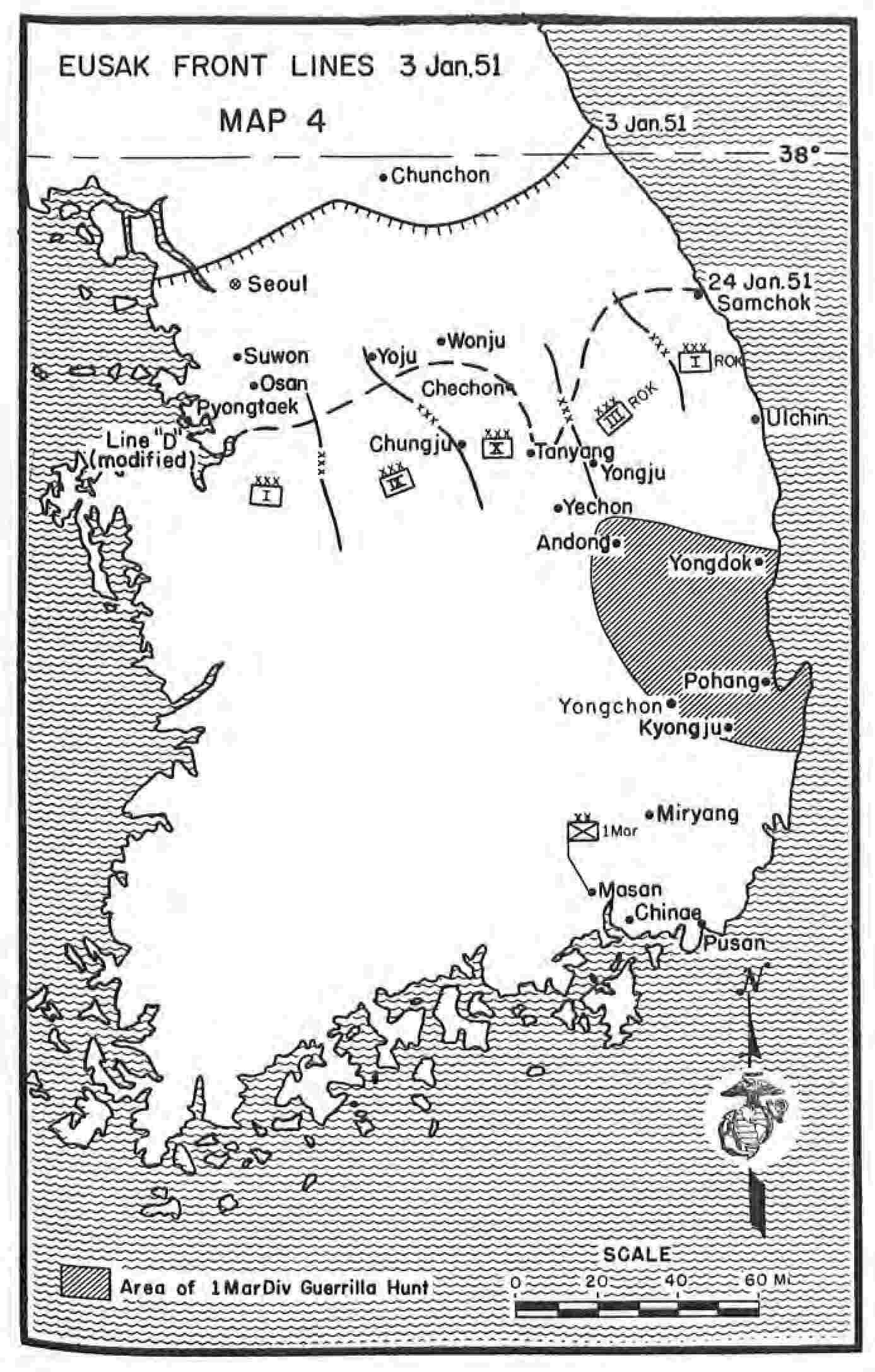
EUSAK FRONT LINES 3 Jan. 51
MAP 4
Altogether, the United Nations forces in Korea numbered 444,336
men as of January 1951. The cosmopolitan character of the fight
against Communism is indicated by the aid given to the U.S. and ROK
forces by contingents of combat troops from 13 other nations—Australia,
Belgium, Canada, Ethiopia, France, Greece, Netherlands,
New Zealand, Philippines, South Africa, Thailand, Turkey, and the
United Kingdom.27
Enemy numbers at this time were estimated at a total of 740,000
men in Korea and nearby Manchuria. Seven CCF armies, the 37th,
38th, 39th, 40th, 42d, 50th, and 66th were identified among the
troops attacking on New Year’s Eve. The NKPA I and V Corps also
participated. Estimated strength of the assaulting forces was 174,000
Chinese and 60,000 North Koreans.
Previously identified but not reported in contact with U.S. forces
on 31 December were the 24th, 48th, 49th, and 65th CCF armies and
the NKPA 1st, 3d, and 15th Divisions.
As another possibility which could not be overlooked, the five CCF
armies which had opposed X Corps in northeast Korea might also
take part in the new offensive. Elements of the 20th, 26th, 27th, 30th,
and 32d Armies identified in that area early in December, had more
than two weeks in which to reorganize and make their way to the
Eighth Army front. If they got into the fight, it would mean a
formidable addition to the enemy’s forces.
With only five days at his disposal, after arrival in Korea, General
Ridgway’s preparations were limited. His dispositions could not be
blamed, but it was the old story of the chain and its weakest link as
the enemy scored a major breakthrough at the expense of the 1st ROK
Division on the west-central front. Unfortunately, this unit represented
the tactical joint between I Corps and IX Corps. The enemy
widened the gap before dawn and drove on toward Seoul.
Early in the morning the EUSAK commanding general was on the
road, waving his arms in an attempt to stop ROK soldiers streaming
rearward in their vehicles after abandoning crew-served weapons. The
short training period for these troops, their tactical inexperience, and
the language barrier were the dissonant notes tolling the ominous
chords of defeat. The whole front was endangered as the enemy
poured through an ever widening gap, and Ridgway ordered that
roadblocks be set up where MPs could halt the fugitives, rearm them,
and send them back to the front. At his request, President Syngman
Rhee appealed to ROK soldiers over the radio and exhorted them to
make a stand. By that time it was too late to save Seoul, and the
commanding general gave orders for its evacuation.
“The withdrawal was initiated in mid-afternoon on the 3d,” he
commented in retrospect, “I stayed on the bridge site on the north
bank until dark to watch the passage of the most critical loads. These
were the 8-inch howitzers and the British Centurion tanks, both of
which exceeded the safety limits of the bridge under the conditions
existing at the time.”28
It was a scene of terror and despair that Ridgway never forgot.
Thousands of Korean civilian refugees were making their way over
the thin ice of the river Han, many of them carrying children or old
people on their backs. What impressed the observer most was the
uncanny silence of this mass flight in the freezing winter dusk, broken
only by the sound of a multitude of feet shuffling over the ice—a sound
strangely like a vast whispering. It was as if these derelicts of war
were trying incoherently to confide their misery to someone.
From a strategic viewpoint, the only course left to the Eighth Army
was a continued retirement south of Seoul. “We came back fast,”
Ridgway admitted, “but as a fighting army, not as a running mob.
We brought our dead and wounded with us, and our guns, and our
will to fight.”29
EUSAK Fragmentary Operations Plan 20, issued as an order on 4 January,
called for a further withdrawal to Line D (Map 4). In preparation,
X Corps had moved up to the front on the 2d, after assuming
operational control of the U.S. 2d and 7th Infantry Divisions and
the ROK 2d, 5th, and 8th Divisions and occupied a sector between
U.S. IX Corps and ROK III Corps.30
The U.S. 3d Division was attached to I Corps and the 187th Airborne
RCT passed temporarily under operational control of IX Corps.
By 7 January the UN forces had pulled back to a modified Line D
extending from Pyongtaek on the west coast to Samchok on the east
and taking in Yoju and Chechon. General Ridgway sent telegrams
to all corps commanders expressing dissatisfaction with the personnel
and material losses inflicted on the enemy during the withdrawal.
“I shall expect,” each message concluded, “utmost exploitation of
every opportunity in accordance with my basic directive.”
That evening, foreshadowing the offensive operations he was contemplating,
the commanding general ordered a reconnaissance-in-force
by a reinforced infantry regiment north to Osan to search out
the enemy and inflict maximum punishment. No contacts were made,
nor did strong patrols sent out by U.S. IX Corps flush out any sizeable
groups of Chinese. But the Eighth Army had served notice that it
intended to regain the initiative at the first opportunity.
One more blow remained to be absorbed. On the 8th the Communists
struck in the Wonju area with an attack of four divisions.
Elements of the newly reorganized 2d Infantry Division were forced
to give up that important highway and rail center after counterattacks
failed. The enemy now directed his main effort along the Chunchon-Wonju-Chechon
corridor, and North Korean guerrilla forces infiltrated
through the gap between the U.S. X Corps and ROK III Corps.
The salient created by this CCF attack caused Line D to be modified
again so that in the center it dipped sharply downward to Chungju
before curving northeast to Samchok (Map 4).
The pilots and aircrewmen of the three carrier squadrons and the
land-based jet squadron were the only Marines in a position to take
an active part in the battle. With but one TACP per division, close
air support was out of the question for the ROKs on New Year’s Day.
Control facilities were severely strained when scores of UN fliers
made use of the frequencies which the Mosquitoes employed for tactical
air direction. The voices were all in the English language, but
with more than one person doing the sending, shrill side noises sliced
in to garble the whole into a cacophony of jungle sounds. A Mosquito
trying to coach a fighter-bomber attack at the crossings of the Imjin
might be drowned out by a distant pilot calling up a controller in the
Hwachon Reservoir Area.31
As a consequence, there was no coordinated air-ground attack in
direct support of the man in the foxhole. Most of the JOC effort was
directed to the enemy’s rear in an effort to block supporting arms,
reinforcements, and supplies.
The two Marine squadrons attached to Admiral Ruble’s carriers
were at sea, some 80 miles south of Inchon when news of the Chinese
offensive filtered through the tedious communication channels from
JOC and EUSAK. Major Lund, CO of VMF-323, led an eight-plane
attack which destroyed enemy trucks and some 40 huts believed to be
occupied by CCF troops in a village south of the Imjin.
Another Marine air mission of New Year’s Day was the flight commanded
by Major Kenneth L. Reusser for the purpose of wiping out a
reported CCF concentration on the central front. Unfortunately, he
could not get verification that the target consisted of enemy troops.
Before a decision could be made, Reusser heard a Mosquito of the
2d ROK Division calling urgently for any flier in the area to hit
another CCF concentration (this time verified) in a village to the
enemy’s rear of the Chorwon-Hwachon area. Under the Mosquito’s
direction the Corsairs bombed and napalmed the village, then strafed
survivors trying to escape.
VMF-212, flying with Navy (Task Force) TF-77 on the eastern
side of the peninsula, had a busy New Year’s Day. Two eight-plane
interdiction strikes were flown in the morning against rear area targets
along the coastal highways. The afternoon brought an emergency call
from JOC, and the squadron “scrambled” 14 planes which hit the east
flank of an extensive enemy push south of the Hwachon Reservoir.32
More than 300 UN fighter-bombers were sent out under JOC, or
MELLOW, control on the embattled first day of 1951. On the west
coast TacRon-3 received more calls for air support than TG-96.8
could fill. Rear Admiral Lyman A. Thackrey sent a request to Admiral
Struble in the Missouri for additional carrier planes, and within a few
hours the Marines of VMF-212 were detached and on their way to
the west coast to join the other two Corsair squadrons of TG-96.8.
All four Marine fighter-bomber squadrons took part daily in air
operations as the Chinese Reds continued their advance south of
Seoul. VMF-311 was badly handicapped, however, by mechanical
difficulties. Engine or radio trouble accounted for five “aborts” of the
15 sorties launched on 4 January. The remaining pilots could not make
radio contacts with their assigned Mosquito controller, and had little
choice other than to attack targets of opportunity.
The jets continued in action, but it was realized that they were not
giving the maximum of their capabilities. By mid-January the squadron
had become almost ineffective through no fault of its own. Technical
representatives from the companies that had manufactured both
the engine and plane were flown to K-9 (Map 3), and on the 16th
all jets were grounded. These inspectors did not work on the planes;
they were empowered only to report the nature of the trouble to the
airplane companies concerned. The companies in turn reported to
BuAir in Washington, which sent instructions and if necessary mechanics
to Itami, where major aircraft maintenance was done.
Meanwhile, the fall of Seoul meant that the Air Force was evicted
by enemy action from such major fields as Kimpo and K-16 on an
island in the river Han. The Sabre jets and Mosquitoes had to be
pulled back, and soon the F-51s were no longer secure at Suwon from
an advancing enemy.
Admiral Thackrey’s Western Deployment Group completed the
evacuation from Inchon of 70,000 tons of supplies, 2,000 vehicles,
and about 5,000 troops.33 As the Navy closed out activities on the west
coast, TG-96.8 sent out its last combat air missions on 7 January.
VMF-214 made its final reconnaissance patrols; VMF-212 flew 25
sorties in support of UN troops in central Korea; and VMF-323 took
part in a series of Air Force raids on enemy troop assembly areas in
the Hoengsong area.33
Until the last, the carrier Marines alternated their Eighth Army
support missions with routine CAPs, coastal searches, and airfield
bombings. Admiral Thackrey’s Redeployment Group, including
TacRon-3, completed its task in the Inchon area and departed on the
7th. On that same day HMS Theseus, flying the flag of Admiral
Andrewes, was back in west coast waters as the British pilots resumed
their coastal patrols and naval air support on that side of the peninsula.
Within a week VMF-212 and the Bataan returned to fly alternate
tours of duty with the pilots of the Theseus. The other two carrier
squadrons found themselves unemployed for the time being. Not only
were they out of a job, they were also homeless, since the United
Nations had been forced to give up airfields at Yonpo, Wonsan, Seoul,
Kimpo, and Suwon. Only K-1, K-2, K-4, K-9, K-10, and two small
fields near Taegu remained (Map 2), and they would scarcely serve
the needs of FEAF. Thus it was that VMF-214 and VMF-323 found
a temporary haven at Itami, along with VMF-311 and most of the
administrative and service units of the 1st MAW. There was nothing
to do but wait until a new home could be found for the fighter-bomber
squadrons.
The Marine aviators might have found some consolation in the fact
that their comrades of the ground forces were also groping in a fog
of uncertainty. At the most critical period of the CCF thrust in the
Wonju area, General Smith was summoned to Taegu on 8 January for
a conference with General Ridgway. The Eighth Army commander
proposed to attach one of the Marine RCTs to X Corps in the Andong
area, about 95 air miles north of Masan. The remainder of the
Division would then move to the Pohang-Kyongju-Yongchon area,
some 60 air miles northeast of Masan (Map 4).
Ridgway asked the Marine general to discuss the prospect with his
staff. He realized, he said, that no commander liked to have his
division split up, and he assured Smith that as soon as the X Corps
zone became stabilized, the RCT would be sent back to him.
They parted with this understanding, but a few hours after his
return by air to Masan the following message was received from
Ridgway:
Subsequent your departure, alternate plan occurred to me on which I
would like your views soonest. It follows: 1st Mar Div, under Army control,
move without delay to general area outlined to you personally today, to take
over responsibility at date and hour to be announced later for protection of
MSR between Andong and Kyongju, both inclusive, and prevent hostile
penetration in force south of Andong-Yongdok road.34
At 1115 on the 9th the plan was made official. An Eighth Army
dispatch ordered the 1st Marine Division to move without delay to
the Pohang area (Map 4), remaining under EUSAK control, with the
following missions:
(a) Prevent enemy penetrations in force south of the Andong-Yongdok
road;
(b) Protect the MSR connecting Pohang, Kyongju, Yongchon,
Uihung, and Uisong.35
Based on these directives. Division OpnO 1-51 was issued at 1600
on the 9th. RCT-1 was directed to move by motor to Yongchon and
to protect the MSR, Yongchon-Uisong inclusive, from positions in
the vicinity of Yongchon and Uihung. The 1st and 7th Motor
Transport Battalions, plus other Division elements, were ordered to
provide the required trucks.36
General Ridgway arrived at Masan by plane on the morning of
9 January. He was met by General Smith and driven to Headquarters,
where the Division staff officers and regimental commanders were presented
to him. In a brief talk he reiterated the necessity for reconnaissance
and for regaining and maintaining contact with the enemy. The
Marine officers were told that limited offensive actions by Eighth
Army units would be put into effect soon.37
Division OpnO 2-51, issued at 1300 on the 10th, provided for the
completion of the Division movement by road and water from Masan
to the objective area.38
Shortages both of personnel and equipment were much reduced during
the first two weeks of January. Returns to duty of battle and
nonbattle casualties added 945 to the Division strength. Corresponding
improvements had been made in the material readiness of the
Division. Early in January a large resupply shipment arrived from
Kobe, and a Navy cargo ship brought supplies and equipment which
had been left behind at Inchon in October. Thus the situation was
generally satisfactory except for nearly 1,900 gaps in the ranks that
remained to be filled.39
Facilities for air transport across the Pacific were limited, since the
Army was also moving replacements to the Far East. A piecemeal
process of shuttling Marines in plane-load increments could not be
completed before 30 January. Lieutenant General Lemuel C.
Shepherd, Jr., commanding FMFPac, took a dim view of this delay.
It would be better for the Division, he maintained, to receive even a
part of its replacements before it went back into action. As a compromise,
he proposed a combined air-sea lift which met the approval
of Rear Admiral Arthur H. Radford, commanding Pacific Fleet.
Three replacement drafts were already on the way, with the 3d
in Japan and the 4th and 5th at Camp Pendleton. General Shepherd
scraped the bottom of the manpower barrel so closely that he dug
up an additional 700 men from Marine security detachments in Japan,
the Philippines, and other Pacific Ocean bases.
Seven trainloads of Marines from Camp Lejeune arrived at San
Francisco on 10 January to join those from Camp Pendleton. On the
same day 230 of these replacements were flown to Hawaii by the
Military Air Transportation Service (MATS), by the R5D’s of Marine
VMR-352 and of Navy VR-5, and by the “Mars” flying boats of
Navy VR-9. The next day 799 Marines sailed on the fast transport
USNS General W. O. Darby. The remainder were transported at the
rate of one plane load a day by MATS and at the rate of three or four
plane loads a day by the Navy and Marine transport planes of Fleet
Logistics Air Wing, Pacific (FLogAirWingPac).40
Five days later, on the 16th, the airlift had cleared the last Marine
out of Treasure Island. On 21 January, 1,000 men of the special draft
were already with the 1st Division at Pohang and the 799 on board
General Darby were due to dock at Pusan.
It had been a fast job of coordination by the Navy, Army, Air Force,
and virtually all major units of the Marine Corps. Much of the special
airlift was flown by the R5Ds of VMR-352 and of VMR-152. The
former, commanded by Colonel William B. Steiner, had been flying
the El Toro-Tokyo flights since October, but most of its effort had
been in shuttling between the mainland and Hawaii. VMR-152
had concentrated on the Hawaii-Japan leg of the long trip. During
the Chosin campaign, the squadron commander, Colonel Deane C.
Roberts, had maintained his headquarters and 10 planes at Itami to
support the shuttle to Korea. He had barely returned to Hawaii from
that job when his squadron was alerted not only for the special lift of
Marine replacements but also for a return to the Far East.41
Hawaii had been the bottleneck in this special troop lift. Land
and seaplanes were discharging their human cargo at Barbers Point,
Hickam Air Force Base, and Keehi Lagoon. From there FLogAirWingPac
had to space the planes over the long stretches of sea at
approximately four-hour intervals. The guiding factor was other air
traffic over the same route and the servicing, messing, and rescue
capabilities of Guam and other points along the way, such as tiny
Johnston Island. The latter was barely big enough for its single
6,100-foot runway.
VMR-152 and the Navy’s VR-21 were assigned the mission of flying
the long Hawaii-Japan portion of the big lift. Itami became
another collection center for the airborne replacements and five of
the VMR-152 planes were retained there to shuttle the troops the
last 300 miles to K-3, near Pohang (Map 2). On 21 January the
troop lift reached virtual completion, but Admiral Radford authorized
the 1st MAW to retain a couple of R5D’s at Itami a little longer.
Thus the Marines were able to avoid highway and rail traffic jams
in Korea by flying men and materials from troop and supply centers
in Japan to K-1, K-3, or K-9.
Looking back at the troop lift from a historical distance, the observer
is most impressed by its demonstration of teamwork on a
gigantic scale. The Marine Corps had functioned as a single great
unit, even though a continent and an ocean separated the vanguard
in Korea from the rear echelons in North Carolina.
The seven remaining UN airfields in Korea were of course not enough
to accommodate the 25 FEAF and Marine tactical squadrons. Logistics
and lack of space proved to be knotty problems. Thirty tank cars of
gasoline a day were needed for normal flight operations of K-2 alone.
Yet it took these cars eight days to make the 120-mile Pusan-Taegu
round trip, such was the strain put on the railway system by the CCF
offensive.
Feaf had standby plans to evacuate Korea entirely in an emergency.
Some of the secondary airfields of the Itazuke complex in Japan had
been reevaluated for this purpose. Originally built by the Japanese
for World War II, they were obsolescent by 1951 and because of
weather, neglect, and misuse badly deteriorated.42
The most promising of these secondary airfields were Tsuika, Ozuki,
and Bofu (Map 3), ranging from 30 to 65 miles east of Itazuke and
facing one another around Japan’s Inland Sea. Nearest to Itazuke
and on the same island of Kyushu was Tsuika. Across the narrow
Shimonoseki Strait, on the shore line of Honshu, were Ozuki and Bofu.
General Stratemeyer, the FEAF commander, informed General
MacArthur that it was necessary to start air operations from Ozuki
and Bofu as soon as possible. A good deal of work had already been
done on Tsuika, even to moving a major Japanese highway in order
to lengthen the runway to 7,000 feet. The Air Force general wanted
to repair Ozuki for his F-51 squadrons, and Bofu was to be reserved
for the 1st MAW.
This decision meant a revision of plans for the Marines. MAG-12
had recently been lifting a hundred men a day to K-1 (Pusan west)
with a view to making it into a major base. These preparations came
to an abrupt halt, pending the final decision on Bofu.
A Marine survey of that World War II airfield showed it to be in
serious disrepair. The Air Force had already rejected it as a base for
night-harassing B-26s. Although the runway was only 7 feet above
sea level, a 720-foot hill complicated the traffic pattern. Nevertheless,
Bofu was considered suitable for the time being, and the Air Force
assured the 1st MAW that its use would be but temporary.
Feaf proposed that the Marines start flying out of Bofu immediately,
operating under field conditions. There were, however, essential
repairs to be made. The 5,300-foot runway remained in fair condition,
but much of the taxiway was not surfaced and couldn’t stand
heavy use by the Corsairs, Three of the four hangars needed extensive
repairs, as did the barracks and mess hall. Fuel would have to be
stored in drums.
The Wing had the capability for minor construction but lacked the
equipment, men, and fiscal authority to handle major work on the
runways and taxiways. The Air Force offered to furnish the labor and
materials, provided that the Navy pay for them. The Navy in its
turn was too limited in funds to restore an Air Force field for only
temporary use by Marines.
Finally, a compromise solved the problem. The Navy agreed to
have the engineering work done by a detachment of its Mobile Construction
Battalion 2 (Seabees) and furnish the concrete for patching
the runways and rebuilding the warm-up aprons. The Air Force was
to provide the pierced steel planking for the runways.
On 15 January MAG-33 sent an advance detachment of 125 officers
and men to Bofu to do some of the preliminary work, and on the
following day the Seabees initiated the heavy construction. The
restoration of K-1 was meanwhile resumed by MAG-12.
Until these two fields were made ready, VMF-212 on the Bataan
would be the only Marine squadron in combat.
The middle of January was also a transition period for the 1st Marine
Division. In accordance with Division Orders 1-51 and 2-51, the
movement from Masan commenced at 0545 on 10 January when the
first serial of RCT-1 departed by motor for the Pohang-Andong area.
LSTs 898 and 914 sailed the next day with elements of the Tank,
Ordnance, Engineer, and Service Battalions. The new Division CP
opened at Sinhung, about five miles southeast of Pohang, at 1600
on 16 January; and by the 17th all designated motor and water lifts
were completed. Thus the 1st Marine Division and 1st Marine
Aircraft Wing were poised to begin new operations which will be
described in the following chapter.43
By 15 January relative quiet prevailed along the entire front; the
Chinese Reds had shot their bolt. In terms of territorial gains (Map 4)
the Communists could claim a victory, for they had inflicted heavy
losses both in troop casualties and equipment on the UN forces. Yet
the CCF January offensive could not compare with the November-December
attacks either in moral or material damage done to the
Eighth Army. This time the UN divisions had withdrawn for the
most part in good order after the rout of ROK units at the outset. Nor
were Ridgway’s troops always driven from their positions by enemy
action. Whenever he had an option between sacrificing men or
Korean real estate, it was the latter he chose. And by his insistence
on good combat discipline, he made the enemy pay an exorbitant price.
Nevertheless, the blunt fact remains that the United Nations forces
had been beaten in spite of an overwhelming superiority in aircraft,
artillery, armor, and transport as well as command of the sea. Stateside
Americans can scarcely be blamed for asking themselves why
their well-equipped divisions had been defeated twice within six weeks
by an Asiatic peasant army using semiguerrilla tactics and depending
largely on small arms, mortars, and light artillery.
The answer cannot be given in simplified terms. Although the
Chinese Reds were represented by a peasant army, it was also a first-rate
army when judged by its own tactical and strategic standards.
Military poverty might be blamed for some of its deficiencies in arms
and equipment, but its semiguerrilla tactics were based on a mobility
which could not be burdened with heavy weapons and transport.
The Chinese coolie in the padded cotton uniform could do one thing
better than any other soldier on earth; he could infiltrate around an
enemy position in the darkness with unbelievable stealth. Only
Americans who have had such an experience can realize what a shock
it is to be surprised at midnight with the grenades and submachine gun
slugs of gnomelike attackers who seemed to rise out of the very earth.
Press correspondents were fond of referring to “the human sea
tactics of the Asiatic hordes.” Nothing could be further from the
truth. In reality the Chinese seldom attacked in units larger than a
regiment. Even these efforts were usually reduced to a seemingly
endless succession of platoon infiltrations. It was not mass but deception
and surprise which made the Chinese Red formidable.
They also had an advantage over Western soldiers in their ability
to withstand hunger and cold while making long night marches.
After all, the rigors of a winter campaign in Korea were not much
worse than the hardships the Chinese peasant had endured all his life.
Usually he was a veteran of at least five years’ combat experience, for
China had known little but war since the Japanese invasion of 1935.
Many of Mao Tse-tung’s troops, in fact, were former Nationalists
who had fought for Chiang Kai-shek.
The Chinese Reds held another advantage in Korean terrain well
suited to their tactical system. This factor has been ably summarized
by U.S. Military Academy historians:
The mountains are high, and the deep gorges between them are a bar to
traffic even when the streams are dry or frozen. Roads are few, and those
that do exist are not suited for heavy traffic. Transportation then becomes a
problem for the pack mule and the human back rather than the self-propelled
vehicle. Telephone wires are difficult to lay and, with guerrillas on
every hand, are doubly hard to maintain. Even radio is limited by such
terrain, with a considerable reduction in range. In all, most observers have
agreed that American forces have seldom fought in terrain to which modern
means of war are less adaptable.44
The fanaticism and political indoctrination of the CCF soldier must
also be taken into account. His introduction to Communism began
when he was persuaded that China’s small farms would be taken away
from the hated landlords and divided among the people. This is the
first stage of every Communist upheaval. Next comes a reign of terror
calculated to liquidate the entire class of landlords and small shopkeepers.
Communist China, almost literally wading in blood, had
reached this second phase in 1951, the “year of violence.” Mass trials
were held in which the People’s Tribunals, keyed up to a frenzy of
fury, sentenced group after group of “Capitalist oppressors” to death
without bothering about the evidence. The executions were public
spectacles. An estimated million and a half of them took place in
1951 alone as loudspeakers on street corners blared out first-hand
descriptions.
Drives were organized for everything in Red China. So rapidly
did they multiply that humorless Communist leaders saw no absurdity
in announcing a new drive to reduce the number of drives. And when
the Youth League tried too zealously to please, a drive was launched
“to Correct the Undesirable Habit of Filing False Reports.”45 Under
these circumstances it is understandable that great emphasis was
placed on Red China’s “Hate America” drive early in 1951. The
illiterate masses were made to believe that Americans practiced all
manner of bestialities, including even cannibalism. This was the
indoctrination of the CCF soldier in Korea, and political commissars
with a captain’s authority were attached to each company to see that
no backsliding occurred. In case of doubt, it was a simple matter to
compel the suspected political deviate to kneel at the roadside and
await a bullet from behind.
It might well be inquired where Red China raised the funds, for even
wars waged with human cannon fodder do not come cheaply. Much
of the money was donated by new farm owners as “voluntary” contributions
exceeding by far the rent and taxes of pre-Communist years.
The slave labor of millions of Chinese sent to concentration camps also
helped to foot the bill. In the long run, however, the Communist lords
found perhaps their most effective means in the extortion of ransom
from Chinese living outside the country on pain of torturing or killing
relatives dwelling within its borders. Enormous sums were collected
in spite of the efforts of foreign governments to put an end to this
form of secret terrorism.46
Altogether, the army of Red China may be appraised as a formidable
instrument on terrain suited to its tactics. Several of America’s foremost
military thinkers were convinced, nevertheless, that Eighth Army
reverses of the first few months in Korea were the penalty paid for a
national preoccupation with airborne atomic weapons at the expense
of preparations for limited wars.
It was only natural that the American public and its political and
military leaders in Washington should have been much concerned
about a weapon with the capability of wiping out a medium-size city
in a minute.47 Their anxiety was heightened by President Truman’s
announcement on 23 September 1949 that Soviet Russia had exploded
an atomic bomb. A great many Americans, probably a majority,
sincerely believed that it was hardly worthwhile to prepare for an old-fashioned
limited war when the Armageddon of the future would be
fought to an awesome finish with thermonuclear weapons. National
policy was shaped by this line of reasoning; and though we had every
opportunity to study Chinese tactics prior to 1950, few if any preparations
were made to cope with them. The outbreak of Korean hostilities
found the four U.S. skeleton divisions in Japan woefully unready,
both morally and materially.
At a later date three high-placed U.S. Army generals, Matthew B.
Ridgway, James M. Gavin, and Maxwell D. Taylor, would retire
because they could not reconcile their views with a national policy
which they interpreted as placing all our strategic eggs in the basket
of intercontinental bombers and guided missiles. Afterwards, as
advocates of preparedness for limited as well as atomic warfare, they
published books presenting their side of the case.48
On 15 January 1951 these developments were still in the future,
of course. But even at the time it had already been made evident that
the armed forces of Red China were not an exception to the age-old
rule that there is no such thing as an invincible army. When they
came up against well trained and led U.S. Army outfits in both of their
offensives, they always had a fight on their hands and frequently
a repulse.
The Marines had proved beyond doubt in their Chosin Reservoir
campaign that the Chinese Reds could be beaten by ground and air
firepower engendered by sound training, discipline, and combat
leadership. Five Chinese armies, of three or four divisions each, were
identified in northeast Korea during the November-December operations.
Three of them were directly or indirectly opposed to the 1st
Marine Division, with a U.S. Army battalion and smaller Army units
attached. Yet the beleaguered American forces seized the initiative
and fought their way for 13 days and 35 miles through enveloping
CCF units which had cut the mountain MSR in five places.
Throughout the CCF January offensive, EUSAK G-2 officers anxiously
sought every scrap of evidence as to the whereabouts of the
five CCF armies identified in northeast Korea as late as 10 December.
Even if reduced by casualties, they would have been a formidable and
perhaps even decisive reinforcement to the seven CCF armies engaged.
But they did not appear. Nor were they encountered again until the
middle of March 1951, when similarly numbered units filled with
replacements reached the front.
The full story may never be known, since the Chinese Reds are not
fond of acknowledging their disasters. But it is a likely conjecture
that the fatal combination of Marine firepower and General Winter
created terrible havoc among Communists who had been so certain
of an immediate victory that they were neither armed, clothed, nor
supplied for a 13-day campaign in subzero weather.
CHAPTER III The Pohang Guerrilla Hunt — The New Marine Zone of Operations — 1st MAW Moves to Bofu — Marine Rice Paddy Patrols — Operations THUNDERBOLT and ROUNDUP — Action in the Pohang-Andong Zone — KMC Regiment Joins 1st Marine Division — 10th NKPA Division Scattered — New Mission for the Marines
The New Marine Zone of Operations—1st MAW Moves to
Bofu—Marine Rice Paddy Patrols—Operations THUNDERBOLT
and ROUNDUP—Action in the Pohang-Andong
Zone—KMC Regiment Joins 1st Marine Division—10th
NPKA Division Scattered—New Mission for the Marines
On 15 January 1951 a reinforced regiment of the U.S. 25th
Infantry Division drove northward from Line D (Map 4) to
a point about half a mile from Suwon in the I Corps sector. VMF-212,
flying from the CVE Bataan, supported the movement along with
land-based Air Force planes. No CCF troops were encountered during
a two-day thrust dignified with the name Operation WOLFHOUND. Its
only importance lay in its distinction as the first Eighth Army counterstroke
in reply to the enemy’s January offensive. Other EUSAK advances
were soon to follow, each more ambitious than the last and
bearing a more bristling code name.
General Ridgway proposed by this means to exert continual and
increasing pressure on an enemy paying for victory with extended
supply lines. Meanwhile, he hoped to build up the morale of his own
troops without asking too much of them at first.
In less than seven weeks, from 1 December 1950 to 15 January 1951,
the Eighth Army had been pushed back an average distance of 200
miles. Never before in the Nation’s history had an American army
given up so much ground and equipment in so short a time, and
damage to morale was inevitable. Yet the commanding general was
confident that a cure would be effected by better combat leadership
and discipline. He planned to emphasize the need for these remedies
until he restored the Eighth Army to tactical health.
Ridgway agreed with Marine generals that the 1st Marine Division
had come out of its 13-day battle in the Chosin Reservoir area with its
fighting spirit undulled. Minor respiratory ills seemed to be the only
consequences felt by the survivors. “A hacking cough,” recalled a
Marine staff officer long afterwards, “was the symbol of the Bean
Patch.”49
Such ills soon responded to rest and medical care, and it was a
physically fit division that made the move to the new zone of operations.
About one man out of three in the infantry and artillery
battalions was a newcomer to Korea. These replacements were shaping
up nicely, and the new operation promised to be ideal combat
training.
The move took nearly a week. While the other troops proceeded by
motor, LSTs 898 and 914 sailed with elements of the Tank, Ordnance,
Engineer, and Service Battalions. The Division CP opened at Sinhung
(Map 5), about 5 miles southeast of Pohang, on 16 January. By the
following day all designated motor and water lifts were completed.
On the 18th the Marines were assigned a three-fold mission by
Division OpnO 3-51: (1) the protection of the Pohang-Kyongju-Andong
MSR (main supply route); (2) the securing of Andong and
the two airstrips in the vicinity; and (3) the prevention of hostile
penetrations in force to the south of the Andong-Yongdok road. The
following zones of patrol responsibility were assigned to Marine units:
Zone A—RCT-1: an area about 10 miles east and west of the
Uisong-Andong road, including both Uisong and Andong.
Zone B—RCT-5: an area some 15 to 20 miles wide astride the
Kyongju-Yongchon-Uisong road, including Kyongju but excluding
Uisong.
Zone C—RCT-7: an area 20 to 25 miles wide from east to west
and extending north from the latitude of Pohang to the Andong-Yongdok
road.
Zone D—11th Marines: a strip seven miles wide along the coast
astride the road from Pohang to a point about 10 miles north of
Yongdok.
Zone E—1st Tank Battalion: the area bounded by the road from
Pohang to Kyongju and thence to the east coast at a point about 19
miles southeast of Pohang.
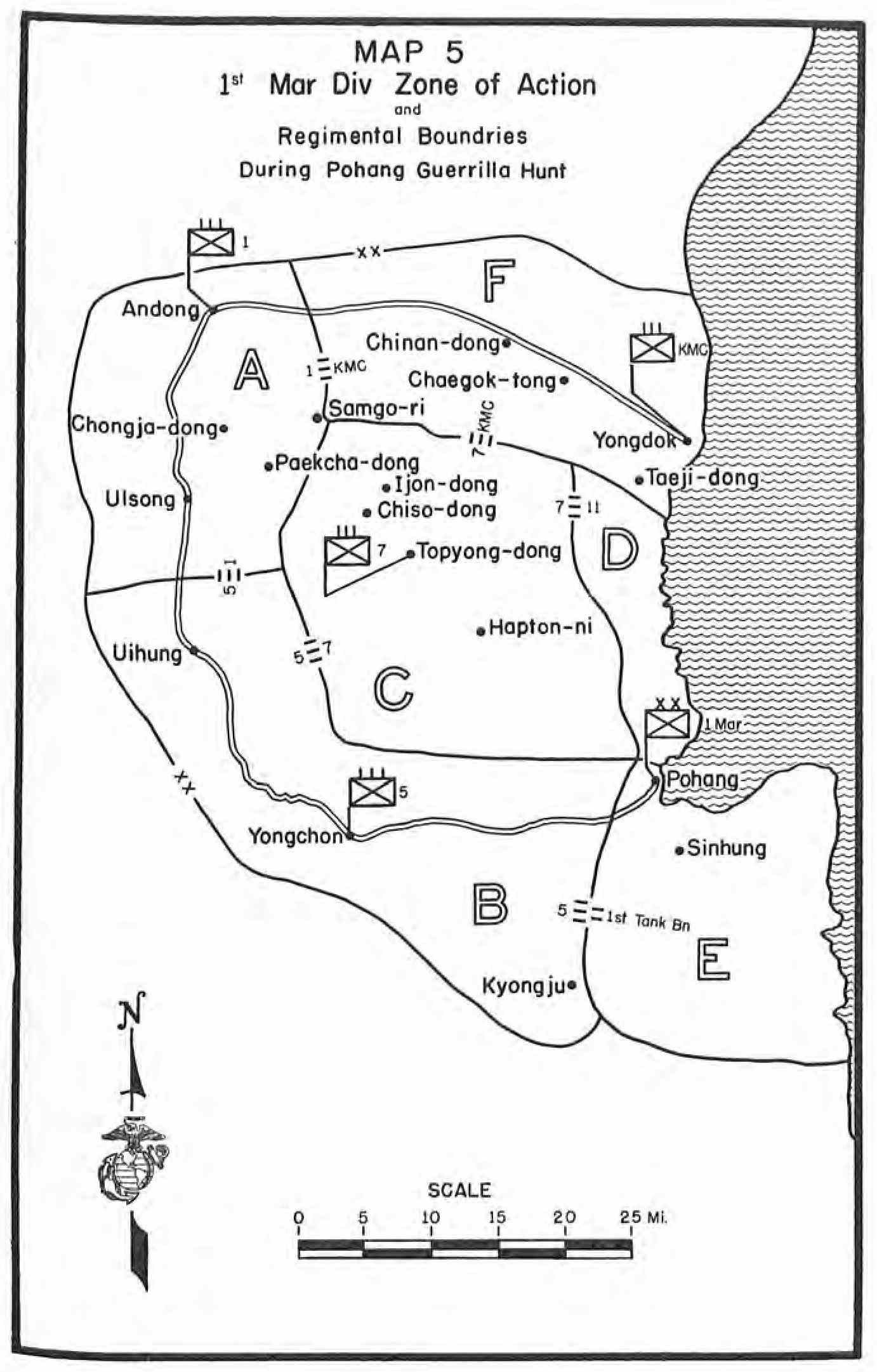
MAP 5
1st Mar Div Zone of Action
and
Regimental Boundries
During Pohang Guerrilla Hunt
Keeping open the 75-mile stretch of MSR from Pohang to Andong
was considered the principal mission of the Division. Strong points
were set up at Pohang, Yongchon, Uisong, and Andong.
Captured documents indicated that enemy forces in unknown numbers
had already infiltrated through gaps in the eastern sectors of the
Eighth Army’s Line D. Guerrilla activity was reported as far west as
Tanyang, on the MSR of IX Corps, and as far south as Taejon,
threatening the supply line of I Corps. Train ambushes occurred on
13 January in the Namchang area and to the south of Wonju. Other
attacks took place on the rail line about 60 miles north of Taegu.
In expectation of further attempts, trains were provided with a sandbagged
car, pushed ahead of the engine, to absorb the shock of landmine
explosions. Another car was occupied by guards who had the
duty of dealing with direct guerrilla attacks.50
The tactical problem of the Marines was quite simple—on paper.
About 1,600 square miles, most of them standing on end in mountainous
terrain, were included in the new zone of operations. The
experience of World War II had demonstrated how effective guerrilla
warfare could be as an adjunct to large-scale military operations.
Officers of the 1st Marine Division had no illusions about their
mission, therefore, when they received unconfirmed reports of NKPA
guerrilla infiltrations behind the EUSAK lines toward Andong.
All uncertainty vanished on 18 January, shortly after the issuing of
OpnO 3-51, when a patrol of the 3d Battalion, 1st Marines, flushed
out an undetermined number of North Korean troops east of Andong.
They took to their heels so earnestly that the Marines barely managed
to catch three of them after a long chase.
The prisoners identified their unit as the 27th Infantry of the NKPA
10th Infantry Division. The other two regiments, the 25th and 29th,
were also in the general area. All three were supported more in
theory than fact by artillery, mortar, medical, and engineer units
organic to the division. In reality, however, the estimated total of
6,000 troops consisted largely of infantry, A few mortars, according
to the prisoners, were the largest weapons.
Following the Inchon-Seoul operation, the remnants of the badly
mauled NKPA 10th Infantry Division had straggled back across the
38th Parallel to the Hwachon area. There they were reorganized by
the Chinese for guerrilla operations and placed under the command
of NKPA Major General Lee Ban Nam.51
Late in December the rebuilt division, still short of arms and equipment,
departed Hwachon with a mission of infiltrating through the
UN lines to cut communications and harass rear installations of the
Andong-Taegu area. Shots were exchanged with United Nations
troops near Wonju, but General Lee Ban Nam and his troops contrived
to slip to the east through the mountains. Stealthily moving
southward, marching by night and hiding by day, they were soon in a
position to heckle the rear of the X Corps sector. This advantage did
not last long. Before they could strike a blow, the element of surprise
was lost along with the three prisoners taken by the Marines.
As the Marine units moved into their assigned zones, General Ridgway
flew to Pohang to confer with General Smith. Not only did he
express confidence that the Marines would soon have the situation well
under control; he also suggested the possibility of small amphibious
landings along the east coast. The purpose was to block a possible
southward advance of the three CCF armies that had operated in
Northeast Korea during the Chosin Reservoir campaign.52
The east coast littoral was considered the most likely route of
approach. Smith was of the opinion, however, that an amphibious
landing should be made in strength, if at all. And there the matter
rested.53
During the operations of the first few days the Marine ground forces
had to depend for air support on FEAF planes sent by JOC. The 1st
Marine Aircraft Wing had its hands full at this time with housekeeping
activities. Work began at Bofu (Map 3) on 20 January as a
Seabee detachment arrived with its graders and bulldozers. They were
assisted by details of Marines from MAG-33.54
The job went ahead with typical Seabee efficiency. While specialists
installed plumbing for the galleys and barracks, other crews graded
taxiways, laid pierced steel planking, and poured concrete to patch up
runways, parking ramps, and warmup aprons.
MAG-12 kept busy at the task of moving men and equipment
from Itami and other Japanese fields to Korea. Aircraft of VMR-152,
commanded by Colonel Deane C. Roberts, provided transportation.
Since safety measures precluded the use of the K-1 runway during
construction activity, K-9 substituted temporarily. As fast as the
planes unloaded, passengers and gear were trucked 15 miles through
Pusan to K-1.
It was a transition period in more ways than one for the 1st MAW.
Following are the changes of commanders that took place during the
last 2 weeks of January:
Colonel Radford C. West, relieved by Lieutenant Colonel Paul J. Fontana
as commanding officer of MAG-33;
Lieutenant Colonel Frank J. Cole, joined MAG-33 staff as personnel
officer after being relieved of VMF-312 command by Major Donald P.
Frame;
Major Arnold A. Lund of VMF-323, relieved by Major Stanley S. Nicolay
and assigned to General Harris’ staff as assistant operations officer;
Major William M. Lundin, relieved of VMF-214 command by Major
James A. Feeney, Jr., and transferred to the command of Service and Maintenance
Squadron-33 (SMS-33).
This left only Lieutenant Colonel Richard W. Wyczawski of
VMF-212 and Lieutenant Colonel Max J. Volcansek, Jr., of
VMF(N)-542 still in command of the tactical squadrons they brought
to Korea; and the latter was to be relieved by Lieutenant Colonel
James R. Anderson in February.
The only combat operations of the 1st MAW during the week of
housekeeping from 16 to 23 January were carried out by VMF-212
from the deck of the Bataan.55 This CVL carrier alternated with the
British light fleet carrier HMS Theseus on the Korean west coast
blockade. Their activities were coordinated by Vice Admiral Andrewes,
RN, commanding the group blockading the Korean west
coast.
VMF-212 sent out a morning and afternoon reconnaissance flight
each day up the coastline as far as the 39th parallel. On the trip
north the pilots scanned the coastal waters for small enemy shipping
which might indicate reinforcement from Chinese ports on the Yellow
Sea. The return trip along the highways and railroads of the littoral
was made to detect signs of any new enemy activity on land. Four
aircraft flew each of the two coastal sweeps; eight maintained a
defensive patrol over the carrier itself; and any remaining flights
were under control of JOC, with FEAF Mosquitoes providing liaison
between fighter-bombers and ground forces.
To insure sea room beyond the islands and mudbanks of the west
coast, the Bataan had to stay outside the 100-fathom curve. This meant
that the pilots must fly across 65 to 80 miles of open sea in order to
reach the coast. The winter weather varied from unbelievable to
unbearable, and bulky, uncomfortable survival suits were a necessity.
They could be a death trap, however, if a leak developed or if they
were not adjusted tightly at the throat and wrists. Captain Alfred H.
Agan, for instance, was shot down southeast of Inchon and had to
choose between landing in enemy territory and ditching in the sea.
He tried for a small island offshore but crash-landed into the surf.
Before a helicopter from the Bataan could fly 65 miles to the rescue, he
died from the shock of icy water which partially filled his survival suit.
The pilots of VMF-212 reported an increase in enemy antiaircraft
fire, particularly in CCF rear areas. They were amazed to find troops
dug in along the coast as far back as 50 or 60 miles from the battle
lines. These precautions were the enemy’s tribute to Marine capabilities
for amphibious warfare. The fear of another Inchon caused the
Chinese to immobilize thousands of men on both coasts to guard
against another such decisive landing far behind the front.
On the squadron’s third day of sea operations, three planes were
hit by rifle and machine gun fire on reconnaissance missions. One of
them, flown by Captain Russell G. Patterson, Jr., was shot down
behind the enemy lines but a FEAF helicopter rescued the pilot. First
Lieutenant Alfred J. Ward was not so fortunate. His plane was
riddled the following day by enemy fire and he crashed to his death
in the midst of CCF soldiers.
Not until 22 January did the reconditioning of Bofu reach such an
advanced stage that Lieutenant Colonel Fontana could set up his
MAG-33 command post. VMF-312 moved in the next day and the
first combat missions were launched to the vicinity of Seoul, 300 miles
away. On the 24th General Harris established his headquarters. A
few hours later VMF-214 and VMF-323 arrived from Itami, where
they had put in an idle week, with no place to go, after their carrier
duty. On the 26th, when they flew their first missions as land-based
squadrons, MAG-33 was back in business and Bofu was a going
concern.
No such claim could have been made for MAG-12 and K-1.
Although Colonel Boeker C. Batterton set up his command post on
27 January 1951, two more weeks were to pass before the K-1 runway
was fit for the flights to tactical aircraft. Meanwhile, the MAG-12
squadrons had to make out as best they could at K-9.
Operations of the first few days demonstrated to 1st Marine Division
ground forces that locating the enemy was more of a problem than
defeating him. Obviously, the NKPA 10th Division had few if any
of the advantages which make for effective guerrilla warfare. Far
from receiving any voluntary support from the inhabitants, the Korean
Reds had their own movements promptly reported to the Marines.
Retaliations on civilians, such as burning mountain villages, were not
calculated to improve relations. Nor did the enemy possess any of the
other requisites for successful operations in an opponent’s rear—a
base, a source of supply, good communications, and a reliable
intelligence system.
If it came to a fight, there could be little doubt about the outcome.
But Marine staff officers must have been reminded of the old recipe
for rabbit pie which begins, “First, catch your rabbit.”
Such a situation called for systematic patrolling in all Marine zones
of action. Secondary roads and mountain trails were covered by “rice
paddy patrols.” Numbering from four men to a squad, these groups
ranged far and wide on foot in an area that was more often vertical
than horizontal. On a single day the 5th Marines alone had 29 of
these rice paddy patrols in action.56 No better training for replacements
could have been devised. Sometimes the men were on their own for
several days, depending for supplies on helicopter drops. And while
casualties were light, there was just enough danger from sniping and
potential ambushes to keep the replacements on the alert.
Roads fit for vehicles—especially the 75-mile stretch of MSR from
Pohang to Andong—were under the constant surveillance of motorized
patrols, each supported by at least one tank or 105mm howitzer.
The farthest distance was 15 miles between the main Marine strong
points at Pohang, Yongchon, Uisong, and Andong.57
Close air support was seldom needed against such an elusive enemy
as the Marines faced. General Craig put in a request, however, for
an air squadron to be based at Pohang or Pusan (Map 2). The two
Marine all-weather squadrons, VMF(N)-513 and VMF(N)-542,
were General Harris’ first and second choices. They had been flying
under Air Force (314th Air Division) control in the defense of Japan,
a mission of dull routine and waiting for something to break the
monotony of patrolling.
The twin-engined F7F-3N Tigercats of VMF(N)-542 were well
equipped with electronics equipment for night interceptor work.
VMF(N)-513 flew F4U-5Ns, the night-fighter modification of the
latest Corsair.58
General Harris’ plan for VMF(N)-542 to take over the duties of
VMF(N)-513 at Itazuke had the approval of General Partridge.
This made it possible to send the latter squadron to K-9 at Pusan to
replace the VMF-311 jets, which in turn left for Itami to await corrections
of engineering defects.
VMF(N)-513 flew its first combat missions from K-9 on 22 January.
These consisted of routine armed reconnaissance flights and an
occasional deep support mission for the Eighth Army. Not until the
25th did the squadron respond to a request from Marine ground
forces. And out of 49 combat missions (110 sorties) during the
remaining 6 days of the month, only three (10 sorties) were in support
of the 1st Marine Division.
For routine operations the Marine ground forces found the support
of VMO-6 sufficient. The nimble little OY observation planes were
ideal for seeking out an enemy who had to be caught before he could
be fought. And the helicopters did their part by dropping supplies,
evacuating casualties, and laying wire.
Meanwhile, the 1st Marine Aircraft Wing strengthened its administrative
ties with the 1st Marine Division. Although the two organizations
had no common operational commander other than General
MacArthur, they maintained a close liaison. Harris attached two
TBM Avengers to VMO-6 for use as radio relays when ground-to-ground
communications failed in the mountainous Pohang-Andong
area. He also set up daily courier flights, at General Smith’s request,
to provide fast administrative liaison between widely dispersed Marine
air and ground units in Korea and Japan.
On 25 January two corps of the Eighth Army jumped off in Operation
THUNDERBOLT. Advancing side by side, I Corps and IX Corps had
orders to launch limited objective attacks and regain solid contact with
the enemy, who was obviously preparing for a new offensive.
The EUSAK commander moved his CP from Taegu to Chonan
(Map 1), the I Corps headquarters, in order to maintain personal
control of the operation. He requested the Navy to step up offshore
patrolling on the west coast as left-flank protection. Emphasis was also
placed on aerial reconnaissance, both visual and photographic, as well
as deep support directed by the Mosquitoes.
Even VMF(N)-542 at Itazuke had orders to conduct long flights
to Seoul and maintain continuous patrols to report any attempt of the
enemy to retire across the frozen Han River. The F7F-3N pilots shot
up camp areas, convoys, and other lucrative targets but found no indications
of large-scale crossings over the ice.59 So varied were the missions
of the squadron that it came as no surprise to be assigned to naval
gunfire spotting for the USS St. Paul and the other British and American
cruisers shelling Inchon.
All Marine tactical squadrons were in action on 28 January for the
first time since December. Nearly two-thirds of the flights from Bofu
and K-9 were diverted from armed reconnaissance to troop support.
A typical operation was carried out by four VMF-312 planes on their
second day of duty at Bofu. After reporting to MELLOW they were
directed to Mosquito Cobalt, which had received a message that enemy
troops were hiding in a village just north of Suwon, occupied that day
by the U.S. 35th infantry. Under the Mosquito’s direction they
bombed, strafed, and napalmed some 40 buildings containing CCF
soldiers.60
The fall of Suwon opened the way to Inchon and Seoul as Chinese
resistance stiffened. Eighth Army progress was anything but reckless,
but Ridgway had served notice on the enemy that he held the initiative
and intended to keep it. Operation ROUNDUP followed on the heels
of THUNDERBOLT. Merely a change in name was involved, for the
advance continued at the same prudent pace without any important
amendments to the original mission.
The Marines in the Pohang-Andong zone had their first brush with the
elusive enemy on 22 January. A patrol of the 1st Battalion, 1st
Marines, flushed out a guerrilla force near Mukkye-dong, several miles
southeast of Andong (Map 5). Captain Robert P. Wray’s Charlie
Company deployed for action at sunset and shots were exchanged. The
Marines had no casualties and the enemy could not have suffered many
losses before he disappeared into the winter dusk.
Even at this early date the Korean Reds seemed to have lost confidence
in their guerrilla operations. In a message dated 23 January
taken from a prisoner, the commanding general of the II NKPA Corps
directed General Lee Ban Nam to withdraw if possible. It read as
follows:
Get all of your troops out of the enemy encirclement and withdraw to
north of Pyongchang without delay. Liaison team sent with radio. If you
will inform us of your escape route we will assist by clearing your advance.
If you cannot escape, stay in the rear of enemy as guerrillas.61
By the 24th an enemy drift southeast from the zones of the 1st and
5th Marines to 7th Marines territory was apparent. The 1/7 command
post and Company A received scattered mortar fire late that afternoon.
Action picked up the next morning when dawn brought an attack by
an estimated 100 guerrillas on the regimental command post. After
a brisk 90-minute fire fight the Korean Reds withdrew to the east,
leaving seven dead behind and taking with them an unknown number
of wounded.
Later that morning the 7th Marines teamed up with the National
Police against the Chiso-dong area. Nine bodies were counted as the
3d battalion seized its objective, but 1/7 was slowed by an entrenched
enemy who offered an unyielding defense. The Marine battalion
ground to a halt just one mile short of Chiso-dong and dug in for
the night as artillery continued to pound the enemy. The air strikes
on the 25th were flown by VMF(N)-513 and VMF-323, both based
at K-9, but the pilots could not contact the FAC and had to make
dummy runs over the enemy.
Marine planes and artillery cleared the way on 26 January as 1/7
advanced against scattered opposition. Nearly 400 guerrillas put up
a ragged and futile resistance, but by 1530 Marine firepower prevailed
and Chiso-dong was taken. The 2d Battalion had meanwhile occupied
Hapton-ni, eight miles southeast of Topyong-dong (Map 5). A light
enemy counterattack was repulsed with ease.62 Altogether, enemy
casualties for the day amounted to 161 KIA or POW.
The VMF-323 flight led by Captain Don H. Fisher and Captain
Floyd K. Fulton’s VMF(N)-513 flight merit recognition as the first
successful instance of Marine air-ground cooperation since the Chosin
Reservoir campaign.
While the 7th Marines served eviction notices on the enemy in its
area, action elsewhere was light. Task Force Puller63 hastened on the
26th to Chongja-dong, seven miles northeast of Uisong, to investigate
a police report that 300 enemy had seized the town. A Marine attack,
following an artillery preparation, was planned for 1500. Captain
Thomas J. Bohannon led Able Company in but discovered that the
shells had fallen on empty huts.64
During the next few days the rice paddy patrols continued to range
over the countryside, searching out the enemy. Combat units were
sent to areas where the G-2 red arrows indicated an NKPA buildup.
On the morning of the 29th, the 5th Marines tried to organize an
attack on a large enemy force reported near Chachon-dong, 12 miles
west of Topyong-dong. Captain Jack R. Jones’ Charlie Company,
moving out at night in small foot patrols to maintain secrecy, scoured
the area in an attempt to pin down the enemy.
Marine intelligence reports had warned of a dawn raid on the town
for the purpose of plundering food from the inhabitants and arms
from the Korean police station. First Lieutenant Richard J. Schening,
executive officer, led a scouting force ahead of the main body to
reconnoiter the area. He urged that a trap be set for the enemy, and
the company commander has left a description of one of the most
elaborate ambushes ever attempted by the Marines during the war:
Well before daylight, a cordon was stealthily braided around Chachon-dong
and we settled down to await the raiders. A later daylight inspection
of the deployment showed that the men had done a splendid job of locating
themselves so as to avoid detection. They were concealed under porches,
beneath the brambles, and in the heaviest foliage and trees. But no guerrilla
attack materialized, probably due to a “grapevine” warning of our movement
and intent.... During the remaining days in the village we conducted extensive
patrolling in an attempt to catch at least one guerrilla for our effort.
Patrols were kept small to maintain secrecy. We even dressed Marines in
clothing worn by the “locals” and sent them out in the hills with wood-gathering
details. Larger patrols up to a platoon in size were sent on combat
missions at night, One thing was certain: it was easier to talk about capturing
guerrillas than it was to lay a hand on them.65
The elusiveness of the enemy could not always be credited to effective
guerrilla tactics. Often it was due to distaste for combat. As
evidence of low NKPA morale, Major Yu Dung Nam, a battalion commander,
was condemned to death and shot late in January because he
planned to surrender, according to POW testimony. Rations were
at a bare subsistence level and typhus had claimed many victims.66
Unrelenting Marine pressure throughout the first week of February
wore the guerrillas down until groups larger than 50 men were seldom
encountered. On the 3d an NKPA second lieutenant surrendered voluntarily
to a RCT-7 patrol and brought three of his men with him.
Nkpa morale had sunk so low, he divulged, that all ranks were
striving only for survival. The division commander, Major General
Lee Ban Nam, had apparently become a victim of acute melancholia.
He spent nearly all his time, according to the prisoner, in the solitude
of foxholes dug into the slopes of hills for added protection. There
he brooded constantly over his predicament, but without arriving at
any better solution than alternate hiding and flight.67
Certainly the military situation didn’t offer much to gladden this
Hamlet of the rice paddies, and the Marines continued to give him
fresh causes for pessimism. His footsore remnants eluded RCT-5
only to stumble into the zone of RCT-1, northeast of Uisong. Neither
rest nor sanctuary awaited them, for the 1st and 2d battalions penetrated
into the mountains near Sangyong to surprise and rout a force
estimated at 400 men.68
Late in January the 1st KMC Regiment got into the fight after being
attached once more to the 1st Marine Division by a EUSAK dispatch
of the 21st. Lieutenant Colonel Charles W. Harrison headed a new
group of Division liaison and advisory officers as the four KMC
battalions moved out from Chinhae by LST and truck convoy to the
Pohang area. Division OpnO 4-51 (26 January) assigned the regiment
Sector F, astride the Yongdok-Andong road, which had been
carved out of Sectors C and D, held by the 7th and 11th Marines
respectively. The KMCs were ordered to conduct daily patrolling from
positions near Yongdok, Chaegok-tong, and Chinandong and prevent
enemy concentrations in their sector.69
Although the ROK Army and Eighth Army had the responsibility
for supplying the KMCs, it proved necessary for the 1st Marine Division
to cope with some of the gaps in equipment and rations. Contrary
to a prevalent Western belief, Koreans did not subsist on a diet of
rice alone. They were accustomed to having “side dishes” with their
rice, such as eggs, meat, fish, or vegetables. Colonel Kim Sung Eun,
the regimental commander, had an allotment of money for these
purchases, but the sum was insufficient to meet inflation prices even if
there had been enough food left in a district eaten bare. As a consequence,
the KMCs had to get along on a monotonous and vitamin-poor
diet until the ROK Army belatedly came to the rescue with issues of
food for side dishes.
On 29 January the KMC Regiment opened its CP at Yongdok.
Regimental OpnO 1 of that date divided Sector F into three parts,
assigning the western, central, and eastern subsectors to the 3d, 1st,
and 2d Battalions respectively. The 5th Battalion was attached to the
1st Marines and assigned to patrolling operations in the Andong area.70
The first few days of February saw a brief flurry of activity before
NKPA guerrilla resistance breathed its last gasps. Reports that the
remnants of the NKPA 25th and 27th Regiments were in flight toward
the zone of the 5th Marines led to a concentration for a knockout
blow, but the enemy stole away to the north in the vicinity of
Topyong-dong. There he discovered that he had jumped from the
frying pan into the fire. The 2d and 3d Battalions of the 1st Marines
closed in from one side while the 1st and 3d Battalions of the KMC
Regiment blocked roads in the vicinity of Samgo-ri and Paekcha-dong.
Only a wild flight in small groups saved the guerrillas from
annihilation.
The nearest approach to effective NKPA resistance was encountered
on 5 February after the 1st and 2d KMC Battalions had established
blocking positions in zone at the request of the 7th Marines, which
was driving the enemy northward. A platoon-size patrol of the 2d
KMC Battalion came up against Korean Reds dug in with 81mm
mortars and heavy and light machine guns a few miles southwest of
Yongdok. The KMCs were scattered with losses of 1 KIA, 8 WIA,
and 24 MIA in addition to all arms and equipment, though the missing
men returned later.
It was the single NKPA success of the entire campaign.
An assault was launched the following morning on this enemy
stronghold by a composite KMC battalion, supported by four
VMF(N)-513 aircraft which attacked with rockets and bombs. The
largest combat of the guerrilla hunt appeared to be in the making,
but again the enemy vanished after putting up an ineffectual resistance
with small arms and mortars.71
An unusual air tactic was tested on 4 February in the 7th Marines
zone when an interpreter in an R4D plane hailed the guerrillas by loud
speaker in their own language with a demand that they surrender or
suffer the consequences. Marine fighter-bombers were on station to
back the threat, and about 150 supposed NKPA soldiers came in with
uplifted hands while VMF-323 planes delivered the consequences to
the holdouts in the form of bombs, rockets, and napalm. Unfortunately,
it developed that practically all of the prisoners were terrified
civilians seeking an escape from the slave labor imposed upon them
by the guerrillas.72
Reports of enemy activity were received daily from Korean civilians
and police, and seldom was a smaller number than “about two
thousand” mentioned. In reality, Marine patrols had difficulty in
tracking down as many as ten of the skulking, half-starved fugitives
split up into small bands hiding in the hills. On 5 February the
situation was summed up by General Smith in reply to a EUSAK request
for an estimate of the time required to complete the Marine mission:
The original 10th NKPA Div forces in the 1st Marine Division area have
been dispersed into many groups, reduced to an effective strength of 40 per
cent, and are no longer capable of a major effort while dispersed.... It is
considered that the situation in the Division area is sufficiently in hand to
permit the withdrawal of the Division and the assignment of another mission
at any time a new force to be assigned the responsibility for the area assumes
such responsibility and the 1st Marine Division can be reassembled.73
Patrolling continued as usual in all Marine regimental zones during
the second week in February. Some units, such as the 11th Marines
and the Division Reconnaissance Company, had made few enemy
contacts throughout the operation. But at least the cannoneers had
found good pheasant hunting and enjoyed a change in the bill of fare.
It was just as well that the tactical situation seldom made it necessary
to call for air support at this stage, since the 1st MAW was once
again in the throes of moves which will be described in the following
chapter. Bofu had been only a temporary base for MAG-33 squadrons
which were making another transfer to K-9 while MAG-12 completed
its shift to K-1.
VMO-6 took care of the reduced air requirements of the Division
adequately. Another helicopter “first” was scored when First Lieutenant
John L. Scott received credit for the first night casualty evacuation
by a HTL (Bell), which then had no instruments for night
flying. For a harrowing moment, however, it would be hard to beat
the experience of Captain Clarence W. Parkins and Corpsman R. E.
Krisky. While they were flying a casualty to the hospital ship Consolation,
the patient became wildly delirious. It took the combined
efforts of pilot and corpsman to subdue him and make a safe landing.74
Any excitement would have been welcomed by the troops in general.
For the area was as tranquil as if the guerrillas had never troubled
its snowbound heights. Recently arrived Marines might have been
pardoned for concluding that the NKPA 10th Division and its gloomy
commander were but creatures of the imagination—phantoms to be
compared to the crew of the Flying Dutchman, that legendary ship
condemned to sail on endlessly until the Day of Judgment. The NKPA
10th Division also seemed doomed to perpetual flight as its ghostly
survivors made their way from crag to crag of the remote ridgelines.
Thanks to the rice paddy patrols, the replacements were ready for
combat and the Division was organizing a rotation draft for return
to the States. Five officers and 600 men had already been selected on
a basis of combat time, wounds received, and length of service. Major
General Edward A. Craig, who commanded the first Marines to land
in Korea, was given a farewell dinner and congratulated on his
second star. Two new brigadier generals were named, with Lewis B.
“Chesty” Puller relieving Craig as ADC and Gregon A. Williams
accompanying him on the voyage back to the States. Captain Eugene R.
“Bud” Hering, (MC) USN, was also returning with the gratitude of
all Marines for his care of casualties in the “frozen Chosin” campaign.75
All Marine missions in the guerrilla hunt had been successfully
accomplished, so that the Division could be relieved at any time by the
2d ROK Division. There were 120 counted enemy dead and 184
prisoners. Only estimates are available for the wounded, but there is
no doubt that the total NKPA casualties were crippling. At any rate,
the NKPA 10th Division was destroyed as a fighting force without
accomplishing any of its objectives. Marine casualties from 18 January
to 15 February were 19 KIA, 7 DOW, 10 MIA, 148 WIA, and
1,751 of a nonbattle classification, largely frostbite cases soon restored
to duty.76
On 11 February, General Smith flew to Taegu to discuss the next
Marine mission with General Ridgway. The EUSAK commander spoke
favorably of employing the 1st Marine Division to relieve the 24th
Infantry Division in the critical Han River corridor, where recent UN
advances had been made. He also recognized the advantages of
committing the Marines to the east coast, so that they could be held
in readiness for an amphibious operation. A third possibility was the
Yoju corridor of the IX Corps zone (Map 1). As “the most powerful
division in Korea,” said Ridgway, “the Marines would be
astride what he considered the logical route for an expected enemy
counterthrust.”77
No decision was reached that day. At midnight the CCF attack
materialized; and the central front was the area of decision, as Ridgway
had predicted.
Naturally, the next mission for the Marines had to be reconsidered
in the light of this development. On 12 February EUSAK warning
orders alerted the 1st Marine Division to be prepared to move to
Chungju, in the rear area of the IX Corps front where the heaviest
CCF attacks were taking place. The Division was further directed
to make an immediate reconnaissance of the Chungju area while the
1st KMC Regiment prepared for a move to Samchok on the east coast
and attachment to the ROK Capitol Division. The following day
brought orders from the Eighth Army to initiate these movements
on 15 February 1951.78 Thus the Pohang-Andong guerrilla hunt
came to an end with the Marines on their way to new employment
in the battle line of the Eighth Army.
CHAPTER IV Operation Killer — The Move to the Chungju Area — Marine Planes in Action — Planning for the New Operation — The Jumpoff on 21 February — Stiffening of Chinese Resistance — General Smith in Command of IX Corps — The Advance to Phase Line ARIZONA
The Move to the Chungju Area—Marine Planes in Action—Planning
for the New Operation—The Jump-Off on
21 February—Stiffening of Chinese Resistance—General
Smith in Command of IX Corps—The Advance to Phase
Line ARIZONA—JOC Air Control System Criticized
The CCF counterattack which began northeast of Wonju on
11 February 1951 came in reaction to the unremitting pressure
exerted during the previous month by the Eighth Army. Twice
beaten during a recent six-week period and pushed back some 200
miles, EUSAK had shown amazing powers of recuperation.
“It is hard for me to put into words the magnificent competence,
the fierce, combative, aggressive spirit of that force once it picked itself
off the ground and waded back into the fight,” commented General
Ridgway in retrospect.79
During Operations THUNDERBOLT and ROUNDUP he had kept a
tight rein on the Eighth Army by insisting on vigorous artillery
preparations and close lateral contacts between units. On 10 February,
however, caution was relaxed as CCF resistance suddenly collapsed
west and south of Seoul, That day the U.S. 24th Infantry Division
forged ahead 11,000 yards to occupy the port of Inchon and Kimpo
Airfield, both so wrecked that weeks of repair would be necessary to
make them operational. Seoul was within sight of the U.S. forces
on the left bank of the Han when an aroused enemy struck back on
the subzero night of the 11th.
Apparently the CCF drive on the central front had as its objective
the relieving of UN pressure on the Seoul area to the west. The CCF
40th and 66th Armies and NKPA V Corps struck in the IX Corps sector
north of Hoengsong (Map 6). Two ROK divisions being dislodged
by the initial blows, their retreat made necessary the withdrawal
of other IX Corps units. As a consequence, Hoengsong had
to be abandoned on 12 February to the Communists hammering out a
salient northeast of Wonju.80
The UN forces were not bound by any unrealistic concept of holding
ground to the last ditch. General Ridgway deemed it more important
to inflict maximum punishment on the enemy at a minimum
cost in casualties. While fighting on the defensive, he had already
made up his mind to launch an offensive of his own to catch the
Chinese off balance the moment their counterattack ground to a halt.
His new limited objective operation emphasized the destruction of the
enemy’s fighting strength as the major objective rather than the acquisition
of territory. A high attrition rate would preclude the Communists’
capacity to hold and enable EUSAK commander to recover the critical
hill mass north of Wonju. It was for this purpose, he informed
Major General Bryant E. Moore, IX Corps commanding general,
that the 1st Marine Division would be employed.
“The force which holds Wonju,” he said, “has the situation in
hand.”81
The 1st Marine Division had instructions to report its order of march
to the Eighth Army, and to keep the Taegu headquarters informed
of progress. Meanwhile, the Marines were to remain under EUSAK
operational control but would pass to IX Corps control at a date
and hour to be announced.
General Puller flew to Chungju with a reconnaissance party on
13 February to look over the road and select CP sites. On the following
morning Major Walter Gall’s Division Reconnaissance Company
arrived at Chungju for patrol duty, and movement by rail and road
commenced on the 15th in accordance with Division OpnO 5-51, issued
the day before.
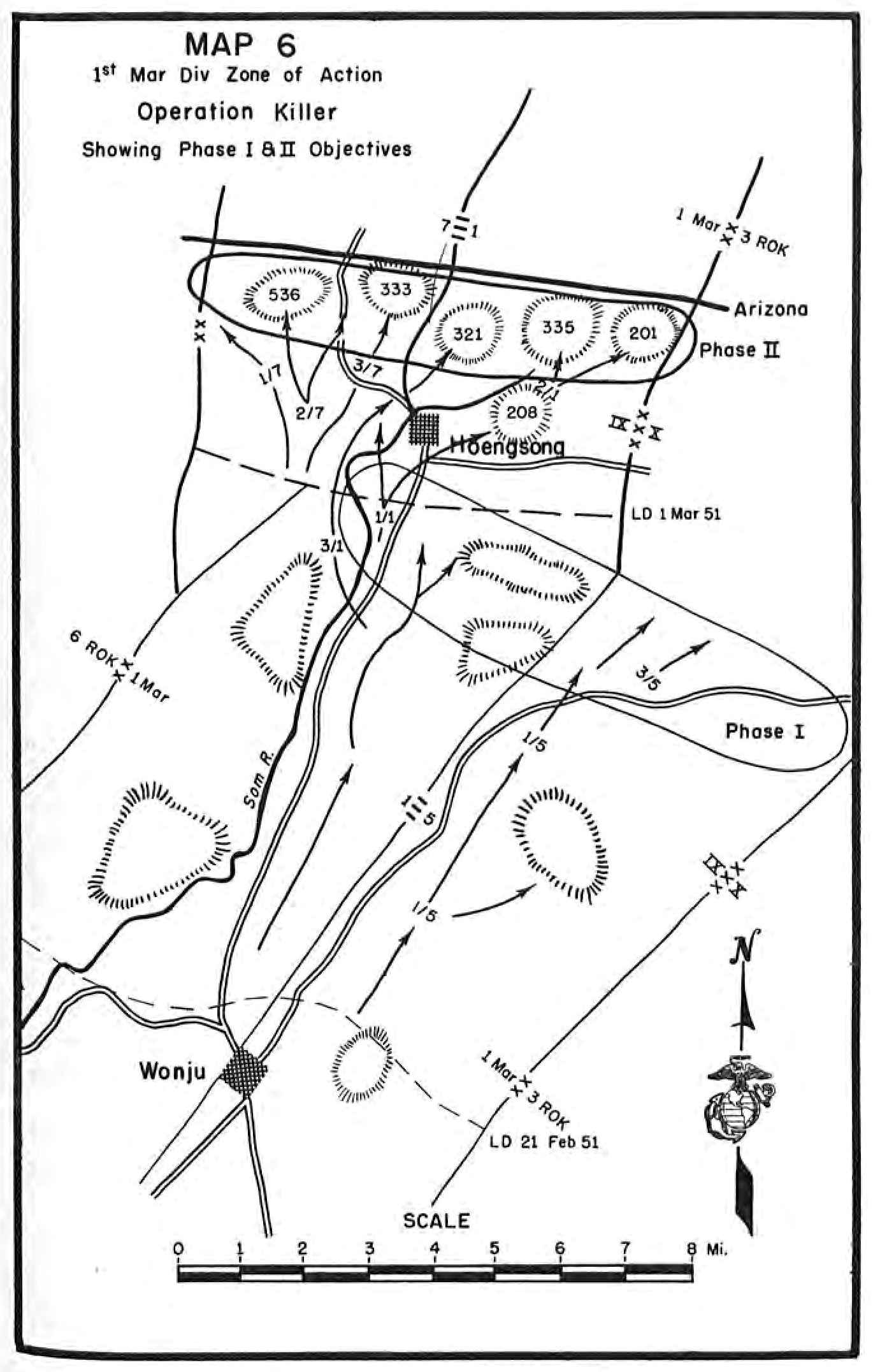
MAP 6
1st Mar Div Zone of Action
Operation Killer
Showing Phase I & II Objectives
The 1st Marines, with the 7th Motor Transport Battalion attached,
led the motor march, and the 5th and 7th Marines followed in that
order. Tracked vehicles were outloaded by rail from Andong and
Pohang in a total of 67 flat cars. Owing to a shortage of cars, Company
B and H&S Company of the 1st Tank Battalion made the move
of 120 miles by road. These tankers claimed the all-time Marine
Corps distance record for armor.82
While the Marine move was in progress, the CCF counterattack
went on full blast along the central front. Driving southeast from
the IX Corps area to the X Corps front, the Chinese cut off and surrounded
the 23d Infantry of the 2d Infantry Division, USA. Colonel
Paul Freemen and his men put up a fight that is one of the classics of
the war. Supported by Marine and Air Force planes, they gave more
fire than they received and held out until rescued by a tank column.83
February was also a transition period for Marine fighter squadrons
which had been more or less on the move since the middle of January.
Even before the transfer to Bofu, it had been decided that K-3, four
miles south of Pohang, was to be the ultimate home of MAG-33.
While awaiting completion of this field, VMFs-214, -312, and -323
would find temporary lodging at K-1, near Pusan, recently assigned to
MAG-12.84
On 6 February, Brigadier General Thomas J. Cushman, assistant
commanding general of the 1st MAW, radioed General Harris that
K-1 would be ready to receive a squadron a day, starting on the 8th.
Harris ordered Squadrons 323, 214, and 312 to make their moves
on 8, 9, and 10 February respectively. Transport aircraft were to lift
ground crews, extra pilots, and light equipment directly to K-1.
Pilots had orders to fly combat missions en route.
By the 13th most of the vehicles, heavy equipment, and general
supplies had been loaded on a train for Kobe, there to be transshipped
on LSTs to Pohang. That same day Lieutenant Colonel Fontana set
up his MAG-33 command post at K-3 and directed the three fighter
squadrons to report from K-1.
The new field occupied a bench overlooking a wide, sandy beach.
Built originally by the Japanese, the strip had 5,200 feet of concrete
runway. The Air Force had extended it to 5,700 feet with pierced
steel planking. This addition brought the end of the runway to the
brink of a 60-foot drop-off—a hazard in the event of a “hot” landing
to the northwest or too low an approach from the southeast.
Next to arrive at K-3 were the F9F-2Bs of VMF-311. Four weeks
of adjustments at Itami had restored the jets to operative condition.
An advance echelon went ahead to establish squadron living and
operating areas, and the pilots ferried the 19 aircraft. Ground crews
and equipment followed on transport planes.
Plans were made for VMF(N)-513 to move from Itami to K-3
before the end of the month. The other all-weather squadron,
VMF(N)-542, now commanded by Lieutenant Colonel James R.
Anderson, completed the transfer from Itami and Itazuke to K-1.
This field was also the destination of the photo pilots of Headquarters
Squadron, 1st MAW, who flew their F7F-3P and F4U-5P
fighters from Itami. Major Donald S. Bush commanded a unit,
formerly a squadron, which had been one of the first aviation organizations
to see action in Korea. Among its accomplishments were the
preliminary beach studies for the Inchon and Wonsan landings.
With the completion of the moves of February 1951, the 1st MAW
was again based on Korean soil. Fifteen types of Marine aircraft
were being flown. For the heavy hauling, the R4D and R5D transports
shifted troops and supplies. Included among the fighters were F9F
Panthers, F4U Corsairs, and two models of F7F Tigercats—a stripped-down
photo plane, and a radar-armed night fighter. Stinson OY
Grasshoppers, TBM Avengers, and Beechcraft SNBs rounded out the
list of conventional planes. Three types of rotary-wing aircraft were
represented: the Sikorsky HO3S-1, and two models of the Bell HTL.85
By 15 February the brief CCF counterstroke had spent its force.
Hoengsong had fallen to Communists who hammered out a salient
on a 20-mile front extending as far southward as the outskirts of
Wonju (Map 6). But the enemy’s main purpose had failed of
accomplishment, for the grip of the Eighth Army on Inchon and
Kimpo Airfield was not shaken. Nor did the Chinese gain a breathing
spell in their preparations for a third great offensive as a followup
to the December and January drives.
More by coincidence than design, the Fifth Air Force launched a
new system of air tactics a few days after the beginning of the CCF
counterstroke. Called “Reconnaissance Plan Fighter,” it was based
on a division of enemy-held Korea into 22 sections. Squadrons were
given the mission of making hourly surveys of the same areas, day
after day, until pilots became so familiar with them that any change
hinting at CCF activity would be noticed at once.86
If these surveys revealed any sign of any enemy concentration, either
of men or supplies, JOC scrambled special bombing strikes against
them.
Although Marine fliers could readily see the advantages of covering
the same ground daily, it made for monotony on reconnaissance
missions. Only a highly unusual spectacle would startle a pilot, but
First Lieutenant Weldon R. Mitchell blinked when he saw a camel
in his gunsights.87 Shaggy little Mongolian horses were no novelty
as ammunition bearers, and after recovering from his first astonishment
the VMF-311 pilot cut loose with .50 caliber machine gun slugs. As
he suspected, the camel’s pack contained ammunition and the animal
was all but vaporized in the explosion.
Major Bush’s photographic unit had an important part in keeping
the enemy under constant surveillance. The Fifth Air Force directed
on 16 February that all photo requests were to be screened by the Fifth
Air Force’s 543d Tactical Support Group at Taegu. Under the tactical
coordination of this Group, the Marine unit was to fill all Navy and
Marine requests. When not on such missions, it would be fitted into
the Fifth Air Force photographic reconnaissance program.88
Pinpoint photos of suspected troop areas and such terrain features
as defiles, junctions, detours, and bridges were in demand. The fact
had to be faced that the enemy was almost unbelievably clever at
camouflage and concealment. In one instance it was found that the
Chinese had constructed bridge sections which they hid by day and
put to use at night.89 On another occasion they sank a bridge by
means of weights so that it remained far enough beneath the surface
of the water in the daytime to avoid detection by reconnaissance
aircraft.
When the photo planes carried out missions as far north as MIG
Alley90 they flew in pairs. A fighter circled overhead to protect the
photo pilot from an enemy air attack while he paid full attention to
the task of “shooting” the terrain with his camera.
Adaptability to changing circumstances had already become perhaps
the outstanding quality of the revitalized Eighth Army. No better
example could be found than the evolution of Operation KILLER,
which completed the cycle from concept to plan and execution in
just three days.
On 18 February 1951, General Ridgway learned that the enemy was
apparently withdrawing. IX Corps and X Corps units had probed
forward that morning without meeting any opposition. Before nightfall
the commanding general decided to launch a limited objectives
offensive by the entire Eighth Army. He called a planning conference
for the 19th and set the 21st as D-Day for the new operation.
The 1st Marine Division found itself detached from X Corps on
the 19th and placed under the operational control of General Moore
of IX Corps. This was not the first time in Marine Corps history, of
course, when “soldiers of the sea” have fought alongside U.S. Army
units in conventional land warfare. One of the best-known occasions
was in World War I, when two Marine regiments distinguished themselves
in France as a brigade of the U.S. 2d Infantry Division.
The Marines had been a part of X Corps in 1950, but always under
tactical circumstances which permitted more or less independent operations
with the support of organic aircraft. Now the Division was to
be closely integrated with the other major IX Corps units, the 24th
Infantry Division, the 1st Cavalry Division, the 6th ROK Division, and
the 27th British Commonwealth Brigade. Marine calls for air strikes
would continue to be made through JOC, as they had been since the
Hungnam redeployment.
General Ridgway was on hand for the planning conference held
on 19 February in General Moore’s CP at Yoju and attended by officers
from IX and X Corps. General Smith, Colonel McAlister, and Colonel
Bowser represented the 1st Marine Division.
The scheme of maneuver called for the Marines to relieve elements
of X Corps and attack in a northeasterly direction from a line of
departure north of Wonju (Map 6) through the Wonju basin. The
object was to cut off enemy forces which had penetrated south and
east of Hoengsong, and to recover control of the roads running eastward
by seizing the high ground just south of the town.91
In the X Corps zone to the east, on the right flank of the Marines,
the 7th Infantry Division was to attack to the north along the
Yongwol-Pyongchang road. On the other Marine flank would be
elements of the 6th ROK Division.
Simultaneous advances were planned for I Corps to the west,
where patrols had found evidence that Seoul was lightly held.
Two U.S. Army units were designated at the 19 February conference
to support the 1st Marine Division—the 74th Truck Company and the
92d Armored Field Artillery, then en route to the Chungju area.92
These cannoneers and their commanding officer, Lieutenant Colonel
Leon F. Lavoie, USA, were well and favorably known to the Marines,
having given effective support during the Chosin Reservoir operations.
First Marine Division OpnO 6-51, issued on 20 February, directed
the two assault regiments, the 1st and 5th Marines, to jump off at
0800 on the 21st and seize the first objective, the ridgeline about three
and a half miles south of the high ground dominating Hoengsong
(Map 6). RCT-1, with Division Recon Company and C/Engineers
attached, was to pass through elements of the 2d Infantry Division
in zone while RCT-5, with A/Engineers attached, passed through
elements of the 187th Airborne Infantry, USA. RCT-7 had been
designated the reserve regiment; but since it could not arrive from
the Pohang-Andong area in time, a battalion of the 5th Marines was
assigned this mission.93
The objective area was believed to be defended by the 196th
Infantry Division of the 66th CCF Army and unknown elements of the
39th and 40th CCF Armies. Ahead of the Marines and other IX Corps
units lay some uninviting terrain. Rocky heights and narrow valleys
were laced by swift streams, the largest being the river Som, running
from northeast to southwest through a defile cutting across the
western part of the Division sector. Bordering this twisting stream
was the Wonju-Hoengsong “highway”—a poor dirt road even by
Korean standards. Through the right half of the Division zone an
even more primitive road, scarcely fit for vehicular traffic, wound
northeast from Wonju.94
All Eighth Army forces were to be tightly buttoned up and to keep
in close physical contact while maintaining integrity of units. Patrol
observation and reconnaissance were stressed by the EUSAK commanding
general, and even lack of opposition would not justify a unit in
advancing ahead of schedule. Again, as in previous operations, real
estate was to be secondary to the inflicting of maximum personnel and
materiel damage.
On the eve of Operation KILLER, a message from IX Corps emphasized
to all units the necessity for making sure “that no hostile force
of sufficient strength to jeopardize the safety of your forces has been
bypassed. Maintenance of lateral contact between all units is of
prime importance.”95
Marine ground force and aviation officers alike realized that the
forthcoming offensive would be the first real test of the operational
control of the 1st MAW by the Fifth Air Force and the Eighth Army.
General Smith was uneasy about the outlook. On 13 February 1951,
the day he was alerted for the move to Chungju, he had requested in
a message to EUSAK that the 1st MAW be assigned to the support of
his division. Both Marine ground and air officers, he said, believed
that this change would fit into the JOC overall air control system
without any disruption.96 But no approval of General Smith’s proposal
had been received before D-Day.
From the outset the transport and supply situation was a G-4 officer’s
nightmare. Heavy traffic broke the back of the MSR before the
jumpoff, so that mud delayed the 5th Marines in reaching the line
of departure (LD).
General Puller, the ADC, telephoned the Division commander
for a decision in the event that all elements of the regiment were
unable to arrive in time. This question was already under discussion
between General Moore and General Smith in the new 1st Marine
Division CP, just opened at Wonju. After later reports of troop
arrivals reached him, Smith decided with few minutes to spare that
he would attack with only the troops able to reach the LD in time—three
battalions of the 1st Marines, a battalion of the 5th Marines,
two battalions of the 11th Marines, and a company of tanks. Moore
then confirmed 1000 as H-hour and notified Puller of the decision.
The last-minute arrival of the 1st Battalion, 5th Marines, reminded
Smith of the occasion in France, 32 years before, when the 5th
Marines of World War I had to double-time across the wheat fields
in order to attack on schedule at Soissons on 18 July 1918. For at
Wonju the lone battalion scrambled out of trucks on the double and
advanced without taking time for reorganization.97
Snarled traffic conditions were complicated by the arrival of high-ranking
officers for the jumpoff. General MacArthur visited the zone
of the 187th Airborne RCT, recently attached to X Corps. General
Ridgway and General Moore were on hand when the Marines attacked.
The EUSAK commander, surveying the scene from a snow-covered
embankment, was disturbed to see a Marine corporal stumbling over
an untied shoe lace while carrying a heavy radio.
“I hesitated just a moment,” commented Ridgway, “knowing that
what I wanted to do might be misconstrued as showmanship. Then
I slid down the bank on my tail, landed right at his feet, knelt down
and tied his shoe. Later, when this incident was reported in the States,
there were some who did report it as a theatrical gesture. This was
not true. It was purely an impulse to help a fighting soldier, a man
in trouble.”98
The Eighth Army commander was not the only one to see the
advantages of tobogganing in terrain consisting of mud on the sunny
slope of hills and snow on the shady side. When Captain Jack R.
Jones’ Charlie Company of 1/5 reached its first steep decline, the
Marine leading the 2d Platoon slipped and fell in the snow, sliding
about a hundred feet down the embankment. The man behind
him profited from his example to make a purposeful slide, as did the
rest of First Lieutenant William E. Kerrigan’s men.99
This was but one of the unwarlike incidents which enlivened the
jumpoff of Operation KILLER. Seldom if ever have Marines taken
part in an offensive which began so inoffensively, for 21 February was
distinguished for lack of enemy resistance in the Marine zone. Only
a few rounds of scattered rifle fire were encountered until late afternoon.
Then the 1st Battalion, 5th Marines, leading the column of
attack, had two long-distance fire fights before digging in for the
night. Three Marines were slightly wounded and the enemy withdrew
with such casualties as he may have suffered.100
The word “light” could never have been applied to the resistance
put up by the weather and terrain. Lieutenant Colonel Joseph L.
Stewart, commanding 3/5, described it as “a mixture of thawing snow,
rain, mud, and slush.” His men spent the night in foxholes half
filled with water. Every one of them was “wet to the bones, including
his clothes, parka, weapons, and ammo.”101
The 1st Marines led the attacking column of battalions on 22 February,
with 1/1 in the lead. More long-distance small-arms fire was
encountered than on the first day, but again there were no close contacts
with a retreating enemy.102
Not until the 23d did either Marine regiment run into determined
opposition. Then the 1st and 2d Battalions of the 1st Marines, advancing
abreast, had a fight while going up against two hills of a
ridge just south of the first phase objectives.
So far the Marines had found JOC air support satisfactory in
quantity. The statistics show that the Fifth Air Force supported the
Eighth Army during the first phase of Operation KILLER (21–24
February, inclusive) with an average of 600 sorties a day.103 There
was no room for complaint until the morning of the 23d, when an air
strike the 5th Marines requested the preceding evening for 0800 failed
to materialize on time. On this occasion the combination of an intense
Marine artillery preparation and light enemy resistance compensated
for lack of air support and the hill was taken with ease.
That afternoon it took a brisk fight to evict an enemy in estimated
battalion strength from log-covered bunkers on the second hill. This
time JOC responded to Marine requests with two effective air strikes.
Sixty Chinese dead were counted, and the Marines reported 1 KIA
and 21 WIA.104
On the whole, however, the 5th Marines encountered only slight resistance.
“About all we did was walk—walk—walk!” recalled Captain
Franklin B. Mayer, commanding Easy Company of 2/5. “I don’t think
I’ve ever been so tired or footsore in my life—exception the retreat
from Chosin, but not by much.”105
On the 24th the 1st and 3d Battalions of the 5th Marines had little
trouble in taking two hills designated as the main Phase 1 objectives.
The 1st Marines on the left sent a tank and infantry patrol into
Hoengsong after artillery preparation and an air strike. Captain
Robert P. Wray, commanding Charlie Company of 1/1 and a platoon
of tanks, entered the ruins of the town only to encounter machine gun
and mortar fire from the hills to the west.106
When the antennae were shot off two tanks, Wray directed their
90mm fire by runner and knocked out the enemy positions. After
proceeding further into the town, he was recalled by his battalion
commander, Lieutenant Colonel Donald M. Schmuck, because an
aerial observer had reported that Chinese were waiting to ambush
the patrol.
An air strike was directed on them while Wray rescued several
survivors of “Massacre Valley,” northwest of Hoengsong, where a
U.S. Army truck convoy had been ambushed during the recent CCF
counterattack. The patrol returned before the ground had completely
thawed. Only a few hours later a jeep passing over the same road
was blown up by a land mine which killed the driver. This was one
of the first object lessons illustrating the danger from enemy mines
which were harmless until the midday sun thawed out the ground.
Chinese artillery fire from the hills north of Hoengsong accounted
for one Marine KIA and four WIA late that afternoon before counter-battery
fire by 2/11 silenced the enemy. This exchange ended the
first phase of Operation KILLER at dusk on 24 February with all
preliminary objectives seized.107
Air support had been rendered, for the most part, by Fifth Air
Force planes. This gave rise to grumbling by Marine ground forces,
who felt that they had been unnecessarily deprived of their own close
air support. The fact was, however, that U.S. Army and British
Commonwealth troops also preferred Marine air and were outspoken
about it. As a disgruntled Marine ground force officer put it, Marine
air was “too good for our own good.”
During the first phase of Operation KILLER most of the sorties by
1st MAW planes were in support of U.S. Army units. On 23 February
the Marines flew 101 of the Fifth Air Force total of some 800 sorties
for the day.108 The experience of VMF-312 was fairly typical of the
other Marine fighter-bomber squadrons. In the morning VMF-312
took part in a 16-plane strike behind the CCF lines. That afternoon
two special flights of four planes each were scrambled in support
of 2d and 7th Infantry Division units of X Corps. The following
morning Major Daniel H. Davis, executive officer of the squadron,
scrambled with four planes and reported to a FAC attached to the
Canadian and Australian battalions of the British Commonwealth
Division. These troops were engaged near Chipyong-ni in the hottest
fight of the first phase of Operation KILLER. After the FAC marked
the CCF strongholds with white phosphorus, the Corsairs came snarling
in with napalm, rocket, and strafing runs just ahead of the infantry.
The enemy was driven out of positions defended by 20mm antipersonnel
fire, but Major Davis paid with his life on his eighth run when
he lost a wing and crashed to his death.
On 24 February 1951 came the news that General Moore had suddenly
died as the indirect result of a helicopter accident. The aircraft
had plunged into the Han River, after hitting a telephone wire, and
the IX Corps commander was rescued unhurt only to die of a heart
attack half an hour afterwards.
Commander of the 8th Infantry Division in European operations
of World War II, General Moore later became Superintendent of the
U.S. Military Academy at West Point. As his successor, pending a
permanent appointment, General Ridgway named General Smith to
the command of IX Corps. When announcing this decision, the
Eighth Army commander said, “General Smith is to be taken into their
hearts in IX Corps, and, by definite action, made to feel that he
belongs there.”109
Marines with an interest in Corps history could recall only two
similar occasions when Marines commanded major U.S. Army units.
Major General John A. Lejeune had headed the 2d Infantry Division
in World War I, and Major General Roy S. Geiger led the U.S. Tenth
Army to victory during the closing days of the Okinawa operation
after a Japanese shell killed Lieutenant General Simon Bolivar
Buckner, Jr., USA.
On 24 February, with General Puller taking command of the 1st
Marine Division, General Smith flew to Yoju by helicopter to begin
his new duties. His military competence and complete lack of ostentation
made him cordially accepted at the IX Corps CP. The following
day General Ridgway arrived for a conference. Wishing to change
the boundary between IX and X Corps, so as to orient the former
more to the north, he directed the Marine general to reach an agreement
with X Corps. He also asked for a recommendation as to future
operations of the Marines, and General Smith replied that he knew of
no better employment for his division than to continue attacking along
the Hoengsong-Hongchon axis.110
The change in boundaries, as decided at a conference of corps commanders,
meant that in the zone of the 1st Marine Division the 5th
Marines on the right would be pinched out by the 3d ROK Division
of X Corps. On the left, the zone was to be extended by bringing the
7th Marines into line to the left of the 1st Marines while the 5th
Marines dropped back into reserve.111
Logistics became the better part of valor on 25 February as Ridgway
called a halt in the fighting until enough ammunition, fuel, and other
supplies could be brought up for a resumption of the attack toward the
final objective, Phase Line ARIZONA (Map 6). Napoleon’s famous
remark that mud should be recognized as a separate element was apt
as violent rains turned all roads into swamps. Operations might have
come to a standstill except for air drops. On the 25th the Combat
Air Command flew 480.7 tons of freight and 1,004 passengers,
followed by 604.9 tons and 1,193 passengers the following day.112
Corps and Division engineers strove meanwhile with indigenous labor
to repair the roads.
By a prodigious effort, enough progress in logistics was made so
that the EUSAK commanding general could issue orders on 25 February
for the second phase of Operation KILLER to commence on 1 March.
He made it known that he was not satisfied with results so far. The
assigned physical objectives had been taken, but the enemy’s withdrawals
had saved him from the full extent of the personnel and
material losses Ridgway had hoped to inflict. He called on his staff
officers, therefore, for plans aiming at a new operation “having the
primary intent of destroying as many enemy and as much equipment
as possible and, by continued pressure, allowing the enemy no time to
mount a counteroffensive.”113 A secondary mission was that of outflanking
Seoul and the area between Seoul and the Imjin River, “so
that this territory may be taken either by attack from the east or by
enemy default.”
The name of the new drive was to be Operation RIPPER, and it was
to jump off as soon as possible after the finish of KILLER.
From newly won positions in the high ground south of Hoengsong,
the Marines could look across the soggy plain to their Phase II objectives,
the hills to the north of the battered town. Hoengsong occupied
a valley at the confluence of two rain-swollen streams. Thus a triangular
area of low, flat ground lay between the ruins and the hills
which must be taken in the final phase of Operation KILLER. The
1st and 7th Marines were the combat units, with the 5th Marines in
reserve. (The KMC Regiment, it may be recalled, had been temporarily
detached for service with the ROK army.)
Before the 1st and 7th Marines could launch their combined attack,
the latter had to fight its way up to the point of junction after relieving
elements of the 6th ROK Division.114 The scheme of maneuver then
called for Lieutenant Colonel Virgil W. Banning’s 3/1 to sideslip
into the zone of Major Maurice E. Roach’s 3/7, in order to be in
position for the advance across the Hoengsong plain. This meant a
crossing of the river Som for 3/1 and a combined assault with 3/7
on the high ground along the west bank.
The problem of crossing the river, 200 feet wide and chest-deep at
the most likely site, was turned over to Banning with the explanation
that the engineer company supporting the regiment could not be
diverted from road repairs. To meet this emergency Major Edwin H.
Simmons, commanding Weapons Company of 3/1, produced a field
manual with instructions for building a “Swiss bent bridge.”115 His
Antitank Assault Platoon was given the task under the command of
energetic Technical Sergeant Carmelo J. Randazzo, a veteran on his
third enlistment.
There was no lack of trees for timbers, and rolls of telephone wire
were sworn to be beyond salvaging by the battalion communications
officer. The A-shaped bents, or trusses, were lashed together with
wire and enthusiasm, then carried out into the ice-cold water to be
attached to spars and stringers.
It was a great triumph for “war by the book.” Before dark on
28 February two spans, one 120 feet long and another half that length,
were linked by a sandbar in midstream. The improvised bridge stood
up well next morning when the battalion crossed to the west bank.
There 3/1 echeloned itself behind 3/7, which gained the first 1,000
yards under cover of a vigorous artillery preparation and belated
air strikes.
On the left, Major James I. Glendinning’s 2d Battalion of the 7th
Marines ran into increasingly stubborn opposition from CCF mortar
and small-arms fire. Before noon the attacks of both battalions of the
7th Marines were brought almost to a halt in difficult terrain which
the Communists had booby-trapped. Neither artillery nor air strikes
had a decisive effect against an enemy sheltered by log-covered
bunkers. So many delays were encountered that it was decided in mid-afternoon
to postpone the advance until the following morning,
2 March.
Artillery and air strikes supported 2/7, 3/7, and 3/1 as they
attacked at 0800 west of the river. Meanwhile, 1/7 patrolled on the
division left flank while maintaining contact with the 6th ROK
Division.
Apparently the enemy put up a hard fight only when he could not
withdraw in time to avoid one. Resistance was light on the west bank,
and east of the river Lieutenant Colonel Allen Sutter’s 2/1, supported
by tanks, had little trouble. His battalion linked up with 3/1 in the
afternoon and dug in after taking its assigned objective, Hill 208,
with casualties of three men wounded.
The only determined opposition of 2 March took place during the
afternoon in the zone of 2/7, There the attackers could only inch
forward over rocky terrain which the enemy defended, ridge by ridge,
in spite of air strikes and 1,600 artillery rounds fired by the 11th
Marines.
At daybreak on the 3d the men of the 1st and 7th Marines could
look to the north and see their final objectives. Five hills lay along
Phase Line ARIZONA from west to east—Hills 536 and 333 in the zone
of the 7th Marines, and Hills 321, 335, and 201 in the zone of the
1st Marines.
The last two positions were in the path of 2/1, which seized them
after several brisk fire fights. Casualties of three KIA and 28 WIA
were incurred while inflicting losses of 70 counted CCF dead. The
terrain gave 3/1 more trouble than the enemy in taking Hill 321,
where the CCF troops had already begun their withdrawal.
It was in the zone of the 7th Marines that Communist resistance
was hottest. The 1st battalion was summoned to cover the regimental
left flank and aid in the attack of 2/7 on Hill 536 while 3/7 continued
its struggle for Hill 333. Both battalions had their hardest
fight of the entire operation that afternoon. They lost most of the
14 KIA and 104 WIA which the Division reported for 3 March, and
the enemy still held the topographical crests.
The 1st Marines had reached the mopping-up stage on 4 March,
while the 7th Marines prepared to go up against an expected last-ditch
stand of the enemy on Hills 536 and 333. The parkas of the
assault troops were powdered with snow as the men moved out to
the attack at 0800, following an intensive artillery preparation. There
was something ominous about the silence in the objective area, but
no trap had been set for the attackers. The Communists actually had
pulled out under cover of darkness, leaving behind only enough
outpost troops for delaying operations.
Operation KILLER ended at nightfall on the 4th for the Marines,
though mopping up continued throughout the following day. Total
Marine casualties for the 8 days of fighting were 395—48 KIA, 2 MIA,
and 345 WIA. Enemy losses amounted to 274 counted dead and 48
prisoners. It is certain, however, that the actual KIA and WIA figures
were much higher, since the withdrawing Communists buried their
dead and took their wounded with them.
Any evaluation of this limited objective operation must credit it with
achieving its main purpose—keeping the Communists off balance
while they were striving desperately to make ready for another great
offensive (Map 7). This explains why the enemy as a whole put up
a half-hearted resistance. He preferred to withdraw whenever possible
and fight another day.
JOC Air Control System Criticized
Operation KILLER was the first real test of the JOC system as far as
the Marines were concerned, and both the flying and ground-force
Marines felt that it had shown grave shortcomings. Air support on
1 March proved so disappointing that General Puller, as temporary
commander of the 1st Marine Division, reported the situation to
General Shepherd, commanding FMFPac. His letter is quoted in
part as follows:
We are having very little success in obtaining Marine air for CAS [close
air support] missions and practically no success in having Marine air on
station for CAS missions.... Most of our CAS missions in the current operation
have been Air Force or Navy Carrier planes. They do a good job and
we are glad to have them, but our Marine air, with whom we have trained and
operated, can do a better job. We have attempted to insure that Marine air
would support us, and to cut down the delays in receiving such support, as
evidenced by the attached dispatches. We have received no decision relative
to our requests. Apparently, the answer is no by default.116
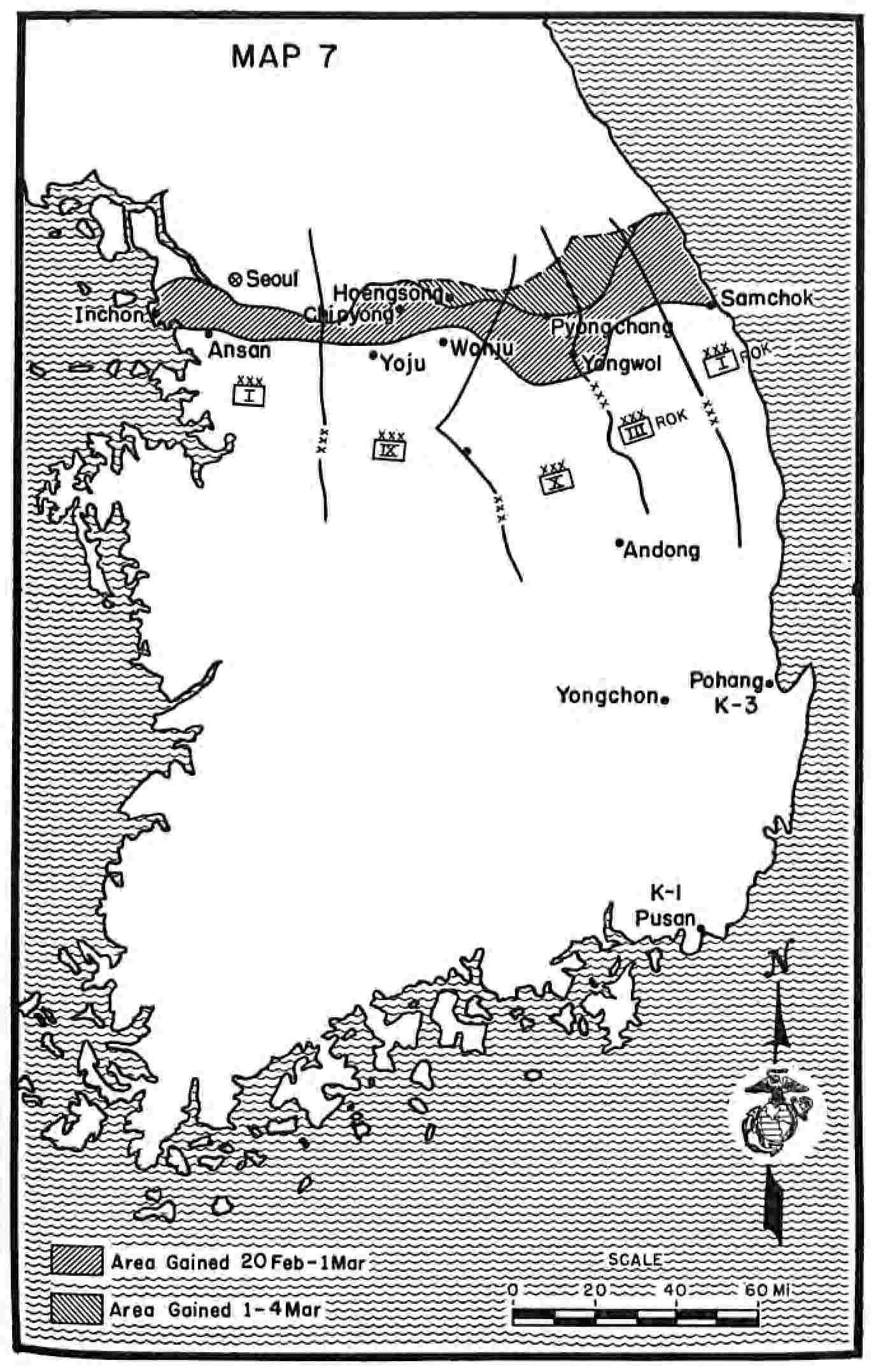
MAP 7
General Puller’s report was obviously written for the record, since
General Shepherd was present at the 1st Marine Division CP at the
time. He witnessed personally the Marine attacks of 2 and 3 March
and the air support they received. On the 3d, the day of heaviest
fighting in the entire operation, there could be no complaint that few
Marine aircraft supported Marine ground forces. The Corsairs flew
26 CAS sorties that day and cleared the way more than once for the
2d and 3d Battalions of the 7th Marines. The trouble was that air
support as administered by JOC was so often late in arriving, even
when requested the evening before. More than once the infantry had
to go ahead with only artillery support. Such delays threw the whole
plan of attack out of gear, for air and artillery had to be closely
coordinated to be at their best.
General Shepherd had a series of talks with General Harris. Both
then conferred with General Partridge, commander of the Fifth Air
Force. They requested that he authorize the 1st MAW to keep two
planes on station over the 1st Marine Division whenever it was
engaged. General Partridge did not concur. He maintained that
Marine aircraft should be available to him if needed elsewhere in an
emergency. He did consent, however, to permit 1st MAW armed
reconnaissance sorties to check in with DEVASTATE BAKER for any CAS
requests.117
This conference did much to clear up the situation. On 5 March
no less than 48 Marine sorties reported to DEVASTATE BAKER, though
there was little need for them in mopping-up operations. And during
the next two weeks an average of 40 sorties a day was maintained.
CHAPTER V Operation Ripper — Light Resistance the First Day — Seoul Abandoned by Enemy — Second Phase of the Operation — Changes in 1st MAW Units — General MacArthur Visits Marine Battalion — 1st KMC Regiment Returns to Division — 38th Parallel Recrossed by Marines — Renewal of Division’s CAS Problems
Light Resistance the First Day—Seoul Abandoned by
Enemy—Second Phase of the Operation—Changes in
1st MAW Units—General MacArthur Visits Marine Battalion—1st
KMC Regiment Returns to Division—38th
Parallel Recrossed by Marines—Renewal of Division’s CAS
Problems
The new IX corps commander, Major General William H. Hoge,
USA, arrived at Yoju on 4 March 1951. He relieved General
Smith the next day and a color guard turned out to render honors to
the Marine commander when he returned by helicopter to his own
Division CP. Upon Smith’s arrival, General Puller resumed his
former duties as ADC.
The jumpoff of the new operation was scheduled for 0800 on
7 March, so little time remained for last-minute preparations. The
basic plan called for the drive of IX and X Corps toward the 38th
Parallel on the central front. Protection was to be given on the left
flank by I Corps in the area south and east of Seoul. On the right
the ROK divisions had the mission of maintaining lateral security
with a limited northward advance.
It was no secret that General Ridgway had been disappointed in
the numbers of enemy soldiers put out of action during Operation
KILLER. The primary purpose of RIPPER was to inflict as many Communist
casualties as possible, and by means of constant pressure to
keep the enemy off balance in his buildup for a new offensive. A
secondary purpose was to outflank Seoul and the area between that
city and the river Imjin, thus compelling the enemy to choose between
default and a defense on unfavorable terms.118
CCF strategy in the early spring of 1951 was obviously conditioned
by preparations for a third great offensive. The enemy’s emphasis on
caution is shown in a translation of a CCF training directive of this
period:
There must absolutely be no hasty or impatient attitude toward warfare.
Consequently, even though we have a thorough knowledge of the enemy
situation and the terrain, if one day is disadvantageous for us to engage in
combat, it should be done the next day; if day fighting is disadvantageous,
fighting should be conducted at night, and if engagements in a certain terrain
are not to our advantage, another location should be selected for combat
engagement. When the enemy is concentrated and a weak point is difficult
to find, one must be created (by agitating or confusing them in some way),
or wait until the enemy is deploying. Engagements must be conducted only
when the situation is entirely to our advantage.119
United Nations forces held a line extending across the peninsula from
Inchon (Map 8) in the west by way of Hoengsong to the east coast in
the vicinity of Chumunjin. The IX Corps order called for the 1st
Marine Division to maintain lateral contact with the 1st Cavalry
Division on the left and the 2d Infantry Division on the right. Hongchon
and Chunchon, two of the main objectives of Operation RIPPER,
lay directly in the path of the IX Corps advance. Both were important
communications centers which could be utilized to advantage by the
enemy for his forthcoming offensive.
The first phase line in the IX Corps zone was ALBANY. The Marines
did not need a map to locate an objective just beyond Oum Mountain,
a stark 2,900-foot peak about five and a half miles from the line of
departure. Distance in this area was conditioned by terrain, and it was
a natural fortress of wooded hills and swift streams that confronted
the 1st Marine Division. Highways were conspicuous by their absence,
and extensive maintenance would be required to utilize the Hoengsong-Hongchon
road as a MSR. So few and poor were the secondary roads
that it would sometimes prove necessary for vehicles to detour along
the rocky stream beds.120
The last offensive had not developed major or prolonged resistance
at any point. Yet that possibility had to be anticipated by Marine
planners. At least the enemy was an old acquaintance—the 66th
CCF Army,121 commanded by General Show Shiu Kwai. The 196th
Division was on the left and the 197th on the right, with the 198th
in reserve. These units were believed to comprise about 24,000 men.
Wednesday, 7 March, dawned cold and clear, with snow falling
in the afternoon. The Hoengsong-Hongchon road, winding through
Kunsamma Pass, paralleled the boundary between the two Marine
assault regiments, the 7th Marines on the left and the 1st Marines on
the right. They jumped off to attack in line abreast, employing all
three battalions when the broken terrain permitted, while the 5th
Marines continued its patrolling activities in the Hoengsong area as
Division reserve.
The 11th Marines had to ration its artillery ammunition, owing to
supply shortages. JOC came to the rescue nobly by ordering MAG-33
to place 11 flights of four planes each at the disposal of DEVASTATE
BAKER on D-minus-one. These aircraft reported at hourly intervals to
work over targets in the area of the next day’s Marine operations. For
the ground forces, it was an embarrassment of riches. They had more
air support than they could use at times, and DEVASTATE BAKER sent
the surplus to hit reserve concentrations and other targets of opportunity
in the enemy’s rear.122
The two Marine assault regiments met with light resistance on
D-Day. Both took their objectives with little trouble except for
scattered bursts of machine gun fire. Total casualties for the day were
seven men wounded.
It was like old times to have Marine planes supporting Marine
ground forces. MAG-12 aircraft were on the job the next day, when
CCF resistance stiffened without ever becoming serious. Heavy CCF
mortar and small-arms fire was received by 3/1, supported by Company
A of the 1st Tank Battalion. Well placed rounds by the 11th
Marines silenced the enemy in this quarter, and both battalions of the
1st Marines reached their assigned positions by nightfall.
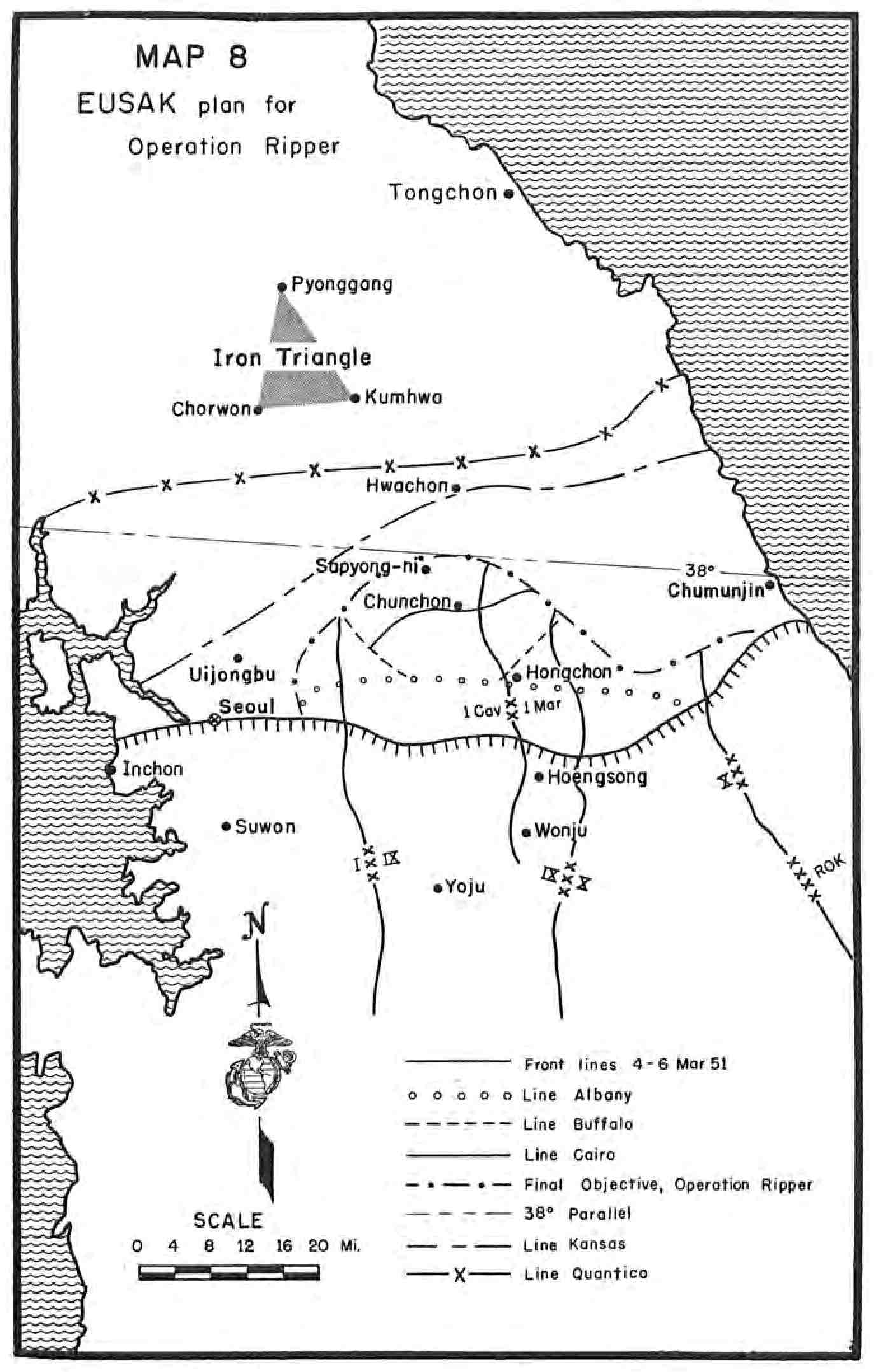
MAP 8
EUSAK plan for
Operation Ripper
The second day’s advances gave added proof that the enemy was
up to his old trick of putting up a limited defense while pulling back
before the Marines could come to grips. Log bunkers were ideal for
these CCF delaying tactics; each was a little fortress that might enable
a squad to stand off a company while larger CCF units withdrew.
The Marine assault troops found that a preliminary treatment of
napalm from MAG-12 aircraft, followed by well-aimed 90mm fire
from the tanks, did much to soften up the bunkers for an infantry
attack with hand grenades.
Company A of the 7th Marines had the hardest fight of all Marine
units on 8 March. Second Lieutenant Clayton O. Bush and the 2d
Platoon led the attack on the company objective, a hill mass to the
left of Oum San. With 300 yards still to be covered, the Marines were
pinned down by well aimed CCF small-arms and mortar fire, including
white phosphorus. A high explosive shell scored a direct hit on the
platoon, killing two men and wounding three. Bush was evacuated,
with his right arm mangled. First Lieutenant Eugenous Hovatter, the
company commander, ordered the 1st Platoon to pass through the
2d and continue the attack with air and tank support. The flat-trajectory
fire of the 90mm rifles did much to help the company clear
the enemy from the hill and the 7th Marines reached all assigned
regimental objectives for the day.123
The Marine advance came to a halt on 9 March to wait for Army
units to catch up on the right. While the 2d Battalion of the 1st
Marines took blocking positions, the 1st and 7th Marines sent out
patrols on both flanks in an effort to regain lateral contact. For the
next two days, 1st Marine Division operations were limited to patrolling.
A good deal of activity took place in the rear, however, as Marine
service units moved up to Hoengsong.
The advance was resumed on 11 March after the relief of 2/1 by
Major Walter Gall’s Division Reconnaissance Company, reinforced by
a platoon of tanks. Although the enemy withdrew from most of his
positions without putting up much resistance, a patrol of George
Company, 3/1, had a hot fire fight on Hill 549. Opening fire at 50
yards from camouflaged, log-faced bunkers, the Chinese killed one
man and wounded nine. Marine infantrymen, supported by flat-trajectory
90mm fire, approached within grenade-throwing range to
destroy five bunkers and kill 16 of the defenders. As the patrol withdrew,
it called on the 11th Marines to finish the job. The cannoneers
were credited with several direct hits.124
Chinese resistance continued to be light as the two Marine regiments
occupied rather than seized ground on 12 and 13 March. By
the 14th all units were dug in along Phase Line ALBANY.
CCF withdrawals were also reported by other Eighth Army units.
On 15 March a patrol from the 1st ROK Division of I Corps found
Seoul abandoned by the enemy. The Chinese Reds had made their
choice and UN forces took over a devastated city with some 200,000
civilians dragging out a miserable existence in the ruins. Dead power
lines dangled over buildings pounded into rubble, and even such a
famous landmark as the enormous red, brass-studded gates of the
American Embassy Compound had been destroyed.
It was the fourth time that Seoul had changed hands in 9 months
of war. Air reconnaissance having established that the enemy had
withdrawn about 15 miles to entrenched positions in the Uijongbu
area, General Ridgway enlarged the mission of I Corps by directing it
to advance on the left of IX Corps.125
During the first phase of Operation RIPPER, from 7 to 13 March,
counted casualties inflicted on the enemy by X Corps amounted to
6,543 KIA and 216 POW. IX Corps casualties during the same period
were reported as 158 KIA, 965 WIA, and 35 MIA—a total of 1,158.126
The total strength of the Eighth Army (less the Marines) was
185,229 officers and men in March 1951. Adding the 25,642 of the
1st Marine Division, the 4,645 of the 1st Marine Aircraft Wing, plus
11,353 of the American Air Force and 355 attached from the U.S.
Navy, 227,119 Americans were serving in Korea. This does not count
13,475 South Koreans serving in various U.S. Army divisions.127
The 1st Marine Aircraft Wing, with an authorized total of 728
officers and 4,216 enlisted men, had an actual strength of 626 and
4,019 respectively on 31 March 1951. Of an authorized 29 officers and
93 enlisted men from the Navy, 22 and 83 in these categories were
on duty.128
Troops to the number of 21,184 from the ground forces of other
United Nations were represented as follows:
| United Kingdom and Australia |
10,136 |
| Turkey |
4,383 |
| Philippines |
1,277 |
| Thailand |
1,050 |
| Canada |
858 |
| New Zealand |
816 |
| Greece |
777 |
| France |
749 |
| Belgium-Luxembourg |
638 |
| Netherlands |
500 |
| |
12921,184 |
The 249,815 officers and men of the ROK Army make a total UN
combat strength of 493,503. There were an additional 671 in three
noncombat units: the Danish hospital ship Jutlandia, 186; the 60th
Indian Ambulance Group, 329; and the Swedish Evacuation Hospital
Unit, 156.130
Chinese forces in Korea, including confirmed and probable, totaled
16 armies, each comparable to a U.S. corps. Eight others were reported.
Assuming that these CCF units averaged a field strength of
24,000 officers and men, the total would have been 384,000 for the
16 armies. The reorganized forces of the North Korean People’s
Army (NKPA) were credited with five armies. Adding these 120,000
men to the 16 Chinese armies, the enemy had 504,000 troops in
Korea plus whatever might have been the strength of the eight reported
armies and the rear area service elements. In addition, large
reserves stood just over the border in Manchuria.131
With scarcely a pause on Phase Line ALBANY, the second phase of
Operation RIPPER began on 14 March with a drive toward Phase Line
BUFFALO (Map 8). Despite the difficulty of maneuver over muddy
roads in mountainous terrain, an Eighth Army directive of that date
called for a pincers movement to be initiated by means of a rapid
advance of the 1st Marine Division on the right and the 1st Cavalry
Division on the left. It was hoped that the Chinese forces south of
Hongchon might be trapped and destroyed after the 187th Airborne
Regiment cut off escape by landing north of the town. General
Ridgway having urged his corps commanders to stress maneuver, IX
Corps sent this message to division commanders:
It is desired that more use be made of maneuver within and between division
zones with a view toward trapping and annihilating the enemy through
such maneuver. Movements should be less stereotyped; it is not desirable
that units always advance toward the enemy abreast. Well planned and successfully
executed maneuver using companies and battalions has previously
been conducted; this should be extended to include regiments. This Headquarters
is studying and will continue to study and order into execution the
maneuver of divisions with the same intent and purpose.132
Both the 1st Marine Division and 1st Cavalry Division made rapid
progress toward Phase Line BAKER (Map 9), established by IX Corps
as an intermediate control. Unfortunately for the purposes of the
envelopment maneuver, the Chinese withdrew from the Hongchon
area before the pincers could close or the 187th Airborne make an
air drop. CCF resistance was confined to machine gun fire covering
hasty retirements. The 7th Marines on the left occupied its objective
without once calling for air or artillery support, and the 1st Marines
was virtually unopposed. Division casualties for the 14th were six
men wounded.
Flash floods and roads churned into hub-deep mud were the greatest
enemies of progress. Serious as the resulting supply problems were,
they might have been worse but for the efforts of the recently organized
Civil Transport Corps formed from members of the ROK National
Guard who lacked the necessary training for military duties.
There was no shortage of willing indigenous labor, for these auxiliaries
received pay as well as rations and clothing. Formed into
companies, they worked with the wooden “A-frames”—so-called because
of their shape—used from time immemorial in Korea as a
rack for carrying heavy burdens.
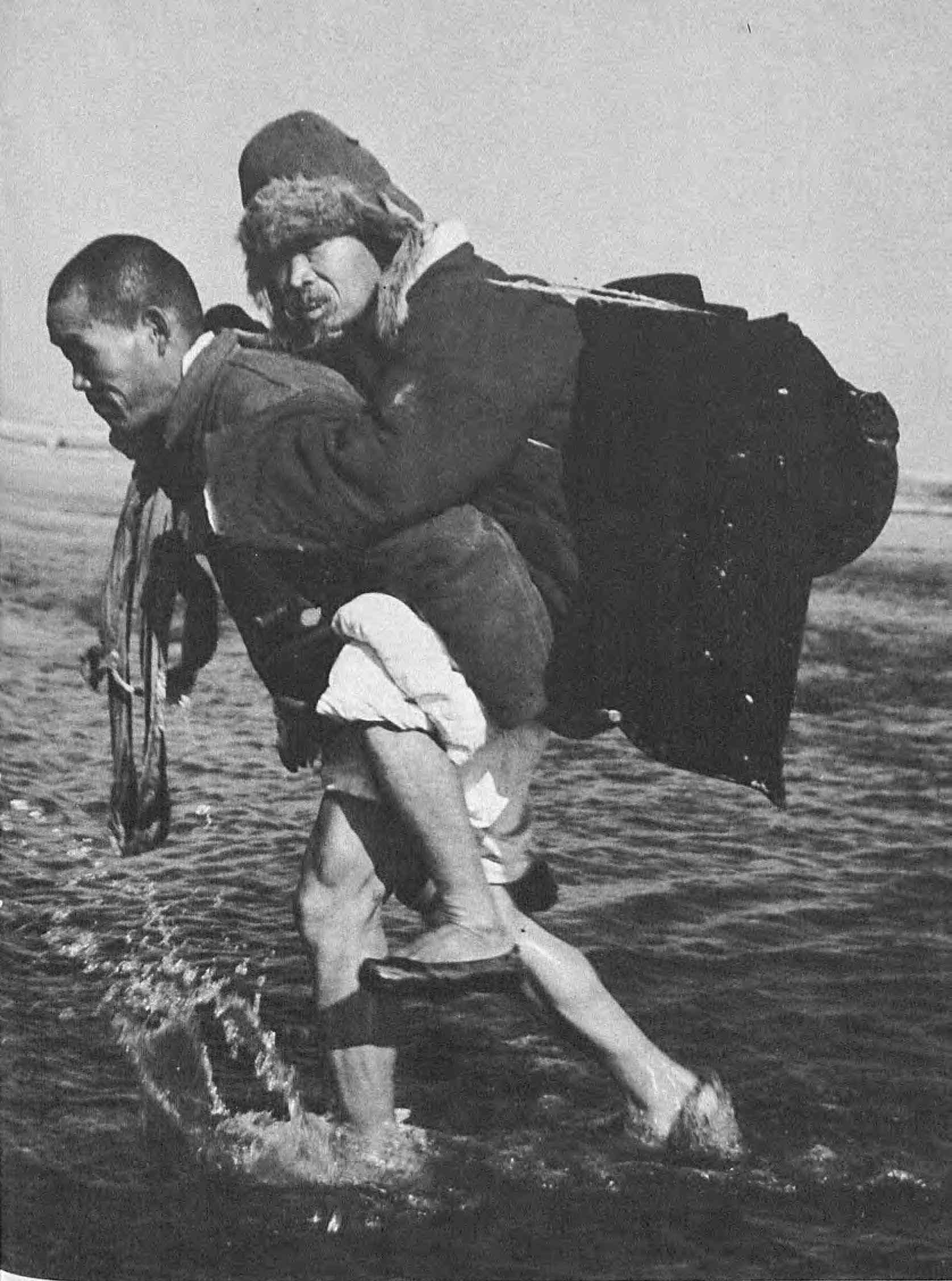
USA Photo SC 356353
Flight From The Foe—A Korean carries his aged father across the icy Han
River in the flight southward to escape the advancing Communist troops in
their drive of January, 1951.
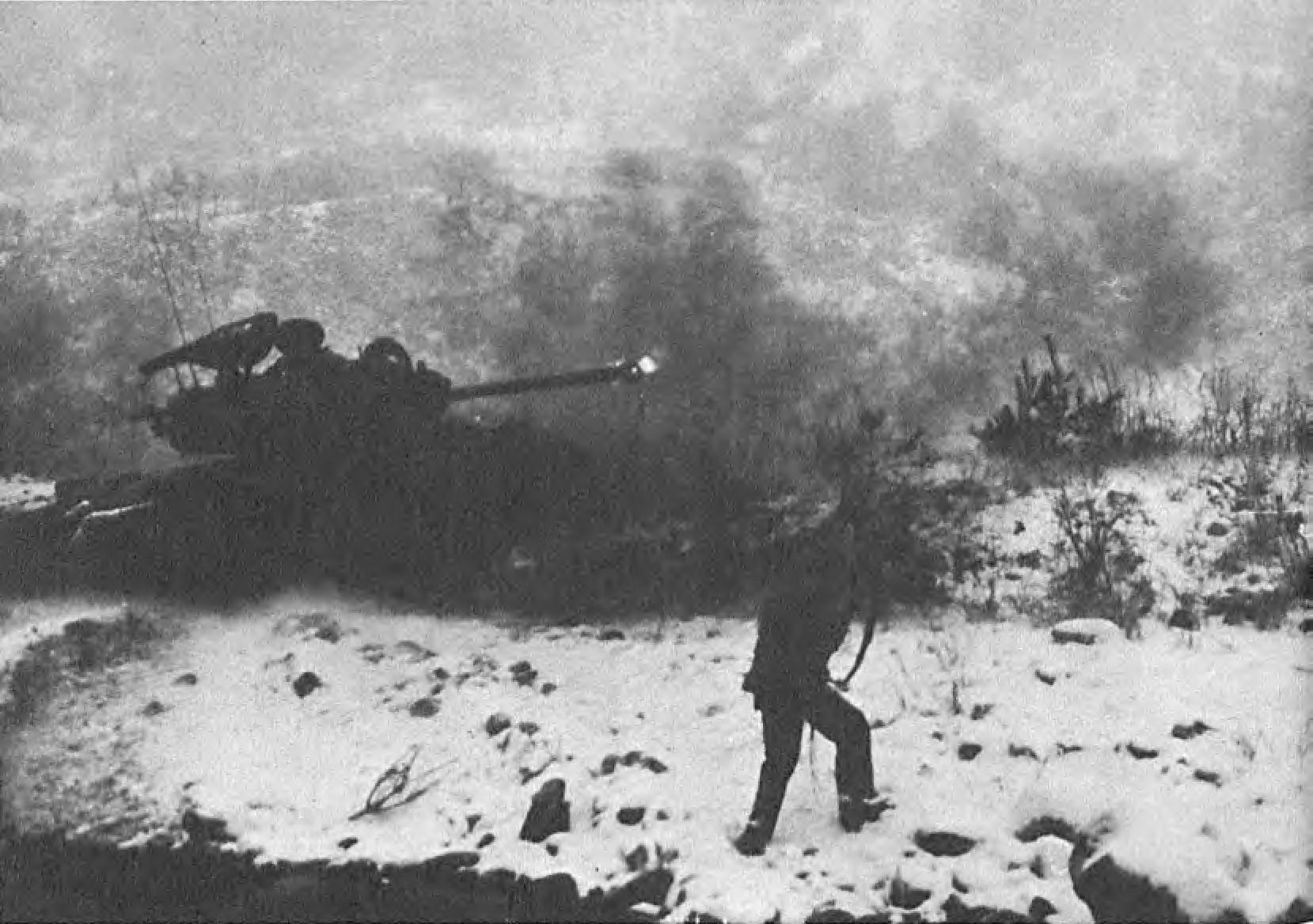
USMC Photo A 158073
At the Critical Moment—Above, a Marine tank blasts an enemy emplacement
while a rifleman stands by for the final assault; below, Marine riflemen
hug the ground as they advance under fire during Operation RIPPER in
March, 1951.
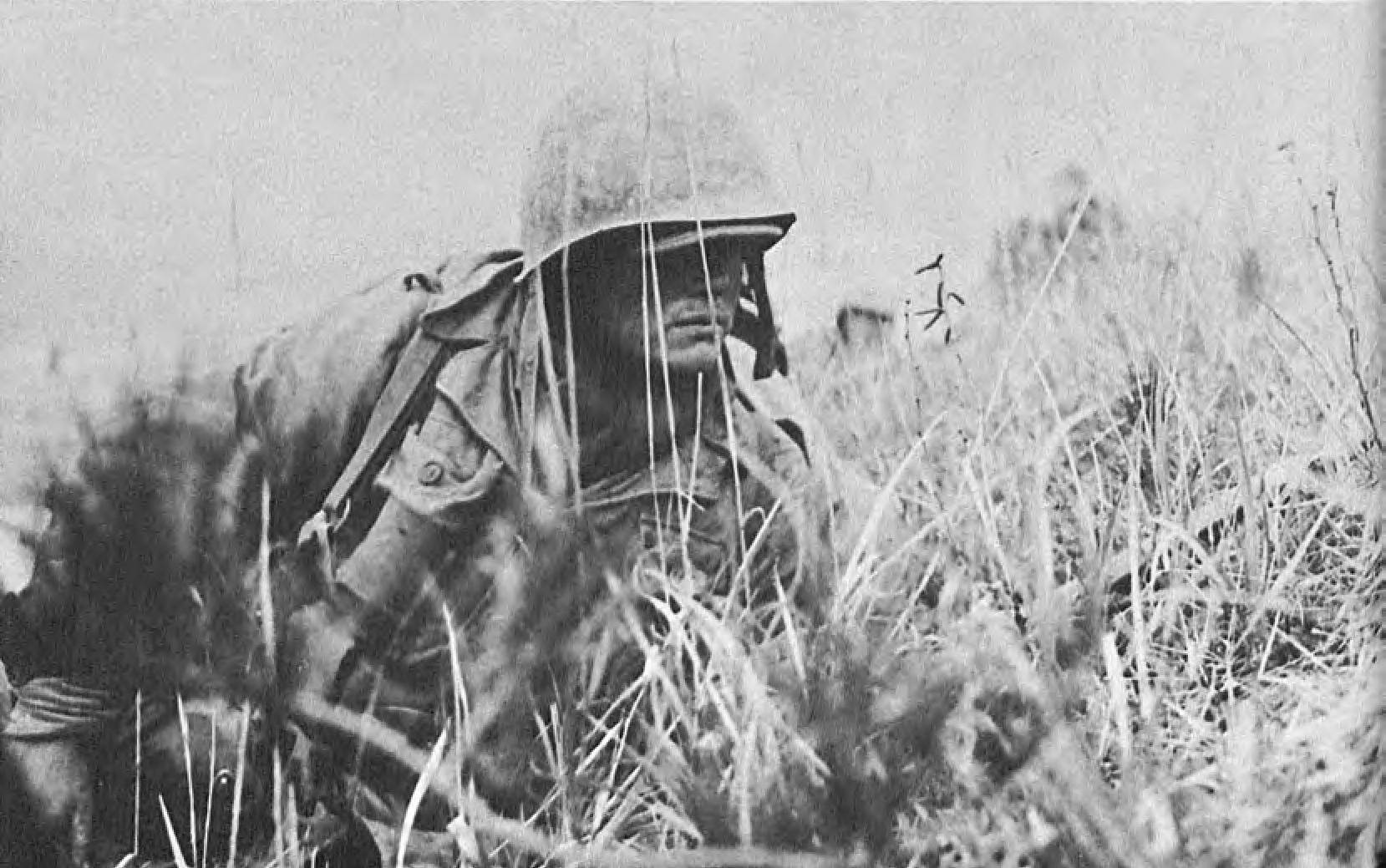
USMC Photo A 6862
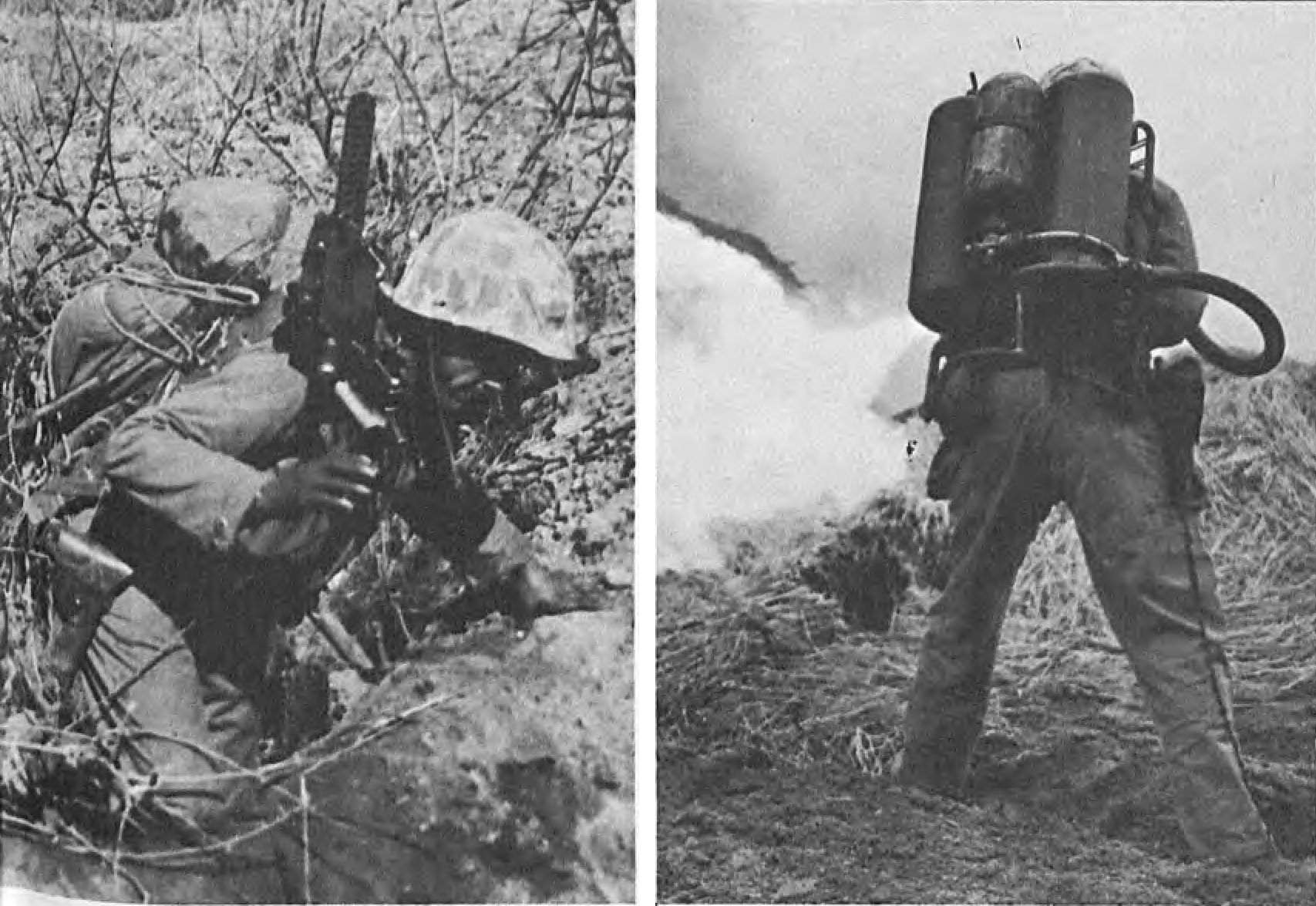
USMC Photo A 8064 USMC Photo A 161016
Attack—Above, Marine machine gunner climbs a ridge while a flamethrower
operator burns straw to deny cover to the enemy; below, a young rifleman
hurriedly reloads after emptying a clip at Chinese Communist soldiers.
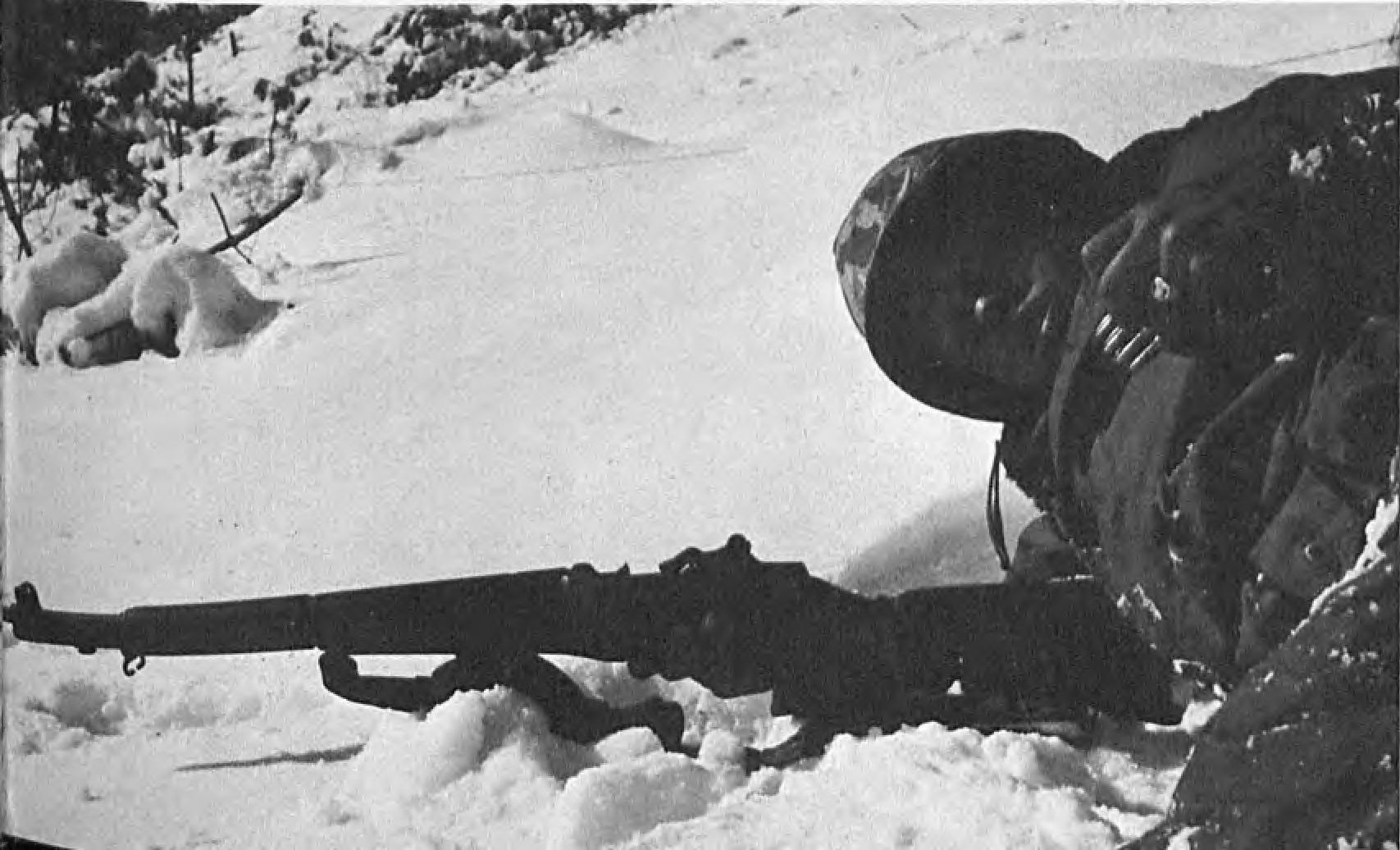
USMC Photo A 159023
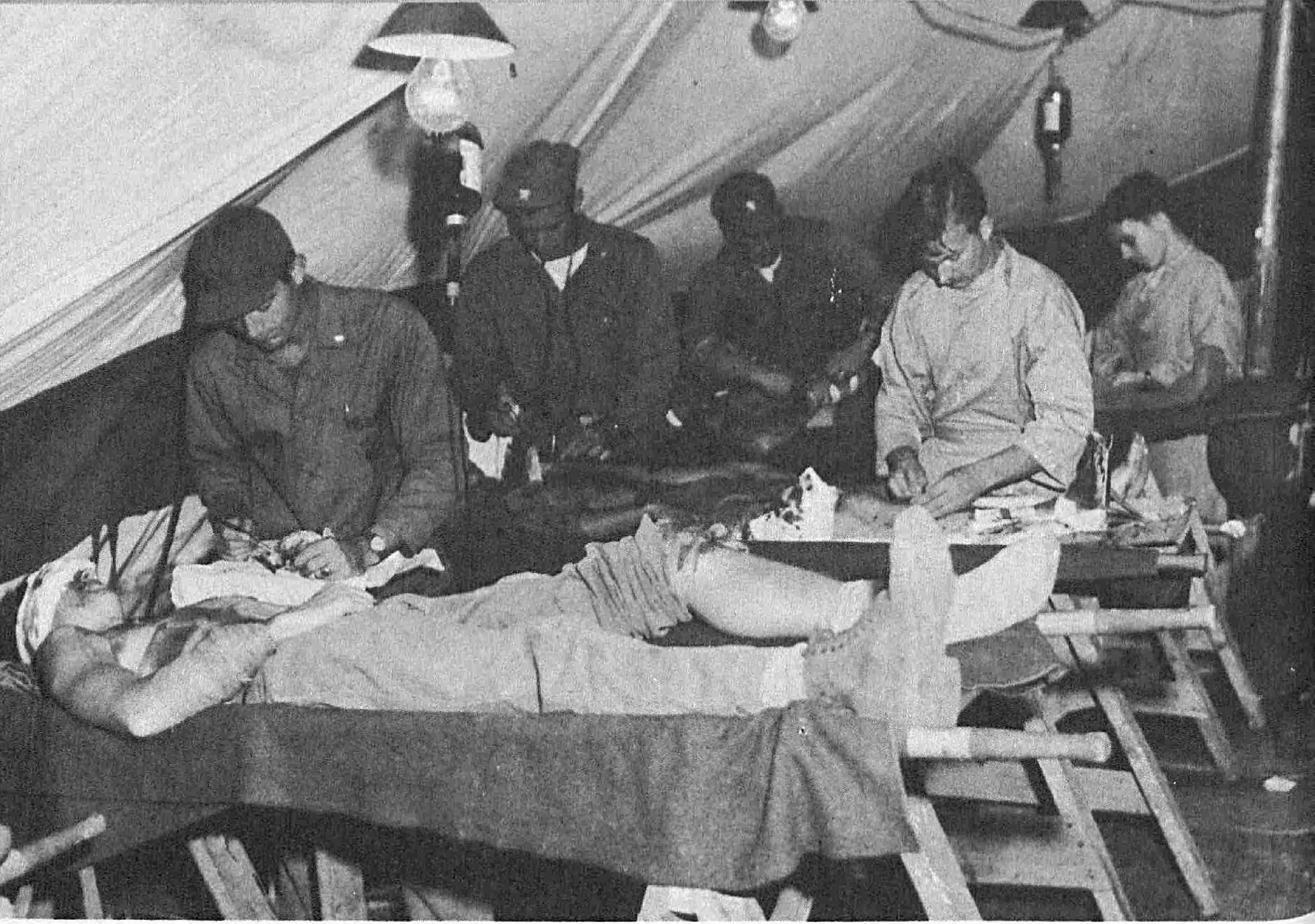
USMC Photo A 155354
Supporting The Fighting Man—Above, a group of surgeons are at work in
a minor surgery ward; below, a cargador train carries ammunition and
rations to the front-line companies.
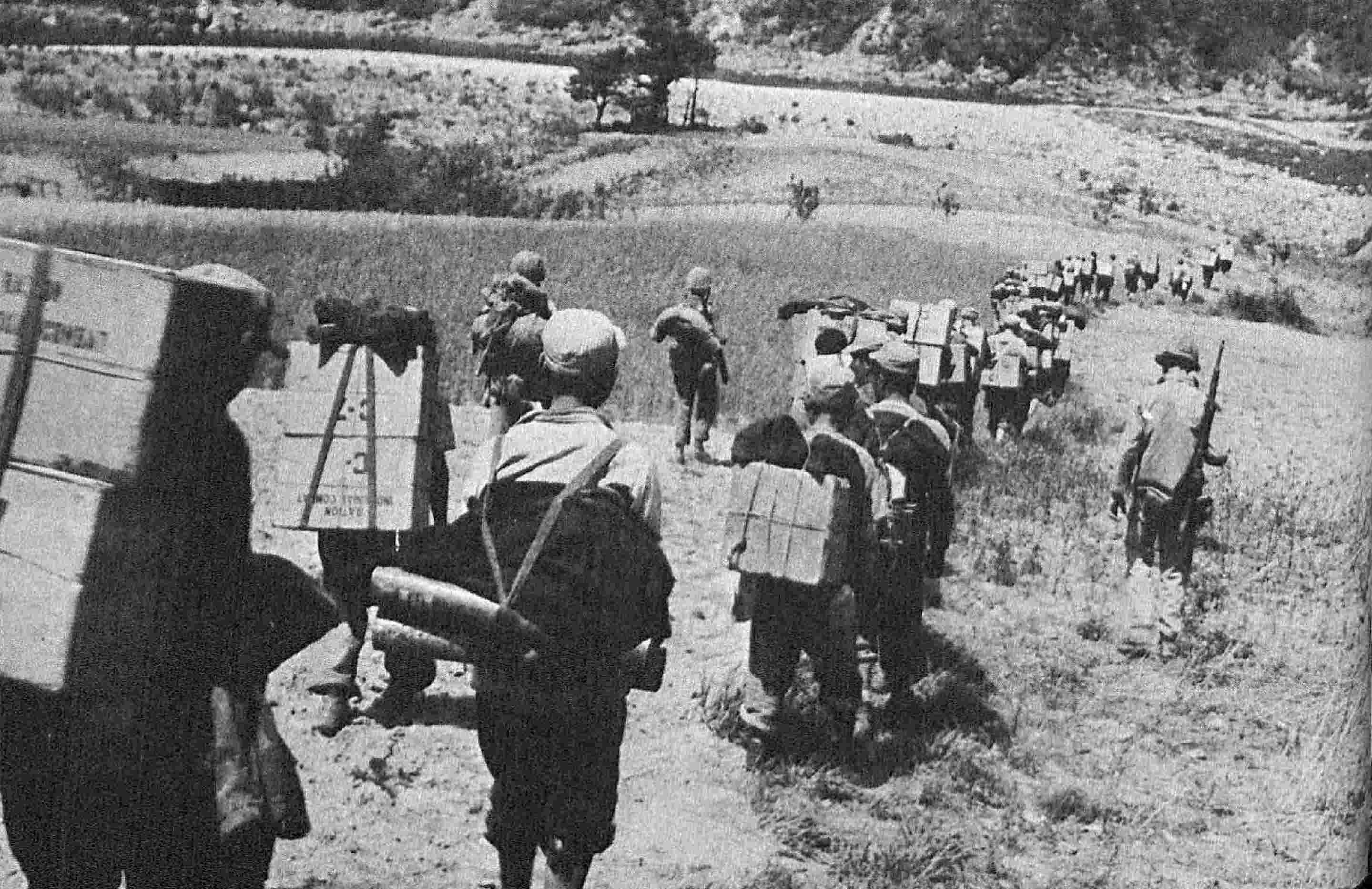
USMC Photo A 9857
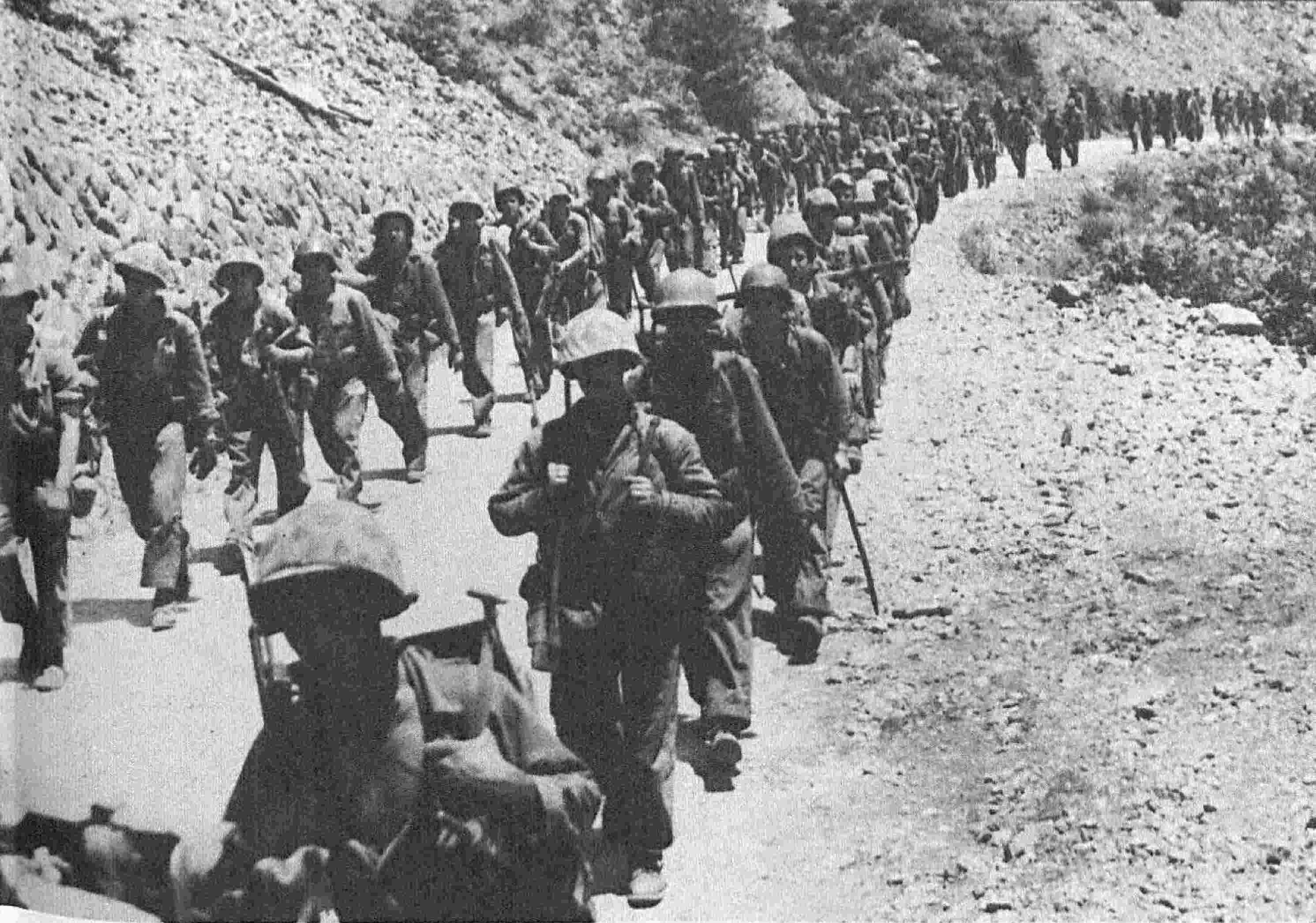
USMC Photo A 8756
Moving Out—Above, a Marine rifle company, C/1/1, moves to a rest area
after almost two months of fighting; below, camouflaged Korean Marines on
patrol pause to check the route.
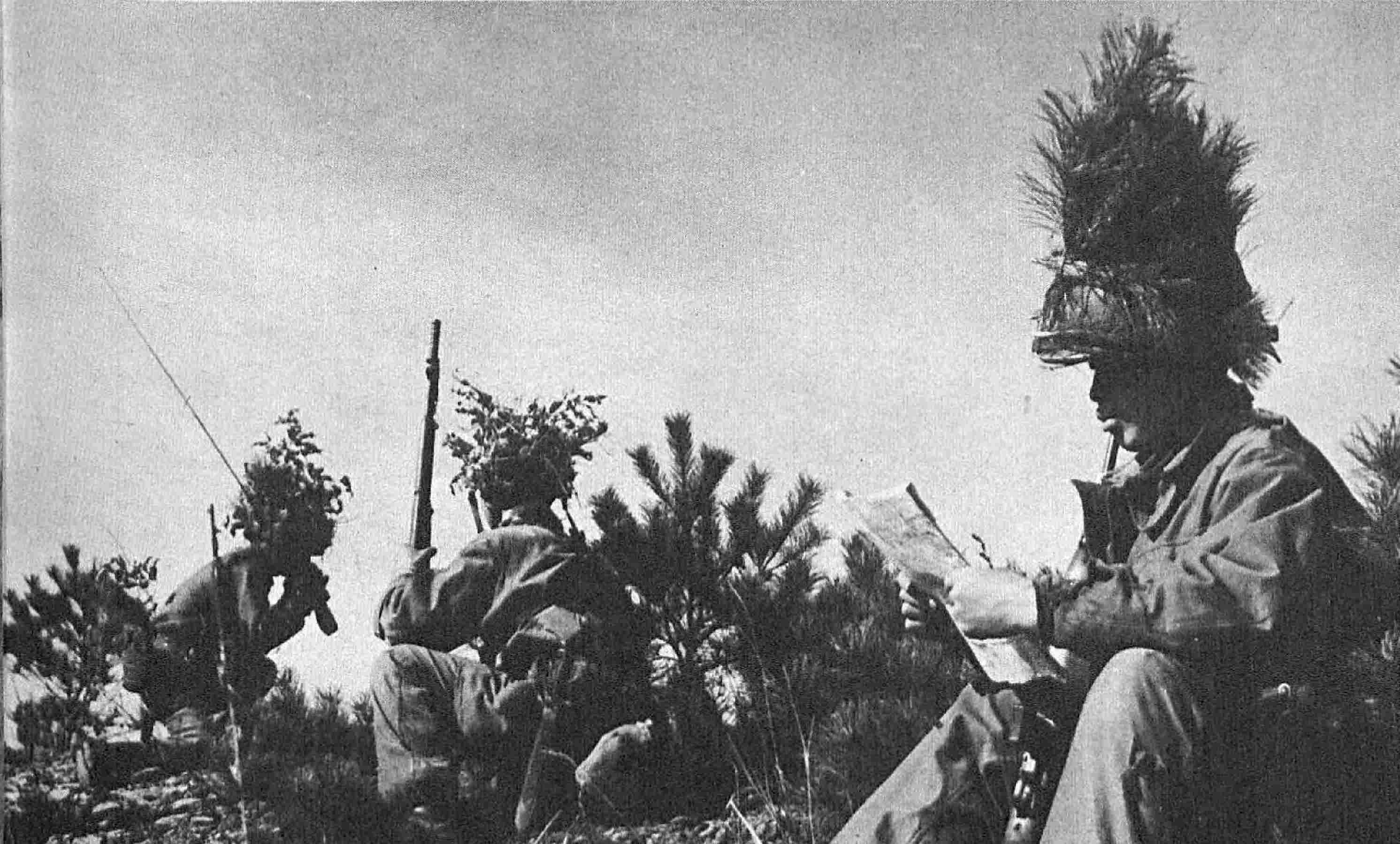
USMC Photo A 161982
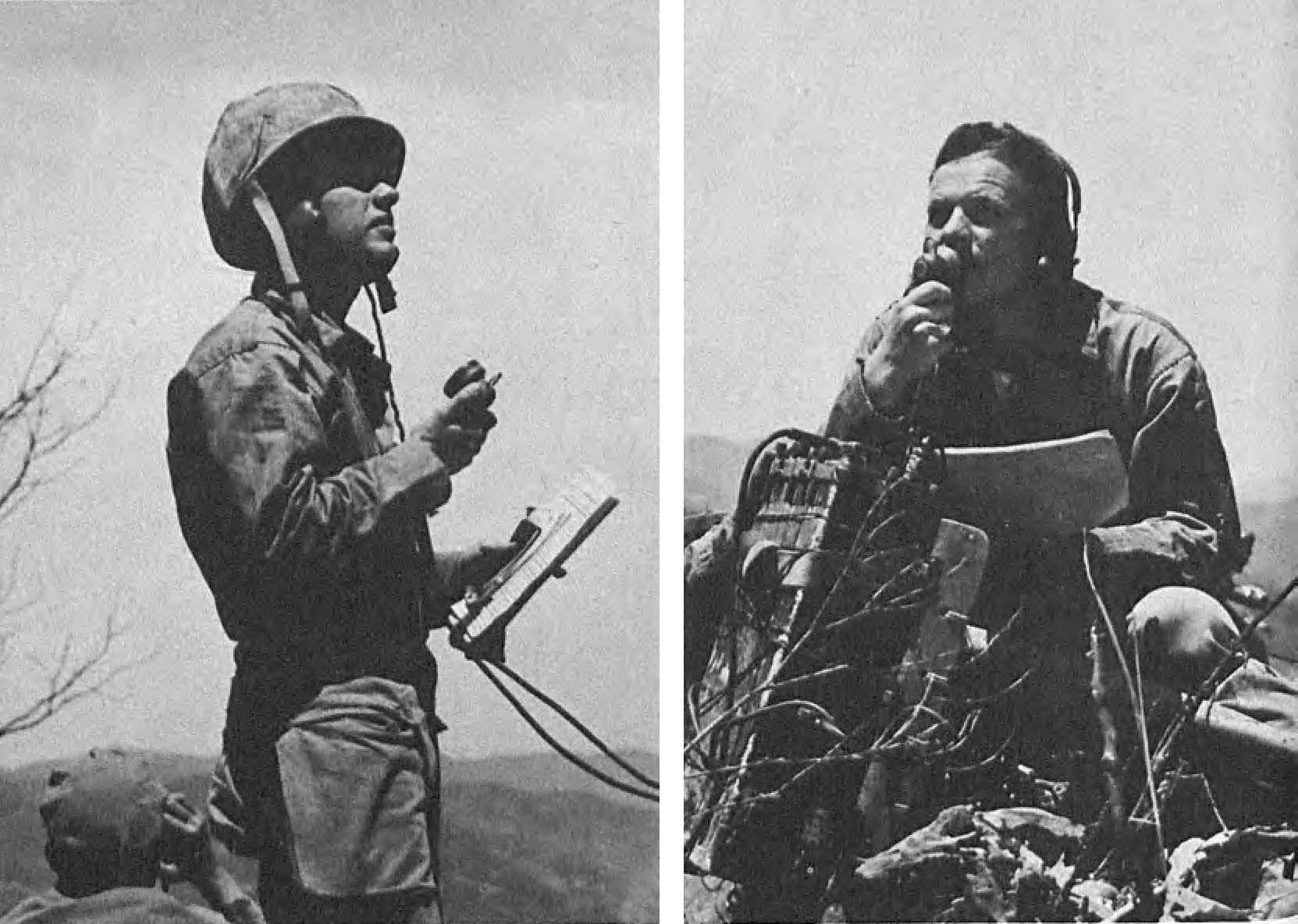
USMC Photo A 9458 USMC Photo A 9457
“Calling DEVASTATE BAKER!”—Above, forward air controllers with attacking
companies use the call sign of supporting air; below, a dependable
Corsair responds to the infantry’s call.
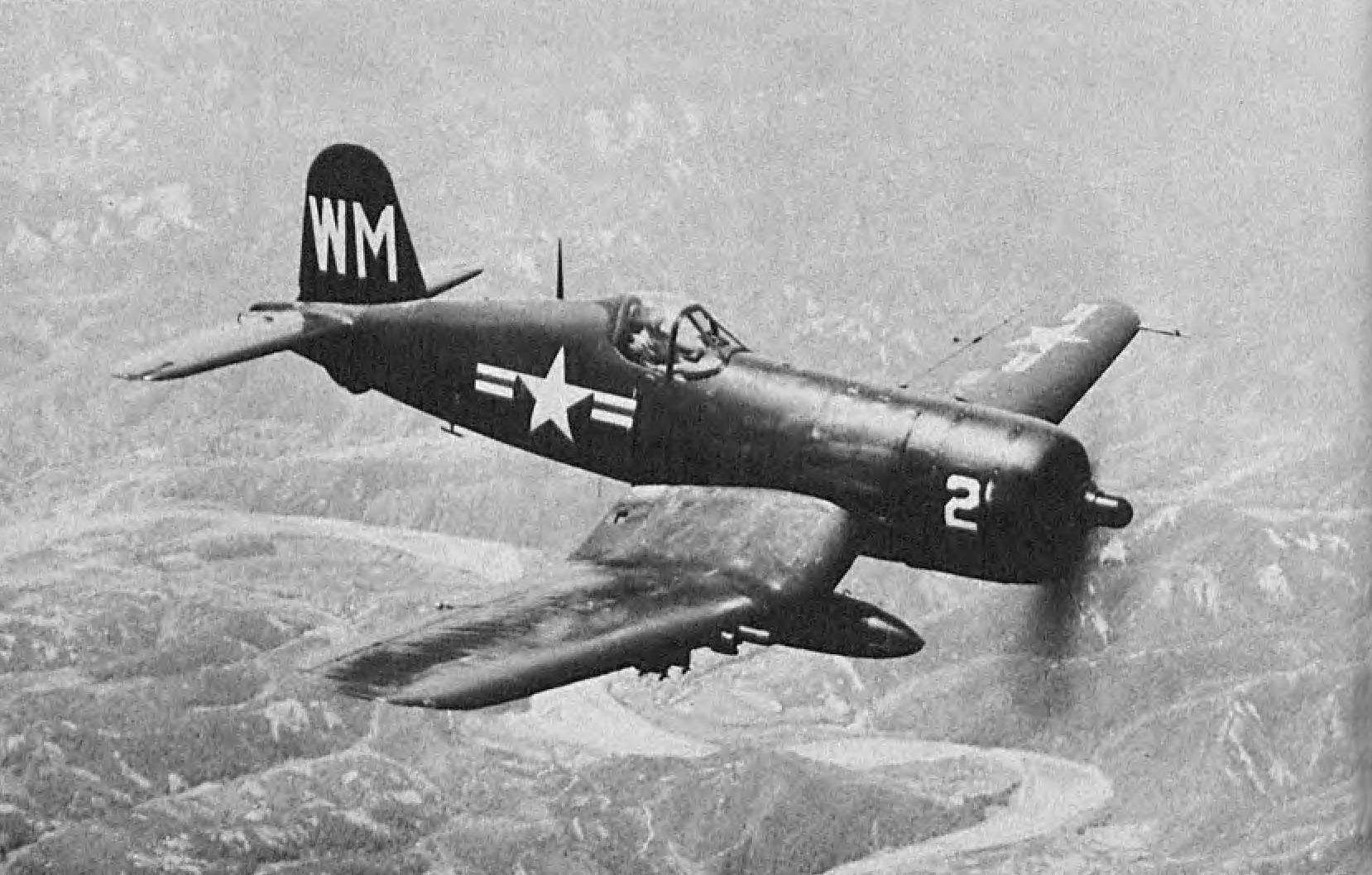
USMC Photo A 133540
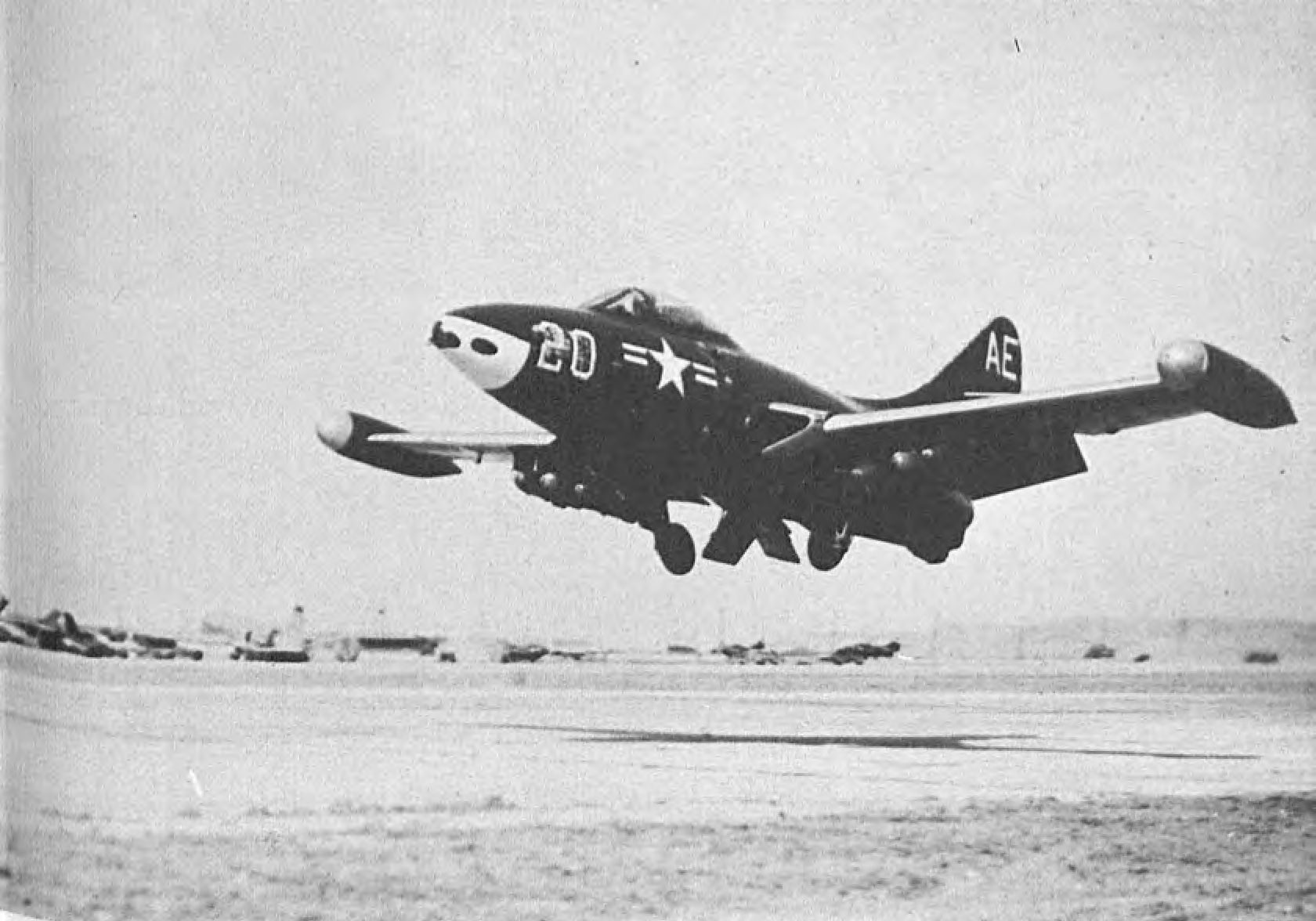
USMC Photo A 346714
“Launch and Attack”—Above, a Panther jet takes off on a close air support
mission; below, the attack is pressed at close range on a stubborn enemy by a
Tigercat (left) and a Corsair (right).
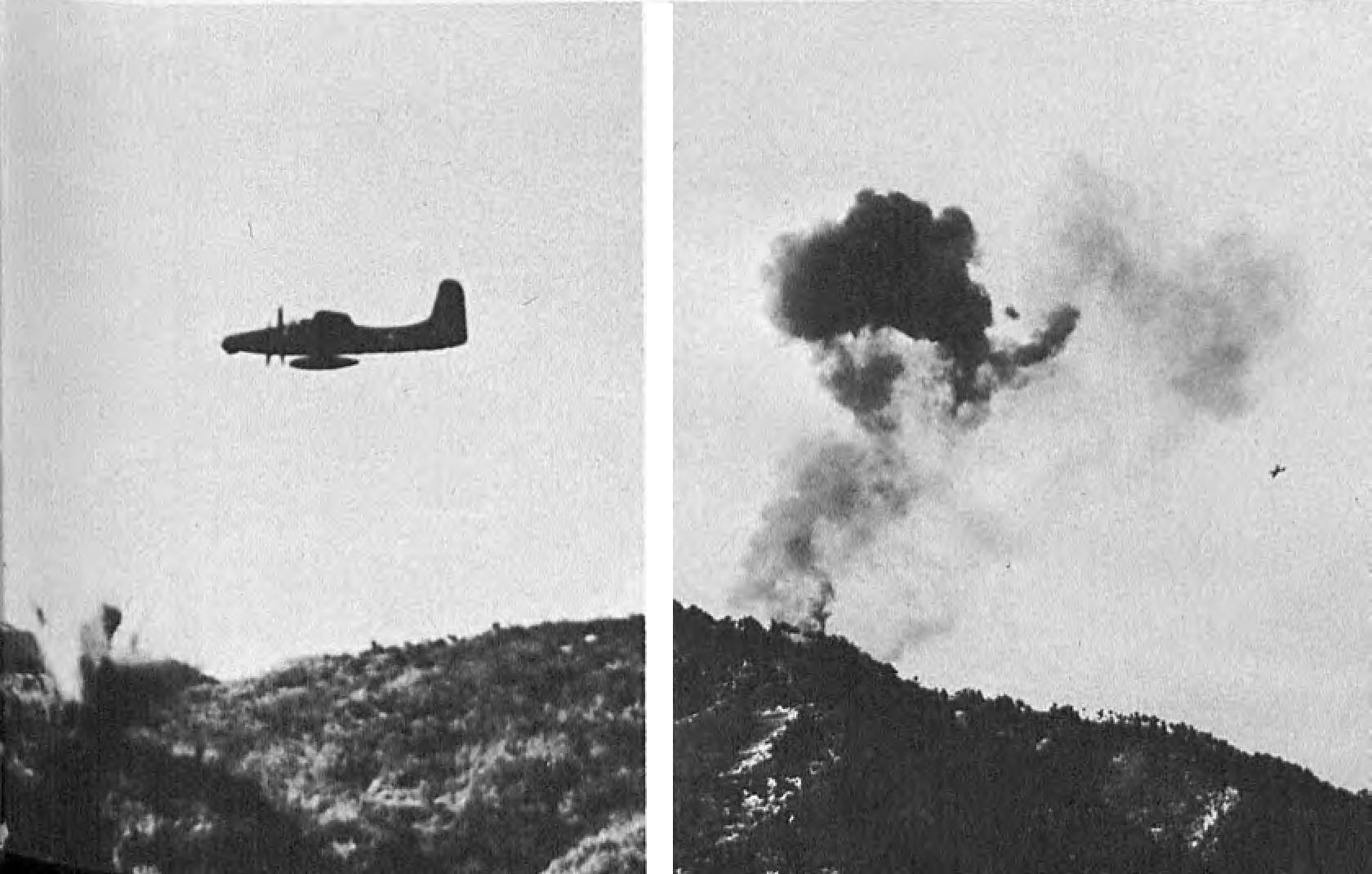
USMC Photo A 130948 USMC Photo A 7283
USMC Photo A 158968
Supporting The Troops—Above, a tank commander emerges from his steel
shell in order to scan the hills for targets; below, a rocket battery harasses the
enemy near Chunchon in May, 1951.
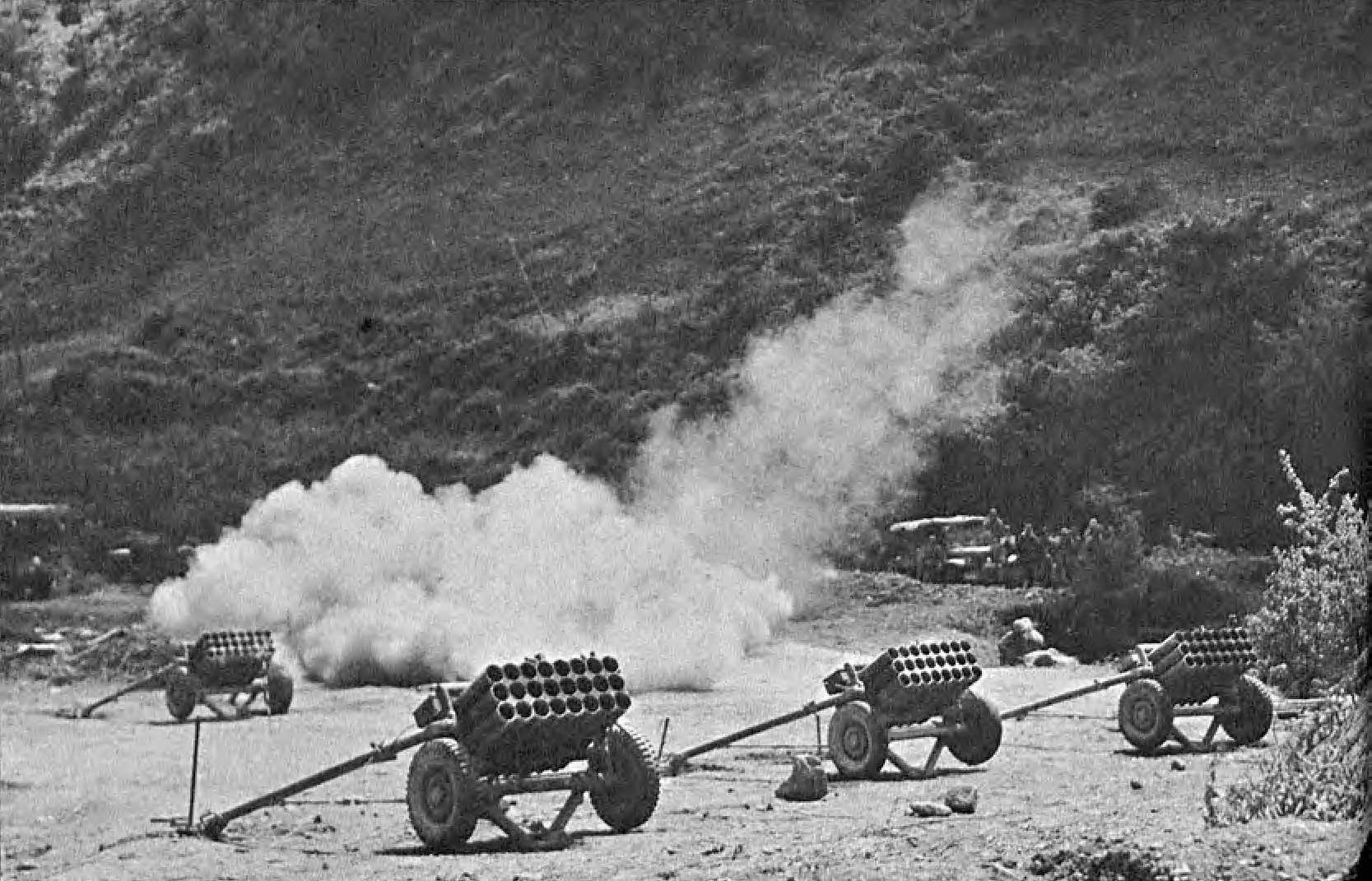
USMC Photo A 155643
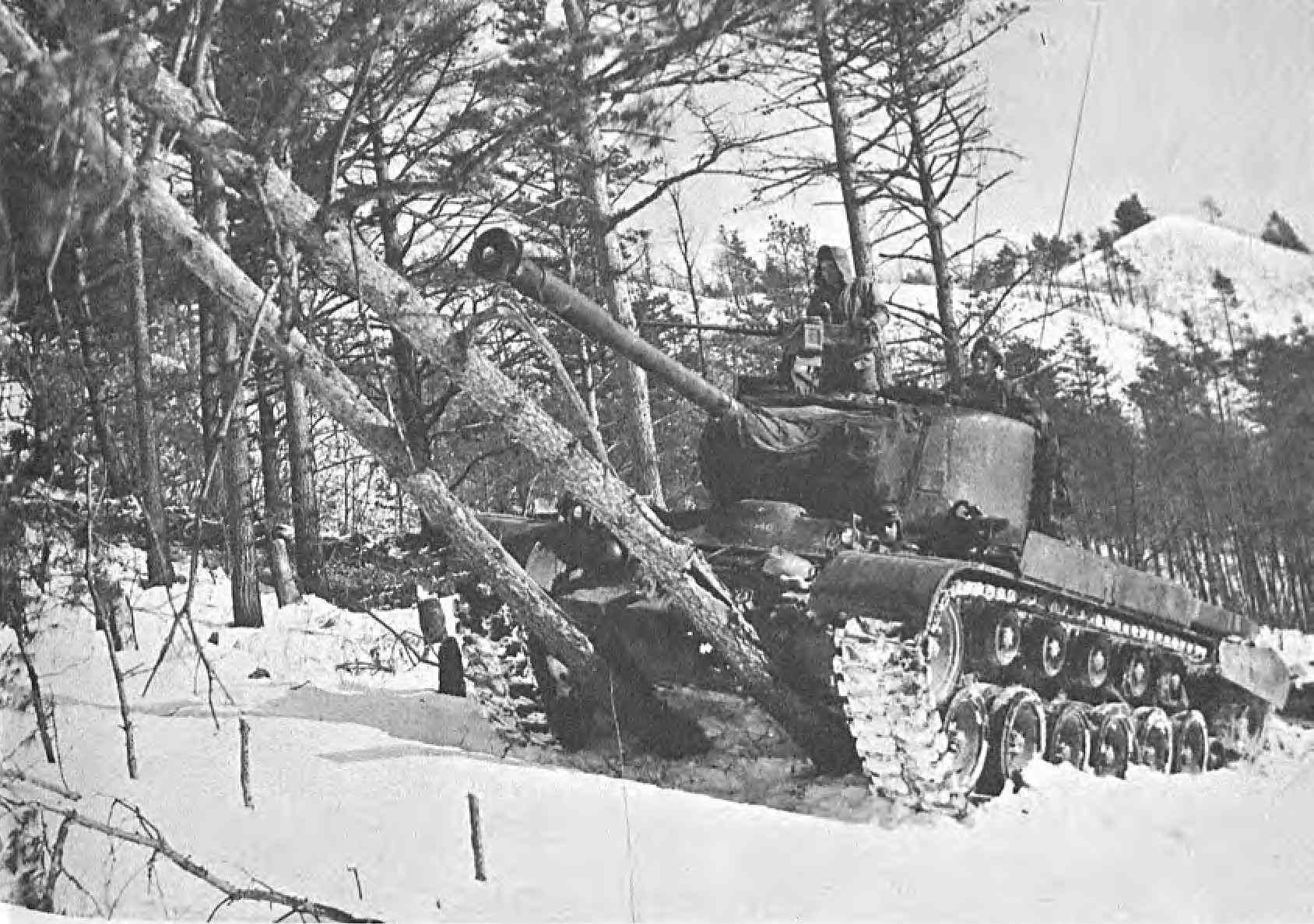
USMC Photo A 159109
Power-Packed Punch—Above, a Marine tank topples Korean trees while
moving into position to support an attack by fire; below, a rocket battery
firing a ripple at night.
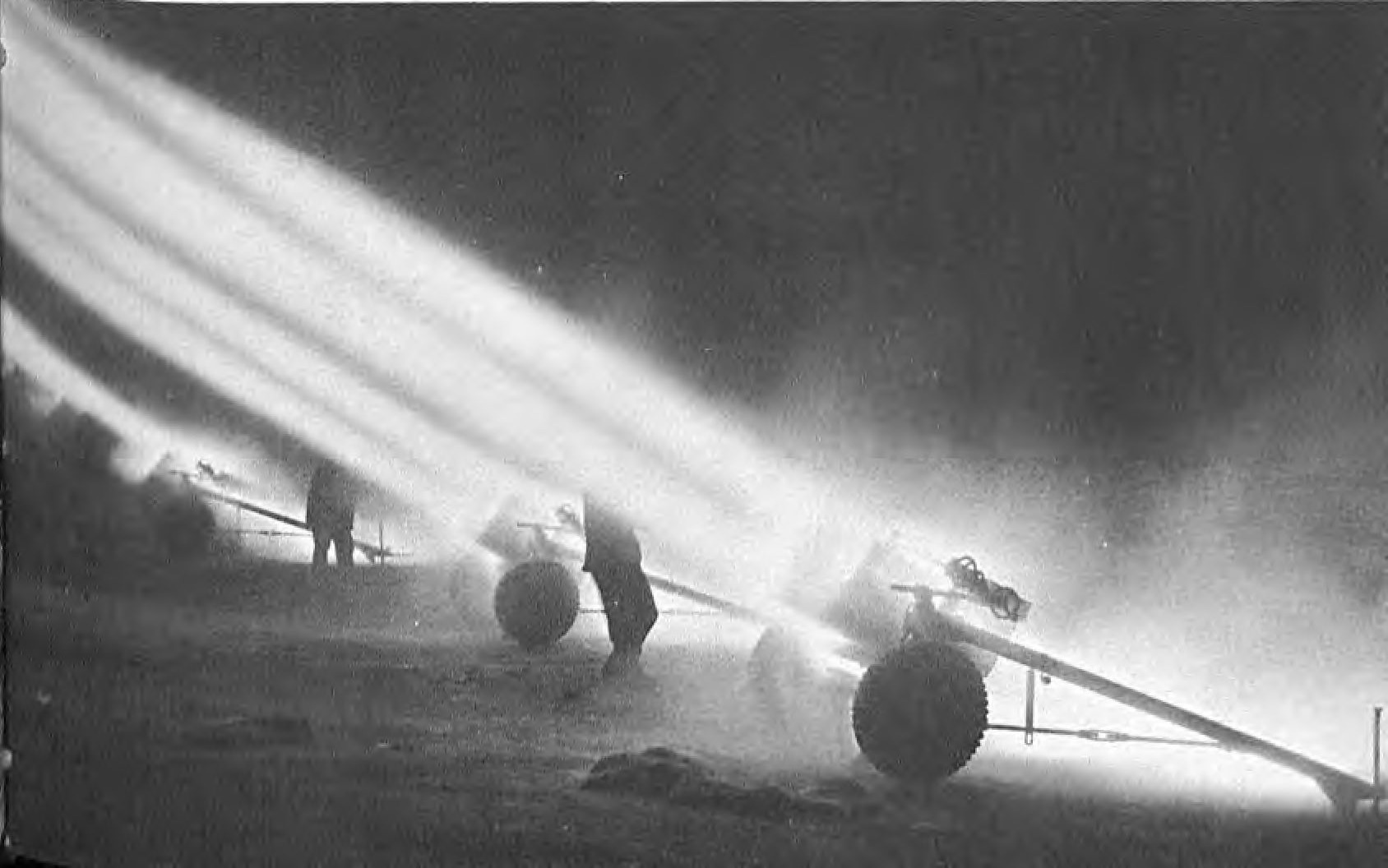
USMC Photo A 169791
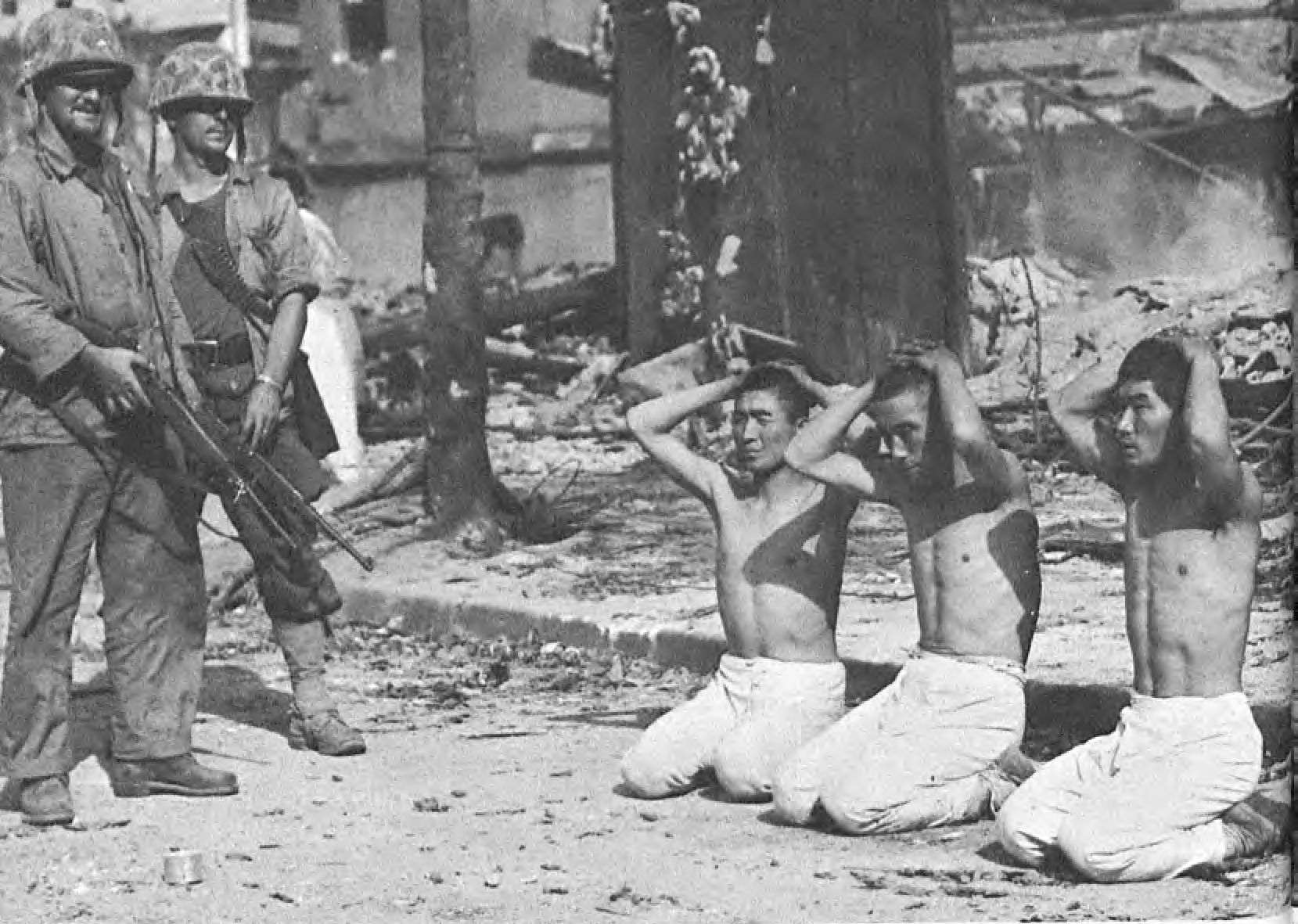
USMC A 3597
Prisoners of War—Above, Marines guarding captured prisoners awaiting
interrogation; and below, after hearing the familiar order to “saddle up”
a Marine awaits the word to move out.
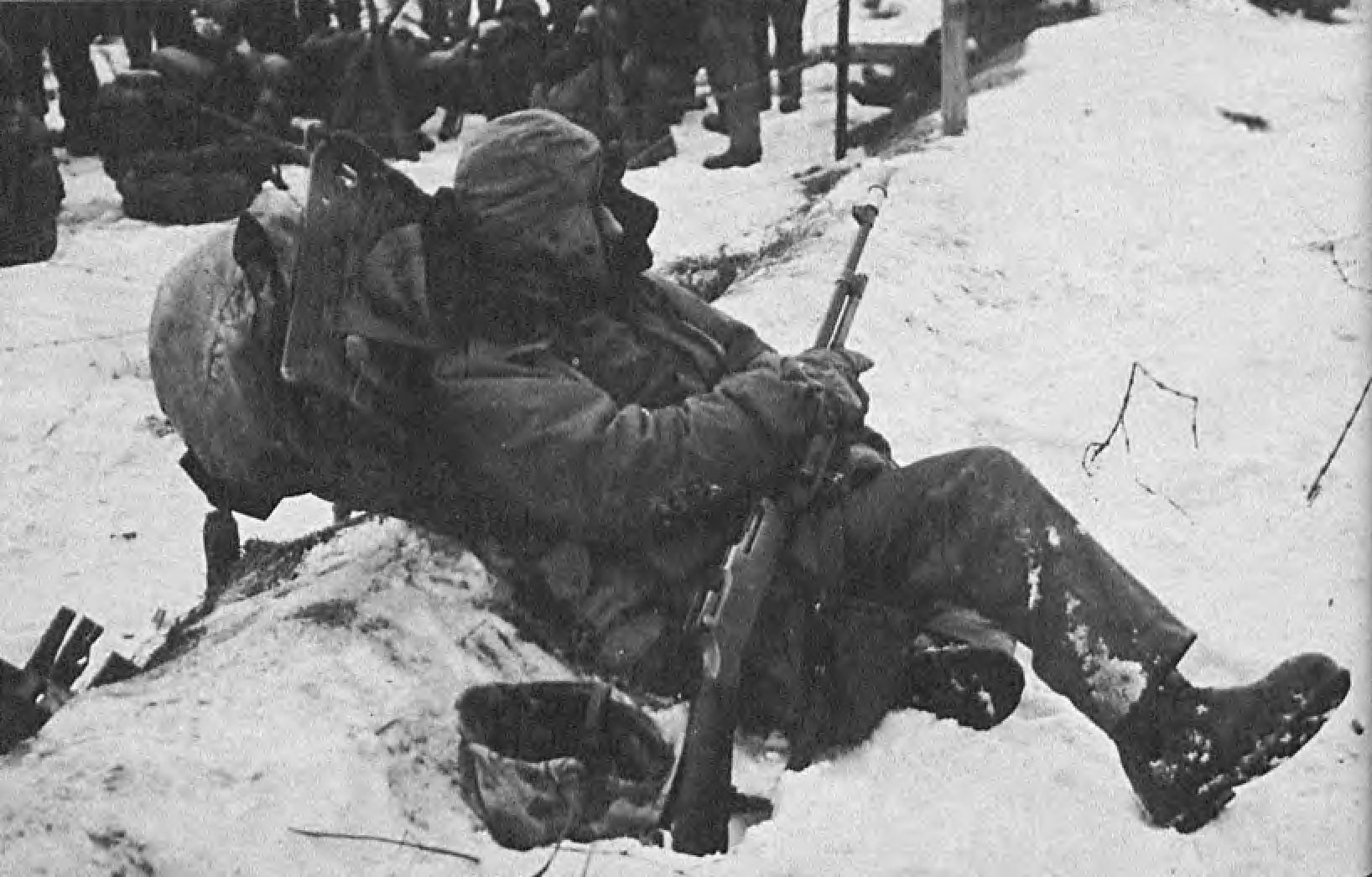
USMC A 159197
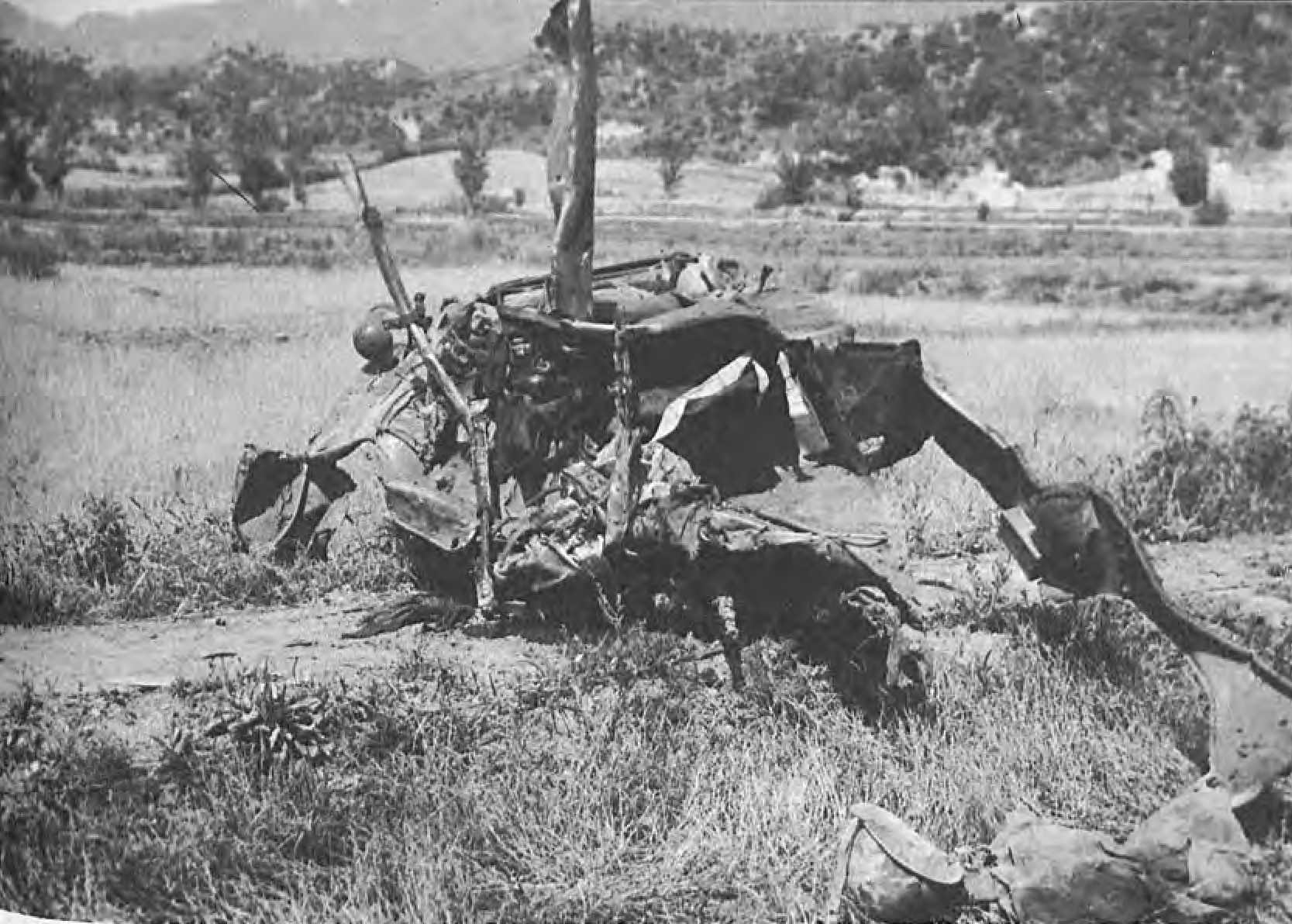
USMC A 9769
Random Scenes—Above, the result of what happens when a jeep runs over
an anti-tank mine; and below, a Marine fire direction control center in
operation.
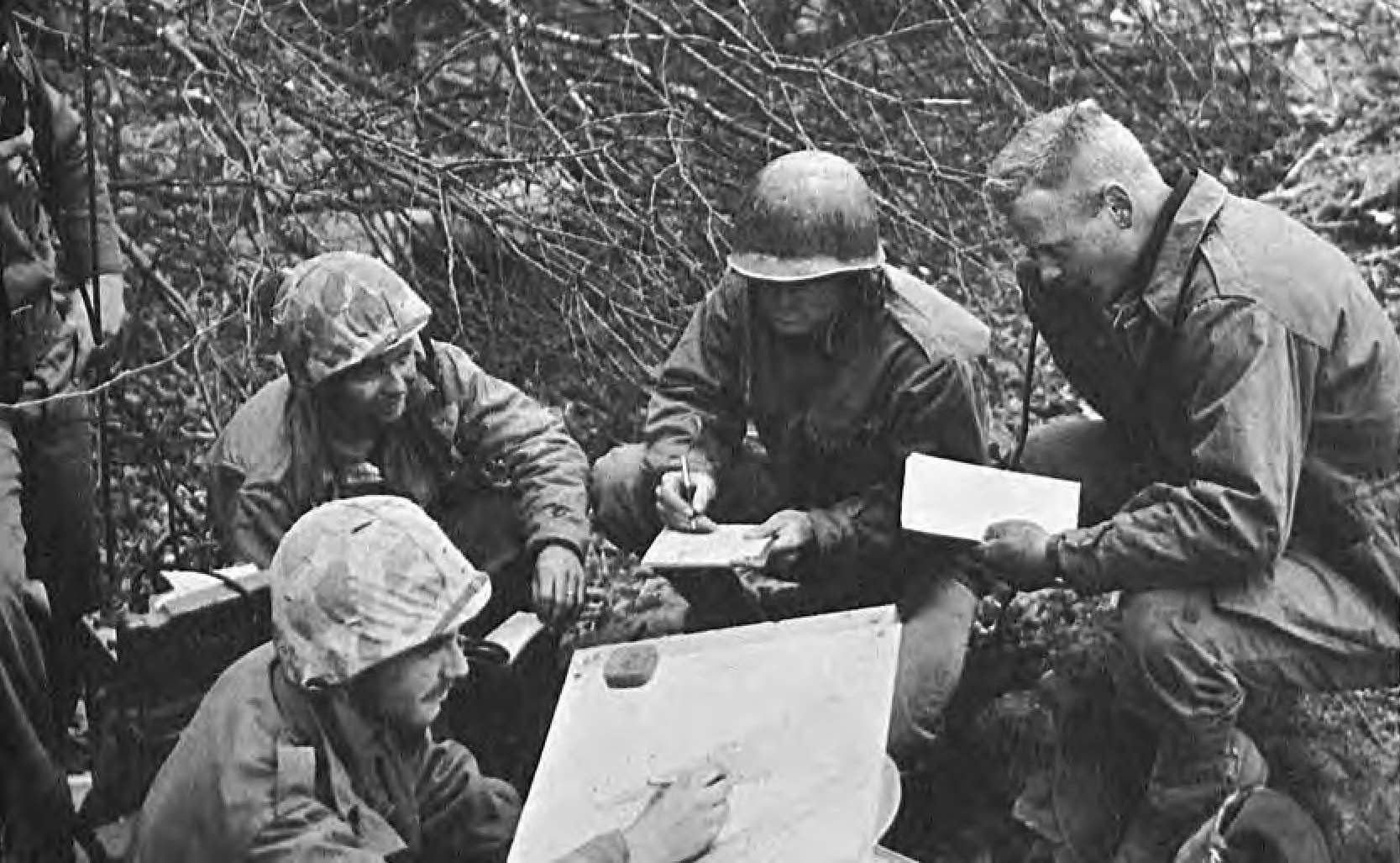
USMC A 155903
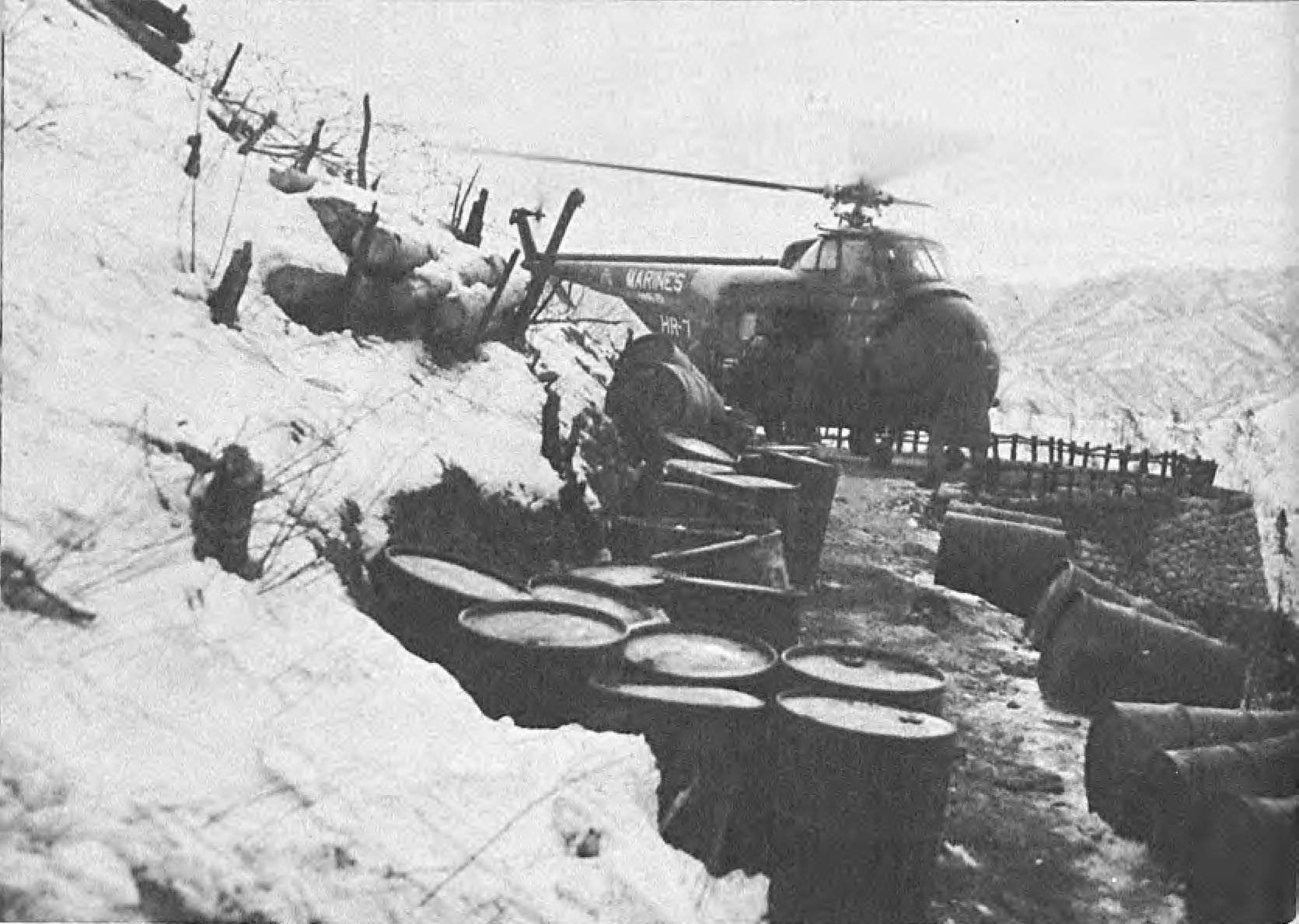
USMC Photo A 159962
Aerial Workhorse—Above, after refueling at a mountainside fuel dump, a
Marine helicopter loads men for evacuation; below, pre-fab bunkers are
unloaded on a Korean hillside.
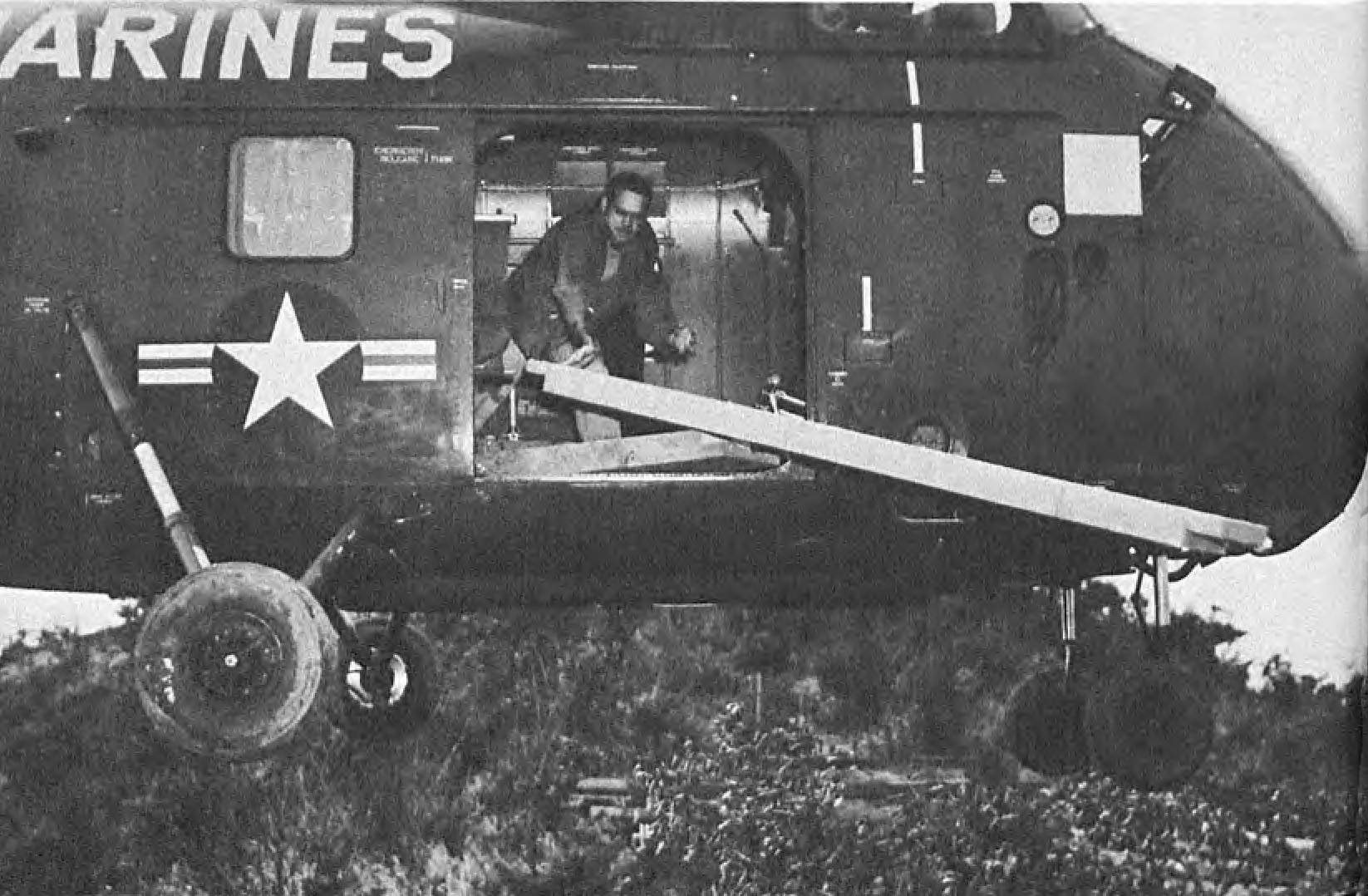
USMC Photo A 168493
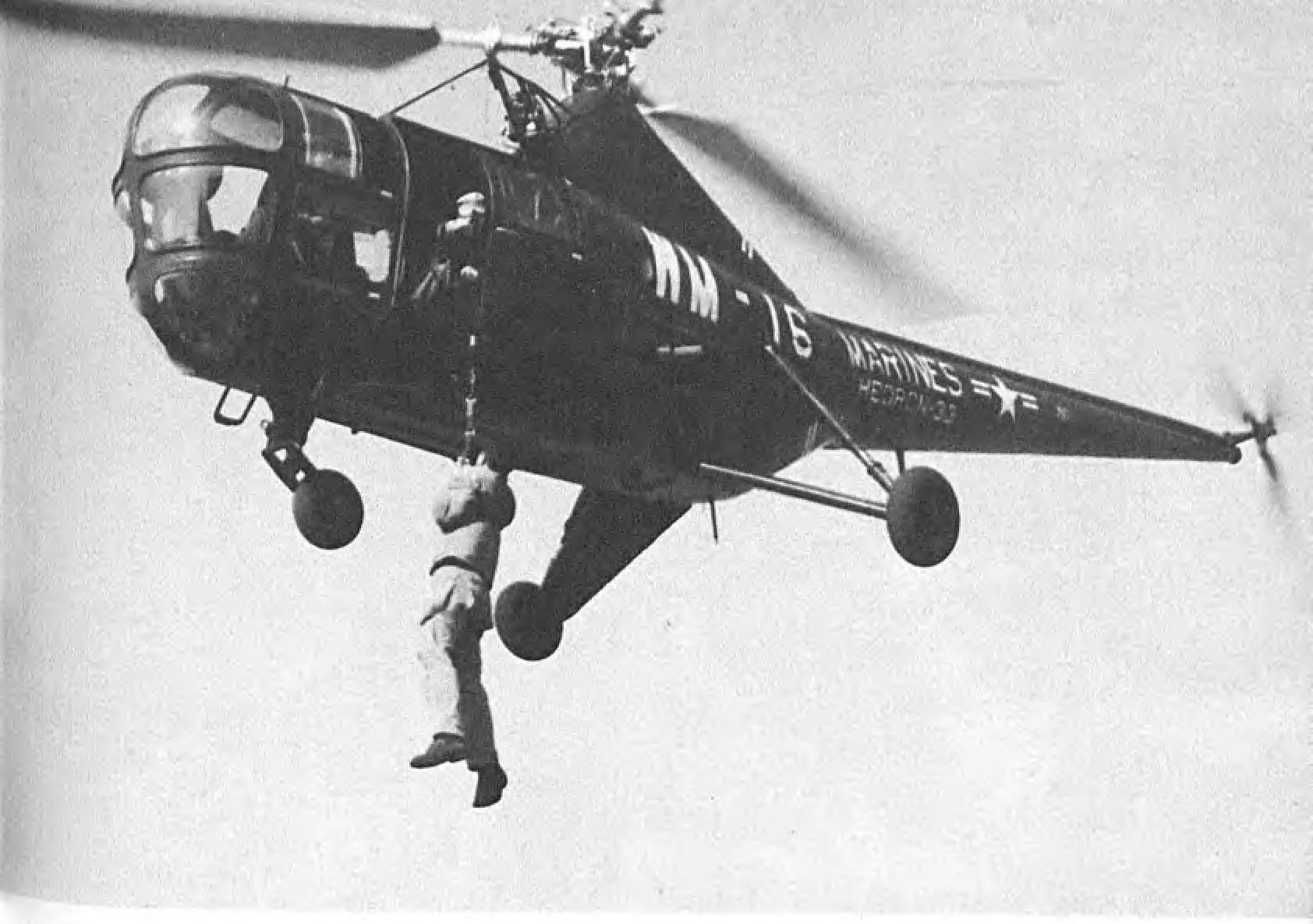
USMC Photo A 159962
Have Chopper, Will Travel—Above, Marine helicopter demonstrating rescue
technique; and below, staff officers board helicopters in preparation for front
line inspection trip.
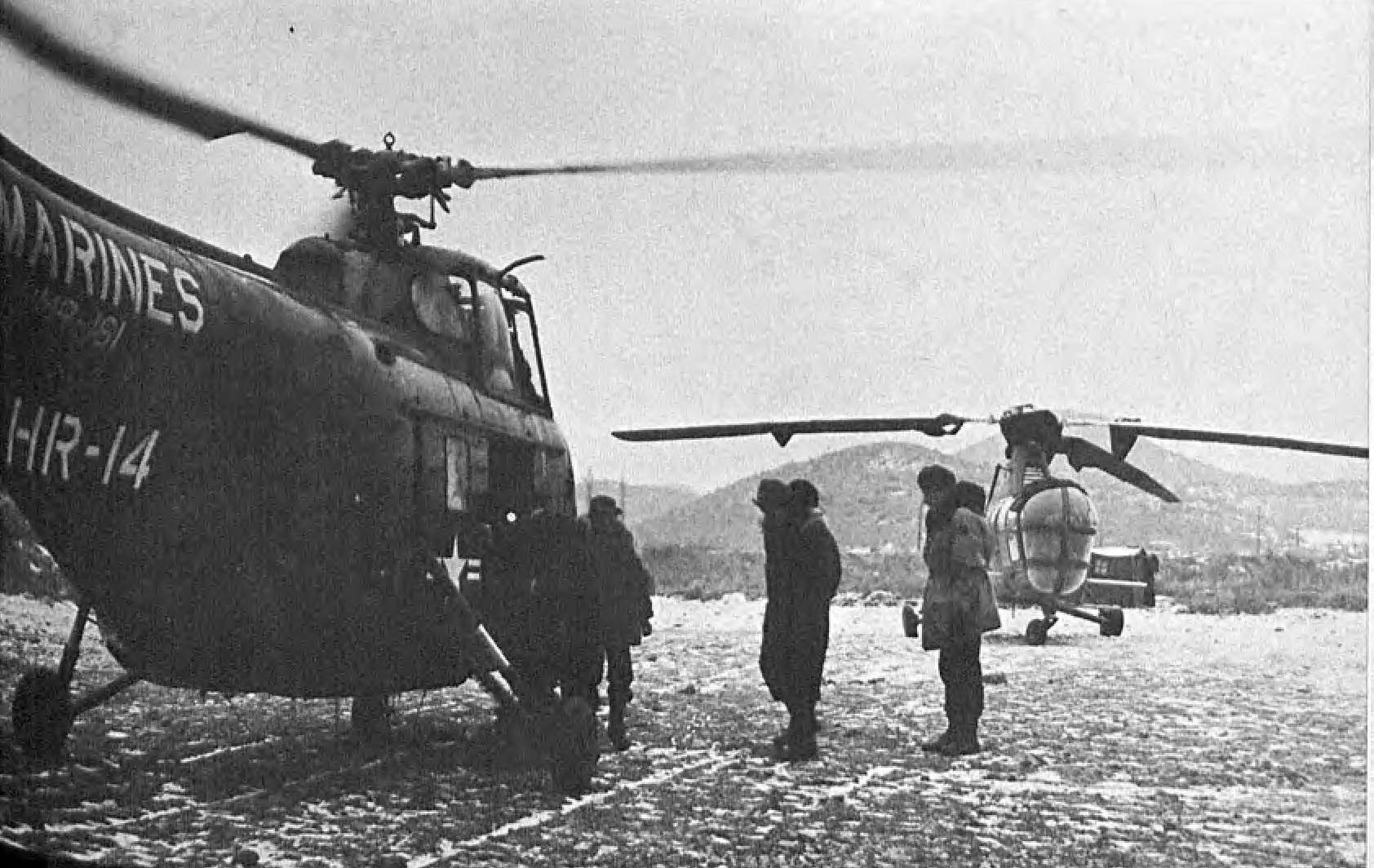
USMC Photo A 168493
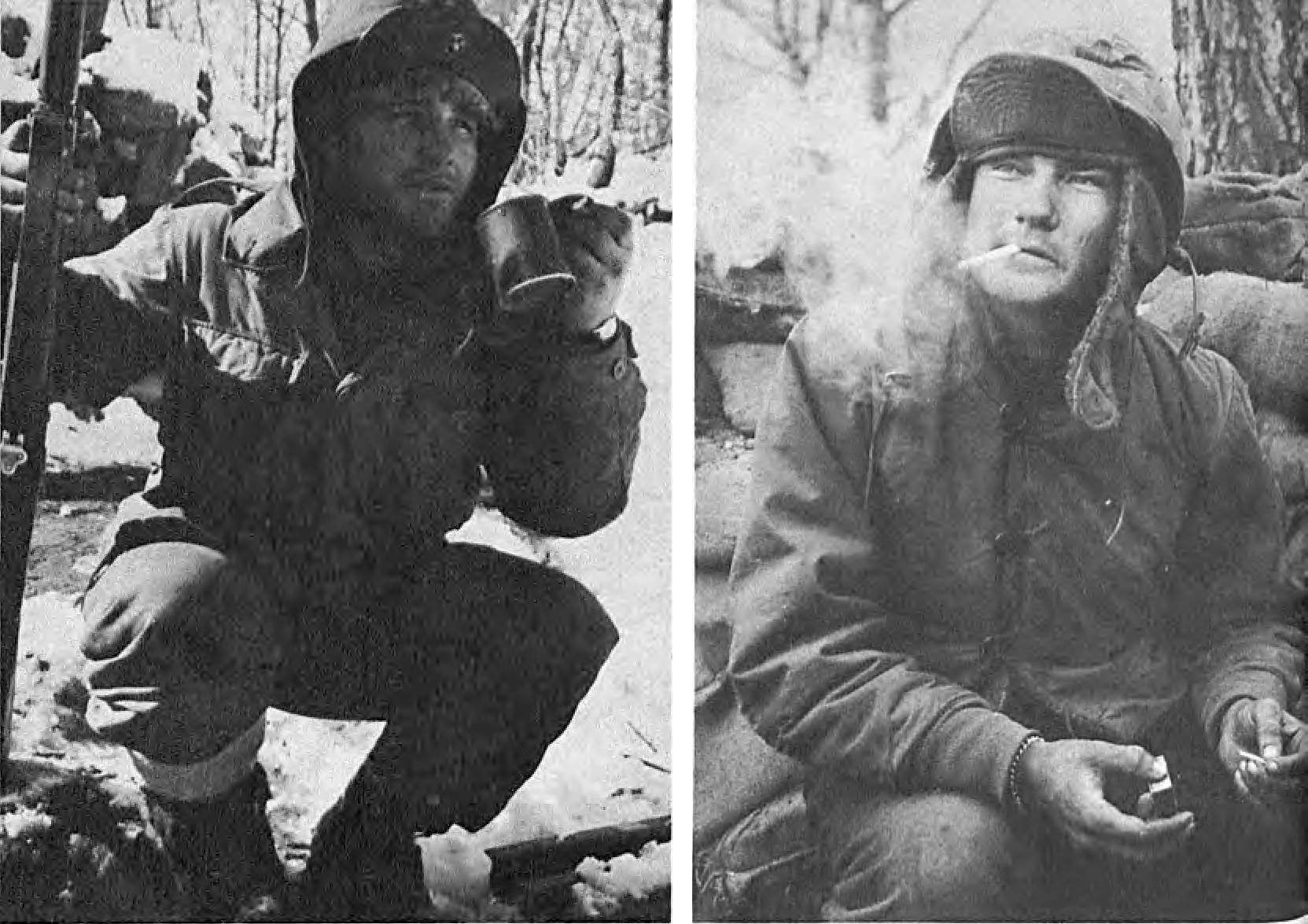
USMC Photo 160193 USMC Photo A 158811
Fighting Faces—Above, left, PFC H. W. Hodges pauses to drink from a “refrigerated”
spring; above, right, PFC J. W. Harnsberger relaxes on the
MLR; below, Sgt E. L. Whitlow and Capt W. F. Whitbeck scan the front
for signs of enemy action.
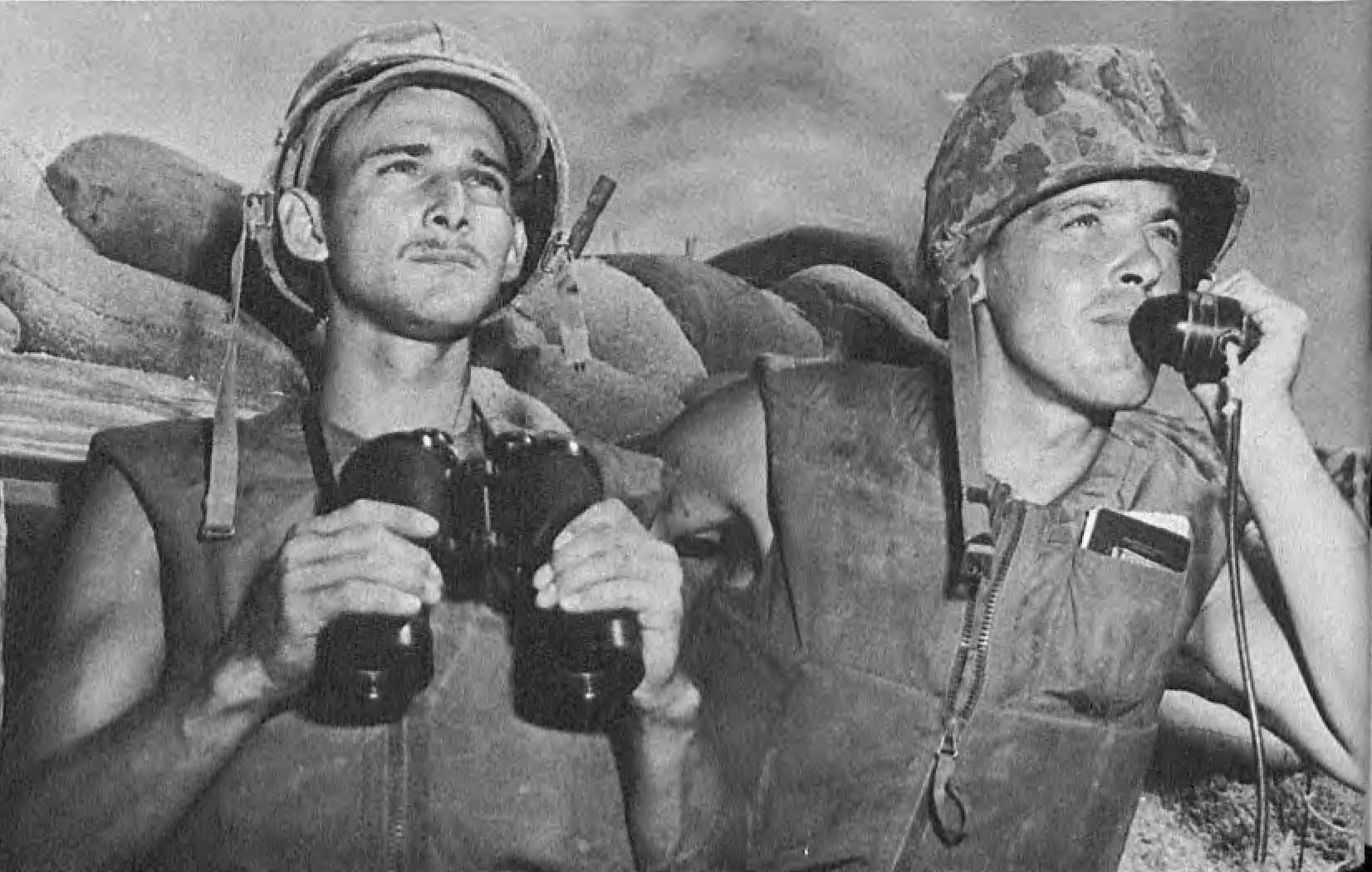
USMC Photo A 167904
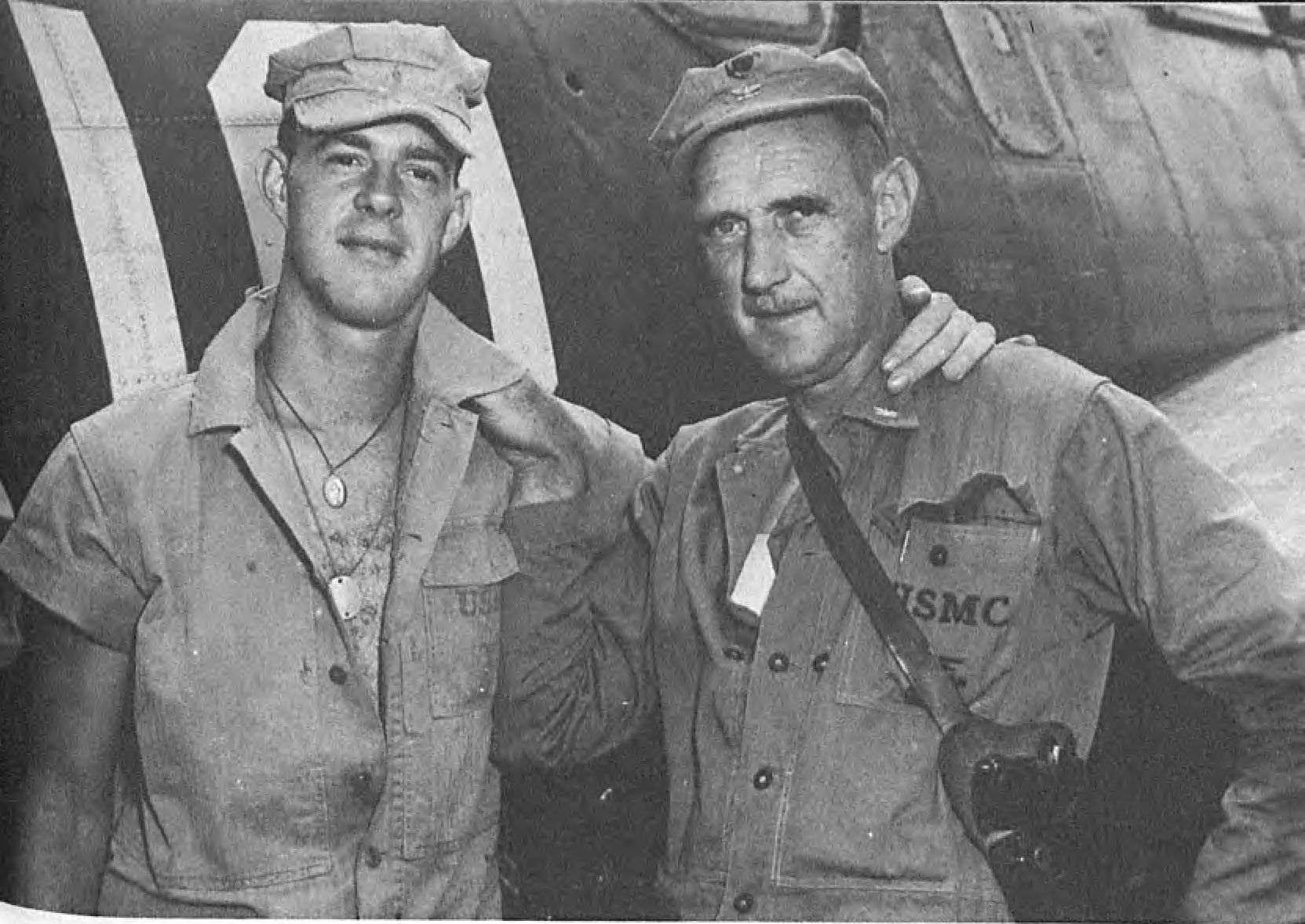
USMC Photo A 131819
Family Reunion—Above, Col W. S. Brown, CO 1st Marines, visits his son,
a Marine corporal; below, left, Capt G. H. Parker directs an air strike from
a tree top observation post; below, right, PFC K. L. Spriggs receives his Purple
Heart.
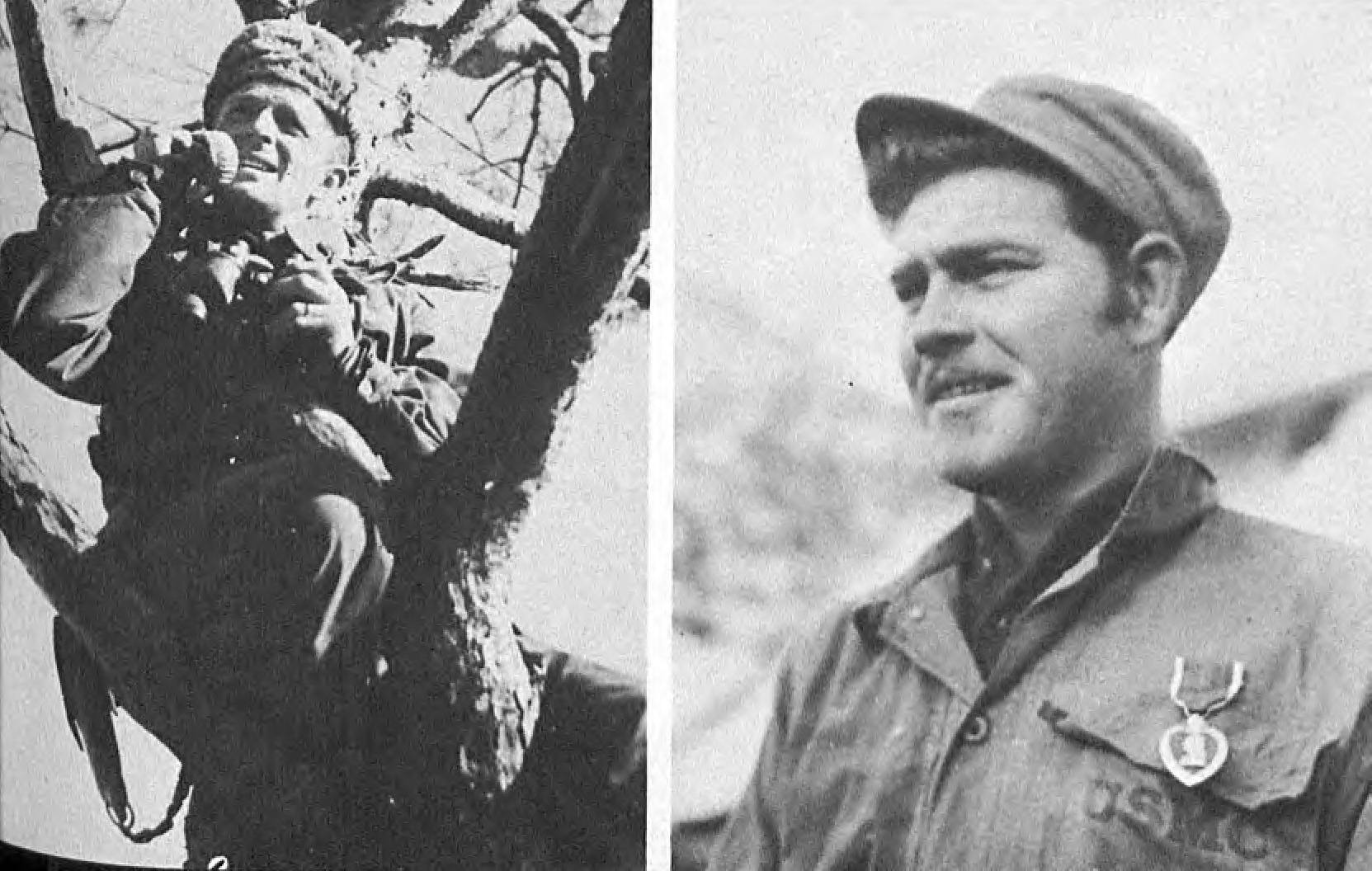
USMC Photo A 132390 USMC Photo A 158743
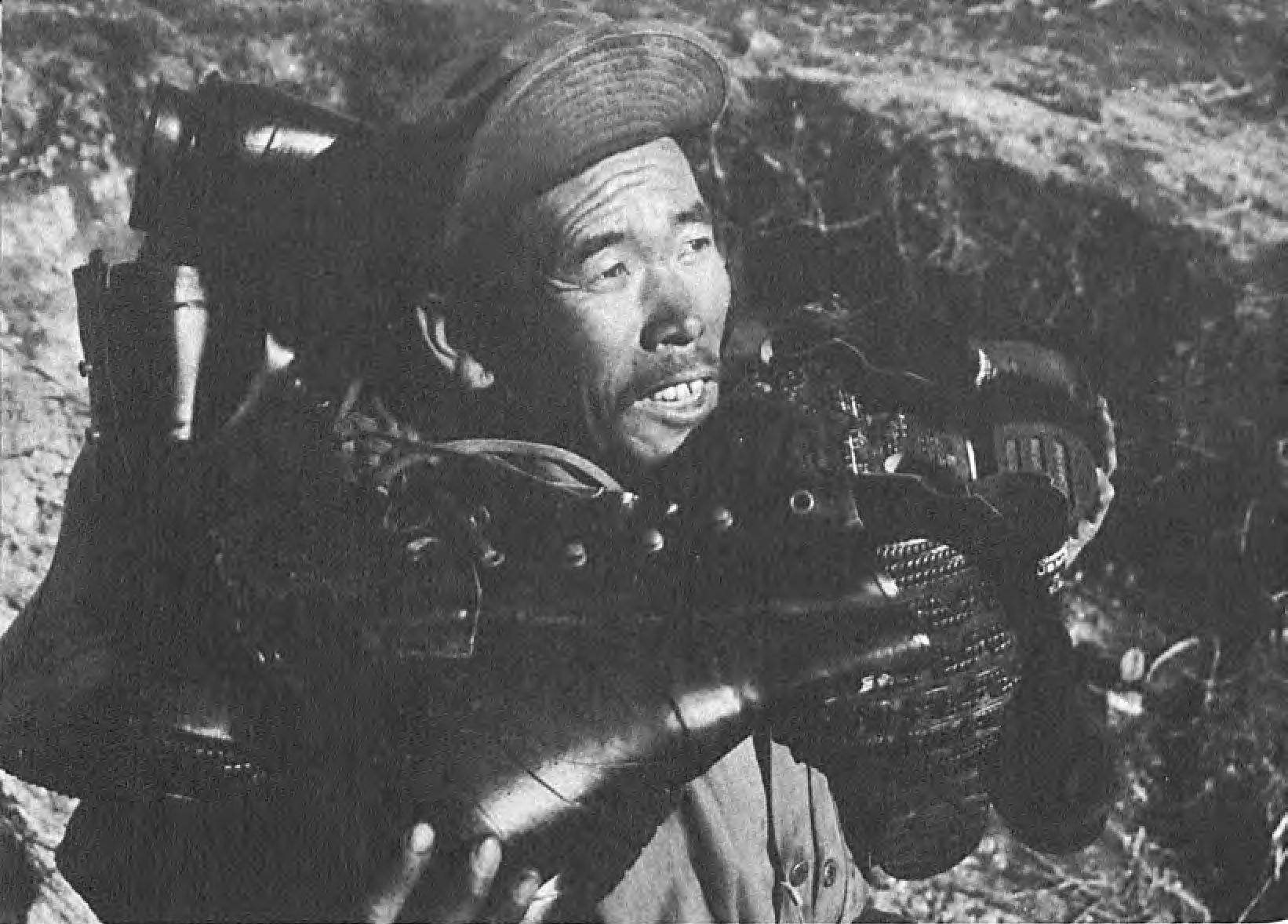
USMC Photo A 158079
Necklace of Boots—Above, a South Korean cargador carries a necklace of
boots to a front line company; below, new thermal boots are issued to combat
troops.
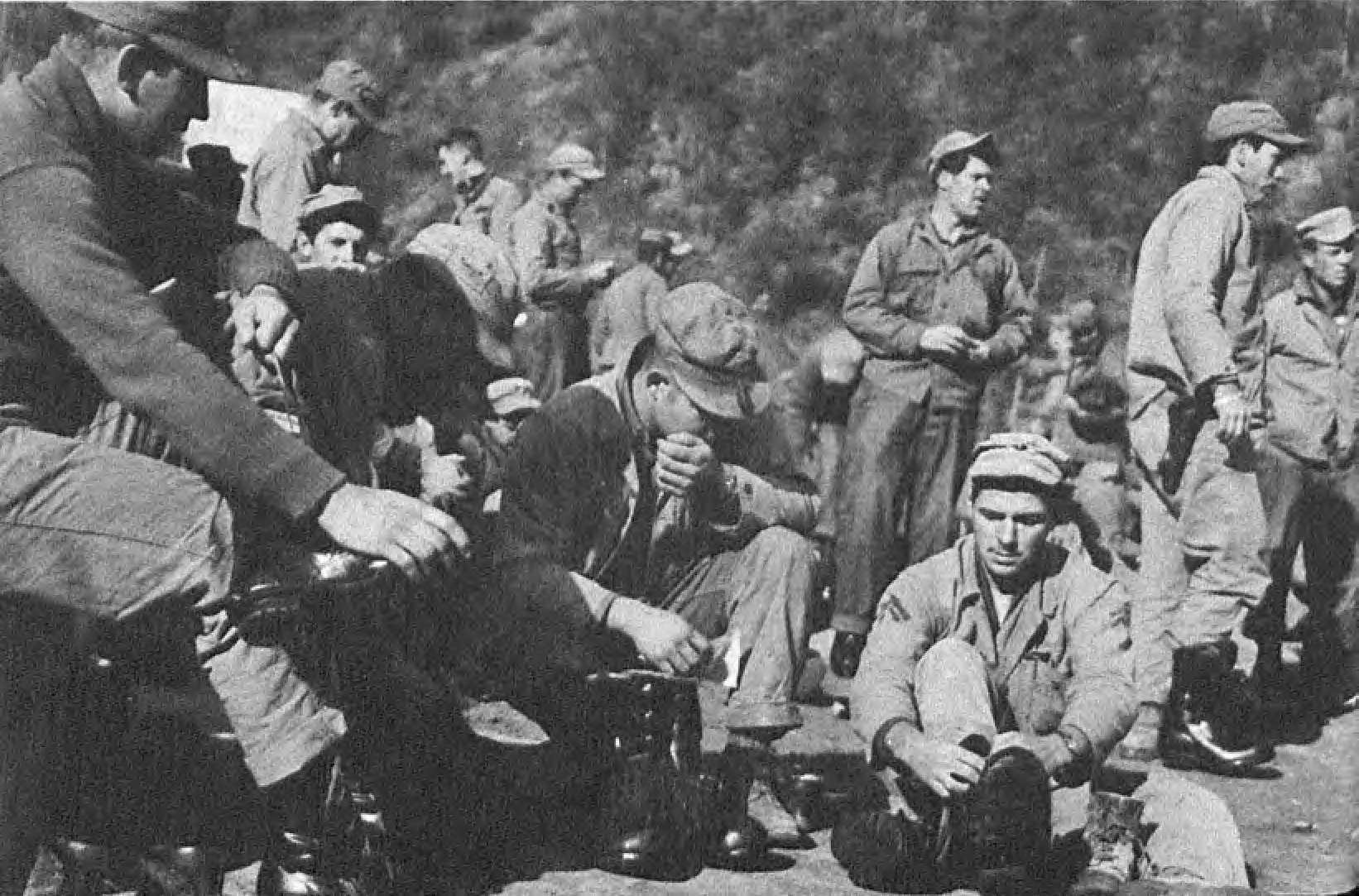
USMC Photo A 157927
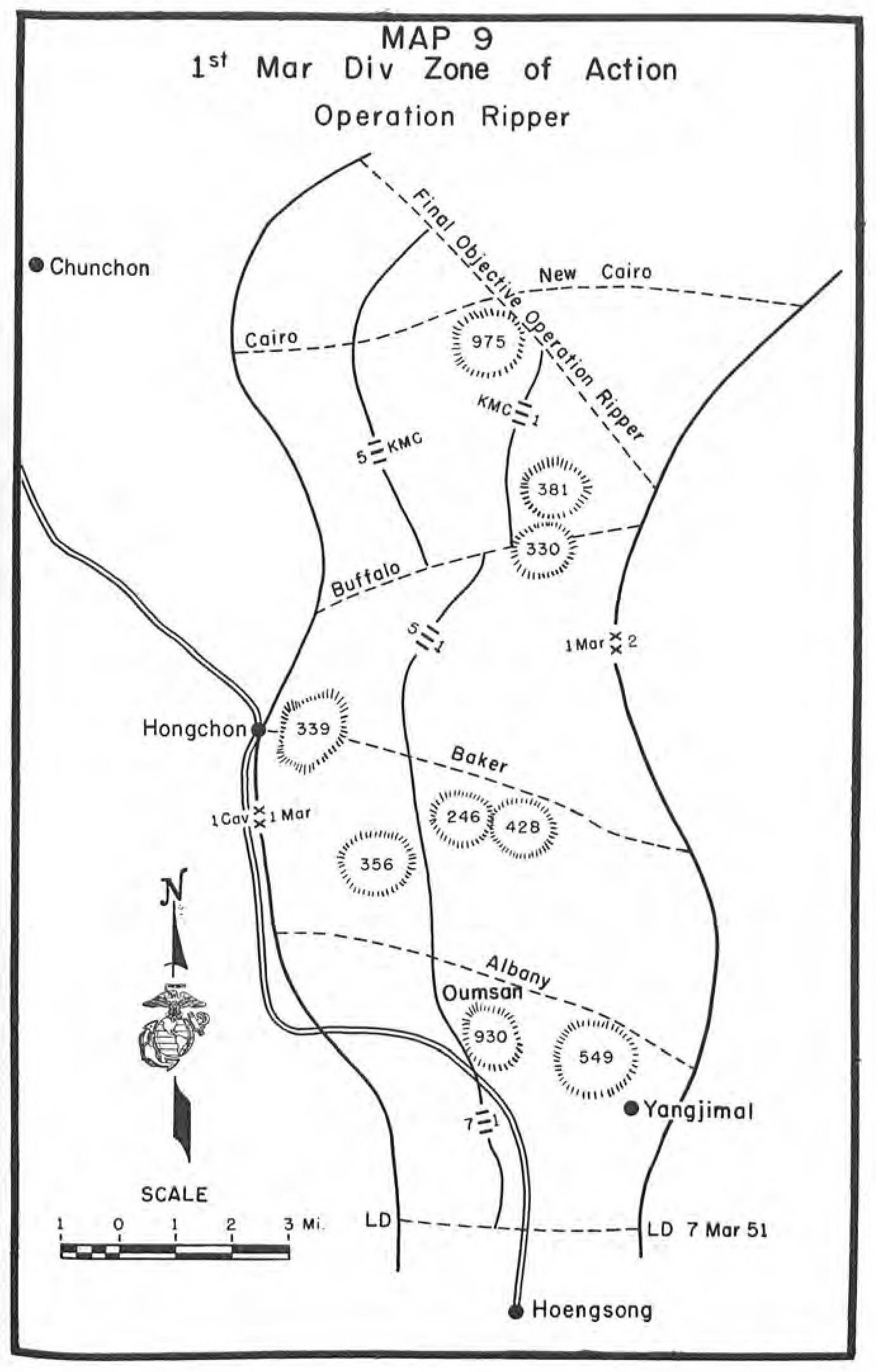
MAP 9
1st Mar Div Zone of Action
Operation Ripper
The Civil Transport Corps proved to be a boon for the Eighth
Army. Veteran porters could manage a load of 100 to 125 pounds
over ground too rugged for motor vehicles. Several hundred were
attached to each regiment during Operation RIPPER.
Any lingering hope of rounding up Chinese prisoners in the Hongchon
area was blasted on the 15th when evidence of Chinese withdrawal
came in the form of an enemy radio message intercepted at
1230. “We cannot fight any longer,” the translation read. “We must
move back today. We will move back at 1400. Enemy troops will
enter our positions at 1300 or 1400. Enemy troops approaching
fast.”133
Hongchon fell without a fight to the 1st Battalion of the 7th
Marines on the afternoon of 15 March. Major Webb D. Sawyer, the
commanding officer, sent a motor patrol through the ruins without
flushing out any Chinese, but on the return trip a truck was damaged
by a “butterfly bomb.” This led to the discovery that the Hongchon
area was covered with similar explosives that had been dropped by
U.S. planes to slow up the CCF counterattacks in the middle of
February.
Butterfly bombs, so-called because of the whirling vanes that controlled
the drop and armed the 4-pound projectiles, could be set for
air or ground bursts. Usually, however, they were dropped in clusters
to remain on the ground until disturbed. Apparently the enemy had
not troubled to clear them from the Hongchon area, and that three-day
task was begun by Company D of the 1st Engineer Battalion while
1/7 seized the high ground northwest of the town.134
Air support for the ground forces continued to be more than adequate
in quantity. Since the agreement between Generals Partridge and
Harris, 40 1st MAW sorties a day had been allotted to the 1st Marine
Division. The timing was not all that could have been asked on
occasion, but on the whole the Marine infantry had no complaint.
The 1st MAW had undergone an extensive reshuffling of units on
the eve of Operation RIPPER. VMF(N)-542 was sent back to El Toro,
California, for conversion to F3D jet all weather fighters. The squadron’s
F7F-3N’s and two F-82’s were left with VMF(N)-513. The
former commanding officer of 542, Lieutenant Colonel James R.
Anderson, assumed command of 513. He relieved Lieutenant Colonel
David C. Wolfe, who returned to the States.
The California-bound cadre of 542 included 45 officers and 145
enlisted men under Major Albert L. Clark. VMF(N)-513 was now
a composite squadron, attacking from K-1 during the day with its
F4U-5N’s and at night with its F7F-3N’s.
Another change took place when VMF-312 replaced VMF-212
on the CVE Bataan. The former squadron had been preparing for
weeks to perform carrier duty, so that the change was made without
a hitch. VMF-212, after nearly 3 months on the Bataan, established
itself at K-3 under a new commanding officer, Lieutenant Colonel
Claude H. Welch, who relieved Lieutenant Colonel Wyczawski.
The transportation jam in Korea made necessary the permanent
assignment of a VMR-152 detachment to 1st MAW Headquarters.
Transports had heretofore been sent to the Wing on a temporary
basis and returned to Hawaii when missions were completed.
Mud and inadequate rail facilities doubled the demands on FEAF’s
aerial supply of combat forces. The Wing’s courier service to Marine
air and ground forces scattered over Korea reached the limit of its
capabilities. As a solution General Harris requested a five-plane
VMR-152 detachment on a long-term assignment, and Colonel
Deane C. Roberts took command of this forward echelon at Itami.
It was now possible to handle cargo and troop transport at the cargo
and passenger terminals of all Marine air bases. In one 4-day period,
early in April, approximately 2,000 replacement troops were lifted
from Masan to Hoengsong by the five R5Ds. About a thousand
rotated veterans were flown back on the return trips.135
A further change involved the coordination of the Wing’s air
control organizations. As the enemy’s air power increased, obviously
the problems of UN air defense multiplied. At K-1 the Marine
Ground Intercept Squadron-1 (MGCIS-1) and the Air Defense
Section of Marine Tactical Air Control Squadron-2 (MTACS-2)
were hard pressed to identify and control the hundreds of aircraft
flying daily over Korea.
There was no adequate system of alerting these air defense stations
to the effect that planes were departing or incoming. Many of them
failed to send out their standard identification friend or foe (IFF)
signals; and those that did so were still suspect, since U.S. electronics
equipment on UN planes had fallen into enemy hands. As a consequence
MGCIS-1 was kept busy vectoring air defense fighters to verify
that certain bogeys were friendly transports, B-29s, or enemy
bombers.136
In an effort to cope with the situation, General Harris requested
that another Marine ground control intercept squadron, MGCIS-3
be sent to Korea. He desired that Marine Air Control Group-2
(MACG-2) also be made available to coordinate the Wing’s air
control functions. These units sailed on 5 March from San Francisco.
Until March 1951 the Air Force’s 606th Aircraft Control and Warning
Squadron had participated in the air surveillance of the Pusan area
from the top of 3,000-foot Chon-San—the encroaching mountain that
made K-9’s traffic pattern so hazardous. This Air Force unit displaced
to Taejon early in March, and the MGCIS-1 commanding officer,
Major H. E. Allen, moved his radio and radar vans to the mountain
top to take over the job.137
Following the occupation of Hongchon on the 15th, the Marine
ground forces ran into stiffening enemy opposition during the next
two days. The 2d and 3d Battalions of the 7th Marines were pinned
down by intense CCF mortar and artillery fire when attacking Hill
356 (Map 9). Three out of six friendly 81mm mortars were knocked
out on 15 March in the 3d Battalion area, and at dusk 2/7 and 3/7
had barely won a foothold on the hill.138
The 1st Marines also met opposition which indicated that the
enemy planned to make a stand on the high ground east and north of
Hongchon. An intricate maneuver was executed when Lieutenant
Colonel Robert K. McClelland’s 2/1 swung from the right flank,
where no enemy was encountered, to the extreme left. As a preliminary,
the battalion had to circle to the rear, then move by truck
up the MSR and through the zone of the 7th Marines as far as the
village of Yangjimal (Map 9). Dismounting, the men made a difficult
march across broken country toward Hill 246. At 1230 on the
15th the column deployed to attack Hill 428 in conjunction with
Lieutenant Colonel Virgil W. Banning’s 3d Battalion.
Easy Company (Captain Jack A. Smith) and Item Company (First
Lieutenant Joseph R. Fisher) engaged in a hot fire fight with the
enemy. Both sides relied chiefly on mortars, but the Chinese had the
advantage of firing from camouflaged bunkers. Smith called for an
air strike and four planes from VMF-214 responded immediately.
Fox Company (Captain Goodwin C. Groff) and Dog Company
(Captain Welby D. Cronk) were committed in the attempt to carry
Hill 428, but the enemy continued to resist stubbornly until dusk.
McClelland then ordered a withdrawal to night defensive positions
around Hill 246. The two assault battalions had suffered 7 KIA and
86 WIA casualties. Counted enemy dead were reported as 93.139
Lieutenant Colonel Donald R. Kennedy’s 3/5 was attached to the
1st Marines to protect the right flank as the Marines prepared to
resume the attack on the morning of the 16th. But the enemy had
pulled out from Hill 428 during the night and patrols advanced more
than 300 yards without making contact.
Another hard action awaited the 7th Marines on the 16th, when
Major Sawyer’s 1st Battalion moved up to Line BAKER (Map 9).
The Chinese resisted so hard on Hill 399 that the Marines had to
attack bunker after bunker with grenades.
The following morning was the occasion of a visit to the front by
General MacArthur. Accompanied by Generals Ridgway and O. P.
Smith, he drove in a jeep from Wonju over the mountain pass to
Hongchon, where Marine engineers were still clearing mines. The
jeep stalled after crossing the Hongchon-gang at a ford and a tow
was necessary. This did not deter the commander in chief, who had
asked to visit a Marine battalion in a combat area. He was taken to
the CP of Major Sawyer, whose 1/7 was mopping up on Hill 399
after the hard fight of the day before.
Five hours of riding over miserable roads had not daunted the
71-year-old veteran of two World Wars. He seemed fresh and
rested as he shook hands with 1/7 officers. “Although we had not
passed the word regarding General MacArthur’s visit,” commented
General Smith, “there were dozens of cameras in evidence.”140
IX Corps orders were received on the 17th for the 1st Marine
Division to attack from Line BAKER to Line BUFFALO (Map 9). The
Division plan of maneuver called for the 5th Marines to pass through
and relieve the 7th Marines while the 1st Marines continued to
advance on the right.
Again the enemy chose withdrawal to resistance, and five of the six
Marine battalions reached Line BUFFALO on 20 March after encountering
only sniper fire and a few scattered mortar rounds. Enemy opposition
was reserved for 2/1 on the 19th, when Fox Company was
pinned down by enemy small-arms and mortar fire from a long,
narrow ridge running north and south to the west of Hill 330.
Fortunately for the attackers, a parallel valley enabled a platoon
of tanks from Baker Company, 1st Tank Battalion, to knock out
unusually strong CCF bunkers with direct 90mm fire while Fox Company
riflemen followed along the ridgeline with a grenade attack
before the enemy had time to recover. Thanks to intelligent planning,
not a single Marine was killed or wounded as the battalion dug in
for the night on Hill 330.
Adopting the same tactics on the 20th, after artillery preparation
and an air strike by VMF-214 and VMF-323 planes, Easy Company
of 2/1 advanced along the ridgeline connecting Hills 330 and 381
while tanks moved forward on either side providing direct flat-trajectory
90mm fire. By 1315 the Marines had overrun the enemy’s main
line of resistance without a casualty.141
As the Eighth Army jumped off on 20 March from Line BUFFALO
toward Line CAIRO (Map 9), the 1st KMC Regiment was attached
again to the 1st Marine Division. This was the third time that
Lieutenant Colonel Charles W. Harrison had been directed to reorganize
and reassemble a KMC liaison advisory group. The 3d Battalion
of the 11th Marines, commanded by Lieutenant Colonel William
McReynolds, was placed in direct artillery support. When the advance
was resumed, the KMCs attacked between the 1st Marines on the
right and the 5th Marines on the left.142
The high esprit de corps of the KMCs shines forth from a comment
written in his own English by First Lieutenant Kim Sik Tong: “The
KMC ideal is to complete the mission, regardless of receiving strong
enemy resistance, with endurance and strong united power, and always
bearing in one’s mind the distinction between honor and dishonor.”143
The zone of the KMC Regiment was a roadless wilderness, making
it necessary to air-drop ammunition and supplies for the attack on Hill
975. This was the hardest fight of the Division advance to Line CAIRO.
Excellent artillery support was provided for the 2d and 3d Battalions
as they inched their way forward in three days of bitter combat. Not
until the morning of 24 March was the issue decided by maneuver when
the 1st Battalion moved around the left KMC flank into a position
threatening the enemy’s right. Resistance slackened immediately on
Hill 975 and the KMCs took their objective without further trouble.
The 1st and 5th Marines were already on Line CAIRO, having met
comparatively light opposition from NKPA troops who had relieved
the 66th and 39th CCF Armies. Apparently the enemy was using
North Koreans as expendable delaying elements while massing in the
rear for an offensive that could be expected at any time. A smoke
screen, produced by burning green wood, shrouded the front in an
almost constant haze.
Although the objectives of Operation RIPPER had been reached,
General Ridgway planned to continue the UN offensive for the purpose
of keeping the enemy off balance during his offensive preparations.
The Eighth Army had been attacking with few and brief pauses for
regrouping even since 21 February, and the commanding general
wished to maintain its momentum.
An advance of the 1st Marine Division to a new Line CAIRO was
ordered by IX Corps on 26 March. This was simply a northeast
extension of the old line to the boundary between IX and X Corps
(Map 9). There was no need for the 5th Marines to advance, and
the 1st Marines and KMC Regiment moved up to the new line on
schedule without opposition.
Eighth Army units had made average gains of about 35 miles
during the last three weeks while driving nearly to the 38th Parallel.
On 29 March, General Ridgway published a plan for Operation
RUGGED. It was to be a continuation of the offensive, with Line
KANSAS (Map 8) as the new objective. While other 1st Marine units
were being relieved by X Corps elements, the 7th Marines was to be
moved up from reserve near Hongchon and attached to the 1st
Cavalry Division for the attack beyond Chunchon, evacuated by the
retreating enemy.144
On 1 April the Marines were informed of sweeping changes in
IX Corps plans. Instead of being relieved, the 1st Marine Division
was to continue forward with two infantry regiments plus the KMCs.
Its new mission called for a relief of the 1st Cavalry Division (with
the 7th Marines attached) north of Chunchon. This modification gave
General Smith the responsibility for nearly 20 miles of front.145
“I visited this front frequently,” commented Major General A. L.
Bowser, the G-3 of that period, “and it was difficult at times to even
locate an infantry battalion.... Visitors from the States or FMFPac
were shocked at the wide frontages.”146
Further IX Corps instructions on 2 April directed that the 1st Marines
go into Division reserve near Hongchon while the 5th Marines and
1st KMC Regiment attacked. The deep, swift Soyang-gang, fordable
in only a few places, lay squarely in the path of the 5th Marines.
Speculations as to the method of crossing became rife just as air
mattresses were issued. And though the officers denied any such
intent, the troops were convinced that inflated mattresses would be
used.
As it happened, the regimental executive officer, Lieutenant Colonel
Stewart, worked out a plan that did not include any such novelty.
A narrow ford was discovered that would get the 1st and 2d Battalions
across while the 3d rode in DUKWs. Light enemy opposition
of a rear guard nature was encountered but the regiment completed
the operation without casualties. Stewart reported to the regimental
CP and learned that a jeep waited to take him on the initial lap of
his homeward journey. He was the last man to leave Korea of the
1st Provisional Marine Brigade, which had landed at Pusan on
2 August 1950.147
After reaching their prescribed objectives, the 5th Marines and
KMC Regiment were relieved on 5 April by elements of the 7th
Infantry Division of X Corps. Meanwhile, the 7th Marines, attached
to the 1st Cavalry Division, advanced northward with the 7th and
8th Cavalry Regiments. Little opposition developed and on 4 April the
Marines were among the first Eighth Army troops to recross the 38th
Parallel.
General Ridgway published another operation plan on 6 April
1951 and designated new Eighth Army objectives to the northward.
The purpose was to threaten the buildup for the forthcoming CCF
offensive that was taking place behind the enemy lines in the so-called
“Iron Triangle.”
This strategic area, one of the few pieces of comparatively level
real estate in central Korea, was bounded by Kumhwa, Chorwon, and
Pyongyang (Map 14). A broad valley containing a network of good
roads, it had been utilized by the Chinese for the massing of supplies
and troops.
Experience had proved that interdictory bombing could not prevent
the enemy from nourishing an offensive, even though the FEAF had
complete control of the air over roads and rail lines of a mountainous
peninsula. The Chinese, though hampered in their efforts, had been
able to bring up large quantities of supplies under cover of darkness.
General Ridgway determined, therefore, to launch his ground forces
at objectives threatening the Iron Triangle, thus forcing the enemy
to fight.
On 8 April, in preparation for the new effort, the 1st Marine Division
was directed by IX Corps to relieve the 1st Cavalry Division on
Line KANSAS and prepare to attack toward Line QUANTICO (Map 8).
By this time, after three months of various sorts of operational difficulties,
VMF-311 was riding a wave of efficiency. The distance from
the operating base to the combat area emphasized the superior speed
of the F9Fs. The Panther jets could get into action in half the time
required by the Corsairs. The jets were more stable in rocket, bombing,
and strafing runs. They were faster on armed reconnaissance and
often were pouring it into the enemy before he could disperse. These
advantages offset the high fuel consumption of the F9Fs and made
them ideal planes for close air support.
On the morning of 8 April an opportunity arose for the Marine
jets to help the 7th Marines. It started when 3/7 patrols encountered
120mm mortars, small arms, automatic weapons, and grenades employed
by an enemy force dug in on a ridge looming over the road
near the west end of the Hwachon reservoir. The battalion forward
air controller radioed DEVASTATE BAKER at Hongchon for air support.148
At the time Major Roy R. Hewitt, an air officer on General Shepherd’s
FMFPac staff, was visiting the Air Support Section of Marine
Tactical Air Control Squadron-2 (MTACS-2). His blow-by-blow
report of events is as follows:
a. At 0900 a request for an air support strike on an enemy mortar position
was received from the 7th Marines. It took the Air Support Section until
0945 to get through to JOC and then it had to be shunted through K-1 in
order to get the request in.
b. The G-3 1st Marine Air Wing had arranged with JOC to have four
(4) F9F ‘scramble alert’ for use by the 1st Marine Division. The F9Fs were
requested, and JOC authorized their use, but when Marine Aircraft Group-33
was contacted they informed the Air Support Section that JOC had already
scrambled the aircraft and sent them to another target.
c. Air Support Section again contacted JOC, and JOC said aircraft would
be on station in one (1) hour. At the end of one (1) hour JOC was again
contacted concerning aircraft. This time JOC said they would have two (2)
flights on station within one (1) hour. At the end of the second one (1)
hour period no aircraft were received.
d. Again the Air Support Section contacted JOC and was informed that
any air support for the 7th Marines would have to be requested through the
1st Cavalry Division to which the 7th Marines were attached. [In fact, JOC
notified DEVASTATE BAKER that any such requests from the 1st Marine Division
would not be honored until the Division went back into action.]149
During all this time ten Marine planes—six from VMF-311 and
four from VMF-214—had reported in and out of the area. They had
been sent by MELLOW to work under the control of Mosquito STRATEGY,
the tactical air controller (airborne) (TACA) of the 1st Cavalry Division.
The flights also supported the 6th ROK Division patrols on the
Marines’ left, hit troops in a small settlement 3 miles to the Marines’
front, and aided the 7th and 8th Cavalry regiments which were encountering
resistance on the commanding ground to the right. None
of the flights supported the Marines.
Meanwhile, the 3/7 Marines employed artillery and tanks on the
enemy positions, and late in the day a Mosquito brought in a flight of
four Air Force F-80s. Major Hewitt’s report continued:
e. At the end of six (6) hours air support was finally received by the 7th
Marines. It was brought in by a Mosquito who would not relinquish control
of the aircraft to the Forward Air Controller who could see the target much
better than the Mosquito.
f. After having the fighters make a couple of passes the Mosquito took
the fighters and went to another target without having completely destroyed
the position.
This was the beginning of a deterioration in air support for Marine
ground forces that can be charged in large measure to the JOC system
of control. Major Hewitt’s report was read with great interest by
high-ranking Navy and Marine Corps officers. By now they were
devoting a lot of thought to the breakup of the Marine air-ground
team.
CHAPTER VI The CCF Spring Offensive — Prisoners Reveal Date of Offensive — Hwachon Occupied by KMC Regiment — CCF Breakthrough Exposes Marine Flank — Marine Air in Support Everywhere — Plugging the Gap on the Marine Left — Repulse of Communist Attacks — Withdrawal to the Kansas Line — Enemy Stopped in IX Corps Sector — 1st Marine Division Returns to X Corps
Prisoners Reveal Date of Offensive—Hwachon Occupied
by KMC Regiment—CCF Breakthrough Exposes Marine
Flank—Marine Air in Support Everywhere—Plugging the
Gap on the Marine Left—Repulse of Communist Attacks—Withdrawal
to the KANSAS Line—Enemy Stopped in IX
Corps Sector—1st Marine Division Returns to X Corps
On 10 April 1951 the 1st Marine Division was poised on Line
KANSAS for a drive to Line QUANTICO. Then a new IX Corps
directive put on the brakes, and for 10 days Marine activities were
limited to patrolling and preparation of defensive works. Boundary
adjustments between the Division and the 6th ROK Division on the
left extended the Marine zone about 2,000 yards to the west; and
General O. P. Smith’s CP was advanced to Sapyong-ni, just south of
the 38th Parallel (Map 8).
Out of a blue sky came the announcement on the 11th that General
MacArthur had been recalled by President Truman for failure to give
wholehearted support to the policies of the United States Government
and of the United Nations in matters pertaining to his official
duties. General Ridgway was appointed to the UN command, and he
in turn was relieved on 14 April by Lieutenant General James A.
Van Fleet, USA.
The new Eighth Army commander, youthful in appearance for his
59 years, was no novice at fighting Communists. In 1949 and 1950 he
had been Director of the Joint Military Aid Group that saved Greece
from falling into the clutches of Communism after Moscow fomented
a civil war. Van Fleet also brought to his new command a World
War II reputation as a vigorous leader with a preference for offensive
doctrines.
Chinese prisoners taken during the first three weeks of April 1951 told
all they knew with no apparent reluctance, just as Japanese captives
had given information in World War II. Inconsistent as it may seem
that fanatical Asian soldiers should prove so cooperative, such was
the penalty the enemy paid for insisting on resistance to the last ditch.
Since the possibility of surrender was not considered, CCF prisoners
were taught no code of behavior and answered questions freely and
frankly.
POW interrogations were supplemented by captured documents
revealing that the Chinese prided themselves on a new tactical doctrine
known as “the roving defensive,” put into effect in the spring of 1951.
It meant “not to hold your position to the death, but to defend against
the enemy through movement,” explained a secret CCF directive dated
17 March 1951. “Therefore, the wisdom of the roving defensive is
based on exhausting the enemy without regard for the loss or gain
of some fighting area or the immediate fulfillment of our aims.”150
It was admitted that the CCF soldier must work harder, “because
the troops will have to construct entrenchments and field works in
every place they move.” But the advantages were that “roving warfare
can conserve our power, deplete the enemy’s strength, and secure
for us more favorable conditions for future victory. Meanwhile, the
enemy will make the mistake once again, and collapse on the Korean
battlefield.”
The last sentence evidently refers to the UN advance of late November
1950 that was rolled back by a surprise CCF counteroffensive.
Chinese strategists seem to have concluded that their “roving defensive”
had made possible another such offensive victory in the spring
of 1951. At any rate, prisoners questioned by the 1st Marine Division
and other IX Corps units agreed that the CCF 5th Phase Offensive was
scheduled to begin on 22 April 1951. The IX Corps zone was said
to be the target area for an attempted breakthrough.151
Marine G-2 officers recalled that prisoners gave information on the
eve of the CCF offensive in November 1950 that proved to be astonishingly
accurate in the light of later events. For it was a paradox that
the Chinese Reds, so secretive in other respects, let the man in the
ranks know about high-level strategic plans. In the spring of 1951
it mattered little, since air reconnaissance had kept the Eighth Army
well informed as to the enemy buildup.
Prisoners were taken in the IX Corps zone from the following major
CCF units during the first three weeks of April:
20th Army (58th, 59th, and 60th Divisions), estimated strength, 24,261;
26th Army (76th, 77th, and 78th Divisions), estimated total strength,
22,222;
39th Army (115th, 116th, and 117th Divisions), estimated total strength,
19,538;
40th Army (118th, 119th, and 120th Divisions), estimated total strength,
25,319.
The 20th and 26th, it may be recalled, were two of the CCF armies
opposing the 1st Marine Division during the Chosin Reservoir
breakout. It was a satisfaction to the Marines that their opponents of
December 1950 had evidently needed from three to four months to
reorganize and get back into action.
In CCF reserve on 21 April 1951 were the 42d and 66th Armies,
both located in the Iron Triangle to the enemy’s rear. The former
included the 124th, 125th, and 126th Divisions—the 124th being the
unit cut to pieces from 3 to 7 November 1950 by the 7th Marines
in the war’s first American offensive action against Chinese Red
adversaries.
At 0700 on the 21st the 1st Marine Division resumed the attack
toward Line QUANTICO with the 7th Marines on the left, the 5th
Marines in the center, the KMC Regiment on the right, and the
1st Marines in reserve. Negligible resistance awaited the Marines and
other IX Corps troops during advances of 5,000 to 9,000 yards. An
ominous quiet hung over the front as green wood smoke limited
visibility to a few hundred yards.
On the Marine left the 6th ROK Division lost touch, opening a gap
of 2,500 yards, according to a message from Corps to the 1st Marine
Division. The ROK commander was ordered by Corps to restore
lateral contact. This incident would be recalled significantly by the
Marines when the CCF blow fell.152
The KMC Regiment had the mission of finishing the fight for control
of the Hwachon Reservoir area. Early in April the 1st Cavalry
Division and the 4th Ranger Company, USA, had been repulsed in
attempts to fight their way across the artificial lake in rubber boats.
The enemy retaliated by opening the penstocks and spillway gates.
Considering that the dam was 275 feet high and the spillway 826 feet
long, it is not surprising that a wall of water 10 feet high roared
down the Pukhan Valley into areas recently occupied by IX Corps
units.153
Both Army and Marine engineers were on the alert, having been
warned by aerial observers. They cut three floating bridges loose from
one bank or another, so that they could ride out the crest of the flood.
Thanks to this precaution, only temporary damage and interruption
of traffic resulted.154
The 1st Engineer Battalion, commanded by Lieutenant Colonel
John H. Partridge, was given the mission by Corps of jamming the
gates of the dam at the open position. Compliance would have to
wait, of course, until the KMCs took the dam. Partridge conferred
meanwhile with Colonel Bowser, and it was decided to take no action
after the anticipated capture until a demolitions reconnaissance could
be made.155
As early as 18 April a KMC patrol had crossed the Pukhan into
the town of Hwachon, which was found abandoned except for
11 Chinese soldiers, who were taken prisoner. Marine engineers
installed a floating bridge on the 21st for the advance of one KMC
battalion the next morning. The other two battalions were to cross
the river several miles downstream by DUKWs.156
Corps plans for the attack were made in full realization of air
reconnaissance reports for 20 and 21 April indicating that the enemy
offensive buildup was in its final stages. This intelligence was gleaned
in spite of all enemy efforts to frustrate the airmen. CCF spotters
were placed on mountain tops to give the alarm, and relays of men
fired shots to pass on warnings of approaching planes. Antiaircraft
defenses were increased at such vital spots as bridges and supply
areas. The Communists even went so far as to put out decoys—fake
trucks, tanks, and tank cars—to lure UN fighter-bombers within
range of antiaircraft guns.
These efforts resulted in 16 Marine planes being shot down from
1 to 21 April 1951. Nine of the pilots were killed, one was captured,
three were rescued from enemy territory, one walked back to friendly
outposts, and two managed to bail out or crash-land behind the
UN lines.157
This total was equivalent to two-thirds of the average tactical
squadron. Because of the disruption to the 1st MAW pilot replacement
program, the Commandant arranged for 20 pilots to be flown to
Korea to augment the normal rotation quotas.158
Direct opposition from enemy aircraft was also on the increase.
CCF flights even reached the EUSAK battle line as unidentified light
planes flew over positions or dropped small bombs. Evidently the
enemy was using well camouflaged airfields in North Korea.
An air battle took place on 20 April when two VMF-312 pilots
from the Bataan, Captain Philip C. DeLong and First Lieutenant
Harold D. Daigh, encountered four YAK fighters in the heavily
defended Pyongyang-Chinnanpo area. They gave chase and shot
down three of the enemy planes.159
Marine aircraft were on station when Marine ground forces resumed
their forward movement at 0830 on the morning of 22 April.
A CCF prisoner taken that very afternoon confirmed previous POW
statements that the 22d was the opening day of the Fifth Phase
Offensive. The front was quiet, however, as the three Marine infantry
regiments advanced almost at will.
A motorized patrol of Division Reconnaissance Company, led by
the commanding officer, Major Robert L. Autrey, had the initial
contact with the enemy while advancing on the Division left flank.
The two platoons, supported by Marine tanks, found their first indications
when searching a Korean roadside hut. Although the natives
denied having seen any Chinese soldiers. Corporal Paul G. Martin
discovered about 50 hidden rice bowls waiting to be washed. Upon
being confronted with this evidence, the terrified Koreans admitted
that Chinese soldiers had reconnoitred the area just before dawn.
Farther up the road, an ammunition dump of hidden mortar shells
was discovered. The enemy had also put up several crude propaganda
signs with such sentiments as Your Folks Like See You Home and
Halt! Forward Means Death.
The patrol dismounted and proceeded with caution, guided by an
OY overhead. Although the “choppers” were the favored aircraft of
VMO-6, the OYs also earned the gratitude of the troops on many
an occasion such as this. The pilot gave the alarm just before hidden
Communists opened fire. Thus the Marines of the patrol were enabled
to take cover, and the tanks routed the enemy force with well placed
90mm shells.160
The KMCs met no resistance worth mentioning when they secured
the town of Hwachan and the north bank of the Pukhan just west of
the reservoir. Only light and scattered opposition awaited the 5th
Marines (Colonel Richard M. Hayward) and the 7th Marines
(Colonel Herman Nickerson, Jr.) on their way to the occupation of
assigned objectives on Line QUANTICO.
For weeks the Communist forces in Korea might have been compared
to an antagonist backtracking to get set for taking aim with a shotgun.
There could be no doubt, on the strength of daily G-2 reports, about
both barrels being loaded. And on the night of 22 April the enemy
pulled the trigger.
The KMCs, after taking their objectives, reported a concentration
of enemy small-arms fire. At 1800 the command of the 1st Marine
Division directed a renewal of the advance at 0700, on the morning
of the 23d. This order was cancelled at 2224 by a message calling
for all Marine units to consolidate and patrol in zone, pending further
instructions.161
One of the reasons for the sudden change was the receipt of a
message by the 1st Marine Division at 2120, informing that the 6th
ROK Division was under heavy attack to the west of the Marines.
Meanwhile, an on-the-spot questioning of a CCF prisoner just taken
by the KMCs convinced the command and staff of the 1st Marine
Division that the CCF 5th Phase Offensive was only hours away and
gathering momentum. Thanks to this timely interpretation, all forward
Marine units were alerted two hours before the main blow fell.
It was on the left of the 1st Marine Division that the situation first
became critical. The 6th ROK Division had never quite succeeded in
closing up the gap on its right and restoring contact with the
Marines. But this failure was trivial as compared to the collapse of
the entire ROK division an hour before midnight, leaving a gap wide
enough for a major breakthrough.
The 1st Marine Division took prompt measures to cope with the
emergency. As early as 2130, the 1st Marines, in reserve just north
of Chunchon, were alerted to move one battalion to contain a possible
enemy threat to the Division left flank. A second message an hour
later called for immediate execution. And at midnight the Division
Provost Marshal was directed to stop ROK stragglers and place them
under guard. The Division Reconnaissance Company received orders
to aid the military police.162
Colonel Francis M. McAlister, commanding the 1st Marines, selected
Lieutenant Colonel Robley E. West’s 1st Battalion to carry out
Division orders. “By midnight we were all on trucks and rolling on
the roads north,” wrote Second Lieutenant Joseph M. Reisler in a
letter home. “Mile after mile, all the roads were covered with remnants
of the ROKs who had fled. Thousands of them [were] straggling
along the roads in confusion.”163
Despite these preparations for trouble on the left flank, the KMCs
on the right and the 5th Marines in the center were first in the Division
to come under attack. During the last minutes of 22 April the 2d
KMC Battalion had it hot and heavy on Hill 509. To the left the
1st KMC Battalion, partially encircled, notified the 5th Marines of
a penetration.
The effects were felt immediately by 1/5, with its CP in Hwachon.
Hill 313 was the key to the town, being located at the Hwachon end
of a long ridge forming a natural avenue of approach from the
northeast. Captain James T. Cronin’s Baker Company of 1/5 had
the responsibility for protecting the CP and shifting troops to the right
flank if necessary. He sent Second Lieutenant Harvey W. Nolan’s
platoon to run a race with the enemy for the occupation of Hill 313.
Attached in excess of T/O for familiarization was Second Lieutenant
Patrick T. McGahn.164
About 220 yards from the summit the slope was so steep that the
Marines clawed their way upward on hands and knees. The company
commander posted the attached light machine gun section while
Nolan, McGahn, and Sergeant William Piner organized the assault.
The three squads of riflemen advanced a few yards, only to be pinned
down by well directed CCF machine gun fire. Another rush brought
the Marines closer to the enemy but a stalemate ensued in the darkness.
Seven of the platoon were killed and 17 wounded.
The situation in the 1/5 area was so serious that Fox Company
of 2/5 (Lieutenant Colonel Glen E. Martin) sent reinforcements. At
dawn, however, Hill 313 proved to be abandoned by the enemy.
A vigorous KMC counterstroke had swept the Communists from
Hill 509, so that the front was relatively quiet in this area. The
courage and determination of the KMC Regiment were praised by
General Smith, who sent this message on the morning of the 23d to
Colonel Kim, the commanding officer:
Congratulate you and your fine officers and men on dash and spirit in
maintaining your positions against strong enemy attacks. We are proud of
the Korean Marines.165
It is taking no credit away from the KMCs and 5th Marines to
point out that they appear to have been hit by enemy holding attacks.
The main CCF effort was directed at the left of the Division line,
held by the 7th Marines.
The heaviest fighting took place in the sector of 1/7 on the extreme
left, commanded by Major Webb D. Sawyer. It was obvious that the
enemy planned to widen the penetration made at the expense of the
6th ROK Division. The 358th Regiment of the 120th Division, CCF
40th Army, hurled nearly 2,000 men at the Marine battalion. Charlie
Company, commanded by Captain Eugene H. Haffey, took the brunt
of the assault.166
The thin battalion line bent under sheer weight of numbers. But
it did not break. It held through three hours of furious fighting, with
the support of Marine and Army artillery, until the 1st Battalion of
the 1st Marines came up as reinforcements under the operational
control of the 7th Marines. The newcomers took a position to the left
of 1/7, so that the division flank was no longer completely “in the air.”
This was one of the first examples of the Corps and Division
maneuvering that played such a large part throughout in the blunting
of the CCF offensive. Troops were not left to continue a desperate
fight when a shift of units would ease the pressure.
At first light on the 23d the FEAF Mosquitoes and fighter-bombers
went into action. The Marines had four two-plane flights of Corsairs
airborne before sun-up. VMF-323 responded to a call from Baker
Company, 1/5, only to find that the enemy had abandoned Hill 313.
A low-flying OY of VMO-6, commanded by Major D. W. McFarland,
guided the Corsairs to the withdrawing Chinese, who were worked
over thoroughly. VMF-214 planes meanwhile supported 1/7 in that
battalion’s desperate fight at the left of the line.167
A pilot’s-eye view showed fighting in progress from one coast to
another, although the enemy was making his main effort in the IX
Corps sector. The U.S. 24th Infantry Division, to the left of the 6th
ROK Division, was having to bend its right flank southward to defend
against the CCF penetration. Toward the rear the 27th Brigade of
the British Commonwealth Division, in IX Corps reserve, was being
alerted to meet the Communists head on and bring the breakthrough
to a halt.
Elements of the U.S. 24th and 25th Divisions on the edge of the
Iron Triangle were giving ground slowly. Seoul was obviously an
objective of CCF units that had crossed the Imjin in the moonlight.
But General Ridgway had decided that the city was not to be abandoned.
“Considerable importance was attached to the retention of
Seoul,” he explained at a later date, “as it then had more value
psychologically than its acquisition had conferred when we were still
south of the Han.”168
Near the junction of X Corps and I ROK Corps the 7th ROK
Division had been hard hit, although the enemy attack in this area
was a secondary effort. Air support helped this unit to hold its own
until it could be reinforced.
Of the 205 Marine aircraft sorties on 23 April, 153 went to support
the fighting front. The 1st Marine Division received 42 of these CAS
strikes; 24 went to the ROK 7th Division; 59 to I Corps to check the
advance on Seoul; and 28 to pound the Communists crossings the
Imjin.169
Only about 66 percent of the landing strip at K-3 (Pohang) could
be used; the remainder was being repaired by the Seabees. In order to
give the Panther jets more room, VMF-212 shifted its squadrons for
two days to K-16 near Seoul. A detachment of VMF-323 planes from
K-1 (Pusan) also made the move. Since K-16 was only 30 miles from
the combat area along the Imjin, the Corsairs were able to launch
their attacks and return for rearming and refueling in an hour or less.170
At first light on 23 April the entire left flank of the 1st Marine Division
lay exposed to the Chinese who had poured into the gap left by
the disintegration of the 6th ROK Division. IX Corps orders called
for the ROKs to reassemble on the KANSAS line, but most of them
straggled from 10 to 14 miles behind the positions they held prior to
the CCF attack. The 1st Marine Division ordered Reconnaissance
Company to stop ROK stragglers at the river crossing, and several
groups were turned back.
The reasons for the ROK collapse are variously given. Weak
command and low morale have been blamed for the debacle, yet the
shattered division did not lack for defenders. No less an authority
than General Van Fleet declared himself “... reluctant to criticize
the 6th ROK Division too severely. I do not believe they deliberately
threw away their equipment—I am inclined to believe such equipment
was abandoned due to the terrain, lack of roads and weight. Our
check at the time indicated that the Korean soldiers held on to their
hand weapons. It is interesting to know that General Chang who
commanded 6th ROK Division at the time ... is today [March
1958] Vice Chief of Staff of the Korean Army.”171
As a first step toward setting up a defense in two directions, the
1st Marine Division received orders from IX Corps to fall back to
Line PENDLETON (Map 10). This was one of the Eighth Army lines
assigned to such profusion that they resembled cracks in a pane of
glass. PENDLETON ran generally southwest to northeast through the
7th Marines sector, then turned eastward just north of the town of
Hwachon.
By occupying this line, the 7th Marines could bend its left to the
south in order to refuse that flank. Still farther to the south, the
1st and 3d Battalions of the 1st Marines were to take positions facing
west. Thus the line of the 1st Marine Division would face west as
much as north. On the center and right the KMCs and 5th Marines
would find it necessary to withdraw only about 1,000 yards to take
up their new positions.172
It was up to 1/1 to make the first move toward plugging the gap.
At 0130 on the 23d Captain John Coffey’s Baker Company led the
way. Moving north in the darkness along the Pukhan and then west
along a tributary, the long column of vehicles made its first stop about
1,000 yards from the assigned position. Here the 92d Armored Field
Battalion, USA, was stationed in support of the 6th ROK Division and
elements of the 1st Marine Division. The commanding officer,
Lieutenant Colonel Leon F. Lavoie, was an old acquaintance of 1/1,
having supported that battalion during the final days of the Chosin
Reservoir breakout. Lavoie was held in high esteem by the Marines,
who found it characteristic of him that in this fluid situation his
cannoneers were formed into a tight defensive perimeter, ready to
fight as infantry if need be.
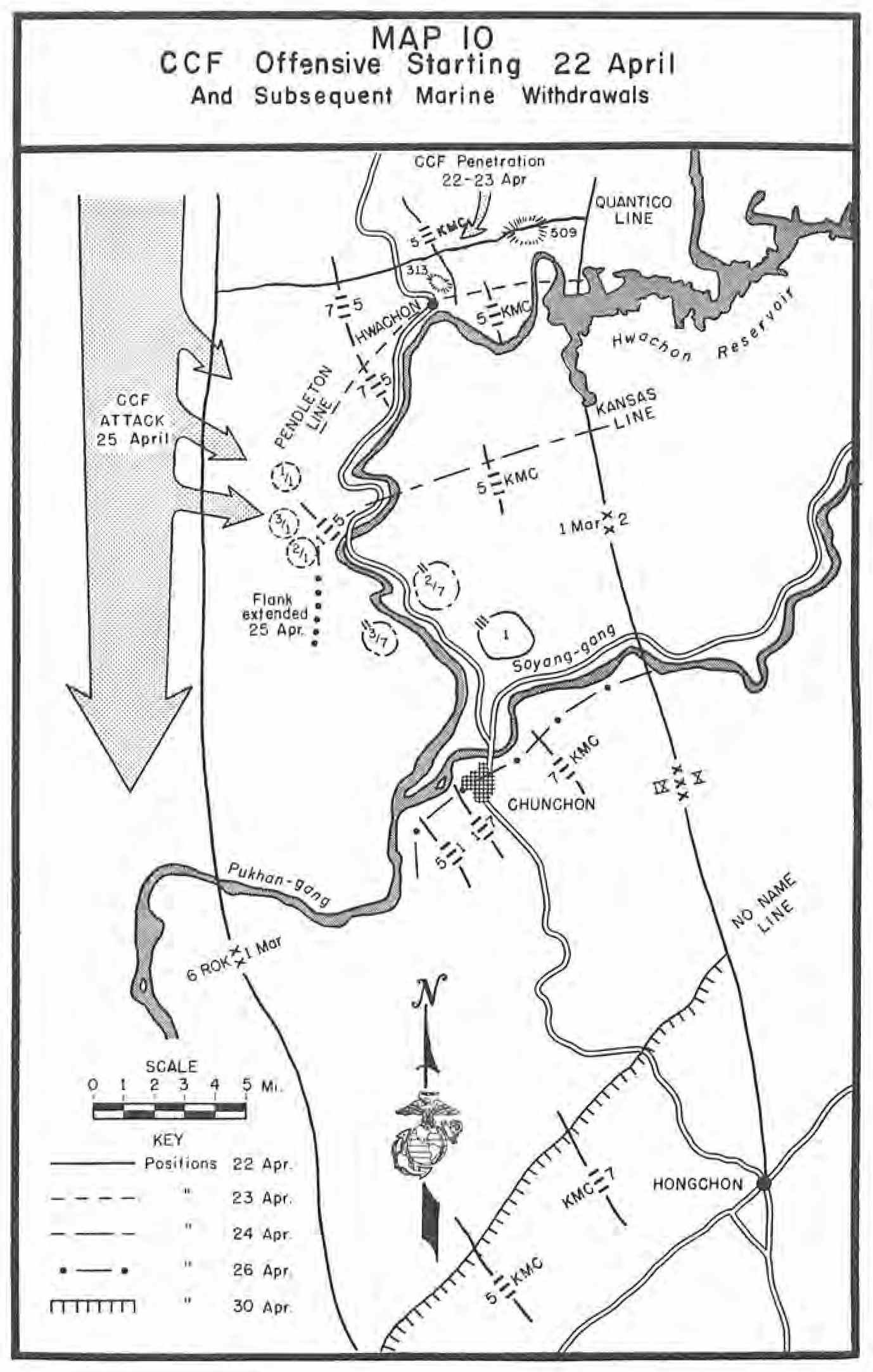
MAP 10
CCF Offensive Starting 22 April
And Subsequent Marine Withdrawals
Another Army artillery unit, the 987th Armored Field Artillery
Battalion, had been roughly used by the Chinese who routed the
ROK division. Losses in guns and equipment had resulted, and
Coffey moved with his company about 1,500 yards to the west to assist
in extricating from the mud all the 105s that could be saved. Resistance
was encountered in the form of machine gun fire from
Chinese who had set up a road block.173
Upon returning to 1/1, Coffey found it occupying what was in effect
an outpost to the southwest of the 7th Marines. Baker Company was
assigned to the left of Captain Robert P. Wray’s Charlie Company,
holding the curve of a horseshoe-shaped ridge, with Captain Thomas J.
Bohannon’s Able Company on the right. In support, along the comparatively
level ground to the immediate rear, was Weapons Company
(Major William L. Bates).
With 1/1 facing in three directions to block a CCF attack, 1/7
managed to disengage and withdraw through 3/7, which occupied a
position on Line PENDLETON. VMO-6 helicopters and troops of 2/7
helped to evacuate the 1/7 casualties incurred during the night’s
hard fighting.
During the early morning hours of the 23d the Marines of 3/1 had
boarded trucks to the village of Todun-ni (Map 11) on the west bank
of the Pukhan. Their assigned position was Hill 902, a 3,000-foot
height dominating the surrounding terrain. The Chinese also were
interested in this piece of real estate, since it overlooked the river
crossing of the 1st Marine Division. Pressure to beat the Communists
to the crest mounted as NCOs urged the men to their utmost efforts
over steep uphill trails.
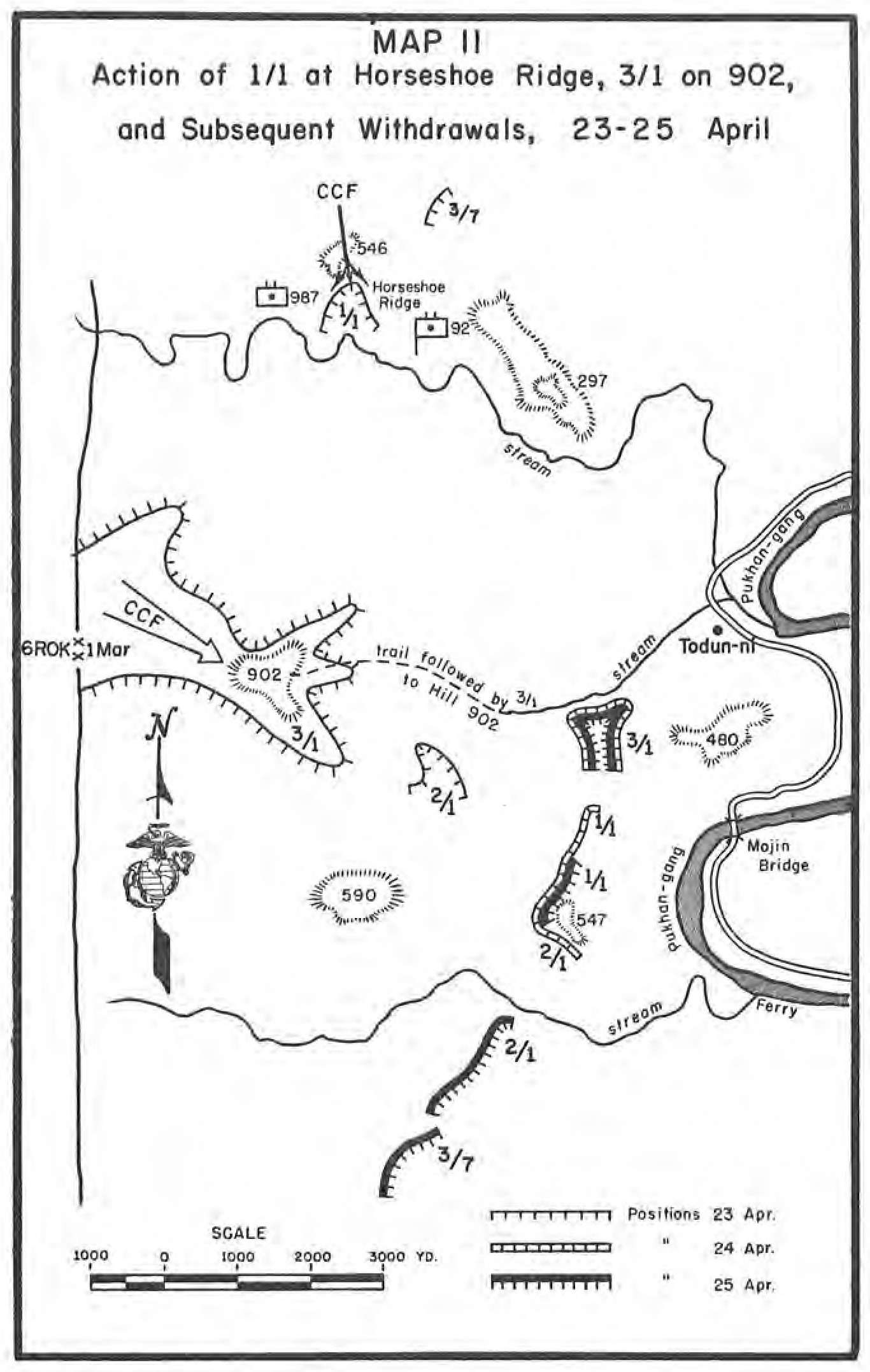
MAP 11
Action of 1/1 at Horseshoe Ridge, 3/1 on 902,
and Subsequent Withdrawals, 23–25 April
The Marines won the race. Once in position, however, it was evident
to Lieutenant Colonel Banning that three ridge lines leading
up to the hill mass would have to be defended. This necessity imposed
a triangular formation, and he placed Captain Horace L. Johnson’s
George Company at the apex, with First Lieutenant William J.
Allert’s How Company on the left, and First Lieutenant William
Swanson’s Item Company on the right. The heavy machine guns of
Major Edwin A. Simmons’ Weapons Company were distributed among
the rifle companies and the 81mm mortars placed only 10 to 20 yards
behind the front lines.174
The KMCs and 5th Marines completed their withdrawal without
interference. Thus the line of the 1st Marine Division on the afternoon
of 23 April might have been compared to a fishhook with the
shank in the north and the barb curling around to the west and south.
The three Marine battalions plugging the gap were not tied in physically.
Major Maurice E. Roach’s 3/7 was separated by an interval
of 1,000 yards from 1/1, and the other two Marine battalions were
5,500 yards apart (Map 11). But at least the 1st Marine Division
had formed a new front under fire and awaited the night’s attacks
with confidence.
Bugle calls and green flares at about 2000 announced the presence
of the Chinese to the west of 1/1 on Horseshoe Ridge.
“They came on in wave after wave, hundreds of them,” wrote
Lieutenant Reisler, whose platoon held an outpost in advance of
Charlie Company. “They were singing, humming and chanting,
‘Awake, Marine....’ In the first rush they knocked out both our
machine guns and wounded about 10 men, putting a big hole in our
lines. We held for about 15 minutes, under mortar fire, machine gun
fire, and those grenades—hundreds of grenades. There was nothing
to do but withdraw to a better position, which I did. We pulled
back about 50 yds. and set up a new line. All this was in the pitch-black
night with Chinese cymbals crashing, horns blowing, and their
god-awful yells.”175
For four hours the attacks on Horseshoe Ridge were continuous,
particularly along the curve held by Wray’s company. He was reinforced
during the night by squads sent from Coffey’s and Bohannon’s
companies. Wray realized that the integrity of the battalion position
depended on holding the curve of the ridge, but his main problem
was bringing up enough ammunition. Men evacuating casualties to
the rear returned with supplies, but the amount was all too limited
until Corporal Leo Marquez appointed himself a one-man committee.
His energy equalled his courage as he carried grenades and small-arms
ammunition all night to the men on the firing line. Marquez emerged
unhurt in spite of bullet holes through his cartridge belt, helmet, and
a heel of his shoe.
About midnight it was the turn of 3/1. These Marines had dug in
as best they could, but the position was too rocky to permit much
excavation. Ammunition for the mortars had to be hand-carried
from a point halfway up the hill.
Several hours of harrassing mortar fire preceded the CCF effort.
George Company, at the apex of the ridge, was almost overwhelmed
by the first Communist waves of assault. The courage of
individual Marines shone forth in the ensuing struggle. Technical
Sergeant Harold E. Wilson, second in command of the center platoon,
suffered four painful wounds but remained in the fight, encouraging
his men and guiding reinforcements from How Company as they
arrived.176
Steady artillery support was provided by Colonel McAlister, who
rounded up a jury-rigged liaison party and three forward observer
teams composed mainly of officers from the 987th AFA Battalion.
They registered 11th Marines and 987th Battalion defensive fires
which had a large part in stopping the CCF attack as it lapped around
George Company and hit How and Item on the other two ridges.
Colonel McAlister and Colonel Nickerson paid a visit to the CP
of 1/1, which remained under the operational control of the 7th
Marines until morning. The two regimental commanders arranged
for artillery and tank support to cover the gap between 1/1 and 3/7.177
The enemy, however, seemed to be wary about infiltrating between
the three battalion outposts. This reluctance owed in large part to
the deadly flat-trajectory fire of the 90mm rifles of Companies A and
B of the 1st Tank Battalion, whose commanding officer, Lieutenant
Colonel Holly F. Evans, had relieved Lieutenant Colonel Harry T.
Milne that day.
Attacks on 3/1 and 3/7 also continued throughout the night. At
daybreak the close air support of Marine aircraft prevented further
Communist efforts, though dug-in enemy groups remained within
machine gun range. Identification of Chinese bodies at daybreak indicated
that the 359th and 360th Regiments, 120th Division, 40th CCF
Army, had been employed.
Now came the problem for the three Marine battalions of letting
loose of the tiger’s tail. Corps orders were received on the morning
of 24 April for all units of the Division to pull back to Line KANSAS.
This was in accordance with General Ridgway’s policy, continued by
General Van Fleet, of attaching more importance to destruction of
enemy personnel than the holding of military real estate.
Some of the most seriously wounded men of 1/1 required immediate
evacuation, in spite of the obvious risks. A VMO-6 helicopter piloted
by First Lieutenant Robert E. Matthewson attempted a landing at
the base of Horseshoe Ridge. As he hovered over the panel markings,
CCF small-arms fire mangled the tail rotor. The machine plunged to
earth so badly damaged that it had to be destroyed. Matthewson
emerged unhurt and waved off a helicopter flown by Captain H. G.
McRay. Then the stranded pilot asked for a rifle and gave a good
account of himself as an infantryman.178
While First Lieutenant Norman W. Hicks’ second platoon fought
as the rear guard, First Lieutenant Niel B. Mills’ first platoon of
Charlie Company led the attack down the hill, carrying the wounded
behind. In an attempt to rout the Chinese from a flanking hill, Mills
was wounded in the neck by a bullet that severed an artery. Corpsman
E. N. Smith gripped the end of the artery between his fingers until
a hemostat could be applied, thus saving the lieutenant’s life. Just
before losing consciousness. Mills looked at his watch. It was 1000
and 1/1 had weathered the storm.179
The 3d Battalion of the 7th Marines, which had beaten off probing
attacks all night, coordinated its movements with those of the two
Marine battalions as they slowly withdrew toward the Pukhan. Despite
Marine air attacks, the Communists not only followed but infiltrated
in sufficient numbers to threaten the perimeter of Lavoie’s cannoneers.
The training this Army officer had given his men in infantry tactics
now paid off as the perimeter held firm while mowing down the
attackers with point blank 105mm shells at a range of 1,000 yards.
The Marines of Captain Bohannon’s company soon got into the fight,
and the 92d repaid the courtesy by supporting 1/1 and 3/7 during
their withdrawal. Counted CCF dead numbered 179 at a cost to the
92d of 4 KIA and 11 WIA casualties.180
As the morning haze lifted, the OYs of VMO-6 spotted for both
Army and Marine artillery, DEVASTATE BAKER fed close support to
the forward air controllers as fast as it could get planes from K-16
at Seoul, only a 15-minute flight away. Not only 49 Corsairs but also
40 of the Navy ADs and Air Force F-51s and jets aided the Marine
ground forces in their withdrawal to Line KANSAS. To speed the
fighter-bombers to their targets, some of the Marine pilots were
designated tactical air coordinators, airborne (TACA). Their familiarity
with the terrain was an asset as they led incoming pilots to
ground force units most in need of support.181
It was a confusing day in the air. The mutual radio frequencies to
which planes and ground controllers were pretuned proved to be
inadequate. The consequence was all too often the blocking out of
key information at a frustrating moment. Haze and smoke made for
limited vision. The planes needed a two-mile circle for their attacks,
yet the battalions were at times less than 1,000 yards apart. DEVASTATE
BAKER had to deal with this congested and dangerous situation as
best it could.
In addition to its strong support of Marine ground forces, the 1st
MAW sent 10 sorties to the ROKs in east Korea and 57 to I Corps
in its battle along the Imjin. By this time the Gloucestershire Battalion
of the 29th British Brigade was isolated seven miles behind
enemy lines and receiving all supplies by air-drop. The outlook grew
so desperate that officers ordered their men to break up and make their
way back to the UN lines if they could. Only 40 ever succeeded.
In the former 6th ROK Division sector units of the 27th Brigade
of the British Commonwealth Division had done a magnificent job
of stopping the breakthrough. The 2d Battalion of the Princess
Patricia’s Canadian Light Infantry and the 3d Battalion of the Royal
Australian Regiment distinguished themselves in this fight, which
won a Distinguished Unit Citation for the division.182
Spring had come at last to war-ravaged Korea and the hills were a
misty green in the sunshine. Looking down from an aircraft on the
warm afternoon of 24 April 1951 the Marine sector resembled a
human anthill. Columns of weary men toiled and strained in every
direction. Chaotic as the scene may have seemed, however, everything
had a purpose. The 1st Marine Division was in full control of all
troop movements, despite enemy pressure of the last two nights.
The 5th Marines and KMCs had no opposition as they continued
their withdrawal. Marine air reduced to a minimum the harassing
efforts of the Chinese following the 1st Marines. As front-line units
disengaged and fell back, the length of the main line of resistance was
contracted enough for the 7th Marines to be assigned a reserve role.
The 1st and 2d Battalions were given the responsibility for the defense
of Chunchon as well as the crossing sites over the Pukhan and Soyang
Rivers. Major Roach had reached the outskirts of Chunchon when
3/7 was ordered back across the Chunchon, to be attached to the
1st Marines on the left flank.183
Throughout the night of 24–25 April the enemy probed the Marine
lines, seeking in vain a weak spot where a penetration could be made.
It was already evident that the breakthrough in this area had given
the Communists only a short-lived advantage. By the third night they
were definitely stopped. Only minor patrol actions resulted except
for two attacks in company strength on 2/1 at 0050 and 0150. Both
were repulsed with total CCF losses of 25 counted dead.
Contrary to the usual rule, the Marines saw more action during the
daylight hours. A company-size patrol from 1/1 became heavily
engaged at 1350 and three Company A tanks moved up in support.
The fight lasted until 1645, when the enemy broke off action and the
tanks evacuated 18 wounded Marines.
Early in the afternoon a 3/1 patrol had advanced only 200 yards
along a ridgeline when it was compelled to withdraw after running
into concentrated mortar and machine gun fire. Sporadic mortar rounds
continued until a direct hit was scored on the battalion CP, wounding
Colonel McAlister, Lieutenant Colonel Banning, Major Reginald R.
Myers, the executive officer, and Major Joseph D. Trompeter, the S-3.
Banning and Myers were evacuated and Trompeter assumed command
of 3/1.
Losses of 18 KIA and 82 WIA for 24–25 April brought the casualties
of the 1st Marines to nearly 300 during the past 48 hours.184
A simple ceremony was held at the 1st Marine Division CP on the
afternoon of the 24th for the relief of General Smith by Major
General Gerald C. Thomas. The new commanding general, a native
of Missouri, was educated at Illinois Wesleyan University and enlisted
in the Marine Corps in May 1917 at the age of 23. Awarded the
Silver Star for bravery at Belleau Wood and Soissons, he was commissioned
just before the Meuse-Argonne offensive, in which he
was wounded.
During the next two decades, Thomas chased bandits in Haiti,
guarded the U.S. mails, protected American interests in China, and
served as naval observer in Egypt when Rommel knocked at the gates
of Alexandria in 1941. As operations officer and later chief of staff of
the 1st Marine Division, he participated in the Guadalcanal campaign
in 1942. The next year he became chief of staff of I Marine Amphibious
Corps in the Bougainville operation. Returning to Marine Headquarters
in 1944 as Director of Plans and Policies, he was named
commanding general of the Marines in China three years later.
General Smith had won an enduring place in the hearts of all
Marines for his magnificent leadership as well as resourceful generalship
during the Inchon-Seoul and Chosin Reservoir campaigns. Speaking
of the Marines of April 1951, he paid them this tribute in
retrospect:
The unit commanders and staff of the Division deserve great credit for
the manner in which they planned and conducted the operations which
resulted in blunting the Chinese counteroffensive in our area. In my opinion,
it was the most professional job performed by the Division while it was
under my command.185
The night of 25–26 April passed in comparative quiet for the
Marines. A few CCF probing attacks and occasional mortar rounds
were the extent of the enemy’s activity. All Marine units had now
reached the modified Line KANSAS, but General Van Fleet desired
further withdrawals because the enemy had cut a lateral road.
IX Corps also directed that the 1st Marine Division be prepared on
the 26th to move back to Chunchon, where it would defend along the
south bank of the Soyang until service units could move out their
large supply dumps. The Division was to tie in on the right with the
lower extension of the Hwachon Reservoir, and contact was made in
that quarter with the French battalion of the 2d Infantry Division,
X Corps. On the Marine left flank the 5th Cavalry of the 1st Cavalry
Division had relieved elements of the British Commonwealth Division.
Marine regimental officers met with Colonel Bowser, G-3, to plan
the continued withdrawal. It was decided that four infantry battalions—1/1,
2/1, 3/5, and 3/7—were to take positions on the west bank
of the Pukhan to protect the Mojin bridge and ferry sites while the
other units crossed. The execution of the plan went smoothly, without
enemy interference. After all other Marine troops were on the east
side, 3/7 disengaged last of all and forded the chest-deep stream as a
prelude to hiking to Chunchon.186
The enemy was kept at a discreet distance throughout the night by
continuous artillery fires supplemented by ripples from Captain
Eugene A. Bushe’s Battery C, 1st 4.5´´ Rocket Battalion. An acute
shortage of trucks made it necessary for most of the troops to hike.
Then came the task of organizing the new Division defenses on a line
running northeast and southwest through the northern outskirts of
Chunchon (Map 10). Planning continued meanwhile for further
withdrawals to positions astride the Hongchon-Chunchon MSR.187
It was apparent by this time that the enemy had been badly mauled
on the IX Corps front. The Communists were now making a supreme
effort to smash through in the I Corps area and capture Seoul. It was
believed that they had set themselves the goal of taking the city by
May Day, the world-wide Communist holiday.
In this aspiration they were destined to be disappointed. They tried
to work around the Eighth Army’s left flank by crossing the river
Han to the Kimpo Peninsula, but air strikes and the threat of naval
gunfire frustrated them. Another flanking attempt 35 miles to the
southeast met repulse, and before the end of the month it was evident
that the Chinese Reds would not celebrate May Day in Seoul.
Generally speaking, the Eighth Army had kept its major units intact
and inflicted frightful losses on the enemy while trading shell-pocked
ground for Chinese lives. The night of 27–28 April saw little activity
on the IX Corps front, adding to the evidence that the enemy had shot
his bolt. The next day the 1st Marine Division, along with other
Eighth Army forces, continued the withdrawal to the general defensive
line designated NO NAME Line (Map 10). Further withdrawals were
not contemplated, asserted the IX Corps commander, who sent this
message to General Thomas:
It is the intention of CG Eighth Army to hold firmly on general defense
line as outlined in my Operation Plan 17 and my message 9639, and from
this line to inflict maximum personnel casualties by an active defense utilizing
artillery and sharp armored counterattacks. Withdrawal south of this line
will be initiated only on personal direction of Corps commander.188
Feaf placed the emphasis on armed reconnaissance or interdiction
flights for Marine aircraft during the last few days of April. 1st
MAW pilots reported the killing or wounding of 312 enemy troops
on the 29th and 30th, and the destruction of 212 trucks, 6 locomotives,
and 80 box cars. On the other side of the ledger, the Wing lost a plane
a day during the first eight days of the CCF offensive. Of the fliers shot
down, five were killed, one was wounded seriously but rescued by
helicopter, and two returned safely from enemy-held territory.189
The shortage of vehicles slowed the withdrawal of Marine ground
forces, but by the 30th the 5th Marines, KMC Regiment, and 7th
Marines were deployed from left to right on NO NAME Line. The
1st Marines went into reserve near Hongchon. On the Division left
was the reorganized 6th ROK Division, and on the right the 2d
Infantry Division of X Corps.190
Nobody was in a better position to evaluate Marine maneuvers of
the past week than Colonel Bowser, the G-3, and he had the highest
praise. “Whereas the Chosin withdrawal was more spectacular than
the April ‘retrograde,’” he commented seven years later, “the latter
was executed so smoothly and efficiently that a complex and difficult
operation was made to look easy. The entire Division executed everything
asked of it with the calm assurance of veterans.”191
UN estimates of enemy casualties ranged from 70,000 to 100,000.
The Fifth Phase Offensive was an unmitigated defeat for the Communists
so far, but EUSAK G-2 officers warned that this was only the
first round. Seventeen fresh CCF divisions were available for the
second.
General Van Fleet called a conference of corps commanders on
30 April to discuss defensive plans. In the reshuffling of units the 1st
Marine Division was placed for the third time in eight months under
the operational control of X Corps, commanded by Lieutenant General
Edward M. Almond. The Marines were to occupy the western sector
of X Corps after its boundary with IX Corps had been shifted about
12 miles to the west.192
Van Fleet put into effect a reshuffling of units all the way across the
peninsula in preparation for the expected renewal of the CCF offensive.
Thus on 1 May the UN line was as follows from left to right:
US I Corps—1 ROK Division, 1st Cavalry Division and 25th Infantry Division
in line; the 3d Infantry Division and British 29th Brigade in reserve;
US IX Corps—British 27th Brigade, 24th Infantry Division, 5th and 6th
ROK Divisions and 7th Infantry Division in line; the 187th Airborne
RCT in reserve;
US X Corps—1st Marine Division, 2d Infantry Division, 5th and 7th ROK
Divisions;
ROK III Corps—9th and 3d Divisions;
ROK I Corps—Capitol Division and ROK 11th Division.
“I don’t want to lose a company—certainly not a battalion,” Van
Fleet told the corps commanders. “Keep units intact. Small units
must be kept within supporting distance.... Give every consideration
to the use of armor and infantry teams for a limited objective
counterthrust. For greater distances, have ready and use when appropriate,
regiments of infantry protected by artillery and tanks.”193
From the foxhole to the command post a confident new offensive
spirit animated an Eight Army which only four months previously had
been recuperating from two major reverses within two months. The
Eighth Army, in short, had been welded by fire into one of the finest
military instruments of American military history; and the foreign
units attached to it proved on the battlefield that they were picked
troops.
With the Hwachon dam now in enemy hands, the Communists had
the capability of closing the gates, thus lowering the water level in
the Pukhan and Han rivers to fording depth. As a countermeasure,
EUSAK asked the Navy to blast the dam. It was a difficult assignment,
but Douglas AD Skyraiders from the Princeton successfully torpedoed
the flood gates on 1 May.194
An atmosphere of watchful waiting prevailed during the next
two weeks as the Marines on NO NAME Line improved their defensive
positions and patrolled to maintain contact with the enemy. Eighth
Army evolved at this time the “patrol base” concept to deal with an
enemy retiring beyond artillery range. These bases were part of a
screen, called the outpost line of resistance (OPLR), established in
front of the MLR. Their mission was to maintain contact with the
enemy by means of patrols, give warning of an impending attack, and
delay its progress as much as possible.
When it came to artillery ammunition, the 11th Marines found that
it had progressed from a famine to a feast. Where shells had recently
been rationed because of transport difficulties, the Eighth Army now
directed the cannoneers along NO NAME Line to expend a unit of
fire a day. The 11th Marines protested, since the infantry was seldom
in contact with the enemy. One artillery battalion submitted a tongue-in-cheek
report to the effect that the required amount of ammunition
had been fired “in target areas cleared of friendly patrols.”195 The
requirement was kept in force, however, until the demands of the
renewed CCF offensive resulted in another ammunition shortage for
the 11th Marines.
Marine tanks were directed by Division to use their 90mm rifles to
supplement 11th Marine howitzers in carrying out Corps fire plans.
The tankers protested that their tubes had nearly reached the end of
a normal life expectancy, with no replacements in sight. This plaint
did not fall upon deaf ears at Corps Headquarters and two Army
units, the 96th AFA Battalion and 17th FA Battalion, were assigned
to fire the deep missions.196
Eighth Army staff officers concluded that the enemy would launch
his next effort in the center. Intelligence, according to General
Van Fleet, “had noted for some 2 weeks prior to the May attack that
the Chinese Communists were shifting their units to the east.” Nevertheless,
the blow fell “much farther east than [was] expected.”197
Although the east offered the best prospects of surprise, a rugged
terrain of few roads imposed grave logistical handicaps on the enemy.
Moreover, UN warships dominated the entire eastern littoral. Despite
these disadvantages, an estimated 125,000 Chinese attacked on the
morning of 16 May 1951 in the area of the III and I ROK Corps
between the U.S. 2d Infantry Division and the coast. Six CCF divisions
spearheaded an advance on a 20-mile front that broke through
the lines of the 5th and 7th ROK Divisions. Pouring into this gap,
the Communists made a maximum penetration of 30 miles that
endangered the right flank of the U.S. 2d Infantry Division.
General Van Fleet took immediate steps to stabilize the front. In
one of the war’s most remarkable maneuvers he sent units of the
3d Infantry Division, then in reserve southeast of Seoul, on a 70-mile
all-night ride in trucks to the threatened area.198
The 1st Marine Division was not directly in the path of the enemy
advance. During the early morning hours of 17 May, however, an
enemy column made a thrust that apparently was intended as an
end-run attack on the left flank of the 2d Infantry Division. Avoiding
initially the Chunchon-Hongchon highway, Chinese in estimated regimental
strength slipped behind the patrol base set up by a KMC
company just west of the MSR (Map 12).
For several days Colonel Nickerson and his executive officer, Lieutenant
Colonel Raymond G. Davis, had been apprehensive over the
security of this road on which the 7th Marines depended for logistical
support. On the afternoon of the 17th they pulled back Lieutenant
Colonel Bernard T. Kelly’s 3/7 (less Company G) to establish a
blocking position, generally rectangular in shape, at the vital Morae-Kogae
pass on the Chunchon road. This move was not completed until
sunset and George Company did not rejoin the battalion until midnight,
so that the enemy probably had no intelligence of the new
position. The main road ran along a shelf on one shoulder of the
pass, but the Chinese avoided it and came by a trail from the northwest
(Map 12).
The surprise was mutual. A platoon of D/Tanks, a Weapons Company
platoon, and an Item Company platoon, defending the northern
end of the perimeter, opened up with everything they had. A
desperate fire fight ensued as the enemy replied with a variety of
weapons—mortars, recoilless rifles, satchel charges, grenades, and
machine guns.
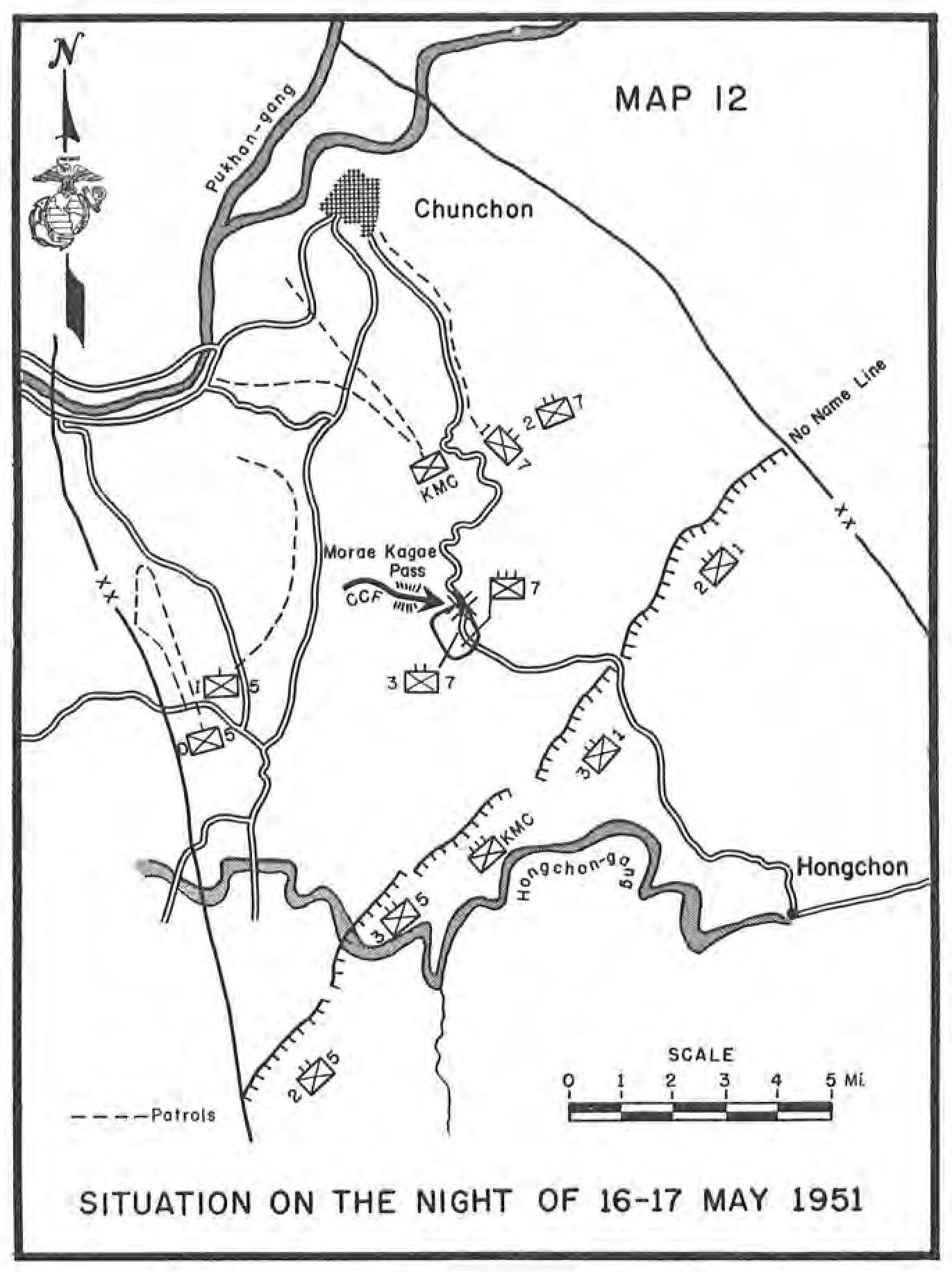
MAP 12
SITUATION ON THE NIGHT OF 16–17 MAY 1951
Two CCF soldiers were killed after disabling a Marine tank by a
grenade explosion in the engine compartment. A satchel charge
knocked out another tank, and the enemy made an unsuccessful attempt
to kill a third by rolling up a drum of gasoline and igniting it.
Captain Victor Stoyanow’s Item Company, at the critical point of
the thinly stretched 3/7 perimeter, was hard-pressed. The enemy
made a slight penetration into one platoon position but was repulsed
by a counterattack that Stoyanow led. Marine infantry and tanks
were well supported by artillery that sealed off the Chinese column
from the rear. The action ended at daybreak with the routed enemy
seeking only escape as Marine artillery and mortars continued to find
lucrative targets. Air did not come on station until about 1030, when
it added to the slaughter. Scattered enemy groups finally found a
refuge in the hills, leaving behind 82 prisoners and 112 counted dead.
Captures of enemy equipment included mortars, recoilless rifles, and
Russian 76mm guns and machine guns. Friendly losses were 7 KIA
and 19 WIA.199
1st MAW squadrons were kept busy furnishing close air support
to the 2d Infantry Division and the two ROK divisions hit by the
enemy’s May offensive. Because of the patrolling in the Marine
sector, the OYs of VMO-6 took over much of the task of controlling
air strikes. They flew cover for the infantry-tank patrols, and in the
distant areas controlled almost as many air strikes as they did artillery
missions. From the 1st to the 23d of May, VMO-6 observers controlled
54 air strikes involving 189 UN planes—159 Navy and Marine
F4Us, F9Fs, and ADs, and 30 Air Force F-80s, F-84s, and F-51s.
About 40 percent of the aircraft controlled by the OYs were non-Marine
planes.200
On the 18th the 1st Marine Division, carrying out X Corps orders,
began a maneuver designed to aid the U.S. 2d Infantry Division on the
east by narrowing its front. The 7th Marines pulled back to NO NAME
Line to relieve the 1st Marines, which side-slipped to the east to take
over an area held by the 9th Infantry. The 5th Marines then swung
around from the Division left flank to the extreme right and relieved
another Army regiment, the 38th Infantry. This permitted the 2d Infantry
Division to face east and repulse attacks from that direction.
By noon on 19 May the enemy’s renewed Fifth Phase Offensive had
lost most of its momentum as CCF supplies dwindled to a trickle
along a tenuous line of communications. That same day, when Colonel
Wilburt S. Brown took over the command of the 1st Marines from
Colonel McAlister, all four Marine regiments were in line—from
left to right, the KMCs, the 7th Marines, the 1st Marines, and the
5th Marines. A new NO NAME Line ran more in a east-west direction
than the old one with its northeast to southwest slant. Thus in the
east of the Marine sector the line was moved back some 4,000 yards
while remaining virtually unchanged in the west.
Enough enemy pressure was still being felt by the 2d Infantry
Division so that General Van Fleet ordered a limited offensive by
IX Corps to divert some of the CCF strength. While the rest of the
1st Marine Division stood fast, the KMC Regiment advanced with
IX Corps elements.
At the other end of the line the Marines had the second of their
two fights during the CCF offensive. Major Morse L. Holliday’s 3/5
became engaged at 0445 on the 20th with elements of the 44th CCF
Division. Chinese in regimental strength were apparently on the way
to occupy the positions of the Marine battalion, unaware of its
presence.
This mistake cost them dearly when 3/5 opened up with every
weapon at its disposal while requesting the support of Marine air,
rockets, and artillery. The slaughter lasted until 0930, when the last
of the routed Chinese escaped into the hills. Fifteen were taken
prisoner and 152 dead were counted in front of the Marine positions.201
From 20 May onward, it grew more apparent every hour that the
second installment of the CCF Fifth Phase Offensive had failed even
more conclusively than the first. The enemy had only a narrow penetration
on a secondary front to show for ruinous casualties. Worse yet,
from the Chinese viewpoint, the UN forces were in a position to
retaliate before the attackers recovered their tactical balance. The
Eighth Army had come through with relatively light losses, and it was
now about to seize the initiative.
CHAPTER VII Advance to the Punchbowl — Plan to Cut Off Communists — Initial Marine Objectives Secured — MAG-12 Moves to K-46 at Hoengsong — Fight of the 5th Marines for Hill 610 — 1st MAW in Operation STRANGLE — KMC Regiment Launches Night Attack — 1st Marines Moves Up to BROWN Line — 7th Marines Committed to the Attack
Plan to Cut Off Communists—Initial Marine Objectives
Secured—MAG-12 Moves to K-46 at Hoengsong—Fight
of the 5th Marines for Hill 610—1st MAW in Operation
STRANGLE—KMC Regiment Launches Night Attack—1st
Marines Moves Up to BROWN Line—7th Marines Committed
to Attack
Only from the air could the effects of the UN counterstroke
of May and June 1951 be fully appreciated. It was more than
a CCF withdrawal; it was a flight of beaten troops under very little
control in some instances. They were scourged with bullets, rockets,
and napalm as planes swooped down upon them like hawks scattering
chickens. And where it had been rare for a single Chinese soldier to
surrender voluntarily, remnants of platoons, companies, and even
battalions were now giving up after throwing down their arms.
There had been nothing like it before, and its like would never
be seen in Korea again. The enemy was on the run! General
Van Fleet, after his retirement, summed up the double-barreled
Chinese spring offensive and the UN counterstroke in these words:
We met the attack and routed the enemy. We had him beaten and
could have destroyed his armies. Those days are the ones most vivid in my
memory—great days when all the Eighth Army, and we thought America
too, were inspired to win. In those days in Korea we reached the heights.202
Communist casualties from 15 to 31 May were estimated by the
Eighth Army at 105,000. This figure included 17,000 counted dead
and the unprecedented total of some 10,000 prisoners, most of them
Chinese Reds taken during the last week of the month in frantic
efforts to escape. Such results were a vast departure from past occasions
when Mao Tse-tung’s troops had preferred death to surrender.
In all probability, only the mountainous terrain saved them from a
complete debacle. If the Eighth Army had been able to use its armor
for a mechanized pursuit, it might have struck blows from which the
enemy could not recover. As it was, the Communists escaped disaster
by virtue of the fact that a platoon could often stand off a company
or even a battalion by digging in and defending high ground commanding
the only approach. Every hill was a potential Thermopylae
in this craggy land of few roads.
It was the misfortune of the 1st Marine Division to have perhaps
the least lucrative zone of action in all Korea for the peninsula-wide
turkey shoot. A chaos of jagged peaks and dark, narrow valleys, the
terrain alone was enough to limit an advance. Even so, the Marines
inflicted 1,870 counted KIA casualties on the Communists in May and
captured 593, most of them during the last eight days of the month.
General Almond congratulated the Division for its accomplishment
of “a most arduous battle task. You have denied [the enemy] the
opportunity of regrouping his forces and forced him into a hasty
retreat; the destruction of enemy forces and materiel has been tremendous
and many times greater than our own losses.”203
The 187th Airborne Regimental Combat Team, released from IX
Corps reserve, arrived in the Hongchon area on 21 May and took a
position between the 1st Marine Division on the left and the 2d
Infantry Division on the right. Two days later X Corps gave the
Marines the mission of securing the important road center of Yanggu
at the eastern end of the Hwachon Reservoir (Map 13). Elements
of the 2d Infantry Division, with the 187th Airborne RCT attached,
were meanwhile to drive northeast to Inje after establishing a bridgehead
across the river Soyang. From Inje the 187th (reinforced) would
continue to advance northeast toward its final objective, Kansong on
the coast. After linking up with I ROK Corps, the Army regiment
might be able to pull the drawstring on a tremendous bag of prisoners—all
the CCF forces south of the Inje-Kansong road. There was,
however, a big “if” in the equation. The Communists were falling
back with all haste, and it was a question whether the bag could be
closed in time.
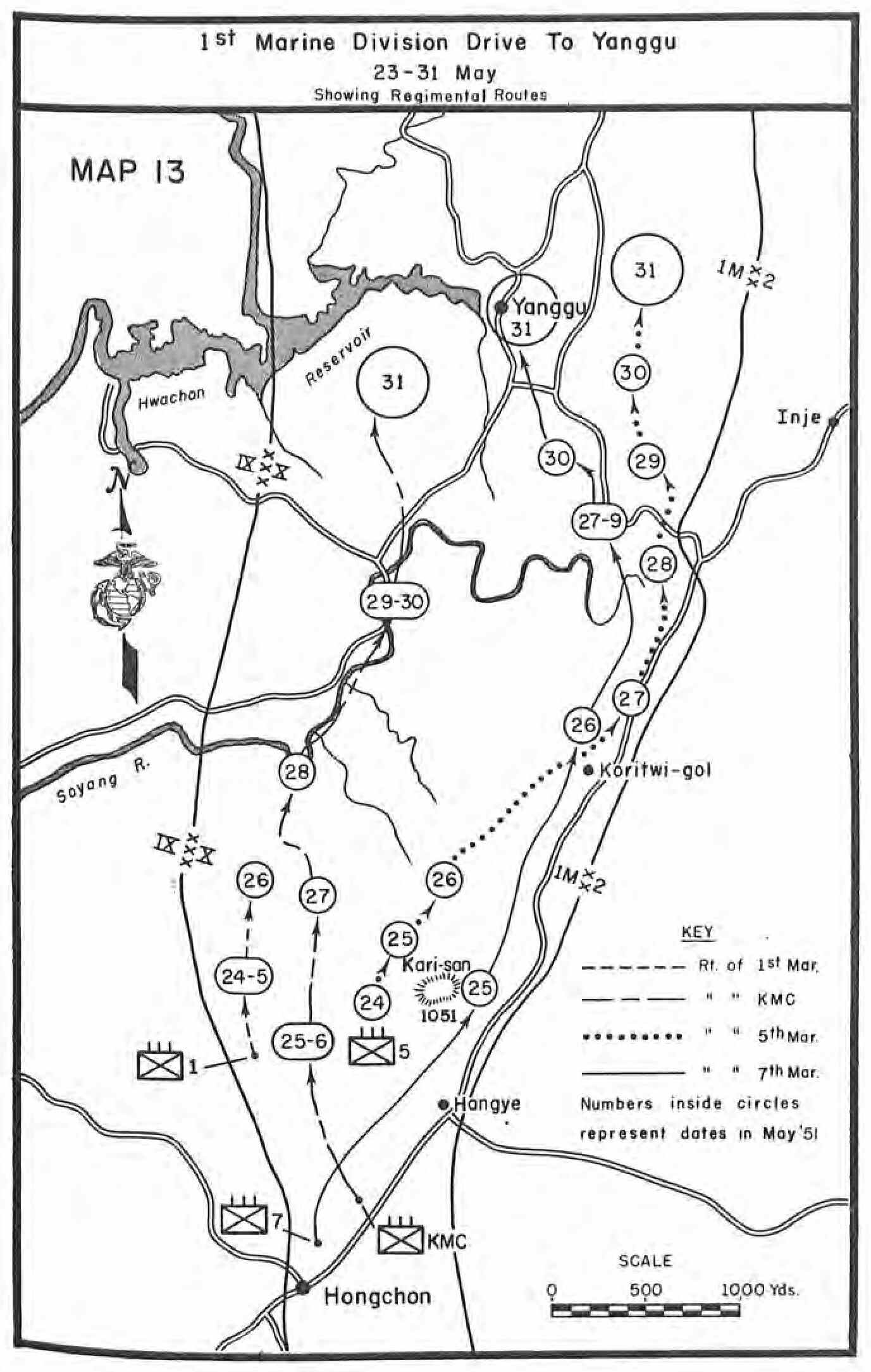
1st Marine Division Drive To Yanggu
23–31 May
Showing Regimental Routes
MAP 13
The 1st Marine Division jumped off at 0800 on 23 May with the
1st and 5th Marines abreast, the 1st on the left. Both regiments
advanced more than 5,000 yards against negligible opposition. During
the course of this attack the 1st Marines experimented by calling an
air strike in the hope of detonating an entire mine field. The results
were disappointing. Live mines were blown to new locations, thus
changing the pattern, but few exploded.204
The 7th Marines was relieved on the 23d by elements of the 7th
Infantry Division (IX Corps) and moved to the east for employment
on the Marine right flank. The KMC Regiment, relieved by other
IX Corps units, went into Division reserve.205
The 1st Marines, advancing on the left, reached its objectives, about
two-thirds of the way to the Soyang, by noon on the 26th. The regiment
reverted to Division reserve upon relief by the KMCs. In the
right half of the Division zone, resistance gradually stiffened. On the
24th, the 2d and 3d Battalions of the 5th Marines ran into trouble
as they started their advance toward their initial objective, three hills
about 7,000 yards north of Hangye (Map 12). Both battalions were
slowed by heavy enemy mortar and machine gun fire. They requested
immediate artillery and air support.
Captain John A. Pearson, commanding Item Company, could observe
the enemy on Hill 1051, holding up the attack with flanking fire.
He directed air and artillery on the crest and on the Communists dug
in along the southeastern slopes. Soon the enemy troops were seen
retiring northward. This eased the pressure on the center, and Captain
Samuel S. Smith’s Dog Company managed to work forward and gain
the summit of Hill 883 by 1300. Tanks moved up in support and
at midnight Colonel Hayward reported his portion of the Division
objective secured.206
The 7th Marines, moving forward in the right rear of the 5th,
veered to the left and drove into the center of the Division zone,
reaching the southern bank of the Soyang by nightfall on the 26th.
That same day 2/7 overran an enemy ammunition dump and took
27 CCF prisoners, some of them wounded men who had been left
behind. The captured material included the following items:
100,000 rounds of small-arms ammunition;
12,000 rounds of mortar ammunition;
1,000 rounds of artillery ammunition;
6,000 pounds of explosive charges;
9,000 hand grenades.
Five U.S. trucks and jeeps were “released to higher headquarters.”
Two CCF trucks, two mules, and a horse were “integrated into the
battalion transportation system and profitably employed thereafter.”207
The 187th Airborne RCT reported on the 24th that its advance
was being held up by increasing enemy resistance.208 It was already
evident that the CCF flight had frustrated the plan of cutting off
decisively large numbers in the X Corps zone. Air observation established,
however, that hundreds of Chinese Reds had merely escaped
from the frying pan into the fire. By fleeing westward along the
south shore of the Hwachon Reservoir, they stumbled into the
IX Corps zone. There the remnants of whole units surrendered, in
some instances without striking a blow. Along the route they were
pitilessly attacked by UN aircraft. 1st MAW units had never before
known such good hunting as during the last week in May 1951.209
Despite the “murky instrument weather” of 27 May the all-weather
fighters of VMF(N)-513 reporting the killing of an estimated 425
CCF soldiers. Two F7F pilots killed or wounded some 200 Chinese
Reds in the I Corps zone. On the following day the 1st MAW claimed
a total of 454 KIA casualties inflicted on the enemy.210
Estimates of enemy dead by pilots are likely to be over-optimistic,
but there can be no doubt that UN aircraft slaughtered the fleeing
Communists in large numbers. Only poor flying weather saved the
enemy from far worse casualties. So intent were the Chinese on escape
that they violated their usual rule of making troop movements only
by night. When the fog and mist cleared briefly, Marine pilots had
glimpses of CCF units crowding the roads without any attempt at
concealment. Napalm, bombs, and machine guns left heaps of dead
and wounded as the survivors continued their flight, hoping for a
return of fog and mist to protect them.
As the Marine ground forces advanced, they found fewer and fewer
Chinese Reds opposing them. The explanation was given by a prisoner
from the 12th Division, V Corps, of the North Korean People’s Army
(NKPA). His unit had the mission, he said, of relieving troops in the
Yanggu-Inje area and conducting delaying actions. The purpose was
to allow CCF units to escape a complete disaster and dig in farther
north. The North Koreans, in short, were being sacrificed in rear
guard delaying actions in order that the Chinese Reds might save their
own skins.
U.S. interrogators asked NKPA prisoners why they put up with such
treatment. The answer was that they couldn’t help themselves. The
Chinese had impressed them into service, armed them, and trained
them after the NKPA collapse in the fall of 1950. They were under
the thumb of political commissars holding life and death authority
over them. Any NKPA soldier suspected of trying to shirk his duty
or escape was certain to be shot like a dog. At least the man on the
firing line had a chance to come out alive; the man who defied the
system had none.
This attitude accounts to a large extent for the many occasions when
NKPA troops literally resisted to the last man in delaying actions.
Marines in general, judging by their comments, considered the Chinese
Red the better all-around soldier; but they credited the Korean Red
with more tenacity on the defensive.
Because of the stubborn NKPA opposition in East Korea, the Eighth
Army staff and command gave some thought to the possibility of an
amphibious operation in the enemy’s rear by the 1st Marine Division.
Plans were discussed on 28 May for a landing at Tongchon (Map 8).
The Marines were to drive southward along the Tongchon-Kumhwa
road to link up with the IX Corps units attacking toward the northeast
along the same route. After meeting, the two forces would systematically
destroy the pocketed enemy units. It was decided that 6 June
would be D-day. And then, to the great disappointment of Generals
Thomas and Almond, the plan was suddenly cancelled by EUSAK on
29 May after a single day’s consideration.211
Another scheme for cutting off large enemy forces was abandoned
on 28 May when the 187th Airborne got as far as Inje. Most of the
CCF units having escaped, this regiment was given a new mission of
securing the high ground to the north of Inje.
During the last five days of May the 5th and 7th Marines continued
to advance steadily. On the morning of the 31st the 7th faced the task
of breaking through a stubbornly contested pass leading into Yanggu.
With a battalion on each ridge leading into the pass, Colonel Nickerson
found it a slow yet precarious prelude to get the men down.
Adding to their trials were some 500 enemy 76mm and mortar shells
received by the regiment.
General Van Fleet, an onlooker while visiting the 7th Marines OP,
shook his head wonderingly. “How did you ever get the men up
those cliffs?” he asked Colonel Nickerson.
The answer was short and simple. “General,” said the regimental
commander, “they climbed.”
As the day wore on, Nickerson called for what his executive officer,
Lieutenant Colonel Davis, described as “a through-the-middle play.
A company of tanks [Company C, 1st Tank Battalion, commanded
by Captain Richard M. Taylor] was launched up the road with infantry
on foot hugging the protective cover of the steep road embankments.
As the tanks drew fire, the infantry could spot the source and ...
quickly cleaned the enemy out. This rapid thrust caused the enemy
defenders to flee as fire was poured into them from our center force
as well as the flank attackers.”212
By nightfall on the 31st the 7th Marines had control of Yanggu,
its airfield, and the hills surrounding that burnt-out town. The 5th
Marines had reached a point 6,000 yards northeast of Yanggu, astride
the north-south ridgeline between that road center and Inje.
Losses for the 1st Marine Division in May added up to 75 KIA,
8 DOW, and 731 WIA. The ratio of wounded to killed, it may be
noted, is more than nine-to-one. This proportion, so much more
favorable than the usual ratio, rose to an even more astonishing 15-to-1
in June. Various explanations have been offered, one of them being
the spirit of cool professionalism of Marines who had learned how to
take cover and not expose themselves to needless risks. But this
doesn’t account for the unusual ratio, and it may perhaps be concluded
that the Marines were simply lucky in this operation.
The comparatively low death rate has also been credited in part to
the alertness with which Marine officers adapted to changing situations.
War is a grim business on the whole, but Colonel Wilburt S.
Brown took an amusing advantage of enemy propaganda accusing
Americans of all manner of crimes against humanity. At the outset
he had requested colored smoke shells for signaling. But upon learning
from POW interrogations that NKPA soldiers were terrified by
what they believed to be frightful new gases, the commanding officer
of the 1st Marines had an added reason for using green, red, and
yellow smoke. Unfortunately, Lieutenant Colonel Merritt Adelman,
commanding officer of the 2d Battalion, 11th Marines, soon had to
inform him that the inadequate supply was exhausted.213 It was never
renewed during Brown’s command.
Major David W. McFarland, commanding officer of VMO-6, also
exploited enemy ignorance. His original purpose in initiating night
aerial observation by OY planes was to improve artillery accuracy.
Soon he noticed that the mere presence of an OY overhead would
silence enemy artillery.
“The aerial observer,” McFarland explained, “was often unable
to determine the location of enemy artillery even though he could see
it firing, because he would be unable to locate map coordinates in the
dark—that is, relating them to the ground. Fortunately, this fact was
unknown to the enemy. From their observation of the OYs in the
daytime, they had found that the safest thing to do whenever an
OY was overhead was to take cover. This they continued to do at
night.”214
VMO-6 also put into effect an improvement of 1st Marine Division
aerial photographic service at a time when the 1st MAW photo section
had missions all over the Korean front. Lieutenant Colonel Donald S.
Bush, commanding officer of the section, is credited with the innovation
of mounting a K-17 camera on a OY. Only a 6-inch focal length
lens could be installed on one of these small planes. This meant that
in order to get the same picture as a jet the OY must fly at half the
altitude. The pilot would be in more danger but haze problems were
reduced.
The experiment was an immediate success. The Division set up a
photo laboratory near the VMO-6 CP for rapid processing and printing.
A helicopter stood by for rapid delivery to the units concerned.215
Not all the variations in tactics were innovations. Lieutenant
Colonel Bernard T. Kelly, commanding officer of 3/7, revived an
old device on 31 May by using indirect automatic weapons fire with
good effect. Four water-cooled heavy machine guns provided long
range (2,600 yards) plunging fires on the reverse slopes of hills in
support of his leading elements during the final attack on Yanggu.216
Delay and uncertainty were still the two great stumbling blocks to
adequate air support for the ground forces under the JOC control system.
Marine officers contended that infantry units sometimes took
unnecessary casualties as a consequence. Worse yet, there were occasions
when the expected planes did not arrive at all.
Statistics kept by the 1st MAW and Navy during the spring of
1951 upheld these conclusions. During the Inchon-Seoul operation,
the average delay in receiving air support had been 15 minutes as
compared to 80 minutes in May and June of 1951. Approximately
35 minutes of this time was required to process the request through
JOC. And only 65 to 70 percent of the sorties requested were ever
received by Marine ground forces.217
Generals Shepherd and Harris had discussed the problem during
the early spring of 1951 with General Partridge of the Fifth Air Force.
Several compromises were reached, and for brief periods the 1st
Marine Division received more air support than it could use. Unfortunately,
these periods were at times of the least need. When the
chips were down, the old delays and uncertainties reappeared. General
Partridge commented:
The 1st Marine Air Wing was assigned for operational control by the
Fifth Air Force and it was used just as any of the other units of the Fifth
were employed, that is, in support anywhere along the battle front were it
appeared to be most urgently needed.
In every action such as took place in Korea when the resources and
especially the air resources are far too few, ground commanders inevitably
feel that they are being shortchanged. They are trying to accomplish their
objectives under the most difficult circumstances and with the minimum
number of casualties and they want all the assistance from the air that they
can get. I am sure I would feel the same in similar circumstances. However,
there was never enough air support to satisfy everyone and I was most unhappy
that this was the case.
From time to time I was called upon to denude one section of the front
of its close air support in order to bolster some other area where the situation
was critical. Sometimes this worked to the advantage of the Marines as in
the case of operations near the Chosin Reservoir in December 1950, and at
other times it worked to their disadvantage. In retrospect, however, I would
estimate that, day in and day out, the Marine ground units had more air
support than any other division which was engaged.218
With all due respect to General Partridge, Marine officers felt that
the discussion should not be limited merely to the amount of air
support. It was not so much the amount as the delay and unreliability
under JOC control that constituted the problem as the Marines saw it.
On 24 May, while on one of his periodic tours of the Far East, General
Shepherd brought up the matter of CAS with General Ridgway. He
agreed with the UN commander in chief that it would be improper
for a Marine division to expect the exclusive support of a Marine air
wing in Korea. The main difficulty, he reiterated, lay in the slowness
and uncertainty of getting air support when needed.219
At this time an extensive reshuffling of Air Force commanders was
in progress. On 21 May General Partridge relieved Lieutenant General
George E. Stratemeyer, CG FEAF, who had suffered a heart
attack. Partridge in turn was relieved by Major General Edward J.
Timberlake, who assumed temporary command of Fifth Air Force
until Major General Frank E. Everest arrived to take over a few
days later.
The 1st MAW was also undergoing changes in command. General
Harris was relieved on 29 May by his deputy commander, Major
General Thomas J. Cushman. Brigadier General William O. Brice,
just arrived from the States, became the Wing’s new deputy
commander.
After several “get acquainted” discussions, the new Air Force and
1st MAW generals agreed on a plan to cut down delays in air support.
It was a simple solution: the aircraft were merely to be brought nearer
to the Marine ground forces. This was to be managed by moving
the MAG-12 forward echelon from K-16 at Seoul to K-46 at
Hoengsong (Map 16). The new field, if such it could be called,
was nothing more than a stony dirt strip. But it was only 40 miles,
or a 10- to 15-minute flight, from the firing line. The first missions
from the new field were flown on 27 May. VMFs-214 and -323 kept
an average of 12 Corsairs at K-46 thereafter, rotating them from
K-1.220
On the surface this seemed to be a practical solution, especially
after a four-plane alert was established at K-46 for use by the 1st
Marine Division when needed. DEVASTATE BAKER was permitted to
put in an alerting call directly to the field. The rub was that JOC
must be called in order to make the original request. Before the planes
could take off, the MAG-12 operations officer at the field was likewise
required to call JOC and confirm the fact that the mission had been
approved.
Communications were poor at first for the 40 miles between the
field and the front. DEVASTATE BAKER got better results by calling
1st MAW Headquarters at K-1, 140 miles south, and having the
Wing call K-46 and JOC. This meant delays such as General Thomas
described in a letter to General Almond. On 29 May, he said, the
5th and 7th Marines were up against severe enemy fire in their attack.
The TACPS had enemy targets under observation and were ready to
control any aircraft they could get. The Marines requested 92 sorties
and received 55. Of these, 20 were flown by Corsairs or Panther Jets,
and 35 by Air Force jets and Mustangs. And though 55 sorties were
considerably less than optimum air support, practically all arrived
from two to four hours late. On the firing line the enemy’s resistance,
concluded General Thomas, was broken not by air power but by
Marine riflemen.221
On other days the new plan made a more encouraging showing.
There was, for instance, the occasion when the OYs discovered an
enemy regiment near the 1st Marine Division right flank. DEVASTATE
BAKER called the 1st MAW direct on 31 May for 16 fighters as soon
as possible. Wing called JOC for approval to launch the flight and
put in a call to K-46 to alert the planes. In just 48 minutes after the
initial call from DEVASTATE BAKER, 16 pilots had jumped into their
flight gear at K-46, had been briefed, and were airborne on what
proved to be a timely strike with excellent results.222
A new tactic of night air support was introduced late in May when
Marine R4D transports were outfitted to operate as flare planes. Not
only did these unarmed aircraft light up targets along the front lines
for the VMF(N)-513 night fighters; they were also on call for use
by the 1st Marine Division. Later, on 12 June, the Navy provided
the 1st MAW with PB4Y-2 Privateers for the nightly illumination
missions.223
During the heyday of the battleship, every midshipman dreamed of
some glorious future day when he would be on the bridge, directing
the naval maneuver known as crossing the T. In other words, his
ships would be in line of battle, firing converging broadsides on an
enemy approaching in column. Obviously, the enemy would be at a
disadvantage until he executed a 90° turn under fire to bring his
battered ships into line to deliver broadsides of their own.
It was a mountain warfare variation of crossing the T that the
Korean Reds were using against the Marines. Whenever possible, the
enemy made a stand on a hill flanked by transverse ridgelines. He
emplaced hidden machine guns or mortars on these ridgelines to pour
a converging fire into attackers limited by the terrain to a single
approach. It meant that the Marines had to advance through this
crossfire before they could get in position for the final assault on the
enemy’s main position.
There were two tactical antidotes. One was well directed close air
support. The other was the support of tanks advancing parallel to
enemy-held ridgelines and scorching them with the direct fire of
90mm rifles and 50 caliber machine guns.
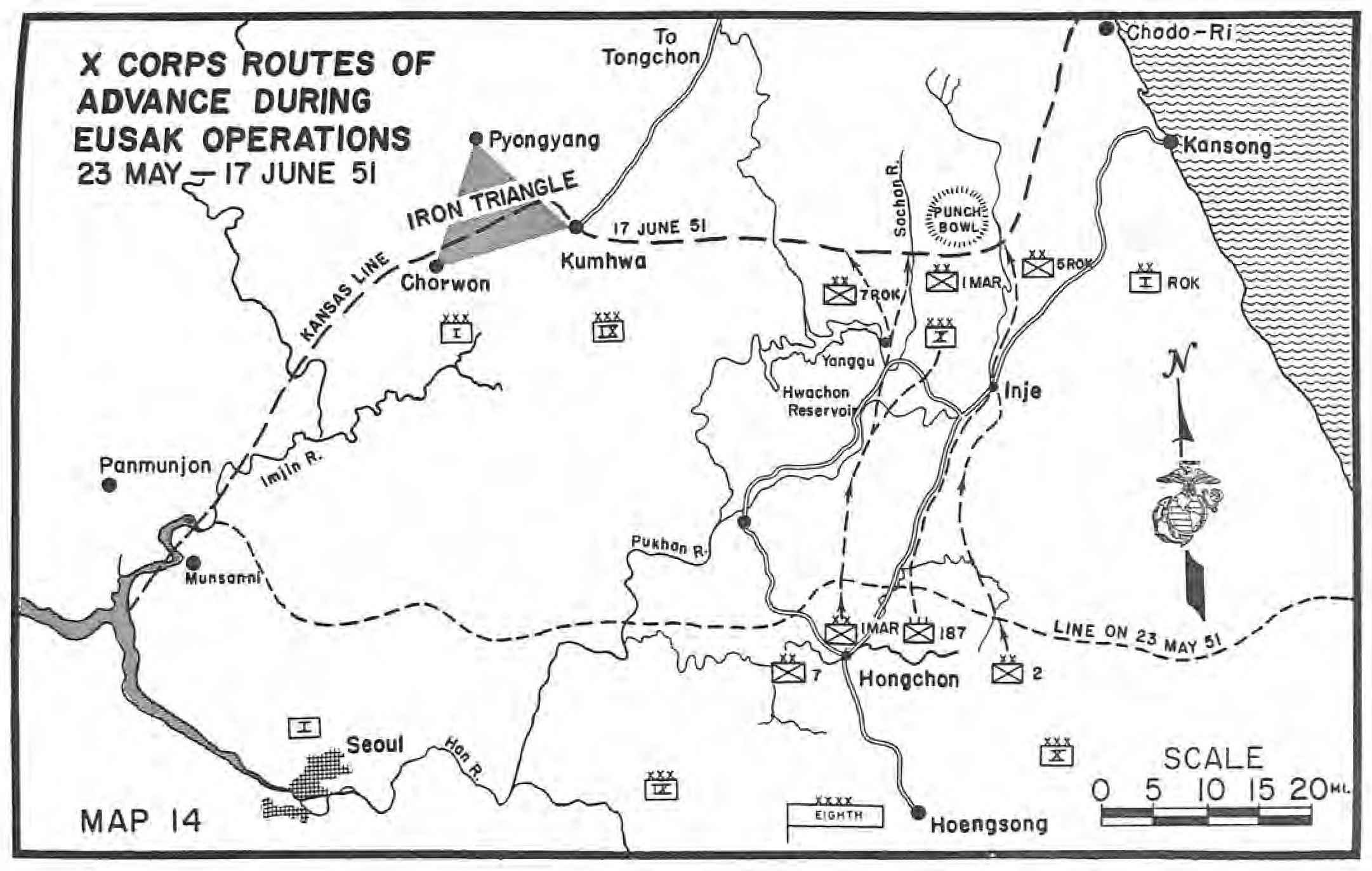
X CORPS ROUTES OF
ADVANCE DURING
EUSAK OPERATIONS
23 MAY-17 JUNE 51
MAP 14
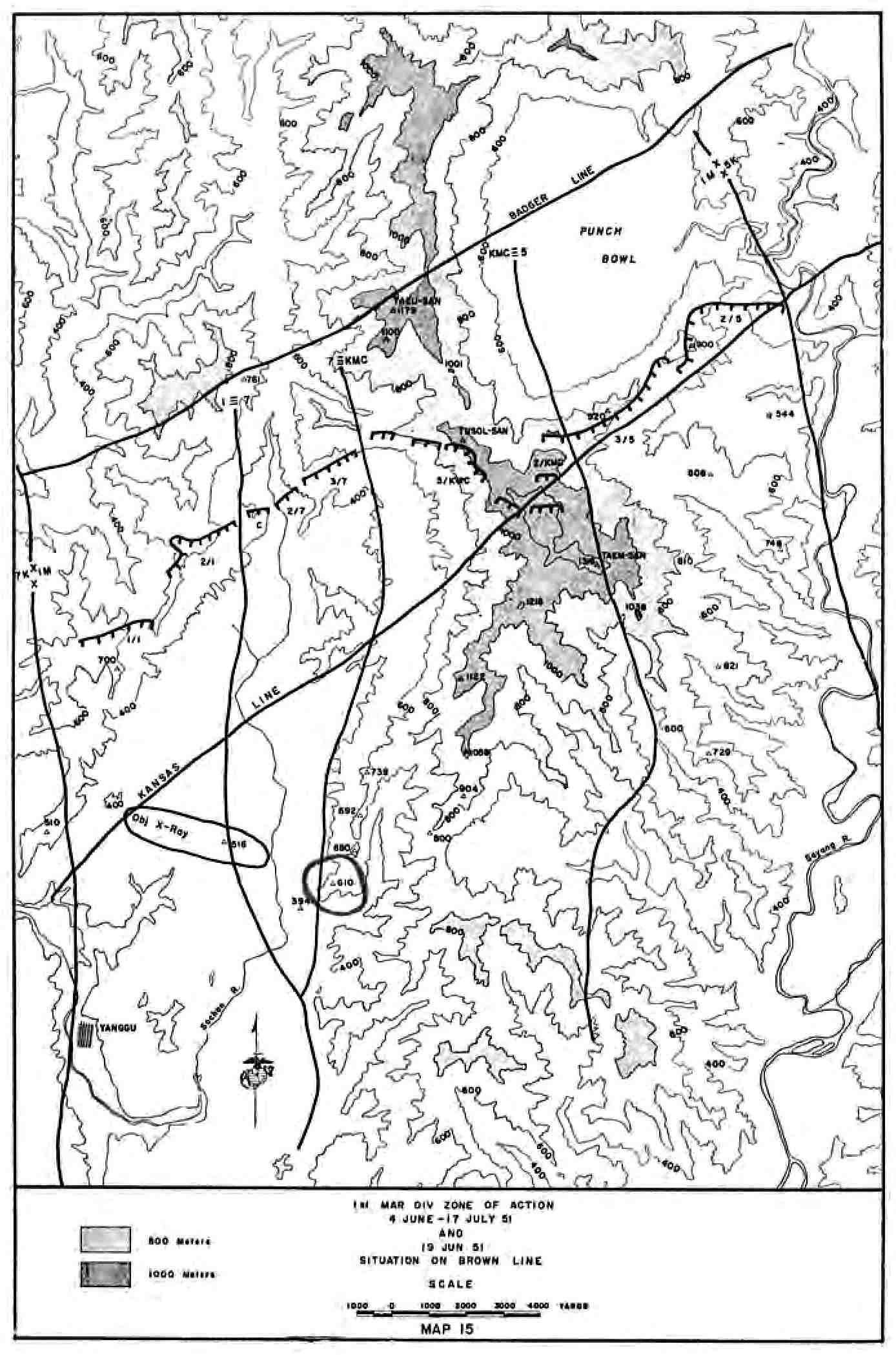
1st MAR DIV ZONE OF ACTION
4 JUNE-17 JULY 51
AND
19 JUN 51
SITUATION ON BROWN LINE
MAP 15
On 1 June the two regiments in assault, the 5th and 7th Marines,
found the resistance growing stiffer as they slugged their way forward
toward Line KANSAS (Map 15). Within an hour after jumping off,
2/5 was heavily engaged with an estimated 200 enemy defending
Hill 651 tenaciously. At noon, after ground assaults had failed, a
request was put in for air support. Four VMF-214 planes led by
Captain William T. Kopas bombed and strafed the target. This
attack broke the back of NKPA opposition, and 2/5 moved in to seize
the objective.224
Early on the morning of the 2d, Lieutenant Colonel Hopkins’
1/5 moved out to secure the southwest end of the long ridge line that
stretched northeast from Yanggu (Map 15) and afforded a natural
avenue of approach to Taeam-san and the KANSAS line on the southern
rim of the Punchbowl. The Marine advance got under way at 0915.
After two four-plane strikes by VMF-214 and a “preparation” by
1/11 and the 1st Rocket Battery, the battalion attacked across a valley
with Baker Company (First Lieutenant William E. Kerrigan) on the
right and Charlie Company (First Lieutenant Robert E. Warner)
on the left to seize the terminal point on the ridge leading to Hill 610
(Map 15). Able Company (Captain John L. Kelly) followed Charlie
as Company C (Captain Richard M. Taylor) of the 1st Tank Battalion
moved into supporting position.
Converging fire from transverse ridges had the Marine riflemen
pinned down until the tankers moved along the valley road running
parallel. Direct 90mm fire into NKPA log bunkers enabled C/1/5 to
advance to the forward slope of Hill 610. The enemy fought back
with machine guns and grenades while directing long-range rifle fire
against 2/5, attacking along a parallel ridge across the valley.
By 1945 the last bunker on Hill 610 had been overrun. Meanwhile,
2/5 had pushed ahead some 5,000 yards to the northeast.
The capture of Hill 610 will never have its glorious page in history.
It was all in the day’s work for Marines who could expect a succession
of such nameless battles as they clawed their way forward. That
night the weary men of 1/5 were not astonished to receive a counterattack
in the darkness. It was all part of the job, too. After driving
off the unseen enemy, the new tenants of Hill 610 snatched a few
hours of sleep. They were on their feet again at dawn, ready to go
up against the next key terrain feature in a rocky area that seemed to
be composed entirely of Hill 610s.
The next knob along the ridge happened to be Hill 680, about
1,000 yards to the northeast. VMF-214 planes from K-46 napalmed
and strafed the enemy, and Able Company led the 1/5 attack. During
the air strike the Koreans had taken to cover in their holes on the
reverse.
They were back in previously selected forward slope firing positions
by the time the Marines came in sight. Close-in artillery support enabled
the attackers to get within grenade range and seize the last
NKPA bunker by 1400. Able Company pushed on.
Midway from Hill 680 to the next knob, Hill 692, the advance was
stopped by enemy small-arms and mortar fire. An air strike was
requested on the bunkers holding up the assault, but fog closed in and
the planes were delayed more than two hours.
At 1600, after Able Company had renewed the assault without
air support, four VMF-214 Corsairs started a target run controlled
by a liaison plane from VMO-6. The foremost Marines, almost at
the summit by this time, had to beat a hasty retreat to escape the
napalm and 500-pound bombs being dumped on Hill 692. Fortunately,
there were no friendly casualties. Some were caused indirectly, however,
when hostile mortar fire caught Marines withdrawing along a
connecting saddle to the comparatively safe reverse slope of Hill 680.
When the danger passed, Able Company returned to the attack on
692 and routed the remaining defenders.225
The 1st Marine Division made it a policy thereafter that only the
forward air controllers on the ground were to direct close air support
along the front. Control of air strikes farther behind the enemy lines
was reserved for the OYs.
Sightings of enemy vehicles during the month of May totaled 54,561—seven
times those of January. This increase prompted General
Van Fleet to ask the Fifth Air Force and Seventh Fleet to initiate a
program of cutting off all possible enemy road traffic between the
latitudes 38° 15´ N and 39° 15´ N.
Earlier in 1951 the interdiction program had been aimed chiefly
at the enemy’s rail lines and bridges. The Communists had countered
by using more trucks. The new program, known as Operation
STRANGLE, was to be concentrated against vital road networks. Flight
leaders were briefed to search out critical spots where truck and
ox cart traffic could be stopped. Roads skirting hills were to be blocked
by landslides caused by well placed bombs. Where cliffside roads
followed the coast, as they so often did in East Korea, naval gunfire
started avalanches of dirt and rocks which sometimes reached a depth
of 20 feet. Roads running through a narrow ravine or rice paddy could
often be cut by a deep bomb crater.226
The 1st MAW was given the assignment of stopping traffic on
three roads in East Korea—from Wonsan to Pyonggang, from Kojo
to Kumhwa, and along a lateral route linking the two (Map 16).
Since Kumhwa and Pyonggang were two of the three Iron Triangle
towns, these roads were of more than ordinary importance.
The Communists reacted to the new UN pressure by increasing their
flak traps. UN pilots were lured with such bait as mysterious lights,
tempting displays of supposed fuel drums, or damaged UN aircraft
that called for investigation. The cost of the UN in planes and pilots
showed an increase during the first two months of Operation STRANGLE.
From 20 May to the middle of July, 20 Marine planes were shot
down. Six of the pilots returned safely; two were killed and 12 listed
as missing.227
The demands of Operation STRANGLE added to the emphasis on
interdiction and armed reconnaissance by the Fifth Air Force. Statistics
compiled by the 1st Marine Division for 1-17 June 1951 show that
984 close air support sorties had been requested and 642 received—about
65 percent. The ratio of Marine planes to other UN aircraft
reporting to the Division was about four to one.228
The statistics of the 1st MAW indicate that out of a total of 1,875
combat sorties flown from 1 to 15 June 1951, about a third were close
air support—651 day CAS and 19 night CAS. Of this number, 377
sorties went to the 1st Marine Division, which received more than
half. Next in line were the 7th Infantry Division (41 sorties), the
3d Infantry Division (31 sorties), and the 25th Infantry Division
(28 sorties).229
The effect of Operation STRANGLE on the enemy must be left largely
to conjecture. There can be no doubt that it added enormously to the
Communists’ logistical problem. It is equally certain that they solved
these problems to such an extent that their combat units were never
at a decisive handicap for lack of ammunition and other supplies.
Operation STRANGLE, in short, merely added to the evidence that
interdictory air alone was not enough to knock a determined adversary
out of the war, as enthusiasts had predicted at the outbreak of hostilities
in Korea.
On the night of 1–2 June, Colonel Nickerson was notified that the
7th Marines would be relieved next day by the 1st Marines, which
would pass through and continue the attack. The 1st Marines moved
into assembly areas at 0630. Lieutenant Colonel Homer E. Hire,
commanding officer of 3/1, went forward at 0800 with his command
group to make a reconnaissance of the area. As his staff paused for a
conference in a supposedly enfiladed location, a Communist mortar
barrage hit the group by complete surprise. The artillery Liaison
officer was killed instantly. His assistant, two forward observers, four
company commanders, the S-3 and 32 enlisted men were wounded.
So hard hit was the battalion that its attack had to be postponed
until the following day.230
The first Division objective was designated X-RAY. 2/1 had the
mission of taking the high point, Hill 516 (Map 15). Across the
valley 3/1 advanced up a parallel ridge. Planes from VMF-214 and
VMF-323 cleared the way for the securing of this battalion’s objective
at 1900. Aircraft from these same squadrons also aided 2/1 in over-running
the last opposition on Hill 516, where 80 NKPA dead were
counted.231
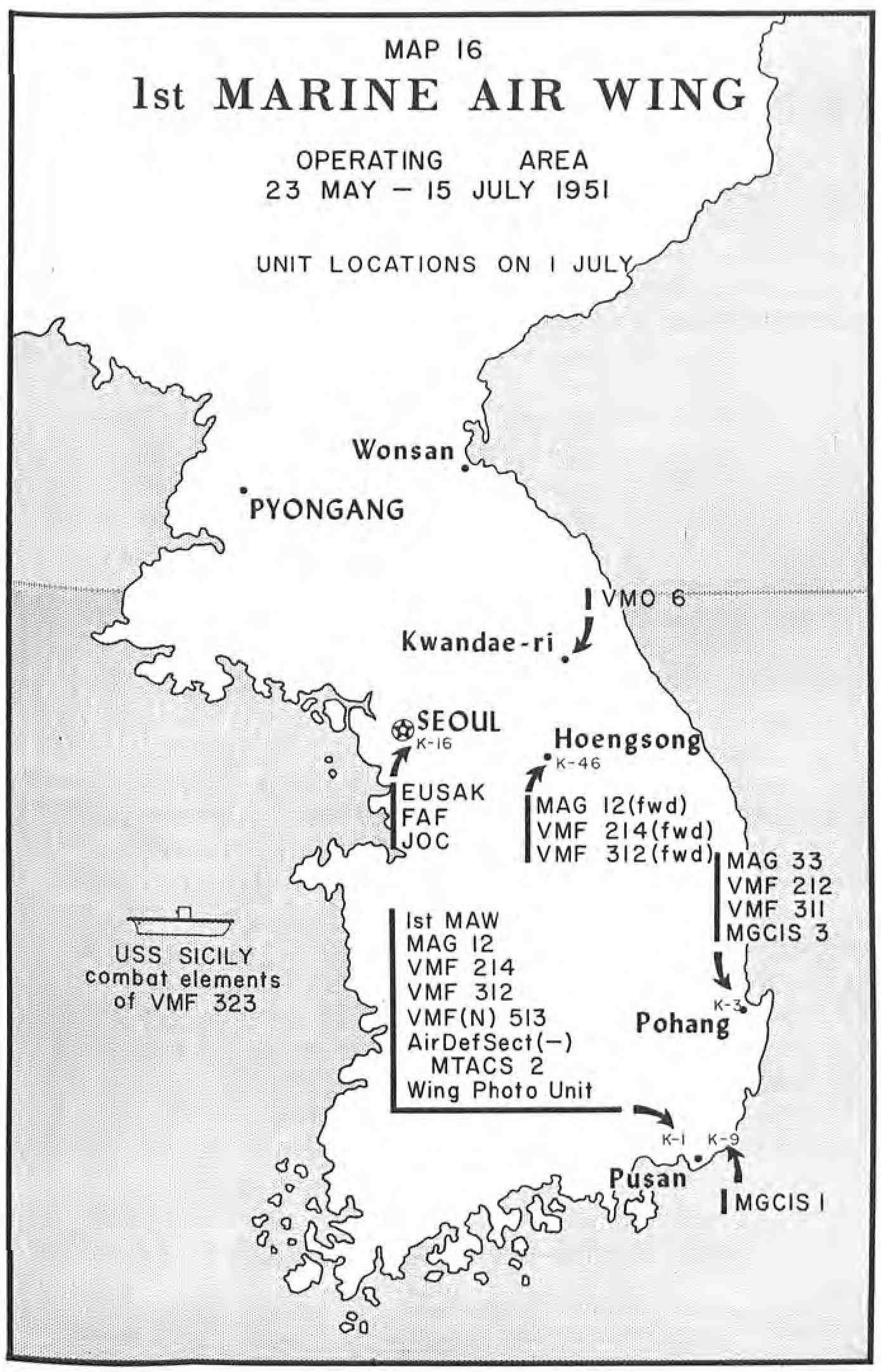
MAP 16
1st MARINE AIR WING
OPERATING AREA
23 MAY-15 JULY 1951
UNIT LOCATIONS ON 1 JULY
The KMC regiment, in reserve only two days, was ordered to relieve
the 5th Marines on 4 June. This would permit Colonel Hayward to
shift over to the right flank, thus extending the 1st Marine Division
zone 5,000 yards to the east with a north-south boundary of the Soyang
river valley (Map 15). The purpose of this maneuver was to free
2d Infantry Division troops for a mission of mopping up in the
X Corps rear area.
Three Marine regiments were now in line, the 1st on the left, the
KMCs in the center, the 5th on the right, and the 7th in reserve.
A reshuffling of units also took place in the 1st MAW when VMF-312
ended its tour of duty on the CVL Bataan. The replacement involved
a change of carriers when VMF-323 was alerted for west coast duty
on the CVE Sicily a week later.232
Ahead of the KMCs stretched the most difficult of the regimental
zones of action—the main mountain range extending northeast from
Yanggu to Hill 1316, known to the Koreans as Taeam-san. Along
these ridges the Chinese had placed North Korean troops with orders
to “hold until death.”233
From the air, the ground in front of the KMCs resembled a monstrous
prehistoric lizard, rearing up on its hind legs. The 1st Battalion
was to ascend the tail and the 2d the hind legs. The two would meet
at the rump, Hill 1122 (Map 15). From this position the backbone
ran northeast to the shoulders, Hill 1218. Still farther northeast,
along the neck, was the key terrain feature—Taeam-san, the head of
the imagined reptile.
The 1st and 2d Battalions ran immediately into the opposition of
an estimated NKPA regiment. In an effort to outflank the enemy, the
3d Battalion swung over to the east and attacked up the ridge forming
the forelegs. Seizure of the shoulders (Hill 1218) would render
enemy positions along the back, rump, hind legs, and tail untenable.
Major General Choe Am Lin, commanding the 12th NKPA Division,
was quick to recognize the tactical worth of this height and exact
a stiff price for it.
That the KMCs could expect little mercy from their fellow countrymen
was demonstrated when the bodies of ten men reported missing
were found. All had been shot in the back of the head.
For five days the fight raged with unabated fury. The terrain
limited the advance to a narrow front, so that the attack resembled the
thrust of a spear rather than a blow from a battering ram. When the
KMCs did gain a brief foothold, the enemy launched a counterattack.
At 2000 on 10 June, after six days of relatively unsuccessful fighting,
the KMCs decided to gamble on a night attack. This had heretofore
been the enemy’s prerogative, and the Korean Reds were caught
unaware in a devastating surprise. Most of the NKPA troops were
attending to housekeeping duties at 0200 when all three KMC battalions
fell upon them like an avalanche. Hill 1122, the rump of the
lizard, was seized; and under pressure the enemy withdrew from the
shoulders. This made the fall of Taeam-san inevitable, and only
mopping-up operations remained for KMCs who had suffered more
than 500 casualties. General Thomas sent the regiment this message
on 12 June:
Congratulations to the KMC on a difficult job well done. Your seizure
of objectives on the KANSAS Line from a determined enemy was a magnificent
dash of courage and endurance. Your courageous and aggressive actions
justify our pride in the Korean Marines.
Logistical support of the three regiments in the attack presented a
problem to the Division supply echelons. The KMCs in the center and
the 1st Marines on the left could be supplied over a narrow, winding
mountain road that scaled a high pass before dropping down into an
east-west valley giving relatively easy access to the center and left.
The 5th Marines had to receive its supplies over another mountain
road leading north of Inje, then west into the regimental zone.234
Both of the Division supply routes needed a good deal of engineering
work before trucks could move over them freely. Landslides were
frequent and many trucks skidded off the slippery trail while rounding
the hairpin turns.
The 1st Marines moved northward on north-south ridges, and the
KMCs in the center had spurs leading to their objectives. It was the
misfortune of the 5th Marines to have a topographical washboard
effect ahead. The axis of advance was south to north, but the ground
on the way to the final objectives on the KANSAS Line consisted of five
sharply defined ridgelines running northwest to southeast. Instead of
attacking along the ridgelines Colonel Hayward’s men had to climb
some 1,200 feet, then descend 1,200 feet, five separate times while
covering an advance of 8,000 yards (Map 15).
Artillery fired for more than two hours on the morning of 6 June to
soften defenses on the next regimental objective, Hill 729. An air
strike was attempted but fog with low-hanging clouds forced the
flight leader to abort the mission. At 1300 the assault battalions moved
across the LD against small-arms and machine gun fire. The fog
lifted sufficiently at 1400 to allow four F9Fs from VMF-311 to
deliver an effective attack. And by 2100 both 2/5 and 3/5 were
consolidating their positions on the first of the five ridges.
This assault is typical of the fighting as the 5th Marines took the
remaining four ridges, one by one, in a slugging assault on an enemy
defending every commanding height. The advance resolved itself
into a pattern as the Korean Reds probed the Marine lines at night
and continued their tough resistance by day. For 10 days the regiment
plugged ahead, step by step, with the support of artillery, air, mortars,
and 75 mm recoilless rifles.235
On the left flank, the 1st Marines devoted several days to consolidating
its position and sending out reconnaissance patrols in preparation for
an attack on the ridge just north of the Hwachon Reservoir. From
this height the Communists could look down the throats of Colonel
Brown’s troops.
From 6 to 8 June, Lieutenant Colonel Hire’s 3d Battalion led the
attack against moderate but gathering resistance. A gain of 1,500
yards was made on the right flank by 2/1, commanded by Major
Clarence J. Mabry after the evacuation of Lieutenant Colonel McClellan,
wounded on the 5th. On the left, Lieutenant Colonel Robley E.
West’s 1/1 held fast as the 5th ROK Regiment, 7th ROK Division,
X Corps, passed through on its way to a new zone of action to
the west.
Early on the 9th, as 2/1 was preparing to launch its attack, an
intense artillery and mortar barrage fell upon the lines, followed by
the assault of an estimated NKPA company, The Korean Reds were
beaten off with heavy losses. And though the enemy fire continued,
2/1 jumped off on schedule, fighting for every inch of ground.
Colonel Brown committed 1/1 on the left. It was an all-day fight
for both battalions. After taking one ridge in the morning, it was used
as the springboard for an assault on the second objective. The weapons
of the regimental Anti-Tank Company built up a base of fire that
enabled this ridge to be secured by 1600.
The 5th ROK Regiment took its objectives by the morning of the
10th. The 1st Marines provided additional fire support by diverting
all its antitank guns and tank rifles to the aid of the ROKs.
The pressure, which had been building up for several days, reached
a new high on 10 June. Late that morning Colonel Brown met General
Almond and the Division G-3, Colonel Richard G. Weede, at a
conference. By 1100 the entire 2d Battalion of the 1st Marines was
committed. On the left, Lieutenant Colonel West had to hold up
the 1st Battalion until 1330, when the ROKs completed the occupation
of the high ground dominating the route of advance.
For several hours it appeared that the Marines had met their match
this time. A tenacious enemy defended log bunkers expertly, refusing
to give ground until evicted by grenade and bayonet attacks. At
every opportunity the Communists counterattacked. So effective was
their resistance that at dusk the two Marine battalions were still short
of their objectives in spite of casualties draining the strength of
both units.
Colonel Joseph L. Winecoff, commanding officer of the 11th
Marines, remained on the telephone for hours with Colonel Brown.
He gave all possible artillery support, not only of his own regiment
but also nearby Corps units. By nightfall, with the attacking battalions
still held up, the atmosphere was tense in the regimental forward CP.
Lieutenant Colonel Adelman, commanding the supporting artillery
battalion, 2/11, helped to coordinate air strikes and artillery with
Lieutenant Colonel Donald M. Schmuck, executive officer of the 1st
Marines, and the air liaison officers.
“Everything I had ever hoped to see in years of teaching such
coordination of fires seemed to come true that night,” commented
Colonel Brown at a later date. “I stayed in my regular CP until I was
sure all I could do through Winecoff was done, and then went forward
to see the finale. It was a glorious spectacle, that last bayonet assault.
In the last analysis 2/1 had to take its objective with the bayonet and
hand grenades, crawling up the side of a mountain to get at the
enemy. It was bloody work, the hardest fighting I have ever seen.”236
This was no small tribute, coming from a veteran officer whose
combat service included three major wars, not to mention Nicaragua
and China. It was nearly midnight before Mabry’s battalion took
its final objective. Casualties for the day’s attack were 14 KIA and
114 WIA exclusive of slightly wounded, who were neither counted
nor evacuated. West’s battalion, which seized Hill 802, overlooking
the Soyang River, had won its all-day fight at a cost of 9 KIA and
97 WIA.
Unfailing support had been given throughout the daylight hours
by aircraft of VMF-214. VMF(N)-513 took over on the night shift,
and planes came screeching in as late as 2200 to attack moonlit targets
a hundred yards ahead of the leading infantry elements.
The 1st Marines had outfought and outgamed a tough enemy.
Never again, after the 10th, was the NKPA resistance quite as determined.
The 3d Battalion led the other two during the next few days.
There was plenty of fighting for all three, but the result was never
again in doubt.
By the late afternoon of 14 June the regiment was in position on
the BROWN Line. This was the unofficial name for an extension of
the KANSAS Line some 3,000 yards north. It had been requested by
Colonel Brown when he realized that positions along the KANSAS
Line were completely dominated by the next ridge to the north.
The change made necessary a continued advance by the KMCs on
the right to tie in with the 1st Marines. The so-called BROWN Line was
then officially designated the modified KANSAS Line.
For several days General Thomas had been concerned over the heavy
casualties suffered by his command. In order to give greater impetus
to the Division effort, he decided to commit the reserve infantry
regiment, the 7th Marines (minus one battalion held back as Division
reserve) to complete the occupation of the modified KANSAS Line.
On 8 June, Colonel Nickerson’s regiment (minus 3/7) moved into
an assembly area between the 1st Marines and the KMCs, ready to
attack in the morning. Ahead stretched a narrow but difficult zone
of advance up the valley of the So-chon River (Map 15). Tank-infantry
patrols went forward to select favorable positions for the jumpoff,
and engineers worked throughout the daylight hours to clear the valley
roads of mines. Despite their best efforts, 10 Marine tanks were lost to
mines during the first week.237
As the two battalions advanced on the morning of the 9th they came
under heavy enemy artillery and mortar fire. Nevertheless, they
secured Hill 420 and dug in before nightfall.
On the 10th Rooney’s 1/7 advanced along the ridgeline to support
the attack of Meyerhoff’s 2/7 up the valley floor. The maneuver was
carried out successfully in spite of NKPA automatic weapons and
mortar opposition. Contact was established with KMC forward units
at dusk. Sixteen POWs were taken by the 7th Marines and 85 North
Korean dead were counted on the objectives.
The two battalions continued the attack throughout the next week.
The 3d Battalion of the 7th Marines remained General Thomas’ sole
Division reserve until he committed it on the afternoon of 18 June.
The newcomers got into the fight just in time for the enemy’s
all-out effort to defend the steep east-west ridge marking the BROWN
Line. The nature of the terrain made maneuver impossible—a frontal
assault was the only answer. Defending the ridge was the 1st Battalion,
41st Regiment, 12th NKPA Division. Waiting on the reverse
slope, the enemy launched a counterattack when the Marines neared
the crest. George Company, commanded by First Lieutenant William
C. Airheart, met five successive repulses at the hands of superior
numbers. Item Company (First Lieutenant Frank A. Winfrey) also
took part in the fifth assault, and both companies held their ground
near the summit when the fighting ended at dusk. They expected to
resume the attack at dawn, but the enemy had silently withdrawn
during the night. All three 7th Marines battalions occupied their
designated positions on the BROWN Line without further interference.
By early afternoon on the 20th, the Division was in complete control
of the modified KANSAS Line and construction of defenses began in
earnest. The next day the 1st Marines and KMCs extended their right
and left flanks respectively and pinched out the 7th Marines, which
dropped back into reserve.
Thus ended two months of continual hard fighting for the 1st
Marine Division, beginning on 22 April with the great CCF offensive.
Few and far between were the interludes of rest for troops which saw
both defensive and offensive action. After stopping the enemy’s two
drives, they launched a month-long counterstroke that had the enemy
hardpressed at times for survival. Only the ruthless sacrifice of NKPA
troops in defensive operations enabled the Chinese Reds to recover
from the blows dealt them in late May and early June.
The cost in Marine casualties had been high. Throughout the entire
month the 1st Marines alone suffered 67 KIA and 1,044 WIA, most
of them being reported during the first 2 weeks. This was a higher
total than the regiment incurred during the Chosin Reservoir operation.
Reflecting on the caliber of these men, their regimental commander
had this to say:
They were war-wise when I got command; I contributed nothing to their
training because they were in battle when I joined them and I left them when
they came out of the lines for a rest. They used cover, maneuvered beautifully,
used their own and supporting arms intelligently, were patient and not
foolhardy; but when it came to the point where they had to rely on themselves
with bayonet, hand grenade and sheer guts, they could and did do that
too. I have long ago given up telling people what I saw them do on many
occasions. Nobody believes me, nor would I believe anyone else telling the
same story of other troops.238
Colonel Brown, of course, paid this tribute to the troops of his
regiment. But it is safe to say that any commanding officer of the
1st Marine Division would have felt that these sentiments applied
equally to his own men. All the combat Marines of the 60-day battle
had shown themselves to be worthy heirs of the traditions of Belleau
Wood, Guadalcanal, Iwo Jima, and the Chosin Reservoir.
CHAPTER VIII The Truce Talks at Kaesong — Communists Ask for Truce Talks — Patrol Bases on BADGER Line — Red Herrings at Kaesong — 1st Marine Division in Reserve — Marine Helicopters Take the Lead — Marine Body Armor Tested in Korea — MAG-12 Moves to K-18 — The Division Back in Action Again
Communists Ask for Truce Talks—Patrol Bases on BADGER
Line—Red Herrings at Kaesong—1st Marine Division in
Reserve—Marine Helicopters Take the Lead—Marine
Body Armor Tested in Korea—MAG-12 Moves to K-18—The
Division Back in Action Again
It is not likely that the date 25 June 1951 meant much to the
Marines on the KANSAS Line. In all probability few of them
recalled that it was the first anniversary of the Communist aggression
which started the war in Korea.
Since that surprise attack on a June Sunday morning in 1950, some
1,250,000 men had been killed, wounded or captured in battle—a
million of them from the Communist forces of Red China and the
North Korean People’s Republic. This was the estimate of J. Donald
Kingsley, Korean reconstruction agent general for the United States.
He reckoned the civilian victims of privation, violence, and disease at
two million dead. Another three million had been made homeless
refugees.239
On 25 June 1951 the Communists held less territory by 2,100 square
miles than they occupied when they began their onslaught with an
overwhelming local superiority in arms and trained troops. Losses of
Communist equipment during the first year included 391 aircraft,
1,000 pieces of artillery, and many thousands of machine guns, automatic
rifles, and mortars. North Korea, formerly the industrial region
of the peninsula, lay in ruins. Cities, factories, and power plants had
been pounded into rubble.
In short, the thrifty conquest planned by the Koreans and their
Soviet masters had backfired. Not only had the Communist offensives
of April and May been stopped; the United Nations forces had
rebounded to win their greatest victory of the war’s first year. While
X Corps was advancing to the Punchbowl, other major Eighth Army
units had also gained ground. Perhaps the most crushing blow was
dealt by I Corps in its attack on the Iron Triangle. Units of two U.S.
infantry divisions fought their way through extensive mine fields into
Chorwon and Kumhwa on 8 June. By the end of the month, I Corps
held defensive positions about midway between the base and apex of
the strategic triangle that had been the enemy’s main assembly area
for the troops and supplies of his spring offensives.240
On the east-central front, units of IX Corps pushed within 10 miles
of Kumsong while I ROK Corps advanced along the east coast to
Chodo-ri. Thus the UN forces occupied the most favorable line they
had held since the great CCF offensive early in January. From the
mouth of the Imjin this line ran northeast to the middle of the Iron
Triangle, eastward across the mountains to the southern rim of the
Punchbowl, then northeast to the coast of Chodo-ri (Map 14).
The first anniversary of the Korean conflict was overshadowed two
days earlier by the news that the Communists had taken the initiative
in proposing truce talks. The suggestion was made in a New York
radio address of 23 June by a Soviet delegate to the United Nations—Jacob
Malik, Foreign Minister of the USSR. On the 25th the idea was
unofficially endorsed in a radio broadcast by the Chinese Communist
government. UN officials immediately indicated their willingness to
discuss preliminary terms. The outcome was an agreement that
representatives of both sides would meet on 7 July at Kaesong, then
located between the opposing lines in west Korea.
Why had the Communists been first to ask for a truce conference?
Both Generals Van Fleet and Almond believed that the answer might
have been traced to military necessity rather than any genuine desire
for peace. “I felt at that time that the Chinese Communists and the
North Korean armies were on the most wobbly legs that they had
been on to that date,” said General Almond when interviewed shortly
after his retirement in 1953. “They were punch drunk and ineffective,
and I, personally, thought at that time that it was the time to finish
off the effort.”241
Raymond Cartier, representing a Paris newspaper, probably spoke
for most of the correspondents at the front when he suspected that the
proposal for truce talks “was possibly just a crafty trick devised by the
Communists to gain time and build up again the badly mauled
Chinese armies.”242
It might have been recalled at this time that the Communists had
used truce negotiations for military purposes during the Chinese
Civil War. In 1945 and 1946, when prospects for a Nationalist
victory were bright, the enemy took advantage of American peace
efforts by agreeing on several occasions to meet for truce conferences.
And while prolonging the talks by all manner of subterfuges, the
Communists profited from the breathing spells by regrouping their
forces and planning new offensives. Their final triumph, in fact,
owed in no small measure to interludes when the conference table
served a military purpose.243
History repeated itself in June and July 1951 when events of the
next two years were shaped by the political decisions of a few summer
weeks. Indeed, Admiral C. Turner Joy believed that the war was
actually prolonged rather than shortened as a result of the negotiations.
“Military victory was not impossible nor even unusually difficult
of achievement,” wrote the Senior Delegate and Chief of the UN
Command delegation at the truce talks. “Elimination of the artificial
restraints imposed on United States forces, coupled with an effective
blockade on Red China, probably would have resulted in military
victory in less time than was expended on truce talks.”244
Mao Tse-tung’s forces had lost face by the failure of their long
heralded 5th Phase Offensive. They had been badly beaten during the
UN counteroffensive. Pretensions of high CCF morale could no longer
be maintained when troops were laying down their arms without a
fight. Nor could charges of low UN morale be supported when the
fighting spirit of the Eighth Army was being shown every day at
the front.
In view of these circumstances, it would appear that the Communists
had poor cards to play against United Nations trumps at a truce
conference. But they played them so craftily, with such a sly sense of
propaganda values, that the victors of the May and June battles were
soon made to appear losers begging for a breathing spell.
To begin with, the Chinese knew that the mere public announcement
of the possibility of truce talks would have a tremendous appeal in
the United States, where the war was unpopular. Pressure would be
brought upon Washington to meet the enemy immediately for negotiations.
And while a cease fire remained even a remote prospect,
American public opinion would demand a slackening of offensive
military operations with their attendant casualties.
From the outset it was apparent that the United Nations Command
was no match for the Communists in low cunning. The UN suggested,
for instance, that the truce teams meet on the Danish hospital ship
Jutlandia. Here, surely, was neutral ground, since the Danes had no
combat forces in Korea. Moreover, the ship was to be anchored in
Wonsan harbor within range of CCF shore batteries.
The Reds won the first of many such concessions with their refusal.
They insisted that the talks be held at Kaesong, and the UN Command
let them have it their way. The reason for the Communist decision
was soon made evident. Kaesong was in the path of the advancing
Eighth Army, which meant that an important road center would be
immune from attack. And though the ancient Korean town was
originally in no man’s land, the Communists soon managed to include
it within their lines.
All delegates were requested to display white flags on their vehicles
for identification. Communist photographers were on hand to snap
countless pictures of UN delegates which convinced Asia’s illiterate
millions at a glance that the beaten United Nations had sent representatives
to plead for terms. If any doubt remained, other photographs
showed the unarmed UN delegates being herded about Kaesong
by scowling Communist guards with burp guns.
No detail of the stage setting was too trivial to be overlooked.
Oriental custom prescribes that at the peace table the victors face
south and the losers face north. Needless to add, the UN delegates
were seated at Kaesong with a view to enhancing Communist prestige.245
Some of the propaganda schemes bordered on the ridiculous, “At
the first meeting of the delegates,” Admiral Joy related, “I seated
myself at the conference table and almost sank out of sight. The
Communists had provided a chair for me which was considerably
shorter than a standard chair. Across the table, the senior Communist
delegate, General Nam Il, protruded a good foot above my cagily
diminished stature. This had been accomplished by providing stumpy
Nam Il with a chair about four inches higher than usual. Chain-smoking
Nam Il puffed his cigarette in obvious satisfaction as he
glowered down on me, an obviously torpedoed admiral. This condition
of affairs was promptly rectified when I changed my foreshortened
chair for a normal one, but not before Communist photographers had
exposed reels of film.”246
The war went on, of course, during the negotiations. But the tempo
was much reduced as the UN forces consolidated their gains, and the
enemy appeared to be breaking off contact at every opportunity.
Generally speaking, the Eighth Army had shifted from the offensive
to the defensive. In keeping with this trend, the 1st Marine Division
occupied the same positions for nearly three weeks after fighting its
way to the BROWN Line.
On 22 June all three infantry regiments were directed to establish
battalion-size patrol bases on the BADGER Line—1½ to 2½ miles forward
of their present positions. In the 1st Marines sector 3/7 was attached
to Colonel Brown and ordered to relieve 3/1 on the left flank of the
regiment. The purpose was to free 3/1 to move forward and establish
a patrol base on Hill 761, about 1,000 yards forward of the MLR.
While these arrangements were being carried out, General Almond
called at the 1st Marines CP. He expressed surprise that the establishment
of patrol bases was being contemplated by EUSAK when some
of the front-line units were still in contact with the enemy.247
Execution of these orders was accordingly suspended. The following
day, however, Division again alerted the infantry regiments to
be prepared to occupy patrol bases on order. This was by direction of
Corps, which in turn had been directed by EUSAK.
The Marine regimental and battalion commanders were not happy
about this turn of affairs. The patrol base concept had been tried out
early in May, during the lull between the enemy’s two offensives,
and found wanting. In theory it was a good means of keeping contact
with an enemy who had pulled back out of mortar and light artillery
range. In practice the enemy had shown that he could bypass patrol
bases at night for probing attacks on the MLR. The bases themselves
ran the constant risk of being surrounded and overwhelmed. As a
final objection, a regiment was often deprived of its reserve battalion,
which was the logical choice for such duty.
In compliance with orders, 3/1 moved out on 26 June and established
a patrol base on Hill 761. This position received such a bombardment
of large caliber mortar fire that Colonel Brown pulled the
battalion back to the MLR the following day.248
General Thomas gave his opinion of the patrol base concept after
his retirement when he summed it up as “an invitation to disaster.”249
He could only carry out orders, however, when Corps directed early
in July that a patrol base be established on Taeu-san.
This 4,000-foot peak, located some 2 miles north of the MLR, afforded
excellent observation eastward into the Punchbowl and westward
into the So-chon River Valley. The enemy, of course, was aware
of these advantages and had made Taeu-san a strongpoint of his
MLR. This was clearly indicated by the stiff resistance encountered by
KMC reconnaissance patrols.250
Nevertheless, Division G-3 was suddenly alerted on the morning
of 7 July by the Marine Liaison Officer with X Corps to expect an
order directing the setting up of a patrol base on Taeu-san the following
day. The KMC Regiment, warned by telephone, had little time
for planning and organizing an attack. Since the KMCs could not be
relieved for responsibility for their sector, it was necessary to form a
composite battalion of the three companies that could most conveniently
be relieved. Unfortunately, they contained a large proportion of
recruits, and the battalion commander was a new arrival.
There were two avenues of approach. One was along an open,
fairly level, ridgeline that extended from the KMC positions. The
other called for a descent into the stream-bed generally paralleling the
MLR and a steep climb up a ridge leading directly north to Taeu-san.
Both routes of approach were used. One company advanced on the
right by way of the stream bed and two companies took to the ridgeline
on the left. The assault was to have been preceded by air strikes
and an artillery bombardment, but bad weather kept the aircraft
grounded.
The attack jumped off at 1030 on 8 July. All three companies were
greeted by enemy mortar and machine gun fire that pinned down the
company on the right. The two companies on the left won a foothold
on Hill 1100, about a mile in front of Taeu-san. Here the advance
ground to a halt.
These KMCs dug in for the night and repulsed a series of counterattacks.
On the morning of the 9th the KMC regimental commander,
Colonel Kim Tai Shik, committed the entire 1st Battalion to the attack
on the right. It had no better success than the company of the day
before. Meanwhile, the two companies were driven off Hill 1100.
Colonel Gould P. Groves, senior liaison officer with the KMCs,
recommended that the remnants of the two companies be withdrawn.
The 1st Battalion had managed to capture Hill 1001, but it was plain
that the KMC regiment could not come close to Taeu-san. On 12 July
the 1st Marine Division informed X Corps that the position held by
the KMCs just forward of Hill 1001 fulfilled the requirements of an
advance patrol base. As far as the Marines were concerned, the sad
affair was permitted to rest there.
As evidence of the valiant effort made by the KMCs, they suffered
222 casualties. A sequel to this story was written late in July after the
2d infantry Division relieved the Marines. X Corps again ordered
the capture of Taeu-san as a patrol base, and it required the commitment
of the major part of the division to accomplish the task.251
Although the fighting had not been severe for other units of the
1st Marine Division during the first two weeks of July, the casualties
(including KMC losses) were 55 KIA, 360 WIA, and 22 MIA—a
total of 437. Relief of the Marines was completed by the 2d Infantry
Division on 15 July, and by the 17th all units were on their way back
to assembly areas in X Corps rear.
It was the second time since the landing of the 1st Provisional
Marine Brigade on 2 August 1950 that the Marines had been away
from the firing line for more than a few days.
It is not changing the subject to switch to the truce talks. Kaesong
was actually a second UN front.
After the preliminaries had been settled—most of them to Communist
satisfaction—the UN delegation, headed by Admiral Joy, held
a first meeting on 10 July 1951 with his opposite number, NKPA Major
General Nam Il, and the Communist truce team. This was the first
of the talks that were to drag on for two dreary years.
Nam Il, a Korean native of Manchuria, born in 1911, had been
educated in Russia and had served with the Soviet army in World
War II. His career in Korea began when he arrived as a captain with
Soviet occupation troops in 1945. Rising to power rapidly, he took a
prominent part in the creation of a Soviet puppet state in North Korea.
An atmosphere of sullen hatred surrounded the UN delegates at
Kaesong. The CCF sentinel posted at the entrance to the conference
room wore a gaudy medal which he boasted had been awarded to him
“for killing forty Americans.” When Admiral Joy tried to send a
report to General Ridgway, the messenger was turned back by armed
Communist guards. These are samples of the indignities heaped
upon the UN truce team. After several UN delegates were threatened
by guards with burp guns, Joy protested to Nam Il, “demanding
prompt elimination of such crudities.”
In order to give their battered armies more time for recuperation,
the Communist delegates met every issue with delaying tactics. They
proved themselves to be masters of the ancient art of dragging a red
herring across the trail. Going back on their word did not embarrass
them in the least if they found it to their advantage to renege.252
The truce negotiations were bound to have an immediate effect on
military operations. In the United States it seemed a pity to newspaper
readers that American young men should have to die in battle at a time
when headlines were hinting at the possibility of peace. Mothers
wrote to their congressmen, requesting a halt in Korean operations.
General Van Fleet minced no words after his retirement when he
commented on the effect of the truce talks on strategy:
Instead of getting directives for offensive action, we found our activities
more and more proscribed as time went on. Even in the matter of straightening
out our lines for greater protection, or capturing hills when the Reds were
looking down our throats, we were limited by orders from the Far East
Command in Japan, presumably acting on directives from Washington.253
It was the opinion of Admiral Joy that more UN casualties were
suffered as a consequence of the truce talks than would have resulted
from an offensive taking full advantage of Red China’s military
weaknesses in June 1951.
“As soon as armistice discussions began,” he wrote, “United Nations
Command ground forces slackened their offensive preparations. Instead,
offensive pressure by all arms should have been increased to
the maximum during the armistice talks.... I feel certain that the
casualties the United Nations Command endured during the two long
years of negotiations far exceed any that might have been expected
from an offensive in the summer of 1951.”254
Most of the 1st Marine Division units were in X Corps reserve during
the last two weeks of July 1951. The 5th Marines, however, remained
in “ready reserve” near Inje under the operational control of X Corps.
Toward the end of the month, the 3d Battalion of the 11th Marines
passed to the operational control of the 2d Infantry Division. Meanwhile,
the 7th Marines and Division Reconnaissance Company displaced
to the Yanggu area to aid in the construction of defensive
positions and undergo special training.
1st Marine Division Training Order 2-51, covering the period
from 23 July to 20 August 1951, provided for a stiff daily schedule of
general and specialist military subjects. The objectives were “to
maintain each individual and unit of the command at a very high state
of proficiency, while emphasizing rest and rehabilitation of personnel
and repair and maintenance of equipment.... A minimum of 33%
of all technical training was to be conducted at night, stressing individual
and unit night discipline. Formal unit schools and on-the-job
training were utilized extensively.”255
Most thoroughly covered among general military subjects were
mechanical training, capabilities, tactical employment, and firing of
individual and infantry crew-served weapons. Lectures and demonstrations
were combined to good effect with instruction in basic
infantry tactics.
“The prescribed periods of physical conditioning,” the Division
report continued, “were supplemented by extensive organized athletic
programs outside of training hours, resulting in the maintenance of a
high degree of battle conditioning of all hands. Special military subjects
encompassed the whole range of activities necessary to the
accomplishment of any mission assigned the Division. Building from
the duties of the individual Marine, infantry, artillery, engineer, and
tank personnel progressed through small unit employment and tactics
as it applied to their respective specialities. Meanwhile such diverse
training as tank repair and watch repair was conducted in various
units.”256
Fortification came in for study after a tour of the KANSAS Line by
Major General Clovis E. Byers, who had relieved General Almond as
X Corps commander. He listed the weaknesses he found and directed
that “special attention [be] given to the thickness, strength and
support of bunker overheads, and to the proper revetting and draining
of excavations.”257
The KMC Regiment received the most thorough training it had
ever known, considering that it had been in combat continually since
its organization. Each of the Division’s three other regiments sent
four training teams consisting of a lieutenant, an NCO, and an
interpreter to the KMCs on 22 July. The 12 teams had orders to
remain until 20 August. Attached to various KMC companies, they
acted as advisers for the entire training period.
Another organization of Koreans that had won its way to favorable
recognition was the newly formed Civil Transport Corps (CTC). The
use of indigenous labor for logistical purposes dated back to March
1951, when the Eighth Army’s advance was slowed up by supply problems
caused by muddy roads. Plans were made to equip and train a
special corps to assist in the logistical support of combat troops in areas
inaccessible to normal motor transportation.258
The project began on 29 March with 720 South Koreans—all from
the Korean National Guard—being assigned to I Corps. Plans were
developed for a Civil Transport Corps of 82 companies, each containing
240 men. The CTC was to be supervised by a staff of eight
U.S. Army officers and four enlisted men under the operational control
of the Transportation Section, EUSAK.
The ROK Army had the added responsibility for logistical support,
of hospitalization and medical services other than emergency treatment
in forward areas. Support for the CTC from UN units was to be
provided in a manner similar to that in effect for the ROK forces.259
No difficulty was found in filling the CTC ranks, for the pay meant
food and clothing to a Korean and his family.
The Marines were always astonished at the heavy loads the Korean
cargadores could carry uphill on their “A-frames,” which looked like
sturdy easels with a pair of arm-and-shoulder carrying straps. Humble
and patient, these burden bearers were the only means of supply in
remote combat areas.
The truce talks continued to be front-page news in August. Some of
the more impulsive newspaper and radio commentators hinted at the
possibility of a cease fire before the end of summer. As for the Marine
command and staff, they were not so optimistic, judging from this
sentence in a report:
“All Division units were notified on 14 August that requisitions had
been sent to EUSAK for cold weather clothing and equipment.”
The training period afforded an opportunity to glance back over the
first year of fighting in Korea and evaluate the results. There could
be no doubt that the war’s foremost tactical innovation so far was the
combat helicopter. The Marine Corps had taken the lead in its development
when VMO-6, made up of OYs and Sikorsky HO3S-1
helicopters in roughly equal numbers, got into action with the 1st
Provisional Marine Brigade in the Pusan Perimeter. Brigadier General
Edward A. Craig had the historical distinction, insofar as is known,
of being the first commanding general to see the advantages of a
“chopper” as a command vehicle.
Evacuation of casualties was the principal job of the rotary-wing
aircraft, and 1,926 wounded Marines were flown out during the first
year. No less than 701 of these mercy flights took place during the
three months from 1 April to 30 June 1951, covering the period of
the two CCF 5th Phase offensives and the UN counterstroke. By that
time the Bell HTL-4, with its built-in litters on both sides sheltered by
plexiglas hoods, had taken over most of the evacuation missions from
the HO3S-1.
The zeal of the pilots contributed substantially to the successful
results. Captain Dwain L. Redalen gave a demonstration of the
VMO-6 spirit at the height of the first CCF offensive in the spring of
1951. During the 13½ hours from 0600 to 1930 on 23 April, he was
in the air constantly except for intervals of loading or unloading
casualties. Logging a total of 9.6 flight hours, he evacuated 18
wounded men under enemy fire that left bullet holes in the plexiglas
of his HTL-4.260
Practically all the helicopter techniques put into effect by VMO-6
had originally been developed by the Marine experimental squadron,
HMX-1, organized late in 1947 at Quantico. Despite the enthusiasm
for rotary-wing aircraft then prevailing, HMX-1 decided that an
observation squadron should combine OYs with helicopters. The
wisdom of this conclusion was proved in Korea, where the test of
combat showed that both types were needed. The OYs were the
superiors at reconnaissance and artillery spot missions, while the
helicopters excelled at transportation and liaison and evacuation flights.
VMO-6 as a whole was the only Marine organization linking the
ground and air commands. An administrative unit of the 1st MAW,
the squadron was under the operational control of the 1st Marine
Division.261
Thanks to the ability of the helicopter to land “on a dime,” staff
liaison missions and command visits were greatly facilitated. The
helicopter had become the modern general’s steed, and the gap
between staff and line was narrowed by rotary wings.
The importance of wound evacuation missions can hardly be overestimated.
Surgeons stressed the value of time in treating the shock
resulting from severe wounds. The sooner a patient could be made
ready for surgery, the better were his chances of survival. Definitive
care had waited in the past until a casualty was borne on a jolting
stretcher from the firing line to the nearest road to begin a long
ambulance ride. Such a journey might take most of a day, but there
were instances of a helicopter evacuee reaching the operation table
only an hour after being wounded at the front, 15 or 20 miles away.
Captain J. W. McElroy, USNR, commanding the famous hospital
ship Consolation, asserted that his experience had “proved conclusively
the superiority of the helicopter method of embarking and evacuating
casualties to and from the ship.”262 A helicopter loading platform
was installed on the Consolation in July 1951, during an overhaul at
the Long Beach Naval Shipyard in California. Marine helicopter
pilots advised as to landing requirements, and eventually all the
hospital ships had similar platforms.
At a conservative estimate, the 1,926 wounded men flown out by
VMO-6 helicopters during the squadron’s first year in Korea included
several hundred who might not have survived former methods of
evacuation.
Another far-reaching tactical innovation was being launched at this
time as Lieutenant Commander Frederick J. Lewis (MSC) USN,
supervised a joint Army-Navy three-month field test of Marine
armored vests made of lightweight plastics.
A glance at the past reveals that body armor had never quite vanished
from modern warfare. European cavalry lancers wore steel
cuirasses throughout the 19th century. During the American Civil
War two commercial firms in Connecticut manufactured steel breastplates
purchased by thousands of Union soldiers. So irksome were
the weight and rigidity of this protection, however, that infantrymen
soon discarded it.
World War I dated the first widespread adoption of armor in the
20th century. The idea was suggested when a French general noted
that one of his men had survived a lethal shell fragment by virtue of
wearing an iron mess bowl under his beret. France led the way, and
before the end of 1915 steel helmets were being issued to all armies
on the Western Front.
When the United States entered the war, General John J. Pershing
put in a request for body armor. Some 30 prototypes using steel or
aluminum plates were submitted but rejected. In every instance the
weight and rigidity were such that too high a price in mobility would
be paid for protection.263
During the 1930’s new possibilities were opened up by developments
in lightweight plastics. The Japanese attack at Pearl Harbor interrupted
experiments that were not resumed until 1943. Then a new
start was made with the formation of a joint Army-Navy committee
headed by Rear Admiral Alexander H. Van Kueren and Colonel
George F. Doriot.
Wound statistics indicated that the great majority of fatal wounds
were received in a comparatively small area of the body. The following
table shows the regional frequency:
| NON-FATAL |
FATAL |
|
Percent |
|
Percent |
| Head |
10 |
Head |
20 |
| Chest |
10 |
Chest |
50 |
| Abdomen |
10 |
Abdomen |
20 |
| Upper Extremity |
30 |
Upper Extremity |
5 |
| Lower Extremity |
40 |
Lower Extremity |
5 |
Shell, mortar, or grenade fragments caused 60 percent of the fatal
wounds, the statistics revealed, with the remainder being charged to
rifle or machine gun fire. It was futile to hope for lightweight protection
against high-velocity bullets. But researchers hoped that plastic
body armor could stop enough shell or mortar fragments to reduce
serious wounds to light wounds while preventing light wounds
altogether.
Doron and nylon were the materials approved by the joint Army-Navy
committee. The first, named in honor of Colonel Doriot,
consisted of laminated layers of glass cloth filaments, bonded under
heavy pressure to form a thin, rigid slab. That a 1/8-inch thickness
could stop and partially flatten a submachine gun bullet with a muzzle
velocity of 1,150 feet per second was demonstrated by ballistic tests
at a range of eight yards.
The committee recommended 12-ply, laminated, basket-weave nylon
for use where flexibility was required. Both the doron and nylon
protected the wearer by offering enough resistance to absorb the energy
of the missile, which spent itself at the impact. Thus the shock was
spread out over too large a surface for a penetration, although the
wearer could receive a bad bruise. If a penetration did result from
a missile of higher velocity, its effects would be much reduced in
severity.
Aircraft pilots and crewmen, who could tolerate more weight than
foot-sloggers, were first to benefit. Flak suits and curtains were being
manufactured in quantity for airmen by 1944, and the Eighth Air
Force claimed a 50 percent reduction in casualties as a result.
The infantry stood most in need of protection. Statistics from 57
U.S. divisions in the European theater of operations during World
War II indicated that foot soldiers, comprising 68.5 percent of the
total strength, suffered 94.5 percent of the casualties. It was further
established that shell or mortar fragments caused from 61.3 to
80.4 percent of the wounds.
Unfortunately, progress lagged for the ground forces, owing to
conflicting requirements. Several prototype armored vests were submitted
and rejected. The Marine Corps planned to conduct combat
tests in the spring of 1945 by providing the ordinary utility jacket
with sheaths to hold slabs of doron. A battalion of the 2d Marine
Division had been selected to wear the garment on Okinawa, but the
experiment was interrupted by the end of the campaign.
The Navy and Marine Corps renewed their research in 1947 at
Camp Lejeune. There a new ballistics center, established for the
development and evaluation of body armor, was set up by the Naval
Medical Field Research Laboratory (NMFRL). Lieutenant Commander
Lewis was placed in charge of experiments.
Scientific precision seemed more important than haste in time of
peace, and the NMFRL was not ready with an armored vest when
Communism challenged the free world to a showdown in Korea. Five
hundred of the armored utility jackets of the proposed Okinawa test
were available, however, and were air-shipped to the 1st Marine
Division during the Inchon-Seoul operation.
Many of them went astray during the sea lift to Wonsan and
subsequent Chosin Reservoir operation. Only the 50 garments issued
to the Division Reconnaissance Company were worn in combat. And
though this unit kept no records, the doron slabs were credited by
Major Walter Gall, the commanding officer, with saving several lives.
By the summer of 1951, Lieutenant Commander Lewis and his
researchers had designed a new Marine armored vest, weighing about
8½ pounds, combining curved, overlapping doron plates with flexible
pads of basket-weave nylon. This garment, according to the official
description, was capable of “stopping a .45 caliber USA pistol or
Thompson submachine gun bullet; all the fragments of the U.S. hand
grenade at three feet; 75 percent of the U.S. 81mm mortar at 10 feet;
and full thrust of the American bayonet.”
Only 40 vests were available for field tests in the summer of 1951.
Lewis rotated them among as many wearers as possible in the three
regiments selected for the test, the 5th Marines and the 23d and 38th
regiments of the U.S. 2d Infantry Division. There was, as he saw it,
a psychological question to be answered—would body armor win the
acceptance of troops in combat? The hackneyed phrase “bullet-proof
vest,” for instance, put the wearer in a class with the buyer of a gold
brick. Nylon was associated in the minds of the men with alluring
feminine attire rather than protection from shell fragments. Finally,
there could be no denying that undesired weight had been added,
that doron plates hampered movement to some extent, and that nylon
pads were uncomfortably warm for summer wear.
Despite these drawbacks, Lewis found that troop acceptance was
all that could be asked. The locale of the tests was the Inje area and
the approaches to the KANSAS Line in June and early July. “By keeping
these few vests almost constantly in use,” the Medical Service Corps
officer commented, “the maximum amount of troop wear was obtained.
Included in the wide sampling were company aid men, riflemen, BAR
men, mortar (60mm) men, radio (backpack type) men—each carrying
his basic weapon, ammunition load and a one-meal ration.”
When Lewis returned to Camp Lejeune, he reported “that body
armor, protection of some type for the vital anatomic areas, is almost
unanimously desired by all combat troops, particularly the combat
veteran of several actual fire fights with the enemy.”264
Infantry body armor had at last made the transition from a dream
to a reality. The M-1951 was put into production by a Philadelphia
sportswear firm. And it was estimated that by the spring of 1952
nearly all Marines would be protected by the vest in combat.
Saving of American lives, of course, was a primary consideration.
But there was a tactical as well as humanitarian advantage to be
gained. For if body armor could reduce fatal and serious wounds
by as much as 50 percent, as NMFRL researchers hoped, it would mean
that a large percentage of the enemy’s best antipersonnel weapons had
in effect been silenced.
There was no respite for 1st MAW while the 1st Marine Division
remained in reserve. Operation STRANGLE was at its height, and interdiction
flights called for nearly all the resources of Marine aviation
during the summer of 1951.
Close air support missions were made secondary. This principle was
upheld by Air Force Major General Otto P. Weyland:
I might suggest that all of us should keep in mind the limitations of air
forces as well as their capabilities. Continuous CAS along a static front requires
dispersed and sustained fire power against pinpoint targets. With
conventional weapons there is no opportunity to exploit the characteristic
mobility and fire power of air forces against worthwhile concentrations. In
a static situation close support is an expensive substitute for artillery fire.
It pays its greatest dividends when the enemy’s sustaining capability has been
crippled and his logistics cut to a minimum while his forces are immobilized
by interdiction and armed reconnaissance. Then decisive results can be
obtained as the close-support effort is massed in coordination with determined
ground action.265
Marine aviation officers, of course, would have challenged some
of these opinions. But General Weyland insisted that in the summer
and fall of 1951 “it would have been sheer folly not to have concentrated
the bulk of our air effort against interdiction targets in the
enemy rear areas. Otherwise, the available firepower would have been
expended inefficiently against relatively invulnerable targets along
the front, while the enemy was left to build up his resources to launch
and sustain a general offensive.”266
The UN interdiction program was costly to the Communists. Yet
it remained a stubborn fact that the enemy had not only maintained but
actually increased his flow of supplies in spite of bombings that might
have knocked a Western army out of the war. That was because CCF
and NKPA troops could operate with a minimum of 50 short tons
per day per division—an average of about 10 pounds per man. It was
about one-fifth of the supply requirements for an equal number of
U.S. troops.
Try as they might, the UN air forces could not prevent the arrival
of the 2,900 tons of rations, fuel, ammunition, and other supplies
needed every day by the 58 Communist divisions at the front.
The enemy during this period was increasing his own air potential.
On 17 June the Fifth Air Force warned that the Communists had
stepped up their number of planes from an estimated 900 in mid-May
to 1,050 in mid-June. Their Korean airfields were being kept under
repair in spite of persistent UN air attacks.
In June enemy light planes made night raids along the UN front
lines and even into the Seoul area. VMF(N)-513 pilots, flying the
nightly combat patrol over Seoul, had several fleeting contacts with
these black-painted raiders. The Marines were unable to close in for
the kill, since the opposing planes were nonmetal and difficult to
track by radar. Soon, however, the VMF(N)-513 pilots had better
hunting. On 30 June Captain Edwin B. Long and his radar operator,
CWO Robert C. Buckingham, shot down a black, two-place PO-2
biplane. And on 13 July Captain Donald L. Fenton destroyed
another.267
Despite the Air Force emphasis on interdiction, better close air
support remained a major objective of the 1st MAW. One of the
requirements was a shorter flying distance from air base to combat
area. K-46, the MAG-12 field near Hoengsong, had qualified with
respect to reduced flying time. Maintenance problems caused by the
dusty, rocky runway of this primitive strip led to its abandonment.
On 14 July the squadrons pulled back temporarily to K-1, and on the
26th MAG-12 withdrew its maintenance crews.
The Group’s new field was K-18, a 4,400-foot strip on the east
coast near Kangnung and just south of the 38th Parallel. Situated
only 40 miles behind the 1st Marine Division and on the seacoast,
the new field seemed to be ideally located. The runway, reinforced
with pierced steel planking, extended inland from a beach where
water-borne supplies could be delivered, as at K-3.268
Political causes had a good deal to do with the renewal of activity for
the 1st Marine Division late in August 1951. Apparently the Communist
armed forces had been given enough time to recuperate from
their hard knocks in May and June. At any rate, the Red delegates
walked out on the truce talks after falsely charging on 22 August that
UN planes had violated the neutrality of the Kaesong area by dropping
napalm bombs. Although the Reds were unable to show any credible
evidence, the negotiations came to an abrupt end for the time being.269
On the 26th all Marine units received a Division warning that
offensive operations were to be initiated in the immediate future. The
effective strength, of the Division (including the KMCs) had been
reported as 1,386 officers and 24,044 enlisted men on 1 August 1951.
Attached to the Division at that time were 165 interpreters and 4,184
Korean CTC cargadores.
On the 26th the regiments were disposed as follows: the 1st
Marines near Chogutan; the 5th Marines near Inje; the 7th Marines
near Yanggu; and the 1st KMC Regiment at Hangye. Service units
and the Division CP were located along the Hongchon-Hangye road in
the vicinity of Tundong-ni.
The 11th Marines (-), with the 196th FA Battalion, USA, attached,
constituted the 11th Marine Regiment Group, an element of X Corps
artillery. Throughout the training period 2/11 remained under the
control of the 1st Marine Division and 3/11 was attached to the
2d Infantry Division.
The 5th Marines, 7th Marines, and KMCs were alerted to be prepared
to move up to the combat areas south and west of the Punchbowl
on 27 August. The 1st Marines was to remain in Division reserve, and
the 11th Marines reverted to parent control.270
It was only about a five hour motor march from Tundong-ni to the
forward assembly area under normal road and weather conditions. But
recent rains had turned roads into bogs and fordable streams into
torrents. Bridges were weakened by the raging current in the Soyang,
and landslides blocked the road in many places.
The 1st Marine Division was back in action again. But it would
have to fight its first battles against the rain and the mud.
CHAPTER IX Renewal of the Attack — Crossing the Soyang in Flood — Light Resistance at First — Supply Problems Cause Delay — Resumption of Division Attack — The Mounting Problem of CAS — First Helicopter Supply Operation of History — The Fight for Hill 749 — 5th Marines Attack Hill 812 — The Struggle for the “Rock”
Crossing the Soyang in Flood—Light Resistance at First—Supply
Problems Cause Delay—Resumption of Division
Attack—The Mounting Problem of CAS—First Helicopter
Supply Operation of History—The Fight for Hill 749—5th
Marines Attack Hill 812—The Struggle for the
“Rock”
It was to a large extent a new 1st Marine Division on 27 August
1951. Very few veterans of the Reservoir campaign were left,
and even the Marines of the hard fighting in April and May had
been thinned by casualties and rotation. Whatever the new arrivals
lacked in experience, however, they had made up as far as possible
by intensive and realistic training while the Division was in reserve.
The new Marine zone of action, in the Punchbowl area, was as
bleak and forbidding as any expanse of terrain in Korea. Dominating
the Punchbowl from the north and blocking any movement out of it
was YOKE Ridge, looking somewhat like an alligator on the map
(See Map 17). Hill 930 represented the snout. Hill 1000 was the
head, and the body extended eastward through Hills 1026 and 924.
Two smaller hills, 702 and 602, spread off southeast and northeast
respectively to the Soyang River and its unnamed tributary from the
west. On either side of YOKE Ridge were numerous sharp and narrow
ridges. Some of the hills were wooded with enough scrub pine to
afford concealment for outposts and bunkers. Altogether, it was an
area eminently suited to defense.
The defenders were identified by Division G-2 as troops of the
6th Regiment, 2d Division, II NKPA Corps. Apparently they did not
lack supporting weapons, for 3/7 positions on Hill 680 were hit by
an estimated 200 mortar and artillery rounds during daylight hours
of the 30th.
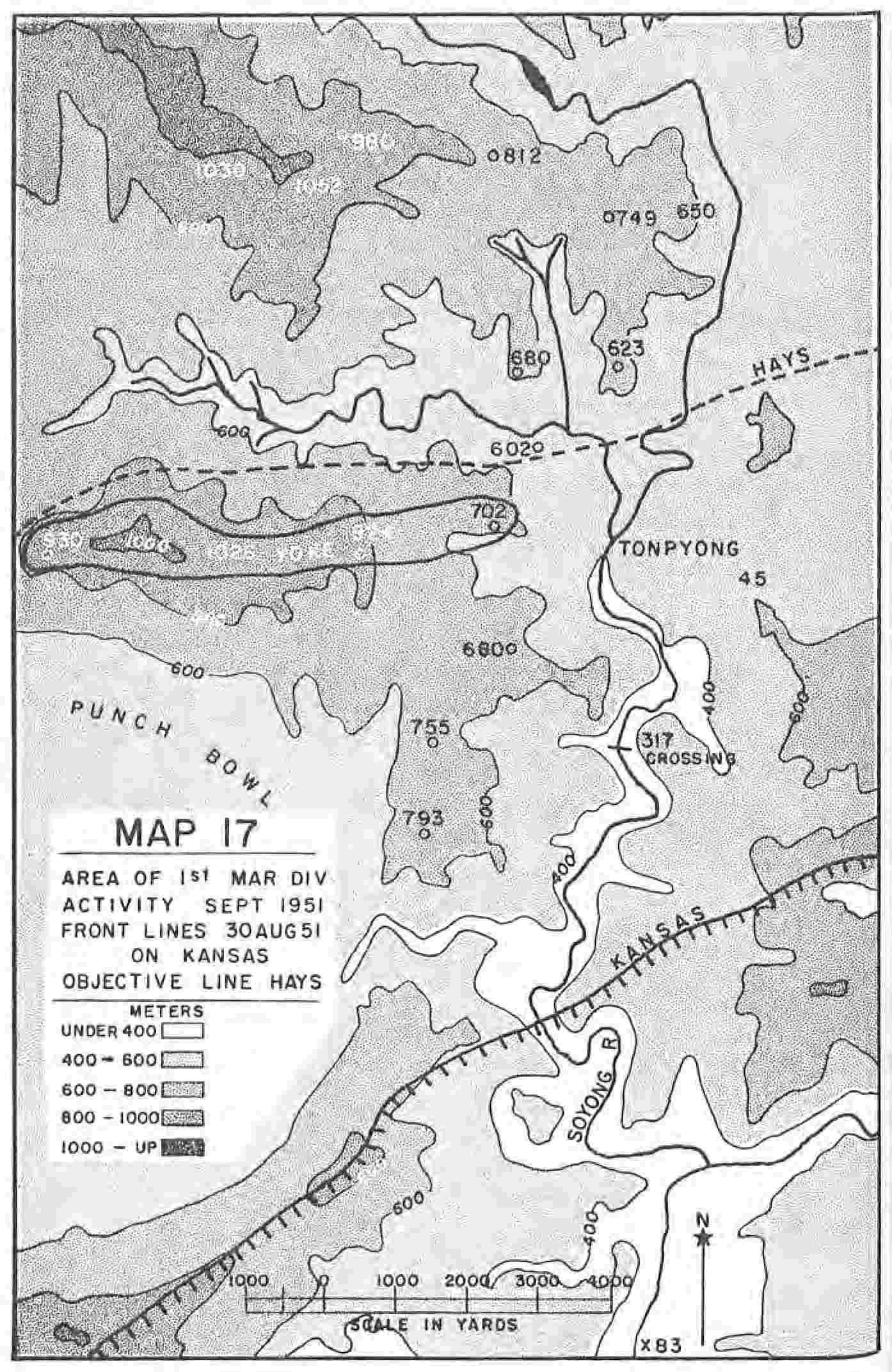
MAP 17
AREA OF 1st MAR DIV
ACTIVITY SEPT 1951
FRONT LINES 30 AUG 51
ON KANSAS
OBJECTIVE LINE HAYS
The 7th Marines and KMC Regiment, ordered to relieve U.S. and
ROK Army units on the KANSAS Line, started their march in a downpour
on 27 August. The 5th Marines (less 1st Battalion) at Inje
had orders to follow the 7th up the narrow Soyang valley.
Typical of the wet weather difficulties were those experienced by
3/7. Scheduled to depart early for the forward positions, the companies
struck tents. Trucks failed to arrive and they remained to eat
the noon meal, a gustatorial bonus of all food the galley crew could
not carry with them. Unfortunately, the trucks were delayed further
and the men shivered in the rain as they ate an evening meal of
“C” rations.
When the vehicles finally arrived at 2100 the rain had reached
torrential proportions. Progress was so slow over muddy roads that
it took until 0330 on the 28th to reach the CP of the 7th Marines at
Sohwari (Map 18), just southeast of the junction of the Soyang and
a tributary from the east.
The bivouac area assigned to 3/7 for the night proved to be a foot
deep in water, and Lieutenant Colonel Kelly directed his men to
catch what sleep they could in the trucks while he and his staff
attempted to straighten out the snarled traffic situation.271
It took the rest of the night for the 3/7 officers to walk the length
of the convoy, cutting out trucks with less essential cargo. With
only a small space available for a turn-around, the 3/7 vehicles were
ordered to back into it, unload their troops and equipment, and return
along a narrow road, which had been churned into a quagmire.
The battalion assembly area was on the other side of the rain-swollen
Soyang. How Company and the command group managed to
cross over a waist-deep ford, but the crossing was so perilous that
DUKWs were requested for the other two rifle companies. Lieutenant
Colonel Louis C. Griffin’s 2/7 also found the river crossing an operation
requiring DUKWs. By the afternoon of the 29th all elements of
the two 7th Marine battalions were on the west bank, occupying their
assigned assembly areas.
The relief proceeded slowly. Two KMC battalions on the left of
the 7th Marines took over the zone formerly held by elements of the
2d Infantry Division and the 8th ROK Division. The cosmopolitan
character of the Eighth Army was revealed when 2/KMC relieved the
French Battalion of the 2d Infantry Division. Linguistic chaos was
averted only by the best efforts of the exhausted interpreters.
By the 30th, the 1st and 3d KMC Battalions were behind the line of
departure on Hill 755, ready to attack in the morning. The 2d Battalion
assumed responsibility for the regimental zone on the KANSAS
Line.
The 2d and 3d Battalions of the 7th Marines had meanwhile completed
the relief of elements of the 8th ROK Division. On the other
side of the river Lieutenant Colonel James G. Kelly’s 1/7 had relieved
units of the ROK division on the hill mass a mile and a half north
of Tonpyong (Map 17). These Marines were first to come under fire
as the enemy sent over a few mortar rounds after dark on the 29th.
Division OpnO 22-51 directed the two assault regiments, the
7th Marines and KMCs, to attack at 0600 the following morning and
seize their assigned positions on Corps Objective YOKE, the ridgeline
running from Hill 930 on the west through Hills 1026 and 924 on the
east (Map 17). Objective 1, the hill mass 1½ miles northeast of
Tonpyong, was already occupied by 1/7.
The 3d Battalion, 7th Marines, was ordered to seize Objective 2,
generally that part of YOKE Ridge east of Hill 924. The KMC
Regiment was assigned Objective 3, consisting of Hills 924 and 1026.
Other 1st Marine Division units had the following missions on
31 August:
5th Marines—to patrol the Division zone along the KANSAS Line and protect
defensive installations;
1st Marines—to remain in the rear in the Hongchon area in X Corps reserve;
1st Tank Battalion—to move up in readiness to support the assault regiments;
Division Reconnaissance Company—to continue to patrol the Punchbowl and
mop up bypassed enemy.
Land mines were a constant menace to troop movements as the
assault regiments adjusted positions in preparation for the attack. As
usual, neglected “friendly” mines were encountered as well as those
planted by the enemy.272
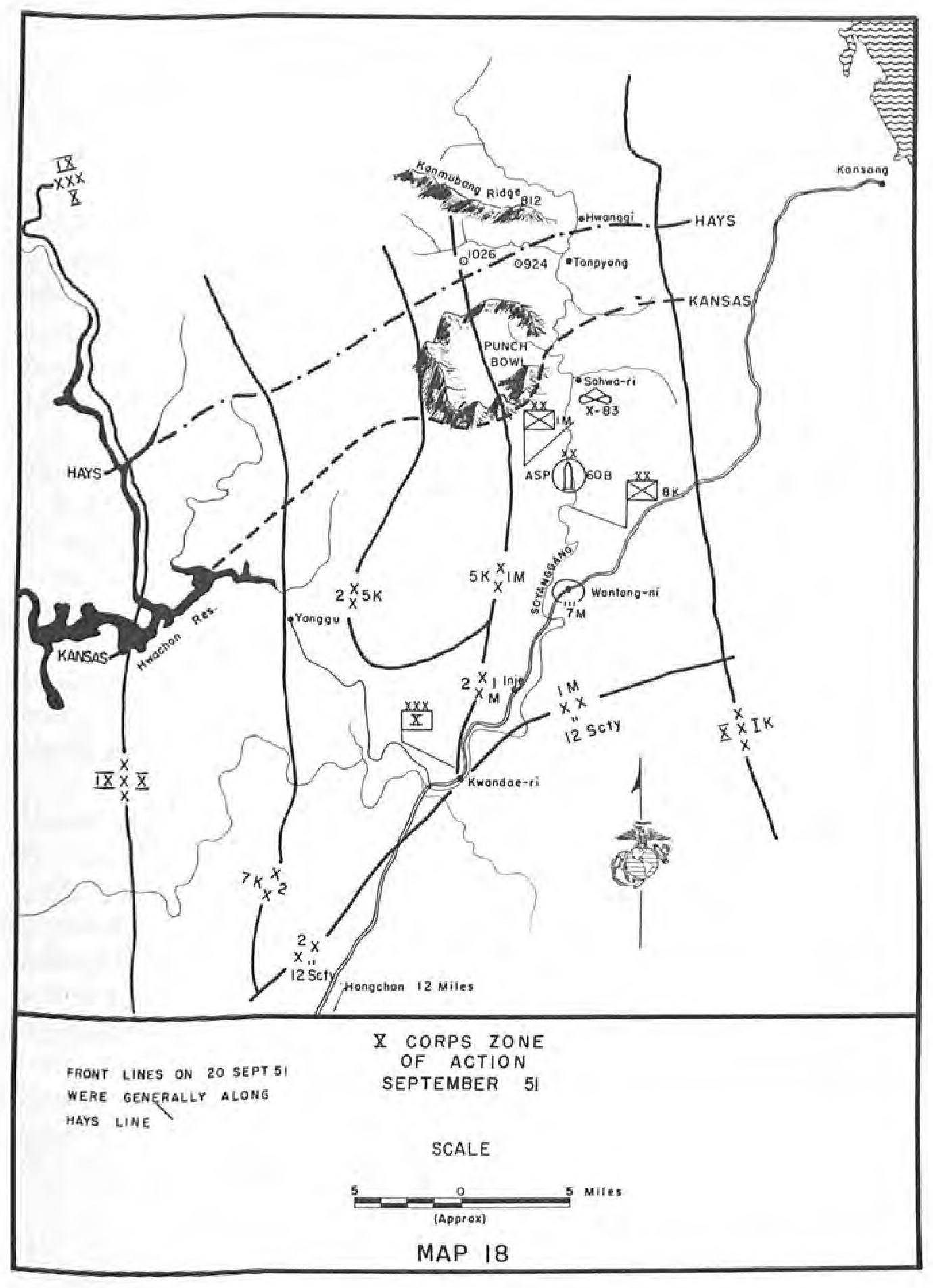
X CORPS ZONE
OF ACTION
SEPTEMBER 51
FRONT LINES ON 20 SEPT 51
WERE GENERALLY ALONG
HAYS LINE
MAP 18
POW information and air reports indicated a southward movement
of two to three enemy regiments with artillery and supplies. Prisoners
stated that an attack was due on 1 September, leading to the G-2
conjecture that the enemy’s Sixth Phase Offensive might be about to
start.
Priority of air support on 31 August was assigned to the two KMC
battalions. They jumped off in column against light to moderate
resistance, with Hill 924 as their first objective. Mine fields gave the
KMCs more trouble at first than scattered NKPA mortar and machine
gun fire. Forward movement and maneuver were restricted as
1/KMC passed through 3/KMC at 1445 to continue the attack against
stiffening resistance.
On the right 3/7 also encountered light resistance in the morning
which increased as the assault troops neared the objective. The slopes
of Hill 702 proved to be heavily mined, and forward elements of
3/7 were hit by a concentration of mortar and artillery fire.
East of the river, on the regimental right flank, where Objective 1
had been occupied without a fight, 1/7 supported the attack of 3/7
with mortar fire. Both 3/7 and the KMCs were within 1,000 yards of
their objectives late in the afternoon when a halt was called for the
day. Casualties had been light, thanks in large measure to excellent
air and artillery support.
When the attack was resumed on 1 September, 3/KMC moved
through positions of 3/7 to reach a ridgeline on the flank of the
regimental objective. While 3/KMC advanced from the northeast,
1/KMC closed in from the southeast. Both battalions took heavy
losses from enemy mines and mortars as well as machine guns and
automatic weapons fired from hidden bunkers. The converging attack
made slow but steady progress, however, until one company of
3/KMC drove within 200 meters of the top of Hill 924 at 1700. Even
so, it took four more hours of hard fighting to secure the objective.
That evening 2/KMC was relieved of its defensive responsibility along
the KANSAS Line by 3d Battalion, 5th Marines, enabling the KMC battalion
to join in the attack.
Throughout the day 3/7 slugged it out in the vicinity of 702 with
an NKPA battalion. Four counterattacks were launched from Hill 602,
the northeastern fork of YOKE Ridge. More than 500 men were employed
in this effort, some of them penetrating briefly into 3/7
positions. Two air strikes, called by patrols of 1/7 from across the
river, helped to break up the main NKPA attack, and the 11th Marines
(Colonel Custis Burton, Jr.), poured in a deadly concentration of
artillery fire. Lieutenant Colonel B. T. Kelly’s battalion continued to
be engaged until dusk.
The tenacity of the NKPA defense was demonstrated at the expense
of the KMCs when they were driven from the top of Hill 924 by a
surprise enemy counterattack at midnight. The Korean Marines came
back strongly at daybreak and a terrific fight ensued before the North
Koreans were in turn evicted shortly before noon. As a measure of the
artillery assistance rendered, Major Gordon R. Worthington’s 1st
Battalion, 11th Marines, fired 1,682 rounds of 105 ammunition in
support of the KMC’s during the 24 hours ending at 1800 on 2 September.
During the same period Lieutenant Colonel William McReynold’s
3/11 fired 1,400 rounds in support of 3/7. The other battalions
of the Marine artillery regiment, reinforced by the 196th, 937th, and
780th Field Artillery Battalions, USA, brought the number of rounds
to a grand total of 8,400 for this 24-hour period.
After the securing of Hill 924, the 2d Battalion of the KMC Regiment
passed through the 1st and 3d Battalions to spearpoint the attack
west toward Hill 1026. In the zone of 3/7, an NKPA counterattack
was repulsed at 0700 on 2 September. Two hours later George Company,
supported by How Company with mortar and machine gun fire,
moved out to resume the attack on Hill 602. Lieutenant Colonel
B. T. Kelly ordered his battalion heavy machine guns set up in battery
to deliver overhead supporting fires.
In slightly less than two hours the Marines of 3/7 swept the crest
of Hill 602, securing Division Objective 2. Three company-size enemy
counterattacks were repulsed before the North Koreans withdrew to
the north at 1500.
The 2d KMC Battalion fought its way to a point within 800 yards
of Hill 1026 before dusk. So aggressive and persistent was the NKPA
defense that several light enemy probing attacks were launched during
the night of 2–3 September, not only against forward Marine elements
but also against the 5th Marines units on the KANSAS Line, 5 miles to
the rear. The front was where you found it.
While 3/7 constructed emplacements and obstacles on Hill 602,
the KMCs continued their attack on the morning of 3 September
toward Hill 1026. With the extending of the 7th Marines zone to the
left to decrease the width of the KMC front, 2/7 was brought up from
regimental reserve to help cover a new sector that included Hill 924.
The attack led by 2/KMC collided with a large-scale enemy counterattack.
It was nip and tuck for 3½ hours before the North Koreans
broke, but, by midmorning, the KMCs were in possession of Division
Objective 3 and consolidating for defense. They were not a moment
too soon in these preparations, for the enemy counterattacked at 1230
and put up a hot fight for two hours before retiring.
This action completed the battle for Corps Objective YOKE. At
1800 on 3 September, the 1st Marine Division was in full possession
of the HAYS Line, dominating the entire northern rim of the Punchbowl
(Map 18). Reports from the U.S. 2d Infantry Division and
5th ROK Division, attacking in sectors to the west, indicated that the
pressure exerted by the Marines was assisting these units. Large gains
had been made on the west side of the Punchbowl against comparatively
light resistance.
On 4 September, with all objectives consolidated, 1st Marine Division
units patrolled northward from defensive positions. Plans were
being formed for the second phase of the Division attack—the advance
to seize the next series of commanding ridgelines, 4,000 to 7,000 yards
forward of the present MLR.
The victory in the four-day battle had not been bought cheaply. A
total of 109 Marine KIA and 494 WIA (including KMCs) was
reported. NKPA casualties for the period were 656 counted KIA and
40 prisoners.
As evidence that the enemy had profited by the breathing spell
during the Kaesong truce talks, it was estimated that NKPA artillery
fire in the Punchbowl sector almost equalled the firepower provided
by the organic Marine artillery and the guns of attached U.S. Army
units. NKPA strength in mortars and machine guns also compared
favorably with that of Marines.
Logistical shortages made it necessary for the 1st Marine Division to
call a six-day halt and build up a new reserve of artillery and mortar
ammunition.
During the first phase of the Division attack, the main burden of
transport and supply had fallen upon three Marine units—the 1st
Ordnance Battalion (Major Harold C. Borth), the 1st Motor Transport
Battalion (Lieutenant Colonel Howard E. Wertman), and the
7th Motor Transport Battalion (Lieutenant Colonel Carl J. Cagle).
The extraordinary expenditure of artillery shells for these four days
posed a resupply problem that was aggravated by an almost impassable
supply route. The three Marine battalions had to strain every resource
to meet minimal requirements.
Ammunition Supply Point (ASP) 60-B, a U.S. Army installation
manned by elements of the Marine 1st Ordnance Battalion, was
located about five miles behind the gun positions. From this dump it
was 48 miles to Hongchon, the source of supplies for ASP 60-B.
A well maintained, two-lane dirt road led from that base to Inje,
but northward it deteriorated into a narrow, twisting trail following
the Soyang valley. Recent rains, resulting in earth slides and mudholes,
had reduced the road to such a condition that the round trip between
ASP 60-B and Hongchon took 25 hours.273
As an added complication, it was necessary to build up a 10-day
reserve of ammunition at ASP 60-B so that Division transport would
be available for lifting 2,000 rotated troops to Chunchon some time
between 3 and 15 September. This meant that 50 to 60 Marine trucks
must be employed daily to haul ammunition, with the result of a
drastic shortage of motor transport for other purposes.
Only human transport was available for supplying Marines on the
firing line. X Corps started the month of September with 20,070
Korean Service Corps, the successor to CTC, and civilian contract
laborers—the equivalent in numbers of a U.S. Army infantry division.
Even so, 14 air drops were necessary during the month, only one of
which went to a Marine unit. This took place on 1 September, when
20 Air Force cargo planes from Japan dropped ammunition and rations
to the KMCs. A 90 percent recovery was reported.274
It generally took a full day in the 1st Marine Division zone during
the first week of September for a cargador to complete the trip from
a battalion supply point to the front lines and return. This made it
necessary to assign from 150 to 250 Korean laborers to each infantry
battalion. And as the Marines advanced farther into the rugged
Korean highlands, the logistic problem was increased.
Enemy groups moving southward into the zone of the 1st Marine
Division during the six-day lull were sighted by air observation. POW
interrogations and other G-2 sources established that the 2d NKPA
Division, II Corps, had been relieved by the 1st NKPA Division, III
Corps. Accurate 76mm fire from well-hidden guns was received by
the Marines throughout the interlude, and patrols ran into brisk
mortar fire when they approached too near to enemy bunkers on
Hill 673.
For the second time, during the night of 4–5 September, 5th
Marines units were assailed on the KANSAS Line, 5 miles to the rear
of the 7th Marines troops similarly deployed along the HAYS Line.
Yet a large 7th Marines patrol ranged forward some 2,000 yards the
next day without enemy contacts. A like result was reported by a
patrol representing almost the entire strength of the Division Reconnaissance
Company (Major Robert L. Autry) after it scoured the area
north of the Punchbowl.275
1st Marine Division OpnO 23-51, issued on the morning of
9 September, called for the 7th Marines to jump off at 0300 on the
11th and attack Objectives ABLE and BAKER—Hills 673 and 749
respectively—white maintaining contact with the 8th ROK Division
on the right. Other Division units were given these missions:
1st Marines—to be released from X Corps reserve near Hongchon to Division
control; to be prepared to pass through the 7th Marines, when that
regiment secured its objectives, and continue the attack to seize Objective
CHARLIE, the ridgeline leading northwest from Hill 1052.
5th Marines—to maintain one company on KANSAS line while occupying
positions in Division reserve along HAYS Line in rear of 7th Marines.
KMC Regiment—to patrol aggressively on Division left to exert pressure on
enemy defenses south and southeast of Objective CHARLIE.
11th Marines—to displace forward to support attack of the 7th Marines.
Division Reconnaissance Company—to patrol northward in the Soyang
valley as far as Hwanggi to deny the enemy this area.
The area ahead of the 7th Marines was ideal for defense. From
YOKE Ridge the assault troops had to descend into a narrow valley
formed by a small tributary of the Soyang-gang, cross the stream, and
climb Kanmubong Ridge on the other side. This formidable piece of
terrain was dominated by three enemy positions, Hills 812, 980, and
1052 (Map 17). Thus the attack of the 7th Marines had as its
primary purpose the securing of initial objectives on Kanmubong
Ridge that would give access to the main NKPA defense line, some
4,000 yards to the north.
The 7th Marines was to seize the eastern tip (Objective ABLE) of
this commanding terrain feature and “run the ridge” to Hill 749,
Objective BAKER. While Lieutenant Colonel Louis G. Griffin’s 2/7
maintained its patrolling activities on the left, tied in with the KMCs,
Lieutenant Colonel B. T. Kelly’s 3/7 in the center and Lieutenant
Colonel J. G. Kelly’s 1/7 on the right were to attack.
As an intermediate regimental objective on the way to Kanmubong
Ridge, the 680-meter hill directly north of B. T. Kelly’s position on
Hill 602 was assigned to his battalion. He ordered How Company
to move forward under cover of darkness and be prepared to attack
at dawn. Rain and poor visibility delayed the attempt until surprise
was lost, and after a fierce fire fight How Company was stopped halfway
up the southeast spur.
In order to relieve the pressure, the battalion commander directed
Item Company to attack on the left up the southwest spur. This
maneuver enabled How Company to inch forward under heavy mortar
and machine gun fire to a point with 50 yards of the topographical
crest. Item Company became confused in the “fog of war” and finally
wound up on How’s spur at 1245.
Twice the two companies made a combined assault after artillery
and mortar preparation and air strikes with napalm, rocket, and
strafing fire. Both times the North Koreans swarmed out of their
bunkers to drive the Marines halfway back to the original jump off
line. It was anybody’s fight when the two battered companies dug
in at dusk.
Across the valley to the east, J. G. Kelly’s 1/7 had no better fortune
in its attack on Hill 673. Heavy enemy mortar and machine gun fire
kept the assault troops pinned down until they consolidated for
the night.
With both attacking battalions in trouble, Colonel Nickerson
ordered 2/7 to advance up the narrow valley separating them. His
plan called for the reserve battalion to move under cover of darkness
around the left flank of 1/7 and into a position behind the enemy
before wheeling to the northeast to trap the North Koreans defending
Hill 673.
The maneuver succeeded brilliantly. Griffin’s troops were undetected
as they filed northward during the night, making every effort
to maintain silence. By daybreak on 12 September 2/7 had two
platoons in position behind the enemy to lead the attack.276
The assault exploded with complete surprise as 2/7 swept to the
crest of Hill 673 against confused and ineffectual opposition. Griffin’s
battalion and 1/7 had the enemy between them, but the jaws of the
trap could not close in time because of NKPA mine fields. Thus 1/7
continued to be held up on the forward approaches to Hill 673 by
NKPA mortar and small-arms fire. Grenades were the most effective
weapons as J. G. Kelly’s men slugged their way to the summit at 1415
while 2/7 was attacking Objective BAKER, Hill 749.
On the other side of the valley, 3/7 had seized its initial objective.
While How and Item Companies attacked up the southeast spur,
where they had been stopped the day before, George Company
launched a surprise assault up the southwest spur. This was the blow
that broke the enemy’s will to resist. George Company knocked out
seven active enemy bunkers, one by one, thus taking the pressure off
the troops on the other spur. At 1028 all three companies met on
the summit.
The 2d Battalion, 7th Marines, radioed that Objective BAKER had
been secured at 1710 after a hard fight, but this report proved to be
premature. Enough NKPA troops to give the Marines a good deal of
trouble were still holding the wooded slopes of Hill 749, and it
would take the attack of a fresh battalion to dislodge them. Along
the ridgeline from Hill 673 to Hill 749, an undetermined number of
enemy soldiers had been caught between 2/7 and 1/7, and events
were to prove that they would resist as long as a man remained alive.
Casualties of the 1st Marine Division on 11 and 12 September
were 22 KIA and 245 WIA, nearly all of them being suffered by the
assault regiment. Enemy losses included 30 counted KIA and 22
prisoners.
With the Division in reserve from 15 July until the latter part of
August, close air support (CAS) was not a vital problem; however,
upon return to the Punchbowl area the situation became serious. The
difficulties arose from the time lag between the request for air support
to the time the planes arrived over target. The 1st Marine Aircraft
Wing operating under the control of the Fifth Air Force was busily
employed on interdiction missions. On 30 August, a tactical air observer,
spotting what appeared to be a division of NKPA troops moving
toward the Marines, hurriedly flashed back a request for a multi-plane
strike. The enemy troops were beyond artillery range, but
they were bunched up—a good target for a concentrated air strike.
It was more than three hours later that four fighter bombers arrived on
the scene; by that time, the enemy formation had dispersed and the
desired number of casualties could not be inflicted.277
The reason for this lack of timely air support was apparent. Most
of the UN air power was being funneled into Operation STRANGLE,
the interdiction operation designed to cut off the enemy’s vehicular
and rail traffic in the narrow waist of North Korea. With the emphasis
on air interdiction, close air support sorties were limited to only 96
per day for the entire Eighth Army.278 The 1st Marine Division received
only a proportionate share.
Marine close air support was needed because of the enemy’s determined
resistance to the Division’s attack. The Reds hurled frequent
night counterattacks and pounded the Marine positions with artillery
and mortars hidden in the precipitous Punchbowl area. At one time
it was estimated that the enemy was using 92 pieces of artillery. The
Marines had only 72 field pieces, but in one 24-hour period they
expended more than 11,000 rounds of artillery ammunition on a
6,000-yard frontage. The enemy emplacements, hewn out of solid
rock, were hard to knock out.
To support the hard-working infantrymen, Marine Aircraft Group
12 (MAG-12) had moved VMF-214 and VMF-312 from the
Pusan area to K-18, an airfield on the east coast at Kangnung. By
moving closer to the Division area, planes were able to extend their
time over the target area and render more effective support to the
infantry. Also, Marine Air Support Radar Team One (MASRT-1)
was sent to Korea and established positions to support the Division.
Using its support radar the team began to evaluate its capability of
guiding unseen fighter-bombers at night or under conditions of poor
visibility.279
Even though the Corsairs at K-18 were less than 50 miles from
the 1st Marine Division, very few were available to the Marines.
Operation STRANGLE, in full swing, was not achieving the desired
results. Since sightings of enemy vehicles were increasing, more and
more Marine and Navy air sorties were channeled into interdiction.
During 18 days of rugged fighting from 3 to 21 September, forward
air controllers made 182 tactical air requests. Fighter-bombers were
provided on 127 of these requests; however, in only 24 instances did
the planes arrive when needed. The average delay time in getting CAS
in response to requests during September was slightly less than two
hours, but in 49 cases the planes were more than two hours late.280
As a consequence, General Thomas reported, many of the 1,621
casualties suffered by the 1st Marine Division during the hard fighting
in September were due to inadequate close air support. Furthermore,
he said, the tactical capabilities of his battalions were strongly
restricted.
During the planning of attacks, infantry commanders almost always
desired and requested close air support. It was also desirable to have
planes on station overhead should an immediate CAS need arise, for
the lack of an air strike when needed could jeopardize success. However,
with restricted availability of CAS planes due to participation in
STRANGLE, many times desired air cover was not to be had. Attacks
under those circumstances were often costly.
The relief of the three battalions of the 7th Marines by their corresponding
numbers of Colonel Thomas A. Wornham’s 1st Marines
took place during the night of 12–13 September. By daybreak 3/1
and 1/1 had assumed responsibility for the zones of 3/7 and 1/7,
which were on their way to Division reserve at Wontong-ni at the
junction of the Inje and Kansong roads. In the center, however,
2/1 could not complete the relief of 2/7. Not only was that battalion
engaged most of the day with the enemy, but the units were separated—one
company south of Hill 749 being unable to join the other two
companies on separate spurs northwest of that height. All three were
under persistent NKPA mortar and 76mm fire.281
The attack of the 1st Marines, originally scheduled for 0500 on
13 September, had been changed to 0900 by Division orders. One
reason for the postponement was the serious shortage of ammunition
and other supplies after the urgent demands of the last two days.
Another reason was the inability of VMO-6 helicopters, lifting two
wounded men at most, to cope with the mounting casualty lists.
Enemy interdiction of roads added in several instances to the complications
of a major logistical problem, particularly in the zone of
Lieutenant Colonel Franklin B. Nihart’s 2d Battalion, 1st Marines.
The hour had struck for HMR-161, and the world’s first large-scale
helicopter supply operation in a combat zone would soon be under
way. It was not the development of a day. On the contrary, its roots
went all the way back to 1945, when the atomic bomb of Hiroshima
rendered obsolescent in 10 seconds a system of amphibious assault
tactics that had been 10 years in the making. Obviously, the concentrations
of transports, warships, and aircraft carriers that had made
possible the Saipan and Iwo Jima landings would be sitting ducks
for an enemy armed with atomic weapons.
The problem was left on the doorstep of the Marine Corps Schools,
which had reared the Fleet Marine Force from infancy to maturity
during the 1930’s. A Special Board and Secretariat were appointed
for studies. They assigned two general missions to Marine Helicopter
Experimental Squadron 1 (HMX-1), organized late in 1947 before
the first rotary-wing aircraft had been delivered. These missions were:
(1) Develop techniques and tactics in connection with the movement of
assault troops by helicopter in amphibious operations;
(2) Evaluate a small helicopter as a replacement for the present OY type
aircraft to be used for gunfire spotting, observation, and liaison missions in
connection with amphibious operation.282
The second mission resulted in the small Sikorsky and Bell helicopters
of VMO-6 which landed in Korea with the 1st Provisional
Marine Brigade in August 1950. Although it was originally believed
that rotary wing aircraft might replace the OYs, combat experience
soon demonstrated that the best results were obtained by retaining
both types in fairly equal numbers.
Landing exercises under simulated combat conditions were conducted
by HMX-1 in fulfillment of the first mission. At first the
squadron had only three-place helicopters. Later, when the usefulness
of the helicopter was fully realized, even the new 10-place “choppers”
were never available in sufficient numbers. The capacity designations
of these machines, however, were more ideal than real, for the helicopters
could lift only four to six men in addition to the pilot, copilot,
and crewman. Despite such drawbacks, HMX-1 developed tactical
and logistical techniques for helicopter landings to be made from
widely dispersed carriers against an enemy using atomic weapons.
Belated deliveries of aircraft delayed the commissioning of the
world’s first transport helicopter squadron, HMR-161, until 15 January
1951 at El Toro. Lieutenant Colonel George W. Herring was
designated the commanding officer and Lieutenant Colonel William P.
Mitchell the executive officer.
Nearly three months passed before the first three transport helicopters
arrived. The squadron was gradually built up to a strength of 43
officers and 244 enlisted men with a full complement of 15 HRS-1
helicopters. These Sikorsky aircraft, designed to Marine specifications,
were simply an enlarged three-place HO3S in configuration, with a
similar main rotor and vertical tail rotor. About 62 feet long with
maximum extension of rotor blades, the HRS-1 was 11½ feet wide
with the blades folded. Following are some of the other statistics:
Gross weight at sea level, 7,000 pounds; cruising speed, 60 knots;
payload at sea level, 1,420 pounds; troop-lifting capacity, four to six
men with full combat equipment or three to five casualties in litters.283
Capabilities varied, of course, according to such factors as altitude,
temperature, and pilot experience.
Marine Transport Helicopter Squadron 161 arrived in Korea on
the last day of August, and by the 10th of September it had moved
up to the front, sharing Airfield X-83 (see Map 18) with VMO-6.284
The 11th was devoted to reconnaissance flights in search of landing
sites, and on the 12th the transport squadron was ready for its first
combat mission. A new means of logistical and tactical support that
was to revolutionize operations and create front page headlines had
arrived in Korea.
Prior to the squadron’s arrival, the Division chief of staff, Colonel
Victor H. Krulak, had held numerous planning conferences with
Division staff officers, and preparations for the employment of
HMR-161 had made noteworthy progress. Then General Thomas
ordered executed the first operation of the squadron under combat
conditions, and the major logistical problem of moving supplies and
evacuating casualties was well on the way to being solved. At 1600
on 13 September 1951—a date that would have historical significance—Operation
WINDMILL I was set in motion.
Lieutenant Colonel Herring had attended the final planning conference
at Division headquarters at 0830 on the 13th, and he was
told that the operation would involve a lift of one day’s supplies to
2/1 over a distance of seven miles. The commanding officer of 2/1
was to select suitable landing points and the commanding officer of 1st
Shore Party Battalion had the responsibility of providing support
teams to operate at the embarkation and landing points.285
Only two days had been available for training and rehearsals, but
not a minute was wasted. All morning on the 13th the embarkation
point section separated the supplies into balanced loads of about 800
pounds per helicopter. Loading commenced at 1520. Half an hour
later, seven aircraft were ready to depart while four others went
ahead to carry the landing point section to the previously reconnoitered
site.
The route followed the valleys as much as possible, so that the
helicopters were in defilade most of the way. Smoke was laid down by
the 11th Marines for concealment.
The landing point section managed in 20 minutes to clear an area
of 20 × 40 feet (later enlarged to 100 × 100 feet) and mark it with
fluorescent panels. At 1610 the first HRS-1 hovered with cargo nets
suspended from a hook released by manual control. A few minutes
later it took off with five walking wounded and two litter cases.
Each helicopter carried out as many casualties as possible, depending
on the amount of gasoline in the fuel tanks. Only 30 minutes passed
from the time one Marine was wounded and the time of his arrival at
a hospital clearing station 17 miles behind the firing line.
Radio provided communications between helicopters in flight,
HMR-161 headquarters, 2/1 CP, and the Shore Party team at the
landing site.
Fifteen aircraft were employed for one hour, three for two hours,
and one for two hours and 45 minutes—a total of 28 flights in over-all
time of 2½ hours. The helicopters landed at intervals of two minutes
and took off as soon as the landing point section could put the casualties
aboard. And though an altitude of 2,100 feet restricted loads, 18,848
pounds of cargo had been lifted into the area and 74 casualties
evacuated when the last “chopper” returned to X-83 at 1840.
To even the most pessimistic observer Operation WINDMILL I was
a complete success, so successful that a similar operation, WINDMILL II
was conducted on the 19th. Two days later the first helicopter lift of
combat troops was completed. A new era of military transport had
dawned.
Although 2/1 alone had 240 Korean cargadores attached, the 7½ tons
of helicopter-borne supplies, largely ammunition, were vitally needed
by the two assault battalions of the 1st Marines. After relieving Fox
Company of 2/7 south of Hill 749 at 1100 on the 13th, Lieutenant
Colonel Nihart’s 2/1 jumped off to the attack an hour later. Stiff
opposition was encountered from the beginning. The relief of the
remaining two companies of 2/7 was complicated by the fact that they
were some 400 yards from the position reported, on the reverse slope
of Hill 749. Throughout the day these Marines were heavily engaged
with the enemy.286
On the left of 2/1, the 3d Battalion (Lieutenant Colonel Foster C.
La Hue) could not make much progress toward its regimental objective,
Hill 751, while the enemy was active on Hill 749. A second
attack of 2/1 at 1500 drove to the summit of that height after fierce
fighting with small arms, automatic weapons, and hand grenades.
There was still much fighting to be done before the entire objective
would be secured since many enemy bunkers hidden among the trees
remained to be neutralized.
At 1600 a gap of about 300 yards separated 2/1 from the two 2/7
companies. So fierce was enemy resistance in this area that it took
until 2025 for Nihart’s men to complete the relief after fighting for
every foot of ground.
Air and artillery support had been excellent on the 13th despite the
fact that neither could be called by 2/1 in some instances because of the
danger of hitting elements of 2/7. Even so, 2/11 (Lieutenant Colonel
Dale H. Heely) and other artillery units fired 2,133 rounds and
Company C of the 1st Tank Battalion (Lieutenant Colonel Holly H.
Evans) contributed 720 rounds of 90mm fire which knocked out six
enemy bunkers. The 4.2″ mortars had a busy day firing 261 HE and
28 WP rounds, and Company C of the 1st Engineer Battalion (Lieutenant
Colonel John V. Kelsey) supported the attack by clearing
mine fields.
Mortar fire was received by the 1st Marines throughout the night,
and 3/1 repulsed a series of counterattacks by an estimated 300 enemy.
Colonel Wornham’s regiment continued the attack at 0800 on 14 September.
Both the 2d and 3d Battalions inched their way forward
against a heavy volume of well-aimed enemy mortar, artillery, and
automatic weapons fire.
NKPA resistance persisted on the wooded northern slope of Hill 749,
where hidden bunkers had to be knocked out, one by one. It took
constant slugging for 2/1 to advance 300 meters before dusk, enabling
3/1 to fight its way to the summit of Hill 751. Again the flat trajectory
fire of Company C tanks had been helpful as 400 rounds were
directed against NKPA bunkers, while the 11th Marines fired 3,029
rounds.
The 15th was a relatively quiet day as compared to the previous
48 hours. In preparation for an expected passage of lines, the action
took a slower tempo as units consolidated their positions. The principal
fight of the day was a continuation of the attack by 2/1 north of
Hill 749. Although the battalion commander had arranged for a
heavy artillery preparation, the attack, which jumped off at 1710, was
stopped at 1800 by a terrific pounding from NKPA mortars and artillery
coupled with a crossfire of machine guns from concealed bunkers.
The assault troops withdrew under effective covering fire by the 11th
Marines to positions occupied the previous night. Objective BAKER
yet remained to be secured.
The Marines could not help paying reluctant tribute to the skill
as well as obstinacy of the NKPA defense. Enemy bunkers were so
stoutly constructed that the North Koreans did not hesitate to direct
well aimed mortar fire on their own positions when the Marines closed
in for the final attack.
Nkpa fields of fire were laid out for the utmost effect. Marines
with recent memories of college football referred to the enemy’s
effective use of terrain as the “North Korean T Formation.” On
Hill 749, for example, the main ridgeline leading to the summit was
crossed by another wooded ridgeline at right angles. Attackers fighting
their way up the leg of the “T” came under deadly crossfire from
the head of the imaginary letter—a transverse ridgeline bristling with
mortars and machine guns positioned in bunkers.
In accordance with Division OpnO 25-51, the 5th Marines (Colonel
Richard C. Weede) moved up to assembly areas on 15 September in
preparation for passing through 3/1 on the 16th to continue the
attack. The 3d Battalion, 1st Marines in turn would relieve 1/1
(Major Edgar F. Carney, Jr.), so that it could pass through 2/1 and
carry on the assault to complete the securing of Hill 749.
The KMCs and Division Recon Company were to relieve the 5th
Marines of responsibility for the HAYS Line, while the 7th Marines
remained in reserve at Wontong-ni.
The comparative quiet of the 15th was shattered a minute after
midnight when the enemy launched a savage four-hour attack to drive
2/1 off Hill 749. The NKPA hurricane barrage that preceded the attempt,
according to the Division report, “reached an intensity that was
estimated to surpass that of any barrage yet encountered by the 1st
Marine Division in Korea.”287
The thinned companies of 2/1 took a frightful pounding from
76mm, 105mm, and 122mm artillery supplemented by 82mm and
120mm mortars. Bugles and whistles were the signal for the onslaught.
It was stopped by weary Marines who demonstrated at NKPA
expense that they, too, could put up a resolute defensive fight.
Wave after wave of attackers dashed itself at the thinned Marine
platoons, only to shatter against a resistance that could be bent but
not broken. The fight was noteworthy for examples of individual
valor. When one of the forward Marine platoons was compelled to
give ground slowly, Corporal Joseph Vittori of Fox Company rushed
through the withdrawing troops to lead a successful local counterattack.
As the all-night fight continued, “he leaped from one foxhole
to another, covering each foxhole in turn as casualties continued to
mount, manning a machine gun when the gunner was struck down
and making repeated trips through the heaviest shell fire to replenish
ammunition.”288
Vittori was mortally wounded during the last few minutes of the
fight, thus becoming the second Marine of 2/1 within a 48-hour period
to win the Medal of Honor. His predecessor was Pfc Edward Gomez
of Easy Company. When an enemy grenade landed in the midst of
his squad on 14 September, he “unhesitatingly chose to sacrifice himself
and, diving into the ditch with the deadly missile, absorbed the
shattering violence of the explosion in his own body.”289
Not until 0400 on the 16th did the enemy waves of attack subside
on Hill 749. Nkpa strength was estimated at a regiment. A combined
assault by an estimated 150 enemy on 3/1 positions to the west in the
vicinity of Hill 751 was repulsed shortly after midnight, as were three
lesser efforts during the early morning hours of the 16th.
When the 1st Battalion, 1st Marines moved out at 0830 to pass
through 2/1 and continue the fight, it was the first day of command
for Lieutenant Colonel John E. Gorman.290 The passage of lines was
slowed by enemy mortar fire, and NKPA resistance stiffened as 1/1
attacked along the ridgeline leading toward Hill 749. At 1800, after
a hard day’s fighting, Objective BAKER was occupied and defensive
positions were organized for the night.
Thus was the attack of the 1st Marines terminated. Around Hill
751, 3/1 remained in control. The regiment’s other two battalions,
1/1 and 2/1, held a defensive line about 1,500 yards long on both
sides of Hill 749.
Hill 749 had finally been secured. A number of mutually supporting
hidden enemy bunkers had been knocked out in a ruthless battle of
extermination, and veterans of the World War II Pacific conflict were
reminded of occasions when Japanese resistance flared up in similar
fashion after ground was thought to be secure.
Casualties of the 1st Marine Division during the four-day fight for
Hill 749, most of them suffered by the attacking regiment, were
90 KIA, 714 WIA, and 1 MIA. Enemy losses for the same period were
771 counted KIA (although more than twice that number were estimated
KIA) and 81 prisoners.
Division OpnO 25-51 assigned the 5th Marines the mission of passing
through 3/1 in the vicinity of Hill 751 and attacking to secure
Objective DOG, the bare, brown hill mass which loomed approximately
1,000 yards ahead. The last few hundred yards were certain to be
long ones, for the main east-west ridgeline leading to Hill 812 was
crossed by a north-south ridgeline—the leg and head of another “T”
formation. Again, as on Hill 749, the attackers had to fight their
way through a vicious crossfire.
Lieutenant Colonel Houston Stiff’s 2/5 on the right had the main
effort. The 3d Battalion, 5th Marines (Lieutenant Colonel Donald R.
Kennedy) was to advance on Stiff’s left with the mission of supporting
his attack on Objective DOG, prepared to seize Hill 980 on order.
Lieutenant Colonel William P. Alston’s 1/5 remained in regimental
reserve.291
Fox Company spearheaded the 2/5 attack by moving initially up
the low ground between Hill 673 on the right hand and 680 on the
left. Owing to delays in completing the relief of 1st Marines elements,
it was early afternoon on 16 September before the assault got underway.
Progress was slow against heavy mortar and machine gun fire,
and a halt came at 1700 for regrouping and evacuation of casualties.
Dog Company, in support on the ridge to the left, sighted troops
approaching the objective and requested that the positions of the
assault company be identified. In order to pinpoint the locations,
a white phosphorous grenade was used as a mark. It attracted the
attention of aircraft summoned by 3/5 against Hill 980 (Map 17),
from which fire had been received. The planes, assuming that another
target had been designated, attacked the forward platoons of Fox
Company with napalm and machine guns. By a miracle, recognition
panels were put out before a single casualty resulted, but the men
found it a harrowing experience.
Darkness fell before the attack could be resumed, and Fox Company
pulled back along the ridgeline to set up a perimeter defense and
evacuate the wounded. The night passed without enemy action. Bright
moonlight made for unusual visibility which discouraged enemy attacks
and permitted the Marine assault platoons more sleep than might
otherwise have been expected.
Regimental orders called for 2/5 to resume the attack at 0400 on
the 17th, supported by the fires of 3/5, while 1/5 continued in reserve.
Fox Company of 2/5 had some difficulty in orienting itself after the
confusion of the night before and was delayed until 0700 in jumping
off. This proved to be a stroke of luck, for dawn gave the Marines a
good view of unsuspecting enemy troops eating breakfast and making
ready for the day’s fighting. Fox Company called artillery on them
with good effect.
Surprise gave the attack an opening advantage and rapid progress
was made at first along the main ridgeline leading west to Hill 812.
Then Fox Company was stopped by the crossfire from the head of
the “T.” Easy Company passed through at 0830 to continue the
assault, reinforced by a platoon of Fox Company that had become
Separated from its parent unit, although it kept in touch by radio.
An air strike was called but did not materialize. After waiting for
it in vain, Easy Company drove toward the summit with the support
of artillery and mortars.
Two hours after passing through Fox Company, the attackers
had advanced only about a hundred yards against the NKPA crossfire.
At 1100, Lieutenant Colonel Stiff ordered an all-out drive for the
objective, following a preliminary barrage of everything that could
be thrown at the enemy—artillery, 75mm recoilless, rockets, and 81mm
and 4.2″ mortars. As soon as the bombardment lifted, Easy Company
was to drive straight ahead along the ridgeline while the 2d Platoon
of Fox Company made a flank attack.
This maneuver turned the trick. The blow on the flank took the
enemy by surprise, and in just 36 minutes the assault troops were on
the summit after a hard fight at close quarters with automatic weapons
and grenades. Since regimental orders had specified “before nightfall,”
Objective DOG had been seized ahead of schedule.
With scarcely a pause, Easy Company continued along the ridgeline
leading west from Hill 812 toward Hill 980. Remarkably fast progress
was made against an enemy who appeared to be thrown off balance.
Permission was asked to seize Hill 980. The regimental commander
refused because of instructions from Division to the effect that this
position could not be defended while the enemy remained in possession
of Hill 1052, the key terrain feature. Easy Company was directed to
withdraw 600 yards toward Hill 812.
Late in the evening of 17 September, Colonel Weede directed his
two assault battalions to consolidate on the best ground in their
present locations and prepare to hold a defensive line.
When the brakes were put on the attack, 3/5 was strung out over
a wide area to the north of Hill 751. This battalion was not tied in
with 2/5, which occupied positions coordinated for the defense of
Hill 812—Easy Company to the west, on the ridgeline leading to 980;
Dog and Weapons Company to the south, protecting the left flank;
and Fox Company to the east.
Both Easy and Fox Companies were under fire from Hills 980 and
1052, and daytime movement on 812 was restricted to the northern
slope. Even so, sniping shots from well aimed North Korean 76mm
mountain guns inflicted a number of casualties.
An abrupt change in the enemy’s strategy became evident throughout
these September operations. Where he had previously contented himself
with an elastic defense, every position was now bitterly fought for
and held to the last man. When it was lost, counterattacks were
launched in efforts to regain it.
One of these attempts hit the western outpost of 2/5’s Easy Company
at 0430 on 18 September, compelling the Marines to give ground.
A second counterattack at 0840 was repulsed. Enemy fire from
Hills 980 and 1042 continued all day long, and Colonel Stiff’s battalion
suffered most of the 16 KIA and 98 WIA casualties reported by the
Division for 18 September.
The night of 18–19 September passed in comparative quiet, but at
daylight the enemy on Hills 980 and 1052 was still looking down the
throats of the 2/5 Marines. None of the participants will ever forget
a landmark known simply as “the Rock”—a huge granite knob
athwart the ridgeline approximately 700 yards west of Hill 812. Only
12 feet high, its location made it visible from afar. The Marines
outposted the top and eastern side, while the enemy held tenaciously
to the western side. Along the northern slope of the ridge leading
west to the Rock were the only positions affording protection to the
dug-in forward elements of the battalion.
The need for fortification materials such as sand bags, barbed wire,
and mines aggravated the already serious supply problems of 2/5.
A request for helicopter support was sent at 1100 on the 19th and
approved immediately by General Thomas. Loading commenced early
the same afternoon, and Operation WINDMILL II was launched. A total
of 12,180 pounds were lifted by 10 HRS-1 aircraft in 16 flights
during the overall time of one hour.292
Again, on 19 September, 2/5 incurred most of the casualties reported
by the Division. During the day 1/5, after relieving the 1st
and 2d Battalions of the 1st Marines, moved up on the right of 2/5
to occupy a defensive line stretching two miles east along the ridge
almost to the Soyang-gang.
Nkpa action was confined to incessant long-range fire during the
daylight hours of the 19th, but at 0315 the following morning the
enemy made a desperate effort to retake Hill 812. After a brief but
intense mortar and artillery barrage, North Koreans in at least company
strength came pouring around the northern side of the Rock to
attack with grenades and burp guns at close range. The left platoon
of Easy Company counterattacked but was pushed back by superior
numbers to positions on the left flank of the hill.
The enemy immediately took possession of evacuated ground which
enabled him to fire into the front lines of Easy Company. At 0500
another Marine counterattack began, with Easy Company making a
frontal assault and the 2d Platoon of Fox Company striking the enemy
flank. It was the same platoon that had delivered the flank attack
resulting in the capture of Hill 812. Again 2/Fox struck the decisive
blow with grenades and automatic weapons. The surprise was too
much for enemy troops who hastened back to their own side of the
Rock, leaving 60 counted dead behind.293
This was the last action of a battle that had occupied all three
Marine regiments from 11 to 20 September inclusive while the KMC
Regiment patrolled aggressively on the Division left flank. Three of
the four Division objectives had been secured after savage fights, but
Objective CHARLIE (the ridgeline northwest of Hill 1052 in the KMC
zone) had yet to be attacked when Division OpnO 26-51 put an
abrupt stop to offensive movement.
Not only was the fight west of Hill 812 the last action of the
1st Marine Division’s nine-day battle; it was the last action of mobility
for Marines in Korea. As time went on, it would become more and
more apparent that 20 September 1951 dated a turning point in the
Korean conflict. On that day the warfare of movement came to an
end, and the warfare of position began.
CHAPTER X The New Warfare of Position — Sectors of Major EUSAK Units — Statement by General Van Fleet — Hill 854 Secured by 3/1 — Helicopter Troop Lift to Hill 884 — Helicopter Operation BLACKBIRD — Marine Operations of November 1951 — The Second Marine Christmas in Korea
Sectors of Major EUSAK Units—Statement by General Van
Fleet—Hill 854 Secured by 3/1—Helicopter Troop Lift to
Hill 884—Helicopter Operation BLACKBIRD—“To Organize,
Construct, and Defend”—Marine Operations of
November 1951—The Second Marine Christmas in Korea
Two and a half weeks of hard fighting had taken place along
the X Corps front when General James A. Van Fleet paid a visit
on 16 September 1951. The commanding general of EUSAK wished
to inspect the operations and determine the morale of the 1st Marine
Division and 2d Infantry Division, both of which had suffered heavy
casualties. He found the morale of these X Corps units good and
had no adverse criticisms of their operations. While on this tour of
inspection, however, he issued the following three directives to X
Corps:
(1) That replacements would be integrated into units only when the battalion
or larger-sized unit to which they were assigned was in reserve;
(2) that certain ‘choke points’ [General Van Fleet pointed out the locations
on the map] be interdicted to prevent enemy reinforcements or withdrawals
through these points;
(3) that the Corps Commander firm up his line by 20 September and to
plan no further offensives after that date, as it was unprofitable to continue
the bitter operation.294
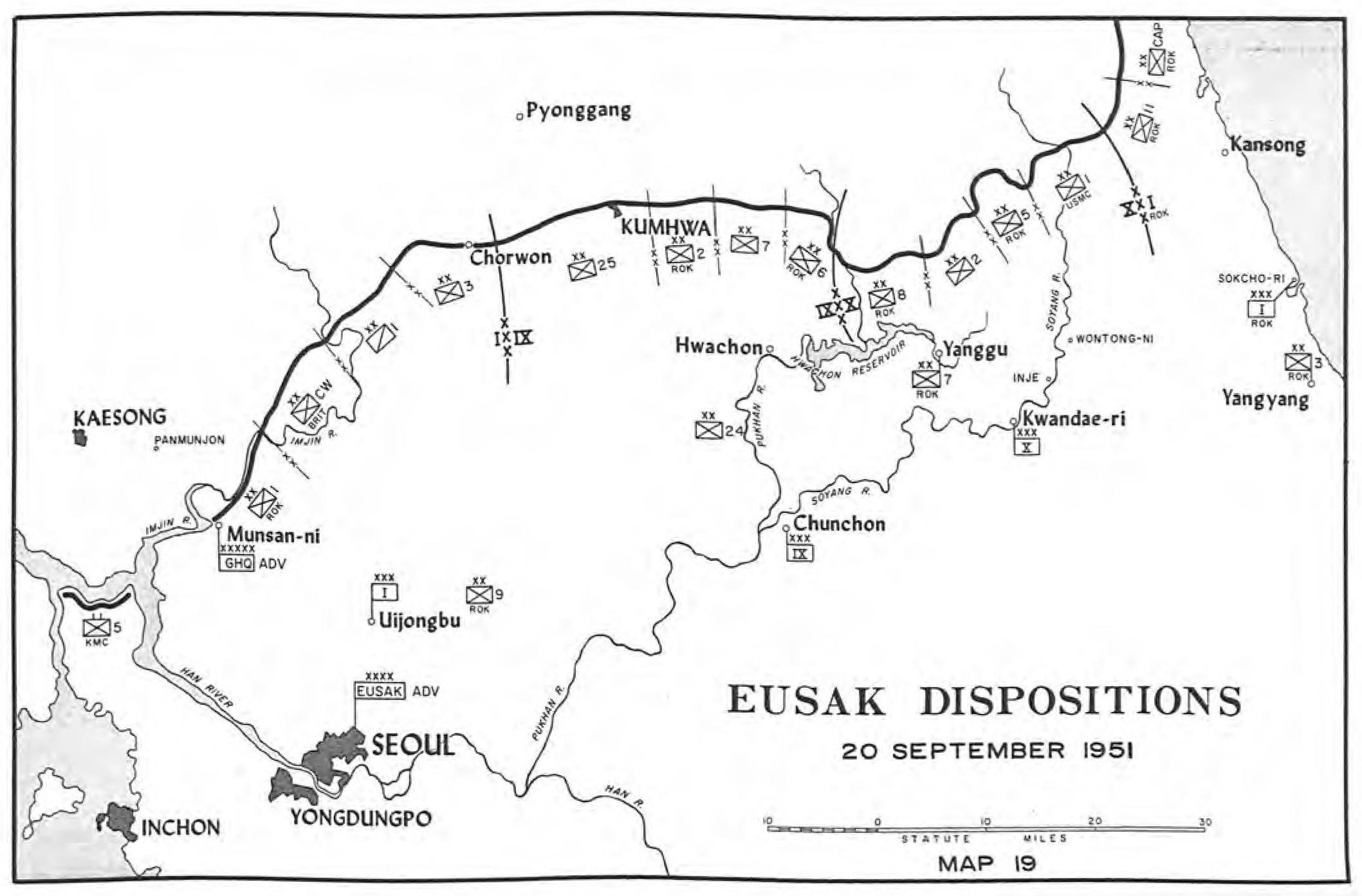
EUSAK DISPOSITIONS
20 SEPTEMBER 1951
MAP 19
Italics have been added to emphasize the importance of 20 September
1951 as the turning point when a warfare of position replaced a
warfare of movement throughout the remaining 22 months of the
conflict in Korea. There are few dates as important in the entire
history of the war.
General Van Fleet reiterated his instructions on the 18th in a
confirming directive to the effect that X Corps continue making limited
attacks “until 20 September, after which ... units were to firm up
the existing line and to patrol vigorously forward of it.”295
At this turning point the Eighth Army had 14 divisions from four
corps committed along a 125-mile front across the peninsula. These
units were distributed (Map 19) as follows:
U.S. I CORPS
ROK 1st Division holding the left anchor in the Munsan-ni area and controlling
the 5th KMC Battalion on the Kimpo Peninsula;
British 1st Commonwealth Division across the river Imjin to the northeast;
U.S. 1st Cavalry Division (Greek and Thai Battalions attached) still farther
to the northeast in the Yonchon area;
U.S. 3rd Infantry Division (Belgian Battalion and Philippine 20th BCT
attached) having the responsibility for the vital Chorwon area;
U.S. IX CORPS
U.S. 25th Infantry Division (Turkish Brigade attached) defending the area
west of Kumhwa;
ROK 2d Division holding a sector east of Kumhwa;
U.S. 7th Infantry Division (Ethiopian Battalion attached) on the right;
ROK 6th Division with a narrow sector as far east as the Pukhan River, the
Corps boundary;
U.S. 24th Infantry Division (Colombian Battalion attached) in Corps reserve
south of Hwachon;
U.S. X CORPS
ROK 8th Division on the left flank;
U.S. 2d Infantry Division (French and Netherlands Battalions attached) in
left-central portion of Corps front;
ROK 5th Division occupying a narrow sector to the east;
U.S. 1st Marine Division holding eastern portion of the Corps sector;
ROK I CORPS
ROK 11th Division responsible for left of the Corps front;
ROK Capitol Division holding the line eastward to the Sea of Japan;
ROK 3d Division in reserve at Yangyang for a period of training.296
Some rather complicated juggling of units took place on the X Corps
front, giving the effect of a game of musical chairs in the tactical
sphere. From 18 to 21 September the 1st Marine Division extended
its line eastward to relieve the 8th ROK Division on the extreme right
of the Corps area. That Division in turn relieved the 5th ROK Division
on the extreme left, whereupon the latter leapfrogged the
2d Infantry Division to occupy a new sector on the left of the Marines.
“Theirs not to reason why” could never have been written about
American fighting men. From 1775 to the present day, they have
always taken a keen interest in the high-level strategic and tactical
decisions governing their operations. This applies with particular
force to the Marines, who have seldom had a voice in the shaping of
operations above the division level.
As if in direct reply to unspoken questions, the commanding general
of the Eighth Army made a statement on 30 September explaining
the purpose of his strategy. “My basic mission during the past four
months,” he said, “has been to destroy the enemy, so that the men of
Eighth Army will not be destroyed.... Each loaded enemy weapon
was a definite threat to the Eighth Army. It was imperative that we
knock out as many of those weapons as we could find....”
“In prodding the enemy in the deep belly of the peninsula,” continued
General Van Fleet, “we have taken many casualties.... It
was mandatory that we control the high ground features, so that we
could look down the throat of the enemy and thereby better perform
our task of destruction.... In seizing these hills we lost men, but
in losing a comparative few we saved other thousands.”
Estimated casualties, inflicted on the enemy by UN ground forces
alone from 25 May to 25 September, were announced as 188,237 by
the EUSAK commander. “As we open our autumn campaign,” he
added, “the enemy potential along the front line has been sharply
reduced by our hill-hopping tactics. The Communist forces in Korea
are not liquidated but they are badly crippled.”297
Even so, EUSAK G-2 summaries credited the enemy on 1 October
1951 with more than 600,000 troops at the front, or in reserve and
available as immediate reinforcements. Six CCF armies and one
NKPA corps were capable of reinforcing the units on the MLR or participating
in an offensive. The enemy also had an estimated 7,000
men in guerrilla forces behind the UN lines.298
The maximum strength of UN forces in Korea during October was
607,300. This total included 236,871 U.S. Army troops, 21,020 Fifth
Air Force personnel, 30,913 U.S. Marines (including 5,386 officers
and men of the 1st Marine Aircraft Wing), 286,000 men in ROK
units, and 32,172 Allied troops.299
Although it might appear that the opposing forces were about
equal, it must be remembered that well over one-fourth of the UN
troops were engaged in administrative or maintenance duties behind
the front. Thus the Communists had a numerical advantage of at least
four to three on the firing line. This was not at all unusual, since they
had enjoyed a preponderance in manpower from the beginning.
In accordance with EUSAK instructions, X Corps OI-235 directed the
1st Marine Division to organize and construct defensive positions after
relieving the 8th ROK Division on the right and taking over its sector.
On the Corps boundary, elements of the 11th ROK Division, I ROK
Corps, were to be relieved on Hill 884 (Map 20). This meant the
addition of some 9,000 yards to the Marine front, making a total
of about 22,800 yards or more than 13 miles.
First Marine Division OpnO 27-51, issued on 18 September, relayed
the X Corps directions. It also called for such offensive action as might
be necessary to complete the securing of Hill 854, in the sector of the
8th ROK Division, if not in friendly hands at the time of the relief.300
That the enemy had put up a desperate fight to hold this position
is indicated by the EUSAK report for 15–16 September: “The ROK
8th Division, employing all three regiments, attacked against heavy
and stubborn resistance to wrest Hill 854 from the three battalions
of North Koreans who held the position. The ROK 21st Regiment
forced one of these battalions to withdraw and occupied a part of the
hill, but at the close of the day were engaged in heavy hand-to-hand
fighting to retain the position.”301
On 20 September, after three weeks of continual combat, the major
units of the 1st Marine Division were disposed from left to right
(Map 20) as follows:
1st KMC Regiment (Colonel Kim Dae Shik, commanding; Colonel
Walter N. Flournoy, senior adviser) occupying the HAYS line on the
left flank and patrolling vigorously to the north;
5th Marines (Colonel Richard G. Weede) holding a wide sector
in the center, with Hill 812 as the principal terrain feature;
1st Marines (Colonel Thomas A. Wornham) in process of extending
eastward to the Corps boundary just beyond Hill 884;
7th Marines (Lieutenant Colonel John J. Wermuth) in Division
reserve at Wontong-ni.302
Division OpnO 27-51 designated the 1st Marines to relieve the
ROKs on Hill 854 and complete the seizure of that terrain feature,
if necessary. As a preliminary, the 1st Battalion of the 5th Marines
(Lieutenant Colonel William P. Alston) took over the front of the
1st Marines on the HAYS line. This enabled 1/1 and 3/1 to enlarge
the Division sector by side-slipping to the east while Lieutenant
Colonel Franklin B. Nihart’s 2/1 went into immediate reserve just
behind the main line of resistance.303
The 1st Battalion of the 1st Marines (Lieutenant Colonel John E.
Gorman) relieved two battalions of the 10th ROK Regiment in the
Hill 854 area. No opposition from the enemy was encountered, but
the Marines suffered 11 casualties from mines as a consequence of
incorrect charts supplied by the ROKs.
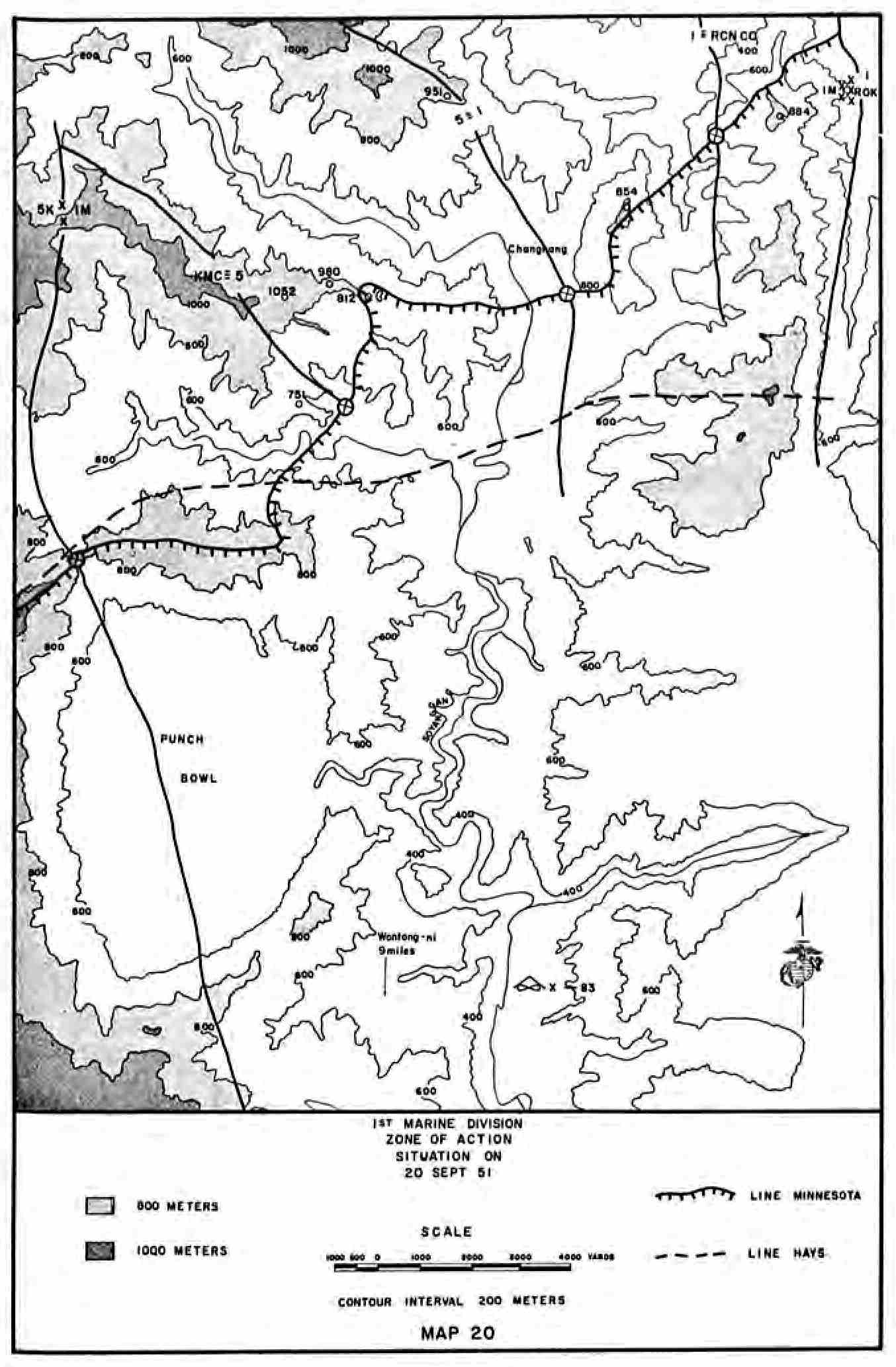
1ST MARINE DIVISION
ZONE OF ACTION
SITUATION ON
20 SEPT 51
MAP 20
By this time it had become an open question whether “friendly”
mines did more harm to friend or foe. Certain it was, at any rate, that
the prevailing system—or lack of system—resulted in Marine casualties
during nearly every offensive operation in zones where the action
shifted back and forth.
Lieutenant Colonel Foster C. La Hue’s 3/1 relieved two battalions
of the 21st ROK Regiment. Although the ROKs had fought their
way to the summit of Hill 854, the ridgeline to the southwest remained
in the enemy’s hands. An attack by 3/1 was planned for 1530
on 20 September, supported by artillery and an air strike. Delays in
the arrival of the planes caused a postponement until 1720. How
Company jumped off and had advanced 50 yards when a man was
killed and another wounded by mines. The attack was called off at
dusk so that the ROKs could remove the explosives they had planted.
Air support was requested for 0700 on the morning of the 21st,
but it was 1040 before four Air Force F-51s arrived for a strike
directed by an observation plane of VMO-6 and a forward air controller.
At 1220, following a 10-minute artillery preparation, How
Company spearpointed a battalion attack which met stiff resistance.
Another air strike was requested but did not materialize. The assault
continued with mortar and artillery support until 1745, when How
Company reported the ridge line secured.
Casualties of 3/1 for the two days were nine KIA and 55 WIA.
Enemy losses totaled 159 counted and 150 estimated KIA, 225 estimated
WIA, and 29 prisoners.304
“A large number of mines and booby traps were discovered within
the battalion sector,” the 3/1 report for the 23d concluded, “most of
these being U.S. types which were placed by ROK troops, with only
a few enemy mines scattered in the central portion of the sector.”305
Division OpnO 27-51, it may be recalled, had directed the Marines
to extend the X Corps boundary eastward by taking over the sector of
the 11th Regiment, I ROK Corps. Even under ordinary circumstances
this would have meant an exhausting 15-hour march for the relieving
troops merely to climb Hill 884 (Map 20), The position was accessible
only on foot, and supplies had to be brought on the backs of
cargadores.
Because of the isolation of this wildly mountainous area, a reconnaissance
was deemed essential. Major General Gerald C. Thomas,
commanding general of the 1st Marine Division, assigned that mission
to the Division Reconnaissance Company after deciding on a troop
lift by helicopter.
He was aware, of course, that no such operation had ever been
undertaken during the brief history of rotary-wing aircraft. Large-scale
helicopter troop lifts were still at the theoretical stage.
Lieutenant Colonel George W. Herring, commanding officer of
HMR-101, had but 48 hours for preparation. He and his executive
officer, Lieutenant Colonel William P. Mitchell, worked out a tactical
and loading plan with the commanding officer of Recon Company,
Major Ephraim Kirby-Smith, and the acting Division Embarkation
Officer, First Lieutenant Richard C. Higgs.306
An air reconnaissance of Hill 884 disclosed only two acceptable
locations for landing sites, both approximately 50 feet square with a
sheer drop on two sides. About 100 yards apart and some 300 feet
below the topographical crest, each could be cleared sufficiently for
the landing of a single aircraft.
Major Kirby-Smith decided on the order in which troops of his
company and attached units would be landed. The assignment and
loading tables were completed on 20 September in time for a rehearsal.
All participants were instructed as to their team numbers and embarkation
points.
H-Hour of Operation SUMMIT (Map 21) was set for 1000 on
21 September. The plan called for a preliminary landing of a Recon
Company rifle squad to provide security. Next, a landing point team
from the 1st Shore Party Battalion (Lieutenant Colonel Harry W.
Edwards) had the mission of clearing the two sites. These two
groups were to disembark from hovering helicopters by means of
knotted 30-foot ropes. Strong winds at the 2,900-foot altitude made
landing quite hazardous.
The execution was delayed half an hour by the ground fog so
prevalent at this time of year. As soon as the two landing sites were
cleared (about 40 minutes), word was transmitted by radio for the
loading to begin at Field X-83 (Map 21), about 14 miles southwest
of Hill 884 by the defiladed route of flight.
Control over the landings and takeoffs on the two Hill 884 sites
was exercised by a hovering helicopter. Aircraft landed at 30-second
intervals, each carrying five fully equipped men who disembarked in
average time of 20 seconds. Two radio nets maintained communications
between the landing sites and orbiting aircraft. Voice contact
could not be established between the landing point team and X-83,
however, and it became necessary for a helicopter to return within
sight of the field to restore communications for incoming aircraft.
A total of 224 men, including a heavy machine gun platoon from
2/7, was lifted in flight time of 31.2 hours and over-all time of
four hours. In addition, 17,772 pounds of cargo were landed.
Operation SUMMIT ended with the laying of two telephone lines
between Recon Company on Hill 884 and the CP of the 1st Marines,
about eight miles to the rear. Fifteen minutes were required for
dropping each line. The ROKs, following their relief, proceeded on
foot to their own Corps area.
From a tactical viewpoint, the importance of Hill 884 lay in its
domination of enemy-held terrain. The difficulty of reaching the
remote position had been overcome by the helicopter, and Operation
SUMMIT was recorded in front page headlines by Stateside newspapers.
Congratulations poured in from all sides. Lieutenant General
Lemuel C. Shepherd, Jr., commanding general of FMFPac, complimented
HMR-161 on “a bright new chapter in the employment of
helicopters by Marines.” Major General Clovis E. Byers, commanding
X Corps, praised the “organic and attached units of the 1st Marine
Division that participated in the first relief of units on the battle position.
Your imaginative experiment with this kind of transport is certain
to be of lasting value to all the services.”307
Nobody was more enthusiastic than General Thomas. “Operation
SUMMIT, the first helicopter-borne landing of a combat unit in history,
was an outstanding success,” said his message. “To all who took
part, well done!”
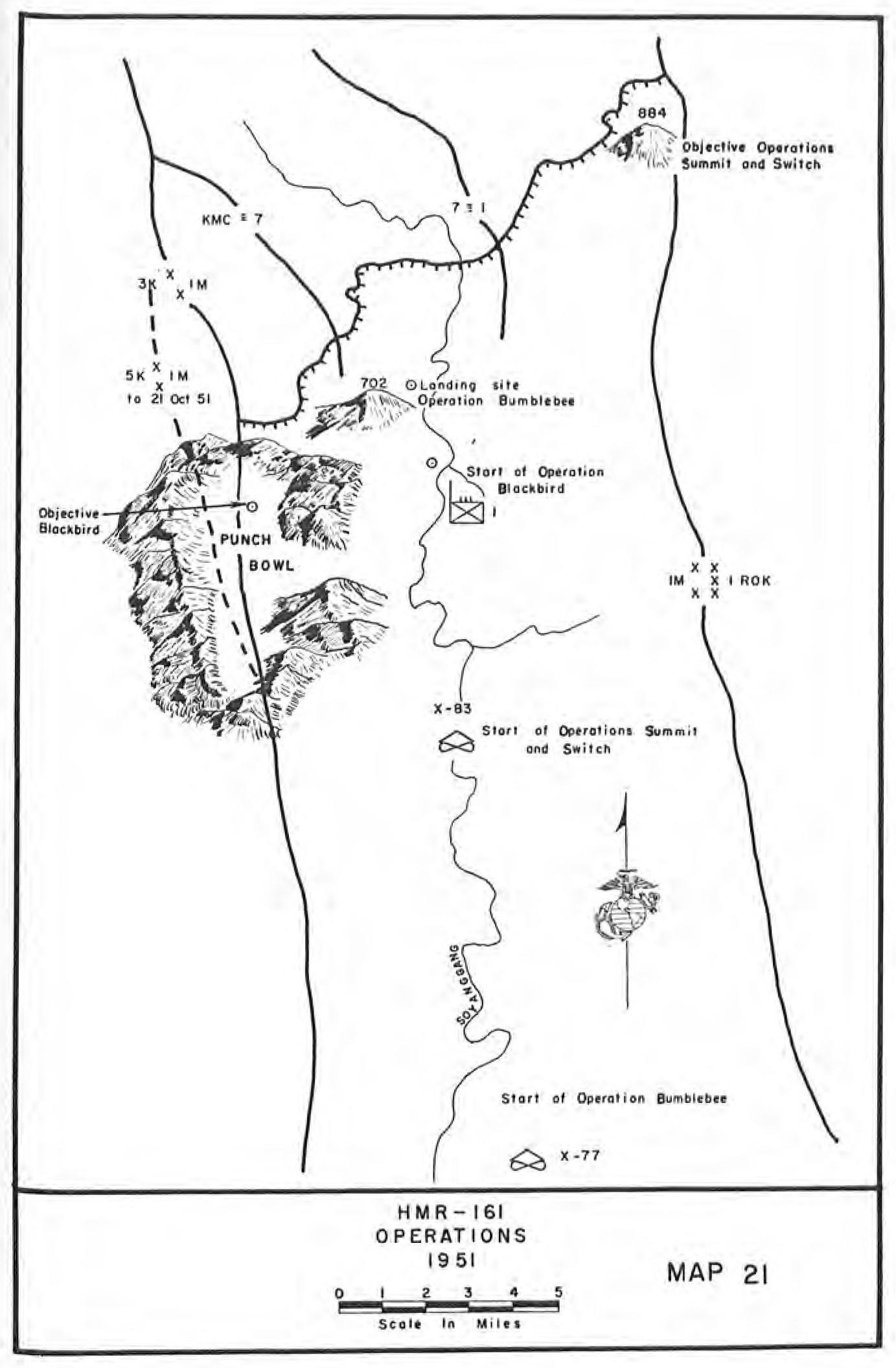
HMR-161
OPERATIONS
1951
MAP 21
It is not surprising, considering their training, that the Marines found
it a difficult transition from offensive to defensive operations after
20 September. As evidence that patrols were conducted with customary
aggressiveness, Marine casualties (including the 1st KMC Regiment)
for the last 10 days of the month were 59 KIA, 1 MIA, and 331 WIA.
Enemy losses for the same period were 505 counted KIA, and 237
prisoners.
1st Marine Division casualties of 2,416 (including 594 reported
by the KMCs) for September as a whole were the most severe suffered
during any month of the war so far with the exception of December
1950 and June 1951. NKPA losses of the month were 2,799 counted
KIA and 557 prisoners.308
On the 23d the 1st Marines extended to the eastern boundary of
X Corps and relieved the Division Reconnaissance Company on Hill
884. That same day the enemy was treated to a novelty when 100
well aimed 16-inch projectiles, fired from a range of 40,000 yards,
roared in like meteors on his positions in the area of Hill 951 (Map 20).
Naval gunfire from the USS New Jersey was being conducted
by Marine spotters in forward OPs, who reported good coverage for
the 2,000-pound rounds. Ammunition dumps and artillery pieces were
destroyed while NKPA troops in the open suffered heavy personnel
casualties, according to observers.
Several more bombardments were contributed by the New Jersey
at the request of 1/1 and 3/1 during the balance of the month.
Marine and attached Army artillery also gave excellent support with
fire so accurate as to break up enemy counterattacks before they could
be launched. Ammunition restrictions hampered the efforts of the
11th Marines (Colonel Custis Burton, Jr.) but the cannoneers never
failed to respond to an emergency. The 90mm rifles of the 1st Tank
Battalion (Lieutenant Colonel Holly H. Evans) continued to show
good results with direct observed fire on enemy bunkers. Air support
in September, concluded the Division report, was “generally inadequate
and unsatisfactory.”309
By the last week of September the Division right (east) flank was
well protected, considering the rugged terrain. Not as much could
be said for the other flank, northwest of the Punchbowl, where the
sector of the Marines joined that of the 5th ROK Division. Since the
Division sector was divided by high, roadless mountains, there was
no rapid way of moving reserves other than by helicopter. In short,
the 1st Marine Division was hard pressed to man a 22,800-yard MLR
while keeping in reserve enough troops to help defend this sensitive
area in an emergency.
Plans were completed by General Thomas and the Division staff
for the rapid displacement of a company from 2/1, the reserve battalion
of the 1st Marines, to meet any such threat. Since a surprise
attack was most likely to occur at night, it was decided that a helicopter
lift of an element of the Division reserve should be made in the
darkness of 27 September after a detailed daytime rehearsal.310
In contrast to former Marine helicopters, which had no night-flying
aids, the HRS-1 was equipped with few attitude of flight instruments.
They were primitive compared to the sophisticated instrumentation
of fixed-wing planes, and Lieutenant Colonel Herring sent his
pilots on preliminary night indoctrination flights to memorize terrain
features.
The route, five air miles in length, amounted to a round trip of 13
miles because of the detours necessary for purposes of concealment.
The aircraft were to take off from a dry river bed southeast of Hill 702
(Map 21) and land near the northwestern rim of the Punchbowl,
where the troops would march a mile to their final assembly area.
The infantry unit selected for Operation BLACKBIRD was Easy Company
of 2/1, commanded by Second Lieutenant William K. Rockey.
Lieutenant Colonel Nihart and Major Carl E. Walker, the battalion
commander and his executive officer, supervised the daylight rehearsal
on the morning of the 27th. Six helicopters lifted 200 men in the overall
time of two hours and 10 minutes to a landing site of 50 by 100 feet
cleared by a team of the 1st Shore Party Battalion. The troops were
proceeding on foot to their assembly area when an antipersonnel
mine wounded a man. Nihart called a halt immediately and investigation
revealed that the area was filled with mines. Plans were
changed to abandon the march, although the landing site remained
the same.
Operation BLACKBIRD got under way at 1930 on 27 September. The
night was dark when the first HRS-1 took off with five combat-equipped
men. Three-minute intervals were required between aircraft
operating on a shuttle system, so as to avoid the danger of
collisions. Different altitudes were assigned to outgoing and incoming
helicopters which used running lights only two minutes before entering
or leaving the debarkation zone.
A total of 223 troops were landed in over-all time of two hours and
20 minutes instead of the nine hours a movement by foot would have
required. Nevertheless, some of the results were not reassuring.
Rotor wash blew out many of the flare pots lighting the embarkation
area, and the battery-powered beach lanterns on the landing site
proved inadequate. Pilots were temporarily blinded by the glare on
windshields; and artillery flashes bothered them while making their
way through three mountain passes. Fortunately, good radio communications
aided pilots who had trouble in locating the landing site in
spite of night rehearsals.
Operation BLACKBIRD remained the only night helicopter troop lift
during the war in Korea. “Present equipment,” said the Marine
report, “indicates that under present conditions in Korea these night
lifts should be limited to movements within friendly territory.”311
“To Organize, Construct and Defend”
“The Division continued to organize, construct and defend positions
along a 13½-mile front; patrol forward of the MLR and screen rear
areas; and maintain one U.S. Marine regiment which could not be
committed without authority from X Corps in a reserve area 17 miles
behind the lines.”
The above quotation, from the opening paragraph of the report of
the 1st Marine Division for October 1951, sums up in a nutshell the
new trend of operations since 20 September. It is significant that for
the first time in 1951 the Division Historical Diary departs from a
daily account of events and divides the month into two equal parts for
a chronicle of operations. Not enough had happened to justify a
day-by-day summary.
This does not mean that the Marines neglected any opportunity to
do the enemy hurt. It means only that the opportunities of defensive
warfare were limited as compared to the preceding six months of
offensive operations. That the Marines made the best of such opportunities
is shown by the fact that the ratio of enemy to friendly
casualties increased from the 4-to-1 of September to the 20-to-1
of October, even though the totals of the former month were larger.312
As a result of his new defensive policies, the enemy often avoided a
fight. Day after day passed during the first two weeks of October
without far-ranging Marine patrols being able to make contact.
Line MINNESOTA, the new MLR (Map 20), ran roughly parallel to
the hays line but included advanced positions taken in the September
offensive. During the first 10 days of October the 2d Battalion of the
1st Marines continued to be the Division forward reserve in readiness
for a quick shift to any threatened point in the MLR, and the Division
Reconnaissance Company had the mission of maintaining daily contact
with the 11th ROK Division on the Marines’ right flank.
It might seem that the 7th Marines, 17 miles to the rear at Wontong-ni,
would be entirely becalmed. Yet this regiment saw as much
action on some days as any of the three regiments ranging forward of
the MLR. The explanation was that the rear area was infested with
elusive North Korean guerrillas who kept the 7th Marines patrols busy.
Early in October the question arose as to how quickly a reserve
battalion could be shifted from one point to another. By this time a
company-size helicopter lift had become commonplace, having been
successfully completed twice by HMR-161 since Operation SUMMIT.
It remained to be seen whether a battalion could be transported with
comparable celerity, and, on 9 October, Division issued an order
warning of 3/7’s move.
The 7th Marines was due to exchange places with the 5th Marines
on the 11th after relieving that regiment in the center of the Division
front. While 1/7 and 2/7 completed a conventional relief of their
opposite numbers, 3/7 was selected for a helicopter lift. Lieutenant
Colonel Edwards, the new commanding officer, had recently commanded
the Shore Party Battalion and helped to train its landing site
and loading point teams. He took part in the planning along with
Colonel Krulak, Lieutenant Colonels Herring and Mitchell, and the
new commanding officer of the Shore Party Battalion, Lieutenant
Colonel George G. Pafford.
Planning went on as if for an amphibious operation. Assignment
and loading tables were worked out, and each Marine of the six-man
embarkation teams had his designated place in the helicopter. On
10 October all officers and men of 3/7 attended a familiarization class
at which trial teams were loaded.
Operation BUMBLEBEE began at 1000 on the 11th. Field X-77
(Map 21) had been selected as the loading zone because of its proximity
to the assembly area of the 7th Marines. The landing site was
just behind the 5th Marines MLR, northeast of Hill 702. A flight path
of 15 miles took advantage of the concealment afforded by valleys and
defiladed areas.
The two dispatchers in the loading zone were provided with a
checkoff flight list containing the names of every team of 3/7. In
order to avoid delays, replacements could be summoned from a casual
pool to fill understrength teams to plane capacity. Average time for
loading was 20 seconds.
Ten to 12 minutes were required for the flight. As the helicopters
landed at intervals of a minute, a team could exit and allow the craft
to be airborne in an average time of 17 seconds. “Time was saved,”
according to one Marine report, “when the Shore Party personnel,
after opening the door, vigorously assisted the passengers by grasping
their arms and starting them away from the craft. The last man out
checked to see if any gear had been forgotten. Guides furnished by
the battalion directed the passengers toward their respective company
assembly areas, thus keeping the landing areas clear at all times.”313
Twelve helicopters were employed in 156 flights. The flight time
was 65.9 hours and over-all time five hours and 50 minutes. A total
weight of 229,920 pounds included 958 combat-equipped troops
averaging 240 pounds.
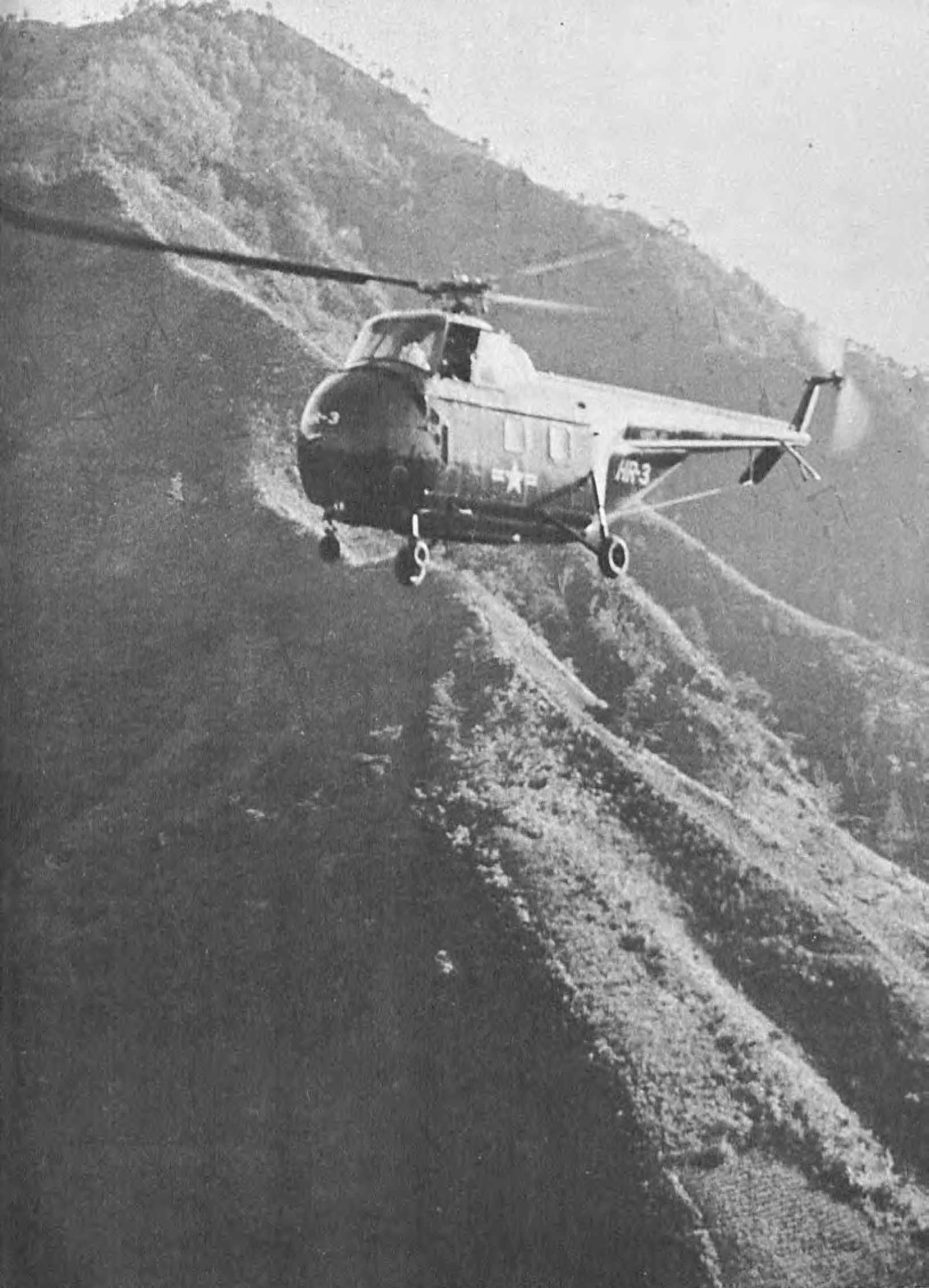
DD MC A 132540
Helicopter In The Hills—A large Sikorsky helicopter hovers over the mountainous
terrain of Korea. This type of aircraft has been extensively used for
many types of transport missions.
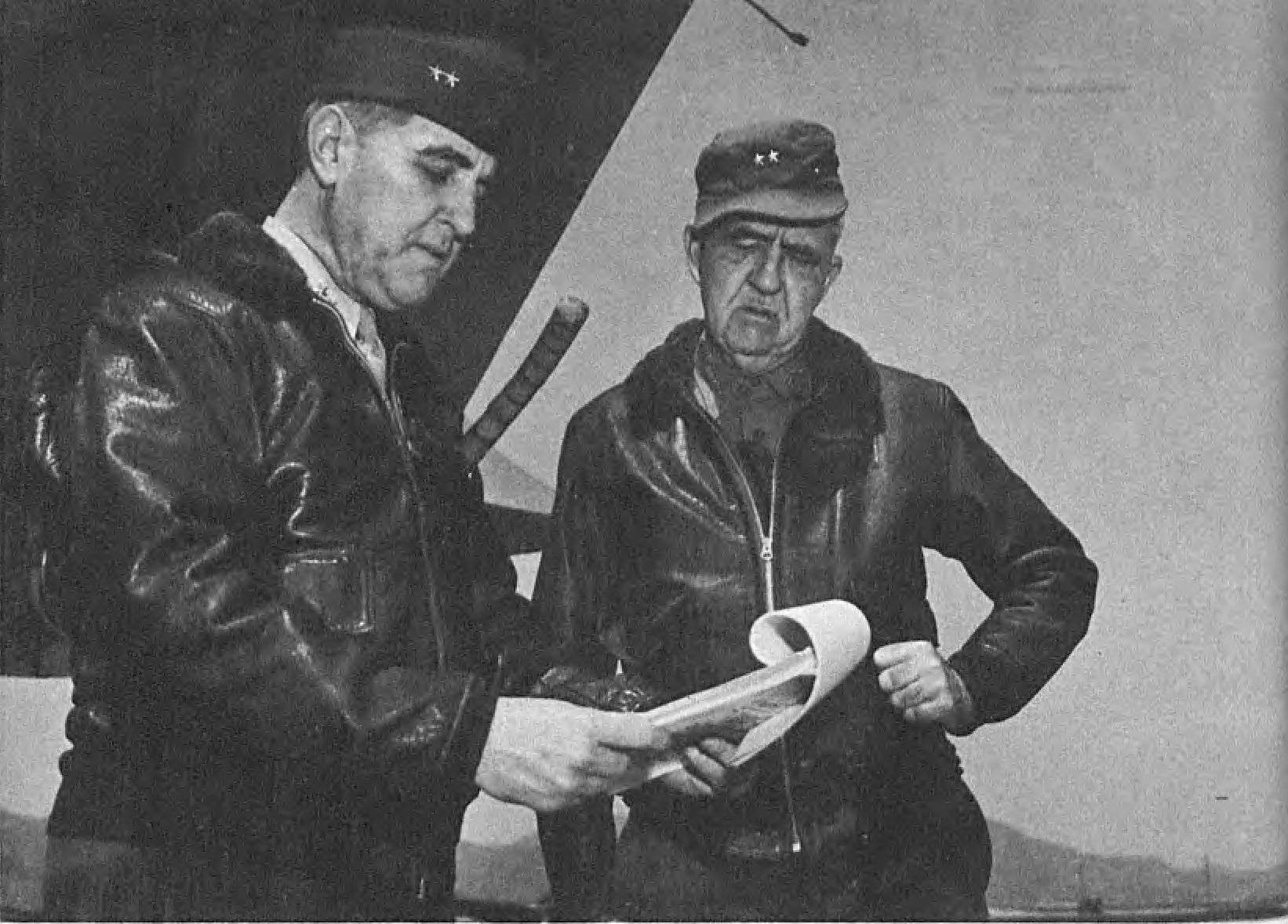
DD MC A 131324
Generals Confer—Above, MajGen Gerald C. Thomas (left) and MajGen
Field Harris discuss the situation in April, 1952. Below, MajGen John T.
Selden (right) briefs Army MajGen R. D. Palmer.
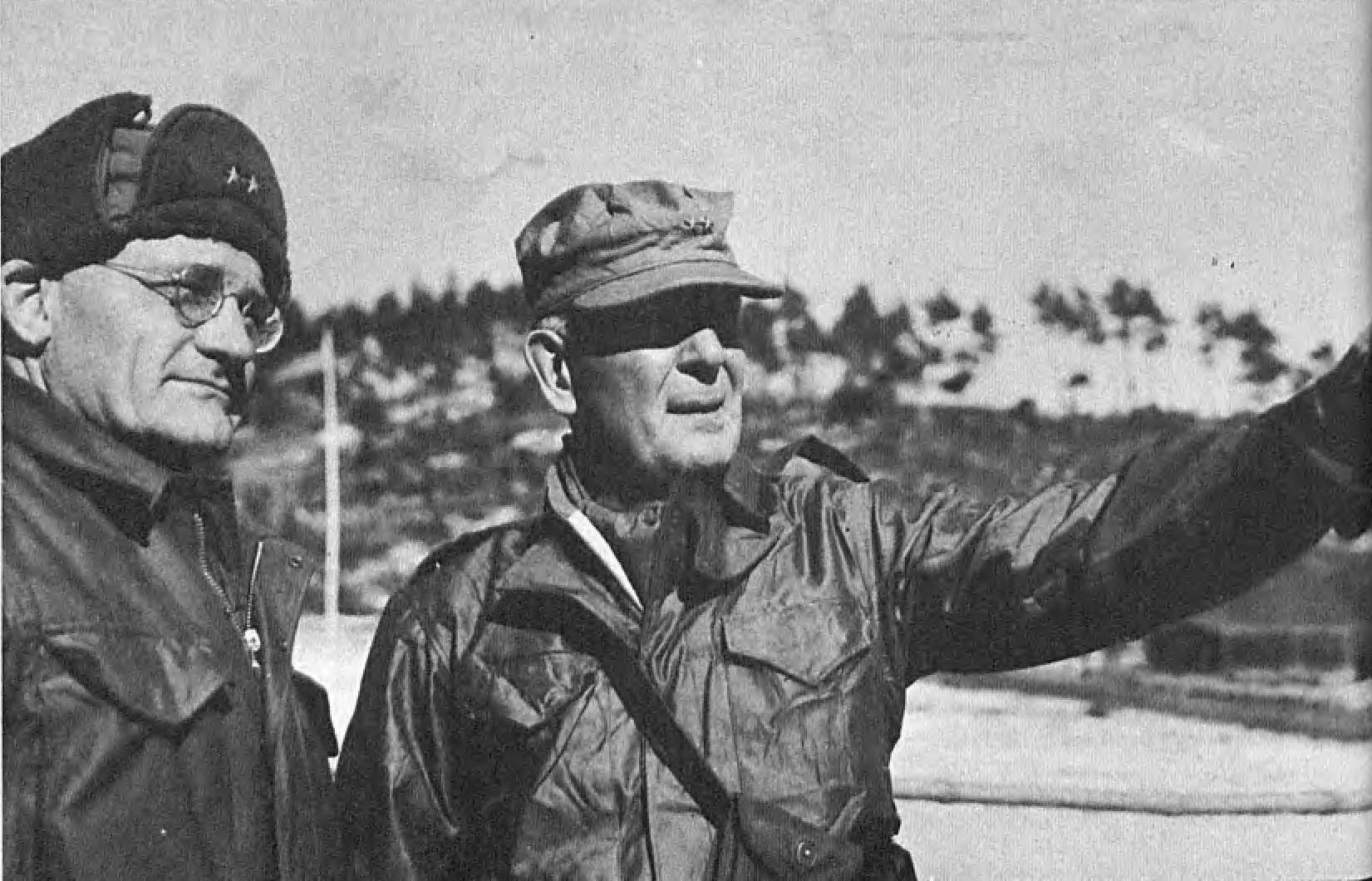
DD MC A 159084
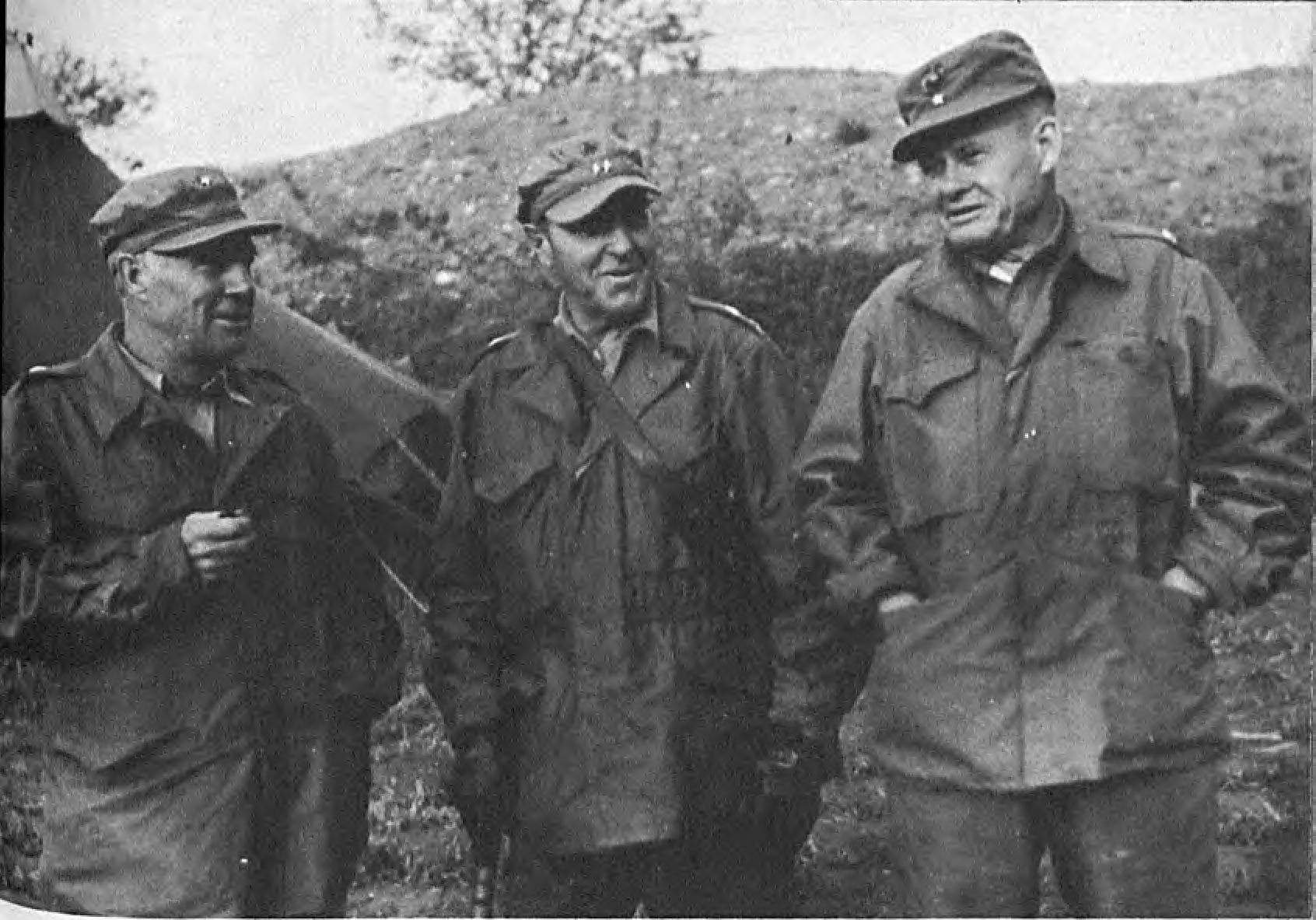
DD MC A 8410
On The Planning Level—Above, BrigGen Whaling, MajGen Thomas, and
BrigGen Puller enjoy a bit of humor, while, below, MajGen Thomas,
LtGen Shephard, and Col Wade pose for the photographer.
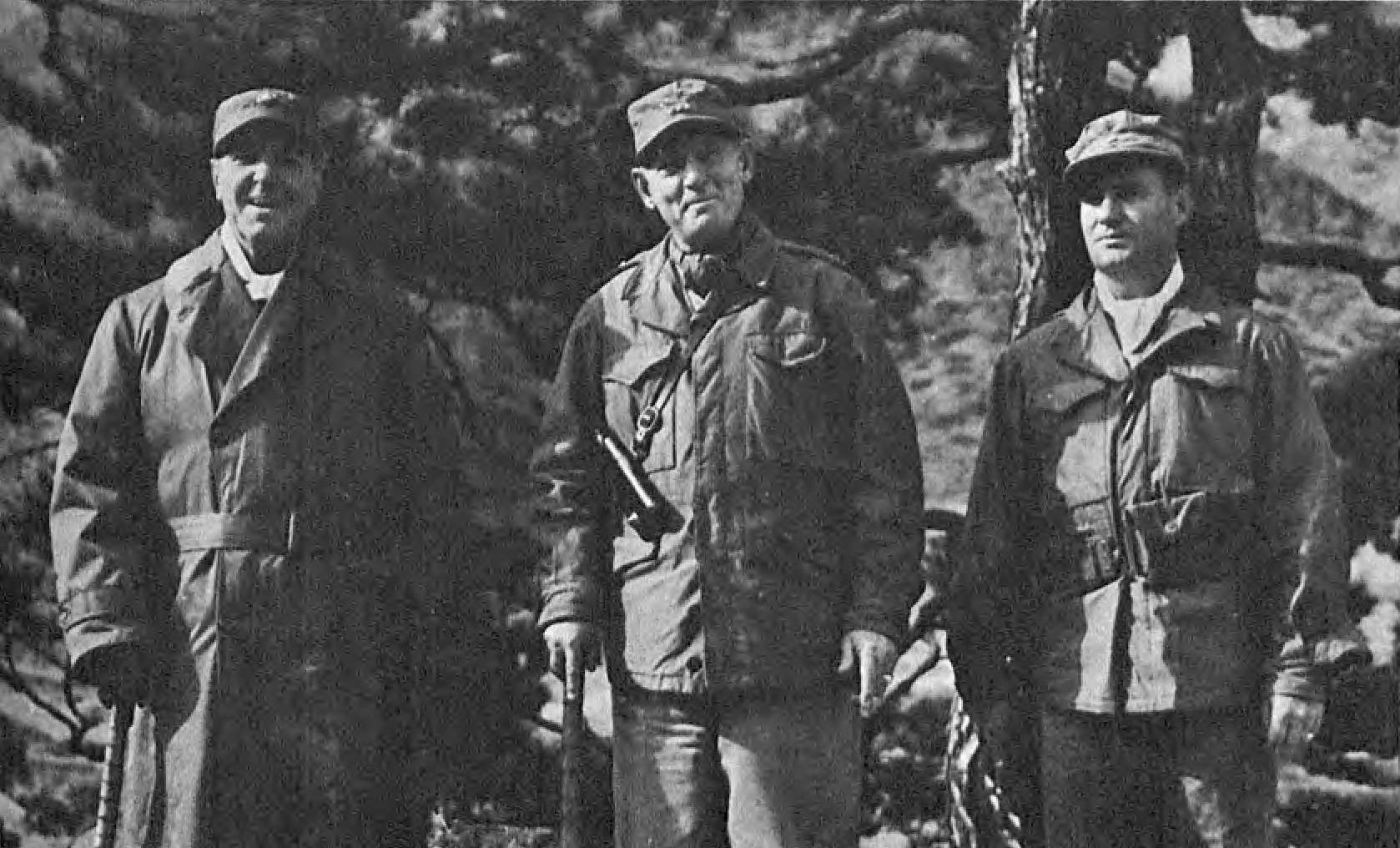
DD MC A 157916
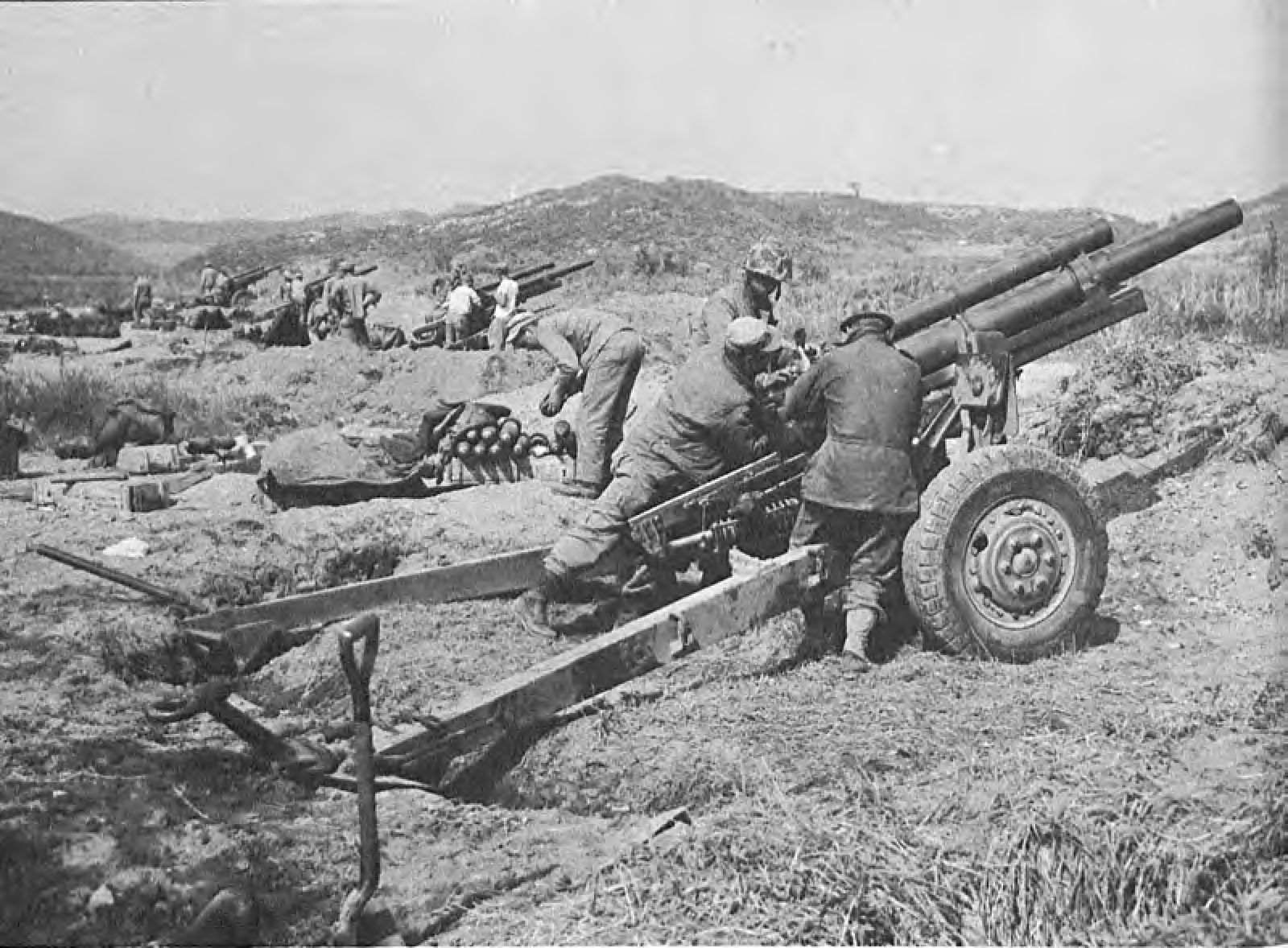
DD MC A 161585
Ready For Action—Above, a Marine 105mm howitzer battery preparing
to fire a mission. Below, exterior and interior views of a heavy and light
machine gun emplacement.
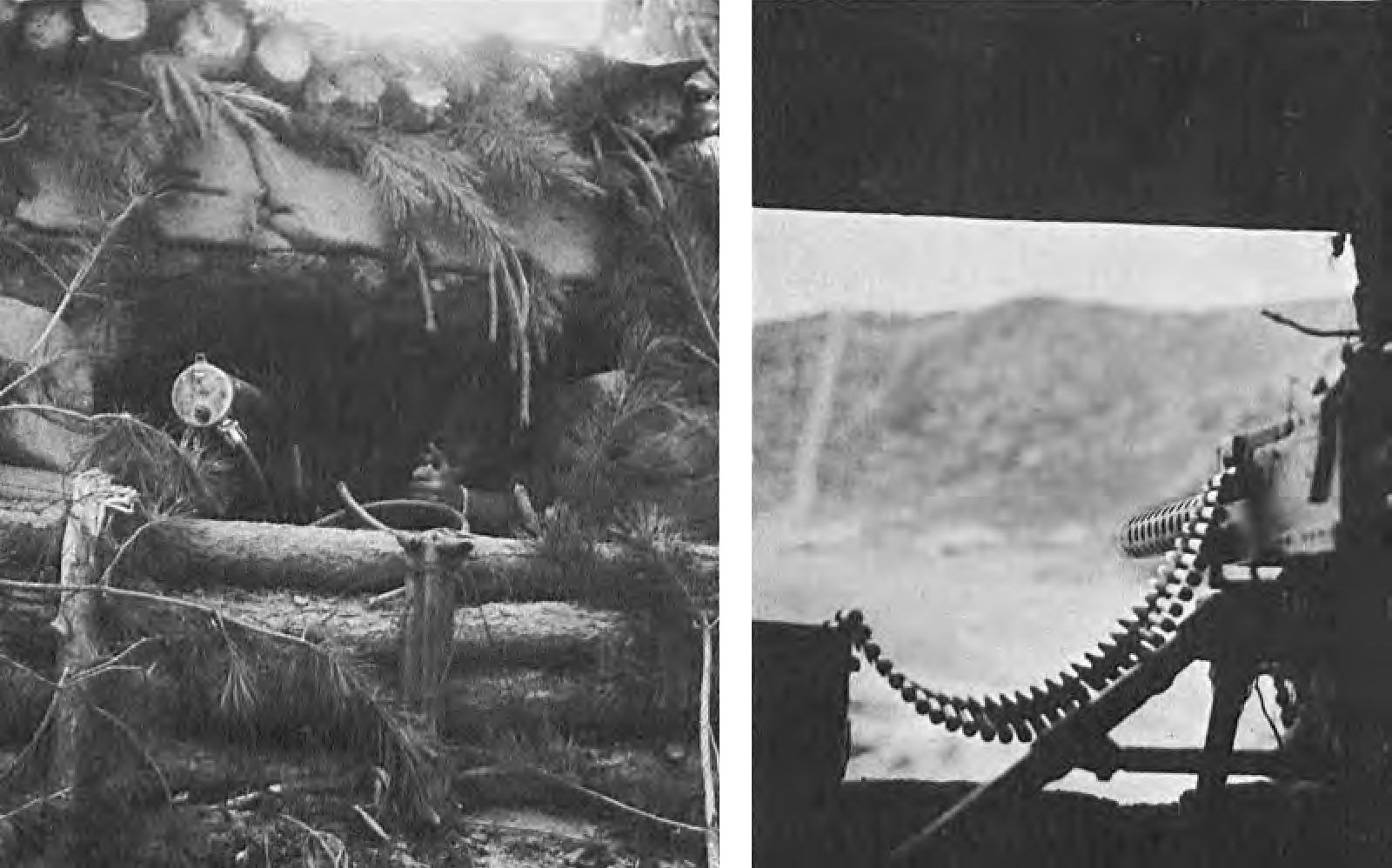
DD MC A 155525 DD MC A 169584
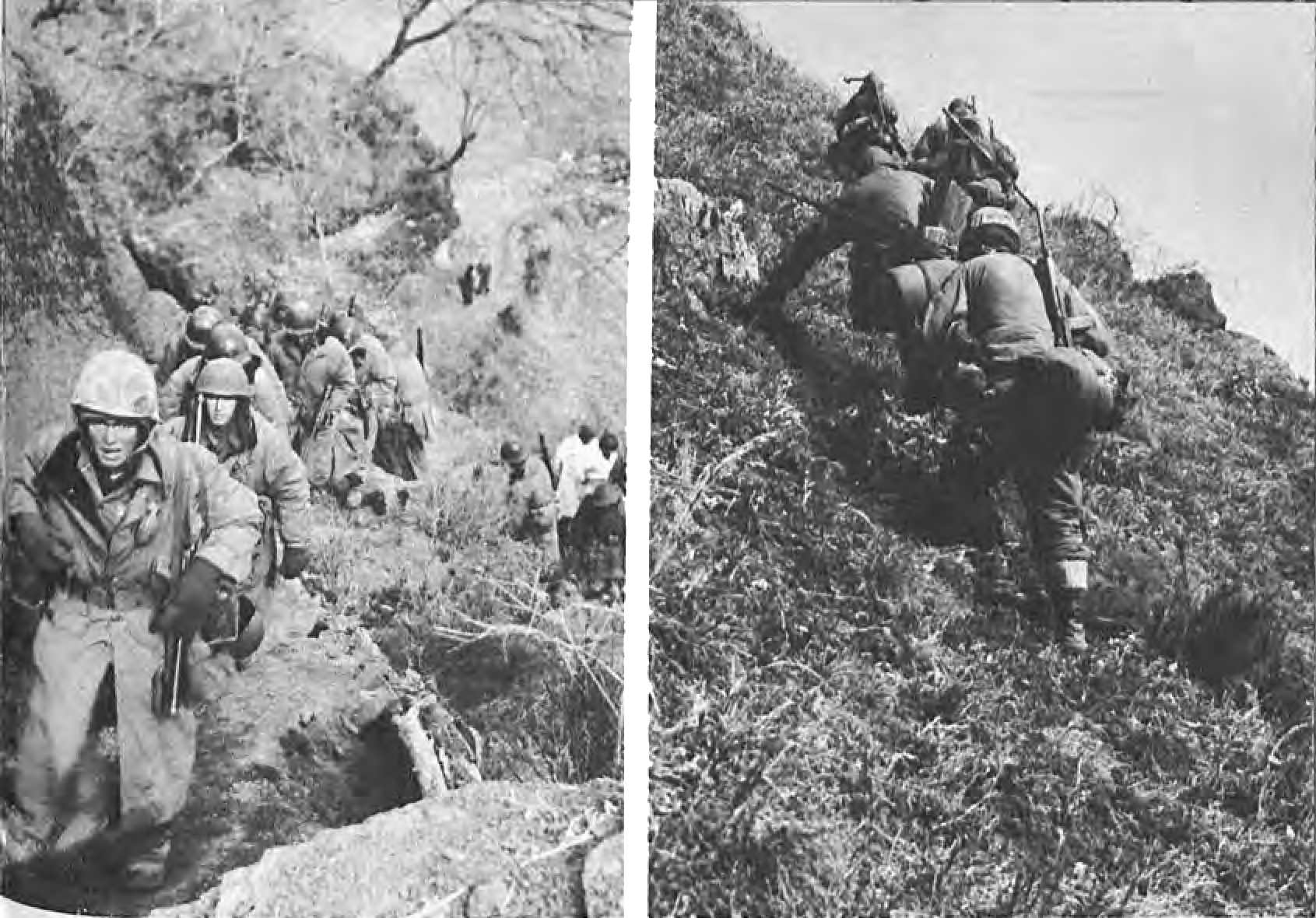
DD MC A 6953 DD MC A 6754
Going Up—Above, left and right, Marines move into position on one of the
many Korean hills. Below, a section of the MLR in March, 1952.
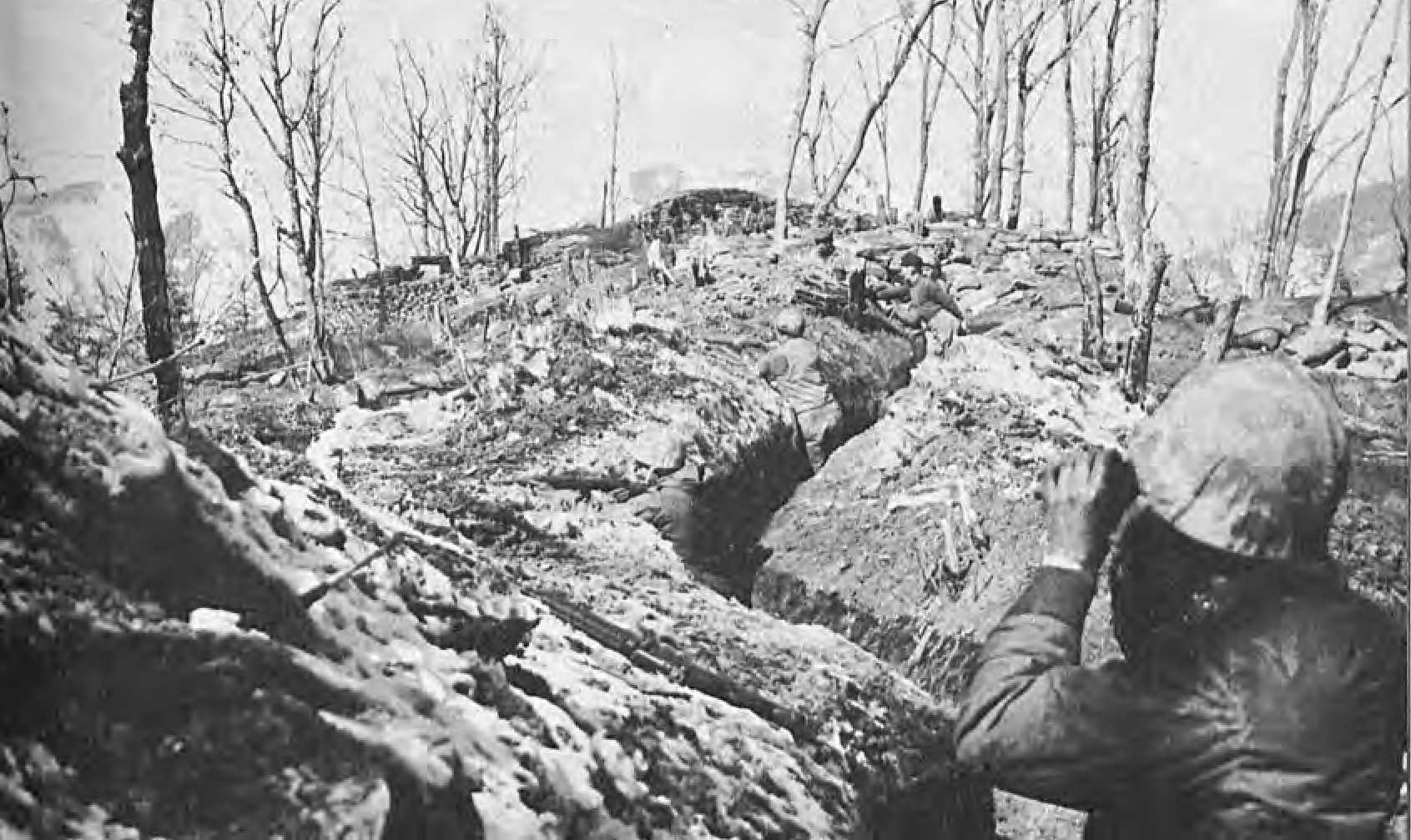
DD MC A 160250
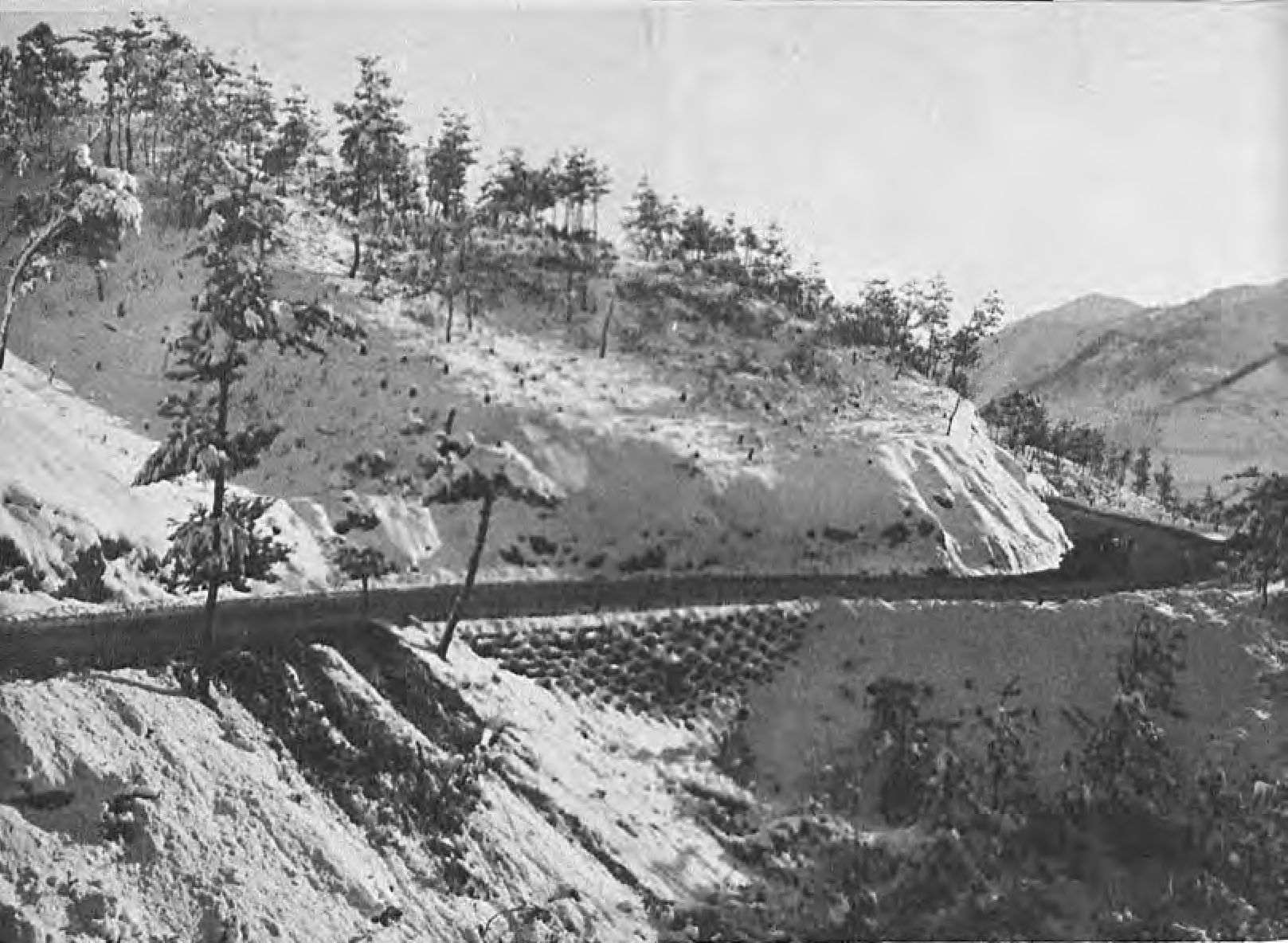
DD MC A 159304
The Lifeline—Above, a view of the MSR of the 1st Marine Division during
January, 1952. Below, during the rainy season it is difficult to move
supplies over the poor roads.
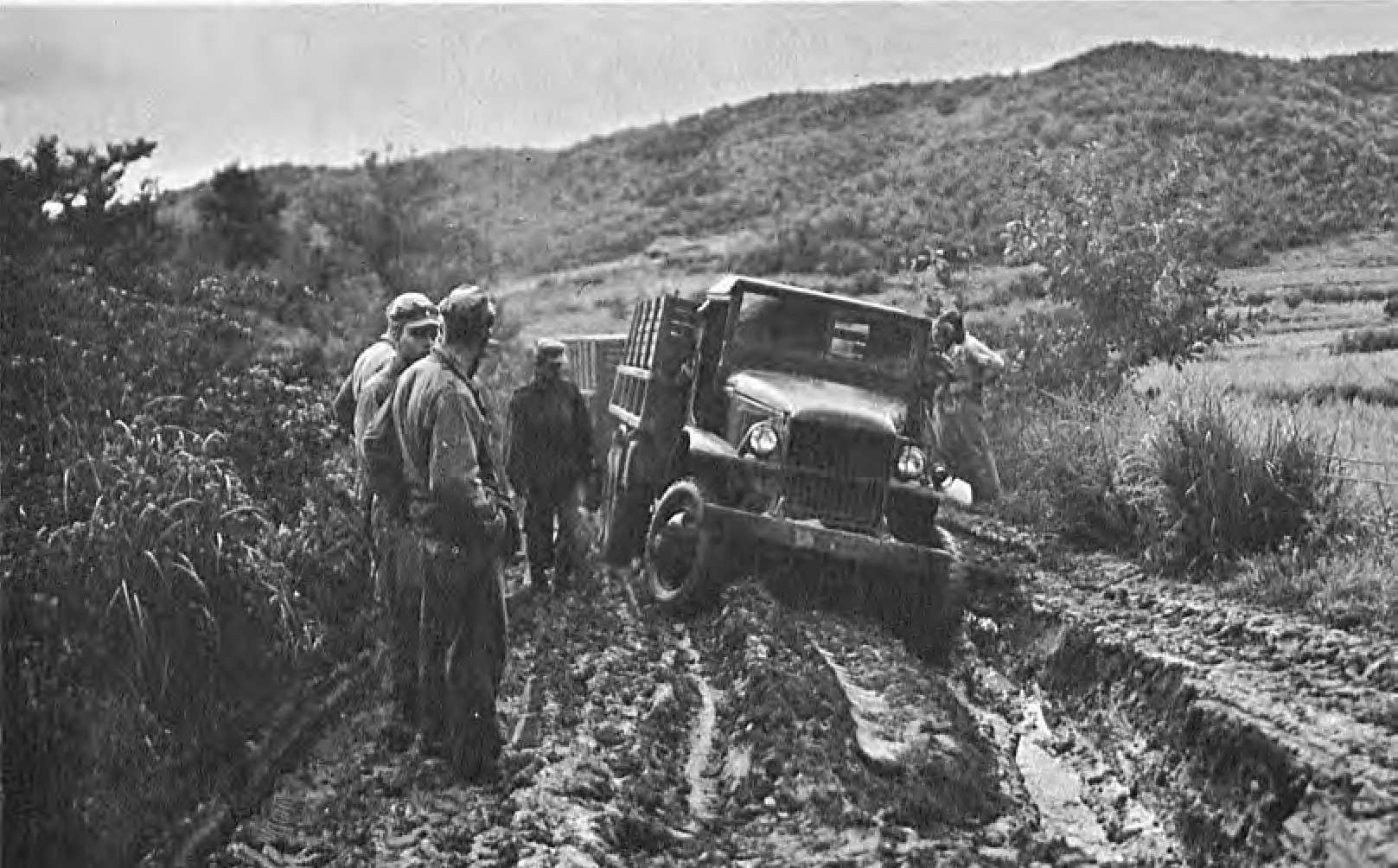
DD MC A 164552
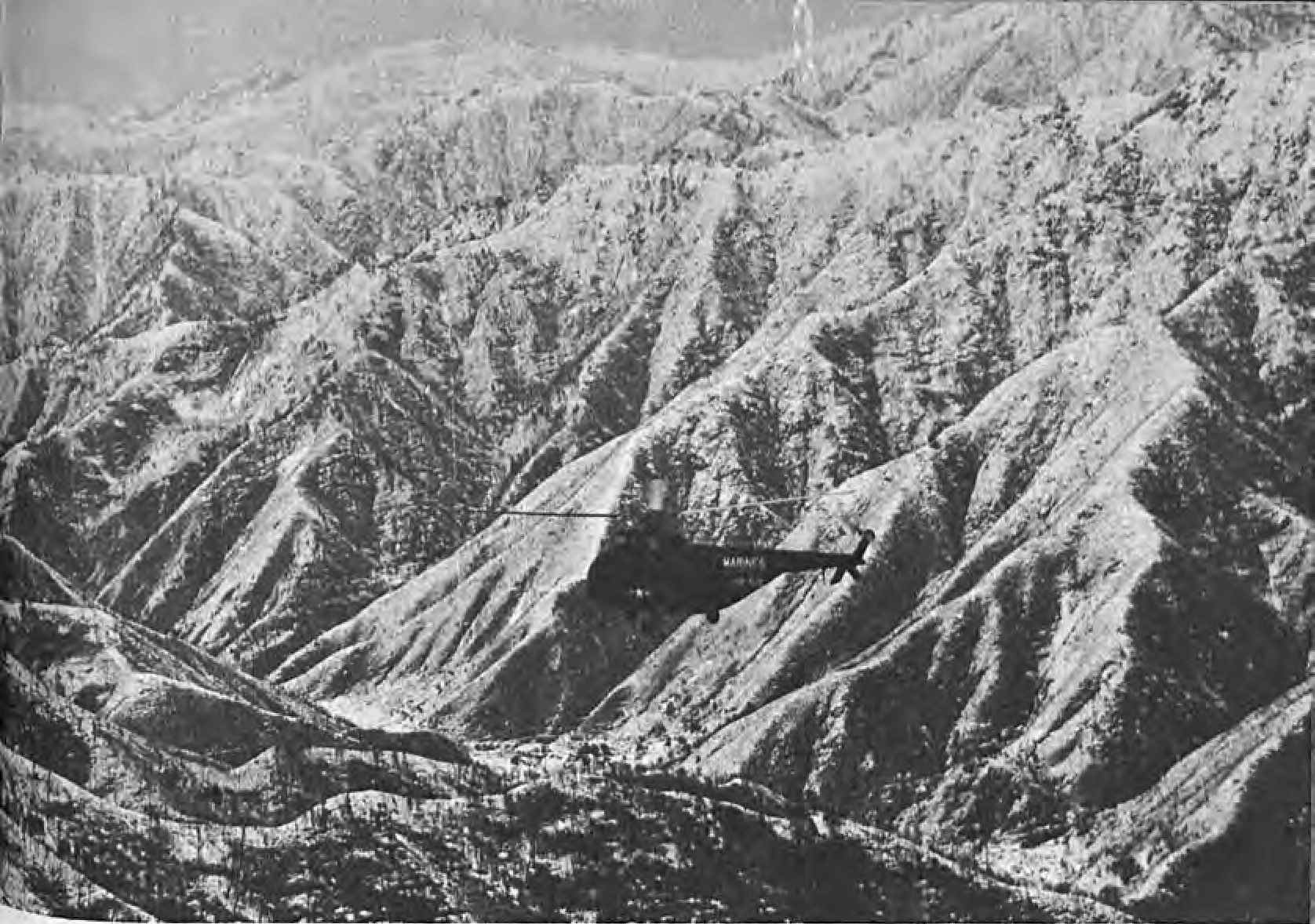
DD MC A 162316
Terrain Features—Above, a Marine helicopter flies behind ice-covered slopes
to avoid enemy fire. Below, an enemy stronghold nicknamed “Luke The
Gook’s Castle.”
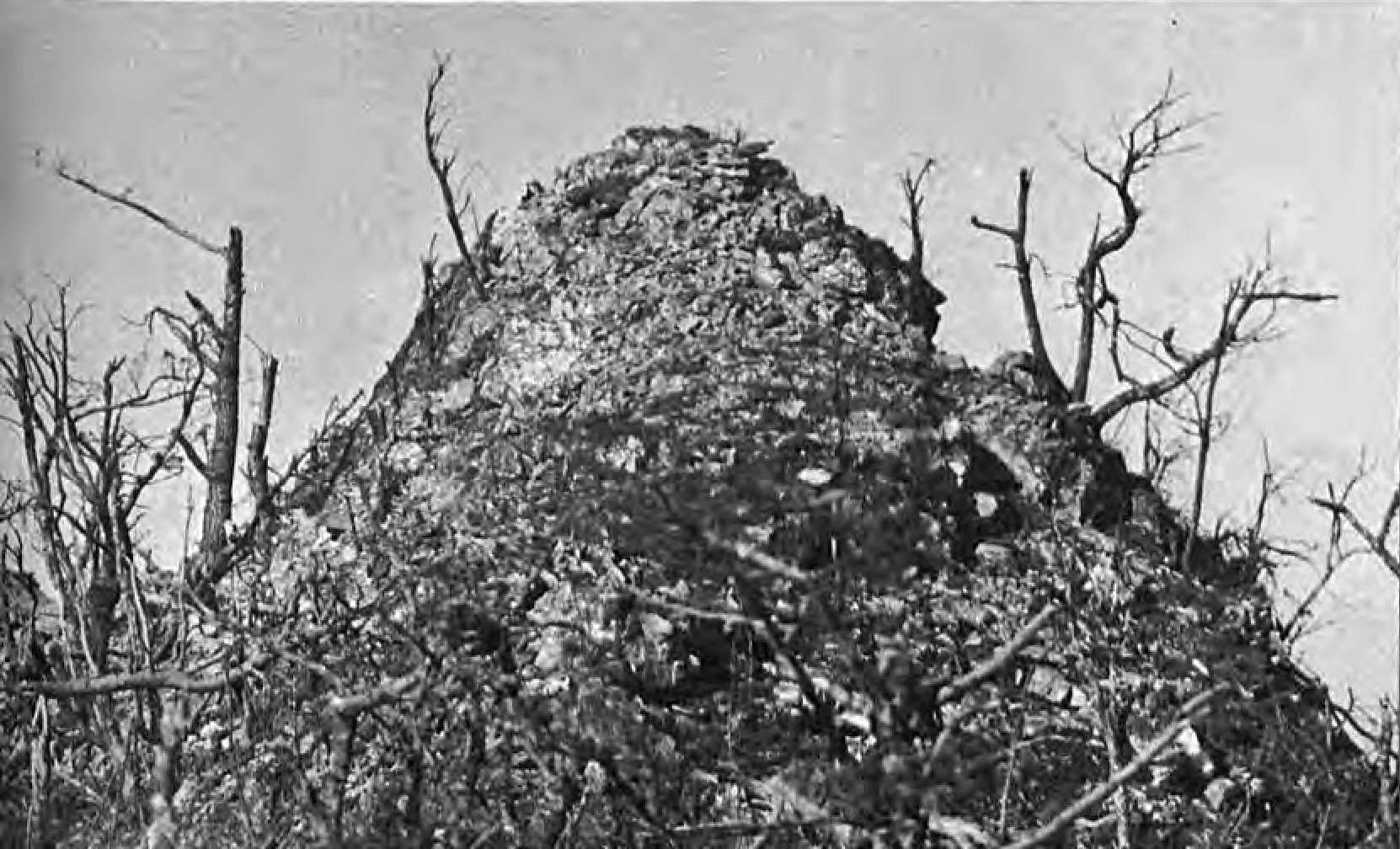
DD MC A 160572
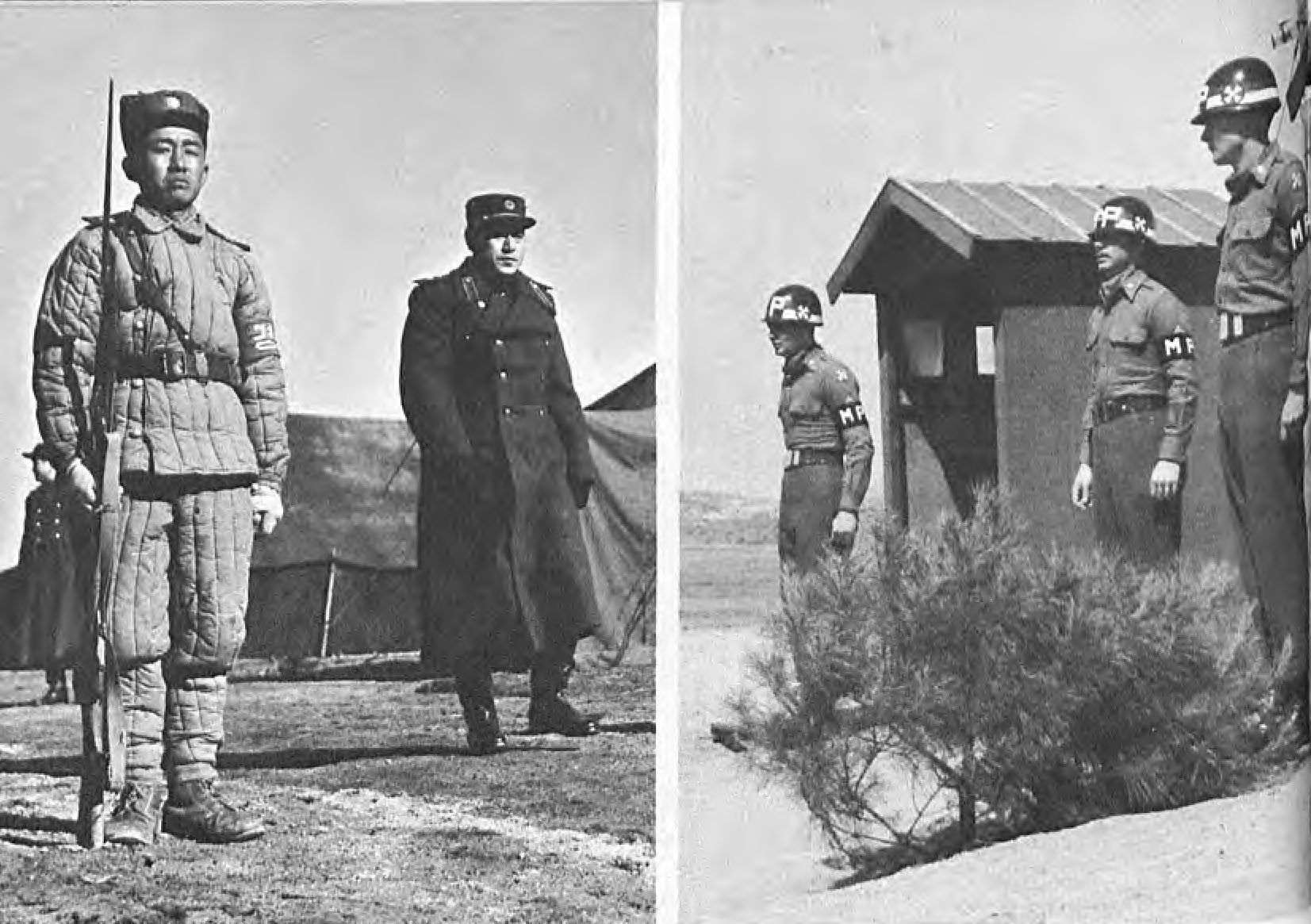
USN 439970 USN 441346
Panmunjom “Talkathon”—Above (left) Gen Nam Il starts for the truce
talks. Above (right) United Nations’ sentries. Below, the Chinese and
North Korean Communist negotiators.
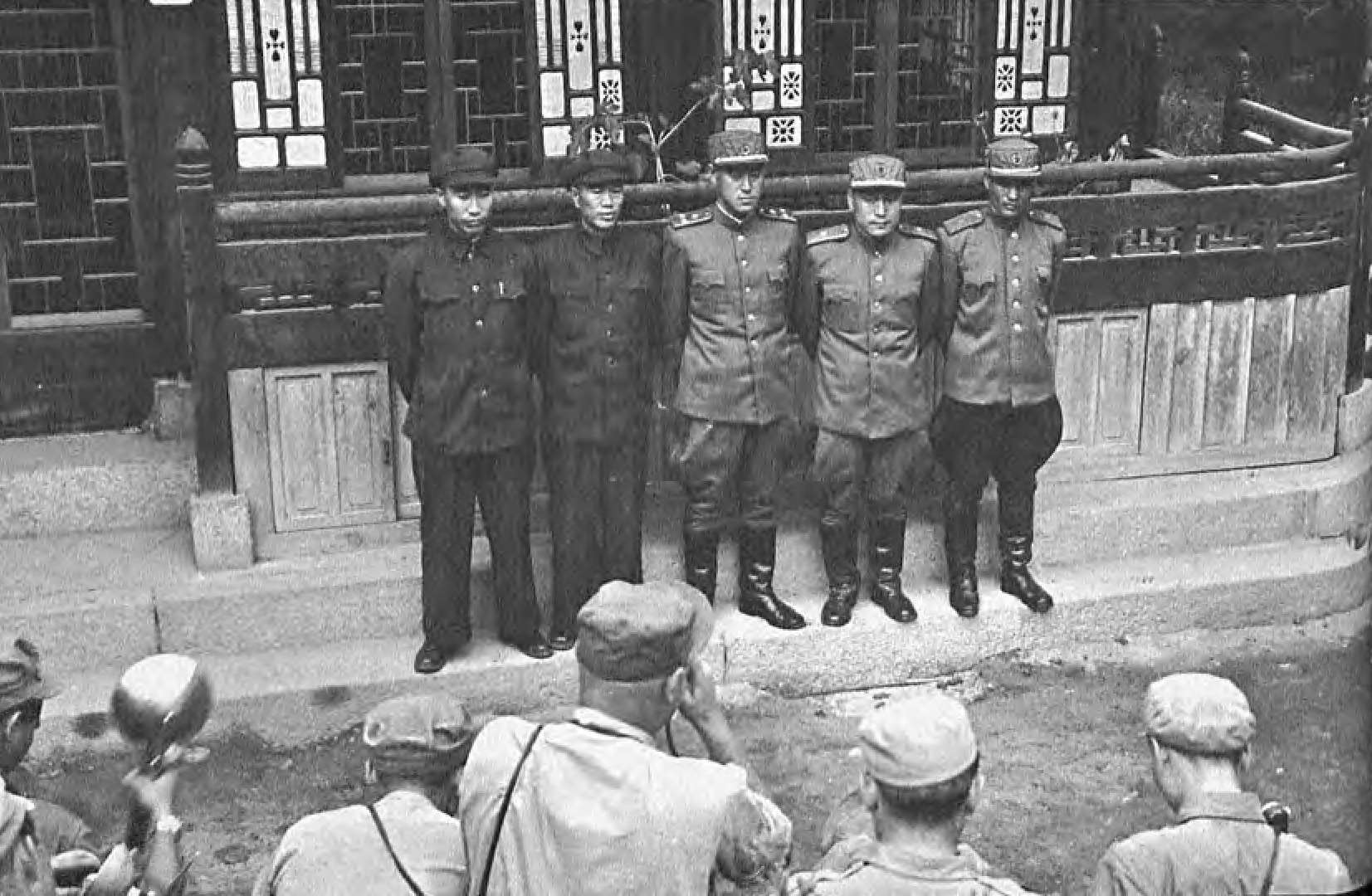
USN 431929
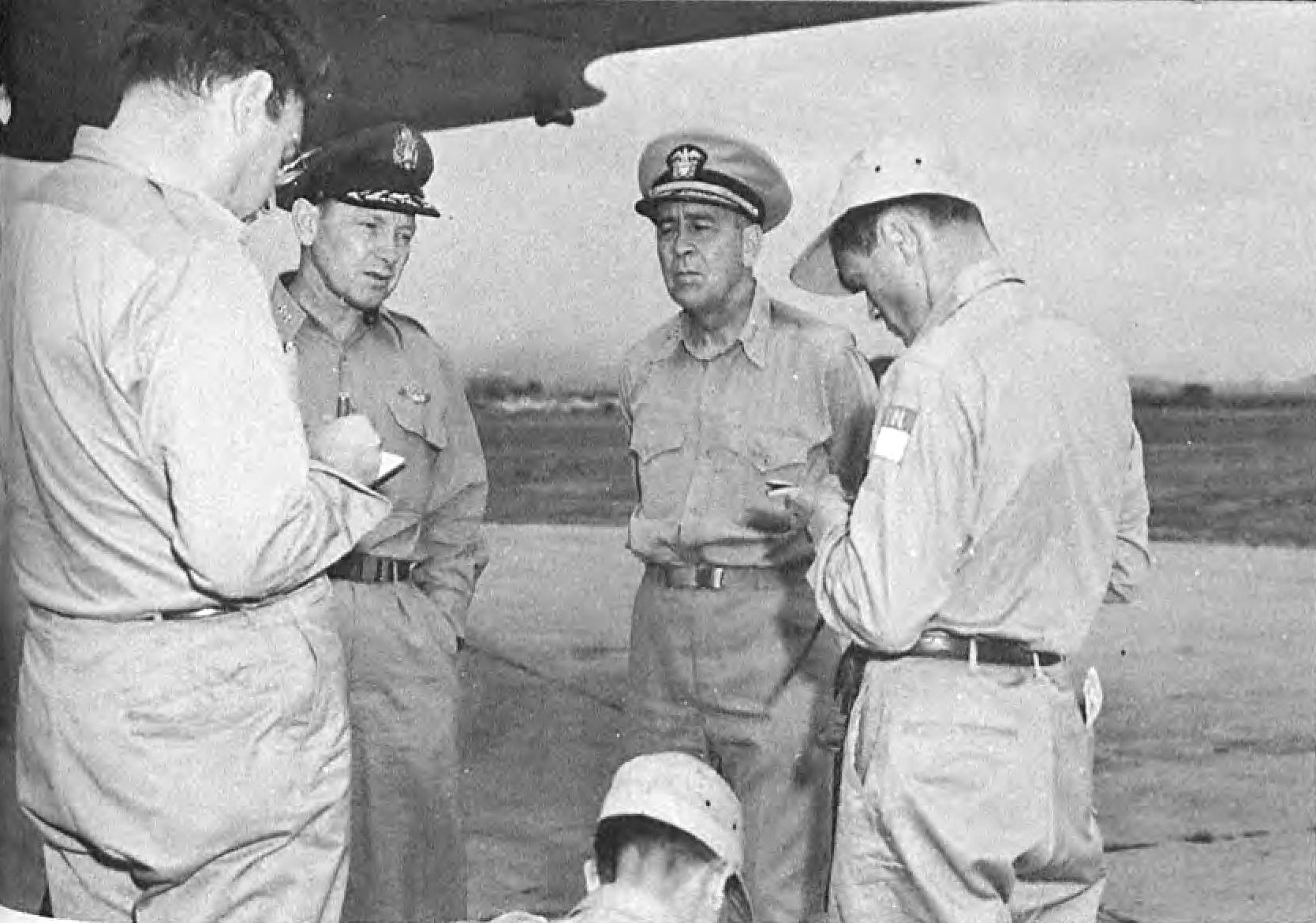
USN 432414
Watchful Waiting—Above, MajGen L. C. Cragie and VAdm C. T. Joy
talk to correspondents at Panmunjom. Below, Communist and UN sentries
walk posts around the peace talk site.
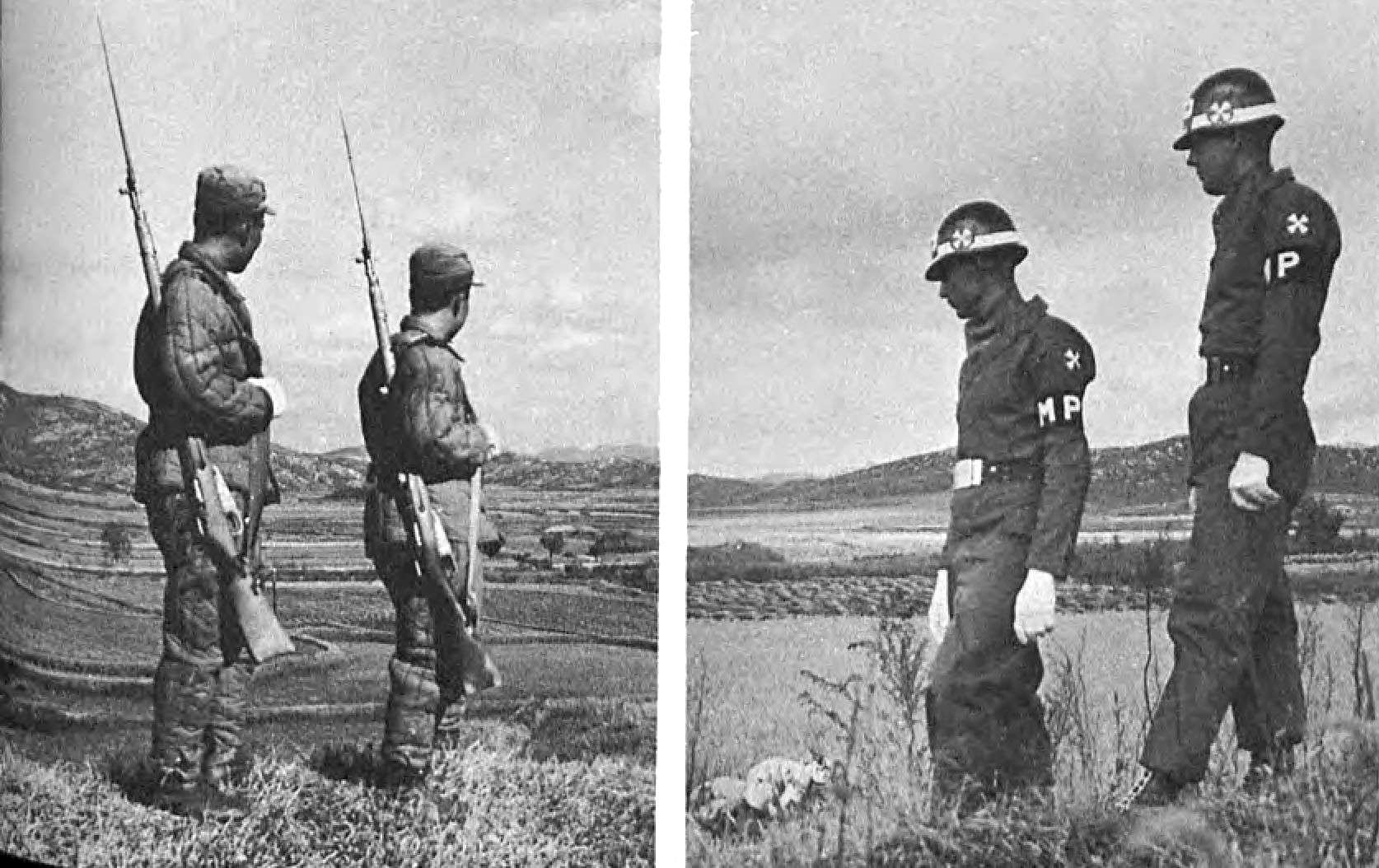
USN 935646 USN 435646
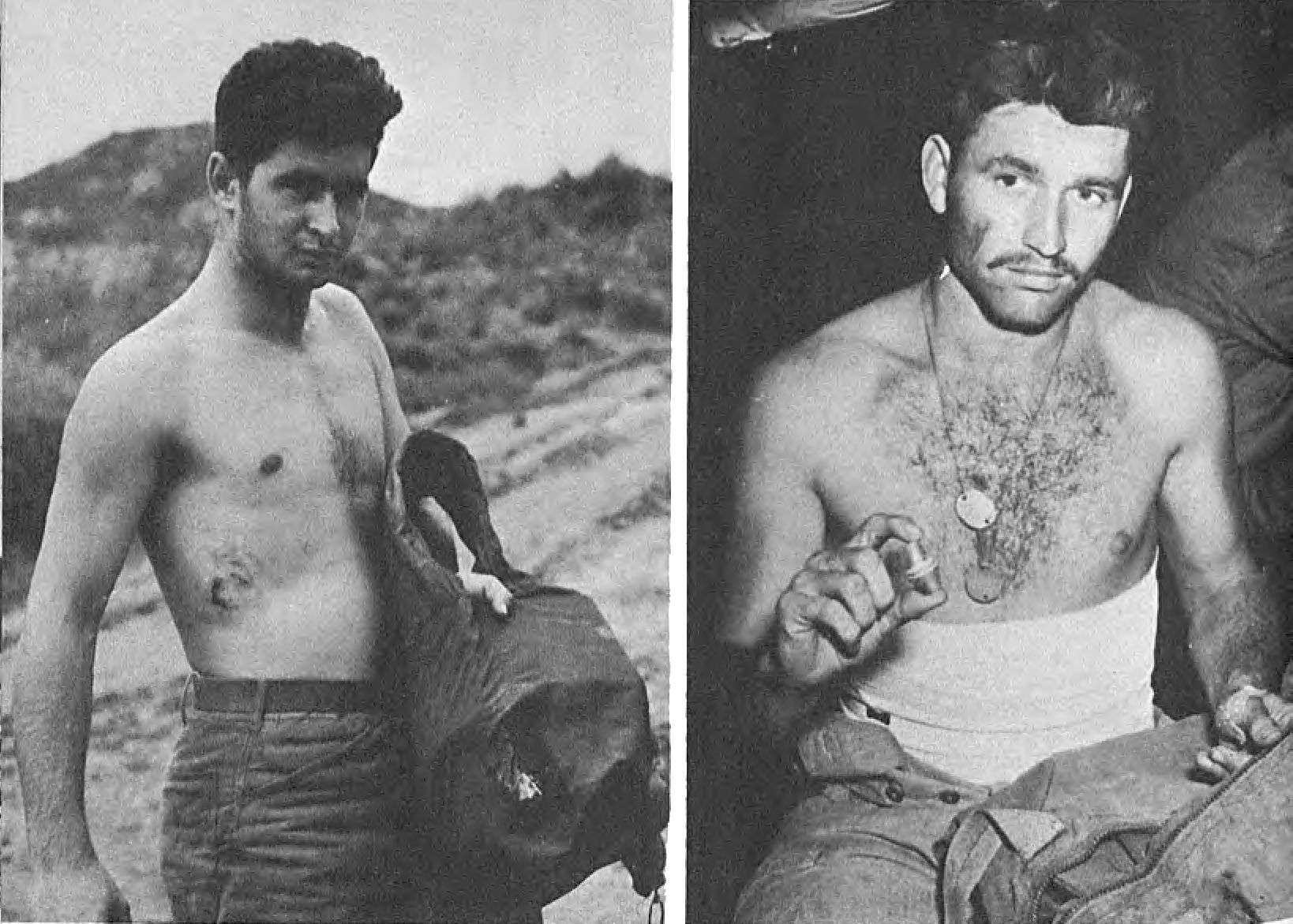
DD MC A 163575 DD MC A 164145
Lifesaver—Above, bruised Marines show the armored vests that saved their
lives. Below, a .45 caliber bullet test-fired into cotton contrasted with three
removed from an armored vest.
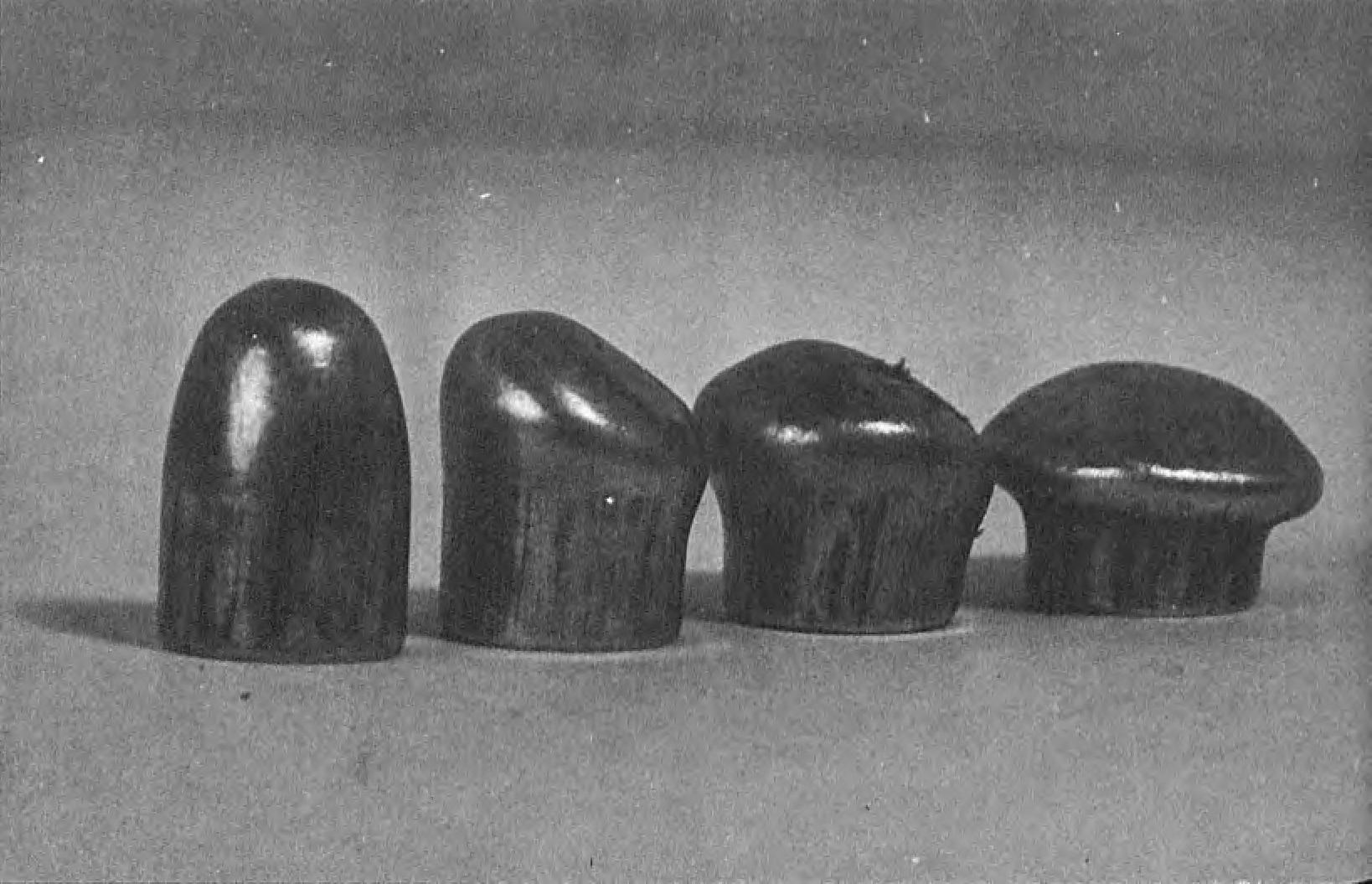
DD MC A 46216
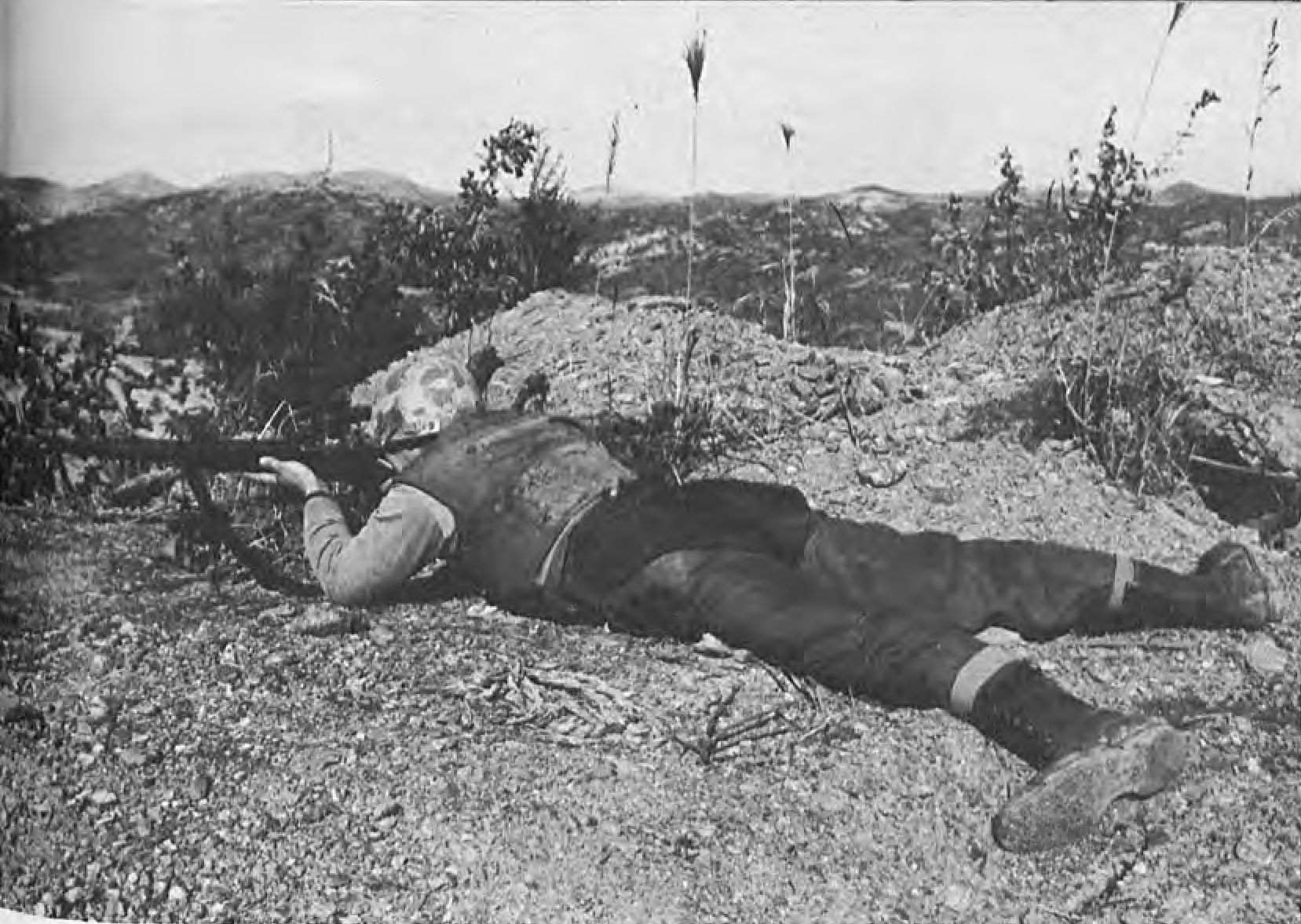
DD MC A 168081
Torso Protection—Above, a Marine rifleman lies prone to exhibit the protective
torso armor. Below, a helicopter evacuates a corpsman who was
wounded while treating a buddy.
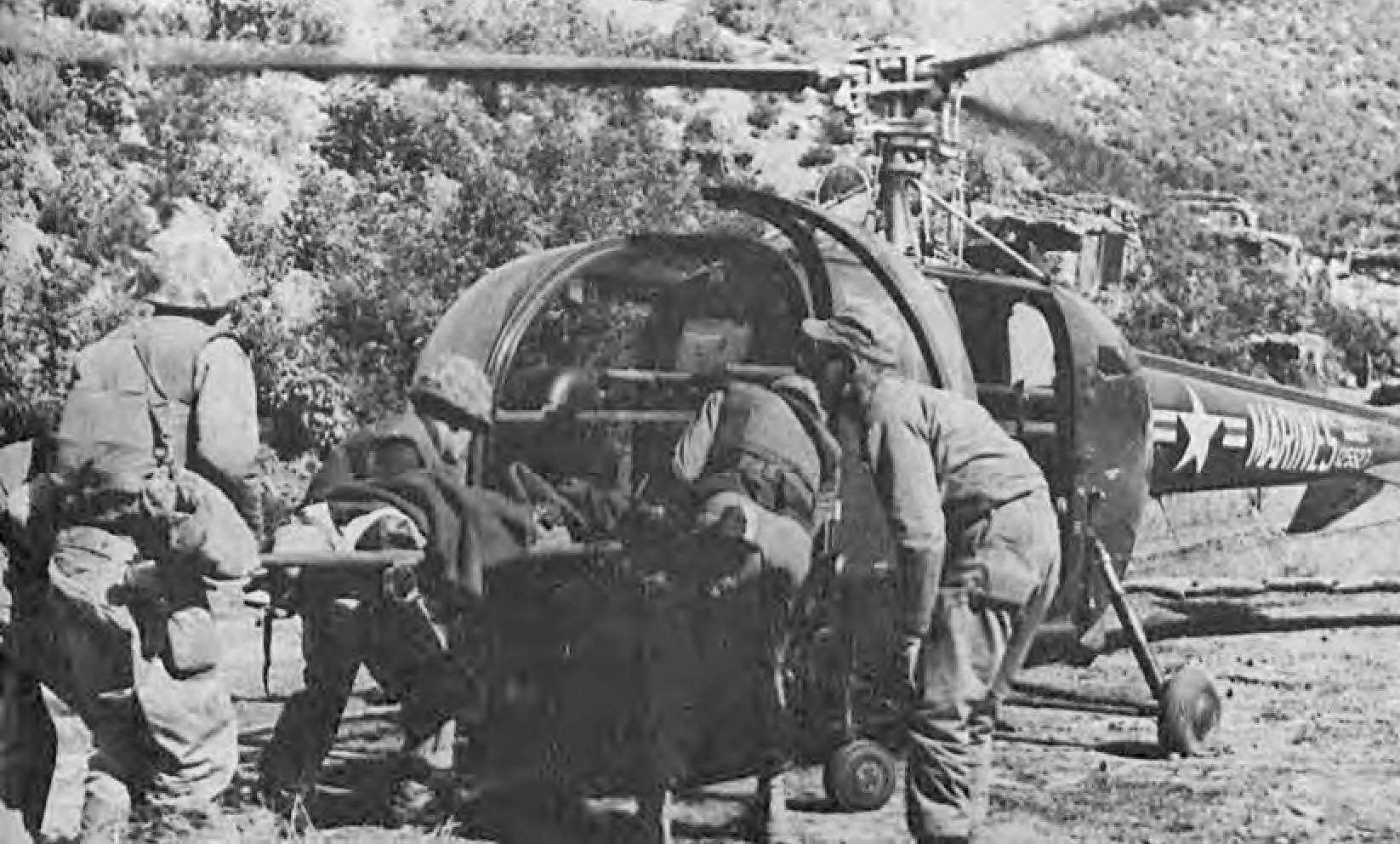
DD MC A 167282
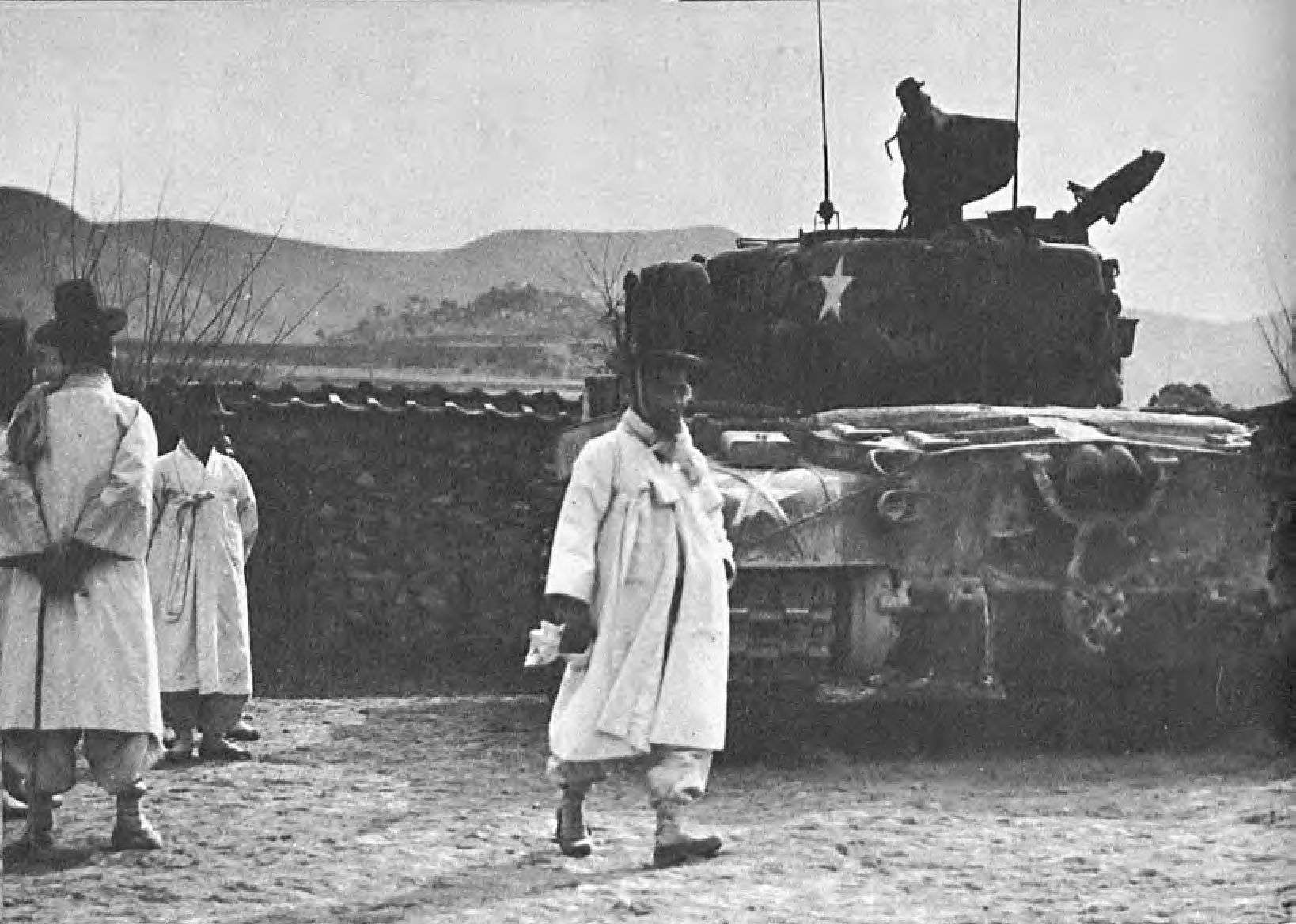
DD MC A 156301
Papa-sans and Pills—Above, a group of Korean patriarchs gaze curiously
at a Marine tank. Below, an Army nurse administers medication to a
grimacing Marine.
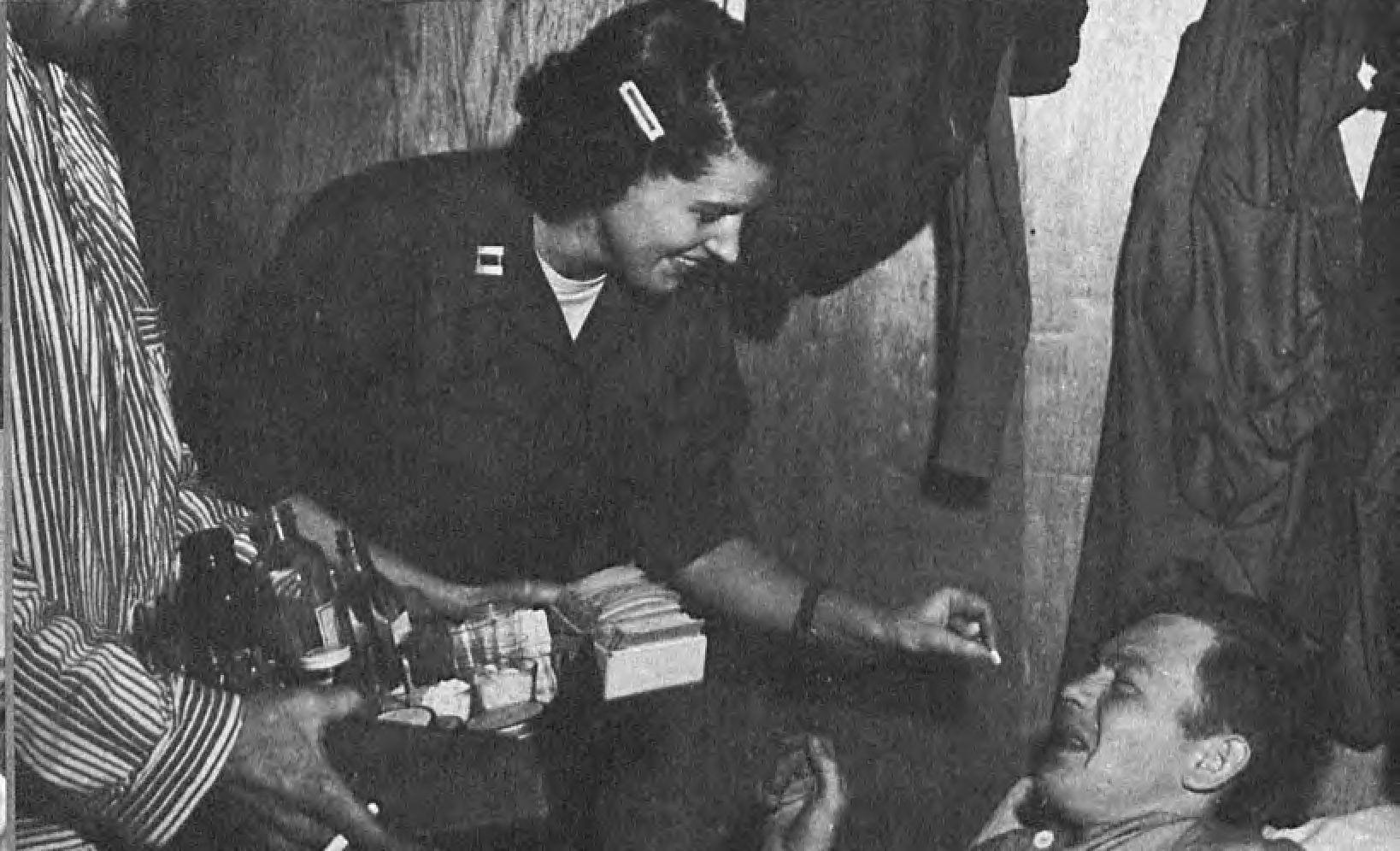
SC 358063
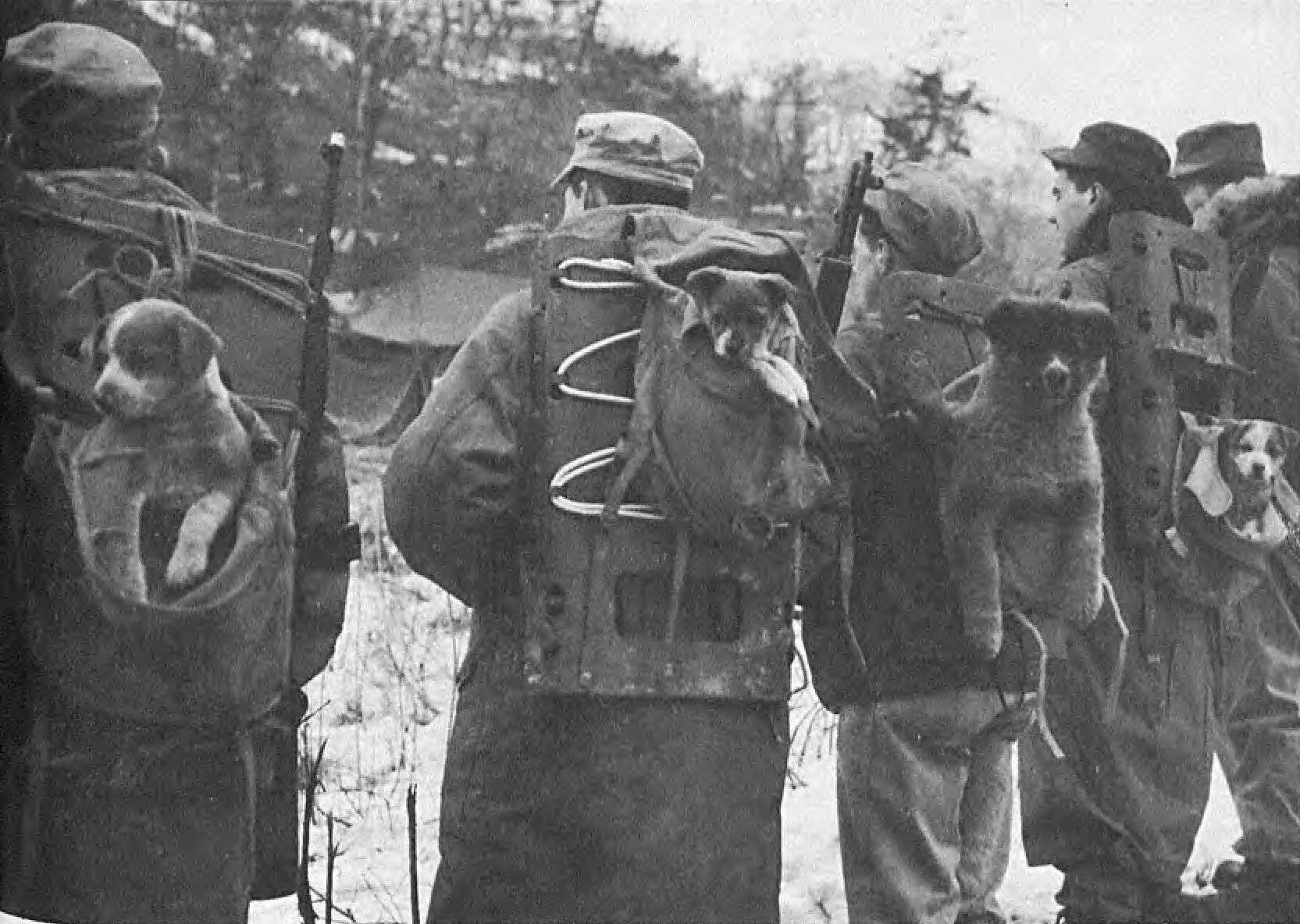
DD MC A 159786
A Dog’s Life—Above, Marines line up with their pets all packed and ready
to go. Below, troops gather for the ever-welcome mail call.
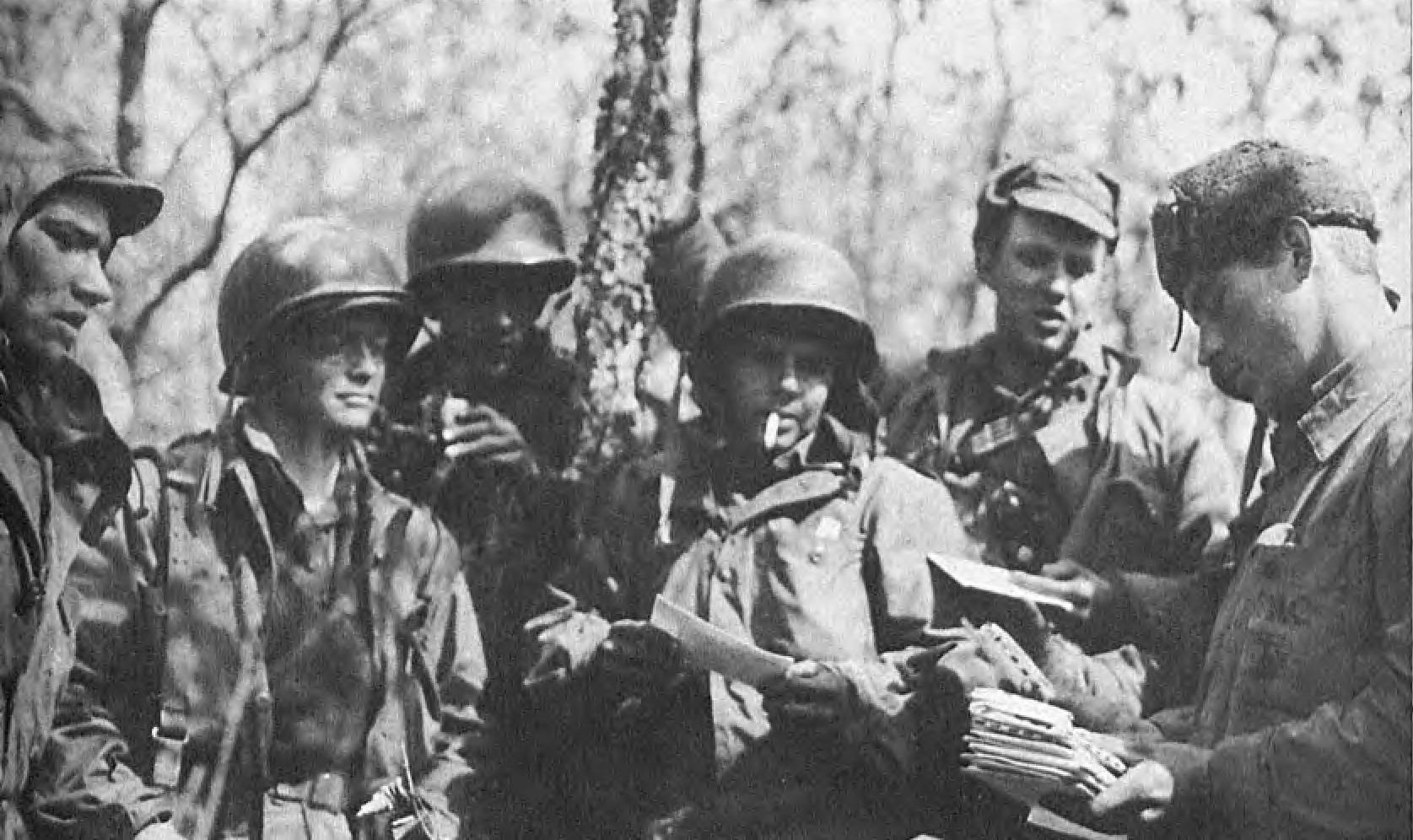
DD MC A 7468
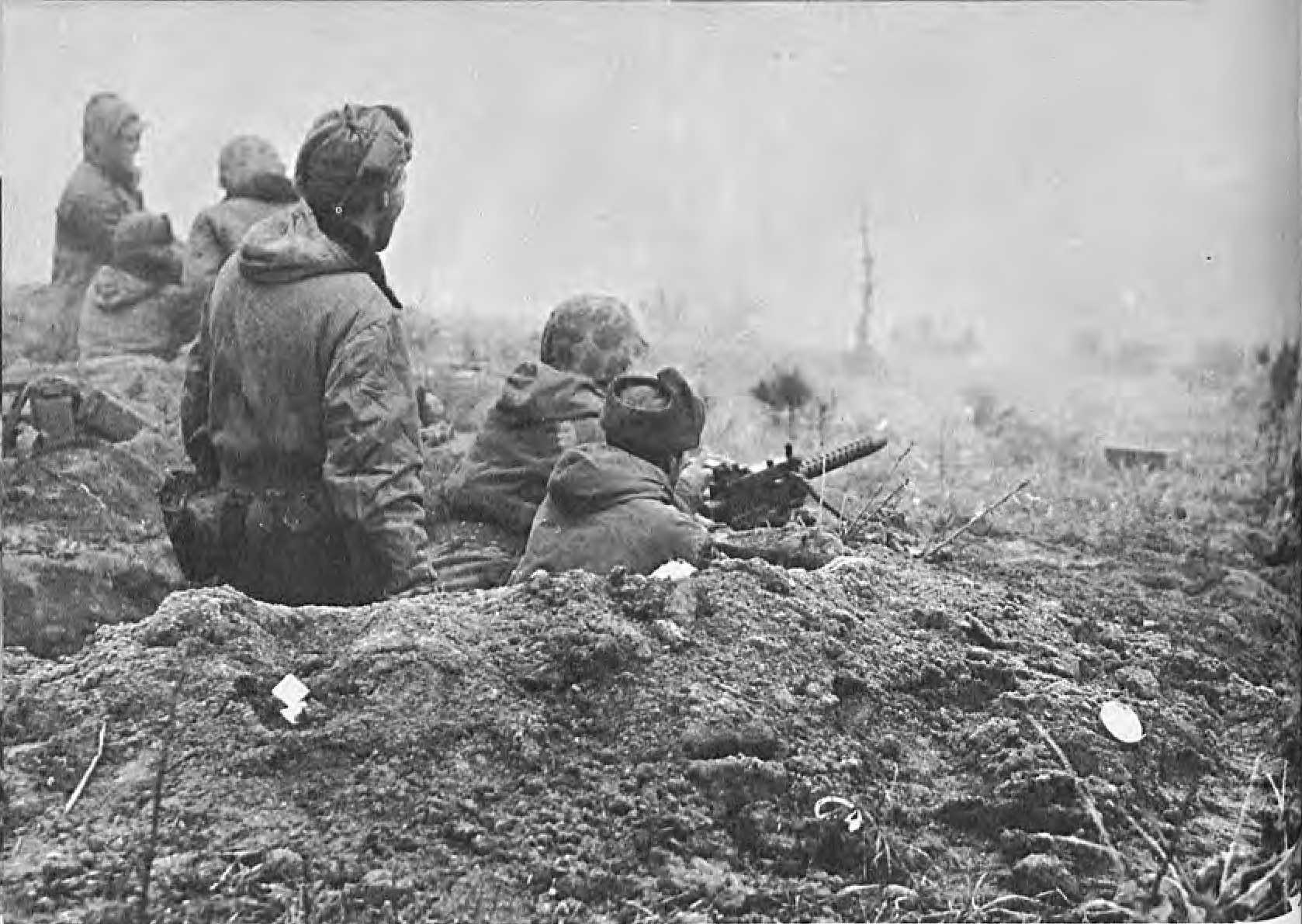
DD MC A 6843
At The Front—Above, Marines advance across a fog-filled valley while
supported by machine gun fire. Below, a group of Communist prisoners wait
for interrogation by trained experts.
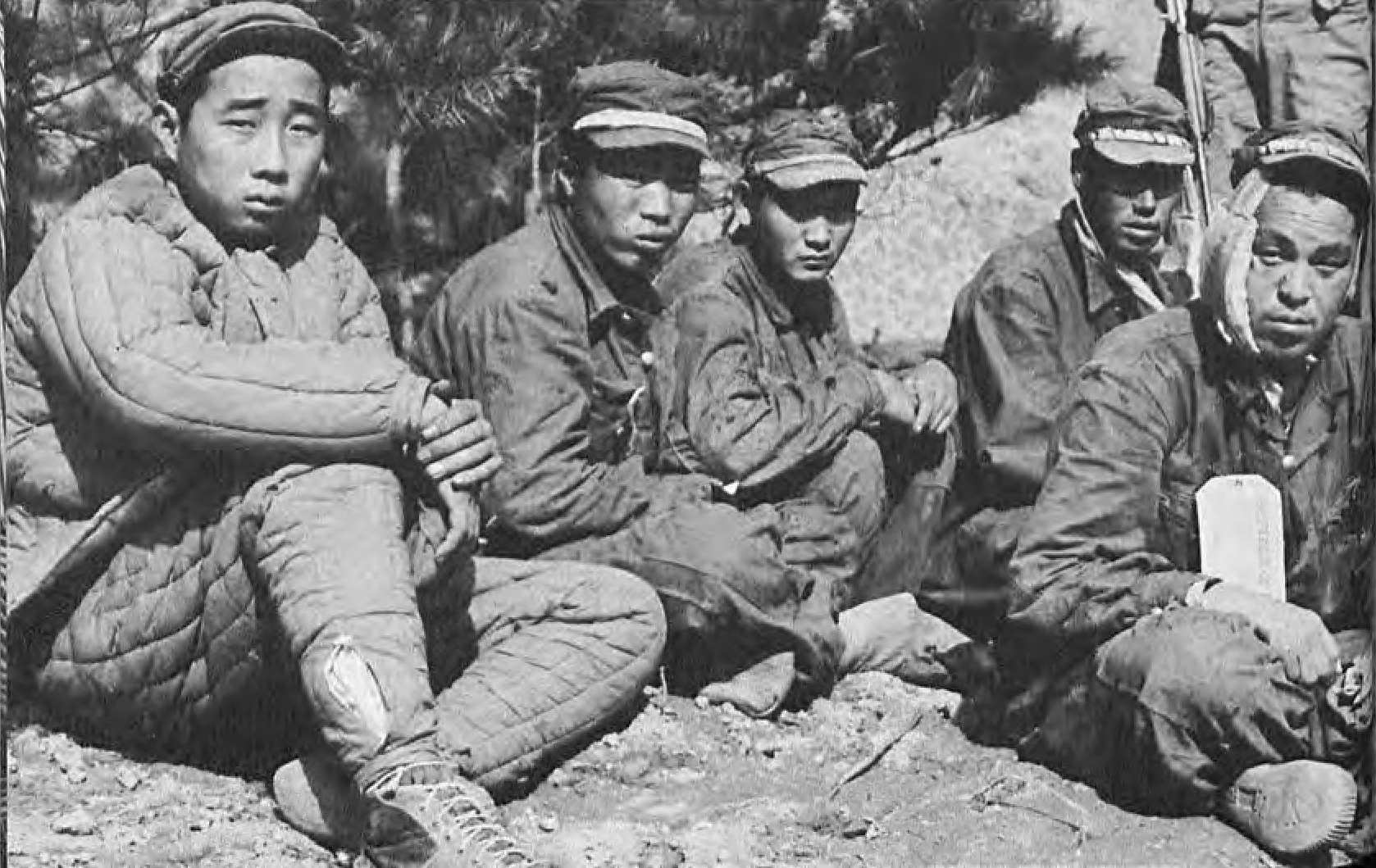
DD MC A 157686
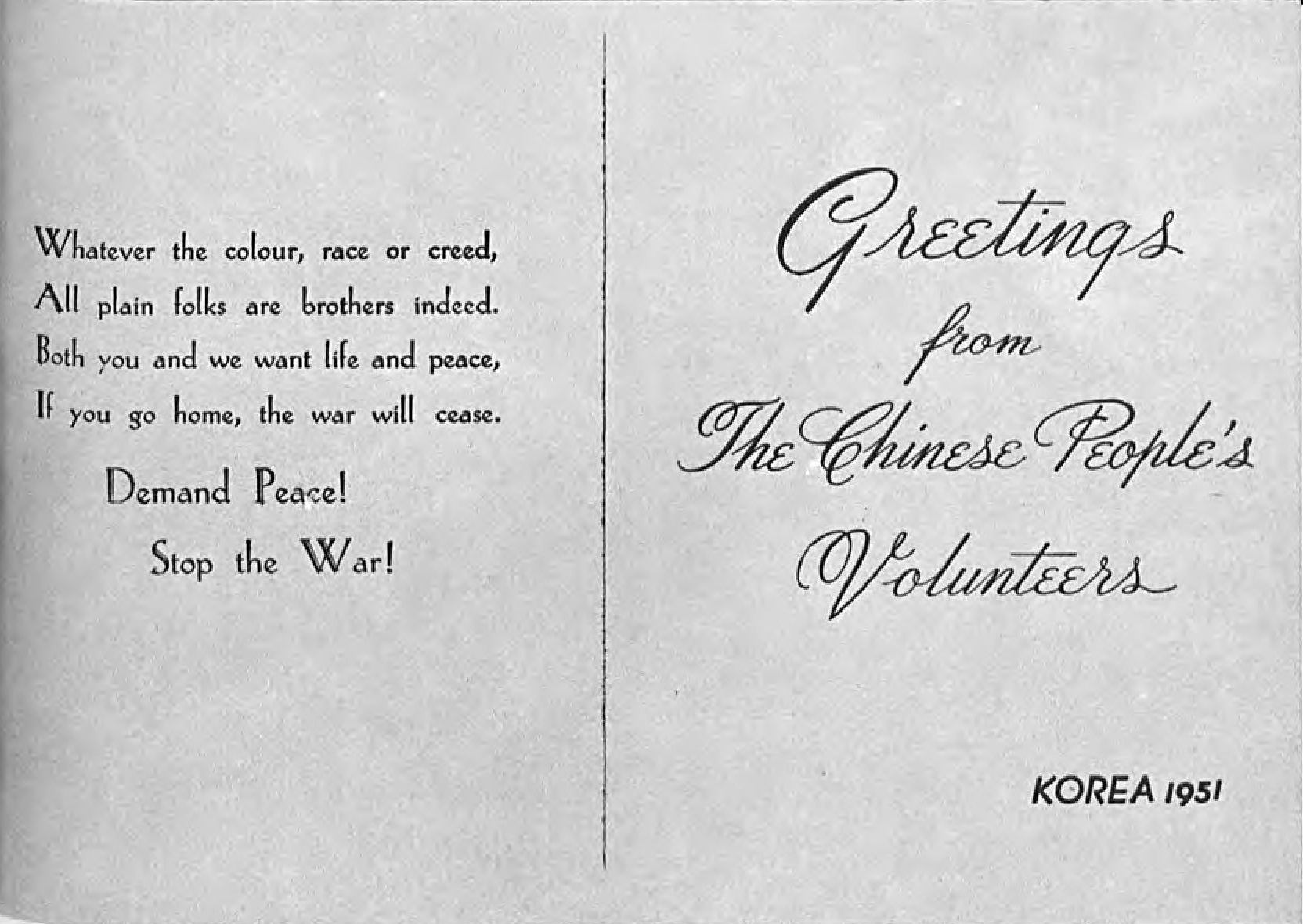
DD MC A 408351
CCF Propaganda—Above, one of the thousands of attractively-colored CCF
Christmas cards dropped on the MLR in December, 1951. Below, a mortar
observer crew in action.
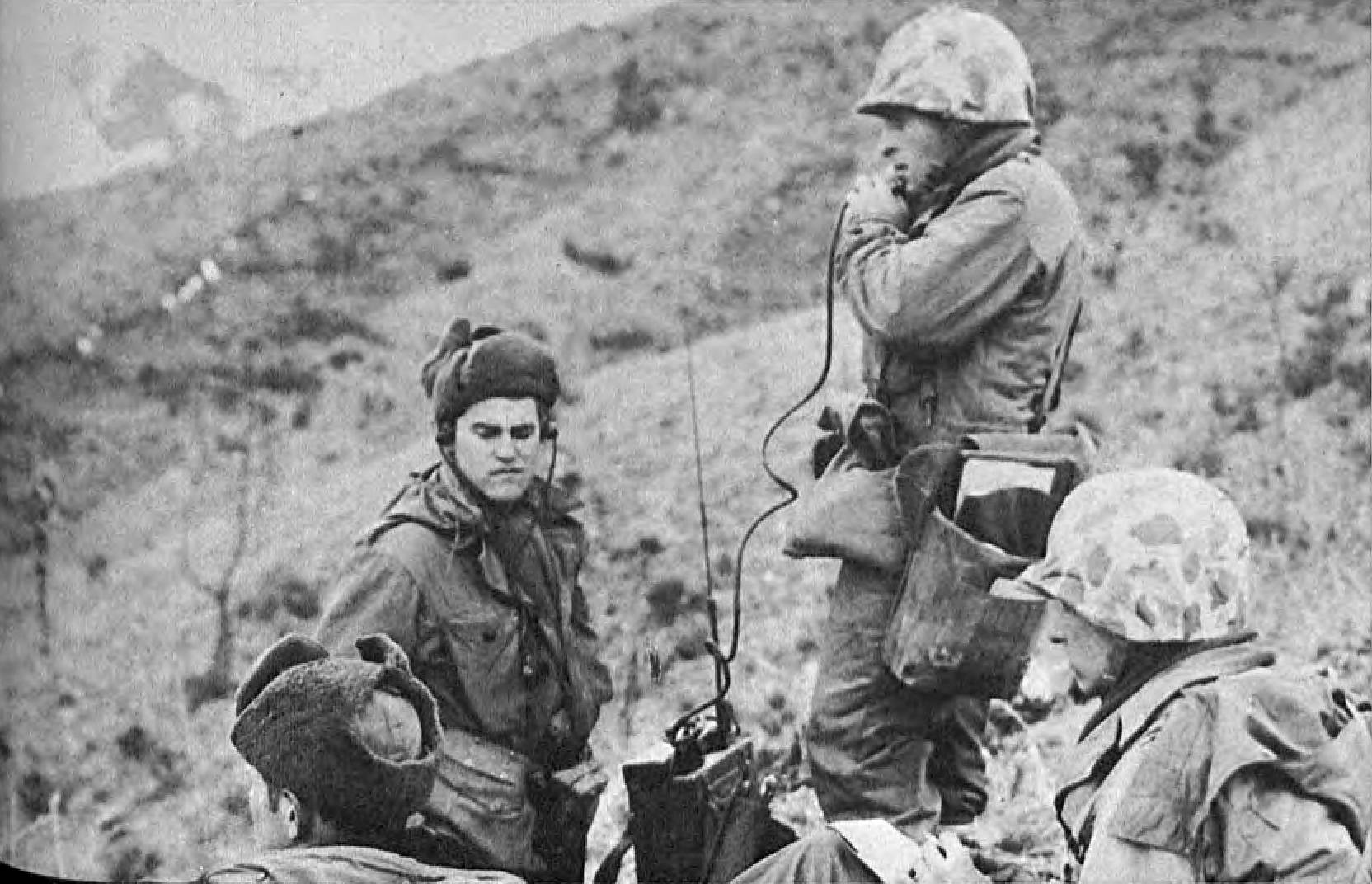
DD MC A 6627
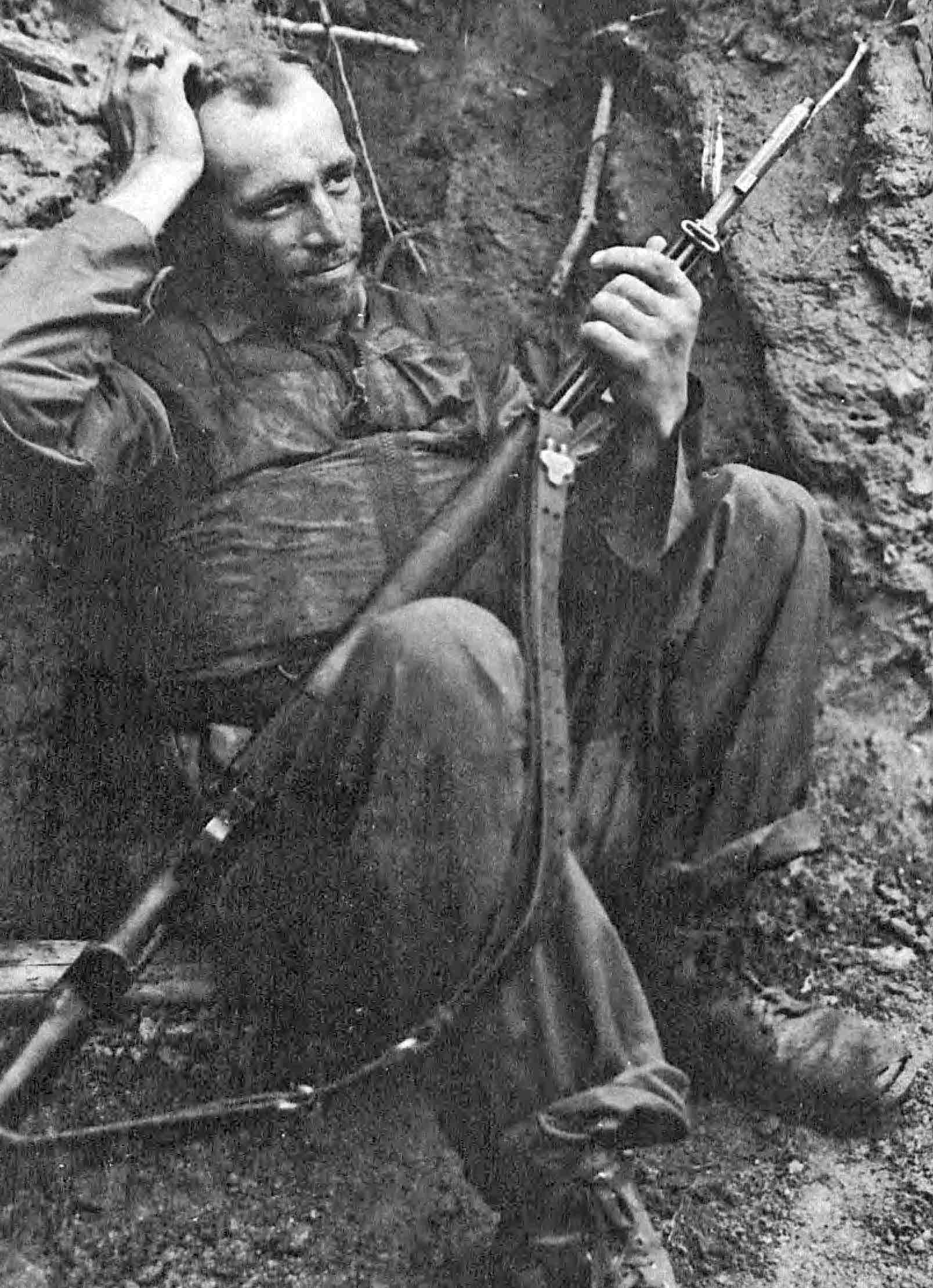
DD MC A 162989
Life’s Little Problems—PFC Henry A. Friday pauses to rest in a trench and
reflect upon the progress of his own particular efforts towards fighting the
Communists.
These statistics of Operation BUMBLEBEE made it certain that
Stateside headlines would proclaim another Marine “first.” Only
four days later HMR-161 demonstrated its ability to carry out on
short notice an emergency resupply and evacuation operation in a
combat zone. Help was requested in the IX Corps sector to the west
for a completely surrounded ROK unit in need of ammunition and of
casualty evacuation. Lieutenant Colonel Mitchell led six HRS-1
aircraft which flew in 19,000 pounds of ammunition. Lieutenant
Donald L. Hilian (MC), USN, surgeon of HMR-161, landed to
supervise the evacuation of 24 wounded ROKs, several of whom
would otherwise have died. Captains James T. Cotton and Albert A.
Black made four flights each into the beleaguered area, and all Marine
pilots of Operation WEDGE were congratulated in person by Major
General Claude F. Ferenbaugh, commanding general of IX Corps.314
Seven infantry battalions, with 2/1 in immediate reserve, manned
the MLR from 1 to 13 October—three KMC battalions on the left
of the Division sector; two 5th Marines battalions (relieved by the
7th Marines on the 11th) in the center; and two 1st Marines battalions
on the right. Scout and sniper teams were employed throughout the
period, with contacts few and far between. More destruction was
inflicted on the enemy by observed artillery, tank, and mortar fire.315
A new emphasis was placed on psychological warfare during these
defensive operations. Eighty-seven NKPA soldiers surrendered from
1 to 13 October, but whether they responded to leaflets fired by the
11th Marines could not be determined.
Early in October the 1st Marine Division was granted permission by
EUSAK to use Sokcho-ri (Map 19) as a port of embarkation and
debarkation instead of Pusan. The change proved satisfactory even
though troops had to be lightered from ship to shore. A 68-mile
truck movement through the I ROK Corps zone replaced the airlift
of 200 miles from Pusan to Chunchon, followed by a motor march of
70 miles. It was estimated that the new routing would add from
8,000 to 10,000 man-days a month to the combat potential of the
Division.
An improvement in logistics resulted when the Division asked and
received permission from EUSAK to use field K-50 near Sokcho-ri for
an airhead instead of K-51 at Inje. Although the Marines were
limited to five or six sorties a day while sharing K-50 with I ROK
Corps, they were able to transfer many airhead activities to the new
field.
The mission of the Division remained essentially unchanged from
14 to 31 October. Foot patrols ranged farther into enemy territory,
and tank-infantry raids in company strength, supported by air and
artillery, were launched at every opportunity.
Typical of these operations was the raid staged on 16 October by
elements of the 1st Battalion, 7th Marines, (Lieutenant Colonel
James G. Kelly) supported by tanks, air, artillery, and engineers.
Captain John R. McMahon’s Charlie Company was the principal unit
involved. The Marine column had as its objective an NKPA strong
point overlooking the village of Changhang (Map 2) on the east and
the flats on both sides of the Soyang-gang to the south and southwest.
Captain McMahon’s mission was “to reduce all fortifications and
installations ...” [and] “... to seize, occupy and hold ground
until the area was thoroughly mined, booby-trapped and infested
with trip flares.”316
A small-scale battle flared up for a few minutes as the enemy put up
a stiff resistance with artillery, mortar, and automatic weapons fire.
Superior Marine firepower soon prevailed, and at 1540 the attackers
reached their objective. During the next hour and 20 minutes enemy
installations were destroyed and the strong point rendered untenable
by mines and booby traps. The Marines withdrew at 1700 after
sustaining casualties of 3 KIA and 18 WIA. Enemy losses were 35
counted KIA.
The next day a reinforced KMC company, supported by tanks, air,
artillery, and engineers made a similar raid on enemy positions about
875 yards northwest of Hill 751 and 1,500 yards south of Hill 1052
(Map 20). Twenty-five NKPA bunkers were destroyed with losses
to the enemy of 15 counted KIA, 3 prisoners, and 5 captured
machine guns.317
On 21 October the front of the 1st Marine Division was reduced
a mile when elements of the 3d ROK Division relieved the 2d KMC
Battalion on the Marine left flank in accordance with instructions of
X Corps. Six infantry battalions now manned an MLR of 12¼ miles.
A strong enemy position, menacing the forward elements, had
developed to the north of the 1st Battalion, 1st Marines’ sector.
Three days of reconnaissance and detailed preparation preceded the
destructive raid carried out on 30 October. Captain George E.
Lawrence’s Charlie Company, reinforced with heavy machine guns,
was held up by NKPA resistance in estimated company strength. The
Marines fought their way up a ridgeline, throwing white phosphorus
grenades into enemy bunkers. Pinned down momentarily by NKPA
mortar and small-arms fire, they reached a defiladed position and
withdrew under cover of Marine artillery, air, mortars, and heavy
machine guns. At a cost of only one WIA, the raiders inflicted 65
counted KIA casualties on the enemy and destroyed an estimated 40
NKPA bunkers.318
All three Marine regiments on Line MINNESOTA were directed by
General Thomas to fight the enemy whenever possible with his own
weapons in the form of ruses and night ambushes. On 31 October the
3d Battalion of the 1st Marines feigned preparations for an attack
even to the extent of a brief artillery barrage. When the firing let
up, the Marines sounded an NKPA bugle call as a signal for enemy
troops to rush out of bunkers and man open trenches. Thus exposed,
they became the victims of intense Marine mortar and artillery fire
which inflicted an estimated 47 KIA and 48 WIA casualties.
During the last 2 weeks of October, 11 missions were fired by the
battleship USS New Jersey and 41 missions by the heavy cruiser
USS Toledo. Appreciation was expressed in a message to the Toledo
by General Thomas: “Your accurate and effective fire during period
24–29 October made an important contribution to operations of this
division. Many thanks and come again.”319
Antiguerrilla raids behind the MLR were carried out by Marine
ground forces relying upon HMR-161 helicopters for transportation.
In Operation BUSHBEATER teams from 1/1 were landed on the Division’s
east flank to sweep westward toward the Soyang-gang on
22 October while teams from Recon Company patrolled from the
opposite direction.
Operations HOUSEBURNER I and II were planned to deprive guerrillas
of shelter during the coming winter. As the name implies,
helicopter-borne teams set Korean huts afire with flame throwers and
incendiary grenades.320
Enemy forces facing the Marines at various times in October were
believed to comprise the 2d Division, II NKPA Corps, the 1st and 15th
Divisions of III Corps, and the 19th Division of VI Corps. Nkpa
casualties during the month were announced by the 1st Marine Division
as 709 counted and 2,377 estimated KIA, 4,927 estimated WIA,
and 571 prisoners. The Marines (including the 1st KMC Regiment)
suffered losses of 50 KIA, 2 MIA, and 323 WIA.321
On 1 November 1951 the front line strength of the opposing forces
was nearly equal—195,000 for the UN, and 208,000 for the enemy.
In reserves the Communists held their usual numerical advantage with
nine CCF armies totaling 235,000 men plus 138,600 in four NKPA
corps. All were readily available either as reinforcements or as assault
troops for a great offensive.322
Even though the Eighth Army was committed to a warfare of
position, General Van Fleet meant to keep the initiative. “If we had
stagnated on any one of our many positions since the tide turned in
April,” he said in a recorded statement of 3 November, “the hydra-headed
Communists—who seem to grow two soldiers for each one
cut down—would soon have been at our throats. With the enemy’s
prolific capacity posing an ever-present threat, we had no choice but
to destroy the menace before it matured.”323
Throughout November the 1st Marine Division continued to occupy
the eastern portion of the X Corps defense sector in east-central Korea.
From left to right the 1st KMC Regiment, 7th Marines, and 1st
Marines held the 12¼-mile MLR with two battalions each. The 5th
Marines remained in reserve until the 11th, when it relieved the
1st Marines. That regiment went into the new reserve area at Mago-ri
(Map 19).324
Elements of the 1st, 15th, and 19th Divisions, III NKPA Corps,
manned the opposing lines. The Marines continued to organize
artillery- and air-supported tank-infantry-engineer task forces in company
strength for raids. Squad-size patrols were sent out nightly to
ambush the enemy, employing ruses whenever possible.
The howitzers of the 11th Marines and the 90mm rifles of the 1st
Tank Battalion were kept busy throughout the month. On 7–8
November, for instance, Marine artillery fired 257 observed missions
in 24 hours—including 34 on enemy artillery positions, 32 on mortar
positions, 25 on bunkers, 22 on machine gun positions, 4 in support of
friendly patrols, 3 on supply dumps, 2 on trucks, and 1 each on a
bridge, a CP, and a 57mm recoilless rifle position.
In spite of such daily pounding, aerial photographs proved that
NKPA defenses in depth had become more intricate and formidable
in November 1951 than during any previous month.
On the 7th the 14th Replacement Draft added 2,756 officers and
men to the 1st Marine Division. Within a few hours 2,066 officers
and men of the 10th Rotation Draft were detached. And on the
27th the 11th Rotation Draft represented a further loss of 2,468
Marines whose departure was hastened so that they could be home
by Christmas.
A note of grim humor crept into proceedings on 9 November.
Division OpnO 50-51 directed that all supporting arms and weapons
commemorate the Marine Corps Birthday the next day by firing a TOT
on Hill 1052, the key enemy observation point overlooking the friendly
sector.325 While the cruiser USS Los Angeles contributed naval gunfire,
the Commanding General of 1st MAW, Major General Christian F.
Schilt, led an air strike of 83 Marine planes to blast this enemy strong
point.
The performance was embellished on the 10th when Marine tanks,
mortars, and machine guns added their fire to the grand crescendo of
exploding shells and bombs. The Communists were also bombarded
with 50,000 leaflets inviting them to the Marine birthday dinner that
evening. Twenty Korean Reds actually did surrender, though some
doubt remained whether they had responded to the invitation or the
TOT. General Van Fleet sent a message to all Marines in his command,
congratulating them on “a job well done” in Korea.326
On 11 November the 5th Marines carried out its relief of the 1st
Marines on Line MINNESOTA. This was the occasion for the largest
helicopter troop lift so far, involving the transportation of nearly
2,000 combat-equipped men.
Operation SWITCH began at 0635 on D-Day when three helicopters
took off from Field X-83 with Shore Party specialists to signal aircraft
into landing sites and supervise the unloading and reloading
of troops. Twelve helicopters were employed, each carrying five men
and supplies from the 1st Battalion, 5th Marines (Lieutenant Colonel
Kirt W. Norton), and returning to Field X-83 with a like load from
Lieutenant Colonel Clifford E. Quilici’s 2d Battalion, 1st Marines.327
Naval gunfire from the USS New Jersey helped to keep the enemy
quiet during the relief. All told, 950 men were flown to Hill 884—soon
to be known unofficially as “Mount Helicopter”—and 952 lifted
to Field X-83 in return flights. Total flight time was 95.6 hours and
over-all time 10 hours. Once again the Marine Corps had made
tactical history.
Ground forces operations throughout November seldom varied
from the familiar pattern of squad-size patrols nightly and an occasional
daytime raid by a company-size task force with the support of
artillery and air. Supporting arms kept enemy strongholds under
almost constant fire, and North Korean activity in the construction
or improvement of bunkers provided frequent targets of opportunity.
Contacts seemed to be avoided by enemy troops. On the night of
29 November, for instance, 11 Marine ambush patrols ranged from
1,500 to 2,500 yards ahead of the MLR with only a single contact
before returning at daybreak. One enemy KIA was inflicted and one
prisoner taken at a cost of four Marine WIA casualties.
Total Marine casualties (including the KMCs) during November
were 34 KIA and 250 WIA. Enemy losses amounted to 408 counted
and 1,728 estimated KIA, 2,235 estimated WIA, and 104 prisoners.
Marine operations in December were shaped in advance by the resumption
of armistice negotiations. This time Panmunjom was agreed
upon as a conference site instead of Kaesong. Literally a wide place
in the road, the tiny hamlet was located just north of the 38th
Parallel between Munsan and Kaesong (Map 19). In the lack of
houses, tents provided shelter for the UN and Communist delegates
who renewed their meetings on 25 October 1951 for the first time
since the Reds walked out at Kaesong on 23 August.
Discussions during November were largely devoted to the question
of a cease fire based upon a line of demarcation. On the 23d it was
agreed to accept a line linking up the farthest points of repeated contacts
up to 2,000 yards forward of the United Nations MLR. Three
days later, representatives of both sides initialed maps to indicate
acceptances.328
The effect of the so-called cease fire on EUSAK operations was
immediate. General Van Fleet sent his corps commanders a letter
of instructions warning that active defensive operations were to
continue until a full armistice had been concluded. If such an event
took place within 30 days after 27 November 1951, the demarcation
line would not be altered. But if an agreement had not been reached
by that time, the line would be revised in accordance with actual
changes.329
EUSAK instructions to corps commanders were relayed in a X Corps
message of 27 November to the 1st Marine Division:
Part 1. The conference at Panmunjom has fixed a military demarcation
line as a preliminary step to ending hostilities within a 30-day period.
Part II. Every US, UN, and ROK soldier will be informed that hostilities
will continue until armistice agreement is signed.
Part III. While negotiations continue, X Corps will: (1) Demonstrate its
willingness to reach an agreement by reducing operations to those which are
essential to insure maintenance of present positions. Counterattacks to regain
key terrain lost to enemy assault are authorized, but other clearly offensive
actions will be taken only by direction of this Headquarters; patrolling only
to that line beyond which contact has been repeatedly established; limiting
supporting fires, including air strikes, to destruction of those targets which
appear to constitute a major threat, or to improve the enemy’s offensive capability.
(2) Prepare for offensive action by: Conserving ammunition; maintaining
combat effectiveness through intensified training; preparation for and
rehearsal of limited-objective attacks, to be launched near the end of the 30-day
period in order to improve the MLR.
Part IV. Every effort will be made to prevent unnecessary casualties.330
In view of these instructions, it is understandable that a lull set
in along the X Corps front in December 1951. Most of the cold
weather clothing had been issued during the preceding month, and
work was largely completed for the “winterizing” of bunkers. It
remained only to improve defensive installations as front line elements
continued to send out patrols to maintain pressure against the enemy.
And since the Communists were putting similar military policies into
effect, both sides kept in contact with relatively small units.331
The enemy also busied himself with extending already formidable
defenses in depth. And though he did not seek a fight, he showed no
hesitation about accepting one.
From 5 to 20 Marine patrols went out nightly during December,
some of them manning night outposts called “duck blinds;”332 occasional
raids continued with relatively few contacts. In the rear of the
Division area, helicopter patrols continued against guerrillas.
The 13 aircraft of HMR-161 had a busy month with 390 missions
and 621 flights. Six thousand pounds of rations, 9,000 pounds of
fuel oil in drums, 15,000 pounds of fortification material, and 15,000
pounds of cold weather clothing were among the supplies flown to
the front. Personnel to the number of 2,022 were lifted, and cargo
to the amount of 149,477 pounds.
The first breakthrough in truce negotiations, at Kaesong, occurred
on 18 December, when lists of prisoners held by both sides were
exchanged. Prior to this exchange of lists the UN Command could
only speculate on the number carried as missing in action who were
in reality held as prisoners of war. The Communists had previously
reported only a few dozen names, and then only if it suited their
propaganda purposes. Radio Peking, in releasing names piecemeal,
had broadcast recordings made by UN prisoners under duress. Far
Eastern monitors reported these broadcasts were slanted to give the
Communist viewpoint.
The 18 December list of 3,198 American POWs revealed only 61
Marines including 2 Navy hospital corpsmen. (Information received
from 18 Marines who gained their freedom in May 1951 was sketchy
concerning others held at the time and was never accredited as official
or authoritative.)333 Interestingly enough when the Communist negotiators
saw the list given them by the UN representative they became
irate and tried to withdraw their list. The names of the Chinese and
Korean prisoners had been Anglicized and caused considerable difficulty
in retranslating the names into oriental characters.
Negotiations hit a snag at this point, and no other list was offered
by the Red officials until the first prisoner exchange (Operation
LITTLE SWITCH in April 1953). Notwithstanding the protracted and
exasperating tactics of the Reds at the truce table, the exchange of
prisoner of war lists presaged infinitely better treatment to the UN
prisoners than had been accorded them prior to that time. The so-called
lenient treatment policy by the Chinese, promulgated in July
1951, was initiated after the exchange of lists.334
The lists given by the Communists did not include several Marines
captured during the months of October, November, or December of
1951. The families of these men were to sit in anguish waiting for
these names until April of 1953. These and other instances of perfidy
and treachery at the truce table by the Communist negotiators were
to become legion.335
On 19 December the 2d Battalion, 5th Marines (Major William E.
Baugh) was relieved just behind the MLR by Lieutenant Colonel
Norton’s 1/5 in helicopter Operation FAREWELL. It was the last
flight in Korea for Lieutenant Colonel Herring, who returned to
Quantico as commanding officer of Marine Helicopter Experimental
Squadron (HMX)-1. His relief as commander of HMR-1 was
Colonel Keith B. McCutcheon, and Lieutenant Colonel Mitchell remained
as executive officer.336
The Marine helicopters of VMO-6 had also been setting records
during the last half of 1951 under four commanding officers, Major
David W. McFarland (5 April-5 October), Major Allan H. Ringblom
(6 October-31 October), Major Edward R. Polgrean (1 November-25
November), and Major Kenneth C. Smedley (26 November-31
January 1952). A total of 1,096 Marine wounded had been flown
out during this period, many of whom would otherwise have lost
their lives.337
The supposed vulnerability of the helicopter was whittled down
to a myth by VMO-6 experience. Returning from a front line mission
with bullet holes was too commonplace for mention, yet the year
1951 passed without a single helicopter pilot being lost to enemy
action, even though several aircraft were shot down. The experience
of these 12 months also proved anew the wisdom of combining
rotary-wing and fixed-wing aircraft in an observation squadron in
fairly equal numbers. When it came to reconnaissance and artillery
spotting, the nimble little OYs and OEs (both types are light observation
planes) were much better suited than the “choppers.”
As for close air support, increased Air Force emphasis on an interdiction
campaign beyond artillery ranges added to the limitations
imposed on Marine requests. Of the 22 strikes requested in December
1951, only five were approved.
From the 1st to the 10th, units of the Division along the MLR
consisted from left to right of the 1st KMC Regiment, 7th Marines,
and 5th Marines. The only major change took place on the 11th,
when the 1st Marines relieved the 7th and the latter went into
Division reserve. Enemy units were believed to be the 1st, 15th, and
19th (soon relieved by the 47th) NKPA Divisions with an estimated
strength of 25,750.
Permission was rarely granted by X Corps for Marine raids to cross
the EUSAK military limiting line known as Line DUCK, which generally
coincided with the line of demarcation. Christmas passed like
any other day except for the holiday feast. Nineteen patrols went out
on Christmas Eve, two of which had brief fire fights with enemy
patrols before returning at dawn. During the day 40 rounds of naval
gunfire from the heavy cruiser USS St. Paul were credited with
destroying seven enemy bunkers.
More than a third of the Marines partaking of Christmas turkey
were comparative newcomers who had reached Korea since the warfare
of movement ended on 20 September. The 15th Replacement Draft
brought 38 officers and 2,278 men early in December, and 127 officers
and 1,805 men departed with the 12th Rotation Draft. No Marines
who had arrived prior to 1 January 1951 were left among the 1,495
officers and 23,040 men in Korea at the close of the year.
Heavy snow on 26 December impeded foot-patrol activity and
increased the danger of mines. Next day, when the 30-day cease-fire
agreement ended, it was announced at Panmunjom that the terms had
been renewed and that operational restrictions would be extended
indefinitely.
Thus December came to an end on a note of troubled uncertainty.
Not a single large-scale combat had been reported, yet 24 Marines
were killed (including KMCs) and 139 wounded in patrol actions.
That the enemy had sometimes succeeded in the grim quest of both
sides for prisoners is shown by the unwonted entry of eight Marines
missing in action. NKPA losses for the month consisted of 246 counted
KIA, and 56 prisoners.
The year 1951 passed into history at 2400 on 31 December as the
11th Marines saluted 1952 by firing a “toast” at enemy strongholds.
The thud of the snow-muffled howitzers was also a fitting farewell
to the past year of a war that was not officially a war. Indications
were that it would doubtless be concluded by a peace that was not
a peace, judging from the attitude of the Communist delegates at
Panmunjom. And meanwhile the Marines and other Eighth Army
troops would keep on fighting in accordance with the terms of a
cease fire was not a cease fire.
CHAPTER XI Winter Operations in East Korea — Ambush Patrol on New Year’s Eve — Marine Raid in Company Strength — Major General John T. Selden Assumes Command — Boot, Combat, Rubber, Insulated — 500 Armored Vests Flown to Korea — Helicopter Operations MULETRAIN and CHANGIE-CHANGIE — The Five Days of Operation CLAM-UP
Ambush Patrol on New Year’s Eve—Marine Raid in Company
Strength—Major General John T. Selden Assumes
Command—Boot, Combat, Rubber, Insulated—500 Armored
Vests Flown to Korea—Helicopter Operations
MULETRAIN and CHANGIE-CHANGIE—The Fire Days of
Operation CLAM-UP
As the New Year began, the 1st Marine Division occupied practically
the same front it had held along Line MINNESOTA for the
last three months (Map 20) and would continue to hold for the next
two and a half. The major units were disposed from left to right on
1 January 1952 as follows:
1st KMC Regiment (Colonel Kim Dong Ha commanding, LtCol Alfred H.
Marks, senior advisor);
1st Marines (Colonel Sidney S. Wade);
5th Marines (Colonel Frank P. Hager, Jr.);
11th Marines (Colonel Bruce T. Hemphill) in artillery support.
The 7th Marines (Colonel John J. Wermuth) was in reserve until
10 January, when it relieved the 5th Marines on line. That regiment
then went into reserve and could not be committed to action without
the approval of X Corps.338
Tactical units not organic to the 1st Marine Division but attached
at this time were, in addition to the 1st KMC Regiment, the 1st
Korean Artillery Battalion, the 1st Platoon, 92d U.S. Army Searchlight
Company, and Battery C, 1st 4.5″ Rocket Battalion.
The new Korean artillery battalion consisted of two medium
(155mm) and two light (105mm) howitzer batteries. Major General
Gerald C. Thomas, commanding general of the 1st Marine Division,
approved a plan for placing this unit in the Punchbowl on 9 January
to reinforce Lieutenant Colonel Sherman W. Parry’s 1st Battalion,
11th Marines.
Enemy units opposing the 1st Marine Division up to 23 January
1952 were the 1st, 15th, and 47th NKPA Divisions with an estimated
combined strength of 25,750 men. On the 23d the 15th Division was
relieved by the 45th.
The enemy, according to the Division report, showed “greater
caution than he had in previous months, and friendly outposts and
ambuscades noted fewer contacts. His harassing mortar and artillery
fires increased in volume through the month. Meanwhile, extensive
efforts to improve his defenses continued with particular attention
being given to reverse slope installations.”339
The new year was but a few minutes old when the first Marine action
took place. Captain Charles W. McDonald’s Baker Company had
been directed by Lieutenant Colonel Kirt W. Norton, commanding
the 1st Battalion, 5th Marines, to send out an ambush patrol on
New Year’s Eve.
A rifle squad, a light machine gun squad, an interpreter, and a corpsman
composed the little column wearing white camouflage clothing
which made the men all but invisible against a background of snow.
After getting into position, the patrol settled down for the usual long
wait. Darkness was the enemy’s element, and Marine ambushers ran
the risk of being ambushed themselves. This time, however, a six-man
North Korean patrol came within five yards before the Marines let the
enemy have it with machine gun and rifle fire which inflicted one KIA
and four estimated WIA casualties. Efforts to take a prisoner were
frustrated as the NKPA survivors melted away into the darkness. The
Baker Company patrol returned without casualties at 0400.340
Marine operations were still limited by the EUSAK “cease fire”
directive which went into effect for a month on 27 November 1951
in accordance with a decision reached during the armistice negotiations
at Panmunjom. UN and Communist delegates agreed on a line of
demarcation, known to the Eighth Army as Line DUCK. It linked up
points of repeated EUSAK patrol contacts, not to exceed 2,000 yards
beyond the MLR. Operations past this line, running generally parallel
with Line MINNESOTA, could not be launched without permission
from corps commanders.
When the agreement expired on 27 December, it was renewed
indefinitely. Actually, it brought about few changes in the warfare of
position which had replaced a warfare of movement on 20 September
1951. Each Marine infantry regiment on the MLR continued to send
out several squad-size patrols nightly for such purposes as ambush,
reconnaissance, and taking prisoners. Raids were employed for special
missions where formidable enemy resistance might be expected. These
forces usually ranged from a platoon to a company in strength, reinforced
by supporting weapons. Operations of this sort were planned
with meticulous thoroughness and carried out with minimal risks.
The first company-size raid of the new year was conducted by units
of the 3d Battalion of the 1st Marines (Lieutenant Colonel Spencer H.
Pratt) in the darkness of 1–2 January 1952. Captain James B. Ord, Jr.’s
How Company was alerted on 30 December to prepare for a night
raid with a mission of reconnaissance and capturing or destroying any
enemy that might be encountered. On the afternoon of the 30th, Ord
made a preliminary reconnaissance with Second Lieutenants Milo J.
See and John E. Watson, commanding the 2d and 3d Platoons
respectively. That evening the company commander held a briefing
at his OP (observation post) which was attended by the sergeants and
squad leaders of the two platoons selected for the raid.341
This command group carried out a second reconnaissance forward
of the MLR on 31 December, proceeding until they ran into enemy
sniper fire. Captain Ord requested aerial reconnaissance and three
missions were flown by observation planes of Major Kenneth C.
Smedley’s VMO-6.
Line DUCK and the assigned battalion sector limited the objective
area. On a basis of these restrictions as well as reconnaissance reports,
Ord recommended an operational area containing three objectives,
each of which represented a point where the enemy was not likely to
be encountered. These objectives were approved by Lieutenant Colonel
Pratt and formed the basis of the battalion order.
The task organization for the raid included two attached How
Company units, the machine gun platoon (-), and 60mm mortar
section, commanded by Second Lieutenants John D. Koutsandreas and
James J. Hughes respectively. Another infantry unit, the 1st Platoon
of Item Company, 3/1 (Second Lieutenant William E. Harper),
was also attached.
First Lieutenant Francis E. White, How Company executive officer,
remained at the OP with the tactical air-control party, which had an
observation plane on strip alert in case the raiders ran into artillery
or mortar fire. A forward air controller with radioman accompanied
the raiding party as well as artillery, 4.2″, and 81mm mortar forward
observers. An interpreter, the assistant battalion surgeon, and a corpsman
were included, and wiremen had the assignment of laying a line.
Hill 812 (Map 20) was the jumping-off place for the column of
files in ghostly white snow suits with hoods. Boots were dark in
contrast but the snow was deep enough to hide them. The drifts
slowed up the wiremen and an infantry fire team protected them at
their work.
The first objective consisted of bunkers and suspected mortar positions
which had been reported by tactical air observers as recently
occupied by the enemy. They were empty when the raiding party
reached them, and the Marine column proceeded toward Objective 2,
an ambush site overlooking and commanding a crossing of the
Soyang-gang.
The selected area for the support group was located nearby, and
there the machine gun section and riflemen took positions on a nose
with the wiremen, radiomen, and corpsman in the center. While these
elements peeled off, the raiding party continued toward the ambush
site, where it was planned to lie in wait two hours for the enemy. A
suspected mine field had to be crossed and Captain Ord directed his
men to advance in single file, stepping carefully in the footprints
ahead. Twelve Marines had passed safely when the 13th became the
victim of a mine explosion. The corpsman found broken bones but
none of the usual torn flesh and hemorrhaging, thanks to the new
thermal boots issued during the winter of 1951–1952.342
The temperature was zero with a sharp wind blowing. Some of
the Marines had to shed clothing to keep the casualty warm during
the forced immobility, and the raiding party commander broke radio
silence by requesting permission of Captain Ord, in the support group
area, to pull back to that position and set up the ambush.
Permission was granted by Ord after radio consultation with the
battalion commander on the How Company OP. The raiding party remained
in ambush formation on Objective 2 for two hours without
seeing or hearing an enemy. By that time the condition of the mine
casualty had deteriorated to such an extent that Lieutenant Colonel
Pratt gave permission for a return to the MLR without proceeding to
Objective 3.
He directed that the raiders split and take two routes in the hope of
capturing a prisoner, since a light enemy probing attack on the MLR
had just been reported by Item Company of 3/1. This proved to be
a fortunate decision, for two NKPA soldiers were seized. The main
object of the raid had thus been fulfilled, even though little action
was seen during the five-hour operation.
Raids of this sort may seem anticlimactic when compared to the
fights in the same area during the first three weeks of September. But
the Marines were showing adaptability in conforming to a warfare of
position that was contrary to all their offensive training. Careful
reconnaissance, detailed planning, and minimal risks—these were the
elements of defensive tactics in which large forces had to content
themselves with small gains.
On 11 January 1952 the 1st Marine Division had its second change
of command in Korea when Major General John T. Selden relieved
General Thomas. The new commanding general was born at Richmond,
Virginia, and educated there at McGuire’s University School.
Before the United States entered World War I, he tried to join the
Canadian Army but was warned that he would lose his American
citizenship. In January 1915, at the age of 21, he enlisted as a private
in the Marine Corps and saw two years of active duty on jungle patrols
in Haiti. Commissioned as a second lieutenant in 1918, he served in
ocean convoys during World War I.
Sea duty, China duty, and more Haiti duty occupied him during the
postwar years. The outbreak of World War II found him a Scouting
Force Marine Officer aboard the Indianapolis. After that he had three
main assignments: personnel and intelligence officer of I Marine
Amphibious Corps; commanding officer of the 5th Marines in the
New Britain operation; and chief of staff of the 1st Marine Division
at Peleliu.
Brigadier General William J. Whaling remained on duty as Assistant
Division Commander. The new staff officers were Colonel
Richard G. Weede, Chief of Staff; Colonel Walter N. Flournoy, G-1;
Lieutenant Colonel James H. Tinsley, G-2; Lieutenant Colonel
Gordon D. Gayle, G-3; and Colonel Custis Burton, Jr., G-4.
A change of FMFPac command had taken place on 1 January.
Lieutenant General Franklin H. Hart relieved General Shepherd, who
became Commandant of the Marine Corps as General Cates finished
his four-year term. General Hart paid his first visit to the 1st Marine
Division late in January.
The new FMFPac commander found the Marines occupying essentially
the same positions they had defended since late September.
About two-thirds of the 12¼-mile MLR on Line MINNESOTA (Map 20)
was good defensive ground. It had been strengthened by an elaborate
system of trenches and bunkers behind miles of barbed wire.343
In the left-central portion of the Marine sector, the enemy held the
dominating terrain. This was particularly true of the rugged area
just west of Hill 812, where the opposing trenches were only 50 to
150 yards apart. There a fire-raked landmark, known to the Marines
as Luke the Gook’s Castle, had been made into a strong point by
the enemy. Its base was a maze of trenches and bunkers, and the
20-foot granite knob could have been taken only at an excessive cost
in casualties. Although this bastion was hit repeatedly by almost
every type of supporting ordnance, it was never completely destroyed
nor denied to the enemy.
Operations of trench warfare had inevitably shaken down into a
daily routine of sniping by day and patrols or raids by night. Marine
artillery, mortars, and stationary tank fire, occasionally reinforced by
naval guns, played an increasingly important part in the coordinated
destruction of NKPA defenses. As a result the enemy was limited for
the most part to well camouflaged reverse slope positions.
Because of the 1st Marine Division’s defensive mission and the
constant rotation of the more experienced personnel back to the
United States, it was considered that men assigned to infantry elements,
in particular, needed additional training in small unit leadership and
offensive tactics. Consequently the regiments were rotated at monthly
intervals to the reserve area near Wontong-ni, where Camp Tripoli
had been established for training. An average of 84 NCOs a week
completed a 168-hour special course of instruction over a four-week
period. The program for the rank and file was so intensive, according
to one report, that “it was considered a relief by some Marines to
cease training and return to the relatively quiet life on the front
lines.”344
The truce talks at Panmunjom continued to influence operations at
the front. A demilitarized zone having been proposed in anticipation
of an armistice, preparations were begun by the 1st Marine Division
to develop the defenses along Line ICELAND, generally conforming to
the Line KANSAS of Marine fights early in September. It was to be
used as a new line of defense if the UN and Communist delegates
reached an agreement.
Perhaps because other offensive tactics were so curtailed, psychological
warfare had its heyday in the winter months of 1952. Propaganda
leaflets were dropped from planes or fired by 105mm howitzers.
At vantage points along the front, loud speakers bombarded the
Communists with surrender appeals in their own language. The
effects could not be evaluated with any degree of certainty, but it was
hoped that the enemy did not respond with the amused indifference
shown by the Marines toward Red propaganda.
The average low temperature for January 1952, was 11 degrees
Fahrenheit. This was mild weather as compared to the subzero readings
of the previous winter. Only 10 slight frostbite cases were reported
for the month in contrast to the 3,083 nonbattle casualties, nearly
all frostbite cases, incurred during the two weeks (27 November to
10 December 1950) of the Chosin Reservoir breakout.
The improvement in January 1952 could not be credited entirely
to more clement weather. It was due in greater measure to one of the
most noteworthy innovations of the Korean war—the insulated rubber
combat boot, which proved much superior to the shoe pac of the
past winter.
U.S. Army experiments dated back to 1944. They were dropped
three years later after efforts to perfect a boot with sealed insulation
failed to meet the test of long marches. The Navy had more promising
results with the boot during the winter of 1948–1949 when Arctic
clothing tests were conducted at Point Barrow, Alaska. Army and
Navy tests at Mt. Washington, New Hampshire, the following winter
were inconclusive. Marine Corps tests were held during the first
four months of 1951 at the following places: MCEB, Quantico; Fort
Churchill, Manitoba; Big Delta, Alaska; Pickel Meadows, California;
and the Naval Medical Field Research Laboratory (NMFRL), Camp
Lejeune.
“In addition to engineering tests,” states the Marine report, “the
insulated rubber boots have been worn by test subjects selected from a
variety of backgrounds; under conditions of activity varying from
strenuous marching for 20 miles to complete immobility; in ambient
temperatures from 58° to -42° F.; over terrain ranging from soft
snow [to] hard snow, ice, sand, rocky ground, mud, gravel, water, and
iced river banks; for periods of time corresponding to a normal working
day and more than 72 hours. As now constructed, the insulated
rubber boot, employing the vapor barrier principle, meets the requirements
outlined previously and is satisfactory for use by Marine
Corps ground troops in cold climate areas, supplanting the shoe-pac
combination....”345
The distinguishing feature of the “thermal boot,” as it came to be
popularly known, is an air space between the inner and outer layers
of wool pile insulation, both of which are completely sealed off by
latex from any contact with moisture. This air space, under pressure,
produces a vapor barrier such that heat cannot readily escape when it
is emitted from the foot. Thus the wearer of the boot supplies his
own warmth, which is retained as long as he is active, regardless of
prevailing temperatures. If, however, the walls of the air space are
punctured and the insulation becomes wet, the moisture collected
within the boot freezes at low temperatures if the wearer remains
inactive. In such cases, severe frostbite may result.
Some of the tests were spectacular. One subject poured water
containing pieces of ice into his boots and donned frozen socks before
putting on the footgear. After 10 minutes of walking, the ice in the
boots had turned to warm water, and there was no harmful effect on
the man.
Another subject waded across a knee-deep creek at a temperature
of zero. Before he had marched a mile in the snow, his feet had
warmed the water in the boots, although his pants were frozen so
stiff that he could scarcely walk.
Seldom has a military innovation been tested so thoroughly and
scientifically in such a short time. Colonels Ion M. Bethel and John F.
Stamm of Marine Corps Headquarters took a leading part in the
development and procurement phases along with Lieutenant Colonel
Gordon A. Hardwick. Major Vernon D. Boyd and Captain David R.
McGrew, Jr. were active in the troop acceptance tests.
A good many “bugs” had to be eliminated before the boot met with
complete Marine approval. The manufacturer’s modifications were
effected with minimal delay.
It is perhaps needless to add that the thermal boot was not foolproof.
Protection continued in subzero weather for at least an hour
after the termination of activity, but it was inviting frostbite to remain
motionless much longer. Socks had to be changed every 12 hours,
and foot cleanliness and hygiene could not be neglected.
If a few such simple rules were observed, a man had virtually perfect
frostbite protection in the coldest weather. In fact, it was seriously
proposed that a Marine casualty of this sort should be charged with
misconduct if he acquired his frostbite while provided with thermal
boots and a change of socks.
In view of the tests and negotiations with the manufacturers, it
was a marvel of promptness when the first shipment of boots reached
the 1st Marine Division in August 1951, long before the advent of
cold weather.
Distribution to the Division was completed by 15 November.
Throughout the winter the experience of all units concerned was
reported to Division headquarters. And in a memorandum of
26 August 1952 to the Commandant, General Selden expressed his
approval: “The boot, rubber, insulated, is considered an excellent
item of cold weather equipment. It is far superior to the shoe pac.”
The acceptance by the rank and file went so far that the “Mickey
Mouse boot,” as it was sometimes dubbed, acquired a reputation for
protecting the wearer against antipersonnel mines. Some wounds
apparently were reduced in severity by this protection, but it could
not be claimed that the boot qualified as armor.
Production by the manufacturer kept pace with Division and Air
Wing requirements in Korea. By 14 December 1951 about 90,000
pairs of boots and 2,000 patching kits had been received at San
Francisco—more than enough to take care of the 6,500 pairs needed
monthly for resupply under combat conditions.
The thermal boot was here to stay.
Marine body armor was just then about to meet its first large-scale
test in the field. It had cleared its preliminary hurdle during the tests
from 14 June to 13 October 1951 (see Chapter VIII) when a joint
Army-Navy Medical Commission endorsed 40 vests worn in action
by troops of the 5th Marines and two Army infantry regiments.
On 9 November, at Marine Corps Headquarters, Marine officers
were briefed on the successful results in Korea by the two Navy officers
who helped supervise the tests, Commander John S. Cowan (MC)
USN, and Lieutenant Commander Frederick J. Lewis (MSC) USN.
That same day the commanding general of FMFPac stated an
operational requirement for 500 armored vests to be sent to the 1st
Marine Division. And on 16 November the Commandant approved
the standardization and procurement of vests to be designed by the
Naval Medical Field Research Laboratory at Camp Lejeune and air-shipped
to Korea not later than 31 January 1952.346
So many problems remained to be solved that it was nip and tuck
whether Lieutenant Commander Lewis and his NMFRL colleagues
would make the deadline. On 11 December 1951 another body armor
meeting was held at Marine Corps Headquarters, attended by Marine
representatives. Lieutenant Commander Lewis and Mr. John F.
Quinlan, reporting for the NMFRL, explained that as a consequence of
changes in design to speed up manufacture, samples submitted to
them weighed as much as 10 pounds.
Under no circumstances, said Lewis, would he approve a vest weighing
more than eight pounds, since its success depended so much on
troop acceptance. Despite the fact that only a few weeks remained before
the deadline, Lewis exhibited a vest that he and Quinlan had redesigned
by working around the clock until the armor came within the
weight limit without any sacrifice in protection. This vest was immediately
put into production as the M-1951.
A plastic fibre manufacturer agreed to supply 70,000 Doron plates,
and a Philadelphia sportswear company contracted to manufacture
the first 500 vests, plus an additional 2,500 to be delivered by 30 March
1952. The M-1951 was described in Marine reports as “a zippered,
vest-type, sleeveless jacket constructed of water-resistant nylon incorporating
two types of armor. One, a flexible pad of basket-weave
nylon, covers the upper chest and shoulder girdle; the other, overlapping
curved Doron plates, covers the lower chest, back and abdomen.
These Doron plates consist of several layers of fibre glass cloth,
bonded or laminated together with a resin.... Although the ballistic
properties of the flexible pads of basket-weave nylon and the Doron
plates are virtually the same, by using the rigid plates where flexibility
is not mandatory the problem of protrusion and the resultant wounds
under the armor is reduced.”347
Marine wearers of the M-1951 were warned that it would not
stop rifle or machine gun bullets unless they had lost much of their
velocity at long ranges. The vest was protection against most grenade,
mortar, and artillery fragments, as well as .45 caliber pistol and
burp gun slugs of less than 1,000 feet per second initial muzzle
velocity. Wearers did not escape entirely unscathed, for the impact
of the fragment or slug left painful bruises.
It was a close squeak but the first 500 vests reached Korea with
only a few days to spare. Captain David R. McGrew, Jr. accompanied
the shipment as project officer with a mission of supervising and
observing the use made of the M-1951 in action. His first letter to
Headquarters Marine Corps, dated 4 February 1952, commented that
“up to tonight we have had nine men hit while wearing the vest. One
was killed outright as a 120mm mortar round landed right in his
lap. However, the other eight showed excellent results. All of the
eight were wounded in other places not covered by the vest—but
they are all WIA instead of KIA.”348
Captain McGrew cited the instance of a Pfc of the 2d Battalion,
7th Marines, wounded by the explosion of an 82mm mortar shell only
15 feet in front of him. He received several fragments in the face
and his leg was fractured. But there were some 45 holes in his vest,
without any penetrations. Fifteen of the fragments had been large
enough to inflict mortal chest or abdomen wounds.
The 500 vests were issued only to troops in particularly hazardous
situations, such as patrols to the enemy lines. Upon returning from
a patrol or raid, the wearers turned in their armor to be worn by other
Marines under fire.
“The reaction of the user to the vest,” reported McGrew, “is closely
related to the amount of enemy activity. In sectors of the OPLR and
MLR [outpost and main lines of resistance] where heavy incoming
mortar and artillery fire was received, there were no complaints regarding
the weight or restrictive features of the vest. In other sectors
where there was little or no enemy activity, approximately 15 percent
of the personnel complained that the vest was heavy and restricted
movement to some degree. Approximately 2 percent of the wearers in
these sectors thought the vest was not worth the trouble and would
wear it only when ordered to do so.”349
The project officer believed that a “significant reduction” in KIA
casualties could be credited to the M-1951, but that WIA figures were
only slightly lessened. That was because so many wearers were
wounded who would have been killed save for the armor. Captain
McGrew listed the following case histories, confirmed by medical
officers:
Men who would have been killed instead of wounded if they had lacked
armor protection—23:
Men who had potentially severe wounds reduced to superficial wounds—29;
Men who had superficial wounds prevented altogether—31.
The project officer had no opportunity to compare the casualties
of vest wearers with those of an equal number of unprotected Marines
taking part in the same action. It was his conclusion, based on observation,
that “use of the vest by all personnel who are habitually forward
of battalion command posts may result in as much as a 30 percent
reduction in battle casualties. Because many WIA cases are the
result of wounds of the extremities and/or multiple wounds, there
probably will not be a large reduction of casualties in this category.
It is believed that the largest reduction will occur in the KIA category
and that this reduction will be substantial.”350
The introduction of body armor was not heralded in the press by
page one headlines such as had announced the first transport helicopter
operations in Korea. Occasionally a photograph on page eight
showed a Marine grinning triumphantly while pointing to a hole
in his armored vest and holding aloft the jagged mortar fragment that
might otherwise have killed him. But it is safe to say that a majority
of Stateside newspaper readers and radio listeners in 1951 were
unaware of the Marine revival of armor adapted to 20th-century
warfare.
Press correspondents in Korea did not appear to grasp the tactical
significance of an innovation which they regarded entirely as a humanitarian
achievement. From a strictly military viewpoint, however,
it was apparent that if the M-1951 could reduce casualties by 30 percent,
as Captain McGrew estimated (and his estimate was later
regarded as conservative), it would mean that a like reduction had
been effected in the destructive potential of the enemy’s best antipersonnel
weapons. It was as if the Marines were able to slip behind
the enemy’s lines and silence 3 out of 10 of his howitzers, mortars,
burp guns, and grenades.
This was of particular importance in overcoming the numerical
superiority of the Communists. Not only did each American wound
casualty reduce the effectiveness of a unit, but four or more comrades
were often neutralized as stretcher bearers in Korean mountain terrain.
If body armor could prevent 3 casualties out of 10, therefore, it
would be a significant addition to a unit’s numerical strength as well
as combat morale.
Any doubts about Marine troop acceptance of the M-1951 were
laid to rest by the approval of the 500 vests issued early in February
1952. An additional 2,500 arrived early in March and on the 13th of
that month the Division ordered 25,000 more. The armored vest, like
the thermal boot, had needed only a thorough trial to become standard
equipment.
The combat helicopter, oldest of the three Marine tactical innovations
in Korea, had already managed to make routine performances out of
operations that once claimed headlines. Battalion troop lifts were no
longer a novelty, and supplying a front-line company by air was taken
for granted. But nothing quite as ambitious as Operation MULETRAIN
had ever been attempted—the mission of completely supplying a
battalion on the MLR for a week with a daily average of four
helicopters.
Hill 884 was again the objective. Colonel Keith B. McCutcheon’s
HMR-161 was given the task of flying tentage, stoves, rations, and
ammunition from supply dumps to the 1st Battalion of the 1st Marines,
commanded by Lieutenant Colonel John E. Gorman.
It was the first opportunity for HMR-161 to try out improvements
in helicopter “flying crane” techniques credited to Major Charles E.
Cornwell. He had adapted the underslung nets, controlled manually
from the cabin, which did a better job than the pallet, or portable
platform, for many types of cargo.
An average altitude of 2,300 feet for the five landing places made
it necessary to reduce the payload to 850 pounds. Yet HMR-161
handled the assignment during the first week of 1952 with about
one-third of its aircraft while the remainder went about routine
chores. So well did four helicopters keep ahead of schedule that
sometimes they flew in more cargo than could be immediately unloaded
at the objectives. Following are the statistics of the seven days:
Pounds lifted, 150,730; Hours of flight time, 91.7; Loads lifted, 219;
Average of miles flown, 9.6
Three days later, Operation CHANGIE-CHANGIE began on 10 January
1952. Like Operation BUMBLEBEE three months earlier, this was a battalion
relief lift. Yet it differed from its predecessors in that troops
were to be flown from Field X-83 to sites on the company instead
of battalion level, the former being only 200 yards behind the front
line.351
In December the loading zone and landing site duties formerly
assigned to a platoon of the 1st Shore Party Battalion, were taken
over by the 1st Air Delivery Platoon, Service Command, FMFPac.
First Lieutenant William A. Reavis and 35 enlisted men had a mission
“to prepare and deliver supplies by air, whether by parachute, air
freight, or helicopter.” These specialists were in charge during Operation
CHANGIE-CHANGIE when the 2d Battalion, 7th Marines (Lieutenant
Colonel Edward G. Kurdziel) relieved Lieutenant Colonel
Norton’s 1st Battalion, 5th Marines. The operation was conducted
smoothly by helicopters flying in defilade throughout the approach,
landing, and return phases.
Operation MOUSETRAP, from 14 to 17 January, was planned primarily
as a test of the ability of HMR-161 to launch an antiguerrilla
attack on short notice. Colonel McCutcheon and Lieutenant Colonel
Mitchell were alerted at 0100 in regard to a two-company lift scheduled
for 1000 that same morning. With “only minor difficulties”
they transported 500 Marines to a landing site cleared by the Air
Delivery Platoon. Three similar troop movements were completed
by HMR-161 during the next three days.
If ever a bronze plaque is awarded in commemoration of the first
history-making helicopter troop and supply lifts, it would be fitting
to install it on Hill 884. That bleak and roadless height had its
fifth large-scale operation on 24 February when Lieutenant Colonel
Harold C. Howard’s 1st Battalion, 7th Marines, relieved the 2d Battalion,
of that same regiment on “Mount Helicopter.” Operation
ROTATE was completed without incident as further evidence that
battalion reliefs by helicopter were now routine.
In spite of the demands made upon HMR-161 helicopters in cold
weather and mountainous terrain, it is noteworthy that no serious
mechanical defects had developed. This six-month record came to an
end on 24 February 1952 when Captain John R. Irwin was returning
from Seoul to X-83. Warned by alarming vibrations, he landed to
discover that the broken remnants of the tail assembly had dropped
behind him in the snow.
Four days later, while flying a load of logs for bunkers, Captain
Calvin G. Alston’s aircraft was so shaken by vibrations that he
suspected damage from enemy artillery fragments. He made a forced
landing in the snow only to discover another instance of a tail assembly
breakdown.
Colonel McCutcheon grounded all HMR-161 aircraft until the
trouble could be corrected. Not until 14 March, after 16 modified tail
assemblies had been flown to Korea did the Marine transport helicopter
squadron take to the air again.
Ground operations continued with little change during February and
the first two weeks of March. The only departure from the well-worn
tactical norm came on 10 February, when EUSAK put Operation
CLAM-UP into effect across the entire UN front.
The purpose was to feign a withdrawal and lure the enemy into
sending out patrols which would yield prisoners to Eighth Army units.
A EUSAK letter of instruction, dated 4 February 1952, asserted that
“a policy of aggressive patrolling has led the enemy to rely upon our
patrols for the maintenance of contact. This situation enables him to
maintain contact without subjecting his troops to the hazard of capture
or casualty.”352
All corps were directed to “... attempt to decoy the enemy into
dispatching patrols against our lines and ambush and capture such
patrols.”
First Marine Division orders called for an elaborate series of deceptions.
Immediately prior to CLAM-UP, on 9–10 February, the 11th
Marines fired 471 harrassing and interdiction missions, as if to cover
a large-scale withdrawal. Over 12,000 artillery rounds were expended.353
Then CLAM-UP commenced, and the three regiments on the
MLR—from left to right, the KMCs, 1st Marines, and 7th Marines—did
their part to hoodwink the enemy. Reserve battalions executed
daylight marches on foot to the rear and returned after dark by means
of motor lifts. The 5th Marines, in Division reserve at Camp Tripoli,
executed similar feigned withdrawals.
After the Marine cannoneers completed their supposed covering
fires, the front was plunged into an eerie silence. It did not take long,
of course, for the enemy’s curiosity to be aroused. NKPA patrols
reconnoitred the Marine lines on the night of 10–11 February without
being fired upon. The following night a patrol attempted to draw
Marine fire in the Hill 812 area by advertising its presence with loud
talk. The enemy’s fire was not returned until the patrol attacked a
Marine position with white phosphorous grenades. In sheer self-defense
the Marines retaliated, and the North Koreans made a hurried
exit, leaving behind 10 dead and 2 wounded men who became
prisoners.
At first light on the 12th another enemy patrol tried to penetrate
the wire in front of a 1st Marines position and paid the penalty with
nine men killed and three wounded in a 15-minute fire fight.
On 13 February the Marines were pounded with the month’s
heaviest concentration of NKPA fire—344 artillery and 1,469 mortar
rounds. Thus did the enemy serve notice of his realization that Marine
positions on the MLR were being held in strength. NKPA patrol actions
on the nights of the 13th and 14th were launched at Marine
trenches on Hills 812 and 854 at the estimated cost of heavy
casualties.
When Operation CLAM-UP came to an end on 15 February, it had
admittedly fallen short of EUSAK expectations. Although NKPA
patrol losses had been considerable, they were offset by fewer casualties
in rear areas enjoying a five-day immunity from UN artillery fire.
Worse yet, the enemy was enabled during this period of grace to bring
up ammunition and other supplies without interference. As a final disillusionment,
it was reckoned that across the whole Eighth Army front
the Communists had lost fewer prisoners than during the preceding
five-day period.
In the Marine combat zone a gain was recorded in enemy casualties.
General Selden congratulated the Division on “the fire discipline
practiced by MLR troops and by platoon and company commanders.
As a consequence of the fire discipline, the line companies were able
to kill 56 enemy and wound 54.” These totals, it was pointed out,
were larger than the losses normally inflicted on the enemy in a
five-day period.354
On the other hand, five deserters from the mortar company of the
1st Battalion, 91st Regiment, 45th NKPA Division revealed that advantage
had been taken of Operation CLAM-UP by detailing mortar
personnel and men from the rifle companies to carry ammunition.
During the five-day lull, according to the prisoners, 2,600 rounds were
brought up for the company’s nine mortars.355
After the brief flurry of Operation CLAM-UP the front quickly
settled down to its old routine of patrols. An average of eight Marine
night ambush patrols and five daylight reconnaissance patrols forward
of the MLR was maintained. The results left much to be desired. Of
the last 110 ambuscades and 75 reconnaissance patrols reported in
February, only 1 of the former and 6 of the latter claimed contacts.
All but one of the contacts had negligible results.
The Marine fire attack did the enemy more damage. Artillery fired
679 observed missions during the month—211 on troops, 175 on
bunkers, 121 on mortars, 96 on artillery, and 75 on such miscellaneous
targets as OPs, vehicles, machine guns, and supply points. This total
was recorded in spite of an ammunition shortage which would ultimately
become the subject of debate in Congress.
Even with supplies of ammunition limited by X Corps orders,
Marine artillery drove the enemy from untenable forward-slope positions
to underground fortifications on the reverse slope.
Naval gunfire was limited by the extreme range to the Division
zone of action.356 Only large targets forward and to the right of center
could be taken under fire. Even so, the Wisconsin and the St. Paul
scored some devastating hits in February on enemy reverse slope
positions.
On one occasion, the Wisconsin erroneously calculated its deflection.
Two 16-inch rounds landed between the front line and the 3/7 mortar
positions before the fire could be stopped. Fortunately, no one was
injured. The Wisconsin Marine officer happened to be visiting the
Division CP that day, and on hearing the news he came up to 3/7 and
collected a large shell fragment. He stated that he intended to mount
the jagged piece of steel in the ship’s CIC room as a reminder to future
gunners to make no errors in plot.
Observed direct fire by the 90mm rifles of the 1st Tank Battalion
(Major Walter E. Reynolds, Jr.) continued to be effective against
NKPA bunkers and gun emplacements. Utilizing the high ground
along the MLR, particularly on Hills 812 and 854, tanks sniped at the
enemy both by day and night.
This was made possible by the powerful lights of a platoon from
the 92d U.S. Army Searchlight Company, attached to the 11th
Marines. The mountainous terrain in East Korea was not particularly
suited to “artificial moonlight”—the indirect illumination of a large
area which results from “bouncing” the rays of searchlights off low-lying
clouds. But direct illumination permitted aimed 90mm fire in
the darkness and had the further advantage of blinding the enemy to
the tanks themselves as well as to troop movements behind them.
Not a single light was shot out during the winter in spite of persistent
NKPA attempts.
The lessons taught by battlefield illumination in Korea were to be
incorporated into two instructive bulletins after the war. “The enemy
does not have any better night vision than we do,” asserted USMC
Landing Force Bulletin No. 6. “No racial or national group of people
has any inherent physical advantage over another as to capability for
seeing in darkness....357 The apparent advantage which the enemy
sometimes displays in night operations is due only to a difference
in training. In the case of the Oriental soldier, or the Eskimo, for
example, training usually begins early in life, where he does not have
the convenience of artificial light to the degree we have, and has
been forced to make maximum use of his natural night vision in many
of his normal activities.
“U.S. Forces have conducted many successful night operations after
adequate training. Some units have reported that after intensive night
training, personnel have become so proficient that they sometimes
prefer night operations to daylight operations.”
In support of this conclusion, records for the winter of 1951–1952
reveal that the Marines held their own very well in the night combats
of no man’s land, where the outcome depended upon immediate decisions
based upon seeing in the dark.
Marine casualties for February, the last full month in East Korea,
were 23 KIA, 102 WIA, and 1 MIA, including the KMC Regiment.
Enemy losses were reported as 174 counted and 381 estimated KIA,
606 estimated WIA, and 63 prisoners.358
After a winter of positional warfare, the Marines could recall with
better understanding the tales their fathers had told them about France
in World War I. For history was staging one of its repetitions; and,
allowing for improvements in weapons, the trenches of Korea in
1951–1952 differed but slightly from the trenches of the Western
Front in 1917–1918.
CHAPTER XII The Move to West Korea — Tactical Innovations — The Marines in Operation MIXMASTER — Operations of Fifteen Months in Retrospect
Truce Talks—Tactical Innovations—The Marines in
Operation MIXMASTER—Operations of Fifteen Months in
Retrospect
No chronicle of activities in Korea would be complete without a
discussion of the truce talks which began in the summer of
1951. When the Communists proposed these meetings early in June,
their motives were transparent; they were hurt, staggering, and badly
in need of a breathing spell. Pretending a sudden interest in peace,
the hard-pressed enemy requested talks at Kaesong for the purposes
of recuperation.
The enemy would never admit the real damage he suffered. A
typical excuse for the smashing CCF defeat was given in a book by
Wilford G. Burchett, an Australian Communist who was a press
correspondent behind the Chinese lines.
“Immediately prior to the beginning of the talks,” he explained,
“the Korean-Chinese troops had withdrawn extensively along the
East Coast, hoping to entice the Americans as deep as possible into
a trap which would be sprung and would cut them off by an encircling
move. The Americans were seriously nibbling at the bait when the
proposal for cease-fire talks was made. The line was immediately
frozen and Korean-Chinese troops started to dig in.”359
This beginning of static warfare was unquestionably the great turning
point of a war whose course from that time on was to be decided
at the conference table of Kaesong and later Panmunjom. Any doubts
as to the actual motives of the Communists might have been dispelled
upon reading in Burchett’s book this naive boast of the advantage
taken of the truce talks by the Reds:
Digging in is an understatement of the way the Korean-Chinese troops
literally burrowed into the mountains, constructed two and three story
dwellings underground, linked mountains and hills by underground tunnels
and carved deep communication trenches linking flank with flank and front
with rear. They raked the insides out of mountains as you would rake ashes
out of a furnace. Each hill, mountain or ridge was connected with its
neighbors by deep, zig-zagged inter-communication trenches, at least two
yards below ground level and with yard-high antiblast walls. In emergency,
troops could be switched from hill-top to hill-top with the enemy never
knowing. Similar trenches extended well to the rear, so that supplies could
be brought up and withdrawals if necessary made in comparative safety....
Everything was deep underground with many yards of rock and earth between
them and shells and bombs, atomic or otherwise. Back of the front line
positions, similar scooped-out mountain ridges stretched all the way back to
Pyongyang and further. It was against these positions that Van Fleet began
hurling his troops in August, 1951.360
The breathing spell provided by preliminary truce talk discussions
gave the Communists an opportunity they had not previously enjoyed.
Not only did they have time to prepare sturdy and effective entrenchments,
but they were able to bring up additional mortars and artillery
to equal those of the Allied forces. As a further advantage, while “free
from the compulsion of impending military disaster,”361 they made use
of the interlude to reorganize and train NKPA divisions to a new and
increased level of effectiveness.
Communists are never embarrassed in the least to deny an agreement
already reached, and once having accomplished their intermediate
goal, the Red delegates broke off the Kaesong talks for a
while. Once the pressure on them was reduced, the enemy was in a
position to try to obtain the most favorable terms for armistice talks,
even if it meant prolonging the fighting.
The change in tactics soon became apparent. “Since the opening
of the Kaesong conference,” commented a FECom G-2 report, “the
enemy has deviated from his usual tactics of ‘flexible defense’ which
he so skilfully employed during the buildup period prior to all his
past offensives—to that of a more orthodox ‘fixed defense.’ Where the
enemy in the past has defended key terrain features with relatively
small groups to delay friendly forces, he has now changed over to
tactics of a fixed line of defense to be defended at all costs.”362
“The most extended delay imposed upon the Korean Armistice Conference
by the Communists was in connection with the exchange of
prisoners of war,”363 which subject will be discussed in Volume V of
this series. The United Nations contended that all prisoners should be
“screened” to determine whether they wished to return to their side
of origin. No prisoner was to be returned against his wishes. The
Communists claimed this treatment consisted of a reign of terror in
which CCF prisoners were held at gunpoint.
Some prisoners held in UN camps rioted and injuries and deaths
resulted. This provided the Communists with excellent propaganda
on which to denounce our principles of no forced repatriation.364 In
the end, after a delay of more than 14 months of war, the Communists
finally did accept this principle, and an armistice was achieved.
The Communist delaying tactics were not entirely without benefits to
the Allied forces, for the major part of the 1st Marine Division had
the opportunity to go into reserve and engage in several weeks’
intensive training. While the 1st Marine Aircraft Wing was busily
participating in the interdiction activities of Operation STRANGLE,
General Van Fleet and his ground commanders felt frustrated over
their orders to “sit tight” rather than attack and prevent further enemy
buildup.
An agreement to resume cease-fire talks, this time at Panmunjom,
led to a EUSAK order which committed the 1st Marine Division and
other major units to a defensive stand behind a fixed line of demarcation
on 20 September 1951 (Map 19). Further negotiations resulted
in a month’s lull which was brought about by the fact that the delegates
could not agree on where the lines would remain if the fighting
stopped. The United States delegates pressed for a settlement within
a 30-day period. The Communists continued to stall. The United
States then consented to accept the present (then current) demarcation
line if the Communists agreed within the 30-day period.365
The significance of these dates was to become more and more plain
as the conflict dragged on into 1952 with both sides on the defensive,
limiting themselves to the raids and patrols of positional warfare
while the appointed representatives haggled for a truce. Although the
Marines did not realize it, the war had already turned into a contest
of watchful waiting and fierce local fights.
This line of demarcation left the Eighth Army holding a MLR
across one of the narrowest parts of the peninsula (Map 22). Just
behind the Communist MLR the peninsula bulged to the west. This
meant that the enemy had to devote much of his effort to mining the
waters and defense of many beaches against a surprise amphibious
attack, and it necessitated keeping in operation long and vulnerable
supply lines.
It is probable that a UN breakthrough or successful amphibious
operation could have been mounted at this time,366 for several high
ranking officers expressed such opinions. All the necessary ingredients
were available, yet the high level decision for such an operation was
not made.
Until World War II, it had been a deserved reproach throughout the
brief history of our country that Americans were never prepared at
the outset of a war. A welcome departure from this tenet came in 1942
when the Marine Corps and Navy introduced the new amphibious
tactics they had developed during the 1930s. Victory in the Pacific
War was due in large measure to the techniques, landing craft, and
vehicles of the Navy-Marine Corps ship-to-shore attack.
As a result, North Africa, Europe, and the Japanese-occupied islands
of the Pacific were opened to invasion without a single major reverse.
In contrast, Hitler’s Wehrmacht lacked both the techniques and equipment
to launch a cross-channel attack on England in 1940, and
Operation SEA LION was of necessity abandoned by an army that
dominated the rest of Europe as a result of victories in land warfare.
Again, in Korea, the Marines demonstrated their foresightedness
by taking a prominent part in the development of such important
innovations as combat helicopters, body armor, and thermal footwear.367
By the first month in 1952 the combat helicopter had proved to be of
immeasurable assistance in modern warfare, in the beginning of the
Korean War the “chopper” was initially used for command and
liaison flights and reconnaissance missions. Evacuation of casualties
and rescue missions also became routine duties, and within a short time
the helicopter became the favorite “workhorse” for a variety of tasks.
In September of 1951 tactical troop movements began. These operations
made newspaper headlines everywhere.
Of greater tactical importance, at least in the opinion of the front-line
rifleman, was the physical protection provided him. The armored
vest and the new thermal boots were first tested by Marines late in
1951 and soon came to be highly desired items of equipment.
The fighting men in Korea would not disagree with Benjamin
Franklin’s statement that “there never was a good war,” but modern
inventions certainly improved conditions by providing for the safety
and comfort of the fighting men. Marine transport helicopters and
body armor were of particular importance because they added to the
human resources of UN forces opposed by an enemy with a contempt
for life, based on seemingly endless reserves of manpower. UN commanders
in their fight against the Communist forces could not recklessly
expend lives as did the enemy; therefore, the Allies had need
of tactical innovations and life-saving devices in order to compensate
for a lack of numbers.
In the spring of 1952, when the UN and Communist forces were facing
each other from static positions and fighting local engagements,
Operation MIXMASTER took place. MIXMASTER was a complicated
rearrangement of UN divisions across the entire Korean front during
March, and involved the shuffling of about 200,000 men and their
equipment over distances from 25 to 180 miles. It was a severe test
of Eighth Army mobility.368
General Van Fleet visited the 1st Marine Division CP on 12 March
1952, and announced an important command decision. After six
months of defensive warfare in the same sector along Line MINNESOTA
(20 September 1951 to 16 March 1952) the Division was to move
across the peninsula to West Korea.
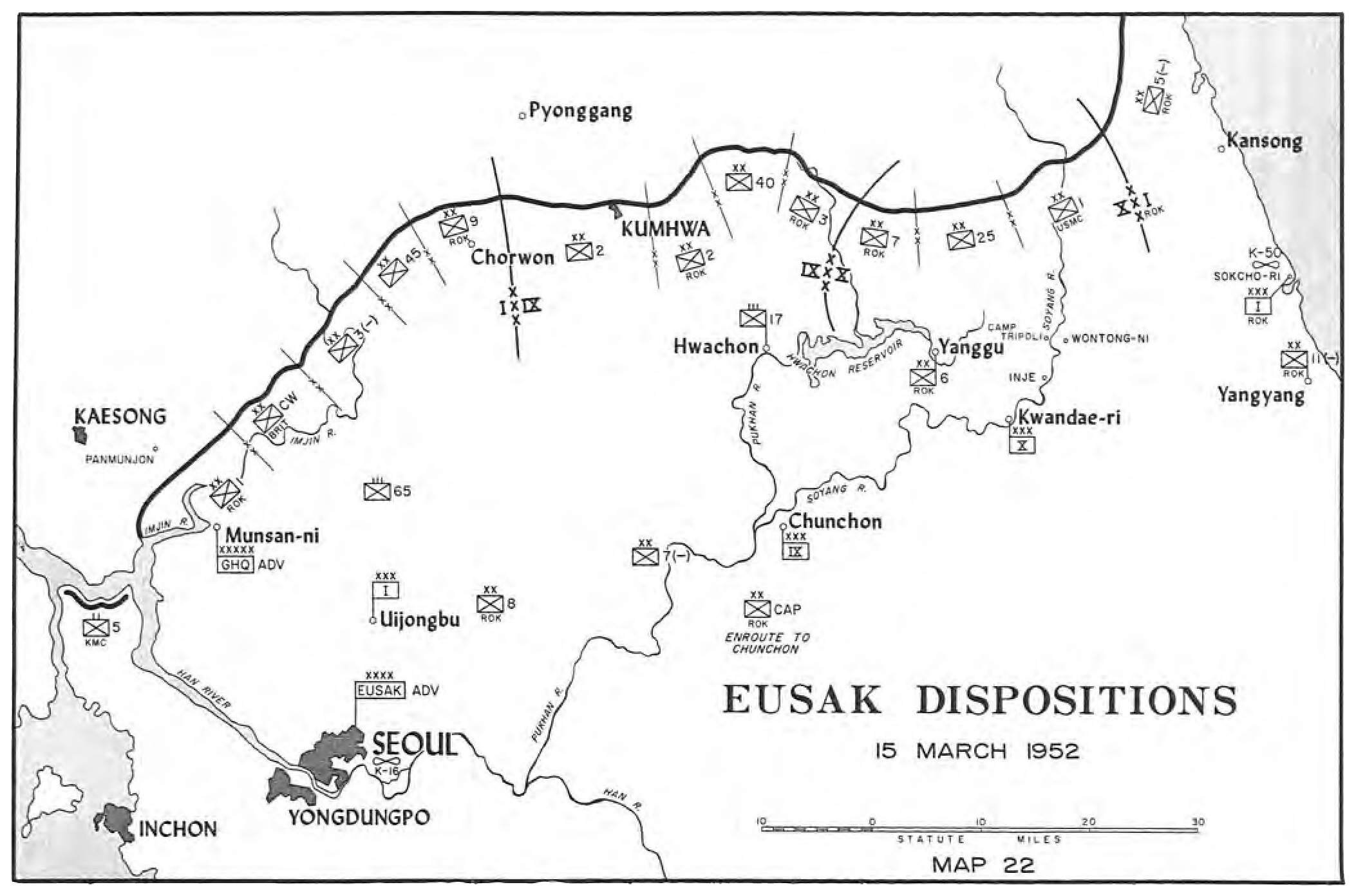
EUSAK DISPOSITIONS
15 MARCH 1952
MAP 22
The Marines had orders to relieve the 1st ROK Division and take
over a sector at the extreme left of the Eighth Army line under the
operational control of I Corps (Map 22). There they would have the responsibility for blocking Korea’s historic invasion route to Seoul.
The reasons behind this EUSAK decision were summarized in the 1st
Marine Division report as follows:
(1) The abandonment of plans to carry out an amphibious envelopment
somewhere on the east coast;
(2) Concern over weaknesses in the Kimpo area defenses;
(3) The overall situation would not permit loss of ground on the
EUSAK left (South Korea) as this would endanger the capital at Seoul; that
if retraction of lines was necessary, territory could better be sacrificed on the
right (North Korea) where the country was mountainous and had little
economic or strategic value.369
Up to this time the four corps of the Eighth Army had defended
a 125-mile front across the peninsula (Map 22) with the following
units in line from left to right on 15 March 1952.
I CORPS—ROK 1st Division; British Commonwealth Division; U.S. 3d
Infantry Division (-); U.S. 45th Infantry Division (Oklahoma National
Guard); ROK 9th Division. In reserve were the ROK 8th Division and
RCT-65 of the U.S. 3d Infantry Division.
IX CORPS—U.S. 2d Infantry Division; ROK 2d Division; U.S. 40th Infantry
Division (California National Guard); ROK 3d Division. In
reserve were the U.S. 7th Infantry Division (-), RCT-17 of that Division,
and the ROK Capitol Division.
X CORPS—ROK 7th Division; U.S. 25th Infantry Division; U.S. 1st
Marine Division (including 1st KMC Regiment). In reserve was the
ROK 6th Division (-).
I ROK CORPS—ROK 5th Division (-). In reserve was the ROK 11th
Division (-).370
Allowing for a few changes, these were the positions held by major
EUSAK units through the winter of 1951–1952.
The Marine move was launched by Division Operation Plan 2-52
and provided that the 1st Marine Division would be relieved by the
8th ROK Division as a preliminary to movement overland and by sea
to the relief of the 1st ROK Division and defense of Line JAMESTOWN
in the I Corps sector in the west. According to verbal orders later
confirmed by EUSAK OI 272, transportation by truck and ship was
specified, and the move was to be completed prior to 1 April.371
Obviously such a transplacement—moving entire divisions great
distances from one sector of the MLR to another—necessitated careful
timing and close coordination, but the planners involved were equal
to the task. In referring to detailed plans by the Division G-3 Section
(Lieutenant Colonel Gordon D. Gayle) and the G-4 Section (Colonel
Robert A. McGill), several unit commanders expressed the opinion
that “the move from east to west was a masterpiece of logistical efficiency
with no unnecessary paper work and no undue harrassment.”372
In addition to transporting the Division, the arrival of replacements
and departure of personnel to be rotated to the United States were
smoothly coordinated into the over-all plan. The transport General
W. H. Gordon anchored at Sokcho-ri on 16 March with 174 officers
and 1,135 enlisted men of the 18th Replacement Draft. The newly
arrived Marines scarcely had time to drop their seabags before they
joined the motor march to West Korea. The Gordon departed with
103 officers and 1,135 Marines homeward bound, and the 2d Logistical
Command (Army) received a 1st Marine Division request to route
the 19th Replacement Draft, due in April, to Inchon instead of
Sokcho-ri.
At K-50, near Sokcho-ri on the east coast, air freight and passenger
service was discontinued and diverted to the new Division airhead,
K-16, at Seoul. The Division railhead was changed to Munsan-ni
(Map 22).
The first Marine unit to depart for West Korea was the KMC Regiment
with its organic battalion of artillery. Since the artillery had
to be moved and repositioned all across the front with as little interruption
as possible in overall support available at any one time, the
11th Marines CO planned to move his battalions directly into their
new firing positions. This was preceded by an initial detailed
reconnaissance.
Elements of the U.S. 25th Infantry sideslipped to the right and
assumed responsibility for the Marine sector on the 17th (Map 22),
and the KMCs and the 1st Battalion, 11th Marines moved into their
new positions on 18 March. The other artillery battalions followed
at two-day intervals, all battalions firing from their new positions by
24 March.
The movement of the 1st Armored Amphibian Battalion (less
Company A), commanded by Lieutenant Colonel John T. O’Neill,
was an unforgettable experience. Embarking on LSTs manned by a
skeleton Japanese crew, the vessels headed for the Kimpo Peninsula.
The weather was squally and foggy throughout, and the ships were
completely blacked out at night with no facilities for emergency transmission
of messages. There were many navigational hazards, but
in spite of this, and the lack of adequate navigational equipment, the
LSTs arrived at their destination without incident.
Two days later, on 20 September, the 1st Tank Battalion and the
antitank companies of the three infantry regiments also took the sea
route to the new Division area in the west.
Division Operation Order 8-52, dated 18 March, directed the 1st
Marines to proceed by motor march from the Division reserve area
at Camp TRIPOLI to the new Division area east of Munsan-ni, and
there to move into front line positions. The 7th Marines, after being
relieved on the 20th by elements of the 8th ROK Division, assembled
at Camp TRIPOLI and moved by truck to West Korea. Colonel
Austin R. Brunelli, who had replaced Colonel Custis Burton, Jr., as
chief of staff, moved the forward CP personnel and prepared the new
Division command post.
After being relieved by the ROKs on the 23d, the 5th Marines
departed their east coast area. Two days later the regiment arrived
in the Munsan-ni area behind the 7th Marines and the remaining
elements of the artillery regiment.
The 5th Marines had originally been scheduled to occupy reserve
positions on the Kimpo Peninsula, but plans were changed en route.
The commanding general and his G-3 were appalled at the Division
sector’s width, and after General Selden had a chance to inspect the
areas to be defended and talk over the situation with the commanders
of the 1st and 7th Marines (Col Sidney S. Wade and Col Russell E.
Honsowetz), he decided that the 5th Marines should go into the line.373
A few hours after the 5th Marines convoy left the east coast on
their 140-mile trans-Korea move, helicopters picked up the regimental
and battalion commanders from their respective vehicles in the convoy
and took them to the new Division CP. There they were assigned
new defensive sectors and immediately reconnoitered the ground while
awaiting the arrival of their units. By the time the regiment arrived,
all preparations were made for them to move into positions and relieve
a portion of the thinly stretched line of the 1st Marines.
It had been a busy week for the 1st and 7th Motor Transport
Battalions, commanded respectively by Lieutenant Colonel Howard E.
Wertman and Major Herbert E. Pierce. Two hundred Division trucks
and a like number of U.S. Army vehicles made up the long columns
that shuttled back and forth across the peninsula. The plan provided
for moving an infantry regiment every third day. For the drivers this
meant a 140-mile trip, a return trip the following day, and a one-day
layover for maintenance before commencing the new cycle. The
artillery battalions, by order of X Corps, were retained until the
latest possible date.
The statistics of Operation MIXMASTER are impressive. It took
5,716 truck loads and 80 DUKW loads to move most of the Division
personnel, gear, and supplies. Sixty-three lowboys (flat-bed trailers)
and 83 railroad cars were also utilized in addition to hundreds of jeeps
and jeep trailers. Three LSDs and 11 LSTs sailed from Sokcho-ri to
Inchon with the heaviest equipment.
During the previous winter a sizable number of prefabricated shelters
had been set up for supporting and headquarters units. Since
timber, logs, and salvage materials were in short supply, the 1st
Marine Division moved large quantities of these materials to the west
coast in order to live as comfortably as possible under static warfare
conditions.
The operations of the 1st Marine Division in defense of the western
sector of Line JAMESTOWN do not come within the scope of Volume
IV. The account of Marine activities in the new sector, under the
operational control of I Corps, will be discussed in the fifth and final
volume of this series.
During 1951 the Korean War became a most unpopular military
venture among Americans. As a consequence, letters and newspapers
from home caused a certain amount of anxiety among citizen-soldiers
in Korea. To counter any spirit of doubt which may have arisen,
military leaders issued frank and honest replies to inquiring politicians.
The esprit de corps of Marines was high, and they were well aware
of their purpose in Korea. One noted author, on spending a couple
of days among front-line Marines during January of 1952, told a
group of officers at the Division CP that he “was impressed with the
morale of the Marines on the MLR.” He stated that he “had been
prepared to find that they didn’t know what they were fighting for
or why they were there.” However, he was encouraged to find that
they knew exactly their purpose in the Korean fighting.374
The period of nearly 15 months covered by Volume IV was at that
time the longest stretch of land warfare ever experienced by a major
Marine unit. Even during the numerous island-hopping campaigns
of World War II, the periods of combat were relatively brief for each.
Glancing back over the year 1951 with the benefit of hindsight, it
is evident that Marine “uncommon valor” during this period was
supplemented by such outstanding innovations as helicopter-borne
assaults and lightweight body armor, concepts brought to fruition by
the pressure of combat.
It is also apparent that Marine training, both for officers and enlisted
men, paid off handsomely under the demands of practically
every type of land warfare. The Division chalked up a commendable
record of service fighting on the east-central front. Since the UN
commander desired to have EUSAK’s only amphibious trained and
equipped division near a coast offering a suitable selection of landing
beaches, the Division was originally positioned in the east. Not since
the Inchon landing, however, had the Marines been employed in their
specialty, amphibious assault.
Subsequent to the unprecedented Chosin Reservoir campaign of
late 1950 the Division reorganized and refitted in South Korea near
Masan. Then in January and February of 1951 came the prolonged
guerrilla-hunting campaign (Map 5) some 60 air miles north of
Masan. Division operations in this area covered more than 1,000
square miles.375
The mountainous terrain offered cover and concealment for the
clandestine operations of far too many enemy groups. A solution to
this problem was found in “rice paddy patrols”—groups ranging from
a fire team to a squad in size which penetrated the mountain areas on
foot to flush out small enemy bands. In retrospect, had one squadron
of helicopters been available at that time, and its quick lift capabilities
utilized, the increased mobility and surveillance would have made
quite a difference in the conduct of the action.
Although land-based Marine air power had been under operational
control of the Fifth Air Force during the Chosin Reservoir fighting,
a verbal agreement allowed the 1st MAW commander to provide
directly necessary support to the 1st Marine Division. At the same
time, carrier-based Marine planes were flying on the west coast along
with other Allied planes harrassing enemy traffic.
During the guerrilla hunt VMO-6 planes provided air support to
the 1st Marine Division while Marine attack aircraft were busy elsewhere
along the Eighth Army front. Marine pilots, operating under
JOC control, felt frustrated because they were unable to provide the
timely close air support desired by the infantry. The Marine viewpoint
held that too many links in the Air Force system of control caused
an excessive delay in bringing air power over the target. This system
continued for the remainder of the year.
As an operation, the guerrilla hunt was merely a series of minor
engagements, but it accomplished its purpose of clearing out most
of the North Korean irregulars who had been a constant threat in
the Eighth Army’s rear. In addition, the numerous small patrols
provided excellent training for the newly arrived replacements.
The Eighth Army seemed to gain new vitality under General
Ridgway. On the 18th of February, when the general learned that the
enemy was withdrawing, he ordered a limited offensive. Operation
KILLER began three days later, and was followed by Operation RIPPER
on 7 March. The purpose of these operations was twofold: (1)
General Ridgway wanted to restore his army’s fighting spirit after
its two defeats during the 1950–1951 winter; and (2) he wished to
keep the Chinese Reds off balance while they prepared for another
Communist offensive.
For the Marines these two operations were an experience with a
strictly limited offensive. The advance was “buttoned up” as major
units paid close attention to lateral contact. As the advance continued
in March and April, mud proved to be an adversary second only to a
formidable enemy using delaying tactics, and the Division as a whole
had a thorough workout in the logistics of the offensive under adverse
conditions.
In early April the Division, as part of the Eighth Army, crossed the
38th parallel and continued the attack to the north, the purpose being
to threaten the suspected enemy buildup for an offensive. EUSAK
forces rolled onward while the enemy, using his roving defensive
tactics, fought vigorously and withdrew.
The long-expected enemy counterblow fell on the night of 22 April
and resulted in the 1st Marine Division bearing the brunt of a 48-hour
attack (Map 10). This opening CCF assault in the IX Corps area
of east-central Korea was intended to throw the Eighth Army off
balance as a preliminary to aiming the main blow at I Corps in
west Korea.
The CCF attack opened a hole in the MLR large enough for a major
breakthrough, and the Communists apparently expected to exploit
this success to the fullest. However, the Allied line pulled back,
consolidated, and held, as the Division’s reserve regiment was thrown
in to stem the tide. As the Marine flank was refused, the units on the
left found themselves facing to the west while stopping the enemy
thrust. Slowly, trading space for time, the Marines contained the
enemy attack while the entire Eighth Army line organized new
positions.
The enemy effort ground to a halt in the east-central sector, and the
Chinese Reds were contravened in their attempt to take Seoul by
May Day. Surprise and impetus were lost on the western front when
they struck several days later, only to be stopped with frightful losses
after a few gains on regimental fronts. The Allied line now held firm.
The Division’s war of maneuver had worked well in halting this
round of the CCF offensive, but the Communists were far from
finished. As 17 enemy divisions were still available to attack, the
Marine division was shifted to the east on 1 May in preparation for
an expected battle.
On the 16th of May the Chinese offensive again opened, with the
enemy hitting more to the east than had been expected, and making
a deep but narrow penetration near the coast. The Marines moved
eastward, established blocking positions, and engaged fringe units of
the drive. This allowed the right flank Army division to move farther
east and brake the enemy’s rush.
The enemy was dangerously overextended when the UN counterstroke
hit him late in May. For a month the Eighth Army attacked and
advanced, the Marines slugging ahead day after day in the X Corps
zone of action. CCF casualties mounted high, and Marine veterans
of only a few months of Korean service saw scores of enemy corpses
left behind on the battlefield as the enemy withdrew northward.
This great UN counteroffensive netted prisoners all along the EUSAK
front as remnants of CCF platoons and even companies threw down
their arms. Marines captured their share. Upwards of 10,000 Chinese
surrendered to the Allies in a 10-day period—more prisoners than had
been taken up to this time.
As the Chinese withdrew northward they left determined NKPA
troops behind. The 1st Marine Division moved slowly forward, fighting
for every inch of ground. So fierce was the enemy’s resistance that
at times during June the division commander was forced to commit
all four regiments (the KMCs included) in the attack at the same
time in order to seize designated objectives. This was a modification
of accepted tactical doctrine, necessitated by the situation.
Throughout March, April, and part of May, Marine pilots continued
to provide close air support not only for the 1st Marine Division,
but also for other Allied units as directed by JOC. From the
beginning of Operation STRANGLE on 20 May this interdiction effort
had first priority, and close air support to all infantry units was
secondary. Difficulties in air-ground communication continued as
radio frequencies were heavily burdened with traffic. Although the
1st Marine Division received a proportionate share of the few air
support missions flown, the frustrating time lag between requests for
air support and the arrival of planes on target continued into the
next year.
Some planes were always available for front line support, although
rarely ever enough according to infantrymen’s opinion. When they
had the chance, 1st MAW pilots viciously attacked the fleeing enemy
to ease the way for advancing ground troops. During June the unrelenting
pressure of combined air-ground attacks sometimes caused
large groups of enemy to surrender. Marines also captured thousands
of rounds of enemy ammunition and other equipment.
By the last week in June the Marines had entrenched themselves
along the Division’s assigned portion of the MLR and “caught their
breath” after two months of hard fighting. In driving from the
Hwachon Reservoir area to the Punchbowl, they had employed practically
every weapon and tactic that could be used in an all-out offensive.
The Division then settled down to stable positions for a while, and
some units had the opportunity to go into reserve and train.
It was a recharged 1st Marine Division (the 5th and 11th Marines
did not go into reserve during this period) which moved back into
the lines at the end of August. The offensive which opened northeast
of the Punchbowl on the 30th and lasted with few and brief interludes
until 20 September was the equal of the June fighting in sustained
ferocity. All four infantry regiments (including the KMCs) went up
against seemingly impregnable opposition.
The enemy’s “stubborn defense of strong positions and many well-placed
log and earth bunkers was similar to the tenacious tactics of the
Japanese in World War II,” according to a Navy report. “His artillery
and mortar fires were effective, his minefields continued to be hazardous
for many weeks, and his ability to dig in and fortify his positions
[was] always impressive.”376
After the 20th of September the EUSAK commander ordered that no
further offensives be launched and that the MLR be stabilized. This
was a period of aggressive patrolling, local attacks for more advantageous
pieces of terrain, and watchful waiting to determine the outcome
of truce negotiations. In spite of Operation STRANGLE, enemy
vehicular movements increased at the end of the year, but 1st MAW
pilots continually attempted to provide more support for all the
infantry divisions.
The mission of the 1st Marine Division at this time was to organize,
construct, and defend its sector of the MLR, a front of more than
13 miles. Although there were heavy local skirmishes, during the
latter months of 1951 and the first 3 months of 1952, no great offensive
drives were launched. Essentially, the Marines were engaged in an
aggressive defense of their positions until they moved to West Korea.
While all Marines were hoping that the conflict would soon end,
there was no slackening of the customary vigilance. All hands
remembered General Ridgway’s words of the previous year, that it
was “... a fight for our own freedom, our own survival ...,”377
and this was their creed.
These lines would have made a fitting epitaph for Marines who
gave their lives in Korea. They had as worthy a cause as any fighting
men of our history, for it had become increasingly plain since World
War II that a stand must eventually be made against Communist
encroachments. By going halfway around the world to fight the enemy
on his own doorstep, Americans may well have spared themselves a
more bloody and costly future struggle nearer to their own homeland
if not actually on their own soil. The designs of Red China and Soviet
Russia were unmasked in Korea, and the people of the United States
awakened to their peril after neglecting the Nation’s defenses since
1945. To that extent, therefore, the operations in Korea were a
defeat for Communism.