THE ROMANCE AND HISTORY OF TYROL FROM
THE EARLIEST TIMES DOWN TO THE
SEVENTEENTH CENTURY
As early as the eighth century Tyrol received a name
which could not be bettered as descriptive of its
scenery and institutions—"das Land im Gebirge,"
the Land in the Mountains. Fascinating alike is the
scenery of Tyrol and its history. When one crosses the
Swiss frontier by the Arlberg route one at once enters upon
a land of mountains, rivers, and pleasant valleys. And
with equal truth it may be said that when one crosses
the frontier of Tyrolese history one is at once plunged
in the midst of stirring, romantic, and gallant deeds enacted
throughout the centuries from that far-off age, when the
Cimbri penetrated and traversed the country and swept
into north-eastern Italy, down almost to our own time.
That Tyrol should have proved the battle-ground of
nations is, of course, largely due to its geographical
position. In early days it formed a "buffer state" between
the Roman empire and the territory of the Cimbri and
Alemanni.
The question of the original inhabitants of Tyrol is
still a much debated one, and appears to be as far off final
settlement as ever; and this notwithstanding the enormous
amount of interest which has been manifested in the
subject by scientists, archæologists, and students during the
last two centuries. Whether they were Cimbri, Etruscans,
or Celts is still doubtful, although many learned authorities—more
especially linguists—incline to the view that the
earliest inhabitants were mainly of the Ligurian race, who
were followed by Illyrians and Etruscans.
And also regarding the manners, customs, and general
characteristics of these early inhabitants, whoever they
may have been, very little conclusive evidence is yet
available. By both Greek and Roman writers they were
referred to as Rhætians, in common with the inhabitants
of Eastern Switzerland; and Horace himself speaks of
"The Alpine Rhæti, long unmatched in battle." Thus
it is that the most ancient name by which Tyrol is known
is that of Rhætia.
INVASION OF THE CIMBRI
To the Romans, however, all-conquering though they
were, little was known of the country until the Cimbri
penetrated its mountains and traversed its valleys and
passed on their way to the north-eastern frontier of Italy
about 102 B.C.
By what route these barbarians crossed the Alps on
their march to invade north-eastern Italy there has been
as much discussion as over the question of the original
inhabitants of Tyrol. And, although the event to which
we refer occurred scarcely a century prior to the conquest
of Tyrol by the Romans there is little information other
than of a speculative character to throw light upon the
question at issue. For many years the weight of opinion
was in favour of the contention that the Cimbri entered
Southern Tyrol and eventually reached the Venetian
plains by the Reschen Scheideck and the Vintschgau,
but the later researches of Mommsen have served to give
additional, if not absolutely conclusive, weight to the view
that the Brenner was the route taken by the Cimbri[1] on
their way southward from their Germanic fastnesses, just
as it was undoubtedly the route, but, of course, reversed,
chosen by the Romans under Drusus by which to enter
Tyrol on their march of conquest.
One piece of evidence which would appear to be
of considerable weight, and as conclusively favouring
Mommsen's view, is the fact that the Brenner route forms
not only the one of lowest altitude, but also the only
one by which the whole Alpine system and its parallel
chains can be crossed by passing over one chain alone,
and in no other spot in the range do two valleys on either
side cut so far into the centre of the principal chain of
the Alps.
Moreover, from Plutarch's "Marius" one learns the spot
where the Roman general, Quintus Lutatius Catullus, and
his legions, which were sent from panic-stricken Rome
to check the advance of the invaders, first encountered
the Cimbri on the banks of the River Adige between
Verona and near the foot of the Brenner. The encounter
ended in the triumph of the host of skin-clad invaders
who descended the snow-slopes of the mountains with
an onslaught so terrible that even the trained and well-armed
hosts of Rome had to give way before them. But
the power of Rome was not easily shaken, and the triumph
of the Cimbri was but brief. Their southward march was
destined very soon to meet with so severe a check that
further advance on Rome, or into the heart of Italy, was
rendered impossible. In 101 B.C., the year following their
appearance in the beautiful province of Venetia, where they
created, so historians tell us, a terrible panic, the Roman
arms triumphed at Vercelli, when the invaders, led by
Bojorich, suffered a crushing defeat in one of the bloodiest
battles ever fought, in which it is said 320,000 were slain,
and were driven out of Italy.
The moral effect of this invasion upon the Rhætians,
through whose territory the Cimbri had passed, bore fruit
a few years later, when they attempted the same tactics,
making frequent raids into Roman territory. Some sixty
years after the incursion of the Cimbri they were defeated
and driven back into their valleys and mountains by the
Roman general, Munatius Plancus; and a few years later,
in 36 B.C., not only was a fresh raid repulsed, but the
invaders were followed home, and a considerable portion
of the district in the neighbourhood of what is now known
as Trent was taken possession of by the Roman forces.
ROMAN CONQUEST OF TYROL
The Rhætians, however, were a hardy, valorous, and
pugnacious tribe, and so frequent were their attacks upon
the Roman forces left to hold the conquered country that
the Emperor Augustus, about twenty years after the subjection
of the Trent district, decided as a measure of self-protection
on the conquest of the whole of Rhætia, as far
as the River Danube.
And for this work he deputed his two stepsons, Drusus
and Tiberius. The campaign, historians are agreed, was
planned with great skill, and probably by the Emperor
himself. The Roman forces were divided, one portion,
under Drusus, entering Tyrol from the south, having
Tridentum (Trent) as its base; and the other, under
Tiberius, delivering its attack from the west across what
is now Switzerland. Tiberius took this route (the most
direct, though a difficult one) because at that time he was
absent from Italy, in Gaul, as governor. Drusus had a
more easy task, and pushed his way up the wide valley
of the River Adige[2] to the present site of Bozen. His
objective was the Pass of the Brenner, which, once seized,
would give him the command of the country. His advance
was not, however, made without opposition, for the Breones
and Genones, who dwelt in the vicinity of the Brenner,
attacked the Roman forces, and a fierce battle and series
of skirmishes ensued. Horace, in Book IV., Ode 14 and 4,
gives a vivid if, possibly, highly coloured account of the
struggle which took place in the gorge near Bozen. The
river Icarous ran red with the blood of both conquerors
and conquered. And—as has been the case on many
subsequent occasions when fighting has had to be done
by the Tyrolese—the women played a valorous part, even,
according to the historian, Florus, throwing their infant
children into the faces of the Roman soldiery when other
weapons failed.
The campaign of the two stepsons of Augustus
resulted in the complete and final conquest of Tyrol.
The victory, won in the narrow gorge of the Eisack, was
commemorated in the name of the bridge Pons Drusi
spanning the river, hard by which now stands the interesting
mediæval town of Bozen.
Successful as Drusus' forces were, none the less so
were those of Tiberius. There, however, is less record
of his battles, and the actual ground on which they were
fought forms still matter for conjecture. And equally
uncertain is the exact spot where the two victorious
generals ultimately met. It is, however, thought by several
reliable authorities to have been somewhere in the valley
of the Inn, and probably not far distant from the present
site of Innsbruck. This view is made the more probable
from the circumstance that a Roman post was established
at Wilten (now a suburb of Innsbruck) then known as
Veldidena.
Here probably both armies rested after a campaign
of great fatigue and severity owing to the nature of the
ground over which it was fought and the stubborn
resistance offered by the inhabitants.
Soon Veldidena, from a halting-place of armies, became
a town with houses of considerable size, temples, baths,
and surrounding vallæ, or earthen fortifications formed
to defend the inhabitants from sudden attack. Although
precautions of the nature we have indicated were taken
wherever a Roman post or station was placed, there is
no historical data to show that the Breones and other
adjacent tribes who were thus brought under the Roman
sway did not very speedily accommodate themselves to
the new condition of things and become good and peaceful
citizens of Rome. It appears probable, however, that the
Rhæti did not adapt themselves to the altered conditions as
speedily as did their northern neighbours, the inhabitants
of Noricum, with whom certain Roman habits and customs
(including the system of municipal government) already
obtained.
From the evidence adduced by several diligent
historians and from that of one comparatively modern
writer[3] in particular it is almost certain that after the
sanguinary and decisive battle on the banks of the Eisack
Tiberius set his face once again westward to resume his
governorship of Gaul, leaving his brother, Drusus, to
continue the subjection of Tyrol, and ultimately to
found the important settlement of Augusta Vindelicorum,
now known as Augsburg. Here the Roman general
not only threw up a fortified camp, but also built a forum
to encourage commerce; and soon the settlement became
the most important Roman station to the north of the
Central Alps.
Some writers, doubtless bearing in mind the hardihood
and bravery of the native inhabitants and the mountainous
and thus easily defended nature of the ground the Roman
legions had to traverse and fight over, have expressed
some surprise at the comparative ease with which Drusus
and Tiberius appear to have accomplished the conquest
of the country. More perfect discipline and arms of
greater effectiveness will not, however, we think, altogether
account for this, for history has over and over again
proved that knowledge of the ground by the defenders
and mountainous regions count heavily against successful
attacks on the part of an invader. It can only therefore
be supposed that the various tribes who formed the
inhabitants of Rhætia were either antagonistic to one
another or at least were not welded together in a common
cause against the invading Roman hosts, and thus the
country was conquered and kept in subjection with greater
ease than would otherwise have been the case.
As a result of the invasion by Drusus and Tiberius
and the Roman legions the tract of country then and
for some considerable time afterwards known as Rhætia,
but now known as Tyrol and the Vorarlberg, ultimately
became Romanized, and by the making of the Brenner
Post Road, which was constructed by the direction of
the Emperor Augustus between Verona and Augsburg
(Augusta Vindelicorum), communication between the
Germanic Empire and Italy was opened up. Thus was
the lowest and most accessible of the passes over the
mountains which separated Italy from the barbaric
regions beyond crossed by one of those splendid military
roads, which has endured nearly two thousand years
until the present day.
ROMAN OCCUPATION
The Roman occupation of Rhætia lasted for five
centuries. Under the rule of Rome the inhabitants
learned much of those arts which remained the heritage
of conquered races long after the sway of the great
Roman Empire had come to an end. And traces of
that rule, in the form of weapons, ornaments, articles of
jewelry and the toilet, and other relics have from time
to time come to light throughout the portions of Tyrol
settled by the Romans.
Soon along the great Brenner Road, which formed
a highway from Italy to the northern lands beyond Tyrol,
activity evinced itself. One of the most important of
the early stations upon it was Veldidena (Wilten), where
the road after crossing the main range of mountains
emerges from the Alpine gorge on the northern side into
a wide and pleasant valley. From this point—close to
which, later on, the capital of Tyrol was destined to be
founded—the great Brenner Post Road branched. One
fork led by two divergent ways to the same objective—Augsburg.
The other led in a north-westerly direction
by way of Masciacum (Matzen) and Albianum (Kufstein)
to Pons Aeni, which in all probability closely approximates
to the present-day site of Rosenheim. This road
ran down the wide Inn valley, nowadays known as the
Unter Innthal to differentiate it from the valley of the
Upper Inn which runs from the frontier of Switzerland
to Innsbruck.
It was along the great military road leading from
Verona to Augsburg that the chief Rhæto-Roman stations
were placed. Amongst these were Tridentum (Trent), Pons
Drusi (Bozen), Vilpetenum (Sterzing), Matrejum (Matrei),
Scarbio (Scharnitz), Veldidena (Wilten).
At first, doubtless, these outposts of Roman civilization
were little more than isolated fortresses, or even perhaps
merely speculæ or watch towers, and of these many
examples still remain, from which not only could the
road and its approaches be reconnoitred, but also signals
both by day and by night could be made. In the first
case by means of smoke or semaphores, and in the
second by bonfires kindled in cressets or on the hillside
itself.
THE BRENNER PASS
Another highway into Tyrol through the Vintschgau
came to be known as the Via Claudia Augusta, which
name was also improperly applied to a portion of the
Brenner Road. After much contention we think it is
now generally accepted that Mommsen, who has investigated
and weighed the evidence with astonishing care,
is correct in assuming that the only portion of the road
via the Reschen-Scheideck Pass which should be called
the Via Claudia Augusta is that traversing the Vintschgau
Valley. The road was constructed not in the reign of
Augustus, who initiated the Brenner Road, but in that
of his grandson, the Emperor Claudius, about A.D. 46-47.
It was intended to connect up the River Po with the
River Danube by the Reschen-Scheideck route, and
along it at various times since the middle of the sixteenth
century milestones of Roman origin have been discovered.
Though from the fact that little reference is made to it
by the better-known Roman writers of the period, one
may assume that the Via Claudia was of quite secondary
importance to the Brenner Road. But nevertheless it
seems probable that it was the route used for the
transportation of stores for the Roman forces of occupation
during the fifth century not long prior to the
evacuation of the country. The Brenner Road for a
considerable period after its construction appears to have
been rather a highway for commerce than a military
road in the usual sense of the term.
The chief article exported from Tyrol was salt from
the still famous salt mines at Hall, near Innsbruck, on the
northern bank of the Inn. There were also sent southward
into Italy raw hides, timber, Alpine herbs used in the preparation
of medicines, liqueurs, and the purposes of the
toilet; and dairy produce of various kinds, of which cheese
was probably (according to Pliny) one of the chief articles.
In those far-off days, too, much excellent wine was grown
far further north in Tyrol than nowadays when the vine
is not cultivated, for vintage purposes at all events, further
north than the southern slope of the Brenner.
In Roman times the Brenner also formed a link between
Aquileia, one of the most flourishing and important seaport
cities on the Adriatic, and Noricum. As did also
another, then important but nowadays almost deserted
route, that of the Plöcken Pass, of which it is believed
Cæsar made frequent use. Along this several important
stations were founded, amongst them Tricesimum, Julium
Carnicum (Zuglio), Aguntum (Innichen), Lonicum (Lienz)
and Sebatum (Schabs). Time, however, was destined to
divert the trade from the Plöcken Pass route to that of the
Brenner, and the settlements along the former gradually
declined in importance.
As we have before stated, the Brenner Pass was not
originally used so much for military purposes as was afterwards
the case. And it is not until the latter half of the
second century of the Christian Era that we find it assuming
importance as a military highway. Then the frequent
incursions southward of various Germanic tribes caused
the Romans to fully comprehend the strategical value of
northern Rhætia.
Two decades at least were occupied in the reconstruction
of the surface and bridges along the road which had
owed its origin to the Emperor Augustus, and the result
was the building of a highway suitable for the speedy
passage and massing of large bodies of troops. Of the
stations which were founded along it we have already
spoken, it only remains to say that these were supplemented
by "posts" which were dotted here and there as
they were along most other roads made by Roman builders.
They were, however, chiefly used for military and state
rather than for ordinary purposes.
An interesting writer,[4] who has made the history of
the Brenner a special study, has thrown considerable light
upon the inns and hostelries which little by little sprang
up to meet the requirements of the travelling public of
those days, who were not, as a rule, permitted to make
use of the official posts. Apparently, these refuges from
the other alternative of spending a night upon the road
were by no means luxurious. In fact, they were probably
far otherwise, and their chief redeeming feature was the
undoubted cheapness of the accommodation they offered.
It could not be considered an extravagant charge for a
night's lodging with food of sorts when the bill amounted
to rather less than the equivalent of an English halfpenny!
a sum which would nowadays surprise the modern oste
or innkeeper of the Italian Tyrol as much as his own
charges would the Roman wayfarer of long ago.
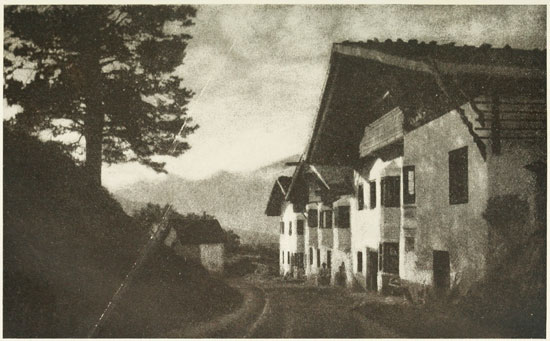
A VILLAGE ON THE BRENNER
ROMAN REMAINS
On the heels of Roman civilization, represented by
commerce and travel, which was destined not only to
permeate conquered Rhætia, but to penetrate the regions
beyond, in course of time there sprang into existence a
fortress here and a castle there which not only served to
hold the land, but also to encourage and initiate civilization
and bring security to those residing in its immediate
vicinity. Of these, happily for the historian and antiquarian,
many traces yet remain. All along the Brenner
the Romans found and were not slow to seize upon natural
coigns of vantage where their unexampled skill as military
builders and engineers permitted them to speedily convert
not easily accessible spurs of the mountains into impregnable
fortresses. Upon some of the castles, the ruins of
which nowadays serve to render these rocky crags of
undying interest, the stars must have looked down ere
the dawn of the Christian Era.
Of the occupation of Rhætia by the Romans, unfortunately
comparatively few authentic details have come
down to us. But long ere the power of Rome had waned,
never to reassume its pristine greatness, the problem of
resistance to the invasion from the Teutonic tribes to the
north and north-east had become a very real one. Towards
the end of the third century A.D. the Alemanni crossed the
Danube and threatened Rhætia, and through it Italy.
They were, it is true, defeated by the Emperor Maximianus,
but the check inflicted was but temporary. About A.D.
260 Rhætia was invaded several times by the same
barbarian tribe, and on one occasion, at least, Tyrol was
ravaged from end to end, and the invaders afterwards
entered Italy, which they penetrated as far south as
Ravenna, having first plundered and destroyed Verona.
In the reign of Claudius (about 269) there was yet another
invasion, and although the forces of Rome ultimately
proved victorious in the struggle with the Teutonic hordes
in a battle fought at Naïssus on the borderland of Tyrol
and Italy, when 320,000 are said to have been slain, there
was no lasting peace.
The inroads of the Goths vexed many a quickly
succeeding Emperor in the days when reigns were scarcely
to be reckoned as frequently by years as by months, and
it was not until the reign of Aurelianus that the Goths
were driven out of Rhætia and Vindelicia.
Under succeeding Roman rulers there were other raids
by the Goths, and then at last along the roads of Rhætia
and over the passes of the Brenner and the Plöcken poured
the invading hosts which were destined to bring about the
eclipse of the powerful Empire which had for so many
centuries controlled the destinies of the greater part of the
then known world.
Just as in our own land, history is almost silent for the
period immediately following the departure of the Roman
legions, drawn off to save Rome, if possible, from the
invading hosts of the Goths and Huns, so was it in Tyrol.
Of the years of devastation by fire and sword which
succeeded the withdrawal of the Roman forces from
Rhætia there have come down to us but very scanty
details. During this period much of Roman art and
civilization was undoubtedly blotted out by the barbarian
hordes; and, indeed, so far as can be ascertained, little of
either was ultimately left in Rhætia.
Theodoric, the Ostrogothic leader, who had conquered
Italy in about 489, planned Rhætia and the Brenner as
a barrier against the attacks of northern invaders, a tribe
of whom (the Baiovarii) ultimately possessed themselves
of Vindelicia and Rhætia as far as the southern slope of
the Brenner Pass. About this same period—the middle
half of the sixth century—a very considerable portion of
north-eastern Italy and that part of Rhætia in the vicinity
of Tridentum (Trent) was seized by the Longobards or
Lombards. Their Italian Empire lasted for two centuries,
and eventually included the larger portion of what is
nowadays known as the Italian Tyrol.
Meantime, the Baiovarii or Bavarians had conquered
the upper part of Rhætia, and in the beginning of the
seventh century their Duke, Garibaldi II., succeeded in
checking the frequent inroads of the Slavs, although he
did not succeed in entirely excluding them from the
country; in the eastern portion of which they remained
for a considerable period. Towards the end of the eighth
century (about 789) the whole of what is now known as
Tyrol came under the sovereignty of Charlemagne, who
crushed the Lombards, and a few years later succeeded
in also subduing the Baiovarii.
During the centuries of internecine warfare, with its
concomitants of rapine and chaos, which succeeded the
evacuation of Rhætia by the Roman forces, most of the
original inhabitants or peaceably disposed Romanized
Rhætians fled with other fugitives from the southern or
northern plains to the valleys and byways amid the
mountains which hitherto probably had been almost if
not entirely unpopulated. Here they settled, leaving the
main routes open to the passage of the Teutonic invaders
bent on the plunder of the Italian cities and plains, who,
we may imagine, did not greatly trouble themselves
regarding the byways or waste time in conquering those
who had thus hidden themselves amid the higher Alpine
valleys and fastnesses.
The result of this is seen in the circumstance that whilst
in many cases the out-of-the-way places and villages
to this day preserve their original Romanized Rhætian
names, those upon the main routes of travel have in many
instances a purely Teutonic nomenclature.
"THE LAND IN THE MOUNTAINS"
The great Empire which Charlemagne created had
strangely enough no natural delimitations, and when it
was divided, in A.D. 806, into three portions amongst
his sons, the division was not made upon any usually
recognized system or plan. Tyrol still was unknown by
that name, the country about that time being known as
"Das Land im Gebirge," or "The Land in the Mountains."
The immediate successors to the divided empire of
Charlemagne were far less able than he to cope with the
anarchy which so frequently overwhelmed south-eastern
and north-eastern Europe in those days. There was
practically no such unity as now prevails, and, owing to
this, the powerful nobles and ecclesiastics gradually succeeded
in dividing up the land amongst themselves according
to the almost universal custom of the Middle Ages.
The records of Tyrolese history of the period are,
however, so wretchedly meagre that few positive and
uncontrovertible facts have come down to us regarding
the events which immediately followed the partition of
Charlemagne's Empire amongst his sons. That the
Brenner Pass and Tyrol formed a sort of highway for
successive invaders of Italy, who swarmed across it from
the East and North, there is, however, little reason for
doubt. As has been very truly said, "What these vast
expeditions, consisting of more or less disorderly masses of
curiously mixed races, all in the panoply of war, all eager
for booty, even if bent on a peaceable mission, meant for
the countries through which they slowly ate and robbed
their way, it is not quite easy to picture to one's self in these
civilized days, when, even in the fiercest war, the non-combatant
has no reason to go in fear of a violent death
or having his women outraged before his eyes, and his
house razed to the ground." That such things took place
in Tyrol is made almost certain from the statements of
contemporary writers, amongst others, Gottfried von
Viterbo, Vincenz von Prague, and Otho von Freising.
OLD-TIME TRAVELLERS
It is the custom for most people to imagine that the
"extras" for lights, tips to servants, and attendance which
so often makes the present-day hotel bill exasperating, are
a modern institution. This is, however, not the case, for
some most interesting and illuminating diaries of early travel
which were discovered in 1874 amongst the archives of the
monastery of Cividate show that at the commencement
of the thirteenth century there were a succession of inns
already existing along the Brenner route, where travellers
could not only obtain lodgment and entertainment, but
even purchase necessary medicines. There are also entries
for lights, attendance, and gratuities, which probably vexed
the soul of the ecclesiastical diarist we have referred to as
much as they do modern travellers.
Of the types who tramped or rode along the great Tyrol
highway and lodged at the inns, we have fortunately a fairly
detailed and accurate picture handed down to us. If only
there had been a Tyrolese Chaucer what a record might
have been preserved! From the diaries of the Bishop of
Passau (whose notes we have quoted), however, we gratefully
gather that in addition to the ordinary itinerant merchants
and countryfolk there were bard musicians of both sexes,
conjurers (more or less skilful, and many of them charlatans),
singers, mendicant friars (some of little holiness),
and the far-famed minnesingers who for a considerable
period had a great vogue at Courts and castles. Along
this famous high-road of the Brenner and through Tyrol
passed, during the twelfth and thirteenth centuries, many
of the pilgrims and Crusaders bound for or returning
from Palestine or some distant shrine of peculiar merit
or holiness.
EARLY TYROLESE RULERS
One of the chief amongst the many changes and
reforms instituted by Charlemagne was the sub-division
of the countries he had conquered and welded together to
form his Empire into margravates or departments which
he placed under the rule of his nobles and other officials
whom he appointed for the purpose. Although this system
undoubtedly worked well during his powerful sway, after
his death and during the anarchy and dissension which
distinguished the reigns of his immediate successors what
might have been expected happened. The more powerful
of the nobles and officials and their descendants soon
commenced to regard their offices as of the nature of
hereditary appointments, and in consequence with the
development of this idea small dynasties were gradually
founded, and towards the close of the tenth century three
of these had sprung into existence in Tyrol. These three
Countships or Grafschaften were of Andechs, Eppan, and
Tyrol, and the country was eventually divided up amongst
them and the great ecclesiastical lords of the Sees of Trent,
Brixen, and Coire.
As is the case with so much of early Tyrol history and
events, very scanty information of a reliable character has
come down to us regarding the origin of these three great
families of nobles who held sway in the country. Nor is
it for the purpose of this book necessary to enquire closely
into the evidence we have. The origin of the family
of Andechs is almost entirely unknown, although for a
considerable period they were the most powerful of the
three families we have named. The Eppans are believed
to have been descendants of a natural son of a Duke of
Bavaria, and their long and bloody feud with the Bishops
of Brixen on account of lands taken from them and given
to the See is enshrined in Tyrol history and legend.
The third family, the Counts of Tyrol, though
originally by no means the most important, was destined
to outlast the other two, and eventually to become
possessed of most of the country and give its name to
ancient Rhætia. Although even in the days of the
Roman occupation there appears to have been a Castle
Tyrol, which was the residence of a centurion, the family,
as it is generally known, is supposed to have taken its
origin from Count Hunfried who lived in the reign of
Charlemagne, and was also Count of Vintschgau. This
noble came into prominence on the division of Charlemagne's
Empire amongst his three sons; but it appears
to be probable that it was not until the middle part of the
thirteenth century that one of the owners of Castle
Tyrol or Teriolis first took the title of Counts of Tyrol.[5]
The earliest reference to the three Counts of Tyrol
appears in the archives about the year 1140, and we find
the family dwelling in the Castle Tyrol or Teriolis, near
Meran. It was from this fortress, now in a ruinous
condition except for the chapel and fine porch dating
from the twelfth century, that not only the family took
its name but eventually the whole country came to be
known. Gradually one by one the possessions of the
other nobles in Tyrol were taken from them or became
absorbed by marriage in that of the Counts of Tyrol.
Until about 1240 the then reigning Count Albert was
able to style himself Prince Count (or gefürsteter Graf)
of Tyrol so widespread and rich were his possessions.
The Principality thus formed remained a fief of the
German Empire until the reign of Maximilian I. (1493)
when it was incorporated with the other possessions of the
Crown.
The first of the Prince Counts of Tyrol was successful,
in 1248, in obtaining from the Counts of Andechs the
district of the Inn Valley, once the site of Roman Veldidena,
which place tradition asserts was destroyed about
A.D. 452 by the Huns under the leadership of Attila on
their return through Tyrol after their defeat by Aëtius at
the battle of Chalons.
During the early Middle Ages the Premonstratensian
Abbey of Wilten had been built on the site of the ancient
town, and later on the Counts of Andechs, who had become
possessed of land in the neighbourhood on the banks of
the Inn, became the most powerful and influential nobles
in the district. Under them a trading post or centre of
commerce was founded near the bridge over the Inn, the
importance of which can be easily understood when its
proximity to the Brenner high-road, a then busy thoroughfare,
is borne in mind. From this bridge over the Inn
was derived the name of the town Innsbruck—afterwards
destined to become the capital of Tyrol—a mention of
which appears for the first time in archives of the year
1327. It was to the foresight and enterprise of Otto of
Andechs that the town owed the walls, towers, and fortifications
which were to stand it in good stead. Count
Otto also built himself a palace, which still is known as
Ottoburg.
Concerning the various princes who reigned over Tyrol
in succession to Count Albert down to Henry, the youngest
son of Meinhard II., who, by marrying the daughter of the
King of Bohemia, claimed the throne on the death of his
father-in-law and took the title of king, although forced to
surrender his claims to Bohemia, and rest content with
Tyrol and Carinthia, it is not necessary to say much.
This Henry was a good-natured, easily influenced ruler,
who by reason of these characteristics fell almost entirely
into the hands of the more powerful of his nobles, who by
flattery and supplies of money to meet his spendthrift
habits were able to acquire not only influence over him,
but also gain great possessions from and unchecked by
him. Under this ruler Meran became the capital of
Tyrol; and Hall, Sterzing, and other places were raised
to the dignity of towns.
Though easily led, Henry was not without his virtues,
for he granted several privileges which were in the interests
of commerce, and under his rule the hard lots of the
villein and working classes were lightened, and a heritable
system of land tenure for the peasant class devised and
established. The effect of this was destined to be beneficial
not only to those it was primarily intended to assist,
but also to the nobles, and Henry himself. For as the
nobles seldom or never paid taxes it followed that, with
increased prosperity, the lower orders (who bore the greater
part of the burden of taxation) could be taxed to a higher
degree without suffering in proportion.
Many stories are current concerning the difficulties into
which Henry's wastrel habits got him. One of them is
that he was unable at Innsbruck to settle the bill of a fish
and wine merchant, and as a last resort gave this man,
one Eberhard, the bridge toll, which it is unnecessary to
say formed a valuable consideration.
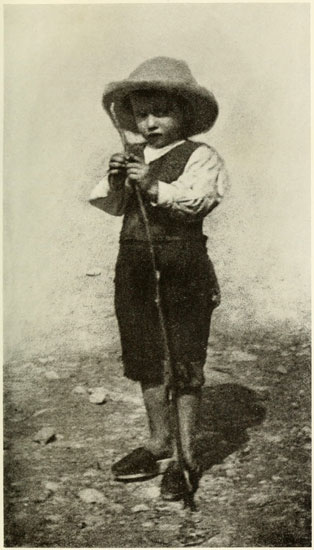
YOUNG TYROL
"POCKET MOUTHED MEG"
At his death in 1335 he left no male heir, the succession
falling to his daughter Margaret, known to history as "wide
(or Pocket) Mouthed Meg" on account of her remarkably
ill-formed mouth. How her mouth became so ugly is not
exactly known. One story states the name was derived
from the word Maultasche, in consequence of her having
had her ears (or side of face) boxed or struck. The
explanation gains some weight from the fact that the blow
was said to have been struck her by one of her Bavarian
relatives, and the circumstance that she ultimately left her
heritage to her Austrian cousins and not to the Bavarian
branch of the family, thus causing Tyrol to become a part
of the Austrian Empire.
Eventually, after many abortive attempts to arrange a
marriage with the numerous suitors who were willing to
become allied to perhaps the richest though the ugliest
heiress in Europe of that time, for her inheritance comprised
the dukedoms of Goricia, Croatia and Carinthia,
as well as the beautiful land Tyrol, Margaret was
married, in A.D. 1330, to the youthful Prince John of
Bohemia, the bridegroom being nine years of age and
the bride several years older. The latter was destined
to have a troublous career, ugly as her mouth in some of
its details; and the young couple, when (a few years
after the formal marriage) they came to live together,
were almost from the first at variance.
John was feeble and of weak intellect, and Margaret
as determined and shameless as were many other women
rulers in those times. Plots and intrigues were rife, the
former between the two parties who espoused the German
or Luxembourg (Bohemian) claims, the latter between
Margaret and her courtier and even peasant lovers, some
of whom were given privileges and even lands and patents
of nobility by the amorous princess of the "Pocket
Mouth," who made several unsuccessful attempts to
get rid of her husband, until she frightened him into
returning to his own country. This desire accomplished,
Margaret commenced to put in operation her further
plans. John was a fugitive, going from castle to castle
in search of shelter or sanctuary, awaiting assistance
from his father or the Luxembourg party, which was
favourable to the Bohemian side of the question. Soon
the Emperor Louis, who was the ruler of the Holy
Roman Empire and a deadly enemy of the Bohemians,
saw an opportunity for accomplishing a long-cherished
desire, that of the acquisition of Tyrol.
He found a ready accomplice in his good-looking,
attractive son, who appeared willing enough to marry
another man's wife, however ill-tempered and ugly, even
before the first marriage was formally declared null and
void by the Pope, provided wealth and possessions were
acquired with her. However, when the Pope—who himself
had cast longing eyes on Margaret's possessions—heard
of the proposed union, he not only declined to
annul the marriage between John and Margaret, but
threatened the latter with excommunication if she
espoused the son of Louis, who was his implacable foe.
There were also reasons of consanguinity which made
the marriage impossible without the Pope's sanction.
Louis, however, not to be thwarted in his desire, set
about to find a bishop willing to defy the Pontiff and
bold enough to solemnize the marriage. Soon he
succeeded in persuading the Bishop of Freisingen both
to annul the first marriage and celebrate the second.
Accordingly the Emperor, in whose train were numbers
of nobles, set forth with the bishop mentioned, and also
the bishops of Augsburg and Regensburg, for Tyrol.
But whilst on the journey and crossing a pass (the
Jaufen), which afforded the quickest route from Sterzing
to Margaret's home near Meran, the Bishop of Freisingen's
horse stumbled and threw its rider, killing him on the
spot. This accident so sapped the courage of the other
two bishops (who doubtless considered the event as a
direct message of wrath from Heaven) that they refused
to go on with the scheme upon which they had embarked.
This did not, however, weaken the determination of
either the Emperor or Louis, who, on his arrival at
Castle Tyrol, forced the terrified resident chaplain to
celebrate the marriage, although we are told the people
protested loudly, anticipating terrible punishments for
breaking the laws of the Church and defying the
commands of the Pope.
Nevertheless the event was celebrated with great
festivities, and, so far as one can gather, no immediate
wrath from Heaven was experienced by the evildoers.
ERA OF CIVIL WAR
During the weak rule of John, the various nobles in
Tyrol had gained great ascendency; had extended their
possessions and rights; and had in fact seriously weakened
the sovereign power of their ruler. Louis proved of very
different metal to his precursor. He at once attacked the
nobles, who had aggregated to themselves unlawful or
dangerous authority, devastating their estates, burning and
dismantling their castles and fortresses, and exiling those
who did not submit. Civil war of the most bloodthirsty
kind ran riot in Tyrol, and other disasters in the shape of
fire, which destroyed some of the most important towns,
including Meran the capital; swarms of locusts, plague
and earthquake, all afflicted the unhappy and unfortunate
land. It is needless to say that these terrible calamities
were esteemed by many Tyrolese as the direct expression
by Heaven of anger at Margaret's bigamous marriage and
defiance of the power of the Church.
The ravages of the Black Death were not less severe
than in other parts of Southern Europe, and, according to
one chronicler, scarcely a sixth of the population of Tyrol
were left alive. As was so often the case in the Middle
Ages, some human scapegoat was sought for and found;
and the very common one was fixed upon—the Jews.
The persecution of this unfortunate race which ensued
was of so ruthless a character that neither women,
children, nor the aged were spared, with the result, we are
told, that very few were left alive.
Then succeeded a period of war. The supporters of
the discarded husband of Margaret—John of Bohemia—were
not slow to seek to revenge themselves upon her,
and Tyrol was subsequently invaded by the King of
Bohemia, who was joined by the militant Bishop of Trent
with considerable forces. An active campaign followed,
characterized by great cruelty on the part of the invaders,
during which the two chief towns, Meran and Bozen, were
captured and destroyed, and ultimately Margaret was
besieged in her own Castle of Tyrol. It was so admirably
situated for defence that in her husband's absence
Margaret, who, with all her vices and failings, was no
coward, was able to defend it successfully from all
assaults, and did so until her husband was able to return
by forced marches, and surprising the besiegers, succeeded
in defeating them and forcing them to retire. The
country, however, suffered terribly during the enemy's
retreat, as, in revenge for being baulked of their prey,
they burned and ravaged in every direction, and spared
no man from the sword. Indeed, the history of the
campaign exhibits in the most lurid light the underlying
and primitive savagery of all warfare in the Middle Ages.
It was to meet the heavy charges arising from the
prolonged campaign and defence of his territory that Louis
had to sell or pawn many of his richest personal possessions,
with the result that many nobles (who provided him
with money or other support) gained or regained valuable
privileges and a considerable accession of power and
influence.
STORIES ABOUT "MEG"
Into the whole course of this war and the history of
Tyrol—interesting and even fascinating though it be—it is
impossible for us to enter. Margaret ultimately (it may
be noted) made her peace with Rome, owing to the
influence exercised over the Pope by her Austrian cousins
of the House of Habsburg, the condition of their mediation
being that she should leave to them and not to her
Bavarian cousins her heritage should her son and heir
Meinhard pre-decease her, and die without issue.
Fate favoured the schemes of the Habsburgs, for both
Margaret's husband Louis and her son died before her,
the latter at the early age of twenty. As an example of
the old saw, "Give a dog a bad name and hang him,"
popular opinion laid both deaths at Margaret's door. Her
husband died in 1361-2 whilst on a journey to Munich in
her company. This supposed murder was, according to
then common report, a crime passionel arising from
Margaret's fear that Louis was about to compass the
death of Conrad of Frauenberg, a noble with whom she
had carried on an intrigue that had been common talk
and a scandal for years. On the death of his father,
Meinhard assumed the responsibility of government; in
doing this he appears to have placed, or attempted to
place, some sort of check upon the shameless conduct and
intrigues of his mother, and when he died in January,
1363, his death, like that of Louis, was laid at his mother's
door. Popular opinion, however, has been proved to have
been in error by historians who do not favour the supposition
that she was really guilty of either death; and
although no explanation of the actual cause of Louis's
death is forthcoming, there would appear some evidence
for supposing that Meinhard's untimely end was unromantic
and free from mystery, and, in fact, was the
result of drinking cold water whilst overheated from
exertion.
In those days, although news travelled but slowly
according to modern ideas, it was less than a fortnight
ere it had reached Vienna, and Rudolph IV. of Habsburg,
by travelling "day and night," was at Bozen eager to
make certain his position as the eldest of the three
brothers to whom his cousin Margaret had agreed to cede
Tyrol and her other wide possessions.
Around the picturesque, though licentious and uninviting,
figure of "Pocket-Mouthed Meg" has gathered an
accretion of traditions and tales unequalled by those
attached to any other Tyrol ruler. But, although she was
for many years so outstanding a figure in the history of
her country and indeed of South-Eastern Europe, strangely
few authentic records or documentary corroboration of
these stories have been discoverable.
Thus, by the death of Meinhard in 1363, the
country became a portion of Austria under the rule of
Rudolph IV., who, though young, was wise and far-seeing.
However, he was not destined to long enjoy the possessions
he had acquired chiefly by skilful diplomacy, and
on his death, two years after his accession, Tyrol was
governed jointly by his two brothers—Leopold and
Albert.
During this dual control the Bavarian relations of
Margaret made frequent incursions into the country,
especially in the neighbourhood of the Unter-Innthal,
and in 1369 succeeded in obtaining a large sum from the
Habsburgs at a temporary peace made at Schärding.
Ten years later the dual sovereignty came to an end, the
two brothers dividing the inheritance, Leopold taking
Tyrol as his share. He was killed at the Battle of
Sempach on July 9th, 1386, where the Swiss gained so
signal a victory under the leadership of Arnold Von
Winkelried.
DUKE FREDERICK'S REIGN
In 1406 Frederick, Leopold's youngest son, succeeded
to the sovereignty, which during his minority had been
held by his elder brothers and his Uncle Albert, who had
ruled the country in so lax a manner that the nobles
gained a great ascendency.
It was, indeed, no easy task to which Duke Frederick
was called. The nickname bestowed upon him, that of
"the Empty Purse," was by no means an exact description
of his financial condition, save during a comparatively
short period of his reign of thirty years. It was given
him at the time he was an outlaw by reason of the
ban of the Church, and was obliged to fly for his life
and take refuge amid the mountains. His was a
stormy reign. In the early portion of it he was at
variance with many of the most powerful of his
nobles, who resisted his attempts to curtail the power
which they had acquired during his minority. After
the anxieties and hardships which ensued, when the
country was over-run by the Bavarians, and even the
capital threatened, Frederick was destined to have still
greater trouble by reason of his action at the Council of
Constance, which was summoned to settle the momentous
questions as to who was the rightful head of the Church,
and who the ruler of the Empire. There were three
claimants for each position, nominated and supported
by the rival factions. The spiritual claimants were
John XXIII., Benedict XIII., Gregory XII.; and the
temporal Kings Sigismund of Hungary, Jost of Moravia,
and Wencelaus of Bohemia.
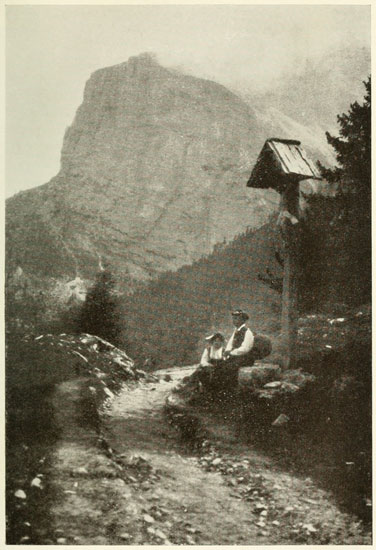
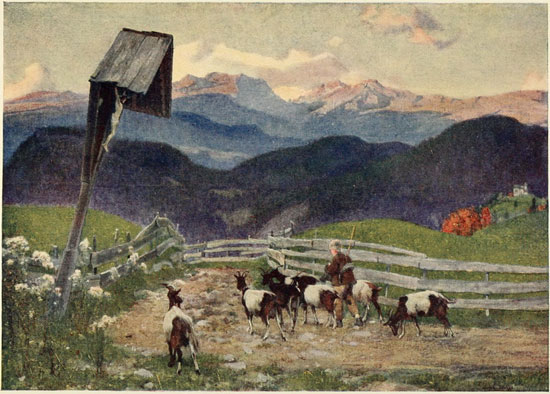
A WAYSIDE SHRINE, TYROL
Of the Ecclesiastical claimants John had Frederick's
support, and when the former, failing to get elected by the
Council, had not only to renounce his claims but flee for
his life, Frederick assisted him to escape from Constance.
This act of loyalty to a friend almost cost Frederick his
life, as Sigismund (who of the three candidates had been
elected Emperor) was his enemy, and not only succeeded
in persuading the assembly to declare Frederick's throne
forfeited, but also him and his chief supporters and
followers outlaws, to shelter any of whom was a crime
punishable with death.
Frederick's evil case was made worse and his difficulties
immeasurably increased by the secession to the
ranks of his enemies of his brother Ernest, who had
taken the Dukedom of Styria as his portion of the
inheritance.
Duke Ernest took up the reins of Government of Tyrol,
and there ensued a period of bloodshed and disastrous
Civil War in which the peasants and the lower classes
remained firm and loyal supporters of their ruler Frederick,
and the greater number of the nobility espoused the cause
of the usurper Ernest. At length a peace was brought
about between the two brothers, chiefly through the
mediation of the Archbishop Eberhard of Salzburg, and
the Duke Louis of Bavaria. The reconciliation of
Frederick and Duke Ernest, whose estrangement had
been brought about by Frederick's action in relation to
Pope John at Constance which had brought him under
the powerful ban of the Church, took place at the castle of
the Archbishop at Kropfsberg.
The remaining portion of Frederick's life appears to
have been peaceable, and notwithstanding his sobriquet of
"Empty Purse" he left a huge fortune in treasure, which
some authorities assert was the greatest amassed by any
ruler of those times. He was undoubtedly one of the most
able, and with the peasants and townsfolk most popular,
rulers Tyrol has ever had as a separate principality. He
carried on a struggle throughout his reign against the
encroachments of the nobility upon the lands and liberties
of the people, which in itself was a thing sufficient to
gain him the love and loyalty of the great masses of his
subjects, which his affable manners, generosity, and kindliness
served to cement. To him belongs the credit of
summoning the first Tyrolean Landtag of any use or
importance, held at Meran in 1423. Subsequently the
Landtag was convened at Innsbruck, which town in consequence
gradually came to be regarded as the capital of
Tyrol.
On the death of Frederick he was succeeded by his son
Sigismund, then a mere lad of eleven or twelve years of
age. The latter lived for some seven years at the Court
of Vienna under the control of his guardian the Emperor
Frederick III. Whilst in Vienna he became acquainted
with one Æneas Silvius de Piccolomini, afterwards Pope
Pius II., a widely travelled, able but licentious man who
had journeyed so far afield as Scotland, and who poured
such glowing descriptions of the beauty of the ladies of
the Scottish Court into the young Duke Sigismund's
ears that he became possessed with a desire to marry
a Scotch bride. Thus it happened that when the
daughter of Charles VII., King of France, died (whom
it had been intended by his father he should marry)
the young Duke Sigismund wooed and won Eleanor,
daughter of ill-fated James I. of Scotland, to whom as
dowry the Duke gave the historic castles of Ambras,
Imst, and Hörtenburg for life. This gifted princess lived
in Tyrol for a period of more than thirty years, and by
her gentle manners, love of sport, especially hawking
and hunting, and social accomplishments made herself
much beloved by her husband's subjects. Her Court,
for the size of the principality over which her husband
ruled, was very large and luxurious.
During the reign of Sigismund the vast mineral wealth
of the Unter-Innthal district especially became opened
up, and this enabled the Duke to spend lavish sums upon
pleasures, entertainments, arts, and science, which soon
caused his Court at Innsbruck to be spoken of as one
of the most refined, gay, and interesting in Eastern
Europe. At the same time Tyrol owed much to Sigismund,
as he was a generous patron of art and employer
of artists of all kinds.
THE WAR WITH VENICE
On the death of his consort Eleanor he married, in
1484, the Princess Catherine of Saxony, who was both
young and beautiful. A man of great judgment, he yet
committed the grave error of provoking a war with the
Venetians, whose trade with Tyrol was an important and
valuable asset in the country's commerce and material
prosperity. It arose from the seizure of some rich silver
mines the property of the Venetians in the Valsugana,
and the tense situation arising from this act was
aggravated shortly after, in April 1487, by the forcible
seizure of the goods of Venetian merchants who had
come (as was their wont) to the great fair held at Bozen.
Over a hundred and twenty Venetian merchants were
also thrown into prison. In the war which ensued the
Tyrolese were ultimately victorious; but the victory was
a Pyrrhic one as Tyrol lost much by this struggle with
the great commercial power of those remote times. The
Venetians took a speedy revenge, "boycotting" Tyrolese
trade, absenting themselves from the fairs and markets,
and avoiding using the Brenner Route which had very
materially added to the wealth of the country.
Sigismund, as had other rulers of the Mountain
Kingdom, fell out of favour with the Church, owing to
a quarrel with the Cardinal Bishop of Brixen, Nicholas
of Cusa, chiefly on account of the latter's persistent
endeavour to exalt the power of the Church at the
expense of the former's temporal authority, and it was
only Sigismund's indifference to religious matters and
power in his own country which enabled him to treat
with unconcern if not positive contempt the ban placed
upon him by the Church of Rome. He even went the
length of making war upon the Bishop, and of besieging
him in his castle at Brunneck; and as a consequence
was excommunicated by both Pope Calixtus III. the
Courageous and Pius II.
In Sigismund's declining years he applied himself
"to the task of purchasing salvation in the manner
approved by the Church he had defied, and whose bulls,
bans, and mandates he had scorned." He set about
founding monasteries, gave largely to charitable endowments,
and was generous in other ways to a Church
which was anxious to pardon the sinner who was willing
to purchase absolution on satisfactory monetary or other
terms. One effect of this great expenditure was to
impoverish the country, which had already been much
"drained" by the demands made upon it by Sigismund's
patronage of art, love of women, and lavish entertainments.
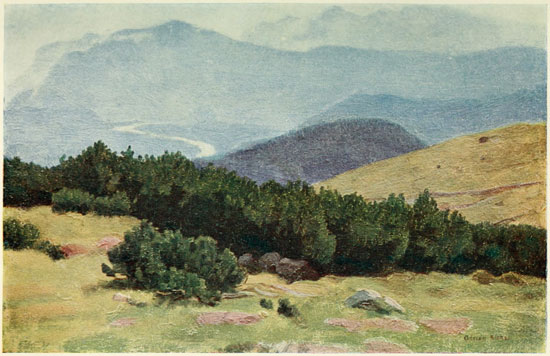
VIEW FROM THE RITTEN LOOKING S.W.
MAXIMILIAN I
Maximilian, his cousin (afterwards the famous Emperor
Maximilian I.), succeeded him on his abdication in 1493.
He was in a great measure an ideal ruler for Tyrol,
whose brave, independent people were touched by the
spirit, frankness, and great personal bravery of their new
prince. Fond of war, he was equally devoted to the
chivalric jousts and games of the period, and, if one may
believe historians, to these sterner qualities was united
a kindly and approachable disposition which further
endeared him to his people. It was only in the latter
portion of his reign that he lost touch with and hold
upon them, and, owing to the heavy drain that incessant
wars and military operations had placed upon the country,
necessitating heavy taxation, became in a measure
unpopular.
From his biographers one gathers that the Emperor
was deeply affected by the change of attitude of the
populace towards him, and he referred to it bitterly on
several occasions. During some considerable time before
his death he always went about accompanied by his
coffin, which he is stated to have described as "the one
narrow palace which architects can design at small cost,
and the making of which does not bring ruin upon
princes."
During the reign of Maximilian to Tyrol was added
other and considerable new territory, including the
Ampezzo district; Rovereto; the three lordships of
Rattenberg, Kitzbühel, and Kufstein; the towns of Riva
and Arco; a portion of the present Vorarlberg; and a
portion of the Pusterthal. Maximilian also did something
for education in his capital of Innsbruck, where he built
a new palace which was first used at the time of his
second marriage with Maria Bianca Sforza of Milan in
1494.
He was succeeded by his two grandsons, the Emperor
Charles V. and the Archduke Ferdinand. The former,
however, found his dominions so vast that he soon
resigned his Austrian possessions (including Tyrol) to
his brother Ferdinand, who afterwards became Emperor.
The reign of the latter, though long, was not a happy
or prosperous one. The religious disturbances brought
about by the Reformation, which Ferdinand severely
suppressed, and risings of the peasants in consequence,
made his name detested in Tyrol, so that in the War
of the Schmalkald the inhabitants supported Charles V.
It was at Innsbruck (after two unsuccessful attempts
to leave Tyrol) that he was surprised by his treacherous
friend Maurice of Saxony, who had marched his army
rapidly into Tyrol intent upon capturing Charles. The
latter, who had no army with him, having arrived at
Innsbruck on his way to the Council of Trent, in order
to escape had to leave his palace at dead of night in
torrents of rain in May 1552—a man broken in health
and tired of life.
It was this Ferdinand who founded the famous Franciscan
Church at Innsbruck with its world-renowned tomb
in memory of his grandfather Maximilian I.
On the death of Ferdinand, in 1564, he was succeeded
on the throne of Tyrol by his second son who bore his
name. A romantic interest attaches to this Archduke, who
after much opposition on the part of his family married
the beautiful daughter of an Augsburg merchant, Philippina
Welser, who ultimately succeeded in winning the
Emperor's sanction to the marriage.[6]
The thirty-one years' reign of Archduke Ferdinand was
chiefly notable for the encouragement given by him to Art.
Indeed, during this period the country reached its highest
culture. The world-famous art collection now in Vienna,
concerning which most authorities are in agreement that it
was the most extensive and beautiful formed up to that
period, owes its existence almost entirely to him. In his
Castle of Ambras, near Innsbruck, he gathered together
art treasures that are now, as regards many examples,
almost if not quite unique; and by so doing ensured his
position with posterity as one of the first, most learned, and
most discriminating of art collectors and connoisseurs the
world has known.
A ROYAL ROMANCE
Ferdinand and his beautiful spouse remained throughout
their married life devoted to each other, although when
the former's father, in 1563, recognized the marriage it
was agreed that any children born to the pair should not
be recognized as of Royal birth, the alliance being regarded
as morganatic. The story that Philippina died a
violent death seems to have no basis upon fact.
Ferdinand after the death of his first wife married
Anna Katharina Gonzaga of Mantua, to whose devout
tendencies and influence over him Innsbruck and the
neighbourhood owed many of its religious houses and
institutions.
On the death of Ferdinand, as his and Philippina's
children could not succeed to their father's possessions
and title for the reason we have mentioned, and as there
were no children of the marriage with Anna Katharina,
Tyrol reverted in 1595 to the Emperor Rudolph II., who
soon appointed his brother the Archduke Maximilian as
Regent. This prince was the head of the Teutonic Order,
and bore the title of Deutschmeister. After his death
Tyrol reverted to the Emperor Ferdinand II., who in 1622
celebrated his second marriage with Eleanora Vincenzo of
Mantua at Innsbruck. The event was celebrated with
great magnificence even for a period when entertainments
of the kind were veritable triumphs of splendour and art,
and the wedding feast was served by Tyrolese noblemen.
Ferdinand soon appointed his brother the Archduke
Leopold as Regent, and on his death in 1632 the latter
was succeeded by his widow, the wise and beautiful Archduchess
Claudia Felicitas of Medici, who governed Tyrol
during the minority of her two sons. Her chief counsellor
was the brilliant and distinguished Chancellor Wilhelm
Biener. The Archduke Ferdinand Charles came of age
(and succeeded to his estates) in 1646, and in default of
male heirs was succeeded by his brother Francis Sigismund
in 1662. The reign of the last named lasted only three
years, and came to a sudden and tragic close on the very
eve of his marriage. Popular opinion ascribed his death to
poison, given to the Archduke by his physician Agricola,
the latter, at the time, being supposed to have been
instigated to the crime by some Italian nobles whom the
Archduke had banished from his Court. On the death of
Sigismund the second Tyrolese-Habsburg line of rulers
came to an end.
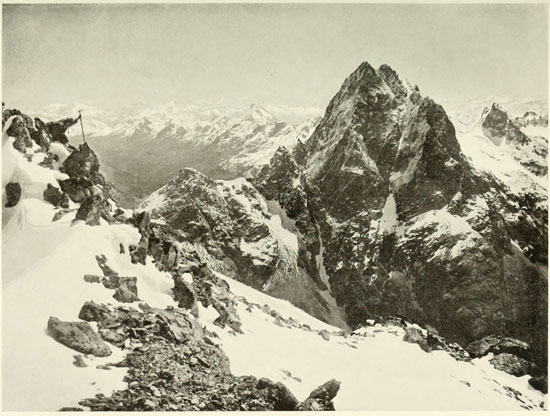
ABOVE THE ARLBERG TUNNEL
It was then that Tyrol finally came into the possession
of the Emperors of Austria, by whom the ancient title of
Prince-Count of Tyrol and other subsidiary titles are still
borne.
TYROL FROM ITS INCORPORATION BY AUSTRIA
AS A PART OF THE EMPIRE TO THE
PRESENT TIME
During the Thirty Years' War (1618-1648)
between the Catholics and Protestants of
Germany, which was renowned for the victories
of Wallenstein and Gustavus Adolphus of Sweden, Tyrol
did not altogether escape its influence though playing no
very important part in the struggle. One result was,
however, of considerable importance to a family of great
note in Tyrol. It brought about the ruin of the Fuggers,
whose financial assistance to various rulers of Tyrol and
Eastern Europe had been generally forthcoming when
required. Owing to their possession of the two famous
castle-fortresses of Tratzberg and Matzen their prosperity
or otherwise was of considerable importance to Tyrol.
From the date (1665) when the country became
completely incorporated as a part of the Austrian Empire it
did homage to the Emperor Leopold I., sole heir of the joint
Austro-German possessions. It was during his reign and
on account of this circumstance that Tyrol became deeply
involved in the War of the Spanish Succession, and was
the object of attack on the part of both French and
Bavarians, Leopold being the Austrian claimant to the
Spanish throne, and Philip of Anjou, grandson of Louis
XIV., the French aspirant.
In 1703 the French troops, under General Vendome,
entered Tyrol from the South and unsuccessfully besieged
Trent on their way northward to Austria; and at the
same time the Bavarians overran the country by routes
which they had traversed from almost time immemorial
when making their periodic raids upon the Tyrolese.
For a considerable period the invaders were successful,
and many villages and castles of the Unter-Innthal and
contiguous districts were destroyed. The capture of the
capital was the cause of the uprising of the Landsturm,
or general levy of the peasants; and during 1703 a
number of fierce engagements were fought between these
ill-armed but brave Tyrolese and the Bavarian and French
troops. One of the most noted battles was that which
took place immediately after the Tyrolese had destroyed
the Pontlatz Bridge which spanned the River Inn, by
which the Bavarians were about to cross. In this engagement
the latter, under the leadership of the Elector
Maximilian Emmanuel, were utterly routed by a much
inferior force of the Landsturm, and driven back from
North Tyrol. Following up this success the Tyrolese
concentrated their energies upon the French force under
General Vendome which they compelled to retire into
Italy.
The Emperor Leopold I., not wishing to reside for any
length of time at Innsbruck, had created the office of
Statthalter or Governor of Tyrol and Vorarlberg, an office
which has been filled ever since till the present day, with
the exception of the period of the French and Bavarian
wars with Austria in the early part of the last century.
The Emperor did not live to see the ultimate triumph
of his forces. He died in 1705, and was succeeded by his
sons Joseph I. and Charles VI. On the death of the latter
in 1740, owing to the fact that with him the Austrian male
line became extinct, the Empress Maria Theresa ruled in
his stead. During her long reign the Vorarlberg became
an integral part of Tyrol owing to the fact that it was an
Imperial fief which reverted to the Crown by natural
process on the extinction of the line of feoffees. Maria
Theresa and her husband the Emperor Francis I. came to
Innsbruck in 1765 for the wedding of their son Leopold,
Grand Duke of Tuscany (afterwards the Emperor Leopold
II.), with Maria Ludovica, daughter of Charles III., King of
Spain. The Tyrolese and the Innsbruckers gave a warm
welcome to their sovereigns, and the festivities were upon
a most magnificent scale. The gaiety was destined, however,
to be clouded and put an end to by the sudden death
of the Emperor (husband of Maria Theresa), who expired
at the palace immediately after his return from the Italian
Opera. It was he, Francis Stephen of Lorraine, also
Grand Duke of Tuscany, who founded the House of
Habsburg-Lorraine, which still rules over the Austro-Hungarian
Empire.
REFORMS OF JOSEPH II.
On the death of Maria Theresa in 1780 she was
succeeded by her son Joseph II., upon whose accession
many innovations were introduced in Tyrol as well as other
portions of his wide empire. His salutary and liberally
conceived reforms, more especially as regarded the Church,
were brought about by a desire to adjust political and
religious affairs and do away with anomalies.
Inasmuch as Joseph's scheme embraced the suppression
or abolition of numerous priories, monasteries, churches,
and other religious institutions, it is little to be wondered at
that his action met with the most strenuous opposition from
the Church whose property was threatened. One act, the
closing of the University of Innsbruck, which had been
founded by Leopold I. in 1677, it is not easy for any one
at the present day to understand. The Emperor Joseph
II.'s scheme of reform was not successful, although it had
arisen from honourable motives and a sincere desire to
redress some very crying grievances.
He was succeeded in 1790 by his brother, the Emperor
Leopold II., who reopened the University, and undid
much of the work his predecessor had accomplished with
regard to the suppression of religious houses. He, however,
reigned but two years, and was followed by his son
Francis II. of Germany and Francis I. of Austria. This
ruler came to the throne at a great and unhappy crisis in
European history. The French Revolution was at its
height and the ensuing period of the "blood lustful"
Napoleonic Wars made of Europe a vast camp and battle
ground. It was also a period destined, as events proved,
to make Tyrol famous for all time, to develop the best
instincts of her people, and to exhibit the race in a heroic
and romantic light.
To understand the position of Tyrol at this epoch it
is necessary to briefly sketch the events which led up to
the struggle as it affected the "land in the Mountains."
Mantua, an Austro-Italian possession, fell before Napoleon
in 1797, and immediately the young general sent an army
under Joubert into Tyrol, the routes into the country being
left almost undefended by the retreat of the Austrian forces
towards Carinthia, after their defeat at Lodi on May 10,
1796.
FRENCH INVASION
Once more the Landsturm was raised in South Tyrol,
and again the peasant forces (to whom the name of "ragged
coats" had been contemptuously given) engaged in a
terrific struggle for their beloved land with the not only
better armed but more numerous detachments of French
and Bavarian invaders. Even the well-tried legions of
Napoleon were destined, however, to find them as redoubtable
as had formerly Maximilian.
Under the gallant von Worndle the Inn Valley Landsturm
was led down into the Pusterthal, where it was joined
by the Austrian forces under Generals Laudon and
Kerpen. Napoleon's troops, although well led, and possessing
all the advantages that experience and a knowledge of
strategy could give them, nevertheless could not withstand
the terrific onslaught and heroic bravery shown by the
Tyrolese. A fierce and bloody engagement was fought at
Spinges which resulted in the triumph of the peasant
forces and the utter rout of the invaders, who were compelled
to evacuate the country. About the same time
another smaller engagement took place near Bozen, where
a mere handful of peasants engaged a much superior force
and defeated it. This otherwise comparatively unimportant
event has gained fame and significance from the fact
that this small body of Passeyer peasantry was led by a
tall, broad-shouldered man with a long brown beard, named
Andreas Hofer, who was destined afterwards to play so
great and remarkable a part in the history of his beloved
country.
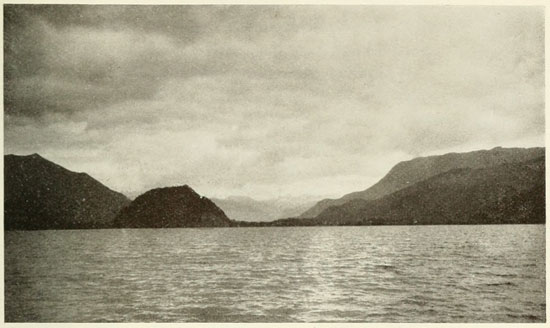
SUNSET ON A TYROLESE LAKE
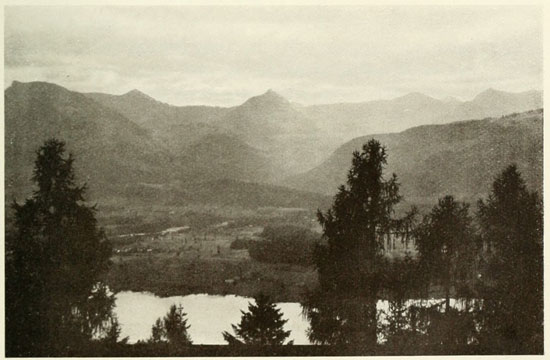
A TYPICAL TYROLESE LANDSCAPE
After the Battle of Spinges hostilities were ended
for a time by the Treaty of Campo Formio, October 17,
1797.
During this preliminary struggle against the French it
is estimated by several authorities that upwards of 100,000
peasants took up arms in defence of their country, amongst
whom were many women and young maidens. The total
population of Tyrol at that period did not probably much
exceed three quarters of a million.
The peace secured by the Treaty of Campo Formio
did not, however, endure very long, for early in 1799 the
war broke out again, and the French under General
Massena entered Tyrol, on this occasion by way of Switzerland
through the mountain passes, the Bavarians supporting
the invaders by incursions over the frontier in the
direction of Salzburg. In an engagement near Feldkirch
in Vorarlberg General Massena was defeated; and upon
making a fresh attack the French, hearing all the church
bells of the district ringing on Easter Eve and mistaking
them for the alarm bells summoning the Landsturm,
hastily abandoned their intentions and retreated across the
frontier into Swiss territory. The victories of Marengo
and Hohenlinden on June 14 and December 3 of the next
year, brought about the Treaty of Luneville on February
9, 1801, by which the Bishoprics of Brixen and Trent
(already in a sense belonging to Tyrol) were made integral
parts of the country.
Hostilities were continued, however, in other parts of
Europe, and the long war dragged on, Napoleon over-running
the Continent and more especially South-Eastern
Europe almost unchecked, till Ulm, where the Austrians
were defeated October 17-20, 1805. The French army
under Marshal Ney afterwards entered and occupied Innsbruck.
Then came the disastrous Battle of Austerlitz on
December 2, where Napoleon defeated the combined Russian
and Austrian forces. The power of the latter was shattered,
and by the Treaty of Pressburg, December 26, 1805,
Tyrol, which now for upwards of four hundred years had
been one of the chief possessions of the house of Habsburg,
was ceded to the victors. The Bavarians took the northern,
and the French the southern portion. Not only was the
country for a time lost to Austria, but even its name was
taken from it. The new owners promptly divided it into
three departments known by the names of the three chief
rivers—the Inn, Eisack, and Adige.
In the beginning of the year following the Treaty the
Bavarians took formal possession of their new territory.
During a period of some three years the Tyrolese fretted
under the rule of their conquerors. But the time was not
spent merely in idle murmurings or in servile acceptance
of the conqueror's yoke. The peasants who had fought so
bravely for their land and liberty in ancient times, and in
1797 and 1799, were eager once more to take the field to
recover their lost freedom, and to drive the usurpers of
their beautiful Tyrol for ever beyond its frontiers.
RISE OF ANDREAS HOFER
Day by day, week by week, month by month a general
rising of the community was being gradually organized
by three men more particularly, who were each of them
destined to become famous, and to go down to posterity
as the saviours of their country. Of these Andreas Hofer,
born of Inn-keeping parents at Sandyland in the Passeyer
Valley in 1765, was destined to outshine both in his life
and death his two companions, named Speckbacher, born at
Rinn, and Haspinger, the tall, red-bearded Capucin monk,
known respectively as "the fire-devil" and "the red beard."
The task that Hofer and his companions set themselves
was no easy one. The country swarmed not only with the
soldiers of the Bavarian occupation force, but with spies
who seem always to spring up whenever the price of
treachery is worth earning. The punishment for men
taking part in any such schemes as that in which Hofer,
Speckbacher, and Haspinger and their faithful companions
were engaged in was death. Death not only for the
principals, but death for the humblest participant. Nevertheless
the plan prospered. It is interesting to remember
the very large and important part which was played in the
organization of the peasants' uprising by the Tyrolese
innkeepers, or wirthe, who were very dissimilar to the
ordinary conception which English people have of men of
their class. They were usually the most wealthy as well
as the most solid members of the village communities
in which they dwelt and kept their Wirthshaus, around
which, indeed, much of the social as well as the municipal
life of the village centred. They were better informed
than many of their neighbours, for whatever travellers
came to the villages found their way to their hospitable
roofs; and what echoes of the outer world ever reached the
secluded villages filtered its way, as it were, through them.
It was in these men that Hofer found his greatest allies
and ablest assistants. During the three years which
succeeded the Bavarian occupation and the peasant
rising, the innkeepers of Tyrol were busy gathering
round them small bodies of trusted men, who, fired by a
common desire to free their country, would, indeed,
have suffered death rather than betray a single word of
the secret arrangements of which they gradually became
cognizant.
When many of the preparations were completed
Andreas Hofer commenced a correspondence with the
Government in Vienna—which seemed so incapable and
unwilling to assist the brave people it had seemingly
abandoned in their struggle for freedom—in the person of
the Archduke John. But although Hofer and his companions
do not seem to have received very much definite
or material encouragement from the Emperor or his
advisers, they proceeded to Vienna, had several interviews
with the Archduke, who appeared to be most favourably
inclined to their scheme, and at these interviews the plan
of campaign was definitely formulated. In the end
Hofer returned to St. Leonard raised to the dignity of
Commander-in-Chief of the national forces, and with full
powers to do what he deemed best in the interests of the
country.
What he did not, however, secure was any support
from Vienna in the form of arms or disciplined troops
with which to leaven his "ragged coats." The courage of
the men who entered upon a campaign against trained
and tried soldiers armed with the most up-to-date weapons
of those times can scarcely be estimated just as it most
certainly cannot be over-praised. Owing to the rigorous
search for arms which the Bavarians and French had
instituted in almost every dwelling in the land, during the
two or three years which intervened between the Treaty of
Pressburg and the uprising of the peasants under Hofer,
it was not possible to obtain and store new weapons in
any quantity even if to do so had not been rendered
difficult from the hosts of spies which overran Tyrol and
seemed to lurk beneath almost every rock. Thus it was
that out-of-date weapons—most of which had seen service
in the war of a century before—billhooks, scythes, clubs and
pitchforks, with whatever other arms their own ingenuity
could devise or the village blacksmiths make, were pitted
against the arms of some precision of the French and
Bavarian troops. All that the peasant forces had to sustain
them in the struggle against well-armed and disciplined
veterans, superior as regards knowledge of warfare, was
dauntless courage and a greater acquaintance with the
country and of hill fighting.
THE SCHWARZHORN, S. TYROL
Upon Hofer's return with his companions from Vienna
his Inn became the resort—more or less secretly—of all
who were truly desirous of joining the popular movement
and of freeing the country. Many, we are told, blamed
him for trusting so implicitly all who came. But to
objectors he made the same answer: "There are no
traitors amongst my countrymen." That his confidence
was not misplaced was abundantly shown by the fact
that the secret of a conspiracy so vast that it may be
said to have extended north, south, east, and west
almost throughout Tyrol was unrevealed until the ever-memorable
night of April 10, 1809, when the time fixed
for the uprising arrived.
THE SUMMONS TO ARMS
On the evening of that day the peasants of the
Passeyer and other valleys were called to arms by means
of great fires which blazed out in the darkness of the clear
April sky in long, ruddy banners of flame. Every hill
crest in the vicinity of the Passeyer Valley had its signal
fire, and these were answered by others on the mountains
overshadowing the distant valleys. On the morrow
Andreas Hofer found himself at daybreak at the head of
nearly 5000 men who had one and all "confessed" and
received the Sacrament ere taking up arms in their sacred
cause of liberty.
The Bavarians were at once hotly attacked and
routed; and on the 12th, soon after dawn, upwards of
15,000 peasants had rallied to Hofer's standard and
appeared before Innsbruck. With indomitable bravery
they captured the bridge over the Inn, carried the heights
by assault, and entering the town engaged in a fierce
hand-to-hand conflict with the troops of General Bisson
(who was in command of the joint French and Bavarian
forces) and compelled him to surrender.
In the deadly conflict of the streets, which ran red
with blood, and into whose mire peasants, French and
Bavarian soldiers and officers alike were trampled by the
on-press of the Tyrolese, the ruder weapons of the latter,
consisting of heavily butted fire-locks, broad knives used
in husbandry, scythe blades attached to staves, and
bludgeons cut from the thickets of the mountain side,
were as deadly and even perhaps more so than the
weapons of their enemies.
Down the ancient streets, overshadowed by the everlasting
snow-clad mountains; into the narrow byways
and courtyards of the ancient town; along under the
arcades of the old-time Herzog Freidrich Strasse, swept
the Tyrolese, slaying as they went, until the invaders,
driven from cranny to cranny, struck down in the open,
compelled many of them to retreat along the Inn banks
till they fell back into the swiftly flowing river, cried for
quarter and surrendered.
At Wilten, on the outskirts of Innsbruck itself, the
fiery Speckbacher surrounded a Bavarian force of nearly
5000 men and took them prisoners of war. Thus after
less than four days' fighting the Tyrolese had defeated the
Bavarians, captured Innsbruck, and compelled the French
commander to sue for quarter. And in their hands they
held two generals, 132 officers, nearly 6000 men, three
standards, five pieces of cannon, and 800 horses.
By the end of April, Tyrol was again free of invaders
with the sole exception that the Bavarians still held the
castle of Kufstein.
It was now that the Government in Vienna made one
of the many serious mistakes which throughout its
dealings marked the policy pursued in relation to Tyrol's
struggle for freedom. General Chasteler, of whom it was
said that "he always came too late and went too soon,"
was given the supreme command. And from that moment
the advantages gained by Hofer, his brave companions-in-arms
Speckbacher and Haspinger, and the peasant troops,
were lost. In an almost incredibly short space of time
Chasteler succeeded in losing all that had been won. At
length his failure to hold what had been committed to his
charge became so obvious that he retreated beyond the
Brenner, leaving Andreas Hofer to do the best he could in
defence of the portion of Tyrol not then reconquered by
the enemy. In little more than a month from the time
the French and Bavarians had been driven from Innsbruck
they entered it again in triumph; and thus, on the 20th
of May, Tyrol was once more to all intents and purposes
conquered.
The brave leader of the peasants, however, was determined
to make one more supreme effort to free his
country from the French and Bavarian yoke, and after
summoning to his standard all who were capable of
bearing arms, he had the satisfaction of once more driving
the invaders from Innsbruck, and freeing for the second
time the country he loved so well.
THE CRUSHING OF AUSTRIA
This triumph was not, however, destined to endure, for
the Austrian forces under the Archduke Charles suffered
a crushing defeat from Napoleon's troops at Wagram on
July 5 and 6, 1809, and were forced to sue for peace or
at least an armistice at Znaim, in which Tyrol was
ignored. Amongst other things, by the subsequent
Treaty, Austria ceded all her sea coast to France, as well
as considerable territory to Saxony and Bavaria. But it
was not until the French, Bavarian, and Saxon troops,
straight from their victory at Wagram, to the number of
some 50,000 men, entered Tyrol under the command of
Marshal Lefèbre, and the Austrian army marched away
out of Innsbruck in full retreat before the advancing
enemy, that Hofer realized that he and his cause once
more were abandoned by the Emperor and his advisers.
Again Hofer came to the rescue; and, though in a
measure a fugitive, in one of the little-known gorges, he
managed to send forth from valley to valley his summons
to the people to gather once more round his standard.
That none should certainly know from these summonses
where he lay concealed it was his wont to sign them
"Andreas Hofer, from where I am "; whilst in return those
communicating with him addressed theirs "To Andreas
Hofer wherever he may be."
He once more succeeded in inspiring his fellow-countrymen
with his own undying, unyielding patriotism.
Gathering his forces together in a gorge of the Mittewald
he awaited the enemy's advance. We cannot do better
than draw in part, for a description of what followed, from
the stirring and vivid narrative of Albert Wolff. The
vanguard of Marshal Lefèbre under the command of
General Rouyer advanced to Sterzing; and then a column
of Saxon troops to the number of about 4000 was thrown
out beyond the village towards the gorge of Stilfes with
orders to sweep away the insurgents. The idea that the
untrained, ill-armed, and heterogeneous peasant forces
could successfully resist the victors of Wagram appeared
ridiculous to the Marshal and his officers, even if the
Tyrolese were so foolhardy as to make the attempt. For
some distance the Saxons advanced without either
meeting with opposition or discovering an enemy; and
then, when the whole column, had fully entered the defile
from the mountain sides above them there resounded a
sudden, terrifying cry of "To the attack, and no quarter."
The cry was followed by a starting up of thousands of
peasants, men, women, and children, the aged and the
young, from behind the boulders on the hillside, from out
the hollows. Down the steep mountain gorge crashed
rocks, tree trunks, baulks of timber, earth and stones
loosed from the restraining ropes by the Tyrolese, sweeping
every obstruction before them, and falling upon the
penned-up Saxons like an avalanche. Then, as the latter
were vainly and fiercely struggling to extricate themselves
from the debris and entanglements, the peasants rushed
down the mountain side and hurled themselves upon their
bewildered foes, shouting Hofer's battlecry, "For God and
our Country."
The enemy, utterly routed, turned and fled—what
remained of them—towards Innsbruck, pursued by the
Tyrolese led by Hofer, Speckbacher, and by the red-bearded
Capuchin Haspinger, who held in one hand a
crucifix, and in the other a bloodstained sword. Upon the
Saxons the Tyrolese had no mercy, and hundreds were
cut down as they fled along the road back to Innsbruck.
TRIUMPH OF HOFER
In little more than a week Hofer, by a vigorous following
up of his victory in the Pass of Stilfes, had once more
repulsed the invader, retaken the position on Berg Isel,
and established his headquarters at Schönberg. These
historic eight days of fighting and victory are known in
Tyrolese history as "the great week."
Innsbruck still, however, remained in the occupation
of the enemy. To take the town was a task that might
have given pause to any less brave and venturous a
commander than Hofer. But he was not the man to
hold back from a complete freeing of his beloved land
from those who had invaded it. The plans were laid, the
day fixed, and the advance ordered. On the morning of
the attack, at five o'clock, Haspinger the militant Capuchin,
a commanding figure upon whom the light of early
dawn threw an almost uncanny refulgence, celebrated
Mass before the assembled peasant host, who knelt in
serried ranks, ragged, unkempt, but inspired to great deeds
by memories of their past victories. After this solemn
observance Haspinger once more became a captain of
troops rather than a priest; and springing into his saddle
he drew his sword and led on the left wing. Andreas
Hofer himself was in the centre, and led the attack there,
marching right on to Innsbruck.
A contemporary account describes the hero as being
"transfigured with a grandeur scarcely earthly, as, burning
with patriotism, he urged his horse forward into battle."
With his long beard, which had gained him the nickname
of General Barbonne amongst the French, flowing in the
wind, and his war cry of "Onward for your country and
your Emperor! God will protect the right!" he led his
forces so irresistibly that the troops of Marshal Lefèbre
gave way and evacuated the town. On the following day,
August 15th, which was the fête of the Blessed Virgin,
Hofer, at the head of his victorious peasants, made his
third entry as victor into the capital.
Around him thronged the citizens, overcome with
transports of joy, pressing him so closely that many were
trampled beneath his horse's feet. In the enthusiasm,
relief, and triumph of victory, Hofer was named with one
voice dictator of Tyrol. But there was that strange
analogy which links Hofer's attitude in the hour of
triumph so closely (notwithstanding the differentiations
of sex) with that of Joan of Arc and with Cromwell.
Turning to the thronging multitude, which filled the
narrow streets to overflowing, he cried out, with a gentle
and almost pitiful glance at their upturned faces, "Do not
shout in triumph; but offer thanks to God and pray." At
the door of the church of the Franciscans he dismounted,
and entered the building to return thanks to God, and
remained there in prayer, unmoved by the cheers and
"Hochs" of the great assembly of his troopers and fellow-countrymen
outside, the sounds of which, as they came
in through the constantly open doors of the church at that
hour, bore no personal significance to him.
On leaving the building he was waited upon by the
chief citizens, who expressed their undying gratitude to
their deliverer. But in response he said, "By my beard
and St. George, God himself and not I has been the
Saviour of our country."
Andreas Hofer was destined to show that he was not
only a warrior, but also an administrator, actuated by the
most lofty desires for his country's good. In every act of
his government could be detected the truly religious and
patriotic character of the man. And during the short
time that he reigned in the palace at Innsbruck, waiting
anxiously for the approval and the help from his Emperor
in Vienna, his conduct was marked by dignity, kindliness,
and strength. But alas, his triumph was but brief. In
less than two months after the retaking of Innsbruck, a
fresh Bavarian army was entering Tyrol by way of the
Unter-Innthal, and taking Speckbacher unawares the
invaders gained a partial victory; and ere the disaster
of October 10th could be retrieved, the Treaty of Vienna
was agreed upon (October 14, 1809), by which the hand
of one of the Habsburg princesses was promised to
Napoleon as the price of peace.
Tyrol by this new arrangement remained Bavarian,
and the Archduke John himself called upon Andreas
Hofer to lay down his arms. The latter did not obey.
He persuaded himself that the Treaty of Vienna was
without substance, or merely a trick to enable the invaders
to make good their fresh hold upon the country,
and he decided to continue the struggle. His followers,
however, were discouraged by the callous way in which
the Austrian Government had invariably left them to fight
their own battles alone.
Speckbacher, too, was deserted by all save a mere
handful of men, and after remaining in hiding for some
time and escaping capture by a miracle he succeeded in
getting to Vienna. The Capuchin Haspinger afterwards
joined him there, and was ultimately made curate of
Hietzing, near Schönbrunn. It then became clear to
Hofer that to continue the struggle for freedom just then
was useless and, indeed, impossible; so he dispersed his
own handful of faithful friends and supporters, telling
them, "We shall meet again before long, for Tyrol will
not perish."
HOFER AN OUTLAW
With these prophetic words, which were destined never
to be realized so far as the meeting with his faithful
comrades in arms was concerned, Hofer took farewell of
his companions and fled a fugitive into the mountains
of the Passeyer Valley.
A price was put upon his head by the Bavarians and
French, who recognized that their peaceful occupation of
the conquered and ceded territory depended very greatly
upon the capture and imprisonment or death of Hofer,
who, as a popular hero, held so high a place in the hearts
of his countrymen; and that for him to remain at large
would constitute a perpetual menace.
For a long while Hofer was able to elude the vigilance
and discovery of his would-be captors. Technically, and
owing to his abandonment by the Austrian Government,
he was a rebel on account of his refusal to lay down his
arms when commanded by the Archduke John to do so.
In the end, as so often happens, there was one found base
and treacherous enough to betray the fugitive for blood
money. Guided by such an one, named Raffl, some Italian
gendarmes, supported by a small detachment of French
soldiers, made their way amid the intricate mountain
paths to the chalet where—near St. Leonard, but far from
other habitations—Andreas Hofer had for some months
lived with his family, now broken down by despair for his
country, anxiety and privation.
He made no resistance, and was immediately taken to
Mantua, escorted (such was his fame and the fear lest he
should escape or be rescued) by four French officers, a
battalion of infantry, and a detachment of cavalry. No
effort appears to have been made by the Austrian
authorities to save the hero to whom they owed so much,
and Hofer was tried by court-martial under the presidency
of General Bisson, and condemned to be shot.
THE DEATH OF HOFER
On the morning of February 20th, 1810, Andreas
Hofer, who lay in prison but a short time after condemnation,
was awakened early and led forth to die. At the
gates were gathered a handful of his friends and companions
in arms who had been captured and brought to
Mantua, or had followed him there, and these knelt and
entreated his blessing as he passed by them; this he gave
calmly, remaining far less outwardly moved than they who
received it.
Then onwards to the Ceresa Gate, where the firing
party halted. Hofer declined to have his eyes bandaged;
neither would he kneel. But standing erect with unwavering
courage he faced the file of soldiers, who with loaded
muskets were to do him to death. Giving his last remaining
piece of money to the corporal, he said to him, "Aim
straight." Then he calmly gave the signal to fire.
The muskets rang out, the bullets sped to their mark,
and one of the noblest of patriots Europe had ever seen
fell without a groan.
At his own last request his body was buried at Mantua
in the garden of his friend and father confessor, Manifesti.
There it lay for fifteen years, until one night three officers
of a Tyrol Chasseur regiment stealthily removed the
remains, distressed that the hero of Tyrol should lie
buried in foreign soil. The body was first taken to
Bozen, and shortly afterwards to the Abbey of Wilten.
When later a funeral worthy of his fame was accorded
him, deputations came from all parts of Tyrol to pay their
tribute to the greatest hero in its history; and amid a
throng which was perhaps never before equalled in the
streets of Innsbruck, the remains of Andreas Hofer were
with great appropriateness borne to their last resting-place
in the church of the Franciscans by twelve innkeepers.
On the coffin lay his hat, sword, and decorations, and
upon it were the armorial bearings of his family, which
had been ennobled by the Emperor Francis I. in 1819.
And thus, in a tomb cut from the marble of the Tyrol
he loved, his body was laid to rest.
In the same year that Hofer died, Tyrol was divided
into three parts. Italy took the southern, Bavaria retained
the northern, and Illyria the south-eastern or Pusterthal
district. So it remained for three years, until 1813, when
the power of Napoleon was once and for ever broken in
eastern Europe, when he was defeated at the fierce battle of
Leipsic on October 16-18, by the allied forces of Austria,
Russia and Prussia. In this battle (known as "the
battle of the nations") upwards of 400,000 men were
engaged; a fifth of the number were slain. The allies
were helped at a critical point of the fighting by the
defection from Napoleon of a large force of Saxons.
In the following year Tyrol was reunited to Austria
with the addition of the Ziller and Brixen valleys and
Windisch-Matrei. On May 27, 1816, the Emperor
Francis I. (who in 1806 had resigned the title of
Emperor of Germany, retaining only that of Austria)
entered Innsbruck to receive the allegiance of the people.
His reception was most enthusiastic, the people rejoicing
unrestrainedly at once more gaining their freedom, and
being reunited to the Austrian Empire.
During the revolutionary excitement which pervaded
Europe in 1848 the then Emperor of Austria, Ferdinand,
and his Empress took refuge in Tyrol; and in the Austro-Italian
War of 1848 the Tyrolese greatly distinguished
themselves by their bravery and good marksmanship.
There remains little more to add concerning Tyrol's
history. On December 2, 1848, the Emperor Francis
Joseph I. succeeded his uncle Ferdinand, who abdicated
after ruling the country for thirteen years under the
guidance of the powerful Prince Metternich whose
reactionary policy provoked the Revolution of 1848.
In 1859 the Austro-Italian provinces, with the exception
of Venice, were absorbed by the Kingdom of Sardinia,
previous to the formation of the Kingdom of Italy. In consequence
Tyrol became the frontier of Austria to Italy, and
of increased importance. In 1866, during the war between
Austria and Prussia, the latter supported the Italians
in a scheme to seize Southern Tyrol. The Tyrolese
Jager and Schutzen forces took a prominent part in
the campaign, and were engaged with great credit
at the Battle of Custozza, where the Austrians with
70,000 men defeated the army of Victor Emmanuel,
nearly twice as strong. Afterwards, when the Prussians
defeated the Austrians at the Battle of Sadowa or
Koniggratz on July 3, 1866, and a fresh attempt was
made to seize South Tyrol, the inhabitants once more
showed that their old-time courage and resource was
not diminished.
TYROL OF TO-DAY
Since then Tyrol has been happily both peaceful and
prosperous; advancing in the arts, and with a system of
education which is bearing good fruit.
What the future of this favoured and beautiful land
may be, who can tell? Perhaps the secret is already
locked up in the chancelleries of Eastern Europe.
But the wise and beneficent ruler who now guards
the destinies of the many-sided Austrian Empire is old,
and when the end comes it does not need the keen
observer to possess much gift of anticipating events to
predict that Tyrol may be the scene of yet further
struggles when Germany's desire for a seaport on the
Mediterranean via the Adriatic has possibilities of
accomplishment.
SOME CHARACTERISTIC LEGENDS, CUSTOMS,
AND SPORTS
Just as is the case with Switzerland so in Tyrol the
land itself, its history, even its geological evolution,
seem in a measure reflected in the character and disposition
of its people. One cannot indeed be any long time
in Tyrol without becoming aware of and appreciating this
fact. In the kindliness and hospitality of the Tyrolese one
has reflected the characteristics of aloofness from the outer
world, and dependence upon one another, which the position
of their "land within the mountains" typifies—characteristics
which have grown (and fortunately have not yet
become, at least in the more remote parts, to any large
extent tainted by considerations of self-interest) from the
circumstances of former days, when individual hospitality
had to serve for the absence of inns and commercial
conveniences of the kind. So, too, in the rugged,
patriotic, and sturdy natures of the people one can trace
a parallel with the configuration of their beloved land;
as one can also trace in their single-heartedness, piety,
poetic traits, and simplicity, the frugal and laborious
lives which the majority lead, unvexed in former times
by the fret of small things, and through succeeding ages
strengthened by the great needs of patriotism and self-sacrifice
which the political crises outside their own borders
often brought home to them by invasion and attempted
subjection.
A DELIGHTFUL LAND
It is not at all wonderful, then, that a people dwelling
in a land of such surpassing beauty, where flower-bedecked
upper pastures melt away into rocky peaks, glaciers, and
snow-clad heights; where the music of tinkling brooks
trickling down the mountain side and the roar of greater
torrents are ever with them; with the eternal silence of
great heights surrounding them and, as it were, shutting
them in from the outer world, should be gifted with an
appreciation of romantic beauty, legend, and poetry beyond
the common run of mortals.
As we have already shown, much history and many
stirring events have been enacted within the mountain-girdled
borders of Tyrol. And, nowadays, when the country
is coming slowly but surely to her own as a delightful
holiday ground for weary dwellers in Western cities, many
of her valleys bring to the minds of those who know something
of the country's story dramatic and romantic memories
of the stirring events and legends which have through past
ages become associated with their names.
Scarcely a valley, village, or townlet, whether set high
or low in this enticing land, but has its own legend or story.
And in almost all of the less travelled corners one finds
strange, and to most travellers incomprehensible, dialects
still lingering amongst the peasantry, notwithstanding
the fact that gradually the Germanization of even the
southern portion of Tyrol is being brought about. In one
or other of these dialects which so survive, scholars and
philologists of former times have thought the key to the
ancient language of Etruria might be discovered; and in
more modern days there has been the same hope expressed,
but as yet it is unfulfilled. Müller,[7] for one, thought that
in some secluded valley of the Tyrol or Grisons the key to
the riddle in the form of "a remnant of the old Rhætian
dialect might be discovered." Müller's hope has since then
in a measure been realized through the efforts and researches
of Steub, who, whilst travelling in Tyrol in Alpine districts
in 1842, found some fragmentary remains of a dialect
approaching very nearly Etruscan, though not sufficiently
full to form any very important or extended key to
the tongue. His book[8] contains the results of the
inquiries, tests, and deductions which he was at first led
to undertake by the strange names of the towns and
villages which he came across in his travels. Then he
collected these, and we are told set to work "testing them
with Celtic, but discovering no analogy he tried other
tests, and with the Etruscan met with some considerable
success," which was chiefly valuable, however, as confirming
the theory and ancient traditions of a Rhæto-Etruria.
Many of his conclusions, however, have never
been accepted by philologists either of his own day or of
later times; and some of the word examples he gives as
having analogies are quite incomprehensible to the
ordinary student.
THE LANGUAGE
To all intents and purposes German and Italian are the
languages spoken throughout Tyrol, a knowledge of which
will be sufficient for all ordinary purposes of travel. The
former prevailing in the Vorarlberg and North Tyrol; the
latter in South Tyrol and Wälsch Tyrol, though German
is found in both of these districts, and in South Tyrol very
considerably.
In the Vorarlberg, however, one comes across numerous
words and expressions which are undoubtedly of Italian
origin, and are remaining evidences of the periods when
the Venetian Republic ruled over a district now a part of
Tyrol. The Italian word gútto, a can or feeding-bottle,
for example, has its counterpart in guttera; whilst from
fazzolétto, a handkerchief, one has fazanedle; and from
gaudio, joy, we have gaude; and from cappéllo, a hat, has
probably come schapel.
A VIEW OF THE TYROL ALPS
A very considerable number of words of French origin
or of marked similarity to French words are found in
parts of the Vorarlberg. Gespousa, a bride, has a distinct
philological affinity to épouse; and au, water, pronounced
very similarly, can be traced to eau, and is found
common to both North Tyrol and the Vorarlberg. Shesa,
a trap or gig, bears a marked resemblance to the French
chaise.
Even England appears to have contributed a considerable
number of words to the vocabulary of certain districts
of Tyrol, though perhaps they are, more strictly speaking,
words similarly derived from German or Norman
French which have become common to both. In gulla, a
gulley; gompa, to jump; datti, daddy; witsch, witch; and
many others this is traceable. It will be gathered from
these few examples that the language and dialects of
Tyrol are composite of several tongues, as is almost always
the case in countries which have seen many vicissitudes of
occupation and development.
FOLK TALES
In Tyrol, which has experienced these and possesses
such a large share of romantic beauty, and even nowadays
some "solitary places," there need be little wonder
that legends, superstitions, and myths are found nearly
everywhere. Almost every village has its own, whose
origin has been lost in the mists of antiquity, and whose
date can only be traced uncertainly by its analogy to some
other similar, more widely known, and more easily dated
legend, tale, or superstition. Many of them enshrine
actual events recorded and re-recorded with poetic license
and varying accuracy, so that at last what was originally
founded upon fact has in process of time become overlaid
with much poetic imagery and fiction. To most of these
tales and accounts of events each teller added something
of himself suggested by his knowledge, imagination, or art;
and thus ultimately what had once been facts became
legends common to all throughout the length and breadth
of the land till some one set them down in permanent form
by writing or printing. Then the variations in a measure
ceased.
Tyrol is full of these legendary tales, superstitions, and
myths, to which, indeed, the geological situation of the
land and the simple habits of the people conduce. When
we remember that in ancient times it was the universal
custom to ascribe all manifestations of Nature's laws
which could not be easily traced and understood to
the supernatural, it is little wonder that the simple, unsophisticated,
and uneducated Tyrolese should have so
attributed many of the wonders amid which they lived.
One very noticeable feature of the Tyrolese character
is demonstrated by the fact that, notwithstanding the
centuries of evolution during which superstition played
so important a part in the life of the people, and the
existence of an unreflecting belief in the supernatural,
their many virtues, especially those of patriotism,
industry, frugality of living, morality, hospitality, and
religion, have not, as with some other nations, become
impaired.
Amongst the many legends of a startling and supernatural
character which are found throughout Tyrol, is
one connected with the pretty little village of Taur in the
Innthal. It has to do with a hermit who lived in the seventeenth
century in a cell overlooking the Wildbach. He is
often said by the countryfolk to have been St. Romedius
himself, though this, of course, could not be the case.
One night, whilst the holy man was engaged in his usual
meditation and prayer, a tapping was heard against the
little window of his retreat. Upon opening the door, what
was his amazement to see, not the benighted traveller he
expected to find craving his hospitality and shelter, but
the spirit of his friend the priest of Taur who had recently
died. The latter entreated the holy man to have compassion
upon him, saying, "Have pity upon me, Father,
for my sufferings are terrible. Once when three Masses
had been ordered and the fees paid I forgot to say them,
and now for this sin I am being punished more than I
can bear."
Then the legend goes on to say that he laid his hand
upon the low-pitched roof of the little porch outside the
hermit's cell, and the holy man afterwards found that the
wood was charred and the impression of the tortured
priest's hand was left indelibly in the wood. The poor
suppliant begged his old friend the hermit to say the
Masses, and to pray and fast for him. This the holy
man promised faithfully to do; and keeping his promise,
a year and a day afterwards the spirit once more rapped
upon the casement and told him that he was now free of
purgatory. In the chapel there hung at least a few years
ago, and we believe now hangs, the tile with the mark
of the priest's hand branded into it, beneath which is
written an account of the miracle, with the date February,
1660.
In Wälsch Tyrol, especially, there are many folk-lore
tales having a distinctly Biblical origin or suggestion.
Possibly they are oral versions of Bible incidents handed
down from generation to generation in the early years of
Christianity and during the Middle Ages, until they have
gradually in process of time and varied repetition lost
their strictly Biblical character. One of the most usually
met with (it is told by most Wälsch Tyrol mothers to their
children, and is a favourite on account of its dramatic end,
and because virtue triumphs) bears a very strong resemblance
to the story of Joseph and his Brethren. The
story runs thus: "Once long ago there lived a king who
had three sons. Two were quite grown up, but the third
was a child, and was his father's joy and favourite. One
day the king, who had been out upon a hunting expedition,
returned home from the chase of the bear and
chamois fatigued, and dispirited because of the loss of a
favourite feather[9] which he was accustomed to wear in
his cap. There was a hue and cry raised, but no one
could find the lost article. At length little (Joseph)
came to his father and urged him to grieve no more
but to refresh himself and then rest, "for," said the child,
"either I myself or one of my brothers will find the
feather."
Then the king, pleased with the child, and doubtless
hopeful that he would be the one to find the missing
plume, said, "To whomsoever finds the feather will I leave
my kingdom."
The three brothers set out on their search, and after
much trouble the youngest suddenly espied the object for
which they were looking. But the two elder men, consumed
by jealousy at the thought of Joseph's inheriting
the kingdom, led him away into a wood and killed him,
and, taking the feather to their father the king, told him
that they both found it and thus jointly claimed the
reward. Regarding the missing (Joseph) they said that
whilst searching for the feather they missed him, and
suddenly looked up to see him being borne away by a
bear into the recesses of the woods, and as they were
unarmed it was impossible for them to attempt to rescue
him. The king was consumed by grief; search was made,
but the body was not discovered; and it was not until the
proverbial year and a day afterwards that a shepherd boy
came across (Joseph's) bones, and, taking one of them,
fashioned it into a primitive flute or shepherd's pipe. The
wonderful part of the story is still to come. No sooner
had the shepherd commenced to play upon the pipe than
it told, in the voice of the poor child victim of jealousy,
the whole story. The shepherd took the pipe to the king
and played upon it before him. The king listened, and,
accepting the miraculous tale it told, ordered his two sons,
who were present and struck with amazement and fear,
to be instantly put to death.
There are scores of other stories of a similar character
told during the winter evenings around the fire in
Tyrolese huts and houses. Some have a family likeness
to tales of our own land, such as Cinderella, Puss in Boots,
Jack and the Beanstalk (only the giant is often replaced
by an immense toad who guards fabulous wealth, that is
only to be obtained by killing the toad in single combat,
which feat is, of course, performed by the poor boy who
wishes to marry the Princess), Red Riding Hood, etc.
An account of these, however, rightly belongs to a volume
of comparative folk-lore, and for detailed description we
have no space in the present one.
SOME QUAINT CUSTOMS
Of the many quaint customs which still prevail in
different parts of Tyrol, those relating to Christmas and
to All Souls are amongst the most tender and picturesque.
In North Tyrol, more especially perhaps in the district
of the Unter-Innthal, Christmas, which is called Christnacht
and Weihnacht, is celebrated by the gift of
Klaubabrod, a strange cake-like compound made of dough,
almonds, slices of pears, and other preserved fruits and
nuts, which, at least with the generality of foreigners, must,
we think from personal experience, be "an acquired taste."
The Zillerthal maidens are specially well-instructed
in the making of Klaubabrod, and the one prepared
for the family consumption, if the maker be engaged,
must have the first slice cut out of it by her betrothed,
who then kisses her and at the same time gives her some
little present as a mark of his affection. In former days
it was the custom of the Bishops of Brixen to make
presents of fish to members of their household and to all
in their employ. The fish came from Lake Garda, and
was allowed by custom to pass through the dominions
of the reigning Count of Tyrol and the Prince Bishop
of Trent exempt from the toll which would otherwise have
been levied.
In Wälsch Tyrol there is a curious Christmas custom
still to be met with which consists of the arrangement,
by the father of the family, of a number of heaps of flour
upon a table or shelf. In these are hidden various little
presents, and when the children and other members of
the household have been admitted they take their heap
according to the drawing of lots, or the result of some
contest or competition.
The belief that animals have the gift of speech,
which has during past ages been prevalent throughout
Christendom, still prevails in some parts of the more
remote districts and valleys of Tyrol; and strange
stories are told of things said by beasts and over-heard
by human beings which have come true, so that
animals evidently are accredited also with the gift of
prophecy.
At Epiphany, in many parts of Tyrol, performances
very similar in character to the English old-time
"mummers" are given. Generally three of the village boys
dressed up to represent kings, one having his face blacked,
go from house to house singing. Sometimes a Herod
will appear at the window of the house and reply to their
songs in rhyming couplets. After which the singers stand
in turn and sing, and end with a chorus which contains
broad hints that they would not refuse some refreshment
were it offered them! They seldom or never fail to
receive this, as usually some provision has been made
by the hospitable village folk for the purpose.
The blessing of cattle on the Eve of Epiphany was
at one time an almost universal practice with the
Tyrolese. This, however, has been largely discontinued,
although still extant in some hamlets of the remote
valleys.
As showing the almost universal prevalence of certain
ideas underlying customs, though often varying in details,
one may quote the observance of All Souls in Wälsch
Tyrol, which bears a marked resemblance to the beautiful
and even more pathetic ceremonials connected with the
Feast of Bon Matsuri in far-off Japan. In parts of
Wälsch Tyrol, although the graves of the departed are
not decorated nowadays, as is so much the practice in
Germany, the parish priests gather their parishioners
together in the churchyards and recite the Rosary whilst
kneeling amidst the graves. In many parts loaves, called
cuzza, are given to the poor with small doles of money,
and sometimes bean soup. In former times, however,
these doles, which are for the refreshment of the souls
of the departed, were actually laid upon the graves
themselves, apparently in the belief that the souls would
come forth and partake of the food so lovingly provided.
Pitchers, cups, and other vessels containing fresh water
were also placed so that the souls might slake their
purgatorial thirst. It is in this latter and ancient, and
not in the less symbolic modern observance that the
analogy to the Bon Matsuri of Japan is so distinctly
traceable.
MARRIAGE IN TYROL
Of the curious customs which once prevailed very
widely, and are even now to be found in the more remote
districts, those relating to marriage are amongst the most
quaint. The month of May is, strangely enough, unpopular;
with us the opposite appears to be the case.
The favourite day is a Thursday. In fact, one writer
ventures to say, "throughout Tyrol a Thursday is chosen."
Monday, however, is the favourite in one of the smaller
valleys of the Windisch-Matrei district.
On the night before the wedding there is usually a
great dance given, and in towns often a hall is hired for
the purpose, where the contracting parties are well known,
in a good position, and have a large circle of friends and
acquaintances; and in villages where the same circumstances
occur an elaborately decorated barn is often used
for the merry-making.
From the time the wedding is announced or the
"banns" published the betrothed maiden is known as
the "Pulpit Bride" or Kansel-Braut. These village
wedding festivities are often rendered picturesque and
even mediæval in effect, as the peasants frequently wear
the costumes of former times, and the barn is lighted
by pine torches or equally primitive methods. The
dancing is kept up till early morning, in fact often until
sunrise; and not till then do the guests disperse, some
of the more favoured going on to the bride's house for
a substantial breakfast, or, as it is called, Morgensuppe.
Whilst this is in progress the bride is usually attired by
her girl friends (quite a number of them frequently
sharing in this interesting and even exciting ceremony),
and those who have not come in to breakfast may
continue the dancing. One of the special adornments
worn by brides is a knot of long ribbons or scarlet
leather worked with gold thread, whilst blue bands, worn
round the arm, and the hat ribbons are of the same colour.
These were anciently thought, and are indeed still so, to
have special powers to preserve the wearer from goitre
and other complaints.
The bride's procession, which forms usually at about
ten or eleven in the morning, is headed by musicians.
But before starting the guests assemble round the table
in the living room and drink the good health of the happy
couple out of a large bowl from which the latter themselves
have drunk first. The nearest relatives and friends of the
bride usually form a kind of guard of honour, being known
as "train bearers," although we fancy a "train" is seldom
worn by a peasant, or by one of the lower middle class.
These "train bearers" surround the bride, and, except
in inclement weather, walk with their hats in their hand,
and sometimes bear garlands of flowers. In some districts
it is the custom for the priest to accompany the
bride to church, not as with us to await her arrival there,
walking on one side of her whilst the parents walk on
the other. Orange blossom is seldom worn, save by the
rich; peasant girls wearing as a substitute a spray or
wreath of Rosemary, which it is also a common practice
for them to do in Italy and Spain. The plant is considered
emblematic of the purity of the Virgin, and for
that reason highly valued.
COSTUMES
Very frequently a Tyrolese bride wears no special
bridal dress, but her holiday or fête dress, which has
perhaps been retrimmed or additionally embellished for
the occasion. This was the case at a wedding at which
we were present in the Unter-Innthal, where the bridesmaids
also wore their picturesque festal attire, with
broad-brimmed velvet hats, elaborately embroidered
bolero-shaped bodices, snowy linen sleeves, short velvet
skirts, and handsome aprons. Their shoes were mostly
of black leather, some of those worn by the well-to-do
girls being adorned by huge silver buckles.
On this occasion the bridegroom was scarcely less
gay in attire than the bride. Clad in short black velvet
knee-breeches, and wearing a green velvet double-fronted
waistcoat, a black jacket, thick brown knitted woollen
hose, a crown or head ornament of silver filigree work,
and a massive silver belt with heavy bosses, he was not
only a conspicuous, but also an almost theatrical figure
of the procession. A priest also accompanied him,
followed by the village innkeeper, who is not seldom
the richest man of the community, owner of the largest
amount of land, and the holder of a position somewhat
analogous to that of a mayor. It is generally agreed
that the Tyrolese village innkeeper is a man of superior
calibre to his English counterpart. Usually he is a
man of upright character, and superior intelligence to
the average villager; and carrying on, as he frequently
does, several other businesses besides that of innkeeper,
he is less interested than in some other countries in the
excessive consumption of drink.
At many weddings singers from neighbouring villages
and hamlets will come into the bride's native place to
assist with the singing and music which form a prominent
feature of the ceremony. Lighted tapers are
sometimes carried by the bridal party in church; and
candles that will not burn well are always avoided and
thrown aside by the younger and unmarried members
of the company on account of the belief prevailing that
to hold such is a sure sign that the bearers will not be
married within the year. At the conclusion of the
ceremony a cup of spiced wine mixed with water is
sometimes handed round by the priest after he has
blessed it, out of which the guests all drink to the health
of the bride and bridegroom to be. In the old name
given to this Johannis segen (literally John's blessing)
some authorities are inclined to trace a symbolism
having its origin in the miracle performed at the wedding
feast in Cana of Galilee.
After the ceremony has been performed the wedding-party
leaves the church, and, as is the case on similar
occasions in Brittany and other countries, dancing almost
immediately commences. It is sometimes, indeed,
started almost at the church door, and thus the wedding-party
proceeds to the village inn accompanied by
musicians. In former times it was the almost universal
custom in several valleys of Tyrol to proceed in turn
to every inn within a radius of some miles after refreshments
had been partaken of at the first. A very
fatiguing custom one would imagine. Refreshments,
we were told, generally marked each visit, and yet the
real business of the day, the wedding feast, was still to
come!
In ancient times—the custom has now fallen into
disuse so far as we have been able to discover—it was
also the practice to slaughter a fatted calf, which had
been reserved for that particular purpose. Every possible
joint and portion of the animal was served up in turn
even to the head and feet.
A TYROLESE WEDDING
At the end of a feast which even nowadays lasts
hours, and formerly, so one old writer says, "consumed
much time so that the whole day was frequently given
over to feasting till few who sat down to the board were
capable of much exertion," the best man or some
prominent groomsman rises and asks the guests whether
they are satisfied with the fare provided. It is needless
to say that such a question is invariably received with
rounds of appreciative applause. Then, in former times
more frequently than nowadays, the speaker proceeded
to preach a little sermonette which generally ran something
in the following style, and was little varied from
occasion to occasion, or even from one generation to
another. "The good gifts of which we have partaken
are from the hand of God. Therefore should thanks
be given to Him. And yet more should this be done
for His mercy in making us in His image and reasonable
beings, and not as the wild beasts of the field
or crawling things, or unbelievers. We have but to
thank Him and turn ourselves to Him in the spirit of
humbleness and gratitude, and He will abide and go
with us as with those at the marriage feast in Cana of
Galilee."
Other duties in life and aspirations were usually
touched upon, and coming from one of themselves we
can well believe the speech was listened to with additional
attention by a race of people distinguished for
simple piety and homely religion. The exhortation
was usually followed by a loud saying of a Paternoster
and a "Hail Mary" by all present.
Often this address is followed by other refreshments
of a lighter kind than those of the feast proper. Some
are of special design, and in their shapes and decorations
have symbolic meaning, as is sometimes the case of
wedding dishes and decorations in other countries. After
this the guests bring forth the gifts they have for the
young couple. Coming from a naturally generous and
warm-hearted people these are often not only useful
but valuable, and prove a great help to the newly
established housekeepers.
Then, when the most exigent appetites have been
more than satisfied, the musicians, who have played at
intervals throughout the proceedings, strike up dance
tunes, and the younger—and often older, too—members
of the party indulge in their favourite indoor pastime—dancing.
Tyrolese peasant dances are many of them exceedingly
picturesque and quaint, if somewhat boisterous and
lively in their performance. Both the men and the
girls in one or two of them beat time not only with
their feet but also by means of resounding thwacks on
their thighs and hips. And whilst the young men,
clad in gay waistcoats, black velvet or leather knee-breeches
and high-crowned hats often of a delightful
shade of green felt, are getting more energetic, their
partner's short, full skirts during their top-like revolutions
often ascend waistward until the extent of shapely
and sturdy limbs displayed almost rivals that of a conventional
ballet girl. Other dances of the waltz, dreher,
and allemande type are more graceful, and less "romping"
in character. Dancing is carried on far into the
night, and it is a notable circumstance that although
there is a good deal of eating there is not often excessive
drinking on these occasions, and cases of actual
drunkenness are very few and far between.
Several of the valleys—the Zillerthal, Iselthal, and
Grödenerthal in particular—have their own peculiar
wedding customs. And in several, as in parts of
Germany, the old custom of stealing one of the garters
of the bride whilst she is seated at the wedding feast
for the purpose of cutting it up into mascots or souvenirs
still obtains.
TYROLESE SPORTS
A love of sport of all kinds seems inherent to the
Tyrolese nature; and this in conjunction with the pure
air and bracing climate in which the people live, the
strenuous struggle for existence with the forces of Nature
which is always going on amidst the higher valleys, not
only serves to keep the Tyrolese a hardy and vigorous
race, but has much to do with the special qualities of
industry, religiousness, morality, frugality, and straight-forwardness
for which they have long been distinguished.
Their athletic festivals parallel those of Westmorland,
Cumberland, and the Highland gatherings of our own land
and the sports are to a considerable extent similar in
character. The most popular, however, are undoubtedly
shooting at a mark, or Scheibenschiessen as they are called,
and wrestling.
The Tyrolese gun, usually a short-barrelled rifle, known
as stutz, has played an important part not only in the
history of the nation, but also in the domestic life of the
people. In many of the more remote valleys, in the past
at least, it has deserved its name of the bread-winner, for
upon the game shot with it many a household has largely
subsisted; whilst from the skins of the deer, chamois and
other animals killed, articles of clothing are made. To the
constant use of the gun in all its evolutionary stages, from
the flint-lock musket down to the more modern rifle of
to-day, the Tyrolese owe their renown as being amongst
the finest marksmen in Europe, a characteristic which has
counted so tremendously in their various struggles with the
invaders of their country.
Wrestling is popular throughout the Tyrolese valleys,
but nowhere more so than in the picturesque and romantic
Zillerthal. The champion wrestler of a village, as used to
be the village "bruiser" with us, is a person of importance
who would not barter the distinction for love nor money.
The wrestlers are divided into three kinds, the "Roblar,"
"Mairraffer," and "Haggler," who follow the rules of
different schools of wrestling. In former times this love
of the sport, or perhaps one should say supremacy in it,
frequently led to scenes of crime and bloodshed. Often in
the seventeenth and eighteenth centuries noted robbers and
freebooters were those who had acquired great physical
powers as wrestlers, and in consequence took to brigandage
as a means of livelihood. Indeed, there are stories told of
fair maidens in past ages having been carried off from
their betrothed by force, when the rejected suitor (or perhaps
the unknown rival who had set his heart on a particular
girl) had killed his rival in a wrestling bout. To prove
murderous intent under such circumstances was not only
extremely difficult but also somewhat against the "sporting"
instinct of the race, and the primeval idea that the
woman should fall to the strongest.
Bowling and the game of skittles are also favourite
pastimes, and to the latter especially several romantic
stories attach. Indeed, even at the present day one can
find traces of the belief that the game is also popular
with the elves, gnomes, goblins, and "little folk" who are
supposed to dwell in or haunt certain mountains, woods,
and streams, only these supernatural folk mostly play
with gold and silver balls and skulls in the legends and
folk tales one hears around the firesides in Tyrolese
chalets.
A GHOSTLY LEGEND
There is a strange story in connection with this game
and the spirit players attached to the now ruined and
once strong and famous castle of Starkenberg, which was
destroyed by Frederick with the Empty Purse in the
fifteenth century.
Once, so the story goes, a pedlar was overtaken by
darkness upon the mountain side, and losing his way, he
came to the ancient schloss, in which he decided to take
shelter for the night. He lay down on the grassy floor of
the ruined hall, and placing his pack beneath his head
went off to sleep. He slept for some hours and then was
awakened by the clock of a neighbouring village striking
midnight. As the last stroke reverberated amongst the
rocks of the hillside he was astonished to see twelve
spectral figures clad in complete armour file into the hall,
and set to work to play a game of bowls, using skulls in
place of balls.
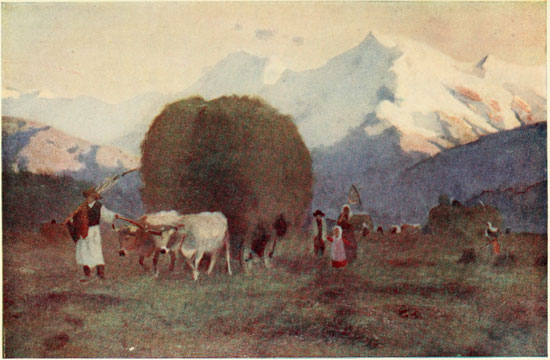
THE ORTLER FROM THE MALSER HEIDE
Now it happened that the pedlar was not only a fine
wrestler and a man of great physical strength and courage
(otherwise he would scarcely perhaps have chosen a
haunted ruin in which to pass the night), but was the
champion bowler of his native village. So he offered to
pit his skill against that of the spectral knights. His
challenge was accepted, and in the end he beat them all,
and to his astonishment, instead of disgust being shown
at his victory, his prowess was hailed with shouts of joy,
and one of the spirits speaking to him said that now they
were released from purgatory, and then they all vanished.
Much mystified, the pedlar turned to see where they had
disappeared to, when his eyes were greeted by the sight of
ten more men in armour, who entered the hall by separate
doors. After having carefully locked the latter they all
brought the keys to the pedlar, and entreated him to try
and discover the right one for each door. Nothing abashed
he undertook the task which was a difficult one owing to
the fact that each key, door, and ghostly visitant were
exactly alike. He managed, however, to accomplish his
task successfully, and was overwhelmed by the thanks of
the spirits, who told him, as had their bowl-playing
counterparts, that he had by this feat released them from
torment.
As was to be quite expected, it was now the devil's
turn to appear upon the scene, which he immediately did,
roundly upbraiding the pedlar for having thus robbed him
of some of his victims, and declaring that he (the devil)
would now inevitably manage to gain the pedlar's soul
instead. The latter was not to be so easily disposed of,
however, and he offered to stake his soul upon a game of
bowls to be played between himself and the Evil One.
Needless to say that the latter was beaten, and when dawn
came at length he fled away with a horrible rushing of his
bat-like wings, and his hot sulphurous breath tainting the
air, so that the grass was withered in places.
The pedlar was not likely to keep such an interesting
experience to himself, and so when in due course he came
to the village, towards which he was making his way when
overtaken by nightfall, he told the tale. The villagers
amazed went to the ruined castle, and lo and behold there
was the scorched grass as the pedlar had declared.
It would be easy to quote other equally quaint and
romantic stories which are told in connection with the
sports and pastimes of Tyrol, but that of the pedlar and
the ghostly knights or men-at-arms must suffice. It will,
at all events, serve to demonstrate how inextricably interwoven
are the threads of legendary lore and romance, even
with the commonplace daily life and amusements of this
interesting people.
INNSBRUCK, ITS HISTORY, PEOPLE AND
TREASURES
The approach to Innsbruck, whether one come to
it by railway or by road from the west, north,
east or south, is picturesque and even wonderfully
beautiful. Most English and American travellers,
however, we imagine, come to the old-time capital of
Tyrol via Zurich and the Arlberg railway, with its
marvellous tunnel all but six and a half miles in length,
above which tower snow-clad peaks and glaciers. This
route provides a wonder-world of delight, a succession of
deep gorges lying at the foot of towering mountains
covered on their summits with a mantle of spotless and
eternal snow. At one moment the train traverses a
steep gradient climbing slowly along the hillside as
though the line were laid upon a shelf of rock from
which nothing but a miracle can keep it from tumbling
into the foaming torrent below; the next plunging into
the darkness of one of the many tunnels, to emerge a
moment or two later into a blaze of light and vistas of
still greater beauty. The Arlberg railway is not alone
an engineering triumph; it is also an artistic one. Few
lines in Europe present greater charm or variety of
scenery in so comparatively short a distance. To enter
Tyrol by it is to see the country as it is, largely unaltered
from the days when Napoleon's armies entered it also
from the Swiss frontier with the same objective, Innsbruck.
Soon after leaving Feldkirch the valley commences
to contract as the line climbs upwards from Bludenz
and passes through the beautiful Kloster Thal; and at
Langen one suddenly comes into the region of Alpine
pastures, and from the valley below one can hear the
musical tinkle of cow-bells, and discover on the hill-slopes
picturesque groups of peasants minding their
flocks. Then comes the ascent through the famous
Arlberg tunnel, which is 26 feet in width and 23 feet in
height, with its six and a half miles of gloom succeeded
by magnificent scenery as St. Anton is passed, and the
line proceeds through the narrow Stanzer valley, between
towering mountains, many of whose peaks are snow-covered.
Soon it crosses the wonderful Trisanna Viaduct which,
in one arch of nearly 150 yards in length, spans the
gorge of the Patznaum valley, at the bottom of which,
nearly 200 feet below the line, rushes the glacial stream,
and thence past the ancient Castle of Wiesberg onwards
to Landeck, which is set in a wide valley with its commanding
castle.
From Landeck by taking a carriage one can reach
Innsbruck in a leisurely way along the Finstermunz
high-road via Sulden and Trafoi, and thence along the
Stilfserjoch, the highest carriage road in Europe, which
climbs to the height of 9055 feet above sea level.
This was constructed between the years 1820-25 by the
Austrian Government, and traverses a wonderful variety
of exquisite scenery, from the region of the eternal snow
on the Ortler and Monte Cristallo to the vine-clad
slopes of the Val Tellina. The most impressive scenery
is, however, found on the Tyrol side of the pass.
From Landeck the line passes many another
picturesque village; castles, whose history would fill
volumes, seem to stand stark and stern almost on every
mountain spur, some now mere ruins, others wonderful
survivals of a past age, sometimes environed by pine-clad
slopes, at others half-encircled by rushing torrents
washing the bases of the rocky promontories upon
which they stand, whilst above one towers on either
hand the illimitable glaciers and snow slopes of the
Eastern Alps. Thus through ever interesting and
beautiful scenery one at last approaches Innsbruck.
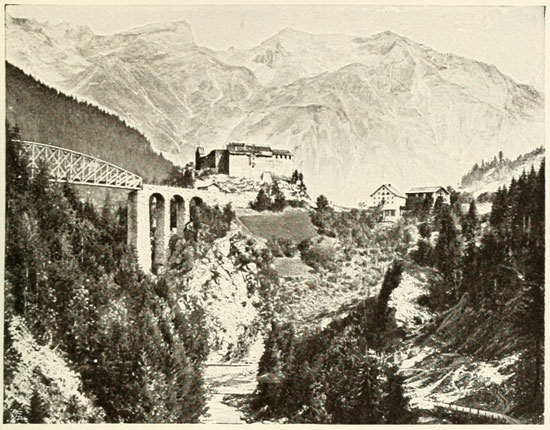
THE TRISANNA VIADUCT AND CASTLE WIESBERG
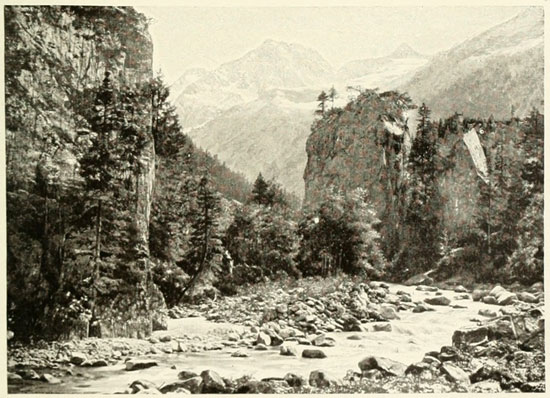
A PEEP OF THE ZILLERTHAL
INNSBRUCK
Innsbruck is not only the capital of Tyrol, a town
of upwards of 50,000 inhabitants, renowned historically
and climaterically, but it is also the junction of two
important lines of railway by means of which one can
get eastward to Vienna and the East, and southward
into Italy.
It has been said that of all Tyrolese towns Innsbruck
is the least national. Such a statement, although tinctured
with truth, needs some qualification. In the season it
certainly puts on a cosmopolitan air, and one meets
numbers of English, Austrians, Germans, French, Americans,
Italians, and Anglo-Indians in its streets; and
games and entertainments make up a social round of
considerable gaiety. But the town nevertheless retains
its native charm, bred of historic memories, ancient
buildings, and the hospitality of its people.
To the northward, sheltering it from the cold winds
from off the Bavarian plains, stands the bulwark of the
eternal heights which literally wall in Tyrol. There
rise the magnificent groups of limestone mountains
towering above the fertile Inn Valley, the Frauhitt and
Martinswand with their romantic traditions and memories,
the Seegrubenspitzen, and Rumerjoch and Brandjoch.
In fine weather they appear but a stone's throw from
the bottom of the Maria-Theresien-Strasse, or from the
Ferdinands Allée which runs along the south bank of
the Inn, with its maples and poplars graceful and shady.
Situated amid so much beauty of scenery, favoured
by an equable climate and much sunshine, it is little
wonder that the town has become a popular resort, more
especially during the winter months. The valley is
at its broadest where the city stands, allowing a wide
prospect and charming views from the slopes of St.
Nicolaus and Mariahilf across the river to the Berg Isel,
and the wooded sides of the Mittelgebirge, with here
and there a tiny village with outstanding spire perched
high on the mountain side, or set amid the plain. The
valley lies east and west of Innsbruck with the river
flowing eastward like a silver ribbon, amid cultivated
fields of fertile alluvial soil, threading its way through
the gradually narrowing valley to Kufstein and thence
through Bavaria to the Danube.
This Alpine city, pregnant with so many historical
memories, deeds of blood and chivalry, engirdled by the
everlasting hills, is, with the possible exception of Salzburg,
the most picturesque and interesting of all German Alpine
towns.
The character of Innsbruck of to-day differs very
materially in some respects from what it was two decades
ago. The modern element, which always comes to such
places with greater notoriety and prosperity brought
by travellers and tourists, has become developed, but
happily as yet not greatly to the detriment of the old-time
air which still permeates its narrow, ancient streets,
and by-ways, courts, and buildings. In some of the
former, the Maria-Theresien-Strasse at the south end
of which stands the Triumphal Arch and Gate, and
the Herzog-Friedrich-Strasse, for example, the old and
the new are strangely mingled. It is not a little owing
to this distinguishing feature as well as to its beautiful
environment that Innsbruck owes its charm. With
much of the convenience, it possesses less of the vexing
artificiality of ancient places vulgarized by the exigencies
of modern travel than do many similar towns. In some
parts one might almost imagine one's self in one of the
larger mountain villages, in another at Pontresina, or
St. Moritz, minus, however, some of the more artificial
gaiety of these resorts.
INNSBRUCK TYPES
During the season—more especially the summer—there
are numbers of German tourists as well as Austrian
to be seen in the streets, and in their almost boisterous
enjoyment of their sight-seeing and holiday amusements
they form a very marked contrast to the quieter and
perhaps somewhat restrained English and American
visitors, who as a general rule set about exploring the
place and its treasures with a much more preoccupied
and business-like air.
From the higher and more distant valleys, too, many
mountaineers and peasants come down to enjoy a few
hours' marketing or the pleasures of the town. They
form not the least interesting feature of the summer
crowd which throngs the new as well as the old streets
of Innsbruck. The women, many of them, wear
picturesque costumes, consisting of velvet bodices,
skirts of often beautiful shades of green and brown;
aprons elaborately worked, or of lace; and sailor-shaped
hats of black or green felt, often ornamented
by gold embroidery under the brims and with two long
ribbons (frequently also of velvet) hanging down or fluttering
in the wind at the back. These hats are singularly
like those of the Breton peasants, only they are worn
more by the women than the men, whilst in Brittany
women seldom wear them.
The fact that Innsbruck is a garrison town accounts
for the presence of a large number of soldiers about the
streets; green plays a prominent part in many of the
uniforms—more especially of Tyrolese regiments—whilst
the officers of several wear a particularly smart shade
of blue-grey, or "pastel" blue cloth with trimmings of
cerise, scarlet, or green, which seldom fail to arouse the
admiration of the ladies. The countryfolk, too, crowd
the streets on market days with feathers in their hats
which are often of beautifully "weathered" golden green
or bright green felt.
The history of Innsbruck from the tenth century
onwards is indeed largely that of Tyrol itself. The name
as a town appears first to have occurred in a document
of the year 1027 which was a grant to the chapel of St.
James' in the Field (St. Jacob in der Au), which most
probably occupied the site on which the stately church
of the same name erected in 1717 now stands. Long
before this date, however, a settlement of people—small
at first—had taken place at this crossing or ford of the
Inn, brought into existence by the growing and profitable
commerce between Germany and Italy by way of the
Brenner. Both the travelling merchants and the Tyrolese
themselves soon found the place a convenient depôt for
the heavier goods and articles of merchandise, such as
skins, wines, cloths, and metal ware; and as the years
went by it gradually grew to be more than a convenient
halting-place for the merchants and their pack trains on
their journeys. Houses fit to accommodate the well-to-do
were erected, and Innsbruck as a flourishing town came
into being. Towards the end of the twelfth century
certain rights over the town were acquired by a von
Andechs, Berthold II., from the monks of Wilten to whom
it belonged; and in consequence of these rights, Otto I.,
his successor, encircled it with walls, fortifications, and
watch-towers, and also built himself a palace.
The rise of Innsbruck was from the middle of the
thirteenth century a steady one. At that period it was
made the sole depôt for the storage of goods between
the Zillerthal and the Melach; and as the years went by
other privileges were granted to the steadily growing
town, which not only served to maintain but also to
increase its importance.
In 1279, Bruno, Bishop of Brixen, consecrated another
church in the Ottoburg, which was called the Moritzkapelle.
The town's lords, spiritual as well as temporal, appear
to have done what they could to foster and encourage
its growth, and there are records of festivities and princely
entertainments on a lavish scale within the precincts of
the Ottoburg in those far-off times. It was not, however,
until after the cession of Tyrol to Austria by the Duchess
Margaret, known as "Pocket-mouthed Meg," that the
admirable situation of Innsbruck was fully realized.
Ultimately, the convenience of its water communication
by the Inn and Danube with other distant and flourishing
towns of the Empire seems largely to have brought about
its adoption as the seat of government for Tyrol.
INNSBRUCK'S RULERS
Innsbruck throughout the centuries, so far as its rulers
are concerned, appears to have been "fortune's child."
Many privileges were granted to it from time to time, and
the staunch fidelity of the citizens to Duke Rudolph IV.
of Habsburg at the time of one of the periodic Bavarian
invasions resulted in further concessions being granted
which served to place Innsbruck in the unassailable
position of being both the capital and the most prosperous
town in the Tyrol.
Duke Frederick of the Empty Pocket (Mit der leeren
Tasche) made Innsbruck his home and base of operations
whilst endeavouring to put down the Rottenburgers and
other of the powerful nobles, who were attempting to
set him at defiance and continue the oppression of the
countryfolk which they had commenced and carried on
during the unstable and weak government of Frederick's
immediate predecessors.
The Innsbruckers gave him loyal and very material
support in his endeavours, and reaped a substantial reward
in the favours and privileges which Frederick afterwards
granted to them.
It was this prince who gained, by contact with his
people when a fugitive amongst the mountains and valleys
of Tyrol, a knowledge of them (and thereby earned
their affection) that made it possible for him ultimately
to call the peasantry to arms, and to defy the power of
the Emperor Sigismund, Ernest the Iron Duke of Styria,
and his other enemies.
The circumstances of Frederick's call of the people
to arms was romantic in the extreme. Indeed, his
doings in the early years of his outlawry by the Church
and State read like pages of the most stirring romance.
Perhaps some of the deeds recorded are more or less
legendary, but enough remains to fill to overflowing with
stirring incidents the pages of any historical romance.
Briefly the story of the event is as follows. Assured
during his many wanderings of the people's devotion to
him, for when pursued they had sheltered him, and when
discovered they had boldly refused to surrender his person
to his enemies, Frederick devised a plan by which he
should appear as the principal actor in an heroic peasant
comedy at the great fair at Landeck. This play set
forth in stirring scenes the fortunes or rather misfortunes
of an exiled prince driven from his throne by his enemies,
compelled to wander destitute, and with a price upon
his head amongst his people, whom he eventually calls
to arms and leads to victory and thus recovers his
inheritance.
He must have played his part remarkably well if one
may judge by the results. The people, who had come
to the fair from all parts of the country roundabout were
stirred to the very depths by his acting, and by his
pourtrayal of the imaginary prince's misfortunes. We
are told the audience were many of them moved to tears
and that when Frederick came to sing of the people
following their ruler's call to arms the enthusiasm became
uncontrollable.
Then, so the tale goes, Frederick threw off all disguise,
and made a direct appeal to them. The vast audience
vowed to support his cause, and the enthusiasm which
swayed the Landeckers was not long spreading through
the whole country with the result that shortly afterwards
the Emperor Sigismund and Frederick's brother concluded
a truce with him and he was allowed to become
ruler.
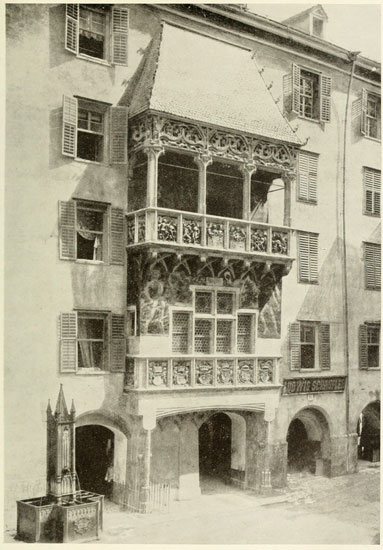
THE FAMOUS "GOLDEN ROOF," INNSBRUCK
During his reign he did much to show his gratitude
to his loyal friends and people by curbing the oppressive
power of the nobles, and granting many privileges which
were on the whole more for the benefit of the poor than
of the rich.
THE "GOLDEN ROOF"
But to many who come to Innsbruck we fancy
Frederick's fame rests not upon his wisdom as a ruler
so much as upon his extravagance in building the world-famous
"Goldne Dachl" to the elegant late-Gothic
balcony of his palace at the foot of the Herzog-Friedrich-strasse.
The nickname of "Empty Purse" or "Pocket"
had been bestowed upon him by his enemies, who sought
to belittle him when he attained to power. It was not
certainly his by common consent. The Tyrolese account
rather points to the fact that Frederick at one time had
impoverished himself in his endeavours to relieve his
subjects from the burdens of taxation, and in consequence
the nobles who were no believers in his system of government
in this respect bestowed upon him this somewhat
approbrious sobriquet. Frederick saw in this a reproach
not perhaps so much directed against himself as against
his people in general. It seemed to him to indicate
that his enemies thought those for whom he had undoubtedly
done much kept him poor and would do
nothing to keep up a state in character with his position
as ruler. He therefore built the famous roof.[10] Outside
the house which was then the Furstenburg or princely
dwelling, now very ordinary looking and far less imposing
and ornate in character than say the Heblinghaus hard
by, he in 1425 erected over the two-storied balcony the
"Goldne Dachl," on which piece of mediæval display of
wealth he is stated to have expended 30,000 ducats or
about £14,000. In it there are 3450 gilt upon copper
tiles, which have several times since Frederick's day been
regilded. The last occasion on which this was done is
upwards of twenty years ago.
It is necessary, however, for us to say that considerable
doubt exists whether Frederick—who is now supposed
not even to have built the house—did construct the roof
which has done so much to immortalize his nickname.
Loth though one is to destroy a romantic story, truth
compels us to state that the most reliable evidence points
to the Emperor Maximilian as the originator of the
roof and probably the balcony also in 1500, after his
second marriage with Maria Bianca Sforza of Milan.
The house has long ago descended from its high
position as a royal palace, even at times of recent years
having been let to private families or in apartments, but the
famous "Goldne Dachl" over the beautiful oriel window,
with its Gothic balconies, the balustrades of which are
decorated with carved armorial bearings and shields in
marble, has been preserved as a beloved relic almost
in its original state. Within the house itself is a curious
old fresco, the subject of which has been the cause of
much dispute. On the second floor is an interesting
sculptured bas-relief, depicting Maximilian and his two
wives, Mary of Burgundy and Maria Bianca Sforza, with
the seven coats-of-arms belonging to the seven provinces
over which the Emperor held sway.
Frederick's son Sigismund succeeded him, and for a
time kept a brilliant and gay Court at Innsbruck, but
being without direct heirs he in 1490 gave up Tyrol to
his cousin who, three years later, became the Emperor
Maximilian I. Maximilian in turn did much for the
town which he adopted as his Tyrol home, and by his
residence in Innsbruck, after he had become the Emperor
of a wide dominion, he did much to increase its importance
and prosperity. He it was who built a new palace
in the Rennplatz, called the Burg, which scarcely forty
years later was burned down. The Great Hall, called
the Goldene Saal, and the state bedroom, the decorations
and furniture of which were so beautiful and magnificent
that it was known as das Paradies, were eventually totally
destroyed, many of the occupants of the palace, including
the children of the Emperor Ferdinand of that time,
escaping with their lives with difficulty.
Maximilian, who became familiar to his Innsbruckers
as the "Kaiser Max," especially endeared himself to them
by reason of his frank manners and love of the chase
and mountaineering.
ANCIENT INNS
Amongst the many interesting mediæval buildings
which have happily survived in Innsbruck there are
several in the immediate neighbourhood of the famous
"Goldne Dachl." One of the oldest, if not the oldest,
is the Ottoburg of Otto I. standing at the end of the
Herzog-Friedrich-strasse close to the River Inn; and,
indeed, only separated from it by the Herzog-Otto-strasse.
This, the residence of the Andechs, was built in
1234, and was the reputed birthplace of Otto III. A
quaint motto concerning it remains, which, roughly
translated, runs—
"Here the Ottoburg firmly stands,
A house upheld by God's own hands."
In this ancient building many dramatic scenes of Tyrolese
history took place.
Close by is the oldest Inn, the famous and deeply
interesting Goldener Adler (Golden Eagle) to which, in
former times, before modern hotels and conveniences
were esteemed indispensable, every visitor of distinction
to Innsbruck came. The "visitors' list" of the Goldener
Adler is one long entry of nobles and celebrities.
Indeed, during the time it was the acknowledged
resort of the nobility and even monarchs who came to
Innsbruck, it sheltered amongst its many distinguished
guests and travellers the Emperor Joseph II.; Ludwig I.,
King of Bavaria; Gustave III. of Sweden; Heinrich
Heine, the gifted though melancholy poet; and Goethe,
who came to Innsbruck with the Dowager Duchess
Amalie of Saxe-Weimar in 1790. In commemoration of
this visit a bust of the poet adorns the room which he
occupied. And last, but by no means least, the Goldener
Adler housed the patriot Andreas Hofer. It was
regarding the portraits of the latter, of his enemy
Napoleon Bonaparte, and of Ludwig of Bavaria that
Heine remarked on seeing them hanging side by side in
the dining-room of the Inn that it was strange to see such
enemies grouped together even though merely portraits.
Tradition has it that it was from the middle window of
the famous Goldener Adler that Hofer made his speech to
the surging crowd in the narrow street below on August 15,
1809, when he entered the town in triumph after the third
battle on Berg Isel. A copy of the speech, which was
a modest though stirring oration, has been preserved at
the Inn.
One of the most delightful vistas of the old town is to
be obtained from the corner where stand the three well-known
Inns, the Goldener Hirsch, Rother Adler, and
Goldener Löwe; whilst from the balcony of the old
Stadtthurm or belfry a fine view over the town and of
the environing mountain summits rewards the adventurous
climber.
The old-fashioned "lauben" or arcades of the Herzog-Friedrich-strasse
in particular, under which are set out
tiny stalls often kept by picturesquely attired girls and
women, seldom fail to attract the attention of visitors.
On either side of the street these "lauben" stretch
under the low arcaded roofs, providing not only a cool
promenade in the heat of summer, but a shelter which
on wet days can be fully appreciated, for, to speak frankly,
Innsbruck in wet weather strikes one if one wanders in
the byways as a somewhat muddy though intensely
interesting town. In these "lauben" one frequently sees
types of the older Tyrolese in the national costume, which
in the towns of Tyrol (as in those of other countries) show
signs of dying out. Old women in the short skirts, and
picturesque aprons, quaint hats and bodices, of the mountain
districts and villages, and the old men, wrapped (if
the weather be cold) in long, flowing, cloaks of green or
russet cloth, smoking their long pipes with painted
porcelain bowls, on which are often as not stirring scenes
in miniature from the life of Hofer.
MARKET TYPES
By way of these covered promenades one gradually
reaches the busier centre of the town where the old-world
aspect of Herzog-Friedrich-strasse gives place to the more
modern Maria Theresien-strasse, and the Burggraben
joins the Marktgraben. There are few more deeply
interesting and picturesque places of its kind than
Innsbruck Marktgraben on a festival or market day.
Here, indeed, is a spot not alone for the artist and
amateur photographer, but for the student also, who
may see many quaint local customs and costumes, and
occasionally even the boyishly attired girl cowherds of
the upper pastures in their cloth or velvet knee breeches,
short jackets, "sailor"-shaped hats decorated with feathers,
edelweiss or gentians, and worsted stockings. Here, too,
perhaps, one can better realize from the cosmopolitan
throng of market people, than from anything else, the
fact that for many generations Innsbruck has been the
business highway for Italians, Slavonians, Hungarians,
Austrians, and Germans. One can often, indeed, see
representatives of Northern, Southern, and Eastern
nations gathered together at one and the same time in
the Marktgraben, with a sprinkling of tourists to represent
the more Western peoples.
If we were asked to pick out the two streets which
in different ways would probably most deeply impress
the newcomer to Innsbruck, we should without hesitation
chose the old-world Herzog-Friedrich-strasse, on either
side of whose narrow roadway are so many interesting
ancient houses, low-ceiled rooms, and picturesque courtyards,
as one; and the Maria Theresien-strasse with its
more modern air, exquisite view of the snow-capped
Bavarian Alps as the other. But this latter fine commercial
street with its up-to-date shops, upon the windows
of many of which frequently appears that comfort-bringing
(but alas! sometimes delusive) legend, "English
Spoken," is not without its old and historical buildings.
In the Spitalkirche or Church of the Holy Ghost one
has an early eighteenth century Rococo building of considerable
interest. And almost opposite stands the house
in which Hermann von Gilm, the well-known Tyrolese
poet, died in 1864. A little further along is the Rathaus
or Town Hall of Innsbruck, which was formerly the
Oesterreichischer Hof, a large hotel. In the courtyard is
a noticeably fine marble staircase, and there are some
interesting and effective frescoes on the walls from the
brush of Ferdinand Wagner.
Few visitors but are attracted by the column of red
native marble which occupies a prominent position in
the middle of and almost exactly midway down Maria
Theresien-strasse. Surmounted by a statuette of the
Virgin Mary, and with those of St. Anna, St. George,
St. Vigilius, and St. Cassian grouped round the base, it
was erected as a memorial of the retreat of the
Bavarian troops on St. Anna's Day (July 26), 1703.
At the corner of Maria Theresien-strasse and
Landhaus-strasse is the Landhaus of Anton Gump
completed in 1728, and in the Rococo style of architecture
then prevalent. Here are held the sittings of the
Tyrolean Landtag which was formerly held at Meran,
and on its transference to Innsbruck was one of the main
causes of the town becoming the capital of Tyrol.
Close by is the church of the Sevites, with its famous
dome decorated by the paintings of the well-known
Tyrolean artist, Joseph Schöpf, depicting the death of
St. Joseph and his entry into paradise.
The University, which stands in the street of that
name, has undergone some considerable vicissitudes.
Founded by the Emperor Leopold I. in 1677, it was,
by the Emperor Joseph II., reduced to the standing of
a Lycée, but was once more accorded the dignity of a
University in 1826. In the valuable library of upwards
of 75,000 volumes there are many illuminated MSS.
of great beauty and value, as well as a number of
early fifteenth-century books. The adjoining Botanical
Garden, which contains an unrivalled collection of
Alpine flora, and was constructed by Professor von
Kerner, belongs to the University, and here during
the summer months those who wish to study Alpine
flowers will find grouped and gathered together specimens
which it would take many months and perhaps even years
to study and discover on one's own initiative in their
native habitats. The University is, however, about
to be transferred to a more convenient home on the
Fürstenweg near the Inn, and the old building will, alas!
probably be pulled down and the site used for modern
houses.
MAXIMILIAN'S CELL
Quite close to the latter stands the Jesuit Church
attached to it, which is chiefly interesting because of
its being the burial place of the Tyrolese Prince Regents,
and on account of the paintings by Albrecht Durer
which adorn the sacristy. The Capuchin Church and
Convent dating from the latter end of the sixteenth
century are worth a visit, for in the latter one sees an
interesting and historical survival in the retreat of the
Archduke Maximilian, known as the "Deutsch-Meister,"
who here devoted a week in every year to prayer, fasting,
and penance.
In his simple cell, which is panelled in plain wood,
and has for furniture but a bedstead and chair of the most
ordinary make, one can realize exactly the kind of
"retreat" which was so often in those far-off days used
by the highest nobles and rulers to free them for a time
from the cares and vanities of State. The inkstand and
other small articles of necessity, which still remain
memorials of Maximilian's occupation, are supposed to
have been his own handiwork. How complete this ruler's
retirement from the world and whilst he was in retreat can
be judged by the fact that he not only followed with
exactitude the rules of the brotherhood, rising early and
also attending the night offices, but in addition he engaged
in the manual labour of the garden, and field, and workshop
like as one of them. The cell has a little window
high up and opening on the chancel of the chapel to
enable the noble recluse to take part in the services.
This cell has been in a sense a pilgrim place ever
since, and has been visited at various times by many
distinguished people. In 1765 the Empress Maria
Theresa came to the Convent, and upon entering
Maximilian's retreat sat herself in the wooden chair.
She was little used to so hard a resting-place, and
after a minute or two she expressed her astonishment,
exclaiming, "Heavens! What men of iron our forefathers
were!"
There are (so far as we know) no relics of the Empress
Maria Theresa's visit, not even an autograph; but another
illustrious visitor, St. Lorenzo of Brindisi, who came to
Innsbruck on his way to found a religious house in
Austria, somewhat strangely one is forced to think, left
behind him his staff, breviary, and copy of the Hebrew
Bible, which are treasured as carefully as the relics
of the Archduke Maximilian himself. During the reign
of the latter the religious houses and Churches of
Innsbruck all benefited by his generosity and prospered
from his devotion to the Church. The effect of his
example upon the townsfolk themselves was so marked
that after the terrible plague of the year 1611 the
burghers founded and built the Dreiheiligen Kirche (Holy
Trinity) for the Jesuits as a thank-offering that the
ravages of the plague were stayed. It was probably
owing to the fact that, during this particular outbreak
of the scourge of the Middle Ages, when the old hospital
or Siechenhaus was all too small to hold all the victims,
two Jesuits, Kaspar von Kostlan of Brixen, and the
Professor of Theology at the University, assisted by a lay
brother, tended the sick with indefatigable self-sacrifice,
that the Jesuits were destined to chiefly benefit by the
Innsbruckers' desire to commemorate their gratitude to
God, that the pestilence at last had been overcome. They
readily subscribed the necessary funds (we are told), and
the then Burgomaster took a vow to see that the building
was erected. From the time of which vow, tradition tells
us, "the pestilence at once began to abate."
An altar-piece, the artist of which was Stötzl, was
given by Maximilian himself. It represented the three
patron saints against sickness: St. Sebastian, who stayed
a plague in Rome by his intercession; St. Martha, who
according to tradition founded a hospital and spent the
rest of her life attending to the sick; and St. Rocchus,
who devoted his life and strength to the care of those
suffering from the pestilence.
THE NEWER TOWN
Some of the most beautiful roads and modern houses
of the newer Innsbruck, which is increasing in area year
by year, lie close at hand to this votive church, and
to the northward, in the part of the town which is best
reached by the Universitats-strasse and Saggengasse,
alongside of which is the vast Exercier Platz, and at
the back of that and nearer the river the beautiful
Hofgarten. These never fail to charm the rambler on
the outskirts of the town.
MUSEUM TREASURES
But there yet remain many other interesting objects,
which the lover of Innsbruck and the visitor who stays for
any considerable period of time are sure to gradually
discover and enjoy. One of these is the National
Museum, known as the Ferdinandeum, in which are
gathered together objects, pictures, and relics forming,
so it is claimed for them, an almost complete historical
record of Tyrol, its people and its products.
The Museum, which is the resort of students from
all parts of Europe, and is for even the casual visitor an
object of the greatest interest, bears the name of its
founder and patron Ferdinand I. Originally intended
to illustrate in a vivid and practical way the history and
national customs of the country in the various domains
of art, science, and industry, the collections have gradually
been enlarged and expanded so as to contain examples
of art by members of well known foreign schools. The
present museum is a comparatively modern building,
with a façade in the Italian Renaissance style. The
ground floor was commenced in 1842, and the upper story
added in 1886.
On the ground floor are some most interesting
archæological remains, including several ancient Roman
milestones from the Brenner road and elsewhere; burial
urns from Matrei; bronze statuettes of Roman days
from Brixen and Innicherberg; many ornaments of the
Roman period from Meran, Moritzing, Zedlach and
other places. From Salurn, in the valley of the Eisack,
there are some Roman tombs, with the ornaments of
the dead, and household and toilet utensils and articles
of great value and interest. One of the most important
objects in the archæological section of the Museum is
the sarcophagus, arms and ornaments of a Lombardian
prince disinterred at Civezzano, near Trent. The coffin
was richly ornamented by gold bands, and in it was found
a gold cross.
Zoology, Geognosy, Palæology, and Mineralogy are
represented with remarkable fulness, and in the last-named
section of the Museum is to be found almost every
Tyrolese mineral discovered up to the present time.
Some of the specimens are of great beauty and value.
In the Armoury, which so far as the general visitor is
concerned, appears to be one of the most popular sections,
there are many fine examples of the weapons of bygone
days, including poignards, inlaid pistols, guns, powder-horns
and flasks, helmets, breastplates, etc.
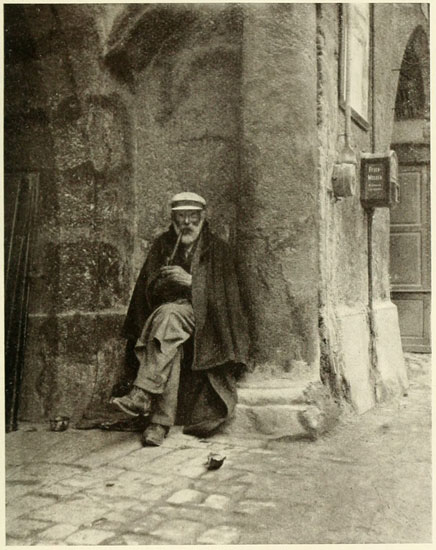
A TYPICAL INNSBRUCKER
In the Topographical section few fail to notice with
interest the many early maps of Tyrol, bearing on their
faces the history of the country as is shown by the partitions
of it which from time to time took place; and the
homemade globes of the self-educated shepherd boy, Peter
Anich, who became a famous geographer. In the same
room are some fine specimens of peasant costumes,
musical instruments (including some Strads, Amatis, and
Stainers of great value), the jewel case of the famous
Philippine Welser (wife of Ferdinand II.) who lived with
her royal and devoted husband at Castle Ambras for
many years.
There are also in the Museum some deeply interesting
relics, portraits, busts, autographs, etc., of Tyrolese patriots
and distinguished citizens of Innsbruck. Those relating
to Andreas Hofer, and his two loyal comrades, Joachim
Haspinger and Joseph Speckbacher, include many of their
personal belongings, and are regarded by the Tyrolese
visitors with almost religious veneration—a feeling which
the life—history of these men quite justifies.
Amongst the sculpture are some fine specimens of old
carved woodwork and interesting German carvings of an
early period brought from Tyrolean churches, which were
either despoiled during the Napoleonic Wars, or have since
for one reason or another been pulled down and their
treasures and fittings dispersed.
On the second floor of this convenient and commodious
building is chiefly gathered together the Art
collection, which so far as native work is concerned is, we
believe, unrivalled. There is presented for the information of
the student as well as the ordinary visitor an astonishingly
complete survey of Tyrolese painting from the earliest
times, including the work of the schools of Brixen-Neustift,
and the Pusterthal, with representative work by
such masters as Andrä Haller and Michael Pacher; and
also examples of the old Flemish and German masters,
including Lucas Cranach, St. Jerome, Altdorfer, Pateiner,
etc., Innsbruck painters being represented by Sebastian
Schel.
Well worth the attention of all interested in painting
and its development as an Art are the works of the
Tyrolese masters covering the period from the seventeenth
century to the present day, which are well represented by
pictures of the Unterberger family, Joseph Schöph, John
Baptist Lampi, Angelica Kaufmann, Gebhard Flatz (Fra
Angelico), Joseph A. Koch, Mathias Schmidt, E. von
Wörndle, Karl Blaas and others. Amongst the more
notable pictures of the modern school are the "Chancellor
Wilhelm Biener at the Innsbruck Landtag," of Karl
Anrathers, and the historical masterpieces of Franz
Defregger.
It is impossible for one to study the latter nine in
number, which depict patriotic events connected with the
campaign of 1809, without appreciating the vigour of
their execution and the charm of their colour, at the same
time realizing something of the stirring nature and
significance of the events to which they refer. Three are
originals, and the remaining six are copies made by
pupils of Defregger under his own personal supervision,
and supposed to have in some cases been finished or
touched up by him. The following are the subjects of the
originals:—
(1) The Three Patriots—Andreas Hofer, Joseph
Speckbacher, and Joachim Haspinger; (2) Speckbacher
and his son Anderl at the Bear Inn, St. Johann; (3) The
Innkeeper's Son. The last named is the son of the
Tharer Wirth at Olang in the Pusterthal. The copies
are of the following subjects: (1) Speckbacher's Call to
Arms; (2) The Last Summons, the original of which is in
the Imperial Art-History Museum in Vienna; (3) The
Mountain Forge, the original of which is in the Dresden
Gallery; (4) The Return of the Victors, the original of
which is in Berlin; and (5) Andreas Hofer in the Castle
at Innsbruck, the original of which belongs to the
Emperor Francis Joseph; (6) Andreas Hofer being led
to Execution, the original of which is in Konigsberg.
These are all distinguished by beauty of colouring,
strength of drawing, and dramatic appeal.
There are many other treasures in this Museum, which
is national in the true sense of the word. And amongst
them is the fine and almost priceless collection of pictures
by Dutch masters which has been principally acquired
through bequests of wealthy Tyrolese. In it are examples
of the work of Van Dyck, P. Paul Reubens, Paul Potter,
R. Ruysch, Adrian von Ostade, A. Cuyp, Rembrandt and
others. There is also a most comprehensive and valuable
Library of works relating to Tyrol, and also the archives
of both the Austrian and German Alpine Clubs.
Each year sees important additions made to the
various departments of the Ferdinandeum, and so the
returning visitors to Innsbruck find an ever new interest
in the country and its National Museum awaiting them.
THE HOFBURG
The remaining objects of supreme interest at Innsbruck
are the Hofburg or Palace; and the Hofkirche or
Church of the Franciscans. They are easily reached
from the Ferdinandeum along Museum-strasse and the
Burggraben, which may be said to form the boundary
line dividing the old town from the new. The archway,
through which one reaches both the Palace and the
Church, formed, in mediæval times, one of the city gates;
and in those far-off times was crowned by a watch-tower
upon which the many escutcheons of the Habsburgs were
emblazoned. It was taken down in the time of Maria
Theresa, as its condition had become too dangerous to
permit it to remain standing.
The Hofburg stands at a right angle with the Hofkirche
to the north-west. Of the original building erected by the
Emperor Maximilian not very much now remains; for
after being seriously damaged it was ultimately reconstructed
by Maria Theresa. On the exterior are traces of
the original baroque style favoured at the time it was
built; still also to be found in several of the larger, older,
and more important houses in the town. The state apartments
are chiefly distinguished for the decorative paintings
of the well-known artist A. F. Maulbertsch, principally in
the large salon known as the Riesensaal. It was in the
chapel, which connects the Palace with the Damenstift or
Ladies' Home, that the Emperor Francis I. of Germany,
husband of Maria Theresa, died so tragically on August
18, 1765, while the wedding festivities in connection
with the marriage of Prince Leopold (afterwards the
Emperor Leopold II.) with the Infanta Maria Ludovica
were in progress.
It is not the Hofburg, however, but the famous
Hofkirche—which has by several writers and antiquarians
been called "The Tyrolean Westminster Abbey,"—that
attracts most visitors, and has the greatest charm for all
who are either interested in Tyrolese history or antiquities.
This church was built during the decade from 1553-63 by
the Emperor Ferdinand I., then King of Rome, as a
memorial to his grandfather the Emperor Maximilian I.,
who was buried underneath the high altar in the Castle
Chapel of Wiener-Neustadt. Tradition states that the
building had been contemplated by Maximilian, and was
ultimately brought into being in accordance with his will.
The architect of the church, which is in the Italian
Renaissance style, was Thuring of Innsbruck,[11] and the
ground plan follows the lines of a columnar basilica.
Lübke, however, states that it was the tomb and not the
building which Maximilian himself planned in collaboration
with Gilg Sesselschreiber, a Munich artist, who
occupied the position of painter to the Court.
The first impression made upon the mind by the
famous Hofkirche is one of lightness and elegance,
wedded to a somewhat flamboyant decorative scheme,
rather than impressiveness or age. The lofty and slender-looking
columns which support the roof on either side of
the nave are of red marble, and the ceiling itself is
elaborately decorated in rococo. The vista on entering is
extremely fine, including as it does the wonderful tomb of
Maximilian, the organ loft, and the huge crucifix in the
centre, and the handsome pulpit on the left of the tomb.
The impression of magnificence and beauty grows upon
one, thus carrying out what was doubtless the design of
the architect and the Emperor who was instrumental in
its erection.
MAXIMILIAN'S TOMB
The tomb in the centre, with its imposing bronze figure
of Maximilian kneeling with clasped hands on the top
of the huge marble sarcophagus, at the four corners of
which are smaller figures, at once arrests attention. The
Emperor is in Imperial dress, with crown, armour, and a
robe, and is surrounded by the twenty-eight huge figures
which have become world-famous, and all save two of
which were once torch-bearers, and are now seen with their
right hands extended as though holding torches. The
two exceptions are King Arthur of England, and the
Emperor Theodoric the Goth. All of the statues surrounding
the tomb are thought to have had some real
or legendary connection with the House of Habsburg,
and it is believed that Maximilian himself chose the
characters who were to be represented. They may be
grouped into two series. One consisting of his five
favourite heroes of antiquity; the other of twenty-three
ancestors, contemporary relatives or members of his house,
both men and women.
The figures differ very greatly both in style and merit.
It was perhaps only natural that this result should have
been arrived at when one remembers that several generations
were occupied upon the construction of this marvellous
example of German Renaissance monumental work
erected during the sixteenth century, and that it was
necessarily the work of several designers as well as many
different hands. The tomb is a wonderful, perhaps even
unequalled, example of the German art of a period which
marked the blending of the mediæval and the modern.
To the Imperial designer of the tomb the chivalric figures
he chose to surround it were no mere abstractions but
living, breathing entities; just as the old feudal Empires
of south-eastern Europe were real. He was unable to
realize that even then the old order was about to pass
away, to be replaced by a new which was so divergent
from that he had known, and of which he himself had
been so prominent a figure.
The bronze figures, which twenty years or so ago
attracted the notice of but few foreign visitors, but are
now objects of keenest interest to all comers to the
capital of Tyrol, are by several hands. The two of
surpassing beauty of design and execution are those of
King Arthur of England, and King Theodoric. They
are nowadays pretty generally supposed to have been
the work of Peter Vischer of Nüremberg.
These two statues have a particularly interesting
history which has been brought to light of recent years.
Though cast at Nüremberg in 1513, and costing no less
than one thousand florins, it was not until nearly twenty
years had elapsed that they reached Innsbruck. In the
meantime, owing to Maximilian's need of ready money,
they had been in the possession of Bishop Christopher
of Augsburg, to whom they had been pawned by the
Emperor. The Bishop placed them in the chapel at
St. Lorenz, where they remained until the year 1532.
Ferdinand I. then sent to redeem them, and they were
delivered up on payment to the steward of the then
Bishop of the amount which originally had been advanced
upon them.
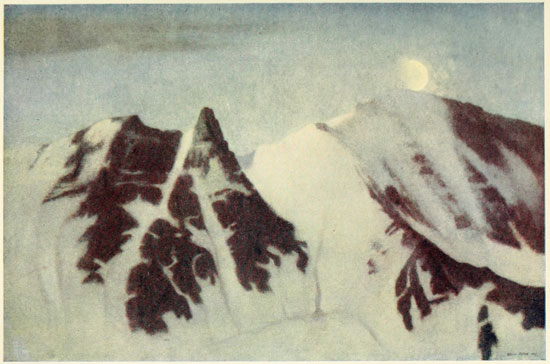
MOONRISE IN TYROL
KING ARTHUR AND THEODORIC
The statue of King Arthur is especially impressive
and fine. Standing erect, the tall, chivalrous-looking figure
has an alertness of pose which is astonishingly lifelike
and commanding. It is impossible not to recognize the
representation of a true ideal of knighthood "sans peur
et sans raproche," and that without any suggestion of
aggressive valour. The helmet worn is of the close-fitting
type with the visor, which is enriched with ornamentation,
raised so that the face of a somewhat Teutonic mould
is plainly seen. The breastplate, worn over a coat of
mail, is magnificently worked; but the rest of the suit
is plain. Arthur supports by his right hand a shield
bearing the arms of England, and at his left side is a
long sword.
The statue of King Theodoric, although fine in
execution, does not possess the same impressiveness and
commanding merit as that of King Arthur to which we
have just referred. It appears probable that the same
model may have been used for both. But, whereas King
Arthur is a commanding figure, the pose of King
Theodoric is rather a dejected and wearied one. His
breastplate is not nearly so richly ornamented, and his
helm is also plainer, with the visor of a quite different shape.
As is the case with King Arthur, the breastplate is worn
over a coat of chain mail, and the greaves worn are plain.
The remaining twenty-six figures according to some
authorities were designed by Gilg Sesselschreiber;
although opinion is still somewhat divided regarding
this point. It may, however, we think be accepted that
Sesselschreiber was, at least in part, responsible for the
greater number.
The relationship which existed between the Emperor
Maximilian and the Munich artist Sesselschreiber, who
had been engaged as Court painter in 1502, was not
untinctured by an element of romance, which is doubly
interesting as showing the relative positions of artist and
patron in those stirring and disturbed times.
Happily for lovers of art and antiquities the original
designs for the statues surrounding the tomb of Maximilian
which Sesselschreiber made have been preserved, and
can be seen in the Imperial Library, Vienna. Exquisite
pen-and-ink drawings delicately tinted, upon some of
which the Emperor himself made corrections and suggestions
in his own hand. These are distinctly traceable
on some from the unskilled nature of the pen-and-ink
alterations.
THE FAMOUS STATUES
A curious fact is also brought to light by these
sketches. It would seem from them beyond question
that Maximilian fully intended being modelled for the
figure of himself, which was to grace the memorial, in
the suit of exquisite silver armour which he had worn
on the occasion of his marriage at Ghent with Mary of
Burgundy.[12] Several sketches were made, one, apparently
from the notes and alterations upon it, displeased the
Emperor from a technical point; in another the face
was not as he wished with the result that Sesselschreiber
altogether made four or more drawings.
The care which had been taken over this most
important figure was, however, never destined to be
utilized to the full, for the statue was not even modelled
at the time of Maximilian's death in 1519, and the
figure clad in coronation robes (instead, as was evidently
intended, entirely in armour) which kneels on the top
of the cenotaph was the work of Abraham Colin, who had
never seen the Emperor in life, the cast not having been
made until more than sixty years after Maximilian's death.
How slowly the great work of this magnificent tomb
proceeded can be gathered from the dates we have quoted.
The delay arose from several causes; amongst others, from
the Emperor's shortness of money, owing to the vast
schemes of conquest, science, and other matters in which
he was engaged; and from the circumstance that Gilg
Sesselschreiber appears to have become lazy, intemperate,
and dissolute. In the end he took flight to Augsburg in
fear of Maximilian's anger. The Emperor, however, was
not prepared to yield up possession of his Court painter
without a struggle, so the latter was captured and thrown
into prison, from which he appears to have been released
in 1516 on promise of reform. So that he might be freed
from the temptations which Innsbruck afforded in the way
of wine, women, and boon companions he was compelled
by the Emperor to take up his residence at Natters on the
western side of the Sill Gorge above Innsbruck.
The casting of the statues was largely done by the
famous Gregor Löffler, who established a bronze foundry
near Innsbruck, and also built the Castle of Büchsenhausen,
although some of the statues were undoubtedly cast by
Stephen and Melchior Godl and Hans Lendenstreich
who worked at the Mühlau foundry on the outskirts of
Innsbruck. Although the designing and casting of the
statues is now generally accepted as being the work of the
men we have named, it is more than possible that the idea
of the whole complete piece of mediæval and historical
symbolism was that of some comparatively unknown
brother of the Franciscan order. Originally the scheme
was designed to include, in addition to the figures we have
mentioned, twenty-three others of saints which were to be
placed on raised pedestals or in niches, and were for this
reason of much smaller size. They are now to be seen in
the Silver Chapel. The following is a list of the large
statues grouped around the tomb.
(1) Clovis, the first Christian King of France.
(2) Philip the Handsome, of the Netherlands, Maximilian's son.
(1495.)
(3) The Emperor, Rudolf of Habsburg.
(4) Albert II. the Wise, Maximilian's great-grandfather.
(5) Theodoric, King of the Ostrogoths. (455-526.)
(6) Ernest der Eiserne, Duke of Austria and Styria. (1377-1424.)
(7) Theodebert, Duke of Burgundy. (640.)
(8) King Arthur of England.
(9) Sigismund der Munzreiche, Count of Tyrol. (1427-96.)
(10) Maria Bianca Sforza, Maximilian's second wife. Died 1510.
(11) The Archduchess Margaret, Maximilian's daughter.
(12) Cymburgis of Massovica, wife of Ernest der Eiserne. Died
1433.
(13) Charles the Bold, Duke of Burgundy, father of Mary of
Burgundy, Maximilian's first wife.
(14) Philip the Good, father of Charles the Bold. Founder of the
Order of the Golden Fleece. (1419.) Married Margaret of York,
sister of Edward IV., in 1468. (1467-77.)
(15) Albert II., Duke of Austria, and Emperor of Germany.
(1397-1439.)
(16) Emperor Frederick III., Maximilian's father. (1457-93.)
(17) Leopold III., Margrave of Austria; since 1506 the patron
saint of Austria. (1096-1136.)
(18) Rudolf, Count of Habsburg. (1273.)
(19) Leopold III. the Pious, Duke of Austria, Maximilian's great-grandfather;
slain at Sempach. July 9, 1386.
(20) Frederick IV. of Austria, Count of Tyrol, surnamed "mit der
leeren Tasche."
(21) Albert I., Duke and Emperor of Austria. Born 1248,
assassinated by his nephew John of Swabia, 1308.
(22) Godfrey de Bouillon, King of Jerusalem in 1099, wearing a
crown of thorns.
(23) Elizabeth of Hungary, wife of the Emperor Albert II.
Born 1396.
(24) Mary of Burgundy, Maximilian's first wife. (1457-82.)
(25) Eleonora of Portugal, wife of the Emperor Frederick III.,
Maximilian's mother.
(26) Cunigunda, Maximilian's sister, wife of Duke Albert IV. of
Bavaria.
(27) Ferdinand II., of Aragon, surnamed "the Catholic." (1479.)
(27) Johanna, daughter of Ferdinand and Isabella, and wife of
Maximilian's son, Philip I., of Spain.
HISTORY IN MARBLE
The cenotaph itself, placed upon three steps of red
marble, is about fourteen feet long and six feet high, and
is constructed of different coloured marbles. The figure of
the Emperor on top with its face directed towards the
altar, is a fine bronze casting by a Sicilian named Luigi
del Duca made in 1584.[13] Slender columns divide the ends
and sides of the cenotaph into twenty-four panels or compartments
of white marble in which are scenes in relief
(depicting the chief events and achievements of Maximilian's
life). These are really marvellous works of art, not
alone for their execution but from the care with which
accuracy has been attained in the costumes, the architectural
and other details introduced, and from the extraordinary
finish which marks the whole of the work. Many
of the faces are undoubted portraits of the greatest
historical and antiquarian value, those of the Emperor
at various periods of his life being remarkable for their
differing likeness. The variations of the national types
depicted are rendered with the most painstaking care.
The first four of the panels are filled by the work of
Albert and Bernard Abel of Cologne, who began their
task in 1561, after a visit to Genoa to choose the marble.
They, however, both died two years later, leaving their
work to be taken up by Alexander Colin, of Malines,
in Flanders, who lived at Innsbruck for forty years, and
died in 1612. Aided by a large number of other artists he
completed the work of the Abels in a period of about three
and a half years. Even the least learned of visitors will
recognize the beauty of craftsmanship which so great a
master as Thorwaldsen pronounced "the most admirable
and perfect of its kind."
The delicacy of execution is, indeed, rather that of
ivory than of marble, and it is not without good cause that
these exquisite reliefs are nowadays protected by glass
and surrounded by a railing in iron work of very beautiful
design.
SOME HISTORIC EVENTS
The subjects, a brief description of which may be of
interest, are as follows:—(1) The marriage of Maximilian
(then aged eighteen) with Mary of Burgundy at Ghent,
August 19, 1477. She was killed whilst hunting by the
stumbling of her horse, and was buried at Bruges, 1482.
(2) Maximilian's victory over the French at Guinegate, in
1479. (3) The taking of Arras, 1482; the fighting men
and the fortifications in this are worthy of special note, not
alone for historical accuracy of detail but also for the
marvellously fine execution; one woman in particular
should be noticed, who is bringing provisions to the camp.
This figure is a masterpiece in itself. (4) Maximilian is
crowned King of the Romans at Aix-la-Chapelle in 1486.
The scene is the interior of the Cathedral, Maximilian is
seated on the stone chair of Charlemagne (a sort of throne)
before the altar surrounded by his courtiers, whose dresses
and those of the ladies high above in their gallery are a
perfect record of the fashions of the period, so minute is
their accuracy of detail. (5) The Battle of Castel della
Pietra, or Stein am Calliano, situated between Trent and
Rovereto in 1487. The landscape background of this panel
is excellent, and the Tyrolese are seen driving the
Venetians with great fury before them across the Adige.
(6) Maximilian's entry into Vienna, 1490, after it had been
evacuated by the Hungarians, an incident in the course of
the fight for the crown of Hungary after the death of
Matthias Coryinus who had held Vienna for several years.
The figure of Maximilian on his horse is very beautifully
carved. (7) The siege of Stuhlweissenburg, the city in
which the Kings of Hungary were crowned; Maximilian
captured it in 1490. The horses in this tablet are worthy
of particular notice. (8) The return of Margaret, daughter
of Maximilian. This episode, which it must have required
some courage to record among the acts of so glorious a
reign, shows Maximilian meeting his daughter Margaret
on her return in 1493, after Charles VIII. had rejected her
hand for that of Anne of Brittany, whom Maximilian
himself had intended to marry as his second wife. The
French envoys hand to the Emperor two keys, symbols of
the suzerainty of Burgundy and Artois, the price to be
paid for the double affront of sending back his daughter
and depriving him of his bride, Anne. (9) Maximilian's
campaign against the Turks in Croatia. (10) The Alliance
between Maximilian and Pope Alexander VI., the Doge
of Venice, and the Duke of Milan, against Charles VIII.
of France; the four allies are shown standing in the
hall of a palace in the act of joining hands, whilst
the French are seen in full flight in the background.
(11) The Investiture at Worms of Ludovico Sforza with
the Duchy of Milan. The portraits of Maximilian are well
preserved and finely executed on each occasion that he is
introduced, but in none better than on this one. The
Empress Maria Bianca is seated on the left of the Emperor,
Ludovico Sforza kneels before the throne; on the waving
standard, the symbol or investiture, the ducal arms are
plainly discernible. (12) The marriage at Brussels, in
1496, of Philip der Schöne, Maximilian's eldest son, with
Johanna, daughter of Ferdinand and Isabella of Spain,
by the Archbishop of Cambrai.
The remaining panels show (13) The campaign in
Bohemia, and victory of Maximilian at Regensburg in
1504. (14) The siege of Kufstein, 1504. (15) The
capture of Guelders and submission of Charles d'Egmont
to Maximilian, 1505. The Duke is standing with uncovered
head, and the battered walls of the city are seen in the
background. (16) The League of Cambrai, 1508. The
scene is a handsome tent in the camp near Cambrai;
Maximilian, Julius II., Charles VIII., and Ferdinand V.
are meeting to enter into an alliance against Venice.
(17) The siege of Padua, 1509, the first result of this
league. (18) The expulsion of the French from Milan in
1512. (19) The second battle of Guinegate; known also
as the Battle of Spurs, so called from the fact that the
French were said to have used their spurs rather than their
swords on that occasion, with Henry VIII. of England in
command of the allied infantry, August 16, 1513. (20) The
meeting of Maximilian and Henry VIII. before Tournai,
1513. Maximilian and Henry are seen both on foot.
(21) The battle of Vicenza, 1513. (22) The siege of
Murano, on the Venetian coast, 1514. (23) Maximilian
treating with Vladislaw, King of Hungary, for the double
marriage of Anna and Ludwig, children of Vladislaw, with
Ferdinand and Maria, grandchildren of Maximilian, which
event had as one of its consequences the subsequent joining
of Hungary with the Empire. (24) The defence of Verona,
made by Maximilian's forces, against the French and
Venetians, 1516.
Maximilian's splendid memorial is well-placed so that
its beauty and impressiveness is given full effect, and the
spectator is able to consider it not only in detail but as a
whole. As an example of sepulchral art of its kind it is
unrivalled.
Of a very different character to this magnificent
cenotaph is the tomb of Andreas Hofer at the entrance to
the left aisle, wrought in Tyrolese marble by Schaller, of
Vienna, and with a bas-relief by Joseph Klieber, of Innsbruck,
depicting six Tyrolese taking the oath of allegiance
to the National flag and cause. On either side of the
great patriot lie his comrades, Joseph Speckbacher and
Joachim Haspinger. Near them is a tablet inscribed,
"From a grateful Fatherland to the sons who perished in
the Patriotic Wars," with the date (1838) of erection, and
the motto, "Death is swallowed up in Victory."
STATUETTES IN SILVER CHAPEL
In the opposite aisle and reached by a flight of steps
is the Silberne Kapelle (Silver Chapel), so known because
of the silver statuette of the Virgin, presented by the
Archduke Ferdinand of Austria, who was Regent of
Tyrol from 1563-1595, and the embossed representations
of the Lauretanian Litany, also in silver, which adorn
the altar. Underneath the marble steps by which the
chapel is reached is a notable tomb, the work of
Alexander Colin, with a reclining figure of Katharina
von Loxen, aunt of Philippine Welser. In the chapel
itself are the beautiful tombs of the Archduke Ferdinand,
and his first wife Philippine Welser in marble,
with effigies which are ascribed to Alexander Colin.
The first named tomb is adorned with four scenes of
events in the Archduke's life in relief; and the latter
with two reliefs. There is also a notable life-size bronze
figure of the Archduke kneeling, clad in full armour, with
his face turned towards the altar, and his hands folded
in prayer. These monuments in themselves are sufficient
to ensure a degree of fame for the Silberne Kapelle with
all who are either interested in art or historical memorials.
The twenty-three statuettes, originally intended as
part of the scheme of Maximilian's cenotaph, to which
reference has already been made, have been placed in
the chapel without following any particular design or
order of arrangement. They have a considerable interest
from the fact that they represent saints of royal or noble
birth whose destinies, legendary or real, have been bound
up with those of the House of Habsburg. They are
frequently overlooked by visitors to Innsbruck and by
even those who enter the Hofkirche; but, irrespective of
their individual merits, they should be studied on account
of having originally formed part of the scheme for the
magnificent memorial to Maximilian.
(1) St. Adelgunda, daughter of Walbert, Count of
Hainault. (2) St. Adelbert, Count of Brabant. (3) St.
Doda, wife of St. Arnulf, Duke of the Moselle. (4) St.
Hermelinda, daughter of Witger, Count of Brabant. (5)
St. Guy, Duke of Lotharingia. (6) St. Simpert, Bishop
of Augsburg, son of Charlemagne's sister Symporiana,
who rebuilt the monastery of St. Magnus at Füssen.
(7) St. Jodok, son of a king of Great Britain, wearing a
Palmer's dress. (8) St. Landerich, Bishop of Metz, son
of St. Vincent, Count of Hainault, and St. Waltruda.
(9) St. Clovis. (10) St. Oda, wife of Duke Conrad.
(11) St. Pharaild, daughter of Witger, Count of Brabant.
(12) St. Reinbert, her brother. (13) St. Ronald, brother
of St. Simpert, Bishop of Augsburg. (14) St. Stephen,
King of Hungary. (15) St. Venantius, martyr, son of
Theodoric, Duke of Lotharingia. (16) St. Waltruda,
mother of St. Landerich. (17) St. Arnulf, husband of
St. Doda, afterwards Bishop of Metz. (18) St. Chlodulf,
son of St. Waltruda. (19) St. Gudula, sister of St.
Albert, Count of Brabant. (20) St. Pepin Teuto, Duke
of Brabant. (21) St. Trudo, priest, son of St. Adela.
(22) St. Vincent, monk. (23) Richard Cœur-de-Lion.
All of whom were more or less closely related or
associated with the royal house of Habsburg.
The monuments which we have referred to, gathered
within the walls of the Hofkirche, serve to conjure up
for those versed in Tyrolese history many stirring,
romantic, and tragic episodes. To this historic building
was the beautiful Philippine Welser borne from Castle
Ambras to her last resting-place. And here knelt the
Archduke Leopold V. at his marriage with the lovely
Claudia Felicitas de Medici, whilst all the while there
rolled the thunder and tumult of the Thirty Years' War
beyond the frontier of Tyrol. And a few years later
came Queen Christian of Sweden to make her abjuration
of the Protestant faith on October 28, 1655. We read
in one account of this imposing and impressive ceremony
that the Queen was attired in a plain black silk gown, and
wore no other jewels than a cross on her breast in which
flashed five great diamonds of wonderful beauty symbolical
of the five wounds of Christ. Her repetition of
the Latin profession of faith after the Papal nuncio, we
are told, was so clear and emphasized as to attract
general comment. Not only was the Ambrosian hymn
sung after the ceremony, but "the Innsbruckers celebrated
the event of her conversion to the true faith by
the firing of cannon and the ringing of the church bells."
An ever popular ceremony which marked her stay in
the town was the procession of the favourite picture of
Tyrol, Cranach's Madonna brought to the country by
Leopold V. Mystery plays, which are still popular in
Tyrol, were also performed, and the event was made the
excuse or occasion for much general rejoicing.
The historic Hofkirche has seen more joyful scenes
and sadder than the renunciation of Queen Christian,
for in it was held a solemn thanksgiving service on
behalf of yet another Claudia de Medici, the Tyrolese
princess who was chosen for his bride by the Emperor
Leopold I. And here in more modern times knelt
Andreas Hofer to receive the gifts of his Emperor, the
medal and chain which were hung around his neck when
he was made Regent or Governor of Tyrol.
Into this Hofkirche, which was destined to provide
him ultimately with a fit resting-place, he also came to
return thanks after his greatest triumph over the invaders
of his country, on Berg Isel, whilst outside the church
the brave citizens of Innsbruck were acclaiming him
Dictator, and cheering in a delirium of joy.
ABBEY OF WILTEN
No description of Innsbruck, however brief, could be
deemed complete without at least a passing reference
to the famous Abbey of Wilten which stands on the
outskirts of the south-western portion of the town. The
present Abbey belonging to the Praemonstratensian Order
was founded in the eleventh century upon the site where
stood the Roman settlement of Veldidena. The Abbey
and Church of that day, however, have been so frequently
damaged by fire that during the centuries it has been
practically reconstructed. The story of its foundation
forms one of the most remarkable of Tyrolese legends,
and exhibits in its incidents with extraordinary clearness
the conflict taking place in those times between the
doctrines of Christianity and Heathendom.
HAIMON AND THE DRAGON
Certain authorities state that the Romans, when they
entered the country, found a town already existing,
which they adopted as one of their most important
stations, and re-named Veldidena. This settlement,
however, was, according to tradition, destroyed by Attila
on his way back through the country after the desperate
Battle of Chalons; but it nevertheless continued to be
a largely frequented station in the stretch of country
lying between the Po and the Rhine owing to the convenience
of its situation and the existence of the famous
Brenner Road. Afterwards came the expedition of
Theodoric of Verona against Chriemhild's Garden of
Roses at Worms; and we are told amongst those who
enlisted in Theodoric's service and distinguished themselves
at the taking of the famous Rose Garden was
one Haimo or Haimon (now believed to be the Heime
of "the Heldenbuch") who, after the expedition, came
through Tyrol in his master's victorious train. This
Haimon was a giant, taller and more powerful even than
Goliath himself; and as he approached Veldidena he
found barring his progress another giant named Thyrsus
(now identified as Schrudan) living near Zirl. This latter
giant having heard of Haimon's prowess, and as his own
supremacy had hitherto remained unchallenged, determined
to force Haimon to fight him.
Theodoric's giant proved willing enough for the
encounter, and scarcely, indeed, waited to be challenged.
Thyrsus, although the bigger and more terrible of aspect,
with a skin bronzed by the open-air life he had led, and
his muscles developed and kept in condition by constant
exercise, was not so skilful and wily as his opponent,
whose every movement showed him to be a master in
both the arts of attack and defence.
We are told that Thyrsus grasped in his hand a pine
tree which he had torn up by the roots to serve as a
weapon, and that at every movement of his the ground
shook under his tread, which made a noise like thunder.
Rushing impetuously to attack Haimon he found the
latter cool and collected, watchful of his antagonist's every
movement, and waiting patiently for the opportunity of
striking a decisive blow. As the Titanic struggle went on,
Haimon merely acting on the defensive, Thyrsus became
weary, and then Haimon gathering all his force together
fell upon him and slew him.
The story goes on to tell how a Benedictine monk of
Tegernsee, passing whilst Haimon was still flushed with
victory, stopped to reason with him on the worthlessness
of mere brutal strength and all that he had hitherto
deemed of value, and succeeded so well in painting the
attractions of a better life that the giant was converted on
the spot, and thenceforth abandoned his life of battle and
bloodshed, and devoted his time and strength to the
service of God. One of his first acts was to start building
with his own hands a church and monastery on the site of
ruined Veldidena on the banks of the Sill.
The legend tells us that he quarried the stone necessary
for this undertaking with his own hands, and at last the
day came when he had sufficient to lay the foundations of
the church. He found, however, that the work he did in
the day was always undone at night, so that he made no
progress. This, though he did not know it, was the work
of the devil; who, in the form of a huge dragon, had
hidden himself in a cave with the express purpose of
thwarting Haimon's pious intentions.
At last the latter realized that he must watch and
discover what happened. This he did, and after a little
time one evening the dragon emerged from his cave,
lashing the ground with his tail in his fury, and filling the
air with the sulphurous smoke and flame which he breathed
out. Great as was his strength, Haimon at once realized
that he could not overcome so terrible an enemy easily; so
commending his soul to God he waited with a brave heart.
Soon dawn began to break over the mountains, and at the
first glimpse of light the dragon turned and fled back to
his lair. Haimon, taking courage at the sight, set off in
pursuit, and by-and-by they both arrived at the cave in
which the dragon was accustomed to hide during the day.
The entrance was so narrow that when the monster had
got partly in it was impossible for him to turn, and so
Haimon, seeing his opportunity, raised his sword, and
calling on God to strengthen him, cut off the dragon's
head with a single blow. Then he cut out the tongue
or sting of the monster as a trophy, and eventually
hung it up in the sanctuary of the church. Nowadays
one is shown at Wilten a representation of this
dragon's tongue, which we are told was above two feet
in length.
The dragon once dead the building progressed rapidly,
and when it was finished Haimon, no doubt in an ebullition
of joy, seized a huge rock, which he had quarried, but
did not need to use for the foundations, and threw it with
all his might into the valley. It was a good throw, for
the rock, after nearly two miles of flight, struck against
the hill of Ambras and fell into the valley, where it may
yet be seen! Haimon endowed the Abbey with all the
land which stretched between its site and the stone at
the foot of the hill of Ambras.
Now it only remained to colonize the monastery, and
ultimately the Benedictines came to inhabit it, and here
the giant lived amongst them a life of penance and good
works, dying in the year 878. His body, so tradition
states, was buried on the right-hand side of the high altar
in the church. But although many searches have been
made for his remains during the period which elapsed
between his death and the middle of the seventeenth
century, they have never been discovered. But the last
search in 1644 was disastrous as well as unsuccessful,
because it undermined a great part of the wall of the
church, which collapsed. The popular belief in the two
giants is kept alive by the huge wooden statues representing
them, which are placed at the entrance of the
church. The interior of the building is in the form of a
basilica, and contains not only frescoes by Caspar Waldmann,
but also some good pictures by Grasmayr, Busjäger,
Andersag, Egid Schor, and other artists.
The Abbey of Wilten in those days was one of the
three most important in Tyrol, and was not only the centre
of religious, but also of the artistic life of the country, and
it nowadays possesses some very interesting and valuable
pictures.
One of the most famous of the old-time inmates of
the Abbey was Petermann, once a lover of the licentious
Margaret of Tyrol, yclept "Pocket-Mouthed Meg." After
her abdication in 1367, Petermann entered the monastery
to expiate the sins and follies of his youth. He endowed
the Abbey with an estate, but he showed his business
capacity by having an agreement drawn up with the Abbot
setting forth the terms upon which he joined the brotherhood.
Amongst other things he was, firstly, to derive
benefit from all the masses said by the monks, and the
good works performed by them; secondly, was to have two
servants to wait upon him, who were to share the meals
of the brethren; thirdly, he, himself, was to have food
similar to that served to the Abbot and wines from the
monastic cellar. Apparently the arrangement did not,
after all, fit in with the views of Petermann, for we find
he afterwards insisted upon an increase in his food allowance
to the extent of a capon, four fowls, forty eggs, and
four pounds of butter, with sufficient hay for the feeding
of his three horses.
A PINE WOOD NEAR INNSBRUCK
A LEGEND OF WILTEN
The other church at Wilten (the Parish Church), which
stands on the opposite side of Leopold-Strasse, dates only
from the latter part of the eighteenth century, and was
built as a secular church in conformity with the decree of
the Emperor Joseph II., by Franz Penz of Telfs, in the
Rococo style of architecture. On the high altar of the
church is a very ancient and quaint Madonna known as
"Mutter Gottes unter den vier Saülen" carved in sandstone,
the legend relating to which is as follows: The
"Thundering Legion" of Marcus Aurelius, when stationed
at Veldidena about the year 137, brought this image with
them, which they are stated to have worshipped, and on
one occasion, when departing for an expedition to a distant
part of the country, they buried it under four trees, and as
they did not return had no opportunity of resurrecting it.
There it lay for many years, until one, Rathold Von
Aiblingen, after making a pilgrimage to Rome, where he
heard the story of its burying and the place of its concealment,
dug it up and set it upon the altar in a baldachino,
which was supported by four pillars, where it has always
been an object of much veneration. Amongst its many
famous devotees was Frederick of the Empty Purse, who,
during his wanderings through Tyrol with his trusty Hans
Von Müllinen, when under the ban of the church, came
and knelt before the shrine and prayed for a blessing.
Afterwards, when he had regained his possessions, he
attributed his success to the intervention of the Madonna
at Wilten and caused a picture to be painted of himself
and his esquire, in which they are shown kneeling at the
shrine under the protective mantle of the Virgin. This
quaint picture is now hung in the church amongst many
other curious and often pathetic votive offerings.
In the mortuary chapel is a rudely carved and painted
wooden statue of Haimon holding the dragon's tongue in
his hand. There are also some of Grasmayr's paintings
to be seen in the church, and in the adjoining churchyard,
from which one can obtain a most beautiful view of the
valley and surrounding mountains, is the modern Calvary
by the Tyrolean sculptor, Professor Fuss. In this quiet
spot, crowded with memories of the dead past, one is able
in a measure to conjure up pictures of the times when the
Etruscan, Roman, and Gothic invaders poured into the
valley by the Brenner Pass and overran Tyrol, and left
upon the country and the people enduring traces of their
occupation.
The Wilten Churches are both of simple architectural
style, but nevertheless are effective and even impressive
when seen amidst the environment of a beautiful landscape,
with their picturesque, red-capped towers lit by
the Alpine sunlight, and with their buff-coloured walls
beautified by the stains of weather and of time.
WINTER SPORTS
Numerous as are the undoubted attractions of Innsbruck
in early spring, summer, and autumn, when the encircling
fields and mountain slopes are gay with Alpine flowers,
and beautiful with the varied tints of the foliage of trees
and shrubs, the town is yearly becoming more widely
known and more largely frequented as a winter holiday
resort, where what are generally known as "winter sports"
can be indulged in to one's heart's content. Indeed,
Innsbruck, which possesses one of the largest and most
beautiful ice rinks in Europe, takes a very leading part
in the Tyrolean winter sports. One of the town's most
remarkable features is its climate, which, notwithstanding
the proximity of huge masses of ice and snow, not only
upon the summits of the towering mountains of the
Karwendel, but also on the lower slopes, and in the valley
of the Inn itself, is a mild one, and the sunny days are
many.
One of the most delightful Alpine experiences possible,
for those who do not take part in the more active sports
of ski running, skating, or tobogganing, is a sleigh ride
on the Brenner Road to Matrei or even further, returning
on the other side of the gorge of the Sill by way of Igls
and Patsch. Expert ski runners find many opportunities
for exercising their skill, the more adventurous and hardy
making excursions far afield in the valley of the Inn.
A very favourite ground for this pastime of ski-ing is on
the farther side of the Sill near Natters and Mutters,
where are to be found those immense plateaux of smooth-surfaced
snow beloved of good runners, and a beautiful
landscape forming a charming background. Expert
runners, however, frequently extend their field of operations
into the Karwendel mountains, or as far as the
Kalkkogel in the beautiful Stubai valley.
Tobogganing has become not only a fashionable
pastime amongst visitors, but also with the better class
inhabitants of Innsbruck. And thus every evening when
the snow is sufficient and in good condition, hundreds of
tobogganers make their way of the heights of Igls and
Mutters, where the best tracks are prepared.
Sunday is, however, the great day; and then the
long runs near Hall and Oberperfutz are crowded with
hundreds of bob-sleighs and tobogganers. The Hall
run is famous throughout Tyrol. A road extends from
Salzberg far into the Karwendel mountains, passing
through beautiful Alpine scenery to Hall itself, forming
a natural run or track some five kilometres (just over
three miles) in length, with a drop of nearly 3000 feet in
that distance. The Innsbruck Club, by means of a snow
plough, keeps a run about fifteen feet wide clear. This
track is to be soon further lengthened to the extent of two
kilometres by carrying it as far as Lafatscherjoch, where
several important races are arranged and held every year.
Winter sports are indulged in on all sides. Along the
valley of the swiftly flowing Inn from Schwaz, past
Jenbach and Brixlegg on to Kufstein, one finds facilities
for those most invigorating of pastimes tobogganing,
ski-ing, and skating. Even the children have their little
home-made and often ornamented toboggans, and on the
mountain roads and by-paths one meets with scores of
youngsters emulating their elders and foreign visitors;
whilst the frozen tributary streams which fall into the Inn
provide fine skating grounds and curling links without
stint set amid the delightful scenery, which had so much
to do with the popularity of the valley of the Inn and
Innsbruck as winter holiday resorts.
It is not without reason that many who come to the
capital of Tyrol return again and again, finding in its
life and movement, its historic buildings, associations,
and art treasures material for study; in its climate
renewed health and vigour.
The circle of snow-capped environing hills, upon which
effects of cloud and sunlight ceaselessly pass, never palls;
and in the ancient byways and secluded courtyards ears
and minds attuned to the historic past seem to catch the
echoes and see visions of stirring scenes, and the pageantry
of long ago when knights and ladies and serving-men, and
burghers in quaint old-time costumes trod the rough-paved
streets.
THE ENVIRONS OF INNSBRUCK—CASTLE
AMBRAS AND ITS TREASURES—IGLS: A
QUAINT LEGEND CONCERNING ITS CHURCH—THE
STUBAI VALLEY, AND SOME
VILLAGES—HALL AND ITS SALT MINES—SPECKBACHER'S
OLD HOME—ST. MICHAEL
Distant from Innsbruck about three miles by a
shady road running eastward from Berg Isel,
which forms a charming walk of a summer
afternoon, stands the famous Castle Ambras on a well-wooded
spur of the Mittelgebirge overlooking the wide
Inn Valley, and with a fine view of the slopes and peaked
summits of the limestone mountains which shut in the
valley. It is a conspicuous and commanding feature of
the landscape when seen from the latter, its yellow-grey
walls pierced with many windows showing up against a
background of dark-green forest. But on a fine summer
day Castle Ambras is too bare-looking and insistent in
colour to be entirely picturesque.
Long back, when the Romans held sway in Tyrol, on
the site where the castle now stands was placed a fort—one
of those outposts of civilization which that world-conquering
power dotted so plentifully amid the hills and
valleys of Tyrol. Ancient as this fortress was, it is considered
by many authorities that even it replaced, or was
erected upon the foundations of, a far earlier building
dating from Etruscan times. The first castle, as is
generally understood by the term, was that built by the
Andechs, who towards the end of the tenth century were
one of the three chief ruling families in Tyrol. Indeed,
until the Terriolis became Counts of Tyrol they were the
most powerful of the three great temporal territorial lords,
and previous to their extinction in the male line in the
middle half of the thirteenth century had acquired vast
possessions. They were a typical mediæval and feudal
family, distinguished alike in the council and upon the
stricken field. In turn it provided officers of the Roman
Empire, pilgrims to sacred shrines, and to Rome itself,
crusaders and religious enthusiasts who founded important
and wealthy monastical institutions.
The history of the builders of the Castle of Ambras
would fill many volumes with incidents of brave and
noble (and sometimes cruel and ignoble) deeds; romantic
episodes, which supplied the travelling minnesingers with
themes for their songs; and records of stirring events, in
which national as well as family history became entwined.
Of them one historian has written, "they were esteemed
upon earth, more particularly by the wandering minstrels
who were always and at all times welcome to their hospitable
roof and table, and beloved in Heaven to which they
contributed several saintly souls."
On the death of the last of the male line of the
Andechs, Duke Otto II., in 1248, the castle and the family
estates passed into the possession of the Counts of Tyrol.
Ultimately the former was purchased from the then owners
by the Emperor Ferdinand I., and was given to his son,
afterwards Ferdinand II., when the latter was appointed
Regent of Tyrol. It always remained his favourite home,
even when he became Emperor, and it was to this castle
that he brought his beautiful bride Philippine Welser
in 1567.
AN ARCHDUCAL ROMANCE
The true story of the love of the Archduke Ferdinand,
son of the German Emperor Ferdinand I., will probably
never be accurately known. But the event is indissolubly
bound up with Tyrolese history. Not unnaturally the
idyllic and romantic circumstances surrounding the
marriage have been much overlaid by tradition and
the possible desire of historians to make this Royal
mésalliance yet more astonishing. Therefore it is impossible
to vouch for the entire accuracy of the story
that has come down to us, which we give as it may be
gathered from contemporary and more modern writers.
STORY OF PHILIPPINE WELSER
The meeting of the Archduke Ferdinand and his
future wife—who was the daughter of one Franz Welser,
a wealthy merchant prince of Augsburg in the middle
of the sixteenth century—took place when the Archduke
accompanied his father on the occasion of the latter's
state entry into the city. It was whilst passing along
the principal street that the former noticed at a window
of one of the larger and more important houses the face
of a most beautiful young girl, who, after having thrown
flowers down in the street, on seeing that she had
attracted his attention, blushingly disappeared within
the house. It was apparently, so far as Ferdinand was
concerned, a case of love at first sight; for, charmed by
her beautiful face, he lost no time in discovering who
she was, and, according to some authorities, saw her on
several occasions whilst in the city. Afterwards he paid
court to her whilst she was at Bresnic, in Bohemia, on
a visit to an aunt.
Philippine was already betrothed by her father to
the heir of the great and wealthy Fugger family; but
fortunately for her and the young prince, Philippine's
mother was a woman of much influence with her husband
as well as the confidante and friend of her daughter.
However, it was not an easy task to win his consent
to the betrothal to Prince Ferdinand or for the proposed
alliance with the Fuggers to be broken off.
Both the fathers were anxious for it, and Welser
had never been known to go back upon his word or
a bargain. But whilst the older men were engaged
in counting their wealth, and congratulating themselves
upon the marriage which had been arranged with little
or no thought of affection between those most concerned,
Ferdinand had evolved a plan by which, with the
assistance and connivance of Frau Welser, he was able
to accomplish his design of carrying off her daughter.
On a day arranged, and at the hour agreed upon,
the young prince, who was two years Philippine's junior,
appeared beneath the turret from which he had first
seen her leaning. A little distance down the street
his horse was waiting. Philippine, after receiving her
mother's blessing, and comforted by her approval, joined
her lover, and fled with him to the chapel where the
latter's own confessor, one Joann Cavallerus, was waiting
to solemnize the marriage, with an old and trusted
servant as witness. Another account states that the
ceremony was performed at Bresnic by the same priest.
Ultimately, Franz Welser, to whom doubtless a
properly carried out marriage with a prince had some
attractions, gave his consent and benediction. It is
difficult, perhaps, in these more materialistic days, to
quite sympathize with the attitude which this wealthy
and worthy burgher of Augsburg at first assumed towards
his daughter's marriage. Then, with reputable merchants,
not only was their word their bond, but in them was a
strong element of pride which would not readily brook
that they should be looked down upon even by princes.
And doubtless it was this pride which was principally
at the back of old Welser's opposition to Prince
Ferdinand's suit. But the magnificent dowry that
Philippine's father was rich enough to give her was
one of which no prince need have been ashamed.
At the time of his marriage the Archduke was twenty-eight
and Philippine two years older. The Emperor,
of course, refused to acknowledge the marriage when
he ultimately, some years after its celebration, became
aware of it. And although we are bound to admit
the story of Philippine's personal appeal to him to
forgive his son and her rests on a very shadowy basis,
and is, indeed, rather traditional than historical, we
give it for what it is worth.
The story goes that Philippine, distressed not only
for her own position but for the trouble she had brought
upon her husband by estranging him from his father
the Emperor, journeyed to Vienna with her little
children to gain an audience with her royal father-in-law
in person. To do this was a matter of great difficulty,
and though she ultimately succeeded, it was only by
reason of her great beauty and her gentleness, and the
fact that she had assumed another name. Then, after
entering the audience chamber, she fell upon her knees
and told the Emperor her own story in the guise of
an allegory, saying that she was the happy and beloved
wife of a gallant nobleman of great position whose
father would not recognize her because she was herself
not nobly born; adding that, hearing how just and
good the Emperor was, she had come to him to implore
him to intercede for her and her sons with her obdurate
father-in-law. Having listened to her tale the Emperor,
delighted with the grace, eloquence, and beauty of
Philippine and with her two sons, told her that he
would grant her request and would appeal to her
father-in-law to not only forgive his son, but to
recognize the marriage, adding that it passed his comprehension
how any one could refuse to receive so
charming and beautiful a woman into his family.
Then, as was to be expected, he asked the name of
her husband's father. And she, throwing herself once
more upon her knees, told the Emperor that it was he
himself to whom she had referred, and that she was
the wife of his son Ferdinand.
The Emperor could scarcely go back upon his word
nor could he stultify himself by denying the charm
and beauty of Philippine now that he discovered who
she really was; and won over by the courage and
persistency which had inspired her journey to Vienna
to seek to approach him in person, he not only forgave
his son but also recognized her as a daughter-in-law.
Some accounts, although this is probably not so,
state that he wished the marriage still to remain a
secret, and appointed Ferdinand Regent of Tyrol,
sending him and his wife to reside at Innsbruck.[14]
The Emperor's wishes were carried out, and it is
said that it was not until her death generally known
that Philippine was actually married to the Archduke.
After her decease, however, the circumstance was made
public and the Archduke was always accustomed to
refer to Philippine as his wife. Of course the marriage
was a morganatic one, and therefore neither of her two
surviving children, Andreas and Charles, inherited the
Archducal titles.
Four years previous to the Archduke Ferdinand's
coming to take up his residence at Innsbruck as Regent
of Tyrol he had acquired the picturesque and finely
situated Castle of Ambras, and by many alterations and
additions to the then existing building soon made it
one of the most noted as well as one of the most
beautiful residences in the whole country. He furnished
it with great magnificence, and when all was completed
presented it to his wife Philippine. Here they usually
spent the summer months in a happiness which was not
only proverbial but undoubted.
As have been several other rulers of Tyrol, the Archduke
Ferdinand was not only greatly interested himself
in art, science, and literature, but he sought as the patron
of these to gather around his person and to attach to
his Court learned professors, artists, and scientists from
all parts of Europe. As a result the court of Ferdinand
and Philippine grew from an artistic, musical, and intellectual
standpoint to be a particularly brilliant one.
CHARACTER OF PHILIPPINE
The character of Philippine seems to have been as
pleasing as was her physical appearance. She is said
to have had a fine, clear, though somewhat pale, complexion,
blue eyes, and golden hair, although it must
be added that existing portraits of her do not do her
justice in the latter regard, unless her beauty was
greatly exaggerated. In most of them she appears
with a slightly oval, and more Italian than Teutonic
type of face, with well-marked and well-bowed eyebrows,
soft, but intelligent eyes, a straight nose, and a
very sweet, and even in some portraits "roguish," mouth;
but as a whole her face is not one of striking beauty,
judging it by the standards of more modern times.
Philippine, when settled at Ambras, greatly interested
herself in good works of all kinds, but more especially
in the visiting and care of the sick, and the memory of
her good deeds in this respect is still cherished in Tyrol.
Her chief physician has set down the large number of sick
who were at various times under her immediate care, and
in the record one finds mention of ailing folk of many
nationalities, showing her Catholic spirit in the relief
of suffering. She even had her own dispensary at
Ambras in the charge of one Guranta, who was a
celebrated chemist of that time. Concerning her one
of her biographers says, "She, herself delicate in health
from early life, had a strong and ever ready sympathy
for sufferers, especially those who were distressed in
mind or circumstance as well as in body."
During the years she lived at Ambras she gained
such a knowledge of disease and the remedies usually
employed in those days that she wrote a book of
prescriptions herself, which is now to be seen in the
Court Library, Vienna. It is a most interesting volume,
as it contains a considerable record of the effects of the
remedies used; sometimes written by Philippine's own
hand with remarks added as comments upon the success
or failure of the treatment.
Philippine was in other ways also of a philanthropic
and kindly disposition, and on many occasions girls in
her service, or who were known to her, received the
pleasant surprise on their marriage of a wedding dress
from her; and there is still to be seen at Innsbruck
a dressmaker's bill, the total amount of which is largely
comprised of wedding dresses given in the way we have
mentioned.
Although the burgomaster's daughter, according to her
own confession, would rather have led a less exalted and
more retiring life than that incumbent upon her by
reason of her marriage with the Archduke Ferdinand,
all writers are agreed that she ably and well adorned
the position to which she had been called. Of her
husband's great affection for her there can be little
doubt. Indeed, it was so notorious that the Venetian
Ambassador Michiele, when on a visit to the Archduke,
reported to his Government that Ferdinand was never
so happy as when with his wife, and in fact was never
an hour away from her.
Philippine, in spite of her many social duties and
exalted position, was an excellent and even an ideal
German haus-frau. She was a clever needlewoman,
skilled especially in embroidery; and quite an expert
and practical cook. She might, indeed, be said to have
rivalled the famous Mrs. Glass, as she wrote an exhaustive
cookery book which displays a great and practical
knowledge of the culinary art, and is, happily for the
curious, preserved with her book of prescriptions in the
Court Library at Vienna.
Nothing was too good for Philippine in the estimation
of the Archduke. Not only did he give her the
magnificent Schloss Ambras, Stubai Valley, and all it
contained, several villages, and vast sums of money, but
also the estates of Königsberg, Salurn, and Hörtenberg.
COURT AT CASTLE AMBRAS
The Court at Innsbruck and at Castle Ambras was
a gay one, and numerous brilliant entertainments were
given during the married life of Ferdinand and Philippine.
Amongst the many fêtes which took place at various
times one finds a record of one in the diary of James
von Payersberg bearing the date of July 13, 1570, in
which there is a record of Philippine having won the
first prize, which was a silver gilt cup of great value,
for shooting with a crossbow; whilst her aunt, Madame
De Loxan, who on Philippine's marriage had been
appointed as her Mistress of the Robes, won the second.
An interesting circumstance in connection with this fête
is that the gentlemen and ladies competed together in
the shooting match, with the result that the former were
defeated in the manner we have stated.
At Castle Ambras not only were there collected
together scientists, artists, musicians, and many learned
men, but also, as was the custom of those days, jesters,
and "freaks" of various types, whose curious divergences
from the normal have many of them been preserved in
portraits hung in the Castle. Of ordinary servants,
retainers, pages, etc., there was always a huge retinue
entailing an enormous expenditure and a commissariat
department of considerable magnitude. Philippine,
although her natural tastes were so divergent from those
of her husband who loved gaiety, sport, and the pomp
of circumstance, by her gentleness, affectionate study of
his wishes and great tactfulness, succeeded in not only
gaining but keeping his affection throughout their
married life. It is said that Philippine, whether the
story of her captivation of her royal father-in-law's heart
be true or not, was gladly and very generally received
by the Tyrol nobles, who were distinguished not only
by their chivalrous but also by their generally haughty
disposition. Very friendly relations also appear to have
existed with neighbouring courts, whilst Pope Gregory
XIII. had so high an opinion of Philippine's religious
sincerity and virtues that he sent her by special
ambassador a beautiful and very valuable rosary.
Philippine died in 1580, surrounded by members of
her family, and in the presence of the Archduke Ferdinand
and the Dukes Ferdinand of Bavaria and Henry
of Brunswick, after a married life lasting twenty-three
years, and an illness of only a few days' duration. So
beloved was she throughout Tyrol that general mourning
was observed for some months, and masses were
said in all the churches of the land for the repose of
her soul. How great the affection borne her by the
people amongst whom she came to live really was, is
well shown by the fact that in many a cottage home in
Tyrol portraits of her even nowadays are found.
In death as in life she was mindful of her people and
of the poor; and when she had been laid to rest in the
Silver Chapel of the Franciscan Church at Innsbruck,
where her beautiful though unostentatious tomb, with
its recumbent figure lying within a semi-circular arch
and with a crucifix hanging from her crossed hands, is
placed, it was found that in her will few of her household
had been forgotten, whether their positions were
high or menial.
The death of Philippine was a heavy blow to the Archduke,
and for some months after the event he lived in
complete retirement, seeing no one but his two sons, his
Father Confessor, and his most intimate personal friends.
However, after his grief had somewhat spent itself,
he set out on a tour, accompanied by his two surviving
children; one of whom, Karl, became Bishop of Brixen
and a Cardinal (died 1600); the other, Andreas, Markgrave
of Burgau (died 1618), and the owner of Castle
Ambras by the will of his father. This bequest was
made on condition that Andreas maintained and kept
the building in repair, and preserved the magnificent
collection of rare MSS., books, pictures, coins, armour,
and other objets d'art, and curiosities which Ferdinand
and Philippine had delighted to gather, and in the
possession of which they had taken such pride.
Eventually, in 1606, so that this wish of his father
might be adequately carried out, Andreas disposed of
the Castle and grounds to the Emperor Rudolf II., and
by this means Ambras and its unrivalled collection
came into the possession of the Imperial Austrian
family.
TREASURES OF CASTLE AMBRAS
Just two centuries later, owing to fear lest the priceless
treasures should fall into the hands of the French
and Bavarian invaders, the greater portion of the Ambras
collection was removed to Vienna, and at first lodged in
the Belvidere Palace from whence it has of recent years
been transferred to the Imperial Art History Museum
of which it forms a most interesting and valuable part.
Thus was Tyrol robbed of one of its chief glories, and
although at various times promises of restitution have
been made they have never been fulfilled.
There are still, however, some interesting things left
at Castle Ambras, including the valuable collection of
Weapons lodged in the Unterschloss, dating from the
fifteenth century to the present day (formerly, in the
sixteenth century, it is said that the Armoury contained
no less than five hundred complete suits of mail); the
eight Roman milestones in the outer court, found along
the road from Wilten to Schonberg, and dating from
the time of Septimus Severus about 193 to 211 A.D.;
and the collection of furniture, ivories, glass, and portraits,
which latter include several of the Archduke Ferdinand
and Philippine Welser, etc.
On the ground floor of the Hoch Schloss or "upper
castle" is an interesting and well-restored fifteenth-century
Gothic chapel, with some frescoes by Wörndle;
and a bathroom, said to be that of Philippine, is on the
same floor. It was around this little room that tradition
wove the tragic story (since disproved and altogether
discredited) of Philippine having committed suicide by
opening one of her veins in order that her husband
might re-marry with some one whose rank was more in
conformity with his own. For many years, for several
generations, in fact, this tale was given credence, and
was accepted by at least the common folk as exemplifying
the domestic virtues for which Philippine was justly
famed. But although Ferdinand's mother appears never
to have accepted the position or to have become reconciled
to Philippine, the rest of the members of his family
appear to have treated her well, and, so far as history can
show, there never was any reason for the sacrifice of her
life she was for so long supposed to have made, in the
interests of her husband's happiness and position.
The fame of Philippine Welser has outlived the
centuries which have elapsed since she died; and the
burgher of Augsburg's daughter was destined to become
one of the most popular of Tyrolese heroines; and there
is in consequence many a peasant home in Tyrol to-day
where her portrait in some form of reproduction or other
has a place with that of some favourite saint or even
the Virgin herself.
There are several other traditions connected with this
beautifully situated Castle of Ambras. One is that
Wallenstein, whilst a lad and a page in Ferdinand's
service, fell out of the window in the corridor which
leads to the dining-hall and received no hurt, owing to
the fact that during the terrible moment when he lost
his balance he vowed to the Virgin Mary if spared he
would lead a more serious and better life.
The castle, as did so many historic fortress-dwellings
in Tyrol, gradually fell into decay; but when the Archduke
Karl Ludwig, who was Governor of Tyrol during a
short period in the middle of the last century, decided to
take up his residence here it was thoroughly repaired and
restored. The Art treasures, which remained after the
removal of the main collections to Vienna, have been
supplemented from time to time by contributions from the
Imperial collections in Vienna, and in 1882 the Emperor
threw open the castle to the public as a Museum.
Of the many interesting rooms at Ambras two never
fail to arouse the admiration and curiosity of visitors. The
first is the Waffensaal, in which there is a collection of
armour and arms, which has a sixteenth-century ceiling
painted by G. B. Fontana, of Meran, with astronomical and
mythological designs; the second, the famous and magnificently
proportioned Spanish salon, with its exquisitely
panelled wood ceiling and walls adorned with frescoes of
the rulers of Tyrol, from 1221-1600.
The view from the terrace, with its trellis of passion
flowers and vines, across the Inn valley on a clear summer's
day is one of great charm and beauty, and as one gazes
across the fertile valley to the wonderful range of mountains
that towers above it, the colours of which seem to change
with every passing cloud, one can realize something of
the affection Ferdinand, art lover and artist as he undoubtedly
was, always had for Castle Ambras.
THE TOURNEY GROUND
None who come to the castle should fail to visit the
picturesque and secluded Tummel-platz or Tourney ground,
which overhangs as it were the village of Ambras, with its
ancient church and quaint frescoes of the Last Judgment.
On this spot during Ferdinand and Philippine's occupation
of the Castle many jousts and knightly encounters are said
to have taken place. From the gay and chivalrous use of
those and previous times the Tummel-platz has passed to
a melancholy one as the burial-ground of patriots and
heroes. It was first put to this purpose when the Castle
was turned into a military hospital—which for a short time
it remained—and afterwards as the burial-place of some
seven or eight thousand of Hofer's soldiers who fell in
the wars with France and Bavaria, from 1809 to 1810.
Indeed, it actually formed part of the battle-ground of
1809.
As is perfectly natural, and in accord with the patriotic
and religious spirit of the people, they have adorned the
quiet and beautiful burial-ground with chapels, shrines,
votive pictures, and memorials which confer upon it a
distinctive and impressive interest, and sentiment which
few such places can show. As a poet sings—
"Near Ambras, on the upland,
In fair Tyrolean land,
Within a cool green forest
Full thick the crosses stand.
"There gallant knights in armour
Once met with spear and shield,
And from those olden combats
'Tis called the 'Tourney Field.'
"Long rusted are the lances,
But, as the breezes blow,
Old, half-forgotten stories
Like spirits come and go."
From Castle Ambras it is but a short journey by tramway
to Igls, which is situated nearly a thousand feet above
Innsbruck, but cannot be seen from the town. There are
also two roads by which one may reach this little mountain
village; one leading past Ambras, which is favoured by
the less energetic of walkers, and the other, by which we
ascended, much steeper, more picturesque and shorter.
From Wilten it passes over the Sill Bridge and then
ascends the Paschberg and winds along the edge of the
fine Sill Gorge. When the little village of Vill is reached
one seems suddenly to step into a fresh region of experience;
one singularly different from that of Innsbruck,
which, after all, lies but a mile or two away in the valley
down below. Here as one comes in sight of the elegantly
tapering red spire of the church one obtains an insight into
the life of the upper valleys, and soon notices the Tyrolese
custom of adorning the outside walls of the house with
paintings, which, generally religious in subject, are many
of them of a striking and even meritorious character as
regards execution. In Vill none should fail to notice the
painting of the Angel of Peace, which is over the doorway
of a house in the main street.
BEAUTIFUL IGLS
One of the most beautiful walks hereabouts is that by
the path which leads down through the woods to Gärberbach
inn on the great Brenner High Road, from which
point Berg Isel can be reached on foot in less than half
an hour.
Still climbing upwards from Vill and leaving the
sights and sounds of the valley behind us we gradually
approach Igls. Innsbruck and every trace of the wide
valley and environing hills across it have suddenly vanished,
and one finds one's self in the midst of wide extending and
restfully green upland pastures, with a vista of the charmingly
situated little villages of Natters and Mutters, across
the Sill Gorge (which here is almost imperceptible) with
their church steeples, green tinged and red turreted, shining
in the clear Alpine air, and giving to the scene just that
touch of colour which an artist loves.
It is possible in Alpine valleys such as that in which Igls
nestles to more truly estimate the factors which make the
Tyrolese such a home-loving and patriotic people; and to
realize how the chief human as well as religious associations
even nowadays—as they did in the past—cluster round
the village churches which rear their slender spires Heavenwards
almost wherever half a dozen houses are grouped
together.
There are many splendid peaks towering above the
picturesque valley in which Igls lies; amongst them
the Habicht, more than 10,700 feet, Saile-Spitze, and the
rugged Waldraster-Spitze, 8920 feet; and the lower slopes
are well-wooded and beautiful at all seasons in their
varied tints of green.
Igls has altered considerably since we first visited it,
and it now has the aspect of a mountain health "resort"
of a modest and unassuming type, with some good hotels,
a post office, telephone and telegraph. It is little wonder,
then, that this favoured spot should have lately attracted
to it many visitors in search of quietude and fresh air. The
clean air and pure breezes off the glaciers and snow-fields
above, which, filtering down across the pine woods of the
lower slopes, come to one in the open valley not less fresh
and invigorating but somewhat softened and perfumed,
give it one of its chief charms.
The little church is of considerable interest, not only
from its picturesque situation, but also by reason of the
pastoral scenes which are painted upon its organ loft, and
the many quaint relics and votive offerings to be seen in
it, which are a feature of so many Tyrolese village churches.
The mural paintings on the houses in the village are
numerous and curious, some of the most interesting relating
to the legendary story of the Heilig Wasser. In connection
with this there is a pilgrimage chapel picturesquely
situated, in almost absolute solitude save for the Inn, on the
mountain side more than two thousand feet above the valley.
A MIRACULOUS TALE
The church is built upon the site of the alleged miracle,
the story concerning which is as follows:—Three centuries
ago two cowherds were tending their flocks upon the
upper pasture above Igls, when they were unfortunate
enough to lose two young calves; and although they
sought for them far and wide along the paths and amid
the woods they failed to find them. At length, quite
wearied out, and frightened lest they should be severely
punished for their carelessness by their father, they fell on
their knees and supplicated the Virgin and Saints to help
them. Almost as soon as they commenced to pray a
bright light fell upon them and round about, and the
Virgin appearing beside them bade them be of good cheer,
and told them to trouble no more as the lost cattle had
gone home to their byre. Then she bade them drink, for
their throats were parched with their wanderings. But the
two lads, knowing there was no water near, exclaimed,
"You tell us to drink, but where shall we find water?
There is none here."
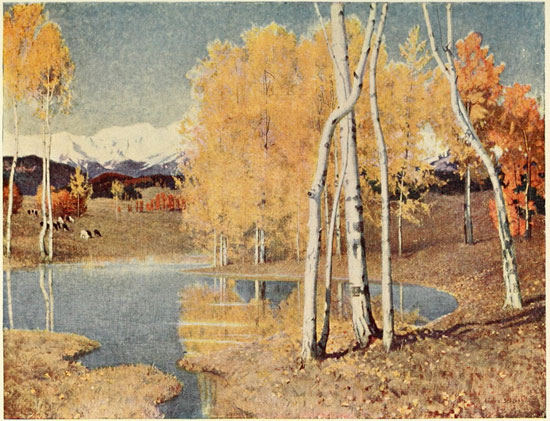
MOUNTAIN POOL ON THE RITTEN
The Virgin made no reply but vanished; and as
she disappeared from their vision there welled up, where
she had stood, a spring of clear water from out the
rocks, which has never ceased to flow since.
On their return home the boys refrained from saying
anything about the vision or the miraculous spring,
perhaps lest, notwithstanding the calves had been found
in the cowshed as the Virgin had promised, they should
be blamed for careless herding. But they never failed,
when passing by the spring, to offer up a prayer of
gratitude.
Many years passed and the two cowherds not only
grew to man's estate but became old and infirm, needing
the assistance of others to look after their flocks. One
of the two was aided by the deaf and dumb son of a
neighbour, and one day, as the old man and boy were
passing the spring, the former knelt down and prayed
and drank of the water. The boy seeing him do this
did likewise, and lo and behold he found his tongue
miraculously loosened, and afterwards spoke as clearly
as any other.
The fame of the miracle spread abroad, and was readily
believed by the people of the valley. Then the two
old men told their own experience, and soon a chapel
was built on the spot to which through the centuries
many devout pilgrims as well as many curious visitors
have journeyed.
Amid the woods by which Igls is surrounded, and
along the fertile valley in which the village stands, are
many charming walks, and yearly the place is becoming
more resorted to by those who appreciate the lovely
and bracing mountain air, and a very pleasant form
of what has become known as the "simple life."
To the south-west of Igls and south of Innsbruck
across the Sill is the lovely Stubai Valley, the beauty
of which almost challenges that of the Oetzthal. Like
the latter this valley is also verily the gate to the land
of snow-fields and glaciers, of which there are upwards
of eighty within its confines and hard by. The Stubai
Thal is a combination of scenery of widely different
character. Within a radius of a few miles, towering above
its green and peaceful pastures, at least two score of
magnificent peaks rear their heads skyward, none of
which fall far short of (whilst many exceed) 10,000 feet in
altitude. The lower portion of the valley is reminiscent
of the far-famed, music-loving Zillerthal, with its dark-green
pine forests, fertile meadows, and villages perched
here and there on the slopes of the mountains, or nestling
in the valley itself around the white-walled churches.
This kind of scenery extends some little way beyond
the village of Neustift, which is the last in the valley
having a church, and then one seems to at once pass
into a mysterious, wonderful, and fascinating region,
where the legendary gnomes and ice-maidens of
Tyrolean folk-tales and lore must surely dwell in
caverns and habitations of perpetual ice and snow.
Though there is a good mountain road winding up
the hillside above Wilten, which in former times served
the picturesque villages Natters, Mutters, Kreith, and
Telfes, most travellers nowadays use the electric
railway (the first made in Tyrol) for the journey to
Fulpmes, which lies about half-way to Neustift and is
rapidly becoming a favourite excursion resort for Innsbruck
people.
The railway (although it has been called a "toy"
one) presents considerable features of interest to the
engineer, and elements of apparent—but not actual—danger
to the timorous. At least, one lady we know
who had made the upward journey, had been across the
slender viaduct supported on tapering piers, and had
been whirled round curves of astonishing "sharpness,"
refused—until the distance by road had been pointed
out to her—to return the same way. But there is in
reality no risk on the Stubai Bahn, only an element
of pleasant excitement, and the charm of wonderful
scenery; and the latter is so beautiful and the little
saloon cars so well adapted for viewing that few will,
after all, we think, regret travelling to Fulpmes by train
instead of a-foot or by carriage. The place was formerly
celebrated for its iron and steel works; the articles made
finding their way not only to Austria, but also to Germany
and Italy; and although of late years the trade appears to
have somewhat declined, it is still considerable and of
interest to the curious who can watch the skilful artisans at
work. The village is most picturesquely situated, and in
the church there are some paintings by a local peasant
girl quite worth seeing. Fulpmes forms an excellent
centre from which to make excursions in the upper portions
of the lovely valley, and amid the wooded slopes
of the environing mountains. In summer there is the
additional charm of the wealth of beautiful wild flowers
which gem the fields, and spread like a many-coloured
carpet of glowing tints beneath the shadow-casting and
sombre pines.
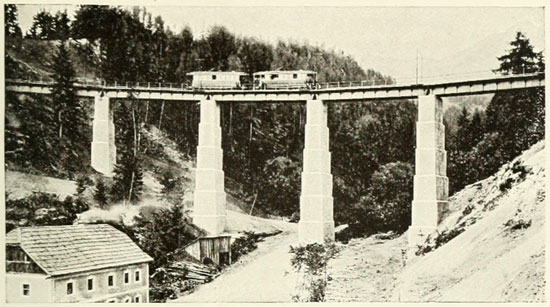
VIADUCT ON STUBAI RAILWAY
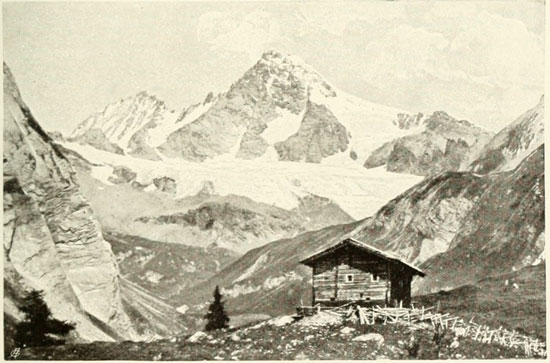
VIEW OF THE GROSSGLOCKNER
FULPMES AND SCHONBERG
At Schonberg, south of Igls, and on the opposite
bank of the Sill, standing nearly 3500 feet above sea level,
one obtains a most widely-extended and panoramic
view of the Stubai Valley and its villages. And as one
stands in the Alpine observatory near the "Jagerhof,"
one is able to realize the full beauty of the valley, and
the wonder of the mountain summits, including the Serles
Spitz (also known in Innsbruck as the Waldraster Spitz),
whose rugged peaks remind one of those giants in the
Dolomites.
But perhaps one of the most strange and interesting
natural phenomena in all Tyrol is to be seen from
Schonberg when the snow-fields, which in winter completely
cover the mountain tops on every hand, begin
to melt. Then gradually there appear in different
parts of the upper slopes of the mountain ranges dark
spots which, framed in unmelted snow, at last assume
the appearance of silhouettes of gigantic size. On the
peaks away above Innsbruck are slowly formed the
figures of two women who appear to be fighting, and
whose noses as the snow melts become more hooked
and longer each day; on the Solstein a priest is seen
carrying an aspergillus in his hand, whilst on the
Arzletscharte appears the most complete "picture" of
them all, known as the "Falconer." This, a silhouette of
remarkable vividness, depicts a youth dressed in a page's
costume, adorned with a hat and plumes, and carrying on
his left arm a falcon unhooded for flight. As the snow
melts the figure loses its pristine slimness and assumes the
form of a corpulent man, until at last it entirely disappears.
On the side of the Patscherkofel is seen the figure of an
old hunter with his dog; which, however, owing to the
rapid melting of the snow when once a thaw commences,
is only visible for a short time. Indeed, a few hours
after we first saw it, for the reason we have given, the
change was so great that the outline was almost destroyed.
Hall, from time immemorial famous for its salt mines,
is well worth a visit. Lying on the north or opposite
side of the Inn to Igls, and to the east of Innsbruck, it
can be reached either by the prosaic post-road which
traverses the Valley, or from Igls by the beautiful
Ellbögen road—a branch of the Brenner road dating
from Roman times—passing over the Mittelgebirge and
through Igls, Lans, Aldrans, Ampass, across the bridge
over the Inn to Hall, which is somewhat longer. Equally
picturesque, perhaps one might say even more so, is
yet another road (the one we preferred) which skirts
the lower slopes of the towering peaks of the Bavarian
Alps, and passes through the villages of Arzl, Rum,
and Thaur. There are also the alternatives of the
Brenner railway, and the tramway for those who are
poor walkers or are pressed for time.
SOME PRETTY VILLAGES
From Mühlau onwards one has most exquisite views
of the broad and fertile valley, and the magnificent
mountains which tower above the wooded slopes, swelling
gently upward from the Inn, in wild and craggy peaks
of rugged beauty. This walk is rendered additionally
attractive and picturesque for all who are interested in
folk-lore, or who are able to enter into the legend and
religion of the people, by the pilgrimage chapels which
are found along the route. One of the most charming
of these in all Tyrol is that of Arzl, which, standing on
a wooded knoll, is brilliant with colour, a gem of its
kind in a charming setting of dark green. The little
church of Maria Loreto built by the religiously inclined
Anna Katharina Gonzaga, second wife of Ferdinand II.,
was once a famous pilgrimage place, but of late years
has been much less resorted to than formerly. The
interior is, however, well worth inspection. The wood
carvings and iron work are both interesting, as are also
the old engravings which hang upon the walls, and the
curious black Virgin and Child upon the Altar.
Arzl, Rum, and Thaur are all picturesquely situated,
nestling as they do on the lower slopes of the great limestone
peaks, the first named standing at the foot of the
Burgstall which rises majestically to a height of nearly
three thousand five hundred feet. Many of the houses
in these three villages are most elaborately decorated
with mural paintings; in some instances the whole of the
fronts are so adorned, and often masses of corn hang on
trellis work on the walls. The effect of the brilliant
tints of the paintings and the coloured window frames
gives an additionally picturesque air to the little villages.
Seen in summer the gay effect is perhaps a little neutralized,
but in winter, when the landscape is more cheerless
and there is a background of snow and grey-green
rocks, the picture formed is a unique and wonderfully
cheering one.
Concerning Thaur, where so many houses have either
a painting or an image of a man with a bear upon their
fronts, there is a legend of St. Romedius, who centuries
ago came riding into the village blessed with a keen
appetite gained by exercise in the invigorating mountain
air. Whilst the saint was engaged in satisfying his
hunger, a wandering bear, so the legend goes, was so
impressed with the holy man's accomplishment in this
respect that he promptly (for want of other food) emulated
it by eating Romedius' horse. On coming out to renew
his journey the Saint was astounded at the disappearance
of his steed. He, however, seems to have guessed what
had happened, and forthwith preached the bear such a
sermon upon his iniquitous conduct that he was not only
moved to penitence, but also sought to make amends
by offering himself as a substitute for the Saint's former
steed.
Although the proposal might appear to us as accompanied
with some considerable risk when the bear once
more became hungry, the Saint accepted it, and ultimately
set forth on his strange steed to a cave in the
mountains north of Thaur, where they lived for some
considerable time without mishap. One day, however, as
the holy man slept, a troublesome fly came buzzing round
his head, and the sleeper failed to drive it away, with the
result that the bear (who we are told had all this time
watched over his master with great solicitude) came to
the rescue and sought to get rid of it; however, without
success. The fly returned again and again to the charge,
and the bear in desperation aiming a blow at the fly,
alas! struck and killed the Saint. This time the grief
of the bear was, of course, of no avail, so he would eat
nothing and gradually pined away, ultimately dying of
hunger.
This story, though it has its comical side, is not,
however, held to be disrespectful to the life and character
of Romedius, who is one of the best esteemed Tyrolese
saints. It appears more than probable, however, that
Romedius (whether killed by his companion the bear
or not) actually died in the Nonsthal, South Tyrol, where
there are, strange to say, villages of somewhat similar
names to those we have mentioned, namely, Torro, Rumo,
and Arz.
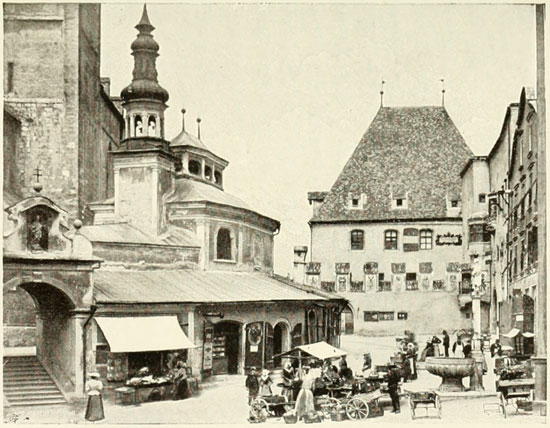
THE MARKET PLACE, HALL
HALL AND ITS MÜNSTERTURM
Hall, which is one of the most picturesque, busy,
and interesting little towns in the neighbourhood of
Innsbruck, with some 6000 inhabitants, dates from the
time of the Roman occupation of Tyrol. By the well-known
historian, Beda Weber, the name is stated to have
been derived from the Greek word ἁλός, salt; the reason
for such derivation from an unlikely language he does
not, however, in any way seek to explain. As one enters
the town one is at once struck by the strange and quaint
mingling of the picturesque with the utilitarian, the rural
with the mediæval. Long before one reaches the town
one sees in the distance the greenish copper cupolas of
the Pfaarkirche or Parish Church which has so fine a
Gothic portal and interesting relics, around whose walls
shops are grouped; and rising above the other less
lofty and less time-mellowed buildings, the massive
Gothic tower known as the Münsterturm with its red
"pepper-box" roof of Roman origin, although the present
tower was built by Duke Sigismund, the famous son of
Frederick of the Empty Purse. A steeply ascending
street leads to the market square, in which the Pfaarkirche
and Rathaus stand opposite each other. And in this and
contiguous streets there are many quaint balconies, gabled
roofs, and old-time architectural features to interest and
charm the artist and antiquarian visitor.
Although Hall has somewhat declined as a commercial
centre with the rise of its big neighbour, Innsbruck, it is
still a place of considerable activity on account, chiefly,
of the famous salt mines. In former times these and
its position on the banks of the Inn (then much more
navigable) gave the place importance under the rule of
the Counts of Tyrol, and the earlier of the Austrian
princes; many barges and boats from the Danube itself
in former times making their way into the Inn and
thence to the flourishing town of Hall. The salt works
still remain its principal industry. Hall is, as things go
in Tyrol, a distinctly smoky town; but it is seldom that
the smoke hangs in the clear and fresh Alpine air which
sweeps along the Inn valley down from the environing
hills.
The Münsterturm, mint tower, which, as we have said,
is so prominent an object on approaching the town, is of
historical interest from the fact that it was built to enable
Duke Sigismund, known as the Rich, to turn into coin
his great store of silver taken from the Tyrol mountains.
It was from this tower, too, that Andreas Hofer issued
his Kreuzer and twenty Kreuzer pieces during the period
of his brief dictatorship.
As was the case with many another Tyrolean town,
Hall suffered in the past from the calamities which
afflicted so many similar places in the Middle Ages. It
was swept in turn by fire, sword, and pestilence, and
shaken to its foundations by the earthquake which
occurred in 1670. So severe was the shock, we are told,
that the watchman on the parapet of the church tower
was thrown off and killed by falling to the ground, and
the people fled out of their houses to the open fields
where their priests exhorted them to prepare for the Day
of Judgment. That the alarm created was very great
is borne out by the fact that, although the loss of life
would appear from contemporary sources of information
to have been slight, for some time afterwards the services
of the church were all performed in the open air. Hall,
however, chiefly on account of its salt mine resources,
recovered, and these and the many privileges the burghers
enjoyed enabled them in time to regain their former
prosperity.
The town played an important part in the various
wars which had Tyrol for their battleground during the
Middle Ages; and during the Patriotic War the people
of Hall were not less brave and self-sacrificing than those
of other places. One gallant deed in especial of that long
struggle for freedom is directly connected with the town.
In May, 1809, Joseph Speckbacher (who was born on a
Gnadenwald farm near Hall in 1767) and his troops
attacked the Bavarians at Volders, near Hall, and after
blowing up the bridge behind him he marched to the
relief of the latter town, which was held by the Bavarian
troops. These had artillery, and were also numerically
stronger and better armed, so that the task set before
the patriot force was no slight one. Happily, Speckbacher
became aware that the Bavarians were short of ammunition,
and therefore when a truce was proposed he refused
to agree to it. The Bavarians after, as they thought,
completely destroying the Hall bridge, which they held
as well as the town, retreated. Calling upon his men to
follow him, Speckbacher led them boldly on to the then
dangerous and tottering structure, entered the town and
pursued the Bavarians.
AN INTERESTING CHURCH
In the churchyard is an interesting wooden crucifix
carved by Joseph Stocker in 1691, as well as some
monuments of the principal Hall families of former times.
The church itself should be visited, if only for the
"Salvator Mundi" by Albrecht Durer painted on a
panel, and the high altar-piece by a pupil of the master
Reubens, named Erasmus Quillinus. One of the chapels,
the Waldaufische, was built in 1493 by Florian von
Waldauf, who, originally a peasant boy, entered the Imperial
Army and ultimately became one of the confidential
advisers of the Emperor Frederick and his son, afterwards
Maximilian I. He was also ennobled and given considerable
estates. He met with many adventures on his journeys
into foreign lands, and on one of his expeditions was in
so terrible a storm as to be threatened with shipwreck,
and he vowed if his life was spared that he would found a
chapel in his native land. As events turned out, he
lived to reach Tyrol once more, and in accordance with
his vow founded the chapel in the church at Hall, which
was also the parish church of Rettenburg Castle and
estates which Maximilian had granted to him. Upon
this chapel he bestowed numerous relics which he had
acquired during his various travels, and nearly 50,000
pilgrims came from all parts of Tyrol to the consecration
service.
More than one of the chapels and churches of Hall
owe their origin to special circumstances of a more or
less romantic character. That of St. Saviour, for example,
which stands on the site of some tumbledown hovels
which existed in the first years of the fifteenth century.
The story goes that it was to a dying man in one of these
that one of the priests attached to the village church
was summoned to convey the Viaticum, and administer
extreme unction and the last rites of the Church. He
came in due course to the hovel, and placing the sacred
vessels on a rickety table the latter collapsed and the
Host was thrown on to the floor. This was, of course,
a terrible disaster in the eyes of the priest and peasants;
and a rich burgher, Johann von Kripp by name, hearing
of the circumstance, purchased the cottages, and as a
reparation for the sacrilege which had occurred, founded
a church on the spot, dedicated to the Redeemer.
The Hall records are of great interest, and show that
the town was a place of much importance in the fifteenth
century, when a considerable part of the trade between
Venice and Germany passed through it. In those days,
too, the town was somewhat celebrated for its junketings,
more especially the feasts which were held in connection
with the opening of the sessions at the Courts of Justice.
The neighbourhood, on account of the good sport
provided, was a favourite hunting-ground with the
Emperor Maximilian, who on several occasions was
entertained in the town.
Hall declined slowly in importance during the sixteenth
and seventeenth centuries by reason of the change
in the trade routes; but in quite modern times has
regained some at least of its former prosperity by
adopting up-to-date methods.
There are numerous excellent and interesting excursions
to be made from Hall, but nearly every one pays
a visit to the famous salt mines, which are to the north
amid most romantic and beautiful scenery. Even by
carriage the journey of about eight miles takes the greater
part of two hours; on foot even good walkers can scarcely
hope to do it in less than three. The scenery is in
places very fine, and one enjoys most beautiful views, and
nearer glimpses of the Bettelwulf, Speckkar and Nisslspitz
Alps.
ABSAM AND JAKOB STAINER
On the way one passes the quaint village of Absam,
at which Jakob Stainer, known as the "German father
of the violin," was born in 1621. As a maker of these
instruments he stands high, though it is unknown where
or how he acquired his knowledge of the craft. It seems
possible, however, as Absam is but a short distance from
Innsbruck, where at the period at which Stainer lived
musicians—Italians and others—were warmly welcomed
to the Court of the Archduke Ferdinand Karl, he may
have made the acquaintance of some of these, or even
of a maker of distinction. Be it as it may, ere Stainer
reached his majority he had embarked upon the trade
of a violin maker, and was often to be seen in the
streets of Hall and in the market-place selling his productions
at a price which we are told did not often exceed
six florins.
His original model was probably an Amati, but he
departed considerably from it as he himself acquired skill
and knowledge. Stories are still told of the great care he
took in selecting the wood from which his instruments
were to be fashioned, and how he would sometimes spend
days wandering in the backwoods around Hall and Absam
in search of a good tree, which he would tap with a
hammer and note its "tone" ere felling. Unfortunately,
as has been the case with many another genius, he seems
to have died in poverty in or about 1683. At one time
he was violin maker to the Imperial Court, but this
appointment, which ultimately he lost through inability
to pay his way, and owing to consequent financial
embarrassment, was not sufficiently lucrative to ensure
him comfort in his declining years, let alone prosperity.
His instruments, of which there are still a number
in existence, are generally distinguished by having their
tops more highly curved than those of the chief Italian
makers, whilst they possess a more flute-like note, which
is often more "singing" and sympathetic than that of
the latter. But none of his make probably equalled, or
at all events excelled, the works of the Italian masters
for brilliance and sustained tone, although by some connoisseurs
this opinion has been disputed. It is said
that one of Mozart's favourite instruments was the work
of Jakob Stainer.
At the present time the chief industry of the Mittenwald,
which is just over the Bavarian border, is the production
of violins and guitars, which are exported in
considerable numbers to both England and the United
States as well as to other European countries. This
flourishing industry owes its origin to a pupil of Stainer's,
named Klotz, who after his master's death enjoyed a considerable
reputation as a maker of violins of good quality.
Many of the houses of Absam are gaily painted, and
in the numerous niches, which are often vine-wreathed,
one finds the images of saints, and on the bargeboards
roughly carved dragons. The villagers tell a curious
story to account for the presence of these dragons. It
tells how centuries ago there was in the village a
marvellous hen that never laid an egg until seven years
old, and when this was hatched instead of the anticipated
chicken there crawled out a dragon, which remarkable
event the villagers have commemorated ever since by
carving dragons on the eaves of their houses. But it
has been pointed out by several writers upon legends
and folk-lore that the dragon was an animal sacred to
the god Wodin, representations of which were frequently
placed on houses, over the town gates, and on belfries as
a kind of talisman against evil influences and spirits;
and similar statements are to be found in several well-known
works dealing with mythology.
A WONDERFUL WINDOW
In connection with this little Tyrol village are several
other stories and legendary tales of a highly romantic
and interesting character. Space, however, can only be
found for one other. The story of the event or circumstance
which caused Absam to become a popular pilgrimage
place at the end of the eighteenth century runs as
follows. About the middle of January, in the year 1797,
the daughter of one of the villagers was one evening
looking out of a window in her father's house to watch for
his return from work across the fields, when suddenly the
light from the fire which played upon the window-pane
disclosed a figure of the Virgin Mary quite distinctly.
The girl was so astonished that she fell upon her knees
before the miraculous picture. The story was not long
in spreading throughout the village, and the neighbours
all came running to see the "miracle." Then the news
of the marvellous image spread through the district round
about, and at last created so great a stir that the Dean
of Innsbruck himself heard of it, and resolved to investigate
the story. After he had visited the place a committee
of inquiry was formed, amongst the members of
which were two learned professors of chemistry and the
well-known artist, Joseph Schöpf.
After considerable investigation and the examination
of witnesses the committee declared that the glass had
originally formed part of a "picture" window, and that
the image had been undoubtedly painted upon it. The
colours had, however, faded as the years went by (as
sometimes, indeed, happens), and it was the peculiar
character of the atmosphere of Absam which had restored
them to the extent that the image of the Holy Virgin had
become once more visible.
It is not to be much wondered at, however, that the
simple-minded villagers failed to appreciate the arguments
of the commissioners and refused to accept the
explanation. To them it remained a miraculous image
still, and pilgrims came in crowds to see it. As history
tells us, it was a period of "Sturm und Drang" in Tyrol.
A plague raged which afflicted both men and cattle; and
the French invaders had penetrated right into the heart
of the country, had occupied Innsbruck, and had brought
fire and sword to the hearths of the people. The superstitious
peasantry, with their natural leaning towards
belief in the miraculous, and faith in the benefits to be
derived from the supernatural, accepted the image which
had so strangely appeared on the window-pane as a token
of Divine favour, and insisted on its removal and installation
upon one of the altars in the church. This was
promptly done, and the "Gnadenmutter von Absam," or
"Miraculous Madonna of Absam," became an object of
veneration by all who were distressed. This feeling was
doubtless immensely increased by the circumstance that
soon after the discovery of the picture and its removal to
the church the pestilence died down, and the French were
compelled to withdraw their forces. Both of which events
were attributed to the virtue of the painting of the Virgin
on the window-pane which had been discovered in so
strange a manner.
The salt mines a little distance beyond Absam, with
their crystalline grottoes and the subterranean salt lake,
provide an interesting and unique experience for the enterprising
traveller who comes to the Salzberg. There is not
much difficulty in obtaining admission to the mines, a
small fee being charged each visitor for guides, torches,
and the rowers of the boat on the lake. The circumstance
that the mines were known and worked in the eighth
century is not the least interesting fact connected with
them; but it appears probable that the early workers
confined their attention chiefly if not entirely to the
extracting of the salt from a spring that issued from the
mountain, by means of evaporating pans.
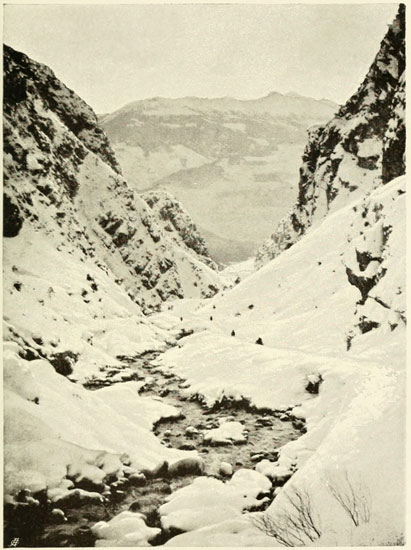
THE HALL VALLEY, WINTER
DISCOVERY OF SALT MINES
One Nikolas von Rohrbach, who is known by the
sobriquet of "the pious knight," appears to have been the
first discoverer of the salt mines. He noticed on his
frequent hunting expeditions that the cattle and horses
were very fond of licking certain rocks in the valley, and
applied tests which showed that the rocks were strongly
saline in character. Following up this clue, he discovered
the Salzberg itself with its practically inexhaustible supply.
Ever since Rohrbach's time the mountain has been worked
for its salt, and until recent years, when blasting came
into common use, much in the same way as in mediæval
times, viz. by hewing huge caverns in the rock, which are
then filled with water and sealed up. After a considerable
period has elapsed this water is run off into conduits
leading down to Hall, where it is evaporated in pans.
How heavily charged with salt the brine is may be
judged from the fact that as a general rule it yields no less
than one-third of its weight in solid salt.
The caverns one is able to enter, when lighted up by
the flickering torches, present a truly wonderful and
beautiful sight.
Those who visit Hall are indeed unfortunate whose
time does not permit them to put up for a day or two at
either of the chief Inns (the "Bar" or "Stern"), so that
the beautiful Gnadenwald, which lies to the north-east
of the town on the Bettelwulf, may be visited. That
lovely Alpine lake, the Achen See, in which the towering
snow-capped mountains glass themselves, can be easily
reached by the little railway which runs up to it through
the steeply climbing Zillerthal. The highest and largest
of Tyrolese lakes, the Achen See, lies at an altitude of
3000 feet, with its deep-blue, crystal-clear waters stretching
northwards for a distance of nearly six miles towards
Bavaria. It is surrounded by the most exquisite mountain
scenery, craggy precipices and dark-green forests, and
has many features of interest in addition to providing
excellent fishing, boating, and numerous pleasant walks
and excursions.
In the Gnadenwald, which was a grant of forest land
made by Tyrolese rulers to their household servants in
olden times, there are several villages of great picturesqueness.
The road from Hall is a truly delightful one
through pine forests, sweet with aromatic perfume in the
warm air of summer, and upland fields, which seem to
almost hang on the sides of the grey, craggy peaks of the
Bavarian Alps. And if one but turns and gazes back
occasionally there are charming vistas to be had of the
Inn Valley far below, and the great chain of the southern
mountain range on the further side.
The two picturesquely situated villages of St. Michael
and St. Martin are to be ranked amongst the chief places
of interest in the Gnadenwald. As one approaches the
former its white church and tower with a red-roofed
cupola with gilded finial standing out clearly defined
against a background of dark green at once arrests
attention. Over the door is a fresco depicting the incident
in the life of Saint Martin where he bestowed his coat
upon a beggar. The visitor whose time permits or inclination
leads him to enter the church will be amply
repaid by the beauty of the frescoes, more especially those
adorning the pulpit, which were painted by one of the
priests attached to the Augustinian monastery formerly
connected with the church, but afterwards suppressed by
Joseph II. towards the end of the eighteenth century.
At a little distance from the church stands the old
home of Joseph Speckbacher, where once, when pursued
by his enemies, he took refuge in a pit only deep enough
for him to sit upright, whilst the Bavarian soldiers in
search of him were actually quartered in the house. He
was only able to leave his place of concealment under the
floor when the soldiers were absent drilling in the market-place.
After a time he was able to come out and hide in
a more commodious cow-shed, and finally to flee (after
many narrow escapes) over the border into Austria, where
he was well received and safe from capture.
The village of St. Michael is also picturesque and well
worth seeing. Just beyond it is the famous Gungl Inn, a
favourite resort with excursionists from Innsbruck,
Kufstein, Hall and other places, as well as with the
peasants of the Gnadenwald. Here, on Sundays especially,
one meets with some of the most interesting and
picturesque types, gay costumes and rustic scenes of
gaiety and amusements which give one a far better idea
of the Tyrolese peasants as they are than days spent in
towns, and weeks spent reading books.
A PILGRIMAGE CHURCH
But a short distance further on, by a charming road,
one reaches the famous pilgrimage chapel of Maria Larch,
built in honour of a mysterious image of the Madonna
which was discovered under a larch tree. The church,
perhaps on account of its poetic legend and secluded and
beautiful situation, has long been a favourite pilgrimage
resort with the impressionable and religious peasantry of
the upper valleys.
There are many other picturesque places in the neighbourhood
of Hall, enticing the wanderer from valley to
valley and height to height; but a small volume would be
required in which to adequately describe them alone; and
almost a lifetime to become thoroughly acquainted with
their romantic legends, story and beauty. Some weeks
of exploration leaves one with a keen desire for closer
acquaintance with not merely the lovely scenery but with
the simple-hearted, hospitable people who dwell in the
more secluded valleys, with whom the great outer world
with its storm and stress has indeed little to do and for
whom even has little interest.
"You should return to Innsbruck from Hall in the
late afternoon, starting just before sunset," was the advice
of an artist friend. "You will then see what you will not
easily forget."
The present writer passes on the advice.
No one who has waited till day's decline to make the
return journey at any period of the year will have reason
to regret it, though in the winter months the effects of light
and shadow are, of course, far more transient—far too much
so—than during the spring, summer, and even early autumn.
Then the snow on the towering peaks of the environing
mountains glows with at first a golden light, which passes
through pearly tones to bright rose pink as the sun sinks
behind the soaring crags. The last gleams of the sun
linger upon the highest peak as though loth to fade
through rose to pale purple, and in turn to change
to steely blue, and finally to that blue-black which
challenges the deeper indigo of the Alpine sky. Through
the pine woods as one passes along the mountain road the
golden light filters and slowly dies, throwing long shadows,
and at last making the tree trunks loom enormous and
fantastical in the fading light. And then from the tiny
churches of the mountain side and valley one hears the
Angelus ringing forth with a peaceful sound; or if one
be approaching Innsbruck itself, then the mellow tones of
the greater bell of Wilten float upward from the valley and
come to one borne on the still evening air. Under such
circumstances of beauty and in the impressive solitude of
the forest ways one must be, indeed, unimpressionable
if one fails to feel something of the spirit and love of
Tyrol, and of restful peace which has enslaved so many
hearts throughout the country's history.
SALZBURG, ITS HISTORY AND ROMANCE
BEAUTIFUL OLD SALZBURG
Salzburg, though lying some little distance beyond
the north-eastern borders of Tyrol, is so historic
and delightful a city that many who visit the
"Land of the Mountains" make a point of visiting it.
They are wise to do so; for of all ancient towns in the
Austrian empire few are more picturesque or pleasantly
situated, and scarcely any more historically interesting.
We have never known any one disappointed in Salzburg
who was capable of appreciating beauty and romantic
associations.
Many who have roved the world over have yielded
to the charm of this old-time city, which even with
its touch of modernity seems to preserve the quaint and
the beautiful of long ago, and the atmosphere of the days
when knights and armed men were the chief passers
through its streets, and history was in the making.
It lies at the foot of the northern Alps, in an open and
fertile valley somewhat reminding one of Innsbruck, save
for its wonderful rock fortress Hohen-Salzburg situated
nearly eighteen hundred feet above sea-level and completely
dominating the town. There is the Kapuzingerberg
in place of the Innsbruck Weiherberg, and its
Rainberg in place of Berg Isel. It is by many considered
the most interesting of all the ancient towns amid the
German Alps.
Its beauty has been compared in turn by several well-known
travellers with that of Venice, Naples, and even
Constantinople. But to our thinking the parallel is not as
exact as it should be to make it of value. There is no
sea at Salzburg, and from that fact alone its approach is
of necessity less picturesque. Indeed, the immediate
approach from Tyrol by way of Innsbruck is somewhat
unimpressive and gives little or no indication of the
beauty and charm of the old town, though the line on its
way passes some pretty scenery and affords some fine
peeps of the Bavarian Alps.
Yet Salzburg, through the centre of which flows the
silver-hued Salzach, is in a way as beautifully situated
and as charming as any of the towns to which it has from
time to time been likened. It lies in a delightfully well-watered
and fertile plain dotted over with villages, ancient
castles, and country seats of the Salzburg nobility, and
encircled by wooded hills, which as they open out in a
wider sweep to the south become higher and higher
until deserving the description of mountains. Here they
become a magnificent range of towering limestone peaks,
through which are cleft fertile and delightful valleys leading
into the neighbouring kingdom of Bavaria. In the
valley of the Salzach there is no lack of variety as regards
scenery. One has widespread meadows, almost throughout
the year starred and gemmed with many coloured
and sweet scented flowers, melting away into the woods
which clothe the lower slopes of the environing hills,
where the sombre hued pines give a darker note of green
to the landscape; whilst yet above these in the distance
are crags of grey and slate-coloured limestone, and crowning
the whole vast snow-fields glistering white at noonday
and taking on a tint of delicate rose colour at sundown.
In the town itself rise two considerable hills which
serve to confer upon it a distinction of its own. One,
the Kapuzingerberg, on the eastern side of the river, rises
to the height of 800 feet, and the second, on the western
side, to a height of nearly 450 feet above the city. It is
between these two that the greater part of the old town
lies. The steep sides of the Mönchsberg and the
Gibraltar-like rock on which the old, grey fortress of
Hohen-Salzburg stands are ivy-clad, and in the crevices
and fissures wall-flowers, valerian, stone-crop, houseleek,
and other flowering and lichen-like plants have taken
root, whilst from the greater crevices and ledges wave
feathery birches, and the lower slopes are made beautiful
and shady by spreading beeches and odorous limes.
After several visits to this delightful city, which has
an atmosphere entirely its own, and a charm difficult to
describe, one is at a loss to set down in what it exactly
differs from other similar towns. Part of the attraction it
possesses is doubtless owing to its situation amid a stretch
of lovely valley, and its romantic and historic past. But
there yet remains that elusive quality which may be
described as "the personality of the town," in addition
to its geographical and historical claims upon one's interest
and imagination.
Salzburg is not, however, merely the name of a town,
but also of a province or "department" of Austria, to
which empire it is the last added territory.[15] Lying
between Tyrol (of which by many it is erroneously
supposed to form a part) and the Salzkammergut or the
lake region of Upper Austria, which commences in the
near neighbourhood of the city, it was an independent
episcopal principality until after the fall of Napoleon,
not having been incorporated with the Austro-Hungarian
Empire until the year 1816.
THE SALZACH VALLEY
The province consists chiefly of the mountainous
district of the Salzach and its numerous tributaries,
which wend their way from their sources amid the
glaciers and snow-fields of the great peaks of the Hohen
Tauern and lesser ranges to the plain where the Salzach
itself ultimately flows into the Inn.
It is the great Hohen Tauern range with its gigantic
snow-crowned peaks of the Gross Glockner, 12,460
feet; Wiesbachhorn, 11,710 feet; and Gross Venediger,
12,010 feet; Hohe Furlegg, 10,750 feet; Habachkopf,
9945 feet; and many other almost equally stupendous
heights, which forms the southern boundary of the ancient
Principality. The whole range is one of impressive
grandeur, and possesses a picturesque beauty upon its
lower slopes unrivalled by any other Alpine district. The
foot of the Hohen Tauern is almost invariably clad with
pine forests, which melt away into the higher slopes
where blooms the bright pink "alpen rosen," whilst yet
higher, and just below the line of perpetual snow, on rocky
ledges and on slopes of coarse grass appear the silver-white,
star-like flowers of the edelweiss. Above this
zone of fresh green patches amid the grey and weather-stained
rocks one passes into that exhilarating region of
eternal snow and ice where dwells also eternal silence
unbroken by the sound of birds, the hum of insects, or
murmur of other living things.
Not only is the Hohen Tauern the region of Alpine
giants, vast glaciers, and untrodden snow-fields, but as
a natural consequence of these things it is that of many
rushing torrents, stupendous waterfalls, and tinkling
streamlets, all of which contribute to make the province
it borders one of the best-watered in the Austro-Hungarian
Empire. Upwards of half a score of large
streams flow into the Salzach; whilst of fertile valleys
there are so many that to number them is difficult. Most
are beautiful in the extreme; many are almost unknown
to the ordinary tourist, who usually sticks to the well-worn
paths and more frequented highways. In the
famous Krimml Falls the Province of Salzburg possesses
by common consent the finest waterfalls in the German
Alps. They issue from the vast Krimml Glacier and
descend over the edge of a pine-clad precipice in a cloud
of drifting spray into the valley beneath, a distance of
nearly 1500 feet, in three stupendous leaps, the highest
fall in two leaps from a height of more than 450 feet.
Although, as we have before said, almost every valley
of the Hohen Tauern range is notably beautiful, none
excel in interest either pictorially or geologically the
longest and widest, the Gastein Valley, with the fine falls
some 500 feet in height near Bockstein, where the
Gasteiner Ache, after passing through narrow gorges,
plunges down into the valley, and thence flows through
the broad, flat plain of Hof-Gastein to join the Salzach,
passing on its way delightful Bad-Gastein, with its old
town of interesting and picturesque wooden houses
nestling on the eastern slopes of the valley, and the
newer, with its hotels, churches, villas and other handsome
buildings, peeping out from amid the pine-clad slopes
or lying in the valley itself. It is a delightful though
nowadays fashionable health resort, at which many tastes,
both gay and quiet, are consulted.
From Lend at the foot of the Gastein Thal to pretty
little St. Johann, where the Salzach flows northward,
the river has passed without opposition quietly onward.
But at St. Johann are some towering and remarkable
limestone peaks, including those of the Tennen and
Hagen Ranges, some of them attaining an altitude of
8000 feet; with the desolate-looking Steinerne Meer, 8800
feet on the western flank, and the Dachstein more than
a thousand feet higher on the eastern. The river flows
onward to a point where the two ranges we have
mentioned coalesce. Here the great ravine known as
the Lueg Pass, six miles in length and possessing fine
scenery, forms a very fitting entrance to the beautiful
valley of Golling, which gradually opens out from
Hallein onwards till Salzburg itself is reached.
The valley of the Salzach on its eastern side is
bordered by a range of pleasant green-clad heights and
gentle slopes, with the Gaisberg, 4290 feet, a short distance
to the north-east of Salzburg itself, dominating them,
from which point the mountains gradually decrease in
height. From Golling onwards, however, the western
side of the valley is shut in by great peaks, some of which
spread out their lower and rounded emerald green slopes
towards the river. Of these impressive and beautiful
mountains the Hohe Göll, 8275 feet, the majestic
Watzmann, 9050 feet, the chief of the Berchtesgaden
group, are the most noticeable. The cave-pierced and
lofty, dome-shaped Untersberg, the highest point of which
is the Berchtesgadener Hochtron of 6480 feet, standing
isolated like a sentinel in the plain near the city.
SALZBURG IN ROMAN TIMES
Salzburg, beautiful and on occasion even radiant city
of the plain as it is, ancient though many of its buildings
are, is yet of greater antiquity than any of them. The
town stands upon truly classic ground, and is associated
with many events which have taken their places in
European and even world-wide history. Here the
Romans came in their all-conquering march of empire,
and recognizing its fine position and the strategic
importance of the hills which command the river along
most of its course, they in due time built upon the plain
Juvavum, on the road which linked up the Augusta
Vindelicorum, modern Augsburg with Aquileia near
Trieste.
There is little doubt nowadays, from the remains
which have been discovered from time to time in the
shape of implements of stone and bronze, weapons, household
utensils, and ornaments, that the mines near
Salzburg, which have since very early days down till
comparatively recent times been of great commercial
importance, were not only worked in the days of the
Roman occupation, but also even in pre-historic times.
There is little reason for doubt, indeed, that the Celts
knew of, and used, the famous salt mines of the Dürnberg
and the copper mines of the Mitterberg; whilst there is
abundant evidence of various kinds of the working of
the gold and silver mines of the Tauern district by the
Romans during their occupation of the country.
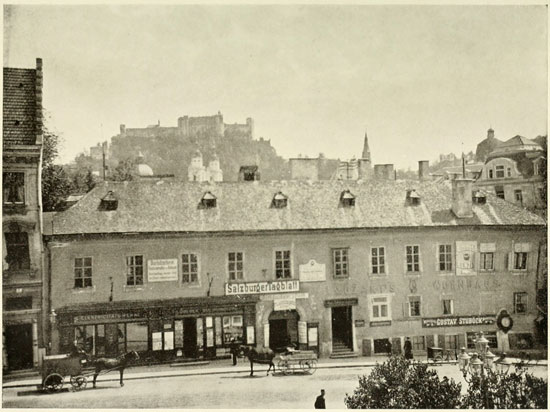
MOZART'S HOUSE IN THE MAKART PLATZ
The exact date when Salzburg as a town or settlement
first came into existence has not been determined;
but it would seem probable that there was a settlement
existing by the banks of the Salzach during, or just prior
to, the first century of the Christian Era. The Celtic
inhabitants of this settlement were not, however, able
successfully to resist the north-eastern advance which
had been made across Tyrol by the Roman legions, and
thus it was that the Roman military station Juvavum
was founded on a site which was of great convenience
owing to its being at the entrance to the mountain passes
and placed at the junction of the roads which led by
various routes to all parts of Noricum. Here it was the
Roman invader, having driven the Celtic owners of the
soil after a brave but ineffectual resistance into mountain
fastnesses of the surrounding country, established a
military post with a fort which soon became a colony,
and grew ultimately into the important town of Juvavum.
Of this occupation by the Romans, and of the
establishment of the town by the banks of the Salzach,
there are considerable relics surviving in the shape of
excavated buildings and foundations, coins, ornaments,
pottery, tesselated pavements, and portions of the roads
which the Romans made.
The introduction of Christianity took place at a very
early date, which would in part account for the ecclesiastical
prominence which the province had in the Middle
Ages, and even in later times. We are told that even
as early as the year A.D. 472 St. Severinus, whilst journeying
through Noricum, with which country Salzburg had
been incorporated by the Romans, found numerous
Christian churches and minsters established. A relic of
these times still exists set in the perpendicular walls of
the Mönchsberg, where high up, with some of its windows
overshadowed by creepers and trees, is a very small
church built into the mountain itself; reached by a dark,
steep flight of steps cut in the rock, worn by the feet of
countless generations, and leading to a cavern where
stands an altar and a small cross. According, at least,
to tradition this was the hiding-place to which the early
Christians amongst the Roman inhabitants retired for
security when celebrating the offices of the new faith.
And it is here that St. Maximus is said to have suffered
martyrdom.
From the effects of the troublous days which at last
came to most outposts of Roman civilization Salzburg
did not escape. Soon the hordes of Huns and Goths
and others belonging to various Germanic tribes swept
across and over the province as they did the land of
Tyrol, and the town was sacked and burned, and the
inhabitants put to the sword or led away into captivity.
Thus in 477 the flourishing Roman settlement was
literally wiped out by the Keruli under their leader,
Odoaker, and of it few traces remained save some
tesselated pavements, household utensils, and ornaments
which ages afterwards from time to time have been
uncovered.
THE RISE OF SALZBURG
The history of the town is obscure for many centuries
after its destruction by the Teutonic barbarians; and for
more than a hundred years the place remained waste
and deserted, with the ruined buildings gradually becoming
overgrown by trees and shrubs. Then, at the beginning
of the sixth century, Theodo I., Duke of the
Bojovarii, the founder of the Kingdom afterwards known
as Bavaria, took possession of Salzburg and joined it to
his own possessions. One account tells us that it was this
Duke Theodo of Bavaria who, having become a Christian,
summoned St. Rupert, after the latter had been driven
from Worms, to Ratisbon with a view to his introducing
Christianity into the Duchy. Tradition states that St.
Rupert came to Juvavum about the year 582, or at the
beginning of the seventh century, with the determination
to make the spot his headquarters for the spread of the
Christian faith. Duke Theodo appears to have made
him a present of the ruined and deserted town and the
country round about to the extent of an area of two
miles square. Other estates and property were given
him, including among many others those of Itzling,
Oping (Upper Innsbruck), and a third part of the famous
Hall Salt Spring. The Bishop set to work, and on the
ruins of the old Roman settlement he soon established
a town, building a convent and a church under the
steep rocks of the Mönchsberg, where now the large
Benedictine Convent and St. Peter's Church stand, in
the latter of which the bones of the saint are said to lie
buried.
The Convent of Nonnberg had many estates granted
to it, and became rich. Bishop Rupert appears to have
also begun to build new dwellings and to have cultivated
the land; not neglecting in the meantime the object for
which he had come, viz. the spread of Christianity. He
built many churches, and was the means of forming a
large number of Christian communities throughout the
Duchy. He also extended the influence of the town of
Salzburg over the surrounding district, and when he
died in 623 he left behind him, where he had found ruins,
a flourishing town with religious institutions of considerable
importance. It was from this settlement that the
most powerful and wealthiest ecclesiastical principality
in Southern Germany was destined to spring, which,
though possessed in turn by various nations, lasted as a
spiritual Principality until 1802, when it was secularized
and re-established as a temporal electorate.
After the coming of St. Rupert Salzburg gradually
grew to be the chief centre of religious life and culture
in the eastern region of the Alps. By the foundation of
the Archbishopric of Bavaria by Charles the Great in
788, after the latter territory had been annexed and
incorporated with his possessions, the city's importance
steadily increased. But with an increase of status there
came a corresponding extension and consolidation of the
ecclesiastical dominion by which the political influence
of the Archbishops of Salzburg grew until it finally
justified them in assuming the title of Primates of
Germany. Almost without exception during the Middle
Ages the archbishops were militant priests. "They
knew," we are told, "as well how to handle a sword as
to say a Mass," and they often fought with distinction
against the many enemies that the German Empire had
in those troublous times when the various kingdoms of
Eastern Europe were being evolved out of chaos, and
were ever at war one with another. These prelates
were also distinguished as skilled and astute diplomatists,
capable of holding their own and adding to the power
and privileges of their Church whenever an opportunity
for so doing presented itself.
Under Bishop Virgil (747 to 784) the power of
Salzburg was considerably extended eastward. The new
Cathedral was built, and several other districts were
brought under the subjection of the bishopric. It was
Bishop Virgil's successor, Arno (785 to 821), a personal
friend of Charlemagne, who, in the last year of the eighth
century, was invested by Pope Leo III. with the Pallium
and installed first Archbishop of Salzburg.
To Arno's labours the town and the country owe
much, for under his skilful and wise guidance not only
did the former flourish and grow, with the other settlements
which had come into existence, but by his great
power of initiative the life of the principality itself was
directed into prosperous and progressive channels. His
immediate successors greatly increased the power and
influence of the Church; whilst at the same time they
did not omit to extend their non-spiritual power by the
acquisition of other territory, and by means of the mining
industries they became very rich and powerful.
EARLY RULERS
The Archbishops of Salzburg soon by this means
gained a great and distinguished place amongst the
German princes, which they retained until the power of
the Emperors began to wane in consequence of differences
with the Popes, to the latter of whom the Archbishops, as
a rule, gave their support in the disputes that arose. Into
these matters it is not necessary to enter deeply, but it
was in consequence of them that Conrad I., Count of
Abinberg, took the part of the Pope and caused the
country to be greatly disturbed. During his reign the
Abbey of St. Peter was granted as a residence to the
Archbishop of Salzburg, and a new building was soon
afterwards erected close by for the purpose. It was in
the reign of this same Conrad I. that the Cathedral
of Salzburg was destroyed by fire on May 4, 828, as
was also a very large portion of the city. Both the
Cathedral and the portion of the town which had been
burnt down were rebuilt with even greater magnificence
than before. But they were destined to once more be
destroyed. Three centuries later, in the year 1167, a
quarrel arose between Conrad II. and Frederick
Barbarossa, because the latter refused to invest the
former with the temporal power, and pronounced against
him the ban of the Empire. Barbarossa ordered Salzburg
and the country round about to be over-run and laid waste
by the Counts Plain-Mittersill. For some time the city
and its strong fortress resisted successfully; but on April
5, 1167, it was captured and once more burnt to the
ground.
The successor of Conrad, Albert III., a son of King
Ladislav of Bohemia, also came into conflict with the
Emperor, and shared a similar fate to his predecessors;
but during the reigns of the immediately succeeding archbishops
peace and prosperity were established, and under
Eberhard II., who was distinguished as a most able and
brilliant administrator as well as a great churchman, peace
and tranquillity once more reigned.
During the next century Salzburg was involved in
political disputes and took part in the Battle of Muhldorf,
on September 28, 1322, fighting on the side of Frederick
the Schöne, Duke of Austria, who was taken prisoner. In
consequence of which the principality not only lost large
numbers of its chief nobles and knights, but also was
involved in heavy monetary loss in the payment of its
share of a war indemnity.
Immediately following this period of unrest came
another distinguished by the erection of new and handsome
buildings and the enlargement of the bounds of
the city, and also strengthening of the Castle on the
Mönchsberg. To Archbishop Leonhard von Keutschach
(1495 to 1519) must be given the credit of attaining
absolute supremacy, and with his occupation of the See
may be said to have commenced the most distinguished
period in the history of the city. Leonhard did not attain
to this position, however, entirely without guile, for to
tell the truth the Salzburg citizens, who seemed even in
those mediæval times to have possessed a love of freedom
and spirit of independence which did them credit, having
become restive under the ecclesiastical domination and
tyranny wished to make the town a free imperial city.
Leonhard, however, had determined otherwise, and so
under pretence of inviting the burgomaster and twenty
town councillors to his palace to give them a state
banquet, he promptly arrested them on their arrival and
threw them into the castle dungeons. He then succeeded
in taking away the ancient rights of the town, upon the
annulment of which he had set his mind. But although
Archbishop Leonhard ruled his secular as well as his
ecclesiastical subjects with a rod of iron, he did much to
improve and beautify the city, adding greatly to the
strength and size of Hohen-Salzburg, and also improving
the method of working the mines, particularly those in
Gastein and Rauris. This was, of course, more directly
to his benefit than that of the miners, yet in the end was
pleasing to the country in general in that the Archbishop
drew from the mines a revenue sufficient to permit him to
erect many handsome buildings, to improve the roads, and
to encourage art and agriculture.
THE REFORMATION
During the Archiepiscopate of his successor Mathäus
Lang von Wellenburg, from 1519 to 1540, many stirring
events took place, not only in the city of Salzburg but
throughout the length and breadth of the principality as
well. The faith of Luther had been introduced into
Salzburg and had met with great success among all
classes of the population, especially that of the miners.
Even some of the priests and officials of the Cathedral
itself were suspected of being favourable to, and even of
extending, the new doctrines. At first the Archbishop
tried to combat the heretical tendencies of his subjects
by kindness and indulgence; but finding these methods
fruitless, he called in the aid of foreign mercenaries, chiefly
from Tyrol, garrisoned Hohen-Salzburg strongly with them
and with followers upon whose loyalty he could depend,
and taking the town unawares, forced the inhabitants to
submit and to surrender their privileges.
This event was followed by various acts of violence
directed against the adherents of the reformed faith, which
so exasperated the population that in May, 1525, a
rebellion broke out in all parts of the principality. The
Archbishop seeing that the situation was taking a serious
turn, addressed an urgent appeal for help to Duke William
at Munich, which, however, was not answered. Shortly
after, thousands of miners and peasants, having won several
skirmishes in the country districts, advanced to Salzburg,
where they were joined by many of the inhabitants, and
promptly set to work to besiege the Archbishop in the
fortress, which they continued to do (failing to gain an
entrance) until August 15th, when Ludwig of Bavaria
arrived with a strong force, and a truce favourable to the
peasants was agreed upon. This arrangement, however,
was not held to, and in consequence a fierce rebellion
broke out again in the following year, but was successfully
and cruelly suppressed by forces under the command of
the Archduke Ferdinand, supplemented by those of the
Suabian League.
Although the doctrines of Luther continued to make
headway, and religious disturbances still occurred, the
latter were not of a serious character; but some half a
century later the famous Archbishop Wolf Dietrich von
Raitenau, also known for brevity as Wolf Dietrich, on
returning from Rome, where he had been to receive the
pallium, or ornamental band of white wool worn around
the shoulders, which all archbishops at that time had to
receive on their appointment before they were empowered
to carry out the duties of their office, issued his famous
edict on July 9, 1588, for the extermination of the heretics.
In consequence of which there was a severe persecution
of those who had adopted the Lutheran faith, with great
confiscations of their lands and other property. Other
acts of this famous Archbishop, including an imposition
on salt, the obtaining and making of which formed a
very important and remunerative industry, brought about
serious friction between him and some of his subjects, and
ultimately led on two occasions to his military occupation
of the salt district by means of mercenaries. On the first
these forces were defeated and driven out by those of
Duke William of Bavaria; and on the second the Archbishop's
action led to the conquest and occupation of
Salzburg by the Duke Maximilian himself, and the
ultimate imprisonment and dethroning of Wolf Dietrich
on March 7, 1612. He was never released, although
efforts were made to obtain freedom and pardon for him,
and died in his cell in Hohen-Salzburg five years later.
CATHOLIC PERSECUTIONS
After the Peace of Westphalia, October 24th, Salzburg
was made an independent and sovereign principality, and
the archbishops, the Chapter, and various other authorities,
set to work to bring about improvements in the Civil and
Ecclesiastical offices and organizations of the country,
and to improve the condition of the inhabitants by better
regulations of taxes, the criminal law, etc., and to complete
the building of the city and improvement of the
existing portions of it by the repaving of the streets and
instituting better sanitary arrangements. But notwithstanding
the undoubted benefits conferred in the way we
have mentioned upon the inhabitants, the clerical party
maintained a rigorous persecution of the Protestants, and
in consequence the years 1684-85 witnessed large emigrations
of Lutherans, including great numbers of the Hallein
miners.
These persecutions were followed half a century later
by those of the Archbishop Leopold Anton Freiherr von
Fermian, who summoned the Jesuits into the country to
aid in extirpating the Protestants. These priests succeeded
in stirring up further dissensions between the
Catholics and the Lutherans, and cruel persecutions,
accompanied by torture and imprisonment, followed. The
Archbishop, finding the Jesuits had not succeeded in
reducing the country to uniformity of religion or a more
peaceful state, issued on the last day of October, 1731,
the famous emigration edict by which the Protestants
were to be deprived of all their property and their rights
as citizens, and to be driven from the principality. The
result was the forming of the celebrated Salzbund, by
which the followers of the reformed faith banded themselves
together and swore to defend it, and as a token
they licked a block of salt placed for the purpose on a
table, which is still preserved at Schwarzach, where the
League was formed.
In the end, in consequence of Archbishop Fermian's
edict, upwards of 30,000 people emigrated, and as was
the case with the Huguenots of France they formed by
far the most able, industrious, and intelligent portion of
the community, and the consequences of their emigration
are even felt at the present time. By the expulsion of the
Protestants, many of whom were miners, we are told "the
mining industry of Salzburg received its death blow,
the prosperity of the country was greatly diminished,
and the free national and civic life was destroyed." The
greater number of these emigrants eventually settled in
Prussian Lithuania, where they were warmly and hospitably
received. Others went to Bavaria, and Suabia, and
a few even to England, some of the latter of whom
ultimately crossed the Atlantic and settled in Georgia,
where in the town of Ebenezer there still exists a colony
of their descendants.
The immediate effect of the emigration of these skilled
artisans and workers was felt both in the city of Salzburg
and the principality. Workshops, which had hitherto been
busy hives of industry, deserted by their former occupants,
failed to find new tenants, and fell into gradual decay, or
were turned to other less remunerative uses. As had been
the case with the Huguenots so was it with the émigrés of
Salzburg; their places could not be filled nor their loss
replaced.
Salzburg during the wars of Frederick the Great
against Bavaria and France was frequently occupied by
one or other of the contending nations, and was reduced
to a state of poverty and distress from which it was a long
time recovering. To such a wretched condition were the
inhabitants of the city and principality reduced that there
was serious danger at one time of the latter being
secularized. But under the firmer and more beneficent
rule of Hieronymus, Count of Coloredo-Wallsee, the last
reigning Archbishop (1772 to 1803), several beneficial
reforms were brought about in the administration of the
country relating to its finances, police, agriculture, and
other departments. But, notwithstanding these changes,
ecclesiastical domination in Salzburg was destined to
come to an end speedily, and at the Peace of Campo
Formio, October 17, 1797, France by a secret treaty
agreed to have the Archbishopric of Salzburg transferred
to the Emperor Francis II.
NAPOLEONIC WARS
In the years 1800 to 1802 the principality was once
more the scene of French invasions, and suffered severely
not only from the ravages consequent upon the battles
fought between the French and the Imperialists, but also
from the heavy contributions of money and stores levied
upon the people. The whole country soon became in a
chaotic condition, and the Archbishop at last fled with his
portable property and the most valuable treasures, leaving
his See to its fate. The Imperial forces entered Salzburg
under the command of Count Meerveldt on August 19,
1802, the General proclaiming that he took possession
of the country in the name of the Archduke Ferdinand of
Tuscany.
Thus Salzburg ceased to be an independent spiritual
principality and became the secular electorate, which it
has remained ever since.
On March 11th of the following year the fugitive
archbishop resigned the secular power. Although there
is no doubt that this change was welcomed by the people
at large, who looked forward to reforms and greater
stability of government, it was not found possible to
effect the former at once. The still unsettled and warlike
period in which Ferdinand I. came to rule over
Salzburg was very detrimental to any radical reform or
change of administration. By the Peace of Pressberg,
December 26, 1805, Salzburg was transferred to Austria,
and four years later passed into the possession of Bavaria
by the Treaty of Vienna, and so remained until 1816.
It was during the Napoleonic Wars that the Salzburgers,
like the Tyrolese under Andreas Hofer, rose
and fought for their country and for the Emperor of
Austria. Quite a number of serious engagements took
place, in the Lueg Pass, and the Mendling, and near
Unken and Melleck, leading naturally enough to great
poverty and devastation. Ultimately by the Treaty of
April 14, 1816, Salzburg passed into the possession of
Austria, and on May 1, 1816, the Imperial Commissioners
entered into possession amidst the enthusiastic rejoicing
of the whole population.
This state of affairs lasted till 1850, when once more
Salzburg became an independent Austrian Crown land,
and eleven years later it was granted a separate government
and a Diet. Since then the city as well as the
province has prospered under the wise and enterprising
rule of its present administration, and has become
thoroughly incorporated in spirit as well as upon paper
with the great Empire of which it forms an independent
part.
To its Archbishops of the sixteenth century Salzburg
owed and still owes much. They were nearly all of them
great and interesting personalities who not only influenced
the civil as well as the religious life and evolution of the
town, but had, in addition, not a little to do with the
appearance it gradually assumed during the period we
have mentioned. Under their rule Salzburg was to a
large extent modernized. Many thirteenth- and fourteenth-century
buildings were pulled down, to be replaced
by much more magnificent if not more picturesque and
interesting structures. It was then that the spirit of
the Renaissance swept over the Alps from Italy, and in
its train came the desire for magnificence in architecture,
in entertainments, and in the dress and life of the Salzburg
nobility.
The Archbishops and ecclesiastical inhabitants also
fell willing victims to the desire for extravagance and
ostentatious display. Indeed, the former were, as one
authority says, "the true Renaissance Sovereigns of the
Italian school, who were selfish as regards their politics,
and not at all particular regarding the means by which
they attained their ends." It must, however, be allowed
that though by no means unwilling for worldly enjoyments
and pageantry, notwithstanding the fact that they professed
in their religion the severer doctrines of Ignatius Loyola,
they were worthy patrons and encouragers of art, science,
and literature, and were animated by the desire to leave
a lasting memorial of themselves and their beliefs in
splendid ecclesiastical buildings. In Salzburg one finds
their records on all hands, in coats-of-arms and tablets
on which are recorded their names and deeds, for the
benefit and instruction of those who succeeded them.
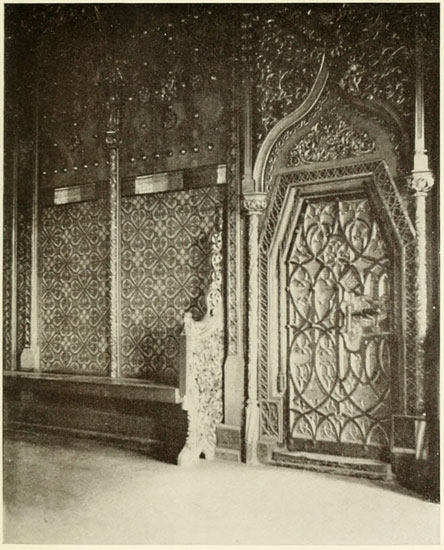
ONE OF THE FINEST DOORS OF THE STATE APARTMENTS
IN THE FORTRESS, SALZBURG
REBUILDING THE CITY
During the period of which we speak the character
and appearance of the city was almost entirely changed.
The ancient mediæval buildings were pulled down, and
replaced by magnificent palaces in which the nobility
and ecclesiastical dignitaries dwelt in splendour and ease.
Churches were erected in such numbers as to be almost
unequalled in any other city of similar size. Most of
these still remain, making Salzburg a place of spires and
domes and handsome churches strangely picturesque and
deeply interesting.
Seen either from the ridge of the Mönchsberg, the
Kapuzingerberg, or from the castle walls, especially at
sundown on a summer's evening, Salzburg presents a
picture of great beauty and colour, and one which is not
easily forgotten.
As was not unnatural with the secularization of the
power ruling the Province the capital suffered heavily.
For a time both its prosperity and its intellectual life
underwent eclipse. For almost half a century its energies
seemed to lie dormant, and it was only when the line
connecting Munich with Vienna by way of Salzburg
was constructed in 1860 that it woke once more to take
an important place amongst the towns of north-western
Austria. From that period till to-day the place has made
steady progress.
Till the middle of the last century the city occupied a
comparatively restricted area within the old walls. And as
a direct consequence of the numerous churches, convents,
and other ecclesiastical buildings occupying a great deal
of the space available the townsfolk were compelled to
crowd their dwellings together, and to build the many
storied houses which one finds in the older portion of the
town in the neighbourhood of the Herrngasse, Sigmund-Haffnergasse,
and Getreidegasse. It is in these narrow
and gloomy—though undoubtedly picturesque—streets,
in the architecture of which one can in many instances
trace Italian influence, that the great part of the population
dwelt, and much of the trade of the town was
done.
With more modern ideas the distaste for such confinement
among the more ambitious and well-to-do of the
commercial and artisan classes became manifest, and
when at length the old walls were in places pulled down
a new suburb arose on the other side of the river—as
it did at Innsbruck—in the neighbourhood of the railway
station, possessing wide modern streets, finer shops, and
palatial villa residences, and also smaller houses for the
occupation of the working-class community.
In this portion of the town one finds not only some
of the best hotels, but the Kurhaus with its pleasant
gardens (closely adjoining the Mirabell Garden), the
fine Theatre, and the imposing church of St. Andreas
in the Gothic style. Opposite the railway station, set
in a recess of foliage in the garden adjoining the Hôtel
de l'Europe, is the famous statue of the Kaiserin Elizabeth,
a pilgrimage shrine for most visitors to the town. The
statue itself has been described as "simple but beautiful."
To us it has always seemed by no means an adequate
or even very skilful representation of a beautiful and
queenly personality. The pose is not particularly happy,
and the whole has to our mind a "doll-like" effect.
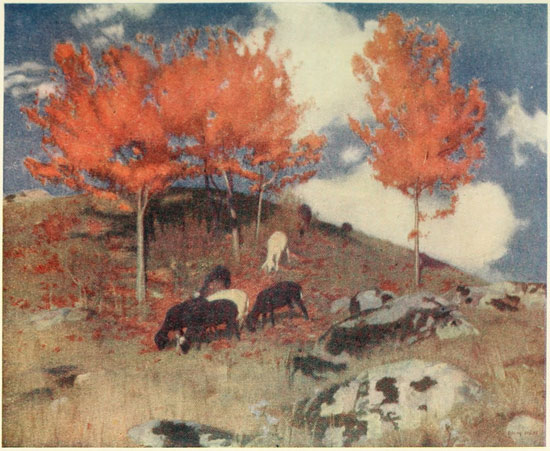
A QUIET PASTURE
As time went by Salzburg reclaimed much ground
from the rocky bed of the swiftly flowing river by confining
the stream within more restricted limits. In former
times, when the town was enclosed with walls, there was
no such necessity, and the Salzach took its own course,
encroaching much upon the lower-lying land along its
banks. But nowadays on this reclaimed ground shady
avenues of trees have been planted, which give a charming
and distinctive character to this part of the city.
Here, too, are some fine villas, where not so very many
years ago was waste or wooded land, set amid trees and
made pleasant by beautiful gardens, in which there seems
to bloom a profusion of flowers all the year round.
The position and future prosperity of the town as a
tourist resort was assured when Salzburg became the
starting-point of a second main line of railway leading
to Innsbruck via Kitzbühel, and the picturesque Unter-Inn
Thal, and the centre of a number of branch lines.
It is through these modern developments that the
life of Salzburg has so materially changed even within
the memory of those who first visited it but, comparatively
speaking, a few years ago. From a town of ecclesiastical
and almost mediæval aloofness from the outside world,
and from one which had for a considerable period seen
its growth arrested and its life stagnant, it has sprung
into being as a favourite summer and winter resort not
merely for tourists, but also for those to whom the older
portion of the town, its many historic buildings, castle,
and fine churches, proves attractive.
SALZBURG'S ANCIENT FORTRESS
The most prominent of all buildings in Salzburg, and
the one which has for most visitors the greatest attraction,
is the fine old fortress of Hohen-Salzburg set high above
the older town upon a tree-enshrouded and rocky spur
of the Mönchsberg.
The ancient fortress, which has witnessed so many
stirring events within its walls, and from which past
generations of inhabitants have looked down upon almost
equally dramatic and stirring doings in the town below,
that throughout the ages defied capture, and at last
came to be looked upon as impregnable, was founded
nearly eight and a half centuries ago by Archbishop
Gebhard.
As the centuries went by many additions were made
to the original buildings, and the present castle dates in
its chief portions from the last few years of the fifteenth
and the first few years of the sixteenth centuries. These
additions were principally the work of Leonard von
Keutschach, Archbishop of Salzburg at the close of the
Middle Ages. He was one of the great "building" archbishops
to whose energies and enterprise the town at
various periods owed so much. Of peasant origin he
was not ashamed of his humble birth, and, being gifted
with a sense of humour, chose a turnip as his armorial
bearings. So frequently, indeed, are representations of
this vegetable met with on escutcheons in various parts
of the town, that the remark of one traveller who
observed that "the Salzburgers appear to have sprung
out of the earth" may be held excused.
Severe looking as is the fine old fortress (now given
over to the uses of barracks), in whose courtyards princes,
archbishops, nobles, and many famous men of the past
centuries have walked, it was, however, not merely a
strong bulwark of defence, truly "ein feste burg" dominating
the town and plain, but also a palace. Although
the castle has been stripped of much of its magnificence
there happily still remain traces of it in the so-called
Fürstenzimmer (state apartments), which formerly occupied
by the rulers of the Province were furnished and
decorated with all the splendour which marked the most
lavish period of Renaissance influence. Chief amongst
the relics of the latter are the beautiful and delicately
carved panelling, the gilt work, and the richly carved
and moulded ceilings of the principal apartments. In
wandering through these now almost deserted rooms
one is tempted to conjure up the scenes of magnificence
they must have witnessed. Tragedy, comedy, chivalry,
hate, joy, sorrow, success, and failure, all, the often lurid
though magnificent gamut of life in the Middle Ages,
must have been welded into the very fabric and atmosphere
of this impressive and deeply interesting building.
Among the chief relics of bygone splendour and pomp
of circumstance there remains the beautiful and it is said
unique Majolica stove, a truly wonderful example of Gothic
ceramic art.
There are many interesting and quaint corners within
the triple line of walls, which shut off access to the castle
and proved so useful on many an occasion in former
times, united with the fortifications of the Mönchsberg
known as the Burgerwehr; but few excel in picturesqueness
the old courtyard with its shady and famous Linden
tree, ancient well, and time-worn walls. Here, as one
lingers, towards sundown one sometimes hears the sweet-toned
though halting notes of the organ within the tower
playing some familiar hymn tune. The trembling notes,
like those of an old singer whose voice has become feeble
but has retained much of its sweetness, float out upon the
still evening air with a mystic appeal which few that
have heard them can, we think, have failed to have felt.
For ourselves it is one of the lasting and unforgettable
memories of Salzburg as well as of its castle.
Nowadays the cable railway takes one to the summit
in a few minutes, and one is spared the fatigue of the
long climb up by the Nonnberg. The old Reckturm, in
the dungeons of which unlucky prisoners were confined,
and in the tower itself the terrible instruments of torture
were kept and the torture chamber was situated, nowadays
has a much more pleasant office to fulfil as an excellent
"look out" place from which to view the widely extended
prospect of the town and Salzach valley towards the
north.
HOHEN-SALZBURG'S SIEGES
Many an assault was made during the Middle Ages
and succeeding eras upon the old grey fortress, seldom
resulting in anything save disaster or disappointment for
the attacking force. Even the peasants, who, during the
terrible rebellion of 1525, made repeated attacks upon the
castle with the utmost fury and determination, failed to
accomplish their object of capturing the stronghold,
Matthew Land, the then Archbishop, and the high
ecclesiastics who had taken refuge within its unscalable
walls, to whom short shrift would have been given by
the peasant leaders. For ages the Church had trodden
the peasantry under foot, and in the Peasants' Rebellion
there were terrible reprisals. But although the insurgents
came near capturing Hohen-Salzburg they did not succeed.
Their appliances were too primitive for successful assault,
and their shots did little or no damage to the strong
thick walls or buildings. On a marble column in the
castle are to be seen the marks left by a cannon ball,
which was one of the few that succeeded in entering the
castle, and in this case it was through a window! A
century later, during the Thirty Years' War of 1618-1648
which devastated the whole of the then German Empire,
waged between the Evangelic Union under the Elector
Palatine and the Catholics led by Maximilian the Great
Duke of Bavaria, Salzburg, doubtless on account of the
fact that its fortress was esteemed impregnable, was one
of the few places left at peace and unmolested. We have
already mentioned the fact that the Archbishops were
not only exceedingly powerful ecclesiastics but also great
diplomatists, and there is little doubt but that to their
clever policy must also be attributed the town's immunity
from attack during that troublous and universally disturbed
period.
Of the many distinguished ecclesiastics who have
occupied the See of Salzburg as its Archbishops, the most
interesting and perhaps the most important were two,
separated one from the other by but a few years. One
was Wolf Dietrich von Raitenau (1587-1611?) and the
other Paris von Lodron.
BUILDERS OF RENOWN
Archbishop Wolf Dietrich von Raitenau, from having
received his education in Rome, then the centre of Art and
culture, came to Salzburg steeped not alone in the traditions
of Italian Art but anxious to impress upon the town his
knowledge and taste. He found an old Roman and neither
handsome nor picturesque Cathedral, dating from the
eighth century, in place of churches such as he had been
accustomed to in Italy, ornate and beautiful. He is
reputed to have been at no pains to conceal his distaste for
the building, and when a few years before his death it was
destroyed during one of the destructive fires, there were
those who even accused the Archbishop of having himself
set the church on fire, or at least of having instigated
others to do so. But there is little truth in this story,
though the Archbishop's satisfaction at the destruction
of the ancient, inconvenient, and unornamental structure
seems beyond question. That he fully intended to erect
upon the site one of the finest churches north of the
Italian frontier there is little doubt, but, alas! for human
aims, he was not destined even to see the foundations
laid.
To him, notwithstanding his despotic character, his
restless disposition, his shameful intrigue with the beautiful
Salome Alt, the city of Salzburg owes a great deal, for
he did much to transform an unpicturesque and dirty town
with narrow mediæval streets into one of the finest cities of
Germany. Many of the beautiful buildings, including the
Gabriel Chapel, the Chapter House, the Neubau, and the
arcades of the Sebastian Cemetery, owed their existence to
his artistic taste and desire for improvement.
It was to Paris von Lodron, the founder of the University
which was dissolved in 1810 during the Bavarian
occupation, his second successor, fell the task as well as the
honour of giving to Salzburg a Cathedral worthy of it and
of its long line of famous Archbishops and many historical
memories. The original plan, which historians tell us
would have resulted in a church of such magnificence that
it would have been almost unrivalled by that of any in
Europe, had to be considerably modified for several
reasons, chief amongst which were considerations of cost
and space. The former was rendered obligatory from the
heavy expense entailed in keeping up the fortifications
of the city during the time (the Thirty Years' War) the
Cathedral was in course of construction. However, notwithstanding
these circumstances, Paris von Lodron's work,
which occupies a splendid position in the midst of three
large squares, was designed chiefly by an Italian architect
named Santino Solari (possibly from plans by Scamozzi
of Florence), assisted by others in the late Renaissance
style, is one of the most magnificent churches in Austria,
although the stucco ornamentation is of a rather florid
character. From the exterior, which is rather plain and
severe, although it possesses a fine façade built of Unterberg
marble, it is impossible to gain any conception of the charm
and even splendour of the building. But immediately
upon entering it, one is impressed with its beautiful proportions,
and the resemblance to a marked degree in the
general plan to that of St. Peter's, Rome. Indeed, there
is little doubt as to the source from which Solari drew
much of his inspiration, although due credit must be given
to him for original details, the proportions, and general
beauty of effect.
The treasury of the church is worth seeing, as it is rich
in relics of bygone ages, including an exquisite seventeenth-century
monstrance encrusted with 1800 precious stones,
rich vestments, and a fine crozier set with gems; and
none should miss the interesting fourteenth-century bronze
Romanesque font which stands in one of the side chapels
to the left of the entrance.
In its Cathedral Salzburg possesses a gem of architectural
beauty which has been the admiration of generations
of architects and students, and (as one authority
says) "has probably provided more inspiration for the
artist and the student of architecture than any other church
north of the Italian Alps."
On the Residenz-Platz, the centre of which is adorned
by a beautiful fountain nearly fifty feet in height dating
from the latter part of the seventeenth century, consisting
of a colossal figure of Atlas surrounded by equally colossal
hippopotami, the work of Anton Dario, is situated the
ancient palace of the Archbishops, formerly known as the
Residenz, now the Imperial Residence. This fine palace
which was erected at various dates from the end of the
sixteenth down to the first two decades of the eighteenth
century contains many traces of the splendour which
characterized the larger buildings which were erected by
ecclesiastics at the time the influence of the Renaissance
was at its height. The ceilings and wall of the principal
salons and halls are especially notable, and in some cases
are most elaborately decorated. The Government Offices
which are opposite the Residenz although known as the
Neugebäude (possibly because they included the Post and
Telegraph office), in reality date, at any rate in part, from
the reign of Archbishop Wolf Dietrich von Raitenau,
although they have been modernized, altered, and added
to from time to time. In the octagonal tower was placed,
in the beginning of the eighteenth century, a beautiful
carillon, the work of a watchmaker named Sauter at the
commencement of the seventeenth century, known as the
Glockenspiel, which chimes thrice daily at 7 a.m., 11 a.m.,
and 6 p.m.
The Archbishops of Salzburg were not only in past
ages ecclesiastics and diplomatists but also sportsmen.
Most, indeed, seem to have been great lovers of horses.
Wolf Dietrich von Raitenau, Salzburg, built some magnificent
stables adorned with marble on the slopes of the
Mönchsberg; attached to them were a covered riding
school for use in winter, and another open-air one for
summer use. Though the stables themselves are now
barracks, the open-air school is still one of the sights of
the town. In the side of the Mönchsberg were hewn in
1693 three great galleries for the accommodation of
spectators of the sports in the summer riding school;
they have long ago been overgrown with ivy and creepers
which add greatly to their picturesqueness, but are still
occasionally used for the purpose for which they were
originally constructed.
In the winter riding school there is an interesting
ceiling fresco depicting a joust or tournament dating from
the last decade of the seventeenth century.
Several of the Archbishops of Salzburg appear to
have had a liking for rock excavations, and the Archbishop
Sigismund von Schrattenbach was one of the number. In
the latter half of the eighteenth century, in 1767 to be
precise, he constructed the Neuthor, a tunnel through the
solid rock some four hundred and fifty feet in length,
which it took two years to make. It pierced through the
Mönchsberg and thus united the suburb of Riedenberg
with the rest of the town. At the Riedenberg end is a
statue to St. Sigismund in commemoration of the Archbishop,
who placed his own medallion at the town end of
the tunnel with the Latin inscription "Te saxa loquntur"
(The very stones praise thee) above it.
THE SCHLOSS MIRABELL
To the Archbishop Wolf Dietrich von Raitenau, or
rather to his passion for the beautiful daughter of a Salzburg
merchant whose name was perhaps not inappropriately
Salome, the charming Schloss Mirabell chiefly owes
its existence. Here (so the story goes) the beautiful
Salome Alt was installed as mistress, amid splendour and
lavish expenditure befitting a King's favourite. For her
were constructed and laid out delightful gardens, with fine
terraces, shady walks, wide lawns of exquisitely "velvety"
turf, the like of which we have seldom seen even in the
"grass" counties of England; quaintly shaped flower-beds,
fountains and ponds, mazes and avenues of fine trees.
For her, too, were numerous groups of statuary, and single
figures of a mythological and artistic character installed.
Some of these are of considerable merit; and few are
without distinctive decorative value in the surroundings
amid which they have been placed.
In the gardens themselves there is a constant succession
of delightful flowers all the year round. On the
occasion of our last visit the sweetly scented linden avenue
was in full bloom, whilst roses were in profusion—we were
told they bloom almost all the year round in this favoured
and beautiful spot—and the jasmine, orange trees, and
many other beautiful and homely flowers perfumed the
summer air, and spread out in a riot of colour on every
hand. Aloes, palms, Portugal laurels, daphne, and other
shrubs afford relief to the eye, and in the background,
towering high above the quietude of this old-fashioned
garden, looms the vast and commanding Hohen-Salzburg,
with its roofs and pinnacles shimmering and glancing in
the sunshine of the upper air.
In the gardens are also the interesting aviary of the
Salzburg Society for the Protection of Birds, and the
former Summer Theatre near the French Garden with
the grassy stage and wings formed of "trimly" clipped
hedges.
The mansion itself suffered severely from a fire in 1818,
but the Marble Hall and staircase which escaped are well
worth seeing, as are also the decorations of several of the
older rooms.
THE ENVIRONS OF SALZBURG—HELLBRUNN,
ITS UNIQUE FOUNTAINS AND GARDENS—THE
CASTLE OF ANIF—THE GAISBERG—THE
KAPUZINGERBERG—THE MOZART-HÄUSCHEN—THE
MÖNCHSBERG—SALZBURG
CHURCHES
In the neighbourhood of Salzburg there are several
beautiful castles erected by various holders of the
See. Amongst them the charmingly situated
Leopoldskron, lying to the south of the Mönchsberg, overlooking
a lake covered in early summer with a profusion
of water lilies and other water plants, and embracing a
magnificent prospect of the environing mountains. The
drive to Leopoldskron is one not to be missed. As one
passes along the magnificent avenue, or allée, of trees,
through flower-bedecked fields, and with the fresh air
from off the river and mountains perfumed by the carpet
of blossoms which lies stretched on either side of the road,
one is able to realize to the full the rural charm which
surrounds the historic and busy town just left behind.
HELLBRUNN AND ITS FOUNTAINS
But a little distance further, on the other side of the
Salzach, is Hellbrunn, once an Archiepiscopal and now
an Imperial possession. It is surrounded by a large deer
park, and owes its origin to the Archbishop Marcus
Sittich in 1613. It is pleasantly situated, and was,
according to tradition, the retreat and pleasure palace of
its founder, who was of a far more social and lively
disposition than Archbishops, even in that somewhat lax
age, were supposed to be, and here he installed his
favourites. In the chateau itself there are some fine
state apartments, in one of which are some interesting
frescoes by Mascagni, Franz von Sienna, and Solari the
younger.
But the gardens and unique fountains and "waterworks,"
which are laid out and planned in the style so
popular during the seventeenth and eighteenth centuries,
are the great attractions of Hellbrunn, not only to the
foreign visitors, but on Sundays especially to the Salzburg
folk, and those of the neighbouring villages who flock in
thousands to the chateau. In the gardens of Hellbrunn
one finds the same velvety turf that so generally distinguishes
those of other castles in this fertile valley of the
Salzach; whilst in the ponds, lakes, fountains, and "trick"
waterworks—invented by the Archbishop, so it is said, to
amuse his favourites during his enforced absences upon his
ecclesiastical duties and affairs of State—one has something
quite out of the ordinary.
Indeed, probably in no other garden in the world do
unsuspecting visitors run such risks of a soaking or
impromptu shower baths as at Hellbrunn. Jets start
suddenly (at the turn of secret taps by the custodian, who
seems to take a cynical delight, bred of many experiences,
in the visitor's discomfiture) from rockeries, from the
corners of plaster columns, from the mouths, finger-tips
and eyes of statues, from the foliage of trees, from roofs of
grottoes, from the edges of the very paths along which
one is unsuspectingly walking, from, it appears, the very
ground beneath one's feet. One is lured into a grotto to
admire a statue or to "see something" which may or may
not actually exist, only a moment later to find one's exit
blocked by a curtain of water, which pours down from
the outside rocks above the entrance. This lifts and one
makes a dash for liberty, only to be assailed by jets of
water converging or spurting across the path one has to
follow. Visitors seat themselves upon a marble bench a
few moments later, and a whole battery of jets plays upon
the unfortunate sitters, or are so arranged that, whilst not
actually playing upon them, to escape without "running
the gauntlet," for the amusement of the more discreet
or knowing onlookers, is impossible. On fine Sundays
when there is usually a great crowd of visitors at this
favourite out-of-town resort, which boasts of an excellent
restaurant, there is, of course, plenty of fun when the jets
begin to play for the lucky folk who have "been there
before."
Along one path leading from the chateau to the lawns
and fish-ponds, the latter of which are crowded with huge
carp and other fish, some of which are reputed to be as
old as Hellbrunn itself, there are set in niches a number of
figures, blacksmiths, armourers, millers, and the like with
their anvils, forges, and mills worked by a tiny runlet of
water. And not far from these is the famous mechanical
Theatre, also worked by water power, with its organ, and
some hundred and fifty figures in sixteenth- and seventeenth-century
costumes, which give quaint performances,
depicting a busy town, dancers (these latter very amusing
with their pirouettes and posturings), soldiers, fighting,
jousts, etc. Of the water grottoes that known as the
Neptune—with, it is said, five thousand jets—is the largest,
and there are also the Rainbow, Fairy, and Orpheus
grottoes, each one bringing into play some fresh piece of
mechanical or other ingenuity.
In the deer park is situated the famous Monatsschlösschen
upon a wooded knoll, from which a fine view is
obtainable. This building was erected (some say for a
bet) within a month's time by Archbishop Marcus Sittich.
There was at the time a popular belief that he was assisted
in the accomplishment of what was, at all events in those
days, a wonderful feat by Satan himself.
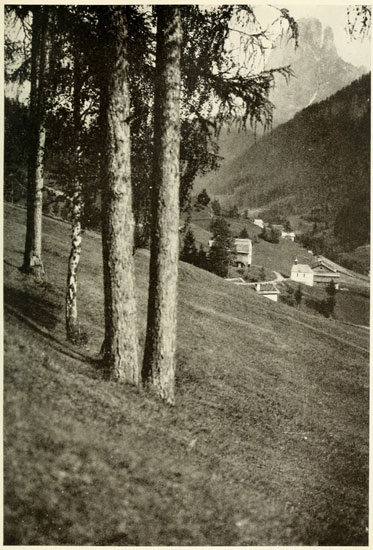
MOUNTAIN PASTURES
The Stone Theatre near by is also worth seeing. It
has a naturally formed stage and auditorium, upon the
former of which in ancient times pastoral and other plays
were performed for the amusement of the Archbishops
and their friends.
ANIF AND THE GAISBERG
The Castle of Anif, which is reached by a pleasant
road from Hellbrunn in about twenty minutes, is well
worth a visit. It is a most charming chateau dating
originally from the second decade of the thirteenth
century, of late years restored in Gothic style by the
owner, one of the Counts Arco-Steppberg. It is built
in the centre of a lake, and is surrounded by a well-wooded
and beautiful park, and is of great interest as
a well-preserved survival of the fortified domestic architecture
of other days. It is beautifully furnished, and
contains many finely decorated rooms, and a valuable
art collection.
The return to Salzburg through the fields at sunset
is a delightful experience. To the back and to the left
of one are the towering mountain summits tinged with
the Alpine glow which turns their rocky peaks almost
blood red, and their snow-fields a deep rose pink. And
right ahead stands up, mystic-looking as some fairy
fortress in the waning light, Hohen-Salzburg, its roofs
and walls reddened and given the tints of nacre, and
its windows shining like the open doors of furnaces. A
never-to-be-forgotten picture.
Both the Gaisberg, up which there is now a funicular
railway, and at whose foot Aigen, with its interesting
Church and Castle acquired by the family of Prince
Schwarzenberg in 1804, lies, and the Kapuzingerberg
should be visited by all who have the time, and for
whom a wide and pleasant prospect of mountain ranges,
valleys, and the Salzach, threading its silvery way
dividing the city and flowing northward and southward
through the valley, has attractions.
The Gaisberg is ascended from the little village of
Parsch, reached by tram from the city. The railway
takes one through beautiful scenery in about an hour
to the summit of the mountain, which is so favourite an
excursion with the well-to-do Salzburgers, and from
which such a beautiful prospect is spread out at one's
feet. To the north one can catch glimpses of the
undulating foreground of the Alps and shining lakes;
whilst Salzburg now more than 4000 feet below looks
almost insignificant, and like a toy town set in the
midst of a green plain through which winds a thin,
silver line, the Salzach. In the far distance is the
magnificent range of the Alps, in which stand the
Watzmann, 9050 feet; the Dachstein, 9990 feet, with
its rocky pinnacles catching the sunshine, and its glaciers
and snow-fields gleaming white, whilst in the further
distance through the deep-cut gap formed by the Lueg
Pass one sees the fields of eternal snow on the Hohen
Tauern glinting at one, and on a quite clear day one
can catch glimpses of the white peaks of the Grossglockner,
12,660 feet and the Wiesbachhorn, 11,900
feet, across the desolate-looking Steinerne Meer. The
prospect has been compared, but somewhat loosely we
think, to that from the Rigi. But, whether we think it
finer or less fine, we can agree that in one respect the
view and interest of the scene is not exceeded by its
Swiss rival—the wonderful changes of light and shade
which come and go over the landscape between the
hours of sunrise and sunset, during which Nature seems
to work with a brush full of the most delicate colours
and uses them as no human artist could hope to do.
From the Kapuzingerberg, which is only half the
height of the Gaisberg, the view is not so extensive, but
it is well worth climbing to see. On the way up one
obtains most beautiful peeps of the city from two distinct
points; whilst from the summit one gets a panorama
which will satisfy all save those who have made the Gaisberg
ascent first. The way up is, after a long flight of steps
about two hundred in number, through a most delightful
beech wood, where one is tempted often to stop to
rest or to admire some vista of the valley or town seen
through a framework of feathery, green branches. There
are, too, on the Kapuzingerberg several interesting
buildings. The first to be reached is the Church of
the Capuchin Monastery built in the last year of the
sixteenth century by Archbishop Wolf Dietrich. A
beautiful old garden is attached to the Monastery, from
which one has a fine prospect of the town and surroundings.
Alas! it is only open to men, and thus by
monkish custom women are shut out of one more
"earthly paradise."
THE MOZART MEMORIAL
But to music lovers and many others who ascend
the Kapuzingerberg the Mozart-Häuschen, situated in a
charming little garden near the Monastery, will be the
chief object of interest. This memorial to the master
was presented to the city by Prince Camillo zu Starhemberg,
and was completed in June, 1877, being thrown open
to the public six weeks later, on July 18th, on the occasion
of the first musical festival. This cottage, which formerly
stood in the courtyard of the so-called old "Freihaus"
in Vienna, has an added interest from the fact that in it
was composed the opera "Die Zauberflöte."
The furniture, it should be noted, is not the original
but a clever and exact copy of the articles comprising
it. The former is in the collection of Prince Starhemberg.
The top step of the cottage is, however, said to
be "veritable." In the cottage are kept a great number
of wreaths with ribbon streamers, embroideries, etc.,
which have been sent by admirers of Mozart's genius.
Also some beautiful tablets of embossed metal commemorating
the first musical festival held in 1877.
There is also hung in the cottage the picture "Mozart
at the Spinet" by the Italian artist Romaco, a photograph
of the only portrait of the composer painted from
life which is known to exist, which was the work of
Doris Stock of Dresden in 1787; and the pictures of
the various performers in the operas given at Cassel.
The bust, which stands outside the cottage, is the work
of the well-known sculptor Edmund Hellmer, of Vienna,
and was the gift of Baron Schwarz.
As one stands in the garden, with its pleasant
prospect, quietude, and beautiful flowers, one cannot
but feel that few more suitable spots could have been
selected for a memorial to a musical genius of Mozart's
nature. Far better is it, indeed, than some more
pretentious place nearer the haunts of men.
ON THE MÖNCHSBERG
The Mönchsberg and a walk along its ridge should
not be missed by any one who has a little time to spare
whilst at Salzburg. The explorer will be well rewarded
for his toil. One is apt to estimate the Mönchsberg by
its Hohen-Salzburg end, which so dominates the city. It
is difficult, indeed, from down below in the narrow streets
to believe that some 300 feet above one lie not only
woods and tree-shaded walks, but even green, flower-bedecked
fields. The most direct and interesting way
up the Mönchsberg is by the Sigmund Haffnergasse
and Hofstallgasse bearing to the left of the Fischbrunnen,
and thence over the Mönchsbergstiege. On reaching the
top of the flight of steps the way lies in the direction of
Hohen-Salzburg as far as the passage leading into the
Nonnthal and to Leopoldskron, then one climbs to the
left, and after a little distance reaches the beautiful view
point known as Konig Ludwig-Fernsicht, or King Ludvig's
Lookout.
The prospect from here is wonderfully wide and
beautiful, embracing as it does the villas on the other
side of the town, and the villages and farms of the valley
with their picturesque background of mountain ranges,
including nearer in the Göll and Untersberg.
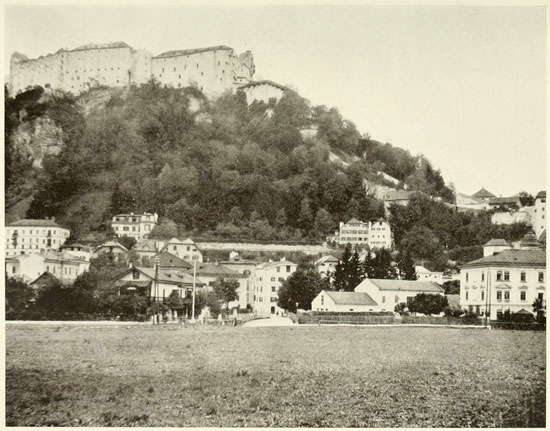
HOHEN-SALZBURG AND THE NONNBERG
To the left and on the way along the ridge to the
fortress is situated the beautiful villa of the famous
singer Bianca Bianchi, and from the projecting bastion
in the same direction one obtains a fine view of the
town below, and valley of the Salzach. Both in the
direction of Mülln to the right, and of Hohen-Salzburg
to the left, there are many fine views as one takes one's
way either by shaded paths or through the fields which
lead to the Bürgerwehrsöller, where there is an ancient
watch-tower on the slope of the hill from whence one
has a wonderful panoramic view of the city and its
environs. From the opposite end of the rampart one
obtains a widely extended prospect towards Reichenhall,
Marzoll, Maxglan, and the Bavarian plain, which is not
easily surpassed from the neighbourhood of any other
town of the size in western Austria.
One can then either descend to the Marketenderschlössl
through the beautiful woods by one of the
well-kept paths, and thence reach Mülln, or retrace one's
steps, and walk right along to the Hohen-Salzburg end of
the Mönchsberg, from whence by entering the fortress and
descending by way of the Nonnberg one obtains a fine
view of the other portion of the Salzach valley in the
direction of the Gaisberg, Hellbrunn, and Anif.
On the Nonnberg, so called from the Benedictine
Convent built upon it, stands the fine Gothic Chapel
founded in the first year of the eleventh century and
beautifully restored in the fifteenth. In it is much fine
stained glass, a winged altar piece of great interest; and
there are also some interesting frescoes in the old tower.
Unfortunately the cloisters are seldom if ever shown to
visitors; they are the oldest now existent in the principality,
and it is said even in the Austrian empire, dating
as they do from the commencement of the eleventh
century. They are charming and picturesque, and well
worth the trouble which it is generally necessary to take
in order to obtain permission to see them.
In Salzburg there is such a wealth of interesting
buildings and places that to describe all one has seen or
can see there is no space. Perhaps of those remaining to
which reference has not yet been made, most people visit
the house in which Mozart was born, situated in the
narrow, picturesque old Getreidegasse; the Franciscan,
formerly the Parish Church; the Church of St. Peter, with
its ancient and picturesque burial-ground beneath the
shadow of the towering fern- and flower-clothed Mönchsberg,
and the Caroline Augustus Museum. There are,
of course, also the Dreifaltigkeits Kirche, with fine frescoes
and carvings, and the University Church, both worth a visit.
To Mozart's birthplace, along the quaint and narrow
Getreidegasse with its beautiful old signs of wrought-iron
work projecting from the shop fronts on either hand, come
hundreds of English and American visitors annually.
Now the house is also a Mozart Museum, with much of
interest for admirers of the composer, antiquarians and
students. In the birth-chamber itself one finds a most
valuable series of family portraits, including some of
Mozart's wife, Constance Weber; also those of his landlord
and his wife, Lorenz Johann and Maria Theresa
Hagenauer. There are also the "scores" of many of his
operas, and other compositions, records of the Mozart
family; and perhaps most interesting of all the small
clavichord or spinet, and the grand piano or reiseclavier,
which was a present from his brother Karl, on which he
used to play.
In the family sitting-room there are many interesting
relics of the composer's father, mother, and other relatives,
including Mozart's own pocket-book-diary, a large number
of fragments of compositions, which from one cause or
another were destined never to be completed, many letters
of the family, copies of Mozart's three first published
pieces printed in Paris, and several pictures of the house
in the Rauhensteingasse, Vienna, where the composer for
some years lived and ultimately, on January 5, 1791, died.
Salzburg has well-honoured her famous son's memory by
the several memorials of him within her gates, including
the fine though simply conceived bronze statue in the
Mozart-Platz which cost nearly £2000, and was erected
by voluntary subscriptions in 1842. By the foundation of
the Mozarteum or "Society for the Cultivation of Mozart,"
not only is the memory of the great composer kept green,
but the support of the School of Music of the same name
is ensured. Thus the city of his birth, which did him (as is
so frequently the case) but little honour during his lifetime,
has nowadays become the centre of enthusiasm for
his works. Festivals of his music take place during the
summer months, at which not only the famous and
beautiful Viennese Philharmonic Orchestra takes part, but
also the most celebrated conductors and artistes.
Although Salzburg had been the residence of other
famous musicians and composers, it is Mozart and his
genius which dominates the ancient city's musical life, and
proves so attractive an element to musicians and music
lovers who visit it.
SALZBURG MUSICIANS
Michael Haydn, too, composer of much fine church
music, was a resident in Salzburg and has a rather
commonplace monument erected to his memory in St.
Peter's Church. The latter is in the Romanesque style,
founded in the middle of the twelfth century, and badly
restored in the middle of the eighteenth, and is of great
interest to the antiquarian and student of architecture.
The portal consists of seven arches which gradually
diminish in size, and are inlaid with strips of white and
red marble. The very remarkable archings which strike
one directly one has entered the building are portions of
the original church. On a small altar near the vestry is a
well-carved statue of the Virgin, said to be the work of
one of the Archbishops, of about the end of the twelfth
century, although there appears little real evidence in
support of the suggestion.
The frescoes in the nave, representing scenes from
the Crucifixion, painted in the sixteenth and seventeenth
centuries, are worth study. In Salzburg considerable
store is set upon the monuments in the church, but few
rank high as works of art, although marking the graves or
being memorials of distinguished and historic persons
connected with the city's life in the past.
The beautiful though ruinous cemetery of St. Peter,
which, with its crumbling tombs of the great dead,
interesting and quaint mural tablets, and arcaded vaults
belonging to some of the most important and famous
Salzburg families, lies at the foot of the Mönchsberg, is,
as well as the most picturesque, the oldest cemetery in
Salzburg. It is difficult to exaggerate the interest and
charm of the spot; always still, although set in the midst
of a city, and within a few hundred yards of the principal
and busiest thoroughfares. That it possesses a wonderful
and mysterious attraction for tourists we can testify; and,
indeed, we would almost go as far as to say that one
meets more English and American visitors in this peaceful
corner of the city than in any other spot on the southern
side of the Salzach.
The celebrated Monastery of St. Peter, founded by St.
Rupertus in (about) 582, was, until the first decade of the
twelfth century, the residence of the bishops and archbishops
of the diocese. The present building was erected
during the reign of Archbishop Max Gandolph during the
period covered by the years 1661-1674. It can be visited,
and the library is full of the most interesting and valuable
MSS., early copper plate engravings, and consists of about
45,000 volumes and some 250 illuminated and other MSS.,
chiefly upon parchment. Several of the latter and some
of the early printed books are practically priceless. The
Librarian is always delighted to exhibit the treasures
under his charge, and in him we found (as doubtless will
all intelligent bibliophiles) a kindred spirit, and a most
interesting cicerone.
THE MUSEUM
It is almost impossible in Salzburg, especially if one
would really know something of the past life of the
principality, and the city, to follow that excellent rule of
avoiding museums. In the Salzburg Carolino-Augusteum
Museum one finds so much that brings vividly before one
other times and other customs. Although started but three-quarters
of a century ago the Museum has already become
a repository of the deepest interest, much frequented by
students of all types, the antiquarian and the man of
science. It was due to the initiative of Vicenza Maria
Süss, one of the leading town officials at the period of its
foundation in 1834. The work which he began was well
continued and supplemented by that of Jost Schiffmann,
the well-known Swiss painter, and an enthusiastic committee,
largely to whose credit must be placed the
excellent arrangement of the art and other sections of the
collection.
One of the most interesting and unique features of
the Museum is the suite of rooms furnished accurately
and entirely in the style of the sixteenth and seventeenth
centuries; of these one of the most charming is the
"Hunting Room" with its fine oak presses, pretty
recessed window, and trophies of the chase. In the
Hall of Antiquities are many interesting relics of the
Roman occupation of the country, and also in the Lapidarium.
A most excellent idea took shape in the Hall
of Industry, where are collected together many excellent
specimens of various "masterworks" of iron, woodcarving,
etc.
The Music Room contains some of the most valuable
musical instruments of the last three centuries, including
spinets, violins, and others, some of these priceless. In
the Armoury are relics of deep interest of the terrible
Peasants' War, including wooden cannon, crude swords
beaten from scythes, executioners' swords, curious and
cumbersome firearms, and some of the lances used by
the Landsknechte.
The Costume Room has many attractions for lady
visitors, who linger not only to admire the fashions of
the past, but to inspect the embroideries which came from
the industrious and skilful fingers of past generations of
women, "old" with the dignity, grace, and charm which
the "new" woman so sadly lacks.
On the same floor are the interesting Mediæval
Kitchen, with its ancient and carefully kept copper
and other utensils glinting at one from their hooks in
the half-gloom of the recesses; the Ladies' Chamber,
with its charming oriel, stained-glass window, colour
of life of the period, and air of repose; the study, to
show one the environment old-time students loved;
a fine state-room; and a beautiful Renaissance Hall.
After these vivid reconstructions of the past one
passes somewhat regretfully to the higher floor and
prehistoric things. The priceless Celtic helmet, found
in the Pass of Lueg, interesting though it is, seems
"lifeless" in comparison with what one has just seen;
as do somehow Roman statues and arms, and similar
objects. And one needs the beautiful and richly
ornamented panelling, oriels, and similar objects of
the final room to bring back colour into things.
To visit and study this deeply interesting collection
leaves one with a very good idea of the evolution of
culture, science, and art during the last five centuries
of the principality's history, one's knowledge of native
art being easily further extended by a visit to the
Kunstlerhaus near the Karolinenbrucke. Salzburg has
produced at least one great artist in Hans Makart, who
by common consent is esteemed one of the most vivid
and brilliant colourists of his day.
In some of the villages near Salzburg, as also during
"fair" times and festival times in the city itself, one
is able to witness some of the quaint, picturesque, and
dramatic peasant dances for which the valley of the
Salzach has some reputation.
A PEASANTS' BALL
We were especially fortunate whilst recently there
in witnessing not only peasant dances such as we have
referred to, but also a peasant ball.
Amongst the dances specially notable was a variety
of "Gaillarde," and "Allemande," a type of the dance
known as "Siebensprung," where the male performers
make a series of seven different movements with hands,
elbows, knees, feet; and then almost touch the floor
with their foreheads whilst their female companions
pirouette around them. The "Allemande," with its
graceful twirling and twisting, and interlacing of the
arms, and graceful bending of the bodies of the dancers,
showing off the lines of the women's figures, is especially
picturesque.
Then came types of other and more local dances,
in one of which the women pirouetted round and round
the room until scarcely able to stand, their short skirts
gradually seeming to become inflated like balloons, and
ascending inch by inch until knee high, when suddenly
the dancers paused, their skirts fell, and with a sharp
twirl and swish the latter were wound around their lower
limbs in plastic folds.
Then there was a pretty dance commencing with a
figure of the "Allemande," and proceeding to a courtship
in pantomime, in which the women peered shyly
at their partners between the circle formed by the interlaced
arms, and ending by the men stooping, and whilst
continuing a waltz step, suddenly seizing their companions
round the knees and lifting them breast high,
all the while continuing to circle the room in a "springy"
rather than a gliding waltz.
Then followed a still more dramatic dance-play, in
which the whole story of a peasant courtship from
early days until the wedding was depicted in pantomime,
with half a dozen characters beside the happy pair.
Most of the performers were not only graceful and
finished dancers, but were possessed of distinct dramatic
gifts. The folk songs, accompanied upon rather weird
instruments consisting of shepherds' pipes, guitars, fiddles,
horns, and what, until it was put together, appeared to
be a collection of short pieces of gas pipe of various
lengths or strips of metal, were intensely interesting
and musical.
What struck us perhaps more than anything else,
save the actual dancing and singing, was the charming
manners of the women, and the perfect manners of the
men. Peasants though they were, there was a complete
absence of coarseness or roughness in general
behaviour, in place of which one had perhaps a rather
grave courtesy. And when at last it occurred to some
of the men that perhaps the "foreigners" might like to
dance, they approached the ladies of the party with
a striking grace and courtesy of manner. The Salzburg
girls, too, in their pretty costumes were just as gracious
and charming as English girls of the upper middle
class, when asked to favour some of the English men
of the party with a dance. The scene was made even
more kaleidoscopic in effect when at last the sombre
evening dress of the latter mingled with and formed
a foil to gay kerchiefs, snowy white bodices worn under
a type of bolero jacket of the women, and the green
and bright brown waistcoats and short knee breeches
of the men. Across some of the waistcoats, which were
many of them fastened with silver buttons, jangled quite
a collection of coins, exhibiting (so we were told) the
financial position of the wearer, so that any girl might
know what a suitor or possible suitor was worth! We
hope that no young man ever puts upon his waistcoat
a single silver krone piece more than he is entitled to.
But if very much in love to what deception of this kind
might he not stoop? And mercenary indeed must be
the maiden who would not in the end pardon his offence,
which was so warm a tribute to the power of her charms.
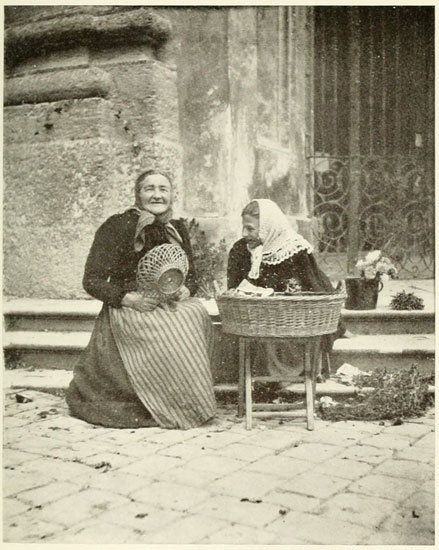
SALZBURG MARKETWOMEN
IN THE MARKET
Even nowadays a good deal of "costume" can at
times be found in the Market, which, surrounded by
old-time building and dominated by Hohen-Salzburg, is
very picturesque with its tiny stalls—some shaded by
huge umbrellas—and buxom market women in short
skirts, gay kerchiefs, and sometimes in types of the
peasant costumes prevailing in the immediate district.
As a general rule the market folk are good models both
for artists and amateur photographers, though some of
the younger women coquettishly pretend that they
object to be photographed, whilst all the while they
are desperately anxious to come into the picture.
To leave this fascinating old-world town, where so
much of the most beautiful in modern ideas stands side
by side with ancient things, without a visit to some of
the charming and interesting places in the immediate
district—lovely lakes rivalling the deep-blue sky above
them in the tint of their waters; peaceful valleys, where
pure air invigorates scented by passage through pinewoods
and across flower-decked Alpine pastures; wonderful
peaks covered with that eternal weight of glorious
snow, and bound about in some cases by the immemorial
fastnesses of environing glaciers—should be impossible.
Our only regret is that neither space nor the scope of
the present volume permits of some description of the
beauties which we have visited and which lie so close
at hand; indeed, almost within call of the beautiful
city set in a valley, and surrounded with majestic and
lofty mountains, the lower slopes of whose wilder peaks
are softened by pine forests, and fertile upper pastures.
SOME TOWNS AND VILLAGES OF SOUTH
TYROL—MERAN, BOZEN, KLAUSEN, BRIXEN,
SPINGES, STERZING, MATREI
MERAN
So many pens have described and praised Meran,
the ancient capital of Tyrol, that there must be
few adjectives of appreciation left unapplied to it.
Many poets have also sung of this beautifully situated
little town of some 8000 inhabitants which once played
so important a part in Tyrolese history, and nowadays
has developed into a fashionable health resort.
It has by turns been called "the Jewel of South
Tyrol," "Tyrol's sweet Paradise," and in one of the
visitor's books "A Paradise of God's making and man's
improving"! Artists love it, and therefore it goes without
saying that Meran is both beautiful and picturesque.
From whatever side one approaches the town, whether
by the more usual route from the West via Innsbruck,
and then by the little branch line of the Brenner railway
from Bozen; from the south through Verona; from the
north by way of Munich and Innsbruck,—one is at once
struck by its wonderfully favoured situation amid vineyards,
orchards and rich pasture land, set in a wide valley
surrounded by beautiful mountain ranges, and watered
by the Passer River.
It is, indeed, a charming spot in which to either rest—as
so many do—or from which to make excursions so
varied in character, that they may suit all tastes.
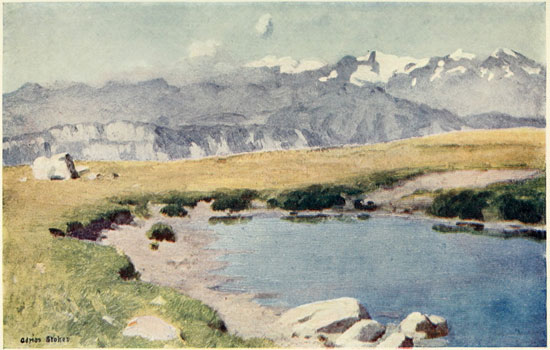
WINTER NEAR MERAN
The first view of the town, with its spires, huge hotels,
white-walled houses and villas, and the ruins of Castle
Tyrol set high on the north-western and vine-clad slope
of the Kuchelberg, is one of great beauty. On the lower
hillsides are chestnut groves and pine woods; and many
of the villas and houses of the town itself appear amid
them as though embowered in green.
The railway from Bozen traverses the picturesque
Etsch Valley, which is dotted with orchards, and follows
the course of the Etsch to where it joins the Passer about
three-quarters of a mile from Meran.
The architecture of the town, as is the case with most
places of any size in South Tyrol, is distinctly Italian in
general characteristics. In fact, one of the things which
makes Tyrol, as a whole, of unusual interest to students
and artists is the variety of the domestic architecture
found within its borders. Although there are many quaint
corners and delightful byways in Meran, there is really
only one important business thoroughfare, running almost
due east and west and of considerable length, with
arcaded shops known as "Unter den Lauben" (in the
shade). It is probably because it has this aspect that one
of the sunniest streets we have ever been in has been
so amply provided with shady arcades; and in summer
the latter can be appreciated to the full. In the season
the long street is at times crowded with foreigners from
England, Germany, Italy, and America, and has a busy
and cosmopolitan air somewhat out of character with
its general old-world look.
Just off this interesting thoroughfare stands the Burg,
or, to give it its fuller and ancient name, the Landesfürstliche
Burg, in ancient times the town residence of the
Counts of Tyrol. Retired as it is in the courtyard of
the Magistrats Gebäude it is often overlooked by the
passing tourist, although of great antiquarian and
historical interest. Dating from the fifteenth century, the
building has been admirably and sympathetically restored,
and is a treasure-house of fine old furniture and
bric-a-brac. There are also some interesting frescoes and
coats-of-arms of former owners and inhabitants. It is,
perhaps, difficult to realize that amongst the latter in
the middle of the fifteenth century was a Scottish
princess. But it was to the Burg that Sigismund, son
of Duke Frederick of the Empty Purse, brought his bride
Eleonora, daughter of James I. of Scotland, over the
Brenner and via Bozen, to the house and home he had
prepared for her reception.
From Bozen onwards, we are told, the young couple's
progress was marked by rejoicings and enthusiasm as
they passed from castle to castle, until at last they came,
in due time, to the then capital of Tyrol. Eleonora's
ultimate popularity with the Tyrolese was, perhaps, even
more owing to her skill in the chase than to her intellectual
gifts, although the latter were very remarkable for
a woman of that period. The translator of "The Book of
Celebrated Women," by Boccaccio, waxes very enthusiastic
over her, and he is by no means the only writer of the
period who has left on record a tribute to the Archduchess'
high mental and physical qualities. That
Eleonora was of a scholarly disposition and gifted with
"tongues" is proved by her translation of a French
Romance of the period, "Pontus and Sidoni," into German.
It is now a rare book, although copies are occasionally
found, and it would appear to have had a considerable
vogue at the time it was published. It was printed at
Augsburg. In the preface one gathers that the translation
was done by the noble authoress to "please his
Serene Highness and Lord Sigismund, Archduke of
Austria, her lawful husband."
In this charming old palace, set back from the hum
and bustle of the street, Sigismund and Eleonora dwelt
for some years, happy in the pursuit of learning, the
enjoyment of sport, and in the affection of the townsfolk.
In the Burg it is possible to obtain a very good
conception of what a mediæval nobleman's house really
was like, for not only have many interesting specimens
of furniture, presses, chairs and other fittings been
preserved, but also household utensils, and other articles
of common use.
There are, in the byways and courtyards of the main
street, several other most interesting houses dating from
the sixteenth and seventeenth centuries, which will repay
the attention of students of architecture. And may we
add the ubiquitous "Kodaker"?
One of the most enduring impressions Meran leaves
upon the mind is that of being in the true sense "a
garden city." No other place of the size in Tyrol
possesses so many beautiful and tree-shaded promenades,
walks and gardens. But the notice "smoking strictly
prohibited" which stares one in the face in the charming
Gisela Promenade with its old and feathery poplar trees
fringing the bank of the Passer, and in other similar
resorts, is probably a regulation distasteful to many.
Of "gartens" and cafés there is no lack. On the left
bank of the river is the pleasant Maria-Valerie Garten,
where—as is the case with other similar places—an
excellent band frequently plays. Of the cafés at least
the Café Gilf should be visited, on account of its beautiful
vegetation and fine view of the Passer gorge and surrounding
mountain slopes which one obtains from the
"look out."
MERAN HERO PLAYS
To many visitors the Hero Plays, which, for the last
fifteen years, have been performed annually, in the spring
and generally in the autumn, with scenes from the lives
of the famous son of the Passer Valley, Andreas Hofer,
and his companions for the chief incidents, will prove of
great interest. The plays, which include "Tiroler-helden"
and one produced for the first time in August,
1901, entitled "Frederick of the Empty Purse," are acted
entirely by peasants.
Many are acquainted with the fine dramatic gifts of
the Bavarian peasantry which have found expression in
the plays at Ober-Ammergau; but those of the Tyrolese
are less well-known and less widely recognized. Any one,
however, who has seen one of the Meran "Hofer"
dramas will probably agree with us that it was well
worth seeing, and that the dramatic art displayed was
not less praiseworthy than that of the more famous
performances at Ober-Ammergau.
The plays are given outdoors in a large meadow
on a huge stage, and with natural scenery formed by
a large chalet (with a bell turret above the central gable)
and other smaller buildings on either side, with the
hill slopes in the background, the stage being the street
in front of the chalet, and the "wings" the side streets.
The field is generally—especially for the autumn performances—boarded,
and there are a limited number of
covered-in boxes facing the stage for the use of those
who prefer to be sheltered from the sun, which on fine
days is somewhat trying in its intensity, as, of course,
no sunshades or umbrellas are permitted. The natural
beauties of the valley behind form an appropriate and
altogether charming "back-cloth" for the scenery, which
represents a portion of a Tyrol village with real buildings.
The most popular of the plays with the inhabitants of
Meran and the Tyrolese generally are undoubtedly
those dealing with the period of national history when
their country was engaged in its desperate struggle to
free itself from the French and Bavarian invaders.
The acting is always excellent, and distinguished by
that spontaneity which seems so frequently to characterize
outdoor representations. The naturalness which also
distinguishes the performances is probably largely
attributable to the fact that the actors have most of
them been not only well acquainted with the incidents
they pourtray since childhood, but are also in the main
representing scenes and using language of everyday
life; and are not engaged in attempting to interpret
scenes and incidents in which they have no personal
interest, or of which they have only gained a knowledge
by close and tiresome study.
OLD-TIME COSTUMES
To the artist the stage management, which is remarkably
good, and the delightful blending of the ancient
costumes in charming tableaux and schemes of colour
will make a special appeal.
The plays not only add an undoubted and additional
attraction to the quaint and charming town, but also
are deserving of the highest praise from an artistic
and dramatic point of view.
Naturally Meran is over-full at the times of representation,
so the wise traveller books his rooms in
advance, unless he wishes (as many have done before
now) to "sleep at the hotel of the beautiful star," which
in plain English means in the open air, and on the ground.
We have just mentioned the costumes which appear
in the plays. At Meran the old costumes (though alas!
they are being slowly but surely superseded) have been
preserved to a larger extent than in almost any other
place we know in Tyrol. The women's dress is undeniably
picturesque, just as it is markedly German in
general character. Hats are seldom worn, the hair is
plainly and extremely neatly dressed, brushed back off
the brow, and secured in a simple knot behind by means
of a silver or silver-headed pin. The bodices are of
velvet or cloth, of the "corselet" type seen in Switzerland
and many parts of Germany as well as in Tyrol; and
they are worn over a white chemisette with puffed
sleeves, which end just above the elbow and are generally
there confined by "ties" of coloured ribbon.
The men's costume is scarcely less picturesque, consisting
as it does of a high-crowned hat of felt or cloth,
bound round with numerous bands of thin red or green
cord, the first colour denoting a man is married (a useful
danger signal for unwary spinsters!), and the second denoting
a bachelor, eligible or otherwise. The jacket is usually
of brown or blackish brown cloth; cloth knee breeches (we
have seen buckskin on some of the "granfers") with
wide red or green braces, and sometimes an embroidered
waistcoat, completes the costume. One other feature
is almost sure to strike the observer, the white aprons
which so many of the men wear when engaged in work.
On festive occasions silver belts are worn by some of the
men in the surrounding valleys, though we fancy these
are considerably less common now than they were even
ten years ago.
The variations of dress in the different valleys of
Tyrol have been ascribed by a well-known writer upon
the subject as rising from the circumstance that peasant
costumes are very largely belated fashions of the town;
which, obtained perhaps three or even four generations
or longer ago, have in time come, by all save students
of the subject, to be looked upon erroneously as a mode
of dress evolved by the peasant wearers themselves.
What in all probability really happened in many cases
was, some visitors to the towns when in need of fresh
clothes bought town-made and then fashionable garments
which were copied by neighbours (as do villagers in
England at the present time), and thus perpetuated from
generation to generation, and not discarded until some
fresh sartorial idea percolated its way slowly and in
much the same manner to the often remote regions of
these Tyrolese valleys and upper pastures.
On the occasion of the "Hofer" celebrations or
"Hero" plays one even nowadays sees a most interesting
variety of costumes in Meran, although the differences
are not so marked as in former times, and appear
rather in small details than in immediately apparent
variations.
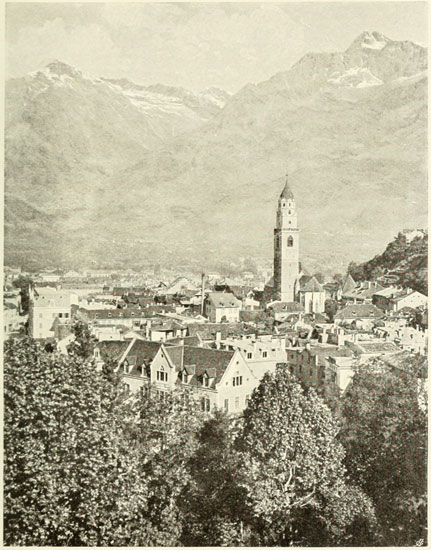
MERAN
IN THE VINEYARDS
Amongst the many "Cures" of the Continental Spas
and invalid resorts Meran possesses a unique one in the
"Grape Cure." Nowhere in Tyrol can the interesting
harvesting of the grapes be better seen than at Meran.
The vineyards, for one thing, are more picturesque than
in many places, by reason of the practice of largely
training the vines over trellis work or rustic pergolas.
In some vineyards these form perfect covered walks or
arcades of delightful green, through which the sun filters
to glint upon the purple and green-gold bunches of
grapes hanging in profusion on either hand and above
one's head. But, as may be imagined, the casual visitor
does not have the freedom of the vineyards on the hillsides
when once the grapes are ripening off. Then the
gates, some of them adorned with rows of formidable-looking
spikes and hooks with a great and persistent
affinity for clothing, are closely shut against all intruders,
and, in addition, that curious individual the Saltner,
whose name is probably derived from the Latin word
meaning forester, and hence guardian of lands of all
kinds, is placed on guard. His costume is such as to
bring alarm not only to the birds but even to human
beings. Tyrolese children we believe have been brought
up to regard the Saltner as a type of "Bogey Man" of
a very efficient character. Usually he wears buckskin
breeches or leggings, a broad belt in which there shines
a whole armoury of weapons of a miscellaneous character
comprising old pattern pistols, knives, and sometimes a
"horse" pistol of dimensions almost entitling it to be
spoken of as a gun. In his cap, which is of an uncommon
shape, are such a collection of feathers, martens'
tails, plumes, and odds and ends of ribbon as to cause
it to resemble nothing so much as the head-dress of a
Sioux Indian.
Notwithstanding this "terrific" personage, it is not
very difficult with the expenditure of a few kreutzers to
obtain permission to enter a vineyard in process of
harvesting. The labour employed is chiefly that of
women and girls, who, armed with sharp sickles or
large knives with heavy and curved blades, stand beneath
the trellises and hold a wooden tray in one hand beneath
the bunch to be severed. One skilled sweep of the
sickle and the latter falls into the tray with a minimum
of damage to the luscious fruit.
Here and there along the paths are wooden tubs
into which the trays are emptied from time to time.
And these tubs again are borne away by men to the
huge vats or tubs bound with iron, which are slung to
a framework or trolley on wheels to which oxen are
harnessed, and by them brought to the nearest convenient
point in the vineyard. Then when the vats
are full almost to the brim, two men take up their
positions beside them, and proceed to crush and pound
the grapes, stems and all, into a dark-red, uninviting-looking
mess with long-handled, heavy wooden hammers.
In many Italian vineyards it is still the custom to "tread"
the juice out, a practice which is far less cleanly and
hygienic (though it is said more thorough and economical)
than the Meran method. After the juice is all expressed
it is set aside to ferment, and the other processes of
wine making are afterwards gone through.
The famous grape cure consists apparently of eating
as much of the fruit as one possibly can. Many doctors
affirm that no particular benefit is derived or can be
hoped for unless upwards of two pounds of fruit is consumed
daily, the maximum quantity desirable being nine
pounds! Immense as this may seem, we have been
assured that some "patients" have considerably exceeded
this amount.
Perhaps the grape cure is so popular because, for one
thing, to eat a reasonable quantity of fully ripe and freshly
gathered fruit is by no means a disagreeable task for most
people, and because it can be taken anywhere.
In the cafés one sees crowds undergoing the cure; on
the numerous and shady seats of the Gisela Promenade
one sees folks eating grapes. And practically in every
street and alley, and along the mountain paths in the
vicinity of Meran one meets people with brown-paper
bags, or if taking the cure very seriously with little
baskets, all eating grapes as though their future well-being
depended upon the quantity they could consume
in a given time. The "old stagers" generally divide their
daily quantity into two or three portions; taking one
early in the morning before "Halbmittag," the second
about mid-day, and the third at sundown.
To its many other attractions Meran has added for
the holiday maker that of a good band, which performs
during the season really most excellent music in front of
the Kurhaus, or in one or other of the public gardens at
Obermais. The Kurhaus, with its sheltered Wandelhalle
or promenade, naturally forms the pivot upon which the
more social side of the daily life of Meran turns. Here
one meets not only the invalid, but the traveller from all
parts of the Continent; and in the Kurhaus gardens one
finds also those "birds of passage," who alight for a time
on their way further north or south.
SPORTS AND PASTIMES
The Sports Platz is one of the best in Tyrol. On
it are held tennis tournaments, cycle races (less than
formerly), trotting events, and horse races; whilst in the
winter months the centre is converted into an excellent
skating lake. The races are largely attended by Italians
as well as natives, and at the larger meetings there is
generally some event of interest and importance from a
sportsman's point of view.
A big race day at Meran has many of the social and
picturesque elements of the smaller events at Chantilly.
The ladies don their best toilettes, and the beautiful
surroundings and brilliant sunshine all go to make a
picture of great charm and animation.
On the outskirts and in the immediate neighbourhood
of Meran are so many ancient castles that the town might
well be called the "city of castles." Just outside the
Papist Gate is the half-ruined Schloss Zenoburg, standing
on a precipitous rock; whilst prettily situated at Obermais
stands Schloss Rubein with a famous avenue of
cypresses. Along the picturesque Bozen road is Schloss
Katzenstein; which, seen across the fields from the
hillside, looks like a grim outpost guarding the valley.
Then there are also the Schloss Gojen, with its
environment of shady and odorous pine forests, and
background of snow-capped mountains; Schloss Vorst,
but half an hour's drive from Meran, and finely situated
upon a rocky eminence overlooking the valley, and
several others of which could be told stories of romantic
and historic interest.
And last, but greatest of them all, there is Schloss
Tyrol which was destined to give its name to the whole
of the country. As it is one of the most famous it is
probably also the best known of all castles to the average
tourist and traveller in Tyrol. So ancient is it that
historians have been able to discover a mention of it at
so early a period as the last decade of the fourth century
A.D. But, notwithstanding this fact, the records relating
to its earlier days are neither full nor reliable. Of the
life that went on within it and the fate that possibly
overtook it during the period covered by the years (about)
A.D. 400 to A.D. 1000 little, indeed, is discoverable. Its
present ruinous condition arose partly from neglect
during the troublous period of the wars at the end of
the eighteenth and commencement of the nineteenth
century, and partly from the fact that during the Bavarian
occupation of the country in 1808-9, the then Government
sold the castle for the ridiculous sum of a couple
of hundred pounds for the purpose of destruction so that
the stones could be used as building material![16]
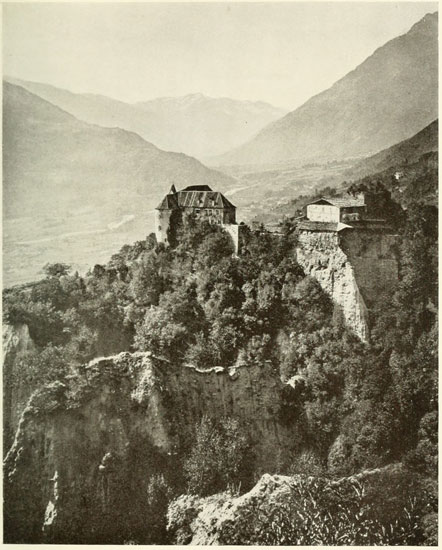
SCHLOSS TYROL, NEAR MERAN
ANCIENT CASTLES
Castle Tyrol stands a relic of past glories, feats of
arms, strenuous living, and chivalry on a rocky ridge or
spur of the mountains above the vineyards, which climb
upwards towards the white and imposing castle walls.
Behind and above rise the pine forests running upwards to
meet the rocky slopes of the Kückelberg and Vintschgau
range. The most ancient portions of the present building
are some of the walls, a porch, and two marble
doorways dating from about the twelfth century, and the
chapel. In the latter there is a fine representation of
the Fall of Man, and interesting carvings. From its
commanding position it is only to be expected that a
magnificent prospect is to be had of the Adige Valley,
the chain of the Ulten-Thal and Mendel mountains,
and the vineyards upon the slopes which swell upwards
from the valley. Seen either soon after sunrise (which few
people, we imagine, do) or just at sunset, the views from
the castle, more especially that from the Kaisersaal, are of
wonderful pictorial beauty and charm.
Though we have too little space to devote to the many
delightful places in the Meran valley which invite exploration,
or to mention the numerous walks which tempt the
pedestrian, we must give a passing word or two to the
Château or Castle of Schönna, which lies nearly two
thousand feet above sea-level like a hoary and time-worn
sentinel at the entrance to the Passeier Valley. It is
easily reached from Obermais by an excellent road suitable
even for cyclists, and is well worth a visit owing to
the representative collection of old weapons gathered
within it, and its picturesque situation. Dating from the
early years of the twelfth century, it is an excellent
example of the ancient feudal fortress-residence of those
far-off times. A mention of the Château Lebenberg,
distant about an hour and a half's walk from Meran, is
justified—although it is now a pension—by reason of its
excellent state of preservation, and the historical paintings
in several of the most interesting rooms. The walk,
too, along the side of the mountains by way of Marling
and picturesque St. Anton is one to be enjoyed and
remembered.
Some ten miles northward in the Passeier Valley, just
a little distance beyond the village of St. Martin, where
one sees many examples of the wall paintings which are
more especially numerous in the towns and villages
of Southern Tyrol, stands the most famous national
pilgrimage place and historic shrine, Hofer's Inn, called
Wirth am Sand or the "Sandy Inn," literally the "Inn
by the Sand." It is quite an unpretentious building
standing by the roadside, and would scarcely attract the
notice of passing travellers. It is entered by a gallery
reached up a short flight of steps. The interior is
scrupulously clean, and although it is plainly furnished
one is rather the more impressed by this circumstance
which leaves the famous Inn, where Hofer was born on
November 22, 1767, much as we are told it was in
his time. From the pleasant dining-room on the first
floor, with curtains of spotless muslin to keep out the
almost blinding sunshine of the valley, there are fine views
towards Meran, and of the towering mountains across the
stony bed of the Passer.
At the Inn there are some interesting relics of the
patriot, and pictures of him. One shows him as a big,
strongly built man of not much above average height, with
a short nose, a fine and lofty forehead, dark eyes, and a
rather ruddy face, well-marked eyebrows, and the famous
long beard.
At one time Hofer wore no beard, and the story goes
that his growing one—which ultimately was declared
to be the longest in the valley—arose from the chaff of
his companions, who asserted that his wife forbade him
to wear one. Whether the tale be true or not it has very
general acceptance, and we all know that Hofer's beard
was ultimately one of his distinguishing features during
the campaigns in which he was engaged. There is a
very pleasant balcony on the outside of the house which,
tradition asserts, was often used by Hofer and his
companions when holding their meetings or councils
of war to devise some scheme by which their beloved
country could be freed from a foreign yoke.
HOFER RELICS
Hofer's last letter, which is one of the most treasured
of the relics, even exceeding in interest the clothes which
he wore when shot at Mantua, is a splendid testimony
to the dignity and greatness of the man, which surmounted
all troubles and disasters and was not lessened or alloyed
by triumphs. In it he speaks of his old home, of the
rushing Passer, of the beautiful mountains he would
see never again, and then goes on to say, "It is the great
God's good will that I die at Mantua," and then, "Farewell,
beautiful world," adding, "but at the thought of
quitting it my eyes scarcely even moisten." Then follow
the words, "I am writing this at five in the morning; at
nine I shall pass into the presence of God," with the
date "20th February, 1810."
Far up the mountain side above his old home is the
spot where Hofer hid with his wife from November,
1809, till five o'clock on the morning of January 18, 1810,
when he was captured and taken under strong escort
first to Meran, and ultimately to Mantua. He had
refused to fly to Vienna or take refuge on Austrian
territory. He wished to remain amongst his people,
perhaps with a vain hope of once more attempting to
accomplish Tyrol's freedom.
It is with regret that most travellers leave Hofer's old
dwelling. The whole Passeier Valley is, of course, teeming
with historic memories, of the gallant doings of the
patriot and his companions. Near Schloss Tyrol itself
was fought one of the most notable engagements, and
a victory won when the French, driven from their position
on the Küchelberg, were surrounded by the peasant
forces; whilst just outside Meran another skirmish took
place, as a result of which the French troops were forced
to evacuate the town.
SUNNY BOZEN
From Meran to Bozen by rail is rather less than twenty
miles, and about the same distance by the road, which
runs through the valley of the Etsch, or Adige, and in places
along the lower slopes of the hills. It is a picturesque
journey by either, and for cycling quite delightful. One
crosses the Talfer just before reaching Bozen, which lies
in a wide basin at the junction of the valley of the Etsch,
with the smaller but picturesque Sarnthal, surrounded by
great reddish brown crags and precipices of the porphyry
mountains on which the semi-tropical cactus grows, and
one gets sombre groups of cypresses, and here and
there vineyards, and pine-clad crags. The town is a
strange mixture of the German elements of Tyrol and
the Italian. Its architecture, too, is "an admixture of
that of north Italy and South Germany, here and there
transfused so that it preserves characteristics of both." It
is perhaps for this very reason a town of great charm,
and one of considerable beauty. Its surroundings, which
include the famous Rosengarten, and many beautiful
little valleys and gorges present attractions for a longer
stay than one at first contemplates.
It is, moreover, one of the busiest (Bozen people claim
that it is the busiest) towns in Tyrol, with a population
going on towards 20,000, including its outskirts, yet it
possesses some most delightful gardens.
Seen from almost any point of the lower slopes of the
surrounding hills, cactus, and vine-clad, and resembling in
general luxuriance of vegetation Italy rather than the Tyrol
of but a little further north, Bozen is charming. Below
one is spread out a garden-like city, which with all its
bustling life yet looks more like a holiday resort than
a commercial town, with numbers of white-walled villas
dotted amidst green fields, vineyards and gardens, in the
latter of which blossom all the flowers one knows and
loves, and many less common in England.
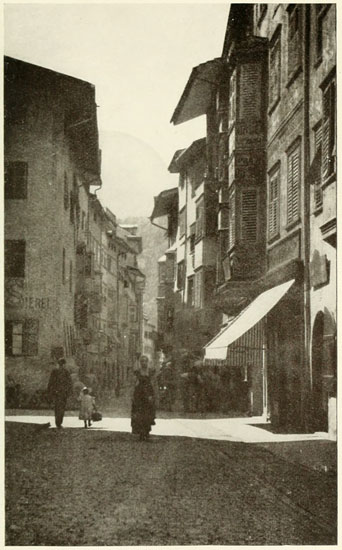
A STREET IN BOZEN
One of the oldest towns in Tyrol, it stands practically
on the site of the Pons Drusi of Roman times. It has for
"time out of mind" stood at the cross roads where the
Brenner and the Vintsgau routes divide. In the past,
Roman armies have passed through it, have crossed the
Talfer, or have lain encamped in the fields of its basin-like
site. And after them came the Merchants of the Middle
Ages, trading between civilized Italy and barbarian
northern lands. Still later came Emperors and pilgrims
travelling to the "Eternal City," Crusaders outward and
homeward bound, roving singers, and hordes of free
lances and mercenaries. In a word, Bozen's past must
have been a stirring one, and the lives led by her citizens
full of the colour of life and gallant deeds.
Anciently, too, the town was fought for and tossed
hither and thither by those powerful civil lords the
Terriolis, Counts of Tyrol, and the militant spiritual lords
the Prince Bishops of Trent. For this reason, and on
account of many fires and "grievous o'erflowings of the
Talfer in past times," of the most ancient of all Bozens
there are comparatively few traces, though within the old
town there are yet traceable some interesting relics of
the Middle Ages.
In those long back times Bozen was a place of even
greater commercial importance than now. To its four
annual markets or fairs people from many lands came,
and it became the depôt and centre of the great transport
trade by the two chief passes leading from Italy into
Tyrol and thence to Germany and Austria. As was not
unnatural Bozen merchants had a standing of their own,
and were, according to one authority, "not a little purse
proud and exclusive in their dealings, save when the latter
meant that financial advantage would thereby accrue to
them."
Although Bozen does not commend itself to most
tourists from higher latitudes for a lengthy stay, at
least not in summer, as the basin in which it lies, though
making it delightfully sheltered in winter, causes the town
in the months of July and August to be decidedly hot
and rather enervating, there are several places in the
immediate neighbourhood to which one can flee for fresher
air and cooler days. The town has somewhat declined
commercially from the high position it once held, when the
trade which flowed into Tyrol through it and northwards
out of it was chiefly along the high-roads and over
the passes; and thus through Bozen a very appreciable
percentage of the whole southern and Italian trade
passed. But nevertheless it is still a most flourishing and
interesting town.
A native writer says, on this subject, "Bozen ... has
during the last decade largely recovered the ground it had
temporarily lost through the making of railways, and the
decline of transport along the high-roads of the passes
owing chiefly to the increased facilities that have arisen
for conveyance of merchandize by sea." Certainly one
is soon able, when in the town, to realize that in two
branches of trade at least Bozen occupies an undoubtedly
high position in the commercial world, those of wine, and
fruit growing and exporting. The hillsides are literally
studded with vineyards and orchards, and Bozen fruit has
gained for itself an almost world-wide reputation.
From the artistic side, too, Bozen claims the attention
of all who are interested in legendary lore, architecture,
and antiquarian matters. As one passes along its chief
streets, or explores its byways in the older part of it, one
is delighted on almost every hand by vistas of fine houses,
shady and charming courtyards, buildings with strangely
constructed roofs, and fantastic gable ends, quaintly
shaped bay windows, vaulted colonnades, and here and
there, stowed away where least one would expect to find
them, smaller courtyards with trellises covered with vines,
and perhaps an ancient well of rust-red marble to give a
finishing touch to the charming picture.
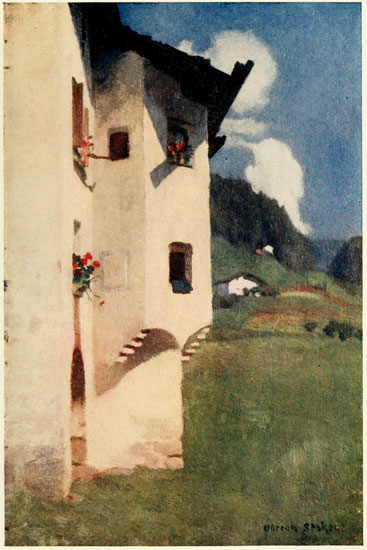
A SOUTH TYROL FARMSTEAD
Numbers of artists pause at Bozen yearly on their way
south into Italy via Verona to study the rich treasures in
the galleries of the cities of Northern Italy, or to rest
awhile on their return journey northwards. In Bozen is
plenty to paint and plenty to admire, and the townsfolk
are noted for the hospitality which still (notwithstanding
the great influx of tourists of late years) distinguishes the
frank and warm-hearted people of Tyrol in general.
BOZEN PARISH CHURCH
Chief amongst the buildings which will attract one's
attention stands the Pfarrkirche or Parish Church, which
with its elegant tower and open spire, over two hundred
feet in height, forms a monument to the artistic and
constructive skill of its Swabian builder Johann Lutz
in the first years of the sixteenth century. The church
is splendidly situated at one corner of the fine open
Waltherplatz, which is planted with shady horse-chestnut
trees, and, its roof of copper-green tiles set in a pattern,
contrasts admirably with its walls and spire of red
sandstone. In ancient times the building possessed two
spires, both of which were destroyed or so injured as to
necessitate their pulling down long before Lutz built his
elegant structure. The church itself, which contains a
fine altar-piece by a pupil of Titian, and a remarkable
stone pulpit dating about the first decade of the sixteenth
century, is, in the main, fourteenth-century work, although
it was not actually finished until the third decade of the
fifteenth, so some authorities state.
In the centre of the Johann Platz stands a fine though
simply conceived statue to Walther von der Vogelweide
who was born about 1160 at Lajen, near Waidbruck, in
which the poet is shown standing clad in a loose robe,
with a biretta-like cap on his head and his hands crossed
whilst holding a lute. The statue is the work of the
late Heinrich Natter, one of the most famous of native
sculptors, who was also the artist of the famous Berg Isel
Hofer Monument, of the very finely conceived and well-executed
statue of Ulrich Zwingli at Zurich, and many
other works.
One of the most charming of Bozen streets is undoubtedly
the Laubengasse, which greatly resembles the
main street of Meran, with its shady arcades on either
side under which the shops are situated, and where one
can promenade and do one's shopping protected from the
sun in summer and the rain in winter. The Karnergasse
and Silbergasse are interesting streets, as is also the
Goethestrasse leading to the fruit market, where one finds
during market hours many interesting types of peasants
from the neighbouring villages as well as of the townsfolk
themselves. We saw some of the most gorgeous of kerchiefs
worn over the shoulders and crossed over the
breasts of Bozen or Gries fruit-sellers, which gave an air
of quite southern colour and brightness to the little Platz,
in which oranges, almonds, melons, figs, and even prickly
pears were displayed for sale with all the other fruits one
might expect to find, including magnificent cherries in the
earlier part of the fruit season.
The costumes of the Sarnthal with the big, broad-brimmed
felt hats worn by both men and women, and
the gay "Kummerbunds" of the men worn under short
"Eton"-shaped jackets, are also seen in Bozen on festive
occasions.
The Museum, in which there are many interesting
exhibits, including some old peasant costumes well worth
the attention of artists, is an imposing building or "block"
in the Königin Elizabethstrasse, with corner turrets and
an imposing central tower.
Of the more picturesque and older buildings none
excels in charm the Franciscan Monastery and Church
in the Franziskanergasse. The courtyard, shaded by
trees which throw a diaper of shadow and sunlight on the
paving stones, with the delicately pretty porch leading
into the church, is a spot of sheer delight for the artist
and the dreamer of dreams; who there, amid the quietude
of ancient things, can the better conjure up visions of
other days when Bozen streets rang to the passing of
armies, and men at arms, and in them were heard the
cries of mediæval merchants selling their wares drawn
from north and south. In the Franciscan Church there
is a fine altar, and belonging to the Monastery there are
some beautiful cloisters. The library, too, should not be
overlooked by those interested in early books and similar
treasures.
On the outskirts of pleasant Bozen, a fine view of
which is obtained from the Calvarienberg, there are many
charming excursions. Towards the west lies the finely
situated Castle of Sigmundskron on a hill between
mountains overlooking the river in which there is good
fishing: the Mendel Pass, 4500 feet, ascended either on
foot, by carriage or by the mountain railway; Tisenser
Mittelgebirge, studded with most interesting ruins, and
from whence one obtains extensive and beautiful views of
the surrounding mountain chains and of Meran.
CASTLE OF RUNKELSTEIN
Towards the north lies the deeply interesting Imperial
Castle of Runkelstein, which, dating from the middle
half of the thirteenth century, was extensively restored
in 1884-88, and finally presented by the Emperor of
Austria to the town of Bozen. Situated upon and
almost entirely covering a huge mass of rock, it overlooks
a bend of the swiftly flowing Talfer, and occupies one
of those commanding and almost inaccessible positions
beloved of builders in the Middle Ages. The Castle,
irrespective of its interests as an architectural survival
of a long past age, is much visited on account of the
famous frescoes which are contained in a building now
known as the Summer House. As one climbs up the
steep and narrow path to the castle drawbridge one can
the better realize how safe the ancient owners (who were
not above raiding the neighbourhood, and of engaging
in predatory warfare with their neighbours) must have
felt when they had once heard their iron-studded door
clang behind them, and seen the ancient drawbridge
swung up by its chains.
Till the introduction of artillery, indeed, such a
fastness would have been practically impregnable.
The frescoes to which we have referred are especially
interesting from the fact that they undoubtedly exhibit
a very primitive art. At the time they are supposed to
have been painted, that is to say towards the end of the
fourteenth century, art even in its home, Italy, was in
a comparatively elementary and even grotesque stage of
evolution. The figures, which are black with a pea-green
background, are, as an American girl said, "Noah's
arkical and too funny for words," though we are bound
to confess that the irreverence of the remark deeply
offended a worshipper of mediæval art who was of the
party. The paintings in the first room depict a German
version of the story of Tristan and Isolde, which would
appear to diverge materially from the one of Sir Thomas
Malory, as set out in the "Morte d'Arthur." The main
story can, however, be easily followed.
In the second chamber the frescoes, which were a very
common form of decoration at the period at which they
were done and should not be considered in the light of
being of especial significance, depict a complete version
of the legendary story of Garel, following the version of
a Styrian[17] thirteenth century poet named Pleier. It is
generally considered that this Garel was founded upon
or was identical with the character of the Gareth or
Beaumains of the "Morte d'Arthur," although the evidence
is not absolutely conclusive. To English people the fine
fresco of the famous Knights of the Round Table sitting
in company with King Arthur and Queen Guinevere will
naturally be of the greatest interest, although each of
the quaint drawings to illustrate the mediæval legend
has an abiding fascination for all to whom the past is
of moment.
Nor are the outside walls of this quaint pavilion left
unadorned. On them are single figures and others in
groups of two and three depicting well-known mediæval
personages of historical and legendary note: Tristan and
Isolde; William of Orleans and Amelie; William, Duke
of Austria, and Aglei; pairs of lovers whose fame has
outlived the centuries; the three hero kings of ancient
Christendom, Arthur of England, the Emperor Charlemagne,
and Godfrey de Bouillon. Amongst the large
number of figures here depicted may also be seen other
groups of three comprising celebrated knights, dwarfs,
giants, and other real, mythical, or legendary characters;
a gallery of portraits which has probably no equal in
any other castle in the world. The story of the deeds of
the characters thus immortalized would fill many volumes,
and provide some of the most romantic and interesting
reading imaginable.
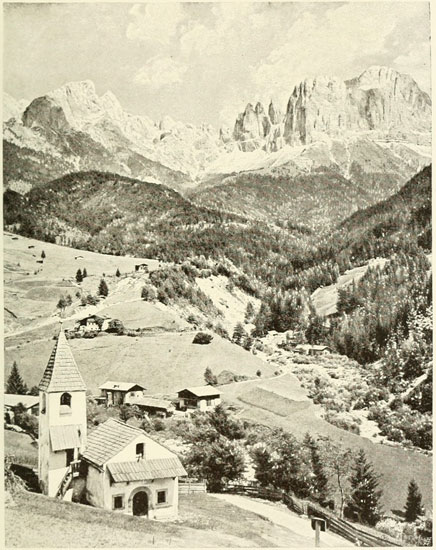
ST. CYPRIAN AND THE PEAKS OF THE ROSENGARTEN
One quits the historic spot with a sense of the greatness
of the past as well as with a lingering regret that
nothing after all can adequately conjure up for one the
stirring scenes, strenuous and vividly "coloured" life,
romance and chivalry, that the walls and rooms of
Runkelstein must have witnessed.
In an easterly direction from Bozen lies the Eggenthal
and its famous waterfall. The road through the former
is one of great picturesqueness and grandeur—along the
hillsides, across high bridges, and through gorge-like
rock cuttings, which to be fully appreciated cannot be
travelled better than a-foot. In the same direction, too,
lies the beautiful Karrersee, surrounded by its belt of
sombre pines above whose feathery tops shine the rocky
peaks and snow-clad summits of the Dolomite giants.
THE ROSENGARTEN
From Bozen, too, the famous Rosengarten, which lies
to the east of the town, should be visited. But it is not
a garden of roses after all, but a collection of stupendous
and rocky peaks which blush red at sunset. Those who
expect flowers other than alpen rosen, gentian, and the
like, will be disappointed, as was the young lady who
undertook the excursion in the hope of seeing roses galore
such as one may find in the "attar" districts of the
Balkan Provinces and especially in Bulgaria.
But if from Bozen one looks merely for the rosy hue
to tint the skyward-piercing pinnacles of rock, which
have been poetically called the "Rosengarten," or rambles
in the picturesque and beautiful valleys and tiny defiles
at their feet, one will not be disappointed. And the
"roses," like other similar phenomena, are in a sense a
weather glass; the deeper the red they glow the finer
the ensuing day. At first a plum-hued twilight, such
as one gets in the Maloja valley, seems to fall down out
of the sky, and then the mountain peaks commence to
receive their baptism of crimson. Then at last, as the
sun sinks behind the interposing Guntschna Berg, only
the highest peaks continue for a short time longer to
glow with increasing, and then fading, depth of colour,
till at length the plum-bloom shadows conquer the
"roses" and the cool twilight comes.
The origin of the descriptive phrase "the Rosengarten"
is (so far as we have been able to discover) lost
in the mists of antiquity. But there is a rather pretty
legend concerning the Garden itself. Long ago (the
story tells us), when men were perhaps happier and
certainly less sophisticated and cynical than they are
now, and believed in fairies, gnomes, and magic, there
lived a dwarf named Laurin or Laurenz reigning over
the other dwarfs, who inhabited a country in the centre
of the Schlern. By some means or other this dwarf
managed to see and fall in love with the beautiful,
golden-haired sister of a retainer of Dietrich of Bern, in
Switzerland. After having seized her he bore her to his
palace of crystal in the interior of the mountains, and
there kept her prisoner. Soon, however, the brave and
gallant knight Dietrich, and his squire, who was named
Dietlieb, determined to rescue the abducted maiden, and
for this purpose they came up from Italy where they were
at the time, and finding an opening entered the Schlern,
and after a fierce fight succeeded in conquering the dwarf,
notwithstanding the fact that of course the latter was
assisted by a magician. Laurin was not, however, killed,
but spared by Dietrich at the request of Dietlieb. It
was unfortunate clemency, however, as Laurin, professing
himself grateful and offering them refreshment after
their labours and fight, gave them drugged wine, so that
when they awoke they discovered that they had been
bound and cast into a dungeon of the dwarf's castle.
From this predicament they were happily freed by
Dietlieb's sister, Simild, and after another fierce encounter
with the dwarfs they defeated them, and trod the famous
Rosengarten roses underfoot, their places being taken by
those that bloom at sunset upon the peaks above the site
of Laurin's mythical palace.
That, at all events, is the story we have been told, and
though the Rosengarten and its miniature valleys are
beautiful enough for real roses to have their home there,
none grow there now save figurative ones caused by the
sunset light.
The Rosengarten is a fine centre for mountain ascents,
and the famous Vajolett towers and other rocky pinnacles
present unfailing attractions to the adventurous rock
climber, even though nowadays there can be very few
"virgin" peaks or pinnacles to scale.
From the Rosengarten itself as well as from Bozen one
can witness the blooming of the roses, and the really
wonderful and entrancing play of colour, light and shadow
over the stupendous peaks which forms an unforgettable
experience when seen during the late afternoon of a
summer day and onwards till twilight comes to gradually
throw its blue and mystic mantle over the valleys and the
mountain summits.
KLAUSEN
North of Bozen, prettily situated by the banks of the
Adige, and some one thousand seven hundred feet above
sea-level, stands the little, though somewhat important,
town of Klausen, with its long, narrow street following the
configuration of the gorge in which most of the houses lie,
dominated by the great Benedictine monastery of Säben
perched upon a steep vine-clad promontory overlooking
the town and river, and six hundred feet above it. A
castle till the end of the seventeenth century, the convent
was attacked by the French in 1809, and from all accounts
the nuns were not respected, for upon the walls of one of
the towers on the hill is a painted crucifix, which the
people of Klausen say was placed there in memory of one
of the nuns who, pursued by the soldiery, jumped to her
death over the battlements. The first impression of
Klausen is that of cleanliness, for the tall houses strike one
in the brilliant sunshine of a summer day as very white,
though most of them are relieved by patches of vivid green,
where window shutters hang upon the walls or keep the
sunshine from the windows. Klausen folk are fond of
flowers, too, for many hang trailing from balconies; pink
and red geraniums, a variety of clematis, and bunches of
ruby-coloured valerian, and tufts of yellow and orange
nasturtiums. There are generally many monks about the
streets, too; sombre-looking figures in rough frieze habits,
who look at the stranger with mild curiosity, and then
pass on their silent way up the hillside, or through the one
long, narrow street which runs between the mountain side
and the rushing river. Klausen women bore a brave part
in Hofer's struggle against the French and Bavarians, and
dressed in their husbands' and brothers' clothes gave
material aid in driving back the French through the pass
in 1797.
There is not much to see in Klausen itself, but as
a typical southern Tyrolese village it is interesting.
Picturesque it certainly also is, set amid crags and rocks
of purple porphyry, whose bases and lower slopes are
beautified by the greenery of many vineyards, and half
encircled by the rushing Eisack. Near by is the famous
Castle Trostburg, romantically beautiful with grey walls and
red-tiled roof perched high above the pine forest which
clothes the steep sides of the rocky spur upon which it
stands, and with a patch of vineyard clinging to the wall of
its upper square and solid-looking keep. The climb up to it
is a steep one, but the view one obtains into the Grödener
Thal and of the surrounding heights well repays one.
OSWALD v. WOLKENSTEIN
The castle is one of the comparatively few still remaining
in the possession of the family with whose history it
has for many centuries been identified. The Counts of
Wolkenstein date their occupation from the twelfth century,
and one of the most famous of the line was that
Oswald born at Castle Trostburg in 1367, or about, whose
romantic adventures might form the basis or plot of half
a dozen historical novels. As a Minnesinger he set out
early in life upon his travels in a gallant and adventurous
age; devoted, one must imagine, to the service and adoration
of the fair sex, as were supposed to be Minnesingers in
general. Like many another adventure-loving lad, he ran
away from his ancestral home, light of heart and equally
light of purse, to wander through the world singing his
way to fame and fortune, or to failure and poverty, as the
case might happen.
He appears in the first instance to have attached himself
to the suite of one of a party of Tyrolese nobles under
Duke Albrecht III., of Austria, who were bent upon a filibustering
expedition into Lithuania, a district then lying
between Poland and Courland. Afterwards he wandered
far and wide over the world, visiting in turn Russia,
England, Spain, France, and then sailing for the East, and
travelling through Asia Minor and Persia. He seems,
from contemporary and other accounts, to have been
"everything by turns, and nothing long," except that he
probably always kept up his "minnesinging." He certainly
was page, soldier, sailor, and sea-cook; and for all one can
tell these were but the chief occupation of many he followed
during his wandering and adventurous life. At all events
he appears to have acted at times as tutor, turning the half
score of languages he had picked up to good and practical
account. Amongst his more knightly adventures were
campaigns against the English in the service of the Earl
of Douglas—he was probably present on August 10, 1388,
at the famous battle of Otterburn (Chevy Chase)—previously
against the Swedes in Denmark in the service
of Queen Margaret, who in 1397 united the kingdoms of
Denmark, Norway, and Sweden together.
Among his more peaceful victories and doings was the
favour which he found in the eyes of the Queen of Aragon,
who appears to have not only admired his poetic gifts, but
to have loaded him with personal favours, caresses, and
presents of jewelry.
For several years after his visit to Spain he wandered
about, and then at last (like the prodigal son) set his face
towards Tyrol. No one recognized him, and he appears
to have fallen under the spell of the daughter of a neighbouring
knight, who, however, would not consent to marry
him unless he would first obtain his knighthood by becoming
a Crusader.
Deeply in love with the fair Sabina and not doubting
her sincerity, Von Wolkenstein took ship for Palestine,
and in due course attained the coveted distinction by
gallant conduct in battle, in consequence of which he
attracted the attention and gained the personal friendship
of Sigismund of Hungary.
Alas! for his hopes. On returning to Tyrol covered
with glory, and a "true knight," he did so only to find
the fickle and deceitful Sabina married to another. In
addition to this he was only just in time to see his father
die. As a younger son he inherited the castles of Castelruth
and Hauenstein, Trostburg and its lands descending
to his elder brother.
A KNIGHT'S ADVENTURES
His roving disposition was not likely to be stayed
now that he had lost both his intended wife and his
father, so he once more set out on his travels, this time
in the retinue of his friend Sigismund, in whose company
he visited several countries. For several years he
wandered through western Europe and as far south-east
as Egypt, where he appears to have been received with
much honour. Once more back in Tyrol in 1405, he
became involved in the political upheavals which were
caused by the drastic measures of reform instituted by
Duke Frederick of the Empty Purse, against which the
Tyrolese nobles fiercely rebelled. The ex-Minnesinger
took the part of the latter, and in consequence drew
down upon himself Frederick's vengeance. The latter
burned his two castles, and compelled Von Wolkenstein
to flee for his life to the protection of a relative who
was the owner of the castle of Greifenstein, which is
situated on an inaccessible pinnacle of rock between
Bozen and Meran. Duke Frederick and his forces
hotly besieged the castle, but failed to reduce it; and
although Oswald was severely wounded and lost the
sight of one eye he escaped, and a little later joined an
expedition against the Moors in the train of John I.,
King of Portugal. During the severe fighting which took
place, and at the capture of Ceuta in 1415, he appears
to have so greatly distinguished himself that, we are
told, "his fame was such that the troubadours enshrined
his deeds in their songs."
Ultimately, he came to his own in Tyrol owing to
an act of the Council of Constance in Baden, which not
only condemned John Huss—amongst many ecclesiastical
enactments—to be burned, but also ordered that Duke
Frederick, now an outlaw, who had burned Oswald von
Wolkenstein's castles, should rebuild them, and restore
to the knight all the property that he and his followers
had seized. It is not easy, however, to comprehend how
an outlaw who was fleeing from one place to another
in fear of his life was to accomplish these things, nor
how property taken by the soldiery years before, and
probably long ago converted into cash or other uses,
could be given up and restored.
We are told, however, that after visiting France in
Sigismund's train Oswald returned to his favourite castle
of Hauenstein, the ruins of which nowadays are so lost
in the vast pine forest which surrounds them as to be
almost undiscoverable.
Then Sabina, his old love, once more comes upon
the scene, this time as the claimant of the castle on
account, so she alleged, of an unrepaid loan made by her
grandfather to the Wolkensteins. She invited her old
suitor Oswald to join her in a pilgrimage to some shrine
for old acquaintance sake; and when he came to her,
unsuspecting and unarmed, she promptly had him seized,
thrown into a dungeon, and there kept him a prisoner
in chains. He lay in treacherous Sabina's castle until
by chance Sigismund, hearing of his parlous state,
intervened on his friend's behalf, and Oswald von
Wolkenstein was set free. He was, however, so maimed
by rheumatism and the fetters which had galled him
that he ever afterwards went lame.
Once more he was cast into prison, this time by Duke
Frederick's machinations, and lay in a horrible underground
and tunnel-like cell in Vellenberg not far from
Innsbruck. He had married in 1417 Margaret, a
daughter of the house of Schwangau, after a long period
of betrothal, and to her he was deeply attached. On
his second release, after three years' incarceration, he
returned to Hauenstein to find his wife dead, and his
home fallen into disrepair from neglect.
A few years later we find him, unconquered in spirit
though broken in body, at Rome to attend the coronation
of his friend Sigismund, who but a year or two later
was driven from the throne. In 1435 Oswald once more,
as a man of fifty-eight, returned to forest-enshrouded
Hauenstein, where he died nine years afterwards, never
having again left it.
Of course, the castle is haunted by the spirit of this
unhappy and adventurous knight and Minnesinger, and
there is still this belief amongst the peasantry of Seis
and the neighbourhood round about. And the few who
have ever ventured near the ruined pile after sundown
aver that those who do are sure to hear the ancient
Minnesinger chanting a dirge-like lay, accompanying
himself upon his lute. But if this be so Oswald's spirit
has wandered far from his body, for his remains repose
at Neustift near Brixen.
He was not only one of the most picturesque and
romantic figures of the band of Minnesingers who were
so numerous during the Middle Ages, but also in a
measure an historical figure. By some authorities he is
considered to be the last of these strange wandering
minstrel adventurers. Probably it would be more correct
to speak of him as the last really great Tyrolese "Minnesinger;"
but, whichever estimate be right, his place on
the roll of fame relating to the deeds and songs of these
is assured by reason of his gallantries, misfortunes, and
adventurous and knightly doings.
ST. ULRICH
On the way to Klausen one is wise to make a diversion
down the narrow but picturesque Grödener Thal to St.
Ulrich, which charming village, situated in a basin and
almost surrounded by thickly wooded slopes, and beyond
them stupendous and rocky peaks with the serrated
pinnacles of the Langkofel in the background, is the
centre of the Toy industry of Tyrol and an increasingly
popular tourist resort. The road is a steeply ascending
one, and one comes upon the first glimpse of the village,
which stands midway down the valley between Waidbruck
and Wolkenstein, quite suddenly. One's first impression
is of a typical Tyrolese village of considerable size, its
white—very white—houses standing out clear cut and
prominently against the background of dark-green pines,
and the lighter green of the valley fields in which they
are, many of them, set. Of late years the clean-looking
cottages of the villagers, the balconies of which
are as often as not hung with delightful flowers, have
been supplemented by good and large hotels, villas, and
other modern up-to-date tourist accommodation. But,
nevertheless, St. Ulrich is not yet spoiled, and there are
still many of the almost mahogany-coloured barns and
storehouses left, with their picturesque balconies running
right round them, on which the grain and herbs are placed
to dry, wood to season, and other stores are kept, forming
so sharp a contrast to the hotels and white houses.
Although we imagine St. Ulrich's chief attraction is
its quaint and interesting toy-making industry, there are
many others including most beautiful scenery, and the
numberless excursions which can be made from it. In
winter time, to quote the quaint phraseology and spelling
of a local guide-book, it has "a very strange charme for
the friends of Tobogganing and Ski-sport has the valley
in the always mild and snowy winter-time." And regarding
the accommodation offered, the same luminous
authority goes on to say there are "very comfortable
stabled hotels and land-houses extraordinary fit as a
summerset for residence, likewise for a start place for
numerous high-parties to the Dolomites."
But let us give a brief description of the Toy Industry,
which chiefly serves to differentiate the village from all
others in Southern Tyrol.
St. Ulrich's wares are ultimately sent all over the
world, and whether in New York, London, Paris, Berlin,
Vienna, or Rome one is almost sure to find amongst the
toys, carved figures of saints, crucifixes, artists' "lay
figures," chalets, and other articles some examples of work
from this famous valley of wood carvers. The fact that
nearly 3000, or about three out of every five, of the
inhabitants are engaged more or less directly in the work
will give some idea of its magnitude.
The carving industry at St. Ulrich is supposed to date
from about the commencement of the seventeenth century,
and there are some figures of the Virgin and Saints still
extant in churches of the district bearing dates of that
period, and other images of apparently much earlier date,
which show that even in those remote times the carvers of
St. Ulrich and the Grödener Thal possessed considerable
skill and reputation. It was, however, one Johann von
Metz who at the commencement of the eighteenth century
appears to not only have raised the standard of the work
of carving to greater perfection, but also to have organized
and extended the sphere of the trade itself.
In the years which immediately followed, the peasants
were in the habit of themselves setting out into other
lands with stocks of their work for sale; and some at least,
according to tradition, found their way to England, and
even across the Atlantic, where they abandoned the active
work of carving for that of establishing trading depôts in
connection with St. Ulrich, and thus they distributed the
work done in the far-off and almost then unknown Grödener
Thal throughout the commercial world.
Nowadays to sally forth with their stock-in-trade on
their backs or in a cart is no longer the practice of the
workers. The greater number are employed by firms
which act as wholesale distributing agencies for them, to
whom they take their weekly output of work. Most of the
villages of the valley are employed in the carving industry;
St. Christina, for example, making a speciality of "lay
figures" and hobby horses.
Not only are most of the men of the villages in the
Grödener Thal thus employed, but also many of the women
and children. And it is no uncommon sight to see quite
mites cutting away at blocks of the softer kinds of wood by
the roadside or on the doorsteps of the cottages; and
sometimes one meets the women on their way down from
the woods or upper pastures with their barrel-like receptacles
upon their backs, roughly shaping some article
which will be finished off when they get home.
"TOY LAND"
Some of the carving done is really good, but it cannot
be said to be cheap. One cannot find bargains in St.
Ulrich, or, for the matter of that, in any of the villages of
"Toy Land." The demand is too great, and the means of
distribution too well organized for the peasants to care in
the least whether one purchases a "bit" or not. There are
practically no shops where carving is sold by the workers
themselves, as nearly all are employed under contract or
otherwise by wholesale dealers. But the tourist can
generally visit one or other of the large ateliers, where, in
particular, the carving of images and more elaborate
articles is done under the superintendence of artists. It is
an experience and a sight well worth spending an hour or
two over. In that time, by watching several figures at
various stages approaching completion, one can obtain a
very good and clear idea of the different transformations
which the rough-hewn block undergoes ere it assumes its
final shape of a Virgin, St. Joseph, St. Antony, or St.
Christopher. Many of these statues and smaller figures
are sent to a different workshop for painting and gilding;
and it is chiefly in the white chalets on the mountain side
that the toys and smaller articles are made.
The goods are stored principally in the larger houses of
the villages. One of the chief depôts bears the name of
the man who developed the industry, whilst other well-known
merchants are Insam, Purger, and Prinoth. In
these warehouses one sees shelf upon shelf laden with toys,
figures, dolls, and other carved work; miniature waggons,
monkeys on sticks, hobby horses painted in gay and let us
add entirely "unnatural" colours, with flaming red, jet
black, or piebald manes. The toys are of all prices, just as
they are of many sizes and qualities as regards "finish;"
hobby horses costing from half-a-krone to several florins
each; dolls ranging in price from a halfpenny and even
less to five or six kronen. Figures intended to form the
contents of Noah's arks are there by the bushel, the
cheaper kind bearing, it must be admitted, but faint and
partial resemblance to the animals they are intended to
represent; the better kinds being excellent miniatures of
lions, elephants, tigers, giraffes, bears (especially good
these), and the hundred and one smaller animals and
insects of the patriarch's great family party; and accompanying
all the delightful smell of freshly cut pine and
other woods in the warehouses given over to unpainted
things, and the somewhat overpowering smell of new
paint in the others.
Some of the dolls, more especially those which have
Tyrolese costumes represented in wood, need great care in
carving; and others are swiftly done, some by elementary
machinery. The best wood used is the pinus cembra, or
Swiss pine, which originally grew thickly on the sides of
the mountains, but has now largely to be imported owing
to the fact that whilst the trees have been cut down by the
thousand, scant provision appears to have been made for
the future by planting others. There is, however, plenty
of the wood still left in the immediate neighbourhood.
Nowadays at St. Ulrich there is an excellent Imperial
School of Drawing, and modelling, and there would appear
to be a distinct advance of recent years in the carving
(of animals and figures especially) in consequence of the
teaching given, though in their main characteristics the
animals and small figures produced have not much varied
from the ancient types.
The church of St. Ulrich, although comparatively
modern, dating only from quite the end of the eighteenth
century, has a beautifully adorned interior; rather ornate
and highly coloured perhaps, but interesting and typical.
There is also in it a Mater Dolorosa by Maroder, and in
the sacristy a fine marble Madonna by a pupil of Canova,
Andrea Colli. The restored chapel of St. Anthony is also
worth seeing, as it possesses a remarkably fine altar-piece,
the work of Deschwanden.
CONCERNING DIALECT
There is a distinct dialect in the villages of the
Grödener Thal, locally known as Ladin, which is said by
philologists to be directly derived from the Latin tongue,
and to date from the days of the Roman occupation. It
is certainly so different from the dialects of modern Italy
that it is almost impossible for the stranger, even though
well-versed in those, to understand it. In some points it
may be said to resemble the Grisons Romanche, and
Romanese of the Engadine; but the parallel is not at all
a close one, and needs several distinct qualifications.
Although a deeply interesting one to philologists, it is
impossible to deal with the question at all fully here.
Certainly one would be inclined to think that this peculiar
dialect has an Etruscan origin, for it is well-known that
considerable remains of that people have from time to
time been unearthed in the Grödener Thal, and, indeed, in
the immediate neighbourhood of St. Ulrich itself.
St. Ulrich is charming in winter, when the village is
half-buried in snow, and the lower slopes of the environing
mountains provide excellent toboggan "runs," and ski-ing
grounds. How different the little place appears under
these conditions from the sunny spot set amid green fields
and pleasant pastures that it is in summer, only those who
have seen it under both conditions can easily realize. And
truly (as the local guide we have before quoted says) "in
winter there are many grateful excursions for the high-flying
parties, and swift ski-ing." By "high-flying parties"
one should doubtless understand those who wish to ascend
the higher slopes.
Costume still survives at St. Ulrich and in the Grödener
Thal, where (although less worn than even a decade ago)
one still meets with women wearing the old style dress,
with huge broad-brimmed felt hats trimmed with wide
ribbons, and having short "streamers" down behind, or
the still quainter high "sugar-loaf" hats, shaped almost
like those of dancing dervishes, fitting down over the ears
and allowing only the least suspicion of the forehead to
remain visible. Wide linen collars, almost large enough
to be called capes, with either plain edges or scalloped,
and handsome aprons of silk, brocade, or other materials;
wide skirts and a profusion of ribbons go to make up a
costume which is always picturesque and often actually
handsome.
From Klausen, to which one returns on one's way
northward, one proceeds to Brixen, charmingly situated in
the valley of the Eisack, amid green fields, and pastures,
and afforested slopes. The twin towers of the Cathedral
in the centre of the picture at once catches the eye from
whatever point one approaches the town.
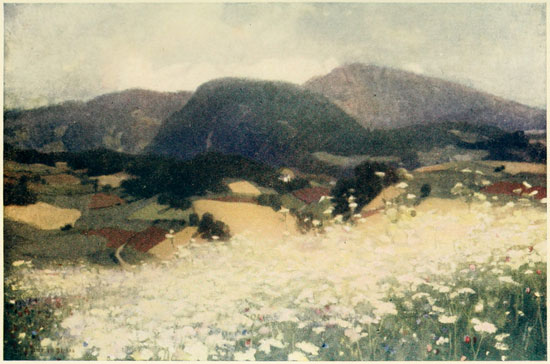
SUMMER TIME NEAR ST. ULRICH, GRÖDENER THAL
Brixen, though little more in size and population than
a large village, is yet one of the most interesting places in
Southern Tyrol. It is not only historically and architecturally
important, but is a pleasant place from which to
explore the beauties of the neighbouring Puster Thal,
Valser Thal, and Lusen Thal if only one's time permits.
Anciently it was one of the most notable towns in Southern
Tyrol, for it was during nearly a thousand years, and, in
fact, until 1703, the capital of an ecclesiastical principality,
with a long line of distinguished bishops, some of them
almost as much noted for their militant as their spiritual
qualities. It is still the seat of a bishopric, and in the
town are many evidences of its past ecclesiastical importance
and splendour.
Artists find much in Brixen to attract them, as do also
students of architecture, and although the valley is wider
than in some similar resorts, making mountain ascents
longer before one can reach the higher peaks, there are
many excursions to be made, and interesting villages to be
visited. That it is an attractive town its many visitors
make evident, and in the pleasant gardens, which seem
always cool even on the hottest summer day, situated
between the Eisack and the smaller Rienz, one meets not
only with interesting Brixen types (sometimes peasants in
costume), but also most of the foreign visitors who may be
staying in the place.
BRIXEN CATHEDRAL
The Cathedral, dating from the fifteenth century, is a
handsome and even striking building, with its lofty twin
towers, and their beautifully "weathered" copper domes.
These are the oldest parts, most of the building itself
having been restored and rebuilt as recently as the middle
half of the eighteenth century. There are some extremely
beautiful and interesting cloisters, with numerous frescoes
on the groined roof, and some quaint mural tablets and
tombstones. The view from the cloisters upon a sunny
day across the courtyard is one of great charm in its play of
light and shade, tempting one to linger in their hoary coolness
and solitude. There is also an ancient chapel of St.
John, dating from the eleventh century, containing some
good frescoes of the thirteenth to fifteenth centuries. The
tombstone of the famous Oswald von Wolkenstein is in
the inner courtyard, which lies between the Cathedral
and the Church of St. Michel, depicting the knightly
minnesinger in armour with lance, and pennon, and lyre.
Near this is also an interesting copper relief, depicting the
scene of the Resurrection, placed there as a memorial of a
noted local coppersmith named Hans Kessler, who lived in
the first half of the seventeenth century.
One reaches the Bishop's Palace by several interesting
streets, in which some of the more ancient houses are to
be found. There is a charming courtyard with colonnades,
and a delightful garden, peaceful and full of
flowers and the sentiment of other days. And here,
fortunately, the traveller can gain admission for half an
hour's restful contemplation of its beauty, and perhaps
the study of some of the historical events which the town
has witnessed.
From Brixen to Sterzing one traverses the widening,
narrowing, and again widening valley of the Eisack. Past
Spinges, with its memories of the fierce battle in 1797,
when General Joubert was marching through the Puster
Thal to make a junction with Napoleon. His advance
was not, however, permitted unchecked. The inhabitants
of Spinges might not be many, but they were Tyrolese.
It happened, too, that a few companies of the Landsturm
were in the neighbourhood, and so these and the men
of Spinges marched out to meet Joubert's immensely
superior force. The French troops were armed with
bayonets as well as guns, and the barrier they made
was found unpierceable by the brave but badly armed
patriots. But the opportunity or need produced the
man as it had done rather more than four centuries
before in Switzerland when Arnold von Winkelried
gathered the Austrian spears into his bosom at Sempach.
In this case it was one Anton Reinisch, of Volders, who
"played the man," and heroically leapt, scythe in hand,
amongst the French bayonets, a score of which pierced
his body, and thus, hewing right and left ere he fell,
carved a way for his comrades, and enabled them to
break up the French lines.
THE MAID OF SPINGES
But Spinges will be celebrated still more in romance,
as it has been in history, by the act of that anonymous
maiden "the Maid of Spinges," who, during the fight
around the church of the village, mounted in company
with the men the wall of the churchyard, and, armed
with a hay fork, helped, by her strong arms as well as
her example, to successfully repel three fierce attacks of
the French soldiery. Unknown[18] by name, yet the fame
of her courageous act, typical as it was of those of many
others of her sex during the long and fierce struggle
waged by the Tyrolese against the invaders of their
beloved land, has descended through generations.
On the other side of the valley to Spinges is Franzenfeste
at the mouth of the defile known as the Brixener
Klause. Few people stop at Franzenfeste, we imagine.
To ramble on the hillsides would be an act of foolhardiness,
for they are honeycombed with forts. It is a great
strategic position, commanding the Brenner and the
entrance to the Puster Thal; and investigation of the
hillsides and neighbourhood, it is needless to say, is not
encouraged by the Austrian Government. It is possible
in the future that the spot which saw much fighting in
1797 and 1809 will again be the scene of military
operations, and a struggle not less fierce, and far more
bloody. Who knows?
STERZING AND MATREI
Sterzing, with its sunny main street of which a most
charming vista is got as one enters the town through the
ancient gateway on the Brenner road, and shady arcades
which remind one of the "unter den Lauben" of Meran,
stands on the site of a Roman settlement, Vipitenum. It
is situated at the junction of three beautiful valleys, the
Ridnaun Thal, Pflersch Thal, Pfitscher Thal, in a broad
basin-like depression, encircled by shapely mountain
slopes, and on the right bank of the Eisack. Though
nowadays possessing a population of less than 3000,
Sterzing at once strikes one as having an air of importance
and prosperity, hardly in keeping with its small size.
Formerly, however, the town was an important mining
centre, and the larger of its quaint and picturesque
balconied and bay-windowed houses owe their origin
to the wealthier inhabitants of the past. Marble quarrying
and polishing is still carried on somewhat extensively,
and doubtless helps to retain an air of commercial life and
industry in the quaint old place.
Sterzing is wonderfully decorative and compact in
general effect; and there are a surprising number of fine
and interesting buildings to be seen in its narrow old-time
streets. The Rathaus, with its striking bow windows,
is of late Gothic architecture, and in it is a fine fifteenth-century
altar-piece, and some interesting and well-executed
wood carvings. This building, now used by
the town officials and magistrates, was formerly doubtless
a mansion of a wealthy merchant. In it is one of
the best preserved specimens of a Gothic ceiling, dating
from about the middle of the fifteenth century, that
we have seen in Tyrol in any private house of similar
size.
The church has been extensively, but on the whole
well restored. It dates from the sixteenth century, and
has a Gothic choir of note, and nave and aisles restored
in the Rococo style, the ceiling paintings of which are
by Adam Mölckh. The general effect of the interior is
good, and the church has some interesting architectural
details.
The decline of Sterzing is attributable to the same
cause as that of many other townlets and villages upon the
old post-roads, and the roads over the passes which have
gradually become less and less used as railroads have
multiplied. But, in the case of Sterzing, its gradual
descent from the position of importance it once occupied,
traces of which are found in the numerous fine houses still
standing, was undoubtedly more owing to the exhaustion
or abandonment of the mining industry than to the
coming of the railway which so seriously affected the
road traffic of the Brenner Pass.
Near Sterzing, it should be remembered, Hofer and
his peasant forces fought the first big engagement of
the struggle in 1809, which ended in the defeat of the
Bavarians, who were driven back across the Brenner,
Hofer having crossed the Jaufen from his home at St.
Martin in the Passeier Valley.
Matrei, or, as it is also called, Deutsch-Matrei, is the
only place of any size or importance which we have not
already described on the line between Sterzing and Innsbruck,
or along the Brenner road. The little town is
charmingly situated, and like others of similar character and
altitude (it lies nearly 3300 feet above sea-level), is becoming
more and more resorted to by tourists and travellers
upon the Brenner route. The Castle of Trautson, belonging
to Prince Auersperg, stands on the hillside above it.
Sterzing forms a fine centre for ascents and excursions,
and there is a most interesting pilgrimage church on the
north-eastern flank of the Waldrast Spitze dedicated to
the Virgin, and known by the name of the mountain;
it dates from the middle of the fifteenth century. Its
foundation was in consequence of a peasant's dream, in
which he was directed to go to the woods, lie down and
rest, and there he should be told what to do. When he
had done this the Virgin appeared to him, and bade him
build a chapel on the spot over an image of her which
had miraculously appeared no one knew how some years
before. To this chapel was given the name of Maria
Waldrast (Wood's rest), and although the monastery,
which was built on the spot more than a century and
a half later, in 1624, is now but a ruin, the pilgrimage
is even nowadays made by the devout to the church
which is so beautifully situated more than 5300 feet
above sea-level.
SOME TOWNS AND VILLAGES OF WALSCH-TYROL:
TRENT, ITS HISTORY, COUNCIL,
AND BUILDINGS—ROVEREDO AND DANTE—ARCO—RIVA
Trent, which is easily reached from Bozen through
the Etschland by the Bozen-Verona line, which
winds through some delightful scenery and passes
many a ruined castle perched high on inaccessible heights,
is not only a large town of upwards of 25,000 inhabitants,
but was anciently one of the wealthiest in Tyrol. It is
generally supposed to have been founded by the Etruscans,
and both Pliny and Ptolemy make mention of it; but
whoever designed Trent seized upon a beautiful situation,
and the builders have left behind them in the quaint town,
broad streets, handsome palaces of dead and gone nobles,
and a forest of towers and spires, delightful survivals of
mediæval days. Surrounded by limestone crags, the city
itself, notwithstanding its Italian character and fine atmosphere,
gives one at first sight an impression of lack of
colour which is not usually the case with Italian towns.
Regarding the foundation of the city and the origin of
its name, there is at least a local tradition that it was
founded in the time of Tarquinius Priscus, about B.C. 616,
by a body of Etruscans led by Rhaetius; and these
founders, although so far removed from the sea, instituted
the worship of Neptune, from which circumstance the
ancient name Tridentum was derived. Be this as it may,
the circumstance is interesting, as in these Etruscans under
the leadership of Rhaetius one can perhaps discover the
origin of the Rhaeti, who ultimately gave so much trouble
to the Empire of Rome. At any rate, Rhaetius gave his
name to the district in the immediate vicinity of Trent.
The interesting Castle Del Buon Consiglio, which forms
so dominating a feature of the town, and possesses a
circular and lofty donjon of the type of Guy's Tower at
Warwick, with its fine Renaissance loggia in the inner or
fountain courtyard and several storied arcades in the older,
was once the residence of the Prince Bishops, but now
used as barracks. In it is preserved an ancient inscription
relating to the government of the town, which proves that
the regulations and statutes were very largely modelled
upon those of Rome itself.
Those who can do so should certainly endeavour to
visit Trent during the latter part of the month of June,
not merely from the fact that this month is charming by
reason of the beauties of nature, the wealth of tender new
foliage and delightful climate, but also because on the
26th of the month falls the Festival of Saint Vigilius, the
patron saint of Trent, and the martyr missionary who
anciently did much to Christianize the country. At this
fête the ancient city, whose by-ways and narrower streets
are full of interest, picturesqueness, and charm, is seen at
its gayest and best. All the many churches are crowded
with worshippers, thousands of whom have flocked down
from the surrounding mountains and come in from the
various villages of the Etschland, bound first upon religious
observances in honour of their patron saint and afterwards
to take part in the characteristic games and amusements
which give the city for the time being such a festive and
Bank Holiday air. In former days the more violent
amusements were often supplemented by the performance
of religious dramas, somewhat on the lines of the better
known and more elaborate plays of Ober-Ammergau
and the Brixenthal, and also by the illumination of the
surrounding hills by huge bonfires, which are said to have
had their origin in the religious observances of even more
remote times than that of the Etruscan occupation.
Saint Vigilius, who was born at Rome, eventually
became the Bishop of Trent, and ultimately suffered
martyrdom during one of the many persecutions which
took place, and were similar in character to those of the
fourth century.
The city during its early wars was several times sacked,
and more than once burnt by the Bavarian hordes which
overran the country and even at last reached the gates
of Rome itself. Thus Trent came to be built at various
periods upon former foundations, and researches of recent
times have tended to show that, as was the case with
Rome itself, the comparatively modern Trent is built upon
soil several feet above the level of its first site. One
Italian authority, indeed, states that the streets of the
original town lie some fourteen feet below the level of
those of the present. Traces of at least three distinct
lines of walls marking the growth of the city at various
times have been excavated, leading also to the discovery
of many interesting relics of Roman days, including
tessellated pavements, portions of an amphitheatre of considerable
size, ornaments, household utensils, etc.
The bishops still retain their title of Prince, but they
lost their power as territorial rulers at the time of the
secularization which took place throughout Tyrol, and
also in the principality of Salzburg.
THE COUNCIL OF TRENT
Although this ancient city, which is characterized
nowadays by a cleanliness and order so often found wanting
in Italian towns, has undergone many vicissitudes and
has been the scene of important historical events, to the
Trent folk of to-day and to many of the visitors who
come to it the chief events in connection with its history
will undoubtedly remain the sittings of the famous Council
which commenced in the year 1545. Many may wonder
how it came about that so comparatively small a town should
have been chosen as the meeting-place of a Conference
intended to attempt the co-ordination of the beliefs and
doctrines and the regulation of ecclesiastical affairs of
the whole of the then Christian world. Probably the sole
reason for this selection was the geographical position of
the city, which lay then, as it does to-day, a frontier town,
so to speak, between Italian and German influences, and
though situated on Austrian soil, yet containing an Italian-speaking
population.
The Council opened on December 13, 1545, and continued
its sittings (with interruptions) until December 4,
1563, the last being the twenty-fifth in number. The
meetings of the Council took place at various times during
the reigns of three Popes, Paul III., Julius III., and Pius IV.,
and amongst the enactments of the Council the Canon of
Scripture, including the Apocrypha, was confirmed, and
the Church named as its sole interpreter; that traditions
were to be considered as equal with Scripture, and the
seven sacraments of Baptism, Confirmation, the Lord's
Supper, Penitence, extra-Unction, Orders, and Matrimony
were also confirmed; transubstantiation, Purgatory indulgences,
celibacy of the clergy, auricular confession,
and other matters were dealt with.
The first sitting was held under Cardinal Del Monte,
the papal legate, who rose amidst the assembled prelates
and representatives and asked them whether it was their
wish, "For the glory of God, the extirpation of heresy,
and the reformation of the clergy and people, and the
downfall of the enemy of the Christian name, to resolve
and declare that the Sacred General Tridentine Council
should begin and was begun?" The whole company, we
are told, answered "Placet," a Te Deum was sung, and it
was agreed that the first sitting of the Council should be
held on the 7th of January. The sittings were continued
at various times without any untoward event till the year
1552, when Maurice of Saxony invaded Tyrol, and although
the Council was sitting, most of its members fled the
country after having re-enacted the various decrees and
ordinances which had been previously passed.
Ten years later, what was to all intents and purposes
another Council met at Trent, and a solemn service was
again held, at which Cardinal Gonzaga was elected president.
A quarrel seems to have arisen between some of
the archbishops and bishops and one of the French envoys.
The former did not agree to some of the terms of the
proposition made by the Archbishop of Reggio, whilst
the latter raised an objection to the Council being considered
a continuation of the first Council.
The building in which the Council sat has been stated
at various times to have been the Cathedral, in the Piazza
del Duomo, but there seems very little doubt now that
the place of meeting was not there but in the Church of
Santa Maria Maggiore, situated on the Piazza of the same
name. In it on the north wall of the Choir hangs a large
picture representing some three hundred of the various
chief dignitaries as they sat in the Council Chamber.
The members numbered nearly a thousand in all, and in
addition to the cardinals, archbishops, bishops, abbots,
chiefs of religious orders, and representatives from the
University, there were also present ambassadors from the
Emperor of Germany, and from the Kings of France,
Spain, and Portugal, from the republic of Venice and
Genoa, from Switzerland, and from the German electors.
There were at first serious disputes regarding the
mode of conducting the business of the Council: what
subjects were to be brought up for discussion, and which
of those so brought up should have precedence. The
German prelates and representatives appear to have been
favourable to the discussion of subjects of a more practical
nature, realizing as they did that one of the chief causes
of disruption and want of unanimity in the Church was
the presence of practical and easily located abuses. They
therefore strongly urged that the first work of the Council
should be of the nature of reforms affecting these abuses.
On the other hand, the Italian prelates and envoys were
most favourable to the discussion of matters of doctrine
and ecclesiastical observances. These differences of opinion
were, however, ultimately overcome by an agreement that
for each session of the Council dealing with dogma there
should be one held to consider the question of practical
reforms.
The first president, Cardinal Del Monte, frankly acknowledged
that many abuses had crept into the Church,
and to prove the sincerity of his reforming proposals
voluntarily yielded up his pluralities of office; and this
example was followed by the Prince Bishop of Trent, who
offered to resign the See of Brixen.
In 1547, owing to an epidemic then raging in Trent,
the first session was closed, and the next sitting took place
at Bologna. Charles V., who had been a very active promoter
of the Council, objected to the change of venue and
insisted upon it being adjourned. It again sat in 1551 at
Trent, and an interesting feature of the sitting was the
presence of Protestant delegates and envoys from Maurice,
elector of Saxony, and from the elector of Brandenburg.
Queen Elizabeth declined to send any representative,
preferring to accept the decisions of an English convocation.
After transacting a considerable amount of business
the Council was adjourned, and did not again meet for a
period of eleven years. On that occasion many points
came up for discussion, and a considerable number of
measures of practical reform were agreed upon. One of
the most important was the suppression of the alms
gatherers, men who were sent for the purpose from Rome
to different countries with power to sell indulgences. It
was by this means that a large amount of the money with
which St. Peter's, Rome, was built was obtained.
DECREES OF THE COUNCIL
Amongst other important matters decreed by the
Council was that prohibiting the sale, printing, or keeping
of any books whatever on sacred matters under pain
of anathema and fine imposed by a canon of the last
Council of Lateran, unless first approved of by the
ordinary. It also provided that offenders should have
their books burnt; should pay a fine amounting to a
hundred ducats; should be suspended a year from the
exercises of their trades; and goes on to add that they
should be visited with a sentence of excommunication;
and, finally, should their contumacy become worse, be so
chastised by their bishop by every means granted by the
law that others might take warning from them and not
be tempted to follow their example. It was also decreed
that even those who lent forbidden books, which included
the writings of arch-heretics, such as Luther, Calvin, and
others, even though in MS., should be liable to the same
penalties; and all those who should have any such books
in their possession, unless confessing the author's name,
should themselves be regarded as the author.
Cardinal Lorraine, who attended with fourteen bishops,
three abbots, and eighty learned doctors of divinity on
behalf of King Charles IX. of France, was charged with
instructions from that monarch to entreat the Council to
concede the following reforms and benefits: that in France
the sacraments might be administered, the psalms sung,
prayers offered up, and the catechism taught in the
language of the people; and that the sacrament should
be fully administered to the laity. Also that some
strenuous means should be taken to check the licentious
lives of the clergy; and that the Council should make
any concessions tending towards peace and the abatement
of schism which did not controvert or interfere with
God's word. The French ambassadors also asked for
clear instructions concerning the doctrines governing the
uses of images, relics, and indulgences; and also they
were instructed to urge argument against exacting fees
for the sacrament, benefices without duties, and many
other things which the more liberal minded and progressive
of the prelates regarded as grave abuses in the
Church. One astonishing objection which Renaud Ferrier,
the then President of the Parliament in Paris, in company
with Lansac, raised before the Council was to the dogma
that the Pope's authority was supreme, their contention
being that the Council was above the Pope!
As we have said, this important Council on religion
came to an end in December, 1563, when the President
moved its dissolution. Before the closing scene, the acts
of the Council were finally agreed to and signed, "the
ambassadors also adding their names." Then the President
dismissed the members in the following words: "After
having given this to God, most reverend fathers, go ye in
peace." To which all present replied, "Amen." Then
Cardinal Lorraine rose and called down the blessing of the
assembly upon the then reigning Pope, Pius IV., and also
upon his predecessors, Paul III. and Julius III. "By
whose authority," said the Cardinal, "this sacred Council
was begun; to them peace from the Lord and eternal
glory and happiness in the light of the Holy Saints." To
which those present answered, "By their memory ever held
in sacred benediction."
Then there were prayers for the reigning monarchs
whose ambassadors were present, for the holy œcumenical
synod of Trent, whose faith and decrees all present declared
they would keep for ever. Then came the final scene, when
the Cardinal, standing in the midst of the vast assembly,
declared in a loud voice, "Anathema! anathema! to all
heretics!" To which there came the reply, "Anathema!"
And thus ended not only the Council of Trent, but also
the last great general Council of the Roman Catholic
Church.
THE CHURCHES OF TRENT
The church of Santa Maria Maggiore, in which the
Council held its sittings—a rather plain red marble building,
which, however, has a fine Lombardian campanile—will
always be one of the most interesting churches
amongst the many of Trent. Severe outside, the interior
is exceptionally ornate. The organ-loft, completed in
1534, twenty years after the commencement of the church,
is one of great beauty. Designed by Vincenzo Vicentin,
it has a white marble balustrading, the supports of which
are thickly encrusted with decorative work and statuettes
of delicately fine workmanship. In the church are also
several interesting and good pictures, amongst the number
one ascribed, though possibly incorrectly, to Tintoretto.
There are one or two interesting traditional stories
connected with this church. The first relates to the
beautiful organ, and runs as follows: "So fine a tone and
so esteemed was the work of the now—so far as we have
been able to ascertain—unknown organ builder, that the
Town Council are said to have determined to blind or
maim him so that it should be impossible for him to construct
another instrument like it for any other city. The
unfortunate man, unable to get the Councillors to give
up their diabolical intention, asked as a last favour to be
allowed to play on the instrument he had made ere the
barbarous sentence was carried out. But as soon as he was
in the organ-loft he set to work and irreparably injured
the vox humana stop which he had invented, and which
had been the greatest attraction of the beautiful instrument;
and thus he punished the Council who had determined
to reward his genius in such a terrible manner."
The other legend is of the crucifix, still to be seen in
one of the side chapels of the Cathedral, which on the
occasion of the final Te Deum, when the Council was
disbanded on December 4, 1563, was seen to bow down in
token of approval of the constitutions and enactments
which had just been signed.
Of the fifteen or sixteen churches of Trent, the
Cathedral, which was commenced in the eleventh century
and finished in the fifteenth, in the form of a Romanesque
basilica with a lantern above the joining of the cross, is
the most important. It is built of the same reddish brown
marble as the church of Santa Maria Maggiore, which stone
abounds in the immediate neighbourhood. There are some
remnants of seventh or eighth century carvings, notably
the Lombard ornaments of the three porches, which are of
great interest. The interior of the church, which is dedicated
to Saint Vigilius, contains many frescoes and some
good pictures and other objects, including a Madonna
by Perugino, a copy of the Madonna Di San Luca in the
Pantheon, which was presented to a Bishop of Trent whilst
on a visit to Rome in the middle of the fifteenth century,
and has ever since been an object of great veneration to
the townsfolk and peasantry of the district round about.
The Museum in the Palazzo Municipale, which, at any
rate, a year or two ago was unfortunately closed during the
months of July and August, when many tourists are in
Trent, contains some very interesting Roman antiquities,
including inscriptions, household utensils, ornaments, coins,
pottery, and similar objects, and is well worth an hour or
two for inspection.
DANTE AND THE VAL SARCA
Dante's connection with Trent does not appear to be,
even at the present time, very clearly proved, although
there would seem to be no doubt whatever that the poet
spent some few months, at least, in the Trentino. This
theory gains some considerable support from references
which occur in the "Divina Commedia" to the Trentino,
which (various authorities state) are so detailed as to be
only possible from personal knowledge. It may, however,
be pointed out that, as in the case of Shakespeare, who
described many places quite accurately to which he could
never have been, it is possible Dante's knowledge of the
Trentino was not gained from personal experience, and
the theory advanced of his sojourn in the neighbourhood,
based upon references to the district in his works, is not
unassailable. A considerable number of books, pamphlets,
and articles have been written, however, by Italian,
German, and English scholars and students of Dante in
support of different theories regarding his visit to these
parts. One of the most learned and thorough writers upon
this subject—Zaniboni—appears to have no doubt that
Dante was in the Trentino, but that the "Inferno" was
not written during his supposed visit to the Castle of
Lizzana, but soon after his return to Italy. Other authorities
have inclined to the view that the Val Sarca, near the
tiny village of Pietra Murata, is the real scene of Dante's
"Inferno"; and those who know this desolate and even
terrible spot, where the very ground seems blighted, the
heat intense between the towering and craggy cliffs, and
the whole of the valley the scene of a horrible desolation,
with huge boulders tossed hither and thither, and not a
blade of grass and scarcely a patch of lichen to be seen,
will be inclined also to support this view. But whatever
the truth may be, Trent has put in a claim to Dante in the
shape of the magnificent monument to him, from a design
by Zocchi, erected in 1896 in the centre of the Piazza
Dante, near the station. The figures around the base of the
column upon which the statue of the poet stands, with his
right arm upraised and outstretched, and his left pressing
a roll of MS. to his breast, are remarkably well executed,
and the whole effect of the memorial, with its background
of craggy mountains and its environment of flower-beds, is
impressive.
There are, of course, numberless interesting buildings,
and also several other churches worthy of study and attention;
but, perhaps, amongst all the domestic buildings and
palaces of Trent, including the Palazzi Wolkenstein and
Sizzo, and the Tabarelli, in which are magnificent private
collections of pictures and other objets d'art, none exceeds
in romantic and legendary interest the Teufelspalast, which
has been known by several other names at various times,
and latterly as the Palazzo Zambelli. This beautiful home
(now a bank) was built by George Fugger, a relative of
the wealthy banker, Anthony Fugger, of Augsburg. The
legendary story is as follows:—
George Fugger having become acquainted with one
Claudia Porticelli, a beautiful young woman of Trent, fell
desperately in love with her, and although the fair Claudia
does not appear to have discouraged his suit, she was too
proud to yield too readily to his proposals, and in addition
was very patriotic, and inclined to the view that a Tyrolese
maid should marry a Tyrolese man. It was in pursuance
of this idea, when at last her lover pressed her strongly for
an answer, that she told him she would never marry a man
who lived so far away from her beloved home, and that she
wondered how any one who did not possess a tiny pied à
terre in Trent, should for a moment think that he could
have any claim upon her affections. This reply to his suit
might, one would think, have discouraged most people, but
George Fugger, who possessed vast wealth, had no intention
of yielding up his claim, or his supposed claim, to
the beautiful Claudia without a struggle; and, moreover,
Claudia Porticelli, although discouraging him so distinctly,
had (like a woman) put off the evil day of giving a final
answer for a period of a little more than twenty-four hours.
In this delay, George Fugger saw the solution which great
wealth and determination of character placed within his
reach. He determined, therefore, within the short space
remaining before Claudia gave him his final answer, to
build a house "worthy of the human gem whose casket it
was to be."
A SATANIC COMPACT
Twenty-four hours or so in which to build a palace
was, however, such an impossibly short time that no man
could hope to accomplish the task by human aid alone.
Therefore (so the legend goes) he sought the help from a
source to which no good Christian would think of turning,
namely, that of the Devil. In legendary lore there are
many stories of the Devil assisting men and women to an
accomplishment of their desires, but almost invariably at
the price of their souls.
George Fugger, however anxious for the Devil's assistance,
was too keen a man of business to wish to endanger
his soul; so the object he set himself to accomplish was
to obtain the Evil One's aid without paying the Evil
One's price. The Devil was summoned, and he willingly
enough undertook the task upon the usual condition, of the
surrender at the end of life of the soul of the person he was
helping. George Fugger, without hesitation, signed the
bond with his blood, only stipulating for the insertion of
a small clause, which provided that his Satanic majesty
should on his part do Fugger one small service ere claiming
the price of his assistance. The Devil must have been in
a good humour, for he agreed to this quite willingly and
unsuspiciously, and the two parties went their way, each
well satisfied with his part of the bargain.
Teufelspalast was, naturally enough, of magnificent
design, and at the time it was built was furnished with
the most luxurious fittings and decorations that the mind
of man or devil could imagine. Marbles of different kinds
entered largely into its construction, and the gilding,
decorations, and carvings were such as to become famous
throughout even a country noted for great and beautiful
palaces. When the building was completed, the Devil
summoned the owner, and asked him to name the little
service that he was to do him. George Fugger had thought
out his little scheme of outwitting the Devil, and he took
a bushel of corn and strewed it over the different floors of
his vast mansion. Then he said to the Devil, "See! If you
can gather together all the corn strewn about the palace
grain by grain, and deliver it back to me without the loss
of a single grain before morning, then my soul shall be
yours. On the other hand, should you fail to do this, my
soul remains my own as well as the palace you have built."
The Devil, we are told, was not in the least disconcerted
by the task which had been set him, and without doubting
for a moment that he would successfully accomplish it, he
set to work to gather up the grain. In the end, just before
sunrise he had completed his task, all but the finding of
five grains of the corn. He searched high and low for the
missing grains, but to no purpose, and ere he could find
them daylight, which was to mark the end of the time
allotted for his task, began to appear; but the Devil,
notwithstanding the absence of the five grains, consoled
himself with the thought that Fugger would never discover
the loss of five grains amidst the many hundreds of
thousands of others which he had heaped up in the measure.
When Fugger came to see whether the Devil had performed
his task or not, he counted out the number of grains of
corn, and, of course, discovered the absence of the five, so
he asked the Devil where they were.
"Oh," said the Devil, "they are there, the measure is
piled quite full up, and you cannot be so particular as all
that."
Fugger replied, "That is all very well, but five grains
are missing, and I must have them, or you have not performed
your task, and lose all claim to my soul in return
for the palace you have so marvellously built me."
The Evil One replied, "You have miscounted the number.
I have built your house and picked up all the grains of
corn, and I am not going to be done out of my part of the
bargain; besides, you cannot prove that there are five
grains short."
"Oh yes, I can," replied Fugger; "stretch out your
right hand." And the Devil, not seeing that it could
be any harm to comply with the request, forthwith
stretched out his great hand. Fugger seized it, and said,
"There lie the five grains under your own claws. The
corn I set you to pick up had been sanctified by being
offered before the Holy Rood, and for this reason you were
prevented from fulfilling your purpose. You have not
collected the grains into your measure by dawn, as agreed,
and therefore our bargain is annulled."
The Devil was in a terrible way. He did not see how
to escape conviction of failure, and so he sought to terrify
Fugger by an exhibition of his Satanic wrath. He set
to work and began to attempt to tear down the building
which he had so recently completed. But he no longer
had any power over the palace, and only succeeded in
breaking a sufficiently large hole in the wall to enable him
to fly through it and depart.
For many years this hole, which had been bricked
up, was shown to visitors, and was esteemed by many of
the Trent people of the lower class as proof positive of
the superhuman origin of the palace and the truth of the
legend.
The end of the story is just what might be expected.
The fair Claudia, who probably never meant to refuse the
rich banker, consented to marry him, now that he had a
home in Trent. And there they lived, so it is said, happily
ever afterwards, and in due time died.
THE MADONNA ALLE LASTE
In the immediate neighbourhood of Trent are several
other buildings and places of very considerable interest
and of great picturesqueness. One favourite excursion is to
the chapel of Madonna Alle Laste, which lies on the hillside
to the east of the city, about half an hour's stiff
walking from the Port Aquila, a little way off the road
to Bassano. From this spot one not only obtains good
views of the town, but can visit on a spur of the mountain
the celebrated marble Maria Bild, to which there is an interesting
legend attached. This "picture" has been an
object of veneration with the people of Trent and the
district round about for centuries.
Some time about the middle of the seventeenth century
this fine tablet was sacrilegiously injured and
disfigured by a travelling Jew, much to the rage and
indignation of the people of Trent. And although a
German artist, Detscher by name, did his best to restore
the carving, it was impossible for him to entirely obliterate
all trace of the injury it had received. But, so the legendary
story goes, by some miraculous power it was altogether
restored in one night, and this miracle so increased the
veneration in which the Maria Bild was held that people
thought there was no kind of disease too desperate that
it could not be cured by prayers at such a holy shrine.
Several miracles are ascribed to this wonderful carving,
which became so venerated that ultimately a chapel was
built for it and placed in charge of a hermit; and later on
a community of Carmelites was established on the spot by
reason of the generosity of Field-Marshal Gallas, and this
remained until the secularization, now many years ago.
The convent buildings, however, still stand, and from
them there is a fine view of the distant range of mountains,
and the foreground slopes covered with peach and other
fruit trees.
With the many other interesting walks and legends
attached to the scattered villages which lie in the immediate
neighbourhood of quaint and historic Trent there
is no space to deal. Most travellers must leave Trent
reluctantly, for it is beautiful in situation and deeply
interesting from all points of view.
To the south and south-west of it lie two interesting
towns. The first is Roveredo, the second Arco; the
former, though a less frequented and less historic town than
Trent, is yet one of some importance and remarkably well
situated. It dates from Roman times, and received its name
Roboretum in consequence of the enormous oak forests
by which it was surrounded. The high road which leads
to it, owing to the fact that it was one of the ancient ways
into Tyrol, is crowded with ruins of ancient fortresses and
of castles in a state of more or less decay. Most of these,
including Predajo, Castlebarco, Beseno, Lizzana (at the
last named of which Dante lived during the first few years
of the fourteenth century, after his banishment from
Florence), and others took part in the various struggles
for the possession of Tyrol which were waged at different
times between the Emperor of Germany, the Republic of
Venice, the Prince Bishops of Trent, and other powerful
families of the district who carried on private and other
feuds throughout the Middle Ages.
A BURIED CITY
At the time of Dante's banishment from Florence
Castle Lizzana was the home of the Scaligers, who gave
shelter to the poet during his exile. Not far from the
Castle is that famous Sclavini (or land slip) di San Marco,
which is in reality a vast "steinmeer," and is probably
rather of the nature of a great and possibly pre-historic
moraine, than a land slide. But be this as it may the
locality of this immense accumulation of huge rocks thrown
hither and thither no doubt provided the poet with at least
the inspiration of the descent into the Inferno,[19] which
runs as follows:—
"The place, where to descend the precipice
We came, was rough as Alp; and on its verge
Such object lay, as every eye would shun.
As is that ruin, which Adice's stream
On this side Trento struck, shouldering the wave,
Or loosed by earthquake or for lack of prop;
For from the mountain's summit, whence it moved
To the low level, so the headlong rock
Is shivered, that some passage it might give
To him who from above would pass; e'en such
Into the chasm was the descent: and there
At point of the disparted ridge...."
Cary's Translation.
There is a legend that a beautiful city, once known as
San Marco, which was destroyed by a landslip that took
place at the beginning of the ninth century, lies buried
under the gigantic rocks. At any rate, in the Middle Ages
this belief prevailed, with the result that the peasants of
the district were for ever digging amidst the débris in the
hope of finding some of the vast treasure which tradition
said had been buried with the city. The story, which
possesses an almost Boccaccian touch of humour, goes on
to say that on one occasion a peasant, whilst thus excavating,
came across a vast boulder, on which was written
in letters of fire in Italian, "Fortunate will they be who
turn me over." Naturally enough, the peasant was in a
state of great delight; surely this was an indication that
the riches for which he sought would be found hidden
underneath the stone. Calling his neighbours together,
and, doubtless, promising them a share of the spoil, after
almost superhuman exertions, the great rock was rolled
over; but instead of finding in the cavity disclosed the
treasure which they expected, they found but another
inscription on the under side of the rock of a jocular and
taunting nature, also in Italian, which, literally translated,
ran as follows: "Thanks for turning me over; I had a
pain in my ribs." As the Italian peasant, of all others,
cares little for unremunerative toil, and is easily depressed
by such sarcasm, we are told, "From that time forth the
supposed ruined city of San Marco and its buried treasures
were left in peace."
Not far from this spot, too, on the other bank of the
river, is the home of another legend of a deep cavern, concerning
which there is a tradition that years and years ago
it was the retreat of a cruel, white-bearded hobgoblin who
lived on human flesh—children by preference—and that
whoever should have the courage to explore the cavern to
its depths would find at the end of it the remains of the
hobgoblin, and that his spirit would reward the adventurer
by telling him where a vast treasure lies hidden.
Possibly the legend had some origin in the fact that
the district close here was once infested by a fierce band
of robbers, who plundered and robbed, not only travellers,
but the people of the country round about. Towards the
end of the twelfth century the band became so formidable
that the then Bishop of Trent despatched a force against
them and destroyed the robbers' lair, building on the spot
where it was, and from whence they were accustomed to
attack travellers, a hospice for the protection of wayfarers,
the chapel of which was dedicated to St. Margaret.
ROVEREDO
Some dozen miles southward from Trent, down the
pleasant valley through which the Adige wends its tortuous
way, lies Roveredo or Rovereto, a busy and prosperous
town famous for its silk culture, situated on both sides of
the river Leno, and dominated by the ancient castle, which,
built by the Venetians, has withstood many a fierce siege.
The silk trade, that gives Roveredo its chief importance,
was introduced into the town as far back as the middle of
the sixteenth century, and has contributed very greatly to
its continuous prosperity. Strangely enough, the principal
family of Roveredo at the beginning of the eighteenth
century established business relations with England, and
a prosperous trade was the result.
The town is prettily situated, and from the hillside
above it presents the usual characteristics of red roofs and
white walls which distinguish most Italian towns. It has
many charming by-ways, flights of cobble-paved steps
leading up through quaint arches into zig-zag, narrow
streets of great picturesqueness, in exploring which one
is tempted to spend much time, particularly if possessing
a camera. Its chief streets, however, are wide and handsome,
notably the Corso Nuovo, planted with shady trees,
leading from the railway station to the town.
Although there are seven or eight churches in Roveredo,
none of them are of any great moment, but there is a good
altar-piece, supposed to be the work of Giovanni da Udine,
in the church of St. Rocchus, a building erected in the
middle of the seventeenth century owing to a vow made
by the inhabitants to do this during a visitation of the
Plague if the scourge was stayed. Although not a place
to stay in for any considerable length of time, Roveredo
is undoubtedly worth a visit from those who like picturesque
architecture, and also on account of its pleasant situation.
Arco, which is on the way to Riva, lies almost due
west of Roveredo, but is reached by rail circuitously, via
Mori, Nago, and Vignole, and is picturesquely situated in
the midst of laurels, palms, and olives, dominated by the
large and ancient castle situated on a pine-clad rock high
above the town. This castle was bombarded by the
French, and destroyed during the War of the Spanish
Succession in 1703. The church, a prominent object of
the pretty town, is of considerable interest, and amongst
other places worthy of note is the château of the late
Archduke Albert, which has a remarkably fine winter
garden. Arco has of recent years gained some note as
a health resort for invalids with a consumptive tendency
and, in consequence, possesses quite a number of excellent
hotels.
From Arco to Riva is but a few miles, and, if possible,
these should be travelled by carriage in preference to the
train, as the road lies through the most delightful meadowland,
fertile, and stretching upward on either hand to the
towering heights which shut in the valley. Riva, which is
the Tyrolese port of charming Lake Garda, is one of the
most delightful spots in all Tyrol. As one stands on the
promenade, far towards the south stretches the beautiful
lake, whose deep-blue waters and exquisite environment
of mountains have been sung by poets and described by
travellers in every language of Europe. At the head of
the lake there is a very busy scene of coming and going
tourist-steamers, sailing craft piled with merchandise, hay,
and other produce, giving the little harbour quite a business-like
air, which, combined with unusual picturesqueness,
cannot fail to charm every one who comes to it.
The town itself is situated chiefly at the foot of the
precipitous Rocchetta, on the sides of which olive trees,
figs, palms, aloes, and other vegetation grow; whilst above
one hangs a deep-blue Italian sky, luminous in summer
with the brilliant sunshine of northern Italy. A wanderer
in the quaint streets and by-ways, some of the former
of which are arcaded, will come across many a picture
and many a piece of charming architectural detail for
canvas and camera, whilst close to Riva, on the shore
of the lake, is the little village of Torbole, the resort of
artists, who find in its primitive character of a fisherman's
hamlet a veritable mine of delightful subjects for pictures.
The Parish Church of Riva deserves attention; it is
really a handsome building, and has much of interest in
its interior. On the outskirts of the town is the church
of the Immaculate Conception, which was built by Cardinal
von Madruzz for the purpose of enshrining a wonder-working
picture of the Blessed Virgin. Two churches
which have their origin in times of plague, those of San
Roch and San Sebastian, erected in 1522 and 1633, are
found in the town. The district round about has the distinction
of supplying the whole of Tyrol with the branches
of olive which are used on Palm Sunday; and Riva was
long considered the most northerly limit at which olive
trees would flourish. This idea, however, has of recent
years proved to be erroneous, as they are now cultivated
as far north as Bozen.
A WONDERFUL VIEW
The ascent of the Altissimo di Nago, although a
tough climb for all save practised walkers, is well worth
the trouble, as the panorama of the lake obtained from
the summit is one of astonishing beauty. Many visitors
to Riva also go to San Giacomo for the purpose of seeing
the sun rise, just as the ascent of the Rigi is made. Behind
one extend mountain range upon mountain range, and
lofty peak upon peak of rocky and snow-clad Alps; whilst
to the south lies the beautiful Lake Garda, of royal blue
in the growing light, and the widespread plains of Lombardy
on either hand studded with fair cities, of which
number Milan, if the atmosphere be clear, will seem—though
actually far distant—to be so close that a good
before-lunch stroll should enable one to reach it.
This favoured town not only takes one to the southern
limit of Tyrol, but provides a charming rest-place, from
which many interesting excursions may be made before
setting one's face, reluctantly it will surely be, northward
once more, through perhaps the grander but less soft and
rest-provoking scenery of wilder Tyrol.
AMONG THE DOLOMITES, WITH NOTES UPON
SOME TOURS AND ASCENTS
To many who visit Tyrol the most interesting
district of this delectable land is the Dolomite
region, which forms by far the greater part of the
South Tyrol Highlands and offers not only unique opportunities
for climbers, but also much impressive and beautiful
scenery.
It is only in comparatively recent years that the
Dolomite of south-eastern Tyrol has become a popular
holiday-ground of tourists and travellers. But a few
decades ago it was—except to geologists, a few artists,
mining experts, and the more enterprising climbers—a
terra incognita, a region scarcely more known to the
general travelling public than the centre of Africa. Even
nowadays it is far less frequented by western European
holiday-makers than it deserves to be.
Formerly there was some excuse for an ignorance and
neglect which a lack of easy transit, good roads, and railways
to near-by points might be held to condone. But
at the present time so much has been done to throw open
this fascinating mountain district to the traveller, rest-seeker,
and artist that the excuse can no longer be urged.
Concerning the climate, scenery, people, and accommodation
now offered to travellers, much can be said in
praise. Indeed, regarding all of these, it would be difficult
to say everything one might without running the risk of
being accused of partiality or exaggeration.
In this portion of Tyrol (as, indeed, may be said also
of others) one still meets with hospitality and courtesy at
inns and rest-houses which are not chiefly based upon
the expectation of personal aggrandisement or monetary
reward, just as one still finds quietude wedded to splendid
scenery and beautiful prospects not yet exploited.
In the Dolomite region, though its popularity is yearly
increasing, one can yet happily meet with comfortable
hotels, which are not overrun by the type of tourist for
whom a good dinner is more than fresh air and scenery,
and dress clothes and gorgeous costumes of an evening
a sine quâ non. In a word, we have found that the Dolomite
region is free from many of the disadvantages of
Switzerland—that most exploited of European countries,
and the one in which nowadays perhaps the least quietude
and rest is to be found—and provides a playground for the
mere pedestrian as well as a most attractive region for
the exercise of the climbing instinct.
It must be admitted, however, that in the less frequented
passes and valleys one has occasionally to "rough" it in a
mild kind of way, and that one needs to be a good and
enduring walker to "do" the region on foot. But although
some of the inns in the lesser known valleys are yet somewhat
primitive, the cooking is usually good, and the beds,
though the linen may be coarse, will be found almost
without exception spotlessly clean.
It may be added that French is of little use in the
Dolomites, except in the hotels at the most frequented
tourist resorts, such as Toblach, Cortina, Karer See, Bozen,
etc., Italian and German being generally spoken—the
former almost everywhere in the region; the latter chiefly
in the Gader Thal, Grödener Thal, and the district north of
the Ampezzo Thal; although in scattered hamlets south
of the latter, here and there one finds peasants speaking
both.
The Dolomite region is most accessible from the Venetian
frontier, Bozen, or Bruneck; and the true Dolomite
district, which contains all that is most magnificent as
regards scenery and attractiveness to the mountaineer and
geological student, lies midway between the points we
have mentioned, and covers the comparatively small area
of some fifty miles by forty miles.
Even nowadays there remain many peaks in the Dolomites
yet untrodden by the foot of, at least, modern man,
as well as numberless delightful paths amid exquisite
scenery, where flowers carpet the earth and tiny streams
make their water-music. Along which by-ways, from sunrise
to sunset, one can travel amid the great silence of the
hills without meeting a single fellow-wayfarer. Many of
the summits are upwards of 10,000 feet in height, and they
who first climb their rocky walls, deeply fissured sides, and
ice- and snow-clad peaks, will have accomplished tasks not
inferior to those performed by the intrepid mountaineers of
the past who have scaled the great heights of the Alps or
the Himalayas.
THEORIES OF ORIGIN
Ever since geologists have speculated and argued concerning
the origin and nature of natural phenomena, there
has been a conflict of opinion amongst Tyrolese, German,
and French geologists in particular concerning the Dolomites.
But although speculations have been many, and
various plausible theories have from time to time been
advanced, it may, we think, safely be said that none have
been absolutely proved or universally accepted. Baron
Richthofen is perhaps the ablest exponent of what is commonly
known as the Coral Reef theory of origin, and this
has of late years been largely accepted by leading geologists
of different nationalities.
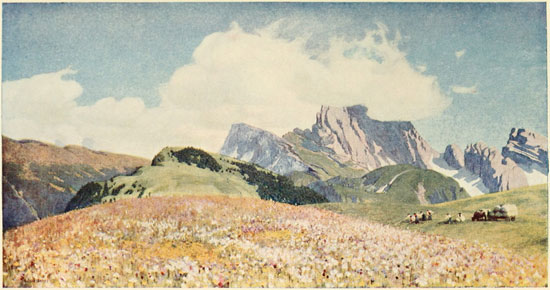
ALPENWIESE, ON THE SEISER ALP
Baron Richthofen bases his theory chiefly upon the
following points: "(A) The isolated nature of the mountains
themselves, and the fact that their sides are frequently
so steep and clear-cut as to preclude any suggestion that
they have been so made by the ordinary processes of attrition,
and that in general form they resemble atolls. (B) That
in their substance there are often found fossils and deposits
of a strictly marine character very closely resembling those
found in coral reefs; in addition to which the configuration
shown by many of the peaks is almost exactly similar to
that found in the coral reefs of to-day, with precipitous and
almost perfectly vertical sides, where they would have been
(if the coral-reef theory is the correct one) constantly
scoured by the tide, and with much less precipitous sides
on the inner or lee side. (C) The fact that there is no
trace discernible of any volcanic origin. (D) They also, in
their general shape and lines, enclose spaces in a similar
way to that which coral reefs invariably enclose." There
are many other points of resemblance advanced in Mr.
G. C. Churchill's exhaustive "Physical Description of the
Dolomite District," into which it is, however, unnecessary
here to enter more deeply.
Of the Schlern, the magnificent peak which rises from
so wild and picturesque a wooded ravine to a height of
8402 feet, Baron Richthofen makes the positive assertion
that it is a coral reef, and that its entire formation is
owing, like that of the "Atolls" of the Pacific and Indian
Oceans, to animal activity and deposit.
The Dolomites, which may be said to stretch between
the Eisack, Etsch, and Puster-Thal towards the south-east,
and extend over the Tyrol border into the Venetian district,
derive their name from the well-known geologist,
Dolomieu, who lived in the eighteenth century, and during
the latter part of it travelled extensively in Tyrol, and was
the first to call the attention of scientists and others to
the peculiar structural formation of the southern mountain
ranges. It may be briefly here said that their material is
largely limestone, but is distinguished from the other
chalky Alps by a special admixture of magnesia. The
fact that long ages ago the sea must have covered this
region, and did so for a period of long continuance, is
proved by the circumstance that, when climbing, one often
finds on the very summits of the highest peaks fossilized
sea-shells. Many authorities are inclined to the belief that
some at least of the Dolomites have been assisted in their
growth, if not actually formed, by volcanic agencies, and
this theory is borne out by the fact that craters are
traceable in some of them even to-day. But whatever may
be the true origin of these magnificent peaks, there can be
no doubt regarding their unique formation.
It may be urged by some that the Dolomites do not
possess the severe and apparently unapproachable majesty
of the snow-clad Middle Alps, with their mighty glaciers
and fields of perpetual snow; but as regards their beauty
of colour, the wildness of their romantic scenery, closely
connected with the most lovely and panoramic of landscapes,
they are unequalled, just as the climate of the
district in which they stand is delightful and invigorating.
In this comparatively small area one has a variety of
scenery unsurpassed by any, so far as we know, on the
Continent of Europe. Within the confines of the Dolomite
region one has the wide range of lofty mountains and
terrific cliffs, in places reminding the traveller of the cañons
of the Rocky Mountains, with pinnacles, battlements, and
towers, rearing themselves on every hand like ruined and
Titanic fortresses, yet with their wildness softened in a
measure by their beauty of colour when gilded by the
sunrise or bathed in roseate hue of sunset light. Between
the lofty peaks which rise skyward into the very vault of
heaven, as it seems to the wayfarer at their feet, stretch
lovely, winding Alpine valleys, often well-wooded and with
turf of a most delightful greenness strewn with myriads of
Alpine blossoms. Through valleys sweet with the odours
of pinewoods and flowers run rushing torrents or more
quietly flowing streams, which often have their origin in
tiny, dark-blue Alpine lakes set amid environing pine
forests, in whose tranquil waters are reflected the towering
rocks and secluded woods which surround them.
To these beautifully situated spots, which are peopled
by happy and friendly disposed peasants, come year by
year an increasing number of travellers from other countries
of Europe and from America, flocking into all the more
frequented parts intent upon enjoying the beautiful scenery
over which hangs, during the summer months, a vault of
deep-blue sky, looking all the bluer by contrast with the
snow-clad Dolomite peaks, whose grandeur and fascinating
beauty are not easily forgotten by those who have once
gazed upon them.
TOURING FACILITIES
One of the great advantages of touring in the Dolomites
to pedestrians, and cyclists more especially—although
cycling provides plenty of "collar-work"—is the wonderful
network of roads which cross the country in all directions.
The surface of these roads is generally excellent,
although several of them reach altitudes of between five
and six thousand feet above the sea. The gradients have
been well seen to, the road ascending by winding curves
up the hillsides mostly by such easy stages as enable
them to be traversed either on foot, in a carriage, motor-car,
or even on a bicycle without much difficulty or fatigue.
In this manner one reaches the open, sunny plateaux and
ridges which serve to divide the separate groups of mountains
one from the other, where the traveller can almost
always find accommodation in good modern hotels or in
well-arranged and modernized inns.
It is in the possession of these numerous well-managed
and excellently appointed hotels and inns
that the Dolomite region excels; and they are of such
variety as regards size and the kind and cost of accommodation
which can be obtained at them, that almost all
tastes and purses can be suited. This has been more
especially the case during the last decade, in which new
routes have been opened up, and further and adequate
hotel accommodation provided. Huge buildings, affording
every possible comfort and modern convenience,
patronized by the wealthy visitor, hotels on a less grand
scale, suited to the requirements of the well-to-do middle
classes, and yet more modest, though not less well-managed
and comfortable, establishments, where for an
almost incredibly small sum pedestrians and tourists of
more restricted means can obtain excellent food, are all
to be found in the Dolomite region. In the larger hotels
at the more noted resorts, of course, one finds much the
same "life" as that prevailing at such places as Ischl,
Semmering, Pontresina, St. Moritz, and Lucerne, where
bands play during dinner, ladies wear elaborate Parisian
toilettes, men dress for dinner, and climbing is, for most
of the visitors, quite a secondary consideration to that of
enjoying "smart" society. In the smaller places one finds
greater simplicity and, to our thinking, greater charm,
with more of the life of the people in evidence and less
of the exotic.
But the Dolomites themselves present many attractions
to the climber, and yet provide numerous ascents which
can be undertaken by the comparatively untrained and
inexperienced. This is largely owing to the fact that they
consist chiefly of isolated groups of mountains of great
height, but which, owing to their isolation, are not approached
by long and toilsome journeys ere the actual
climbing itself commences, such as is often the case with
the greater peaks of the Central Alps. Numbers of the
higher ones, reaching to upwards of 9000 feet in height,
may be ascended without any great fatigue by well-made
paths, thus providing for the tourists who are not expert
climbers plenty of exercise with just those elements of
adventure and inspiration which prove the greatest charms
to all climbers, and the reward at the end which comes to
those who penetrate the higher regions of a purer atmosphere,
and a larger outlook upon the glorious beauties
of mountainous districts.
There are, of course, many other Dolomite summits
which can only be ascended, and should only be attempted,
by practised and hardy climbers, for whom great heights
and the risks attending their ascent possess no terrors. It
is generally conceded that the district provides both for the
inexperienced and most experienced climbers some of the
most interesting mountain ascents in Europe. In the Dolomite
region, especially of recent times, climbing has
made extraordinary progress. Summits, the ascent of
which a few years ago was looked upon as a great achievement
by even good climbers, are now scaled by numbers
of people every year; and each year brings additions to
the conquered peaks, some of which were a decade ago
looked upon as absolutely unclimbable, and likely to
remain so.
The Dolomites are, indeed, gradually becoming as well
known to climbers and would-be climbers of even the
countries of Western Europe as are the Swiss Alps, and
annually a larger number of lovers of Alpine scenery take
their holidays in this region; and of late years the district
has been visited by many even in winter time. In summer,
although much accommodation has already been provided
for tourists, it is, up to the present, decidedly insufficient
for all the visitors who flock to this region during the
months of July, August, and September. It is, therefore,
advisable for any one who wishes for a comfortable
time during those months to secure rooms in advance at
all places which are to be visited, more especially at those
centres of attraction to which the greater number of tourists
are in the habit of gravitating.
DOLOMITE GROUPS
The Dolomites may be divided into the following
groups, running from east to west.[20] (1) The Sextner
Dolomites, the most important summits amongst which
are the Drei Schuster Spitz, 10,375 feet, which is ascended
generally from the Fischelein Boden; the Elferkofel,
10,220 feet; the Zwölferkofel, 10,150 feet; Oberbacher Spitz,
8700 feet, and the Drei Zinnen, 7897 feet, two absolutely
bare peaks of sulphurous limestone, streaked with pale
orange, rising grandly and boldly from behind the Monte
Piana plateau like two huge scored and fissured fingers of
a Titanic hand. (2) The Ampezzaner Dolomites, with
Monte Cristallo, 10,495 feet, with its many peaks veiled
by snows, glassing itself in the agate green waters of
the lovely pine-environed Dürren See. Monte Antelao,
10,710 feet; the three Tofanas, ranging in height from
8565 feet to 10,635 feet; and the Sorapis, 10,520 feet. (3)
The Agordinischen Dolomites, with the Nuvolau, 8685 feet;
Monte Pelmo, 10,395 feet; and Monte Civetta, 10,565 feet,
whose western face from Caprile was unascended till as
recently as 1895, when Messrs. Raynor and Phillimore,
with two Ampezzo guides, made the ascent. (4) The
Grödener Dolomites, which embrace the beautiful Rosengarten,
the Schlern, 8415 feet; the Sella-group, including
the Sellajoch, 7275 feet; Rodella, 8155 feet, and other
lesser peaks; and the Geislerspitzen, with its highest peak,
Sas Rigais, 9930 feet. (5) The Fassaner Dolomites, consisting
of the groups of the Latemar, 9166 feet; the
Marmolada, the highest of all the Dolomites, a huge group
with several peaks, including the Puntadi Penia, 11,020 feet;
the Marmolada di Rocco, 10,820 feet, and other magnificent
and lofty summits; and the Pala Group, including
the Cimone Della Pala, 10,450 feet, the Pala Di San
Martino, 9830 feet, and the Pala Della Madonna, 8336 feet.
There are numberless interesting and picturesque
excursions to be made in this charming region of the
Dolomites, but the space at our disposal will only permit
of the mention of a few of the most accessible, interesting,
or picturesque.
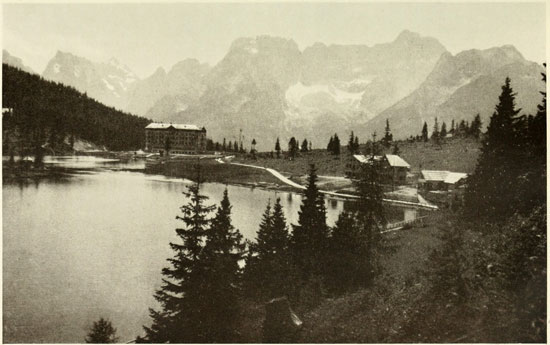
MISURINA LAKE
Innichen Through the Sexten Thal to
Lake Misurina.
Innichen, reached from Toblach through a beautiful
pine (larch) forest, is a prettily situated townlet on the
Puster Thal road, with good accommodation for visitors.
It possesses a fine monastery church, dating from the
thirteenth century, which is one of the most interesting
and unique buildings in Tyrol. It contains some very
extraordinary and grotesque figures and faded frescoes,
and a small chapel built in imitation of the Holy
Sepulchre by one of the villagers, who once made a pilgrimage
to the Holy Land. The road leads a little below past
the village into the Sexten Valley, the principal hamlet
of which is Sexten, or St. Veit, which is nowadays a
charming and much-frequented summer resort, where one
may wander amidst almost illimitable pine forests, and
enjoy fresh mountain air and quietude surrounded by
exquisite scenery. From Sexten one reaches in about an
hour Fischlein Boden, by way of Moos, along a beautiful
path through the pine woods, from whence one obtains an
admirable view of the head of the valley, with the Drei
Schuster Spitze, the Oberbacher Spitze, Drei Zinnen,
Elferkofel, Zwölferkofel, and Rothwand, and an almost
unrivalled vista of snow peaks. From this point, passing
the Zsigmondy Hut, 7320 feet, one comes to the Bacherjoch.
From the Zsigmondy Hut, the Elferkofel and the
Zwölferkofel may be ascended, both of which are, however,
very difficult. Over the Bacherjoch a footpath leads to the
Drei Zinnen Hut on the Toblinger Riedel, 7895 feet, on
past the celebrated Drei Zinnen to the pretty Misurina
Lake, tree-bordered and mountain environed, one of the
most charming and picturesque spots in the Dolomites.
Toblach through the Ampezzo Thal to
Schluderbach and Cortina.
From Toblach there is an excellent excursion through
the Ampezzo Valley to Schluderbach and Cortina. The
starting-point is situated on the watershed of the high
Puster Thal, and is a great place for consumptives and
different forms of fresh-air cures. It is visited by people
from almost all parts of the world, and in consequence the
hotel accommodation is excellent and even luxurious.
The village of Toblach itself is at the head of the Ampezzo
road, which here leaves the Puster Thal at an altitude of
nearly 4000 feet, and leads due south, passing between the
Sarlkofel, 7740 feet, on the right, and the Neunerkofel,
8418 feet, on the left. The Puster Thal railway, which comes
within about a mile of the village, makes Toblach easily
accessible, and it is in the neighbourhood of the station
that the huge modern hotels are built, acting, as it were, as
gateways to the beautiful Ampezzo Valley. The road
through the latter is a magnificent one, well suited for
motoring if care be taken in descending some of the sharp
curves which lead down into Cortina; and especially
beautiful upon such an evening in June as we traversed it,
just as the sunset hues were illuminating the higher peaks
with that roseate glow which is destined too soon to
fade to purples and through them to the slatey blues of
twilight.
From Toblach the ascent is very gradual to the pretty
and romantically situated Toblach Lake; and thence one
passes on to Landro at the head of the valley of the
Schwarze Rienz, where rise the lofty and snow-clad Drei
Zinnen with the waters of the Dürren See, jade green and
beautiful in colour, with Monte Cristallo with its cap of
eternal snow and its glacier, the Piz Popena and Monte
Cristallino, rising in the background. From the Dürren
See to Schluderbach, 4730 feet, is a distance of less than
two miles; and here, too, one finds a beautifully situated
village surrounded by fine scenery, and provided with
excellent accommodation for tourists whether they be but
passing along into Italy or inclined to make a lengthy
stay.
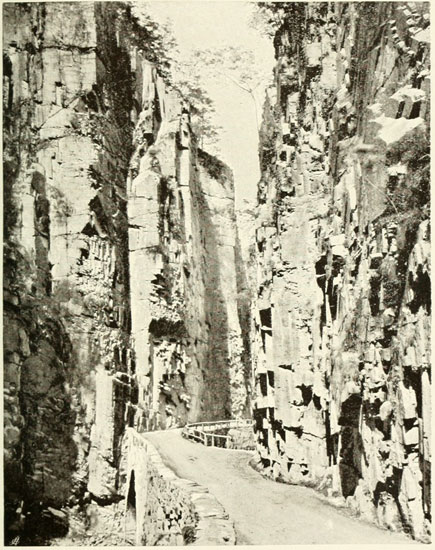
A ROAD THROUGH THE DOLOMITES
Schluderbach—Cortina.
From Schluderbach the road passes over the boundary
between Tyrol and Italy, through a beautiful forest, past a
deep ravine, down to Ospitale, 4835 feet, situated at the
base of the Crepa di Zuoghi, 6745 feet, and afterwards
skirting the Peutelstein or Podestagno, 4945 feet, by a wide
though sharply curving road skirting precipitous slopes
and crossing the deep gorge of the Felizon by the Ponte
Alto, down to Cortina d'Ampezzo, 4025 feet above the sea,
reached by carriage from Toblach in about seven hours,
and distant from it just over twenty miles.
CORTINA
Cortina is beautifully situated on the left bank of the
River Botta, with the fine Tre Croci Pass (which takes its
name from the three large wooden crucifixes) opening away
behind the town eastward, and the Tre Sassi Pass widening
out before it westward. The town is the principal one in
the commune of Ampezzo, and is surrounded by stupendous
heights and grand snow-clad mountains, amongst which
are some of the most splendid of the Dolomites. For
years past Cortina has been so considerable a resort of
tourists and rest-seekers that splendid accommodation is
nowadays obtainable; and one of the first impressions
made by the place upon the traveller who comes to it
after that of its picturesqueness is its prosperity. It is
far cleaner, too, than most Italian or semi-Italian towns
of its type. Though the climate is so favourable—even
in the coldest of winters the thermometer seldom falls far
below freezing-point—the soil of the district is very poor,
and the appearance of most of the mountain-sides and
valleys is bleak. There is in consequence little agriculture
and no cultivation of the vine in the immediate neighbourhood
of Cortina. Indeed, throughout the Ampezzo Thal
pasturage and timber-felling, and not agriculture, are the
chief industries, although wood-carving and the manufacture
of gold and silver filigree work is carried on to
a very considerable extent.
The festivals and fairs of the district are amongst the
most important of south-eastern Tyrol, and at them one
still sees many of the charming peasant costumes which
have had here, as elsewhere, a tendency to die out. The
huge silver-headed hairpins of the girls form a particularly
noticeable feature of their elaborately and neatly plaited
coiffures.
The main street of Cortina is a sunny and picturesque
one, many of the houses possessing quaint, irregular roofs,
and the church, little piazza, and hostelries making up a
charming picture, with a beautiful vista of pastures and
mountain summits at the end of the street.
The church, with its stately detached campanile, from
the gallery of which, nearly 250 feet above the level of the
street, there is a fine and extensive view of the town and
valley, is one of the largest for many miles around, and
contains, amongst other things, an unusually handsome
altar, and some beautiful wood-carvings by Brustolone.
The churchyard (unless recently altered) is a desolate
though a picturesque spot, unfortunately a standing
memorial of indifference for the memory of those who
have passed away, and irreverent neglect.
All who reach Cortina, whether they stay long or merely
for a few hours, should go to the Aquila Nera Inn, if only
to see the interesting and varied paintings of two of the
sons of a former proprietor named Ghedina which adorn
the walls of the dining-room, staircase, the outside of the
"Dependance," and even the whitewashed walls of the outhouses
and stables. The subjects are of great variety,
displaying in many cases much technical skill and imaginative
gifts, and comprise military and religious figures
and designs, grotesques, and on the walls of the square-built
and solid-looking Dependance are some large groups
representing painting, sculpture, architecture, and other
domestic subjects, especially noticeable being the painter-like
and clever manner in which modern objects, such as
telegraphic instruments, cameras, steam-engines, etc., have
been handled.
From the top of the campanile, in which are hung
great bells, one has the village and the valley spread out
at one's feet, with the Ampezzo Thal stretching north and
south and the passes of Tre Croci and Tre Sassi stretching
east and west.
BEAUTIFUL FLOWERS
In the valleys surrounding Cortina there are many
beautiful wild flowers and specimens of Alpine flora,
amongst the most noticeable of which are the wild daphne
and the smaller mountain gentian; we fancy, too, that
in another very beautiful though small pink flower with
waxen petals, which grew in large clusters, we found the
Androsace glacialis, although two botanically learned
friends differed as to the correct name of this charming
specimen.
On the way to Cortina via Schluderbach one can, by
branching off southward soon after leaving the village,
reach, either on foot through the woods or by a good
carriage road through the Val Popena, the beautiful and
nowadays much-frequented Lake Misurina, in which the
peaks of the Drei Zinnen and the tree-clad lower slopes
of environing hills are charmingly reflected. The lake,
although of comparatively small size, is justly considered
one of the most beautiful in Alpine regions, and on its
banks several large hotels have already been erected for
the accommodation of the increasing number of visitors
who come to this quiet and lovely spot which lies nearly
6000 feet above sea-level.
One of the most picturesque excursions in this extreme
southern limit of Tyrol is by the carriage road, which,
after passing through the village, traverses the forest and
by a gradual ascent reaches Tre Croci, 6000 feet above
sea-level. All along this beautiful road, which traverses
the slope of the Crepe di Rudavoi, one obtains the most
beautiful peeps of the huge cliffs of Cristallo to the right,
with fine vistas of the Marmorole and Sorapis on the
opposite side. At Tre Croci the beautiful Ampezzo Valley
suddenly bursts upon the view with the huge mass of the
Tofana right across the valley, whilst in the distance and
to the south-west appears the serrated ridge of Croda da
Lago; and yet further distant the snow-clad summits of
Marmolada. From Tre Croci the beautiful road runs direct
to Cortina down a rather steep incline. Although the
former means of reaching Cortina from Schluderbach by
the high road and through the Ampezzo Thal is the more
easily accomplished, none who have taken the road by
way of Misurina will regret its greater length because of
its greater interest.
Schluderbach—Plätz Wiese—Pragser
Wildsee—Niederdorf
From Schluderbach, too, there is another road branching
northward from the Imperial Road to Niederdorf on
the Bruneck-Innichen-Toblach line, leading over the Plätz
Wiese, upwards of 6500 feet above sea-level. There is
a fine hotel on the Plätz Wiese, about two hours from
Schluderbach, and it is from thence that one ascends the
Dürrenstein, 9320 feet. This easily climbed mountain,
although not providing much excitement for the expert
Alpinist, is one of those which amply reward the climber
for the fatigue and trouble of the ascent. As one stands
upon the summit one has spread out around on all hands
a most astonishing and magnificent panorama of the Dolomites,
as well as of the glaciers and Middle Alps which
lie to the north. Amongst the great heights and groups,
on a good day plainly visible from the mountain, are those
of the Tauern, Ortler, and Adamello, and the beautiful
Pragser Thal, with amongst the chief heights the Hohe
Gaisl, 10,330 feet; Cadini, 9320 feet; Monte Cristallo,
10,495 feet, with its glacier, and many other giants of
the region.
PRAGSER WILDSEE
The road from Plätz Wiese continues past the little
watering-place Alt-Prags to Niederdorf, to reach which
occupies about three and a half hours. There is from
this road another, branching off and leading past the
watering-place of Neu-Prags, with its prettily situated
houses and hotels, to the lovely Pragser Lake, nearly
5000 feet above sea-level, and distant from Niederdorf
seven and a half miles. Pragser Lake, or the Pragser
Wildsee, is one of the most beautiful, secluded, and
romantic of all the Alpine lakes, surrounded and sheltered
as it is by the mighty walls of the Seekofel, 9220 feet; the
Herrstein, 8035 feet; Col de Ricegon, 8770 feet; Hochalpenkopf,
8420 feet, and many other wild and impressive
heights. In the olive-green waters of the lake itself the
two first-named giants are reflected with wonderful distinctness
and beauty; whilst on the slopes of most of the
surrounding mountains the silvery, star-like flowers of the
edelweiss and the royal blue gentians grow with a luxuriance
scarcely equalled in any other part of the Dolomite region.
The climate of this Alpine lake is indeed bracing and
health-giving, for on the hottest summer day one finds a
cool and refreshing air coming down from the mountains
and traversing the surface of the lake, whilst in the evening
the temperature is not materially lowered, as so often
occurs at places having such a considerable altitude and
set amid great peaks, so that one can remain in the open
air quite safely, even though lightly clad, until the beautiful
Alpine twilight wraps the lake and its shores in a mantle
of mysterious beauty, and night seems to descend from
the summits of the great peaks around.
No one, however, should think of visiting Pragser
Wildsee in the summer season without first bespeaking
accommodation at the beautiful hotel situated on the
borders of the lake, or they may find themselves compelled
(as have been many others before them) to turn their
backs upon this lovely spot for lack of accommodation, as
this is always crowded with visitors during the months of
July, August, and the early part of September. This
charming resort is most easily reached from Niederdorf,
situated on the Puster Thal railway, one station eastward
from Toblach.
Cortina—Falzarego—Buchenstein.
From Cortina the old Imperial or high road takes one
out of the Dolomites to the south-east into Venetian
territory to Belluno, an interesting and picturesque old
town standing on a hill between the Piave and Ardo,
which at this point flow together. The Cathedral, built
chiefly by Tullio Lombardo in the early years of the
sixteenth century, was unfortunately greatly damaged
during the earthquake in 1873; but it has been largely
restored, and contains, in addition to many interesting
architectural details, some fine altar paintings. From the
summit of the campanile, which is upwards of 200 feet in
height, one obtains a most exquisite view of the old town
and surrounding country. The Prefecture, in the Piazza
del Duomo, is a fine early Renaissance building dating
from the end of the fifteenth century, and was originally
the Palazzo dei Rettori.
Belluno will shortly be connected by rail with Cortina,
and possess a station of its own. The new Dolomite road,
however, travels from Cortina in a south-westerly direction
to the rock-strewn Falzarego Pass, 6945 feet, lying in the
shadow of the Hexenfels, 8126 feet, whilst to the south-west
rises the impressive, snow-covered Marmolada, with
the Col di Lana, 8084 feet, in the foreground of the
picture. From this pass one can ascend the Nuvolau,
8460 feet, from the summit of which there is a panoramic
view of the railway and surrounding peaks. At the other
end of the pass the new Dolomite road descends more
than a thousand feet into the valley of Andraz, a little,
picturesquely situated village from which several interesting
excursions can be made, near which lie the ruins of a very
ancient castle bearing the same name. Buchenstein, the chief
village of the Buchenstein Valley, distant from the end of
the pass some nine miles, is reached by the road from
Andraz. There are some excellent inns, and the village is
splendidly situated and makes a good centre for holiday
makers.
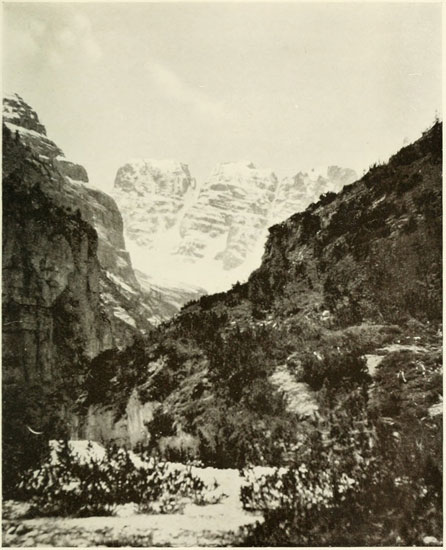
A PEEP OF THE DOLOMITES
Buchenstein—Caprile—Alleghe See—Arába.
Near it a little road branches off to the south-east,
which, leading through Italian territory and crossing a
stream, leads to Caprile, just over the Italian frontier,
descending on the left side of the Val Cordevole, with fine
views of the Val di Livinallongo. The village of Caprile,
at the far end of which is the short Venetian column,
surmounted by a lion of St. Mark, a relic of the days
when the Venetians ruled the district, is a somewhat
straggling one, with many of the houses built upon arches.
The church is ordinary, although there are some quaint
decorations to the organ-loft worth seeing. But, disappointing
as is the village itself, its beautiful surroundings,
with the truly magnificent prospect of Monte Civetta, and
the beautiful Alleghe Lake, tempt one to prolong one's
stay.
From Caprile the road leads to the Lake, which lies
at the foot of Monte Civetta. The high road, however,
which is fairly level, leads first of all to the village of
Arába at the foot of the Pordoijoch, 7355 feet.
Bruneck—Enneberg—Arába.
On the way to Arába one can also reach, direct from
the Puster Thal station, St. Lorenzen, through the wildly
beautiful and romantic Enneberg Thal, which forms the
shortest route to the middle division of the great Dolomite
road. One peculiarity of the Gader or Enneberg Thal,
and other similar valleys of the district, is the fact that
the peasantry speak neither German nor Italian (although
in some valleys the latter language is gradually becoming
more used), but the patois known as Ladin, which
somewhat resembles the Romanche of the Grisons district,
although each valley has certain peculiarities of dialect.
No doubt these latter will in time die out, and German
will become the common language of the more German
valleys, and Italian of the more Italian.
The carriage-road, which is 45 kilometres (28 miles)
in length, is not suitable for motors; it leads past Pedrazes,
4350 feet high, and Corvara, 5110 feet, to Arába. Near
Corvara lies the way over the Grödener-Joch, 7010 feet,
into the beautiful Grödener Thal, often sung by the poet
Walther von der Vogelweide.
Waidbruck—Grödener Thal—Arába.
The usual starting-point, however, for the latter is
Waidbruck, to the south of the Brenner road between
Franzenfeste and Bozen. From Waidbruck, 1545 feet,
which lies at the head of the Grödener Thal, with the
Trostburg, 2040 feet, towering above it, the road goes to
St. Ulrich, 4055 feet, distant eight miles, the chief village in
the wide valley, prettily situated and surrounded by tree-clad
slopes, beyond which rise some magnificent rocky
Dolomite peaks. The church, dating from the end of the
eighteenth century, has a beautiful interior, containing
some excellent examples of the woodcarving for which
the Grödener Thal has for ages been and still is famous.
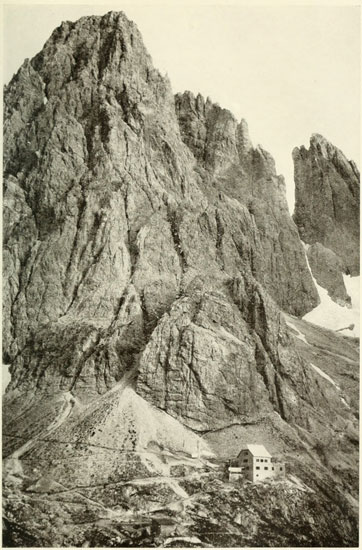
THE LANGKOFEL
SOME DOLOMITE PEAKS
From St. Ulrich it climbs upwards through the valley,
which at each step becomes more beautiful and more
magnificent, to St. Christina, 4685 feet, with its mountain
pastures dominated by the huge Langkofel-Joch, 8800
feet, and many other impressive heights, such as Secéda,
8270 feet, Geislerspitzen, 9930 feet, to the north, and the
Plattkofel, 9740 feet, to the south; the Stella Group to
the south-east, with the Col dalla Piëres, 9055 feet; and
the Pitzberg, 6020 feet, Puflatsch, 7140 feet, and the more
distant Rosengarten and the Schlern to the south-west.
From St. Christina the road continues over the hill to
St. Maria in Wolkenstein, to Plan, 5290 feet; from whence
mule tracks lead over the magnificent Grödener-Joch, with
its protection hut, or hospice, 7010 feet, into the Enneberg
Valley to Arába; and also over the great Sella-Joch, 7275
feet, to Canazei, in the Fassa Valley, which lies southward
of Pordoi. There are several excellent and interesting
ascents which can be made from the Grödener Valley.
First of all there is the romantic Geislerspitzen, which,
however, should only be attempted by the skilled climber,
as it is both a laborious and difficult ascent. In the same
category, though more difficult, and suitable only for hardy
mountaineers, are the Grosse Furchetta, with its highest
point 9930 feet; Kleine Furchetta, a few feet less; the Fermeda-Thurm,
9440 feet; and the Gross Nadel, 9250 feet.
Starting from the Sella-Joch, the magnificent Sella, with
the Boè Spitz, 10,340 feet, as well as the wildly rugged
Langkofel, can be ascended. From the Sella-Joch also
one can easily ascend the Col Rodella, 8155 feet, which
lies to the south-west of the former, from which summit
one obtains a very fine and extensive panoramic view.
Arába—Pordoi—Canazei.
In Arába, the second part of the new Dolomite high
road, which comes over the Pordoi-Joch to Canazei, in the
Fassa Thal, the way ascends in wide zig-zags through a
beautiful and broad Alpine valley, in which those interested
in botany will find a wealth of Alpine flora scarcely excelled
by that of any portion of Tyrol, up to the heights
of the Pordoi-Joch, where there is an inn at which meals
can be obtained, and from which a most magnificent circular
panoramic view extends. From this place well-made
tourist paths extend in many directions to the Boè-Spitz
as well as to the Fedaja Pass, 6710 feet, and the frontier
between Tyrol and Italy; a most attractive road, with the
huge snow peaks and glaciers of the giant Marmolada close
at hand.
The new Dolomite road goes from the Pordoi-Joch in
a south-easterly direction, traversing a magnificent forest
with wonderful and ever-changing views of the craggy
peaks of the Dolomites, and thus on to Canazei in the
curve of the Fassa Thal.
Canazei—Fassa Thal—Neumarkt—Tramin.
This little town, 4790 feet, distant from Arába just
over twelve miles, is charmingly situated, and much resorted
to by tourists as a centre from which to make
numerous interesting short tours in the Dolomites. The
inns are simple in character though comfortable, and for
that reason many will find that they possess an attractiveness
exceeding that which one finds in hotels of a more
pretentious class. The high road leads near Canazei, past
Gries, Campitello, Vigo, and Möena, to Predazzo, the chief
town in the Fassa Thal, 3340 feet, about nineteen miles
from Canazei.
The place occupies, so we are told by Baron Richthofen
and other authorities, including de Saussure and Churchill,
the site of an ancient volcanic crater, although it is indeed
difficult for those unversed in geology and seismic phenomena
to realize the fact. Predazzo, which stands in a
broad valley at the junction of the Val Travignolo and
Fleims Thal, is a prosperous town, mainly owing to the
mineral wealth in the immediate neighbourhood, which of
late years has been developed and worked, and the fertile
nature of the valley. The inhabitants are principally iron
workers, farmers, and hay or timber merchants, and their
sphere of trade is a far wider one than the uninitiated
would imagine, extending as it does throughout the Austrian
Empire, to Germany, Switzerland, and other countries.
The town cannot, however, be described as either very
picturesque or pretty; there are too many saw mills and
iron furnaces in it, and these in a measure serve to destroy
the beauty of a naturally pretty valley. But the painter
of figure studies and tiny domestic pictures, and the camera
user with an eye for quaint "bits" may find them in the
older portion of the town amongst the wooden buildings;
and picturesque groups of women and girls are sure soon
to reward the patient artist or photographer who takes up
a position commanding the stone fountain in the main
street, to which many come daily to draw water.
There is a fine new church, which, however, cannot
displace in one's artistic or sentimental affection the old
one with its Tyrolese belfry and weather-worn look. The
famous and curious old house known as the Nave d'Oro,
now an hotel, but once the home of Giacomellis for hundreds
of years, is worth inspection, as some of the armorial bearings
of this erstwhile noble family still appear above the
old carved doorways, and serve as decorations of the ceilings
and fireplaces. The visitors' book contains what
must be one of the most valuable (so far as scientists and
geologists are concerned) collections of autographs to be
found in any Tyrolean hotel.
Predazzo is one of the finest geological centres in
Eastern Europe, and in the immediate neighbourhood of
the town many beautiful and varied minerals and crystals
are found, amongst them the Tourmaline granite, Uralite
porphyry, and the Syenite porphyry, with its marvellous
crystals, which, so far as we have been able to ascertain,
are unique to this district.
Although Predazzo is chiefly—and, in fact, almost
entirely—given over to mining, smelting, and timber-cutting,
there is yet, amid all the hum of the timber sawing-mills,
and the roar and smoke of the furnaces, a considerable
lace-making school for women, where this most delicate
of industries is taught and practised. Some exquisite
specimens of lace are to be seen, and can be purchased
at moderate cost.
An interesting fact in connection with the rich pasturage
on the slopes of the Latemar is that it belongs by
common right to the descendants of the original families
founding the village, and was given to the latter by a grant
dating from the Middle Ages, but by whom made it does
not appear absolutely certain.
The road leads on through the Fleimse-Thal, past
Cavalese, where there is an ancient palace of the Bishops
of Trent, which has a painted façade. The building is now
used as a jail. There is here a fine Gothic parish church,
standing on a hill, with an old marble entrance porch, and
some interesting pictures by native artists. The road then
leads one on to the railway station at Neumarkt-Tramin,
which is twenty-four miles from Predazzo and ninety-eight
miles from Toblach.
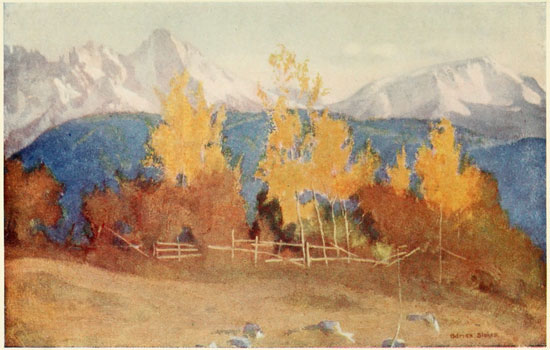
MOUNT LATEMAR
Vigo di Fassa—Karer See.
At Vigo di Fassa, 4565 feet, the chief village in the
Fassa Thal on the road to Bozen and the Karer Pass, the
road branches off, leading in a westerly direction over
the Pass, 5270 feet, and past the Karer See, 5030 feet,
which lies at the base of the Latemar, to Bozen.
THE VAJOLET AND SCHLERN
Karer See is one of the most beautifully situated places
between the Rosengarten and Latemar, and is also one of
the most celebrated and fashionable resorts in the Dolomite
region. From its situation and numerous delightful
walks and excursions which can be taken from it, it is
especially suited for a lengthy stay, and for these reasons
partakes somewhat of the nature of the well-known Swiss
resorts such as St. Moritz, Pontresina, Engleberg, and
other places of a similar character. Many of the hotels
are most beautifully situated on the borders of the lake,
with a picturesque background of pine woods, beyond
which tower the serrated and deeply fissured summits of
the Dolomites, with striking views of the great peaks of
the Latemar, Rothwand, Ortler, Oetz Thal, and Stubai
Alps. From Karer See the Latemar and the Rosengarten,
whose highest point is 9780 feet, are easily visited, and
among the excursions which those who are not expert
climbers can take is that from Karer See, by the Rosengarten,
past the Ostertag and Ciampedie hut, 6530 feet, to
the Vajolet hut; or past the Kolner hut, 7630 feet, over
the Tschager-Joch, to the Vajolet hut, 7430 feet. Starting
from the Vajolet hut, one can ascend the Vajolet Thürme
through a ravine filled with débris and a steep slope usually
covered with snow; the Rosengarten Spitz, 9780 feet, and
the Kesselkogel, 9845 feet; Cima di Laura, 9440 feet, and
several others. All of those mentioned are difficult ascents,
and should only be attempted by expert climbers and with
guides.
From the Vajolet hut a fairly good footpath also leads
over the Grasleiten Pass, 7100 feet, to the hut which occupies
a magnificent position with an extensive view of the
giant Dolomites in the immediate vicinity, and towards
the west a fine prospect of the Presanella and Ortler
Group. From this point the path leads through the Bärenschlucht
up the Schlern.
Waidbruck—Seis-Schlern.
The Schlern, which is a huge accretion of Dolomite
rock, towering above the green, undulating plateau which
forms its base, the middle peak known as the Alt-Schlern
or Petz, 8402 feet, is the highest of the series, although
several of the peaks approach it in altitude within a few
hundred feet. The Schlern forms one of the most attractive
groups of Dolomite peaks, on account not only of
the magnificent view which rewards the climber, but also
because excellent accommodation for tourists and climbers
has been provided on the slope of the Alt-Schlern just
above the plateau, at a height of 8040 feet. There are
situated the Schlern house, belonging to the Bozen Alpine
Club, with upwards of thirty beds, and the Schlern Inn,
containing a little over half that number.
The starting-place for the ascent of the Schlern is
usually Waidbruck, already referred to, and from thence a
carriage-road leads by way of Kastelruth and the charmingly
situated summer resort Seis, 3285 feet, to Bad
Ratzes, 3950 feet, situated in the wild but well-wooded
gorge of the Frötschbach. Between Seis and Bad Ratzes,
set in the forest, are the ruins of the ancient home of the
Minnesinger Oswald von Wolkenstein. From Bad Ratzes
the peaks of the Schlern can be easily reached by a mule
track, although serious climbers generally take up their
residence at either the Schlern House or the Schlern Inn
whilst ascending the various peaks which can be most
easily reached from that point.
Blumau—Tierser Thal—Rosengarten.
From the Schlern and Rosengarten district one proceeds
from the railway station to Blumau, 1020 feet, near
Bozen, into the renowned and picturesque Tierser Thal.
The carriage-road from Blumau takes one through pretty
scenery in about two and a half hours to the little village
of Tiers, and then on to Weisslahn-Bad, 3818 feet, from
whence tourists' paths have been made leading up the
Schlern to the Grasleiten hut, and over the Niger to the
Kölner hut, from which one can then either ascend
the Rosengarten, or proceed through beautiful flower-bedecked
Alpine meadows to the charming Karer See.
Karer See—Bozen.
From Karer See the road, which, though a fair one, is
not practicable for motors, winds, gradually descending,
through beautiful woods to Welschnofen, 3865 feet, a
favourite summer resort, situated in a fine open valley
with splendid views of the towering serrated ridge of the
Latemar on the right, and on the left the beautiful Rosengarten.
From Welschnofen there is a good road to
Birchabruck, 2895 feet, a pretty place where the Welschnofen
Thal branches to the left, and the wildly romantic
Eggen Thal, leading to Bozen—which is the principal town
in southern Tyrol—to the right.
Fassa Thal—Paneveggio—San Martino—Trent.
At Predazzo there branches off from the high road
another good road which leads over the Rolle Pass, 6510
feet, into the Pala Dolomites, and then over Primero,
2350 feet, on one side towards Venice, and the other
towards Trent. This fine high road threads its way
through a splendid forest to Paneveggio, 5055 feet, a
pleasantly situated village—set amid pine woods—from
which one can return over the Lusia Pass, 6745 feet, to
Möena, and ultimately to Karer See, with magnificent
views of the Colbricon, the Cimon della Pala, and the
Oetz Thal Alps in the background. From Paneveggio,
too, the road climbs up the Rolle Pass, which forms the
watershed between the Adige and Brenta, and then
descends to San Martino, 4740 feet, which is charmingly
situated in a beautiful wooded dell at the foot of the
Dolomites. The road from the head of the pass to San
Martino, once a monastery, is by stupendous zig-zags cut
through a splendid forest. Yearly the little village is
becoming more and more popular, owing to its beautiful
situation, the equableness of its climate, and the many
charming excursions which can be made on every hand
suitable either for the pedestrian or the climber.
The Imperial road from here descends rapidly to
Primiero, and then traverses a wildly romantic ravine full
of boulders, and with tree-clad mountain slopes to Primolano,
on the Italian frontier, and thence to Tezze, 740 feet,
which is the present terminus of the railway, and is the
principal point on the Val Sugana road uniting Tezze
with Trent, 640 feet, the chief town of the Italian Tyrol,
with 25,000 inhabitants.
These, then, are a few briefly sketched tours in the
Dolomite region which will, as we ourselves know, well
repay the seeker after magnificent scenery, pure air, and
solitude, or society, as the case may be.
Quite recently a most excellent and original type of
relief map of the Dolomites has been published, which on
account of its clearness and comprehensive character makes
it a very valuable, if not positively indispensable, companion
for all who wish to travel in this most interesting, though
somewhat complicated district. Fortunately the map,
which is published at a remarkably moderate price, is to
be obtained at all the principal railway stations of the
south Austrian railways, and one cannot do better than
obtain a copy ere setting out for a Dolomite tour, whether
it be an extended one or not.
We would call particular attention to the fact that the
Dolomites being, many of them, on the frontier between
Austria and Italy, there are numerous fortresses dotted
about in quite unsuspected corners, the sketching and
photographing of which, or even of their immediate surroundings,
is very strictly prohibited. Warnings on signboards
are erected at all the points of danger, and the
instructions placed thereon should on no account be disregarded.
The consequences of so doing are likely to be
extremely unpleasant, and possibly lead to the at least
temporary incarceration of the offender.
THROUGH THE UNTER-INNTHAL: KUFSTEIN—KUNDL—RATTENBERG,
AND THE STORY OF
WILHELM BIENER—BRIXLEGG, AND ITS
PEASANT DRAMAS—THE FAMOUS CASTLE
OF MATZEN—ST. GEORGENBERG, AND ITS
PILGRIMAGE CHURCH—CASTLE TRATZBERG—SCHWAZ
The first view one has of Kufstein from the railway,
or rather of its ancient fortress of Geroldseck, which
dominates the prettily situated little town, is almost
bound to evoke the remark that it is a Salzburg in miniature.
Indeed, the parallel is not an inapt one, for the
partially tree-clad and rocky eminence on which the last
stronghold held by the Bavarians at the end of the
invasion of 1809 stands bears considerable resemblance
to the greater Mönchsberg with the town spread out at
its feet.
The river Inn has narrowed ere it reaches Kufstein,
which may be called the border town of north-eastern
Tyrol, and now flows rapidly onward to meet the Danube.
The place is pleasantly situated; but it is rather on account
of the interest and beauty of its surroundings than to the
town itself that its growing popularity as a holiday resort
must be chiefly ascribed. And yet, with that ancient and
grim old castle above one, with its huge round tower
dominating the rock on which it stands, and the charming
valley and pine-clad slopes of the environing hills spread
out on either hand, one is tempted to linger in the town.
The Castle, which in all probability occupies the site of
Roman Albianum, marks the position of one of the oldest
settlements in Tyrol. Even in the times of Charlemagne
there is at least one record of the place "Caofstein,"
accompanied by some interesting details. From its
position near the borderland of an antagonistic race
Kufstein's history is romantic, stirring, and chequered.
As a well-known writer upon Tyrol aptly says, "For
centuries it was turned into a political shuttlecock, now
taken by force of arms, then by stealthy surprise, now
mortgaged, then redeemed or exchanged for some other
possessions by its whilom owners."[21] And its general
fate and varying fortunes were similar to those of other
frontier fortresses, such as Kitzbühel during the Middle
Ages.
The grim fortress upon the rock, somehow or other,
when seen in the fading light of evening, seems to bear its
story of cruelty, rapine and harshness on its face. Many
a gallant heart in the old days, which people are so prone
to label "good," pined or fretted to death within its walls;
and, unless tradition is entirely at fault, many a noble
maiden and dame also were incarcerated and died tragic
deaths within its thick, grim walls, and in its sunless
dungeons.
The history of the fortress, so far as it concerns us, may
commence with its cession to Bavaria in or about 1363 by
the Duchess Margaret, the last of Count Albert's successors
as rulers of Tyrol, when she found herself unable to govern
the country. She had acquired the estates of Kufstein,
Rattenberg, and Kitzbühel on her marriage with Louis of
Brandenburg; and when she ceded Tyrol to Austria it
was stipulated that these properties should revert to
Bavaria.
SIEGE OF KUFSTEIN
These possessions remained Bavarian until the reign
of the Emperor Maximilian I., when the two latter gave
allegiance to him. Kufstein, however, refused to yield,
and so in 1504 Maximilian appeared before it, and commenced
a siege. This event is particularly interesting, as
some authorities state it constituted the first occasion on
which proof was given that the introduction of artillery
meant the death-knell of mediæval fortresses, however
strong and hitherto regarded as inaccessible they might
be. We are told, however, that the guns brought to bear
upon the Castle by the Emperor in the first instance were
quite ineffective, so much so, indeed, that the Governor,
named Pienzenau, whose sympathies were strongly Bavarian,
aroused the Emperor's anger by causing some of
the garrison to sweep up with brooms the dust, which had
been the only damage done by the besiegers' guns to the
Castle walls, which were of great thickness, and also to
dust the latter themselves with the same articles in full
sight of the besiegers. The guns were either too small, or
had been placed at too great a distance from the Castle to
do more than graze it with their shot.
Finding his culverins and "serpents" of no avail, the
Emperor dispatched some one to Innsbruck for two
monster guns, known as Weckauf and Purlepaus, which
the Governor of that town, Philip von Recenau, had
recently cast at the foundry. These weapons, of which
drawings are extant, although the chroniclers of the time
do not mention their calibre or dimensions, were of considerably
larger size than "Queen Elizabeth's Pocket
Pistol" at Dover, and threw balls of about 300 pounds
in weight, it is said, for a distance of nearly two thousand
yards. The arrival of the great guns put a very different
complexion upon the siege; and after they had been
brought to bear upon the castle, and had been fired,[22] it
was found that their shot not only penetrated the fourteen-feet-thick
walls with ease, but even the rock itself was
pierced, according to some historians, to a depth of
eighteen inches. Pienzenau now wished to surrender to the
Emperor, provided his life was spared. But Maximilian
did not forget the incident of the brooms, which bears
some slight analogy to the historic "broom" incident
connected with the Dutch Admiral Van Tromp, who
hoisted one at his masthead in derision of the English,
whom he claimed to have swept off the seas. "So he is
anxious to throw away his brooms, is he?" the Emperor
is said to have remarked. "He should have taken this
course before. He has caused by his obstinacy the walls
of this fine fortress to be so shattered, so he can do no
less than give his own carcase up to a similar fate."
And although great efforts were made to obtain pardon
for Pienzenau and some of his more important supporters
they were unsuccessful, the Emperor remaining quite
obdurate. It is this execution of a brave man (whose
courage and fidelity to his nation should have aroused
nothing but admiration) which is a stain upon the
Emperor's record. No less than five and twenty of
the principal defenders were condemned to be executed.
The survivors of the garrison attempted to escape secretly
before the general assault, which had been arranged, took
place, but they were captured. The first to be beheaded
was Pienzenau; but when seventeen (some authorities say
eleven) of his companions had shared the same fate, Eric,
Duke of Brunswick, interceded with Maximilian so earnestly
that the lives of the rest were spared. This same Eric
had formerly saved the Emperor's life in battle, and
possibly this fact influenced the latter towards clemency.
Over the grave in which the victims of Maximilian were
buried by the people of Kufstein was erected a little chapel
at Ainliff on the opposite bank of the river.
The booty and valuables taken from the Castle were
placed together and divided (including, for those times, the
very large sum of 30,000 florins in hard cash) according to
the rank of the victors. The Emperor showed himself on
this occasion more just to his troops than he had been
clement to the defenders, as he paid his share of the spoil
into the common fund. The small booty he took consisted
chiefly, if not entirely, of skins of the lynx and marten,
and other hunting trophies.
Kufstein, after its reduction by the Emperor Maximilian,
was garrisoned, and in succeeding ages underwent numerous
sieges, including the memorable one during the campaign
of 1809, when Speckbacher performed deeds of bravery
which were almost apocryphal in character.
A KUFSTEIN ROMANCE
As is perhaps only natural, there are many legends
and romantic stories connected with the fortress, some of
them arising out of the life-histories and achievements of
the many distinguished prisoners who were from time to
time during the Middle and succeeding ages confined
within its walls. Amongst the more romantic captives
was the famous Hungarian brigand, Andrew Roshlar, who
was tried and condemned to death at Szegedin nearly
forty years ago, to whose account upwards of a hundred
murders were ascribed.
Kufstein must have been a difficult place from which
to break out, but there is, at least, the tradition of a
prisoner in the fifteenth century making good his escape.
He was a Tyrolese knight captured by the Bavarians, and
confined, apparently with some degree of comfort and
laxity of surveillance, in one of the upper chambers of the
great round tower, from which, through the devotion of
the girl (a maiden much beneath him in rank) to whom he
was secretly betrothed, he succeeded in escaping. The
story goes that this girl, who came from some place west
of Innsbruck, having discovered the whereabouts of her
lover after some difficulty, succeeded in obtaining a post
as maid in the household of the then owner. After some
weary weeks of waiting, she obtained access to her lover's
cell, having been given the work of carrying up to him
daily his supply of food and water. It was then arranged
between them that she should each day convey to him a
small quantity of hemp, out of which he was to fashion
a rope. This she did, concealing the hemp in the bosom
of her dress. In course of time the imprisoned knight had
made a sufficiently long rope to reach from his window to
the ground, the bars across which he had gradually almost
filed through from the outside inwards, so that any one
casually examining them would not be likely to discover
the fact. Everything was ready for the escape, and it
was arranged that the same night the girl was to make
her way out of the Castle and join him ere the great gate
was shut.
On the day fixed she had brought the captive's allowance
of food about noon, as usual, when on leaving the
cell and making her way downstairs she was accosted by
one of the steward's sons who had sought her favour. She
was horrified to find that he suspected the plot, and that
the price of his silence was her honour. She hesitated,
and pitifully entreated him to spare her, but to no avail.
Then, when he told her that not only would discovery
mean her own death in all probability, but certainly the
death of her lover, she yielded. About sundown she left
the castle, and mad with grief at the shame and insult she
had been compelled to suffer, she wandered about until it
was dark. She had determined to assure herself of her
lover's escape, and then to cast herself from the steepest
point of the rock upon which the Castle stands down into
the valley below. In the dusk she at length saw faintly
a black figure descending against the wall, and then she
heard cautious footsteps approaching the thicket in which
she stood concealed.
With a half-stifled cry which she could not altogether
suppress, she hurried through the undergrowth, and was
within a few yards of the edge of the rock, when she was
seized by her lover and saved from destruction. The
story goes on to say that they both escaped, and that the
knight eventually married (and, let us hope, lived happily
with) the brave girl who had compassed his deliverance.
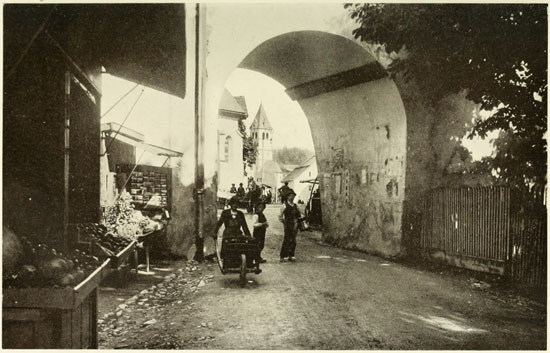
A PEEP OF KITZBÜHEL
The town of Kufstein itself does not call for extended
description. But one feature that immediately prepossesses
the visitor in its favour, if one arrive, as we did when last
there, on a hot summer day, is the number of shady promenades
to be found, more especially on the east side
of the town, in the neighbourhood of the delightfully
picturesque Kiengraben. None should fail to visit the
Calvarienberg, from which there are delightful and extensive
views of the Castle, town, and valley.
KUFSTEIN TO KITZBÜHEL
To reach Kitzbühel from Kufstein it is necessary to
change trains at Wörgl, eight and a half miles down the
Unter-Innthal, and proceed up the Brixen Thal by the
Staatsbahn past Hopfgarten to Kitzbühel. The town is
a charming one, surrounded by gardens where once there
ran a moat, and containing some interesting houses along
the banks of the Kitzbühler Ache. Many of them still
have Gothic roofs and gables, which give them a mediæval
appearance, and one of great charm. The town has of
late years become a favourite summer resort, and its fine
situation in a wide valley nearly 2500 feet above sea-level
has much to recommend it. But its fame is by no means
merely that of a summer holiday spot. It is almost
equally resorted to for winter sports of tobogganing,
ski-ing, and skating, and may be, in fact, called the
Tyrolese Grindelwald or Adelboden. Then the snow-clad
valley is indeed beautiful, more like fairyland than aught
else, with only the church spires of Kitzbühel and the
pines on the hillsides to break the wide white expanse.
The Kitzbühelhorn is a favourite ascent, from which
very fine views are to be obtained, especially of the giants
of the Tauern range, the Chiemsee, and the rocky and
impressive Kaiser Gebirge. The pasturage and the Alpine
flora in the neighbourhood of Kitzbühel are especially
rich, and there are many beautiful excursions to be made
in the district round about. In the Brixen Thal, indeed,
the artist and the student of costumes and ancient customs,
which are, alas! so rapidly dying out, will find much of
interest. In many of the villages the annual contests,
consisting of wrestling and other sports—which anciently
were often so strenuous as to lead to serious injury to the
combatants and competitors, and even bloodshed—still
take place. At Kitzbühel there is an athletic gathering
in June, which is held on a plateau near the inn on the
Kitzbühelhorn, and partakes of the character of the Grasmere
Sports of our own land, and the Braemar gathering
in Scotland.
The peasants as a general rule in the Brixen Thal, as
in the more famous Ziller Thal, are musical, and often
indeed are quite skilled musicians; and frequently as one
wends one's way through the flower-spangled pastures or
climbs the mountain-side, from some isolated hut or shady
nook beneath a boulder will come the musical tinkling of a
cowherd's zithern or the flutey notes of his pipe. But, as
a rule, we have found the players shy of performing before
strangers, who will therefore be well advised if they listen
to the music unseen and without seeking to discover its
source.
The Brixen Thal, too, is a great dairy district, the chief
industries of which are butter- and cheese-making.
As regards the scenery of the valley one may say that
in few others in Tyrol does one come across a greater
variety of light and shade, or more delightful cloud effects.
Indeed, the clouds, which at one time seem as though they
will sweep down the mountain-sides and obscure everything,
and at others sail majestically, like huge cotton-wool
argosies, across the blue vault of heaven, thousands of feet
above the highest peak of the Tauern Giants and the bare
and grey limestone peaks of the Kaisergebirge, in themselves
form pictures and phenomena of the greatest beauty
and of ever changing interest.
MONKISH MIRACLES
Kundl is a small village some four miles south-west
from Wörgl, and it would attract little attention from
travellers were it not for the curious church of St. Leonard
auf der Wiese (St. Leonard in the Meadow) and the quaint
legend attached to it. The story goes that early in the
eleventh century a stone statue of St. Leonard came floating
down the Inn to this spot; and the people, recognizing
that for a stone statue to float was nothing less than
miraculous, after securing it, set it up by the roadside, so
that all who passed by should see and reverence it. Probably
modern scepticism will lead us to suppose that the
figure was in reality of wood and not stone; and then the
miracle explains itself! The region is subject to floods,
and doubtless the figure of St. Leonard came from some
church higher up the valley which had been destroyed by
avalanche or inundation.
However, the story goes on to tell us that the statue
had not long been placed in position alongside the high-road
ere Henry II., Duke of Bavaria, himself passed that
way, and seeing it paused to ask an explanation of its
being there. When the story had been told him, he seized
the opportunity (as did many other rulers in those days)
to strike a bargain with Heaven which, whilst benefiting
Mother Church, would also be not without profit to himself.
He therefore vowed that if the expedition into Italy,
which had brought him along that road, should prosper
and his forces be victorious, he would on his return build
a handsome votive church over the spot where the figure
of the saint stood.
Alas! for human vows, even those of one destined to
become an Emperor. Although his arms prospered, and
he was crowned at Pavia, and made King of Germany, he
forgot all about St. Leonard. Some years later (in 1012)
fortunes and the cares of his kingdom once more brought
him into Tyrol on his way northward and to the spot
where the figure of the saint still stood by the roadside.
Then another miracle happened, for his horse, "although
urged forward with whip and spur and words," refused to
pass the spot where his master had formerly made so
solemn a vow, and stood foaming and champing his bit
much to his rider's embarrassment. As was but natural,
the Emperor at once remembered his vow and set about
fulfilling it.
The church, which was forthwith commenced, was
finished in a couple of years, but a catastrophe marked its
completion. Just as a young man was about to place the
vane in position he was seized with sudden giddiness, and
falling to the ground was dashed to pieces. "His body,"
so a somewhat quaint local version of the story has it,
"was gathered together by the horrified onlookers," and
his skull—which can still be seen—was placed at the foot
of the crucifix on the high altar as an offering. There is a
record in the church of the fact that the Emperor erected
the building, and that Pope Benedict VIII., who was a
nominee of his, made the very considerable journey from
Rome to consecrate it. There would, however, notwithstanding
this, appear considerable reason for doubt whether
he did.
The image now to be seen only dates from 1491, and
there is no record regarding the disappearance of the
original "miraculous" one which it must have replaced.
The interior of this church has suffered both from neglect
and whitewashing at various times. But there are some
quaint and excellent carvings, including a few pew ends,
and also some fine iron work, and the figures adorning the
ten columns which surround the high altar are interesting.
It is as one comes into the village that the prettiest view of
the church is obtained.
Rattenberg, which is some five miles distant from
Kundl on the main line and road, is not much visited
by tourists, and is chiefly of note on account of the copper
mines, which are still worked. The town is, however,
decidedly picturesque and repays a visit. Scarcely anywhere
in Tyrol in a place of similarly small size does one
get such contrasts in architecture. And, doubtless, for
this reason one seldom fails, during the summer months,
to find several artists at work in the narrow streets. One
side of the river is occupied by houses and buildings of
the most solid, gloomy, and altogether unprepossessing
character, whilst on the opposite bank one finds the very
antithesis in the pretty, light-looking dwellings, quaintly
painted in delicate shades of buff, pink, and sky-blue.
Beside them and between them are quaint courtyards
and narrow alleys of often an extremely picturesque
character.
WILHELM BIENER
Many people seem to confuse the Castle of Rattenberg,
which dominates the little town and river, with that of
Rottenberg, the crumbling ruins of which lie on an eminence
overlooking the roads which lead out of the Inn
Thal into the Achen Thal and Ziller Thal, once the seat
of one of the most powerful feudal families of Tyrol.
Rattenberg Castle is said by some authorities to date
back to the days of the Roman occupation, and even to
Etruscan times, and its history has been not less stirring
and chequered than that of most other similarly placed
fortresses of the Inn Thal. The chief event in connection
with it was the imprisonment of Wilhelm Biener,
the brilliant Chancellor of Claudia Felicitas de Medici,
wife of the Archduke Leopold V. Biener, unfortunately,
afterwards fell into disfavour with the pro-Italians at
the Court of Claudia's son and successor, the Archduke
Ferdinand Karl, Regent of Tyrol, and was executed at
Rattenberg in 1649 and buried near the wall of the
churchyard. Those who wish to know more of the
romantic and stirring period of Tyrolese history in which
Biener lived and died cannot do better than read that
fine historical novel, "Der Kanzler von Tyrol" (The
Chancellor of Tyrol), by Herman Schmid.
The story of Biener's fall may be briefly told. Claudia
de Medici, on the death of her husband, with her Chancellor's
advice and assistance, succeeded, not only in
governing Tyrol wisely and well during the minority of
her two sons, but, by the exercise of great wisdom, contrived
to escape embroilment in the terrible and disastrous
Thirty Years' War in which the whole of the rest of the
German Empire was involved. Her rule, however, was
not altogether without some harshness, which was chiefly
shown in the collection of taxes, and in this matter the
Chancellor Biener was naturally concerned, with a result
that his zeal for his beautiful mistress's interests caused
him to incur the hatred of a certain section of the Court
and community at large. On one occasion he found himself
in serious opposition to the then Bishop of Brixen
concerning the payment of certain dues, the legality of
which the bishop questioned. Biener appears for once
to have failed in his usual skilful and diplomatic treatment
of affairs. He wrote a very intemperate letter to
the bishop, which the latter never forgot nor forgave.
Years after the death of Claudia, the resentment against
Biener took more definite shape, and he was accused of
having misappropriated some of the money belonging to
the State which had passed through his hands. Tried by
two Italian judges, he was found guilty (though, apparently,
upon very flimsy evidence), and condemned to death.
The fallen Chancellor made a last appeal to the Archduke
Ferdinand Karl, son of his late mistress, and the
Archduke, thoroughly believing in Biener's good faith and
innocence, and, doubtless, remembering his many distinguished
services to his family, reprieved him. Unhappily
for the condemned man, his greatest enemy, the
President of the Council, named Schmaus, was able to
so delay the messenger that he arrived too late to save
the Chancellor.
Biener was led out for execution, and on stepping on
to the scaffold, he cried out, "As truly as I am innocent
of this thing, I summon my accuser (Schmaus) before the
Judgment Seat above before another year shall pass away."
When the executioner had done his work, and stooped
to pick up the head to exhibit it to the multitude, he found
that he had also unknowingly smitten off three fingers of
the victims right hand, strangely (so the story goes)
bringing to mind the remark of the Bishop of Brixen
on reading Biener's letter years before—"The man who
could write a letter like this to me deserves that his fingers
which held the pen should be cut off."
By an equally remarkable occurrence, we are told, the
President of the Council, who had been not only Biener's
most relentless enemy but his chief accuser, died within
the specified time of a terrible disease.
The wife of the Chancellor is supposed to haunt the
mountain paths in the neighbourhood, and at night may
be sometimes met with proclaiming her husband's innocence
in a moaning voice. The story, doubtless, has its
basis in the circumstance that the unfortunate woman
lost her reason and ran away no one knew whither, but was
ultimately found wandering aimlessly, and quite bereft of
her senses, on the mountain-side between Brixlegg and
Rattenberg. There was for many years (and may be still for
aught we know) a tradition that when any one was about
to die in the little village near Innsbruck, where Biener's
wife, after her marriage, lived happily for many years, she
appears to warn them.
Near the town, in one of the mining buildings, is a
most curious picture done upon a wooden panel, combining
a representation of the mining works about 1500 with one
of the Crucifixion, in which the miners, with their pickaxes
and shovels laid down beside them, are seen kneeling in
prayer.
BRIXLEGG
Brixlegg is but a mile or so from Rattenberg. The
neighbourhood is pretty, and there is a charming view
from the bridge. The little busy town also forms an
excellent centre from which to make some of the shorter
excursions into the Ziller Thal and Achen Thal. But,
although there are considerable smelting works and a wire-drawing
industry at Brixlegg, to the tourist it is chiefly
its reputation for peasant dramas which forms the chief
attraction in the town, which is, however, quaint and in a
measure picturesque.
The rural plays of Brixlegg are not only interesting by
reason of the historical scenes they many of them represent,
but also as survivals of a very early (if not the earliest)
type of German dramatic expression and art which has
come down to us. Most of the plays, types of costume,
plots, and all the various items which go to make up these
performances have done service for generations; but occasionally
new plays are written and staged, mostly dealing
with historical incidents and characters. In some parts of
Tyrol where these plays survive, till at least very recent
times, old masks were extant, which must have been
handed down from the early Middle Ages, and possibly (so
some competent authorities assert) date from Roman and
Etruscan times. The Brixlegg performances should most
certainly be seen by all who are interested in the true
peasant drama and the evolution of dramatic art. The
representations are far more interesting as native and
peasant art than those of Meran, where to a certain extent
outside criticism and influence have served to bring about
modifications, the Meran performances lacking some of
the naiveness and spontaneity of these simpler peasant
dramatic plays.
SCHLOSS MATZEN
Just after leaving Brixlegg, on the left-hand side of the
road stand three castles of note—Matzen, Lichtwer, and
Kropfsberg. The first named is one of the most interesting
and well-preserved examples of the mediæval schloss
in Tyrol. A whole volume might be devoted to a description
of its beauty of situation, architecture, romantic history
and sieges, and yet leave much unsaid. Its huge round
tower dominates the landscape, just as its beautiful lower
courtyard, with its four tiers of cloistered corridors round
two sides, with the "springs" of the arches supported
upon short columns of unworked marble, its fine main hall,
with priceless carved and panelled oak and hunting
trophies, make it a unique possession. There is a charming
view of its rivals, Lichtwer and Kropfsberg, from the
drawing-room window, whilst standing at which (according
to old chroniclers) one of the Frundbergs was shot dead by
a crossbow bolt fired by his brother from the tower of
Lichtwer, of which castle the latter was the owner.
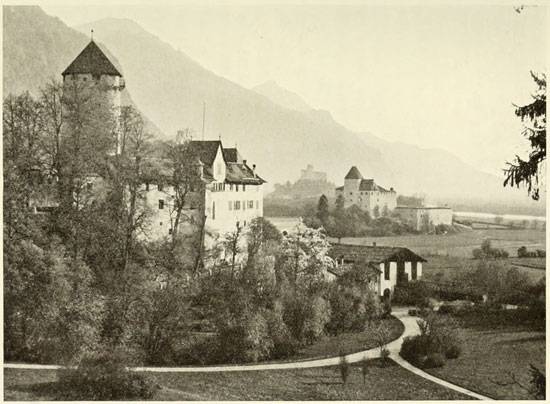
SCHLOSS MATZEN
Of special interest to most visitors who may be
fortunate enough to be permitted to see Matzen and its
treasures will undoubtedly be the famous figure of Christ
upon the cross in the chapel; the library—one of the
oldest rooms—with its fine Renaissance chest; the fine
collection of old pewter; the hunting-room, with the
many trophies of its famous "sporting" as well as literary
owner;[23] and perhaps not without interest to most visitors
will also be the stone table, once standing upon the place
of execution at the other end of the castle, but now in the
shadow of the great circular Roman tower, just outside the
postern entrance from the garden. At this table in olden
times, it is said, the owner of Matzen sat when dispensing
justice to his vassals or retainers. Set in the wide valley,
and girt around by trees, Matzen is one of the most
picturesque as it is one of the most interesting and historic
castles in Tyrol.
There is not much to detain one at Jenbach, which is
a small town at the entrance to the Achen Thal, on the
northern, and the Ziller Thal on the southern, bank of
the Inn.
Just before one reaches Schwaz, one sees storied Castle
Tratzberg high on a wooded spur of the Bavarian Alps,
with its three turrets in line, seeming to overhang the
rocky eminence upon which it stands. Up above the castle,
scarcely visible from the valley, is the famous pilgrimage
church of Georgenberg, which all who can should visit.
The path, though toilsome, winds through a sweet-scented
pine forest. As one nears the goal of one's
pilgrimage, the way is marked by stations of the cross.
One passes through a silent region, and, as one ascends, the
pretty villages scattered below in the valley of the Inn are
gradually and for a time lost to view. Scarcely any one
is met save a stray pilgrim or some tourist curious enough
to make the ascent, and no sound is heard save the
soughing of the summer breeze in the pines and the tinkle
of little streams or the water-music of the Stallen torrents.
At last, through an opening in the environing forest, one
catches the first glimpse of the white church, with its
Romanesque tower and rust-red roof, standing on a steep
and barren rock some three hundred feet in height, to
reach which the covered wooden bridge spanning the deep
ravine must be crossed.
And what a shrine it is! An isolated tabernacle set
upon a rock in a solitary place, and amid surroundings of
the greatest beauty and impressiveness; shut out of the
world and shut in with nature. The cross at the head of
the bridge records the miraculous escape of a girl long
ago who, whilst attempting to pick the fairest flowers for a
chaplet to place upon the Madonna's head or lay upon the
altar, fell into the ravine, a distance of over one hundred
and fifty feet, and yet escaped serious injury when death
seemed certain.
The impression one receives when at last the summit
of the rock upon which the church stands is reached is one
of great solemnity and even of grandeur. For a time the
outer world has receded from one's mind and ceased to
exist. And when one enters the church itself, the impression
which has been created cannot fail to be intensified
by the silent, kneeling figures almost always found within,
with their faces illumined with rapture and faith or
transfigured by religious fervour.
ST. GEORGENBERG
The little chapel of "Our Lady of Sorrows" (Schmerzhaften
Mutter) comes first, surrounded with a tiny
graveyard, in which are buried the favoured few who
have had their wish gratified to rest in death in the
solitary but beautiful spot they loved and visited when
alive. The larger building, the church of St. George
opposite the chapel, contains one of those most curious
legendary relics of which not a few have been preserved
from time immemorial in Tyrol. The story of the
miracle which produced the relic is briefly as follows:—About
the year 1310, in the days when Rupert I. was
the fourteenth abbot in charge of the Monastery of
Georgenberg, the ruins of which surround the present
church, a Benedictine monk was saying Mass in this
very church. Just as he was about to consecrate the
cup, a doubt came into his mind as to whether such a
miracle as the changing of the water and wine into
blood could be accomplished in his unworthy hands.
Torn with doubt, he nevertheless proceeded to use the
words of consecration; and he was struck dumb with
astonishment and awe to find, in place of the white
wine and water he had placed in the cup, blood, which
overflowed the chalice and fell upon the wafers. Some
portion of this miraculous blood was preserved in a
phial, which was set in a reliquary and placed upon the
altar. In former times this precious relic, we are told,
has worked many miracles, and is venerated almost as
much to-day as in mediæval times.
A WOODLAND SHRINE
The pilgrimage of St. Georgenberg is one of the
most famous and ancient in Tyrol. So ancient, indeed,
that its origin appears to have dated as far back as
the end of the tenth century, when a chapel was consecrated
here by Albuin, the then Bishop of Brixen.
Even before this, however, Scherer asserts that a young
Bavarian nobleman named Rathhold, from Aiblingen,
"having learned the hollowness of the joys of even his
great position, made up his mind to live apart from
the haunts of men in some wilderness and solitary spot."
And in pursuit of this determination he wandered on
through the fertile fields and valleys of his own land
and those of the Inn until he at length reached this
spot in the Stallen valley, and ultimately came to the
rock upon which the church stands. Up on the mountain-side
he carved out for himself a cave where he lived as
a hermit. But after a while a desire possessed him to
go to some of the shrines of the greatest saints. He
visited many, even travelling so far afield as to the
shrine of St. Jago de Compostella; and at length
returned once more to his hermit's cave to finish his
days in prayer and contemplation. But he brought
back with him a picture of the Madonna, over which
with his own hands he reverently erected a protective
shrine.
Soon from all the district round about, and even
from distant parts of Tyrol and Bavaria, people came
to worship at the shrine; and ere long "Our Beloved
Lady under the Lindens" became a great pilgrimage
resort. One day, years afterwards, so the story goes,
there came to the place another young Bavarian nobleman
who had wandered far in pursuit of game, and on
hearing of the shrine had determined to visit it himself
to ascertain what were the attractions and virtues of
a place which was so venerated by the peasants of the
mountains and valley round about. On his arrival at
the little chapel he sought the hermit guardian, when
what was his joy and astonishment to discover, in the
white-bearded recluse, the elder brother whose strange
disappearance from his castle home years before had
caused much grief. Overjoyed at the meeting, the
younger brother vowed that he would build a chapel
on the spot more adequate for the protection of the
holy and miraculous picture, and also a "shelter house"
for pilgrims.
The work was soon started, and from far and near
peasants and even nobles came or sent offerings so that
they might have some part in the work. Then a strange
thing happened. All the virtue, which had made the
spot one of miracles, and one of such good fortune to
the halt, diseased, blind, and dumb, seemed to depart.
Hardly had the workmen commenced the foundations
of the proposed chapel ere accident after accident
occurred, some of them fatal. The stones would not
remain in place, and everything connected with the
building "went wrong." Another curious happening
was the presence day by day of two white doves, which
came down, apparently from out of the woods higher
up the mountain-side, and picked up every chip of wood
upon which any of the workers' blood had fallen when
they cut themselves with their tools (as they frequently
did), and then at once flew away with the chips in
their beaks.
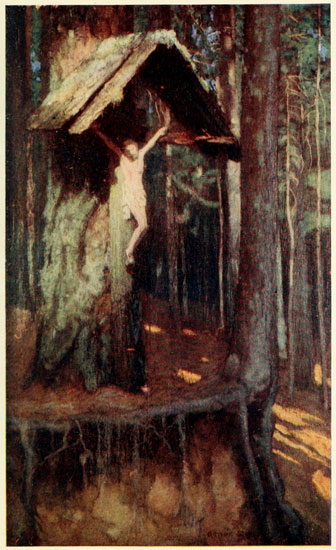
A WAYSIDE SHRINE IN A PINE WOOD
Finding that this action of the doves continued and
that no progress could be made, the hermit determined
to seek an explanation of the mystery, and so one day
he followed the birds up the mountain-side, and on
reaching the spot where he saw them descend he found
to his astonishment a perfect miniature chapel or shrine
which had been constructed out of the chips and shavings
the doves had carried away. "In this miracle the
hermit discovered the directing hand of God, and going
down again to his brother he entreated him to have the
contemplated chapel built upon the spot which had been
so miraculously pointed out." This the latter willingly
consented to do, and the work now progressed without
accident or other interruption. The chapel so erected,
which is further up the hillside than the larger church
of St. George, was rebuilt at the time the latter was
erected in the eighteenth century.
From time to time other pilgrims both noble and
simple who visited the shrine set amid the woods and
mountains were moved to remain, and thus gradually a
community was gathered together living in roughly
built huts in the vicinity of the hermit's cell, which in
course of time about the twelfth century was put by
the then Bishop of Brixen under the rules governing
the order of St. Benedict. The monks not only built
a monastery but cultivated the surrounding land, and
quite a large community at last dwelt in this secluded
spot. But the life of the monks was destined to be
very chequered, and often troubled with grave misfortunes.
Fire, avalanches, famine, and disease all did their
best to extirpate the brotherhood. And at last, at the
beginning of the eighteenth century—after having been
established at St. Georgenberg for more than five
hundred years—it was decided to remove the monastic
institutions to Fiecht.
Vast funds were needed, for the then abbot, named
Celestin Böhmen, who was a native of Vienna, and had
formerly been an officer of artillery, projected the new
monastery and buildings upon a lavish and colossal
scale. There was, however, no lack of funds. St.
Georgenberg held a place in the hearts of all the people
for a wide district round about, and money also flowed
into the monastic coffers from foreign lands from which
pilgrims had come to the famous shrine. Then a
great disaster happened. The abbot, tempted by the
vast wealth which had been placed in his hands, and
perhaps weary of his life of retirement from the world
in which he had once been a prominent figure, fled with
the money which was to have been used for the new
abbey at Fiecht. The work of building was for a time
brought to a standstill, as no trace of the defaulting
abbot could be discovered. But after some years a
sufficient sum of money was obtained to permit of the
work being continued under the direction of Abbot
Lambert. The result was the present handsome late
Renaissance building; which, however, comprises but
a small portion of the first magnificent scheme. The
renegade Abbot, Celestin Böhmen, some years after his
flight and crime, once more became enamoured of a life
of contemplation, and suddenly appeared at the monastery,
confessing his wrong-doing and throwing himself upon
the mercy of his former companions. He did not appeal
to their clemency in vain; for, refusing to deliver him
up to justice, they allowed him to end his days in
piety and repentance, which one can only trust was
genuine.
Such, at all events, is substantially the story as told
by Burglechner and other writers.
A strange fascination seems to enshroud this quiet
and secluded shrine of St. Georgenberg, and certainly it
is one of the pilgrimage places which most inspire one
with the spirit of those remote ages when in the making
of such journeys many found comfort, peace of mind,
and refreshment. Indeed, one almost wonders that the
monks should have deserted it for a new home and a
less quiet situation on the hillside near Schwaz, which
has now for some years been used as a school.
CASTLE OF TRATZBERG
Just before reaching Schwaz one passes the old and
fine castle of Tratzberg, which well deserves a visit, not
only on account of its art and other treasures, but also
by reason of the delightful views obtained from it.
Tratzberg, which was sold by the Duke Frederick to
a rich mine-owner named Christian Tanzel in 1470,
with the title of Knight of Tratzberg, was often visited
by the Emperor Maximilian I. on his various hunting
expeditions in the neighbourhood. Knight Tanzel spared
no expenditure to make it one of the most beautiful
and famous castles in the Inn Thal. Not the least
interesting of the many finely decorated rooms which
it contains are those which were generally occupied by
Maximilian on his visits, and the fine apartment known
as the Queen's room, with beautiful presses, interesting
portraits, and magnificent panelled ceiling. The armoury,
too, full of mediæval cannon, pikes, lances and other
ancient weapons, never fails to interest the student and
archæologist, who, whilst wandering through these ancient
and wonderfully well-preserved rooms, gains a more vivid
idea of the conditions of life in the Middle Ages than
much "book learning" could give him. In the great
hall are some remarkable frescoes in tempera, depicting
the genealogical tree of the house of Habsburg with
quaint groups of portraits. Some of the antlers, which
are so attached to the wall as to serve as portions of
the design, are said to have been hunting trophies of
Maximilian himself.
The two Maximilian rooms, which open one into
the other, are happily in much the same condition and
state as when occupied by the Emperor. The panelling,
whilst not comparing for elaborateness with that
in some of the other rooms, is good, and the ancient stove,
dating from the fifteenth century, is of great interest.
On the walls of the room in which this stands is an
inscription in chalk, said to have been written by
Maximilian himself, which sums up a quaint philosophy,
and has been translated thus—
"I live I know not how long,
I die I know not when;
Must go I know not whither;
The wonder that I so joyful am."
A GRUESOME STORY
In 1573 the castle and lands passed into the possession
of the famous Fugger family, and ultimately into that of
the Enzenbergs, one of whom is the present owner. There
is at least one gruesome story and tradition told in connection
with Tratzberg, which is not itself at all gruesome-looking,
as Tyrol castles go.
It appears that the ancient owners of the castle were
most of them more noted for love of the chase than for being
"instant in prayer," and one was so great a defaulter in this
respect that, although he could always hear the notes of
the hunting horn blown early in the morning and rise with
alacrity to obey its summons, sad to relate, when the chapel
bell rang for Mass, it was quite a different matter. One
morning the bell woke him as usual, and as usual he
yawned, and turned over in his bed for another nap,
thinking, no doubt, pityingly of the folk who had got up
early to attend the service. He had no sooner done this
than he had a dream or vision of the old chaplain performing
the service in the chapel, and of the devout worshippers
gathered to listen to him. Then the triple tinkling of the
Mass bell announced to him the most solemn rite of the
service was being performed. Then came a rumbling
noise, the very foundations of the castle seemed to shake,
and the building to sway as though about to collapse, and
the hundreds of windows rattled and shook. The knight,
who was superstitious if not religious, terrified beyond
control, shrieked aloud, and then tried to hide himself
under the bedclothes in his terror. His cry was heard by
some of the servants and retainers, who came hurrying to
the room; and upon entering they were horror-struck to
find their master dead, whilst upon his throat were the
imprints of three claws, which had burned as well as torn
the skin. The inference drawn was that the knight had
been enjoined by some Heavenly spirit to rise and repair
to the celebration of the Mass, but had resisted the Divine
influence, and had been claimed by his master, the Devil,
who had strangled him. Some marks on the walls of the
room where he died were for years afterwards shown as
those of the wicked knight's blood.
There are many other traditions and legends attached
to this famous castle, which is one of the several buildings
in Europe making a claim to possess exactly as many
windows as there are days in the year; but for these
stories, interesting though they are as exhibiting the
credulity, barbarism, and imaginativeness of mediæval
times, we have not space.
Not far from Tratzberg is the quaint, interesting, and
flourishing town of Schwaz, on the right bank of the Inn,
and overlooked by the Castle of Frundsberg. It was, far
back in the times of the Roman occupation of Tyrol, a
station of considerable importance and size; but after the
evacuation of the country it gradually declined until the
fourteenth century, when it was little more than a scattered
hamlet of poor houses, with an inn for the accommodation
of travellers who were too weary to proceed further on
their way to Innsbruck, or who had been overtaken near
the place by nightfall.
SCHWAZ MINERS
Then at the commencement of the fifteenth century,
according to Burglechner, a vein of silver ore was discovered
through the rampant behaviour of a bull, who went mad
or became uncommonly energetic, and, tearing up the
grass on the hillside with his horns, was the means of
disclosing what afterwards proved to be a vast deposit of
silver ore. The news of the discovery was brought hot
haste to the poor hamlet by the herdsman who was in
charge of the animal, and the inhabitants flocked out to
investigate the story of the shining metal which had been
uncovered. In a very short time Schwaz regained its
ancient prosperity and importance, and at one time, when
the silver mines were at their best, the population, which
nowadays is about 6500, was not far short of five times
as many. The discovery of the silver caused several of
the noble families in the neighbourhood to forsake the
calling of arms and knightly service for that of mine
owning and mine working; and the vast wealth of the
Augsburg merchants and bankers, notably the Hochstetters,
Ilsungs, and Fuggers, was largely employed in
the working of the mines which had been speedily opened
up. Amongst the noble families who turned miners or
mine proprietors was that of the Fiegers, one of whom
was an intimate companion of Maximilian I. The latter,
when Fieger died full of years and leaving an astonishing
progeny and an enormous fortune behind him, was present
at his old friend's funeral. His son, Hans Fieger, married
Margaret von Pienzenau, who, on her coming to her
husband's home, was accompanied by a vast cavalcade
consisting of four thousand horses, of which those drawing
her coach were shod with silver.[24]
The mining industry was speedily developed by the
immense sums wealthy merchants in Bavaria and elsewhere
were willing to embark in speculation, or advance
upon the security of the mines themselves; and so skilful
and daring did the Schwaz miners become, that later on
their services were requisitioned for use in the mines of
other districts, and for military mining operations against
the Turks in Hungary. In the siege of Vienna in 1529
by the Turks, Soliman the Magnificent, who invested the
city with an army of 300,000 men, was forced to raise it,
after losing nearly a fourth of his men, owing to the
countermining of the Schwaz miners. Two centuries
later, the Schwazers undermined and blew up the splendid
and almost impregnable fortifications of Belgrade before it
was ceded to Turkey; and at various times their services
were engaged by the Dukes of Florence and Piedmont.
Schwaz, too, has the distinction of having had one of
the earliest of printing presses set up in the town; and
matters referring to mining and mining methods were
often referred to the experienced and skilful miners and
engineers of Schwaz.
Just as was the case with the miners of the not far
distant Principality of Salzburg, those of Schwaz embraced
the doctrines of Luther, and made serious attempts to
put down Roman Catholic clericalism and oppression.
On two occasions at least they marched in considerable
numbers upon Innsbruck, but were met at Hall by the
Bishop of Brixen, who prevailed upon them to return to
their homes by promises of redress of their grievances.
But though they consented to do this and did not proceed
further down the Inn Thal, in Schwaz itself the new faith
and its supporters became so powerful that at one time
the latter managed to possess themselves of half of the
parish church, in which portion the Lutheran service was
performed. Ultimately they were ejected, and had to
meet in a wood near the town, where two followers of the
Reformer, who had been deprived of their status as
Catholic priests, used to preach.
The appearance some little time later of a Franciscan,
who came to Schwaz with the object of "stiffening" the
backs of the Catholics and stamping out the new faith,
led to collisions of a violent character between the two
parties.
One story, that was very generally accepted as a
miracle by the Catholic population, concerning these
disputes, which sometimes were not confined to words
and arguments alone, is as follows. A leader amongst
the reformers is stated to have exclaimed during a heated
discussion, "If Pastor Söll (one of the priests who had
accepted Luther's doctrines) does not preach the true
doctrine, may the Devil carry me up into the Steinjoch."
Hardly, we are told, were the words out of his mouth
when the speaker vanished.
It is unnecessary to add that the Lutheran faith
received a heavy blow from this incident, and the effect
of the miracle, establishing, as the Catholics claimed, the
true faith, was further increased when the unfortunate man
who had thus been so suddenly spirited away returned
some time afterwards, confessing his transportation to the
Steinjoch, with a bruised body, and shattered faith in
Pastor Söll.
Later on the mining industry was brought almost to
a standstill owing to religious disputes, and an invasion
of Anabaptists. And although the latter were expelled,
and many thousands of those who favoured the reformed
faith were brought back to the true fold through the
instrumentality of the Jesuit fathers from Hall, the mines
from this time commenced to decline in richness, and
never recovered their former productiveness. For a
considerable period copper and an excellent quality of
iron was found in large quantities after the silver gave
out, but the place as a mining centre declined more and
more as the years rolled by.
Schwaz, in addition to its religious dissensions, has in
the past suffered from a visitation of the plague, "when
the inhabitants died off like flies"; and it also suffered
terribly in the campaign of 1809. In the latter year
the Bavarians under the Duke of Dantzic and their
French allies under De Roi determined to strike terror
into the hearts of the inhabitants of the Inn Thal by
burning the town. They attacked the place, and not
content with putting the inhabitants to the sword practised
upon them the most horrible cruelties; more especially
upon the women and young girls; some so revolting as
to be indescribable in print. None were spared; "old
and young alike were outraged, then either slain or thrown
into the river or the blazing ruins which had once been
their homes."
SCHWAZ PARISH CHURCH
Fortunately, although little of the town itself was left
standing to show succeeding generations what ancient
Schwaz had been like, owing to successive occupations by
hostile troops at the latter part of the eighteenth and early
part of the nineteenth centuries, the fine parish church
which had been commenced in 1470 (about) and was consecrated
in 1502 was less injured than might have been
expected. The plan of the building is remarkable, containing
a double nave, each complete with its aisles, choir,
and high altar, the cause of this peculiarity being the fact
that the miners were of sufficient wealth and importance
at the time of its construction to insist upon having a
separate church to themselves apart from the townspeople.
Indeed, even nowadays one of the high altars is known as
"the Knappen Hoch Altar," or Miners' High Altar. In the
roof, composed of copper tiles, of which there are said to
be no less than fifteen thousand, provided as a contribution
by the mine-owners and miners, and in the device
of crossed pickaxes, appearing here and there in the
decorations of the building, one can clearly trace its
connection with the mining industry, and the interest the
miners themselves showed in its erection.
The church at various times has been unskilfully
restored, but it still contains some very interesting and
fine monuments, that to Hans Dreyling, a metal-worker
and founder, being especially worthy of note. In it are
depicted not only the metal-worker, but his three wives
and children, who are habited as knights, all being under
the protection of St. John the Baptist. This remarkable
work is by the famous founders Alexander Colin of
Malines, and the even more famous Hans Löffler. There
are, too, nine altar pieces by Tyrolese painters which
should be carefully noted.
One finds some interesting painted houses in Schwaz,
as in many other villages and towns of the district of
the Inn Thal, and some of the frescoes, most of which
depict religious subjects, are of considerable merit.
The town, however, is not one to which many travellers
come, or in which tourists linger, although it is on the main
line of railway, and has considerable interest for those for
whom church architecture, legendary lore, and picturesqueness
of a sort possesses attractions.
GEORG VON FRUNDSBERG
The deserted and ruined castle of the famous Frundsberg
(whose name, by the way, outrivals that of Shakespeare
in the many forms in which it is and can be spelled), a
fortress which was there before the dawn of the Christian
Era, and no one seems to know quite how long even
before that, is quite close to the Schwaz. Its history
is obscure for many centuries after the period we have
named, and only the barest fragments have come down to
us of the doings and life at Castle Frundsberg during the
eleventh down to the end of the fourteenth century. It
was in the time of "the famous fighter of a fighting race,"
Georg von Frundsberg, son of Ulrich, knight of Frundsberg,
born at Mindelheim in 1473, and the founder of the
Landsknechte, that the castle and the family appear to
have reached their zenith of prosperity, wealth and fame,
the former two characteristics being chiefly due to Georg's
marriage with a wealthy Suabian heiress. He was "one
of many sons, most of whom became distinguished, and
three of whom (Georg himself being one) were much
esteemed by the Emperor Maximilian." Georg was, at
a very early age, made a general, and after the Battle
of Regensburg, in 1504, was knighted on the field by
Maximilian, who had witnessed his astonishing bravery
and feats of arms. When only four and twenty, he was
esteemed a skilled and unequalled leader of men, and in
his campaigns against the Swiss and Venetians he was
wonderfully successful. Some most astonishing feats of
personal strength of his are recorded; how he could push
an ordinary man over with one of his fingers; could catch
a runaway horse and bring him to his haunches with one
hand; and many a time clove his opponents in two halves
with a blow from his two-handled sword. It is not unlikely
that his immense natural strength had a good deal to do
with his being exalted into a popular hero, and being
made the central figure of many legendary tales and
astonishing romances. Of him they sang—
"Georg von Frundsberg,
Von grosser Sterk,
Ein theurer Held;
Behielt das Feld
In Streit und Krieg.
Den Feind niederslieg
In aller Schlacht.
Er legt Got zu die Er und Macht."
Which maybe roughly translated: "George of Frundsberg,
of marvellous strength; a hero of renown; invincible upon
the field of combat and war; victorious in every battle.
The honour of which success he gave to God."
He threw in his lot with the Lutherans, and commanded
the troops under Charles V., and was one of
the knights who were concerned in the attack upon
Rome.
Although at one time immensely wealthy, when he was
at last taken with an apoplectic seizure during the siege
of the latter city, and carried home to die at Mindelheim,
he was a ruined man. He had spared none of his wealth
in the prosecution of expeditions in which he had been
engaged, where, as often as not, the kings and emperors on
whose behalf they were undertaken failed to pay the
troops. To his credit, Georg von Frundsberg seems to
have invariably paid the men himself; and we are told
he seldom took the booty which fell to his share, selecting
only some comparatively valueless, though generally historically
interesting objects, such as flags and banners, a
sword (jewelled sometimes, it is true, but still comparatively
unimportant monetarily compared with the vast
treasure he might have taken as his share), or the helmet
of a conquered challenger, preferring that his men should
be well paid by the major portion of the loot for their
bravery and endurance. In those days money advanced
by nobles and others to warring princes to carry on expeditions
was generally not recovered from the actual borrowers,
but repaid by robbery of the conquered, out of the
booty seized, or by means of the ransoms paid by distinguished
prisoners. So it happened that Georg von
Frundsberg, scorning these means, was gradually ruined,
for neither Charles V. nor Maximilian saw to it that the
vast sums he from time to time expended on their behalf
during their campaigns were repaid to him.
His motto, which ran, "The more opponents the
greater honour," was characteristic of himself and of his
race. But with his death, and the financial embarrassments
which afflicted his heirs, owing to the heavy mortgages
on the estates which he had left behind him, with no
means of discharging the same, the Frundsbergs declined
rapidly in power, and the race came to an end in the male
line on the death of his son George (one of nine children)
in 1586,[25] though there are descendants in the female line
of the Frundsbergs living at the present time.
The castle afterwards fell into ruins, and its history
may be said to have ceased with the close of the sixteenth
century. The Bavarians, however, made use of the ruined
walls for "cover" during the campaign of 1809, when they
were attacked by the forces raised by Hofer and his
comrades.
THROUGH THE OBER-INNTHAL: ZIRL, ITS
CHURCH, LEGENDS, AND PAINTED HOUSES—THE
MARTINSWAND AND MAXIMILIAN—SCHARNITZ—LANDECK—BLUDENZ—BREGENZ
AND ITS LEGEND OF THE MAID
From Schwaz to Zirl,[26] beyond Innsbruck, is between
twenty-nine and thirty miles, either by train or
road. The latter is quite good for cycling, and
those who are not cyclists or pedestrians will find to make
the journey by carriage a delightful way of reaching the
picturesque little village from which the ascent of the
Gross Solstein may be made, and that also of the more
romantic and famous Martinswand.
The village is, unlike many of those lying in the Unter-Innthal,
east of Innsbruck, an agricultural one, with most
of the houses built in straight rows, and having quaint and
picturesque, but not very clean or salubrious, courtyards in
the rear. Some of the most charming groups of peasants,
ox-carts, and "farm scenes" are to be found at Zirl, which
is a good deal visited by artists, and invites the attention
of amateur photographers.
In most cases the houses have their dwelling-rooms and
sleeping accommodation on the first floor, which is reached
by flights of steps, and the exteriors of the dwellings are
made picturesque and quaint by the projecting gables of
carved wood, and the galleries which jut out beneath them,
where the corn, herbs, and other produce is either laid out
or hung up to dry. As in other villages of the Inn Thal,
one sees the love of colour in the delicate pink, blue (almost
a lavender), and green tints of the stucco-work on the
house-fronts and walls. Zirl is a picture-village, too, and
on the houses, as one drives or walks through the narrow
streets, one catches glimpses of paintings of Virgins, saints
engaged in vigorous and deadly combats with evil-looking
monsters of the dragon tribe, and here and there, set in a
niche in the wall, a tiny figure of a Madonna, saint, or
crucifix protected with glass, and often surrounded with a
chaplet or bunches of withered flowers.
One of the Inns, named "the Regenbogen," has a most
vivid and even startling representation of a rainbow (which
gives it its name) painted over the arched doorway.
The church of Zirl is chiefly interesting from the frescoes
it contains, which are the work of Schöpf. The churchyard
is a spot in which to linger. It is instinct with the pathos
which comes in a measure from partial neglect, and
picturesqueness of environment.
One of the little town's chief attractions to the antiquarian
and the student of ancient and curious things will
undoubtedly be the Calvarienberg, which lies a little to
the north; green and beautiful, and crowned by a picturesque
pilgrimage church. The ascent is comparatively
easy, and well repays one for the climb, not only on
account of the interest of the "Calvary," to form which
the natural rocks have been adapted, but by reason of the
delightful views which are obtainable from the plateau.
The path is dotted here and there by tiny buff-coloured
chapels, painted a sky blue inside, marking the stations
of the cross; and from almost all, as one turns round and
faces the way one has come, or looks out over the valley
below, there is some charming view, or tiny tree-framed
vista, to arouse one's interest and delight one's eyes. The
church, were it not so isolated, and set amid greenery, and
surrounded with flower-bedecked grass, would strike one
as garish, so bright in tone are the colours with which it
is adorned. But somehow or other there, amid silence
scarcely ever disturbed by the noises of the village and
only occasionally broken by the musical tinkle of cow
bells, and in a sunshine and air which is so bright and
breezy and clear, one's artistic sense seems to rest unshocked
by the vividness of the distemper and paint, and
the crudity of the decorations.
THE MARTINSWAND
The village is, of course, very closely connected with
several incidents in the defence of Tyrol against the
various Bavarian invasions; and in the immediate neighbourhood
is the Martinswand, which rises sheer from the
valley below Zirl, and was the scene, according to tradition,
of a perilous hunting adventure of the Emperor Maximilian.
The story is as follows: It was on Easter Monday, in the
year 1493,[27] when "Kaiser Max," as he was familiarly and
affectionately called by his Tyrolese subjects, was staying
at Weierburg, that he determined to set out on one of his
favourite hunting expeditions on the Zirlergebirge. There
are many accounts of what happened, but one of the most
credited says that the chamois which the Emperor had
been stalking suddenly led him down the precipitous face
of the Martinswand.
MAXIMILIAN'S EXPLOIT
Intrepid hunter as he was, however, the steepness of
the terrible descent, which suddenly opened up beneath
his feet, did not quench his ardour for the chase nor deter
him. But unfortunately, in his haste in scrambling down
the rocks, the iron nails in his hunting boots were torn out
one by one, until when he at last reached a rocky ledge
scarcely a foot in width there was but a single spike left
in either of them. To descend further was impossible,
and upon glancing upward along the path he had come,
the Emperor at once saw that retreat by the same way
was equally hazardous. So there he hung literally between
earth and sky, visible as a mere speck from the valley
which yawned beneath him. A less fearless sportsman
might well have been unnerved by the position in which
he found himself, or exhausted by the strain put upon him.
But the Emperor was made of tough and enduring stuff,
and his nerves were iron. Not only did he manage to
retain his foothold at that dizzy height, but he succeeded
in nerving himself to look about him, and after doing so
for some time discovered near by a small cleft or cavity
in the rock which would afford him at least a better foothold,
if not actual protection.
The members of his hunting party who had followed
him to the edge of the precipitous Martinswand now
looked down, but were unable to determine what had
become of Maximilian. And none from below in the
valley could, of course, see him, even if he had not been
partly hidden, first, by the ledge of rock and then by the
cave, from the fact that he was more than a thousand feet
above them. At last, however, when his probable situation
became known to his followers and to the inhabitants
of Zirl, prayers for his safety and ultimate escape were
offered up in the church; and the priests also brought
the Holy Sacrament out to the top of the Martinswand,
and there again offered prayers for the Emperor's
deliverance.
His retainers, huntsmen, and companions in the chase
gazed up or down, as the case might be, helplessly and
hopelessly at him, and to them no human aid seemed to
be possible. Just as every one was about to abandon hope
(one version of the occurrence tells us), a daring huntsman,
named Oswald Zips, appeared, having himself climbed
down the precipice in pursuit of his quarry.
Surprised to find the Emperor, he called out, "Hullo!
What brings you here?"
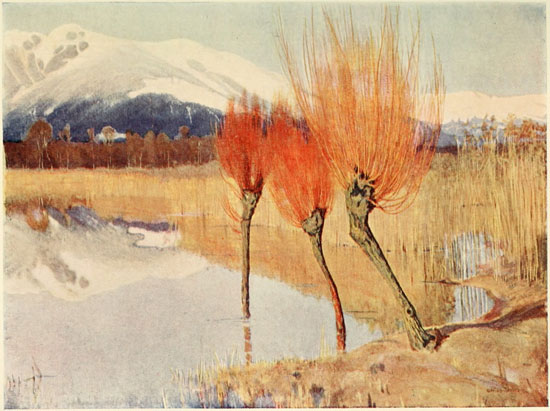
AUTUMN IN S. TYROL
And the former, no doubt, relieved in mind and not
disposed to stand upon ceremony or resent so unconventional
a greeting, replied, "I am on the look out."
To which the newcomer replied, "And so am I. Shall
we venture down together?"
And upon the Emperor agreeing to make the attempt—after,
according to various accounts, having spent from
twenty-four to seventy-two hours in his perilous position—they
set out to descend the remainder of the cliff face,
and ultimately succeeded in doing so in safety. The
daring hunter (who various accounts say was a brigand,
and others an outlaw), to whom a secret path was known,
was naturally well rewarded by the grateful monarch, and
ultimately was ennobled with the title of Hollaner von
Hohenfelsen; the last word, "High Rock," commemorating
the incident. As is perhaps natural, some accounts
place a supernatural aspect upon the Emperor's deliverance,
and state that it was an angel which guided him to safety,
sent by Heaven in answer to the prayers of the priests
and people and the Emperor's trust in Providence.
Amongst the treasures of Schloss Ambras is the
monstrance in which the Host was carried by the priests
of Zirl when they celebrated Mass for the comfort of the
Emperor on Martinswand and offered up prayers for his
deliverance.
Maximilian, finding afterwards that many of the people
of Zirl and the district were determined to make the
perilous descent to the little cave which had afforded him
shelter and foothold, employed some of the Schwaz miners
to cut a path down to it and to enlarge the cavity, which
became known as the Max-Höhle. In the cave was
placed a crucifix, with figures of the Virgin and St. John
on either side, of sufficiently large size to be visible from
the valley below. The cavern can be reached by this
path (or one made since) in about an hour and a half; but
the climb is distinctly one which should be attempted only
by the clear-headed and sure-footed. A very excellent
view of the "hole" used to be obtainable from the ruins
of the little hunting-box and chapel to St. Martin which
Maximilian afterwards erected upon the green knoll
opposite to it, known as the Martins-buhel, but now
private property.
Those who stop at Zirl and visit the Martinswand
should not fail to proceed a few miles further northward
to the pretty little village of Seefeld. On the way along
the six miles of winding and picturesque road one passes
Fragenstein, once a strong fortress and afterwards converted
by "Kaiser Max" into one of his numerous hunting
seats, which lie scattered about the Inn Thal and the
district round about.
There is quite a romantic story of buried treasure in
connection with ruined Fragenstein, in which a huntsman
clad in green is mixed up, who appears periodically and
invites the peasants by his gestures to come and assist him
in digging up the treasure. Several attempts have been
made to discover the latter in past times, but all have been
frustrated when success appeared to be certain. On one
occasion the peasants of the valley say those who were
digging, and had worked hard for many days turning up
the soil in every direction, actually had the metal chest, in
which the treasure is reputed to lie buried, in sight, when
a terrific storm burst over the valley, and when it had
subsided all traces of their work had been washed away or
otherwise obliterated, and the clue was never again discovered.
The road to Seefeld, though tempting for
pedestrians, is steep, especially up to Leiten and Reit; but
those who walk may take some short cuts on the curves,
and will be well repaid by the pretty scenery and fresh,
invigorating air.
Neither at Leiten nor Reit is there much to detain the
traveller—a few picturesque houses; nothing more. And
so on to Seefeld. In connection with the village and its
Heilige Blutskapelle there is one of those many legendary
stories, of which there are so great a number known to
Tyrolese Folk-lore.
Many centuries ago there appears to have lived at
Seefeld a man named Oswald Milser, who was rich and
powerful and generous both to the Church and to his
poorer neighbours. His one besetting sin, however, was
pride, and so one day when he went to take the Easter
Eucharist he insisted that to distinguish him from the
other communicants and mark his importance the priest
should give him one of the larger wafers reserved for the
use of the priests alone. Afraid to offend Milser, who had
been a generous supporter of the Church and a giver of
large alms, the priest complied with his request. No
sooner, however, was the host placed upon his tongue
than the weight of it bore Milser to the earth. And
although in his terror and predicament he clung to the
altar, and then to the altar steps as he sunk further, the
latter gave way, and he continued to sink lower and lower,
till in his terror he called upon the priest to take the host
back from him. This the priest did, and when Oswald
Milser had recovered from his fright he recognized that
the circumstance was a lesson to his pride, and ultimately
he gave his goods to the poor and the Church, and entered
a monastery to lead a life of penance and contemplation.
A MIRACULOUS ROSEBUSH
When his wife was told the miracle, she refused to
credit it, saying that sooner than do so she would believe
that a dead rose-tree could blossom. The story goes on
to tell how immediately "a rose-tree which was near by
and had been dead for a long time, put forth the most
beautiful blooms, and so confounded the wicked woman
that she went out of her mind, rushed from her house,
and was never more seen in the flesh." But her spirit
was often heard at night, wailing and moaning on the
mountain-side.
It was to contain this miraculous host which had confounded
Oswald Milser's pride that the Archduke Ferdinand,
in 1575, built a special little chapel on the left side
of the fine fourteenth-century Gothic church of Seefeld.
This is even nowadays an object of veneration, to which
a considerable number of pilgrims come. The altar-piece
is a fine one, and was well restored about five-and-thirty
years ago. The statues which adorn it are those of the
favourite legendary heroes of Tyrol, St. Oswald and
St. Sigismund, whilst the subjects of the bas-reliefs are
the incidents of Biblical history, known as "The Mysteries
of the Rosary." Amongst the "treasures" of the church
are a remarkably fine and interesting crystal reliquary and
crown, given by the Archduchess Eleonora.
From Seefeld there are many interesting excursions to
be made into the picturesque Mittenwald district, which
lies to the north, upon the Bavarian frontier.
Scharnitz lies at the point where the Hinderan and
Karwendel valleys unite. It has memories of many a
struggle against the Bavarian invaders, and more particularly
of the defence of the fortress Porta Claudia, built
during the Thirty Years' War by Claudia de Medici, by
an Englishman named Swinburne, an ancestor of the late
Algernon Charles Swinburne the poet. He was an officer
in the Austrian service, and had a force of only 600 against
Marshal Ney, with nearly 20,000, and made so gallant
and stubborn a defence that when the garrison at length
surrendered to such vastly superior numbers they made
their own terms and were allowed to march out as prisoners
of war whilst retaining their side-arms. They were sent as
prisoners to Aix-la-Chapelle, but the "colours" were saved
by one of the garrison, a Tyrolese, who made his escape
with them wound round his body. He was sought for
amid the mountains for many weeks, but was not recaptured,
and lived to, later on, reach Vienna and hand
the precious colours to his gallant chief, who had so well
defended the fortress.
We reached Telfs from Seefeld by road. The village,
which boasts a large cotton factory, is prettily situated
and pleasant, but there is nothing in the place itself to
detain the traveller. The same remark applies to Imst,
once given over to the breeding of canaries, which were
so celebrated for their singing qualities that they were
exported to all parts of Europe. The old Inn, however,
is worth inspection should a stop be made at the little
town, and there are many excursions of a charming
character to be made in the district round about.
LANDECK
Landeck is a prettily situated and important little
town in a wide bend of the Inn Thal, having a fine
prospect of environing mountain summits occupying both
sides of the river and dominated by Castle Landeck,
whose grim, square, and battlemented tower forms a
striking feature of the landscape. Another prominent
building, which at once strikes one on approaching the
place either by road or rail, is the fine fifteenth-century
parish church standing on the slope of the hill, which is
crowned by the castle.
The church was founded by two natives of the place,
only the Christian names of whom appear to have survived,
who, having lost their two children in the forest near by,
vowed that if the latter were found they would show their
gratitude by erecting a church to the Holy Virgin. Hardly
had the vow been uttered, the legend states, when the distracted
parents saw a bear and a wolf advancing towards
them, each bearing a child unharmed in its mouth!
The spire of the church, which has a curious double
bulb surmounting it, is of considerably later date than the
building itself, which, although thoroughly restored some
forty years ago, was done very carefully and sympathetically,
and preserves many of its most interesting architectural
features, including some very early sculpture. In
the churchyard, from which such a delightful prospect of
the valley of the Inn is obtained, there are two monuments,
which should not be missed by any one interested
in antiquities and history. One is to Oswald von Schrofenstein,
dating from early in the fifteenth century; the other
takes the form of a little Gothic chapel, dating from 1870,
which was erected to the memory of the Landeckers who
fell whilst assisting to defend the Italian frontier of Tyrol
during the Austro-Italian campaign of 1866.
A TYROLESE VICTORY
Landeck bore a brave part in the War of the Spanish
Succession in 1703, when Maximilian, Elector of Bavaria,
joined forces with the French and Italians against Austria,
and invaded Tyrol. The Tyrolese, always ready to
speedily assemble in defence of their beloved country,
soon made the main road over the Brenner impossible of
passage by the enemy, and Maximilian thought to elude
the sharpshooters who swarmed upon the hillsides commanding
that way, by sending his forces round by the
Finstermunz and Ober-Innthal. They reached the neighbourhood
of Landeck without much opposition; but the
Tyrolese had gathered to dispute their further advance on
the first favourable opportunity.
The Judge of the district, one Martin Sterzinger, had
speedily summoned all the available Landsturm forces of
the neighbourhood, and worked out a plan of campaign.
The latter were to permit the enemy to advance until
they were well into the gorge, and then attack them so
fiercely and from so commanding a position as to have
some hope—in spite of their greater numbers—of severely
and finally defeating them. They were in consequence
allowed to advance into the narrow gorge, the road
through which was spanned by the Pontlatzerbrucke.
But before they entered the defile the bridge had been
destroyed by the Tyrolese. The Bavarians, who were
compelled to traverse a steep and narrow mountain path,
when they came in sight of the destroyed bridge at once
realized that they were entrapped. The precipitous sides
of the hills above them were practically unscalable, and
there was no way now the bridge was destroyed by which
they could cross the roaring, rushing Inn to safety on the
other side. In the panic which ensued numbers fell or were
pushed from the road into the river, to be swept swiftly away.
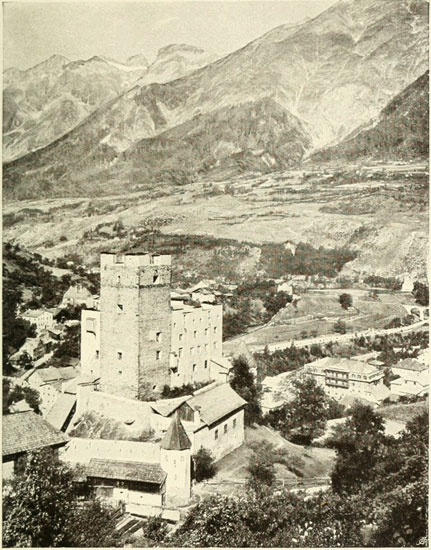
LANDECK AND ITS ANCIENT FORTRESS
Then suddenly the heights above literally swarmed
with Tyrolese, who had remained hidden until the right
moment to attack, who poured into the huddled and
panic-stricken mass of the enemy a hail of bullets,
supplemented by stones and pieces of rock hurled down
by those who were not possessed of guns. Only a mere
handful of the force was able to turn back and escape
along the path by which they had come, and these were
speedily overtaken by the active mountaineers and made
prisoners. Not one, we are told, made good his escape
to bear news of the disaster to headquarters, and thus
the French and Bavarian commanders were for some
considerable time in doubt as to what had occurred. In
the end they learned how their immensely superior force
had been literally cut to pieces and wiped out, and
perhaps also to hold the "rough jackets" of Landeck
and the Inn Thal in greater respect than they had done
before. The victory of July 1st, as it is known amongst
the many other successes of the peasants' campaign
against the invaders of their land, is celebrated every
year by a procession and fête.
Besides being a most interesting little town, Landeck
is yearly growing more popular with holiday makers and
rest seekers as a fine centre from which to make some
of the most delightful excursions and short tours in the
whole of the Inn Thal. The chief of these are either
in the immediate neighbourhood into the Lotzer Thal,
and Medriol Thal, or along and by way of the splendid
Finstermunz high road to Sulden, Trafoi, and other
smaller places. There is also, of course, the famous
Stilfserjoch, the highest carriage-road in Europe, and
the pretty villages and valleys of the Kaunser Thal to
invite a long stay amid surroundings which are scarcely
excelled in any other district of North Tyrol.
But not merely days and weeks, but even months
could be pleasantly spent with Landeck as a base from
which to explore the numberless beautiful and almost
unknown smaller valleys and gorges which run out of
the Inn Valley north and south, and in the former case
lead one to that wonderland of the Bavarian highlands,
with its many ancient and Royal castles, lovely little
lakes, and fertile, flower-decked pastures.
Soon after leaving Landeck, either by rail or road,
one crosses the boundary which separates the Ober-Innthal
from the Vorarlberg. If by the latter, as one
approaches the summit of the Arlberg, which is 5910 feet
above sea-level, one catches sight of an immense crucifix
overshadowing the road, near which are the two posts
marking the boundary line. The old road was opened
for traffic nearly a century and a quarter ago, but a
considerable portion of that now generally used, which
is more sheltered and protected, was not made until 1825.
By the magnificent Arlberg Pass route one can reach
Bregenz, and to make the journey in this way by carriage
or afoot is most delightful, though the railway, after
the long tunnel is passed, is very interesting and
picturesque.
However, comparatively few tourists and travellers
nowadays devote the time necessary to traverse the
Arlberg to Bregenz by road, and so Bludenz must be
included in the itinerary we are describing. The little
town, which has a bustling and prosperous air, though
it is decidedly hot in summer, still possesses a considerable
number of its older buildings and houses. The
ancient château or castle of Gayenhofen is now used for
Government purposes; it forms a picturesque landmark
in the town.
Bludenz will always have a place in the romantic
history of Tyrol from the fact that it was here that the
well-beloved "Frederick with the Empty Purse" came
while an outlaw and in fear for his life. He made
himself known to the innkeeper where he sought refuge,
who, though embarrassed, was delighted to shelter the
popular hero. His view was shared by the rest of
the inhabitants of the town, who when summoned by
the Emperor Sigismund to deliver up their prince
declined to do so, saying, "they had sworn fealty to Duke
Frederick and the house of Austria, and they would
not betray him."
Frederick, though doubtless touched by the loyalty
of the Bludenz folk, knew that if he remained amongst
them the result would probably be the dispatch of a force
by the Emperor to capture him, and the possible destruction
of the town by way of reprisal. So he stole quietly
away, and Bludenz was saved.
The old town is well worth a few hours' stay, and there
are many picturesque "bits" to be discovered for sketch
book and camera in the older houses and side alleys,
even if time will not permit of a sufficiently long sojourn
to allow one to visit the pretty Montfacon Thal, with its
legend of a beautiful maiden who lived up in the mountain
guarding a hidden treasure, which she is condemned to
watch over until some one is bold enough to kiss three
times a huge toad which lives hard by, and also guards
the wealth that is to reward the bold rescuer of the
maiden.
FELDKIRCH
Feldkirch is the last important town on the route to
Bregenz. Pleasantly situated near the grim gorges
through which the river Ill rushes with ever-increasing
rapidity and force to join the Rhine, there is much of
interest in the quaint streets, and the arcades which run
in front of many of the houses.
The town itself is shut in by the mountains and
dominated by the old fortress of Shattenburg, now used
as a retreat or home for the poor; and for this reason
perhaps is less resorted to than it otherwise might be.
There are, however, a large number of most interesting
excursions to be made in the neighbourhood, and the
fifteenth-century church is a fine one, with a good
"Descent from the Cross" by a native artist, Wolfgang
Huber, and a remarkable and handsome pulpit, both dating
from the early years of the sixteenth century. Costume,
too, is occasionally seen in Feldkirch, and on one Sunday,
the occasion of a festival, there were quite a number of
women wearing the old-time steeple-crowned, brimless
beaver hats—in shape somewhat like that of a Russian
Moujick or the busby of a Grenadier—wide white collars,
embroidered bodices, and handsome brocaded aprons.
The last place in Tyrol when leaving it by the Arlberg
route is the most delightful and ancient town of Bregenz,
standing upon the north-eastern shore of Lake Constance.
It is the capital of the Vorarlberg, and in this delightful
corner of Tyrol there is no town of greater charm or
historic interest. Above it rises the picturesque Gebhardsberg,
from the summit of which there is one of the most
celebrated panoramic views in Tyrol, embracing as it
does the beautiful lake, the Appenzell Mountains, and the
rapidly flowing Rhine.
There are really two towns in Bregenz. The old town,
shaped like a quadrilateral, standing on the hill which
ages ago was the site of the Roman settlement and castle,
with two ancient gates, one of which has been pulled down;
and the newer town, with its shady promenades, quay,
modern buildings, and air of bustle during the tourist
season.
A LEGEND OF BREGENZ
Irrespective of its unusually beautiful situation, one
finds in Bregenz much to interest and detain. It is a
truly ancient place, with much history—some of it of a
romantic kind—attached to it. In the Middle Ages,
indeed, the overlords of the town and district were so
powerful that their house supplied the Emperor Charlemagne
with a bride, concerning whom there is a legendary
and highly romantic tale.
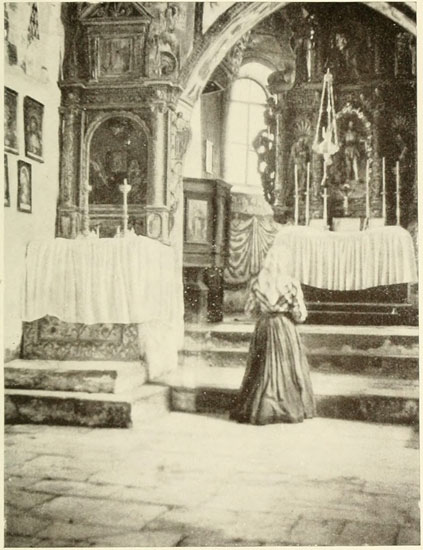
CHURCH INTERIOR, TYROL
It would appear from this story that Charlemagne was
of a more than usually suspicious nature, and by no means
one of those complaisant husbands with which the Mediæval
tales have familiarized us. An old lover of Hildegarde,
having seen her married to the Emperor with great distress
of mind, in his wrath against her for preferring even an
Emperor to himself, got ear of Charlemagne, and so succeeded
in poisoning the latter's mind against his bride,
that he either divorced or repudiated her, and married a
Lombardian princess called Desiderata.
Accepting her fate resignedly, Hildegarde eventually
found her way to Rome, where she devoted herself to the
care of the sick, and especially of the sick pilgrims who
came to the "Eternal City." In course of time, so the
story goes, her revengeful lover, whose name, Taland, is
almost as common a one in Tyrol as Smith in England,
having lost his sight, came on a pilgrimage, and whilst
in Rome was cared for by Hildegarde, "whose tender and
saintly hands," we are told, "not only restored his physical
sight, but also his moral perception of right and wrong."
He was so overcome with remorse when he learned to
whom, under Providence, he owed his restoration to sight,
that he confessed his fault to Hildegarde, and insisted
upon accompanying her to Charlemagne, to whom he also
confessed, and proved Hildegarde to have been blameless.
The Emperor at once restored her to favour and honour.
In another story connected with Bregenz, which was
made the subject of a poem by the late Adelaide Ann
Proctor, one has preserved an incident connected with the
heroic conduct of a Bregenz woman in saving the town
from surprise and destruction by the Swiss. There are
several versions of the story, which dates from 1408, but
probably, as it is of a legendary character, the one given
in the ballad is as correct as any other.
Unhappily, the Bregenz folk of to-day appear to know
little of this heroine; and on one occasion on which we
visited the town, and made a search for the effigy of the
Maid and her steed on the gate of the old castle, or walls
of the upper town, we were unable to find it. No one
seemed to know the story of the "Maid of Bregenz," and
an old lady, who had a temporary stall outside the gate
for the sale of cakes and other refreshments, became quite
irascible upon our persisting in the belief that there must
have been a "Maid," and that she (the old lady) ought to
know the legend.
"There is no 'Maid of Bregenz,'" she said angrily at
last. Adding, after a pause, during which she looked us
up and down as though to decide upon our nationality,
"But mad English people have asked me hundreds of
times about her. I know nothing. There is no more to
be said."
And with this she returned to her perusal of the paper
she had been reading when we accosted her, and we had
to be content.
We made our way down the somewhat rugged and
steep road to the lower town a little crestfallen, although
the view of the lake in the late afternoon sunshine of a
July day was exquisite beyond description, the water
deep blue and green in patches, with the incoming and
outgoing boats and steamers leaving frothy-white or
rippling wakes behind them almost as long as they themselves
remained in sight. One determination we came to.
It was in future not to inquire too closely into such pretty
and poetical stories as that of the "Maid of Bregenz," and
not to allow our desire for legendary or antiquarian knowledge
to permit us to run the risk of further disillusionment.[28]
We did not find the effigy of "the maid and her milk-white
steed," on which she had ridden over the Swiss frontier
and swum across the Rhine to warn the inhabitants of her
old home of a projected attack by the Swiss amongst
whom she had gone to dwell in service. The genial
proprietor of the Oesterreichischer Hof, we found, had
heard of "the Maid." Alas! not from his fellow-townsfolk
(who should have cherished her memory), but, like
the old lady in the upper town, from English tourists,
who had, doubtless, climbed the steep ascent on a similar
errand of inquiry and research to our own.
"Maid" or no maid, however, Bregenz is delightful,
and well deserves the title of "pearl of the Vorarlberg"
which has been bestowed upon it. In its quaint old
streets, its Capuchin Convent, which is so prominent a
feature, standing as it does upon a wooded knoll of the
Gebhardsberg, and its fine church, to the south on another
eminence, with an ancient and weather-worn tower, there
is plenty of interest. Picturesque the place most certainly
is, and the effect is greatly heightened by the near presence
of the lake, which stretches away in front of the town to
fair Constance in the far distance.
FAREWELL, TYROL
In leaving Tyrol by way of beautiful Bregenz, washed
as it is by the waters of one of the most delightful of
Swiss lakes, one carries with one a last impression which
is fragrant with the memories of a hospitable race, charming
scenery, and innumerable things of historic, artistic,
and antiquarian interest. There is, indeed, no other gate
through which one would rather leave this "Land within
the Mountains," which, as yet unspoiled by crowds of
tourists and general sophistication and the deterioration
which arises therefrom, lures one to return to it again
and again.
- A
- Abbey of Wilten, 17
- Abel of Cologne, work of, 99
- Absam, 139-142
- and Jakob Stainer, maker of violins, 139
- dragon legend of, 140
- painted houses at, 140
- story of "Miraculous Window" at, 141
- A buried city, 249
- Adventures of Oswald von Wolkenstein, 217-220
- Aeni, Pons, 7
- A fifteenth-century "blue stocking," 194
- Aguntum (Innichen) Station, 9
- Albianum (Kufstein), 7
- "A Legend of Bregenz," 326
- Alemanni, the, 11
- Alpine flowers at Cortina, 267
- Alt, Salome, and Archbishop von Raitenau, 174
- Altissimo di Nago, 253
- Ambras, Castle, 113
- Court at, 121
- early history of, 114
- the Hoch Schloss, 123
- the tourney ground, 125
- traditions, 124
- treasures at, 123
- Ancient palaces of Trent, 243-247
- Andechs, family of, 16
- Anif, castle of, 179
- Anna Katharina Gonzaga of Mantua, 31
- Anton Gump, Landhaus of, 84
- Aquila Nera Inn, Cortina, 266
- Araba, 273
- Archduke Ferdinand, 29
- Arco, 251
- Arlberg tunnel, 72
- Arms, summons to, 41
- Arno, Bishop of Salzburg, 156
- Art, collection at Innsbruck, 89
- Art, world-famous collection, 30
- Arthur, King of England, 93
- Arzl, pilgrimage chapel of, 133
- Augusta Vindelicorum, 6
- Austerlitz, battle of, 38
- Austria, emperors of, 32
- Austrian, defeat of forces at Wagram, 43
- B
- Bad Ratzes, 278
- Baiovarii, 12
- Battle of Austerlitz, 38
- Custozza, 50
- Giants, 106
- Leipsic, 49
- Marengo and Hohenlinden, 37
- Naïssus, 11
- near the Brenner, 4
- Sadowa, 50
- Spinges, 228, 229
- Vercelli, 3
- Bavaria, Duke Louis of, 25
- Bavarian occupation, 39
- Bavarians, 12
- Belluno, cathedral at, 270
- Bible incidents, oral versions of, 57
- Biener, William, and Rattenberg, 291
- Bishop of Freisingen, 20
- Bisson, General, surrender of, 41
- Black Death, 21
- Bludenz, 322
- and "Frederick of the Empty Purse," 322, 323
- Bohemia, Prince John of, 19
- Bozen, 206-210
- Calvarienberg, near, 211
- description of, 206, 207
- fine houses, 208
- Franciscan monastery at, 210
- history of, 207
- Laubengasse at, 209
- Parish Church, 209
- (Pons Drusi), 8
- Sarnthal costumes at, 210
- Bozen, statue of von Vogelweide at, 209
- Bregenz, 324-327
- Brenner route, the, 3
- road, the, 8
- history of, 10
- Brixen, 226-228
- cathedral of, 227, 228
- bishop's palace at, 228
- Brixlegg, 293
- Buchenstein, 270
- Büchsenhausen, castle of, 97
- Burg, the, 80
- C
- Campo Formio, treaty of, 37
- Canazei, 274
- Caprile, 271
- Castle Ambras, 113
- Court at, 121
- early history of, 114
- the Hoch Schloss, 123
- the tourney ground, 125
- traditions of, 124
- treasures at, 123
- Castle Tyrol, 16
- Castle of Büchsenhausen, 97
- Frundsberg, 303
- Lizzana, 248
- Runkelstein, 211
- Castle of Runkelstein, frescoes of, 211, 212
- Schonna, near Meran, 203
- Starkenberg, 68
- Tratzberg, 295
- Trautson, 231
- Trostburg, 216, 217
- Cathedral, Belluno, 270
- Cathedral, Salzburg, burning of, 171
- Catherine of Saxony, 27
- Catholic persecutions, 161
- Cavalese, 276
- Cell, Maximilian's, 85
- Cenotaph, Maximilian's, description of panels surrounding, 99
- Ceremonials, pathetic, 60
- Chapel, pilgrimage, of Maria Larch, 145
- Silver, Innsbruck, 97
- Silver, Innsbruck, statues in, 103
- Charlemagne, empire of, 13, 14
- Chasteler, General, 42
- Church of the Servites, Innsbruck, 84
- Jesuit, Innsbruck, 85
- of Maria Waldrast, near Matrei, 231
- Madonna alle Laste, near Trent, 247
- Cimbri, the invasion of, 2
- Civil war, 21, 25
- Conquest of the country, Roman, 6
- Constance, Council of, 25
- Cortina, 265, 266
- church at, 266
- famous inn at, 266
- festivals at, 265
- frescoes at, 266
- Costumes of Innsbruck, 75
- at Feldkirch, 323
- at St. Ulrich, 226
- national, of Tyrol, 82
- the Sarnthal, 210
- Tyrol, 63
- Council of Constance, 25
- Counts of Tyrol, 16, 17
- Court at Castle Ambras, 121
- Customs, curious wedding, 64
- Custozza, battle of, 50
- D
- Dante and the Castle Lizzana, 248
- "Das Land im Gebirge," 13
- Death, Black, 21
- Defregger, Franz, historical masterpieces of, 90
- Dialect, concerning, 225
- Diaries of early travel, 14
- of the Bishop of Passau, 15
- Dolomite district, 255
- Dolomites, 254-280
- characteristics of the, 260
- formation of, 256, 257
- inns and hotels in the, 259
- theories concerning, 256
- theories of origin of, 257
- touring in, 259
- Dreiheiligen Kirche (Holy Trinity), 86
- Drusi, Pons (Bozen), 8
- Drusus, 4, 6
- Duke Ernest, 25
- Frederick, 24, 25
- Louis of Bavaria, 25
- Sigismund, 26
- E
- Eggenthal, famous waterfall in the, 213
- Eleanora, daughter of James I. of Scotland, 194
- Emperor Theodoric the Goth, 93
- Empire, Charlemagne's, 14
- "Empty Purse, Frederick of the," 24
- Enneberger, 271
- Epiphany performances, 60
- Eppans, the, 16
- Ernest, Duke—reconciliation of Duke Frederick, 25
- Etruria, ancient language of, 53
- Evangelic Union, 170
- F
- Falzarego Pass, 270
- Fassa Thal, 275, 279
- Feldkirch, 323
- costumes at, 323
- engagement near, 37
- Ferdinand, Archduke, 29
- Festival of St. Vigilius, 234
- Festivals at Cortina, 265
- First Counts of Tyrol, 17
- Fleimse Thal, 276
- Florus, the historian, 5
- Franz Defregger, historical masterpieces of, 90
- Franzenfeste, 229
- Frauenberg, Conrad of, 23
- Frederick, Duke, 24
- reconciliation of Duke Ernest, 25
- of the "Empty Pocket," story of, 73
- Freisingen, Bishop of, 20
- French, Bavarian and Saxon troops enter Tyrol, 43
- French Revolution, 36
- Frundsberg, Georg von, 308-310
- Fugger, George, story of, 243-246
- Fulpmes, 131
- G
- Gaisberg, 179, 180
- Gebhardsberg, 327
- General Bisson, 41
- Georgenberg, St., 295
- ancient shrine at, 296
- dishonest abbot of, 300
- miracle of, 296
- origin of the Church of, 298
- Germanization of Tyrol, 53
- Ghostly Legend, A, 69
- Giants, battle of, 106
- Gilg Sesselschreiber, 95
- Golden Roof, the, 79
- "Goldener Adler," 81
- Goths and Huns, 12
- Goths, Emperor Theodoric of the, 93
- Goths, inroads of the, 11
- Grafschaften, 15
- "Grape Cure" at Meran, 198, 200
- Grape Harvest at Meran, 200
- Grasleiten Pass, 277
- "Great Week" in Tyrolese history, 45
- Grödenerthal, ascents in, 273
- H
- Habsburgs, schemes of the, 22
- Haimon and the Dragon, 107
- Hall, 134-138
- interesting church of, 137
- Münsterturm at, 135
- St. Saviour's church, 138
- salt mines, 135
- Haspinger, the Capuchin Monk, 38
- Haydn, Michael, at Salzburg, 185
- Heilig Wasser, 128
- Hellbrunn, Chateau of, 176-178
- gardens and fountains, 177
- mechanical theatre at, 178
- Monatsschlösschen at, 178
- stone theatre at, 178
- Henry, youngest son of Meinhard II., 17
- Herzog-Friedrich-strasse, arcades of the, 82
- Highway, Tyrol, 14
- Historian Florus, 5
- Historic Events, Innsbruck, 101
- Historical masterpieces of Franz Defregger, 90
- History of the Statues at Hofkirche, 94
- History in Marble, Innsbruck, 99
- Hofburg, the, Innsbruck, 91
- Hofer Andreas, 37, 46
- birth of, 38
- commander-in-chief, 40
- "battle cry" of, 44
- triumph of, 45
- Hofer's nickname, 45
- Hofer named dictator of Tyrol, 46
- capture of, 48
- led forth to die, 48
- death of, 49
- tomb of, 102
- in the Meran "Hero Plays," 195, 196
- Hofkirche, the, Innsbruck, 92, 104
- History of the statues, 94
- Hohen-Salzburg, 167-170
- description of, 167
- sieges of, 169
- cable railway, 169
- Hohen Tauern, range, 150
- Hohenlinden, battle of, 37
- Hollaner von Hohenfelsen, 315
- Horace, 4
- Hostelries, 10
- Huns and Goths, 12
- I
- Igls, 126
- Inhabitants, original, 1
- Innichen (Aguntum) Station, 9
- Inns and hostelries, 10
- Innsbruck, approach to, 72
- art collection, 89
- attractions of, 110
- capture of, 42
- character of, 74
- costumes and uniforms at, 75
- famous statues, 97
- gaieties, 73
- gay court at, 80
- historical masterpieces of Franz Defregger, 90
- Jesuit church at, 85
- market types, 83
- Marktgraben, 83
- Maximilian's Tomb, 93
- Maximilian's, description of, Cenotaph, 98, 99
- mediæval buildings in, 81
- museum treasures, 89
- National Museum, 87
- plague, 86
- rise of, 76
- rulers, 77
- Silver chapel at, 97
- site of, 5
- some historic events at, 101
- the environs of, 113-132
- the Hofburg, 91
- the Hofkirche, 92
- the newer town, 87
- winter sports at, 111
- Invaders, Teutonic, 13
- J
- Jews, the, 21
- John, Prince of Bohemia, 19, 21
- Julium Carnicum (Zuglio) station, 9
- K
- Kapuzingerberg, view from, 180
- Karrersee, 213, 276
- Kastelruth, 278
- Kerpen, General, 36
- King Arthur of England, 93
- Kitzbühel, 287, 288
- Kitzbühlerhorn, ascent of, 287
- Klausen, 215
- Kufstein, 281-287
- L
- Ladin, the dialect of the Grödenerthal, 225
- Lake Missurina, 262
- Landeck, 319, 320
- Landhaus of Anton Gump, 84
- Landtag, first Tyrolean, 26
- Language, the Tyrol, 55
- Larch, Maria, pilgrimage chapel of, 145
- Latemar, curious customs relating to, 276
- Laudon, General, 36
- Legend of Castle of Tratzberg, 302
- a ghostly, 69
- Chapel of Madonna alle Laste, 247, 248
- Kufstein Castle, 285, 286
- St. Leonard auf der Wiese, 289, 290
- San Marco, 249
- the Sclavini di San Marco, 248-250
- Legends of the Rosengarten, 214
- Leipsic, battle of, 49
- Leopold, Archduke, 31
- I., Emperor, 34
- II., Emperor, 35
- Lienz (Lonicum) station, 9
- Lizzana, Castle, 248
- Löffler, Gregor, and Castle of Büchsenhausen, 97
- Lonicum (Lienz) station, 9
- Lotzer Thal, 321
- Louis, Duke of Bavaria, 25
- Lueg Pass, 151
- Luneville, treaty of, 37
- M
- Madonna alle Laste, chapel of, 247
- "Maid of Spinges," 229
- "Maid of Bregenz," 325, 326
- Mantua, Anna Katharina Gonzaga of, 31
- Marco, San, 249
- Marengo, battle of, 37
- Maria Larch, church of, 145
- Maria Theresa, empress, 34
- Maria Waldrast, chapel of, 231
- Marriage in Tyrol, 61
- Martin, St., home of Speckbacher, 144
- Martinswand, 313-315
- Maximilian's adventure on the, 313-315
- Masciacum (Matzen), 7
- Massena, general, 37
- Matrei, 231
- church of Maria Waldrast, 231
- Matrejum (Matrei), 8
- Matzen, Schloss, 294, 295
- Maurice of Saxony, 30
- Max-Höhle at Zirl, 315
- Maximilian, 28
- Maximilian's cell, 85
- tomb, Innsbruck, 93
- Cenotaph description, 98
- Medriol Thal, 321
- Meinhard II., youngest son of, 17
- Meran, 192-201
- architecture of, 193
- the Burg, 193
- the Landesfürstliche Burg, 193, 194
- gardens of, 195
- "Hero Plays" at, 195, 196
- costumes at, 197
- "grape cure" at, 198
- the "Saltner" at, 199
- sports and pastimes at, 201
- castles near, 201-203
- Merchants, Venetian, 27
- Michael, St., 144
- Milser, Oswald, 316, 317
- Mines, salt, 9
- Mirabell, Schloss, garden of, 174, 175
- Missurina Lake, 263
- Monasteries, suppression of, 35
- Mönchsberg, early church in, 153
- Mozart's birthplace, 184
- Mozart-Häuschen on the Kapuzingerberg, 181
- furniture and relics in, 181
- Mozart-Häuschen, beautiful garden of, 182
- Muhldorf, battle of, 157
- Munatius Plancus, 4
- Museum, National, at Innsbruck, 87
- Myths of Tyrol, 55
- N
- Naïssus, battle of, 11
- Napoleonic wars and Salzburg, 163
- Nave d'Oro, inn, 275
- Nonnberg, convent on the, 183
- Gothic chapel of the, 183
- O
- Ober-Innthal, through the, 311-327
- Original inhabitants of Tyrol, 1
- Ostrogothic leader, Theodoric, 12
- Oswald Milser, 316, 317
- Ottoburg, the, 81
- P
- Paneveggio, 279
- Paris von Lodron, archbishop, 171
- Passau, bishop of, 15
- Passeier Valley, 205
- Hofer's hiding-place in, 205
- Peace of Westphalia, 160
- Peasants' revolt at Salzburg, 159
- Persecution by Catholics, 161
- Petermann, lover of Margaret of Tyrol, 108
- Philippine Welser, tomb of, 102
- Pienzenau, story of Governor, 283, 284
- Plague, ravages of the, 86
- Plancus, Munatius, 4
- Plätz-Wiese, 268
- Pliny, quotation from, 9
- Plutarch's "Marius," 3
- "Pocket-Mouthed Meg," 18, 23, 108
- Pons Aeni, 7
- Pons Drusi (Bozen), 8
- Pontlatzerbrucke, 320
- Porta Claudia, Scharnitz, 318
- Post Road, Brenner, 7
- Power of Rome, 11
- Pragser Lake or Wildsee, 269
- Predazzo, 274, 275
- Pressburg, treaty of, 38, 40
- Prince counts of Tyrol, 17
- Prince John of Bohemia, 19
- Princess Catherine of Saxony, 27
- Protestants, expulsion of, 161
- "Pulpit bride," the, 61
- R
- Rattenberg, 290
- castle of, 291
- history of, 291
- Reforms by Charlemagne, 15
- Regent, Archduke Leopold as, 31
- Revolution, French, 36
- Rhætians, the, 4, 7
- Rhæto-Roman stations, 8
- Riva, 252, 253
- Roman conquest of the country, 6
- occupation of Rhætia, 7
- Rhæto-, stations, 8
- Rome, power of, 11
- Romedius, St., story of, 133, 134
- Rosengarten, 213-215
- excursions in the, 215
- legend of, 214
- Route, the Brenner, 3, 7
- Roveredo, 250, 251
- Rudolph IV., 24
- Rulers, Innsbruck's, 77
- Rum, village of, 133
- Runkelstein, castle of, 211
- Rupert, St., at Salzburg, 155
- S
- Sadowa, battle of, 50
- St. Leonard auf der Wiese, 288, 289
- St. Martin, village of, 203
- Hofer's inn at, 204
- Hofer relics at, 205
- St. Peter's church, Salzburg, 185
- cemetery, Salzburg, 186
- monastery, Salzburg, 186
- St. Romedius, story of, 133, 134
- St. Ulrich, costume at, 226
- St. Vigilius, festival of, 234
- Salome Alt and Archbishop von Raitenau, 174
- and Schloss Mirabell, 174
- Salsbund, the, 161
- Salt mines, 9
- "Saltner," the, at Meran, 199
- Salzach Valley, 151
- Salzburg, 147-191
- Salzburg, approach to, 148
- province of, 149
- in Roman times, 152
- building of, 153
- history of, 154
- rise of, 155
- early rulers of, 157
- the Reformation and peasant revolt at, 159
- province of, during French invasions, 162
- luxurious archbishops of, 164
- rebuilding of, 165, 166
- ancient fortress of, 167
- cathedral, burning of, 171
- cathedral, 171, 172
- Residenz-Platz, 172
- St. Peter's church, 185
- Carolina-Augusteum museum, 186
- peasants' ball at, 188, 189
- a curious custom, 190
- the market, 191, 192
- Sandyland, birth of Andreas Hofer, 38
- San Martino, 279
- Sarnthal, costumes of the, 210
- Saxon troops enter Tyrol, 43
- Saxony, Princess Catherine of, 27
- Scarbio (Scharnitz), 8
- Scenery, Tyrol, 1
- Schabs (Sebatum) station, 9
- Scharnitz, 318
- defence of, by Swinburne, 318
- Schlern, the, 277
- Schloss Mirabell and Salome Alt, 174
- gardens of, 174, 175
- Zenoburg, Meran, 201
- Rubein, Meran, 201
- Tyrol, near Meran, 202
- Tyrol, description of, 202, 203
- Matzen, description of, 294, 295
- Schluderbach, 264
- Schmalkald, war of the, 29
- Schonberg, 131
- Schonna, castle of, 203
- Schwaz, 303-308
- silver mines at, 304
- curious church at, 307
- Sclavini di San Marco, 248-250
- Sebatum (Schabs) station, 9
- Servites, church of the, 84
- Sesselschreiber, Gilg, 95
- Sigismund, duke, 26
- Silver chapel, Innsbruck, 97
- Site of Innsbruck, 5
- Spanish Succession, War of the, 33
- Speckbacher, birth of, 38
- Spinges, Battle of, 228, 229
- maid of, 229
- engagement of, 36
- Sports, Tyrolese, 67
- at Kitzbühel, 287, 288
- at Meran, 201
- winter, at Innsbruck, 111
- Starkenberg, Castle of, 68
- Stations, Rhæto-Roman, 8
- Tricesimum, 9
- Julium Carnicum (Zuglio), 9
- Aguntum (Innichen), 9
- Lonicum (Lienz), 9
- Sebatum (Schabs), 9
- Statues, famous, at Innsbruck, 97
- famous, at Hofkirche, 94
- in Silver Chapel, Innsbruck, 103
- Sterzing (Vilpetenum), 8
- Sterzing, 229-231
- Rathaus at, 230
- church at, 230
- Stilfes, gorge of, 44
- Story of Charlemagne and Hildegarde, 324, 325
- a nun, 216
- Georg von Frundsberg, 308-310
- Governor Pienzenau, 283, 284
- Heilig Wasser, 128
- Oswald Milser, 316, 317
- Oswald von Wolkenstein, 217-220
- Pastor Söll, 306
- Philippine Welser, 115-120
- St. Romedius and the Bear, 133, 134
- Teufelspalast, Trent, 244-246
- the "Maid of Bregenz," 325, 326
- Strange natural phenomena, 131
- Stubai Valley, 129
- Summons to arms, 41
- Superstitions of Tyrol, 55
- Swinburne and Scharnitz, 318
- T
- Telfs, 318
- Territory, New, 29
- Teutonic Invaders, 13
- Thaur, 133
- Theodoric, Emperor of the Goths, 93
- the Ostrogothic leader, 12
- Thirty Years' War, 33
- Tiberius, 4, 6
- Toblach, 263
- Tomb of Archduke Ferdinand and Philippine Welser, 102
- Tomb of Hofer, 102
- "Toy-land," 223, 224
- Tratzberg, castle of, 301, 302
- Trautson, castle of, 231
- Travel, diaries of early, 14
- Treaty of Campo Formio, 37
- Luneville, 37
- Pressburg, 38, 40
- Vienna, 47
- Tre Croci Pass, 265
- Trent (Tridentum), 8
- Trent, 233-247
- ancient, 235
- ancient palaces of, 243-247
- cathedral of, 241
- church of Santa Maria Maggiore, 240
- Claudia Porticelli, story of, 243
- Council of, 236-240
- Dante and, 242
- decrees of the Council of, 238
- end of the Council of, 240
- festival of St. Vigilius at, 234
- foundation of, 233
- museum, 242
- opening of the Council of, 236
- plague at, 238
- story of the organ-builder of, 241
- Teufelspalast, 244-246
- Tricesimum, Roman station of, 9
- Tridentum (Trent), 8
- Trostburg, castle, 216, 217
- Tunnel, Arlberg, 72
- Types, ancient, along the highway, 14
- Types, market, Innsbruck, 83
- Tyrol scenery, 1
- inhabitants, 1
- types along the great highway, 14
- Counts of, 16, 17
- castle of, 16
- possession of, 32
- population of, 37
- French, Bavarian, and Saxon troops enter, 43
- Hofer, dictator of, 46
- as Bavarian territory, 47
- triple division of, 49
- description of, 52
- Germanization of, 53
- the language of, 55
- legends, superstitions, and myths of, 55
- Wälsch, 57
- Tyrol folk-lore, tales of, 57
- quaint customs relating to Christmas in, 59
- Epiphany performances, 60
- pathetic ceremonials in, 60
- marriage in, 61
- bride's procession, 62
- costumes of, 63
- curious wedding customs, 64
- sports and wrestling in, 67
- national costume of, 82
- Margaret of, 108
- "Toy-land" in, 223
- Tyrolean dances, 66
- Landtag, first, 26
- wedding, 65
- Tyrolese character, 56
- history, in—as "the Great Week," 45
- masters, works of the, 89
- sports, 67
- U
- Ulrich, St., 221, 222
- church at, 225
- costume at, 226
- quaint guide-book to, 226
- toy industry of, 222, 223
- University, of Innsbruck, 84
- Unter-Innthal, vast mineral wealth of, 27
- V
- Val Sacra and Dante, 243
- Val Sugana, 280
- Veldidena, 5, 8
- Vendome, General, 33
- Venetian merchants, 27
- Vercelli, 3
- Via Claudia Augusta, 8
- Vienna, treaty of, 47
- Vigilius, St., festival of, 234
- Vilpetenum (Sterzing), 8
- Vindelicorum, Augusta, 6
- Vineyards at Meran, 199, 200
- Von Keutschach, Bishop Leonhard, 158
- Von Lodron, Paris, archbishop, 171
- Von Raitenau, Bishop Wolf Dietrich, 160, 170
- Von Vogelweide, statue of, 209
- Von Wolkenstein, story of, 217-220
- Vorarlberg, words and expressions used in, 54
- W
- Wagram, defeat of Austrian forces at, 43
- Waidbruck, 272
- War, Civil, 21
- of the Schmalkald, 29
- of the Spanish Succession, 33
- Thirty Years', 33
- Wasser, Heilig, story of, 128
- Wealth, vast mineral, 27
- Wedding, a Tyrolean, 65
- Weisslahn-Bad, 278
- Welser, Philippine, character of, 119
- Westphalia, Peace of, 160
- Wildsee, Pragser, 269
- Wilten (Veldidena), 8
- abbey of, 17
- a legend of, 109
- story and description of abbey of, 105
- Woodcarvers of St. Ulrich, 222, 223
- Wrestling, Tyrolese, 67
- Z
- Zillerthal maidens, 59
- Zirl, 311-316
- Calvarienberg of, 312
- Maximilian at, 313-315
- painted houses of, 312
- Zuglio (Julium Carnicum), Roman station of, 9
PRINTED BY WILLIAM CLOWES AND SONS, LIMITED, LONDON AND BECCLES