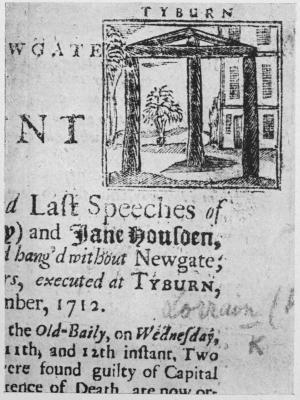
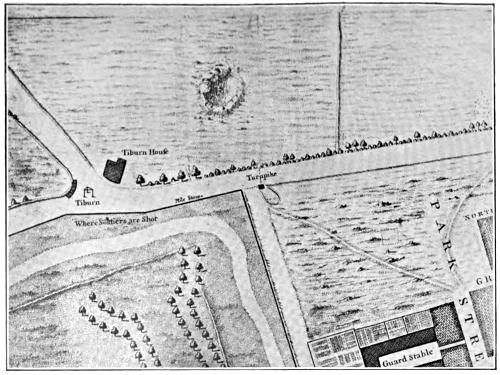
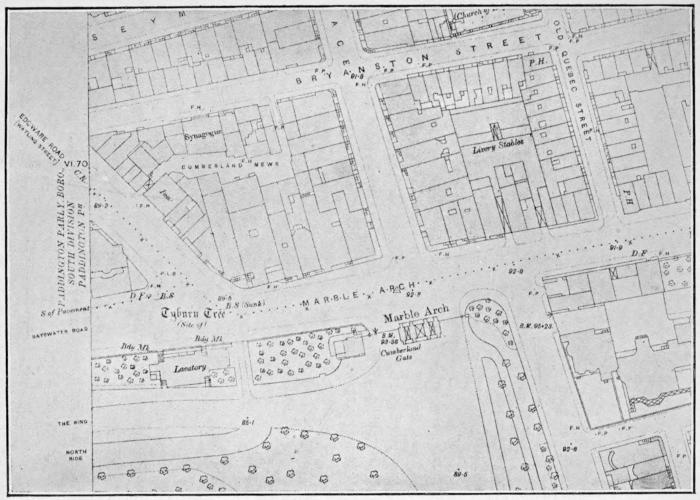
Oh Tyburn! coud’st thou Reason and Dispute;
Coud’st thou but Judge as well as Execute;
How often would’st thou change the Felon’s Doom,
And truss some stern Chief-Justice in his room?
Then should thy sturdy Posts support the Laws,
No Promise, Frown, nor popular Applause,
Shou’d sway the Bench to favour a bad Cause.
Nor Scarlet Gown, swell’d with Poetick Fury,
Scare a false Verdict from a trembling Jury.
Justice, with steady Hand and even Scales,
Should stand upright, as if sustain’d by Hales.
Yet still, in Matters doubtful to decide,
A little bearing tow’rds the milder side.
Dryden, Miscellany Poems, 5th ed., 1727, v. 126.
To tell fully the story of Tyburn for the six centuries
of its existence would need many volumes. As a selection
has to be made, I have chosen rather to take the
older and less familiar incidents than to dwell on those
of the eighteenth century, already well known.
In telling the stories found in the old chronicles, I have
refrained from giving in my own version what I found
adequately told by the old writers. Thus, if I quote
Stow, Hall, or Holinshed for events that happened long
before their time, it is, of course, not as first-hand
authorities, but because their rendering is certainly
more interesting than any I could give.
The reader will not fail to observe how extremely
meagre are these annals for the first centuries of Tyburn.
For the first hundred years, 1177 to 1273, there appear
here only eight cases. For this century and down to the
year 1535, I have, I think, given all the Tyburn tragedies
recorded by the old chroniclers. The explanation of this
meagreness is, that the chroniclers noted only executions
arising out of political incidents or out of social incidents
of extraordinary interest: only in times comparatively
late do we get glimpses of the work done by the gallows
on small offenders. All through the long era of religious
persecutions we hear little of ordinary criminals: only
now and again some number is mentioned of those executed
or tumbled into a pit together with a priest.
I may be asked how I arrive at the conclusion stated
in the introductory remarks, that a moderate estimate
would place the number of those executed at Tyburn at
fifty thousand. As the gallows was at work for six
hundred years, this number would give an average of
less than one hundred a year. Four streams of victims
converged on Tyburn. The gallows was fed from the
courts of Westminster and Guildhall (see, for example,
cases in these Annals under the years 1242, 1295, 1441,
and 1495). But the great purveyors of the gallows were
the Middlesex Sessions and the Old Bailey Sessions, the
first for the county, the latter for the City and its Liberties.
It appears that there are no records of the number of
persons hanged in pursuance of sentences passed at the
Old Bailey Sessions: fortunately, the case is different
as regards the Middlesex Sessions. The labours of
Mr. John Cordy Jeaffreson[112] have placed us in possession
of exact accounts of the numbers hanged at
certain periods for felonies committed in the county of
Middlesex. For ten years, 6th to 15th James I., these
number 704. Mr. Jeaffreson justly argues that the
felonies committed in the City and its Liberties must have
exceeded in number those committed in the adjacent
county. But, taking them as only equal in number, we
get 704+704=1,408, or a yearly average of over 140.
He finds no reason to suppose that executions were less
frequent during the reign of Elizabeth. On the assumption
that the rates were equal and continuous through
the two reigns, we have a total for this period of 66 years
of 9,240.
The returns for the reign of Charles I. are defective in
respect of some years. Even after making allowance on
this account, the average for Middlesex is not higher than
45. Doubling this as before, we get 90, as against the
Jacobean 140. Mr. Jeaffreson accepts this remarkable
fall, ascribing it to several causes: the spread of education,
enabling more persons to plead their clergy; a growing
disposition on the part of juries to convict of petty larceny
only on evidence of grand larceny; the larger number
of reprieves; the greater readiness of juries to give the
prisoner the benefit of doubt; finally, the operation of
the Act, 21 James I., c. 6, which in an indirect way put
women on a level with men in respect of clergyable
offences.
The rate was exceeded, but not very greatly, during the
Commonwealth. We will take the average of 90 for the
period covered by the reign of Charles I. and the Commonwealth.
Under the years 1535-7, I have written at some length
on the results of the social convulsion produced by the
dissolution of the monasteries and the enclosures. In
estimating the number of executions for the reign of
Henry VIII., we may take the Jacobean rate of 140 per
annum for the earlier years of the reign, from 1509-35—twenty-seven
years. We shall probably be well under
the mark in quadrupling the Jacobean rate for the remaining
eleven years of this reign, and for the six years
of the reign of Edward VI. For the troubled reign of
Mary we will double the Jacobean rate. We may now
tabulate the results of a calculation on the basis of the
foregoing assumptions:—
| Reign. |
Duration,
Years. |
Assumed Yearly
Average of
Executions
at Tyburn. |
Total. |
|
| Henry VIII. |
27 |
140 |
3,780 |
} 9,940 |
| Ditto |
11 |
560 |
6,160 |
|
| Edward VI. |
6 |
560 |
3,360 |
|
| Mary |
5 |
280 |
1,400 |
|
| Elizabeth |
44 |
140 |
6,160 |
|
| James I. |
22 |
140 |
3,080 |
|
| Charles I. |
24 |
90 |
2,160 |
|
| Commonwealth |
11 |
90 |
990 |
|
|
150 |
|
27,090 |
|
It is, of course, not claimed that this table presents
more than the results of reasonable conjecture—with the
data available we cannot get beyond conjecture. The
table shows 27,090 executions at Tyburn in 150 years,
leaving fewer than 23,000 to be made up in the remaining
450 years to the conjectured number 50,000. This gives
a yearly average of less than 52, which is certainly very
low.
During the last hundred years of the existence of
Tyburn, political executions become more and more
rare; the interest of Tyburn becomes more and more
a social interest. The salient feature of this period is
furnished by the exploits of highwaymen: it might almost
be called the era of the knights of the road. Apart from
this, the striking feature of the later history of Tyburn,
say from the accession of William III., is the constantly
increasing ferocity of the laws. The reign of William
saw passed the infamous Act inflicting the punishment
of death for stealing in a shop to the value of
five shillings. Through succeeding reigns Acts were
heaped on Acts, making this and that crime a capital
offence. No opportunity was lost of loading the Statute
Book with these odious Acts, till, as has been estimated,
the law of England reckoned two hundred capital
offences. Children were hanged or burnt, according
to sex; nor did even this satisfy the ferocity of the
governing classes. Theorists advocated a return to the
barbarous punishments of rude times: the State, by
diminishing the time accorded for repentance, sought
to pursue its victims beyond the grave. The heaping
up of death-punishments continued beyond the time
when Tyburn ceased to uphold the majesty of the law.
In the year 1786 an Act was passed imposing duties,
denoted by stamps, on perfumery and the like—the
duties ranged from one penny upwards. To counterfeit
such a stamp was DEATH, so that to defraud the State of
one penny put an offender in jeopardy of his life.
All honour to those who, like Fielding, Mandeville,
Meredith, Basil Montague, Bentham, Romilly, laboured
to bring home to their fellow-citizens a sense of the
iniquity of these murderous laws. Nor should we forget
their predecessors. Sir Thomas More stated once for all
the true view of the case: “This punyshment of theues
passeth the limites of Iustice, and is also very hurtefull to
the weale publique. For it is too extreame and cruel
a punishment for thefte, and yet not sufficient to refrayne
and withold men from thefte. For simple thefte is not
so great an offense, that it owght to be punished with
death.” We owe also grateful mention to Samuel Chidley,
who, in the time of the Commonwealth, wearied not in
protesting against “this over-much justice in hanging
men for stealing.”
1177. The first recorded execution which can be referred
to Tyburn occurred in this year. It is probable
that Tyburn was the place of execution, but, leaving this
case aside for the time, we come to the execution of
William Fitz Osbert, or “Longbeard,” expressly stated
to have been carried out at Tyburn.
1196. William Fitz Osbert, or Osborn, popularly known
as “Longbeard,” was a citizen of London, described as
skilled in the law. He is first made known to us by the
story of a vision seen by him and a companion on board
a ship, one of the fleet of Richard Cœur de Lion, on its
way to the Holy Land.
In a great storm at sea there appeared to them three
times St. Thomas of Canterbury, who said to them, “Fear
not, for I and the Blessed Martyr Edmund, and the
Blessed Confessor Nicholas have taken charge of this
ship of the King of England. And if the men of this
ship will eschew evil and seek pardon for past offences,
God will give them a prosperous voyage.” Having thrice
said this, he vanished and the storm ceased. This was
in 1190. Richard, on his return, was captured and held
to ransom by the emperor. The raising of the ransom
proved very grievous to the people. There was trouble
in the City of London as to the way of assessing the
burden. The poorer sort claimed that the citizens should
not be called on to pay so much per head, whether rich
or poor, but that the assessment should be according to
means. William Longbeard took the part of the poor
citizens: it came to be a matter to be fought to the death
between the magnates and Longbeard. Moreover, Longbeard
had accused of extortion Hubert, Archbishop of
Canterbury and Justiciar. An armed band was told off
to arrest Longbeard. He resisted, slew two chiefs of the
band, but was compelled to fly for protection to the
church of St. Mary-le-Bow. Then the archbishop did
a thing unheard of. He, a churchman, bound by every
consideration to guard the privileges of the church, set
at nought the right of sanctuary, kindled a fire, and drove
Longbeard out of the church. In his attempt to escape
Longbeard was wounded by the son of one of those whom
he had killed in trying to escape arrest. He was hurried
to trial: the great men of the city and the king’s officers
joined in urging the justiciar to inflict the severest punishment
on the offender. This was the punishment: His
upper garments were taken off, then his hands were
bound behind his back, and, attached by ropes to a horse,
he was dragged from the Tower through the City to
Tyburn, and there hanged alive by a chain.
What was he, unscrupulous demagogue or martyr in
the cause of the poor? Each view was held by his contemporaries.
He seems to have behaved very badly to
his elder brother, whose care for him during his youth he
repaid by bringing against him a charge of treason. On
the other hand, it is clear that Longbeard’s enemies had
against him a case which it was necessary to strengthen by
baseless accusations. He was charged with blaspheming
the Virgin Mary, and with taking his concubine into Bow
Church. The last charge seems disproved by the circumstances
in which Longbeard fled to the church for refuge.
It was also set about that he was put to death for “heresy
and cursed doctrine,” whereas it is obvious that his
offence was political. Be this as it may, his enemies
triumphed; Longbeard was drawn and hanged with nine
of his fellows. But “the simple people honoured him as
a Martyre, insomuch that they steale away the gibbet
whereon he was hanged, & pared away the earth, that
was be-bled with his blood, and kept the same as holy
reliques to heale sicke men.” Hubert, the archbishop,
drove them away. But two years later the monks of
Canterbury presented to the Pope charges against Hubert.
The first is that he had violated the peace of the Church
of Bow by forcing out Longbeard and his fellows. The
Pope advised Richard to remove Hubert from the office
of justiciar, and not to employ churchmen in secular
offices. Hubert resisted for a while, but in the end
accepted his dismissal.
Stow, in his “Survey” (ed. Thomas, p. 96), says that
Longbeard was hanged at “the Elms in Smithfield,”
but there is no authority for this.
The evidence that “The Elms” of Tyburn was the
place of execution is full: “Ad furcas prope Tyburnam,”
Chronicle of Ralph de Diceto, ed. Stubbs, ii. 143; “ad
furcas prope Tiburcinam,” Roger of Wendover, ed.
Coxe, iii. 95, ed. Hewlett, i. 244; Gervase of Canterbury
has “ad Ulmos,” ed. Stubbs, i. 533-4; “ad Ulmetum,”
Matthew Paris, Chron. Maj., ed. Luard, ii. 419; Hist.
Anglor., ed. Madden, ii. 57-8.
Diceto, Dean of St. Paul’s, is believed to have died
about 1202; Roger of Wendover died in 1236: their
evidence is, therefore, first-hand.
1177. From the accounts of the execution of Longbeard
it is quite clear that in 1196 Tyburn was established
as the place of execution; in the detailed accounts given
there is no hint that this was the first execution carried
out here. It has been shown that gallows existed
here as early, probably, as 1170. When, therefore, we
find mention of an execution of a date earlier than that
of Longbeard, taking place at London, for a crime of
which the royal court would necessarily have cognisance,
it is at least highly probable that Tyburn, though not
expressly mentioned, was the place of execution.
The crime of 1177 is one of those few social crimes,
as distinguished from political offences, of which the
chroniclers make mention; the story reveals a strange
picture of the manners of the time.
During a council held at London the brother of the
Earl of Ferrers was murdered in his inn, the body being
afterwards thrown into the mud of the street. When the
king heard of this he was greatly moved, and swore that he
would visit the crime heavily upon the citizens of London.
For it was said that a hundred and more of the sons and
relatives of the nobles of the City were in the habit of
breaking into the houses of wealthy men for the purpose
of robbery. And if they found any one going by night
about the streets they forthwith murdered him without
pity, so that for fear of them few dared to go about the
City by night. So it came about that in the third year
before this, the sons and nephews of certain nobles of the
City, meeting together by night, for the sake of plunder
broke into the stone house of a certain rich man of
London, using iron wedges for the purpose of making an
opening, by which they entered. But the head of the
house had been warned beforehand of their intent,
wherefore he put on a leather cuirass, and had with him
several nobles and trusty servants also protected by
armour, sitting with him in a corner of the house. And
when he saw one of those thieves, by name Andrew
Bucquinte, pressing on in front of the others with
glowing face, he brought forward a pot full of live coals,
and hurriedly kindled some wax tapers which he carried
in his hand, and rushed upon him. Which beholding,
the said Andrew Bucquinte drew his knife from its sheath
and struck the master of the house; but he failed to
wound him because the blow fell upon the cuirass. And
the master of the house quickly drawing his sword from
its sheath, returned the blow, and lopped off the right
hand of the said Andrew Bucquinte, crying with a loud
voice, “Thieves, thieves!” and hearing this all fled
except him who had lost his hand, he being held by the
master of the house. And when day broke he took him
to Richard de Lucy, the king’s justice, who threw him
into prison. And the thief, on promise of life and limb,
gave up the names of his companions, many of whom were
taken, though many also escaped. Among those taken
was a certain very noble and very rich citizen of London,
by name John Senex, who being unable to clear himself
by the ordeal of water, offered to the king five hundred
marks of silver for his life. But as he was condemned by
the ordeal of water, the king refused to accept the money,
and ordered that judgment should be done upon him,
and he was hanged.[113]
1222. In one of the ancient records of the City of
London, the “Liber de Antiquis Legibus,” there occur
two short notices:—
A.D. 1197, Constantine Fitz-Athulf and Robert le Bel
(as Sheriffs).
A.D. 1221. In this year Constantine Fitz-Athulf was
hanged, and that without trial.
The story of the execution without trial of one who had
been sheriff of the great and powerful City compels attention.
It is thus told by the chroniclers, the date assigned
being 1222 or 1223:—
In this year, on the feast of St. James the Apostle,
July 25, the inhabitants of London and those of the
neighbouring country, having challenged one another to
a wrestling match, met near the hospital of Queen
Matilda, outside the City (St. Katherine’s Hospital, near
the Tower) to decide who were the stronger in this sport.
The contest was long, and after great efforts on both
sides, the citizens of London had the best of the contest,
to the chagrin of their adversaries. He who took the
defeat most to heart was the seneschal of the abbat of
Westminster, who devised means to avenge the defeat
of his party. Having formed in his mind a plan of
vengeance, he issued a fresh challenge for the feast of
St. Peter’s Chains (August 1st), and sent word for everyone
to come to Westminster to wrestle, promising a ram
as a prize. That being done the said seneschal got
together strong and practised wrestlers, so that the victory
might be thus gained. The citizens of London, wishing
to distinguish themselves a second time, came in great
numbers to the appointed place. The contest began,
those on one side and the other trying to throw their
opponents to the ground, but the seneschal of whom
mention has been made, having brought up people from
the neighbourhood and from the country, turned the
contest into a fight which would satisfy his revenge. He
took up arms without provocation and furiously charged,
not without bloodshed, the unarmed citizens of London.
The citizens, wounded and insulted, fled in disorder to
the City. There ensued a great tumult: the common
bell was rung and brought the people together. The
story went about, every one gave his opinion, and proposed
his plan of revenge. At last the Mayor, Serle,
a man prudent and peaceful, advised that complaint
should be made to the abbat of Westminster, and said
that if he would consent to make suitable reparation,
every one should then be satisfied. But Constantine,
who had great power in the City, declared amid great
applause that it would be better to throw down all the
houses belonging to the abbat of Westminster, as well as
the seneschal’s house. Forthwith an order was drawn up,
enjoining the immediate execution of Constantine’s project.
A blind multitude, a mad populace, entrusted Constantine
with this civil war, flung itself in a tumult on the
possessions of the abbat, demolished several houses, and
did great damage. In the midst of this scene was Constantine,
continually reciting the order, and crying with
all his might, “Montjoie! Montjoie! God and our
lord Louis be our help!”
This cry, more than anything else, provoked the king’s
friends, and made them determine to exact punishment
for this sedition, as we will now tell. The facts soon got
about, and came to the ear of Hubert de Burgh, the
justiciar, who, having got together a number of knights,
put himself at their head and went to the Tower of
London, from which he sent a message to the elders to
come to him without delay. When they were before him
he asked who were the principal movers in the sedition;
who were they who had dared to trouble the royal city,
and break the king’s peace? Then Constantine, constant
in his presumption and pride, answered otherwise than
was either becoming or prudent. “It is I,” he said,
“what wilt thou?” He declared that he was protected
by treaty, that he could justify what he had done,
which was even less than he ought to have done.
He trusted to the oath taken by the king as well as
by Prince Louis, by the terms of which the friends
and partisans of one or the other were to be left in
peace.
The justiciar, hearing this avowal of Constantine, detained
him and two of his abettors, without exciting any
disturbance. The next morning he sent Fawkes de
Bréauté (known to him as a man ready for any cruelty)
with an armed force to carry Constantine by way of the
Thames to be hanged at The Elms. Quickly and secretly
they carried him thither, and when Constantine had the
rope round his neck, he offered fifteen thousand marks of
silver if his life might be spared. To whom answer was
made that never more should he get up a riot in the
king’s city. Hanged therefore he was, together with
Constantine, his nephew, and a certain Geoffrey, who had
proclaimed the order in the City.
Thus was the sentence on Constantine carried out unknown
to the citizens, and without disorder. That done,
the justiciar made his entry into London, with Fawkes
and the armed men who had gone with him. He arrested
all known to have taken part in the riot, threw them into
prison, and let them out only when he had caused their
feet or hands to be lopped off. Numbers fled and never
returned. The king took sixty citizens as hostages, and
deposed the magistrates and put others in their room.
Moreover, he ordered that a great gallows should be set
up.[114]
1236. About this time some bold but rash nobles in
England, seduced by we know not what spirit, conspired
together, and entered into an execrable alliance to ravage
England like robbers and night-thieves. Their design,
however, became known, and the chief of the conspiracy—to
wit, Peter de Buffer, one of the king’s doorkeepers—was
taken prisoner, and by him others were accused. In
order to whose execution a dreadful machine, commonly
called a gibbet, was set up in London, and on it two
of the chief conspirators were hanged, after having
engaged in single combat. One of them was killed in
the fight, and was hanged with his head cleft open, and
the other, hanged alive, breathed forth his wretched life
on the same gibbet amid the lamentations of the assembled
multitude.[115]
1239. A certain messenger of the king, named William,
had been convicted of manifold crimes, and lay in prison
under sentence of death. He brought accusations of
treason against several nobles; he also made a criminal
charge against Ralph Briton, a priest and canon of the
Church of St. Paul’s, London, who had for some time
been a familiar friend of the king, and had held the office
of treasurer. On this coming to the king’s ears he by
letter ordered the Mayor of London, William Gromer
(or Gerard Batt), to seize Ralph and imprison him in the
Tower of London, and the Mayor obeying the king rather
than God, at once carried the king’s orders into effect.
He dragged the said Ralph with violence from his house
near St. Paul’s, and imprisoned him in the Tower,
securing him with chains, commonly called rings. The
Dean of London, Master G. de Lucy, informed of this,
took counsel with his fellow canons (the bishop being
absent), and pronounced a general sentence of excommunication
against all the presumptuous perpetrators of
this enormity, and placed St. Paul’s Church under an
interdict. The king, however, although warned by the
bishop, did not amend his faults, but continued with
threats to heap evils on evils, so that the bishop was
about to place the whole of the City of London, which
was subject to him, under an interdict: but when the
archbishop of Canterbury, as well as the legate, the
bishop of London, and many other prelates, were prepared
to lay a heavy hand on the City, the king, although
unwillingly, ordered the said Ralph to be released,
and allowed to depart in peace. But when the king
sought to add the condition that Ralph should be so
kept as to be ready to give an explanation when the king
required it, the churchmen replied that they would not
on any account keep him in this manner, like an imprisoned
man, but that the church should receive him
as absolutely free, just as when the king’s attendants
tore him by force from his house. In this manner
then was Ralph released.
Not long afterwards, the before-named villain, who had,
as above stated, calumniated the nobles and the aforesaid
Ralph, was ignominiously hanged outside the City of
London, on that instrument of punishment called a
gibbet: and when he saw that death was certain, he,
although late, openly confessed before the people and
his executioners that he had made the aforesaid accusations
only for the purpose of prolonging his life.[116]
1242. William de Marisco, or Marsh, was the son
of Geoffrey, justiciar or viceroy of Ireland. In 1235
Henry Clement, a messenger from the Irish peers to the
king, was murdered in London. William Marsh was
accused of the murder, but he always protested his
innocence. William was also accused of being implicated
in the attempted assassination of the king at
Woodstock (p. 30). His father, Geoffrey, was also
suspected of being privy to the attempt, and his lands
being seized on this account, he fled to Scotland, whence
he was finally driven out at the king’s instance, dying
friendless and poor in France. This is the chronicler’s
account of the doings of William after his father’s fall:—
William sought refuge in a certain island not far from
Bristol, Devon, or Cornwall, named Lundy, an impregnable
retreat. Here, having drawn to himself a number
of outlaws and fugitives, he lived by piracy; he gave
himself up to plunder and rapine, seizing the goods
of merchants trading in those parts, especially wine and
provisions. He also made sudden descents on the coasts,
carrying off booty, injuring greatly thereby the kingdom
of England, by preying upon merchants, both native and
foreign. Now, a great number of nobles, English as well
as Irish, who could not honourably dwell at home while
the king was engaged in war in parts beyond the sea,
journeyed across the countries not far distant from the
said island, and ascertained beyond doubt that the said
William and his band could be taken only by stratagem.
They told the king that he must proceed in the matter
not violently, but cautiously, in order to capture these
devastators. The king therefore gave his orders to
trusted men, engaging them by the promise of a rich
reward to undertake the capture of this man and the
deliverance of their country. The said William was
hateful to the king, because he suspected him of being
privy, together with his father, Geoffrey, to the attempted
assassination, and to have been wickedly guilty of treason
by sending the wretch who went by night to Woodstock
to cut the king’s throat; also to have killed in London,
in the king’s presence, a certain messenger sent by an
Irish nobleman. William’s denial of the charges was not
believed, nor even listened to. Therefore he imprudently
sought safety in remote places, living like an outlaw and
a fugitive.
After narrating other events, the chronicler continues:—
About this time, William Marsh, a knight, of whom
mention has been made, while he was still in the above-mentioned
island, plundering and planning ambushes,
was himself captured by a stratagem, carried out by the
king’s loyal servants, loaded with chains, brought to
London and thrown into the Tower. His capture was
brought about by the treachery of some of his band. His
stronghold was situated on a very high rock, surrounded
on all sides by the sea, absolutely impregnable, for none
could get access to it otherwise than by a ladder, and that
in but one place. William sitting down to table, during
foggy weather, had imprudently left the watch of this
post to a man who, being detained by William by force,
was therefore ready to betray him.
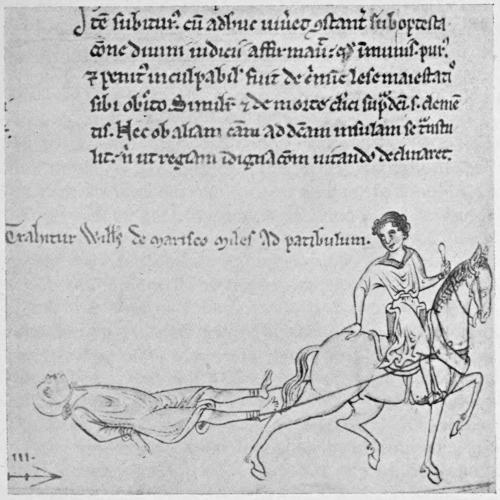
SIR WILLIAM DE MARISCO (WILLIAM MARSH) DRAWN TO THE GALLOWS
IN 1242.
On the eve of St. James [July 25], by virtue of the
king’s mandate, the said William and sixteen of his band,
taken with him, were judicially condemned, and put to
death ignominiously, for so the king willed.
First, therefore, he was drawn from Westminster to the
Tower of London, and thence to that instrument of
punishment, commonly called a gibbet: when he had
there breathed out his wretched soul, he was hanged on
one of the hooks, and when the body was stiff it was let
down and disembowelled, and the bowels were at once
burnt on the spot. Then the miserable body was divided
into four parts, which were sent to four of the chief cities,
so that this lamentable spectacle might inspire fear in all
beholders. All his sixteen companions were drawn at
the tails of horses through the City of London, and
hanged on the gallows. But the said William, after
sentence was passed on him, and when he was about to
face death, protested to his last breath, invoking the
divine judgment, that he was innocent, pure, and wholly
without blame, as well in respect of the criminal attempt
on the king, as of the death of the above-mentioned
messenger, that is to say, Clement. Nor did he take
refuge in the said island except to avoid by his flight
the king’s anger, which he had above all things desired
to appease, either by ordeal of any kind, or otherwise
by submission. But after he had fled to the said island,
and had got together his band, he had no choice but to
plunder in order to maintain a wretched existence. He
poured out his soul to God, in confession to John of St.
Giles, a friar of the order of preachers: with contrition
and tears he admitted his sins, not seeking to extenuate
them, but even accusing himself. Therefore the friar
preacher, a discreet man, who received his confession,
gave him gentle consolation, and dismissed him in peace,
exhorting him to suffer his punishment with patience, as
a means of penance. And, therefore, as has been said,
he suffered—dreadful to tell—not one death only, but
several horrible deaths.[117]
1255. The story of Little St. Hugh, the Martyr of
Lincoln, comes into the Annals of Tyburn through the
execution of eighteen Jews supposed to have been guilty.
It is interesting to see what Chaucer has made out of
this squalid tragedy in the Prioress’s Tale, one of the
most beautiful of the Canterbury Tales. The reader will
not need to be reminded that Norwich had its boy-martyr,
St. William, supposed to be done to death in the
same way in 1144. Bury St. Edmund’s had also its
boy-martyr.[118]
Matthew Paris tells the story:—
About the time of the feast of the Apostles Peter and
Paul, the Jews of Lincoln stole a boy named Hugh,
about eight years of age. They kept him shut up in a
very secret room, where they gave him milk, and other
food such as is given to children, and sent word to most
of the cities of England in which Jews dwelt, summoning
from each some Jews to be present at the sacrifice
which was to take place in Lincoln, in contempt and
derision of Jesus Christ. For, as they said, they had a
child hidden in preparation for the sacrifice. And many
assembled at Lincoln; and when they were gathered
together, they appointed a Jew as judge, as it were Pilate,
by whose sentence, approved by all, the boy suffered
various tortures. He was beaten till blood was drawn
and his body was black and blue: crowned with thorns:
spat upon and overwhelmed with jibes: then each one
pricked him with knives of the kind called anelaces: he
was made to drink gall, and, jeering at him, and grinding
their teeth, they called him false prophet. And when
they had thus mocked him in many ways, they crucified
him, and thrust a lance into his heart. And when the
boy was dead, they took the body down from the cross
and took the bowels out of the little body, for what
purpose is not known, but it is said that it was for
some practice of magic.
Now the mother of the child diligently sought for her
son during many days. In the end the neighbours told
her that they had last seen the boy playing with some
Jewish boys of his own age, and that he went into the
house of a certain Jew. At once, therefore, the woman
went into that house, where she saw the body of her
son, which had been thrown into a well. The bailiffs of
the city, having been cautiously got together, the body
was found and taken out of the well, and exhibited to
the people. But the mother of the boy, crying aloud
and lamenting, excited to tears and sighs, all, yes, all
the citizens who had flocked together. Now there was
present Sir John of Lexinton, a man circumspect, discreet
and of elegant literary acquirements, who said: “We
had already heard that the Jews have not feared to do
such things in contempt of our crucified Lord, Jesus
Christ.” And one Jew being arrested, into whose house
the boy had gone, in playing about, on whom therefore
suspicion fell rather than upon others, he said to him:
“Wretch, thou knowest that all thou hast to expect is
swift destruction. All the gold of England cannot suffice
to free or redeem thee. Nevertheless, I tell thee, however
unworthy thou art, how thou canst save thy life, and
thy limbs from torture. Both things I promise to thee
if thou dost not fear to tell me without falsehood all
that has taken place.” Then the Jew, whose name was
Copin, thinking he had found a way of escape, said:
“Sir John, if your deeds are as good as your words I
will tell you strange things.” And Sir John carefully
heartened him and pressed him. Then said the Jew:
“What the Christians say is true. The Jews nearly
every year crucify a boy in derision and contempt of
Jesus Christ. But this is not found out every year,
because it is done secretly and in remote and hidden
places. But our Jews have most pitilessly crucified this
boy, named Hugh, and when he was dead and they wished
to conceal his death they knew not how either to bury or
to hide him. For they had no further need of the body
of the innocent for augury: for that purpose they had
taken out the bowels. But in the morning, when they
thought it was hidden, the earth rejected it and threw it
up, and the body appeared for a while on the earth,
unburied, which frightened the Jews. Then they threw
the body into a well, but even so it could not be hidden.
The mother, making enquiry, found the body and gave
notice to the bailiffs.” Sir John had the Jew put in chains.
And when the canons of the cathedral church of
Lincoln learnt of these things, they begged that the little
body might be given to them, and this was done. And
when it had been seen by a great number of people, the
body was buried in the church of Lincoln, as that of a
precious martyr. It is to be noted that the Jews had
kept the boy alive ten days, and had fed him upon milk,
so that he might live to bear all kinds of torture.
When the king returned from the northern parts of
England and was informed of what had passed, he
blamed Sir John for promising life and limb to such a
wretch, and he refused to ratify this, for this blasphemer
and murderer had deserved many deaths. And when the
criminal saw that an irrevocable sentence threatened him,
he said: “Death threatens me, nor can Sir John save me.
Now will I tell the truth to all of you. Almost all the
Jews of England consented to the boy’s death of which
they are accused. And from almost every city of England
in which Jews dwell, certain men, chosen for the purpose,
came to the immolation of the child, as to a sacrifice of
Passover.”
When he had said other hateful things, he was made
fast to the tail of a horse and drawn to the gallows, and
given over body and soul to the evil demons of the air.
And other Jews, accomplices in the crime, to the number
of ninety-one, were taken in carts to London and put
in prison. If perchance some Christians shed tears for
their fate, their lot was bemoaned with dry eyes by the
Caursins, their rivals.
Afterwards, by enquiry made by the justices of our
lord the king, it was discovered that the Jews of England,
by common accord, had killed this innocent boy by
crucifixion, after having beaten him for several days.
Later, the mother of the said boy pressed upon the king
her accusation of those guilty of the death, and God, the
Lord of Vengeance, meted out to them retribution
according to their deserts. For on the feast of St.
Clement, eighteen of the richest and greatest of the
Jews of Lincoln were drawn to new gallows, prepared
for them, and left to the winds. And in the Tower of
London sixty more were kept in prison, expecting the
same fate.
1256. At this same time, certain Jews, infamous by
reason of the unhappy death of the boy crucified at
Lincoln, found guilty by the oath of twenty-five knights,
and condemned to death, lay in prison, to the number
of three score and eleven, in order that they might
be hanged. They sent, as their rivals declare, secret
messengers to the minorite friars with the view that they
should intercede for them, that they might be released
from prison, notwithstanding that they were worthy of
a most ignominious death. The friars, as the world said
(if the world is to be believed in such a matter), were
induced by money to procure the freedom of the Jews
by their prayers and intercession, from the imprisonment
and death they had deserved. But in my opinion, it is
to be believed that the friars acted from piety, guided by
a spirit of compassion, because, so long as any one is
alive in this world, he can still use his will, so that there
is hope of him. But for the devil and for those manifestly
damned, one can neither hope nor pray, because there is
no hope for them. Now death and a final sentence had
irrevocably ensnared them. But this way of looking at
the matter cannot excuse the friars, nor prevent scandal
from blackening their character. The people drew back
their hands from giving them alms as they had before
done. So it fell out that the devotion of Londoners
towards the minorites grew lukewarm, just as the charity
of the Parisians grew cold towards the preachers, who
there sought to weaken the ancient and approved customs
of the University.
In the same year, on the Ides of May, four score and
eleven Jews were released from the Tower of London,
where they had lain in fetters, for the crucifixion of
Saint Hugh, the boy of Lincoln. These Jews, I say,
were found guilty upon oath, in accordance with the
statement of the Jew who at the first was hanged at
Lincoln.[119]
1267. It happened about the Feast of Saint Katherine
[November 25] in this year, that a dispute arose between
certain of the craft of the goldsmiths and certain of
the craft of tailors: to whom adhered, on the one side
and the other, some of the trade of the parmenters
[dealers in broadcloth] and some of the tawyers [who
prepared fine leather], which persons held great assemblages,
and for three nights together went armed through
the streets of the City, creating most severe conflicts
among themselves. Hence, without doubt, as was
said, more than five hundred of these mischievous
persons were collected together at night, and in the
affray many of them were wounded: but still, no one
would act a part that belongs only to the Bailiffs. For
every one was waiting by force of arms to take vengeance
on his adversary, against the peace and his own
fealty to his lordship the King: the Bailiffs and discreet
men of the City understanding which, had more than
thirty of them seized and imprisoned in Newgate: and
these, on the Friday next after the Feast of Saint
Katherine, appeared before Laurence de Broc, the Justiciar
assigned for gaol delivery, who took proceedings
against them in the King’s behalf, saying that they,
against the peace and their fealty to his lordship the
King, had gone armed in the City, and had at night
wickedly and feloniously wounded some persons, and
had slain others, whose bodies, it was said, had been
thrown into the Thames.
They however denied violence and injury, &c., and
as to the same put themselves upon the verdict of the
venue. But on the morrow, those who by the said
venue were found to have been in the conflict aforesaid,
were, by the judgment of the said Justiciar,
immediately hanged, although not one among them
had been convicted of homicide, mayhem, or robbery.
Hence, one Geoffrey, surnamed “de Beverley,” a parmenter
by trade, because certain of those misdoers had
armed themselves in his house, and he himself had been
present with them in arms in the said affray, was hanged,
together with twelve others who had been indicted, as well
goldsmiths as parmenters and tawyers. All this however
was done that others, put in awe thereby, might take
warning, that so the peace of his lordship the King by
all within the City might be the more rigidly maintained.[120]
1278. In the month of November in this year all
Jews throughout England were seized on the same day,
and imprisoned in London, for clipping the king’s
coin. And the Jews gave information as to very many
Christians in league with them, and chiefly among the
more renowned of London. On this occasion two
hundred and eighty Jews of both sexes were hanged at
London: in other cities of England a very great
multitude. The king exacted an immense sum for the
ransom of the Christians, some of whom also were
delivered to the gallows.[121]
1284. In this year Bow church, which, as we have
seen, witnessed a great tragedy in 1196, was once more
the scene of a terrible affair. It may be told mainly in
the words of Stow:—
In the year 1284, the 13th of Edward I., Laurence
Ducket, goldsmith, having grievously wounded one
Ralph Crepin in Westcheape, fled into Bow church,
into the which, in the night time, entered certain evil
persons, friends unto the said Ralph, and slew the said
Laurence, lying in the steeple, and then hanged him up,
placing him so by the window as if he had hanged
himself, and so was it found by inquisition: for the
which fact Laurence Ducket, being drawn by the feet,
was buried in a ditch without the City: but shortly
after, by relation of a boy, who lay with the said
Laurence at the time of his death, and had hid himself
there for fear, the truth of the matter was disclosed.
Wherefore a certain woman, Alice atte Bowe, the
mistress of Crepin, a clerk, the chief causer of the said
mischief, and with her sixteen men, were imprisoned,
and later, Alice was burnt, and seven were drawn
and hanged, to wit, Reginald de Lanfar, Robert Pinnot,
Paul de Stybbenheth, Thomas Corouner, John de Tholosane,
Thomas Russel, and Robert Scott. Ralph Crepin,
Jordan Godchep, Gilbert le Clerk and Geoffrey le Clerk
were attainted of the felony and remained prisoners
in the Tower. The church was placed under an interdict
by the archbishop: the doors and windows stopped
up with thorns. But the body of Laurence was taken
from the place where it lay, and given burial by the
clergy in the churchyard. After a while, the bishop
of Rochester, by command of the archbishop, removed
the interdict.[122]
1295. October 6. The Treason of Sir Thomas
Turberville.
Sir Thomas Turberville, taken prisoner by the French,
was released in order that he might return to England
and act as a secret agent for the French government.
He was detected in corresponding with the Provost
of Paris, tried and condemned. This was the manner of
his execution: He came from the Tower, mounted on
a poor hack, in a coat of ray, and shod with white shoes,
his head being covered with a hood, and his feet tied
beneath the horse’s belly, and his hands tied before
him: and around him were riding six torturers attired
in the form of the devil, one of whom held his rein, and
the hangman his halter, for the horse which bore him
had them both upon it: and in such manner was he led
from the Tower through London to Westminster, and
was condemned on the dais in the Great Hall there:
and Sir Robert Brabazun pronounced judgment upon
him, that he should be drawn and hanged, and that he
should hang so long as anything should be left whole
of him: and he was drawn on a fresh ox-hide from
Westminster to the Conduit of London in Cheapside,
and then back to the gallows: and there is he hung
by a chain of iron, and will hang as long as anything
of him may remain.[123]
Here we have the first mention of drawing on an
ox-hide, probably at this time generally used in such
cases. But as shown on p. 28, one of the chroniclers
expressly says that this method of drawing was adopted
in the present case in order that the sufferer should
not die too soon.
The place of execution is not mentioned. In a footnote
Mr. Riley says that it was “probably the Elms
in West Smithfield,” but, as has been shown, the
probability is all in favour of the Elms of Tyburn.
1299. Rishanger reports a strange occurrence not
unconnected with our subject: The King ordered to
be brought into the Tower of London all the iron
manacles and chains which could be found in every
place in England, to an inestimable number, but the
reason of this was wholly unknown.[124]
1305. August 23. William Wallace drawn from
Westminster to the Tower and thence to Tyburn,
where he was hanged and quartered. In treating of
the punishment for high treason, mention has already
been made of the manner of carrying out the sentence on
Wallace, “the man of Belial,” as he is constantly called
in the Chronicles. Wallace was hanged on a very high
gallows, specially made for the occasion. Edward was
fond of high gallows. At the siege of Stirling Castle, in
1300, he caused to be erected two gallows, sixty feet high,
before the gates of the castle, and swore a great oath
(jurra graunt serment) that if surrender was not at once
made, he would hang every one within the castle, were
he earl, baron, or knight, high or low. “On hearing
which,” says the chronicler, “those within at once
opened the gates and surrendered to the king, who
pardoned them.”
The place of execution of Wallace was undoubtedly
Tyburn. “The Elms” is mentioned in Chronicles of
the reigns of Edward I. and Edward II., ed. Stubbs,
i. 141-2. The sentence bore that Wallace’s head should
be exposed on London Bridge. This is the first recorded
instance of a head being exposed here.[125] In 1283 the
head of David III. and of his brother Llewellyn were
fixed on the Tower of London.[126]
1306. Two other executions of Scotch leaders followed,
both probably at Tyburn, though the place is
not expressly mentioned. Symon Frisel [Fraser] was
brought to London, and then, according to the
chronicler, drawn, on September 7, from the Tower,
through the streets to the gallows as traitor, hanged as
thief, beheaded as murderer; then his body was hung
on a gibbet for twenty days, and finally burnt, the head
being fixed on a pole upon London Bridge, near the
head of Wallace.
The execution of the earl of Athol followed on
November 7. Edward, grievously ill, found his pains relieved
by learning of the capture of the earl. Athol claimed
to be of royal lineage. “If he is of nobler blood than
the other parricides,” said Edward, “he shall be hanged
higher than they.” He was carried to London, and condemned
at Westminster. Then, as being of royal descent,
he was not drawn, but rode on horseback to the place of
execution, where he was hanged on a gallows fifty feet
high. Then let down, half alive, so that his torment
might be greater, very cruelly beheaded (the chronicler
does not say what was done to make the beheading unusually
cruel), then the body was thrown into a fire previously
kindled in the sight of the sufferer, and reduced
to ashes. Then the head was placed on London Bridge
among those of other traitors, but higher than the rest, in
regard to his royal descent.[127]
1307. In May, John Wallace was brought to London,
condemned as a traitor and hanged. His head was set
on London Bridge near that of William Wallace.[128]
1330. Edward III. was but a boy when crowned in
February, 1327. All power was in the hands of Isabella,
his mother, queen of the deposed and murdered king,
Edward II., and of her lover, Roger Mortimer, baron
of Wigmore and earl of March. For the murder of
Edward II. the queen-mother and Mortimer are held
to be specially responsible. In 1329 a powerful confederation
was formed to overthrow Mortimer. This
was for the time defeated, but Edward, now eighteen,
chafed under his subjection and took counsel with William
de Montacute. It was resolved to seize Mortimer
in the castle of Nottingham, where, during the session
of Parliament held there, Isabella and her lover lodged.
Mortimer was well guarded, and it was necessary to bring
into the confederation Sir William Eland, the governor
of the castle. He told the confederates of a subterranean
passage, unknown to Mortimer, and unwatched, through
which a sufficient force could be introduced. The rest
of the story may be told in the words of Stow:—
Then, vpon a certaine night, the King lying without
the castle, both he and his friends were brought by torch
light through a secret way vnder ground, beginning far
off from the sayde castle, till they came euen to the
Queenes chamber, which they by chance found open:
they therefore being armed with naked swords in their
hands, went forwards, leauing the King also armed without
the doore of the Chamber, least that his mother
shoulde espie him: they which entred in, slew Hugh
Turpinton knight, who resisted them, Master John
Neuell of Home by giuing him his deadly wound.
From thence, they went towarde the Queene mother,
whom they found with the Earle of March readie to haue
gone to bedde: and hauing taken the sayde Earle, they
ledde him out into the hall, after whom the Queene followed,
crying, Bel filz, bel filz, ayes pitie de gentil Mortimer,
Good sonne, good sonne, take pittie vpon gentle Mortimer:
for she suspected that her sonne was there, though
shee saw him not. Then are the Keyes of the Castle sent
for, and euery place with all the furniture is yeelded vp
into the kings handes, but in such secret wise, that none
without the Castle, except the kinges friendes, vnderstoode
thereof. The next day in the morning verie
early, they bring Roger Mortimer, and other his friends
taken with him, with an horrible shout and crying (the
earle of Lancaster then blind, being one of them that
made the showt for ioy) towardes London, where
hee was committed to the Tower, and afterward condemned
at Westminster, in presence of the whole Parliament
on Saynt Andrewes euen next following, and
then drawne to the Elmes and there hanged on the
common Gallowes. Whereon hee hung two dayes and
two nights by the kinges commaundement, and then
was buryed in the Gray Fryars Church.[129]
It has been frequently said that Mortimer was the first
person executed at Tyburn. The French Chronicle of
London says, “Sir Roger Mortimer, and Sir Symon de
Bereford, who was of his counsel, were drawn and
hanged at London”; and in a note Mr. Riley adds that
he “is said to have been the first person executed at
Tyburn, but according to Roger of Wendover, William
Fitz-Osbert, or Longbeard, was executed there in 1196.”
Dr. Lingard says that Mortimer “was executed at Tyburn,
the first, as it is said, who honoured with his death that
celebrated spot.” The reader now knows that not only
Longbeard, but Constantine Fitz-Athulf, had certainly
been here executed, and also probably others mentioned
in these Annals. It may be taken for granted that the
new gallows erected in 1220, and the old gallows replaced
by them, had not stood idle. In the century and a half
during which the gallows had stood at Tyburn, hundreds,
if not thousands of unrecorded executions must have
taken place here.[130]
1345. The murder of Sir John of Shoreditch.
Sir John of Shoreditch was a doctor of laws, advocate
and knight, a man of great eminence in his profession.
This may be inferred from the fact that, in 1343, he was
sent, with others, as envoy to the Pope to complain of
papal exactions.
In the year 1345, writes the chronicler, on the tenth
of the month of July, Sir John, of the king’s council, was
secretly suffocated by four of his servants at a certain
house of his near Ware. These four servants, suspected
and apprehended, confessed their crime, and on the
eighteenth day of the same month, being the Sunday
before the festival of St. Margaret, they were in London
drawn, hanged, and beheaded, and their heads were set
up on Newgate, on poles.[131]
The punishment thus inflicted was the penalty of petty
treason, of which they were guilty in killing their master.
Tyburn is not mentioned as the place of execution.
1347. The Scotch king, David II., the earl of Fife,
and the earl of Menteith were captured. Fife and
Menteith were sent to London and tried. From Calais
Edward III. sent the judgment to be pronounced on
these two “traitors and tyrants.” In accordance with
the sentence, Menteith was drawn, hanged, disembowelled.
His head was set on London Bridge, and the
quarters sent to various parts of England. The sentence
was not carried out against Fife, as being allied to the
king in blood.[132]
This is the sentence as given by Rymer:—
Si est agarde q’ils soient Ajuggez Traitres, &, come
Traitres & Tirantz atteintz, Traynez, Penduz, Decolez, &
lour Corps Quartirez, & lour Chiefs mys sur le Pount de
Loundres, & les Quarters mys a les Quatre Principals
Villes du North (c’est assaver) a Everwyk, Noef Chastel
sur Tyne, Kardoil, and Berewyk, de les y pendre haut par
Cheines, en ensample & terrour des Traitres & Tirantz
celles Parties. Tyburn is not mentioned.
1377. Sir John Menstreworth, accused of embezzling
from the king large sums allotted to him for the pay of
soldiers, fled to France.
About this time (April), writes the chronicler, was captured
Sir John Menstreworth, a traitorous knight, who
had fled to Pamplona, a city of Navarre. Brought to
London, he was first drawn, then hanged: finally his
body was divided into four quarters, which were sent to
four principal cities of England; and his head was fixed
on London Bridge, where it remained for a long time.[133]
1386. And that yere the goode man at the sygne at
the Cocke in Chepe, at the Lyttyll Condyte, was mortheryd
in hys bedde be nyght, and therefore hys wyffe
was brente, and iiij of hys men were hangyd at Tyborne.[134]
The Grey Friars Chronicle says that three servants
were drawn and hanged. This is the record of a terrible
judicial error. The Chronicles tell the story, some under
the year 1386, some under 1391. We may suppose that
the dates are those respectively of the commission of the
crime and the discovery of the real criminal. Stow thus
tells the whole story in his “Summary,” ed. 1598:—
The good man of the Cocke in Cheap at the little
conduit was murdered in the night time by a thiefe
that came in at a gutter window, as it was knowne long
after by the same thiefe, when he was at the gallowes to
be hanged for felonie, but his wife was burnt therefore,
and three of his men drawne to Tiburne, and there
hanged wrongfully. One of the old chroniclers, after
telling the story, adds, “and that was ruth.” What more
can be said in presence of such a calamity?
1388. The struggle for power under the rule of the
boy-king, Richard II., ended in the utter rout of one of
the two factions. “Appealed of treason” by their successful
rivals, the archbishop of York, the duke of Ireland,
and the duke of Suffolk, sought safety in flight. Let
Stow tell the fate of chief justice Tresilian, of Nicholas
Brembre, the City chief of the vanquished faction, and
of others of less note. The end of Tresilian has a curious
resemblance to that, three hundred years later, of another
great lawyer, lord chancellor Jeffreys. Each had conducted
a bloody judicial campaign. After the suppression
of the revolt of the peasants, Tresilian had sentenced
to death John Ball, and, as averred by an old chronicler,
had condemned every one brought before him, whether
guilty or not. Tresilian, like Jeffreys, was captured in a
disguise. Here, indeed, the parallel ends. Jeffreys died
a prisoner in the Tower, and thus escaped the doom of
Tresilian. This is Stow’s narrative:—
The foresaid Lords being fled as is aforesaide, Robert
Trisilian a Cornishman, Lord chiefe Justice to the King,
had hid himselfe in an Apothecaries house in the Sanctuary
neere to the gate of Westminster, where he might
see the Lords going to the Parliament, and comming
forth thereby to learne what was done, for all his life
time he did all things closely, but now his craft being
espied was turned to great folly. For on Wednesday the
seuenteenth of February he was betraied of his owne
seruant, & about eleuen of the clocke beforenoone, being
taken by the Duke of Glocester, and in the Parliament
presented, so that the same day in the after noone hee
was drawne to Tyborne from the Tower of London
through the Citie, & there had his throat cut and his
bodie was buried in the gray Friers Church at London.
This man had disfigured himselfe, as if he had beene a
poore weake man, in a frize coat, all old & torne, and
had artificially made himselfe a long beard, such as they
called a Paris beard, and had defiled his face, to the
end hee might not bee knowen but by his speach. On
the morrow, was executed sir Nicholas Brembar, who
had done many oppressions, & caused seditions in the
Citie, of whom it was saide, yᵗ whilest he was in full
authoritie of Maioralitie, hee caused a common payre of
Stockes in euery ward, and a common Axe to be made
to behead all such as should bee against him, and it was
further said, that hee had indited 8000. & more of the
best and greatest of the Citie, but it was said that the said
Nicholas was beheaded with the same Axe hee hadde
prepared for other: this man if hee hadde liued, hadde
beene created Duke of Troy, or of London by the name
of Troy.
On the fourth of March Thomas Vske, Undershriue
of London, & Iohn Blake Esquire, one of the kings
household, were drawne from the Tower to Tyborne and
there hanged and beheaded, the head of Thomas Vske
was set vp ouer Newgate, to the opprobry of his parents,
which inhabited thereby.
Also on the 12. of May … Sir Iohn Bernes knight of
the kings Court a lustie young man, was in the same
place [Tower hill] beheaded, sir Iohn Salisburie knight
was drawne from the Tower to Tyborne and there
hanged.
Some of the accounts state that Brembre was hanged
at Tyburn, but Knighton says that he was beheaded on
Tower Hill, the king having stipulated with Parliament
that he should not be drawn nor hanged. Walsingham
says that Little Troy was the new name intended to be
given by Brembre to London.[135]
1399. In this year took place several executions for
the murder of the Duke of Gloucester at Calais. John
Hall was charged with having kept the door of the room
when the Duke was done to death by being smothered
in a feather-bed. On October 17th “the lordes were
examyned what peyne the same John Halle hadde
desyrved ffor his knowyng off the deeth off the Duk off
Gloucestre: and the lordes seyden, that he were worthy
the moste grete peyne and penaunce that he myght
have. And so the Juggement was that the same John
Halle shulde be drawe ffro the Tour off London to
Tyborne, and ther his bowelles shulde be brent and
affterwarde he shulde be hangid and quarterid and
byhedid. And his heede y-brouht to the same place,
wher the Duk off Gloucestre was murdred.”[136]
1400. After the deposition of Richard II. and the
coronation of Henry IV. a conspiracy was formed to
surprise Henry at a tournament to be held at Windsor
in December, 1399. The plot was made known by the
Earl of Rutland, one of the conspirators. Henry
collected an army in London, and set out for the
rebels’ camp near Windsor. The rebels retreated to
Cirencester, where they were overthrown. According to
the Chronicle of London (1827), Sir Thomas Blount,
Sir Bennet Shelley, Thomas Wyntreshull, and about
twenty-seven others, were executed at Oxford. “Afterwards
was taken Sr. Bernard Brocas, Sr. Thomas
Schelley, Maudelyn parson, Sr. William Fereby prest:
and there were drawen, hanged, and beheded at
Tyborne.” There is, however, great confusion in
the various accounts. The Grey Friars Chronicle, for
instance, says that Sir Bernard Brocas was beheaded in
Cheapside. In Chroniques de Waurin, and in a manuscript
in the Bibliothèque Nationale, is a long account of
the execution of Sir Thomas Blount. Reference has
sometimes been made to it as illustrating the cruelty of
the times. Cruel enough they were: so cruel that there
existed no need to overcharge a narrative. But this
account of the execution is clearly in great part a work
of imagination. Sir Thomas is represented as sitting,
disembowelled, near the fire in which his bowels had
been burnt, and in this condition he holds a long conversation
with Sir Thomas Erpingham. Finally, the
executioner asks Sir Thomas whether he would like to
drink. Sir Thomas replies, “Nennil, car je ne le scauroye
où mettre.”[137]
The partisans of the deposed Richard refused to believe
that he was dead:—
1402. In the meane time while the kyng was thus
occupied in Wales, certain malicious and cruel persons
enuiyng and malignyng in their heartes that king Henry
contrary to the opinion of many, but against the will of
mo had so shortely obteigned and possessed the realme
and regalitie, blased abrode & noised daily amongest
the vulgare people that kyng Richard (whiche was openly
sene dead) was yet liuying and desired aide of the common
people to repossesse his realme and roiall dignitie.
And to the furtheraunce of this fantasticall inuencion
partly moued with indignacion, partely incensed with
furious malencolie, set vpon postes and caste aboute the
stretes railyng rimes, malicious meters and tauntyng
verses against King Henry and his proceedynges. He
beyng netteled with these vncurteous ye vnuertuous
prickes & thornes, serched out the authours, and
amongest other were found culpable of this offence and
crime, sir Roger Claryngdon knight, and eight gray
Friers whiche according to their merites and desertes
were strangeled at Tiborne and there put in execution.[138]
Walter de Baldocke, formerly Prior of Laund in
Leicestershire, a ninth minorite friar, and a servant of
Sir Roger, were also executed.[139]
1404. The olde Countesse of Oxford, mother to Robert
de Vere Duke of Ireland did cause such as were familiar
with her, to brute throughout all the parts of Essex, that
king Richard was aliue, and that he should shortely come
& chalenge his olde estate and dignitie. She caused
many harts of silver, and some of golde to be made for
badges, such as king Richard was wont to bestowe on
his knights, Esquiers & friends, that distributing them
in the kings name, she might the sooner allure the
knights, and other valiant men of the Countrey, to be at
her will and desire.
Also the fame and brute which daily was blazed abroad
by one William Serle, sometimes of K. Richards chamber,
that the same King Richard was in Scotland, and
tarryed with a power of French & Scottishmen, caused
many to beleeue that he was aliue. This William Serle
had forged a priuie Seale in the said Richards name, and
had sent diuers comfortable letters vnto such as were
familiar with K. Richard, by which meanes, many gaue
the greater credit to the Countesse, insomuch, that some
religious Abbots of that country did giue credit vnto her
tales who afterward were taken at the Kings commaundement
and imprisoned, because they did beleeue
and giue credit to the Countesse in this behalfe, and the
Countesse had all her goods confiscate, and was committed
to close prison: and William Serle, was drawn
from pomfret, through the chiefest Citties of England,
and put to death at London.[140]
1424. The Parliament sitting in this year “ordained
that what prysoner for grand or petty treason was committed
to ward, & after wilfully brake or made an escape
from the same, it should bee deemed pettie treason.” Sir
John Mortimer lay in the Tower, accused of divers points of
treason. “Which John Mortimer, after the statute aforesaid
escaped out of the tower, and was taken againe vpon
the tower wharfe sore beaten and wounded, and on the
morrowe brought to Westminster, and by the authoritie
of the said parliament, hee was drawne to Tyburne, hanged
& headed.” (Stow, Annals, p. 365.) Stow refers to Hall,
who says: “In the tyme of which Parliament also,
whether it were, either for deserte or malice, or to auoyde
thynges that might chaunce, accordyng to a prouerbe,
whiche saith, a dead man doth no harme: Sir Iohn
Mortimer … was attainted of treason and put to execution:
of whose death no small slaunder arose emongest
the common people.”[141]
1427. Ande that same yere a theffe that was i-callyd
Wille Wawe was hangyd at Tyborne (Gregory’s
Chronicle, p. 161).
Insignificant as this record appears, it is really of great
interest. As the present annals show, ordinary crimes
and their punishment received little or rather no attention
from the chroniclers. We have now traversed two and
a half centuries since the first recorded execution that we
can put to the account of Tyburn. We have found but
one case, that of the terrible tragedy of the murdered
cook of Chepe, and the judicial error resulting in the
execution of four or five innocent persons, in which the
actors or sufferers were of humble rank. Gregory’s
Chronicle is supposed to have been written by William
Gregory, skinner, mayor of London. It is certain that
the author was a citizen of London. Being this, the
phases of daily life in London would naturally have for
him a greater interest than for the monk who looked on
the world from the scriptorium of his monastery. To
the fact that Gregory was a citizen of London we doubtless
owe this notice—too brief—of Wille Wawe. The
hanging of thieves was too common to attract attention.
We shall admit the probability that Wille was distinguished
from the rest of his tribe by superior daring or
success: had he, perhaps, robbed the author of the
Chronicle?
1437. Also the same yere on William Goodgrom,
of London, corsour, for scleynge of a man of court in
Hosyere Lane be syde Smythfeld, was hangen at
Tybourne (Chronicle of London, 1827, p. 123.)
A coursour, or courser, was a dealer in horses. (Riley,
“Memorials of London and London Life,” p. 366 and
note.)
1441. Roger Bolinbrooke, a great Astronomer, with
Thomas Southwell, a Chanon of Saynt Stephens Chappell
at Westminster, were taken as conspiratours of the Kings
death, for it was said, that the same Roger shoulde labour
to consume the kings person by way of Negromancie, & the
said Thomas should say Masses in the lodge of Harnesey
park beside London, upon certaine instruments, with the
which the said Roger should vse his craft of Negromancie,
against the faith, and was assenting to the said Roger,
in all his workes. And the 5. and twentith day of July
being Sun-day, Roger Bolinbrooke, with all his instruments
of Negromancie, that is to say, a chayre paynted
wherein he was wont to sit, vppon the 4. corners of which
chayre stoode foure swords, and vppon euery sword an
image of copper hanging, with many other instruments:
hee stoode on a high Scaffolde in Paules Churchyard,
before yᵉ crosse, holding a sword in his right hand,
and a scepter in his left, arrayed in a maruellous
attire, and after the Sermon was ended by maister Low
Byshop of Rochester, he abiured all articles longing to
the crafte of Negromancie or missowning to the faith,
in presence of the Archb. of Canterbury, the Cardinall of
Winchester, the byshop of London, Salisbury and many
other.
On the Tuesday next following, dame Elianor Cobham,
daughter to Reginald Cobham Lord of Stirbrough:
Dutchesse of Glocester fledde by night into the Sanctuary
at Westminster, which caused her to be suspected of
treason.
In the meane time Roger Bolinbrooke, was examined
before the Kings Counsaile, where he confessed that he
wrought the saide Negromancie at the stirring and procurement
of the said Dame Elianor, to know what should
befall of her, and to what estate she should come,
whereuppon shee was cited to appeare before Henry
Chicheley, Archbishop of Canterbury. Henry Beaufort
bishoppe of Winchester Cardinall: Iohn Kempe Archb.
of Yorke Cardinall: William Ascothe bishop of Salisburie,
& other in Saynt Stephens Chappell at Westminster,
there to answere to certaine Articles in number
28. of Negromancie, witch-crafte, sorcerie, heresie, and
treason, where when shee appeared, the foresaide Roger
was brought forth to witnes against her, and said, that
shee was cause and first stirred him to labour in the sayd
Art. Then on the 11. of August, shee was committed to
the ward of Sir John Steward, Sir William Wolfe Knights,
Iohn Stanley Esquier, and other, to be conueyed to the
Castle of Leedes, there to remaine till 3. weekes after
Michaelmas.
Shortly after a commission was directed to the Earles
of Huntington, Stafford, Suffolke and Northumberland,
the treasurer sir Ralph Cromwall, Iohn Cornwall, Lord
Fanhope, sir Walter Hungerforde, and to certaine Judges
of both Benches, to enquire of all manner of treasons,
sorceries, & other things that might be hurtfull to the
Kings person, before whome the sayde Roger, and
Thomas Southwell, as principals, and Dame Elianor as
accessary, were indicted of treason in the Guilde Hall of
London.
There was taken also Margery Gurdemaine a witch of
Eye besides Westminster, whose sorcerie and witchcrafte
the said Elianor hadde long time vsed, and by her medicines
& drinkes enforced the Duke of Glocester to loue
her, and after to wedde her, wherefore, and for cause of
relapse, the same Witch was brent in Smithfield, on the
twentie-seauen day of October.
The 21. of October, in the Chappell beforesaid, before
the Byshops, of London Robart Gilbart, of Lincolne,
William Alnewike, of Norwich Thomas Brouns, the
sayde Elianor appeared, and Adam Molins Clarke of the
Kinges Counsell read certaine articles obiected against her
of Sorcerie and Negromancy, whereof some shee denyed,
and some shee granted.
The three and twentith of October Dame Elianor appeared
againe, and witnesses were brought forth and
examined: and she was conuict of the saide Articles:
then was it asked if she would say any thing against the
witnesses, whereunto shee answered nay, but submitted
her selfe. The 27. day of October shee abiured the
articles, & was adioyned to appeare againe the ninth of
Nouember. In the meane tyme, to wit, on the 26. of
October Thomas Southwell dyed in the Tower of
London, as himselfe had prophesied that he should
neuer die by Justice of the Law.
The 9. of November Dame Elianor appeared before
the Archbyshop & other, in the sayde Chappell, and
receiued her penance, which shee perfourmed.
On Monday the 13. of November, she came from
Westminster by water, and landed at the Temple bridge,
from whence with a taper of waxe of 2. pound in her
hand, she went through Fleetestreete, hoodlesse (saue a
Kerchefe) to Pauls, where shee offered her taper at the high
Altar. On the Wednesday next shee landed at the Swan
in Thamis streete, and then went through Bridge-streete,
Grace church streete, straight to Leaden Hall, & so to
Christ church by Aldegate. On Friday she landed at
Queene Hiue, and so went through Cheape to Saynt
Michaels in Cornehill, in forme aforesaid: at all which
times the Maior, Sherifes, & crafts of London, receiued
her and accompanied her. This beeing done shee was
committed to the ward of sir Thomas Stanley, wherein shee
remained during her life in the castle of Chester, hauing
yeerely 100. markes assigned for her finding, in the 22. of
Henry the sixt, shee was remoued to Kenilworth, there to
be safely kept whose pride, false, couetise, and lechery,
were cause of her confusion.
The 18. of November Roger Bolingbroke, with Sir
Iohn Hum priest, & William Woodham Esquier, were
arraigned in the Guildhal of London, where the said Iohn
and William hadde their Charters, but Roger Bolingbroke
was condemned, and had iudgement of Sir Io.
Hody, Chiefe Justice of the Kings Bench, and the same
day he was drawne from the Tower to Tyborne and there
hanged and quartered: and when the said Roger should
suffer, he sayd that he was neuer guilty of any treaso̅
against the Kings person, but he had presumed too far
in his cunning, whereof he cryed God mercy: and the
Justice that gaue on him iudgement liued not long after.[142]
1446. Iohn Dauid appeached his master William
Catur, an armorer dwelling in S. Dunstons parish in
Fleetstreet, of treason, & a day being assigned them to
fight in Smithfield, yᵉ master being welbeloued, was so
cherished by his friends & plied so wʰ wine, that being
therwith ouercome was also vnluckely slaine by his
seruant: but that false seruant (for he falsely accused his
master) liued not long vnpunished, for he was after
hanged at Tyborne for felony (Stow, p. 385).
Shakespeare has taken this incident for a scene in the
Second Part of King Henry VI. Act 2, sc. 3, where the
armourer is called Horner, and his servant Peter. In
the play, Horner, smitten to death, is made to confess
his treason.
1447. And a-non aftyr the dethe of the Duke of
Glouceter there were a reste [arrested] many of the sayde
dukys [servants] to the nombyr of xxxviij squyers,
be-syde alle othyr servantys that nevyr ymagenyd no
falsenys of the [that] they were put a-pon of. And on
Fryday the xiiij day of Juylle nexte folowynge by
jugement at Westemyster, there by fore v personys were
dampnyd to be drawe, hanggyd, and hyr bowellys
i-brente be fore hem, and thenne hyr heddys to be
smetyn of, ande thenne to be quarteryde, and every parte
to be sende unto dyvers placys by assygnement of the
jugys. Whyche personys were thes: Arteys the bastarde
of the sayde Duke of Glouceter, Syr Rogger Chambyrlayne
knyght, Mylton squyer, Thomas Harberde squyer,
Nedam yeman, whyche were the sayde xiiij day of Juylle
i-drawe fro Syn Gorgys thoroughe owte Sowthewerke
and on Londyn Brygge, ande so forthe thorowe the cytte
of London to the Tyborne, and there alle they were hanggyde,
and the ropys smetyn a-sondyr, they beynge alle
lyvynge, and thenne, ar any more of any markys of
excecusyon were done, the Duke of Sowthefolke brought
them alle yn generalle pardon and grace from our lorde
and soverayne Kynge Harry the vjᵗᵉ.[143]
1455. Also this yere was a grete affray in London
agaynst the Lombardes. The cawse began of a yong
man that took a Dagger from a straunger and broke it.
Wherefore the yong man was sent for vnto the Mair and
Aldermen beyng at Guyldehall, and there by theym he
was commytted for his offence to One of the Countours:
and then the mair departyng from the hall toward his
mancion to dyner, in Chepe met with him a grete
company of yong men of the Mercery, as Apprentices
and other lowse men: and taried the Mair and the
Sheriffes still in Chepe, not suffryng hym to depart till
they had their ffelow, beyng in pryson, as is aforsaid,
delyuered: and so by force delyuered their felaw oute of
pryson. Wherevpon the same evenyng the hand craftymen
Ranne vnto the lombardes howsys, and Robbyd
and dispoilid Dyuers of theym. Wherfor the Mair and
Shyreffes, with thassistence of good and weldisposed
people of the Cite, with greate Jubardy and labour Drove
theym thens, and commytted some of theym that had
Robbid to Newgate. Whervpon the yong man, which
was rescoed by his feloship, seying the greate rumour
folowyng vpon his occasion Departed and went to
Westm’, and ther abode as sayntuary man: Wherby he
saved his lyf. ffor anone vpon this came down an Oye
determyne, for to do Justice vpon alle theym that soo
had Rebellid in the Cyte: vpon which sat that tyme
with the Mayr the Duke of Bokyngham with dyuers
other grete lordes, for to see Execucion doon. But the
Comons of the Cyte did arme theym secretely in their
howses, and were in purpos to haue Rungyn the Comon
Bell, callid Bowe Bell: But they were lette by sadde and
weladuysed men, which when it come to the knowleyge
of the Duke of Bokyngham and other lordes their beyng
with hym, they Incontynently arose, feryng longer to
abyde: for it was shewed to theym that all the Cite
wold arise vpon theym. But yet notwithstondyng in
Conclusion ij or iij mysdoers of the Cite were adjuged
for the Robbery, And were hanged at Tybourne: and
this doon the kyng and the quene and other lordes Rood
to Coventre, and with drewe theym from London for
these cawsis (Chronicles of London (Kingsford) 1905,
pp. 166, 167).
1467. Alle soo that same yere there were many
chyrchys robbyd in the cytte of London only of the
boxys with the sacrament. And men had moche
wondyr of thys, and sad men demyd that there had ben
sum felyschippe of heretykys assocyat to gederys. But
hyt was knowe aftyr that it was done of very nede that
they robbyd, wenyng unto the thevys that the boxys
hadde ben sylvyr ovyr gylt, but was but copyr. And by
a copyr smythe hit was a spyde of hyr longe contynuans
in hyr robbory. At a tyme, alle the hole feleschippe of
thevys sat at sopyr to gedyr, and had be fore hem fulle
goode metys. But that copyr smythe sayde, “I wolde
have a more deynty mosselle of mete, for I am wery of
capon, conynge, and chekyns, and such smalle metes.
And I mervyl I have ete ix goddys at my sopyr that were
in the boxys.” And that schamyd sum of them in hyr
hertys. Ande a smythe of lokyers crafte, that made
hyr instrumentes to opyn lockys, was ther that tyme, for
hyt was sayed at the sopyr in hys howse. And in the
mornynge he went to chyrche to hyre a masse, and
prayde God of marcy; but whenn the pryste was at the
levacyon of the masse he myght not see that blessyd
sacrament of the auter. Thenn he was sory, and a bode
tylle a nothyr pryste wente to masse and helpyd the
same pryste to masse, and say [saw] howe the oste lay
a-pon the auter and alle the tokyns and sygnys that the
pryste made; but whenn the pryste hylde uppe that hooly
sacrament at the tyme of levacyon he myght se no
thynge of that blessyd body of Chryste at noo time of
the masse, not somoche at Agnus Dei; and thenn he
demyd that hit had ben for febyllenys of hys brayne.
And he went unto the ale howse and dranke a ob. [a
halfpennyworth] of goode alle, and went to chyrche
agayne, and he helpyd iij moo prystys to masse, and in
no maner a wyse he ne myght se that blessyd sacrament;
but then bothe he and hys feleschyppe lackyd grace. And
in schorte tyme aftyr iiij of hem were take, and the same
lokyer was one of yᵉ iiij, and they were put in Newegate.
And by processe they were dampnyd for that trespas and
othyr to be hangyd and to be drawe fro Newegate to
Tyborne, and soo they were. And the same daye that
they shulde dy they were confessyd. And thes iiij
docters were hyr confessourys, Mayster Thomas
Eberalle, Maystyr Hewe Damylett, Maystyr Wylliam
Ive, and Maystyr Wylliam Wryxham. Thenn Mayster
Thomas Eberalle wente to masse, and that lokyer aftyr
hys confessyon myght see that blessyd sacrament welle
i-nowe, and thenne rejoysyd and was gladde, and made
an opyn confessyon by fore the iiij sayde docters of
devynyte. And I truste that hyr soulys ben savyd.[144]
1468. That yere were meny men a pechyd of treson,
bothe of the cytte and of othyr townys. Of the cytte
Thomas Coke, knyght and aldyrman, and John Plummer,
knyght and aldyrman, but the kyng gave hem bothe
pardon. And a man of the Lorde Wenlockys, John
Haukyns was hys name, was hangyd at Tyburne and
be heddyd for treson.[145]
1495. The 22. of Februarie were arraigned in
Guildhall at London foure persons, to witte, Thomas
Bagnall, Iohn Scot, Ihon Hethe, and Iohn Kenington,
the which were Sanctuarie men of Saint Martin le grand
in London, and lately before taken thence, for forging
seditious libels, to the slander of the King, and some
of his Councell: for the which three of them were
adiudged to die, & the fourth named Bagnall, pleaded
to be restored to sanctuary: by reason whereof he was
repriued to the Tower till the next terme, and on the 26
of February the other three with a Flemming, and
Robert Bikley a yeoman of the Crown were all fiue
executed at Tyborne (Stow, ed. Howes, p. 479).
1483. December 4. Four yeomen of the Crown
were drawn from Southwark to Tyburn, and “there
were hanged all” (Chronicle of London, Kingsford,
1905, p. 192).
1495. In this year Perkin Warbeck, a pretender,
“A yoongman, of visage beautifull, of countenance demure,
of wit subtil,” made a descent on the English
coasts:—But Perken would not set one foote out of his
Shippe, till he sawe all thinges sure; yet he permitted
some of his Souldiours to goe on lande, which being
trained forth a prettie way from their Shippes, and seeing
they coulde haue no comfort of the Countrey, they withdrew
againe to their Shippes: at which withdrawing,
the Maior of Sandwich, with certaine commons of the
Countrey, bikered with the residue that were vppon
lande, and tooke aliue of them 169. persons, among the
which were fiue Captaines Mountfort, Corbet, White
Belt, Quintin & Genine. And on the twelfth of Julie,
Syr Iohn Pechy, Sheriffe of Kent, bought vnto London
bridge those 169. persons, where the Sheriffes of London,
Nicholas Alwine and Iohn Warner receiued and conueied
them, railed in robes like horses in a cart, vnto the
tower of London, and to Newgate, and shortlie after to
the number of 150. were hanged about the sea coasts in
Kent, Essex, Sussex, and Norffolke; the residue were
executed at Tiborne and at Wapping in the Whose
besides London; and Perken fled into Flanders (Stow,
ed. Howes, p. 479).
1499. Perkyn (of whome rehersall was made before)
beyng now in holde, coulde not leaue with the destruccion
of him selfe, and confusion of other that had
associate them selfes with him, but began now to study
which way to flye & escape. For he by false persuasions
and liberall promises corrupted Strangweyes,
Blewet, Astwood and long Rogier hys kepers, beynge
seruantes to syr Ihon Dygby, lieutenaunt. In so muche
that they (as it was at their araynment openly proued)
entended to haue slayn the sayde Master, and to haue
set Perkyn and the Erle of Warwyke at large; which
Erle was by them made preuy of this enterprice, &
thereunto (as all naturall creatures loue libertie) to his
destruccion assented. But this craftie deuice and subtil
imaginacion, beyng opened and disclosed, sorted to none
effect, and so he beyng repulsed and put back from all
hope and good lucke with all hys complices and confederates,
and Ihon Awater sometyme Mayre of Corffe in
Ireland, one of his founders, and his sonne, were the
sixten daye of Nouembre arreyned and comdempned at
Westmynster. And on the thre and twenty daye of the
same moneth, Perkyn and Ihon Awater were drawen to
Tyborne, and there Perkyn standyng on a little skaffolde,
redde hys confession, which before you haue heard, and
toke it on hys death to be true, and so he and Ihon
Awater asked the kyng forgeuenes and dyed paciently.
(Hall’s Chron., ed. 1809, p. 491).
1497. Henry had prepared “a puissaunt and vigorious
army to inuade Scotland,” when domestic troubles
arose:—“When the lord Dawbeney had his army
assembled together and was in his iourney forward into
Scotlande, he sodeinly was stayed and reuoked agayne,
by reason of a newe sedicion and tumult begonne within
the realme of England for the subsedy whiche was
graunted at the last parliament for the defence of the
Scottes with all diligence and celeritee, whiche of the
moost parte was truely satisfied and payde. But the
Cornish men inhabityng the least parte of the realme,
and thesame sterile and without all fecunditee, compleyned
and grudged greatly affirmyng that they were not
hable to paye suche a greate somme as was of theim
demaunded. And so, what with angre, and what with
sorrowe, forgettynge their due obeysaunce, beganne
temerariously to speake of the kyng him selfe. And after
leuyng the matter, lamentyng, yellyng, & criyng
maliciously, sayd, that the kyngs counsayll was the cause
of this polling and shauing. And so beyng in aroare,
ii. of thesame affinitee, the one Thomas Flamocke,
gentleman, learned in the lawes of the realme, and
theother Mighell Ioseph a smyth, men of high courages
and stoute stomackes, toke vpon theim to be captaynes
of this vngracious flocke and sedicious company.…
These capiteynes exhorted the common people to put on
harneys, & not to be afearde to folowe theim in this
quarell, promisyng theim that they shoulde do no damage
to any creature, but only to se ponyshement and correccion
done to such persons which were the aucthors &
causers that the people were molested and vexed with
such vnreasonable exaccions and demaunds.” The rebels
marching towards London, “the kyng perceauyng the
cyuile warre to approche & drawe nerer & nerer,
almost to his very gates, determined with all his whole
powre to resist and represse thesame.… Wherfore he
reuoked agayn the lord Dawbeney which as you have
heard, was with a puyssaunt army goyng into Scotland,
whose army he encreaced and multiplied with many
picked and freshe warryers, that he might the better, and
with lesse laboure ouercome these rebelles.”
At Wells the rebels were joined by Lord Audley, who
became their leader. They reached Blackheath where,
although they captured Lord Dawbeney himself, they
were overcome. “There were slain of the rebelles
whiche fought & resisted ii. thousand men & moo
& taken prisoners an infinite nombre, & emongest
theim the black smyth & chiefe capteins.” The king
pardoned all the leaders “sauyng the chiefe capiteynes
& firste aucthors of that mischiefe, to whome he
woulde neither shewe mercy nor lenity. For he caused
the Lord Audeleigh to be drawen from Newgate to the
Towre hil in a cote of his awne armes peinted vpon
paper, reuersed and al to torne, & there to be behedded
the xxviii. day of Iuyn. And Thomas Flamock and
Myghell Ioseph he commaunded after the fassyon of
treytours to be drawen, hanged, and quartered [at
Tyburn], & their quarters to be pytched on stakes, &
set vp in diuerse places of Cornewhale, that their sore
punyshementes and terrible execucions for their treytorous
attemptes and foolish hardy enterprices, might be
a warning for other herafter to absteyne from committing
lyke cryme and offence.”
Michael Joseph, the blacksmith, “was of such stowte
stomack & haute courage, that at thesame time that he
was drawen on the herdle toward his death, he sayd (as
men do reporte) that for this myscheuous and facinorous
acte, he should haue a name perpetual and a fame
permanent and immortal” (Hall’s Chronicle, ed. 1809,
pp. 476-80).
1502. Vpon Monday, beyng the second day of May,
was kept at the Guyld hall of London an Oyr determyne,
where sat the Mayre, the Duke of Bokyngham, Therle
of Oxenford, with many other lordes, Juges, and
knyghtes, as commyssioners: before whome was presented
as prisoners to be enquyred of, sir James Tyrell,
and sir John Wyndam, knyghtes, a Gentilman of the said
sir James, named Wellesbourn, and one other beyng a
shipman.… Vpon ffriday folowyng, beyng the vjᵗᵉ
day of May and the morowe after the Ascension of our
Lord, Sir James Tyrell and the forsaid Sir John Wyndam,
knyghtes, were brought out of the Toure to the scaffold
vpon the Toure hill, vpon their ffete, where they were
both beheded. And the same day was the forsaid
Shipman laied vpon an herdyll, and so drawen from the
Toure to Tybourne, and there hanged, hedid, and
quartered. And the forenamed Wellysbourn Remayned
still in prison at the kynges commaundment and
pleasure (Chronicles of London, Kingsford, 1905,
p. 256).
1523. About eight miles from Bath is a village,
Farleigh-Hungerford, known locally as Farleigh Castle
from the extensive ruins of what was once a proud castle
full of life and movement. As the name denotes, the
Castle was the seat—one of the seats—of the Hungerford
family, established at Heytesbury so far back as the
twelfth century. In 1369 the Hungerford of his day, Sir
Thomas Hungerford, purchased the manor of Farleigh.
In 1383 he obtained permission to convert the manor-house
into a castle. Sir Thomas made a great figure in
the world: he is the first person formally mentioned in
the rolls of Parliament as holding the office of Speaker.
Wandering among the vast ruins, the visitor, prompted
by his guide-book, will not fail to note the spot where
was formerly a furnace. If there is in all England a
place where ghosts should walk, where the midnight owl
should hoot, it is in the ruins of Farleigh Castle. For,
now nearly four hundred years ago, Farleigh Castle was
the scene of a terrible crime, expiated, perhaps in part
only, by the death on the scaffold of one of the principal
criminals, and of one or two of the abettors of an over-reaching
ambition, or of a lawless passion.
In the Chronicle of the Grey Friars is the following
passage:—
1523. And this yere in Feuerelle the xxᵗʰ day
was the lady Alys Hungrford was lede from the Tower
vn-to Holborne, and there put in-to a carte at the church-yerde
with one of hare seruanttes, and so carred vn-to
Tyborne, and there bothe hongyd, and she burryd at the
Grayfreeres in the nether end of the myddes of the
churche on the northe syde.
Stow, who in his Annals has a marginal reference to
this Chronicle, adds a particular omitted by the earlier
Chronicler—that the lady was executed for the murder of
her husband. The curiosity of antiquaries was naturally
excited by this story, half-revealed, half-concealed. The
first discovery made was of the inventory of the lady’s
goods. This was printed in Archæologia, vol. xxxviii.
(1860). The goods fell into the hands of the king by
forfeiture: so it came about that an inventory existed.
It is a list of plate and jewels, of sumptuous hangings,
“an extraordinary collection of valuable property.”
Finally more of the story was disclosed by Mr. William
John Hardy, in the Antiquary of December, 1880. It is
one of the greatest interest.
The lady’s name is given as Alice, both by the
chronicler and by Stow in his Annals. Stow also, in a
list of the monuments in the Grey Friars church,
mentions one to “Alice Lat Hungerford, hanged at
Tiborne for murdering her husband” (Survey, ed.
Thoms, p. 120).
But the lady’s name was not Alice, but Agnes. She
was the second wife of Sir Edward Hungerford, who was
first married to Jane, daughter of John Lord Zouche of
Haryngworth. The date of the death of Sir Edward’s
first wife is not known. If we knew it there might arise
a new suspicion. Nor do we know the date of Sir
Edward’s second marriage, but it must have been not
earlier than the latter half of 1518.
Sir Edward Hungerford was one of the great ones of
the land. In 1517 he was sheriff for Wilts: in 1518 for
Somerset and Dorset. In 1520 he was present at the
Field of the Cloth of Gold. In 1521 he was in Commission
of the Peace for Somerset.
We have seen that the original seat of the family was
at Heytesbury, in Wilts, distant from Farleigh about
twelve miles, and here Sir Edward commonly lived. In
addition to Farleigh Castle, Sir Edward possessed a great
London house, standing with its gardens where now is
Charing Cross station. From this house were named
Hungerford Street and Hungerford Stairs. On the site
of the house and garden was built by a later Hungerford,
in the reign of Charles II., Hungerford Market, which
continued till the site was taken for the railway station.
The foot-bridge over the Thames, starting from this
point, was known as Hungerford Bridge, a name still
sometimes given to its successor, the existing railway
bridge. It was in Hungerford Street that Charles
Dickens, a child of ten, began life by sticking labels on
blacking bottles.
Sir Edward made his will on December 14, 1521. By
it, after leaving legacies to certain churches and friends,
“the residue of all my goods, debts, cattalls, juells, plate,
harnesse, and all other moveables whatsoever they be, I
freely geve and bequeth to Agnes Hungerforde my wife.”
She was also appointed sole executrix. Sir Edward died
on January 24, 1522, six weeks after making this will.
The husband murdered was not Sir Edward Hungerford,
but a first husband, John Cotell. The outlines of
the story are given by Mr. Hardy from the Coram Rege
Roll for Michaelmas term, 14 Henry VIII.:—
“On the Monday next after the feast of S. Bartholomew,
in the 14th year of the now king (25 August, 1522),
at Ilchester, before John Fitz James and his fellow-justices
of oyer and terminer for the county of Somerset,
William Mathewe, late of Heytesbury, in the county of
Wilts, yeoman, William Inges, late of Heytesbury, in the
county aforesaid, yeoman, [were indicted for that] on the
26th July, in the 10th year of the now Lord the King
(1518), with force and arms made an assault upon John
Cotell, at Farley, in the county of Somerset, by the procurement
and abetting of Agnes Hungerford, late of
Heytesbury, in the county of Wilts, widow, at that time
the wife of the aforesaid John Cotell. And a certain
linen scarf called a kerchier (quandam flameam lineam
vocatam ‘a kerchier’) which the aforesaid William and
William then and there held in their hands, put round
the neck of the aforesaid John Cotell, and with the aforesaid
linen scarf him, the said John Cotell, then and there
feloniously did throttle, suffocate, and strangle, so that
the aforesaid John Cotell immediately died, and so the
aforesaid William Maghewe [Mathewe] and William
Inges, by the procurement and abetting of the aforesaid
Agnes, did then and there feloniously murder, &c., the
aforesaid John Cotell, against the peace of the Lord the
King, and afterwards the aforesaid William, and William,
the body of the aforesaid John Cotell did then and there
put into a certain fire in the furnace of the kitchen in the
Castle of Farley aforesaid, and the body of the same John
in the fire aforesaid in the Castle of Farley aforesaid, in
the county of Somerset aforesaid, did burn and consume.”
The indictment charged that Agnes Hungerford, otherwise
called Agnes Cotell, late of Heytesbury, in the
county of Wilts, widow, late the wife of the aforesaid
John Cotell, well knowing that the aforesaid William
Mathewe and William Inges had done the felony and
murder aforesaid, did receive, comfort and aid them on
28th December, 1518.
Such was the indictment, “which said indictment the
now Lord the King afterwards for certain reasons caused
to come before him to be determined, &c.” All three
accused were committed to the Tower of London; “and
now, to wit, on Thursday next after the quinzaine of St.
Martin (November 27, 1522), in the same term, before
the Lord the King at Westminster, in their proper
persons came the aforesaid William Mathewe, William
Inges, and Agnes Hungerford, brought here to the bar
by Sir Thomas Lovell, Knight, Constable of the Tower
of London, by virtue of the writ of the Lord the King to
him thereupon directed.”
So they were brought to trial, and all found guilty.
William Mathewe and Lady Agnes Hungerford were
sentenced to be hanged; William Inges pleaded benefit
of clergy. The plea was contested on the ground that he
had committed bigamy, by which he lost his right to
claim his clergy. The question was referred to the
Bishop of Salisbury, who proved that Inges was a
bigamist, and Inges was therefore also sentenced to be
hanged. There is no record of a third execution; the
servant hanged at the same time as Lady Agnes Hungerford
was therefore William Mathewe.
The story is still incomplete: it may be hoped that
records somewhere exist the discovery of which will tell
us more. It will be observed that Lady Hungerford was
indicted, not for the murder of her husband, but for
receiving, comforting, and aiding, five months after the
fact, those who, by her procurement, had murdered him.
What was the nature of the comfort and aid thus given?
Had something of the story leaked out, and was Lady
Hungerford compelled to protect the murderers? Again,
what part in the tragedy was played by Sir Edward? It
is clear that at the time of the murder Agnes Cotell was
supreme at Farleigh Castle. She brought over from Sir
Edward’s other house the two men who committed the
deed; she was so fully in command of Farleigh Castle
that she could secure the use of the furnace for disposing
of the body of the murdered man. It is not difficult to
divine what were the relations between Sir Edward and
the wife of Cotell, who was probably employed in some
capacity on the estate. How did Agnes Cotell account
for his disappearance? And not his disappearance only;
as a preliminary step towards the marriage, Sir Edward
must have been satisfied that Cotell was dead. Did he
know the nature of his death? Had he a share in this
great crime, or was he merely the helpless victim of an
ambitious woman, bent on obtaining a great position,
and reckless as to the means to be employed to obtain it?
There may have been in Sir Edward a tendency towards
degeneracy; his son by the first wife was executed at the
Tower in 1540 for an abnormal crime. But if Sir
Edward was ignorant of the murder, there must have
been suspicions, perhaps necessitating the active interference
of Lady Hungerford when she received, comforted,
and aided the murderers. There must have been
whispers, rising to open denunciation when Lady
Hungerford’s protector, her husband, all-powerful in the
county, had quitted the scene. For more than three
years justice was blind and deaf, but only seven months
after Sir Edward’s death the criminals were indicted. If
we take into account the imperfect means of communication
then existing, we shall find reason to believe that
the law must have been set in motion very soon after Sir
Edward’s death.
It will have been observed that one of Lady Hungerford’s
servants pleaded his clergy, that is, he claimed the
indulgence accorded by law to those who could read.
In 1522 it was still the law that the privilege could be
claimed by one who had committed murder. In 1531 an
Act was passed by the provisions of which no person
committing petty treason, murder, or felony was admitted
to his clergy under the status of sub-deacon (23 Henry
VIII., c. 1).
William Inges’ claim would have been perforce admitted
but for the singular objection on the score of
bigamy. The exception seems strange, but was founded
on well-understood provisions of the law. A bigamist,
it must be remembered, was not what we of to-day mean
when we use the word. A bigamist was one who had
married two wives, the second after the decease of the
first, or who had married a widow. We will return
presently to this question of bigamy, after noting what
Sir Thomas Smith, writing fifty years later, says as to
clergy. Let us, however, premise that benefit of clergy
means, as indeed the name imports, a privilege of the
clergy consisting originally in the right of the clergy to
be free from the jurisdiction of lay courts, and to be
subject to the ecclesiastical courts only. Sir James Fitzjames
Stephen aptly compares it to “the privilege
claimed by British and other foreign subjects in Turkey,
in Egypt, and in China, of being tried before their own
courts.” The privilege was extended by 25 Edward III.
(1351-2), st. 6, c. 4, to all manner of clerks, as well secular
as religious. The statute was construed as being applicable
to all persons who could read, and its effect is
succinctly stated in “Piers Plowman,” written a few years
later:—
“Dominus pars hereditatis mee. is a meri verset,
That has take fro tybourne. twenti stronge theves.”
This is the description given by Sir Thomas Smith of
the process of claiming clergy:—
Of him whom the xij. men pronounce guiltie, the Judge
asketh what he can say for himselfe: if he can reade, he
demaundeth his Clergie. For in many felonies, as in theft
of oxen, sheepe, money, or other such things which be
no open robberies, by the high way side, nor assaulting
one by night in his house, putting him that is there in
feare, such is the favour of our Lawe, that for the first
fault the felon shalbe admitted to his Clergie, for which
purpose the Bishop must send one with authoritie vnder
his seale to be Judge in that matter at euerie gaole
deliuerie. If the condemned man demandeth to be
admitted to his booke, the Judge commonly giveth him a
Psalter, and turneth to what place he will. The prisoner
readeth as well as he can (God knoweth sometime very
slenderly:) then he asketh of the Bishops commissarie,
legit vt clericus? The commissarie must say legit or non
legit, for these be wordes formall, and our men of Lawe
be very precise in their words formall. If he say legit,
the Judge proceedeth no further to sentence of death: if
he say non, the Judge foorthwith, or the next day
proceedeth to sentence, which is doone by word of
mouth onelie,
[gives the form of the death sentence]
he that claimeth his Clergie, is burned forthwith in the
presence of the Judges in the brawne of his hand with a
hot yron marked with the letter T. for a theefe, or M. for
a mansleer, in cases where Clergie is admitted, and is
deliuered to the Bishops officer to be kept in the Bishops
prison, from whence after a certaine time by an other
enquest of Clarkes he is deliuered and let at large: but if
he be taken and condemned the second time, and his
marke espied, he goeth to hanging.[146]
A shrewd observer, Monsieur César de Saussure, gives
an account of the proceeding in 1726: Clergy, he says,
was formerly a privilege restricted to churchmen, but is
to-day extended to lay persons convicted to certain
crimes, and particularly of manslaughter. In virtue of
this privilege, a New Testament in Latin and in blackletter
is presented to the criminal, who is required to read
two verses. If the person appointed to make him read
says these words, “Legit ut clericus,” that is to say, “He
reads like a clerk,” which he always does, however ill the
prisoner has read, the prisoner is simply marked in the
palm of the hand with a hot iron, which he has the
further right on payment of thirteen pence halfpenny to
have plunged in cold water before it is applied. Then he
is set free.[147]
The privilege of clergy was constantly narrowed, but
was totally abolished only in 1827 by 7 and 8 George
IV., c. 28.
The following were the provisions respecting bigamy
in the old sense of the word:—
4 Edward I. (1276) c. 1, 2. The Statute of Bigamy, Section 5.
Concerning Men twice married, called Bigami, whom our Lord the
Pope by a Constitution made at the Council of Lyons hath excluded
from all Clerks privilege, whereupon certain Prelates when such
persons as were twice married before the same Constitution, have
been called in question for Felony, have prayed for to have them
delivered as Clerks … whether they were Bigami before the same
Constitution or after, they shall not from henceforth be delivered to
the Prelates, but justice shall be executed upon them, as upon other
lay people.
18 Edward III. (1344) Stat. 3, c. 2. (Here summarised.) If a
person accused pleads his clergy, and it is alleged that he has married
two wives, or one widow, the case shall be sent for determination
to the Spiritual Court.
These provisions were abolished by I Edward VI.
(1547), c. 12, s. 15, which put the “bigamist” on the
same footing as all others.
1525. In the last moneth called December were taken
certain traytors in the citie of Couentry, one called
Fraunces Philippe scolemaster to the kynges Henxmen,
and one Christopher Pykeryng clerke of yᵉ Larder, and
one Antony Maynuile gentleman, which by the persuasion
of the sayd Fraunces Philip, entended to haue taken the
kynges treasure of his subsidie as the Collectors of the
same came towarde London, and then to haue araised
men and taken the castle of Kylingworth, and then to
haue made battaile against the kyng: wherfore the sayd
Fraunces, Christopher and Anthony wer hanged, drawen
and quartered at Tyborne the xi. day of Februarye, the
residue that were taken, were sent to the citie of Couentry
and there wer executed. One of the kynges Henxmen
called Dygby which was one of the conspirators fled the
realme, and after had his pardon (Hall, p. 673).
1531. This yeare Mr. Risse was beheaded at Tower
hill, and one that was his servante was drawne from the
Tower of London to Tiburne, where he was hanged, his
bowells burnt, and his bodie quartered.[148]
1534. With the aid of Cranmer, the willing instrument
of his lust and cruelty, Henry had divorced Catherine,
and had married his mistress, Anne Boleyn, the sister
of a former mistress. With the same aid he had also
invested himself with the supremacy of the Church.
But there was a strong feeling throughout the country
against these proceedings, and Henry viewed with alarm
every manifestation of this feeling. To express disapprobation,
however mildly, was regarded as a crime,
as evidence of a conspiracy against the State.
Elizabeth Barton, afterwards known as the Holy Maid
of Kent, was a domestic servant at Aldington, Kent.
From about the year 1525 she was subject to trances, on
recovery from which she narrated the marvels she had
seen in the world of spirits. Her fame was soon spread
abroad; many of the greatest men in the kingdom visited
her; some came to believe that she was inspired, among
them perhaps Sir Thomas More, and Fisher, Bishop of
Rochester. When the great case of the divorce came on,
Elizabeth predicted that if Henry married Anne during
the life of Catherine he would die within a month.
Cranmer, who had now received the reward of his
services by being appointed Archbishop of Canterbury,
laboured to draw from Elizabeth a confession that “her
predictions were feigned of her own imagination only.”
In the Parliament which met in January, 1534, seven
persons, including Elizabeth, were accused of forming
a conspiracy in relation to the matter. This was the
end:—
1534. The 20. of Aprill, Elizabeth Barton a nunne
professed [she had entered a convent in 1527], Edward
Bocking, and Iohn Dering, two monks of Christs church
in Canterburie, and Richard Risby & another of his
fellowes of yᵉ same house, Richard Master parson of
Aldington, and Henry Gold priest, were drawne from
the Tower of London to Tiborne, and there hanged and
headed, the nuns head was set on London bridge, and
the other heades on gates of yᵉ citie (Stow, p. 570).
1535. Maurice Chauncy, a monk of the Charterhouse
of London, has told the story of the martyrdom of the
Carthusians, in a book which some one, I think, has
called the swan-song of English monasticism, “Historia
Aliquot Martyrum Anglorum Cartusianorum.”
Proceedings were taken against the London Carthusians
for refusing to admit Henry’s claim to be supreme head
of the Church. In the London House were at this time
Father Robert Lawrence, Prior of Beauvale, and Father
Augustine Webster, Prior of Axholme; Beauvale and
Axholme being two other Carthusian monasteries.
Together with Father Houghton, Prior of the London
House, Father Lawrence and Father Webster were
brought to trial and condemned. Let Chauncy tell the
story of their execution: with little variation it may stand
for that of all the Catholic martyrs from 1535 to 1681:—
Being brought out of prison [the Tower] they were
thrown down on a hurdle and fastened to it, lying at
length on their backs, and so lying on the hurdle, they
were dragged at the heels of horses through the city
until they came to Tyburn, a place where, according
to custom, criminals are executed, which is distant from
the prison one league, or a French mile. Who can relate
what grievous things, what tortures they endured on that
whole journey, where one while the road lay over rough
and hard, at another through wet and muddy places,
which exceedingly abounded.
On arrival at the place of execution our holy Father
was the first loosed, and then the executioner, as the
custom is, bent his knee before him, asking pardon for
the cruel work he had to do. O good Jesu,
“Quis non fleret,
Christi servum si videret,
In tanto supplicio,
Quis non posset contristari”;
beholding the benignity of so holy a man, how gently
and moderately he spoke to the executioner, how sweetly
he embraced and kissed him, and how piously he prayed
for him and for all the bystanders. Then on being
ordered to mount the ladder to the gibbet, where he was
to be hanged, he meekly obeyed. Then one of the
King’s Council, who stood there with many thousand
people, who came together to witness the sight, asked him
if he would submit to the king’s command and the Act of
Parliament, for if he would he should be pardoned. The
holy Martyr of Christ answered: “I call Almighty God,
and I beseech you all in the terrible Day of Judgment, to
bear witness, that being here about to die, I publicly
declare that not through any pertinacity, malice, or
rebellious spirit, do I commit this disobedience and
denial of the will of our lord the king, but solely through
fear of God, lest I should offend His Supreme Majesty;
because our holy mother, the Church, has decreed and
determined otherwise than as your king and his Parliament
have ordained; wherefore I am bound in conscience
and am prepared, and am not confounded, to endure
these and all other torments that can be inflicted, rather
than go against the doctrine of the Church. Pray for
me, and have pity on my brethren, of whom I am the
unworthy Prior.” And having said these things, he
begged the executioner to wait until he had finished his
prayer, which was, “In te Domine speravi,” down to “In
manus tuas,” inclusive. Then on a sign given, the ladder
was turned, and so he was hanged. Then one of the
bystanders, before his holy soul left his body, cut the
rope, and so falling to the ground, he began for a little
space to throb and breathe. Then he was drawn to
another adjoining place, where all his garments were
violently torn off, and he was again extended naked on
the hurdle, on whom immediately the bloody executioner
laid his wicked hands. In the first place verenda abscidit,
then he cut open his belly, dragged out his bowels, his
heart, and all else, and threw them into a fire, during
which our most blessed Father not only did not cry out
on account of the intolerable pain, but on the contrary,
during all this time until his heart was torn out, prayed
continually, and bore himself with more than human
endurance, most patiently, meekly, and tranquilly, to the
wonder not only of the presiding officer, but of all the
people who witnessed it. Being at his last gasp, and
nearly disembowelled, he cried out with a most sweet
voice, “Most sweet Jesu, have pity on me in this hour!”
And, as trustworthy men have reported, he said to the
tormentor, while in the act of tearing out his heart, “Good
Jesu, what will you do with my heart?” and saying this
he breathed his last. Lastly, his head was cut off, and
the beheaded body was divided into four parts.… Our
holy Father having been thus put to death the two other
before-named venerable Fathers, Robert and Augustine,
with another religious named Reynolds, of the Order of
St. Bridget, being subjected to the same most cruel
death, were deprived of life, one after another; all of
whose remains were thrown into cauldrons and parboiled,
and afterwards put up at different places in the
city. And one arm of our Father was suspended at
the gate of our house.[149]
On the subject of these butcheries Mr. Froude remarks,
“But we cannot blame the Government” (ii. 382).
1535. The eighteenth of June, three Monks of the
Charter-house at London, named Thomas Exmew,
Humfrey Middlemore, and Sebastian Nidigate [Newdigate]
were drawen to Tiborne, and there hanged and
quartered for denying the Kinges supremacie (Stow,
pp. 570-1).
1535-7. In 1535 was introduced the first Bill for the
dissolution of the monasteries: only the smaller were now
touched. The Bill was passed on Henry’s threat that
he would have the Bill pass, or take off some of the
Commons’ heads. Henry had tired of Anne Boleyn,
and Cranmer, always equal to the occasion, “having
previously invoked the name of Christ, and having God
alone before his eyes,” had declared that the marriage
was void and had always been so. In 1536 broke out
the first of the revolts caused by the dissolution. Henry
had not yet discovered the secret of detaching from the
cause of the people their natural leaders by sharing the
plunder with them. The nobility and gentry had their
grievances, and made common cause with the people.
Henry was furious. He gave orders to “run upon the
insurgents with your forces, and with all extremity
destroy, burn, and kill man, woman and child, to the
terrible example of all others.” The chief monks were to
be hanged on long pieces of timber out of the steeples.
Later, when the revolt had spread to Yorkshire, he
wrote: “You must cause such dreadful execution upon
a good number of the inhabitants, hanging them on
trees, quartering them, and setting their heads and
quarters in every town, as shall be a fearful warning.”
In summing up these operations, Cromwell, with a
pleasant wit, speaks of the execution of the rest at
“Thyfbourne.”[150] The story of the rest will follow. It
forms but a small fraction of those murdered by this
fell tyrant.
It may well be doubted whether in the history of
civilised communities there is any record of a social
cataclysm, not resulting from war or pestilence, so
terrible as that which overwhelmed the commons of
England after the dissolution of the monasteries, followed
by measures of plunder extending through the reign of
Edward VI. An abbat might not always be a good man
of business, witness the dreadful financial condition in
which Abbat Samson found the monastery of Bury St.
Edmunds.[151] He might even be so pressed for money as
to be driven to pledge with the Jews the arm or leg of a
saint taken from the reliquary.[152] But he was a good landlord;
the lands of the monastery were let to the
yeomanry on easy terms. The misery of the French
peasantry, largely due to constant English invasions,
was so great, that one who knew France well, Chief
Justice Fortescue, writing three hundred years before
the Great Uprising, had to seek reasons for the fact that
the peasantry did not rebel. “It is not pouerte that
kepith Ffrenchmen ffro rysinge, but it is cowardisse and
lakke off hartes and corage”: “thai haue no wepen, nor
armour, nor good to bie it with all.” With their lot
he contrasts that of the English yeoman. The might
of England “stondith most vppon archers”: if they
were poor, they could not be much exercised in shooting,
“wich mey not be done withowt ryght grete
expenses.”[153]
For the English yeomen were a prosperous class,
the backbone of the country. They were able to serve
their country alike in peace and war: having means to
send their sons to the universities, not yet appropriated
by a class: able to help in the maintenance of the poor:
stout soldiers in case of need—the best archers in the
world. Latimer’s father was a type of the class. A
yeoman, having no lands of his own, he held a farm at a
rent of three or four pounds a year. The tillage of the
farm kept half a dozen men, there was walk for a
hundred sheep: Latimer’s mother milked thirty kine.
Latimer recollected buckling on his father’s harness
when the stout yeoman-soldier set out for Blackheath.
He put Latimer “to schole, or elles I had not
bene able to haue preached before the kinges maiestie
nowe,” gave his daughters a portion, kept hospitality for
his poor neighbours, gave alms to the poor, “and all
thys did he of the sayd farme.” The Dissolution changed
all that. The rapacity of the new landlords, who turned
arable land into pasture, and quadrupled rents, is the
despair of contemporaries. Latimer thus speaks of his
father’s successor: “Wher he that now hath it, paieth
xvi. pounde by yere or more, and is not able to do anything
for his Prynce, for himselfe, nor for his children,
or geue a cup of drincke to the pore.”[154]
Then, for the first time was heard in England the
question since become familiar, “Can I not do as I like
with my own?” They say, said Bernard Gilpin, “the
Apostle of the North,” in a sermon preached before the
Court of Edward VI.—“they saie, their lande is their
owne, and forget altogether that the earth is the Lords &
the fulnesse thereof. They turn them out of their shrouds
as thicke as mice.”[155] Henry Brinklow, puritan of puritans,
admits that “but for the faith’s sake,” it had been more
profitable to the commonwealth that the abbey lands had
remained in the hands of those “imps of Antichrist,”
the abbeys and nunneries. “For why? thei neuer
inhansed their landys, nor toke so cruel fynes as doo our
temporal tyrauntes.”[156]
The governing classes, themselves atheistic,[157] ready
to change their professed religion as often as was
necessary to keep their grip on the lands stolen from
the people, played on the fanaticism of a section of the
people by means of imported preachers of the new
doctrine, sharked up in every corner of Europe. When
the commons, oppressed beyond endurance, rose at last
in revolt, they were butchered in thousands by foreign
mercenaries, the first seen in England for centuries.[158]
The Guilds, lay associations of men and women banded
together for mutual help, were among the oldest things
in England—older than King Alfred. They were the
precursors of the modern Trades Unions and Benefit
Societies, but wider in their constitution, embracing
various classes, and more human in their administration.[159]
These, too, were swept away.
The very hospitals were seized, the sick thrust forth.
The dispossessed people wandered about, workless,
aimless, foodless. “Thousandes in England through
such [landlords] begge nowe from dore to dore, which
haue kept honest houses.”[160] The Slave Act of the first
year of the reign of Edward VI. made it lawful to brand
an Englishman on the forehead with the mark of
slavery, “to putt a rynge of Iron about his Necke Arme
or his Legge for a more knowledge and suretie of
the kepinge of him.”[161]
In 1547 Ascham, about the time he was appointed
tutor to Elizabeth, wrote, “The life now lived by the
greatest number is not life, but misery,” words which
a modern writer has said should be inscribed over
the century as its motto. “Most lamentable of all,”
writes Ascham, “is it, that that noble ornament and
strength of England, the yeomanry, is broken and
destroyed.”[162]
A contemporary writer draws a picture of “the Decay
of England” almost too terrible for belief, yet all that we
know tends to confirm his story. “Whether shall then
they goo?” he cries in despair. “Foorth from shyre
to shyre, and to be scathered thus abrode, within the
Kynges maiestyes Realme, where it shall please Almighty
God: and for lacke of maisters, by compulsion dryuen,
some of them to begge, and some to steale.”[163] Happy
those who in defence of their hearths had died in the
West and in Norfolk at the hands of Spaniards, Italians,
Germans, Albanians!
A calculation based upon the statements of this same
writer on the “Decay of England” gives 675,000 persons
thrown upon the country by the decay of husbandry.[164]
But to this number we must add those turned out of the
monasteries, the poor, formerly maintained by the
monasteries and by the yeomanry, the sick and infirm,
ejected from the hospitals established for “Christ’s
poor,” as they are called in the act of foundation of a
hospital in the thirteenth century. And this immense
number out of a population estimated at 5,000,000!
“And nowe they haue nothynge, but goeth about
in England from dore to dore, and axe theyr almose
for Goddes sake. And because they will not begge, some
of them doeth steale, and then they be hanged.”[165] Great
numbers flocked to London, seeking in vain redress of
their grievances.
This was the great time of Tyburn.
In his fourth sermon, preached on March 29, 1549,
Latimer mentions, quite incidentally, the frightful number
of executions taking place in London, when he was “in
ward” with the Bishop of Chichester in 1539. “I
was desirous to heare of execution done (as ther was
euri weke, some in one place of the citye or other) for
there was thre wekes sessions at newgate, and fourth-nyghte
Sessions at the Marshialshy, and so forth.”[166]
That is, sessions every three weeks at the one place and
every two weeks at the other. Never had the gallows
been so crowded. In the sentence quoted on the title-page
of this book Sir Thomas More, writing in Latin in
1516, had said that twenty were “sometimes” hanged
together upon one gallows. In the English translation,
first published in 1551, the translator changed “sometimes”
(“nonnunquam”) into “for the most part.” So
had the gallows thriven!
The bitter lamentations of Latimer, Brinklow, Ascham,
Lever, Bernard Gilpin, Crowley, are not the cries of
partisans of the old order. They had looked for a new
heaven and a new earth—to see “the pure light of the
gospel” kindled by John a Lasco, Stumphius, John ab
Ulmis, illuminating homes freed for ever from taxation
by the spoils of the monasteries. And “the Blessed
Reformation” had sent countless thousands to the
gallows, had reinstituted white slavery in England, and
had established the “pauper,” no longer “Christ’s poor,”
as a despised and degraded caste.
But of the judicial murders of this dreadful time we
know next to nothing. As Harrison has been more than
once quoted it is necessary to refer to a passage giving
what purports to be a statement as to the numbers
executed in the reign of Henry VIII. He says:—
It appeareth by Cardane (who writeth it vpon the
report of the bishop of Lexouia) in the geniture of
king Edward the sixt, how Henrie the eight, executing
his laws verie seuerlie against such idle persons, I meane
great theeues, pettie theeues and roges, did hang vp
threescore and twelue thousand of them in his time.[167]
The statement has been repeated by countless writers
from Hume downwards, not one of whom has taken the
trouble to refer to the original. It is a misquotation
hoary with age. Cardan gives the nativity of Henry VIII.
and then says: “From these two causes, together with
others, there fell out that which the bishop of Lisieux
told me at Besançon, namely, that in the two years
before his death it was found that seventy-two thousand
men perished by the hangman after sentence (judicio et
carnifice).”[168] Cardan was at Besançon in 1552, not long
after the death of Henry. Possibly Harrison, finding the
number incredible, as relating to two years, spread the
number over the whole reign. But in the statement
attributed to the bishop there is nothing to indicate
the class of persons executed. That in one way or
another Henry did in the course of his reign destroy
seventy-two thousand persons does not seem improbable.
It is said that “over 5,000 men were hanged within the
space of six years” in a district of North Wales.[169] By
the provisions of the Act 27 Henry VIII. (1535-6) c. 25,
“rufflers” and vagabonds were to be whipped till their
bodies were bloody; for a second offence they were
to be again whipped and to lose a part of the right ear;
if thereafter they were found idling, they were to be
declared felons, and to be punished with death.
1537. The nine and twentith of March were 12. men
of Lincolne drawne to Tyborne, and there hanged and
quartered, fiue were priests, and 7. were lay men, 1. one
was an Abbot, a suffragan, doctor Mackerel; another
was the vicar of Louth in Lincolnshire, & two priests
(Stow, p. 573).
1537. Alsoe, the 17 daye of Maye, were arrayned at
Westmynster these persons followinge: Doctor Cokerell,
prieste and chanon, John Pykeringe, layman, the Abbot
of Gervase [Jervaulx] and an Abbott condam [quondam]
of Fountens, of the order of pyed monkes, the Prior of
Bridlington, Chanon, Docter John Pykeringe, fryer
of the order of prechers, and Nicholas Tempeste,
esquire, all which persons were that daye condemned
of highe treason, and had judgment for the same.
And, the 25 daye of Maye, beinge the Frydaye in
Whytsonweke, Sir John Bolner, Sir Stephen Hamerton,
knightes, were hanged and heddyd, Nicholas Tempeste,
esquier, Docter Cokerell, preiste, Abbott condam of
Fountens, and Docter Pykeringe, fryer, ware drawen
from the Towre of London to Tyburne, and ther hanged,
boweld, and quartered, and their heddes sett one London
Bridge and diverse gates in London.
And the same daye Margaret Cheyney, other wife
to Bolmer called [“which” says Hall, “some reported
was not his wife but his paramour”] was drawen after
them from the Tower of London into Smythfyld, and
there brente, according to hir judgment, God pardon her
sowle, being the Frydaye in Whytson weeke; she was
a very fayre creature and a bewtyfull.…
The second daie of June, being Saterdaie after Trinitie
Soundaie, this yeare Sir Thomas Percey, knight, and
brother to the Earle of Northumberland, was drawen
from the Tower of London to Tiburne, and their hanged
and beheaded, and Sir Francis Bigott, knight, Georg
Lomeley, esquire, sonne to the Lord Lomeley, the Abbott
of Gervase, and the Prior of Bridlington, were drawen
from the said place to Tiburne, and their hanged and
quartered, according to their judgmente, and their heades
sett on London Bridge and other gates of London.[170]
1538. The 25. of February, Sir Iohn Allen priest, and
also an Irish Gentleman of the Garets, were hanged and
quartered at Tyborne (Stow, p. 574).
Also this yere the xxv. day of Februarii was drawne
from the Towere to Tyborne, Henry Harford gentleman
and Thomas Hever merchand, and there hongyd and
qwarterd for tresoun (Grey Friars Chron., ed. Howlett,
p. 201).
1538. In Iuly was Edmond Coningsbey attainted of
treason, for counterfeatyng of the kynges Signe Manuell:
And in August was Edward Clifford for thesame cause
attainted, and both put to execucion as traitors at
Tiborne. And the Sonday after Bartelmew day, was
one Cratwell hangman of London, and two persones
more hanged at the wrestlyng place on the backesyde of
Clerkenwel besyde London, for robbyng of a bouthe in
Bartholomew fayre, at which execution was aboue
twentie thousand people as I my self iudged (Hall’s
Chron., p. 826).
1538-9. The third daie of Nouembre were Henry
Marques of Excester & earle of Deuonshire and sir
Henry Pole knight and lorde Mountagew and Sir
Edward Neuell brother to the Lorde Burgany sent to
the tower which thre wer accused by sir Gefferei Pole
brother to the lord Mountagew, of high treason, and the
two lordes were arreigned the last day of Decembre, at
Westminster before the lord Awdeley of Walden, lord
Chauncelor, and then the high stuard of England, and
there found giltie, likewise on the third day after was
arreigned Sir Edward Neuel, Sir Gefferey Pole and two
priestes called Croftes and Collins, and one holand a
Mariner and all attainted, and the ninth day of Ianuarie
[1539], were the saied two lordes and Sir Edward Neuell
behedded at the tower hill, and the two priestes and
Holande were drawen to Tiborne, and there hanged
and quartered, and sir Gefferey Pole was pardoned
(Hall, p. 827).
1539. The eight and twentie daie of Aprill, began a
Parliament at Westminster, in the which Margaret
countesse of Salsbury Gertrude wife to the Marques of
Excester, Reignold Poole, a Cardinall brother to the
lorde Mountagew, Sir Adrian Foskew [Fortescue] &
Thomas Dingley Knight of saynt Iohnes, & diuerse
other wer attainted of high treason, which Foskew and
Dynglei wer the tenth daie of Iuli behedded.
According to the Grey Friars Chronicle and Wriothesley’s
Chronicle they were beheaded at Tower Hill on the
9th July, “and that same day was drawne to Tyborne ii.
of their seruanttes, and ther hongyd and quarterd for
tresoun.”[171]
1540. Also this same yere was the xvi. day of Marche
was one Somer and iii. vacabundes with hym drawne,
hongyd and qwarterd for cleppynge of golde at Tyborne
(Grey Friars Chron., p. 203).
1540. Dr. Johnson blamed the Government of his day
for suppressing the processions to Tyburn—“the public
was gratified by a procession.” From this point of view
Henry VIII. was an ideal monarch, though it is open
to doubt whether the burnings at Smithfield and the
disembowellings at Tyburn were not so frequent as
to satiate the lovers of these spectacles.
Thus on July 30, 1540, two Doctors of Divinity and a
parson were burnt in Smithfield, and on the same day
another Doctor and two priests were hanged on a gallows
at Saint Bartholomew’s Gate, beheaded and quartered—six
victims.
Five days later the spectacle was offered of other seven
or perhaps eight despatched at Tyburn.
The 4. of August, Thomas Empson sometime a monke
of Westminster, which had bin prisoner in Newgate more
than three yeeres, was brought before the Justices of
goale deliuerie at Newgate, and for that hee would not
aske the King pardon for denying his supremacie, nor be
sworne therto, his monkes coole was plucked from his
backe, and his body repried till the King were informed
of his obstinacie.
Nothing more is told us of Empson, but it has been
supposed that he was executed in this batch:—
The same 4. of August were drawn to Tyborne
6. persons and one lead betwixt twaine, to wit, Laurence
Cooke, prior of Doncaster, William Home a lay brother
of the Charterhouse of London, Giles Horne gentleman,
Clement Philip gentleman of Caleis, & seruant to the
L. Lisle, Edmond Bromholme priest, chaplaine to the
said L. Lisley, Darby Gening, Robert Bird, all hanged
and quartered, and had beene attainted by parliament,
for deniall of the Kings supremacie (Stow, p. 581).
1540. There is nothing new under the sun. The
Aliens Act of 1905 was anticipated by the Act 32
Henry VIII. c. 16, Concerning Strangers.
The King our most dradde Souveraine Lord calling
unto his blissed remembraunce the infinite nombre of
Straungers and aliens of foren countries and nations
whiche daily doo increase and multiplie within his
Graces Realme and Dominions in excessive nombres, to
the greate detriment hinderaunce losse and empoverishment
of his Graces naturall true lieges and subjectis of
this his Realme and to the greate decay of the same—having
this on his blessed remembrance his Grace took
measures to drive out aliens not furnished with letters of
denization.
This act indirectly furnished Tyburn with two
victims:—
1540. On the xxii. daie of December, was Raufe
Egerton seruant to the Lorde Audeley lorde Chauncellor,
hanged, drawen, and quartered, for counterfetyng of the
kynges greate Seale, in a signet, whiche was neuer seen,
and sealed a great nomber of Licenses for Denizens,
and one Thomas Harman that wrote theim, was
executed: for the statute made the last parliament sore
bounde the straungiers, whiche wer not Denizens,
whiche caused theim to offre to Egerton, greate sommes
of money, the desire whereof caused hym to practise
that whiche brought hym to the ende, that before is
declared (Hall, p. 841).
1541. On the 28th June:—There was executed at saint
Thomas Waterings three gentlemen, John Mantell, John
Frowds, and george Roidon: they died for a murther
committed in Sussex (as their indictement imported) in
companie of Thomas Fines lord Dacres of the south.
The truth whereof was thus. The said lord Dacres,
through the lewd persuasion of some of them, as hath
beene reported, meaning to hunt in the parke of Nicholas
Pelham esquire at Laughton, in the same countie of
Sussex, being accompanied with the said Mantell,
Frowds, and Roidon, John Cheinie and Thomas Isleie
gentlemen, Richard Middleton and John Goldwell
yeomen, passed from his house of Hurstmonseux, the
last of Aprill in the night season, toward the same parke,
where they intended so to hunt: and comming vnto
a place called Pikehaie in the parish of Hillingleie, they
found one John Busbrig, James Busbrig, and Richard
Sumner standing togither; and as it fell out through
quarelling, there insued a fraie betwixt the said lord
Dacres and his companie on the one partie, and the said
John and James Busbrig and Richard Sumner on the
other: insomuch that the said John Busbrig receiued
such hurt, that he died thereof the second of Maie next
insuing.
Wherevpon, as well the said lord Dacres as those that
were there with him, and diuerse other likewise that were
appointed to go another waie to meet them at the said
parke, were indicted of murther; and the seauen and
twentith of June the lord Dacres himselfe was arreigned
before the lord Audleie of Walden then lord chancellor,
sitting that daie as high steward of England, with other
peeres of the realme about him, who then and there
condemned the said lord Dacres to die for that transgression.
And afterward the nine and twentith of June
being saint Peters daie, at eleuen of the clocke in
the forenoone, the shiriffs of London, accordinglie as
they were appointed, were readie at the tower to haue
receiued the said prisoner, and him to haue lead to
execution on the tower hill. But as the prisoner should
come forth of the tower, one Heire a gentleman
of the lord chancellors house came, and in the kings
name commanded to staie the execution till two of the
clocke in the afternoone, which caused manie to thinke
that the king would haue granted his pardon. But
neuerthelesse, at three of the clocke in the same afternoone,
he was brought forth of the tower, and deliuered
to the shiriffs, who lead him on foot betwixt them vnto
Tiburne, where he died. His bodie was buried in the
church of saint Sepulchers. He was not past foure and
twentie yeeres of age, when he came through this great
mishap to his end, for whome manie sore lamented, and
likewise for the other three gentlemen, Mantell, Frowds,
and Roidon. But for the said yoong lord, being a right
towardlie gentleman, and such a one, as manie had
conceiued great hope of better proofe, no small mone
and lamentation was made; the more indeed, for that it
was thought he was induced to attempt such follie, which
occasioned his death, by some light heads that were then
about him.[172]
1541. xxxiii year of Henry VIII. In the beginnyng
of this yere, v. priestes in Yorke shire began a newe
rebellion, with thassent of one Leigh a gentleman, and
ix. temporall men, which were apprehended, & shortly
after in diuerse places put in execucion, insomuch that
on the xvii. daie of Maie, the said Leigh & one Tatersall,
and Thornton were drawen through London to Tiborne
and there were executed (Hall, p. 841).
1542. The 20 of March was one Clement Dyer, a
vintner, drawen to Tyburne for treason, and hanged
and quartered (Wriothesley’s Chronicle, i., p. 135).
1542. December 10. At this tyme the Quene late
before maried to the kyng called Quene Katheryne, was
accused to the Kyng of dissolute liuing, before her
mariage, with Fraunces Diram, and that was not secretely,
but many knewe it. And sithe her Mariage, she was
vehemently suspected with Thomas Culpeper, whiche was
brought to her Chamber at Lyncolne, in August laste, in
the Progresse tyme, by the Lady of Rocheforde, and
were there together alone, from a leuen of the Clocke at
Nighte, till foure of the Clocke in the Mornyng, and to
hym she gaue a Chayne, and a riche Cap. Vpon this the
kyng remoued to London and she was sent to Sion,
and there kept close, but yet serued as Quene. And for
the offence confessed by Culpeper and Diram, thei were
put to death at Tiborne (Hall, p. 842).
Culpeper was headed, his body buried at Saint
Sepulchers Church by Newgate: Derham was quartered
&c. (Stow, p. 583).
1543. The 8. of May one Lech sometime Baylie of
Lowth, who had killed Somerset one of our heraults of
armes at Dunbar in Scotlande, was drawne to Tyborne
and there hanged and quartered. And the 12. of June,
Edward Lech his brother and with him a priest for the
same fact, were likewise executed at Tyborne (Stow,
p. 584).
1544. The 7. of March, Garmaine Gardner, and
Larke parson of Chelsey, were executed at Tyborne, for
denying the kings supremacie, with them was executed,
for other offences, one Singleton. And shortly after,
Ashbey was likewise executed for the supremacie (Stow,
p. 586).
Henry VIII. was succeeded by the boy-King Edward
VI. in 1547. Two years later the peasants rose against
their oppressors. Here are echoes of the risings in the
West and in Norfolk.
1549. Item the xxvii. day of the same monythe
[August] was iii. persons drawyn, hongyd, and qwarterd
at Tyborne that came owte of the West contre (Grey
Friars Chronicle, p. 223).
1550. The 27. of January, Humfrey Arundell esquire,
Thomas Holmes, Winslowe and Bery Captaines of the
rebels in Deuonshire, were hanged and quartered at
Tyborne (Stow, p. 603).
1550. The 10. of February one Bel a Suffolke man,
was hanged and quartered at Tyborne, for moouing a
new rebellion in Suffolke & Essex (Stow, p. 604).
In Machyn’s Diary 1550 to 1563 (Camden Society,
1848), we get almost for the first time particulars of
the rank and file of the victims of Tyburn. This is
accounted for by the probability that, as the editor
says, “his business was in that department of the
trade of a merchant-taylor which we now call an
undertaker or furnisher of funerals.” Machyn’s spelling
is detestable; it requires, as will be seen, frequent
emendations.
1552. The ij day of May … the sam day was
hangyd at Tyborne ix fello[ns] (p. 18).
The xj day of July [was] hangyd one James Ellys,
the grett pykkepurs that ever was, and cutt-purs, and
vij more for theyfft, at Tyburne (pp. 21, 22).
1552. The xxj day of Desember rod to Tyborne to
be hangyd for a robery done on Honsley heth, iij
talmen and a lake [tall men and a lacquey] (Machyn,
p. 27).
1553. The xxj day of the same monyth [January]
rod unto [Tyburn] ij felons, serten was for kyllyng of
a gentylman [of] ser Edward North knyght, in Charturhowsse
Cheyr [Ch. yard?]—the vij yere of kyng Edward
the vj (Machyn, p. 30).
“Rod” means rode in a cart.
Edward died on July 6, 1553. The rebellion in favour
of Lady Jane Grey was quickly put down, and Mary
made her entry into London on August 3rd.
At the end of January, 1554, broke out Sir Thomas
Wyatt’s rebellion. It was suppressed, but not till after
Wyatt had made his way into the heart of the City.
The gallows of Tyburn was supplemented by numerous
others:—
The xij of February was mad at evere gate in Lundun
a newe payre of galaus and set up, ij payre in Chepesyde,
ij payr in Fletstrett, one in Smythfyld, one payre in
Holborne, on at Ledyn-hall, one at Sant Magnus London
[bridge], on at Peper allay gatt, one at Sant Gorgeus,
on in Barunsay [Bermondsey] strett, on on Towr hylle,
one payre at Charyngcrosse,[173] on payr besyd Hyd parke
corner (Machyn, p. 55).
On these gallows 58 persons were executed; at Hyde
Park Corner three were hanged in chains; only seven
were quartered, “ther bodys and heds set a-pon the
gattes of London.”
Wyatt was beheaded on Tower Hill on April 11:
after and by xj of the cloke was he quartered on the
skaffold, and hys bowelles and ys members burnt be-syd
the skaffold … and so ther was a care [car] and a
baskete, and the iiij quarters and hed was putt in-to a
basket to nuwgat to be parboyled (Machyn, p. 60).
The body was the next day set upon the gallows at
Hay Hill, near Hyde Park. One execution only took
place at Tyburn. William Thomas, Clerk to the Council,
imprisoned in the Tower, tried to commit suicide; on
May 9th he was arraigned at Guildhall for conspiring the
Queen’s death, found guilty, and sentenced.
The xviij day of May was drane a-pon a sled a proper
man named Wylliam Thomas from the Toure unto
Tyborne; … he was clarke to the consell; and he
was hangyd, and after ys hed stryken of, and then
quartered; and the morow after ys hed was sett on
London bryge, and iij quarters set over Crepullgate
(Machyn, p. 63).
1555. The tenth of May, William Constable, alias
Fetherstone, a Millers sonne about the age of eighteene
yeares, who had published King Edw. the 6. to be aliue,
and sometime named himselfe to bee K. Edw. the 6. was
taken at Eltham in Kent, and conueyed to Hampton
court, where being examined by the counsell, hee
required pardon, & said he wist not what hee did, but
as he was perswaded by many; from thence he was
sent to the Marshalsea, & the 22. of May he was caried
in a cart through London to Westminster with a paper
on his head, wherein was written, that he had named
himselfe to be king Edw. After he had beene carried
about Westminster hall before the Judges, he was
whipped a bout the pallace, and through Westminster
into Smithfield, and then banished into the North, in
which countrie hee was borne, and had beene sometime
Lackey to sir Peter Mewtas (Stow, p. 626).
But William’s whipping did not cure him of his
folly:—
The 26. of February [1556] Willi. Constable alias
Fetherstone was arraigned in the Guild hall of London,
who had caused letters to bee cast abrode, that king
Edward was aliue, and to some he shewed himselfe to
be king Edward, so that many persons both menne and
women were troubled by him, for the which sedition the
said William had bin once whipped and deliuered, as is
aforesaid: But now he was condemned, and the 13.
of March he was drawne, hanged and quartered at
Tyborne (Stow, p. 628).
1556. The vij day of Marche was hangyd at Tyborne
x theyffes for robere and odur thynges (Machyn,
p. 101).
1556. A conspiracie was made by certaine persons,
whose purpose was to haue robbed yᵉ Q. exchequer,
called the receit of the exchequer, in the which there
was of yᵉ Q. treasure about 50000 l. the same time, to the
intent they might be able to maintaine war against the
queene. This matter was vttered by one of the conspiracie
named White, wherby Vdall [or Woodall],
Throckmorton, Peckham, Iohn Daniel & Stanton were
apprehended, and diuerse others fled into Fraunce.
The 28. of Aprill, John Throckmorton and Richard
Vdall were drawne to Tyborne, and there hanged and
quartered.
The 19. of May, William Stanton was likewise executed.
The 8. of June, William Rossey, Iohn Dedike, and Iohn
Bedell were executed at Tyborne (Stow, p. 628).
[Henry Peckham and John Daniel were, on July 8th,
hanged and beheaded on Tower Hill.]
Machyn says that Rossey’s head was put on London
bridge, Bedell’s on Ludgate, and Dedike’s, or Dethyke’s,
on Aldersgate (p. 107).
1557. The conspirators who had fled to France on
the discovery of their plot:—there remaining attempted
diuers times to stirre rebellion within this Realme, by
sending Bookes, Billes, and Letters, written and printed,
farced full of vntruthes, and at length the sayd Stafforde
and other English rebels, and some strangers, entred
this Realme, on the foure and twentieth of Aprill, &
tooke by stealth the castle of Skarborough in the countie
of Yorke, and set out a shamefull proclamation, wherein
he traiterously called and affirmed the queene to be
vnrightfull and most vnworthie queene, and that the
king had brought into this realme the number of twelve
thousand Spaniardes, and that into their hands were
deliuered 12. of the strongest holdes in this Realme. In
which proclamation the sayde Stafforde named himselfe
Protector and gouernor of this Realme, but hee with the
other his complices, by the good diligence of the Earle
of Westmerland and other noble men, were apprehended
on the last of Aprill.…
The eyght and twentieth day of May, Thomas Stafford
was beheaded on the tower hill, and on the morrowe
three of his companie, to wit, Stretchley, Bradford and
Proctor, were drawne to Tyborne, and there hanged &
quartered (Stow, pp. 630, 631).
1556. July 2. We have already learnt how a hangman
was hanged in 1538. Under the above date Machyn
records the execution of another:—
The ij day of July rod in a care [rode in a cart] v.
unto Tyborne: on was the hangman with the stump-lege
for stheft [theft], wyche he had hangyd mony a man
and quartered mony, and hed [beheaded] many a nobull
man and odur [other] (Machyn, p. 109).
1557. The sam day [May 25] was hangyd at Tyburne
xvij; on was a nold voman of lx yere, the trongyest
[strongest?] cut-purs a voman that has been herd off;
and a lad a cut-purs, for ys tyme he be-gane welle
(Machyn, p. 137).
Mary died in 1558, and Elizabeth came to the throne.
1570. The 27. of May, Thomas Norton and Christopher
[Norton], of Yorkeshire, being both condemned
of high treason, for the late rebellion in the North, were
drawne from the Tower of London to Tiborne and there
hanged, headed, and quartered (Stow, p. 666).
A tract, the “Confessions” of Thomas Norton and
Christopher Norton, reprinted in “State Trials,” vol. i.,
1083-6, contains particulars of these executions. Thomas,
the uncle of Christopher, was first hanged and quartered,
in the presence of his nephew. Then the hangman
executed his office on Christopher, “and being hanged
a little while, and then cut down, the butcher opened
him, and as he took out his bowels, he cried and said,
‘Oh, Lord, Lord, have mercy upon me!’ and so yielded
up the ghost. Then being likewise quartered, as the
other was, and their bowels burned, as the manner is,
their quarters were put into a basket provided for the
purpose, and so carried to Newgate, where they were
parboiled; and afterwards their heads set on London
Bridge, and their quarters set upon sundry gates of
the city of London.”
1570. The 25. of May in the morning, was found
hanging at the bishop of Londons palace gate in Paules
church-yard, a Bull, which lately had beene sent from
Rome containing diuerse horrible treasons against the
Queenes maiesty for the which one Iohn Felton was
shortly after apprehended, and committed to the tower
of London.…
The fourth of August … was arraigned at Guild hal
of London Iohn Felton, for hanging a bull at the gate
of the bishop of Londons palace, and also two young
men, for coyning and clipping of coine, who all were
found guilty of high treason, and had iudgment to be
drawne, hanged and quartered.
The eight of August, Iohn Felton was drawne from
Newgate into Paules Churchyeard, and there hanged on
a gallowes new set vp that morning before the Bishoppes
palace gate, and being cut downe aliue, he was bowelled
and quartered. After this time the same morning the
sherifs returned to Newgate, and so to Tiborne with
two young men which were executed for coyning and
clipping as is aforesaid (Stow, pp. 666-7).
Here we have the quarrel between the Pope and
Elizabeth come to a head, with dreadful results to
English Catholics—results extending in an aggravated
form over centuries.
In “Pilgrim’s Progress” Bunyan describes the Pope
in his cave, alive, indeed, but “by reason of age,
and also of the many shrewd brushes that he met
with in his younger days, grown so crazy and stiff
in his joints, that he can now do little more than sit
in his cave’s mouth, grinning at pilgrims as they go
by, and biting his nails because he cannot come at
them.”
A sense of humour, or even a sense of proportion,
might have counselled to laugh at this impotent railing.
But there was the temptation, always present to governments,
to appeal to the ignorance and fanaticism of the
mass. And behind and above all there was the question
of the abbey lands:—
“The thief doth fear each bush an officer.”
So for the next hundred years it became the most pressing
duty of governments to tear out the bowels of men
who acknowledged the Pope as spiritual father; and when
governments became slack in the work, Parliament
immediately set up a howl for blood.
1571. The execution of Dr. John Story is one of the
horrors of Tyburn: it is further memorable from the
fact that, as we have seen (p. 64), the triangular gallows,
destined to become famous as the Triple Tree, first came
into use on this occasion.
Dr. Story was a bitter persecutor under Mary.
There is no more difficult question than that of determining
how far we must condemn, how far we may
absolve those, on either side, who used their power to
inflict punishments on men who differed from them in
religion. In his “Prince” Machiavelli divides men of
the ruling class into three categories. There is, in the
first place, the man who understands of himself; next
comes he who understands when a thing is shown to
him; last comes he who can neither generate a new
idea, nor comprehend it when put before him. The
first, he says, is most excellent; the second excellent;
the third useless. But incapacity to generate new ideas,
inability to assimilate them, are things not criminal.
The mass of men will always be found in the third
category. Dr. Story was not one of those rare spirits
who rise above the ideas current in their time.
In this matter of persecution it is impossible for us
of to-day to place ourselves in the position of men in
the sixteenth century. Nothing could be more false
than to represent the reformers as advocates of religious
liberty. They made no such claim for themselves: they
would have regarded themselves as traitors to their trust
if, when their opportunity came, they did not in their
turn send to the stake the obstinate heretics who refused
to yield to their arguments and rejected “the truth.”
Latimer could jest in the sermon he preached on the
occasion of the burning of Friar Forest.[174] Forest, it is
true, was a Catholic. The reformers persecuted others
than Catholics, and here it is even more difficult to
acquit them. Claiming liberty to discard old beliefs,
they persecuted those who went further than they in
the same direction. In 1549 was appointed a Commission,
and in 1551 another, with extended scope.
Among the Commissioners we find Cranmer, Ridley,
Latimer, Coverdale—more than thirty names of the
brightest lights of the Reformation. They were appointed
to try heretics—Anabaptists and those who
rejected the Book of Common Prayer—to try, to condemn,
and to hand over to the civil power.[175] Latimer
was earnest to persuade the hearers of one of his great
sermons that to go boldly to death did not prove that
death was suffered in a righteous cause. He jeered at
the constancy of the Anabaptists: “The Anabaptistes
that were brente here in dyuers townes in England, as
I heard of credible menne (I saw them not my selfe)
went to their death euen Intrepide. As ye wyll saye,
with out any feare in the world chearfully. Well, let
them go.”[176]
Without reckoning too nicely the allowances to be
made for the difficulty of achieving emancipation from
the ideas of one’s age, posterity has perhaps done rough
justice in allowing subsequent martyrdom to atone for
the errors of those who persecuted. Catholics have
beatified Story; Protestants venerate the memory of
those who suffered after having enforced the new
doctrines by the aid of the gallows and the stake.
After the accession of Elizabeth, Story had more than
one narrow escape. In 1563 he was imprisoned in the
Marshalsea, whence he escaped, and, with the aid of the
chaplain of the Spanish Ambassador, fled to Flanders.
The Spanish Ambassador disclaimed knowledge of the
matter, but it may well be that the English Government
was nettled, and readily lent itself to a plan for capturing
Story. In his adopted country he received a place in the
customs. On a certain day in August, 1570, he was
invited to examine a ship at Bergen-op-Zoom. While
he was busy in the hold the hatches were shut down on
him, the sail was hoisted, and the ship sailed for Yarmouth
with Story on board. The capture was a great
event. “The locks and bolts of the Lollards’ Tower
were broken off at the death of queen Mary, and never
since repaired. Now they were repaired for the reception
of Dr. Story.”[177] He was executed at Tyburn on
June 1, 1571. He was the object of general execration:
care was probably taken that he should suffer all the
torments of the horrible sentence. He was let down
from the gallows alive, and while the executioner was
“rifling among his bowels,” Story rose and dealt him
a blow.
1572. The 11. day of February Kenelme Barney, and
Edmond Mather were drawne from the Tower of London:
and Henry Rolfe from the Marshalsea in Southwarke,
all three to Tyborne, and there hanged, bowelled and
quartered for treason: Barney and Mather for conspiracie
against some of her maiesties priuie counsell,
and Rolfe for counterfeiting the Q. maiesties hand
(Stow, p. 670).
1572. The 28. of Nouember, John Hall gentleman,
and Oswald Wilkinson late of Yorke, and gailor of
Yorke castle (being before arraigned and condemned
of treason) were drawne from the Tower of London
to Tiborne, and there hanged and quartered (Stow, p. 673).
1573. The 16. of June, Thomas Woodhouse, a priest
of Lincolnshire, who had lien long prisoner in the
Fleete, was arraigned in the Guild hall of London,
and there condemned of high treason, who had iudgement
to be hanged and quartered, and was executed
at Tyborne the nine-teenth of June (Stow, p. 676).
1576. The 30. of May, Tho. Greene goldsmith was
drawne from Newgate of Lond. to Tyborne, and there
hanged, headed, and quartered, for clipping of coine
both gold and siluer (Stow, p. 680).
1578. The third of Februarie, early in the morning,
Iohn Nelson, for denying the Queenes supremacie, and
such other traiterous words against her maiestie, was
drawne from Newgate to Tiborne, and there hanged,
bowelled and quartered (Stow, p. 684).
1578. The 7. of Februarie, one named Sherewood
was drawne from the Tower of London to Tyborne,
and there hanged, bowelled and quartered (Stow, p. 684).
Thomas Sherwood was a layman. In the Tower he
was cruelly racked to make him tell where he had
heard mass.
1581. The 18. of July, Euerard Haunce [Hanse] a
seminary priest, was in the Sessions hall in the olde
Baily arraigned, where he affirmed that himselfe was
subiect to the Pope in ecclesiasticall causes, and that
the Pope hath now the same authoritie here in England
that hee had an hundred yeeres past, with other trayterous
speeches, for the which hee was condemned to bee
drawne, hanged, bowelled, and quartered, and was
executed accordingly on the last of July (Stow, p. 694).
1581. On the 20. of November, Edm. Champion [Campion]
Jesuit, Ralfe Sherwine, Lucas Kerbie, Edward
Rishton, Thomas Coteham, Henrie Orton, Robert
Iohnson, and Iames Bosgraue, were brought to the
high bar at Westminster, where they were seuerally,
and all together indicted vpon high treason, for that contrary
both to loue and dutie, they forsooke their natiue
countrey, to liue beyond the seas vnder the Popes obedience,
as at Rome, Rheimes, and diuerse other places,
where (the pope hauing with other princes practised the
death and depriuation of our most gracious princesse
and vtter subuersion of her state and kingdome, to
aduance his most abhominable religion) these menne
hauing vowed their alleagiance to the pope, to obey him
in all causes whatsoeuer, being there, gaue their consent,
to ayd him in this most trayterous determination. And
for this intent and purpose they were sent ouer to seduce
the harts of her maiesties louing subiects, and to conspire
and practise her graces death, as much as in them
lay, against a great daie, set & appoynted, when the
generall hauocke should be made, those onely reserued
that ioyned with them. This laid to their charge, they
boldly denied, but by a iurie they were approoued
guiltie, and had iudgement to bee hanged, bowelled, and
quartered (Stow, p. 694).
The account of the executions of some of these will
follow. According to Camden, Elizabeth did not at all
believe them guilty of plotting the destruction of the
country; they were tried and executed to take away the
fear which had possessed many men’s minds that religion
would be altered if she married a foreign prince.
1581. The first of December, Edmond Champion
[Campion] Jesuit, Ralfe Sherwine, and Alexander Brian
seminary priests, were drawne from the tower of London
to Tyborne, & there hanged, bowelled and quartered
(Stow, p. 694).
In writing of the illegal use of torture by Elizabeth’s
Government, under Elizabeth’s sanction, reference was
made to a pamphlet, ascribed to Lord Burghley, “A
Declaration of the favourable Dealing,” &c., issued in
1583. Here are two passages from the “Declaration”
relating to Campion and Brian (here called Briant):
“That very Campion, I say … was never so racked,
but that he was presently able to walke, and to write.”
“A horrible matter is also made of the starving of one
Alexander Briant; how he should eat clay out of the
walles, gathered water to drinke from the droppings of
houses, with such other false ostentations of immanitie;
where the trueth is this: that whatsoever Briant suffered,
in want of foode, he suffered the same wilfully, and of
extreme impudent obstinacie, against the minde and liking
of those that dealt with him.” His gaolers wished to
have a specimen of his handwriting, and as he refused
to write, “then was it commaunded to his keeper to give
unto him such meate, drinke, and other convenient
necessaries, as he woulde write for; and to forbeare to give
him anything for which he woulde not write. But Briant,
being thereof advertised, and oft moved to write persisting
so in his curst heart, by almost two dayes and two
nightes, made choise rather to lacke foode, then to write
for the sustenance, which he might readely have had for
writing, and which he had, indede, readely and plentifully,
so soone as he wrote.” Thus the Government, or
the Government’s apologist. This was the best case to be
made out.
1582. On the 28. day of May, Thomas Ford, Iohn
Shert, & Robert Iohnson, priests, hauing bin before
indicted, arraigned, and condemned for high treason
intended, as yee haue heard of Champion and other, were
drawne from the Tower to Tiborne, and there hanged,
bowelled, and quartered. And on the 30. Luke Kirby,
William Filby, Thomas Cottam, and Laurence Richardson,
were for the like treason in the same place likewise
executed (Stow, p. 694).
1584. January 11. On the 10. of January at a sessions
holden in the Justice hall in the Old baily of London,
for goale deliuery of Newgate, Willi. Carter of the Cittie
of London, was there indicted, arraigned and condemned
of high treason, for printing a seditious and trayterous
booke in English, entituled, A treatise of schisme: and
was for the same (according to sentence pronounced
against him) on the next morrowe drawne from Newgate
to Tyborne, and there hanged, bowelled, and quartered.
And forthwith against slanderous reports spread abroad
in seditious bookes, letters, and libels, therby to inflame
our countrey-men, & her maiesties subiectes, a
booke was published, entituled, A declaration of the
fauourable dealing of her maiesties commissioners, &c.
(Stow, p. 698).[178]
1584. February 12. The 7. of February, were arraygned
at Westminster Iohn Fen [James Fenn], George
Haddocke [Haydock], Iohn Munden, Iohn Nutter,
and Thomas Hemerford, all fiue found guiltie of high
treason, in being made priestes beyond the seas, and
by the Popes authoritie, since a statute made in Anno
primo of her maiesties raygne, and hadde iudgement
to be hanged, bowelled, & quartered: which were
all executed at Tyborne on the 12. of February
(Stow, p. 698).
1584. The 21. of May, Francis Throckmorton
Esquire was arraygned in the Guild hall of the cittie
of London, where being found guiltie of high Treason,
hee was condemned, & had iudgement to be drawne,
hanged, bowelled, & quartered. The 10. of July next
following, the same Francis Throckmorton was conveyed
by water from the Tower of London, to the
Blacke fryers stayres, and from thence by land to the
sessions hall in the Olde baily without Newgate, where
hee was deliuered to the sheriffes of London, laid on
a hurdle, drawne to Tyborne, & there executed according
to his iudgement. A discouery of whose treasons,
practised and attempted against the Queenes maiestie and
the realme, were in the moneth of June published and
printed in a booke intituled, A true and perfect Declaration
of the treasons practised and attempted by Francis
Throckmorton, &c.[179] (Stow, p. 628).
1585. July 6. The fift of July, Thomas Aufield
[Alfield], a seminarie priest, and Thomas Welley
[Webley] diar, were arraygned at the sessions hall
in the Old baily, found guiltie, condemned and had
iudgement, as felons to be hanged: for publishing
of books containing false, seditious, and slaunderous
matter, to the defamation of our Soueraygne lady
the Queene, these were on the next morrow executed
at Tyborne accordingly[180] (Stow, p. 708).
1586. The 19. of January, Nicholas Deuorox [Nicholas
Wheeler, Woodfen, or Devereux] was condemned for
treason, in being made a Seminarie priest at Rhemes
in Fraunce, since the feast of Saynt Iohn Baptist in Anno
primo of her Maiesties raygne, and in remaining here after
the term of fortie dayes after the session of the last
parliament. Also Edmond Barbar [Edward Strancham]
being made a priest as aforesayd, and comming into this
realme after the sayd terme of fortie dayes, was likewise
condemned of treason, and both drawne to Tyborne, and
there hanged, bowelled, and quartered on the 21. of
January (Stow, p. 718).
1586. The 18. of Aprill, in the assises holden at
London in the Justice hall, Willi. Thomson alias Blackborne
made priest at Rhemes, and Richard Lea alias
Long [his real name was Sergeant] made priest at Lyons
in France, and remainging here contrarie to the statute,
were both condemned, and on the twentith day of Aprill
drawne to Tiborne, and there hanged, bowelled, and
quartered (Stow, p. 719).
1586. The 18. of June, Henry Elks clearke and
batchelor of art, for counterfeiting the queens signe
manuel to the presentation of the parsonage of Alsaints
in Hastings, directed to the Archbishop of Canterburie,
or to his commissarie generall (the dioces of Chichester
being voyd) that he might be instituted parson there, was
drawne to Tyborne, and there hanged, bowelled, and
quartered (Stow, p. 719).
The 8. of October … I. Low [John Lowe], I. Adams
[John Adams], and Richard Dibdale, being before condemned
for treason, in being made Priests by authority
of the Bishop of Rome, were drawne to Tyborne, and
there hanged, bowelled, and quartered (Stow, p. 740).
1588. August. The 26. of August, at the sessions hal
without Newgate of London, were condemned 6. persons,
for being made priests beyond the seas, & remaining in
this realme contrary to a statute thereof made, 4. temporall
men for being reconciled to the Romane Church;
& 4. other for releeuing & abetting the others. And
on the 28. W. Deane, & H. Webley, were hanged
at yᵉ Miles end. W. Gunter at the Theater, R. Moorton
& Hugh Moore at Lincolnes Inne fields, Tho. Acton
[Thomas Holford] at Clarkenwell, Tho. Felton & Iames
Clarkson [Claxton] betweene Brainford & Hounslow.
And on the 30. of August, R. Flower, Ed. Shelley,
R. Leigh, R. Martine, I. Roch, & Margaret Ward gentlewoman
(which Margaret hadde conueyed a cord to a
priest in Bridewell, whereby he let himself downe &
escaped) were hanged at Tiborne (Stow, p. 749-50).
1590. The 11. of July, 16. fellons hanged at Tyborn
(Stow, “Summary,” p. 427).
1591. The 10. of December 3. Seminary priests for
being in this realm contrary to the statute and 4. other,
for relieuing them, were executed, two of them, to wit,
a Seminary named Ironmonger [Edmund Genings], and
Swithen Wels, gentleman, in Grayes Inne field, Blaston
[Polydore Plasden] and White, Seminaries, and three
other their abbettors at Tyborne (Stow, p. 764). [The
names of these three others were, Bryan Lacy, Sydney
Hodson, and John Mason]. In “The Life and Death of
Mr. Edmund Geninges Priest, Crowned with Martyrdome
at London the 10. day of November (sic) in the yeare
MDXCI. S. Omers, 1614,” is an account of the trial and
execution. Wells on returning to London found his
house shut up, and was told that his wife was in Newgate.
He went to Justice Yonge to ask for restitution of wife
and keys, when he was at once sent to Newgate. He
pleaded that he was not aware of the doings in his house.
“Then the Justice … told him in playne termes, he
came time inough to taste of the sauce, although he were
ignorant how the meate sauoured.” The manner of the
execution of Edmund Genings is thus told:—
He being ripped vp, & his bowelles cast into the
fire, if credit may be giuen to hundreds of People
standing by, and to the Hangman himselfe, the blessed
Martyr vttered (his hart being in the Executioners hand)
these words, Sancte Gregori ora pro me, which the Hangman
hearing, with open mouth swore this damnable oath;
Gods woundes, See his hart is in my hand, and yet
Gregory in his mouth; ô egregious Papist!
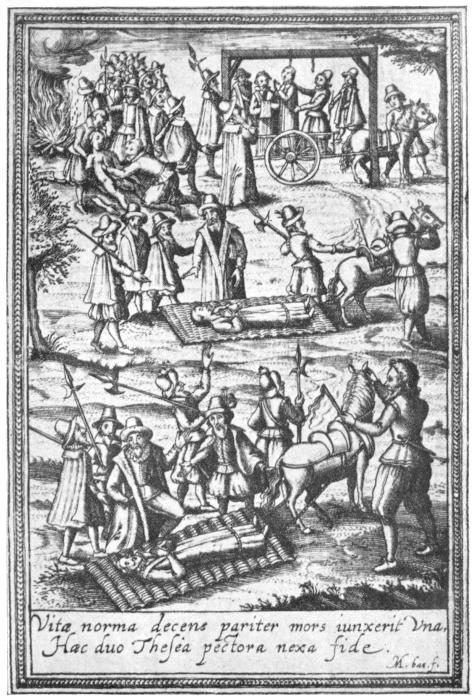
DRAWING ON HURDLES TO TYBURN, temp. ELIZABETH.
1592. January 22. William Patenson, condemned
as a priest, drawn, hanged, and quartered at Tyburn.
(Challoner’s Memoirs pt. i. p. 147).
June 23. Roger Ashton executed at Tyburn for procuring
from Rome a dispensation to enable him to marry
his cousin (Challoner’s Memoirs, pt. i. p. 148).
1593. The 21. of March, Henry Barrow, gentleman,
Iohn Greenewood clarke, Daniel Studley girdler, Saxio
Billot, gentleman, Robert Bowley, Fishmonger, were
indicted of Felony at the sessions hall without Newgate
beefore the Maior, the two lord Chiefe Justices
of both benches, and sundry of the Judges & other
commissioners of Oyer and determiner; the sayd
Barrow and Greenwood for writing sundry seditious
bookes, tending to the slaunder of the Queene and
state; Studley, Billot, and Bowley, for publishing and
setting foorth the same Bookes, and on the 23. they
were all arraygned at Newgate, found guiltie, and had
iudgement. On the last of March Henry Barrow and
Iohn Greenwood were brought to Tyborne in a carre,
and there fastened to the Gallowes, but being stayde and
returned for the time, they were there hanged on the sixt
of Aprill (Stow, p. 764-5).
1594. The 18. of February, [William] Harington, a
seminarie priest, was drawne from Newgate to Tyborne,
& there hanged, cut downe aliue, struggled with the
hang-man, but was bowelled & quartered (Stow, p. 766).
1594. The last of February, Rodericke Loppez, a
Portingale (as it was said) professing physicke, was
arraygned in the Guild hall of London, found guiltie,
and had iudgement as of high treason, for conspiring
her Maiesties destruction by poyson.
The 7. of June, Rodericke Loppez, with the other two
Portingales … were conuayd by water from Westminster
to the Bishoppe of Winchesters staires in
Southwarke, from thence to the K. bench, there laid
on hurdles, and conuayd by the Sheriffes of London
ouer the bridge, vp to Leaden hall, and so to Tyborne,
& there hanged, cut downe aliue, holden downe by
strength of men, dismembred, bowelled, headed &
quartered, their quarters set on the gates of the cittie
(Stow, p. 766, 768).
Camden’s account of this affair (greatly abbreviated)
is that certain Spaniards prevailed on Roderigo Lopez,
a Portuguese Jew, the Queen’s physician, Stephen
Ferreira Gama, and Emanuel Loisie, both Portuguese,
to poison the Queen. The convictions were obtained
on the strength of confessions. “How far,” says
Lingard, “these confessions made in the Tower, and
probably on the rack, are deserving of credit, may be
doubted” (ed. 1849, vol. vi. p. 554).
It is a strange feature in the case that while Camden,
like Stow, speaks of the execution of all three, Lingard
shows that Ferreira was saved.
The probability seems to be that Lopez fell a victim
to the rivalry between Essex and the Cecils, each eager
to prove greater zeal in the Queen’s service.[181]
Arising out of similar plots, real or pretended, were at
this time other executions:—
On March 2, 1594, an Irish fencing master was
hanged and quartered at Tyburn for a design to kill
the Queen (Camden: Stow, “Summary,” p. 439), and “in
less than two months from the beginning” of 1595,
Edmund Yorke and Richard Williams were for the
same reason executed at Tyburn (Camden, in Kennett’s
“Complete History,” ii. p. 532).
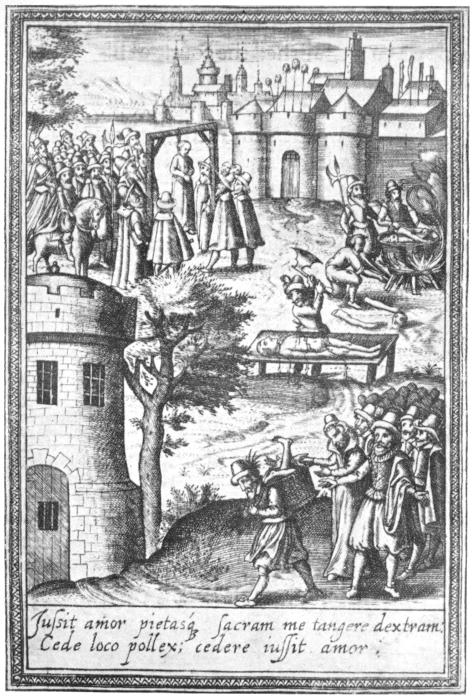
EXECUTIONS AT TYBURN, temp. ELIZABETH.
1595. The 20. of February, Robert Southwell, a
Jesuit, was arraygned at the Kinges Bench barre, and
the next day executed at Tyborne (Stow, p. 768).
Southwell was not only a Jesuit and martyr, but a poet
of whom Ben Jonson said that he would willingly have
destroyed many of his own poems could he have claimed
the authorship of Southwell’s “Burning Babe.”
Southwell was ordained priest in 1584. With a full
knowledge of the danger he incurred, he desired to go
to England as a missionary priest. He landed in
England in 1588. After many narrow escapes he was
at last arrested by Topcliffe, the English Torquemada,
in 1592, kept in prison for more than two years, and
so brutally tortured and ill-used that his father petitioned
Elizabeth that he might at once suffer death if
guilty, or be better treated. Southwell had inspired
sympathy, for at his execution the bystanders prevailed
on the executioner to let him hang till dead.
1598. The 25. of January, one named Ainger was
hanged at Tyborne, for wilfully and secretly murthering
of his owne father a Gentleman and Counsellor of
the Law at Graies Inne, in his chamber there (Stow,
p. 786).
About the middle of November, 1597, a body was
found floating on the Thames, and was identified as
that of Richard Ainger, Anger, or Aunger, “a double
reader” of Gray’s Inn, who had been missing for some
time. On view of the body the surgeons gave it as their
opinion that Ainger had met his death, not by drowning,
but by suffocation, and that the body had been thrown
into the river after death. Suspicion attached to one of
his sons, Richard, and to Edward Ingram, a porter of
the Inn.
The Privy Council addressed a letter to Mr. Recorder
of London, Mr. Topcliffe, Nicholas Fuller, William
Gerrard, and Mr. Altham, requiring them to examine
strictly the two suspected persons, “and yf by those
persuasions and other meanes you shall use you shall
not be able to bring them to confesse the truthe of this
horrible facte, then we require you to put them both or
either of them to the manacles in Bridewell, that by
compulsory meanes the truthe of this wicked murther
may be discovered, and who were complices and privy
to this confederacy and fact” (“Acts of the Privy Council,”
New Series, xxviii. 187). The case is interesting as
showing that torture was at this time used in ordinary
criminal cases. All the dictionaries speak of manacles
as instruments of restraint merely. In the present case
they were evidently an instrument of torture. Its nature
must have been well known to Shakespeare’s audiences,
for in “The Tempest,” referred to the year 1610, Prospero
says:—
“I’ll manacle thy neck and feet together”
From the Middlesex Sessions Rolls we learn that the
murder was done on the night of November 12th.
Richard Ainger the younger, Agnes, his wife, and
Edward Ingram were tried for the crime. Richard and
his wife pleaded Guilty, and were sentenced to be hanged.
From Stow’s account it would appear that Richard alone
was hanged. Ingram was found Not Guilty (Middlesex
County Records, i. 241).
1598. On the tenth of July, 19. persons for fellony
were hanged at Tyborne, & one pressed to death at
Newgate of London (Stow, p. 787).
1598. The ninth of November, Edward Squire, of
Greenewich was arraigned at Westminster condemned
of high Treason, and on the 13. drawne from the
Tower to Tyborne, and there hanged, bowelled, and
quartered (Stow, p. 787).
1601. After the capture of Essex—
On the 12th of February, Thomas Lea (a kinsman of
Sir Henry Lea’s, who had wore the Honour of the
Garter) told Sir Robert Crofts, Captain of a Man of
War, that ’twould be a glorious Enterprize for six
brave mettl’d Fellows to go to the Queen, and compel
her to discharge Essex, Southampton, and the rest that
were in Prison. He was a Man himself of great
Assurance and Resolution, had Commanded a Company
in Ireland, was very intimate with Tir-Oen, and
an absolute Creature of the Earl of Essex’s. This did
Crofts immediately discover to the Council; insomuch
that Lea was sought for, and found in the dusk of the
Evening about the door of the Q.’s Privy-Chamber.
He seem’d very Thoughtful, was extreamly Pale, and
in a great Sweat, and frequently ask’d, Whether her
Majesty was ready to go to Supper? And, Whether
the Council would be there? In this Posture he was
seiz’d and Examin’d, the next day had his Trial, and
by Crofts’s Evidence and his own Confession, condemn’d
and carried away to Tyburn, where he own’d that he had
been indeed a great Offender; but as to this Design, was
very Innocent; and having moreover protested, that he
had never entertain’d the least ill Thought against the
Queen, he was there executed. And this, as the Times
were, appear’d a very seasonable piece of Rigour.[182]
1601. The xxvii. of February, Marke Bakworth [Barkworth],
and Thomas Filcoks [Roger Filcock], were
drawne to Tyborne, and there hanged, & quartered,
for comming into the Realme contrary to the statute.
Also the same day, and in the same place, was hanged
a Gentlewoman, called Mistris Anne Line, a widow, for
relieuing a priest contrary to the same statute (Stow,
p. 794).
The crime for which Mistress Line suffered was that,
Mass having been said in her house, she assisted the
priest in his escape.
An account of these executions is given in Hist. MSS.
Commission, MSS. of the Duke of Rutland, 1888, i.
369, 370.
Mr. Barkwey cominge to the hurdle prayed and with
a chearfull voyce and smylinge countenance sunge all
the waye he went to execution.
The 27th daye of Februarie 1600 [1601], beinge the
first Friday in Lent, the said Mr. Barkwey was brought
to Tyborne there to be executed. Cominge up into the
carte in his blacke habite, his hoode being taken of, his
heade beinge all shaven but for a rounde circle on the
nether parte of his heade, and his other garment taken
of also, beinge turned into his sherte, having a pare of
hose of haere, most joyfully and smylingly looked up
directly to the heavens and blessed him with the signe
of the crosse, sayinge, “In nomine Patris, Filii et Spiritus
Sancti, Amen.” Then he turned himselfe towardes the
gallowe tree wheron he was to suffer, made the signe of
the crosse theron and kissed it and the rope also, the
which beinge put about his necke, he turned himselfe
and with a chearfull smylinge countenance and pleasant
voyce sunge in manner and forme followinge, viz.:
“Haec est dies Domini gaudeamus, gaudeamus, gaudeamus
in ea”—usinge the same very often with these
wordes, viz.: “In manus tuas, Domine, commendo
spiritum meum.” Also he used these speaches to the
people—“I doe confesse that I am one of the Blessed
Societie after the holy order of St. Benedicte.” The
minister called on him to be penitent for his sinnes,
and he said, “Hold thy peace, thou arte a simple fellowe.”
Then the minister wild him to remember that
Christ Jesus dyed for him. And he, elevatinge his eyes
to heaven and holdinge the rope in his handes—being
festned together—so highe as he could reache, aunswered
“And so doe I for him, and I would I had a thousand,
thousand lyves to bestowe upon him in this cause,”
sayinge “et majorem charitatem nemo habet.” And then
turninge himselfe againe, sunge as before, and desired all
Catholiques to praye for him, and he would praye for
them. And beinge asked if he would praye for the
Queene he saied, “God blesse her, and send her and me
to meete joyfully in heaven,” and prayed also for Mr.
Recorder who pronounced judgment against him, and
for Mr. Wade, Ingleby, Parrat, and Singleton, who were
the prosecutors of his death. And the carte beinge
drawne awaye, in his goinge of from the carte saied the
same wordes as before, “Haec est dies Domini; gaudeamus
in ea,” and beinge presently cut downe, he
stoode uprighte on his feete and strugled with the
Executioners, cryinge, “Lord, Lord, Lord,” and beinge
holden by the strengthe of the executioners on the
hurdle in dismembringe of him he cryed, “O God,” and
so he was quartered.
[I omit the account of the execution of Roger Filcock.]
There was executed also one Mistriss Lynde [Anne
Line], condempned at the Sessions house the 26th day
of February for the escape of a supposed preist. Her
weakness was suche that she was carryed to the said
Sessions betwixt two in a chaire.
There was also condempned with her one Ralphe
Slyvell for rescuinge the said supposed preist, but repryved.
The said Mistriss Lynde, carryed the next daye to her
execution, many tymes in the waye was stayed and urged
by the minister who urged what meanes he could to perswade
her to convert from her professed faithe and opinion,
most constantlie persevered therin and so was brought
to the place of execution and there shewed the cause of
her cominge thither, and beinge further urged amongest
other thinges by the minister that she had bene a common
receavor of many preistes she aunswered, “Where
I have receaved one I would to God I had bene able to
have receaved a thousand.” She behaved herself most
meekely, patiently, and vertuously to her last breath. She
kissed the gallowes and before and after her private
prayers blessinge herself, the carte was drawne awaye, and
she then made the signe of the crosse uppon her, and after
that never moved.
1601. The 13. of March, sir Gilley Merike Knight,
and Henry Cuffe Gentleman, were drawne to Tyborne,
the one from the Tower, the other from Newgate, and
there hanged, bowelled, and quartered, as being actors
with the late Earle of Essex. They both dyed very resolutely
(Stow, p. 794).
Merrick was the steward and Cuff the secretary of the
Earl.
1601. August 24. Thomas Hackshot, and Nicholas
Tichburne, laymen, rescued a priest, Thomas Tichburne,
from the custody of a constable. The two were arrested,
condemned and executed at Tyburn (Challoner’s Memoirs,
pt. i., p. 206).
1602. The xviii. of Aprill Peter Bullocke, stationer,
and one named Ducket, for printing of Bookes offensiue
were Hanged at Tyborne (Stow, p. 803).
This is a very bald account of an interesting case.
James Duckett was a convert from Protestantism. As
an apprentice he more than once got into trouble for
his opinions; and his master, thinking that he himself
might be involved, at last gave back the indenture to
Duckett. Duckett now maintained himself by dealing
in Catholic books, a commerce which frequently got
him into prison, where it is said that he spent nine years
out of twelve. A bookbinder, the Peter Bullocke mentioned
above, lay in prison under sentence of death, and
hoping to receive a pardon, informed against Duckett,
a former customer. Duckett’s house was searched, popish
books were discovered, and Duckett was condemned to
death. The informer did not receive the reward of his
betrayal; the informer and his victim rode to Tyburn in
the same cart (Challoner’s Memoirs, pt. i., pp. 207-9).
The xx. of Aprill, Stichborne [Thomas Tichburn],
W. Kenson [Robert Watkinson], and Iames Page
[Francis Page], Semenarie Priestes, were drawne to
Tyborne, and there hanged, bowelled, and quartered,
for comming into this Realme, contrary to the Statute
of Anno. 27, &c. (Stow, p. 803).
Thomas Tichburn is the priest for the rescue of whom
his cousin Nicholas Tichburn, and Thomas Hackshot
suffered in 1601. Page was the priest who was celebrating
Mass in Mistress Line’s house in 1601, but contrived
to escape.
1603. The xvii. of Februarie, W. Anderson [or
Richardson] a Seminary Priest was drawne to Tyborne
and there hanged, bowelled and quartered, for being
found in England contrary to the statute of Anno. 27.
(Stow, p. 812).
Anderson was the last of Elizabeth’s victims; she died
a few weeks later.
1604. Master Robert Dow of London Merchant
Taylor, in his most Christian charitie, pitying the
miserable or rather desperate Estate of the poore condemned
prisoners in Newgate, where very often and
very many of them after Judgement of Death, and at
their very Execution remaine most carelesse of their
Soules health, Jesting and deriding their imminent
danger and to the Judgement of the world die reprobate.
Upon tender Consideration whereof, and good hope
of after reformation of such poore prisoners there, as
through temptation of Sathan are, and will be too apt
to fall into like danger the sayd Master Dow hath giuen
competent Maintainance for ever, vnto Saint Sepulchers
parish for the towling of the great Bell and for some
especiall man, by them to bee appointed to come to the
sayd Prison, the midnight before execution, and then
distinctly and solemnly to ring a hand bell: then to pronounce
with a lowd voice at the prison grate, a Godly and
Christian remembrance on exhortation, appoynted by the
Lord Bishoppe, beginning thus.
O ye prisoners within condemned, this day to dye,
remember your sinnes, call to God for Grace, whilst yet
you have time.
And in the Morning when they are in the Cart, iust
against the Church, the partie aforesayd to put them in
minde againe of their former liues, and present death,
saying the great bell of this Church, which I told you
last night should Toll for you from sixe of the clocke
vntil ten, now tolleth to the end to moue good people to
pray to God for you whilest your selues with them may
pray for remission of your sinnes, &c. And at ten
a clocke or at such time as knowledge may be truely had
of the Prisoners execution the sayd great Bell shall bee
rung out for the space of a quarter of an houre, (to the
end all people may understand the execution is past) and
then cease (Stow, pp. 862).
We are now in the reign of James I. In 1605 was the
Gunpowder Plot, the memory of which is still kept alive
by bonfires, and by the farcical search of the cellars of the
Houses of Parliament. Gunpowder Plot does not come
into the Annals of Tyburn, as none of the conspirators
suffered here.
1607. February 26. Robert Drury, priest, for being
in England, executed at Tyburn (Challoner’s Memoirs,
pt. ii., pp. 13-5).
1608. The 11. of Aprill, George Ieruis [Gervase or
Jarvis] a Seminary priest, according to his iudgement
was executed at Tyborne (Stow, p. 893).
The 23. of June, Thomas Garnet, a Jesuite was executed
at Tyborne, hauing fauor offred him, if he would haue
taken the oath of alleageance aforesayd, but he refused it
(Stow, p. 893).
Thomas Garnet was related to Father Henry Garnet,
executed for the Gunpowder Plot in 1606. Thomas
Garnet was convicted on evidence that while a prisoner
in the Tower he had written in several places “Thomas
Garnet priest.” The Earl of Exeter, one of the Privy
Council, present at the execution, would not suffer the
rope to be cut till the victim was quite dead (Challoner’s
Memoirs, pt. ii., pp. 17-9).
1610. December 10. John Roberts, and Thomas
Somers, or Watson, or Wilson. These were priests.
Roberts was apprehended for the fifth time at Mass and
hurried away in his vestments. Somers had been
deported, together with about a score of priests, earlier
in the year, but returned to England. With Roberts and
Somers were executed sixteen persons condemned for
various offences. The priests were suffered to hang till
they were dead and then bowelled, beheaded, and
quartered, and buried with the sixteen in a pit
(Challoner’s Memoirs, pt. ii., p. 37).
1612. William Scot and Richard Newport, or Smith.
These were missionary priests who had been banished
but returned to England (Challoner’s Memoirs, pt. ii.,
pp. 39-44).
The burning of Protestant heretics went on through
the reigns of Elizabeth and James—“the fires of Smithfield”
were not extinguished by the death of “bloody
Mary.” Anabaptists and Arians were burnt, the printers,
the distributors, even in one case the binder, of books
“seditiously penned against the Book of Common
Prayer” were hanged.
It is painful to find the genial Howell writing thus in
1635:—
I rather pity than hate Turk or Infidel, for they are
of the same metal and bear the same stamp as I do,
tho’ the Inscriptions differ. If I hate any, ’tis those
Schismaticks that puzzle the sweet peace of our Church,
so that I could be content to see an Anabaptist go to
Hell on a Brownist’s back (“Familiar Letters,” ed. Jacob,
p. 337).
December 5. John Almond, condemned for having
taken orders beyond the seas and for remaining in the
kingdom, drawn, hanged and quartered (Challoner’s
Memoirs, pt. ii., pp. 44-51).
1615. The murder of Sir Thomas Overbury is, with
the possible exception of the supposed murder of Sir
Edmund Berry Godfrey, a little more than sixty years
later, the greatest of all English causes célèbres. The
story involves many persons of high rank, including
one in the highest, King James himself; its events are
extremely complicated, and some details are of a nature
requiring delicate handling in the telling. It has been
told, after the fullest study of the facts, by Mr. Andrew
Amos, in “The Great Oyer of Poisoning,” 1846, a volume
of over five hundred pages, of which indeed many are
filled with digressions seriously interfering with the
narrative. It is not possible to give here more than the
barest outline of the case.
Sir Thomas Overbury has a place in English literature
as a prose writer and poet whose works have not been
wholly forgotten. He was also a courtier in the Court
of James, compared with which that of Charles II. was
almost pure. James’s correct attitude towards “the
Bishop of Rome” has, however, saved him from the
severe criticisms passed on Charles, of more than doubtful
orthodoxy. Some of the details in Harington’s “Nugæ
Antiquæ” might be held to suggest that Milton had in
view the Court of James when he wrote of the rabble of
Comus, who forgot everything but
“To roll with pleasure in a sensual sty.”
Overbury, after leaving Oxford, made a tour on the
Continent, returning from his travels a finished gentleman.
In 1601, on a visit to Scotland, he met Robert
Carr, then a page in a noble family. Hence arose a close
intimacy destined to be fatal to Overbury. On the accession
of James to the English throne, Carr, James’s
“favourite,” rose rapidly; he became Viscount Rochester.
Carr and Overbury played into one another’s hands:
Carr procured a knighthood for Overbury, Overbury
became the mentor of Carr, who had neither learning
nor the graces of a Court. The fatal woman now comes
on the scene. At the age of thirteen, Frances Howard,
daughter of the Earl of Suffolk, was married to the Earl
of Essex, a year older. Their friends agreed that it was
yet too early for the pair to live together; the boy went
on his travels, the girl to her mother. On his return,
Essex found his wife acknowledged as the greatest beauty
in the Court, the object of general adoration. Among her
admirers was Carr, for whom she had conceived a passion
which knew no bounds. Overbury had been instrumental
in bringing together Carr and the lady; it was he who
wrote the love-letters to which Carr owed the conquest
of the countess’s heart. The lady naturally hated her
husband, whose return interfered with her way of life:
it was only in obedience to the King’s command that she
consented to live with Essex. The lady and her lover
formed the design of procuring a divorce from Essex,
preparatory to their marriage. Overbury strongly objected;
he spoke of the countess to Carr in terms which,
repeated to the lady, fixed his doom. It was contrived
that the King should offer to Overbury a foreign appointment.
This Carr advised him to refuse, and then represented
the refusal to James in such a light that on April 21st
Overbury was thrown into the Tower. The lieutenant
and the under-keeper of the Tower were displaced in
favour of officers on whom Carr and his mistress could
rely, and the work of despatching Overbury began.
Poisons were procured from Franklin, a physician, by
Mrs. Turner, and sent in tarts and jellies to the Tower,
where Weston, the under-keeper, took charge of them.
Overbury was drenched with rosealgar, sublimate of
mercury, arsenic, diamond powder. It was averred that
he had swallowed poison enough to kill twenty men. He
died on September 15, 1613.
The business of the divorce now went on without
hindrance. To be rid of his wife, Essex was ready
enough to allow a slur to be cast on his manhood; with
the aid of the lawyers, the churchmen, a complaisant
jury of matrons, and a young lady who, with muffled
head, personated the countess for the occasion, the
divorce was carried through. In view of the approaching
marriage, Carr was created Earl of Somerset, and on
December 26 the marriage took place. With magnificent
effrontery, the lady was married “in her hair,” the mark
of a virgin-bride.
But some time afterwards an apothecary’s boy, who
had been got out of the way, and was now at Flushing,
began to talk of what he knew; inquiry was made, and
in the end the criminals were put upon their trial. On
October 23, 1615, Richard Weston, the under-keeper of
the Tower, was hanged at Tyburn. He was followed by
Mrs. Turner, hanged on November 9th, at the same
place; on the 20th Sir Gervase Elwes, the lieutenant of
the Tower, was executed on Tower Hill, and on
December 9th, James Franklin, the physician, was
executed at St. Thomas a Waterings.
In the following year the countess was tried in Westminster
hall, pleaded guilty, and was condemned. The
next day the earl was brought to trial by his peers in
the same place, and also found guilty. Neither was
executed; each received a pardon. They lived together
afterwards in the same house, hating one another with
a perfect hatred; the countess died of a loathsome
disease.
There are mysteries in the case remaining mysteries
after the most careful study of the facts. In spite of all
attempts made to persuade Somerset to plead guilty, and
throw himself on the King’s mercy, he steadfastly refused.
Mr. Amos inclines to believe him innocent of complicity
in the murder. There are serious difficulties in the way
of this theory, but it is certain that Somerset had the
means of terrifying the King. Secret messages passed
between the Tower and the palace, informing the king
that the prisoner had threatened to refuse to go to the
Court of his own will. Bacon consulted the judges as to
what could be done to silence Somerset if he “should
break forth into any speech of taxing the King.” At the
trial two servants were placed, one on either side of the
prisoner, with a cloak on his arm. Their orders were
that if Somerset “flew out” on the King, they should
instantly throw the cloaks over his head, and carry him
by force from the bar.
Was James an accomplice in the murder of Overbury?
Mayerne, the King’s physician, attended Overbury in the
Tower and prescribed for him. Mayerne was not produced
as a witness, nor were his prescriptions put in
evidence.
Or is the mystery connected with the death of Prince
Henry, James’s son? The Prince was seized with sudden
illness almost immediately after dining with his father.
“In Mayerne’s collection of cases for which he wrote
prescriptions,” says Mr. Amos, “everything that relates
to Prince Henry’s last illness is torn out of the book.”
We can but fall back on the certainty that Somerset
had it in his power to make some revelation of which
James was terribly afraid.[183]
1616. July 1. Thomas Maxfield, a missionary priest,
drawn, hanged, and quartered at Tyburn. It is said that
on the occasion of Maxfield’s execution, the gallows was
adorned with garlands and wreaths of flowers. Thirteen
criminals were executed at the same time. The Sheriff
called on the hangman to cut down Maxfield while still
alive, as indeed the law required, but this was opposed by
the people, and the victim was suffered to hang till dead
(Challoner, pt. ii. pp. 62-3).
We now come to the reign of Charles I.
1626. The visit of the queen, Henrietta Maria, to
Tyburn has been mentioned (p. 65).
1628. This Summer there was a great Army prepared
for forraigne seruice, whereof the Duke of Buckingham
was Generall, who went to Portsmouth, to set all things
in readinesse for present dispatch: And vpon Saturday
the 23. of August, as hee was going thorow his Hall,
which was filled with Commaunders, and strangers,
suddainly and vnexpectedly Iohn Felton a Lieutenant,
stabd the Duke into the breast, with a knife, and slily
withdrew himselfe, vndiscerned of any to doe the fact, the
Duke stepping to lay hold on him, drew out the knife
and began to stagger, the bloud gashing out at his mouth,
at which dreadfull sight, certaine Commanders with their
strength held him vp, the Duke being depriued of speech
and life. And then all the doores and passages being
stopped, and many with their weapons drawne to kill the
Murtherer, the offender himselfe seeing the vproare,
boldly confessed, saying, I am the man that did it, and
being examined by the Lords, was committed. The King
at that time was but sixe miles from Portsmouth: The
Corpes was brought to London, on Saturday the 30. of
August, the Nobility, Friends, and Officers brought the
Corpes by night with Torches lighted to Wallingford
house neere Charing-Crosse: the Murtherer was brought
to the Tower the 5. of September.
Thursday the 27. of Nouember, the aforenamed Iohn
Felton, was brought from the Tower, and Arraigned at
the Kings Bench, where he very penitently confessed the
fact, saying, I haue slaine a most Noble loyall Subiect,
and wish that this my right hand might be here cut off,
as a true testimony of my hearty sorrow, and had his
Judgement to be hanged: from thence he was sent to the
Gate-house, where he remained till Saturday, and then
sent to Tibourne, and there executed, where hee humbly
and heartily repented his offence, and asked forgiuenesse
of God, the King, and the Dutchesse, and of all the Land,
saying, he had slaine a most Noble loyall Subiect, and
desired all men do pray for him. The next day being
Sunday, his Body was sent by Coach towards Portsmouth,
and was there hanged in Chaines (Stow, ed.
1631, p. 1044).
A paper was found in Felton’s hat, containing the
following:—
“Let no man commend for doing it, but rather discommend
themselves; for if God had not taken away
their hearts for their sins he had not gone so long
unpunished.
“That man in my opinion is cowardly and base, and
deserveth neither the name of a gentleman nor a soldier,
that is unwilling to sacrifice his life for the honour of
God and the good of his King and country.—John
Felton.” (“Autobiography of Sir Simonds D’Ewes,”
i. 385.)
Only one or two priests were executed in England
during the first fifteen years of Charles’s reign.
Between 1641 and 1651 the following priests were
drawn, hanged, and quartered at Tyburn merely for being
priests. No other charge was made against them, but
this sufficed:—
1641. July 26. William Ward.
1642. January 21. Thomas Reynolds and Bartholomew
Roe.
April 26. Edward Morgan.
October 12. Thomas Bullaker.
December 12. Thomas Holland.
1643. April 17. Henry Heath.
December 11. Arthur Bell.
1644. September 7. John Duckett and Ralph Corby.
1645. February 1. Henry Morse.
1646. June 30. Philip Powel.
1651. May 19. Peter Wright. Thirteen malefactors
hanged at the same time.
These were victims of the Parliament. Charles had
more than one contest with the Parliament on the subject
of the execution of priests. In January, 1641, Thomas
Goodman, a priest and Jesuit, had been condemned.
The king reprieved him; the two Houses remonstrated
and urged that the law might be executed. Charles
reminded Parliament of the inconvenience which might
ensue to Protestant Englishmen and others abroad, but
having said this he left the final decision to the Houses.
Goodman petitioned the king: “He would esteem his
blood well shed to cement the breach between your
majesty and your subjects.” He was suffered to die in
Newgate.
Much the same happened later in the year. Seven
priests were condemned on December 8th. The French
ambassador exerted himself in their behalf. Charles
consulted the two Houses as to a reprieve, to be followed
by banishment. He did in fact reprieve them. The
Houses petitioned for execution. Charles replied that
he desired to banish the priests, “but if you think the
execution of these persons so very necessary to the great
and pious work of reformation, we refer it wholly to you,
declaring hereby that upon such your resolution signified
to the ministers of justice, our warrant for their reprieve
is determined, and the law to have its course.”[184] These
also were suffered to linger out their lives in Newgate.
1654. To get a respite for a while from this massacre
of priests, we may deal here with the last case that occurred
for some years.
John Southworth was sent on the English mission in
1619. He escaped imprisonment till 1627, when he was
tried at Lancaster, condemned, reprieved in 1630, and
given over to the French ambassador for transportation
beyond seas. If he was sent abroad, which seems uncertain,
he was soon back, and after a long interval was
again arrested, and once more released. He was finally
apprehended in 1654. On his arraignment he pleaded
that he was not guilty of treason, but in spite of persuasion
acknowledged that he was a priest. The court,
with, it is said, great reluctance, passed the inevitable
sentence. On June 28th five coiners were drawn, hanged,
and quartered with Father Southworth.
Father Southworth was an old man of 72; nothing
was alleged against him but that he was a priest, that he
was “a dangerous seducer.”
The guilt of this judicial murder rests wholly with
Cromwell. The life of Southworth was in his hands;
he was deaf to the suit of the French and Spanish ambassadors
for Southworth’s life (Challoner’s Memoirs,
pt. ii. pp. 196-200).
No more Catholics were executed in England till the
Popish Plot broke out in 1678.
1649. With exquisite humour, none the less delightful
because it was probably unconscious, the admirers of
Cromwell have set up his statue near to the House of
Commons, his back turned towards it. He might just
have left the House with the key of the locked door in
his pocket. Why is the statue there? It cannot be
simply in recognition of the fact that Cromwell cut off
the head of a king. To cut off a king’s head may be a
meritorious deed, or it may be an infamous deed, or
neither the one nor the other in any notable degree.
But, taken by itself, it does not seem to demand an expression
of national gratitude. Yet what else could the
statue have been intended to commemorate? What,
besides, did Cromwell do? He set up in place of
monarchy a Thing so detestable that in a few years the
people were glad to have back a Stuart at any price:
anything was better than the military despotism of
Cromwell and his majors-general. Great soldier he
was, great and pitiless. The proper place for Cromwell’s
statue was Drogheda.
Our hearts have burnt within us as we have read the
story of ship-money levied by Charles I. without the
authority of Parliament. But Cromwell also levied taxes
illegally. When his old friend Cony refused to pay, and
reminded Cromwell how he had often declared that the
man who paid an illegal tax was worse than he who
demanded it, Cromwell threw his old friend into prison.
When Cony was brought into court on his habeas corpus,
Cromwell threw into prison the three counsel who argued
the case. Cony, deprived of the aid of counsel, pleaded
his own cause. It was too clear to suffer greatly from
want of skill in the pleading: the judge could not decide
adversely to Cony, but was unwilling to give judgment
against Cromwell. He deferred his decision. Cromwell
removed him from the bench.
Enclosing went on as before; the country was desolated
by civil war; the people fell into poverty deeper
and deeper. The wicked laws, “taking away the life of
men only for theft,” continued in force to the bitter disappointment
of those who had looked for better things:
“You have sate now,” wrote Samuel Chidley, addressing
his Highness the Lord Protector and the Parliament,
“you have sate now above these 40 days twice told,
and passed some Acts for transporting Corn and Cattel
out of the Land, and against Charls Stuart’s, &c., but (as
I humbly conceive) have left undone matters of greater
concernment; amongst which, the not curbing this
over-much justice in hanging men for stealing is one;
the not suppressing the pressing of men to death for not
answering against themselves is another.”
Samuel Chidley, who, for greater emphasis, printed his
arguments in red ink, gave instructions that a copy of his
book “should be nailed upon Tiburne Gallowes before
the execution, with this motto written on the top:—
‘Cursed be that bloody hand
Which takes this downe without Command.’
… but the party could not naile it upon Tiburne
Gallow-tree, for the crowd of people, and therefore was
forced to naile it on the tree which is upon the bank by
the Gallowes; and there it remained, and was read by
many both before and after execution, and its thought
will stand there still, till it drop away.”
A notable incident in the history of Tyburn!
Cromwell had enough to do to keep himself in his
military saddle: he had no time to waste on an impatient
idealist.[185] Samuel Chidley discovered, as others have since
found, that the more things change the more they remain
the same. Hanging for theft went on as briskly as ever.
Indeed, by the irony of fate the Reign of the Saints
furnishes us with an account of the greatest number recorded
as being executed at one time at Tyburn. In the
Thomasson collection of Tracts in the British Museum is
one bearing the following title:—
“A true and perfect Relation of the Tryall, Condemning,
and executing of the 24. Prisoners, who suffered for
severall Robberies and Burglaries at Tyburn on Fryday
last, which was the 29. of this instant June, 1649, expressing
the penitent end of the said Prisoners, the grief of the
many Thousands there, and the Speech of John Mercer
(who was there executed) concerning Unity in this Kingdom,
and the bringing home and setling of the King.”
The names of the criminals are given, twenty-three
men and one woman. The prisoners were tied in eight
carts, the sexton of St. Sepulchre’s made his official
speech to the culprits, “which being ended the carts
were drave unto Tiburne the Fatall place of execution,
where William Lowen the new Hangman fastned eight
of them unto each Triangle.”
It would seem that there was nothing unusual, nothing
to attract attention, in the number executed. In the
bound volume there is, following the tract, “The Perfect
Weekly Account … from Wednesday June 27, to
Wednesday the 4 of July, 1649, Beginning Wednesday
June 27.” This little newspaper of eight pages does not
so much as mention the execution.
1650. October 2. Captain Ashley was sentenced by
the High Court of Justice to have his head cut off, and
one Benson to be hanged, for conspiring against the
Commonwealth in the tresonable Engagement of Colonel
Andrews.
October 7. Mr. Benson was executed at Tyburn according
to the sentence of the High Court of Justice;
but in regard that Captain Ashley only subscribed the
Engagement, but acted nothing in it, he was pardoned
by the Parliament (Whitelocke).
1653. “The ambassador of Portugal had a very
splendid equipage, and in his company his brother
don Pantaleon Sa, a Knight of Malta, and a man
eminent in many great actions, who out of curiosity
accompanied his brother in this embassy, that he might
see England. This gentleman was of a haughty and
imperious nature, and one day being in the New Exchange,
upon a sudden accident and mistake had a
quarrel with … Mr. Gerard, … who had then returned
some negligence and contempt to the rodomontados
of the Portuguese, and had left him sensible of
receiving some affront. Whereupon he repaired thither
again the next day [November 22], with many servants,
better armed and provided for any encounter, imagining
he should find his former adversary, who did not expect
the visitation. But the Portuguese not distinguishing of
persons, and finding many gentlemen walking there, and
amongst the rest one he believed very like the other, he
thought he was not to lose the occasion; he entered into
a new quarrel, in which a gentleman, utterly unacquainted
with what had formerly passed, and walking there accidentally
was killed, and others hurt; upon which the
people rising from all the neighbouring places, don
Pantaleon thought fit to make his retreat to his brother’s
house; which he did, and caused the gates to be locked,
and put all the servants in arms to defend the house
against the people which had pursued him, and flocked
now together from all parts to apprehend those who had
caused the disorder and had killed a gentleman.…
Cromwell was quickly advertised of the insolence, and
sent an officer with soldiers to demand and seize upon
all who had been engaged in the action. And so the
ambassador came to be informed of the truth of the
story, with which he was exceedingly afflicted and
astonished.”
The ambassador pleaded the privilege accorded to
ambassadors, but the officer was resolute; finally after
an appeal to Cromwell, don Pantaleon and the rest were
given up and sent to Newgate.
“The ambassador used all the instances he could for
his brother, being willing to leave the rest to the mercy
of the law, but could receive no other answer but that
justice must be done. And justice was done to the full,
for they were all brought to their trial at the sessions at
Newgate, and there so many of them condemned to be
hanged as were found guilty. And the rest of those who
were condemned were executed at Tyburn; and don
Pantaleon himself was brought to the scaffold on Tower
Hill.”[186]
Strangely enough Gerard, with whom the quarrel
began, was executed (for high treason against the Protector)
on the same day and on the same scaffold.
1658. On June 8, Slingsby and Hewet were executed
on Tower Hill: Colonel Ashton, Mr. Stacy, and Mr.
Bestely were drawn, hanged, and quartered in the streets
of the City, and on July 6 several of “the new conspirators”
were executed in London and at Tyburn.
These were Cromwell’s last executions. He died on
September 3, 1658.
1660. A terrible vengeance followed. Between
October 13 and 17 eight of the Regicides were executed
“at the Round or railed Place neer Charing Crosse.”
“And now the stench of their burnt bowels had so
putrified the air, as the inhabitants thereabout petitioned
His Majesty there might be no more executed in that
place: therefore on Friday [October 19], Francis Hacker,
without remorse, and Daniell Axtell, who dissolved himself
into tears and prayers for the King and his own soul,
were executed at Tyburn, where Hacker was only hanged,
and his brother Rowland Hacker had his body entire,
which he begged, and Axtell was quartered.”[187]
To finish with the story of the regicides:—
Colonel Okey, Colonel Barkstead, and Miles Corbet
were basely betrayed by Downing, who had been chaplain
in Okey’s regiment; the States General, in violation
of their fundamental maxim to receive and protect those
who took refuge in their territory, basely surrendered
them. They were executed at Tyburn on April 16,
1662.
A miserable vengeance was wreaked on the dead—on
the “carcases” of Cromwell, Ireton, and Bradshaw.
1660. December 4. A resolution was passed in the
House of Commons; the Lords made an addition, and
finally the Resolution stood thus:—
December 8. Resolved, by the Lords and Commons
assembled in Parliament, That the carcases of Oliver
Cromwell, Henry Ireton, John Bradshaw, Thomas Pride,
whether buried in Westminster Abbey or elsewhere, be,
with all expedition, taken up and drawn upon a hurdle to
Tyburn, and there hanged up in their coffins for some
time: and after that buried under the said gallows: and
that James Norfolke Esquire, Serjeant at Arms attending
the House of Commons, do take care, that this order be
put in effectual execution by the common executioner
for the County of Middlesex, and all such others to whom
it shall respectively appertain: who are required in their
several places to conform to and observe this order, with
effect; And the Sheriff of Middlesex is to give his assistance
herein, as there shall be occasion: And the Dean of
Westminster is desired to give directions to his officers of
the Abbey to be assistant in the execution of this order.[188]
A new gallows had been erected for the purpose. Let
Evelyn tell us of the use to which it was put on January
30, 1661:—
1661. January 30. This day (O the stupendous and
inscrutable judgments of God!) were the carcases of
those arch-rebels, Cromwell, Bradshawe (the judge who
condemned his Majesty) and Ireton (son-in-law to the
Usurper) dragged out of their superb tombs in Westminster
among the Kings, to Tyburn, and hanged on the
gallows there from nine in the morning till six at night,
and then buried under that fatal and ignominious monument
in a deep pit: thousands of people who had seen
them in all their pride being spectators.[189]
Here is another account, showing the feelings of a
partisan:—
“The odious carcasses of O. Cromwell, H. Ireton, and
J. Bradshaw drawn upon sledges to Tyburn, and being
pull’d out of their Coffins, there hang’d at the severall
Angles of that Triple-tree till Sun-set. Then taken down,
beheaded, and their loathesome Truncks thrown into a
deep hole under the Gallowes. Their heads were afterwards
set upon Poles on the top of Westminster Hall.”[190]
Here Pepys saw them.
Neal says that the bodies were drawn upon hurdles,
but the two words were at this time used indifferently
for the same thing.
There were various legends on the subject. One was
that Cromwell was not buried in Westminster Abbey,
but on Naseby field. Another, that his friends contrived
that the body of Charles I. was substituted for that of
Cromwell, and was hanged on the gibbet. It was said
that persons present observed a seam on the neck—the
head having been joined to the body after decollation.[191]
Many bodies, including those of Cromwell’s mother
and daughter, Admiral Blake and John Pym, were taken
from the Abbey, and buried in a pit in St. Margaret’s
churchyard.[192]
1660. On June 9 the House of Commons resumed
debate on the Act of general Pardon, Indemnity, and
Oblivion, and a list was produced of some who, though they
did not sit at the trial of Charles I., on January 27, 1648,
did sit on some of the preceding days. The subject was
considered on subsequent occasions, and finally an Act
was passed, 13 Charles II., c. 15 (1661), enacting that
Lord Monson, Sir Henry Mildmay, and Robert Wallop
(and others who had fled) should on January 27, 1662,
be “carried to the Tower of London and from thence
drawne upon Sledges with Ropes about theire necks,
and according to the manner of persons executed for
High Treason quite through the streets of London unto
the Gallows att Tiburn,” and then carried back in like
manner to the Tower or such other prison as the king
may think fit, and remain prisoners during their lives.
Accordingly on January 27, 1662:—“This morning,
going to take water, upon Tower-hill we met with
three sleddes standing there to carry my Lord Monson
and Sir H. Mildmay and another to the gallows and
back again, with ropes about their necks: which is to be
repeated every year, this being the day of their sentencing
the king.”[193]
The Act, however, contains nothing as to the repetition
of the ceremony.
1661. This year witnessed the outbreak of the Fifth
Monarchy men. John James, a small-coal man, was
executed at Tyburn. “The sheriff and hangman were so
civil to him in his execution, as to suffer him to be dead
before he was cut down, beheaded, bowelled, and
quartered. His quarters were set on the gates of
the City, his head was first fixed on London bridge,
but afterwards upon a pole, near Bulstake Alley, Whitechapel,
in which was James’s meeting-house.”[194]
1662. December 22. Thomas Tonge, George Phillips,
Francis Stubbs and Nathaniel Gibbs, convicted of taking
part in a plot to seize the Tower and Whitehall, to kill
the King and declare a Commonwealth. They were
drawn to Tyburn on two hurdles, hanged, beheaded and
quartered; their heads were set up on poles on Tower
Hill.[195]
1668. May 9. This day Thomas Limerick, Edward
Cotton, Peter Messenger, and Richard Beasley, four
of the persons formerly apprehended in the Tumult
during the Easter Holydays, having upon their Trial
at Hicks-Hall been found guilty and since sentenced
as Traytors, were accordingly Drawn, Hang’d, and
Quartered at Tyburn, where they showed many signs
of their penitence, their quarters permitted Burial, only
two of their Heads ordered to be fixt upon London-Bridge.[196]
1670. In February of this year ended the brilliant
career of Claude Duval, the famous highwayman. There
had been highwaymen before Duval, as he was succeeded
by others. But the great merit of Duval is that he gave
a tone and dignity to the profession which it never
wholly lost. Before giving any account of this prince of
highwaymen it may be permitted to say something on
this branch of the profession of the art of thieving.
The century from 1650 to 1750 may be considered the
era of the highwayman. When civil war rages bands
of marauders will spring up, whose operations present
a resemblance to the methods of a soldiery not kept well
in hand. Thus during the Commonwealth James Hinde
was the captain of a band of twenty or more whose
operations were coloured by a pretence of acting for the
king. On November 11, 1651, Hinde was examined
by the Council of State, and “confessed his serving
of the king in England, Scotland and Ireland.” Highwayman
as he was, his pretensions as a servant of the
king must have been admitted, as he was condemned at
the Old Bailey, sent to Worcester, and drawn, hanged,
and quartered, for high treason against the State.
Accounts of his exploits were printed even a century
after his death. The catalogue of the British Museum
contains more than twenty entries relating to this
worthy.
The prevalence of highway robbery is shown by the
great number of Proclamations issued during the reigns
of Charles II. and his immediate successors. Thus royal
Proclamations offering rewards for the apprehension
of highwaymen were issued on December 23 and 30,
1668. These were followed by others in 1677, 1679-80,
1681, 1682-3. In this last eleven notorious robbers
are specially named. In 1684 and 1684-5, two more
Proclamations were issued, followed in 1687 by an
Order in Council of the same tenor. In 1690 came a
new Proclamation. These Proclamations were not
wholly successful in breaking up gangs, for in December,
1691, the Worcester waggon was plundered by sixteen
highwaymen of £2,500 of the King’s money.
Still worse, in 1692 seven highwaymen robbed the
Manchester carrier of £15,000 of royal treasure. A
Proclamation was now issued raising the reward for
capture. In the earliest Proclamations this had been
fixed at £10, afterwards raised to £20. The reward now
offered was £40. In the same year, 1692, was passed
the Act 4 William and Mary, c. 8, taking effect after
March 25, 1693. The reward of £40 was to be paid
by the sheriff, or if he was not in funds, by the Treasury.
Under date April 8, 1693, Luttrell writes, “Some moneys
have been issued out of the Exchequer pursuant to
the late Act for taking highwaymen.”
To return to Duval. He was born in Normandy,
and came over to England as page to the Duke of
Richmond. His best-known exploit is told at length
in memoirs, ascribed to William Pope (reprinted in
“Harleian Miscellany,” iii. 308-16):—
This is the place where I should set down several
of his exploits; but I omit them, both as being well
known, and because I cannot find in them more
ingenuity than was practised before by Hind and
Hannum, and several other mere English thieves.
Yet, to do him right, one story there is that savours of
gallantry, and I should not be an honest historian if
I should conceal it. He with his squadron overtakes
a coach, which they had set over night, having intelligence
of a booty of four-hundred pounds in it. In
the coach was a knight, his lady, and only one serving-maid,
who, perceiving five horsemen making up to them,
presently imagined they were beset; and they were confirmed
in this apprehension by seeing them whisper to
one another, and ride backwards and forwards: the lady
to show she was not afraid, takes a flageolet out of her
pocket and plays. Du Vall takes the hint, plays also, and
excellently well, upon a flageolet of his own; and in this
posture, he rides up to the coach-side. “Sir” (says he, to
the person in the coach), “your lady plays excellently, and
I doubt not but that she dances as well; will you please
to walk out of the coach, and let me have the honour to
dance one currant with her upon the heath.” “Sir” (said
the person in the coach), “I dare not deny anything to one
of your quality and good mind; you seem a gentleman,
and your request is very reasonable.” Which said,
the lacquey opens the boot; out comes the knight,
Du Vall leaps lightly off his horse, and hands the lady
out of the coach. They danced, and here it was that
Du Vall performed marvels; the best master in London,
except those that are French, not being able to show
such footing as he did in his great riding French boots.
The dancing being over, he waits on the lady to her
coach; as the knight was going in says Du Vall to him,
“Sir, you have forgot to pay the musick.” “No, I have
not” (replies the knight;) and, putting his hand under
the seat of the coach, pulls out an hundred pounds in
a bag, and delivers it to him; which Du Vall took with a
very good grace, and courteously answered, “Sir, you
are liberal, and shall have no cause to repent your being
so; this liberality of yours shall excuse you the other
three-hundred pounds”: and giving him the word, that
if he met with any more of the crew, he might pass
undisturbed, he civilly takes his leave of him.
Here is the account of the lying in state after the
execution:—
After he had hanged a convenient time, he was cut
down, and, by persons well dressed, carried into a
mourning-coach, and so conveyed to the Tangier-tavern
in St. Giles’s, where he lay in state all that night, the
room hung with black cloth, the hearse covered with
escutcheons, eight wax-tapers burning, and as many
tall gentlemen with long black cloakes attending; mum
was the word, great silence expected from all that
visited, for fear of disturbing this sleeping lion. And
this ceremony had lasted much longer, had not one
of the judges (whose name I must not mention here,
lest he should incur the displeasure of the ladies) sent to
disturb this pageantry.
The “Memoirs” are not to be taken too seriously.
They are satirical, as is sufficiently shown by the title—“Intended
as a severe Reflexion on the too great
Fondness of English Ladies towards French Footmen:
which, at that Time of Day was a too common
Complaint.”
According to the “Memoirs” Duval’s tomb bore the
family arms curiously engraved and under them this
epitaph:—
Here lies Duval: reader, if male thou art,
Look to thy purse: if female, to thy heart.
Much havoc hath he made of both: for all
Men he made stand, and women he made fall.
The Second Conqueror of the Norman race,
Knights to his arms did yield, and ladies to his face.
Old Tyburn’s glory, England’s bravest thief:
Duval, the ladies’ joy: Duval, the ladies’ grief.
It must be admitted that the accounts of St. Paul’s,
Covent Garden, do not mention this monument.
It is probable that Duval did really introduce gentler
methods into the practice of robbery. The author of
“Hudibras” in a “Pindaric Ode” claims this merit and
one other for Duval:—
Taught the wild Arabs on the road
To act in a more gentle mode:
Take prizes more obligingly than those
Who never had been bred filous
And how to hang in a more graceful fashion
Than e’er was known before to the dull English nation.
The third chapter of Macaulay’s History gives an
excellent account of highwaymen in the reign of
Charles II.
1677. Thomas Sadler is said to have been in prison
fifteen times before he planned his last and greatest
exploit. With the aid of two accomplices, he stole
from Great Queen Street, the Lord Chancellor’s mace
and purse (the official purse, one of the emblems of
the office). Sadler was so delighted with his success,
that in crossing Lincoln’s Inn Fields he made one of
the confederates precede him with the mace on his
shoulder, while he himself strutted behind him, followed
by the purse-bearer. They bore their plunder to a
house in the City, where it was locked up in a cupboard.
Curiosity led a maid to look through a chink
in the door, when to her wonderment she saw what
she took to be the King’s crown. This led to the discovery
of the robbery. On his trial Sadler behaved
with superb frankness. “‘My lord,’ he said, addressing
the court, ‘I own the fact, and it was I and this man’
(pointing to one that stood by him at the bar) ‘that
robbed my Lord Chancellor: and the three others are
clear of the fact, though I cannot say but they were
confederates with us in the concealment of the prize
after it was taken. This I declare’ (said he) ‘to the
honourable bench, that I may be clear of the blood
of these other three persons.’”… “However, the
court went on in a legal way, and another witness
began to demonstrate in what manner he was taken:
to whom the prisoner answered in this manner: ‘Prithee,
fellow, do not make such a long narration of my being
taken; thou seest I am here, and I own that I and
this man, as aforesaid, are guilty of the fact.’”
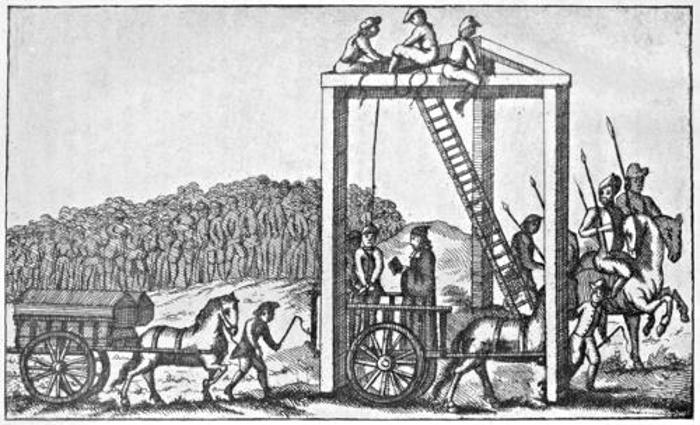
THE TRIPLE TREE, ABOUT 1680.
It seems that one of the confederates was reprieved.
Sadler, and Johnson, one of his companions, were
among the five men executed at Tyburn on March
16, 1677 (“A Perfect Narrative,” &c., 1676-7, reprinted
in Harleian Mis., v. 505-6).
1678. We now come to one of the blackest pages,
not only in the history of England, but in the history
of civilised communities.
Eighteen years of misgovernment had brought the
people to a point at which an outbreak of some kind
became inevitable. Dunkirk had been ceded to the
French: the sound of Dutch guns had been heard
in the Thames. The Court was known to be under
French influence. “There were two things,” says
Bishop Parker, “which, like Circe’s cups, bewitched
men and turned them into brutes, viz., popery and
French interest, and, if either of these happened to be
whispered in the House of Commons, they quitted
their calm and moderate proceedings, and ran immediately
into clamour and high debates.” Politicians had
for years played on the fears of the people. France
was to send a great army to reduce the country to
popery and slavery. “They kept the people in constant
fear: and there was scarce greater uproar when
Hannibal was at the gates of Rome.” Charles had no
successor in direct line; on his decease the crown
would fall to his brother, the Duke of York, known to
be a catholic. This was the position “when the Popish
Plot broke out, a transaction which had its roots in
hell, and its branches in the clouds.”
Two men saw a private advantage in this state of
things. It is impossible to say anything of the infamy
of Titus Oates which would not fall short of the
reality; his associate in the invention of the Popish
Plot, Tonge, was a fanatic, who could forge on occasion.
“God Almighty,” he said, “will do His own work by
His own methods and ways.” Between them the two
produced a story of murder and massacre, which they
contrived to lay before the King. It was so manifestly
absurd that it would have failed of its effect but
that Sir Edmund Berry Godfrey, a magistrate, who
had taken the depositions of these men, suddenly disappeared.
His body was found a few days later at
the foot of Primrose Hill, transfixed by Godfrey’s own
sword. There is little doubt that, but for family interests,
the case would have been recognised as one of
suicide. But the discovery came in the very nick of
time to save the authors of the Popish Plot. It was
set about that Godfrey had been murdered by the
papists in Somerset House, the palace of the Catholic
queen. The politicians, Lord Shaftesbury at their
head, were not slow to see the advantage to be gained
by playing upon the credulity of the people.
The word went round that the plot must be handled
as if it were true, whether it were so or not. It soon
became dangerous to express doubt. To do this was
to incur the certain danger of being reckoned a papist,
a concealed papist, one inclined to popery; and the
prison or the gallows was the fate of the doubter.
The courts sat merely to condemn men denounced
by Oates and his gang. Three men were hanged at
Tyburn as guilty of the murder of Godfrey. Even
those who to-day contend that Godfrey was murdered
admit that these men were innocent. Theories have
been constructed based on the evidence of infamous
informers who contradicted one another on every
point, and when this fails, the writer’s imagination is
employed to patch up the story.
On November 26, 1678, William Stayley was drawn
to Tyburn and there hanged and quartered. He had
been convicted, on the evidence of two infamous informers,
of a design to assassinate Charles. But this
case, a judicial murder, does not properly belong to
the Popish Plot.
On account of the plot were executed sixteen persons,
three for the murder of Godfrey, thirteen for
high treason. Except perhaps in the case of one,
Coleman, it is now universally admitted that not one
was guilty of the crime for which he suffered. Here
is a list of the victims:—
1678. December 3. Edward Coleman, secretary to the Duchess
of York.
1679. January 24. William Ireland and John Grove.
February 21. Robert Green and Lawrence Hill, for the
murder of Sir Edmund Berry Godfrey.
February 28. Henry Berry, for the same.
May 9. Thomas Pickering, for high treason.
June 20. Thomas Whitebread, William Harcourt, John
Fenwick, John Gavan, and Anthony
Turner, known as “The Five Jesuits,”
all for high treason.
July 14. Richard Langhorn, for high treason.
1680. December 29. Viscount Stafford, for high treason.
1681. July 1. Dr. Oliver Plunket, the catholic primate of
Ireland, for high treason.
Lord Stafford was executed on Tower Hill
all the others at Tyburn. The sixteenth
victim was Thomas Thwing, drawn,
hanged, and quartered at York. In
addition to these, eight priests were
executed in 1679, under the penal laws,
now revived, making it death for a priest
to be in England. Many died in prison,
thousands suffered imprisonment, banishment,
loss of goods.[197]
Together with Dr. Plunket was executed Edward
Fitz-Harris, but this case, like that of Stayley, does
not properly belong to the Popish Plot.
The story would be incomplete without telling what
befell the infamous creatures by whose means this
innocent blood was shed. Shaftesbury, the politician
who took up the Plot and directed the operations of
the perjurers, died in exile. Bedloe, one of the chief
witnesses, died in his bed, asserting with his last breath
the truth of his perjured evidence.
On May 8 and 9, 1685, Oates was tried on two indictments
for perjury. The evidence was full and complete.
The sentence passed upon him was that he
should pay a fine of a thousand marks on each indictment:
that he should be stripped of his canonical habits:
that he should be put in the pillory at Westminster and
at the Royal Exchange: that he should be whipped
from Aldgate to Newgate, and on the next day but
one from Newgate to Tyburn. Further, that on April
24, as long as he lived, he should stand in the
pillory at Tyburn: every ninth of August in the
pillory at Westminster: on every tenth of August in
the pillory at Charing Cross: on every eleventh of August
in the pillory near the Temple Gate, and on every
second of September, in the pillory at the Royal
Exchange.
Of the sentence and its execution more presently.
Dangerfield was, next to Oates and Bedloe, the worst
of the informers. He also was brought to trial. He
was condemned to be put in the pillory and whipped.
On July 4, 1685, he was being brought back from
Tyburn, having been whipped on the road thither,
when a Mr. Francis jeered at him, as he sat in the
coach. Dangerfield replied by an insult, and Francis
struck at him with a cane, the point of which entered
Dangerfield’s eye. Of the wound he died the next
day. For this, Francis was tried, found guilty of murder,
and executed at Tyburn, he being carried thither in
a coach.[198]
Miles Prance, a third informer, was also brought to
trial. He had been dragged into the business of informing
by Bedloe, and, in fear of his life, concocted a
story of Godfrey’s murder. He confessed his perjuries,
and was, in consequence, let off with standing in the
pillory, a fine and a whipping being remitted.
To return to Oates. In sentencing him the judge
remarked upon the inadequacy of the punishment
allotted by the law to a perjurer whose false testimony
had shed innocent blood. Indeed, if the punishment of
death was ever due to any man, it was due to Oates.
The whipping was so severe that none but Oates could
have survived it. That he did survive was hailed by his
partisans as a miracle.
Luttrell records that in September, 1688, “Oates stood
in the pillory over against the Royal Exchange, according
to annual custom.” This was his last appearance in the
pillory prior to his re-establishment as Protestant champion
by the following resolution of the House of
Commons:—
1689. June 11. Resolved that the Prosecution of
Titus Oates, upon Two Indictments for Perjury in the
Court of King’s Bench, was a design to stifle the Popish
Plot: And that the Verdicts given thereupon were corrupt:
And that the Judgments given thereupon were
cruel and illegal.
A heated contest arose between Lords and Commons
on the subject. The sentence was illegal,[199] and finally
Oates received a pardon and was set at liberty. But it
was not alone a passion for justice which animated those
who insisted on the illegality of the sentence. Oates was
by many regarded as one who had rendered inestimable
services to the cause of liberty and religion.
Paul may plant, Apollos may water: the labour of
each supposes that of the other. Shaftesbury, Burnet,
Oates—to which of the three are we to award the palm?
It is certain that but for Oates there would have been no
Popish Plot; it is arguable that but for the Popish Plot
there would have been no Glorious Revolution.
Oates’s services were rewarded with a considerable
pension.
To recur to the executions on account of the Popish
Plot. Most unfairly Charles has been blamed for these
executions. Never once, says Fox, did he exercise his
glorious prerogative of mercy. At the outset Charles was
warned from the bench that the two Houses would
interpose if he attempted to exercise this prerogative.
Had he done this, it would probably have led to a general
massacre of Catholics. Grave crimes are with justice
laid to the charge of both Charles I. and Charles II., but
against these crimes must be set the fact that each did
what in him lay to prevent the shedding of innocent
Catholic blood. We have seen how Charles I. resisted
the importunities of the Commons, thirsting for the
blood of priests against whom was no charge but that of
being priests. Charles II. strove in vain against the mad
fury of the times. Here is a revolting account, recently
published, showing the influences brought to bear on
Charles when he scrupled to order the execution of men
whom he believed to be innocent, as we now know they
were:—
Mr. Speaker told him frankly how universal an expectation
was fixed upon the execution of Ireland, Grove,
and Pickering, who are condemned. But His Majesty
did, on the other side, manifest wonderful reluctance
thereunto—that he had no manner of satisfaction in the
truth of the evidence, but rather of its falsehood.…
Most of the Board did labour with His Majesty to show
… the ill-grounded scruple His Majesty had taken, and
that the evidence and trial were much fairer than His
Majesty had been told, and that he could not be answerable
for any wrong done or innocent blood shed, but it
lay upon the witnesses and jury, if such a thing could be
thought of in this case. None laboured herein more
vigorously than the Lord Treasurer, Lord Chancellor,
and the Lord Lauderdale, who, it seems, had in private
done their uttermost before. At last it was ordered that
when the Judges come on Friday, so many of them as
sat upon that trial are to inform His Majesty how the
proofs appeared. And the Bishops that are of the Board
are then to be present, and to assist His Majesty as to the
point of conscience in this matter.[200]
Ireland and Grove were executed on January 24, 1679.
Pickering was respited. On April 27th the Commons
voted an address praying for his execution. Finally
in this case also Charles had to yield. Lord Russell
was the bearer of Charles’s answer that he would
comply with the prayer. Pickering was executed on
May 9th.
1680. March 8. Was executed at Tyburn twelve
men and three women for several crimes (Luttrell,
i. 38).
1683. In this year we have the executions for the
Rye House Plot, the object of which was to capture
Charles II. on his return from Newmarket.
July 20. Capt. Thomas Walcott, John Rouse, and
William Hone, were drawn, about 9 in the morning,
upon sledges, the two last in one, and the 1st by himself,
to Tyburn, and there hanged and quartered, according
to the sentence past on them on the 14th at the Old
Baily, for the late conspiracy.
July 21. The quarters of Walcot, Hone, and Rouse
are buried, but their heads are sett on these places
following: Hone on Aldersgate, Walcot on Algate, and
Rouse on Guildhall (Luttrell, i. 270-1).
William lord Russell was executed in Lincoln’s Inn
Fields on July 21, 1683.
1684. Sir Thomas Armstrong was concerned in the
Rye House Plot, but had fled to Holland and was outlawed.
He was taken at Leyden by order of the States,
brought to England, and committed to Newgate.
Brought to the king’s bench bar, he was refused trial,
and sentence of death was passed upon him as an
outlaw:—
The 20th June, Sir Thomas Armstrong was drawn
upon a sledge, with a very numerous guard to Tyburn;
where being come, Dr. Tenison prayed with him, who
seemed very penitent: he prayed himself also very fervently;
which done, he delivered a paper to the sheriffs,
and submitted himself to the sentence: after he had
hang’d about half an hour he was taken down, and
quartered according to his sentence, and his quarters
were brought back in the sledge to Newgate.… Sir
Thomas Armstrong’s quarters are disposed off: a fore-quarter
is sett on Temple bar, his head on Westminster,
another quarter is sent down to the town of Stafford, for
which he was a Parliament man (Luttrell, i. 311-2).
The head was taken down after the Revolution.
We now enter on the short and troubled reign of
James II.
1685. James Burton was outlawed for having taken
part in the Rye House Plot (1683). Elizabeth Gaunt, a
poor woman, gave him shelter and finally got him a
passage to Holland. Burton returned, took part in
Monmouth’s rebellion in 1685, and after Monmouth’s
defeat again sought refuge in London. At the entreaty
of his wife, Fernley, a barber, a neighbour of Mrs. Gaunt,
gave him shelter. To save his own neck Burton gave
information against his benefactors for protecting him.
He was not ashamed to appear in court against them,
and the Crown lawyers were not ashamed to produce his
evidence. Fernley was hanged at Tyburn, Elizabeth
Gaunt was burnt in the same place on October 23, 1685.
In prison she wrote her Last Speech. She says, “I did
but relieve an unworthy, poor, distressed family, & lo I
must dye for it; well, I desire in the Lamb-like nature of
the Gospell to forgive all that are concerned, & to say,
Lord, lay it not to their charge; but I fear it will not;
nay I believe, when he comes to make inquisition for
blood, it will be found at the door of the furious Judge:
… my blood will also be found at the door of the
unrighteous Jury, who found me guilty upon the single
oath of an out-lawd man.”
“Pen, the quaker,” says Burnet, “told me, he saw her
die. She laid the straw about her for burning her
speedily; and behaved herself in such a manner, that all
the spectators melted in tears” (Burnet, “Hist. of his
Own Time,” i. 649).
“Since that terrible day,” writes Macaulay, “no woman
has suffered death in England for any political offence.”
This is true only if we except the cases in which women
were burnt as guilty of treason for coining. It was by
a narrow chance that Mrs. Gaunt was the last. On
January 19, 1693, Mrs. Merryweather was sentenced to
be burnt for printing treasonable pamphlets, but, after
being more than once reprieved, was pardoned on
February 23rd (Luttrell).
1686. May 20-2. Sessions at Old Bailey, when 16
received sentence of death.
The 28th, five men of those lately condemned at the
Sessions were executed at Tyburn; one of them was
Pascha Rose, the new hangman, so that now Ketch is
restored to his place (Luttrell, i. 378).
1686. On the night of April 12 two of his Majesty’s
mails from Holland were robbed, near Ilford, of £5,000
in gold, belonging to some Jews in London. Richard
Alborough, Oliver Hawley, and John Condom were
indicted for the robbery. Alborough pleading guilty was
sentenced to death, & the same sentence was passed on
the others after trial.
July the 2d, Oliver Hawley and John Condom were
executed at Tyburn (Luttrell, i. 374-82.)
Here is a strange incident:—
At the Sessions at the Old Baily held on October
13-16 fourteen persons received sentence of death.
Edward Skelton, one of the criminalls that received
sentence of death this last sessions at the Old Baily, has
been beg’d of the King by 18 maids clothed in white, and
since is married to one of them in the Presse yard
(Luttrell, i. 387.)
1686. Samuel Johnson, rector of Corringham, is
described as a “political divine.” In 1682 he published
a famous piece, “Julian the Apostate,” Julian being for
the nonce the Duke of York. Johnson represented that
popery was a modern form of paganism; he argued
against unconditional obedience to the Crown. After
the Rye House Plot proceedings were taken against him,
and he was fined and imprisoned. On his release he
wrote and distributed other tracts, one, published after the
Duke of York came to the throne, was “An Humble and
Hearty Address to all the English Protestants in this present
Army.” In this he appealed to the soldiers not to be
“unequally yoked with idolatrous and bloody Papists”:—On
November 16, 1686, Samuel Johnson, clerk, convicted
upon an information of writing and publishing two libells,
was this day brought to the court of Kings bench, where
he offered something in arrest of judgment, but the
Court overruled it, and the chief justice told him he
blasphemously wrested scripture; so the court pronounced
judgment on him, to stand thrice in the pillory,
pay a fine of 500 marks, and to be whipt from Newgate
to Tyburn.…
The 20th, Samuel Johnson, clerk, was brought before
the commissioners for the diocese of London, and other
the clergy in the chapter house of St. Pauls, and there
degraded and devested accordingly, and delivered over as
a secular person (Luttrell, i. 388).
The execution of the sentence on Mr. Johnson is thus
described: And immediately they proceeded to execute
the said Sentence, and to degrade him by putting on his
Head a square Cap, and then taking off again; then they
pulled off his Gown, then his Girdle, which he demanded
as his proper Goods, bought with his Money, which they
promised to send; but they cost him Twenty Shillings
to have them again. After all, they put a Bible into his
Hand; which he would not part with, but they took it
from him by Force.… On the Monday after, viz. Two-and-twentieth
of November, the judgment in the King’s
Bench were executed with great Rigour and Cruelty, the
Whipping [from Newgate to Tyburn] being with a Whip
of Nine Cords, Knotted, shewed to the Committee; and
that Mr. Rouse the Under Sheriff tore off his Cassock
upon the pillory and put a Frize Coat upon him (“Journals
of the House of Commons,” June 24, 1689, x. 194).
In 1689, after the accession of William III., Parliament
annulled the judgment.
1690. The same day [September 12] 6 persons were
executed at Tyburn; some of them behaved themselves
very impudently, calling for sack, and drank king James’s
health, and affronted the ordinary at the gallows, and refused
his assistance; and bid the people return to their
obedience and send for king James back (Luttrell, ii.
103).
1690. In this year occurred a famous case of stealing
an heiress. This was made a felony by 3 Henry VII.
(1487), c. 3:—
Where Wymmen aswell Maydens as Wydowes and
Wyfes havyng substaunce somme in goods moveable,
and somme in landes and tenements, and summe beyng
heires apparaunte unto their auncesters, for the lucre of
suche substaunce been oft tymes taken by mysdoers
contrarie to their Will, and after maried to such mysdoers
or to other by their assent, or defoulled, to the great
displesire of God and contrarie to the Kyngs lawes and
dispargement of the seid Women and utter hevynesse
and discomforte of their frendes and to the evyll example
of all other.…
The Act goes on to make the offence a felony.
We will let Luttrell tell the story of the abduction
and its result, day by day:—
November 7. One Mrs. Mary Wharton, a young
heiresse of about £1500 per ann., and about 13 years of
age, comeing home with her aunt, Mrs. Byerley, in their
coach about 9 at night, and alighting out of it at her
own aunt, was violently seized on and putt into a coach
and 6 horses and carried away.
November 15. Mrs. Wharton, who was lately stole, is
returned home to her friends, having been married
against her consent to Captain Campbell [brother to
Lord Argyle].… A proclamation hath been published
by their majesties for the discovering and apprehending
captain James Campbell, Archibald Montgomery, and
sir John Jonston, for stealing away Mrs. Wharton. [The
proclamation included “divers others.”]
November 25. Sir John Jonston, concerned in the
stealing of Mrs. Wharton, is taken and committed to
Newgate.
December 10. The sessions began at the Old Baily,
and held the 11th, 12th, 13th, and 17th dayes of this
month, where 22 persons received sentence of death (and
among them sir John Jonston, for stealing Mrs. Wharton),
9 were burnt in the hand, 1 ordered to be transported,
and 6 sentenced to be whipt.
December 18. Intercession has been made to his
majestie on the behalf of sir John Jonston, lately condemned,
for his pardon; which he hath denied unlesse
it be desired by the friends of Mrs. Wharton.
December 23. Sir John Jonston, condemned for
stealing Mrs. Wharton, went up in a mourning coach to
Tyburn, and was executed for the same; and his body
was delivered to his friends, in order to it’s being
buried (Luttrell, ii. 128-48).
Here is a further notice of Mistress Wharton. Let us
hope she was happily married:—
1692. March 19. On Thursday last colonell Byerley
was married to Mrs. Wharton, stole formerly by
Campdell (Luttrell, ii. 394).
1690. December 22. Thirteen persons were executed
at Tyburn for several crimes; also a woman at Newgate
for setting the prison on fire; and also a notorious highway
man, commonly called the Golden Farmer [this was
William Davis, known by this title], was executed in
Fleetstreet, at the end of Salisbury court, and is after to
be hang’d in chains upon Bagshott heath (Luttrell, ii. 148).
1692. September 22. Information is given of near
300 coyners and clippers dispersed in divers parts of this
citty, on which warrants are out against severall; one
from the lords of the treasury, another by the cheife
justice, and a 3d by the masters of the mint (ii. 571).
1692. Towards the end of the year Luttrell has
several entries in his diary relating to a celebrated highwayman,
“captain” James Whitney:—
December. Witney, the notorious highway man, offers
to bring in 80 stout men of his gang to the kings service,
if he may have his pardon (ii. 630).
December 6. This morning his majestie sent a party of
horse to look after Whitney, the great highwayman, on
some notice he was lurking between Barnet and St.
Albans: they mett with him at the first of the said
towns, who finding himselfe attackt, made his defence
and killed one of them, and wounded some others: but
at last was taken and brought to London. His majestie
was very glad he was taken, being a great ringleader of
that crew (ii. 633).
This must have been a mistake, as shown by the
following entries:—
December 20. The lords C. and B. were on Satturday
last to meet Whitney, a great highwayman, on honour;
he offers to bring in 30 horse, with as many stout men,
to serve the king, provided he may have his pardon, and
will give a summe of money besides: but the issue
thereof not known (ii. 644).
1693. Tuesday, 3d January. On Satturday last
Whitney, the famous highwayman, was taken without
Bishopsgate; he was discovered by one Hill as he walkt
the street, who observed where he housed, then, calling
some assistance, he went to the door; but Whitney
defended himselfe for an hour, but the people encreasing,
and the officers of Newgate being sent for, he surrendered
himselfe, but had before stabb’d the said Hill with a
bagonet, but not mortall: he was cuff’d and shackled
with irons and committed to Newgate; and on Sunday
2 more of his gang were also seized and committed; one
kept a livery stable in Moor feilds (iii. 1).
January 7. Strongly reported yesterday that Whitney
had made his escape out of Newgate, but he continues
closely confined there, and has 40 pound weight of iron
on his leggs; he had his taylor make him a rich
embroidered suit, with perug and hatt, worth £100; but
the keeper refused to let him wear them, because they
would disguise him from being known (iii. 5).
On the 8th five of Whitney’s gang apprehended but
2 of them escaped.
1693. At the Old Baily sessions “8 highwaymen
received sentence of death, Whitney, Grasse, Fetherstone,
Nedland, Poor, Holland and 2 more” (iii. 16).
January 28. Yesterday 9 persons were carried to
Tyburn, where 8 were executed, 7 hyghwaymen, and
one for clipping; Whitney was brought back, having
a repreive for 10 dayes, and was brought back to Newgate
with a rope about his neck, a vast crowd of people
following him.
Last night Whitney was carried in a sedan to Whitehall
and examined; ’tis said he discovers who hired the
persons to rob the mailes so often.
Whitney, ’tis said, has been examined upon a design to
kill the King.…
Whitney, ’tis said, will be executed next week; others
say his repreive is grounded on the discovery of his
accomplices, with their houses of reception, and way of
living (iii. 24).
1693. February 2. Yesterday being the 1st instant,
capt. James Whitney, highwayman, was executed at
Porter’s block, near Cow crosse in Smithfeild; he seemed
to dye very penitent; was an hour and halfe in the cart
before turn’d off (iii. 27).
Luttrell mentions that in January there were near
20 highwaymen in Newgate (iii. 10).
1693. April 27. A person was this day convicted at
sessions house for sacriledge, rape, burglary, murder, and
robbing on the highway; all committed in 12 hours time
(Luttrell, iii. 85).
October 24. Yesterday, 14 malefactors were executed
at Tyburn; 6 of them clippers (Luttrell, iii. 212).
1694. July 19. Yesterday 11 men and 3 women
were executed at Tyburn; amongst them was Wilkinson
the goldsmith, with several others for clipping; one
Paynes, convicted for murder, who by the confession of
one of his accomplices has killed 5 or 6 persons in a
short time; he kickt the ordinary out of the cart
at Tyburn, and pulled off his shoes, sayeing, hee’d
contradict the old proverb, and not dye in them
(Luttrell, iii. 345).
1694. On Wensday the 12th instant 18 persons were
executed at Tyburn; 7 men, and 1 woman burnt for
clipping and coyning [this does not mean that the men
were burnt, but the woman only], 8 highway men, and
2 for burglary (Luttrell, iii. 413).
1695. January 10. Several persons have malitiously
spread abroad that Tyburn was hung in mourning, but
upon examination it proves a mistake (Luttrell, iii. 424).
The Queen had died on December 28.
1695. At the Old Bailey Sessions:—
July 6. Mr. Moor, the rich tripeman of Westminster,
was found guilty of clipping and coyning; and some
others will be tried for the like offence (Luttrell, iii. 495).
July 13. Yesterday four men were executed at
Tyburn, three of them for clipping, one of which was
John Moore, the tripeman, said to have gott a good
estate by clipping, and to have offered 6000 l. for his
pardon (Luttrell, iii. 497).
July 16. Moor the tripeman being hang’d for clipping,
the duke of Somerset has seized upon his house, worth
1000 l., being within his mannor of Isleworth.
This day a rich chandler of Lambeth and a housekeeper
in Long Acre were seized for clipping (Luttrell,
iii. 499).
1695. About this time Luttrell tells of the arrests of
“nests” of coiners, among them an attorney in the
Temple, and a merchant in Birchin Lane; at one time
105 coiners and clippers lay in Newgate awaiting trial.
The condition of the coinage became a great question of
State so pressing that after six Proclamations on the
subject an Act 7 and 8 William III c. 1 (1695-6) was
passed “An Act for remedying the Ill State of the Coin
of the Kingdome.” The Act recites that “the Silver
Coins of this Realm (as to a great part thereof) doe
appeare to bee exceedingly diminished by such persons
who (notwithstanding several good laws formerly provided
and many examples of justice thereupon) have
practised the wicked and pernicious crime of Clipping
until att length the course of the Moneys within this
Kingdom is become difficult and very much perplext, to
the unspeakable wrong and prejudice of His Majestie
and His good Subjects in their Affairs as well Publick as
particular and noe sufficient Remedy can bee applied
to the manifold Evils ariseing from the clipping of the
Moneys without recoining the clipt pieces.”
Then follow very lengthy provisions for dealing with
coins of “Sterling Silver or Silver of a courser Allay then
the Standard” from which we may infer that the Government
had played its part in the debasing of the coinage.
This was followed, in the same year, by an Act, c. 19
“to incourage the bringing Plate into the Mint to be
coined and for the further remedying the ill State of the
Coine of the Kingdome.” The next year saw another
Act 8 and 9 William III. c. 2, “for the further remedying
the ill State of the Coin of the Kingdome,” an Act, c. 8,
for “Incouraging the bringing in wrought Plate to be
coined”; c. 26, “for the better preventing the counterfeiting
the current Coine of the Kingdome.” Other Acts
of the same kind were 9 William III. c. 2; c. 21; these
are in addition to numerous Proclamations. Nothing
can better show the state of the coinage than the record
of petitions of seamen and shipwrights in the King’s
yards who had been paid in clipped and counterfeit half-crowns.
In February, 1696, came to a head “the Assassination
Plot,” the most dangerous of all the Plots formed against
William III. The King was, according to custom, to go
to hunt in Richmond Park on February 15. Advantage
was to be taken of this to assassinate him. For some
reason he did not go, and the execution of the scheme
was deferred. But meanwhile one of the conspirators
gave information to the Government. Numerous arrests
were made, followed by trials and executions. On
March 18 Robert Charnock, Edward King, and Thomas
Keys were executed at Tyburn. They were followed on
April 3 by Sir John Friend and Sir William Perkins.
The populace of London flocked to Tyburn in numbers
exceeding all precedent to witness the execution of
Friend, found guilty by the Court of high treason, and
by the people of a crime that touched them more nearly—the
brewing of execrable beer. Three non-juring divines
attended the condemned men to the scaffold, Jeremy
Collier, and two of less note, Shadrach Cook and William
Snatt, who absolved the criminals “in a manner more
than ordinarily practised in the Church of England.”
For this Cook and Snatt were committed to Newgate.
Macaulay says that they were not brought to trial. It
appears, however, that they were actually indicted, and
found guilty of high crimes and misdemeanours (Luttrell,
iv. 80) and imprisoned for a short time. Collier kept out
of the way, and was in consequence outlawed, remaining
under the sentence to the end of his days. Numerous
tracts were written on the subject.
On April 29 Brigadier Rookwood, Charles Cranburne,
and Major Lowick were executed at Tyburn, they
also having been condemned for the Plot.
This completes the story of the executions at Tyburn
for the Assassination Plot, but it is impossible to refrain
from mentioning a case dismissed by Macaulay in a
sentence referring to “Major John Bernardi, an adventurer
of Genoese extraction, whose name has derived a melancholy
celebrity from a punishment so strangely prolonged
that it at length shocked a generation which could not
remember his crime.” It is hardly fair to call Bernardi
an adventurer. Apart from this, the reader would
certainly not gather from Macaulay’s remark that no
crime was ever proved against Bernardi. In writing of
a shocked generation the historian probably referred
to some very mild remarks of Dr. Johnson, in his
“Life of Pope.” Pope wrote an epitaph on Secretary
Trumball, who, from his official position, took a leading
part in persuading Parliament to consent to the imprisonment
of Bernardi. The concluding lines of Pope’s
epitaph are:—
Such this man was, who, now from earth remov’d
At length enjoys the liberty he lov’d.
On this Johnson wrote: “The thought in the last line is
impertinent, having no connection with the foregoing
character, nor with the condition of the man described.
Had the epitaph been written on the poor conspirator
who lately died in prison, after a confinement of more
than forty years, without any crime proved against him,
the sentiment had been just and pathetical; but why
should Trumball be congratulated upon his liberty, who
had never known restraint?”
Major Bernardi was arrested on suspicion of being
concerned in the Assassination Plot; he was in the
company of Rookwood when the latter, afterwards
condemned and executed, was arrested. Against Bernardi
there was but one witness, an informer. Even taking
this informer’s testimony without abatement the case
against Bernardi did not reach higher than suspicion.
But the resources of civilisation were equal to the occasion.
A clause in an Act, 8 & 9 William III. (1696-7)
c. 5, gave power to keep in Newgate Bernardi and five
others named, till January 1, 1697-8. An Act, 9 William
III. (1697-8) c. 4. gave power to prolong the imprisonment
for a second year. A third Act, 10 William III.
(1698) c. 19, enacted that the same six persons should be
kept in custody during his Majesty’s pleasure.
The rest of the story would be incredible if it were not
supported by Acts of Parliament. The Act last mentioned
necessarily expired on William’s death, but on the
accession of Anne another Act was passed, 1 Anne (1701)
st. 1, c. 29. for continuing the imprisonment of these men
during the Queen’s pleasure. Anne, however, released
one. This Act lapsed on the Queen’s death. On the
accession of George I. a similar Act was passed,
1 George I. (1714) st. 2, c. 7. During this reign two of
the prisoners died in Newgate. Once more the death of
the sovereign put the prisoners in a position to move to
be brought to trial or admitted to bail. But an Act of
the same tenor as the preceding Acts was passed,
1 Geo. II. (1727) st. 1, c. 4, once more continuing the
imprisonment during the sovereign’s pleasure. In vain
was the king petitioned; in vain did Bernardi’s doctors
depose to his lamentable state, “his miserable lameness,
and swelling in his arms, by humours flowing to an old
wound”; in vain did his wife pray for her husband’s
liberation. Finally, in 1736, after an imprisonment of
40 years, Bernardi, then in his eighty-second year, was
set free, not by the clemency of the King, but as he had
himself foreseen, “by the great and merciful God himself
above, the King of Kings and only Ruler of Princes.”[201]
Thus ended the imprisonment of this sick and aged man,
the longest imprisonment recorded in the law-books, an
imprisonment awarded and continued through several
reigns on mere suspicion of one never brought to trial.
The case is instructive, as showing how with strict
observance of constitutional forms, it is possible to
emulate the dark deeds of uncontrolled despotism.
Magna Carta, the magnificent conception of a great
English ecclesiastic of the thirteenth century, would
perhaps be found even to-day, if a time of stress came
upon us, to be still a counsel of perfection. If that is so,
the blame must rest upon William III. and his advisers.
Strange that men to whom power was given in order that
they might protect us from arbitrary government should
have exceeded those they displaced in the exercise of
arbitrary power! Cromwell derided Magna Carta in
terms not to be reproduced here.[202] The accession of
William was almost immediately followed by the suspension
of habeas corpus, resting upon the great Charter.
Macaulay tells us that Charles II. “would gladly have
refused his assent to that measure,” the habeas corpus
Act. We will not dispute it; but Charles did not ask for
the suspension of habeas corpus when the Rye House
Plot broke out. Macaulay tells us that James II. hated
the Act. This, again, we will not dispute. But he did
not ask for its suspension when Monmouth invaded
England. William did not wait for the Assassination
Plot to ask Parliament to suspend the Act. Before he
had been on the throne a month he established an evil
precedent which has ever since been followed; no
minister has since ever hesitated to ask Parliament to
suspend habeas corpus, and no Parliament has ever
refused the request when made. Suspended four times
in the reign of William and Mary and William, once in
the reign of Anne, thrice in the reign of George I., four
times in the reign of George II., and twenty times in the
reign of George III. (Ireland is left out of account),
habeas corpus was reduced to the point at which it
afforded exactly the amount of protection that a man
would receive from a waterproof coat, worn in sunshine,
and carefully left at home when rain falls.[203]
1696. December 31. Yesterday 14 men were executed
at Tyburn, 10 of them for clipping and coining, the
other 4 for robbery (Luttrell, iv. 162).
1697. July 20. The 16th past, 14 malefactors were
executed at Tyburn; 3 men and 1 woman for coining,
2 men for counterfeiting stamp’t paper, a woman for
murthering her bastard child; and 7 more for robbery
and burglary; and the French woman, who murdered
Mrs. Pullein, was hanged at the end of Suffolk Street,
where the fact was committed (Luttrell, iv. 254).
1697. November 4. Yesterday 6 persons were executed
at Tyburn; two for coining, one for robbing on the high
way, and 3 for counterfeiting stampt paper, of which
Mr. Salisbury the minister was one; he had the favour to
goe to Tyburn in a mourning coach, and his body was
brought back in a herse.
Salisbury was a non-juring parson of Sussex; the
evidence against him showed that he did not commit the
forgery for want, “as having a good estate and a good
living, but only to prejudice king William’s Government”
(Luttrell, iv. 292, 302).
A few days later Luttrell records the committal of
another parson for the same offence.
1698. December 22. Yesterday fourteen men and one
woman were executed at Tyburn; two of the men were
drawn in a sledge, and were for coining; one man was
carried in a coach, for robbing on the high way; and the
rest in carts, for burglary and robbery on the high way;
and one for murther (L., iv. 464).
Including these, Luttrell records the execution at
Tyburn this year of 62 persons.
1699. Luttrell records the execution this year at
Tyburn of 51 persons.
In this year was passed the Act so often and so
strongly denounced by Romilly in later years (10 William
III., c. 12 in the folio edition of the Statutes), which
came into operation after May 20. It was directed against
burglary and horse stealing as well as against “the crime
of stealing goods privately out of shops and warehouses,
commonly called Shoplifting.” The notoriety of the
Act was earned by its inflicting the penalty of death for
shoplifting to the value of five shillings. This Act also
established the “Tyburn ticket,”[204] as it came to be called,
a certificate awarded for the apprehension and prosecution
of offenders. This gave exemption from parish and
ward offices. It further enacted that all persons convicted
of theft, who had benefit of clergy should, instead of
being burnt in the hand, be “burnt in the most visible
part of the left cheek nearest the nose,” the burning to be
done in court in presence of the judge. Luttrell records
in connection with the May sessions that “two were
burnt in the left cheek, according to the new act of
parliament”; at the next sessions eighteen were so
branded. But the innovation did not prove successful.
Luttrell says that retaliation was threatened—“the said
offenders for the future threaten whatever house they
break into, &c., they will mark the persons on the cheek
to prevent distinction.” The provision was repealed by
5 and 6 Anne (1706), c. 6, and burning in the hand was
again established. The repealing Act states in the
preamble that “the said punishment [of burning on the
cheek] hath not had its desired effect, by deterring such
offenders from the further committing such crimes and
offences, but on the contrary, such offenders being
rendered thereby unfit to be intrusted in any service or
employment to get their livelihood in any honest and
lawful way, become the more desperate.” But the penalty
of death for stealing to the value of five shillings remained.
1700. March 16. Three prisoners were this week
taken in the very act of coining in Newgate.
April 20. Yesterday, one Larkin, alias Young, with
another, were executed at Tyburn; the former for coyning
in Newgate (Luttrell, iv. 624, 636).
1705. December 12. “One John Smith, condemned
lately at the Old Baily for burglary, was carried to Tyburn
to be executed, and was accordingly hanged up, and
after he had hung about 7 minutes, a reprieve came,
so he was cutt down, and immediately lett blood and
put into a warm bed, which, with other applications,
brought him to himself again with much adoe” (Luttrell,
v. 623).
The story is told at greater length by James Mountague
in “The Old Bailey Chronicle,” 1700-83, i.
51-3:—
“After hanging five minutes and a quarter, a reprieve
was brought.… The malefactor was cut down and
taken with all possible expedition to a public house
where proper means was pursued for his recovery, and
with so much success that the perfect use of all his
faculties was restored in about half an hour.”
The account given by Smith of his sensations was that
when first turned off he felt excessive pain, but that it
almost immediately ceased. The last circumstance he
recollected was like an irregular and glimmering light
before his eyes: the pain he felt in hanging was infinitely
surpassed when his blood was recovering its usual course
of circulation.
Hatton, in his “New View of London” 1708, i. 84-5,
says that Smith hanged for about a quarter of an hour;
he adds that the executioner, while Smith was hanging,
pulled his legs, and used other means to put a speedy
period to his life.
Smith did not profit by this severe lesson. For a while
indeed he served the cause of law and order, as will be
seen by the following:—
1706. March. Smith, who, sometime since was half-hanged
and cut down, having accused about 350 pickpockets,
house breakers, &c., who gott to be soldiers in
the guards, the better to hide their roguery, were last
week upon mustering the regiments drawn out and
immediately shipt off for Catalonia: and about 60 women,
who lay under condemnation for such crimes, were likewise
sent away to follow the camp (Luttrell, vi. 25).
And again: 1706. November 9. The officers of her
majesties guards yesterday drew out their companies in
St. James’s Park, which were viewed by Smith (sometime
since hang’d at Tyburn, but a reprieve coming was
cut down before dead) and two other persons in
masks, in order to discover felons and housebreakers:
out of which 2 serjeants with 6 soldiers were seized
as criminals and committed to the Marshalsea prison
(Luttrell, vi. 105).
Smith had received an unconditional pardon; later he
was again tried for burglary, and acquitted on a point
of law. Lesson number 2. But Smith was a third time
apprehended on a charge of burglary and committed for
trial. The prosecutor died, and Smith was discharged.
It is said that finally he was drowned at sea.
Smith’s recovery from hanging does not stand alone.
In 1740 there was a case of a man who was left hanging
for the usual time, and recovered:—
1740. November 25. “Yesterday only five of the
Malefactors were executed at Tyburn: two of them, viz.,
George Wight and Abraham Hancock having obtain’d a
Reprieve thro’ the Intercession of a Noble Peer.
“Duel, executed for the Rape, was brought to Surgeons-Hall,
in order for Anatomy, but after he was stripp’d and
laid on the Board, and one of the Servants was washing
him, to be cut up, he perceived Life in him, and found
his Breath to come quicker and quicker, on which a
Surgeon bled him, and took several Ounces of Blood
from him, and in about two Hours he came so much to
himself as to sit up in a Chair, groan’d very much, and
seem’d in great Agitation, but could not speak: tho’ it
was the Opinion of most People if he had been put in a
warm Bed and proper Care taken, he would have come to
himself. Whether he’s now living we know not, but a
great Mob assembled at Surgeons-Hall on this Occasion,
and according to their Law, he could not be executed
again: but according to the Law of the Land, the Sheriffs
have a Power to carry him again to Tyburn and execute
him, his former sentence, of being hung till he was dead,
not having been executed. Its reckon’d his coming to
Life was owing to the wrong Disposition of the Halter”
(London Daily Post and General Advertiser).
Duel or Dewell did not recollect being hanged: he
said that he had been in a dream; that he dreamed of
Paradise, where an angel told him his sins were forgiven.
He made a complete recovery. At the next sessions at
the Old Bailey he was ordered to be transported for life.
Some years before this, the problem of the recovery of
persons hanged had received careful attention. Thus,
we find the following in the Gentleman’s Magazine for
1733 (April 27), p. 213:—
Mr. Chovet, a Surgeon, having by frequent Experiments
on Dogs, discovered, that opening the Windpipe,
would prevent the fatal Consequences of the Halter,
undertook Mr. Gordon, and made an Incision in his
Windpipe: the Effect of which was, that when Gordon
stopt his Mouth, Nostrils, and Ears for some Time, Air
enough came thro’ the Cavity to continue Life. When
he was hang’d he was perceived to be alive after all the
rest were dead: and when he had hung 3 quarters of an
Hour, being carried to a House in Tyburn Road, he
opened his Mouth several Times and groaned, and a
Vein being open’d he bled freely. ’Twas thought, if he
had been cut down 5 Minutes sooner, he might have
recover’d.
Two cases of recovery, not assisted by the surgeon,
are recorded in the Gentleman’s Magazine for 1736. On
July 26 one Reynolds, a turnpike leveller,[205] was hanged
and cut down in the usual course. But as the coffin was
being fastened down, Reynolds thrust back the lid,
whereupon the executioner was for tying him up again.
This however the mob would not suffer. Reynolds
was carried to a house where he vomited a quantity of
blood, but he died after being made to drink a glass of
wine.
On September 23rd two men were hanged at Bristol,
cut down and put into coffins, when both revived. One
died later in the day; what befel the other is not told.
The Gentleman’s Magazine for 1767 (p. 90) records
the execution at Cork, on January 24th, of Patrick Redmond
who hung for twenty-eight minutes. “The mob
carried off the body to a place appointed, where he was,
after five or six hours actually recovered by a surgeon
who made the incision in his windpipe called bronchotomy.
The poor fellow has since received his pardon,
and a genteel collection has been made for him.”
More interesting than any of these cases is an earlier
one fully recorded in a little book published in 1651,
“Newes from the Dead, or a true and exact narration
of the miraculous deliverance of Anne Greene, who
being executed at Oxford, December 14, 1650, afterwards
revived, and by the care of certain Physitians there is
now perfectly recovered. Together with the manner of
her suffering, and the particular means used for her
recovery. Written by a Scholler in Oxford for the
satisfaction of a friend who desired to be informed
concerning the truth of the businesse. Whereunto are
prefixed certain Poems casually written upon that
subject.”
One of the poems is by “Chris. Wren, Gent. Com. of
Wad. Coll.”
Anne Greene was convicted of killing her newly-born
child, but it is open to doubt whether the child was
born alive. This is the account of the execution: “She
was turned off the ladder,[206] hanging by the neck for the
space of almost half an houre, some of her friends in
the meantime thumping her on the breast, others hanging
with all their weight upon her legs, sometimes lifting her
up, and then pulling her doune again with a sudden
jerk, thereby the sooner to despatch her out of her pain;
insomuch that the Under-sheriff fearing lest thereby
they should break the rope forbad them to do so any
longer.”
The body was carried in a coffin into a private house,
and showing signs of life, “a lusty fellow that stood by
(thinking to do an act of charity in ridding her out of the
small reliques of a painfull life) stamped several times on
her breast and stomach with all the force he could.”
Dr. Petty, the Professor of Anatomy, coming in with
another, they set themselves to recover her. They bled
her freely, and put her into bed with another woman.
After about two hours she could speak “many words
intelligible.” On the 19th (having been hanged on the
14th) she was up; within a month she was recovered,
and went to her friends in the country, taking her coffin
with her.
On June 19, 1728, Margaret Dickenson was hanged at
Edinburgh. After hanging for the usual time, the
body was cut down, put into a coffin, and so into a cart
for carriage to the place of interment. The man in
charge of the cart stopped in a village to drink, and while
so engaged, saw the lid of the coffin move: at last the
woman sat up in her coffin. Most of those present fled
in terror, but a gardener, who happened to be there,
opened a vein. Within an hour Margaret was put to
bed, and on the next day walked home. The story is
told in the “Newgate Calendar” of 1774, with a picture
of Margaret sitting up in her coffin.
These cases, astounding as they are, are eclipsed by
one known only by the barest statement of the fact. In
the 28th of Henry III. (1264) a woman, Ivetta de Balsham,
was, for some felony, hanged at three o’clock one afternoon.
She was let down from the gallows at sunrise the
next morning, and found to be alive. A pardon was
granted to her. The date of the pardon is August 16th,
and the execution must have taken place some time before
this date. But even if Ivetta was hanged on midsummer
day she must have been hanging twelve long hours.[207]
1712. December 23. Richard Town was executed at
Tyburn. Being bankrupt, he absconded, and was
apprehended, having twenty guineas and other money
in his possession (Montague, “The Old Bailey Chronicle,”
i. 69-70).
Sir James Fitzjames Stephen says that setting in the
pillory for fraudulent concealment of goods to the value
of £20 “continued to be the statutory penalty for fraudulent
bankruptcy from 21 James I. (1623) c. 19, s. 7 till the
year 1732.”[208] The reference is to the Act 5 George II.
c. 30. Sir James appears, however, to have overlooked a
previous Act, 4 & 5 Anne (1705), c. 4, s. 1 of which
made fraudulent bankruptcy a felony without benefit of
clergy. It is said that there were but few executions for
this offence. The most remarkable case is that of John
Perrott, who was executed at Smithfield (not at Tyburn)
on November 11, 1761. The story, of singular interest,
is told in great detail in the Gentleman’s Magazine for
the year, xxxi. 585-92.
1715. December 7. Nine adherents of the Pretender
were executed at Tyburn.
There followed other executions:—
1716. May 14. Colonel Oxburgh.
May 25. Richard Gascoign.
July 18. Rev. William Paul and John Hall.
In his account of the execution of Paul and Hall, Mr.
Lorrain, the ordinary of Newgate, says: “The cart being
drawn away, and they being turned off, the People gave a
mighty shout, and with loud Acclamations said, God save
King George. To which I say, Amen.”
As mention has been made of Mr. Lorrain, it may be
not amiss to say something about him. The Rev. Paul
Lorrain, probably of Huguenot extraction, was the
ordinary of Newgate from 1698 to 1719. The British
Museum possesses nearly fifty of the broadsheets issued
by him, giving accounts of the behaviour, last speeches,
and execution of the criminals who came under his care
in Newgate. The worthy ordinary was perhaps inclined
to estimate too highly the effect of his ministrations on
these criminals. His representations of their penitent
attitude procured for them the name of “Paul Lorrain’s
Saints” (Tatler, No. 63). There is a good-humoured
reference to this weakness in the Spectator, No. 338.
1718. March 17. Execution of Ferdinando Marquis
de Palleotti.
The Duke of Shrewsbury, being at Rome, fell in love
with Palleotti’s sister, and upon the lady’s conversion to
Protestantism, married her. Ferdinando visited his sister
in England. He was addicted to gambling, and made
such demands upon his sister’s purse that at length she
refused further supplies. He was arrested for debt, and
liberated by her. Walking in the street one day, he
ordered his servant to call upon a gentleman in the
neighbourhood, and ask for a loan. The servant showing
reluctance to fulfil the order, the marquis drew his
sword and ran him through the body. According to the
ordinary, the marquis thought it a great hardship that he
should die for so small a matter as killing his servant
(James Mountague, “The Old Bailey Chronicle,” i. 185-8).
A few hours after the execution of the marquis, James
Shepherd, an adherent of the Pretender, was drawn to
Tyburn and there hanged and quartered.
1718. May 31. The hangman of Tyburn, John Price,
known by the common name Jack Ketch, was hanged, for
murder, near the scene of the crime, in Bunhill-Fields.
1721. February 8. On this day were executed at
Tyburn four men, one of whom had undergone the
peine forte et dure.
Four men were indicted for highway robberies. Two
refusing to plead, the court gave orders to read the judgment
appointed to be executed on such as stand mute or
refuse to plead to their indictment.
“That the prisoner shall be sent to the prison from
whence he came, and put into a mean room, stopped
from the light, and shall there be laid on the bare ground
without any litter, straw, or other covering, and without
any garment about him except something about his
middle. He shall lie upon his back, his head shall be
covered and his feet shall be bare. One of his arms
shall be drawn with a cord to the side of the room, and
the other arm to the other side, and his legs shall be
served in the like manner. Then there shall be laid upon
his body as much iron or stone as he can bear, and
more. And the first day after he shall have three
morsels of barley bread, without any drink, and the
second day he shall be allowed to drink as much as he
can, at three times, of the water that is next the prison
door, except running water, without any bread; and this
shall be his diet till he dies: and he against whom the
judgment shall be given forfeits his goods to the
King.
“This having no effect on the prisoners, the executioner
(as is usual in such cases) was ordered to tie their thumbs
together, and draw the cord as tight as he was able, which
was immediately done; neither this, nor all the admonitions
of the court being sufficient to bring them to plead,
they were sentenced to be pressed to death. They were
carried back to Newgate. As soon as they entered the
press-room, Phillips desired that he might return to the
bar and plead, but Spiggott continuing obstinate was put
under the press. He bore three hundred and fifty
pounds weight for half an hour, but then fifty more being
added,[209] he begged that he might be carried back to plead,
which favour was granted.”
After the treatment he was very faint and almost
speechless for two days. One of his reasons given to
the ordinary of Newgate for enduring the press was that
none might reproach his children by telling them their
father was hanged. Before he was taken out of the
press, he was in a kind of slumber and had hardly any
sense of pain left.[210]
1721. July 5. Barbara Spencer was burnt at Tyburn
for coining. At the stake “she was very desirous of
praying, and complained of the dirt and stones thrown
by the mob behind her, which prevented her thinking
sedately on futurity. One time she was quite beat down
by them” (Villette, i. 32-6).
1721. December 22. Nathaniel Hawes, a young man
of 20, had been out of prison but a few days when he
robbed a man on the highway of 4s. He refused to
plead, because a handsome suit of clothes had been taken
from him, and he was resolved not to go to the gallows
in a shabby suit. The court ordered that his thumbs
should be tied together. The cord was pulled by two
officers till it broke, and this was repeated several times
without effect. He was then put in the press, and gave in
when he had borne a weight of 250 lbs. for about seven
minutes. (Reference has already been made to this case
on p. 41 in treating of the peine forte et dure).
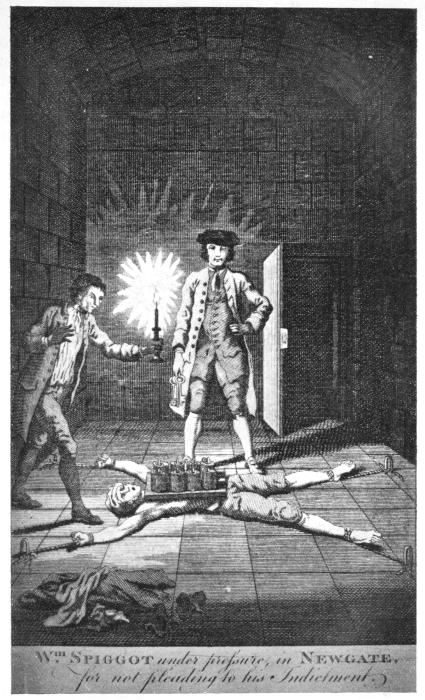
THE PEINE FORTE ET DURE, 1721.
1724. November 16. John, or Jack Sheppard, for
burglary.
Jack Sheppard does not seem to have committed any
crime worse than burglary: his hands were not stained
with blood. He was famed for several remarkable escapes
from prison. He had once escaped from Newgate and
being again arrested, unusual care was taken of him.
But he once more and for the last time escaped, being
soon after captured while drunk. For better security he
was lodged in a strong room called the Castle, where he
was hand-cuffed, loaded with a heavy pair of irons, and
chained to a staple in the floor. The Sessions at the Old
Bailey began on October 14th, and Jack, knowing that the
keepers would be busy in attending the court, thought
that this would be the only time to make a push for his
liberty.
“The next day, about two in the afternoon, one of the
keepers carried Jack his dinner, examined his irons, and
found all fast. Jack then went to work. He got off his
hand-cuffs, and with a crooked nail he found on the
floor, opened the great padlock that fastened his chain to
the staple. Next he twisted asunder a small link of the
chain between his legs, and drawing up his feet-locks as
high as he could, he made them fast with his garters.
He attempted to get up the chimney, but had not
advanced far before his progress was stopped by an iron
bar that went across within-side, and therefore being
descended, he went to work on the outside, and with a
piece of his broken chain picked out the mortar, and
removing a small stone or two about six feet from the
floor, he got out the iron bar, an inch square and near a
yard long, and this proved of great service to him. He
presently made so large a breach, that he got into the
Red-Room over the Castle, there he found a great nail,
which was another very useful implement. The door of
his room had not been opened for seven years past; but
in less than seven minutes he wrenched off the lock, and
got into the entry leading to the Chapel. Here he found
a door bolted on the other side, upon which he broke a
hole through the wall, and pushed the bolt back. Coming
now to the chapel-door, he broke off one of the iron
spikes, which he kept for further use, and so got into an
entry between the chapel and the lower leads. The door
of this entry was very strong, and fastened with a great
lock, and what was worse, the night had overtaken him,
and he was forced to work in the dark. However, in
half an hour, by the help of the great nail, the chapel
spike, and the iron bar, he forced off the box of the
lock, and opened the door, which led him to another yet
more difficult, for it was not only locked, but barred and
bolted. When he had tried in vain to make this lock
and box give way, he wrenched the fillet from the main
post of the door, and the box and staples came off with
it: and now St. Sepulchre’s chimes went eight. There
was yet another door betwixt him and the lower leads;
but it being only bolted within-side, he opened it easily,
and mounting to the top of it, he got over the wall, and
so to the upper leads.
“His next consideration was, how to get down; for
which purpose looking round him, and finding the top
of the Turner’s house adjoining to Newgate, was the most
convenient place to alight upon, he resolved to descend
thither; but as it would have been a dangerous leap,
he went back to the Castle the same way he came, and
fetched a blanket he used to lie on. This he made fast
to the wall of Newgate, with the spike he stole out of the
Chapel, and so sliding down, dropped upon the Turner’s
leads, and then the clock struck nine. Luckily for him,
the Turner’s garret-door on the leads happened to be
open. He went in, and crept softly down one pair of
stairs, when he heard company talking in a room below.
His irons giving a clink, a woman started, and said,
‘Lord! What noise is that?’ Somebody answered, ‘The
dog or the cat’; and thereupon Sheppard returned up to
the garret, and having continued there above two hours,
he ventured down a second time, when he heard a
gentleman take leave of the company, and saw the maid
light him down stairs. As soon as the maid came back,
and had shut the chamber door, he made the best of his
way to the street door, unlocked it, and so made his
escape about twelve at night.”
But on October 31st Jack made merry at a public-house
in Newgate Street, with two ladies of his acquaintance,
afterwards treated his mother in Clare Market with three
quarterns of brandy, and in a word got so drunk that he
forgot all caution and was once more apprehended.
He still had schemes for eluding justice. He had got
hold of a penknife; with this on the road to Tyburn he
would cut the cords binding his hands, jump from the
cart into the crowd and run through Little Turnstile, where
the mounted officers could not follow him, and he reckoned
on the sympathy of the mob to help him to make good
his escape. But he was searched, and the knife was taken
from him. He had one last hope; he urged his friends
to get possession of his body as soon as cut down, and
put it into a warm bed; so he thought, and precedents
were not wanting, his life might be prolonged. This,
too, came to naught (Villette, i. 261-6).
In the twenty-third year of his age “died with great
difficulty, and much pitied by the mob,” the prince of
prison-breakers.
Villette says: “I don’t remember any felon in this
kingdom, whose adventures have made so much noise as
Sheppard’s.” Six or more stories of his life appeared:
among his biographers was Defoe. Sir James Thornhill
painted his portrait, reproduced in a mezzotint engraving.
The British Journal of November 28, 1724, contained
verses on this portrait:—
Thornhill, ’tis thine to gild with fame
Th’ obscure, and raise the humble name:
To make the form elude the grave,
And Sheppard from oblivion save.
…
Apelles Alexander drew,
Cæsar is to Aurellius due,
Cromwell in Lilly’s works doth shine,
And Sheppard, Thornhill, lives in thine.
Nor did the pulpit disdain to draw a moral from
Sheppard’s career:—
“O that ye were all like Jack Sheppard! Mistake me
not, my brethren, I don’t mean in a carnal, but in a spiritual
sense, for I purpose to spiritualise these things.…
Let me exhort ye then, to open the Locks of your Hearts
with the Nail of Repentance: burst asunder the Fetters
of your beloved Lusts: mount the Chimney of Hope, take
from thence the Bar of good Resolution, break through
the Stone-wall of Despair, fix the blanket of Faith with
the Spike of the Church. Let yourselves down to the
Turner’s House of Resignation, and descend the Stairs
of Humility; so shall you come to the Door of Deliverance
from the Prison of Iniquity, and escape from the
Clutches of that old Executioner, the Devil” (Villette,
i. 253-72).
A few days before, on November 11, Joseph Black,
better known as “Blueskin,” a companion of Jack Sheppard,
had been hanged at Tyburn.[211]
1725. May 24. Jonathan Wild, “the thief-taker.”
Jonathan Wild, whose exploits were celebrated by
Fielding in “Jonathan Wild, the Great,” invented a
new method which may be described as running with
the hare and riding with the hounds. He was in league
with great numbers of thieves of all kinds, from highwaymen
downwards. This body was described as “a
corporation of thieves of which Wild was the head
or director.” He divided the country into districts,
assigning gangs for the working of each. These gangs
accounted to him for the proceeds of their robberies.
He selected by preference convicts returned from transportation,
because, in case of accident, they could not
give legal evidence against him; moreover, they were in
his power, and if any rebelled he could hang them. For
fifteen years he carried on this system. His depredations
were on a large scale: he had in his pay several artists
to alter watches, rings, and other objects of value, so as
not to be recognised by their owners.
At his trial he circulated among the jury a list of
persons apprehended and convicted by his means: 35
for highway robbery, 22 for burglary, 10 for returning
from transportation. It would be too tedious, he said,
to give a list of minor cases. Written in his name is an
elegy, of which these are a few lines:—
Ye Britons! curs’d with an unthankful mind,
For ever to exalted merit blind,
Is thus your constant benefactor spurn’d?
Are thus his faithful services return’d?
This dungeon his reward for labours past?
And Tyburn his full recompence at last?
On the way to Tyburn he was cursed and pelted. The
rest of the batch being tied up, the executioner told Wild
he might have any reasonable time to prepare himself.
This so incensed the mob that they threatened to knock
the hangman on the head if he did not at once perform
the duties of his office. The body was buried in the
churchyard of Old St. Pancras, but was afterwards removed,
by surgeons as was supposed.
1726. May 9. Catherine Hays and Thomas Billings,
executed for the murder of John Hays, the husband
of Catherine. Thomas Wood, also condemned for the
murder, died on May 4 in the “Condemned-Hold.”
Hays’s body was cut up by the murderers, and the head
thrown into the Thames, but it was recovered and set
up on a pole in the churchyard of St. Margaret’s, Westminster.
This led to identification and discovery of the
criminals. Catherine Hays was drawn on a sledge to
Tyburn. Here she was chained to a stake and faggots
were piled around her. A rope round her neck was
passed through a hole in the stake. When the fire had
got well alight and had reached the woman, the executioner
pulled the rope, intending to strangle her, but,
the fire reaching his hands, he was forced to desist. More
faggots were then piled on the woman, and in about three
or four hours she was reduced to ashes. Billings was put
in irons as he was hanging on the gallows, his body was
then cut down, carried to a gibbet about a hundred
yards distant, and there suspended in chains (Villette i.
394-428).
Thackeray’s “Catherine, A Story,” originally published
in Fraser’s Magazine, is based on this case, much as
Fielding’s “Jonathan Wild the Great” is based upon the
career of that worthy.
1732. October 9. Thirteen executed at Tyburn.
1733. January 29. Twelve malefactors, condemned
in the three preceding sessions, executed at Tyburn.
1733. May 28. John Davis, feigning sickness, begged
that he might not be tied in the cart. When he came to
the Tree, he jumped from the cart and ran across two
fields. A countyman knocked him down, and he was
brought back and hanged.
1733. December 19. Thirteen executed at Tyburn.
Among them were a man and a woman condemned for
coining. They were, as usual, drawn in a sledge: the
man, after being hanged, was slashed across the body.
The woman, chained to a stake, was first strangled and
then burnt.
1737. March 12. Twelve malefactors executed at
Tyburn.
1738. January 18. Thirteen, convicted in October
and December, executed at Tyburn.
1738. November 8. Eleven executed at Tyburn.
1739. March 14. Eleven executed at Tyburn.
December 20. Eleven executed at Tyburn.
1741. We are so fortunate as to possess an account of
an execution written at this time by Samuel Richardson,
the first great English novelist. It is found in a volume,
printed without the author’s name; a kind of Polite
Letter Writer, bearing this portentous title:—
“Letters written to and for particular friends on the
most important occasions. Directing not only the requisite
style and forms to be observed in writing familiar
letters; but how to think and act justly and prudently in
the common concerns of Human Life, containing one
hundred and seventy-three letters, none of which were
ever before published.”
Letter CLX. (p. 239), is as follows:—
From a Country Gentleman in Town to his Brother
in the Country, describing a publick Execution in
London.
Dear Brother,—I have this day been satisfying a
Curiosity I believe natural to most People, by seeing an
Execution at Tyburn. The Sight has had an extraordinary
Effect upon me, which is more owing to the
unexpected Oddness of the scene, than the affecting
Concern which is unavoidable in a thinking Person, at
a Spectacle so awful, and so interesting, to all who consider
themselves of the same Species with the unhappy
Sufferer.
That I might the better view the Prisoners, and escape
the Pressure of the Mob, which is prodigious, nay, almost
incredible, if we consider the Frequency of these Executions
in London, which is once a Month; I mounted my
Horse, and accompanied the melancholy Cavalcade from
Newgate to the fatal Tree. The Criminals were Five in
Number. I was much disappointed at the Unconcern
and Carelessness that appeared in the Faces of Three of
the unhappy Wretches: The countenances of the other
Two were spread with that Horror and Despair which is
not to be wonder’d at in Men whose Period of Life is so
near, with the terrible Aggravation of its being hasten’d
by their own voluntary Indiscretion and Misdeeds. The
Exhortation spoken by the Bell-man, from the Wall of
St. Sepulchre’s Church-yard, is well intended; but the
Noise of the Officers, and the Mob, was so great, and the
silly Curiosity of People climbing into the Cart to take
leave of the Criminals, made such a confused Noise, that
I could not hear the Words of the Exhortation when
spoken, though they are as follow:
All good People, pray heartily to God for these poor
Sinners, who are now going to their Deaths: for whom
this great Bell doth toll.
You that are condemn’d to die, repent with lamentable
Tears. Ask Mercy of the Lord for the Salvation of your
own Souls, thro’ the Merits, Death, and Passion of Jesus
Christ, who now sits at the Right-hand of God, to make
Intercession for as many of you as penitently return unto
him.
Lord have Mercy upon you! Christ have Mercy upon
you!
Which last Words the Bell-man repeats three times.
All the way up to Holborn the Croud was so great, as
at every twenty or thirty Yards to obstruct the Passage;
and Wine, notwithstanding a late good Order against
that Practice, was brought to the Malefactors, who drank
greedily of it, which I thought did not suit well with
their deplorable Circumstances: After this, the Three
thoughtless young Men, who at first seemed not enough
concerned, grew most shamefully daring and wanton;
behaving themselves in a manner that would have
been ridiculous in Men in any Circumstances whatever:
They swore, laugh’d, and talk’d obscenely, and wish’d
their wicked Companions good Luck, with as much
Assurance as if their employment had been the most
lawful.
At the Place of Execution, the Scene grew still more
shocking; and the Clergyman who attended was more
the subject of Ridicule, than of their serious Attention.
The Psalm was sung amidst the Curses and Quarrelling
of Hundreds of the most abandon’d and profligate of
Mankind: Upon whom (so stupid are they to any Sense
of Decency) all the Preparation of the unhappy Wretches
seems to serve only for Subject of a barbarous Kind of
Mirth, altogether inconsistent with Humanity. And as
soon as the poor Creatures were half dead, I was much
surprised, before such a number of Peace-Officers, to see
the Populace fall to halling and pulling the Carcasses
with so much Earnestness as to occasion several warm
Rencounters, and broken Heads. These, I was told, were
the Friends of the Persons executed, or such as, for the
sake of Tumult, chose to appear so, and some Persons
sent by private Surgeons to obtain Bodies for Dissection.
The Contests between these were fierce and bloody, and
frightful to look at: So that I made the best of my way
out of the Crowd, and, with some Difficulty, rode back
among a large Number of People, who had been upon
the same Errand as myself. The Face of every one
spoke a kind of Mirth, as if the Spectacle they had
beheld had afforded Pleasure instead of Pain, which
I am wholly unable to account for.
In other Nations, common Criminal Executions are
said to be little attended by any beside the necessary
Officers, and the mournful Friends; but here, all was
Hurry and Confusion, Racket and Noise, Praying and
Oaths, Swearing and singing Psalms: I am unwilling to
impute this Difference in our own to the Practice of
other Nations, to the Cruelty of our Natures; to which
Foreigners, however to our Dishonour, ascribe it. In
most Instances, let them say what they will, we are
humane beyond what other Nations can boast; but in
this, the Behaviour of my Countrymen is past my
accounting for; every Street and Lane I passed through,
bearing rather the Face of a Holiday, than of that Sorrow
which I expected to see, for the untimely Deaths of five
Members of the Community.
One of the Bodies was carried to the Lodging of his
Wife, who not being in the way to receive it, they
immediately hawked it about to every Surgeon they
could think of; and when none would buy it, they
rubb’d Tar all over it, and left it in a Field hardly
cover’d with Earth.
This is the best Description I can give you of a
Scene that was no way entertaining to me, and which
I shall not again take so much Pains to see. I am, dear
Brother, Yours affectionately.
Mandeville, writing some years earlier, gives an
account, even more unfavourable, of the behaviour
of the crowd.[212]
The batch of convicts whose execution is described
by Richardson did not happen to include a highwayman.
Here is a portion of Swift’s account of “Clever
Tom Clinch, going to be hanged,” a piece written in
1727:—
His waistcoat, and stockings, and breeches, were white;
His cap had a new cherry ribbon to tie’t.
The maids to the doors and the balconies ran,
And said, ‘Lack-a-day, he’s a proper young man!’
But, as from the windows the ladies he spied,
Like a beau in the box, he bow’d low on each side.
Richardson’s long description may be supplemented by
the chaplain’s account of the last scene:—
The rev. Paul Lorrain, Ordinary of Newgate, as has
been said elsewhere, was in the habit of printing an
account of the behaviour of criminals, after condemnation.
He gives long accounts of his sermons. In the
broadsheet relating to an execution at Tyburn on
March 22, 1704, he describes the proceedings at Tyburn.
The Ordinary exhorts the criminals to clear their consciences
by making a free confession. The malefactors
then address the people praying them to take warning
from the example before them. Then the Ordinary
proceeds to prayer: afterwards to the rehearsal of the
Articles of the Christian faith: then comes the singing
of penitential hymns[213]: then prayer again. “And so,
taking my leave of them, I exhorted them to cry to
God for Mercy to the last Moment of their Lives,
which they did, and for which they had some time
allow’d them. Then the Cart drew away, and they
were turn’d off, as they were calling upon God.”
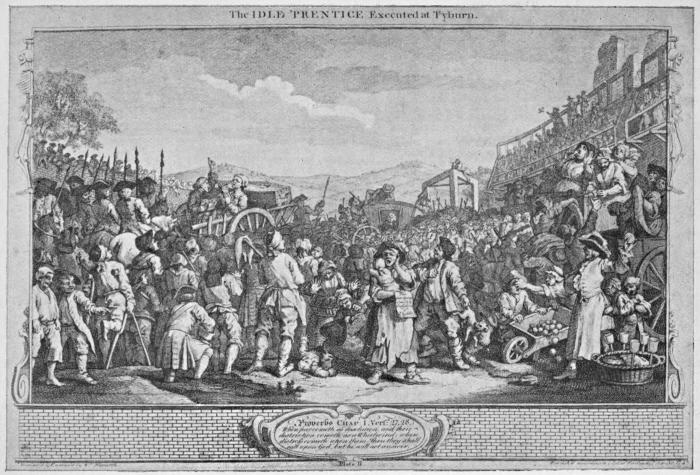
THE TRIPLE TREE IN 1747.
1743-1745. At the Old Bailey sessions, September
7-12, were indicted James Stansbury and Mary
his wife, for the robbery of Mr. or Captain George
Morgan. The case is very interesting, as having furnished
to Hogarth the motive of one of his prints in
the series of “The Effects of Industry and Idleness.”
Captain Morgan, going home in the early hours of the
morning of July 17, seeing a lady in the street, feared
for her safety, and gallantly offered to escort her home.
He was taken into a house where he was robbed and
assaulted. The house, in Hanging-Sword Alley, Fleet
Street, bore an execrable reputation, in virtue of which
it was known as “Blood-Bowl House.” At the trial
Mary Stansbury asked a witness, “Have I not let you
go all over the house, to see if there were any trap-doors
as it was represented?” The witness, Sharrock,
replied that he had looked all over the house and saw
no trap-door. It will be recollected that in Hogarth’s
print the body of a murdered man is being thrust
through a trap-door. The same witness spoke of the
house as “Blood-Bowl House.” Stansbury asked him
how he came to know of the Blood Bowl, to which
Sharrock replied that he had seen it in the newspapers.
(I have been less fortunate: I have not found accounts
in contemporary newspapers referring to the name or to
the trap-door). Stansbury was acquitted: his wife was
sentenced to death, the sentence being afterwards commuted
to one of transportation.
Stansbury was afterwards convicted of burglary. He
described himself as a clockmaker, living in Whitechapel,
from which we may infer that Hanging-Sword Alley
had become too hot for him. It would seem too that
he had not retired from Blood Bowl House with a
fortune.
Mr. Nicholls in his notes on the print gives the name
of Blood-Bowl to the Alley, but there is no evidence that
it was ever officially known by this name. The alley is
Hanging-Sword Alley in Rocque’s map of 1746; it bears
the same name in Hatton’s “New View,” 1708, and in
Stow’s “Survey of London” we read: “Then is Water
Lane, running down by the west side of a house called
the Hanging Sword, to the Thames.” The alley appears
under this name in various books giving the names
of streets: it was Hanging-Sword Alley when Dickens
wrote “Bleak House,” and it is Hanging-Sword Alley
to-day.
1749. February 20. Usher Gahagan was executed
at Tyburn. Gahagan was a scholar. He edited
Brindley’s edition of the classics, and translated into
Latin verse Pope’s Essay on Criticism. He also, while
in prison, translated into Latin verse Pope’s “Temple of
Fame,” and “Messiah”—“with a Latin Dedication to his
Grace the Duke of Newcastle.” His offence was filing
gold money. These verses were addressed to him:—
Who without rapture can thy verses read,
Who hear thy fate, and sorrow not succeed,
Who not condole thee betwixt fear and hope,
Who not admire thee, thus translating Pope?
Translating Pope in never-dying lays,
Bereft of books, of liberty and ease:
Translating Pope, beneath severest doom,
In numbers worthy old Augustan Rome:
Whose ablest sons might glory in thy strains,
Tho’ sung in Massy, Dire, incumb’ring chains.
The catalogue of the library of the British Museum
includes ten works by Usher Gahagan.
1749. October 18. Fifteen malefactors were executed
at Tyburn. There had been a riot in the
Strand, where a number of sailors had wrecked a
house in which a sailor had been maltreated. There
exists a well-known print of the riot. The London
Magazine gives the following account of the execution:—
About nine in the morning the criminals were put
into the carts. Mr. Sheriff Janssen, holding his white
wand, and on horseback, attended the execution, accompanied
by his proper officers. At Holborn-bars Mr.
Sheriff dismissed very civilly the party of foot-guards,
who otherwise would have marched to Tyburn. The
multitude of spectators was infinite. Though a rescue
had been threatened by many (on account of Wilson and
Penlez, the two ill-fated young rioters, both of whom
were expected to suffer) there yet was not the least disturbance,
except during a moment at the gallows, where
a vast body of sailors, some of whom were armed with
cutlasses, and all with bludgeons, began to be very
clamorous as the unhappy sufferers were going to be
turned off, which Mr. Sheriff perceiving, he rode up to
them and enquired in the mildest terms the reason of
their tumult. Being answered that they only wanted to
save the bodies of their brethren from the surgeons, and
the Sheriff promising that the latter should not have them,
the sailors thanked the above magistrate, wished every
blessing to attend him, and assured him that they had
no design to interrupt him in the execution of his office.
The criminals seemed very penitent, and were turned off
about twelve.
It would appear that in 1750 the immemorial custom
of halting at St. Giles’s, for “the bowl,” was abolished:—
1750. February 7. The criminals on their way to
Tyburn were under double guard. The procession
closed with the two under-sheriffs, who did not permit
the carts to stop for the malefactors to drink by the
way. There were thirteen criminals.
1750. May 16. Thirteen executed at Tyburn.
1750. July 6. Three women were executed at Tyburn.
They were drunk, contrary to an express order of the
Court of Aldermen against serving them with strong
liquor.
1750. August 8. Six executed at Tyburn. “It is
remarkable that the above six malefactors suffered for
robbing their several prosecutors of no more than six
shillings” (London Magazine).
1750. October 3. Twelve malefactors executed at
Tyburn. One of them was the celebrated “Gentleman
Highwayman,” Mr. Maclean. Another was William
Smith, the son of a clergyman in Ireland. Smith was
convicted of forgery. The Universal Magazine of
October, 1750, gave long accounts of these worthies,
and printed an ode by Smith on his melancholy condition.
This is one stanza:—
Justice has ranked me with the dead:
I bow, and own the just decree;
Yet, e’er each sense, each thought is fled,
How shall I front the fatal tree?
Hope, faith, the Christian world, inform me how
With resignation to embrace the blow.
But ah, Eternity! tremendous word!
There, there, I sink, I tremble! Help me Lord!
Smith had in an advertisement “entreated contributions
for his decent interment, and that his poor body might
not fall unto the surgeons, and perpetuate the disgrace of
his family.” According to a newspaper of the time the
surgeons got possession of one body only (not Smith’s):
the rest were delivered to the friends. Smith edited
several volumes of “Classicks.” The publisher seized
the opportunity to advertise them.
We have a full account of James Maclean, “The
Gentleman Highwayman,” given by Horace Walpole,
who was robbed by him (Letters, ed. 1857, i. lxvi. to
lxvii., ii. pp. 218-9, 224, and in the World, No. 103,
December 19, 1754). This is the account in the World:
An acquaintance of mine was robbed a few years ago,
and very near shot through the head by the going off of
the pistol of the accomplished Mr. Maclean: yet the whole
affair was conducted with the greatest good breeding on
both sides. The robber, who had only taken a purse this
way, because he had that morning been disappointed of
marrying a great fortune, no sooner returned to his lodgings
than he sent the gentleman two letters of excuses,
which, with less wit than the epistles of Voiture, had ten
times more natural and easy politeness in the turn of
their expression. In the postscript, he appointed a meeting
at Tyburn at twelve at night, where the gentleman
might purchase again any trifle he had lost, and my
friend has been blamed for not accepting the rendezvous,
as it seemed liable to be construed by ill-natured people
into a doubt of the honour of a man who had given him
all the satisfaction in his power, for having unluckily been
near shooting him through the head.
The first Sunday after his condemnation three thousand
people went to see him. He fainted away twice with the
heat of his cell. He was only twenty-six when executed.
A long account of his behaviour in prison was given in
a pamphlet by the Rev. Dr. Allen. The rev. gentleman
was greatly concerned to know whether Maclean, by his
association with “licentious young People of Figure and
Fortune,” who affected to despise “all the principles of
Natural and Revealed Religion, under the polite Name of
Free-thinking,” had not “fallen into the fashionable way
of thinking and talking on these Subjects.” Maclean was
able to give his reverend monitor satisfactory assurances
on this point. Maclean’s brother was the minister of the
English church at The Hague. Maclean lived in fashionable
lodgings in St. James’s Street, and frequented masquerades,
where he at times won or lost considerable
sums. The skeleton of Maclean appears in the fourth
plate of Hogarth’s “Stages of Cruelty,” showing the
interior of Surgeons’ Hall.
1750. December 31. Fifteen executed at Tyburn.
1751. February 11. Three boy-burglars executed at
Tyburn.
1752. In this year the State made a determined effort
to “put down” murder. It was a question that had long
exercised the academic mind. So far back as 1701 a
writer, known only as “J. R., M.A.,” had published a
tract, “Hanging not Punishment enough for Murtherers,
High-way Men and House-Breakers.” J. R. inquired
why, since at the last Great Day there will be degrees
of torment, we should not imitate the Divine Justice?
He invoked, not only the Divine example, but the practice
of our own laws. “If Death then be due to a Man, who
surreptitiously steals to the Value of Five Shillings (as it
is made by a late Statute) surely he who puts me in fear
of my Life, and breaks the King’s Peace, and it may be
murthers me at last, and burns my House, deserves
another sort of Censure: and if the one must die, the
other should be made to feel himself die.”
J. R. therefore proposed hanging alive in chains, the
victim being left to starve, or he might be broken on the
wheel, or whipped to death.
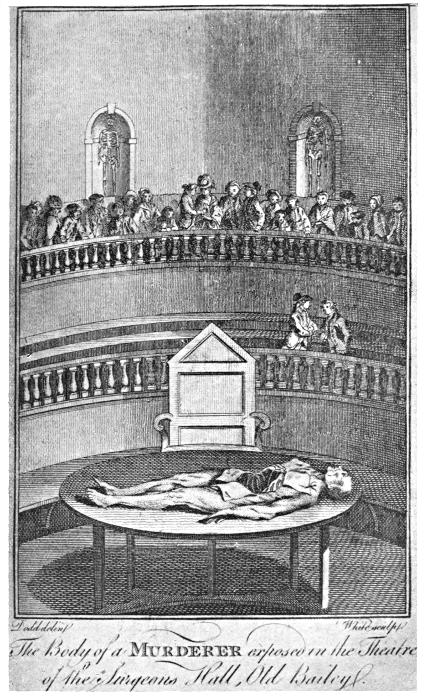
THE BODY OF A MURDERER DISSECTED ACCORDING TO THE ACT OF 1752.
About 1730 J. R., M.A., was followed by a writer who
had no scruple in revealing his name. George Ollyffe,
M.A., published “An Essay humbly offer’d for an Act of
Parliament to prevent Capital Crimes, and the Loss of
many Lives, and to promote a desirable Improvement
and Blessing in the Nation.” Ollyffe argued that a swift
death has no terrors. “An execution that is attended
with more lasting Torment, may strike a far greater Awe,
much to lessen, if not to put a stop to, their shameless
Crimes.” He, like J. R., speaks with approval (somewhat
modified, indeed) of the ancient practice of hanging
men alive on gibbets. This plan has, however, its disadvantages;
it is “tedious and disturbing,” more than
“the tender and innocent part of mankind” can bear—as
spectators. He recommends breaking on the wheel,
“by which the Criminals run through ten thousand
thousand of the most exquisite Agonies, as there are
Moments in the several Hours and Days during the
inconceivable Torture of their bruised, broken, and
disjointed Limbs to the last Period.” Or the twisting
of a little cord hard about the arms or legs “would
particularly affect the Nerves, Sinews, and the more
sensible Parts to produce the keenest Anguish.”
Ollyffe recommended that these things should be done
on gibbets about twenty poles from the usual places of
execution, so that “their cries may not much disturb the
common Passengers.”
The State followed J. R. and Ollyffe—at a distance—in
the Act 25 George II. (1752), c. 37, An Act for better
preventing the horrid Crime of Murder. The preamble
runs: “Whereas the horrid Crime of Murder has of late
been more frequently perpetrated than formerly, and
particularly in and near the Metropolis of this Kingdom,
contrary to the known Humanity and natural Genius of
the British Nation; and whereas it is thereby become
necessary, that some further Terror and peculiar Mark
of Infamy be added to the Punishment of Death now
by Law inflicted on such as shall be guilty of the said
heinous Offence.…”
The Act directs that persons condemned for murder
shall be executed on the next day but one after sentence,
unless Sunday intervenes, when the execution shall take
place on Monday.
Bodies to be given to the Surgeons’ Company at their
Hall or where else the Company may appoint, with a
view to dissection; or the judge may appoint that the
body be hanged in chains (not alive as proposed by
J. R. and Ollyffe). In no case whatsoever is the body
of a murderer to be buried except after dissection.
Incidentally, the Act mentions that hanging in chains
was already practised in case of “the most atrocious
Offences.”
In one point only did the State go beyond its two
advisers. The words of the Act show clearly that the
interval between the passing of the sentence and its
execution was purposely abridged. The interval had
been allowed so that, with the aid of the ordinary, or
other minister of religion, the condemned man might
have time to repent, and to make his peace with Heaven.
The abridgment of the interval must therefore be regarded
as intended to lessen the chances of repentance, and to
send the criminal to judgment still unrepentant. Thus
regarded, the action of the State denoted a daring attempt
to prejudice the final award of the Day of Doom; it was
a distinct invasion of the jura regalia of the Most High.
The first to suffer under this Act was Thomas Wilford,
a one-armed lad of seventeen, who married on a
Wednesday, and murdered his wife through jealousy on
the following Sunday. If we may trust the Gentleman’s
Magazine, Wilford, sentenced on June 30, was hanged,
not on the next day but one after sentence, but on the
very next day, July 1: “Wilford to be executed the
next morning, and then his body to be dissected and
anatomised, according to the late Act.”
The fourth plate of Hogarth’s “Stages of Cruelty” shows
the dissection of a criminal at Surgeons’ Hall, but as the
print was published in 1751, Hogarth did not take the
idea from the Act. Of course, the bodies of criminals
frequently found their way to Surgeons’ Hall before the
passing of this Act, but was the enactment suggested by
Hogarth’s plate?
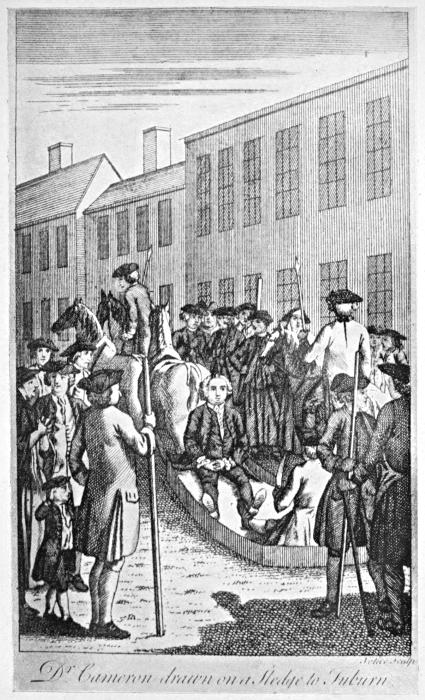
DRAWING TO TYBURN ON A SLEDGE, 1753.
In 1725 Mandeville proposed that the bodies of the
hanged should be given to the surgeons for dissection,
not as an aggravation of capital punishment, but in order
to supply a want felt by anatomists; Mandeville was a
doctor. He says: “Where then shall we find a readier
Supply; and what Degree of People are fitter for it than
those I have named? When Persons of no Possessions
of their own, that have slipp’d no Opportunity of
wronging whomever they could, die without Restitution,
indebted to the Publick, ought not the injur’d Publick to
have a Title to, and the Disposal of what the others
have left?” (“An Enquiry into the Causes of the
Frequent Executions at Tyburn,” 1725, p. 27.)
1752. July 13. Eleven executed at Tyburn.
1753. June 7. Dr. Archibald Cameron, condemned
for high treason for being concerned “in the late
rebellion,” and not surrendering in time. It might have
been expected that vengeance would have been satiated
by the numerous executions that had already taken place:
then, too, “the late rebellion” was eight years old. Dr.
Cameron was nevertheless sentenced to be drawn, hanged,
and quartered. The quartering was omitted. He was,
moreover, suffered to hang for twenty minutes, so that
the burning of his bowels was done before eyes closed
in death. Dr. Cameron met death, not so much with
fortitude, which implies, in a way, an effort, as with
perfect equanimity.
1754. February 4. Twelve executed at Tyburn.
1757. October 5. Twelve executed at Tyburn.
1758. December 18. Some surgeons attempting to
carry off the body of a man executed at Tyburn, the mob
opposed, a riot ensued, in which several persons were
wounded. In the end the mob was victorious, and carried
off the body in triumph.
1759. Between June 18 and October 3 in this year
the old triangular gallows, in use for nearly two hundred
years, was removed, and the new “movable” gallows
took its place (see pp. 69, 70).
1760. May 5. Earl Ferrers had more than one
relative of unsound mind: he himself had given many
proofs of madness. Without any cause, he shot his
steward, who had been for thirty years in his service.
He was undoubtedly a homicidal lunatic who would
to-day be confined in an asylum. On his trial by the
House of Lords he produced witnesses to prove his
insanity, but “his lordship managed this defence himself
in such a manner as showed perfect recollection of mind,
and an uncommon understanding.” The plea was not
accepted, the earl was sentenced to death. Under the
ferocious Act of 1752 the execution should have taken
place the next day but one, but, in consideration of the
earl’s rank, the execution was deferred to May 5. The
sentence, however, bore that the body should be
anatomised.
On the appointed day the earl rejected the mourning
coach provided by his friends, and obtained permission
to make the journey from the Tower to Tyburn in his
own landau, drawn by six horses. He was dressed in a
suit of light-coloured clothes, embroidered with silver,
said to be his wedding suit. To the sheriff he said:
“You may perhaps, sir, think it strange to see me in this
dress, but I have my particular reasons for it.”
The procession was the grandest that had ever made
that fatal journey. First came a very large body of
Middlesex constables, preceded by one of the high
constables: then a party of horse grenadiers, and a party
of foot soldiers.
Mr. Sheriff Errington in his chariot, accompanied by
his under-sheriff.
The landau, escorted by two other parties of soldiers.
Mr. Sheriff Vaillant’s chariot, carrying the sheriff and
under-sheriff.
A mourning coach and six, with some of his lordship’s
friends.
A hearse and six, provided for the conveyance of his
lordship’s corpse from Tyburn to Surgeons’ Hall.
The procession was two hours and three quarters on
the way, which gave time to the chaplain to worry the
earl about his religion—the world would naturally be
very inquisitive concerning the religion his lordship
professed. His lordship replied that he did not think
himself accountable to the world for his sentiments on
religion. He greatly blamed my Lord Bolingbroke for
permitting his sentiments on religion to be published to
the world. But he did not believe in salvation by faith
alone.
He gave his watch to Sheriff Vaillant, and intended
to give five guineas to the hangman. By mischance it
was to the hangman’s assistant that the earl handed the
money, whence arose a dispute between these officers
of the State. The enjoined dissection was performed
perfunctorily; the body was publicly exposed in a room
for three days, and then given up to friends. There
exists an engraving showing the body as exposed in the
coffin.
Walpole gives a long account of the execution. It was
remarkable, among other things, for the introduction of a
new device. “Under the gallows was a new-invented
stage, to be struck from under him.… As the
machine was new, they were not ready at it: his toes
touched it, and he suffered a little, having had time by
their bungling to raise his cap: but the executioner pulled
it down again, and they pulled his legs, so that he was
soon out of pain, and quite dead in four minutes.” The
“drop” was no more used at Tyburn, but it became a
feature of the new gallows of Newgate.
Walpole says that “the executioners fought for the
rope, and the one that lost it cried.”
There is a story that Ferrers was hanged by a silk rope,
or, in another version, that he desired to be hanged by
such a rope. Timbs, in his “Curiosities of London,”
even asserts that the bill for this rope of silk is still in
existence; he does not say where. The legend must
have arisen later. It is a detail which would have
delighted Walpole; he mentions the rope, as we have
seen; his silence as to its particular character seems
conclusive. But the curious in the matter may consult
an article by M. Feuillet de Conches (“Causeries d’un
Curieux,” 1862, ii. 333-40); Abraham Hayward, “Biographical
and Critical Essays,” ii. 30; an article in the
Quarterly Review, lxxxv. 378, and the account of Earl
Ferrers in the “Dictionary of National Biography.”
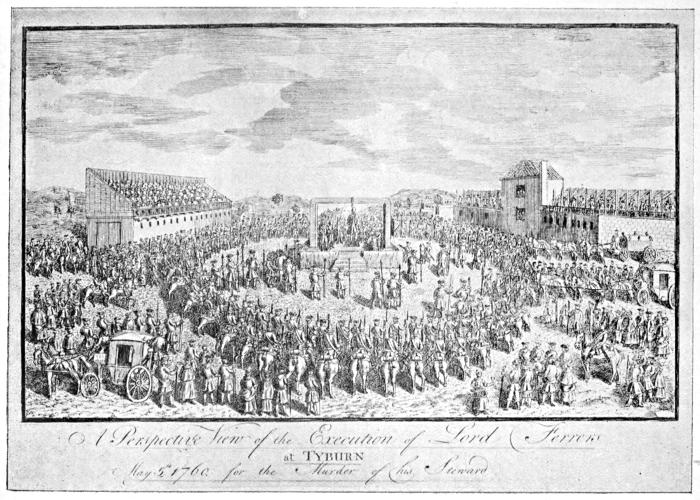
THE EXECUTION OF EARL FERRERS AT TYBURN ON THE NEW MOVABLE GALLOWS, 1760.
The experience gained by the State during six centuries
of hanging enabled it to make two immense advances in
the art. To the great Elizabethan era we owe the invention
of a machine on which a number of victims, up to
at least twenty-four, could be simultaneously choked out
of life. This enabled the spectators to concentrate their
attention on one spot, and therefore to lose not one jot
of the moral lesson inculcated with so great pains.
What was behind the invention of the “drop” is not
so clear. On first sight we are inclined to deem
it the whim of some “faddist”: indeed, it exhales a
strong and disagreeable odour of humanitarianism. As
such we are naturally inclined to condemn it. Our conservative
instincts are also against the daring innovation.
Here was a new principle: the fall would dislocate the
neck, and the victim would die otherwise than by
strangulation. The “fall,” resulting in immediate death,
would deprive the public of what was regarded as the
most diverting episode of the piece—the tugging by
friends at the legs of the suspended man, the thumping
him on the chest, rough methods of accelerating his
death. But on consideration it seems probable that the
State began to have a real concern as to the effect of
mere hanging. We have seen (pp. 221-3) how “half-hanged
Smith” was brought back to life—a life which,
thus prolonged, did indeed prove useful to the State.
But awkward questions arose as to the proper way of
dealing with such cases: the mob, indeed the public,
and the legal experts took different views. Moreover,
a new art was arising, based on these cases of recovery.
Bronchotomy, as applied to victims of the scaffold, did
not, for all I have been able to find, become recognised
as a branch of the healing art till some years later than
1760. But so early as 1733, Mr. Chovet had made such
progress in “preventing the fatal consequences of the
Halter” that the State may well have trembled. Here
was a new development of smuggling. On the whole it
seems safer to conclude that the “fall” was adopted as
a means of bringing to naught these ingenious attempts
to rob the State of its due.
1767. Mrs. Brownrigg, the wife of James Brownrigg,
at one time a domestic servant, was the mother of a
large family. To support the household Mrs. Brownrigg
learnt midwifery, and received an appointment as midwife
to women in the workhouse of St. Dunstan’s-in-the-West.
She had the character of being skilful and
humane: she was reputed to be a faithful wife and an
affectionate mother. About 1763 Brownrigg took a
house in Fetter Lane, and in February, 1765, Mrs.
Brownrigg took as apprentice a poor girl of the precinct
of Whitefriars: a little later another girl was bound
apprentice to her by the governors of the Foundling
Hospital. Mrs. Brownrigg treated these poor girls with
unimaginable cruelty. She tied them up naked, and
flogged them with a horse-whip, made her husband
and son do the same: starved them and gave them
insufficient clothing. This went on for two years. At
last the neighbours, constantly hearing groans in the
Brownriggs’ house, watched, and at last caught sight
of one of the poor creatures in a most deplorable
condition. Information was given and the girls were
rescued. But relief came too late to save Mary Clifford,
who died of the most terrible wounds inflicted on her
by these monsters. On September 12, father, mother,
and eldest son were tried for the murder of Mary
Clifford: only Elizabeth Brownrigg was found guilty.
She was executed on September 14, her body was
carried to Surgeons’ Hall to be anatomised. Afterwards
“her skeleton has since been exposed in the niche
opposite the first door in the Surgeons’ Theatre, that
the heinousness of her cruelty may make the more
lasting impression on the minds of the spectators.”
The Gentleman’s Magazine adds to a full account of
the story an engraving showing the “Hole” under the
stairs in which the poor wretches were confined, and
the kitchen in which one of the girls is shown tied up
to be flogged. The case made a profound impression
on the public, and to this day remains the most shocking
case of its kind on record.
1767. October 14. William Guest, a teller in the Bank
of England, was convicted of filing guineas. Guest’s
crime was high treason: he was therefore drawn to the
gallows in a sledge. “After the three others were tied
up, he got into the cart: he was not tied up immediately,
but was indulged to pray upon his knees, attended by
the ordinary, and another clergyman of the Church of
England. He joined in prayers with the clergymen
with the greatest devotion, and his whole deportment
was so pious, grave, manly, and solemn as to draw
tears from the greatest part of the spectators.” There
exists a print showing Guest in the sledge on the way
to Tyburn.
1768. March 23. James Gibson, attorney-at-law,
convicted of forgery, and Benjamin Payne, footpad,
were executed at Tyburn. For a long time, as has
been shown, the “respectability” of criminals had been
recognised by permitting them to be carried to their
doom in a mourning coach, instead of in the ordinary
cart. To Gibson, as the erring member of an honoured
profession, this indulgence was granted. Gibson desired
that the footpad might be allowed to accompany him
in the coach. There is something pathetic in this
practical recognition of the truth that death makes all
men equal. The authorities might well have granted
the request, but it was refused.
1769. The manufacture of silk fabrics was highly
protected, but protection did not bring prosperity to
the workers. The condition of the weavers of Bethnal
Green and Spitalfields was deplorable, leading to constant
disturbances. The destruction of looms, and the cutting
of woven silk—capital offences—became frequent.
On December 20 three men were executed at Tyburn
for destroying silk-looms. Their execution had been
preceded on the 6th by that of two others, hanged at
Bethnal Green for cutting woven silk. In connection
with this execution at Bethnal Green a grave question
arose. The sentence passed on the condemned men
was that they should be taken from the prison to the
usual place of execution, but the Recorder’s warrant
for the execution directed they should be hanged at the
most convenient place near Bethnal Green church.
The variation of place was directed by the King. A
long correspondence ensued between the Sheriffs and
the Secretary of State. The point raised was whether
the King had power thus to vary the sentence. The
condemned men were respited in order that the opinion
of the judges might be taken. It was unanimous that
the King had the power of fixing the place of execution,
and the men were executed at Bethnal Green, as directed.
There was great apprehension of tumult, and not without
cause, for in the Gentleman’s Magazine we read: “The
mob on this occasion behaved outrageously, insulted
the Sheriffs, pulled up the gallows, broke the windows,
destroyed the furniture, and committed other outrages
in the house of Lewis Chauvette, Esq., in Spitalfields.”
The mob dispersed only on being threatened with
military execution.
It was observed that when the Recorder next passed
sentence of death, he omitted direction as to the place
of execution.
1771. On October 16, Mary Jones was executed at
Tyburn for stealing from a draper’s shop on Ludgate
Hill some pieces of worked muslin. The annals of
Tyburn contain the record of no more poignant tragedy
than this. It is a story so piteous that, once heard, it
ever after haunts the memory. Mary Jones was a young
woman whose age is variously given as nineteen and
twenty-six: all accounts tell of her great beauty. She
was married, lived in good credit, and wanted for nothing
till her husband was carried off by a press-gang. Then
she fell into great straits, having neither a bed to lie on,
nor food to give to her two young children, who were
almost naked. On her trial her defence was simple:
“I have been a very honest woman in my lifetime. I
have two children: I work very hard to maintain my
two children since my husband was pressed.” Her
beauty and her poverty prove Mary’s averment that she
had been a very honest woman. But when the jury
gave in a verdict of guilty, Mary cursed judge and jury
for a lot of “old fogrums.” It was really for this that
she died on the gallows. The theft had not been
completed: she was arrested in the shop and gave up
the goods. It was her first offence. Her neighbours in
Red Lion street, Whitechapel, presented a petition in
her behalf, but there was against her the record of her
“indecent behaviour.” One of the two children was
at her breast when she set out in the cart on the journey
from Newgate to Tyburn. Her petulance had gone:
“she met death with amazing fortitude.”
So perished Mary Jones, whose husband had been
torn from her side, who was now, in her turn, torn
from her helpless babes. Poor Mary Jones! Beautiful
Mary Jones, with your great crown of auburn hair! Our
hearts are wrung as we seem to see you setting out on
your last journey in this world, with your little one at
your breast. Your last prayer was for your babes, your
last thoughts of your husband, to whom, as honest as
beautiful, you remained true in spite of the temptation to
stay your children’s hungry cries with bread earned by
your shame.
History does not tell us more. Did the husband
return from fighting the battles of his country—or rather
of its politicians—to find that his true wife had perished
on the gallows? Better far that he should have met
his death in some glorious victory or inglorious defeat,
reddening with his blood some distant sea. And the little
ones, robbed by the cruel State of father and mother—what
became of them? These are things it behoves us
to know, for they are one side of glory, of imperialism.
How many Mary Joneses, how many broken hearts and
ruined lives are behind the naval victories celebrated
by painting, by song, by sculptured tombs in temples
dedicated to the Prince of Peace? Or are we to dry
our tears, comforting ourselves with the reflection that
“the suffering is irrelevant”?
Mary Jones did not die wholly in vain. Six years
later, after “John the Painter” had been hanged on
a gallows sixty feet high, for setting fire to the rope-house
in Portsmouth Dockyard, ingenuity discovered a
chance of adding one more capital offence to the two
hundred or so already on the Statute-book. A Bill
was promoted for making it a hanging matter to set
fire to private dockyards. Sir William Meredith, a
“faddist” of his day, inveighed against the Bill and
the atrocious cruelty of the laws. He cited the case
of Mary Jones. “I do not believe,” he said, “that a
fouler murder was ever committed against law, than the
murder of this woman by law.”[214] A girl of fourteen
had lately been sentenced to be burnt for hiding, at
her master’s bidding, some white-washed farthings. The
faggots had been laid, the cart was setting out, when
a reprieve, granted at the instance of the Lord Mayor,
saved this poor child from the flames. “Good God,
Sir,” he cried, “are we taught to execrate the fires of
Smithfield, and are we lighting them now to burn a
poor harmless child, for hiding a white-washed
farthing?” This speech, delivered in Parliament, was
printed by the Society for the Diffusion of Knowledge
upon the Punishment of Death, founded by Basil
Montague in 1808, and was also printed separately in
several editions down to 1833.
1771. January 1. John Clark and John Joseph
Defoe executed at Tyburn, for robbery of a gold
watch and money. Defoe was said to be a grandson
of the immortal author of “Robinson Crusoe.”
1773. September 13. Mrs. Herring was thus executed
for murdering her husband:—
She was placed on a stool something more than
two feet high, and, a chain being placed under her
arms, the rope round her neck was made fast to two
spikes, which, being driven through a post against
which she stood, when her devotions were ended,
the stool was taken from under her, and she was
soon strangled. When she had hung about fifteen
minutes, the rope was burnt, and she sunk till the
chain supported her, forcing her hands up to a level
with her face, and the flame being furious, she was
soon consumed. The crowd was so immensely great
that it was a long time before the faggots could be
placed for the execution.
1773. October 27. The two sheriffs and under-sheriff
attended the execution of five malefactors on
horseback, and two persons clothed in black walked all
the way before the prisoners to the place of execution,
where they were allowed an hour and a half in their
devotions, a circumstance not remembered for a great
many years past.
A vivid picture of the manners of the times is
given in these two extracts from the Gentleman’s Magazine
of 1774.
The first passage shows the extraordinary prevalence
of highway robbery, which at this time seems to
have become a recognised form of out-door sport
among young men:—
“As lord Berkeley was passing over Hounslow Heath
in the dusk of the evening [of November 11] in his
post-chaise, the driver was called to stop by a young
fellow, genteelly dressed and mounted, but the driver
not readily obeying the summons, the fellow discharged
his pistol at the chaise, which lord Berkeley returned,
and, in one instant, a servant came up, and shot the
fellow dead. By means of the horse, which he had
that morning hired, he was traced, and his lodgings
in Mercer-street, Long-Acre, discovered; where Sir
John Fielding’s men were scarce entered, when a
youth, booted and spurred, came to enquire for
the deceased by the name of Evan Jones. This
youth, upon examination, proved to be an accomplice,
and impeached two other young men belonging to the
same gang, one of whom was clerk to a laceman in
Bury-street, St. James’s, after whom an immediate
search being made, he was traced along the road to
Portsmouth, and, at three in the morning, was surprised
in bed at Farnham, and brought back to London,
by Mr. Bond and other assistants. The other accomplice
was also apprehended, and all three were carried
before Sir John Fielding, when it appeared, that these
youths, all of good families, had lately committed a
number of robberies in the neighbourhood of London:
that their names were Peter Holtum, John Richard
Sauer, and William Sampson: that Sampson in particular,
had 50 guineas due to him for wages when he
was apprehended, and that he had frequently been
intrusted with effects to the amount of 10,000l. An
evening paper says, that there are no less than seven
of these youths in custody, from 18 to 20 years of
age, some of whose parents are in easy, some in
affluent circumstances, all of them overwhelmed with
sorrow by the vices of their unhappy sons.”
Here is a batch of executions:—
1774. November 30. The six following malefactors,
were executed at Tyburn, pursuant to their sentence,
viz., John Coleby and Charles Jones, for breaking into
the dwelling-house of Lancelot Keat, and stealing
goods: William Lewis, for publishing a forged draught
upon Mess. Drummond and Co. for 48l. 18s.: John
Rann, alias Sixteen-string Jack, for robbing the rev.
Dr. Bell, near Gunnerbury-lane: and William Lane
and Samuel Trotman, for robbing the Knightsbridge
stage-coach.
Lewis, the unhappy sufferer for forgery, was a most
ingenious copyist, and could counterfeit copper-plate
writing to astonishing exactness. He was far from an
abandoned character, and died an example of penitence,
which, in some measure, atoned for the injury he had
done the public. He composed a prayer in the cells,
which does credit to his understanding.
The friends of Coleby and Jones, in passing the
house of Mr. Keat, their prosecutor, in order to the
interment of their bodies, committed the most outrageous
acts of violence that have been known in any
civilised country, by breaking the windows, attempting
to set the house on fire, and threatening the life of Mr.
Keat.
1776. January 17. Robert and Daniel Perreau executed
at Tyburn.
They were twin brothers, natives of St. Kitts. Robert
was an apothecary “in high practice” in Golden Square,
then a fashionable quarter. Daniel lived “a genteel life”
with his mistress, Mrs. Rudd. Robert Perreau sought
a loan of Drummonds, the bankers, on bonds, afterwards
found to be forged. The evidence made it
probable that the actual forgery was by Mrs. Rudd,
but that all three were acting in concert. The brothers
were both found guilty on their trials, but a strong
feeling existed that the sentence on Robert was harsh.
A petition to commute the sentence to one of transportation
was presented on behalf of seventy-eight
“capital Bankers and Merchants” of the City. The
king was, however, obdurate, and after the acquittal of
Mrs. Rudd let the law take its course. The execution
was witnessed by 30,000 persons. The brothers, born
together, were not divided in death. They fell from
the cart with their four hands clasped together.
Mr. Bleackley has told the story at length in “Some
Distinguished Victims of the Scaffold,” 1905.
1777. June 27. Execution of Dr. Dodd.
William Dodd, born in 1729, was the popular preacher
of his day. He came, a young man of 21, from Cambridge
to London in 1750. He hesitated between
adopting literature as a profession and the Church, but
took orders in 1751. He still dabbled in literature, and is
said to have been the author of a work, “The Sisters,”
which gave no very favourable idea of the purity of
his mind. In 1758 he became chaplain of the Magdalen
Hospital, and fine ladies came to hear his sermons “in
the French style.” In 1763 he was made one of the
king’s chaplains, an appointment he lost when, in
1774, Mrs. Dodd wrote to the wife of the Lord
Chancellor, offering a bribe for the living of St. George,
Hanover Square. Dodd got into debt: he had to sell
a proprietary chapel in which he had sunk money:
it is said that he even “descended so low as to
become the editor of a newspaper.” He fell still
lower: in his need he forged the signature of his
patron, Lord Chesterfield, to a bond for £4,200. The
forgery was discovered, and warrants were issued
against Dodd and his broker. Dodd made partial restitution,
offered security for the remainder, and the
affair might have been settled had not the Lord
Mayor, who had issued the warrants, refused to let
the case be hushed up. Dodd was tried on February
22, 1766. The evidence was irresistible. Only a legal
point stood in the way of sentence. This point was
decided adversely to Dodd, and on May 26 sentence
of death was passed. “They will never hang me,”
said Dodd, and indeed everything possible was done to
save him. “The exertions made to save him were
perhaps beyond example in any country. The newspapers
were filled with letters and paragraphs in his
favour. Individuals of all ranks and degrees exerted
themselves in his behalf: parish officers went from
house to house to procure subscriptions to a petition
to the king, and this petition, which, with the names,
filled twenty-three sheets of parchment, was actually
presented. The Lord Mayor and Common Council went
in a body to St. James’s, to solicit mercy for him,
but all this availed nothing; government were resolved
to make an example of him.” Foremost
among those who pleaded for Dodd was Dr. Johnson.
There was nothing in common between the shallow
flippancy of Dodd, and the great, rough, earnest
nature of Johnson; being once asked whether Dodd’s
sermons were not addressed to the passions, “They
were nothing, Sir,” growled the lexicographer, “be
they addressed to what they may.” But to misery
Johnson’s heart was more tender than a woman’s;
he was agitated when application was made to him
on behalf of Dodd; he paced up and down the room,
and promised to do what he could. He wrote the
speech delivered by Dodd before the passing of the
sentence and more than one petition in his behalf.
All was in vain: “If I pardon Dodd, I shall have
murdered the Perreaus.” So the king is reported to
have said—and, indeed, although Dodd’s partisans fell
foul of court and jury, it is not easy to see how, if
Dodd had been pardoned, the punishment of death for
forgery could ever after have been inflicted. There is a
pathetic touch in the fact that, many years before his
fall, Dodd preached a sermon, afterwards printed,
deprecating the frequency of capital punishment. In
“Prison Thoughts” he foretold the abolition of the procession
to Tyburn, or perhaps of public executions:—
“… yes, the day—
I joy in the idea—will arrive
When Britons philanthropic shall reject
The cruel custom, to the sufferer cruel,
Useless and baneful to the gaping crowd!”
On June 27 the fatal procession set out from Newgate.
On this occasion “there was perhaps the greatest
concourse of people ever drawn together by a like
spectacle.” “Just before the parties were turned off
Dr. Dodd whispered to the executioner. What he said
cannot be known; but it was observed that the man
had no sooner driven away the cart, than he ran immediately
under the gibbet, and took hold of the doctor’s
legs, as if to steady the body.” Another account says
that the executioner, gained over by Dodd’s friends,
had arranged the knot in a particular manner, and
whispered to him as the cart drew off, “You must not
move an inch!” When cut down the body was conveyed
to the house of an undertaker in Goodge Street,
where a hot bath was in readiness. Under the direction
of Pott, a celebrated surgeon of the day, every effort was
made to restore animation. But in vain. The crowd
was so enormous that there had been great delay in
the transport of the body, and this was fatal. Nevertheless,
there were not wanting people who believed
that Dodd had been resuscitated and carried abroad.
1779. April 19. The Rev. James Hackman executed
at Tyburn for the murder of Miss Martha Ray.
As the spectators were leaving the performance of
“Love in a Village” at Drury Lane, on the night of
April 7, a gentleman, seeing Miss Ray, with whom
he had some little acquaintance, in difficulty in getting
to her coach, stept forward and offered his assistance.
When close to the coach he heard the report of a pistol,
and felt the lady fall. For a moment he thought that
she had fallen in fright at the report, but on stooping
down, to help her to rise, he found his hands covered
with blood. With the aid of a light-boy, he got the
lady into the Shakespeare tavern. She was dead.
The murdered woman was Miss Martha Ray, the mistress
of Lord Sandwich, First Lord of the Admiralty;
her murderer the Rev. Mr. Hackman.
Hackman was born in 1752. He was apprenticed to
a mercer, but, disliking the business, his friends bought
for him a commission in a foot regiment. While with
a recruiting party at Huntingdon, he was invited to the
country house of Lord Sandwich, and fell violently in
love with the Earl’s mistress. In 1776 he left the army,
took orders, and in 1779 was presented to the living of
Wiverton, in Norfolk. It is doubtful whether he ever
officiated there. He had not been able to forget
Martha Ray. He continued his attentions, and offered
her marriage. On the fatal day, having written a letter
to a friend, announcing his intention to destroy himself,
he went to the theatre armed with two pistols. After discharging
one at the lady, he shot himself and fell at the
lady’s feet, beating his head with the butt-end of a pistol
and calling on the bystanders to kill him. On his trial
his only defence was that a momentary frenzy overcame
him. The letter contained nothing to indicate
an intention to kill Miss Ray. He was executed on
April 19.
Boswell records a stormy discussion between Dr.
Johnson and Mr. Beauclerk on the subject of the
murder. Did the fact that Hackman carried two
pistols indicate an intention to kill Miss Ray as well as
himself? Johnson held that it did; Beauclerk maintained
the contrary, citing the case of a man inordinately
fond of muffins, which disagreed with him.
Determined to enjoy a last repast, he ate his muffins
and then shot himself. He had ready two pistols for
the purpose. As too often happens, neither disputant
could convince the other (ed. Hill, iii. 383-5).
Here is a portion of a Grub Street ballad on the
tragedy:—
A Sandwich favourite was this fair,
And her he dearly loved:
By whom six children had, we hear:
This story fatal proved.
A clergyman, O wicked one,
In Covent Garden shot her:
No time to cry upon her God,
Its hop’d he’s not forgot her.
Martha Ray bore several children to the Earl. One of
them, Basil Montagu, is in our days remembered, if at
all, by a savage snarl of Carlyle at the man and his
parentage (“Reminiscences,” i. 224), “considerably a
humbug if you probed too strictly.” Basil has already
been mentioned in this book as the founder of the
Society for the Diffusion of Knowledge upon the
Punishment of Death. By his numerous writings on
this subject he did perhaps more than any other man to
bring home to the public the frightful cruelty of our
criminal law. He may at least be credited with sincerity
in this matter. On one occasion, in 1801, he
posted through the night to Huntingdon, arriving with
a respite just in time to save the lives of two men.
Lord Sandwich gave to the world a thing and its
name. He was an inveterate gambler, and, in order
that he might continue this diversion uninterruptedly,
he caused to be served to him thin slices of meat placed
between bread. Hence the “sandwich,” known to all
civilised men.
1779. August 25. Four malefactors were carried to
Tyburn for execution, and had been tied up for near
twenty minutes when a report was spread that a reprieve
was come to Newgate for one of them. They were all
untied and left in the cart while one of the sheriffs went
to Lord Weymouth to learn the truth. No reprieve
having been granted, the execution took place at near
one o’clock.
1779. October 27. Isabella Condon, condemned for
coining, was at Tyburn first strangled, and then burnt.
1780. April 12. A man was executed at Tyburn for
robbing the house of Jeremiah Bentham. This was the
father of Jeremy Bentham. One wonders whether this
execution directed his thoughts to the question of capital
punishment.
1781. July 27. Francis Henry de la Motte, executed
at Tyburn for giving to the French Government information
as to the movement of British ships. The sentence
was in the usual form for high treason, that he should be
hanged “but not till you are dead,” but he was allowed
to hang for nearly an hour. The head was severed from
the body, four incisions made in the body, and part of
the entrails thrown into a fire. Then the body was
delivered to an undertaker, and was buried in St. Pancras
churchyard.
1783. August 29. William Wynne Ryland executed
at Tyburn for forgery. Ryland was an engraver of repute
in the manner of Bartolozzi. He is the subject of a
careful study, perhaps too sympathetic, by Mr. Bleackley,
in his “Some Distinguished Victims of the Scaffold,”
1905.
1783. November 7. On this day took place the last
execution at Tyburn. The occasion requires us to give
in full the account, not otherwise particularly interesting.
It is quoted from the Gentleman’s Magazine:—
This morning was executed at Tyburn, John Austin,
convicted the preceding Saturday of robbing John
Spicer, and cutting and wounding him in a cruel manner.
From Newgate to Tyburn he behaved with great composure.
While the halter was tying, his whole frame
appeared to be violently convulsed. The Ordinary
having retired, he addressed himself to the populace:
“Good people, I request your prayers for the salvation
of my departing soul: let my example teach you to shun
the bad ways I have followed: keep good company, and
mind the word of God.” The cap being drawn over his
face, he raised his hands and cried, “Lord have mercy
on me: Jesus look down with pity on me: Christ have
mercy on my poor soul!” and, while uttering these
words, the cart was driven away. The noose of the
halter having slipped to the back part of his neck, it was
longer than usual before he was dead.
The transference of executions to Newgate involved
the suppression of the processions which for six hundred
years had been a feature of the city’s life. The change
did not receive the approval of Dr. Johnson. “The age,”
he said, “is running mad after innovation: all the business
of the world is to be done in a new way: Tyburn
itself is not safe from the fury of innovation!” It having
been argued that this was an improvement—“No, Sir
(said he eagerly), it is not an improvement: they object
that the old method drew together a number of spectators.
Sir, executions are intended to draw spectators. If they
do not draw spectators, they don’t answer their purpose.
The old method was most satisfactory to all parties: the
public was gratified by a procession: the criminal was
supported by it. Why is all this to be swept away?”
From the “moral lesson” point of view Dr. Johnson
was quite right. But the procession was abolished simply
because the best quarter of the town had extended to
Tyburn.
On December 9, 1783, the first executions took place
in front of Newgate prison, on the new gallows, with a
“drop.” The illustration shows
THE DAWN OF THE NEW ERA.
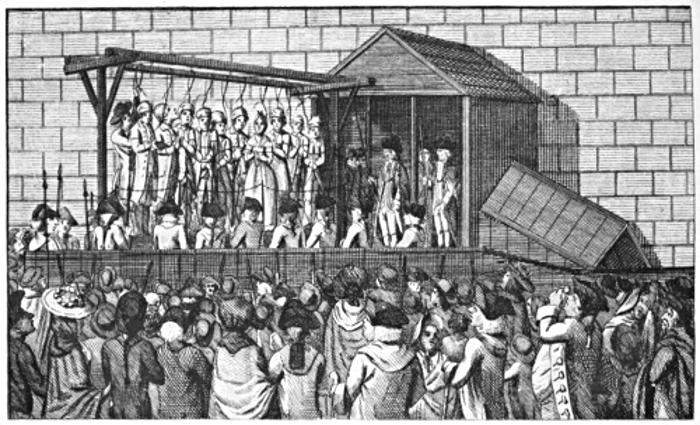
THE NEW GALLOWS AT NEWGATE, 1783.
The ten persons seem to fill the stage, but it would be
doing an injustice to the designer of this national monument
to assume that he had not taken into account the
possible demands of the State.
On February 2, 1785, twenty men swung in a batch in
front of the debtors’ door. Of these, five—FIVE—were
hanged for assaulting a man and robbing him of two
glass drops, set in metal, value 3d.; a one-inch rule,
value 2d.; two papers of nails, value 1d.; one knife,
value 1d.; two shillings, and a counterfeit half-penny.
Tyburn gallows was in full vigour when the claims of
a “genteel” neighbourhood demanded its abolition. In
the last year of its existence one hundred and eight persons
were condemned to death at the Old Bailey sessions—fifty-eight
in a single sessions. Most of the condemned
were reprieved: the crimes of these must have been light,
for John Kelly was actually hanged for robbing another
of sixpence-farthing.
Within view of the accursed spot Catholics have instituted
an Oratory of the English Martyrs. It is well: the
world cannot afford to forget the example of those who,
whether at Tyburn or Smithfield, gladly faced the most
horrible of deaths rather than be false to themselves.
But in honouring them, let us not forget the thousands
of martyrs for whom no one has claimed the crown of
martyrdom—the martyrs to ferocious laws, not seldom
put in force against the innocent, the martyrs to cruel
injustice, to iniquitous social conditions. Thousands
have had the life choked out of them at Tyburn on whom
pity might well have dropped a pardoning tear: to whom
compassion might well have stretched out a helping
hand.
If not a sparrow falls unheeded, these obscure martyrs
may not have died in vain.